Larger versions of most illustrations
may be seen by right-clicking them and
selecting an option to view them separately, or by double-tapping
and/or stretching them.
BY THE SAME AUTHOR.
VALDAR, THE OFT-BORN. A Saga of
Seven Ages. Imp. 16mo, cloth gilt. Illustrated
by Harold Piffard. Price 6s.
THE VIRGIN OF THE SUN. A Tale of
the Conquest of Peru. Crown 8vo, cloth.
With Frontispiece by Stanley L. Wood. Price 6s.
KNAVES OF DIAMONDS. Being Tales
of the Diamond Fields. Crown 8vo, cloth.
Illustrated by E. F. Sherie. Price 3s. 6d.
London
C. ARTHUR PEARSON LIMITED
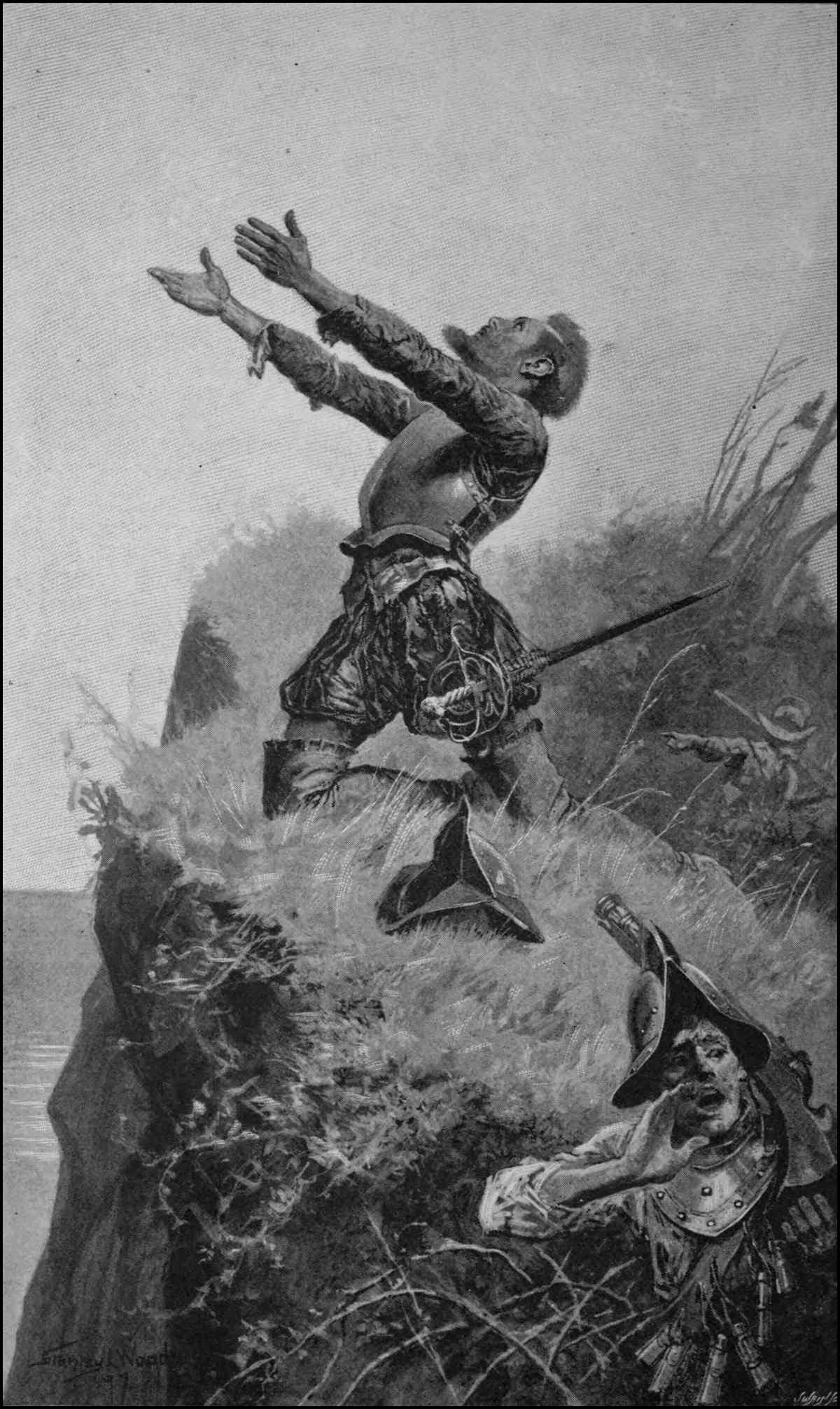
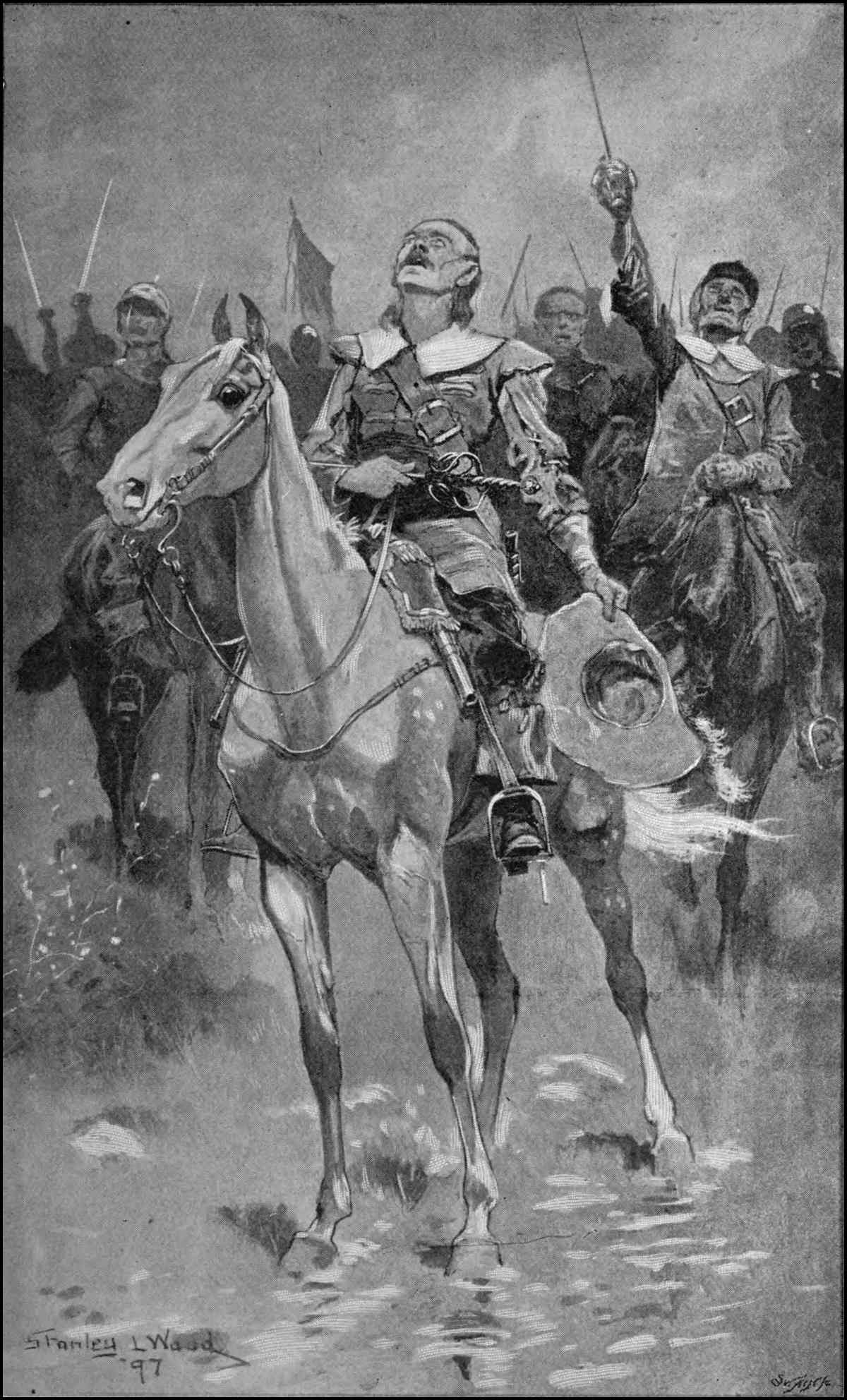
“ALMIGHTY GOD, OF THY GOODNESS, GIVE ME LIFE AND LEAVE ONCE
TO SAIL AN ENGLISH SHIP ON YONDER SEA!”
The Epic of England has yet to be written.
It may be that the fulness of time for writing
it has not come yet, or it may be that Britain is still
waiting for her Homer and her Virgil. Perhaps the
matured genius of a Rudyard Kipling, that strong,
sweet Singer of the Seven Seas, may some day
address itself to the accomplishment of this most
splendid of all possible tasks, and then, again, it
may be that it is his only to sound the prelude.
That is a matter for the gods to decide in their
own good time, but this much is certain—that when
this work has been worthily done the world will
hear echoing through the ages such a thunder-song
as has never stirred human hearts before.
It will begin, doubtless, with the battle-cries of
the old Sea-Kings of the North, chanted to the
music of their churning oars and the rush and
roar of the foam swirling away under the bows of
their longships, and from them it will go on ringing
and thundering through the centuries, ever swelling
in depth and volume as more and more of the races
of men hear it rolling over the battle-fields of conquered
lands, until at last—as every loyal man of
English speech must truly hope—the roar of the
Last Battle has rolled away into eternal silence, and
north and south, east and west, the proclaiming of
the Pax Britannica heralds the epoch of
“The Parliament of Man, the Federation of the World.”
But in the meantime, while we are waiting for the
coming of the singer whose master-hand shall blend
the song and story of Britain into an epic worthy of
his magnificent theme, materials may be gathered
together, old facts may be presented in new lights,
and the great characters who have played their parts
in the most tremendous drama that has ever occupied
the Stage of Time may be re-grouped in such fashion
as will make their subtler relationships more plain,
and all this will make the great work readier to the
hand of the Master when he comes.
It is a portion of this minor work that I have set
myself here to do. The making of a nation and
the building of nations up into empires is, humanly
speaking, the greatest and noblest work that human
hands and brains can find to do, for the making of
an empire means, in its ultimate analysis, the substitution
of order for anarchy, of commerce for
plunder, of civilisation for savagery—in a word,
of peace for strife.
Now, the British Empire as it stands to-day is
unquestionably the greatest moral and material Fact
in human history, and hence it is permissible to
assume that the makers of it must, each in his
own way, whether of peace or war, have been the
greatest empire-builders the world has yet seen, and
it is my purpose here to take the greatest of these
and tell with such force and vividness as I may, the
story of the man and his work. I am not going to
write a series of biographies arranged in prim chronological
ranks, nor am I going to confine myself to
the narration of collated facts so dear to the hearts
of educational inspectors and scholastic examiners.
Such you will find already cut and dried for you in
the school-books and in many ponderous tomes,
from the reading of which may your good taste
and good sense deliver you!
I shall seek rather to show you the living man
doing the living work which his destiny called him
to do. The man will not always be found of the
best, nor the work, seemingly, of the noblest, but
what I shall seek to show you is that the work
had to be done in order that a certain end might be
accomplished, and that the man who did it was, all
things considered, the best and, it may be, the only
man to do it. In so far as I do not do this I shall
have failed in the doing of my own work.
One more word seems necessary in order to anticipate
certain possible misconceptions. Our empire-making
is not yet complete, even at home. The
centuries of strife during which the hammering and
welding together of the nations which now make
up the United Kingdom has been progressing
have naturally and necessarily left certain national
jealousies and antipathies behind them, and the
last thing that I should desire would be to arouse
any of these.
There are two kinds of patriotism, a smaller and
a greater, a National and an Imperial. Both are
equally good and noble, and it is necessary that the
first should precede the second. But it is equally
necessary that it should not supersede or obscure
it, and it is to this later and greater, this Imperial
patriotism that I shall appeal, and I would ask my
readers, whatever their nationality, to remember
that on the burning plains of India and the rolling
prairies of Canada, in the vast expanses of the
Australian Bush and the African Veld, there are
neither Englishmen nor Scotsmen, Welshmen nor
Irishmen; but only Citizens of the Empire, brothers
in blood and speech, and fellow-workers in the building
up of the noblest and stateliest fabric that human
hands have ever reared or God’s sun has ever shone
upon.
I WILLIAM THE NORMAN, PIRATE AND NATION-MAKER
I WILLIAM THE NORMAN
It may strike those of my readers who have only
got their history from their school-books as
somewhat strange that I should begin my record
of British Empire-Makers with a man whom they
have been taught to look upon as a foreigner, an
invader, a conqueror, and a ruthless oppressor of
the English.
The answer is simple, though manifold. The
school-books are only filled with potted facts, and
are therefore wrong and unreliable. It has been
well said that England was made on the shores
of the Baltic Sea and the German Ocean. The
so-called Englishmen who occupied it at the time
of the Conquest were not Englishmen at all, for
the simple reason that the true English race had
yet to be born, and, after it, the true British.
The England and Scotland of the eleventh
century were peopled, not by nations, but by
tribes mostly at bitter and constant war with each
other. There were still Jutes and Angles, Picts
and Scots, Danes and Swedes and Norwegians,
each occupying their own little stretch of country,
and governed, more or less effectually, by their
chieftains, in proof of which it is enough to recall
the fact that Harold’s last fight but one was
against his own brother, who had come across
the Narrow Seas at the head of a miscellaneous
crowd of hungry pirates to steal as much as he
could of the ownerless heritage that Edward the
Confessor had left behind him.
A good deal of sentiment, more or less born of
deftly-written romances, has glorified the memory
of this same Harold. Whether it was deserved
or not does not concern us now, any more than
does his right or unright to the throne of England.
It is enough here to grant him all honour as an
able leader of armies, and a man who knew how
to snatch victory from defeat, and glory from
disaster by dying like a hero surrounded by the
corpses of his foes.
The idle question whether he or William had
the better right to the crown of England may be
left to those who care for such quibbling. Let
us, at the outset, in the words of the Sage of
Chelsea, “clear our minds of cant.” There is no
“right” or “wrong” in these things, saving only
the eternal right of the strongest and wisest—the
fittest or most suitable, in short, to wield power
and dominion whether the less fit like it or not.
The peoples are thrust headlong into the fiery
crucible of War, and, on the adamantine anvil of
Destiny, the Thor’s Hammer of Battle beats and
crushes them into the shape that God has designed
for them. It seems a rude method, but in many
thousands of years we have found no other, so
at least we may conclude that it is the best one
known.
There is a very deep meaning in the seemingly
flippant and almost impious saying of Napoleon:
“God fights on the side of the biggest battalions.”
He does—but you must reckon the bigness of the
battalions, not only by their numbers, but by the
value of their units, remembering always that one
man with a stout heart and a cause he honestly
believes in is worth a score who have neither heart
nor faith.
Just such a man was William the Norman, son
of Robert the Magnificent, otherwise styled the
Devil, and Arlette the Fair, daughter of Fulbert
the Tanner of Falaise. It is in this birth of his
that we find the first clue to his real greatness.
He was born of a union unhallowed by the
sanction of the Church, among a people proud
beyond all modern belief of their royal sea-king
ancestry.
How did he come to achieve this almost miraculous
triumph over a prejudice and hostility of which we
can now form but a very dim idea?
We have to look no farther than his cradle to
find the answer. Lying there, the little fellow used
to grasp the straw in his baby fists with such a grip
that it could not be pulled away from him. The
straw broke first, and ever in his after life what
William the Norman laid hold of he held on to;
and that is why he became the first of our Empire-Makers.
No doubt it was the strain of the old pirate blood
which ran so strongly in his veins that made him
this. If we have successfully cleared our minds of
cant, we shall see plainly that, since all nations
begin in piracy of some sort, it is natural to expect
that the best pirates will prove the best Empire-Makers.
That old strain is, happily, not yet exhausted.
When it is, Great and Greater Britain
will be no more.
Few men have passed unscathed through such
a stormy youth as his was. When he was seven
years old his father, Duke Robert, having exacted
an oath of unwilling fealty from his under-lords to
his bonny but base-born heir, went away on a
pilgrimage to Jerusalem from which he never
returned, leaving him to the wardship of his
friend, Alan of Brittany; and soon after Duke
Robert’s death became known Alan was poisoned.
After that for a dozen years the boy Duke was
in constant peril of his life.
One night two lads were lying sleeping side by
side in the castle of Vaudreuil, and in the silence
and darkness of the night one of the Montgomeries,
bitter enemies of the Lords of Falaise, to whose
hate Alan of Brittany had already fallen a victim,
crept up to the bedside with a naked dagger, and
drove it blindly into the heart of one of the boys
and fled.
Young Duke William—he was only a lad of
twelve then—woke up to find himself wet with his
playmate’s blood, but all unknowing then how
nearly the history of the world had come to
being changed by that foul and happily misdirected
dagger-stroke. Had it found his heart
instead there would have been no Norman Conquest,
no blending of the two strains of blood
from which has sprung the Imperial Race of earth,
no British Empire, no United States of America—without
all of which the world would surely
have been very different.
Seven more years of plot and intrigue, of strife
and turmoil, young Duke William lived through
after this, growing ever keener in mind and
stronger in body, and, as we may well believe,
hardening into the incarnation of ruthless and yet
wisely-directed Force which was so soon to make
him a power among men. Before he was twenty
he shot his arrows from a bow which no other
man in his dukedom could bend, and he was
already a finished knight, a pattern of the gentleman
of his age, good horseman, good swordsman,
gentle towards women and stern towards men,
pure in his morals and moderate in his living; a
good Christian according to his lights and the
ideas of his day, and above all faithful to the ideals
that he had set before himself.
Already at nineteen—that is to say in the year
1044—not only had he shaped his plans for reducing
the disorder of his turbulent dukedom to
discipline, but he had made his designs so manifest
that the lawless lords and robber barons could see
for themselves how stern a master he would make—as
in good truth he did—and the deadly work of
conspiracy started afresh. One night when he was
sleeping in his favourite castle of Valognes, Golet,
his court fool, came hammering at his bedroom
door with his bauble, crying out that some traitor
had let the assassins into the stronghold. He leapt
out of bed, huddled on a few clothes as he ran to
the stable, mounted his horse, and galloped away
all through the night toward Falaise along a road
which is called the Duke’s Road to this day. No
sooner was he safe across the estuary of the Oune
and Vire and in the Bayeux district than he
pulled his dripping, panting horse up in front of
the church of St. Clement, dismounted and knelt
down to say his prayers and thank God for his
merciful deliverance. Such was the youth who
was father to the man justly styled William the
Conqueror.
It was not long after this that the years of
intrigue and plotting ended in armed revolt. Guy
of Burgundy, William’s kinsman and once his playmate,
looked with greedy eyes on the fair lands
of Normandy. He was master of many provinces
already, and among his hosts of friends there were
not a few of William’s own under-lords, in whose
breasts still rankled the shame of owning a bastard
for their master. To his side came the Viscount
of Coutance, Randolph of Bayeux, Hamon of
Thorigny and Creuilly, and that Grimbald of
Plessis whose hand was to have slain William
that night in Valognes, and in the end this long-gathering
storm burst on the grassy slopes of
Val-ès-Dunes.
Master Wace the Chronicler, in his “Roman de
Rou,” gives us a brilliant little picture of that long-past
scene where the future Conqueror won his
spurs—of many a brave and gallant gentleman
clad cap-à-pie in shining mail, seated on mighty
chargers impatiently pawing the ground, of long
lances gay with fluttering ribbons tied on by dainty
hands that morning, of waving plumes and flaunting
pennons, and mild-eyed cattle grazing knee-deep in
the long wet grass in peaceful ignorance of the
bloody work that was about to be done.
But with all this we have little to do, and one
episode must suffice. The starkest warrior among
the rebels was Hardrez, Lord of Bayeux, and he,
like many another, had sworn to slay William that
day with his own hands. The oath had proved
fatal to others before it did to him, but at length
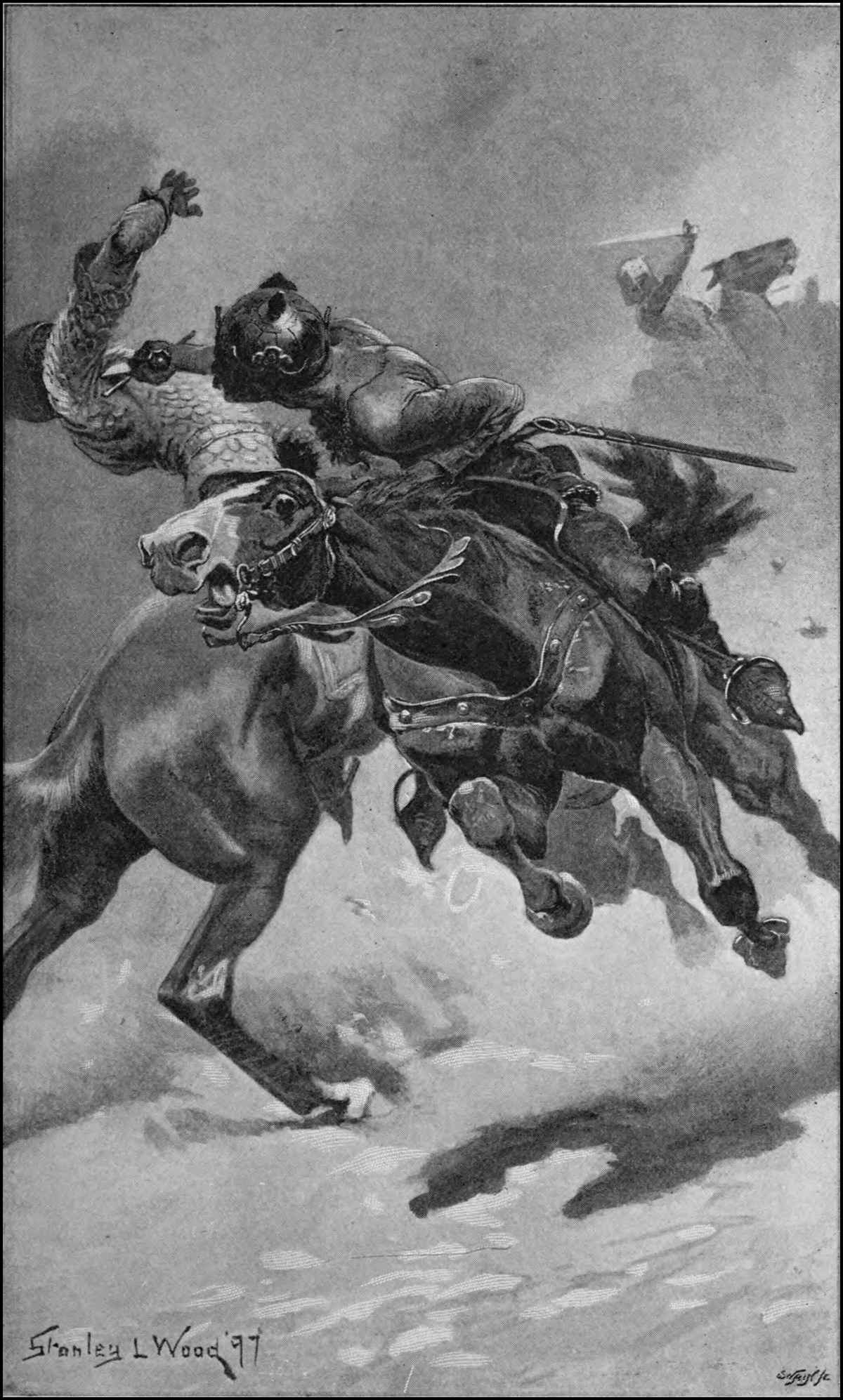
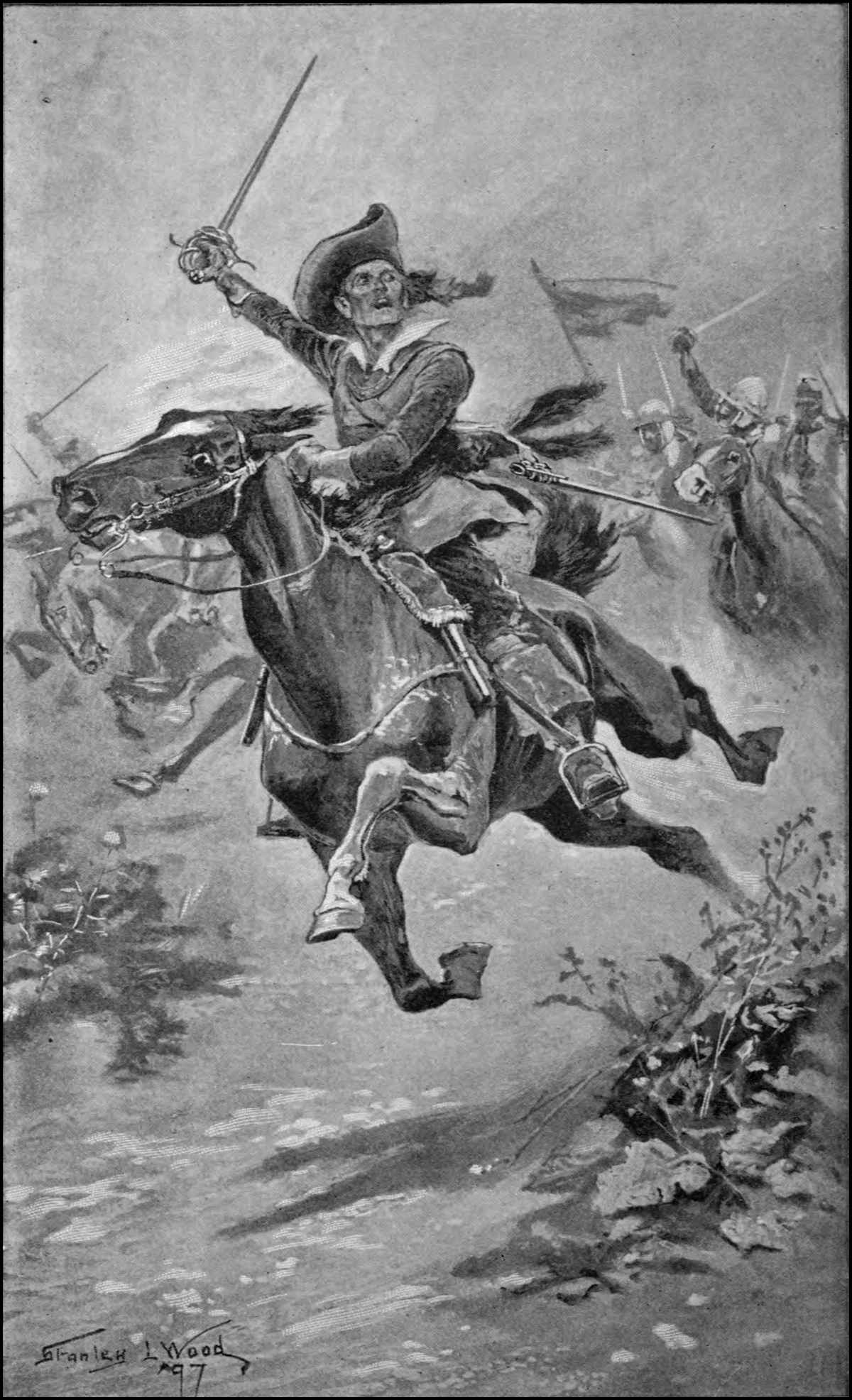
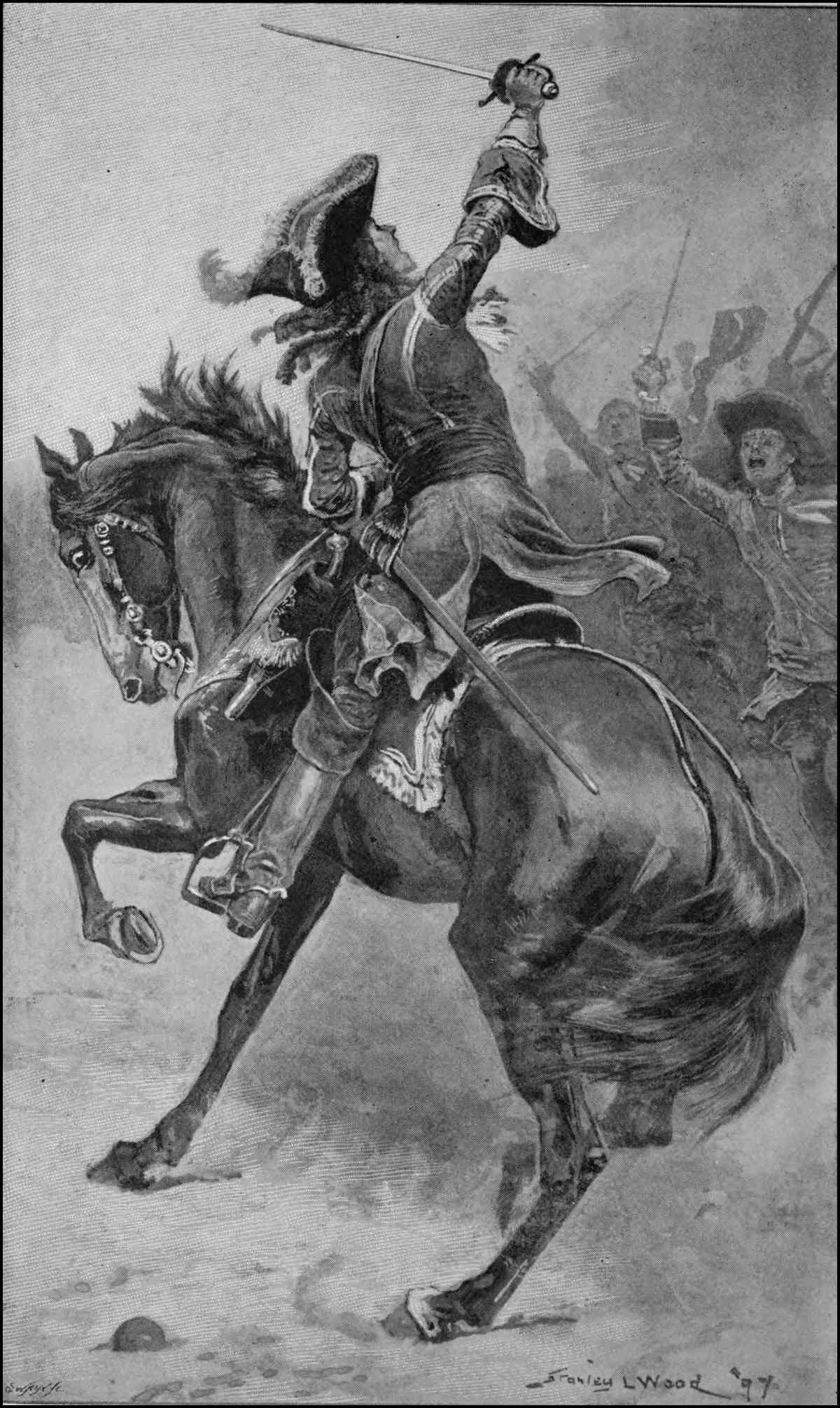
his turn came. Young Duke William saw him
from afar, and with lance in rest made for him at
a gallop. One of the knights who had followed
Hardrez to battle charged at him in mid-course.
The next moment horse and man went rolling in
the grass, and William, dropping his splintered
lance, drew his sword, and, the Lord of Bayeux
coming up at the instant, he drove the good steel
with one shrewd, strong thrust through mail and
flesh and bone, and Hardrez never spoke again.
That stroke won William his dukedom, and the
Chronicler, though a man of Bayeux himself, tells
in stirring lines how the young lord and his faithful
knights hunted the flying rebels off the field and
rode them down like sheep.
This was not the last fight that William had for
the mastery of his own land, but it left his hands
free to begin the work that he had set himself to
do, and he did it. To him unity was strength, and
he was ready to go to any lengths to get it. His
methods then, as afterwards in England, were
severe—we should call them brutal nowadays, but
these days are not those.
HE DROVE THE GOOD STEEL THROUGH MAIL AND FLESH AND BONE.
When the citizens of Alençon defied him they
indulged in the pleasantry of hanging raw hides
over the walls and beating them, shouting out the
while that here there was plenty for the tanner’s
son to do. He set his teeth and swore his
favourite oath—by the Splendour of God—that
they should have work enough ere he had done
with them. When the city lay at his mercy he had
two-and-thirty of the humourists sent out to him,
and cut off their ears and noses and hands and feet,
and had them tossed over the walls as a sort of hint
that he was not quite the kind of person who could
appreciate jokes about his ancestors. It was an
inhuman deed, but history records no other public
aspersions of the good name of Duke William’s
mother.
Yet one more battle the young Duke had to fight
before he crossed the Narrow Seas to the famous
field of Senlac. Henry of France, his titular overlord,
and Geoffrey of Anjou, jealous of the fast-growing
power of Normandy, united their forces in
an expedition which was half an invasion and half
a plundering raid. Duke William, with infinite
patience, and a quiet, marvellous self-restraint, held
his own fiery temper and the angry ardour of his
knights in check, watching the invaders burn town
after town and village after village, and turning
some of his fairest domains into a wilderness.
He never struck a blow until, one fatal afternoon,
he swooped down from Falaise and caught the
French army severed in two by the rising flood of
the river Dive. Then he struck, and struck hard,
and when the bloody work was over, Henry was
glad to buy a truce and his liberty from his vassal
with the strong castle of Tillièries and all its lands,
and so heavy hearted was he at his defeat that, as
the Chronicler tells us, “he never bore shield or
spear again.”
Normandy had now become the most orderly
and best governed country in Europe. Robbers,
noble and otherwise, were ruthlessly suppressed,
and the poorest possessed their goods in peace,
while William himself had time to turn his thoughts
to the gentler, and yet not less important, concerns
of policy and love-making.
The old story of his courtship of the fair Matilda
of Flanders with a riding whip is evidently a myth
manufactured by some Saxon enemy, for Duke
William was in the first place a gentleman, and,
moreover, the lady and her parents were as anxious
as he was for the marriage, seeing that he was now
the most desirable of suitors. The truth is that the
Church opposed their union on some shadowy
grounds of consanguinity, and it did not take place
until after a courtship of four years.
And now, having got our pirate Duke happily
married and seen him undisputed lord of his own
realm, we may go with him to St. Valery on the
coast of Ponthieu and watch him working and
praying and offering gifts at the old shrine, during
those fifteen long days that he watched the weather-cocks
and prayed for the south wind that was to
waft his fleet and army over to the English shore.
It was on Wednesday, the 27th of September,
that the wind at last veered round. The eager
soldiery hailed the change as the granting of their
prayers and the consent of Heaven to the beginning
of their enterprise, and flung themselves into their
ships like a great host of schoolboys setting out on
a holiday. Soon the grey sea was covered with
a swarm of craft, and it must have seemed as
though the old Viking days had come back as the
great square sails went up to the mast-heads, and
the shining shields were hung along the bulwarks.
William himself, in his golden ship Mora, the
present of his own dear Duchess, led the way with
the sacred banner of the Pope at his mast-head,
and the three Lions of Normandy floating astern.
The Mora was lighter heeled or lighter loaded than
the rest, for when morning dawned she was alone
on the sea with the Sussex shore in plain sight.
But presently a great forest of masts and clouds of
gaily-coloured sails rose up out of the grey waters
astern, and the whole vast fleet came on, urged by
oar and wind, and by nine o’clock that morning the
fore-foot of the Mora, close followed by her
consorts, struck the English ground in Pevensey
Bay.
It has often been told how William, as he landed,
stumbled and fell on his hands and knees, and how
those near him cried out that it was a fatal omen.
The story may be myth or fact, but nothing could
be more characteristic of the true man than his
springing to his feet with both hands full of sand
and laughing out in that great voice of his:
“Nay, by the Splendour of God, not so. See!
Have I not taken seizin of my new kingdom and
lawful heritage?”
But the army of the so-called English, that they
had come to seek was nowhere to be found, and some
days were spent in uncertainty and debate as to
whether they should march on London or await
battle on the shore with their sea communications
open, and in the end they took the latter and the
wiser course.
Meanwhile, as has been said, Harold was away
in the North fighting and beating his brother
Tostig and his fellow robbers, and the news of Duke
William’s landing was flying northward to him. It
must have been something of an anxious time for
both—the Norman waiting day after day in that
deadly inaction which is most fatal of all things to
the courage and discipline of an army, and Harold
hurrying southward at the head of his victorious
troops, knowing that he was about to try conclusions
with the best leader and the finest soldiery in
Europe.
It is of little import here and to us now which of
them had the best right, as the lawyer-quibble has
it, to that which they were about to fight for. The
point is that such claims as either had they were
going to submit to the stern and final ordeal of
battle—and in good truth a stern ordeal it proved
to be.
As he came to the South the standard of Harold—the
Fighting Man—was joined by troops of recruits
attracted by the fame of his northern victory,
and it was a great and really formidable army
which at length assembled between London and
the Sussex coast. Meanwhile the Normans, after
the fashion of the pitiless warfare of those days,
were dividing their time between the building of
entrenched camps and ravaging, plundering, and
burning throughout the pleasant Southern land.
Of course messages and parleyings passed between
them. Harold from his royal house at
Westminster bade Duke William come and fight
him for his capital and his kingdom, to which Duke
William warily replied: “Come and drive us into
the sea if you can!” This at length King Harold
was forced to attempt. And so it came to pass
that, at length, on the 14th of October, the hosts
of the Saxon and the Norman confronted each
other on the field of Senlac by Hastings, on the
morrow to strike blows whose echoes were to ring
through many a long century, and to do deeds more
mighty in their effect than either Harold or William
dreamt of.
The Norman host has been called a horde of
mailed robbers and cut-throats, eager only for
plunder, and the Saxon army has been almost
canonised as a band of heroes, gathered together
to die in defence of their native land and their
lawful king. Yet, strangely enough, the robbers
and cut-throats spent the best part of the night
confessing their sins and praying for victory, as
well as in making the best dispositions to attain
it. The patriots spent the same hours feasting
and drinking, and swaggering to each other about
the brave deeds they had done in the North and
the greater things they were going to do on the
morrow.
So the night passes, and the morning dawns grey
and chill on the two now silent hosts. Then from
the Norman ranks rises the solemn cadence of the
Te Deum, and as this dies away the archers move
out—forerunners of those stout yeomen whose
clothyard shafts were one day to win Creçy and
Agincourt. Then come the footmen with their
long pikes, and after them the mailed and mounted
knights, in front of whom rides Taillefer—Iron-Cutter
and Minstrel—tossing his sword into the
air and catching it, and singing the while the Song
of Roland and Roncesvalles. As the archers and
pikemen spread out in skirmishing order he sets
spurs to his horse and charges at the Saxon line.
He kills two men, and then goes down under the
battle-axe of a third.
Then the arrows flew fast and thick, and charge
after charge was made upon the palisades of stakes
that fenced the Saxon position, high above which
floated the Dragon Standard of Wessex and the
banner of the Fighting Man.
But the double-bladed Saxon axes were no playthings,
and they were swung by strong and strenuous
arms, and every time the Norman front came up to
the breastwork it was hewn down in swathes by the
deep-biting blades. The arrows fell blunted and
broken on the big Saxon shields and stout Saxon
armour, and so Duke William, with that ever-ready
resource of his, bade his archers shoot up into the
air, and then down from the grey sky there fell a
rain of whirring, steel-pointed shafts, one of which,
winged by Fate, struck gallant Harold in the eye—doubtless
as he was looking up wondering at this
new manœuvre—and, piercing his brain, laid him
lifeless in the midst of his champions.
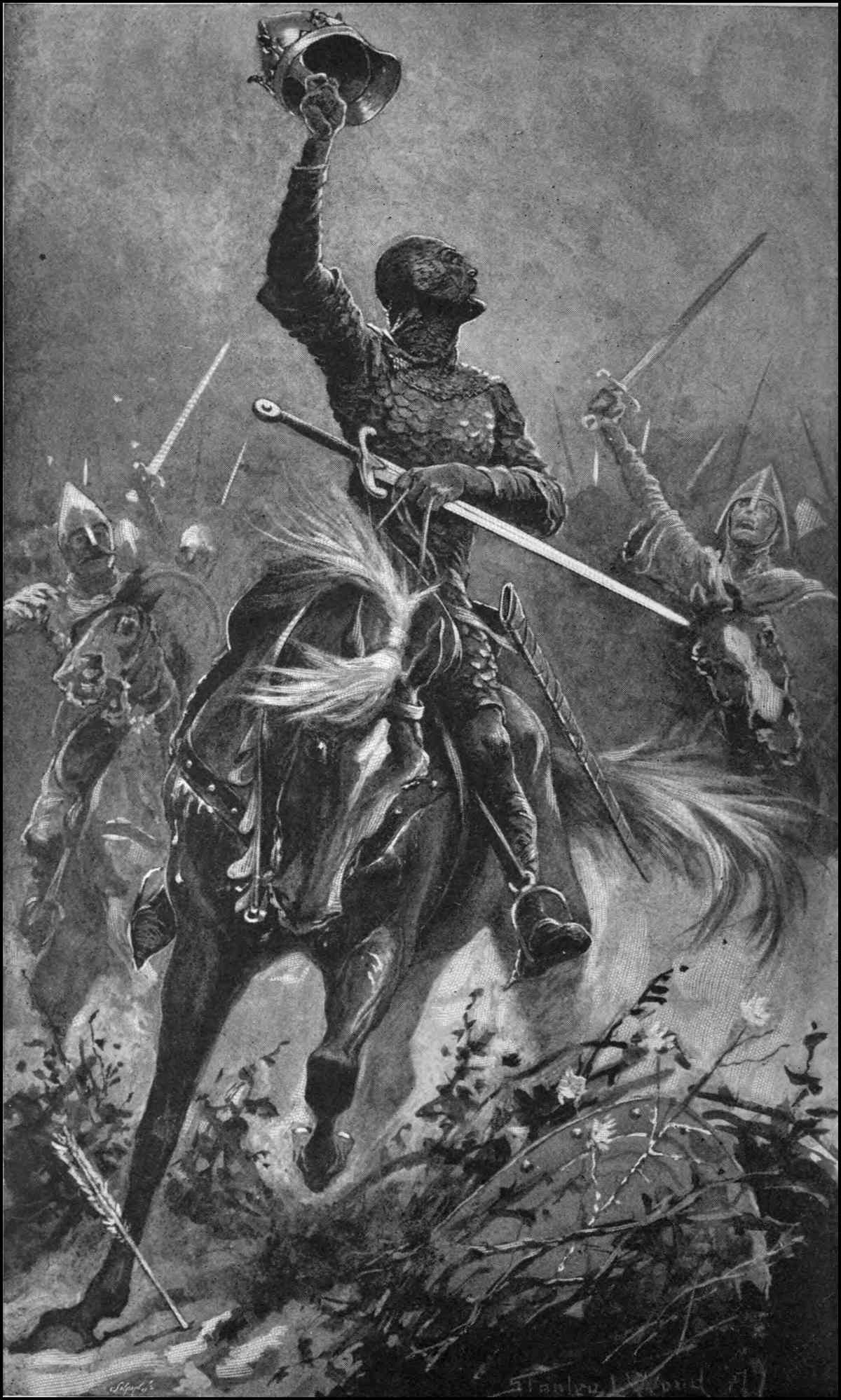
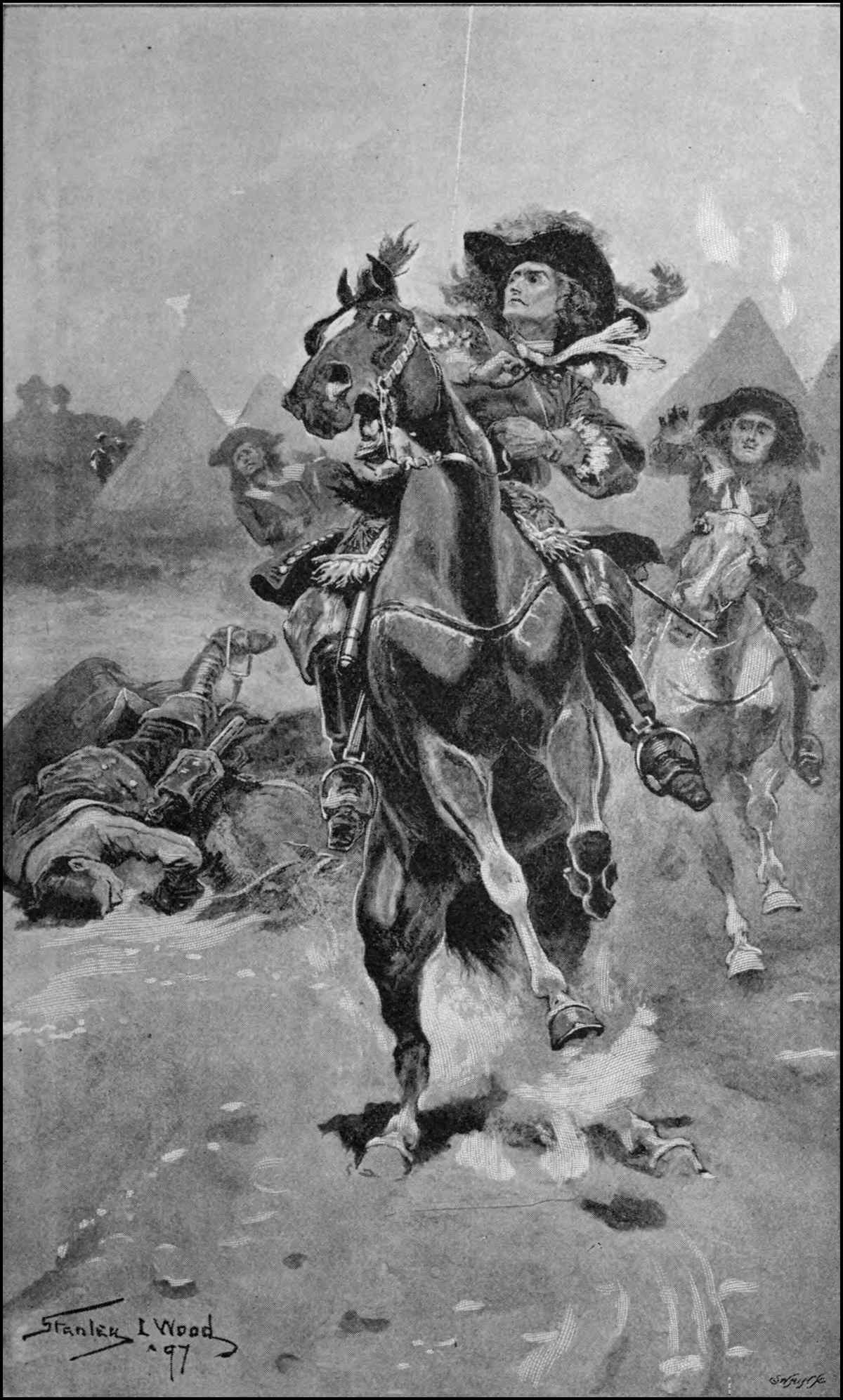
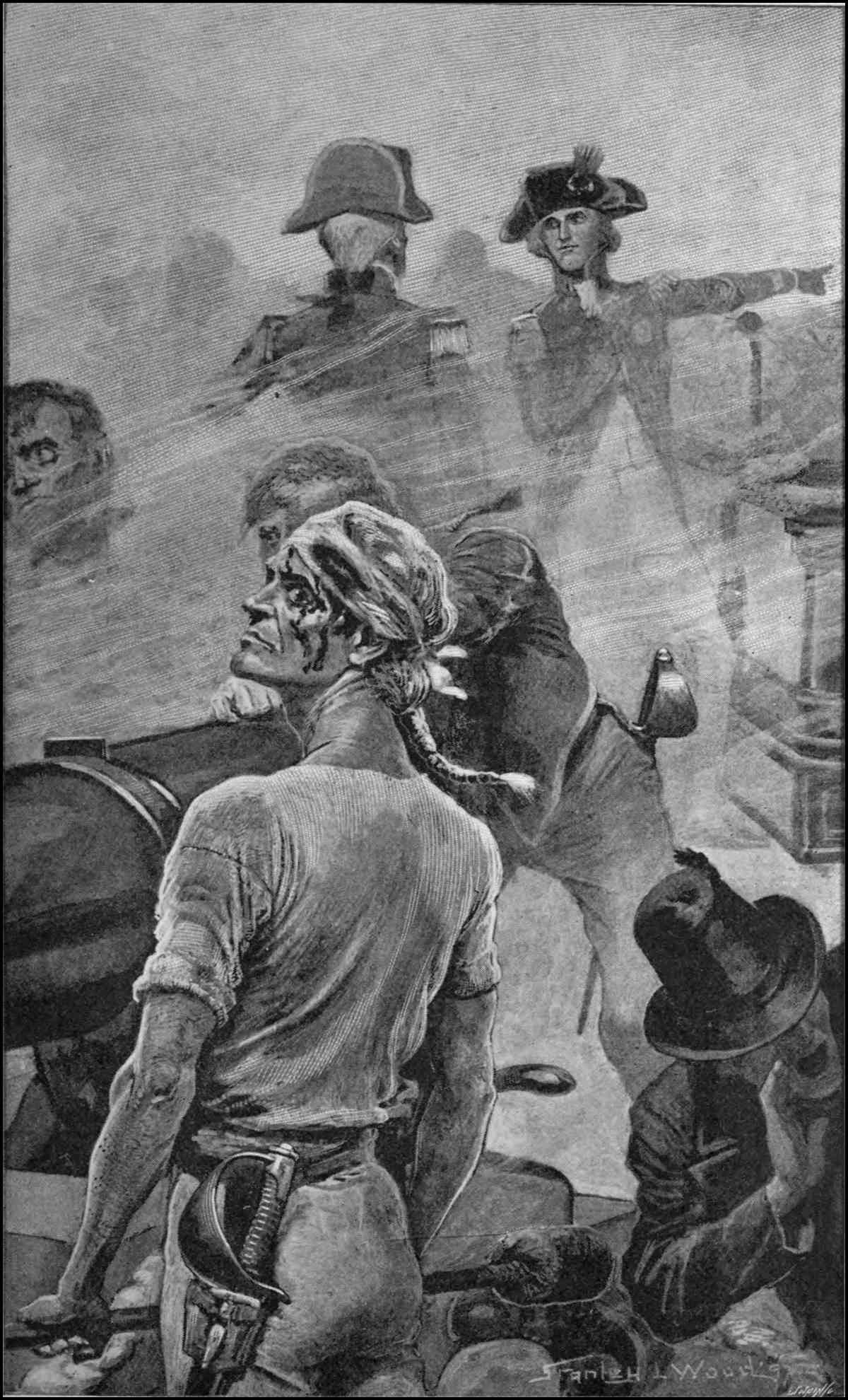
DUKE WILLIAM ROARED OUT THAT HE WAS ALIVE.
Soon after this a cry went up that Duke William
too was dead, and he, hearing this, tore off his
helmet—a somewhat unsafe thing to do in such a
fight—and roared out that he was alive, swearing—as
usual by the Splendour of God—that the land of
England should yet be his by nightfall.
So they laid on again. William’s horse went
down under a pike-thrust. He clove the pike-man
to the chin and asked one of his knights to lend
him his horse. The knight refused, thinking more
of his skin than his loyalty, whereupon William
pitched him out of the saddle, swung himself up,
and led another charge against the ever-dwindling
ring of heroes who were still hammering away with
their battle-axes—and this time the stout line
wavers and breaks; the mail-clad warriors pour up
the slope, shouting that the day is won; axe and
sword ring loud and fast on helm and mail, the
Saxons reel back, closing round the body of their
king and the staff of his banner.
“Dex aide! Dex aide! Ha-Rou! Ha-Rou!”
Duke William’s men yell and roar again as they
scramble over heaps of mangled corpses filling the
trenches and blocking the breaches in the palisades.
Another moment or two of brief, bitter, and bloody
struggle and the last Saxon ring breaks and melts
away, and Hastings and England are won.
What followed is history so familiar that few
words more from me will suffice. What Duke
William had done in his own land he did after
the same methods in the land that had been the
Saxons’. Cruel, bloody, and savage they were
beyond all doubt, but it is a question whether,
even in the doing, they were more disastrous than
the ferocious anarchy and the unceasing plunder
and outrage and murder that had disgraced the
weak and divided rule of the Saxon kings. In
their effect they were a thousandfold better. Duke
William believed that order was Heaven’s first law,
and, by whatever means he had at hand, he was
honestly determined to make it earth’s as well.
And he succeeded, which after all is not an unsatisfactory
test of honest merit. How well he did
so let us ask, not one of his own chroniclers or
troubadours, but the man who wrote the story of
his own conquered people, and this is what he will
tell us:
“Truly he was so stark a man and wroth that
no man durst do anything against his will. Bishops
he set off their bishoprics, and abbots off their
abbacies, and thanes in prison. And at last he did
not spare his brother Odo. Him he set in prison.
Betwixt other things we must not forget the good
peace that he made in this land, so that a man that
was worth aught might travel over the kingdom
unhurt with his bosom full of gold. And no man
durst slay another though he had suffered never so
mickle evil from the other.”
Such was this grim, stern, Thor’s-Hammer of a
man, who by his strength and cunning hewed into
shape that which in after days was to become the
corner-stone of the glorious, world-shadowing fabric
which we call the British Empire.
II EDWARD OF THE LONG LEGS “ BURY ME NOT TILL YOU HAVE CONQUERED SCOTLAND ”
II EDWARD OF THE LONG LEGS
Two centuries all but nine years have passed
away since William the Conqueror, unwept,
if not unhonoured, lost his life in avenging a paltry
joke, and left his work for others to carry on.
In the two centuries not much has been done,
although no little show has been made meanwhile,
and a great clash of arms has resounded through
the world.
William the Red has died, as he lived, in a somewhat
ignoble and futile manner. Henry I. has
done one good thing, wedding, as it were, in his
own person and that of the Lady Matilda, the two
races which were afterwards to be one.
Stephen and Matilda have settled their differences
and died, after the shedding of much wasted blood.
Henry II., by the hand of Strongbow and his
licensed pirates, has done a piece of good work
badly in beginning that conquest of Ireland which
is not to be completed until the Battle of the
Boyne is lost and won.
Richard Lionheart has won much glory to very
small profit in the magnificent madness of the Third
Crusade. The barons, recognising, however dimly
and clumsily, that they are, in good truth, citizens
of the infant State whose lusty, turbulent youth
already gives promise of its future strength and
greatness, have become law-lords as well as landlords,
and with mailed hands have guided that unwilling
pen of John’s along the bottom of the parchment
on which the Great Charter is written.
And, lastly, Simon of Montfort has taken a swift
stride through several centuries and, arriving at the
modern idea that the making of nations and the
ordering of the world can be achieved by Talk, has,
after not a little violence and the spilling of considerable
blood that might have been better spent,
got together that first Parliament or Talking-Machine,
whose successors have so sorely hindered
the progress of the world and balked the efforts of
those appointed by God, and not by the counting of
noses, to do its work.
So the two noisy and somewhat foolish centuries
have rolled away into a blessed oblivion with a good
deal of shouting and swaggering, of strife and bloodshed,
but of little progress, saving that one Roger
Bacon has lived and written a certain book and
made himself a name for ever.
But all this time the work with which we are
here most concerned, the making of an empire, has
been waiting for the next God-sent man to come
and do it, and this man was Edward Plantagenet,
surnamed Longlegs, next in lineal succession, not
as king, but as Empire-Maker, to him who won
the fight at Senlac and got himself so well obeyed
that “no man durst do anything against his will”—which
was a great deal to say of any one in such
days as those.
Edward of the Long Legs came on to the stage of
History with long, swift, determined, and, in short,
wholly characteristic strides. The Talking-Machine
of the good Earl Simon had worked noisily, as is
usual with such machines, and had produced little
but sound and fury.
There was war all round, and the usual anarchy
in Ireland and Wales. Llewelyn, Lord of Snowdon,
for instance, had pitted himself gallantly
against the logic of circumstances, and was seeking
to reconstruct the ancient and now impossibly obsolete
Celtic empire.
“Be of good courage in the slaughter, cling to thy
work, destroy England and plunder its multitudes!”
his bards had sung to him, and so he had honestly
set himself to do, not recognising the fact that
empires are neither made nor re-made by mere
methods of miscellaneous blood-letting.
To the north, Scotland was divided by schisms
and rent by the bitter jealousies of its nobles and
clan-chieftains, savage, rude and poor, but gallant,
strong, and very full of fight, as the English were
to learn later on.
Over the Narrow Seas the wide domains which
William the Norman had kept with his sword and
which the second Henry had greatly increased by
inheritance and marriage, were slipping piecemeal
away from the throne to which they did not of right
divine belong, and with which it was therefore impossible
that they should remain.
Such, in briefest outline, was the scene into which
Edward Longlegs strode, and of which he was to
be for thirty-five years the central and dominating
figure. His first look round, as it were, showed
him the nature of the task which it was his destiny
to forthwith set about.
With that clearness of vision without which no
man has any chance of success in the business of
empire-making, he instantly pierced the dust-storms
of battle that were rising all about him, and the
mist-clouds of debate which Earl Simon’s Talking-Machine
had commenced to vomit forth, and behind
and beyond these he saw a certain Fact, a prime
necessity which had to be faced—in short a real
Something of an infinitely greater importance than
tribal warfare, the aspirations of bard-inspired
princelings, or even parliamentary debates.
This was neither more nor less than the fact that,
when the Maker of all things mapped out this part
of the world, it pleased Him in His wisdom to put
England, Scotland, Wales and Ireland into one
little group of islands, and from this fact Edward
Longlegs drew the deduction that the King of
Kings had intended them to be under one lordship.
It seems a simple thing to say now, a fact so
patent that the mention of it seems superfluous.
So does the larger fact that the world is round;
but it was a very different matter in the times and
circumstances of Edward Longlegs, and, indeed, his
first and greatest claim to stand next in succession
to William the Norman in the royal line of empire-makers
consists in this: that he was capable of that
master-stroke of genius which clearly demonstrated
an imperial principle of which six hundred years of
history have been the continuous and emphatic
endorsement.
No sooner was the bloody fight of Evesham over
and the good Earl Simon had breathed out his
generous, if somewhat premature soul in that last
cry of his: “It is God’s grace!” than Edward
Longlegs seems to have set himself to prepare for
the task that was to be his. He was not to be
king in name for some seven years more, but as the
historian of the English People with great pertinence
remarked: “With the victory of Evesham,
his character seemed to mould itself into nobler
form.” In other words he was, perchance unconsciously,
performing that indispensable preliminary
to all really great and true public reforms, the
reformation of himself.
Hitherto his life had been none of the best. He
had been the leader of a retinue that had made
itself something like infamous in the land. He had
intrigued first with one party and then with another.
He is accused of a faithlessness which, it is said,
forced the good, though mistaken, Earl Simon into
armed revolt against his liege lord—though this
may, after all, only have been a stroke of wise and
necessary policy, since he possibly saw even then
that Chaos would not reform itself into Cosmos just
for being talked at.
Then again, and with curious resemblance to
William of Normandy, and later of Hastings and
England, he had avenged an insult to his mother
by the slaughter of some three thousand men in the
rout of Lewes and a quite unjustifiable indulgence
in pillage and slaughter when the Barons’ War was
finally over.
“It was from Earl Simon,” says John Richard
Green in one of those limpid sentences of his, “as
the Earl owned with a proud bitterness ere his
death, that Edward had learnt the skill in warfare
which distinguished him among the princes of his
time. But he had learnt from the Earl the far
nobler lesson of a self-government which lifted him
high above them as ruler among men.”
It seemed, indeed, as though, by this reformation
of himself, he was to typify that reformation of
England which it was his life-work to begin. The
new Edward was to be the maker of the new
England.
His first action after the war was characteristic of
the man and the work that he was to do. The
cessation of the fighting, as was usual in those days,
had left an undesirable number of truculent warriors
of various ranks wandering at large about the
kingdom with their legitimate occupation gone.
Edward, with that instinct of order characteristic
of all true empire-makers, saw in these the possibilities
of disorder, and with a happy combination
of wisdom and adventure turned their swords and
lances away from the bodies of their fellow-citizens
by taking them to fight the Paynim in the Holy Land.
An incident of this excursion has been adorned
by one of those pleasant fictions which, if the
paradox may be pardoned, are none the less true
for the fact that they are false. Edward, having
sent certain hundreds of Moslems to Paradise with
a perhaps unnecessarily ruthless dispatch, was considered
by the sect of the Assassins to be a person
who would be better dead than alive in Palestine,
and so one of them, after several attempts, succeeded,
as one may put it, in interviewing him
privately with a poisoned dagger. The fiction has
it that his consort, Eleanor of Castille, sucked the
poison from the wound with her own sweet lips and
so saved his life.
It is a pretty story, but, unfortunately for its
authenticity, no one seems to have heard of it or
thought it worth the telling until Ptolemy of Lucca
told it a good half-century afterwards. But the
truth underlying it remains, and this truth is that
Edward Longlegs was blessed with that greatest of
all earthly blessings, a loving and devoted wife.
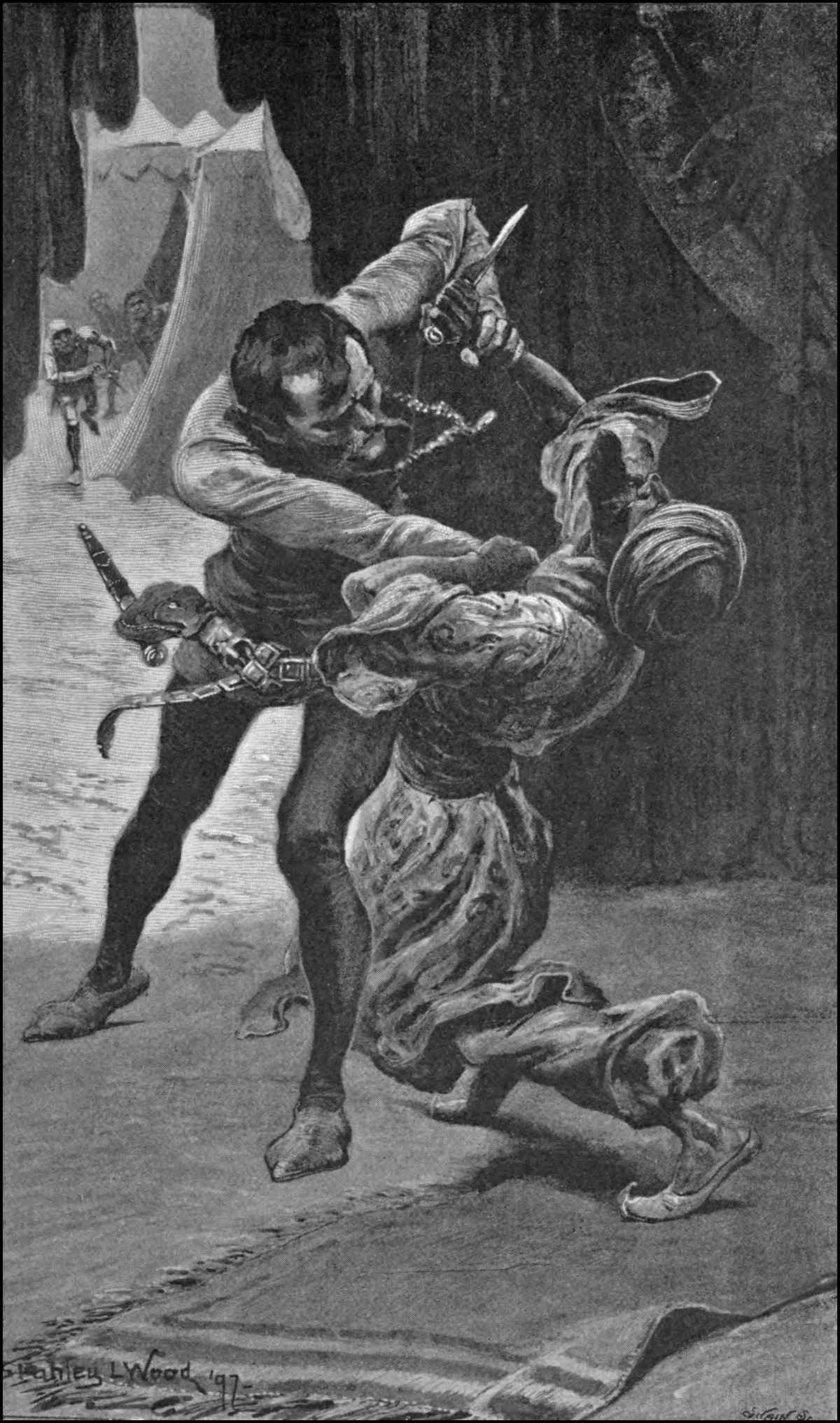
The facts of the matter are few but eloquent.
Edward saw the dagger before it struck him, and
gripped the would-be murderer with a grip worthy
the muscles of Lionheart himself. There was a
struggle, during which the dagger-point scratched
his arm. A moment after it was buried in the
assassin’s own heart. Then some of Edward’s
retainers, hearing the scuffling, burst into the tent
and satisfied themselves that the wretch had
attempted his last murder by the somewhat superfluous
method of knocking out his brains with a
foot-stool.
Soon after this symptoms of poisoning showed
themselves, and Edward, in his usual businesslike
way, made his will and his peace with God and
prepared to “salute the world” with becoming
dignity. In the end not Eleanor’s lips but the
surgeon’s knife removed the danger, and so once
again a dagger-thrust which had come near to
changing the history of Britain missed its mark.
It was during his return from this Crusade, as he
was journeying through Calabria, that he met the
messengers who told him that his father was dead
and that he was King of England. Charles of
Anjou, who was riding with him at the moment,
wondered at the great grief he showed, and, being
himself a man almost incapable of feeling, asked him
why he should show more grief at his father’s death
than he had done for the loss of his baby son
who had died a short time before. The answer
was to the point and worthy of the man.
EDWARD GRIPPED THE WOULD-BE MURDERER.
“By the goodness of God,” he said, “the loss
of my boy may be made good to me, but not
even God’s own mercy can give me a father
again.”
It was on the same journey that there occurred
that curious incident which is called the “Little
Battle of Chalons,” and which is also instructive
in giving us another view of the man who could
use such wise and pious words as these. While he
was travelling through Guienne, the Count of
Chalons, one of the best and starkest knights of
his age, sent a friendly message to request the
favour of being allowed to break a lance with him.
Edward, though he had been repeatedly warned
of plots against his life by those who had designs
on his French dominions, and though as a king
he had a perfect right to decline the challenge
of a vassal, was, as we should say nowadays, too
good a sportsman to say no; but he took the
precaution of going to the knightly trysting-place
with an escort of a thousand men—in doing which
he was well justified by the fact that the Count
of Chalons was there waiting for him with about
two thousand.
During the trouble which inevitably followed, the
Count of Chalons did break a lance with Edward,
but it was his own lance, and this failing, he gripped
him round the neck in the most unknightly fashion
and tried to drag him from the saddle. The Count
was a strong man, but Edward was a little stronger,
so he just sat still, and swinging his horse round,
pulled him out of the saddle instead, after which,
to put it into plain English, he gave him a sound
thrashing, and when he at length cried for quarter,
Edward, ever generous in the moment of victory,
gave him the life that he had forfeited by his
treachery, but, as a punishment, which the
coroneted scoundrel justly deserved, he compelled
him to take his sword back from the hands of a
common soldier, and so disgraced him for ever in
the eyes of his peers.
It may be added that the Little Battle of Chalons,
in spite of the difference of numbers, ended in
something like a picnic for the English, after which
the king betook himself in leisurely fashion to the
throne, and the work that was waiting for him.
No sooner was the crown upon his head, than
he got to his task. The Prince of Snowdon, now
calling himself Prince of Wales, had not only made
himself master of his own country, but had
pushed the war into England and reduced several
English towns, the chief of which was Shrewsbury.
Edward called upon him to restore the peace which
he had broken, and to come and do homage for his
lands. Llewelyn, in the plentitude of his pride,
told him to come and fetch him.
Edward took a note of this, but waited two years
while he replenished the royal treasury by more
or less justifiable means. During this time, as
it happened, the Prince’s promised bride, Eleanor,
daughter of Earl Simon, fell into his hands. Again
and again he summoned the Prince to perform the
act of allegiance, holding his sweetheart meanwhile
as a hostage in honourable captivity.
At length a fresh defiance from the Welshman
roused him to action, and Longlegs strode swiftly
across England and struck out hard and heavy. A
single blow dissipated the dream of Celtic empire
for ever. Llewelyn fled to his mountains and at
length sued for peace. By rights his life was forfeit
for rebellion, yet Edward not only forgave him but
remitted the fine of £50,000 which he had imposed
on the Welsh chieftains, and then invited Llewelyn
to his court and married him with all due pomp and
circumstance to the daughter of his old enemy—from
which it will be seen that Edward Longlegs,
like William the Norman, and indeed all good and
capable empire-makers, was a gentleman.
Unhappily, Llewelyn repaid the kindness and
courtesy by new rebellion, which ended, as it
deserved, in disaster. Merlin had prophesied that,
when money was made round, a Welsh prince
should be crowned in London. During this last
revolt Edward had caused round halfpence and
farthings to be coined. When it was over the
head of Llewelyn was sent to London and crowned
with a garland of ivy on Tower Hill.
What Longlegs had thus done with Wales he
sought by more devious and less effective means
to do with Scotland. The dispute between Balliol
and Bruce gave him the opportunity of intervention,
and of this the dismal results are too well known to
need detailed description at this time of day.
Here, again, we have nothing to do with personal
right or wrong, or with the ethics of national independence.
The business of empire-making is too
urgent to wait for matters of this kind. It would
perhaps have been better if Edward, after the sack
and slaughter of Berwick, had hurled the whole
weight of the English power against the object of
his attack, as William the Norman would have
done, and once and for all crushed the opposition
into impotence.
It would have been bitter and bloody work, as
the work of empire-making is apt to be, but the
end might have justified the means. Certainly
some centuries of bloodshed and bitterness would
have been saved. The high ideal of a United
Kingdom would have been realised nearly five
hundred years earlier, and the progress of both
realms in civilisation, wealth, and power might
have been quickened immeasurably.
And after all, neither side in the long struggle
would have lost anything worthy of being weighed
against the greatness of the gain to both. There
would have been no Stirling Bridge, but then
there would have been no Falkirk; no Bannockburn,
but also no Flodden Field. All this, as it
happens, however, was not written in the Book of
Destiny, and so it does not concern us here, since
we have to consider how much of the work of
empire-making Edward did, not what he failed to
do or left undone.
The surrender of Stirling in 1305 apparently
completed the conquest of Scotland, and Edward
was for the time being the actual and undisputed
sovereign of the whole country from the Pentland
Firth to the English Channel, and it is probable
that the conquest would have been a permanent
one but for the entrance of another power into
the field, and this was nothing less than the
English Baronage itself. It was as though the
chiefs of his own army had turned against him,
and, in the fatal dispute which followed, Robert
the Bruce saw his opportunity, and in the end
re-won for Scotland that independence which has
cost her so much and which, however precious as
a matter of sentiment, was destined to prove of
so little value to her.
All that is past and done with now, but still no
one who holds that an empire is greater than a
nation, even as the whole is greater than its part,
can help looking back with regretful thoughts upon
those pages of our history which would have been
so much brighter and more glorious if those gallant
Scots who fought through those long and bitter wars
could have stood, as they have done since, side by
side with their brothers of the South, and so made
possible centuries ago the beginning of that great
work in which they have borne so splendid a part.
Had that been so Edward Longlegs might have
been the founder instead of only one of the makers
of the British Empire, and that last piteous scene
by the sandy shores of the Solway Firth would
never have been enacted.
But though in the end he neither conquered
Scotland nor founded the United Kingdom, he
did something else which, as the centuries went
by, proved but little less important, for he began
to make the British Constitution.
Gallant soldier and great general as he was, he
was perhaps an even greater statesman. He saw
far ahead of his times, too far indeed, for in his
enlightened conviction that in the matter of taxation
“what touched all should be allowed of all”
we have the real reason for that revolt of the
Baronage, which made a United Kingdom of the
Fourteenth Century an impossibility.
Yet as law-maker he did work which lasted
longer than that which he did on the battle-field.
Like William the Norman, he was a stark man
who knew how to get himself obeyed, and order,
no matter how dearly bought, was the first thing
to be got, and he got it. He could “make a
wilderness and call it peace,” as he did over and
over again with Wales and Scotland—and, indeed,
to him a wilderness was better than a place where
disorder dwelt—but he also made another peace
within his own realms which was the first forerunner
of that which we enjoy to-day. The laws
which he made were for rich and poor, great and
small, alike. The hand that was pitiless in
destruction was also ready and strong to protect.
The manner of his death is as characteristic as
any of the acts, good or bad, of his life. Old
and weak and sick, he made the long journey from
Westminster to the Solway to fulfil the oath which
he had sworn at the knighting of his unworthy son
to avenge Bruce’s murder of Comyns and to punish
his rebellion.
Too feeble to keep the saddle, he was carried
in a litter at the head of the hundred thousand
men who were to be the instruments of his
vengeance, but at length the news of victory after
victory won by the Bruce stung him to a fury which
for the time was stronger than his weakness, and at
Carlisle the old warrior left his litter and once more
mounted his charger. It is a pathetic sight even
when looked at through the mists of the intervening
centuries. We can picture the gallant struggle that
he must have made to sit his horse upright and to
bear without fainting the weight of the armour that
was oppressing his disease-worn and weary limbs.
The mailed hand which had struck the great
Count of Chalons down could not now even draw
the sword that hung useless at his side.
Only one thing remained strong in the man who
had once been the very incarnation of strength.
His inflexible will was still unbroken and unswerving
in its devotion to the great ideal and master-project
of his life. Had that will had its way, the
flood of English strength and valour that was rolling
slowly behind him would have burst in a torrent of
death and desolation over the war-wasted fields of
southern Scotland, and there can be but little doubt
as to what the end would have been.
But it was not to be. The Spectre Horseman
was already riding by his side, and, like the wine
from a cracked goblet, the dregs of his once splendid
strength ebbed away. At last the skeleton hand
was outstretched, and he who had never been unhorsed
by mortal foe was stricken from the saddle.
Yet even then the proud spirit refused to yield.
He took his place in the litter again. With almost
dying lips he ordered the army forward; and, though
the end was very near, he did not submit without a
struggle, pathetic in its hopeless heroism, to conquer
even Death itself and carry out his purpose in spite
of the King of Terrors. Die he must, and that
soon, but his spirit should live after him and he
would still lead his army.
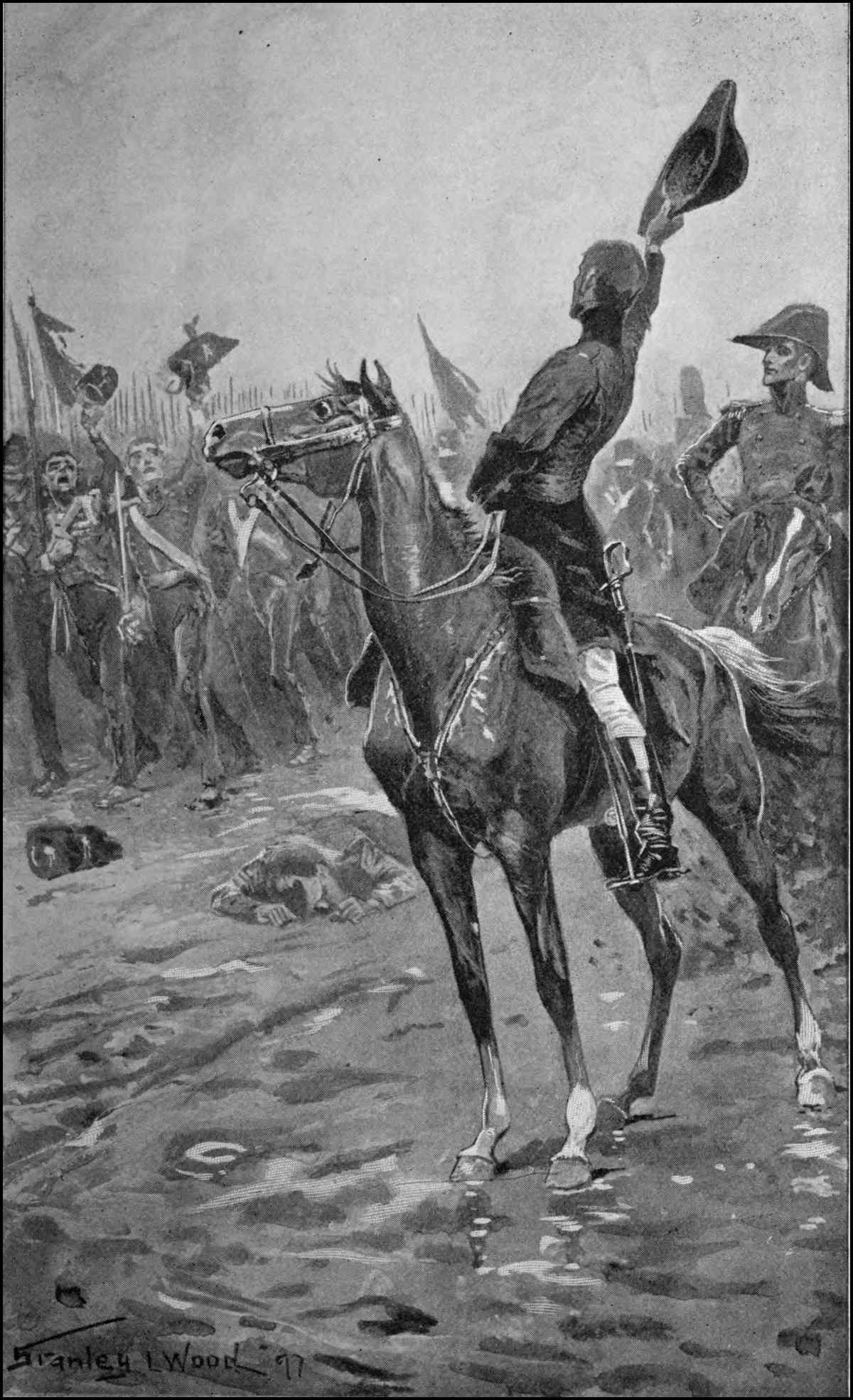
“Bury me not till you have conquered Scotland!”
were almost the last words he spoke. Though they
were disobeyed and Scotland was never conquered,
yet they were well worthy of the iron-hearted man
who said them.
III THE QUEEN’S LITTLE PIRATE “ THE MASTER-THIEF OF THE NEW WORLD ”
III THE QUEEN’S LITTLE PIRATE
Another couple of centuries with a few
added years have slipped away, and the
next scene of the slowly-unfolding drama opens on
the sea instead of the land. The Idea which
Edward of the Long Legs had so clearly conceived
and so very nearly realised, the idea that the
frontiers of the United Kingdom of which he
had dreamt should be its sea-coasts has all the
time been growing and deepening, for, like all
ideas which faithfully reflect some fact in the
universe, it could not die, and was bound some
day to become a fact itself.
Politically, England and Scotland were still independent
kingdoms, but many old differences had
been forgotten and forgiven, and they had come a
great deal closer, as it was fitting that they should
do on the eve of their final union. Moreover, they
were one in their dread and hatred of that cruel
and implacable Colossus which, with one foot on
the East and the other on the West, bestrode
the world, drawing vast treasures from hidden El
Dorados with which it built countless ships, and
hired and armed innumerable men for the enslavement
of mankind. For now we have reached
those “spacious times of great Elizabeth,” when
that lusty young giant of Liberty, recently born
into the world, was girding on his armour, and
making him ready to grapple with the powers of
oppression and darkness which were just then most
fitly incarnated in the shape of Spain.
It is almost impossible for us of the present day
to understand clearly what the Spain of those days
was. She was the first naval and military Power
in the world, her ships and armies were everywhere,
her wealth was honestly believed to be illimitable,
and moreover she was the recognised champion
of the Catholic Church, whose spiritual thunders
mingled with the roar of her guns, and which
supplemented the terror of her arms by all the
diabolical enginry of torture and the awful powers
of the Holy Office.
The world, in short, was on the eve of great and
marvellous doings—on the one hand so terrible in
their deadly earnestness and tremendous consequences,
and on the other so fantastically splendid
in their almost superhuman daring and undreamt-of
rewards, that it looked as though the Fates were
preparing some gigantic miracle wherewith to
astound mankind. And so, in sober truth, they
were, and the miracle about to be wrought was
the making of what we now call the British
Empire.
In the beginning of the latter half of the sixteenth
century there was a yellow-haired, blue-eyed,
round-faced and sturdily-built youngster sailing to
and fro as ship’s boy in a tiny cockle-shell of a
craft plying with the humbler kinds of merchandise
between the Thames and the coasts of France and
Flanders. Whether or not he had heard any of
those wondrous stories which the western gales
were wafting across the Atlantic from the golden
Spanish Main we do not know, but probably he
had, and, like many another sailor-lad of his day,
he had dreamt wild dreams of blue seas and bright
skies, of white-walled cities crammed with gold, and
of stately galleons staggering across that mysterious
sea stuffed to the deck with the treasures they were
bringing to pour into the coffers of the King of Spain.
And yet, wild as these dreams may have been,
they would have been commonplace in comparison
with the bewildering exploits with which this same
blue-eyed sailor-lad was one day to realise and
excel them. For this was he whose name the
mariners of Spain were soon to hear shrieked out
by the voice of the tempest, booming in the roar
of guns, and echoing through the crash of battle.
This, in a word, was Francis Drake—El Draque,
the Dragon, child and servant of the Devil himself,
Scourge of the Church and Plunderer of the
Faithful.
As I say, he may or may not have heard the
story of the Golden West, but it is quite certain
that he did hear much of the black and terrible
tales which the refugees and exiles from France and
the Netherlands had to tell, for not a few of them
crossed over in the little barque in which he served,
and he could not fail to hear what they had to say
of the murders and massacres, the torturing and
outrage with which Spain was disgracing her
knightly fame and her ancient faith. They are
horrible enough for us to read even here in the
security which that gallant struggle won for us,
and now when we can only hear the shrieks of
the tortured and the groans of the dying echoing
faintly across the gulf of three centuries; but what
must they have been to Francis Drake when he
heard them told by those whose eyes had only just
before looked upon the hideous reality—perhaps
indeed by some of those racked and mutilated unfortunates
who had managed to escape with their
lives to seek the sheltering hospitality of Gloriana
the Queen? Was it any wonder that deep down
in his boyish heart there were planted those seeds
of hate and horror which later on were to bear such
terrible fruit?
The lad Francis seems to have performed his
duties as ship’s boy as well as he did everything
else, whether it was leading the Queen’s ships to
harry the coast of Spain or raging and storming
through one of his piratical raids among the
Fortunate Isles of the West, for when his master
died he made him his heir, and so Francis became
a trader on his own account. For a few years he
was just a peaceful shipmaster, making an honest
and hard-won living; but all this time events were
arranging themselves in more and more martial
array, and the bursting of the storm was not very
far off.
The actual fighting did not begin in the guise of
recognised warfare for a very considerable time.
Spain and England were at peace, each trying to
humbug the other, but between Protestant and
Catholic it was otherwise. Armed cruisers manned
by angry Protestants made their appearance in the
Narrow Seas, and whenever they got a chance fell
upon Catholic ships and avenged the sufferings of
their fellow-heretics in a fashion at once prompt
and pitiless, and this at length so exasperated
Philip that he closed his ports to English trade, and
Drake’s occupation was gone. Better, in truth, had
it been for Philip if he had left him undisturbed in
his business!
He sold his little vessel, went to Plymouth, and
entered the service of two kinsmen of his, one of
whom was soon to prove somewhat of an empire-maker
in his own line and whose name, with
certain others soon to be mentioned, was destined
to go down to everlasting fame indissolubly linked
with that of Francis Drake. This was Captain
John Hawkins, and when the young trader reached
Plymouth he had just come back with a shipload
of gold and other precious things from his first
venture in slave-trading, and now at least Drake,
who was still a lad in his teens, must have heard
something of the wonders of El Dorado. Yet,
curiously enough, when Captain Hawkins went
back he did not go with him. He sailed instead,
as a sort of supercargo, in another of Hawkins’
ships to Biscay, and there a momentous revelation
awaited him, as though to guide him on the path
of his destiny.
At San Sebastian about a score of English
sailors, once strong and stalwart men of Devon,
crept out of the dungeons of the Inquisition and
took passage with him home. King Philip had
taken off his embargo now, and these men were
the remnant of the crew of a Plymouth ship which
he had seized in port when the embargo was laid
on. The others had rotted to death during the six
months that he had bestowed his hospitality upon
them. We can imagine what talks they had on
the way home, and no doubt El Draque bore the
stories of these forlorn mariners well in mind on
that most memorable day when he “singed the
King of Spain’s beard” at Cadiz.
John Hawkins came back from his second voyage
richer than ever, and now all the mariners of the
South Coast were beginning to dream golden
dreams which were soon to become yet more
golden deeds, and King Philip, to whom all such
ventures were the flattest piracy, began to fear for
his monopoly and instructed his ambassador in
London to drop the hint that foreign trade with
the Indies was forbidden, upon which, foolishly
enough, or perhaps not knowing their own true
strength, Queen Bess’s councillors backed down
and forbade John Hawkins to start again.
He, obediently enough, stayed at home, but a
certain George Lovell got together an expedition
and slipped out to sea, westward bound. With
him went Francis Drake, at length to see for the
first time the blue waters and green shores of El
Dorado. This time, however, it proved anything
but golden for him or his companions, for they came
back with shattered ships and still worse broken
fortunes. They had drawn a blank in the great
lottery which half Europe was wanting to gamble
in.
Nothing daunted, he shipped again, this time
with George Fenner, bound for Guiana. Again,
financially speaking, the voyage ended in disaster,
but there was one incident in it destined to bear
good fruit. A big Portuguese galleasse, backed up
by six gunboats, tried to enforce the prohibition
against foreign trade. Fenner had one ship and a
pinnace, and with these he fought the “Portugals”
and thoroughly convinced them by the logic of shot
and steel that he was not the sort of man to be
prohibited from doing anything he wanted to do.
This forgotten action is really one of great importance.
It was Francis Drake’s first taste of
fighting, which in itself means a good deal, but it
was also the beginning of that lordly and magnificent
contempt which the English mariners of that
day were soon to feel for all enemies, no matter
how strong they might seem. It was this spirit
which a few years later was to take Sir Richard
Grenville
“With his hundred men on deck and his ninety sick below,”
into the midst of the fifty-three Spanish ships
which he fought for an afternoon and a night before
he surrendered so sorely against his will and fell
dead of his wounds on the deck of the Spanish
flagship. It was this, too, which, when that long
seven days’ fight against the Armada was raging
and roaring up the Channel, brought the flag of
the Spanish Rear-Admiral down with a run just
because the Little Pirate stamped his foot on the
deck of that same Revenge and said that he was
Francis Drake and had no time to parley.
Meanwhile the rumblings of the war-storm in
Europe had been growing louder. The Netherlanders
were at last turning on their torturers,
Darnley had been murdered and Mary Queen of
Scots put in prison, so Gloriana, feeling herself
somewhat at leisure, took a hand in the next
buccaneering expedition. It may be noted here,
by the way, that there was no more ardent
buccaneer and slave-trader in her dominions than
Good Queen Bess herself. She lent ships though
she withheld her commission, and her pirates did
the rest. If disaster overtook them or if the
Spanish Minister raged against their doings she
promptly disowned them and felt sorry for her ships.
But if they came back happily filled to the hatches
with plundered treasure, she took her dividends and
lent more ships.
It was thus with the expedition which sailed out
of Plymouth on October 2, 1567, under the command
of Admiral John Hawkins, whose second
officer was Francis Drake. The diplomacy of the
times called it the trading venture of Sir William
Garrard and Co., but for all that there were two
ships of the Royal Navy in it, the Jesus and the
Minion, and the merchandise it carried consisted
mainly of cannon and small arms, powder and shot,
and cold steel.
The voyage began with a slave-raiding expedition
down the Portuguese coast of Africa, whence
with five hundred slaves they crossed to the
Spanish Main. Here, after varying fortunes, they
filled their ships with treasure, and Hawkins turned
his prows northward for home. But while crossing
the mouth of the Gulf of Mexico a furious hurricane
burst upon them and drove his gold-and-pearl-laden
vessels so far into it, that he came to the
bold decision to put into the Spanish port of Vera
Cruz to refit.
In the harbour he found twelve great galleons
loaded with gold and silver, waiting for the convoy
to escort them to Spain. They were utterly at the
mercy of the English ships, but John Hawkins,
pirate and slave-dealer, was still an English gentleman,
so he made a solemn convention to leave the
treasure-ships alone on condition of being allowed
to refit in the harbour. Hawkins was already
known in Spain as the “Enemy of God,” and Don
Martin Enriquez, the new Governor of Mexico,
had come out with special orders to abolish him by
any means that might be found the readiest.
Don Martin seems to have thought that in this
case treachery would suit best, so he signed the
convention and gave his word of honour as a
gentleman of Spain that the English ships should
be allowed to come and go unmolested. So for
three days the work of dismantling went on in
peace, and on the fourth, half-disabled as they were,
they were attacked. It was a fierce and bloody
fight, and it ended in the sinking of four galleons,
the wrecking of the Spanish flag-ship, and the
killing of five or six hundred Spaniards.
But on the English side only the Jesus, the
Minion, and the Judith got away and, shot-shattered
and half-provisioned, began to stagger homeward
across the wide Atlantic. On the way the Judith
was lost, and took to the bottom with her all the
proceeds of many months of trading and fighting
and privation.
So the expedition came back poorer than it went,
and Spain laughed aloud, but, as will be seen, somewhat
too soon. Drake got home first, and no
sooner did he land at Plymouth than he took horse
for London. It so happened that a little while
before Spanish ships carrying a huge amount of
money to pay Alva’s army in the Netherlands, had
been driven into the Thames by the Protestant
rovers lately mentioned, and Gloriana, who never
liked to let a good thing go, had held on to it on
one pretext or another until Drake came hot-footed
and angry-hearted to tell of the treachery of Vera
Cruz.
Gloriana wanted nothing better. Her buccaneering
venture had been a failure and here was a way
of paying herself for the two ships she had risked,
so she turned upon the Spanish Ambassador and
told him point blank that until the injury done to
her “honest merchants” was redressed she would
hold the treasure in pledge. Naturally after that
not a groat of it ever got to Alva or his soldiers.
That year, which was 1569, Drake went to
Rochelle with Sir Thomas Wynter. The next
summer he married Mary Newman, and a month
or two later he was again steering to the westward
in two little vessels, the Dragon and the Swan.
The next year he went again, with the Swan alone,
and this time he came back with a certain idea in
his head which was magnificent to the point of
absurdity. The adventures of the last two or three
years had deepened his contempt for Spanish
prowess, and now he laughingly proposed to go
back, not to kill the goose that laid the King of
Spain’s golden eggs, but to rifle the nest in which
they were deposited. This was Nombre de Dios,
the strongest city in the New World, and the
richest to boot.
The means employed were, as was usual in this
age of wonders, ridiculously inadequate to the end
to which they were devoted. Of late years certain
bold mariners have sought to win an ephemeral
notoriety by crossing the Atlantic in open boats.
Francis Drake set out on a serious and momentous
expedition to the Spanish Main in the Pasha of 70
tons followed by the Swan of 25—that is to say in
a couple of fishing-boats. These two cockle-shells
were manned by seventy-three men all told, only
one of whom had reached the age of thirty. It
must have looked more like a parcel of lads going
afloat on a holiday spree than an expedition with
which all the world was soon to ring.
There is no space here to tell of all that befel
these absurd adventurers on their devious and
tedious way to Nombre de Dios, though no
romancer ever imagined such a story as their
adventures make. So it must suffice to say that
on July 29th he started out across the Isthmus of
Darien at the head of seventy-three men to attack
a strong city as big as Plymouth, and with these
he actually fought his way into the town, established
himself in the centre of it and held it for some hours.
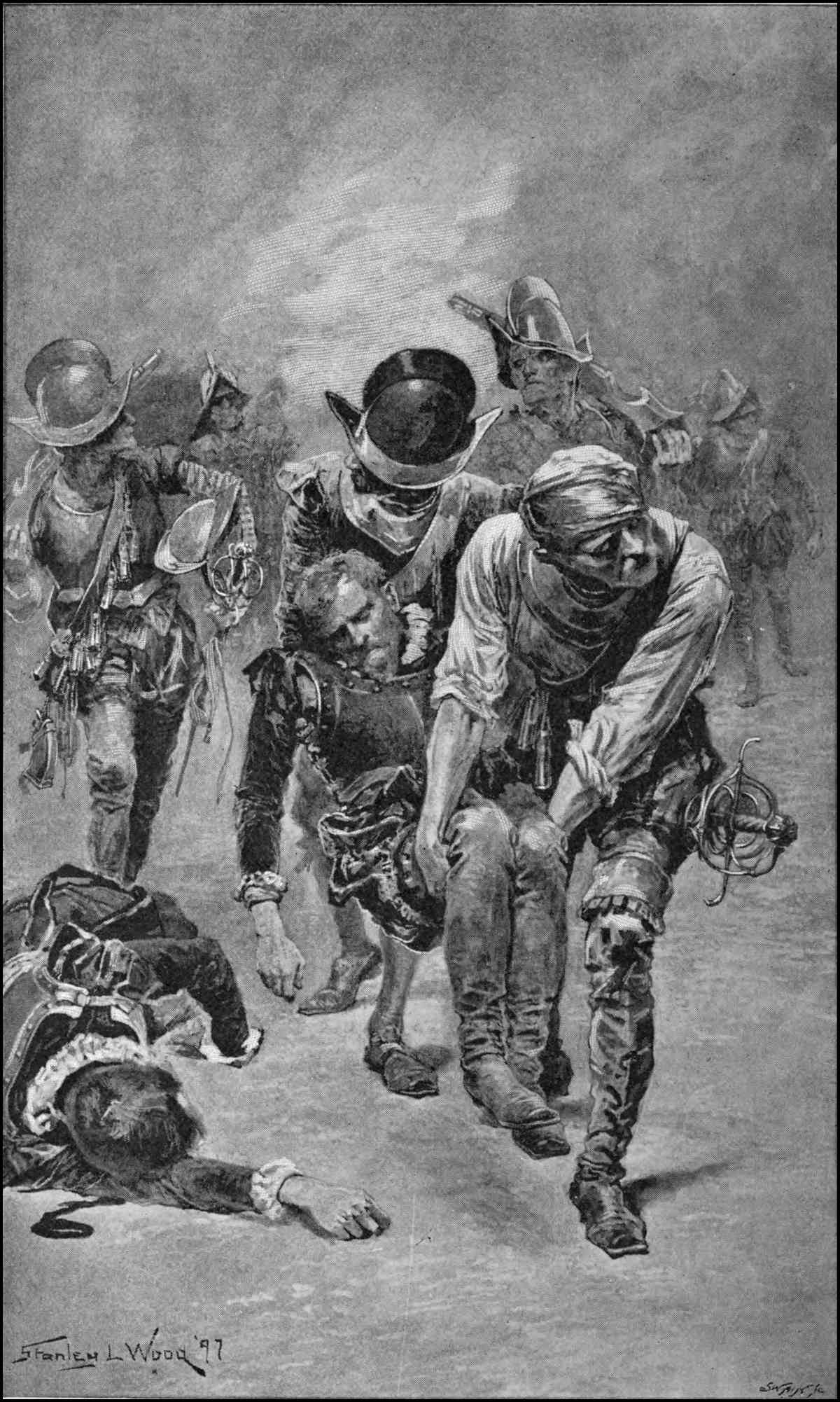
THEY CARRIED HIM DOWN TO THE BOATS.
If his men had been the seasoned buccaneers of
his later raids he would probably have taken it
altogether, but they unhappily found in the Governor’s
house a stack of silver bars twelve feet high,
ten feet broad, and seventy feet long. This was a
little too much for the nerves of the Devon boys,
but Drake would not let them touch it, since the
town was not yet theirs. Then a fearful rain-storm
came on just about dawn and put out their matches
and ruined their bow-strings, and then a terrible
misfortune happened. Drake had been severely
wounded in the leg, but he had concealed his hurt
until the supreme moment came, and then, as he
was leading his handful of heroes to the last attack,
he went down with his boot full of blood. Something
very like a panic now took his men, not for
their own sakes but for his. In vain he stormed at
them, and cried angrily:
“I have brought you to the door of the Treasure-house
of the World! Will ye be fools enough to
go away empty?”
“Your life is more precious to us and England
than all the gold of the Indies!” they replied, and
so by kindly force they carried him down to the
boats and rowed away, having accomplished perhaps
the most splendid failure in history.
The fame of this exploit instantly echoed through
the whole Spanish Main and thence across the
Atlantic to Europe. A few days later he avenged
his failure at Nombre de Dios by cutting a big ship
out from under the guns of Cartagena. Then he
vanished, leaving no other trace behind him than
the poor little abandoned Swan. For the next few
months nothing was seen of him, though his hand
was felt far and wide along the coast. Spanish
store-ships disappeared, dispatch boats were intercepted,
and coast-towns were raided with bewildering
rapidity and effectiveness.
But all this time the deadly tropical fever was
playing havoc with his little handful of men. His
brother John died of it, and man after man was
struck down till at last, out of the seventy-three
who had sailed with him from Plymouth, he could
only muster eighteen fighting men when he at
length started to plunder the mule-train from
Panama.
On the fourth day of the journey a very memorable
thing happened, for that noon he reached the
top of the dividing ridge of the Isthmus, and lo!
there before him, only a few miles away, lay the
smooth, shining expanse of the Pacific Ocean, that
long-hidden, jealously-guarded sea on which his
were the first English eyes that had ever gazed.
He did just what such a man would have done in
such circumstances. He fell on his knees and, raising
his hands to heaven, cried aloud:
“Almighty God, of Thy goodness, give me life
and leave once to sail an English ship on yonder
sea!”
Years afterwards the prayer was granted, and not
only did he sail on the Golden Sea, but crossed it
while he was making the first voyage that an
Englishman ever made round the world.
Were I writing a book instead of an essay I
could tell of the plundering of the mule-trains, of
the taking of Vera Cruz—where, to the astonishment
of the Spaniards, he would not allow a single
woman or an unarmed man to be hurt—and Nombre
de Dios, which did not resist him so well the second
time. It must, however, be enough to say that
this time everything ended happily for the remnant
that survived, and that on Sunday morning, August
9, 1573, while the good folks of Plymouth were
in church, they heard a roar of artillery from the
batteries followed by an answering salute from the
sea and, straightway quitting their devotions, they
ran out to learn the good news that Gloriana’s
Little Pirate had come back safe at last and well
loaded up with plunder.
His next venture was nothing less than that
famous voyage of his round the world, with the
fairy-story of which we have here nothing to do
save to say that the fame of it, no less than the
enormous treasure, the plunder of a hundred ships
and a score of towns, with which the poor sea-worn,
worm-eaten, wind-weary Golden Hind, staggered
one Michaelmas morning into Plymouth
Sound, at last convinced Queen Bess that in her
dear Little Pirate—whom, by the way, she had
never yet openly recognised—she had a champion
who was worth a good many thousands of King
Philip’s soldiers and sailors.
But now the first of Drake’s open rewards was
to be his. The Golden Hind was hauled on to the
slips at Deptford, and Gloriana and her court dined
on board. When the dinner was over she bade her
Little Pirate kneel before her, touched him on the
shoulder with his own sword and bade him rise
Sir Francis Drake. The Spaniards, by the way,
had another title for him, no less honourable in his
eyes, and this was “the Master-Thief of the New
World.”
For some considerable time nothing happened
beyond the failure of one or two trifling expeditions—which
failure was Gloriana’s fault, and not
Drake’s—and the setting of a price of £40,000 by
favour of the King of Spain on the Little Pirate’s
head—an investment of which Drake was soon to
pay the dividend in the craft-crowded harbour of
Cadiz.
Meanwhile, matters between England and Spain
were going from bad to worse. For a few months
unscrupulous intrigue, backed up by wholesale
lying, hampered Drake most sorely in the preparation
of that great work which was nothing less
than the establishment of the sea-power of England.
Everything that the fickleness of his mistress, the
weathercock support of so-called friends at court,
and the still more dangerous machinations of
English statesmen in the pay of Spain could do,
was done. The fleet, to his unutterable rage and
disgust, was even placed on a peace-footing, despite
the fact that the noise of the Armada’s
preparations was still sounding across the Narrow
Seas.
But at last, by some means or other, a certain
Spanish spy had got himself suspected and
stretched on the rack. Now the rack, as an aid to
cross-examination, is not an ideal instrument, but it
certainly served its purpose this time, for the spy in
his torment gave away all the details of a vast
scheme which embraced an alliance between
France, Spain, and Scotland, together with a
general Catholic uprising in England, which was to
take place simultaneously with the Triple Invasion.
Never had England, and with her the cause of
liberty, stood in such great and deadly peril.
Gloriana at last flung diplomatic dalliance to the
winds, stopped her lying and chicanery, kicked the
Spanish Ambassador out of the country, and let her
Little Pirate loose. Yet even now there was
another lull before the storm, and this lull Philip
took advantage of to invite a fleet of English corn-ships
to his ports, where he seized them to feed
that ever-growing sea-monster which he was going
to pit against El Draque.
This settled the matter. Drake, only half ready
for sea, put out with every ship that could move for
fear more orders would come to stop him and, with
an insolent assurance which augured well for the
great things that he was about to do, actually ran
his ships into Vigo Bay and forced the Spanish
Governor to allow him to finish his preparations in
Spanish waters. Then he turned his eager prows
westward, stopping on the way at the Cape Verde
Islands to lay waste Vera Cruz and make Santiago
a heap of ashes.
Five years before young William Hawkins had
been taken prisoner here and burnt alive with
several of his crew, and this was El Draque’s way
of wiping out the old score.
Then he sped on again, spent Christmas at Santa
Dominica, refitted his ships and refreshed his men,
and then fell like a thunderbolt on the famous city
of Santo Domingo, the oldest in the Indies,
founded by Columbus himself and ruled over by
his brother. It was this that the Little Pirate had
been preparing for during those other mysterious
voyages of his. The blow was as crushing as it
was unexpected, and the prestige of Spain in the
West never recovered from it. The town was
utterly stripped and dismantled by the victors.
Fifty thousand pounds in cash, two hundred and
forty guns of all calibres, and an immense amount
of other spoil was brought away, and the whole
fleet, after living at free quarters for a month, sailed
southward, completely refitted and re-victualled, as
usual, at the Spaniards’ expense.
When the news got to Europe, it was said that
Philip had had “such a cooling as he had never
had since he was King of Spain.” It is both
interesting and instructive to learn that not the
least part of the booty took the shape of a hundred
English sailors who were found toiling as slaves in
the Spanish galleys.
Reinforced by these, Gloriana’s Little Pirate
crossed the Caribbean Sea and fell on Cartagena,
the capital of the Spanish Main, and now the
richest city in the Indies. Paralysed by the insolence
of the attack, it soon fell under its fury and
real strength. The booty was enormous, but the
moral effect was still greater. The new-born sea-power
of England had vindicated itself with triumphant
suddenness, and Drake, having picked up the
unfortunate remnants of Raleigh’s colony in
Virginia—the time for colonising not having come
yet—entered Plymouth Sound again in the Elizabeth
Bonaventura at the head of his loot-laden fleet, and
reported his arrival, piously regretting that on the
way home he had missed the Spanish plate-fleet by
twelve hours “for reasons best known to God.”
“A great gap hath been opened which is very
little to the King of Spain’s liking,” was the Little
Pirate’s own comment on the brilliant achievement
which had ushered a new power into the
world. He might also have put it another way,
and said that with his well-directed shot he had
plugged the source whence flowed the golden
stream of Spanish wealth, for indeed it was
nothing less than this. The Spanish Colossus
suddenly found itself with empty pockets, Spanish
credit was ruined at a single blow, the Bank of
Seville closed its doors, and when King Philip tried
to raise a loan of half a million ducats, he was
flatly refused.
How hard hit he was may be seen from the fact
that instead of hurling the whole strength of his
laboriously-prepared Armada on the English coasts,
he asked for explanations. Gloriana, with an
almost splendid mendacity, disowned her Little
Pirate once more and swore she had nothing whatever
to do with him. But this Drake expected, and
went on with his own plans, having no doubt
honestly paid up the Queen’s full share of the
plunder.
A few months more of diplomatic dodgery followed,
and then came the final opening of Gloriana’s
eyes. A letter stolen from the Pope’s own cabinet
proved to her beyond all possibility of doubt that
the Great Armada was intended for the invasion of
England and nothing else. Then she called her
Little Pirate to her again and took counsel with
him, with the result that the next time he hoisted
his flag he did so on board the great Merchant
Royal at the head of twenty-three sail including
five battleships, two first-class cruisers, seven
second-class, and about a dozen gunboats. Nor
did he go this time as the Queen’s licensed pirate
but as her Admiral of the Fleet, duly commissioned
in her name to burn, sink, and destroy, and to use
all means whatever to prevent the various divisions
of the Armada coming together.
Even now, at the last minute of the eleventh
hour, treachery almost did its work, for there was
an Opposition and Peace-at-any-price Party in those
days, as there has been in later ones. Drake seems
to have known what was coming, for, when the
Queen’s messenger dashed into Plymouth bearing
the fatal orders, he had gone.
Happily there was no telegraph in those days. If
there had been it would probably have proved the
ruin of England and the triumph of Spain. As it was
the next news that came was from Drake himself,
telling, laconically as usual, how he had “singed the
King of Spain’s beard in Cadiz.” When the facts
came out, the said singeing was seen to amount to
the destruction by burning and sinking of 12,000
tons of shipping, including some of the finest
ships of war that floated. The whole English
fleet had, as had now become the custom on such
occasions, been revictualled at Spanish expense,
and four large ships full of provisions were captured
intact.
From Cadiz the triumphant Admiral raged up
and down the terror-stricken coast, storming strongholds,
and burning and scuttling the store-ships of
the Great Armada. He went to Lisbon, where
Santa Cruz, said to be the greatest sea-captain in
Europe, lay, and, after vainly challenging him to
come out and fight, politely offered to convoy him
and his fleet to England “if by chance his course
should lie that way.” The fact was that the Colossus
was paralysed. Drake had struck out straight at its
heart, and so doing had proved two principles of no
small moment to the making of the British Empire:
first, the true frontiers of a maritime nation are its
enemies’ coasts; second, the only effective method
of defence for such a nation is attack.
It was on his way home from this expedition,
storm-shattered and disgusted at missing the Plate-Fleet,
which had once more slipped through his
fingers, that Gloriana’s Little Pirate took the richest
prize of his life. This was the San Felipe. She
was the King of Spain’s own treasure-ship, and
she came, not from the West, but from the East.
Though he knew it not, Drake had that day done a
very great thing for England and the making of
her Empire, for not only did the San Felipe carry
treasure and rich stuffs to the value of something
like a million and a quarter of our money, but she
had on board dispatches, letters, and account-books
which let the English merchants into all the secrets
of Spain’s East Indian trade, and led to the almost
instant formation of the Honourable East India
Company, itself an Empire-Maker of no small
account.
The epic of the Elizabethan era was now beginning
to hurry towards its climax. But Gloriana was
still surrounded by traitors, and even now temporising
was the order of the day. She was cast
down by remorse for the execution of Mary Queen
of Scots, and she even reprimanded her Little
Pirate for doing her too good service, and told
Philip that he was in disgrace for exceeding instructions.
It was in vain that Drake and the other friends
of England prayed and entreated and stormed and
swore. In vain they pointed across the Narrow
Seas to Parma in the Netherlands at the head of
30,000 of the finest troops in Europe, and to the
ports of Spain and Portugal, once more swarming
with shipping and echoing with the noise of warlike
preparations. For a time the liars and traitors had
things their own way again. Drake and Howard
implored her to let them get their ships fitted and
go and fight the Armada in its own ports. No, she
would do nothing. And she did nothing till at last
arrived that fatal evening on which—
“There came a gallant merchant-ship full sail to Plymouth Bay.”
Golden weeks and priceless opportunities had
been wasted by the fatal lethargy of the Court.
Drake and Howard, instead of falling, as they
longed to do, on the wind-bound Armada in Vigo
Bay, and doing with it as Drake had done at Cadiz,
were kept on the defensive, straining like bloodhounds
at the leash, knowing that every moment
that the good wind lasted was heavily fraught with
fate for England and perhaps the world.
At length the wind went round, and Drake, marvelling
in angry wonder “how God could have sent
a south-west wind just then,” found himself baffled
and beaten back, while Medina-Sidonia with his
released Armada sailed triumphantly for the
Channel. There was only one thing now to do
if England was to be saved. Valour and heroism,
self-devotion and skill, must repair the damage
that treason, lying, and weakness of head or heart
had done. By this time the Armada should have
been a crushed and tangled mass of burning wreckage,
and so it would have been if Drake had had
his way, and now here it was stronger than ever,
its ships covering the hitherto Inviolate Sea; and
there was Parma, with his transports still undestroyed,
only waiting to join hands with Sidonia to
once for all strangle the Heretic in their pitiless
grip.
In the mighty and memorable fight that followed,
our Little Pirate commanded on his own ship, the
immortal Revenge. With almost incredible labour
and skill the English fleet was somehow worked
and warped out to the westward until, when
that famous Sunday morning dawned, the sun
looked, as has been truly said, upon a sight
glorious for England. There was the great Armada,
crescent-shaped, rolling up the Channel,
and there, right in the wind’s eye and on its rear,
were two English squadrons, and a third was gallantly
advancing out of Plymouth.
This one, with true Elizabethan insolence, steered
right across the front of the huge fleet, firing into
such of the Dons as came within range. Then it
went about, and joined the other English ships to
windward.
Every one has read of the long, running, seven-day
fight that followed; every one knows how the little,
light-heeled English ships ran in and out among
the great unwieldy galleons, tempting them out of
their formation, and, having isolated one, fell on her
like a pack of dogs on a wolf; and how, in spite of
all that the English Admiral and his captains could
do, the ever-changing wind and the ever-succeeding
calms so helped the Spaniards, that in the end they
reached the Straits of Dover but little worse off than
they started.
If Drake could have had his way, these tactics
would have been pushed farther, and every mile of
the way would have been disputed; but Lord
Howard, though a brave man, lacked the all-daring
assurance of the conqueror of Santo Domingo
and Cartagena. He would not fight until he
had joined with Seymour and Wynter in the
Straits. So it came about that on the seventh
day—that is to say, Saturday afternoon—the Great
Armada, the poorer only by some dozen craft that
had been captured or battered into wreck and ruin,
was sailing gloriously past Calais with the French
and English land well in sight, and Dunkirk, the
trysting-place with Parma, only eighteen miles
away.
England has never passed through such anxious
hours as she did that afternoon and night. It
seemed as though, after all, her new-found sea-strength
had failed her, and that, despite all the
brilliant exploits of Gloriana’s Little Pirate in the
West, he was powerless to protect her nearer home.
What would have happened in the ordinary course
of events no one now knows, for the Spaniards,
stricken by some inexplicable madness, suddenly
altered the whole course of events by what can only
be called a freak of idiocy.
Medina-Sidonia, after having accomplished the
most brilliant feat of seamanship that his age had
seen, gave orders for the Armada to anchor! A few
hours more and its work would have been done,
with what results to England one scarcely cares to
picture. So unexpected was this piece of priceless
good fortune by the English captains that they had
to drop their own anchors within range of the
Spanish guns to save entangling themselves with
the big Spanish ships.
All Sunday the two fleets lay within sight of each
other; anxious councils of war were held on both
sides, and so night fell without a shot being fired
or anything done. By midnight the tide was
swirling strong and swift from the English to the
Spanish ships, and Drake was busy preparing his
crowning piece of devilry for the edification of the
Dons.
At about one o’clock on that calm, moonless
morning, patches of flickering, leaping flame began
to show among the twinkling English lights, and
these grew swiftly higher and broader, and a few
minutes later the terrified Dons saw eight fire-ships
crowned mast-high with leaping flames, come reeling
and roaring into their midst.
Then there was cutting of cables and slipping of
moorings, and labouring with frantic haste to get the
ships under sail. Galleon crashed into galleasse, and
galleasse into cruiser in the wild haste and fatal confusion.
Marvellous to say, not a single Spanish ship took
fire, but behind the fire-craft there was something
more terrible and deadly still—El Draque and his
guns. At the supreme moment Lord Howard
weakly and foolishly turned aside to capture or
sink a disabled galleasse. If the rest of the fleet
had followed him there might have been no Battle
of Gravelines, and the Trafalgar of the Sixteenth
Century might never have been fought. But, as has
been well said, it was the hour for which Francis
Drake had been born. He set the Revenge on the
wind, and, followed by the rest of the squadron, bore
down in grim and ominous silence on the huddled,
entangled Dons. Within pistol range of the great
San Martin the Revenge burst into sudden thunder
and flame, and drove on enwreathed in smoke. In
her wake ship after ship came on in perfect order,
each raining her iron storm into the rent and
splintering sides of the Dons as they passed.
Then from Dover way came the roar of guns
telling that Wynter and Seymour had got to work,
and so for three hours they went at it, the Little
Pirate ever first, and revelling in the work that he
loved to do for his dear England. He had forgotten
all his mistress’s slights and fickleness, all
the harm that Court traitors had done him, all his
suffering and privation on the windless seas and
burning lands of the West. It was the hour of
England’s fate and his own, and there he was in
the thick of it, and he was happy.
After three hours Howard and his laggards came
up, and the fight roared on flank and front and rear.
Although the school-books say but little about it,
there had never been such a sea-fight in the world
before, nor one on whose end such great issues
hung. The Spaniards, caught between El Draque
and the sands of Dunkirk—which to them was
something worse than being between the devil and
the deep sea—fought with all their ancient valour,
but ship after ship, as the battle roared on through
the day, went down riddled with shot or took fire
and blew up, till at length out of the forty battleships
and cruisers which Sidonia had somehow got
together to protect his rear, only sixteen were left,
and they were little better than shot-shattered, fire-blackened
hulks.
The powder on both sides was nearly done, but
so too was the work of Drake and his ships.
Fathom by fathom the north-west wind was driving
the Dons on to the mud-banks of the Netherland
shore, and the Little Pirate in his well-named
Revenge was hanging on their weather quarter
watching—and I doubt not praying—for the
moment of their final ruin.
And yet he was not to see it, for when there was
but five fathoms of water between the Spanish
keels and the Dutch mud the north-wester dropped
to a calm, a fresh south-wester sprang up in its
place, and for the fourth time in seven days the
Armada was saved from utter destruction by those
fickle winds to which a pious sentiment has ascribed
its ruin.
Down went the Spanish helms, and round came
the dripping, labouring, Spanish prows, and ere
long all that was left of King Philip’s fleet was
staggering away to the northward to begin that
awful voyage round the north of Scotland and past
the wild Irish coast from which so few were to
return. Meanwhile the Little Pirate hung on to
the heels of the flying Armada for two days and
nights, until at length a tempest came rolling up
over the Dogger Bank, and he ran in for safety
under the Scottish shore, cheerfully leaving the
Dons to the winds of heaven, and the rocks that
were waiting to finish what his own guns had
begun.
With the victory of Gravelines, Drake’s work as
an Empire-maker comes to an end. The expedition
to Portugal, for all its booty, was a failure and
did nothing to enhance his fame. If his advice had
been taken Spain might have been crushed and
humbled for ever, but such was the hopeless weakness
and vacillation at Court that, even after the
Armada had shown her the true designs of Philip,
Gloriana got into negotiations with him again.
Over and over again her Little Pirate besought her
to give him the means of striking the blow that
should crush Spain and make England undisputed
mistress of the seas, but it was not to be, and so at
length, sick and sore at heart, he sailed away again
to his beloved West, never to return.
There is nothing in this last expedition of his
that is noteworthy save its continued misfortunes.
It seemed as though when the little Revenge
went down, as she did in the midst of the fifty-three
Spanish ships which she had fought “for a
day and a night,” she had taken her old commander’s
good luck down with her. At last on
the deadly island of Escudo de Veragua the two
guardian demons of El Dorado, fever and dysentry,
struck him down with many another of his men.
He lived to get away, but not for long, and six
days afterwards, when his fleet came to anchor off
Puerto Bello, the heroic Little Pirate breathed his
last and his gallant soul went to its account, passing
away from earth on the very spot that had been the
scene of his first sea-fight and his first victory.
IV OLIVER CROMWELL “ HEALER AND SETTLER ”
IV OLIVER CROMWELL
“He is perhaps the only example which history
affords of one man having governed the
most opposite events and proved sufficient for the
most various destinies.”
No man’s character was ever so completely and
so tersely summed up as the great Oliver’s is here
in these few words of a critic belonging to another
race and nation, and, as regards his varied destinies,
it may be added that no man ever was raised up
and set to work by the Controller of human destinies
as opportunely as he was.
History shows no parallel to it, not even in the
oft-quoted story of Cincinnatus, and certainly in all
the long array of our rulers there is none other
whose story is so crammed with wonders or who
crowded so many notable and pregnant acts into
the busy days of a few years as this gentleman-farmer
of Huntingdonshire, who at forty-three left
his farming and vestry-meetings and the like and
girded on his sword to go and fight the good fight
of freedom, and who at fifty-two laid it aside to
prove himself as good a statesman and ruler as he
had been soldier and general.
His claim to a foremost place among the Makers
of Britain is a twofold one, for he was a restorer,
a reinvigorator, as it were, of this realm, as well as
a very considerable widener of it. When the futile
and inglorious reign of “the most learned fool in
Christendom” came to an end, all the brilliant
promise of the Elizabethan age had been wofully
obscured, and the glories of the great Queen and
her pirates looked like those of a summer sun
setting behind a bank of fog.
As Macaulay justly put the case: “On the day
of the accession of James I. England descended
from the rank which she had hitherto held and
began to be regarded as a Power hardly of the
second order.... He began his administration by
putting an end to the war which had raged many
years between England and Spain, and from that
time he shunned hostilities with a caution which
was proof against the insults of his neighbours and
the clamour of his subjects.”
How different this from the gallant days of
Gloriana and her knights! And yet this poor
crowned and sceptred ninny aspired to be a despot
even as his son after him did. It is true that these
realms were beginning to need a despot and that
badly, but not such a one as could ever have been
born of that hopeless House of Stuart. A despot
who is a strong man may be good or evil as he uses
his opportunities and his powers, but the whole
stage of history has not yet held a despot who was
also a weak man who did not prove himself at once
a curse to his country and the world.
The story of the feeble violence and silly cunning
with which Charles the First sought to enforce that
ridiculous theory of his about the Divine Right of
Kings has been too often and too variously told for
us to need to trouble with it here. There is a
Divine Right of Kings, as the great Oliver was
very soon to show with most unmistakable and
most unanswerable logic, but the kind of king who
really has Divine rights does not usually have them
because he is the son of his father, and especially of
such a father as James the First of England and
Sixth of Scotland.
Our present concern is with the fact that this
Empire of ours, in a most critical state of its process
of making which came very near to one of unmaking,
was saved and transformed from weakness
to strength by the substitution of the real despotism
of the Lord Protector from the sham or histrionic
despotism of Charles the First.
The fact was that the body-corporate of this
infant empire was assailed by the worst of all
national disorders, internal disintegration. England,
the very heart and centre of it, was about to be rent
in twain by the frenzied and pitiless talons of civil
war, and that is a war in which the right side—which,
of course, is always the best side—must
not only win, but utterly crush and pulverise the
other unless wreck and chaos irretrievable are to
follow.
This was the central idea that the Great Oliver
grasped just as Edward of the Long Legs had
grasped his brilliantly premature idea of the United
Kingdom. He was the latest of that series of iron-handed
men that had begun with William the
Norman. The watchword of his whole public life
was “healing and settling.” The wounds of his
country had to be healed and its disorders settled,
no matter by what means, so long as it was done,
and in this deep-rooted conviction we see at a
glance his kinship with the other Empire-makers
who had gone before him.
Of his early life there is little to be said, though
it is noteworthy that he was once fined £10 for
neglecting a summons to appear at the King’s
coronation and receive the honour of knighthood.
He little thought then that he would one day find
it his duty to refuse the crown and sceptre of
England.
Every one who has read even the school-books
knows that when the war actually began all the
apparent advantages were on the side of the
Royalists. Though the first battles afforded the
extraordinary spectacle of mere conflicts of amateur
soldiers, few of whom had ever seen a real fight
before, the Cavaliers, trained to horsemanship and
the use of arms, and versed in all manly sports,
made far finer fighting material than the raw levies
of the Parliament. Had this difference continued
victory must have remained, as it began, with the
Royalists, with results to the nation that could
hardly have failed to be of the very worst sort.
This is what Cromwell himself says on this all-important
subject:
“At my first going out into this engagement I
saw our men were beaten at every hand. Your
troops, said I, are most of them old, decayed serving-men,
and tapsters and such kind of fellows,
and, said I, their troops are gentlemen’s sons,
younger sons and persons of quality. Do you
think that the spirits of such base, mean fellows
will ever be able to encounter gentlemen that have
honour and courage and resolution in them? You
must get men of spirit and, take it not ill what I
say—I know you will not—of a spirit that is likely
to go on as far as gentlemen will go, or else you will
be beaten still.”
These wise words, which, by the way, were said
to no less a man than John Hampden himself, form
a key to all the battles of the Civil War. No sooner
did Oliver come on to the field as a plain captain of
yeomanry horse than his keen, if untaught, eye instantly
recognised the one great virtue and strength
of the Royalist party. They had an Idea, a devotion,
a principle for the sake of which men were
ready to sell their lands, melt their plate, beggar
their families, and lose their own lives, and men so
equipped could only be successfully met and withstood
by men who, as he himself put it in that
quaintly eloquent phraseology of his, “made some
conscience of what they did,” and thereupon he set
himself to find such men and make soldiers of
them.
How well he succeeded the following extract
from a contemporary news-letter written some ten
months after the outbreak of war will sufficiently
tell:
“As for Colonel Cromwell”—promotion, it will
be seen, was somewhat rapid in those stormy days—“he
hath two thousand brave men, well disciplined.
No man swears but he pays his twelve
pence. If he be drunk he is set in the stocks, or
worse. If one calls the other Roundhead he is
cashiered; insomuch that the countries where they
come leap for joy of them and come in and join
with them. How happy it were if all the forces
were thus disciplined!”
On the field of Marston Moor, Prince Rupert
nicknamed Cromwell “Old Ironsides,” and from
that day to this the most invincible troops that ever
marched to battle have been named after him.
Years afterwards, when his work and theirs was
done, their leader was able to say of them: “From
that day forward they were never beaten and
wherever they were engaged against the enemy
they beat continually.”
This is literally true. Whether in skirmish or
battle, at home or abroad, whether pitted against
the disorderly chivalry of the Loyalists or the rigid
discipline of the finest Continental troops; whether
storming a breach or bearing the brunt of a half-lost
battle, these psalm-singing, hard-hitting
Crusaders of the new Church Militant not only
were never beaten, but never once failed to hurl
the enemy back in confusion and disaster.
In them, in short, that stubborn English valour
which has since pushed its way all over the world
was first disciplined. They formed the first model
ever seen of an English regiment, a combination of
many units of strength and valour moving and
fighting as one, and the fact that “Old Ironsides”
was the first man thus to add discipline to valour is
in itself no small portion of his title to fame as an
Empire-Maker.
The first occasion on which these Ironsides made
their mark in battle is one of even greater importance
than the battle itself, for it marks the entrance
on to the stage of history of the first regularly disciplined
English regiment, the parent of those who,
on a thousand fields since then, have proved themselves
worthy of their grim but splendid ancestors.
It was the first time, too, that they had a chance
to try conclusions with Rupert and his Cavaliers,
hitherto unconquered and irresistible.
It was July 2, 1644, on a dull and storm-threatening
afternoon, that Cavalier and Roundhead
first met in a really serious fashion. Compared
with what was now to be done Edgehill and
all that had come after it had been trifles, for so far
the conflicts had been those of amateurs at the art
of war, each engaged, as it were, in licking the
other into shape, and the conclusion that they now
had to try was which of them had got into the best
shape. There were about four-and-twenty thousand
each of them as they stood through the anxious
hours of that summer afternoon on either side of a
ditch running across Marston Moor, each watching
for a chance to attack, but feeling, no doubt, that
the doings of the next few hours would decide an
issue which needed a certain amount of thinking
over.
The two armies were drawn up upon what is
now the regulation pattern, right and left wings and
centre. Cromwell with his Ironsides on the left of
the Parliamentary army faced Rupert on the right
of the Royalists, and he was supported by the infantry
of what was then known as the Eastern
Association. The King’s centre was held by Newcastle,
and against it was the Parliamentary centre
reinforced by nine thousand Scots infantry. The
Royal left wing was composed of Goring’s cavalry
regiments and was faced by the Parliamentary right
wing under the two Fairfaxes.
During the afternoon there was an exchange of
cannon shots which doesn’t seem to have done
very much harm on either side. Prince Rupert,
with his usual impetuosity, had been for some hours
wanting to get over the ditch and try conclusions
with the Ironsides, who were posted on a little
eminence amidst standing corn, and who had wiled
away the anxious hours of waiting with mutual exhortations
and psalm singing, not a little to the
amusement of Rupert and his gallant scapegraces,
who were yet to learn that these close-cropped,
grim-visaged Puritans could ride and fight a great
deal better than they could sing.
The King’s older generals, no doubt contemplating
Continental etiquette, had decided that it
was too late to fight that evening and had withdrawn
to their quarters. Cromwell, laughing at
etiquette as he did at everything else that was not
of practical utility, saw his chance, jumped the ditch,
and went hot-footed and hot-handed into Rupert’s
ranks. A bullet scored his neck, and hearing some
one cry out that he was wounded he shouted:
“All’s well. A miss is as good as a mile!” and
charged on. Whether or not he was the first to
use this now favourite expression I am not able to
say, but at least it was characteristic.
The charge was met in a fashion worthy of
Rupert and the gallant gentlemen who followed him,
and we learn that after the first onset the Ironsides
reeled back, but it was only for a moment. Some
Scots cavalry came up behind them, they surged
forward again, discipline and valour did their work,
and a few minutes afterwards Prince Rupert and
his merry men had met more than their match, and,
ere long, to use his own words, Colonel Cromwell
“had scattered them before him like a little dust.”
The remnants of them were chased and cut down
with a ruthless severity which was then part of the
Puritan character, almost to the gates of York,
eight miles away.
But Cromwell, profiting by the mistakes which
Rupert himself had made in his headlong charges,
kept his men well in hand, and when once the
Royalist right wing was broken, led them round
to see how the battle had gone on the Parliamentary
right and centre.
If he had not done so Marston Moor might have
replaced Charles Stuart on the throne of England.
Goring had broken up Fairfax’s cavalry as completely
as Oliver had broken up Rupert’s. He had
flung them back upon their infantry supports, breaking
these in turn, after which he flung himself with
the seemingly triumphant Royalists of the centre on
the Scots Infantry, taking them in flank and almost
routing them, too. Only three regiments of them
out of nine held their ground, the rest had broken
and fled, and the Earl of Leven, their leader, was
already making the best of his way towards Leeds.
The battle at this moment presented one of the
strangest spectacles in the history of warfare. On
the one side Prince Rupert with his broken brigades
was flying towards the North, on the other Leven
and Manchester and Fairfax, believing the day
hopelessly lost, were making equal haste towards
the South. Such was the juncture at which the
Man of Destiny arrived. He was in command of
the only really disciplined force on the field.
HE SWOOPED WITH HIS CAVALRY ROUND THE REAR OF THE
KING’S ARMY.
Mr. Frederic Harrison, in his excellent monograph
on Cromwell, thus graphically describes what
happened: “In an hour the genius of Cromwell
had changed disaster into victory. Launching the
Scotch troopers of his own wing against Newcastle’s
Whitecoats, and the infantry of the Eastern
Association to succour the remnants of the Scots
in the centre, he swooped with the bulk of his own
cavalry round the rear of the King’s army, and fell
upon Goring’s victorious troopers on the opposite
side of the field. Taking them in the rear, all disordered
as they were in the chase and the plunder,
he utterly crushed and dispersed them. Having
thus with his own squadron annihilated the cavalry
of the enemy’s both wings, he closed round upon
the Royalist centre, and there the Whitecoats and
the remnants of the King’s infantry were cut to
pieces almost to a man.”
Such was Marston Moor, and how completely it
was the work of the one man of destiny may be
seen in the fact that, complete and crushing as the
victory was, its advantages were almost entirely
negatived by the incapacity and imbecility of the
Parliamentary leaders in the West and South.
Every one of any consequence wanted to be
supreme leader; no one had either definite plans
or the capacity to carry them through; and when
at last there was a prospect of bringing matters to
an issue on the field of Newberry, the Royalist
forces, though half-beaten, were allowed to get
away with all their guns, stores, and ammunition
in spite of the fact that Manchester was in command
of a very superior force.
This was as good as a defeat for the forces of
the Parliament, for it was the cause of dividing
their councils. Manchester and those who sided
with him had apparently begun to fear the terrible
earnestness of the Captain of the Ironsides, and
were for making peace with the King and patching
matters up somehow. But Cromwell, with
deeper insight, saw that the quarrel had now gone
too far and that it could not stop till one side or the
other had had a thorough and decisive beating, and
that side he was fully determined should be the
King’s.
The dispute ended in the fall of Manchester and
the triumph of Cromwell. Then came the reorganisation
of the Parliamentary forces under
what was at this time the New Model, and this
New Model, be it noted, was the first standing
army of professional soldiers that the United
Kingdom had ever seen. Its nominal Commander-in-Chief
was Sir Thomas Fairfax, but its master
spirit and guiding genius was Oliver Cromwell.
But meanwhile the tide of Royalism had been on
the rise again, sweeping up from the West and
South. The armies faced each other on the borders
of Leicestershire, but Cromwell was not there.
Fairfax, no doubt knowing his own weakness,
entreated that he might come and command the
horse. He came, and then, as Clarendon pathetically
remarks, “the evil genius of the Kingdom in a
moment shifted the whole scene,” and it is related
that when, after rumours had been for some days
flying through both armies as to his arrival, “Old
Ironsides” at last came upon the field of action, all
the cavalry of the Parliament raised a great shout
of joy.
The battle that he came to fight was Naseby,
and, saving for the superior discipline displayed on
both sides, almost exactly the same things happened
as at Marston Moor. Cromwell this time commanded
on the right wing, but Rupert was placed
at the Royalist’s right, and was therefore opposed,
not to Cromwell, but to Ireton, his son-in-law and
second self. Once more the left wing of the Parliament
was broken and scattered by the furious charge
of the gallant Cavaliers, once more the centre under
Fairfax was “sore overpressed” and thrown into
confusion, and once more Cromwell and his Ironsides,
having ridden down everything that opposed
them, swung round behind the rear of the victorious
Royalists, swooped in a hurricane of irresistible
valour and determination on their flanks and rear,
turned defeat into victory, and snatched triumph out
of disaster.
It is true that even then there seemed so great
a chance of the Royalists retrieving the day that
Charles, who had put himself at the head of the
flower of his cavalry, had thought himself warranted
in crying: “One charge more, gentlemen, and the
days is ours!” But while he was thinking about
this, Cromwell, Fairfax, and Ireton had, by the
exercise of almost superhuman energy, reformed
the whole of their army, horse, foot, and artillery,
into complete battle-array on a new front, and
against this the fiery valour of the Cavaliers
dashed itself in vain.
Once more valour with generalship had conquered
valour without it. The defeat was utter and crushing.
For fourteen long miles the pursuit went on
and only stayed when the walls of Leicester were
in sight. The King’s army was utterly destroyed
and he himself never again appeared at the head of
a force in the field.
During the twelve months that followed we see
the erstwhile Farmer of Huntingdon in a new light
as the besieger and reducer of strong places. His
methods were logical, effective and, we may fairly
add, pitiless. Those days were not these any more
than William the Norman’s or Edward Longlegs’
were Cromwell’s, and moreover we must remember
that he had set himself with all the strength of his
mighty nature to stamping the plague of civil war
out of the Three Kingdoms with such dispatch
as was possible, and it had got to be done speedily,
for outside were the enemies of Britain waiting to
take advantage of the weakness that this plague
might leave her with.
First he summons the stronghold to surrender,
threatening all with the sword. If this is refused
he selects his point of attack, batters away at it
till he makes a practicable breach, then he gives
another chance of surrender, this time with somewhat
better terms, but this is the last grace.
Refusal now means wave after wave of his
irresistible iron and leather-clad soldiery pouring
into the breach, till at last all opposition is beaten
down and then massacre—for which, it may be
added, he and those with him are never at a loss
to find a biblical precedent.
The victories that he won by this method were
simply amazing. In about sixteen months he was
engaged in some sixty battles and sieges, and took
fifty fortified towns and cities with over a thousand
pieces of artillery, forty thousand stand of arms, and
between two and three hundred colours. The end
of this wonderful campaign was the Storm of Bristol.
This happened on the 10th and 11th of September,
1646. As a feat of warfare it is almost
incredible. The second city in the kingdom, defended
by properly constructed earthworks and
fortifications, and garrisoned by four thousand
troops with a hundred and fifty pieces of cannon,
was stormed and taken with a loss of under two
hundred men!
It reads more like one of Drake’s insolently
valiant attacks upon a Spanish treasure-city than a
desperate conflict between Englishmen and Englishmen.
There can only be one explanation of it, and
that explanation is summed up in the two words:
Oliver Cromwell. We are bound to grant that the
valour was equal on both sides, but equally we are
forced to admit that all the genius and generalship
were on one.
Looked at from our point of view, there were
terrible blemishes on these triumphs. Every advantage
was pursued with the unsparing ferocity
which was possible only to religious bigotry fired to
a white heat. It is only reasonable to suppose that
these Puritan champions of the new faith were fired
with just the same furious and pitiless zeal as that
which inspired the Israelites in their attack on
Canaan, or the first armies of Islam in their assaults
on the idolaters of the East. They slew and spared
not, they hewed their enemies in pieces as Samuel
hewed Agag “before the Lord,” and they honestly
believed that the Lord looked down with approval
on them and their bloody work.
Priceless treasures of art were destroyed, not only
without remorse, but with grim exultation. To them
they were abominations of the heathen, just as the
Canaanite idols of silver and gold were to the
armies of Israel. But however ferociously it was
done, the work was done thoroughly, and by
August, 1646, the fall of Ragland Castle following
on the surrender of Oxford, brought down the
curtain on the first act of the Civil War. Charles
gave himself up to the Scots at Newark, and
Oliver turned to fight the enemies of his own household.
The chief of these enemies, curiously enough,
was that same Parliament in whose name he had
won all his brilliant triumphs, and a conflict, very
interesting to the student of humanity, now began
between the Man of Action and one of those Talking
Machines which the good Earl Simon some
four centuries before had found so singularly
ineffective.
There is no need to tell in detail how the struggle
went. Every one knows how Cromwell preached
and prayed and stormed at the self-sufficient busybodies
who thought themselves a power in the land
because they called themselves a parliament. Then,
seeing that no other method would stop their
gabble, he brought in his soldiers and turned them
out to talk in the streets or wherever else they
could get any one to listen to them, while he went
on with his work.
It is not very many years since Thomas Carlyle,
who perhaps understood Cromwell better than any
other man not living in his own age, was walking
over Westminster Bridge with a very distinguished
British officer one night when the Mother of
Parliaments was busy tearing her hair and rending
her garments over some wordy futility or other,
and, jerking his thumb towards the lighted windows,
he said: “Ah, my lord, I should like to see the
good day when you would go in there with a file of
Grenadiers as old Noll did with his dragoons and
clear that nest of cacklers out. Maybe the nation
would get some of its business done then instead of
only getting it talked about.”
From this there is a certain moral to be drawn by
the wise. For my own part I should dearly love to
know with what words old Noll himself would
have answered the Sage of Chelsea.
The payment of the Scots’ arrears by the Parliament,
their surrender of the king—who, by the way,
was a great deal stronger in helpless captivity than
he had ever been at the head of an army—and his
seizure by Cromwell through the instrumentality of
Cornet Joyce and his troop of horse, now led up
to a very singular situation. Cromwell, the conqueror,
went over to the side of Charles Stuart the
captive, and if it had not been for that fatal twist in
the king’s moral nature, there is no telling but that he
might have been re-seated on a throne supported and
surrounded by the pikes and sabres of the Ironsides.
But unhappily for him, it was not in Charles
Stuart’s nature to “go straight,” and, in the end,
after Cromwell had faced and quelled a mutiny
among his own men on his account, he discovered
that the king was playing him false, that he did not
honestly wish to follow his policy of “healing and
settling,” but only to regain his freedom and try
the hazard of battle again.
From that moment Cromwell was his unsparing
enemy. Now he saw in Charles “The Man of
Blood” who, for the sake of a personal aspiration
and for personal profit, was eager to once more set
his subjects by the ears and light the flame of war
from end to end of the country.
West and South and North the Loyalists were
arming and rising again and the Scots were marching
across the Border, so the Man of Destiny
stopped talking and preaching, buckled on his
sword and strode out to battle once more.
The first rising was in Wales, and that he crushed
as promptly as he did pitilessly. Then he turned
with a weary and war-worn army of some seven
thousand men, so wasted with marching and privation
and sickness that, as a record of the time tells
us, “they seemed rather fit for a hospital than a
battle,” to face the invading Scots in the North.
He met them at Preston. They were three to
one—or rather, to be more exact, twenty-four thousand
to seven thousand—well armed and found and
confident of victory. Yet never did the military
genius of the great Oliver shine out more brilliantly
than now. What followed was not a battle; it was
an onset, a chase, and a massacre which lasted
three days and extended over some thirty miles of
country. When it was over Cromwell wrote in one
of those marvellous dispatches of his: “We have
quite tired our horses in pursuit of the enemy. We
have killed and disabled all their foot and left them
only some horse. If my horse could but trot after
them I would take them all.”
The next act in the swiftly-moving drama was
the trial and execution of him who to this day is
considered by some to have been a royal martyr,
who only exchanged an earthly for a heavenly
crown, and by others is looked upon as the man
who deliberately made himself guilty of the worst
of all blood-guiltiness, the guilt of civil war. That
is a matter for each one to decide according to his
own convictions, which, be it noted, some two and
a half centuries of argument have not yet altered.
Here we are only concerned with Cromwell’s share
in it.
There can be no doubt to an unbiassed mind
that at one period he honestly tried for a monarchical
settlement of the difficulty. It is equally undeniable
that he considered Charles’s double-dealing responsible
for what he held to be the unpardonable crime
of the Second Civil War and therefore as having
incurred for a second time the guilt of blood.
That the execution, or murder, of the king met
with his entire approval cannot be doubted, since
before it happened he said to Algernon Sidney:
“I tell you we will cut off his head with the crown
upon it.”
So, whether crime or act of justice, it was done,
and Cromwell, perhaps more than any one else, was
responsible for it.
The next act is the Dictatorship, and the first
scene in it the re-conquest of Ireland, with its
massacres and bitter, pitiless persecutions in
revenge or punishment, as you will, for other
massacres which had gone before. It is a piteous
story, and one of no great credit to any one, but,
to borrow the maxim of Strafford, the former
tyrant of Ireland, it was “thorough.” In nine
months, with about fifteen thousand men, the
Dictator had stamped the Irish rebellion out and
made “the curse of Cromwell” a phrase that will
dwell on Hibernian lips for many a generation.
But no sooner was the Irish revolt drowned in
blood and flame than Prince Charles, afterwards
Charles II. of infamous memory, took the Oath
to the Covenant, and the Scots rose to support
him. Cromwell crossed the Border on July 22,
1650.
As it happened, the Scottish general was Leslie,
the old comrade who had fought at his side at
Marston Moor. For some weeks the Scots played
a waiting game, and Cromwell, with his men wearied
and falling sick, and with no other base than his
ships on the coast, hurled texts and biblical harangues
at the enemy. In fact, as Mr. Harrison cleverly
puts it, “it was not so much a battle between two
armies as between two rival congregations in arms.”
Leslie and his preachers fired other texts back at
him and kept out of his way until the fatal 3rd of
September came. By this time Cromwell had only
eleven thousand men capable of bearing arms, and
they were in no great state for fighting. Leslie
had twenty-two or three thousand Scots and all the
advantage of the position, but the Fates had already
taken the matter into their own hands. On the
afternoon of the 2nd, Cromwell saw that the wary
Scot, as some say, driven by the frantic exhortation
of the preachers, had forsaken his post of vantage.
“The Lord hath delivered them into our hands!” he
cried, and straightway began to set his battle in order.
The next morning, while it was yet moonlight,
they came to blows. In an hour or so it was all
over. The Scots fled in utter panic and confusion,
“being made by the Lord of Hosts as stubble to
our swords,” to use Oliver’s own words. When the
rout was at its height the sun rose, scattering the
morning mists. “Let God arise and His enemies
be scattered!” he shouted exultantly through the
roar of the battle, and then—how characteristic it
was of the man!—he halted his army in the very
moment of triumph and sang the one hundred and
seventeenth psalm, beginning: “O praise the Lord
all ye people, for His merciful kindness is great
towards us!” Then he unleashed his bloodhounds
again, and the rest was massacre.
HE HALTED HIS ARMY ... AND SANG THE HUNDRED AND
SEVENTEENTH PSALM.
Another year passed in miscellaneous fighting
and arguing, slaughter and psalm-singing, and
once more the sun of the 3rd of September,
Cromwell’s Day of Fate, or, as Byron puts it:
“His day of double victory and death,”
dawned, this time over Worcester, the scene of
“the Crowning Mercy.” The same miracles of
generalship were accomplished, the same tremendous
victory was won at a ridiculously small
expense—under two hundred men to conquer an
entrenched army of fifteen thousand—and this
was the end of the fighting at home.
But meanwhile there was fighting abroad, and,
more than that, the fame of the great Oliver and
his marvellous doings had been ringing from end
to end of Europe. As Clarendon, the historian
of the Royalists, candidly admits: “His greatness
at home was but a shadow of the glory he had
abroad.” The mastery of the seas was wrenched
out of the hands of the Dutch by Blake, the sea-power
of England was organised as its land-power
was, and Britain rose at a bound from the degradation
to which she had sunk under the first Stuart to
the proud position of the first naval and military
Power of the world, and the greatest ministers and
monarchs in Europe, even the Pope himself, were
forced to respect the prowess and cringe for the
friendship of the Farmer of Huntingdon.
If, as has been aptly suggested, the great Oliver
could have lived to an age which is now a normal
one for statesmen, the disgraceful and ruinous interval
occupied by the reigns of the second Charles
and the second James might have been spared with
all their infamy and national loss, and William of
Orange might worthily have continued the work
which Cromwell so well began. But the time was
not yet, and so it was not to be. The great ideal
of his life, a Protestant Alliance, was never realised.
His last days were days of darkness and suffering,
social, mental, and physical.
Once more the Day of Fate came round, and
between three and four in the afternoon the
watchers by his bedside heard him sigh deeply
and heavily. Some say that he whispered: “My
work is done!”—and then he died. This may be
fact or fancy, but, be that as it may, no man had
a better right to pass out of the mystery of the
things that are into the mystery of the things that
are to be with such words on his lips than Oliver
Cromwell, General, Statesman, and King in everything
but the empty name.
V WILLIAM OF ORANGE , OVERCOMER OF DIFFICULTIES
V WILLIAM OF ORANGE
It is perhaps one of the most curious facts of our
history that the Empire-Maker who, as it were,
finally completed the work begun by his namesake
William the Norman, should, like him, have been a
foreigner, should have sprung from similar ancestry,
and should have been his exact reverse in every
mental and physical quality save one—an inflexible
determination to do the work which he was appointed
to do in spite of every conceivable kind of
obstacle.
It is noteworthy also that this man should have
come from those same Low Countries from whose
shores our Saxon ancestors had first come on their
plundering forays to do their share of the work of
making the English people. The ancestry of the
great-grandson of William the Silent stretched far
back, probably even into those remote and turbulent
times, and it is within the limits of possibility that
some stalwart ancestor of the ancient House of
Nassau may himself have had something to do in
the early making of that Realm, over which, a
thousand years later, his descendant was to rule
during one of the most critical and perilous periods
of its existence.
Be that, however, as it may, the central fact which
stands out in the story of William III. is this:
Whatever his country or ancestry, he was, so far as
we have any means of judging, the one man in
the world just then who could have accomplished
the difficult and, as it must often have seemed even
to him, almost impossible task which had to be
performed if the work of the other Empire-Makers
who had gone before him was not to be sadly
marred, if not altogether undone.
William of Orange may perhaps be most truthfully
described as an overcomer of difficulties. Probably
no other man ever had so many difficulties to
conquer as he had, and his triumph over them is
one of the finest examples of irresistible will-power
and purely intellectual force that all history has to
show. Mentally he was a giant, and as such he
acquitted himself in what was undoubtedly a battle
of giants fighting for the spoils of Europe. Physically
he was a miserable weakling, shattered by
disease, seldom free from bodily pain, and foredoomed
from his youth by an exhausting and
incurable malady.
Yet even his sports and pastimes were those, not
only of a healthy, but even of a robust constitution.
His pale, sickly, small-pox-pitted face never flushed
save under the stimulus of battle or the chase. He
fought his fight with Fate and won it by sheer
intellectual strength, yet none of the pleasures of
intellect were his. He knew nothing of science,
little of literature, and less of art.
Apparently fitted by Nature only for the pursuits
of the study, he found his rare moments of real
happiness when riding down a stag or a boar in the
forests of Windsor or the woods of Flanders, or,
sword in hand, leading his men wherever the battle
was hottest or the danger the greatest. A creature
of contradictions, in short, determined to make himself
that which Nature had seemingly not made him,
and to do that which he appeared least fitted to
do.
No one possessing an intelligent grasp of the
deplorable state of affairs which obtained in England,
and the threatening aspect of matters on the
Continent during the last decade but one of the
seventeenth century, would have guessed for a
moment that this “asthmatic skeleton,” as Macaulay
somewhat roughly describes his hero, was the
man to turn England’s weakness into strength,
and even in defeat to grapple successfully with
the colossal Power which was threatening the
liberties of Europe.
In England the weakness and baseness of the
two last Stuart kings had more than undone the
work of the great Oliver. He had, as has been
shown, made England one of the first Powers in the
world, strong at home and respected and even
courted abroad. Charles II. had sold his country, or
at any rate his own independence and what should
have been his royal honour, to France. He had, in
fact, exhibited to the world the disgraceful spectacle
of an English king who was the pensioner of a
foreign monarch.
The for-ever infamous Treaty of Dover had
brought the prestige of England to its lowest ebb.
For the first time in nearly seven hundred years
the Isle Inviolate had been seriously threatened
with invasion, and London, for the first time
since it had been a city, had heard the sound of
hostile guns. Now this of itself, taking the whole
history of these islands into consideration, is a fact
of absolutely unparalleled infamy, and yet if such
infamy could have been equalled, the brother and
successor of Charles II. would have done so. Indeed,
from one point of view it may be said that he
excelled it.
The guns of William’s countrymen were heard in
the Thames because Charles II., having his brother
James for Lord High Admiral, had so scandalously
wasted the funds which should have been devoted
to the maintenance of the Navy that no adequate
defence was really possible; but it was left for
James II., the last and most contemptible, if not in
all respects the worst king of the royal and miserable
House of Stuart, to be the only British
monarch who ever brought a foreign army on to
British soil for the purpose of coercing by force the
will of the British people. More than this, too, it
must be remembered that these foreign troops were
Frenchmen supported by renegade English, Irish,
or Scotsmen who had deliberately deserted their
own country to serve under the standard of a man
who was to the seventeenth century what Phillip
II. of Spain had been to the sixteenth.
So low, then, had Britain sunk in the scale of
nations when William of Orange made his entry
upon the stage of British history. The fact which
made his entry possible is hardly of the sort that
would commend itself to people of a romantic turn
of mind, although few romances have been really
more romantic than his own life-story.
He could never have become King of England,
nor is it likely that he could even have been asked
to constitute himself the protector of English liberties,
had it not been for the fact that he was married
to the daughter of James II., and of this marriage
Lord Macaulay truly says: “His choice had been
determined chiefly by political considerations, nor
did it seem likely that any strong affection would
grow up between a handsome girl of sixteen, well-disposed,
indeed, and naturally intelligent, but
ignorant and simple, and a bridegroom who, though
he had not completed his twenty-eighth year, was in
constitution older than her father; whose manner
was chilling, and whose head was constantly
occupied by public business or by field sports.”
His marriage was, in short, “a marriage of convenience,”
and yet, in defiance of all the rules that
are supposed to govern the most intimate of all
human relationships, it was one of the best and, in
the end, most devoted unions that history has to
record. It is hardly possible to doubt that William
of Orange married Mary Stuart because he saw
with that keenly penetrating foresight of his that
such a union would strengthen him in his life-long
combat with the arch-enemy of his faith, his family,
and his nation; and this enemy was that same
Louis of France who had made Charles II. his
pensioner, and was soon to make James II. his
dependent.
To quote Lord Macaulay again: “He saved
England, it is true, but he never loved her, and he
never obtained her love.... Whatever patriotic
feeling he had was for Holland ... yet even his
affection for the land of his birth was subordinate to
another feeling which early became supreme in his
soul, which mixed itself with all his passions and
compelled him to marvellous enterprises, which
supported him when sinking under mortification,
pain, sickness, and sorrow ... and continued to
animate him even while the prayer for the departing
was read at his bedside.”
It was this hatred of France and her king which
nerved him to do for the liberties of Europe and
Great Britain what Francis Drake had done for
England against Philip of Spain, and in the doing
of this he won the conspicuous glory of forcing the
paymaster of the two English sovereigns whom he
succeeded, to make peace with him on equal terms;
and this, too, although he lost more battles than he
won, and had to surrender more strong cities than
he took.
It is comparatively easy for a conqueror to
take triumph out of victory, but it is a higher
quality which patiently endures defeat and confronts
disaster, and by sheer genius wins triumph in the
end. This is what William of Orange did, and it
is from this fact that he derives his title to be
ranked among the Makers of that Empire to whose
throne he came as an alien, and whose honour he
restored and upheld, as one might say, in spite of
herself.
So far as England is concerned, the male line of
Stuart came in with a fool and went out with a
coward. One does not even care to imagine what
would have happened if James II. had remained on
the throne; or if William of Orange, with his hereditary
and deep-rooted hatred of Louis XIV. and
his policy, had not come to take his most miserably-vacated
place in the nick of time.
The sentimentality which makes such a fuss about
loyalty to persons as distinguished from loyalty to
country, and the lawyer-quibbles which occupied
men’s minds in the dispute as to whether James II.
was King de facto or de jure, or both, of the country
from which he had run away like an absconding
debtor, may be dismissed, just as Harold the
Saxon’s claims had been some six hundred years
before. It is merely a question of the Fit and the
Unfit, and James was Unfit.
James Stuart deserted his post as ruler of these
realms because he found himself assailed by difficulties
which the most ordinary ability ought to have
overcome. William assumed the same position in
the face of difficulties which only the highest qualities
of kingcraft and statesmanship could have
enabled him to successfully grapple with. In a
word, James possessed no ideal that qualified him
to be a king, much less an Empire-Maker. William
did possess such an ideal, and that is the only reason
why he became King of England, vice James Stuart,
absconded.
Next, perhaps, to Henry VII., William was the
most business-like sovereign who has occupied the
British throne. With him all men and things, all
beliefs and sentiments, were subordinated to the
achievement of the one great end—the curbing of
the power of France, and consequently the furtherance
of political and theological liberty in Europe.
He was, in fact, only incidentally an Empire-Maker,
although without him and without the broad and
firm basis of popular liberty and national strength
which he laid down, as it were, in the doing of his
greater work, the building up of the Imperial fabric
would undoubtedly have been long delayed and
seriously impeded.
He got himself made King of Great Britain
and Ireland, not because he wanted to occupy the
throne, but because from that eminence he would be
able to look the Grand Monarch more equally in the
face.
We get a luminous insight into the character of
the man in his reply to the Convention or conference
of the two Houses of Parliament which had proposed
that his wife as actual and lawful heir to
the throne which her father had forsaken, should
occupy it as queen, and that he should reign by
her authority as a sort of Royal Executive.
“My lords and gentlemen,” he said, “no man
can esteem a woman more than I do the Princess,
but I am so made that I cannot think of holding
anything by apron-strings, nor can I think it reasonable
to have any share in the government unless it
be put in my own person, and that for the term of
my life. If you think fit to settle it otherwise I
will not oppose you, but will go back to Holland
and meddle no more in your affairs.”
That was the kind of man William of Orange
was. He had come to be a king, and a king he
would be or nothing. And so king he was, and it
was not very long before he was to show how well
his self-confidence was justified. He had scarcely
seated himself on the throne before the Parliament,
recognising the fact that his work was something
other than merely filling James’s place, deliberately
suggested that he should resume as King of England
the hostilities which he had begun against
Louis as Stadtholder of the Netherlands, and he
on his part showed how ready he was to take up
the task by exclaiming, in one of his rare bursts of
exultation, after reading the address:
“This is the first day of my reign!”
This address, however, welcome as it was, was
somewhat belated. For more than a month before
it was presented, Louis, under the pretence of helping
the runaway, whom for his own purposes he
affected to believe still lawful King of England,
had committed the gravest of all acts of war, and
James had crowned the disgrace of his flight by the
infamy of heading an invasion of British territory
by foreign mercenaries. On the 12th of March,
1689, he landed at Kinsale as enemy and invader
of his own country, convoyed by fifteen French
men-of-war, and supported by 2,500 French
troops.
The story of this Irish war needs no re-telling
here, save in so far as it brings out the contrast
between William and James as the Fit and the
Unfit for the doing of that work which had just
then got to be done if England was not to sink
back to the degrading position of a French dependency,
and if the way of future progress and Imperial
expansion was to be left open. William no
sooner saw that the scene of the fight for constitutional
liberty and religious freedom had shifted for
the time being from the Low Countries to Ireland
than he sent Marshal Schomberg, who was then
one of the most skilful soldiers in Europe, with
an army of sixteen thousand men to the scene of
action.
Meanwhile the heroically stubborn resistance
which has won immortal fame for the men of
Londonderry had proved, not only to James and
his foreign mercenaries, but to Louis himself and all
Europe, that the struggle which was just then
renewed was no mere war of dynasties, and that
something very much greater than the mere question
as to who should be king of England had
got to be decided before the trouble was over.
James in Ireland and Louis in France stood for
the already discredited and exploded doctrine of the
divine right of kings to rule as they pleased because
they were the sons of their fathers; for the dark
tyranny of Rome, now almost equally discredited;
and for the domination of Europe by the French
autocracy. In Holland and England and Germany
William and his allies stood for the very reverse of
all this, so that it was not only the destinies of the
United Kingdom, but those of the greater part of
the civilised world that had to be decided, and it was
by procuring through mingled victory and defeat,
confronted by powerful enemies abroad and by
conspiracy and threatened assassination at home,
that the worthy descendant of William the Silent
proved his real right divine as king of these realms
and champion of those principles of which the
British Empire of to-day is the concrete expression.
It was really on the shores of an insignificant
Irish stream that William fought and won the
battle of European liberty. But before he did this
he had another battle to fight, as it were, in front of
his newly-given throne.
His reign, unhappily, saw the commencement of
that system of government which an intelligent
Chinese Minister to the Court of St. James’ once
described as “the election of one party to do the
business of the nation, and of another to stop them
doing it.” In other words, it was William’s fate,
among all his other difficulties, to have to contend
with the bitter and usually dishonest strife of
Parliamentary parties, and so keen did this strife
become after the foreign enemy had actually landed
on British soil, that he was even then on the point
of throwing up the whole business in disgust, and
going back to Holland to fight his battles out
there.
What would have happened if he had done so is
anything but a pleasant subject for speculation.
Happily, at the eleventh hour he refused to
acknowledge himself beaten. Sick of the strife
of words and longing for the reality of deeds, he
announced his intention to place himself at the head
of the English forces in Ireland, “and with the
blessing of God Almighty endeavour to reduce that
kingdom that it may no longer be a charge to this.”
In this we may see more than the expression of
a pious hope. As statesman and soldier William
had seen that Ireland was the back-door of
Great Britain, and that so long as it remained
open so long would the whole kingdom be
vulnerable to foreign invasion, and so he went
to close it.
It was a strange position for any man to be
placed in. He was going to fight for everything
that he held dear. He knew that if he lost in
Ireland he must lose also in England and the
Netherlands, but he was also going to fight against
the father of the woman whom he had now come
to love so dearly that her death, when it happened,
came nearer to wrecking his imperial intellect than
all the other trials and troubles of his laborious and
almost joyless life. He had no feeling of personal
enmity against James as he had against Louis, and
it was duty, and duty alone, which took him to the
Irish war. Almost the last words that he said to
his wife concerning the enemy whom he was about
to meet on the battlefield were:
“God send that no harm may come to him!”
Mr. Traill has thus tersely summed up the condition
of affairs at this moment: “Ireland in the
hands of a hostile army, the shores of England
threatened by a hostile fleet, a dangerous conspiracy
only detected on the eve of success, a formidable
insurrection imminent in the country he was leaving
behind him....”
And yet, gloomy as the outlook seemed, his spirits
rose as they ever did when he saw the moment for
doing instead of talking draw near, and Bishop
Burnett tells us that he said to him on the eve of
his departure: “As for me, but for one thing I
should enjoy the prospect of being on horseback
and under canvas again, for I am sure that I am
fitter to direct a campaign than to manage your
Houses of Lords and Commons.”
These words were well worthy of the man who,
not many days later, quietly sat down to breakfast
in the open air beside Boyne Water, within full
sight of the enemy and within easy range of their
guns. Breakfast over, he mounted his horse and
was promptly fired at. The first shot from two
field-pieces which had been trained on him and his
staff killed a man and two horses. The second
grazed his shoulder and made him reel in his
saddle.
“There was no need for any bullet to come nearer
than that!” was his remark on the occurrence.
Certainly not many bullets have ever come nearer
to changing the history of Britain, and therefore
of the British Empire, than that one.
MADE HIM REEL IN HIS SADDLE.
After the wound had been dressed, instead of
taking the rest which a good many strong men
would have taken, this consumptive and asthmatic
invalid re-mounted his horse and remained until
nightfall in the saddle, making his dispositions for
the battle of the morrow, and attending to every
detail himself. His prudent uncle and father-in-law,
apparently bent on fulfilling William’s pious wish,
was meanwhile taking very good care to keep
himself out of harm’s way.
“MEN OF ENNISKILLEN, WHAT WILL YOU DO FOR ME?” HE CRIED.
The battle itself, which, as every one knows, was
fought on the 1st of July, brought out with startling
clearness the contrast between the man who was
king in his own right and the man who called
himself king because his name was James
Stuart.
“Men of Enniskillen, what will you do for me?”
he cried at the critical moment of the fight, when
Caillemot and Schomberg, his two best captains,
had been killed, and he, drawing his sword and
swinging it aloft with his wounded arm, led his
trusty Dutch guards and Ulstermen against the
Irish centre. James, meanwhile, having watched
the first part of the fight on which all his fortunes
depended from the safe eminence of the Hill of
Donore, had already given up for lost the day
which he had done nothing to win, and was making
the best of his way to Dublin, whence, in due course,
leaving the beaten and demoralised rabble that had
once been his army to its fate, he fled to the congenial
ignominy of his safe retreat at St. Germain,
and the fostering care of his country’s
worst enemy.
The Battle of the Boyne not only settled the fate
of the Stuart dynasty for good; it decided the
question whether this country was to be ruled by
a feeble despotism under the patronage of France,
or by that constitutional monarchy under which
Great Britain has so worthily proved her title to be
called the Mother of Free Nations, and in winning
this battle and deciding this all-important question,
William of Orange won the right to be counted
among the wisest and strongest of our Empire-Makers.
The disgusted Irishmen, too, had some
reason on their side when they said to the victors
after the battle: “Change leaders, and we’ll fight
you again!”
The story of his wars in those countries which
have been aptly termed the cockpit of Europe is
the story of the continuation of that work which he
came to England to do; not, as has already been
pointed out, for England as a country, but for the
establishment of those principles for which the
British Constitution, of which he was one of the
makers, stands. Ignorant or prejudiced critics
have accused him of sacrificing English blood and
treasure to the furtherance of his own ambition.
The fact is that he employed them upon the best
and most necessary work that there was for them
to do just then.
“Look at my brave English!” he said to the
Elector of Bavaria one day during the siege of
Namur, while a British regiment was carrying the
outworks on one side of the city. But they were
doing more than carrying earthworks. They were
fighting for the principles which their descendants
crowned with everlasting glory at Trafalgar and
Waterloo. They were showing the soldiers and
generals of France, then held to be the best in the
world, the sort of stuff that they were made of, and
giving promise of future prowess that was soon to
be splendidly redeemed at Blenheim and Ramillies,
Oudenarde and Malplaquet.
It was a singular war, and by all the rules of warfare
the issue should have been the reverse of what
it was. But again and again William’s wonderful
genius and indomitable persistence snatched victory
out of defeat, and turned disaster into advantage,
until at last the Grand Monarch himself had to
confess the power of the enemy whom he had once
thought so insignificant, and the signing of the
Treaty of Ryswick left William triumphant if
somewhat dissatisfied.
The results would no doubt have been much
greater if William could have had his own way,
and if the strife of parties in the British Parliament
had not so sorely crippled him. But at least
he had the satisfaction of knowing before he died
that, whereas a few months before the French men-of-war
had with impunity insulted and threatened the
English coasts, and landed a small army on Irish
soil, a few months afterwards every invader had
been driven from British ground, and the French
fleet almost destroyed, while the Mediterranean, on
which British ships had sailed only by sufferance,
was now well on the way to becoming a British lake.
And yet, in spite of all the triumphs that he had
won over so many difficulties and so many dangers,
and in spite of the consciousness of work well
and nobly, if quietly and unostentatiously, done,
William’s last days, like those of many another
man who has deserved well of the world, were
full of sorrow and suffering.
The death of his now adored queen had so shaken
his mighty nature that for some days his reason
was despaired of, and there can be no doubt but
that it hastened his own end. And yet, weak and
far advanced in disease as he was when he went
out for that fatal ride from Kensington to Hampton
Court, he was even then going a-hunting. The
brutal Jacobite toast: “To the little gentleman in
black velvet who works underground!” still serves
to remind us of the mole-hill over which his horse
stumbled and fell, breaking his rider’s collar-bone,
and inflicting the death-wound which he had
escaped on a score of battle-fields.
His death was worthy of his life, for it was the
death of a brave, patient man and a Christian
gentleman. No doubt he himself would have
preferred to have died at the head of a charge,
or in the thick of an assault on a French fortress,
but his destiny ordered it otherwise, and the man
who had a hundred times faced death in the most
reckless fashion for the purpose of inspiring his
followers with his own courage and enthusiasm,
died quietly in his bed, leaving behind him the
greatest work ever done by an individual British
sovereign, and a fame which, but for the one
dark and inexplicable blot of Glencoe, is as fairly
entitled to be called spotless as that of any man
who ever sat upon a throne and accomplished
great things with such means as came to his hand.
VI JAMES COOK , CIRCUMNAVIGATOR
VI JAMES COOK
Once more I am going to ask you to take
your seat with me on the ideal equivalent
of the Magic Carpet and skim across another time-gulf
some half-century wide. This time we alight
on the morning of Monday, July 5, 1742, before
the door of a double-fronted shop, one side of which
is devoted to the sale of groceries and the other to
the drapery business. This shop is situated in a
little village on the Yorkshire coast a few miles
from Whitby, Staithes, or more exactly The
Staithes, so called from the local name for a pier
or sea-wall of wood jutting out a few feet into the
German Ocean, and built partly to protect the
little bay from the North Sea rollers and partly
to afford accommodation for the fishing-boats and
colliers.
The shop belongs to a substantial citizen of
Staithes named Saunderson, and this morning Mr.
Saunderson is a very angry man. In fact, if we
go into the shop, which is not yet open, we shall
find him with a cane or some similar weapon in
his hand, leaning behind the counter and hitting
blindly at a bed there is beneath it, shouting the
while sundry excellent maxims on the virtue of
early rising, especially modified for the benefit of
apprentices.
But no response comes from the bed, and Mr.
Saunderson stoops down to make closer investigation.
The bed is empty, and the fact dawns
on him that his last apprentice has followed the
example of all the others and run away to sea. It
was a very common event on the Yorkshire coast
in those days, but this particular running away was
destined to be a very memorable one for the world,
for the lad who, instead of being in the bed under
the counter, was just then striding rapidly away
over the fields to Whitby with one extra shirt and
a jack-knife for his sole possessions, was James
Cook, a name as dear to the lovers of the romance
of travel and adventure as Robinson Crusoe, and
one of infinitely more importance in the annals of
mankind.
In following his fortunes, so far as the brief limits
of such a sketch as this will permit, we shall bid a
perhaps welcome adieu for a while to the roar of
guns and the shock of battle, to the blaze of burning
towns and the fierce cries ringing along the
decks of captured treasure-ships, to watch the contest
of a clear head and a strong will against those
foes which may be overcome without bloodshed,
although not always without loss of life—the hidden
dangers of unknown oceans strewn with uncharted
reefs and shoals lying in wait for unwary keels, the
sudden hurricanes of the Tropics, and the storms
and fogs and the floating ice-navies of the far North
and South. It was these that Captain Cook went
out to fight and overcome, and in doing so to prove
eloquently that:
“Peace hath her victories no less renowned than war.”
Nevertheless there are certain points of likeness
between James Cook, Geographer and Circumnavigator,
and that other Circumnavigator, Francis
Drake, Pirate and Scourge of Spain. Both
began life as ship-boys, and both rose, by sheer
ability and strength of purpose, far above their
original station in life to positions of command
in the service of their country. Both were men
of iron will, far-reaching design, unshakeable
self-reliance, and passionate temper, and, lastly,
both were possessed by that irresistible spirit of
roving and adventure which, when it once seizes a
man, but seldom lets him rest in peace. In short,
though the vocation of one was piracy and war, and
that of the other the peaceful, but none the less
adventurous service of science, both were stamped
with the supreme and essential characteristics of the
Empire-Maker.
Naturally, the world had changed a good deal by
the time James Cook started out to add so enormously
to men’s knowledge of it. Spain had fallen
from her high estate and was living in slothful ease
on the dregs and lees of that strong wine which
she had drunk to intoxication in the golden days
of Cortez and Pizarro. But Britain, no longer only
England, had become Great Britain, and was fast
expanding into Greater Britain. Cowley, Dampier,
Clapperton and Anson had circumnavigated the
globe more than once, and people were beginning
to have something like a definite notion of how
very big a place was this world which now seems
so small to us. The Imperial Idea was beginning
to take hold of men’s minds. They wanted to
know, not so much how big the world was, but
what other unknown lands might be lying waiting
for the discoverer, hidden away among the vast
expanses which were still an utter blank upon the
map.
The maritime nations of the world, too, and
Britain, now foremost among them, had unconsciously
taken a very great stride along the pathway
of real progress, and they were beginning to
grasp the higher ideal of colonisation as distinguished
from mere conquest, and to James Cook
belongs the high honour, if not of discovering, at
least of first definitely locating and in part mapping
out the greatest of all the British colonies.
Indeed, it may be said that, in sober fact, he
added a whole continent to the British Empire,
and that without the striking of a single blow or
the loss of a single life in battle.
The first few years of James Cook’s seafaring life
were eventless, just as Francis Drake’s were, but
for all that he, like Gloriana’s Little Pirate, was
doing that minor but no less essential part of his
life-work which was the necessary preparation for
the greater. He was doing his work first as ship’s
boy, then as sailor before the mast, then as second
mate, first mate, and so on up the laborious ladder
which was to lead him in the end to an unequalled
eminence among mariners.
Thus for thirteen years he served what may be
called his apprenticeship to his life’s work; learning
in the most practical of all schools, a North Sea
collier of the eighteenth century, not only the science
of seamanship in all its details, but also what was
hardly less important—that science of taking things
as they came, of looking upon hardship, privation
and danger as the commonplaces of a seaman’s life,
incidents in his day’s work, as it were, and as such
scarcely worth even the mention, and hence much
less worth troubling about.
A curiously instructive fact strikes one in contrasting
Captain Cook’s own account of his voyages
with those of others, such as Anderson and Gilbert,
who sailed with him. They expatiate largely on
the miseries of heat and cold, ice and mist, the
almost uneatable character of the sea-fare of those
days, disease among the crew, and so on; but
Captain Cook hardly ever mentions them, saving
only the scurvy, of which more hereafter.
But there was something else that James Cook
had already learnt long ago while he was yet a boy.
When he was a lad of six or seven he had been
set to work on a farm belonging to a man named
William Walker, and this William had a wife
named Mary who, taking a fancy to the lad, taught
him his letters and encouraged him to read, and
so, without knowing it, put into his hands the
talisman which was to win his way to future greatness.
She not only aroused in him that passion
for reading which distinguished him among the
sailors of his time, but she gave him what might
have been the only means of gratifying it, for not
every farm-lad and ship’s-boy of the middle of the
eighteenth century had learnt, or ever did learn,
to read and write.
It may have been that James Cook’s latent
ambition had never looked beyond the possibility
of becoming master of one of the vessels of which
he had been mate, and it is also possible that he
might never in reality have been anything more,
but it so happened that his ship, the Friendship,
was lying in London river in May, 1756, and that
at the same time the war with France, which had
been brewing for a year, broke out.
As usual the Press Gang set instantly to work,
and now came Cook’s chance. He was mate of
a ship, albeit only a collier brig; still he was a
thorough seaman, an excellent navigator, and, more
than that, he seems to have known something of
the theory as well as the practice of his science.
These accomplishments, however, did not put him
beyond the reach of the Press Gang.
Now, in those days there were two ranks of
seamen before the mast in the King’s navy—the
pressed man, who might be anything from a raw
land-lubber to an escaped convict, and the volunteer,
who was probably and usually a good sailor,
if not something better, as Cook was, and he,
guided either by inspiration or deliberate resolve,
eluded the Press Gang by offering himself as a
volunteer, and so in due course took his rating as
able-seaman before the mast on board his Majesty’s
frigate Eagle, of sixty guns, of which shortly afterwards
the good genius of his life, Sir Hugh Palliser,
was appointed captain.
During the next four years there was fighting,
but we have no record of any share that Cook took
in it. What we do know is that by the time he
was thirty he had risen to the rank of master of
the Mercury, a King’s ship which went with the
fleet to the St. Lawrence at a very critical juncture
in British colonial history.
So far it would appear that he had worked himself
up by sheer ability and industry, but now his
chance was to come. The river St. Lawrence at
that time had never been surveyed, and it was
absolutely necessary that soundings should be taken
and the river correctly charted before the fleet could
go in and with its guns cover Wolfe’s attack on
Quebec. The all-important work was entrusted to
the master of the Mercury, and although the river
was swarming with the canoes of hostile Indians in
the service of the French, and though he had to
do his work at night, he did it so thoroughly that
not only did the fleet go in and out again with
perfect safety, but the work has needed but little
re-doing from that day to this.
Thus did James Cook, not as sailor or fighting-man,
but as good mariner and skilful workman play
his first part as Empire-Maker, and in an unostentatious
fashion contribute his share towards the
capture of Quebec and the acquisition of one of
the widest and fairest portions of Greater Britain.
He was at this time, as has been said, only thirty.
As regards the outer aspect of the man he stood
something over six feet, spare, hard, and active.
His face was a good one and suited to the man,
broad forehead, bright, brown, well-set eyes, yet
rather small, a long, well-shaped nose with good
nostrils, a firm mouth, and full, strong chin.
In short, his best portraits show you just the
kind of man you would expect Captain Cook to be.
For the rest he was a man of iron frame, tireless
at work, resting only when it was a physical necessity,
with few friends and fewer confidants, cool of
judgment save during his rare and deplorable fits
of passion, self-contained and self-reliant—just such
a sea-king, in short, as we may imagine Heaven to
have commissioned to carry the British flag three
times round the world and to the uttermost parts
of the known earth, and to plant it on lands which
until then no white man’s eye had seen or foot had
trodden.
In the same year Cook was promoted from the
Mercury to the Northumberland, the Admiral’s
flag-ship, and in her he came back to England, and
at St. Margaret’s Church, Barking, married Elizabeth
Batts, a young lady of great beauty and of social
standing far above that of the grocer’s apprentice
and collier’s knockabout boy, but not above that
of the Master of a King’s ship. His married life
lasted some seventeen years, and of these he spent
a little over four in the enjoyment of the delights of
home.
For the next four years or so he was regularly
employed in surveying and exploring work off the
Atlantic coast of America, and this of itself shows
that he had already made his mark in his chosen
profession. But much greater things were now to
be in store for him. It will be remembered how
Drake, when he first saw the smooth waters of the
Pacific, prayed God that He would give him life
and leave to sail an English ship on its waters.
That prayer had been granted, and his and many
another English ship had crossed the great Sea of
the South.
Meanwhile the realised dream of El Dorado had
been replaced in men’s minds by another, even
more vast, shadowy, and splendid. This was the
dream of the Great Southern Continent, and in
this imagination revelled and ran riot. Grave
scientists, too, demonstrated beyond all doubt that
there must be such a land far away to the south
since how, without it as a counterpoise to the continents
of the north, was the rolling world to be
kept in equilibrium?
So they took it for granted, laid it down upon
the maps, and wrote glowing descriptions of the
varieties of climate, the splendour of scenery, the
wealth of treasures and the strange peoples and
animals that it must of necessity contain. Above
all, it would be a new El Dorado which would not
be under the control of Spain.
What more could men want, unless indeed it was
the actual discovery of the Terra Incognita Australis?
This was the new world of which Cook was to be
the Columbus. Others had seen parts of it just as
others had seen parts of America before the great
Genoese reached the West Indies, but he was the
man who was to do the work of putting its existence
beyond all doubt.
The Royal Society found that there would be a
transit of Venus in the year 1769, and that it would
be best observed from some point in the great
Southern Ocean, say Amsterdam Island or the
Marquesas Group, lately discovered by the Dutch
and Portuguese, and as the result of representations
made to the King, an expedition was set on foot to
carry out suitable persons to observe it. Of this
expedition James Cook, raised from the rank of
master to that of lieutenant, was placed in command.
On his own recommendation the ship chosen
for the purpose was the Endeavour, a Whitby-built
craft of 370 tons, broad of bow and stern and
fairly light of draft, and built for strength and endurance
rather than speed.
She sailed, carrying a complement all told of
eighty-five men, from Plymouth on August 26,
1768, which as Cook’s latest biographer happily
remarks, was a Friday, and the starting-day of
what was, all things considered, the most successful
voyage of discovery ever made. Just before she
sailed Captain Wallace had come back bringing the
news of the discovery of Otaheite, otherwise known
as Tahiti, and as this island was considered a more
favourable position, Captain Cook, as we may now
fairly call him, was ordered to proceed there first.
It is of course utterly out of the question to
attempt any connected account even of one voyage
round the world, let alone three, within such limits
as these, therefore I cannot do better than let the
great navigator describe his achievements, as he
actually did, in three modest paragraphs:
“I endeavoured to make a direct course to
Otaheite” (this was after he had crossed the Atlantic
and doubled the Horn, which doubling, by the way,
took thirty-three days), “and in part succeeded, but
I made no discovery till I got within the Tropic,
where I fell in with Lagoon Island, The Groups,
Verde Island, Chain Island, and on the 13th of
April arrived at Otaheite, where I remained three
months, during which time the observations on the
transit were taken.
“I then left it, discovered and visited the Society
Islands and Ohetoroa; thence proceeded to the
south till I arrived in latitude 40°22 south, longitude
147°29 east, then on the 6th of October, fell in with
the east side of New Zealand.
“I continued exploring the coast of this country
till the 31st of March, 1770, when I quitted it and
proceeded to New Holland; and having surveyed
the eastern coast of that vast country, which part
had never before been visited, I passed between
its northern extremity and New Guinea, and landed
on the latter, touched at the island of Savu,
Batavia, Cape of Good Hope, and St. Helena,
and arrived in England on the 2nd of July,
1771.”
I have seldom come across such a masterpiece of
eloquent simplicity as this, but then, of course,
Cook’s voyages were made before the days of the
lecture-exploiter and the Age of Booms. There is,
however, one remark that may be made on it.
What Cook calls New Holland we call Australia,
and Botany Bay, the first point he touched at, is
hard by Port Jackson, on the flowery shores of
which now stands the lovely capital of New South
Wales. Terra Incognita Australis was unknown
no longer, but the days when it was to prove itself
even more golden than El Dorado were yet distant
nearly a hundred years.
If you would read the marvellous tale of frozen
lands and seas, of the sunlit coral-islands gemming
the sparkling waters as thickly as the stars stud the
Heavens, of the delights of Paradise and the
terrors of Nifflheim told and written by sundry
members of this expedition after their return, you
must go to your library and find them in the
originals, for there is no space to give them here.
Suffice it to say that, though somewhat prolix and
diffuse, you will, if you are blessed with an intelligent
taste for that kind of thing, find them more
delightful reading than any of the countless
romances whose writers have taken their materials
out of them.
But there is one circumstance which for the
honour of James Cook ought to be mentioned.
The curse of sea-voyaging in those days was
scurvy. Out of forty sick, nearly half of the little
company, no fewer than twenty-three died, and this
terrible fact set the captain thinking, with the result
that he, first of all mariners, grappled with and
conquered this worst of the dangers of the ocean.
If he had never done anything else he would have
deserved a niche in the Temple of Fame. In his
second voyage round the world, which lasted three
years and sixteen days, he only lost four men, three
of whom died by accident and the fourth not of
scurvy.
The Circumnavigator was now promoted to the
rank of Commander, a modest enough reward for
the achievement of the greatest work of his generation.
He remained ashore just a year, probably
the longest period he had ever spent on land since
he first went to sea.
During this time the publication of a collection
of travels started people talking about the Southern
Continent again. Captain Cook had found it, but
that didn’t matter. His discovery was not splendid
enough by any means, so it was decided to send
another expedition, this time of two ships, “to complete
the discovery of the southern hemisphere” (!)
and Cook sailed again in command aboard the
Resolution of 462 tons having for consort the
Adventure of 336 tons.
They sailed on July 13, 1772, and on October
30th reached Table Bay—a hundred and nine days,
think of that, you who take a run out to the Cape
and back again for a winter holiday! Truly the
world was somewhat larger in those days.
From Cape Town they steered straight away for
the South, and on December 10th they sighted for
the first time the ice-fringe of what we know now
to be the true Terra Incognita Australis.
The landsmen on board seem to have had a
dreadful time during this part of the voyage and
Foster, one of the naturalists of the expedition,
bewails “the gloomy uniformity with which they
had slowly passed dull hours, days and months in
this desolate part of the world.” What a change
it must have been from the rigours and horrors of
Antarctica to the paradisaical delights of Tahiti,
which, after surveying the coast of New Zealand
and deciding that it consisted of two islands and
not one, the expedition reached on the 16th of the
following August.
There is perhaps no other spot on earth which
so completely fulfils one’s ideas of what Paradise
ought to be as this same island of Tahiti even now,
but what must it have been in those days, when
white men first saw it in all the beauty and simplicity
of its primeval innocence. Now, alas, it is
very different, cursed by the diseases and vices of
civilisation and afflicted by a cast-iron régime which
the people seem to think a little worse than death,
since they are dying as fast as they can to get away
from it.
After this again New Zealand was visited, and
once more the two ships plunged into the icy solitudes
of Antarctica, only to return again, baffled by
the impenetrable ice-wall. From here the ships
steered northwards for Easter Island and Crusoe’s
Island. It is noteworthy that on the way Captain
Cook, the great Medicine Man of the sailors, himself
fell sick, and that, for want of anything better,
“a dog was killed to make soup for him”—from
which it will be seen that voyages of discovery
were not exactly picnics in his time.
From Juan Fernandez he steered for the Marquesas
again, once more visited New Zealand, and
once more his sea-worn crews revelled in the unrestrained
delights of Tahiti. Then again to the
south, this time not to rest until the whole circle of
the Southern hemisphere had been made without
the finding of any other southern continent than the
unapproachable Antarctica, and so in due course
and without mishap came the Sunday morning,
July 30, 1775, when the Resolution and the Adventure,
having well vindicated their names, dropped
their willing anchors into the waters of Spithead.
More honours, though not of the nineteenth-century-boom
order, were now most justly bestowed
on the Circumnavigator. He was promoted
to the rank of Post-Captain in the Navy, and made
a Captain of Greenwich Hospital, a post which
carried with it a home and honourable retirement
for the rest of his life—of which he was the very
last man in the world to avail himself. He was
also elected Fellow of the Royal Society, and presented
with the gold medal for his treatment of scurvy.
Captain Cook as sailor, as scientific navigator,
and as explorer was now at the height of his fame.
He was forty-eight years old, and had spent thirty-four
years at sea, and it is no exaggeration to
say that during this time he had added more
geographical knowledge to the history of the world
than any one had ever done before, and had
probably covered a larger portion of its surface.
He had at once proved and disproved the dream of
the Southern Continent, and, potentially speaking,
he had added enormous areas to the ever-growing
realms of Greater Britain.
He might well have rested on such laurels as
these, but there was more work for him to do, and
he went to do it. One of the greatest questions of
the sixteenth, seventeenth, and eighteenth centuries,
was the possibility of the North-West Passage from
the Atlantic to the Pacific. So far every attempt
had ended in failure, and generally in disaster, but
now, when men’s minds were full of the wonders
Captain Cook had achieved, there arose another
question: Might not a North-East passage from
the Pacific to the Atlantic be possible, and, if so,
who better to try it than the great Circumnavigator?
An expedition was promptly decided on. Captain
Cook was not offered the command, as the Government
probably and rightly thought he had won his
laurels. But one fatal evening he dined with Lord
Sandwich, the promoter of the expedition, and at
table he met his old patron, Sir Hugh Palliser, and
his friend, Mr. Stephens, Secretary to the Admiralty.
Ostensibly the object of the dinner was to
consult him as to the best leader for the new
venture, but the moment the subject was broached
the unquenchable passion for travel blazed up again,
and the great Navigator rose to his feet and said
gravely:
“My lord and gentlemen, if you will have me I
will go myself.”
So was decided the fatal voyage which was
destined to end a glorious and almost blameless
career by an ignoble and unworthy death.
The expedition consisted of the old Resolution
and the Discovery, a vessel of three hundred tons.
The voyage lasted four years and nine months, but
the loss of life by sickness was only five men, of
whom three were ill when they started. A good
deal of the old ground was gone over, more islands
were discovered, more unknown coasts surveyed.
Fair Tahiti was visited once more, and the expedition,
so far as its principal object was concerned,
came to an end, as the search for the Southern
Continent had done, in a way blocked by impenetrable
barriers of ice—this time the ice of the North.
Thus turned back, they steered southward, and
on December 1, 1778, they discovered Hawai,
which discovery the great Navigator in his last
written words somewhat strangely says, “seemed in
many respects to be the most important that had
hitherto been made by Europeans throughout the
extent of the Pacific Ocean.”
It was here, as all the world knows, that he met
his death, and the story of it is, unhappily, at sad
variance with that of his life.
The one blemish on Captain Cook’s otherwise
noble character was a liability to outbursts of ungovernable
temper, and during these he seems to
have behaved on more occasions than one in a
manner almost befitting one of the old buccaneers.
For instance, he would punish paltry thefts by
cutting off the ears of the islanders, firing small
shot at them as they swam to the shore, chasing
them in boats, and ordering his men to strike and
stab them with boat-hooks as they struggled out of
the way. On one occasion he punished a Kanaka
who had pilfered some trifle by “making two cuts
upon his arm to the bone, one across and the other
close below his shoulder.”
Again, at the island of Eimeo, because a goat
was stolen, he landed thirty-five armed men,
blockaded the island with armed boats, and burnt
every house and canoe that he came across, and, as
an eye-witness says, “several women and old men
still remained by the houses, whose lamentations
were very great, but all their tears and entreaties
could not move Captain Cook to desist in the
smallest degree from those cruel ravages.”
Now it was undoubtedly this anger-madness of
his, combined with an equally incomprehensible act
of duplicity, which cost him his life. When he
returned from his attempt to find the North-East
passage and landed at Hawai, he was hailed by the
natives as Lono, a god who had disappeared ages
before, saying that he would return in huge canoes
with cocoa-nut trees for masts. Now unhappily
there is no doubt that Captain Cook, for some
reason or other, took advantage of this belief. Not
only did he not undeceive the natives, but he permitted
divine honours to be paid to him.
From personal knowledge of the Pacific Islanders
I am able to say that in their pristine state they
look upon deception and lying as the gravest of
crimes, and usually punish them with death, and
Captain Cook, with his vast experience of them,
must have known this also, and therefore he must
have been fully aware that the moment anything
happened to show the natives that he was not a
god, his life would not be worth a moment’s
purchase.
Shortly after this the ships sailed, and it would
have been well for Cook, who had been guilty of
some very high-handed acts, if he had never
returned. But they came back a week afterwards
to find the island under the mysterious tabu—which
is the Kanaka equivalent for an interdict, and by far
the most sacred institution known to the Polynesians.
Some of his marines broke this tabu in
the most flagrant fashion. In revenge one of the
Discovery’s cutters was stolen. When anything of
this sort happened Captain Cook was accustomed
to inveigle a chief or two on board his ship and
keep them there till the thing stolen was restored.
He tried to do this with the King of Hawai, but
the people suspected his design, and at the critical
moment news came that a canoe had been burnt
and a chief killed. The King refused to go another
step, and then Captain Cook, who was armed with
a hanger and a double-barrelled gun, did a terribly
foolish thing for such a man to do.
MISSED HIM AND KILLED ANOTHER MAN BEHIND HIM.
He began to walk away to his boat, turning his
back on the armed and angry natives. To do so
was to invite certain death, and one of the warriors
attacked him with his spear. He turned and shot
at the man, missed him, and killed another man
behind him. A shower of stones followed, and the
marines fired on the natives.
Cook appears now to have seen the seriousness
of the situation, and signalled to those in the boat
to stop firing. While he was doing this a chief ran
up and drove his spear through his body. Some
accounts say that it was an iron dagger, others that
he was clubbed on the head simultaneously. At
any rate he staggered forward and fell face downwards
in the water, on which the natives “immediately
leapt in after and kept him under for a few
minutes, then hauled him out upon the rocks and
beat his head against them several times, so that
there is no doubt but that he quickly expired.”
Such was the end of the great Circumnavigator,
the greatest seaman of his time, and a man honoured
wherever the science of navigation was known. It
was a miserable end to such a brilliant career,
miserable as was that of the great Magellan, who
lost his life and the deathless honour of being the
first sea-captain to sail round the world in just such
a petty and ignoble squabble on the beach of a
lonely islet in the Phillipines.
But though his death was ignoble, it can detract
nothing from the splendour of his life’s work. He
was not perfect—no great man is—and it is only
the mournful truth to say that the meanest and
most unlovable trait in his character was the direct
and culpable cause of his death. Among sailors
this is already forgotten, and they only remember
him, as they are well warranted in doing, as the
greatest of English mariners, and the man who
conquered their most terrible enemy and their
deadliest destroyer.
VII LORD CLIVE , QUILL-DRIVER AND CONQUEROR
VII LORD CLIVE
It is one of the distinctions of Robert Clive to
be at once the model of all bad boys and the
forlorn hope of their despairing fathers. He was
probably the very worst boy that ever became a
really great man. Of his early youth there is
absolutely nothing good to be said, saving only
the fact that he was possessed of that brute, bulldog
courage which thousands of English boys,
whose names have never been heard beyond
their native towns, have possessed in common
with him.
He was idle, passionate, aggressive, not over
truthful, and of a distinctly turbulent, not to say
piratical disposition. For instance, he had not
reached his teens before he established a sort of
juvenile reign of terror in the sleepy old town of
Market Drayton, which had at once the misfortune
and the honour of being his birthplace.
Even the school-books have not omitted to tell
us how the boy became the father of the future
pirate and Empire-Maker, by organising the kindred
spirits of the town into a buccaneering band,
as captain of which he levied blackmail in the
shape of nuts, apples, sweetmeats, and even coin
of the realm on the shopkeepers.
If the tribute were punctually paid, well and good;
but if one rebelled or defaulted, the odds were that
he very soon had a heavy bill to pay for window-repairing,
or else there would be sudden deaths in
his fowl-house, or, peradventure, his errand-boy, if
not an accomplice of the gang, would return prematurely
from his rounds with his goods missing
and undelivered, and his person in a somewhat
battered and dishevelled condition.
The most respectable feat that he appears to have
accomplished in these days would, after all, appear
to be the climbing of the lofty church steeple, and
his enjoyment on that dizzy eminence of the horror
and consternation of the townsfolk. This feat was,
in its way, as characteristic of the man that was to
be as was his first essay in world-piracy, for later on
we shall see how he reached a far more dizzy eminence
than this and kept his head as few others would
have done.
His school life appears to have been as unsatisfactory
as his home life. He was sent to academy
after academy, and at each, ushers and pedagogues
struggled with him in vain—although of itself this
fact was not greatly to his discredit, since the
methods of alleged education in the first half of the
eighteenth century were even more unnatural than
they are now. Still, the fact remains that he was a
hopeless dunce, self-willed and idle, and of an unlovable
disposition, redeemed only by the one good
quality of intrepid pluck.
One of his uncles, in a family letter, says, semi-prophetically
of him: “Fighting, to which he is out
of measure addicted, gives his temper such a fierceness
and imperiousness that it flies out on every
trifling occasion.”
It is also said that one of his schoolmasters saw
signs of future greatness in the dullard of whom
neither he nor any of his brethren could make even
a presentable schoolboy, but this is probably a story
of the “I told you so” order, possibly invented by
the worthy pedagogue some time after the event.
Be this, however, as it may, the fact is that in the
end the last of the pedagogues seems to have thrown
the job up in despair and returned him back on his
father’s hands as a hopelessly hard case.
Now it so happened that in those days there was
a refuge for the destitute, or perhaps it would be
more correct to say the ne’er-do-well, which in these
days is hardly represented by any portion of our
Colonial Empire.
If there appeared to be no chance of a lad doing
anything decent at home; if his parents were too
poor to buy him a commission in the Army, and
hadn’t interest enough to get him into the Navy,
and if he were, as Clive undoubtedly was, too much
of a dunce to have a chance in any other respectable
profession, the last thing that could be done for
him was to get him a writership in the service of the
East India Company.
If this could be done, two prospects were open to
him. He would die of fever in a year or two, after
a hard struggle to live upon his miserable pay, or he
would “shake the Pagoda Tree,” and come home a
wealthy nabob, with a brick-dust complexion, a sun-dried
and somewhat shrivelled conscience, and a
liver perpetually on strike. As it happened, however,
Robert Clive availed himself of neither of
these prospects, since the mysterious Fates had a
third one in store for him.
Certainly they were very mysterious Fates which
presided over the early fortunes of the future Conqueror
of India, and upon none of their darlings
have they frowned so blackly and then suddenly
turned round and smiled so brightly as upon the
scapegrace of Market Drayton.
To begin with, the voyage to India in those days,
even for people with large means, was a weary and
miserable business. Ocean greyhounds, the Suez
Canal, and the Peninsular Railway, were undreamt
of; and the heavy Indiamen lumbered toilfully
round the Cape, across the Indian Ocean, and up
the Bay of Bengal, taking their time about it—sometimes
six months, sometimes a year, or more.
In Clive’s case it was more, for his ship first crossed
the Atlantic to the Brazils, and stopped there for
some months. Here he spent all his money, and
got in return a smattering of Portuguese, which he
afterwards found useful.
When he eventually landed on the surf-beaten
beach of Madras, he was not only penniless but in
debt. The only person of influence to whom he
had an introduction had left for England. His
duties were both laborious and distasteful. He
had no friends and was too shy and awkwardly
proud to make any, and for months he was veritably
a stranger in a strange land, and, to crown
all, he became wretchedly ill.
How mournful he really felt his position to be,
and how far the stern discipline of misery had
already softened his intractable disposition, may
be seen from one of his letters home, in which
he says:
“I have not enjoyed one happy day since I left
my native country. If I should be so far blest as
to revisit it again, but more especially Manchester”
(this, by the way, was his mother’s native place)
“the centre of all my wishes, all that I could hope
or desire for would be presented before me in one
view.”
How little did the despairing lad dream as he
wrote thus in some interval of his weary drudgery
that when he did revisit his native land it would be
as a conqueror, laurel-crowned, and hailed as one
worthy to rank with the first soldiers of his age!
But, bright as his fortune was to be, he appears
just now to have been doing very little to deserve
it. Macaulay tells us, in that brilliant essay of his,
that he behaved just as badly to his official superiors
as he had done to his schoolmasters, and came several
times very near to being dismissed, and at length, so
heavily did sickness of body and weariness of soul
lie upon him, that twice in quick succession he
attempted to blow his brains out, and twice the
pistol missed fire.
If those had been the days of central-fire, self-cocking
revolvers, instead of flint-lock pistols, the
history of Asia would have been changed, and what
is now our Indian Empire would probably have been
a French possession.
It will be necessary just here to quote a little
history with a view to seeing how matters stood in
India at the time when Clive, as it is said, flung
away the second useless pistol, and, like Wallenstein,
exclaimed that after all he must have been
born for something great.
The map of India then was very different to what
it is now. There was no red about it at all. In the
East, France was practically mistress of the seas,
whatever she might be elsewhere. The British flag
only flew over one spot, and that only by sufferance.
This was the little trading settlement of Madras,
which was rented from the Nabob of the Carnatic,
who was only the deputy of the deputy of the once
mighty prince whom Europe knew vaguely as the
Great Mogul.
Fort St. George and Fort St. David were mere
parodies of military stations, and the nucleus of the
army which was to conquer the whole Peninsula
consisted chiefly of half-trained natives, miscellaneously
armed with bows and arrows, swords and
bucklers, and here and there a firelock. On the
other hand, France possessed the Island of Mauritius
and the town and district of Pondicherry, the
former governed by Labourdonnais and the latter
by Dupleix, both men of great capacity and still
greater ambition.
France and England were just then at war in
Europe, and Labourdonnais thought it a good time
to crush English trade in India while it was yet in
its infancy, so, in spite of all the British East Indian
fleet could do to stop him, he appeared with his ships
off Madras, landed a large body of troops, forced
Fort St. George to surrender, and hoisted the
French flag on its battlements.
Happily, this roused the jealousy of Dupleix.
Labourdonnais had pledged his honour that Madras
should be restored on the payment of a moderate
ransom. Dupleix, who had already dreamt of being
sole master of India, was determined that it should
be wiped off the map altogether, so he accused his
fellow Governor of trespassing on his preserves,
and in the end succeeded in annulling his conditions
and marching the Governor of Fort St. George,
with the principal servants of the Company, in
triumph off to Pondicherry.
Unfortunately for him, there was one whom he
did not take, not a principal servant by any means,
only an insignificant, underpaid quill-driver, who
had slipped out of the town disguised as a Mussulman,
and yet Dupleix would have made a very
good bargain if he could have exchanged all his
other prisoners of war for him.
Clive reached Fort St. David, a dependency of
Fort St. George, in safety, and there, taking advantage
of the anger roused by this gross breach of
faith, he exchanged the pen for the sword, and the
writer became an ensign in the East India Company’s
army, such as it was.
Scarcely, however, had he done so than peace
was made in Europe, and therefore in India. Clive,
no doubt in great disgust, was sent back to his
desk, but, happily for him and the British Empire,
not for long. Fortunately, too, submarine telegraphs
had not been invented then, and India was almost
always a year behind Europe, so Governor Dupleix
made up his mind to have a war on his own
account, and the prize of this war was to be, as
Macaulay puts it, “nothing less than the magnificent
inheritance of the House of Tamerlane.”
To this end he took such skilful advantage of the
disputes of the pretenders to the throne of Nizam al
Mulk, the last of the great Viceroys of the Deccan,
that within a very short time he secured the triumph
of Mirzapha Jung, his protégé, and rose himself to
such a position that, in the name of this puppet, he
was the virtual ruler of thirty millions of people,
and master of the whole Carnatic, saving only the
city of Trichinopoly, which was all that was left
to Mohammed Ali, the candidate with whom the
English Company had sided in a half-hearted and
wholly futile fashion.
At this juncture, Clive, who was now twenty-five
years old, and who occupied a sort of hybrid post
with the title of Commissary of the forces, took
upon himself to represent to his superiors that
unless something very decided was done, the
French must invariably become Lords Paramount
of the whole Peninsula. They hadn’t a notion
what was to be done, but Clive had, and the brazen
effrontery of his plan seems to have paralysed the
authorities into giving him a free hand.
The situation was this: The triumphant Frenchman,
believing his quickly-acquired dominion a permanent
one, had raised a tall pillar to his own glory
on the site of his greatest victory, and round this
was growing up a city, the name of which in
English meant the City of the Victory of Dupleix.
Chunda Sahib, successor of Mirzapha, was besieging
Trichinopoly, supported by several hundred trained
French soldiers. Major Lawrence, commander of
the English garrison at Madras, had gone to England,
and the English Company possessed no officer
of proved ability. The natives, dazzled by the
rapid and brilliant triumphs of Dupleix, and remembering
the times when they had seen his
colours flying over Fort St. George, looked with
contemptuous pity on the English as a remnant of
feeble shopkeepers who were soon to be cast into
the sea. And so, in all probability, they would
have been if that historic pistol had gone off a few
years before.
Clive, viewing the situation with true military
genius, saw two facts: first, that it would be
ridiculous with the force at his disposal to attack
the besiegers of Trichinopoly; and second, that,
if a dash were made at Arcot, the capital and
favourite residence of the Nabobs of the Carnatic,
which is rather less than a hundred miles inland
from Madras, the siege of Trichinopoly would
probably be raised, and so this he determined
to do.
His army consisted of two hundred English
soldiers and three hundred Sepoys, with eight
English officers, of whom only two had ever seen
an action. He made the journey by forced marches
through the thunder and lightning and rain of the
wet season, and so astounded the garrison of Arcot
by his utterly unexpected appearance before the
gates that they ran without striking a blow.
Clive now found himself master of a half-ruined
fort, which he at once proceeded to strengthen and
victual as best he might, well knowing that he
would have to fight for what he had got. Presently
the panic-stricken garrison came back, and brought
with it reinforcements which gave it the respectable
strength of three thousand men. In the middle of
the night on which they arrived and sat down
before the town to think matters over, Clive, without
waiting to be besieged as he should have
done by all the rules of Eastern warfare, marched
out, caught them napping, cut them to pieces,
and marched back again without losing a
man.
Naturally the news of such doings as this flew
fast to Trichinopoly and Pondicherry, and clearly
something had to be done to crush this insolent
upstart before he gave any further trouble. To this
end four thousand men were sent by Chunda Sahib,
under his son Rajah, and by the time these reached
the walls of the old fort they had been increased by
reinforcements to ten thousand, and had, moreover,
been joined by a detachment of a hundred and fifty
French soldiers whom Dupleix had dispatched in
hot haste from Pondicherry.
As has been said, the place they had come to
attack was a half-ruined old fort, with dry ditches
and hardly any defences worth serious mention, and
its garrison by this time consisted only of a hundred
and twenty Englishmen and two hundred Sepoys.
Four of the eight officers were dead, and the commander
of what looked very like a forlorn hope was
an ex-quill-driver twenty-five years old.
And yet for fifty days and nights the besiegers
hurled themselves in vain against the rotten and
crumbling battlements behind which that dauntless
handful of half-starved men had made up their
minds either to stand till help came, or to fall like
the heroes that they were.
The confidence and affection which the gallant
young commander inspired in his men—European
and native alike—during this terrible time is one of
the most splendid tributes to his fame. When there
was nothing left but rice to live and fight on, the
very Sepoys came to him of their own will to ask
that all the grain should be given to the Europeans,
who wanted more nourishment than they did. As
for them, they would gladly be content with the
water that it was boiled in! Men like this are bad
to beat, and so Rajah Sahib found in spite of all
his enormous advantages.
But the splendid defence of Arcot had by this
time done something more than hold the French
and their allies in check. One Morari Row, the
chief of a body of six thousand Mahrattas—the
bandit ancestors of some of the finest soldiery that
now fights under the flag of Britain—had been
hired to defend Mohammed Ali against his enemies,
but so far, instead of helping, he had been waiting
to see which way the cat would jump. His personal
experience of the British had taught him that,
if they were not dogs or old women, they were
seemingly only fit for the bazaar and the counting-house,
and certainly no worthy allies for a race of
warriors. But now the gallantry of Clive and his
men was ringing all through the Carnatic, and
Morari swore by all his gods that, since the English
really could fight after all, and were able to help
themselves to such purpose, he hadn’t the slightest
objection to helping them.
Having decided this in his own prudent mind, he
gave his warriors orders to march, and no sooner
did it transpire that their objective was the sorely
beleaguered fortress of Arcot than Rajah Sahib
came to the conclusion that he had got a harder
nut between his teeth than his jaws could crack,
and so he made overtures of peace in the true
Oriental style—that is to say, he offered a huge
bribe for an unconditional surrender, and accompanied
the offer with a threat of general assault and
subsequent extermination if the offer were refused.
The young quill-driver’s reply was characteristic.
“Tell Rajah Sahib,” he said to the envoy, “that
I refuse his bribe with as much scorn as I receive
his threat. Tell him also that his master and father
is a usurper and his army a rabble, and bid him
beware how he brings them into a breach defended
by English soldiers.”
Rajah Sahib declined the warning, and prepared
for attack by making his fanatic followers gloriously
drunk with bhang and ether assorted drugs. He
also selected the day of a great Moslem festival for
the assault, and enlisted the services of some
elephants, whose heads he covered with spiked
plates of iron, and these, when the attack was
delivered, were driven against the gates to act as
living battering-rams.
But Clive had already foreseen that living battering-rams
had the disadvantage of working both
ways, and so the elephants were received with such
a galling fire that, instead of charging the gates,
they turned round and made lanes through the
army behind them with distinctly demoralising
effect.
This was a bad beginning, but the end was
worse. Clive acted not only as general-in-command,
but also as an ordinary gunner, and he
seems, moreover, to have pretty well filled all
the posts between. He worked as hard as any
soldier or Sepoy of them all. There were more
weapons than men to use them, so the rear ranks
loaded and primed the muskets, and passed them
up to the front as fast as they could be fired, and
Rajah Sahib speedily learnt what Clive had meant
by a breach defended by English soldiers, for the
fire was so fast and fierce that the more men that
he sent into the breach the more stopped there—and
that was about all there was in it from his
point of view.
Three times the onset was repeated, and three
times the attacking swarms were mown down by
the leaden hail-storm that swept the breach, and
after the third time the Rajah and his merry men
had had enough of it and retreated to their lines.
INSTEAD OF CHARGING THEY TURNED ROUND AND MADE LANES
THROUGH THE ARMY BEHIND THEM.
The night passed in anxious watching, every
man in his place and every gun loaded, but their
last shot had been fired and the morning light
showed that Rajah Sahib and what was left of his
army had found the work too much highly seasoned
for their taste; that they had just run away, leaving
all their guns, ammunition, and stores to be picked
up by the victors at their leisure.
Such was the forever memorable defence of
Arcot, and such too was the practical foundation of
the British Empire in India. It was the work of
a hundred and twenty-five English soldiers and two
hundred Sepoys, inspired to heroism by a young
man whom Fortune had suddenly plucked out of
the wrong place and set down in the right one.
Clive was by no means the man to look upon
work as done because it was well begun. The
authorities at Fort St. George promptly sent him
two hundred more English soldiers and seven
hundred Sepoys, and with this force—which was
quite a large army for him—he marched out to join
hands with Morari Row, attacked Rajah Sahib at
the head of five thousand men with a stiffening of
three hundred French regulars, hit him very hard,
and generally convinced people that an Englishman
worthy of his name and race had at length taken
matters in hand.
Unhappily, however, the English were not as
strong in the council-chamber as they were in the
field, and while the authorities were hesitating,
Rajah Sahib and Dupleix retrieved their loss to
such purpose that a native army supported by four
hundred French troops marched almost up to the
walls of Fort St. George and proceeded to amuse
themselves by laying the settlement waste, with the
result that Captain Clive had to come to the rescue,
and the end was another overwhelming defeat,
during which about half of the French regulars
were either killed or taken prisoners.
This physical victory was followed by a moral
one no less effective. The vaingloriously-named
City of the Victory of Dupleix, surmounted by its
magniloquently inscribed pillar, lay at Clive’s mercy
and directly in his path, and he promptly pulled the
pillar down and wiped the city off the face of the
earth. He didn’t do this because he personally
disliked either Dupleix or his nation, but in doing it
he showed that he was statesman as well as soldier,
for, as he well knew, the destruction of the City of
Victory was to the waiting and watching millions
of India the symbol of the destruction and discredit
of the French power, and the establishment and
vindication of the British. From that day to this
Britain’s star in the East has been in the ascendant
and that of France on the decline.
How completely all this and what followed was
the work of one man, and one only is eloquently
shown by the pronouncement of old Morari Row
to the effect that the English who followed Clive
must be of quite a different tribe or breed to those
who followed anybody else, and further by the fact
that he inflicted two decisive defeats upon the
French at Covelong and Chingleput, with a force
consisting of five hundred raw Sepoy levies, and
two hundred newly-imported scourings of the
London slums, who had so little of the soldier in
them that when a shot killed one in the first skirmish
all the rest turned round and ran away; while
on another occasion the report of a cannon so
frightened the sentries that they all left their
posts, and one of them was discovered occupying
a strategic position at the bottom of a well!
And yet Clive, somehow, made steady, disciplined
soldiers out of this miserable rabble, and, though
at last he was so ill that he could hardly stand,
led them to victory and turned the French out of
their forts—which was perhaps a miracle even
greater than the making of Cromwell’s Ironsides.
After this the young man, having well earned
a holiday, got married and came home for his
honeymoon. He was at once hailed as the saviour
of India—or at any rate of the East India Company,
the directors of which drained many a good
bottle of port to the toast of “General” Clive; and
even his father half incredulously admitted that
“after all it seemed that the booby had something
in him.”
But “the booby,” who had come back moderately
rich, bore no malice, and at once began to repair
the evil of his youth by paying off all the debts of
his family. He then proceeded to waste his
substance and his time by getting into Parliament
and getting turned out again on petition, after
which he very properly went back to India to do
work that parliamentary orators couldn’t do.
His first exploit was the reduction of the pirate
stronghold of Gheriah, which had long dominated
the whole Arabian Gulf, the next was the Avenging
of one of the blackest crimes in history. There is
no need to tell of it here, for is not the story
of the Black Hole of Calcutta deep-graven in the
memory of every man and woman, boy and girl,
of Anglo-Saxon blood? Forty-eight hours after
the news reached Madras Clive was given the
command of nine hundred British infantry and
fifteen hundred Sepoys, and with this army, supported
by a fleet under Admiral Watson, he
marched to the conquest of an empire half as large
as Europe.
Curiously enough, however, he began by treating
with Surajah Dowlah—the arch-criminal of the
Black Hole—instead of crushing him, and, more
amazing still, during the course of the negotiations,
he deliberately forged Admiral Watson’s name to
a treaty intended to deceive an adherent whom he
knew to have made terms with the other side. It
is the most inexplicable act in his career, and, being
so, it is only a waste of words to try and explain
it away. He did it, and there’s an end of it.
The next act in the now swiftly passing drama
was the first and only council of war that Clive ever
held. It was the eve of Plassey, an occasion ever
memorable in the annals, not only of Britain but of
the whole Orient. He was on one bank of the
river, Surajah Dowlah was on the other with an
army outnumbering his by twenty to one, splendidly
equipped, very strong in artillery, and, as usual,
supported and officered by the inevitable Frenchmen.
The river was the Rubicon which lay
between Clive and the Empire of India—and for
once in his life he hesitated.
He called a council of war. It decided against
crossing the river with three thousand men in face
of sixty thousand, and Clive endorsed the verdict.
Then he went apart under some palm trees and
held another and a wiser council with himself, and
this council promptly and utterly revoked the
decision of the other.
The next morning the river was crossed and the
next night the little army encamped within a mile
of the Nabob’s host. At sunrise the next day
Surajah Dowlah, who in the midst of his myriads
had passed a night haunted, as has been suggested,
by the ghosts of the men and women who perished
in the Black Hole, sent forth his forty thousand
infantry, his fifteen thousand cavalry, his batteries
of fifty guns, and his iron-plated war-elephants to
crush the invader once and for all, and on they
went like some huge tidal wave, roaring and
rushing, to overwhelm some little tree-clad island—and
then, just as the human avalanche was in mid-career,
the despot weakling’s will wavered, or, more
probably, his mind broke down, and he gave the
order to halt and retreat, almost before a blow was
struck.
It was the moment of grace for Clive and he
seized it. The three thousand charged the sixty
thousand, and all of a sudden the impending
tragedy on which the fate of all India from the
Himalayas to Cape Comorin depended, was turned
into a farce. Of the sixty thousand only five
hundred were slain; of the three thousand twenty-two
were killed and fifty wounded. The whole
thing was over in an hour, and India was
won.
To Clive himself the result was an appointment
as Governor-General over the whole of the
Company’s territory in Bengal, and this virtually
raised him to an authority higher than that of
a throne, and, to his everlasting honour be it said,
that in an age and country of almost universal
corruption, he never abused it. Victory after
victory in the field, and triumph after triumph in
policy now followed fast upon each other, till
French, Dutch, and native princes alike were
crushed to impotence or reduced to grovelling
submission, and the crowning victory of Chinsurah
set the seal of absolute supremacy upon British rule
in India.
Three months after this Clive again came home,
the possessor of fairly won wealth which was only
exceeded by the magnitude of his fame, to be hailed
as the greatest of British living Commanders, and
to be rewarded, first with a place in the Irish, and
then with one in the British Peerage.
The story of his five years’ stay in England is not
an edifying one. It is a story of wild extravagance,
fierce and unworthy jealousies in the very councils
of that Company to which he had given more lands
and subjects than any European monarch possessed,
and of general dissatisfaction and disillusion.
But meanwhile the way to his last and perhaps
his greatest triumph was being prepared for him.
As year after year passed it became more and more
plain that the empire he had created could not get
on without him. The men put in authority after
him by the Company had but one object in life and
that was to “shake the Pagoda Tree.” In other
words, to set prince against prince and state against
state for the sole purpose of making money out of
their differences, and generally to squeeze the utmost
amount of gold out of the country in the shortest
possible time.
Corruption which scandalised even that corrupt
age revelled in hitherto unheard-of excesses.
Everything was neglected but money-making,
and the lately-terrible English name was fast
becoming a scoff and a by-word even to the
plundered and the oppressed. So in the end
Clive went out again, it being seen that he only
could end a situation fast becoming impossible.
But this time it was not to fight French, or
Indian, or Dutchman, but his own countrymen, and
to win in the Council Chamber a victory that was
perhaps greater than any he had won on the battlefield.
In eighteen months he did what he had said
he would do, and replaced chaos with cosmos. It
was a fitting climax to his life’s work, and yet such
is the irony of Fate and the baseness of human
nature that it also came near to proving his personal
ruin.
He had fought and conquered the evil spirits of
greed, corruption, and private extortion, but he had
not killed them. The hatred of the evil-doer pursued
him across the seas and roused up all the old
jealousies at home. On his first and second returns
he had been hailed, first as a man of the most
brilliant promise and then as a man who had
splendidly fulfilled that promise. But now, in the
country which he had enriched by the addition of a
whole empire no charge was so base that it was
not believed against him. He had put down the
oppressor, the extortioner, and the money-grubber,
and he came back to his native land to be arraigned
before a committee of the House of Commons as all
these and something of a criminal to boot!
But with this third home-coming of his, his story
as an Empire-Maker ends. It is well to know that he
came triumphantly out of all the toils that his jealous
and unworthy enemies had laid for him, and in this
he was happier than his great rival Dupleix, who
sank through all the gradations of poverty and
misery into a nameless grave. But still the work
of his foes and that of the terrible Indian climate
had not been without effect. Crippled both in mind
and body, he at last sought refuge in opium from
the tortures of the diseases which he had contracted
in the service of his country.
Time after time his genius blazed out again
through the glooms that were settling over his later
days, and so great was the faith of the Government
in him that he was actually asked to go
and do for North America what he had done for
India.
If the broken invalid of those days had been the
same man as the defender of Arcot and the victor of
Plassey, the history of the Anglo-Saxon race might
well have been changed, for Robert Clive would
not only have been strong to crush the rebels, but
also just and generous to procure them afterwards
those equal rights of citizenship the denial of
which split Anglo-Saxondom in two.
Of this, at least, we may be fairly certain: there
would have been no Bunker’s Hill and no Brandywine
River save as geographical expressions, and
there would have been neither a Saratoga nor a
Yorktown save as towns and nothing more.
But this was not to be. Clive’s genius had given
forth its last flash and the eclipse had come.
On November 22, 1774, some ten weeks after the
assembly of the Revolutionary Congress at Philadelphia,
Robert, Lord Clive, Baron of Plassey, and
Conqueror of the domains of the great Tamerlane,
for the third time put a pistol to his head—and this
time it went off.
It was, as Macaulay says, an awful close to such
a career, and yet, after all, granted even everything
that his worst enemies said against him, Robert
Clive had well and worthily earned a place in the
front rank of Britain’s Empire-Makers.
On Sir Thomas Wren’s tomb in St. Paul’s stands
the Latin legend which translated reads: “If you
seek his monument look around you!” If a man
could be endowed with an infinite range of vision
he might be placed on the highest pinnacle of the
Himalayas, and as he looked east and west and
south the same might be said to him as the epitaph
of Robert Clive; for all that he could see from the
Arabian Gulf to the Bay of Bengal, and from the
Himalayan slopes to the coral reefs of Cape Comorin,
would be the monument of his eternal fame—and is
there man born of woman who could desire a
worthier?
VIII WARREN HASTINGS , THE FIRST UNCROWNED KING OF INDIA
VIII WARREN HASTINGS
Both in point of time and personal capacity,
Warren Hastings, first Governor-General
of the British Empire in India, was the successor
of Robert, Lord Clive. At the same time it may
be as well to point out in this connection that there
might be more literal correctness in describing
Warren Hastings as an Empire-Preserver rather
than an Empire-Maker.
It was the victor of Plassey who rough-hewed
the stones upon which the now gorgeous fabric
of our Indian Empire stands. It was Hastings
who, in spite of stupendous difficulties, took
those stones and laid them down according to
that plan which he had formed, and which has
been followed in the main by all who have added
to the structure.
As was said in other words of William of Orange,
one of the greatest claims that the great Governor
has to the interest and admiration of those who
have a share in the splendid inheritance that he
built up, lies in the fact that he did his work in the
face of everlasting hindrances and in the midst
of perpetual embarrassments, which must infallibly
have discouraged and bewildered any but a man
upon whom the gods had set the stamp of greatness,
and, in their own way, crowned him one of the
kings of men. In short, like the grandson of
William the Silent, Warren Hastings was first and
foremost an overcomer of difficulties.
Great and splendid and enduring as his work
undoubtedly was, it would not, after all, have been
very difficult to do if he had just been left to do it—not
helped, because he wasn’t the kind of man
who wanted help, but just left alone. Instead of
this, however, as though it were not enough that
his work of organising and consolidating what the
sword of Clive had won, and combating the infinity
of complications arising out of the rivalry of a
dozen warring native potentates, he was purposely
surrounded in his own council-chamber by unscrupulous
enemies of his own blood and country,
whose only title to historical recognition is now the
infamy that they have earned by failing to prevent
the doing of that work which Warren Hastings
saw had got to be done, and which he, with an
inflexible heroism, decided to do in spite of everything
that his enemies, white or brown, Mohammedan,
Hindoo or British, could do to cripple
him.
Sir Alfred Lyall, his most recent biographer, has
very happily said of him that “perhaps no man of
undisputed genius ever inherited less in mind or
money from his parents or owed them fewer
obligations of any kind.” His father, Pynaston
Hastings, was the vagrant ne’er-do-well son of
a fine old family. He married when only fifteen
without any means or prospect of supporting a
family. Warren was the second son. His father
was only seventeen at his birth, and his mother
died a few days later. As soon as he was old
enough Pynaston took holy orders, married again,
obtained a living in the West Indies, and there
died, leaving his son to be put into a charity school
by his grandfather.
This is not much for a father to do for a son, but
there was something else that Pynaston Hastings
did which was of very great consequence, though
in the nature of the case no credit is due to him for
it. He transmitted to him the blood of a long line
of ancestors, which stretched away back through
one of the followers of William the Norman to the
days of those old pirate kings of the Northland
who, as I have pointed out before, were none the
worse fathers of Empire-Makers because they were
pirates as well.
One of his ancestors, John Hastings, Lord of
the Manors of Yelford-Hastings in Oxfordshire,
and of Dalesford in Worcestershire, lost about half
of his worldly goods, including the plate that he
sent to be coined at the Oxford Mint, in helping
Charles Stuart to fight the great Oliver, and afterwards
spent most of the remainder in buying his
peace from the Parliament. It was on the ancient
estate of Dalesford, long before sold to the stranger
and the alien, that Warren Hastings was born,
some two hundred years later, practically a pauper
and almost an outcast, under the shadow of his
ancestral home.
When he came to reasoning years he made a
boyish resolve, challenging fate with all the splendid
insolence of a seven-year-old dreamer, that some
day he would make his fortune and buy the old
place back—which in due course he did, although
in those days his prospect of doing so was about as
small as it was of reigning over the millions of
subjects whose descendants to-day revere his
memory almost as that of one of their own
demigods.
When he was twelve years old Warren was
taken away from the charity school by one of his
uncles and sent to Westminster, where he distinguished
himself by winning a King’s scholarship in
the year 1747. Even when his poor old grandfather,
the last Hastings of Dalesford, and the
miserably paid rector of the parish which his
ancestors had owned, sent Warren to sit beside the
little rustics of the village school, he immediately
singled himself out from them by the willing intelligence
with which he took to his work and
afterwards the headmaster of Westminster had
high hopes of university distinctions for him. It
was indeed a somewhat curious coincidence that
Robert Clive should have been such an exceedingly
bad boy and the completer of his work such a
good one.
But the Fates had already decided that Warren
Hastings was to graduate with honours in a very
much bigger university than that on the banks of
the Isis or the Cam. His uncle died suddenly, and
the orphan lad was passed on to the care of a
distant connection who happened to be a director of
the East India Company.
His headmaster remonstrated strongly, but happily
without effect, against his immediate removal to
Christ’s Hospital to learn account-keeping before
going out to Bengal as a writer in the service of
“John Company.”
It seems as though the worthy Dr. Nichols had
a very high opinion of his intellectual abilities, for,
when all his protests failed, he actually offered to
send his brilliant young pupil to Oxford at his own
expense.
Happily for the British Empire Mr. Director
Chiswick, the relative aforesaid, stuck to his selfish
project of getting him off his hands as quickly and
permanently as possible by sending him out to
Calcutta to take jungle fever or make a fortune, just
in the same way that Clive’s despairing parents
had done.
He sailed for Calcutta when he was seventeen,
the same age as his precious father was when he
was born. He had been two years at the desk in
Calcutta when there came the news that Clive had
taken Arcot and put a very different complexion on
the struggle between the English and French
Companies for the supremacy of India.
About that time he was sent to a little town on
the Hooghly about a mile from Moorshedabad, and
while he was here driving bargains with native
silk-weavers and tea merchants, Surajah Dowlah
marched into Calcutta and cast such English
prisoners as he could lay hold of into the Black
Hole.
Hastings was also taken prisoner, but most
fortunately did not get into the Black Hole, and
he appears to have been set at large on the intercession
of the chief of the Dutch factory. During
the period which followed his partial release—for he
was still under surveillance at Moorshedabad—he
made his first essay in diplomacy, or what would
perhaps be more correctly described as political
intrigue, with the result that the city got too hot for
him, and he fled to Fulda, an island below Calcutta,
where, as has been pithily said, the English fugitives
from Fort William “were encamped like a shipwrecked
crew awaiting rescue.”
The rescue came in the shape of the combined
naval and military expedition, commanded by
Admiral Watson and Robert Clive, which was
destined to end in the triumph of Plassey, and
Warren Hastings, as Macaulay aptly suggests in
his brilliant but singularly misinformed essay,
doubtless inspired by the example of Clive and
the similarity of their entrance on to the stage of
Indian affairs, like him exchanged the pen for the
sword, and fought through the campaign. But
Clive saw “that there was more in his head than
his arm,” and after the battle of Plassey he sent him
as resident Agent of the Company to the Court of
Meer Jaffier, the puppet-nabob who had been set
up in the place of Surajah Dowlah.
He held this post until he was made a Member
of Council in 1761, and was obliged to remove to
Calcutta. Clive was at home now, and the interregnum
of oppression, extortion, and general mismanagement
was in full swing; but the man who
was afterwards so grossly wronged and falsely
impeached, and who passed through the most celebrated
trial in English history charged with just
such crimes, had so little taste for them that three
years later he came back a comparatively poor man,
and the fortune he had he either gave away to his
relations or lost through the failure of a Dutch
trading-house.
After a stay of four years, during which he
renewed his intimacy with his old schoolfellow,
the creator of the immortal John Gilpin, and made
the acquaintance of Johnson and Boswell, he found
himself so reduced in circumstances that he not
only had to ask the Directors of the Company to
give him more employment in India, but when he
got it he was forced to borrow the money to pay his
passage out again.
It is quite impossible to form any just and reasonable
judgment of the work which Warren Hastings
now went out to do unless one first gets an adequate
idea of the condition of things obtaining in India
before the English went there, and of the conditions
that would have obtained, if men like Clive,
Hastings, Cornwallis, and Wellesley had not by one
means and another—some good, some bad, but all
just what were possible under the circumstances—succeeded
in imposing the Pax Britannica upon
the rival and constantly warring potentates who
governed the native populations.
No doubt the war on the Rohillas, or the so-called
spoliation of the Begums of Oude, together
with more or less magnified incidentals, formed
famous themes in after years for the inflated
eloquence and grandiloquent over-statements of
Edmund Burke and Sheridan, and for the far
less comprehensible or excusable special pleading
of Lord Macaulay.
It was, no doubt, very affecting to see the
patched and powdered fine ladies who paid their
fifty guineas a seat in Westminster Hall to watch
the men of words mangling the reputation of the
man of deeds, weeping and fainting at the harrowing
pictures they drew—mostly on their own
imaginations—of the sufferings which he had not
caused; but we of to-day are sufficiently far removed
from the personal spite and the passion and
rivalry which inspired the enemies and accusers of
the great Governor to be able to look at things as
they actually were, and in doing so we shall see
that, however heavy was the hand that Warren
Hastings laid upon the subject peoples, it was but
as a caress to a blow when compared with the
oppression and extortion with which conqueror
after conqueror, Mohammedan and Hindoo, Sikh,
Afghan, and Mahratta, had ground down and
despoiled the helpless races which successively
passed under their sway.
Order, however dearly bought, is always less
expensive than anarchy, and the impassioned
periods of Burke and Sheridan look somewhat
silly when we compare them with the sober facts.
It never seems to have struck them or their
audience to make any comparison between the
English gentleman and loyal servant of his country
whom they would have handed down to history as
a monster of iniquity, and those real tyrants of the
type of Surajah Dowlah, Hyder-Ali, and Nana-Sahib,
whose brutal rule and ruthless wars of
conquest and extermination must have been, under
the circumstances, the only possible alternative to
the strong and steady control of the Englishman.
The first thing that Warren Hastings did on his
return was to reorganise the trade of the Province,
and in this he succeeded so well that the Directors
rewarded him in 1772 with the Governorship of
Bengal; and if they could have stopped there,
leaving him to do the rest, the immediately subsequent
history of India might have been very
much more creditable to the rulers and more
pleasant reading for the descendants of the ruled
than it was. But unhappily a body of traders and
shareholders became possessed with the idea that
they were the proper sort of people to rule a
country divided by political and religious factions,
with a history of almost constant warfare stretching
back for centuries, and situated fifteen thousand
miles away.
This, on the face of it, was an impossibility.
When they had found their Governor they should
have trusted him to govern, instead of sending out
his personal enemies to sit at his council-table to
spy upon his actions and hamper and oppose him in
everything that he did.
But there was something else in its way quite as
serious as this. Practically all the charges that
were brought against Warren Hastings on his impeachment
are answered and disposed of by the fact
that the only condition upon which he could retain
his position and do the work that he had set his
soul upon doing was, in three words, making India
pay. John Company looked upon his new possession
as a trader on a market. With the Directors,
who, after all were Hastings’ masters, it was business
first, and policy and government a good distance
after.
Even Macaulay admits that every exhortation to
govern leniently and respect the rights of the native
princes and their subjects was accompanied by a
demand for increased contributions. “The inconsistency
was at once manifest to their vice-regent at
Calcutta, who, with an empty treasury, with an unpaid
army, with his own salary often in arrear, with
deficient crops, with Government tenants daily
running away, was called upon to remit home
another half-million without fail.”
There is another thing to be remembered before
we can judge Warren Hastings fairly in the matter
of his forced contributions. The tea that was flung
overboard in Boston Harbour in the December of
1773 was imported by the East India Company.
The connection will appear more obvious when we
look at what followed.
Great Britain was about to plunge into war, east
and west, north and south. Criminal misgovernment
at home had produced revolt abroad. Disaster
after disaster and disgrace after disgrace were
soon to befall the British arms. The Anglo-Saxon
race was about to be split in two, and England herself
was to fight, if not for her very existence,
at least for her honourable place among the
nations.
All this Warren Hastings foresaw with that
marvellous prevision which made some of his
actions look almost prophetic, and determined that,
come what might elsewhere, the Star of the East
should not be plucked from the British Crown. He
was not a soldier. He was an administrator. His
task was not to increase but to hold. He was by no
means always successful in war, and in all his long
rule he never added a province or a district to the
area of British India; but what Clive won he held
and strengthened during those fateful years when
the destiny of Britain as an empire was trembling
in the balances of Fate.
Now, to keep India, money was absolutely
necessary, and the getting of it was not always
work that could be done with kid gloves on, and
the greatness of Warren Hastings as Empire-Maker
or Holder may be seen in the fact that he
deliberately, and with his eyes open, risked his
future fortune and reputation in the doing of this
work by the only means available.
He knew that his methods would be censured by
his masters and made unscrupulous use of by his
enemies, and he said so in so many words, and,
careless of criticism and undeterred by the most
virulent and treasonable opposition, he succeeded
so far that he was able to say with truth that he
had rescued one province from infamy, and two
from total ruin. It is simply amazing to the dispassionate
reader of the present day to watch the
needless struggles which were imposed upon this
man, already confronted by a titanic task, by the
very men who ought to have been the first, for
their own sakes and their country’s, to have made
his way as smooth and his burdens as light as
possible.
The man who may be fairly described as the evil
genius of Warren Hastings’ career was that Sir
Philip Francis who is generally looked upon as the
author of the far-famed Letters of Junius. He and
Sir John Clavering, both personal enemies of the
Governor-General—as he was now—were sent out
as members of the Council, and to the days of their
death they never ceased to thwart and embarrass
him by every means in their power.
One reason for their enmity was undoubtedly the
sordid motive of getting him turned out of the
Governor-Generalship in order that one of them
might succeed to his office, and that both might
share in the fruits of the extortions which, in him,
they condemned.
This was not only unjust to Hastings, but it was
also a crime against their country, committed at
a moment when she had all too much need of such
men as he was.
To my mind, at least, there is a very strong
resemblance between the savage invective of Junius
and the consistent and unscrupulous malevolence
with which Sir Philip Francis tried to wreck the
life-work of a man at whose table he was not
worthy to sit.
Those were days in which political rivalry and
personal enmity entailed personal consequences if
they were pushed too far. Hastings seemed to
have come at length to the conclusion that India
was not large enough to hold himself and Francis.
He had submitted to insult after insult, and he
would have been something more than human if his
enemy’s unceasing efforts to make his life a misery
and his work a failure had not left some bitterness
in his soul, and so one fine day he sat down and
embodied his opinion of him in a Minute to the
Council, and in this he purposely put words which
meant inevitable bloodshed:
“I do not trust to his promise of candour;
convinced that he is incapable of it, and that his
sole purpose and wish are to embarrass and defeat
every measure which I may undertake or which
may tend even to promote the public interest if my
credit is connected with them.... Every disappointment
and misfortune have been aggravated
by him, and every fabricated tale of armies devoted
to famine and massacre have found their first and
most ready way to his office, where it is known they
would meet with most welcome reception.... I
judge of his public conduct by my experience of his
private, which I have found void of truth and
honour. This is a severe charge but temperately
and deliberately made.”
These were not words which a man in those days
could write without taking his chance of a bullet
or the point of a small-sword, and Hastings knew
this perfectly well. Francis challenged him on the
spot, and the day but one after they confronted
each other with pistols at fourteen paces. Francis’s
pistol missed fire, and Hastings obligingly waited
until he had reprimed. The second time the pistol
went off, but the ball flew wide. Hastings returned
it very deliberately and his enemy went down with
a bullet in the right side.
HIS ENEMY WENT DOWN WITH A BULLET IN THE RIGHT SIDE.
The difference between the two men may be seen
from what followed. After his adversary had been
carried home, the Governor-General sent him a
friendly message offering to visit him and bury the
hatchet for good, as was customary in such affairs
between gentlemen. Francis, not being a gentleman,
refused, and as soon as he was well enough
to travel he came home to England to injure by
backstairs-intrigue and the most unscrupulous lying
and misrepresentation the man who, in the midst
of his difficulties and dangers, had proved all too
strong for him in the open.
To use his own words, “after a service of thirty-five
years from its commencement, and almost
thirteen of them passed in the charge and exercise
of the first nominal office of the government,”
Warren Hastings at last laid down his thankless
task and came home to render an account of his
stewardship before a tribunal which possessed
neither adequate knowledge to judge of his actions
nor that judicial spirit of calmness and impartiality
which could alone have guaranteed him such a
trial as English justice accords to the vilest
criminal.
His impeachment is not only the most notable
but altogether the most amazing trial in the history
of British Law. It would be alike superfluous and
presumptuous to reproduce here an account of that
which has been described in the incomparable
sentences of Lord Macaulay. His essay on Warren
Hastings has been considered by many to be the
finest of that magnificent collection of Essays and
Reviews, and the story of the Impeachment is
undoubtedly the finest portion of it. Hence those
who read these lines cannot do better than read
it as well. If they have read it before they will
simply be repeating a pleasure; if they have not,
then a new pleasure awaits them.
What we are concerned with here are the bare
facts of the matter; but we may first pause for
a moment to look at the man as he was when
he came across the world to face his mostly
incompetent and prejudiced judges. This is how
his picture is drawn by Wraxall, a contemporary
and a personal acquaintance. The portrait is
certainly more faithful than the ridiculous caricatures
drawn by Burke and Sheridan.
“When he landed in his native country he had
attained his fifty-second year. In his person he
was thin, but not tall, of a spare habit, very bald,
with a countenance placidly thoughtful, but when
animated full of intelligence. Placed in a situation
where he might have amassed immense wealth
without exciting censure, he revisited England with
only a modest competence. In private life he was
playful and gay to a degree hardly conceivable;
never carrying his political vexations into the
bosom of his family. Of a temper so buoyant and
elastic that the instant he quitted the council-board
where he had been assailed by every species of
opposition, often heightened by personal acrimony,
he mixed in society like a youth upon whom care
had never intruded.”
Such was the man who, in a period of national
dejection which almost amounted to disgrace, came
back, the one man of his generation who had
upheld the honour of the British name abroad in
a post of great difficulty and danger, to receive, not
reward, but impeachment.
He first faced his judges on February 13, 1788,
“looking very infirm and much indisposed, and
dressed in a plain, poppy-coloured suit of clothes.”
He was finally acquitted on March 1, 1794! The
trial thus languished through seven sessions of
Parliament, the total hearing occupied one hundred
and eighteen sittings of the Court, and the vindication
of his personal and official character from the
slanders of enemies, who were at last refuted with
complete discredit to his slanderers cost him about
£100,000, of which no less than £75,000 were
actually certified legal costs—and this was the
reward that England gave to the one man who was
capable of preserving to her the fruit of the victories
of Clive and his gallant lieutenants!
Modern opinion, endorsed by the high legal
authority of the late Sir James Stephen, has completely
rejected alike the personal vilifications of
such self-interested traitors as Francis and Clavering,
and the emotional special-pleading of Burke and
Sheridan.
“The impeachment of Warren Hastings,” he
says, “is, I think, a blot on the judicial history of
the country. It was monstrous that a man should
be tortured at irregular intervals for seven years, in
order that a singularly incompetent tribunal might
be addressed before an excited audience by Burke
and Sheridan, in language far removed from the
calmness with which an advocate for the prosecution
ought to address a criminal court.”
To some extent Hastings was recouped for the
cost of his persecution, even if he was not rewarded
for his distinguished services. He was granted
a pension of £4,000 a year for twenty-eight and
a half years, part paid in advance, and a loan of
£50,000 free of interest. But meanwhile he had
been fulfilling the dream of his boyhood by buying
back his ancestral estate for £60,000, and another
£60,000 was still owing to the lawyers.
Henceforth, disgusted, as he may well have been,
with the ingratitude of the country he had served so
well in so difficult a time, he retired to his old home
and spent the remaining years of his life in the
calm pursuits of a country gentleman, diversified
by the cultivation of letters and the writing of
verses.
It was in these days that he used to tell his friends
how, as a little lad of seven, he had lain in the long
grass on the banks of a stream that flowed through
the old domain of Dalesford and dreamt the wild
dream whose fulfilment had, after all, been stranger
than the dream itself—for not even his boyish
romance could be compared with the fact that, during
the winning of the means to buy back the home
of his fathers, he had risen to be the actual ruler of
something like fifty millions of people, and the
dictator of terms of peace and war to princes who
governed territories half as large as Europe and
even more populous.
But in the end he outlived both his enemies and
the discredit they had tried to cast upon him. Two
years before the battle of Waterloo he was summoned
before the Houses of Parliament in the
evening of his days to give evidence on the work
of his manhood, and when he retired, after nearly
four hours’ examination, the whole crowded House
of Commons rose and stood uncovered and in
silence as the old Empire-Keeper walked out of the
Chamber.
He lived to see that empire, for which he had
striven so painfully and so manfully, redeemed by
the genius and valour of Rodney and Nelson and
Wellington from the disgrace and degradation
which had threatened it during the last decades of
the eighteenth century, and three years after
Waterloo he died.
His remains lie in the family church at Dalesford,
and, to once more quote the words of Sir Alfred
Lyall, “in Westminster Abbey a bust and an
inscription commemorate the name and career of a
man who, rising early to high place and power, held
an office of the greatest importance to his country
for thirteen years, by sheer force of character and
tenaciousness against adversity, and who spent the
next seven years in defending himself before a
nation which accepted the benefits but disliked the
ways of his too masterly activity.”
Lord Macaulay, who throughout his famous essay
does him less than justice, concludes it by making
almost generous amends. “Not only had the poor
orphan retrieved the fallen fortunes of his line—not
only had he re-purchased the old lands and rebuilt
the old dwelling—he had preserved and extended
an empire.1 He had founded a policy. He had
administered government and war with more than
the capacity of Richelieu. He patronised learning
with the judicious liberality of Cosmo. He had
been attacked by the most formidable combination
of enemies that ever sought the destruction of a
single victim; and over that combination, after a
struggle of ten years, he had triumphed. He had
at length gone down to his grave in the fulness of
age, in peace after so many troubles, in honour after
so much obloquy.”
1 In the territorial sense this is hardly correct. The great
essayist probably meant extension in the sense of increase of
prestige and influence over the still independent states of the
Peninsula.
IX NELSON “ ENGLAND EXPECTS THAT EVERY MAN WILL DO HIS DUTY. ”
IX NELSON
I am conscious of more difficulties ahead in
beginning this sketch than I have felt with
regard to any other of the series, for, while on the
one hand it would be absurd to omit from the
glorious ranks of our Empire-Makers the most
glorious of them all, it is at the same time
practically impossible to say anything fresh or even
anything that is not very generally known about
the man who, however much he may once have
been slighted, and however inadequately his earlier
services may have been rewarded during his life,
has now come to be the idol of the country that he
saved from invasion and the Empire that he preserved
from destruction.
His life has been written and re-written, his
character and his actions have been discussed and
rediscussed, the most private acts and thoughts of
his life have been dragged out into the full glare of
publicity—a fate which any great man would have
to be a very great sinner to deserve—but when all
this has been said and done there remains a
single, sharply-defined individuality of this incomparable
naval captain whom the whole world
now acknowledges and reveres, quite apart from
all national considerations, as the greatest sailor
who ever trod a deck and the greatest naval
strategist who ever planned a battle or took a
fleet into action.
It has been said that when a nation is on the
brink of ruin the Fates either hasten its end or send
some great man to restore its fortunes. It certainly
was thus with the Britain of Nelson’s early youth.
On the 17th of October, 1781, Lord Hawke, the
victor of Quiberon Bay, and the last of the great
line of seamen of whom Admiral Blake was the
first, died, leaving, as Horace Walpole said the
next day in the House of Commons, his mantle to
nobody.
Apparently, there was no one worthy to wear it.
The fortunes of England were indeed at a low ebb.
Both her naval and military prestige had very
seriously declined. The American colonies had
been lost by the worst of statesmanship at home
and the worst of bungling incompetence and
cowardice abroad. We had been beaten by the
raw colonists on land and by the French and Dutch
at sea.
At home the very highest circles of the realm
were polluted by such corruption and crippled by
such imbecility as would be absolutely incredible to
us now, Imagine, for instance, what would be
thought to-day of the post of Secretary of State
for War being given to a man who had been explicitly
declared by a court martial to be absolutely
incapable of serving his country in any military
capacity!—and yet this is only one example out of
many of the flagrant abuses of this amazingly disgraceful
period.
Happily, however, for the honour of the race and
the safety of the Empire there had been born,
twenty-three years before to a country parson in
Norfolk, a boy, the fifth in a family of eleven, who
fourteen years later was destined to die in the
moment of victory, happy in the knowledge that he
had not left his country a single enemy to fight
throughout the length and breadth of the High
Seas. When Horace Walpole spoke his panegyric
on Lord Hawke he would probably have been very
much surprised if he had been told that it was this
then insignificant and unknown cousin of his own
who was not only to take up the mantle of the hero
of Quiberon, but to bequeath it in his turn, not to a
rival or a successor, but to the country which his
last triumph left mistress of the seas.
Although there doesn’t seem to be any direct
proof, it may be admitted that there is sufficiently
strong presumption to warrant us in believing, if
we choose to do so, that Horatio Nelson, son of the
Rev. Edmund Nelson, Rector of Burnham Thorpe
in Norfolk, could one way or another have traced
a lineage back to the old Sea Kings of the North.
Certainly he must have had some of the blood of
those who fought the Armada in his veins, and it
is noteworthy that a Danish poet in celebrating his
valour, wisdom, and clemency during and after the
great battle of Copenhagen, attempted to soothe
the wounded pride of his countrymen by pointing
out that Nelson was indubitably a Danish name and
that after all they had only been beaten by the
descendant of one of their old Sea Kings.
But however this may be, the immediate facts all
show that the man who crowned and completed the
work which Francis Drake and his brother pirates
began came of a stock that seemed to promise but
little in the way of hereditary battle-winning.
Every one on his father’s side appears either to
have been a parson or to have married one. His
mother’s father was a parson too, but happily she
had a brother Maurice who was a captain in the
Navy, and had done some very good work at a time
when good work was badly wanted.
This gallant sailor was a great grand-nephew of
Sir John Suckling, the poet, and it may be noticed,
in passing, that on the 21st of October, 1757, the
day which we now know as the anniversary of
Trafalgar—Captain Maurice Suckling in the Dreadnought,
in company with two other sixty-gun ships,
attacked seven large French men-of-war off Cape
François in the West Indies, and gave them such a
hammering that they were very thankful for the
wind which enabled them to escape.
But still more noteworthy is the opinion of
Captain Maurice Suckling of his nephew when he
first received his father’s request to give him a
place on board his ship.
“What,” he wrote in reply to the application,
“has poor Horatio done, who is so weak, that he
above all the rest should be sent to rough it out at
sea? But let him come, and the first time we go
into action a cannon-ball may knock off his head
and provide for him at once.”
The weakness here somewhat grimly alluded to
was the curse of Nelson’s existence from the day
that he first set foot on the deck of a ship to the
moment when the bullet from the mizen-top of the
Redoubtable made his almost constant bodily suffering
a matter of minutes.
His physical infirmities, or at any rate the weakness
of his body as compared with the vast strength
and tireless energy of his mind, bring him into very
close relationship with William of Orange. Putting
nationality aside, he was, in fact, on the sea what
William was on land, and the central point in his
policy was also the same—tireless and unsparing
hostility to France.
With Nelson, indeed, this appears to have gone
very near to the borders of fanaticism. Some of
his sayings with regard to the Frenchmen of his
day are absolutely ferocious. Hatred and contempt
are about equally blended in them. “Hate a
Frenchman as you would hate the devil!” was
with him an axiom and was his usual form of
advice to midshipmen on entering the service.
On one occasion in the Mediterranean he said to
one of his captains who had got into a dispute
about the property which the defeated French
garrison at Gaieta were to be allowed to take
away with them:
“I am sorry that you had any altercation with
them. There is no way to deal with a Frenchman
but to knock him down. To be civil to him is only
to be laughed at when they are enemies.”
The same spirit breathes through nearly all his
letters. Thus, for instance, he concluded a letter to
the British Minister at Vienna with these words:
“Down, down with the French ought to be written in
the council-room of every country in the world, and
may Almighty God give right thoughts to every
sovereign is my constant prayer.”
He seems to have had respect for every other
enemy that he met; but for the French he had
nothing save contemptuous and unsparing hostility.
“Close with a Frenchman, but out-manœuvre a
Russian” was another of his favourite sayings.
This, it is to be hoped, is all past and gone; but
it is instructive as giving us the key, not only to
Nelson’s policy, but also to that spirit which made
the British man-of-warsmen of the day absolutely
prefer to fight the French at long odds than on
even terms.
It was this spirit which was embodied in another
of Nelson’s pet phrases: “Any Englishman is
worth three Frenchmen.” Of course that would
be all nonsense now; but in justice to our neighbours
it ought to be remembered that the Frenchmen
whom Nelson and his sailors met and conquered
were the worst and not the best of their
nation.
The old navy of France, the navy which had
commanded the Eastern Seas in the days of Clive
and which had with impunity insulted the English
shores and brought an invading force into Ireland
in the time of William the Third no longer existed.
It had been essentially an aristocratic service like
our own, its officers were gentlemen and thorough
sailors, and its seamen were brave, disciplined, and
obedient.
But in her blood-drunkenness France had either
murdered or banished nearly every man who was fit
to command a ship or who knew how to point a
gun. The fleets of revolutionary France were for
the most part commanded by ignoramuses or
poltroons, or both, and manned by a rabble who
had neither stamina, training, or discipline.
Without the slightest wish to detract from the
splendour of the victories of Nelson or his comrades,
I still think it is only fair to point out again, as has
once or twice been done before, that when we read
of French Admirals declining battle even when
they had superior force, or of running away before
the battle was over, or of a small British squadron
crumpling up a whole fleet with very trifling loss
to itself, we ought to remember that the French
Admirals had little or no confidence in their officers,
while the officers had still less either in their
admirals or their men.
On the other hand, such a man as Nelson,
Collingwood, or Hardy had simply to say that he
was going to do a certain thing to convince every
one serving under him that it was about as good as
already done.
This brings me naturally to one of Nelson’s most
striking characteristics. No man who rose to distinction
in the Navy was ever guilty of so many
barefaced acts of insubordination as he was.
Happily for him and for us his disobedience or
neglect of orders was always justified by victory.
The genius for supreme command, which was far
and away the strongest point in his character,
manifested itself very early in his career. The
event proved that he was the superior of every
naval officer then afloat, whether admiral or midshipman,
and he seemed instinctively to know it.
When he was commanding the old Agamemnon
in the Mediterranean, at the time when it was in
dispute whether Corsica should fall under the rule
of France or Britain, he fought two French ships,
the Ça Ira and the Sans Culottes, for a whole day
and beat them. The next day a sort of general
action was fought, Admiral Hotham being in command
of the British fleet. Nelson naturally wanted
a fight to a finish, but the Admiral was content
with the capture of two ships and the flight of the
rest, and in reply to Nelson’s remonstrances he
said: “We must be contented. We have done
very well.”
In a letter home on the subject of this action,
Nelson penned a sentence which was at once prophetic
in itself and closely characteristic of the
writer. It was this: “I wish to be an Admiral
and in command of the English fleet. I should
very soon either do much or be ruined. My disposition
cannot bear tame and slow measures.
Sure I am had I commanded on the 14th, that
either the whole French fleet would have graced
my triumph or I should have been in a confounded
scrape.”
That is Nelson’s mental portrait drawn by himself.
No half measures would ever do for him,
and in most of the letters that he sent home from
his various scenes of action, whether they were
written to his wife, his private friends, or the Lords
of the Admiralty, we find the constant complaint,
made with an insistence amounting almost to
petulance, that when he saw complete triumph
within his grasp his superiors either would not
help him to secure it or forced him to be content
with a mere temporary advantage.
Under such circumstances it was only natural
that such a man should now and then break loose.
He saw quite plainly that there were confused
councils at home, and timid tactics afloat. He
saw also that under Napoleon the power of France
was growing every day.
The Board of Admiralty was apparently both
corrupt and incompetent. The Mediterranean fleet
had been so shamefully neglected that after Nelson
had fought an action off Toulon even he was afraid
to risk another without the certainty of victory
because there was “not so much as a mast to be
had east of Gibraltar,” and he could not possibly
have re-fitted his ships. It was about this time
that he said in one of his letters home:
“I am acting, not only without the orders of my
commander-in-chief, but in some measure contrary
to him.”
If the authorities at home had only had the same
opinion of his abilities as those had who were able
to watch his operations on the spot, and particularly
in Italy, it is quite possible that the whole history
of Europe might have been changed and that
Napoleon would never have won that series of
brilliant victories which cost such an infinity of
blood and treasure, and which bore no fruits but
such as resembled all too closely the fabled Dead
Sea apples.
Nelson’s patriotism may have been of a somewhat
narrow-minded order, and his hatred of the French
may have partaken somewhat of the nature of
bigotry, but there can be no doubt that he was
the one man in Europe who saw what was
coming and had the ability, if he had only had
the power, to save the world from the horrors of
the Napoleonic wars.
Thus, for instance, if his advice had been taken,
the splendid victory of Aboukir Bay might have
been turned into the decisive battle of the war
which only ended with Waterloo. As it was, he
to some extent took the law into his own hands.
He saw perfectly well that Napoleon’s ultimate
point of attack was not Egypt but India. He
sent an officer with dispatches to the Governor of
Bombay, advising him of the defeat of the French
Fleet, and in this dispatch he said:
“I know that Bombay was their first object if
they could get there, but I trust that now Almighty
God will overthrow in Egypt these pests of the
human race. Buonaparte has never yet had to
contend with an English officer, and I shall endeavour
to make him respect us.”
In another dispatch to the Admiralty he taught
a lesson which we have only lately begun to learn.
In those days of the old wooden-walls the handy,
light-heeled frigate was to the ships of the line
what the swift cruisers of to-day are to the big
battleships. They were the eyes and ears of the
fleet, and they could be sent on errands which
were impossible to the huge three-deckers. After
the battle of the Nile was won he said in this
dispatch:
“Were I to die this moment want of frigates
would be found stamped on my heart. No words
of mine can express what I have suffered, and am
suffering, for want of them.”
The inner meaning of these bitter words was
one of vast importance, not only to Britain, but
to all Europe. They meant really that the most
splendid victory that had so far been won at sea
had been robbed of half its results. For want of
the lighter craft, even of a few bomb-vessels and
fire-ships which he had implored the authorities to
send him, Napoleon’s store-ships and transports
in the harbour of Alexandria escaped attack and
certain destruction.
Their destruction would have enabled Nelson
to carry out the policy which his genius had told
him was the only true one to pursue at this
momentous crisis. He would have cut off
Napoleon’s communications and deprived him of
his supplies. Then he would have blockaded the
Egyptian Coast and left the future conqueror of
Austerlitz to perish amidst the sands of Egypt.
As he said to himself: “To Egypt they went
with their own consent, and there they shall
remain while Nelson commands this squadron—for
never, never will he consent to the return of
one ship or Frenchman. I wish them to perish
in Egypt and give an awful lesson to the world
of the justice of the Almighty.”
This was a pitiless pronouncement, but no one
who has read the history of the Napoleonic wars
can doubt the accuracy of Nelson’s foresight or
the true humanity of his policy, for, if this had
happened only a few thousands out of the five
million lives which these wars are computed to
have cost would have been lost. There would
have been no Austerlitz, or Wagram, or Jena for
France to boast of; but, on the other hand, there
would have been no Leipsic, no Moscow, and no
Waterloo.
As usual, however, Nelson, although he had
magnificently restored the credit of the British
arms at sea, was crippled by shortness of means
and baulked by the stupidity and incompetence
of his masters at home. Sir Sidney Smith’s
policy was preferred to his, with the result that
Napoleon was permitted to desert his army and
live to become the curse of Europe for the next
seventeen years.
But, if he did not do all he wanted to do, when
Nelson won the battle of the Nile he completely
established his claim to be considered one of the
Empire-makers of Britain, for if he had not
followed the French with that unerring judgment
of his, and if he had not, in defiance of all
accepted naval tactics, attacked them in what
was considered to be an unassailable position—that
is to say, moored off shore in two lines with
both ends protected by batteries—all the work
that Clive and Hastings had done in India might
have been undone, and, considering the miserable
state of our national defences, we might either
have lost India or had to wage such an exhausting
war for it that we could not possibly have
taken the decisive share that we afterwards did in
the overthrow of the French power.
As he said in one of his most famous utterances
while the British fleet was streaming into the bay:
“Where there is room for a Frenchman to swing,
there is room for an Englishman to get alongside
him.”
That was Nelson. His idea was always to get
alongside, to get as close as possible to the enemy
and to hit him as hard as he could. Mere defeat
was not enough for him. He wanted a fight to
a finish, the finish being the absolute destruction
or capture of the hostile force.
This was not because there was anything particularly
ferocious in his nature. On the contrary,
a more tender-hearted man never lived.
Before that one defeat of his at Teneriffe when
he lost his arm, he wrote to his Commander-in-chief—this
letter, by the way, was the last he
ever wrote with his right hand—expressing solicitude
for everybody but himself. None knew
better than he the desperate nature of the
venture, for in this very letter he said that on
the morrow his head would probably be crowned
either with laurel or cypress, and the last thing
he did before he left his ship was to call his
stepson to help him in burning his wife’s letters,
and then ordered him to remain behind, saying:
“Should we both fall, what would become of your
poor mother?”
Happily Lieutenant Nisbet disobeyed the order
to his face and went. When the bullet shattered
Nelson’s arm at the elbow, it was his stepson
who had the presence of mind to whip off his silk
handkerchief and bind it round above the wound.
But for this, Nelson would never have fought
another battle, for he must have bled to death
before he reached his ship.
It so happened that he could have been put
much sooner on board the Sea Horse, but her
commander, Captain Freemantle, was still on
shore, and, for all he knew, might be dead or
alive. His wife was on board the Sea Horse,
and Nelson, wounded and bleeding as he was,
insisted on going on, saying: “I would rather
suffer death than alarm Mrs. Freemantle by
letting her see me in this state when I can
give her no tidings of her husband.” Freemantle,
as it turned out, had been wounded in
almost exactly the same place only a few minutes
before.
When Nelson got back to his own ship, he
would not hear of being slung or carried up
on deck.
“I’ve got one arm and two legs left,” he said,
“and I’ll get up by myself.”
And so he did, and up a single rope at that.
In a strong man this would have been wonderful;
in a mere weakling as Nelson physically was, it
was little short of a miracle.
This was the man who, in the Battle of Cape
St. Vincent, with an utterly disabled ship, boarded
and took two Spanish men-of-war both bigger than
his own. One of them had eighty and the other a
hundred and twelve guns; his own only mounted
seventy-four.
It is, of course, entirely out of the question that
in such a mere sketch as this I should attempt to
follow Nelson through even a moderate proportion
of the hundred and five engagements in which he
personally fought, nor would it be fitting that I
should attempt to emulate the brilliant and detailed
descriptions which have illustrated the principal of
them.
With his doings at Naples and Palermo, and his
much-debated and inexplicable attachment to Lady
Hamilton which unhappily began during this period,
we have here no concern. The hero of the Nile,
like every other great man, had his faults. Those
who cavil at them are really blaming their possessors
for not being perfect, for if really great
men had no faults they would be perfect, and that
is impossible, and, so much being said, the scene
may now shift forthwith from the Mediterranean
to the Baltic.
The Armed Neutrality is now only a phrase in
history, but in the year 1801 it was a very serious
reality. It was a league between Russia, Sweden,
and Denmark. From the English point of view
it meant this—that France, with whom we had now
practically embarked in a struggle to the death,
would be able, under the sanction of this league,
to import from the shores of the Baltic the very
articles that we did not wish her to have, and which
she couldn’t get elsewhere. These were naval
stores, pine-trees for masts and spars, hemp for
rigging, tar, and so on.
It was very easy to see that this Armed Neutrality
meant in plain English that these three Powers were
quite agreeable to the smashing-up of Great Britain
by France provided that they were not called upon
to pay any of the expenses or suffer any of the other
losses of the war. Denmark was therefore politely
but firmly requested to detach herself from this
league, the reason being that Denmark in those
days kept the key of the Baltic. Denmark refused,
and unhappily for her she did so just at the time
when the Victor of the Nile had come home for a
well-earned holiday.
We are not accustomed now, in the pride of our
unequalled naval strength, to take very much account
of the fleets of these three countries, but
just before the Battle of the Baltic was fought it
was a very different matter.
The Danes had twenty-three line-of-battle ships
and thirty-one frigates, not counting bomb-vessels
and guard-ships. Sweden had eighteen ships of the
line, fourteen frigates and sloops and seventy-four
galleys, as well as a small swarm of gun-boats,
while Russia could put to sea eighty-two line-of-battle
ships and forty-two frigates.
Such a force within the narrow waters of the
Baltic was a very formidable one, but before we
can arrive at a just appreciation of the magnificence
and importance of the service which Nelson did for
his country we must remember that of all European
waters those of the Baltic, and especially of the
approaches to it, are the most difficult and dangerous.
Even with the aid of steam it would be no light
matter to take a fleet into the Baltic under the guns
of Elsinore and Kronberg were the lamps of the
lighthouses extinguished and all the buoys removed.
What then must it have been to go in with a fleet
of sailing ships utterly at the mercy of wind and
current, to say nothing of the ice? Indeed, Southey
tells us that when Nelson went to Yarmouth to join
the fleet under Admiral Sir Hyde-Parker he found
him a little nervous about dark nights and ice-floes.
His own remarks on the subject are very well
worthy of remembrance: “These are not times for
nervous systems,” he said. “I hope we shall give
our northern enemies that hailstorm of bullets which
gives our dear country the dominion of the sea. We
have it and all the devils in the North cannot take it
from us if our wooden walls have fair play.”
It was a most egregious mistake not to have made
the Victor of the Nile and the Conqueror of the
Mediterranean commander-in-chief of the Northern
Squadron. His fame was already resounding
through the world, and every one except the
Lords of the Admiralty seems to have already
recognised the fact that he was by far the finest
sailor of the age.
Here again, too, officialism at home sadly crippled
the work of valour and genius abroad. As usual
Nelson had his own plans, and as usual they were
the very best possible. His idea was to attack the
Russian Squadron in Reval and the Danish in
Copenhagen simultaneously, and by preventing
their coalition make it too risky for the Swedes
to join in.
Captain Mahan, who is certainly entitled to be
considered one of the foremost naval authorities of
the day, describes Nelson’s plan of attack as worthy
of Napoleon himself, and says that if adopted it
“would have brought down the Baltic Confederacy
with a crash that would have resounded throughout
Europe.” As it was, more timid counsels prevailed,
but thanks to Nelson the end was the same, or
nearly so.
We may gather some notion of the difficulty of
getting on to the scene of battle when we read that
no less than three English line-of-battle ships went
aground before the battle began, and we also get an
interesting glimpse of that old hand-to-hand style of
naval warfare which has now passed away for ever,
when we are told that the ships opened fire at a
range of two hundred yards! Nowadays firing would
begin at between three and four thousand. If two
modern fleets were to get to business at that range
the said business would probably consist of one
broadside from each, one discharge of the big guns,
and after that general wreck and ruin. It is not
likely that either side would win, and it is certain
that both sides would lose.
From ten to one the battle raged fast and furious,
and so much damage had been done on the English
side that Sir Hyde-Parker made a signal to leave off
action. It was at this moment that Nelson uttered
those immortal words, which were destined to be as
famous even as his signal at Trafalgar:
“What? Leave off action? No, damn me if I
do! You know, Foley, I have a right to be blind
sometimes. No, I really don’t see the signal. Fire
away!”
Those were days of hard swearing as well as hard
hitting, and, considering all the circumstances, even
the purest of modern purists may forgive a little
vehemence of expression to the man who that day
did such good work, not only for our grandfathers,
but for us and our children.
NELSON AT COPENHAGEN.
An hour or so later Nelson performed one of the
most memorable actions even of his life. The
Danish ships and floating batteries were moored
in-shore. The fire of the English guns was, as
usual, terribly accurate, but as fast as the Danes
were shot down, fresh crews were put on board
the ships, and Nelson very soon saw that this simply
meant butchery as long as a Danish ship floated.
Consequently he sat down and wrote a note to the
Crown Prince of Denmark which he sent on shore
under a flag of truce. This was the letter:
“Lord Nelson has directions to spare Denmark
when no longer resisting, but if the firing is continued
on the part of Denmark, Lord Nelson will
be obliged to set on fire all the floating batteries
he has taken without having the power of saving
the brave Danes who have defended them.”
The result of this letter was a truce, and the truce
led to an armistice and the separation of Denmark
from the Armed Neutrality. This was very different
treatment, we may well imagine, to anything that the
French might have expected. In their case he considered
extermination to be the only remedy for the
disease which in his eyes they represented on earth.
It was curious that after such a day’s work this
man, who had probably saved Europe from one
of the greatest menaces that ever threatened it,
should go back to his cabin and copy out love
verses to send to Lady Hamilton—and yet that is
just what he did, and at the end of them he wrote:
“St. George, April 2nd, 1801, at 9 o’clock at night.
Very tired after a hard fought battle.”
The Battle of Copenhagen and the death of the
Tsar Paul put an end to the Northern Confederacy
and to all the hopes of France in that direction.
But Nelson was not satisfied, for the Russian fleet
had escaped. He was, however, in some measure
consoled by the recall of Sir Hyde-Parker and the
realisation of his old ambition by his own appointment
as commander-in-chief.
His next service was as commander of a sort of
patrol fleet on the East Coast. Those were the days
of the great invasion scare. Nelson never believed
in it. In one of his letters to Lord Addington on
the subject he said:
“What a forlorn undertaking! It is perfectly
right to be prepared against a mad government,
but with the active force your lordship has given me
I may pronounce it impracticable.”
Soon after this, preliminaries of peace were signed,
and to Nelson’s intense disgust the French Ambassador
was enthusiastically received in London.
Writing to his physician soon after he said:
“Can you cure madness? for I am mad that our
damned scoundrels dragged the Frenchman’s carriage.
I am ashamed for my country.”
The Peace was hollow and brief, for the mastery
of the sea was not yet decided, and by the middle of
1803 we find Nelson back in the Mediterranean, not
blockading Toulon, but rather trying to tempt the
French out to a battle.
He even went so far as to appear to run away,
and the French Admiral, Latouche-Treville, promptly
wrote a letter giving a most glowing account of how
he had chased the English away from Toulon. The
idea of a Frenchman daring to say such a thing
naturally made Nelson furious. Writing about it to
his brother he said:
“If this fleet gets fairly up with M. Latouche his
letter with all his ingenuity must be different from
his last. We had fancied that we had chased him
into Toulon, but from the time of his meeting Captain
Hawker of the Isis I never heard of his acting
otherwise than as a poltroon and a liar. I am
keeping his letter, and if I take him by God he
shall eat it.”
This amiable design, however, the French Admiral
baulked by dying, and when Nelson heard the
news he remarked half-angrily: “He is gone, and all
his lies with him.”
That is what he thought of the Admiral. This
is what he thought of the fleet: “The French fleet
yesterday was to appearance in high feather and as
fine as paint could make them. Our weather-beaten
ships, I have no fear, will make their sides like a
plum-pudding.”
The interval between the ending of the Toulon
blockade and the Battle of Trafalgar was filled chiefly
by what may be described as a huge naval hunt.
On the one hand, there were three French fleets
manœuvring to get out and come together in the
Channel with the object of overwhelming any English
force that might try to prevent the embarkation
of the Grand Army at Boulogne. But they had
another object, and that was to get as far as possible
out of Nelson’s way.
The first idea was to make a feint at the West
Indies, and so away went Admiral Villeneuve with
his fleet across the Atlantic, and away went Nelson
post-haste after him. He got to the West Indies
only to find that the Frenchmen had doubled on
their tracks and gone back again, and so he immediately
turned the prows of his weather-beaten
and almost unseaworthy ships to the eastward, and
for the second time chased the French across the
Atlantic. But he missed them again, and on July
20, 1805, Nelson made an entry in his diary to
the effect that he had that day gone ashore at
Gibraltar—the first time that he had left the Victory
for two years all but ten days!
From Gibraltar he came home and spent a few
weeks of rest at Merton, the estate which he had
bought in Surrey. During this time a momentous
naval duel was fought in the Channel. Admiral
Villeneuve had sent some very important dispatches
containing the plans for the concentration of the
French and Spanish fleets to the commander of the
Rochefort squadron by the Didon, a forty-four-gun
frigate; but on her way the Didon was met by the
Phœnix, an English forty-gun frigate which, after
the fashion of the times, proceeded to pound her to
helplessness, then ran alongside and carried her by
the board in the good old style. The result of this
was that Villeneuve gave up all hope of the concentration
and retreated to Cadiz, where he anchored
on August 17th.
Admiral Collingwood, in command of the Atlantic
squadron, at once sent off the frigate Euryalus home
with news. She dropped anchor at Spithead on the
1st of September. At five o’clock the next morning
her captain presented himself at Merton and
found Nelson already up and dressed. The moment
Captain Blackwood entered the room Nelson’s face
lit up and he said:
“I’m sure you bring me news of the French and
Spanish fleets and I think I shall have to give them
a beating yet. Depend upon it, Blackwood, I shall
yet give Mr. Villeneuve a drubbing.”
He left for London the same day to consult with
the Admiralty, and it was on one of the visits that
he then paid to the Secretary of State that he met
for a few minutes—and for the only time in his life—the
man whose name was destined to be linked
with his in everlasting fame. This was Arthur
Wellesley, some day to be Duke of Wellington,
who was to do for the French on land what Nelson
had been doing for them at sea.
Sir Arthur came away with a curious opinion of
the little, pale, nervous, fidgety, one-armed man,
who had won the two greatest battles in the history
of naval warfare, and was about to surpass himself
by winning yet a greater one.
From one point of view he was a vain, boastful,
and somewhat womanish little man. From another,
he was not only a great leader of men, but a statesman
to boot. On the whole, the future Iron Duke
came to the conclusion that the Hero of the Nile
was “a very superior person.”
Nelson’s opinion of Wellington is unhappily lost
to posterity. One can imagine the sort of language
he would have used if any one had told him that a
soldier had ventured to call him “a superior person.”
“For charity’s sake, send us Lord Nelson, ye
men of power.” Such was the prayer of Captain
Codrington of the Orion, serving with Collingwood’s
fleet off Cadiz. But by the time this letter
got home Nelson was with the fleet, and it is
worthy of note that he reached the last and most
glorious of his hundred battlefields on his birthday,
the twenty-ninth of September.
The first thing that he did was to send home for
more ships, not because he wasn’t ready to fight the
French with what he had, but simply in pursuance
of his constant policy with regard to them. In his
dispatch to the Admiralty he said:
“Should they come out, I shall immediately
bring them to battle, but though I should not doubt
of spoiling any voyage they may attempt, yet I
hope for the arrival of the ships from England that
as an enemy’s fleet they may be annihilated.”
In a private letter which he wrote at the same
time he said:
“It is annihilation that the country wants and
not merely a splendid victory of twenty-three to
thirty-six—honourable to the parties concerned, but
absolutely useless in the extended scale to bring
Buonaparte to his marrow-bones. Numbers can
only annihilate. Therefore I hope the Admiralty
will send the fixed force as soon as possible.”
He hoped for forty sail of the line, but when the
ever memorable morning of the 21st had dawned
he was only able to muster twenty-seven against
thirty-three. At half-past eleven the famous signal:
“England expects that every man will do his
duty!” flew from the main-royal of the Victory.
I have no intention of attempting to re-write the
thousand-times told tale of Trafalgar or of the
disaster which plunged the nation into mourning in
the midst of the exultation of triumph, for to do so
would be alike superfluous and impertinent. Let it
be enough to point out that the firing of the first
gun marked the moment that Nelson had lived and
fought for.
He was Commander-in-chief, as he had so often
prayed to be, of the British Fleet, and there in
front of him was the last fleet of any strength that
his hated enemy France could muster. The battle,
like the triumph, was his and his alone. Every
man who that day did his duty fought by Nelson’s
directions and, as it were, under Nelson’s eye, and
never was victory more complete or defeat more
crushing.
When it was over eighteen out of the thirty-three
French and Spanish ships had been captured, and
finally only eleven got back to Cadiz so shattered
that they never again took the sea as men-of-war.
The crowning triumph of Nelson’s life left Britain
without a rival so far as the mastery of the sea was
concerned and threw the way open for conquest
and colonisation in all parts of the world. Well
might the great Admiral say when he lay dying in
Captain Hardy’s arms: “Thank God, I’ve done
my duty!”
No man ever died with nobler or more truly
spoken words on his lips than these, for he had not
only given his country the empire of the sea, but he
had saved her from invasion by one who was
perhaps the greatest military genius the world has
known.
On the heights above Boulogne there stands a
tall column surmounted by a figure of Napoleon.
It was raised to commemorate the assembly of the
Grand Army—that army which during the next ten
years swept in an irresistible torrent of conquest
from one end of Europe to the other. Napoleon’s
back is turned on the white cliffs of England. If
Nelson had never lived, he might have been facing
the other way.
X WELLINGTON “ THE PRIDE AND THE GENIUS OF HIS COUNTRY. ” —Queen Victoria.
X WELLINGTON
There is a very considerable amount of uncertainty,
and there are also a few somewhat
remarkable coincidences associated with the
early youth of Arthur Wesley, better known to
fame under the expanded form Wellesley, son of
Garret, Earl of Mornington, and his wife Ann Hill,
one of the daughters of Lord Dungannon.
It is somewhat singular, for instance, that the
birthday of a child born in such a position should
not be known within a day or two. His mother,
who ought to have spoken with authority, said that
the future conqueror of the great Napoleon entered
the world on May-Day, 1769.
The date on his baptismal certificate is the 30th
of May, and twenty-one years later a committee of
the Irish House of Commons, to which he had just
been elected, investigated the question on a petition
which sought to show that he was not of full age,
and this committee decided that he was born on or
before the 29th of April. With regard to this latter
date, however, it has been suggested that with the
money and influence that he had behind him there
would have been no difficulty in getting the Irish
Parliament of those days to make him any age that
he pleased.
But these things are only trifles. The fact of
moment to the world is that Arthur Wellesley
managed to get born into the world some three
months before a certain other boy-baby was born
at Ajaccio in Corsica. No one, of course, dreamt
then that these two babies were going to grow up
into Titans whose final struggle for the mastery of
Europe was to shake the world forty-six years later.
There is perhaps no more noteworthy coincidence
in modern history than the fact that Nelson,
Wellington, and Napoleon should all have been
born about the same time—for without Nelson’s
victories at sea, Napoleon would in all probability
have been irresistible on land, while, without
Wellington’s splendid conduct of the Peninsular
War, the crowning victory of Waterloo would
perhaps never have been won, and so at least
half the effects of Nelson’s hundred and five fights
would have been destroyed.
This is all the more singular from the fact that
nothing within the limits of human probability save
the supreme genius and individual capacity of this
Englishman and this Anglo-Irishman could possibly
have stemmed the tide of Napoleonic conquest.
As I have pointed out in another of these
sketches, the last decade but one of the eighteenth
century was one of disaster and degradation for this
country both at home and abroad. The national
strength was sapped by corruption, and the national
spirit was daunted by defeat.
The history of the next thirty or forty years
distinctly shows that we had but one Nelson at sea,
and but one Wellington on land. If they had been
born a quarter of a century later, or even if they
had not both come into the world about the same
time as their mighty antagonist, the map of Europe
would certainly be very different to what it is to-day,
and it is also fairly safe to say that the map of the
world would not now show nearly as much red as
it does.
Arthur Wellesley, like certain others of our
Empire-Makers who will be remembered, was a
delicate, weakly boy and also, curiously enough, a
dunce at school. As far as we know he was first
sent to a school at Chelsea, whence in due course
he went to Eton. Now there came a time when
Eton was very proud indeed of being his Alma-Mater;
but when she came to look back to see if
she could remember anything about him she found
that his career was absolutely undistinguished.
There was only one incident in it all that any
one remembered, and that was a fight that he had
had with one Bob or “Bobus” Smith, of whom also
nothing is known save the fact that he had a
brother who was afterwards known to the world as
Sydney Smith—not the defender of Acre, but the
clerical humourist who divided the human race into
three sexes: Men, women, and curates.
It would seem that he was all along intended
for the army, for when his undistinguished career
at Eton had closed he went to a French military
school at Angers, somewhere about the same time
that a certain young cadet of Artillery was beginning
to learn his business in Toulon. Here, again,
we get very dim glimpses of the future conqueror,
Empire-Maker, and preserver. One of them, however,
is fairly distinct. He had a little terrier
called Vick to which he was a great deal more
attentive than he was to his studies and which
repaid his attention by constant and unswerving
devotion.
When he left Angers is not known to a year or
so, but in 1787 we come across something definite,
for in this year Arthur Wesley, as he still spelt
himself, was gazetted as ensign to His Majesty’s
73rd Regiment of Foot.
He now stood on the lowest of the gentlemanly
rungs of the military ladder and his upward progress
was for a time somewhat bewildering. Those
were the days when money and social and political
influence, which came to about the same thing, did
everything in the Army, the Navy, the Church, and
everywhere else, and, curiously enough, this apparently
absurd system produced the finest array of
soldiers and sailors that has ever adorned the annals
of our empire. There are, indeed, certain blasphemers
who venture to suggest that it worked
quite as well as our much-boasted compound of
mechanical cramming and competitive examination
does now.
But, be this as it may, Arthur Wesley’s first steps
up the ladder were distinctly erratic. First he
became a lieutenant of the 76th and 41st, then a
sub. in the 12th Light Dragoons, then a captain in
the 58th Foot, then captain of the 18th Light
Dragoons, and so on till by the autumn of 1793,
when he had reached the mature age of twenty-four,
he was gazetted lieutenant-colonel of the 33rd
Foot.
There were two reasons for this rapid promotion.
The first undoubtedly is the fact that his elder
brother Richard was now Earl of Mornington and
a wealthy man and a social power to boot. The
second, as Mr. George Hooper in his excellent
biography suggests, is probably the perception by
his brother of qualities which so far nobody else
had discovered.
How far his Lordship was justified was speedily
shown when in 1793—which the historical reader
will note was the date of the driving out of the
English and Royalists from Toulon by the well-directed
guns of Citizen Buonaparte—he was given
the command of the 33rd Foot. A few months
later the 33rd was officially recognised as the most
effective regiment on the Irish establishment.
The next year Lieutenant-Colonel Wesley saw
his first active service. It was not an encouraging
experience, but it was sufficient to show the sort of
stuff that the future Iron Duke was made of. The
allied armies in the Netherlands, with the English
under the Duke of York among them, were retreating
after a series of disasters before the triumphant
onrush of the French legions.
Near the town of Boxtell the retreat began to
get uncomfortably like a rout. Horse and foot were
getting mixed up in a narrow lane and the French,
seeing this, were getting ready to charge into them;
whereupon Colonel Wesley planted his men skilfully
across the mouth of the lane and, when the French
charged, the well-drilled 33rd stood so steadily and
used their muskets with such deadly precision that
the French thought better of it and the pursuit
stopped there and then.
That was the young Colonel’s first experience of
actual war. It was also the first check the French
had so far received in the Netherlands, which is
also significant in the light of after events.
After that he commanded the rear-guard in the
retreat to the British transports at Bremen. He
did his duty as well as the hopeless carelessness and
incompetency of those over and above him permitted.
“It was a perfect marvel,” he said afterwards,
“how a single man of us escaped,” from which
it will be gathered that British military genius and
discipline were somewhat at a discount during the
campaign which we may regard as the prelude to
the stupendous struggle which was to culminate on
the field of Waterloo.
When Colonel Wesley got home he did a very
curious thing. He asked to be allowed to resign
his commission and to be given some post, however
humble, in the Civil Service. It is easy to see from
his letter of application to Lord Camden that he
was utterly disgusted with the Army, or rather with
the way in which it was mismanaged. He also
felt, as he distinctly says, that he had in him the
makings of a successful financier, and certainly if
great business capacity, instantaneous knowledge of
men, unequalled power of organisation, and absolutely
tireless energy are the principal requisites for
commercial success, Arthur Wesley might have died
a millionaire.
Happily, however, Lord Camden refused to grant
his request. No doubt the Earl of Mornington had
something to say about it and good officers were quite
rare enough just then to make the abilities of the
Colonel of the 33rd fairly conspicuous. Soon after
this he had an attack of yellow fever in Ireland,
probably by infection, which very nearly killed him.
Just at this time too, that is to say the end of 1795,
an expedition was organised to the West Indies
and the 33rd were to form part of it.
It is interesting to us with our wind-defying
monsters of steel and steam to learn that the
squadron tried for six weeks to get out of the
Channel and then had to come back. By this time
the destination of the expedition had been changed
from the West to the East Indies. The Colonel of
the 33rd was too ill to sail with his regiment. A
swift frigate enabled him to overtake it at the Cape;
but for all that he was nearly thirteen months before
he got to Calcutta.
Arthur Wellesley, as he now began to sign himself,
although nothing more in the eyes of his comrades
and commanders than a Colonel of Foot who was a
good disciplinarian and a promising soldier, had now
entered that theatre on the stage of which he was
to play a brilliant part to a world-wide audience.
Nearly thirteen years before Warren Hastings
had finished his work and gone home to take his
reward in impeachment and ruin. The brilliant
administration of Lord Cornwallis and the less conspicuous
rule of Sir John Shore were now to be
followed by a double command which was to extend,
complete, and crown the great work of empire-making
in the East which had begun when Robert
Clive left his desk to go and capture Arcot.
A few weeks after Colonel Wellesley landed in Calcutta,
his brilliant brother, the Earl of Mornington
took his seat on the Viceregal throne. No happier
combination could well have been possible. The
elder brother was a scholar, a statesman, and a
broad-minded man of affairs. The younger was,
even then, the same man who won Vittoria, Talavera,
and Waterloo.
The two acted in perfect unison. There was
none of that bungling timidity and incompetency in
high places which confused the counsels and crippled
the activity of Robert Clive and Warren Hastings,
and the result was, as might have been expected, a
succession of triumphs won, be it noted, not only
by consummate generalship, but also by incessant
vigilance and hard work resulting in perfect organisation.
These triumphs culminated, as every one knows,
in the crushing of the Mahratta power—the last
serious obstacle to the universality of British rule in
India—on the memorial field of Assaye.
It was a magnificent combination of courage,
calculation, and generalship. With a force of five
thousand men and eighteen guns and with only two
thousand European troops in his army, Wellesley
defeated and utterly cut up an army of over forty
thousand men and an artillery force of a hundred
guns, and these, too, were the finest native fighting
troops in the Peninsula. In less than three hours
after the first assault the five thousand had conquered
the forty thousand and captured a hundred
and two guns and all the stores and ammunition,
and it should always be remembered that Assaye
was a very different business to Plassey. It was a
battle, not a rout, a tragedy rather than a farce.
Of the two thousand Europeans over four hundred
were killed and wounded, and of the three thousand
natives, who fought magnificently as they have ever
since done in company with British troops, there
were no less than sixteen hundred killed and
wounded.
As for Wellesley himself, he was wherever he was
wanted, and that was usually in the thick of the
fight. But there is another fact which gives us a
glimpse of the great general who was the master
spirit of the Peninsular Campaign. His men fought
the battle of Assaye at the end of a twenty-four
mile march, and no military force that is not commanded
by a military genius could do that.
There were other actions after Assaye, but it was
there that the final blow was really struck. Holkar,
it is true, had seemed to turn the tide for the time,
but in the December of 1804 General Lake finally
crumpled him up. In March, 1805, the Colonel of
the 33rd, now Sir Arthur Wellesley, sailed from
Madras in the frigate Tridant. We may pause to
note that in the following July he wrote from the
Island of St. Helena to tell his brother that his
health, which had been very bad, was now restored.
He said: “I was wasting away daily, and latterly
when at Madras, I found my strength failed which
had before held out.” If his strength really had
failed, it is quite probable that St. Helena would
never have known its most distinguished resident.
A short time after, Wellington returned to
England—he was known just then as the “Sepoy
General”—William Pitt remarked that he was at
a loss which most to admire—his modesty or his
talents, and he added that “he had never met with
any military officer with whom it was so satisfactory
to converse.” This was a saying both accurate
and just, and it must be admitted that there is a
very considerable difference between the dispatches
which Nelson wrote and those which Wellington
sent home after his greatest victories.
It was during this brief stay at home that the
one little romance of Wellington’s life had a happy
“finis” written to it. In the days before he had
given any public sign of the great genius that was
in him, he had wooed Lady Catherine Pakenham,
a daughter of Lord Longford. Not possibly without
apparent reason, Lord and Lady Longford
came to the conclusion that he was an altogether
ineligible person, and refused their consent, and
Arthur Wesley sailed away to the East, disconsolate
but not despairing.
It is pleasant to be able to look over his shoulder
just before he returned, and read a letter in which
Lady Catherine tells him that such beauty as she
had has been ravaged by small-pox. It is pleasanter
still to know that this information by no means
cooled his ardour to get home, and that when he
did come back a Major-General, the victor in many
fights, and Sir Arthur Wellesley, my Lord and my
Lady had reversed their decision, and the course of
true love was allowed to run with perfectly satisfactory
smoothness.
Just before this he entered Parliament as member
for Rye, on the invitation of Lord Grenville. One
didn’t need much more than the invitation of a
powerful minister to get into Parliament in those
days. At Westminster he distinguished himself
chiefly as the vindicator of his brother’s policy in
India, and, more than this, he used his pen, which
was not much addicted to flourishes, but nevertheless
wrote good, strong, nervous English, to the
same good purpose. There is one sentence in an
open letter to his brother which exactly sums up
the situation.
“By your firmness and decision you have not
only saved, but enlarged and secured the invaluable
Empire entrusted to your government at a time
when everything else was a wreck, and the existence
even of Great Britain was problematic.”
Those are weighty words indeed, coming as they
do from the man who won the battle of Assaye and
established, let us hope for ever, the British Empire
in India.
All the same he doesn’t seem to have liked this
talking business in Parliament at all, for in a letter
written in July, 1806, he says: “You will have
seen that I am in Parliament, and a difficult and
most unpleasant game I have had to play in the
present extraordinary state of parties.” From this
it will be seen that Arthur Wellesley, like any
other good man of action and capable Empire-Maker,
had a wholesome contempt for the miserable
and sordid game which is called party politics.
All the same we find him a few months afterwards
as Chief Secretary for Ireland, buying, that
is to say bribing and corrupting with open candour
and unconcealed disgust, a sufficiency of votes and
influence to keep the Ministry in power. He said
plainly: “Almost every man of mark in the state
has his price.” And when he was taxed with
bribery and corruption, he remarked with that
marvellous insight of his, that an inquiry into such
practices would open up the whole theory of constitutional
government.
We are supposed to have improved ourselves out
of the venality of buying and selling votes and seats,
at any rate for cash down, but we still bribe and
we still corrupt. There are still titles for rich men
who will spend lavishly to support their party, there
are still innumerable advantages for the tradesman,
and the contractor who are loyal to their party and
their ticket, and so it will be while constitutional
government and human nature remain what they
are; but for all that we may learn a good deal from
a remark like this made by a man who was so
absolutely incorruptible that when he was made
Captain-General of the Spanish Army, he refused
to draw his salary, and who later on when his justly
grateful country presented him with an estate, paid
the rent of it into the Treasury as long as the war
lasted.
It is not often, even among the great ones of the
earth, that you meet with an absolutely honest man,
but there is no doubt about Wellington.
After a little subordinate foreign service in Denmark,
in which he distinguished himself as usual,
he went back to the Irish office for about eight
months. This particular eight months was a very
critical period indeed, and looking back at the facts
across a gulf of eighty years, one is inclined to
wonder how it was that no better work could be
found for the already well-proved genius of Arthur
Wellesley than the ordinary routine work which a
very much smaller man could have done, if not as
well, at least sufficiently well. It will have been
noticed more than once by those who have
managed to get through the foregoing pages, that
one of the greatest and most dangerous faults of
British officialism, has been the employment of
giants to do the work of pigmies. But officialism
would not be official if it were not dull, so I suppose
there is no help for it. One of the elements
of greatness is the faculty of recognising greatness
in others, and officialism is very seldom great.
This was the year 1807, and that is the same
thing as saying that it was the period which marked
the zenith of Napoleon’s power. The little cadet
of Artillery who had been teaching the raw republicans
of France how to construct fortifications,
and how to knock them down, while Arthur Wellesley
was training the 33rd Foot, was now Emperor
of the French.
More than that, he was practically master of
Europe. From the Atlantic Ocean to the Ural
mountains he had not a single foe left in arms.
Some he had crushed, others he had over-awed or
conciliated, but all the nations of Europe were
either his subjects or his forced allies. Nelson, it
is true, had made Britain the mistress of the seas,
but, saving only these little islands of ours, it must
be confessed that Napoleon was master of the land.
There was, however, just one weak point, one
loose joint, as it were, in the armour of the conquering
Colossus who now bestrode the Continent from
one end to the other.
If you take the map of Europe you will see that
Portugal is a very small patch on it, and yet if it
had not been for Portugal being just where it is,
and if there had not been such a man as Sir Arthur
Wellesley ready to turn its geographical advantages
to the best possible use, Napoleon would very
probably have ended his career on a throne, instead
of on that lonely island in the Atlantic.
This is not the place for me to attempt to redescribe
the long glories of the Peninsular War.
In the first place, to do so would necessitate more
pages than I have paragraphs at my disposal; and,
in the second place, are they not already painted
with a worthy splendour on the glowing pages of
Napier and Allison?
But what does fall within the scope of such a
sketch as this is the business of pointing out a fact
which the school books say nothing about. The
work that Wellington did in the Peninsula was of
two sorts. He not only saw the weak joint in
Napoleon’s armour and struck hard and straight at
it. He did a great deal more than that.
The genius of his combinations, the tenacity of
his purpose, and that inspired confidence which
practically doubled the effectiveness of his fighting
force, compelled Napoleon to employ his greatest
generals, and some of his finest troops in the work
of “flinging the English into the sea,” as he himself
phrased it.
“There is nothing,” he told his marshals over
and over again, “there is nothing to be reckoned
with except the English.” And it may be added
that if the English had not been led by such a
man as he who was now Viscount Wellington and
Baron Douro the reckoning might have been a
somewhat short one.
The actual effect of the Peninsular War and of
Wellington’s genius is not to be seen so much in
the splendid triumphs of Vittoria and Salamanca,
or the awful slaughters of Albuera and Busaco.
It is to be found rather in the fact that Soult,
Ney, and Masséna, the three finest marshals of the
Grand Army, were kept there, campaign after
campaign, fighting battle after battle, and suffering
defeat after defeat, in the hopeless effort to do
what it was absolutely necessary to be done if the
conquests of Napoleon were to be anything more
than a passing dream of empire.
Thus, for instance, when at the end of the
campaign of 1810, Masséna finally retired upon
Salamanca he had lost every fight in which he
had engaged, and the Grand Army was the poorer
by no fewer than thirty thousand men. We have
simply to ask ourselves what Napoleon would have
been able to do if he had only had all these men
free to work his will upon Continental troops and
win more triumphs like Austerlitz and Jena, instead
of being forced to send them battalion after battalion,
and army after army, to dash themselves to pieces
against that unbreakable phalanx of British valour
and determination which the genius of Wellington
had drawn up across the Portuguese frontier.
Magnificent as were the efforts he made, and
tremendous as were the sacrifices which France
submitted to for his sake, all the genius even of
Napoleon was of no avail as long as the life-blood
of the Napoleonic system was draining away
through that open wound in the Peninsula. But
for this there would have been no Leipsic, and
probably no Moscow, no Waterloo, and no St.
Helena.
The most splendid military triumph in the history
of the world is the uninterrupted march of victory
made by Wellington and the soldiers whom his
genius had made unconquerable for more than a
thousand miles from the lines of Torres Vedras
to the banks of the Seine. But behind the
brilliance of this incomparable triumph there is
something better still, something which Napoleon
himself was first to see, and this was the supreme
genius which planned, and the untirable pertinacity
which carried out, without one hitch or fault from
start to finish, that marvellous series of operations
which began with the first move of the pawns at
Rolica, and ended with the triumphant checkmate
at Waterloo.
Although, as I say, it would be quite out of the
question to attempt to draw even the briefest outline
of these magnificent campaigns, yet there are
one or two incidents in them which may be looked
at in passing for the sake of the glimpses they
afford of the man in the midst of his work, and,
few though they may be, there is yet more
real knowledge to be got from them than from
many pages of descriptions of battles and
sieges.
Thus, for instance, shortly after he landed for
the second time in Portugal there was a conspiracy
among the French officers to depose Marshal Soult,
and one of these men came to Wellington across
the Douro to tell him of this so that he might make
their work easier by a crushing defeat. This might
have been of enormous advantage to him, but he
refused point blank to avail himself of such base
assistance, and sent the traitor back to the master
whom he had betrayed. He was not the man to
work by methods like this. He had his own
methods, and so effectual were they that ten days
after he had landed at Lisbon there was not a
single French soldier on Portuguese soil who was
not a prisoner of war.
A month afterwards Napoleon writing to Soult
and Ney said: “You are to advance on the English,
pursue them without cessation, beat them and fling
them into the sea. The English alone are redoubtable—they
alone. If the army is not differently
managed, before the lapse of a few months they will
bring upon it a catastrophe.” How prophetic these
words were a glance at the splendidly inscribed
colours of the British Peninsular Regiments will
amply suffice to show.
As usual, Wellington in the Peninsula, like
Nelson in the Mediterranean, was forced by the
incompetence or imbecility of the authorities at
home to do his tremendous work with most inadequate
means. In Spain the people whom he
had come to save refused his soldiers food, and
those at home, whom he was no less fighting to
save, refused him money enough to buy it. In a
letter written in January, 1811, he put the position
very plainly.
“If we cannot persevere in carrying on the
contest in the Peninsula or elsewhere on the
Continent we must prepare to make one of our own
islands the seat of war. I am equally certain that
if Buonaparte cannot root us out of this country he
must alter his system in Europe and give us such
a peace as we ought to accept.”
This was the work that he had to do and did,
and here is a glimpse of the means he had to do
it with. “I have not,” he says in the same letter,
“authority to give a shilling or a stand of arms
or a round of ammunition to anybody. I do give
all, it is true, but it is contrary to my instructions
and at my peril. Not another officer in the army
would even look at the risks that I have to incur
every day.” There are not many more eloquent
pictures than this of a man serving his country
and saving it in spite of itself.
Like all good generals, Wellington insisted upon
absolute obedience, and nothing could excuse in his
eyes even the most splendid breach of discipline.
After the taking of Ciudad Rodrigo, General Crawford,
the leader of the famous Light Division, had
been ordered not to push his operations beyond the
river Coa, but he forgot his instructions in the
temptation to make a splendid dash at an overwhelming
force under Ney.
Nothing but the magnificent valour and discipline
of the Division saved it from utter destruction.
Still it was saved, and when its gallant leader
reported himself to Wellington he said: “I am
glad to see you safe, Crawford.”
“Oh, we were in no danger I can assure you!”
was the answer.
“No, but I was through your conduct!” came
the dry retort, and Crawford walked away crestfallen,
remarking to himself that the General was
“damned crusty to-day.”
Wellington’s best known title is the Iron Duke,
and yet no man ever had less iron in him than
he. It is true that he armed himself from head
to foot with a mail which his enemies found impenetrable,
but the gallant heart whose high courage
carried him through so many dangers and difficulties
was withal as tender as a woman’s.
When his last great fight had been fought and
won, when the long tragedy of the Napoleonic wars
was over, and the curtain had just fallen upon the
tremendous climax of Waterloo, Dr. Hume, his
physician, went to see him early on the morning
of the 19th of June to tell him of the death during
the night of his friend Gordon, and this is how
he described the conqueror on the morrow of his
greatest victory.
“He had, as usual, taken off his clothes, but had
not washed himself. As I entered he sat up in bed,
his face covered with the dust and sweat of the
previous day, and extended his hand to me which I
took and held in mine while I told him of Gordon’s
death and of such of the casualties as had come
to my knowledge. He was much affected. I felt
the tears dropping fast upon my hand, and, looking
towards him, saw them chasing one another in furrows
over his dusty cheeks.”
This is a touching little picture of the one man in
the world who has proved himself capable of grappling
with and overthrowing the Corsican Colossus,
and with it we may here bid him farewell. Waterloo
was the last as well as the greatest of his fights.
He had given the world peace. He had overthrown
the most grievous tyranny that had threatened it for
many a long century.
He had found Europe under the heel of France.
He had conquered her conqueror; and yet it was he
who, when terms of peace were being dictated in
Paris, stopped his ferocious old ally Blücher from
blowing up the Bridge of Jena, and got such concessions
for France in the hour of her defeat and
humiliation as none but the victor of the Peninsula
and the hero of Waterloo could have done. Like
all really strong men, he was merciful in his
strength; and like all really great soldiers he looked
upon his enemies as his friends as soon as he had
soundly thrashed them.
With his after career as a politician and a statesman
I have here nothing to do. His empire-making
ended with the order that sent the whole
steadfast British line streaming down from the
rising ground which they had held so stubbornly
all through that famous day. It is better to take
leave of him here, for Arthur Wellesley was too
good and too great a man for politics. He was
the idol of the army he had created, but he didn’t
know how to lead a mob.
THE ORDER THAT SENT THE BRITISH LINE STREAMING DOWN FROM
THE RISING GROUND.
Seventeen years after Waterloo, to the very
day, he was beset in London streets by a howling
multitude of the very people he had served
so splendidly.
If he had not found a refuge in the Temple and a
bodyguard of Benchers, it is probable that they
would have pulled him from his horse and torn him
limb from limb. It is a sorry spectacle, although
relieved by the quaintness of the vision of this
unconquered hero of a hundred fights trusting
for his life to a bodyguard of lawyers.
He never forgot this, and probably never forgave
it. Every one knows how, when Apsley House was
threatened by a mob, he made ready to defend
it in a businesslike and soldierly way. When the
mob broke his windows he coolly ordered iron
shutters and put them up. Afterwards, when the
fickle tide of popular fancy had turned the other
way, and the mob was wont to cheer instead of
cursing him, he used to point to these shutters
and laugh good-humouredly but seriously withal.
In one sense, however, it is hardly true that
Wellington’s last fight was at Waterloo. The
last time that he really made a display of his
military capacity was in London. It was he who
on the 10th of April, 1848, saved London from
the Chartists. He never allowed a soldier to be
seen, much less a weapon, and when it was all
over, Sir John Campbell came to him and said:
“Well, Duke, it all turned out as you foretold.”
And this was the answer:
“Oh, yes; I was sure of it, and I never showed
a soldier or a musket, but I was ready. I could
have stopped them whenever you liked, and if
they had been armed it would have been all the
same.”
That was Wellington’s last victory—bloodless,
and, therefore, since the enemy would have been
his own countrymen, all the more glorious for that.
In the article on Nelson, I mentioned the well-known
fact that the greatest soldier and the greatest
sailor of their age met but once, and that Wellington
so far gauged the character of the hero of Trafalgar
as to describe him as “a very superior person.” In
the spirit they not only met again, but they will live
together in everlasting honour in the memory of the
British people.
Their last resting-places are side by side, as they
should be, in St. Paul’s Cathedral, and side by side
their glorious memories will remain as long as the
noble qualities which made them the greatest men,
not only of their nation, but of the age which their
great deeds made splendid, are held in honour—and
that is the same thing as saying as long as the
human race endures.
XI “ CHINESE GORDON ” “ HONOUR—NOT HONOURS ”
XI “CHINESE GORDON”
We are living rather too near to the days of
the man himself, to be able to say what
place History will ultimately assign to the greatest
and most famous of the old fighting stock of the
Gordons. Probably the discriminating historian of
the day after to-morrow will look upon him ethnologically
as a queer survival or throwback—a man
who lived and did his work in the nineteenth
century in the style of the fifteenth, or even the
fourteenth.
In the military sense he would seem to be the last
of our great soldiers of fortune—for soldier of
fortune he undoubtedly was far more than soldier
of Britain—and the work that he did as one of the
makers of the British Empire was done under
foreign flags.
It might, indeed, be asked by the superficial
observer in what sense he was an Empire-Maker at
all, or what right he has to claim a place in that long
and splendid array of great men, only a few of whom
can be silhouetted within the limits of such a volume
as this and whose succession stretches through the
centuries from William, Duke of Normandy to Cecil
John Rhodes of Rhodesia.
The answer is plain enough, though not very
obvious at first sight. The British Empire is twofold.
It is not only the greatest concrete Fact that
the world has ever seen; it is also a vast and very
splendid Idea, and in this sense it covers, not only
just that portion of the earth’s surface over which
the Union Jack flies, but also every other land
known and half-known, old and new, civilised and
savage, into which the genius of the Anglo-Saxon
has forced its way and over which it has exercised
that peculiar influence for which the word
“English” stands in the dictionaries of our foreign
competitors.
Charles George Gordon never added a square
yard to the British Empire, considered as a geographical
expression. He very seldom fought at
the head of British troops, and when he did, it was
not to any very great purpose—in fact his witnessing
of the murder of many hundreds of gallant British
soldiers by the officials who were guilty of the
criminal mismanagement of the Crimean War was
about the sum total of his experiences of warfare
under the Flag.
It is a not altogether curious fact that, although
Gordon was one of the very ablest leaders and
organisers of men, and although he, shortly after
thirty, proved to demonstration that he possessed
most of the qualities of a great soldier, his native
country didn’t appear to have any use for him, or
at least no adequate use. As I have said before,
the curse of both our Services, and therefore, in
a very definite and practical sense, of the whole
Empire, is officialism, or officialdom.
Two very different men grasped this fact in its
relation to Gordon. One was Nubar Pasha, Egyptian
Minister at Constantinople, and the other was
John Ruskin. Nubar said: “England owes little
to her officials; she owes her greatness to men of
different stamp.” Ruskin said practically the same
thing in one of his lectures at Woolwich, but in
different fashion and in many more words, while
Gordon, within a mile or so of the lecture-hall at
Woolwich, was bending his great soul to the routine
duties which appear to have been about the best
work that the British Government could find for
him to do.
When the British Government did at last get him
to take his share in the doing of the most difficult
and dangerous work which was just then necessary
to be done upon the very outskirts of civilisation,
those who were responsible for the exercise of the
executive power deserted him and left him to his
death by what is probably the basest and most
criminal betrayal of a man of deeds by men of
words that can be laid to the charge of a British
Government.
History will probably say with truth that every
member of that fatally futile Cabinet who had any
hand in sending Gordon to Khartoum and neglecting
to give him reasonable support incurred a direct
and personal responsibility for his death, from
which the dispassionate verdict of Posterity will
be very slow to relieve their memories.
It is a stain that can never pass away from
their public reputations. There are other faults
of a similar sort for which these men will be
arraigned at the bar of History, but the fate of
the lonely, betrayed man, who day after day left
his starving and ever-diminishing garrison to look
out across the desert from the battlements of
Khartoum for the help which, for him, never
came, will certainly be considered the blackest if
not the greatest of them all.
But there is another and very practical sense in
which Gordon was a British Empire-Maker. This
realm of ours is what it is, not only because we
have fought for some parts of it and successfully
stolen others. It is ours because we knew how
to make use of it after we got it; because of all
other men now existing on the face of the earth
the Anglo-Saxon is the best leader and governor
of savage and semi-savage men that has so far
been evolved, and of such leaders and governors
Gordon plainly proved himself to be one of the
very best.
Under the British flag he never won a battle for
Britain. The genius which his Motherland might
have made such splendid use of did its best work
under the dragon-flag of China and the crescent-flag
of Egypt, but nevertheless on the day when
the last mile of the British high road from Cairo
to Cape Town is thrown open, and the Pax
Britannica is proclaimed from north to south of
Africa, men will remember Gordon and confess
that without him this might never have been
done.
It will have been noticed by those who have read
between the lines here printed that where Empire-Makers
are concerned the old-fashioned idea of
ancestry seems to be not altogether the fiction that
certain latter-day theorists, men of words to a man,
have sought to make it, and Gordon was no
exception to this rule.
His lineage stretches away back into the dim
mists which lie behind the history of all these
islands into the days when Englishmen, Scotsmen,
and Irishmen had yet to be thought of, and when
the divisions of mankind were racial rather than
national.
Of course the Gordons of last century were for
the most part desperate Jacobites, and as such were
hinderers rather than doers of the work of empire-making.
But, curiously enough, this particular
Gordon did not come from these. On the contrary,
there was a fight during that miserable business of
1745 in which, on the field of Gladsmuir, a couple
of thousand Highland clansmen played havoc with
some English regiments fresh back from the
Flemish wars, and after the slaughter they took
many prisoners, one of whom was David Gordon,
great-grandfather of the hero and martyr of Khartoum.
From this it will be seen that, whether by design
or accident, his branch of the ancient and widespread
stock had managed to get upon the right
side—that is to say, the side which was to fight for
imperialism as distinguished from mere nationalism,
which in many cases is only another way of spelling
parochialism.
It is noteworthy, by the way, that Gordon’s
grandfather, William Augustus, so named after
“Butcher Cumberland,” fought at Louisburg and
on the Heights of Abraham, after Captain Cook
had taken those soundings on the St. Lawrence.
His son, William Henry, fought as an officer of
artillery at Maida, and it was his grandson who won
the yellow jacket and mandarin’s button in suppressing
the Taiping rebellion, who refused a roomful of
gold as a bribe, and who, after carefully scratching
out the inscription, gave the huge gold medal
which he had received from the Emperor of China
anonymously to the Coventry Relief Fund.
This “give away your medal,” to use his own
words, is the keynote of his whole life. Gordon
worked “for honour, not honours,” and that one
letter makes a great deal of difference. We see
here, too, the sign of his kinship with other
Empire-Makers, the faculty of seeing what work
had to be done and the power of doing it for its
own sake, whatever difficulties there might lie in
the way.
As a boy he seemed to combine in the most
curious fashion a constitutional sensitiveness amounting
almost to timidity, with a contempt for personal
danger, and an equal contempt for authority which
individually he was unable to respect.
Altogether, in fact, his was a nature which had
very little to expect in the way of promotion or
favour from conventional officialdom, and it was very
little that he got. This view was no doubt amply
justified by his first experience in warfare in the
trenches before Sebastopol, for if ever heroism and
devotion abroad were crucified by authority at
home, this was the case during the Crimean
War.
From the Crimea the scene shifts somewhat
suddenly to China. And yet here we may note
that this is not the place to stop and worry about
the morality or otherwise of those so-called opium
wars which led up to the trouble of 1860. If the
opium trade was bad, the opening of the Flowery
Land to European commerce was good, and one
usually does find good and bad mixed up in the
most extraordinary manner in matters of this sort.
The point here is that the brief war which ended
with the taking of the Taku forts in the August of
1860, and the capture of Pekin, was the beginning
of the career of “Chinese Gordon.”
He did not see the taking of the forts, but he did
see the destruction of the Summer Palace, “the
Garden of Perpetual Brightness,” which was
destroyed as an act of revenge at the order of a
British envoy who may here be left nameless in
the infamy that he earned by it. Gordon was one
of the involuntary Vandals, and this is what he said
about the business when writing home:
“You can scarcely imagine the beauty and
magnificence of the palaces we burnt. It made
one’s heart sore to destroy them. It was wretchedly
demoralising work.”
After this for a year and a half he fulfilled the
duties of a Captain of Engineers in the camp at
Tien-Tsin in the midst of a vast dreary plain.
During this time the Taiping rebels had been
industriously employing fire and sword to make one
of the most fertile portions of the Flowery Land
the reverse of worthy of the name and, at length
Shanghai itself, the headquarters of the foreign
traders, was threatened by the ever-advancing wave
of barbarism.
A defensive force was hurriedly raised by an
American named Ward, who for nearly two years
led it to constant victory and earned for it the
somewhat magniloquent title of the Ever-Victorious
Army.
Then a chance bullet killed Ward at the beginning
of what might have been a most brilliant
career. Under his successor everything went
wrong. Victory was replaced by defeat and success
by disaster. This incompetent person being removed,
the hitherto obscure officer of Engineers
stepped into his place. It was a time when a
leader of men was badly wanted. It was also the
moment when Fate knocked at the door of Charles
George Gordon and found him in.
Within a very short time disorganisation was
replaced by discipline, despair by confidence, and
the Ever-Victorious Army was once more made
worthy of its name. It was here that Gordon
really began his career as a soldier of fortune.
When he took command he told Li-Hung-Chang
that he would turn the rebels out of the score of
walled cities which they had captured and strengthened,
and put the rebellion down within eighteen
months. As a matter of fact he did it in fifteen.
The story of the doing of this so clearly shows
the extraordinary capacity that Gordon possessed
for both the organisation and the execution of a
military campaign, as well as the faculty of inspiring
confidence in all sorts and conditions of men, that
it is simply amazing that the home authorities did
not immediately recognise the fact that he was
something a good deal more than they had hitherto
taken him for. This, however, it was to take them
some twenty years more to find out.
Still there was one incident at the close of the
rebellion which might have shown even the official
mind very clearly what sort of man this Major of
Engineers was. The last incident of the war was
the surrender of the great lake-city of Soo-Chow,
and the Wangs, or chiefs of the rebels, laid down
their arms on a guarantee of safety and good treatment.
The Chinese way of acting up to this was
to chop the heads off the whole lot. Now Gordon
considered himself in a measure responsible for this
guarantee, and the way in which he marked his
sense of the breach of faith was characteristically
unique.
The brilliancy of his services was recognised by
a money gift of 10,000 taels (between three and
four thousand pounds of English money). Gordon
acknowledged it by writing on the back of the
Imperial letter: “Major Gordon regrets that, owing
to the circumstances which occurred since the
capture of Soo-Chow, he is unable to receive any
mark of his Majesty the Emperor’s recognition.”
If ever a sceptred monarch got the snub direct
the Son of Heaven must have got it then, although
the probability is that the 10,000 taels never found
their way back to the Imperial treasury. Gordon
also wanted to throw up the whole business, but
the rebellion suddenly broke out again in another
place, and so he went on with his work until it was
finally crushed, for he was not the sort of man
who liked to begin a thing and not get through
with it.
His brilliant success in every single operation
that he conducted clearly proved, as I have said,
that in Gordon Britain possessed a true leader of
men and master of affairs; in other words an
Empire-Maker of the first order. And yet she
first ignored and undervalued him, and then, as
David did with Uriah, put him in the forefront of
the battle and left him there to die.
For twenty years after we had wars in many
places—in South and West Africa, in Egypt,
Abyssinia, and Afghanistan. In some we gained
credit and in some disgrace, but during all that
twenty years the leaden eye of officialdom never
seems to have fallen upon Gordon. The Chinamen
were quicker sighted. He was the first and
I believe the only “foreign devil” who was
endowed with the Yellow Jacket and made one
of the bodyguard of the Son of Heaven.
If he had chosen he might have made an
enormous fortune and risen to any dignity short of
the throne that the Flowery Land had to offer, but
as a matter of fact he left China poorer than he
went into it, bringing away with him only that big
gold medal which he afterwards gave anonymously
to charity.
And all this time he was, as one of his biographers
and a fellow soldier has truly said, “not only without
honour in his own country, but was regarded
by many of the mandarins and ruling classes of his
fellow countymen as a madman.” The use of the
word “mandarin” there will be understood if we
remember that his brother mandarins of China held
him in the highest honour.
He came back to England in 1865, and was
given the command of the Royal Engineers at
Gravesend, and there for six years he did the
routine work of a soldier, and in his spare time won
a reputation for missionary work of the unofficial
and unassuming sort which will live as long as his
fame as a soldier and leader of men.
Here in the interval between his two careers
we may take a glance at the physical man as he
was just about now. This is how his comrade Sir
William Butler describes him: “In figure Gordon,
at forty years of age, stood somewhat under middle
height, slight but strong, active, and muscular. A
profusion of thick, brown hair clustered above
a broad, open forehead. His features were regular,
his mouth firm, and his expression when silent had
a certain undertone of sadness which instantly
vanished when he spoke.
“But it was the clear, grey-blue eyes, and the
low, soft, and very distinct voice that left the most
lasting impression on the memory of the man who
had seen and spoken with Charles Gordon, and an
eye that seemed to have looked at great distances
and seen the load of life carried on men’s shoulders,
and a voice that, like the clear chime of some
Flemish belfry, had in it fresh music to welcome
the newest hour, even though it had rung out the
note of many a vanished day.”
Such was, then, the outer aspect of the man who
at length went to Egypt at the invitation of Nubar
Pasha and the Khedive Ismael, to begin that work
which in the end cost one of the most valuable of
British lives, and made the delta and valley of the
Nile what they are to-day in everything but name—a
British province.
In this sense Gordon was de facto an Empire-Maker.
The mendacious amenities of Diplomacy
may lisp out meaningless phrases about the
evacuation of Egypt, but the fact is that we have
re-created the land of the Pharaohs, we have
brought it from bankruptcy to prosperity, we have
released the fellah from the terror of the lash and
the servitude of forced labour. We have raised
a downtrodden peasantry to the position of self-respecting
citizens, and we have turned slaves into
soldiers. This was the work that Gordon began
for us, although we did not employ him to do it,
or recognise that he was doing it; but, having
taken it over and carried it so far, it is hardly likely
that even British officialdom will commit such a
crime against civilisation as the surrender of the
almost completed task would now be.
Gordon went south from Cairo by way of Suakin
and Berber to Khartoum, taking with him the
somewhat curious title of Governor of the Equator—which
of course meant the Equatorial Provinces—and
a very distinct conception of a Central
African Dominion which the soldiers and statesmen
of other generations will realise in due course,
provided always that the onward march of the
Anglo-Saxon is not turned aside or stopped by
faint-heartedness within or disaster without.
His headquarters or capital was a place called
Gondokoro, situate in the midst of a ghastly region
of river, lake, and swamp, sunbaked by day, and
miasma-haunted by night. He went up by steamer
from Khartoum and, some two hundred miles above
the city, he passed the island of Abba in the White
Nile, and in one of his letters home he wrote these
words which read somewhat weirdly in the lurid
light of the camp-fires which seven years later
closed round Khartoum:
“Last night, March 26th, we were going slowly
along in the moonlight and I was thinking of you
all and of the expeditions and Nubar and Co., when
all of a sudden from a large bush came peals of
laughter. I felt put out, but it turned out to be
birds, who laughed at us from the bushes for some
time in a very rude way. They are a species of
stork, and seemed in capital spirits and highly
amused at anybody thinking of going to Gondokoro
with the hope of doing anything.”
But the laughing storks were not the only
inhabitants of the Island of Abba, for, in a cave
among its rocks, there was dwelling at that very
moment a certain Moslem monk, or dervish, named
Mohammed Achmet, who had already won some
reputation for sanctity among his fellow tribesmen.
It would have been a most unwarrantable and,
for Gordon, quite an impossible thing to do, and
yet, so far is fact stranger than fiction, that the
whole history of about a quarter of a continent
would have been changed for the better, and the
march of civilisation and humanity in Northern
Africa would have been incalculably accelerated if
the Governor-General of the Equator had stopped
his boat just at that point, landed his men on the
island, routed the holy man out of his cave, and
either put a bullet through his head or drowned him
in the Nile; for this recluse, then unknown beyond
the confines of his native desert, was destined seven
years later to be hailed by the Soudan tribesmen as
the Mahdi—a word which to us means so much
disgrace and disaster as well as hard and tardily
won triumph that there is no need here to further
elaborate the coincidence.
It was not a pleasant land, this scene of Gordon’s
first government. As he himself says of the
wilderness: “No one can conceive the utter misery
of these lands. Heat and mosquitoes day and
night all the year round.” These are few words,
but I am able to say from personal experience that
to those who know what African heat and African
mosquitoes are they speak very eloquently.
Here, until October, 1876, Gordon lived and
worked and suffered, making maps, building forts,
enticing traders to come to him, teaching his
soldiers to work and to till the ground and raise
crops instead of plundering the natives. One by
one his staff died about him, but still somehow the
work went on.
When he first arrived he wrote: “the only
possessions Egypt has in my province are two
forts, one here at Gondokoro and the other at
Fatiko. There are three hundred men in one and
two hundred in the other. You can’t go out in
safety half a mile.”
But towards the end of ’76 the line of posts had
been pushed to Duffli, a place on the Nile only
three degrees north of the Equator itself. Lake
Albert Nyanza had been circumnavigated for the
first time by a steamboat and mapped out—not by
Gordon himself, who declined the honour of first
steaming on its waters, but by an Italian lieutenant
of his, named Gessi, and his reason for doing this
was “to give a practical proof of what I think
regarding the inordinate praise which is given to an
explorer.”
His idea was that those who did the hard work,
the getting up of stores and boats and other
impedimenta over rapids and across deserts, were
the real men who deserved the honour. “But all
this would go for nothing in comparison with the
fact of going on the lake, which you may say is a
small affair when you have the boats ready for you”—from
which certain much-boomed and belauded
explorers known to latter-day fame might well
learn wisdom as well as a little becoming modesty.
The farther south the bounds of Equatoria were
pushed the more dismal the country seems to have
become. He calls it “a dead, mournful spot, with
a heavy, damp dew penetrating everywhere. It is
as if the angel Azrael had spread his wings over
this land. You have little idea of the silence and
solitude. I am sure no one whom God did not
support could bear up. It is simply killing.”
At length the three years of his miserable service
came to an end. In October he set his face northward
from Khartoum and ate his Christmas dinner
in London.
It was in those days that Britain woke up to
some sense of her opportunities and responsibilities.
She had begun what was then called the “forward”
policy, and which to-day with wider vision and
sounder wisdom we call the Imperial policy.
Unhappily the fickle breath of popular favour
soon blew the other way for a space; a halt was
called, then a retreat was sounded, and of course
with the inevitable result. The arms of Britain
were sullied by defeat, and her ancient honour
was stained by the breach of her plighted word
and the desertion of those who had trusted to her
faith.
This was the dark and disgraceful period which
lasted from the end of 1880 to the beginning of
1885. It began with the desertion of the heroic
British garrisons in the Transvaal and the everlasting
shame of Majuba Hill, and it ended with
the political betrayal and the constructive murder
of Charles George Gordon.
It was on January 31, 1877, that Gordon went
back to Africa as Governor-General of the Soudan.
On May 5th he was installed at Khartoum; on the
19th he left to strike his first blow against slavery;
by June 7th he had crossed four hundred miles of
wilderness and passed the frontier of Dafour.
His movements during this time, amazing as they
are now to us, were absolutely paralysing to the
chiefs and officials of the country. To them a
Pasha of Egypt was a portly gentleman, never in a
hurry, never inclined to leniency or mercy, a staunch
upholder of the slave trade in its worst as well as
its best aspects, and possessing a very keen eye
indeed to the main chance.
But the quite phenomenal Pasha who now flits
across their astonished vision is a lean, yellow-faced
little man, clad in the gorgeous but dusty and
travel-stained uniform of a Marshal of Turkey,
mounted on a swift dromedary which out-distances
every other animal of the desert save the beast
ridden by the Arab sheikh who accompanies him.
The two fly from point to point with incredible
rapidity; the words of the Pasha are sometimes
stern and sometimes mild, but always just and
always dead against slavery. There is no talk of
what he wants for himself, but only of what he
wants done or left undone, because this or that is
right or wrong—and what he wants he gets.
The troops that came labouring after him were of
such miserable material that they deserved only to
be made slaves themselves, and such the Arabs
would speedily have made them but for this yellow-faced,
bright-eyed man, who set them one against
another, played off their jealousies and hatreds, and
generally out-manœuvred them with such consummate
and incomprehensible skill, striking at such
vast distances with such incredible rapidity, that in
four months a seemingly impossible feat had been
accomplished, and the rebellion of the slave-kings
put down.
And yet it was all hopeless. The slave trade
was too much for him, as it has so far been too
much for every one else. “I declare I see no
human way to stop it!” he writes in one of his
letters. “When you have got the ink that has
soaked into blotting-paper out of it, then slavery
will cease in these lands.”
In the November of 1877 there occurred an incident
which was destined in after years to bear
terrible fruit. He travelled from Kordofan viâ
Khartoum to Merawy. He was on his way to
Wadi Halfa to see about pushing on the railway
from there to Dongola. But before he got there a
dispatch reached him saying that the Abyssinians
had invaded the Eastern Soudan. Back he went,
post-haste, only to find the news was false.
If it had not been for this the railway would have
been completed, and the cataracts of the Nile would
not have delayed the tardily-sent Relief Expedition
until the Arab bullets had done their work and
gallant Gordon’s busy head had rolled to the foot
of the Mahdi’s throne.
A few weeks after this he is once more in Cairo
in obedience to an urgent summons from the
Khedive. The work was this time financial. The
grip of the foreign bondholder was closing round
the throat of the fellaheen, and the bill for official
extravagance and incompetence had to be paid. It
was characteristic of Gordon that his first financial
reform was the cutting down of his own salary from
six thousand to three thousand a year.
This was all very well, but when he proposed to
apply the same methods to other people’s salaries
he was very soon given to understand that he was
not the kind of man who was wanted in Cairo just
then, so he promptly threw up his presidency of the
Committee of Inquiry and went back to two years’
more work in the Soudan, to fight the slave trade
again in the old heroic, hopeless fashion, and to
make maps and plans; to fly hither and thither over
the ghastly, waterless country, sometimes riding for
as much as two months at a time, till at last the
replacement of his old friend Ismael by Tewfik
Pasha once more called him back to Cairo.
This time he went to Abyssinia also, and got
arrested twice, a circumstance which enabled him to
give us the following word picture of King Johannes.
“He is of the strictest sect of the Pharisees. He
talks like the Old Testament. Drunk overnight,
he is up at dawn reading the psalms. If he were
in England he would never miss a prayer-meeting,
and would have a Bible as big as a portmanteau.”
After his release he came home again to rest, as
he thought, but as a fact to be called after a few
weeks’ run on the Continent to take the command
of the Colonial Forces at the Cape of Good
Hope.
It was the eve of the Transvaal War, and now
Gordon made the first and the greatest mistake of
his life. He refused the command. If he had
taken it there might have been no Transvaal War;
certainly there would have been no Ingogo or
Majuba Hill. He started instead to India to be
Secretary to Lord Ripon, the new Liberal Viceroy.
Three days after he landed he threw up his
appointment, and two days later he received an
urgent invitation from China. He asked for leave,
and the War Office refused. He threw up his
commission, making a present of its value, about
£6,000, to his stupid and graceless masters.
He stopped the war with Russia, and sped back
again to London, receiving a telegram on the way
telling him that his leave had been cancelled and
his resignation refused.
He afterwards made a futile visit to Ireland and
an equally futile trip to South Africa. He offered
to go and help in settling the Basuto trouble. The
Cape Government, to its loss and its shame, had
not even the politeness to reply to his offer, but
when two millions of money and a great number of
valuable lives had been lost, they asked him a year
later if he would renew his offer, and, like the
generous and single-hearted hero that he was, he
did so.
Unhappily, however, when he got on the scene
of action he spoilt everything by allowing the
enthusiast in him to get the better of the soldier
and the skilled man of affairs. The Cape Government
was certainly in the wrong as regards the
Basuto question. Gordon’s advice to them was to
admit their wrong and begin to do right. Very
good indeed from the ethical point of view, but in
practice hopelessly wrong and bad where the South
African native is concerned. With him, as with
the Boers, to admit yourself in the wrong is to
own yourself defeated, and to invite instant aggression.
Of course the Cape Government could do nothing
of the sort. To have done so would have been to
have kindled the flames of native war over the
whole southern half of the Continent. This was
the fatal policy which had already lost us the
Transvaal when Sir Evelyn Wood had it in the
hollow of his hand. To have repeated it would
probably have been to lose all South Africa.
Gordon, in his usual fashion, threw up his appointment
at once and came back to England.
It was now November, 1882. Naturally he was
coldly received at home, but his reception was
somewhat mollified by a letter which the King of
the Belgians sent him, for the second time asking
him to enter his service.
“For the moment,” says his Majesty, “I have no
mission to offer you, but I wish to have you at my
disposal, and I wish to take you from this moment
as my counsellor. You can name your own terms.
You know the consideration I have for your great
qualities.”
The post that he would probably have had was
the Governorship of the Congo. One can imagine
how in such a position he would have dealt with
an unhung blackguard like Lothaire, the murderer
of a man who had confided himself to his
hospitality.
He spent most of the following year in travel,
chiefly in Palestine. The Delta of Egypt had been
conquered, Mohammed Achmet, the carpenter’s
son, had become Mahdi, and the Soudan revolt was
in full blast. Now at last the British Government
called upon the one man who, had his genius and
his work been recognised ten years sooner, could
have saved so much disgrace and disaster.
How utterly he had been neglected and how
completely he was unknown in his own country
even now, may be guessed from a remark made by
a gentleman to an officer of the Pembroke garrison.
“I see,” said this person, “that the Government
have just sent a Chinaman to the Soudan. What
can they mean by sending a native of that country
to such a place?”
He thought, alas, that “Chinese Gordon” was
a yellow-faced Asiatic who wore a pigtail—and yet,
after all, did British Officialdom know very much
more about the hero it was now sending to his
death?
In Egypt all was panic. The army of Hicks
Pasha had been annihilated. All Gordon’s work
was undone, and the Mahdi was practically master
of the Soudan. But meanwhile Gordon had decided
to accept the King of the Belgians’ offer.
On New Year’s Day, 1884, he reached Brussels
to tell him so, and the same day he learnt that
the British Government would not let him go.
His thoroughly justified answer was a request to
be allowed to retire from Her Majesty’s service,
“without any claim whatever for pension”—King
Leopold, with a juster estimate of the man’s value,
having promised to make up the loss to him. The
refusal was withdrawn, and he prepared to start for
the Congo.
Then on the 17th of January there came that
memorable telegram from Lord Wolseley asking
him to come to London. He knew what he was
wanted for and he went. The work was the pacification
and then the evacuation of the Soudan.
By the 18th of February he was in Khartoum
again. His old influence at once reasserted itself.
What followed is too recent and too well known for
detailed repetition here: the vacillation between
war and peace, between diplomacy and force, argument
when there should have been hard-hitting,
and hard-hitting when there should have been
argument.
THE LONELY MAN WHO STOOD ON THE RAMPARTS
OF KHARTOUM.
The net result was only fully known to the
lonely man who month after month stood on the
ramparts of Khartoum, beleaguered by the Mahdi’s
innumerable hosts, looking out over the desert and
down the Nile for the army of relief which ought
even then to have been there, and which was waiting
for politicians to finish their wrangles before it
even started.
Then, week after week, the weary working and
waiting went on, the ring of spears drawing ever
closer and closer round the doomed city, the provisions
within rapidly dwindling, and the lonely
soldier, the last of his blood now left in Khartoum,
was still looking vainly northward.
So Monday morning, the 26th of January, came,
and in the dim light that comes before the dawn
the Arabs made their last and successful assault.
The moon had set at one o’clock. The famished
garrison made but little resistance. Gordon at the
head of about a score of men faced the incoming
victors near the church of the Austrian mission.
The eastern sky was just reddening with the
coming dawn when a stream of Arabs, shouting for
Islam and victory, rushed into the open space that
had been made round the church. They stopped
and put up their rifles. An irregular volley crackled
along their line, and when the smoke had drifted
away there was nothing for the belated expedition
to do but avenge the death of the betrayed and
deserted hero.
It was about midday on the 28th when a couple
of steamers, with Sir Charles Wilson and a detachment
of the Sussex Regiment on board, steamed
out on to the broad stretch of river above which
Khartoum stands at the junction of the Blue and
White Nile. Half-an-hour told the miserable truth.
There was no flag flying from the battlements, and
no English voice to bid the tardy comers welcome.
But there is to be a welcome of a sort, for, as
the boats come within range, the guns of Khartoum
open fire on them and a spattering hail of rifle-balls
drop about them, and the puffs of smoke leap up
from every point along the banks till the circle
round the boats is completed. Of this there could
be only one meaning: Gordon the deserted was
dead. And this meaning was true, though we did
not know the full truth of it until long after all that
was left of him on earth had been scattered, graveless
and uncared for, over the wind-swept sands of
the Soudan.
There is his grave; there, too, now is his monument—the
memory of the work he did and the
deathless fame he earned. On those who sent
him to the forefront of the battle and left him
there to die History has not yet given her verdict.
When she does it will, as usual, be a just one, and,
in all probability, it will not form very pleasant
reading for those of their descendants who may be
animated with anything like a proper pride of
ancestry.
XII CECIL RHODES “ ALL ENGLISH—THAT’S MY DREAM! ”
XII CECIL RHODES
Although there are obvious difficulties in
the way of writing at once without fear and
without favour of a man who is unquestionably one
of the great ones of the earth while he is still alive,
there are yet two very cogent reasons why Cecil
Rhodes should be the subject of this concluding
essay.
In the first place, he is the last of our Empire-Makers
in order of time, and, in the second place,
he has done his empire-making in the last region
of the earth in which this empire, or any other, can
be extended without coming into direct armed conflict
with the great Powers of the earth.
If you get a map of Africa published thirty years
ago, and lay it beside a quite recent one, a very
little intelligent observation will enable you to see,
at any rate, what I may be allowed to call prima
facie evidence of the magnificent work which this
last of our Empire-Makers has done, not so much
for this generation, perhaps, as for the next, and
the next.
It is all very well for the goose that has never
seen over its own farmyard wall to assume a lofty,
and possibly sincere, contempt for the vast stretches
of prairie and forest land that may lie outside. He
is quite justified in saying to his brother geese:
“This is our home; all our wants are supplied here.
What do we want to go and lose ourselves for in
the long grass, or expose ourselves to the wild
animals that may be lurking about the dark depths
of the forest? This farmyard where we have
lived all our lives, and where our long and honourable
ancestry has lived before us, is surely enough
for us. There is a nice pond yonder fringed with
succulent mud. It has nice worms and other things
in it, and there doesn’t seem any prospect of our
general supply of goose-food coming to an end.
What do we care about what there is outside?
Why should we trouble ourselves about the fortunes
of silly birds who go and fly over the wall, and
lose themselves in the wilderness? Let them go.
What are they to us, even if they were born in the
same farmyard?”
That is all very well as far as it goes, but there
comes a time when the farmyard fills up, and the
duck-pond becomes over-crowded, and worms and
goose-food, &c., have to be scrambled for, and
sometimes even fought for, and it is just here
that the larger wisdom of those who not only
look over, but fly over, the farmyard wall comes
in.
The fact is, that the known world is fast filling
up. It may be that Nature is preparing some
colossal cataclysm for the destruction of this civilisation,
just as she has done for the subversion of
others; but, for the present, what those who have
looked over the farmyard wall have to consider is
the fact that vastly improved conditions of life in
the older countries of the world have, with the sole
and ominous exception of France, had their inevitable
result in a vast increase of population, and
that meanwhile, for the last three hundred years or
so, the available portions of the world have been
getting discovered, and filled up according to their
capacity of sustenance.
It is not, therefore, a merely predatory instinct,
or a felonious desire to go and steal away from
the gentle savage those lands which he is mostly
accustomed to use as battlefields, that sends out
the pioneer to the uttermost ends of the earth. It
is that ineradicable instinct planted deep in all
healthy human nature to get elbow-room, and behind
this instinct there is the necessity which Providence
provided against when it gave us this instinct, and
that is the necessity of getting out of a place that
is overcrowded, into some other where muscles and
brains can get a better chance.
It is probable, too, that that widespread passion
which we are accustomed to call “land-hunger” has
been given to us in order to compel us to carry out
the vast scheme of human progress under the impression
that we are benefiting ourselves.
Of course, as a rule, we do benefit ourselves, but
it is reserved for the few to see that greater Purpose
which we are fulfilling at the same time that
we are serving ourselves, and of all the men who
ever lived no one has seen this more clearly than
Cecil Rhodes. Accident and weak lungs took him
to Africa—that is to say to the only continent in
which it is yet possible for the British Empire to
be increased without violating the territory of some
already established and recognised Power, more or
less civilised.
Like Nelson and Warren Hastings, he came of
a clerical stock. If it had not been for those weak
lungs of his it is possible that he might have passed
through a distinguished career at Oxford, and either
entered the church, or gone into business—probably
the latter—but in either case the map of South
Africa would have looked very different to what it
does to-day.
In one respect he presents a very strong and
striking contrast to our other Empire-Makers.
Francis Drake went on his filibustering expeditions,
looted plate-ships, and sacked towns, no
doubt with a worthy intention of hurting the
Queen’s enemies, but also with a very definite idea
of making money. John Hawkins started the
Slave Trade for the same reason; so too that
East India Company which made it possible for
Clive and Warren Hastings to do their work, was
in its beginnings a money-making concern, and
little else. It will be remembered, for instance,
how Warren Hastings was grievously hampered
in his empire-making by the incessant demands
of his directors for money.
Now the distinctive fact of Cecil Rhodes’s career
is that he started the other way. The first solid
and salient fact that he appears to have grasped in
those old days in the early seventies, when he used
to sit under the burning African sun at a rough
deal table picking diamonds out from the yellow
earth as it was brought by his kaffirs from the old
Kimberley mine, was the transcendent and almost
irresistible power of money.
In Drake’s day valour and endurance were used
to earn money in the first case, or, if the reader
prefers it, to steal money or its equivalent. This
was well enough in its way, and the British Empire
would have got on rather badly without it, but
Cecil Rhodes appears to have had an inspiration on
this subject of the sort which only comes to men
of real genius. He seems to have said to himself:
“How would it be to earn the money first in
thousands, in hundreds of thousands, in millions if
possible, and then use it to employ in more legitimate
work the same valour and enthusiasm which
are just as conspicuous British qualities now as
they were in the days of Queen Elizabeth?”
It is quite possible that, being an Oxford undergraduate,
he remembered the famous aphorism of
Horace: “Honestly if possible—but still make it.”
There may have been some of his transactions
which if submitted to the legal scrutiny, say, of
the Lord Chief Justice, would possibly move him
to another exhibition of that “unctuous rectitude”
such as that with which he, the sometime forensic
defender of traitors and sedition-mongers, outpoured
on Dr. Jameson and his comrades.
I have heard stories of the sort myself in Kimberley
and elsewhere in South Africa, but what of
that? There are a good many things in our
history that it would be difficult to defend on moral
grounds, and yet without them we should have
little or no history at all.
There are several of Cecil Rhodes’s own sayings
on record which show clearly the light in which he
looked upon large quantities of money not merely
as money, not as vulgar riches, but as an indispensable
means to an exalted end.
He was with Gordon in that sadly futile expedition
of his to Basutoland, and during one of
their conversations Gordon told him how he had
been offered a roomful of gold as a reward for
his services in China.
“And you mean to say you didn’t take it?”
said Rhodes, possibly with some doubt of the
great Crusader’s sanity in his mind.
“No, I didn’t,” said Gordon. “I didn’t feel
altogether justified in doing so. I had been paid
already for what I’d done.”
“I should have taken it, and as many more
roomfuls as they would have given me,” said
Rhodes, without hesitation. “Just think how much
more you could have done with it. It’s no use for
us to have big ideas if we have not got the money
to carry them out.”
That was Cecil Rhodes. He didn’t say: “Think
how much it would have come to,” or “How rich
a man it would have made you,” or even “What
you would have been able to buy with it,” but
“What you could do with it.” Those who call
Cecil Rhodes a money-grabber, a financial schemer,
and all the rest of it, might learn something from
that conversation were they not as they are.
There is no doubt but that he first of all devoted
himself body and soul to the making of money,
and yet in the meanwhile he must have been
slowly shaping this Ideal of his. Early in the
eighties he was talking about South Africa
generally with a friend, and during the course of
the conversation he pointed to the map and said:
“There! All English! That’s my dream.”
And all English it would have been if it had not
been for the stupidity, the ignorance, and the
cowardice of the vote-hunters in Downing Street,
who were afraid to be worried with the cares,
though they had no objection to avail themselves
of the honours and profits of empire-making.
It is a favourite theory of my own that no man
ought to be allowed to sit either in the House of
Lords or the House of Commons unless he has
been at least once round the world and visited the
greater part of the British Empire.
If this had been the rule during the present
reign, I am perfectly certain that, whether by
purchase, conquest, or colonisation, the whole of
Africa from the Zambesi to the Cape would now
be coloured red, and there would probably have
been a red streak stretching from Cairo viâ
Khartoum to the shores of Lake Tanganyka.
In one of his speeches, Cecil Rhodes aptly described
South Africa as the Cinderella of the British
Colonies, and this is perfectly true. There is
hardly a single instance in which Downing Street
has not tried to lose what every one now recognises
as of almost priceless importance.
Thus, for instance, in 1872 Lord Kimberley
might have bought Delagoa Bay, “the keyhole
of Africa,” for the paltry amount of twelve or
fifteen thousand pounds and he refused the bargain.
It would be cheap now at ten millions.
Unfortunately, as his biographer aptly puts it, there
was no Cecil Rhodes then to find the money out
of his own pocket. He was still sitting on a bucket
and sorting diamonds in Kimberley.
Again, in 1875, the Cape Colonial Government
strongly urged the annexation of Walfisch Bay
and Damaraland on the south-west coast. The
reply of Downing Street was: “Her Majesty can
give no encouragement to schemes for the retention
of British jurisdiction over Great Namaqualand
and Damaraland.”
This, by the way, is a somewhat important point
to those who wish to get a clear view of Cecil
Rhodes’s work as an Empire-Maker in South Africa.
Twenty-two years ago Ernst von Weber, who had
been prospecting, as it were, for a German South
African Empire, said: “What would not such a
country full of such inexhaustible natural treasures
become if in course of time it is filled with German
emigrants! Besides all its own natural and subterraneous
treasures, the Transvaal offers to the
European Power which possesses it an easy access
to the immensely rich tracts of country which lie
between the Limpopo and the Central African lakes
and the Congo.”
In 1884 Prince Bismarck said before a committee
of the Reichstag: “No opposition is apprehended
from the British Government, and the machinations
of the Colonial authorities must be prevented.”
Now look at any modern map of South Africa.
Damaraland is now German territory, the Transvaal
has been given back to the corrupt and tyrannical
government which has of late made itself a libel
on the name of civilisation. A German railway
runs from Pretoria to Delagoa Bay, the only road
from the sea to the Transvaal which does not pass
through British territory. There is a regular line
of German steamers to Delagoa Bay, and through
this channel have come in the German officers who
have drilled the Transvaal army and built the forts
which command Johannesburg and Pretoria, as well
as the field-pieces and machine-guns, the thousands
of rifles and the millions of cartridges, which have
no other purpose than the oppression of British
subjects and the slaughter of British soldiers as
soon as the psychological moment arrives.
This much for the present has been lost, and unhappily
no one has been hung for the losing of it.
Some day it will have to be taken back, probably
at a frightful loss of life and an enormous expenditure
of money.
But there is one bright spot in the picture.
Between the German territory of Damaraland and
the western frontier of the Transvaal and the Free
State there is a broad stretch of red. It was only
painted red just in the nick of time, and it was Cecil
Rhodes who painted it.
Another glance at the map will convince you in
a moment what would have happened if he had
not made Bechuanaland British. To the east
there is the ignorantly hostile Transvaal. Behind
that and stretching far away to the northward is
the Portuguese territory of Mozambique. Farther
north are the southern confines of the Soudan, and
the enormous virgin lands of Central Africa. To
the west is German West Africa. Hence, but for
that red strip, there would be no way either by sea
or land through British territory—that is to say,
through no territory that would not be hostile—to
the Central African Empire of the future, most of
which is, thanks to Cecil Rhodes, already called
Rhodesia.
People who only read the English papers, some
of which would appear, like the Pretoria Press and
the Standard and Diggers News, to be in the pay of
Mr. President Krüger and his corrupt legislature,
have an idea, and a very natural one too, that the
great company known as the De Beers Consolidated
Mines is just a money-making concern
and nothing else. There never was a greater
mistake. The De Beers Company is the creation
of Cecil Rhodes, and therefore it had to be an
empire-making concern one way or the other.
One night there was a conversation between
three men in Kimberley, which deserves to become
historical. The three men were Alfred Beit,
Barnie Isaacs Barnato, and Cecil John Rhodes.
Each of these three men had something that the
others wanted. Beit and Barnato don’t seem to
have wanted much more than good business, but
Alfred Beit already knew Cecil Rhodes for something
much greater and better than merely a
business man and piler-up of money-bags, so he
supported them.
What Rhodes wanted was nothing less than the
levying of a subsidy on the diamond mining industry
of Kimberley, for the purpose of empire-making
in the north. Barnie Barnato kicked at
this. In the end he gave way, as he always did
to Rhodes, and the result was that the De Beers
Corporation was virtually taxed to the extent of
half a million sterling for that northward expansion
which Cecil Rhodes made possible when he persuaded
Sir Hercules Robinson to proclaim the
Bechuanaland Protectorate and checkmated the
Germans on the west and the Boers on the east
just as they were going to join hands across it.
What they really meant to do may be easily
inferred from Van Niekerk’s raid into the so-called
Stella-Land which necessitated Sir Charles
Warren’s expedition—for which the Pretorian
Government still owes us about a million and a
half—and Colonel Ferreira’s attempted raid across
the Limpopo into Matabeleland which was only
stopped by Dr. Jameson’s Maxims.
If it had not been for Cecil Rhodes and the De
Beers half million, the British flag would not now
be flying over a region as large as France and
Germany combined which, by all appearances, is
destined to be the nucleus of the South African
Empire of the day after to-morrow.
In such a vast country as South Africa—how big
it is may be guessed from the comparison between
it and England on the map—the first requisite for
advancing civilisation is a road, the next a telegraph,
and the next is a railway, and the absolute necessity
of these to the new domain that he was making for
Britain was of course plainly apparent to such a
man as Cecil Rhodes.
His dream, which, if he lives long enough, he
will certainly realise, is the making of that British
high road from Cairo to Cape Town which Gordon,
but for the baseness which betrayed him to his
death, would certainly now be helping to make
from the other end. Therefore when there was a
shortness of money for the making of the railway
to Mafeking, and for carrying the telegraph up
through Rhodesia and northward across the Zambesi,
the deficiency was supplied out of the capacious
pockets of the man who, if he had only had the
chance, would have been so glad to give that
£12,000 for Delagoa Bay, and who knows Africa
well enough to see that with its rinderpest, its
locusts, and its horse-sickness, it stands in more
need of mechanical transit and communication than
any other part of the world.
When the extension of the Beira railway became
necessary Cecil Rhodes, by the sheer force of his
own character, persuaded Lord Rothschild to put
down £25,000, every penny of which the great
financier believed was going to be “chucked into the
sea.” His Lordship probably thinks differently now.
Perhaps the most salient feature in the contemporary
history of South Africa is the silent
but ceaseless struggle for mastery which is going
on, and has been going on for years, between Cecil
Rhodes and Paul Krüger.
There are some people who say that there are
only two men in South Africa. In the political
sense this is probably true. So far, with the single
exception, perhaps, of the Jameson Raid and the
consequences which the weakness of our officials
abroad and the cowardice of our government at
home made so deplorable, the enlightened Englishman
has scored at every move over the dishonest
cunning of the ignorant Dopper.
He prevented him joining hands with the
Germans across Bechuanaland, he stopped his raid
into Matabeleland, he got his raiders stopped on
the confines of Amatongaland—and so destroyed
his cherished dream of a Transvaal seaboard—and,
worse than all, he has made Rhodesia a
so much better place even for Dutchmen to live in
than the Transvaal, that the Boers are every day
treking through the drifts of the Limpopo to live
on British soil and under British rule—that of Paul
Krüger and his German and Hollander hangers-on
becoming impossible for self-respecting men to
submit to just as fast as their avarice and stupidity
can make it so.
Both these men have their dreams. Paul Krüger
is not the sort of person whom any one would
associate with an ideal. Still he has got one. It
is a United States of South Africa, under what he
is pleased to consider republican rule.
He is probably too ignorant to know that, with
the possible exceptions of Russia and Turkey, there
never was a civilised or half-civilised Government
less like a republic than the corrupt and tyrannical
oligarchy of Pretoria, but that’s what he means,
and it is to fight for that and not to fight for the
independence of the Transvaal, which he knows
perfectly well is secured by the Imperial Government,
that he has built his forts and imported his
German officers, German cannon, and German
rifles and ammunition.
Cecil Rhodes also has an ideal. It is a federation
of the South African states, crown colony, republic
and self-governing colony, each possessing the
management of its own affairs, and directing them
according to the will of the majority, and all united
under the ægis of the British flag, and enjoying
that equal freedom and security which cause
nineteen out of every twenty emigrants from
France and Germany to go and settle in British
colonies rather than in their own.
Which of the two ideals will be realised is not
very difficult to see. The one is artificial, unnatural,
and two hundred years behind the times. The
other is natural, logical, and if anything, a little
bit ahead of the times, and the difference between
them is not altogether unlike the difference between
Paul Krüger and Cecil Rhodes.
It would, of course, be quite outside the range of
human possibility for a man to have attained to the
real greatness of Cecil Rhodes without having made
a good many enemies, public and private.
Of his private enemies there is no need to say
very much. In the first place, until human nature
has changed very considerably, it would be quite
impossible for any man to have been so uniformly
and so brilliantly successful as Cecil Rhodes has
been without making plenty of enemies both
private and public. One of the very worst
methods of promoting brotherly love in the breasts
of men whose standard of manliness is not quite
up to the average is to out-distance them in the
race for political distinction, or to out-wit them
in the trickery of finance—and I don’t suppose
that any one would be readier to admit that, in
its ultimate analysis, finance is mainly trickery
than Cecil Rhodes himself.
This category would include practically all the
private and personal enemies of Cecil Rhodes
save one. The exception is, I regret to say, a
woman, and that is a fact which naturally blunts
the pen of criticism when it is held in the hands
of a man. There would be no need to mention
Mrs. Cronwright-Schreiner—better known in
literary circles as Olive Schreiner—here but for
the fact that she has made it impossible to pass
her over without notice by writing the most recent
and, I fear I must also say, the most virulent and
untruthful attack that has been made upon the
personal character and public policy of our South
African Empire-Maker.
And yet even this attack is in its way a sort of
testimonial to the greatness of the man whose
reputation it was intended to demolish, despite
the fact that in it Cecil Rhodes is depicted as a
monster of iniquity and as the head of a soulless
and tyrannical corporation which has not only been
guilty of all the crimes in the Decalogue, but has
invented a few new ones to go on with. Strange
to say, however, when Mrs. Cronwright-Schreiner
was once interrupted in one of her well-known
denunciations of the greatest Englishman of his day
with the remark that after all he was a great man,
she exclaimed: “A great man! Of course he is,
a very great man, and that’s the pity of it!” The
almost unanimous verdict of the English and South
African press on the deplorable literary and political
blunder which Mrs. Cronwright-Schreiner perpetrated
in writing “Trooper Peter Halkett,” goes
far to show that her personal estimate of her
enemy is a good deal more correct than her literary
and political estimate.
Of the public enemies of Cecil Rhodes it will
suffice to point out briefly that, without one
exception and whatever their nationality, they are
also the enemies of his country. It is noteworthy
too that Cecil Rhodes himself seems to have an
instinctive perception of real as distinguished from
apparent or merely superficial hostility to the British
Empire.
He recognised long ago, for instance, that our
most dangerous enemies both at home and abroad
are the Germans, and throughout his whole career
he has lost no opportunity of checking and checkmating,
so far as the cowardice and apathy of the
Colonial Office has permitted him, their innumerable
and dishonest attempts to undermine the
British supremacy in South Africa.
If I were asked to name the three men who hate
him most bitterly I think I should say Paul Krüger,
Dr. W. J. Leyds and the German Emperor. It is
something more than a coincidence that these three
men should also be the bitterest and most determined
enemies of the British Empire.
There can hardly be any doubt now in the minds
of well-informed people that the conditions which
provoked the pitiful attempt at revolution in Johannesburg
and led up to the Jameson Raid were made
in Germany, or at any rate by German hands. The
whole thing was what may be described with more
force than elegance as “a put up job.”
The idea was to goad the Outlanders to revolt,
put the rebellion down by armed force, assert the
absolute independence of the Transvaal as a consequence,
and get rid of that awkward clause in the
Convention of 1884 which asserts the suzerainty
of Great Britain over the Transvaal by compelling
the Pretorian government to submit all its foreign
treaties to the supervision of the Colonial Office.
The next step would have been an offensive and
defensive alliance with Germany, and then, if there
had been no Special Squadrons or obstacles of that
sort in the way, the Transvaal would have been
gradually Germanised.
It was this that Cecil Rhodes foresaw when he
ordered Dr. Jameson to mass his men on the
Transvaal frontier. This was, in fact, his answer to
the German application to the Portuguese Government
for permission to land sailors and marines from
the See-Adler in Delagoa Bay with a view to sending
them up to Pretoria in violation of the most
explicit treaty obligations.
It is quite plain now that Cecil Rhodes intended
this force as a practical hint, and not as an invading
army. I remember one night shortly after the Raid,
I was smoking the pipe of peace with some of the
Transvaal officials on the stoep of President Krüger’s
house in Pretoria. We were discussing Cecil Rhodes’s
complicity in the Raid, and in answer to a suggestion
that he was at the bottom of it all, I said:
“No doubt Rhodes knew all about it. I needn’t
tell you gentlemen that nothing happens in South
Africa that he doesn’t know, but he never meant
Jameson to cross the frontier when he did. If he
had meant invasion he would have had the country
by now, but you won’t convince me that Cecil
Rhodes is such a fool as to try and jump the Transvaal
with five hundred men.”
The only answer to this was a general laugh.
President Krüger is not supposed to understand
English, but he laughed too.
Of Cecil Rhodes’s enemies at home it is so difficult
to speak with anything like patience that they had
better be passed over as briefly as possible. The
unceasing hostility of a certain section of the British
Press may, to some extent, be accounted for by the
fact that he has many powerful financial rivals, and
that the Transvaal Government has almost unique
opportunities for bribery.
Few newspapers are quite incorruptible. They
are primarily run to pay, and, therefore, it is hardly
to be expected that they should be entirely proof
against the manifold seductions which an individual
millionaire, or a government with a vast
secret service fund, is able to practise upon them.
It is almost impossible to believe that their
hostility is really sincere. They know perfectly
well that empire-making cannot be done with kid
gloves on. They know, also, that the amount of
actual good that Cecil Rhodes has done in South
Africa, even apart from empire-making, is almost
incalculable. None know this better than the loyal
Dutch burghers of the Cape and the Kaffirs. The
former call him “the Englishman with the Afrikander
heart”; the latter call him their father. But
for him there would probably not be many loyal
Dutch at all at the Cape; and but for him also
Matabeleland and Mashonaland would still be the
happy hunting-ground of King Lobengula’s murdering,
ravaging, and slave-making impis.
THAT HISTORIC INDABA IN THE MATOPPOS.
He is, in fact, as was plainly shown in that
historic Indaba in the Matoppos, the one white
man in South Africa whom the natives love and
trust. It is not many men who, with millions
enough to buy everything that the world has to
sell in the way of comfort and luxury and honours—as
distinguished from honour—who would have
gone as he did, armed only with a walking-stick,
into the stronghold of the Matabele, and there won
from them the title of “the bull that separates the
fighting bulls,”—in other words, the peacemaker—and
stopped a war which, if the Imperial authorities
had had their way, would have gone on into the
next year, and would have cost four or five millions
at least.
It is, by the way, characteristic of the strength
of mind and fixity of purpose of this man, that he
solemnly warned Sir Richard Martin that, if, after
this, the war was continued, he would himself go
and live among the Matabele, and wash his hands
of the whole affair.
It is noteworthy, too, that this man, whom Olive
Schreiner describes by the mouth of her impossible
trooper as “death on niggers,” is, in the opinion
of the niggers themselves, the greatest friend they
ever had.
If all the work of all the societies and associations
of amiable old ladies of both sexes for the Protection
of the Aborigines and the Elevation of the Savage
were put together, it would not amount to a tithe
of what Cecil Rhodes has done for the natives of
South Africa. The Glen-Grey Act alone has almost
emptied the prisons of kaffir offenders, and as for
his work at Kimberley, the effects of which I have
myself seen, it would be difficult to speak too highly
of it.
Thus, for instance, it is not generally known that
Cecil Rhodes is the greatest practical temperance
worker in the world. Every one knows that the
curse of all savage races in contact with civilised
peoples is liquor. When he was moving the second
reading of the Glen-Grey Act he said:
“I know the curse of liquor. Personally at the
Diamond Fields I have assisted in making ten thousand
of these poor children hard-working and sober.
They are now in compounds, healthy and happy.
In their former condition the place was a hell upon
earth, therefore my heart is thoroughly with the
idea of removing liquor from the natives.”
I have myself seen “these poor children” happy,
healthy, and sober, in the compounds of Kimberley.
In the Transvaal and the Portuguese territory I
have seen them drunken, degraded, and diseased,
and I am in a position to say that every word of
the above quotation is solid fact. I wonder how
many of our professional temperance agitators could
point to such a splendid achievement as that.
It seems, perhaps, a good deal to say of Cecil
Rhodes that, not only has he enormously increased
our area of empire in South Africa, but that he is
the only man who can efficiently protect that empire
from the two greatest dangers which threaten it.
These are, first, a war of Dutch against British,
such as the Pretorian Government and its German
allies have been trying so hard to bring about, and
for the purposes of which they have been arming
themselves to the teeth; and, second, a general
native uprising, which would very probably follow
hard on the heels of the racial war.
Now the only English statesman who is thoroughly
believed in by the Dutch majority at the Cape is
Cecil Rhodes, and the only white man who is
thoroughly trusted and respected by the natives of
all tribes is also Cecil Rhodes, and this is a fact
which goes very far to account for the desperate
anxiety of the Hollander-German-Boer party in
South Africa and Europe to get him thoroughly
disgraced and discredited over the Jameson fiasco.
The measure of their failure is not only the
measure of his triumph. It is also the measure
of the future peace and prosperity of British South
Africa. We live too near the man to see him in
his just proportions, but, unless Downing Street
excels, if that be possible, its own blunders in the
past, and unless this royal race of ours suddenly
belies all its best traditions, a day must come when
the British flag will fly over a federated and united
South Africa, when the rule of the Boer will have
gone the way of all anachronisms—and in that day
men will look back and see, in juster perspective
than we can do, the great qualities of the man who
has made it all possible.
It is probable that in that day the very names
of his enemies and detractors will be forgotten, or
remembered only as we remember the name of
Cataline in connection with that of Cicero. Then
Cecil Rhodes will take his place beside Robert
Clive and Warren Hastings, and in some great
square of the future Metropolis of the British
African Empire, there will stand a statue of him,
and on its base will probably be inscribed those
memorable words of his:—
“All English: That’s my dream!”
And with such words I, too, may fittingly bring
to a close this all too imperfect series of word-portraits
of some, at least, of the Men Who Have
Made the Empire.
UNWIN BROTHERS, THE GRESHAM PRESS, WOKING AND LONDON.
Transcriber’s Note
Punctuation, hyphenation, and spelling were made
consistent when a predominant preference was found
in the original book; otherwise they were not changed.
Simple typographical errors, including occasional
missing letters and punctuation at the ends of
some lines, were corrected; unpaired
quotation marks were remedied when the change was
obvious, and otherwise left unpaired.
Illustrations in this eBook have been positioned
between paragraphs and outside quotations. In versions
of this eBook that support hyperlinks, the page
references in the List of Illustrations lead to the
corresponding illustrations.