COMING EVENTS.
Towards the middle of December, 1878, a dog-cart might have been seen
standing outside the small station of Newcome, in Slopshire. There was
nothing particularly remarkable about the turn-out—a goodish-looking
animal in the shafts and a certain air of neatness stamped it as
belonging to a gentleman, but beyond that there was no particular
feature to attract attention. No gaudy red wheels, nothing dazzling in
the way of "picking out;" simply an ordinary dog-cart, which had come
down from Belton Hall to meet the 5.35 train from London.
Belton Hall, an old Elizabethan mansion, belonged to the Vivians, was
inhabited by Colonel George Vivian and his daughter Mildred, and they
were expecting two visitors, who had been asked to the Hall for
Christmas and hunting—one, Jack Vivian, the Colonel's nephew; the
other, a Mr. Thomas Simpson, who was known to the world in general to be
following that calling which covers a multitude of sins, which means so
much yet expresses so little, viz. "something in the City."
Colonel Vivian was as keen a sportsman and as good a man to hounds as
there was in Slopshire, and his daughter followed closely in his
footsteps—too closely sometimes, for on one occasion, when the Colonel
came down at a stiffish stake-and-bound fence, Mildred, unable to stop
in time, jumped right on the top of him, her horse's near hind-foot
going slap through the crown of his new hat, which luckily did not at
the moment contain her father's head.
Belton was therefore a certain find, and the Master, knowing this,
always had a fixture there in the Christmas week.
Both Mildred and her father were too apt to gauge a man by his powers of
getting over a country, and woe betide any unfortunate individual who
had been seen to exhibit any—well, I will say hesitation—when hounds
were running. If he happened to be staying at the Hall, he was chaffed
most unmercifully, and under any other circumstances he was immediately
set down in the mental tablets of the Vivians as a man who was not worth
knowing.
There was but little fear of Jack not coming up to the mark in the way
of riding, for, born and brought up in the country, his first
recollections were associated with hounds, and his earliest lessons
comprised "the run of a fox." Of late years he had not been able to hunt
as much as he would have liked, for there were two fatal objections in
his way—want of time and want of money.
Jack Vivian was a barrister, and a hard-working one withal. He had got
his foot on the second rung of the ladder of success and meant going
upwards; therefore he had little time for play, and but a small balance
of spare cash; so it was only now and again that he could snatch a brief
holiday, and, finding neck and spurs against a friend's horse, engage in
his favourite pursuit. Notwithstanding this, there were few men who
would care to back themselves against Jack across country, and there was
probably not one (old Jim the Huntsman excepted) who knew more about a
fox or what hounds were doing.
Mr. Simpson, on the other hand, was rolling in wealth, and as his
"something in the City" did not occupy much of his time, he tried in
every way to assume the appearance of a country gentleman, and to be
considered a modern Nimrod.
Somehow, though, his three hundred-guinea hunters did not carry Mr.
Simpson to the end, and it was marvellous the extraordinary and
unforeseen obstacles that had prevented his appearance at the death.
Rivers suddenly had sprung up where none had been known before, and
six-foot posts and rails, with broad double ditches, had caused Mr.
Simpson alone to tarry on his course. In other words he was an arrant
"funk," though of course he would not have acknowledged the soft
impeachment.
It was, as you may think, very odd that such a man should be the guest
of so ardent a sportsman as the owner of Belton, but it happened thus.
The previous year the Colonel and his daughter were staying in
Leicestershire, and at a friend's house they met Mr. Simpson. So taken
up with admiring his horses was the Colonel that he either omitted to
look at the owner, or else invested him with a halo which was the
overflow of the equine worship.
Besides, open house, hunters five days a week for himself and daughter,
and a large establishment, were not to be maintained for nothing; and
the Colonel, in the matter of £ s. d., was a remarkably practical man,
and had no objection to the possibility of a rich son-in-law, even
though he might be "in the City."
Therefore, for Christmas week, Simpson and his horses were offered bed
and board at Belton; and already, in his own mind, had Mr. S. drawn up a
deed of partnership, with Miss Vivian as the Co., for he had been
completely knocked out of time at the first sight of Mildred, and had
fallen head over ears in—what he was pleased to call—love. What his
chances of success were may be gathered from the following conversation,
which took place in the drawing-room after the dog-cart had gone down to
the station.
Mildred—it was a non-hunting day—was seated in a low easy-chair,
occupied with five-o'clock tea, and by her side, on a cushion, reclined
her cousin Ethel, a young girl of sixteen, while opposite was the Rev.
Mr. Wilton, the clergyman of the place—one of the old school of
sporting parsons, who was good for a fast twenty minutes either in the
field or the pulpit; and though he had, for fifty odd years, hunted
regularly four days a-week, there was not a man, woman, or child in the
parish whose every trouble was not known to him, and there was not one
of them who would not willingly have given up everything to help their
idol, "t' owd parson."
With his back to the fire stood the Colonel, engaged in conversation
with Florence Wingfield, sister to the expected Jack. She was staying in
the house with her husband, Captain Tom Wingfield, of the 23rd Hussars,
who at this moment was trying a new purchase by riding over to the
kennels, some ten miles away.
"Which room has Mr. Simpson got, Milly?" said the Colonel suddenly.
"The best bachelor's room, papa," replied the young lady; "I put him
there because I thought the gorgeous pattern of the new carpet you chose
would suit his taste, and I have hung up some of those old sporting
prints for him to take a lesson from."
"And what room has Jack got?" continued the Colonel, not best pleased at
the impression his intended guest had produced on his daughter.
"Oh, dear old Jack has, of course, his own room. Florence arranged it
just as it used to be, and before tea came I saw the fire was all
right."
"I suppose you did not happen to see if Mr. Simpson's fire was all
right, Mildred?" said Mr. Wilton, with a sly twinkle in his eye.
"No; Ethel did that," she replied, laughing; "besides, with that red
face he can't be cold."
"Milly, never judge by appearances," interrupted Mrs. Wingfield, who
saw by her uncle's face that the conversation was not particularly
agreeable to him. Woman-like, she had read him like a book; and, though
willing to keep the peace, she had long ago made up her mind that
Mildred was to be her brother's wife or an old maid—aut Cæsar aut
nihil; and having settled this, she set herself down to carry out her
plans.
"Who is talking about judging by appearances?" put in a manly voice, as
Tom Wingfield, somewhat muddy of coat, walked into the room.
"I was," said his wife. "I was telling Milly not to judge by
appearances, for I thought you a nice fellow once, and—ahem!—I was
taken in by your appearance."
"All right, Mrs. Impudence," retorted Tom; "no hunting for you. I
thought I had two beautiful ladies' hunters, but I was deceived by
appearances. Anyhow, let me have a cup of tea. I have given my new nag a
lesson he won't forget. He refused that fence out of the road by the
windmill, and put me down twice; then tried to bolt for Paradise Hill,
but after a fight we got on terms, and he goes like an angel now."
"I must make a note of that, Wingfield," interrupted Mr. Wilton. "It is
a curious coincidence of an animal being stopped on its way to Paradise,
yet suddenly becoming an angel."
"Capital text for next Sunday, Wilton," said the Colonel. "But hark! I
hear the dog-cart, and here they come round the corner of the drive."
"Oh Lord!" ejaculates Tom; "can anyone tell me how gray shirtings are?
Must talk to a man who is in the City about shirtings or backwardations,
you know. I'll ask Jack what he gave for his flannel shirts."
Amid the shouts of laughter which followed this sally the door opened,
and the butler announced: "Mr. Simpson and Master Jack."
OF THE CITY CIVIC.
"Delighted to see you, Mr. Simpson," said the Colonel, taking that
gentleman's somewhat flabby hand, and introducing him to the others in
turn. "Ah Jack, my boy, how are you? I have such a horse for you; but no
spurs allowed, mind."
"All right, uncle," replied Jack, coming to the fire; "I'll remember.
But how are you all? Florence, you are getting most abominably fat. Why,
Milly, ain't you going to say How do you do to me?—not that way," as
Mildred put out her hand. "I ask you, is that the way to welcome your
long-lost cousin? Come to my arms"—a proceeding that he promptly tried
to put into force, and had he not stumbled head over heels over Ethel,
who from her position on the ground he had not noticed, would have
succeeded in his endeavour.
As it was, like a drowning man, he clutched at the first thing that came
to hand, which, happening to be Simpson's coat-tail, brought that worthy
gentleman down with him, and cut short the polite little speech he was
about to address to Mildred.
It was rather hard lines on the unfortunate individual, for all the way
down in the train he had been (when Jack's eye was not upon him)
rehearsing it, and now it was lost for ever.
"I beg your ten thousand pardons, Simpson," said Jack, struggling to his
feet. "Why, it's Ethel. What on earth do you go and curl yourself up
like a fox-terrier on the hearthrug for, and make people do these
pantomime tricks over you? You nearly were the death of two of Her
Majesty's most esteemed subjects."
"Heavy fall in shirtings," whispered the irrepressible Tom to Mildred,
who was obliged to go out of the room, ostensibly to see the
housekeeper, but in reality to hide her laughter.
"Not hurt, I hope?" asked the Colonel.
"No—ah—Colonel Vivian, I thank you; but I must apologise to Miss
Vivian. It must have astonished her. Ah, she is gone," said Simpson, who
was, if possible, of a more rosy hue than ever.
"Oh, Mildred's all right," put in Jack; "it's not the first time she has
seen a man down by many a hundred, nor will it be the last if hounds run
to-morrow. Which is my room, uncle? I'll show Simpson his too. It's
nearly time to dress."
"You are in your old quarters, Jack, and Mr. Simpson is in the
bachelor's room, which, I hope, he will find comfortable," said his
uncle.
"Come on then, Simpson; I'll take you to your diggings, and then I'll go
and see Phillips the stud-groom, and tell him to show your man where to
put himself and his horses too," continued Jack, and out they went.
"What a ridiculous contretemps!" said Florence as the door closed. "I
never saw anything half so funny as Mr. Simpson's face. My dear Ethel, I
thought I should have died."
"I thought I should have been smothered," replied Ethel. "I shall never
be able to look Mr. Simpson in the face again."
Mr. Wilton, who had hitherto been a silent spectator, here interrupted
with "I am afraid the gentleman is not in the same happy state as
Wingfield's horse, for I distinctly heard him as he fell utter a most
unangelic word beginning with a D."
"A falling angel can't be particular," said Tom. "What do you say,
Colonel?"
"I say that it's very wrong of you to make fun of our guest, and that if
you don't go to dress at once you will be all late for dinner;" with
which the master of the house walked out of the room followed by the
rest.
At seven o'clock the whole party were reassembled in the drawing-room.
Mr. Simpson, in all the consciousness of a spotless shirt in which
blazed an elaborate diamond stud the size of a sixpenny piece, was
trying to make himself agreeable to Mildred, while Jack was in a deep
discussion with Tom and his uncle over the prospects of the season, and
listening to the accounts of past performances. "Dinner is served" from
the butler took them all into the dining-room, where they were soon hard
at what Tom called "trencher-work."
"What horses have you brought, Mr. Simpson?" said the Colonel during the
pause after the soup.
"Ah—two, Colonel Vivian. A bay mare I had last season, and a new horse
I bought from Ward the other day; a splendid fencer—nothing is too big
for him. Ah—I had to give four hundred for him though, so he ought to
be good," replied Simpson.
"He ought indeed. I wish I could afford to give such prices," rejoined
the Colonel, on whose ear the statement of £ s. d. grated somewhat
harshly. "I advise you to ride him to-morrow; the hounds meet here, and
the keeper tells me there are a brace of foxes in the osiers, and if
they take the usual line it wants a good horse to live with them."
Mr. Simpson's face did not express a vast amount of rapture at this, and
he almost wished he had not been quite so fulsome on the subject of his
new purchase. However, turning to Mildred, he said: "Miss Vivian—ah—I
suppose you follow the hounds to-morrow?"
"Yes," replies Mildred; "I ride my favourite horse Birdcatcher, and I
hope we shall show you some sport."
"Follow the hounds!" muttered Jack under his breath, who was getting
rather jealous of his fellow-traveller. "He did not suppose the hounds
would follow her, did he?" an idea that he imparted to Ethel, who was
next to him, and which seemed to amuse her mightily. "I believe the
fellow's a funk," he went on. "Anyhow, I'll draw him," and across the
table he said: "Simpson, is your nag good at water and timber, for the
Belton brook runs below the osiers, and there are one or two rather
awkward stiles to be negotiated?"
"Oh yes. Ah—he is a first-rate water-jumper, and, I believe, very good
all round."
"That's all right then; you will be cutting us all down," put in Tom;
whereat Simpson smiled a sickly and most unbecoming smile, by which he
meant to insinuate that he was going to try, and thought it extremely
probable that he would succeed, but which conveyed to everybody the
impression that he wished Belton brook and the stiles at the bottom of
the sea.
Florence, who saw this, immediately proceeded to set his mind at rest by
telling a number of stories anent the difficulties of the country, and
the number of men that had come out in the morning in all the pride of
their scarlet, and had returned bemudded and besmirched after a visit to
the bottom of the brook, all of which anecdotes she referred to Mr.
Wilton for verification.
After dinner Mr. Simpson made the running very strongly with Mildred,
much to Jack's disgust; and as he found that, do what he would, he was
unable to get a word in edgeways without having his eyes nearly put out
by the glitter of the City gentleman's diamond stud, he took refuge
behind the paper, which position, notwithstanding Mildred's glance of
entreaty, he maintained resolutely till the appearance of candles and
the Colonel's orders for the morning warned everybody that it was
bedtime.
"Good-night, Jack, my boy," said his uncle, after the ladies had
retired. "I shan't come to the smoking-room to-night. Mind, breakfast at
nine sharp. I have ordered a real flyer for you to-morrow, and I want
you to keep up your reputation and show them the way, also to give an
eye to Milly. I can trust her with most horses, but Birdcatcher is, as
you know, an awkward customer if he gets his temper up. Mr. Simpson,"
turning to his guest, "you will find everything in the smoking-room.
Jack and Tom will show you where it is. I am rather tired, and will wish
you good-night and good sport to-morrow."
"Tom," said Jack to his brother-in-law, "you take Simpson to the den.
I'm off to bed; you will excuse my not coming. I've a bad headache, and
I want to look over a case I have in hand which is rather important.
Good-night, old man; good-night, Simpson;" and with that he retired,
muttering to himself: "How the deuce Uncle George could have invited
such a cad down here I can't think."
On arriving in his room he found his sister waiting for him, and she
immediately commenced: "Dear old Jack, I knew you would not smoke
to-night, for I saw you were put out. You need not be afraid about Milly
and Mr. Simpson; she detests him. If Uncle George thinks she will ever
marry a man like that he is mistaken."
"What's the odds, Florence," said Jack in a desponding tone; "it is no
use denying the fact that I am awfully fond of Milly, but what chance
have I, as poor as a church mouse, against a man rolling in wealth? And
even if she doesn't marry Simpson, some other rich son of a gun will be
after her, and it will break my heart to see her married. By-the-way,
how can uncle ever tolerate such a vulgarian as Simpson?"
"'Money makes the mare to go,'" replied his sister; "and I fancy Uncle
George has been spending a little too much lately. But cheer up, Jack
dear; perhaps our old Indian will die, and leave you a heap of money.
Meanwhile, rely on me to keep off all intruders: 'Trespassers will be
prosecuted,' and all that sort of thing; spring-guns and the extreme
penalty of the law, you know."
"Florence, you are a darling," said Jack, kissing her; "but you can't
kill the Nabob, and even a woman's wit can't keep Milly under lock and
key till your pauper brother makes enough money to enable him to see
papa in the study without feeling that he may be shown out of the door
by the butler."
"Si c'est possible c'est fait, si c'est impossible cela ce fera,"
laughed Florence, as she left her brother to think over what she had
said.
The old Indian, Sandford by name, was the great hope of both Jack and
his sister. He was their mother's only brother, and though he had been
home but once in forty years, an event which occurred some nine years
back, he had on that occasion intimated that Jack was to be his heir,
and when driven to India by what he called "the cursed climate and
infernal fogs" of his native country, he had left a thousand pounds to
be used for Jack's advancement in life, and regularly every Christmas a
letter arrived from Simla to Jack, enclosing an order on Messrs.
Drummond for two hundred pounds, bearing the simple signature "John Sandford."
When his sister had gone Jack threw himself into a chair, and after
musing for some time tumbled into bed, and was soon dreaming of Milly,
the Nabob, and Simpson, all of whom were trying to catch an animal that
occasionally took the shape of Birdcatcher, and as often that of his sister.
FLOOD AND FIELD.
"A southerly wind and a cloudy sky," sung loudly by his bedside, woke
Jack on the following morning, and, opening his eyes, he encountered
those of Tom Wingfield, who, as soon as he saw that he had effected his
purpose—to wit, waking Jack—said: "How's the head, old man? It's a
ripping fine morning; tumble up. Here's the shaving-water," as the
footman entered the room. "I've called Simpson. By Jove, what a bore
that man is! he told me last night exactly how much he had given for
everything he possessed. However, Phillips, whom I saw just now, says
his four hundred guineas worth looks a nailer, but I doubt if our
friend's heart is in the right place."
"Heart be blowed!" growled Jack; "the only heart he knows of is the
heart of the City. Clear out, Tom, though; its late, and I shall never
be dressed in time for breakfast."
However, he was, and as he entered the dining-room he thought he had
never seen Milly look so well as, in her well-fitting and workmanlike
habit, she dispensed the honours of the tea.
Simpson was simply gorgeous, and evidently fancied himself considerably,
though as the clock marked the hour of ten and the first contingent
arrived, his rubicund features went many degrees paler at the thought of
Belton brook and his four-hundred-guinea hunter.
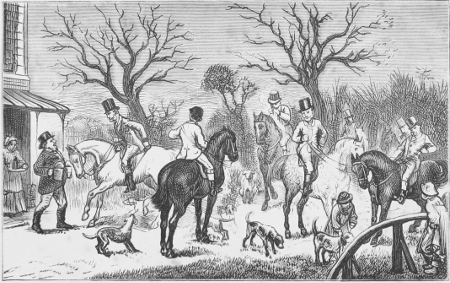
Punctual to the minute the hounds arrived, and after a quarter of an
hour, during which time refreshment for man and horse was in full swing,
the signal to move off was given.
"Mornin', Master Jack," said old Jim the Huntsman, as Jack came out of
the stable-yard, his mount bucking like an Australian. "I'm main glad to
see you wi' us again; we shall soon find summat to take the play out o'
you" (alluding to the horse). "If I mistake not, you mean a-showing 'em
what for, and I'm sure I hope you will."
"Jim, you get younger every day. They tell me you are going to be
married again and give up hunting; is it true?" was Jack's reply.
"Get along with you; you're no better than you used to be, Master Jack,"
retorted the old man, who was fast nearing his seventieth year.
At this moment the Colonel rode up, accompanied by Mildred and Mr.
Simpson, the latter, it must be confessed, looking far from comfortable.
"Jim," said he, "we will draw the osiers first, please, up-wind, and
send Williams" (the First Whip) "down to the corner. Mr. Wilton and
myself will stop by the gate and view him if he tries back. Mr. Talbot"
(the Master) "has gone on to the wood, and wished me to tell you."
"Right, Colonel," replied the Huntsman, lifting his cap; and with a
"Coop, coome away!" he trotted off down to the bottom end, the hounds
clustering all round his horse.
"This way, Milly," said Jack. "Come on, Simpson and Tom," and the
quartet established themselves out of sight at the top end of the
osier-bed. Presently old Jim was heard cheering his hounds, and a
whimper from old Solomon proclaimed the fox to be at home, as usual.
"Eugh, at him!" cheered Jim, and as the whimper swelled into a chorus a
regular traveller slipped out close to Mr. Simpson, and headed straight
over the dreaded brook.
"By gad, he's off!" said Jack, and "Gorne awa-a-y!" proclaimed his
departure to the expectant field. The hounds tumbled out of covert all
of a heap, and plunging into the brook in a body were away on the other
side in a trice, with a scent breast high.
"Miss Vivian, for goodness' sake don't attempt the brook," implored
Simpson; "I will stop and look after you."
But Mildred, vouchsafing him not so much as a look, caught the impatient
Birdcatcher by the head, and with Jack and Tom on either side the trio
rattled down at the water, which was negotiated with safety.
"Bravo!" said Jack; "here comes Simpson;" and come he did, for his
perfect hunter was not made of the stuff to be left behind if he could
help it, and seeing his three companions careering away down the
opposite field, he, to use a nautical expression, "took charge," and,
before his rider knew what had happened, had landed him safely on the
other side of the obstacle.
"Down the lane," said Jack to Mildred as they popped over the fence that
led out of the meadow; "it's straight for Boltby big wood. Here you
are, Jim," as the Huntsman came up to where the hounds had checked for a
moment in the lane; "they made it good as far as this. Hark for'ard!
Minstrel has it;" and away they went a cracker, turning sharp to the
right into some rolling grass-fields.
By this time Mr. Simpson was beginning to pluck up his courage, and in
company with those who had not been so favoured at the start was going
fairly well. Ten minutes more brought them to the stiles that had been
the subject of discussion at dinner the previous evening, and
nasty-looking objects they were. The first was not so bad, but the
second was a regular teaser—hog-backed, with a yawning ditch, spanned
by a footboard on the far side.
"Steady, Milly," said Tom, as Birdcatcher rushed at No. 1.
"By gad, she'll be down if she goes at that pace," shouted Jack in an
agony, his horse, a young 'un, having refused.
At this crisis Mr. Simpson appeared on the scene, the rest of the field
preferring the safer course down the lane. Tom managed the hog-back
successfully, and was too much occupied with the hounds, now racing a
field ahead, to think of Mildred, who had evidently got as much as she
could manage in the thoroughly-roused Birdcatcher.
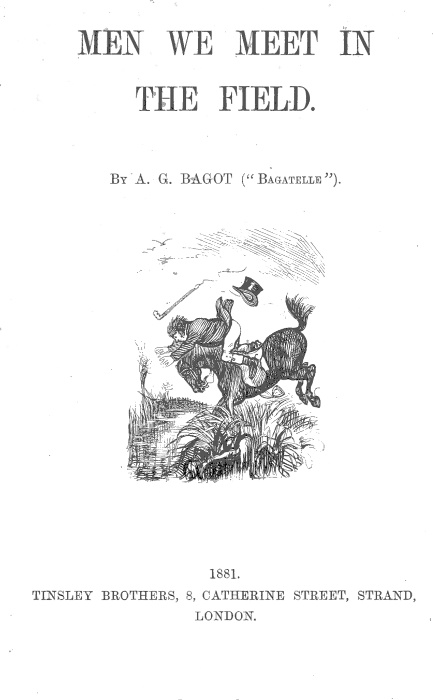
Jack's feelings can be better imagined than described as he saw Milly
rush at the stile and Birdcatcher turn a complete somersault, sending
his mistress flying, happily, some yards away from where he fell.
"Come up, you brute," he yelled, driving his spurs home and fairly
lifting the astonished young 'un over both fences. Scarcely had he
landed over the hog-back than he was off his horse and kneeling by Milly
in a paroxysm of grief.
"My darling child, are you hurt? My God, she's dead!" he cried, as he
tried to lift her.
But she was only stunned for the moment, and to his ineffable joy Milly
opened her eyes and said: "It's all right, Jack; I'm not hurt. Catch my
horse and let's get on."
The "Thank God" came from the bottom of his heart as he caught the two
nags and lifted her on; but the agonised expression on his face told
Mildred plainer than any words the "old old tale," and in her inmost
heart she blessed the fall for the revelation.
The fox meanwhile, who had been headed by a labourer, turned short back,
and as they came round, about two fields above the spot where the
accident took place, everyone was much amused at the sight of Mr.
Simpson, who, unable to muster up courage to ride at the place, and
thinking that no one was likely to see him, had got off his horse, and
having promised a yokel a sovereign to catch him on the other side, was
doing his best, with the aid of his hunting-whip, to induce his four
hundred guineas' worth to take it by himself. No further mishap
occurred, and in half an hour, after running hard all the time, they
viewed and killed their fox in the open, Mr. Simpson arriving just as
the last morsel disappeared down old Solomon's throat.
By this time Mildred was feeling the effects of her fall, and Simpson
was only too glad to offer to be her escort home; an opportunity which
he took advantage of to propose in due form, the effect of his
solicitations being somewhat marred by the aversion his horse displayed
to walking.
"I'm very sorry, Mr. Simpson," said Mildred, in reply to his entreaties
that she would consent to be the "Co.," "I'm very sorry, but it can
never be."
"There's some other fellow in the case; I will know who. It's that
horrid cousin of yours," said the man of money with his innate
vulgarity, for he could not understand any girl refusing his gold.
"Mr. Simpson, you have no right to speak to me like that; and seeing
that my cousin picked me up when I fell, while you were too much alarmed
for your own safety, I have no reason to consider him horrid," was
Mildred's cutting reply, after which she refused to speak till they
arrived at the Hall.
Whether it was the rebuff that he had received, or joy at finding
himself safe, I cannot say, but at dinner Simpson drank more than was
his custom, and was proportionately talkative and bombastic in
consequence, and towards the end he entertained the company with a
description of how he got over the most enormous places.
"You—ah—see, my horse" (he called it "'orse"' now that the wine was
in) "refused that stile where Miss Vivian fell, and Mr. Ward told me it
was no use riding him at the same thing twice, so I had to look
out—ah—for another place. I saw there was nothing for it but the fence
at the side" (it was an overgrown blackthorn, with a six-feet post and
rails run through the middle), "and—ah—by Jove! my horse cleared it
without touching a twig—ah."
"My word, Simpson, that was a jump—almost as big as the cow took when
it vaulted over the moon," said Tom.
"Fact, sir, 'shure you," replied he of the City, when the butler came up
behind his chair and in an audible voice said: "I beg pardon, sir, but
there's a man downstairs who says you told him to call—says you
promised him a sovereign for catching your horse when you turned it over
the stile."
It may have been rude, but the guilty look of Simpson and the utter
ludicrousness of the whole affair was too much, and everybody, including
the Colonel, fairly shrieked with laughter, during which Mr. Simpson
bowed himself out to see about this "tale of the sovereign," as he
called it.
Later on the butler appeared a second time, bearing in his hand a yellow
envelope, which he handed to Jack.
Opening it carelessly he read: "As agents to John Sandford, acquaint you
of his death. Yourself left sole heir. Telegraph instructions. Money and
securities, eighty thousand. Three large tea estates, besides other
property. Letter follows.—Kirkman and Co., Calcutta."
I am afraid Jack's face did not express great sorrow for his deceased
uncle. Indeed, as he glanced across at Milly, a great look of joy came
into his eyes, and after dinner he found an opportunity to ask her a
question, receiving a very different answer to that vouchsafed to Mr.
Simpson.
Christmas morning he interviewed "papa in the study" without fear of the
butler, and that evening the Colonel, with tears in his eyes, made a
long speech, wherein he gave his daughter to his favourite nephew, with
solemn injunctions to take care of her.
Jack, in returning thanks, said he would do his best to see that she did
not break her neck; he had already had a turn he should never forget;
but as it was somewhat instrumental in helping him to gain Milly, he
begged to propose the health of The Hog-backed Stile.
Simpson, when he saw the game was lost, turned out a much better fellow
than anyone gave him credit for, and Milly found on her table a pearl
necklace and a card, on which was written: "With T. Simpson's best
wishes and apologies for rudeness."
Now, whenever he meets Jack and his wife, he tells them that the lesson
he got at Belton taught him that money and bluster were not everything
in this merry world of ours.
THE END.
CHARLES DICKENS AND EVANS, CRYSTAL PALACE PRESS.