“I would not like to work in a candy store,” said a
young lad, “because then I could not have the fun of
buying candy.” A visitor to Atlantic City stepped into
one of the shops to make a purchase. She said to the
little girl in charge, “It must be delightful to be able
to live in Atlantic City and work right here on the boardwalk.”
“You may think so,” replied the girl. “But I
guess if you put in all your time in this store, and had
to come to work at eight in the morning and work until
nine at night every day; and all the time saw these
thousands of people passing along outside, going up and
down, with nothing to do but just enjoy themselves, you
would not think it is such a snap.” Two boys were
playing the game of “wish.” When the turn of the
youngest came, he said, “I wish that I worked in a
chocolate factory, then I could have all the chocolate
I wanted to eat.” When we become acquainted with the
people who are at work producing the luxuries, we find
a common and far-reaching disillusionment. The hardest
work in the world is to work when other people are
playing, or work hard ourselves just for the purpose
of giving other people enjoyment. And yet there are
literally hundreds of thousands of people who spend
their lives in producing luxuries.
Oliver Wendell Holmes used to say that if he could
just have the luxuries, he would not care anything about
the necessities of life. This was a whimsical way of
stating a fact that is common to all experience, that is,
that life is enriched by the luxuries we enjoy. I asked
a man of the typographical union what he considered the
one thing that had done most for the advancement of
printers. He replied, “Pianos in their parlors.” By
this he meant that when hours were decreased and wages
increased, printers began to have something to hope for;
and with a margin of money they bought luxuries, and
in the margin of time enjoyed them. Thus they laid the
foundation for future development.
Luxuries. What constitutes a luxury? This is a difficult
question to answer. Some people think that it is
a luxury to take a bath. In fact, many of the monastic
orders put special virtue on foregoing the use of soap
and water. An old gentleman living in a little town
near Chicago who owned a great deal of the property in
the town, fought every effort to put in water-works and
a sewer system. As the climax of an impassioned speech
at a public meeting in which he had denounced the
extravagances of the present time, he said: “These new
notions of our young people are going to ruin us. My
daughter made such a fuss that nine years ago I put a
bathtub in our house, but I never use it and I guess I
am about as healthy as any man in town.” One of the
religious sects forbids its members the use of buttons on
their clothes, as they are regarded as useless luxuries.
They fasten their clothes together with hooks and eyes.
Cutting the hair, shaving the beard, wearing gold and
silver, adorning the person in any way, all of these things
are considered luxuries by some persons. Luxury is
really a thing that we can get along without. But at best
it is a relative term, for what one person would consider
a luxury another would consider a necessity.
Growth by Wants, Not Needs. A merchant in Memphis
had a carload of supplies arrive early one Saturday
morning. He was very anxious to get the goods unloaded
so that he could release the car. He started out
to get help, but every Negro on the street had some
good excuse why he could not help. Meeting an old
fellow on the corner he said to him, “Look here, Bob,
what is the trouble with all these Negroes? Not one of
them wants to work and yet they all seem to have plenty
of time and nothing to do.” “It’s just like this, Boss,”
replied old Bob. “All the worth-while niggers is out
working, ’cause you see they’s got to support their Fords.
These here fellers ain’t no good; don’t want cyars and
won’t work nohow when the sun shines on both sides of
the street at de same time.” In this statement we have
summed up the philosophy of all workers. It is only
when we desire something better than we have and are
willing to work for the thing desired that we begin to
advance. Luxuries are the things that are not essential
for mere existence, but they are the things that are of
infinite value in enriching and adding to the meaning
of life.
Classes of Luxuries. Luxuries can be roughly divided
into two classes, those that are harmless and those that
are hurtful. The extra dress, the piece of cake, the
sugar in our coffee, the coffee itself, and in fact a great
many of the things we wear, eat, and drink are luxuries.
The line between these things and necessities is such a
thin one that it is hard to know just when a thing ceases
to be a necessity and becomes a luxury. Most things
are harmless in and of themselves, and it must be acknowledged,
luxuries have the effect of increasing the
value and meaning of life. There are, however, luxuries
such as beer, wine, whisky, brandy, and other alcoholic
stimulants used as beverages, also tobacco used as snuff,
for chewing or for smoking, which add nothing to life;
but on the contrary must be classed with the habit-forming
drugs so injurious to the race. In this chapter we
are considering luxuries from the standpoint of production,
and not the moral value involved in their use.
Therefore, we must think of the workers in the brewery,
the cigar and cigaret makers, the makers of artificial
flowers and willow plumes as all belonging to the same
class. They are the ones who are making the things that
are not absolutely necessary for our existence. Were
the production of bread to stop we could not live. Iron,
steel, coal, and transportation are all part and parcel of
our very existence, but we could get along very well if
not another artificial flower, cigar, or fancy dress were
made.
The Cigarmakers. The cigarmakers living in Tampa
and Key West form the most complete compact group of
workers to be found anywhere in the United States who
are interested solely in producing luxuries. Tampa is
known as “The city that furnishes the world’s smoke.”
Last year this city shipped (in round numbers) 300,000,000
cigars! Havana and Key West have always been
considered the principal cigar cities, but the production in
these latter places has been declining for a number of
years, while it has been increasing in Tampa. It was a
clash between the Cuban and Spanish workers at Key
West which led the first manufacturer to move from
that city and build his factory at Tampa. To-day there
are 15,000 Cuban and Spanish workers employed in
Tampa in making cigars. A person could live in the city,
and by restricting his business to certain districts, from
one year’s beginning to the end would never hear a word
spoken in any language except Spanish. The city is a
foreign city, and a city of workers producing a luxury
that all the world demands. Since the time that
Columbus sent his men to explore the island of Cuba
in November, 1492, and found the natives “carrying
and smoking firebrands” made from loosely rolled leaves
of a weed which grew extensively on the island, until
the present time men everywhere have found enjoyment
and pleasure in the narcotic value of tobacco.
The Making of a Cigar. In its manufacture a cigar
goes through a process dependent upon the knowledge
and skill gained from years of practise on the part of
the worker. The tobacco that is used in making the
best cigars still comes from the island of Cuba. It is
grown very carefully, cured, baled, and shipped under
bond to the United States government. The bales as
they are received at the tobacco factory weigh from 80
to 120 pounds. The tobacco is of two qualities, that to
be used as a filler (which makes up the body of the
cigar), and that which is known as the wrapper or the
outside covering. From the time that the tobacco begins
to grow until the cigars are packed in the boxes ready
for shipment the weed requires special care and attention.
As the bales of tobacco are brought into the factory
they have to be piled in a certain way. Some of
them are piled high, some of them low, some on their
sides, and some on their ends; all depending upon the
quality and conditions of the leaves.
The tobacco is cured by a process which adds to its
value; and the curing must be carried on with precision,
for a faulty method will spoil the best tobacco that can
be grown. Any one who has visited Tampa is impressed
with the humidity of the atmosphere. The climate of
Cuba is more nearly reproduced there than in any other
city in America, and because of its equable temperature,
it being neither too hot nor too cold, the city has become
famous as the manufacturing center for cigars.
The cigarmakers sit at long tables in parallel rows
throughout the room. In one room in a large factory
eight hundred workers sit as close together as possible.
The tools of the trade are a flat, broad-bladed knife, a
hard block, a gage, and a rule. This gage is simply a
hole bored through a piece of board and as the worker
makes up the cigar, from time to time he puts it
through the hole in the board to see that it is the
proper size and places it against the rule to see that
it is the proper length. Should it be too large it must
be rolled tighter, if too small it must be loosened up a
bit. Much depends upon the way a cigar is rolled. “I
learned to make a cigar in three months,” said a Cuban
cigarmaker, “but it took me two years to learn how to
put an end on it.” This is the real test, and until a
machine is invented which can turn this trick, the hand-made
cigars, rolled, and finished according to the old
Spanish method, will hold first place.
The Reader in the Factory. The Tampa cigarmakers
are all either Spanish or Cuban, and in conversation
they gesticulate with their hands to such an extent that
it is impossible for them to talk and work at the same
time. Hence, the manufacturers are very sympathetic
with the old custom of maintaining a reader in the factory.
This reader has a little balcony from which he
reads to the employees while they are at work, making
his selections from current magazines, newspapers,
novels, telegrams, dispatches from abroad, and extracts
from books on national history. It is an interesting
sight to see a factory of four or five hundred workers
busily engaged in plying their trade, and listening at the
same time to a story read by the paid reader, who, with
coat off and suspenders hanging, gesticulates and shouts
at the top of his voice. One of the readers in a Tampa
factory has held his position for twenty years. He reads
daily from the New York Herald, translating the news
articles into Spanish as he reads them. The reader is
well paid, for each worker gives him twenty-five cents
a week; and it is reported that some of these men receive
as high as $300 a month. The workers decide what
shall be read. Some years ago there was a strike in one
of the factories occasioned by a protest on the part of
the women workers against the reading of an especially
vulgar novel. The management ordered the reading of
this novel stopped. The men then laid down their tools
and refused to go back to work until they were assured
that the story would be continued. Among the cigarmakers
the tradition is that the custom of reading grew
out of the desire of the early workers for a more liberal
education than was offered by the church and its schools.
Wages and Unions. The wages of the cigarmakers
are based on the piece-work system. An expert may
make as high as $35 a week; the average is a little
higher than in other employments using the same grade
of labor. Some years ago, when a bitter strike was conducted
in Tampa, the question of wages was one of the
grievances of the men but was not the real trouble, for
the problem in Tampa now as well as then is racial and
psychological rather than economic. The strike was settled
on the basis of an agreement called the “equalization
agreement.” This provided for the appointment of
a board to be composed of three manufacturers and
three cigarmakers who would meet regularly, hear complaints,
and make adjustments. Most of the workers
belong to the union, and under this agreement there is
a fair degree of peace in the industry.
One great difficulty is that the workers in the cigar
industry carry into their trade no moral enthusiasm.
They are doing something that is not absolutely requisite
for human welfare, and while they make good money,
they have no commanding purpose to impel them to
carry on their work. The people live simple lives for
the most part. On Saturday nights the streets of the
city are filled with people, and every one is in a holiday
mood. The majority of the cigar workers in Tampa
are communicants in the Roman Catholic Church and it
is the finest building in the city. It is constructed of
marble and decorated with magnificent windows. The
church takes little interest, however, in social or economic
matters. One of the workers said to me the last
time I was in the city, “When the business men forced
us back to work, and through their private army guarded
the city with sawed-off shotguns, the church was back
of them. All the priests want is our money.” To the
cigarmakers a church is a church whether it be Catholic
or Protestant. They remember the days in Cuba under
the domination of Spain when the priests held them in
a kind of bondage of fear, and made it easy for the
political forces to exploit them. In America they do not
intend to give the church a chance at them.
The Cuban is easily pleased; very emotional, and more
inclined to be fickle than the American or Englishman.
A few years ago the butchers of Tampa raised the price
of meat. Just at that time there happened to be a representative
of the Industrial Workers of the World in
the city. He gathered some of the people together in
East Tampa, harangued them regarding their wrongs,
and called a second meeting. He aroused so much enthusiasm
that nearly two thousand of the cigar workers
quit their jobs; procured sticks, and bought beefsteaks
and stuck them on the end of the sticks. Carrying these
over their shoulders as though they were banners, the
whole mob marched through the streets to the City Hall,
where they demanded of the startled mayor, that he
force the butchers to reduce the price of beef. The
mayor gave the necessary order and the people then dispersed
and went quietly back to their homes. Union
organizers complain that it is very difficult to maintain
a union of any strength among the cigar workers in
Tampa. “They are very enthusiastic for a time, but
it is difficult for them to persistently and constantly follow
the union rules,” said one of the leaders.
The city of the cigarmakers swarms with children,
many of these youngsters play in the street, and as the
climate is warm most of the year, during the summer
they wear very little clothing. Until recently there was
no provision made for organized play among the children
of the city. Even now the provision is totally inadequate.
The Protestant Churches. The Protestant churches
have attempted to do what they could among the cigarmakers;
but the needs have been so great and the equipment
so inadequate that the best results have not been
secured. In West Tampa there is a very interesting
piece of work being conducted by the Methodist, the
Baptist, and the Congregational churches. One of the
churches has a plant consisting of a church, a school,
and a house that is used as a social center for the entire
community. For many years two homes were operated
by this church; one for boys and one for girls. Some
seven hundred children attend the school in connection
with the church. The services on Sunday are in Spanish,
and while it has not been possible always to secure a
large attendance from among the people, still there is
usually a representative and interesting group present.
A man who served as pastor of the Cuban church was
for a number of years a regular worker in one of the
big cigar factories. This gave him a peculiar relationship
to the community. He was accepted as a friend and
equal; and was listened to with reverence and respect
where another man would not have secured a hearing.
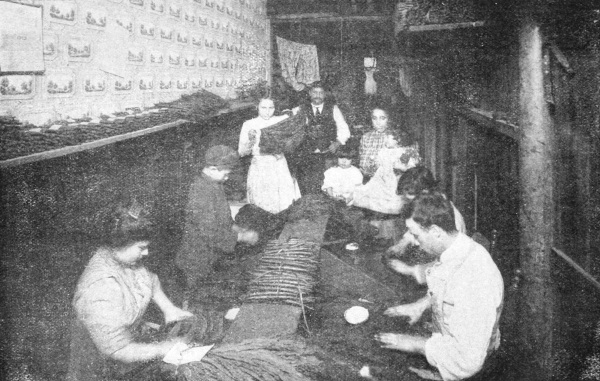
Photo from National Child Labor Committee.
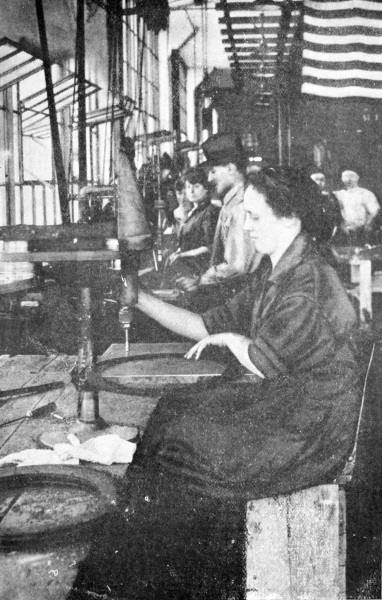
The workers in the cigar industry carry into their trade no moral enthusiasm, for they are doing
something that is not absolutely requisite for human welfare.
Some Results of the Work. A little girl in the community
where one of the church homes is situated was
arrested for being a vagrant. Her face was dirty; she
was barefooted and wore a torn, buttonless, brown gingham
dress that was positively filthy and which was held
in place by a safety-pin fastened in such a way as to give
the whole dress a weird, elfish look. The child’s picture
was taken on the day that she was arrested and committed
to the care of the church. This picture is a typical
portrayal of childish rebellion against life and all that
it holds in store for the human race. Her mother was
a worthless woman, and the child had never known a
father. All her life she had really lived on the streets
of the city. Her case was brought before the Juvenile
Court; she was put on probation and given into the care
of the workers in one of the little Protestant churches.
She objected to having her hair combed and refused to
wash her face. Those in charge of the home were almost
in despair of being able to do anything with her.
However, they won her confidence by allowing her to go
to a party where they had a phonograph and motion pictures.
They told her she could have all the cake and
lemonade she wanted; so once in her life under happier
conditions she had a chance for simple enjoyment and
to be her natural self. From that time on she began to
take an interest in herself and to gain in intelligence.
Two years later she had her picture taken and it was
exhibited as the picture of the typical Cuban girl, for
she had developed into a perfect little beauty and showed
capability. This story illustrates better than almost anything
else the infinite possibilities in the Cuban people.
Some one said of the cigarmakers in Tampa that they
were not Americans and never could be, and further
stated: “They are interested only in their theaters, their
clubs, their cock-fights, their coffee-houses, and their
gambling rooms.” It is true that they are interested
in these things; because they are by temperament a
pleasure-loving, happy-go-lucky sort of people and these
resources are the expression of their idea of life. If
the church would meet the needs of these people, it must
be able to appreciate them, and sympathetically to interpret
life for them. They can all become, as indeed
most of them are now, good American citizens, but they
will never be like the Americans in our Northern cities.
We must allow them to develop along the lines of their
own racial interests. How can we ever expect to be
friends with Latin America if we cannot learn how to
be good neighbors to the Latin Americans living in our
own land?
The Challenge of Conditions in the Factories. The
conditions in the factories are not ideal by any means,
nor is the nature of the business such as to promote the
highest type of character. The work is hard, and it is
performed in a heavy atmosphere poisoned with the
breath of many individuals, and vitiated by the odors of
human bodies and damp tobacco. The rooms where
cigars are made have to be kept closed to save the weed;
and every window is down, and no matter how hot the
weather, not a breath of fresh air is allowed to enter
the place. The atmosphere is so bad that it gives one a
headache even to pass through; imagine what it would
mean to spend your life working in such a place.
Tuberculosis makes deep inroads in the ranks of the
workers. Statistics show that the proportion of mortality
among the cigar workers from tuberculosis of the
lungs is higher than in almost any other occupation.
Between the ages of 15 and 24 the proportionate mortality
from tuberculosis is 48.5 per cent. of the total deaths
as compared with 33.8 per cent. for all occupations.3
The reason for this is that the workers must sit for long
hours at a table in a bad atmosphere and surrounded by
others, many of whom are suffering from tuberculosis.
There are nearly 50,000 members of the union and these
men have been fighting for years for a betterment of
conditions. However, just as in other trades, the employers
claim that it is impossible to make cigars without
sacrifice of the working men and women. The workers
have accepted it there, as other workers have accepted it
in other occupations, with the stoic attitude that marks
so many of the laborers of our country.
One of the most noted social workers in America, a
woman with strength and charm of character, who is a
leader in every radical movement, began her life in a
cigar factory. Later on she married a man of wealth and
has lived a life of ease ever since. She says of her early
experiences: “For twelve years I was a cigar worker
in Cleveland. I was ill-nourished and poorly clad. I
worked at night as well as by day to help piece out my
family’s existence. I never had anything I wanted.”
This might be said of a great many of the cigar workers
and their families. The only difference would be that
she did not tell all of her story. In addition to the long
hours there is an undermining of the health that goes
with it. Now all these people are working for some
one’s pleasure. They are making luxuries. The most
radical person I ever knew in my life was an eighteen-year-old
girl whose parents had lost their money. She
was forced to go to work in a cigar factory when she
was twelve years old. She was bitter toward life and
had no faith or confidence in anything or in any person.
Said she, “When I look around and see people who have
all the money and all the clothes and all the good things
that I want and can never have, I know that conditions
are unjust and must be changed. I don’t care what it
costs; I am going to do my part in fighting and agitating
until there is a change.” This is an attitude that is
now growing very common. There are deep-seated
forces at work perpetuating these ideas. By valuing
things more than men these conditions are made a permanent
part of our life.
Furs. “Why do you want to wear furs in the summer-time?”
I asked a young lady. It was an extremely
hot day and she was wearing a white dress with very
short sleeves and cut low in the neck, but she had a fox
fur around her neck; there was quite a margin between
the lower edge of her fur and the upper edge of her
dress. “Why,” she replied, “I think it is pretty, don’t
you?” This fur had come on a long journey and gone
through many processes before it came into her hands.
Many men and women had labored to produce it. The
man who had caught the fox probably had a line of
traps stretched over nine or ten miles of some stream in
the northern part of Canada or Alaska. All through the
bitter cold of the winter he had lived alone in a cabin,
and day after day had tramped that line to take out the
animals that had been caught. Bringing them back to
his cabin he skinned them; turned the hide over a piece
of board and stood it behind the stove to cure. Later
the pelts were brought out of the wilderness and sold
into the hands of a group of fur workers. They were
then more fully cured, and passed on to the makers of
scarfs. All of these workers were producing a luxury.
The Trappers’ Community. In one of the regions
of the Northwest where trapping is carried on through
the winter there are three little settlements. There are
only three white people and one white family in two of
them, and the third settlement, which is a trading post,
has about half a dozen white families. From the time
that the snow falls in the autumn until late in May of
the following spring, no one comes into these communities
except the man carrying the mail who comes
once in about ten days. No one goes out from the community
unless it is absolutely necessary. The only ministers
that ever visit there are those who come in the
summer to enjoy the fishing in the near-by streams. The
wife of a trapper in this region said to a minister: “Our
oldest girl is nearly thirteen years old. She has never
been to Sunday-school and never heard a sermon. She
has never seen a church and you are the only preacher
to whom she has ever talked. When I was married
fifteen years ago in Missouri and we started for this
country, I had no idea that a girl who had been brought
up in the church and was a teacher in the Sunday-school
could live so long in a community where there is no
church or religious service of any kind.” When we
learn of places like this where there are no churches,
and then hear of some small community that has six or
eight churches and only about five or six hundred people,
we wonder if there is not a call for a new kind of missionary
effort and zeal. The church is not alone to
blame nor is any one wholly responsible for this condition,
and yet we are all to blame, for if it is necessary
that a man should live on the outpost of civilization it
should be made possible for some of the good things of
civilization to be taken to him. In the foreign missionary
work we have crossed oceans, traversed mountains,
translated the Bible into new languages, and made
every effort to reach new groups of people. In our own
land we have neglected people just because they seemingly
live in a world outside of our own. While they are
producing the things we demand and use, we have forgotten
the men who have brought these things to us.
The Theater. People have always been interested in
seeing life presented in a play. The theater has had a
large place in the history of every nation. It has furnished
the means of recreation and amusement, and in a
large measure it has been a great educator of the people.
Religion was once taught through the theater. In fact,
much of our church ritual is taken from performances
that were meant to symbolize great facts and emotions
of human life. The modern theater has become highly
commercialized, and those who attend the performances
continually demand more magnificent scenery, more
elaborate costumes, and more thrills. What of the performers?
Have you ever wondered, as you looked at
the play, just how the people who are taking part would
look if you saw them off the stage? For instance, there
is a girl that is playing the part of an old woman. She
is dressed in a plain black, close-fitting gown, and hobbles
across the stage leaning heavily upon a stick. In
actual life she is a young woman under twenty-five years
of age, has bright red hair, a charming smile, a figure
that her friends describe as willowy, and walks with a
springy step like that of a high school girl. Another
character in the play is a woman who plays the part of
the vampire. At home surrounded by her three children,
she is a demure, domestic little body.
A few years ago one of our theatrical critics said that a
glimpse behind the scenes would cure almost any girl
of the desire to become an actress. The glamor is all
in front of the curtain. Behind the scenes we come face
to face with a hard-working group of men and women
who are doing their best to furnish amusement. One
of the leading actresses, in writing the history of her
life, said that the only opportunity for success on the
stage was for the person who comprehends fully that the
theater offers but one thing—a chance for long hours of
drudgery and the uncertain rewards that come from the
hands of a fickle public. She described vividly the actors’
boarding-house, with its narrow cramped bedrooms; its
dimly-lit halls, with the faded and worn carpet; the
smell of cooking that permeated the whole place “like
the ghost of a thousand dead dinners;” the bitter loneliness,
the jealousies, the misunderstandings, and she
added, “my whole being revolts against all the petty
details of the life.” Then there is the traveling; nights
on the train and days spent in the hotels until time to
go to the opera house; then the feverish excitement of
dressing; the play; and back to the hotel for a few hours’
sleep and away again to another town.
The trouble is that most of the young people who
think that they would like to go on the stage think
only of the theaters in New York, Chicago, Boston, or in
one of the other large cities. The great majority of the
actor-folk spend most of their time traveling from place
to place. There are comparatively few plays that enjoy
long runs. Nowadays in one-night stands there are few
places where special rates at the hotels are secured for
actors. Usually the worst rooms in the house are assigned
to them. In fact, the rooms that are given to
the actors and actresses are known in a great many hotels
as the Soubrette Row. The best rooms are saved for
the regular patrons of the house, such as traveling salesmen,
while anything is “good enough for the actor.”
In China the player folk live to themselves. They have
no other companions but form a class of their own. We
have not recognized the caste system in this country, and
we do not officially ostracise the players, but in effect
this is what we do. Their world is a world apart, yet
they are the ones that help to amuse us. Each year we
pay millions of dollars into the coffers of the theaters
to see plays that are produced by these men and women
who work hard, and who receive but little for their toil.
Once in a while the newspapers tell the story of some
old actor, who has just died poor, broken down, and forgotten
by the public. One of the most pathetic figures
of these modern days was that of an old actor in Brooklyn,
who had to be buried at the expense of his friends.
They took up a collection to buy the casket in which he
now rests; otherwise he would have been buried in the
potter’s field although thirty years ago he was one of the
most popular men on Broadway. There are thousands
of actors and actresses and they live for the most part
to themselves. The Actors’ Church Alliance was formed
some years ago and has branches in many of our cities.
There is, too, an organization known as the Actors’ Fund,
which provides relief for the poor found among these
hard-working men and women who give so much pleasure
to millions of people.
The Motion Pictures. The motion-picture business
has become one of the greatest enterprises of our day.
In 1914 there were over 20,000 motion-picture theaters
in the United States. The year before that three hundred
million dollars was spent for films, and over five
billion paid admissions were recorded throughout the
country. The motion-picture has made possible the reproduction
of the best plays, and they are offered to the
people at a very low price. Five and ten cents will
permit any one to be amused for a whole evening. The
motion-picture theater possesses great educational possibilities.
It has revolutionized our ideas of entertainment.
The best books have been put into films and more
people than ever before are having a chance to read.
This is having a profound effect upon our lives, for as
has been said, “the thing we see impresses us more than
what we hear.” We often say, “it went in one ear and
out the other” but no one ever says, “it went in one
eye and out the other.” The making of films requires
the work of thousands of actors; besides carpenters,
masons, machine operators, directors, and managers. It
is a huge business!
A crowd gathered in New York at Thirty-fourth
Street and Second Avenue one Saturday afternoon. A
man was beating a boy when a disheveled woman ran
out from the side entrance of a saloon and threw herself
upon this beast. He grasped her by the throat and
was just about to strangle her, when the boy, released
from the clutches of the man, stabbed him in the back
with a knife and thus freed his mother. It happened
so quickly that many of the crowd thought that they
were looking upon a real tragedy. It proved to be
simply a “movie” being enacted upon the street.
In a Florida city an automobile dashed into town; a
young girl was in the back seat, while in the front was
a young man driving the machine with one hand and
holding a preacher down with the other. They stopped
in front of a church; went inside, and there they were
met by two other men, accomplices of the young fellow,
and who stood one on either side of the minister with
revolvers at his head and forced him to perform the
marriage ceremony. An outrage in real life, but really
played for the movies.
In the West there are cities devoted entirely to the
motion-picture industry. In some of the elaborate plays
hundreds of thousands of dollars are expended in getting
the scenic effects. Cities have been built and then
burned to give the effect of a sacked town being destroyed
by the enemy. Shipwrecks have been shown
where real ships have been purchased, and then run
upon the rocks and deliberately wrecked to get the
proper setting for the pictures and the necessary thrills
for the people. What of these people who follow the
motion-picture industry for a living? Their lives are
apart from the rest of the community. It seems fascinating,
but it is one filled with hard labor, uncertain
hours, and affords rather scanty pay. The pastor of
one of the Los Angeles churches attempted to reach the
people living in the near-by “movie-city” but he failed.
A plan should be devised whereby a sympathetic understanding
might bring these hard-working people into
relationship with the church. The influence of such a
tie would be far-reaching in results.
The Makers of Other Luxuries. Another group of
workers are those who make jewelry; others are
at work making fancy costumes, special designs in millinery,
and artificial flowers. In fact, when we take a
census of all of the people who are at work serving
the demands of this age, which loves the extraordinary
and insists upon luxuries as a right, you find that there
are in reality hundreds of thousands of these workers
who are in every sense of the word serving humanity.
Whether they are serving in the highest and best way
is not the question we are discussing. As long as we
tolerate an age of luxury and draft an army of thousands
of men, women, and children to help produce these luxuries,
so long must we consider the needs of the men,
women, and children so drafted. The church, if its
appeal is to reach all the groups, must reach all the
workers who are making possible the abundance of things
that minister to an age of luxury.