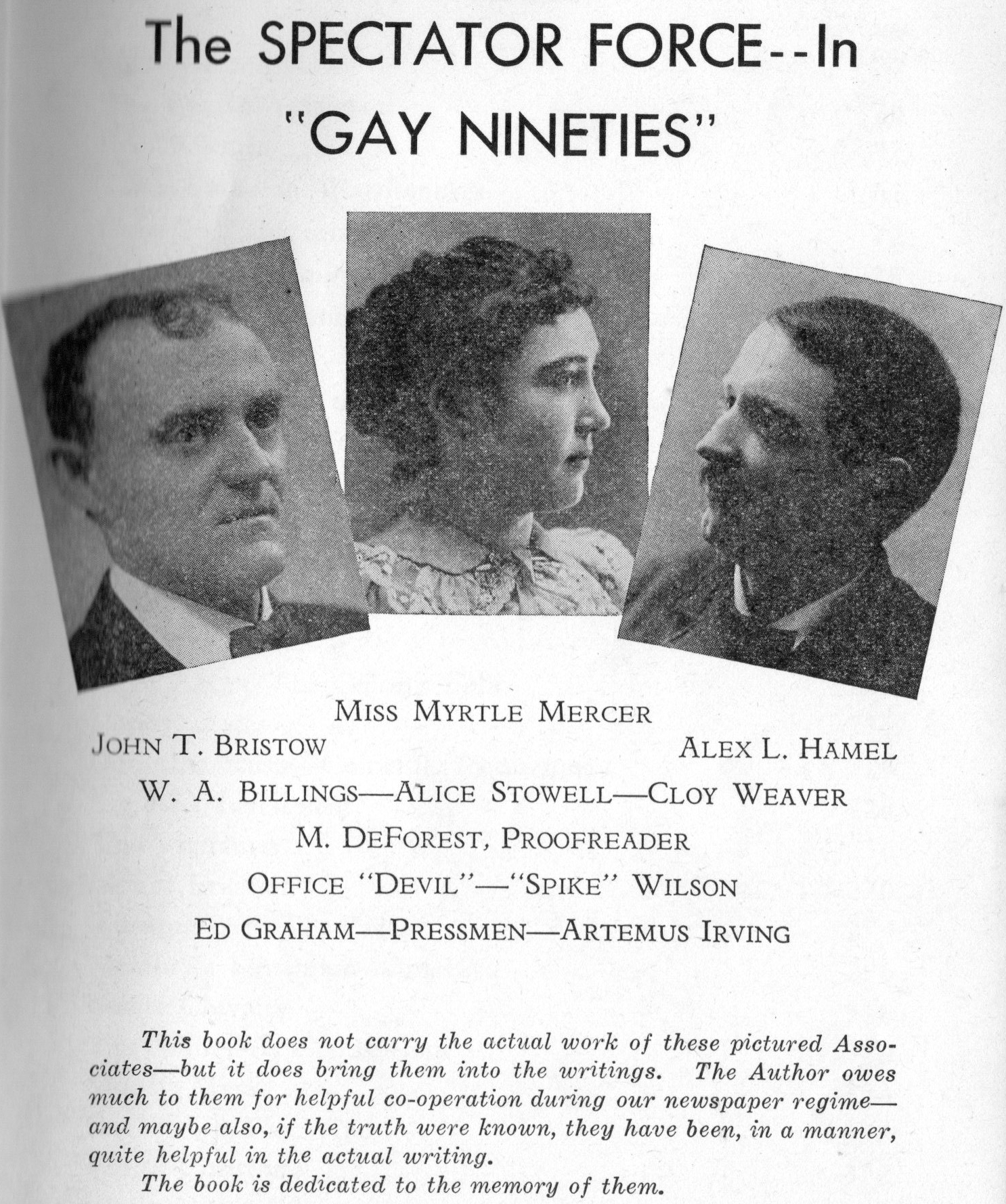
W. F. Turrentine, in Spectator
A few days ago J. T. Bristow received a letter from
Albert T. Reid, national vice-chairman of The American Artists
Professional League, Incorporated, complimenting him
on his article, “The Overland Trail,” and
asking for information regarding “Old Bob Ridley,” a famous
frontiersman well known to what few of the old settlers are left in this
vicinity. “Old Bob Ridley” was Robert Sewell who lived in this
part of Kansas in an early day and had a lot of vivid experiences, some of
which Mr. Bristow recorded in the article mentioned. Robert Sewell’s
wife, several years his junior, was a sister of Mrs. V. O. Hough. We quote
the following from Mr. Reid’s letter to Mr. Bristow:
16 Georgia Ave., Long Beach, N. Y., November 14,
1937.
Dear Mr. Bristow:
Ralph Tennal of Sabetha sent me your story,
“The Old Overland Trail,” a few days ago and I read it from
kiver to kiver without stopping to catch my breath. It is very fascinating
and a swell job.
I was particularly interested in it because I had
done a sketch which I intended painting sometime. I made the sketch about
two years ago and from my memory of the incident which fascinated me
particularly. I called it “Old Bob Ridley Brings in the Mall.”
Recently I put a mural in place in the Post Office
at Sabetha which was called “The Coming of the New Fast Mail.”
It is of the Pony Express rider passing the old Mail Stage. It has made a
hit far beyond my wildest hopes and leads me to believe this is the sort
of thing the public likes, and particularly our Kansas people—they
like something which is out of their past, realistic, romantic, colorful.
Possibly you may remember me as the fellow who
published the Leavenworth Daily Post for 18 1/2 years and the Kansas
Farmer for almost eleven years during that period. I started to stick type
on the Clyde papers. Was born up in Concordia and I never saw a railroad
train until I was well up to six —
just my father’s old stages which ran from
Concordia to Waterville and Marysville.
So you see why the painting of our old past
particularly interests me and why I have a considerable first hand
knowledge and feeling for it. The details are most important to me. I made
a most careful research for my Pony Express and I want to be very accurate
with Old Bob when I start in to paint it. There are a few details I want
to get straightened out, so I am imposing on you to help me, thinking you
may have some interest in seeing the incident preserved.
I gave Mr. Reid the information he desired, but I
do not know if he ever finished a canvass of “Old Bob.”
Probably not—for it was my impression (from reading between the
lines) that if and when it should be completed that I would be expected to
approve it, in return for his compliment to me. Bob’s home town
would have been the natural place to exhibit it. Albert was concerned most
as to whether the stage-team driven by Bob at the time of the Indian
attack near Cottonwood Springs, in which he killed three Redskins and
wounded a dozen more, were horses or mules. I said in my story that
“Ben Holladay gave him a gold watch for saving the stage and the
four mules.” And this was Bob’s version of it. So I gathered
that Mr. Reid had this incident in mind for his painting. Only recently,
Dec. 10, 1950, the Topeka Daily Capital ran a story, with illustration of
a canvass by Albert T. Reid, “Main Street—1873” of the
Artist’s old home town, featuring his father’s four-horse
stage coach on the takeoff from Concordia. The Capital article said the
women’s organizations of Concordia were raising a fund of $1,500 to
purchase the canvass.
Bob Ridley (Robert Sewall) brought his colorful record
with him when he came to Wetmore. Here, he was just like everyone else—maybe
a little more so. He took life easy, did not brag overly much about his
past exploits. Early in his career as stage driver on the Overland Trail,
he fell into the habit of helping a red headed girl wait table at Mrs. D.
M. Locknane’s celebrated eating house just west of Granada, grabbing
bites now and again from his plate in the kitchen, as he worked, all
through the twenty minute stops—and when this got monotonous he
pepped up matters by grabbing the redhead, all in one take. He
married Cicily Locknane—and
established her in an eating house of their own at a station in the Little
Blue valley west of Marysville,
while he himself continued driving stage. But the frequent Indian raids in
that section soon sent Cicily back to her mother
at Granada. Then, when there was no more stage
driving, Bob and Cicily moved down from Granada to Wetmore. Their
activities here have been noted in other articles. Robert Sewell died in
1884.
J. T. B.
The Overland Trail, along which the mighty traffic of
the plains moved, was first laid out from Fort Leavenworth to Fort Kearney
in 1849. The road was definitely established in 1858, with a weekly mail
route from Saint Joseph to Salt Lake. In its settled state, the line ran
daily from Atchison to Placerville, and Sacramento, California.
Prior to that the route through this section was used
by gold-seekers, following the discovery of gold in California in 1849. It
was used by emigrants, trappers, and adventurers coming from the East.
Military stores from Fort Leavenworth to the posts in the northwest were
handled over this trail. Also, freighting by ox-train was carried on
extensively from Leavenworth to the Mormon settlements in the Salt Lake
valley.
Mormons, too, may have traveled the road. And, as has
been asserted in print, Mormons there might have been who camped in a
clump of timber a few miles west of Atchison, causing it to be locally
known as “Mormon Grove.” Straggling Mormons, maybe. But not
the main exodus. Contrary to fixed assumption, the great migration of
Mormons to the Salt Lake valley in 1847 did not pass this way. Driven out
of Missouri, they went to Illinois; and again driven out of Illinois, they
traveled through Iowa, crossed the Missouri river at Council Bluffs and
did not touch ground on which the Old Trail was subsequently established
until they reached the Platte valley at or near Fort Kearney. The offense
that had so incensed the righteous citizens of Missouri and Illinois was
flagrant polygamy.
The main group of Mormons camped for nearly two years
in Iowa while Brigham Young, with a few of his disciples, went on farther
west is search of a place outside the United States where he hoped they
could carry on without interference. The Salt Lake valley was then in
Mexican territory. But almost before Brigham’s people had become
settled the war with Mexico was over and Brigham’s refuge was ceded
to the “hated” United States. Then for years the enormous
migration across the plains to California poured through the land of
mormon.
Brigham didn’t relish that—and in the
following decade he kicked up quite a disturbance. On every hand, he
showed his hatred of all peoples not Mormon. He climaxed matters with the
Meadow Mountain massacre. In 1857 the Mormons plundered and murdered an
emigrant train numbering nearly 150 people. To be exact—a historical
fact—120 men and women were slaughtered. Seventeen children under
seven years of age were taken alive into Mormon camp. Also rumors, and
some overt acts, indicated that the Mormons were planning rebellion. This
bit of history is related merely to clarify statements which follow.
Now the Old Trail through this section came into
active use again. General Albert Sidney Johnson’s army of 5,000 men,
with a long ox-train bearing military supplies, was sent out from Fort
Leavenworth to put down the so-called Mormon uprising. And, incidentally,
that new mail route through here was to give quicker service between
Washington and General Johnson. Prior to that, mail went to Salt Lake and
the northwest forts monthly, out of Independence, up the Kaw valley.
All this business about the Old Trail happened of
course before my day. True, I came into this country over the Old Trail—when
traffic was at its peak—but I was too young to note much. Therefore,
in compiling this article I must draw from memory of what I have read, of
what was told in my presence, by old-timers after the closing years,
together with what I have been able to pick up at this late date—and
from what I really know about subsequent incidents that shall be given
consideration. It is not alone the story of the Old Trail.
I know of no old-timer from whom I could have obtained
more reliable information than from my Uncle Nick Bristow. His first-hand
knowledge of the Old Trail, and of the early history of the West, is
reflected throughout this article.
My uncle, Nicholas Bristow, who died here November 12,
1890, age 69 years, came to Kansas before the Old Trail was in active
existence—just how early, I do not know. When my father wrote his
brother from their old home in Tennessee, he would send his letters in
care of the Floyds at old Doniphan, a steamboat landing on the Missouri
river about five miles north of Atchison. How often my uncle would get his
mail depended upon how often he drove his lumbering ox-team across the
forty mile stretch of intervening prairies to the river for supplies.
Uncle Nick kept that yoke of oxen a long time. I remember seeing him break
prairie with old Buck and Jerry, two rangy Texas steers with long
spreading horns tipped with brass knobs.
And when my Uncle Nick wrote his cousin, Stephen
Sersene, in California to ask, in substance, if he were really finding the
gold—the lure that had snatched the said relative from his old
Kentucky home and sent him scampering across the plains to the Pacific
slope in 1849—and could he himself, should he go out there, stand a
reasonable show of filling his own poke with gold-nuggets, he posted that
letter at old Doniphan and it went to California by way of the Isthmus of
Panama.
Had Uncle Nick been so fortunate as to get that letter
in the mails so as to reach the Atlantic seaboard in time to connect with
a semi-monthly sailing it would have reached his cousin Steven in about
thirty days. With the inauguration of the Central Overland Stage Line,
letters mailed at Granada or old Powhattan were taken through to the
western coast in seventeen days—and later, by Pony Express, in ten
days. Now, if he were living, my uncle could have his letters delivered in
California by air-mail in ten hours. Thus have we progressed! Now, too, as
all know, with three enabling devices, one can telegraph, talk, and sing
to California, at will—and, if your photograph is of importance to
the news service, it can, within certain bounds, be wired to California at
the rate of an inch a minute for the breadth of the finished picture.
And had my uncle decided to go to California, the
Isthmus route would have been his quickest and best way, if not the only
safe way. However, notwithstanding the perils and delays of overland
travel, more than a hundred thousand people crossed the plains in the
first two years of the gold rush—many of them passing this way.
Our former townsman, Sneathen Vilott, whose home was
then in Illinois, and who came to Kansas in 1855, went to California by
way of the Isthmus of Panama during the gold excitement. I have often
heard him talk entertainingly about that experience. Also, William J.
Oliphant, father of Mrs. Robert T. Bruner, of Granada, went overland to
California in 1849, and returned by way of the Isthmus. However, the
goddess of gold did not smile upon either of these men. Indeed, they both
worked in menial pursuits to earn return passage.
Like nearly every one else in those days, Uncle Nick
was gold-minded. He coveted some of that gold. In fact, we all did in our
day—uncle, father, brother, and I.
With sails all set for California and the placers, my
father, William Bristow, actually got out as far as Kansas in 1856. But
someone in old Doniphan, a relative of the Floyds who had been to
California, took the wind out of his sails with a negative report. My
father was then twenty-one years old. He visited his brother here, then
went back to Nashville, got married, and came out here again with his
family in 1865. He finally went to California to live out his last years.
He died at Fresno in 1908.
In California, my father did not take up the hunt for
gold—though, on one occasion when I was visiting him, he drove with
me over to the old site of Millerton, which was one of the rich placers in
the early days. It is where the San Joaquin river comes down out of the
mountains. The only remaining evidence of that once hell-roaring town of
10,000 inhabitants is the old territorial jail, a large stone building
with heavily barred windows and three foot walls —
a relic of the wicked past.
While standing on the west bank of that swift flowing
stream, watching the foaming waters among the boulders rush past, my
father, pulling at his own whiskers in a sort of meditative way, said,
with apparent regret, “If it hadn’t been for that old
long-whiskered cuss back there at Old Doniphan, I might have been out here
when there was something doing; and probably”—he glanced
toward the old jail which was then closed to the public—”have
gotten to see the inside of that building.”
While at old Millerton my father told me that my
brother Dave, then in business in Fresno, had sent a representative and
$5,000 into the Klondike country. In passing, I may say here that my
brother’s five “grand” found a permanent home in the
frozen north. Also, the miner sent to Alaska on a grubstake agreement got
back within two years with nothing more than a sizable tale of hardships—and
ten frosted toes. Julius Pohl, from Horton; Col. Ed. Post, from Atchison;
and Sam Ebelmesser, formerly of Wetmore, now living in Los Angeles, were
in that frenzied, frozen, Alaskan gold rush. Also, my brother Dave had
some non-productive experience in seeking “black gold” in the
Bakersfield oilfield—$15,000 worth of it.
My Uncle Nick was a Union soldier in the Civil war,
and before that a soldier in the Mexican war of 1848—the war that
dashed the heaven out of Brigham’s haven. Also, in a way, he was a
soldier of fortune. He hunted gold, and he hunted mountain lions in the
Rockies.
But Uncle Nick did not go to California. Almost before he
had had time to hear from his cousin Steve, he got his chance to dig for
gold—and strange as it may appear, it was in Kansas! My uncle was
among the first at the sensational Cherry c reek gold diggings—the present site of Denver—in
1858, advertised at the time in the East as the gold-fields of western
Kansas. For want of a better known landmark, probably, the scene of that
gold strike was inaccurately laid in the shadow of Pike’s Peak.
Though visible on clear days, through the sun-drenched haze that lies
always, like a pall, over the mountain fastness, Pike’s Peak is a
good hundred miles south of Denver. But that gold find was truly in
Kansas. At that time Kansas territory extended west to the backbone of the
Rocky mountains. The city of Denver—first called Auraria—scene
of the Cherry creek placers, was named after the territorial Governor of
Kansas—James W. Denver.
Uncle Nick located a claim at the Cherry creek
diggings and sent home to my aunt Hulda a small bottle of gold-dust,
saying in a letter to her that she was “no longer a poor man’s
wife!” That was, as my aunt afterwards said, a “sorry”
thing to do—like giving a reprieve to a condemned man, and then
revoking it. My uncle brought home no gold. He must have neglected his
claim for the more hazardous business of hunting mountain lions.
That ferocious beast, if you don’t know, is the
big cat with four names. In the East and South he is the panther. In the
Rockies he is the mountain lion. In Arizona and on the Pacific slope he is
the cougar. Somewhere he is the puma. And everywhere he is the killer!
No Government bounty was paid on cougars then, as there
is now; but the pelts were much in demand for rugs. Hunters went after the
lions for the same reason that early-day trappers sought the beaver. I
recall that the lion rug in my uncle’s home, measuring eight feet
from tip to tip, with stuffed head and artificial eyes—a trophy of
his Rocky mountain hunts, killed at the risk of his own life, was a scary
thing. The great beast was shot in the nick of time —
in mid-air, after that two hundred pounds of destruction
had made the spring for my uncle from an overhanging
limb of a great pine.
And, incidentally, I might say my father had some
terrifying experience with that killer, the panther. He was walking
through the dark woods in his native Tennessee, nearing his home, when a
night prowler fell in behind him, coming so close that he could feel the
animal’s breath on his swinging hands, and he thought nothing of it—just
then. Likely one of his dogs come to meet him. But in the yard, he could
see by the light of the lamp in the window, which my mother was always
careful to put there to show him that he would not be trespassing on the
home of a wicked woman living in a lonely cabin in the nearby deep wood—a
witch, they called her; but there was suspicion that she was more than
that to some of the menfolk—he could see that his trailer was a
panther. It had feasted on the offals from the day’s hog-killing, or
butchering—and, with a bellyful, was in a rather composed mood. Not
so my Dad. Did he run? He did not. He had learned from old hunters to not
show fright when in a tight spot with that ugly animal. However, he said
his stimulated mind reached the door about twenty “shakes of a sheep’s
tail” ahead of his paralyzed legs.
Uncle Nick’s recounted experiences with the lions
were enough to fire the hunting blood in his young nephew. Later, however,
the nephew going over the same ground said to himself, “To hell with
the lions—me for the gold!” The contagion had gotten me.
Recounting the great wealth of the five major placers, I “cussed”
myself—mildly, of course — for not having been born earlier.
Too late for the placers, and thoroughly imbued with
the idea, I took a dip at hard-rock mining—and, paradoxically,
“cussed” myself again. Less mildly, however. Ah, that delving
for gold—it is a dramatic game, a business wherein the element of
chance runs rampant and the imagination is given unbridled play.
Bedeviled by Indians and highwaymen, there were perils
and hardships in travel along the Overland Trail in those days—but
nothing, absolutely nothing, slowed up the westward march. The race to
acquire new wealth was on! “Pike’s Peak, or Bust,” was
the slogan! In swinging up through Nebraska the Old Trail made a wide
rainbow circle to reach Denver. There was literally “a pot of gold”
at the end of the rainbow! Gold, glittering yellow gold! Nothing else in
the wide world has ever stirred men more deeply, driven them to greater
tests of endurance, or robbed them more swiftly of reason.
Still, gold changed the whole history of the country. It
sent a mighty migration of people across the continent, built a
trans-continental railroad, and established an American empire on the
Pacific coast. And gold—magic gold — was the life-stream of the old Overland Trail!
The Cherry creek placers were the first after the
California discoveries to attract the throngs of that gold-mad era. It was
gold here in mid-continent! Gold in Kansas! It was new business for the
Old Trail. The great bulk of western travel, with attending heavy
commerce, was to the goldfields.
Again, in 1863, when placer gold was discovered in the
Alder Gulch section of Montana, traffic on the old line became enormously
heavy. The three principal camps—Bannock, Virginia City, and Nevada—yielded
a hundred million dollars in placer gold. Twenty thousand gold-hungry
miners frantically worked the streams for the yellow metal, while
thousands more men were on the road to and from that Eldorado. They were
mostly from the East—men who had traveled the Old Trail through
here.
Indians have been mentioned. They were notably
troublesome at times, especially in the buffalo country west of the Blue
river. In that territory there were four hostile tribes—Sioux,
Cheyenne, Comanche, and Pawnee. The Indians had the Overland Stage line
between the Blue and Julesburg blocked for six weeks in 1864.
Station-keepers, stage-drivers, and travelers were killed; stations were
burned and stage-stock stolen. The congestion along the line extended back
to Atchison. Numerous itinerant outfits were detained at Granada.
Even in my time, on this side of the Blue, the sight
of a red blanket out in the open was enough to send a spasm of fear
surging through children, and adults did not feel any too comfortable.
Always there was that feeling that approaching Indians in numbers might
not be our Kickapoos, but hostiles from the other side of the Blue. Then
there came a day when our citizens were sure of it—no mistaking that
band of four hundred redskins for the peaceful Kickapoos!
It was a queer looking cavalcade —
tall braves and Indians squatty, squaws fat and greasy,
bronze maidens passably “fair”; children, papooses, ponies,
and dogs galore — with
luggage lashed on long poles hitched to ponies in buggy-shaft fashion,
with the rear ends dragging on the ground. The Indian travois.
At four o’clock of a rather hot summer day, those
Indians, unannounced, made camp at the old ford near the edge of town. Two
of our influential townsmen—one professional, one artisan
— invaded the Indian camp, and
through speech, signs, or somehow, gleaned the information that the
Indians were from Nebraska and were on their way to the Indian Territory.
Come early bonfire-light that night, those two white
men re-entered the Indian camp. They took along a Scotsman’s “wee
bit” of the Indian’s “firewater,” but whether they
unlawfully gave it to the braves or drank it themselves, was cloaked in
silence. The charitable townspeople preferred to believe they drank it
themselves—hence the mess. But the best “kid” analysis
at the time favored the belief that the trouble had all come about through
the white man’s ignorance of Indian etiquette—as with respect
to bronze maidens passably “fair.”
Those two white men were ejected from the Indian camp—not
exactly thrown out on their ears, but definitely dismissed. Expressed in
Indian terms, here was a tribe whose braves “no like paleface put
nose in Indian’s business.” In the telling, those two rebuffed
men themselves did not seem to care very much—but all through the
night the town waited in suspense. No exaggeration, there was needless
apprehension. And may I add that this episode did not react unfavorably
against the future high standing of those two influentials.
Traffic on the old dirt road, known as the Overland
Trail, began in a big way in 1859, when the powerful freighting firm of
Russell, Majors, and Waddell acquired the stage and mail business of John
M. Hockaday, who held the first mail contract. The road was given another
big boost when Ben Holladay, with his famous Concord coaches and four and
six-horse teams, came onto the line in 1861. Holladay took over the stage
and mail business of Russell, Majors, and Waddell.
About three thousand horses and mules were in the
stage service. Eight to twelve animals were kept at each station, which
were spaced on an average of twelve miles apart. At its highest the stage
fare to Denver was $125, and to Sacramento $225.
The Russell, Majors, and Waddell firm, with
headquarters at Atchison and Leavenworth, continued in the freighting
business. This company employed 8,000 men, and was equipped with 6,000
heavy wagons, and 75,000 oxen. At the same time there were about twenty
other firms and individuals freighting out of Atchison.
The Russell firm, with other interests, established the
Pony Express in 1860. The route from St. Joseph to Sacramento, 1920 miles,
was covered in ten days—semi-weekly, at first. When the Civil war
commenced, it was changed to daily. In the service were eighty riders and
500 horses — not ponies of
the Indian class, but the best blooded horses that money could buy. They
had to be fast to outrace the hostile Indians. The Pony Express, carrying
first-class letters and telegrams only, lasted eighteen months. Telegraph
connection with the Far West was established then. For a half-ounce letter
a 10-cent Government postage stamp and a dollar Pony Express stamp were
required. The Pony Express charge was much more at first.
Riders starting from St. Joseph and Sacramento
simultaneously every morning kept a constant stream going both ways—day
and night. Like the stage drivers, each rider had a given territory to
make, with a change of horses every twelve miles. The first lap was from
St. Joseph to Seneca. Lightweight riders only were used—mere boys
they were. Don C. Rising was a Pony Express rider. He made his home in
Wetmore after the close of the staging days.
The old road, with St. Joseph and Leavenworth as initial
starting points, had a junction at Kennekuk, one and one-half miles south
of the present site of Horton. On the St. Joseph branch were three
stations — Wathena, Troy,
and Lewis.
Later, Atchison was made the starting point for the
stage and mails. At this time railroad service was extended from St.
Joseph to Atchison—and, on the west end, river service was had from
Sacramento to San Francisco. The first station out of Atchison was
Lancaster, 11 miles. Then Kennekuk, 24 miles; Kickapoo, 36 miles; Log
Chain, 49 miles; Seneca, 60 miles.
From Seneca the line continued westward to Marysville.
It crossed the Big Blue river at Marysville, went up the Little Blue
valley, crossed over to the Platte valley, then up the Platte to Fort
Kearney. At Julesburg one branch turned south into Denver. The main line
crossed the South Platte at Julesburg, touched at Fort Larimer and Fort
Bridger in Wyoming. From Salt Lake it took a western course across Nevada
to Virginia City; thence over the Sierra Nevada mountains to Placerville
and Sacramento.
Considerable attention is given to the routing through
Nemaha and Brown counties. For historical purposes, it is important that
this should be done now while it is yet possible to trace the route with
some degree of accuracy. Only slight evidences of the Old Trail remain.
Practically everything obtainable now is a carry over from another
generation, hearsay. In a few years more all information pertaining to the
old road will have been relayed to a third and fourth generation, if not,
indeed, forgotten altogether, locally. There are people here now, some
living almost atop the Old Trail, who have never heard of it. There are
none living now who were adults then, and even very few who were children.
Albert Pitman, of Sabetha, aged 90, is probably the oldest person now
living who was in the Powhattan-Granada neighborhood during staging days.
Mrs. Martha Hart, E. J. Woodman, Volley Hough, Edwin Smith, and Ed.
Vilott, now living at McAlister, Oklahoma, were children.
Tracing the Old Trail, locally, we find: The road at
first came almost due west from Kennekuk across the Kickapoo Indian
reservation, but probably bent over into what is now Brown County, as it
followed the ridges. It crossed the Delaware at a point about eighty rods
upstream from the crooked bridge on the present south line of the
reservation—the Jackson-Brown County line. The Kickapoo reservation
at that time contained about 150,000 acres. It has since been diminished
three times. Now it is a block five by six miles in extent, thirty
sections, 19,200 acres — with
much of the land owned by the whites.
The first mission, built in 1856, was located on Horton
Heights, inside the present city limits of Horton. The site was marked by
a red glacial boulder on December 1, 1936 —
80 years after the Indian school was established by E.
M. Hubbard—the first school of any kind in Brown County.
Also, there is confusion about the name of the stream
spanned by the crooked bridge. Some call it the Grasshopper, and others
refer to it as Walnut creek. It is neither. Lewis and Clark, explorers,
named it the Grasshopper in 1804. It was changed to the Delaware in 1875
by an act of the Kansas legislature.
From that creek crossing, the trail followed the ridge
to the old town of Powhattan in section 33, Powhattan township—the
same section on which the East Powhattan school house is located, at the
present intersection of U. S. 75 and the new graveled highway now running
11 miles straight east to Horton. The change station was on the northeast
quarter, owned by Henry Gotchell, who had charge of the station, and also
the post office.
My mother got her first letter written by relatives in
Tennessee, at the Powhattan post office. Her cousin, Gaius Cullom, a
school teacher, wrote: “Powhattan—why, that’s an Indian
name! I am grieved to believe my dear cousin Martha is residing
dangerously close to wild Indians. Be careful, my favorite, and don’t
let those accursed aborigines get your scalp!” Alone for the day
with her three small children in her country home, a year later, some such
fears must have gripped my mother, when, on approach of a meandering band
of blanketed Kickapoos, she hurriedly gathered up her brood and made a
dash for the cornfield.
The old town of Powhattan—not to be confused with
the present town of Powhattan farther over in Brown county—which was
established 11 miles northeast when the Rock Island railway went through
in 1886 — was in the center
of the northwest quarter of section 33. There was a store, hotel,
blacksmith shop, and numerous dwellings. Although regularly surveyed in
town lots, nobody really owned the land on which the town was located at
the time. It was held by “quatter’s rights,” in
succession, by three men—Peter Shavey, Riley Woodman, and C. C.
Grubb. It is now a cornfield, owned by Mrs. James Grubb.
From Powhattan, the line ran west across the
Timber-lake and Cassity lands. The Timberlake land is now owned by Mrs.
Cora Jenkins. The road then followed the ridge to Granada, passing from
Brown county to Nemaha county at that point.
In 1860 the Powhattan change station was moved to a
point three miles north. The change was made to take out a big curve and
save mileage. The new station was called Kickapoo. It was on Indian land
near the new mission on the west edge of the reservation. Noble H. Rising
was in charge. Later, he was a merchant in Wetmore; as was also W. W.
Letson, Express messenger.
Going back to the Grasshopper-Delaware crossing, the
new line ran northwest to the mission, crossing Gregg’s creek—now
Walnut creek—about midway. From the mission, the road crossed the
Bill Garvin lands and went almost due west to Granada, crossing Gregg’s
(Walnut) creek again downstream from the present bridge east of Granada.
Joe Plankington recently found a cache of rough “diamonds” in
a hollow at the base of a tree near this crossing. The “rocks”
were supposedly hidden there by a returning traveler, back in the sixties—probably
a prospector afraid to chance crossing the Kickapoo reservation, carrying
his precious find.
NOTE—Since this article was printed in 1936, Joe
Plankington tells me that one of the old Kickapoos—Pas-co-nan-te,
father of John “Butler ” —told
him the Indians were stalking the traveler and that he, Pas-co-nan-te,
watched the wayfarer hide the rocks in that tree, many moons ago. And Joe
said the old Indian accurately traced the way —
on paper—tree by tree, from the Trail to the
right tree.
And furthermore, Joe believes he has seen the scalp of
the former possessor of his rocks—and at the same time had his own
hair standing on end. Because of a slight favor by Joe, Pas-co-nan-te
asked him if he would like to see a scalp, and at the same time told a
young Indian whom Joe thinks was a grandson, to fetch one. When the scalp
was laid down where Joe could get a good look at it, Pas-co-nan-te grabbed
Joe by the “topknot” saying, “Maybe me show you how.”
The knife the Indian held in his other hand cut Joe to the quick—but
the blood froze in his veins, and not a drop was spilled. Then the old
Indian said, “Me foolin.’ Me know better now.” The young
Indian told Joe, later, that he was pretty sure the old Indians had killed
the traveler.
Joe also says he sent one of the “diamonds”
to a niece in Boise, Idaho, and that the cutter who dressed the stone—for
$25—pronounced it a high-quality pigeon blood ruby.
The old stage drivers “bumped” into many
exciting and some amusing incidents. In the Far West “Hank Monk”
held the record for fast driving and tall stories. And fictitious or not,
“Hank” was the ranking driver in the West. Here it was Bob
Ridley, Bill Evans, and Lon Huff—with Bob well out in front. My
cousin, Bill Porter, says his uncle Bill Evans told this one. His run took
him across the Kickapoo reservation. Whenever his stage would pass the
Indian Mission the young Indians would put on a demonstration —
race their ponies around the stage, compelling him to
stop. Then they would ask for tobacco. Bill was always prepared for them.
On one trip out of Saint Joseph he had only two passengers —
mere boys, from the East. They said they were going
West to fight Indians, and they had the guns strapped on them to do it.
Knowing how the young Indian bucks would perform, Bill told his passengers
that he was now coming into Indian country, and was liable to be attacked—but
they, the boys, must not start shooting until he gave the word. It would
be suicidal for them to start the fight. He told them other reasonable and
some* highly unreasonable stories about the Indians. The boys were
expecting the worst. The young Indian bucks appeared as usual, and circled
the stage—yelling, screaming, yelling like assassins pouring out of
bedlam. Bill tossed his plug of tobacco out to them—then climbed
down from his high seat and looked in on the boys. They were down on the
floor, hiding. Before completing his run, the boys told Evans that they
were going to abandon the notion of fighting Indians. Bill said, “I
told them that I was sure they would change their minds after having one
good look at the Indians.” One of the boys said, “We didn’t
really get a good look at them—.” but we heard their
blood-curdling yells, and that was enough. The other boy said, “What
I want to know is—how do we happen to be alive?”
After the removal of the Powhattan change station,
Henry Gotchell sold to Riley Woodman. Woodman sold to C. C. Grubb, who
came to section 33 in 1857. Grubb was postmaster after Gotchell. Mail was
carried down from Granada. Later, the Powhattan postoffice was moved to
Wetmore.
Riley Woodman, father of E. J. Woodman, came in 1863.
While the mail and stage now went on the north road, some traffic still
followed the old line. In December, 1863, an ox-train transporting
Government supplies was snowed in at the Woodman place and remained there
until March. In the outfit were seventeen men, two saddle horses, and
ninety-six oxen.
The Government paid Woodman one dollar a- bushel for
corn—not an excessive price, under prevailing conditions. But often
freighters and travelers were compelled, in emergencies, to pay ruinous
prices for feed. Scarcity and the high cost of provisions at times, also
taxed the travelers’ slender resources.
In 1860, the driest of all years in Kansas since the
first efforts at farming, nothing was produced. Potatoes, Mrs. Martha Hart
tells me, did not grow as large as hazelnuts. That year William Porter
yoked up four steers to his lumber wagon and drove them over into
Missouri, where he traded one yoke of oxen for provisions—and he
didn’t get a burdensome return load, at that. There was a little
short slough-grass in the lowlands, which the farmers cut with cradles and
sold to overland travelers at twenty cents a pound.
From Granada, the road went past the cemetery, touched
at the Sneathen Vilott farm, section 24, Capioma township; thence
northwest to Log Chain in section 19. From Log Chain the line ran
northwest to old Lincoln, section 13, Mitchell township—about one
mile northeast of the State lake—thence to Seneca. Granada and
Lincoln were not change stations.
If the hills about old Log Chain could talk, doubtless
one could find a lot of story material there. While to my knowledge the
only thing to distinguish that station was the mud-hole that gave it its
name, it really has a colorful background. Rich in legendary lore and
historical fact, there is no telling what an enterprising artist might do
in painting the old picture over. It is said Abe Lincoln got as far west
as Log Chain. The land is now owned by Dr. Sam Murdock.
Nearly all the old-timers here took one or more turns
at bull-whacking across the plains. It was the only sure money “crop”
for the pioneer farmer. Usually one trip was enough. Fred Liebig, Henry
McCreery, and John Williams made several trips.
Fred Shumaker, father of Roy and “Hank,”
who came here in 1856, was a driver for the freighting firm that
transported the stores for General Johnson’s army. After the army
had reached Fort Bridger, where it was detained through the first winter,
Shumaker was detailed as driver for a guard sent on beyond Salt Lake to
meet the army payroll coming in from California. The safe containing the
money was transferred to his wagon. On that trip he saw, scattered about
on either side of the road, bleaching in the desert sun, the bones of
those ill-fated emigrants who lost their lives in the Meadow Mountain
massacre. Fred Shumaker earned enough money on that trip to pay for his
first farm, which cost him $1.25 an acre. He married Rachel Jennings, the
sister of Zeke Jennings who lived on a farm northeast of Wetmore for many
years. She was employed in the Perry hotel at Kennekuk.
Bill and Ben Porter, who came here first in 1856—left,
and came again in 1858, drove oxen for a transport company hauling
Government supplies. On one trip, the company feed supplies ran short out
in Wyoming and most of the stock died. The train was hauling corn to the
northwest forts, but it could not be used, even in emergencies like that.
A guard was left with the train while waiting for fresh oxen to move it.
The weak cattle, still able to travel, were taken back to Leavenworth. It
was a bitter cold winter. The drivers protected themselves as best they
could from the Arctic blasts in snow drifts.
Wagon trains of the larger outfits consisted of
twenty-five wagons, five yoke of oxen and a driver for each wagon
— with wagon-boss, assistant boss,
and herder.
My Uncle Nick Bristow and Green Campbell took a turn
at bull-whacking for that major freighting firm—Russell, Majors, and
Waddell. But imbued with the spirit of the times, they forsook the bulls
for the more exciting business of panning gold. My uncle’s exploits
have been mentioned. In other articles I have referred, with no little
degree of pride, to the Campbell mining success—he having gone from
here into the West in company with my uncle—and then, too, he
“schooled” one connected with my own efforts in the mining
game. That we failed to duplicate his enviable success was no reflection
on that able tutor.
This, however, has never been in print. Green Campbell
made his first money at mining in the Cherry creek diggings —
$60,000. He spent most of it while in that camp. He
told my mining partner, Frank Williams, that he spent his money rather too
freely, in the customary way of that period, at old Auraria. It was money
he very much needed later. With only $1,500 of his stake remaining, he
went to the Alder Gulch diggings in Montana. At Bannock he and a partner,
Mart Walsh, located claims which sold for $80,000. Walsh, a merchant at
Muscotah in the early days, at one time owned 600 acres of land north of
that town. He died in a county home in Oklahoma, penniless. He was a
brother-in-law of Mrs. William Maxwell, of Wetmore.
Later, Green Campbell made his big fortune, millions, in
lode mining in Utah and Nevada, which, since his death has, largely, been
kept intact by his wife and two sons, Allen and Byram —
his second family — now living at 705 Camden Drive, Beverly Hills, California.
The first boy was named for his father, who, in the halls of Congress, was
the Honorable Allen G. Campbell. The other boy was named for Campbell’s
partner in the famous Horn Silver mine—August Byram, of Atchison.
There was a girl, Caroline.
Given space, I could make of this in itself a very
interesting story. Green Campbell’s second wife was Eleanor Young, a
reporter on a Salt Lake newspaper, and daughter-in-law of the famous old
Brigham himself, who hated all peoples not of the Mormon faith. It is not
recorded that the lady said to her man, like Ruth of old, “Thy
people shall be my people, and thy God my God.” But the inference
is, she did. Campbell did not go Mormon. Indeed, he was poison to the
saints after he contested the election of his Mormon opponent, Bishop
Cannon, and took unto himself the Canadian’s seat in Congress after
it had been occupied by the alien for nearly two years.
Several of the old stage drivers, after closing days,
married and settled down in Wetmore. Robert Sewell married Cicily
Locknane; Lon Huff married Clara Rising; Bill Evans married Kate Porter.
Through their activities on the stage line, and breathing the free
atmosphere of frontier life, these men were all moulded pretty much into a
like pattern. Good story-tellers all, they lent themselves to the
occupation without stint. Jovial and courteous at all times, they shunned
work—unless it be with horses. Lon Huff drove the hearse for the
local undertaker. He had a black team for adults, and a team of white
horses for children.
Robert Sewell, the outstanding character, known on the
plains as “Bob Ridley,” owned a livery stable here. Shall I
tell the auto-minded young sprouts that the livery stable, now in the
discard, was an enterprise of the horse-and-buggy days—a place where
rigs were kept for hire? Sewell’s wife, Cicily, ran a hotel. Her
mother, Mrs. D. M. Locknane, had conducted a famous eating house just west
of Granada during overland days. Those two early-day enterprises of the
Sewells were known as the “Overland Livery Stable,” and the
“Overland Hotel.” Bob Sewell had a record of killing three
Indians and wounding a dozen more in a running fight near Cottonwood
Springs. Ben Holladay gave him a gold watch for saving the stage and four
mules.
About the Old Trail, I have heard my uncle say that in
the flush times of 1865 and 1866, when traffic was at its peak, there was
hardly an hour of the day when one could not see the road lined for miles—one
seeming endless procession moving westward. No other road ever had such a
promiscuous, persevering throng—a weary plodding throng, whose way
was fraught with many hardships, whose dead were left all along the Old
Trail from the Missouri river to the Golden Gate. Other stage lines
threaded the West and the Southwest—but the Overland has gone down
in history as the greatest of them all.
Three score and ten years have now gone by since the
last Concord stage coach made its final run from Atchison, through
Granada. All equipment was at that time moved west to the end of steel—leaving
the eastern end of the great Overland Trail abandoned and waiting, a lost
ghost, for the day when Fate, slow but sure, should plow it under. And
with poignant memory was gone, too, a stirring bit of frontier life in the
West.
Published in Wetmore Spectator, Holton Recorder,
Seneca
Courier-Tribune, Atchison Daily Globe—
December, 1938.
By John T. Bristow
Green Campbell’s Colorful Mining Career
The train wound its way by easy stages down from the
mountain heights into the desert valley. The railroad split the great
basin in halves. On either side treeless mountains rose in endless
succession. It was mid-summer in the great inter-mountain region—and
the sage-fringed valley, broad and almost level, stretching ahead for
miles and miles, shimmered frightfully under the glaring rays of the
noonday sun. And winds swept out of the south like withering blasts from a
slag furnace.
It was the Utah desert.
Far off to the right, shrouded in desert haze, could be
seen the tip of a mountain which marked the approximate location of a
famous early-day mining camp. The scene — barren, desolate, and so familiar to me —
brought back a flood of memories. Instantly my mind
dwelt upon events of the long-ago in that old mining camp and
simultaneously with the home-life back in Kansas of the man who made it.
In that brief flash I saw it all. In that jumbled
picture I glimpsed a sturdy hoist over a deep shaft at the base of that
mountain, whose cables had in times past brought up daily tons of
high-grade argentiferous ore, every ton of which, though it greatly
enriched my erstwhile Kansas.
The last installment of J. T. Bristow’s
fascinating tale of the career of Green Campbell is a fine piece of
writing. We have heard many commendable expressions on this biographical
sketch. . . . The author, J. T. Bristow, is a resident of Wetmore, a
former newspaperman, well known to many of our citizens. That he is a good
writer is the conviction of all.
—WILL T. BECK, Holton Recorder, neighbor, had
spelled defeat for him in the most sacred phase of human life.
In that flash I glimpsed too a stretch of rich rolling
Kansas prairie lined with streams of running water and a healthy growth of
timber, in the center of which, down by the timber’s edge, was once
this man’s place of abode, and which was then, and still is, but a
few miles from my own home. And I saw a wrecked home; a court house
thronged with curious people; and a lonely woman, a distraught wife and
mother of a little boy, fighting desperately for her freedom—and
alimony.
The scene is now in Kansas. It will shift back and forth
between here — meaning,
roughly, Wetmore, from which place this writing issues—and the old
mining West again and again as this narrative unfolds.
THE CHERRYVALE ICE CO.
Watkins Brothers, Prop’s
CHERRYVALE, KANSAS
Feby. 17, 1939.
Jno. T. Bristow, Esq., Wetmore, Kans.
Dear Friend John:
“Memory’s Store-House Unlocked,”
by J. T. Bristow, appearing in the Wetmore Spectator, came to me through
the mail recently and I sure enjoyed reading it more than anything I have
read in some time.
Having attended the Campbell University and
knowing personally many of the characters in your article makes it of
unusual interest and I wish to congratulate you for writing such an
interesting historic record and thank you for the copy sent me.
Sincerely yours,
F. M. Watkins
Among the emigrants from the East during the early
settlement of the Sunflower state, were John and Green Campbell. Tall,
stalwart young men they were. Green was then twenty-two years old. John
was a few years older. With their sisters, Caroline and Sally Ann, and
their mother, Ruth Campbell, born in North Carolina in 1803, they came to
Nemaha county by ox-team in a covered wagon from down around Springfield,
Missouri, in 1856. Their father, James Campbell, had died in Missouri.
Passing up smooth high lands, the brothers selected
adjoining claims in the breaks of upper Elk creek, section thirty, Wetmore
township. This selection of rather rough lands was influenced no doubt by
the presence of some timber and a spring of “living” water—two
indispensable requisites of the pioneer farmer. Then, too, they might have
entertained the notion of becoming cattle barons. Many of the early comers
had such dreams. Here was the ideal location. Here they would have few
neighbors—and unlimited free range.
Goodsprings, Nevada, February 12, 1939.
Mr. John T. Bristow, Wetmore, Kansas.
Dear Sir:
I want to thank you for the copies of the Wetmore
Spectator which you sent to me, which carry the life of father. Frank
Williams had already given me one issue, which I have loaned to several of
father’s friends, a few of whom are still alive. The new copies will
be treasured by my brother, my sister, and myself.
Father died while I was still so young that I have
been able to retain but few memories of him. However, I have gathered so
many impressions from friends who knew him well, not to mention mother,
that I feel that I have gained quite a true picture of him. In this
connection it seems to me that your life of him is not only accurate, in
its main for I know this to be true features, but that it goes deeper, and
gives some of the spirit that animated him. And particularly do I like
your last paragraph, and your reference “. . . . in whose heart
there seems to have burned an inextinguishable desire for something that
never came.”;
Sincerely yours,
Byram C. Campbell
In that same year, 1856, Isaiah Thomas, with his
family, came here from Newton, Iowa. He had traveled all the way from
Indiana to Iowa, thence here, with ox-team and covered wagon. Custom and
bovine traits had caused him to walk alongside his oxen for practically
all those wearying miles. Isaiah Thomas settled on a quarter of land north
of that taken up by Green Campbell. His eldest boy, Elwood, was a lad of
fifteen years, seven years younger than Green Campbell. The destinies of
these two young men were to be subsequently linked together in gigantic
enterprises in a still newer frontier environment.
Times were close for the Campbells. They were
compelled, as were many early Kansas settlers, to pick up here and there a
few extra dollars, as opportunity offered, while becoming established on
the farm. Green Campbell found employment with the freighting firm of
Russell, Majors, and Waddell, at Leavenworth. His work took him often into
the West. When the Cherry creek gold excitement on the east slope of the
Rocky mountains broke out in 1858, he joined the throngs in that mad rush.
He cleaned up $60,000 from the placer mines, but had spent most of it
before coming back to his homestead.
Then for a while Green worked his land while the boy
Elwood grew up. Elwood was not to come into the picture, the gigantic
doings, for some years yet. In the meantime his father, Isaiah Thomas, had
gone to the war and had died in Arkansas. His mother, Martha Thomas, with
her family of seven children, had moved over to the north part of the
township and settled on forty acres a quarter mile east of Wetmore, which
place has been, until a few months ago, the home of her son, Manning.
Unmarried, and the last of that pioneer family, he died May 12, 1938.
Though very young, Elwood Thomas also joined the Union ranks and was held
prisoner of war at Tyler, Texas, for nearly a year. Shortly after
returning from the war, he married Maria Adamson, of Holton. They had four
children—three girls and a boy. Charley, the son, died at Beatty,
Nevada, in August last year.
Five years after his first mining venture, in 1863,
Green Campbell was again panning gold at Bannock, Montana. His take this
time was $40,000. Then, after one more desultory try on the farm, he
married Florence Oursler, of Circleville, in 1867. She was the daughter of
Rufus Oursler, wealthy resident of Jackson County. She was a beautiful
woman.
For a few years contentment reigned in the Campbell
home. I remember going with my Uncle Nick Bristow one time when he visited
in that home. We went in a covered wagon, a wagon that was little more
than a ghost of the old “prairie schooner,” having all five of
the bows still in place, with a tattered canvas over only the rear half.
But my uncle walked all the way alongside his nigh ox. Uncle had a “log-wagon”
for heavy hauling on the farm. He kept this one for special occasions and
Sunday driving. He owned no horses.
Uncle Nick and Green Campbell had mined together in
the Cherry creek diggings—and the fact that his host of the day had
cleaned up big, while he himself brought home only alibis, and a cougar
pelt, had not impaired a fine friendship. Conscious of Mr. Campbell’s
mine-made money, it then seemed to me, a youngster, that the Campbells had
everything—even a “hired” girl. That girl was Elizabeth
Dittman, now Mrs. Ed. Keggin, living in Wetmore, who would tell you that
everything was fine and lovely with them then, as it had every reason to
be.
Then rumor of a new mining strike in the West changed
everything. Green Campbell now found life irksome on his then none too
productive acres down on the banks of Elk creek. And as he turned over the
soil with his plow on a bright May day in 1871, he also turned things over
in his mind. His brother John, he decided, could remain on the farm and
keep up the fight against odds if he wanted to, but as for himself the Far
West was calling. That call had struck the man of my story with all the
force of a Kansas tornado, and it moved him from his anchorage on the farm
with a suddenness that brought a protest from his relatives.
So it was that Green Campbell, with his family now
shifted to Circleville, the home of his in-laws, went out again in quest
of a third fortune. And though millions came into his coffers, one cannot
be sure, after all these years and in the light of what followed, whether
he profited or lost by that abrupt decision back here on that bright May
morning sixty and seven years ago.
They called him a tenderfoot when he reached the end
of the trail which led out into a sand-blown waste two hundred miles and
more beyond rail transportation. Here, on the east slope of the San
Francisco mountains, in southwest Utah—about thirty miles from
Milford, on the San Pedro line—this man from the plains country,
ripe for more adventure, was to have a try for a third mining fortune. It
was his first hard-rock mining venture.
Green Campbell got the gold all right—millions of
it — and distinguished
himself by developing one of the greatest silver mines of the age. But
that is only part of the story.
The great fortune was won by so close a margin that it
hurt. Then there was, to some extent, the usual anti-climax —
spiced with complicated domestic relations, growing
out of an improvident situation.
But the name “tenderfoot,” as applied to
Green Campbell, was not quite right. He had already taken $100,000 from
the placers; certainly enough to lift him out of that classification. Even
so, granting that he was a seasoned miner at the time he entered the Utah
field, Green Campbell did, however, slip just a trifle.
The erroneous application of that appellation came
about through a little misjudgment of the waters of that desert country—springs
they are called. But the springs in that section, as in all other desert
country, with few exceptions, are not the bubbling, sparkling, steady flow
of waters generally visualized with the mention of springs. Rather, in
most instances, they are only seepages of water which must be collected in
ground reservoirs through a system of trenching the earth. Some of those
springs supply what is termed on the desert as sweet water, while other
springs—those issuing from volcanic rocks—are brackish and
unfit for domestic use, or for steaming purposes. The first spring
developed by Green Campbell was of the latter class.
Thus it was that when in later years Green Campbell
went over into Nevada to establish a new camp, he first had the waters
analyzed by a chemist, then very appropriately named his new camp
Goodsprings. And it so remains on the map today—a gold,
silver-lead-zinc, and vanadium mining camp down among the gentle slopes of
the Spring mountain range in southern Nevada. The next two camps
established by Green Campbell, in California, were named Vanderbilt and
Providence. We may be sure the water there was good also.
Here, I want to interrupt my story to say that it was
at Goodsprings where the writer was, some thirty-odd years ago, initiated
into the mining game along with Campbell followers, and where much of the
material for this narrative was picked up, first-hand. Here at Goodsprings
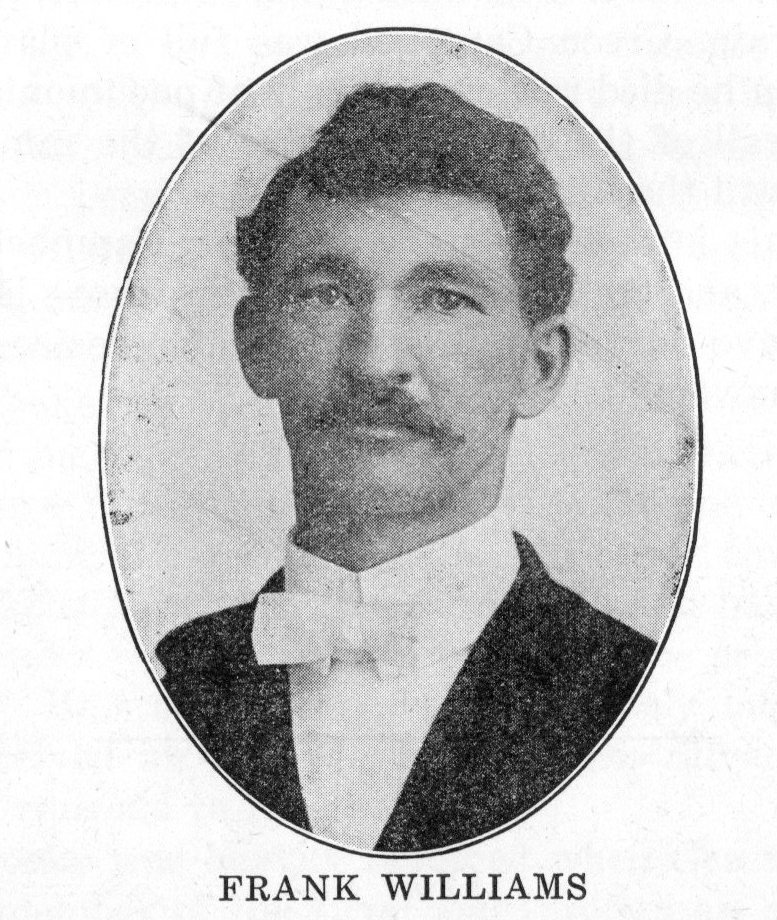
were Elwood Thomas and his nephew, Frank Williams. Elwood Thomas had been
Green Campbell’s right-hand man all through the latter’s
colorful mining career, having gone out from the old home town in Kansas
to join him in 1873. Frank Williams went direct from Wetmore to Mr.
Campbell, at the age of twenty-one, and has spent forty-seven of his
sixty-eight years on the Nevada desert. And perhaps I should say here that
much of the information presented in this narrative was obtained from Mr.
Thomas and Mr. Williams.
In the Utah field, then a new and isolated country,
under conditions that tested the fiber of the man, Green Campbell
prospected the hills of Beaver county for a while. Then, nearly five years
later, his big opportunity came when he secured an option on a mining
claim for which he agreed to pay $25,000. That claim was later developed
into the famous Horn Silver mine, which, up to the time of my last visit
nearly thirty years ago, had produced slightly in excess of twenty million
dollars. The mine, owned now by New York interests, is still producing at
great depth. Few metal mines there are that have had such long run of
life.
But, as I have already stated, chance played a big
hand in this game of millions. At that time Green Campbell had all his
funds tied up in other properties. He was then operating the Hickory mine
at Newhouse. Green Campbell turned to his friend, August Byram, of
Atchison, Kansas, for financial assistance. Byram and Campbell had become
acquainted while they were both in the employ of that major freighting
firm. Byram had already spent some money at the suggestion of Campbell
without results, in the Star district, close by. After considerable
correspondence, Byram decided to take another chance at the game,
promising to come through with the funds to take over the Horn Silver
claim before the expiration of the ninety-day option. Byram was to advance
the full amount, half of it as a loan to Campbell, and they were to own
the property on a fifty-fifty basis.
But here caution stepped in and robbed those two men
of exactly one-half of an immense fortune—a fortune in the making.
After the agreement had been made Byram wrote and asked Campbell to see if
he could find someone to take a quarter interest in the risk. Campbell
found two men, Matt Cullen and Dennis Ryan, who would come in for a
quarter interest. But Byram still thought he was taking too great a
chance, and wrote a second time asking Campbell to try induce those two
men to take a half interest. It was so arranged.
Green Campbell then settled down to a game of waiting.
Thoroughly imbued with the spirit of the times, he told himself—and
rightly, too—that he had only to await the coming of Byram to jump
in and win. But, without further word from Byram and the final day of the
option drawing near, he became very nervous. New developments had caused
the owners to look for some chance to void the option, and Campbell sensed
danger in delay. Then came the awful blow that set all his emotions to
working at high speed.
August Byram, on his way out to the mine, had stopped
over in Salt Lake City and there he was discouraged by designing
individuals who wanted to pluck the mine for themselves. Developments had
increased, its value fourfold. But this fact was kept from Byram by his
Salt Lake acquaintances—indeed, they stressed the fact that the
claim had but recently been optioned for $1,500, and that the option had
been allowed to lapse. The result was August sent word to Green that he
would have nothing more to do with it.
However, Campbell managed somehow to get Byram over to
the property on the last day of the option, but up to the eleventh hour he
was filled to the brim with nerve-wracking suspense. For hours he had kept
his gaze constantly fixed on the sage-fringed road leading out across the
broad valley to the east, where was open to the eye a twenty mile sweep of
sun-baked waste, looking for that distant dust cloud which might mean that
relief for his tired nerves was on the way. Then, late in the afternoon,
as the last golden tints lingered along the ragged edges of the mountains,
the stage bearing Byram, full four hours late, was sighted far out on the
road—a mere speck in a great cloud of dust.
There was yet time for speedy action. For a brief ten
minutes the two men faced each other—Campbell full of words, Byram
deep in meditation. It could hardly be expected that after floundering in
a bog of indecision and doubt for so long, that understanding would come
to Byram in a flash. But Campbell’s great anxiety in the matter
caused him to believe, for the moment, that Byram’s resolutions were
still wavering, while his own thoughts whirled like leaves in an autumn
blast. Byram’s final words, however, kept Campbell’s spirits
from suffering further.
I was not there at that particular time, of course,
but this minute accounting, the reactions of those men, is as I caught it
from Elwood Thomas. “If it hadn’t been such a serious matter
with Green,” said Elwood, amid chuckles that sent ripples all over
the old miner’s weathered face, “it would have been downright
amusing.”
The transfer of the Horn Silver claim took place in
the shadow of the mountain as the sun dropped out of sight on February 17,
1876. And it was a joyous occasion for the little group of interested men—except,
possibly, the two original locators who were now beginning to realize the
true worth of that little piece of ground. Fate dealt a mean hand to the
locators of the Horn Silver claim. After sinking a shaft thirty feet on
ore, Samuel Hawkes and James Ryan bartered away millions on the belief
that the ore would not last.
And I might say here that the Horn Silver lode, the
main ore body, was found by sheer accident. Jimmy Calvering, a young
Irishman employed to do the location work, following the custom of the
shiftless miner, went away a considerable distance from the outcrop to
find “soft ground” in which to dig his ten-foot hole, as
required by law. Jimmy was not looking for ore, but in doing that ten foot
of work he opened up the main lode. And nowhere else did it come that near
the surface. Jimmy was ever after that proclaimed “A man with a
great nose for ore.”
The Horn Silver mine was operated by Campbell, Cullen
& Co., for three years, with a gross production of nearly three
million dollars. The mine was then sold in 1879 for six million dollars,
and title passed to the Horn Silver Mining Co. An interest equivalent to
about one-sixth of the mine previously had been given to an eastern
promoter for securing a railroad to the mine.
Green Campbell had other interests at Frisco, the camp
which had sprung up about the Horn Silver mine. It was a town peopled with
all kinds of characters known to frontier life. It had all the mining-camp
trappings—dance halls, saloons, and what not. This camp had caught
the overflow from the older mining camp of Pioche, in Nevada, where the
boast was, “A man for breakfast every morning!” And in
lawlessness Frisco flourished like the green bay tree! Life at the high
tide was almost as cheap as water! But Green Campbell’s personality
was such as to keep him out of harm’s way. Green was a good mixer.
He drank some, but in moderation. In no sense was he a dissipated man. And
here at Frisco he made more money! Lots of it! The Carbonate mine alone
gave him five hundred thousand dollars in profits! He was classed with
other mining moguls of that day. Hearst, Tabor, Walsh—he knew them
all.
Green Campbell’s rise in the financial world was
spectacular. Within the brief span of a few years he could have returned
to his old home and to his family with enough money to live in luxury. But
friend Green had other notions. Like the noble beast of burden of the
Sahara bearing his name, Campbell was now a permanent fixture of the
desert.
Man’s ambition is seldom satisfied. Visions of greater wealth
and the thrills that go with the making held Green Campbell with a
vise-like grip. He willed to stay in the West.
His wife preferred to stay in Kansas with her people,
at Circleville. Or, maybe, it was decided that the untamed West, the
desert with its sizzling summer suns and unbridled winds, was no place for
Florence Oursler Campbell and her little boy Charley. Anyhow the situation
brought about an estrangement and, finally, a separation. Ofttimes men,
too much absorbed in chasing the pot of gold, unconsciously make this
supreme sacrifice.
Clouds began to appear on Green Campbell’s
marital horizon soon after he went West, but the storm did not break until
he was virtually in the big money. He was enormously engrossed with his
mining operations, while back here at home, because of his continued
absence, a growing resentment was piling up against him day by day. The
time was coming, if he would see it, when he must give up either his
mines, or his family. He heeded not the signals, seriously. Like his royal
highness across the Atlantic—the self-deposed king—until
disaster was upon him, he proposed to keep them both.
Florence Campbell filed her petition for divorce and
alimony in the Jackson County court at Holton. Case Broderick of Holton
and Judge Stillings of Leavenworth were her attorneys. Green Campbell was
represented by Hayden & Hayden of Holton and Colonel Everest of
Atchison. The stage was set for a spirited legal battle. The whole country
buzzed with gossip. Because of the prominence of the Campbells and the
Ourslers people traveled for miles on horseback and in wagons to attend
the hearings.
The plaintiff and her witnesses occupied the stage for a
day and a half. Then the defense attorneys armed with depositions and a
liberal line-up of witnesses, told the court what they had up their
sleeves. But the judge, being somewhat of a sleuth, had already detected
that something was wrong with the plaintiff’s legal machinery. Gears
didn’t mesh. The charge was out of alignment with the facts as
adduced by the plaintiff and her own witnesses. In short, her lawyers had
experienced embarrassment in their endeavor to twist a prolonged absence
from Campbell’s fireside — and whatever else that was offered—into “extreme
cruelty.”
There had to be a “charge,” to be sure,
but it would appear that the plaintiff’s attorneys might have more
profitably selected for their client, out of their cabinet of ready-made
complaints, something more reasonable, something less galling to the fine
sensibilities of the man. Judge John T. Morton said that inasmuch as the
plaintiff had failed to prove her case, defense testimony would not be
heard. Moreover, he said Mrs. Campbell would get no alimony.
There was not, as one might suspect, another man in
the case—not a breath of scandal. Mrs. Campbell was too fine for
that. It was her unalterable conviction that she and her child were being
unduly neglected. It was “blue” blood in revolt—indignant,
regrettable rebellion.
The decree was given the defendant, Green Campbell, on
February 23, 1878. Custody of the little boy, Charles R. Campbell, was
given to the mother. Mr. Campbell was required to pay $250 a year for the
boy’s “keep and education,” with a lien on the northeast
quarter of 22-6-14. Two hundred and fifty dollars a year from a potential
millionaire to keep and educate his son! All right then, perhaps, but it
sounds like parsimony now.
Henry C. DeForest, pioneer merchant of Wetmore, was
made custodian of the impounded land. He also acted as agent for Mrs.
Campbell. The allowance for the boy was not held down strictly to the
court order. Indeed, Mr. Campbell did much more for his son. It is alleged
that, after the separation, the boy would meet the train on occasions of
his father’s infrequent trips in from the West, and that Mr.
Campbell would fill his son’s hat with gold coins. And in time
Charley was given the impounded land, together with several other valuable
tracts of Jackson County land. Green Campbell still kept his Nemaha County
homestead.
No property settlement appears of record—leastwise
my investigator does not report any—though, I believe, there was a
private settlement. Little enough it was, no doubt, if any, but the
disillusioned Mr. Campbell was not niggardly with his money, as the
plaintiff and her kin backers, and all who listened in on the trial were
soon to know.
As if in preparation to carry out the educational
phase of the court mandate handsomely, Green Campbell endowed a college
right in the boy’s door-yard, so to speak. Work began on Campbell
University at Holton in 1880, and the school opened on September 2, 1882,
with Prof. J. H. Miller, president. For a small-town school it became
quite noted. After a successful run of nearly a score of years, it fell
into decay and finally ceased to exist. The old stone building standing on
an eminence at the northwest corner of Holton, long in disuse as a
college, was razed in 1931 to make room for a new $139,000 brick high
school building.
It would be interesting in this connection to know
what Green Campbell’s reactions really were, what motivated that
splendid school? With a knowing smile on his weathered face and without
amplifying his surprising assertion, Elwood Thomas once told me that had
there been no divorce there would have been no Campbell University. And
did the boy Charley actually “finish off” at Campbell
University? I think not. A recent casual inquiry at Circleville told me
nothing in that particular. While yet quite young, he married Kate
McColough. He went West—and, backed by his father, tried his hand at
mining at Providence, California, with little or no success.
With his marital differences adjusted in the divorce
court, Green Campbell now, like as not, a morose misogynist, went back to
his beloved golden West and in the immediate years which followed was as
grim and silent, on one very ticklish subject, as the barren peaks of the
mountains about him. In his mine, Mr. Campbell had encountered and
conquered some extremely refractory ore. He had hauled in cord-wood from
as far as sixty miles to roast that stubborn ore in outdoor fires, to make
it amenable to the smelter. But in marriage, a bit of clay—he had no
workable method for that.
Green Campbell came back to his old home only a few times
after the separation. But Kansas still claimed him —
claimed him until he went to Congress for Utah,
claimed him until he sold his homestead here to Bill Hayden. He was Nemaha
County’s first millionaire!
Green Campbell, first of all, was a miner. Close
attention to business, as has been pointed out, brought him great riches—and
a dilemma! The memory of this last named acquisition persisted,
ghost-like, to haunt him for long years. But it did not haunt him for all
time.
In the mining game, a hope never fades that another
doesn’t bloom brightly in its place. Likewise, generally speaking,
it is so in matters of the heart, only the flowering is not always so
spontaneous. Sometimes, not infrequently, after the romantic love of other
days has passed, the withering love-instinct must be carefully cultivated
for years if it is to flower again.
Fourteen years and fourteen hundred miles lay between
Green Campbell and the subject of his marital woes when at the age of
sixty or thereabout, after he had reached the peak of his financial flight
and experienced some setbacks, and after he had grown a fine flowing
snow-white beard and become quite bald, it bloomed for him again.
This time the bride was Eleanor Young, a reporter on a
Salt Lake City newspaper. She was a daughter-in-law of the famous old
Brigham Young. And the stork, that industrious old bird of world-wide
habitat, at home on the desert as in the oasis, brought the Campbell’s
three fine children—Allen, Byram and Caroline.
Green Campbell would, of course, want to do something
to perpetuate the school that bore his name. But in his will he made the
fatal mistake—fatal for the school—of first taking care of his
family with the more tangible assets. He bequeathed $100,000 to Campbell
University, conditionally, however. It was to be paid out of the proceeds
of two mining properties, namely, his Vanderbilt and Goodsprings holdings.
A minimum price of $500,000 was placed on his Vanderbilt mine, and
$200,000 on his Goodsprings claims, and they were not to be offered for
less than the stipulated price for two years. The properties have not yet
been sold. While really promising properties, with the future pledged,
largely, by the terms of the will, there was no one to continue
developments to make them bring the price. Green Campbell had expended
something like a half million dollars in developing his gold mine at
Vanderbilt.
Secure in the fortune left them, the Campbell heirs
— Green’s second family—have
risked no money in mining. Besides his various mining interests Green
Campbell owned, at death, a magnificent home on Brockton Square, in
Riverside, California; numerous tracts of California ranch lands, and
real-estate holdings in downtown Los Angeles. Also, a substantial cash
operating fund, and some income property in Salt Lake City—notably,
the Dooley block. Mr. Campbell often expressed his faith in the future of
Los Angeles. The fortune has largely been kept intact.
When last contacted a few years back, Mrs. Campbell
was living at 705 Camden Drive, Beverly Hills, California. The two
unmarried sons lived at the same address. Caroline, the daughter, was
married to a Los Angeles banker, Leland T. Reeder, a son of the fiery and
famous Congressman W. A. Reeder, from the sixth Kansas district, back in
the nineties.
Idle mining properties, or mines worked only
spasmodically by lessees, do not readily attract buyers, especially when
filled with water, as in the case of the Campbell mine at Vanderbilt.
Incredible as it may seem, there really is water deep down—in places—in
that desert country, and it even rises sometimes. The shaft at our own
mine, in the very heart of the desert, situated in a small depression on
the mountain side, was once filled to overflowing during a heavy rain.
Other bequests, principally to relatives, also were
contingent upon the sale of those two properties. And hope, tenacious
hope, once bloomed so very brightly but now devoid of sparkle, still
lingers with heirs around here.
Henry Campbell, a nephew, who was sheriff of Nemaha
County for two terms about the turn of the century, with his two sisters,
Mary and Frances, the son and daughters of John Campbell, all deceased
now, were named jointly for $100,000. The surviving heirs are: Emma Swarm
Campbell, wife of Henry, Bancroft, and two sons by a former marriage,
living in the West; George Cordon, husband of Mary, Ontario; Ray Drake,
son of Frances, Norton.
The heirs of Caroline Campbell, who married a Mr.
Steele and went West, and the heirs of Sally Ann Campbell, who married
Henry Stanley and lived near Circleville, were named jointly in the will
for $100,000. William and Edward Stanley and Laura Hart, all dead now,
were children of Sally Ann. William worked with his uncle in the mines and
was named for an extra $100,000.
Two daughters of Green Stanley, another son of Sally Ann,
are married to “Jack” and “Kid” Rudy, and live at
Soldier. A daughter of Sally Ann—Julia Alice Stanley —
married Albert D. Chamberlin, now living in Holton.
Mrs. Chamberlin is dead. Her heirs are: Mrs. Lee Able, Holton; Mrs. S. B.
Moody, Centralia; Mrs. Ernest Hogg, Payette, Idaho; Mrs. Mary Gaston and
Nathaniel Chamberlin, Whitehall, Montana; and Charles Chamberlin, Salt
Lake City.
One small payment was received by the heirs here about
two years back, which revived interest in about the same degree of
satisfaction as that of a sprinkle of rain to a thirsty earth. Time was,
though, George Cordon tells me, when they could have accepted settlement
at fifty cents on the dollar.
It is probable that the inheritance of Charley
Campbell was tied up in this or by some other uncertain condition.
Whatever the case, he settled with the estate for $50,000. Crediting rumor
afloat at the time, it is my recollection that, in recognition of close—and
perhaps menacing—kinship, this was paid with money left by Green
Campbell to his second family.
Leaving an ex-wife and two sons, Allen and Robert, in
the West, Charley Campbell later returned to Circleville. There, in 1920,
he married Laura Deck. He is now living in or near Philadelphia.
His mother, Florence Campbell, did not marry again.
She went to work. And by the irony of Fate she became a teacher of art in
the college founded by her divorced husband, along about 1895. Later,
years later, when I saw her last she seemed merely to be waiting, in
emptiness and dead memories, for the end. She died in Pomona, California,
about 1920.
Elwood Thomas was administrator for the Campbell
estate—in Nevada. After spending thirty-eight years on the desert
and in the mines, without receiving so much as a damaging scratch, Elwood
was fatally injured in a horse and buggy accident while back Here on a
visit to his daughter, Mrs. Maude Ralston, at Holton, in 1915. He died
three days after the accident. He was buried in the Wetmore cemetery.
Elwood Thomas lived apart from his family from the time he he went West in
1873. Family ties, it seems, were not strong enough to bridge the distance
between them. Maybe it was the desert again.
Turning momentarily aside from the path that leads
toward the rainbow’s elusive end, let me here interpose a brief
paragraph about John Campbell, the brother whom Green had said could
remain on the farm and keep up the fight against odds if he wanted to.
John did remain on the farm; and kept up the fight—and won. He even
elected to remain on the farm after pressing invitations to join his
brother in the land of gold. He lived on the original homestead in Wetmore
township until he died, in 1894. As the years became more seasonable for
the production of grain, John Campbell made a good living—and more—from
his acres and his herds. And, best of all, he found contentment and
happiness with his wife and three children on the farm. I think that in
all my life I have never known a more kindly, considerate, and contented
person than was this tall, slim, fine man.
Luck was a bit fickle with Green Campbell. It both smiled
and frowned on him in a few fleeting years. Alert, with a keen mind, he
made good at first on everything he touched —
save, of course, that first water-hole. Then,
abruptly, as if a great cloud had obscured his vision, he lost his charm.
Two outstanding reverses followed in quick succession.
Irreparable damage is often done in the name of
friendship. With millions of dollars to the good, Green Campbell was
picked by his friends to turn the tide of politics in Utah, to break
Mormon rule. He was on the minority side, to be sure, but what did that
matter? Clean and ambitious, with bulging pockets, he would be a
formidable figure in bringing about the change so much desired—by
the outs of course.
Thus, Green Campbell was launched upon the perilous
sea of politics—literally shoved off into its unfriendly waters,
slightly, but assuredly, beyond his depths. The warm and manifest
enthusiasm of his friends, so goes the story, inspired in him a feeling of
confidence—and, unschooled in the hard-played game of politics, he
set sail upon the turbid political waters with never a thought as to the
many, many wrecked political ships that mark the shores of Time.
Infectious enthusiasm had spread over the field.
Voters and non-voters alike cheered for him. The Italian colony piped,
“Viva Campbell—bigga man!” John Chinaman, it was
related, yelled in badly Americanized Cantonese, “Hoola Campbell!
All-o-same-e, no like-e dlam Mormon lenny-way!”
Deliverance, it seemed, was at hand. Still in the
first flush of his great financial triumph, Green Campbell spent money
freely for the cause, and incidentally tried for a seat in Congress. This
experience cost him a lot of money—just how much no one knows. Some
said it was nearly a million dollars.
Green Capbell was defeated for delegate to Congress by
the Mormon bishop, Cannon. But he contested the election upon the grounds
that Cannon, a Canadian, was not naturalized. In this he won, but not
until the two-year term was almost over. He went to Washington as the Hon.
Allen G. Campbell.
I shall not attempt to tell you his politics, because
I don’t know—for sure. But when I tell you his fine saddle
horse was named Cleveland, you can make your own deductions. It was a
common sight to see Green Campbell mounted on that spirited horse riding
about the streets of Vanderbilt, often with one of his little boys up in
front of him or riding behind, while his luxuriant white beard, always
well groomed, billowed gracefully in the desert breezes. Green Campbell
was a large man, about six feet tall and rather portly, though not really
fat. He always presented a prosperous, dignified appearance.
And now, while a million dollars, or whatever sum it
really was, out of one pocket was a lot of money wasted in priming the
political pump, it wouldn’t have been so bad for Green Campbell,
seeing that he had obliged his friends, had there not been other heavy and
unexpected drains upon his purse. It was a partnership with Jay Cooke and
Company, a Washington stock brokerage firm, at a most unfortunate time,
that really hurt.
Jay Cooke was perhaps the foremost broker of that day.
Hard luck bankrupted him. His brokerage houses in three eastern cities
collapsed in 1873, causing one of the greatest financial panics of all
time. He was financing the building of the Northern Pacific railroad and
had made too many advances. But Jay Cooke was still the promoter
par-excellence. He was the promoter previously mentioned as having
received an interest in the Horn Silver mine for securing a railroad to
the camp.
Jay Cooke was heavily involved when Green Campbell
became a member of the firm, and through an oversight a protecting clause
was omitted. With new money in the firm, Cooke’s old creditors
forced their demands. Green Campbell’s first check was drawn for
nine hundred thousand dollars! And that was by no means the end of
enforced payments. However, much of this loss was salvaged through
securities turned over to Campbell by Cooke.
It was not at all strange that at some time in his
financial career, after climbing up to the heights, that Green Campbell
should take his turn on the toboggan. Nobody ever wins every step in life.
But these two reverses, falling so swiftly and so heavily as to make them
the high points of the drama, cut a jagged gash in the fabric of his
dreams. And while the hand of Fate continued, for a time at least, to
carry the Campbell fortune steadily downward, he did not lose all. Far
from it! There was no time after selling the Horn Silver mine that he was
not a rich man!
But the winds of adversity, mighty dream-wrecking
gales though they were, had not swept away the flame of hope. Back to his
mines, unflagging in his efforts to do it all over again, Green Campbell
was full of plans for the future when he died rather suddenly of
pneumonia, in 1902. Thus, the call of the desert, the lure of the mining
game, held him until the last.
And this is the true story of Green Campbell—gentleman,
miner, and great wealth-builder, in whose heart there seems to have burned
an inextinguishable desire for something that never came.
Published in Wetmore Spectator,
March 13, 1931.
By John T. Bristow
There were not conveyances enough to handle the influx of
gold-seekers when I got off the train at Nipton, California, and a long
walk across a dry sun baked waste lay ahead of me. I was on my way to the
new mining camp of Crescent, just over the line in Nevada, and on my way
to a fortune—maybe. Rainbow visions began to rise before me, and hot
though it was I did not mind that six-mile walk one bit. I was not alone.
She was young, slender — and
pretty. And Elsie was a “gold-digger” too. There were others.
With Frank Williams, a former Wetmore boy, as partner,
I was in from the start at the “hell-roaring” mining camp back
in 1907. Born overnight, it was a stampede mining camp, growing from
nothing to a tented city of one thousand people in a few weeks time—followed
quickly with saloons, dance-halls, and whatnots.

Crescent was wild, mad, wide open.
When the big news broke, I beat it for Nevada. Frank
and I and associates owned three claims in the very heart of the Crescent
district. Also, I personally owned an adjoining claim on which Frank had
caused one of his men, Paul Stahmer, to do the required ten feet of work
to hold it for one year, at a cost to me of $100. The work was done on a
$544 gold showing.
Having operated with Frank rather disappointedly in
the lead-zinc-vanadium camp of Goodsprings, thirty miles away, through the
years since 1904, I believed that here at last—at Crescent—I
was about to pounce, in one fell swoop upon the legendary pot of gold. It
was a fantastic notion, of course—but oh, the magic thrill of it!
Charles M. Schwab, Pennsylvania multi-millionaire
steel magnate, who held mining interests in Nevada, lent encouragement
with an on-the-spot pronouncement: “In the past the great fortunes
have been made in manufacturing, but henceforth the really big money will
be made in mining.” Also, operators from Goldfield, the Nevada camp
that gave George Wingfield, a lowly cowhand, twenty million dollars almost
in a jiffy—men in the big money up there said in my presence,
“If we had such surface showings at Goldfield as you have at
Crescent, any old claim would sell for a fortune.” I don’t
mind telling you that I had fed rather too optimistically upon the
glorious prospect of grabbing a quick fortune at Crescent. But the
unveiling of facts there proved a solvent for the nightmare in which a lot
of us had been living for months.
With fabulously rich surface showings —
high assays, $500 to $20,000 to the ton reported almost
everywhere — Crescent
proved, in the end, the greatest bubble of them all. Countless thousands
of dollars were expended, over a period of two years, in a frantic effort
to bring out a profitable producer. But if there ever was as much as a
shirt-tail full of ore shipped from that camp, I don’t know it. And
though I never had the time nor the inclination to compare notes, I’ll
bet Elsie had better pickings than any of the hopeful miners who wore
pants.
It was with reluctance that we pulled out of Crescent. It’s
most fascinating, this thing of prospecting for gold —
like participating in a big-game hunt. Were I
full-handed, even now, I would go back to Crescent and give our
Shreve-port group another try. Someday, somebody is going to find the
“mother lode” there.
There was honest effort—a lot of honest effort—as
well as the usual faking, at Crescent. A $20,000 gold strike was reported
near the summit, between our claims and Crescent. The first day out there,
I was all for seeing this strike right away. My partner said, “Oh,
wait until tomorrow—we’ll be going past it when we go over to
Crescent.”
The next day, starting from our claims by way of a
perfectly good wagon road down the canyon a ways, Frank took me by a
tortuous climb, off the road, to near the top of the mountain. He pointed
out the spot where the assay had been obtained. When I began to examine
the shallow trench, he said, quickly, “It took all the ore in sight
to make the assay.” Twenty steps farther on we reached the summit
where we could look down on Crescent a mile below. And then we stepped out
onto a very good wagon road. On inquiry, he said, “It’s the
same road we left back there in the canyon.” I asked him how come we
made that rough climb? Frank said, “You know, it’s about as
much as a man’s life is worth to be caught showing up that strike to
a tenderfoot.”
This was an eye-opener—the first clear signpost
on a long and uncertain road.
At another time, later, Frank and I paid a saloon
keeper in Nipton, the railroad station, twenty dollars to drive us over
the Crescent district, for the full day. We visited our claims first, got
dinner in Crescent—then to a saloon where drinks were 50 cents each,
whether whiskey, beer, or water. The bartender simply counted noses or
glasses, as it were, and summed up the charge. There were about twenty
saloons in the camp, and our “host” deemed it his duty to
visit them all. I am sure he dumped the $10 I paid him on twenty glasses
of water for me. It was a spot where you couldn’t afford to shake
your head and say, “No thanks.” When asked to drink, it was
wise to call your drink.
The main object of the drive—on my part, anyway
— the thing we had paid twenty
dollars for, was to visit a highly newspaper publicized mine two miles
south of Crescent, where it was shamefully claimed immense bodies of rich
gold ore running into the millions, were blocked out. But the desert
twilight caught us still drinking Adam’s ale and the Indian’s
“fire water.” Our driver knew his business all right—and
I suspect Frank knew from the start that we would never fetch up at that
mine. Nothing, absolutely nothing—but the truth—was barred in
that camp.
I shall now leave the desert momentarily, and write
candidly about my earlier “mining” experience. This, and other
notations here—until we get back to Crescent—are throw-ins,
kindred situations not contained in the printed’ article.
With our townsman Green Campbell’s enviable
mining success as an incentive, it has ever been my hope that I might
someday also strike it rich—and mining seemed to offer the best
lure. I therefore joined a group of Wetmore and Horton men in an effort to
rejuvenate a gold mine at Whitepine, Colorado, twenty miles north of
Sargent on the narrow gauge branch of the Denver & Rio Grande
railroad. With the Wetmore group—Dr. Augustus Philip Lapham and wife
Elzina Brown-Lapham; Jay Wellington Powers and wife Helen Hoyt-Powers;
Charles Samuel Locknane and wife Coral Hutchison-Locknane; and Mr. C. A.
Mann, the owner, backed by Scott Hopkins, Horton banker, and other moneyed
men of that city, I spent a week at White pine looking things over.
The mine was really six miles up the canyon from White
pine—just beyond the abandoned town of Tomichi, not far from the
“Top of the World.” Tomichi had been hit by a snow slide which
wrecked a number of houses, killing several people. The residents,
numbering about 1,000, had abandoned their homes and places of business,
leaving the buildings intact—a true “Ghost Town.”
Thinking in terms of the present, one might wonder why had the buildings
been left to rot down? A mill had sawed the lumber on the site
— and in that out-of-the-way place,
the material was not worth salvaging.
The tunnel of the Mann mine was about 150 feet
up-slope from the wagon road on the floor of the canyon, which road was
also Main Street in Tomichi. To get up to the tunnel, the trail started
several hundred feet up the gulch and then swung back around a projecting
ledge where the footing was rather insecure. To negotiate it the men would
use the lines off the harness. The women could remain at the wagon and
watch the men fall, if such might be the case.
And here I pulled a boner—not my first, nor
last, I frankly admit. I looked across to the “scary” ledge,
and straight up to the tunnel—and then I started up on the run, the
loose rock in places sliding me back almost as fast as I was gaining.
However, I made the tunnel, completely exhausted. I did not sit down to
rest. I fell down. And I crawled into the tunnel where there was ice—in
July—and revived quickly. One of the men was hampered in that climb
with a wooden leg, which afforded me ample time to recover before their
arrival—but my own legs were still shaky as I eased myself around
that projecting ledge, grabbing the strap now and then, while coming down.
I don’t know how the first strap-holder got around without help—nor
the last one, either.
Mr. Mann said I had taken a great risk; that he had
called to me to come back; that the exertion required to negotiate that
heap of sliderock was really too much for one unaccustomed to the high
altitude; that he himself—a seasoned mountain man—would not
have undertaken it for the whole mine. And, you know, after I had taken
one peep at the spot of interest in the tunnel, I thought, “Neither
would I.”
The prospect did not look good to me—nor was I
fooled by the enthusiasm of my inexperienced associates, but I wanted to
go along with them. The other Wetmore men thought enough of the prospect
to locate adjoining claims, naming them for their children—The
Marsena, The Gracie, and The Marguerite. I had no child, not even a wife—so
no claim. But I then and there made a resolve to learn something more
about that enticing mining game, perhaps elsewhere. And in the final
analysis I suppose I have.
Doctor Lapham was the principal exuder of enthusiasm,
an inborn trait which came to the fore again in a big way on the train
enroute to Salt Lake City. The Doctor had spent some time in the smoker,
and came back to the coach all “hepped” up. Rubbing his hands
together in his characteristic manner, he said he had gotten—on the
qt—a tip from the newsboy that an observation car was to be hooked
on at Gunnison, for the trip through Colorado’s most colorful
canyon. The observation car would be on a siding to the left of our train—and
that the favored few were to make a dash for it the moment the train
stopped.
The Doctor was always putting forth his best efforts
to make us all comfortable—and happy. He said he had bought a book
of views, paying $2 for it, something he really didn’t care a whoop
for—but he wanted to reward the boy for his kind tip. With an eye
for business, the newsboy had also tipped off other passengers.
The “observation” car was only a coalcar
having temporary backless board seats placed crosswise of the car. One had
to climb over the seats, or step across from one plank to another to get
to the rear end of the car—all right for the fellow who had so
recently clambered up the tunnel dump, but very awkward for the women and
the man with the wooden leg.
Many of the passengers looked at the thing and went
back to the coaches, and some abandoned their seats and went inside after
the train started—but our men folk, being well to the rear and
encumbered with helpless women whom they did not wish to lose just then,
couldn’t even do that once the train headed into the Black Canyon of
the Gunnison, a narrow gorge with 2800-foot almost perpendicular walls,
following the serpentine course of the Gunnison river, on a steeply down
grade, switching the “observation” car like a whipcracker from
one black wall to the other. Hot cinders rained down on us so that we
could look neither to the right, or the left—nor up. Now, Lap’s
newsboy came aboard crying, “Goggles, goggles, goggles!”
And the appreciative Doctor gave the boy some more
money.
We had done Denver, Colorado Springs, Manitou and Pike’s
Peak—and Cripple Creek. And we had all climbed “Tenderfoot”
Mountain while waiting over-night at Salida for train connection—and
I individually had literally sat on the proverbial powderkeg for three
hours during a twenty-mile overland drive. Mr. Mann had provided a spring
wagon for the other members of the party, and I, being unexpected, was
conducted to a freight wagon going our way. When told, near the end of the
journey, that I was sitting on a box of dynamite I blew up—in
spirit. But nowhere had we experienced anything so disappointing as this
“observation” car ride. It is anchored in my memory as the one
really big scene that beggared description.
NOTE — The
railroad through the Black Canyon of the Gunnison has been abandoned, and
sightseers may now view this colorful canyon from their automobiles over a
highway—a “highway,” mind you, more than a half mile
down in a narrow slit in the earth.
Then, again, my newspaper friend, William Allen White,
of the Emporia Gazette, toured the western mining districts and wrote
enthusiastically about some newly discovered mining opportunity in the
west, known as Thunder Mountain. It stimulated my desire. I wrote William
Allen, asking him if he would, as one newspaperman to another, advise me
to try my luck at Thunder Mountain? His personal letter to me was even
more optimistic than was his editorial. Like Horace Greely, his advice was
substantially, “By all means go west, young man, and give it a try.”
But I did not fetch up at Thunder Mountain. On the advice
of another friend, I dumped the proceeds from the sale of my newspaper,
sight unseen, in a hole in Nevada — while the wise Mr. White kept on publishing his Gazette;
wrote a best seller book, “A Certain Rich Man,” and got rich
himself. His name and fame are to be perpetuated in the erection of a
public library building in Emporia; while I, his misguided friend, still
have my laurels to make. And, incidentally, as a mining man, after that
first big blow, I never again heard of Thunder Mountain.
Now back to the desert—and the printed Crescent
story.
Our contribution here at Crescent, with a minimum of
outside help, was a 500-foot tunnel driven into the side of a mountain—the
rock shot with high assay in gold and silver and copper. But the cost of
this work, though a dead loss and highly disheartening, was as nothing
compared to the outlay for the 2197 feet of tunnels and shafts we have
driven—also with a minimum of help—through solid rock on our
Goodsprings claims, where production, though quite good at times, has
never caught up with expenses.
And the end is not yet.
You can take it from me that a man has to be
insensible to pain to laugh this off.
On the train away back in the valley on this my first
trip to Crescent, the conductor had pointed to a distant cluster of white
flecks barely discernible through
the shimmering, sun-drenched haze that lies always, like a pall, over the
desert, and said to me, “There she is—the biggest thing in all
Nevada!”
I had become chummy with the conductor, and that
chumminess increased mightily when we learned that we were both on the way
to become millionaires—as we visualized it then—through the
mining route. He told me that he knew my mining partner, that he had
engaged Frank Williams to look after the assessment work on some claims he
himself owned over in the Goodsprings district. And when I asked the
conductor his name and made a move as if to write it down, he shook his
head negatively and threw out his hands in a gesture of utter uselessness,
and said, “Oh-hell, man, you couldn’t forget it as long as you
are in this country. It’s Dry—just plain William Dry.”
My friend’s parting words to me were a mixture
of jocularity and serious hope. “Well, so long, old top,” he
said. “See you again when we fetch up at the end of the rainbow.”
And do you know, the next time I saw that conductor, two
years later—and I might say before either of us had made any
appreciable advances on the rainbow’s elusive end —
he recognized me at once, and in offering his hand,
said: “It’s Dry.” And I said, “Oh-hell, man, don’t
I know it!”
And so it was.
That meeting was in Superintendent J. Ross Clark’s
private car, hitched to the flyer. We had exchanged some correspondence
before, and Ross wanted to tell me in as hopeful words as possible that
the officials of his railroad were still watching the situation closely
and would build a branch line into our district—to our claims and to
his claims — just as soon as
the required tonnage was assured. You see, J. Ross Clark, too, was
possessed of the desire to harvest a quick fortune and owned mining claims
across the flat from our claims in the Goodsprings district.
That meeting with J. Ross Clark bore fruit for me,
though—and it was the means of holding up the Los Angeles Limited
for an hour, as well. Several years later I had an important engagement at
Goodsprings and was delayed seven hours in Pueblo on the way out there,
owing to a change in time of the Denver & Rio Grande trains. The best
I could do then was to arrive in Salt Lake five minutes after the Limited’s
leaving time, at one o’clock at night, with depots a mile apart.
Failure to keep my appointment at Goodsprings would mean disappointment to
others and a money loss to me, as well as a wasted trip. In desperation, I
went to the up-town office of the Denver & Rio Grande, and asked the
agent there to try to have the Los Angeles train held for me at Salt Lake.
Nothing doing. That important personage swelled up to full capacity and
said, “Evidently, if the San Pedro people wanted to neighbor with my
Company they would change their leaving time.”
Next, I asked the conductor on the Rio Grande train to
wire ahead for me—and I am happy to state he was a gentleman. Also
he was a one-time miner. “Tried it once over at Aspen,” he
told me. And right away there was a bond of sympathy, or something,
between us. That conductor really wanted to help me. But, as he told me he
had wired the San Pedro people several times without results, I had to
think of some other way, for I wanted to make that Limited as a lost soul
wants to make Paradise.
It was then I thought of J. Ross Clark. What was the
good of making friends, if you could not use them? The Rio Grande
conductor obligingly held his train for me at Green River, Utah, while I
filed a message to the Superintendent of the San Pedro lines. We arrived
in Salt Lake ten minutes ahead of time, and the conductor, pointing to a
hack-stand, said to me, “Now hurry—the Los Angeles train may
be a little late in getting away.”
At the San Pedro station I found the Limited all
steamed up, ready to go—and I boarded it quickly, all out of breath.
But there was no need for hurrying. Presently the conductor came along and
asked me: “Did you come in on Rio Grande Three?” I told him I
did. Then he asked, “First or second section?” I admitted that
I didn’t know the train had been split up at Grand Junction. The
conductor, wanting to be sure of his order, drew a yellow slip from his
pocket, and re-read: “Hold for one or more passengers off Rio Grande
Three.” He then said, “Yes, that’s it. I’m sure
you are the man I’m holding for—but I’ll have to wait
for the second section.” And it was an hour late.
I think perhaps Ross had put in his order the words
“one or more” solely as a precaution against the possibility
of being accused of showing partiality to his mining neighbor, in breaking
rules. Anyway, J. Ross Clark had no call for worry. His brother, William
A. Clark, a mining man, controlling, among other holdings, the fabulously
rich United Verde mine at Jerome, Arizona, owned also forty-nine per cent
of the San Pedro lines—and was at this time operating the road under
a twenty-year control agreement. It is now in full control of the Union
Pacific.
The Limited was not scheduled to stop at Jean, Nevada,
my destination. The regular procedure would have been for me to go on down
the line forty miles or more and then double back on a local train. But
when the Limited began slowing down on approaching Jean, the conductor
said to me, “No, don’t jump—wait ‘till she stops.”
The engineer climbed down from his cab. The conductor
hopped off the train and yelled, “Hey, Bill, what’s wrong?”
I knew what was wrong. And Bill knew; and the conductor knew; and possibly
one other knew—but that was all. And whose business was it, anyway?
The lost hour had been made up before the train pulled
into Caliente, Nevada, where it halted ten minutes. And, paradoxically, it
gained another hour there in that ten minutes. Caliente—Mexican for
hot—is where Pacific time begins.
Bill had left that division point “on time”
and held to the fast schedule all the way. And I’ll bet Bill and his
relief engineer landed the old Limited in Los Angeles on the dot
— even though there were miles and
miles of desert wasteland, with two high mountain ranges, and, finally, a
beautiful irrigated valley with orange groves and banks and banks of
rose.s, yet to be crossed.
As the Limited started to move again the conductor
threw me a last cheerful word: “You’ll have only a little way
to walk.” And I could only hope that there was no one to report that
conductor—nor my friend Ross.
You see, it was Dry again.
All about lay the eternal waste of the desert and
mountain slopes, barren and desolate, walled in that arid corner of the
world.
Not Hitherto Published —
1947
By John T. Bristow
To round out the foregoing story, I might say here
that my wife was a guest for the week during my absence in Crescent, at
Mrs. Yount’s hotel in Goodsprings. Sam Yount, the landlady’s
husband, was leading merchant, postmaster, private banker—and miner.
And he backed the hotel proposition too. The sleeping quarters of the
hotel were a detached row of ground-floor rooms close by the main
structure. It was before the building in Goodsprings of the Southern
Nevada Hotel, said at the time to have been the most commodious hotel in
the state. It was before the camp boasted a newspaper, even before the
camp got electricity.
My wife was not versed in the ways of the West; and
she had some misgivings about making this stop-over on the desert,
particularly because of the lateness of our train, while on our way to
visit my people in California. I had told her that of the many times I had
been out there I had never seen a gun-toting man—and that there was
a fixed impression that it would be about as much as a man’s life
was worth to molest a woman.
This trip was made at a time following the great flood
that had wiped out all the railroad bridges for many miles along the
Meadow Valley Wash, in eastern Nevada. Owing to a slow track, our train,
due in Jean in the forenoon, did not arrive until near midnight. There
were no accommodations at Jean when I was last out there, and I had told
Myrtle that, as we would now miss the stage, we might have to sit in the
depot until morning, or walk ten miles across the desert to Goodsprings.
Frankly, she was not of a mind to do anything of the
kind. She said we could remain on the train, go on to Los Angeles, and
maybe stop at Goodsprings on our return trip—or we could, as far as
she was concerned, pass it up altogether. I pointed out that we could
hardly do this, with her trunk and all her fine clothes—clothes she
didn’t need at all—checked through to Jean. And besides, we
would be returning by way of San Francisco.
Remember, I had told her that I had never seen a gun
toter in the West. Remember also that this was before Crescent. Then,
imagine my surprise, and the wife’s renewed misgivings, when, on
getting off at Jean, the first and only man to be seen had a murderous
looking six-shooter strapped on him. And the wife had so little respect
for my veracity as to tell me right out loud that in her best judgement I
had purposely misrepresented matters to her.
George Fayle, whom I had known in Goodsprings
— associated with Sam Yount—had
come over to the railroad to engage in the mercantile business. He owned a
general store, a restaurant, and was building a hotel. This made matters
fine for us—almost. Fayle was postmaster, and handled pouch mail
between the postoffice and the trains. The gun he carried was only
routine.
George Fayle took us to a ground-floor room in his
unfinished hotel. The room had wallboard partitions, bed upon springs flat
on the floor, with a blanket hung across the outside door opening, leaving
one-fourth of the space with nothing but thin desert air between us and
the unknown. George did not tell us what kind of characters he was
harboring beyond the cardboard—but he did wish us a pleasant good
night, and, patting his six-shooter, said we would be perfectly safe, as
is.
But the wife did not readily catch the spirit of the
West. I had told her that the desert was overrun with lizards and
sidewinder rattlesnakes, the poisonous kind that travel in spiral form
with head up ready for a strike at all times. She put in most of the
remainder of the night watching the 18-inch opening between the blanket
and the floor—precisely for what, she could not be sure. Luckily
there was no wind. The blanket hung limp throughout the night. I can swear
to that. Two of a kind, you might say.
At breakfast, George told me there had been a manhunt the
day before over in the country west of Goodsprings —
that an escaped convict was reportedly holed up in the
hills east of Sandy. That would be in the neighborhood of our lead mine.
The wife took this in without comment — but it was plain to be seen that she was stowing it away for
future consideration.
When Frank and I had returned from our tour of
inspection at Crescent, after nightfall, we found the Good-springs camp in
an awful state of alarm. My wife, fully dressed, was sitting upright in
the middle of the bed in our ground-floor room, afraid to put foot on the
floor. She had been so since shortly after dusk. Dusk—that
indeterminate translucent veil which, like a mist, screens and magnifies,
transposing even the most common objects into phantom figures.
She had heard a scraping noise, likely a block away,
but at such times the imagination does tricks to one’s reasoning. In
her state of nervous tension, it was but natural for her to imagine that
indistinct noise had come from under the bed, the obvious place for an
intruder to hide.
Ordinarily Myrtle was not given to such fits of
timidity. But she had entered the country under trying conditions, and
therefore was not prepared for the many unexpected irregularities. We had
not counted on our train being so far behind time as to land us out there
in the middle of the night. With my memory of the surroundings as I last
knew them, it required a lot of silent argument with myself to get up
courage to subject her to the risk we must necessarily take in finding
accommodations of any sort, at Jean. I knew there were ten miles of desert
on either side of the railroad station. That the country was not inhabited
might or might not have been in our favor. Certainly, it presaged
loneliness—and it was dark.
A woman at the hotel in Goodsprings thought she had
glimpsed the deadly thing, at dusk, near the sleeping quarters—and
Myrtle’s door had been left open for a brief spell while she was
out. Or rather the door had been found open on her return—she just
wasn’t sure how it was. Myrtle informed me that all the other women
in camp were just as frightened as she was. And she bade me look under the
bed, forthwith.
The thing I was supposed to make sure was—or wasn’t
— there, had an overall length of
about two feet, a width of four to five inches, an inch or so less in
height when inactive—and it was a little pot-bellied. It was rusty
in color, with yellowish spots distributed the full length of its body. It
had a fat meaty tail, and a broad ugly looking head.
There really was something alive under the bed. It
moved. Its eyes moved toward me. Also there were now two people upon the
bed. And simultaneously the door swung open, as if the devil was in
cahoots with the thing, bent on letting in all the demons of a wicked
world. I had hit the bed on the bounce with a jarring thud, causing the
door to swing in, as it invariably did when not securely latched. And the
cat “hightailed it” out into the night.
But the house cat was not the thing so much dreaded.
Mr. Springer’s Gila Monster, a lizard-like
reptile, even more poisonous than the rattlesnake, was on the loose. It
had got out of its place of confinement two days back, and diligent search
by the whole camp had failed to locate it. On the third day, however, the
Monster was found at a water-hole, an old trench dug years before by our
former Wetmore citizen, Green Campbell. The camp demanded that the reptile
be killed immediately.
Elwood Thomas, also formerly of Wetmore, was a close
neighbor to Mr. Springer, and he had carried the word of caution to
Myrtle. It was all so very exciting—even worse than a panther scare.
And, miraculously, the wife was to experience that one too before leaving
the Goodsprings camp.
We were to go with Frank Williams to stay over Sunday at
our lead mine, which was twelve miles over the mountain range on the west side. The daily stage (except
Sunday) passed within a few hundred yards of the mine. Frank and I started
to walk over, at sunup, on Saturday morning. Myrtle was to go over on the
stage in the afternoon.
To make a short cut, Frank and I took a burro trail at
the summit, near the Columbia mine. While trailing that rugged miner ten
yards in the rear, going down on the west side, I sprained my right ankle,
badly, rolling down the slope almost to where Frank was—my camera
trailing in the wake, taking the bumps.
We stopped for a brief rest at the Hoosier mine—formerly
owned by Frank’s uncle, Elwood Thomas—where the miners were
taking out zinc ore, a new find in that district. And “tenderfoot”
though I was, I made a discovery there which had escaped my seasoned
miner-partner for a whole year. At least I thought I had done this to him.
Frank had cut through a 12-foot body of identical appearing stuff in
running the tunnel, and had several tons of it ricked up on the dump. It
would require an assay to convince him that we had a zinc mine, as well as
a lead mine.
In accordance with the miners’ code we were
invited to stop at the Hoosier shack in the foothills and get our dinners.
By this time my swollen ankle was hurting so badly that I preferred not to
stop until we could get out to the stage road a mile farther on—but
Frank said it would be an insult to the Hoosier boys for us to pass them
by. And besides he was hungry. Also, according to the miners’ code
Frank had to wash his dirty dishes. This is a must in the mining country.
This is where I went down—second time. Took this
picture while waiting for the stage. Frank’s mail box is about a
mile around the bend of the road. The trail—foot path—going
over the mountain starts near the right edge of this view’ and tops
the mountain starts near the right edge of this view, and tops the
mountain at the head of a canyon, on the other side.
We reached the stage road about two hours before the stage was due.
Frank walked on three miles farther to the mine, and I hobbled along until
within a mile of “our” mountain—then
my ankle toppled me over again, and I lay there with my head shaded by a
single sagebrush. As the sun moved along on its westward course—which
of course it didn’t do at all—I had to scratch gravel
frequently, sliding on my back, to keep my head shielded from the burning
desert sun.
The stage-driver let us off at Frank’s mail box,
and Myrtle had a hard time helping me over the hump and down the canyon to
the mine. We took the short cut over the mountain instead of going a mile
or more around on the wagon road; through a saddle-back, and then up the
canyon to the mine, which would have been less arduous. We were carrying
provisions for six meals for the three of us. There was water at the mine.
It had rained a month before, and Frank had scooped up the water out of a
ditch. No fiction in this. Water really “keeps” out there—when
in an underground house, anyway.
We had overlooked the need for candles and coffee—or
rather they were missing from the pack. Acting on Frank’s
suggestion, Myrtle went out on the mountain side, gathered leaves from the
lowly sage brush—and we had our tea. But the absence of candles was
a more serious matter. Frank hunted the underground house, and the
tunnels, finally finding a two-inch piece of candle at the far end of a
500-foot tunnel.
The wife and I slept—no, bunked—the first
night in the underground house. To get into the place we had to hug a wall
as we approached the door to avoid dropping into a 60-foot shaft by the
side of the entrance, where Frank had taken out $65 worth of RICH silver
ore—at a cost of $500 for digging the hole.
There were mice, and probably lizards too, running
over our bed on the floor. Little lizards were very active on the outside,
in the daytime. And Frank and I had killed a rattlesnake while strolling
about over the grounds the year before. The crack under the door was big
enough to let in almost anything short of a panther.
Also, a big body of ore protruding from the ceiling
directly over our bed looked as if it might slip from its moorings with
the slightest jar, and there was some jarring force at work all through
the night. Grains of crushed limestone, like sand, sifted down upon us
almost continously. Myrtle spent the night lighting, blowing out, and
relighting that little piece of candle. In this way she made it last until
morning.
The next night—Sunday night—we slept, or
rather bunked, on an ore-sorting table out on the tunnel dump, under the
stars. Frank had taken his bedroll a hundred yards down the canyon to find
level “ground” on which to make his spread. I had sent an old
trunk filled with bedding including a couple of pillows the year before.
The wife thought Frank had been a little lax in
the matter of laundering same.
After going over the mountain (at left) we —
Myrtle and I — came
down the canyon to the mine. The tunnel dump shows between the two arms of
the mountain — about a half
mile away. Getting down from the top was tough. I had to back down much of
the way — and have a lot of
help. Frank had said he would meet us at the mailbox —
but he was taking lessons in French off a gramophone and
did not show up until we were well along the way to the mine. Frank’s
and Edith’s first tent house — part canvas — was
built was built on this dump.
This, of course, was before Frank had gone East to
study political economy. Also it was before he had brought back to the
mine a New England school teacher called Edith, bearing his name. There
was no laxity after Edith took charge. And, with this touch of “new
life” on the job, the mine, besides yielding rich ore, sparingly,
produced two fine little girls, Ruth and Helen—girls that grew up at
the mine. With their father a graduate of Campbell University, Holton,
Kansas, and their mother holding a teacher’s certificate, the girls
didn’t fare badly, even in semi-isolation. As a matter of fact,
district school was held for a time in their home, with their mother as
teacher.
The home at this time was a four-room house on a 5-acre
water claim—held in connection with the mining claims —
on the edge of Mesquite Valley, one mile from the
mine. There was a 75-foot dug well, with windmill, and running water in
the house. And there were growing fruit trees, a vineyard in bearing, and a
green—very green alfalfa patch. The two Williams girls represented
two-sevenths of the possible pupils for the school.
Then a little green school house was erected not more
than three hundred yards from their door—with Miss Leah Lytle as
first teacher—where all seven of the miners’ children studied
their lessons, romped and played among the sage and mesquite. While so
doing, Helen Williams was bitten by a rattlesnake. She was taken to Las
Vegas, the nearest big town, fifty miles away for treatment—and that
move spelled the end of the little green school house in the Mesquite
Valley so far as the two girls were concerned. They finished their
schooling in Las Vegas, graduating from the high school there. Then, when
Rex Ewing, Frank William’s closest mining neighbor, moved to Las
Vegas to capture some of the prevailing high wages, the school blew up.
Rex had supplied the other five pupils. The sequence of events as set down
here may be faulty—but were I able to chronicle them in order, the
result would be the same.
This, I believe, is noteworthy. Besides the single
claim purchased by Frank and me from S. C. Root, operator on Bonanza Hill,
one mile south of our holdings, Frank Williams located three more
adjoining claims, taking in practically all the surface ore croppings on
this mountain—and recorded them in one group, which meant that the
work done on any one claim of the group, if extensive enough, would
satisfy the $100 annual assessment for each claim.
There was, however, a small showing of ore apparently
like the zinc at the Hoosier mine just outside those claims, on the west,
close to the wagon road Frank had blasted out, at considerable expense, to
get up to the tunnel he was driving. There were no other operators on that
mountain. Frank was lonesome. He wanted neighbors. Old man Ewing and son
Rex, nomad sojourners in Goodsprings, were invited to come out and try
their luck on that small cropping.
The Ewings struck pay ore almost from the start, and
began shipments, while Frank was still driving his tunnel —
with ever increasing high hope. Frank’s wagon
road proved to be a big asset for his new neighbors. Rex Ewing also mined
commercial lead ore back on the high end of his claims, which was brought
down to the wagon road by burro pack. Large trucks now travel that wagon
road right up to Frank’s ore bin, at the mouth of the tunnel, and
take off with five tons to the load.
At this juncture I might say that though Frank has
spent fifty-five of his seventy-six years—as of this date, 1947—in
the Nevada mines, he has met with only two accidents, and neither of them
was actually in the mines. He was working alone at our Crescent claims,
and by way of a little deviation from routine work, undertook to blow open
a big boulder—just curious to see what was inside. It was not in the
way—and it would have told him nothing of advantage had he proved
his suspicion that it contained gold, for gold was showing in the ledge up
slope from which the boulder had been dislodged. What I said to Frank when
he told me he meant to waste a day in blowing open that big rock does not
matter now. Nor did it matter then.
Even before Frank had started to drill the boulder, while
clearing away some loose rock, it rolled half-over, pinning him
underneath. I judged the boulder would weigh two tons, maybe more—but
a smaller rock had prevented it from crushing the life out of Frank. Two
miners were working, in sight, across the canyon about a quarter mile away—and Frank called and
hollered for seven hours without attracting them.
Now, here is something that, from my power of
reasoning, is inexplicable. There are, however, people who would have a
ready explanation for it. Elwood Thomas, Frank’s uncle, had driven
his team of ponies from Goodsprings over to Searchlight, ten miles beyond
Crescent, and was returning late in the afternoon, aiming to go by way of
Crescent, as it was shorter and a better road.
Elwood told me that when he had come to the by-road
leading through the canyon past his nephew’s location, he naturally
thought of Frank, and as he drove on toward Crescent he began to think he
should have gone the other road. He said, “Something told me to turn
around—I wouldn’t pretend to say what it was—but it was
so strong, so insistent, that I did turn around after I had gone a mile.”
He found Frank still hollering for help—but his calls were now very
feeble. With the help of the two miners Frank had been trying to attract,
Elwood got him out from under the boulder, loaded him into the wagon, and
drove on down through the canyon and across the big flat to Nipton, the
railroad station. Frank was put on the train and taken to a hospital in
Los Angeles. He was paralyzed from the waist down. Six weeks in the
hospital fixed him up as good as ever. Frank was on his own then—that
is, had no insurance. The expense was terrific. I think Frank never did
get his curiosity satisfied about the boulder.
As his inactive partner, I cautioned Frank against
working alone in those remote places—but it did no good. He said he
was safer working alone in the mines than I was when riding the trains
between Kansas and Nevada. When I first went into the mining country, I
observed that practically all prospectors had partners. I asked an
Irishman (a miner) why was it so? He said, “And how the divvel would
a man pull his-self up out of a hole widout a partner?” But there
was a more important reason. It was for protection against accidents such
as Frank had just experienced.
Frank’s second accident, more serious than the
other one, was at our Goodsprings mine, while loading out vanadium ore on
Government contract, in more recent years. He was unable to tell how it
happened. The trucker had left with a 5-ton load, and Frank was “waiting
around” for him to come back for a second load. When the truck
driver got back from his ten-mile trip over the mountain, he found Frank
wandering around down on the road below the ore bin, in a dazed condition—really
worse than that. Frank wrote me later that he remembered standing on the
ore bin after the trucker had gone with his load, and thought he must have
fallen off—but remembered nothing more. The ore bin is built against
the slope of the mountain, having a flat top about 16x20 feet, on a level
of the tunnel, with car-track extending to the outer edge, where a drop
would be about 18 feet—and less, (to nothing), at the upper end of
the ore bin. Frank did not say where he was standing in the last moments
of consciousness—but a fall from anywhere near the upper edge would
mean a rough tumble all the way down to the road.
When Frank was taken to the Las Vegas hospital, it was
found he had a broken collarbone, a bad head injury —
and a touch of pneumonia. He remained two months in the
hospital, at state expense, plus $90 per month compensation —
with final payment of $1,500, on a basis of one-fourth
incapacitation.
In Nevada now you don’t have to apply for state
insurance. If you are a miner, you’ve got it, with monthly billing—unless
you have filed notice that you do not want it.
The Williams girls are both married and live in Las
Vegas. Helen is the wife of Vaughn Holt, a barber. When I called at her
home in 1941 she had a very sweet little girl not quite a year old. Ruth’s
husband, Charles Thomas, is a linotype operator on Frank Garside’s
Daily newspaper. He is not the Charley Thomas who grew up in Wetmore and
spent many years in Nevada. That Charley was the son of Elwood Thomas and
was Frank William’s cousin. And it so happens that Ruth now takes
her grandmother Williams’ maiden name—Ruth Thomas.
Frank Garside, postmaster at Las Vegas, and publisher of
the Daily Review there, formerly lived in Atchison. His aunt, Frances
Garside—well known to me at that time —
made a record writing “Globe Sights” for
Ed Howe’s Daily Globe, back in the “Gay Nineties.”
And now the panther. Maybe it was only a wildcat, but
its scream was enough to put fear in the “sleepers” out on the
tunnel dump. The varmint came yowling down the canyon, fifteen feet away
from our bunk, going on down the trail Frank had taken with his bedroll.
Frank said the thing had been heard several times before, and he was not
sure if it was a panther, or a wildcat. Panthers—called cougars in
the west—he said, were very much in evidence down on the Rim; that
is, the high bank of the Colorado river. And something very like the
cougar in habit had killed a calf in the valley, close by. Myrtle regarded
the thing as a threatening menace, and had it not been for that exposed
shaft at the entrance of the underground house, she doubtless would have
made a break for shelter. And I think that, notwithstanding my black and
blue ankle, I should have followed pronto.
However, Myrtle was compensated for all this by the
fact—vouched for by Frank Williams—that she was the first
white woman to set foot on that mountain. By the same line of reasoning,
Edith Willams was, I suppose, if we can be sure Frank knows his history,
the second, and probably the last, white woman to climb Hunter mountain.
Looking across the canyon, and gesturing toward the
mountain-side where some work had been done, Myrtle laughingly said to
Frank and me, “I suppose you two old grizzled miners think that
‘Thar’s gold in them thar hills’.”
Myrtle had trod some pretty rocky ground, literally
and figuratively, since coming into camp—besides heating gallons of
water from time to time at the mine to bathe my sprained ankle—and
she certainly was entitled to indulge in a little “fun” at our
expense. Myrtle had quoted correctly, but that “grizzled”
reference belonged to quite another class of miners. And I may say this
was the first and only time I had ever heard that bewhiskered old saying
while in the mining country. It was of course a carryover from another
era. And, had she not questioned my statement about the gun-toters, I
should have told her that there are no such animals in the mining country
now.
Myrtle was holding in her hand a gold nugget—real,
glittering, yellow gold — about
the size of a walnut, and Frank knew instantly its source. She had taken
it out of my pocket—but I doubt if Frank knew positively, until this
minute, that I had it. He said to me, “You better drop it in that
shaft over there by the underground house. There’s but one place
that it could have come from—and if exhibited around here, it might
get somebody in trouble.” He hastened to say, however, that it would
not be me; that he was sure that I had got it legitimately, though maybe a
little less openly than the $10 nugget I had secured when he and I were
exploring the depths of the famous Quartette mine at Searchlight. That’s
the place where someone had said before the camp was named that it would
take a searchlight to locate pay ore.
I said, “Yeah, drop it in the shaft and have
someone in the future find it, and then spend thousands of dollars trying
to locate its source.”
He said, “Any miner who knows his stuff would
know that it didn’t originate in this lime formation. It’s
straight out of a porphyry dike—and was, until you got hold of it,
closely guarded under lock and key.”
I could have told him that I knew all this, but a more
brilliant idea struck me—leastwise just for the moment I thought it
was bright. But, then, on second thought, what if the assay on our big
body of material I had been so sure was just like the Hoosier zinc, should
prove me wrong. Well, anyway, I would “ shoot the works.”
I said, “It strikes me that there are some men
around here who count themselves miners that do not exactly at all times
know their stuff.”
Myrtle said, “Now, now—don’t
commence on that zinc again.”
“Well,” I said, “I’ll still
bet my old hat that it is zinc.”
Frank said, quickly, “If it’s zinc, I’ll
eat your old hat — and do it
with relish, too, brother.”
“And in that case, if you win, smart boy, you
still stand to lose your hat,” said Myrtle, to me.
I believe Frank had already begun to see the light,
sense a probability, cherish a hope. Although lead ore running 71 and 72
per cent by the carload had been shipped, the present lean condition of
our lead mine could well stand bolstering with a big body of zinc. But of
course he would not want to admit, first off, that his “tenderfoot”
partner had stumbled onto something of such vital importance. In school,
and at countryside lyceums back home, Frank was a top negative debater—always
on the “contrary” side. And it was probably the stubborn Welsh
in him that caused him to stick by his guns now”His father had been
a miner back in Wales—in the identical neighborhood’ that
afterwards became known as the locale of the movie, “How Green Was
My Valley?”:
I do not know the result of the assay made by Harry
Riddell for Frank—but I do know that Frank wrote me, that
fortunately, I was going to be minus an old hat, someday. But, for the
present, would I send him $500 to start operations on “our lucky
zinc find?”
An assay made for me, by C. S. Cowan, whom I met on
the train, and who was assayer at W. A. Clark’s United Verde mine,
Jerome, Arizona, showed fifty-five per cent zinc. Assayer Cowan wrote me
that it was a big surprise to him. He had told me he doubted if the sample
would show any zinc.
In the crude, it shipped out by the carload at
forty-three percent. But at that, it was no bonanza. Western smelters
could not handle that class of ore—and the freight rate to the zinc
smelters in the gas fields of southern Kansas, was $500 a car.
Unlike the dark sulphides of the Joplin (Mo.) and
Galena (Kans.) district, where paying mines were operating on six per cent
zinc, ours was a carbonate ore, running to high values. It was light in
color, with the richer ore comparatively light in weight. Frank said it
would likely, as she goes down, turn to sulphides and be more permanent,
with less values.
But, brother—”she” didn’t go
down.
By way of explanation, I might say here that on the
preceding Friday, Frank and I paid a visit to the Keystone mine near the
summit, north of the Goodsprings highway. Situated in a porphyry zone, it
was the only gold mine of importance in the district—with an output
of more than a million dollars up to that time. And it might be consoling
to my partner, who at that time (1907) had spent sixteen of his
thirty-seven years working in the Nevada mines, to state here what he
already knows—in fact, he’s the source of my information—that
Jonas Taylor, working a silver deposit on his claim, allowed the Keystone
gold ledge to lay dormant for three years after he had discovered it. But
when he did finally wake up to its possibilities, three days work rewarded
him with a four-foot vein of gold ore running $1,000 to the ton—in
shipments.
Our former Wetmore citizen, Green Campbell, did not get
in on this—but he located, and his estate still owns the Golden
Chariot, adjoining. And one of Green’s associates, William Smith,
hurriedly fetched his friend Samuel Godbe over from Pioche, and after one
look at the uncovered ledge, the latter played a winning hand in a big
game without risking any chips. Mr. Godbe asked for, and received from Mr.
Taylor, a thirty day option on one-half interest for $20,000. Mr. Godbe
then rushed to San Francisco and sold half of a half-interest to Mr.
Perry, a banker acquaintance, for $20,000 cash. A few months later Mr.
Perry sold his quarter interest to Mr. Blake, of Denver, for $40,000. And
nobody had lost any money — yet.
We had driven Sam Yount’s big sorrel mare up
Kerby gulch to the Kerby mine, owned by the Campbell estate. From there,
we walked maybe a couple of miles—a pretty rough climb—to the
Keystone, arriving at about 10 o’clock. The camp cook, the only man
above ground, thought the miners were working on the 800-foot level. Frank
said he knew his way around—that we would go down in the mine and
contact them. He had worked in the Keystone a short while before.
Like an addict bucking a slot machine always hoping for
the next turn to crack the jackpot, Frank had put his last dollar into the
development of our own prospect, and consequently had been compelled to
work in other mines to get a stake. And since it was not in the cards for
Frank to distinguish himself, as part owner of the Kansas-Nevada mine
— and also, in later years, as if
finding a good mother for his “kids” while on that political
economy excursion into the East was not enough, he cashed in on that
outlay by getting himself elected for the fourth time, to the legislature
— assembly, it is called in Nevada.
Then to Reno as Regent of the University of Nevada. Also, still later, he
started a one-man crusade against gambling. But in Nevada—well, it
was slow work.
And, mind you, we ourselves, Frank and I, were at that
very time stuck in a mine gamble which might—and did —
keep us feeding the “kitty” for years
before we could know whether or not we would ever be able to pull out with
a winning.
We lighted candles and started down by way of an
incline shaft. The Keystone doubtless had a vertical shaft, I believe back
on higher ground, straight down to the 1,000 foot level, with safety cage,
operated with power. Likely a standard shaft! under state supervision,
similar to the one which Frank and I were eased down to the 1100-foot
level of the Quartette mine at Searchlight—on a day off from our
inspection at Crescent. My cousin, Ella Bristow-Montgom-ery-Walter, lived
in Searchlight, and Joe Walter, her husband, had taken time off from his
barber business to show us around. Frank had seen the manager of the
Quartette, likely through the solicitation of Joe, give me a gold nugget,
worth maybe $10.,
I did not collect these rich specimens for their
intrinsic value—but rather for study and comparison. Our hope for
gold at that time lay at Crescent, between Goodsprings and Searchlight.
The specimens from neighboring camps could be helpful in determining our
course of development.
At the Keystone, we had gone down that incline shaft
to the 700-foot level before the tenderfoot in me began to assert itself.
We had walked down the incline easily enough, then climbed straight down
on a ladder for maybe twenty-five feet—and then repeated by incline
and ladder, gaining distance away from the portal, as well as in depth.
At the 700-foot level, Frank had a sudden notion that
we might be heading for trouble. There were crosscuts going out from the
various levels, and the miners might be working in any one of them. And it
was about time for the shots to be fired. He said we could get out quicker
if we were above the works when the powder smoke began to come out. And I
was positive that I had had enough. The mine was dripping water—and
my nerves were shot.
It gave me a “weak” feeling not unlike I had
experienced when Frank took me about 300 feet back into the tunnel at our
lead mine to demonstrate a drilling, and the firing of a shot. It was late
in the afternoon, almost sundown. Frank said we would have to hurry, as
daylight was running out on us, and we yet had to make our beds out on the
dump—that is, find places where the crushed rock had been trampled
down to some semblance of smoothness. He said he was drilling in soft
white lime; that the blue lime at the contact two hundred feet farther in,
for which the tunnel was projected, and where, it was confidently
believed, we would encounter a big body of lead, was hard as granite. He
drilled a hole sixteen inches deep, then cut a suitable length of fuse,
fitted a dynamite cap to one end, tapped it together lightly with his
steel drill—then shockingly gave that dynamite cap, having a
500-pound explosive force — which
alone has been known to blow a man’s hand off when hit with a hammer—a
final clinch with his teeth. He had a little tool for clinching the caps,
but he didn’t want to waste the time to fetch it. He “hooted”
at my protest of that dangerous performance. We were about twelve miles
from civilization, and I didn’t relish the prospect of being left
alone out there in the night. He slit a stick of dynamite with his knife—dynamite
has been known to explode with rough handling—but he eased my fears
by saying a cow had chewed up a stick of dynamite without harm. He
inserted the capped end of the fuse in the slit, squeezed it together and
dropped it in the hole. He filled the hole with fine rock drillings, and
nonchalantly tamped it with an iron bar. He lighted the fuse with a match—and
said it was time for us to skedaddle to the portal. No report. Frank said
he would go back in the tunnel and dig it out, and fire the charge. Now, I
did protest. I told him to defer that job until morning. He thought maybe
it would be best, said that a fuse would sometimes hangfire. Dusk was upon
us. However, we found suitable spots for bedding down, and I rolled up in
nice clean blankets I had purchased in Los Angeles the day before—and,
using a “soft” white lime rock for a pillow, slept the sleep
of a budding plutocrat. And, believe it or not, that delayed shot waked me
before dawn. Frank had performed the dangerous task of digging out that
dud, and reloaded the hole. He said, “It was no job for a simpering
tenderfoot to watch. And furthermore, if you will stick around me you’ll
learn something.” And that was no boastful exaggeration.
The Keystone manager took us to the administration
building, unlocked a door, and showed us five tons of very rich gold ore
piled in one corner of the office. A narrow strip of one inch and less—along
the hanging wall of a four-foot vein of $40 ore—shot with particles
of pure gold, averaging $72,000 to the ton, had produced that $360,000
pile of Keystone wealth.
The manager was very kind to me. He pointed out some
extremely rich specimens, and watched me “eat ‘em up”
— figuratively, of course. I knew
that it would have been unethical, if not worse, for him to have offered
to give me a specimen, especially at a time when all that “high-grading”
was going on in Nevada, particularly at the Goldfield Consolidated Mines.
Satisfied that I had been sufficiently impressed, the
manager turned to Frank—they were old associates, you know—suggesting
that he might be interested in having a look at the work-sheet,
blue-print, or something of other entertaining, on the desk. When Frank
was sufficiently absorbed, with back to me, the manager stepped out the
door, “whowhoed” and gestured—probably held up two
fingers — which I afterwards
interpreted to mean he was making known to someone he would have guests
for dinner. And I still think I read the signals aright. Anyway, my
hurriedly selected specimen had only the gold content of one double-eagle—and
that would have been grand larceny in my state.
I do not know if the Keystone maintained a
change-room, such as the management of the Goldfield Consolidated was
compelled to install about this time to cope with its “high-graders,”
But the Keystone had had experience with “high-graders.” Frank
said that in earlier days, off-shift miners would ride the ore-wagons down
to the mill in the Mesquite Valley near the town of Sandy, dropping rich
pieces of gold ore by the roadside for their confederates, following on
foot, to gather up.
At the Consolidated Mines in Goldfield every miner on
coming off shift, besides having to shed his work clothes before he could
pass the doorkeeper to get to his street clothes, was compelled to say
“Ah!” Perhaps you can think of some other way a stripped miner
might conceal a bit of gold? The miners did. And the detection of that
unique manner of “high-grading” precipitated a riot that had
to be quelled by the state militia. The Union miners agreed,
magnanimously, to submit to the new order of things—provided that
they be permitted to name the doorkeeper from their own ranks. The
Consolidated had broken into some extremely rich ore, streaks of almost
pure gold—and the miners were averse to overlooking any bets.
Back at the lead-zinc mine, Myrtle told us what she
had experienced in Goodsprings during the week when Frank and I were at
Crescent. As the wife of the partner of Frank Williams—no intent of
implying self importance—she was at once taken into the hearts of
the camp people. Perhaps her own personality was a factor. She had met, at
the hotel, Mr and Mrs. Potter, of the Columbia mine; Mr and Mrs. McCarthy,
(he was the surveyor); and Harry Riddell, the assayer—all late of
Boston. And she had really begun to love the desert, with its
ultra-sociable people. Even Mrs. Yount’s squaw cook—maybe she
was only kitchen help—a Paiute Indian woman from up Pahrump way,
Myrtle said, was friendly.
And, best of all, the camp children had supplied her
daily—except of course those two days when Mr. Springer’s Gila
Monster had the run of the camp—with a bouquet of wild flowers
gathered from the mountain slopes. She loved that.
Also, she had enjoyed, particularly when with the
children, watching a reddish-brown dog resembling a cocker spaniel, ride a
horse, standing up behind a man. A prospector working a claim up near the
summit, five or six miles out, rode a bay horse daily out of Goodsprings,
to and from his work—always with the dog standing on the horse’s
back. As it was a daily occurrence, the children had become accustomed to
seeing the dog ride the horse—but they were especially anxious for
Myrtle to view the spectacle, with them. Myrtle had met, and visited with,
some of the children’s mothers. One of the women was from Soldier,
Kansas, near our home. In fact, with faithful Elwood Thomas as escort,
Myrtle had been pretty much all over the camp —
except of course saloon row on the north side—Hobson
street I believe it was called. Elwood had told her it was not the lowest
spot in Nevada, but even so, it was no place for a lady.
Myrtle had now really caught the spirit of the West. She
was actually planning on the spending of the yet undelivered profits of
the mine, on a home in Goodsprings. Everyone had told her that we were on
the high road to a big success. Our home would be on the “bench”
near Charley Byram’s place, where we could be sure of getting water.
Bachelor Charley Byram, I believe, had the only private well, with
windmill, in Goodsprings. He was the son of August Byram, former partner
of Green Campbell, in the sensationally rich Horn Silver mine at Frisco,
Utah. Born in Atchison, Kansas, Charley was now —
in Nevada and Los Angeles, where he lived with his mother
and sister — -a typical
Westerner, seemingly without the proper appreciation of a native son for
his old home town. He said to me, “The last time I was back in
Atchison, two years ago, I could have fired a shotgun down the full length
of Commercial street without hitting a soul.” To one who knows the
unobstructed and flat straightness of Commercial street, it seemed as if
he should have been able to do better than that. Charley would have to up
his sights and show marksmanship if he were to hit pay ore on his claims
up in the porphyry zone. I believe he missed in this.
Myrtle said she wanted flowers, lots of roses, and
green grass—a show spot, sort of oasis in the desert as it were.
Something that everybody else didn’t have. Well, I too had been
caught by the spell. Why not let her have them? Contingent, however, on
one little reservation. Only if, and when, the lead-zinc mine should give
up its treasure. We couldn’t spend all that money living a prosaic
life.
Before leaving Goodsprings for California, Myrtle said
to me, “Let’s come back this way. I’d love it. And since
you think you are so good at discovering zinc overlooked by your partner,
maybe YOU could, after all, find gold in ‘them thar hills’.”
Might say here that eight years later Myrtle had the
chance to repay the old miner, Elwood Thomas, for his kindness by
entertaining him in our home. Elwood — just in from Nevada — came
into the Wetmore hotel one evening about eight o’clock when I
happened to be present. Also, Henry McCreery—sometimes
affectionately called “Henry Contrary”—Elwood’s
brother-in-law, was in the hotel office at the time. We had a good visit
together. When Henry was ready to go home he said, “Well, Elwood, I’d
like to ask you to go home with me for the night —
but I’m afraid Becky wouldn’t like it.”
Becky Thornton was Henry’s sister and housekeeper—his wife
Patience, Elwood’s sister, having passed on some years earlier.
Elwood said, “Oh, it’s all right. Maybe I ought to go out and
see the Old Man” — meaning
his bachelor brother Manning, living a half mile east of town. Elwood was
the oldest and Manning was the youngest in a family of seven children—but
the older one was the younger in appearance. I said, “Come along
with me, Elwood—I know Myrtle will be glad to see you.” And
she was. They had done Goodsprings all over again before retiring that
night. And, sadly, we were to see our very fine old friend laid to rest in
the Wetmore cemetery within the week. He was fatally injured in a
horse-and-buggy accident while visiting his daughter, Mrs. Maude Ralston,
in Holton.
Elwood had told us that he had a message from a miner in
Goodsprings to deliver to a woman in Wetmore, but he could not remember
her name. The wife and I put in a portion of the night trying to figure
out who it might be with a connection out there. The next morning after
breakfast, I went with Elwood down to the Spectator office. Editor
Turrentine gave him a personal, with comment, naming the man in
Goodsprings whose message Elwood would like to deliver, if he could find
the woman. It brought results. Mrs. Nels Rasmus drove over to Holton the
day following publication — and
received her message. Mr. Thomas had gone over there to visit his
daughter. Mrs. Rasmus had lived in the home of P. T. Casey, the Corning
banker. I believe she was an adopted child. The Good-springs miner was
connected in some way with one or the other of the two Corning families.
Two years later—1917—I chanced to meet this
man with a stalled Model T Ford near the summit west of Goodsprings, on a
very slippery road, deep in snow and slush. In the car with me, were Joe
Walter, Frank and John Williams, and the driver. We were coming down the
grade, and he had been going up. Recognizing the name on introduction, I
asked him—just to be sociable—what was wrong with his car? He
answered rather smartly, “If I knew I wouldn’t be here.”
It was probably a very correct answer — but I thought it was no way to dismiss a fellow who had a
message from Mrs. Rasmus for him.
NOTE—Frank Williams died in a hospital in Las
Vegas. Nevada, December 19, 1947. This story is printed, without change,
just as it was written prior to his death.
Published in Wetmore Spectator—
January 24, 1936.
By John T. Bristow
The deep snows of the past month recall the winters
back a half century, and more. It seems there was always snow on the
ground in the winter months then.
In the early days, besides making boots and shoes, my
father, William Bristow, hunted and trapped a good deal, whenever he could
spare the time from his business. Always one or more of his boys would go
with him on those outings. We all loved the outdoors—and with my
father we were like pals.
Among his catches were mink, raccoons, lynx, bobcats,
and sometimes a catamount. The catamount was an overgrown wildcat between
the bobcat and the cougar in size. The largest one he ever caught weighed
sixty-seven pounds. There are none here now.
My father did not trap for the little fur-bearing,
stink-throwing skunk, but often one would be found in one of his mink
traps. Then, from a safe distance, he would shoot the skunk, carefully
remove it, and deodorize the steel trap by burning before making another
set.
The time came, though, when my father thought he might
just as well save the skunk pelts. Skunk fur was in demand at a good
price, the best skins bringing around four dollars. My father was not
avaricious. But times were close—and he had many mouths to feed. And
four dollars was four dollars.
My mother, of course, did not like to have her home
polluted with skunk essence—and her boys refused to help with the
skinning. So, when my father would find a well-marked skunk in one of his
mink traps he would say, rather sadly, as he tossed it aside, “That’s
four dollars thrown away.”
Then, one Sunday when William Peters was along—he
was called Methuselah, or Thuse, for short—my father found a big
skunk in one of his traps. It had fine markings. He said, “I’ll
skin this one, if Thuse will help me.” Thuse said he didn’t
mind; he had trapped and skinned a lot of them without getting stunk up.
It was a cold day—ice and snow everywhere. And
while they skinned that skunk my brother Charley and I built a roaring
fire with the scaley bark ripped off standing shell-bark hickory trees,
and some fallen dead tree limbs picked out of the deep snow.
When they had finished skinning the skunk my father
walked over to the fire and threw the carcass into the flames. He and
Thuse then went over to an open spring that came out from under the roots
of a big elm tree on the Theodore Wolfley farm west of town, and washed
their hands. They had returned to the fire and were bending over the blaze
drying their hands, when my father said, “So you boys think you’re
too nice to help your old daddy skin a skunk.” He laughed.
Methuselah chuckled. Then, spreading his hands with a sort of satisfied
air, my father said, “It’s as easy as falling off a log when
you know how.” Thuse chuckled again, and said, “Pshaw—of
course it is!” And then, as if giving instructions for his sons to
note, my father went on, “I shot him in the head before he had time
to kick up a stink and of course we were careful not to cut into the
stink-sack.”
Charley said, “Smart guys—you two.”
Father gave him a withering look, but said nothing.
Thus chagrined, Charley and I started away to gather
some more fuel. Then there was a sharp pop—a sort of explosion, as
it were—in the fire. We looked around into an atmosphere suddenly
made blue with sickening fumes and sulphurous words of condemnation. We
saw Pop clawing frantically at his whiskers—he wore a full beard
then—and the two Willies were dancing around the fire like Comanche
Indians.
It was all so sudden. That darned skunk carcass, as if
in a last noble effort of defense, had exploded and the contents of that
carefully handled stink-sack was hurled at those two self-assured
skinners, with my father’s whiskers as the central target for some
of the solids. Pugh! It was awful!
Adopting Indian lingo, Charley laughed, “Heap
brave skunk-skinners!”
Father said, “I don’t like the way you
said that, young man. One more crack out of you—and I’ll tan
your hide.” But he wouldn’t have done that. Charley was a
model of perfection, and no one appreciated that fact more than did his
daddy.
Now, have a look at Thuse. A weazened little wisp of a
man in his twenties—wrinkled, uncouth, slouched in his clothes
always much too big for him, he looked as if he had already lived a goodly
portion of the long span of years accredited to the ancient Methuselah.
On the way home, Methuselah, speaking to my father,
said, “They’ll want to run us out of town, Bill, when we get
back to Wetmore.” My father said he could bury his clothes, but
still he was greatly worried about his whiskers. And, naturally, he was
thinking about my mother, too.
Charley said, soothingly, “Oh, just go on home
Dad, and play her Money Musk, and everything will be fine. Money talks,
you know. You’ve got as good as four dollars in your game sack, and
God only knows how much musk, if you want to call it that, you and Thuse
have got on your own hides.”
My father played the fiddle, and while “Over the
Ocean Waves” was his favorite, he played equally well another tune
called “Money Musk.” He would entertain his family in the home
of evenings with his old-time fiddling.
We reached home about dusk, purposely timed. My father
and Thuse were both increasingly worried. Thinking that it might be more
satisfactory to let father face his problem alone, or with only Thuse
present—and for other reasons—Charley and I went out to the
woodpile and stalled around a bit. Old Piute and Queenie came out of the
doghouse to greet us. Father never took the dogs along when running his
trap line.
My mother came to the door and called in her gentle,
sweet voice—she was always gentle and sweet with her boys—”Come
on in here, you little stinkers, and get your suppers!”
My father was not at the festive board that Sunday night.
He was nowhere about the house, that we could see —
and we ate our supper in comparative silence.
Occasionally, my mother would sniff at us, but she
offered no protest. Doubtless her two darling boys carried more than a
suspicion of the polecat’s pollution, but, having just had a whiff
of those two Willies, her keen nose was unable to separate the real from
the imaginary.
It was almost two hours later when father came home.
Methuselah was with him. They were both appreciably slicked up—but
not really so good. Father was, more or less, shorn of his beard, and
looked “funnier” than his boys had ever before seen him. And,
would you believe it, the first thing he did was to pick up his fiddle and
play Money Musk. I looked at my mother—then turned to Charley,
giggled, and whispered, “I don’t believe it’s going to
work.”
Charley giggled, too, and said out loud, “I
betcha I could name some slick skunk-skinners who are maybe going to have
to sleep out in the doghouse tonight.”
Sitting ramrod straight on the edge of her chair, with
a hitherto wordless dead-pan expression, my mother said, “You tell
‘em, kid.” That did it. Dad snapped, “You don’t
smell so darned nice, yourself, young man!”
William Peters could play the fiddle almost as well as
father. They teamed well in furnishing music for the town dances, in the
old days. They now played as if there was urgent need for prolonging the
agony. Nero blithely fiddled while Rome burned. And likewise those two
Willies fiddled well into the night while my mother stewed.
Published in Wetmore Spectator,
January—1943.
By John T. Bristow
I have been asked to “write up” the
Kickapoo Indians. This I cannot do satisfactorily without more data. I do
not know the history of the tribe and, at this late date, I do not choose
to waste time in acquainting myself with the particulars. It takes a lot
of research to do a story of that nature. And, historically written, it
would be rather drab. Anyway, this is a hurry-up assignment I am writing
now to help out Carl, The Spectator Editor, while he is playing a lone
hand during his father’s sickness.
WANTS WRITEUP OP KICKAPOO INDIANS
From Porterville, California, George J. Remsburg, who
formerly lived in Atchison, and years ago had some excellent historical
articles pertaining to Northeast Kansas printed in the Atchison Daily
Globe, writes:
“A while back I received from you a copy of the
Spectator containing your article, Turning Back the Pages. You have given
us a splendid story of the Old Trail days in Northeast Kansas. I read
every word of it with intense interest, and am preserving it for future
reference. Also accept my thanks for copies of the Spectator containing
your Memory’s Storehouse Unlocked. It is a most interesting
narrative, and I am glad to have it for my historical collection.
“Why don’t you write up some recollections of
the Kickapoo Indians?
“Mrs. Robert T. Bruner, of your town, is my much
beloved cousin—as good a girl as ever lived.”
Marysville, Kansas, Dec. 18, 1938. Dear Mr. Bristow:
I have just received the Diamond Jubilee number of
the Seneca Courier-Tribune, and among other feature articles read your
article on “Green Campbell.” I want to congratulate you on
this product of your able pen. It presents the theme in a fascinating,
interesting manner; and incidentally garnishes the subject with a lot of
worthwhile pioneer history.
It is too bad that persons with your ability to write—to
draw word pictures — with words from an apt, concise, and well-stocked
vocabulary, should lay down the pen. Those products, tho very interesting
now, with the passing of years become literary gems. So keep on writing,
Mr. Bristow; we love the articles of your able mind and eloquent pen.
I don’t believe you have ever written up the
Kickapoo Indians—right at your door? Why not reconsider—and do
it now?
Under separate cover I am mailing you one of my
latest books, “The Jay-hawkers of Death Valley.” I want to
give you the opportunity to read it. You need not buy it.
John G. Ellenbecher.
Mr. Ellenbecher has been writing historic articles for
many years—principally about the old Overland Trail. In company with
Abe Eley, formerly of Wetmore, Mr. Ellenbecker called on me when I was
writing the Green Campbell story. I told them that it would be my last.
But it was not. I reconsidered. Twelve of the stories in this book have
been written since. And I may write still another one.—J. T. B.
However, there are some incidents having Indian
connections which might make fairly readable matter. The Kickapoos were, I
judge, just like other Indians — pushed out of civilization to make room for the whites. They
had come here before the white settlement, of course. Where they came from
I do not know—Michigan, maybe.
The Kickapoos did not war with other tribes. Nor did
they molest the whites. Still, they were Indians, and it was hard for the
early settlers to believe that they would have a lasting record as such—since
hostile Indians roamed the country west of the Blue river. Back in the
early 90’s when the Kickapoos took up the Sioux “Ghost Dance,
or Messiah Craze,” as it was called, and held all-night pow-wows for
several weeks, there was some nervousness among the whites.
In the early 70’s the Kickapoos came to Wetmore
to do their trading. They had Government money and were good customers of
the two general stores. Later they did their trading at Netawaka, and
still later at Horton. My father, a shoemaker, came to know some of them
rather intimately. I knew many of them too.
Masquequah was Chief then. Many are the times I have
sold him white sugar and red calico—the Indians would not buy brown
sugar if they could get white sugar. This was when I was a clerk in Than
Morris’ store. Associated with me then were Curt Shuemaker, George
Cawood and “Chuck” Cawood. In the good old days we often piled
up a thousand dollar sales of a Saturday.
I should, perhaps, amplify this assertion about the
sugar. We sold at that time about four times as much brown sugar which
came in barrels marked “C” sugar, as we did white sugar. One
day the boss said, “The town’s full of Indians; sell no white
sugar to anyone until after the Indians leave.” When I told the
Chief we had no white sugar, he said, “Ugh, Indian’s money
good as white man’s money—maybe. Indians go Netawaka buy white
sugar.” And that is what they did. Sorry, I can’t tell you why
Morris did not want to sell the Indians white sugar that day. It could
hardly have been because it consumed more time-it was a busy Saturday—to
“tie-up” white sugar. We had no paper sacks then. The system
was to weigh-up the sugar, lay a piece of wrapping paper flat down on the
counter, empty the sugar onto it; then tie it up—if you could. A
green clerk like myself could waste a lot of time trying to wrap up a
dollar’s worth of granulated sugar. Brown sugar would pack together,
and wrap more easily.
The story got out that the Netawaka merchant would
sell the Indian a bill of groceries, put it in a box, and a clerk would
obligingly carry it to the Indian’s wagon—and then, while the
Indian was loitering in the store, the clerk would slip out and rob the
box, in the interest of the merchant. But, if this were true, the Indians
seemed to like it. They followed the Netawaka merchant to Horton when that
town got started in 1886. Also, it was said, a certain white farmer living
near the southwest corner of the reservation, would sometimes ride out
from Netawaka with one of his Indian friends, letting his hired hand
follow up with his own rig. At opportune times, the white man would reach
back and throw out packages for the hired hand to gather up. Methinks Sam
would have had hard luck in fishing out a package of granulated sugar such
as those tied-up by me.
The old, old Indians are, I believe, all dead now. Of
the younger generations, I know little—except that they are the
descendants of a once relatively large tribe, and that their once large
domain has been reduced to thirty sections, and that much of the land
within the boundaries of the reservation is now owned by white people.
H. A. Hogard, Educational Field Agent, and Grover
Allen, Indian, were in Wetmore last Sunday practicing archery with George
Grubb and Ollie Woodman. They told me the Indian population now numbers
about 280. There are about fifty families.
For my first episode I shall tell you about a
deer-hunt my father and I had with the Indians. In a former article I told
you about an Indian with a party of deer-hunters we chanced to meet in the
John Wolfley timber, whom my father named Eagle Eye. His Indian name was
far from that, however.
It was Eagle Eye who had arranged this hunt. He
brought along from the reservation, eight miles northeast of here, two
extra ponies—one of normal size and not too large at that, and a
little one for me to ride. While putting the saddle on the little pony my
father asked the Indians if it were a gentle pony. Eagle Eye said, “Him
heap gentle like lazy squaw.”
It had snowed during the night and was still snowing
when the Indians arrived at day-break. Two deer-runs were to be covered
and it would take a full day to do it. Then, too, our party wanted to, if
possible, get onto the grounds ahead of other hunters. It was not very
cold, and my father was pleased with the snow. Tracking would be good. A
natural born hunter, snow always appealed to him. He had killed a great
many deer in his native Tennessee.
In the old days in Tennessee there was hardly ever
enough snow to do a good job of tracking. However, hunters down there this
winter would have had snow aplenty to track deer—if deer still
remain to be tracked. A foot of snow and thirteen degrees below zero was
recorded January 19th at Nashville—where I was born, the second son
of a tanner, at 11:30 p. m., December 31, 1861.
Also in our hunting party, riding a small pony, was a
little Indian boy whom they called—shall I say—Nish-a-shin.
This might not be correct. When we got lined out, Eagle Eye rode first,
then my father. I was third in line and Nish-a-shin was fourth. Three
Indians followed in single-file formation with long rifles carried
crosswise in front of them. The Indians all rode bareback, even
Nish-a-shin. My father had secured two saddles for us.
In the gray of that early Sunday morning after the
storm abated and the white prairie lay still, Eagle Eye headed west toward
the John Wolfley timber. We traveled in silence, never out of a walk. From
the head of Spring creek we went across to Elk creek and Soldier creek.
At that time the whole southwest country was
practically virgin prairie. The Dixon 40-acres where Maurice Savage now
lives, and the Bill Rudy land where Joe Pfrang’s home now is, were
the only fenced tracts in that section of the country. Bill Rudy went to
California. Years later when my father went out there they renewed their
friendship. And one time when I was visiting in Fresno my father took me
to see Mr. Rudy. He owned an 80-acre ranch and seemed to be well pleased
with the change he had made. He had much to say about the intense cold
weather he had endured on his homestead here. The winters Mr. Rudy
experienced in Kansas were very much like the one we are now having, only
in the old days real blizzards were the rule.
On October seventeenth, 1898, Jack Hayden lost nineteen
head of cattle, in a pasture north of the Rudy —
or Pfrang — place,
in an unusually early and unusually severe blizzard. The cattle drifted
with the blinding snow-storm over a bank and piled up in a ditch. I was in
Chicago at the time. It rained in Chicago, but coming home on the
Burlington, the first snow appeared near the north line of Missouri, got
heavier toward Atchison, and from Atchison west on the Central Branch, it
was really heavy. That snow, and succeeding falls, kept the ground here
covered in a sea of white until spring.
Those Indians called me “paleface papoose.”
I was, of course, beyond the normal age of a papoose, but your old Indian
was no fool. They probably reasoned that whiteman would not understand
Indian’s word for youth. Eagle Eye had started calling me “paleface
papoose” when my father was saddling the pony. Maybe it was because
I had to have a saddle. Little Nish-a-shin you know rode bareback. He did
not make much talk.
It was in the wilds of Soldier creek, in the big
timber, where we made camp for dinner. One of the Indians carried a
stew-kettle in a grain-sack and I carried a flour-sack having in it
several loaves of bread baked by my mother, and maybe four or five links
of butcher-shop bologna. Also two tin-cups, two tin-plates, with knives
and forks for two. My mother did not think to put in spoons, but then of
course she could not know the kind of mess we were in for.
With fallen deadwood dug up out of the snow a rousing
fire was made—and the kettle put on. When the Indian dish
corresponding to the whiteman’s mulligan was ready, all hands
squatted down around the fire and devoured the food ravenishly, including
my mother’s nice brown loaves of bread and the store bologna. My
father had told me that I would be expected to eat of the Indian’s
food and that I should pass our bread and meat around, as a token of
friendship.
I cannot say now what kind of meat it was those Indians
cooked in that kettle, but it was something which they had brought along.
They had not killed anything on the hunt that day. However, I do not
believe it was dogmeat. Surely Eagle Eye would not have done that to us.
But maybe it was just as well that I didn’t then know anything about
the accredited habits of Indians in general as with respect to their dogs.
I can however truthfully say this much for the Indian’s stew. That
dish—dog or no dog—didn’t gag me nearly so much as the
bowl of Chinese noodles my father and my brother Frank cajoled me into
eating with them and other members of their party —
Harry Maxwell, a former Wetmore boy, and Dan Conner
— while seeing Fresno’s
Chinatown.
After traveling all day through the woods, following
cow-paths and never deviating once from the single-file formation which
characterized the start on that white morning away back in the 70’s
we got back home at dusk. From sun-up until sun-down we had traveled, and
not one deer did we see. Some tracks in the fresh snow were followed for
miles. Only once did the Indians dismount and hunt a clump of woods
hurriedly on foot, spreading out fanwise. They had glimpsed something
moving among the trees—something which they did not locate. It was
then I learned why they had brought the incommunicative Nish-a-shin along.
Quickly he began gathering up the reins of the deserted ponies. I learned
something else too. Pronto paleface papoose became a second edition of
Nish-a-shin.
Starting up near Goff, the Spring creek deer-run came
down to within a half mile of Wetmore, then went southeast across the
prairie to Mosquito creek, thence up Mosquito creek nearly to Bancroft and
across the prairie again to the head of Spring creek.
Three deer were the most ever seen at one time on this
run. They came into a flock of 4,000 sheep I was herding for old Morgan on
the Dan Williams place a mile south of town, where Clyde Ely now lives.
The sheep were frightened and divided themselves into two bunches as the
deer loped gaily through the flock.
If you don’t know, a deer-run is the feeding
grounds of those ruminants. As long as the deer remain in the country they
travel the same route closely. In the winter—in the old days here—they
fed largely on hazel-brush and Other tender twigs.
We observed in our early hunts that the deer when
feeding always traveled the circle in the same way, never reversing.
Sometimes however when routed suddenly they would backtrack. And when
pressed they would usually run with the wind. Probably that was not so
much to gain speed as it was to camouflage the trail of their own scent
and to more readily themselves catch the scent of their pursuers. When
hard pressed they would sometimes take off with the wind and go ten or
twelve miles off the run—in one instance, nearly to Sabetha.
Whenever a deer would turn tail to wind we were ready to go home. I have
seen them break out against the wind and then when off a reasonable
distance circle around and go the other way. At such times my father would
say, “Ah damn it, now he’s gone with the wind!”
Since I am employing a rather broad drag-line brand of
technique, there is one more thing I might amplify here. In the beginning
I said it would entail a lot of research to do a good Indian story,
historically complete. Reliable information is hard to obtain. The old
Indians—the Indians I knew—have all gone to their “happy
hunting grounds.” The present generation does not seem to have a
very clear picture of the old days.
For instance, I made two trips to the reservation about
five years ago and interviewed a number of the older ones —
second generation, of course—in a vain effort to
obtain just one Indian word. You may recall that the tanyard story was, I
might say, predicated on the Indian’s name of sumac. When a small
boy, I had understood Eagle Eye to call it “sequaw.” I wanted
to be accurate, as that flaming little bush played an important part in
the story as well as in the tannery. Not one of them could tell me the
Indian name.
I found one Indian, Henry Rhodd, 64 years old at that
time, who said he could not tell me the Indian name for sumac, but he knew
what their fathers used it for. He said they tanned their deer skins with
it. That was the same thing Eagle Eye had so dexterously managed to convey
to my father and me up in the Wolfley timber sixty-odd years earlier.
Henry, whom I would judge carries a mite of French blood in his veins,
sniffed as if he were inhaling the perfume of a fragrant rose, and said,
“And oh it smelled so good.” This, however, did not coincide
with my findings as a tanner’s helper. Still, I have seen my father
sniff his newly tanned calf skins and say the same thing. Our tan-yard was
just about the “stinkenist” place on earth.
In this connection I might mention that some years
later I, myself, shot a deer on lower Mosquito creek. My brother Sam and I
had started out one afternoon, the two of us riding our old roan mare,
Pet. We struck a fresh trail south of town about where the three deer and
the four thousand sheep had mixed. We followed the tracks to the Frank
Purcell timber. There we ran onto John Dixon and “Dore”
Thornton. They said they had been trailing the deer on foot all day.
John Dixon told me to go around to the south side of
the timber; that they would follow the tracks through the woods. The deer
came out running fast, and I shot it. The charge of buckshot from my
muzzle-loading shotgun hit a little too far back to make a clean kill.
We trailed that crippled deer—it was shot
through the body as evidenced by blood on either side of the trail—for
a distance of ten miles to the very spot where it had been started in the
morning. At the line between the John Wolfley place and the Mary Morris
place, now owned by R. M. Emery, the following morning, we lost the trail
because of melting snow and cattle tracks. The deer was found dead a few
days later only a quarter of a mile away.
After it had been shot that deer laid down three times
— at the Joe Boyce place, at the
Bill Rudy place, and on the commons where the Ben Walters place is now.
The first time it laid down the warm blood from the wound bored a hole in
the snow. Darkness caught us at the old Dixon or Savage place. It was then
we remembered the old roan mare was still tied back in the Purcell timber.
What boy is there who would not have been proud of
that feat of marksmanship—plugging his first deer through and
through as it ran past at almost lightning speed in its mad flight for
life? Did I glory in the feat? I did. At first. As a big-game hunter I
had, in my own estimation, scored high. Following in the footsteps of my
father, a born hunter of big game, I had all but arrived. Plugged my first
deer! I was the “toast” of the town! Or at least I could
imagine I was. It would still be interesting to know just what would have
happened had I brought home the venison. But I cannot now begin to tell
you how adversely I was moved when the deer was found dead.
In a flash I saw it all—how I had dropped back
into a crook of the old worm fence on the Roger O’Mera farm and
waited for the deer, driven out of the Purcell timber by the three other
hunters, to come within gunshot; how, as if it had wings, the deer, after
being shot, cleared that high rail fence; and how its life-blood spurting
two ways stained the fresh white snow where the little animal lit on the
opposite side of the rails; how every few miles we saw it jump up from a
brief rest and run on again, leaving more red on the white; and how, as we
discovered the next morning after leaving the trail at dusk, that a wolf
had taken up the chase and had sent the tired deer on and on without more
rest back to the big timber from whence it had come and where, perhaps, in
the throes of great agony, it sought its mate. And how, still pursued by
the wolf, it had cleared in one great leap—its last grand leap—on
a down-hill slope, a thirty foot hazel thicket.
Something indefinable, something unforgettable, made
an impression on me then. And that something put the “kibosh”
on my big-game hunting aspirations. I do not now count it a weakness.
Though there were no game laws then, that crime was made all the worse
because it was a doe.
My brother Sam, who rode with me that day, later,
really brought home the venison, eclipsing all my past glory. But it took
two trips all the way to Arkansas in a horse-drawn covered wagon to do it.
The first and unsuccessful time he had for hunting companions Alex
McCreery, John E. Thomas, and my father. Their bag was a few wild turkeys.
The second trip Sam made with Roy Shumaker. This time they killed two
deer. Then, for the first time, the sons whose father was a veteran
deer-hunter, were to know the taste of venison.
Also, I used to chase wolves and jack rabbits with my
horse and the hounds, and enjoy it—until one particular rabbit chase
which spoiled the “sport” for me. It was on a Sunday afternoon
in the quarter section adjoining town on the northeast—the south
half of which is now owned by-Bill Davis. No horses were in this chase.
The crowd from town, with several trucks, were stationed on the ridge near
the southwest corner. The gray hounds started the rabbit over near the
east line, and it ran north down a draw, out of sight. It swung to the
left and topped the ridge north of the crowd, with the dogs in close
pursuit. The rabbit turned south heading straight for the crowd, and
jumped up into Frank Ducker’s truck, right at my feet. One of the
men standing in the truck grabbed it while the dogs were on both sides of
the truck. The rabbit squealed pitifully. The captor said its sides were
thumping like a trip-hammer. Most of the men thought the rabbit had earned
its freedom—but not so with some of the “sports.”
Expecting to see another chase, they dropped the rabbit on the ground
about two rods in front of the dogs, but when the rabbit saw the dogs it
began squealing again—and the grayhounds rushed in and nabbed both
rabbit and squeal before it realized that it must run again for its life.
Every time after this when a rabbit chase was proposed, I could hear that
frightened jack rabbit’s pitiful squeal.
But I never experienced any sickening wolf chases.
We had grayhounds and trail hounds under foot when we
lived on the Hazeltine farm—but not one that I could call my own. I
bought a yellow half-breed grayhound named Tuck from a farm hand on the
Zeke Jennings place for one dollar, that proved to be a wonder. The
unknown half of him was supposed to be bull dog. With Alex McCreery and
his pack of trail hounds, and a half dozen other horseback riders and some
grayhounds, a wolf was started out of an isolated clump of brush on the
south end of the Len Jones farm, two miles west of Wetmore. I happened to
be on the east side of the brush patch with my dog, while the other riders
with the pack were on the west side. The wolf came out about a rod in
front of my position, and Tuck got an almost even start in the chase. I
had a pretty fast horse, but the chase led across a slough, and I lost
some ground in heading this wash—but even so, I was on hand soon
after the kill, one mile from the start, before Alex and the other riders
and the dogs arrived. Alex said, “You and old Tuck was
to-hell-and-gone before we caught sight of you.” Tuck had caught the
wolf—and drowned it in an eighteen-inch pool of water, along the
branch. I found him sitting on his tail at the edge of the pool—looking
very pleased. In those days it was a boy’s greatest ambition to own
a fast horse, and a fast dog. Now I had both. The only flaw was that I was
no longer a boy.
Tuck also caught a deer in the big bottom south of
spring creek on the Mary Morris farm four miles west of Wetmore. In this
chase I was trailing pretty close, on my horse, when the dog grabbed the
deer’s hind leg, causing both to tumble end-over-end. In the midst
of this spill, it seemed to me as if deer and yellow dogs were scattered
all over the ground. The deer got up first, and ran west toward the John
Wolfley timber. My prized hound did not seem to have the heart to follow
after it. I think there were moments now when Tuck did not know east from
west.
Now, a last word about the Indians—and the Ghost
Dance or Messiah Craze as participated in by the Kickapoos. The “craze”
was a sort of spiritual delusion starting with the Sioux Indians, the same
blood-thirsty red devils who got credit for the ghastly Custer massacre in
1876. This, and other depredations, were still fresh in the minds of the
people, and there was widespread alarm among the citizens whenever the
craze had taken hold. However, the craze was short-lived. I do not think
the Kickapoos repeated after the first year. The dance that time at the
Mission was kept going for three weeks.
I do not recall in what way this dance differed from
the Green Corn Dance held annually by the Kickapoos, or other tribal
dances. But undoubtedly it carried a threat to the whites. Except for
brandishing tomahawks at certain periods of the dance—it looked to
the casual observer like other Indian dances. Old Sitting Bull, of the
Sioux, had made much bad medicine, and the threat was in the air, if not
actually in the dance. Gold had been discovered earlier in the Black Hills
country. The Government had withdrawn a part of the Indian lands for
development by the whites. This the Sioux resented. There was fear among
the Indians in general that their lands might be taken away from them. I
cannot now be sure of this, but I believe the Government took a hand in
suppressing the Ghost Dance.
I can best explain things with a reprint of what I
wrote for the Spectator at the time. Incidentally, I might say that in
looking up the old files I observe now that this story appeared in the
first issue of The Spectator after I became its owner. Also, that the
article was illustrated with a splendid woodcut engraved by my brother
Sam. Illustrations in that day were engraved on cross-grain box-wood
blocks.
The following excerpt is copied from the issue of
December 12, 1890: During the past week or ten days, our people have
visited the Indian Mission, eight miles northwest of Wetmore to witness
the Indian pow-wow which has been in progress for several weeks. Although
a more civilized tribe than the Sioux with which the “Ghost Dance”
originated, the Kickapoos have caught the “Messiah Craze” and
have made things lively for a while. The dance has been watched with
considerable interest and no little alarm by many visitors and citizens
living near the reservation. However, the conclusion now is that there
will be no outbreak. The neighbors along the line look upon their actions
merely as a curious freak of superstition.
When asked how long the Indians kept up the dance, an
old Indian who was too feeble to participate in the festivities, in broken
English, said, “Messiah come at sunrise.” It was afterwards
learned that the Indians continued dancing all night with the expectation
of seeing Christ, or the Messiah, at sunrise. This is, in a manner,
following the custom of the ancient Aztec sun-worshipers of Mexico, who
years ago builded mounds, some of them 600 and 800 feet high, where they
would assemble at sunrise and carry on their festivities in the
anticipation of the coming of some great divinity.
Two Sioux Indians got an inspiration from on High—or
elsewhere. It was only a dream, of course—but then why should not
the Indian be allowed to dream as well as the white man? He has proven his
capability, and has gone the present generation of white men one better.
A careful study of ancient recorded stories shows this
one to be no more fantastic than the feat accredited to Moses, who, with
an outstretched hand caused the waters of the Red Sea to part so that the
Children of Israel might walk across on dry land. But, I believe, Moses
credited the Lord — collaborating
no doubt—with making the big wind which actually drove the water out
of their path. Our Kickapoos were not much on the big blow—but it
seems that a couple of Sioux, in this instance, made a heap lot of big
wind.
According to a recent writer on the subject, the
Messiah craze is the out-growth of a startling story related by two Sioux
Indians, which, in substance, lays bare the assertion that Jesus had come
down upon earth again and had appeared to the Indians. According to the
report He was discovered by two Indians who had followed a light in the
sky for 18 days over a country destitute of water. The most peculiar part
of the story is that at each camping place they were supplied with water
from a little pool that came up out of the ground and furnished just
enough for their needs and no more. At the end of the 18 days journey they
came to a secluded place near a mountain, and there they found a hut,
built of bull-rushes, and on entering they saw Jesus, who told them that
He had come once to save the white men and they had crucified Him—and
this time He had appeared to the Indians and that they should go back and
bear the news to the other Indians. The two Indians were then borne up in
a cloud and in a very short time were set down at their home where they
related what they had seen.
Published in Wetmore Spectator, and
Seneca Courier-Tribune, January—1943
By John T. Bristow
COURIER-TRIBUNE Editor’s Note:—History can
be dry or it can be interesting. When it is colorful, filled with the
lives of people, it will be remembered far longer than if but dry facts
are presented. We think that this true story by John Bristow of Wetmore is
one that will make the English Colony of old Nemaha County days long
remembered.
Although at the outset you will likely be thinking of
a current and very popular song hit, you must read far into this
contribution before you can put your finger on the line from which the
above caption stems. Also, for a clear picture of it all, you must go back
with me three score and five years to a favorite hunting grounds in the
upper reaches of Spring creek.
My father had bought a coon-dog from a traveler. This
night—Christmas Eve—was to have been the try-out but the way
it turned out, Dad could not know then how badly he had been “skinned.”
That came later. Old Drum had a wonderful voice, and though he “lied”
a few times on later occasions, he never did tree a coon.
In the party were Roland Van Amburg, Bill (Thuse)
Peters, Jim Scanlan, Bob Graham, my father and myself. Incidentally, Van
Amburg was the last man to take up a homestead in these parts. He
homesteaded the 80 acres now owned by Ambrose McConwell, almost adjoining
town, in the middle 70’s. He was a happy-go-lucky, clownish sort of
man.
Well, Van was not exactly the last one to file on a
homestead here, but he was the last one to do it in the regular way.
Lawyer F. M. Jefferies, while publishing the Spectator in Wetmore in the
80’s filed on a quarter a few miles northwest of town—but it
developed that the land was improved and occupied by Eli Swerdfeger, who
had by mistake filed on another number. When Eli’s neighbor
threatened to do mayhem to Lawyer Jefferies, he relinquished —
and Swerdfeger’s correct filing was even later
than Van’s. They called it “claim jumping”—though
it was hardly that, in the true sense of the term. There had, however,
been some claim jumping earlier, where settlers were negligent in
fulfilling the lawful requirements. A claim jumper in the old days was
held in about the same degree of contempt as is now the “scab”
workman in a unionized community.
With team and wagon and dog, we reached the timber
about dusk, barely ahead of a blizzard. Owing to the storm, the projected
coon-hunt did not take place. The whole night was spent around a bonfire
out there in the deep wood. The men talked about going home, but the
intervening six miles of unbroken prairie would have been hard to
negotiate with a team on a night like that.
Fortunately for us, it was not very cold. Disagreeably
cold, to be sure, but in severity—low temperature—it did not
compare with the blizzard which blew in upon us last Monday (Jan. 18,
1943) with a temperature of 10 degrees below zero, to be followed the next
morning with 22 degrees below.
The campfire, built in a sheltered spot, was near a
tree which had some holes cut in a big limb, old choppings which were
assumed the work of Indians. Those holes started Thuse Peters to talking.
In telling of an occurrence alleged to have taken place on the Kickapoo
reservation, in which he himself had figured rather conspicuously, Thuse
graciously endowed the mate of the squaw in his story with a fine growth
of whiskers—which whiskers, however, the Redskin did not have. Or
did he? Thuse was a little wild of the mark in some of his statements,
probably all of them. Bob Graham called him for that one about the Indian’s
whiskers. “I’m surprised,” said Bob, “you living
here against the Indian reservation all your life. You should know Indians
do not have beards.”
“Well,” inquired Thuse, glancing toward
one of the party having heavenly hirsute adornment, “does an
Irishman have whiskers?”
“What a silly question,” broke in Roland
Van Amburg. “Just take a look at Jim Scanlan over there by the
tree-trunk. I’d say an Irishman has whiskers.” Jim Scanlan was
section foreman here. There could be no mistaking his nationality.
Said Thuse, “I just wanted to be sure of that.”
He went about replenishing the waning fire. This done, he said, “That
Indian was half Irish.”
One story led to another, and finally my father told
of hunting panthers in Tennessee. He said it was claimed by old woodsmen
that the panther made a noise like the cry of a woman, but he had never
heard a panther scream, and he didn’t believe it.
“Do you suppose, Bill that there ever was a
panther seen in this country?” This inquiry was made by Mr. Scanlan.
“Maybe,” said Dad, “I once tracked a
varmint that might have been a panther through these very woods.”
Van chimed in, “Did they ever learn what killed
the farmer’s stock over on Elk creek? That was believed to have been
the work of a panther. And what about that varmint on the Rudy place?”
Van was, as I knew stating facts.
It was generally known here that a prowler of some
kind had killed a calf on the Bill Rudy farm, and had dragged it several
hundred yards to a hazel thicket—and after eating its fill, buried
the remaining carcass under leaves, after the habits of the panther. Bill
Rudy owned the land where Joe Pfrang now lives.
The storm grew in intensity. It had filled the woods
with voices. If you turned your imagination loose you could hear a cry, a
laugh—anything you chose. Then suddenly, astonishingly, there it
was. A woman’s scream. Or was it?
Thuse said, “It’s Bill’s panther.”
Bill was my Dad. Old Drum raised his voice. He made sound enough, in the
tree-walled confines of that hunters’ paradise, to raise the dead.
Bob Graham said, “I feel spooky. Think I need a
bracer.” He uncorked his bottle and took a good one.
Well, whatever it might have been, that thing had the
men baffled. Albeit the storm raged fiercely in the tree-tops and upon the
hillside from whence the sound came, a deadly calm settled around the
bonfire. The men looked at one another in complete silence for a tense
moment. I believe everyone was wondering if maybe Thuse had not named it.
By this time everyone was, shall I say,
panther-conscious. I would not want to say that the men actually were
waiting in expectancy for the appearance of that killer. You know how it
is. After a menacing thing has been discussed in your presence for hours,
without realizing it, you just don’t forget.
Then suddenly, miraculously, there it was again—something
very like a woman’s voice coming in swells above the howl of the
storm. Van, who had repeatedly urged the men to break up camp and make a
try for home, said, “It’s the voice of an angel—an angel
come to tell us to get the hell out of here while the going is still
possible.” Dad scoffed, “An angel out here in the woods on a
night like this—man, you must be crazy!”
Jim Scanlan said, “Well, anybody who don’t
believe in ghosts is maybe going to pretty soon.”
We had along a sharp axe and several good woodchoppers.
At first fuel for the fire was gleaned from old dead tree tops lying on
the ground—tops of blackoaks my father had cut some years before for
the tanbark to be used in his tannery. But as the snow became deeper, and
the puzzling voices in the woods persisted, the men—including yours
truly — somehow did not seem
to want to venture beyond the circle of light. They fetched fuel from a
close-in rick of cordwood—four-foot lengths. Without leave, we
burned Anna Buzan’s wood, a full cord, that night. It was wood my
brother and I had cut on shares. Adjustment could be—and was—made
later.
Back there on the ridge high above us, in the thick of
that blizzard, a woman was singing, as it were, for her life.
Let me explain. Three people—a woman and two men
enroute to the old English colony, from somewhere farther south, had
bogged down in the storm two miles from home, and were desperately in need
of help.
The old road in those days, coming in from the prairie
lands on the south, followed the ridge approximately on the line between
the John Wolfley timber on the east and the Anna Buzan timber on the west,
to a crossing on Spring creek. The road was first used in bringing out
cross-ties for use in building the railroad which now skirts the woods on
the north side of the creek. Back on the ridge several old wagon trails
led into the forest. The team those Colonists were driving, to a
ramshackle old spring wagon, had wandered off the road and had floundered
in one of those side leads, upsetting the wagon. This had been the cause
of that first scream.
Having broken harness which they could not repair in
the dark, they had started on foot to where, in passing, they had seen the
light of our bonfire, hoping it would lead them to the home of a settler.
But when close enough to see it was only a bonfire, misgivings began to
assail them. What if it should prove to be an Indian camp, or maybe
horse-thieves in hiding? These facts were made known to us after they had
reached our fire.
When Van’s “Angel” had come in the
flesh—her long skirt, held up in front, trailing atop the snow as
she moved in—we could see that she was not garbed in the traditional
folds of flowing gauze-like fabric, as becomes an angel. It would have
been all out of place on a night like that. As it was, I thought she was
dressed rather too thinly.
Bob Graham said, “If you wouldn’t be
offended, young lady, I’d offer you a swig of my whisky.”
“Liquor,” she said, “I can take it,”
Bob passed the bottle to her. “O-oo, so little,” she
complained. “I ‘opes it will ‘elp.”
Their names were Bill and Teddy and Minerva. Bill led
off as spokesman. He said, “When we sawer men walking around the
fire we knew there would be no ‘ouse ‘ere. And I asked Teddy
wot shall we do now?”
“Ted ‘e said,” continued Bill,
“Blast me ‘ide if I know wot would be best. Wot you think,
Minerva? Want to chawncit?” Teddy spoke for Minerva. He said,
“Minerva ‘ere,” pointing to the girl, “said to us—Now
you just ‘old your ‘orses, men I got it. I’ll sing
‘em a song.”
Let me remind you here that it was their ability and
their willingness to sing on any and all occasions that made those
Colonists extremely popular at the country school-house lyceum of that
age.
Bill talked again. He said, “Then I said
Hindians or ‘orse-theives, whichever they are, would know that
‘appy, singing folks bode nobody ‘arm.” For the purpose
intended, Bill’s idea was not bad—but Minerva challenged it
promptly. She said, “You can just drop that ‘appy part of it,
Mr. Bill.”
Their reasoning was logical. And their manner in
coping with the situation was unique. For them to have burst in upon a
band of horse-thieves in those days would, most likely, have been
suicidal. But with Indians of the times, it is my belief, they would have
had no trouble at all.
When they had thawed out, after Minerva had obliged us
with more songs—and believe me, that girl could sing —
Teddy said he would fetch his concertina from the
wrecked wagon. It maybe was a good thing he didn’t know anything
about all that panther discussion.
However, after Ted had returned, Van, who, as a boy,
had lived in a panther country back east, told the newcomers about the Elk
creek incident and other periodical panther scares elaborating on the
dangers of same. He told those people they could count themselves lucky in
finding our fire. “Wild animals,” he said, “won’t
go near a fire.” I knew that this was not news to any of our party.
And I knew, too, we would keep our visitors for the duration.
Van started it. When he had guessed the hour of
midnight had arrived, he yelled so that all could hear above the roar of
the storm—”Merry Christmas!” Our English visitors
returned the greeting—though, enveloped in swirling snow, they didn’t
seem to put much heart in it.
Looking up toward the high heavens in readiness to speak,
Dad was caught full in the face with a gob of dislodged snow from the
treetops. He said, clawing the snow out of his whiskers at the same time,
“It didn’t look like this could happen when we started out
yesterday afternoon — it was so
warm, almost like spring. But then maybe this snow is a godsend.” He
clawed again at his whiskers, saying “Dammit!” He probably
would have quoted the old saying, “A green Christmas presages a fat
graveyard” — but old
Drum raised his voice again, bringing everyone to rigid attention. The dog
ran out a few paces, turned around and came back. He had not gone beyond
the circle of light.
Together, or rather alternately, Minerva and Teddy
made music against the howl of the storm until morning. They could not
team together. This nightingale who had come to us out of the storm, was
from another colony—perhaps English Ridge, south of Havensville.
Bill sang some, in a comical way. Our improvised shelter, hardly worth
mentioning, and our fire had kept them from freezing. They were grateful.
They were of the old English Colony folk—Bill and
Ted. This is not to say they were scions of the favored six families who
occupied Llewellyn Castle on section 25, in Harrison township. They might
have been from any one—or two — of the dugouts scattered about over the prairies outside the
Colony-owned section. But they were decidedly English, and none the less
Colonists.
When at last morning had come, and we had seen our
visitors off, we drove out onto a vast prairie covered with snow, homeward
bound. We would be doing well if we reached home in time for dinner. Deep
drifts lay ahead of us and there was a sea of white on all sides as far as
one could look.
Incidentally, I might say here that the streets in
Wetmore were completely blocked by that storm. The main street in the
business section was drifted so deeply in snow that to facilitate traffic
a cut was made down the center of the street, and one standing up in a
wagon had to look up to see the top of the cut.
Van stroked old Drum’s head. He said, “Too
bad, old boy, you didn’t get a chance to show Bill how good you are.
Skunked this time, but maybe better luck next time. Wish you could tell us
what kind of a varmint you saw, heard, or scented, when you made all that
commotion back there. You wouldn’t lie to a fellow, old longears,
and you are not afraid of the dark—are you?”
Dad said, in a tone that indicated his great
disappointment over the bogged down coon-hunt, with maybe, also apologies
to his guests, “Well, damn it, men—it wasn’t a complete
waterhaul. We’ve got a white Christmas.”
Published in Wetmore Spectator
March 5, 1943
By John T. Bristow
The hunt was staged in Uncle Nick Bristow’s timber
— way back in the 70’s. It
was on the home place over on the Rose branch, the farm now owned by Bill
Mast. The trail of the hunters would range down stream, overlapping into
the Jim Hyde and Bill Rose woods, and on down to the junction with Wolfley
creek. Ostensibly, it was to have been a coon-hunt, but it soon developed
into something bigger and better. ‘
There was a good moon—but to attract the hunters, a
big bonfire was built in the woods, and the men flocked in from all
directions. The interesting part of it was that three of them were from
the old English Colony, two miles west of my uncle’s farm
— ”Green Englishmen,”
the Wolfley creekers said they were. Couldn’t name them now—and
be sure. One of them was a stocky little man, very talkative, very
agreeable.
Then there were the Porters, the Pickets, the Piatts,
the Snows, the Mayers, the Barnes boys, and others—not aiming to
overlook my Uncle Nick and his son, Burrel. The elder Mayers, Gus and
Noah, were Pennsylvania Dutch, with Holland ancestry. Gus liked his fun
while Noah liked to stay at home and mind his own business. But some of
Noah’s boys were in the gathering, as was also Peter Metzdorf, who
had a while back married Gus Mayer’s daughter, Anna. Peter was
German—the real thing. He lived in Wetmore.
Of the five Porter brothers, Ambrose was the only one
that I can now positively say was present. But John and Tom and their
brothers-in-law, Bill Evans and Ben Summers, were probably around
somewhere. Bill Porter had just married my Aunt Nancy, late of Tennessee,
and he couldn’t come. And Ben Porter—well, they said he was
too contrary to appreciate a good thing like this. Ambrose wore his red
hair—it was really red—at shoulder length. He wore gold
earrings, too, and three gutta-percha rings on one finger, rings he
himself had made from old coat buttons.
It was good to have Roland Van Amburg with us. Roland
was a grand old sport. Moreover, Roland Van Amburg had much in common with
my Uncle Nick Bristow. They had both suffered, or were due to suffer,
heavy losses in large herds of Texas cattle they had bought from Dr. W. L.
Challis, of Atchison. It is barely possible that those cattle might have
been milling about on the western part of Uncle Nick’s farm that
night.
The bonfire was built on the edge of a small clearing,
with a large tree backed up by a clump of small growth on the right. In
the distance—not too distant—was a big log lying on the edge
of a ravine, with a 10-foot bank at this point. A small tree with good
height stood at the top end of the log on the left side of the clearing.
One approaching from the north would see the log only after advancing so
far, and even then only if not otherwise attracted. Had it been a plant
for a modern movie scene it could not have been a more perfect setting for
the thing that actually happened.
While yet around the bonfire the talk turned to
panthers. One had reportedly been seen, or heard, in the woods a couple of
miles away—up in the Rube Wolfley neighborhood. The men would be
careful not to hunt that timber because they didn’t want their dogs
to be torn to pieces. Uncle Nick owned a timber lot over in the panther
country.
The natives saw in this hunt a chance to have some fun
at the expense of the Englishmen. Also, they wanted to impress those
Colonists in a way that might be the means of keeping them on their own
reservation, so to speak. A lot of timber-stealing had been going on and
the Colonists were suspicioned. As a matter of fact, timber-stealing in
those days was widespread. But in that business the Colonists were no
worse than the natives, but the Colonists were always sure to get the
blame.
While people generally scoffed at the idea of panthers
roaming the woods, there were some who said it was not altogether
improbable—that one might have escaped from a menagerie. You must
understand that practically all the older men here at that time had come
from panther states back East—and, I might say, the rising
generation had more or less been steeped in panther talk.
It is written in the family records, and was generally
known here then, that the grandmother of Bill and Ben Porter was killed
and partly devoured by a panther back in Indiana. She would have been the
great-grandmother of Jim and Bill Porter, and Zada Shumaker and Harry
Porter.
Also, there is one man now living in Wetmore—G.
C. Swecker—who would tell you how one of those ferocious beasts
hopped upon the roof of his father’s hunting lodge, while occupied,
back in Virginia and ripped the clapboards off. He also declares that
panthers do scream like a woman. And, as one old fellow around the fire
had said, they do sometimes migrate. I myself recall that during a severe
winter in the Rocky mountains nearly a half century ago, that those
killers actually came right down into Colorado Springs.
At that time panthers were quite numerous in the
Missouri hills across the river from Atchison—and with the Missouri
river frozen in the severe winters of the old days, it would have been an
easy matter for them to cross on the ice to this side; and then only a
distance of forty miles to get out here. And supposing—just
supposing—that, perchance, they might have come over in pairs, and
carried on in the usual cat tradition, there was the bare possibility of
our coon-hunters even running into a “family” of them. The
panther’s young stay with the mother until grown.
Let’s say, then, that there was just enough to
it to keep timid people on edge. I doubt if there ever was a night
coon-hunt in those days when some of the hunters didn’t give some
thought to that killer. The thought seemed to hit one the moment he was in
the deep woods. And on moonlight nights that thought was simply
unshakeable. A shadow in the wood—a shadow that was somehow alive—could
be highly disquieting.
Uncle Nick and the men, with the dogs on leash, took a
turn about the woods while waiting for my father and the inevitable Thuse
Peters to arrive. They would be coming out from town. I had gone out
earlier that evening with my cousin, Burrel.
Uncle Nick bade me remain at the fire so as to direct
Dad and Thuse when, and if, they should come while the hunters were away.
Ambrose Porter said, “Nick, you’re not going to leave that boy
all alone out here. I’ll- stay with him.” Uncle Nick said,
quietly, “Oh no, you won’t.” Uncle knew that Ambrose
never liked to exert himself needlessly.
If not inclined to discount my statements —
and you really should not—you are now maybe
thinking what I thought that night—that it was a darned shame to
leave a boy all alone out there in the woods like that.
The hunters were now coming in from the north. Uncle
Nick and the Englishmen well in front. Uncle Nick called out, “Johnny
my boy, where are you?”
I had climbed the small tree at the end of the log—as
far up as I could go. I called back, “Up here in this tree, Uncle
Nick. Look on the log—quick!”
The hunters had now advanced a couple of steps,
bringing the log into view. I glanced back in time to see them shift their
gaze from my tree-perch to the log—and I took one more look at the
log myself, just as Uncle Nick fired his rifle. In that split second I
could see two eyes shining brightly in the glare of the bonfire—and
I saw the yellowish form of the ugly thing fall off the log.
Uncle Nick was a sure shot with a rifle. And quick
too. As told in one of my former articles, he had killed a mountain lion
in the Rockies while placer mining in Colorado in 1858. The great beast
was shot in the nick of time—in midair, after that 200 pounds of
destruction had made the spring for my uncle from an overhanging limb of a
great pine.
Addressing Uncle Nick, the little Englishman said,
“I say, my good man, let’s ‘ave another one soon. Over
in the big woods. Beard the lion in ‘is den, so to speak.” In
high good humor, he shook a pudgy fist at my uncle, saying, “Hand
mind you, if I am h ignored I
shall be disappointed.”
The one mistake of the whole evening—if one can
be sure there was a mistake—was when the hunters, after they had
“impressed” the Englishmen with the danger of the panther to
their dogs, turned the dogs loose on the trail of the pet coon they had
brought into the woods at the right movement to make a “hot trail.”
It had taken four yoke of oxen to plant the log—and
my Aunt Hulda gave the men a spirited tongue-lashing for making use of one
of her hens to bloody the trail.
Now, imagine if you can, my uncle’s surprise
when the next time he went over to his cherished timber lot he discovered
that someone had robbed him of valuable post and rail trees. Not being
present at the time, I have no way of knowing what his immediate reactions
were. But had it been my Dad instead of my uncle, who never swore, I’m
darned sure I could name more’n half of the irreverent words he
would have employed in taking the epidermis off that stocky little
Englishman.
Not Hitherto Published —
1950
By John T. Bristow
You can never tell by the caption of one of my stories
what all is going to be in it—the caption might well have been
something else—but the line that inspired the heading is sure to be
apparent to the careful reader; if he, or she, will look for it.
The oil strike on the Oreon Strahm land one mile south
of the Sabetha hospital, in August, 1950, and the two producers previously
brought in on the Mamie Strahm land three and one-half miles to the
southwest, refreshes my memory of an earlier try for oil in Nemaha County—and
some of my own experiences in this greatest of all “get-rich-quick”
opportunities.
In 1904 Dr. Joseph Haigh and Dr. A. P. Lapham secured
a block of oil leases around Wetmore, and contracted with a driller, W. H.
Hardenburg, of Oklahoma, to drill a well to the depth of 2,000 feet—or
to the Mississippi lime—for $5,000. The site was on land owned by
Dr. J. W. Graham in the west part of town; later owned by Mr. Mathews.
The drillers struck a little gas at 1700 feet, which
spurted water over the 80-foot derrick. This caused a great deal of
excitement—but after “pulling” the fire in the
coal-burning power plant and quickly taking other precautionary measures,
the drillers said “there was nothing to it.”
Gas had previously been encountered in two water wells
in the north part of town—on the Cyrus Clinkenbeard property west of
the school grounds, now owned by the Thorn-burrow girls; and on the J. W.
Luce property near the cemetery, now owned by Gene Cromwell. The flow in
the Luce well was the stronger, agitating the water in a way to produce a
bubbling sound. It created a lot of excitement. But the State Geologist
said it was helium gas, which, rather than burn, would extinguish fire.
In the oil test on the Graham lot, at about 1800 feet,
a hard formation was encountered, which the drillers pronounced the
Mississippi lime—but State Geologist Haworth said it was not. Then
the drillers completed the contract at 2,000 feet. Mr. Hardenburg had a
drilling contract coming up in Oklahoma, but he remained on the job here
about a week longer, at $40 a day—and the hole was put down to 2225
feet. It was planned to have Mr. Hardenburg come back and drill the test
deeper, but he got rich in his “share-the-profits” contract in
the Tulsa oil field—and retired to a home on “easy street”
(Morningside Drive) in Kansas City.
When Hart Eyman was getting up a block of oil leases
here in 1934, I called up Mr. Hardenburg, while in Kansas City, and told
him of the activity out here. He asked me to let him know when the first
test was to be spudded in here, saying he would drive out. He said he
still had faith in this section and that he would have been glad to have
finished our test. I believe our people failed to raise the necessary
funds. The money for the original test was raised by selling stock. And it
was a clean promotion—but that is more than I can say for some of
the outside oil promotions in which our Wetmore group dipped.
In view of the recent strikes in the Strahm field,
with a 30-barrel producer in the Hunton lime at around 2800 feet; and the
Mamie Strahm number 2, rated at 1440 barrels in the Viola lime at
approximately 3600 feet; and the Oreon Strahm test, with even greater
potential production in the Hunton and Viola and still another producing
sand topping the granite at around 3900 feet, it looks as though we
Wetmore “investors” might better have kept our speculative
eggs all in one basket, so to speak, contrary to high-powered promotion
advice—and completed the Haigh-Lapham oil test. And I still believe
we overlooked our best bet right here at home.
But then we had no data to enlighten us. The nearest
and only drilling at that time was ten miles south of us. It was not deep
enough to prove or disprove anything. In the heyday of his great financial
flight—in the 1880’s—Green Campbell drilled a test to
the depth of 1,000 feet on the east edge of Circleville. I believe the
incentive was a reported seepage of oil in the creek south of the town.
Then, some twenty years after the Wetmore try, a
couple of promoters came out of Kansas City, with a plan to rejuvenate
interests in the Haigh-Lapham test—and “feather their own
nests.” Joe Searles’ drugstore in the east room of what is now
the First National Bank building, was the unofficial headquarters for oil
hungry “investors”—local and transient. With Joe and the
two promoters, I went over to the Matthews lot, now owned by Bert Gilbert.
Mr. Hardenburg had left the top 100 feet of casing in the well to prevent
cave-ins against the time when he might return to finish the well.
Measurements to the exhaustion of the string available showed the well
open for fifteen hundred feet—and likely all the way down to the
bottom.
Excitement began to mount again.
Dr. A. P. Lapham presided over a packed gathering in
the opera house—and appointed a committee of five to confer with the
promoters. The committee met in the Thorn-burrow bank. The promoters came
up with a contract whereby they would undertake to raise the funds for the
completion of the well, against numerous and assorted requirements by
“the people” of Wetmore.
I was offered the trusteeship—but I declined to
accept it. I think the reason the committee offered it to me was because I
had been the trustee—with no part in the promotion—of a block
of eight hundred acres of oil leases in Elk and Chautauqua Counties,
purchased from Charley Cortner, salesman, of Iola, and Dr. C. E. Shaffer,
vendor, of Moline, by our Wetmore group, at $10 an acre, with further
obligation of $1.00 per acre yearly rentals, for five years, which had
been carried through to a successful termination, with no gain to the
“investors” and a loss to me of only $85—aside from my
$250 first come-in and my part of the rentals, $25 a year, through
payments of rentals in general, as trustee, in excess of collections. I
had to collect four hundred dollars twice a year from fifty-three people—and
I didn’t quite make it. I therefore regarded the trusteeship now
offered me as not a desirable recognition.
To keep the record straight, I shall now give with a
little more enlightenment. I actually had a little velvet in the Shaffer
oil deal—leastwise it looked like velvet at the time. Not for
promotional influence—but for services rendered, and to be rendered.
I went with Charley Cortner, the salesman, and three
other Wetmore men to the Moline oil field—paid my own expenses, even
to transportation equal to railroad fare, and therefore was beholden to no
one. The Moline acreage adjoined a block of leases on which the discovery
well, a small producer, had recently been brought in. There was, however,
big production—and growing bigger every day—at Eldorado, where
we stopped on the way down to get our appetites (for oil speculation)
whetted. I wanted to go in with them, of course.
You know, should you pass up an opportunity to go in
with the home folks on something that was to pan out big, you would always
feel that God had given you less sense than He had given your more
fortunate neighbors. And, should you strive to live down the mistake,
there would always be lucky ones to remind you of your dumbness. The hope
of oil-money was in my system. Had been hankering to get in with the home
folks on something good for a long time.
When reminiscing for entertainment, as well as for
record of historic fact, with no particular theme to exploit, you will,
doubtless, agree that it is permissible—nay, oft-times necessary, to
break all the rules laid down by learned teachers; such as to never let
one incident call up another. And, if you don’t agree—you are
going to get it now, anyway.
Aside from the matter in hand, I may say that only a
short time before this, I had been denied the chance to go with a Wetmore
group on an inspection trip to another oil field in southern Kansas—because
I had not as yet signed up, as they had, for an interest in the lease.
Well, the energetic young salesman, after securing pledges enough here to
put him in the clear, went ahead of the boys to the headquarters and
bought the lease, at a discount, on partial payment, using his own money,
which, had all gone well, should have netted him more than the promised
commission. He intended, of course, to deliver the lease to the group up
here at the contract price, or rather the pledged commitments, with only a
few amounts yet to be peddled, or held in his own name, at his discretion.
But the Wetmore group—the boys who had said that to let me go with
them on the inspection trip without first making a commitment, would be
unfair to those who had signed up—turned down the deal, cold. Then,
after returning home, the group heard rumors of lawsuits—and counter
suits. The lease vendor was demanding payment in full, and the poor
boy-salesman could not raise the money.
Charley Cortner, the salesman earlier mentioned in
this writing, had been here for five or six months selling life insurance.
He was a whole-souled, persuasive, sort of man who had made many friends
here. Cortner and Dr. J. R. Purdum, in whose car the trip to Moline had
been made, went out among the people and in almost no time secured pledges
for nearly enough money to take over the Shaffer leases. They were selling
interests in $125 “units.” But, at the finish, to accommodate
all the eager applicants, some subscriptions were taken for as little as
$50 and $25—sub-divisions of a unit.
When they came to me—at the corn-house, where I
had been sorting out seed corn—I surprised them (and maybe shocked
them, too) by declining to subscribe. Not that I didn’t want to get
in on the big prospect—but because, as I believe, it was an improper
if not a dangerous way to form a syndicate. Somewhere I had acquired the
notion that if fifty people chipped in and bought a thing that it would
take fifty people to sell it. But I didn’t tell them this until
after they had “flared up” and had their say. They started to
quit me, in disgust—but the Doctor, who was regarded among my best
friends, thinking to erase some of the unkind comment, said, “Well,
John, when you get through sorting your sour corn, come and see us—we’ll
save some units for you.” My corn was not “sour” corn.
It was well matured, and making an average of eighty bushels, with some
acres on grubbed ground making 125 bushels.
Now, for a little laughable reaction within a none too
laughable story. The Farmers Union elevator manager, a farmer not so long
out of the corn rows, refused to buy my culled corn, said it would be
unfair to his company to permit me to take out the best ears. After I had
sent several loads to the Netawaka elevator, as it accumulated in the
house, after taking out only about ten per cent, the Farmers Union manager
came over to the corn house, looked at the culled corn we were loading out
at the moment, saying he guessed maybe he had made a mistake in refusing
to buy the culled corn. The culled corn was far better than the general
run of corn brought to market that year. It was an improved strain of
Boone County White, which would shell out equal to Reid’s Yellow
Dent.
While still at the corn-house that day of the
Purdum-Cortner call, Charley had an inspiration. He said, “Why
couldn’t you write something for us like you think we ought to have?”
I said, “I can try—but it will have to be approved by an
attorney before you can use it. I don’t want to cook up something
that might get our people in trouble.”
But did I—or did I not?
Charley said, “Can you get at it right away?”
So the “sour” corn sorting was postponed until another day—and
I went to my home at 11:15. My typewriter and writing desk were in an
alcove up stairs. I had hardly gotten the corn-dust and the insult to my
purebred seed corn, which had been engendered within the hour at the seed
house out of my system when my wife came to the stair door and said dinner
was ready. I had no time for dinner. The necessary words had not come to
me readily. Charley came at 12:30, sat close to me, in a more pleasant
mood with occasional verbal expression indicating the reason for the
improvement. But he was careful to hold back the main reason. His presence
didn’t help in furthering the writing. However, we got away at the
appointed time—one o’clock. No dinner.
Fred Woodburn, the corporation-wise member of
Wood-burn & Woodburn, lawyers, Holton, Kansas, approved my draft, as
written, with one exception. I had made provision for transfer of units.
Fred said it would break the partnership. And, may I say, before I forget
it, that I was censured for being so careless as to omit making provision
for transfers—and this, too, by an individual who, as you will
hereinafter see recorded, found fault with my correct line of reasoning in
another instance—correct as in reference to the one incident,
understand.
I’m not trying to “hand” myself a
bouquet. The agreement cooked up by me was neither “air tight”
nor “fool proof.” The Trustee had not a chance. The error was
that I did not require the subscribers to include in their checks a
sufficiency to take care of their rentals for the full life of the leases.
True, there was the chance that rental payments might be legitimately
discontinued before the expiration of the lease, as in case of production
terminating the payments, or disposition of the lease. But it would have
been a lot simpler and safer too for the Trustee to return the unearned
portion of the lease money.
Charley Cortner paid the Woodburns for writing a new
draft of the agreement—and asked me, on the road home, for my
charge. I told him, “No charge.” He thanked me kindly. He felt
good of course—but I could see he had not yet got all he needed to
allay a worry, the thing that had hit them so hard at the corn-house.
Unauthorized, and unknown to me, in soliciting
subscriptions, it seems, they had carried the impression, if not the
promise, that I would be the Trustee—possibly demanded by some of
the prospects. After miles of silence on the road, Charley said, “You
know, I feel so good about this that I’m going to give you one unit;
you can have it in cash, or in stock in the syndicate.” From the
ultra pleased expression on his face when I said I would take it in stock,
I’m sure he had been holding his breath awaiting my decision.
True, I had not as yet agreed to accept the
Trusteeship—in fact, I knew nothing about their plans—but I
was now as good as in, and they could, at least, make a plausible showing
at the called meeting in the City Hall the following night, when the
vendor would appear in person to deliver the leases. Charley’s gift
to me was acceptable grapes—equal to $4.50 a line, or 45 cents a
word for the writing. I really wanted to get in, and would have subscribed
for an interest, anyway—now that apparently a safe and workable
organization would be formed.
Well, Doctor Shaffer spent much of his time here in my
home. He was agreeably pleased over Charley Cortner’s work, with my
assistance in preparing the agreement—and said so in no unmistakable
terms. He had a pleasant word for my wife, too.
In an aside, I will say, that while in Moline on that
inspection trip, I was troubled with a slight attack of appendicitis—which
had been chronic with me for twenty years, and still is—and had
gotten temporary relief from the Doctor. Dr. Shaffer now said that should
I ever decide to have an operation, for me to come down to Moline, and
bring my wife along, that she could stay in the hospital—all free of
charge. This was by far the best offer I had ever had.
First, I might say Dr. Sam Murbock, our old reliable,
had said he could not tell me what his charge would be until he got into
me. I told him that he would never get into me, or my pocket, without
first naming his price.
Also, when a guest at the Stratford hotel in Kansas
City, Dr. Pickerel, of the Stratford, went with me to the University
Hospital early one morning. He said he would sit awhile in the lobby and
he would spot the surgeons as they came in. I passed three of them, trying
to get my nerves settled.
The fourth one was more in general appearance to my
idea of what a good surgeon should look like. He was called—and we
went up stairs to a room. On examination, Dr. Jabes Jackson, Kansas City’s
top-notch surgeon, said I was just right for the operation. I asked him
what would be his charge? He said, “One thousand dollars!” I
told him that I would have to be a lot sicker before I would think of
giving up a thousand dollars. Then, Dr. Pickerel said, “He doesn’t
come under that class, doctor.” Dr. Jabes then said, “Three
hundred—that’s the lowest.”
Again, while at the Byram hotel in Atchison I had a
severe attack in the night—and believed that the time had come when
I should have the old appendix taken out. I called for Atchison’s
foremost surgeon. He was in Kansas City, but would be back at one o’clock.
I went up to the Atchison hospital in the forenoon, asked for a little
“home” treatment. In bed, the nurse felt my “tummy,”
shook her head, and said, “You will have to wait for your doctor.”
The doctor said I could have the caster oil and an enema—but he told
the nurse I was to have no breakfast. In the morning, I was feeling pretty
good and was about out of the notion of having the operation. However, I
asked the doctor what would be his charge? He said, “You are most
too weak to stand it now. Come back in a week—we’ll talk it
over then.” One week later, the doctor said, “Owing to your
long residence in the state, and your standing in the community, I’ll
do it for five hundred dollars.” I recalled that our old Nemaha
County reliable had done the job for one of my friends for a very
reasonable fee, and also remembered that he had charged others less
reasonable. I said, “If and when the time comes, I’ll just
give you $150.” He said, “I’ll do it—but if you
ever tell anybody, I’ll kick your butt all over town.” You may
know that we were on quite intimate terms, having on earlier occasions met
at Atchison’s friendly club—or he wouldn’t have dared to
talk to me like that.
Back in my home again, after enthusiastically
discussing the likely prospect of the new oil field. Doctor Shaffer went
out on the street to mingle with his boys, and the prospects who were now
coming in from as far away as Holton, Circleville, Soldier, Corning, Goff,
Netawaka, Whiting, Sabetha, and intervening farms—including my
long-time friend Tommy Evans, whose farm north of Capioma had the
reputation of being the best kept and most productive in the neighborhood—saying
he (the doctor) would be back soon. My wife said, “It looked like
your promoter friends have all ready unintentionally cut you in on the big
melon should you be mindful to follow up the lead—and wish to be
bothered with the Trusteeship.” She laughed, “If you don’t
make that Doctor Shaffer cut you in for a generous slice you are not as
smart as I think you are.”
Well, maybe I needed this tip—and maybe I didn’t.
Doctor Shaffer came back, and without more
preliminaries, proposed to cut me in for two units ($250) if I would
prepare him two copies in blank, of the agreement I had cooked up for the
home syndicate, and, incidentally, permit Cortner and Purdum to make good
on their promise to the subscribers that I would be the Trustee. He said
they were expecting it, and desired to have my acceptance before going
into the meeting. Thus, I wouldn’t rightly know to whom I was
indebted for the generous slice of the melon.
Or was it a melon?
I suspect it was as Myrtle had said, unintentionally
cooked up by the two solicitors—and that, in its final phase, it was
a joint settlement, with the solicitors having to kick back a portion of
their rake-off. Anyway, it was more unsolicited grapes for me—twice
over the $4.50 a line, or 45 cents a word for the original draft. I used a
carbon and made the two new copies at once, while Doctor Shaffer waited.
He had another sale on with a Missouri group.
Fifty-three subscribers crowded into the City Hall,
and all signed the agreement, and each set down the amount of his
subscription opposite his name—and all wrote checks. At the finish I
had fifty-three checks totaling $8,000—my own check for $250, and
Doctor Shaffer’s check for $1,000, included. Doctor Shaffer would
reimburse me for this $250 and also pay me the $125 promised by Charley
Cortner. I was instructed to send payment for the lease in two $4,000 bank
drafts. I had no intention of paying out $8,000 until those checks had
time to be cleared. In the meantime our attorney had called for complete
abstracts to the acreage instead of the certificates of title supplied by
the vendor—delaying settlement for several weeks.
But the eight thousand dollar payment was made, and I
received the $375 velvet from Doctor Shaffer—I guess. For reasons of
his own, unknown to me, Dr. Shaffer had a Wichita man mail me his personal
check for $375, nothing more. I suspect one of those $4,000 drafts had
been deposited in a Wichita bank. The transaction was legitimate. I had
nothing to cover up. This payment to me had come off the salesman and the
vendor, negotiated subsequent to the pledges made by syndicate members—leaving
their full “investment” intact to work out its own salvation.
This is the God’s truth—and mine, too.
Now, kindly figure out for me, if you can, where
anyone had been worsted through my part in the transaction. Two “bright”
young clerks in the bank here—whom I shall not name—caught it
at once. That mysterious $375 check had alerted them. They put their own
erroneous construction on it—and passed the word along. Then I
caught “hail Columbia” from the younguns’ superior (in
point of banking tenure) who had “invested $125 in his wife’s
name—the idea being that a banker himself ought to have more sense
than to dabble in such matters. His “boys,” as he called them,
meant well, of course—and it didn’t take me too long to
convince the banker that I had taken no part in the promotion. But, what
if I had? It would not have been a crime. I want to say, however, that the
banker did me the favor of trying to correct the false impressions he had
helped set afloat. Once in a blue moon even the worst of us will meet such
a manful man.
In this story I only aim to hit the high spots—not,
at any time, deviating from the truth. It was not all easy sailing for the
Trustee. In a case of this kind, the conscientious person representing his
friends, does not wish to let them down because of failure to collect
rentals in full. With syndicate members widely scattered, the Trustee must
make his own decisions—and quick. He can put up the delinquent
amount himself, or he can forfeit the lease—if he does not wish to
raise the ire of his friends who have paid.
Our syndicate was in reality an unfinanced holding
partnership—barred from creating indebtedness, euphoniously
christened “The Elkmore Oil and Gas Syndicate.” Here, I must
give the wife credit—if, in the long run it really merited credit—for
suggesting this expressive name, which embraces, in split infinitives, the
location of the lease holdings (Elk County) and the home (Wetmore) of the
“investors.” It pleased Dr. Shaffer—no end. I think it
got Myrtle included in that proposed free entertainment at his hospital in
Moline.
Like Doctor Purdum’s good natured crack at my
purebred seed corn, those altruistically donated helpings of “grapes”
showered on me by Cortner and Shaffer, had begun to “sour”—and,
I may say, that they deteriorated until less than nothing was left of the
windfall. It posed a perplexing dilemma.
As there was little chance of getting action before
the expiration of the leases, aggravated by draggy collections of rentals,
a feeler was mailed to all subscribers, in ample time before the fifth
year’s payments were due. More than half of them favored dropping
the leases, and sent me their written authorization. Nearly half of the
interests remained expressionless. The four leases were canceled. The
majority of the interests wished it so. But, it was the delinquents who
hollered most, even censured me for giving up the lease—when some of
the acreage came into production several years later. It seemed not to
have occurred to them that wo would have lost out, anyway.
But, in the Moline field we got some experience which
should have taught us a lesson, that a bird in hand is worth a whole flock
in the bush—but it didn’t. We could have sold our leases at a
nice profit.
An oil gusher was brought in on a large tract of
pasture land one mile away from our holdings. Dr. Shaffer wired me to come
down at once. He drove me out to the well. There was a terrific jam—at
the well, on the road, in Moline. Crowds of people were at the well ahead
of us that morning—Art Hough, a former Wetmore boy, and his oil-rich
partner, from Independence, among them. Excitement was running high. One
man was killed in his overturned car while rushing out from town. And I,
myself, spent the night in a Moline hospital. This fact, however, does not
necessarily pertain to the gusher—except to show that there was
genuine good-feeling all round. I was the guest of Dr. Shaffer and his
wife, who were the only other occupants of his new hospital, not yet ready
for public patronage. Dr. Shaffer owned a one-eighth interest in our
leases.
If you have never seen an oil-gusher, you don’t
know what a thrilling sight it is—especially, if you own nearby
leases. Oil spurted in gusts at regular intervals high into the air,
spread out in all directions and arched down over the four case-setters,
stripped to the waist, encasing them in a film of oil so heavy as to
exclude them from view, at times. Art Hough and his partner, who owned
some producing wells in the shallow field near Independence, wanted to buy
our leases—but who would want to sell in the midst of all that
excitement? And, anyway, I was not in a position to deal with them on the
spot, as there were fifty-three signers in the group to an agreement which
provided for fifty-one per cent of the interests to say when to sell. We
did, however, later, arrange to sell part of the leases—carrying a
provision for drilling—and the papers were sent to the Moline bank;
but the prospective buyer was unable to come through with the money.
The gusher was on land owned, or controlled, by a
Moline banker, and another man. I heard one of the partners say, not once
but many times, always the same sing-song word for word, “I just
told the Lord that since He had been so good to me, I shall never
desecrate His holy name.” If I may express myself, unbiasedly, I
would say the Lord played no favorites in the Moline field; that I think
He had nothing to do with the man’s good luck, except, possibly, in
a general way of being the creator of all things—else why would He
have destroyed the gusher with salt-water, and got the owners the threat
of a robust lawsuit to boot—for polluting a God-given stream of
fresh water?
In the matter of a fresh try to reopen the Wetmore oil
test, I protested the contract offered by the two Kansas City promoters,
maintaining that we had no valid authority to sign anything in the name of
“the people” and that liability would fall on the individual
signers. One of the committeemen who had been in various lines of business
in Wetmore, and had finally settled himself in a real estate office, said,
“Why, John—there haint a day but what I make contracts like
that.” Questioning the man’s competency in such matters, I
said, “I wouldn’t doubt it in the least—but it will take
still more plausible argument to induce me to sign this one.”
The other members of the committee had caught the
spirit of the meeting in the opera house, and were anxious to see further
development of our oil prospect. They conferred the “favor” of
the trusteeship on committeeman Sam Thornburrow, cashier of the State Bank—and
they all signed the contract. Then the promoters went back to Kansas City
to await the hatching of the egg they had laid here. And in due time, Sam
got notice from a lawyer in Kansas City that he was about to be sued for
breach of contract. Then one morning as I was passing the bank Sam hailed
me. He said, “You know, those Kansas City fellows have sued me for
$1,000—what would you do about it?” Remembering how they had
“ribbed” me for refusing to sign with them, I said, “I’d
pay it.” After he had turned this over in his troubled mind a few
times, I told him to pay no attention to it—that the promoters were
most likely trying to frighten him into a settlement; that they would have
to start their action in Kansas—and that I doubted very much if they
would risk doing this, as the contract would show them up for the grafters
they were.” The Kansas City promoters did not follow through with
their claim for damages.
It took only one more throw at the get-rich-quick oil
game to convince me that it just could not be accomplished by throwing in
with the other fellow on his home grounds, after he had carried the
project to a point where any day’s drilling might bring riches. But
I’m still strong on the home-test—for that would be furthering
something for the good of all the home folks.
Our Wetmore group, with “investors” at
Goff and Bancroft, contributed a sum said to be $14,350 toward the
completion of a well in a producing field east of Enid, Oklahoma, on land
owned by a Bancroft man. The headquarters of the Company was in a fair
sized city in southern Kansas, with a department store owner as president,
a physician and surgeon as secretary—and a banker deeply interested
in a covered-up sort of way. The president and the land owner had
departed with our money, supposedly to complete the well—and then we
would all most likely be “sitting pretty.” But in about a week
we got notice of a called meeting to vote $30,000 increase in capital
stock. Also, we were advised of the bringing in of a gas well of ten
million feet potential on the lease adjoining the company ground on the
south, still farther away from the known production area on the north,
proving that we were still “sitting pretty.” Had this been
reported before we joined-up with our Southern Kansas financiers, I, for
one, would have kept my money. Sane people do not let the public in on a
speculative enterprise after its success is practically assured.
Our Wetmore “investors”, gave me proxies,
and sent me down to investigate. I first went with the land-owner to the
Oklahoma field. We found no activity at the well on his land, but the rig
was still up. And the drillers were working on the reported gas strike
just across the road. They told me that they had struck a small flow of
gas—that it was not strong enough to blow your hat off the casing.
I got back to the Kansas headquarters on Saturday
about noon, and went at once to the department store owned by the
president. He introduced his wife, who worked in the store, and his
father-in-law, whom I shall call Mr. Shapp—though this is not his
real name. The president insisted that I take dinner with him at his home.
I sensed something was wrong—but I couldn’t place it just yet.
I learned later that Dr. Lapham had got wise to something pertaining to
the call for an increase of capital stock, and had written him a critical
letter. Dr. Lapham told me later that it was a “scorcher”—and
I can well believe it was. They were all rather upset. Of course the
president, and the secretary, and the banker, knew some things which I
didn’t know—yet. My dinner host was a bit “jumpy”
because of that “scorcher” letter of Dr. Lap-ham’s, and
my appearance two days in advance of the called meeting. But had he known
what I had just learned at the dinner table, he could have trusted me
implicitly.
Some years prior to this I had sold, through
advertisement in the Topeka Capital, 500 shares of our mining stock to the
fictitious Monroe P. Shapp, of that address, and through him 200 shares in
the name of his daughter, Ella J. Shapp. Now, when the merchant called his
wife “Ella” I put two and two together—then I knew that
I was among old friends. And I couldn’t find it in my heart to get
rough with them.
Not that I had any apologies to make for our mine
promotion. We had used their money, as promised, in the development of the
mine, and at this time were still putting our own money into it—and
we had no intention of going out and selling a block of stock to rub out
the deficit. That would have been illegal in Nevada. But the fact remained
that we had not as yet been able to make any returns to stockholders.
When I called on the secretary of the oil company, he
said he could not give me any time that afternoon, that he had to perform
an operation at the hospital at 4 o’clock. I said to him, in the
presence of the president, “You fellows seem to be scared about
something—but you need not be. I give you my word that I am not here
to make trouble. All I want to know is what chance you have to make good,
and if it will be to our interests for me to vote my proxies for the
increase of capital stock at the meeting Monday.” The secretary
looked at the president, and the president looked at the secretary—then
they both looked at me. The president nodded—and the secretary said,
“Come along with me.”
It seems the directors had carried on with the
drilling after company funds were exhausted, incurring personal
obligations, and stopped the drill when approximating the required depth
for a strike, with a large deficit—which, with our contribution, was
now reduced to something like $9,000. While in the office of the
physician-surgeon-secretary going over the books, the banker—of
German extraction, if not the whole thing—came in, and nodding
toward a back room, said as if in great distress, “Dokther—I’ve
got a stick in the eye.”
I decided that I ought not vote for the increase of
stock—and, without leave, came home on Sunday. One of our group, an
ex-businessman, attended the meeting on his own hook to get first hand
knowledge of the situation. He wired Joe Searles Monday afternoon, saying,
“Bristow absent; could I vote the proxies?” I told Joe to wire
him, “Yes—if you have them.” I had just turned them in
to Joe. In a couple of days Searles got a long letter from him—written
by a stenographer in Kansas City—berating me for running out on
them, and boasting of the business-like interest he himself had taken in
the meeting, saying, “I stayed with them until we got in proxies
enough the next day to get the money—and I bought $250 worth more of
the stock.” He did not say—probably didn’t know—if
his purchase was of the newly voted stock, or from the old issue. I had a
strong suspicion that we had all ready bought and paid for a generous take
of the newly voted stock—and got short changed as well.
I had called on that “stick-in-the-eye”
banker a short while before, and obtained from him the log of a producing
well recently brought in by Frank Letson and associates in the Enid field—and
this, I think, might have been what had alerted the banker; or, maybe, the
president had sent his partner scurrying in to forestall an admission of
their questionable finagling. I wanted that log to compare with the log of
“our” drilling, which I had obtained from “our”
president. Then, too, Frank Letson was a younger brother of Ed and Ella
Letson who were my schoolmates in Wetmore, when their father, Bill Letson,
owned a general store here; before going to Netawaka to engage in like
business. I had called at the Fleming and Letson bank in Enid two days
before, but did not get to see either of my old acquaintances.
The Fleming bank, now an imposing brick structure
having tall columns, on the east side of the square, was started on the
south side, opposite the land office, in a small frame building in the new
town after the opening of the Cherokee strip, in 1893. I also had occasion
to call at the old bank about six months after the opening, to get a paper
notarized.
Attorney Elwin Campfield, in the law office of John
Curran, formerly of Seneca, on the west side of the Enid square, filled
out relinquishing papers for me, without charge—we had been
neighbors in the Bleisener building in Wetmore—and suggested that I
wait in the Curran office a few minutes when he would have one of the
office force notarize it for me, presumedly also without charge—a
small matter hardly worth waiting for. Up here the fee for such service
was then, and still is, twenty-five cents. I told Elwin I would go over to
the Fleming bank and get it notarized, that I wanted to pay my respects to
Ollie, anyway. 01 had grabbed off, at Netawaka, a red headed girl (Ella
Letson) whom I had thought pretty nice when we were care-free kids running
wild on the streets of Wetmore in the early days.
Well, 01 was sure glad to see me—and he would
gladly remember me to Ella. When he had returned the notarized paper to
me, I said, “How much, 01?” He said, “Five dollars!”
I shot him a wordless blank look. He laughed, and said, “Oh, give me
two-and-a-half.” There had been a time in that frontier town when
one could get most anything asked for services, but that time was now over
and passed—half-over, anyway.
That officious Wetmore man was in Dr. Lapham’s
office when I reported my findings. I told the group that I had spoken
only for myself when I gave those finaglers my word that I was not there
to make trouble—that I had to do this to get them to open up. I told
the group that I had no desire to pursue the matter further, but that they
themselves were not barred; that any one of them who might wish to, could
notify the Blue Sky Board in Topeka—and the Board would do the rest.
The man who had taken matters in his own hands and
helped put over the vote for the increase of capital stock without the
formality of first finding out what it was all about, popped up and said,
“You had no right to tell them that.” He insisted that I
should make the complaint. And the surprising thing is, he had some
supporters. There were some hard losers in the group. I had not made the
investigation with the intention of filing a complaint—wouldn’t
have accepted the assignment had it carried any such provision. I don’t
like fussing.
Then, too, the president and the land owner had not
solicited me to buy stock, nor made promise to me that the fund would be
used to complete the well. Their contact had been with Dr. Lapham and
other members of the group. I went in with them solely because my
neighbors had invited me to join them, and because I didn’t want to
stand idly by—and watch them make a “killing.” However,
on invitation, I went up to Dr. Lapham’s office at the virtual close
of a “pep” meeting, after the check-writing had begun. I asked
for information as to how the company was organized—particularly as
to whether or not the stock was non-assessable? The president and the
land-owner really didn’t know. But they went to Topeka the next day
and secured a transcript of the incorporation papers, which were
acceptable. And I was invited to go before the adjourned meeting the
following evening, and voice my approval. Then the check writing was
resumed.
Also, my conscience told me, in a flash, that it would
be a rather poor spirited person who should wish to send his neighbor
“up” for the mistake of keeping bad company. It looked as if
our old farmer-neighbor had been caught in between two fires, and didn’t
know which way to “jump”—or worse still, that there was
now no open way out. Thus, it may be said, that our old Bancroft
farmer-friend, in his most uncomfortable position, was comparable to the
banker held as hostage by a bold gang of robbers who had just looted his
bank. I know. I spent two days with the dispirited old man in the oil
field.
The Blue Sky Board was fostered to check on promotions
whose stocks were strongly, if not wholly, tinctured with the azure blue.
Along about 1905-06-07 questionable promotions—mostly mining—sprang
up all over the country. Kansas City had several going full blast at one
time. I had occasion to call on one of them; had arranged the meeting
through correspondence. I entered a very large room where perhaps thirty
or forty girl-typists were busily preparing literature to be sent out by
mail to inquirers secured through newspaper advertisements. The printed
portion of the literature had been prepared by “experts”
copy-writers—and it is surprising how those fellows could make an
inferior proposition appeal to the gullible.
The Fiscal Agent’s secretary, or outside girl,
stationed near his private office—he had a better looking secretary
in his office—said she believed the “boss” was not in. I
gave her my name and stated my business. She went into the private office,
and returned saying, Mr. so-and-so would see me. However, had I been a
questionable caller, the outside girl would have told me upon returning
that he was not in, and that she had learned from his inside secretary
that he had gone out of town and would not be back that day. This was the
system. The “boss” did not want to see any of his subscribers—nor
an officer of the law.
One of those Kansas City promotion companies was
selling stock in what was called a Ten Million Dollar Development—that
is, ten million shares, par-value one dollar, sold at two cents a share,
the idea being to offer the purchaser a lot for little money, out in our
mining district in Nevada. It was highly advertised as the “Extension
of the Great (Searchlight) Quartette Vein.” The outfit was actually
sinking a shaft about a half-mile out in the valley west of the
mountain-situated Quartette mine—a rich gold producer—without
reasonable chance of picking up anything in the way of values. Too many
promotions like this were victimizing the people. The Blue Sky Board’s
function was to keep them out of Kansas.
In our own mine promotion, I did some newspaper
advertising in Topeka—but, first, I had to get a clearance from the
Blue Sky Board (in Bank Commissioner Dolley’s office) showing that
our company was on the square; that the stock was a fair risk; that
purchasers were fully and truthfully informed; and most important of all,
that the purchasers would get a run for their money—meaning that the
money so collected must not be used in paying for a “dead horse.”
On full-page advertising in a number of papers, I
received on the average one inquiry for each 3,000 circulation—but I
sold practically all of them. This was only about one-hundredth part of
the returns the Kansas City fellows were getting. And I had strong copy,
too. The newspaper boys said it was unusually strong. But I made the
mistake—from the promoter’s view point—of telling the
readers the truth, that we had not carried the proposition to a point
where we were about ready to begin handing out dividends, which was the
Kansas City boy’s big drawing card. This was costing too much—and
I discontinued selling the stock, hoping that we might yet find an Agent
who would have better luck. We used up the funds on hand; then went at it
individually again. And the six miners continued on the job, taking their
full wages in our treasury stock.
Let it be understood that the mining stock I sold was
far from being in the blue sky class—and that the job of selling it
was “wished” on me. While in the process of incorporating, our
president, Frank Williams, had made tentative arrangements with Los
Angeles “Fiscal Agents”—that’s what they called
themselves then—to sell our treasury stock, but failed to conclude a
satisfactory contract with them. He had encountered the same questionable
line of approach out there that caused me to turn down the Kansas City
“Fiscal Agents.”
Might say that in the first place, on his
recommendation, I had joined Frank Williams in the purchase of the initial
lead-zinc-vanadium claim—only lead discovered then—on which
our corporation was mainly based. Included in the corporation also were
three (gold) claims in the Crescent district, owned by Frank and his
brother Tommy Williams, A. M. Harter, and Jonah Jones. These Crescent
claims were taken in on a basis of one-sixth of the combined value. Our
lead claim had the further approval of that veteran millionaire miner,
Green Campbell—indeed, had he not died suddenly of pneumonia, Green,
instead of I, would have been Frank’s partner. Frank had been with
Green Campbell, and his uncle Elwood Thomas—all three of the men
former Wetmore citizens, in the Goodsprings district for twelve years, at
that time.
Then, too, those Crescent gold claims held appeal.
What think you that your heart would have done to you, had you been able
to go out on your own holdings and scrape up dirt—disintegrated
rock, assaying $544 gold to the ton—at a time when the fabulous
production of the not too distant Comstock mines in Nevada, with less
glowing beginning, was being proclaimed all over the land as having saved
the credit of the Nation during Civil War days.
And, by the way, isn’t it about time for us to
dig again?
Please—somebody, anybody, everybody—pray
with me for a redeeming Comstock as of yore, only let it be such stepped
up magnitude as to save, beyond the possibility of a slip, the credit of
our Uncle Sam, even in his magnanimous undertaking to tide, piggyback, all
those unstable old country states over the troubled waters of world unrest—in
an effort to convince a certain belligerent-minded Old World character
that war is, a la Sherman, indeed “hell.”
But remember, mines are made—not found.
Before incorporating, we (Frank and I), worked the
lead claim for nearly two years—or rather, Frank did the work and I
paid him one-half of the prevailing miner’s wage. We were trying our
best to make a paying mine of it—and may I say that, encouraged by
occasional shipments, there were times when we believed we were right at
the door of accomplishment.
The point I’m trying to stress here is, that we
did not acquire the mining claims for the purpose of launching a
stock-selling enterprise, as was so of ter done about that time. But we
learned that more often than not even promising mining prospects require
the expenditure of more money than we, as individuals, could devote to it—hence
the incorporation.
Thus it is that, in the fullness of Time, I have tried
mining—to the tune of Six Thousand Dollars, plus; out of pocket—and
I’ve tried oil, not once but three times; and I’ve even tried
real estate speculation in the boom days of Port Arthur, Texas—all
avenues leading up to the coveted get-rich-quick-field—and so help
me, I have never taken down a dollar.
I promised my companion of the day that I wouldn’t
tell about our “investments” in Port Arthur town lots. But
that was a long time ago, between the time he was elected Governor of
Kansas, from Nemaha County, and the time he served as Governor of the
Federal Reserve Bank in Kansas City, Missouri. So I opine that it doesn’t
matter now, since he is safely beyond the pale of political patronage. In
the new boom town of Port Arthur that warm January day about the turn of
the century, the “boomers” showed us the location, with rock
foundation all ready in place, for a bank building, with brick enough
piled on the site to build an edifice big enough to house all the money in
the world. But the most revealing report I ever got from my friend, the
Governor, on our investments, was that the restless bank foundation and
its companion brick pile had gone on the prowl, virtually slipped from one
end of the plotted business section to the other end, taking now and then
a rest period.
The old regulars in our group of “investors”
are about all dead now—or have dropped the Big Idea. Joe Searles, at
present prescription clerk in a Sabetha drugstore, never in too deeply
with the old group, is in line to get his now. He has taken on both leases
and royalties in the Strahm field. The development so far has been done by
the Carter Oil Company, holding most of the leases. But private interests
are trafficking in royalties in a big way. Should Joe make good—that
is, break into the big money where the Internal Revenue take would warrant
him in throwing away a portion of his winnings in “wildcatting,”
I suggest that he come home—and finish the Haigh-Lapham oil test.
This—and other betterments for the old home town—is what I
planned on doing, had I become burdened with mine-made money.
Also, let it be understood that I took no part in the
organization of our group of “investors,” or the promotion of
any of our oil speculations.
And now a last word.
Since it appeared that our Southern Kansas co-partners
had risked their own money, or more likely their credit, in completing the
drilling, incurring disappointment—and, crowded by an unseen hand,
(which I believe I could have put my finger on), had taken the wrong way
out of the dilemma, and if I were not mistaken they yet had a long, long
way to go to get out of the woods; so then, let us be lenient. Why say an
unkind word about your neighbor—when it gets you nothing? Don’t
know if they ever sold any more of the newly voted stock, or if they did
any more drilling. Never heard from them again.
In tolerance of human frailty, let me say that our old
Bancroft farmer-friend, allied with keener personalities, had always been
a reputable man—that the doctor-secretary, and the merchant-prince
apparently stood high among their fellowmen—and then there was Ella
J., holder of some mining stock. But, even so, had I not lost interest in
the investigation, considered it hopeless, I believe I could have found
“sticks” in more than one eye.