MEMORIES — CHAPTER XX JAPAN. AN ADVENTUROUS JOURNEY
We returned to Yedo and the next few weeks were spent in
the usual humdrum way, transacting routine business,
cursing the heat and the mosquitoes, until towards the end of
July, when Sir Harry Parkes and I started for the Island of Yesso;
I, with Sir Harry Keppel in his yacht, the Salamis; my chief in
the Basilisk. It was a very interesting trip, for apart from all
else it gave me my first and only sight of the Ainu aborigines.
The business part of the trip was concerned with an inquiry into
the commerce of the western coast of Japan, and especially with
an endeavour to find some suitable port for opening to foreign
trade. And so it happened that on the 7th of August the
Salamis, the Basilisk under Captain Hewitt, with Satow on
board, and the surveying ship Serpent (Commander Bullock),
were assembled in the harbour of Nanao, a town of Noto on the
west coast belonging to the principality of Kaga, the richest noble
in Japan.
The Bay of Nanao is partially closed by a small island and Sir
Harry Parkes felt that it would be valuable as a port for foreign
trade—far more useful than Niigata, with its open roadstead and
treacherous bar. As he was extremely anxious to enter into
communication with the clan of Kaga, it was arranged that two
of the Prince’s councillors should come from Kanazawa, the capital
of the province, to hold a conference. There was some delay
about this and it was not until Friday, the 9th of August, that the
meeting took place.
Sir Harry used every endeavour to impress upon the Kaga
representatives the desirability of entering into friendly relations
with foreigners, as the Princes of Satsuma, Tosa and Uwajima had
done; but his arguments were of no great avail. Kaga had evidently
not yet quite made up his mind as to which side he would
take in the impending struggle; the plea put forward by his agents
as a reason for not opening Nanao as a port to foreign trade was that
if they did so the Government of the Tycoon would inevitably
seize upon it, and take possession of what had been the birthright
of Kaga since remote times. The emissaries raised every possible
objection, and the more they opposed the more determined Sir
Harry was to get something out of them. At last, after giving them
the roughest edge of his tongue, which in his case meant a good
deal, he said that since they were so unfriendly he should send two
of his officials, Mr. Satow and myself, to Kanazawa and thence we
should travel overland to join him at Ōsaka. This suggestion,
as may be supposed, was not very favourably received, and the
interview broke up with a little less than a show of politeness.
When the Tycoon’s people, officers who had been detailed to
help Commander Bullock on his surveying expedition, heard that
Mr. Satow and I were to undertake this journey overland, they
made a great fuss, declared that it was impossible; that they
could not be answerable for our lives, and that on behalf of their
Government they must decline all responsibility. The Tycoon’s
writ clearly did not run in such provinces as Kaga and Echizen,
through which we must pass. But these were considerations
which left Sir Harry unmoved.
Still, though he was determined to gain some knowledge of the
west coast, where no foreigners had ever penetrated, and, if
possible, to establish relations with the clans and people, he was
evidently a little nervous, for when we were taking leave of him,
and the Admiral and Captain Hewitt went so far as to express
great fear of the dangers which we must face, he tried to make out
that it was our own foolhardiness which prompted the idea. This
I repudiated at once, saying that we were quite willing to obey
his orders in the matter, as a question of duty, but that we certainly
should not have thought of undertaking the journey for a
whim, which would not be fair upon our people at home. Sir
Harry only laughed. To do him justice it was just the sort of trip
that he himself would have delighted in, for where his own life
was concerned he was always as big a gambler as the ace of spades.
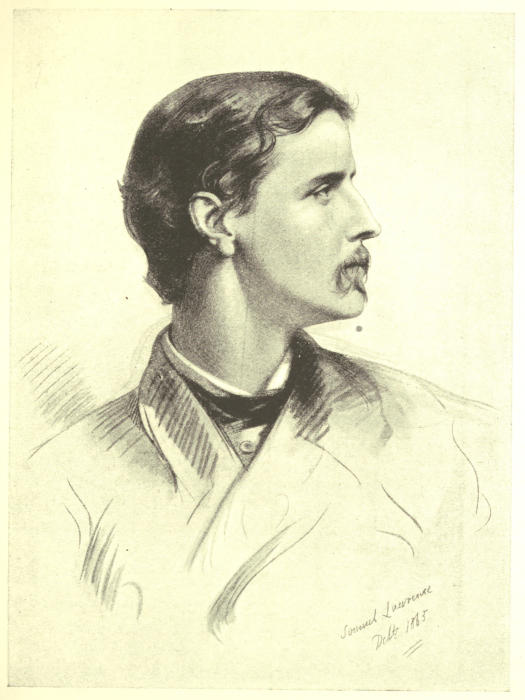
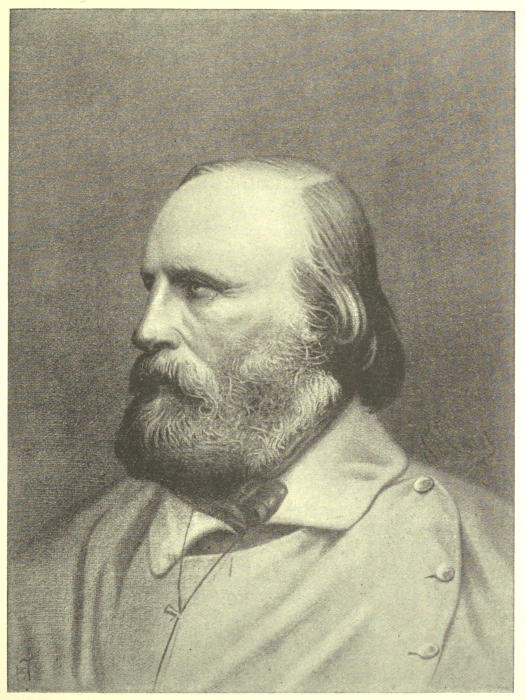
THE AUTHOR, AGED 28.
By Samuel Lawrence.
We landed in the afternoon. The Salamis got up steam and
was off. The Basilisk followed. The Serpent was still lying
peacefully at anchor. That evening we spent in making ready
for our start the next morning. The Tycoon’s officers tried hard
to persuade us that they must go with us. This we stoutly resisted;
they would have been absolutely worse than useless, for
they were mere underlings, they could not protect us, and would
simply be spies interfering with any possibility of friendly intercourse
with the local people.
We pointed out to them that their duty was to remain with
Commander Bullock, under whose orders they at present were. In
the end after a good deal of whining on their part that if any evil
thing happened to us they would suffer, they agreed to leave us
in peace provided that we would absolve them from all responsibility;
so at last they went off to the Serpent, after having taken
a formal receipt from the Kaga men for our bodies, certified safe
and sound at the time of delivery!
We started on the 10th of August. With the Kaga people
sulky and still sore at the dressing which they had received the
day before from our chief, the outset was not encouraging; however,
grumpiness is no feature of the Japanese nature, and no
ill-will could for long make a stand against Satow’s pleasant and
conciliatory ways, and we were soon on far better terms with our
guides than we had any right to expect.
Two smart palanquins had been provided for us and ordinary
ones for our two attendants—Satow’s retainer, a Samurai named
Noguchi, and my Chinese servant Lin Fu. A guard of twenty men
armed with sword and dirk, long staves, and a crest of two paddles
crossed, the badge of the Maéda family,[1] was to escort us, whether
for show or for protection might be reckoned uncertain. They
were, at any rate, of use in steering us through the crowds which
in every small town, village, or cluster of houses were hustling for
a first place to see the strange wild beasts.
Hot as it was, so soon as we were out of the town we left the
cramping discomforts of our palanquins and walked along the
pretty valley trending in a south-westerly direction. The scenery
was charming—here a lagoon, there a long stretch of seashore,
and, above all, on the east the towering mountains of Echiu,
said to be some ten thousand feet high, veritable “hills whose
heads touch heaven.” Everywhere the characteristic forest foliage
of Japan; and where is foliage more picturesquely beautiful?
We passed along one stretch of sandy beach fringing a sea the
dancing wavelets of which were as blue as the heaven above them,
just the setting for one of those old world legends in which the
Japanese delight. Such a legend is the story of the invention of
the one-stringed lute, which might have been dear to Paganini,
though it is not played with a bow. It is true that the scene of
it lay far away in another province, but it seems to fit in here,
for it came to my mind as we wandered along the romantic shore.
Once upon a time, in the dark long ago, there was at the Court
of Kiōto a Kugé, or noble, who was dearly loved by the Son of
Heaven; but he had reason to say, “Put not your trust in
princes;” like women, they are apt to change; in the caprice
of a moment, the Kugé fell into disgrace and was banished to a
lonely place called Suma, a distant village occupied by humble
fisher-folk. Days and days he spent by the seaside, mourning
over the happiness which seemed to have fled from him for ever.
One morning on the beach he spied a water-worn board, a piece
of jetsam from some perished junk which the ebbing tide had
left upon the sand, and as he looked he wondered, and said to
himself, for he was well skilled in art, “Perhaps even this poor
old piece of wreck may have music in it, had I but the skill to
draw out its soul.” So he pondered and racked his brain to think
how if it were fitted with a string and bridge the intervals should
be distanced. Remaining buried in thought, he of a sudden saw
a little flight of sandpipers who came and settled upon the beach
near him, making a pattern which seemed to him to have some
mystic meaning in it, and he wondered whether if he were to copy
it on his piece of board it might be the solution of his problem.
When he put it to the test he discovered to his joy that he had
found the one-stringed lute which to this day is known as Sumagoto,
the harp of Suma.
So with sweet strains he beguiled the weariness of the long,
lonely hours. Hard by was a poor fisherman’s cottage, lowly
indeed, but exquisitely clean and dainty, with a whole garden of
dark blue iris in the warmly thatched roof. The old fisherman
and his wife became very friendly with the fallen noble, and their
daughter, a lovely maiden of sixteen, would sit by the hour listening
entranced by the sweetness of his music. They loved one another
and were married, and she brought the light of her beauty and
grace to charm into happiness the misery of his banishment. And
so the months sped by until one day there came a messenger from
the court to say that pity had touched the heart of the Son of
Heaven and the Kugé was to be restored to his former dignities.
But he was a faithful lover, and took his humble mate with him
to Kiōto, where she became a great lady and they lived happily
ever after. And that is the story of the harp of Suma.
But this is a digression. Through the great heat we trudged
along, stopping once in a while to rest in the pleasant coolness
of some pretty tea-house, feasting on fragrant melons and those
delicious apples which are a dainty of that countryside. Some of
the inns were very attractive and the people most polite and kindly
disposed; we had no reason to complain of our reception in Kaga.
The Kaga Samurai is not a fierce warrior like the men of Satsuma
and Tosa, nor is he an astute politician like the leaders of the
Chōshiu folk. Those we met seemed to be quiet and peaceful,
perhaps a little bit slow-coaches, rich and prosperous, while their
Prince, who, as I have hinted before, was rather inclined to sit
upon the fence, held an important position in the Empire on
account of his huge wealth.
Our second day’s journey lay through very pretty scenery, past
Takamatsu, a picturesque fishing village on the seashore, to
Tsubata, a flourishing little post-town, where we found a capital
inn and spent the night refreshed by an excellent Japanese dinner.
On Monday, the 12th of August, we started at 7.45 on our third
day’s tramp, which was to bring us to Kanazawa, the Kaga capital.
We rested in a temple at a place called Morimoto, where we had
the usual feast of melons and apples. The crowds were now
beginning to be enormous; our guides were anxious that we should
walk into the city, the white castle walls of which were visible
peering out of a glorious dark cloud of pine trees about a mile away.
We, however, had become surfeited of being a raree show at
Ōsaka and elsewhere, and we were conscious that in our shabby
travelling clothes we should present anything but a dignified
appearance, so we tucked ourselves up in our palanquins with the
modesty of brides. Hordes of spectators lined the streets, and
even a lotus pond which commanded a good view of a very pretty
resting-place which had been prepared for us was full of paddlers.
The sightseers were of all ages, sorts and conditions in life, and
amongst them we noticed a great number of comely maidens, for
the ladies of Kaga are good to look upon. A tortuous course
brought us to our inn, where we were received with the most dignified
courtesy and all the hospitable politeness of which Japan is
such a pattern. Our sitting-room had been strewed with a huge
velvet pile carpet, and red lacquer chairs had been brought out
of a temple for our use, our hosts not realizing that long custom
had inured us to the native fashion of squatting on the mats.
Soon an envoy arrived from the Prince, expressing anxiety for our
healths on account of the great heat and regretting that he himself
was not well enough to receive us; I answered, swearing eternal
friendship with Japan and especially with Kaga, on behalf of Sir
Harry Parkes. A feast was brought in at which the envoy presided,
and soon the very smart but very uncomfortable chairs
were discarded and we were hobnobbing with the saké cups
according to true Japanese etiquette. Presently the Prince’s
doctors arrived offering medical attendance, pills and potions,
in case we should need them.
At that time, be it remembered, the medical profession was
still under the Chinese influence, and we should hardly have been
prepared to subscribe to its methods, among which acupuncture
and the burning with moxa held a high but painful place. So
we expressed our gratitude, pleading excellent health as an excuse
for not submitting to a consultation. A political conversation
followed, which was supposed to be absolutely confidential, though
as it was carried on in the presence of apparently anybody who
chose to come in and listen, the maintenance of its deadly secrecy
was not much to be relied upon.
That, however, was not our affair; we had nothing to conceal,
for the Tycoon’s Government knew perfectly well what was the
object of our visit, and that we should do all in our power to bring
about the opening of Nanao to foreign trade. The Kaga people
used the old arguments. They were perfectly ready to admit
foreign trade, but they could not agree to their harbour being
made anything more than an anchorage where goods might be
landed; the rest would follow—but they repeated that they were
in deadly fear lest the Tycoon should make an attempt to seize
it. By the time the envoy left we had become excellent friends,
and Satow had made arrangements for carrying on communications
with Kanazawa from Yedo. A great point gained, for as I
have said, the clan was one to be held in reckoning. Satow even
went so far as to offer to take two Kaga men as pupils; two of
the clan, we heard, were already studying in England.
As soon as our official interview was over we set out to see the
town, a huge place, hilly and picturesquely planted, of which
the size had not been exaggerated. It was said to hold 500,000
inhabitants. We found some excellent shops where silks and
lacquer and fans (for which the town is famous, the sticks
being the special secret of a family called Suba) were to be had
at exorbitant prices; but I managed to secure a very ancient
piece of lacquer, one of the three or four best specimens that ever
came in my way, and one or two other treasures. Kutani (“The
nine valleys”) is close to Kanazawa, and as a matter of course we
had to buy a few specimens of the curious red ware for which
it is famous. We also found some capital book-shops.
The civility and kindness of all the people whom we met was
beyond praise. In the evening we received a message from the
machi-bugiyo, the Governor of the city, begging us to prolong
our stay and to make some excursions in the neighbouring country.
The invitation was so pressing that we could not well refuse, and
so on the following day, after a morning of shopping at prices
enhanced by the intermediary of the inn servants, who could not
resist the temptation of a small squeeze, we started on horseback
for Kanaiwa, an open roadstead about four miles off. Our saddles,
of European fashion, made of paper in imitation of leather, and
the bridles, were something that must be seen to be believed. The
unshod ponies were as bad as usual, but Japan is not a horsey
country.
Two resting-places had been made ready to break this five-mile
ride, and another at the end! There was not much to be
seen when we reached our destination—a sandy beach and open
sea, with a tiny stream running into it. It was not easy to guess
why our kind hosts had been so keen to show it to us. We got
home again before dark. In the evening two of the Prince’s
gentlemen came in for an after-dinner chat. They talked again
about the possibility of opening Nanao to foreign trade, saying
very sensibly that it would not be well to do anything which might
have the appearance of smuggling, and that it would be best to
tell the Bakufu (Government of the Tycoon) that if foreign vessels
were admitted there would surely be a certain amount of goods
exchanged. We urged them to write in that sense to Yedo. We
then started upon general politics. Their view as to the state
of parties at that moment was that the Bakufu ought to be
supported on general principles, but that its power should be kept
within bounds. We talked on till late into the night, my conviction
still being that Kaga had not at that time any determined
policy. It was obvious that there was no leading influential man
such as those whom we knew in other clans. I handed them a
letter of thanks for all the kindness which we had received, which
Satow translated into Japanese; and they took their leave with
great courtesy.
The following morning (August 14) we started off again after
a most friendly leave-taking, everybody begging us to come again.
Our host begs us to stop at a medicine shop kept by his father-in-law
to buy a wonderful drug called shisetsu, made of nitre and
musk, a panacea for all the ills to which flesh is heir. The crowds
were as thick as ever, with many very attractive young ladies.
From our first resting-place we looked back upon the great city
where we had been so kindly received, and saw the castle, typical
of a feudalism that was so near its end, standing with its high
white towers on rising ground, lording it over the burghers’ houses
below, among the pine trees with which the whole town is planted.
A striking and picturesque view, and a happy memory, the value
of which is enhanced by that patina in which time enwraps all
beautiful things.
The rest of our journey through the province of Kaga was not
very eventful. Wherever we went we were met with the same
gracious and unexpected kindness that had made our stay at
Kanazawa so pleasant. We could not help being struck by the
great prosperity of the country. We passed through such towns
as Mattō, with two thousand houses, Komatsu, with two thousand
five hundred, all under the mild rule of the Prince of Kaga,
and a happier people it would be difficult to find.
On the 15th we reached the frontier of Echizen, where to the outspoken
indignation of our Kaga friends, a petty official, a mere
understrapper, had been sent to meet us. Here again the Kaga
people exacted from the Echizen men a receipt for our bodies. I
wonder how it was worded? Item, received, two English officials,
sound in wind and limbs, etc.? I should have liked to have seen
the document.
It pretty soon became evident that although the Echizen people
were ready to entertain us, and even to go to considerable expense
in so doing, we must not look for any real friendship. It was, no
doubt, kind to give us champagne and to provide smart pages of
honour to fan us in the great heat—small gentlemen who reminded
one of the dear little boys who waited upon the great Lord Cardinal
when the wicked jackdaw of Reims stole his ring, but there was
no show of civility, and in Fukui, the capital, such persons of gentle
birth as flocked to the temple of Honguanji, where we were, to tell
the truth, magnificently lodged, only came to crowd the passages
and stare at us as if we had been gorillas. The intentional rudeness
was unmistakable. The Prince of Echizen was at that time
notoriously opposed to all foreign intercourse, and his feelings
were reflected in the conduct of his people.
On the 17th we crossed the Echizen boundary, glad to be quit of
an unfriendly and surly people, who again handed us over against a
formal receipt to the representatives of Ii Kamon no Kami. On
the following day we reached Nagahama, a place which had been
visited by Sir Harry Parkes and his party in May, so we were no
longer a novelty and attracted little attention, which was a mercy.
Here we were met by an officer of the Tycoon with a guard of eighteen
of the Bettégumi (foreign guards), which very much robbed the
journey of its interest, for under the eyes and ears of the Bakufu
it was of course out of the question to hold any familiar intercourse
with the people of the various places through which we might pass.
This day we came to a place called Yanagosé, where there was a
curious institution, a sekisho, or barrier, which no woman might go
through without a passport. Talk about women’s rights!
On the 20th of August we reached Kasatsu, where we proposed
to remain for the afternoon to enable me to write up my report,
which was bound to be rather a long affair, for we had gathered
together a formidable budget of political and commercial information—now,
after nearly half a century crowded with stirring events,
altogether obsolete, but at that time full of interest. Here we met
two or three officials with whom Satow was acquainted, and with
whom, after dinner, we were engaged until past midnight in the
usual discussions about politics, which, when held with persons
connected with the Bakufu, were as tedious as they were vapid.
More interesting, and as it turned out more fortunate for us, was
the interminable wrangle about the road which we were to take
on the morrow. We had determined on taking the shortest cut to
Ōsaka, through Ōtsu, a little town at the further end of the Biwa
lake. The Japanese officials were equally determined that we
should not go to Ōtsu at all, making every sort of difficulty,
obviously on account of its proximity to Kiōto, the sacred city.
As a bait they offered to show us the famous temple of Ishiyama,
which had been closed to Sir Harry. We were obstinate, Satow
not a little suspicious at this great eagerness to take us sightseeing,
and quite appreciating what the real object was. The
landlord of the inn put in a word: “If the gentlemen are
so eager to obtain commercial information, why don’t they go
to see the famous Uji tea-district? That will be of great interest
to them, whereas there is nothing to see at Ōtsu.” We stuck
to our guns, and expressed our unalterable decision to take the
nearest road by Ōtsu. We told them that we knew quite well
what they were driving at, and that they had been sent on purpose
to play this trick upon us; that if they had been candid with us
we might have agreed, but in the circumstances, No! They seemed
very much crestfallen, but returned to the charge.
At last I lost patience, and turning suddenly round, told them that
if they would write me an official letter explicitly stating their
reasons, I would go by Uji, if not, guard or no guard, we would
go through Ōtsu. After a little grumbling, they agreed to write
such a letter, and went away to draft it. No fewer than three
drafts were rejected as inadmissible, because they stated that we
had not the Government permission to travel, which as diplomatists
we had a right to do, and otherwise confused the issue; but at last
they brought a satisfactory letter, in which they said that great
complications had arisen at Kiōto on account of Sir Harry’s passing
through in May, and they begged us therefore as a favour to go by
Uji. It was a hard-won triumph for us.
I have dwelt upon this midnight parley at Kusatsu at greater
length than would have been justifiable had it not been for its
consequences.
When we reached Ōsaka two days later, Noguchi, Satow’s
Samurai attendant, went to a tea-house in the city in which he
overheard a party of men belonging to the Tosa clan, in a compartment
separated from him by a paper screen, telling of their disappointment
at having the day before missed the chance of murdering
the two foreigners who were defiling the neighbourhood of
the sacred city. It appeared that a band of four hundred men of
the Tosa, Satsuma and Chōshiu clans had gone out to Ōtsu to lie
in wait for us. Had we taken the route which we proposed, through
Ōtsu, we should have been dead men. It was a narrow escape; a
very near thing!
The fun of the thing was that the Japanese officials, in persuading
us to change our route, had not the remotest suspicion of what they
were saving us from.
Weeks afterwards I heard the whole story confirmed by Gotō
Shōjirō. He was at the time rusui, or agent in charge of the
yashiki (palace) of the Prince of Tosa at Kiōto, and heard of the
plot which he did all in his power to stop. But his men broke out
of the yashiki, determined to wreak their hatred of foreigners on us.
Gotō’s name must appear often in these recollections; he became
one of my best friends in Japan, and risked his own life in the attack
upon the Legation, when we were on our way to the Mikado’s Court
in the following year—as I shall presently relate.
August 21st.—We left Kusatsu at 5.45 a.m. The heat was
appalling; what with mosquitoes and discussions we had had but
scanty sleep; moreover we had for the last day or two had little food,
save rice with tea, of which we could not eat our fill, for the condiments
with which the Japanese encourage their appetite for rice
were as salt as brine, and to us impossible. Partly by river, and
partly on the tramp, stopping every now and then to wash out our
mouths, through beautiful scenery with a glorious view of the great
plain in which lie Kiōto and Fushimi—the place of the thrilling
memories of the civil war—we reached Uji at four o’clock, very
much done up with the heat and very tired.
As for the famous Temple of Ishiyama, which was to be the reward
of our listening to the blandishments of our friends of the night
before, it had been hermetically sealed to us, and all our knocking
at the door brought no answer. Seven years afterwards, on board a
steamer in the Pacific, I met a Japanese gentleman who had been
present and had watched our discomfiture and vain knockings. We
bought a little tea at Uji, as a matter of course; and at six o’clock
got into a comfortable houseboat in which we drifted down the
stream, resting and looking back upon the entrancing view. Toward
morning we fell asleep.
August 22nd at 5.30 a.m. we were in sight of the glorious old
Castle of Ōsaka, and landing at six, took up our quarters in our
old temple in the Nakadéramachi. So our venturesome eleven
days’ journey came to an end; it had been intensely interesting and
exciting. We never knew what might happen; when we lay down
at night we blessed our luck that there had been no mischance,
and when the morning came we pinched ourselves to see whether we
were really still alive: there were so many wandering anti-foreign
fanatics throughout the country, against whom even our kind Kaga
friends could not have protected us! However, it all ended well,
and we were successful in gaining all the information that our chief
wanted. Unfortunately the interest of our expedition paled before
a tragedy. For at five Sir Harry Parkes arrived with the news of
the cruel murder of two bluejackets of H.M.S. Icarus. They had
been literally hacked to pieces by a party of brawling Samurai.
These poor fellows’ fate brought home to us the danger to which we
had so nearly fallen victims.
This murder led to endless interviews and discussions, which were
complicated by the fact that our people were on the wrong tack.
There was a suspicion that the murderers were Samurai of the Tosa
clan—a suspicion born of the fact that a small steamer and a sailing
vessel belonging to Tosa had slipped secretly out of Nagasaki
harbour before daylight on the morning after the crime had been
committed. It was afterwards proved that they belonged to a quite
different clan, which was duly punished later. But the chief
murderer had previously committed suicide by hara-kiri.
The discussions served to make us better acquainted and increased
our respect for Gotō Shōjirō, who represented his Prince and who
proved himself to be a man of first-rate ability, quite able to hold his
own against our rather peppery chief—not an easy man to discuss
matters with. He turned out to be one of the three or four ablest
men who engineered the revolution. Like the famous Saigo, of
Satsuma, and others of the leaders in the various clans, Gotō expressed
himself as keenly anxious to establish a Gi-ji-in, or parliament.
That did not come about until some eighteen months later,
and when it did ripen into being it turned out to be a very embryonic
affair.
Mercifully for Japan, speech-making had never played the same
part in her public life that it has done in some other countries, and
the Parliament started more like a debating society in a public
school than a grave assembly of legislators, which, as a matter of
fact, they were not. They might register their opinions, but they
could not enact laws.
August 31st.—Satow and myself had been invited by the Prince
of Awa to go and pay him a visit at his castle in the Island of Shikoku
(“the four countries,” so called from the principalities of Awa, Tosa,
Sanuki and Iyo into which it was divided). Had the visit taken
place as it was originally meant, we should no doubt have been able
over the wine-cups to gather a good deal of information as to the
attitude of the four clans in the crisis, together with a good many
particulars in regard to the personalities of their leading men.
But unfortunately at the last moment Sir Harry Parkes insisted on
going too, with the Admiral and their respective staffs, in the
Salamis and the Basilisk; so the whole expedition was spoilt, and
degenerated into a sort of official demonstration, at which the usual
stale old political platitudes were served up—perfectly useless
discussions, in which sincerity was apt to play a very meagre part
on both sides. The weather, moreover, played us every conceivable
trick by which to make us uncomfortable.
The Prince, however, was very kind and courteous, and he had
prepared a most amusing theatrical entertainment for us, in which
his retainers acted with great spirit. They were dressed in the long
trousers worn at Court, but did not wear the yéboshi (black lacquer
cap). The plot of the first piece, which consisted of three characters,
the master, a servant and a guest, was very funny. The master
tells his servant to imitate him in everything that he does, and the
servant takes the order literally, and passes on to the guest everything
that the master says to him. The enraged master cuffs the
servant, who passes the thrashing on to the guest, and so it goes on—a
series of practical jokes like the “spill and pelt” scene in a
pantomime, until the master’s patience is exhausted and he finally
kicks the servant out.
Then came what was a sort of Oriental first-cousin to Offenbach’s
Les Deux Aveugles. A man advertises for persons deprived by
nature of their senses or limbs to enter his service. In answer to
this there arrive a lame man, a dumb man, and a blind man—all
these parts capitally acted. These three cripples are ruined gamblers
who have adopted their disguises as beggars to get employment.
The great man accepts them, and having placed them in charge of
three storehouses, goes out. The men recognize one another and
propose to go to the storehouse where the saké is kept and have a
drink, after which they may divide the money in the treasure-house.
Of course they get roaring drunk, and by the time the master comes
back each has forgotten his part. The blind man becomes dumb,
the lame man blind, and the dumb man is afflicted with deafness.
The exposure of the impostors is full of fun.
After the play—the wine-cup and bibulous affection. The
Prince of Awa swears that he is the Admiral’s son and elder brother
to Sir Harry Parkes; Awaji no Kami, the Prince’s son, claims intimate
relationship with Satow.
The next day there was a review of some five hundred men in a
sort of tatterdemalion European dress, some with boots, some
without, those who had them being as “justly vain” as Sir Plume
“of amber snuff-box and the nice conduct of a clouded cane.”
The drill was capital.
In the evening I left for Yedo in the Salamis with the Admiral.
Satow went to Sasaki in Tosa with Sir Harry to investigate the case
of the Icarus murders. The Tosa people, who, as I have said, were
ultimately proved to be innocent, with Gotō as spokesman, took up
a very dignified position. Yōdo (the de facto ruler of the clan,
though he had nominally become inkiyō (retired) whom Satow
visited) declared that if his men were proved guilty he would punish
them; if they were innocent nothing should stir him from his line
of conduct. It must have been galling to Sir Harry to be told by
Gotō that he was allowing his temper to get the better of his discretion.
A dignified demeanour is the only attitude to observe with
the Japanese, who, whatever their faults may be, are gentlemen to
their finger-tips. Bluster does not succeed, but that was a lesson
which our chief, with all his great qualities, never learned, and in
this case he was completely worsted.
Satow remained at Nagasaki till the 7th of November, so I was
all alone at Yedo in my little temple Monriuin. As a precaution
I had the walks all round the garden strewn with cockle-shells
to sound an alarm in the event of there being any unwelcome
visitors after dark. One night I was awakened about twelve
o’clock by the crunching of my faithful guardian cockles. I
jumped up and lighted candles and lamps, roused the servants,
gave my sword and revolver to my Chinese servant, Lin Fu, upon
whom I could depend, and stood at the chief door with my Spencer
rifle. The ruffians, seeing that we were ready for them, made off.
There were five or six of them, as I knew, for it had been raining
heavily and the following morning I found the marks in the grass
where they had slid in a sitting position down the little hill, which
was deeply scored with their posteriors and heels—mighty unpleasant!
I was too near the evilly-reputed wine-shops of Shinagawa,
famous like the wynds of Old Edinburgh for brawls between
the clans, and as the haunts of the Jō-i, the fanatics opposed to
foreign intercourse.
Another time, as I was leaving home in the morning to go to
the Legation, I saw the dead body of a Samurai lying in a pool
of blood outside my gate. It was covered with a piece of matting,
but the head had been carried off to be deposited, according to the
strict rules of Kataki-uchi (vendetta), upon the grave of an enemy
killed by last night’s victim in some previous quarrel.
These were quite everyday occurrences in the Yedo of what
the Japanese now call “the olden time” (mukashi)—that is the
period before the revolution, only forty-eight years ago!
Meantime, although there was no great outward show politically,
the underground fires of revolution were silently gathering strength.
The Tycoon had resigned his office—in fact abolished it—though
he still in some inconsistent way claimed to be conducting affairs,
and of course remained at the head of the Tokugawa clan. The
Daimios, with Satsuma, Chōshiu and Tosa at their head, were said
to be arming, and even to have established a camp at Ōsaka. The
Tosa people asserted that the Tycoon, in his resignation, had only
followed the advice contained in a memorial from their clan, dated
in October, which they showed to Satow. The document advocated
the establishment of a Parliament consisting of an upper and
lower house, the erection of schools of science and learning in the
great cities, and the negotiation of new foreign treaties. The
emissaries of the Daimios were more than ever keen to obtain
instruction in Parliamentary procedure. They were evidently
all anxiety to stand well with us.
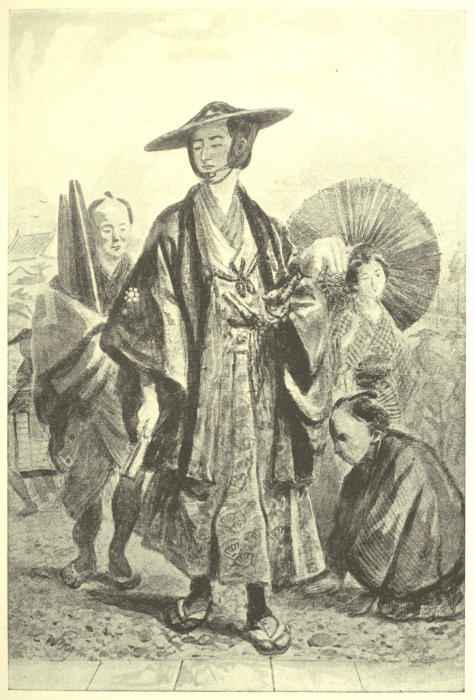
OLD JAPAN.
From a water-colour drawing by C. Wirgman.
CHAPTER XXI JAPAN. CIVIL WAR
On the 30th of November at daylight, Satow and I, in our usual
characters as diplomatic stormy petrels, sailed for Ōsaka to
make all preparations for the opening of that city and Hiōgo on the
first day of that new year which was to come big with the birth
of a new power and fraught with events as momentous, perhaps,
as any that the history of the world has seen. We reached Ōsaka
on the 3rd of December, and were at once plunged in the political
whirlpool. Besides that we had to prepare quarters for the
Minister and his staff and the mounted escort, with fifty men of
the 9th Regiment. Much building of palisades, bonded warehouses,
custom houses, etc., was going on at what was to be
the future foreign settlement. This was going a little too fast,
and we had to put a stop to any further work until the Ministers
should arrive. They might have a good deal to say upon the
subject, especially as to the palisades, which were not a very
encouraging indication of the intentions of the Government to
promote intercourse between West and East.
On the 7th we had an interview with members of the Tycoon’s
Council of State who were on their way to Yedo, and whom he had
ordered to see us. We did not get much information out of them
except that the Tycoon’s resignation was merely the carrying out
of an intention formed long ago. We were not convinced, nor
were we shaken in our belief that he had been driven to it by the
persistent attitude of the clans.
On the 12th of December we had to leave for Hiōgo in order
to see what preparations were being made there for the great
event. We found that the people were in high spirits at the
prospect of the opening of the port. In Kōbé, where the foreign
settlement was to be, there had been seven days of feasting and
merry-making, and there had been processions of people dressed
in red crape with carts which were supposed to carry earth for the
site of the new settlement. Similar fêtes were in prospect in the
town of Hiōgo itself. The people obviously saw that foreign
trade would spell prosperity for them.
When we got back to Ōsaka on the 13th, we found the city in
an uproar of joy and excitement. It appeared that all this was
in honour of a miraculous shower which had recently taken place
of slips of paper bearing the titles of the Gods of Isé—the ancestral
shrine of Old Japan and the chief place of the Shintō cult.
Thousands and thousands of happy fanatics were dancing along
the streets dressed in holiday garb of red and blue crape and carrying
red lanterns on their heads, shouting till they must have been
hoarse, “I ja nai ka, i ja nai ka!” “How delightful, how delightful!”
The houses were decorated with many-coloured cakes,
oranges, silken bags, emblematic ropes of straw such as are hung
before the Shintō shrines, and a profusion of flowers.
It was a weird and wonderful sight, such as, maybe, will never
be seen again; and yet folk-lore and old reverences die hard.
Even though all this should be mukashi, as much so as the mysteries
of Stonehenge are to us, one may hope that it may yet have some
life in it. “Le respect du passé est la piété filiale des peuples,”
was a fine saying of the Duc de Broglie; one which, in these degenerate
days, I never weary of quoting, and we foreigners must
not forget what the Japanese owe to the Yamato Damashii, the
spirit of old Japan. It is upon the legends of the Shintō that
it is founded. Then let the simple folk, “the hundred names,”
dance like David before the Ark, in honour of showers of paper,
for to them they mean the sacred traditions of a glorious past,
and upon these is based a heroism before which the world has bowed
its head in admiration.
No sooner were we back in Ōsaka than the old political conversations
began again. Satsuma, Chōshiu, Tosa, Uwajima and
Geishiu were solid for a change; other Daimios inclined to join,
but vacillating. One thing we were clearly given to understand:
if the intrigues now going on at Kiōto failed, the Daimios would
revert to the old game of murderous attacks upon foreigners, not
from any dislike of foreign intercourse, of which they were indeed
in favour, but simply in order to embroil the Tycoon with the
Treaty Powers. The obvious answer to this was that whatever
might happen in that way, the Tycoon could not be held responsible
for the action of persons over whom he, as they admitted, had
no control!
The arrival of leading men in Ōsaka, so near Kiōto, at this time
was very significant. Saigo, the famous Satsuma general, who
died years afterwards by hara-kiri in the rebellion of his clan, and
Gotō Shōjirō were very conspicuous figures. The latter talked a
great deal about the scheme to murder Satow and myself at Ōtsu
in August and gave us many particulars. It was a merciful
escape.
Letters from Yedo showed that there the demolition of the
Bakufu was an accomplished fact. On the 20th we had an interview
with Ito Shunské, which is worth noting because it was one of
our first communications with a man, then in a humble position,
who afterwards, as Prince Ito, became the most powerful political
personage in Japan. He told us that war was quite inevitable,
the object being to deprive the Tycoon of his territory, which was
far too large for the peace of the country. He would have preferred
to put off the arrival of the Foreign Representatives and the
opening of the ports, but when he was told that this was out of the
question, he said that in that case the opening must take place
in order to keep foreigners quiet whilst the plans for the reformation
of the country went on. We both warned him that if, in the
course of the revolution, foreigners were attacked or any attempt
should be made to upset the Treaties, the Japanese would be bringing
upon themselves a very grave responsibility. He admitted
the force of this and promised to keep Satow posted as to any
movement that might be on foot.
On the 24th Sir Harry Parkes arrived with the other
members of the Legation, and took possession of the quarters
which we had prepared in a great tumbledown Yashiki behind
the castle; not perhaps the safest place in case trouble should
arise, for fighting would be focussed upon the stronghold, but
all things considered, the best that could be had.
Satow and myself were now very much more under observation
than we had been, and it was not easy to keep up our communications
with the Daimios party. The Tycoon’s guard kept a pretty
sharp look-out, but we managed to defeat them by climbing over
the walls of the Legation buildings at night, and joining our friends
outside, who led us by tortuous ways to one or other of their Yashikis
where we were able to confer with them comfortably. In this way,
like a couple of boys breaking out to rob a neighbour’s apple-orchard,
we contrived to keep our chief posted as to what was going
on; practical, but hardly very dignified. The end must be held
as justification for the means.
The 1st of January, 1868, was really the birthday of the new
dispensation. Up to this time, for many months, the country
had been in a fever of unrest; there had been plots and counterplots,
conspiracies and intrigues of which I have tried to give some
indication, though their details would fill volumes; there had been
the resignation, or sham resignation, of the Tycoon; there had
been a gradual massing of troops near Kiōto: the Prince of Chōshiu,
who had been in disgrace, had been forgiven, save the mark! by
the Tycoon, and the Prince of Aidzu was said to have resigned the
guardianship of the palace as a sign of his resentment of this
leniency—but the report was not true, as will be seen presently:
the witch’s cauldron was seething and boiling, but so far the peace
had not actually been broken; the Daimios were still protesting
that their object was only to curb the Tycoon and restrain an overwhelming
power which had been abused.
We began to feel that the dogs of war were loose. We learned
that the Prince of Satsuma had proposed the abolition of the
Tycoon and the other old officers of State, substituting for them
something analogous to a Constitutional Government with Secretaries
of State and the whole machinery of an executive; a proposal
in which we could not but recognize the reflection of hints
which, at his request, Satow and I had given to Gotō Shōjirō.
Satsuma’s views met with great opposition, many men dreading
such Radical ideas as perhaps likely to end by threatening the
kingship of the Mikado himself. Our informant said that this
was no matter for argument, it must be decided by war. The
Tycoon, he admitted, would raise no difficulties, being bent on
preserving the peace of the country at whatever cost to himself.
But he could not control his people.
Things were now moving at lightning speed and every day
brought some new development. Rumours came flying fast and
furious—some true, some garbled, some false—but all pointing
in one direction.
On the 7th of January an official of the Bakufu came to tell us
that the Tycoon had left Kiōto and was on his way to Ōsaka to
have an interview with M. Roches. This naturally was a mere
pretext; as a matter of fact he was leaving Kiōto because his
office had come to an end. The Aidzu men who had charge of the
nine gates of the Mikado’s palace had been ousted by Imperial
command and the sacred precincts and the Emperor himself were
in the hands of the coalition Daimios. Practically the end had come.
Satow and I went out to see what was going on. We found
the streets being patrolled by soldiers with field pieces placed so
as to sweep the approaches to the castle. It was bitterly cold and
the men had their heads wrapped in mufflers—a curious addition
to the pomp and circumstance of uniform. The Aidzu people,
who were posted about, told us that the reason for the Tycoon’s
withdrawal was his unwillingness to allow fighting to take place
near the precincts of the palace—a sort of “Star Chamber” reason.
They said that Satsuma wanted to do everything by force—so
like that martial clan! Tosa, on the other hand, was all for
proceeding by reason; but in either case the object was
the same. As for Gotō’s scheme for a Constitution, Japan
was not ripe for that: the change would be too sudden and too
violent.
In the afternoon it became evident that the Tycoon was now
close by. We saw wonderful groups of men clad in armour. They
were very civil and full of patriotic declarations of readiness to
die in the Tycoon’s cause, and indeed, as events proved, these were
no empty boasts. They were beaten, but not before hundreds of
Tokugawa men had died the death of heroes. Presently the bugles
sounded and we saw a long procession of troops coming towards
the castle.
A more extravagantly weird picture it would be difficult to
imagine. There were some infantry armed with European rifles,
but there were also warriors clad in the old armour of the country
carrying spears, bows and arrows, falchions, curiously shaped, with
sword and dirk, who looked as if they had stepped out of some old
pictures of the Gem-Pei wars in the Middle Ages. Their jimbaoris,
not unlike heralds’ tabards, were as many-coloured as Joseph’s
coat. Hideous masks of lacquer and iron, fringed with portentous
whiskers and moustachios, crested helmets with wigs from which
long streamers of horsehair floated to their waists, might strike
terror into any enemy. They looked like the hobgoblins of a
nightmare. Soon a troop of horsemen appeared. The Japanese
all prostrated themselves and bent their heads in reverent awe.
In the midst of the troop was the fallen Prince, accompanied by
his faithful adherents, Aidzu and Kuwana. The Prince himself
seemed worn and dejected, looking neither to the right nor to the
left, his head wrapped in a black cloth, taking notice of nothing.
Some of those with him recognized us and returned our salutes.
It was a wild and wonderful sight and one of the saddest that I
ever beheld. At the gate all dismounted, according to custom—save
only the War Lord himself; he rode in, a solitary horseman.
It was the last entry of a Shōgun into the grand old castle which
had come into the heritage of the Tokugawa by one tragedy, and
was to pass out of their possession by another. In each case fire,
“the calamity of the dancing horse,”[2] played its cruel part.
Sir Harry Parkes at once asked for an appointment to see the
Shōgun on the following day, which was declined; but hearing that
M. Roches was to be received, our chief was not to be held; he insisted
upon making his way in, with Satow and me—to the outspoken
disgust of the French colleague—and the two ministers were
received together—not without some recriminations and angry
words between them. The Shōgun, or rather ex-Shōgun, as he now
was, seemed greatly depressed; he was a very different man from
the handsome, proud noble who had received us with so much dignity
in the preceding May. The many troubles, sorrows and indignities
which he had undergone were written in his face. He repeated the
old story of his having left Kiōto from patriotic motives, in order
to avoid civil war, which would be waged almost in the sacred
presence of the Emperor. He said that he should remain in Ōsaka,
but did not know whether he would be attacked. As to the
existing order of things, he said that the Mikado nominally ruled,
but that Kiōto was occupied by an unruly set of men, who did
nothing but quarrel among themselves and had no notion of
governing. The two ministers applauded his action—the Frenchman
in fulsome language, Sir Harry in more measured terms. There
was obviously nothing much to be drawn from him, and as he
complained of feeling tired, the rather barren conference came to
an end.
That evening Sir Henry Keppel, who, with my old friend, his
flag lieutenant (now Admiral Sir Henry Stephenson, Black Rod),
and that grand sailor and gallant gentleman, Captain Chandos
Scudamore Stanhope, of H.M.S. Ocean,[3] was on shore, insisted on
my going off with him to Hiōgo to sleep on board the Rodney, and
hear the band play. It was blowing great guns, and I felt pretty
certain that the perfidious bar which I knew only too well would be
dangerous if not impassable. I told this to the Admiral, but he
pooh-poohed the objections of a mere landsman, and said that I
“did not know what a steam-launch could do.” So off we went
with a second boat in tow. Darkness set in, and by the time we
reached the mouth of the river it was black night.
The wind was howling like Bedlam; the sea was terrific; now and
then there was a rift in the clouds, and we could see the mockery
of the wicked moon shining luridly through the ugly green waves
which towered over us, hungry to swallow us up; we expected to
go under any minute.
It soon became evident that we must cast off the boat which we
were towing; there was no other chance for her, and our desertion
saved her. Captain Stanhope took the helm, keeping the launch’s
bows to the beating seas; as he stood in the stern with his teeth set,
a grim statue, as if he had been carved in stone, he was splendid.
There was one specially evil moment, when the Admiral turned to
me and said: “I don’t know what you think, but I have never
seen death so near.” This coming from the hero of the Fatshan
Creek—when his coxswain had his telescope driven into his stomach,
his boat was sunk and five of his crew killed—the old sea warrior,
who had survived heaven knows how many deadly fights with the
wild head-hunters and pirates of Borneo—was not reassuring.
Stanhope gave a sort of ghastly grin, but he went on doing battle
with the demons in the waves; it was a tough fight, but at last he
managed to bring us alongside a French man-of-war, the Laplace,
which was lying in the roads, with H.M. surveying ship Sylvia
about a mile away. We hung on to the Frenchman; the officers
were very kind to us; they lowered sardines and biscuits
and mulled claret to us—the latter most acceptable, for we
were up to our waists in water, drenched to the skin and half-frozen.
They tried to send a chair down to hoist us on board, but the sea
was running so high that it was impossible; the chair and its
occupant would have been dashed to pieces against the ship’s side.
So there we remained, being played cup and ball with for five hours;
at last there came a slight—a very slight—lull in the storm; the
Admiral determined to avail himself of it in order to make the
Sylvia; it was a critical moment, for we had to turn in the trough
of the sea and a second too late would have been fatal; had we
shipped a wave our fires would have gone out, and then! But
Stanhope was not the man to make a mistake; we danced on to the
curled crest of the preceding wave, and after a struggle for life
reached the Sylvia; by that time there was some further abatement
of the weather, and we were able to be hoisted up one by one into
safety and the joy of sleep between hot blankets, after a steaming
and strong glass of grog.
When we reached Hiōgo on the next afternoon, we were met by
the news that the United States Admiral Bell, with his flag lieutenant
and all his boat’s crew, had been drowned on the bar in the same
storm. The English newspapers made a muddle between the
two Admirals, and in London we were reported lost.[4]
On the 10th I had to go back to Ōsaka with despatches for Sir
Harry. I was sent in a steam launch commanded by Lieutenant
Leventhorpe. The storm had hardly abated. The wind was still
raging furiously. The impression of the night of the 8th, heightened
by the death of Admiral Bell, was upon me, and I confess that I did
not like it! But we all had on life-belts, and we got past the bar in
safety. Still our troubles were not over, for as we neared the
castle, we saw that one of the bridges was crowded with a very
hostile mob, some of whom were making ready to sink our launch
with a huge block of stone. In the nick of time our coxswain saw
it, gave the boat’s nose a twist, and the great rock splashed harmlessly
into the waves within a couple of feet of us. Some forty
years later I had a very nice letter from that good fellow, who had
done us such excellent service, asking me whether I remembered
the occurrence, and the glee with which I called out to him, “Well
done, coxswain!”
When I reached Ōsaka on the evening of the 10th I found
that on that afternoon a conference had taken place between the
Foreign Representatives and the ex-Shōgun, as he now was,
on the invitation of the latter, who was desirous of making a
statement on the present condition of affairs. In the meantime
it should be mentioned that following the example of his own
officials, he was no longer addressed by his former high-sounding
titles, but simply as Uyé-sama, which I should translate by
“Highness.”
Great interest attaches to this address, for it contained internal
evidence that it was his own composition and new even to those of
his advisers who were present, for the gentlemen of the Foreign
Office, who feared to see their occupation gone and themselves reduced
to the condition of “the hundred names,” could hardly suppress
their surprise and joy when he announced that he would continue
to direct foreign affairs. Their pleasure, however, was fated to be
short-lived. The statement ran as follows:
“My ancestor, Iyéyasu, settled the form of government in Japan
in its fundamental principles and all its details; for upwards of
two centuries there has been no one, from the Emperor down to the
humblest of the people, who has not paid respect to his virtue, or
who has not reaped the benefit of his good intentions. But the world
has changed. Since the conclusion of the treaties with Foreign
Powers it has been impossible not to be aware of certain shortcomings
in laws which, up to that time, had been held to be all-sufficient
and good. From the first moment when I succeeded my
predecessor I felt this, and determined, in collaboration with Kiōto,
to introduce a reformation of these laws. Inspired by an honest
love for my country, and for the people, I laid down the Power
which I had inherited, and with the understanding on the other hand
that I should call a meeting of all the Princes of the country, with a
view to discussing the matter from the point of view of a reform of
the constitution for the public weal, and deciding it by the vote of
the majority, I placed the conduct of affairs in the hands of the
Imperial Court.
“In order to the fulfilment of this great work, my resignation of
the government was accepted by His Highness the Regent, who had
been appointed by the late Emperor as protector and adviser of the
young Ruler and by several of the Princes of the blood and Nobles
of the Court; at the same time I received the Imperial command to
carry on the government as before, until a decision of the assembly
of territorial Lords should be arrived at. I waited for this assembly
and was firmly resolved to take part in it. In the most unexpected
way, however, one morning several Princes broke into the Palace
with an armed force, drove out His Highness the Regent, who had
been appointed by the Emperor, together with the Princes of the
blood and the Nobles of the Court, introducing in their stead certain
Nobles who had been banished by the dead Emperor, and abolished
the office of Shōgun, without waiting for the decision of the proposed
general meeting of the Council. My Hatamotos” (petty nobles of
the Tycoon’s court) “and vassal Princes were profoundly indignant,
and pressed upon me day and night the absolute necessity of resisting
by force of arms a crime which broke the laws and set at nought
the will of the people. But inasmuch as my original intention in
laying down the government had been to assure the union of all
classes of the people, such exaggerated zeal was in contradiction to
the determination which I had adopted.
“Whatever my rights might be I would not be the cause of a
national revolution. It is with a view to avoiding such an unhappy
disturbance of the peace that I have come to Ōsaka. My reasons
for this procedure are not those which superficial observers might
presuppose. When I consider this criminal proceeding from the
point of view of love for my country and its people, I cannot look
with indifference upon the fact that they have made themselves
masters of the person of the young Emperor, and under the pretext
of the Imperial will, have given the reins to their own egotistical
desires, bringing suffering upon the people. This is a complication
which I am bound to disentangle for the benefit of my people.
Should there be any people who disagree with me, I shall endeavour
to persuade them to bow to a majority of a general assembly and to
pray earnestly for a successful government of the country. Sharing
as I do the zeal of my ancestor, Iyéyasu, in his love for the people,
and striving with all my might to carry out the intentions left behind
him by the dead Emperor, I am inspired by the earnest desire to
unite my strength with that of the whole nation, to carry out with
all right and wisdom the task which I have set myself, and to give
effect to the views of the assembly.
“There is no need for the Powers with which we have concluded
treaties of amity to trouble themselves about our internal affairs.
All that is of importance is that they should not hinder the course of
just principles. Insomuch as I have loyally observed all the conditions
of the treaties, I hope all the more to deserve your approbation
if I protect the interests of all the Powers. You will, moreover,
understand that until the form of government shall have been
settled by a general discussion in an assembly of the people, it is my
duty to observe the treaties, and to carry out the agreements which
have been come to with Foreign Powers, and in general to maintain
relations with abroad.” (See Herr von Brandt’s “Drei und dreissig
Jahre in Ost Asien,” Vol. II., p. 170.)
After this remarkable address, which seems to me to be of sufficient
interest to be given in full, the leave-taking was preceded by
an anti-climax of the usual platitudes.
In the meantime the Daimios were becoming more and more
united, and were pressing for the Tycoon’s reply to the proposal
that he should surrender to the Mikado property to the value of
two million Kokus of rice, in order to form the nucleus of a national
revenue. Tosa and other chieftains proposed that they should
follow suit, but Satsuma, not yet quite educated up to the glories
of self-sacrifice, was said to shy at this idea, for which the time was
not quite ripe; yet only a few more months were needed for its
consummation.
The next few days were full of interest, though there was nothing
more to be got out of the Uyésama, who by pertinacious questions
about the British Constitution adroitly parried all attempts on
the part of Sir Harry Parkes to draw him. In the meanwhile
Satow and myself continued our surreptitious visits to the Satsuma
Yashiki, where we met important men who had been sent down from
Kiōto to confer with us. We had but one doctrine to preach:
let the Mikado invite the Foreign Representatives to audience at
Kiōto, and himself take over the direction of Foreign Affairs.
The news from Yedo was as bad as could be. A Satsuma Princess,
widow of the last Tycoon but one, had been spirited away by
the Satsuma clansmen in Yedo, upon which the Tycoon’s people
retaliated by burning the three Satsuma Yashikis in that city. The
clansmen took refuge in a steamer belonging to their Prince and
put to sea with the Tycoon’s ships in hot pursuit. This resulted in
an insignificant sea action.
Two of our student interpreters, Messrs. Quin and Hodges, had
been fired upon as they passed in a native boat under the Satsuma
battery; but no damage was done. The Tycoon’s ship Eagle
was met by H.M.S. Rodney off Cape Ōshima on the 23rd—minus
a foreyard arm; obviously the position was acute and fighting there
must be.
On the 27th of January we saw the sky lurid with fire in the
direction of Kiōto and heard that there had been fighting between
the Tycoon’s troops and the Daimios at Fushimi. A servant in Willis’
employ came in from that direction; he reported large numbers
of clansmen camped round great fires in the streets. On the hither
side of Fushimi were a regiment of the Tycoon’s troops and bands
of irregulars all eager for the fray.
On the 28th the Satsuma Yashiki, where we used to visit
our friends from Kiōto, was burned down—either by its inmates
or, as some said, fired by shells from the Tycoon’s troops. The
Satsuma men escaped in boats, but were fired upon from the banks
and two men were killed. News came in that Fushimi was in flames—burnt
by the Daimios men who had disputed the entry into
Kiōto of the Tycoon’s troops. More soldiers of the latter were
going up. All sorts of rumours were flying about, among others
a report that the Daimios were tired of Satsuma and his arrogance.
This did not stop the fighting, nor alas! the burning of small towns
and villages, the flames of which we could see in the distance. It
was heart-rending.
On the evening of the 29th we heard that the Tycoon’s
troops were beaten. At eleven o’clock of the 30th we received
an intimation from the Tycoon that he could no longer
protect us. The Tycoon’s messenger promised to get us boats to
take us down the river, and we set to work to pack up the Legation
archives and what we could of our belongings.
At four o’clock in the morning a letter came from M. Roches,
telling us that he had learned that the clansmen’s troops would
enter the town soon after daylight.
It would be of but moderate interest now to relate in detail our
troubles of the next day or two, the difficulty of getting boats,
the labour of moving such chattels as we could, leaving the rest to
be burnt or looted with the Legation buildings. On the 2nd
of February a first puff of smoke announced the firing of the castle
with all its glories of art. It was time that we should leave Ōsaka.
It had not been easy in those distracted times to procure fresh food,
and our men were beginning to suffer from scurvy; a change to
Hiōgo was to them a godsend.
On the 31st of January the Uyésama himself, who had been all
this time in the Castle of Ōsaka waiting the course of events, escaped
in disguise in the U.S. ship Iroquois, from which he transhipped
into one of his own steamers and made off to Yedo.
There has been much exaggeration as to the numbers of troops
engaged at Fushimi. There were probably not more than ten
thousand of the Tycoon’s men against some six thousand of the
clansmen. And no doubt the former would have given a better
account of themselves had there not been treachery in their camp.
The General in command at a most important point turned traitor,
and the enemy suddenly poured in upon them in a quarter where
they believed themselves to be perfectly safe. Then the Tycoon’s
Commander-in-Chief deserted to the enemy. The game was up.
My part in the flight from Ōsaka was very exciting. The rest
of the Legation went down the river in boats, as I have said, and
so by sea to Hiōgo. (Shall I ever forget the sight of our dear old
giant Willis, squatting like a man-mountain on the top of the
great boxes containing the archives—for he was Chancelier as well
as Doctor?) I, on the other hand, was ordered to ride to Hiōgo
in charge of the mounted escort. We started in bitter weather
with a blizzard in our teeth from the north-west; it pricked so
hard that now and then the horses would try to turn round, and
only with spur and whip could they be made to face it. The case
was awkward, for having no more to go by than the points of the
compass, we missed our way, and had to travel for a good many
miles through paddy fields of which the narrow banks were slippery
with sleet and ice. At one place two of the men, whose horses
absolutely refused to go forward, were deposited in the horrible
slush of the field and were, of course, drenched. Those who know
rice fields need not be told of their condition.
In great misery our beasts skated along the banks making very
slow progress, and I was in despair of reaching Hiōgo before dark,
when at last, after several hours, I came upon the high road at a
place where the left bank of a broad river was occupied by some
eight hundred or a thousand soldiers, waiting to be ferried across.
I did not know to what clan, or even to what party, they belonged,
and I confess that my heart was in my mouth. However, as my
men came up in single file, I passed down the word to them to take
no notice whatever might happen, but if they should be in any way
insulted or molested to come to me. I went up at once to the
commander of the troops and addressed him with the utmost
ceremony, telling him who we were, and expressing the warmest
friendship. To my great relief he was quite polite and most
amiable, making many excuses for the delay which the ferrying
over of his men would cause us; I, on the other hand, apologizing
to him for disturbing his men. We were soon on the best of terms,
and as soon as his soldiers were all on the other side he sent back
the ferry-boat for us. After crossing the river we overtook him
and his men again at Amagasaki; they were marching in a great
open space near the castle. My friend the commander gave a word
of command: “Halt! Front! Present arms!” My men carried
their lances and so we rode through the town in great state, and
without any further adventures good or bad reached Hiōgo a little
after dark.
It had been a bitter ride, with rather more than a spice of
emotion, and I doubt whether a more shivering lot of men and
horses, starved with cold and hunger, faced the mangers that night
in any part of the habitable globe. Happily the two men who
slipped into the rice-field were none the worse for their dirty
ducking.
The Ministers were lodged in the old Custom House, Satow in
an outbuilding, I in a shanty that might best be described as a
Hiōgesque version of a fifth-rate Margate lodging house. At any
rate we had roofs over our heads, we had fresh food, and our good
friend, Herr von Brandt, had unearthed a bottle of Curaçoa, over
which the diplomatic body made merry. He had already triumphed
over the hungry colleagues in Ōsaka by the acquisition of a pig;
but that led to difficulties, as the priests of the temple in which he
was lodged stoutly objected to the slaying of the unclean beast—not
on account of its uncleanness, but on account of its being a beast
and therefore under the protection of Buddhistic law. The difficulties
were overcome by a compromise whereby the place of
execution was fixed in a vegetable garden adjoining a remote
corner of the temple grounds.
February 3rd.—We had news from Kiōto to the effect that
the Satsuma and Daimios party regretted our having left Ōsaka,
where they stated that they could have guaranteed our safety.
However, the trick was done, and there was plenty of work to keep
us at Hiōgo. The clansmen told us that the Tycoon had received
orders to invite the Foreign Ministers to an audience of the Mikado
at Kiōto. This invitation was never delivered, having been burked
at the instigation of our good colleague, M. Léon Roches, whose
great object it was, hoping against hope, to bolster up the Tycoon,
without whom all his schemes for monopolies would of necessity
miscarry; so he never ceased throwing obstacles in the way of
the acknowledgment of the Mikado’s sovereign state.
With the restoration to power of the true Emperor the influence
which he had been at such pains to build up must tumble to pieces;
it was a house built upon foundations as unstable as the shifting
sand. In his intrigues to keep back the invitation to Kiōto M.
Roches’ action was both vain and foolish. Vain, because it did
not and could not retard the visit to Kiōto by one hour, and foolish,
in that it was bound to break the eleventh commandment.
Established at Hiōgo we were under the impression that we might
now in peace set about our business and go on with the first steps
for the opening of two ports. Never were men more deluded.
We had avoided the Scylla of Ōsaka, where, as we now knew, we
should have been perfectly safe, and had steered into the Charybdis
of Hiōgo, where we were within a few hours to undergo an experience
which, by the merest luck, did not end in a general massacre
of the whole of the Foreign Representatives, together with numbers
of Consuls and subjects of various nations, and which did end in a
tragedy, gruesome and of haunting memory.
On the 4th of February, about two in the afternoon, the Foreign
Ministers were busily employed upon the land at Kōbé, which had
been assigned as a foreign settlement, when a regiment of men
of the Bizen clan, coming out of the gate of Hiōgo, halted at the
word of command and opened a murderous fire upon the foreigners.
Happily they did not understand the sights of their rifles, which,
as it subsequently appeared, they had recently received from
America. They fired upon the principle laid down, according to
my old friend Lord Dorchester’s story, by one of his sergeants in
the trenches before Sevastopol. A Russian head appeared above
the battlements of the town. “What’ll I give him?” asked a
private of the Coldstream Guards. “Give the beggar a thousand
yards and make sure of him!” Several volleys were fired. Sir
Harry Parkes and Captain Stanhope were in the thick of it. All
the other Ministers and many people were under fire. Mercifully
only one American sailor lad of the Oneida was slightly wounded.
As soon as the British escort and the other foreign guards could
be got together they went in hot pursuit of the Bizen men, who
were now in full flight, dropping their baggage as they went. The
baggage consisting of various goods and chattels, including two
small field-pieces and a writing-desk belonging to one Ōmori
Shinské, containing a burning love-letter from a young lady of
none too severe morals called Kotozawa San! The pursuit yielded
nothing; only one old woman of the Éta or Pariah class was
wounded. Being what she was, she would have fared badly had
it not been for the kindness of our good old Doctor Willis, who
took her in and nursed her when no Japanese would come near her.
Now for the so-called provocation which should justify such an
outrage. The evidence that we were able to take went to show
that the men of Bizen, notorious for their Jō-i or anti-foreign
feelings, on marching through Hiōgo had lost no opportunity of
insulting any foreigners whom they met. As they went along the
road north of the foreign settlement that was to be a Frenchman
named Callier, one of M. Roches’ escort, came out of a wine-shop,
and being rudely spoken to asked what was the matter. To
this the Japanese replied with threatening gestures. There was a
hubbub, and a soldier took the cover off his lance and pricked
Callier, who dashed on one side and bolted into a house. At this
moment the officer in command, Taki Zenzaburō, dismounted and
gave the order to fire on the assembled foreigners.
I am such an admirer of Mr. Longford’s “History of Japan”
that it is with regret that I feel compelled to join issue with him
upon his account of this affair, the importance of which he unaccountably
slurs over. For some reason or other a few newspaper
writers who were not present and with whom Mr. Longford
sides, were minded to belittle the significance of the attack. As
a matter of fact it was about as gross a violation, not only of
constitutional custom, but of the laws of humanity, as could be
conceived. Mr. Longford characterizes the incident in his own
way, saying that subsequent investigation “shows that it was not
one over which Europeans can now feel pride.”
He tells the story as follows: “A detachment of Samurai of the
Bizen clan, escorting the Karō, the chief councillor of the Prince,
passed Kōbé on their way to Kiōto to join the loyal party. A
French marine broke the line of their procession, a gross insult in
the eyes of a Japanese Samurai, and though an attempt was made
to stop him, he persisted in passing through it. He received a
lance prick for his pains, and he and his comrades, one of whom
was also slightly wounded, then ran away. The Japanese followed
them with a desultory fire which did no harm. Panic seems to have
seized the whole of the residents in the new Foreign Settlement
in the direction of which the fire went. Large forces were immediately
landed from the great fleet of men-of-war of all Western
nationalities.”
This statement of the case is wrong throughout. Mr. Longford
goes on to imply that the punishment of the officer in command
of the Bizen men was unjustifiable. Mr. Longford’s account
is, as I can aver, absolutely misleading and contrary to the evidence.
He was not at Kōbé at the time.[5] I was. But lest my version
of the story should be deemed one-sided, let me call into court a
witness whose testimony is beyond reproach. In his “Drei und
Dreissig Jahre in Ost Asien” Herr von Brandt, who was Prussian
Minister in Japan at the time, puts a very different complexion
upon the episode.
“As we—that is to say, Count de la Tour, the Italian Minister,
the commanders of the U.S. warships Iroquois and Oneida, and
myself—left the Custom House and stepped on to the open
sandy space which surrounded it we saw there a great number of
foreigners, who had probably been attracted by the sight of Japanese
troops that were marching through. There appeared to be several
hundred men, who were marching towards Ōsaka in regular order
along the road which bounded the wide open space on the north.
“We were about three or four hundred paces away from the troops,
though many of the foreigners were far nearer. All of a sudden
I saw the soldiers halt, front, and immediately I heard the rattle
of a volley of musketry and the whistling of bullets mostly over
our heads. At first I thought that it was a fight between the
Mikado’s troops and the Tycoon’s men, and was about to give
expression to my indignation that such an occurrence should be
possible in the foreign settlement when a second volley, and the
flight of the Europeans who were between us and the Japanese,
told another tale. The Japanese troops had opened fire upon the
whole crowd of promenaders, among whom was Sir Harry Parkes....
I must confess that I expected nothing else than that we
should have to fight for our lives, for I could not but think that
the Japanese would follow us up.
“I was not a little astonished when I saw that after they had
fired six or seven volleys—they were armed with repeating rifles—they
quietly marched off.” (Here follows an account of the
landing of bluejackets and marines and the fruitless pursuit of the
Japanese soldiers.) “Only one ship’s boy and another foreigner
had been slightly wounded, a piece of luck which I attribute to
the Japanese having fired too high; they must have fired many
times at the flags of the treaty Powers which were flying over the
Custom House, at any rate the building was riddled with bullets....
In the meanwhile, we had had further information as to the
Bizen troops, and had been able to ascertain (feststellen können)
that during their whole march through Hiōgo and Kōbé they
had behaved shamefully to all the foreigners whom they met,
threatening many of them and wounding two with their spears.”
This is a very different version of the story; it is told by the
responsible minister of a great Power, a man of singular ability and
circumspection. This version I, who was on the spot, though not
myself under what was only saved from being a deadly fire by the
ignorance of the use of the rifle’s sights, fully confirm—and it is
indirectly endorsed by the action taken not only by the whole
body of foreign ministers but also by the Government of the
Mikado. Against that you have to set the mutterings of irresponsible
hearsay, to which, unfortunately, Mr. Longford has lent
the support of his authority as historian and ex-consul.
To sum up—the attack was made by a clan known to be specially
hostile to all intercourse with the West; it was directed against
all the treaty Powers, whose flags were flying on the building set
apart for their use and whose ministers were engaged peaceably
with a great number of their fellow-subjects in laying out the
future settlement under treaty rights, escaping death by a miracle.
The outrage was deliberate, and absolutely unprovoked, the story
of the breaking of the procession being an afterthought. We
heard nothing of it at the time, and that was the view which the
Japanese themselves took of it, for the guilty officer was condemned
to hara-kiri, and the rest of the sad story is told in my
“Tales of Old Japan.” I have only dwelt upon it because I wished
to clear up a story which, as told in Mr. Longford’s book, would
remain a blot upon the memory of men, who, after long and anxious
debate, by a vote of the majority took upon themselves a grave
responsibility, in which they were fully justified by the incontrovertible
evidence which, to my knowledge, they sifted with the
most painstaking care. Mr. Longford fixes upon Sir Harry Parkes
the responsibility of the death sentence. Wrong again!
As a matter of fact, when, on March the 2nd, two leading men,
Godai and Ito (Prince Ito) came to see whether the life of Taki
Zenzaburō might not possibly be spared, at the Council of Ministers
which followed Sir Harry Parkes and M. de Graef van Polsbroek
argued and actually voted in favour of the condemned man—but
they were in a minority, and it was decided, wisely as I thought
at the time, and still think, that the decree of the Mikado must
be carried out. The Japanese petition for clemency was very
half-hearted; and over and over again Japanese gentlemen of
high position, amongst them one of the ablest of the Mikado’s
ministers, in conversation with me endorsed the action of the
Representatives; they took the same view that I did, saying that
clemency would be mistaken for cowardice. There had been too
many attacks upon foreigners, many of which had been unavenged.
Here was a man of some condition guilty of what was the greatest
outrage which the anti-foreign party had attempted. To excuse
him would be to invite a repetition of such offences. The knowledge
that this officer had expiated his deed under sentence from his
Emperor would penetrate all Japan, and would prove that the
Son of Heaven was not only in favour of foreign intercourse, but
was prepared to punish any violation of the Treaties.
That night, March the 2nd, came the last act of the tragedy.
I have recounted it in my “Tales of Old Japan”; it need not be
repeated here.
To go back a step or two. On the 8th of February Higashi
Kuzé, one of the nobles of the Court, who had been banished by
the former Emperor, brought to the Representatives the following
notification:
“The Emperor of Japan announces to the Sovereigns of all
foreign countries and to their subjects that permission has been
granted to the Shōgun Tokugawa Yoshinobu in accordance with
his request to hand back the governing power. We shall henceforward
exercise the supreme authority in all the internal and
external affairs of the country. Consequently the title of Emperor
must be substituted for that of Tycoon under which the Treaties
have been made. Officers are being appointed by us for the
conduct of Foreign Affairs. It is desirable that the Representatives
of the Treaty Powers should recognize this announcement.
“Feb. 3, 1868. Mutsuhito—L.S.”
The reading of this document, after it had been translated, led
to the poor envoy being bombarded with questions, relevant and
irrelevant. The Bizen affair, the return of foreigners to Ōsaka
and various other matters were discussed, in the midst of which
poor M. Roches lost his temper and had rather a rough time of it
with some of the colleagues. It was almost his last outburst, for
he was soon to leave for Europe when Baron Brin, a charming
man, would take his place as chargé d’affaires. Though he was
none too civil to me personally, as an Englishman and quite opposed
to his policy, I always entertained a kind of sneaking regard for
M. Roches. He was in private life a picturesque and rather fascinating
personality. But when, for his undoing, stripped of his white
burnous and his Spahi’s uniform, he was pitchforked into diplomacy
he became a round peg in a square hole. None of his schemes
and stratagems outlived the fœtus stage, and his fireworks were
but damp squibs.
His discomfiture was pathetic; the utter failure of his policy,
accentuated by the Imperial manifesto brought by Higashi Kuzé,
had destroyed the last particle of prestige that he had once had
with the colleagues, who now had no better course left to them
than to follow the lead of Sir Harry Parkes.
CHAPTER XXII JAPAN. MUKASHI
Ito was now appointed Governor of Hiōgo and Kōbé. It is
curious that so comparatively small an office should have been
spoken of as an excessive rise for a man who was destined to become
a Prince and great ruler, and whose name was to become famous
throughout the civilized world. He was a young man of about
my own age, a yōnin or man of business of the Chōshiu clan, which
some years before he had left to become a rōnin, when, with his
friend Inouyé, afterwards one of the “Elder Statesmen,” he
undertook a voyage to Europe, the two working their way before
the mast. This journey did much to open his eyes and free his
views; but, apart from that, his energies and talents were bound
to push him to the front. Great as were the services of the other
clans—Satsuma especially—it was Chōshiu that produced the two
greatest men of the revolution—Kido and Ito.
On the 5th of March the Foreign Representatives returned to
Ōsaka. On the 7th there came a pressing request to Sir Harry
from the Mikado’s government to allow Dr. Willis to go to Kiōto
to visit Yōdo, the Inkiyō (retired Prince) of Tosa, who was grievously
ill. Sir Harry consented on condition that I should accompany
him, for he never lost any opportunity of getting behind the scenes
in the great political drama which was being played. I should
add that during the previous month Dr. Willis had gone to the
capital to give advice and help in the case of the wounded soldiers
of the clans. On that occasion he was accompanied by Mr. Satow,
who brought back most valuable information as to the state of
parties and was able to give the government, new to all diplomatic
procedure, excellent advice as to their dealings with foreigners—especially
in the matter of the Bizen attack. They must have
been the first foreigners to set foot in the sacred city since the days
of the Christian troubles nearly three hundred years ago, for the
occasional passing of the Dutch merchants of Deshima could hardly
be taken into account.
Dr. Willis and I lost no time; we started at eight o’clock in the
evening having, to use a Japanese expression, “broken our bones”
in getting ready; we could have started earlier had it not been for
the delay caused by the very officer who, with such urgent instructions,
had been sent to give us all facilities, and who had
done absolutely nothing! However, after endless wanderings
through Ōsaka in search of this trusty guide, we were finally
deposited with a brazier and a lacquer box full of rice and fish—enough
for a dozen men—in a Teaboat, one of the small craft
in which the good citizens take their pleasure merrily on the river
during the summer nights, and so we slept and feasted our way
up the river to Fushimi, eight miles from Kiōto.
Here we found but little to see of the deadly battle of the end
of January. To be sure much of the town had been destroyed
by fire, but in this land, where the houses are built of wood and
paper and whole districts are burnt down by the peaceful upsetting
of a brasero on a windy day, the charred remains of a great conflagration
excite little astonishment and still less suggest the horrors
of war. The burning of the bridge at Yōdo was more significant.
Yōdo was a stronghold of the Tycoon which his general, dazzled
as the clansmen said by the appearance of the Mikado’s standard,
the golden sun on a scarlet ground, treacherously gave up to the
enemy.
At Fushimi we were met by a perfect nightmare in the shape
of a guard of Tosa men—wild-looking fellows, clad in armour with
their faces hideously masked and long elf locks of black or white
horsehair hanging down from their helmets over their shoulders.
With this weird escort of pantomimic demons we marched
into Kiōto along a road which was really one long, continuous
village full of shops doing a brisk trade in gods and dolls—fairings
to be taken home by pious pilgrims to the shrines of the sacred
city. The road was in a very bad state, having been much cut
up by the passing of artillery.
Cosas d’España! When we reached our destination we found
that we need have been in no such violent hurry. Nothing had
been prepared for our reception, and we were kept waiting for
several hours in a very shabby outlying building, apparently a
sort of guard-room for soldiers. At last, when our patience was
almost exhausted, we were conducted in all solemnity to the
Prince’s residence, one of those long, rambling, bungalow-like
buildings, or rather groups of buildings, surrounded by a wall, and
containing quarters for a whole army of retainers and soldiers.
Very white wood without a knot or flaw in it, vast roomy apartments
without a decoration or ornament of any kind, except one
picture hung by silken strings in the Tokonoma, the raised dais
at one end of the room, composed the magnificent simplicity of a
great noble’s dwelling in the days of the old Japan.
Furniture there was none save a sword rack; the fair white
mats served as bed, tables and chairs; such cupboards as were
needful were let into the wall; paper sliding screens, open at the
tops, divided the rooms; there was no privacy, and if a confidential
talk was needed the profane had to be sent away out of ear-shot,
which, luckily, implied no offence. The palace occupied by the
Prince had been, until the revolution, occupied by the Prince of
Aidzu. It was spoil of war.
When we had been shown to our apartments, which were the
state guest suite of the house, the ex-Prince sent to beg that, as
he was too ill to welcome us otherwise, we would go to see him.
Such a ramble through an interminable maze of passages all
alike! Even our guides were sometimes puzzled, for they, of
course, were hardly yet posted in the topography of this recent
acquisition. At last we came to the outside of the great man’s
rooms, where his retainers, all of them, no matter how high their
rank might be, laid aside their dirks (wakizashi), for no man must
enter his lord’s presence armed. The sword (katana) must always
be taken out of the girdle on entering a house.
Prince Yōdo, the Inkiyō of Tosa, was a very remarkable man,—remarkable
even among the many notable personalities of those
stirring times. A Daimio when he resigned his position in favour
of his heir and became Inkiyō might divest himself of the pomp
and circumstance of princely rank, but he rarely gave up the actual
power. Such men as Shimadzu Saburō, of Satsuma, Daté of
Uwajima, and Yōdo, all Inkiyō, remained the real governing force
in their several clans. The greatest of these was Yōdo, whom we
were presently to see. He was a far-seeing man of the highest
intelligence, and took a much more statesmanlike view of affairs
than the other Daimios.
When these were pressing, as I have stated above, for the surrender
by the Tokugawa clan of property bringing in two million
kokus of rice he saw that such a confiscation would be futile and
absurd as the nucleus of a national revenue. He it was who proposed
that all the Daimios should surrender their almost regal
estates, retaining only a percentage sufficient to maintain a suitable
position; he foresaw that the sacrifice would be rather apparent
than real, and that, if the Empire were consolidated, they would be
more than compensated by being relieved of the necessity of maintaining
a whole machinery of government, with military and, in
some cases, naval forces. Satsuma and some other Princes jibbed at
this in the first instance; they had not Yōdo’s grasp of affairs, and
were wedded to what he recognized as a worn-out feudal system.
In the end they had to yield and Yōdo’s wisdom won the day.
Yōdo, like some of our own statesmen of a generation little
more than fifty years before his time, had been a very free liver.
In his youth he had a seal engraved with the device, “The drunken
Daimio of the Southern Seas.” His excesses had been notorious,
and he was now paying his shot.
We found the old viveur—old not in years—lying on the mats
in the midst of a pile of quilts and coverlets decked with beautiful
purple crape, a cloud of strong colour contrasting sharply with the
waxen mask and hands of the sick man. At his head was his
wife, an elderly lady with her eyebrows shaven and her teeth
lacquered black,[6] ministering to his wants, and behind him sat
his last and favourite young lady, a pretty little girl hardly more
than a child, with her hands under a corner of the quilt, for the
poor little soul was very cold. She had her teeth and eyebrows
left as nature had given them to her, with no disfigurement inflicted
by the tyranny of fashion. She seemed at first to be very
shy and abashed at the presence of the inauspicious and monstrous
foreigners. The ex-Prince had the most exquisite manners, all
the courtesy which to a Japanese gentleman of high rank is second
nature.
He was, moreover, obviously gifted with that magnetic attraction
which is so rare even amongst the greatest men and which
fully accounted for his influence among his peers. He received
us warmly and expressed great thanks to us for arriving so quickly.
I did not prolong my visit, for he appeared to be very tired and
sick—as it seemed to my non-professional eye, sick unto death.
Dr. Willis, moreover, was eager to begin his examination. So
I took my leave, wondering that a man of only forty-seven should
look so old. He seemed to have used up his life. Dr. Willis, I
may add here, soon patched him up, and he lived for several
years, rendering good service to the State, though holding no
office; but he could not shake off his old habits, and in the end
they triumphed and killed him.
On the following morning I breakfasted with Gotō Shōjirō and
Katsura, who were now important officials in the Foreign Office
under the Mikado’s Government, at the house of the former, who
it will be remembered belonged to the Tosa clan and was Prince
Yōdo’s chief adviser. In the midst of our talk there arrived a
dispatch which caused them great apprehension, though as yet
they had no details. When the full news arrived it was bad
enough. The story has been told before, but it needs to be repeated
here, however briefly. The most complete account is that
by Herr von Brandt, from which I have borrowed freely, refreshing
my own memory.
On the 8th of March the two French ships Vénus and Dupleix
were in the bay of Ōsaka, where they had been engaged in taking
soundings, and with a view of continuing this work, Captain du
Petit Thouars had sent his steam launch with a gig to Sakai, a
small port provisionally open to foreign trade, where such authorities
as there were had been informed of the operations on which
these boats were engaged.
At about five o’clock in the afternoon, two of the launch’s crew
asked leave to go on shore, the people up to that time having
shown every sign of friendship, and other Europeans having previously
landed there. Hardly had they gone a few steps from
the launch when they were joined by a Samurai who made signs
to them to go to the other side of the quay. Here they were surrounded
by about twenty armed men, who seized them and tried
to bind them. One of the two men tore himself away, and the
other jumped into the water, when the soldiery fired into the launch
until they believed that all the crew were dead. As soon as the
officer in the gig, whose men were unarmed—and indeed, those
in the launch had only revolvers, which had been stowed away in
lockers for fear of accidents—heard the firing, he hurried to the
rescue of the launch and was met with a hot fire of musketry.
One of his men was wounded, and as he thought that all in the
launch were killed, he steered for his ship and made his report.
The massacre had been terrible; those who were not shot were
beaten to death with poles armed with iron hooks.
Captain du Petit Thouars manned his boats and at once went
off to Sakai; on the way he met the launch. Out of a crew of
one midshipman and fifteen men, only two were dead; six were
severely wounded, one unwounded, and seven missing, including
the midshipman. Their bodies, cruelly mutilated, were afterwards
given up. The machinery was riddled with bullets, but
the sound man with the help of one or two of the less badly wounded
men managed to rig up a sail and so escaped. The batteries on
shore were manned and the foreign representatives were all in
Ōsaka, and open to attack. The captain of the Vénus and the
French Consul were, moreover, supposed to be on their way from
Ōsaka to Sakai, so Captain du Petit Thouars wisely refrained from
taking any immediate action, which might have led to terrible
reprisals.
When the news reached Ōsaka in the dead of the night, the
representatives were roused from their beds and a conference
was at once held. They determined to make common cause with
their French colleague, to strike their flags, and leave Ōsaka,
until the demands of M. Roches, who had not yet left, should
be satisfied. Those demands were:
1. The execution of the two officers in command at Sakai
and all those who had taken part in the crime.
2. An indemnity of 150,000 dollars for the families of
the victims.
3. That the Prime Minister should pay a visit to the Vénus
to express regret and apologize on behalf of the Government.
4. That the Prince of Tosa, to whose clan the murderers
belonged, should do the same.
5. That men of the Tosa clan should be excluded from
the foreign ports.
Bad news for Willis and me; it was the very clan in whose
hands we were. We felt that we were in a hornets’ nest. Our
hosts, who should at least have remembered that we were there
to save the life of their Prince whom they loved, were maddened
by the news, frantic at the idea that clansmen, perhaps near relations
of some of them, were to be executed for a crime in which
they themselves would gladly have had a hand.
When I got back to the yashiki I was met by scowling looks
and fierce mutterings. The more important men of the clan
showed clearly that they, at any rate, had no sympathy with the
murderers. Prince Yōdo himself and Gotō Shōjirō we knew
would act loyally and do all in their power to insure our safety.
But it is a near thing, and an uncomfortable pass to come to,
when you can almost hear two or three hundred wild men debating
the propriety of wreaking vengeance upon you, and that moreover in
a country where at that time kataki-uchi, the vendetta, was a debt
of honour. However, there was nothing to be done but to put a
good face upon it, so our dear old medicine-man went on with
his healing, and I took advantage of being in a city so famous
and still so new to us Westerns to explore its many beauties, now
long since unveiled and familiar to every tourist.
At Gion, a quarter of the city where the Japanese dandies go
to divert themselves, I was bidden by two or three gentlemen to
an entertainment in a famous tea-house. In these sophisticated
days I doubt whether such a feast could be given. There was
a company of the most fashionable geikos—who in other parts,
and indeed everywhere now, are called geisha. In song and in
story the geiko of old Kiōto is celebrated as an artist and for the
willow-like beauty of her thighs—in this there is no impropriety,
for there are no femoral revelations, and the expression simply
means gracefulness. In singing and in dancing they excel all
others.
When these young ladies sat down between the guests I saw
plainly that I was an object of terror—none wished to come near
me—the strange beast frightened them; but at last the prettiest
of them took to herself heart of brass and squatted down beside
me; shy and wild she was at first, but after a while she became
quite tame, like a little gazelle that feeds out of your hand, and
indeed her eyes had much the look of those of a pet deer; if only
her pretty lips had not been gilt!
In the middle of the feast the landlady, black-toothed and
shaven-browed, came in armed with a murderous-looking chopper
in one hand, and in the other a small stand upon which was placed
a bean-curd cake, the dish for which the house was famous. The
cutting up of the bean-curd cake was a science and a ceremony,
always taking place in the presence of guests. With a great
assumption of dignity the old lady lifted her chopper, and bringing
it down with a great crack upon the wooden stand, from the
rebound of the blow gave a dozen or so little raps that sounded
almost like the roll of a drum, with which, as quick as thought,
she had sliced the bean-curd cake into as many little parts of
almost mathematically equal size, which were carried off to be
roasted on slender bamboo skewers. It was really a very pretty
trick and received with a loud tribute of applause, which the dear
lady accepted with all the consciousness of merit of a prima donna
after the execution of a brilliant cavatina.
As in duty bound, I ate my skewerful of bean-curds, but I confess
that I did not relish them. Then came dancing—all of it
full of intention to the elect—to me the mere poetry of motion
into which I, the barbarian, could not read the significance and
the story. The palm was borne away by two pretty little mites
of about eleven years, precocious pets into whom the Terpsichore
of the Far East had breathed all her spirit, all her grace. When
the dancing was over, the geikos went away to doff their stage
dresses, and appeared again as little bourgeoises, and the two
tiny creatures became very inquisitive about me, and insisted upon
taking off my socks (the shoes had been left more Japonico at
the door) and examining my feet. Had they been Europeans I
should have thought that they were seeking for the cloven hoof.
It was near midnight when I reached the Tosa Yashiki after seven
hours of real good fun. I went back to an anxious night.
Not the least interesting part of the day had been a visit
to the great temple of Kiyomidzu, a lovely shrine hidden away
in a sanctuary as beautiful as the graces of hill, and trees and
water could make it. How cleverly the monks in all countries
chose the places of their holy retreat from the world! But what
filled me with wonder—a wonder hardly to be understood now—was
the fact that I was gazing upon a panoramic view of the sacred
city, to be found in which three short months before would have
meant the shortest of shrifts. There above all was the Kinri
(literally “forbidden place”), the august but severely simple dwelling
of the Son of Heaven, itself a mystery, of which the nine gates
were each guarded by a great Daimio.
To-day all these nebulous secrets have become the common
property of the guide-books and the traveller, who without a care
looks down from the beautiful hills upon what now, shorn of its
glamour, is but a dull, grey city—if the truth must be told, rather
shabby; for the grand shrines which are the glory of its sanctity
are hidden away, screened from the profane eyes in those lovely
groves which were the first temples of the gods.
The following morning brought me a letter from Sir Harry
Parkes, giving me the details of the Sakai tragedy, in consequence
of which the ministers had left Ōsaka, and ordering me to return
at once, inasmuch as if the French demands were not complied
with hostilities would break out immediately. The Japanese
officials also came to me with an account tallying in all particulars
with my Minister’s letter; but they added that as every reparation
was to be made and M. Roches’ demands were to be complied
with, there need be no alarm of war. As for my position, the
consternation in the Tosa Yashiki may be imagined. Prince
Yōdo sent me a message begging me to stay until the next day,
and as I thought that I might effect some good by doing so, that
my leaving might be attributed to fear, and that to remain certainly
would tell well amongst the members of the new Government,
I determined to disobey my orders and comply with the
Prince’s request. The Japanese Government greatly appreciated
the confidence to which I thus gave expression.
Almost the whole of that day was passed in conference with
high officials, and it was not until late in the afternoon that I was
able to sally forth into a driving storm of rain for more sightseeing.
I was rewarded by seeing one grande dame with her
eyebrows shaven off and artificial ones painted in high up on the
forehead, as one sees the fashions of the Mikado’s Court represented
in old pictures. It was my one and only experience of the
mode so far as ladies were concerned. In the case of the Mikado
I was to see it afterwards on a more memorable occasion.
I was roused the next morning by a message from Prince Yōdo
begging me to go and see him. I found him evidently already
much the better for Willis’ ministrations, in spite of the terrible
shock of the Sakai massacre. I remained with him for two hours,
discussing politics and especially the affair about which he spoke
with deep feeling and unfeigned emotion. Had the murdered
Frenchmen been his own countrymen he could not have shown
greater sympathy, nor could any man have expressed it with
greater dignity. I am bound to say that he inspired me with
the utmost admiration.
He declared that the act of the murderers was one which he,
in common with every true Samurai—every man animated by the
true Yamato Damashii, the spirit of Old Japan, must look upon
with detestation and horror. He said that this deed, far from
representing the feeling of the Samurai, was a disgrace to Japan,
and the ruffians who perpetrated it should be rooted out from
the country. He then begged me to be the bearer of the following
message to the French Minister and to the other representatives.
I took it down from his own lips, and repeat it here as a noble and
patriotic utterance.
“Although I am without precise information, I am aware that
the affair of Sakai was criminal and unjustifiable. It is a matter
of which I certainly had not the slightest cognizance. My one
wish has been to entertain friendly relations with foreigners. The
act of violence which my retainers have committed has caused
me to be deeply ashamed. I am aware that foreign nations must
feel grievously incensed. It hurts me to think that my people
should have interfered with the Mikado in his projects for civilizing
the country. I pray that Tosa alone, and not the whole of Japan,
may be rendered responsible for this deed. I have been prevented
by illness from going to Ōsaka to punish the offenders myself, but
I have sent two of my karō (principal advisers, literally “elders
of the family”) with three officers of rank to represent me, taking
with them one hundred and sixty men, with orders to deliver up
to justice the guilty men. I beg you to communicate the expression
of my sentiments to the French Minister in particular,
and to the foreign representatives in general. Although this is
a matter for the Government of the country to deal with, I am
anxious that the thoughts of my heart should be made known to
the French Minister and to the foreign representatives.”
Every word that Prince Yōdo spoke was uttered with the most
convincing air of truth. I took my leave of him with great regret.
My talk with him on general subjects and the political situation
had been most interesting. He left upon me the impression that
he was possessed of wide views and great sagacity; he was a man
who had notoriously done much for his country and who, but
for the poison instilled by that education in self-indulgence which
played such mischief with men of his caste, would have been capable
of very great things.
I returned to Ōsaka that evening and lost no time in delivering
Prince Yōdo’s message at Hiōgo to M. Roches, who was greatly
pleased with it. My presence in Kiōto during this affair, though it
could not be otherwise than a somewhat anxious adventure, was
therefore of advantage as having given the Prince the opportunity
of making his own position clear. Sir Harry Parkes fully approved
of my having disobeyed his instructions.
On the 15th of March Prince Daté (Inkiyō of Uwajima) arrived
at Hiōgo and went on board the French ship Vénus to carry the
official acceptance of the conditions laid down by M. Roches.
The 16th of March was fixed for the execution by Hara-kiri of
the twenty men guilty of the murders. It was originally fixed to
take place on the quay at Sakai, where the crime was committed,
but the place was changed to a temple about a mile inland.
Captain du Petit Thouars and a company of some twenty Frenchmen
were to witness the horror.
When the first condemned man came out he plunged the dirk
into his stomach with such force that his entrails protruded; he
held them up in his hand and began singing verses of hatred and
revenge against the detested foreigners who were polluting the
sacred soil of the Land of the Gods till death stopped his ghastly
song. Those who came after him followed his example, and the
whole spectacle was so gruesome that when eleven men had died—this
being the number of the murdered victims—the Frenchmen
could hold out no longer, and Captain du Petit Thouars prayed that
the remaining nine men might be spared. His account of the scene
to me was blood-curdling. Brave man as he was—one of the
bravest—it nearly made him sick only to think of it, and his voice
faltered as with difficulty he told the tale.
CHAPTER XXIII JAPAN. THE MIKADO
On the 18th Yamashina no Miya, first cousin once removed of
the Mikado, who had arrived at Hiōgo the previous day to
invite the Foreign Ministers to an audience of the Emperor at Kiōto,
called upon Sir Harry. The Prince was robed in the old court
dress of a purple colour with the curious cap (yéboshi) of wrinkled
black paper. His teeth were blackened, but as that process has to
be renewed every two, or at most three, days, and as they were at
that moment in a transition stage, they did not look their best.
When we saw him again a few days later they had been newly
polished up, and shone like patent leather.
We reached Kiōto on the 21st and were lodged in the magnificent
temple called Chi-on-in, lying in a grove at the foot
of the beautiful Higashiyama, “the eastern hill.” Everything had
been done to insure our comfort, and the temple was guarded by
troops of the Awa, Higo and Owari clans. Our rooms were really
of royal magnificence, and we were treated to a feast of innumerable
dainties set out with an elaborate etiquette that would have
satisfied the great Yoshimasa,[7] the Lucullus of Japan, himself.
It would be difficult to forget the lovely temple with its avenues
of huge cherry trees, its vast halls, its art treasures, and its great
solemn bell rolling out deep, musical waves of sound far away over
the city; but I saw it again in 1906, quite unchanged, quite untouched
by political upheavals, and had the chance to talk over
the story of forty years gone by with the stately and venerable
abbot, who remembered the cruel days when the great State
apartments were turned for the nonce into hospital wards.
The day of the 22nd was spent in paying official visits,
the chief interest of which lay in the fact that we were entering
into relations with men who had never set eyes upon foreigners
before, nobles who, like their fathers for many centuries before
them, had lived in a cloistered seclusion hardly less strict than that
of the Emperor himself, and upon whom the light of the last weeks,
even of the last days, had burst like a flash of electricity in a cave
of Stygian darkness. One great man told us quite frankly that he,
like the rest of the Court, had been bitterly opposed to any intercourse
with foreigners—now all was changed, and he was glad of
it. He afterwards apologized, saying that he was afraid that he
had spoken too freely, and that, at any rate, he felt grateful to the
English for having been the first to recognize the true position
of the Mikado.
A little later in the day Prince Daté and Gotō Shōjirō came to
discuss the ceremonial for the audience on the morrow. They
seemed very anxious as to how the boy-Emperor would play his
part. It was all so new to him. It must be remembered that
only a very few of the highest nobles were privileged to see their
Sovereign face to face. Even the Shōgun did not see him, but
only knelt in front of the red lattice-curtain behind which he heard
the Son of Heaven issuing his commands. For the last ten days
the rigid etiquette had been so far broken that certain Daimios
had been allowed to see him. I could not help sympathizing with
the poor young Mikado in this prospective ordeal.
It was arranged that he should learn his speech by heart and try
to repeat it, the copy being then handed to Yamashina no Miya,
who would read it out and hand it in turn to Ito to be translated,
the document itself ultimately remaining with Sir Harry, who would
reply directly to the Mikado. As for me, I was to be presented by
Yamashina no Miya to his Majesty, who would greet me with the
formula “Kuro” (“I am glad to see you”).
The reception of M. Roches on the 22nd was the last of his
Japanese experiences. As will have been gathered, I was no
great admirer of his policy or of his proceedings, but I am bound
to say that his final act was marked by all the courtesy of his
chivalrous nation. The fifth of the demands made by him in
regard to the Sakai massacre was that all Tosa Samurai should be
excluded from the foreign settlements. In answer to Prince Yōdo,
who desired to be informed how long this was to hold good, M.
Roches very graciously replied that he would leave that to the
Prince, who was far more capable than himself of being the judge
in such a matter. It was the answer of a gentleman.
The audience of the English Minister was fixed for the 23rd,
and at one o’clock we left the temple in pomp and state
which it is needful that I should describe in order that what followed
may be understood. First came the Legation mounted
escort, headed by their inspector, Mr. Peacock. These were picked
men sent out from the Metropolitan Police, a gallant little troop
armed with lances, making a brave show. Then came Sir Harry
Parkes on horseback, with Satow and two high officials, Gotō
Shōjirō and Nakai Kōzō; after them a guard of the 9th Regiment
under Lieutenants Bradshaw and Bruce (afterwards Marquess
of Ailesbury). My mare had unfortunately gone dead lame, so I
followed in a palanquin. After me came a guard of some fifteen
hundred or two thousand Japanese soldiers. As good luck would
have it, Dr. Willis and some naval officers whom Sir Harry had
invited, among whom were two surgeons, accompanied us.
Without let or hindrance our procession passed along a straight
street almost facing the gates of the temple, but as the leading men
turned the corner of the Shimbashi Street—a street where there
are not a few wine-shops and houses inhabited by geishas (quite
respectable), two Rōnin armed with naked swords sprang out and
began slashing and hacking in the maddest fury. The street was
so narrow that our men’s lances were hindered by the projecting
eaves of the houses, and were useless. Nakai Kōzō jumped off his
horse and drawing his sword engaged one of them, but catching
his foot in his long trousers, stumbled and received a severe cut
on the head from a blow the full and deadly force of which he
contrived to parry. At this moment Gotō Shōjirō, who, with Sir
Harry, had not yet turned the corner, perceiving from the backing
of the horses and the scuffle in front that there was mischief ahead,
dismounted and, dashing forward, rushed to the rescue of Nakai.
Between them, fighting like fury, they killed the ruffian, and Nakai,
jumping up, hacked off his head. The other man rushed at Sir
Harry, cutting and slashing as he went, but fortunately missing
the Minister. Satow had a narrow escape, for his horse was wounded
close to his rider’s knee, and part of the poor beast’s nose was
sliced off.
On the villain went, now cutting at the men of the 9th. I heard
pistol shots and the clatter of swords and cries of, “We are attacked!”
“Kill him!” “Shoot him!” and the like. I jumped
out of my palanquin more quickly than I ever in my life jumped
out of anything, and rushed forward. There were pools of blood
in the street, and I saw the murderer coming at me, by this time
himself wounded, but not seriously, and full of fight. His sword
was dripping and his face bleeding. I knew enough of Japanese
swordsmanship to be aware that it was no use to try and avoid
his blow, so I rushed in underneath his guard and wrenched the
bleeding sword out of his grip. I handed him over to the men of
the 9th, but he managed to wriggle away from them and bolted
down a passage into a courtyard. I ran on to see whether Parkes
was safe. To my great relief he was sitting on his horse, quite
unmoved, with Satow, whose pony was bleeding, also mercifully
unhurt. As I came up with them I stumbled over something;
it was a man’s head. The street was like a shambles; nine of the
escort and one man of the 9th and four horses had been wounded,
some of them lying in pools of their own blood. Sir Harry’s groom
was also bleeding. Our gallant little friend Nakai was badly
hurt, but quite gay, as usual.
Seeing that the affray was over and that there was nothing that
I could do, I ran back to make sure of the other Rōnin who had run
down the courtyard. I found that he had been shot in the face
by Lieutenant Bradshaw, but the weapon was but a toy pistol
and the bullet had glanced off the jaw-bone. When I reached the
bottom of the yard, I saw my man, a repulsive object smeared with
mud and blood so that his features were hardly human, trying to
escape over a wall. I hung on to him and pulled him down. I
shall never forget the horror in his eyes as he glared at me, evidently
thinking that I should kill him. Of course he looked upon
me as a man might look upon his murderer. But my object, on
the contrary, was to save him. I wanted him, for through him I
hoped to get at the bottom of the plot. So I handed him over to
the guard with strict injunctions that he was not to be hurt.
As for the fifteen hundred Japanese soldiers, they decamped,
and only came back having in the distance fired what was something
uncommonly like a feu de joie. It was perhaps too much to expect
of them, new as they were to relations with foreigners, that they
should show the same courage and loyalty which had been exhibited
by Gotō and Nakai.
Of course, going on to the Court was out of the question for
that day. Some time was lost in getting coolies to carry our poor
fellows, at least as many of them as were fainting from loss of
blood. The others, badly wounded though they were, insisted on
sticking to their horses. They behaved splendidly and in all that
pain and trouble there was not a single complaint to be heard.
My especial care was for my prisoner; his evidence was too
important for me to leave him to chance. Such coolies as we
could muster were wanted for our men, so in despair I pressed two
honest citizens, shopkeepers, into my service, and with dire threats
made them carry him in my norimono (palanquin), for he was far
too weak and exhausted to be able to walk. The two shopkeepers
were intensely disgusted, and their protests that they were respectable
burghers and ought not to be made to do the work of etas
(pariahs) were almost comic; but our blood was up and they had
to do it.
It was a melancholy procession home. As I walked by the side
of Sir Harry’s horse he turned to me and said, “Sensation diplomacy
this, Mitford.” It certainly was. When we reached home
our beautiful temple was turned into a hospital. Our wounded
men, bleeding as if their life must ebb out, lay patiently in the
verandah, waiting their turn for the assistance of the surgeons,
who, stripped to their shirts, seemed almost to multiply themselves,
so swift and skilful were they. Shirts and sheets were being torn
up into bandages, buckets of bloody water were being emptied and
filled again. Everything one touched was sickening, wet, and red.
It was a nightmare. Presently the head of the man whom Nakai
had killed was brought in—a terrible sight. One awful triangular
wound had laid bare part of the brain, and there was a gash from
a sword on the right jaw.
As soon as the prisoner’s wounds were dressed, Satow and I
with a retainer of Sanjo Dainagon examined the prisoner. He
was a beetle-browed, truculent-looking fellow with rolling black
eyes, and his appearance was not improved by bloodstained rags,
and a large head with a shock crop of wiry hair which, having
abandoned the priesthood, he had just begun to let grow. He
said:
“My name is Ishikawa Samurō. I am a priest from a temple
called Jōrenji, near Ōsaka. I left the Castle this morning determined
to kill all the foreigners that I might meet. I came to Kiōto
on the second day of this month to join the Mikado’s bodyguard,
and I lodged at the temple called Hommanji in the Temple Street.
I left it the day before yesterday and went to the Castle. I was
in the first regiment at the Castle, but could not agree with my
mates, so determined to regulate my conduct according to my
own ideas. I set out to kill foreigners; I had no accomplice. I
pray to be examined, and, if found guilty, to be executed and my
crime made known throughout the Empire.”
At a second questioning, he said: “I had an accomplice, one
Hayashida, I forget his other name.[8] He is the son of a village
doctor, not belonging to the Samurai class, from Katsura Mura, a
village near Kiōto. He is a Rōnin. He belonged to the first regiment
of Guards. I heard last night from the servants that
foreigners were going to Court. I waited to see them pass. I
did not know to what nation they belonged. It was the first time
that I had seen foreigners. I repent of my crime. It was a sudden
thought on the part of both of us. I had no previous hatred to
foreigners.”
On being shown the head of the man who had been decapitated
in the street, of whose death up to this time he was unaware, he
added:
“This is the head of Hayashida. Since he is dead I wish to
live no longer. Please cut off my head as soon as possible. We
had been drinking together at a wine-shop. I forget the name
of the shop.”
To this second statement the wounded man adhered through
a strict cross-examination, and he solemnly stated that there was
no other person in league with him.
Naturally enough this outrage excited the greatest consternation
at the Court of the Mikado, and in the evening his Majesty
sent Tokudaiji Dainagon, and several of his highest officers of
State, dressed in their court robes, to present his condolences
and the expression of his deep regret at what had occurred. They
inquired with great sympathy as to the state of the wounded men.
This, taken in conjunction with the gallant behaviour of Gotō
and Nakai, and with the prompt punishment meted out for recent
attacks, could leave no doubt as to the sincerity of the horror
which was expressed. Nearly forty years later—in 1906—when
I was sent with Prince Arthur on the Garter Mission, it fell to my
lot to take the Grand Cross of the Royal Victorian Order to the
Marquis Tokudaiji, Lord Great Chamberlain as he then was,
and he reminded me of the ghastly circumstances of our first
meeting on that memorable evening in Kiōto.
Our people, savage at the treatment which their comrades had
received, were none too keen to minister to the wants of the prisoner.
I could not but feel some compassion for the poor wretch, and
so I took him tea and rice and soup, and filled his pipe with
tobacco; after a while he became quite tame and confidential.
It is a curious sensation that of talking with one’s would-be murderer.
The poor fellow was very grateful and said over and over
again that if he had known what kind folk the foreigners were,
he never would have embarked upon an enterprise which he now
deeply regretted. He said that he felt ashamed when he thought
of the care and attention which he was receiving. Now, since
Hayashida was dead, his only wish was to die too. He had heard
of the fame of Satow as a scholar, but did not know to what nation
he belonged. As for me, I was beginning to feel towards him as
one might towards a dangerous wild beast beginning to show signs
of willingness to feed out of one’s hand.
This morning (the 24th) he had to undergo another examination
by a Japanese official, who furnished us with an example of the
criminal procedure of Japan in those days. This gentleman was
an inspector of the bodyguard, who, by representing himself as
belonging to the Jō-i, or anti-foreign party, and applauding the
prisoner’s deed, gradually wormed himself into his confidence,
and got a good deal of fresh information out of him, especially
a statement that there were three other accomplices, also belonging
to the first regiment of Guards, who had been waiting in a house
further down the street ready to spring out and follow up the
action of himself and Hayashida should they fail, or only partially
succeed, in their attempt. The prisoner stated that he was
twenty-nine years of age—Hayashida, the dead man, was a lad of
eighteen. He repeated his thanks for the kindness which he had
received at my hands and at those of Doctor Willis. Once more
he begged to be executed quickly. Hayashida was dead and he
had no care to live. The three men whom he denounced were
of course arrested, and equally of course, denied their guilt.
In the afternoon we had a second visit from the ministers of
the Mikado. They brought with them a despatch conveying in
writing the apologies which they had delivered orally the evening
before; they offered the fullest reparation, expressing their willingness
to indemnify the wounded men, and to make provision for
their families should they unfortunately die. Nothing could be
more dignified or more satisfactory in every way than the language
which they held—a notable contrast to our experiences of Bakufu
days. Sir Harry Parkes had made no complaint and demanded
no reparation. The action of the Government was as spontaneous
as it was noble: what a blessing it was to be quit of the old
wrangling and bullying which alone bore fruit a few months before.
The envoys begged that Sir Harry would not allow the madly
wicked act of a few ruffians to stand between the Mikado and
friendship with Foreign Powers. It would have been churlish
not to meet them halfway and accordingly the visit which had
been so cruelly interrupted was fixed to take place on the day
after the morrow.
Looking back at the whole affair calmly, it seems miraculous,
first that two men should have risked certain death in attacking
a party of some seventy Englishmen armed with all the newest
weapons (though, as I have said, our escort were badly hampered
in the use of their lances which after this episode we discarded),
and secondly that they should have been able to work such havoc
before they were stopped. It only shows how much mischief a
man may do if he does not try to save his own skin—that is the
whole essence of success in running amok. If he is faint-hearted
and looks to his own safety, he cannot do much harm. Another
wonder was that Sir Harry, conspicuous in his gold-embroidered
coat, should have escaped scatheless. Obviously it was a blind
fury. The attack was irrational and to us unintelligible; but
the Jō-i were animated by the spirit of a priest of Isé, who lived
a century earlier, and wrote a patriotic pamphlet, proving that
the children of Japan are the offspring of the gods—the rest of
the world the issue of dogs and cats. Was it meet and proper
that the descendants of cats and dogs should defile the city, the
court, and even the sacred presence of the Son of Heaven? Among
the papers of our prisoner was found a document setting forth
his political creed; he admitted belonging to the Jō-i—the anti-foreign
party; he thought it right that the Mikado should govern;
he had heard that a barbarian doctor had polluted the holy city
(this alluding to Willis’ two visits with Satow and myself; so a
mission of charity was turned into an excuse for murder!). Three
days later he was deprived of his rank as Samurai, and put to death
by the common headsman.
The Mikado’s Government announced that they were prepared
to strike at the root of all this fanaticism. They declared that
the murder or insulting of foreigners, hitherto regarded by the
fanatics as acts of heroism, was an infamous and wicked crime,
and they were prepared to publish a decree enacting that those
guilty of such acts should be deprived of their swords, their names
struck off the roll of Samurai, that they should be executed as
felons without the privilege of Hara-kiri, and that after death
their heads should be exposed on the execution ground. We
were bound to confess that such a decree as this would indeed be
a drastic measure, meaning far more to a Samurai than the Western
man would generally realize.
I should add here that the Queen presented swords of honour
to Gotō Shōjirō and Nakai in recognition of the gallantry with
which they protected her minister.
It was the 26th of March, the third day of the third moon;
an auspicious day in the omens of which the most punctilious of
soothsayers could find no fault or foreboding of evil. The tragically
postponed audience of the Mikado was now to take place.
The Government were naturally very anxious after the events
of two days before, and extraordinary precautions were taken
to prevent the recurrence of any such misadventure. From early
dawn the many-acred courts of the temple were crowded with
men-at-arms arrayed in all the panoply of ancient armour, with
helmets and mustachioed vizors. The picturesque figures of these
warriors, framed in the setting of the heavy-eaved architecture
of the sacred buildings, were striking even to us who by this
time were tolerably well used to such startling sights.
How would it have struck an Englishman transported on the
carpet of some Afrit or Jinn of the “Arabian Nights” out of the
everyday moil and toil of Fleet Street into the midst of all this
medieval glamour? Were we back in the middle of the eleventh
century, in the days of the wars when the white flag of the Minamoto
was borne out to battle against the red standard of the
Taira?—days when gods and fairies took sides in the struggle,
as in the old fights before Troy? Two great Daimios, Prince
Daté, the Inkiyō of Uwajima, and the Prince of Hizen, had been
told off to conduct us in person to the Palace; their retainers,
more numerous than the tail of a Highland chieftain, armed with
tasselled spears and other weapons of the olden time, made a brave
show.
Our own retinue was sadly reduced. Our mounted escort could
only muster two men, who with drawn swords rode on either side
of Sir Harry. Satow and I rode immediately behind him. The
drawn swords, I should mention, were very significant, and would
have a startling effect in the streets of Kiōto, for in Japan the
blade was never bared save for bloodshed, and the sight of them
would have a meaning which my readers can hardly realize. However,
there was no need for their use this time. The streets were
admirably kept, and although huge crowds had gathered together
to see our procession, they were quite orderly, and there was no sign
of any disturbance—which would have been almost impossible—nor
was there an ugly word uttered. We had a longish way to go, and
reached the Gosho, the Imperial Palace, at about one o’clock.
The Palace of the Son of Heaven, unlike the dwellings of most
Oriental potentates, who delight in show and magnificence
(indeed has not “oriental splendour” become a proverbial expression?),
was chiefly marked by a noble simplicity; it was not even
fortified, but was surrounded by plain whitewashed walls topped
with grey tiles, of which the nine gates, as I have already said,
were each committed to the charge of the troops of one of the
great Daimios. Still, in spite of its studied plainness, the Gosho
was not without a certain grandeur of its own. There was none
of that economy of space which always makes a mean effect; the
courtyards were vast and kept scrupulously clean with fresh white
sand; the buildings, of which there were many, although entirely
without ornament, were large and roomy, bearing a great stamp
of dignity.
At the inner gate of ceremony, the gate used by princes of the
blood, we dismounted and were led by the great officers of State
through a succession of courtyards to a waiting-room, where we
were received by Yamashina no Miya, a cousin of the Emperor.
Here we were plied with sweetmeats, sponge cake,[9] tea and talk,
waiting until the Mikado, who was eating his mid-day meal, should
be ready to hold his Court.
It was interesting to see in the flesh, if I may use the expression,
a scene such as we are familiar with in the paintings on ancient
gilt screens and kakémonos. The court dress had a peculiar
cachet, a “flavour” as the Chinese would put it, of its own. The
black cap (yéboshi) tied under the chin had something of the
effect of the huge piles of hair worn by women, which one sees
caricatured about the thirties of the nineteenth century. The
coat was of dark silk, hanging loose, with long, wide sleeves, and
the sword was slung instead of being thrust into the girdle, sticking
out behind like a tail. The trousers were baggy and clumsy in
make, of lighter-coloured stuff than the coat.
But the strangest part to our eyes of the whole get-up were
the shoes—huge black lacquer sabots worn in crossing the courtyards,
but of course doffed on entering a room, so constructed
that the wearer had to shuffle along in the most uncertain fashion,
the very parody of walking. The costume altogether might appear
grotesque to a new-comer, but we had so long learned to associate
it with the dignity of old tradition that its oddness had ceased to
raise our wonder.
On a sudden, as we were waiting in the ante-room, there arose
the wild and picturesque strains of flute, mouth-organ, lute, drums
and other instruments of string, wood and percussion, belonging
to his Majesty’s private band,—a curious wailing music. Here
again we had something with a flavour entirely its own, though
one of the Japanese gentlemen who had been in England said
that it reminded him of the Italian opera. The power of the
imagination could hardly go further.
Is there anything so utterly odious as waiting? The three of
us, Parkes, Satow and myself, had worked and waited many months,
not altogether in safety, for this consummation of a policy which
we, loving Japan, and at the same time penetrated with a sense of
its importance for England, indeed for the world, knew to be right.
But now this last half-hour of sponge cake and compliments seemed
interminable.
At last! At last (I pray forgiveness if I dwell upon our impatience)
we were ushered into the Presence. Only Sir Harry
Parkes and myself were to be presented—Satow, by far the most
important man of the three, not having at that time been presented
at our own Court, could not, according to etiquette, be presented
to a foreign sovereign. Unfortunately the rain, which had been
threatening all the morning, had begun to fall in torrents, so we had
to splash through the various courtyards, ankle-deep in wet sand.
Guards of honour were stationed at intervals—an unknown sight
in the precincts of the Gosho, into the inner enclosure of which no
soldiers had up to that time been admitted. We were introduced
into the Audience Hall by the Prince of Hizen.
Passing up a double flight of steps we entered the audience
chamber, a long hall forming one side of a courtyard of which the
remaining three sides were a verandah open only on the inside.
In this verandah sat the band, clothed in red, blue and gaudy
colours, with lacquer caps upon their heads. The Presence Chamber
itself was a long room, very simple and plain. In the centre was a
canopy supported by four slender pillars of black lacquer draped
with white silk, into which was woven a pattern in red and black;
the drapery was caught up and festooned with black and red ribbons.
On the inside of each of the two front pillars stood a lion, curiously
carved in wood, the one black, the other gilt, about two feet high.
Like our own Lion and Unicorn they had some mystic meaning,
some hidden connection with the Kingly order.
Under the canopy was the young Mikado, seated in, or rather,
leaning against, a high chair. Behind him knelt two Princes of the
blood, ready to prompt him, if need should be, in the playing of his
part. Outside the canopy and in front of His Majesty knelt two
other Princes of the blood. On a raised floor decked with costly
green silk, close to the canopy, stood Sir Harry and myself, our
conductor, the Prince of Hizen, kneeling beside us. On one side
Ito Shunské, Governor of Hiōgo, who was to act as interpreter, was
also kneeling. On either side of the canopy in a double or treble
row, extending to the end of the Hall, stood the great Princes of
the Empire, men such as Satsuma, Chōshiu, Uwajima, Kaga, and
other great nobles—to us, up to that time, no more than names,
but now realized in the flesh. It certainly was a very imposing
sight; perhaps it is difficult to convey an idea of all that it meant
to us, who had worked so hard to this end.
As we entered the room the Son of Heaven rose and acknowledged
our bows. He was at that time a tall youth with a bright
eye and clear complexion; his demeanour was very dignified, well
becoming the heir of a dynasty many centuries older than any other
sovereignty on the face of the globe. He was dressed in a white
coat with long padded trousers of crimson silk trailing like a lady’s
court-train. His head-dress was the same as that of his courtiers,
though as a rule it was surmounted by a long, stiff, flat plume of
black gauze. I call it a plume for want of a better word, but there
was nothing feathery about it. His eyebrows were shaved off and
painted in high up on the forehead; his cheeks were rouged and his
lips painted with red and gold. His teeth were blackened. It
was no small feat to look dignified under such a travesty of nature;
but the sangre Azul would not be denied. It was not long, I may
add, before the young sovereign cast adrift all these worn-out
fashions and trammels of past ages, together with much else that
was out of date.
When we had taken our places the Mikado addressed Sir Harry
Parkes as follows:
“I hope that your Sovereign enjoys good health. I trust that
the intercourse between our respective countries will become more
and more friendly and be permanently established. I regret deeply
that an unfortunate affair which took place as you were on your
way to the Palace on the 23rd delayed this ceremony. It gives me
great pleasure, therefore, to see you here to-day.”
Now this speech, regarded as an oratorical or literary effort, was
not very remarkable. And yet, if we consider the circumstances,
we cannot but admit that there was in it much upon which we
might fairly congratulate ourselves. We were standing in the
presence of a sovereign whose ancestors for centuries had been to
their people demigods—to foreigners almost a myth. The sanctity
of their seclusion had been inviolate, they had held no intercourse
with a world of which they knew nothing. Now, suddenly, the
veil of the temple had been rent and the Boy-God, in defence of
whose Divinity myriads of his subjects were ready gladly to lay
down their lives, had descended from the clouds to take his place
among the children of men, and not only that, but he had actually
allowed his sacred face to be seen by, and had held communion with,
“The Beasts from Without.” That is how the mere fact would
present itself to the minds of the Japanese.
Then as to the matter of the speech there was none of the old,
haughty arrogance of the heaven-born. The Queen was spoken of
with due respect,[10] in itself a new departure, and the apology for the
outrage which had taken place two days before was couched in becoming
language, nor had there been anything in the whole ceremonial
which could wound the susceptibilities of the most exacting
foreigner. The barrier of centuries had been broken down, and
Japan was ready to enter into the comity of nations on equal terms.
As might be expected from his extreme youth and the novelty
of the situation to one who had only recently left the women’s
apartments, the Mikado showed some symptoms of shyness. He
hardly spoke above a whisper, so the words were repeated aloud by
the Prince of the Blood on his right side and translated by Ito
Shunské. When Sir Harry had made a suitable reply we were conducted
out of the Presence Chamber by the Prince of Hizen. The
whole ceremony did not last much more than a quarter of an hour.
So ended a ceremony which had been most imposing not only on
account of its inner meaning, but also by reason of the halo of simplicity,
instinct with solemn dignity. Tradition and the atmosphere
of sanctity were more striking than all the gold and silver
and jewels of an aurungzebe on his peacock throne.
On the 27th we left Kiōto. It was no easy matter to convey our
poor wounded men, who had ridden into the holy city a few days
before, looking so smart and handsome; however, we procured
eight huge litters and managed to get them by easy stages to the
boats. I may say here that none of them died, though several underwent
great suffering, and two were crippled for life and had to be
invalided home.
On the 29th Sir Harry and the rest of the Legation went back to
Yokohama to look after the interests of trade, in a neighbourhood
where there was still much sporadic fighting and where the British
community were not unnaturally anxious, and I was left behind at
Ōsaka to keep up relations with the new government which was to
make its headquarters there.
CHAPTER XXIV JAPAN. SENSATION DIPLOMACY
So I was left on my lonely job, which lasted from the last days
of March till the beginning of August. I was the only
European in the great city (for the Consulate, under Mr. Russell
Robertson, was far away down the river); there were no foreign
residents, and I was often for a week at a time without seeing a
European face, or hearing any language but Japanese. I managed
to secure a lodging not far from the office where Prince Daté and
Higashi Kuzé were conducting foreign affairs and I lived in
Japanese fashion on rice and fish, with which I was served from a
neighbouring cook-shop.
It was the hardest-worked time of my life. Parkes, at the request
of the Japanese, had chosen me for the task because he was in that
way able to dispense with depriving himself of one of his interpreters;
my orders were to communicate not only with him, but also directly
with the Foreign Office at home, whenever an opportunity should
offer by a passing man-of-war. I had therefore to copy every one
of my drafts in duplicate, and my communications with the Japanese
Ministers in triplicate, as according to treaty I was obliged to send
my despatches in English as well as in Japanese, and of course the
translation into Japanese was an immense addition to my labours.
There was, moreover, rarely a day when the Ministers did not expect
to have an interview, often very lengthy, upon some subject or other,
and visitors from the various clans often came to discuss politics
and air their views. In this way I was at work from early dawn
till night, and kept two Japanese secretaries constantly employed.
Neither of them knew a word of English, so they were only of use as
amanuenses for their own language. I may say here in passing
that when the Foreign Office asked the Treasury to reimburse me
the money that I had paid for their salaries the answer was that I
seemed to have made good use of my opportunities, and if I had
earned any reward I must seek for it in my own profession. That
is the return which I got for work which was no part of my business
as secretary, and which actually cost me money. In addition to
my written work I had to have interminable interviews with Prince
Daté and Higashi Kuzé at the Foreign Office, or to receive them
and many of the leading Japanese in my own house. Often I
worked from twelve to fourteen hours. “Bob” Lowe, afterwards
Lord Sherbrooke, was Chancellor of the Exchequer when the
Foreign Office sent in the claim on my behalf. He was always a
very good friend to me, and told me that he refused because he
thought he would be doing me a good turn, which, he said, I
thoroughly deserved. So between two friendly stools I fell to the
ground!
Captain du Petit Thouars in the Dupleix was left to watch over
French interests. He was one of the most charming of men, an
ornament to the French Navy. He died in 1890 (?) as Vice-Admiral
at Brest, having rendered brilliant service on shore during the war
of 1870. As soon as our respective ministers’ backs were turned I
went to him and pointed out how absurd and harmful were the
jealousies and intrigues which had gone on between the two Legations.
I told him that I would keep him accurately informed as to
anything that might happen on shore, and hoped that he, being in
the roadstead on board his ship, would let me know of any maritime
movement that might take place. I said that we still had to deal
with a crisis which was far from settled, and that I could not conceive
that our interests should not be identical. He quite agreed, and so
we determined to work together in the common cause. He was as
loyal as his own sword, and we became fast friends. During those
critical months neither of us could often leave his post, so we seldom
met; when we did it was a privilege to be the friend of such a man.
It was, as I have said, a solitary life that I led—the life of a recluse.
How my London friends would have stared at my surroundings!
I rigged up a table at which to write, and a chair—those were
indispensable; otherwise my long, narrow room was innocent of
furniture other than two handsome screens, still in my possession,
which shut off my bedless sleeping-place, where I lay like a Japanese
gentleman on a quilt, and slept the sleep of the man that is mentally
and physically tired out. My verandah opened on to a slip of
garden not much larger than a good-sized dining-table—a little gem
in its way, with a miniature Mount Fuji, a shrine to Inari sama, a
forest, a waterfall plashing into a lake, in which were several fan-tailed
gold-fish.
I hardly expect to be believed when I write that one day, as I
was sitting at work, I saw a huge otter come sneaking into my little
paradise. I cocked my Spencer rifle—the friend that I always kept
at hand, for there were plenty of scowling Jō-i about—but the enemy
heard the click and bolted before I could get a shot at him. It was a
strange invasion in a city of some half million of souls!
Apart from the ordinary work of our relations with the Foreign
Office there were two matters which Sir Harry had specially entrusted
to me. The one was to insist upon the publication, without
delay, of the new law with regard to attacks upon foreigners, and
the second was to watch over the case of the Urakami Christians.
Neither of these was an easy matter to deal with.
It will be seen from my translation of the law that it was an edict
which must have needed great courage on the part of the new Government
to draw up and still greater courage to publish, as they had
promised to do, throughout the Empire. It said:
“Now that the Imperial Government has been newly established,
in obedience to the principles of the Court it has been commanded
that friendly relations shall exist with foreign countries, and that
all matters should be treated directly by the Imperial Court. The
treaties will be observed according to international law, and the
people of the whole country, receiving with gratitude the expression
of the Imperial Will, are hereby ordered to rest assured upon this
point. From henceforth those persons who by violently slaying
foreigners or otherwise insulting them would rebel against the
Imperial commands and brew trouble in the country, and all other
persons whatsoever, are hereby ordered to behave in a friendly
manner. Those who do not uphold the majesty and good faith of
their country in the eyes of the world, being guilty of most audacious
crime, will, in accordance with the heinousness of their offence,
even should they belong to the Samurai class, be stripped of their
rank and will meet with a suitable punishment. Let all men receive
these Imperial commands by which riotous conduct, however slight,
is strictly forbidden.
“Published at Kiōto, March 28th (1868).”
This decree naturally aroused great susceptibilities. To strip a
Samurai of his rank deprived him of the right of execution by hara-kiri;
he would have to die by the sword of the common executioner,
his head would be exposed on the pillory, and his property would be
forfeited; he would be reduced to the level of the lowest scum of the
earth, and his family would be ruined and wiped out. Only think
of what that must mean to these proud and chivalrous heirs of the
centuries! The privilege of self-immolation was one of the dearest
and most precious rights of the very class which had brought about
the revolution, the class, indeed, to which the members of the Government
themselves belonged. However anxious the Government
might be to issue such an edict all over the country—and it was
impossible to doubt their sincerity in the matter—they were in
great difficulties. They were obviously wishful to do everything
that they could to conciliate foreign Powers and to enable their
country to take an honourable place among the nations; their own
interests were at stake, as well as ours, and this they felt.
They tried hard to persuade me to let them defer the publication
of the edict until it could be incorporated in a new code of laws
which, they said, was about to be drawn up. To this I had resolutely
to refuse assent. At the same time I could not but see that they
had to consider old prejudices, old jealousies, old hatreds; “rust
cannot be cleared off an old blade with one rubbing;” they had to
go forward warily. However, to cut short a long story and the
record of many an hour of debate, every minute of which increased
my respect for Prince Daté and Higashi Kuzé, I succeeded in
getting the government to post the famous edict in every town,
village and hamlet throughout the land. My chief was greatly
pleased. It was a triumph for which he received great kudos.
The case of the Urakami Christians furnished me with a still
more difficult task.
“Think not that I am come to send peace on earth; I came not
to send peace, but a sword.” In no country did these words, with
the terrible forecasts that follow them, prove more true than in Japan.
When St. Francis Xavier, under the guidance of a gentleman of
the Satsuma clan, reached the land of Sunrise, the great missionary
met with many troubles, but was rewarded by great successes.
I do not propose to tell the story of the first efforts to Christianize
Japan—suffice it to say here, that all went well until the heavy-footed,
clumsy Franciscans in Japan, as in China, trampled to
death the seed of religion which had been sown and diligently
watered by the more delicate Jesuits. Interference with the
laws and internal affairs of the country were meat and drink
to the Franciscans, so that the great Kido was historically
justified when, on one occasion, he said: “It seems to me that
missionaries are men who are sent here to teach the people to disobey
the laws of their country.” Those who are curious in such
matters will find the history of the persecutions—sometimes, it
must be admitted, retaliations—admirably told in Mr. Longford’s
“Story of Old Japan.”[11]
The persecutions of Hidéyoshi and Iyéyasu failed entirely to
outroot Christianity; it simply disappeared out of sight. There
were in many parts of the country small scattered colonies of
Christians, faithful men who, without the teaching of a priest or
the ministrations of a pastor, clung to the creed for which more
than two centuries before their forefathers had been tortured and
perished. It must have been a very simple form of faith without
much dogma about it, but they believed in God and worshipped the
Saviour who had died for their sins, and that was enough. One
such colony existed at Urakami, a village not far from Nagasaki,
the chief scene of the old persecutions, a community entirely composed
of Christians, numbering some four thousand souls. The
reactionaries at the Court of Kiōto had determined that these
people must be put to the sword and extirpated.
It is perhaps not surprising that the resumption of power by
the Mikado should have led to a revival of Shintō, the religion
of the Gods, from whom he claimed descent. The more bigoted
of the men by whom the Emperor was surrounded, new to government
and little suspecting the troubles which, in the altered condition
of things, religious intolerance could not fail to bring upon
their country, were fired by zeal for the old worship, and they
demanded the extirpation of the religion in which they saw its
chief enemies. Urakami was a prominent and notorious centre
of that faith, and its people must be the first victims.
If we put ourselves for a moment in the place of the new
ministers, it is not difficult to realize the anxious thought which
this movement, even more than the question of the new edict
mentioned above, must have caused them. Bigotry and fanaticism
are terrible foes to fight, and, in this particular instance, the
trouble must have been increased by the knowledge that any
disinclination to proceed to extremities would be set down as
something akin to disloyalty to the Emperor and a denial of
his divine rights. The ministers with whom I had to deal were
large-minded men with liberal views, but they, on their side, had to
reckon with important personages, who, after being immured, as
their forbears had been for centuries, in the mystic darkness of a
prehistoric cloister, were no more fit to face the sunlight of the
nineteenth century than those perhaps fabulous batrachians which
have whitened for aeons untold, encased in the crevices of the
limestone rock. In a little time they were to face it, and they
did so gloriously; but the day had not come yet, and they were
still purblind.
The sudden awakening of a sovereign and his court from the
sleep of eight centuries was a wonder which still, after some fifty
years, reads like a fairy tale even to those who witnessed it.
Among the men who composed it there was no great wealth, no
ostentation to dazzle the eye—and yet everything to fascinate
the imagination. These men, dwelling in simple houses, living
frugally—even poorly—were surrounded by a halo before which
the territorial magnates, lords of great castles, with all their pomp
and splendour and martial glitter, had to humble themselves.
The Kugé believed, and they could make others believe, that for
all their apparent poverty and humility they were in some mysterious
way trustees for the glory of the Gods, from whom, like their
divine Emperor, they claimed descent.
Naturally enough, amongst men who had lived in the mystery
of ancestral seclusion, unbroken by any sign or sound from without,
there must be a majority among whom it would be idle to expect
an immediate flow of liberal ideas; they thought as their fathers
thought, as their forbears had thought in the eleventh century,
when the veil was drawn over the holy city and all light shut out
till now. Some there were who amazed us by the way in which
they met the new situation. Physically, inbreeding had done
its work. Many of the nobles were puny, pale and anæmic ghosts,
in whom Dr. Willis, a sound observer, found many signs of hereditary
degeneration. Others again, equally bearing the stamp of
aristocratic descent, were strong and well nurtured. Side by side
with Daté, the burly Inkiyō of Uwajima, Higashi Kuzé, the Court
noble was not imposing in stature, but his mind was clear and
nimble, and indeed, it was wonderful to watch the success with
which many of these recluses, whose lives had been spent in the
iteration of dull and mentally exhausting ceremonies, threw themselves
into the whirlpool of affairs.
Iwakura, for instance, who afterwards went as Ambassador to
Europe, was one of the most pliant of the new statesmen with
whom we came into contact. The three brothers Saionji, and
some others, were born men of the world. But these men of more
advanced views were few and far between, and amongst the others
there can be no doubt that our friends in preaching toleration had
an even more difficult task than that which lay before Disraeli
when he started upon educating his party. Had the Emperor
been a little older his generous spirit would have lightened their
burden. But he was a mere boy, not yet able to make his personal
influence felt. It was not long in coming; for among the heroes
of the days of the restoration none deserve more admiration and
respect than the Emperor Mutsu Hito. Hardly was he freed
from the luxurious care and tender coddling of the women’s
quarters than he was forced to take up his august inheritance at
a moment of storm and stress for which the history of his country—perhaps
we might say, of the world—furnishes no parallel. He
faced the ordeal manfully from the very first, and he seems at once
to have recognized the importance of the fact that the days of
Japan’s isolation had come to an end, and that, if the Land of the
Gods was to preserve its dignity, it must be by casting off the old
slough of tradition and prejudice.
Before many years had elapsed he made himself a real, and
not a nominal, power. The full measure of his personal weight will
perhaps never be known. What we do know is that he was a
most generous monarch, an indefatigable worker, and that he had
the art of surrounding himself with the best and wisest advisers.
Had he been opposed to a forward policy the prestige which attached
to the Son of Heaven would have enabled him to stay the
hands of the clock; his power of obstruction would have been almost
unlimited. As a matter of fact his action was always in favour of
progress, and in nothing did he show this more conspicuously than
in the attitude which, from the first, he took up towards foreigners.
Doubtless, in the earlier days he, like his ministers, had to be
careful not to run too violently against tradition and prejudice.
In order to understand the policy of the new government, in
regard to the native Christians, it is essential that these very real
difficulties which they had to encounter should be understood.
In dealing with them, Daté and Higashi Kuzé evidently knew that
they had to conciliate a number of their more retrograde peers who
might easily wreck the ship. Their hand was not an easy one to
play; they held but one trump card—national ambition, which
could not but be frustrated by disregarding the public opinion
of the world, and even that card they must persuade others to
take at trump value; a little too great precipitancy, a little lack
of caution, and they might raise a storm of fanaticism which it
would be hard to quell and which might ruin their game. In our
discussions I had to minimize dangers which I knew to be no sham,
and to lay stress upon advantages of which the government were
probably as well aware as I was.
One difficulty with which I had to contend was the danger
of appearing to interfere in the internal affairs of the country.
No foreigner’s safety or welfare was at stake. There was not a
single missionary concerned. The foreign legations then could
not do more than offer friendly advice and that, too, in the most
discreet fashion. Day after day and week after week we carried
on our weary debates; but at any rate I was at last able to obtain
the assurance that there would be no massacre, no such persecution,
no such wholesale cruelty, as had stained the early days of
the seventeenth century. So far it was a triumph, well worth the
pains it cost, but I was certain that there must be some temporary
sacrifice to the old-world prejudices of the Court, which were still
too strong to be altogether ignored. That sacrifice would take the
shape of deportation. When in the month of August I returned
to Yokohama I found Sir Harry Parkes just about to start for a
conference with the colleagues. “What am I to tell them?”
he asked. I answered that he might assure them that there was
no danger, such as had at one time been dreaded, there would be
no executions—no torture—that the utmost that would be done
would be a breaking up of the community at Urakami, that the
families would be distributed among various clans, and that I did
not believe that even that measure of intolerance would be of
long duration. Sir Harry was delighted with the result of my
negotiations and went off in great glee to reassure the colleagues.
It was really a great victory. My forecast was correct; though,
in 1870, there was a fresh outburst of fanatical zeal and many
families were exiled, in 1872, with the new and generous order
of things, the exiles were restored to their homes; missionaries
are now free all over the country, and who will may be baptized.
In spite of the pleasure of having independent and responsible
work to do I confess that I was not sorry when my exile at Ōsaka
came to an end. It had been a lonely time in the midst of an
obviously hostile community. The heat had been intense—the
work very laborious, no rest from morning till night, food none
too plentiful, though, indeed, there was little temptation to eat.
I was, moreover, run down and out of health. So I was delighted
when my good friend du Petit Thouars sent to say that he was
leaving for Yokohama and would give me a berth, as he heard that
I, too, was to rejoin my chief.
Those were halcyon days on board the Dupleix. The too often
storm-vexed Inland Sea was a dream of beauty, its countless smiles
rippling under a cloudless sky. The ship was the perfection of
comfort, the cook a genius, and my host—one of the most agreeable
companions, a man whose goodness of heart was equalled by his
wit and the catholicity of his reading. His men adored him, and
no wonder!
I was quickly back in my fairy-tale quarters in the little temple
of Monriuin, overlooking the Bay of Yedo—soon to become Tōkiō,
in order that the last vestige of the power of the Tokugawa family
might be swept away. My little temple home was not much
bigger than a doll’s house, but it was very pretty and snug and
to a tired and overworked man it was a delight to slip on a bath-gown
in the early morning and drink in the refreshing breezes
which came blowing into the garden from over the sea.
I had plenty to amuse me, and leisure to go on plodding at my
“Tales of Old Japan,” which were growing in bulk. The stories
themselves were not such hard work; but the notes and appendices
involved much labour in looking up authorities and gathering
together odds and ends of information. Parkes used to say that,
if ever the book was published, they would be the best part of it.
The civil war was now practically at an end. The Shōgun,
shorn of his rank, was easing his scholarly mind in the composition
of Chinese poetry in his romantic castle of Shidzuoka, the favourite
castle of his great ancestor Iyéyasu, where, leading the life of a
country gentleman, he for some forty years devoted himself to
agricultural pursuits, especially to improving the cultivation of tea.
In this way he found good employment for the vast number of retainers
whom he was unable to support as in old days, but whom
he would not turn adrift. He was a kind and generous master.
There was still fighting in the north, and the Prince of Aidzu
did not capitulate until towards the end of the year. Enomoto,
who was in command of the ships of the Tokugawa, had taken
his fleet to Hakodaté in the island of Yesso, where he was joined
by Captain Brunet and another officer of the mission militaire,
and by one or two French midshipmen from the Minerve.
Enomoto’s attempt to proclaim a republic in Yesso was an utter
failure; by the month of June, 1869, he was hopelessly defeated;
the French officers, who had surrendered to their own naval
commander, were shipped off on board the Coetlogon to Yokohama,
where M. Outrey, who had succeeded M. Léon Roches as French
Minister, would not even allow them to land, but ingloriously
packed them off in the Dupleix to Saigon. The departure of these
troublesome French gentlemen with their tails between their
legs, was a source of infinite joy to Sir Harry Parkes, and of great
relief to M. Outrey, who had been much annoyed by their conduct.
Enomoto himself, the arch-rebel, was forgiven, and was afterwards
Japanese Minister in Peking.
All these things, however, took place months after my arrival
in Yedo. The great city through which the furies had been
raging so violently, burning temples, setting fire to yashikis,
fighting, murdering, crucifying,[12] the streets ringing with the fierce
war-songs of the clansmen, was now at peace. The days floated
by uneventfully in a dull monotone which was a new and, to tell
the truth, delicious sensation; it was long since I had enjoyed
such a feeling of peace and security. Now and then some visitor
would come, eager to be shown the historic beauties of the famous
place; now and then I had to ride to Yokohama on Legation
business; otherwise the silence of Monriuin was unbroken.
It was a blessed calm after the storm. Still, it would not have
been wise as yet to lay aside revolver and sword, for so long as
the Samurai were allowed to wear sword and dirk there was always
the danger lest some fanatic swashbuckler, perhaps in his cups,
might empty his scabbard in our honour. A blow would soon
be given, and we had had experience enough of what Captain du
Petit Thouars called “le marteau rasoir”—a good definition of
the heavily-weighted, keen-edged katana. The law depriving
the Samurai of the right to carry the dai-sho, sword and dirk, was
one of the wisest enactments of the new régime, but that was not
to come for many a long month.
CHAPTER XXV BETWIXT OLD AND NEW JAPAN — THE “GI-JI-IN,” OR PARLIAMENT
The period upon which we were now entering was of singular
interest and historical importance. It was the connecting
link between the old Japan and the new, a transition-time in which
the ancient feudalism still spoke (indeed, one may ask whether its
voice is even now, in 1915, quite hushed to silence?) when many
schemes were fought out, some still-born, some doomed to a swift
death, others, embryonic at first, but fated to grow into greatness.
Of these none was more significant, none more pregnant with
consequences than the remission by the Daimios into the hands
of the Mikado of the great fiefs which they had held from time
immemorial. This, as I have shown, sprang out of the proposal
of the Daimios that the Tokugawa family should be made to give
up lands bringing in a revenue of two millions kokus of rice; and it
was to that remarkable man, my friend Prince Yōdo, the Inkiyō of
Tosa, that the credit belongs of seeing that, having once started
on a forward policy, they must be prepared to go on with it, and
that the consolidation of the Empire must of necessity involve
the creation of an Imperial revenue, together with the abolition
of provincial home rule. At the same time no little praise is
due to the other territorial magnates for the ease and rapidity
with which they assimilated what to them must have seemed
profoundly distasteful and revolutionary ideas.
OLD JAPAN.
From a water-colour drawing by C. Wirgman.
I translated the first memorial announcing the laying at the
foot of the throne the vast ancestral territories, signed by Mori
Saisho Chinjo (Chōshiu), Shimadzu Shosho (Satsuma), Nabeshima
Shosho (Hizen), Yamanouchi Shosho (Tosa). It was published
in the Kiōto Gazette of the 5th of March, 1869, and is worth giving
in full, for it was a document which made history.
“In the opinion of certain ministers (the writers) the Great
Body must not lose a single day, the Great Strength must not
delegate its power for one day. Since the heavenly ancestors
established the foundations of the country the Imperial line has
lasted without a break for ten thousand ages. The Heaven and
the Earth belong to the Emperor; there is no man who is not his
servant. This constitutes the Great Body. The Emperor governs
his people, conferring rank and property. It is his to give and his
to take away; of our own selves we cannot hold a foot of land,
we cannot take a single man. This constitutes the Great Strength.
“In the days of old the Emperor governed the sea-girt land, and
trusting to the Great Body and to the Great Strength, the Imperial
wisdom ruled over all; thus truth and righteousness being upheld,
there was prosperity under Heaven. In the Middle Ages the ropes
of the net were loosened, so that men playing with the Great
Strength and striving for the power crowded upon the Emperor,
and half the world tried to enslave the people and to steal the land.
Beating and gnawing, theft and rapine, ruled in the land. When
the Great Body that should have been preserved, and the Great
Strength that should have been maintained, were gone, no means
were left for repressing these evils. Traitors encouraged traitors
and the strong preyed upon and devoured the weak. The greater
traitors seized tens of provinces, the lesser traitors maintained
retainers by the thousand. Then arose the Bakufu, which also
parcelled out territories and men as might seem good to it, among
private individuals, thus planting and stablishing its own power.
So it came about that the Emperor wore a vain and empty rank,
and, the order of things being reversed, looked up to the Bakufu
as the dispenser of joy and sorrow. For six hundred years and
more the waters turned from their course have flooded the land
and reached to Heaven.
“During this time the Bakufu borrowed the name and authority
of the Emperor to hide the traces of thefts of lands and men, being
forced to use the Imperial name as a screen, since the relations
and duties of the vassal to his lord cannot be laid aside after ten
thousand years. Now the Great Government has been newly
restored, and the Emperor in person undertakes the direction of
affairs. This is indeed a rare and mighty event. We have the
name of an Imperial Government: we must also have the fact.
Our first duty is to illustrate our faithfulness and to prove our
loyalty. When the line of Tokugawa arose it divided the country
among its kinsfolk, and there were many who thus founded the
fortunes of their families. They waited not to ask whether the
lands and men that they received were the gift of the Emperor.
For ages until this day, they continued to inherit these lands.
Others said that their possessions were the prize of their spears
and bows, as if they had broken into store-houses and stolen the
treasures that they contained, boasting to the soldiers round them
that they had done this regardless of their lives. Those who break
into store-houses are known by all men to be thieves, but those
who rob lands and steal men are not looked upon with suspicion.
How are loyalty and faith confused and destroyed! Now that
men are looking for an entirely new Government, the Great Body
and the Great Strength must neither be lent nor borrowed.
“Our dwelling-place is the Emperor’s land: the food which we
eat is grown by the Emperor’s men. How can we call it our own?
We now reverently offer up the list of our possessions and men,
with the prayer that the Emperor will take good measures for
rewarding those to whom reward is due and for mulcting those to
whom punishment is due. Let the Imperial commands be issued
for altering and remodelling the territories of the various clans.
Let the civil and criminal codes, the military laws down to the rules
for uniform and the construction of engines of war, all proceed
from the Emperor; let all the affairs of the Empire, great and small,
be referred to him. After this, when the internal relations shall
be upon a true footing, the Empire will be able to take its place
side by side with the other countries of the world. This is now
the most urgent duty of the Emperor, as it is that of his servants
and children. Hence it is that we, in spite of our own folly and
vileness, daring to offer up our humble expression of loyalty upon
which we pray that the brilliance of the heavenly Sun may shine,
with fear and reverence bow the head and do homage, ready to lay
down our lives in proof of our faith.”
A truly memorable document, to which, on the following day,
the Emperor made answer, saying that “His Majesty is filled with
admiration of the loyalty” of the four Daimios.
Other Daimios followed suit, the Prince of Echizen, however,
raising the suggestion that there should be a public debate as to
whether the present was a proper and fitting opportunity for the
movement.
One Daimio, following the example of the four leaders, “has
the honour humbly to make a statement”—and a very characteristic
statement it is. “The Emperor, having taken upon himself
the task of ruling, the owls have changed their cry,[13] the grass and
the trees have bent to the wind. This has been one day in ten
thousand years which it has been our privilege to witness. The
land girdled by the sea has beheld and wondered. Deeply should
I fear to retain for my own the territory which my poor clan has
received from the Emperor; therefore it is my desire to offer up
my lands and my people. I humbly implore the Imperial
decision.
“Sd. Toda Unémé no Sho.”
(Kiōto Gazette of March 10th, 1869.)
I feel inclined to add extracts from a similar memorial by the
Prince of Unshiu, taken from the Kiōto Gazette of March 12th,
1869:
“Your servant Sadayasu in his folly and worthlessness, ignorant
of the laws of decorum, dares to lift up his voice in defiance of all
propriety. To discuss the affairs of the Government of the Empire
is a crime deserving ten thousand deaths.... Truly we may say
that after an interval of seven hundred years the foundation has
been laid of a reformation which shall last for ten thousand generations.
The Emperor issues his illustrious commands and the
millions of the people are purified in the reformation. Hence it
is that your servant Sadayasu, disregarding the heinousness of
the crime which he is committing, dares to offer up his humble
opinion. The affairs of the Empire may be said to have their
seasons ... it is to these seasons that we must direct our minds.
The present restoration is such a season.
“The first consideration is that the root of the tree should be
firmly planted. The root is the sovereign power; to restore the
sovereign power to the Emperor is to plant the root firmly....
In the Middle Ages the military class curtailed the possessions of
the Emperor.... In their mutual struggle the great swallowed
up the small, the strong took possession of the weak.... The
feudal Princes presented the picture of a land divided into petty
kingdoms maintained by force ... so that the people of the
remote districts knew not that above all there was One who was
Lord of the myriads and of the millions. How can such a grief
be endured? But now that the tangled machinery of the State
has been renewed, the myriads and the millions, purified in the
overflowing dews of the deep benevolence, will at once reverently
recognize their Emperor, and the roots of the tree will be firmly
planted. The roots being firmly planted, the branches and leaves
will flourish luxuriantly. How much the more, now that friendly
relations exist with foreign countries, should we place our divine
country under the sovereign rule, and setting up our Emperor as
the Head of the Universe, and restoring the singleness of the supreme
power, illustrate its virtue and strength to the four seas.
“Your servant Sadayasu acknowledges gratefully that, degenerate
as he is, he is yet the chief of the least of all the clans. At a moment
so auspicious as the present, how can he refrain from expressing
his humble opinion? Cheerfully braving the punishment of the
headsman’s axe, he dares to lift up his voice. If perchance your
servant who offers up the lists of his lands and men to the Emperor
should find favour, and his petition be graciously accepted, what
happiness could equal this? He prays that the All-wise and
Illustrious will take his poor request into consideration. Your
servant Sadayasu, in fear and awe, bows the head once and again.
Fainting and dying, he lifts his voice.”
The Kiōto Gazette, which gave to the world these memorials,
cast much in the same shape as that hoary old journalistic curiosity
the Peking Gazette, was one of the first-fruits of the new order of
things. It was a most interesting publication, full of odds and
ends of quaint information, and for some months, when our withers
were unwrung by any rousing excitement, I used to amuse myself
by picking plums out of it and translating them for the benefit of
the Legation. The memorials by the great nobles surrendering
their fiefs, of which I have given specimens above, were published
in the Gazette. I suspect that many of the announcements would
excite as much curiosity among the Japanese of to-day as they
did in 1869 among us.
(1.) On the first day of the New Year [February the 11th,
1869] the Emperor worships the Gods of the Four Points of the
Compass, and on this occasion His Majesty in the Court of the Hall
called Seiriyo Den does homage before the Gods of Heaven and
Earth and prays for a prosperous year and long life. He also
in the same place prays to the tombs of his ancestors. The Court
performs Go Sekkai (similar acts of worship). A proclamation
announces to the Princes assembled at Kiōto that these acts of
worship will take place, and on the second day will take place the
ceremony of the worship of Haku Ba[14] (“the white horse”) by the
Court. On the third day dancing and singing by the officers of
the Court. The Princes may be present on these four days at their
convenience. On the second the Mikado partakes of the food
called Ō-yukago Gozen. On the second cups of wine are presented
to the Ministers of State and on the third to various officials, and
on the latter day the whole of the Daimios present at Kiōto receive
fans from the Emperor.
(2.) On the fourth day the Ministers of State assemble on the
middle and second stages of the Ko-gosho (small hall of audience),
and the Hoshō (Prime Minister) reads out the imperial address—a
patriotic document.
(3.) On the twelfth day there will be Kagura dances in honour
of the Kami (gods of the country), and on the thirteenth day there
will be Kagura in honour of the Imperial change of residence to
Yedo. Together with these dances there will be Shintō services
from the night of the tenth day until the morning of the fourteenth.
Persons in mourning, Buddhist priests and nuns will not attend
on these occasions.
Regulations for the presentation of wedding gifts of a sword
and box of dried fish to the Emperor from the various Princes;
the Empress Mother and the Empress receiving only dried fish.
(4.) 5th day. The dance called Senshiu Banzai—“a thousand
autumns and ten thousand years.”
The murder of the Minister of State, Yokoi Heishirō, on his
return from Court. The Emperor addresses him a letter of
inquiry. (He had been killed on the spot and his head carried off
by the murderers, so it was a post-mortem compliment.)
(5.) 7th day. The ceremonies of Haku Ba, “the white horse.”
This is a ceremony in honour of spring. Although the Chinese
characters for “white horse” are used, “Hakuba” should be
pronounced “Aoma”—“the black horse.” In the book “Kuji
Kongen,” the following explanation is given: “If on the 7th day
of the 1st month, a person should see a black horse it is said that
pestilential vapours will not affect him during that year.” The
Emperor Nimmei or Nimmiyo (A.D. 834-850) is said to have seen
a black horse on that day in the part of the palace called Horaku
Den, “the hall of abundance and happiness.”
In the book called “Yo No Kotozawa Mondō,” a collection of
saws and proverbs, the Li Chi is cited, where it is written that
persons leading seven black horses should go out to welcome the
coming spring on an eastern moor. Aoi, light green, is the colour
of spring and aoi is also used for the colour of a black horse. The
ceremony is therefore the hailing of spring.
Various appointments and reliefs from duty.
(6.) On the 17th it is announced that on the 19th the Emperor
will witness dancing. Officials from the fourth rank down to
the Hanji and Shiji may be spectators; they will take their places
in the corridor, and money will be given to them wherewith they
may purchase crane’s flesh and wine.
Note.—These curious religious dances, which remind one of
the dances of the choristers at Easter in the Cathedral of Seville,
are of great antiquity. It is written in the Nihon-ki, the history
of Japan, that when the Emperor Inkiyō died in the forty-second
year of his reign (A.D. 453) the King of Corea, being shocked and
grieved at the news, sent eighty boat-loads of presents with
musicians and eighty musical instruments, but the court of Japan
was ignorant of their use. In the twentieth year of the Emperor
Suiki (A.D. 612) Uimashi, Kichiuto and Katai came to Japan from
Hiyakusai in Corea, announcing that having studied in China,
they had learned various accomplishments together with the art
of dancing, and specially the dances called Mai, a kind of minuet
which the Chinese call Wu, danced to the accompaniment of musical
instruments. These three men were sent to a place called
Sakurai Mura, and persons of tender age were gathered together
to be taught by them.
Two years later (A.D. 614) in the twenty-second year of the same
reign, one Inugami Mitasuki was sent to the Court of China to be
instructed in various accomplishments and returned in the following
year. In the reign of the Emperor Nimmei (A.D. 834-850)
Fujiwara no Sadatoshi went to China for the same purpose and
in A.D. 847 was appointed Uta no Kami, “the Lord of Song,”
as the chief instructor in the arts of singing and dancing. In the
reign of the same Emperor Nimmei it is recorded that an old
man named Hamamushi of the province of Owari, who at eighty-three
years of age was as active as a boy, was summoned to dance
before the Emperor. He it was who invented the dance called
Choju-gaku, the dance of long life. (The legend taken from
the first eclipse of the sun, when the sun-goddess hid in a cave
and was tempted out by the dancing of her turbulent brother, is
too well known to be more than referred to here. But it is the
foundation of the mystic dances of the Shintō.)
(7.) 18th day. Matsudaira Idzumi no Kami is reproved on
account of riots which have taken place in his district.
On the same day is issued a proclamation summoning the nobles
of high and lower degree to Yedo. It goes on to say, “The
Emperor is grateful for the fatigues and expenses of various natures
which men have endured since last spring for their country’s sake.
But the summoning of this assembly is connected with matters
of the highest importance to the country. Therefore let every
man receive the Imperial will and obey it with as little pomp and
useless expense as possible.”
Rules for the division of duties.
Rules for the offices of the Council and Government—(an excerpt
or two from these may be of interest). Office hours are from
10 a.m. till 2 p.m. except when stress of work delays the closing
hour.... In all discussions the office of the Jingi (Gods of Heaven
and Earth—Shintō) will take precedence. Other departments
will follow in due order and without confusion ... at twelve
o’clock officers will retire for their midday meal. Private conversation
and gossiping is forbidden.
High prices having been paid for condemned and worthless
vessels, a regulation is issued forbidding the purchase of ships
and men-of-war directly from foreigners without previous survey
and permission of authorities of the open ports.
(8.) 19th day. Dancing before the Emperor.
(9.) 20th day. Priests and officials of the Shintō shrines summoned
to court to congratulate the Emperor and pay their respects.
Arrangements for lectures to be delivered before the Emperor
on Japanese and Chinese subjects.
Announcement of conclusion of treaties with Sweden and Norway,
two countries ruled by one king, and Spain.
(10.) 22nd day. The Empress Mother will take up her abode
in a new residence on the 11th of next month at ten in the morning.
Sentences on the men connected with the murder of the two
sailors of H.M.S. Icarus.
(11.) Proclamation to various clans dealing with requests for
permission to become Inkiyō, and petitions affecting the succession
to estates and the adoption of children.
Note.—Adoption is considered as in all respects the same as
right of birth. A gentleman once told me that he had an unbroken
pedigree of a thousand years—“With adoption at various
times?” I asked. “Certainly,” was the answer. He was amazed
when I told him that in my country there were such pedigrees
without adoption.
Memorial of Chōshiu, Satsuma, Hizen and Tosa resigning their
fiefs (translation given above).
(12.) 25th day. List of persons to whom the oath of allegiance
has been administered.
Order for visit of congratulation to the Emperor, Empress
and Empress Mother on the occasion of her removal to her new
Palace. Persons in mourning to attend for the purpose on the
following day.
30th day. The Prince of Chōshiu has heard that the Emperor
is about to send an envoy to his country and begs to decline the
honour. Answer.—“This petition has been taken cognizance
of by the Emperor, who has urgent reasons for issuing the orders
in question, which will not be revoked.”
(13.) 2nd day, 2nd month. Proclamation forbidding the
Princes and Nobles to have excessive retinues—also forbidding
their retainers to cry out to the people to prostrate themselves
as they pass.
3rd day. Canonization of an ancestor of the Prince of Chōshiu
who lived in the sixteenth century. To the Mori Saisho—father
and son:
“Whereas your ancestor Oyé Motonari, who received posthumous
honours of the third rank during a period when the three
duties of Prince, Father and Husband, and the five virtues of
Benevolence, Justice, Decorum, Knowledge and Truth, were
thrown into confusion, was the only man who set a brilliant example
of loyalty and virtue; whereas he slew and expelled the wicked
and the rebel, and whereas he over and over again offered up
tribute to relieve the Emperor in his need; such patriotism and
loyalty at this distance of time excites deep admiration in the
Emperor, who directs that he be canonized as a Kami (Shintō
god) and orders that his worship shall endure for all generations.
“The Emperor commands that his shrine be called the Shrine of
Toyosaka.”
Order for the circulation of a book of religious instruction called
“Kiōto Fu Koku Yu Dai I.” As Sir Harry Parkes in forwarding
my translation to the Foreign Office said, “An interesting instance
is thus furnished of the endeavours of the Mikado’s Government
to educate the mind of the nation on the political questions
of the day. The intimate connection of religion with politics in
a country in which the Emperor is regarded as the Vicegerent
of Heaven upon earth is, of course, obvious.” A paper translated
by Mr. von Siebold contains the following expressions: “The
Government and religion of a country are closely united.... The
law of the Mikado and the religion were in ancient days called
the wings of a bird or the wheels of a cart. This old saying is very
correct.”
The treatise is so curious and so instructive as a human document
that I add my translation of it in an appendix.
Although the printing of pirated editions of other books is
strictly forbidden an exception is made in the matter of the
reproduction of this pamphlet.
Order that taxes be paid in bank notes (kinsatsu) at the rate
of 120 riyos paper for every 100 riyos specie.
Other orders relating to paper money.
Order for the establishment of a mint and new coinage.
(14.) 9th day. Appointment of a lady-in-waiting[15] and a
naishi (waiting-woman of lesser rank).
(15.) 12th day. Five villages in the province of Echizen are to
manufacture paper for bank notes. The paper is called Hoshō Gami.
(16.) 13th day. A loan of half a million riyos is asked for by
the Prince of Kubota, who, being the only noble in Ōshiu and
Dewa who remained faithful to the Emperor during the war,
suffered grievous losses. A loan of 200,000 riyos authorized, the
Government being sorely straitened for money.
(17.) The various districts and cities are ordered to send in
returns of their average revenues for the last five years—also
returns of the incomes of petty nobles and principal officials, and
of the Shintō shrines and Buddhist temples within their jurisdiction.
The petty nobles and officers are warned to send in returns
to facilitate the above. Similar orders are sent in to the clans
in respect of taxes and customs levied in their territories during
the last five years, and also in respect of revenues of shrines and
temples.
(18.) 17th day. Two gentlemen, Kuabari Taifu and Funabashi
Jijiu Sammi, are reproved for not studying, and by their idleness
disgracing their ancestors.
Two gentlemen are ordered to proceed to Kiōto in order to
practise vaccination.
The Imperial journey from Kiōto to Yedo is fixed for the 7th
of next month. Stern orders are issued to prevent any harsh
treatment of the people by members of the suite or their servants.
In the latter case the masters will be held responsible.
Note.—The issue of this order shows that there was great truth
in the stories we used to hear of bullying and terrorizing by the
retinues of Daimios and nobles on their journeys to and from Yedo.
The priest Embun of the Temple Niakuōji has been ordered
to unfrock himself and enter the army as a cadet of the family
of Namashina. Having thus been created a noble of the Court
(Kugé) he will receive an income of forty-eight kokus (about
£100 at the then price of rice).
When the Emperor goes to worship at Isé (where are the shrines
of the God Ancestors) members of the retinue will stop at the post
town of Seki and rejoin the procession at the post town of Isu,
after the acts of worship shall have been accomplished.
Distribution of troops of the various clans. The Prince of Kaga to
send his contribution of rice for the army to the War Office at Yedo.
An edict forbidding the rusui, or agents in charge of Daimios’
yashikis, to continue the practice of spending money on theatrical
entertainments, singing parties, exhibitions of wrestlers and
debauchery.
An edict which says that whereas the various clans have been
in the habit of negotiating loans directly with foreigners in violation
of all propriety, it is now ordered that henceforth clans wishing
to borrow money from foreigners shall address a petition to the
Foreign Office, which will grant or refuse its consent.
An edict regulating the opening of mines, for testing the purity
of gold, silver and copper, and for preventing the robbery of the
peasants who work the mines by evilly-disposed persons.
Regulations for the employment of foreigners only with the
consent of the Foreign Office.
(19.) 25th day. To the Princes of the Blood, Kugés and Princes.
“The first day of next month having been fixed for the ceremony
of shaving off the eyebrows of the Empress, you are ordered to offer
your congratulations at the palace of the Empress Dowager and
of the Empress. It is not necessary to present offerings. Persons
in mourning will attend on the following day.”
Similar orders are issued to officers of the fifth rank and upwards.
Rules prescribed as to dresses of ceremony (Ikan and Shitataré).
Orders as to the Emperor’s journey. Visits of congratulation
to be paid by Princes of the Blood, etc., at the palaces of the
Empress Dowager and Empress. “During the fifteen days
following the Imperial departure each of you will proceed once to
the Palace to inquire after the Emperor’s health.”
The 28th instant having been fixed for the revival of the ancient
ceremony of praying for a prosperous year, the Emperor will be
engaged in prayer, and religious exercises will be continued from
the evening of the 26th until the morning of the 29th. Persons
in deep or slight mourning, Buddhist priests and nuns should avoid
going to Court on those days.
Appointments of Boards of Trade at open ports; new purchases
and orders not to be entered upon until old obligations shall have
been settled.
(20.) 24th day. Regulation of prices of horses and coolies
during the congestion of traffic caused by removal of the Court
to Yedo.
(21.) 25th day. An order for framing rules and regulations
for the House of Parliament, for which accommodation will be
found in the Castle.
Despatch of a mission to Koyasan.
Note.—A mountain in Kishiu where there is a temple founded
by Kōbō Daishi, and other temples. Koyasan is the home of the
Koya Maki (Sciadopitys verticillata.)
These few extracts from the earliest numbers of the Kiōto Gazette
seem to me to have a certain interest as showing the great variety
of affairs with which the newly-established Government had to
busy itself. Some were small, others important: the Dai-jōkwan
(the new Government) had to imitate the elephant’s trunk—pick
up a pin or uproot a tree.
It is generally agreed that the British House of Commons is the
mother of parliaments. The new House of Representatives at
Yedo was its youngest babe. Like those of all other babes, its
first footsteps were somewhat tottery and uncertain. It had to
learn to walk before it could run. The first debates did not reveal
much oratorical power or even promise of power; oratory was, as
I think I have said before, not one of the natural gifts of the nation;
but the subjects of discussion were interesting and the arguments
used by the speakers very instructive to all students of the country’s
idiosyncrasies.
The Imperial Parliament was opened on the 18th of April, 1869,
under the Presidency of Prince Akidzuki. The Emperor’s message
to the House—a maiden effort—was as follows:
“Being on the point of visiting our eastern capital, we have
convened the nobles of our Court, and the various Princes, in
order to consult them upon the means of establishing the foundations
of peaceful government. Laws and institutions are the
basis of government. The petitions of the people at large cannot
be lightly decided. It has been reported to us that brief rules
and regulations have been fixed upon for the Parliament, and it
seems good to us that the House should be opened at once.
“We expect you to respect the laws of the House, to lay aside
all private and selfish considerations, to conduct your debates
with minuteness and firmness; above all things, to take the laws of
our ancestors as a basis. Adapt yourselves to the feelings of men
and to the spirit of the times. Distinguish clearly between those
matters which are of immediate importance and those which may
be delayed; between things which are less urgent and those
which are pressing. In your several capacities argue with careful
attention. When the results of your debates are communicated
to us it shall be our duty to confirm them.”
It will be seen that this Imperial message contains, especially
in the last sentence, something more than a promise of constitutional
government, while reference to the spirit of the times is all
the more remarkable considering the source from which it comes.
The first subject of debate was upon the position of the cadet
branches of the great princely houses. It was proposed that in
the event of the heads of such cadet branches being attainted
of treason or crime, their properties should return to the elder
branch and the guilty person alone be rendered responsible. If
the property of an attainted cadet branch were held of the Crown,
and not of the elder branch, then the property should revert to
the Crown.
The institution of the Parliament was followed by the production
of a newspaper called the Kogishō Nisshi or “Journal of
Parliament.” It shows that, however crude and elementary the
debates might be, the institution gave opportunities such as had
never existed before of ventilating important subjects and publishing
the discussions for the instruction of the people. It also
gave the Government the chance of issuing from time to time
papers of questions, the object of which was the political education
of the members themselves. One of these papers was so remarkable
that I have no hesitation in giving my translation of it
here in extenso.
(Blue Book, Japan, No. 3. 1870.)
(Translation.) Seventeen subjects of inquiry as to the means
of washing away the Shame of Our Country in regard to foreign
relations.
Memorandum on the Foreign Relations of Japan, drawn up
by the Foreign Office.
(1.) From ancient times till the present day the question of
opening or closing the country has been a frequent theme of debate.
Are the barbarians birds or beasts with whom we ought not to
associate?—or, seeing that our country is not really rich and strong,
should we take of their surplus to supply our deficiencies and then
sweep them away? Or shall we change our teaching altogether
to the Western fashion, opening schools for the acquisition of
Western accomplishments and mastering the arts of gunnery and
of shipbuilding, and when we have done this, drive them utterly
from the country? Or shall we cut the barbarians down? All
sorts of schemes of this nature have been debated down to the
present day. If Japan is to be opened, shall we keep our foreign
relations as they at present exist, or shall we place them upon
a new and different footing?
(2.) If it be determined that Japan should be closed, ought
the foreigners to be expelled with decision, or shall we cut down
and slay the foreigners who are living here? And when they come
to fight us (in revenge for this) what will be the proper way for us
to meet them?
(3.) If, when the foreigners come with their armies to invade us
we having no soldiers ready to oppose them, our people and the
Emperor’s house fall together to rise no more, what then?
(4.) If, when the time comes for us to struggle with the foreigners,
there should be persons to raise the extraordinary argument that
we ought not to pit our soldiers and our strength against them,
how shall we be justified in holding such language?
(5.) If it be decided to close the ports, when the time comes
for us to fight, in what province shall we place our illustrious Imperial
House in safety, and how shall we protect it? What will be the
result of our precautions?
(6.) If at the present time there are men who violently murder
innocent foreigners, or who coin base money, or who borrow excessive
sums of money, yearly and monthly piling up iniquity
upon iniquity, when the foreigners shall have taken counsel together,
and set their forces in motion to attack our Government
and demand reparation, they will appropriate the open ports,
stop our shipping upon the seas, and take possession of our islands,
and then how shall we ward them off; what device shall we invent
to suppress them?
(7.) It appears that at the present moment the party in favour
of opening the ports are the advocates of Western civilization,
while the party in favour of closing the ports advocate the Japanese
and Chinese civilization. If one or the other policy is to be adopted
once for all, which of these two will it be fitting that we should
determine and fix upon?
(8.) At a juncture like the present how will it answer in the end
to make our Shintō religion the religion practised in truth and in
fact by the whole people of Japan?
(9.) When the policy to be pursued is adopted, will that of
opening or that of closing the country be best adapted to the spirit
of the times, and on which side will the advantage or disadvantage,
the gain or loss, show themselves in the end?
(10.) The object of the treaties between Japan and other
countries was to promote friendship and commerce between our
people and foreigners. For the last few years foreign countries
have vied with one another in sending their fleets and soldiers
to reside in Japan for the protection of their people. Should any
trouble arise, they will send out their troops in a moment to
protect the different places at which they reside. At the present
moment there are some three thousand British troops here. The
next in numbers to these are the French. The Americans and
other countries have only their fleets. As yet our illustrious and
divine country has not been brought into contempt before the
foreigner; the present danger is lest we should call upon ourselves
that contempt. What is the proper line of conduct for us at
present to adopt in order to clear away that danger?
(11.) Reflecting upon this introduction of troops in accordance
with the principles of international law, it is unheard of that
soldiers should be stationed in any other places than colonies of
the mother-country. During the last few years several tens of
foreign merchants have been murdered, and for every man so
murdered the foreign Governments have increased their forces
until they have reached their present large numbers. As these
murders increase they will, in the same proportion, add to their
troops and fortify themselves more and more. What measures
shall we adopt to put a stop to this?
(12.) If, as the years and months roll on, foreigners continue
to be murdered, and in this way foreign forces are augmented
until all the ports are filled by them, this will be the greatest
pollution and disgrace that could befall our divine country. As
it is, we bear an evil name before the nations of the world. Animated
by the patriotic spirit of Samurais of Japan, how shall we
wipe out the blot of these misdeeds in sight of the world?
(13.) The presence of these foreign troops points to the impotence
of our Government to preserve peace and to protect native
and foreigner. It is proclaimed that, until the power of life and
death, of giving and of taking away, belongs to the Government,[16]
the troops cannot be sent back to their respective countries. This
power of life and death, of giving and of taking away, is the prerogative
of the Government. The preservation of peace and the
protection of native and foreigner is the very essence of that which
is right and proper. The principle of mutual relief and assistance
is that upon which treaties of amity should be observed. At the
present moment we have come to such a point that we are tutored
by foreign countries as to our own internal policy. What good
scheme shall we adopt to blot out this shame?
(14.) In the days of the Shōgun’s government the power of
life and of death, the power of dismissal from and nomination to
office was in the hands of low persons.[17] This caused the restoration
of the government to the Emperor. How shall we guide our
chariot clear of the rut in which that which preceded it was overturned?
(15.) The representatives of foreign Powers when they go
through the streets or in the country are preceded and followed
by soldiers; what means shall we adopt to put an end to this
irregularity? or shall we take no steps to put a stop to it?
(16.) It has happened that when the officers or soldiers of the
cities, clans and district towns fall in with foreigners on the high
road, disturbances have occurred; what means shall be adopted
to punish such offences? or, indeed, has the Government the power
to punish them?[18] When foreigners ask these questions how can
we give them a true and faithful answer?
(17.) If it be desired to decide clearly between peace and war,
an earnest and determined effort is necessary in either case. If
our energies are relaxed for one single step we shall suddenly be
precipitated into the misfortunes consequent upon our want of
decision, and the power of the Government will fall into the hands
of unprincipled persons. Therefore, is it not desirable that the
question of peace or war should be decided once for all?
The above questions are of all importance at the present
moment. They must be treated with honesty and sincerity, and
we earnestly beg you to settle these subjects, conducting your
deliberations in accordance with the spirit of the times.
(Signed) FOREIGN OFFICE.
I translated several of the debates of the young Parliament;
they were on various subjects. Here are one or two of the headings:
(1.) The confiscated estates of cadet branches of noble
families attainted of treason—shall they be forfeit to the crown
or shall they be given to the elder branch?
(2.) In cases of urgent necessity it has hitherto been the
custom to extort large levies of money from farmers and rich
merchants. One Ono Seigorō proposes to substitute for this
method of raising money, which he stigmatizes as little better than
robbery, a national debt on the European model; and that the
Government should borrow money from the people on the security
of bonds bearing interest at the rate of 3 or 3½ per cent.
The voting upon this measure was as follows:
Ayes
123
Noes
30
For the abolition of levies, but against the National Debt
32
Against the abolition of levies, but for the National Debt
2
187
(3.) On reckoning distances, temple lands and villages occupied
by Etas (the pariah class) have not been taken into account,
because these have not been required to furnish coolie labour to
the Government. This has led to confusion—and it is proposed
to rectify the error.
Ayes
172
Noes
7
Indifferent
13
192
(4.) A proposal to abolish the practice of bearing familiar
names. Also that titles be abolished, and great and small known
only by their proper personal names. Question not decided.
(5.) A motion for introducing into the public service competitive
examinations upon the Chinese principle.
The sixth debate was upon the question of establishing partnerships
between Japanese and foreigners; and here the new institution
was upon dangerous ground—the more so in that some of the
honourable members spoke of “foreign barbarians.” The foreign
representatives felt bound to warn the Government that whatever
the House might please to say the treaties must be respected and
foreigners spoken of with courtesy. The Government were not
slow in apologizing.
Two of the debates were extremely interesting; they were
translated by Mr. Aston; the subject of the one being prohibition
of seppuku (the classical word for hara-kiri) and the other a
motion that it should be optional for the Samurai to wear sword
and dirk. As may be imagined, these proposals met with scant
favour. Seppuku, it must be remembered, was a punishment,
the highly prized privilege of the Samurai, the armiger, or gentleman,
of Japan. It saved him from the disgrace of dying by the sword
of the executioner, and it preserved his property, which would
otherwise have been forfeited, for the benefit of his family. As a
voluntary act it is not yet extinct. The death of my friend the
heroic General Nogi, the hero of Port Arthur, bears testimony to
that. Some of the arguments used by the speakers were full of
character; one member defined seppuku as “the very shrine of the
Yamato Damashii, the spirit of old Japan, and the embodiment
in practice of devotion to principle.”
Another said: “To prohibit it would be to remove one of the
pillars of the Constitution.” One patriot declared that “It is an
ornament to our country, and is one reason of its superiority over
the countries beyond the seas.” “We ought to maintain a custom
which fosters a sense of shame in the military caste and in the
existence of which doubtless consists the superiority of Japan
over other countries.” “Why should this custom be prohibited in
imitation of the effeminacy of foreign nations?” “In this Country
of the Gods it is not necessary to discuss such a law.” Again,
“The seppuku has its origin in the vital energy of this divine
country and is the shrine of the Yamato Damashii. Its practice
should be extended.” “The reason why seppuku is practised
in this Empire and not in foreign countries is because this Empire
is an Empire.” It would be tedious to multiply instances of utterances
of this class. They show the still prevalent belief in the
divine superiority of the speakers’ country and the deeply-rooted
veneration for what in their eyes was an act of heroism when
voluntary, of privilege when enforced. When the question was
put to the vote only three men voted for abolition; two hundred
against; no vote, six. Of what were looked upon as the recreant
three, one man was said—with what truth I know not, but it was
widely believed—to have been murdered shortly afterwards as the
reward of his vote.
In the debate on the question of making it optional to wear
two swords there was even less discussion. The proposal was
negatived unanimously. Here, again, some of the speeches were
instructive.
One gentleman, Sonoda Tamatsu, said: “It is a good maxim
for the soldier in peace time never to forget war. What shall we
say of a measure that asks us, even in the midst of civil disorder,
to forget the existence of civil disorder? What, I ask, is the
character of the times in which we live? The object of the soldier
caste wearing two swords is that they may suppress war by war;
but as the chief glory of the sword consists in its resting quietly
in its sheath, it follows that a natural stimulus is given to
letters,” etc.
So the motion was lost, but a year or two later the Government,
finding it impossible to check the old broils and troubles which
became so dangerous when hot-headed men were armed with
deadly weapons, passed a law making the wearing of swords
illegal. The famous old saying of Iyéyasu, “The girded sword is
the living soul of the Samurai,” has become a dead letter. The
sword is laid upon the sword-rack on the tokonoma (raised dais), an
heirloom and object of reverence, but the Japanese gentleman
goes forth unarmed, and there is peace in the land.
CHAPTER XXVI JAPAN. THE RECEPTION OF THE DUKE OF EDINBURGH — AN AUSTRIAN MISSION — APPENDIX Government Treatise on Politics and Religion, published to the People ( Translation ) “JIM MIN KOKU YU DAI I” — Introduction to Part I — “KOKU YU DAI I” — Introduction to Part II — Part II — INCLOSURE 2 IN NO. 12 Extract from the Government “Gazette” of March 15th, 1869 ( Translation )
There was a great stir in Japan in the summer of 1869, when
it was known that the Duke of Edinburgh was coming in
the Galatea. The Japanese Government were wildly excited,
for it was the first time that a Royal Prince had paid a visit to
the Mikado, and they were determined to give his Royal Highness
a reception at Yedo worthy of his rank and of the Monarch who
was to entertain him. Hama-go-ten, a beautiful garden by the
sea, was determined upon as his residence; and the preparations
were made in the most generous fashion. Furniture and all the
equipments necessary to European ideas of comfort were procured
from Hong Kong; but the decorations were carried out entirely
in the native fashion, and most beautiful and artistic they were.
In order that nothing might be wanting the Japanese asked Sir
Harry to allow me to help them, for in those times they were
not so well acquainted with Western habits as they are now; so a
couple of rooms were made ready for me in Hama-go-ten so that
I might be on the spot, and there I remained for about a month.
I was also to serve as interpreter to the Duke, and as I should have
to act on the occasion of his interview with the Son of Heaven, I
had to be coached in the language of “the people above the clouds”
(royalties and courtiers), for there are matters of etiquette and
proper phraseology at this as at all courts in which it would be
very easy to make some awkward mistake.
It was a pity that the Japanese did not have the inspiration to
lodge the Duke in one of their own charming pavilions; but they
were bent upon preparing a European house for him, and so a
rather ugly, ramshackle wooden house with green shutters was
run up in a hurry. The ugliness of the outside, however, was
made up for by the decorations within. The walls were a perfect
riot of colour and gold, which in less deft hands would have been
glaring and violent, but the artists had the secret of so mastering
and intermarrying the most hostile colours that the whole effect
was delightful and a succession of surprises. The discordant note
was struck by the furniture dealers of Hong Kong; their wares,
with a strong flavour of Tottenham Court Road in them, jarred
piteously with the imaginative poetry of the Japanese artists.
The Duke arrived in the harbour of Yokohama on the 31st of
August, and, after the usual salutes, levées, addresses and all the
other wearinesses of which loyalty is capable, drove up to Yedo,
along the picturesque Tokaido, in one of the Emperor’s carriages.
Mr. Eliot Yorke, Captain Haig, Mr. Ramsay (afterwards Lord
Dalhousie) and Lord Charles Beresford were those who accompanied
him from the Galatea. I was specially attached to
him during his stay, and of course Sir Harry Parkes went with
him. All along the road he was received with the same honours
that would be paid to the Mikado himself. The shutters of the
upstairs rooms in the houses by the wayside were hermetically
sealed with bits of paper stuck across them so that no Peeping
Tom should look down upon the august person—a custom long
since passed away in these days, when the Emperor shows himself
as freely as any European sovereign. As the Duke’s carriage
went by, the people who thronged the road and streets fell prostrate,
touching the earth with their foreheads. A most elaborate programme
had been drawn up for his Royal Highness’ arrival. I
extract from my translation of it one or two items which savour
of the old-world ceremonial of the court, now quite forgotten.
The rest deal with salutes, refreshments, etc.
“Previous to his Royal Highness’ arrival in Japan, prayers
will be offered up to Kanjin for his prosperous voyage.” Kanjin,
literally the God of China. This is the revival of an extremely
ancient ceremonial which dates from a time when there was no
intercourse with abroad, excepting with China through Corea.
Kanjin is therefore the patron saint of foreigners, who are all
united under his protection under the generic name of Tōjin, or
“men of the Tang” dynasty of China.
“On the day before his Royal Highness’ departure for his
residence at Yedo, the roads will be cleaned and repaired; and
prayers for his safe journey will be offered up to the God of
Roads.”
“On the day on which his Royal Highness may be expected
to arrive in Yedo, religious ceremonies will take place at Shinagawa
[the suburb through which he would pass] to exorcize all evil
spirits. On his Royal Highness’ arrival, a Prince of the Blood
will visit him, to inquire after his health.”
“When his Royal Highness is about to enter the gate of the
castle the ceremony called Nusa will take place.”
Nusa is a sweeping away of evil influences with a sort of flapper
with a hempen tassel.
The prayers and pious orisons of the Shintō priests were heard;
the Duke arrived and departed in unbroken health and spirits;
all evil influences, all malignant oni and bakémono (devils and
ghosts) had been successfully exorcized. When I read my old
notes of all these things I seem to be looking across a long
vista of forgotten centuries into the gloom of prehistoric times; I
am transported back into the days when the God Hachiman decided
the fates of battles, when Inari Sama and his foxes ruled the
harvest, and Benten was the supreme Queen Goddess of beauty.
Playgoing in the old days, before the restoration in 1868, was
entirely confined to the lower classes; no gentleman could afford
to be seen in a public theatre; in private, it is true that famous
actors would occasionally be hired to give a representation at the
yashiki of some rich noble, to whom the ordinary performance
would be forbidden. There were, however, certain classical
dances and plays which were specially performed in theatres
attached to the palaces. The bugaku, for instance, were dances
or pantomime plays the performance of which was confined to the
Emperor’s palace, so that very few Japanese, and those only of
the highest rank, ever witnessed them.[19] The Nō, on the other
hand, were a kind of classical opera performed on stages called
nō butai, which were attached to the yashiki of some of the great
nobles. These operas—I know no better name for them—are of
the greatest antiquity. They are supposed to recall the performances
by which the Sun Goddess was lured out of the cave in
which she had hidden in order to escape from the persecutions of
her turbulent brother—a legend which is supposed to have been
the poetic explanation of the first eclipse. They had, moreover,
a religious intention in the first instance, having been arranged
at the Emperor’s command by one Hada Rawakatsu in the last
decade of the sixth century. A special performance of Nō was
given in honour of the Duke of Edinburgh in the yashiki of the
Prince of Kishiu—which had the reputation of being, after the
Castle, the most luxurious palace in Yedo.
This was the first time that such a performance was witnessed
by foreigners. Opposite the principal reception room, where his
Royal Highness sat, and separated from it by a narrow courtyard,
was a covered stage, approached from the green-room by a long
gallery at an angle of forty-five degrees. Half a dozen musicians,
robed in dresses of ceremony, marched slowly down the gallery—something
like the entrance of the actors in Sumurun, as arranged
by Reinhardt—and having squatted down on the stage, gravely
made obeisance. The performances then began. There was no
scenery, no stage appliances; the descriptions of the chorus or the
actors took their place. The dialogue and choruses were given in a
nasal recitative, accompanied by the mouth-organ, flute, drum and
other classical instruments. The ancient poetry of these pieces is
full of the most delicate fancies obscured by archaic puns and plays
upon words; so it was with no little difficulty that, with the
assistance of a man of letters, I prepared the arguments of the
plays.
I published these long years ago,[20] so there is no need to repeat
them here.
During the Duke’s stay there were entertainments of all sorts,
for the Japanese were determined that he should carry away the
happiest memories of his visit. The most famous of the fat wrestlers
of Japan, monstrous mountains of adipose tissue, gave a show and
there were dancers, musicians, conjurors; Chō-chō San[21] came
specially for the butterfly trick, which has never been so well described
as by Sherard Osborn in that long-since-forgotten little
gem, “A Cruise in Japanese Waters.”
All these were shown in a setting the beauty of which it would be
hard to exaggerate. The garden of Hama-go-ten was a masterpiece
of Japanese horticulture. I believe that it no longer exists, the
land having been sold for commercial purposes. When the first
part was sold I had the luck to be able to buy two of the great bronze
lanterns which decorated it. How little I thought when I used to
wander through the lovely grounds during the weeks which I spent
there making ready for the Duke that one day many years later
two of the precious ornaments which I admired so much would find
their way to my own home in far-away Gloucestershire!
The most interesting episode of the visit was, of course, the
reception by the Emperor at the Castle. The official reception took
place in the audience chamber; his Royal Highness, Sir Harry
Parkes, Sir Henry Keppel and the officers in attendance on the Duke
were shown into the room where the Mikado stood on a raised dais
with two of his personal attendants and the Prime Minister behind
him. The Duke and I took our places on the dais opposite to the
Mikado. It was rather nervous work for me, for it is so easy to
bungle into some absurd mistake where foreign etiquette and a very
stately phraseology have to be observed; however, it all went off
well, there were the usual commonplaces exchanged, and then his
Majesty invited his Royal Highness to meet him more privately
in the garden.
After a short delay, during which the Princes and dignitaries of
the Court came to pay their respects, the Duke was shown into the
delicious little Maple Tea-house in the Castle gardens, where tea
and all manner of delicacies were served. Then came a summons
to the Waterfall Pavilion, where the Emperor was waiting; only
Sir Harry, the Admiral, and myself went in with the Duke. Dull
is the office of the Court newsman! Difficult it is to become
artistically enthusiastic over the presentation of diamond-mounted
snuff-boxes! But this particular Court ceremony was certainly
something out of the common. It can never occur again. East
and West were sharply defined. There were no cocked hats or gold-laced
coats among the Japanese of those days. The Emperor and
all his Court were living pictures out of the dark centuries.
The next time that I saw the Mikado was on the occasion of my
second visit to Japan, in 1873. He was sitting back in a barouche,
surrounded by an escort of lancers, dressed, like himself, in European
uniform. A modern of the moderns.
When I went for the third time, in 1906, with Prince Arthur
of Connaught, his Majesty reminded me of that visit in 1869,
when I acted as interpreter—but he was now surrounded by a
Court in which the men were all the counterparts of European
ministers, their breasts covered with stars and decorations from
potentates great and small, and the ladies all wore tiaras and
dresses from Paquin’s! Alas for the vanishing of the Picturesque!
The Japanese Government were very grateful for the trouble
which I had taken to make the Royal visit a success, and when the
Duke left the Foreign Ministers sent me a very pretty letter of
thanks, with a lacquer box, which the English Foreign Office allowed
me to accept.
Towards the end of 1869 there came an Austrian Mission to
conclude a treaty with Japan. As usual we pulled the chestnuts
out of the fire for them. The Mission was commended to our good
offices and we had to dry-nurse them, put them up to the ropes,
and furnish them with an interpreter. The head of the Mission was
Admiral Petz, the hero of Lissa, a most interesting personality;
the second in command, charged with the negotiation of the
commercial details of the affair, was Baron Calice, who afterwards
made a sort of name for himself as Austro-Hungarian Ambassador
at Constantinople.
With the Admiral I made great friends. One day as we were
sitting together watching the picturesque junks sailing to and fro
in front of a great warship in the Bay of Yedo, he gave me an account
of the battle of Lissa in which he had played so great a part three
years before. The island of Lissa, practically an Austrian fortress
plunged in the Adriatic sea, was attacked on the 18th of July,
1866, by the Italian fleet under Admiral Persano. The Austrian
Admiral Tegethoff went out to relieve the besieged stronghold, and
on the 20th the great sea-fight took place. Admiral Petz’s story
of the battle was most exciting. Although ironclads had been in
existence for some years, Lissa must have been the first action
in which they played their part. The Italian fleet, with eleven
armoured ships and a powerful ram, was by far the stronger; the
Austrians had only seven. The wooden ships on the two sides
were about even in number.
Admiral Petz, then Commodore, was in command of the Kaiser,
an old-fashioned wooden battleship. There was a moment when
he was engaged at close quarters with three Italian ironclads, the
four ships blazing away for dear life or death. He was on the
bridge, half choked and blinded by the thick, poisonous smoke and
flames belched out by his own and the enemy’s guns, his ears
deafened by the roar of the cannon. It was like hell-fire let loose
upon the waters. All of a sudden a puff of wind cleared the air,
and to his dismay he saw the huge bulk of the dreaded Ré d’Italia,
supposed to be the most powerful armoured vessel afloat, bearing
down upon him. Iron attacking oak; an unequal fight. It was
a horror: if she rammed him it was certain death for all. A sudden
inspiration struck him; he had just time to make a despairing dash
at the monster before she could reach him. He gave the necessary
order, full steam ahead, charged and drove his bows into her,
striking her amidships. To his amazement the blow crashed into
her, boring a huge hole in her iron sides as easily as if they had been
made of paper, and the great terror sank into the sea with all her
crew.
The Austrians had had the best of it all through the fight, another
ironclad, the Palestro, had been blown up, the other three, with
which Petz had been engaged, were badly hurt, and now this last
disaster broke the Italians and sent them in full flight to Ancona.
The battle was won! Admiral Tegethoff summoned his captains
to the flagship, and when they were all drawn up on the quarterdeck,
he went up to Petz, kissed him on both cheeks, and said:
“This is your victory!”
The Kaiser was naturally very much mauled, but the wooden
ship had scored; she had practically disabled two other ironclads
and battered a third before sinking the Ré d’Italia, and could carry
her wounds bravely into port.
Long years afterwards at luncheon at the Travellers’ Club, I
was telling the story as I had it from Admiral Petz himself. My
dear old friend, Lord Alcester, the famous admiral, who was nothing
if not stiff in opinions, stoutly denied the possibility of a wooden
ship in any circumstances sinking an ironclad; but
“Facts are chiels that winna ding
And downa be disputed,”
the Ré d’Italia with her crew of six hundred lies at the bottom of
the Adriatic, the Kaiser came away a cripple covered with glory,
and her gallant Commodore received the Maria-Teresien order—a
distinction even more rarely bestowed than the V.C. To earn
it three conditions must be fulfilled—the feat must have been
performed at risk of life; it must have been spontaneous, without
any superior command, and it must be successful.
It was good to hear the brave sailor tell his tale, simply and
without any suspicion of vainglory. He would not admit that
he had done anything wonderful. He saw death before him as he
stood on the bridge—a sudden idea flashed across his brain—Impossible?
Why not try? That was all.
On the 1st of January, 1870, I left Japan. The work of the last
two years had told upon me. I was out of health, and had almost
to be carried on board ship by our good Doctor Willis. I went to
Singapore, and there awaited the arrival of the Messageries ship
Hoogly, which was to bring my friend and colleague, Gustave de
Montebello, who afterwards, as Ambassador at St. Petersburg,
initiated the entente between France and Russia, which was
destined to bear fruits which now, in 1915, are ripening to their full
value. A month of the dolce far niente at Singapore, a life of lotus-eating,
resting in a luxurious rattan chair, breathing in a balmy,
spice-laden atmosphere on a verandah broad enough to protect
me from any insidious attacks of the sun, set me quite on my legs
again, and by the time my friend arrived, I was as lively as a thrush,
and ready to enjoy the delights of a voyage with one of the most
agreeable of companions, both of us hungry for home, and yet full
of the memories of our past experiences.
Montebello was not well treated by his Government. I met him
in Switzerland not long before his death; he had been superseded,
and his political foresight had not been recognized as it should have
been; but he was too great a gentleman to express any resentment,
even to me. He died as he had lived, a noble Frenchman,
chivalrous to the last. But that he felt acutely I well knew.
Our voyage had an element of excitement in it. At Singapore
we were told that we were to go through the Suez Canal. If so, we
should be the first ship to go through as a matter of business, apart
from the vessels that had taken part in the gala proceedings at the
opening. At Point de Galle we heard that it was impossible. At
Aden there was a fresh contradiction, and when we reached Suez,
through we went! We stuck in the middle and smashed one flange
of our screw, but in spite of that we reached Marseilles all right, and
were immediately put in quarantine, because a poor fellow had died
of consumption on board, and been buried at sea in the Red Sea.
Montebello used his official position to get himself and me landed
in spite of all objections, we being bearers of despatches—for I took
good care never to travel without a Foreign Office bag—and so with
all expedition we reached Paris.
This treatise, the “Koku Yu Dai I,” is published with the object
of making known the institutions of the Country of the Gods, and of
declaring the intentions of the Imperial Government, and to this
end five copies will be distributed to every Kori or parochial sub-division
of every province throughout the country. The officials, and
not only they, but all well-disposed men, will give their earnest attention
to this object, and will exert themselves to instruct all persons,
down to the women and children, in the principles of this treatise.
The privilege of publishing this treatise has been granted to the
Imperial Library of Kiōto, kept by Murakami Kambei, and all
persons may freely purchase it.
The above will be made known throughout all the sub-divisions
of the Province of Yamashiro.
(Signed) Government of Kiōto.
Man is the sublime essence of all things. Between heaven and
earth there is no more honourable thing than man. Our country
is specially called the Country of the Gods, and of all the countries
in the world there is none the institutions of which excel those of
our country. Is it not a disgrace past speaking of that the privileged
being called man, who dwells in the excellent Country of the
Gods, should pass his life in heedless vanity? Man differs from the
birds and from the beasts in that he can discern the laws of reason,
and in that he has a heart capable of gratitude and virtue. Loyalty
and filial piety are also the essence of the heart of man. He who in
ever so slight a degree is wanting in this heart has the face of a
man but the soul of a beast, and though he be shaped as a man, yet
is he even less than the birds and the beasts.
If, then, a man wishes to fulfil his duties as a man, and having
been born in the Country of the Gods desires not to turn his back
upon the spirits of that country, let him above all things bear in
mind the privilege of being born a Japanese, and set his heart upon
repaying the debt of gratitude which he owes to his country.
We have said that the institutions of the Country of the Gods
excel those of other countries. Of old the heavenly ancestors of
the Emperor created this country, and established the duties of
men in their mutual relations. Since that time the line of Emperors
has never been changed. Generation has succeeded generation in
the rule of this country, and the Imperial heart has ever been penetrated
by a tender love for the people. In their turn the people have
reverenced and served generation after generation of Emperors.
In foreign countries the lines of Princes have been frequently
changed; the people owe their Sovereign a debt of gratitude which
extends over two or three generations; the relations of Sovereign
and subject last for a hundred or two hundred years; the Prince
of yesterday is the foe of to-day; the minister of yesterday is the
rebel of to-morrow.
In our country we have no such folly. Since the creation of the
world we have remained unmoved; since the creation of the world
the Imperial line has been unchanged and the relations of Sovereign
and subject have been undisturbed; hence it is that the spirit of
gratitude has intensified and grown deeper and deeper. The especial
point in which the institutions of our country excel those of the rest
of the world is the creed which has been established by the heavenly
ancestors of the Emperor, and which comprises the mutual duties
between lord and servant.
Even in foreign countries, where lords and servants have over and
over again changed places, these mutual duties are handed down as
a matter of weighty importance. How much the more does it behove
us to pay a debt of deep and inexhaustible gratitude which extends
over the ages.
Is there any man who thinks that he has never received a penny
from the Emperor? Is there any man who thinks that he is not
beholden to the Emperor for one tittle of help in his need? Is there
any man who believes that it is of his own merit that he passes
through the world, and who feels not the favours which he has
received from his country? If there be such a man, great is his
mistake. He is like the man in the proverb who is grateful for the
light borrowed from his lamp, but is heedless of the thanks which he
owes to the moon and to the sun.
The favours which a man receives from his country are so vast as
to be without bounds. Reflect carefully upon this. Since it is by
the heavenly ancestors of the Emperor that this country was
created, there is no single thing existing in the land which is not
the Emperor’s. At our birth the water in which we are washed
is the Emperor’s. At our death the ground in which we are
buried is the Emperor’s. The rice which we eat, the clothes which
we wear, the cap which we put on, the staff which supports us, are
all the produce of the Emperor’s land.
Again, the money which enables us to pass through life easily is
coined by the will of the Emperor; so that whether we hoard our
wealth or give out our coin to meet our daily wants, it is by the help
of the Emperor that we are able to transact our business.
Further, lest wicked men should hinder us, offices and guard-houses
are established in different places. Ruffians and thieves are
punished; children may be trusted to walk abroad with money, and
no man will rob them; old men and women may be left to watch
the house, and lawless men will not break in. You plant your fields
with rice and your gardens with green things. You set out goods
for sale and clothes to dry in your shops and wayside stalls, and no
man comes to steal them; here is no small cause of gratitude. If
perchance any evil deed should be done, no means are left untried
to discover the guilty man, and the Imperial orders are issued to
punish him according to his crime.
If there were no such Imperial authority to exercise justice,
each man would have to trust to his own strength. The weak
would be slain by the strong; the old would be pushed over by the
young; rice and money would be seized by force. But since this
exercise of justice exists, although a single or double hedge may be
easily broken through, there is no need to set guards, for there are
none to force an entrance, and so we pass our lives in peace and safety.
There are yet further ways in which the generations of Emperors
have cared for the sorrow of their people. Remember with
reverence that there was once an Emperor who in the cold winter
night stripped his clothes that he might know by his own feelings
the sufferings of the poor.[22] When he looked at the rice before
him he reflected that the grain was planted by the sweat of the
farmers, and acknowledged their labours. We must be truly
grateful that morning and night the Emperor’s prayers have been
offered up that his people might be spared from storm and from
rain; from famine, plague, and cholera. Nor is it for ourselves
alone, nor for our generation only, that our gratitude is due.
Since the creation of the world generation after generation of our
ancestors have passed their lives under the shadow of their
Emperors. How many endless generations of our children’s children
shall be nurtured under the same gracious protection?
During the last three hundred years, the land being at peace,
the power of the Emperor was gradually relaxed. Although the
Emperor existed, it was as though he were no more. The consideration
and love of the Emperor for his people did not reach
them; it was arrested on its way. Bribery and corruption
flourished; even good men fell into evil ways, and bad men prospered.
The Emperor was greatly afflicted; he neither ate nor
rested in peace. Still, however great might be the afflictions
which he had to undergo himself, they were as nothing to those
which he suffered on account of his people’s grief.
Now at last the Imperial Government has been restored to its
ancient form; the affairs of the country are placed upon a brilliant
basis; the hearts of great and small are united; the desires of
all men have been accomplished, and men may more than ever
pass their lives in peaceful tranquillity. Preserving those institutions
in which the Emperor’s country excels all other countries,
we will illustrate the power of our Emperor to the world. Reverently
receiving the Imperial will, we will humbly obey his commands;
we will set our hearts upon serving him for his sake.
Bent upon requiting every particle or hair’s breadth of favour
received during generations after generations, we will not turn
our backs upon our duty as the people of the Country of the
Gods.
First year of Meiji (1868).
(Printed officially by the Imperial Printers. Published at
Kiōto by Murakami Kambei and Inouyé Jihei; at Yedo, by
Mohei at the Suwaraya; and Ichibei, at the Idzumiya.)
On a former occasion in the first part of this treatise, we set
forth the institutions of the Country of the Gods, and made known
the will of the Imperial Government; in continuation of this
we now publish a second part, in which we shall treat of the form
and power of the countries of the world, and shall show how the
best interests of our divine country may be served. Officials and
all well-disposed men will give their earnest attention to this
object, and will exert themselves to instruct all persons, down
to the women and children, in the principles of this treatise.
The privilege of publishing this treatise has been granted to
the Imperial Library at Kiōto, kept by Murakami Kambei, and all
persons may freely purchase it.
On the occasion of the Imperial journey to Yedo last year, his
Majesty took upon himself the direction of the machinery of the
State. Up to that time the precepts of the Emperor had not
reached the Eastern Provinces of the country. While the accumulated
masses of business were only half-accomplished, the days
and nights had sped swiftly, and the period for the celebration
of rites on the third anniversary of the death of the late Emperor
had come round.
His Majesty accordingly in the first place returned to Kiōto,
and having concluded the funeral rites and his own marriage ceremony,
he gave orders for his second visit to Yedo. Thus does he
again subject his sacred person to fatigue, and although it may
be said that this is owing to the spirit of the time, yet it is in truth
a matter to be grateful for, and the people, perceiving the Emperor’s
intentions, should deeply and carefully lay them to heart.
Now the spirit of the present differs from the spirit of the past.
The countries of the world have joined themselves in a relationship
of peace and friendship. Steamers are sent round the world,
heedless of stormy waves or of foul winds. The communication
between lands distant ten thousand miles from one another is as
that between neighbours; country competes with country in
producing rifles and guns and machinery, and each revolves plans
for its own advantage and profit. Each vies with the other in
devising schemes to obtain the mastery, each exerts itself to keep
up the strength of its armies, each and everyone strives to invent
warlike contrivances. But in spite of all this, there is a great
principle existing over all the world which prevents civilized
countries from being lightly and lawlessly attacked.
This principle is called international law. How much the more,
then, would our divine country, the institutions of which excel
those of all other countries, be turning her back upon the sacred
precepts established by the heavenly ancestors of the Emperor
should she be guilty of violent and lawless acts. Such a thing
would be the greatest shame and disgrace to the Country of the
Gods. Hence it is that the Emperor has extended a faithful
alliance to those foreigners who come here lawfully and rightly,
and they are allowed free and uninterrupted access to this country.
Following this example set by the Emperor, his subjects when
they receive no insult from the foreigner should observe the same
principle and refrain from blows and fighting. If by any chance
we should be put to shame before the foreigner it is hard to say
what consequences may ensue.
It is our especial duty to publish to the world beyond the seas
the ancient spirit of the Country of the Gods and the excellent
institutions established by the heavenly ancestors of the Emperor,
that the countries of the world may admire and envy the power
of our Sovereign. To this end it is above all things needful that
the whole of Japan should be penetrated by the Imperial precepts,
and that the strength of the country should be united in one whole.
Without this it will be hard for the spirit of the country to stand,
without this, on the contrary, we shall have to endure the scorn
of foreign nations.
Should so much as a hair’s end of shame attach to the Country
of the Gods, what excuse can we offer to the long line of Emperors
who succeeded their heavenly ancestors. To be the cause of
grief to the Emperor is worse than irreverence.
The country districts of the Eastern Provinces are far removed
from the capital, and there are persons who, not awed by the will
of the Emperor, subject the people, as it were, to torture by fire
and torture by water. Terrible as the conduct of such men is,
the great mercy and pity of the Emperor’s heart acknowledges
that their fault is to be laid to the fact that his precepts have not
reached them; we see with reverent gratitude that he takes their
sins upon himself and that his generous rule spares them. Further,
that by the spreading of his precepts all ignorance may cease, he
undertakes a long journey, braving the heat and the cold, and
exposing his precious person to fatigue.
As far as the extreme limits of the islands of Yesso and of Liukiu
the Emperor treats all men who are born on Japanese soil as his
own children. He makes no distinctions between men—caressing
the one and repelling the other. He looks upon all alike, his
mercy extends to all. His compassionate love for his people
knows no rest by day or by night. After a while he will be pleased
to visit all his dominions. The present capital, Kiōto, has been
the Imperial residence for more than a thousand years, and in its
sacred earth are buried the ancestors of the Emperor.
It follows that of all places that is the place which the Emperor
reveres the most. You, whose special privilege it is to dwell near
this spot, bathed in the dew of the Emperor’s deep mercy, reverently
acknowledge his will, and penetrated by the sense of this feeling,
in all matters humbly obey his commands. Loyalty and filial
piety arouse you to observe our upright and excellent institutions.
Let each man zealously perform his special duties, that he may
relieve the mind of the Emperor of its troubles, and let each man,
so far as in him lies, set his heart upon the sacred cause of our
divine country.
Second year of Meiji (1869).
(Printed officially by the Imperial Printers, Yedo. Published
by Mohei at the Suwaraya, in the first ward of the Nihonbashi
Street, and by Ichibei at the Idzumiya in the Mishima at Shiba.)
The book called “Kiōto Fu Koku Yu Dai I” (or Imperial Precepts
published to the people by the Government of Kiōto) will
be circulated throughout the cities, clans, and districts for the
instruction of the people in matters of politics and religion.
Although the publication of pirated editions of other books is
strictly forbidden, an exception is made in favour of this book.
CHAPTER XXVII 1870 HOME AGAIN
When I reached France it seemed as if at every corner I
was to meet old friends—all of them in difficulties—the
result of an epidemic of plunging on the Turf—very catching.
At Marseilles I happened upon an old Christ Church friend, whom
I had left five years before in London, the smartest of the smart.
He was staying in the same hotel, and as I arrived luggageless
and in great discomfort, he very kindly supplied me with all that
I wanted, amongst other things with quite the most luxurious
night apparel that ever I slept in. We had a very pleasant evening
together, talking over old times, and the next morning he came
to see me off at the station. As the train was just moving, he put
his head in at the window and said, “By the bye, old fellow, when
you get to London, please don’t say you’ve seen me!”
At Paris, where I was to stay two days, my first visit was to
my colleagues at the Embassy. I asked who was in Paris.
“Oh!” said they, “—— is staying here,” and they gave me the
address of a wretched little hôtel borgne in a side street off the
Boulevard. I went off to see him; it was the shabbiest house
even in that shabbiest offshoot of a brilliant neighbourhood—one
of those violent contrasts which are the essence of Paris. I rang
at the bell and was looked over from head to foot; obviously a
suspicious character. However, I sent up my card, was admitted,
and joyously welcomed by my friend, who was lying in bed. It
was three o’clock in the afternoon—half an hour later than my
Lord Tomnoddy’s time for getting up. I asked the reason. His
clothes were all in pawn! I wanted to wash my hands and asked
for a towel. “I’m so sorry! I can’t lend you one; the people of
the house won’t let me have any linen for fear of my pawning it,
but there is a dirty flannel shirt in the corner—you can dry your
hands on that!” I left him, carrying off his pawn-tickets, and
went off to see whether I could make up a purse among some of
our friends.
In an hour I was back with his garments liberated and a small
sum of money to go on with—twenty pounds, I remember. He
was soon dressed, as spick and span a dandy as you could meet in
Bond Street, or on the Boulevard, handsome as a picture and as
gay as if he had not a care in the world.
We went out to see another friend (not in difficulties) and I
wanted to turn down the Rue Laffitte. Impossible!—there was a
bootmaker there who would pounce upon him and make a scandal.
So it was with several streets and several trades. At last we reached
the flower-market outside the Madeleine. That was worst of all,
for there was “an infernal old woman there whose fortune he had
made by inventing a button-hole, and she would scratch his eyes
out if he did not settle her wicked bill.” We parted in the Champs
Elysées.
That night poor Greville Sartoris and I were going to see Pasca,
the actress who was all the rage at the moment, and we dined first
at the Café Anglais. When we got there whom should we see but
my impecunious friend, beautifully got up, with a rosebud in his
buttonhole, finishing a delicate little dinner with a salade d’ananas
and a pint of Perrier Jouet. When Georges, the waiter, came up with
his bill, he said, “Tenez, Georges, il y a longtemps que je ne vous ai
rien donné,” and gave him five napoleons, telling him to keep the
change. I could not help exclaiming at this. “Ah! my dear fellow,”
said he, “you don’t begin to know how to live on nothing at all.
Those five napoleons will enable me to lunch and dine here for a
month on credit!” And with that he opened his crush hat and went
off to dazzle somebody else besides Georges and us.
My friend’s career had been remarkable. He was very handsome,
very clever, and was successful in his profession; but he
threw it up and preferred following the fortunes of the King of the
Plungers. There was a short period of success, on the strength of
which he mounted a little house in a very expensive street, engaged
a first-rate cook, and gave choice dinners. That did not last long—there
came a crisis, a crash, and an escape into that dingy disreputable
hostelry off the Boulevard.
The King of the Plungers was Harry Hastings—the last Marquis—who
was my fag at Eton. He was an attractive little boy, and I
think that everybody liked him; but his ideas when he grew up
were on too large a scale. He had no health, and by burning the
candle at both ends, and in the middle, sealed his own fate.
Old Lord Wilton told me that when Hastings was Master of
Hounds once the hounds came to a check and some of them were
straying; he called out to him: “Blow your horn, Harry, blow
your horn!” “That’s all very well, Lord Wilton,” he replied,
“but if I blow my horn I shall be sick!” That did not suit the
grand old horseman, one of the finest riders I ever saw, who once at
Melton, when the field was stopped by a gate, came up behind, calling
out: “I’ve got the key, gentlemen!” They all made a lane for
him, and “the wicked Earl” as he was affectionately called,
cantered up and flew over the gate like a bird.
Harry Hastings was not without a certain cleverness, and the ring
knew it. Steel, the famous bookmaker of those days, was once
heard to grumble as Hastings left him, after some transaction at
the rails at Ascot: “Ah! my lord, Heaven’s been very gracious to
you, for you look a fool and you ain’t one!”
The next day I was in London. I wonder whether other men
feel the same shyness about coming home that I have always done,
especially after having been a long time away in some remote
country where everything is strange and topsy-turvy, as different
from England as is the tinkling of a samishen or koto from the
sonorous art of Bach or Beethoven. Then again, even an attaché
is in his small way a person of some little consideration abroad,
but Ambassadors, Governors, Ministers Plenipotentiary themselves,
as soon as they reach London, are whirled like straws in the maelstrom,
and count as little. Lord Dufferin gave the best and wittiest
expression to this shrinkage of greatness when he said: “Twenty-five
minutes of Pall Mall are enough to take the conceit even out of a
Viceroy of India!”
Then think of the poor little attaché whose sleigh at a place like
St. Petersburg (Petrograd from henceforth) has taken precedence of
those of all the magnates in the land, and forgive him if for a moment
he thought himself Somebody—pity him when he awakes from his
dream and realizes that he is Nobody!
But the strangest feeling of all was the wonder as to how I should
be received by those whose welcome had been looked to with such
loving anticipation, and such timorous anxiety. I felt like a sort
of pale and faded version of the prodigal son. I need have been
under no fear. My father’s old servant, the faithful friend of a
quarter of a century, met me at the station. The tears were in his
good, old, kind eyes. My father was waiting for me at Hobart
Place, and in half an hour my dear old cousin, Lord Redesdale, in
spite of a sharp attack of gout, came in to shake me by the hand.
It did not take long to make me feel as if I had never strayed away
from home. Peking, Mongolia, Japan, the revolution, faded like
shadows of dreamland. There were more grey hairs in my father’s
head, a few coming in my own—otherwise little change. The Great
Reaper had been merciful, for of those nearest and dearest to me
the scythe of death had spared almost all.
I lost no time in reporting myself at the Foreign Office, where I
found very few changes. Mr. Hammond was as kind as ever, and
said many pleasant things to me about the work that I had done in
the East, for he was always generous in his appreciation of any
endeavour on the part of his subordinates. What pleased me very
much was that I was to have a year’s leave. I had been a good deal
knocked up by the strenuous life of the last two years in Japan,
and my old friend, Dr. Quain, had commanded a rest, so the idea
of a long holiday was very welcome—the more so as I was getting
ready my “Tales of Old Japan” for the press, a formidable first
plunge into the world of letters. Lord Clarendon, who was then
Secretary of State for Foreign Affairs, hearing that I was in the
office, sent for me and kept me with him for some time, talking over
the intricacies of the Japanese revolution, and bade me go and
see him in Grosvenor Crescent. My own colleagues were to the full
as gracious as the big men, so I had no reason to complain of my first
visit to the Foreign Office.
Altogether I felt that I had come back to a kind and generous
world, and when I went into certain drawing-rooms with the same
arm-chairs, the same curtains, and the same Sèvres vases on the
chimney-pieces as of yore, I hardly needed the cordial greeting to
assure me that I was as much at home there as I had been five long
years ago.
By no one was I made more welcome than by Mrs. Sartoris
(Adelaide Kemble). She was a very old friend of ours, and I had
known her from my boyhood. Her house was a gathering-place
for all that was most distinguished in Letters and Art. Her dinners
were perfection—never more than eight or ten—for her dining-room
was small, and she knew better than to crowd her guests. She
was now no longer young, but so witty, so full of pleasant memories,
and one of the best leaders of talk that I ever knew. Of an evening
she would be surrounded by such men as Charles Dickens, Matthew
Arnold, Leighton, while Sir Charles Hallé would sit down at her
piano and accompany Joachim or Madame Norman Neruda, the
great artists playing just for the love of music and of her. The
society was very catholic, for she was equally beloved of the stately
dames who were the law-givers of the great world. She herself
would sometimes sing some song of Gounod or Alary; her voice
had grown rather thin, but the way in which she told the story of
her song was exquisite.
I used to go most afternoons to tea in Park Place, just for the
pleasure of hearing her talk. She had little patience with the
affectations of the modern æsthetes then just coming into vogue.
I remember once at the Monday Popular Concerts one of those young
men coming up to her and saying: “Oh! Mrs. Sartoris, did you
notice that divine diminished seventh?” “My dear boy,” was
the answer, “don’t talk nonsense—a diminished seventh is mere
grammar. You might as well rave about the divinity of an ablative
absolute in a poem.”
She told us one day that as she had been hunting, as was her wont
in the old shops in Wardour Street, a man, obviously a foreigner,
followed her rather offensively. At last she turned round upon him
and lifting her veil, said: “Il paraît que monsieur est amateur
d’antiquités.” The man fled before the grand severe face.
She had the beautiful features and the solemn expression of the
Kemble family, reminding one of the great portrait of her aunt, Mrs.
Siddons. When she was in a serious mood it was the countenance
of a sibyl. It was a loss indeed when she, smitten by the unbearable
grief of her son’s tragic death, thrown by his horse larking over a
hurdle, sought refuge in solitude and silence. People even now
delight in her “Week in a French Country House”—a description
of life in the château of the Marquis de L’Aigle, who married Mrs.
Sartoris’ sister-in-law. It was a dainty book illustrated by
Leighton, but for myself I even preferred her “Past Hours.” Those
who never knew her may there see the reflection of her brilliant
talk; but nothing can give the effect of her words as she uttered
them, her eager face lighted up by the fire of her fine imagination.
She had the greatest horror of evil-speaking and slandering. I
was present once when somebody told an ugly story about a young
married couple. She turned upon the speaker with withering scorn,
and her eyes flashed as she said: “Why can’t you leave them alone?
If you must abuse somebody abuse us old people. Don’t help to
destroy any chance that the young ones may have of being happy.
Besides, how do you know that you are not lending a hand in spreading
a lie?” And so she crushed the pedlar of scandal, who had to
carry his pack elsewhere.
I cannot remember whether her description of the violoncellist—a
sly hit at her friend, the famous Piatti—who “bore his cross
meekly in a world too much peopled with amateurs,” has ever been
printed; even so it is worth repeating. One evening there was a
discussion as to the relative advantages of married and unmarried
life. She remained silent until a great friend of hers—an old
bachelor—stuck up stoutly for the freedom of the unmarried.
Then very softly she said: “Poor fellow! with nothing better to
go home to than a flat candlestick!”
One night towards the end of May I was at the theatre with
Charles Dickens and old Lady Molesworth. Just we three in a
private box. Between the acts we had great fun. Dickens was in
high spirits, brim-full of the joie de vivre. His talk had all the
sparkle of champagne, and he himself kept laughing at the majesty
of his own absurdities, as one droll thought followed another. He
was not always in such a vein, for if he thought he was being
lionized he would sit mumchance; but he really liked the old
lady and of course I did not count; so he was at his ease and
at his very best, so bright, so merry and—like his books—so human.
During the evening Lady Molesworth insisted on his naming a
night to go and dine with her. The date was fixed and on the
following day the invitations came out for a day in June. Alas!
That dinner never came off, for on the 9th of June, two or three
days before the night agreed upon, the whole English-speaking
world was stricken with grief. Dickens was lying dead at his
beloved Gad’s Hill. It seemed impossible. He had been so brilliant
that night. He was only fifty-eight years of age, twenty years
younger than I am at this time of writing, and though we
knew that he suffered terribly from exhaustion after his readings,
which seemed to sap all his energy, undermined as it had been
by the strain of many troubles, added to hard and incessant work,
he was at times still so young and almost boyish in his gaiety
that it was an unspeakable shock.
Those murderous readings which killed him were enthralling.
Never shall I forget the effect produced by his reading of the death
of Steerforth; it was tragedy itself, and when he closed the book
and his voice ceased the audience for a moment seemed paralysed,
and one could almost hear a sigh of relief.
Had he, as he was once minded to do, taken up acting as a profession
he would have been as famous as Garrick. Would the
gaiety of nations have been as darkly eclipsed as it was when he
died and “Edwin Drood” remained a mystery?
Lady Molesworth was a great figure-head in London society.
At her house were to be met all the prominent personages in the
great world, from the Prince of Wales downwards, and there was
always a goodly leaven of Art and Literature. She had herself
been a singer in early life, and was very kind to young and struggling
professional musicians. When she married Sir William Molesworth
she was the widow of Mr. Temple West, and it was her influence
which converted Sir William, a mathematician, philosopher, and as
much a recluse as a Parliamentarian and Secretary of State could be,
into a man of the world. Their dinners under her auspices became
famous, and when he died his last injunction to her was said upon
her authority to have been “Keep up the little dinners.” He left
his place in Cornwall, Pencarrow, to her for her lifetime, and in her
hospitality there and in Eaton Place she liberally and loyally carried
out his behests. The “little dinners” did more to keep the dead
philosopher’s memory green than his great edition of “Hobbes”
in sixteen volumes.
Here I may say a word about the early days of the Marlborough
Club.
The Prince of Wales was above all things a man of the most social
habits; the companionship of congenial friends was a necessity to
him; he was essentially what Dr. Johnson called a clubable man, and
so there came a moment when he felt the need of a club where he
might go and play a rubber and smoke a cigar with his intimates
without formality, as the spirit moved him. He made inquiries
as to what club would best suit his purpose. White’s, then the
smartest club in London, was suggested. Would he be free to smoke
where he pleased? The old curled dandies of the terrible bay
window, to walk below which was a terror to the young and innocent,
said No!—there must be no smoking except in the appointed
place. To them tobacco was as great an abomination as Ashtaroth
to the Sidonians. That sealed the fate of White’s.
There was a freehold plot of land opposite Marlborough House.
The site was bought, the house was built, and the Prince founded
the club, himself becoming President. I was not an original
member, for I was in the Far East when it was opened in the late
autumn of 1869, but I was elected in the following May, immediately
on my return home. Lord Tweeddale, then Lord Walden,
was Chairman of the Committee, of which I became a member in
1871. At Lord Tweeddale’s death in 1878 Lord Colville of Culross
was elected chairman, and when he died in 1902 I received the
following letter from the secretary of the club.
“July 16th, 1902.
“My Lord,
“I have the honour to inform you that at a special meeting
of the General Committee held this afternoon your lordship
was unanimously elected chairman of the committee for the
ensuing year, and that you were proposed for the office by His
Majesty the King, seconded by His Royal Highness the Prince of
Wales.
“I have, etc.,
(Signed) C. H. Stone,
“Secretary.”
I may be perhaps forgiven for recording an honour which is
unique in club life. From that year to the present (1915) I have
been re-elected every year.
From 1869 until the time when, after his accession, His Majesty
removed to Buckingham Palace the Marlborough Club was King
Edward’s favourite haunt. It was so convenient. He was able
to cross over from Marlborough House with his gentleman-in-waiting,
or, on his return from the opera or the play, to send away
his carriage and walk home. When he took possession of the
Palace it was less handy for him; he had to keep a carriage and
servants which made a difficulty, and so the club saw less of him.
But he continued—as, indeed, does King George—to take the
greatest interest in its welfare, nothing being done without its
being submitted to him, and once a year to the end, on his return
from abroad, he did me the honour of dining with me there.
The hours in the old days of the club were very late. The Prince
never seemed to know what fatigue meant. He would sit playing
whist or writing letters—he was a most punctual and voluminous
correspondent—till any hour. Often a party of us would stream
into St. James’s Street in the grey dawn, to be distributed by
hansom cabs in various directions, and sleep out the morning,
cross if any mischance should awaken us. He, on the contrary,
would often be off by the first train, radiant with health and
strength and good humour, to attend some distant function, where
he would shine as if he had spent the whole night in bed; for with
him pleasure was never allowed to interfere with duty. After
about 1880 he became more prudent and more conscious of the
necessity of sparing a certain amount of time for sleep. Even
then he did much work late at night.
American bowls were much the fashion in those days and the
ground floor of the club was turned into a bowling alley, which has
now been parcelled off into two billiard rooms. A good many of
us regretted the noisy old alley which was a meeting-place for
the happy little crowd that laughed there every night, none gayer,
none more bright, none more instinct with the joy of life than
the brilliant young Prince himself. Such was the Marlborough
Club in the seventies. Downstairs skittles, fun and frolic; upstairs
whist and the seriousness of the catacombs. Hartington,
James Clay, Batchelor, St. Albans, Owen Williams and others, all
as solemn as schoolmasters; the Prince himself leading the gravity
up above as he had been leading the gaiety below, and playing a
capital rubber. There are very few of the old set left and as one
of the survivors wrote to me the other day, upon the death of
another, “the leaves are falling fast.”
One afternoon—it was 1872, but I prefer to tell the story here—I
was all alone in the club when Sleeman, the then steward of the
club, came into the room surcharged with importance and told
me that the Emperor of the French, who was a member, was down
below, and asked permission to bring in the Duc de Bassano, who
was his Lord Chamberlain. It was his first visit and I ran down
to receive him, took him upstairs, and established him in an arm-chair
with the evening paper. After a while he called me up and
began questioning me as to my profession and the various posts
at which I had been. We had a long talk, for he had to kill time
waiting for his train.
Louis Napoléon, whose faculty of silence is a matter of history,
was, when he chose, a very agreeable talker, and his conversation
was pointed by a certain dry, sardonic humour accentuated by his
rather saturnine appearance. He was looking miserably ill, his
face ashen grey, and his lack-lustre eyes significant of the pain by
which, for years, he had been tortured; his figure was bowed and
aged—obviously a man waging an unequal war with disease. He
talked a good deal about the missionary question in China and
Corea, upon which he was thoroughly well posted, and he also
spoke with a great deal of feeling about the murder of his men,
the sailors of the Dupleix, in 1868. After half an hour’s talk with
him I understood the charm which he exercised over men and women
when he chose to do so. I also understood that when Kinglake
fired all the arrows of bitterness at him there could be but one
cause—a woman.
To go back to the year 1870. There was a great performance
of the Barbiere with Mario as Almaviva. I happened to be in the
stage-box; Mario saw me, gave me a little friendly sign of greeting
and welcome home. To my surprise who should come into
the box between the acts but the Prince of Wales. He began talking
in his old friendly way, very anxious to hear all about the Duke
of Edinburgh’s reception in Japan, and bade me to dinner, en petit
comité, on the following Sunday. It was a delightful little party
of about ten people in the small upstairs dining-room—quite
without ceremony.
The season of 1870 was brilliant. London was at its gayest.
But London might dine, flock to the play or the opera, and dance
to the strains of Strauss’s famous waltz, “An der schönen blauen
Donau,” then a novelty; but trouble was brewing, the dogs of
war were straining at their leashes, though men knew it not; and
at the very moment when there was the most need for his services
the pilot was torn from the helm—Lord Clarendon died.
CHAPTER XXVIII LORD CLARENDON AND LORD GRANVILLE
The generation of the Villiers family to which Lord Clarendon
belonged were people singularly gifted with charm and
ability. I did not know the Bishop, nor did I know Mr. Edward
Villiers, but Lady Theresa Lewis was a most attractive personality.
She must have been very pretty in her youth, and when I knew
her as the mother of grown-up children she was a most fascinating
hostess, clever, agreeable, accomplished, doing the honours of Kent
House with all the grace of a finished grande dame.
Mr. Charles Villiers was first returned for Wolverhampton in
January, 1835. He retained the seat for sixty-four years and
died in January, 1898, aged ninety-six. The last time that he
voted in the House of Commons was in 1894 against Gladstone’s
Home Rule Bill. I had the honour of giving him my arm to walk
through the lobbies. He was bent, infirm, and very tottery, but
his mind was as full of fire as ever, and his wit nimble and good to
listen to. That was the last time that I saw him and had speech
of him.
Charles Villiers was universally admitted to be the best of good
company; he was a wonderful talker and he was ever ready in
repartee, his ripostes being the perfection of fencing; but his sallies
were sometimes, like those of Bernal Osborne, a little apt to be
biting. He had not the sparkling, happy nature of his great brother,
Lord Clarendon, whose ringing laugh would put a whole roomful
of guests in a good humour. I do not think that I ever came across
a man who, in spite of the gout, seemed so instinct with the joy
of life as Lord Clarendon. In his youth he was accused of being
rather boisterous, and Lord Granville once told me that his mother,
old Lady Granville, the witty Ambassadress at Paris, said of him
rather slily: “Yes, George Villiers, with a slight headache, is the
most agreeable young man in London.”
His gaiety was infectious, and few more lovable men have ever
enriched the happiness of those to whom he extended that generous
sympathy—the secret of the affection in which he was held by all
with whom he came in contact, from Queen to Peer and Peasant.
The gracious manner, the happy turn of an epigrammatic sentence,
the droll humour, the gift of being a listener as well as a talker—who
shall say that these are not valuable assets even in a statesman’s
wallet?
I first made his acquaintance about the year 1858 and used constantly
to be invited to the Grove, which surely was the merriest
and brightest country house in all England. And there were two
or three other homes hard by, also filled with young people ready
for fun of all sorts—the Rokebys, Eburys and the Mill, where
Mrs. Edward Villiers lived—all furnishing their quota of dancing
dogs and pretty girls, so that there was a perfect succession of
balls, theatricals and music; but I doubt whether any of us young
people took more delight in all the entertainments than the great
statesman and diplomatist whose gaiety was so infectious. He was
strikingly handsome and had that air of distinction which means
so much more than mere beauty; when the two are combined
their possessor ranks with the demigods.
As a host he had the rare gift of drawing out every one of his
friends to the best advantage, so that after a dinner-party of sixteen
or eighteen people in Grosvenor Crescent every guest was sent
home on the best of possible terms with himself, feeling that he,
too, had played his little part not altogether in vain.
To younger men his kindness knew no bounds. When I came
back from Russia in 1864 he was not Secretary of State, but he
sent for me and told me that he had had a very flattering letter
about me from my chief, Lord Napier, which made him wish to
have a quiet talk about Russian policy and the great men in St.
Petersburg, where he had himself been in his youth as attaché.
Lord Napier, it seemed, had told him that I had had rather special
opportunities of becoming acquainted with some of the various
Russian statesmen and influential persons, and had, from time to
time, been able to supplement his own information. Lord Clarendon
kept me with him for an hour or more, and when I took leave
of him he said: “I shall tell Palmerston that he must see you,
so do not go out of town till you hear from him.” Two days afterwards
I received a summons to Cambridge House and had another
long talk with Lord Palmerston, who was as genial and kind as he
always had been, cross-examined me at length, and sent me on to
see Lord Halifax at the India Office.
The difference between the three interviews was curious. The
two great men were not above seeing whether the young man could
tell them anything worth hearing—Lord Halifax was kindness
itself, but he only wished to talk. As for wanting to hear what I
might be able to say he had no care for that.
The last time that I saw Lord Clarendon was, as I have already
intimated, in the early summer of 1870. During the time that I
was in the Far East he used to make my father send him the letters
which I wrote home, and when I reached London his welcome to
me was of the warmest. He at once invited me to dinner, and
after dinner kept me in talk for some time. He asked me about
the book I was writing, giving me great encouragement and some
advice, which, unlike most advice, was followed. Two or three
weeks later he was gone. On the 27th of April he died in harness,
in the heat of the work which he loved so well, and busy with the
craft of which he was a past master.
Was Bismarck right in saying that if he had lived the war of
1870 would not have taken place? I doubt it. I think that
when Bismarck made his famous speech to Lady Ampthill, telling
her that nothing had ever given him so much pleasure as her father’s
death, because it meant that his schemes would not be foiled, that
was his rough, burschikos way of paying her a compliment on Lord
Clarendon’s power, sagacity and skill as a diplomatist. There is
no doubt that he had immense influence both with Louis Napoléon
and with the Empress, whom he had known as a child in the intimacy
of her mother’s house when he was Minister at Madrid;
but there were silent intrigues of which the English Foreign Office
and our Ambassadors abroad knew nothing, as was shown when
Mr. Hammond told Lord Granville on his taking over Lord Clarendon’s
succession that there never had been a time when there was
such a perfectly peaceful outlook. In a fortnight the Paris mob
was shouting “A Berlin!”
In recent works Mr. Hammond has been greatly and most
unjustly blamed for his want of prescience. Nothing could be
more unfair. Mr. Hammond was guided by the reports, and, more
important still, by the private letters, of the Ambassadors at Paris,
Berlin, and other Courts. That no one—not even Bismarck himself—knew
how near war was is amply proved by Bismarck’s own
memoirs. The thing fell like a thunder-clap—the result of the
Ems episode—and Bismarck was as much staggered as the rest
of the world by the opportunity which arose for him.
Things had gone too far for any hope of successful official interference.
Had Lord Clarendon been out of office, able to go to
Paris, and discuss matters face to face with the Emperor, who
loved him, his winning ways and sound sense might, at an earlier
moment, a few weeks sooner, have had some effect. But chained
to a desk in Downing Street, only able to speak, as it were, through
an interpreter, and only informed by agents who could not report
a secret which was well kept because it did not exist, his power
was largely discounted—the personal element was, of course,
entirely wanting. Moreover, it was too late; the threat and the
execution were simultaneous. Both sides were bent on war, and
both were working in a deadly secrecy which has perhaps never
been surpassed. The most astute diplomatists, the most practised
politicians, were not prepared for the storm that was about to
burst; the barometer had given no indication.
France was upon the brink of a volcano. Deep below the surface
there were underground mutterings and growls which sent shivers
of fear through those who knew, and yet, like London, Paris went
on laughing with Offenbach, Schneider, Dupuis & Co., and the
cafés chantants were never fuller, the premières at the theatres
never more a matter of serious importance.
The fatal year 1870 had opened prosperously enough in France.
The new liberal and quasi-constitutional Government under
Emile Ollivier was apparently sailing in smooth waters. All of a
sudden a storm burst which went far towards wrecking the ship.
On the 10th of January Prince Pierre Bonaparte was sitting
quietly in his library at Auteuil when Messieurs Fonvielle and
Victor Noir were announced;—two gentlemen who were editors
or sub-editors of Rochefort’s republican newspaper, the Marseillaise.
They came to call the Prince to account for an article
which had appeared in a Corsican newspaper. The Prince, taken
by surprise, pulled out a pistol and shot Victor Noir, while
Fonvielle made his escape.
It is easy to imagine the cry that would be raised among the
republicans by the death of one of their prophets at the hands of
a member of the hated family. It is not so easy to describe the
concentrated rage with which Rochefort, that master of vituperation,
lashed the Emperor and the Government. The Empress
told Lord Lyons that matters would have been worse “under the
old régime”; that, however, is hard to believe. What is strange
is that an event which so profoundly stirred all France, which
was so pregnant with results, should be so little noticed by the
publicists of to-day. Pierre Bonaparte was acquitted and left
France, but he had sown the seed of an ineradicable canker.
France was in a state of internal fever; the German was waiting
for an opportunity to spring at her throat; the fates were indeed
busy with the thread of the Empire’s life. No man felt this more
profoundly than Louis Napoléon—no man was less fitted at that
time to deal with such a situation. Older than his years, he was
only sixty-two, racked by a torturing disease, it seemed easier to
him to embark upon a foreign war than to face the horrors and
the risks of a second coup d’état. That this latter alternative was
inevitable unless the attention of the Belleville mob could be
turned by a cry of patriotism, was manifest. The whole influence
of the Emperor’s surroundings—including the Empress—was cast
into the balance for war.
In the summer of 1871, after the Commune, the Duc de Persigny,
with whom, when he was French Ambassador in London, I had
been on intimate terms, came to England. I saw him several
times at the St. James’s Club, and we had much conversation,
always about the war and the events that led to it. Although
he was not in office during Emile Ollivier’s premiership, he, as one
of the Emperor’s oldest and most familiar friends, always had
access to His Majesty.
He told me that, one day, in the late spring of 1870, he went to
the Tuileries to pay his respects. He found the Emperor looking
ill and careworn, and it was not long before His Majesty began
to pour out his anxieties and fears, asking counsel of his tried and
faithful servant. The Emperor said that nothing was open to
him but one of two alternatives—a foreign war or stern measures
of repression at home. Persigny implored him not to think of a
foreign war. The Emperor answered that it was easy enough
to say that, but what ministry would take office with the understanding
to “balayer Belleville”—would Persigny himself form a
government with such a programme? The Duke asked for forty-eight
hours in which to consult his friends. The Emperor dismissed
him in the kindest way, apparently much cheered by the
hope of avoiding a war, and bade the Duke come back in forty-eight
hours. Persigny did not tell me who were the friends with
whom he conferred, but he said that he had no difficulty in obtaining
promises of assistance from men who, in his judgment, would
have formed a very strong administration pledged to throttle disaffection
and all revolutionary conspiracies.
At the appointed time he went back to the Tuileries; to his
amazement he was kept in a waiting room for half an hour—he
who was always admitted at once and never had to faire antichambre.
When at last he was shown into the Emperor’s study
he found his Majesty closeted with General Lebœuf. Seeing this
he said: “Sire, I presume that it is useless for me again to address
Your Majesty upon the subject of our conversation of the day
before yesterday.” “Effectivement, mon cher, nous avons un
peu changé d’avis,” replied the Emperor, who shook him warmly
by the hand, and sent him away, resuming his conversation with
Lebœuf. I have often wondered whether that was the famous
interview when Lebœuf assured the Emperor that “il n’y a pas
un bouton qui manque!”
Persigny was of course furious; ordinary language was not
strong enough to express his indignation against the people by
whom the Emperor was surrounded—more especially did he fall
foul of the female influence to which he ascribed all the misfortunes
of France, culminating in the fall of the dynasty. I felt very sorry
for him; the emotion with which he spoke was obviously sincere.
He loved the Emperor dearly, he was as true as daylight, and one
of the few straight men in that rather pinchbeck Court.
If Persigny has not left behind him a great reputation as statesman
and diplomatist he was, at any rate, a scrupulously honest
man—very different from the crew of Stock Exchange gamblers
by whom, to his undoing, Louis Napoléon was surrounded.
France, then, was determined to go to war, and with Germany.
Bismarck was of opinion that the French Government thought
that the Hohenzollern candidature for the throne of Spain was
politically a rare opportunity for them. They did not believe
that in such a cause the rest of Germany would stand by Prussia.
Such States as Bavaria, Baden, Saxony and others would look
upon the affair as a simple family concern, affecting only the
reigning House of Prussia. Why should they spend blood and
money to serve the ambition of a Prince of Hohenzollern? If
such were indeed, as Bismarck thought, the prophecies of the
French political soothsayers their forecasts did them but little
credit. Attack Prussia, and the Wacht am Rhein was the answer.
So much for France. And Prussia? What of her?
On the 13th of July, 1870, three men sat round a dinner table
at Berlin. Three notable men; Bismarck, the host, Von Roon,
the War Minister, and the silent Moltke. All three were profoundly
dejected. They could not eat, and their wine was distasteful
to them. Bismarck had arrived the day before, from
Varzin on his way to Ems to urge the King to summon Parliament
for the purpose of mobilizing the army. For war was in the air.
Indeed, as he drove in his open carriage through Wussow, he saw
his old friend, Pastor Mulert, and answered his kindly greeting with
a thrust of his hand in quart and tierce. The old clergyman took
the hint. As he was about to leave his carriage to enter his house
a sheaf of telegrams was put into his hands, informing him of the
repeated audiences which Benedetti, the French Ambassador, had
had of the King upon the subject of the Spanish monarchy. Bismarck
was up in arms. He considered that Benedetti had no
justification for thrusting himself upon the King and ignoring the
King’s ministers, nor was he pleased that the King should have
so far lowered himself as to treat directly with Benedetti, and
even listen to threats. He should have referred him to the Foreign
Office.
But there was worse to come; Bismarck was discussing with
the two soldiers the propriety of resigning office when a further
telegram arrived from the Embassy at Paris, announcing that,
in the interests of peace, the Prince of Hohenzollern had abandoned
his candidature. Such a kō tou to the arrogance of France was
more than could be tolerated! To haul down the flag in such a
fashion would be a shameful thing! While the three men were
chewing the cud of their misery there arrived the famous telegram
from Ems, signed by Abeken, who was in attendance upon the
King. It ran as follows:
“His Majesty writes to me: ‘Count Benedetti stopped me on the
promenade in order to urge me, in what became a very peremptory
fashion, to authorize him at once to telegraph that I bound myself
for all time never again to give my consent if the Hohenzollerns
should return to their candidature. I pointed out to him rather
sternly that to give such an undertaking à tout jamais was what no
man ought to or could do. Of course, I told him that I had
received no news and that, inasmuch as he had been informed from
Madrid and Paris sooner than myself, he must see that my Government
was taking no hand in the game.’ Since then His Majesty
has received a letter from the Prince.
“Inasmuch as His Majesty had told Count Benedetti that he was
awaiting news from the Prince, the King, in view of the presumption
referred to above, acting upon the advice of Count Eulenburg
and myself, determined not to receive Count Benedetti again but
only to inform him through an aide-de-camp that His Majesty
had now received from the Prince the confirmation of the news
which Benedetti had received from Paris, and that he had nothing
further to say to the Ambassador. His Majesty leaves it to Your
Excellency to determine whether this new demand of Benedetti’s
and its rejection should be at once communicated to our Envoys
abroad, as well as to the public press.”
On the receipt of this dispatch the three men were astounded.
The insult was flagrant. Bismarck, however, read it again and
saw his way clear. He asked Moltke whether it would be for
the advantage of Germany that war should take place at once,
or be delayed for a while. Moltke’s answer was that any delay
would be all for the benefit of France. If war there must be let
it be at once, and he gave his reasons for what he said. Bismarck
craftily took advantage of the royal permission to publish the
contents of the telegram, and in the presence of his two guests he
drew up the communication in the exact terms of Abeken’s telegram
with certain erasures but “without adding or altering a single
word.” As edited by Bismarck it ran as follows:
“Since the news of the renunciation of the hereditary Prince
of Hohenzollern has been officially communicated by the Spanish
Government to the Imperial French Government the French
Ambassador at Ems has further demanded of His Majesty the
King that he should authorize him to telegraph to Paris that His
Majesty the King bound himself for all time never again to give
his consent if the Hohenzollerns should ever return to their candidature.
Upon this His Majesty the King refused to receive the
French Ambassador again, and caused him to be informed by the
aide-de-camp in waiting that His Majesty had no further communication
to make to the Ambassador.”
Bismarck read the communiqué through to his two guests.
Moltke, the silent, remarked: “That has quite another ring.
It sounded like a chamade (a parley). Now it’s like a trumpet
call in answer to a challenge.” Bismarck said: “If I send this
Text, which contains no alteration in or addition to the telegram,
at once, in pursuance of the royal command, not only to the newspapers
but also by telegraph to all our representatives abroad, it
will be known in Paris before midnight and will be as a red rag
to the French bull, not only on account of its contents, but also
of the manner of its publication. We must strike, unless we are
prepared to accept the part of having been beaten without a
struggle.
“Success depends essentially upon the impressions which the
origin of the war creates at home and abroad; it is important that
it should be we who are attacked, and that is what we shall achieve
by the arrogance and irritability of the French, if we, so far as is
possible without the speaking trumpet of Parliament, publish to all
Europe that we are ready without fear to meet the open threats
of France.”
Bismarck’s description of the effect which these words had
upon the two generals is striking. All dejection and melancholy
had disappeared and given place to such high spirits that he himself
was astonished. Their appetite returned—they began to
eat and drink merrily. Roon said: “The God of our fathers is
still alive and will not allow us to fall into disgrace.” Moltke
departed so far from his usual indifferent passivity that, looking
up to the ceiling and for once eschewing his usual measured language,
he struck himself on the breast and said: “If I may still
live to lead our host in such a war, then let the Devil fetch away
this old carcase as soon as he pleases.”
This is the story of the famous telegram from Ems, as Bismarck
himself tells it in his “Gedanken und Erinnerungen,” Vol. II.,
pp. 104-113. Popular Edition, 1913. But how characteristically
German is von Roon’s recognition of the hand of God in the
cooking of a telegram!
A little reflection upon the temper prevailing both in France
and in Russia should, I think, suffice to show that no patching
up of the differences between them was possible. The Emperor
threatened by anarchy, trembling for his dynasty, a drowning
man clutching at a straw—and such a straw! Prussia flushed by
the successes of 1864 and 1866, ill prepared to submit to the haughty
pin-pricks of the French, and eager to win fresh laurels. Who
could hope to mediate between them? That is what makes me
think that Bismarck’s speech about Lord Clarendon was no more
than the expression of an honest admiration for a statesman whom
he held, as is well known, in the highest respect. If a little tactless
in manner it was at any rate as noble a tribute as one great
statesman ever paid to the memory of another.
It would be difficult to find two men in greater contrast to one
another than Prince Bismarck and Lord Clarendon—the one
rough and uncouth, caring little for outward observances; the
other courtly, polished, dignified, the pattern of a high-bred
gentleman—yet there was one quality which they had in common;
both were absolutely frank and honest in discussion; both scorned
those tricks and subterfuges which have given diplomacy a bad
name. Clarendon’s love of truth—even where he had to risk
giving offence in high quarters—was proverbial; so it was that
no English minister was more highly esteemed at home, better
respected abroad. Of the various positions which he held, of the
exalted offices and dignities which he refused, his biographer has
recorded the sum for the benefit of future historians.
So Lord Clarendon died loved and deeply regretted by all those
whose good fortune had brought them into contact with him—held
in honour by every sovereign and statesman in Europe. At
the Foreign Office Lord Granville ruled in his place. No minister
ever had to face greater difficulties. The Franco-German war
at once ravelled all the threads of diplomacy into a tangle of which
the intricate confusion was without a parallel, and the position
became more and more complicated month by month. Prince
Gortchakoff who, as I have shown in my account of what took
place at St. Petersburg six years earlier, had made up his mind that
he need no longer take the opposition of England into account,
saw in the discomfiture of France his opportunity for flinging in
our faces the Black Sea treaty, and, in defiance of all engagements,
pushing forward into Central Asia, until Russia had advanced
perilously near to our Indian frontier with only Afghanistan as
a buffer state.
Men have most unjustly blamed Lord Granville for this; but
what could he do? To threaten when action is impossible is
contemptible. England’s arm was not long enough to reach into
Central Asia, and where could Russia be attacked by any puny
force that England alone could at that time bring to bear upon
her? Lord Russell had given England away in 1864. Lord
Granville could now do no more than protest, and protest he did;
but in diplomacy, as in other phases of life, hard words break no
bones. Treaties are good until the strong man armed comes and
tears them to tatters with his mailed fist. Prince Gortchakoff
chuckled over the misfortunes of France, and felt more than ever
convinced that England was a negligible quantity. When eight
years later he went to the Congress of Berlin he had to sing another
and a sadder tune.
One evening Lord Granville and I were dining together early
at the Travellers’, as we sometimes did when he was in London
alone for a night, in order to go to the French play; all of a
sudden, in the middle of dinner, he turned round to me in a little
abrupt way that was peculiarly his own and said, “Bertie, it must
be a great bore for you to be a Conservative.” I laughed and
asked why? “Well, because you always seem to me to live
much more with all of us than with the members of your own
party.”
It was quite true—with few exceptions besides Lord Beaconsfield,
Lord George Hamilton and Mr. W. H. Smith, I hardly knew
any of the Conservative leaders at all intimately. I had a slight
acquaintance with them, but Lord Derby, Lord Stanley, Lord
Malmesbury, and the other potentates of the party were to me
little more than magna nomina. On the other hand, Lord Palmerston,
Lord Granville, Lord Clarendon, Mr. Charles Villiers and
many more Liberals were most kind friends to me, and I was
much with them both in town and country. No great Conservative
lady of my time had succeeded in having a salon. Lady Derby’s
parties were of a dullness as depressing as a London fog; whereas
the evenings at Lady Palmerston’s, Lady Clarendon’s, Lady
Granville’s, were gatherings where whatever was most brilliant
in politics, art, science, literature met together to be gay and
merry. There would be repeated a new witticism of Alfred Montgomery,
the last audacious sally of Quin or Bernal Osborne, the
gossip of the Lobby, a happy Latin quotation by Bob Lowe, perhaps
even some wicked little story from “behind the curtain.”
I do not suppose that Lord Granville ever made a speech that
could be called famous. He was not a master of oratory. But
as a leader in the House of Lords he was gifted with a delightful
manner, and a genius for conciliation which made him supremely
popular with both friends and foes, and which gave him a very
real power. In debate he was almost matchless. His playful
cleverness of fence made him a foeman worthy of the nimblest
steel that could be brought against him. I was not a member
of the House of Lords in his time, but I used often to attend the
debates, and I was always lost in admiration of his clever tactics,
and of the masterly skill with which he could disarm an opponent
without for one moment condescending to any departure from
the strictest rules of the salle d’armes. His delicate sword-play
was often more effective than the heavy artillery of such a born
orator as the Duke of Argyll.
As an after-dinner speaker, Lord Granville was quite admirable;
no man could turn a compliment with a more persuasive grace,
and the points of his speeches, garnished with anecdotes gathered
in intimate converse with notable men both at home and abroad,
were always telling. Once, as he told me, he happened to ask
Charles Dickens whom he considered to be the best after-dinner
speaker of the day. Dickens answered: “Well, there are many
great orators in England,” and he cited Gladstone, the Duke of
Argyll, Disraeli, John Bright, and others; “but if you want a
really bright, witty, genial speech for a banquet, commend me
to Bishop Wilberforce.” A few days later Lord Granville met
the Bishop, and suddenly the spirit of fun moved him to put to his
right reverend friend the same question that he had addressed to
Dickens. “Oh,” answered the Bishop, using almost the same
words as the great novelist, “Gladstone, the Duke of Argyll,
Disraeli, John Bright and some others are great speakers. But
for a charming after-dinner speech give me Charles Dickens.”
I should have added the questioner himself.
Lord Granville told me that when Leighton was made President
of the Royal Academy he consulted him as to the speeches
which he should make at the annual dinner. Lord Granville
advised him, since he must have so many toasts to propose, to
concentrate himself upon one speech and let the others be merely
formal. Above all, not to be too long. “He did not take my
advice,” said Lord Granville slyly.
Leighton was nevertheless a very effective speaker, though
his speeches were too much laboured. He once told me that he
was obliged to write them all out and learn them by heart, as the
power of “thinking upon his legs” had been denied to him. One
evening after the banquet, John Bright went up to him and complimented
him on his speeches. Leighton in thanking him asked
for the criticism of so great a master, and drove the question home
rather persistently. “Well, Sir Frederic, since you ask me,” said
Bright, “don’t you think there is rather much confectionery in
your oratory—rather sugary, eh?” It was a true criticism;
with a little less ornament Leighton’s speeches would have been
well-nigh perfect. What made Lord Granville’s short speeches
so charming was their freedom from anything like fulsome adulation;
he knew how to pay a compliment without rendering it
valueless by exaggeration.
The task of an after-dinner speaker is seldom to be argumentative,
always to give pleasure, and in that Lord Granville succeeded
to perfection; never having had the luck to hear either
Dickens or Bishop Wilberforce make such a speech, I look upon
him as the greatest master of that peculiar art that I ever listened
to. He was so neat and polished, and his points went home with
such consummate skill, with never a word too much, that the
regret was general when he left off, rubbing his hands together—a
favourite trick of his when speaking—and sat down. Like
Oliver, we wanted more. As a raconteur he was matchless. His
store of anecdotes—never a bad one among them—was as inexhaustible
as the conjuror’s bottle, and in his skilful hands they
ran no risk of becoming, as he warned his children, “a fearful
instrument of torture to mankind.”
Another feature in his character which endeared him to Englishmen
was his honest love of sport. Throwing off for the moment
the cares of State, he would ride straight to hounds, stalk a stag,
bring down a rocketer, drive four in hand—at one time, if my
memory serves me right, he even kept a pack of harriers at Walmer.
But his crown of laurels as a sportsman was won in 1874, as is
recorded in his life by Lord Edmund Fitzmaurice, when the
Liberal retiring Cabinet having been taunted by certain people
for their want of sportsmanlike or athletic prowess, in fact as
being “a pack of muffs,” he threw down the glove. “I am prepared,”
he said, “to challenge the present Ministry to pick their
best men and pit them against a like number of the defunct
Liberal Government for a ride across country.” As Lord Edmund
shows, he had some good men to choose from in Lord Spencer,
Lord Halifax and Lord Hartington, all first-rate men to hounds,
besides himself, and we know that he, the old Master of the Royal
Buckhounds, would not have been unworthy of his colleagues.
The challenge led to an amusing correspondence with the gigantic
Ward Hunt, a noted “bruiser” with the Pytchley—“Bright,”
wrote Lord Granville to Ward Hunt, “is no use, he cannot pronounce
the name of your hunt.”
A memorable dinner in Carlton House Terrace celebrated the
first Cabinet meeting of the new Government, in the Spring of
1880. There was an evening party afterwards to which I, who
had been staying at Walmer during the crisis, was invited. The
tail was quite a small non-political gathering, but Count Károlyi,
the Austro-Hungarian Ambassador, was among the guests. As
soon as he came in, Lord Granville took him up to introduce him
to Mr. Gladstone. It was rather an awkward moment, and one
which it needed all the host’s consummate tact to manage.
On March 17th, during the Midlothian campaign, Mr. Gladstone
had said, “Austria has ever been the unflinching foe of
freedom in every country of Europe. Austria trampled Italy
under foot, Austria resisted the unity of Germany.... Austria
has never been the friend even of Slavonic freedom. Austria did
all she could to prevent the creation of Belgium. Austria never
lifted a finger for the regeneration and constitution of Greece.
There is not an instance—there is not a spot upon the whole map
where you can lay your finger and say—there Austria did good.”
Such words as these had stung and irritated beyond endurance
the proud Hungarian noble. The only excuse offered was that the
speech had been rendered necessary for election purposes, but Count
Károlyi was not the man to allow the honour of his Sovereign
and his country to be used as a counter in the electioneering
game. He was furious, and had declared more than once that
if he met Mr. Gladstone he should turn his back upon him; he
also threatened that he would resign his post. Lord Granville
smoothed matters over.
Mr. Gladstone that evening apologized to Count Károlyi, and
a day or two later wrote him a letter which the Emperor Francis
Joseph characterized as “the letter of an English gentleman.”
At home the letter was bitterly criticized. Mr. Gladstone was
taunted with having humiliated himself and his country also.
There were not a few Liberal politicians who joined in the strictures
passed by Lord George Hamilton and Lord Salisbury.[23]
The conversation between Count Károlyi and Mr. Gladstone
lasted some minutes; it was evident that the apology was politely
but coldly received. As it was a fine night the Ambassador, with
whom I was very intimate, asked me to walk home with him; he
talked of nothing but Mr. Gladstone and Lord Granville. For
the latter Count Károlyi professed great friendship, and even
affection, but from what he said to me then, and on other occasions,
I know that he had been too deeply wounded to share the Emperor’s
admiration for “the letter of an English gentleman,” or
its author.
But it was not only in smoothing the asperities that Mr. Gladstone
could, perhaps, hardly help raising with Foreign Powers
that Lord Granville had to exercise his diplomatic skill. There
were not a few rifts within the Liberal lute which it needed all
those gentle and purring ways, that in his youth had earned for
him the name of “Pussie,” to hinder from widening. He was by
nature essentially the peace-maker, the reconciler. Cabinets do
not always, like “birds in their little nests, agree.”
They come together upon some one great question, some dominant
national cry—such as Home Rule, Tariff Reform, the upheaval of
the Constitution, and the like. For a while all goes well; but
by degrees it becomes manifest that here one, there another, Minister
has a special axe to grind, while there are with no less certainty
dearly-beloved colleagues who are determined that the edge of
that axe shall not be sharpened—nay, more, that as many notches
shall be beaten into it as possible. The Cabinet of 1880 was no
exception to this rule; but what an asset Lord Granville’s tact and
powers of conciliation must have been in the rather distracted
Downing Street of that time!
The late Duke of Devonshire told me that when Lord Edmond
Fitzmaurice—now Lord Fitzmaurice—asked him to lend his
correspondence with Lord Granville for the purpose of his biography,
there was much which he had to hold back because it was mainly
concerned with keeping the peace between himself (the Duke)
and a colleague who was then still alive. For such revelations
the time had not yet come.
When the final crash arrived, when the Liberal camp was
divided over the vexed question of Home Rule, Lord Granville
had to sacrifice personal feelings and the most affectionate ties
of family to the interests of party and of political principles which,
with him, stood above every other consideration. The parting of
the ways which led him and the Duke of Devonshire into opposite
camps must have been a deep sorrow to him. “Lord Hartington
and I,” he wrote to the Queen in 1880, “have acted in perfect
harmony for the last ten years.” The cleft was bitter to both.
There were many other friendships and intimacies which Mr.
Gladstone’s change of front in regard to Home Rule broke up;
none more conspicuous than the old alliance which existed between
him and his near neighbour and devoted follower, the Duke of
Westminster, and his brother, Lord Richard Grosvenor, the chief
Liberal Whip. On one occasion when I was staying with the Duke
at Eaton he took me into Bend Or’s stable. The Duke looked at
the beautiful animal, the hero of the Derby of 1880, and turned
round to me, saying: “He is as superior to every other horse as
Gladstone is to every other statesman.” Within a few months
he sold Gladstone’s portrait by Millais; it irked him to look upon it.
Perhaps no man had more temptations to break with Mr. Gladstone
than Lord Granville. He would have slept more softly
could he have found it in his conscience to cast his lot in with the
Duke of Devonshire, the Duke of Argyll, the Duke of Westminster
and others, all near and dear kinsmen, who had fought side by side
with him in many a tough fight over a long period of years. In a
letter dated July 9th, 1895, the Duke of Argyll taunted him with the
overwhelming value he set on party fidelity. “I have sometimes
asked myself, ‘Is there any conceivable measure that Granville
would not accept rather than split the party?’ and I have
never been able to answer this question to my own satisfaction.”
Lord Granville’s answer was characteristic. “I could, if I chose,
give you instances of when I have disagreed with Gladstone, and
upon which I may disagree with him again; but I am convinced
that as long as he remains a political leader he is a conservative
power which will not be replaced by Salisbury, Churchill, or some
of the best Whigs.”[24]
So Lord Granville and his brother, Mr. Frederick Leveson Gower,
remained faithful to Mr. Gladstone. We may not all of us agree
with the political creed which they thus endorsed, and to which
they lent all the weight of their great name; but one thing is
certain: no two nobler gentlemen ever trod the pavement of
Westminster Hall.
Personally and socially it would be difficult to imagine two men
more widely apart than Lord Granville and Mr. Gladstone. The
one a scholar, a mathematician and a theologian; the very highest
expression of an Oxford common room, who, in spite of Eton and
Christ Church, never seemed quite at home in what is commonly
called the great world. The other a sportsman and highly-cultured
patrician who would have shone as brilliantly at the Court of the
Grand Monarque as he did at that of Queen Victoria: a man who
had acquired all the pliancy which long usage of diplomacy confers,
and who yet, being a man of contrasts, was as firm as adamant
where conscience and political conviction were at stake. From
what he conceived to be his duty he was immovable.
To be invited to spend a week-end or three or four days at Walmer,
a pleasure which I so often enjoyed, was to see Lord Granville at
his best—and what a best it was! When, in 1865, he became
Lord Warden of the Cinque Ports, that ancient dignity of which
my own ancestor on my mother’s side, Bertram Ashburnham,
was the second holder in King Harold’s time, the old castle was
but a poor dwelling-place. Lord Granville determined to live
there, and so, with the help of Mr. Devey, a famous architect of that
time, he added to the accommodation, made many improvements,
and turned it into a most delightful and picturesque sea-side
home.
Not the least of its attractions was the garden, upon which he
lavished consummate taste and care. The old place was full of
traditions of the mighty past, full of memories of the great Duke
who died there. Even when Lord Granville had added to it,
there was but a very small amount of accommodation. But what
of that? It was all the more intimate and friendly. I never remember
more than two or three guests, except upon one occasion,
when the Duke and Duchess of Teck were staying there. Even
then we only sat down eight at dinner. It was wonderful to see
the host working away with his red boxes and papers at a little
writing-table in the one small drawing-room which served him as
office and study. Surrounded by his beautiful wife and children—and
one would have thought distracted by the general conversation—he
would toil from morning till night, looking up now and
then to give utterance to some bright idea, always smiling with
such a radiantly happy face, even when affairs must have been
pressing upon him the most heavily, for in office or out of office,
the leadership of his party in the House of Lords was no trifle.
His power of abstraction and detachment was wonderful. I look
back upon those old days at Walmer with a feeling of affectionate
regret and gratitude.
Though Lord Granville was heart and soul a Liberal, socially
he was the most fastidious of men. How could it be otherwise
with his exquisite taste and upbringing, in the midst of all that
was the most refined? His dinners were delightful. His cook,
Béguinot, who was at one time with Mr. Frederick Leveson Gower,
was a pearl of great price, and the talk was always most
exceptionally good.
It has been the fashion to say that conversation died with
Sydney Smith, Luttrell, Rogers and the men of that generation.
Those who remember Lord Granville’s dinners must deny that.
At his smaller parties there was no room for those political Tadpoles
and Tapers who contrive to climb into Governments, and even,
sometimes, into Cabinets, on the shoulders of bigger men. Talent
there was in plenty, but it must be of the best. Till his death in
1865 Charles Greville, the Clerk of the Council and diarist—and his
brother Henry, who, also, was the author of most amusing journals—were
pretty frequent guests. Charles Greville indeed—“the
Gruncher,” or, as Lord Granville used to call him, “the Lodger”—had
rooms on the ground floor of Lord Granville’s house in Bruton
Street. He was a cynic, but a most sagacious man, a patrician to
his finger-tips, whose political knowledge was matchless, and there
were few difficulties, whether social or public, in which he was not
consulted. Indeed, his position as Clerk of the Council brought
him into the most intimate relations with politicians of all shades
of thought, and he often had to act as amicus curiæ between
opponents. For instance when changes of government took place
he it was who was employed as go-between to carry on such
negotiations as might be necessary for the conduct of public
business. That he did not pass through this ordeal without
making enemies is certain. Witness Lord Rosslyn’s lines upon
his memoirs:
“For forty years he listened at the door,
He heard some secrets and invented more;
These he wrote down, and Statesmen, Queens and Kings
Were all degraded into common things.
Many are gone, but others still remain
To whom these memoirs give a needless pain.
And though they laugh and say, ‘It’s only Greville,’
They wish his memoirs with him at the Devil.”
Both Charles and Henry Greville were old friends of ours, and
they were very kind to me. I, at least, never had any reason to
be alarmed at either of them as so many men were, for they were
both great social potentates.
How brilliant was the talk of the band of men over whom Lord
Granville held the conductor’s baton! Quin, the famous homeopathic
doctor and wit, was one of the favoured guests; his life had
been varied. In 1821, when a mere lad of twenty-two, he had
been appointed to go out to St. Helena as private physician to
Napoleon, but the Emperor died before he could start, so he set
up in his profession at Naples. Afterwards he was attached to
King Leopold. He was, I believe, Hahnemann’s first disciple in
England and was very much the fashion, though more as a man of
the world than as a doctor. His wit and fun were rather boisterous,
but there was a deep stratum of wisdom underneath, and he was
a valued friend of great men, even among those who laughed at
his globules. He it was whom Disraeli in 1868 persuaded to sound
Lord Granville as to the possibility of their uniting forces.
Naturally Lord Granville declined in a very pretty note, but at
the same time he paid Quin the compliment of saying that no better
emissary could have been chosen. If Quin’s chaff was rather of
the sledge-hammer order, that of Alfred Montgomery, enhanced by
a slight stammer, was always delicate and as fine as the edge of a
razor. Not that it was ever cutting or cruel, though he could
rebuke impertinence on occasions. His famous answer to Mr. Poole,
the tailor, was a case in point. Mr. Poole had been sent for to
Bradgate to measure Lord Stamford; for reasons which it is needless
to revive, Bradgate was not quite well looked upon. Alfred happened
to go into Poole’s shop when he came back and asked him
who had been staying at Bradgate. “Oh! a very mixed lot, sir,
a very mixed lot.” “Confound it, Mr. Poole,” was the answer,
with his captivating stammer, “you could not expect them to be
all t-t-tailors!” “The only thing which I cannot resist is temptation,”
was shamelessly cribbed by Oscar Wilde.
A saying of Alfred’s at Somerset House reminds one of Charles
Lamb in the same building. One day he arrived at the office
(he was a Commissioner of Inland Revenue), and said plaintively
“I think I must take a little holiday; I have not had one this
year!” His colleagues, who knew their Alfred’s ways, looked
at him in amazement, until one of them remembered that it was
the 1st of January! Alfred Montgomery had been a great friend
of Lord Brougham, d’Orsay, Lady Blessington and the Kensington
Gore set, and he it was who took the news of Brougham’s death
to a party at Lady Blessington’s: a sly trick of the ex-Chancellor
to find out what the newspapers would say of him. Clever as he
was, Alfred fell into the trap when he received a letter informing
him of the sad event! Alfred’s own little dinners in his tiny house
in Chesterfield Street were of the choicest—the best of food, the
best of wine, the best of welcomes. The setting—a picture for a
dilettante. I wonder whether there is to-day in London a drawing-room
of equal size so dainty and so choice. It would need the pen
of an expert from Christie and Manson’s to describe it. To the
end of his life he kept his good looks. His features, as finely
cut as those in a classic gem, never changed. I went to see
him a day or two before his death. He could hardly speak, but he
was, as always, beautifully groomed. As he himself once said
to someone who chaffed him on his smart appearance, “I can’t
help growing old, but there is no reason why I should be dirty.”
His bed, his dressing-table and all his belongings were as smart
as a bride’s, and as he lay dying, very tired and feeble, his humour
was as droll and merry as ever—full of fun to the last. How few
men when they go leave a gap in the great world: in their own
families some are perhaps missed for a while; but outside their own
little surroundings it is only the rarest and choicest who are remembered
and lamented. Alfred was one of these.
One day Lord Granville, Alfred and I were walking together
by the sea at Walmer. Lord Granville stopped short and said,
“Now, Alfred, there’s nobody here but Bertie and I—do tell us
how old you are.” “Don’t ask me, my dear G-G-G-Granville;
I am that most horrible thing, a well p-p-p-preserved man.” As
he had been private secretary to Lord Wellesley when he was
Viceroy of Ireland, he must then have been pretty well stricken in
years. Well preserved he certainly was—he did not look more
than sixty.
Mr. Henry Reeve, the editor of the Edinburgh Review, was
another of those agreeable diners-out whom Lord Granville made
welcome. As a talker he had not the light playfulness of those
whom I have mentioned, but like Delane he had a marvellous
memory—a great asset as a corrective in conversation. Perhaps
his greatest claim to fame lies in the editing of the memoirs of
Charles Greville, who made him his literary executor.
Many thought that he ought to have allowed more time to pass
before publishing diaries which affected so many people who were
still living. It must be borne in mind that he was already an old
man of sixty-two or sixty-three when the first volumes appeared,
and he might well think that as the precious papers had been committed
to his charge he was bound to see that there should be as
little risk as possible of their falling into the hands of others less
discreet than himself.
It is difficult to call up these ghosts of the old happy days without
a passing mention of Henry Calcraft—a much younger man. His
power of repartee was great, and I once heard him absolutely crush
Buckle, the author of the “Civilization,” who had been rather
boring a very smart party at Baron Lionel de Rothschild’s with
one of his interminable monologues. Unfortunately it was uttered
after the ladies had left the room, and cannot be repeated here.
To name all the wits and men of mark with whom Lord Granville
used to salt the somewhat ponderous utterances of the big political
guns and social magnates whom he invited, would fill many pages.
But however sparkling the talk might be, the host himself was
always the choragus.
Lord Granville never had but one mission abroad, and that
was when he was sent as special Ambassador to the Coronation
of the Emperor Alexander the Second in the month of August,
1856. It was in every way a brilliant Embassy, Lord and Lady
Stafford, she in the zenith of her young beauty, Lord Hartington,
Lord Ward, Sir Robert and Lady Emily Peel, Lord Ashley and
others. The Duke of Devonshire had caused his famous collection
of gems to be mounted for Lady Granville’s use, and had
placed his plate at Lord Granville’s disposal; the horses and
carriages were superb, and so great was the sensation created that
it was still alive when I reached St. Petersburg, seven years later.
The Duc de Morny was the French representative, and he, too,
made a dazzling show. His liveries were gorgeous, but when someone
said that they quite outshone the less gaudy Leveson Gower
footmen, Tutchef said, “Oui c’est vrai—les livrées du Duc de
Morny sont plus belles, mais ce pauvre Lord Granville n’a pas
comme lui les coudées franches. Vous voyez il a eu le malheur
d’avoir un père.”
As a rule, these tinsel and gewgaw complimentary missions
are entrusted to some peer of moderate, or perhaps no, attainments—that
is a matter of indifference—who is glad to undertake
the job and return home with a ribbon and star as an acknowledgment
of the discretion with which he has fulfilled his important
task. These are what may be called the carpet knights of diplomacy.
A Foreign Office Clerk is told off to dry-nurse them and
to see that they are guilty of no compromising incongruities.
Lord Granville’s Embassy was of a very different character.
England and Russia were at peace after the struggle of the Crimean
War; but there was anything but a good feeling between the two
governments. The leanings of Russia were all towards France,
and it was a matter of the first importance to arrive at a better
understanding. The Cabinet determined to send out a Cabinet
Minister as Ambassador, and, obviously, Lord Granville was the
man. His knowledge of French—the language chiefly spoken at
the Russian Court—his exquisite discretion, and his authority as
a prominent member of the Government, were bound to produce
the best effect. It was a happy choice.
There were moments of great difficulty which needed all Lord
Granville’s great qualities of tact and temper to tide over. His
conversations with the Emperor might easily have degenerated
into discussions anything but friendly. Not for one moment
did Lord Granville allow the Tsar to imagine that the Queen’s
Ambassador could be treated with anything but the respect due
to the sovereign of whom he was the personal representative; and
yet he knew that if he were to take huff his special Embassy must
come to an end, and a ridiculous end. His own account of his
interviews with the Emperor and Prince Gortchakoff is a liberal
education in diplomatic tactics.[25]
It will be evident to any one who may have had the patience
to read this sketch, that in my judgment the public services
rendered by Lord Granville have not been recognized as they
deserved. That was also the opinion of my old friend and
colleague, Sir Robert Meade, who, as private secretary and Under
Secretary of State, had been his confidential right-hand man for
more than a quarter of a century. Sir Robert Meade, a man of
singularly calm and solid judgment, absolutely repudiated the
myth which spoke of him as a pleasure-loving man, who sacrificed
business to pleasure. Never was a greater mistake. “He enjoyed
amusements but never neglected business.” (Note by Sir R. Meade
quoted by Lord Fitzmaurice.) To the truth of those words I
can myself bear witness.
A remarkable feature in Lord Granville’s character was his
power of self-effacement. Of this he gave evidence on two notable
occasions. The first was in 1859, when upon the fall of Lord
Derby’s Government the Queen, tired of the rivalry between Lord
Palmerston and Lord John Russell, with neither of whom she
was in sympathy, sent for him and desired him to form a Government.
He and Lord Clarendon were both of opinion that, unless
he could secure the adhesion of the two, whose bristles were up at
not having been themselves sent for, they would sooner or later
make common cause against him, and so as he put it himself in a
letter to Lord John Russell, “as soon as I found that I was an
obstacle instead of a facility towards the formation of a strong
Government, I went to the Queen to ask her to excuse me from the
task which she had so unexpectedly and so graciously imposed
upon me.” It was unlucky; for the Queen, having sent for Lord
Palmerston, Lord John insisted as the price of his co-operation
upon having the seals of the Foreign Office, and that was a national
misfortune, of which we are at this moment (1915) feeling the full
effects.[26]
The second occasion occurred twenty-one years later. In 1875,
Mr. Gladstone announced his matured determination to resign the
leadership of the Liberal Party. He pleaded that he was tired
and that after forty-two years of strenuous public life he was
entitled to rest from his labours. He hinted that more serious
interests must occupy the remainder of his life. He wished Lord
Granville to become the leader of the Liberal Party. Lord Granville
declined to play the part of Elisha to his Elijah, but, after
many discussions, it was agreed that he should lead the party in
the Lords, and Lord Hartington should be the chief in the Commons.
Lord Granville never for a moment believed that learned theological
polemics with cardinals, the making of his soul, or even the
ordering of the dispositions for his own funeral, would satisfy the
magnificent activities of that titanic brain. Lord Granville was
right. He had gauged the situation with unerring instinct. So
had Lord Hartington. The latter felt acutely the false position
in which he was placed; Mr. Gladstone, although no longer leader,
was undoubtedly the most dominant power among the Liberals
in the House of Commons, and without a rival when Mr. Disraeli
went to the Lords; consistency had never been one of his merits,
and, as a free lance, he could not but be a thorn in his nominal
leader’s side. His support could never be looked upon as a
certainty; at any moment he might be a hindrance, indirectly in
all probability for the most part, but perhaps on occasions, as
actually happened on Sir Wilfrid Lawson’s amendment to the
proposal to call out the reserves in the Turkish crisis of 1877, an
active opponent, voting against his leader. It is true that he
afterwards “trounced” that extraordinary crank, Sir Wilfrid
Lawson,[27] but the mischief was done.
Some of Mr. Gladstone’s speeches all over the country were
of the nature to create difficulties for his party—or, at least, for
its leaders—Lord Hartington was chafing under the irritation,
and his correspondence with Lord Granville showed how irksome
it was to him to retain a leadership in the Commons under conditions
which were, to say the least, hampering and galling.
Nothing but the rarest and most disinterested public spirit would
have been equal to the self-sacrifice that was demanded of him.
With what zest he must, when occasion served, have drunk in the
crisp air of Newmarket Heath, far from the madding crowd of
St. Stephen’s and from those cares of office without power which
are the curse of the “cold shades of Opposition”—darkened in his
case by the incubus of danger from within.
No one who was even on the fringe of politics at that time could
help feeling the greatest respect for Lord Hartington, but that
respect must be immeasurably enhanced by the publication of the
letters in Lord Fitzmaurice’s book. By nature a sportsman, a
fine rider to hounds, a good shot, keenly interested in racing,
delighting in a rubber of whist till bridge seduced his affections
from the more venerable game,—had he chosen to lead a life of
leisure, his position by birth and by the power of wealth would
have enabled him to have spent his days happily, if unprofitably,
in congenial occupations.
He found, however, very early in life that better things were
expected of him. He still indulged in sport, but only as a pastime.
He soon showed that he could force himself into great industry,
conquering the dullest details of official life. In nothing was his
quality better shown than in the way in which he mastered the
intricacies of foreign politics, in which one would hardly have
expected so bull-dog an Englishman to be a proficient, and yet
in which, as his letters show, he took the broadest, soundest and
most comprehensive view. In such questions, indeed, reading
between the lines we can see that what he deemed to be for
England’s good was entirely uninfluenced by party considerations.
He was above all a patriot.
When Lord Beaconsfield dissolved Parliament in 1880 and the
collapse of the Conservative party followed, the Queen sent for
Lord Granville. For the second time in his life he was invited
to become Prime Minister of England; for the second time loyalty
to principle bade him refuse. Had it not been for Mr. Gladstone
either Lord Hartington or Lord Granville could, without doubt,
have formed a strong Liberal Government; but Mr. Gladstone
blocked the way; he distinctly refused to serve under either of
them, and they knew that any Liberal Prime Minister, with the
tremendous shadow of Mr. Gladstone in the background, must ultimately
see his party shattered after himself enduring the torments
of Hades. In such circumstances, the reversion of the leadership
would be indeed a heritage of woe. So the two men who had
borne the heat and burthen of six years of Opposition effaced
themselves, and Mr. Gladstone once more came into power. Lord
Granville became Secretary of State for Foreign Affairs, Lord
Hartington went to the India Office, and in 1882 took command
at the War Office. Lord Hartington’s acceptance of office can
only be regarded as a sublime piece of self-abnegation.
Between Lord Granville and Mr. Gladstone there was, no doubt,
some measure of affection, though I am inclined to think that
even in that case it was rather prompted by a sense of political
expediency and respect for the statesman’s powers than by personal
love. But Lord Hartington would have been more or less than
human, if after those six penitential years any spark of personal
attachment had remained. Nor was he altogether a blind admirer
of Mr. Gladstone’s oratory. Mr. Forster’s mot about that
is historic: “Mr. Gladstone can persuade most men of most
things, and himself of anything.” Lord Hartington’s appreciation
of his speeches was, to my mind, even better: “Mr. Gladstone
could never be made to understand that people who listen
to him and admire his speeches don’t necessarily agree with him.”
That was exactly the impression conveyed to my mind by Mr.
Gladstone’s marvellous power over language. It was my luck later
in life to hear some of his most famous speeches;—to sit on the
benches opposite to him when he brought in his last Home Rule
Bill. The Niagara of words, the overpowering cataract of eloquence,
stupefied and dismayed, but it did not convince me. In private
life his conversation was amazing. Several times he did me the
honour to invite me to dinner, and I often met him at other great
houses; he would attack the most abstruse technical subjects
in the presence of experts and sometimes laid himself open to
attack; but on one of those occasions, when he had had a rather
heated argument with Tyndall, who would not “take a licking,”
Mrs. Gladstone came to the rescue of her lord and sent a little slip
of paper to his fierce opponent, “We never contradict Mr. G.”
CHAPTER XXIX 1870
These digressions are, I suppose, inartistic, but the death
of Lord Clarendon led me to speak of his successor, and so
I have wandered on—carried by memories that will not be denied.
Gratefully and reverently I wish to lay my humble wreath upon
Lord Granville’s tomb.
Let me hark back, then, to 1870. On the 19th of July the storm
burst and war was declared. It is not for me to deal with the
story of the tragedies by which the world was shocked. I only
touch upon history where it is necessary, in order to throw light
upon my personal sketches.
Towards the end of the summer the Prince of Wales invited
me to go and stay with him at Abergeldie. We arrived there, if I
remember right, on the 11th of August, and I remained among
those lovely Scottish mountains for nearly a month. It was quite a
small, intimate party, for the picturesque castle has not much
accommodation. The romantic tower by the Deeside is just
such an old Scottish stronghold as Sir Walter Scott would have
loved to describe as the home of a Baron of Bradwardine, standing
in a very old-fashioned, unsophisticated garden, bright with late
flowers, distributed in Scottish fashion among fruit trees and
kitchen requisites, that it would be a crime to attempt to bring
under the rule of a modern gardener. On a small lawn there was
one old tree—a plane, if I remember right—under which I can still
see the great Queen sitting when she came to drink tea with the
Prince and Princess, and insisted on having my Chinese servant,
Lin Fu, produced for her to see.
I have spoken of the Prince’s insensibility to fatigue. One night,
or rather in the small hours of the morning, the Prince told me
that he would be starting for the hill at 8.30 and bade me be ready
to go with him. Very sleepy I was when Lin Fu came to me at
seven o’clock and very unwilling to get up. However, by 8.30
I had breakfasted and was ready. No Prince! 9 o’clock, still
no Prince! Another hour and a half’s drowsy waiting—at last
down His Royal Highness came, full of apologies. For once nature
had taken her revenge; he had overslept himself. We started
off and had a capital day, the Prince killing a small Royal. We were,
of course, belated, reaching home long after dark, and were met by
a footman, saying that the Queen had sent for their Royal Highnesses
to dine at Balmoral, and I was to accompany them. The
Princess had already left, and it was evident that we should be long
behind time; however, we dressed with lightning speed and drove
off. The Queen was already at dinner. It was rather a trying
ordeal for me, but her Majesty was most gracious and put me at my
ease. It was quite a small party; only ten in all, at a round
table, and the conversation was general. Naturally, the chief
subject was the war. The Queen constantly received letters from
the Crown Prince Frederick, which she used to send over to the
Prince of Wales, and he would read them out loud after dinner.
They were wonderful: the letters of a simple, chivalrous knight,
without any of that spirit of Junkerism which has eaten into the
marrow of modern Germany. He was a hero. And what a grand
specimen of humanity he was the last time I saw him at one of
the royal weddings at Windsor—a noble figure, resplendent in
his white cuirassier’s uniform, carrying in his hand the Field-Marshal’s
baton, not inherited, not given, but won on many a
stricken field of battle. With him the proud old motto: “Allweg
gut zollern” lived.
After dinner everyone in turn was taken up to the Queen for a
more special talk. With the others whom she saw daily, the interview
was brief. She kept me longer. It was soon after the massacre
of Christians at Tientsing, and she was anxious to talk about it. I
was able, of course, to tell her a good deal that was outside of what
was contained in dispatches; but her knowledge of those was
marvellous.
Although the outbreak had been in the main directed against
the Roman Catholic missionaries, it was quite as much an attack
upon M. Fontanier, the French Consul, who was one of the victims.
I knew him when he was interpreter to the French Legation at
Peking. Combining piety with bullying, he was a violent Ultra
montane bigot, one of those Christians who seek to propagate
their cause by methods more really anti-Christian than those of what
they call “the heathen.” My only wonder had been that he was
not murdered long before. A man who would prove his Christianity
by kicking over into the mud of Peking the humble stall of a poor
old apple-woman, because it stood between the wind and his nobility,
was hardly to be pitied—and of that I was a witness. The poor
priests had in him but a sorry protector, a weak reed to lean upon.
The Queen listened with great interest. “I am afraid,” she said,
“that sometimes the missionaries are rather injudicious.” It was
a revelation to me that in the midst of the pressure of affairs so much
nearer home, and so appallingly important, the Queen should yet
have found time to make herself mistress of the concerns of the Far
East. Her memory was amazing, and it was that most precious
quality which made her such a valuable and sure guide to her
ministers in matters of precedent and detail.
I had been at Balmoral once before, some twelve years earlier,
when I was staying at Invercauld, and, as usual, the neighbouring
lairds and their guests were invited over to a ball. It was fixed in
my memory by an incident trifling in itself, and yet not without
interest as showing one side of the Queen’s character—her great
dignity. It was ill attempting anything like presumption in her
presence. A country dance was going on, in which the Queen took
part. There was a certain gentleman present, dressed in gorgeous
Highland array, who, after having had his turn and made his bow
to her Majesty, cheated, and, instead of taking his proper place,
tried to win the chance of dancing up to her a second time. The
Queen saw through the trick at once, and when the ambitious dancer
came up to her, stopped dead short and very quietly drawing herself
up, pointed to his proper place, and beckoned up the gentleman
whose turn it was. What the foolish man expected to gain it would
be hard to say, but he was known as a very pushing person, and what
he did gain was a setting down in the face of the whole company,
which must have made him, as America says, “feel mean.”
I doubt whether the Prince of Wales was ever more happy than
he was in his beloved Scottish home, in all the privacy of family
life. There were no foundation stones to be laid, no buildings to
be opened, no addresses from chained mayors. He had the best of
deer-stalking, the sport of all others which he loved, and in the evening
a quiet rubber and the music of the Princess. For two months
an ideal existence—broken only by an occasional visit, an occasional
shoot over less familiar moors, a stalk in a less familiar forest.
After Abergeldie I paid a visit to my old friend and colleague,
Lochiel, at Achnacarry, in a country still full of the mystic romance
of the ’45; wild mountains which echo to the centuries-old skirl of
the bagpipes; scenes that make a man understand the glamour
of the old clan feeling which lives in Canada, in Australia, all over
the world; traditions which send the kilted men to the front where
Britain calls, just as in the old days they left home and wife and
bairns, rushing to the summons of the fiery cross when the honour
of their chieftain was at stake.
From Achnacarry I went to Dunrobin, where I was again to meet
the Prince and Princess of Wales, and where I was made welcome
with untold kindness for many years. When the Dunrobin visit
came to an end I went with the Prince to Polmaize, and later on, in
November, was commanded to his birthday party at Sandringham.
The remainder of the year was spent in preparing my “Tales of
Old Japan” for the press. I did not make much by the book, for
I sold it to Messrs. Macmillan for two hundred and forty pounds,
and the materials and illustrations cost me nearly, if not quite,
that sum. Still, I cannot complain; it was as much as they could
be expected to give in the circumstances, for the subject and I
were both new, and it was impossible to say whether we should
catch the fancy of the public. It was a bold venture on the part of
the publishers.
The mistake which I made was in selling the copyright out and
out. For as it turned out, the book found favour, many editions
were published, and I believe that it continues to be printed to this
day, although the book first appeared forty-four years ago.
Mr. Alexander Macmillan was at that time the head of the firm,
a man for whom I entertained the highest respect and much affection,
as I believe did all those who had dealings with him; he gave
me great encouragement, and I feel that had that kindly Scot been
less brave in accepting the work of an unknown man, I might have
had some difficulty in bringing out the book. It is a satisfaction
to know that he was no loser by his gamble.
After the year 1870 I did no more diplomatic work. I did not
resign definitely until 1873, but in 1871 I was appointed once more
to St. Petersburg, and knowing that I could not afford so expensive
a post, I asked to be placed en disponibilité, and so became a gentleman
at large. I was very sorry when the time came for cutting
off my humble connection with Downing Street after fourteen very
happy years and a fairly adventurous diplomatic career. There
is—or was—in the Diplomatic Service a certain freemasonry, the
great advantage of which was the almost confidential intimacy to
which the younger members were admitted by the veterans of the
profession, who always seemed ready to help in our education.
I am grateful to their memory for much kindness.
When I entered the Foreign Office, among the Princes of Diplomacy
who had laid down their arms, none could compare as a maker
of history with Lord Stratford de Redcliffe. It sounds a little
inept to talk of laying down arms when speaking of a diplomatist,
and yet in his case the metaphor is not so very inappropriate. He
had been a fighting man all his life. He fought his own Government
and made them swallow his policy whole: he fought the great
Tsar Nicholas and we know how that ended: he fought Mentchikoff
over the Holy places and beat him as the lion in the legend did the
unicorn, and the poor unicorn had to run out of the town, give up
diplomacy and take to soldiering in the Crimea, where he was
beaten again. For half a century Lord Stratford had been always
in the lists, and now he had come home, full of years and full of
honour, to pass what was left to him of life in rest and peace. A
scholar and no mean poet, he had at his command the enjoyment of
a learned leisure. He was, I think, the handsomest old man that
I ever saw. He was of middle height, straight and still active.
His features were such as a Pheidias would have loved to copy.
A brow like that of the Olympian Zeus was crowned with silvery
white hair; the blue eyes flashed clear and brilliant, his complexion
was as beautiful as that of a young girl.
As a chief we used to be told that he held his attachés in awe, but
as a host he was delightful—his conversation various and full of
charm, as, indeed, how could it fail to be, since he had seen and
done so much? When his face was in repose the expression was
rather stern, and men realized the great Eltchi who could dominate
feeble sultans, terrify corrupt pashas, and defeat the machinations
which were always rife in that hotbed of intrigue where so much
of his life had been spent. I do not know whether his answer when
he was asked if he had read Kinglake’s “History of the Crimean
War” when it first appeared has ever been printed. “Yes,” he
said, “I have read that romance of which it has pleased Mr. Kinglake
to make me the hero.” In what anger would that august
brow have been knitted had he been told that the two Powers
which, almost at his dictation, fought in alliance to preserve Constantinople
for the Turk, would one day be sending their fleets to
the Dardanelles in order to turn that unspeakable reprobate out of
doors, and perhaps hand over his inheritance to the great-grandson
of his bitterest foe? Wonderful is the whirligig of time! I fancy
that we should now read Sir Hamilton Seymour’s dispatches recording
his conversation with the Emperor Nicholas about “the
sick man” with very different feelings from those which they
excited in 1853. The great Tsar’s diagnosis of the invalid’s condition
was not far out, though the death agony had been long
protracted. As the great Lord Salisbury put it, “We backed the
wrong horse.”
Sir Hamilton Seymour retired in 1858 and came home for good.
His was a great name in the Diplomatic Service and he was in high
favour with Queen Victoria, who asked him what had led him to
send in a resignation which she greatly regretted. “Well, Madam,”
was the witty answer, “your Majesty knows that I have kept the
Royal Arms for many years abroad, and so I thought that it was
time that I should come home and set up a family hotel of my
own.” Genial, witty and charming, everybody liked Sir Hamilton
Seymour, and certainly, if he was a loss to the service of which
he had been one of the chief ornaments, London was a notable
winner by the change.
Those were the two great historic envoys to whom we neophytes
looked up; with them we joined Lord Cowley, of whom I have
already spoken, and who was still in harness. What a triumvirate!
Lord Stratford, the masterful embodiment of the old
Greek definition of a great gentleman, καλός κ’ ἀγαθός (beautiful
and good); Sir Hamilton Seymour, the man who had calmly to
face the wrath of the Lord of all the Russias—to most men as
freezing as the blizzards of the Ladoga Lake; and Lord Cowley,
wise and sagacious, holding the balance in Paris. At that time there
were only two Embassies, Paris and Constantinople, but St. Petersburg,
though still only a Legation, was quite of equal importance.
Among the younger members of the Diplomatic Service two
were facile principes. Julian Fane, brilliant, handsome, accomplished,
a poet and musician who died young, and Robert Lytton,
by whose poetry Sir Thomas Wade—one of the best critics I ever
knew—set great store, who had not yet reached the high offices
in which, as Viceroy of India and Ambassador, he afterwards
gained so great distinction. Those two we neophytes worshipped
as demigods—worshipped them with the adoration of lower boys
for the captain of the boats and the captain of the eleven. Is
there any higher measure of admiration? Morier, who afterwards
became famous as Ambassador in Russia, was junior to these.
He was a very able man. Perhaps his greatest claim to a niche in
the Temple of Fame lay in the jealousy of Bismarck, who recognized
in him a dangerous foe, a power to be reckoned with.
Talking recently (1915) with a very eminent foreign ambassador,
we discussed these names and others—Lord Lyons and my
old chief, Lord Napier, among them. “Yes,” he said, “in your
Diplomatic Service you have had a series of very remarkable men.”
He was right. To listen to such men was the best of schooling;
and of these who shall say which was the greatest?
CHAPTER XXX 1871 DAMASCUS AND RICHARD BURTON
It was on a lovely morning in the early spring of 1871 that I
stood on a spur of the Antilebanon, the famous “Dome of
Victory,” and looked down upon the plains of Damascus. I must
have been close to the very spot where Mahomet—then a poor
camel-driver—gazing upon the too-enchanting scene, resolutely
turned his back upon it, saying: “There is but one paradise, and
that is in heaven—there may be no second upon earth.” In these
days, when men are agnostics in legend as well as in religion, it is
the fashion to assert that he never uttered such words. Why?
Is it not more likely that he, the man gifted with the seer’s burning
imagination, the prophet that was to hold the hearts, and order
the faith, of countless millions for centuries upon centuries, should
have spoken thus, than that some mean biographer should have
coined so lofty and spiritual a thought? Why attempt the impossible?
Why try to prove a negative in order to destroy a lovely
legend?
Out of a fairylike lacework of apricot trees in full blossom the
towers and minarets and cupolas of that “rose-red city, half as old
as time”[28] pointed to heaven. Abana and Pharpar were threading
their silvery way among the blushing orchards, as they did when
Abraham pitched the tents of his tribe of wandering Arabs under
the shade of the forest trees fringing the river banks. Small wonder
that Naaman the Syrian, when he thought of his own sweet gardens
lapped by these crystal streams, should have shuddered at the
thought of plunging into the mud of Jordan! Grim and grey, the
walls told of centuries—of tens of centuries—of sacred history and
medieval legends, stories of patriarchs, of saints Christian and saints
Mussulman, of steel-clad Crusaders and turbaned Saracen Emirs.
Above all, closing my eyes, I seemed to realize the vision of Saul,
“breathing out threatenings and slaughter against the disciples of
the Lord,” when the great light “shined round about him,” and he
fell to the earth, stricken blind. Who can look upon Damascus for
the first time and remain unmoved?
We had reached this earthly paradise of Mahomet’s, as was fitting,
through Purgatory. The ride from Jerusalem northward had been
disastrous.
It was raining when we struck our tents outside the Joppa Gate
of the Holy City. Day after day the rain came down pitilessly,
hopelessly. When the rain ceased, snow took its place; we were
half frozen and drenched to the skin, the water made jugs of our
boots and the saddles were like sponges. Our tents were soaked
through and our camping-grounds had been quagmires. It was everywhere
the same: Gerizim, the mountain of blessings, was no kinder
than Ebal, the mountain of curses. At Nazareth, where we lodged
in the monastery, the kind Franciscan monks gave us a pan of charcoal
in the hopes that its very inadequate heat might help to dry
our clothes. Worse and worse: the fumes made us very ill, and
one of our party fell down asphyxiated, and for a while looked like
death; we carried him out into the air, and to our joy a little colour
began to come into his cheeks.
Our poor servants! The dragoman and his crew, who tended
the horses and looked after the baggage, were the picture of
misery; the very horses hung down their heads, dejected and
dispirited; and so we went on until we were about half a
day’s journey from Damascus, when we met a damp and sympathetic
native, who gave us directions as to a route by which
we should save some distance, and the baggage would join us a
little later. Alas! We took his advice and the proverbial short
cut. We lost our way, the light began to fail, and we wandered
on and on in darkness, our jaded horses stumbling at every other
step over what seemed to be a barren, stony desert. There was
nothing for it but to dismount and lead them. We had no food, and
the dragoman was in despair. At last, when it was near midnight,
we heard the baying of dogs in the distance. There was a ray of
hope—where there were dogs there would be men of some sort.
Worn out with fatigue and hunger, we struggled on till we came upon
the black tents of a Bedouin camp. We had heard ugly stories of
the tribes to the east of Jordan, but they must have been set about
by the Father of Lies. Nothing could have been kinder than these
nomad Arabs. Even the dogs, which sniffed about our legs a little
suspiciously at first, ended by being quite friendly. The Sheik gave
us shelter in one of his tents, and told off three or four of his young
men to tend our horses, while he fetched us milk and a sort of damper.
Utterly worn out, we lay down in our sopping clothes on a comfortable
litter of dry straw, and in a moment were fast asleep. How soon
I know not, I was awakened by something warm and soft and wet
snuggling against my cheek—it was the nose of a calf, two days old,
which with its mother shared our quarters, or rather, I should say,
we shared theirs, for we, not they, were the intruders.
When daylight came we were the objects of much curiosity:
from the Sheik’s own tent there were great whisperings and peepings
of his womankind. Doubtless our dragoman, after the manner of
his guild, had spent all the wealth of Eastern hyperbole in reciting
our magnitudes, with which his audience must have felt that our
sorry plight was hardly in harmony. With much gratitude we took
leave of the good Sheik, and set out again through the pitiless rain
into the wilderness. Like primitive wanderers we travelled on,
trusting to luck; for many miles we rode through the desolation,
without meeting a soul from whom we could gain information.
It was getting dark when once more we heard the barking of dogs,
and so guided, we reached the filthiest village that it ever was my
misfortune to see—Jabat el Hashab, we were told, was its name.
It consisted of some forty or fifty mud huts, standing in a sea of indescribable
dirt and offal; and in the middle of the village there was
a huge heap of putrid carrion, carcases of sheep, horses and cattle
festering in the mud. A half-naked, ragged, sick-looking creature,
who appeared to be a sort of headman among the fever-stricken
inhabitants, came out of one of the huts and after some parleying
with our dragoman assigned to us a lodging for the night. We
should have had, perhaps, better quarters in the caves of the troglodytes.
The hut into which we were shown was a sort of apology
for a stable or byre. At one end were stalled our four horses; at
the other end, on a mud platform about a foot high, we were to lie
carpetless, blanketless. Horses fed on karoub-beans are not sweet
bedfellows; they, combined with the carrion heap, which was just
outside our door, not to speak of the neighing and tramping and
the occasional barking of pariah dogs, made the night hideous. The
smell was appalling—that, with the serried battalions of creatures
by which we were attacked on all sides, murdered sleep.
The hours dragged on slowly indeed, but when at last daylight
broke we felt that our troubles were over. The sun, which we had
not seen for many days, rose gloriously, and we were cheered by the
news that four or five hours’ ride would bring us to Damascus, where
we should find our baggage and cleanliness. And so, forgetting all
our very real discomfort and misery, we set out in high spirits.
The darkest hour which heralds the dawn was past! But when we
met our men, we found that one poor fellow had died of cold and
exhaustion. It had been really a terrible journey. How often in
after days did I and my two travelling companions, now alas! both
gone, laugh over the miseries of that foul night!
“Unpack the boxes swiftly, O dragoman! Let there be no delay!
Carry fresh clothes to the Turkish bath; let us too, like Naaman the
Syrian, wash and be clean.” With joy we cast off the horrible
sponges which we had worn night and day for forty-eight hours.
Dirty? Yes, and very densely colonized by undesirable aliens.
We threw them off with glee, and gave strict orders that they should
be burned—those orders were probably never obeyed; more likely
were the wretched rags sold to the local representatives of the
triple-hatted traders of Whitechapel. At any rate we saw them no
more.
But I am treading upon dangerous ground. “Eothen” has been
written these seventy years, and there is no room for any other story
of travel in Syria and the Holy Land.
The British Consul at Damascus was at that time my old friend
Richard Burton, the famous traveller and linguist, one of the most
notable men of my time. We had become known to one another a
dozen years before, when I was a clerk in the African, or as it was
then called, the Slave Trade, Department of the Foreign Office.
In 1861 a fight, anthropological, zoological, and biological, was
raging round Du Chaillu’s recently published book on equatorial
Africa, and especially upon the question whether the gorilla was a
reality or only a fabulous animal, like the “men whose heads do
grow beneath their shoulders.”
All the great lords of science, such as Sir Roderick Murchison and
Sir Richard Owen—who backed Du Chaillu—were in the lists, and
Burton, always eager for a fray, whether with pen or sword, was
on fire to go and ascertain the truth. He was, however, a captain
in the Indian army, and so long as he remained a soldier the thing
was impossible; so he contrived to be appointed consul at Fernando
Po, severing his connection with the authorities of the India Office,
who never forgave him. Thus it was that he had to come to the
Slave Trade Department of the Foreign Office to be coached up in
the recent business of his consulate, and I was able to be of some
little use to him in supplying him with documents and information.
We became fast friends, I having the greatest admiration for him.
Indeed, he was a man possessed of a great power of awakening enthusiasm.
He did all that he could to persuade me to go with him
to Fernando Po. There was a small office vacant there, which I
could easily have obtained, but happily my father put his foot down,
and I remained in Downing Street. So far as gorillas were concerned,
Burton might as well have stayed behind also, for he found
none. Du Chaillu, however, was able to make good all that he had
said, and his story was confirmed by a French expedition in the
following year.
Burton, if not a great man, was at any rate a remarkable one;
his personality was striking; as he strode through the streets with
his crisp, staccato walk no one could help noticing him. He was
not very tall, probably not more than five feet ten inches, but
his frame was that of a Titan. His broad shoulders and highly-developed
chest indicated strength beyond the common. Until
quite his last years he always looked like an athlete in the pink
of training. He was the only man that I ever knew who could
fire the old-fashioned elephant-gun from the shoulder without a
rest; his powers of endurance were simply marvellous, and he
could drink brandy with a heroism that would have satisfied Dr.
Johnson.[29] He had a fine, picturesque head, dark hair, burning
black eyes and features which would have been handsome but
for the lower jaw, which was too strong for beauty, and indeed
almost tigerish, with a ferocious expression belying his really kind
nature. An accomplished traveller, ignorant of fear, and in linguistic
achievement almost rivalling Cardinal Mezzofanti, who
could preach in upwards of fifty languages and dialects.
There was an article published in Blackwood’s Magazine many
years ago, in which the writer proved to his satisfaction that any
man who could speak three languages must of necessity be a fool.
Burton gave the lie to that. Cardinal Mezzofanti, on the other
hand, does not seem to have been famous for intelligence in any
province save that of the polyglot. Indeed, he was said to be
conspicuously stupid, and on one occasion he gave evidence of his
rare knowledge and equally rare ignorance in the same breath.
On making acquaintance at Venice with the Lord Meath of his day,
and being told that he was an Irish nobleman, he proceeded to
address him in the Erse tongue, in the full conviction that he was
speaking to him in the language current in his family.
As an official Burton was a failure. He was impatient of any
control, had no idea of discipline, and as for all conventionalities,
he simply scattered them to the winds. Says Thomas à Kempis:
“Nemo secure præest qui non libenter subest. Nemo secure
præcipit nisi qui bene obedire didicit.” Burton would never have
made a good commander at that rate, but he had probably never
read the “De Imitatione Christi.”
As consul at Damascus he was continually in hot water, and his
wife was not the woman to make diplomatic relations easier. Her
manner with the Mohammedans among whom she lived, and whom
it was her business to conciliate so far as in her lay, was detestable.
On one occasion I was with her and one or two others in a
very sacred mosque; a pious Moslem was prostrate before the
tomb of a holy saint. She did not actually strike him with her
riding-whip, but she made as though she were going to do so, and
insisted on the poor man making room for her to go up to the tomb.
What the man muttered I knew not, but I doubt his orisons having
taken the shape of blessings. I left the mosque in disgust. If
actuated by no higher motive, she should have reflected upon the
harm which such conduct needs must work upon her husband,
to whom, to do her justice, she was entirely and most touchingly
devoted. It is only fair to Burton’s memory to show how heavily
he was handicapped. He was not responsible for all the trouble
that led to his removal a few months later from the romance of the
Damascus that he loved, to the deadly dullness of the Trieste
which he hated.
The day after we arrived in Damascus Burton came to breakfast.
He was excellent company, as of old, full of information and
good stories of adventures and stirring scenes in which truth was so
richly embroidered as almost to become fiction. One had to know
one’s Burton, for the thing which he loved above all others was to
astonish, and for the sake of that he would not hesitate to violate
the virtue of the pure maiden who dwells in a well. Take him
with a grain of salt, which was quite what he expected, and he was
the best of boon companions.
We were dining together once at the mess of the 2nd Life Guards,
the guests of their then colonel, poor Fred Marshall. The conversation
turned upon feats of swordsmanship, and I happened
to tell of the wonderful skill of the chief executioner at Yedo, whom
the dandy young Samurai used to bribe to test their heavy swords
upon the bodies of dead criminals; it was said that he could put
three corpses one on the top of the other on a trestle and cut through
the three in the small of the back at one blow; this I have heard
solemnly averred. “Ah!” said Burton, “it has always been a
matter of regret to me that I never quite succeeded in cutting a
man in two. I very nearly did once. I was alone in the desert
and saw that I was being pursued by three men; my horse was
tired and they were gaining upon me. As the leading man came
up with me I drew my sword and dealt him a furious blow on the
shoulder, cutting him slantwise right down to the waist; unfortunately
I did not cut through the last bit of skin, so the horse galloped
off with half the man’s body hanging over the saddle.”
“And what became of the other two Arabs?” somebody asked.
“Oh! they made off!” And then Burton winked at me. As
for the young subalterns, it would be hard to say whether their
eyes or their mouths were the more open. Burton had dared and
done more almost than any man living; that, however, was not
enough for him. He was compelled to invent more. But his
little inventions were almost childlike in their transparent simplicity.
After breakfast Burton took me to see Lady Ellenborough.
So many stories had been told about her and her strange life as
the wife of an Arab chief, that I expected to see a grand and commanding
figure living in a sort of tawdry barbarism, something
like the Lady Hester Stanhope of “Eothen,” and Lamartine;
an imposing personage, mystic, wonderful, half queen, half sybil—Semiramis
and Meg Merrilies rolled into one, ruling by the
force of the eye a horde of ignoble, ragged dependants, trembling
but voracious. No two people could be more unlike. I found
Lady Ellenborough—Mrs. Digby, as she now called herself—living
in a European house, furnished, so far, at any rate, as the
rooms in which we were received were concerned, like those of an
English lady; in the desert, with the tribe, she would be altogether
Arab. Her tables were covered with the miniatures, knick-knacks
and ornaments indigenous to Mayfair—quite out of tune with
Damascus.
The owner was like her belongings; a little old-fashioned, a
relic of the palmy days of Almack’s; dressed in quite inconspicuous
Paris fashion, and very nice to look upon, for though past seventy
years of age, she had the remains of great good looks and the most
beautiful and gracious old-world manners. She had been a fair
beauty, but in deference to the Arabs’ superstitious fear of the
evil eye, her hair and eyebrows were dyed black. She was very
much interested in hearing about England, and asked many
questions about friends whom she had known in old days. She
seemed to think that the world had stood still since she left it, for
she spoke of people who, if not dead, were quite old folk, as if they
were still in the heyday of blooming youth. She asked after the
old Lord Clanwilliam—grandfather of the present Earl. How was
he? “Wonderful,” I said, “cutting us all out skating at Highclere
two or three months ago.” Lady Ellenborough looked puzzled.
“But why should he not?” she asked. “Well!” I answered,
“you must remember that he is past seventy years of age.” “Dear
me! is it possible? That handsome young man!” Her old
friends remained in her mind just as she had known them—Lady
Palmerston, Lady Jersey, Lady Londonderry—still reigning
beauties, queens of Almack’s. It was strange to hear a delicately-nurtured
English lady talking of her life in the desert with
“her” tribe. She told us how, the summer before, a hostile tribe
had raided them and stolen some of their mares, and how, this
next summer, they must ride out to avenge the outrage and get
back the lost treasures. There would be fierce fighting, she said,
and she must be there to nurse the chief should anything happen
to him. “In fact,” she added, “we have one foot in the stirrup,
for we must start for the desert to-morrow morning.”
We had a long talk, for she was a keen questioner, and then
she insisted on taking us to an adjoining paddock to see the horses.
There we were joined by her husband, Sheik Medjwal, the brother
of the head of the clan Mizrab, a branch of the Anazel tribe. The
Sheik was not an imposing personage—indeed, anything but one’s
ideal of a great lord of the desert; as a matter of fact, he was quite
an ordinary, common-looking little man. Nevertheless she seemed
very fond and proud of him, and evidently in this wild, nomad life
between the desert and Damascus she had found a happy haven of
rest after the adventures of her stormy youth. When at last she
let us go she made me promise to go back to Damascus and visit
her again. When, after many years, I did go back, poor Lady
Ellenborough was no more. As we came away, I asked Burton
whether she was safe with these people. He assured me that she
was quite secure, if only for the reason that she had a few hundreds
a year of her own—perhaps £1,500—and that was, of course, a
fortune for the tribe, and a brevet of safety for her.
There was living at Damascus at that time one man whom,
above all others, I was eager to see, and that man was the great
Emir Abd el Kader. Burton, who knew him well, was able to
introduce me to him. Probably to the present generation his
name is hardly known; but in my boyhood the Arab chieftain,
who from 1832 to 1847 resisted army after army of the French, was
as famous as Saladin himself. Fearless as the steel of his own
scimitar, the soul of honour, with all the glamour and mystery of
the East wedded to the chivalry of the West. What a portrait
would Sir Walter Scott have painted of him!
In the early years of the nineteenth century Algiers was a nest of
pirates, the terror of the Mediterranean. When the French remonstrated
in defence of their coral fishers, who were in continual danger
of being robbed, murdered, or sold as slaves, the Dey haughtily
refused to receive their message, and even went so far as to strike
their Consul. He had to pay the penalty. But when at last the
victorious French were masters of Algiers, their work was but half
accomplished. The Dey was beaten—the pirate-ships were taken
or destroyed—yet in the interior, in the unmeasurable desert, the
wild Arab tribes were gathering to defend their liberties and independence
which they saw threatened by the presence of the Giaour
on their coast. For centuries they had been under the yoke first
of the Romans, then of the Turks. The Ottoman power was now
broken, and they would be no slaves to the hated infidel. The
moment for gaining freedom had come.
There was one man in Mascara, Sidi Muhijeddin, who by his
ancient lineage, his valour and his piety was indicated as the supreme
commander. To him the united tribes addressed themselves, praying
him to raise his standard as their leader. He, being then in his
seventieth year, pleaded old age, which would unfit him for the
struggle. But he added that his third son, a youth of twenty-five,
would be the most fitting man for the supreme command.
This was Abd el Kader, who, young as he was, had already earned
a reputation for learning, sound judgment and piety, and to his
hands the tribes entrusted their cause. They could not have
chosen better, though the ultimate issue was hardly doubtful.
Abd el Kader was born in 1807 and was educated by his father,
whose position at the head of a priestly family of princely rank
was of the highest. In very early life the young man had been
forced to take refuge in Egypt from the jealousy of the Dey of
Algiers, and this led to his undertaking the pilgrimage to Mecca
which gave him the prestige of the holy title of Hadji. He was
but a youngster when, on his return to his father’s house, he was
called upon to face the gigantic task of organizing the wild children
of the desert. It must have needed no small measure of tact and
firmness to compose the jealousies of the rival chiefs over whom he
had to play the king; but he had a strong grip, and he succeeded
so well that for fifteen years he led his undisciplined hordes against
army after army, General after General, that the French Government
sent out in the vain attempt to sweep them off the face of
the earth. At first Abd el Kader had but some four hundred
horsemen under his command, but by degrees his patriotism, his
chivalrous valour, and the religious fervour of the Hadji, brought
recruits in hundreds to his standard and he was soon at the head of
a mighty army.
Sometimes he won, sometimes he lost; his first great reverse was
in 1837, when he was defeated by Marshal Bugeaud (whose fame, so
long as there is a bugler left in France, will be trumpeted in “La
Casquette du Père Bugeaud”) at the river Taafra; but nobody
knew better than Bugeaud himself that this was no decisive defeat
and so he concluded a treaty with the Arab chief which Vallée, the
Governor-General of Algiers, promptly took occasion to violate in
a specially insulting manner. Once more Abd el Kader drew his
sword and the result was continuous warfare and harassing of the
French which lasted for another ten years, until at last in 1847 Abd
el Kader, whose power had been much weakened and who was in
Morocco, where the Sultan turned against him, surrendered to
General Lamoricière, and there was comparative peace in the land,
though Pélissier and St. Arnaud were never allowed to be idle.[30]
Abd el Kader was sent to France as a prisoner of war. I never
saw him there; but I can well remember a picturesque group of
his captains, dressed in their long white burnouses, with the camel’s
hair fastening to their flowing white head-dresses, riding in haughty
unconcern and thinking the unfathomable thoughts of Orientals,
in the Place de la Concorde.
Abd el Kader was sent to France, where he lived, of course, as
a prisoner, but treated with the greatest consideration, until in
1852 Louis Napoléon very generously gave him his liberty with
an allowance of £4,000 a year. He took up his residence first
at Broussa and then at Damascus, where during the Christian
massacres of 1860 he played a noble part, doing all that was in
his power to protect the wretched Maronites. Many a night he
slept on the threshold of his house door with his drawn scimitar
by his side, that he, holy Hadji as he was, might be ready to
give succour and refuge to any hunted infidel who might pass
that way.
For his services in those troublous times the French Emperor
sent him the Grand Cross of the Legion of Honour; right well
had he earned it.
One more trait of the generous old hero’s character. When
France at the end of 1870 was bleeding at every pore, the Arabs
thought that their opportunity had come for a rising in Algiers.
It was said that Abd el Kader’s son and his people were brewing
trouble. This roused the old man’s wrath; he sent a fierce message
to his son, in which he said that in his youth he had resisted the
French with all his might for many years. For nearly a quarter
of a century now he had been at peace with them, and they had
treated him as a friend. He would disown any son of his who
might take a mean advantage of their trouble and break the
honourable peace which he had concluded.
Spurred by memories of childhood and early youth, I was keen—mad-keen—to
see that wonderful warrior, a sort of Oriental
Garibaldi whose life had been one long romance. We were
admitted at rather a shabby entrance door with nothing to distinguish
it from those of the neighbouring houses—a dark passage
led us into one of those delightful courtyards which are the chief
fascination of an Eastern gentleman’s dwelling. A marble
verandah, with oleanders in huge tubs placed here and there—in
the open space the music of a plashing fountain.
In this sunlit court the great Emir received us. He was then
a man of sixty-four years. He was dressed in a white robe in
the old Arab fashion, with the cord of camel’s hair tied round
his head-dress. His beard was shaved and dyed to resemble that
of a young man, his eyebrows were blackened, and his cheeks were
slightly rouged. Before him stood one of those X-shaped book-rests
inlaid with mother of pearl with which Liberty has made
us all familiar, and on it rested a scroll in the study of which he
was deeply engrossed. It was a book on MAGIC! Wonderful
still are the ways of the East.
The Emir was not a tall man, not more than five feet seven
inches or five feet eight inches, as I should judge, in height. In
his youth he must have been singularly handsome, and indeed
that was his reputation. Now in his old age, and in spite of the
little sacrifices to vanity of which I have spoken, he had that rare
look of distinction and race which is perhaps never seen so conspicuously
as in the highest type of Oriental beauty. His was
the figure and expression of a king of men; such must have been
the Patriarchs, the Prophets, the judges, the kings of Bible story.
His reception of us was the very poetry of good manners.
Burton had much conversation with him, for they were good
friends. As for me, after exchanging a few commonplace civilities,
Burton interpreting, I was content to watch and think, and throw
my mind back many years and across the seas to the desert, drawing
pictures of the great gathering of its children rallying round
the standard of the glorious youth who was to lead them in their
vain but noble struggle for faith, independence, and country.
Presently our host, who, as a solitary, was eager for news, began
to question me about European affairs, and more especially about
France, which at that moment was in a state of chaos more terrible
than at any other period of the great war. He spoke of his
former foes with that generous sympathy and admiration which
we might have expected from his chivalrous nature. He even
talked of gratitude.
In the middle of our conversation he clapped his hands and
an attendant appeared, bearing, not as I should have expected,
chibouques and coffee—but a cup of fragrant tea; such tea as is
drunk in Russia and in China—never in England.
When we took our leave he thanked us for our visit, which he
courteously said had given him great pleasure; and indeed I
think it may have done; for his questions showed a considerable
grip of politics and of the convulsion by which the world was
being stirred. When he spoke of the war, his eye blazed with
the fire of battle, and I could not but feel how dearly even then
he would have loved to lead a charge of his white-cloaked warriors
against the Prussian Uhlans. He and his sword belonged to the
past, his mind was shaped in a mould which the nineteenth century
has shivered to atoms and thrown away.
I had heard much of Abd el Kader, as I have related elsewhere,
from the Duc d’Aumale, that gayest of soldiers and raconteurs,
who was never weary of speaking of him with admiration. I
could now fully appreciate the sympathy of the European conqueror
for his fallen Eastern foe; the Duc d’Aumale, who to his
finger-tips felt the poetry of the bivouac fire and the rousing
crackle of the trumpet, saw in the great Emir the highest expression
of that patriotic spirit of which he himself gave so royal
an example.
Damascus, “the eye of the East,” as Julian the apostate called
it, could never have looked more beautiful than it did on that
day when Burton led me through the old city and took me to
see one or two of its famous interiors. The great trees draped
and garlanded with climbing roses, the perfumed groves of oranges
and citrons and flowering shrubs, the sparkle of the sweet waters
dancing in the rays of a delicious sunshine, banished the dreary
memories of sleet and snow and biting winds. It was indeed a
garden city. We went to call upon a friend of Burton’s, one
Abdullah Bey, who lived in an ancient house which in its palmy
days must have represented all the luxury of the Oriental magnate
a set scene for a story like that of the three ladies of Bagdad.
Haroun Al Raschid, with his Vizier Giafar, and Mesrour the chief
of the Eunuchs, must have knocked at just such a door on that
most famous of their nightly rounds.
I half expected to find the one-eyed calenders seated in the
court-yard with our host, recounting their strange adventures
amid the orange and citron trees heavily scented and the oleanders
not yet in bloom. The pavement was of marble, the finest Persian
tiles set in mosaic decorated the walls, rugs, any one of which would
be a treasure to a museum, were strewn under the arcade of pure
white marble, and of course there was the gentle tinkling rhythm
of a fountain. It was all lovely, luxurious; the almost too voluptuous
atmosphere of Eastern magnificence—but alas! all decaying
for the lack of a little care and a few piastres’ worth of cement!
It seems to be against the nature of the Turk to repair or even to
maintain. Kismet explains all—where the Turk is there is decay.
The fatalist says, “It is decreed,” and is content.
Those were delightful days that I spent with Burton in
Damascus; there never was such another cicerone. We used to
wander through the city penetrating into all sorts of nooks and
hidden places unexplored by tourists; sometimes he would take
me to visit some Turkish or Arab friend of his, giving me a glimpse
of that Oriental life to which only such men as himself, versed in
all the mysteries of faith and manners, have access. In these
he, the man who had accomplished the pilgrimage to Mecca, was
of course past master, and the light that he could throw upon
matters which are riddles to most men, even to old residents among
Moslem peoples, was a revelation.
It was when talking upon such subjects that he was at his best.
It was upon his knowledge of ritual and ceremonial that he chiefly
relied for the success of his venturesome pilgrimage. There are
so many nations professing Mohammedanism that an imperfection
in language or accent might be of small account. But the slightest
error in ritual would have led to immediate detection and death.
One such occasion did occur. He was detected, but it was not he
that was killed. I asked him whether the story was true; his
answer was: “Well! they do say the man died.” But then Burton
would delight in making people believe that he had committed
a murder. If the tale was true it was a case of his life or that of
the spy. So he was perhaps justified.
One morning he came to me with a roll of MSS. under his arm.
“There,” he said, “you shall have the first sight of this.” It
was the first two or three chapters of his translation of the “Arabian
Nights.” He assured me that he had shown the translation to
nobody. Privately printed, it brought him in ten thousand pounds.
During several years after he was appointed to Trieste I saw
him but seldom, and only from time to time when he came home
on leave. But in 1890 I spent part of the winter in Algiers, and
found myself in the same hotel with him in Mustapha Supérieur.
He was then sadly broken in health, having had some sort of stroke
which made it difficult for him to walk; but he used to hold a
kind of Court every evening in the hall of the hotel, surrounded
by a number of visitors upon whom he could lavish some of his
most amazing tales.
There were times when he and I would be alone together, and
then he talked a great deal about his future prospects and consulted
me as to sending in his resignation and taking his pension.
He harped upon this over and over again.
At last one day he brought me a sealed packet, put it into my
hands and said: “There! you were the first man to whom nineteen
years ago I showed the ‘Arabian Nights;’ now you must look at
this; no one else has seen it; keep it under lock and key till you
give it back to me.” I took it upstairs. It was the much talked
of “Scented Garden” which Lady Burton afterwards at his death
destroyed. I gave it back to him the next day. “What do you
think of it?” he asked. “Well, my dear Burton, if you really
mean to print that, I should advise you to wait till you have resigned
and secured your pension.” Burton was delighted with
the answer. “Yes,” he said, with conscious pride, “I think I
have shocked Mrs. Grundy this time.”
It was the old story! Always the uncontrollable desire to
startle and to shock! There is, or used to be, a club in Paris
called “Les Épatants.” What a fitting president of such a club
Burton would have made! To épater was meat and drink to him.
After that winter in Algiers I never saw Burton again. He
died a few months afterwards and was buried at Mortlake; where
with my friend, Mr. Edmund Gosse, I visited his tomb last year.
He lies buried in the Roman Catholic cemetery, and his monument
is in the shape of an Arab tent which was raised to his memory
by his friends. His wife is buried beside him.
It is difficult to give an estimate of Burton’s character; it was
a network of contradictions; even physically, with the torso of
a Hercules and the hands of a young girl, he was a contradiction.
Much that he wrote should never have been written; there is no
need to specify; at the same time I believe, having good warranty
for the belief, that his life was morally without stain; he was a
model husband, and his wife adored him; he would proclaim
himself an Agnostic, and he died in the odour of sanctity under
the protection of the Roman Catholic Church, the confession to
which his wife belonged; he wished to be considered a savage,
and he was one of the most tender-hearted of men. He was kindness
itself, and to his friends loving, faithful and generous in good
service; but how angry he would have been if one of those friends
had dared to accuse him of amiability! They would have been
pulling down the whole structure which he had been at such pains
to build up,—they would have been frustrating his lifelong endeavours
to prove himself beyond the pale. Only with those
who did not know him did he succeed in keeping up the imposture.
In spite of his marvellous talents and knowledge he did not
achieve a literary success; nobody could say that Burton was
not a scholar in many tongues; yet strange to say, his books
lacked the quality of scholarship and his English was poor. His
talk, on the other hand, infinitely superior to his writing, was
learned, various and good to listen to. He was an amazing companion.
Of all his many books, only the translation of the
“Arabian Nights” achieved fame and brought in money. For
that there were adequate if not altogether blameless reasons.
As a human document the book will live.
Once again, more than twenty years later, I was at Damascus.
But what a change those two decades had wrought! Over the old
city, which, when I first knew it, had kept through the centuries
so much of the glamour of the Biblical and Medieval East, the
Philistines had passed the levelling steam-roller of the nineteenth
century. Turbans and flowing robes had disappeared, swept
into rag and bone shops. Yellow and scarlet slippers had been
discarded in favour of infidel patent leather boots with side springs.
No longer did the fragrant fumes of Laodicea[31] cunningly mixed
with spices and apple paste curl up out of the bubbling narghilehs
scenting the air. The long-stemmed chibouques, with their
jewelled amber mouth-pieces, were no more seen, and the
chibouqueji’s occupation was gone. As in Bond Street, so also
in “the Street which is called Straight,”[32] the cigarette ruled
supreme. When the Muezzin—blind lest, as happened to King
David, his impious eyes should fall upon the unveiled mysteries
of an adjoining harem—called the faithful to prayer from his high
minaret, it was but a mean, commonplace, tatterdemalion crowd
that assembled to his cry. The prose of the Giaour had banished
colour and romance out of the true believer’s life. I gazed upon
the old buildings and upon the holy places, trying to call up once
more the feelings that they had awakened in bygone days. But
it was all in vain; the charm was broken and the spell was gone.
The mystic halo which of yore hovered so hauntingly over the
ancient walls had vanished like a ghost into thin air, and the glory
of Damascus had departed.
Of those remarkable people who had given such an interest to
my first visit, not one remained. The Burtons were dead, Lady
Ellenborough dead, Abd el Kader dead, and laid with his fathers,
far away in Algeria. All dead! as dead as Abraham and Eliezer
of Damascus himself. I felt inclined to cry with Jeremiah, “Damascus
is waxed feeble.... How is the city of praise not left, the city
of my joy!” (Jeremiah, xlix., 24).
Sadly I left the gates, turning the horses’ heads westward towards
the Lebanon range, hoping to spend an hour dreaming over the past
among the stately ruins of Baalbek. But there too the sacrilegious
profanity of the nineteenth century had been at work: the Temple
of the Sun was strewn with sandwich papers, empty bottles bearing
the scarlet pyramid which is the sign manual of Bass, oily sardine-tins,
fragments of biscuits, half-smoked cigarettes; all the ugly
litter of Ascot Heath on the Saturday after the race week. I am
an old man now, and my travelling days are over; but I bless my
stars that most of my wanderings were accomplished while the East
was still the East. I am happy to have seen the eternal Sphinx
and the Great Pyramid—now mere trysting-places for picnics and
flirtations—when they were still wrapped in the mystery of the
Pharaohs: when men still trembled at the very mention of the
Afrits and Jins who mounted guard over the buried secrets of King
Solomon; when men by black arts sought to raise the dead and
even to summon Shaitan himself, robed in all the majesty of terror.
It is another East that “calls” now. A thick varnish of sham
Western civilization has besmirched the picture; its poetry has
been wiped out, and I am content to sit by my fireside, humbly
cultivating prose, like Monsieur Jourdain.
CHAPTER XXXI 1872 GARIBALDI
Is it possible that I, a child of the nineteenth century, grown old
in the twentieth, ever paid a visit to Ulysses in the Island of
Ithaca? Sometimes it seems to me that I did once long ago achieve
this impossibility—or was it such a dream as fairies in their wanton
play send forth from the ivory gate to mock the children of men?
It happened in this wise. In the winter of 1872 the Duke of
Sutherland, Billy Russell[33] and I were at Genoa on our way to Egypt.
The Duke was a devoted friend and admirer of Garibaldi and longing
to go and take the old hero by surprise in his island home. We
heard that a small coasting steamer, a “tramp,” was about to sail
for Caprera with provisions, mails and what-not; so we arranged to
go with her, the skipper undertaking to stop for a while at Caprera
and then take us on to Naples, where we could join our ship for
Alexandria. Our tiny Genoese tramp was a wicked little craft,
dirty and foul beyond belief, and with her wheezings and snortings,
her groanings and creakings, her paddles and engines, quite out of
the Homeric poem. We ought at least to have started on our
Odyssey in a felucca with a lateen sail; but we needs must be content
to tempt the rather treacherous sea prosaically, but in comparative
certainty of reaching our destination.
It was a lovely February morning which, after a night of poisonous
smells, some oily, some pungent, all unutterable, revealed the strip
of yellow beach which fringes the storm-beaten island rocks. It
did not take long to get out a gig, and nothing loth to be quit of our
rather pestilential surroundings, we hurried ashore. The Duke,
eager to shake his friend by the hand, almost ran up the few hundred
yards of rock and scrub which led to the house. Billy and I, who
did not know the General, and who were more or less in the position
of the two gentlemen at the feast of Nasidienus “quas Mæcenas
adduxerat umbras,” were discreet and more leisurely.
When we reached the house we found the two friends radiantly
happy in one another’s company, surrounded by a motley crew of
secretaries, followers and nondescripts who had attached themselves
to the great man’s service, and apparently lived with him and upon
him. They seemed to be a ragged, happy, devil-may-care crowd,
with very simple wants—a blanket or cloak on the floor; a little
polenta; a goblet of wine hardly better than coloured water; one
of those long, thin, curly cigars with a straw in it, made all the
more rank and malodorous by being let out, stuffed into a pocket or
hat-band, and lighted again as desire might prompt. These were
sufficient to make happiness so far as lodging and creature comforts
were concerned; of washing, the less said the better. Full of fun,
good humour, high spirits they were, and of a truly Italian wealth
of gesticulation. The house was humble enough. Little better
than a farmhouse, with no attempt at ornament, no vestige of
luxury—the unpretentious home of a gentleman farmer. I could
not help thinking of the contrast which must have struck Garibaldi
when, after his royal progress through London, he was received by
Harriet, Duchess of Sutherland, that most regal of dames, standing
in all her glory on the staircase at Stafford House.
But his soul was utterly simple and devoid of any love of show or
ostentation; the presence of anything of the nature of pomp or
glorification excited no emotion in him, while the absence of it raised
no regret. Italy would have given him anything. He might have
lived luxuriously in a palace in Rome, Genoa or Naples. He preferred
his rock, the humble homestead which he shared with
those who loved him, satisfied with little beyond the scanty fare
which his island could yield.
GIUSEPPE GARIBALDI.
Garibaldi received Billy and me with the gentlest courtesy;
indeed gentleness seemed to be the keynote of his character; this
wonderful man, whom those who knew him not were wont to look
upon as a revolutionary firebrand, had all the sweet tenderness of a
woman, and yet there was nothing effeminate about him, nothing
weak or puny; when you spoke with Garibaldi you felt that you
were talking with a man. It was the combination of this sympathetic
kindness with the stern determination of the born fighter that
made him so irresistible as a leader, such a king among men. As
for me, when he turned those clear, honest eyes of his upon me, I
was under the spell, like everybody else. But when I listened to
the liquid music of his voice I was his slave.
How handsome he was! I have a coloured engraved portrait
of him, a cheap thing, but very precious to me, because of the
inscription signed by him, “Al signor Mitford la mia amicizia se
vuol gradirla”—a cheap thing, but so like. Long, fair hair, with a
curling wave in it, just turning grey; the fine complexion which
none of his campaigns, none of his seafaring had been able to spoil;
the clearly-cut features and the soft, almost womanly eyes. A
cheap thing, but a Velasquez could not have given a more living
picture of the man. When I saw him he was dressed in the familiar
garb—the scarlet shirt, the grey flannel trousers; a lanyard round
his neck and a black silk kerchief tied in a sailor’s knot. No star,
no decoration; nothing to mark him as something above the humble
folk by whom he was surrounded, save that inborn distinction which,
had he been in rags, would not have forsaken him.
For a while we loitered about the outside of the house, while a
copious and most hospitable breakfast was being prepared. The
famous Francesca—the Penelope of Caprera—Garibaldi’s third
wife, a peasant woman who had been nurse to his grandchild—must
have been taken aback by the advent of three hungry Englishmen,
for whom the possibilities of the tramp had meant something very
like starvation for many hours; but she rose to the occasion and
no guests were ever made more welcome. Meanwhile we took notice
of the surroundings; no pleasure garden, nothing of what are called
by dealers in houses “the amenities.”
One thing I did mark—a huge dog-kennel; what would Ulysses,
what would Ithaca be, without a dog? And on the dog-kennel
some wicked wag had expressed his anti-papal convictions by painting
upon it in huge white letters “CASA DI PIO NONO.” This
jest, cruel if it had not been so babyish, was none of Garibaldi’s
doing—indeed, he probably never saw it, for, crippled as he was with
rheumatism, a confirmed invalid, and very lame from the old wound
in the foot which was shot through at Aspromonte, he moved about
very little; but the fanatic hatred which his unruly followers showed
to the Pope and the whole ecclesiastical body of the Neri was quite
irrepressible. He, if the truth must be told, shared their views,
witness his book “Clelia, ovvero il Regno del Monaco,” but he
laughed at their childish ways of expressing their hatred.
After luncheon—or breakfast—we found that such luggage as
we had need of was piled up outside the house, and on the top of
it lay Billy Russell’s rifle-case. When Garibaldi saw it, he asked
Billy whether he would like to go off for an afternoon’s sport. He
would find the island overrun with wild goats, from which indeed it
took its name, and if he was in luck might get a shot at a wild donkey.
Years ago some donkeys had been turned loose and had bred and
multiplied, so that ass-stalking had now become a chief sport of
the island. Billy was delighted, unpacked the case and put together
the rifle, which became the object of the most eager curiosity on the
part of the secretary and the other retainers. They petted it and
patted it and stroked it as lovers, with the unctuous pleasure that a
company of fiddlers might feel in caressing the back and belly of a
rare Cremona violin. They prayed that before he started its owner
would allow them to try it. Of course he consented, a target of
some sort was quickly rigged up, and the secretary had the first
shot. He made a bull’s eye. “Un prete!” he shouted with lusty
joy—a priest! The others caught up the cry, and when they took
their turn with the rifle, each successful shot was hailed with the
same exultant applause, “Un prete! un prete! ancora un prete!”
Garibaldi, who was standing by, shrugged his shoulders, and, turning
to me with a smile, said, “Sont-ils assez enfants?” They really were
like children, rather naughty children, whose naughtiness is often so
amusing that their elders cannot help laughing with, not at, them.
So Billy went off shouldering his rifle, as keen as a boy, burning to
stalk a jackass or bring down a goat. I wonder whether anywhere
else in Europe there exists such a sport; in Caprera itself, since the
Italian Government has purchased the island, it is probably by this
time a thing of the past.
GARIBALDI’S INSCRIPTION FOR THE PRINT OF
HIS PORTRAIT WHICH HE PRESENTED TO THE AUTHOR
When our sportsman had gone, Garibaldi took me by the arm
and hobbled up and down with me on the path which made a sort
of quarterdeck in front of the house. He talked a great deal
about England, for which he entertained a sincere admiration and
affection. He asked many questions about the various people whom
he had known there—questions which he felt that he could put to
me more discreetly than to the Duke, for many of his friends had
been among the Duke’s nearest relations—his mother, his brothers
and sisters. Suddenly he turned round and said: “Is it true—is
it possible that it can be true—that there are actually in England
people who are desirous of abolishing the existing order of things
and setting up a republic in the place of your monarchy?” I
said that there certainly were a few people who seemed to think
that to do away with the monarchy and the aristocracy and to set
up a republic was the panacea for all human ills. “They must be
fools!” he said, and then went on very earnestly: “Why, in England
you have the finest form of government in the world—a republic
of which the President rules by the will of the people, and being
hereditary depends upon no political cry of the moment. With
you by virtue of this hereditary principle there is not the continual
danger of someone saying ‘Ôte-toi de là que je m’y mette’—and so
no perpetual risk of upheavals. I only wish that I could see Italy
blessed with such a republic; then I should be quite content.”
I thought this speech, coming from the man who was pointed at
as the incarnation of rebellion and anarchy, not a little remarkable.
I can hear him uttering it now, and can see the eager, beautiful eyes
looking through and through me as he spoke. Whatever Garibaldi
said struck home, he was so obviously and entirely sincere; his voice
was the voice of truth. We were talking in this way for a couple
of hours or more, and after the lapse of more than forty years, some
of his very words are yet ringing in my ears. England and Italy
were the subjects upon which he so fondly dwelt. He spoke much
of the unification of Italy, of Italia irredenta, and very modestly,
very reticently, of the part which he had played. He said: “There
are many people who will tell you that Italy as she now is was the
work of Victor Emmanuel and Cavour, others give the credit to
Louis Napoléon, some even ascribe it to me. The truth is that no
one man, no two men, can claim the merit. We all of us had a
hand in it, we did our best and we succeeded.”
Garibaldi evidently had much sympathy with and admiration
for Victor Emmanuel, the Re Galantuomo whose bluff, soldierlike,
sportsman’s nature could not but appeal to him; with the wily,
albeit successful, diplomacy of Cavour he would naturally be less in
accord, nor indeed did Cavour behave generously to him or to his
devoted soldiers, whom he refused to incorporate in the army;
but against Rattazzi his case was even stronger; led on and
encouraged by that statesman’s Machiavellian wiles he was finally
betrayed and the result was Aspromonte, when to their everlasting
shame the soldiers of Italy fired upon their liberator.
Still, in speaking even of these men he uttered no complaint, gave
no sign of bearing a grudge. He was far too noble for that. That he
would fight all men knew, if there should be good cause, but to rail
at an enemy, even at that worst form of enemy, the enemy in the
camp, was not in his nature. I am often asked what it was that most
impressed me in Garibaldi. The keynote of his character seemed
to be simplicity—simplicity combined with great dignity. There
was about him nothing of the condottiere, none of the swagger of
the free-lance. A spice and no more of Don Quixote; but we must
remember that the Don himself was a great gentleman, brave and
tender and generous as a gentleman should be.
At dusk our sportsman came home; very tired after a long
clamber over granite rock and fell, through scrub and brush of
myrtle, juniper and sweet-smelling bushes, without having seen the
horn of a goat or the ear of a jackass. He brought back a very
unseductive account of the little island. Garibaldi’s kingdom was
a Lilliput about six miles long by two broad; the highest Alp
about seven hundred feet above the sea level; not a river or even
a brook to be seen. Had there not been delicious springs and a few
puddles, life would have been impossible for man or beast. Just
a barren rocky waste, a most inhospitable wilderness. Scanty
cultivation and few hands to work, had there been work for them;
a dreary home enough; but bare as it was, Garibaldi loved it, and
it said more to his heart than the Garden of the Hesperides with
its golden fruit.
As the day waned our surroundings became more and more
Homeric. When the evening meal came, supper or dinner, we
were really in Ithaca—Ulysses, we three Englishmen, the secretary
and a chosen retainer or two were gathered together in a long,
narrow room, with dark wooden wainscot and a whitewashed
ceiling, much besmoked.
At one end of the room and on one side of it were wooden benches;
the table was shaped like the room, and we sat round it in chairs.
Presently a huge, smoking dish was brought in; a roasted kid,
with vegetables, and very good it was. As we sat, curious, wild-looking
beings, hinds fresh from their labours, whatever they might
be, with faces so brown that they were hardly distinguishable from
the woodwork, came in one by one and sat down in silence upon
the benches against the walls to watch the chieftain and his guests
eat. There they remained, smoking and scratching themselves,
till the end of the evening, by which time the room was so befogged
that it was difficult to see anything. Penelope, who was busy
with her hospitable duties and the preparation of an excellent
risotto, and other cates, did not sup with us, but came in afterwards,
and sat down at the table caressingly near to her great husband.
Dressed like a simple villager, she was not beautiful, but a good,
honest woman of the peasant class, evidently worshipping the hero
to the comforting of whose fading years she had devoted her
humble life.
It was a strange sensation to sit there supping under the wondering
eyes of those mute peasants, much as the Kings of France used
to eat, watched by their subjects. The interest to these good men
must have been but meagre, for the conversation was in French,
of which they had not the gift. From time to time one or another
of them would march out as silently as he had come in, unnoticing
and unnoticed, but some of them remained with us to the end,
when there must have been about half a dozen left. We sat on
and on, later than we should have done had not the skipper of the
tramp sent up word to say that he begged us to leave early in the
morning, otherwise he could not guarantee landing us at Naples
in time to catch our steamer for Alexandria.
So we stayed, luring our host on to talk of old times, of his many
moving accidents by flood and field, of his ambitions—not for himself,
but for his country—of the hopes realized and the hopes wrecked.
Here again I was struck by his generosity. His dislike of Louis
Napoléon was a matter of common knowledge, but when we talked
of France and her recent misfortunes, for “greatness once fallen
out with fortune” he had nothing but sympathy; in that very
unlike some of the Emperor’s own men, whose talk was apt to press
with heavy ingratitude upon the stricken Lion.
Our symposium was so agreeable that it seemed a pity to break
it up; it was good to listen to Billy Russell and Garibaldi, the
former one of the best of talkers, the latter evidently delighted
once more to have a glimpse into a larger world than that of his
tiny domain. The Duke and I were content to sit and hear, until
at last we felt that the grand old General, an invalid at best, must
not be allowed to keep from his rest.
The room which I was to occupy was a long, low, narrow sort
of store-room, at one end of which was a basin and a ewer of water,
and the invalid arm-chair of green leather framed in iron, now
grown rather rickety, the present for which the ladies of England
subscribed when their idol was wounded at Aspromonte. That
was to be my bed. The floor and all the various odds and ends
in the room were covered with a rich coat of dust. It was plain
that Penelope and her handmaidens, if she had any, had been too
busy in the kitchen to pay any attention to such details as the
sweeping of a makeshift bedroom. I could have written my name
in large letters anywhere upon any scrap of furniture. But when
I put out my candle, hoping to sleep, then I realized I was not
alone. The dust was literally full of fleas; they attacked me in
battalions; I slew them by the score, but their widows and orphans
and brothers came on undismayed, undefeated, to avenge their
deaths. Never save once, in the cave of the Seven Sleepers at
Ephesus, where I had taken refuge from a storm, did I see such an
army of hungry cohorts. I tried to comfort myself by thinking of
Eothen’s famous chapter and Thackeray’s “White Squall,” when,
“All the fleas in Jewry
Began to bite like fury”—
but it was all in vain. I prayed for the morning, which was long
in coming. When at last I did arise and once more gripped Garibaldi’s
hand, the miseries of the night were forgotten in the thought,
that to me, humble as I was, it had been given for a few short hours
to be in sympathetic touch with one of those rare beings whom
God, for His own purposes, had anointed to be above his fellows.
But it was sad to think that this all too short visit, this happy
experience, must fade into the mist of memory like a dream, but
not a dream sent out of those ivory gates of which I spoke a while
ago, but a dream from out of the horn gates, a dream true and
real, a very precious dream to be treasured for all time.
CHAPTER XXXII 1873 WESTWARD
The Russia (Captain Cook), the crack ship of the Cunard
line which carried me to America in the month of March,
1873, would not find much grace in the eyes of the rich men who
brave the dangers of the sea in what are called “the floating
palaces” of this twentieth century. There were no conservatories,
no swimming-bath, no marble architecture. On the other hand,
there was a greater sense of security. I have sailed in one of these
giant modern liners many stories (not decks!) high, and I confess
to having been appalled at the thought of what must be the confusion
in a panic on board a labyrinthine ship where a silken clue
is needed, even in a calm, to find the way to the dining-saloon.
Oliver Montagu, who afterwards commanded the Blues, was my
travelling companion. We spent ten delightful days in New York,
forced to leave it all too quickly, but carrying away with us memories
of lavish hospitality and kindness, busy, eager men, dainty dames
and damsels, the preciousness of whose beauty would have adorned
far less gorgeous apparel than what they were clad in; abundance
of worldly goods, fine jewels, and a profusion of flowers thrown
out as a defiance to climate.
The one thing that seemed lacking at that time was any expression
of the highest forms of art. The Pierpont Morgans, Wideners,
Fricks and others have long since filled up that gap. But of the
glories of New York it is not for me to speak here. Our business
there was to have what New York itself calls a “lovely time”;
that was our business, and the kindness of other people made it
their pleasure. The objects of our journey lay farther afield,
and so we followed Horace Greely’s famous bit of advice, “Go
West, young man, go West!”
On board the Russia we had made friends with one of our shipmates,
Tom Nickalls, a very leading member of the Stock Exchange,
a first-rate sportsman and cheery companion, and he joined us in
our expedition into the Wilds. As a child he had known Chicago,
which we were anxious to see; he had still some friends or connections
there, and it did not take much persuasion on his part to
induce us to call a halt.
The resurrection of Chicago was certainly the most colossal
achievement of human endeavour that ever I witnessed. It was
on the 8th of October, 1871, if the legend be true, that Biddy Maloney’s
cow, whisking her tail, upset a lamp in a wooden shed in
de Koven Street and started the great fire. A fierce wind was
blowing from the west, a long, hot summer had dried into tinder
the wooden buildings and lumber yards, and in a few minutes the
flames were raging beyond the power of man to control them.
Between that Sunday night and Tuesday morning an area of nearly
three and a third square miles was reduced to a heap of ashes.
The winter was near when building would be impossible. The
most that could be done was the work of clearance. Then, from
the four winds of heaven, were blown builders, carpenters, masons,
bricklayers, glaziers. The statistics of the building that began the
first day that the frost was out of the ground, the 15th of April,
1872, and ended on the 1st of December of the same year, are
simply amazing.
Excluding Sundays and counting two hundred working days,
it was computed that for each hour of each day of eight hours there
was completed one brick, stone or iron building of twenty-five
feet frontage and from four to six stories high. Was such a thing
possible? Well, we arrived in the spring of 1873, before the new
building season was in full blast, and we saw those buildings—that
miracle—the Phœnix risen from its ashes.
When we had all taken our places in the omnibus and were just
moving off, bound for St. Louis, a rough man got in, carrying a
small carpet bag—all his luggage. “Whar does this hyar conveyance
connect?” he asked. “It’s bound for the St. Louis
train.” “Waal! that’s not my road, but I guess it don’t much
signify.” “Why, where are you going to?” “Waal! I guess
I’m bound to go to the end of the rope, anyways,” said the man,
changing his quid with the utmost unconcern. There you have the
true pioneer spirit of America which opens up and fertilizes the
limitless wilderness. Men such as this who started years ago, without
plan or prospect, “bound to go to the end of the rope,” are
now rolling in wealth, lords of countless herds, exporters of grain,
owners of rich mines, lumber kings, what not? Strong thews and
sinews, but above all a stout heart, must these men have. Only
think of what is implied by “the end of the rope.” No house to
live in, no friend, perhaps not even a dog, to speak to; food coarse
and often scanty; exposure by day and by night to sun and rain,
wind, snow and frost; cattle straying or attacked by wild beasts;
thieving, murdering and scalping Indians; a life of peril and exhausting
labour; a cutting of all home-ties; a dearth of all home
news; fever and sickness untended and uncared for. That is
“the end of the rope.” Who shall say that the man who succeeds—the
survival of the fittest—has not earned his success? But how
many are bound to go under?
There was a very pleasant American gentleman in the same
carriage with us, with whom we made good friends. I had by that
time learned enough of the American language to say, offering him
a cigar, “Do you use tobacco, sir?” “Yes, sir,” he replied,
politely accepting the offer, “I do. For I smoke and I snuff and
I chew; and if it had pleased Heaven to decree that there should
be a fourth way of using tobacco, I guess I should have used it that
way also.” It is always comforting to see such respect paid to the
decrees of Heaven.
St. Louis is, as cities go in America, quite venerable. Founded
by the Louisiana Fur Company in 1764, it was just ninety-nine
years old at the time of our visit. We had to spend a day there
in order to deliver certain letters, which were to procure us facilities
for hunting further West, and a most amusing day it proved to be.
Our cicerone was a local gentleman who had been warned of our
coming, and was kindness itself. Only one thing he expected in
return, and that was boundless, literally boundless, admiration of
St. Louis and all that was in it. In our secret hearts we were not
much impressed; wealth, dinginess and dust struck as the chief
features of the city; but our friend found subject for self-gratification
even in the dust. “There, sir!” he seemed to say, “I’ll
trouble you to show me such dust as this in any of your played-out
old European cities.” He offered us refreshment in the shape
of a bottle of “Imperial,” a light, sparkling wine rather like perry.
“This, sir, is some of our native prŏdūce. How do you find it
compare with the vintages of Champagne? I am told that it is
greatly admired at Paris, sir.” We vowed that no such wine
had been tasted since the days of Noah.
Our friend was gratified. In America the word good is insufficient;
you must say that everything is the best; less praise
is an insult and an ignorant insult at that. One thing he admitted
that St. Louis had never been able to achieve. They could
defeat Reims and Épernay, but a champagne bottle they could
not make; some element was wanting which would enable their
glass to stand the pressure. So a roaring trade was done in secondhand
bottles from Europe.
We drove through the city and into the suburbs, composed for
the most part of neat little villas, some detached, some semi-detached,
standing in tiny gardens. Standing before a clean
little white house with green shutters, and adorned at the entrance
with some plaster of Paris statuary, our cicerone said: “These
are the residences of our rich townsmen. How do they compare
with the mansions of your aristocracy in London?” I was foolish
enough to say that they seemed to me a little small. He smiled
a smile of pity at the insular jealousy of the Old World.
It appears that there was living at St. Louis an English gentleman
named Shaw, who, having made a beautiful garden, offered
it to the town on condition that it should be kept up at the public
expense. The City Fathers objected to this condition. “Yes,
sir, they are skinflints,” said our friend; “what we want here is
about one hundred and fifty first-class funerals, then we should
get along fine.”
In the evening he dined with us and came to see us off at the
station, where he presented each of us with a large octavo volume
of three hundred and thirteen pages entitled, “St. Louis, the Future
Great City of the World, by L. N. Reavis. Fourth edition.” The
book is full of quotations of speeches by men of more or less, chiefly
less, eminence in which the audiences of St. Louis had been flattered
to the top of their bent. “Voices,” Mr. Reavis calls them,
“prophetic voices.” I cannot resist copying a choice bit culled
from Mr. Reavis’ own writing: “And if it be true, as I hope to
establish, that St. Louis is destined to be the great city of the
world, the all-directing head and central moving heart of the
accumulated civilization of the great family of man, the facts of
her history will in time be sought for, by citizens and writers, with
an eagerness and a zeal never before called out by the interests of
any other city—not even of Jerusalem nor of Rome. Henceforth
St. Louis must be viewed in the light of her future, her mightiness in
the Empire of the world, her sway in the rule of States and nations.
Her destiny is fixed. Like a new-born Empire she is moving
forward to conscious greatness, and will soon be the world’s magnet
of attraction. Here will be reared great halls for art and learning;
here will congregate the great men and women of future ages;
here will be represented some Solon and Hamilton, giving laws
for the higher and better government of the people; here will be
represented some future great teachers of religion, teaching the
ideal and the spiritual development of the race, and the higher
allegiance of man to the Angel-world; here will live some future
Plutarch, who will weigh the great men of his age; here some future
Mozart will thrill the strings of a more perfect lyre; here some
future Rembrandt, through his own ideal imagination, will picture
for himself more perfect panoramic scenes of nature’s lovely landscapes,”
etc., etc.
We thanked our kind friend. The engine shrieked and we
rolled away from the future great city of the world into outer
darkness, illuminated at intervals by the blaze of burning forests.
We spent a day at Kansas City, not from choice, but because
there was no connecting train to take us on to Fort Wallace, which
was our destination. Kansas City, on the Missouri river, just
below the mouth of the Kansas river, was at that time a thriving
town risen five and twenty years earlier out of a howling wilderness
and already boasting a population of forty thousand and
representing a capital of some twenty million dollars.
Mr. Reavis, the author I have just quoted, says: “Its splendid
buildings, its many railways, its increasing wealth and sleepless
enterprise, challenge the admiration of the East as well as of the
West.” A shot fired from a long bow indeed! After reading
such a description it was startling to see pigs picking up a luxurious
living off the plentiful garbage strewn in that magnificent street
the Broadway. The pigs were very real,—the splendid buildings,
creations of Mr. Reavis’ fancy which must have been stimulated
by hashish, for the deepest draughts of the rather thin “Imperial”
would hardly account for such flights as this. “In the development
of the great West, with its fertility of soil and boundless
natural resources, Kansas City is bound to play a prominent part.
She will grow with the growing country, increasing every day in
wealth and power; she will wear the golden crown and royal
purple, and be hailed Queen City of the Missouri Valley.” The
prophecy was delivered forty years ago. I hope it may have come
true, and that the descendants of the pigs of those days may now
be suitably housed, grunting in comfortable sties.
There was not much to do by way of killing time, so we wandered
off at haphazard towards the wood-crowned bluffs round the town;
our steps, as luck would have it, led us to Westport, a tiny village
which was the original trading camp from which Kansas City
sprang. The sun was hot, the road deep-rutted and dusty like
the roads in the North of China round about Peking. To our
joy when we reached the village we saw “Lager Bier” posted
up over a little bar-room, so we went in thirsty and rather bored.
The place was kept by the oldest inhabitant, a very aged German
of whom nothing was to be seen save only a portentously thick
red nose; the rest of him was hidden by a grey military great coat
and cap, which seemed to grow out of a great shock mass of grizzled
hair and snuffy beard, that probably no comb or brush had disturbed
for years.
Below the nose was a voice coming from no visible opening,
and the voice uttered a jumble of German and English, most perplexing.
The room, dirty, shabby, squalid, was hung round with
portraits of the old Emperor Wilhelm, Fritz the Crown Prince,
Bismarck—rude representations of German triumphs, ending in
the surrender of his sword by the Emperor Napoleon. At the
back was a door, opening for company’s sake into a shop next
door, kept by another old German, a gunsmith by trade, as dirty
and snuffy as his mate. When the two old gaffers found that we
could speak to them in their mother tongue, how pleased they
were! Immediately their tongues began to go like mill-clacks,
telling us of the old days when they came out as pioneers, and
drove a roaring trade with the Indians. The old gunsmith assured
us that he might have retired upon a comfortable fortune long
ago, but he had stuck to Westport like a limpet to its rock. He
had become used to the rough outpost life, in which he had grown
old, so he set up his son in trade, and rubbed on as before in the
days when the young out-growth of Kansas City “noch nicht
anzudenken war.”
Presently the two old fellows grew more confidential and let
out what was probably their true reason for remaining here, belief
in the existence of a hidden treasure somewhere hard by, a treasure
all in gold buried by the early traders, Mexicans and borderers,
under terror of attack from the Indians. Happy the man who
should light upon that treasure! For him there would be no
more living by the sweat of his brow under the curse of the first
sin, but a restoration to a garden of Eden with trees bearing
sausages for fruit, streams flowing with Lager Bier, the air laden
with the perfume of never-extinguished canaster.
There is to me something infinitely touching in the memory
of these two old cronies, wrapped in one another, hugging their
friendship, their dirt and their superstitious belief in the hidden
gold. They had well passed the allotted span of life when I saw
them—they must have been long since gathered to their fathers.
Which went first? How fared it with the other?
Kansas City was proud of its press. There were four daily
papers published in English and one in German. I cannot
honestly say that, whether regarded from the point of view of
literature or as providers of news, they could claim any merit
worthy of “The Queen City of the Missouri Valley.” Their columns
were in the main stuffed with abuse of each other and a certain
amount of padding of the giant gooseberry order. Their powers
of vituperation were remarkable. The Kansas City Times, speaking
of a rival, says: “For a low down, contemptible and insignificant
journalism we award the palm to the Kansas City Journal.
Its editor’s lack of decency is only equalled by his mental poverty.”
The Topeca Commonwealth, speaking of a Mr. Griffin, says, “He is a
dirty liar, a malicious libeller and a large-sized and highly-scented
skunk—Mr. Griffin has not been heard from yet on this somewhat
pointed argument.”
Buffalo hunting—I suppose I ought to say Bison hunting, but
I keep to the name made famous by Buffalo Bill and others—was
one of the chief objects of our expedition. The Kansas and
Pacific Railway hung out most tempting pictures of sport in the
Wild West—all their stations had buffalo heads as advertisements
with prodigious pictures of railway trains charging herds of myriads—“verra
awkward for the coo.” In the afternoon, Mr. Weston,
an Englishman in the employ of the railway, came to see us.
It was early in the year for the trek northwards of the herds
which had migrated to the South before the winter. However,
Mr. Weston sent a telegram of inquiry down the line, and the happy
answer came back from Fort Wallace, “Buffalo been seen within
forty miles of this place.” So to Fort Wallace we determined to go.
We started at nightfall and ought to have reached Fort Wallace
in about twenty-four hours, but the line was obstructed by the
breaking down of a goods train, so we had to undergo some thirty-two
hours of very real discomfort, in the company of rowdy gamblers,
the curse of those days in the West, women of no doubtful character
and squalling children. The spitting of the gamblers was a fine
art. During the day-time there was no consolation of fine scenery,
for we were travelling through that most dismal wilderness the
blooming prairie—of the night the less said the better.
Travelling through the desert was something which no one will
ever see again. The march of civilization has created a revolution
in the whole aspect of the West. Cities have sprung up,
farm steadings have been built, and the vast expanse which I have
seen black with the wandering buffalo is now covered with waving
crops. The buffalo has been improved off the face of the earth,
only bred here and there in artificial reserves as a curiosity.
Forty years ago, in that dismal waste, at distances of about forty
miles, were log huts occupied by one man, where the engine pulled
up to drink; between them not a dwelling—not a tree—a few sage
bushes—a sort of dwarf cactus—hardly a blade of grass—the
abomination of desolation. How in this wilderness, this boundless
desert with a round horizon, animal life contrived to sustain itself
was a mystery. Vast herds, probably millions of buffaloes, travelled
north from Mexico in summer and back again south in the autumn.
There were antelopes and coyotes (a sort of wolf), skunks, squirrels,
here and there horses that had run wild; of birds—larks, vultures,
blackbirds with glorious yellow breasts, prairie chickens, wild ducks.
Then there were the pretty little prairie dogs, the tiny owls and
the rattlesnakes—the three said to live together in amity in the
same holes. The beasts and birds had company, the lonely railway
man in the log hut had but himself and his thoughts.
Governor Lowe, who was British Minister at Peking, told me
a capital story of how the famous Senator Wade, who was Senator
for Ohio, travelling West found at one of these solitary huts an
Ohio man, who at once recognized him, shook him by the hand and
said, “Why, Mr. Senator, I am right pleased to see you!” The
Senator thanked him for his welcome and answered, “But what
in the name of wonder are you doing here?” “Well, Mr. Senator,
I’m going to tell you. This is going to be one of the greatest cities
in the world.” The Senator failed to see the possibilities of that
one log hut in the wilderness. “Yes, sir! There is a river runs
about seven miles from here, and we air calculating to divert the
course of that river and bring it along here. Then we shall get a
few first-class families from East and West to come and locate
here and this will become a great town, giving the go-by to New
York, San Francisco, and may be even to London and Paris. All
that is wanted here, sir, is a little water and good society.” “Yes,”
answered the witty Senator, “and the same remark applies equally
to Hell.” The “We” of the solitary eremite speaks volumes.
In it lies the keynote of American confidence and success.
It was freezing hard at 5.30 in the morning of the 25th when
we left that miserable train with its unholy crew of undesirables,
having had to pass a second night on board instead of comfortably
in Mr. Ruggles’ excellent inn at Fort Wallace. He was sitting
up for us, for we had warned him of our coming; he struggled out
of that yawny state of coma which is engendered by a night of
arm-chair and tobacco and showed us to our rooms. A few pails
of ice-cold water washed away the memories of those two wretched
nights, and a delicious breakfast of milk, new laid eggs and buffalo
steaks made new men of us. Mr. and Mrs. Ruggles were really
delightful people. She, poor lady! was a very different person from
the landlady whom one would imagine presiding over a prairie hotel.
What a strange life for a highly educated lady, whose mind had
been formed by travel and stored with memories of London, Paris,
Venice, Florence, Rome! That she should turn cateress for a
rough crowd of engineers, navvies, teamsters and hunters! We
were truly in a land of surprises where your tavern-keeper may be
a polished gentleman and the chief of the State an ignorant boor.
After breakfast we held a council of war, Mr. Ruggles being the
chief spokesman. After some debate we agreed by his advice to
enter into negotiations with one Mr. Dodge, the boss of an “outfit”
about thirty miles off, to which he was going to send out a
team with flour for his men—in that “outfit” there was the unique
advantage of a small tent—in any other we should have to lie
under the stars; a glance at a frozen fountain which the sun’s
rays had not yet been able to melt decided us. The tent was
the great lure, and we determined to join Mr. Dodge’s outfit if he
would have us. Mr. Ruggles soon settled that for us, and at ten
o’clock, having crammed a few necessaries into a bag and put our
rifles together, we started under the convoy of Andy Phillips,
teamster, hunter, and partner in some sort with Mr. Dodge.
By this time a whole troop of idlers, hunters and navvies had
crept out of sundry very dirty blankets and buffalo robes in which
they had been huddled in back rooms and outhouses, and we had
to run the gauntlet of a volley of chaff as we sallied forth. “What
will you take for your skins?” “What’s your contract
for heads?” They did not believe in us nor in our smart-looking
Rigby rifles. It is astonishing how suspicious men of a certain
class are of cleanliness; dirt alone is to them workmanlike. The
last thing I heard was: “Wal! Wal! Wal! Damn me if them
fellers don’t think they’re gwine to hunt bufflers! Wal! Wal!
Wal!” The contemptuous way in which this was said was
greeted with loud applause and laughter.
Our way lay for a while eastward along the line of the railway,
and then we struck off north on to the open prairie.
Andy Phillips, our teamster, was a character. A small, wiry
man, dressed in a flannel shirt worn so long that it had become a
second skin; an old coat many sizes too big for him, tied together
at the breast by a bit of string, the sleeves being rolled up so as to
give his hands a chance of coming out; a rusty old billycock
hat, much indented and of uncertain brim. The fierce sun and
wind and frost, weather and dirt, had tanned man and clothes to one
uniform neutral tint; no human being could say what might once
have been the colour of either. In conversation he did not shine,
but when directly challenged to give an opinion he had an oracular
way of delivering short, jerky sentences, prefaced by a turn of his
quid and a spit, which was very imposing. There was no temptation
to talk, though, for the cart was springless and the prairie
not as smooth as a billiard table, so we were most mercilessly
jolted and pitched about whenever the mules broke into the
semblance of a trot.
Very amusing were the prairie dogs, quaint little beasts living
in townships of small mounds, arranged like ant-hills, with so much
method and regularity that one might fancy that each little colony
had its mayor, municipal officers, laws, ordinances and rules of
etiquette. As we drew near, the inhabitants—tiny yellow beasts
something between squirrels and weasels—would turn out in
strength, taking their stands each on the top of his house, with
tails most impertinently cocked, barking, yapping, scolding with
absurd little voices to warn us off; but as soon as the cart came
close to the village, there was universal panic and sauve qui peut;
the braggarts with one consent would take headers into their holes;
not a prairie dog to be seen until we reached the next township,
where the same comedy of threats, rage and terror would be
played anew.
For many miles we jolted along without seeing anything in the
way of game to shoot at, but at last we came within a few hundred
yards of a couple of antelope. Their backs were turned to us and
they were feeding up wind, so Oliver got down and tried to stalk
them, but there was not covert enough to hide a shrew-mouse, let
alone a big Blue well over six feet; one of them curled round and
caught a sight of him as he was crawling up, and they galloped
away into space.
The only chance of getting near to the pretty, shy creatures
would be when the nature of the ground, where the prairie is cut
up into divides by dry water-courses (canyons), would enable the
hunter to creep up to them unseen, or bring him upon them suddenly
without his having had any previous inkling of their whereabouts.
Although the eye stretched to the bounds of a round horizon, the
irregularities of the prairie sometimes hid objects close by, or on
the next divide.
In this way, later in the day, Oliver got another chance at an
antelope; it was a long and difficult shot, and though he made
practice good enough to draw a note of admiration even from the
undemonstrative Andy, he was unsuccessful. As for me, the only
chance I had all day was at an old grey wolf-coyote, who was lumbering
along at that awkward, shuffling pace which seems so slow
and is so fast. He was more than two hundred yards off and both
my bullets struck the ground so close to him that he gave a great
terror-stricken jump each time;—unfortunately very near does
not count at any game. We stopped for our mid-day meal at a
creek where we found a pool of stagnant water from which we scared
half a dozen mallard; we had some bread and cold meat, and
Mr. Dodge had thrown into the cart a can or two of preserved
strawberries and oysters—the former tasted of tin and sugar, the
latter of tin and salt, but friend Andy enjoyed them mightily.
As soon as the mules had fed and rested, Andy gave the signal
for a move. “Now then, you fellers! If you’re ready I’m a-gwine
to move on, and I guess we’ll beat the sun an hour.” The further
we advanced in the prairie, the more frequent became the carcases
of dead buffaloes, some already blanched skeletons, others more
recently killed, torn and mangled by wolves and vultures. Even
had economic and agricultural reasons not determined their extermination,
there would probably have been few buffaloes left
by now.
The slaughter was on a huge scale. Old bulls and young, even
cows heavy in calf were slain mercilessly, often in places where the
skins could not be removed, so that the massacre was profitless and
without excuse. The hunters seemed to be bent on killing the
goose that laid the golden egg. A good bull’s skin was worth two
dollars, a cow’s skin one dollar; to-day I am told that a bison’s
head in good condition is worth a huge sum to decorate the walls
of some sporting club in the West.
Our day was not quite blank, for Oliver shot a jackass rabbit,
a sort of big hare with huge, flapping ears; the expanding bullet
made mince-meat of it, but we picked up the pieces and were thankful
for them at supper-time. Towards the end of the day Oliver’s
keen eyes spied some huge black lumps in the distance—buffalo!
We were mad to go after them, but Andy looked at the herd and
then looked at the sun, which by this time was low in the heavens,
turned his quid in his mouth, and saying, “I guess a man feels
pretty bad if he’s lost on this yar prairer after dark,” whipped up
his mules and drove on. Next day, when I was being led on for
mile after mile by a herd, I knew how wise he had been. But at
the time I hated him and his prudence; I thought he lacked
keenness. Andy not keen! I soon had occasion to know better.
The day was fast waning when we reached the camp. How the
same word may mean different things! In the East the camp
used to mean three or four luxurious tents comfortably carpeted
and furnished with iron beds and arm-chairs, pitched under the
shade of trees by a running stream, a bustling dragoman ready to
conjure tea, coffee, cigars, anything and everything out of his
saddlebags. Here a fire of dried buffalo dung near a creek of muddy
water full of little red worms; the air poisoned by the smell of
drying hides, out of which one, rather better seasoned than the
others, would serve as a bed. The boasted tent turned out to be
nothing more than a bit of torn canvas stretched on three poles,
open to the four winds of heaven. This was our “camp” in
the West.
By and by “the boys” came in from hunting; a tatterdemalion
crew, ragged, unkempt and very, very dirty; it would be difficult
to imagine a rougher, wilder-looking lot. Throwing down their
rifles on the iron-hard ground as if they rather wished to break
them, they set to work to prepare supper, taking little or no notice
of us. There was Captain Vogel, the boss of the outfit, Prairie
Bill, his partner, Mexico Bill and two minor satellites who spoke
not, and apparently had no names worth mentioning.
The dung fire was quickly made up again; one man set to work
to make damper in a skillet; another cut some lumps of buffalo
flesh off a huge carcase and threw them into a frying-pan; a third
boiled some roughly-ground coffee in the foul water of the creek—this,
with the fragments of Oliver’s jackass-rabbit, constituted
our feast. No whisky or other spirits, for the hunters only drank
when they went into a settlement to spend and gamble away their
hard-earned money. Then, to use their own expression, they
would “make the place howl.”
As the pannikin of coffee went round, our hosts became more
communicative and began telling us hunting stories garnished
with all that wealth of imprecation for which the language of the
Wild West is justly famous. One story of Prairie Bill’s I jotted
down in my pocket-book that night. Prairie Bill was a tall, active
fellow, as lean as a lath, all wire and muscle, with keen, beadlike,
black eyes and an impudent little snub nose—a regular dare-devil.
Looking at him I felt half tempted to believe that his story might
be true. By way of preface he swore steadily for several seconds,
and having thus relieved his mind, he spat furiously, and was
then in trim to proceed.
“If you fellers want to hear how I once killed a bloomin’ buffler,
blarm me to most etarnal smash if I don’t tell yer.” (oath). “I’d
been a-follerin’ a herd all the ruddy day without gettin’ near enough
for a shot, when all on a sudden a big bull drops astarn and looks
me in the face. Wal! I fired and hit him, and darn me if I didn’t
plug him seven times out of my Spencer rifle without killin’ him.”
(Many oaths.) “When the big brute see as I hadn’t got a shot
left, darned if he didn’t put his ruddy head down and come bang
at me.” (More oaths.) “Guess I felt considerable mean, you
bet! But there warn’t no time for thinkin’, and as he comes a
tearin’ up, ready to give me Hell, I steps on one side, and ketchin’
hold of his mane, swings myself on to the back of him.” (Oaths of
attestation.) “Wal! there I was, darn me, a-ridin’ on the ruddy
buffler across the ruddy prairer. What did I do then? Why I
pulled out my old knife and kep’ a-stickin’ of him in his ruddy neck
till he dropped down as dead as General Washin’ton. And next
day darned if me and the Captain here didn’t skin him.”
Prairie Bill ended as he had begun, with a long volley of oaths.
His mates joined in, swearing in sympathetic chorus—all except
Captain Vogel, whom I never heard utter an oath.
The night became cruelly cold; if we sat to the leeward of the
fire the smoke and dung ashes were blown into our noses and eyes;
if we faced it our backs were frozen; our legs were cramped sitting
tailor fashion, and altogether we were so uncomfortable that we
soon were glad to turn in. We lay down dressed as we were on
hides stretched over the hard, frozen ground, with our rifle-cases
for pillows. The camp dogs barked, and the men grunted, muttered
and snored. Sleep was fitful; we were all rather crusty
and dismally uncomfortable, for we were huddled together under
that imposture of a tent, packed as tight as a box of figs.
There was no temptation to play the sluggard and I rose as soon
as the first streaks of daylight tinged the blackness of the east. On
my way to the camp fire I met Andy Phillips, trembling with excitement.
He had been along the creek to look after his mules,
which had been so badly tied up the night before by Mexico Bill
that they had strayed. He had not found them, but he had seen
a herd of buffalo. When he saw me he hurried up and hissed out
laconically, “Bufflers t’crik!” “Do you think we can get at
them?” “Guess we kin.” I ran back for my rifle and off we
started. As we went along Andy told me that in the herd which
he had seen there were several very fine old bulls; they had come
down to the creek to drink at a point about a mile and a half off,
and he did not think they would move far away. So we got down
into the winding creek, which in most places was quite dry, the
banks being high enough to hide us; so Andy felt confident that I
should get a shot. I was by no means sure of myself, though, for
I was nervous and in a fever of excitement, madly eager to get
a head, and my hands were numbed and stiff from the blistering
cold iron of the rifle.
When we reached the spot indicated by Andy I could almost
hear the beating of my own heart. Very cautiously we crawled
up the bank and peered over. Not a sign of a buffalo to be seen!
I was greatly vexed, not thinking for the moment of the inequality
of the levels of the divides, and forgetting that the whole herd,
not having been disturbed, could hardly be more than half a mile
off at most. “The critturs is bound to be close by, anyways,”
whispered Andy as he marched off again up the creek. He knew
the sort of ground and stopped at a place where the bank commanded
a view of the next divide, and sure enough there the herd
was, thirty or forty great awkward, shaggy, black monsters,
quietly feeding about five hundred yards off. Luckily the creek
here took a sharp turn which enabled us to get within closer range,
the wind not betraying us, and when next we put our noses over
the bank the nearest beasts were not much more than a hundred
and fifty yards from us.
As we were watching them the biggest bull, a fine old fellow with
a huge black mane and a long goat’s beard, detached himself from
a bunch of cows and stood stretching himself and cocking his tail.
There he stood, broadside on to me, a glorious chance. “Take the
old chap as is a-cockin’ his tail,” Andy whispered in my ear, but
there was no need of the hint; before the words were well out of
his mouth the rifle had spoken and the dull thud that followed told
that the bullet had struck home. “He has it, by the Lord!”
shouted Andy. No apathy about him now! The old bull bowed
to the shot, took a pace or two to the front, then turned to the
right, tottered for a couple of seconds, sank down, and rolled over
stone dead, shot through the heart. The rest of the herd, when
they saw their chief stricken, gathered round him for a few moments,
as is their wont at the sight of blood, and when the prairie rang with
the noise of his fall, an almost metallic sound, trotted slowly off,
Andy sending a parting shot after them in vain.
As for me, I was too much excited over my first buffalo to think
of firing a second shot. I ran up to get a close look at him. We
measured the distance; one hundred and seventy yards. Andy,
highly delighted at my success, made short work of cutting off the
head, which now hangs in my hall at Batsford. We were now
pretty hungry and went back to breakfast in great glee. How good
the muddy coffee and the tough buffalo steak tasted!
When we reached the camp we found that the others had naturally
breakfasted and started. Oliver with Prairie Bill as his aide-de-camp,
Tom Nickalls under the guidance of young Mexico. It
was just as well for the latter that he was out of the way when
Andy turned up, or there would have been an explosion in the
matter of those strayed mules. Captain Vogel had stayed behind
for me.
My second campaign under Captain Vogel was very different
from the first. We had to face our quarry on the open prairie,
stalking was out of the question, trickery and deceit the only means
of getting near the poor, stupid brutes. We had to play at being
buffaloes. It was not a difficult game. The two men sticking so
close together as to show no daylight between them, and hunching
their backs, had to lead a horse equally close behind them. The
innocent simplicity of the bison was quite taken in by the stratagem,
and even in the springtime, when the beasts were the most
suspicious, the hunter had no difficulty in getting to within two
hundred yards of his prey, provided the wind were right. Should
the herd be puzzled, they would not move off except for a little
way—slowly and stopping from time to time. When they stopped
the men must stop too. By degrees the beasts would become
more familiar, and so it was generally easy to get a shot at from
one hundred to one hundred and fifty yards. In the late summer
and autumn they would allow themselves to be approached quite
near, so that the hunters could shoot them as easily as cows in a
byre.
Captain Vogel was a small, lean man, not strongly built but
toughened by hard work and a strenuous life. Long elf-locks of
fair, sun-bleached hair fell over his shoulders; his beard was thick
and tangled. He had bright blue eyes which always seemed to be
looking into the distance—a hunter’s eyes. His features were
regular and showed breeding. He was clad in a nondescript suit of
grey rags and a battered old wideawake; his arms were a heavy
three-barrelled rifle, the only one of its kind that I ever saw—and
a hunting-knife. A strange man, as gentle as a woman, a paragon
alone among the hunters of the West, for he neither swore, nor
smoked, nor chewed, nor drank spirits, nor gambled; not even
when resting during a holiday in some town. As his name implied,
he was of German origin, but he had no knowledge of his birth
tongue, though he remembered hearing his father and mother speak
it when he was a child. Born in the Eastern States he came West
many years ago, a sickly youth, condemned by the doctors, and
took to hunting in search of health. He found it in the keen air
of the prairie. Now sickness and pain were strangers to him, and
fatigue had lost its power over him. His little three-year-old
mare, his solitary pet, followed him about like a dog. His one ambition
was to set up as a farmer somewhere in the Wild Country
when he should have saved money enough.
In 1873 times were not so good for the hunters as they had been.
A year ago a bull’s skin was worth three dollars and a cow’s two;
now prices had gone down. A bull’s skin only fetched two dollars
and a cow’s one. He calculated his expenses at a dollar and a
half a day, and he and his partner, Prairie Bill, could each reckon
on six dollars a day profit. He would soon have made his little
pile, for he banked all his money instead of gambling. Were his
parents alive? Had he any friends left? He did not know;
it was long years since he had had a letter. He could give no
address; here to-day and there to-morrow, a wanderer on the face
of the earth. Last year he fell in with a man from his old neighbourhood,
but the man was too drunk to understand or to tell him
anything, and the next morning he had gone away nobody knew
whither, vanished into space. With such talk we went our way
into the prairie to play at being buffaloes.
We had not gone very far when we spied a large herd in the
distance; they were moving towards us, evidently having been
disturbed, for every now and then they would turn to look behind
them. It is the unwritten law of the prairie that no man shall
interfere with a herd that is being followed by another hunter,
so we stood still and watched. In a few minutes we saw Oliver
and Prairie Bill come over the horizon and on to the same divide
with the buffaloes; then there was a general stampede and Oliver,
leaping on to his horse, gave chase.
Captain Vogel was much excited and annoyed, for in his judgment
his partner had bungled the hunt badly. All of a sudden
the hindmost beasts of the flying herd stopped, and Oliver, jumping
off as quick as thought, dropped a cow just as she was galloping
off again. It was a pretty sight, made all the more so by the mirage
which threw a mist over the distance. It was like a vision seen
in a dream; a ghostly hunter pursuing phantom buffaloes over a
desert shrouded in the dim mystery of an opalescent haze.
After the death of Oliver’s cow the herd broke into two
divisions, the one trekking off to the south, with Oliver and Prairie
Bill after them, the other moving northwards; it would have been
no breach of etiquette had we followed these, but they were a long
way off—a mile or more—and Captain Vogel preferred going
forward in the hope of finding a herd that had not been “skeered.”
For some three or four miles we travelled wearily on under a
blazing sun, our feet sinking in the dry, hot dust, without seeing
anything. At last a change in the level brought us in sight of
five huge old bulls lying down about four or five hundred yards
away, and close to them, on the left, three antelopes peacefully
feeding. Here was a rare piece of luck! I would rather have one
antelope than all five bulls, so we crept slowly on towards the left,
but we did not dare try to get very near lest they should take fright
and gallop off. We halted at between two and three hundred yards
from them and lay down, waiting for one to turn his side to me.
After what seemed an age of suspense, the psychological moment
came. I drew a long breath, took a very deliberate aim, and pulled
the trigger. To my bitter disappointment the bullet just grazed
the antelope high in the shoulder. Two inches lower and I should
have had my trophy. In an instant the three pretty creatures
were skimming like swallows over the horizon. I was glad to think
that my intended victim was only scratched.
Startled by the crack of the rifle the five buffaloes struggled up
in their ungainly fashion and looked uneasily about them, but
seeing nothing that they considered dangerous—for the clever
little mare knew her business too well to budge an inch, and we
were acting our strange part most convincingly—they only shuffled
lazily a few paces off, we in pursuit, slackening our pace when they
turned, hurrying when they went forward. In this way we soon
came within easy shot, and I dropped the biggest of the five, the
great clumsy creature rolling over and over and raising a cloud
of dust. We both thought that he would get up again, but having
watched him for a minute or two and seeing his legs stiffen, we
accounted him dead and went on after his mates, who had pursued
their slow course, in no wise affected by his fate. Just as I was
preparing for a second shot we heard a terrific noise and there was
the big bull whom we had left for dead coming on at full gallop
in the best of health, with his head down, snorting and blowing up
the dust, which looked like smoke coming in two volumes out of his
nostrils.
We knelt down and prepared to receive cavalry, thinking that
he was going to charge us; but his only thought was to rejoin his
faithless friends, and the five monsters, now thoroughly frightened,
fled into the mirage and we saw them no more. The mirage was
very baffling; it was one of the difficulties of the hunter. In the
first place, for some unexplained reason, it made all the beasts very
wild, and in the second it made a field glass useless. This, however,
did not affect the native hunters; like the Indian shikari they
preferred to trust to their own eyes and were afraid to use a glass
lest they should weaken their eagle sight.
On the furthest divide that we reached we found an enormous
herd; the prairie was black with them. Captain Vogel reckoned
that there must have been over two thousand heads. Playing the
same game I shot three fine bulls without difficulty or adventure.
Two others, for which we could not stop, would be gathered next
day. Vogel shot very badly, not killing a single beast, but he said
himself that he did not pride himself so much on shooting as on
getting up to game; of that craft he certainly was a master. I
could not help thinking that his wonderful old three-barrelled
shooting-iron had something to do with the missing. One old
bull led us a fine dance, making us follow mile after mile without
ever giving us a broadside chance. Further and further on we
followed him until at last we had to give him up as a bad job, for
we were between ten and twelve miles from camp and we had
twisted and turned in so many windings that Vogel declared that
he did not know where we were. A terror! We were parched with
thirst and my feet were sore from walking in the hot dust. There
were, of course, no landmarks, so we had to guess at our homeward
route with the help of the sun and my pocket compass.
A long, anxious tramp brought us to a divide where Vogel recognized
some carcases which he had skinned the week before; close
by he knew of a puddle of water at which he and the mare drank
luxuriously; I could not! It was full of live insects and green
vegetable matter, so I preferred to carry the leather which had once
been my tongue into camp rather than run the risk of that poisonous
draught. Four or five miles more brought us into camp where
Tom Nickalls was blazing away with his rifle at a prairie chicken
which was fool enough to stop until a lucky shot cut its head off.
Oh! the joy of a drink of almost clean water out of Tom’s flask!
Captain Vogel and I were the last to come into camp. On
comparing notes we found that our bag consisted in all of nine
buffalo—not counting the two of mine that Vogel would be sure to
find and skin the next day. Oliver had killed four, Tom Nickalls
one, I four. Not a bad piece of work, as even the hunters were
obliged to confess, and they are not given to paying compliments.
Our guns were greatly praised. Prairie Bill, with picturesque and
highly ornate additions, declared that they had only one fault, and
that was that they did not belong to him.
Andy, mourning over his mules, not yet found, stopped in the
midst of a torrent of abuse addressed to young Mexico, to swear
that “them guns shoots wicked.” “You may bet your pile on
that,” said Captain Vogel. The men said, however, that our
rifles were too light for their use in the autumn time, when the big
slaughter takes place. At that time they needed weapons with
plenty of weight of metal so that they should not heat readily.
That great sportsman and rifleman, Lord Elcho (the late Lord
Wemyss), once laughed at my Rigby as being too heavy. I wonder
what he would have said to Captain Vogel’s three-barrelled cannon.
After all, this buffalo hunting was tame sport; one day of it,
just for the novelty of the thing, was all very well, but neither of
us would have cared for a renewal of the experience. The vast
dreariness of the prairie offered no charm of scenery, none of the
poetry of deer-stalking celebrated by Scrope. The American bison,
fierce as he looked, was not a savage, revengeful enemy like the
Indian buffalo; even when wounded he rarely turned upon his
man. Hunting the creatures on horseback, and pistolling the
master bull, which was the sport of the United States officers
garrisoning the outlying forts, must have been fine fun. But for
that we had not the necessary mounts. Had I had another day
I should have confined myself to going after antelope; that, at
least, was an exciting sport, needing great wariness and patience.
For the first time in my life I on this day saw a herd of wild
horses—perhaps I ought to say “horses run wild,” for we are told
that there is no such thing as an indigenous American horse, so
these must have been runaways, even though their savage state
might have been decades or even centuries old. They followed us
cautiously at a respectful distance, attracted, probably, by the
charms of the good little mare. Mean-looking animals they were,
in the poorest of condition; their manes and tails floating wildly
in the wind; one, at least, must have been a recent recruit escaped
from some ranche, as the saddle galls on his back proved. Horses
that have once been broken in and have gone back to savagery
and liberty are, so the hunters told me, the shiest of all.
Another sight new to me was that of the “sun-dogs”; luminous
clouds with prismatic colours hanging round the sun like beautiful
satellites, a sure sign of coming storms and foul weather.
Round the camp fire that night the battles of the day were
fought over again, but the main talk was about Indians. For the
last week or two all America had been ringing with the murder of
General Canby and the Peace Commissioners by the Modoc Indians
of the lava beds on the borders of California and Oregon; but the
news, already stale even in Europe, had not yet reached the prairie,
and we were the first to tell the story to the hunters. They were
fiercely indignant, but far more so against the Government than
against the Modocs. Even the wildest men, the men like Prairie
Bill who held that “an Indian was never in his proper place till
he was six feet underground,” were bound to admit that the Government
treated them shamefully. The policy adopted at that time
was, as the march of civilization advanced, to keep driving them
back further and further on to reservations, as the parcels of land
allotted to them were called. In return for the rich territory of
which they were robbed the Government supplied them with
blankets, arms, ammunition and other necessaries, which were
distributed by the “Indian Agents.”
There were few warmer berths in the gift of the ministry than
that of an Indian Agent. There were practically no limits to his
powers of robbery, and right good or bad use he made of his opportunities,
charging for first-class double blankets and supplying the
poor Indian starvelings with half blankets of the thinnest and
meanest description; and so it was with all other stores. In a few
years the agent was a rich man. The Indians knew they were
being swindled, but there was no redress, and one fine day there
would come a day of reckoning such as we were discussing. Then
the soldiers must be called out to wreak vengeance which is not
consummated until many valuable lives have been lost; for what
chance have drill and discipline and regular troops against the
cunning of savages fighting on the vantage ground of such a stronghold
as the lava beds. “Why don’t they call out the hunters?”
said Prairie Bill; “guess we’re used to trackin’ varmin!”
Wherever there were gathered together ten men who live by
honest labour, whether they were merchants in New York, miners
in California, farmers or hunters on the prairie, one heard the same
abuse of the Government, the same tale of bribery, extortion and
corruption. These men, with whom we were talking, were rough
and wild and uncouth, but they were not bad fellows, as Mr. Ruggles
testified, and they earned their bread hardly and honestly by the
sweat of their brows. Nay more! They had a fair right to complain,
for they were the most likely men to suffer by the policy of a
Government which provoked the savages by robbery, and then
furnished them with arms to avenge their outrages. It was the
scalp of the hunter and not that of the Minister at Washington that
was in peril. The Indian agent was surely one of the most striking
products of universal suffrage.
The beautiful “sun-dogs” were true prophets; the wind got up
in the night and beat fiercely upon us as we lay under our tattered
awning; towards the dawn the rain came down and soaked us
through and through. Tired as we were after our long tramp
through the dust of the desert sleep was impossible. The break
of day was a relief. No news of Andy’s mules. He had been after
them all the day before, but found no trace of them; perhaps he
had not sworn quite sufficiently at young Mexico. We were
obliged to start and there was nothing for it but to borrow Vogel
and Prairie Bill’s horses, Andy hoping that as his beasts were in
the habit of travelling backwards with skins and forwards with
stores, they might have made tracks home to their stables. By
this time we had become quite friendly with our hunters and they
bade us a touching farewell. I often thought of them afterwards.
Did Vogel ever succeed in stocking a farm? What became of that
reckless but very attractive scamp, Prairie Bill? And young
Mexico, what was his fate?
When we reached Fort Wallace with two heads and having
accounted for eight other beasts, for Tom Nickalls shot one on the
way home, the hunters and loafers who had chaffed us so unmercifully
on our departure changed their tune. No praise was too high
for us, we became heroes, and our once despised rifles were passed
round, handled and admired by every idler about the place.
Mr. and Mrs. Ruggles were delighted at our success. They too
had had a little excitement during our absence, for a thief had
broken into the house and stolen all Mrs. Ruggles’ jewellery and
trinkets, keepsakes which are more valuable than ever in this dreary
banishment. The man had got in through the window of Oliver’s
room and happily not noticing some of our boxes, in which there
were a few articles of more or less value, made straight for the poor
lady’s apartment. In these parts a man had to take the law into
his own hands. Ruggles soon found out who was missing from the
settlement, and starting by the next train caught the rogue at a
station down the line. Revolver in hand Ruggles offered him his
choice between disgorging and having his brains blown out. He
chose the former, so all was recovered save a dollar or two, which
had been spent in drink. The thief was a man well connected, who
had gone down in the world, wrecked by drink and debauchery, and
was now a navvy on the railroad. Towards eight o’clock in the
evening the train carried us westward.
We afterwards learned from United States officers that our
expedition had been a little imprudent. The Sioux Indians, though
not absolutely on the war-path, were in an uncomfortable state
of ferment. The news of the Modoc massacre had spread among
the tribes in the same mysterious manner that tidings spread
through the bazaars of India, and there was a general feeling of
uneasiness. At no time would it be pleasant, as we knew from
our hunter friends, to meet Indians on the plain; at any rate they
would try to steal, a game at which they were very successful,
especially when the booty consisted of horses or cattle belonging
to white men. All’s well that ends well. We saw no Sioux, our
scalps were tight upon our heads, and there is a certain tinge of
pleasure in the idea of having incurred an even remotely possible
danger!
April 28th.—Could there be a more delightful change after the
dreary monotony of the desert than to lift one’s eyes on waking to
the radiant snows of the Rocky Mountains?
We were hardly prepared to find Denver City so pleasant a place,
and, above all, so quiet and orderly; for in the Eastern States we had
been led to believe that we should find one of those wild, lawless
settlements of the West—models from which Bret Harte painted
“The Luck of Roaring Camp” and other masterpieces, in which the
six-shooter makes such a show. Indeed, in a New York paper I
read an advertisement which ran as follows: “An hotel with bullet-proof
walls has recently been erected at Denver City, so that a
gentleman can sit and listen to the shooting going on in the next
room without being incommoded by any feeling of danger.”
The East was in those days very hard upon the West, and, as I
thought, very unjustly; for there were vigilance committees everywhere,
and Judge Lynch—an obvious necessity in wild young
communities—made short work of sweeping out ruffians who misbehaved
themselves. Indeed, the West might boast that whereas
the Tombs, the famous prison at New York, was full of murderers,
who might or might not be punished as politics might dictate, in
Denver or Virginia City justice marched with no lame or uncertain
foot.
We found a capital hotel, kept by one Charpiot, a Frenchman;
gifted with the genius of his race for cooking and serving things
nicely, he was known to fame as the Delmonico of the West; we
had not been fed so well since we left New York. What a pretty
little town it was! Now I suppose it has grown out of all recollection,
but at the time of which I am writing (1873) it had but twelve
thousand inhabitants. However much it may have spread it must
still have its glorious view of the Rockies, with the famous Pike’s
Peak as the chief feature. The air was so pure and clear that though
the great chain was fifteen miles off the mountains seemed quite
close, as though a man might walk there under the hour.
Although the town only began to be built in 1853 it was already a
bustling, thriving little place. I wrote in my journal: “Being the
centre of a rich agricultural and mineral district it does a brisk
trade, and as the prosperity of Colorado is developing itself with
giant strides Denver City is likely to continue its rapid growth.”
I fancy that I might have worded my prophecy more strongly.
We found the town in a fever of excitement. President Grant
with his wife and daughter had arrived and there was to be a grand
reception in the evening at the house of Governor McCook, where
the President was staying. But the great attraction was the
advent of a number of Indians who had come in from their “reservation”
to see the great Father. Their chief, old George Washington,
as he called himself, was a small, thick-set old man, with a most
villainous expression, heightened by dabs of blue, red, and yellow
paint, which gave quite a fiendish look to his cruel mouth and
cunning little bear’s eyes. Long, straight elf-locks of coarse black
hair parted in the middle, and the parting painted vermilion, fell
over his shoulders. He wore a chimney-pot hat, decorated with
red and yellow streamers, a short blue coat with military buttons;
necklaces and other ornaments of coloured beads; two revolvers;
leather trousers with tassels all down the sides; such was the noble
savage of Fenimore Cooper, the modern representative of Uncas
and Chingachgook, as I saw him.
His crew were as ugly and evil-looking as their chief. Some
carried bows and arrows in leathern quivers slung at their backs;
not one was without a revolver. Looking at their stunted, shapeless
bodies, it was hard to say whether they were men or women—“bucks
or squaws” as an American would put it. When we came
upon them in one of the chief streets they were bartering furs. The
man in the shop said they were quite harmless. “Harmless, yes,”
said a bystander; “so’s snakes when their teeth is drawn. But
I kinder guess it’s the sort of harmless you don’t want to be too near
when you ain’t got a six-shooter about you.”
April 29th.—When we left Denver City President Grant, with
Mrs. Grant and the Princess Royal, as the American wags called her,
was in the train, and for glory’s sake a crowd had assembled at
Cheyenne to salute the great man, soldiers and an ear-racking band
being on the platform. The President was no doubt a man who had
rendered signal service to his country, but he was not of the quality
which would find favour with the culture of Boston or the refinement
of New York. The more delicately strung of his countrymen looked
upon him as common and boorish. The second Duke of Wellington
used to tell a good story of him. The Duke always felt it due to the
name of his illustrious father, when any famous warrior came to
England, to offer him an entertainment at Apsley House. When
General Grant came to England he was accordingly invited there
to dinner. When he arrived and saw the portrait of the great Duke,
he could find nothing more appropriate to say than: “Ah! I have
commanded more Divisions than that man ever commanded Regiments,
and yet what a lot of talk there has been about him.”
“Yes,” answered the Duke in his droll, dry way, “I believe he was
considered a meritorious person in his day.”
The second Duke was really a very witty man, and the fun of his
conversation was enhanced by his rather grotesque appearance,
and his humorous manner. Alfred Montgomery used to imitate
him, as he well knew, but they loved one another dearly, and the
Duke cared not one whit. One day at luncheon at Lady Dorothy
Neville’s Mr. Edmund Yates was present. Alfred being mentioned,
naturally the guests began telling stories of his wit. Yates turned
round to the Duke and said: “You know, Mr. Montgomery is very
fond of mimicking your Grace.” The Duke answered: “Yes!
I know it, but let me give you a bit of advice, Mr. Yates. Don’t
you try to mimic a gentleman!” The Duke was a most admirable
note writer. He told me how once Lady Dorothy Neville wrote to
him saying that she was about restoring the dear little church at
Danksfee, and was asking her friends to help; so, feeling sure that
he would wish to do something for the church in which he had so
often worshipped, she had put down his name for one hundred
pounds. The answer was characteristic. He, too, was restoring
the church at Strathfieldsaye, and knowing that Lady Dorothy
would wish to contribute in memory of old days he had put down
her name for one hundred pounds. “In the circumstances no money
need pass between us.”
But I am wandering and must hasten back to Cheyenne. We
had some trouble with our luggage, but when that was disposed of
and we had had luncheon we started for Ogden and Salt Lake
City. It took us thirty-five hours to reach Ogden.
The first part of the journey was dull enough, spinning through
the everlasting monotony of prairie, with glimpses of antelopes and
wrathful prairie dogs. We turned into bed rather early and next
day found ourselves in the midst of the lovely wild scenery of the
Rocky Mountains, great crags towering over the line with terrifying
threats, as if the shaking of the train must bring them down upon us.
In places great falls of snow had been tunnelled through, and the
gorges were spanned by crazy wooden bridges that rocked under the
long chain of cars. The line was high up among the snows, laid at
giddy heights some eight thousand feet above sea-level.
It was an Indian country, so there was a good deal of what
Prairie Bill would have called “poison” about. The curious-looking
creatures, wrapped in their shoddy blankets, hung about
the railway stations, impassive, unnoticing, impenetrable, as little
moved as if they had been corpses by all that was going on around
them. Had they any feelings? Perhaps, but they never showed
them. At Ogden we changed into the Salt Lake train.
CHAPTER XXXIII THE MORMONS AND BRIGHAM YOUNG — NEVADA AND CALIFORNIA
I had long wished to see the capital of the Mormons. Their
story was so utterly unlike the nineteenth century, that in
spite of much that was vulgar and contemptible it seemed to have
a flavour of medieval romance. The visions of Joe Smith, the
farmer’s boy; the golden plates containing the book of Mormon,
revealed by an angel in 1823, and deciphered with the help of the
Urim and Thummim; the persecutions and tortures endured by
the Saints with the heroism of martyrs; their flights, hounded from
place to place; the murder of the Prophet and his brother, Hyrum
Smith, after an audacious bid for the Presidentship of the United
States; the Nauvoo Massacre; the crossing of the Mississippi to
Council Bluffs; Brigham Young succeeding to the mantle of the
Prophet, and, like a second Moses, leading the Saints over the trackless
desert and the terrors of the Rocky Mountains, until on the
24th of July, 1847, decimated by all the horrors of extreme heat and
cold, fatigue, hunger, thirst and disease, they reached their Pisgah!
That much of all this, and more yet to come, should have taken place
within the memory of living men was indeed strange. And when
the Mormons looked down upon the plain below the Wahsatch
Mountains, and saw the great Salt Lake gleaming like a jewel in
the sun, there arose from them a great cry recalling the “Thalatta!
Thalatta!” of Xenophon’s ten thousand, and with one voice they
shouted: “The Land of Promise! The Land of Promise, held in
reserve by the hand of God for the resting-place of His Saints!”
The city sprang into existence as if by magic. Brigham Young
was all-powerful, bearing a more undisputed mastery than king
or tsar or kaiser. He was a law unto himself, and had his Vehmgericht,
or rather was also a secret court unto himself. True,
there was no Folterkammer, no eiserne Jungfrau, but those old
methods were out of date; the revolver and the bowie-knife were
swifter and as sure; Jordan was the oubliette. There has been
some attempt to deny the existence of the Danites or Destroying
Angels who were Brigham Young’s executioners. That is futile, for
the men, as I can testify, were as well known in Salt Lake City
as the Prophet, and the Old Man of the Mountain himself was not
more faithfully or more bloodily served by his hashishin than was
the Lion of the Lord by his band of bravos. There were wholesale
murders like the Mountain Meadow Massacre, but there were
also other crimes, secret murders actuated by private spite,
jealousy or lust, the stories of which are well known to those behind
the scenes in Zion. It was not healthy for a man to incur the wrath
of the Prophet or of the leading Saints. It was not conducive to
long life to love a maid or wed a wife upon whom the eyes of one
of the holy ones might have fallen.
Brigham Young was a very different man from his predecessor,
Joe Smith. Both men were needed for the building up of this
strange people. Joe Smith, as some pretend an epileptic, but in
any case a fanatic, probably in the first instance believed in the
dreams that he dreamed and the visions that he saw. To convince
others a man must first convince himself.
A Mohammed has faith in himself and founds a religion professed
by countless millions. A Grand Cophta Cagliostro believes in
nothing—least of all in himself—and dies miserably in the Castle
of San Leone. Joe Smith could never have obtained the steadfast
adherence of the men who rallied round him, especially of so strong
a man as Brigham Young, four years older than himself, had he not
possessed something of the faith which moves mountains. Moreover,
his disciples were ready to die, and did die, for their religion’s
sake. The man who lays down his life for his friends cannot be
altogether damned as a wilful impostor.
On the other hand there was very little of the inspired prophet
about Brigham Young. He was essentially a ruler, an organizer,
a law-giver. His preaching was contemptible, but his strength
of will inflexible; that, and not any pretence to inspiration, was
the secret of the power which he wielded. He was entirely uneducated,
and rather seemed to pride himself upon the fact, but he
was an admirable worker and had a knowledge of several crafts
besides that of painter and glazier, which was his immediate business
before joining Joe Smith. This served him in good stead on
the great trek; as a carpenter he helped to build anything
that might be needed from a boat to a tabernacle, and he was of
great practical utility when the New Zion was in course of erection.
As an organizer and business man he excelled. Under his
guidance industries of all kinds sprang up in the new community;
he started co-operative stores, banks and places of business.
Schools were established, even schools of music and dancing
academies, for the Lion of the Lord was himself a great dancer,
and it was said that the austere man would even condescend to
perform in a breakdown. The drama was a passion with him, so
it was not long before a theatre was built. His own trading was
carried out on excellent principles. He bought cheaply and sold
dearly, even succeeding in getting the better of the United States
Commissariat Department. The Saints used to boast with pride
of the wealth of their Prophet. He was a sound financier, deeply
penetrated by the truth of the maxim, “Les affaires sont l’argent
des autres.”
Such poor thunders as the Jupiter of the United States hurled
at him passed harmlessly over his head. Often, standing at the
helm of the State which he had created, he defied the supreme
power, dauntless and unmoved. Apart from all the crimes and
all the baser sides of his character it is impossible to deny that he
had many of the qualities which go to make a statesman. If he
was a destroyer he was also a constructor, and the New Zion as I
saw it in 1873 was his work, and his alone.
The sun was dipping in the western sky as we were carried past
the pretty shores of the Great Salt Lake, a glorious metallic sheet
glowing with rosy light. In the distance were the Wahsatch
Mountains rich in beauty, silver and swindles, and as we drew near
there was a pink haze over the Zion of the Saints. The houses,
each standing in its own little orchard, with the fruit trees in the
full bloom of spring-time, reminded me of some Eastern city.
There was only one shrieking ugliness, the huge tabernacle with its
great oblong white roof shaped like a dish cover—a monstrosity
upon which ingenuity had spent itself in the successful endeavour to
produce something which should defy the world to show anything
equally hideous.
The Mormon homes, when we reached them, were commonplace
enough, but the general effect of one great riotous luxury of
blossom seen in the opalescent light of that lovely gloaming was a
dream. Blushing behind so fair a veil the meanest buildings became
glorified. Next morning, no doubt, we should be affronted by the
newness of a city which some twenty-five years ago had sprung
out of a wilderness that could show nothing more imposing than a
sage-bush; but the glamour of this April evening transfigured
everything in a glory of rosy light.
We were lucky in having as our travelling companion Mr. McCook,
the Governor of Colorado, with whom we had struck up an alliance,
and Colonel Steinberger, who, it was said, was the bearer of a not
very pleasant message from President Grant to the Prophet, Brigham
Young. Captain Forbes, who had gone before, met us at the
station, and led the way to the Walker House Hotel, where we were
comfortably lodged. The Walker brothers were remarkable men
in Zion. Hailing from Yorkshire, they had, upon the ruin of their
father, emigrated as boys to the United States and found their way
to Salt Lake City, where they joined the Mormon community, of
which they had learned something in the old country. They were
as poor as Lazarus, but by steady industry and integrity they
became wealthy merchants, prospering greatly.
There came a day when they grew disgusted with the Prophet,
his teachings, and his pretensions. They were boycotted and
persecuted in every way, but they held good, and ended by largely
breaking the tyranny of Brigham Young, hitting him hard by the
argumentum ad crumenam, and damaging the co-operative society
which he had started in opposition to them and to the various
Gentile firms, the front of whose doors was patrolled by Mormon
police, taking note of any ill-advised Saint who might try to do
business with them.
The following morning—May the 1st—we were up betimes and
went for a drive with a Mr. Stanford, for whom I had a letter of
introduction. At the foot of the Wahsatch Mountains, on an
eminence overlooking the plain, stood Camp Douglas, where a
park of United States artillery dominated the town about two miles
off—a standing threat against any violence on the part of Brigham
Young and his Latter-day Saints.
The site was chosen in 1862 by Colonel Connor at the time when
incidents arising out of the murder by the Mormons of the rival
prophet Morris, a poor, half-crazy Welshman, rendered it necessary
for the United States Government to bid the Saints behave themselves.
However degrading for a prophet it might be to have the
guns of his country’s army turned upon the windows of his harem,
there the battery remained, ready at a moment’s notice to blow the
whole hierarchy of the Saints, their wives, and their homesteads
into the next world. The officers gave Oliver a soldier’s welcome,
and were most civil and courteous to us. But how they hated the
Mormons, and how one felt the delight that it would be to them
to receive orders to bombard the Eagle House, the Beehive House
and the whole detested city of lies, the “City of Confusion”!
But those orders were not likely to come, for the Government
of the United States never made up their minds to deal effectively
with the danger within their gates, and even the so-called Mormon
war was but a very half-hearted affair. Instead of boldly taking
in hand what was really high treason against the Stars and Stripes,
successive Presidents sheltered themselves behind the responsibility
of the individual State concerned, in order to shirk what was
the duty of the Federation.
In the afternoon we went with Governor McCook to visit Brigham
Young at the Beehive House. We were shown into quite a
modest parlour such as you might find in a well-to-do farmhouse
or humble Scottish manse. No luxury, no sign of any artistic
refinement, no pictures, no books. The Prophet prided himself
on a sublime contempt for study in any shape. There were one
or two elders in the room, waiting, like ourselves, for an audience
of the Lion of the Lord, who presently appeared. He was big and
burly, not conspicuously tall, but broad-shouldered and massive.
He was seventy-one years of age, but looked much younger, for he
had plenty of wavy fair hair turning grey, and his face was framed
in what used to be called in London slang, “a Newgate fringe.”
Had it not been for a marvellously strong lower jaw indicating the
iron will which had carried him through so many dangers and
difficulties, he would have passed unnoticed in a crowd; but
the square jaw and chin, the firmly-set lips, and a certain
ominously suspicious look in the rather colourless eyes spoke
volumes.
He looked what he was—a master, and a cruel master to boot.
He was dressed in a frock coat of black broadcloth, a concession,
as it was said, to the whim of a recently wedded wife, to win whose
consent he had been compelled to plead sartorially in a way quite
unusual to him, for the lady objected to the home-spun suit which
had been good enough for him till her rule began. He was a very
common man, vulgar and uneducated, but his whole appearance
indicated force, dogged determination, a stubborn inflexibility.
“I am and will be governor,” he once said in a sermon, “and no
power can hinder it, until the Lord Almighty says, ‘Brigham, you
need not be Governor any longer.’”[34] Those words summed up
the whole character of the man, as it was written in his face. The
strength of a lion, the cunning of a weasel.
One of the twelve apostles who had come with us acted as
master of the ceremonies, and named Governor McCook and ourselves
to the Prophet, who was civil—for a prophet—but not
genial nor making any pretence of being pleased to see us. When
the Governor addressed him as “Mr. Young” he forgot his show of
urbanity for a moment, and gave McCook a look which in the days
of miracles should have withered him up as the worm smote Jonah’s
gourd. The Prophet claimed to be called “Mr. President,” but
how could a high official of the United States give that title to any
man save one?
“You carry your years well, Mr. Young,” said the Governor.
“I suppose you attribute that to the fine, invigorating air of your
mountains?”
“Say rather, sir, to a mind at peace,” and with those words,
uttered with a sanctimonious snuffle, the poisonous look disappeared,
and the holy man turned up the whites of his eyes with
an air of saintly beatitude.
I could hardly believe my ears. The audacity of it! Did
the man think that we had never heard of the Mountain Meadow
Massacre, and of Heaven knows how many other crimes with which
his name was associated? If it be true that conscience is a question
of digestion his digestion must have been perfect.
We were told that there had been a disagreeable interview that
morning with Colonel Steinberger and that the Prophet’s temper
had been ruffled; at any rate, our visit was not very pleasant and
there was no temptation to prolong it—indeed, the Lion of the
Lord was evidently in a bad humour, very much inclined to growl
and show his teeth, so after a few commonplaces we left him in
his den. We had a further taste of his quality when we went to
hear him preach.
As we walked through the Garden City we were joined by several
Mormon notables, amongst others by a well-known Danite, or
Destroying Angel, who very appropriately volunteered to show
us over the cemetery. It was impossible among the graves not to
notice the frequency of the inscription, “Found dead in Jordan.”
I asked the Angel how it was that so many men had fallen into the
river in a community of Rechabites where soberness was the strict
rule. He grinned a significant and ghastly grin. “I guess they
died in their boots.” Everybody who ever was in the West in the
days described by Bret Harte knows the meaning of that euphemism.
How many booted men he personally had accounted for, if any,
our Danite friend did not say.
But the words of the Prophet were law and must be obeyed;
persons inconvenient to himself or to the Church and its apostles
and elders, for whatever reason, political or domestic, must not
block the way; so they “died in their boots.” The cemetery in
Zion furnished something to think about.
We were hospitably invited into a bar-room kept by a gentile,
where a United States judge asked us to “paint”—an expression
derived from the tendency of whisky to promote high colour in the
face and nose. After one cocktail another gentleman came in and
said to me: “Pleased to know you, sir—will you paint?” I
excused myself on the ground that I had just gone through the
ceremony with the Judge. “What! not just a leetle sketch?”
said my new friend, with his head persuasively on one side.
Forbes and I were very anxious to go up the Cottonwood Canyon
and have a look at the Emma and Flagstaff Silver mines, which
had not long before been thrown on the London Market, highly
over-capitalized. The Emma mine had been brought out under
the ægis of General Schenk, the United States Minister at the
Court of St. James’s, the hero who also introduced poker into
London Society. The Stock Exchange was quite taken in. It
was impossible that so high a personage as the diplomatic representative
of a great Power should give his name as director to a wildcat
venture. The shares were greedily bought, inflated to 50
per cent. premium or more, and then collapsed.
The Flagstaff was fathered by one Williams, a very plausible
benefactor of mankind, who, as was afterwards found out, had
been a waiter at an hotel in San Francisco. It was a magnificent
concern—paid 30 per cent. dividends on such shares as were first
bought, and when all were sold it was discovered that the dividend
on the earlier shares had been paid out of the money subscribed,
and the shares were not worth a lock of good Mr. Williams’ hair.
He, honest man, decamped with his spoils and was no more heard
of. His gains must have been considerable, for he had also launched
another mine, with equal success to himself, equal disaster to the
shareholders.
We chartered a cart and a pair of horses and set out on a lovely
drive among the mountains. Our teamster was a very amusing
fellow, who, when he found that Forbes was a naval man, interlarded
his conversation with much sea-talk. All of a sudden, as
we were slowly jaunting up the canyon, we heard a pistol shot,
and a bullet came singing its way close to our heads. Our driver
stopped short. “Ah! that’s Bill Simmonds, he’s up the canyon
looking after a claim of his. He’s fired a shot across our bows,
and maybe, if we don’t stop, the next shot will be some nearer.”
So we waited, and in a few seconds Mr. Simmonds appeared out
of the scrub by the road-side, very drunk, with a revolver in one
hand and a whisky bottle in the other. He was grinning hospitality,
and all he had stopped us for was to give us a drink. When
we accepted he was delighted, swore eternal friendship, declaring
that we possessed every social and moral virtue, and disappeared
again into the bushes. We went on our way without further let
or hindrance, and were shown over the two great swindles by the
most explanatory of managers.
The talk of one of those old-time mining bosses was quite an
education in enthusiasm, and so, much edified, we wended our
way back to Salt Lake City. If we were not able to send a crumb
of comfort to the victims in London we had at any rate had a
delightful expedition in glorious scenery, drinking in an air that
was almost as intoxicating as Mr. William Simmonds’ whisky.
There was no doubt, according to the geologists and mining
experts, that the beautiful mountains of the Cottonwood Canyon
were rich in silver mines—therein lay the danger. Brought out
as they were by very clever manipulators, with abundant proof
of the existence of the metal, they took in some of the very elect
in the City of London, and to the small investors, always captivated
by the prospect of big dividends, they spelt ruin. The
poor parson, the widow, and the orphan, were specially created
for the benefit of promoters, as men of the Schenk and Williams
type well knew.
On the Sunday Forbes and I went to hear the Prophet preach.
In the huge, ugly tabernacle, capable, as we were told, of holding
nine thousand people, we were shown to the gentiles’ bench, just
underneath Brigham Young, who glared at us in the most hostile
way. There was some singing accompanied by an organ, not
bad in its way, for music is one of the arts which the Saints cultivate,
the children being all taught to sing in parts.
But the portion of the service which interested us the most was,
of course, the sermon. Brigham Young was no orator, he had no
sacred spark of eloquence; his strength, as I have said before, lay
in his power as a leader and master; there he was matchless.
His sermon was very poor, consisting of the commonest platitudes
interlarded with grotesquely barbarized Old Testament phraseology.
Just the sort of stuff that is spouted by the meanest of
the Hyde Park ranters. All of a sudden he stopped the current
of a discourse which to us sounded almost blasphemous, leant
over and, looking us straight in the face, burst into a violent inflammatory
tirade against England. Quite forgetting the way
in which he had once been received, when, as he said himself on a
former occasion, he landed in our island penniless and without a
friend, he lashed himself into a fury of abuse of everybody and
everything that was British.
It was miserably poor stuff, but probably good enough for the
purpose of kindling the hatred of his audience against us; it would
not have been swallowed by the lowest and most ignorant socialism
in England. It was violent, truculent, absolutely unreal; I
felt all the time as if the man were out-talking his own reason.
One passage was very amusing. He looked at me with a fixed
stare—shaking his forefinger at me, and said: “I often wish that
I had the power of Queen Victoria or Mr. Gladstone for forty-eight
hours. I guess” (here he paused)—“Yes! I’m a Yankee,
I am, and therefore I guess—I would soon see whether millions
upon millions of acres should lie fallow and bare in order that a
parcel of idle noblemen may PURsue pheasants with their dogs!”
I know not how to express the stress which he laid upon the pur
in pursue save by printing it in capital letters. When he had
reviled England to his satisfaction he turned to an exposition of
the beauties of the Mormon faith. Here again he was not happy,
though his none too classical language was remarkable as showing
the truth of what has always been said of his loyal devotion to and
faith in the first Prophet and Founder of Mormonism.
He said: “I have often wondered why it was that God Almighty
chose Joseph Smith, the poor uneducated farmer’s boy, to be the
means of revealing His Will to His people. I can only suppose
that it was because He wanted a white sheet of paper to write
upon.” The image was not new, and not particularly reverent or
refined; but when he spoke of Joseph Smith I could not but feel
that there was in all that he said, in the tone of his utterance, something
of faith, and more than faith, love, which, in a man so strong
and of so coarse a fibre, was infinitely touching, infinitely pathetic.
He spoke in tears, and made me forget the cant and vulgarity of
the rest of his discourse; for if Brigham Young was not eloquent
he was at any rate a master of coarse abuse.
There is a speech of his against a federal judge who had attacked
polygamy, in which he is said to have “roared” a flood of abuse
before which Billingsgate must hide its head in the shame of defeat.
It winds up with a grand peroration: “If you or anyone else is
such a baby calf, we must sugar your soap to coax you to wash
yourself Saturday nights! Go home to your mammy straight
away, and the sooner the better!”[35]
Brigham Young never claimed to have received more than
one revelation and that was, as its first verse says, “the Will of
the Lord concerning the Camp of Israel in their journeyings to the
West.” It was really, so far as the first part is concerned, a military
order regulating the conduct to be observed on the march from
Council Bluffs in 1847. The latter part is worth reading as a
specimen of a style which was anything but attractive even in a
considered document, but which in the pulpit became repellent.
The congregation, however, were not a critical audience.
The doctrines of the Saints were not such as would appeal to
men of education, and I can honestly say that, although I became
personally acquainted with a good many Mormons, I did not find
one with whom it would have been possible to hold an intelligent
conversation on any question outside of his own particular business
or that of the Community.
I am speaking of my own experience in the early seventies; I
am told by those who have been in Utah more recently that things
have not changed. If the preachers of Mormonism are twitted
with this, the answer is naturally: “If we are poor and uneducated
so were the Apostles of Christianity”; but they forget
that the Apostles founded a faith which has been for centuries
the religion of the most civilized and cultured portion of the
world, whereas the Mormons have existed for nearly a century
without making a single convert of note. And yet a century,
short as the time is in comparison to the twenty centuries of
Christianity, has in these days of rapid communication given
them opportunities of spreading, such as Christianity did not
possess until many hundred years after its birth. Mormonism
is growing and is now (1915) said to number over four hundred
thousand members. But these are still confined to the ignorant
classes. No scholar could be won by the book of Mormon.
As regards material prosperity Salt Lake City was already,
when I saw it, a triumph, and in all the Community, if what men
said was true, no man was more prosperous than Brigham Young.
One gentile—a very moderate man—told us that the Prophet
had entered upon speculations of every sort. If they succeeded
they belonged to him, if they failed to the Church, an easy and
profitable way of doing business. If he did not have every comfort
that his heart could desire it was his own fault. He lived in
what to him, I suppose, was a sort of luxury in the Beehive House,
his wives in the larger Eagle House—and the two were joined by a
low building in which were his offices. His Court consisted of a
dentist in ordinary—doctors he could not abide.
The last time that I saw this wonderful man, who certainly
must be reckoned as one of the most striking apparitions of his
century, was at the theatre, of which, as I have said, he was an
assiduous patron—indeed it was reported that he himself was
fond in his lighter moods of taking part in theatricals. That he
lived not a few tragedies is certain, but it is difficult to think of
that grim man in sock or buskin, or even to believe that he could
have any “lighter moods.”
The grand tier was filled with the wives of the much-wedded
Saints; but where were the lovely ladies over whose charms
Messrs. Cannon and Knapp have wasted so much printer’s ink?
There must have been two or three hundred women present, all
of them apparently recruited from the slums of London and Liverpool,
Scandinavia, and, as we were told in the case of a few, from
Germany. The harems of the Mormons were no temptation to
the Gentile.
The next morning we left Salt Lake City. There is in Messrs.
Cannon and Knapp’s book a photograph of the town as it is to-day.
The picturesqueness which struck me so much appears to have
been largely improved off the face of the earth. Instead of the
lowly but comfortable houses standing in their own gardens the
streets are bordered by huge many-storied buildings scraping the
sky—those monstrosities of which America is so proud. It seems
a sorry thing that the old patriarchal simplicity of the place which
made its beauty should have been ruthlessly torn down by the
almighty dollar. I left Zion the richer in that I had had a personal
interview with a prophet and hobnobbed with a Destroying Angel.
Further and further west! Forbes and I were bound to see
Virginia City in Nevada, where the colossal mining industries
were turning out fortunes. John Mackay, the Silver King, a right
good fellow with whom I kept up a friendship for many years,
was the head of the firm of Mackay, Fair, Flood and O’Brien, a
group of Irishmen, and they were the kings of the place. Forbes
knew them well, so we were sure of a good reception.
At the railway station we found the famous Curly Bill, a charioteer
of great renown who drove his team of six horses at a breakneck
pace up hill and down hill, round corners where the slightest mistake
would have meant being hurled down a precipice Heaven knows
how deep, for the road hugged the face of the rock—on one side
the dead wall of the mountain, on the other eternity. He must
have had nerves of steel. Curly Bill was a good-natured giant,
very full of talk. In his humorous way he spun many yarns about
the old days of camp life among the wild devils of whom forty-one
years ago there were still a good few to be found. He had much
to say about the swift and summary justice of the Vigilance Committees,
of which we gathered, though he did not admit it in so
many words, that he had been a prominent member. Judge Lynch
was the only power capable of maintaining law and order in those
stormy days, for the arm of the United States was not long enough
to reach the far away camps. Besides, the miners had little respect
for the procedure of the courts; there was too much corruption
and too much delay.
I thought of “The Tombs,” the famous prison in New York,
where I had seen eighteen murderers—among them Stokes, who
killed Jem Fiske, the partner of Jay Gould—all waiting month
after month to be tried, condemned, or bought off. I remembered
how Stokes told me that he had been deprived of his daily walk in
the prison yard, and when I asked the reason, he answered,
“Oh, politics; in New York everything is politics!” He had
good cause to say so, for politics saved his neck in the end. I could
not but feel that there was much to be said for the Vigilance Committees.
There must be some protection for life and property, and
I believe that they seldom, perhaps never, acted without just
cause. It was a case of a quick trial, a short shrift, and the nearest
tree! The members of the Committee as well disguised as the
executioners of the Holy Office, and they worked in secret,
under oath, but I fancy they were pretty well known, all the
same.
Three or four years ago I saw the death of Curly Bill recorded
with no little regretful praise in the Times. He was in his way a
celebrity; everybody who knew the country round about Carson
liked him and he would be greatly missed. It was a delight to look
upon his good, wholesome, honest face, to listen to his straight
talk, and watch the strong skill of his coachmanship.
Virginia City was quite a small, scattered place, perched like an
eagle’s nest among the mountains, just big enough to hold a few
hundred miners, a bar or two, and a small hotel. The first thing
that struck me was the great number of well-dressed, well-to-do
loafers hanging about the streets, apparently with no work and no
interest in life. I asked what it meant. “Them fellows is all rich
miners,” said Curly Bill, “everyone of them has a share in the mine
in which he works. It’s their time off now—they work eight hours,
sleep eight hours, and loaf eight hours—yes, sir! presently those
men will all be going on their shift, and working naked to the waist,
with nothing on but a pair of cotton drawers and their shoes, down a
couple of thousand feet or thereabouts, in a heat which would make
Hell ashamed of itself.”
Mr. Fair was the only one of the four magnificos who happened
to be in Virginia City at the time of our visit: he was the most
genial of hosts, and we dined with him that evening; he lived in
the simplest fashion in a small white house with green shutters at
one end of the town. The order of architecture was that of the
cheap toy doll’s house—a door in the middle, windows on each side—a
ground floor and first floor and of necessity a roof. There was
one maid-servant, and kind, handsome Mrs. Fair cooked the dinner,
over which, after a slight change of toilette, she presided with all
the grace of a charming hostess. An excellent leg of mutton and a
rice-pudding composed the bill of fare. That was the frugal way
in which this rich gentleman, worth millions of dollars—indeed of
pounds—lived while he was at work, and that was how the great
millionaire ladies seconded their husbands; when their day came
they knew how to be magnificent. It is almost impossible for us
Englishmen to think of another lady who in all the bloom of her
youth and beauty did the washing for her husband’s camp, and later
in life girded at the pettiness of the authorities of Paris for not allowing
her to buy or even to hire the Arc de l’Étoile in order that she
might more brilliantly illuminate a great entertainment! But
those were the changes and chances of the lives of those who worked
in such places as Poker Flat or Roaring Camp. Patriarchal simplicity
followed by a prodigality exceeding even what the vats and
mash-tubs of the great brewers could aspire to.
Under the auspices of Jem Fair (Slippery Jem, as he was called;
why, I know not, for he was as straight and upright as the Nelson
Column, but in the old mining days every man had a nickname,
whether it fitted or not), we were shown much that the ordinary,
haphazard traveller has no opportunity of seeing. He took us down
the famous Consolidated Virginia Mine, where, far down in the bowels
of the earth, we saw men stripped to the waist, working for dear
life, hacking out wealth from the solid rock, like the Nibelungen of
the Rhine Legends. Curly Bill had given the heat no more than
its due. The half naked miners were streaming with perspiration,
and we were glad when the lift swung us up again out of the rich
gloom of Tartarus into the bright air of Heaven.
The machinery of the mine was stupendous. Fair told me that
much of it was imported from England. He said that it was only
in England that they could rely upon the truthfulness of the make.
Things have changed in the last forty years! Now we hear of steel
rails being bought for England in America; then it was only the
British manufacturer who could be trusted to produce the most
important articles needed by the miners, such as steel belts, for
instance.
Jem Fair’s talk, like that of all men who have done something
in the world, was worth listening to, and he had a way of expressing
the shrewd commonsense of his opinions in short, compact sentences
that were almost epigrams. I recollect an answer of his which
was very much to the point. Someone asked him what were the
prospects of a certain mine which had just been started; he replied:
“Well, sir, a miner can see no further than the end of his pick.”
It was a golden rule with him that a man should not invest money
in a concern too remote for him to have any voice in its management.
He made his millions in the mines which he controlled; he
invested them in real estate in San Francisco.
To a young Englishman who wished to follow his lead he said:
“No, sir, you’re too far off.” “But,” said the Englishman, “see
how you’ve succeeded.” “Yes, sir, but I’m here.” There was all
the wisdom of a financial Solomon in that little word “here,” and
the look which accompanied it.
I saw Jem Fair again in the autumn, when he urged me to go
and see him before returning home. I wonder why it is that one
seems to know a man better if one sees him twice with an interval
than if one were to spend the same length of days or hours with him
at one spell? Anyhow, I grew very fond of Fair, and heard from
him fitfully till his death. He became Senator for Nevada, but
never took kindly to politics, and I think the happiest days of his
life were those of the old mining outfit before he had become a great
money potentate, after which wealth and sorrow and many cares
weighed upon him heavily.
When we were on the railway, bound for San Francisco, we had
a little taste of the life of the Wild West. At a roadside station a
great, burly man got into the car, very rough, very dirty, very drunk
and very quarrelsome. Things had apparently not gone smoothly
with him, and he was thirsting for the blood of an enemy, failing
whom, brandishing a revolver, he declared himself determined to
slay someone in the car. His language was savage, indecent, and
blasphemous. The women began to scream and hide their children
in their petticoats; but as quick as thought the guard, a tiny little
man, went up to the big bully twice his size, disarmed him and
turned him out cowering at the next station. Not much of an
adventure, but characteristic of the place and time.
San Francisco was amazing. It is probably much more marvellous
now, since its resurrection from the ruins of the great earthquake.
But to me, who could recollect the gold fever in the forties,
when I was old enough to take interest in the pictures of the Illustrated
London News—the only illustrated paper out at that time—it
seemed simply miraculous to see that city of palaces risen barely
twenty-five years before out of the sand-heaps of the Pacific Coast.
The greatest marvel of all were the men.
I had letters for Mr. Ralston, the manager of the Bank of California;
Mr. Gänsel, the agent of the Rothschilds, and others; and
through their good offices I made the acquaintance with most of
the heroes whose toil and industry had landed them winners in these
great welter races of prosperity. It is notorious that new communities,
especially those where there are pigeons ready for the plucking,
attract the failures of the world, the flotsam and jetsam of the sea
of rascaldom. The worst case that I ever came across was Port
Said in 1870, where the griffins on their way out to India, and older
men homeward bound on furlough, who might be accredited with
having shaken such poor remnants of fruit as might yet hang here
and there on the pagoda tree, fell easy victims to the croupiers of
the hells and the sirens of the cafés-chantants. San Francisco, in its
salad days, was no exception to the rule. Gamblers, professors of
poker, of euchre and other games, were there by the hundred;
bullies, and swindlers, men living upon their wits, but chiefly on
the lack of wits in others; hawks ready to pounce upon any simple
miner with brains lighter than his pouch who might come under
the clutch of their talons. Evil men enough and to spare, but
happily many more good ones, rare pioneers, endowed with that grip
and holdfast purpose which have raised the United States to their
proud position among the nations under the sun.
Sitting in the luxurious hall of the Occidental Hotel, it was strange
to hear some of the older men talk of the bygone times, when they
lived in huts that were sent out to them in pieces from the Eastern
States round Cape Horn, to be delivered through the Golden Gates
and put up in the old Spanish Town; and those log cabins meant
soft comfort after the hardships of camp life, and the toil of the
hunt for gold.
John Mackay was one of the first men to call upon me, and we
were much together. We used generally to have luncheon and dine
at some restaurant. For the former being a one-idea man his
order was always the same, given with a brogue, and a comic little
stammer which were very amusing. “Waiter! let us have a
t-t-tenderloin steak and let it be cooked r-rare!” In spite of
Dryden’s authority, I never could get quite used to the word rare
in that sense. At last one day I said to him: “Mackay, you are
an Irishman, and of course you know Moore’s ‘Irish Melodies.’ Do
you remember that lovely song which begins: ‘Rich and underdone
were the gems she wore’?” Mackay laughed, but he continued
to order his steak “r-rare.” He was one of the simplest and kindest
of men, with not a particle of purse-pride about him; just as modest
and unpretentious as he was when as a lad he owned little more than
the clothes he stood in; and now, still a comparatively young man,
he had achieved riches which made him a real power in the world.
A man who, among other ventures, can start a trans-Atlantic cable
off his own bat, is something to be reckoned with.
Kind as everybody in San Francisco was to the stranger that
was within his gates, none was more hospitable than my poor friend
Ralston. It was not only that he was lavish of expenditure. That
in the ’Frisco of those days was nothing. Everybody threw money
out of the window—the more the better. He was lavish of painstaking
thoughtfulness for the comfort and pleasure of his friends;
lavish of genuine and heartfelt kindness; lavish of a welcome which
I felt was a joy to himself and which therefore could be accepted as
it was offered. He organized the most delightful expeditions for
the benefit of his many guests—long drives into the glorious mountain
scenery, with three or four teams of four horses in readiness
for a change at various points, and everything that forethought
could devise for our comfort.
Among his guests whom I met almost daily was Mr. Blaine,
the Speaker of the House of Representatives, and the sworn foe of
England. There was no such Anglophobe in all the United States
and though perhaps it was not in the best of taste to show his antipathy
in our presence, he lost no opportunity of doing so. However,
I was determined not to be drawn, and so gradually he became tamer.
At the last, when after a few days we said good-bye, he said, “Well,
Mr. Mitford, there are at any rate two things in England of which
you may be proud. A House of Commons in which the courtesy
and self-restraint are a model for the world, and a Press which never
is inquisitorial in men’s private affairs.” Soon after I got back to
England the editor of a “Society Paper” was put in prison for libel,
and the House of Commons had started upon its all-night sittings
under the lead of Mr. O’Donnell, Mr. Biggar, and others. I should
hardly like, as an Englishman, to write down the opinion expressed
by some of my American friends upon Mr. Speaker Blaine. It
would be taking a leaf out of his book.
One of our drives was to the country house of Mr. D. O. Mills,
the father-in-law of that most distinguished Ambassador, Mr.
Whitelaw Reid. Mr. Mills’ house and surroundings were as beautiful
as might be expected in the midst of some of the most lovely scenery
in the world. He was the President of the Bank of California, and
no man was more respected. He had a great collection of modern
pictures, many of which were old acquaintances of previous years
in the Royal Academy, and elsewhere. Kind, genial, and courteous,
he made us very welcome in his beautiful home. His daughter, at
whose house I saw him again when she was Ambassadress in London,
was then a very little girl in short petticoats.
Not long after I left San Francisco came the tragedy of the
Bank of California. The old story, mismanagement, a crash,
ruin. Mr. Mills, who in the meantime had given up his position
in the bank, stepped into the breach, went heroically into harness
again, and pulled round the concern. Poor Ralston could not
face the shame. He died of a broken heart, a suicide in the foul
water of the docks of San Francisco.
All California rang with the praise of Mr. Mills and admiration
for his self-sacrifice. A grateful American gentleman once said:
“You see that gentleman there—well, that’s D. O. Mills. He’s
worth millions upon millions of dollars, and there is not a dirty
coin among them.” A grand tribute!
Before sailing again westward until the furthest East should
be reached, it was a solemn duty to make a pilgrimage to the
Yosemite Valley. What lover of trees could leave California
without having seen the great Wellingtonias? The trip is probably
made much easier now, but forty years ago a great deal of red dust,
as fine and all-penetrating as the black dust of a sand storm from
the desert of Gobi, at Peking, had to be swallowed before reaching
the goal.
It was a popular saying that the teamsters of California, by a
natural process, developed gizzards to enable them to digest the
quantities of grit which they had to swallow. But the beauty of
the country through which we travelled paid for all, and a bath,
with a long, cool drink of many ingredients in crushed ice, prepared
by the cunning hands of Public-spirited Smith, the famous barman
of the Valley, was a drink of the water of Lethe, killing all memory
of heat and that dust which adds so greatly to fatigue. But I was
already under the spell, for as I rode into the Yosemite Valley at
nightfall the scene was striking. The huge, eerie rocks, rising some
two thousand feet sheer on either side, looked like gigantic, black,
threatening fortresses, built by the Titans in their war against
the gods.
All of a sudden a bright light began to search the gloom. I looked
up, and just above the Bridal Veil Waterfall the full moon was
rising. For a few minutes it looked as if that thin, airy veil of the
most delicate gossamer lace, waving from side to side in the gentlest
of breezes, were being poured, a silvery stream, out of the very
centre of the fairy disc, scattering diamonds and opals as it
touched the ground. I stopped my horse and watched, half
hoping that I, poor mortal, might surprise the revels of the gnomes
and fairies who surely must be holding high festival among the
moonlit patches in the thickets. Soon, in full glory, the valley was
lighted up, and I rode on, listening to the music of the water,
knowing that I had seen a sight full of mystery, the most
beautiful that ever had been or ever would be vouchsafed to my
eyes.
How captivating is the charm even of the idea of beautiful
scenery. Poor blind Bob Lowe, Lord Sherbrooke, used to say
that the greatest enjoyment of which he was capable was that of
travelling through beautiful scenery—beautiful scenery which
he, unhappy man, never saw, but of which the idea possessed him,
dominated him as nothing else could. And what a pity it was that
he should have been so afflicted, for with his power of words he
would have brought home to us so much. There have been a few,
a very few, lords of language who have been able to describe, but
even they are baffled by the masterpieces of God’s handiwork.
Of these the Yosemite Valley is one; it is too great for mere words;
the most we can do is to fall down and worship in silence in one of
God’s own cathedrals.
I had just written the above lines about Lord Sherbrooke when,
on turning over Aston’s “History of Japanese Literature” for a
quite different purpose, I happened upon a quotation culled from
the Tsuré-Dzure-Gusa (literally “Idle blades of grass” or “obiter
dicta”) of Kenkō, a Japanese priest who lived in the fourteenth
century, so appropriate that I feel inclined to quote his words.
“It is not only when we look on the moon or flowers with our
eyes that they give us pleasure; but on a spring day, though we
leave not the house, on a moonlight night, though we remain in our
chamber, the mere thought of these cheers and delights.” Many
wise, and, let me add, many pious thoughts, did the old priest who
died seven hundred years ago set down in writing, and they are
as good to-day as when he wrote them.
Something of a bon vivant, too, in spite of his Buddhism, which
ought to be so ascetic, was this dear old Kenkō (whose name before
he entered religion was Kanéyoshi), a man with a righteous respect
for a cup of good wine and the joy of sharing it with a friend.
“Two things fill my spirit with ever new and increasing admiration
and awe the oftener and the more constantly my thoughts
are occupied with them: the star-studded heaven above me and
the moral law within me.” So wrote Kant: had he seen them,
he must have added as a third the giant trees of California. To
me they were more impressive than any of the great phenomena
of Nature that I had seen. The vastness and the appalling roar of
Niagara itself did not excite in me the same awe as did these great
silent witnesses of the ages.
How old they might be I cared not. Their measurements left
me indifferent. It was a wonder to see a great hollow tree lying
on the ground, to ride in on horseback at one end and out at the
other. But that was not what moved me; you cannot measure
majesty, and when I saw these great sequoias towering above the
pines[36] which would themselves have been Brobdingnagian anywhere
else, the sense of majesty was almost oppressive.
There are few subjects upon which more nonsense has been
talked and written than there has been about the age of trees.
Some years ago I saw a letter written to the Times (I think) about
a catalpa tree in Gray’s Inn Garden, which was said to have been
planted by Sir Walter Raleigh (the catalpa, by the by, was first
introduced into England in the year 1726!), and in that letter the
writer alluded to the sequoias or Wellingtonias, which he said must
have been already mature trees “when Abraham was a little boy!”
I felt how pleased that gentleman was with himself when he concocted
that phrase. Sir Joseph Hooker, Mr. Carruthers and I
once took the trouble to count accurately the rings on the section
of the sequoia in the Natural History Museum. They numbered
one thousand three hundred and thirty-five. “This particular
tree was sixty-two feet in girth at eight feet from the ground;
three hundred feet high, and without branches for two hundred
feet of its height.” (Veitch’s “Manual of Conifers.”) “From
these and other authentic data,” says Veitch’s book, “it is not unsafe
to infer that none of the existing Wellingtonias antedate the
Christian Era, or that with very few exceptions, the oldest of them
reach within five hundred years of that epoch, whose ages, therefore,
do not much exceed that of the oldest yews in Great
Britain.”
The yew is, as is well known, the oldest tree that we have; but
here again there is great exaggeration. I was once shown a yew
tree in Hayling Island which I was solemnly assured was standing
there at the time of Julius Cæsar’s landing. That a yew tree stood
there is very possible; but that particular yew tree, no! I have
seen a young tree growing out of an old one that was a mere hollow
shell, the seed having germinated within it. Many a legend in regard
to yews may have started in that way; the old host gradually
rotting away to make room for the guest. Seedlings may rise
close to the recorded tree and in the course of centuries be taken
by ignorant or careless observers for it. As regards the age of oaks,
the old homely tradition is probably founded on something like fact.
Three hundred years of growth, three hundred standing still—which
is, of course, nonsense, for in this world nothing stands still—and
three hundred years in which to decay. Dryden put it
into verse.
“The monarch oak, the patriarch of trees
Shoots rising up, and spreads by slow degrees:
Three centuries he grows, and three he stays
Supreme in state: and in three more decays.
“Palaemon and Arcite.”
That there are many ancient oaks, veterans battered by the
storms of centuries, we well know; but a Wellingtonia of Abraham’s
time is unthinkable; so are the legends of the Mount of Olives.
Surely enough, there are trees there, grey and gnarled, that are the
descendants of those under which our Lord preached. Some of
them are hoary with age and may have been a third, hardly a second,
generation from those sacred ancestors. But though standing on
the holy mount I looked upon them with all the veneration, all
the awe inspired by the divine traditions of the place, I could not
persuade myself that they were the very trees among which the
Saviour had so often wandered. The oldest tree in the world of
the planting of which there is any record, is the famous Bō tree of
Anuradhapura, of which I shall tell later on.
A few days later I was steaming out of the Golden Gates into the
Pacific Ocean—anything but pacific, as my experience went to
show. For the first day or two mountainous fogs that looked so
solid that we almost expected to hear the ship crash and be shattered
to splinters as we charged into them. Then a succession of
gales, in one of which our starboard paddle was smashed, and we
had to steam the second half of our voyage steering against the
remaining one. Not a pleasant experience, for we were in the
month of June, and as the old rhyme in regard to typhoons goes,
a risky time.
June, coming soon.
July, mind your eye.
August, must.
September, remember.
October, all over!
However, in time the old slowcoach of a walking-beam ship
landed us in Japan, of which I need say nothing here.
Looking back upon my sojourn in California, it is a sad thought
that none of the men with whom I spent those happy days are left—my
three English travelling companions all gone—Mackay,
Fair, Ralston, D. O. Mills, Curly Bill and the rest all dead. I believe
that Mrs. Whitelaw Reid is the only person whom I knew out in
the Far West who is yet alive. But she was a little child!
The return voyage across the Pacific was very pleasant. We had
as shipmates several very agreeable Americans, among them
Governor Lowe, the U. S. Minister at Peking, and Mr. Lothrop,
a Boston man, who had been in business in Japan and seemed to
have read almost every book that was worth reading. Governor
Lowe (he had been Governor of California before entering diplomacy,
and retained the title) was one of the best raconteurs that I ever
met. One day I asked him why it was that his stories were so
incomparably better than anybody else’s. His answer was instructive.
“Well, sir! I’m going to tell you. You will notice
that I never tell a story about a man. Nobody wants to hear anything
about that man. He isn’t a circumstance. No, sir, when I
tell you a story I tell it with a name and a place, and sometimes a
date. If I don’t know them I invent them. That gives the anecdote
a living interest. That’s my secret, sir, and I make you a
present of it.”
He kept our small company very much alive for about three
weeks, for he had a fine dry wit of his own besides his memory.
He was going back now after having held high office to join a bank
in ’Frisco. Such is America. He and Lothrop are, alas! both
gone. The sister of the latter, when he died, sent me as a remembrance
of him a book which he had loved, and there is at this
moment, ticking away in my drawing-room, a tiny clock which he
gave me when I married. The ticking of that little clock often
carries me thousands and thousands of miles away into the cloud-land
of memory.
I found Forbes at Salt Lake City, and we determined to make a
shooting excursion in the Rocky Mountains before going East.
We were assured that we should have sport to our hearts’ content
and we were told of a hunter and tracker beside whom Fenimore
Cooper’s Pathfinder was a mere baby. The intimate secrets of
the lair of the grizzly were an open book to him, and as for the lordly
wapiti—well, we should see! There was no need to take any meat
with us, for game would be plentiful and our larder would be so
stocked that we should not know what to do with its contents.
Encouraged by these grand assurances we engaged waggons and
teams, and set out on our great shikar.
It was now October and the nights were bitterly cold. We had
no tents, but lay out in the open in our buffalo robes. We had
some fine tramps over the mountains amid the most glorious scenery.
But where were the doomed grizzly bears? Where the vast herds
of antlered wapiti? Not a spoor did we see during all the days
that we were out; our famous tracker turned out to be an utter
fraud and most unscrupulous liar; in spite of which he went on
romancing, brazen and unashamed. It was impossible not to
admire his audacity, it was so perfect. The worst of it was that,
putting our faith in his promises, we took no meat with us; we had
plenty of biscuits, potatoes, coffee and a little whisky; so far, our
condition was better than that of the Mormons on the great trek,
and as we lay round the camp fire at night, we regaled ourselves
in imagination with the juicy venison steaks that ought to be
frizzling in the frying-pan.
Many miles we climbed and wandered, changing our camp every
day. One evening an old sage-hen came and stood watching us
about seventy or eighty yards off. We had no scatter-guns with us,
so I took a pop shot at her with my rifle and luckily got her; we
cleaned her (very important to do that at once, otherwise the strong
taste of sage becomes intolerable), plucked her, cut her in little
pieces and threw her into the stew-pot; that impudent bird, nasty
as she was, seemed like a dish from a feast of Heliogabalus.
One night it was my turn to keep the camp-fire going, and I ought
to have remained awake till the time should have come to put on
new logs; I was very tired, having had an unusually tall climb
that day, and I fell asleep before even having cut the needful logs
of dead wood. All of a sudden I awoke, roused by the rays of the
moon, which was shining through the trees—a lovely, weird sight.
To my dismay I saw that the fire was all but out. I had neglected
my duty. I jumped up, took the axe, and began cutting down a
dead birch tree which I had marked the evening before; my fingers
were numb with cold, for it was freezing hard, and the axe more
than once turned in my grip. However, at last I got together some
logs, which were soon crackling merrily above the ashes; then I
thought that I would make myself a cup of coffee to warm me.
I went to the little stream—a mere runlet of water—now frozen
quite hard, broke some ice, melted it, and put it in the kettle to boil.
When my coffee was ready I heard a voice from under one of the
buffalo robes: “Wal! Wal! Wal! Blame me if you ain’t got quite
a nice cup of corfy! I guess I’ll come and have some.” It was the
voice of one of the teamsters, who had been watching me take all
the trouble without even offering to lend a hand, and now claimed
his share of what my labour had earned. I was savage, but it
was no use showing it, for these men are very independent, and if
I had been sulky, he would have been off at daylight with his
waggon and team, leaving us to get on as best we could with those
that remained.
On our last evening, as hungry and disconsolate we sat shivering
by the camp fire, we were startled by the tinkling of a bell. It
was a kind old cow who had strayed out into the wilderness and
came to be milked. Was there ever sweeter music or a more royal
feast than what she brought us? Moreover she told us that we
were nearing civilization.
We had had enough of this very barren hunting, tightening our
girdles day by day, and breaking the ice night and morning; so
we settled up with our teamsters and Ananias the hunter, caught
a train at the wayside station, and steamed away to New York.
CHAPTER XXXIV 1874 THE BLACK OPAL — 1875
“Ibam forte viâ sacrâ, sicut meus est mos,
Nescio quid meditans nugarum, totus in illis,
Accurrit quidam.”
Horace, Sat. I. 9.
One fine day at the end of April I was walking down the
“sacred street” of St. James, as usual thinking of I know
not what trifles, utterly absorbed in them, when I felt a tap upon
my shoulder. I turned round—Gloster, by all that was unexpected!
Colonel Gloster, to whom I had bidden farewell at Point de Galle
nine years before! It was a happy meeting, and we stopped to
chat for a moment, but he had a business appointment, so we agreed
that he should come to dinner with me in my rooms in Victoria
Street that evening. As we parted I said: “What a pity that
Overbeck should not be in England! We could have such a delightful
talk over the days of the Lion’s Den on board the Simla!”
I hailed a hansom and trotted off to order dinner: on my table
was Overbeck’s card! “Only in London for two days—when and
where can I see you?” I lost no time in going to look him up;
found him by great good luck, and so it happened that we three
came together again on that April day after nine long and strenuous
years, during which neither of us had met, though we had corresponded
fitfully.
Overbeck came to dinner in morning clothes, as he had parted
somehow with his heavy luggage, and I noticed that he had a curious
stone, unknown to me, mounted as a pin in his cravat. I asked
what it was. “A black opal,” was the answer. I had lately
been hearing all sorts of tales about the bad luck which opals are
supposed to bring. White opals he admitted were known to be
unlucky, but the black opal, on the contrary, was the luckiest of
stones. He insisted that I must buy one, and promised to call
the next morning and go with me to hunt for one.
We spent a merry evening; in the discussion of the happenings
of nine years there was much to ask and much to tell, for we had all
three led pretty busy lives in the interval, and it was late when we
separated, wondering over the chance that had so strangely brought
us together again.
The following morning Overbeck turned up, quite determined that
I must go and buy a black opal, as to which my enthusiasm had had
time to wane during the night; however, he would take no denial,
and so off we went to my old friend, Mr. Phillips, in Cockspur Street,
the man who was really the first to introduce the artistic feeling of
the sixteenth century into the modern jewellers’ craft. He was a
man of the most consummate taste and culture, qualities repeated
with additional intensity in his distinguished son, Sir Claude, the
great critic, the accuracy of whose judgment and historical knowledge
in all that concerns the fine arts is undisputed.
I knew that the best chance of finding anything a little out of the
way would be in Mr. Phillips’ hands, and so it proved to be, for he
at once showed me the gem that I wanted, mounted as a pin with
tiny sparks of diamonds round it. He told me that he had shown it
to the Prince of Wales and the Duke of Edinburgh; both admired
its beauty, but neither of them would buy it, on account of the evil
reputation of the white opal.
It was a strange, weird stone, with a mysterious spark of fire in
the centre, which seemed to gleam fitfully, almost capriciously.
Overbeck looked at it for a moment, trembling with excitement,
and then hissed in my ear: “Buy it! Buy it! It surely brings you
luck.” I laughed at his eagerness, but I bought the pin for its
beauty’s sake. As we left the shop Overbeck, who was greatly
excited, stopped on the threshold, and said: “In ten days you’ll
get a letter, mark my words; in ten days, more or less.” We
parted in Cockspur Street and he went abroad that evening. I
went home, delighted with my pretty new toy, and thought nothing
more about the famous letter which I was to receive, when on the
evening of the 9th of May, exactly ten days from the visit to Mr.
Phillips, I received the following note:
“10, Downing Street, Whitehall. May 9th, —74.
“Dear Mr. Mitford,
“If you like to become Secretary to the Board of Works
I shall have pleasure in appointing you.
“Faithfully yours,
B. Disraeli.
“Bertram Mitford, Esq.”
That letter changed the whole course of my life.
I wrote and congratulated Overbeck on his prophetic powers.
His answer was, “You will get anything you wish.”
One night at a party I told my future wife, Lady Clementine
Ogilvy, the story, and when three months later we were betrothed,
I sought all over London for a black opal for her, but there was not
one to be had; the fame of my stone had somehow or other been
spread abroad and everybody was mad to buy its fellow. When
she went to Paris with her mother, trousseau buying, I commissioned
her to hunt for a black opal, which she did, and brought home a
beautiful specimen which she still has—and on the day that she
bought it I concluded the purchase of the house in Chelsea, where
we were to spend so many happy years.
We are old folk now, the ink of Dizzy’s note, which I treasure,
has faded almost into nothingness, and my poor black opal was
stolen some seven years ago by burglars—but not before it had well
and truly done its appointed work.
We were married on the 31st of December, 1874, in the little chapel
of Cortachy Castle. Had the wedding been fixed for a day later
there would have been no bridegroom, for all the trains in Scotland
were held up by a terrific blizzard, and the New Year’s hampers were
looted to feed the passengers, who were starved with cold and
hunger.
At the wedding breakfast I told the story of the black opal to
the late Lord Southesk, a famous collector of gnostic gems, perhaps
sharing Bartolommeo Scala’s belief in the mystic virtues of precious
stones. “Ah! wonderful!” he said. “How little we know about
the influence of gems! Perhaps——” Someone interrupted, and
to my regret he was prevented from finishing the sentence. People
said it was a very pretty wedding—and so it must have been, in
that glorious old castle with the richly-wooded river Esk running
under its walls, as it had done for seven centuries—but a bridegroom,
I take it, does not see much on his wedding-day.
There was a goodly company—chiefly neighbours from such places
as Glamis, Kinnaird, Kinnordy, Kinblethmont, Balnaboth. Many
Ogilvys and Stanleys, and an army of tenants and retainers. The
host looked every inch a scion of the old Mormaers of Scotland, and
the stately châtelaine, at whose hands the venerable home had
received such loving care, proudly did the honours, a queen among
her guests. The sun shone out gaily after the storm, the wild skirl
of many bagpipes screamed in the courtyard, pibroch followed by
pibroch, as we made ready to drive through the bright, crisp air to
Airlie Castle. That was indeed a romantic setting for a honeymoon,
and never looked more beautiful than during those sharp winter
days. The river was almost entirely frozen over, and on one great
ice-block was a dead salmon, half eaten by the otter which had
dragged it there; the trees were heavily laden, snow-icicles sparkling
with all the colours of the rainbow; the red sandstone walls of the
bonnie House of Airlie glowing in the sun—winter in all its glory.
The honeymoon was cut very short, for at the end of five days
I was summoned south. There was trouble at the Office of Works,
and I must perforce get back into harness with all speed. And so
we bade good-bye to Airlie Castle and the year 1874. It had been
for me a bright and a joyous year, in which there had not been an
hour that was not full of hope, and of happiness which is the child
of hope.
For a few months, while our house in Chelsea was getting ready
for us, we camped in my old quarters in Victoria Street. We had
a bright welcome there, for my dear old friend, Sir Joseph Hooker,
had made the rooms gay with flowers, and the dinginess of London
was left outside.
On the 3rd of July we migrated into our new home at Chelsea,
a delightful house looking over the river, carrying up and down with
the tide the brown-sailed barges and all its picturesque movement,
with the famous green copper spire of Battersea Church across the
water, and the delightful old wooden bridge, now vanished, which
has been immortalized in Whistler’s etchings and nocturnes and
harmonies. At the time when Chelsea was “a village of palaces”
Lindsey House had seen better days. It was built on part of the
site occupied by Sir Thomas More’s country place, a site full of
memories of the great Chancellor and Erasmus and Anne Roper.
Here Holbein, introduced by Erasmus, lived until he had painted
the portraits of his host and hostess and the whole family, down
to Patenson the jester and the little dog.
Then came a day when Sir Thomas, prudent man, seeing that
there was nothing left to paint, began to think that a tame artist
was an expensive luxury. How to get rid of him decently? The
Chancellor was a man of resource. He gave a great garden-party
which the King announced his intention of honouring. Up the
river came the royal barge, with banners flying and trumpets
braying, a brave pageant. At Chelsea the King alighted, and was
received with all due honour just outside my house that was to be.
Old Sir John Tyrrell—a famous character at the Carlton Club
some fifty years ago, used to say: “Yes! I’ll go and stay with you
on two conditions; first, that I breakfast at my own time, and
secondly that I am not taken round to see the improvements.”
Sir Thomas More spared King Henry VIII. none of the “improvements.”
When with royal courtesy he had admired the outside,
His Majesty was taken within, and there, like the great judge that
he was, he was smitten by the beauty of the glorious canvases and
panels which hung everywhere. “Is such a painter yet alive, and
to be had for money?” he exclaimed, and Holbein was produced
out of a closet in which he lay hidden. The King was overjoyed.
The painter’s fortune was made and the Chancellor’s weekly bills
were reduced.
Next, in Charles II.’s time, all the way from St. Martin’s Lane
came Sir Theodore Mayerne, the confidential doctor of three kings,
and he too was a patron of art, for he set up a furnace and worked
at enamelling with Petitot the Swiss miniaturist, the excellence of
whose flesh tints are said to have been due to the discoveries of the
great medicine-man. When Sir Theodore died his house was pulled
down and Lord Lindsey bought the property and built himself a
home with the river in front and a garden at the back. There is
some reason, based upon internal evidence, for supposing that Sir
Christopher Wren may have been the architect. There are still
remaining some of those ogival chimney-pieces such as he introduced
into Hampton Court; and what more likely than that the
famous Court architect should have built for the hereditary Lord
Great Chamberlain? Here dwelt his descendant, the Duke of
Ancaster, with his beautiful duchess, whose portrait was painted
both by Hudson and by a famous pupil of his, one Sir Joshua
Reynolds. The beautiful portrait by Hudson, with shipping in
the distance, was painted to record the mission of the Duchess
when she went to Germany to bring back Queen Charlotte.
To the Ancasters succeeded Count Zinzendorf, chief of the Herrenhuters,
whose burial-ground was at the back where the Moravian
preacher’s pulpit was not so very long ago still to be seen—indeed
perhaps it may be there yet. After that the glory of the great
house departed. It was divided into five and was known as
Lindsey Row. In the first of these in 1874 lived Whistler, in the
next, which had once been owned by Martin the painter, the
illustrator of Milton, dwelt a Mr. Boggett, a great grower of
chrysanthemums; then came Mr. Nassau Senior, who married the
beautiful and charming sister of Tom Hughes (“Tom Brown’s
School-days”), and the last two were empty. Those two I
bought and threw into one with the help of Mr. Devey the
architect. And here we lived for many happy years.
If in London the last person with whom you are likely to make
acquaintance is the man who is living next door to you, in Chelsea
it was quite different; we were very neighbourly; the Nassau
Seniors were most friendly—she, unfortunately a great invalid,
hardly leaving her sofa, but always a ray of sunshine, brightening
all the lives with which she came in contact; as for Whistler, he
was perpetually in and out of our house, and always welcome for
the spirit of fun and devilry which he brought with him. He
would come in of a morning with a whole budget of papers, letters,
of which many were afterwards published in “The Gentle Art of
Making Enemies,” which he would read out to us, exploding with
laughter over his own witticisms. It was generally at some “art
patron” that he loved to gird—the owner of the famous blue room
being a favourite victim.
There was one batch of correspondence, however, which was
never made public—with eating appetite had come, and in these
letters Whistler had fed himself to bursting-point. The law of
libel stopped even his mouth, and only a very small number of
friends was allowed to listen to those masterpieces of demoniacal
satire. It was an unfortunate thing for art that during his life-time—except
so far as his etchings were concerned—Whistler’s
genius was not recognized. The result was that many of his finest
paintings were destroyed. His financial difficulties were no secret.
On one occasion, I went to see him and found him boiling over
with anger surrounded by masterpieces which he had just cut to
ribbons in a storm of mad fury lest they should fall into the hands
of the bailiffs; and all for a miserable debt of thirty pounds,
which, for the moment, he was unable to pay. There they lay in
strips—portraits, nocturnes, harmonies, symphonies, gems which
now, after a lapse of from thirty to forty years, would be worth many
thousand pounds. Any one of his friends would have lent him
the money over and over again, but he was as proud as Lucifer,
the devil entered his soul, and the art tragedy was consummated.
The blow hit me cruelly, for he had just finished a beautiful portrait
of my wife; what it must have meant for Whistler himself nobody
ever knew; but when he cooled down among the ruins it must
have been misery, for he was as confident as Thucydides himself
of the value of his own work. But how lucky it was that neither
the Mother nor the Carlyle were included in that massacre of the
innocents—surely two of the most reverent portraits that genius
ever produced.
Whistler’s hospitality was great—his Sunday luncheons
(breakfasts he called them) were perfect; he had an excellent
cook, who, with her husband, made up the household, and there
were constant little surprise dishes over which he would chuckle
and linger till late in the afternoon; as Amphitryon, he was the
embodiment of human happiness—sitting at the head of his table
dispensing quaint cates and still quainter sayings—barbed arrows
sometimes—he was a sight for gods and men; the talk was always
good, for he had the knack of surrounding himself with all manner
of clever people—but, as was once told of Kinglake, no matter
how many good things might be said, his were sure to be the best.
The lightning flashes of his wit—his epigrams—were matchless.
They were like the sting in the tail of his emblematic butterfly,
an insect unknown to mere vulgar entomologists.
I once or twice met Oscar Wilde there, and a set-to between that
big fat man and the little gnome-like Whistler was certainly good
to listen to—but the lightweight always carried off the belt.
Charles Keene, whose black and white sketches for Punch were
Whistler’s admiration, was a frequent guest. He was a tall, solemn-looking
Don Quixote who used to wander through the suburbs
dressed as a rapin should be in a loose jacket and slouch hat, with a
black cutty pipe always in his mouth, and a satchel hanging from
his shoulders. He had a dry, racy humour of his own, which
worked in well with the salad of wit at the table.
One day the conversation turned on health and nostrums;
“Well,” said Don Quixote, “I think that if a man is ill there is
only one thing for him to do; he must give up smoking for a
fortnight.” “Yes! but supposing he don’t smoke?” asked I.
“Then I don’t know what he is to do.” Having uttered these
words with pious gravity Charles Keene retired behind his pipe
and once more became a listener.
There was another very agreeable scoundrel, the sort of man
who has done everything and been everywhere, a capital foil to
the others. But one fine day he disappeared. Whistler had
found him out. There are not a few men of that sort who contrive
to make a living in some way out of art and artists. But
they seldom last long. I shall never forget that man’s account
of the recovery of Rossetti’s poems. When his wife died the
great artist in his misery had laid the MS. in her coffin as a last
loving gift—they were hers, he said, and she should keep them.
Always being urged to regain them, he in the end yielded. The
needful authority was obtained, and in the dead of night Rossetti
with a friend went to the cemetery. The coffin was exhumed and
opened, the lovely hair which his paintings had made famous
rippled out in waves. The MS. all stained with the horrors of
death, lying on her bosom, was reverently secured and the coffin
fastened down again. A weird story, but the poems were saved.
There came a day when, to my great regret, Whistler made up
his mind to leave the old house in which he had lived for eleven
years and to build the “White House” in Tite Street, mainly
prompted, as he told me, by the wish to show what he could achieve
in decoration. E. W. Godwin was the architect and it was not
long before they quarrelled over the work, in commemoration
of which Whistler caused a stone to be inserted in the front
of the house, engraved with the words, “Except the Lord build
the house, they labour in vain that build it—E. W. Godwin F.S.A.
built this house.” The stone has long since disappeared. Godwin
died in 1886 and in 1888 Whistler married his widow. A quaint
ending to an artistic feud.
Unlike the great plagiarist Oscar Wilde, Whistler was always
original. He was himself, he imitated nobody. The other man,
brilliantly clever as he undoubtedly was, never hesitated to copy.
Both were startling and audacious in their dress; but Whistler
in his long coat, playing with a slender Wanghai cane as tall as
himself, his little white plume standing up in the midst of his
black, or blackened, hair, was unlike anything or anybody else.
He was delicate, playful, whimsical, a creature of fancy.
Wilde, the last time I saw him, was got up like a low-comedy
caricature of a Tom and Jerry “Corinthian.” That day he was
minded to be Georgian, and was swaggering in the King’s Road
dressed in a brown frogged coat, trimmed with cheap fur; on his
head was an extravagant hat with a brim as much curled as the
roof of a Chinese pagoda; the size and flatness of his huge splay
feet were accentuated by being forced out of a pair of tight trousers
carefully strapped over a pair of aggressively varnished boots;
Whistler might be vain, but it was the vanity of Puck. The other
man was Caliban.
When Whistler made his famous answer, “Why drag in Velasquez?”
he was in his sly way laughing at himself, just as he was
full of malicious fun when on somebody praising Leighton’s versatility
as musician, linguist, orator and what not, he said, “Paints
a little too sometimes, don’t he?” How came so bright an elf,
so gay, so mischievous, into the world? He must have been a
changeling brought by some wanton sprite straight from the realm
of King Oberon.
Lindsey Row, with all its traditions, soon became absorbed into
Cheyne Walk, and the very name would have been forgotten and
lost had I not had the audacity to call my two-fifths of the old
building Lindsey House.
A little further to the east, past the quaint old church so full
of ancient monuments and thoughts that were sermons in themselves,
was the home of Thomas Carlyle. He and his wife had
been friends of my family and of my wife’s for many years, and
when I went to live in Chelsea he sent to bid me go and see him.
Having known him from childhood I was not afraid of him
as most people were, though of Mrs. Carlyle I used to stand in considerable
awe; but she had now been dead eight years, and the
old wise man was always kind and gentle to me. So I often used
to go and see him on Sunday afternoon when he sat in his dressing-gown
in the little room at the back, smoking his long churchwarden,
and he even allowed me to light a cigar—a rare privilege,
I was told—for, as a rule, in that sanctum nobody might smoke
but himself.
Sometimes he would put away his pipe, don his long brown coat
and soft wide-awake hat, grasp his cudgel and come out for a walk
on the Embankment or in Battersea Park. Sir James Fitzjames
Stephen, a great friend of Carlyle’s and afterwards his executor,
was a pretty frequent companion on these Sunday walks. During
these outings Carlyle used to cross-examine me about Japan, which
greatly excited his curiosity. He made me very proud once by
saying that he had “read my ‘Tales of Old Japan’ from Alpha to
Omega.” He did not like the stories; there was too much blood
and murder in them—but that was not my fault—at any rate, I
felt that to have been read “from Alpha to Omega” by Carlyle
was a bright feather in my cap. Occasionally, if the weather was
bad, Carlyle would go for what he called his drive. This meant
taking the omnibus in the King’s Road as far as the Bank and
coming back in a return bus. I only once bore him company on
one of these expeditions, but it was a memorable occasion.
It was at the time of the Bulgarian atrocities when Mr. Gladstone
was goading the country into fury with his eloquence, till
Delane once said to me, “Upon my word I verily believe that
Gladstone thinks that Dizzy himself had a hand in those outrages
upon women and children.” Carlyle was as hot upon the subject
as Gladstone himself. When we got into the omnibus the old
man began lashing out. “Hoo! Sir!” he said, “there’s that
Disraeli or Beaconsfield, or whatever he chooses to call himself; he
thinks himself the wisest man on earth, and he’s just the foolishest
thing that crawls upon the face of it”—and so he went off at
score, rattling out the most fantastic invective against the Tory
Government and “the unspeakable Turk”; accusations to make
one’s hair stand on end, for he was as great an artist in adjectives
as Dizzy himself—witness the “sea-green incorruptible” and
the “French Revolution” passim—and when he had spent himself
in his indignation, real or feigned, then would come a loud guffaw
of laughter as much as to say, “See what a sad dog I am!” There
were a few people in the omnibus who listened in open-mouthed
amazement—but the conductors all knew him, and were used to
his wonderful ways.
I call attention to those bursts of laughter. They were very
characteristic and very significant. Those who from Froude
downwards have recorded much of Carlyle’s conversation have
given the impression of an ill-natured, discontented man carping
with no little spite at the rest of mankind. That was not Carlyle.
That he held violent opinions expressed in violent language is a
fact. But much of his so-called cynicism was, I am convinced,
misunderstood.
Where he suspected fraud of any kind he was pitiless—but half
his utterances were redeemed by a loud laugh, a laugh which
impressed me as being quite as much directed against himself
as against his victim—and that laugh took the sting of cruelty
out of his speech. He did not suffer fools gladly, and he could
not brook being lionized, but during all the years that I knew
him—from before the year 1850 to the time of his death—he was
always kind to everybody with whom I saw him—kind and, in his
rough way, considerate.
The downright nature of the man was well shown by what he
said of the Duke of Wellington’s speeches in the House of Lords:
“He was no orator, but he was the best man there, for he had
something to say and he said it.” To the gewgaws and tinsel of
oratory he paid no respect; so the cloth were good he cared not
for the embroidery. His great admiration of the old warrior was
fully shared by Mrs. Carlyle. Is it not recorded in one of her
letters or writings that on one occasion, happening to meet the
Duke at some party, she contrived to brush up against him in order
just to be able to say that she had once touched him?
Like everybody else who held Carlyle in reverent affection I
was shocked by Froude’s publications. No falser portrait of a
great man was ever handed down to posterity than that which he
has painted. Would Carlyle’s friends have loved him as they
did had he been the snarling, spiteful, inhuman monster that he
represents, without one scintilla of the rare geniality and of the
power of friendship which he possessed?
That he was a good hater—such a hater as Dr. Johnson would
have loved—no man will deny; much of his hatred was political;
in regard to social life—the life of man with his kind—I have known
him to melt into a tenderness that was all the more touching coming
as it did from the rugged Scottish peasant nature. I have walked
with him and sat with him by the hour, without hearing him say
an ill-natured word of man or woman.
Above all it is a pity that the veil of sanctity which should mask
the wedded life of even the humblest individual should have been
lifted in the case of two such remarkable personalities as the
Carlyles. Froude has done it, greatly to the prejudice of the
friend who trusted him, but who was careful to express the feeling
that the papers which he confided to him would need judicious
editing, and that at a time when the one person fitted to edit them
would be no more. In spite of my great admiration for Froude
as a writer of English prose, I am bound to say that his treatment
of Carlyle must always remain a blot upon his reputation not
only as a man of letters but as a friend.
It is certain that the Carlyles were an ill-assorted couple. She
considered from the beginning that to marry him was an act of
condescension on her part. The daughter of a country doctor at
Haddington had descended from the skies like Diana to Endymion
to marry the son of a stone-mason! I feel inclined to say “Poor
Endymion!” But he loved her and was happy in his love. Not
so she! Jealous of him she was—furiously jealous—not as a lover,
for there she knew she was safe. But she could not bear to think
that if she was famous it was as his wife, whereas she, knowing
herself to be brilliant, would fain have had him to be known as
the husband of that wonderful Mrs. Carlyle. It was his success,
social and literary, that she resented; it irked her to be in the
second place, and she could not forgive it.
That she entertained any sentimental feeling about Carlyle’s
intimacy with Lady Ashburton is an absurd supposition hardly
worthy of contradiction. Harriet Lady Ashburton was an ideal
grande dame, accomplished, well read, with a strong spice of Irish
wit inherited from her mother Lady Sandwich, who was a Corry, a
daughter of Lord Belmore; I knew her from my childhood up,
indeed it was at the Grange that my father and aunt made the
acquaintance of the Carlyles, who met there a whole galaxy of
famous people, Thackeray, Charles Buller, Fleming, Monckton
Milnes, Dickie Doyle, Titania’s favourite painter, and a host of
others, all of whom were like the Ashburtons, hearty admirers of
Carlyle’s genius. Mrs. Carlyle was always welcome either at
the Grange or at Addiscombe, but he was the sun, she the moon—the
satellite.
There was something else of which the lady was jealous, and
that was the agony of concentration which her husband’s work
meant for him. At moments her sæva indignatio against “that
Carlyle,” as she would somewhat contemptuously call him, passed
all bounds.
One day my aunt went to call upon her and found her in one
of her tantrums—what was the matter, she asked: “Oh! my
dear, it’s just that Carlyle! Would you believe it, I have had
a headache for three days, and he’s only just found it out. ‘I’m
afraid you’re not quite well, my dear,’ he said—and all the time
he has been working, working! I just threw a tea-cup at his
head.” Petruchio had a bad time of it that day.
Another time “that” Carlyle was in great disgrace and Mrs.
Carlyle in tears because the poor man had resented the presence
of a dead mouse embalmed in his porridge at breakfast.
Poor Mrs. Carlyle was much to be pitied, not for any wrong
that he did her, but because she was one of those people who make
themselves wretched and pass on their misery to those near them.
My aunt was one of those sympathetic people to whom others
carry their troubles, and Mrs. Carlyle spared her not a moan.
Carlyle’s self-reproaches after her death were a delusion, born of
her own shrewish complaints, which in his sorrow he schooled
himself into believing to be well founded. That she was not an
easy woman to live with is shown by the fact that she had been
just as cantankerous with her mother at home as she was afterwards
with her husband. Her letters to him are the witnesses
of that.
In society Mrs. Carlyle certainly shone. Her conversation was
bright, witty and stimulating, but when she went home to the
privacy of her journal, thanks to Froude’s indiscretion, we see
another woman. She was ready enough to accept favours and
hospitality from great people; then she would hie back to Cheyne
Row and write down little petty unkindnesses about them.
To a house where she had been received with much cordiality
she was invited with other friends to go and see the bridal trousseau
of one of the daughters; out comes the journal, and with fluent
pen she gives her friends full measure of spiteful satire because
the linen is marked with a coronet. Perhaps she would have
found equal fault had the coronet been omitted. She was in her
inmost heart a discontented woman in whom the milk of human
kindness had been turned sour by praise that was not always
destined for her alone, and she had been much encouraged by her
friend Miss Jewsbury, the novelist, a very clever woman whom I
sometimes met and did not like.
Much is said in Froude’s volumes about Mrs. Carlyle’s beauty.
When I knew her she was an elderly, even an old woman, but I
could see no trace of good looks—and people who had known her
when she was young laughed at the idea. However, love is blind,
and in Carlyle’s eyes she was all that is beautiful. If it be true
that in her youth she had so many suitors, it must have been her
wit, and perhaps the beauté du diable, that attracted them.
When the end came in 1881 and the lovable wise old man died
full of honour, Chelsea, and yet not Chelsea alone, mourned his
loss. It was sad to think that we should never again see the lonely,
pathetic figure in his long brown coat and soft hat slouching along
swiftly, stick in hand, with his peculiar shuffling gait. His face
was a picture of hale old age with its ruddy cheeks streaked like
a russet apple, and his strong white hair and crisp beard. It was a
figure that might have stepped out of a painting by Raeburn, a
thing of the past with a nobility which was all its own—the sturdy,
rugged independence of the northern peasant. Everybody in the
Village of Palaces knew him, and everybody was proud of him.
Among the notables in Chelsea at that time was old William
Bell Scott, poet and painter—not one of the giants in either
capacity, but yet a man of some merit, for after all, to have achieved
the honour of being a crony of such men as Rossetti and Swinburne—who
wrote a sonnet on his death—means something. He was
a delightful, kindly old gentleman, who was always welcome in a
society the entrance to which was difficult indeed.
Rossetti, who had a way of chastening his friends, chaffed him
in one of those sets of nonsense verses in which he delighted.
There is an old person called Scott
Who thinks he can paint and can NOT.
Shall I call him a poet?
Oh! not if I know it!
This curious person called Scott.
Rossetti himself lived at Tudor House further east, a remnant,
as it is said, of the old house where Catherine Parr was visited by
the Lord High Admiral Seymour before their marriage was made
public; for some time George Meredith and Swinburne shared
the house with him. It is a matter of regret to me that I never
knew Rossetti. He was much interested in Japan and in Japanese
art, and when I published my “Tales of Old Japan” in 1871
he took a fancy to the book, and it was arranged that I should
go and see him with Lord Wharncliffe, who was a friend of his;
but for one reason or another the visit never came off, and when
I went to live near him chloral had done its work, and his health
was no longer such as to enable him to make new acquaintances.
Whistler’s excellently told stories of his wild eccentricities were
amazing. The tale of the pet bull kept in the little back garden
and the alarming vagaries of the beast and its master was inimitable;
but funniest of all was that of the five-barred gate. It
seems that Rossetti walking in some by-street saw a little model
of a five-barred gate fixed in the window of a humble dwelling.
This for some reason caught his fancy, and he was fired with the
desire to have all the windows of his house decorated with miniature
five-barred gates. With him to have a wish was to gratify
it. In a few days the windows were fitted with their new ornament,
and Rossetti was enchanted. Life was now worth living.
After a day or two the house began to be besieged by carts bringing
baskets of dirty linen. The poet was at his wits’ end and gradually
became furious. Was he a laundryman? At last the mystery
was revealed. The five-barred gates were in the poorer suburban
localities a washerwoman’s sign, meaning, “Washing is taken in
here and linen carefully attended to.”
Those were the palmy days of the Monday Popular Concerts.
They were a great weekly pleasure. Every Monday evening
my wife and I found ourselves among the crowd of real lovers of
music listening to the masterpieces of the great composers, given
out by such artists as Joachim, Madame Norman Neruda, Piatti,
Lazarus, Hallé, Clara Schumann. The audiences were always the
same and in the same groups; there were even familiar figures
amongst the unreserved shilling seats that regularly occupied
their own particular places—did they come hours beforehand
to secure them or was there some such law of courtesy as governs
the reservation of certain seats in the House of Commons?
Close to us sat Mrs. Sartoris, Leighton and Robert Browning
and scores of other devotees of lesser note. It was the perfection
of Chamber Music, but it was even better heard at those delightful
concerts which Sir Frederic Leighton used to give in his studio
in Holland Park. There we had the same artists and met the
pick of their admirers; but the space was just what the music
was suited to, and not the most delicate shade, not the tenderest
phrasing was lost, as it sometimes was in the huge concert hall.
And then Leighton himself was such an admirable host, so instinct
with that finest of all courtesy which springs from kindliness of
heart and the honest delight in giving pleasure. I first made
Leighton’s acquaintance in 1855, the year in which the picture
which made him famous, the procession of Cimabue’s Madonna,
was exhibited. He was then a young man of twenty-five—handsome,
accomplished, a musician, speaking French, German and
Italian in great perfection, with what probably was a unique
mastery of the different Italian patois from Venetian to Neapolitan.
One great charm that he possessed and retained to the end,
save only under the paroxysms by which his heart was being tortured,
was the look of happiness—a rare gift; whether he were
painting a picture, listening to music, or presiding in his royal
way, lounging in the great armchair at an Academy dinner, he
seemed to radiate happiness. To his friends he always gave a glad
and genial welcome, to young artists a helpful hand and sound
advice. His charity was boundless, and it may rightly be said
of him that he obeyed the precept of the sermon on the mount,
“When thou doest alms, let not thy left hand know what thy
right hand doeth.”
There was one side of Leighton’s character which perhaps
few people suspected. Underneath the soft, willowy, rather
effeminate manner which he affected in general society there lay
a foundation of chivalry worthy of a Bayard. For his beloved
Academy, as its chosen champion, he was ready to do battle in
the most literal sense of the word. The removal of the Duke of
Wellington’s statue from the top of Decimus Burton’s arch at
Hyde Park Corner, to which I shall refer later, led to a debate in
the House of Commons, when Sir Robert Peel the Second took the
opportunity to deliver an attack on the Royal Academy whose
members he declared to be “people of no very good taste.” He
then singled out the President as a target to be shot at in the most
vicious manner, quoting Leighton’s evidence in the famous case
of Belt v. Lawes, and arguing therefrom that the Royal Academy
“was not worthy of consideration in this House;” and he wound
up with a rather risky pun, not in the best of taste, which, roared
out with a voice which was perhaps the finest—certainly the
loudest—that ever electrified the House, convulsed the faithful
Commons with laughter.
The next morning Leighton came to my office in a fury—his
rage at white heat. The affront to himself was nothing, but the
Academy had been insulted and as President he must take up
the glove, and he was there to consult me as to the propriety of
calling out Sir Robert, at the same time suggesting that I, as an
old friend and largely concerned in the Hyde Park Corner scheme,
should be the bearer of the message.
I succeeded in calming him, arguing that after all abuse of the
kind was nothing more than a wasteful expenditure of carbonic
acid gas, which according to the law of the diffusion of gases would
be absorbed and forgotten—nobody being the worse. Nothing
came of it, and Leighton went away only half convinced; the
argument that duelling was out of fashion carried no weight with
it; on that morning he was full of fight and as eager to go and
buy a case of pistols as any fire-eating Sir Lucius O’Trigger of the
eighteenth century. I did not tell this to Sir Robert Peel, who
was a friend of mine, and he died unaware of the terrors from
which I had saved him.
The honours list of New Year’s Day, 1896, contained Leighton’s
name as a peer. His patent was signed on the 24th of January
and on the 25th he died, having been a peer for one day, without
taking his seat in the House of Lords, and without signing the
roll. His funeral at St. Paul’s Cathedral was attended by all
sorts and conditions of men from the great Lord Salisbury downwards.
A notable feature in the service was the chorale of trombones
which was written by Beethoven for his own funeral and
had never been heard since. The pealing of that solemn dirge,
the great sound-waves rolling through the aisles, was soul-stirring.
A nobler requiem could not have been chosen.
Leighton did not marry. With his good looks, which had something
that belonged to an archaic type, his varied talents and the
success which always appeals to women, he might have been irresistible,
yet no one ever saw him pay more attention to any woman,
however beautiful, than was justified by the most chivalrous
courtesy. He was in love, but it was with his Art—she was his
mistress and to her he was faithful to the end.
In these days when rough sketches and mere hints are extolled
as works of genius it is the fashion to decry Leighton’s work.
The new men shirk all that makes the painting of a picture difficult.
Leighton boldly faced all the great obstacles that stand in the way
of the man who would fain be the exponent of the highest art.
Sometimes—indeed, often—he failed. His flesh tints were apt
to be waxy and his drawing in parts weak, though no man ever
painted flowing drapery more beautifully. Still, there are paintings
of his which will live. To name only two, the Daphnephoria
seems to me to be a most nobly imagined picture, full of dignity,
movement and life, and the portrait of Richard Burton in the
National Portrait Gallery is not only a speaking likeness but a
masculine and vigorous work. Those are not the only ones. But
whatever he did showed distinction and grace and a loftiness of
aim of which he never lost sight.
When Leighton was elected to the Dilettante Club, of which I
was then a member, he whimsically enrolled himself as their
sculptor, “with permission occasionally to relapse into painting.”
This was a playful allusion to the fine piece of classical sculpture
which he had produced in 1877—the “Athlete wrestling with a
Python” in the Tate Gallery—of the first sketch of which he gave
me a replica.
A constant guest at Leighton’s parties was Robert Browning who,
unlike not a few poets—Swinburne and Tennyson to wit, who had
not the gift of tune—was a fanatic lover of music and never failed
to seek it where it was at its best. So it happened that we often
met him, and once he honoured us by dining with us.
He was very pleasant and agreeable, handsome in a rather leonine
way, but his conversation lost some of its charm owing to his
rasping, grating voice. I once heard him read one of his poems,
“The Ride to Ghent,” at the house of Lady Stanley of Alderley.
There were only about a dozen people present; it was not a pleasing
performance; the effect of the poetry was marred by that hoarse
croak, like that of Edgar Allan Poe’s raven, and though he read
with intense emotion he failed to touch. Had he possessed the
attraction of a musical speaking voice he would have been
irresistible.
The friendship between Leighton and Joachim was close and
real, and no wonder; the two personalities so artistic, so refined,
were eminently suited to one another. Both were above all, quite
apart from their art, charming companions. They were of about
the same age; Joachim, who survived Leighton by nine years,
was one year younger. At dinner at our house one day Joachim
told us how it was that he became an artist. When he was a tiny
boy of about four years his father, who lived at Kittsee near Pressburg,
went one day into the town to attend a fair and brought
home as a fairing for the child a little sixpenny toy fiddle. Little
Joseph seized upon it eagerly, it became his constant companion,
he contrived to coax a tune out of it, and his destiny was fixed.
There can be no doubt that as an exponent of the highest masterpieces
of classical music he was the greatest violinist that ever lived.
There have been other artists full of technical accomplishments,
fired by the most intense musical passion—but for the power of
throwing himself, as it were, into the very inmost soul of the great
masters and reverently realizing their intentions he never had an
equal. That he had all the fire of his rivals, all their passion, he
could show upon occasion, as, for instance, in his wild, corybantic
rendering of the Hungarian dances which he and Brahms adapted;
but when he was dealing with the more serious school of music
he proved that he had something more. There, tender and true
as a lover should be, he exercised the most supreme self-effacement,
and became the very voice of the tone poet at whose shrine he was
at the time officiating as high priest. So great was his sympathy
for his composer that when he played it was not Joachim who was
speaking to you but Bach, Beethoven, Mozart, Brahms.
He was one of the most amiable of men, and would often carry
his violin with him to the house of a friend, never weary of giving
pleasure. In that he was unlike some artists who resent, as I must
say I think they are justified in doing, any attempt at making use
of them. Arthur Sullivan once told me how at an evening party
the hostess went up to him and said: “Oh! Sir Arthur, it would
be so sweet of you if you would play us something.” The answer
was characteristic. “My dear lady, there is John Millais. If he
will sit down and make a sketch for you, I will play. He has
been painting all day, I have been working at music all day, so we
are both in the same boat.”
The highly-strung nature of artists is accountable for many
misunderstandings, few more unintelligible than that which arose
between the large-hearted Joachim and Brahms, the friend whom
he admired and to whose fame he did so much to contribute. It
all arose out of the performance or non-performance of a work of
Brahms in 1873. It was a trifling matter which might probably
have been set right with ease. It must have embittered the long
years of life which remained to both, each conscious of the worth
of the other. Brahms died in 1897; Joachim ten years later.
The separation from his wife, whom he adored, and the loss of his
friend, were cruel blows. There are other men besides Job who
might well say, “I have lived too long!”
CHAPTER XXXV 1874 LORD BEACONSFIELD
Lord Beaconsfield was always singularly kind to me.
One evening, soon after I went into the Foreign Office,
I sat next to Mrs. Disraeli at a dinner at the house of Lord
Combermere, the old Peninsular hero. All of a sudden she turned
round to me and said, “Dizzy has got his eye upon you.” And so
it proved to be, for many years after, when the kind old lady whom
Queen Victoria created Viscountess Beaconsfield was dead, he, still
Mr. Disraeli, gave me the first important appointment which fell to
his gift as Prime Minister in 1874. He was then seventy years
of age, but he looked older in spite of his carefully dyed and
curled hair and a certain dandiness of dress, a relic of the
D’Orsay days, which remained with him to the end.
I used sometimes to fancy that when he walked in the streets
leaning on the arm of his faithful “mastiff,” as he playfully called
Lord Abergavenny, or Monty Corry, there was a slight purposeful
exaggeration of the old-man stoop; certainly when he stood upright
to make a speech, fired with excitement, there was no indication of
any failing of strength, though his eyes latterly lost their brilliancy.
Those eyes were the despair of Von Angeli when he painted his
portrait for the Queen. “Das Auge ist tot,” he said. The Vanity
Fair picture of him in his long, pale brown coat, walking with
Monty Corry, handsome, smart, carefully groomed, and obviously
so proud of his charge, was admirable. Certainly no politician
ever had a more devoted shadow than my dear old friend Monty
was to him. The affection between them was most touching.
Indeed Disraeli’s was one of those natures which compel affection
by their own generous power of giving it. He loved his friends and
they loved him.
One man, whom he had made, betrayed him; I knew that man
well and was acquainted with the whole story; but Disraeli had the
magnanimity of a noble character; no one ever heard him utter a
word against the confidential subordinate who had used him so ill.
This may, perhaps, be contrasted with the bitterness of his early
attacks upon Peel. But at the time of which I am writing he was
no longer a disappointed man struggling, as the French say, to
“arrive.” He had “arrived,” and in his proud position took no
heed of the malice and venom of lesser men.
His conversation was always delightful; but nowhere did he
shine more than at the Sunday dinners of Baron Lionel de Rothschild.
Those dinners were indeed brilliant—Dizzy, Charles Villiers,
the famous free-trade member for Wolverhampton, and Bernal
Osborne were almost always there; John Delane, the Jupiter of
the Times, another frequent guest.[37] To listen to those wonderful
wits, talking not for the gallery, but throwing the ball to and fro
for their own pleasure, was something worth remembering. Those
were conversational fireworks.
There were always one or two of the smartest and most beautiful
women present, and one or two young men—often Henry Calcraft
and myself. Baron Lionel himself was one of the wisest, kindest
and noblest men that I ever knew, and the Baroness, who must
have been so beautiful in her youth, was as a matron the picture of
grace and dignity. In a Jewish house Disraeli was always happy.
He retained (witness “Coningsby”) the greatest admiration for
the people from whom it was his pride to have sprung. One day I
went to call upon Baron Lionel in Piccadilly.
“Your friend has just left me,” said the Baron.
“Whom do you mean?” I asked.
“Why, Dizzy, to be sure—he is your friend, isn’t he?”
I asked at haphazard what they had been talking about.
“Oh!” said the Baron, “as usual, the Race.”
The great fascination of Lord Beaconsfield’s talk lay in the
grotesque turn which he could give to the most ordinary subjects.
His epithets were sometimes quite startling, even in his Parliamentary
speeches. A friend of mine (I cannot remember who it
was) once put this to me very wittily and very sadly. The House
of Commons had been sitting all night. I went down to the House—to
which my office gave me access—and saw the green benches,
not crowded, but occupied by a number of members looking
hideously debauched and being addressed by an Irishman, wild,
unkempt, unshorn. As I entered the lobby my friend came out.
“This is a pretty state of things,” he said, “and there is no one in
authority. Hartington has gone to Goodwood, Dizzy has gone to
the Lords, and Gladstone is reading Homer at Hawarden! If only
Dizzy had been here he would have crushed these men with an
adjective!” It was so true!
One amusing instance of Dizzy’s adjectival powers is worth
recording. Sir William Harcourt had attacked him in one of his
most telling speeches, with which he had evidently shown great
self-satisfaction, as, indeed, was his right, though it was a little
imprudent to do so, seeing with whom he had to deal. When Sir
William sat down Dizzy got up to reply, and in his quiet, imperturbable
way chaffed the honourable member about his “Herodian
oratory.” This puzzled all the newspapers, who made many futile
guesses at what the Prime Minister had meant. At last one paper—I
think it was the Pall Mall Gazette—said that the word which Mr.
Disraeli had used was Rhodian, not Herodian, the orators of Rhodes
being in old times famous for their eloquence! The next day
there was a luncheon party at Sir Stafford Northcote’s in Downing
Street, and the conversation turned upon the speech and the much-discussed
adjective. Lady Northcote asked Dizzy, who was
present, what he really had said, and what he really had meant.
“My dear lady,” was the very solemn answer, “are we not told
that Herod made an oration and that he gave not God the glory?”
There was a roar of laughter, in which we all joined.
There was much sympathy between Sir William Harcourt and
Disraeli. Indeed, so close was the affection which the two bore
to one another that there was a moment when people imagined that
they might join hands politically. But that could not be. Sir
William, for all his blue blood, and his royal extraction, was too
convinced a Radical to be able to palter with the Carlton Club.
He was a delightful companion, witty, accomplished; it was a
pleasure to the two heroes to fence socially, sharpening their blades
when the buttons were on the foils; but politically, when the
buttons were off, the tierce and quart were furious enough.
Between Gladstone and Disraeli there was no love lost; the two
rivals were utterly opposite and cordially disliked one another.
Disraeli almost always spoke of Gladstone with a spice of contempt.
Once he told us how the Emperor of Brazil had sent him
and Mr. Gladstone the grand cordon of some order. “I wrote him
a letter of warmest thanks which could make the dear man believe
that he had satisfied the one ambition of my life; Gladstone sent
his star back, with an expression of regret that his Sovereign did
not permit him to accept foreign decorations. Clumsy fellow!
Could he not have put it away in a drawer, as I did?” I remember
well the gusto with which he accentuated the words “Clumsy
fellow!” The truth is that there was in Gladstone a lack of that
man-of-the-worldliness which Dizzy admired so much in Lord
Granville.
The patronage of the Captaincy of Deal Castle belongs to the
Lord Warden of the Cinque Ports. When Lord Clanwilliam died
Lord Granville, who was Lord Warden, appointed Lord Sydney in
his place; at the same time, lest there should be any misconception,
Lord Granville, with that courtesy of which he was such a master,
wrote and told Lord Beaconsfield what he had done. The answer
was short and characteristic:
“Hughenden Manor, October 21st, 1879.
“My Dear Lord,
“Happy Sydney to be your neighbour!
“Yours sincerely,
“Beaconsfield.”
His notes were always charming. When he was living in Whitehall
he wrote to Count Pierre Schuvaloff, the Russian Ambassador,
inviting him to a little informal dinner, saying, “You will make six
ladies happy and five men jealous.” “Mon cher ami,” Schuvaloff
said, when he showed me the note, “elles étaient toutes grandmères!”
He had, by the by, a very high opinion of Schuvaloff’s
ability. When he came back from Berlin he was talking to me one
day about the Congress, and the different statesmen and diplomatists
who had taken part in it, with several of whom I was acquainted.
Prince Gortchakoff and Schuvaloff were the two Russian representatives,
but Prince Gortchakoff was a very different man from
the Gortchakoff whom I had known some fifteen years before at St.
Petersburg. He had grown old and feeble, and, as Lord Beaconsfield
put it, lachrymose. Schuvaloff had to fight his battle alone,
and, said Lord Beaconsfield, “I was amazed at the way in which he
held his own against us all.” With all his dandified, rather frivolous
ways, Schuvaloff struck him as a very strong foeman.
That Bismarck shared this view of Count Schuvaloff is evident
from his “Gedanken und Erinnerungen.” Between Bismarck and
Prince Gortchakoff there had long been a sort of silent feud. Gortchakoff
rather posed as if he had been something like a Mentor to
Bismarck, who latterly grew to look upon him with ill-disguised
contempt. He laughed at his vanity, his boastfulness, and even
at his readiness to accept a diplomatic snuffbox mounted in diamonds,
provided that they were “de bonnes grosses pierres”
(“Gedanken,” etc., Vol. II., p. 125). For Schuvaloff, on the
contrary, Bismarck had a great liking, and, indeed, the correspondence
between the two statesmen bears witness to an exceptional
degree of respect and even affection on both sides (II., 249-252).
Bismarck says in so many words that it was against the wish of
the Emperor of Russia that Gortchakoff took part in the Congress
of Berlin, and that although, as Chancellor of the Empire, he
nominally had precedence, it was Schuvaloff, officially his subordinate,
who was the real and only plenipotentiary for Russia, but
Bismarck’s opinion of him, formed during his embassy at St. Petersburg,
is evident from the following passage in the “Gedanken.”
“Peter Schuvaloff, the most far-seeing brain with which I came
into contact there, a man who only needed industry to play a leading
part” (Vol, II., p. 244).
It is disappointing to find Lord Beaconsfield hardly mentioned
in Bismarck’s reminiscences. He had found his match and there
was, perhaps, a slight unwillingness (great men are not always above
small vanities), to allude to the man who, far more than himself,
was master of the situation during the Congress; but Berlin has not
yet forgotten the historic words with which he summed up his impressions
of that famous meeting: “Der alte Jude ist der Mann”—“The
old Jew is the man.” It was a great, if involuntary, tribute!
The ordering of the special train, which brought Bismarck post-haste
to “the old Jew’s” quarters and forced England’s views upon
the panic-stricken Congress, was a volcanic triumph such as has
rarely, if ever, been equalled in diplomacy. That is how peace
with honour was carried back to England, to be proclaimed to the
eager crowd from a window in Downing Street.
There was one amusing incident in connection with the Berlin
Congress: one day it was announced that on the morrow Lord
Beaconsfield was to address the assembled statesmen and that he
would speak in French. Lord Odo Russell, who was a master of
tongues, heard this with no little alarm, for it was well known that
Lord Beaconsfield’s French was very much of the Stratford-atte-Bowe
type. Lord Odo, always clever, went to him and adroitly
turned the conversation on to the next day’s conference. Lord
Beaconsfield announced his intention of speaking. “In what
language do you propose to speak?” asked Lord Odo. “In
French,” was the answer. “I am afraid that will be a very great
disappointment to the colleagues,” said Lord Odo. “You see,
they know that they have here in you the greatest living master of
English oratory, and of course they are longing to hear you.” The
great man smiled his pleasure, and the speech was delivered in
English. Lord Odo was wont to declare that he never knew whether
he took the hint or accepted the compliment.
Poschinger, in his “Conversations with Prince Bismarck,” records
the following appreciation by the latter of Lord Beaconsfield
during the Berlin Congress: “I frequently had him to spend the
evening with us; as he was unwell he only came on the condition
of being alone, and I thus had many an opportunity of getting to
know him well. I must say that, in spite of his fantastic novel
writing, he is a capable statesman, far above Gortchakoff and many
others. It was easy to transact business with him; in a quarter
of an hour you knew exactly how you stood with him; the limits
to which he was prepared to go were clearly defined, and a rapid
summary soon precised matters. Beaconsfield speaks magnificent
and melodious English, and has a good voice; he spoke nothing
but English at the Congress. The Crown Princess asked me about
this time whether Beaconsfield did not speak French very beautifully.
I answered that I had not heard anything of it up till then.
‘But in the Congress?’ she inquired further. ‘He only speaks
English,’ said I; ‘and here she dropped the conversation,’ added the
Chancellor in English, with a significant gesture of his hand.”[38]
As regards what Bismarck called his “fantastic novel writing,”
there may be a word to be said. Perhaps of all his writings the one
to which the epithet “fantastic” might the most righteously be
applied was “Lothair,” and yet even in that book, of which superficial
readers spoke with some contempt, persons of more penetrating
philosophical and political judgment perceived depths which were
unsuspected by the vulgar herd of circulating-library subscribers.
Lord Russell, for instance—no friend to the author—expressed his
amazement that people should fail to see what deep significance
underlay the gaudy trappings. In his view it was the book of a
political seer; and he was right. Did it not forewarn us of the
dangers of the Commune? The fiction of the novel-writer was in
his hands a vehicle for impressing the truths of the politician as
they appeared to him.
“Born in a library,” as he said of himself, he had amassed a rich
store of out-of-the-way book-lore, and would often puzzle the
reporters with some quotation that was quite new to them. I
remember a speech to the point (not that Horace could be called
an out-of-the-way book), in which he said that if anybody should
disagree with him “naviget Anticyras.”[39] This plunged the newspapers
into the blackest of fogs. I met him the next day and we
laughed a good deal over their bewilderment and their struggles
to get out of the gloom. “Let this be a lesson to you, my dear boy,
never to use a quotation with which the reporters are not familiar.”
One day when he was in the House of Lords he was attacked by
the Duke of Argyll upon an Indian question, as to which he was
only partially instructed, and in his reply he made some hideous
blunder which fortunately nobody detected. Monty Corry, who had
been listening on tenterhooks, was waiting for him outside, and they
walked away together, as usual. “How could you make such a
mistake?” asked Monty, “it was uncommonly lucky that nobody
found you out.” Lord Beaconsfield stopped dead short, reflected
for a second or two, and then said gravely and solemnly: “My dear
Monty, God is great! And upon my word I think He grows greater
and greater every day!”
I don’t think that he had much love for the Duke of Argyll.
When Lord Grey de Wilton (I think it was) spoke upon the address
to the Queen at an opening of Parliament he alluded to the Prime
Minister as the “man at the helm not to be spoken to.” The Duke
presently got up and delivered one of his slashing party speeches,
in which his noble voice rang out like a trumpet: “The noble lord
has spoken of the man at the helm. My Lords, there is no man at
the helm.” Lord Beaconsfield sat sphinx-like, immovable, unreadable—but
I do not think he liked it.
When it was expected that he would make a great speech in the
House of Lords the red benches were crowded. I once was present
at the bar of the House when an Indian question was raised by the
Duke of Argyll in a very powerful oration. Dizzy got up and
answered the Duke, saying that the papers would shortly be laid,
and that he hoped the Duke would read them “with pleasure and
profit.” That was all—there was no speech, and great disappointment.
That time I don’t think the Duke liked it.
LORD BEACONSFIELD AND LORD ROWTON.
From the “Vanity Fair” cartoon by Leslie Ward (“Spy”), by
permission of the Editor.
One evening—it must have been in 1880, or very early in 1881—I
met Lord Beaconsfield at a dinner-party at Lady Airlie’s. He
was in high good humour, and when he had greeted the hostess
came up to me and said, “We have been having great fun in the House
of Lords—a first-rate set-to between the Duke of Argyll and Lytton.”
I asked who got the best of it. “Lytton! He gave the Duke two
black eyes and a bloody nose.” Then Matthew Arnold came up,
and he changed the subject. I wondered if he was thinking of the
day when he acted as bottleholder to James Clay[40] in his great fight
with the skipper at Constantinople. He was very proud of “Bob”
Lytton, the son of his old friend—the man whom he made Governor-General
of India—recognizing in him a certain Oriental colouring
and poetic mysticism in which there was a kinship to his own genius.
Biography has so far scarcely done justice to Lord Beaconsfield’s
memory. Monypenny’s scholarly book is a wonderful example
of the infinite capacity for taking pains, but it altogether lacks that
personal note which is so attractive in the best biographies—Boswell’s
“Johnson,” Trevelyan’s “Macaulay,” Morley’s “Gladstone,”
“The Life of Lord Randolph Churchill,” are delightful, not
only as history, but also and mainly because of the long, intimate
and personal connection in each case between the writer and his
subject.
It is difficult to say who could have given us a perfectly satisfactory
life of Disraeli, handing down to posterity a living picture
of the man. Lord Rowton had all the materials, but he suffered
from acute laziness, and there is nothing to show that he had the
gift of penmanship. Henry Calcraft, had he lived, might have done
it. He knew Lord Beaconsfield as intimately as it would be possible
for a younger man to know one so much his elder. He was very
much behind the scenes in politics, and he could write. I know no
one else who could have had so much chance of success.
Monypenny’s book is like a posthumous portrait painted from
photographs in memory of a great man, by one who never knew
him—it is wanting in the life spark which only sittings could give.
The study is excellent history, but how one longs for those deft
touches which belong to what Goethe called “the world of the eye.”
Mr. Buckle, on the other hand, in his continuation has been more
successful. He has contrived to breathe soul into the cold marble
statue of the first two volumes, and makes his reader regret that
he did not undertake the work from the beginning.
Disraeli’s veneration for his father, his love for his sister and
correspondent, Sarah, the tender reverence and gratitude in which
he embalmed the memory of his wife, his faithful, unswerving allegiance
to his friends, dead and alive, all these are traits in his character,
which could hardly be told with living force save by those who heard
his familiar talk, and listened to the music of a far-off sorrow which
would sometimes come into that noble voice. Happily he himself
in his “Letters Home,” and indirectly in his novels, has told us
much of all this.
One morning, when he was living in Downing Street, I went to
see him. It happened to be the Queen’s birthday, and after we had
sat talking for a little while he made me give him my arm to walk
across to the Foreign Office and see the preparations for his official
dinner. We stood looking at the table, the flowers and all the
glittering furniture of a great state banquet, when all of a sudden
he turned round, his eyes were dim, and his voice husky, as he said:
“Ah! my dear fellow, you are happy, you have a wife.” He was
thinking of that devoted lady who could literally endure torture
for his sake, and whose help he sorely missed to the end of his days.
The story of her heroic devotion on a memorable occasion is so old
that it may be almost new. He was Chancellor of the Exchequer and
was to make a great speech. Mrs. Disraeli drove with him to the
House, where she was to leave him. In shutting the carriage the
footman jammed her hand in the door; the agony was excruciating,
but she sat like grim death and uttered never a word lest she should
distract him at a moment when he needed all his wits; when he
left the carriage she fell back in a dead faint! All her thoughts, all
her heart, were centred in her husband and his fame; he knew it, and
was deeply grateful. She was older than he was, but had been
pretty, and as the widow of his colleague in the representation of
Maidstone she brought him a comfortable little private gentleman’s
fortune; but the expenses of public life were great, and I doubt
whether, even in spite of the legacy which he received from Mrs.
Brydges Williams, he was ever financially quite at his ease.
Of art for the sake of the beauty that is in it I do not think
that he had any very great appreciation—sculpture galleries,
the glories of Holbein, Raphael, Van Dyck, Sir Joshua, Gainsborough
and the great masters seemed to appeal to him chiefly
as the fitting appanage of powerful nobles and stately palaces.
Just as Kant saw in pictures no more than the vanity of the man
who hung them up, so to Disraeli they were sacred rather as representing
pedigree and tradition than as the inspiration of genius
in the artist and a source of æsthetic pleasure to the possessor.
On music I have heard him descant with but slight discrimination;
but success always appealed to him, and so he would be
moved by the fame of a great musician, or a great painter, whose
art might perhaps fail to stir his pulses. If he was as callous in
these matters as I imagine him to have been, it is curious that the
only time when I saw him show any excitement—for he was past
master in the art of concealing what he felt—should have been
about a matter connected with art.
Sir Francis Grant died in 1878, and there was to be an election
to the honour of President of the Royal Academy. On the evening
of the election my wife and I dined at a very small party at Kensington
Palace. I sat next to Lord Beaconsfield. Before dinner
was announced he asked me whether I had heard anything as to
the chances of the election. I told him that I knew that Horsley
was a rival candidate, but that he could not have much prospect
of beating Leighton. “Surely they will never be so foolish as
to elect anybody else. He is the very man for the place.” More
than once during dinner he returned eagerly to the subject, in
which he took no pains to hide his interest. “Ah! well!” I
remember his saying at last, looking at the clock, “it’s all over
by now.”
I have spoken of his familiarity with rather out-of-the-way
books. Upon one occasion we were talking of Schliemann’s discoveries
at Troy and of Lowe’s refusal, when he was Chancellor
of the Exchequer, to purchase the contents of King Priam’s treasure
house—a decision which I greatly regretted. I mentioned that
Lowe snuffed out the suggestion with a quotation: “Etiam periere
ruinæ” was all that he said. “Ah!” said Lord Beaconsfield,
“from Lucan’s ‘Pharsalia,’ a fine poem.” The quotation is of
course well known, but as Lucan is not one of the authors whom
the head masters have taken under their wing, I much doubt
whether there were two men in the two Houses of Parliament who
could have said offhand whence it came, or have given an opinion
as to the merits of the poem.
Deeply read as he was, I never heard him talk of modern literature.
The only comparatively modern book that I knew him to
praise was “Walpole’s Letters.” Of those he spoke with enthusiasm:
“No man need be dull who possesses ‘Walpole’s Letters.’”
Indeed, although he was himself a man of letters, and had the
deepest veneration for his father as a literary man, he had but
little knowledge of the writers of his own day. Probably he was
too much absorbed by politics to care for the society of the literary
brotherhood. On one occasion he asked me whether there was
any man whom he could invite to his official dinner on the
Queen’s birthday as the representative of letters.
His answer to a fine lady who at one of the Foreign Office
parties asked him “whether he wanted a really good novel?”
raised much laughter. “My dear, when I want a good novel I
write it.”
Lord Beaconsfield as an actor was inimitable. He was a master
of stage effect, and he never gave a better example of his histrionic
powers than when, in 1877, he was attacked upon his appointment
of Mr. Pigott to the Controllership of the Stationery Office, which
a committee of the House of Commons had declared ought to be
filled by a professional stationer and printer. Ignoring this for wise
and practical reasons, when the office became vacant he appointed
to the post, which was worth £1,500 a year, Mr. Pigott, a clerk
in the War Office. The truffle dogs of the House of Commons
scented a job, and yapped all the more fiercely when they found
out that Mr. Pigott was the son of the former rector of Hughenden.
The Conservative Whips somehow mismanaged the affair, and a
vote of censure was passed in the lower House by a majority of
four votes. There was a great commotion in the country and the
Times condemned the appointment as “too splendidly audacious.”
I went to the House of Lords to hear the great man’s answer
to all this hubbub. Never shall I forget the air of dejection, the
hangdog look, with which he entered the House. His head was
bent, his gait uncertain, and he sat down wearily beside the Duke
of Richmond. When the clerk of the Parliaments called upon
him he rose slowly and proceeded to explain the motives which
had led him to the selection of Mr. Pigott. Then came the personal
note. “My Lords, it has been said in an assembly almost as
classical as that which I am addressing, that this appointment
was a job—that the father of Mr. Pigott was the parson of my
parish, that I had relations of long and intimate friendship with
him, that he busied himself in county elections, and that in my
earlier contests in the county with which I am connected I was
indebted to his exertions. My Lords, this is really a romance.”
Here his face began to brighten. “Thirty years ago there was
a vicar of my parish of the name of Pigott, and he certainly was
father to this gentleman. He did not owe his preferment to me,
nor was he ever under any obligation to me. Shortly after I
succeeded to the property Mr. Pigott gave up his living and
retired to a distant county. I have never had any relations with
him. With regard to our intimate friendship and his electioneering
assistance, all I know of his interference in county elections
is”—here he drew himself up to his full height and looked round
the House with his hands in his favourite attitude, one on each
hip with the thumbs turned outwards—“is that before he departed
from the County of Buckingham he registered his vote against
me.” The effect was electric; the House of Lords for once was
galvanized into something like life, and as he sat down radiant
and triumphant amid the cheers and laughter of the good peers,
I felt that I never had seen, and never again should see, so fine
a piece of acting. The Lord Beaconsfield who walked out of the
House that evening with a firm step was twenty years younger
than the poor old man, borne down with care, and the weight of
years who had shuffled into it so feebly an hour earlier.
The House of Commons apologized. Is this unique?
In June, 1879, London was stirred by the news of the death of
the Prince Imperial in the Zulu war. That afternoon Sir Coutts
and Lady Lindsay had invited a few people to see the pictures at
the Grosvenor Gallery. As I was going away I met Lord Beaconsfield
on the stairs. He stopped me. “This is terrible news,”
he said. “Yes,” I answered, “and I am afraid that the French
will accuse our people of having deserted him and left him to his
fate.” “I am not so sure that they will be wrong,” he said, and
then after a pause, he added, “Well! my conscience is clear. I did
all that I could to stop his going. But what can you do when you
have to deal with two obstinate women?” With that he went
on up the stairs, leaving me under the impression that he wished
what he had said to be repeated.
The Empress overpersuaded the Queen, and the Prince went
out. It was a wild-cat scheme, for he was sent out with no status
in the army and therefore with no object, but the Empress thought
that being a Buonaparte fighting would give him and the dynasty
prestige with his people—and so an important life which could
not but have weighed in the history of Europe was sacrificed. He
was a gallant lad, with good abilities, and a great favourite with
his contemporaries at our military college of whom my brother-in-law
was one and a great friend of his. I only met him once,
but was much struck by his charm of manner.
The weaknesses of great men should be recorded, otherwise
anything in the shape of a memoir, or even sketch, becomes what
a German critic would call a mere Ja und Amen Buch. Lord
Beaconsfield’s weakness consisted in occasionally, perhaps unconsciously,
borrowing a good saying or epigram which had struck
his imagination and serving it up as his own. In the famous case
of his speech on the death of the Duke of Wellington he went a
step further and translated verbatim a speech or essay by Thiers
on the qualities which go to make up a great Captain.
Of course this was duly shown up[41] and was the subject of much
ridicule at the time—but he lived it down as he did all his other
mistakes; all men, great and small, make mistakes, but whereas
the small men are drowned, the great men rise up again; that is
one true sign of greatness.
Almost his last speech, certainly his last great speech, was
delivered on March the 4th, 1881, upon the subject of the proposed
evacuation of Candahar, against which he fought stoutly and
eloquently. In that speech he used these words which have been
preserved as a classical utterance: “But, my Lords, the key of
India is not Herat or Candahar. The key of India is London.”
Prince Lobanoff was at that time Russian ambassador, and
three years later, when he was Chancellor of the Empire, we met
at Contrexéville, and used to breakfast, drive out, and dine together
every day. He talked a great deal of his London days
and of his admiration for Lord Beaconsfield. But he told me
that the day before the delivery of the Candahar speech he called
in Curzon Street and had a long talk with Lord Beaconsfield on
the Indian question—the Russian question, as it was called in
England at that time. Lord Beaconsfield said: “We cannot
evacuate Candahar, for it is the key of India.” Prince Lobanoff
answered: “No! London is the key of India.” “Le lendemain
il a reproduit mon mot dans son fameux discours!”
Prince Lobanoff, by the by, was a great wit and a very accomplished
man. His collection of books, papers, pasquinades and
MSS. concerning the great French Revolution was unique. His
sudden and tragic death at Schepetowka when travelling in the
suite of the Tsar on the return journey from Vienna to Kiew on
the 30th of August, 1896, meant a great loss not only to Russia,
but to his foreign friends. For a Russian statesman and diplomatist
he was singularly outspoken. We were talking once about
Russian politics. In answer to an observation of mine as to the
personal power of the Tsar he remarked: “Yes! so long as he is
in accord with the policy of his ministers. Lorsqu’un Empereur
de Russie a voulu s’opposer à la volonté de ses ministres, on a
toujours trouvé moyen de s’en débarrasser.” I was amazed!
Seldom has the month of March been more cruel, even in England,
than it was in 1881. The weather was bitter, and the blighting
east wind seemed to reduce men’s skin to powder. About the
middle of the month we heard that Lord Beaconsfield was ailing.
The old story, a slight chill. At first there was no anxiety, but
when men were told after some days that he was still in bed, they
began to shake their heads. That sick bed in a dull Curzon Street
house (No. 19) was watched by some half dozen faithful friends,
Rowton, Barrington and two or three others, who prayed, and
prayed in vain, that the east wind might cease, for the doctors had
said that all depended upon a change from the west bringing a
little warm moisture into the air. It was hoping against hope;
day after day the blasts, charged with all the filth of the great
city, blew fiercely and yet more fiercely, bringing poison to those
parched lungs. On the 19th of April he died, choked by London.
The mourning was universal all over the country; never, except
in the case of King Edward’s death, have I seen so much feeling
shown; he had won his way into the hearts of the people, who
knew that in him England had lost not only a great statesman
but a true lover. A mighty man had fallen. Even his political
enemies admitted that he left a void which could not be filled.
There was no public funeral—no gorgeous ceremony in Westminster
Abbey or St. Paul’s Cathedral. He had willed it otherwise.
He was buried as he wished to be, by the side of his dearly
loved wife, almost under the shadow of those trees which had been
so much to him and which gave their name to the county[42] with which
he was so long bound up. “You may tire of mountains and rivers,
you may tire of the sea, but you can never tire of trees,” was a
favourite saying of his. And so we laid him in his grave, simply,
reverently. There was none of the paid panoply of woe, but
great grief and true mourning. Men of all ranks were there,
colleagues and foes.
As I stood by the open grave I happened to be next to Sir William
Harcourt. In all that concourse there was no sadder face than
that of the man who had been his enemy and his friend for so
many years. No one mourned him more sincerely than the
Queen, whose faithful servant he had been, and who rewarded
him with an affectionate gratitude which was characteristic of
her. She visited his grave and laid upon it an offering of primroses,
with the inscription in her own hand, “His favourite flower.”
Alive she had loaded him with honours; when he was dead she paid
that last simple tribute of respect to his memory.
The “his” in the Queen’s inscription referred to the Prince
Consort, whose favourite flower the primrose was. Borthwick,
Drummond Wolf and others took it to refer to Lord Beaconsfield,
and upon that mistake the Primrose League was founded! Lord
Beaconsfield loved all trees and all flowers except the chrysanthemum—“the
only vulgar flower”—he once said to me; but
chrysanthemums have been wonderfully improved since his day.
The Queen had been in the habit of talking much to Lord Beaconsfield
about the Prince Consort, and his sympathy never failed
her. He would have understood the Queen’s meaning when she
spoke of “his” favourite flower. It was a tender and a gracious
thought to lay upon that grave a nosegay of the humble flower
which was dear to her because it had been dear to the husband
whom she had lost and whom she had never ceased to mourn.
In the month of June I had to go and see Dean Stanley in order
to settle with him the place in Westminster Abbey for Lord
Beaconsfield’s statue—a last sad duty in connection with the
dead Chief. The Dean suggested the position where the statue
now stands—I concurred—“and,” said he, “I shall put Gladstone
there, facing him.” Very shortly afterwards I had to go
abroad, and at St. Moritz I received the news of the dear Dean’s
death. Mr. Gladstone, whom he intended to “place there,” survived
him by seventeen years.
That was the last time that I saw Dean Stanley, with whom
I often had official relations, rendered the pleasanter in that he
was a connection of my wife’s and the much loved friend of her
family. As we were leaving the Abbey, I made some remark
about the vandals who carve and write their names in the most
sacred places. “Yes,” he said, “but even in these outrages there
are sometimes compensations,” and he led me to a place where,
scratched on the wall, were the letters I. W., saying, “Isaac Walton,
I truly believe.”
Dean Stanley was a little man, insignificant in stature, rather
shabbily dressed, with a sharply cut nose and chin, a keen,
penetrating look. His lustrous eyes would sometimes blaze up as if
lighted by some hidden flame. He was not exactly eloquent, nor
great in conversation. But when he was excited his enthusiasm
was arresting and infectious. His great charm was universally
acknowledged even by his bitterest theological opponents, and
personally, everybody loved him, from the Queen downwards.
He and his wife were among her trustiest friends. His attitude
to the dogmas of the Churches was that of St. Paul to “Jewish
fables.” His Christianity was the teaching of Christ. I have
often thought that, unless the haziest of traditions be absolutely
worthless, the small, eager, dark man that was St. Paul must
have been very like Dean Stanley. Both zealots, both fierce
fighters, both so lovable.
One last word about Lord Beaconsfield. The abuse that has
been showered upon him would fill volumes. No less has been
written in his defence. He has been accused of being an adventurer,
a pretentious fop, an impostor, a self-seeking charlatan, who by
some uncanny means contrived to cajole the Tory party, and to
become master of the landed gentry of England. Nothing could
be more untrue. Had he been what his detractors described him,
he never could have won the confidence of perhaps the most exclusive
caste in the whole world.
Benjamin Disraeli was an aristocrat to his fingers’ tips. He
belonged by descent to the Sephardim, that proud race of Jews
who, “in the time of Cicero, had been settled immemorially in
Spain.”[43] Theirs was a nobility which dated back by tradition
to Abraham, that Arab chieftain whose wanderings from the
fringe of the desert to Damascus and Padan-Aram are recorded
in the Book of Genesis. “That,” says a great writer who is no
friend to the Jews, “is nobility in the fullest sense of the word,
genuine nobility of race! Beautiful forms, noble heads, dignity
in speech and deportment ... that out of such men prophets
and psalmists should go forth, that I understood at the first
glance.” Those words might stand for a portrait of Disraeli.
The aristocracy to which he belonged sprang from another continent,
another world from ours; but alien though it might be,
it brought him into close sympathy with the bluest blood in
England, and that, I take it, is why he was able to gain an intimate
personal influence in the inner sanctuaries of politics and of society
which had never been achieved by men springing from the middle
class, not even by Sir Robert Peel. “When I was a young and
struggling man,” he is reported to have said shortly before his
death, “they taunted me with being an adventurer. Now that
I have succeeded they still bring the same reproach against me.
Me! whose ancestors may have had personal relations with the
Queen of Sheba!” It was a jest expressing a conviction, for,
like the poet Heine—also a Jew by birth, a Christian by confession,
in whom the Philhellenic attraction of years paled before the
romance of the Old Testament—as he grew older he became more
and more imbued with a sacred sense of ancestry.
No mere vulgar adventurer could have welded into shape the
Young England party—his first great political achievement. Lord
John Manners, Baillie Cochrane (Lord Lamington), George Smythe,
afterwards Lord Strangford, were men of family, high culture,
and distinction. Not for one moment would they have admitted
to their intimacy, and fallen under the sway of, a man whom they
did not deem their equal. But Benjamin Disraeli, the descendant
of the Princes of the Desert, possessed a magnetic spark of the
mysterious sacred fire which made him as welcome to those great
Dames who ruled Almack’s with a rod of iron as to Kensington
Gore, where D’Orsay was King and Lady Blessington Queen of a
society half aristocratic, half Bohemian, wholly delightful. This
it was which finally enabled him to win over and mould to his
purpose the haughty magnates of the Carlton Club.
Almost all his associations, almost all his friends, were among
those whose forbears had made history. He was fascinated by
the power of race, though sometimes he could not help remembering
that even the descendants of Crusaders were but the mushroom
aristocracy of a single night by the side of those of the courtiers
of King Solomon. “Don’t talk to me of dukes! Dukes can be
made!” he said impatiently on a memorable occasion when a
great public dinner was kept waiting for a duke who was to take
the chair. But those were mere passing whims. To the end the
ladies whose society he courted were those who had been foremost
queens of fashion in his boyish days. The Russian Ambassador
might sneer at them as being “toutes grand’mères,”—for
Dizzy, their race endowed them with the charm of eternal
youth; he enwrapped them in a poetical halo which had the
magic power of the Fontaine de Jouvence. Chief among them
were the three beautiful Forester sisters—Lady Chesterfield, Mrs.
Anson and Lady Bradford. Mrs. Anson died comparatively young,
but the other two sisters reigned as goddesses in his Olympus so
long as he lived. Tithonus grows old; Aurora never.
Among his male friends there was none of whom he spoke with
such affectionate admiration as he did of Count D’Orsay. Dandy,
wit and artist, recognized as the handsomest man of his day, the
grandson of a King, the spoilt child of society in Paris and London—the
brilliant Frenchman appealed to an Oriental imagination
which, as is well known, was always dazzled by splendour and
colour. I never saw Count D’Orsay, for he died when I was but
fifteen years old, and he had left England for a year or two before
that; but according to the testimony of such various men as my
father, Lord Beaconsfield, Jem Macdonald, Alfred Montgomery,
and others he must have been a striking personality, exceptionally
gifted and attractive. Even the great Duke of Wellington could
not resist his fascination.
I have already mentioned some of the men to whom Dizzy was
attached, but there was one for whom he entertained an especial
liking and respect, though in him, as his estimate of him quoted
by Monypenny shows, he was sensible of some shortcomings.
Apart from ancient lineage, which he lacked, Lord Lyndhurst
possessed many of the beauties, both of mind and form, in which
Lord Beaconsfield recognized the hero. When I knew him the
ex-Chancellor was a very old man, for he died at the age of ninety-one
in 1863. Aged as he was, his mind was as active and bright
as ever, and though he wore a wig, he retained to the end something
more than traces of the splendid masculine beauty for which
he had once been famous. I have heard men say that when he
delivered one of his great speeches he was as good to look upon
as he was to hear. He was at one time threatened with blindness,
but mercifully his eyes were saved. It was a green old age, noble
and beautiful, tended by the love of wife and daughter.
His memory was prodigious. I remember one remarkable
instance of it. I was dining one night at his house in George
Street, Hanover Square, when there were two or three racing
grandees present—among them Baron Meyer de Rothschild
(Lady Rosebery’s father), Sir Robert Peel, and Lord Coventry.
Baron Meyer had at that time a mare called Tomyris about which
there was some excitement among Turfites. “Baron, what made
you call that mare of yours Tomȳris?” asked Sir Robert, with
a strong accent on the second syllable. “I’m sure I don’t know,”
answered the Baron, “I suppose because she’s by King Tom.”
But the old Lord had caught Sir Robert’s false quantity. “Tomȳris!
who said Tomȳris?” he asked. “Don’t you remember
the story of Tomȳris the Queen of the Massagetæ who conquered
and killed Cyrus?” and then he went off at score telling the
gruesome legend of how, to avenge the death of her son, she caused
the dead King’s head to be cut off and put into a skin filled with
human blood, saying: “You wanted to drink blood, now drink
your fill of it!” And then the old Lord added: “You will find
the whole story at the end of the first book of Herodotus.” When
I got home I looked up the passage. Surely a marvellous example
of memory.
Immersed as he had been in law and politics for seventy years—a life-time—how
many years must have passed since he could
have had leisure to read Herodotus? Outside his own house I
never met him but once. There was a great ball at Apsley House,
and the grand old Chancellor had himself carried upstairs and
wheeled into the ballroom to see the young folk dance. I was
standing by his chair when the Duke of Wellington came up to
bid him welcome. There was a touch of pathos in the handsome
old man’s voice as he said, “Ah! time was when I used to skip
up those stairs gaily enough, when I came to see your dear father.”
The great Duke was but three years older than Lord Lyndhurst,
but he had already been dead some ten years. The two had not
only been political allies when Lord Lyndhurst was Chancellor in
the Duke’s Administration, but they were firm friends, and the
affection lived in the survivor when the friendship had ceased to
be aught but a happy memory.
To us who loved him, Lord Beaconsfield remains a brilliant and
an inspiring memory; of those who did not love him I believe
that none would now even listen to the malignity with which he
was once assailed. Though they disapprove of his principles,
they admit that he was actuated by no selfish motives and that
under his rule England was governed in a spirit of true patriotism.
That verdict would have been the realization of all his ambition.
CHAPTER XXXVI THE OFFICE OF WORKS
Lord Henry Lennox was First Commissioner of Works
when I was appointed Secretary. He was not at all in a
frame of mind to be in love with the business of the department.
In fact he was a disappointed man, deeply hurt at not being in
the Cabinet and not a little angry at seeing a rival, Mr. Ward Hunt,
made First Lord of the Admiralty, an office to which he conceived
himself to have a just claim. This put an end to the old affectionate
friendship which Mr. Buckle has recorded as existing
between him and the Chief. He never forgave the indignity which
he considered had been put upon him. As he once said of himself,
he had inherited something of the character of his French ancestress,
Louise de Kéroualle.
Mr. Disraeli was a much abused man, but I doubt whether in
all England he was spoken of with such venomous acerbity as he
was by Lord Henry; and although after he had left the Ministry,
and when Lord Beaconsfield returned from Berlin in 1878, he took
upon himself more or less to organize the reception at Charing
Cross, that was done for peculiar and personal reasons; the poison
never ceased to rankle. Lord Henry took very little interest in
the business of the office, and it was not an easy matter to get
him even to pay attention to the Estimates which it was his duty
to defend in the House of Commons.
On one occasion, after vain endeavours on my part to coach
him up in the details of the various votes, he gathered up his papers
at the last moment, and saying: “Impudence befriend me!”
put on his hat and hurried away. Impudence did befriend him,
for when the vote for the Royal Parks came on some member who
“wanted to know,” asked “What is the Longford River?” (as a
matter of fact the Longford River is an aqueduct made in Charles
the First’s time for the supply of water to Hampton Court Palace;
for some mysterious reason best known to themselves the Treasury
included the estimate for its maintenance in the Parks vote).
Lord Henry, who had not the remotest idea of what the Longford
River was, looked sternly with an air of rebuke at the too inquisitive
member, and answered, “The Longford River, sir, is one of the
Royal Parks.” I, sitting under the Gallery, was in an agony,
but the House did not so much as smile. Had the Longford River
been included in the vote for Royal Palaces—which is where it
ought to have been—he probably would have told the House that
it was one of the Royal Palaces.
Those were halcyon days for ministers, who were seldom or
never worried over their Estimates by inquisitorial members;
days when the numberless complicated votes of the Office of Works
were run through in a sitting almost without a question. The
heckling of ministers was an instrument of torture invented a few
years later by that brilliant brotherhood known as the Fourth
Party, under the lead of Lord Randolph Churchill, and afterwards
carried on with much self-satisfaction and unction by such men as
Sir George Campbell, an old Indian official, Mr. Peter Rylands, the
“Good old Peter gone wrong,” over whose defection upon the
Home Rule question Mr. Gladstone shed oratorical tears, and
others. Under their united attacks the defence of Estimates
became a ministerial nightmare.
One day I met Lord Randolph in the Park; it was the morning
after a series of awkward moments which my chief, the Liberal
Government being then in power, had been undergoing—I suffering
vicariously, a dumb dog under the Gallery. We walked together,
and at last I said: “My dear Randolph, for goodness sake leave
my unhappy Estimates alone!” “Very sorry for you, my dear
fellow,” was the answer, “but we must harass the Government.”
And harass them he did, for that was an art in which, even in
those early days of a Parliamentary career which became so famous,
he was already an adept. He held stoutly to the creed that it
was the duty of Her Majesty’s Opposition (who invented that
phrase?) to oppose, and he acted up to his belief with all the great
strength that was in him.
Randolph, as I first knew him, was the most delightful of boys,
bubbling over with fun and the sweetest devilry, devoted to his
father, idolizing his mother, that great Lady whom those whom
she admitted to her intimacy were fain to worship; ready to
sacrifice himself and incur for his brother’s sake what to most
men would have been akin to social torture.
When he had reached young-manhood and was already giving
to a budding moustache the hoist made famous by John Tenniel
and the caricaturists, he was always ready to give up any pleasure
of his own if he could be of any use to one of those dear to him.
His patience as a chaperon was saintly. Who could help loving
him? Not I, for one—I treasure the memory of his friendship as
one of the most precious recollections of a long life.
By his desire I was one of the pall-bearers at the funeral of his
brother; him too I had known from a boy, a youth of great promise
marred by fate, shining in many branches of human endeavour,
clever, capable of great industry, and within measurable distance
of reaching conspicuous success in science, mathematics and
mechanics, when his early death snapped the thread of what
might have been a brilliant career, had not the gods willed it
otherwise.
Lord Randolph Churchill’s memory has been crystallized by his
brilliant son in one of the three best biographies in the English
language, and he has, moreover, been celebrated in a sketch written
by his friend and schoolfellow, Lord Rosebery. What more is there
to say?
The sad story of his resignation of the Chancellorship of the
Exchequer has been often told. A few days later he and his old
crony and mine, Sir George Wombwell, now, alas! no more, but
then one of the very few surviving officers of the charge of the
Light Brigade at Balaclava, were staying with me at Batsford.
With the intimacy of old friends we talked of the bolt which he
had hurled out of the blue. I can see him now leaning against
the chimney-piece in the library when he said, “I never thought
of that damned fellow Goschen.” He believed, and he was very
nearly right, that he held all the trump cards in his hand, and
that he could dictate his own terms as to that reduction of expenditure
upon which he was bent. He did not suspect that
Goschen was ready to take his place. Almost in the same breath,
in answer to a question of mine about Lord Salisbury’s attitude,
he exclaimed: “That man is an angel!” and then went on to
express regret, I am bound to say in no measured terms, as to the
female influence by which the great Marquis had allowed himself
to be dominated. Over and over again he insisted upon his
affection for his chief, and dwelt with strong expressions of gratitude
upon the kindness which he had received from him. It was
a touching tribute, coming from the heart; a noble heart, which
at that moment must have been feeling bruised and sore, but was
incapable of nurturing an ungenerous animosity.
Not long after my first appearance in the House of Commons,
the fatal illness to which he fell a victim began to assert itself.
We who loved him watched his gradually failing utterances in
great sorrow. He struggled bravely, but it was in vain. The
House, a just and even generous assembly, remembered the lightning
flashes by which it had been electrified but a short time back—the
bold and vigorous attacks when the young Ivanhoe tilted at
the shield of the veteran Templar—the scathing criticism of foes—the
magnanimous defence of friends. Members from the front
benches downwards listened with respect; but it was manifestly
the end: the highly-strung, passionate nature had broken down,
and there was no hope. But all this belongs to later years: I
am writing here of a time when Randolph Churchill was still a
merry, devil-may-care youth just entering upon the first phase of
his Parliamentary life as the spoilt child of politics.
The mention of such a name as his calls up memories, and when
I begin remembering my humble chronology is scattered to the
winds, and, as usual, I wander. I ought to have kept the few lines
which I feel compelled to write in loving memory of him for any
notes which I could make of my days in the House of Commons;
but I can only tell my story in my own untidy way.
Lord Henry Lennox was succeeded in 1876 by Mr. Gerard Noel,
who had been the chief Parliamentary Whip of the Tory party.
He was a most delightful personality, whom everybody liked and
respected, and it was a real happiness to work under him. Much
of the business of the office was very congenial to him and he took
the greatest interest in everything that concerned the Royal Parks.
What a joy it must be to have the tact and the power of pleasing
that he had!—to feel that every man is glad to see you and welcome
you, every man sorry when the time comes to say farewell! And
Mr. Adam, who succeeded him, for the Office of Works seemed to
be the heritage of First Whips, was just such another.
If some good fairy were to ask me to choose a gift with which to
enter the world, I should ask for tact, and I should wish it to be just
such tact as was possessed by Mr. Noel and Mr. Adam. The reign
of the latter lasted but a short time, for at the end of 1880 he was
appointed to go as Governor to Madras, and then he paid me the
handsomest compliment that one man could offer to another.
Though civil servants, of course, put their politics in their pockets
so long as they are in office, he knew quite well that I belonged to
the opposite camp, but in spite of that he asked me to go with him
to India as secretary. I could not accept, for the appointment
was one which would cease with his governorship. In spite of that,
had I been unmarried, I think I should have gone with him, for
he was one of those men whom it is a joy to serve. In less than
six months he died in India, so I should have been stranded.
Mr. Shaw Lefevre followed Mr. Adam as First Commissioner.
By one of those wonderful inconsistencies, which, thanks to the
ability and devotion of the permanent civil servants of the Crown,
England, in some incomprehensible way, manages to survive, Mr.
Shaw Lefevre, who had devoted his whole life and energies to the
solution of problems connected with the land, had been sent to the
sea, and made Secretary to the Admiralty. But being a man of
ability and industry, he was obviously marked for promotion. He
had a great power of mastering detail and was a most valuable
exponent in Parliament of the very complicated Estimates of his
department which, in addition to all the services which it now controls,
had at that time to deal with the Ordnance Survey, Kew
Gardens and those parks (Victoria, Kennington and Battersea)
which are now managed by the County Council. Mr. Shaw
Lefevre, moreover, though as First Commissioner he did not have
a seat in the Cabinet, had the knack of bringing great influence
to bear upon the Chancellor of the Exchequer, and was thus able
to push through more than one useful scheme, some of which had
been periodically shelved.
The last two months of 1882 were a busy time for the Office of
Works. On the 18th of November the Queen reviewed the troops
that had come back from Egypt on the Horse Guards Parade in
St. James’ Park. The arrangements for the review, erection of
stands, issue of tickets and other details fell upon us. It was a
difficult undertaking on account of the smallness of the space;
however, we got through it without a hitch. Lord Wolseley was
delighted; and came up to me in the evening, saying, “To-day was
your triumph.”
Lord Wolseley was always very friendly to me. I used to meet
him very often at Eastwell during the tenancy of the Duke and
Duchess of Edinburgh, with whom he was intimate, and we often
had long and very interesting talks. Like most successful men—and
he was very successful—he had his enemies; but also, like
most men who have rendered good services and done really great
work in the world, I always found him as singularly modest
about his own achievements as he was firm in his opinions,
especially as regarded administration. Naturally the noli me
tangere school dreaded and disliked him.
A very serious matter, which gave rise to no little anxiety, was
the opening of the Law Courts by Queen Victoria on the 4th of
December. The Government were seriously alarmed lest there
should be any attempt upon Her Majesty’s life by Fenians, who
had been giving a great deal of trouble. In Ireland there had
been many murders, the chief and most tragic of which was that
of Lord Frederick Cavendish and Mr. Burke, on the 7th of May,
and it was known that plots had been hatched for the blowing up
of public buildings and monuments in England.
A marked man among the conspirators, who had hitherto eluded
all endeavours to arrest him, was one Tynan, known among the
fraternity as “Number One,” a rebel who, it was believed, would
hesitate at no crime. It was a time of anxiety which, as after
events, such as the attempts to blow up the Tower, London Bridge
and the House of Commons, proved was not without justification,
and I was in daily communication with Sir Edmund Henderson,
the Chief Commissioner of Police. He was a delightful man to do
business with, so wise, so cool and imperturbable—a man who
inspired confidence. He had, moreover, a rare sense of fun and
humour.
In spite of Fenian activities the opening of the new Law Courts
was held to be a national and historic occasion of such importance
that it was fitting that the opening ceremony should be performed
by the Queen. Her Majesty, who might well have felt a little
nervous, was not the sort of person to shirk a duty on account of
danger. She had the gift of indomitable courage and did not hesitate
for a moment.
Naturally every precaution was taken. On the evening before
the opening I was sent, with a strong force of police, the clerk of
the works and two or three trusty workmen to go over the whole
building and see that there was no person and nothing dangerous
concealed anywhere. We searched the place from cellar to roof,
leaving a policeman at every door; immediately under the spot
where the Queen was to stand we found a mysterious and most
suspicious box: there was some alarm and there were some blank
faces, but the clerk of the works came up and the guilty-looking
box was able to prove its innocence; it contained nothing but
a few broken ornamental tiles which the workmen had forgotten
to take away.
After the examination of the building my orders were to go to
the Times office and draw up a memorandum stating what had been
done, the Government knowing that there was much uneasiness
which it would be well to allay.
It was a splendid ceremonial and the whole affair passed off
prosperously, though I may say in passing that there was one
feeling of deep regret among all who knew him, that Mr. Street, the
architect, a man of perfect distinction, had died the previous year.
Had he lived he would undoubtedly have received the honour of
knighthood in the great hall which his genius had designed.
The Queen’s presence on the occasion bore good fruit. Not
only did it give an immense amount of pleasure to her people, but
politically it was of great avail in calming anxiety.
And now comes the curious part of the story. The guard of
honour outside the Courts was furnished by the Queen’s Westminster
Volunteers. The next day, in Whitehall Place, I met
Colonel Bushby, who commanded them. He was in a state of
great agitation. He told me that he had just discovered, to his
horror, that the centre file of the guard of honour was no other than
Tynan, the famous Number One! It seems that the man had
enlisted, bringing unexceptionable letters of recommendation, and
had been an excellent recruit, nobody suspecting anything wrong.
When it was known that the regiment was to furnish the guard of
honour, he went to the orderly room where the Colonel and Adjutant
were, and begged to be allowed to serve on it. They refused on
the ground that he was not tall enough; however, he prayed so
earnestly, saying that he was leaving England for good at once,
and it would be such a pride to him in after days to think of this
honour, that they were touched by the man’s enthusiasm and
Colonel Bushby said, “Well, if we make you the centre file it won’t
so much matter, so we will let you serve.”
How the discovery was made I do not remember, but poor Bushby
was on his way to Sir Edmund Henderson to make a clean breast
of it. Meanwhile the man had disappeared, and I believe was not
heard of again. It made me shudder to think what might easily
have happened in spite of all precautions, had the man meant to
do the evil thing of which he was supposed to be capable. Evidently
the Devil was not so black as his portrait. Needless to say,
the Queen was never told all this.
On my arrival at the office that morning I found a charming little
note from Mr. Gladstone—always so gracious—telling me that he
had recommended me to the Queen for the honour of C.B.; also
a note from Sir Henry Ponsonby, saying, “I think you deserve
to be congratulated on yesterday’s proceedings. They were most
successful and the Queen highly pleased.”
When I went to Windsor to be invested, the Queen sent afterwards
to desire me to write my name in her private book. I mention
this because, by a curious coincidence, the name preceding mine
was that of my old chief, Sir Harry Parkes.
Here is one amusing story in connection with the Fenian scare
which, after all these years, it can do no harm to tell. The police
had received intelligence that a certain rich Irish-American was
starting from New York with the intention of blowing up the
Albert Memorial in Kensington Gardens. Sir Edmund Henderson
came to see me and told me all about it, and the steps which he
considered ought to be taken. The man arrived at Liverpool and,
I need hardly say, was met by his shadow. Reaching London, he
drove to Long’s Hotel in Bond Street, and within an hour or two,
drove straight to the Memorial, where he found a number of quiet,
inoffensive-looking people absorbed in the contemplation of the
various sculptures. This happened two or three days in succession,
after which he changed his hotel. He had plenty of money and
spent his evenings in amusing himself at theatres and music halls.
But in the day-time the attraction of the Albert Memorial was
irresistible. It was unfortunate for his schemes that so many other
people should all of a sudden be equally fascinated by its charms.
The whole thing came to an end in an unexpected way. One
night, after the play, the would-be iconoclast was driving to St.
John’s Wood with a lady, when the driver of his hansom cab became
aware that another cab was following them. The driver of the
hansom was a good-natured fellow, and, thinking that his fare was
being watched for divorce proceedings, told him what he had seen.
The game was up, and it was a case of stalemate. The Irishman
knew that he was found out, and the police had nothing tangible
upon which they could act. So there was disappointment for the
one player, and a rapid return to America for the other. When the
good-natured cabman, being questioned, told the detective how he
had let the cat out of the bag and spoilt sport, he was perhaps the
sorest of the three.
In the month of November, 1883, I had a very interesting experience.
There was a scheme on foot for uniting the north and south
of western London by an underground railway, which would have
been carried under a part of Hyde Park. It was essential that the
Queen’s pleasure should be taken upon the subject, and I was
instructed to go to Balmoral in order to explain to Her Majesty
exactly what had been proposed.
There was an idea abroad that to tunnel under the Park would
drain the soil of all natural moisture, and even that the roots of
the trees would be affected. Whatever reasons there might be
against the project, I felt sure that this danger was exaggerated.
Looking at the plane trees and the catalpas by the Houses of Parliament,
it was evident that the underground railway had done them
no harm. I went to Kew in order to consult Sir Joseph Hooker
as to the maximum depth to which the roots of trees reach. He
told me that very little was understood upon the subject, and he
knew of no authoritative writer to whom he could refer me. However,
after some search he unearthed a French pamphlet which was
full of interest. From this it appeared that in proportion to its
height wheat is probably the plant which sends down the deepest
roots; this would account for the prosperity of the plant in dry
seasons when other crops fail. Of trees the vine was said to be the
deepest; as a denizen of the limestone rocks its roots have to travel
far, piercing through chinks and crannies in order to seek water.
This was interesting, because it showed that possibly the old story
that the great vine at Hampton Court sends its roots out all the
way to the Thames may be true. Since that time a tree closely
allied to the laburnum was discovered in India, which sent its roots
so deep that they broke off in a deep well long before their ends
were found. In any case it was clear that the roots of the trees in
Hyde Park, all of which are very shallow, would not be affected.
But this is a mere parenthesis.
I arrived at Ballater in the afternoon of the 12th of November,
prepared to take a room at the inn and go on to Balmoral after a
bath. However, at the station I found a carriage and a footman
with a note saying that I was to go on and sleep at Balmoral. It
was bitterly cold and snowing heavily, but when I reached the
Castle a second note from Sir Henry Ponsonby was awaiting me.
“Please go to your room, order tea and make yourself comfortable.
We are off to a picnic.”
It was real Queen’s weather, for she loved the cold, as I well knew,
for whenever we had to prepare for any ceremony at which she was
to be present, we had to watch the thermometer jealously. As
for me, I sat huddled up, dozing over the fire, thinking that if I were
a polar bear I might possibly enjoy such weather, when, after a
couple of hours, Sir Henry Ponsonby came in looking frozen. We
had a little talk while he thawed and then he left me. Presently
there came a knock at the door and a page announced, “Mr.
Mitford is to dine with the Queen this evening.”
At dinner—quite a small party—I sat next to Princess Beatrice,
who was on the Queen’s right, and Her Majesty talked a great deal
to me across the Princess. She was in great spirits, and her conversation,
as always, was most interesting. She had such a fund of
knowledge and her memory was so rich that it was a delight to
listen to her. Without for a moment sacrificing one jot of that
dignity for which she was famous the Queen had a great sense of
humour. Perhaps it was her appreciation of wit that was one of
the secrets of the favour in which Sir Henry Ponsonby was so long
held at Court, for he was a man of a most delicate wit, and without
compare the best note-writer that I ever came across.
The talk at the Queen’s table, when the numbers were so small
as to make it more or less intimate, was gay, lively, and, when Her
Majesty drew upon her own recollections, illuminating. After
dinner in the drawing-room each guest had his little audience.
When it came to be my turn to be sent for I supposed that the
Queen would allude to the business which had brought me, but upon
that she was studiously silent, talking upon every conceivable subject
with all the conversational talent of a consummately informed
woman of the world.
The next day the snow had come to an end, the weather was
glorious, the air crisp and sharp, and I had a long walk with my old
friend, Sir Walter Campbell, who was groom-in-waiting. But there
was still no word of business. In the evening I was again summoned
to dine with the Queen, and after dinner had my audience, at which,
as before, Her Majesty very delightfully avoided any mention of
business, treating me in all respects as if I had been an invited guest
instead of a mere official on duty.
Immediately after breakfast on the following morning there came
a knock at my door. It was the Duchess of Roxburghe bringing
me from the Queen a copy of the large illustrated edition of her
“Journal in the Highlands” with her autograph. She also told
me the hour at which the Queen would see me to discuss my business.
Her Majesty went very carefully into the whole scheme, examining
the plans and criticizing them minutely; she ended by saying,
rather sadly: “But I so seldom go to London now that I hardly
feel as if I had the right to express an opinion.” My answer was:
“I only wish, Madam, that we at the Office of Works oftener had
the opportunity of profiting by Your Majesty’s advice.”
The Queen dismissed me with great kindness and I left the Castle
that afternoon.
The congestion of the traffic at Hyde Park Corner caused by the
increasing railway business at Victoria Station had long been a
difficulty confronting the Office of Works. Decimus Burton’s
arch, standing flush with Piccadilly, was then the entrance to the
Green Park. On it, to the lasting sorrow of the architect, stood the
colossal statue of the Duke of Wellington on horseback, by Matthew
Wyatt. A work of art which provoked from a French general the
grateful cry, “Enfin nous sommes vengés.”
Various schemes were brought forward to solve the difficulty;
none was satisfactory. It was obvious that a wider approach to
Grosvenor Place was essential to success. There were many
obstacles in the way, the chief of which was the difference in levels.
Old people will remember that the approach to the Green Park
from Grosvenor Place was by a narrow passage, a steep slope at the
north-west end of Buckingham Palace garden. Had we been dealing
with a bare piece of virgin ground without limitations no doubt
a better scheme might have been possible; but to carry out such a
plan would have involved taking a large slice off the Green Park and
another off the end of the Palace garden—neither was practicable.
An infinitesimal piece of the park was conceded, but there still
remained the difficulty of the arch, which would have remained in
an absurd island, perched up on a hillock above the surrounding
roads. I proposed that it should be removed and placed where it
now stands, at the end of Constitution Hill. I showed the plan,
which was prepared accordingly by Mr.—afterwards Sir—John
Taylor, to Mr. Gerard Noel, who was then First Commissioner of
Works. He took it to Lord Beaconsfield. The Government did
not wish to spend any money—a chronic condition of things—and
the Prime Minister crushed the scheme with a bon mot. “Do away
with the congestion of traffic at Hyde Park Corner? Why, my dear
fellow, you would be destroying one of the sights of London!”
And so for the time the plan was laughed out of court and pigeon-holed.
In 1884 Mr. Shaw Lefevre persuaded the Government to
take in hand a matter which was daily becoming more urgent. The
scheme was carried out.
Naturally, in order to remove the arch, the statue must come
down, and then came the great question, Was it to go back again?
This was just the sort of problem which would provoke violent
differences of opinion. I had a great deal of talk about it with the
Prince of Wales, who took the liveliest interest in it, and finally
appointed a committee of advice, which met at Marlborough House
and at which he took the chair.[44] The two protagonists for replacing
the statue and against so doing were the Dukes of Rutland and
Wellington. Filial piety prompted the former to stand up stoutly
for a statue erected by a committee of which his father had been
chairman; filial piety caused the Duke of Wellington to raise his
voice against replacing what he considered to be an insult to his
father’s memory. The duel became very comic. The Duke of
Rutland wound up by saying that it would be a monstrous thing to
banish a statue for which the great Duke had sat to the sculptor in
the very clothes which he wore at Waterloo. This the Duke felt
to be unanswerable, and he looked round at us in triumph. “Nothing
of the kind,” said the Duke of Wellington. “My father only
sent his valet to the sculptor’s studio with a bag of clothes.”
In spite of further objections raised by Sir Stafford Northcote and
Lord John Manners, the last of whom had been one of the speakers
in the debate in the House of Commons in 1846 which resulted in
the erection of the monster, the Duke of Wellington’s bag of clothes,
so far as the committee was concerned, clinched the historic part
of the discussion, and the æsthetic side was not long in doubt.
But there was still Parliament to be faced. In the meantime the
Prince went abroad, first to Darmstadt and then to Royat in
Auvergne. In the House of Commons our proposals were carried
by a majority of one hundred and eleven, a result which I communicated
to His Royal Highness, who wrote from Darmstadt on
May 4th: “I rejoice with you at the majority of one hundred and
eleven obtained in the House of Commons on the important matter
which we have so much at heart.... Both you and your chief
will, I am sure, agree with me that I was right, when I saw you this
day week, in insisting on being firm and risking the result of the
division. I have at any rate had my reward.” The Prince wrote
to me again from Royat in some anxiety upon the subject, which
was to be brought forward in the Upper House by Lords de Ros and
Stratheden.
However, all went well—for that time then present—but when I
survey the group which now surmounts that unhappy arch, I feel
as if we had escaped from the frying-pan into the fire. A motherly
female of vast proportions stands in a car which might have served
her baby’s doll. In one hand she carries a palm branch, in the other
a fragment of some mystic vegetable, possibly intended for an olive
branch. The arms are placed in the position adopted by the
American barman when he performs his great feat of pouring a
cocktail from one goblet into another. Her car is drawn by four
Iceland ponies, guided by a charioteer, apparently modelled from
one of the pygmies of the Aruwhimi forest, so skilfully concealed
in the carefully muddled group that only from one or two points
on the further side of Piccadilly is the onlooker aware of his puny
existence. And this must remain for future ages as the last word
of British sculpture at the beginning of the twentieth century!
As regards the place itself, which has been severely criticized,
and no doubt with some show of reason, the difficulties have been
forgotten, but I still think that the best was done that could have
been effected in the circumstances, and I would remind the cavillers
of the lines written in defence of General Wade’s roads in Scotland.
“If you’d known these roads before they were made
You’d see good cause to bless General Wade.”
A few weeks later the Prince of Wales took me with him to
Aldershot to select a site for the old statue—and there it now stands.
The year 1884 was fraught with many emotions for Mr. Gladstone’s
Government, and there was further trouble ahead. Egypt was the
chief anxiety. On the 6th of November Henry Fawcett, the blind
Postmaster-General, who, with superhuman courage, had defied
fate and raised himself to the front rank among men, died. An
opportunity occurred for adding much needed strength to the
Cabinet of which Mr. Fawcett, no doubt on account of his infirmity,
had not been a member. Lord Rosebery, who had two years earlier
resigned the Under-secretaryship of State for Home Affairs—an
office which, I am not singular in thinking, ought never to have been
offered to a man of his worth—rejoined the Government as First
Commissioner of Works, with a seat in the Cabinet. In order to
balance the numbers of Peers and Commoners in that mysterious
body which rules England without being known to the Constitution,
Mr. Shaw Lefevre was appointed Postmaster-General and
raised to Cabinet rank.
I shall not easily forget the pleasure with which I received a note
from Lord Rosebery, whom I had known for many years, announcing
his appointment and asking me to meet him at Euston Square and
talk over matters during the drive to Whitehall. Equally difficult
is it to record the many acts of kindness and consideration which
I received during the few months that I served under him.
Lord Rosebery’s reign at the Office of Works was short, but long
enough to make me wish that I might have kept so good a master
longer. To say more of a man so eminent would be presumptuous,
to say less ungrateful. The Government was moribund when he
accepted office, and even he could not galvanize it into new life.
The tragedy of Khartoum in January, 1885, had made Ministers
very unpopular, and in the summer they fell. Lord Salisbury’s
first flash-in-the-pan administration lasted only a few months,
but when Mr. Gladstone returned to power Lord Rosebery was
called to higher functions.
When Lord Salisbury’s government was formed in 1885 Mr.
Plunket became First Commissioner. Like Lord Rosebery’s, his
rule was short but delightful, for in the following January Mr. Jesse
Collings’ three-acres-and-a-cow amendment to the address turned
out the Government and Mr. Gladstone was once more Prime
Minister. In the shuffling of the cards Lord Morley, afterwards
Chairman of Committees in the House of Lords, became our Lord
Paramount. But here again the fates interfered with what promised
to be a most valuable administration. The Home Rule split
came. Mr. Gladstone had thrown himself into the arms of the Irish
Nationalists and many of his followers were estranged from him.
In the month of April Lord Morley, who was an old friend of mine,
told me confidentially that he had resigned. He was the first
Minister to do so. Mr. Gladstone knew the value of the force of
example and did all in his power to induce Lord Morley to reconsider
his decision. He might as well have tried to move the rock of
Gibraltar. Lord Morley stuck to his guns and Lord Elgin was
named in his place. He was the last chief under whom I served at
the Office of Works, for in the month of May my cousin, Lord
Redesdale, died, and I found myself faced by so much private business
that I resigned.
I received many very flattering letters: I am prompted by vanity
to copy three of them. Sir Henry Ponsonby wrote:
“My Dear Mitford,
“I did not answer your letter till I had seen the Queen
on her return from Scotland.
“She desired me to assure you that she heard of your resignation
with sincere regret, as Her Majesty considers you have done your
duty at your Office not only to her entire satisfaction, but also in
a manner which has proved to be of great benefit to the public.
“Her Majesty feels very anxious as to who may be your successor
and commands me to ask if you have any suggestion to make.
“Yours very truly,
(Signed) “Henry F. Ponsonby.”
From Mr. Gladstone I received the following holograph letter:
“June 24th, 1886.
“My Dear Mr. Mitford,
“I received with very great regret the announcement of
your resignation, which at the same time I admit to be no desertion
on your part, but to be reasonable and just.
“But it will, I fear, be very difficult to fill your place with a
person possessed in the same degree with yourself of the varied and
high qualifications which it requires.
“Believe me,
“Most faithfully yours,
(Signed) “W. E. Gladstone.”
I had several letters on the subject from the Duke of Cambridge;
some of them are of too confidential a character to be published,
but I may reproduce part, at any rate, of one letter which he wrote
me.
“June 23rd, 1886. It is with the deepest regret that I find
from your letter that you have handed in your resignation. You
will be a very great loss to the office and to myself personally
as Ranger of the Royal Parks, for you have, by your tact and judgment,
been enabled to assist me in meeting so many little difficulties,
which in these times arise constantly in connection with these parks....
Though our official connection will, unfortunately, cease, I
hope our personal one will be continued as heretofore, and I shall
at all times be only too happy to talk over many little matters
with you in which we both take an interest.
“I remain,
“Yours most sincerely,
(Signed) “George.”
Few men, whether princes, peers or peasants, have been so
generally popular as the late Duke of Cambridge. Indeed, he had
everything in his favour. Tall, burly and athletic in his youth,
and when I first knew him, in the fifties, he was strikingly handsome,
the perfect type of an Englishman. Gifted with a singularly frank
and genial manner his soldier-like bearing could not fail to arrest
attention. In later years he grew stout, but his goodly height
enabled him to carry off the more ample figure, and he remained
vigorous and active, a keen sportsman at an age when most men
no longer care to face the buffets of wind and weather. His varied
experience made him a most agreeable companion; he had seen
active service, and had had a horse shot under him in the Crimea;
he had travelled much and had had familiar intercourse with all
the sovereigns and statesmen in Europe.
He was a capital after-dinner speaker; his downright, honest
periods, given out with that sonorous and beautiful voice for which
the descendants of George the Third are famous, went straight
home to the hearts of his audience. Probably nine out of ten of
his speeches were in response to the toast of the Army, and right
fitting it was that they should be so, for he was, above all things,
a soldier, devoted to the Army, watchful over its interests, and,
indeed, over those of every individual member of it who came under
his ken. The Duke’s mastery of the working of the whole complex
machinery of the Army was phenomenal. Still more extraordinary
was his knowledge of its officers. This was due to the fact that
during the whole time of his tenure of office no promotion to any
rank above that of captain was made without his personal investigation
and sanction. In this way, being gifted with a singularly
retentive memory, he had an intimate acquaintance with the careers
and capabilities of all the senior officers. He was no admirer of
change for change’s sake, and yet ready to accept it when he thought
that opposition would be against the interests of the Crown and
of the service which he loved. To that service he conscientiously
gave up his life, being as convinced as was the great Duke of Wellington
of the importance of maintaining the closest bond between
the Sovereign and the Army. It will be remembered that on this
ground the Duke of Wellington in 1850 went so far as to urge the
acceptance by the Prince Consort of the office of Commander-in-Chief.
The Duke of Cambridge looked upon that principle as a
family, as well as a national, tradition.
There were many alterations introduced into the Army by various
Secretaries of State which were certainly not to his taste, but he
was wise enough to see that the real alteration was in the spirit of
the times, and he was enough of a patriot to yield where a stubborn
opposition would have been useless, and in his judgment dangerous.
Even so, he drew a firm line between the administrative and executive
functions of the War Office. Whilst willing always to
accept the Secretary of State as the administrative power, he
brooked no interference with his own executive duties. He was
the Commander-in-Chief, and there he insisted upon being master.
The Duke was always very outspoken upon these matters, perhaps
more so with me than with most people, from the fact that I had
no direct interest in the Army, no military axe to grind; and so I
knew how entirely, upon more than one occasion, he laid self on one
side, content to work solely for the public good.
The Duke’s life was very full, for until the Prince of Wales reached
manhood it was upon him that many of the functions that the Royal
Family have to perform devolved; the Queen and Prince Albert
only appearing on rare and special occasions. Charity dinners,
the laying of foundation stones, hospital meetings and the hundred
and one other duties which he undertook in addition to the laborious
work of Commander-in-Chief, work which he never scamped
and of which no detail escaped him, gave him little leisure. Half
a dozen days’ shooting, to which he often did me the honour to
invite me, a country visit or two, and a rare trip abroad, were all
the holidays that he allowed himself, and even when he travelled
his work followed him.
The abolition in 1895 of the office of Commander-in-Chief, an
office which he had held for thirty-nine years, was a cruel blow to
the Duke. It was no consolation to him that in announcing his
so-called resignation to the House of Commons on the 21st of June
Mr. Campbell Bannerman (afterwards Sir Henry) should have
plastered him with eulogy and shed crocodile tears over his loss,
and it must have been bitter to the Queen, when, in her own interest
as well as in his, she felt bound to advise her cousin to resign. I
was in the House of Commons at the time and heard the War
Secretary’s speech. It was fulsome and disingenuous. It did
not ring true. When he spoke about his “emotion” the House
felt that it was fudge. If the changes which were proposed were
necessary, and involved the abolition of the Duke’s office, it would
have been honest to say so, instead of keeping up the farce that
“The Duke makes way in order that certain changes may be
introduced.”
The Duke’s activities in other spheres, especially in all charitable
endeavours, did not cease with his retirement from the Army, in
which, from the outside, he continued to take the deepest interest.
He was strong enough in 1901 to ride at Queen Victoria’s funeral,
though he was then eighty-two years old; three years later, on the
17th of March, he died. He was a warm-hearted man, and a most
faithful friend, honest, upright, and true in every relation of life.
The Duke of Cambridge’s affectionate nature was shown in the
deep attachment which existed between him and his mother.
Never were mother and son in more complete sympathy. The
Duchess, indeed, was one of those exceptional people who have the
gift of winning hearts. During the years when she and Princess
Mary—before her marriage to the Duke of Teck—were the only
members of the Royal Family who were seen in general society,
their presence always gave pleasure. They were so gracious and
so unaffectedly gratified by any attempt to entertain them. Those
who saw Princess Mary sail up the aisle of St. George’s Chapel
at a royal wedding, looking as if the regal dignity of a hundred
kings had been concentrated in her, will never forget it. The
Garter Standards seemed to bow and do homage to her.
The Duchess’ receptions at St. James’s Palace in what is now
York House, and at Cambridge Cottage, were delightful. At Kew
they often took the shape of a dinner, followed by a little dance.
I remember a very droll incident at one of her parties at St. James’s
Palace at which the future King of Greece, then a midshipman in
the Danish Navy, was present. Levassor, the greatest of all
amuseurs, had been engaged and was singing his very best. “Titi
à la représentation de Robert le Diable,” the drollest sketch of a
Parisian street-arab at the opera, and what he thought of it, was
perhaps his masterpiece. When he came to the third act, after an
imitation of the famous trombone introduction he said “On
annonce”—at that very moment, from down below, there came
a loud, cockneyfied voice which was heard all over that small
house: “The Lord Mayor’s carriage stops the way!” It was
excruciatingly funny, the laughter was electric, and Levassor was
bound to admit afterwards that he had been beaten in his own
special vocation by a London footman.
I feel inclined to add one word about the Duke’s father, whom
I remember coming down to Eton as an old man when I was a very
small boy. He attended Chapel, so I heard him give his famous,
loud-voiced response when the officiating clergyman said, “Let
us pray,” and he piously and fervently ejaculated, “With all my
heart!” After Chapel he went into the playing-fields to see a
cricket match in Upper Club, but broke away from the big-wigs
as soon as he could and made me pilot him. I never saw him
again, for he died in 1850. He was the only one of King George
the Third’s sons whom I ever saw.
I had held the office of Secretary for twelve years. When I was
first appointed Mr. Disraeli gave me to understand that the department
was in a most unsatisfactory state. Mr. Corry, his private
secretary, told me that “the Chief” said “the place was an Augean
stable and must be swept out.” I was to evolve kosmos out of
chaos, and chaos it certainly was. I was at once opposed tooth
and nail by Lord Henry Lennox backed by the solicitor to the
department and the director of works, an engineer officer. The
position became untenable, and I wrote to the Prime Minister
telling him that in view of this obstruction it was not possible for
me to carry out his instructions, and so I put my resignation in his
hands. The result was the appointment of a Committee of the
Cabinet of which the Chancellor of the Exchequer was Chairman
and which included, among others, Lord John Manners, a former
First Commissioner. The Committee fully justified me, and when
I produced my scheme it was accepted in its entirety by a Departmental
Committee of which Sir William Stephenson was Chairman.
It is no use going into the details of old official squabbles, however
troublesome they may have been at the time. They are only
worth mentioning as a proof of the generous way in which Lord
Beaconsfield always supported his subordinates—if they were in
the right—even at inconvenience to himself from a political point
of view; and in this case it put him in a great difficulty on account
of Lord Henry Lennox’s position and family. However, the
Duke of Richmond, meeting my father, said: “I hope you do not
think that I am supporting the attack upon your son”—so all
was well.
When once I got into harness I felt that no man could have more
congenial work. It was all the more interesting from the fact that
there was a good deal of leeway to make up. It had been a tradition
of the Office, as one of the senior clerks told me, that the Secretary
should never go and see anything, because if he did he would not
be in such a good position to say “No.” I felt that such an attitude
would certainly not be one that I could adopt. Saying “No”
is one of the chief difficulties of the Secretary’s position, and it is
one which often needs the use of considerable tact, especially
when he is dealing with the mightiest in the land, for the
“accounting officer” can only work within the four very tight
corners of the Parliamentary votes; on the other hand I felt that
it was his duty to ascertain beforehand what was really needful
and what was likely to be asked for and this could only be done by
careful personal inspection. If the request was right and reasonable
it could be provided for in the coming estimates; if not the “No”
could be said with effective knowledge and without giving offence.
Apart from private requisitions, which are always difficult to
deal with, there were a great many old historical buildings which
were showing unmistakable signs of decay. Of Hampton Court,
for instance, it is hardly an exaggeration to say that in many places
it was crumbling away. Most of “the King’s beasts” had toppled
over from the roof of the great hall. Large patches of brickwork
were literally rotting away. In the cloisters, the old brick walls
were smothered with plaster, black with age, and covered with a
whole pencil network of ignoble names. There was no fire brigade;
should a fire occur the building was at the mercy of the flames
until some assistance could be procured from outside. During the
interregnum between the resignation of Lord Henry Lennox and
the appointment of Mr. Noel I went to Mr. W. H. Smith, who was
then Secretary to the Treasury, and always most sympathetic
and liberal in dealing with any question which I took to him, and
put before him the piteous condition in which this great and beautiful
historic monument then was. He saw the importance of the
thing and the result was that a fire brigade was formed, manned by
the employés in the Palace, and Mr. Smith acceded to my request
for an annual sum of £500 to be included in the estimate for such
work of restoration, and what might almost be called patch-work,
as might be necessary.
I don’t know what the present fire arrangements are; they have
probably been greatly improved since my time, but even with such
appliances as we had, three small outbreaks of fire were at once got
under control, and, as everybody knows, in a case of fire it is the
first five minutes that are of importance. With the £500 a year,
an allowance which I believe is still continued, the grand old buildings
were gradually put into decent condition and so they will be
maintained. Mr. Ernest Law, antiquary and writer on art, whose
books on Hampton Court are the authority, was always ready to
put his knowledge at the service of the Office, and I had at my right
hand, in Mr. Lessels, the architect in charge of the Palace, a man
who really delighted in his work. So long as Mr. Law lives the
public may rest assured that a jealous eye will watch over the
welfare of Cardinal Wolsey’s magnificent structure, which has
been his dearly-loved home from boyhood and the romantic beauties
of which probably sowed the first seeds of art in his brain.
Great works of restoration were carried out at Windsor Castle,
and at the Tower of London and amongst the other great historic
monuments. Of the works at the Tower I have given some account
in my “Tragedy in Stone.” There was also much to be done
in Scotland. But on all this I need not dwell here.
One part of my duties was a real delight to me. The care of
the Royal Parks became a passion, and successive First Commissioners
very kindly gave me a free hand in dealing with work in
which they knew that I took the greatest interest. The flower
gardening in Hyde Park had been begun many years before by
Mr. Cowper Temple when he was First Commissioner, and had
been continued down to my time. But it was a very elementary
affair. The trees and shrubs moreover had been totally neglected.
The trees, surely a most important consideration in any park,
were crowded and killing one another. No new varieties had
been introduced. The shrubs, old-fashioned lilacs, privets,
ancubas and the like, had grown lanky, leggy, and hardly capable
of flowering. St. James’s Park in especial was in a most degraded
condition. Battersea Park, where the superintendent had made
a small sub-tropical garden, was the best tended of the Parks;
but even there I found room for much improvement.
In short I endeavoured more or less to remodel all the Parks,
and I think the public was generally pleased with the work that
was done. Two improvements which have certainly given pleasure
are the rhododendron garden on both sides of Rotten Row and the
Dell at the east end of the Serpentine.
When I took over the care of Hyde Park the place where the
Dell now is was a shrubbery with open hurdles which was the
lair of all the nightbirds and undesirables who haunted the Park
after dark. They slept under the bushes and every morning a
gang of men had to clear away a mass of filth indescribable. I
determined to do away with this scandal. I put up an unclimbable
fence, laid the place out as a sub-tropical garden with palms,
tree-ferns, dracænas and other beauties, planted the little stream
with water-lilies, royal fern and so forth, and made it from an
eyesore and a den of horrors into what it now is.
For that some years afterwards, long after I had left the Office
of Works, I earned a piece of praise which gave me intense pleasure.
One Sunday I saw quite a number of people looking at the Dell.
I too was moved to go and see. Up came a couple of young
guardsmen, non-commissioned officers. They stood for a few
moments and as they walked away one of them said, “What’s
the use of going abroad when we’ve got such a thing as that here
in London?” I never felt so flattered.
To the Queen and to the Duke of St. Albans as Lord Grand
Falconer was confined the privilege of driving in Rotten Row.
The last time that I saw the Queen drive there was once when she
came up from Windsor to see my newly-planted rhododendron
garden. She was very much pleased, and I had a letter from Sir
Henry Ponsonby to say so. At one time the Duke of St. Albans
used to drive along Rotten Row once a year in order to keep up
the privilege, but whether that is continued now I know not.
There was one interesting piece of work outside the normal
duties of my office in which I was concerned. It was a graceful
idea of Mr. Gladstone’s to commemorate his victory in the famous
Midlothian Campaign of 1880 by some sort of monument in Edinburgh.
It occurred to him that it would be an appropriate gift
if he were to reproduce the old City Cross, the “Mercat” Cross
as it was called, which used to stand in the High Street and from
which the Royal proclamations used to be heralded. It was from
that Cross that Prince Charles Edward, the young Pretender, was
proclaimed King of England and Scotland in 1745. It was swept
away in 1756 as an obstruction, an act of vandalism which Sir
Walter Scott scourged in “Marmion.” It had been an octagonal
tower surmounted by a shaft carrying a unicorn which had been
destroyed by Cromwell. The shaft had been removed to Drum,
near Dalkeith. Mr. Gladstone was very keen upon rebuilding
the little tower outside St. Giles’s Cathedral, and replacing the
shaft, which was to be brought back from Drum.
He asked me to help him in the business part of his undertaking,
which I was only too glad to do. On the recommendation of
Lord Rosebery, Mr. Sydney Mitchell, a Scot, was chosen to be
the architect. I had a good deal of correspondence with Mr.
Gladstone upon the subject, for he was a sedulous letter-writer.
People at that time had not yet fallen into the lazy habit of using
typewriters; all his letters were holograph in his own hand, and
some of them very long. The modern fashion would have been
quite out of tune with his exquisite old world courtesy.
The late Lord Bath, who, though a Tory, was one of his great
admirers, said to me once that Mr. Gladstone’s punctilious politeness
always made him feel shy. “He will take off his hat!” How
he found time for writing is a mystery. Upon one detail he was
much exercised. He had discovered, how I know not, that Sir
Walter Scott had managed to obtain some of the stones of the
old Mercat Cross, and used them in building the walls at Abbotsford.
He was very keen to gain possession of these and to incorporate
them in the new Cross. To his great disappointment
Sir Walter’s successor refused his request. He wrote to me at
great length and almost indignantly upon the subject, but I felt
bound to say that I thought that it was intelligible that the present
possessors should decline to tamper with Sir Walter’s building,
indeed, that they might almost consider that it would be an act
of impiety to do so. However, in the end the finished work gave
Mr. Gladstone as great pleasure as it did to the citizens of Edinburgh.
The Latin inscription was composed by Mr. Gladstone,
rather against his will, in deference to a general wish that there
should be an inscription of some sort. He wrote and consulted
me upon the subject. With Dr. Johnson’s views in my head, I
suggested that it should be in Latin. Mr. Gladstone wrote back:
“Hawarden Castle, Nov. 7th, 1885.
“The idea of a Latin inscription crossing my mind amidst the
perplexities of the stories about disestablishment[45] disturbed me
much. Why should there be an inscription beyond the date of
the re-erection? I quite agree that whatever there is should
be in Latin. It might be put on at a later date as well as now.
There is certainly the gallant malediction of Scott to commemorate;
but I should be glad to know what has passed through your mind
as to the substance before considering the form.
“I go to Dalmeny on Monday and we will consider about a day
for the opening.”
The new Cross was finished in 1885, and dedicated in November
of that year.
Mr. Gladstone then wrote to me:
“10, Downing Street, Feb. 12th, 1886.
“Dear Mr. Mitford,
“I send the draft for the balance due on account of the
Mercat Cross, and have in addition only to repeat my thanks to
you personally for your most efficient aid and to express my satisfaction
with the manner in which this high class work has been
executed.
“I will write to Mr. Mitchell.
“Yours most faithfully,
(Signed) “W. E. Gladstone.”
The last time that I saw Mr. Gladstone to speak to was on a
fine summer’s day in 1886. I had gone over to Downing Street
to see his private secretary, Mr. (now Sir Henry) Primrose on
business connected with my resignation. When we had finished
our talk he said that he was sure that Mr. Gladstone would like
to see me. The great Prime Minister was sitting in the little
garden reading, but got up and bade me welcome with all the
gracious courtesy which distinguished him. He was most kind
and sympathetic, talking much of Lord Redesdale, whose page
he had been at the Eton Montem when my cousin was in Sixth
form and he a lower boy. Many a time and oft did I listen to
his speeches in aftertimes, sitting opposite to him in the House
of Commons, but never again did I hear his voice in the privacy
of personal conversation. He was one of those great men whom
to have known is a valuable privilege.
If I have dwelt longer on the story of the Mercat Cross than the
subject itself might justly warrant, it must be ascribed to that
pride which the dwarf of our childhood’s tales felt when he marched
out to war side by side with the giant.
CHAPTER XXXVII BATSFORD, AND THE HOUSE OF COMMONS
I was now a free man, and after a trip of a month in France
I sold my London house, took possession of Batsford and
made up my mind to become a country squire. I was made a
magistrate and a Deputy Lieutenant, attended Petty and Quarter
Sessions and interested myself in agricultural matters. In short,
I tried to learn my business. I did not go about, as one of my
neighbours did, with a sample of wheat in my breeches pocket;
but landlording having become at that moment a poor trade, fast
travelling on its way to that bottom which it touched a year or
two later, and from which it has now mercifully in a great measure
recovered, I was anxious to see whether something could not be
done to relieve the distress under which the farmers with wheat
at less than twenty shillings a quarter were suffering.
One afternoon I met one of my tenants, a most capable man
for whom I soon grew to entertain a great respect, and joining
company with him began to talk over matters. He suggested to
me that nothing would be of such benefit to the farmers in the
neighbourhood as having a high class, sound shire stallion. He
said, and indeed I had myself noticed, that there was not a decent
cart-horse in the whole country-side. The land, he pointed out,
was excellently adapted for horse-breeding, good pasture, with
plenty of lime in the water to make bone, and he felt certain that
within a few years a good trade in cart-horses might be got up.
I jumped at the idea. I had always been a great admirer of a
good cart-horse, my fancy being largely stimulated by the dash
and vigour of Rosa Bonheur’s “Horse Fair,” which, if it does not
satisfy the judges of horses in all respects, has yet the living spark
of genius which belongs to a fine poem; her famous roan horse
must have been inspired by the noble description in the Book of
Job, which is far more a prophecy of the shire, pawing in the
valley and rejoicing in his strength, than of the lordly thoroughbred.
It was such horses as these that carried the mailed knights—Richard
Cœur de Lion and Front de Bœuf—into the lists of
chivalry at Ashby-de-la-Zouch—horses bred by the union of the
old “great horse” of Britain with the mares of Flanders. That
great horse had qualities which attracted the notice of Julius
Cæsar. It astonished him to see a horse strong enough, when
forced back upon his haunches, to hold up a war chariot going
down hill; and when we think of what a clumsy affair a war
chariot must have been, carrying besides the charioteer at least
one heavily armed man, perhaps more, we cease to wonder at
Cæsar’s admiration of an animal that was new to him.
As a Londoner I had been greatly fascinated by the proud teams
of some of the great brewers, horsed by the progeny of the sires
owned by such men as the late Lord Ellesmere, Lord Wantage,
Mr. Edward Coke, Sir Walter Gilbey and others. I told my farmer
friend that I had seen that Mr. Coke was going to have a sale at
Longford, in Derbyshire, and knowing him to be a fine judge of
horseflesh, promised that if he would go with me, I would try
and obtain a horse. He was delighted, and agreed to help me.
We went and looked over the stallions, but there was not one
that quite satisfied my friend’s critical eye. We went round
the stalls with my old schoolfellow Reggie Buller, a colonel in the
Grenadier Guards (famous as the first boy who introduced a cutaway
coat in place of the old “tails” at Eton), who was a sort of
uncle to Mr. Coke’s stud. Rather nettled at our not seeming
to fall down and worship he turned to my friend and said, “You
must have some very good horses in your neighbourhood if none
of these please you.” “No,” was the answer, “we have nothing
but rotten ones, and that’s what makes me such a good judge of
a bad horse!”
Well, we failed to buy a stallion, but presently the auctioneer
got into his rostrum, and I, as always is the case with me, got
intoxicated with the excitement, and having come to the conclusion,
not without reason, that a horse would never make his
reputation unless he had a few really first-rate mares by means of
which to advertise his stock, determined to lay the foundation
of a stud of my own by buying Chance, who was said to be the
best Shire Mare that ever was foaled. I had no reason to regret
the purchase, for she had never been beaten in the past from the
day when she was champion foal, and was destined never to be
beaten in the future. She won every prize for me, including the
special gold medal given by Queen Victoria to commemorate her
Presidentship of the Royal Agricultural Society at its Jubilee
Show at Windsor in 1889. It may be interesting hereafter to note
the price, 520 guineas. Prices have gone up since then. I wonder
what such a mare would be worth to-day.
As visitors at hotels are known by the numbers of their rooms
and not by their names, so I became known in the agricultural
world as the possessor of the famous mare. More than once at
shows I heard the question and answer, “Who’s that man?”
“Why, don’t you know him? He’s the owner of Chance.”
Later on I bought two grand horses, Hitchin Conqueror, who was
champion, and Laughingstock, reserve for champion, at the Shire
Horse Show at Islington, and was the first man to win a championship
there with an animal of his own breeding; which I did with a
beautiful mare called Minnehaha, a daughter of Laughingstock;
but she, poor thing, caught a cold at the Agricultural Hall and
died of pneumonia. Her death was the beginning of a long run
of bad luck after a course of immense good fortune.
But what pleased me most in my success was that it enabled
me to start a Shire Horse Show at Moreton-in-Marsh. The consequence
was that in a few years’ time the farmers round about me
were able to show a grand lot of cart horses, and my triumph was
complete when one of them sold a gelding to the agent of one of
the railway companies for a hundred guineas. Those who bred
from pedigree mares made fancy prices for their foals, and the
neighbourhood became famous among breeders and dealers as a
horse centre.
For the last quarter of a century and more I have been much
mixed up with the horse world. For many years I was on the
Council of the London Shire Horse Society and was finally elected
President. With the International Horse Show at Olympia I
have been connected from the beginning—first as judge and afterwards
as director. With Lord Lonsdale as our President I think
we may claim to have done something towards keeping up horse-breeding
at a moment when motor traction had dealt it a heavy
blow; nor is that all.
International competition has taught our people that we are not
the only heirs of the centaurs, and has stimulated our army riders
especially to new endeavours. When I was a boy it used to be the
fashion to laugh at the idea that any foreigner could ride. We
know better now. The French, the Belgian, the Italian and the
Russian cavalry-men are all magnificent horsemen, and at first
absolutely beat our men out of the field at show work. But the
lesson has been taken to heart, and with practice and a little encouragement
from the War Office, our officers have shown that
they can hold their own against all comers. But to produce such
perfect machinery as is turned out by the school at Saumur for
instance, needs backing from above. I went last year (1914) at
the invitation of the Société Hippique to see the Saumur men ride—a
piece of absolute perfection as illustrating the entente cordiale
between rider and mount, the brain and will-power of the man
commanding the movement of every muscle of the horse.
In breeding I did not confine myself to Shires. I inherited a
famous old thoroughbred stallion called Arbitrator, that Admiral
Rous pronounced to be the best model of a steeplechaser that he
ever saw. He was the sire of a good many capital hunters and
carriage horses. I also bred Hackneys for a few years, but they
were not a success, though to head the stud I bought a son of Sir
Walter Gilbey’s famous horse Danegelt.
I am glad to have seen something of country life before the old
system of County Management had been abolished by the introduction
of County Councils, which have swallowed all the duties
of Quarter Sessions save only their judicial functions. In Gloucestershire,
under the chairmanship of Sir John Dorington, one of the
ablest and most conscientious of administrators, whose worth was
afterwards acknowledged by his election to the chair of the County
Council, the magistrates certainly did their work admirably.
Having had a pretty long experience of the civil service, working
under the stern and sometimes rather narrow rule of the Treasury,
I was perhaps a more or less competent critic, and I must say that
I was full of admiration for the way in which the business of the
county was carried on. The County Council has larger duties to
perform, and very well its work is done; it is, moreover, a tribute
to the efficiency of the squirearchy that it is so largely represented
in a body which is none the worse for a leaven of the farmer and
labour classes.
The quarterly meetings of the magistrates, which lasted for one,
two or three days, were useful and pleasant gatherings. We put
up at the Judges’ lodgings at Gloucester, and had the opportunity
of discussing business and comparing notes with men from distant
parts of the county. The loss of those meetings was an incident
of the change which I greatly regretted. Quarter Sessions were
of the nature of a very pleasant club at which, in addition to the
transaction of business, there was all the charm of a delightful
social gathering. The motor car, which has made such a revolution
in country life, has also borne a hand in the abolition of our agreeable
symposia. There are few places so remote that it is necessary
to sleep out when you can travel to your County Hall at the rate of
twenty miles an hour.
The men who habitually attended Quarter Sessions were all of
them able men, cultivated and well read. One dear man, now
long since departed, was a little too well read. He was very proud
of his scholarship and especially of his knowledge of Cicero—the
one classic bore whom, above all others, I disliked. One night I
had gone to bed with a bad headache, and unable to dine. My
friend came to my room after dinner, full of sympathy. He sat
down on my bed and quoted Cicero for an hour or more. There
was no escape. I lay there and listened in silent patience to
excerpts from the treatise “De Amicitia,” wishing that it had never
been written, or at any rate that Amicitia would prompt my
persecutor to leave me to bear the throbbings of my head in peaceful
solitude.
The years of my life have been years of transition in many
countries. It would have been strange if my own country had been
exempt; but I am old-fashioned enough and conservative enough
to regret many changes, and many losses; not the least of these
regrets is given to the old Quarter Sessions.
Hardly had I settled down at Batsford when the defeat of Mr.
Gladstone’s Government was followed by a general election. Lord
Hertford, who was president of the South-West Warwickshire
Conservative Association, called on me and asked me to stand for
the Stratford-on-Avon Division. I did not see my way to complying
at that moment. Although I should have had little hesitation
in standing for a borough, I felt that I did not know enough
about country life and the requirements of farmers and labourers
to face the ordeal of a contest in an agricultural constituency. It
seemed to me that I should be about the worst candidate that
could be chosen. Lord Hertford tried hard to persuade me, but I
was obstinate, and I did well, for an excellent Conservative candidate
was found in Mr. Townsend of Honington Hall, near Stratford,
a very accomplished and very popular man who won the election.
He knew his lesson and I did not. I might, and probably should,
have made every sort of blunder.
The next few years were peaceful and uneventful. I was occupied
with all those interests which made a country gentleman’s life so
full of interest. We seldom went to London, and then only for
a few days at a time, but in 1889 I bought a yacht and was elected
to the Royal Yacht Squadron. That was a great pleasure and
forged a new link with the outer world, from which we had more
or less cut ourselves adrift.
In 1892 there was again a general election, and this time Mr.
Townsend did not wish to stand again. He was a most conscientious
member, never sparing himself, and his health was beginning
to give way under the fatigue of the House of Commons. Once
more Lord Hertford appealed to me. He wrote to me, begging
me to defend the seat, but adding very honestly that it was a forlorn
hope, as the opposite side had secured as their candidate Mr. Fell,
a prominent local contractor and great employer of labour who
would most probably win; at any rate, his popularity would make
him a very powerful enemy. This time I could hardly refuse,
so I went into harness at once and held my first meeting at Stratford
itself.
We made a strong show, for the Liberal Unionists, led by Mr.
Charles and Mr. Edgar Flower, had accepted me wholeheartedly,
and gave me very zealous support. The opening of the campaign
was full of good augury. But I was certainly lucky. A few days
later the dreaded Mr. Fell, for private reasons, retired from the
contest, and the Radical party had to look about for a new candidate.
Their choice fell upon Mr. Warmington, an outsider, and
I felt that, however able he might be, I should still have a certain
advantage over a carpet-bagger. And so it turned out. I won
with a majority of more than seven hundred. It was not an easy
constituency to contest. The distances were very great. Railways
gave little help, and motors had not yet sprung into existence.
It was very hard work, but my friends were very kind, especially
the Flowers, and they lightened the burden as much as possible.
I look back upon that election with much pleasure, in spite of
its fatigue, as a time full of happy memories. Of these none is
happier than the thought of the relations between my opponent
and myself. Mr. Warmington proved to be the most courteous
and kindly of men; and I don’t think that throughout the fight,
which was pretty rough, there was an angry or even unfriendly word
uttered by either of us. Our supporters were not so discreet, and
there were one or two meetings which were distinctly unpleasant.
Parliament met on the 4th of August, and on the 11th Lord Salisbury’s
Government was turned out by a vote of want of confidence,
led by Mr. Asquith. It was a most telling speech, for Mr. Asquith
is a lord of language. But then, it is easy to preach to the converted.
I have often heard it discussed whether a speech in the
House of Commons ever turned a vote. The question was once
put to Lord John Russell. He was equal to the occasion. Just
as Mother Eve, according to Milton, was “the fairest of her
daughters,” so Lord John was the most convinced of his own
supporters. He did not hesitate. “Yes,” he answered. “My
great speech in 1832 is known to have turned eighteen votes.”
My three years as a member of the House of Commons were
passed in what has been called the cold shades of Opposition. But
those shades, chilly as they may be to the leaders, are warmth
itself for the rank and file of the party. When the sun is shining,
speech is the exclusive privilege of the front bench. The private
member may not utter lest he encounter the steely glance of the
Chief Whip and the bored inattention of Ministers. During an
eclipse he may deliver pin-pricks as he chooses, and the sharper
their points are the better the leaders are pleased. But when the
light begins to blaze again, let not the poor little member think
that he has earned the right of speech. If he has the misfortune
to catch the Speaker’s eye, then he will learn to appreciate the
arctic powers of a Ministerial frost.
When I entered the House of Commons Lord Randolph Churchill
said to me, “You have come to the dullest place on earth, with
great compensations.” Lord Randolph was right. Except on
field days, when there was a “full dress” debate, the House of
Commons was a terribly “dull place” and the compensations, like
the rewards of virtue, were slow in coming. For three years we
streeled through the Division lobbies, sometimes sitting up all
night, only to see the mystic piece of paper containing the numbers
of the division turned over to the Government Whip, while our
own shepherd, Akers-Douglas, now Lord Chilston, whom we all
loved, had to stand by him, empty-handed, but with great dignity
preserving an equal mind in arduous circumstances. Of the pin-pricks
of which I spoke there was no lack. On the bench immediately
behind the seats of the mighty there sat near me Hanbury,
afterwards Secretary to the Treasury and Minister of Agriculture,
and Bowles, both sharp thorns in the side of the Government;
the latter producing damaging facts as a conjuror brings toys and
flowers out of his hat; but what are damaging facts worth when
set before a deaf adder that stoppeth her ear? And what adder
is so deaf as the Government party in the House; the party which
never forgets the chances of some benefit from the distributors
of loaves and fishes? Now it is worse than ever. There is the
salary. Men think twice before turning out a Government, which
means a dissolution, and the loss of £400 a year.
Mr. Gladstone, who, eighteen years earlier, had given out that he
felt himself to be too old to remain actively engaged in public life,
now, at the age of eighty-two, entered the lists once more as Prime
Minister, and as full of fight as ever, carrying mainly upon his own
shoulders, but splendidly seconded by Mr. John Morley, the whole
weight of the Home Rule Bill, upon the passing of which he had set
his heart. It was upon a titanic undertaking that he entered, in
spite of his years; a really superb effort; for this was to be no
humdrum Parliament for the discussion of petty questions of
fiscal or parochial interests.
It was to be a tussle of giants, and Mr. Gladstone knew it. Yet
he did not flinch from it, and his vigorous courage compelled the
admiration of all of us, foes as well as friends. There came a
moment when he felt that he must husband his strength, and so
one fine day we were informed that Mr. Gladstone would, from that
time forth, only lead the House up to the dinner hour, after which
time Sir William Harcourt would be in command. This led to
quite the wittiest thing—given all the circumstances—that was
said during that Parliament. On hearing the announcement, Mr.
Darling (now Mr. Justice Darling) got up and said, “Are we to infer,
then, Mr. Speaker, that after to-day there will be a greater light
to rule the day and a lesser light to rule the night?” There was
a roar of laughter. There was no great love between Mr. Darling
and Sir William Harcourt, and the interjection was a hit, a very
palpable hit. Sir William, in his stately way, frowned an Olympian
frown, but reserved his fire for a future occasion.
It was naturally upon the Home Rule Bill that the energies of
the great men on both sides were concentrated. Mr. Gladstone’s
difficulties were colossal; it was at one time doubtful whether
he could count on the whole-hearted support of all his partisans
in regard to some of the provisions of his measure. It was even
whispered that his chief lieutenant, Mr. Morley, had been on the
point of cutting the painter upon the question of its finance. But
however that may have been, the appeals to their loyalty that he
made were successful, and he was saved from the position of having
to stand isolated like a rock attacked on all sides by the Biscayan
buffets of the waves of opposition. What remained to him of his
forces after 1886 rallied round him as a united party.
Perhaps no measure was more violently fought over in the whole
history of the British Parliament; on one occasion, in July, 1894,
it ended in what very nearly became a free fight in Committee.
It was said that Colonel Saunderson even struck a blow. I can
certify that there was no truth in that, for I was actually standing
next to him, sleeve to sleeve; his arm with his fist clenched was
held out straight in front of him, but there was no blow struck.
The riot was furious and disgraceful enough without any exaggeration;
Mr. Ashmead Bartlett theatrically shook his fist across the
House at Mr. Gladstone, shouting: “This is your doing, Sir.”
The Speaker was sent for, and never shall I forget the effect of the
appearance of that majestic presence. Mr. Peel entered solemn
and dignified, above all as calm and emotionless as a statue. His
pale, noble features might have been carved in ivory. In an instant
the turbulent, noisy mob of legislators was quelled like a parcel of
naughty schoolboys by the mere sight of the Head Master. Mr.
Peel’s command of the House was magnetic, and he could cow the
most unruly. I doubt whether any other man could have exercised
the same silent power that he did at that difficult and trying moment.
He was the embodiment of the old Roman poet’s idea: “Vir pietate
gravis.”
In the Home Rule debates Mr. Gladstone had to deal with formidable
adversaries, men proof against all the magic of his great
eloquence, and who never missed a chance of proving the joints in
his armour. Mr. Balfour’s speeches were superb. He was not
only gifted with the power of words, but he was possessed of a consummate
knowledge of the subject, a knowledge acquired during
the time when, as Chief Secretary for Ireland, he had by travel and
personal investigation made himself master of every detail in connection
with the distressful country. All the floods of Mr. Gladstone’s
eloquence passed over him, leaving him high and dry. There
was no drowning him.
Mr. Chamberlain, too, was a giant in debate, certainly the greatest
debater that I ever knew. His speeches were magnificent and
full of that mysterious power over an audience which is one of the
rarest of faculties given to a statesman; but when it came to the
shorter discussion in Committee, there he was absolutely matchless.
No matter what card might be played against him he always seemed
to have the ace of trumps up his sleeve. Never was this better
exemplified than in the debate of July 3rd, 1893.
Mr. John Dillon, member for East Mayo, had been accused by
Mr. Chamberlain of making a firebrand speech inciting to murder.
Mr. Dillon could not deny the accuracy of the charge, but he justified
himself by saying (I am quoting from Hansard): “The speech was
delivered in 1886, a short time after the massacre of Mitchelstown,
where he had seen before his own eyes three innocent men shot
down—and shot down in cold blood, by policemen, who were acting
under the orders of an officer who was so bankrupt in character that
even the Rt. Hon. gentleman (Mr. Balfour), the Tory Chief Secretary,
had dismissed him from his employment.... That officer was
charged by the jury with gross incompetency, if not worse, and of
being the cause of the murders committed at Mitchelstown.... The
recollection of these events was hot in his mind when he made the
speech in question, and had been for weeks and months before.”
As Mr. Dillon uttered these words, with all the funereal solemnity
for which he was famous, I saw Mr. Chamberlain give some instruction
to one of his faithful runners sitting near him, who presently
came back with a volume in his hand. When Mr. Dillon sat down,
Mr. Chamberlain got up to reply and said:
“The Committee has heard the defence of the hon. member, that
he was speaking in circumstances of such intense provocation that
in fact almost any language would be justified, and that he himself
was in a condition of mind in which he could hardly control
himself. Why? Because the massacre of Mitchelstown had taken
place only a short time ago and he was still thrilling with the horrors
of that massacre.” (Ministerial cheers.) “Yes! You cheered it!”
(Renewed ministerial cheers.) “Do you know the fact is that the
massacre of Mitchelstown took place on September 9th, 1887,
and that this speech was delivered on December 5th, 1886? The
hon. member for East Mayo, who had more than a week to prepare
himself, and has had the facts, dates, places and everything
before him, now comes down to this House and palms off a statement
of that kind. Well, sir, in these circumstances how can we accept
the hon. member’s tardy repentance?”
There was naturally much laughter. Mr. Dillon looked sheepish,
and the Radical party felt that their cheers had been a little premature.
I was going to dine at the House that evening, and before
dinner I went into the lavatory to wash my hands. One man
was there before me—Mr. John Dillon. To him entered another
Irishman, who, probably not seeing me, said: “Ah! John, Joe
had ye that time!” “Yes,” was the answer, and then, after a
pause, “DAMN him!” Never did I hear that prayer uttered
with more heartfelt fervour.
I had the greatest admiration for Mr. Chamberlain. I made his
acquaintance first at dinner at Sir Charles Dilke’s in 1874, and often
met him afterwards. His talk was always good to listen to: the
short, crisp, incisive sentences which were so characteristic of his
public speeches were equally attractive in private conversation, and
he had a voice which was a mine of wealth in itself. I have rarely
heard a more fascinating utterance than his. The language was
extraordinarily good; there never seemed to be a syllable too much
and every word told. I thought his talk more pleasing than that
of John Bright—though that is saying a great deal. But in Bright
there was always a certain assumption of superior righteousness—the
sort of patronizing manner that made him say to Lord Clarendon
when he was staying at The Grove: “Now this is the sort of estate
to which I do not object.” Lord Randolph Churchill once mercilessly
ridiculed the self-righteous manner of John Bright. At a
time when Bright had more or less retired out of the fighting line,
he interrupted Randolph in the middle of a speech. Randolph
turned upon him as if he had been suddenly awakened out of a
long sleep. “The Right Honourable gentleman interrupts me—I
thought that he was no longer to be reckoned with—but let
him wait! I will tear from him those robes of righteousness in
which he loves to exhibit himself to his constituents, and he shall
appear before them naked and ashamed!” I am quoting from
memory, but I do not think that I am far out.
Chamberlain could dispute a point, and did dispute many points
with many men, and the victory in argument, at any rate, was pretty
sure to be with him, but he fought on equal terms, claiming no
superior vantage-ground from which to attack. To me he was a
wonderfully attractive personality, and when he was stricken down
I felt that it was a cruel blow to the British Constitution. Had he
been spared to us the state of home politics would have been very
different now. It was a tragedy which deprived of utterance him
to whom utterance meant so much—and not to him alone.
The two Irishmen for whom I conceived the greatest respect at
that time were Mr. John Redmond and Mr. Tim Healy, though I
knew neither of them.
Mr. Redmond was then only the leader of the Parnellite party,
and he had but the merest handful of men with him—nine in all.
Time after time he got up, practically alone, without a supporting
cheer—for owing to the split in the Irish party the anti-Parnellites
listened to him in mute neglect, and the Government party who
truckled to them followed suit, while we were silent for another
reason; yet Mr. Redmond stood there, brave and unmoved, never
allowing the studied indifference of his hearers to chill his very real
eloquence. It was a great test of courage—it was a great performance.
It was in a spirit of lofty scorn that he addressed the Irishmen
around him—now his devoted slaves, then his foes—saying:
“Yes! You talk of your gratitude to the living Englishman”
(Gladstone)—“but who now thinks of the dead Irishman?”
(Parnell). The words and the tone were withering.
Here again I am quoting from memory, and I may be wrong in a
word or two, but I think not. He seemed to scourge the men whom
he taunted with their ingratitude to their former chieftain. The
words I have quoted are few enough, and written they seem cold;
but as he uttered them they were liquid, scorching fire, and at that
moment he reached a height which he himself probably never suspected.
Parnell had never been popular with his followers. They
recognized his power, and they knew that he was necessary to them,
but their allegiance was purely one of self-interest. He was too
imperious and supercilious—looking down upon them from the
height of his superiority—to command any affection. He held
himself perfectly aloof from them, and would not even let them
know where he was living.
Mr. Tim Healy’s talents were of a very different order. His
caustic, sardonic humour was always telling; his knowledge of the
forms of the House—a very sharp-edged weapon—was consummate,
and he was past-master of the art of interjections. When he rose
in his place, even though it should be for less time than it takes to
write this, it was pretty certain that somebody would be made to
wince under his biting sneers. He could make a capital speech as
occasion served him, but it was as an interruptor that his stinging
words drew blood. He was recognized as a power in the House, and
a welcome tonic bracing it up in its feeblest moments of enervation.
Apart from the two men that I have mentioned the Irishmen of
the ’92 Parliament were dreary and uninteresting. The old spirit
of Irish wit seemed to have died out: if it still had a spark of life
in the drivers of the jaunting-cars in Dublin there was none of it
at Westminster among the dull dogs whom Ireland sent to us.
Their leader, Mr. Justin McCarthy, was an amiable man of letters,
whom, I believe, everybody who knew him liked, but as a politician
he was not inspiring, and the rest of the men were long-winded bores.
When they got up to speak the tea-room, the library and the smoking-room
rapidly filled. The message that one of the Dî majores
was up—Gladstone, Chamberlain, Morley, Balfour, Hicks-Beach,
was needed to charm men back to the green benches, and among our
men Colonel Saunderson could always draw an audience. Party
considerations and not Mr. Gladstone’s eloquence carried the Bill
through. Just before the final Division I was speaking with a not
very violent Liberal friend of mine, and asked him how he, with his
opinions, could vote for Home Rule. His answer was that he did
not like it any better than I did, “But I can’t desert the old man.”
Shortly afterwards he was made a Baronet! I cannot do more than
record a few sketchy impressions of what took place in regard to
this revolutionary measure. Its history is public property.
The Home Rule Bill was passed by the House of Commons on the
1st of September, after a fight which had lasted eighty-five days. It
was promptly thrown out by the House of Lords, in which the Duke
of Devonshire led the attack. After a holiday of about a month the
House of Commons met again and took in hand the Parish Councils
Bill, a highly contentious measure of great importance, in which
Sir Henry Fowler was the Prime Minister’s Chief Aide-de-Camp.
The Employers’ Liability Bill, in which the Government were beaten
by the Lords on the question of contracting out under certain conditions,
was another Bill of great weight which had to be dealt
with, and with all this burden of work to carry Parliament continued
to sit on into March, when on the 3rd it was prorogued,
after a session of thirteen months—the longest on record. The
respite was but short, for the new session began only eight days
later.
In the meantime an event of the greatest moment had taken place.
Mr. Gladstone, who was now eighty-four years of age, had definitely
resigned the Premiership, and retired into private life. For some
time past his ears and eyes had both been failing. As he told the
Queen, his hearing had become so dull that even in the Cabinet he
was no longer able to follow the discussions of his colleagues; he
was suffering from cataract, for which he underwent a successful
operation, but though he regained his sight, he felt that his activities
were spent. After his retirement there came, from time to
time, flashes of the old glory, some of which must have startled
Constantinople, from Hawarden, Chester, Liverpool; a polemical
discussion with the Pope on the subject of the recognition of Anglican
orders, if it achieved nothing, at any rate commanded admiration.
Such meteoric apparitions were all that his countrymen were now
to know of the great political hero who was thenceforth a recluse
at Hawarden. The political arena had lost its greatest living
athlete, the House of Commons saw him no more.
From Lord Morley’s “Life of Gladstone” it is plain that the
Queen, in accepting his resignation, made it clear to him that it was
not her intention to consult him as to her choice of his successor.
Had she done so he would have recommended Lord Spencer. In
the House of Commons the general feeling had been that if Mr.
Gladstone retired, which was fully expected, his mantle would fall
upon Sir William Harcourt. As to what actually took place that
day at Windsor there were many wild stories floating about. Some
wise men said that Mr. Gladstone had suggested Lord Rosebery’s
name to the Queen—that we know was absolutely untrue; another
story was to the effect that Sir Henry Ponsonby was so sure of Her
Majesty’s intentions that he actually summoned Sir William Harcourt
to be in attendance. Probably another lie. When the
moment came the Queen, acting upon her own responsibility and
initiative, upon which in the choice of a Prime Minister she always
insisted, sent for Lord Rosebery.
Mr. Gladstone died in 1898. Of those who play a conspicuous
part, even a noble part, in the history of their day, it is strange
how very few survive their own death. During a life-time which
has now lasted perilously near to eighty years I can recollect
the deaths of many men of whom it was said, and truly said, that
the world was the poorer for their loss. But they crossed the
Styx, and the world jogged on, decently inconsolable as a widow,
and as forgetful.
Within the limit of my life in our own country two statesmen
only, both now long since dead (I do not count Peel, for I was but
a small boy when he died), yet stir the hearts of men—Disraeli
and Gladstone, and even in the case of the latter the wick in the
lamp is already beginning to flicker ominously. In America there
has been one such man, Abraham Lincoln. In France not one.
In Italy two, Cavour the great politician and schemer, Garibaldi
the Paladin hero of romance. Here again, as in the case of our
own two great men, we see a difference. The magic of Cavour’s
name would not now raise a company of bersaglieri, whereas that
of Garibaldi would carry the fiery cross through the remotest
mountain districts of Italy. The glamour which still casts a halo
round the memories of such men as Disraeli the mystic, and Garibaldi
the great condottiere, lies in their appeal to the imagination.
Admire Gladstone and Cavour as we may and must, we cannot
but admit that it would have been impossible to create a flower
league in honour of the one or to compose a patriotic hymn in
celebration of the other.
The one German hero of my time who “being dead yet liveth”
is Bismarck. Nor, as I think, could a better example be found
to illustrate what I mean by the appeal to the imagination. The
idea which his brain evolved, a united Germany—his own creation—queening
it among the nations of Europe, was not only a mighty
conception, but it was also one which fitted into the poetry of
the old Germanic mythology. Physically he himself, the great
heavy-handed giant, had something of the characteristics of the
God Thor—Buddhists might have said that he was a reincarnation
of the Thunderer. When Jules Favre went to discuss terms of
peace with him, had not the unhappy Frenchman to face an orgie
of strong drinks that was a torture to him, topping up with a bowl
of flaming brandy such as none but an old Norse God could swallow?
That was the high-water mark of Kultur and that is why Bismarck
lives and will never die to the end of time. He forged a terrific
weapon, a Siegfried’s sword, and for the misfortune of the
world it has fallen into hands directed by a brain ill-fitted to
use it.
Gamblers tell us that the cards never forgive a mistake. The
same might be said almost—not quite—as truly of politics. Bismarck’s
one colossal mistake was the annexation of Alsace and
Lorraine, creating in Germany that persistent nightmare, the
dread of the revanche. But for that, the Germany of his dreams
might still be a queen in commerce, in science, in literature, a
bright beacon shedding its light over the world, gratefully admired
and even loved. But now!
Gladstone made some mistakes and he left us one heritage of
woe—yet his personality and the respect which it commanded
still survive; it will be for another generation to estimate the
results of what some of us think to be the unhappy dislocation
caused by his Irish policy. It has taken forty-four years to show
the full value of the theft of Alsace and Lorraine. What will be
said of Home Rule forty-four years hence? Let us pray!
Sir William Harcourt was now the leader of the House of
Commons, and very well and ably he filled that difficult office.
He was really a great parliamentarian, thoroughly imbued with
respect for the House and its great traditions, versed in all the
intricacies of its procedure, and a jealous defender of its dignity
and privileges. People may say what they like, but a great and
commanding presence is an asset to him who would be a ruler of
men. Harcourt’s tall and imposing figure like that of Saul the
son of Kish, his ready wit and facility of speech, combined with ripe
knowledge and tried experience, made him a great leader. His
qualities gave point to his praise and inspired a certain awe in his
followers. If officially he was rather a Tartar, out of Office he
was a most agreeable member of society, full of fun and an excellent
raconteur,—as a host incomparable.
In the new session the first spark of interest, or perhaps it would
be more fair to say of amusement, was struck by that delightfully
saucy imp of mischief, Henry Labouchere who, with his tongue
in his cheek, proposed an amendment to the address in which he
argued for the abolition of the Veto of the House of Lords. No
account of the House of Commons of his time could by any possibility
omit to take notice of “Labby.” In spite of all his impertinencies
everybody liked him. The smoking-room was his
kingdom, and there he sat enthroned, always witty and amusing,
and serving as a bond of union between men of all shades of opinion,
some of whom, but for him, would never have exchanged a word.
He was no respecter of persons, but was never malevolent except
in the case of the chief of his party, to whom he would quite openly
allude as the “grand old Ananias.” “Don’t you trust that
fraudulent old impostor,” was a frequent saying of his. There
must have been some deep-rooted cause of offence to provoke
such hostility, for Labouchere was really one of the kindest of
men. No trouble was too great for him to take on behalf of a
friend.
I remember a case where it was of vital importance to an
acquaintance of his, by no means an intimate, that a certain case
should be kept out of the newspapers. Labby sat down at once
and wrote off to all the editors of the chief Radical papers—the
Conservative press had already been squared—begging them to
boycott the case and use their influence with the smaller fry in
the same sense. No word of the affair ever saw the light. Now
that is a far higher type of kindness than the mere gift of a few
pounds the loss of which would not be felt.
It was that same kindness which prompted his persistent attacks
against the harpies and bloodsuckers who prey upon society. His
Christmas Toy Fund was another most benevolent institution.
In spite of all the violent abuse to which he was often subjected,
I think that he went down to the grave with a record of better
work than many men who have died in the odour of sanctity. I
knew him fairly well, for though he was about three years older
than myself we were at Eton together and afterwards in the Diplomatic
Service at the same time, though never at the same post.
At the St. James’s Club I once asked him why he was so bitter
against the House of Lords. Bitterness he disclaimed with a
laugh, but he went on to say in his sneering way, “So long as I
bring forward a motion from time to time for the abolition of the
Peers, my seat for Northampton is a freehold.” He had just come
back from a visit to his constituents who, as he told me—with
much humour—had entertained him at a public tea, in the middle
of which a little girl about twelve or thirteen years old, with two
tails down her back like the Kenwigs children in “Nicholas
Nickleby,” was made to stand upon a chair, being too short to be
seen otherwise, and began to sing a song the impropriety of which
was simply appalling. “I asked the meaning of it,” said
Labouchere, “and was told that it was a Malthusian hymn.”
It used to be freely said that when his uncle Lord Taunton died
he was in hopes that the peerage would be recreated for him. The
pranks that he had played when he was in the Diplomatic Service,
though innocent enough in their rebelliousness, counted against
him—so he had to content himself with abusing the grapes.
He could scoff and flout and sneer—no man better—but often
he gave the impression of laughing at himself quite as much as
at those whom for the moment he might be holding in his thumb-screw.
It was as if a man preparing a bitter draught for some
other person were careful to keep the dregs for his own use and
swallow them. Like Thomas Carlyle’s loud guffaw to which I
have alluded elsewhere, his sneers had the back-hitting qualities
of a boomerang. He hated the surroundings into which his
affectations drove him, and being at heart an aristocrat of the
aristocrats, sneered at his class and at himself for being of it and
loving it.
I imagine that if Sir William Harcourt had been asked by what
special achievement he would choose his worth as politician,
statesman and financier to be measured, he would have selected
the Death Duties Budget. Although I hated the Bill I am bound
to admit that to pilot it through the Commons was a great effort.
It was full of highly contentious matter, some of it as objectionable
to his own party as to ours. It was not the sort of measure that
a powerful minister with a servile majority at his back can bludgeon
through a House that has never tamely submitted to bullying.
Even now that members are paid there have been signs, comforting
signs, that an English Member of Parliament still recognizes
the dignity and the self-satisfaction of a conscious independence.
Harcourt was conciliatory and diplomatic, but he was as firm
as a rock. Personally, as I have said, I disliked the Bill and I
had the audacity to think it bad finance. It seemed to me that
the fortunes of the inhabitants of a country constitute its capital,
and that at every death to take away a considerable portion of
the corpus of the dead man’s estate is to deplete the capital of the
country. If going a step further you apply the portion so taken
to the purposes of the year, you are then to that extent treating
capital as income. To live upon capital can be healthy neither
for a private person nor in the case of the public purse. I maintain
that the sum realized out of what I held to be capital should
be used not as income but for the reduction of the National Debt.
I also thought and still think that an estate should be immune from
death duty for a certain number of years—otherwise two or more
deaths in rapid succession must have a ruinously unjust effect
upon estates—and indeed be a still further injurious attack upon
the capital of the country. “Then,” said my opponents, “the
Bill would cease to be a ‘Death Duties Bill.’” “Bless my soul,”
I answered, “with what equanimity should I behold that disaster!”
In short, I was told that I was wrong, that I knew nothing
about finance, and so I held my peace. But I am glad to see that
after all these years there are now many men who are at one with
the views of my ignorance.
Lord Milner was pretty generally accredited with having been
at Sir William Harcourt’s elbow and it was known that it was
he who worked out the details of the Bill; some people went so
far as to say that he inspired it. Lord Milner had been at that
time Chairman of the Board of Inland Revenue for two years, and
he was the authority whom, above all others, the Chancellor of
the Exchequer was bound to consult. I am inclined to think
that the idea of the death duties was the Chancellor’s own
conception, which it became the not uncongenial duty of Lord
Milner as a civil servant to work into shape.
In Committee especially the Bill met with stout opposition.
The men of our front bench with Mr. Balfour and Sir Michael
Hicks-Beach to lead them and such doughty champions as Mr.
Walter Long and Mr. Chaplin ready at any moment to spring to
arms, fought with great determination. Mr. Goschen was less
than half-hearted. But behind the front bench were Mr. Hanbury,
Mr. Byrne, afterwards a judge, and Mr. Bowles. Byrne was a
famous lawyer and fighter of inestimable value, a standing menace
to the Bill. Bowles who in his early days had had the advantage
of sound financial training in the legacy department of Somerset
House, had by sheer hard work and talent rapidly made himself
a man of note in the House, to be enhanced later by the marked
ability which he showed on the Public Accounts Committee.
That inexorable coiner of happy nick-names, Toby M.P., had
in consequence of a speech on naval affairs—the speech of a seaman
full of technical knowledge—dubbed him “Captain Cuttle,”
and Mr. Punch’s academicians from that time forth made him
famous in that character, by representing him clad in a reefer
and tarpaulin hat, with a hook where he should have had a hand.
The joke was so exquisitely comic that it laid hold of the public,
and so well was he known by the hook assigned to him by Toby
M.P., that on one occasion when he was speaking some stranger
who was told that he was Mr. Bowles indignantly denied the
possibility, inasmuch as he had the full complement of hands,
and no hook.
Well, “the Cap’en,” as Toby called him, was the Chancellor’s
most formidable foe, not only on account of his financial ability,
but because by most accurate historical, legal and constitutional
study he had made himself master not only of the complicated
forms of the House but also of the facts and precedents which
had given rise to those forms. That knowledge is one of the
deadliest weapons which a Parliamentarian can wield. It is a
study which is too much neglected, because it is one which needs
the greatest industry, the most patient research. To most men
it would seem intolerably dull; but it has its reward. It is not
too much to say that most of the mistakes that have been made
in recent years—some of them almost criminal—would have been
impossible had members realized how they were flying in the face
of the laws of their own august institution.
Mr. Bowles’ interleaved copy of the Bill with every line, every
sentence, every word, carefully weighed and annotated was a
monument of industry. So profound was this talented man’s
study of its provisions that no flaw in its harness could escape
him. There is no denying that he was Harcourt’s great danger;
but the Bill had been very carefully drawn; there might be a
good many amendments, but there was no possibility of altering
its principles. There was, however, a moment when Sir William
was almost in despair of being able to pass his Bill. He relied
greatly upon the profound legal knowledge of Sir John Rigby, the
Attorney General, who was his right-hand man in the conduct of
the Bill. Sir John Rigby was to be raised to the Bench—and Sir
William looked upon his loss as fatal—he even, according to
Lord Tweedmouth, who had a way of letting cats out of bags, went
so far as to tell the Cabinet that he must drop the Bill. As a
matter of fact that very loss saved the Bill. Sir John Rigby
might be a great lawyer but he was ineffective in the House. A
rather ridiculous appearance likened to that of pantaloon in a
pantomime, and a manner that was anything but dignified, marred
his ability. The urbanity and general popularity of Sir Robert
Reid (Lord Loreburn) who succeeded him proved to be a godsend
to the Chancellor and the measure was never in danger.
I myself had the good fortune to secure one of the rare amendments.
In Committee I ventured to plead for the exemption of
legacies to schools and universities. Sir William in the most
friendly way yielded in the case of the universities, but when I
pressed him upon the subject of schools he was obdurate. The
curious thing was that not one of the members for universities
took up the matter. They sat there silent and uncaring, and did
not even back me up or thank me for having succeeded in doing
what was obviously their special duty and not mine.
For three months we fought ding-dong, and in the end, of course,
the big battalions won, though with severe gaps in their serried
ranks. “Never mind,” said our men, “when we come into power
again we shall put all that straight.” I knew better. The ruin
of families is a matter of small account in the eyes of a Chancellor
who is framing a Budget. The death duties had come to stay,
and in staying, grow.
After the emotions of the Home Rule Bill and the thirteen months’
session, the Parish Councils and the Death Duties Bills, the session
of 1895 seemed very insipid. It reminded me of the flesh of the
penguins in the “Swiss Family Robinson,” which the father pronounced
to be “une viande fade” (translated by one of my brothers
seventy years ago and more, “fade viands”).
The House droned on in conscientious dullness until at last it
was roused on the 21st of June by the War Minister’s announcement
of the resignation of the Duke of Cambridge, to which I have
alluded elsewhere, and an hour or two later it was thrown into the
wildest excitement by the defeat of the Government, by a majority
of seven, on the supply of cordite. It was but a small majority,
but it was enough; and when the paper was handed to Mr. Akers-Douglas
the intoxication was mænadic. The Government was out.
It was the last Division of the House of Commons in which I
was destined to take part, for I was perfectly determined not to
stand again. I should have liked the House well enough but for
the holidays, which were odious. Primrose League meetings,
bazaars, political gatherings in schoolrooms, attended perhaps by
a dozen yokels, two or three old women and a little boy, illuminated
by a cheap lamp or two, one of which was sure to go out and smell
horribly, made life impossible.
After a session like that of 1893-94 I felt that I had a right to
a little peace. Not a bit of it. Before a week was out there came
the old complaint, “We have not seen much of our member lately.”
Was I Sir Boyle Roche’s bird? So when the dissolution came
I thanked the constituents and made my bow, beaten by the hard
work of the holidays.
I was glad to have regained my freedom and went back gleefully
to my garden, my horses and my turnips; among the latter I include
petty sessions, cottage hospital meetings and their kin. But
a chapter in life is rarely closed without regret, and a seat in the
House of Commons gives a man a sense of being in the swim which
he hardly realizes until he has lost it. Even so, he has had a great
experience and has gained a knowledge of the working of the
machinery of the State which nothing else can give. A Parliament
in which one by one almost all the items of the Newcastle[46]
programme have been carried into effect, may hardly offer great
temptations to an independent man believing in the good old
Constitution which made England great. Still it is the governing
power of the country; every man should, as far as possible, make
himself master of its procedure, and the best road to that end is
to endeavour to gain a seat in it. Let him try the experiment for
one Parliament, and if, at the end of that time, he does not like it,
he can but put out the lights and ring down the curtain—as I did.
CHAPTER XXXVIII 1896 SIR JOSEPH HOOKER
In 1896 I brought out a little book, “The Bamboo Garden,”
which was very well received, though naturally it appealed
only to a very limited public. Besides a few indulgent friends,
it could only interest those who possess gardens of sufficient importance
to enable them to grow the plants of which it treats. If
I remember right the first account handed in by the publishers
showed a deficit which had to be wiped out by a considerable
cheque. In time the edition became exhausted and the book is
now out of print, so I suppose that in the long run I was no great
loser. However, it brought me one triumph which was worth more
than money. If anybody had told me beforehand that I should
be mentioned in Sir Joseph Hooker’s great work, “The Flora of
British India,” I should have deemed it as improbable as that I
should be made a Knight of the Garter. But wonderful as it is
to me, there I am!
My pride may be forgiven if I copy what the great man said.
After some preliminary remarks about the Arundinaria tribe, he
writes: “Since the above was written, Mr. Freeman-Mitford’s
‘The Bamboo Garden’ has appeared, a work replete with valuable
observations upon the habits, mode of growth, and other characters
of the hardy species of bamboo, including five Indian, cultivated
by him. In it is pointed out (see ‘Arundinaria Simoni,’ p. 60)
for the first time the true characters of the two types of sheath and
blade that occur in bamboos, and which do not, so far as I know,
in any other tribe of grasses. In a communication which Mr.
Mitford has been good enough to make to me on this subject, he has
formulated his views as follows, and has kindly allowed me to
introduce them here.” Then follows a technical paper by me for
which there is no place here. Was I not justified in feeling proud?
The Secretaryship of the Office of Works brought me into relations
with many of the princes of science, among them there was none
who inspired me with more respect than Sir Joseph Hooker; indeed,
for various reasons we were brought together so closely that what
began as a very pleasant friendship warmed into an affection which
only ceased with his life. He retired from his official position at
Kew in 1885, and from that time till his death, in 1911, we remained
in intimate correspondence.
He was delightful in conversation. He had done so much and
seen so much from the time when he qualified as a surgeon in order
to accompany Sir James Ross as botanist in the Erebus on the
Antarctic Expedition of 1839. He had known practically all the
eminent men of science of Europe and America, and was himself
the last survivor of the mighty triumvirate, Darwin, Hooker, Huxley,
whom I also knew as a most charming personality.
A notable feature in Hooker’s character was his extreme modesty.
Of his apprenticeship in surgery—no mean feat, accomplished as it
was in a few months—he was wont to talk as if it had been no more
than a boyish lark. Of his great journey in India,—pregnant
with important scientific results,—he spoke as if it had been the
mere holiday trip of a restless Englishman, whereas it produced
not only what was admittedly one of the best books of travel that
ever were written, but also gave evidence of undaunted courage
and of the most astute diplomatic talent in dealing with critical
and unexpected conditions. Simple he was, and self-effacing, yet
when Kew was attacked and a powerful Minister, Mr. Ayrton, whom
Dizzy once called the cleverest member of the House of Commons,
attempted to reduce the noble scientific institution of which he was
the head to the level of the nurserymaid and her perambulator,
he could show fight to the death, and he won. In order that Kew
should be beautiful, he was willing to work with all his might. But
it must be something else besides: it must be a school of botany
for the whole world. Its first duty was to science.
The correspondence with myself upon the subject of bamboos,
to which I have alluded above, bore witness to that quality of
modesty which is the hall-mark of the greatest men, at any rate,
it is only the greatest that possess it. Writing to me once upon a
technical point, he told me that he thought I was wrong. Very
timidly, and very respectfully, I stuck to my guns, and gave my
reasons. His answer was characteristic. He admitted the truth
of what I had urged upon him, saying, “Never hesitate to correct
me if I am wrong.” That, coming from so great a man, was
magnificent.
Hooker’s life was ideally beautiful. Following in the footsteps
of his distinguished father, who was his first master and whom he
adored with all that strength of veneration and love which he showed
in all his friendships, for instance in that with Darwin, he lived to
be recognized both at home and abroad as the greatest of living
botanists. In middle life he passed through a period of delicate
health which certainly gave no promise of the ripe old age which
he attained. In 1865, as Sir William Thiselton Dyer tells us, he
was so ill that he had to be carried in blankets by four men to see
his dead father’s body leave the house.
In 1876, when I was Secretary of the Office of Works, under which
Kew at that time was placed, Sir Joseph came to me and said that
the work, especially the correspondence with the colonies, had
assumed such dimensions that it was impossible for him to carry
it on single-handed. Lord Salisbury was, of all the Ministry, the
man most interested in science, so, although the matter did not
concern his department—then the India Office—I thought it would
be a good thing to bespeak his support in the Cabinet before bringing
forward a matter involving extra expense. Lord Salisbury
was most sympathetic, and in the end Mr. (now Sir William) Thiselton
Dyer was appointed Assistant Director.
Kew went on and prospered greatly; but in 1885 Sir Joseph’s
old symptoms began to reappear and he had to resign. Upon the
strength of a memorandum written by me, Sir William was appointed
to succeed him. Sir William Dyer, to my great regret, has told the
world in his obituary notices of Sir Joseph in the Proceedings of the
Royal Society and in the “Dictionary of National Biography”
that Kew “in 1850 passed to the control of the Office of Works, to
which officially it was only a pleasure ground and which never
felt much sympathy for its scientific character and functions.”
I have underlined the word never because it could only mean that
Sir William was not referring exclusively to the wretched old
hostility shown by Mr. Ayrton. That Sir Joseph did not always
take the same view of the relations between himself and the office
of which I was the head for twelve years—far longer than any other
secretary—is proved by sheaves of letters which I received from
him in which he constantly alludes to the support which I personally
gave him. Moreover, those letters mostly end with the
words, “Yours affectionately.” Had I felt no sympathy with Kew,
Sir Joseph would hardly have shown the deepest sympathy with
me for thirty-seven years. As a complete answer to Sir William
Dyer’s twice published attack I am tempted to bring forward
Sir Joseph Hooker’s dedication to me of the volume of the
Botanical Magazine for 1897.
“The Camp, Sunningdale, December 1st, 1897.
“My dear Mitford,
“Duty and pleasure alike prompt me to offer you the
dedication of vol. cxxiii. of the Botanical Magazine, giving me as
it does the opportunity of recalling the years of our cordial official
co-operation when the Royal Gardens profited so greatly in every
department through your energy, foresight, and love of plants.
“To this claim I must surely add the service you have rendered
to horticulture and botany by your labours in introducing, cultivating
and studying the hardy bamboos, of which your charming
work, ‘The Bamboo Garden,’ is the first-fruits. Nor can I omit
an allusion to your own garden, unrivalled as it is amongst the
private collections of hardy plants in Europe for extent, scientific
interest and beauty.
“Believe me, my dear Mitford,
“Affectionately yours,
“J. D. Hooker.”
Armed with this, to Sir William Dyer I think I can say “habet!”
In spite of the two alarms of 1865 and 1885, Sir Joseph Hooker’s
vitality was so great that he lived till 1911, and was able to labour
on until the summer of that year. Only a few months before his
death he wrote to me about the work upon which he was engaged,
a study of the balsams, and told me with pride that he was able
to use his microscope as well as ever.
I went to see him that summer in his lovely suntrap at Sunningdale.
He was the same bright, cheerful friend of old days and most
affectionate in his welcome. The microscope and the MSS. littered
on his study table still spoke of work, work, work. “It’s dogged
as does it,” was a favourite quotation of his. We went into the
garden and Lady Hooker gave us tea under the trees. He chatted
gaily over old times and about old friends, and was greatly interested
in the talk of an American lady, a lover of trees, who had come to
pay him a visit. But in spite of his indomitable spirits I found him
much aged during the last few months—indeed, at ninety-four
that was to be expected, and I felt that this would be our last
meeting. I was not much surprised when I heard that on the 10th
of December the dear old man had passed away, mercifully and
painlessly, in his sleep.
CHAPTER XXXIX 1898 ANURADHAPURA
In the year 1898, business took me once more to Ceylon. One
of my sons had gone out there to start in life as a tea-planter,
and I must needs go to see how he was faring and what were his
prospects for the future. And so we set out, my daughter Iris and
I, and my old friend Reginald Yorke, the best of shipmates, came
with us. He, too, had a son in Ceylon, who some years later was
crushed to death against a tree by a wounded elephant in East
Africa.
When I first saw Ceylon in 1865 Point de Galle was the place of
call for steamers—a bad and dangerous harbour, but so prodigally
beautiful, with its coral reefs and its palm groves fringing the sea,
studded with the quaint outrigged boats of the fisher-folk, that one
could fancy oneself arriving in such an island as those into which
Captain Cook felt his way in the Pacific. Galle was quite unspoilt
and primitive—just like the pictures of the spice islands in the
travel books of our childhood—a fitting approach to one of the fairest
of God’s creations. I felt as if I should never weary of watching
the intensely blue sea lapping the very roots of the cocoanut palms,
which tradition said could never flourish far from the sound of its
waves. Here was indeed the poetry of travel, the reward of them
“that go down to the sea in ships ... and see the works of the
Lord and His wonders in the deep.”
Colombo is very different, and I am glad that my first amazed
sight of the tropics was at Galle, and not in a place, safe indeed, but
eminently prosaic and uninspiring. Colombo is Ceylon, the land of
business men, planters, jewel merchants and Dutch-hybrids; Galle
was Lanka, that ancient island from which Wijayo, the invader,
expelled the demons; the land of saints and heroes and kings;
the land of romance and holy lore, of which the Mahawanso, “The
Genealogy of the Great,” is the epic.
There was no temptation to spend a needless hour in Colombo.
Happily the train soon whirls the traveller into the midst of the
baffling beauty of the scenery that lies between the sea and Kandy,
scenery so lovely that the traveller feels inclined to rub his eyes and
ask whether this can be real, whether he is not asleep, and tasting a
dream-vision of paradise.
Hatton, whither we were bound, is less beautiful, for the glory
of the jungle has been ruthlessly swept away to make room for the
tea-plant. Every available inch is under cultivation of what at
first sight look like euonymus plants set out in a nursery gardener’s
rows. Here and there are pretty villas, with gardens full of all
manner of strange and attractive plants: for Hatton is a great
centre, and, lying high, is very healthy, so there are many planters
who come here for refreshment after months spent in the feverish
damp of the lowland rubber and cocoanut plantations. And yet
even here a man may turn his back upon the rupee-bearing tea-plant
and feast his eyes upon a great mountain shaped like a
crouching lion, or upon the distant majesty of Adam’s Peak, with
its legends and its ghost. Here we stayed for some while, for
there was plenty to do.
Along the road, not more than a mile or so, if my memory serves
me, from Hatton, there was a small Roman Catholic chapel and
graveyard, to which some good priest came from time to time, to
say mass, hear confessions, and shrive his flock. It was no more
than a tiny plaster hut, fifteen feet by eight, with an altar, and
on the altar two candlesticks on either side of the Figure on the
Cross, to which some humble, pious soul had added as ornaments
his two most precious treasures: two empty Huntley and Palmer
biscuit-tins! It was a most touching offering, reminding me of the
widow’s mite.
Once before I had come across the traces of the great Reading
potentates in a strange place. It was in Mongolia, three or four
hundred miles north of Peking. I had taken refuge from the noon-day
sun in a Mongol encampment, and the chieftainess, a fat, hideous
old woman, shapeless in her sheepskin robe, allowed me and my
companion, for a consideration, to rest in her yurt, a leathern tent
with an opening at the top to let out the smoke of the camel-dung
fire. She was a great lady in her way, though very dirty, and the
outward and visible sign of her high position was a large Huntley
and Palmer tin, in which were growing a few heads of garlic wherewith
to flavour the mess of mutton and millet, with chunks of
brick tea and salt, which was stewing in her gipsy kettle. Of that
tin she was as proud as a duchess of her strawberry leaves.
When the preliminaries of my business were settled I had a few
days on my hands, while the lawyers were playing their part. If
the law is slow in England it will readily be conceived that it acquires
no speed in the sweltering heat of Colombo; so Yorke and I determined,
after seeing Neuara Eliya and Kandy, to go and explore the
mysteries of the buried city of Anuradhapura far away in the north.
I believe that it is now brought into touch with the rest of the world
by a railway; but seventeen years ago that did not exist. So we
hired a carriage and started from Matalé. We saw the carved
cave temples of Dambulla and in the distance the great rock fortress
of Sigiri—marvels in their way; but the attraction was Anuradhapura,
the capital of the kings when Lanka had not yet become
degraded into Ceylon.
For many miles the road ran through the thick, impenetrable
forest—a little thinner in places close to the wayside. Here and
there a small clearing and a few native huts; but for the most part
not a human habitation, nor a brown man, woman, or child, to be
seen. The steamy air was full of that subtle, mysterious perfume
of heavily-scented flowers and rich, pungent spices which is wafted
far out to sea. The very leaves of the forest seemed to thrill at
the voluptuous caress of the soft, perfumed breeze. A delicious,
languorous, enervating atmosphere, in which to dream and never
to do. Some of the huge butterflies are very beautiful. Of birds
we did not see many, nor did we hear their song—though some are
said to pipe most sweetly. One bird there is that breaks the
stillness with its hoarse melancholy croak in which the Singhalese
imagination hears the words, “Ko Hattha Paroa! Ko Hattha
Paroa! Where are the seven axes!” Just as our children hear
in the call of the cushat the exhortation to the thief to “take two
coos, Taffy—take two coos, Taffy.”
Once upon a time there lived in a village of Lanka a woman
who had several sons, all of whom dwelt with her. One day the
seven brothers went out into the forest to cut wood. The night
fell, the evening meal of rice was prepared, but no sons came home
to partake of it. Their mother wondered, but took no great heed,
thinking that some accident had delayed them, until the next day
men from a neighbouring village came and told her that her sons
had been killed and eaten by wild beasts. But she being a covetous
and greedy woman uttered no wail of sorrow for the lost children
whom she had borne, but only cried out: “Ko Hattha Paroa!
Where are the seven axes?” Oh, cruel! cruel! oh, heartless
mother! whose sons were dead and she only mourned over the
loss of the axes! So the Gods were wroth, and to punish her
turned her into a bird, laying upon her this curse, that till the
crack of doom, knowing no rest, she should flit through the darkness
of the jungle, ever uttering her unhappy cry: “Where are
the seven axes? Where are the seven axes?”
The road itself is the only sign of man’s handiwork. The forms
and colours of the jungle are often startlingly beautiful. Some of
the trees remind one of home; others, roped together by graceful
lianes, are a revelation—their branching, their foliage, and their
flowers a new sensation. Mixed with them are feathering bamboos,
barbarously gorgeous crotons and poinsettias, and here and there
an orchid, peering out of a cranny in a rock. From a great picturesque
stone by the roadside I brought back two deliciously
scented odontoglossums which flourished for years at Batsford.
All of a sudden, as we drove along, we were aware of a large company
of monkeys, some thirty or forty of them, of all sizes and ages,
running by the side of the road, just inside the thicket. They were
led by an old and venerable ape, very grey, with white whiskers, the
image of a Hyde Park preacher—had he only worn a shabby
black coat, shiny in greasy patches and at the elbows, he would have
acted the part to perfection. He was a dictatorial old gentleman,
whose word was a law unto his people. I say “word,” for that he
had some means of issuing his commands to them was certain;
that they understood him and obeyed his orders was equally certain.
Sometimes he led the way, sometimes he dropped back and gathered
in stragglers. He was apparently much agitated, though we could
not have been the cause, for he made no attempt to avoid us, but
led his troop parallel to our carriage. After running like that for
three or four hundred yards, he gave the word of command, and
the whole troop crossed the road in front of us. We stopped the
carriage to see what happened. After, perhaps, a hundred more
yards, the monkeys disappeared into the jungle on the other side.
Suddenly we heard a rustling on the side on which the monkeys
had first appeared. I was aware of two gleaming yellow eyes, and
presently a great leopard, cautiously, stealthily, crept out of the
dense foliage, evidently following the spoor. I could have shot him
at less than ten yards. In a moment he caught sight of us as our
carriage stood still in the road, gave one spring back and vanished.
He doubtless was the cause of the old preacher’s strategic retreat,
and our presence helped him to make it good.
When I saw those yellow eyes I could but think of the myriads
of eyes lurking in the jungle, watching unseen, like Fates—eyes of
birds, eyes of beasts, eyes of strange, weird insects, little beadlike
eyes peering sleeplessly out of flat, triangular heads that lie deadly
in the centre of glistening scaled coils. Two little pricks, no more
of a wound than could be made by the point of a tiny needle, and
in half an hour death—death unshriven. What a wicked, sinful,
murderous jungle! How beautiful and how mysterious!
Men talk of the silence of the jungle. Is the jungle ever silent?
Is there not always the murmur of leaf and bough, stirred in some
mysterious way like the quivering aspen—the legendary tree of the
Holy Cross, never at rest—even when there seems to be no wind?
Is there not always the rustling whisper of malevolent creatures
in ambush, waiting to destroy something feebler or less cunning
than themselves? What a sight it would be if, as God paraded
the beasts of the field and the fowls of the air before Adam that
he might name them, we might cause the creatures of just one
square mile of the Singhalese forest to be driven in procession
before us! The variety of forms, the contrast of stature and
girth, from the huge elephant down to the minutest of creeping
things—what a wonder-world it would reveal!
As we neared the mystic city, the night fell. In this land there is
no twilight, no delicious gloaming, no opalescent fading of the glare
of day into the soft, loving mystery of night. The darkness came
down like a dense black veil upon the jungle: the death of the
day was sudden, remorseless. But all at once, out of the gloom there
shone a great light. There was no moon, but millions upon millions
of fireflies floated gracefully, dancing in the air over the jungle;
it was as if the stars which were shining gloriously overhead had
sent down shower after shower of dazzling sparks—tiny jewelled
morsels of the Southern Cross—to illuminate our triumphant entry
into what now looked like the city of some wonder-working magician.
We could see the outlines of buildings, temples, palaces, and above
all, here and there the great Dagobas, rising out of the plain like
isolated hills covered with a pall of dense trees and lianes, piercing
the darkness of the night. Once they were noble shrines of brickwork,
proudly rearing their tiara-like towers heavenward, built to
encase some relic of the Wise One, the Buddha; but centuries of
neglect have smothered them with vegetation out of all shape, till
only their great height remains of all their former glory.
Wonderful are the ways of the jungle! A leaf falls and decays
into dust, settling into some chink of a mouldering wall. Little by
little other leaves join it and decay into mould. A bird drops a
seed; tropical rains wash it into the haven of rest; there, fulfilling
its mission, it germinates in the ever moist soil, to which as a pious
child it in time adds its tribute of falling foliage. More seeds are
borne by other birds, or carried on the wings of the wind. More
decay breeds more life, until by degrees all trace of building
vanishes, swallowed up by an omnivorous parasitic growth. The
work of man’s hand, the record of the ambition of kings and of a
priestly caste would be lost and forgotten, but for the inquisitive
West, which never rests from digging into the secrets of the East,
guarded in vain by the seven-headed cobras, the Nagas of
Hindu myth.
Had it not been for the learned curiosity of Mr. Turnour, the
Mahawanso, the great epic poem of Ceylon, the Book of Kings of
the island, would perhaps never have been deciphered, and the
secrets of the ruins of Anuradhapura would have remained as great
a riddle as those of Stonehenge or the Rollright Stones. Although
the reading of the Mahawanso did not present the same
gigantic difficulties as the cuneiform inscriptions of Nineveh, it was
yet a task of great difficulty. The records were kept by priests;
they were written in Pali, the language of the Buddhist priesthood,
imperfectly understood by themselves, but in diction so mystic and
obscure that the ancient scribes found it necessary to write a commentary,
or translation into the vulgar tongue of the dark original.
This tika, as it was called, appears to have been lost until about the
year 1826, when it was discovered among a collection of manuscripts
which were given to Mr. Turnour by the high priest of
Saffragam. Even the priests, lazy and ignorant, could make nothing
of the precious legacy of their predecessors. Once he was
possessed of the invaluable clue, Mr. Turnour’s task must have been
comparatively lightened. Still it remained a great feat, thanks to
which we are the richer by a human document of the highest interest.
Sir James Emerson Tennent’s account of Mr. Turnour and his
labours is well worth reading.
Strip the old Pali Poem of its monkish legends and fairy tales,
and we have the authentic story of an ancient civilization, some five
hundred years older than our own era. It is the tale of men who
lived and loved and hated and fought; of men who bought and sold
and were moved by the same greed of gain, the same passions, the
same ambitions that move us to-day. Whatever their faults or
their crimes may have been, all that they did was on a colossal scale.
Their ideas were magnificent, heroic.
When in the sixth century before Christ, the great conqueror
Wijayo came from India as a merchant and established his power
in Ceylon, the first need was to assure the food supply of the island,
which up to that time had been mainly dependent upon imported
rice; food meant agriculture, and agriculture meant irrigation;
hence those vast reservoirs in which the great crocodiles still lurk,
basking lazily on the sunburnt rocks at Anuradhapura. Two
hundred years later came the Apostle of Buddhism, Mahindo.
Tissa—Dewananpia Tissa—the beloved of the saints—was at
that time king; he quickly became converted and begged Mahindo
to pray Asoka, the famous King of Maghada, to bestow upon him
a cutting of the sacred Bō tree (ficus religiosa) under which Prince
Siddartha sat in the Mrigadeva, the deer forest near Benares, where
he preached his first sermon after he had attained perfect wisdom.
Asoka was willing, but there was a difficulty—the sacred tree must
not be cut with a knife; so a miracle was required and the miracle
came. With a vermilion pencil the king painted a circle round
the chosen branchlet. Immediately heavenly music was heard,
the wind raged and the thunder roared, the beasts of the forest
howled, birds screamed, demons yelled, men shouted; the little
branch detached itself and planted itself in a golden vase prepared
by Mahindo’s sister, the holy Sanghamitta, when it happily took
root and was transported with great solemnity and pomp to
Ceylon, where with more miracles and divine manifestations of
the elements, it was planted in that sacred enclosure in which it
stands to this day. It is undoubtedly the oldest tree in the world
for the planting of which the date can be fixed. For upwards of
two thousand years there it has stood, the object of worship by
pilgrims from all those countries where the memory of Buddha is
held sacred. For all those centuries the same litanies have been
recited before it, the perfume of the champak and other flowers,
the offering beloved of Buddha, laid in the same patterns, has
risen from its four altars.
Kings and High Priests, men mighty in many lands, have carried
hither their sins and their penitence, praying for the mercy of a
pure life and the attainment of that mysterious hereafter which
men call Nirvana. And the sacred tree itself?—The wonderful
tree before which throughout the ages millions upon millions of
men have prostrated themselves in adoration? Not a majestic
specimen as such trees go—indeed, it is undutifully dwarfed by
its own descendants mounting guard over it in the various courtyards
of the Temple. Yet there it stands in all its sanctity, just
as it was described by the old Chinese pilgrim Fa Hsien, who saw
it in the fourth century. The Temple, or, rather, perhaps I should
say the enclosure, occupies about two or three acres. It is surrounded
by an outer wall some twelve feet high. To the left and
to the right of the entrance gate are two huge Bō trees, each with
a palm-tree growing out of it, said to be emblems connected with
primitive forms of nature worship. Some of the masonry is
curious. The stones are laid upon their edges, lozenge-wise, and
of these the alternate stones are omitted, leaving a series of lozenge-shaped
niches blackened with the grease and smoke of ages, for
on high days and holy days myriads of lamps are set a-burning
in them.
Travelling makes us feel the narrow boundaries which have
been set for the working of man’s brain. Wander over the face of
the earth and you will find the same proverbs, the same fairy-tales,
the same legends, the same ghosts, the same superstitions—even
the same jokes. You will find the stories of Boccaccio and the
“Cent Nouvelles Nouvelles” repeated in China and Japan. In
all these cases the difference is only in the clothing in which local
custom dresses them. So with religious offerings: we lay our
roses and lilies and violets upon the altar; the Singhalese brings
the champak; the idea is the same. Flowers and lamps! Like
the vestal virgins, all men light fire in their sacred places.
Other relics were given by King Asoka. Dagobas were raised
to contain these—colossal structures of solid brickwork with a
tiny receptacle for the sacred treasure. So the new religion
flourished greatly and the piety of successive kings founded great
monasteries containing thousands of monks, little heeding that
these comfortable homes were the negation of a rule as strict as
that of St. Francis, which enjoined upon the yellow-robed shavelings
no better dwelling than a “pansala,” a shelter of leaves.
Fancy and imagination are wonderful architects, but it is hard
even for them to build up a semblance of the glories of Anuradhapura
as they must have been in the days when the great Brazen
Palace, of which the sixteen hundred jagged stone pillars still
stand, upheld a colony of some two thousand monks in its nine
stories: days when, scattered over the vast plain, buildings the
magnificence of which is witnessed in the sculptured stones, seven-headed
Nagas, and elaborately carved moonstones, huge half
discs of granite decorated with processions of elephants, lions,
horses and the sacred goose (hansa), and scroll-work that is almost
Italian in feeling, rose at the bidding of an art which had reached
its zenith when we were still in darkness. Gold, precious gems,
and colours were used in profusion to adorn what is now the mere
wreckage of a past barbaric grandeur, swallowed up in the riotous
vegetation of the tropics. Fa Hsien bears eloquent witness to the
wealth of flowers used in the worship at the temples, and the
richness of the innumerable royal gardens is a matter of history.
As regards the authenticity of the Bō tree, Tennent argues well
that it must be the identical tree and no substitute planted to
replace one that had died. Had that tree, sacred throughout the
East, died, its death could not have been concealed; the emotion
created by the news would have been too deep. The story of the
loss must have penetrated furthest Asia.
There is indeed much in the story of the ancient Buddhist Kings
of Ceylon which calls up wonder and praise. They were great
gentlemen. Here is a story of knightly virtue that is worth retailing.
Two hundred years before our era Elala, a Malabar
adventurer, invaded Ceylon, defeated and killed the reigning King
Asela, and reigned for forty years over the island. At the end
of that time Dutugaimunu, a prince of the old royal family,
whose dream it had been from boyhood to exterminate the Malabars,
raised an army against Elala and after prodigies of valour
defeated and slew him. There his enmity ceased. Full of admiration
for the dead usurper’s courage, and for the justice which he
had shown during forty years—even though a Brahman, protecting
the Buddhist priesthood—he erected a great monument on the
spot where Elala died, and there it still stands a record of a true
knight’s generosity. Moreover he issued a decree that even the
Kings of Lanka should on nearing the monument silence the
music of their processions and dismount from their litters, and
this custom continued well into the nineteenth century, when the
kings had long since disappeared. Could a Bayard have shown
greater chivalry towards a dead enemy?
There are now probably more travellers who visit Anuradhapura
than there were when I was there. As for the residents, there
were men who had passed the best years of their lives in Ceylon
and had barely heard of it. The old city was to them as are St.
Paul’s Cathedral and the Tower of London to the average West
End Londoner—something so near that there is no need to hurry
to go and see it. For myself, I would gladly have spent weeks
among the scattered ruins, and even have gone further afield to
see and learn—but time pressed and we had to hie back.
I was loth to leave the wilds without obtaining a glimpse of
the Veddahs, those primitive savages whom the Indian Conqueror,
Wijayo, drove into the forests and rock caves which are still their
lairs, just as Jimmu Tennō, perhaps a century earlier, had hunted
the Ainus of Japan. There is no doubt that these are the lineal
descendants of the ancient Yakkos described in the Mahawanso,
of the truthfulness of which they are a living proof. The testimony
is reciprocal. No wonder that the Brahmans in all their
pride of race and high breeding should have looked upon these
hideous and degraded savages as Demons. Perhaps nowhere
on the face of this earth does there exist a more untamed race.
They know no God and have no religion; a few guttural sounds,
which are their only means of communication, can scarcely be
called a language. Twelve arrows were once given to them to
be distributed equally among four recipients. There was no man
among their chiefs who was capable of so abstruse a calculation.
Their food is of the filthiest, though they cook the flesh of the
monkeys and giant lizards which are their most relished dainties—the
former almost cannibalism. Their weapons are the bow
and a sort of rude hatchet; their clothes as little as maybe; they
have not to contend with cold, and decency is the least of their
cares. In their persons they are appallingly ugly and repulsive.
Their misshapen limbs are deformed, their mouths and teeth
animal and revolting. Long and filthy matted black hair, and
in the men beards, reach to their middle, falling in tangled strands.
Such is the description given of them by Tennent and others. The
picture of a race belonging to a prehistoric age, to a long since
forgotten world. And yet in spite of all this, so great is the respect
paid to pedigree by the Singhalese, ashamed of their mixed
ancestry, that these degraded but pure-raced outcasts are looked
upon as beings of a high caste, their very barbarism shrouding
them in the glamour of eld.
How many of these poor wretches there may be cannot be
reckoned with accuracy; among scattered tribes living in hiding-places
no census is possible. In the opinion of an old and well-informed
settler in Ceylon, they do not exceed two thousand—if
indeed there are as many. It is not too much to say that the
Veddahs are one of the greatest of human curiosities. It is difficult
to think of a race living for twenty-five centuries unchanged,
untouched by any vestige of progress, and that too, not cast away
upon a desert island—not lost like Stanley’s pygmies in the baneful
swamps of the dark African forest, but living cheek by jowl
with five successive civilizations, the Brahman, the Buddhist, the
Portuguese, the Dutch, and the British. It is difficult to believe
that as time speeds on some measure of civilization will not at
last penetrate even this survival of the unfittest.
Professor Tiele, the learned Dutch author of “The History of
Religion,” says: “The statement that there are nations or tribes
which possess no religion, rests either on inaccurate observation,
or on a confusion of ideas. No tribe or nation has yet been met
with destitute of belief in any higher beings; and travellers who
asserted their existence have been afterwards refuted by the facts.”
Ceylon is easily accessible and it would be interesting if some
scientific investigator would tell the truth of what has been said
of the Veddahs. That they should believe in no spirit, worship no
fetish, seems incredible.
This was a delightful journey, with something of the charm of
the olden time about it. We rode in our own carriage, such as it
was; started at our own time, stopped where we pleased, and
lingered by the way as our fancy might dictate. Nowadays—well,
as Thackeray once put it, “We arrive at places, but we
travel no more.”[47]
I am loth to bid farewell even to the memory of the beautiful
island. Eight years later, in 1906, I was there again, but only
on a flying visit, when Prince Arthur’s mission was on its way to
Japan to invest the Mikado with the Order of the Garter. We
had to make the most of the few hours which were allotted to us,
but we managed to run up through dreamland to Kandy, to stand
in wonder by the side of the beautiful lake. Through a motley
crowd, in which the picturesque old-world dresses of the chieftains,
the bright yellow robes and brown shaven pates of the Buddhist
monks were conspicuous, we were taken to see the Temple of the
Tooth and its sacred relic, which was to be shown in honour of a
Royal Prince, but which no man but the ordained priest must
touch. When the King of Siam visited the Temple, he wished to
be allowed to hold the Tooth in his hand. But the priests would
not hear of it. In vain he pleaded that in his youth he, too, had
been ordained. No! said the priests; he had forsaken the
priesthood and abjured his vows and it must not be. He insisted,
but they were obdurate, and so in his misery, like the Israelites
by the waters of Babylon, the King of Siam sat down and wept.
Once, as we were told, the priest-guardians of the Holy Tooth
were outwitted. Between forty and fifty years ago there arrived
from Siam a company of pious monks, bearing with them a vessel
of their temple filled with holy water, into which it was their
purpose to dip the sacred Tooth in order that they might carry
back with them to their own country some of its mystic virtues.
On arriving at Kandy, they were told that to obtain this favour
would be no easy matter—indeed, that it would be well-nigh
impossible. However, they made their wish known to one Tikiri
Banda, a Singhalese of high caste and a man of authority, and he,
not without due bribes, promised to make an agreement with the
priests of the Temple in order that their wishes might be fulfilled.
On a certain day they went to the Temple, bearing with them
their sacred vessel of holy water. In the meantime it had become
noised abroad that some desecration of the Tooth was contemplated;
a crowd flocked into Kandy from the neighbouring
villages, full of wrath lest this evil thing should be done: as at
Ephesus when the holiness of the Temple of Diana was threatened,
there was a mighty stir and great confusion. The priests were
willing enough to show the Tooth to their brethren from Siam,
but they were not willing that it should be touched or dipped in
the water. So there arose a hot dispute, in which Tikiri Banda
was attacked by both sides.
As it fell out, the Government agent happened to be passing
that way, and being aware of a great commotion, went into the
Temple to see what was amiss; recognizing Tikiri Banda, he
called upon him to explain. “Sir,” said Tikiri Banda, “this is
a small matter not worthy of your Excellency’s attention. These
pious men do but wish to do thus in order that their country may
have a share in the virtues of this holy relic of our Lord Buddha.”
And fitting the action to his words, before the dumbfoundered
and gaping priests of the Temple could stop him, he took the
Tooth reverently between his fingers and dipped it in the bowl.
The trick was done.
And that is how by this man’s cunning the priests of the Temple
were discomfited and the priests from Siam having obtained their
pious wish were able to carry back the blessed water to their own
country, where no doubt it has performed many notable miracles
and wonders.
The Tooth has often been described. It is of enormous size,
and by heretics it is believed to be the tooth of an elephant.
It must be remembered that according to monkish legend Buddha
was of supernatural stature—one authority says that he was
eighteen feet high; another thirty. A suitable tooth had to be
found. Monasteries appear to be all over the world schools for
the painting of lilies and the embroidery of fine gold.
Close to the Shrine of the Tooth there is another temple, which
we were told was mixed Hindu and Buddhist. Only once in the
year does a priest enter the sacred building; for the rest of the
time its solitary tenant is a very old cobra, whom the priests feed
with milk passed in under the door in a platter. When the priest
goes in the snake retires into a corner, where he sits up, with his
hood spread out, to watch the proceedings. Sheltered under the
piety of his hosts, who may not take life, not even that of a poisonous
snake, he is safe from all hurt. Now since cobras as is well known
always live in pairs, as they came out of the Ark, this ancient
snake on the contrary seems to have followed the monastic rule of
celibacy appropriate to his holy domicile. Seeing that Buddhism
was in its inception a revolution against Brahmanism, it seems incongruous,
if true, that one sacred building should harbour the two
religions. Hardly more incongruous, perhaps, than that a sacred Bō
tree, a scion of the old tree of Anuradhapura, growing in the enclosure
of the British church, and surrounded by two tiers of ornamental
masonry, should be hung with rags and ex votos by humble
penitents. It is good to think of the generosity of a clergyman who
can respect the heartfelt religion of those among whom he dwells,
even though it be not his own.
It was sad to be obliged to rush away from Ceylon as soon as we
had reached it. A mere glimpse of its loveliness was tantalizing,
but the furthest East was calling, and we must obey the summons.
CHAPTER XL 1900 KING LEOPOLD II — 1901 — 1903 AND 1905
On the 4th of April, 1900, England was startled and shocked
by the news that the Prince and Princess of Wales had
been shot at. They were on their way to Denmark, and their
train was at rest at Brussels when a young ruffian named Sipido
fired two shots at the Prince point blank. Happily both shots
missed their aim. Those who were with him assured me afterwards
that the Prince never flinched or moved a muscle of his
face. He was absolutely cool and unconcerned—probably the
only person present who showed no emotion. England was deeply
incensed. We could not think why a Prince who was so dearly
loved both at home and abroad should have been the object of this
wanton and murderous attack. I wrote at once to congratulate
him on his escape and by return of post received the gay, light-hearted
letter which was so characteristic of him:
“Copenhagen, April 7.
“I am most grateful for your kind letter of sympathy on what
might have been very serious, but fortunately ‘M. l’anarchiste’
was a novice at pistol shooting—as I cannot imagine how he
missed me at two yards. However, ‘All’s well that ends well,’
and the sympathy shown us has been most gratifying.”
Royal personages need some courage to face these attempts,
which on one occasion King Umberto, after being shot at, turning
round to his equerry, coolly called the “buonamani del nostro
mestiere!”[48] A later attack was more successful and more tragic!
Three men besides Sipido, who turned out to be a mere boy of
fifteen, were tried for the outrage. But the Belgian authorities
did not behave well on this occasion. The three accomplices
were acquitted and young Sipido was sentenced to be placed
under police supervision until he should come of age—an amazing
sentence for such a crime! Probably not without connivance
he escaped to France and was only sent back to Belgium under
the extradition treaty between the two countries at the demand
of the British Government. It was made out that the attack
was a protest against the Boer War; but there was an undercurrent
of hostility on the part of Belgium which had been strengthening
for some time. That hostility was the work of King Leopold.
The relations which existed between the old King Leopold,
the Nestor of Europe, as he was called, and Queen Victoria, are
well known. When his son came to the throne in 1865, the friendly
relations between him and his English cousins continued. The
King was a great collector of Chinese works of art, and the Prince
of Wales brought him one day, in 1870, to my father’s house to
see the porcelain and enamels which I had brought back from
Peking. The terms on which they then were could only be called
cordial and affectionate, and thus they lasted until after the year
1878, when the Congo Free State was established.
The policy of the King, and the cruelties to which it led, entirely
alienated the Prince of Wales, whose kind heart could brook
nothing of the kind; while the rumours which were current all
over Europe as to the private life of the King made him personally
odious to Queen Victoria; the position became more and more
strained, until at last the King’s visits to England were more or
less private and secret; on more than one occasion I met him
prowling about the streets of London unattended, and evidently
wishing to avoid recognition, though he spoke to me once when
I came suddenly upon him and he could hardly help it.
I had good reason to know how bitterly he felt the coldness of
his English relations, accentuated as it was by the deservedly
violent attacks upon him in the English Press, for in 1903 I was
Président d’honneur of the International Jury at the quinquennial
exhibition of the Royal Agricultural and Horticultural
Society of Belgium held at Ghent. The King came and it was
part of my duty to accompany him round the show. When we
came to the Congo section, he took me on one side and spoke to
me for the best part of an hour upon the subject of his grievances
against England, insisting upon it that he had been most cruelly
traduced; he maintained that the barbarities of which the Belgian
officials had been accused were all lies, and, pointing to the exhibits,
he said, “How could we have obtained these results if we had
been guilty of such atrocities. Is it credible that free men would
come to serve us if we treated them as your press says that we
do.” The words “free men” gave something to think about!
My position was awkward, to say the least of it.
Yet although “There’s such divinity doth hedge a king,” the
altar in King Leopold’s case had long since been bereft of its
sanctity; I could but take refuge in the ambiguous truth that
newspapers often deal in exaggeration, adding that the libretto of
Offenbach’s Grande Duchesse perhaps made a mistake when it made
Hortense Schneider sing: “Il faut toujours ajouter foi à la gazette
de Hollande.” The King laughed, and for the moment the ugly
corner was turned, but I had been careful not to lead him to suppose
that anybody could hold him guiltless.
His animosity against England increased with time. Five
years later I was again President at the Ghent Exhibition. This
time when the foreign representatives were formally presented to
him, the King turned a glassy eye upon me, and said: “I think I
have seen you before. Was it here, or could it have been at
Bruges?” This from a King who had known me for twenty-eight
years, and had always been most friendly, and was, moreover,
endowed with the royal faculty of never forgetting a face, seemed
rather chilling, especially as he with obvious intent plastered my
French colleague, the Vice-President, with pretty speeches. Again I
had to go round the show with him, but he never once uttered a word.
King Edward, when I told him that Sir George Holford and myself
were going over to Ghent, very graciously wrote personally to
the King, asking that we might be allowed to visit the gardens at
Laeken. King Leopold instructed his Grand Maître de la Cour to
tell me that the glass houses at Laeken were under repair, but that
if, in spite of that, we “should make a point of going,” etc., etc., etc.
Needless to say we did not “make a point of going.” King Edward
was very much amused when I came back to London and told him
what had happened. He recognized his Leopold, knowing full
well that the discourtesy was aimed at himself. His loving cousin
was an artist in pin-pricks.
The King was not a prepossessing person. He was a tall, thin
man, during his later years rather bent, lame, and limping with the
help of a stout cane, on which he leaned heavily; yet never during
a long tramp through the Exhibition galleries showing the slightest
trace of fatigue. A long grey beard fell over his breast, masking
the lower part of his face, of which the features were good, though
his eyes were shifty and unpleasant. He had a soft voice, but a
soft voice is not always agreeable—his certainly was not, for he had
a curious, rather mincing utterance, speaking as Agag walked—delicately,
but not in such a way as to inspire confidence.
He was undoubtedly a first-rate master of affairs, as General
Gordon and all other men of business who had dealings with him
well knew; such a man once told me that King Leopold was the
shrewdest financier whom he had ever come across; yet with all
his cleverness he left behind him a tangle of affairs, public and
private, which in no creditable fashion became a fat oyster for the
lawyers of his country to wrangle over.
It was a fortunate thing for the world that he died when he did.
Had he lived till now, Belgium would hardly have played the heroic
part which she did in August and September, 1914. It is whispered—indeed,
it is an open secret—that documentary evidence
exists to show that King Leopold was deeply engaged to Germany,
and that he was prepared, not without reward, to allow Germany
to invade France through Belgium. Sir Robert Walpole once said
that every man has his price, the only difficulty being to ascertain
what that price is. In King Leopold’s case the problem was easy.
Not in vain had he studied the story of Danaë, and the penetrative
powers of the shower of gold were familiar to him!
Happily at the critical moment of her direst need, Belgium has
been blessed with a King worthy of her own heroism, a King indeed
of the Belgians, primus inter pares.
When we celebrated our silver wedding on the 31st of January,
1899, we had the rare happiness of seeing around us our nine
children, all safe and sound. That, alas! can never happen again.
I have dealt elsewhere with the death of Queen Victoria and
with the coronation of King Edward. I have also spoken of
the part played by the King in foreign affairs: I feel inclined to
say one more word upon that subject here. In the spring of 1903,
the year after the coronation, the King had made up his mind to
visit his friend the King of Portugal, and afterwards to go to
Paris. It was a poorly kept secret, well known to all those who
were in any way behind the scenes at the time, that the King’s
ministers were very much averse to his paying those visits officially
as King of England; they would have preferred that he should
travel as Baron Renfrew, or Duke of Rothesay, or under any of
those titles by which kings and queens are wont, ostrich-like,
to hide their absolutely patent incognito. The Government
dreaded any ceremonial on account of the unpopularity which had
been carefully worked up abroad against England at the end of
the Boer War. In France, moreover, the ill-will caused by the
Fashoda business was supposed to be still rankling. Ministers
were afraid lest some affront should be offered to the King which
might lead to diplomatic complications. His Majesty, however,
with that perfect confidence in himself which distinguished him,
was determined that his first visits to Lisbon and Paris after his
coronation should be marked by all the ceremonial due to his
exalted position. As the French statesman whom I have already
quoted in a former chapter, said: “Il savait ce qu’il pouvait oser.”
The visit to Lisbon was a brilliant success. The King was received
with acclamation and his popularity was boundless; it could not
be otherwise; but ministers were still nervous about the reception
with which he might meet at Paris. They desired that all official
demonstrations should be waived and that he should be received
with no more ceremony than might be accorded to a traveller of
distinction; they even suggested that there should be no Presidential
banquet, though they did not object to an informal
luncheon(!), but that was the utmost which, so far as they were
concerned, they were prepared to consider permissible. The King
put his foot down and would submit to no restriction. He was
King of England, and as King of England he would enter Paris, in
the full assurance that he would meet with a worthy welcome. Sir
Edward Monson, who was at that time Ambassador at Paris, and
who was to meet him at some half-way station, was urged to advise
the King, on reaching Paris, to make a speech which should tend
to conciliate those who might be less amiably disposed. His
Majesty gave the Ambassador to understand that he knew quite
well what he was about, and that he was not afraid of the responsibility
which he had taken upon himself. When Paris was reached
the reception at the station was perfectly polite and courteous,
but quite cold, lacking any sign of enthusiasm. This I was told
by a French friend who was present.
Now for the transformation scene. The King drove straight to
the Embassy, where he received a deputation from the British
Chamber of Commerce. In reply to their address, he made a speech
in which he took occasion, in those gracious terms of which he was
such a master, to express his feelings of friendship for France and
his love of Paris, speaking of the joy that it was to him to find
himself once more among the Parisians as one of themselves.
The words uttered by him circulated like wildfire, and from that
moment any gloom that there might have been (and indeed was)
had been dispelled, and the sun shone over a friendship which
paved the way for historic results. No honest man would attempt
to detract from the merits due to Lord Lansdowne and the ministers
who cemented and nursed the good understanding between France
and England. No honest man can say that their efforts were not
greatly helped by the charm and the tact which achieved so marvellous
a popularity, and smoothed away so many asperities.
Nor were these efforts of King Edward’s mere flashes in the pan,
born of ephemeral excitement or the thirst for personal popularity
that would have been utterly foreign to his keen, eager mind.
They were strenuous attempts to exert in the cause of peace all
those powers of fascination with which he had been so generously
gifted. He knew full well how potent a factor for good or for evil
the attitude of a king could be in public affairs. He felt himself
to be in the highest sense the representative of his country, and
he was determined to spare no effort, to shirk no detail, in his
endeavours to improve its position in the world. That was with
him the first and foremost consideration.
Two years after the famous first visit to Paris as crowned King
came one of the first results of the “Entente.”
CHAPTER XLI THE VISIT OF THE FRENCH FLEET IN 1905 — 1908-9
The year 1905 will always be memorable in the annals of the
Royal Yacht Squadron, that greatest of all clubs, of which
King Edward was, and King George now is, the Admiral. In that
year the friendly understanding between France and England, so
happily conceived and so charged with destiny, was celebrated by
two meetings between the fleets of the two countries. The first of
these took place at Brest, and it was arranged that the return visit
should be at Cowes during the regatta week. The King also settled
that the French Admiral and his principal officers should be entertained
officially—or perhaps I ought to say semi-officially—at
luncheon by the Royal Yacht Squadron on the 8th of August.
It was certainly a unique and important occasion as being
the first time that the club had been used as the scene of an
international political banquet, and the gathering was worthy
of it.
It was the command of the King, who took the greatest interest
in all the details of the reception, that I should be the speaker to
welcome our guests. Lord Ormonde, our Commodore, was in the
chair, the Duke of Leeds, as Vice-Commodore, facing him. Besides
Admiral Caillard and his officers, we had as guests the French Ambassador,
M. Paul Cambon, Sir Francis Bertie, now Lord Bertie,
our Ambassador at Paris, Sir John Fisher, First Sea Lord of the
Admiralty, now Lord Fisher, and, of course, all the principal
members of the Squadron. After the toasts of the King and the
President of the Republic had been proposed by the Commodore,
I had to perform my rather difficult duty. My speech was as
follows:
“Messieurs, J’obéis à l’appel de notre Commodore. La tâche
qu’il m’a imposée serait bien difficile, bien au-dessus de mon courage,
n’étais-je sûr de pouvoir compter d’un côté sur la bienveillance et
sur l’indulgence de nos hôtes, et si de l’autre je ne savais pas que
ce sera à l’unanimité, à l’unanimité enthousiaste, que mes collègues
acclameront sinon mes pauvres paroles, au moins les
sentiments dont elles seront la faible expression.
“Messieurs, nous célébrons aujourd’hui une occasion rare dans
l’histoire des pays—unique dans celle de notre cercle quoiqu’il
soit bientôt séculaire. Jamais ces vieux murs lézardés n’ont assisté
à pareille fête. Humbles amateurs, nous avons l’honneur de recevoir
chez nous les grands professionnels des deux plus importantes
marines du monde. Mais ce n’est pas tout—il y a mieux que cela.
“Depuis neuf cents ans il n’y a pas eu d’invasion de l’Angleterre.
Nous en avons été menacés mainte fois. Les Espagnols l’ont
tentée. Les plongeurs fouillent jusqu’à nos jours parmi les épaves
de leur flotte, englouttie par les vagues il y a près de quatre siècles.
Les Hollandais ont voulu recommencer la partie; cela ne leur a
pas mieux réussi. Aujourd’hui, trève de forfanterie, Messieurs,
trève de vantardise! Depuis hier l’invasion de l’Angleterre est
un fait accompli, et c’est à bras ouverts que nous accueillons nos
envahisseurs. Car il ne s’agit pas d’une invasion hostile, mais
d’une invasion d’amis, d’une invasion de cœurs battant à l’unisson
avec les nôtres. Les bouches à feu ont parlé, mais cela n’a été
que pour saluer de part et d’autre le Tricolor et l’Union Jack.
“Messieurs, il n’en a pas toujours été ainsi. Proches voisines,
la France et l’Angleterre ont eu leurs jalousies, leur querelles, et
leurs hostilités. Entre voisines c’est bien permis; c’est même,
dit-on, d’usage. Mais nous avons changé tout cela! Nous avons
trouvé notre chemin de Damas, et c’est notre auguste Souverain
qui nous y a conduits. Aimant son pays avant tout, travaillant
sans relâche pour le bien de son peuple, le Roi a gardé néanmoins,
je le sais, un petit coin bien chaud dans son cœur pour la France.
“C’est grâce à son initiative, admirablement secondée d’ailleurs
par Monsieur le Président de la République, par les Ministres et
par les Ambassadeurs des deux pays, que nous montrons
aujourd’hui au monde entier le spectacle de deux grandes nations
marchant comme deux bonnes sœurs, la main dans la main, vers
le même noble but—la paix—c’est-à-dire vers le progrès, la civilisation
et le bonheur de l’humanité.
“C’est pour cela que nous sommes fiers et heureux, Amiral,
de voir vos beaux cuirassés amarrés dans cette rade historique.
Formidables engins de guerre, ils sont ici Missionnaires de la Paix,
venus pour mettre le dernier sceau au pacte d’une amitié qui nous
est bien chère, d’une amitié saine, loyale, et combien desirée par
tous ceux qui ont à cœur les intérêts des deux pays!
“Que cette amitié soit durable, qu’aucune jalousie, aucune
intrigue ne vienne la troubler—voilà, je me plais à croire, le vœu
intime et sincère de tous ceux qui m’entendent.
“Messieurs, je crains d’avoir abusé de votre patience, aussi
vais-je me taire. Mais avant de m’asseoir je vous prie, Messieurs
mes collègues de l’Escadre Royale, de remplir vos verres, et de
boire avec moi à la santé de l’amiral Caillard, à celle des officiers
distingués dont il est entouré, et à la gloire impérissable de la
Marine Française.”
Admiral Caillard then rose and made the following reply:
“Tous, ici, nous partageons les sentiments exprimés par Lord
Redesdale. Nous sommes charmés de l’accueil sympathique qui
nous a été reservé au Royal Yacht Squadron Club, et cette impression,
s’ajoutant à celle des marques d’amitié que nous donnèrent
la flotte de l’Atlantique à Brest et, hier, la flotte de la Manche, les
graveront dans notre souvenir d’une façon indélébile.
“Je bois à la santé du Royal Yacht Squadron Club.”
That night the French Admiral gave a reception on board his
flagship, at which the King was present. There was cordial talk
of the luncheon at the Castle, which had given the French Fleet
great pleasure and no little satisfaction to the King.
During the forenoon of Wednesday, 9th August, His Majesty
the King reviewed the French Fleet, which subsequently at 1 p.m.
weighed anchor and proceeded to Portsmouth.
In London there was a great luncheon in Westminster Hall
given by both Houses of Parliament with the Lord Chancellor,
Lord Halsbury, in the chair. The French officers were also entertained
at one of those magnificent feasts for which the hospitality
of the City is world-famous, and this furnished the occasion for
what was one of the noblest expressions of chivalrous feeling that
could be conceived. It aroused great and admiring enthusiasm
at the time, but in the course of years these things are forgotten,
and the French visit is worth recording here if for no other reason.
When the procession of carriages passed through Trafalgar Square,
where a great crowd had gathered, Admiral Caillard stood up in
his landau, turned to the column, and with great dignity saluted
the statue of Nelson. All the officers of his following did the
same. It touched England to the quick, and even now, after
the lapse of ten years, I cannot tell the tale without emotion.
Could that knightly inspiration, so gracefully carried out, have
been bettered?
In the summer of 1905 King Edward did us the honour of paying
us a visit at Batsford; it was the fulfilment of an old promise,
and on the 8th of July he arrived. The King was an enthusiastic
gardener, and for many years I had the honour of sharing with him
in what, in a letter to a friend, he once described as his favourite
pursuit. At Sandringham, Buckingham Palace, Windsor and
Balmoral he never wearied of walking about with Sir Dighton
Probyn, another fanatic worshipper of the great god Pan, and myself,
planning or listening to plans for improvements.
Among the guests who were to meet his Majesty we had invited
two great horticulturists, Mr. Chamberlain, whose special cult was
that of orchids, and Georgina, Countess of Dudley, whose skill and
care converted a hopeless jungle into one of the loveliest pleasaunces
that could provoke a poet’s song. The King brought with him
Sir George Holford, the greatest of all English gardeners—so there
was much flower talk. When the King arrived I was rather taken
aback, for almost the first thing that he said to me was, “Now I
must warn you that I will not go up a hill”—with a great stress
on the not. This was rather a blow, for such merit as the garden at
Batsford possesses is due to the fact that it is nothing but a hill,
and indeed a pretty steep one. However, it was a lovely afternoon,
and we all sallied forth. Presently, when we came to a turn leading
upward, the King began wandering on and so, led by one view or
grouping of plants after another that took his fancy, he climbed
and climbed until he had reached the furthest and highest point.
The next day was taken up with church and a long drive to
Stanway over the Cotswold Hills, which I was eager to show him,
and so he saw Campden, Broadway and some of the picturesque
neighbouring villages with their old seventeenth-century houses
dating from a time before the grazing country was broken up
during the Napoleonic wars, owing to the boom in wheat—a time
when every man was a flock-master and every good-wife span.
When the plough came, the old houses, so full of architectural
charm, were divided up to furnish labourers’ cottages. The King
was very much pleased with this view of a part of his dominions
that was new to him, and he was loud in his admiration of Inigo
Jones’s beautiful work at Stanway, where Lord and Lady Elcho
gave him tea.
But my triumph as a gardener was complete when on the Monday
the King put off his return to London till midday so that he
might once more walk up the hill, which, at first, he had declared
to be tabu.
The King’s visit was not only a great honour for us, but it gave
immense pleasure to a great many of his loyal subjects to whom,
living as they do in a rather out-of-the-way part of the country,
kings and queens had, up to that time, been like the gods of Olympus,
mystic beings, venerated but unseen. The last king that had been
seen in Moreton-in-Marsh was Charles the First. The room in
which the Martyr King slept is still shown at the White Hart.
Later in the same year, 1905, the King sent for me and told
me that he was about to send the Garter to the Emperor of Japan,
that Prince Arthur of Connaught was to take it, and that it was
his Majesty’s wish that I should go with the Mission. Of course
I was only too glad to obey. We started in January, 1906, on
what turned out to be a most delightful expedition, a success in
every way. The voyage out with halts at Aden, Ceylon, Singapore,
and Hong Kong was full of interest. The Prince played his part
admirably and the return journey through Canada gave me an
impression of that richly blest country which can never be forgotten.
I have already published an account of “the Garter
Mission to Japan,” so I need say no more about it here.
Before we left for Japan the King did me the honour of conferring
upon me the Grand Cross of the Royal Victorian Order,
and when I came home I was given the K.C.B.
The King’s relations with the Emperor of Russia had always
been of the most friendly and even affectionate character. As
Tsarevitch the Emperor paid a visit to Sandringham, and the
near relationship to Queen Alexandra had been kept very much
alive by those family parties in Denmark at which King Christian’s
sons and daughters with their husbands and children were wont
to keep up a patriarchal kinship. No family was ever united by
stronger ties of love and affection than that of the Danish King
and Queen, and those bonds were never allowed to slacken. It
was only natural therefore that our King and Queen should wish
to pay a visit to their nephew in his own country.
St. Petersburg was then not in such a condition politically
as to warrant their going there, so the meeting took place at
Reval in the month of June. The visit was purely dictated by
family affection, and there was not the most distant suspicion
of politics attached to it. There were, however, a few—happily
very few—ill-conditioned members of Parliament who chose to
assume that the King, by going to Reval, was more or less giving
a sign of approval to the severity with which rebels were said to
be treated in Russia, a severity, by the by, which has since
been shown to have been greatly exaggerated. The professional
agitator seldom allows himself to be hampered by accuracy. The
German Press also took exception to this meeting, and held it up
as evidence of a dark and sinister anti-Teuton plot. It is really
amazing that the King should have been suspected of hatred
against Germany. Nothing could be further from the truth, as
I have good reason to know. The King delighted in his yearly
visits to Germany; he loved the country where he had many
friends, not to speak of his near relations; he delighted in his
intercourse with them, which was greatly facilitated by his exceptional
knowledge of their language, in which he took some pride
in exercising his skill; and yet the newspaper writers, who in
Germany seem to be a singularly ill-informed race, were never
weary of girding at the King and proclaiming a hostility which
was purely the invention of a mischief-making spite.
All this had the effect of irritating him; he could not see why
he might not give a token of affection to a near relation without
being called over the coals by a section of his own people, and
held up by foreign pressmen to the hatred of a nation for which,
as he had shown throughout his life, he entertained nothing but
the friendliest feelings. The King showed his just displeasure
by excluding from his invitations to a garden party at Windsor
the Members of Parliament who had attacked him. In that he
did no more than any private gentleman would have done. No
gentleman invites to his house a man who has offered him a public
affront for which no apology has been offered. Is the King to be
the only man in his realm who must allow who will to insult him
unchallenged and unrebuked? Yet there were people who blamed
him. In my humble judgment he did right.
In the month of August, 1909, the Emperor Nicholas paid the
King a return visit at Cowes in his yacht, the Standart. There
was a brilliant gathering for the regatta week, and the King gave
more than one entertainment in his nephew’s honour. I had the
honour to be invited to a great banquet on board the Victoria
and Albert, and after dinner had a long talk with the Emperor,
who asked many questions about the old days at St. Petersburg
in his grandfather’s time. He was obviously very much delighted
with his reception, and was graciously pleased to accede to a suggestion
which I made by the King’s command that he should
become a member of the Marlborough Club.
Again the agitators snarled and sneered at the visit, but M.
Isvolsky, who was with the Tsar, very tactfully said that the
protest only served to accentuate the cordiality of the welcome
by the people. Nothing came of what was an ugly piece of discourtesy
on the part of some men who should have known better;
and the Emperor sailed away from Cowes on the 5th of August,
leaving behind him in the minds of all those who had had the
good fortune to meet him a happy memory of a truly royal
geniality and kindness.
CHAPTER XLII BAYREUTH IN 1912
In 1912 I received an invitation from Herr Siegfried Wagner to
be present at the General-Probe (dress rehearsal) of the Bayreuth
Festival. My daughter Iris, my usual travelling companion,
went with me.
There is a certain quaint charm, an individuality, about the
old German towns that once upon a time, in days which are after
all not so very remote, were the seats of small princely Courts
and Governments. Bayreuth was a typical example of an
old “Residenz.” Broad streets flanked by substantial houses,
squares with fountains or statues adorning their centres, an old
palace or castle—the relic of feudal times—and a more modern
palace of French eighteenth-century inspiration; outside the
town a “Hermitage,” with a Temple of the Sun, sham ruins and
other rococo follies built of cement plastered with mosaics of
coloured stone and rock-crystal or glass, in a garden with deliciously
shaded, cool walks: these are the legacies of former glories,
when the “high-well-born” who crowded to the palace elbowed
and jostled for a bow, a smile, or a gracious word from a Markgraf
or a Markgräfin with all the honour-hunger of men and women in
all times and in all Courts.
Think of the bitterness and mortification of a lady left out from
a garden-party at the Hermitage when there were to be private
theatricals in the Roman Theatre, at which Voltaire was to be
stage-manager and act with her Royal Highness in person! Think
of the triumph, not untinged with spite, of her next-door neighbour
who could flaunt in her face the coveted invitation card! Oh, it
was a very real Court! There were chamberlains with their
wands; ladies-in-waiting, maids-of-honour, privy councillors,
officials of all grades, an army chiefly composed of officers. There
were hoop petticoats, powder and rouge and patches, red-heeled
shoes, and if there were not many diamonds we may be sure that
there was plenty of paste. Just such a Court as Thackeray and
Offenbach loved to make fun of, and even Frederick the Great, as
we shall presently see, made the target at which to sling his ridicule.
Hauff, writing in the first years of the nineteenth century, in his
sardonic “Memoiren des Satans,” whom, by the by, he represents
as taking a special interest in the pigmy Courts, makes Satan ask
the Wandering Jew whether there is anything more grotesque
to be seen than “diese duodez Länder,” these duodecimo countries.
So it was not foreigners only who laughed at the absurdities which
they presented. However, de mortuis nil nisi bonum. All now
vanished! Gone the transparencies, gone the chamberlains and
the Court ladies, gone General Bourn and his staff! All shades—shades
that have crossed the Styx. The metamorphosis is complete.
The palaces are used as museums or public offices, the
houses of the “high-well-born” are shops and places of business,
the fountains, in which admiring courtiers saw the rivals of the
Grandes Eaux de Versailles, play for an hour on Sundays for the
benefit of honest burghers waxing fat upon their afternoon lager,
as good Bavarians should, in the groves of the once exclusive Hermitage,
turned by the wheel of time into a glorified beer-garden.
The memoirs of the Markgräfin Wilhelmine give a perfect, but
none too attractive, picture of the little Court of Bayreuth. She
was the daughter of King Frederick William of Prussia, and her
mother was a Princess of Hanover, sister of George the First of
England. Her life as a child and as a young lady was one long
misery. Her mother hated her, and the hatred was increased by the
failure of all her conspiracies to marry the girl to her first cousin,
the Prince of Wales. Her father, too, had his views as to marrying
her to suit his whims or interests, so that she became immeshed in a
perfect network of intrigues and plots and counterplots.
Frederick William was a man of such a violent temper that one is
tempted sometimes to doubt his sanity. His cruelty to his children
was, even if we largely discount the Markgräfin’s story, simply
incredible. His son, afterwards Frederick the Great, when a grown-up
youth, beaten, cuffed, kicked, and dragged round the room by
his hair; later on arrested, threatened with torture, and his best
friend, Katt, beheaded before his face;—Wilhelmine struck in the
face with his clenched fist and handed over to governesses who ill-used
and tortured her. He was a man of no little political sagacity,
and he laid the foundation upon which Frederick the Great built
up the greatness of Prussia, but in his home he was a savage utterly
without control. The marriage with the Prince of Wales fell through
because King George very properly refused to subscribe to the King
of Prussia’s conditions; the suitors favoured by the King were
sent to the right-about by Wilhelmine’s own strength of character.
She fought with her back to the wall, she won the day, and they were
dismissed. And so it came to pass that at the age of twenty-two
she, in 1731, married the hereditary Prince of Bayreuth.
The Royal Family of Prussia were anything but a happy gathering.
The King and Queen were objects of terror so little tempered by any
dutiful regard that, although Wilhelmine now and again makes little
attempts at an expression of filial affection, too gushing to be real,
they were rather hated than beloved by their children: the sisters
were for ever quarrelling and plotting the one against the other,
and as they grew up and married small Princes there was plenty of
opportunity for the exhibition of petty jealousies and spite. Between
Wilhelmine and her brother, Frederick the Great, there was
some show of affection, at any rate on her side, and in the days of
his dire calamities she did what she could to stand between him and
the cruelty of their father; but on his side the affection was only
intermittently returned; and indeed by her own showing she can
hardly have been the sort of person who would arouse sympathy or
attract love: clever she was, beyond a doubt—her correspondence
with Voltaire testifies to that; but there was nothing soft or
womanly about her character.
Her father-in-law, the Markgraf, was the object of her special
hatred and of a contempt which she did not care to conceal. When
the poor drunken fool was dying she was away at Potsdam with her
father, and she received the intelligence with undisguised pleasure.
“Les nouvelles que je reçus de Bareith furent bien satisfaisantes.
Mlle. de Sonsfeld me mandait que la santé du Margrave dépérissait
à vue.” He did not die until two years later, in May, 1735—a long
period of waiting for a Princess who was in a hurry to be promoted
to her full dignities!
Frederick the Great entertained a very adequate respect for the
glories of a Markgraf’s Court, nor had he the consideration for his
sister’s feelings which might have curbed his satire. When, shortly
before the death of their father, the King of Prussia, he paid his sister
a visit at Bayreuth, he seems rather to have taken pains to mortify
her: “Il se fit présenter toute la Cour, et se contenta de regarder
tous ceux qui la composaient d’un air moqueur, après quoi nous
nous mimes à table. Il ne fit dans toute la conversation que turlupiner
tout ce qu’il voyait en me répétant plus de cent fois le mot
de petit prince et de petite Cour. J’étais outrée.” Poor little
Court! But there was to be worse within the sacred precincts
themselves than the cruellest mockery from outside. When the
Princess became Markgräfin her favourite maid-of-honour was a
certain Fräulein von Marwitz, of whom in 1735 she wrote: “Pour
la Marwitz je l’aimais à la passion; nous n’avions rien caché l’une
pour l’autre. Je n’ai jamais vu un rapport de caractère pareil au
nôtre; elle ne pouvait vivre sans moi, ni moi sans elle; elle ne
faisait pas un pas sans me consulter et elle était approuvée de tout
le monde.” A beautiful friendship! But alas for the inconstancy
of female alliances! It was not very long before the lovely Marwitz—for
she was lovely—fulfilled her courtly mission by setting her
cap at the Markgraf, and stealing his heart from the mistress who
loved her, if indeed she ever loved anybody but herself.
As I said before, it was a very real Court. It was a centre of
political intrigues; for the rivalries of Austria and Prussia kept the
small capitals of Germany in a continual fever; while, apart from
greater questions of policy, jealousies, ambitions, and heart-burnings
worthy of Versailles and the Œil de Bœuf were directed upon petty
promotions and evanescent favouritisms. As for the chief luminaries,
they shed a light over their little firmament relatively not
inferior to that of the Roi Soleil himself.
The last years of the Markgräfin’s chequered life were by far the
happiest. Their correspondence during those years shows the
revival of a complete understanding between Frederick the Great
and her, and bears every witness of mutual admiration. He appreciated
her undoubted talents; she sympathized with his endeavours
and gloried in his success. Their affection was warmer and more
real than it had been even in their childhood. She speaks of it with
delight as a “retour de sentiments des personnes qu’on aime.”
Besides this natural source of a great joy there was also her intellectual
friendship with Voltaire. She made his acquaintance in
1740 at Reinsberg, a country place where the great Frederick had
gathered together a whole assembly of men of letters and science,
whom in spare moments he refreshed with his flute. Three years
later Voltaire accompanied the King to Bayreuth, where he outstayed
his royal patron for a fortnight, during which he helped the
Markgräfin in a whole series of entertainments and theatricals.
Their correspondence, in which she delighted, lasted till her death,
upon which he wrote one of the trashiest sonnets that ever appeared
signed by a great name. The editor of her journal calls it a “monument
immortel”!
The Markgräfin Wilhelmine was not only a woman of remarkable
talent, but she was a Princess typical of the times in which she
lived and of the position which she occupied. If she did not directly
play a leading part in the historical events of those days, she was
intimately mixed up with those who did. She left her mark upon
her husband’s principality, and it will always be difficult to think of
Bayreuth without remembering her as a most notable personality
in its princely family.
Times have changed; but if the tinsel of a pinchbeck Court has
disappeared, Bayreuth to-day is more brilliant and more famous
than it was in the days when the smiles or frowns of the Markgrafen
and their consorts made the Paradise or the Gehenna of their
courtiers. Then the old Franconian capital could hardly have been
known outside of Germany or Austria, and even there it only
ranked as one of many such towns. Now the mighty genius of one
man has transformed it into the Mecca of a great cult, celebrated
wherever the magic power of poetry, music, and art holds sway,
drawing the willing pilgrims to its shrine.
The performance of a drama at the Fest-Spiel-Haus gives the impression
of something sacred, something of the nature of a religious
ceremony. All the circumstances combine to give intensity to
that idea. From the beginning of time, ever since the Sumerians
raised the Tower of Babel, as we are now told to imitate the sacred
pinnacles of the highlands from which they swept down upon the
Mesopotamian plain; long before Babylon or Nineveh were cities,
hills and mountains in every country have been places of worship.
Mount Zion, Sinai, Carmel, Ararat, Olympus, Fuji in far Japan, a
thousand peaks in a thousand lands tell the same tale. Outside
the town of Bayreuth, at a distance of perhaps half a mile is a little
hill, and upon this fitting site is erected the Temple of the great
High Priest of Art. An avenue of horse-chestnut trees some thirty
years old, that have just reached the dignity of giving a little welcome
shade, leads up to it. And here on a day when one of the
great masterpieces is to be played, for a full hour before the given
time you may see a long stream of the faithful toiling up under
broiling sun or pouring rain, careless of either, only eager to be in
time when the trumpet shall sound to tell that the doors are open.
Laggards there are none.
The Fest-Spiel-Haus (call it not a theatre!) is a very simple, unpretentious
building: it is guiltless of all ornamentation both outside
and inside: a covered verandah for shelter runs round it, but
there is nothing superfluous, no pillars or gewgaws or caryatides,
nothing to convey an idea of the feast of poetry that will presently
be opened. Only the rapt look in the faces of the worshippers tells
of expectancy and the knowledge of the joy to come. It is the
expression which may be read in the features of a pious Mussulman
when at eventide he kneels on his prayer-carpet and turns his face
towards the holy city of his faith; it is a look that you may see in a
procession of poor Russian pilgrims when they come in sight of the
walls of Jerusalem.
In their appreciations of other men’s writings professed critics,
especially when their desire is to praise, are often led into metaphysical
analyses in which subtleties are discovered at which no one
could be more astonished than the authors to whom they are ascribed.
When Pope was attacked by Crousaz for the heterodox
opinions put forth in the “Essay on Man,” Bishop Warburton, who,
by the by, had previously himself fallen foul of the poet for the same
reason, took up the cudgels for him, professing to have discovered
certain hidden meanings which had previously escaped him. Pope
in his gratitude wrote: “You understand my work better than I
do myself.” We almost feel that there is just a little tinge of
perhaps unconscious satire in his gratitude.
Much has in this same analytical way been read into Wagner’s
work by his admirers and disciples. Yet there was no need for it,
for the Tone-Poet has himself told us of the motives and ideas
which were at work in his brain when he gradually gave birth to his
great inventive conception, the Tone-Drama.[49] But even when
Wagner himself becomes his own interpreter we prefer the work
to the interpretation; for that is apt to be as cryptic to the average
reader as St. Peter found the epistles of “our beloved brother
Paul”—“in which are some things hard to be understood, which
they that are unlearned and unstable wrest, as they do also the other
scriptures, unto their own destruction.”
A great work of art, as it seems to me, needs no interpreter. If a
poem, a picture, or a musical composition fails to touch me, then I
think that there must be something lacking, either in my power of
apprehension, or in the work of art itself. In neither case will the
interpreter be able to fill the gap. If my senses or my understanding
are hard, he cannot soften them. If the work is faulty, all the
preaching in the world will not make it right. The true test of a
work of art is its power of appeal. The master is the man who can
make his fellow-men thrill with pleasure or shiver with horror; if
he needs a third person to explain his meaning, then he is no true
artist, and his work is for the scrap-heap. Wagner was essentially
above all men of his time the one master who could stir the feelings
of those whom he addressed, the one man who could make his own
art an article of faith in others. To split hairs as to the why and the
wherefore of his power, to read into his work metaphysical intentions,
appears to me to be unnecessary and trivial, and therefore
almost a sacrilege. If by all the analyses and verbiage with which
he has been plastered you could educate other Wagners there
would be some justification for them; but you cannot make
Wagners, and his imitators have been without exception wretched
failures.
On the other hand, the relation of the mental processes by which
he arrived at his great invention of the Tone-Drama is a psychological
study of absorbing interest, and a story of profound significance
in the history of art. Most of the commentators are long and
wearisome beyond words—especially is this the case with some of
the lesser Germans. Would they but lay to heart old Hesiod’s
warning, νήπιοι οὔδ’ ἴσασιν πλέον ἥμισυ πάντος. Children!
and they know now how much better the half than the whole.
Richard Wagner was but six months old when his father, Friedrich,
died. He was a registrar of police in Leipzig, a man of a culture
far above the ordinary level of his humble official position. By the
law he won his bread, but his heart was in the theatre, and it was
owing to him that his friend, Ludwig Geyer, painter and actor, who
had himself been educated for the law, definitely adopted the stage
as his profession, in which he attained a great success. A few
months after Friedrich’s death, this Geyer, a good and worthy man,
married the widow and devoted himself with all a parent’s affectionate
care to little Richard, who knew no other father, and loved
him dearly. But the tender relationship did not last long.
Before Richard was nine years old Frau Geyer was again left a
widow. “She was a good wife and mother,” we are told, “and her
son idolized her. The memory of her love supported him in all the
storms of his life, and he was talking of her on the evening before
his death.”
After Geyer’s loss she seems to have been the centre of a small
literary, artistic, and theatrical coterie which met at her house, and
in these surroundings Richard Wagner’s childhood budded and
bloomed. For him in his earliest days the theatre was everything—always
the theatre. He was the constant companion and playmate
of his stepfather, who carried the child with him even to
rehearsals. Indeed, the whole family was bitten by the stage-craze.
His eldest brother, brought up to be a doctor, threw away
pills and potions and lancet, and became an actor; his three sisters
followed the same bent: what wonder that this child, full of imagination
and poetic fancy, brought up in the glare of the footlights,
should catch the contagious fever which was burning up all those
near and dear to him? Even in the next generation the flame was
still blazing. The voice and acting of his niece Johanna is yet a
glorious memory among the very oldest opera-goers, and his son
Siegfried, an architect by profession, has found his true vocation in
the direction of the Bayreuth theatre, and is known as himself a
composer of operas.
The dramatic impulse was vibrating in every fibre of Richard’s
nature. By the time he was sixteen he had completed a tragedy
suggested partly by King Lear, partly by Hamlet, inspired wholly by
heredity. And here was laid the foundation of that dramatic art
which was destined to bring a new revelation to the world. He was a
Poet—above all things a Poet; but it was borne in upon him that
the message of the Poet must be incomplete as a language speaking
to the soul unless it were united to the mystery of another power;
that power was music, and of music he knew nothing, or no more
than what enabled him to play the piano by ear.
But he felt his vocation. Listen to what he says of those early
days. “Whilst I was finishing my great Tragedy I for the first time
became acquainted with Beethoven’s music at the concerts of the
Gewandhaus at Leipzig; its impression upon me was all-powerful;
with Mozart, too, I made friends, especially through his Requiem.
Beethoven’s incidental music for Egmont inspired me so that for
nothing in the world would I let my finished Tragedy leave the
stocks until it should be furnished with similar music. Without a
moment’s hesitation I felt confident that I could myself write this
all-important music, but still thought well first to furnish myself
with a few chief rules of thorough-bass. In order to achieve this as
far as possible, I obtained a week’s loan of Logier’s ‘Methode des
General-basses,’ and worked at it zealously. But the study did not
bear fruit so quickly as I had thought. Its difficulties charmed and
riveted me; I determined to become a musician.” And this,
remember, was a boy of sixteen. Icarus himself, harnessing the
horses of the Sun, was not more audacious. But Wagner was not
to share the fate of Icarus.
I remember how once when a lady consulted Lord Leighton about
her boy, who showed a great talent for painting, his answer was:
“Let him have the education of a gentleman in the first place, then,
if he should still have an inclination for art, let him specialize.” The
story of Wagner shows the wisdom of those words. His biographer
tells us how greatly Wagner profited by his classical education, and
he points out what an untold advantage this gave him over the other
great musical writers, such as Mozart, Beethoven, Gluck. Had
Mozart, for instance, as he suggests, been kept at school instead of
being trotted out as an infant phenomenon at Courts and in the
palaces of great nobles, would he have allied the genius of his music
to such piteous libretti as those with which he had to be satisfied?
Is it not possible that in him, as in Wagner, the poet might have
been united with the composer?
In Wagner, as we have seen, the poet came first, then the musician:
the education of the gentleman was the dominant influence.
During his school and college life he showed such a predilection for
language that his masters thought that he would become a great
philological professor. They missed the point that it was language
in the singular, not in the plural, that fascinated him: he had not
the gift of tongues, nor did he take any special interest in comparative
philology, but the power of expression, the poet’s power, inspired
his music, in the same way that his music gave birth to his
poetry. The two wedded made him unique. Without his classical
education, which opened out to him Homer, Æschylus, Sophocles,
and drove him to learn English in order that he might enjoy
Shakespeare untranslated, the two could never have grown to the
noble stature which they assumed; possibly they might never have
been born.
To dwell upon the wretchedness, the poverty, the hunger, the
crushed hopes of many years, to recall the miseries of a union with
a wife who, full of good intentions as she was, neither understood
him nor believed in the ultimate victory of his mighty genius—to
think of Wagner, “the most German of all artists,” banished from
the Fatherland which he loved so passionately, eating such bitter
bread of sorrow that one cannot at this distance of time read the
story without emotion—all this is only so far necessary to an understanding
of Bayreuth as it shows the indomitable courage of the
hero.
That he should have lived through the tragic days of Paris and
Zurich is little short of miraculous. Happily better times were in
store for him. He was able to come back to Germany. Poor
Minna Planer, from whom he had been separated for many years,
died in 1866. Death severed a tie that must have been intolerable
to both. Marriage must be a vengeance of devils or a reward of the
gods. Wagner tasted both, for in his second marriage he found all
the comfort, the agreement, and the faith in him which had been
lacking in the first.
Minna Planer, the actress wife, had been nothing but a hindrance,
a millstone round the eager man’s neck. To be the helpmeet of a
prophet, a seer, a man of genius, a woman must above all things
believe in her husband, in his power to dominate men, in the magnetism
of his will. What would Mohammed have been without the
faith of Khadijah, who trusted him when even his own relations
cried “Fool” and “Madman”? Prince Siddartha deserted his
wife and her babe to wander into the wilderness in search of wisdom,
but sweet Yasodhara bore him no grudge, for she had faith in his
mission, and when at last he became Buddha she joined the company
of believers and followed his teaching. This is the sort of trust
that it was not in the nature of Minna to give. Her commonplace
soul could not understand his impatience of the bonds of convention,
or the wild flights of his soaring imagination. How he must
have fretted under the galling restraint! How the sword must have
strained to leap from the scabbard!
Happily the last years of his life were blessed by the loving care
and sympathy of Cosima, the daughter of his best friend, Franz
Liszt—a wife rare among women, whose soul and heart were in
unison with his own—and cheered by watching the growth of
children whom he adored, reared in the home which he had made
beautiful for their joy. But this is no attempt to give even the
thinnest outline of the Master’s life. For a biography and for a
complete study of his work the curious must go to the fountain
head.
From such study we may learn much. We hear wild talk
about Wagner’s “operas”: it would be well that we should arrive
at some understanding as to how far he may be said to have composed
“operas” at all—that is to say, “operas” in the old accepted
sense of the word. Probably the best way of facing the problem
will be to take refuge in a compromise.
The Master’s life has been divided into two equal halves—the first
lasting from his birth in 1813 to 1848, the year of those political
troubles in which he became so unhappily involved; the second
from 1848 to his death in 1883. His creative activity began when
he was yet a child—we have seen how when he was but sixteen years
old he had completed his “great tragedy,” which taught him that
music was essential to drama, that the language of the senses must
find its complement in the language of the soul, that music alone
can appeal to the fancy and the imagination as poetry does to the
reason.
This of course at once throws down the gauntlet to argument:
no poet that ever lived has been gifted with the musical faculty as
was Richard Wagner, yet who can assert that Shakespeare, Dante,
that great prose poet Cervantes, were not kings over the fancy and
imagination of mankind? Can they be said to be incomplete
because their works were not wedded to music? Still this was the
principle which was the guiding beacon of the Wagnerian inspiration,
and from that he never steered aside. The arguments of enthusiasm
are sometimes hard to follow. We are warned that we
must not look upon Wagner “as a poet and a musician as if he were
in some monstrous way gifted with two extraordinary talents, but
that the yearning for music in the deepest and most hidden depths
underlies the poetical impulse, and that music which then pours
forth from the poetry like perfume from the leaves and flowers of
trees, is in very truth the informing though unseen sap of this tree.”
Here, we are told, is the key to the understanding of this poet.
And yet we have seen that the boy was first of all a poet, and
that it was the poetic faculty which called forth the musical faculty!
I find it difficult to reconcile the two ideas. Apart from the merits
of his work, the great gulf which separates him from all other
composers lies in the fact that whereas before him there have been
great poets and great musicians—Shakespeare, Dante, Milton, Bach,
Beethoven, Mozart, Gluck, and others—it was in Wagner that for
the first time the genius of music and the genius of poetry were
united. But it was not until he had discovered his power in poetry
that his power in music was revealed to him. This seems to me unanswerable.
But there is further evidence to be brought forward in
the shape of his own Frederick Barbarossa. Here was a work which,
when he had completed it, he found to be unsuited to music:
it failed to inspire him and so it remained unwedded. That teaches
us much in regard to the relationship between poetry and music in
Wagner—not all poetry was to be expressed in music. We must
return to this question later.
The works of the first half of Wagner’s life were operas in the
strict sense of the word. That they differed from all existing
operas is certain, but that was no more than would be expected
from their genesis and their author. So do Rossini’s operas differ
from Mozart’s,—the whole Italian school from the German. Die
Feen and Das Liebesverbot, founded on Shakespeare’s Measure for
Measure; Rienzi and The Flying Dutchman, Tannhäuser and
Lohengrin (surely the most entrancing of all romantic operas),
Siegfried’s Death, can have no other title; and—apart from
Barbarossa, which had no claim to it—they make up the sum of
the theatrical work executed before 1848. Wagner, writing for
the stage, found the model in existence and adopted it. Even the
strictest of his disciples admit this. Indeed how can they deny
what he himself asserted?
Those were hard times. But music which had come at the
Poet’s call furnished him a scanty means of life as Kapellmeister.
Then came 1848 and banishment, days of still greater stress and
need, and misery indescribable, when only the dreariest drudgery
of a music-seller’s hack kept body and soul together. Yet those
were the days when he threw off the last shackles of conventionality
and gave to the world the newly born idea of the Tone-Drama.
That was the time when he first found himself and opened the
wings of his mighty genius, soaring into regions which no man
before him had dared or indeed been able to attempt.
The unsuitability to music of his Barbarossa had opened out a
new conviction in the Tone-Poet’s mind. Music and poetry must
go hand in hand; the idea of writing music to another man’s
verse—that is to say, to command—was intolerable to him; but
that the union should be happy the subject must be fitting; it
must be “the purely human freed from all conventionality.”
Again: “When I with full consciousness and of my own free will
gave up Frederick [Barbarossa], I had entered upon a new and
decisive period of my development as artist and as man, the period
when my conscious artistic will set out upon an entirely new path
made with unconscious necessity, a path upon which I am now
starting as artist and man to meet a new world.” Upon this
his greatest critic says: “The works which followed, created upon
this foundation and freed from the Ghost of Opera, reveal this
new world.”
Wagner recognizes the dual nature of man. There is the outer
man and the inner man. The perfect drama appeals to both. But
music is the language of the inner man, which has for its special
duty the expression of feelings and sensibilities—indeed, it can
represent nothing else.
No man that ever lived was so fitted both by nature and by
experience to appreciate the true functions of the drama as Richard
Wagner—he was born a poet, he was cradled in the theatre, his
classical education, “the education of a gentleman,” as Leighton
put it, opened out to him the masterpieces of Æschylus, Sophocles,
and Shakespeare. When under the spell of a distinctly felt want
he took to music, behold! that was his birthright also—he was
the child of the Muses. His long apprenticeship as Kapellmeister—conductor
of the orchestra—in the Opera House at Dresden made
him familiar with the operatic works of the great masters. But
it taught him a great lesson: it showed him what was the true
value of music, what was its relation to the sister art of poetry,
and he, poet and musician as he was, learnt how to give the highest
dignity to both. Their union was his task, and in 1848 he had
come to the realization of the significance of that task, for he felt
in the fullest degree the fetters in which the masters who preceded
him had worked. He perceived that their noblest inspirations
were only to be found in the expression of feelings: where they
failed was when they attempted to describe facts.
“Music,” said Schopenhauer, “never expresses a manifestation,
but only the inner essence of all manifestations.” The key to
Wagner’s music is to be found in the following propositions which
he himself lays down as fundamental:
“1. Feelings and sensibilities alone are what is to be expressed
in the language of music. It expresses in the fullness of perfection
the inner feeling of the purely human language set free from that
language of words which has become the special organ of the
understanding.
“2. That which is impossible of expression in the absolute
language of music is the exact definition of the subject of feeling
and sensibility in which these reach a true reality.
“3. The widening and extension of the musical expression
consists in the winning of the power to indicate that which is
individual and special with clear distinctness, and
“4. The language of music can only attain this in its marriage
with the language of words.
“5. This marriage can only be successful when the language
of music is at once joined to so much of the language of words as
is in harmonious relation to itself; the union must go forward
exactly in the direction where the language of words has itself
already manifested an imperious necessity for true sensuous
expression of feeling.
“6. This is defined only according to the inner meaning of
that which is to be expressed, so far as this grows from a matter
of understanding to a matter of feeling—an inner meaning which
can only be grasped by the understanding remains only expressible
by the language of words, but the more it extends to a movement
of feeling the more explicitly it needs a means of expression with
which the language of music alone can furnish it. (Conclusion
from these premises.) Here then is clearly defined that which
the word-and-tone poet has to express: it is the purely human
set free from all conventionality (from all that which is formal and
historical).”
Such are the principles upon which the second half of Wagner’s
work, that which was carried out after 1848, is based; at least
such is Wagner’s own setting forth of those principles. How far
these views, so confidently laid down as artistic canon law, are
justified by his own creations and by those of others is a question
capable of being debated. Wagner’s own work is not uniformly
in consonance with them. If the historical and the formal are
to be shut out from the realm of music as unfitting, how can we
account for so grand a conception as Rienzi, a work at least as
historical and formal as the discarded Barbarossa? If nothing
conventional is to be portrayed, what is to be said of the Meistersinger,
one of the greatest of all Tone-Dramas, though it is throughout
a picture of medieval middle-class life in Germany? Divest
it of the poet’s inspiration and of the magic charm of music and
it sinks at once into the commonplace from which genius has
lifted it.
As a matter of fact there is no phase of man’s life and man’s
activity so prosaic that “das rein-menschliche,” the purely human
or ideal, is not in some shape or other contained in it. To amplify
Schopenhauer’s dictum, music cannot describe a cathedral with
its apse, its nave, its clerestory, its towers; but it can and does
describe the spirit of piety which raised that monument of faith;
and it is conceivable that a great tone-poet, such as Beethoven,
should even describe in music the act of building it. Wagner
himself described the forging of the sword by the Dwarf. He
could not in the language of music have portrayed the sword when
forged. The question is to find the ideal wherever it may be hidden.
Wagner found it in Rienzi and in the Meistersinger: he failed to
find it in Barbarossa. Here surely is one of those arbitrary contradictions
with which we occasionally meet in men of transcendent
genius. It is only the smooth man of average brains that is
uniformly consistent.
The triumph of the ideal is revealed in the Ring des Nibelungen,
which is wholly Fairy Tale, and in Parsifal, which is wholly Worship.
In these as poet and as musician Wagner reaches his highest
achievement—poetry and music are united in an indissoluble
wedlock; the senses are enthralled, and the world bows before
the great wizard.
If we turn for a moment to the dramatic composition of other
composers we shall see how entirely they are at their best when
their works are inspired by the ideal, “das rein-menschliche.”
That is where the great oratorios derive their glory. They are
the musical expression of the loftiest thoughts of which man’s soul
is capable; that is why such a masterpiece as the opening recitative
of Handel’s Messiah cries directly to the soul—no one who once
heard Sims Reeves deliver the great message of comfort could ever
forget it. To go to the opposite pole of music, the brightest comic
opera that ever was produced was surely Rossini’s Barbiere. I
am old enough to have heard it sung by the greatest cast that
could be imagined—Bosio as Rosina, Mario Almaviva, the grand
old Lablache as Dottor Bartolo, Ronconi the barber, Tagliafico
Don Basilio. Rendered by such incomparable singers and actors,
the whole opera sparkled from the first bar to the finale.
But what took one out of one’s self was Don Basilio’s La
Calunnia, a piece of almost Wagnerian declamation. Calumny
is “purely human,” indeed a human monopoly, for animals do not
traduce one another, and as Tagliafico, a great artist, told the tale,
the effect was electric. The trivial and commonplace but quite
delightful prettiness of the rest was forgotten in the presence of
a great dramatic effect. It would be easy to multiply instances,
but these two suffice to show the overwhelming power of music to
express the ideal.
A main difference between Wagner’s Tone-Drama and what we
have known as “opera” lies in the union of the Tone-Poem with
the Word-Poem as two sisters of equal rank, each prepared as the
occasion requires it to give precedence to the other. In the so-called
opera the music is everything; the book may be, and often
is, the merest balderdash, void of all literary or poetic worth. In
what Wagner calls “the art work of the future,” the music, as
he himself puts it, “has to take up a quite different position; it
is only where the music is the predominant partner that it may
unfold itself to its full breadth; but, on the other hand, wherever
dramatic speech is the most important, there the music must
absolutely subordinate itself to it. But it so happens that music
has the capability, without being altogether silent, of so imperceptibly
effacing itself before language that is teeming with thought,
as to make it appear that that alone is of importance and yet to
continue giving it support.” It must be evident that this perfect
accord between the poem and the music is one of the secrets of the
incomparable dignity of Wagner’s work. The recognition of the
equal value of both precludes the infusion of anything mean or
trivial into either. Here again we may bring into comparison
the oratorio, in which the music is wedded to the glorious language
of the Bible.
Probably one reason why it was so long before Wagner achieved
anything like general success outside of Germany lay in the misuse
of the word “opera,” and also in the fact that his dramas were
brought out in theatres intimately associated with works of less
lofty aspirations. Smart ladies, mounted in diamonds, and white-waistcoated
dandies, had been accustomed to listen entranced to
lovely, if somewhat sugary, melodies threaded like pearls on strings
of recitative, during which conversation and flirtation were not
only permitted but expected. They came to hear Wagner looking
for the same musical diet, and were disappointed. They expected
to hear Wotan grind out barrel-organ tunes, or Brünnhilde declare
with many trills that she is “vergine vezzosa.” The dignified
declamation of Wagner’s heroes and heroines was lost upon them.
Philistia was bored and showed it. At first they did not realize
the fact that a work like the Ring des Nibelungen is one comprehensive
whole, of which one part separated from the rest tells no
tale. They know better now; yet even to-day people go into
raptures over one portion of the Ring without hearing what has
gone before or what is to follow. They believe that they have
heard a Wagner “opera.” The great tragedy of Wotan is missed.
Lohengrin, with its romantic and beautiful poem, took the fancy
of the English public much more readily. Tristan too became a
favourite; but I have often wondered whether the Meistersinger, in
spite of the noble character of the poet-shoemaker Hans Sachs, has
ever quite appealed to nine-tenths of the Covent Garden audience.
But at any rate Wagner has become the fashion, and it is now
essential to good breeding and a reputation for culture that he
should be received as The great master—always, be it understood,
of “opera.” Yet for the reasons at which I have hinted I rather
doubt the sincerity of the adoration which is expressed. Dr.
Johnson once said, “No man is a hypocrite in his pleasures”;
had Dr. Johnson seen the tiaras and the white waistcoats displaying
their nobility in the boxes and stalls of Covent Garden he might
have seen fit to modify his opinion.
At Bayreuth things are very different: the sincerity of the
audience is almost as striking as the beauty of the performance.
A drama given in the Fest-Spiel house is no mere theatrical entertainment;
it is more like a religious ceremony. The people standing
outside the building, like a congregation in some country
churchyard waiting for service to begin, are very quiet, speaking
little, and that little in hushed voices, tuning themselves to the
diapason of the solemn feast which is in store for them. When
the doors are opened they troop in silently, and reverently take
their places. There is no chatter; if speech be needed it is in a
whisper. The audience—worshippers would be a better word—sit
in rapt contemplation, waiting for the ceremony to begin.
After a while subdued and solemn strains from the hidden
orchestra creep into the theatre—the opening notes of the Rheingold.
The performance of the Ring des Nibelungen has begun.
The house is darkened, and will have no more light than what is
sent to it from the stage. Slowly, very slowly, the curtain is
drawn aside, and through a dim mist faintly we see the Rhine-maidens
swimming in the sacred stream. So perfect is the illusion
that we seem to be looking into the very depths of the river from
some fairy vantage-ground. The poetry of music, language,
motion (dancing was one of those elements of the ancient Greek
drama of which Wagner recognized the value), all combine to
make that perfect appeal to sight and hearing and the senses of
the soul which is the essence of the Tone-Drama.
There is no dropping of the curtain at the end of the first act—clouds
of steam roll up lazily in the foreground, and are met by
falling mists of gauze and network—the stage grows dimmer and
more dim, until all is hidden. Slowly and mysteriously the clouds
fade away, and the second scene is revealed. Beautiful as are
the first two scenes, I think that the Cave of the Dwarfs is even
more captivating. The great rocks on the right of the stage run
back into the mystery of space; the trickling of water gleaming
here and there amid the mosses gives a most realistic effect—just
what may be seen in some natural Alpine cavern. On the
left is the glowing forge of the gnomes, which looks as if the whole
stage must presently blaze into flames. The horrors of this miniature
hell, with the appearance of the laidly worm and the little
crooked dwarfs rushing about intent upon some weird business,
leave the impression of a Satan’s Sabbath. It is a scenic effect
beyond all anticipation, difficult to realize. Wagner was a great
magician, and could transport his people whither he listed—for,
mark you! it is all his doing—his the conception, his the execution.
The book, the music, the scenery, the stage-management,
all the invention of that one brain. What a power he wielded!
You must journey to Bayreuth to feel its full force. There the
master mind, the singers, the orchestra, and last, not least, the
audience, are all in sympathy, and it is the creation of this sympathy
which shows how great Wagner was.
The religious feeling which runs through the performance, the
reverence with which it is received, are enhanced by the abstention
from anything like applause. The nearest approach to it is something
approaching to a sob of relief which follows upon such supreme
moments as the fall of the curtain upon the flames of Valhalla
(in the Götterdämmerung); but that sob says more than all
the ridiculous calls before the curtain with which we destroy any
illusion that may have been created by the finest efforts of our
actors. Romeo and Juliet, Hamlet and Ophelia, Othello and
Desdemona called to life again to grin a fatuous good-night to
the audience! Proh pudor! Let the players go to Bayreuth and
learn what is due, if not to the dignity of their own art, at any rate
to the genius of the poet whose interpreters they are.
Wagner felt music as the revelation of the language of another
world—a language of which Beethoven, Mozart, Bach were the
teachers. We have seen how the music of Egmont appealed to
him as a boy. With what force he used that language to appeal
to the deepest feelings of those to whom he specially addressed
himself will best be recognized by those who may have the privilege
of attending the General-Probe, the dress rehearsal of one of
the festivals.
Here are no tourists, no sham amateurs travelling to the little
Franconian town because it is “the thing” to do, and as though
the pilgrimage conferred a degree in culture. The guests are all
invited from the very flower of Germany’s intellect—men who
have earned honour in the most varied careers, women who are
famous in many branches of work. These are the worshippers
who flock to the shrine of the Cult, these the minds that the great
poet holds in the thraldom of his genius. With the silence of
conviction they accept his preaching: the Early Christians meeting
in the Catacombs could hardly have been more reverent or more
reserved.
In any sketch of Bayreuth, however flimsy, a word must be
said about Wahnfried, the home of Wagner’s happiest days, the
house where those who were nearest and dearest to him must
almost feel as if they were still under the guardianship of that
mighty soul: so filled is the place with memories of his presence
that even strangers seem to be held by the spell of his spirit hovering
over the trees that he loved, the garden that he laid out with
such care and such consummate simplicity.
There is nothing ambitious, nothing pretentious here. It is
just a plain, dignified gentleman’s home, entre cour et jardin;
the court surrounded on three sides by shady alleys, an avenue
of horse-chestnuts leading to a little forecourt in which the central
ornament is a bust of King Louis of Bavaria, after Liszt, Wagner’s
greatest friend, and certainly a powerful protector, who would
have done so much more for him had he been able. Over the
doorway is a sgraffito, “Wotan the Wanderer”; no other decoration
save only in great letters the famous inscription, “Hier we
mein Wähnen Frieden fand WAHNFRIED sei dieses Haus von
mir benannt.” “Here where my wild dreams peace attained
WAHNFRIED [Dreams-Peace] be this house by me named.”
A poor jingle of a translation, but perhaps the original is not to
be rendered in another tongue. But what a tinge of melancholy
lies in it! A long day of struggles and misery, an evening of peace
and happiness, and then suddenly at Venice—the Night!
Few people will deny that in a man’s home much of himself
will be found reflected. I am not now speaking of those houses
built to a pattern, even if it be a fanciful one, and adorned and
furnished by some famous decorator: in these the reflection is
that not of a mind, but of a firm, and there is a brotherly or at
farthest a cousinly likeness between all those that are the work
of the same partners: the difference is mainly one of pounds,
shillings, and pence: even the books in the library look as if they
had been ordered by the yard. The piano is placed for looks, not
for sound. The pictures are chosen by the fashionable dealer of
the day.
The house of a man of character and distinction bears the impress
of his own imagination. Especially is this the case when he himself
has built it. In Wahnfried everything speaks to you of Wagner.
The design was his: the admirably proportioned rooms were
planned and measured by him: every detail was thought out
with strenuous care and loving foresight. The library, it has been
said, “bears eloquent testimony to the universality of Wagner’s
genius.” The works of art, the knick-knacks, all tell their story.
There are several quite admirable portraits by Lenbach, pictures
that will live; one portrait especially of Frau Wagner is a masterpiece
that will not be denied.
But a likeness of Schopenhauer, painted by Lenbach after the
philosopher’s death, has a story that is worth repeating. When
Schopenhauer died, Wagner, who had the greatest admiration for
him, begged Lenbach to paint a portrait of him. “But I never
saw him,” said the artist, and declared that it was impossible.
Now it so happened that a certain photographer, in cleaning out
his drawers, came upon a photograph of Schopenhauer, the existence
of which he had quite forgotten. Wagner, who had secured
it, showed it to Lenbach and asked him whether that would not
help him. The painter looked at it, and exclaimed, “Why that
is my little old man!” and then told the tale of how one day
walking in the street he had met a curiously comic little old man
fidgeting about hither and thither from one shop-window to
another, and had been so struck by the grotesqueness of the little
creature that he followed him about, making mental notes of him,
for the whole afternoon. So he was delighted to undertake the
portrait, and by the help of the photograph, supplementing his
own memory, produced what must be reckoned a famous work
of art.
At the back of the house is the garden. Here too the all-embracing
genius of the master found room for play. He laid it
out with exquisite and delicate taste. A lawn with flowers leads to
a little shady wood, and that again opens on to the public gardens
of the town. In front of the wood, or rather in a recess screened
and shaded by it, is a bust of the master facing the house. It
marks his grave. He lies in the home which he loved, in the place
where he found Peace.
It was in this sacred grove that I had the honour of being received
by the gracious lady of Wahnfried. She is now, alas!
able to see very few people, but she made an exception in my
favour, and I had half an hour’s delightful conversation with her.
In appearance I thought her little altered from what I remember
her in 1877, when she came with her husband for the great concerts
at the Albert Hall, and when those who had not the privilege
of speaking with her were fascinated by her beautiful presence.
Though she is not strong, the years have touched her lightly—a
little more snow in the hair, the features a little more marked,
reminding one more than ever of her great father, Franz Liszt—but
she has retained all the grace, all the charm, all the magic of
sympathy, all the keenness of thought for which she has been
world-famous. Indeed, the world owes her no small meed of
gratitude for the zeal and brilliant talent with which after the
master’s death she threw herself into the work of keeping alive
the great performances of the Fest-Spiel-Haus.
There was a moment of financial difficulty when the fate of
Bayreuth trembled in the balance; she has swept away all doubt,
and her enthusiasm has been so infectious that the little Franconian
town has become one of the centres of the world’s culture: all
its past is forgotten, even Jean Paul is hardly remembered, so all-absorbing
is the Wagnerian aura. Royal personages, the princes
in the several realms of art, science, letters, and politics, men and
women famous in all the walks of life, have made these celebrations
their trysting-place, and people who elsewhere grumble at the
highest extravagance of luxury are content to put up with the
simplest of fare and the humblest accommodation if only they
may be allowed to lay their tribute on the high altar of genius.
A gathering at Wahnfried is something to remember; it is a
goodly company, a cosmopolitan galaxy of talent. Failing health
prevents the great hostess from welcoming her guests in person,
but she is well represented by her children, Siegfried Wagner and
his sister, round whom are assembled all the most distinguished
of the visitors to the town. It is a company in which a man must
needs feel very humble. For here every one has achieved something
in the world. Here is a recognized authority as antiquary
and historian; there the great physician who watched over Prince
Bismarck’s latest years: famous musicians, learned professors, a
few notable soldiers, are much to the front: one lady is translating
into German an American philosophical work; other ladies
are engaged in various branches of art; some are successful
actresses, others well-known and cherished singers; here are
painters who have achieved fame, younger men who are climbing
that same giddy ladder; of literary men there is no lack. The
conversation is brilliant; it is only interrupted now and then by
such music as would compel even the Philistines to hold their peace.
It would be strange indeed if in the home of Richard Wagner
obedience were not given to the old Italian warning, “Il più grande
omaggio alla musica è il silenzio.”
CHAPTER XLIII A LAST WORD
Since my memory of what took place at St. Petersburg in 1864
was made ready for the printer, the storm which some of
us foresaw as the inevitable consequence, sooner or later, of the
shameless betrayal of Denmark in that year, has burst upon the
world in all the fulness of its fury. Never have the vials of wrath
been poured upon mankind with such remorseless cruelty; of that
cup of a poison which has been brewing for fifty years we now
have to drink the bitter dregs.
How clearly does every link in the chain of villainy stand out!
In 1864 a scrap of paper, signed by Prussia in 1852, assuring the
inviolability of Denmark, is torn up. England, after much bluster
and many threats, stands by and looks on unconcerned. Remember
the words of Prince Gortchakoff: “I put on one side
the supposition that England will ever make war for a question of
honour” (see pages 241-245). Then followed 1866, when the
robbers quarrelled over their booty. Then 1870, when France paid
the bill for the mistakes of her Emperor.
The foreign policy of Louis Napoléon was not fortunate. He never
altogether recovered the prestige which he lost in Mexico—an
unhappy venture if ever there was such—but how bitterly he must
have repented his attitude in 1864, when for an affront to his vanity
he stood aloof. Yet mortified vanity was not the only motive power
which goaded him to his ruin. He hated Austria—as he proved by
his actions. But in the beginning of his reign he had a great predilection
for Prussia. I have been told by a distinguished Frenchman
who knew intimately all that occurred behind the scenes in
the late fifties and early sixties that at a banquet which took place
at the Tuileries the ambition of Prussia came under discussion.
The French Emperor professed unbounded admiration for the
North German character, in contrast to that of the Southern German
and Austria. He said that he considered that Prussia stood for
progress, culture and civilization. The Empress, on the contrary,
made no secret of her preference for Austria.
What an answer to Louis Napoléon’s infatuation are the tragedies
of Liége, Louvain, Reims, Arras, Ypres; and how true the prophetic
words of the mad German philosopher-poet, Nietzsche:
“There are political and social fanatics who zealously and eloquently
call for an overthrow of all institutions, believing that the proudest
temple of a beautiful humanity would then rise automatically ...
unfortunately we know by historical experience that every such
overthrow revives the wildest energies, the long-buried horrors and
excesses of remote ages.” The last institution to be overthrown
has been that of international rights and the honour-compelling
force of treaties. We have seen the consequences.
Even worse than the folly of Louis Napoléon was that of
those Frenchmen of fifty years ago who, seeing that Kiel
would give Germany a navy, urged that it would be good policy
for France to further, even by her inactivity, the ambition
of Bismarck. Would it not lead to the lowering of England’s sea-power,
and, as M. de Massignac—no visionary, but a sober diplomatist—put
it—“would not that be for the advantage of France?”
(see page 241).
How would France stand to-day were the German fleet not locked
up, fearing to move out of its mine-protected harbour, stolen
from Denmark? What would be the condition of the French towns
on the shores of the North Sea?
Being a trustee of the Anglo-German Foundation, that more
than princely gift which Sir Ernest Cassel dedicated to the memory
of King Edward the Seventh, I had to go to Berlin on business, in
the month of October, 1913. My colleagues and myself were treated
to a right royal reception—right royal in every sense of the words.
I had the opportunity of talking with all the leading men, from the
highest downward. There was one subject upon which they all
dwelt without exception, and that was the embarrassment of the
English Government in the face of the difficulties in Ireland, the
rights of women, colonial and Indian discontent. Of course the
conversation took the shape of disinterested discussion: subsequent
events showed that in reality my hypocritical entertainers had not
been above trying to pick the brains even of so inconspicuous a
person as myself. Nothing pleased them more than speculating
upon the possible attitude of individual members of our Government
and of the Opposition, discussing them all one by one. Was
the North of Ireland really determined? Would Ulster fight, and
if so, how far could the army be relied upon? How far would the
influence of Sir Edward Carson prevail? Would the Government
deal firmly with the suffragists, and if so how? What fiscal sop
would have to be thrown to the Colonies? Was India disloyal?
It was impossible not to be touched by the sympathy shown by
the kindly and disinterested Teuton in the troubles of England!
The very able and interesting article signed “Americanus” in
the Spectator of August 7th, 1915, after pointing out the preparations
made by Germany for four decades and “her practical anticipation
for at least two years of the present alignment of the
nations,” goes on to say: “The avowed surprise of German statesmen
as to the intervention of this country in behalf of Belgium is
thus shown to be a diplomatic affectation,” and he indicates that
the evidence brought forward in the Beck case at Boston “establishes
in the most practical way the expectation of Germany for
over two years that her own ambitions might bring her at any time
into conflict with England, Russia and France.”
The surprise was no affectation. It was very real. The German
Excellencies, it is true, were well aware that all England’s sympathies
would be with France and Russia, and that she would bitterly
resent any violation of Belgian territory. Their ultimate objective,
moreover, was, as we now know, England. All their preparations
had been made with the intention of destroying our naval
supremacy. The surprise lay in the discovery that England was
ready to put all internal trouble on one side and to throw her
whole might into the scale with her allies. But when the mere
declaration of war swept away every trace of disagreement and
served only to knit together into the closest bonds of union
England, Ireland, discontented women, India, and the Colonies—all
the elements of distraction—and to act as an amalgam, welding
together the British Empire into a solid fusion such as no man had
ever dreamed of—then their indignation knew no bounds. The
Germans believed that they had found their Day for crushing Russia
and devastating France, with such subsidiary advantages as the
annexation of Belgium and Holland. After that should come the
turn of England—England without a friend, an ally, or a lover.
The psychological moment had arrived when England’s hands
were, as they thought, tied, and she would be compelled to renounce
her honour.
Here I can add a piece of evidence which has probably escaped
attention. Straws show which way the current is set. The
Kaiser, firmly convinced that all would go on as usual in an
England apathetic in all matters save those relating to sport, on
the 10th of July entered his yacht for the Cowes Regatta, and
as usual sent the great cup which he gave annually to the Royal
Yacht Squadron. Prince Henry of Prussia was expected at Cowes,
was actually in England, and only telegraphing his excuses to
his host and hostess on the Saturday morning hurried back to
Germany. On the 3rd of August the Royal Yacht Squadron held
a meeting and by special desire of the King we abandoned the
Regatta. On the 4th of August England declared war. The
disillusion must have been mortifying. As for the Meteor, she
remained at Kiel, where, with the rest of the Kaiser’s ships—as
harmless as herself—she still lies.
THE END
Printed at The Chapel River Press, Kingston, Surrey.
FOOTNOTES
[1] Maéda, the family name of the Princes of Kaga. Princess Arisugawa,
who was in England a few years ago, was a daughter of the house of Maéda.
[3] He died on the 7th of July, 1871, of confluent smallpox. England
and the world were the poorer by his death. To the Service and the country
his loss was great; to his friends irreparable.
[4] The dates were very much confused by the various newspapers, some of
which give the 11th for Admiral Bell’s catastrophe. They are correctly
given here. I have submitted the account to Admiral Sir Henry Stephenson
and he confirms my account in every detail. Herr von Brandt gives the date
of Admiral Bell’s loss as the 8th, which is right, but he says our adventure
took place a few days earlier, which is wrong.
[5] He was not even in Japan, for he was only appointed to a student
interpretership in the following year.
[6] The universal custom among married women in Old Japan. I suppose
that to-day it would be impossible to find such a case throughout all the
islands, where the ladies now follow French fashions and are dressed by
Paris. The shaving of the eyebrows was an important event, announced
in the case of the Empress in the Kiōto Gazette of April 20th, 1869, in
the following words: “To the Princes of the Blood, Kugés and Princes.
The first day of next month having been fixed for the ceremony of shaving
off the eyebrows of the Empress, you are ordered to offer your congratulations
at the Palaces of the Empress Dowager and of the Empress. It is not
necessary to present offerings. Persons in mourning will attend on the
following day.” The recipe for lacquering the teeth is given in my “Tales
of Old Japan.” It was formerly the fashion for the Emperor and his nobles
to blacken their teeth. It originated with one Hanozono Arishito, who was
Sadaijin, or minister of the left, at the Court of the Emperor Toba early in
the twelfth century. He was an æsthete, with feminine tastes, who plucked
out his eyebrows, blackened his teeth, powdered his face and rouged his
lips, so as to look as like a woman as possible. The custom became widely
spread among nobles in the twelfth century.
[7] Ashikaga Yoshimasa ruled Japan as Shōgun in the latter half of the
fifteenth century. He was famous for his culture and for his æsthetic tastes.
His symposia at Ginkakuji, the Temple of the Silver Pavilion, are celebrated
in Japanese history. (See my “Garter Mission to Japan,” pp. 193-198.)
[8] As a curious illustration of a common custom observed by men setting
out to commit a crime, I may say that the two men had changed their
names to Miyeda Shigéru and Shujaku Misawo.
[9] Sponge cake—Castéra—so called because the recipe was received from
Spain—Castile.
[10] Both in China and Japan we had always had in old days to be very
watchful as to the titles given to our Sovereign.
[11] “There was no torture before death, no hideous form of death itself,
through which the priests did not pass along with their converts, not even
the boiling waters of Unzen or the slow, agonizing death of the pit.” Longford’s
“Story of Old Japan,” p. 265.
[12] Two gentlemen of the Satsuma clan whom Satow and I knew well were
taken by the Shōgun’s people during the riots in Yedo and crucified.
[15] “Imamairi Tenshi no Tsuboné,” “recently arrived lawful waiting-woman.”
“Tsuboné” is literally “the room occupied by the women.” Cf. German,
Frauenzimmer, and Arabic, Harim.
[16] Not to the Daimios. This refers to the refusal of Daimios, as that
of Satsuma in the case of the murder of Mr. Richardson, to give up the
guilty men.
[17] This is an obscurely worded allusion to the want of control exercised
by the former Government over Rōnins and lawless persons, who secured for
themselves an influence by terrorism. The fourteenth question points to
the Emperor’s body-guard and their party.
[18] In the teeth of the opposition of the feudal lords (Daimios).
[21] “Mr. Butterfly.” I have seen the trick performed many times, but
never with the skill and grace of this old fellow. He was the recognized
master of this very pretty trick.
[22] This refers to the following anecdote of the Emperor Ichijō (tenth century
A.D.) as related in the “Kokushi Riyaku,” or abridged “History of
Japan”: “One cold night the Emperor, his heart full of pity and mercy,
stripped off his clothes. The Empress Jōtō, astonished at this, asked the
reason. The Emperor answered and said, ‘The season is now cold; I think
of the poor who are naked. How can I bear that I alone should be covered
and warm?’ The Emperor Ichijō was distinguished for his knowledge
and his love of letters. He excelled in poetry and music.”
[23] In regard to the letter see the “Annual Register” for 1880.
[24] Lord E. Fitzmaurice’s “Life of Granville,” Vol. II., p. 450.
[25] Lord E. Fitzmaurice’s Biography, Vol. I., p. 181, seq.
[26] See reference to Danish Duchies’ war in 1864 in Vol. I., p. 241, seq.
[27] The sometime jester of the House of Commons who wore the cap and
bells and wielded the bauble with much popularity. He was such a zealous
teetotaller that when he came into his inheritance it was told of him that
he emptied the whole of his cellar of fine old port wine into his fish-pond.
The fish all died, bearing testimony to the dangers of alcohol.
[29] “No, sir! Claret is the liquor for boys; port for men; but he who
aspires to be a hero must drink brandy.” Boswell, April 7th, 1779.
[30] Some idea may be formed of the formidable nature of Abd el Kader’s
opposition to the French by the following list of Generals whom he had to
meet. Clausel, whom he defeated; Count Vallée, who could only remain
on the defensive; Bugeaud, Lamoricière, Cavaignac, Changarnier, Pélissier,
Bedeau, St. Arnaud, Bosquet. Besides these, there were the three French
Princes, sons of Louis Philippe, the Duc d’Orléans, Duc de Nemours, Duc
d’Aumale, and the Duc de Joinville in command of the Fleet. The cost to
France in blood and money must have been something huge.
[37] Delane’s memory was prodigious. I remember a dinner at the house
of the Lord Chief Justice, Sir Alexander Cockburn; the conversation turned
upon a certain cause célèbre. Cockburn said that he knew nothing about
it. “That is strange,” said Delane, “for you were one of the junior counsel.”
[38] “Conversations with Prince Bismarck.” Poschinger. English version
edited by Sydney Whitman.
[39] The Anticyræ were the islands to which the lunatics of Rome were sent.
[40] Afterwards M.P. for Hull—famous at all games; boxer, amateur
champion at billiards, whist-player and author of a treatise on whist—a
fine singer and father of Fred Clay, the composer. His dinners in Montagu
Square, at which I was often a guest, were delightfully Bohemian and artistic.
[41] Curiously enough it was Disraeli himself who let the cat out of the bag.
It was he who called the attention of George Smythe (Lord Strangford),
his old colleague in the Young England Party, to an article in the Morning
Chronicle in 1848, in which the words of Thiers were translated. The Globe
published Disraeli’s speech and Thiers’ article in columns side by side—and
George Smythe told the whole story in defence of Disraeli in a letter to the
Times. It is always said that Thiers’ “speech” was a panegyric on the
death of Marshal St. Cyr. This can hardly be right, for St. Cyr was alive
in 1848 and Thiers would scarcely have pronounced such a eulogy upon a
third-rate living General. See Mr. T. P. O’Connor’s “Life of Lord Beaconsfield,”
p. 452.
[42] Buckingham—the home of the buckings or beech-men.
[44] Among those whom the Prince of Wales invited were the Duke of Wellington,
the Duke of Rutland, Lord John Manners, Sir Stafford Northcote
(Lord Iddesleigh), Mr. Gerard Noel, Sir Frederic Leighton, Mr. Shaw Lefevre,
and myself. I do not remember whether there were any others.
[46] The programme was formulated by the National Liberal Federation,
meeting at Newcastle, October 2nd, 1891. It included Home Rule, Disestablishment
of the Welsh Church, local control of liquor traffic, electoral
reform, payment of Members of Parliament, establishment of District
Councils and the ending or mending of the House of Lords.
[48] “The pourboires or perquisites of our profession.”
[49] Richard Wagner’s “Gesammelte Schriften und Dichtungen.” E. W.
Fritzsch, Leipzig.
INDEX
Transcriber’s Note: This book was published in two volumes.
The Index covers both. You are currently reading Volume 2 (pages 397-816).
Volume 1 is available as Project Gutenberg ebook
#76182;
links to pp. 1-396 lead there.