With two photogravure plates and 16 other illustrations
VOL. I
LONDON: HUTCHINSON & CO.
PATERNOSTER ROW ... 1915
To my Wife and Children,
for whom these
Memories of Many Years have been Recorded,
I Dedicate my Book
PREFACE
Now that the midnight of life is at hand, before the last chime of
the curfew must ring out, I have been busying myself in writing down
memories of the people who brightened its morning, its noon and
its evening. It was my fate long ago to be associated with men
older, sometimes much older, than myself, and so it happens that
few indeed of the friends of my early manhood are now left. Except
where it is absolutely necessary in order to tell the rest of my tale,
I have not dealt with the living. To praise them might seem
sycophantic, to blame them an impertinence. It would be overbold
in me to write a chronicle of my own days were I not able
to say with Horace:
“At me cum magnis vixisse fatebitur usque
Invidia.”
My life, indeed, has been largely spent amongst men who in
many lands have made the history of their time. The story of
their public achievements is, or will be, written in the annals of
their countries. The story of their private lives is often unknown
to, and therefore put on one side by, their biographers. To rescue
from oblivion here and there some intimate feature, some petty
detail which may help to make known the real personalities of
such men—perhaps to remove a wrong impression—is the humble
object of this book, and it is to the shades of those who did so
much for me that I offer it as a grateful tribute.
I have to thank Sir Ernest Satow for allowing me to check by
his own journals and records what I have written about the adventurous
years which we spent together in Japan. I must also express
my gratitude to Mr. Edmund Gosse for much encouragement and
patient advice—without his sympathy these pages would hardly
have seen the light. To the Editor of the National Review I am
indebted for permission to reproduce an article which has appeared
in his pages. Similar thanks for the use of an article on Lord
Lyons in the Candid Review are due to Mr. Gibson Bowles.
Of course it was not good taste in Ajax to brag so loudly of
being the great-grandson of Jupiter, but then Ulysses need
not have snubbed him so fiercely, and then gone on to show how
he, too, was god-born, but on the mother’s side as well as on the
father’s. Nor was it quite consistent in Ovid, who struggled so
proudly for his privileges as eques in the theatre, to clothe these
Socialist sentiments in a pair of hexameter lines; but then, in
spite of that little flirtation with a naughty Princess, which caused
his banishment, Ovid was a Radical and a poet, which gave him a
double claim to inconsistency.
The sentiment is, as it seems to me, utterly false and untrue to
the very nature of man. From the earliest times, and even in the
most savage races, men have been proud of such ancestry as they
could lay claim to, and many a poor peasant loves to tell you that
he is living in the cottage that his forebears have held for generations.
Pride of Race and Pride of Country go hand-in-hand as two forms
of Patriotism.
In 1862 poor Laurence Oliphant and I—he, the most charming
of companions, just beginning to be bitten by mysticism—were
travelling together on the Continent. He was still suffering
from the cruel wounds which he received in the night attack
by Rônins on the Legation at Yedo in 1861. He had been
ordered to drink the iron waters of Spa, and I agreed to go with
him for my summer holiday. The first evening at the table
d’hôte dinner, I sat next to a very agreeable gentleman with
whom I speedily made friends. After about half an hour’s talk
he asked my name. I told him who I was. “Dear me,” he said,
“if you are the son of Mr. Mitford of Exbury and Lady Georgina
Ashburnham, you are descended from perhaps the two oldest
Saxon families in England. Sir, you are a very remarkable
person.” I felt as Whistler, in his quaint way, told me that he
did when Carlyle used the same words to him, “That that was
about what was the matter with me!” and when I asked who was
my genealogical acquaintance, he turned out to be no less an
authority than Sir Bernard Burke.
But in matter of genealogy, as in all others, there are iconoclasts,
and now come people of much learning, who declare that the Saxon
Mitfords are really Norman Bertrams, and that the famous Ashburnhams,
“of stupendous antiquity,” are the descendants of a
Norman family who were Counts of Eu—in Domesday Book
variously called Estriels, Escriol, Criol, Crieul, or Anglicized as
Kiriell, and even Cruel. That after all these centuries, and after
such countless marriages as must have taken place in them, so
curious an animal as a man of pure Saxon blood, or, indeed, of any
pure blood, should still be in existence is, of course, an impossibility.
It may be rank nonsense to talk of the Mitfords and the
Ashburnhams as two of the oldest Saxon families in England,
when there can be no such families, but there can be no doubt
that they are both of very great antiquity.
Of the Ashburnhams old Fuller says, “My poor and plaine pen
is willing though unable to add any lustre to this family of stupendous
antiquitie.” According to Francis Thynne, a herald of
Queen Elizabeth’s time, “Bertram Ashburnham, a Baron of Kent,
was Constable of Dover Castle in 1066; which Bertram was beheaded
by William the Conqueror because he did so valiantly
defend the same against the Duke of Normandy.” This is quoted
by the Duchess of Cleveland in her “Battle Abbey Roll,” and she
then labours with all her might to demolish the whole story.
Gwillim’s “Heraldry,” however, takes the other view, and makes
out that the second holder of the office of Lord Warden of the
Cinque Ports was this same Bertram Ashburnham, and that it was
he who, on behalf of the King, raised the troops to resist the invasion,
Harold himself being away engaged in quelling a rebellion
in the North. “Since which time until now, by the grace of God,
there hath not been wanting an Ashburnham of Ashburnham in
Sussex.”
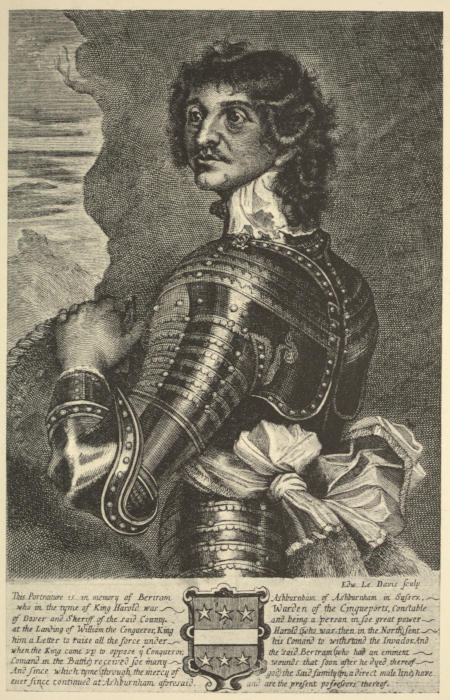
PORTRAIT IN MEMORY OF BERTRAM ASHBURNHAM,
LORD WARDEN OF THE CINQUE PORTS IN KING HAROLD’S TIME.
From Gwillim’s Heraldry.
Gwillim has a curious engraving of a portrait “in memory of”
this hero in seventeenth-century armour, and the tradition in the
family is that it was John Ashburnham, King Charles the First’s
gentleman, who sat for this very grim effigy. Then there is another
story, for which I know not the authority, if, indeed, there be any,
to the effect that Bertram Ashburnham defended the Castle so
stoutly that William made terms with him and raised the siege,
allowing the Saxon to name his own conditions, which were that
he and his men should leave with all the honours of war, and that
the law of gavelkind should obtain in Kent for all time. This
brave tale, I am afraid, must be dismissed as moonshine.
So there is much complication, but on one point all the authorities
are agreed, and that is the marriage of the Norman knight, Bertram,
with the Saxon heiress of Mitford; so far as that goes, if we may
not call ourselves a Saxon family, our Saxon descent is not denied
to us.
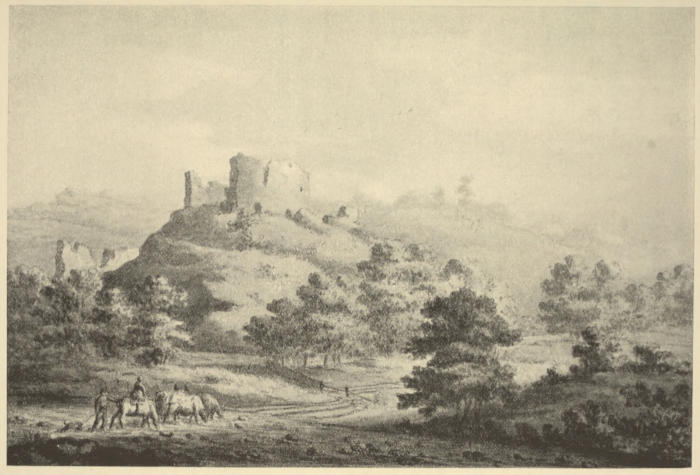
About two miles to the west of Morpeth, on a spot romantic
enough to inspire a poet’s dream, fair enough for a painter to linger
over with a lover’s delight, stand the ruins of the old Saxon castle
of Mitford. That is the Cradle of our Race. The keep, battered
by storms of war and weather, rises on a rocky eminence to the
south of the river Wansbeck,[1] close to the point where the two
fords of the Wansbeck and the Font meet. It was from this meeting
that the Castle and village took their name,[2] just as Coblenz
did from the confluentiæ of Rhine and Moselle. The rivers of
Northumberland, tearing their way through the rocks, between
banks fringed with the most picturesque vegetation, overhanging
trees, shrubs, ferns, docks, and all the fairy-like greenery which they
wear with such grace, are the glory of that part of the country. Such
streams as the Wansbeck and the Coquet are a haunting memory.
Not even the most audaciously inventive of antiquaries has,
so far as I know, been brave enough to fix the date of the Castle’s
building; all that can be said is that it is very old. Burke, on
the authority of the “Durham Booke,” tells the story how a certain
“Robert Mitford, Esq., carried an old writeing to produce at
Durham upon some occasion, by wch one of ye ancestors of Mitfords,
of Mitford, in ye time of K. Edwd. ye Confessor, did assure
his wife’s joynture out of Lands in Mitford, wch writeing Sir Joseph
Craddock saw and attests it under the hand, but is since embezzled
and lost.” That, since the document is lost, is but a weak foundation
upon which to base a belief. The tale, however, must be
true, for William the Conqueror’s advent followed almost immediately
upon the death of King Edward, and that the Castle was
at the time of the Conquest in the possession of Sir John de Mitford
is a fact. Beyond that time we must be content to leave the
family history lost in the clouds.
Even so, the story is old enough, and we may well be proud
of our old cousin Edward Mitford, the head of the family, who
fulfilled more than his century of life in 1911, and died on the
property and in sight of the ruined Castle which belonged to our
ancestors some nine hundred years ago.
Among the knights who fought at Hastings in the train of William
the Conqueror were two brothers, Sir Robert[3] and Sir William
Bertram. “Robert Bertram ki estoit tort” (crooked) was Lord
of Briquebec, near Valognes, a barony consisting of forty knights’
fees, which is said to have taken its name from Brico, a Norwegian
Viking, who was the ancestor of the Bertram family.[4] It was
the well-known policy of the Conqueror to pacify England and
consolidate his power by promoting or even making up marriages
between his followers and the Saxons whom they had conquered—especially
did this judicious match-making seem to be desirable
where there was an heiress to be won. At the time of the Conquest,
Sir John de Mitford, who owned the Castle and Barony of Mitford,
had no son. His only daughter, Sibella, was his heiress, and
between her and Sir Robert Bertram a marriage was arranged and
carried into effect.
THE RUINS OF MITFORD CASTLE, NEAR MORPETH,
NORTHUMBERLAND.
From a drawing, dated August, 1769, by J. Mitford (Lord Redesdale),
d. August, 1769.
I wonder what sort of a home it made, this union between the
Saxon girl, of whom I like to believe that she was as beautiful as
the Lady Rowena, and the Norman warrior? Was it altogether
a mariage de convenance? Was Sibella forced into it, or might
he have lighted just the least little spark of love in her breast?—and
when once they were married, did she live happily with her
crooked knight? These crook-backed men are apt to have very
insinuating ways; we all know how Richard the Third, when he
made love to Lady Anne, so flattered and coaxed that her
woman’s heart
Grossly grew captive to his honey words,
and in my early diplomatic days, I had a colleague at a certain
Embassy, who, though crooked as Pope himself, was declared by
all women to be irresistible. How grateful, by the bye, we ought
to be for that one and only record “qui estoit tort,” just three
words which give to the old story of Sibella a touch perfectly human
and real, such as a hundred blazing tales of deeds of derring-do,
sung by minstrels or recorded by chroniclers, could never have
conveyed. The crook must have been true, it could hardly have
been invented. Since walls have ears, what a pity it is that stones
have not tongues: these old ruins could teach us so much about
the lives that they harboured, lessons which one does so long
to learn.
These Bertrams must have been men of no little importance
in their generations. The two heroes of Hastings evidently made
their mark, and later on there is some reason to suppose that one,
at any rate, of the family, perhaps more, joined in one or other of
the Crusades. For in some excavations which were made among
the ruins of the Castle in the middle of the nineteenth century,
the workmen came upon a tiny piece of that serpentine marble
which the Crusaders were wont to bring home from the Holy Land
to be set in the altars of their chapels; the relic was found on the
spot where the chapel is supposed to have stood. As should beseem
Crusaders, the Bertrams were good and loyal servants of the
Church: a pious Bertram it was that founded or endowed the
Augustine Priory of Brinkbourne in the reign of Henry the First.
Sir Roger de Bertram joined the insurrection of the Barons against
King John, and it cost him dear, for in retaliation his castle was
seized and his town of Mitford destroyed with fire and sword by
the savage Flemish hordes who then devastated Northumberland
as the auxiliaries of the King.[5] In the year 1215, then, Mitford
Castle was in the hands of the Crown, and two years later Alexander
of Scotland, who had invaded England at the instigation of France,
laid siege to it with his whole army, but he was beaten off, and went
back to Scotland none the richer for his venture. King John
granted the Castle to Philip de Ulcoves, but in the following reign
it was restored to the Bertrams by Henry the Third.
The next notable Bertram was that Sir Roger who, with other
northern Barons, marched into Scotland in 1258 to rescue the
young King of the Scots, Henry the Third’s son-in-law; but he
got into trouble, for six years later he was one of the insurgents
in the Barons’ War, was taken prisoner at Northampton, and
the Castle and Barony were once more forfeited and alienated
from his descendants for four hundred years. He seems, indeed,
to have speedily made his peace with the King, for in 1264 he was
summoned to Parliament as Baron Bertram—but Mitford knew
him no more.[6] This Sir Roger was succeeded by his son, who had
only one daughter, and the Barony fell into abeyance between the
Fitzwilliams, Darcys and Penulburys, the representatives of his
three sisters.
The learned labours of antiquaries and pedigree-mongers have
so confused the story of the younger branch of the Bertrams, the
Lords of Bothal, that it is extremely difficult, if not impossible,
to make head or tail of their several statements. It is the more
provoking in that it is from them that we, the Mitfords of the
present day, are descended. From them also the Dukes of Portland,
through a maternal ancestress, have inherited Bothal Castle.
In the “Battle Abbey Roll” of the Duchess of Cleveland, it is
stated that William de Bertram, who founded Brinkbourne Priory,
married a daughter of Guy de Baliol by whom he had two sons,
Roger, Baron of Mitford, and Richard, the ancestor of the Lords of
Bothal, who held that Barony by the service of three knights’
fees. This is, I believe, the more probably correct story, and it
comes into line with the evidence of the “Newminster Abbey
Register Booke,” which makes the inheritance descend to the Dukes
of Portland from the Lady Sibella, wife of the first Lord Bertram.
That Bothal should have been held by Sir William (sometimes
called Sir Richard) Bertram, the brother of the first Lord Bertram,
as some have maintained, is worthy of no credence. Why should
an important portion of Sibella de Mitford’s property have gone to
her husband’s younger brother?
Burke, in his “Landed Gentry,” anxious, probably, to prove a
Saxon descent from father to son, appears to wipe out all the
Bertrams in the middle of the fourteenth century, and makes
Mitford (the town or village, not the Castle and Barony, which were
forfeited) descend to Sir John de Mitford, tenth in succession to
Matthew, the younger brother of the Sir John who was the father
of Sibella. That we shall see is quite apocryphal, for when the
elder branch of the Bertrams came to an end in 1311, the younger
branch continued to flourish at Bothal, and soon adopted the name
of Mitford, taking their patronymic from the property which the
family had then held for two and a half centuries.
It was to that branch that the famous Hermit of Warkworth
belonged, whose tragic story was woven into a poem by Dr. Johnson’s
friend, Bishop Percy of Dromore, who collected the “Reliques of
Ancient Poetry.” The poem, very poor stuff, was published
separately some years after the “Reliques.”
This Bertram was in love with a neighbouring Lady Isabel de
Widdrington, and she returned his love, but like a true daughter of
‘These northern counties here
Whose word is snaffle, spur and spear.’
she chose to put his mettle to the test before giving him her hand.
She sent him a helmet as her love-token, desiring him to try its
temper ‘wherever blows fell sharpest;’ and Bertram, obedient to
her behest, rode with his brother-in-arms, Lord Percy, on a raid
into Scotland, where he was wounded nearly to the death in a
desperate fray. The tidings were brought to Isabel, who, struck
with terror and remorse, at once set out to go to him, but on her
way was seized by some prowling moss-troopers, and carried off
to one of their secret fastnesses beyond the border. Thus when at
the downfall of the night her rescued Knight was carried home on the
shields of his followers, he found his lady gone, and all traces of her
lost. He made a vow never to rest till he had found her, and his
brother promised to help him in the quest. As soon as his health
permitted, they went forth together in a humble disguise, and the
better to conduct their search, agreed to separate, the brother
going northwards and Bertram himself to the west. For many
weary days and weeks he wandered over moss and moor in vain;
till at length when he had almost lost heart, a compassionate pilgrim
directed him to a distant peel-tower in which a lady’s voice had been
heard lamenting.
Bertram found the place, and recognized the voice; but watched
the tower for two successive nights without obtaining a glimpse of
his Isabel. On the third night, however, that he lay crouched in
his hiding-place, he saw her descend a ladder of ropes thrown from
an upper window, assisted by a man muffled up in a cloak, who bore
her across the little stream and led her away, clinging fondly to his
arm. Bertram, maddened at the sight, rushed after them with
his naked sword, and attacked his rival, who defended himself
manfully; but after a stubborn conflict, Bertram succeeded in
bringing him to the ground, and stabbed him to the heart, with the
words, ‘Die, traitor!’ Then, when she heard his voice the wretched
Isabel for the first time knew who he was, and sprang forward to
arrest the blow, shrieking, ‘It is thy brother!’ She was too late,
for the deed was done, and in the struggle to throw herself between
them, she slipped against Bertram’s sword, and fell pierced, by his
brother’s side.
For that night’s bloody tragedy the unhappy Bertram did penance
to the end of his days. He renounced every tie that bound him to
the world. His sword and spear were hung up in his hall, his inheritance
passed on to others and his goods were given to the poor,
while he himself, clad in monastic garb, took refuge in the rocky
recesses of Coquetdale, near Warkworth Castle. No more ideal
retreat could be devised for an anchorite than this lovely, sequestered
glen, where the hurrying Coquet stays its troubled current
beneath precipitous cliffs, clothed with trees that spring from every
chink and crevice of the stone; and from an overhanging grove of
stately oaks above, a runlet of the purest water comes rippling down.
Here his dwelling-place, scooped out of the living rock, remains
almost as perfect as when he left it. It can only be reached from
the river by a long flight of steps. Over the entrance linger the
traces of the original inscription, ‘Sunt mihi lachrymæ meæ cibo
interdiu et noctu.’ The first cell is a miniature chapel, complete
in all its details, with a raised altar at the east end; and on a
recessed altar tomb beside it is the effigy of a woman, very delicately
designed, but now broken and timeworn, lying with her head
towards the east, and her arms slightly raised, showing that her
hands have been folded in prayer. At her feet in a niche cut in the
stone, the figure of the Hermit kneels in eternal penitence, his head
resting on his hand. Beyond this, reached through a doorway,
bearing on a shield the Crucifixion and the emblems of the Passion,
is a still smaller oratory, used by the Hermit as a sleeping-place;
with a similar altar at the farther end, and near it a narrow ledge
hewn out of the rock for his couch.
Neither by night nor by day did he ever lose sight of the beloved
effigy in the adjoining chapel; for at the altar a window is contrived
through which he could see it as he knelt at his devotions;
and when lying on his bed, a niche cut slantwise through the partition
wall still enabled him to rest his faithful eyes upon it. No one
knows for how many sorrowful years he lived here in penance and
contrition, nor when death came to his release.
Such is the touching story of the Hermit of Warkworth, who was
of our blood, as it is related in the “Battle Abbey Roll” which I
have so often quoted.
Bertram’s friend, Lord Percy, kept his memory green by paying
for Masses to be sung in the Chapel, and the allowance for the purpose
was continued until the Suppression of the Monasteries, and according
to Hutchinson, “the patent is extant which was granted to the
last hermit in 1532 by the Sixth Earl of Northumberland.”
So the elder branch of the Bertrams disappeared in 1311, and
with them the name, for the Lords of Bothal speedily called themselves
de Mitford, which from that time forth became the family
patronymic. “Happy the minister who does not make history”
is an old saying which may well be applied to families, for if in the
centuries during which our people have been Lords of Mitford,
though they produced no great soldier, no great statesman, no
Raleigh, no Drake, no Frobisher, no Sir Thomas More, no King’s
favourite, at any rate they kept their heads upon their shoulders.
Political ambition was apt to be a very deadly disease, and they
had it not. They were contented to live held in respect by their
neighbours, to act as high sheriffs when called upon to do so, and
sometimes to represent their county in Parliament.
Perhaps the most distinguished of these ancestors of ours was
Sir John de Mitford, who was Knight of the Shire for Northumberland
in various Parliaments during the reigns of King Edward the
Third, King Richard the Second and King Henry the Fourth.
He was High Sheriff for two years, and acted as Commissioner with
John Widdrington and Gerald Heron to tender the Oath of Allegiance
to the King of Scotland. On the 20th of May, 1369, at Newton
Hall, he received by deed of feoffment from David Strathbolgi,
Second Earl of Athol, a grant of all his lands and tenements in the
Ville of Molesden, to be holden of the grantor and his descendants
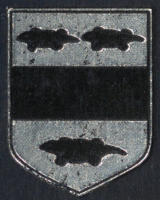
by the annual payment of sixpence. It has been said that this
transfer led to the adoption of the three moles as the family arms,
but our family tradition, which I believe to be well founded, is that
they were of much older date and taken from the Want’s Beck, the
mole’s stream, as was the name of Molesden itself. Sir John was in
1386 Keeper of the Seal to Edward Duke of York for the Liberty
of Tyndale.
On his death he was succeeded by his elder son William, who
was, like his father, Knight of the Shire and High Sheriff in Henry
the Fifth’s reign. Then followed his son John, a pious benefactor
of the Church, living, no doubt, in the sweetest odour of sanctity,
who granted tenements in Newcastle to the Church of St. Nicholas,
and gave lands in Echewicke to the Abbot and Convent of Newminster,
to pray for his soul and the souls of his ancestors. He died
in the sixteenth year of the reign of King Henry the Sixth. The
following three Lords of the Manor, Thomas, Bertram and Cawen,
were inconspicuous persons, and there is nothing to be said of our
forebears until we come to Cuthbert, who in the sixth year of Edward
the Sixth was with Anthony Mitford of Ponteland, Commissioner
for the inclosure of the Middle Marches. This said Anthony was a
rogue. Cuthbert Mitford by his first wife, Ann, daughter of one
Wallis of Akeild, had one son, Robert, and three daughters: failing
that son Robert, Anthony of Ponteland would become Lord of the
Manor of Mitford and heir to all Cuthbert’s estate. To achieve
this end he hatched a plot, seeking to prove that there had been no
marriage between Cuthbert and Ann Wallis, and that in consequence
Robert was illegitimate.
He contrived to have his contention entered in the Harleian
MSS., and to have Robert described as nothus natus—base-born,
but when he presented the document at the Heralds’ College,
it proved to be signed only by himself. On investigation, the lie
was nailed to the counter, Robert’s legitimacy was fully proved,
and his arms were certified without a difference. He was what
would be looked upon in these days as a person of rather lax opinions
and was “presented” at the Archdeacon’s Visitations “for sufferinge
divers persons to eate, drinke and play atte cardes in time of
eveninge praier.” In spite of the Archidiaconal thunders, he lived
through the reigns of Queen Elizabeth and King James, and died in
the first year of King Charles the First’s reign at the good old age
of eighty-eight.
He was succeeded by his grandson Robert, both of whose parents
had died in his infancy on the same day. This Robert is an ancestor
of special interest for us. In the first place it was to him that
King Charles the Second restored by grant the Castle and royalties
of Mitford, which had been forfeit in punishment of Roger Bertram’s
treason by King Henry the Third in 1264, and secondly it is from
his third son, John, who left the old home to seek his fortune as a
merchant in London, that we, the Mitfords, formerly of Exbury,
now of Batsford, are descended. The Mitfords of Pitshill are descended
from William, who was a great-grandson of the Robert
of Charles the Second’s time.
The portraits of Robert Mitford and Philadelphia Wharton, his
wife, are at Batsford. The contemporary frame of her picture is
surrounded by carved oak leaves and acorns in memory of the
famous escape of the King, and to denote her loyalty to his cause.
Let us linger for a few more moments among the ruins of the old
Cradle of our Race. In the dark centuries, when even if there was
no actual war between England and Scotland, there was almost
continuous fighting between the fierce clans on both sides, feuds and
raids and cattle-lifting were the salt of northern life; hatred was a
profession, revenge the accomplishment of a gentleman. The
border castles were seldom at rest, and Mitford fared no better than
its neighbours.
Dreaming on a summer’s day within the, to us, sacred precincts,
one can almost hear the grey walls ringing with the music of sword,
spear and battle-axe clashing upon hauberk and breast-plate—the
shouts of the fighting men mad with the lust of blood—clouds
of arrows rattling like hail against the battlements should a head
show itself. The borderers were gay men at fighting, and the
Scots ever met with a hot welcome.
After the treason of Sir Roger Bertram in 1264, wild men succeeded
one another in the ownership of the Castle. In the year 1316 it
was the home of a freebooter of the pattern of the Rhenish robber
knights, named Sir Gilbert de Middleton. He was an old soldier
of fortune, who had fought against Lewelin in the Welsh war and
probably for that service was rewarded with the Castle and Manor
of Mitford. But he was infuriated against King Edward, on account
of the appointment to the See of Durham of Lewis de Beaumont, a
cousin of the Queen’s. It was said that Queen Isabella, “the
French she-wolf,” as she was called, had knelt upon her bare knees
before the King, praying him to confer this fat Bishopric upon her
kinsman. Sir Gilbert rebelled, proclaimed himself Duke of
Northumberland, and took the occasion of a mission which the King
had sent to Scotland, headed by two Cardinals and the Bishop of
Durham, to swoop down upon the Embassy and pillage it on its
return South.
It was a mistake to attack the scarlet hat; the Church ever had a
long arm. Sir Gilbert was taken prisoner by Ralph de Greystoke
(or, according to Hollinshed, by Thomas Heton and William de
Fulton), fettered in irons and carried to Newcastle, whence he was
shipped to Grimsby. From Grimsby he rode to London with his
feet tied under his horse’s belly, was imprisoned in the Tower, and
dragged by horses to the gallows on the 26th of June, 1318. His
property and goods and those of his brother were confiscated.
(See Hodgson’s “Northumberland.”)
In 1318 Mitford was the property of Adomar de Valence, Earl of
Pembroke, and then it was that the last and fatal attack upon the
Castle by the King of Scotland took place, and the grand old stronghold
that had withstood the buffets of so many sieges was finally
laid in ruins.
When one looks at the humble little village of Mitford to-day it is
hard to realize that it was once a borough! I know not how it
may be now, but when I was a boy the old folk held firmly to their
traditions and to the legends of the ancient greatness of the place;
there was an old rhyme which they loved to quote:
“Mitford was Mitford ere Morpeth was ane
And still shall be Mitford when Morpeth is gane.”
The feeling of clanship was strongly rooted in the people. In
the fifties of last century there was still living a delightful old woman,
one Bella Harbottle, who with her brother inhabited two, or three
rooms, which were all that remained of the seventeenth-century
Manor House—just a tower in an old-fashioned garden, which the
brother tended, in the beauty of which Bacon himself would have
taken delight. The brother and sister were specimens of a grand
old type of northern peasantry not yet passed away, thank
Heaven! Their beautifully chiselled features, no less than their
proud bearing and dignified manners, might have befitted the
descendants of crusaders. She was always clad in an old-fashioned
lilac print gown, with a square of shepherd’s plaid crossed over the
bosom. Her delicate, high-bred face, with blue eyes, still bright and
beautiful, was framed in the frills of an immaculate mutch covering
her ears and almost hiding the snow-white hair; her small feet were
always daintily cased in grey worsted stockings and scrupulously
blacked shoes. She must have been nearly eighty years old when I
used to sit with her in her kitchen—the aged dame on one side of
the hearth, the little boy on the other, listening to her old-world
tales of the past glories of Mitford. There were always a few old-fashioned
flowers in the kitchen-parlour, and she herself sweetly
reminded one of lavender. The good soul was always stout for the
rights and honour of the family.
A gentleman who had bought a small adjoining estate built himself
a house just on the boundary. Every day, almost, old Bella
would walk out, leaning on her crutched stick, to see that there was
no encroachment. The neighbour, aware of this, and greatly
amused, said to her one day, “You see, Bella, it is all right. I am
not removing my neighbour’s landmark.” “Ah!” grumbled she,
with her sweet Northumbrian burr, “I’m thinking that you’re
building your house verra high.” Even the air was sacred to the
family of her worship.
To the east of the Manor House Tower is the old Norman church.
When I first went to Mitford it was a mere wreck, just sufficiently
weather-tight for service to be held; but it was beautifully restored
some fifty years since by the piety of the last owner but one,
Colonel John Philip Mitford.
And now it is time for us to leave the north and travel southward
with those who are more immediately responsible for us.
Merchant John, then, came to London, where he seems to have
prospered in his business, so much so as to make us wish that he
had been furnished in his baptism with some other Christian name,
for he became possessed of original shares in the Royal Exchange,
the building of which King Charles the Second laid the foundation
stone in 1667 to take the place of its predecessor of Queen
Elizabeth’s time, which had been destroyed in the great fire of
1666. Unfortunately there was no mention of these shares in his
will. There is no doubt that they were the property of this particular
John, our immediate ancestor, and when my father and the
late Lord Redesdale tried to prove their claim to them nobody
doubted its justice, but they were defeated by the fact that they
could not prove that there was no other John Mitford to whom
they might have belonged; so there they lie in some mouldy old
chest, more useless than dead leaves in autumn. Be this a lesson
to those who call their sons John, or Thomas, or William, to give
them some second and less usual name to make what, in armorial
bearings, the heralds call a difference.
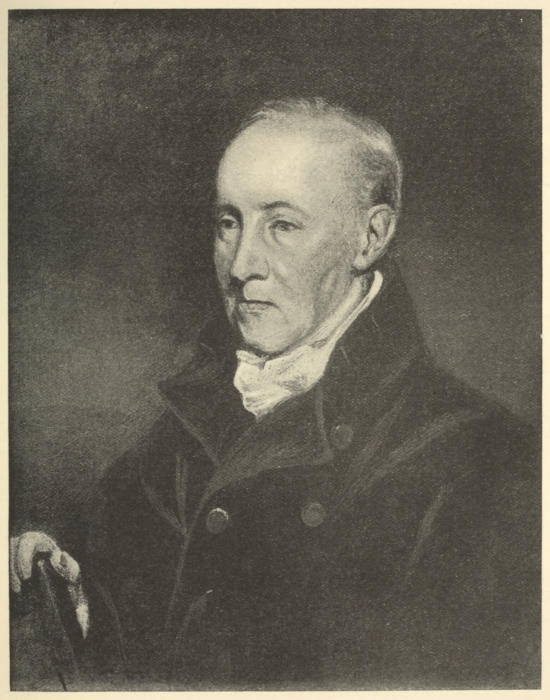
WILLIAM MITFORD (HISTORIAN OF GREECE)
From an oil painting by John Jackson, R.A.
Of this John and his son William there is nothing to be said,
but the son of the latter was another John, whose marriage on the
13th of September, 1740, with Elizabeth, the daughter and heiress
of Willey Reveley, of Newton Underwood and Throphill in Northumberland
and Newby-super-Wiske in Yorkshire, played an
important part in the history of our family, for to them were born
two remarkable sons, William, the historian of Greece, and John,
the first Lord Redesdale. Indirectly, too, this marriage was the
cause of a goodly inheritance coming to Lord Redesdale in 1808.
William Mitford,[7] who was born on the 10th of February, 1744,
was my great-grandfather, and a man of many and various accomplishments,
in his youth famous as one of the handsomest men of
his day. Not only was he a profound scholar, but he had a great
knowledge of art; he drew beautifully, and I have many of his
water-colour paintings, which are of rare merit; his sketch-books
recording his journeys in many parts of England are even now a
joy to look through. The Royal Academy of his day recognized
his worth by making him their historian, an office now filled by
Lord Morley of Blackburn. In music, also, he was an expert,
having a practical knowledge of several instruments, and so keen
was he that when he was an old man, past seventy, he made a
journey into Wales, a matter of several days in those posting times,
in order to learn the principles of the triple Welsh harp.
He was Member of Parliament successively for Newport in
Cornwall, Beeralston and Romney, and commanded the Hampshire
Militia. It was as a Militia-man that he made friends with Gibbon,
who was a brother officer in the same regiment, and who persuaded
him to undertake the history of Greece, so that the Hampshire
Militia had the honour of producing two classical historians—the
one of the “Decline and Fall of the Roman Empire,” the other
of Greece.
Mitford’s history naturally took the Tory side in Greek politics:
Grote and Thirlwall followed on the Radical side. One day
Thomas Carlyle began talking to me about my great-grandfather;
Carlyle was certainly no Tory, but he praised the so-called Tory
book far above the other two. He said “that Mitford had the
talent of clothing the dry bones of history with living flesh and
blood: he made the old Greeks speak and behave like human
beings, breathing a living spirit into his work.” The other two
were so dreary and dull that they provoked no sympathy in him.
Beyond all this the old Colonel, as he was called, was a very
skilful forester and gardener. I possess an old, much-worn
pruning knife with a horn handle which he always carried about
when he was engaged in his favourite pursuit of landscape gardening.
When a boy, he and his brother had been at school at Mr.
Gilpin’s academy. Later in life he was able to present Gilpin
to the living of Boldre in Hampshire. This led to the writing of
the famous “Forest Scenery,” which Gilpin dedicated to his former
pupil and subsequent patron. Gilpin’s brother was Sawrey
Gilpin, R.A., the animal painter.
It happened that in the spring of 1862 my father, having some
business to transact with his agent and being unable to attend
to it himself, sent me down to Exbury to act on his behalf. Mr.
Lewis Ricardo, who was the tenant at the time, hearing that I
was going there, very kindly offered me bed and board, saying
that, though he was detained in London, his housekeeper would
look after me. She made me very comfortable, and after a light
dinner and a pint of claret I went to bed. In the dead of the
night I was awakened—as it seemed to me—by a most uncanny
noise in the room over my head. Someone was dragging a very
heavy weight up and down the floor; then I heard the door open,
and the footsteps came down the stairs pulling the weight, bump,
bump, bump, until whoever it was reached my door. Then there
was silence for a minute or two, and presently the weight was
dragged up again, bumping as before, the door of the upstairs room
was opened, the weight was dragged across it, and all was still.
I must have been dreaming all the time, for, though I was in
deadly fear of I knew not what, it never occurred to me to get up
and see what awful being it was that was standing so mysteriously
outside my room. But the whole thing was so vivid that the next
morning I asked the housekeeper who had occupied the room
above me that night. Her answer was that the room had been
empty and locked and the key in her possession.
When I got back to London I told my father what I had heard.
He was a good deal startled, and replied that one of his grandfather’s
eccentricities had been, after a long day’s literary work,
to go up into an empty upstairs room and pull a heavy trunk about
for exercise. I had never, so far as I knew, heard this before;
but it is possible, if it be true that in our sleep we sometimes
remember things long since forgotten, that I might in years gone by
have been told of the old man’s whim, and that the fact of sleeping
in that house struck some chord of a vanished memory; as my
father spoke, it almost seemed as if my presence had roused the
spirit of the forefather to come and see what manner of creature
his great-grandson might be. I insert the story for the benefit
of the professors of oneiromancy. To me it seems a curious
specimen of dream mystification.
The historian’s eldest son, Henry, was a captain in the Royal
Navy. He was twice married. By his first wife, the daughter of
Anthony Wyke, Attorney-General of Montserrat, he had a son
and two daughters, of whom only one, Frances, was alive in my
time. She married her cousin, Bertram Mitford, the head of the
family and Squire of Mitford, which she occupied after his death
as a dower house; and so it happened that as a boy I passed many
happy holidays in the old home. My grandfather’s second wife
was Mary Leslie-Anstruther, whom he married in 1803. In the
same year he was appointed to the command of H.M.S. York, and
before commissioning her he went down with his navigating officer—master
was the title in those days—to survey her. They
reported her unseaworthy. To that, the answer was, in effect,
“Sail, or resign your commission.”
Of course they sailed, and on Christmas Eve, 1803, in a fog in
the North Sea, the York went down with all hands. Her guns of
distress were heard, but no help was forthcoming. I have been
told that one spar with “York” upon it was washed ashore on the
coast of Yorkshire. There were not then the means that there are
now, thanks to Lloyd’s and modern inventions, of obtaining information
as to wrecks, and that single spar was, I believe, the
solitary evidence of the fate of the York. It was something very
like an official murder.
My father was born on the following twenty-first of June, a
posthumous child, and lived with his grandfather and his two
sisters. His mother soon married again, her second husband
being Mr. Farrer, of Brayfield in Buckinghamshire, who had been
an officer in the Blues. I am afraid that my father had not a
very happy childhood, for the historian seems to have been rather
crabbed in his old age. Besides, he was fully taken up with his
studies and his work, and cared not to busy himself with the
yearnings of a child. However, his two half-sisters, Frances and
Louisa, were devoted to their brother, and the little boy had a
good friend in his grandfather’s younger brother, John, who, in
the meantime, had come to great distinction. Having been called
to the Bar in 1777, he, three years later, published the famous
book commonly called “Mitford on Pleadings,” which speedily
became a classic. Lord Eldon said that it was “a wonderful
effort to collect what is to be deduced from authorities speaking
so little what is clear”; while Sir Thomas Plumer declared that it
“reduced the whole subject to a system with such universally
acknowledged learning, accuracy and discrimination, as to have
been ever since received by the whole profession as an authoritative
standard and guide.”
It was equally well accepted in America, and when I was in
the United States in 1873 more than one well-known judge and
lawyer came up to me wanting to know what relation I was to the
“Pleadings.” The success of the book brought prosperity and a
seat in Parliament, by the favour of his cousin, the Duke of Northumberland.
In 1793 he succeeded his lifelong friend Sir John
Scott (Lord Eldon) as Solicitor-General; the Attorneyship followed
as a matter of course, and in 1801 he became Speaker of
the House of Commons. This latter office he did not hold long,
for in 1802 Lord Clare, who was Lord Chancellor of Ireland, died,
and Sir John Mitford was appointed to succeed him, being raised
to the peerage as Baron Redesdale of Redesdale in Northumberland,
a title which he took from the beautiful moorland property
on the southern slope of the Cheviots which he had purchased
with the idea of linking himself as closely as might be with the
border home of the ancient clan.
It was a great wrench to resign the Speakership of the House
of Commons, a post of high honour for which he was admirably
fitted. He left an assembly over which he presided with a dignity
and impartial tact which confirmed the esteem and regard in
which he was held by its members, and justified their choice. At
the call of duty he parted from his friends and severed many ties
of affection, to take up a task which, however congenial it might
be professionally, carried him into a country where he was a
stranger with a surrounding of men who were to him a new experience—men
possessed of great talents and a charm peculiarly
their own, but which did not appeal to his serious and rather
matter-of-fact nature. On the bench his success was immediate
and triumphant.
Sheil, who was called to the Bar in 1811, and must have known
many of the counsel who practised before Lord Redesdale, said
of him that he introduced a reformation in Irish practice “by
substituting great learning, unwearied diligence, and a spirit of
scientific discussion, for the flippant apophthegms and irritable
self-sufficiency of Lord Clare,” and Story pronounced him to be
“one of the ablest judges that ever sat in equity.”
The Irish Bar speedily recognized in him a scientific lawyer
of the first quality, but the witty barristers, bubbling over with
fun and rollicking spirits, were socially quite out of touch with
him. He did not understand them, nor they him. O’Flanagan,
in his “Lives of the Lords Chancellors of Ireland,” tells several
amusing stories of the way in which the lawyers—none too respectfully,
considering the dignity of his office—cracked jokes in
his solemn presence. “I never saw Lord Redesdale more puzzled,”
says Sir Jonah Barrington, “than at one of Plunket’s bons mots.
A cause was argued in Chancery, wherein the plaintiff prayed
that the defendant should be restrained from suing him on
certain bills of exchange, as they were nothing but kites. ‘Kites!’
exclaimed Lord Redesdale, ‘Kites, Mr. Plunket? Kites could
never amount to the value of these securities. I don’t understand
the statement at all, Mr. Plunket.’ ‘It is not to be expected
that you should, my lord,’ answered Plunket. ‘In England and
Ireland kites are quite different things. In England the wind
raises the kite, but in Ireland the kite raises the wind.’ ‘I do not
feel any better informed yet, Mr. Plunket,’ said the matter-of-fact
Chancellor. ‘Well, my lord, I’ll explain the thing without
mentioning those birds of prey’—and thereon he explained that
in Ireland bills and notes which are not what is termed good
security are commonly called kites, because they are used to raise
money, which is termed ‘raising the wind.’”
Great as was Lord Redesdale as a judge, there were other duties
of his office which militated against his being a success in Ireland.
He was a devoted Church of England man and a bitter opponent
of Catholic emancipation, and it was abhorrent to him that any
office, even that of justice of the peace, should be held by a Roman
Catholic. A letter addressed by him to the Earl of Fingal on
appointing him to the Commission of the Peace provoked a correspondence
which inflamed the Roman Catholics against him, and
was fiercely blamed in the House of Commons by Fox and Canning.
The final crisis was brought about by his treatment of Lord
Cloncurry, who had twice been arrested for high treason, imprisoned
under the Habeas Corpus Suspension Act in 1799, and
very harshly treated in the Tower of London. When the Habeas
Corpus Act was restored, he regained his liberty after two years
all but a few days, and went abroad for four years. On his return,
a Mr. Burne, a King’s Counsel, applied on Lord Cloncurry’s behalf
for his admission to the Commission of the Peace. Lord Redesdale
resented this interference of a third person, and wrote Mr. Burne
an angry and not very judicious answer, in which Lord Cloncurry’s
past history was raked up as a ground of refusal. This drew a
furious letter from Lord Cloncurry himself, in which he recited the
illegality and cruelty under which he had suffered, and made a
violent attack upon the bigotry and prejudice of the Chancellor.
The Lord Lieutenant, the Earl of Hardwicke, at once ordered the
Chancellor to insert Lord Cloncurry’s name in the magistracy of
the two Counties of Kildare and Dublin, and further offered to
recommend that nobleman for promotion in the Peerage. The
Viscount’s coronet was refused, but the indignity placed upon
the Chancellor was complete. Mr. Ponsonby was appointed to
hold the Great Seal of Ireland, and pending his arrival, the Great
Seal was put in Commission and Lord Redesdale was not even
allowed to sit in the Court of Chancery—his own court. This,
in his farewell speech to the Bar, he described as “a personal
insult.”
His final letter to Lord Cloncurry was characteristic. “My
Lord, I have desired instructions with respect to the insertion of
your lordship’s name in the Commission of the Peace for the
Counties of Dublin and Kildare, and I have to request that your
lordship will be pleased to apply to Mr. Ponsonby, whom His
Majesty has appointed Chancellor of Ireland, and to whom the
Great Seal will be delivered as soon as he shall arrive in the country.
I have, etc. (sgd.) Redesdale.” So the stout old Lord stuck to his
colours, and without bending left Ireland in 1806, having held
his office for four years.
It is a singular instance of the fickleness of fate that he should
have been hounded out of Ireland by the Roman Catholics of
that country, when their co-religionists in England had a few
years before got up a national subscription to present him with
a magnificent piece of gold plate, in gratitude for the determined
action in the House of Commons, by which they were relieved
from those penal laws to which they had been subject for more
than two hundred years. That golden vase is a treasured heirloom
at Batsford.
There was nothing inconsistent in his conduct. His nature,
essentially humane and merciful, recoiled from anything which
savoured of persecution: at the same time, in the political government
of his country, his Protestant principles and his attachment
to the existing Constitution found no place for the professors of
a form of religion which, in his view, constituted a danger to the
State.
Meanwhile, in 1803, Lord Redesdale had contracted a marriage
with Lady Frances Perceval, daughter of Lord Egmont, and sister
of the Prime Minister, Spencer Perceval, who was murdered by
Bellingham in 1812. This happy union brought him three
children, two of whom, his son who afterwards became first and
only Earl of Redesdale, and Frances Elizabeth, survived him.
Lord Redesdale’s father, John Mitford of Exbury, was married,
as I have said above, to a Miss Reveley, whose sister[8] was the
wife of Thomas Edwards Freeman,[9] a wealthy and highly respected
squire in the County of Gloucester. This Mr. Freeman had only
one son,[10] who predeceased him, as did also the son’s wife, Mary
Curtis[11]
that was, leaving a daughter[12][13] who married Mr. Heathcote
of Dursley in Hampshire. But this daughter had apparently
inherited the bad health of her parents; she had no child, and
it became evident to Mr. Freeman that she was not likely to live:
so in his will he made provision that failing her and any children
that she might have, since he had apparently no relations of his
own, his property should go to his wife’s nephew, Lord Redesdale.
Mrs. Heathcote did not survive her grandfather by many days,
and almost immediately after his death in 1808, the property of
Batsford passed to the ex-Chancellor of Ireland.
One fine day the old lord took his little son, aged three, to see
Mr. Freeman, who went and fetched a crazy old barrel organ,
which he proceeded wheezily to grind for the child’s pleasure:
when he had finished playing, the boy turned to his father and
said with much dignity, “Give the old man a shilling!” to the
great amusement of the benefactor whose property the child was
one day to inherit.
Lord Redesdale never again held any office, though Mr. Perceval
wished him to return to the Chancellorship of Ireland. He knew
how unpopular he was in that country, and wisely declined. He
preferred his independence, and became a very useful and much
consulted member of the House of Lords. Lady Redesdale died
in 1817, and Lord Redesdale thirteen years later at the age of
eighty-one.
The second Lord Redesdale, who was educated at Eton and
at New College, Oxford, speedily made his mark in the House
of Lords by his diligence and capacity for business. The Duke
of Wellington appointed him to be his Whip, and encouraged
him to master all the details of the procedure and private business
of the House with a view to his becoming Chairman of Committees,
an office for which on the death of Lord Shaftesbury in February,
1851, he was chosen unanimously and which he held until his death
in 1886.
He was a keen sportsman, master and owner of the Heythrop
hounds, which post he resigned when he found public business
increasingly making inroads upon his time, but though he ceased
to be master, the hounds remained his property until Mr. Albert
Brassey, who had recently become master, made overtures to
him to buy them. At first Lord Redesdale refused, but eventually
yielded, and gave the purchase money, £2,000, to the hunt as an
endowment. He was a good shot, though he very rarely went
out with a gun; gave great attention to local affairs, never missing
the sittings of the Board of Guardians. “Give old Pensioner
(his hack) his head,” said his studgroom, “and he’ll go straight
to Shipston.[14]” He continued to hunt so long as he was able and
always hacked to covert, no matter what the distance might be.
No man was more looked up to, and I don’t believe that he
had an enemy in the world, unless it might be among certain
Parliamentary agents and promoters over whose proceedings he
kept so strict a watch that he earned the name of the Lord Dictator.
It was mainly owing to his determined action that the
attempt to abolish the appellate jurisdiction of the House of Lords
fell through. His literary controversy with Cardinal Manning
on the Infallible Church and the Holy Communion is still remembered
by ecclesiastics. He wrote several pamphlets, chiefly on
doctrinal or genealogical subjects, in which his arguments were
always ingenious and well expressed. In 1877 he was created
an Earl by Queen Victoria on the recommendation of Lord
Beaconsfield.
Lord Redesdale never married. He and his sister kept house
together at Batsford until her death in 1866. She was a woman
of great ability, full of sympathy with all her brother’s pursuits:
her loss was a cruel blow to him, and during the twenty years which
followed between her death and his, he never put off mourning.
I was in the Far East when she died, and after all these years I
could repeat by heart much of the touching letter which he wrote
to me as being the one man to whom he could open out the grief
that was in his soul.
Batsford stands on a lovely spur of the Cotswold Hills, crowned
with a glory of oaks and elms, beeches, ashes and chestnuts, a
most fascinating spot, and here it was that, under the genial
influence of the kind old lord, whose portrait by Lawrence is the
very embodiment of goodwill towards men, the happiest days
of my father’s childhood were spent.
The three little cousins were devoted to one another. It was
a beautiful friendship which strengthened as they grew up, and
only ended with their lives. No two men could have been greater
contrasts than my father and the late Lord Redesdale: perhaps
their affection was all the stronger for that; it had begun in childhood
and lasted into extreme old age; they were always happy
together, and when they were parted it was rarely that a day
passed without their writing to one another. They went to the
same schools, Iver first, then Eton, but not in the same house. At
Oxford Lord Redesdale was at New College, my father at Magdalen.
My father did not stay long at college. He soon left the University
to take up an attachéship at the Legation at Florence,
where Lord Burghersh[15] was minister, in whom he had the luck
to find a most sympathetic chief, devoted to art, and especially
to music, which with my father was a passion. The musical
society of Florence at that time was brilliant, and the young
attaché was speedily welcomed into its intimacy. Of those days
he had many stories, none, I think, more curious than this.
One evening after the opera there was a supper party at the
house of the Grisis, the parents of the famous prima donna.
Giudetta, the elder daughter, had been singing and the unhappy
tenor had been hissed off the stage with all the viciousness of
which an Italian audience has the secret. My father was sitting
next to Giulia Grisi, then a little girl of twelve—it was in 1827—and
he happened to say to her: “Ebben Giulia, I suppose some
day you will be singing in grand opera?” “I sing in opera,”
answered the beautiful child, “and run the risk of being hissed
like that wretched man to-night!” In two years’ time, 1829,
she made a precocious début at Bologna, and was not exactly
hissed! Seldom can there have been a more triumphant career
than hers from the day when, as a mere chit of fourteen, she
dazzled the world with her beauty and that lovely velvety voice.
There was also at that time at Florence a very charming English
coterie, which gathered round Lord and Lady Burghersh. Lord
and Lady Dillon were there with their daughters, and I have often
heard my wife’s grandmother, old Lady Stanley of Alderley, who
was one of them, say how agreeable the society of the Legation
then was. Among others who occupied villas were my grandparents,
Lord and Lady Ashburnham, and it was there that my
father and mother made acquaintance. They were married in
February, 1828.
There is much talk nowadays about links with the past. I
take it that there are not many men who can say, as I can, that
they had an uncle whose portrait was painted by Sir Joshua Reynolds
who died in 1792. My grandfather’s first wife was Lady
Sophia Thynne, and there is a beautiful portrait of her at Ashburnham
by Sir Joshua, playing with her baby boy who lies in
her lap: that boy, my uncle, was born in 1785, just one hundred
and thirty years ago. The picture was privately engraved, and I
have one of the only twenty-five copies that were struck off.
His second wife, my grandmother, was Lady Charlotte Percy,
sister of the Duke of Northumberland. She was a noted beauty,
and there is a charming portrait of her by Hoppner, which has
also been engraved.
Among the treasures which are at Ashburnham is one of the
two shirts worn by King Charles the First at his execution.
Everybody remembers how the King insisted on wearing two
shirts lest on that cold January morning he should shiver, and men
should think that it was from fear. The shirt was kept as a sacred
relic by our ancestor, John Ashburnham, who attended His
Majesty on the scaffold: it was deeply stained with the blood of
the Martyr, and people used to beg to be allowed to touch it as a
remedy for the King’s Evil. When my grandmother came back
from Florence, she asked the housekeeper where the shirt was.
“Quite safe, Mylady,” was the answer, “but it was so stained
that I have had it washed.” The pity of it! The second shirt
is at Windsor.
My grandfather’s Garter was a great honour, if something of a
disappointment. He had been a great friend of George the Fourth
when he was Prince of Wales, and the Prince had promised him that
when he should come to the throne, he would show him some mark
of his favour. Lord Ashburnham attended his first levée. In
those days, and indeed down to the end of King William the Fourth’s
reign, a levée was not what it is now; it was a reception attended by
very few people, and the King entered into conversation with
everyone present in turn. The King greeted my grandfather most
cordially, saying, “Ah! George, I see you have come to remind me
of my promise. Well, there is a Garter vacant, and you shall have
it.” (The Garter, like all other honours, was then still in the gift
of the sovereign without any reference to ministers). My grandfather
was deeply grateful, but he had a large family, and he had
hoped that he might have obtained for his second son some one of
those snug offices to which the only duty attached was the reception
of the salary—sinecures now all vanished!—and instead of that,
at a moment when he was feeling rather poor, he had to find one
thousand pounds for fees.
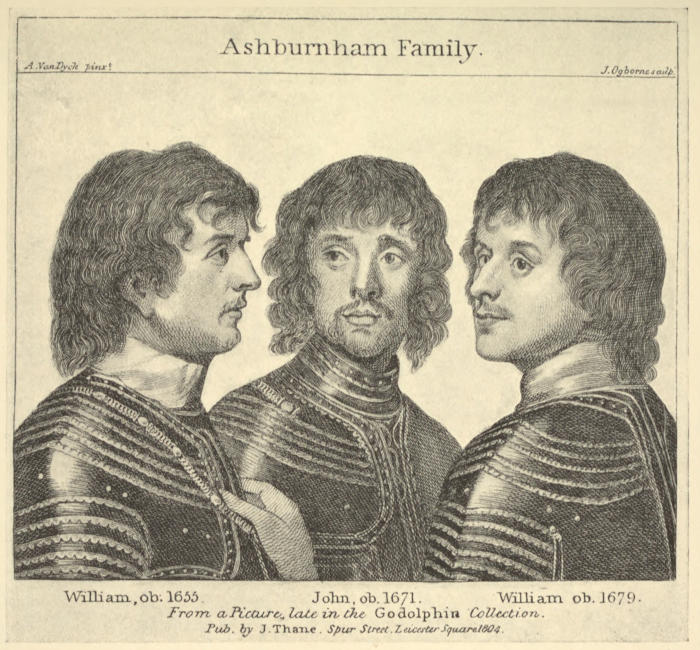
THE ASHBURNHAM FAMILY.
Of my mother’s brothers and sisters, those that I knew best were
my uncles Charles, who was in the Diplomatic Service, and Thomas,
who was first in the Coldstream Guards and, after exchanging into
the line, served in many Indian battles; his last post was that of
Commander-in-Chief at Hong Kong; he was one of the wittiest
of men, endowed with the power of giving a fantastic turn to the
most commonplace topics, and his subtle humour was enhanced
by being rendered in a musical speaking voice which was a special
attraction in all his family. He was the darling of society, and
might easily have been a spoilt darling, but that was impossible.
His last years—he died in 1872—were spent in the very able
administration of various charities. The widow of my Uncle
Charles, a brilliantly clever woman, married Sir Godfrey Webster,
and became the châtelaine of Battle Abbey, which was afterwards
bought by the Duchess of Cleveland, the authoress of the “Roll of
Battle Abbey,” and the mother of Lord Rosebery. My aunt, Lady
Jane Swinburne, was the mother of the poet. She was a very cultivated
woman, to whose bringing up he owed the finest side of his
character.
I hardly knew my eldest uncle, Lord Ashburnham, the famous
scholar and bibliophile, a man of recognized learning and taste.
He was a great Pasha of whom men stood in terror. Old Mr.
Quaritch, the bookseller, used to tell a good story of him.
Like the rest of mankind, he quailed before the great man. The
running account between the two used to run into very high figures.
One day Mr. Quaritch called at Ashburnham House, and the Earl,
glaring at him through his awe-compelling spectacles, asked what he
wanted. “Well, my lord, I have come to ask your lordship if you
could let me have a little money on account.” “Money, sir!”
answered my uncle, “what on earth can you want with money?”
“My lord, there is a great sale coming off at Paris next week, and
as your lordship knows these Paris sales are a question of ready
money.” “Go away, sir! Go away! You want to go to Paris
and speculate with MY MONEY!” A just indignation beamed
through the awful spectacles. The argument was irresistible. Mr.
Quaritch was glad to make his escape, crossed over to Paris the next
day and did not “speculate with my uncle’s money.”
And now as a last word let me brag a little after the manner of
Ajax and Ulysses as recorded in the quotation from Ovid, with which
I started this record. It is true that, unlike those heroes, I cannot
claim a descent from Jupiter, who, after all, was rather a disreputable
Père Prodigue; yet I am inclined, for my children’s sake, and
as an encouragement to them to incite their own children to prove
themselves worthy “citizens of no mean city,” to show them that
they come of a goodly stock on both sides. I have in my possession
a short family tree in the handwriting of the second Lord Redesdale,
who, as I have said above, took great delight in genealogy. That
tree shows that the Lords Ogle of Northumberland, who were our
forbears, were descended both on the father’s side and on the
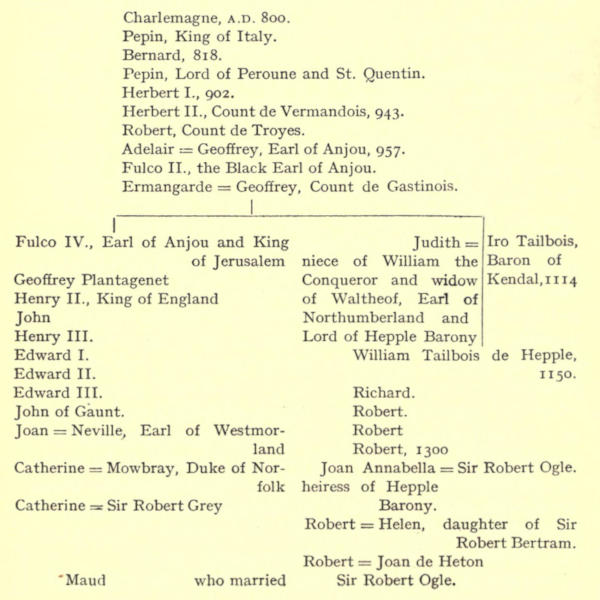
mother’s from Charlemagne. My cousin traced it as follows:
                     Charlemagne, A.D. 800.
                     Pepin, King of Italy.
                     Bernard, 818.
                     Pepin, Lord of Peroune and St. Quentin.
                     Herbert I., 902.
                     Herbert II., Count de Vermandois, 943.
                     Robert, Count de Troyes.
                     Adelair = Geoffrey, Earl of Anjou, 957.
                     Fulco II., the Black Earl of Anjou.
                     Ermangarde = Geoffrey, Count de Gastinois.
                                  |
            +---------------------+----------------------+
            |                                            |
Fulco IV., Earl of Anjou                         Judith =| Iro Tailbois,
  and King of Jerusalem            niece of William the  | Baron of
Geoffrey Plantagenet                Conqueror and widow  | Kendal, 1114
Henry II., King of England         of Waltheof, Earl of  |
John                                 Northumberland and  |
Henry III.                        Lord of Hepple Barony  |
Edward I.                               William Tailbois de Hepple, 1150.
Edward II.
Edward III.                                   Richard.
John of Gaunt.                                Robert.
Joan = Neville, Earl of Westmorland           Robert.
                                              Robert, 1300
Catherine = Mowbray, Duke of Norfolk    Joan Annabella = Sir Robert Ogle.
                                        heiress of Hepple
Catherine = Sir Robert Grey                   Barony.
                                        Robert = Helen, daughter of
                                                 Sir Robert Bertram.
                                        Robert = Joan de Heton
        Maud           who married         Sir Robert Ogle.
Constance, the daughter of Sir Robert Ogle (the first Lord Ogle),
married John de Mitford in 1437, and from them descended:
Bertram.
Gawen, 1550.
Cuthbert
Robert.
Cuthbert
Robert, b. 1612.
John.
William.
John.
William (the historian, my great-grandfather).
Captain Henry Mitford, R.N.
Henry Reveley Mitford.
Myself.
My wife’s father, David, seventh Earl of Airlie, was the lineal
descendant of the Mormaers, hereditary royal deputies of Angus.
Scotland was in ancient days divided into seven parts, each ruled
by a Mormaer or Maormor, a title which as long ago as the eleventh
century was converted into that of Earl. The story of the Ogilvys
in more modern days, how they fought for their King and were
attainted as Jacobites, is too well known to need retelling, nor need
I speak of the burning by the Campbells of the Bonnie House of
Airlie. Historians have recorded it; poets and musicians have
sung it.
Lord Airlie married Henrietta Blanche, the daughter of Lord
Stanley of Alderley, a cadet branch of a family so proud that it
used to be said of them “The Stanleys do not marry: they contract
alliances.” Here again are two pedigrees tracing back to the
remotest times of which there is any record. There is no need to
search out the family tree of the Stanleys to prove their descent
from Charlemagne. It is a matter of common knowledge. It is
only in the case of inconspicuous families like our own that it is
well to set down for those who come after us that which is so easily
lost sight of. When in this year, 1915, the shells are flying in the
trenches, it should be a stimulant to a man to think that he has in
his veins some of the blood of Charlemagne and of that glorious old
Charles Martel, the hammer that at the battle of Poitiers saved
Europe from being overrun by hordes of Saracens nearly twelve
hundred years ago.
CHAPTER II FRANKFORT—PARIS—TROUVILLE
I was born on the 24th of February, 1837, in South Audley
Street, in a house long since pulled down, which stood at the
southern corner of Hill Street. My father had left the Diplomatic
Service on his marriage and for some years my parents lived at
Exbury, the old family place overlooking the Solent through vistas
in the trees, where, sitting in the drawing-room, you could see the
great battleships with their bellying sails—men-of-war of the pattern
of Nelson’s days—the stately wooden walls of old England, the huge
West Indiamen travelling to and from Southampton, “sailing
between worlds and worlds with steady wing”—and the dainty
little Cowes yachts pertly flitting among them like graceful white
gulls.
Ships were indeed a thing of beauty in those days, and Exbury
was an earthly paradise; but like diamond tiaras and ropes of
pearls, it was a costly luxury, unremunerative. My people had to
retrench, the lovely home was let, and they went abroad to economize.
In this way it happened that I first awoke to life at Frankfort
in 1840—that at any rate is my earliest dim recollection. Two
years later my father left Germany and took us to live in France.
1842-1846.—I can hardly believe that it is only seventy-three
years since we first went to live in France. When I think of the
immense changes that have taken place in that beloved country
since then, it seems more like seven hundred. The upheavals of
wars and revolutions, two Dynasties gone, toppled over like houses
of cards, sovereigns lauded up to the skies one year, hounded out
of existence the next, followed by the howls and execration of
infuriated mobs; 1848 and the barricades—the coup d’état of
1851—the Second Empire—the Crimean War—Mexico and the
murder of Maximilian—the war of 1870 followed by the Commune—France
shorn of two great provinces—Paris improved out of
all its picturesqueness by the commonplace uniformity of Hausmannism—only
here a nook and there a corner left—all these
seem to be transformation scenes which would need centuries to
carry out, and yet they have all taken place in my lifetime. But
not in France alone; in Europe, Asia, America, Africa and
Australia, the seventy-eight years of my life have witnessed more
changes than any similar period in the world’s history.
For four years we passed the winter and spring—the season in
those days—in Paris—never twice in the same apartments, though
we always remained in the neighbourhood of the Madeleine—a
convenient quarter for our elders and for ourselves, for it was no
great distance from the gardens of the Tuileries, where we used to
play with a number of little French friends—I have forgotten the
names of all of them save only one called Jules—I suppose he had a
surname, but if he did I never knew it—he was always “le petit
Jules.” He was of about my own age, very small, but of a quite
demonic cleverness, and at marbles he was a hero. He broke us
all, and many a time we went home with empty bags—not a bulge
in ours—his bursting with wealth, and yet we loved him.
I remember one tragic episode of a beautiful white alley with rosy
pink veins, the pride of my soul. The little villain challenged me
to play him, offering to stake a superb agate against it. In less
time than it takes to write the tale the alley was his. My beautiful
white alley! I was but seven years old and I wept bitterly. I
wonder whether “le petit Jules,” if he is yet alive, remembers
how he avenged Waterloo that day in his victory over the English
boy. I don’t suppose that he often plays marbles now, but if he is
yet alive, I feel sure that his many talents have led him to great
successes in all his endeavours, whatever they may have been.
Many merry days we spent among the trees and statues of those
gardens, and often on a sunny morning we could see the old King,
Louis Philippe, pacing the terrace fronting the river. He used
generally to wear a long grey great-coat with a huge steeple hat
covering the famous Poire[16]—an astute, none-too-reliable old man.
He never had but one companion on his walks—probably General
Baudrand, his most familiar friend—perhaps Guizot or some minister—talking
earnestly, stopping every now and then to enforce a point
with appropriate gesticulations. Hatching plots, Spanish marriage
for Montpensier, or some other villainy? Probably. But that old
grey coat covered a King, and we looked at it with awe.
As might be expected in the case of a King whose own people
admitted that the one thing he lacked was dignity, his Court seems
to have been the shoddiest affair that could be imagined; we used
to hear many stories of its vulgarities. Old Lady Sandwich, grandmother
of the present earl, spent much Irish wit upon it. Her
descriptions of the bourgeois courtiers were inimitable. She happened
to go to an audience just about the time that there was so
much fuss about poor Queen Pomaré—the ex-Queen of Tahiti.
The equerry who was to announce her asked the English lady’s
name.
“La Comtesse de Sandwich.”
“Pardon, Madame, je n’ai pas bien compris.”
“La Comtesse de Sandwich.”
“Mille pardons, Madame—mais ces noms anglais sont si difficiles.”
The man was evidently determined to be insolent, but Lady
Sandwich turned the tables on him by saying with a laugh:
“Mon Dieu! Monsieur, dites donc la Reine Pomaré!”
That smothered him—everybody laughed, and she stalked into
the presence majestic and triumphant.
Another time at a court ball, she had struggled through the shabby
crowd to the buffet and got herself an ice, when a big hand snatched
it from her and from the mouth that belonged to the hand there
issued, “Enfoncée la petite mère!” She turned round, furious—it
was her bootmaker in the garb of the Garde Nationale. He had
only seen her back, so had not recognized her. When he did
see——!
Of the Royal Family in the Tuileries there were two members
at whom nobody sneered, of whom nobody spoke an evil word—Queen
Amélie and the Duc d’Aumale. Her goodness and dignity
won universal respect and admiration. Of the Duc d’Aumale I
shall have a word to say elsewhere. As for the rest, there was no
great halo of majesty about them. The wily old fox himself was
distrusted where he was not hated. The Legitimists spoke of him
as the very incarnation of the Revolution, like his father Égalité,
a traitor to his King and to his caste. How dared he call
himself “King of the French” when his cousin was the lawful
“King of France?” The sons, Nemours, Joinville, Montpensier,
I used to hear spoken of with scant respect—no great harm about
them; but poor creatures, commanding neither regard nor
affection; nobody seemed to associate with them or to wish their
friendship. When I came to know them later in life in this
country I understood the talk to which I had listened as a child.
The death of the Duc d’Orléans excited sympathy from its tragic
character, besides which he like the Duc d’Aumale, but in a lesser
degree, had earned some credit in the Algerian campaign. I can
just remember the horror with which the news of the fatal accident
when he was thrown from his carriage, between Paris and Neuilly,
was received. It was in 1842, just seventy-three years ago!
My father’s many accomplishments—music, painting, languages—made
him welcome beyond the usual run of foreigners in French
society. He was, moreover, wonderfully well-read in the old
memoirs of the seventeenth and eighteenth centuries, and quite an
authority on historic French portraits. So much so that when
I once said to him that I felt sure that if he were to find himself
transported back to one of the famous salons of those times he would
know almost all the people by sight, his answer was, “Upon my word,
I believe I should.”
The society of the Faubourg in the early forties must have been
very interesting; there were so many people still living who could
talk as eye-witnesses of the horrors of the great Revolution: at
the time of our sojourning in France there was less interval
separating us from the Terreur than there is between to-day and
the Crimean War.
A man of seventy years in 1842 was twenty years of age when
the King was murdered; yet it seems difficult to believe now
that, as a child, I often listened, my hair almost on end, to men
and women telling how they had seen their nearest and dearest
led off in the tumbrils to the shambles of Monsieur de Paris, and
recounting the miracles by which they themselves had escaped.
There were many such. Indeed, the Duchesse d’Angoulème
herself—the woman of so many tears that to her dying day in 1851
her poor eyes suffered from the chronic weeping known as gutta
lachrymans—who as a child had, with her unhappy mother, gone
through the miseries of the Conciergerie, and seen the King and
Queen, both her parents led away to the scaffold, was living, though
not in France, and my father knew her well—in all respects a
wonderful woman, of whom Napoleon said that she was “the only
man in the family.”
It is now the fashion to laugh at the story that Robespierre,
minded to marry her, sought an interview with her in prison.
She, warned beforehand, maintained a dead silence, refusing to
utter a word, and he left the room, banging the door and exclaiming,
“Bégueule comme toute sa famille.” My father, who had exceptional
relations with the old French Legitimists, firmly believed
that this really happened, and he had good reason for his faith.
Of people whom I actually knew and who had survived the
Revolution, several were in various ways notable.
At Trouville we became very intimate with the family of the
Marquis de Chaumont Quitry. The two sons, Félix and Odon,
were splendid young men who, among others, made the place
gay, and on a fine evening they would carry out their trompes de
chasse and make the rocks ring with the “Hallali,” the “Rendezvous
des Chasseurs,” and other fanfares, to the great joy of us
children.
The old Marquis had been a great figure among the émigrés.
When still little more than a boy he had contrived to make his
escape from the Terreur with his young wife, and landed in England
with a few pounds in his pocket. Many friends were eager to help
him, but he was as proud as his ancestor, Robert de Chaumont,
the knight of the First Crusade, and he would accept nothing.
With the little money that he had he bought cloth, thread, scissors,
needles, and whalebone, and set up with the Marquise as a stay-maker
somewhere in Soho—a hero, if ever there was one—and it
became the fashion for fine ladies to have their stays made by the
noble descendant of Crusaders whose pedigree could be traced
back to Charlemagne.
There was another wizened little old gentleman, whose name
I have forgotten, who used to tell us anecdotes of the straits to
which he was put during his life in London; but after all, it might
have been worse, and he was able to feed himself for very little
money. In the cheap slum in which he lived there used to appear
every morning a man with little pieces of meat on skewers; for
two or three pence you could obtain “des petites portions,” quite
enough for a meal, “et ma foi! ça n’était pas trop mauvais; ça
s’appelle Kami.” He was dealing with the cat’s-meat man!
I used often to be taken to see the venerable Marquise du Mesnil,
who had been lady-in-waiting to Marie Antoinette. The old
lady lived in a wonderful apartment full of glorious old furniture,
Gobelins tapestry, Sèvres china, vernis Martin, fans and pictures,
memorials of the old Court which would fetch a king’s ransom
to-day. I sometimes wondered whether the windows of those
rooms had ever been opened since the house was built, for the air
was thick with a peculiar musty, stuffy, mousey smell, over which
neither musk nor verveine could prevail. Here she sat bolt upright
with a priceless snuffbox in her wizened hand, telling tales which
made me gasp with terror, until I could almost see Judith carrying
the bleeding head out of the tapestry in the boudoir to the music
of the carmagnole in the street below.
At the Musée Carnavalet, or looking at the Princess de Lamballe’s
little pink slipper at the Cluny, I am reminded of that house
of fear from which I used to escape trembling, but to which, such
was its weird fascination, I always used to beg to be taken every
time my people went to visit there. The old lady was always very
kind to the little boy who never quite knew whether he feared or
loved her, but who had a lurking suspicion that she must be some
relation of that fairy who was not asked to the christening.
A great pleasure on our homeward walk from the Rive Gauche
was to be allowed, after recrossing the river, to go through the
Place du Carrousel, between the Louvre and the Tuileries, not
then the magnificent, dull and highly respectable space that it
now is, but a regular fair, with all sorts of cheap booths, where
dogs and cats and monkeys, many strange beasts, birds from
over-sea islands, parrots and fowls with gaudy plumage, snakes,
tortoises, cheap and entrancing sham jewellery and rubbish were
for sale. It was very picturesque, very smelly and very dirty,
the screams of the macaws, the barking of the dogs, and the cries
of the vendors made the day noisome and hideous, but we youngsters
loved it with all its filth, and the present spick-and-spanness is no
compensation for the magnets of attraction that have been
swept away.
I wonder where these sweepings agglomerate into life again.
There must be some place where the humble piou-piou buys a
cheap ring for his lady-love, some place where the marchand de
coco tinkles his bell among the crowd, where the distressful person
who earns his living by picking up cigar-ends, now partially ruined
by the cigarette craze and the end of snuff-taking, can ply his
trade, and the cries of the old-clothes man and the dealer in stale
fruit may be heard, some place from which modern ideas will drive
them once more into the wilderness; for after all, it must be admitted
that the picturesque charms of Petticoat Lane are hardly in
harmony with the sedateness of an improving neighbourhood, let
alone a great architectural quadrangle separating two palaces, one,
alas! now gone for ever.
There were other walks—the Jardins des Plantes, the Bois de
Boulogne, and so many pleasant expeditions. But what I grew to
love most, as the years rolled on, were the quaint old nooks and
corners that we used to come upon in remote and unexpected
places, remnants of the old Paris of the Trois Mousquetaires—delightful
people!—curiously gabled streets where the oil lanterns
still swung from wires fastened to the houses on either side, places
just fit for rufflers like d’Artagnan, Athos, Porthos, Aramis,
swaggering hand on hilt; dark, mysterious, labyrinthine quarters,
very primitive and no doubt very unhygienic; but then you cannot
have everything.
One not very judicious outing I remember when I was seven
years old, and a sentimental tutor from Demler’s school, to which
we were sent, took several of his pupils, myself among them, to the
Morgue to see the corpse of a girl who had been murdered—stabbed
to death—by her sweetheart. It was a horrid place, that old
Morgue, where the dead bodies were laid out naked on marble slabs
with a tiny trickle of water playing upon them, like salmon in
a fishmonger’s shop, and their poor rags of clothing hung damp,
empty and melancholy from the ceiling. The sight almost made
me sick and fed me with nightmares for weeks.
One of my father’s best friends in Paris was the old Duchesse
de Rauzan. She had recently built herself a house at Trouville,
on the sands near the mouth of the river. Trouville was then a
tiny fishing village. The only other house besides that of the
Duchesse was one built close to hers by Doctor, afterwards Sir
Joseph, Olliffe, the physician to the English Embassy. The
Duchesse was anxious to get a few of her friends to camp for the
summer in the fishermen’s cottages and make up a pleasant coterie.
Amongst others, she persuaded my father to join the party. One
day my father had taken me with him to call on the Duchesse,
to inquire further before deciding, and as we were sitting there,
a footman announced “Monsieur le Docteur Billard.”
“What a piece of luck!” said the Duchesse. “Monsieur
Billard is the Trouville doctor, so you will be able to ask him all
about it.”
Questioned, Billard answered, “Monsieur, Trouville est un trou!”
and went into fits of laughter at the fullness of his own wit.
The answer, however, did not suit the Duchesse’s book, so the
poor doctor was promptly snubbed and told not to talk nonsense.
I was destined to see a good deal of that learned man of pills and
noxious draughts in the next four years, and he became one of my
most intimate enemies. He was a primitive, and so far as I was
concerned he had but one remedy, a horrible decoction of gum
arabic and sugar, called sirop de gomme, which presumably
was intended to glue together any little portions of the human
organization which might have got out of joint, and was his panacea
for all ailments except the toothache; for that he had a dreadful
instrument of torture called a German key—upon me he experimented
with both.
He was a humorist: “N’ayez pas peur, mon petit ami; nous
allons guérir ça avec un peu de baume d’acier.” In went the
“baume d’acier” into my mouth, and with a great wrench out came
the tooth. Howling with pain, rage and indignation at having
been tricked, I wreaked an inadequate revenge upon M. Billard’s
shins. But this is forestalling events. In spite of the doctor’s
wit, the Duchesse easily talked over my father, and the result was
five most happy summers in the brightest of surroundings.
And so it came to pass that one fine day in 1842 we all embarked
on the railway, then a very new institution, which went no further
than Rouen, where we slept, and on the following morning two
huge yellow diligences, which my father had chartered to carry
us and our fortunes to the Norman coast, were standing outside the
old-fashioned inn. My father, my grandmother, two aunts, my
two brothers and myself, besides a German tutor and a white
poodle, made up the crew.
Greatly hindered was the packing of the crazy old coaches by
that nondescript, motley crowd that used to fill an inn-yard on
those occasions, a crowd quite unknown to the traveller of to-day,
long since as extinct as the great auk, all shouting, swearing and
spitting, all giving different opinions, with much gesticulation,
as to what trunk should be placed where, in unison only when the
question of pourboires turned up, in unison then—not in harmony.
Off at last! The great lumbering diligences rattling over the
cobble stones of the glorious old cathedral city, stopping now and
then for pack-thread repairs to the harness, the coachman cracking
a long whip, the stick made of twisted willow and garnished with
red cotton tassels to match those on his horn, which he from time
to time tootled distractingly, shouting at his horses, the near leader,
a favourite, being addressed lovingly as “Coco,” the off leader
held up to contempt as a “sacred canary-bird,” and the wheelers
being left to jog on in peace as the spirit moved them, nibbling
with fond kisses at one another’s ears, and all four merrily jingling
their bells.
It was a weary journey, and we were all very tired, hungry,
cross and scratchy (for the straw in the bottom of the diligence
harboured a colony of greedy fleas), when we rolled along the quay
in state and finally drew up at the chemist’s shop, kept by one
Madame Gamard, the upper floors of which we were to occupy.
It was a mean old house, at the entrance to a curly street, the
back windows of which overlooked a butcher’s shambles, where
every morning at daybreak bovine sacrifices took place, a gruesome
sight, which the German tutor used to wake us up to witness.
He would not have missed a death-blow or a groan for anything.
He revelled in blood like Ivan the Terrible. If only, as in the
case of the cruel Tsar, it had been human blood, one felt that his
treat would have been complete. At the back of the house
slaughter; in the front drugs and potions in wonderfully inscribed
gallipots, interspersed with fly-blown caramels and sugared almonds
almost as nauseous as the salts and senna.
Only a maid and a cook, with my nurse and my father’s
manservant, came with us from Paris, so as we were a largish
party, my grandmother had to engage two additional women
selected from the local talent. Her star was in the ascendant
when for one of them her choice fell upon Marie Letac—and here
I am at once met by a difficulty. How to spell the name? As
no member of the Letac family had ever been taught to read or
write, such superfluous accomplishments not being the fashion at
Trouville, the spelling was a matter of debate. Should the name
end with a c, or que, or cque, or ques, or cques? I take the line of
least resistance and adopt the final c.
Marie was a dear, rosy-faced, good-humoured, very plump person
of some forty years—snuff her one dissipation, her one extravagance.
How she managed to stow away so much was a mystery;
a large, flat nose and the stains on her apron would account for
some of it, but surely not for all. Her union with a thin, red-haired,
weasel-faced carpenter had been blessed by a numerous family,
obviously hardy annuals. She was a great character, but when
she came back the following year from Paris, whither she had
insisted on accompanying us, she became a notable authority
touching the glories of the capital, upon which she would descant
to Weasel-face and a select circle of commères, listening open-mouthed,
with their hands folded under their aprons upon their
ample stomachs. What struck her most in Paris was the beauty
of the potatoes. “Parlez-moi des pommes de terre de Paris!
C’est si-z-aimable à cuir.” Of the servants’ quarters in a Paris
house she did not approve so highly, and no wonder, for they were
wretched dens under the roof, often not weathertight. She sometimes
acted as my nurse, and I can hear her now, after bidding me
good night, saying, “Où’s’qu’il est le parapluie?—allons nous
coucher!”
One fine day there came to Trouville a travelling dentist and
quack, a sort of Dr. Dulcamara, who established his cart on the quai
near the fish market. He announced himself as “La Gloire de la
Science,” the favourite medicine-man and confidant of the Emperor
of Russia and the other Crowned Heads of Europe. He was
dressed in an old ragged blue military coatee with scarlet worsted
epaulettes, dirty white breeches and top-boots. On his head
rested the dignity of a huge cocked hat with a tall tricolor plume.
He carried a gigantic sword, and his warlike appearance was enhanced
by a pair of phenomenal black moustachios. In attendance
upon him were a performer on the key-bugle and a pitre, or jack-pudding,
whose business it was at the psychological moment to
bang a big drum and crash a pair of cymbals in order to drown the
howls of the victims of dentistry.
Marie Letac, who had been suffering from toothache, was wild to
go and consult the “Glory of Science.” My aunt promised to
pay the fee, so off she went and mounted the learned doctor’s
cart. A little while later we went out and met Marie Letac with a
duster before her mouth, bleeding profusely, crying with pain, yet
half laughing at her own plight—one might almost say weeping
merrily.
“Well,” said my aunt, “so you have had it out?”
“Seven of them,” blurted out Marie.
“Seven! Impossible!”
“Oh! du moment que c’est mademoiselle qui régale!” and with
that she went off bleeding but content.
The man of pills, potions, and forceps did a roaring trade that
day; the drum and cymbals were never idle, and there was a great
crowd of sailors and fishwives, standing unwearied for many hours,
happy in the enjoyment of an exhibition which was free, and in the
contemplation of the pain of their friends and neighbours.
I think, though it is anticipating by a good many years, that I
must finish the story of our relations with Marie Letac. She remained
with us all the time we were in France, and was heart-broken
when we left—that was in 1846. We spent the summer
holidays of that year at Tunbridge Wells, and one day, as we were all
sitting at luncheon, there came a ring at the bell, and we were told
that there was a French beggar-woman who wanted to see my
aunt. She ran out of the room and presently came back with Marie,
travel-stained, tired, footsore, and almost worn out, but crying for
very happiness. She said that she could bear the separation no
longer, so she had gone to Havre, taken boat for Southampton, and
walked all the way to Tunbridge Wells. How she managed to find
the road, not knowing a word of English and almost penniless, was
a puzzle. She had an addressed envelope and that was all, but here
and there she met with a kind person who knew a little French and
helped her, and so at last the faithful creature reached us. She did
not stay very long, for she had her husband and the hardy annuals
to look after, and she was sent back to Normandy, this time
travelling decently and in comfort.
The following summer we went back to Trouville, and of course
she came to be with us. After that we never saw her again. But
every Yuletide there came a letter to my aunt, written by the
village scribe in pompous language, beginning, “Je croirais manquer
à mon devoir si je ne m’empressais pas,” etc., etc., with many good
wishes and felicitations. At last, after many years, there was a
sad Christmas which brought no letter. Poor Marie “avait manqué
à son devoir.” She was dead.
Of Trouville Alexandre Dumas père was the Columbus, la Mère
Oseraie the George Washington. What the one discovered, the
other made. The “Bras d’Or,” the solitary little inn over which
Madame Oseraie shed the very sunshine of kindness, became famous
as a summer resort for the long-haired denizens of the Quartier
Latin of Paris. It was quite humble and very cheap, but it was
specklessly clean, and the cooking was undeniable, for the hostess
was a born cordon bleu. The elder Dumas was no mean judge, and
when he gave her his blessing, her omelettes were said to be a dream,
her soupe aux choux a revelation. The great man had spoken, and
the “Bras d’Or” became a sort of suffragan headquarters for some
of the painters of the Barbizon school, and a small gang of imitative
rapins who followed in their wake. It suited their meagre purses;
for three or four francs a day they were lodged and fed upon the fat
of the land, with bread and cider à discrétion.
As for Madame Oseraie herself, round, fat, and fubsy, with a most
genial smile and welcome, she looked as if she had been made to
suckle the world on the milk of human kindness. The good inn was
never empty, and the guests went back to Paris all the better for
the rest, with a dip in the sea, fresh, strong air and good food, carrying
a satchel full of sketches to work upon in their cock-loft ateliers till
the time should come round for another happy summer holiday.
But after 1842 no more “Bras d’Or” for the poor rapins! The
grandees from Paris had taken possession of Trouville; Madame
Oseraie not unreasonably raised her prices, and the poor, long-haired,
imperfectly-washed, but very merry ne’er-do-weels must
move on to some other and, let us hope, equally happy hunting
ground.
When the great people came they had perforce to accept the
simple life. The fisher folk furbished up their cottages according
to their humble ideas of æsthetic extravagance, and their lodgers,
who had left behind them rooms rich with Gobelins and Beauvais
tapestry, furnished with masterpieces by Riesener, Caffieri and
Gouthières, had to content themselves with hideous cheap wall-papers
the colour of which came off in dust upon their coats and
gowns, and with such poor sticks and stocks as the modest homes
could afford. What became of the owners, in what troglodytes’
dwellings they lay hidden, counting over their little harvest, is more
than any man can say.
One or two artists, a little less hairy and a little better off than the
old patrons of the inn, came with the mighty. There were the two
brothers Mozin, Charles and Théodore, the one a clever painter,
the other a musician, and Vogel, beloved of the none-too-critical
Paris ladies for his sugary ballads all about love and cottages and
despair—songs as sweet and smooth as the almond-paste in a wedding-cake.
They brought a sort of mild æsthetic leaven into the general
hotch-potch; the dandies copied their scarlet flannel blouses and
their bérets; the smart ladies accepted their sketches and the
dedications of their songs, feeling that in so doing they were laying
a claim to a reputation for culture.
A vision of the plage at Trouville was Madame de Contades,
who came down from Paris one year to breathe a little health after
some serious illness. She used to be carried on to the sands on a
canvas litter by two sturdy fishermen in their blue jerseys and
knitted caps, and when she was comfortably established with her
book, her fan, her parasol, and her bottle of smelling-salts or some
cunning essence, she would be surrounded by a bevy of children,
pages and tiny maids of honour, all eager to render her homage and
do her some small service—a lilliputian court quite as much in love
with her as the dandy moths that singed their wings in her flame.
How beauty appeals to children! That sweet, pale face, framed
in soft brown curls like the Cenci of Guido Reni, is a fascination
to me to-day as it was seventy years ago and more. She should
have remained a tender invalid; but the rough Norman breezes
brought back the roses to her cheeks and strength to her shapely
limbs, and the next I heard of our beautiful queen was swimming
a race against another lady in the Seine at Paris. To her lilliputian
court this seemed an outrage of lèse-poésie. Indeed, it was deemed
a little unusual at that rather stiff period.
The Lubersacs, Barbantanes, Blacas, followed the lead of the
Duchesse de Rauzan, as should beseem daughters and sons-in-law.
Notable also was the Duchesse de Gramont Caderousse, with her
two boys, daily playfellows of ours, the second of whom became
the famous viveur, dandy, duellist, and eccentric of the Second
Empire—I shall, perhaps, speak of him later. The elder brother
died as a boy.
Sunday was a great day, when the little street and the plage
were quite alive with holiday folk who flocked in from the neighbouring
farms and villages to see the fine people from Paris. It
was a very picturesque crowd. Of course the sailor-men were all
dressed in their best blue cloth, with their red knitted woollen caps
throwing a tassel jauntily on one side. The well-to-do farmers’
wives and daughters were very smart. Striped petticoats coming
down a little above the ankle, showing a neat little pair of wooden
sabots, or even leather shoes; black-silk aprons; white fichus
folded over their breasts; upon their heads the old, high twelfth-century
caps, trimmed with lace, which our ladies said was beautiful,
handed down from mother to daughter for generations.
A few years ago I was at Trouville once more upon a Sunday.
Alas! the old costumes were no longer there. The present generation
of farmers’ wives were all garbed and hatted in imitation of
Paris fashions. It was too sad! They were a fine, strapping,
healthy race of women, with beautiful skins and cheeks as rosy as
the apples of their own orchards. Some of the girls were very handsome,
sweet and modest-looking; rather shy of the foreigners. It
may be said that I was not of an age to judge, but I was a long-eared
little pitcher, and I heard what my elders said. The men
were not so picturesquely attired, but there was a touch of local
character about their get-up also.
A great ally of ours was a certain old Monsieur Pommier (I don’t
suppose he was more than forty, but to us he seemed a Methuselah),
who always came to see us dressed in his Sunday best. A brown
coat as stiff as iron, and as uncomfortable as a strait waistcoat, with
a ridiculous little pair of tails about six inches long sticking out
behind almost at right angles to his waist; a phenomenally high
collar reaching to his ears, a tall stock above a flowered white
waistcoat; on his reddish, close-cropped head a black beaver hat,
brushed the wrong way; in his hand a stick with the thick end
downwards, held by a leathern thong at the small end; tiny side-whiskers,
and a face and nose shining from recent soapsuds. He
was the type of the prosperous Normandy farmers and cider-makers
of his day. If they were proverbially a close-fisted race, they knew
how to be hospitable, and there was an old-world courtesy which
pierced through their roughness and was most attractive. To us
they were very kindly, and the memory of them is still pleasant.
It was a motley crowd that came to mix with the grand ladies,
the dandies, the nounous, the little bare-legged children making
sand-castles, watching an itinerant Polichinelle or scrambling
about the mussel-clad Roches Noires under the careful eyes of
governesses and tutors.
But gay and bright and happy as the Sunday was out of doors,
inside our house it was dreary and penitential. My grandmother,
a Leslie-Anstruther by birth, had inherited all the bigotry of the
old Covenanters, and under her rule, kind and loving as it was on
week-days, the Sabbath was a day on which no expression of joy
was permitted. Many hours were consumed by her in various
forms of deadly dull worship. Even we, mere children, had to sit
through a service which was made as forbidding as it could be.
She began with the morning service read from beginning to end,
including the priestly absolution, which she delivered with peculiar
unction; then came the Litany, which the professional cleric omits
when the morning prayer has been given in its entirety; then the
Communion service. By that time most performers would have
been exhausted—not so my grandmother; she proceeded to
deliver one of Blair’s sermons, and woe be to us if we yawned,
or fidgeted, or were guilty of inattention!
I remember one special Sunday. I must have been about six years
old when I was promoted to a pair of trousers; they were made by
the village tailor out of a hideous black-and-white check horse-cloth,
very coarse and prickly, like the hair-shirt of a medieval
saint. Every time I moved the sharp points entered into my tender
flesh; to kneel was a penance, to get up again and sit down a
torture. My fidgets and groans could not be restrained; they were
a criminal interruption, and I was punished accordingly, but at any
rate, in order that the punishment should be effective, the cruel
trousers had to be taken down, and that was a consolation, though
only temporary, and not unmixed with a counter-irritation of pain.
In these circumstances religion was what the great Lord Halifax
called “a vertu stuck with bristles, too rough for this Age.”
In 1845 we stayed on at Trouville long after all the other
summer visitors had fled, like the swallows. No one left but the
fisherfolk and ourselves.
In the late autumn the sea became leaden, ugly, cruel-looking.
One stormy day when I fought my way as usual against the wind
down to the deserted sands, close to where the bathing-machines
were drawn up in idleness, I came upon a group of fishermen carrying
something blue and limp, a belated bather whom they had risked
their own lives to rescue from the waves growling savagely upon the
beach, lashing themselves, as it seemed to me, into a fury at being
robbed of their prey. It was difficult to believe that it was the same
sea that a few short weeks before had rippled so gently, kissing the
pretty feet of the paddling children! On such days as those I felt
very much alone and longed to get back to the Gardens of the
Tuileries and the merry games with our little camarades.
But there were bright days in the waning year, when we made
expeditions to neighbouring farm-houses, or tramped along the
frosty riverside road to the little town of Touques, with its black-and-white
timbered houses and the picturesque ruins of the old
Norman castle.
What a joy it was when I was about eight years old to let my
imagination run riot, peopling the old keep with visions of knights
and dames and beautiful Jewesses! I was in the middle of reading
“Ivanhoe” and here was indeed a setting for the book. I could
fancy myself at Torquilstone and conjure up living pictures of the
Black Knight, Front de Bœuf, the Templar, Athelstane, and Cedric
the Saxon. There was a beautiful peasant girl in her high Norman
cap, wandering down below among the now leafless apple orchards;
could she be the Lady Rowena? And that sturdy, rather ruffianly
vagabond standing in the ancient archway. Surely no other than
Gurth the swineherd! Phantoms conjured up by the Wizard of the
North.
In August, 1847, we were once more at Trouville, and it was
for the last time. In former years we had been wont to
see more of that romantic Norman coast than most people did;
for we were not fashionable: we used to arrive in early spring,
long before the orchards were brilliant with the bravery of the
apple blossoms, and more than once we stayed on long after the
last glorious red fruits had been gathered for the cider-vats, when
the first frosts had coloured the falling leaves, and the hedges
yielded no more blackberries with which to smear our small faces.
This year our stay was bounded by the Eton holidays.
It was a fateful month—fateful for France—for it was the month
in which the Praslin tragedy took place, a tragedy which might
perhaps by now have been mercifully forgotten had it not played
so important a part in the political history of that time.
One beautiful summer day, when all the little world of Trouville
was gathered together upon the velvety sands, the terrible news
arrived. Two young Irish ladies came running up to my aunts
weeping bitterly—almost in hysterics. They were great friends
of the Praslin family and had just heard that the poor Duchess
had been murdered and the Duke arrested. I remember the
thrill of horror with which the news was received on the plage,
and that thrill throbbed through all France. The Duc de Praslin
had driven the first nail in the coffin of the Orleans monarchy.
For some five or six years the Duke and Duchess, who had a
large family, had had in their service as governess a certain Mademoiselle
de Luzy. Of this lady the Duchess, with or without
reason, but most probably with very good reason, at any rate
so far as the transfer of her husband’s affections was concerned,
had become furiously jealous: so much so that her father, Marshal
Sebastiani, insisted upon Mademoiselle de Luzy’s dismissal. This,
however, did not put an end to the intimacy, of whatever nature
it may have been, between her and the Duke, for it was shown
that on the arrival of the family in Paris from the country, he
drove at once to her house. That night the murder was committed.
When the servants entered the bedroom, they had to
face a sight so appalling that M. Delessert, the Prefect of Police,
whose business made him familiar with the horrors of crime, told
Mr. Henry Greville that in all his experience he had not come
across so ghastly a spectacle. There were signs of a desperate
struggle, for the unhappy Duchess, a short but stout woman,
had evidently fought fiercely for her life.
Suffice it to say here that the evidence against the Duke was
damning. A pistol known to belong to him had been used as
a bludgeon, and was clotted with blood and hair—some of the
hair was his own, pulled out in the cruel fight! He had opened
the window in order to excite the belief that the crime was the
work of burglars; but it was pointed out to him that nothing
had been stolen, and that a figure resembling his had been seen
from the outside opening the casement—upon which he observed
that the matter assumed a grave aspect. He was arrested and
carried to prison, but managed to take a dose of poison which
proved insufficient; a second dose was smuggled, as it was
averred, into his cell, and of this he died; but there were many
people who believed that the poison was a farce, and that he was
spirited away to England, where he is supposed to have lived for
many years in hiding somewhere in the Lake district. The possibility
of this escape was strenuously denied both by M. Delessert
and the Procureur-Général; but it is significant that the former
did not himself see the Duke’s body, although it was his duty to
do so. He was prevented by other business.
Mademoiselle de Luzy was arrested and kept in solitary confinement.
But when she was examined she gave her evidence
clearly and simply. Nothing was elicited to show that she was
particeps criminis, or even that her relations with the Duke had
gone beyond the bounds of propriety. She was of course
released, and afterwards married very respectably.
All France was moved to the core by the horror of the crime;
but what aroused even more indignation than the murder itself
was, as I well recollect, the widespread idea that for political
reasons there had been a miscarriage of justice and that the
murderer, owing to his exalted position, had been allowed to
disappear scot-free.
There were whisperings and mutterings, and grave doubts expressed
even in high places; but in the lower strata of society,
among the bourgeoisie and the proletariat, there were sullen,
ominous thunder-growls boding ill for a government which had
long since forfeited all claim to popularity; the whole affair was
shrouded in a mystery which was more than enough to excite
the minds of a highly inflammable people. Republicans and
Socialists had for some years been on the war-path: now they
were goaded by laws gagging the press and proscribing public
meetings. These laws, initiated by Guizot and furiously opposed
by Thiers, brought about the final crash; the revolution broke
out, and on the 22nd of February, 1848, the King and his Queen
were hounded out by the mob of Paris. A few days later a
slippery old gentleman with a curious pear-shaped head and profuse
expressions of geniality—a commodity which he always kept
in stock—landed at Newhaven. He said he was Mr. Smith.
Whether the Duc de Praslin died in prison, a suicide as well
as a murderer, or whether his flight was connived at by the mighty,
is one of those secrets which will remain hidden till the Day of
Judgment. It used to be said that members of his family were
in the habit of paying annual visits to him in England. The
French authorities always scouted this idea; but many years
later facts came to my knowledge which proved that one of his
very near relations did make a practice of coming to England
periodically, and that during those expeditions he was for the
most part lost to the sight of his friends. Whither he went no
one knew.
It is a strange coincidence that the fall of the last two monarchies
in France—that of Louis Philippe and that of Louis Napoléon—should
in each case have been heralded by a single murder. These
were crimes which stirred the wildest passions, the fiercest and
most unthinking resentments of the mob, and however unjustly,
the penalty for them was paid by those who had no hand in them.
CHAPTER III ETON
There are days in a man’s life which he never forgets;
his first day at school is one of them. My maiden appearance
at Eton was in 1846, sixty-nine years ago at this time of
writing, but that lovely day in May is as fresh in my memory
as if it had been last week. I was only nine years old, but I
suppose that I was rather impressionable for my time of life, and
my young imagination had been fired by the enthusiasm of my
father and many of his friends, whose chief pride always had seemed
to lie in the fact that they were old “Eton fellows.”
Their stories of school days—chiefly blood-curdling tales of
scrapes and punishments borne with Spartan fortitude or avoided
by hair’s-breadth escapes, the chief joys of scholastic memory—had
sunk deeply into my mind, so that Eton seemed very familiar;
and yet when I faced its reality, the religio loci was a revelation.
I remember the mixed feeling—a great joy, a shrinking fear—before
the plunge into the great unknown; the sorrow of leaving
home, the freedom of new wings, the exultation of life. I remember
the terror lest I should be guilty of some solecism upon which
the wrath of the gods of the sixth form should fall; I remember
a heart throbbing, as men’s hearts might throb before a battle,
when my father rang at Mr. John Hawtrey’s[17] door (for I was to
start in lower school) and my relief at the sight of his and Mrs.
Hawtrey’s kind faces, and of the comfortable matron, Mrs.
Paramour, ample of bosom and sympathy, to whose care I was
commended!
Then the awe of being led through the gate into the school-yard
with the statue of the King-Founder and the entrance to
the cloisters under Lupton’s tower, from the ground-floor room
on the right of which there issued the weird and muffled noises
of a not unmelodious flute—sounds that were to become very
familiar to me later on, for the room was occupied as a schoolroom
by dear old Herr Schönerstedt, professor of Hebrew and
German, who, like Tityrus and Frederic the Great, used to solace
his leisure hours, which were many, with a flute.
Thence into the playing fields, in which the elms planted in
Charles the First’s time, then at the zenith of their pride, now all
dead and gone, were just putting forth their summer plumage;
Fellows’ Pond, with a lazy pike or two basking on the surface;
Poet’s Walk, Sixth Form Bench, and above all, the glory of
Windsor Castle, most regal of palaces, towering above the Thames.
How beautiful it all was, and how romantic! The fairies must
have been tripping in rings on the turf, the dryads tempted out
of their barken hiding-places, the water-nymphs making high
festival on the silver flood, so radiantly joyous was the day!
We lingered under the one oak tree standing in lonely majesty
on the river bank, trying in vain to dip its boughs into the ripples
on which the sunbeams were dancing; we looked at Lord Wellesley’s
weeping willows (I wonder whether the planting of them
by the great Duke’s brother might have had some dim connection
with St. Helena). It was delightful wandering through those
Elysian fields in which every tree, every corner was a peg upon
which our elders could hang a story of thirty years ago—the fields
that the Duke of Wellington loved to the end of his days. We
were to go to luncheon with the Head Master, my father’s old
tutor and lifelong friend. He used often to come and see us in
the holidays, and so was perhaps not quite such a figure of awe
to me as he was to most new boys.
But before penetrating into Weston’s Yard, where the new
College buildings had recently been erected, we must cast one
glance at the corner of the playing fields known as “Sixpenny”—just
below what was then Miss Edgar, the dame’s, tumbledown
old labyrinth of a house—the classic place for battles in the past,
where I was to see many a famous fight in the next few years.
From “Sixpenny” it was that in 1825 the great Lord Shaftesbury’s
younger brother, Francis Ashley, was carried home to die
from exhaustion after fighting with a boy of the name of Wood
for the best part of two hours. I witnessed three fierce fights
that were nearly as bad, and many lesser battles, but the subject
is only worth alluding to because it is dead. There is no fighting
now, I believe; perhaps, savage as it may seem to say so, that
is not altogether an advantage. Dr. Hawtrey once said to me,
“If two boys have a quarrel I would rather see them fight it out.
They shake hands afterwards, and become firm friends; but this
grudge-bearing is dreadful and has no end.”
Boys form great friendships at school; they also form great
antipathies. There was a boy at Eton, a few years older than
myself, who was an arch-bully. For some reason he bore me a
special spite; his methods of torture were curious and ingenious.
If I saw him in the distance I fled. I have heard that he is a good,
gentle, harmless old gentleman, a kind landlord, a Chairman of
a Board of Guardians, greatly respected—but I should still dread
to meet him.
Venerable and imposing, very dear to us who loved him well,
was the figure of Edward Craven Hawtrey, the Head Master of
Eton. He was not a handsome man, indeed so far as features
were concerned, he was distinctly the reverse; but he was tall
and upright, with the dignity of a commander of boys or men.
When he called Absence on the Chapel steps, dressed in his cassock
and doctor’s gown, his presence was imposing. When he went
out walking his attire was scrupulously neat, with as much smartness
as might become a cleric of high degree. He always wore
a frock-coat with a deep velvet collar, with which the high white
cravat of those days and his silver hair, worn slightly, but not
unduly long, made a fine contrast. Skilled “in the nice conduct
of a clouded cane,” he looked essentially a gentleman, a clergyman
of the best old school. He was a traveller, a man of the world,
and a linguist, proficient in French, German and Italian, able
to hold his own, and always welcome, in the political and learned
society of many continental cities and universities. His personality
was as well known in Paris, Rome, and the great German
towns as in London or at Windsor.
EDWARD CRAVEN HAWTREY, D.D., ETON COLLEGE.
(A sketch by a sixth form boy.)
To be a good head master of Eton demands many qualifications.
Dr. Hawtrey had them all; he seemed born for the post,
so admirably did he fit it. His hospitality was unbounded, and
when on a great gala day like the Fourth of June he welcomed as
guests many of the greatest people of the kingdom, it was a lesson
to see the lofty yet kindly courtesy with which he maintained the
dignity of what he justly conceived to be his great office. His
tall, stately figure stalking amongst the smartly millinered ladies
in his little slip of a garden was indeed princely.
Later in life I met him in Paris, surrounded by some of the
most notable men of the day, leaders of thought, who rejoiced in
the society of the great head master, and in listening to his cultured,
many-sided, cosmopolitan talk. He was equally at home in more
frivolous surroundings. He was welcome everywhere; at a
gathering at Stafford House he would wander through the famous
galleries, a pet guest of the great Duchess Harriet, stopped every
here and there by some reigning beauty, eager to greet and make
much of the genial old man of whom she had heard so many kindly
tales from husband or brothers, the old boys whom he loved and
who loved him. Queen Victoria had the greatest regard for him,
and it was his inspiration which induced Prince Albert to found
the Prince Consort’s prizes for modern languages at Eton—a
princely boon as wise as it was generous.
I was often invited to his breakfast parties, which were interesting
feasts, for he frequently had some man of note staying with
him. More than once I met Guizot there after the collapse of the
monarchy in 1848—a quiet, grey-haired old gentleman whom it
was difficult to imagine facing the stormy Chamber with his famous
“Criez, messieurs! hurlez! vos cris n’atteindront jamais le niveau
de mon dédain!”
Monsieur de Circourt was another friend of Hawtrey’s. One
morning at breakfast—it must have been about the year ’50 or ’51—the
Irish famine was being discussed. M. de Circourt, who
prided himself on his knowledge of England, and more especially
of our language, startled the table by saying: “But why did you
not feed zem wiz mice?” (maize). The host without a smile
answered: “Oh! but we did send them quantities of Indian
corn,” and so cleverly turning the difficulty, saved his guest’s face.
His wit was very ready—and would sometimes manifest itself
in very unexpected moments. On one occasion, a boy of the
name of Bosanquet was sent up to the Head Master for execution.
The paraphernalia of doom were all in order; the block was drawn
out from the wall, and two small collegers stood beside it—the
holders-down. The sixth form Præpositor handed the rod to the
Doctor with the “bill” upon which were written the names of
the victims. Hawtrey read out: “Bŏsānquet!” The boy corrected
him rather pertly: “Please, sir, my name is Bōsănquĕt not
Bŏsānquet.”
answered Hawtrey, pointing majestically to the block with his
long rod. He was so pleased with his neat paraphrase of Horace
that the metrically injured boy got off very cheap.
One night three boys, Gerry Goodlake, who afterwards won
the V.C. at the battle of the Alma, Suttie and another whose name
I have forgotten, got out of their tutor’s (Elliot’s) house, disguised
as navvies, went up town and procured a liberal supply of the
materials necessary for the brewing of a bowl of rum punch, with
which they managed, as they hoped unseen, to get back into their
rooms. Unfortunately for them old Bott, the good old Waterloo
man who was the College policeman, had marked them down,
and at the moment when the brew was steaming fragrance in
walked the tutor. The result was, of course, an execution, the
anticipation of which aroused such a fever in the school that many
boys committed small crimes in the hope of having a fine view of
the tragedy at the expense of the traditional four cuts of the birch.
Hawtrey was bewildered by the number of “bills” that kept
coming in; but he knew his boys and he smelt a rat, so he decided
to hold the great execution à huis clos, divided the remaining
“complaints” into two halves—kept one half himself to be dealt
with at future “after schools,” and sent the other half down to
Dickie Okes[19] to be attended to in lower school. Great was the
disappointment of the bloodthirsty little villains at the Doctor’s
cleverness.
In Sir Henry Maxwell Lyte’s otherwise admirable “History of
Eton College” there is one great blemish in the very niggardly
praise, or perhaps it would be more truthful to say the very liberal
dispraise, which is attached to Hawtrey’s scholarship. We are
continually being told that it was inaccurate. In one very unjust
passage it is contended in addition “that he was not thoroughly
well-informed, though he spent thirty thousand pounds on books;”
that “he could not estimate correctly the intellectual development
of younger men, though he corresponded with the leaders of England
and France;” that “he was not qualified to train schoolboys, like
Vaughan and Kennedy,” etc., etc., etc.
Not for one moment would I detract from the teaching of those
great masters. All that I care to insist upon is the immense value
of Hawtrey’s teaching, equally as good as theirs, though different; the
boys felt that his object was not so much to make the divine poetry
of the Greeks nothing but a peg upon which to hang a discussion
on grammatical problems, but in addition to reveal the soul which
animated the work, and so to arouse a love of philology, lighting
in the young minds of his scholars the same spark of enthusiasm
which had been the beacon illuminating and making beautiful
his own life. Surely if this be dilettantism, it is also that which
draws the highest value out of what is called a classical education.
Profoundly versed in the European classics, he was able to illustrate
his lectures by quotations from French, German, and Italian
sources, and so by his observations in comparative criticism he
would galvanize into new life the beauties of the ancient writers,
redeeming them from that deterrent dullness which attaches to
what are looked upon as lessons. The result of his teaching can
be seen by the great position attained by his pupils in their after
life in the great world.
As an older boy, and later as a young man, I often had the
chance of listening to his talk upon classical subjects, which was
in the highest degree interesting and stimulating. I only wish
that Sir Henry Maxwell Lyte had had the same opportunity; I
think that his estimate of Dr. Hawtrey would have been very
different. There was something bright and sunny and joyous
in his scholarship, which was absolutely free from all pedantry,
and was totally different from that of the two men who preceded
and followed him in his office.
Dr. Keate was a stern, severe disciplinarian; indeed, in the
remembrance of his severity people are apt to forget that he was
famous for sound and accurate scholarship. Dr. Goodford, too,
was a great scholar, but his learning was rather of a dull, dry-as-dust
type. In his classes the Greek particles reigned supreme—imagination,
the winged child of the muses, flew away into space, scared
by the digamma. It used to be said that his children, aged five
and six, were translating Plato, while the poodle dog looked out
the words in Liddell and Scott’s dictionary—then, by the bye, a
new apparition.
Hawtrey, on the contrary, was full of fun—witness some of
his translations in the “Arundines Cami.” He could turn an
epigram in French, Italian or German such as would deceive the
very elect into the belief that it was the work of a native; some
of his Italian poems, privately printed, won special praise from
those best capable of judging. His appreciation of wit was alive
to the last. When he was already a very old man, and I a clerk
in the Foreign Office, I remember the enthusiasm with which he
welcomed the arrival of Mrs. Poyser to enrich the gaiety of the
world. It was this spirit of fun which enabled him to enter into
the wildest pranks of his boys—so long as they were harmless.
Windsor Fair, held in Bachelor’s Acre, was a forbidden playground
for the younger boys. The sixth form, on the other hand,
went there to act as police. Once I had been sent for to dine
with the Head Master, with whom my father was staying during
the Fair time. He came in rather late, dressed in cap and gown,
laughing merrily, and carrying half a dozen penny dolls,
monkey-sticks, and toys which had been laid upon his desk.
“What in the name of wonder have you got there?” asked my
father. “I always get my fairings,” he said. He made the life
of a pedagogue a life of sympathy and good comradeship, and
so a life of joy for all who came under his kindly rule. What
wonder that he was adored?
After all, the worth of the work for good or for evil which has
been done by an administrator must be judged by the fruit which
it has borne. How did Hawtrey find Eton? how did he leave
it? Happily we are able to call upon a great and unimpeachable
witness. It was Hawtrey who first sent up for good Mr. Gladstone.
“It was,” he writes, “an event in my life. He and it
together then for the first time inspired me with a desire to learn
and to do.” Again—“The popular supposition is” (Mr. Gladstone,
January 3, 1890), “that Eton from 1830 onwards was swept
along by a tide of renovation due to the fame and contagious
example of Dr. Arnold. But this, in my opinion, is an error.
Eton was in a singularly small degree open to influence from other
public schools. There were three persons to whom Eton was
more indebted than any others for the new life poured into her
arteries: Dr. Hawtrey, the contemporary Duke of Newcastle,
and Bishop Selwyn.”[20]
In 1846, the year of which I am writing, mathematics were
no part of the school curriculum, which remained untouched as it
had been from all time. Hawtrey in 1851 made mathematics
compulsory, to the intense disgust of all us, little conservatives to
the core, who considered that the knowledge that two and two
make four might be an accomplishment, but formed no part of
the education of a gentleman. He substituted competition for
nomination to scholarships on the foundation. He fostered the
study of modern languages, promoted examinations, and did all
that was in his power to bring Eton up to the standard required
by modern advancement and culture.
His greatest feat, achieved in the face of cruel unpopularity, was
the abolition of Montem. He was wise enough to see that a custom,
kindly and picturesque in old days, must, with the arrival of the
railway, which did away with all the privacy of Eton, degenerate
into an ugly saturnalia. So long as the festival was confined to
the friends and relations of the boys, it was all very well to collect
from parents, old boys and their friends “Salt,” a sum destined
to help the senior colleger in his first year at Cambridge. But
now, with the influx of a mob from London, it must become a
degradation. Many influences were against him, not in Eton
alone, but in the greater world outside; wisely he stuck to his
guns, and Montem ceased to exist. Generous as always, when
the triennial feast came round in 1847, he gave, out of his own
purse, to the parents of the boy who would have profited by the
“Salt” a present of three hundred pounds. How strong the
feeling was is shown by the fact that on that day some of the
masters were stoned on their way to school. It is only fair to
say that Provost Hodgson, who succeeded Goodall, backed up the
Head Master in this crisis.
I may record another instance of his large-hearted love of
giving. An old friend and colleague of his had got himself into
financial difficulties. Hawtrey could not see the home of a
brilliant man broken up and himself brought to a pecuniary
misery. He paid up all debts and set his friend free. He was
rewarded by the blackest and most treacherous ingratitude. He
never uttered a reproach, but I have reason to know that he was
cut to the quick. He suffered in silence.
Such was the dear old man who bent down to welcome me,
the little boy whom he had known in petticoats, on my first entry
into his kingdom. Smiling and laughing, brimming over with
kindness, he regaled me with all sorts of delightful old-time tales
of his own school days, little experiences all chosen because in
them there was just a taste of schoolboy wisdom: some useful
hint conveyed with fun and merriment; advice not flung like a
cricket ball at the youngster’s head, but just brought out in such
a way as to be reassuring and encouraging. That luncheon was a
memorable episode in a memorable day, and it was the first link in
a long chain of kindnesses which lasted during the eight years that
I was at Eton, and did not abate until the good man’s death in 1862.
The consulate of Dr. Hawtrey was a time of transition at Eton
as elsewhere. The Eton to which I was sent in 1846 differed in
little from that which my father had known some thirty years
earlier. With the exception of the new College buildings, only
just finished, in Weston’s Yard, the outer aspect of the place had
undergone no change. There were the same old tumbledown,
crazy tenements with weather-stained walls and patched roofs,
occupied by tutors and dames. All the sanitary arrangements—save
the word!—were primitively disgusting. Baths were unknown.
During the summer months, by the grace of Father
Thames, there was bathing in Cuckoo Weir, at Upper Hope, and
at Athens, but from September till about May foot-tubs of hot
water carried to the various rooms on a Saturday night represented
all the cleanliness that was deemed necessary.
The Reform Act and new forces, born of railways and machinery,
and what were by many derided as new-fangled fads of hygiene
were compelling and irresistible. During the last two years of
my schoolboyhood the cold tub had become an institution of every
morning. Many other improvements were in progress and have
long since been carried out.
The head master’s house, if an anachronism, was eminently
fitted to its venerable and book-loving tenant. It still stands,
a picturesque building of which the red bricks and tiles have grown
hoary with age, long, low and rambling, flush with the Slough Road
on one side, separated on the other from Weston’s Yard by a narrow
strip of garden. It was so shallow that, like Hampton Court, Berkeley
Castle, and many old-fashioned buildings, it consisted only of a
succession of rooms leading into one another. On the first floor a
very meagre passage had been negotiated, so as to give some privacy
to bedrooms, but on the ground floor there was nothing but a chain
of rooms. From floor to ceiling every room was lined with bookcases
criss-crossed with thick brass wires, in which the treasures
which were the accumulation of a lifetime were amassed. Even
the bedrooms were fitted in the same way. It was one huge library.
I do not remember any works of art or ornaments with the exception
of one of Wedgwood’s copies of the Portland Vase. When
Provost Hodgson died on the 29th of December, 1852, Dr. Hawtrey
succeeded him. The drop in income was considerable, and he had
been too large a giver to have saved anything. A great portion of
the library had to be sold, and it went for what even at that time
was a song. What would it have been worth now? Before changing
over into the Provost’s lodge, Dr. Hawtrey sent for me and gave
me, as a keepsake in memory of many happy days spent with him
among his books, a beautiful little Elzevir Livy. To my father, his
old pupil, he gave a grand copy of Tasso.
The house is very old, having been occupied by Sir Henry Savile,
the handsome lay Provost whose appointment by Queen Elizabeth
in May, 1596, “any statute, act or canon to the contrary notwithstanding,”
raised a small storm. Here he set up his printing-press,
and in 1613 published his great edition of S. Chrysostom in eight
folio volumes. He also printed Xenophon’s “Cyropædia” and
Thomas Bradwardine’s “De Causâ Dei contra Pelagium.” With the
Provostship of Eton he combined the office of Warden of Merton
College at Oxford.
Probably no private house can claim such a connection with
books and letters. For many years now it has been occupied by
the Precentor, Dr. Law—and it seems likely to remain the official
home of music.
Hawtrey’s reforms would probably have been carried out much
sooner—perhaps even Keate might have fathered some of them—but
Provost Goodall, a grand and courtly gentleman of the old
school, had the faults of his qualities; he was the deadly enemy of
change; he was one of those men to whom progress means disaster,
and having the might to spoke the wheels of the coach, he used it
with such effect that Hawtrey was practically powerless. But in
1840 Provost Goodall died, and after some trouble between the
Court and the Fellows, the candidate favoured by Queen Victoria
was appointed, and Archdeacon Hodgson, the intimate friend of
Lord Byron, became Provost.
Lyte’s history shows how keenly the new Provost set to work
to improve the position of the collegers, and how ably he was
seconded by Hawtrey. The new buildings in Weston’s Yard were
the result, and they, with the two red-brick houses by Keate’s Lane
opposite upper school, were the only substantial additions made to
the College since the early days of the nineteenth century. The
two doughty champions worked well together—Hodgson for the
much-wronged collegers; Hawtrey determined that Eton should no
longer be a mere school of ornamental classical culture for the small
minority who could or would take advantage of it, but should march
with the times, and give a boy such an education as would fit him
to play a practical part in a world which was beginning to be very
much on the move.
It is almost incredible in these days that, as I have said above,
until the year 1851 mathematics were no part of the school work.
French, German and Italian were, needless to say, in the same boat.
That Frenchmen should exist and have a language of their own was,
however deplorable, an admitted fact, but only on condition that
one Englishman should be equal to four Frenchmen, or, according
to Boswell in his adulation of Johnson, forty. Such were the archaic
doctrines in which we were brought up, until wise Dr. Hawtrey swept
all the old cobwebs away.
When at last mathematics were introduced, Mr. Stephen Hawtrey,
a cousin of the Doctor’s, who had been a high wrangler at Cambridge,
was appointed master. In order to parcel out the boys into divisions
under his several assistants he had to hold an examination.
Naturally the object of every one of us was to make as bad a show
as possible in order to be put into an easy place. When my form
came up for vivâ voce, question after question did the unhappy man
put. No answer. At last in despair he cried: “Is there no boy
here who can tell me what twice two makes?” After a pause,
“Yes, sir! Please, sir, I can!” said a very cunning little chap
called K——. “Well, what is it?” “Five, sir, please, sir!”
There were many applauding grins, but for that day Stephanos, as
he was called, gave up our form in despair. What troublous days
the poor assistant mathematical masters suffered! How they were
teased and worried! Very foolishly, the authorities would not give
them the same status that the classical masters enjoyed; they were
not allowed to wear cap and gown, and might not complain to the
Head Master direct. Of course this encouraged the boys to be as
rebellious and wicked as they pleased; and being boys, they took
royal advantage of it.
Talking of extras, I do not think that many boys in my time
learned French; still fewer German. Old Mr. Tarver, of dictionary
fame, the French master, was a very charming person, liked by all
of us who knew him. His story was curious. He was an Englishman
born at Dieppe in 1790. His parents were imprisoned in
France in 1793, while he was staying at the house of a friend, M.
Féval, who was chief engineer in the Ponts et Chaussées of the
Seine Inférieure. When his parents escaped to England he was
left behind, and it was not until 1814, after holding various appointments,
amongst others that of Secretary to the Admiral of the
French fleet at Toulon and in other places, that he was able to seek
them out. His father was dead, but his mother was still alive.
After holding different educational posts, amongst others that of
tutor to the Duke of Cambridge, he became French master, and held
the place for twenty-five years. He died in 1851, and was succeeded
by his sons, Henry and Frank. He had a pupil-room in the
Christopher Inn Yard, and I used often to go and pay him a little
visit, quite apart from lessons, and listen to the stories of his old
adventures. One of his sons, Charles, was classical tutor to King
Edward when Prince of Wales.
To Herr Schönerstedt and his beloved flute I have already
alluded. He was a tall, handsome, very courtly gentleman. If a
boy met him in the street he would treat him as ceremoniously as
if he were a Russian Grand Duke, never forgetting, even if he were
meditating revenge for some crime, to make a sweeping bow and
take leave with a grandiloquent “gehorsamer Diener.” With
Signor Sinibaldi I had little more than a forefinger-to-hat
acquaintance.
Such were the materials out of which the new Eton was evolved.
All the principal changes took place in my time. I was born under
the old dispensation and I lived through the transition stage into
the new. Revolutions, even in a school system, are not brought to
maturity in a day, and those who read Sir Henry Maxwell Lyte will
see that time was needed to make the new machinery work smoothly.
Provost Hodgson, as I recollect him, was a short, fat, sturdy
little man, almost as broad as he was long, waddling not without
a certain web-footed dignity out of the Provost’s Lodge
into Weston’s Yard, but how difficult it was to think of him as
the cherished friend of the romantic, devil-may-care poet, rebel
against all law and convention. Later in life I got to know
Lord Broughton. Here again was a contrast with Byron—the
reverend, calm, wise and judicious statesman, and the wild,
defiant child of genius. Those who cry out so loudly against
the unhappy poet might pause and ask themselves whether, since
he could inspire undying affection in two such men, he himself
could be all bad.
As I have said, we were in a period of transition. There were
here and there a few old gentlemen who, clinging desperately to
ancient traditions, refused to exchange their knee-breeches with
bunches of ribbons at the knee for the vulgar but comfortable
trousers. Knee-breeches were the outward and visible sign of
obstruction. Among the Fellows of Eton two of these faithful
veterans still lived and hindered—Mr. Bethell and Mr. Plumptre.
Mr. Bethell was a fine old dignitary of the Church, handsome and
well-nourished, with a glowing face and noble paunch, suggestive
of a good cook, an excellent digestion, and a well-stored cellar. He
was the hero of the crusty old story of the days when he was a
master: “‘Ærati postes’—‘brazen gates’—very good translation;
probably so called because they were made of Brass.” He had been a
friend of some of my people, so I was sometimes invited to breakfast
with him. The rolls were memorable. Mr. Plumptre was famous
for sermons of appalling length, preached upon texts that were
absolutely grotesque.
Lyte quotes several of these, but this I think is better than any
that he gives. Being asked once to preach a sermon to the Blue-coat
boys, he took for his text: “Moreover his mother made him a
little coat and brought it to him from year to year.” As the poor
old gentleman had not a tooth left in his head, his sermons,
bellowed out at the top of a powerful but very indistinct voice,
were exquisitely comic.
Plumptre’s defence of Montem is historic; he believed it to have
been substituted for a triennial procession in honour of the Virgin
Mary, and that therefore it ought to be preserved as a sort of protest
against Popery.[21] It is only fair to say that in this case and some
others Mr. Bethell sided with the Provost and Head Master. The
Fellows, however powerful Hodgson and Hawtrey might be, had
still a toothless voice in the government of the College. There was
a long and tough fight over every innovation, but in the end common
sense prevailed over the knee-breeches. It was not long before the
last of these disappeared in the waters of Lethe.
After all, they could claim a goodly record for the old dispensation.
Even in their own narrow scholastic circle they could point to great
teachers like Keate[22] and Hawtrey; among the assistant masters
were Edward Coleridge, a famous tutor, son-in-law of Keate, who
certainly came up to the Greek definition of a gentleman: “handsome
and good;” Cookesley, a crank, but a brilliant scholar,
delighting in Pindar and Greek metrical problems; Carter, clever,
but perhaps a little too eager to exact heavy payment for the
pleasures of idleness; my own excellent tutor, best and kindest of
men, Francis Edward Durnford; Edward Balston, afterwards Head
Master, another καλὸς κ’ ἀγαθός; William Johnson, who afterwards
changed his name to Cory, a sound scholar, and no mean poet.
These were all men of a very high standard, the children of
the old Eton herself, children of whom the kind mother might well
be proud.
But the old school had to take note of a new sharpness in the
struggle for life. Not the schoolmaster only, but the examiner, was
abroad, and the time had come when every position, no matter
how humble, must be won by hard fighting. So the last three years
of the eight which I spent at Eton were lived in altered circumstances.
Many changes, and doubtless great improvements, have
been effected since then, but the first great upheaval took place in
1851 and was due to the genius and foresight of Dr. Hawtrey. Far
too much credit for all this has been given to Dr. Goodford. It
is true that many alterations took place during his tenure of office,
but they had almost all been proposed by Dr. Hawtrey and were
only delayed by the obstruction of some of the old men, with Provost
Goodall at their head. When Hawtrey became Provost, Goodford’s
path was smoothed by the very man who had laid its foundation.
I, who though a boy or a very young man was much behind the
scenes, know to whom the palm was due.
FIRE-PLACE IN EVANS’ HOUSE.
From a water-colour sketch by W. Evans.
I was still but a small creature, and not very strong, when I went
to Evans’s, so I was put into the private part of the house, and
Miss Jennie Evans, then a tall young lady of about twenty, took me
under her wing. About fifty years afterwards, when she had
succeeded to her good old father’s damery, and I took my boy to
be in her house, she said to him, pointing to the staircase: “Many
and many a time I have carried your father pick-a-back up those
stairs.” When she died in January, 1906, the last of the dames,
her loss meant the close of a long chapter in the history of
Eton. She was a beloved lady.
By degrees I sprouted and grew, and so I was moved into the main
body of the house, where I had a snug little room with young Charles
Dickens for my next-door neighbour. We soon became allies, and
with half a dozen other boys started a little newspaper club which
developed into a big success. In the “Dictionary of National
Biography” his name is given as “Charles” only. He was
christened, as he told me, Charles Boz Dickens. When he was
taken to the font on his baptism, and the parson told the godfather
to “name this child,” the sponsor said “Charles,” but the old grandfather,
the prototype of Mr. Micawber, as proud as Punch of his
already famous son, cried out “Boz,” and “Charles Boz” he became
accordingly. My friendship with him led to my first acquaintance
with his great father, who came down to Eton one fine summer’s
day, with Mark Lemon and, I think, Shirley Brooks, and took several
of us up the river to Maidenhead.
What a day that was! The great man was full of life, bubbling
over with fun, the youngest boy of the party. I often met him in
after life, but then, wonderful as he was upon occasions, his face when
at rest already showed signs of fatigue; the strenuous work had told
upon him; he looked careworn and older than his years. I like to
think of him as he was on that day at Maidenhead, brilliant, young
and gay, the spirit of joy incarnate. It was at the time when he
was writing “Bleak House.” I never saw his son after our Eton
days. He was a clever boy, but he did not achieve as much in life
as he might have done; perhaps he never quite found his legs.
In letters, no doubt, he felt crushed by his own great name; he
went into business, for which it seems he had no aptitude, and he
died when still in the prime of life.
Eton has been the Alma Mater of many of the eminent men
who have played a foremost part in the history of England. In
my day there were many brilliant boys, some of whom distinguished
themselves in after life. Of my own immediate contemporaries
none could be held to come up to Sir Michael Hicks Beach, now
Lord St. Aldwyn. There was no W. E. Gladstone; Lord Salisbury,
then Lord Robert Cecil, and Lord Roberts had just left; Arthur
Balfour, Lord Rosebery and Lord Randolph Churchill were not
yet. Our fellows did well enough, though we did not produce a
Phœnix. Alfred Thesiger died as a Lord Justice of Appeal at an
age when many men are wondering whether they will ever get a
brief.
Montague Williams was famous as a police magistrate; in the
Civil Service we could count as permanent heads of departments,
Lord Welby at the Treasury, Lord Tenterden, Lord Currie and
Lord Sanderson at the Foreign Office, Sir Robert Herbert at the
Colonial Office, Sir Charles Rivers Wilson at the National Debt
Office, Sir Algernon West at the Inland Revenue, Sir Stevenson
Blackwood at the Post Office, followed by Sir Spencer Walpole,
who also achieved fame as an historian, Sir Charles Fremantle
at the Mint, myself at the Office of Works.
I have heard it objected that Eton’s successes are due to the
fact that its boys belong to “the governing classes.” They forget
that for the last fifty years and more the entry into the Civil
Service has been by public examination. I myself entered the
Foreign Office by competition just fifty-seven years ago. Even in
old days, it was only the first appointments that were given by
patronage. The higher posts, what one might call the Staff
appointments, were given by selection for merit. Ministers were
far too dependent upon the ability and industry of the permanent
heads of departments to hamper themselves with incompetent
men. Judged at the bar of public opinion, the men whom I have
mentioned will not be found wanting.
In politics and diplomacy we could claim our fair share of
Cabinet Ministers, Ambassadors and Envoys Extraordinary. Our
great president of Pop, Edmond Wodehouse, and his inseparable
friend Reginald Yorke were as great in the cricket and football
fields as they were in Library, born leaders of boys. Even when
he was a lad Wodehouse’s speeches, models of the purest English,
delivered with a gentle musical voice, were very attractive; he
was afterwards, as member for Bath, a prominent Liberal
Unionist—prominent rather in spite of himself, for he sought
no office; and it was a matter of universal opinion that his platform
oratory at the time of the split in the Liberal party was
second only to that of Mr. Chamberlain. A breakdown in
health robbed the State of a great servant—Eton of the fame
of an illustrious son. Yorke, after a brilliant outset, gave up
public life much too early; he lacked ambition, which, had he
possessed it, must have driven him into very high places. He,
alas! is no more. When he died I lost a friend of more than
sixty years. But when I first went to Eton the idol before whom
all we small imps prostrated ourselves was the great Chitty, afterwards
Lord Justice of Appeal. He was indeed an Admirable
Crichton. Wicket-keeper in the eleven at Eton, he twice played
at Lords in the University eleven, the second time as captain.
Then he took to the river, and stroked the University eight for
three years; took a first class and the Vinerian Scholarship, and
was for many years umpire to the boat-race of the Blues. Long
after he had left we spoke of him with bated breath as fitted to be
one of the chosen guests at the banquets of high Olympus. Should
we not in the same category, as another Admirable Crichton, place
Dr. Warre, scholar, athlete, Head Master—Provost? He was in
the same division as myself.
Of all the boys of my time who made a name for themselves
in the world by far the most remarkable was my cousin Algernon
Charles Swinburne, that wayward child of the Muses. I am glad
to know that his life is being written by a brother poet, a foremost
man of letters, who knew him intimately in his most brilliant
days, a man who is possessed of all those qualities which Dr.
Johnson deemed to be indispensable in a good biographer. Mr.
Gosse, knowing my relationship to Swinburne, asked me to furnish
him with some particulars as to the poet’s schoolboy life; this I
did in a letter written partly in answer to some foolish misstatements
which appeared in a letter from another schoolfellow written
to the Times.
I was in hopes that Mr. Gosse, who printed the letter in a short
biographical sketch which he issued privately in 1912, would have
done me the honour of including my notice in the larger book
upon which he is engaged. He, however, very generously insists
that I must take back my humble gift, and make it part of my
sketch of Eton. It would be churlish to refuse to obey the behest
of so good a friend, and so I append from my letter to him such
extracts as seem to be to the point. But how proud should
I have been had they appeared for the first time under his
ægis!
Swinburne entered Eton at the beginning of the summer half
of 1849. His father the Admiral, a scion of the grand old Northumbrian
family, and my aunt, Lady Jane, brought him, and at
once sent for me to put him under my care. I was “to look after
him.” It is true that I was only a few weeks older than himself,
and so, physically, not much of a protector; but I had been three
years at school, to which I was sent when I was nine years old, so
I knew my Eton thoroughly, and was well versed in all its dear,
delightful ways—mysteries bewildering to the uninitiated. I
was already a little man of the world, at any rate of that microcosm
which is a public school, and so I was able to steer my small cousin
through some shoals.
What a fragile little creature he seemed as he stood there between
his father and mother with his wondering eyes fixed upon me!
Under his arm he hugged his Bowdler’s Shakespeare, a very precious
treasure bound in brown leather with, for a marker, a narrow slip
of ribbon—blue I think—with a button of that most heathenish
marqueterie called Tunbridge ware dangling from the end of it.
He was strangely tiny. His limbs were small and delicate, and
his sloping shoulders looked far too weak to carry his great head,
the size of which was exaggerated by the tousled mass of red hair
standing almost at right angles to it. Hero-worshippers talk of
his hair as having been a “golden aureole.” At that time there
was nothing golden about it. Red, violent, aggressive red it was,
unmistakable red, burnished copper. His features were small and
beautiful, chiselled as daintily as those of some Greek sculptor’s
masterpiece.
His skin was very white—not unhealthy, but a transparent
tinted white such as one sees in the petals of some roses. His
face was the very replica of that of his dear mother, and she was
one of the most refined and lovely of women. What the colour
of his eyes was I never knew—grey, green or brown, they reflected
his mood and must have been of the same colour that his soul
was at that moment; they could be soft and tender, blaze with
rage, or sparkle with fire. His red hair must have come from the
Admiral’s side, for I never heard of a red-haired Ashburnham.
The Admiral himself, whom I rarely saw, was, so well as my
memory serves me, already grizzled, but his hair must have been
originally very fair or even red.
Another characteristic which Algernon inherited from his
mother was the voice. All who knew him must remember that
exquisitely soft voice with a rather sing-song intonation, like that
of the Russians when they put the music of their own Slav voices
into the French language. All his mother’s brothers and sisters
had it. He alone, so far as I know, among my cousins reproduced
it. Listening to him sometimes I could almost fancy that I could
hear my aunt herself speaking, so startling was the likeness. His
language, even at that age, was beautiful, fanciful, and richly
varied. Altogether my recollection of him in those school-days
is that of a fascinating, most lovable little fellow. It is
but a child’s impression of another child, but I believe it to
be just.
That morning, after the manner of little dogs and little boys, we
stood and looked at one another shyly, suspiciously; but by the
time his parents left we had become fast friends and so we remained.
We had something in common to make us sib besides the sisterhood
of his mother and mine. On our fathers’ side we both came
from old Northumbrian stocks, and there is something in the
Borderland which makes for a feeling of kinship, even if in ancient
times there should have been blood feuds. Under the spell of the
Border feeling Swinburne was bewitched; it never lost its power
over him. The wind blowing over those wild moors, which are still
the home of legends and ballads of raids and fights and deeds of
derring-do, had pierced his soul. He was a true son of Northumbria,
and was eager to become a soldier and bear arms; little creature
as he was, had he lived in the old days, he would have carried a
stout heart into any fray where there might be the clash of steel
against morion and breastplate, leading a troop of his own people
like Barry of the Comb, or Corbit Jock, in an expedition over the
Border against Eliots and Kers, and Scots and Maxwells. He was
born three centuries too late.
Of course, being in different houses, we could not be so constantly
together as if we had both been in the same house. I
was at Evans’s and Durnford was my tutor. He was at Joynes’s
and of course Joynes was his tutor. Still we often met, and
pretty frequently breakfasted together, he with me, or I with him.
Chocolate in his room, tea in mine. The guest brought his own
“order” of rolls and butter, and the feast was made rich by the
addition of sixpennyworth of scraped beef or ham from Joe Groves’s,
a small sock-shop which was almost immediately under Joynes’s
house. Little gifts such as our humble purses could afford cemented
our friendship; I still possess and treasure an abbreviated edition
of Froissart’s Chronicles which Algernon gave me now, alas! sixty-six
years ago. We ourselves were abbreviated editions in those
days, or rather duodecimos!
It was at Eton that he began to feel his wings. His bringing
up at home had been scrupulously strict—his literary diet the
veriest pap. His precocious brain had been nourished upon food
for babes. Not a novel had he been allowed to open, not even
Walter Scott’s. Shakespeare he only knew through the medium
of his precious brown Bowdler. Now he could travel over all the
wide range of the boys’ library, which was then alongside of the
entrance to the Provost’s Lodge in Weston’s Yard.
I can see him now, sitting perched up Turk-or-tailor-wise in one
of the windows looking out on the Yard, with some huge old-world
tome almost as big as himself on his lap, the afternoon sun setting
on fire the great mop of red hair. There it was that he emancipated
himself, making acquaintance with Shakespeare (minus
Bowdler), Marlowe, Spenser, Ben Jonson, Ford, Massinger, Beaumont
and Fletcher, and the other poets and playwrights of the
sixteenth and seventeenth centuries. His tendency was greatly
towards the drama, especially the Tragic Drama. He had a great
sense of humour in others; he worshipped Dickens and would
quote him (especially Mrs. Gamp) unwearyingly; but his own
genius leaned to Tragedy.
It is absurd to pretend, as was said in a letter to the Times,
that as a boy “he had an extraordinarily wide knowledge of the
Greek poets, which he read with ease in the original.” His study
of the Greek tragedians, upon whose work he so largely modelled
his own, came much later in life. At Eton these were lessons,
and lessons are odious; besides no one can assimilate Æschylus
in homœopathic doses of thirty lines, and he knew no more Greek
than any intelligent boy of his age would do, nor did he take any
prominent part in the regular school work, though he was a Prince
Consort’s prizeman for modern languages. His first love in
literature was given to the English poets, and after or together
with these he devoured the great classics of France and Italy.
The foundations of his searching knowledge of the French and
Italian languages were laid by his accomplished mother. Of
German he was ignorant, so Goethe, Schiller, Herder, Wieland
were sealed books to him. We may doubt whether they would
have appealed to him, for he was essentially a classicist; he
might have been better in touch with Schlegel and Novalis, as more
nearly akin to the romanticists whom he loved, among whom
Victor Hugo was the object of his special reverence; but that
which I should call the Gothic in literature might never have
existed for aught that he cared.
How much he owed to his mother! Lady Jane was an attractive
and most distinguished woman. Her conversation was delightful,
for her mind was a rich storehouse of all that was good and beautiful,
and her rare gift of imparting what she knew was reflected in the
bright light of the genius of her son and pupil.
His memory was wonderful, his power of quotation almost
unlimited. We used to take long walks together in Windsor
Forest and in the Home Park, where the famous oak of Herne
the Hunter was still standing, a white, lightning-blasted skeleton
of a tree, a fitting haunt for “fairies black, grey, green and white,”
and a very favourite goal of our expeditions. As he walked with
his peculiar dancing gait, tripping along like a young faun, his
eyes gleaming with enthusiasm, his whole body quivering with
excitement, and his hair, like the zazzera of his own beloved old
Florentines, tossed about by the wind, he would pour out with
that unforgettable voice of his the treasures which he had gathered
at his last sitting in his favourite window-nook.
Other boys would watch him with amazement, looking upon him
as a sort of inspired elfin—a changeling from another sphere. None
dreamt of interfering with him, and as for bullying, there was none
of it. He carried with him one magic charm—he was absolutely
brave. He did not know what fear meant. It is generally the
coward, the weakling in character, far more than the weakling in
thews and sinews, that is bullied. Swinburne’s pluck as a boy
always reminds me of Kinglake’s description in “Eothen” of Dr.
Keate, the famous Head Master of Eton: “He was little more
(if more at all) than five feet in height, and was not very great in
girth, but within this space was concentrated the pluck of ten
battalions.” That might have been written of Swinburne, and
tiny as he was, I verily believe that had any boy, however big,
attempted to bully him, that boy would have caught a Tartar.
Of games he took no heed—they were not for his frail build;
football and cricket were nothing to him. I do not think that he
ever possessed a cricket bat; but he could swim like any frog and
of walking he never tired. And so he led a sort of charmed life,
dreaming and reading, and chewing the cud of his gleanings from
the world-harvest of poetry, a fairy child in the midst of a commonplace,
workaday world—as Horace said of himself, “non sine Dîs
animosus infans.”
I have spoken of his courage. He was no horseman, and had
but little opportunity at home for riding, but in the matter of horses
he was absolutely without terror. Unskilled as he was, he would
back anything, as fearless as a centaur. As a boy, rides with his
cousin, Lady Katherine Ashburnham, were among his great delights
in that glorious, forest-like country about Ashburnham Place. My
uncle, the great book-lover, had an instinctive appreciation of his
genius long before he was famous, and always had a welcome
for him.
There is no truth in the story, coined I know not how, that Swinburne
disliked Eton. The poet was not made of the stuff which
moulds the enthusiastic schoolboy, and I much doubt whether any
school would, as such, have appealed to him. But Eton stands by
itself. Its old traditions and its chivalrous memories, its glorious
surroundings, meant for him something more than mere school:
his mind dwelt upon the old grey towers, Windsor, the Forest, the
Brocas, the Thames, Cuckoo Weir, with an affection which inspired
his “Commemoration Ode,” and which, I believe, never left him.
The place touched his poet’s soul as no other school could have done,
and so it fitted him.
Across all these decades I look back to the time when he and I
were very small boys. There came a moment when fate drove us
apart. We never had a quarrel, and no cross word ever passed
between us, but I became a colleger, and between collegers and
oppidans there was a great gulf fixed. By the time that I once
more went back to be an oppidan, Swinburne had left Eton and our
paths in life drifted further and further apart. Only once in after
life did we meet. It was one evening at dinner at Whistler’s. We
went on one side together after dinner, and had one of those long
talks over old days that are dear to schoolfellows’ hearts. We
arranged to meet again a few days later, but he was ailing, and could
not keep the appointment—alas! Sunt lachrymæ rerum!
I never saw him again. He lies in the lovely churchyard at
Bonchurch with his father and the mother whom he tenderly loved,
within sound of the roaring of the sea which during all his life was
to him the sweetest of God’s music.
I have only noticed the most prominent of my schoolmates,
but there is one more whom I must mention, Sir Francis Burnand,
who for so many years led the merriment of the nation. Did I
talk of memories? Here at least is no memory, but a “happy
thought,” for he still lives, as gay, as bright, as laughter-loving and
laughter-compelling as when he was a fourth-form boy. He remains
the real Peter Pan, the boy who will not grow old.
If it be true that the mountains in labour produce a ridiculous
mouse, it is equally true that out of the smallest of molehills there
are sometimes born colossal elephants. Some time in 1848 there
appeared one day as a new boy a tall, handsome slip of a lad, very
good-natured, very raw, fresh caught from Australia, as green as
young wheat—George Salting. He was a good deal chaffed, never
teased or bullied, he was too good for that. The spirit of the
collector was born in him, and the foundation of the treasures which
he amassed was laid in the purchase of half a walnut-shell. It
happened in this wise. We lower boys used to delight at the proper
season of the year in fighting one shell against another. The conquering
shell had the right to lay to its account not only the beaten
enemy but also all the other shells which that particular enemy
had defeated. One day there appeared at “the wall” in Long
Walk a famous “cad” of those days, who produced a half-shell
which had gained a thousand victories. Salting, always plentifully
provided with money, gave five shillings for it.
Alas! the champion was shortly afterwards dethroned by a vulgar
novice which had come into its owner’s possession in the ordinary
course of eating. Goliath was not a greater disappointment to the
Philistine army. But, never mind! out of that wonderful walnut-shell
came in due course all the gems with which the National
Gallery and the Victoria and Albert Museum have been enriched.
Stand before Holbein’s miniature of Anne of Cleves, Henry the
Eighth’s “great Flanders mare,” and think of that. From the
walnut-shell, to borrow the famous word of Maréchal Macmahon,
he continued,[23] and if in his early days as a collector he was often a
prey to unscrupulous dealers, he ended by gaining experience and
became a good judge. Many were the practical jokes of which, as
a boy, he was the good-humoured victim.
One fine September evening—it must have been in 1850 or 1851;
we had just come back from the summer holidays—a knot of
younger boys were gathered together at the end of Keate’s Lane,
and there was a grand recital of all the great events that had happened
in the halcyon days. One boy had killed a salmon, another
had been out cub-hunting, a third had been out partridge-shooting
with his father on the 1st. Salting announced that he too had been
out shooting on the 1st. He was asked what he had shot.
“I shot a yellowhammer,” was the answer.
“What!” cried a small mosquito, “you don’t mean to say that!
Don’t you know what you have done?” (Salting turned a little
pale.) “Don’t you know that after the battle of Waterloo King
George the Third gave the Duke of Wellington the exclusive
privilege of shooting yellowhammers on the first of September?
You had better write an apology at once, or there’s no saying what
may happen.” All the boys put on very serious faces, and poor
Salting was fairly terrified. A letter was drafted in which Mr.
Salting presented his compliments to Field-Marshal the Duke of
Wellington, K.G., and in stilted terms implored forgiveness for an
offence unwittingly given. Two or three days later the answer
came in which Field-Marshal the Duke of Wellington presented his
compliments to Mr. Salting, with the assurance that in the circumstances,
etc., etc. The offence was solemnly forgiven. Two
Sundays later I was invited by old Sir Charles Mills, grandfather of
the present Lord Hillingdon, to dine and sleep at Hillingdon. Mr.
Algernon Greville, the Duke’s private secretary, was there. I asked
him whether the Duke of Wellington had really received and
answered the letter. Mr. Greville said that the Duke had not only
received the letter, but, suspecting the joke, and greatly amused by
it, insisted on answering it himself. Here would have been a beginning
for a collection of autographs! But Salting’s tutor got hold
of the letter and kept it!
To the end of his life I kept up a sort of fitful friendship with that
amiable man. Slim, tall, and handsome in appearance, he altered
very little. The last time that I saw him was not very long before
his death. I met him in King Street, just outside Christie and
Manson’s, where some sale was going on. We stopped and talked,
and I could not help noticing that, barring the long beard, it was
still the old Salting of the yellowhammer days.
There was one project which lay very near to Dr. Hawtrey’s heart.
Between the oppidans and the collegers there was a great gulf
fixed. To bridge this over was his ambition. I have shown how
Provost Hodgson and he had done much to improve the lives of the
boys on the foundation. It had cost them infinite pains, and in his
case great pecuniary sacrifices; of that he took little heed, for he
was always open-handed, and to give was for him a necessity. By
curtailing the Long Chamber and the erection of the new buildings
in Weston’s Yard, and by other corollary reforms, they had given
the collegers a measure of decency and comfort which they had
never enjoyed before. Hawtrey thought that the time had come
when, with the help of these altered conditions, he could amalgamate
Eton into one uniform whole, collegers and oppidans, one body
with one soul and one spirit, all invidious distinctions swept away,
all jealousies stifled and done with. His plan was to get a number
of boys who had already been some years in the school and had
therefore made their friends among the oppidans to compete for
college. He thought that in this way he would be introducing a
leaven of intimacy between the two camps. In my time, at any
rate, it was a complete failure. The only result was that the newcomers
lost their oppidan friends, while from the old college hands
they received but a cold welcome. I was one of the vile bodies
upon which the experiment was tried, and that is how I lost my
intimacy with Swinburne.
Dr. Hawtrey’s influence with my father was immense, and for
some two years I became a colleger. I can honestly say that during
that time I never was inside any oppidan’s room, nor do I remember
ever having an oppidan to visit me, or any other colleger. During
the last year and a half of my Eton days, when I was already in
sixth form, I went back to be an oppidan, and Evans’s house being
full, was sent to Mrs. Voysey’s, who was a new dame. In the meantime
Provost Hodgson had died in 1852, and was succeeded by Dr.
Hawtrey, to my deep regret, for he was followed as Head Master
by Dr. Goodford, and in a schoolroom over which that dull and
drowsy man presided there was little joy.
Once, I remember, he woke up from one of his naps (vigilant naps
they were, for if one of us blundered he was wide-awake in a
moment), and was minded to be grotesquely humorous. Someone
was construing, I forget what, when all of a sudden he suggested as
a translation, “Oh, dear! what can the matter be?” and asked
whether any of us could quote the next line. One suggested a
repetition of the same line; another “Johnnie’s so long at the fair.”
“Wrong! Quite wrong,” he said, “the second line is ‘Dear!
Dear! What can the matter be?’” Dismally he grinned at his
own fun, which did not raise even a sycophantic smile, and then
composed himself once more to “yet a little sleep, a little slumber, a
little folding of the hands to sleep.” And so the dreary pedagogic
round droned on. What would I not give now to have had the
privilege of passing that year and a half under the illuminating
tuition of Dr. Hawtrey! What a gift to be able to teach and in
teaching please—practically to strike out from the dictionary the
hateful word “lessons!”
CHAPTER IV SUMMER HOLIDAYS — THE DUKE OF WELLINGTON’S FUNERAL
“Cretâ an carbone notandi?” The summer
holidays of 1851 shall be “noted” with the whitest of chalk.
The first three or four days were spent in London exploring the
treasures and wonders of the Fairy Palace which the imagination
of the Prince Consort and the talent of Paxton called up in Hyde
Park—of which Sydenham gives no conception. It was but a
baby compared with the great exhibitions—labyrinthine cities in
themselves—by which it was followed—but it was so graceful, so
delicate, so airy, that its translucent beauty remains graven on my
memory as something which must defy all rivalry. When first I
saw it glittering in the morning sun, I felt as if Aladdin and the
Jin who was the slave of the lamp must have been at work upon it—no
mere human hands and hammers and builders’ tools could have
wrought such a miracle. A single relic marks the site: one of the
two great elms which were enclosed in it, now a feeble old truncated
pollard, piously fenced in by the care of those who rule the Park,
still stands in the great stretch of grass opposite the Knightsbridge
Barracks; its mate sickened and died.
There were two exhibits which struck my boyish imagination:
one the great crystal fountain in the centre of the building—the
sun was shining gloriously, charming all the jewels of the world into
the plashing water—it seemed to me a dream of beauty. The other
was Koh-i-Nur, in the cutting of which the great Duke of Wellington
took so much interest; its fire has now been eclipsed by the
mightier light of that wonder-stone, the Cullinane diamond, but the
poetry of its story remains now, as it was then, one of the great
traditions of the gorgeous East, reaching back into legendary times,
when there were still Afrits to do the bidding of King Solomon.
No stone newly found in the blue earth of Africa can dim the magic
halo of Eastern romance, or blur the succession of pictures which
the crystal-gazer should see in the mystic depths of the Mountain of
Light—all the glamour of “the thousand nights and one.”
But it is idle to talk of this or of that exhibit, or even of many.
There were things beautiful, and things hideous, for art at that
moment had sunk very low; but the general effect of beauty and
airy grace, together with the delicate framework and brilliancy of
the whole structure, was indelible—unlike its more modern successors
its size was not so great as to prevent one from gaining a general
impression of the whole, and that was a joyous, sensuous revelling
in a palace of light. Even those whom I remember scoffing at the
idea when it was first mooted were compelled to admit that it was a
great conception nobly carried out; it was a triumph of which the
present Crystal Palace gives no conception. The transfer to Sydenham
and the increase in size seemed at once to vulgarize it.
Great were the joys of the Exhibition! but there were greater
yet in store for me in the first sight of the richly fabled Rhineland,
where, after a few happy days in London, I was to join my father.
Those were times when the “Pilgrims of the Rhine” wandered
through a realm of romance and poetry untouched by the vulgar
hand of utilitarianism. The air that we breathed was as pure,
as nipping, and as eager as that which many centuries ago floated
round the Dragon’s rock and the eyrie from which the brave
Roland looked down upon the island convent—the prison of all
that he held dearest upon earth.
Now tall chimneys cut up the lovely views, belching out sulphurous
vapours upon the castles and fastnesses of the old Robber
Knights. Factories and huge industries darken the blue of the
sky. The siren song of the Lorelei is no longer heard from the
rock where she used to sit “combing her golden locks with a golden
comb,” and luring the benighted fisherman to his doom; she
has fled, Heaven knows whither, scared by the prose of a cruel
century; the clang of the Nibelungen’s hammer and anvil has
ceased to beat in the dark caverns of the earth. Giants and
dwarfs have disappeared, and the Rheingold is now won by methods
in which there is neither beauty nor romance, nor fairy lore. What
was the Wacht am Rhein about, that it did not strike a blow to
hinder the defiling of the sacred river? It has been fierce enough
against the Frenchman; could it do nothing to stay the hand
of the sacrilegious German money-spinner?
Last year (May, 1914) I took a novice to view the scenes which
had cast a spell over my young enthusiasm. He was disappointed,
and I could not wonder at it. No crucible of the imagination
can weld together Manchester and the Sieben Gebirge.
In 1851 life on the Rhine sped like a happy dream. My father
made Coblenz our headquarters, and we made many delightful
expeditions; among others, a trip by steamer up to Bingen and
thence across the river into the lovely Schweitzer Thal, which,
lying as it does just out of the beaten track, is so seldom seen.
It was no mere chance that made my father choose Coblenz
for our temporary abode. Mrs. Bradshaw was living there with
her son-in-law and daughter, and she had been a great friend of
my father and mother. When I knew her, she was an old lady
and quite blind, bearing her affliction with that gentle patience
which is so usual with those who are thus punished. She still had
the delicately cut features and charm of manner which had made
her famous in her youth; for she was no less a person than Miss
Maria Tree, the singer and actress who took all London by storm
when on the 8th of May, 1823, she “created,” as the phrase now
goes, “Home, Sweet Home,” in the opera of Clari by Sir Henry
Bishop. The words were by John Howard Payne, an American
author, paraphrased from lines by T. Haynes Bayly, the author
of “I’d be a Butterfly,” a song now probably forgotten, but in
my childhood almost as popular as “Home, Sweet Home,” itself—especially
in seminaries such as that of the Misses Pinkerton
on Chiswick Mall. It is said that the motive of the air was taken
from a Sicilian melody: be that as it may, it has been so long
naturalized that it lives as something purely English. It will
always be associated with Patti, but Maria Tree, who first made
it live, should not be forgotten.
The libretto of Clari was based upon the old, old tragedy.
It was the story of a beautiful girl, who after some months of
luxurious misery in a city, comes back to seek peace in her village
home. I have often heard my father and Mr. Henry Greville
say what a dream of fascination she was when with her wide-brimmed
straw hat, slung by a ribbon to her arm—looking like a
dainty picture by Morland—she came forward and in her sweet
voice—a voice which in speaking retained its charm to the end—sadly
warbled the pathetic song. The town was conquered and
there was not a dry eye in the house.
In circumstances so romantic that even at this distance of time
it would be indiscreet to mention them, she won the heart of Mr.
Bradshaw—the Jemmy Bradshaw of contemporary memoirs—one
of the great dandies of the early days of the nineteenth century,
a friend of the Prince Regent. It was a happy marriage, and
there was one beautiful daughter, who became the wife of Captain
Langley, an officer in the 2nd Life Guards. They were as handsome
a couple as could be seen—and they were made very welcome
in the society of Coblenz. The sympathy of the sword and
great personal charm were a passport to the friendship of the
very smart garrison.
I can see Mrs. Bradshaw coming into the room tapping her
way with her stick. Gracious and kind she always was, and her
poor dim eyes, that used to laugh so merrily, had not forgotten how
to smile a welcome. Many happy hours I spent as a boy and
afterwards as a young man in her house in the Schloss-Strasse.
During the fifties, the old Emperor William, his brother being
still alive, was military governor or viceroy of Rhenan Prussia
and Westphalia, and held his Court at Coblenz. Both he and his
Princess, afterwards the Empress Augusta, were most graciously
kind to foreigners. My father was a frequent guest at the Palace,
and even I, though a mere boy, was more than once invited to
the afternoon coffee parties. Naturally enough the Court was
a centre for the best society of the town and neighbourhood—mostly
military and official.
The Prince was a handsome, soldier-like figure, bluff and hearty,
royal to his fingers’ tips, most gracious and friendly in the reception
of his guests. He was all his life the sworn foe of anarchism
and socialism, and at one time was so clearly marked as a probable
object of attack, that in March, 1848, he was compelled by his
brother and the government to leave Germany for a while. He
remained in London only until June, when he returned to Berlin
as a member of the National Assembly, and declared himself a
conscientious supporter of the Constitutional Monarchy. He
assumed his high office at Coblenz in 1849, shortly after the attempt
upon his life by a ruffianly anarchist named Adam Schneider at
Niederingelheim.
The certainty that he must succeed his brother in the kingship,
as well as his own commanding character made his Court very
regal and very important. He was admirably seconded by his
Princess, a daughter of the House of Saxe-Weimar. The Empress
Augusta, to give her the title by which she is best known, was
in 1851 a graceful, still very attractive lady, in spite of her forty
years. She was a woman of refined accomplishments, a scientific
musician, a great lover of art. She was very well read, especially
in French literature, and kept a French reader, M. Guillard,
attached to her household. She preferred Victor Hugo, Balzac,
Lamartine, Alexandre Dumas and the English writers to the
dull dogmatics of the German schoolmen of that day. Bismarck
complained not a little of her foreign predilections, and
considered that she was far too much inclined to belittle what
was German in favour of exotic literature.
The truth was that the two natures were not sympathetic: she
was highly strung and æsthetic—in him not even Paris and St.
Petersburg (now Petrograd) had been able to polish the roughness
of the diamond. When the fateful episode at Ems occurred, the
plain-spoken statesman did not conceal his fear lest the King
should come under the influence of the Queen, who was hard by
at her beloved Coblenz. At any rate, she made the Princely Court
gay and very agreeable, and Bismarck was able to console himself
with the reflection that his policy—I am now speaking of nineteen
years before the great war—had a strenuous supporter in the
Prince’s right-hand man, Count Karl Von der Goltz.
Prince Frederick, the future hero of so many pitched battles,
the father of the present Kaiser, was a tall, fair, handsome stripling,
beardless and very young looking, who a year or two later confided
to my father that he was “almost engaged” to our Princess
Royal. His sister, Princess Louise, still alive as Grand Duchess
of Baden, was a lovely maiden, such as Perrault might have
imagined, or Madame d’Aulnoy portrayed.
The ladies- and gentlemen-in-waiting were well qualified to
turn what might have been a very dull Court into an intimate
little coterie, enlivened by private theatricals in French, music,
readings and other amusements; it was very dignified in that there
was nothing frivolous about it, but it was never stiff and never dull.
The two ladies were Countess Haack—elderly, and if the truth
must be told, rather plain—and Countess Oriolla, a beauty who
preferred maiden meditation to matrimony, and would not be won.
Count Karl Von der Goltz was, owing to his confidential position
with the Prince, a real influence in Germany—an influence recognized
by Bismarck himself, and of him I should like to say a few
words. In his “Gedanken und Erinnerungen” the great man
describes him as “an elegant and smart officer of the Guards,
a Prussian to the core (Stock-Preusse), and courtier, who took
no more heed of the rest of Germany outside of Prussia than his
position about the Court involved. He was a man of the world,
rode well to hounds, handsome, a favourite with women, a past
master in courtly etiquette; politics were not the first consideration
with him, but were only a means to his ends at Court. Nobody
knew better than he did that the recollection of Olmütz was
the right incentive to win over the Prince and induce him to take
a hand in the fight against Manteuffel, and he had plenty of opportunities
both when travelling and at home of making the best
use of this spur to the feelings of the Prince.”
Count Von der Goltz’s brother Robert was the first instigator
of the Bethmann-Hollweg coalition against Manteuffel. He was
a man of unusual talent and energy “with whose active capacity
Manteuffel had the tactlessness to deal imprudently.” (Bismarck
ut supra.)
To Bismarck, Olmütz was the bitterest of thoughts. Two
years after the Emperor Ferdinand had there abdicated in favour
of his nephew, Francis Joseph, Prince Schwarzenberg, on behalf
of Austria, and Manteuffel, as plenipotentiary for Prussia, met
there and came to the agreement known as the “Olmützer Punktation”—which
at a moment when war seemed inevitable, settled
the differences between the two Powers, but entirely in favour of
Austria.
It was the life’s aim and ambition of Bismarck to undo Manteuffel’s
work, and to assert Prussia as the leading Power among
the Teuton peoples by uniting all the German States, to the exclusion
of Austria, under her hegemony. In May, 1851, he was
appointed secretary to the Prussian representative at the Diet,
and three months later was promoted to be himself representative.
His first move against Austria was characteristic. It had been
the custom at the social gatherings of the Diet for the Austrian
delegate to give the signal for smoking. Bismarck took an early
opportunity of lighting his own cigar first, politely offering a match
to Count Thun, his Austrian colleague. It was the bursting of a
bombshell, and the incident, apparently so trivial, was electric.
Everyone present knew what was meant. That match lit a flame
which was only extinguished fifteen years later at Sadowa.
The hatred of Manteuffel and his policy was the secret of Bismarck’s
admiration for the brothers Von der Goltz; for in the
handsome courtier, Count Karl, he recognized an ally almost, if
not quite, as powerful as the statesman and diplomatist Count
Robert. It would be difficult to imagine two men more different
than the polished guardsman and the rough, unkempt man-of-affairs,
but they were both, to use Bismarck’s own expression
“Stock-Preussen.” Olmütz was to both a haunting memory, and,
the wiping out of that stain a sacred duty which united the two.
By the side of Count Von der Goltz the two other gentlemen-in-waiting
were less conspicuous figures. He was always in the
foreground, and remained the faithful friend and servant of his
old master all through the glorious campaigns of 1866 and 1870,
in both of which he earned great honour as a cavalry general, and
having resigned his high military commands in 1888, remained
attached as General aide-de-camp to the Emperor William until
the old warrior’s death in the same year. He himself died thirteen
years later at Nice, at the age of eighty-six.
His colleagues at the Court of Coblenz as I knew it were Major
Schimmelmann, a handsome giant, who was very good to me, and
another officer, Herr Von Steinäcker, a rather melancholy man
who worshipped the ground upon which Countess Oriolla’s pretty
foot trod; it used to be said that he proposed to her once
a month, and on being once a month refused, would take to his
bed love-sick, disconsolate, emerging at the end of twenty-four
hours to resume his duties. But his story belongs to the small-beer
chronicles of the Court, whereas that of Count Von der Goltz,
like that of the glorious Prince, King, Emperor, whom he loved
and served, belongs to the old October ale of German politics and
history, a heady brew if ever there was one.
We paid several visits to Coblenz during my Eton days—and
in 1857, when I was already twenty years old, I went back there
with a reading-party from Oxford. We stayed there for some
five or six weeks and then went on to that wicked Paradise, Baden
Baden. It was in the old days of the gaming tables—needless to
say, we, like the other moths, had our wings singed, and when we
had little more than enough to pay for third-class tickets, fled,
and landed in Paris with just about a hundred francs between us.
I managed to get three rooms in some obscure back street in the
Quartier Latin for thirty francs the week—we breakfasted in a
crèmerie for a few sous—dined at the two-francs dinner in the
Palais Royal—lived the vie de Bohème with the students and rapins,
who gave a warm welcome to Oxford, and when replenishment
of our purses came from England, left our church-mouse poverty
and wild cheery life with the greatest regret.
In the month of April, 1914, I was in Germany, with two days
to spare. I had long been haunted by the wish once more to see
Coblenz, the happy hunting-ground of sixty years ago. How
could a veteran better wind up a holiday than by fulfilling that
desire? We put up at the old hotel, “Zum Riesen”—the Giant—a
caravanserai that I knew well as long ago as my first visit in
1851. Not that we ever lodged there, for my father preferred the
“Bellevue,” out of affection for old M. Hoche, the proprietor,
who had been a famous cook in Paris.
Those were the days when the table d’hôte acted up to its name,
and the host in person sat at the head of the table as Lord of the
Feast; every now and then, as some special dish was being handed
round, M. Hoche would get up from his seat and come to my
father, saying, “Mangez de ça, Monsieur, j’y ai mis la main”—and
what a cunning hand it was! and how cheap was the excellent
dinner served at one o’clock—fifteen groschen (1s. 6d.) if you
came at haphazard, ten groschen if you were abonné—supper was
à la carte. These were the prices of the best hotels on the Rhine,
and they must have been just, for dear old M. Hoche and his wife
waxed fat upon them, and having lived in great content, died
leaving a fortune. The table d’hôte at which the good old grey,
snuffy generals and colonels and Herren Geheimräte dined in state
is a thing of the past. The old “Bellevue” has been pulled down
and has been replaced by a gigantic new “Bellevue”—whose
Pharaoh knew not Joseph—Coblenz has grown out of all recollection,
and prices have followed suit.
Here and there I found some old parts of the town almost
untouched, and the view from the bridge over the Moselle is a
relic of the past, with its church spires and old-fashioned, rickety
houses, roofed with brown tiles, weather-stained like the grey
walls and shutters, as picturesque as age and just a modicum of
dirt and shabbiness can make them. Here the character of the
old German town reveals itself, and when we take our stand in
front of the Giant Hotel and look out upon the Rhine, the bridge
of boats opening to make way for some passing timber-raft—itself
its own cargo from the depths of the far-away Black Forest—when
we look at the grim Ehrenbreitstein with its batteries frowning
threats from its rocky heights—then we forget all modern improvements
and artistic misfortunes, and are once more in the old
Rhineland.
On the evening of our arrival, after dark the riverside was gaily
thronged with people drinking in the cool evening air after the heat
of a day as hot as summer. The stream was brilliant with the
reflection of electric lights, but across the water on the awe-striking
fortress there was just one lamp to be seen peering out
of the gloom of the black battlements like a watchful eye—a strange
and weird effect, befitting the castle of an ogre—a silent BEWARE!
On the eighteenth of November, 1852, the great Duke of
Wellington was buried. Of course many boys, myself among
the number, had leave to go up to London to see the funeral
procession. It had been a very rainy autumn and the Thames
was swollen to an inordinate degree. Eton was flooded and we
were taken up part of the High Street in punts. I believe that
no such flood has been seen since, though the year 1894, when the
boys were sent home on the seventeenth of November, fell not far
short of it.
I witnessed the funeral from the first floor of the Bath Hotel,
which stood at the corner of Arlington Street and Piccadilly, at
the north-eastern corner of the modern Ritz Hotel. I have since
seen many great ceremonies, many magnificent and moving
spectacles in many lands, but none that could be named in the
same day with the funeral of the Iron Duke. As a military display
it was, of course, superb. All arms were represented, and a brave
show they made; uniforms were far more gorgeous in those days
than they are now that the spirit of economy has cut off epaulettes
and gold lace from officers, shabracks and other ornaments from
their horses. The bands of the various regiments, the muffled
roll of the kettle-drums, mysterious in the distance, heralding the
dirge of the “Dead March in Saul,” followed by the wailing of the
bagpipes of the Highland regiments; the solemnity of the reversed
arms, the charger with empty boots—always a pathetic sight
at a soldier’s funeral—led behind the great bronze car, hung with
wreaths of cypress and bay, drawn by twelve black horses, three
abreast, housed with black velvet and a blaze of heraldry; the
deputations of splendidly clad foreign officers, following the car.
All this appealed to the imagination of the huge crowd, often
moving them to tears, for they knew full well that “a Prince and
a great man was dead in Israel.” Few there were, even among the
poorest, who had not managed to don some slight sign of mourning,
the slighter the more touching, for it meant the more: a scrap of
crape, a bit of black cloth worn as an armlet were but the tokens
of the real mourning which was in men’s hearts. He was such a
familiar sight to Londoners, this wonderful old hero whom they
used to watch riding along Constitution Hill to and from the Horse
Guards—to and from duty—to the last a spare, lithe, active figure,
smart as a young boy, dressed with scrupulous neatness, and even
a tinge of dandyism, in a tight-fitting, single breasted blue frock
coat, with spotless white trousers. When he passed all men doffed
their hats as if he had been a king, and the answering salute of the
forefinger raised to the brim of his hat, never omitted, never varying,
became almost historic. Often I saw him: he was a very old man,
and the neck was a little bent, but the chiselled face was still
commanding, and the fire had not ceased to glow in those eagle
eyes, the finestra dell’ anima—altogether an unforgettable figure.
London loved him. Much water, as the saying goes, had flowed
under the bridges since April, 1831, when the mob broke the windows
of Apsley House, while the body of the Duchess, just dead, was
lying there waiting burial. The iron shutters were the only signs
left of the fleeting unpopularity of the Reform days. The life
that was in the Duke, his activity, his unwearying interest and the
share which he took in affairs and events great and small, from
the quelling of the Chartist insurrection, only five years before
his death, to the opening of the Crystal Palace in Hyde Park in
1851 and the cutting of the Koh-i-Nur, stirred the imagination
and roused the admiration of all men, rich and poor. People
used to tell how, when he and Lord John Russell were discussing
the steps to be taken for the safety of London in 1848, and Lord
John suggested one measure after another, the invariable answer
from the grim old soldier was, “Done already.” Nothing had
escaped that wonderful eye. And so he became, as it were, a superman,
and when he died men looked around them and there was
none found to fill the gap.
As the great funeral car passed opposite the window where I
was, one of the wreaths of cypress and bay leaves fell off. So soon
as the last soldier closing the procession had disappeared, a poor
old woman dashed forward and picked up the wreath. I ran down
and tried to buy it of her, but she would not part with her precious
relic. At last I persuaded her to sell me one cypress cone for a
shilling. The cone was full of seed which I sent down to Exbury
in Hampshire, at that time belonging to my father; and there
are now, in the wood near the house, a number of quite important
cypress trees, the beautiful sixty-year-old children of that wreath.
After the funeral, “The death of the Duke of Wellington”
was set as the subject for a copy of Alcaics for fifth-form boys at
Eton. It was an unfortunate subject, for it was sure to lead to
some regrettable absurdity: that did not fail: one boy began
his copy of verses with the two lines:
Ut dixit olim magnus Horatius,
Dulce et decorum est pro patria mori.
Apart from the bathos of the drivel, it was so inappropriate, seeing
that the glorious old warrior fell asleep at Walmer full of years
(eighty-three) and honour, on the fourteenth of September, 1852.
His body was brought to London, and lay in state at Chelsea for
a week before the funeral.
CHAPTER V WALES AND OXFORD
I left Eton at Christmas, 1854, after nearly nine years’ experience
of its good and its evil. The last half spent there
was not a happy one, though I was high up (second, in fact) in
sixth form, in the boats, a member of Pop, captain of my house,
and invested therefore with dignities such as I could never hope
to possess again. I had been for two years in Dr. Goodford’s
division, and during all that time I cannot call to mind ever having
received from him a friendly word, a kindly look or a smile: and
when I left and deposited his fee[24] with him, he said, “Well! I
hope you may do better elsewhere than you have done here. But I
doubt it.” Not very gracious or encouraging words with which
to send a boy forth into the battle of life. And yet I cannot have
been altogether so bad as he thought, for my leave-taking with my
tutor, and with other masters who knew me better than Goodford
did, was very different.
But apart from such personal matters, the memory of that last
half is a sad one. We were at the beginning of the Crimean War,
and never shall I forget the black gloom of the day when the list
of killed and wounded at the battle of the Alma was posted up
at Pote Williams’ bookshop. We older boys came out of the
shop blinded with tears ill repressed for poor young fellows who
had been in the same division with us a few months before, and
others a year or two our seniors, who had been the demi-gods of
our fourth-form days. Then came Inkerman—and how the blood
raced boiling through our veins when we read the soul-stirring
story of Balaclava—outdoing Thermopylæ. Just heaven! Why
were we not there? Think of us boys, almost men, reading
of the gallant deeds of Bob Lindsay, Gerald Goodlake, George
Wombwell, and many others, men almost boys! Then came the
trenches, but of those hours the worst was yet to come.
From Eton I went to Batsford, which I saw for the first time,
little thinking of the future which it held for me; and there I spent
four happy weeks, being introduced to shooting and hunting, the
latter under the tutelage of old Jem Hills, the famous huntsman
of the Heythrop, of which Lord Redesdale, though no longer
master, was still the uncrowned king.
At the end of the holidays I was to go to Mr. W. E. Jelf, near
Barmouth, to be coached for a few months before going to Oxford.
At that time the railway went no further than Shrewsbury, where
I lodged at the sign of the “Raven,” an old-fashioned country inn
of great repute—such an inn as Charles Dickens would have loved,
and as he alone could have described. As I sat at dinner I saw
that there was one other guest in the coffee-room. While the
waiter was out of the room this gentleman came up to me and said,
“Sir, I beg your pardon for interrupting you, but you can render
me a great service.” I thought of Buckstone in “Lend me Five
Shillings,” and instinctively froze, but I thawed again when he
went on to say, “I am Professor Anderson, the Wizard of the North;
I am going to give an exhibition of conjuring to-night, and for two
of my most telling tricks I need an accomplice. Will you help
me? I need hardly say that you will have a free admission.”
I suppose that he thought that I was a “youth of an ingenuous
countenance and ingenuous modesty,” and should not arouse
suspicion. I consented, and he entrusted me with a marked coin
and some other trifle, giving me full instructions as to what I was
to do. We adjourned after dinner; the room was crowded and
the Professor made a great success of his show. And so it came
about that my first appearance in public was as “bonnet” to the
Wizard of the North. I saw no more of my friend, for the next
day I was coaching in Pickwickian fashion on the box seat through
Wales to Dolgelly, where my tutor’s carriage met me and finally
landed me at his pretty place, Caerdeon, where he had bought
himself a small estate and built a charming house.
The Rev. William Edward Jelf was a man of no little renown in
the Oxford world. He had been senior Censor of Christ Church, a
great disciplinarian both in college as tutor, and outside as proctor.
He was a very sound scholar, and the translator of Raphael Kühner’s
Greek Grammar, a monumental work. One of his greatest friends
was Scott, the master of Balliol, to whom he was wont to assign
quite the lion’s share of the credit for the great dictionary—Liddell
and Scott. As a Don, Jelf was anything but popular—he was too
uncompromising, too “stiff in opinions.” At the same time he was
justice itself, and if you obeyed the law—his law—to the right or
to the left of which there was no salvation, there was no limit to
what he would do for you. I had been warned of his “stiffness,”
and made up my mind to observe discipline, with the result that we
got on famously, and the months spent with him were, if rather
lonely, on the whole happy and very profitable, for he certainly was
a most inspiring teacher.
All my work was done in my own room; with Mr. Jelf I had but
one hour a day, but then it was such an hour! Sixty minutes not
one of which was without its value. During the months that I
spent with him, from the end of January to October, I read through
the whole of Herodotus, the Iliad and the Odyssey, the Agamemnon
of Æschylus, and, above all, as an exercise, the Medea of Euripides,
looking out every reference in my master’s great grammar. In
Latin I read Pliny’s delightful letters, was supposed to be sufficiently
well up in Horace and Virgil, and was spared the arch-bore Cicero,
in regard to whom I by no means shared the enthusiasm of Mrs.
Blimber; as a matter of archæology I might sympathize with her
as to the Tusculan villa, but its owner and his self-glorification I
should have avoided.
The curriculum was chosen as the best preparation for trying to
gain the Slade Exhibition at Christ Church. When I had been a
few days with Jelf and he had taken my measure, he made up his
mind that he would make me carry that off, and of course no one
knew better than he did what would be the most profitable training.
I should like, if it be not deemed an impertinence, to say one word
here upon the much-vexed question of a classical education, and of
Greek in particular. It is very easy, very cheap, to say that Greek
and Latin are of no use in learning modern languages. I have had
some experience in the study of both, and I am distinctly of opinion
that nothing has helped me so much in the acquisition of even the
most out-of-the-way modern languages as the work which I did
under Jelf, dissecting every sentence and every particle in the
Medea with the help of his Greek grammar.
No language has been so thoroughly analysed—perhaps because
none has been so philosophically constructed—as Greek. The man
who starts upon the study of modern languages, after having dissected,
conscientiously and searchingly, the work of one of the
Greek giants with the help of Jelf’s great book, has insensibly
converted his mind into a sort of comparative grammar, he has
acquired the knowledge of points of difference and points of similarity,
that is to say of comparison, of which Buffon said, “nous ne
pouvons acquérir de connaissance que par la voie de la comparaison,”
and although the aid given to him is, of course, indirect, it is none
the less real. He is in the position of a man who goes to a new
gymnastic exercise with trained muscles, and therefore with marvellous
ease, as compared with the man whose muscles and sinews
are flabby and slack. That it is a discipline of the highest significance
few will be found to deny. When Darwin spent seven years
in dissecting barnacles it was not simply a knowledge of barnacle
nature at which he was aiming; he was training his mind for other
purposes. Apart from the beauties which they reveal to us, and so
without any reference to the important question of culture, I am
in favour of the study of the classics, as a gymnastic exercise of the
brain, as a dissection of barnacles which yields far higher results
than could be gained by merely learning French and German without
any other preparation. In that way a man would attain what
must simply be a more or less glorified couriers’ knowledge, practical
no doubt, up to a certain degree, but unscientific and failing him at
crucial points.
The best Oriental scholars whom I have known have all been men
who attacked their Eastern studies armed with the weapons
furnished by a classical education. In China Sir Harry Parkes was
an admirable oral interpreter. But he, himself, as I have said elsewhere,
always regretted his want of classical training—nor would it
be possible to compare him with that great scholar Sir Thomas
Wade. In Japan Von Siebold was as fluent a talker as could be
found. He was the son of the famous physician and naturalist,
who was attached to the Dutch Mission at Deshima, and had learnt
Japanese “ambulando.” But it would be childish to name him
with such learned men as Satow, Aston and Chamberlain, men who
brought the training and literature of the West to their studies in
the East. It is not without significance to note the great respect
which such men were able to command, whereas the mere parrot,
however clever, was held in little more esteem than a head
waiter. Think of Basil Chamberlain appointed to the Chair of
ancient Japanese literature in the University of Tokio.
And our own beautiful English, the language of Chaucer, Shakespeare,
Milton: will that not suffer if a false utilitarianism should
succeed in banishing the classics from our schools? Even now it
is surrounded by enemies, but I shudder to think of what it might
become after two centuries of nothing but trans-oceanic influences
unchecked by scholarship.
It was a bitterly cold winter, long spoken of as the Crimean
winter, which was ushered in by January, 1855. In Wales as elsewhere
it was so cold that many birds and beasts were frozen to death,
and one day in my tutor’s garden I caught a live woodcock in my
hand. The poor creature was at the last gasp, dying of starvation.
For many scores of miles round there was no moist cranny into which
it could insert its long beak for food. The earth was like iron.
Death and misery everywhere in these islands, and it was terrible
to get the news from the Crimea, where hundreds of our poor,
starving, shivering soldiers were in little better plight than the
wild creatures at home. How they suffered! and how nobly patient
they were!
During the dark months there was not much to be done beyond
taking long, solitary walks in the midst of that glorious scenery;
Diphwys behind us, the Barmouth river and Cader Idris in all its
majesty in front of us. Barmouth itself a little tiny fishing village.
It would have been a dull time if Jelf had not clapped spurs into me
and filled me with a new-born ambition, and a certain measure of
that belief in myself without which there is no hope. And I did
work! When the spring came it brought with it an invitation to
Jelf to act as examiner in the final schools at Oxford. He was very
anxious to accept this, for he loved keeping up the connection with
his old university, so he proposed to me that I should finish up the
last two or three weeks with him at Christ Church, where his
brother, the principal of King’s College, who was a Canon, had lent
him his house. My father raised no objection, and I, of course, was
delighted, for I knew that among the undergraduates I should find
many old friends. I am grateful for the memory of those days,
for never again in after years did Oxford exercise upon me the same
fascination that it possessed at that time; I was very young, and
very impressionable. Indeed in a way it seemed as if I then
was under an influence which, when I came back some months
later, had died away.
At my first visit there was still an old-world atmosphere about
the place, something which had preserved a sort of elusive aroma of
the cloister and the monk. It was the Oxford of the great men who
from days immemorial had made it famous; in modern times of
“that devout spirit,” Pusey, Newman, and “the movement.” It
was instinct with the music of Keble. But to me at that particular
moment it was the Oxford of Gaisford. The great Dean died a few
weeks later, Liddell became Dean, and Oxford came under the
gentle sceptre of a bevy of ladies, two of them very beautiful, very
smart, and not a bit monachal. Moreover, it soon ceased to be a
place of learning for English gentlemen of the reformed Christian
faith. In 1855 the Parthian, the Mede, the Elamite, the dweller
in Mesopotamia, had no place in the sacred cloisters. We were
all called upon to subscribe to the Thirty-nine Articles (“forty, if
you wish it, sir,” was the pert answer of a famous wit), and as for
the various fellowships and scholarships, they remained as they
had been instituted by the pious founders. All Souls was a link
between the university and the great world. The qualifications
for a fellowship there were that the candidate should be “bene
natus, bene vestitus et modice doctus in arte canendi.” It was
irreverently said that those last three words had long since been
omitted. The legend ran that before the election the candidates,
duly qualified as founder’s kin, were invited to dine in Hall: a
cherry tart was served, and the supreme test upon which election
depended was the way in which the aspirant disposed of the stones.
In those happy days a fellowship of All Souls possessed the same
quality which Lord Melbourne admired so much in the Order of
the Garter, “There was no damned nonsense of merit about it.”
Now, alas! all is changed. The fellows of colleges, even of All
Souls, are married and meritorious. The Don’s wife is the ruling
power and his daughters are the nymphs of Isis, floating luxuriously
in punts under the willows of the backwaters—punts that the
ruthless proctors of my day, suspiciously tolerant of sisters, would
have employed mine-sweepers to disperse. Oxford has suffered
a sea-change. All the tongues of the diaspora of Babel raise a
cacophony in the groves of the Academeia. The Mohammedan
in pious prayer turns his face to the Kibleh and curses the infidel.
The Buddhist reverently seeks Nirvana in the contemplation of his
own navel. The mild Hindoo profitably studies anarchy. The
Negro becomes a Christian and takes holy orders that he may
go back to his own country, receive a revelation, and organize a
massacre of whites by Divine command. Such are the uses to
which the grand old universities of England and America are now
put, and this is what is called reform. The Oxford of Gaisford,
the Cambridge of Whewell are phantoms of the past; what were
once the strong places of Christianity are now held by the heathen,
and England is no longer for the English—no—not even the House
of Commons.
Dean Gaisford was a great potentate: not only was his scholarship
superb, but he was also a ruler of men. When he nodded,
Olympus trembled. When he stood up at the altar in Christ
Church and thundered out the first Commandment, with a long
pause after the “I” and a strong insistence on the “Me,” he would
look round the cathedral sternly, as much as to say, “I should like
to see the undergraduate, or the graduate either, for that matter,
who will dare to dispute that proposition.” His famous utterance
in a sermon, “St. Paul says, and I partly agree with him,” has
become a classic. But he was like the Nasmyth Hammer: he could
crush a rock or flatten out a rose-leaf. Jelf had a good story of the
way in which he once petrified a very young Don who at one of his
dinners ate an apple in a way which he did not consider to be quite
orthodox.
Not unnaturally I felt no little trepidation when on presenting
myself for the vivâ voce examination for the Slade Exhibition, I
saw the dreaded Dean in the Chair. To my relief the Iliad was the
book chosen, and I was put on to construe. Then came a few questions
on Homeric matters, in which Jelf, during long months, had
primed me well; and as I left the room, great was my joy to hear
the terrible Dean growl out, “That young man knows his Homer
well.” Never shall I forget the welcome which Jelf gave me when
it was announced that I had won. Perhaps not a little both of his
pleasure and mine consisted in thinking how annoyed Goodford
would be, for Jelf always held that Goodford had been unfair
to me. It was something of a schaden-freude.
So I was matriculated by Dean Gaisford, went to Switzerland
with my father for a month, and then back to Caerdeon for a final
polish at the hands of Mr. Jelf before Oxford.
When I entered Christ Church in the following October (1855)
there were at any rate three memorable personages amongst the
Dons. Dr. Pusey was a venerable figure—venerable not on account
of his age, for he was but fifty-five, and had nearly thirty more years
ahead of him, but as the hero of many fights, the victim of fierce
persecutions, the man who, had he lived two or three centuries
earlier, would have been burnt alive; some of his opponents must
have regretted the disabilities imposed by the nineteenth century,
but he himself would have faced the stake with all the courage of
an inspired martyr. As he shuffled along the great quadrangle,
by no means a stately figure, looking older, far older, than his years,
there would be few men, whatever their opinions might be as to the
religious controversy of which he was the figurehead, who would
not take off their caps out of respect for his goodness, his piety, his
heroism and his great learning. He was not only profoundly versed
in all the subtleties of the old Fathers, but at Göttingen, whither the
necessities of theological study had driven him, he plunged with
heart and soul into the dark depths of German priestcraft and anti-priestcraft,
and into the mysteries of Syriac, Hebrew and Arabic
scholarship.
To me there was always a magic halo about the learning of the
East, and so, although I never had speech of the great Divine, never
even had the very real honour of being introduced to him, I looked
upon him with no little awe as one removed far above the level of
ordinary men. The other canons and professors were no doubt
worthy men and learned—perhaps even an honour to their cloth;
but the famous professor of Hebrew was Somebody. I felt, as
Napoleon said of Goethe, “there is a Man.”
The senior Censor of Christ Church was Osborne Gordon, a
brilliant character whom to have known was indeed a privilege,
and as I had the good fortune to be his pupil and he was very kind
to me, he has remained one of the pleasantest memories of my
university days. He was a finished scholar, very witty, with a great
appreciation of character. He would say the drollest things with
the most imperturbable gravity, being in his way a man of the
world, in spite of the cramping tendencies of the Oxford common
room. When Lord Lisburne took his son, my contemporary, to
Christ Church, he consulted Mr. Gordon as to what allowance he
should give him as a Tuft. “Well, Lord Lisburne,” answered the
witty Don, cocking his trencher cap on one side as was his wont
when he was going to say something very funny, “you can give your
son any allowance you like, but please remember that his debts
will always be in proportion to his allowance”—a most sagacious
remark! On another occasion, a certain young gentleman went to
him and asked him whether he had any chance of passing his little-go.
“Well! you have one great advantage,” was the answer. “You
will go into the examination absolutely unhampered by facts.”
During the time that I was at Oxford, Charles Spurgeon was
making a new sensation as a preacher. One Sunday Osborne
Gordon and two or three Oxford Dons went up to London to hear
him. The next evening my tutor came, as he often did, to smoke
a pipe in my rooms. I asked him what had been the impression
made by Spurgeon on him and his friends. They had been struck
by Spurgeon’s power, but had been greatly shocked when the
preacher, after laying down a rule of life, went on to say: “If
you do as I have told you to do, and if after that Jesus Christ should
at your death refuse you admittance to heaven, you tell Him that
Charles Spurgeon says He is a very shabby fellow!” Surely,
contempt of all convention and the familiar degradation of the most
sacred Name could hardly go further. Throw propriety to the
winds, and it is an easy matter to make a startling speech or preach
an arresting sermon. To Gordon’s cultivated and fastidious mind
such levity and vulgarizing of the sublime could only be repellent.
Osborne Gordon was afterwards, in 1860, appointed Vicar of East
Hampstead, where he was as much beloved by Lord and Lady
Downshire and his other parishioners as he had been at Oxford.
Who that really knew him could help loving him? He died in
1883. Ruskin wrote his epitaph—rather a stilted Johnsonian
attempt.
The third great treasure, unsuspected by us, that we possessed at
Christ Church, was our mathematical lecturer, Charles Lutwidge
Dodgson. Who could have guessed that the dry little man from
whom we learnt the sublime truth that things which are equal to
one another are equal to themselves, was hatching in that fertile
brain of his such a miracle of fancy and fun as “Alice’s Adventures
in Wonderland”? The book came out whilst I was in the Far
East, out of the way of all literary gossip, and I was stricken with
amazement when I came home and the identity of Lewis Carrol was
revealed to me.
A good story was told about him which I have not seen in print.
Queen Victoria, it seems, was so much struck by “Alice” that
she commanded Sir Henry Ponsonby to write and compliment
the author, adding that she would be pleased to receive any other
book of his. He was greatly flattered and sent her his “Syllabus
of Plane Algebraical Geometry.”
All the tutors were good and amiable men. But there was
one in memory of whom I would fain burn my candle, though it
be but a tallow-dip, and that was St. John Tyrwhitt, a most
dear and charming man, a person of great culture, an artist in his
leisure hours, the friend and disciple of Ruskin. He would often
invite me to his rooms and talk with fervent admiration of his
illustrious friend, infecting me with the first germs of enthusiasm
for his works. Always kind, always sympathetic, ready at all
times to give good advice, a trusty friend in need, without a half-penny’s
worth of donnishness about him, St. John Tyrwhitt, whatever
his scholarship may have been, as to which I know nothing,
was a valuable asset in a flock of young men. Dean Liddell, who
succeeded Dean Gaisford, was a singularly handsome man, and
a great figurehead. But he was not popular. The undergraduates
resented his treatment of them as schoolboys; he could not quite
shake off the schoolmaster attitude of his Westminster days, and
this led to some deplorable follies, and worse than follies. Rebellion
was rife, the lecture room was gutted, and the furniture
destroyed; a kettle of gunpowder with a fuse attached to it was
hung upon the door of the deanery, but was fortunately discovered
in time. A subscription was got up to pay for the damage that
had been done, and the malefactors were rusticated. For the
first year the condition of things was deplorable—after that they
mended. But the Dean, in spite of his wife’s judicious help, never
in my time commanded the sympathy of “the House.”
The drawing together of the threads of memories much more
than half a century old is but dismal work. It is like walking
through a cemetery filled with tombstones all inscribed with
names that in spite of time are still familiar, and some of them
very dear. This has probably been said before—it is so evident.
Of the Dons of 1855 not one remains. Baynes, who died a few
years ago, was the last. Even of my own contemporaries few,
only here and there one, are left. The bright curly heads, fair
or dark, with whose owners we lived, and laughed, and hoped and
quarrelled, have all been laid low, and if one remains above ground,
it is as bald as a billiard ball, or perhaps nourishes a few straggling
lifeless hairs, white as old age can bleach them. Few became
eminent: among them were Lord St. Aldwyn (Sir Michael Hicks-Beach),
facile princeps—Alfred Thesiger, raised to be a Lord
Justice of Appeal, but who did not live long to enjoy his fame—Roland
Williams, also Lord Justice, himself the son of a judge
(if I only knew how to apply “matre pulchrâ filia pulchrior” to a
legal reputation!) one of the most delightful room-neighbours—were
men who made their mark in the world—outside of Christ Church
were Swinburne, and, a little older, Lord Justice Bowen, prince of
lawyers and wits—Tom Brassey at University, and above all,
John Morley at Exeter. The latter I did not know until a dozen
or so years later, when he was already a power in Letters, a man
for whom, differing with him as I always have done toto cœlo in
politics, I entertain the greatest respect mingled with an affectionate
gratitude for giving me my first encouragement as a writer
in 1871.
The rest of us were just mediocrities: tolerable specimens of
healthy young Englishmen ready to do our duty as landowners,
soldiers, lawyers, clergymen, civil servants; in general, fairly
respectable, in some cases woeful scamps. On one point we were
most of us agreed, at any rate in practice, and that was that it
was expedient that we should go through the University doing
as little work and spending as much money as possible. That
was the way in which we interpreted our duty to our parents.
And so I spent the first two years of my life at Oxford in forgetting
with the utmost facility the small modicum of scholarship that
with the utmost difficulty I had acquired under Jelf. A piteous
and a shameful record.
We had the usual number of Tufts—some of whom achieved
notoriety in after life: Lord Coventry early made a name for
himself as a great agriculturist and model landlord, a mighty
hunter before the Lord, M.F.H. and Master of the Buckhounds,
a most conscientious and hardworking Lord Lieutenant of his
county, and I suppose one of the best living judges of horses and
racing; a man who has always been idolized by his friends. Then
there was Skelmersdale, a really resplendent youth in all the first
glory of a beard which was to become the joy of Courts and the
title to an Earldom. He was as handsome as he was good and
generous, the highest type of honest Anglo-Saxon beauty, after
whom the Donnesses ran, worshipping, “en tout bien tout
honneur,” as if he had been in deed, and not in appearance only,
the archangel Gabriel.
Of the undergraduates at Christ Church who were a little older
than me, none was more brilliant, socially, than John Arkwright
of Hampton Court, near Hereford; he was so gay, so full of fun,
and so “good all round,” that he was always the central figure
wherever he might be. The other day I was reading over again
the copy of verses which he wrote as a “Vale” when he left
Eton; the satire, always good-natured, of the different masters
of that day was really a masterpiece of wit. Of course, all the
delicate humour of it would be unintelligible to the present
generation—its value depended on knowing the now long-forgotten
shades that then were men—but as the work of a boy of
seventeen or eighteen it was wonderful.
One fifth of November, when there was a town and gown row,
about forty of us went out from Christ Church to see the fun.
Hardly had we all got into St. Aldate’s Street when we met the
senior Proctor, with Brown the marshal carrying the mace, the
bull dogs and all the myrmidons of collegiate authority. Of
course, he stopped us—“Your name and College, gentlemen!”
We were promptly sent back into Tom Gate, and as promptly
marched across the quadrangle and were out again at Canterbury
Gate, Arkwright and myself still leading. This time we got as
far as the High Street unmolested, but no sooner had we turned
the corner by Spiers’ shop than we ran into the arms of another
Proctor. “Your names, gentlemen; go back to College at once!”
and forming up behind us with his lictors, the great guardian of
morals drove us in front of him along the High Street and by St.
Aldate’s to Tom Gate. We had not gone many yards when we
met Proctor No. 1, who mercifully did not recognize us. “Your
names and Colleges, gentlemen.” “Thank you, sir,” said John
Arkwright with inimitable coolness, pointing to the police force
behind, “We have our Escort!” There was a great laugh from
the crowd that had collected, and I expected consequences, but
the Proctor must have been a good-natured fellow who saw the
joke of the thing, for he took off his cap and disappeared, and
we heard no more of the matter—but all chance of fun or a fight
was over for that night, and this time we stayed within gates.
John Arkwright, among other accomplishments, was a capital
boxer—and we used to have great bouts at Maclaren’s gymnasium
and fencing-rooms.
Indeed there was quite a little fashion-wave of sparring which
came over Oxford about the years 1856 and 1857, and so we got
Aaron Jones to come down and give us lessons. He arrived the
week after his second fight with Tom Sayers, and at that time,
though by no means an ill-looking man, he was not a pretty sight.
All shape, all humanity seemed to have been beaten out of his
face; he must have suffered horribly, but that he did not mind.
His courage was extraordinary and he was an undeniably fine
boxer; but he had one great defect which was fatal to a first-class
fighter in those days; his hands used to swell and get puffy,
and the striking value of his blows was largely discounted. Now
that gloves are used in all fights he would have been a most formidable
adversary, for his power of inflicting punishment would
have been as great as his endurance in taking it. He was a good
specimen of his class, and he had a certain rough and ready wit
which made him very amusing.
One day several of us had been sparring in my rooms, and we
left off just when it was too late to go for a walk and a little too
early to get ready for dinner; so we walked across to Tom Gate
and stood there smoking and watching the passers-by. As we
were talking, there came along a very pretty girl, very smartly
dressed, under full sail (and it was full sail in those crinoline days,
of which John Leech was the recorder). Somebody said, “Oh!
look—what a pretty girl!” “Ah!” said Aaron, “I don’t think
much of her. Why just look at her feet! She’d frighten a worm
in a half-acre field into fits if he saw her coming in at the further
end of it.”
Talking of boxing, it appears to me that the difference between
the fighting of the days of which I am writing and the fighting
of to-day is more than a question of gloves or no gloves. The
gloves may save a certain amount of disfigurement which was
caused by the cutting of knuckles; but as a guarantee against
risk to life they are useless. On the other hand, the theory of
the modern school of boxing points to far more real danger than
was run by the prize-fighters of my day, such men as Ben Caunt,
Bendigo, Nat Langham, Tom Sayers, Bob Travers and a host of
other famous pugilists.
They continued the traditions of Tom Spring, Cribb, Jackson,
Molyneux, the men of the Georgian days. Hitting was straight
from the shoulder; “hooks” were practically unknown, and
the sickening body blows rare indeed; the face was the target,
and the infliction of black eyes and a bloody nose represented the
punishment which it was sought to inflict; in the great fight
between Tom Sayers and Heenan, of which I shall hope to write
later on, I cannot call to mind the delivery of a single body blow,
certainly there was not one that had any significance; in teaching,
the first-rate masters of the art, Nat Langham, Hoiles (the Spider),
young Reed, used to make their pupils defend the body by the
position in which the right arm was carried, but the attack was
always directed at the head—mainly at the eyes.
In the old straight fights, therefore, there was unquestionably
much ugly mauling, but probably less danger than exists in these
days of gloves, and hooks on the jaw, and deadly punches over
the heart and vital organs.
In the Christmas and Easter vacations, the haunts of “the
Fancy,” as they were called (a name more fitting to beautiful
ladies than to prize-fighters), in the neighbourhood of St. Martin’s
Lane, were very attractive to a young undergraduate who felt
himself big and proud when he was greeted by and had shaken
hands with such celebrities as I have mentioned above. There,
too, he would meet many of the well-known patrons of the ring—Napier
Sturt, Billy and Folly Duff and others. Billy was a great
character of whom many a queer story was told. Rat-killing,
badger-drawing and other kindred sports brought him into contact
with all the dog-dealers or dog-stealers, for I fancy that in
London the two trades were often interchanged in those days;
perhaps they are still.
A lady whom he knew lost a pet dog and was miserable, so
she wrote and complained piteously to Billy Duff, who said he
would try and get it back for her. Off he went to the house of
a famous dog-dealer, and was told that he was not at home. Billy
asked to see the wife—oh! yes, the wife was at home, but she
had had a baby a few days since and was in bed. Billy said that
did not signify; he would just go upstairs and see her for a
moment as he had something important to tell her. So up he
went and found Mrs. L—, who on hearing the case, swore by all
her gods that her husband knew nothing about it. Something
in the good woman’s too positive manner aroused Billy’s suspicion,
so he took the baby out of its cradle and told her that he
was going to carry it off and (he stammered badly), “as soon as
his friend got her d-d-d-dog back he would return the b-b-b-aby.”
Downstairs he went with the baby, and in two hours the bereaved
lady was shedding tears of joy over her dog.
An escapade of Billy Duff’s at Baden might have ended in a
tragedy. It was in the old days of the gaming tables when the
most heterogeneous polyglot crowd, not altogether composed of
angels, used to be gathered together in that earthly paradise.
Dining at the table d’hôte, Billy found himself sitting next to a
portentous personage wearing upon his thumb a huge red Cornelian
ring graven with a coronet and a coat of arms of many quarterings.
It was summer, and there were green peas, which the personage
proceeded to shovel into his mouth with his knife. This
offended Billy, who, with sublime impertinence, desired him not
to repeat the offence. The Baron or Count, or whatever he was,
stared furiously and went on pea-shovelling as before. “I have
spoken to you once,” stammered Billy. “D-d-d-don’t let me
have to speak again.” This, of course, only made the heraldic
personage more angry. So Billy watched his opportunity and
nudged his neighbour’s elbow, nearly driving the knife through
his cheek. Of course there was a hideous row and a duel the next
day, when Billy broke his adversary’s arm. “I did not want to
hurt the poor d-d-d-devil much,” said Billy when he told the story.
Long years afterwards I was talking to the head of his clan about
him. To my amazement he had never even heard of him. Such
is fame!
It would have been better for me if I had devoted a little less
attention to the Fancy and their Corinthian friends, the Toms and
Jerrys of the fifties, and had shown a little more respect for the
purposes of the University. There was a moment when Moderations,
then a modern innovation, came in sight, and I had to cram
into something like six weeks work which would have been mastered
easily enough with a very small amount of work spread over two
years. Osborne Gordon was kindness itself—he took me in hand
and made me read Pindar with him, thinking that if he could
but cram that into me, it would cover a multitude of sins.
The fatal day arrived. I did well enough until I came to
Demosthenes; I had only read six orations out of eight, and as
ill-luck would have it, two out of the three pieces set happened
to be taken out of the unread speeches. Then came the vivâ voce—I
was taken on in Pindar, and Osborne Gordon, who had come
to listen, was delighted when at the end the examiners stood up
and took off their caps, usually a sign that the victim who has
been upon the rack has got a first-class. My dear tutor met me
outside and said all sorts of pretty things. But when the lists
came out there was I, a dismal second-class, beaten by two or
three rivals whom I had floored over and over again in other
examinations. When Osborne Gordon, furious, asked the reason
why, the Examiners said that it was impossible to give a first
to a young man who had evidently not read his books. Demosthenes
had done me! How I cursed him and his pebble and the
roaring sea-waves, and Æschines and the ἄνδρες δικασταί[25] and all
the rabble of them!
Not long afterwards I received a nomination for the Foreign
Office and was delighted to say farewell to the University. I was
disgusted with Oxford, when I ought to have been disgusted with
myself. But it was better that I should go. Amidst the old
surroundings it would have been difficult, perhaps impossible for
me to break with the old habits, the old loafing, and for an undergraduate
there is nothing so dangerous, nothing so demoralizing
as loafing. In that respect I believe that the University can claim
a change for the better.
In my day, unless a youngster played cricket or rowed in the
summer, unless he hunted or went out riding in the winter, there
was little for him to do except dawdle about the High Street, or
play billiards, or rackets, or tennis, and for these latter games there
was but small provision. There was no hockey, and practically no
football: I believe that there were a few young men who kicked
about a ball in remote pastures, but the game was looked upon as a
degradation and the players as eccentricities. There were no
“blues” except for the eleven, and the eight.
I quite sympathize with those who think that too much attention
is now given to games; still, when I go to Oxford and see the
hundreds of lads flocking out, half naked, to football, hockey, running
and jumping, I cannot help admitting that they are leading cleaner,
wholesomer lives than we did, when we sauntered between Carfax
and Magdalen Bridge, parading the last unpaid masterpiece of some
London tailor.
I am reminded of one of Gavarni’s old caricatures. A poor,
shabby student in the Quartier Latin is watching another trying on
a very glorious new coat. “Combien ça te coûte-t-il un habit
comme cela?” “Je ne sais pas.” “Dieu veuille, mon cher,
que tu ne le saches jamais!” Sooner or later the bill has to be
paid, whether for loafing or for coats, and the bill for loafing is the
heavier of the two.
CHAPTER VI THE F. O.
Je suis copiste,
Affreux métier!
Joyeux ou triste,
Toujours copier!
No one knew who was the unhappy clerk who, in a pessimistic
mood, wrote those Dantesque lines with a diamond on a
pane of glass in the old Foreign Office in Downing Street. If I
had been in England when the old house was broken up, I should
have tried to buy that window-pane, with its inscription—a note
of despair recalling the “Lasciate ogni speranza, voi ch’ intrate.”
The old Foreign Office in Downing Street was a dingy building
enough, with a sort of crusted, charwomanly look about it, suggestive
of anything but Secretaries of State, ambassadors, and such-like
sublimities. The Dii majores occupied tapestried[26] chambers facing
the Park, but the great mass of the rooms in which the clerks
worked looked out upon nothing but Downing Street on one side,
and on the other a rookery so richly caked with soot and dirt that
the very windows must long since have ceased to let in a ray of
light—a nest of squalid slums that have long since been improved off
the face of London. One house there was among those crazy old
tenements occupied by some professional man in a small way of
business, with two pretty daughters, maidens who from the security
of their father’s abode would make all sorts of loving demonstrations
to the young scribes opposite. Meet them outside, and their
eyes would be cast demurely upon the ground, chaste and virginal.
Half an hour later they would be at their old tricks, casting the most
appealing glances across the shabby street. They were like the
veiled beauties of Constantinople, who, knowing themselves to be
quite safe, will do all they can to allure the passing foreigner.
Poor Lionel Moore, one of our dragomans, who had lived in the
Levant from childhood, used to tell such amusing stories about those
elusive sirens. One day he was walking the streets of Pera when he
saw a young Turkish lady riding upon a very smart mule, with an
escort of three or four eunuchs, gloriously apparelled, evidently a
lady of quality. As she passed Moore she partially put aside her
yashmak and gave him a most bewitching glance—such a look as
St. Anthony himself could not have resisted. He, always ready for
an adventure, followed the temptress, though the sun was scorching.
When she had made a fool of him long enough, the lady called up
her chief eunuch and said, “You see that infidel?—go and fetch
him a glass of water to cool him; he must be hot.” As Moore spoke
Turkish like a native the arrow hit the mark, and he slunk away,
discomfited, down a side street.
Naturally it was with no little trepidation and a rather fluttering
heart that on a bright morning in the month of February, 1858, I
for the first time set foot inside the gloomy portals of the sacrosanct
F. O. But my alarm was soon relieved, for in the hall were two
gorgeous young clerks, sartorially superb, both acquaintances of
mine, who gave me the kindliest of welcomes, and saved me from
the ordeal of making myself known to good old Weller, the porter.
The real moment of terror came when a few minutes later, having
sent in my name, I was ushered into the room of Mr. Hammond,
the Under-Secretary of State. But even in that Holy of Holies—the
temple of the Norns that governed the destinies of nations—fear
was dispelled by the great kindness of the High Priest.
Mr. Hammond was, I suppose, at that time a man of between
fifty and sixty years of age—an imposing figure, big and burly,
with rather a quick, jerky, incisive manner, which was apt to make
men shy until they got to know him well, when the goodness and
sweetness of his nature seldom failed to inspire affection. He was
one of the best public servants that I ever came across. He was an
indefatigable worker, and indeed his chief fault was that he took too
much upon his own shoulders; at the same time he was more than
generous in meting out praise to others.
There are not many men left who served under him; the few that
are yet alive must, like myself, have been pained by the way in
which he has been alluded to in certain recent biographical works.
Private letters, which were meant only for the eyes of those to whom
they were addressed, and were certainly never intended to be
published, should be carefully edited before they are put into print,
otherwise words set down purely in jest, and inspired by the humour
of the moment, wear a serious look which is all the more mischievous
when the writer is a great personage. Again, Mr. Hammond has
been blamed because of his famous declaration to Lord Granville
as to the peaceful outlook in June, 1870. Was he to blame for this
false view of the state of Europe? His opinion was based upon the
despatches and—what is still more important—upon the private
and confidential letters received from Her Majesty’s Ambassadors
at Paris and Berlin, and from those who in similar positions were
watching the course of affairs in other capitals.
It was the various chancelleries, and not Lord Hammond, which
were responsible for his statement; and the wrong forecast only
shows that the blow fell suddenly and unsuspectedly, with the swiftness
of a meteorite. Until the “editing” of the famous Ems
telegram, to which I shall allude elsewhere, took place, Bismarck
himself did not know how soon the gates of the temple of Janus
were to be thrown open. The secret was well kept because it did
not exist. War was the birth of a moment. There had been no
hidden warlike preparations either in France or in Germany;
indeed, so little was this the case that Bismarck tells us that it was
not until he had consulted Moltke as to the relative states of the
French and German armies, and which of the two would be likely
to gain an advantage from an immediate declaration of war, that he
lighted the torch. (“Gedanken und Erinnerungen,” Vol. II.,
99-113.) So much for the ungenerous blame which has been cast
upon Mr. Hammond for his want of political foresight—an altogether
unjust accusation, founded upon ignorance of the condition
of affairs at the time.
Mr. Hammond was the Foreign Office; he kept all the strings
in his own hands. Probably such a method would be impossible in
these days; but at the time of which I am writing his colossal
industry and retentive memory enabled him to direct, single-handed,
the whole current work of the department. He was indispensable.
Of course those matters in which the policy of the Cabinet were at
stake were dealt with then, as now, by the Secretary of State. But
it is no small tribute to the value set upon Mr. Hammond’s work by
successive Foreign Ministers that no change of Government affected
his position or lowered his authority.
Mr. Hammond kept me with him for a few minutes, warning me
that my work at first would be very dull, and then he sent me off,
saying, “Remember that there are no secrets here; everybody is
trusted, and you will find that nothing is hidden from you. But you
must hold your tongue.” I cannot remember any violation of that
rule until many years afterwards, when I had left the diplomatic
service, and when a new system had been introduced—as I think,
very unwisely; but I do remember once, when some twenty years
later there had been a scandal in the chancellerie of an embassy of
another country, that one of the greatest European financiers said
to me: “Well, there is one thing of which England may be proud:
the English Foreign Office is the only one at which we have never
been able to buy information.”
That says something for the old system of nomination, though I
quite admit that there ought to be a stiffish examination of the
nominees of the Secretary of State; but subject to that condition,
I think that Lord Clarendon was quite right when he told a Committee
of the House of Commons that he would rather resign the
seals of the Foreign Office than surrender the right of nomination
to a vacant clerkship.
I was told off for the Slave Trade or African department—the only
one in which there was a vacancy, and there I remained for the first
two years of my service. The presiding genius was one Dolly Oom,
a great character. I do not suppose that he was more than fifty
years of age, but he looked as old as a grasshopper. He was a great
authority on dinners, and used to give very choice little parties
in a tiny house in Duchess Street. In matters theatrical, especially
in all that related to pantomimes, he was an expert, and he was a
faithful member of the Old Stagers at Canterbury—not as an actor,
but as the official apologist, and all sorts of excuses used to be
invented for bringing him on to the stage in that capacity, when, he
being a favourite of many years’ standing, his appearance, his faultless
attire, his courtly bow, which it was whispered was a piece of
royal heredity from Hanover, were received with thunderous
applause. His bosom friend and the hero of his adoration was
Charles Mathews the actor.
Work in any shape he detested; if we took him a despatch he
would look at it with a sigh, and say, “Put it on the monceau
immonde.” What he dubbed the monceau immonde was a pile of
papers “to be dealt with,” carried backwards and forwards daily
between the press and the middle table, which used to grow and
grow until Wylde, the second in command, could stand it no longer,
and would set to work to clear it all off, while Dolly Oom, sipping
weak soda-water and brandy and uttering incapable sighs, would look
on and shake his head with a look of outraged dyspepsia. There was
one point upon which dear old Dolly Oom would stand no nonsense.
All words ending in ic must have a final k—publick, eccentrick,
etc. Soft and gentle as cotton-wool in all other matters, in this he
was as hard and inexorable as the rock of Gibraltar! Upon that k
depended the validity of treaties, the whole authority of the
Secretary of State.
Wylde was a splendid worker and knew the African business well.
If his minutes of between fifty and sixty years ago had been acted
upon, much trouble and many tragedies would have been avoided.
He was convinced of the part that South Africa must at some future
time play on the world’s chessboard. Unfortunately the value of
his opinion was largely discounted by the fact that he had not the
gift of writing; moreover, in those days none but European politics
were thought worthy of the brains of statesmen.
Even American affairs, until the war broke out between North
and South, aroused little interest, and as for Africa, there was only
one man who took any heed of it, and his was a cry in the wilderness.
There was none to hear, and poor Wylde’s minutes were buried
without hope of resurrection in the campo santo of the Record
Office.
It was rather a blow for young Oxford, full of the zeal deprecated
by Talleyrand, and eager to distinguish itself in the most secret
negotiations, to be set down to copy charter-parties and cargo-lists
of the filthy ships that were engaged in the Slave Trade, and which
sailed from New York bound for St. Thomas—nominally the
St. Thomas of the West Indies, but in reality for that ill-omened
island off the Guinea Coast where the “cargo of ebony” was to be
picked up. If only the poor slaves could have been consulted, how
they would have prayed against the measures that were taken for
their protection! A slave was a chattel worth money, and would
repay care and good food on the voyage. But with Her Majesty’s
cruisers always on the alert, the poor wretches were battened down
under hatches in conditions so appalling that the accounts of their
sufferings were absolutely sickening. Only the fittest and strongest
could by any possibility survive. How many were thrown overboard
for the benefit of the sharks no man could tell.
We were furnished by Mr. Archibald, our Consul at New York,
with the most accurate information as to all the men and ships
engaged in the traffic; we knew them all, and we kept a sort of
album and register, which I started, from which we sent out slips
to the Admiralty to be forwarded to the West Coast of Africa.
We got at last to find the sort of interest in our work that the
detectives of Scotland Yard have in theirs, and to feel a certain
professional pride in every conviction. It was interesting years
afterwards to hear from my old friend Billy Hewitt, when he was
commanding the Basilisk in the China seas, of the prize money
which those slips had been the means of putting into his pocket
when he skippered a small vessel in the West African squadron.
There was always plenty of work, though our hours were very
late. We did not begin until twelve, or even after that, but then
we did not strike the balance as Charles Lamb did, by going away
early. We were often copying for the mails till after seven o’clock,
and in stress of political weather we had to wait till almost any
hour. But the free mornings were a great boon—I always had time
for a drawing lesson at South Kensington, or an hour’s fencing and
gymnastics at Harrison’s in Panton Street, where there was a daily
gathering of the same men—amongst them Lord Stanley, then
Colonial Minister, a very regular attendant. He would come in
laden with a sheaf of blue books and despatches, speak to no one,
and between his exercises bury himself in political work. He
would leave as he came, silent and self-contained, carrying his
papers under his arm. He was immensely strong, but clumsy;
he could have felled an ox, but he would not have done it gracefully.
When the late Lord Redesdale was staying at Knowsley, shortly
after Lord Stanley had published his Iliad, he said to his host:
“What does Stanley think of your Homer?” “He knows
nothing about it,” answered Lord Derby, laughing, “he’s never
read it. You see it isn’t a Blue Book!” Probably no statesman
of Lord Stanley’s value has ever been so little understood; presumably
it was his own choice, for certainly he did not wear his
heart upon his sleeve, nor could anyone accuse him of affability,
or of overmuch sympathy with his kind. Perhaps Lord Sanderson,
who was not only his private secretary, but his intimate and
trusted friend to boot, is the only man who could throw some
light upon that strange character.
Lord Newton in his life of Lord Lyons has one or two ironically
biting remarks about him: “This prosaic nobleman who is credited
with having himself refused the throne of Greece.” “It must
have been a congenial task for a man of Lord Stanley’s temperament
to throw cold water upon the vague and slipshod proposals
of the unlucky Emperor” (of the French); while “Lord Stanley’s
comment upon the Empress’ frank and sensible conversation with
Lord Lyons, upon the Roman question, urging that England
should take a hand in it, was that it furnished the best reason he
had received yet for keeping out of the affair altogether. The
Emperor’s reason for proposing a conference was that he disliked
bearing the responsibility which he had assumed. Why should
he be asked to bear it for him?”
Lord Stanley, afterwards Lord Derby, was certainly a remarkable
man; his speeches were dull and prosaic, but they were full
of wise common sense and they carried just weight. It always
seemed to me that he showed in his public life those same
qualities which he used to bring into Harrison’s gymnasium—the
strength of a bull and the determination of a gladiator, without
one spark of enthusiasm, without one care or thought beyond
doing to the best of his great power what lay to his hand. A
well-balanced, well-informed study of Lord Stanley would be a
human document of great interest.
At the end of two years I was moved out of the Slave Trade
into the French department, which, of course, was the most important
and hardest-worked of the many divisions, for the Paris
Embassy was looked upon as a sort of branch Foreign Office;
there could be no diplomatic subject in which France was not
interested equally with England, whether in agreement or in
rivalry. So every despatch of any slightest importance—not to
speak of many which had none—was marked to be copied for
Paris. I used to wonder whether Lord Cowley, insatiable worker
as he was, could find time to read all that we so painfully copied.
Such questions as those of the Danish duchies and the Danubian
principalities (still alive under the title of “the Balkans”) were
the favourite pabulum of all the Ministers at the small German
courts, worthy men whose capacity for spoiling paper was in exact
proportion to the greatness of their unimportance. I remember
at Stuttgart an industrious creature who had all the spinning
powers of a hen-spider.
There were no typewriters in those days; it was all honest,
strenuous copying from mid-day sometimes till night. Still much
of the work was of absorbing interest, and the labour was lightened
by delightful companionship. Staveley was the head of the department,
a right good fellow, and a fine skater of the days when the
members of the Skating Club used to disport themselves in the
Regent’s Park, or on the Serpentine, in tail coats and top hats;
Croker Pennell, a great character, was second; Scott Gifford, a dear
memory (great friend of Goldsmid and Jenny Lind, whom I heard
sing at his house); Henry Eliot, the late Lord St. Germans, Bobsy
Meade—both of them most justly popular. Later my old friend,
W. A. Cockerell, happily still alive. It would have been difficult
to find a more sympathetic crew.
Among the other colleagues we had John Bidwell, clever,
agreeable, and much loved by all who knew him well; Johnnie
Woodford, a handsome tenorino, an intimate friend, like myself,
of Mario and Grisi, and much behind the scenes of Covent Garden;
Beauty Stephens a strange compound of wit and muddleheadedness,
with a wonderful gift of hitting off a character in a couple of
words; Anderson, rather solid and solemn, very popular on the
steps of the Rag, to which it always seemed as if he ought to have
belonged—indeed that wicked Stephens said of him that he
“would have been a heavy dragoon, only there was no regiment
heavy enough for him;” cranky little Cavendish, whose memoirs
have been published, and to whom, when he came back to work
after a short illness, and complained that he was not quite himself
yet, John Bidwell said rather cruelly: “Well, Dish! don’t you
think that might perhaps be an improvement!”
There were a score or more of others, now alas! gone, all of
whom have left pleasant memories behind them. Of course, in
so large a zoological collection there were some who did not belong
to the Phœnix tribe; we had our apes and we had our bears; but
in looking back upon those happy old days I claim the privilege
of the sun-dial, and among the hours record only the serene.
Several of those who were in the Foreign Office at the same
time with me reached great distinction. Lord Vivian became
Ambassador at Rome, Philip Currie, so long private secretary
to the great Lord Salisbury, and one of the staunchest of my
friends, was raised to the peerage, having been Ambassador successively
at Constantinople and Rome. Lord Sanderson, after
being for a long time Under-Secretary of State, was also raised
to the peerage. Sir Francis Bertie, some years junior to me, ought
to be leaving the Embassy at Paris, after a most brilliant career,
under the age limit, but such a man cannot be spared at a critical
moment, and so he is staying on with the due reward of a
peerage. Robert Meade went to the Colonial Office, earned the
highest distinction under many chiefs, including Mr. Joseph
Chamberlain, who knew the value of a good man. Drummond
Wolf also went to the Colonial Office as private secretary to Lord
Lytton in 1858; then was sent as Colonial Secretary to the
Ionian Islands, and when they were given up (proh pudor!)
was offered his choice between a C.B. and a K.C.M.G. Not
without an eye to its financial value he chose the latter; but
he was afterwards promoted into far higher regions, as G.C.B.,
Minister to Persia, where it is said his rather risky stories delighted
the Shah, and finally as Ambassador to Spain. All these and
others whom I have not mentioned have played their part in the
world, contributing their quota to its advancement. And after all,
that is what makes life worth the living—that is what distinguishes
man from a possible ancestral jelly-fish.
1860.—Those were days of freedom, when men might sit up and
feast and amuse themselves as late as they pleased. Grandmotherly
legislation had not yet set its canon by which, when the
clock strikes the curfew the lights in all hostelries must be extinguished,
the grandchildren must fly from bar and refreshment
room, and be sent virtuously, even if supperless, to bed.
On the night of the 16th-17th of April, 1860, the inns and public
houses in London remained open all night; some twelve thousand
persons did not go to bed at all, for on the morning of the 17th
the great fight for the championship of the world was to take
place—somewhere—between Tom Sayers and Heenan, the great
American fighter known as the Benicia Boy. The whereabouts
was kept so dark that it was not until the last moment that we
who had taken tickets were even allowed to know from what
station we were to go. The whole affair was shrouded in mystery.
The two principals were being closely watched by the police, and
Tom Sayers only made good his escape from Newmarket in a horse-box
in the disguise of a stableman in charge of one of the horses
belonging to Sam Rogers, the trainer. As for us, we had to hang
about Ben Caunt and Nat Langham’s public-houses waiting,
until we received our sailing orders and rushed off to London
Bridge, the start having been fixed for four in the morning.
No fight had ever created so much excitement; it was the first
contest of an international character, so that the fever was as
high in the New World as in the Old. In the hurrying crowd
there were great numbers of Americans, while peers, members
of Parliament and men of high degree jostled the bullet-headed,
broken-nosed members of the prize ring, pickpockets, bookmakers,
publicans and sinners. The Sunday papers went so far as to say—but
that was absolutely untrue—that such big-wigs as Lord
Palmerston and a sporting Bishop were present. So great was
the interest that even the Times devoted three of its sacrosanct
columns to a masterly description of the battle. I believe it was
the first time that such an honour was conferred upon the prize
ring, and it is said that the secret of the authorship is now
unknown even to the Times chief.
My companion that night was Henry Coke, Lord Leicester’s
brother, who has himself chronicled the event in his clever book
“Moss from a Rolling Stone.”
The train stopped near Farnborough. It was an ideal spring
dawn, as sweet and fresh as the perfume of the pinewoods could
make it, and the birds were singing as if they would burst their
throats. It seemed a shame and a desecration to use such a
morning as we were about to do; but we were too much excited,
too eager, stirred by the cruel lust of fighting, to take heed of that.
The ropes and stakes were soon set up and there was an immense
amount of pushing and scrambling for places near Tom Sayers’
corner, so we had to stand among the Americans near Heenan.
That, however, was a good place to see from, for Heenan, having
won the toss, naturally chose the corner in which he would have
the sun at his back, and those opposite to us had the disadvantage,
like Tom himself, of having the sun in their eyes.
When Sayers first threw his cap into the ring, he was dressed
in a most appalling suit of dark green tartan. His taste in dress
was always grotesque, for during his last years, when he had retired
from the ring, he must needs wear hessian boots with tassels,
gartered with the inscription “Tom Sayers, Champion” round the
knee. But when he stripped he was the picture of an athlete.
He was a short, good-humoured looking man, with a tremendous
development of the neck and shoulders, which gave the driving
power to his blows; his dark skin, brown and tanned, looking as
though he had been carved out of old oak, shone in the morning
sun. There was no question about it: he was trained to perfection;
the muscles in the back especially were so sharply defined
that they might have been mapped round with a pencil. Heenan,
on the contrary, seemed to me—and many good judges shared my
opinion—to have been trained a little too fine, and perhaps rather
too rapidly; the skin upon his face seemed loose, and that would
account for the way in which it swelled and puffed up under the
terrible punishment of Tom’s iron knuckles.
But one thing struck everybody present: how was Tom Sayers,
superb fighter as he was, to stand up against that giant? Yet he
did, and what is more, in my opinion if ever a man won a fight he
did. There was a foul claimed in the hurly-burly confusion at the
end, but upon that I do not rely. I go by the condition to which his
dauntless courage and generalship ended by reducing his enemy.
A great deal was said about the number of times that Sayers
was knocked down. What happened was this. Quite early in
the fight Sayers had drawn first blood from Heenan, when there
arose such a shout of triumph as had hardly been heard since the
myrmidons cheered at the death of Hector. Heenan then scored
by twice knocking Tom down. Those were fair knock-down
blows, and great was the exultation of the American party.
Shortly afterwards in guarding a tremendous blow with his right
arm, Tom received an injury which rendered it useless. It was
said that the small bone was broken, but that was afterwards
denied. In any case, he was evidently in cruel pain, and the limb
began to swell up and was practically paralysed. This was all
the more hard upon him, as in fighting he was wont to rely so
greatly on his right—his “Doctor” as he used to call it, because
“it would finish off his man.” Most men would have given in
at once. Not so Tom Sayers. He had lost his best weapon, and
he was suffering torture; the great giant was towering in front of
him, threatening and terrible; but never for one moment did Tom
flinch or falter; his gallant soul forced him to hold on, and having
only one arm, he must now fight with his brains.
From that time forth, whenever Heenan delivered one of his
slashing blows, there was no guardian right with which to parry
it, so Tom caught it as a man catches a cricket ball, yielding to it,
and thus went down with the blow, smiling and unhurt. It was
the only way—I watched it over and over again, and when at each
knock-down the Americans wildly shouted victory for Heenan,
I felt that they were counting unhatched chickens. All of a sudden
there was a crash which rang almost like metal over the field. Tom
Sayers, ducking before a deadly blow from his assailant, had dashed
in with his left and cut open Heenan’s cheek with an ugly gash
which presently swelled and almost closed one eye at once. The
American, big man as he was, staggered under it. From that
moment I felt that, given fair play, the battle was won, and that,
as I can affirm from what I heard around me, was the fear in the
American corner.
Round after round Tom came up, with dogged determination
written in his unscarred face, relying upon the same tactics, attacking
first one eye and then the other until Heenan was rapidly
getting blind. Then came a dastardly act. The American, having
got Sayers’ head in chancery under his left arm, twisted his right
round the rope of the ring and with the purchase so gained tried
to strangle Tom, who struck out at him gamely, but was unable
to break loose. He was getting black in the face when the
umpires cut the rope. It was a mean and a cruel trick and was
practically the last act of a fight in which Sayers had all the
honours.
The end was at hand. For some time past a blue cloud of
policemen had been hovering in the distance without attempting
to interfere. Heenan’s backers saw their chance, the ring was
broken into by the Americans, the police, seeing that matters were
taking a nasty turn, rushed in, and the ring became a seething
mass of surging, pushing, scrambling men, the principals trying
in vain to continue a fight in the midst of what was now a mere
angry, howling mob.
As for Heenan, so blind was he that he struck his own second,
and it was also said that he hit Sayers when the latter was sitting
on his second’s knee. A foul was claimed, but it was not possible
for the referee to act in such a tumult, or, indeed, to see. There
was a general stampede for the train.
Heenan could no longer see and had to be led by two men.
There was a little quick-set hedge over which Tom Sayers flew as
gaily as a bird. Heenan was in some fashion pushed or dragged
through it, a helpless “man-mountain,” so mauled that he was
scarcely human. Barring his disabled arm, Tom seemed none the
worse; his face hardly showed a scratch. There can be no
reasonable doubt that if Heenan’s friends, seeing his plight, had
not forced their way inside the ropes and broken up the ring, five
more minutes must inevitably have given Tom Sayers a glorious
victory. As it was, the mere fact that he, one-armed and inferior
in height, weight and reach to an adversary who looked fit to crush
him, should only have lost his chance owing to a dirty trick, was
simply marvellous. It was an exhibition of bulldog courage which
in its way will probably never be beaten.
One thing should in justice be recorded. Heenan’s backers
behaved badly, but they were a very low class, and I am bound
to say that I did not see a single American gentleman among them.
The men whom I knew afterwards in New York would have been
as disgusted as I was.
It was a great event. Heenan was certainly a magnificent
specimen of humanity and a great athlete. In build and figure
he reminded me of the statue of the dying gladiator. He stood
six feet one and a half inches, while Tom Sayers only measured
five feet eight and a half inches. But Tom was a wonder. There
have been greater boxers—Jem Mace to wit; but as a fighter
he was incomparable. Apart from his courage, his tact and
judgment were phenomenal—not once did he let an opportunity
slip. Relying upon these qualities, his great soul never hesitated
when there was a question of pitting himself against such giants
as the Tipton Slasher, Aaron Jones and others. He was ready to
face any odds. Nat Langham was the only man who ever beat
him. The fight with Heenan, which lasted two hours and six
minutes, was his last appearance in the ring.
When we think of the sums earned by Carpentier, Jack Johnson
and the glove fighters of to-day, it seems almost incredible that
fifty-five years ago a fight for the international championship
should have taken place for no more than £200 a side, and that the
subscription got up for Sayers should have amounted only to a
sum of £3,000, settled upon him with remainder to his children,
on condition that he should never fight again.
Heenan fought once more in England, with Tom King, who
beat him. Curiously enough, on this occasion Sayers was his old
adversary’s second. Tom King was a splendidly handsome man.
I saw him make his first appearance in London at a benefit at the
Canterbury Hall, a tall slip of a lad, six feet two inches, looking
like a young Apollo. He had been a sailor and his long arms were
phenomenally developed by hauling at the ropes, in days when there
were still ropes. He was matched, with the gloves of course,
against a huge negro. The two smote at one another, rushing
round the ring with as little science as schoolboys; it was a mere
“rough and tumble.” Harrison, the famous fencing master,
who was standing by me, turned round to me and said, “That
youngster, properly trained and taught, ought to make a champion.”
It was a sound prophecy, for Tom King worked hard, made
himself into a famous fighter, defeated Jem Mace, the prince of
boxers, and finally won his battle with Heenan for £2,000. Prices
were beginning to go up. Neither man ever fought again. Tom
King, who was a steady, clever fellow, became a bookmaker and
gathered together a comfortable fortune.
Heenan was the husband of the beautiful poetess, Ada Isaac
Menken, whose talent Swinburne admired so much, and who dedicated
her poems to Charles Dickens. When she was on the stage her
wonderful beauty created a furore in Mazeppa. I took a special interest
in Heenan because he was a pupil of Aaron Jones, to whom I
have alluded in my account of Oxford days, and who went out to
America in 1858. In the words of the Chinese sage, we were T’ung
yen (“same ink”), that is to say, we had dipped our pens in the
same ink, which, being further interpreted, means that we were pupils
of the same master. So much can a Confucius say in two syllables.
Let me go back a year. In the autumn of 1859 came the volunteer
movement—a clarion cry in answer to the memorial of the
French colonels who were spurring on their Emperor to make
war upon this country. All England was bristling with martial
ardour. The Duke of Westminster, then Lord Grosvenor, started
the Queen’s Westminsters; Lord Elcho the London Scottish; Lord
Ranelagh, the “Brompton Garibaldi”[27] as he was called, the South
Middlesex. Most of us clerks joined the movement. Wylde, who
had seen service in Spain with Sir de Lacy Evans, became second
in command to Lord Ranelagh, and, when his colonel died,
succeeded him; I was one of the early recruits of the Queen’s
Westminsters. We had great fun, but it needed no little courage
to appear in uniform, for the grey tunics were irresistible as
matter for chaff by the many-headed.
The Foreign Office had always been active in volunteering, for
when the Queen reviewed the Volunteers in Hyde Park in 1860,
one of the privates in the Queen’s Westminsters was old Mr. Byng—“Poodle”
Byng—about whose identity Sir Herbert Maxwell
has got into such a muddle in his “Life of Lord Clarendon.” He
had been a clerk in the Foreign Office and had been a private in
the Volunteers when they were reviewed by King George the Third.
He was called “Poodle” on account of his crisp, curly hair—made
a mésalliance—and continued to be a pet in Society as a bachelor
until his death.
I remember how, in one of the extravaganzas by Planché brought
out by Charles Mathews and Madame Vestris at the Lyceum,
a huge poodle was brought upon the stage. There was a large
gathering of well known people in the audience, and Poodle Byng
was in a box with some great ladies. When the great curly dog
came to the front there was loud applause, and the stalls turned
their glasses upon Mr. Byng, who stood up in his box and bowed
his acknowledgments of the compliment. Sir Herbert Maxwell
confounds him with Mr. Byng, a Privy Councillor, another well-known
man of political importance, whereas the Poodle could not
lay claim to being anything—unless, indeed, it was something to
have been reviewed by George the Third and half a century later
by Queen Victoria.
A clerk in the Foreign Office at that time carried with him a
passport to all that was best in political, diplomatic, literary and
artistic society. The best clubs, from the Travellers’ downwards,
opened their doors to him, unless there was something personally
objectionable in him. And if the Devil found no idle hands among
us for mischief during the daytime, our evenings were bright and
well filled, for even during the dullest months there was always
something to be done; not that by my allusion to Dr. Watts I
wish it to be inferred that that something was always mischievous—indeed,
I think we were fairly good boys, as boys go, with not
much more than just so much of wickedness in us as suffices to
give a spice to life.
Week-ends were at that time unknown. Saturdays and Sundays
were the great days for dinners, and anybody who had attempted
to decoy a youth into the country for a Saturday-to-Monday
party would have been looked upon as kind, perhaps, but a lunatic
certainly. Lady Palmerston’s Saturday night parties at Cambridge
House, now the Naval and Military Club, were gatherings at which
everybody that was distinguished above his fellows in any branch
of life was to be seen. Lady Palmerston, gracious, and still showing
great traces of beauty, presided over a tea-table in a little inner
room to which special favourites were admitted. Lord Palmerston,
gay, smiling and full of geniality—still “Cupid” not only to his
contemporaries but also to the youngest and most attractive of
the matrons, for to the end he retained a great eye for beauty—had
a kind word for everybody, young and old. It was not only
the Megatherium that was made welcome.
Once I got into disgrace. It was in 1862. Lady Palmerston
gave a ball, and I was told off to lead the cotillon. There had been
some late nights in the House of Commons, and Lord Palmerston
was looking fagged and worn though he was smiling as ever—at
three in the morning I thought the hostess would be glad if the
ball came to an end and she, who must also have been very tired,
for she always sat up for him, might go to bed, so I stopped the
cotillon, expecting great praise; but Lady Palmerston, on the
contrary, was furious, and for three whole weeks I received no
Saturday invitation; but when the fourth Saturday came round
I was forgiven, taken into favour again, and bidden to listen to
the friendly song of the tea-kettle in the inner sanctum.
The guests at those parties would have furnished the sitters
for a whole National Portrait Gallery. The great Lord Shaftesbury,
his gigantic stature towering above all others, the solemn gravity
of his rather melancholy countenance relieved by its goodness
and loving kindness. His wife, Lady Palmerston’s eldest daughter,
still beautiful in spite of her handsome family of grown-up sons
and daughters; her sister, Lady Jocelyn, irresistibly fascinating;
Lord John Russell’s diminutive figure, with pinched, eager features,
reminding one of Holbein’s portrait of Erasmus, the divine begging-letter
writer; Lord Clarendon, sunny and handsome, as radiant
and eager as if he had not all his life been a martyr to gout and
the affairs of State—both poison; Delane, the Jupiter of the Times,
burly and genial, compeller of men; Borthwick, of the Morning
Post, who achieved the feat of writing for the Owl a letter signed
by the French Emperor of such apparent authenticity that the
Emperor actually contradicted it. Laurence Oliphant, a mystic
in lavender kid gloves, full of spiritualism, strange creeds, and skits
upon Society; Macaulay, a whirlwind of talk and knowledge;
Lord Sherbrooke, that wonderful Albino blinking out of his pink,
almost blind eyes, delighting everybody with his conversation
and himself with the belief that his chief joy was in the contemplation
of beautiful scenery which, alas! he never saw. The Duke of
Newcastle, red and bearded; Mr. Gladstone; Disraeli—for the
drawing-room at Cambridge House was a neutral territory, on
which foes might meet in pseudo amity. Quin, the great homœopath,
dealing in allopathic doses only where wit and fun and good,
kindly humour were concerned. Bernal Osborne, always brilliant;
Alfred Montgomery, one of the very few remaining bright satellites
of the firmament in which Lady Blessington and D’Orsay shone as
the chief stars; Charles Villiers, a host in himself; Charles Greville,
the writer of the famous memoirs; and how many others!
But why go on making a sort of Morning Post list of the famous
men of those days! Of some of them I shall speak later. What a
dream of Fair Women! The Duchess of Manchester—like the
lovely Gunning, twice a Duchess—then in the heyday of her beautiful
youth; Lady Constance Grosvenor, with the majesty of a Juno
and the smile of a Hebe; Mrs. Dick Bulkeley, who looked as if she
had sat for Millais’ “Cinderella” and had come straight out of
fairy-land; Lady Mary Craven, the very type of lovely English
womanhood bursting from bud into bloom; Baroness Alphonse de
Rothschild, with liquid almond-shaped eyes, and the sweet
complexion of a tea-rose, and how many more!
How well I remember another beauty walking up that staircase;
Greuze’s Crûche Cassée in person, a frightened child of seventeen,
with great, wondering eyes new to the world which one day she was
to command! Among the elder women notable were the three
glorious Sheridan sisters, Mrs. Norton, to look upon whom was a
joy, to talk with her an education. Lady Dufferin, who seemed to
be an incarnation of one of her own poems:
“Oh! Bay of Dublin, my heart your troublin’,
Your beauty haunts me like a fever dream,”
and the Duchess of Somerset, the lovely Queen of the Eglinton
Tournament, whose witty sayings ran round the town like a
veritable feu follet.
Of course the very pick of the diplomatic body was represented.
Count Apponyi, the Austrian ambassador, a grand representative
of the proud Hungarian noblesse—his wife, a Russian by birth, great
amongst great ladies; the Persignys, he the close and well-beloved
friend of Louis Napoléon, and his wife—a delightful madcap—a
grand-daughter of Marshal Ney—the brave des braves—were the
most popular of the Ambassadors. D’Azeglio, tall, handsome and
rather pompous, the intimate friend of the Shaftesburys, was
always a marked figure. Count Nicholas Pahlen, brother of the
hero of the conspiracy against the Emperor Paul in 1801—a man
of great stature, though bowed by age, pale, stony-eyed and rather
grim-looking, with a most surprising knowledge of the family
histories of all Europe, must be famous for having, though a
foreigner, by his influence forbidden smoking in the morning-room
of the St. James’s Club for something like a quarter of a century—indeed,
so long as he lived.
Another great character was old Count Sztreletzki—a great
traveller, diner-out and raconteur. He had a capital story which
he used to tell, interlarded, as all his talk was, with little jerky
“H’m! H’m’s!” given in what the Chinese call the “rising tone,”
about the Duc de Malakoff who preceded the Duc de Persigny’s
second appointment as French Ambassador.
The grumpy, coarse old warrior had been invited to Strathfieldsaye
in September for partridge shooting. In a field bordering a
wood a number of cock pheasants were strutting about in all the
confidence of a close month. This was too much for the Marshal,
who was immediately seized with an uncontrollable desire to slay
one. The Duke of Wellington consulted Smith the keeper, who
opined that “We might put it down in the book as a partridge.”
So the Marshal stalked an old cock on the ground, blazed and missed
him—fired a second time and wounded the bird, who tried to run
away, but the ambassador rushed after him, caught him and dashed
his brains out against a tree, crying out, “Enfin, brigand! je te
tiens!” “That,” said the Duke to Smith, as they were watching
the achievement, “is the great Field-Marshal Duke of Malakoff,
who smoked out four hundred Arabs in a cavern in Algeria.”
“Well, your grace,” answered the keeper contemptuously, “a man
who would treat a cock-pheasant like that, and in September too,
there is no saying what he might not do to a Arab.”
As I write, the ghosts of bygone days rise up before me. The
ghosts of men who were wise and great and noble; the ghosts of
women who fulfilled their mission in life by being supremely beautiful,
gracious, and attractive. That was the secret of their power—of
their influence; invested with those regalia they ruled their
world.
Of literary or artistic society at Lady Palmerston’s Saturdays
there were scarcely any representatives; indeed, Dicky Doyle,
and Monckton Milnes, afterwards Lord Houghton, were almost
alone. Lord Lytton was there, but rather like Macaulay, because he
was a statesman, than on account of his success in Letters. And
yet there were great men at that time—Carlyle, Thackeray, and
Dickens, Tennyson and Browning, were the kings of book-land, but
they had to be sought elsewhere. Little Holland House, where the
Prinseps and Watts ruled the roast, was a better covert to draw
for the priests of Apollo and the Muses than Cambridge
House.
Another lady whose salon in Carlton Gardens was famous, was
Frances, Lady Waldegrave. Her theatricals and her gatherings
attracted the best of London. She was a capital actress, and
always managed to collect a good company in support of her own
talent. Her brother, Mr. Braham, was stage manager. I was the
jeune premier. At Strawberry Hill she gave delightful, almost
historic dinners, which often ended in being moonlit garden parties,
where the guests would wander in a midsummer night’s dream,
until the first glimmer of dawn reminded them that they were some
miles from home and that even fairies must be flitting back from the
poetry of flirtation under the stars to the prose of daylight.
There can be few matters in which custom, or fashion, has veered
round more completely than it has done in the matter of tobacco
during my life-time. The Foreign Office was when I entered it the
only public department in which smoking was allowed. That was
a legacy from Lord Clarendon, who, an inveterate smoker himself,
was far too kindly to inflict upon his subordinates what would have
been a cruel privation to himself, so we smoked at our work, but the
other departments, and the public in general, looked rather askance
upon us for the privilege, for smoking was considered to be the
outward and visible sign of idleness and incompetence. Smoking
in the streets or in the Park was a thing not to be dreamt of. To
carry a cigar in Pall Mall or St. James’s Street would have caused a
man to be classed as “an unredeemed cad.”
Bulwer’s “My Novel” is not much read now, I fancy, and more’s
the pity, for it gives a rare picture of what it calls in its sub-title the
“varieties in English life” during the early fifties. It was published
in 1852. Harley L’Estrange, coming back from abroad, goes for a
stroll with his dog in Hyde Park in the evening. He throws himself
upon a bench under a tree. “‘Half-past eight,’ said he, looking at
his watch, ‘one may smoke one’s cigar without shocking the world.
It is the most barefaced lie in the world, my Nero,’ said he,
addressing his dog, ‘this boasted liberty of man! Now here am I,
a freeborn Englishman, a citizen of the world, caring—I often say
to myself—caring not a jot for Kaiser or mob; and yet I no more dare
smoke this cigar in the Park at half-past six, when all the world is
abroad, than I dare pick my Lord Chancellor’s pocket, or hit the
Archbishop of Canterbury a thump on the nose.’” So much for
smoking in London. In country houses we were badly off indeed.
When the ladies left the drawing-room, the men who wished to
smoke were sent down to the kitchen or the servants’ hall, to fight
the rival perfumes of beer, tepid beef, cheese and onions.
The banishment of cigars from the statelier rooms once led to
my turning a chance acquaintance into something like a friendship.
Sir William Middleton, a grand gentleman of the old school, gave a
party at his beautiful place, Shrubland, in Suffolk, in honour of
the Duke and Duchess d’Aumale. The gardens were exquisitely
beautiful, the house comfort itself, the cook an artist of high repute,
but there was no smoking-room. The Duke was a confirmed
smoker, and, strange to say, I alone in all that large party was able
to keep him company. We were sent off—not to the kitchen, for
in his case that would never have done—but to some remote
turret, whence it was hoped that no noxious fumes might penetrate
the rest of the house, and there we sat and smoked till the small
hours.
The Duke was the best of company, telling stories of his old
campaigns against Abd el Kader in Algeria and humming snatches
of the songs with which the piou-pious were wont to enliven the
night round the camp-fire. He had all the verve and dash of the
French soldier, combined with vast stores of learning and a fund
of ready wit. How the French army loved him! How they delighted
in his esprit Gaulois! How they revelled in the story of
his marching through Burgundy, and coming to a vineclad slope,
asking what vineyard it was. “The Clos de Vougeot” was the
answer. Out rang the word of command: “Halt! Front!
Present arms!” Had the Duc d’Aumale been the eldest son of
Louis Philippe, it might have made a difference in the history of
France.
Sir William Middleton was a great character, famous for his
gardens, in days when gardening was less the fashion than it is now,
and for his wigs, innocent frauds which deceived no one, except,
perhaps, himself. He had a wig for every day of the month graduated
in length. On the 31st of the month he went into Ipswich
wearing the longest wig and came out again wearing the shortest—he
had been to have his hair cut. One night there was a great
dinner at Sir Anthony de Rothschild’s “to have the honour of
meeting” a royal personage. It was a man’s dinner, and Sir
William Middleton was sitting next to Mr. Bernal Osborne, who was
as bald as a billiard-ball. In handing round some dish one of the
gorgeously-liveried footmen caught Sir William’s wig in his aiguillette
or a button: off came the wig. The unhappy footman lost
his wits, and seeing two bald heads, crammed down the wig on the
wrong one. B. O., as he was affectionately called, was delighted,
and roared with laughter. To Sir William it was a tragedy.
CHAPTER VII 1861 LORD LYONS
Towards the end of November, 1861, there was a moment
when it seemed as if a war between England and the United
States was inevitable. By the prudence and tact of one man that
dire calamity was averted. It may be doubted whether any
diplomatist ever rendered greater service to his country than Lord
Lyons did at that time. The part which he had to play would have
been delicate in any circumstances, but in his case the difficulties
were accentuated by the fact that on one side of the Atlantic he was
instructed by Lord John Russell, a minister who seemed to delight
in giving offence, while on the other side he had to deal with Mr.
Seward, a Secretary of State who was never conciliatory and who
introduced into diplomatic argument something of the bullying
manner of a nisi prius lawyer.
Lord Lyons was blessed with a gift of inexhaustible patience
and perfect temper, which throughout the negotiations on the
famous “Trent” affair won for him the gratitude of all Englishmen
and the respect of his formidable adversary. Personally I had the
greatest admiration for Lord Lyons, and welcomed the story of his
life so admirably told by Lord Newton. In private life Lord Lyons
was charming. His quiet and subtle humour gave a zest to his
conversation: “When shall you be taking a holiday and coming
over to England?” I asked him once at Paris. “I’m sure I don’t
know,” he answered, in his dry way, with a little familiar twinkle in
his eye, “but I’ve told Salisbury that I really can’t wait for the
settlement of the Oriental question.” At the age of ninety-eight
he would have been still waiting to-day! His old-fashioned courtesy
had a charm which was quite characteristic; Lord Chesterfield
himself could not have been more of a grand seigneur.
When Lord Newton’s life came out, I, full of respect for one of our
great chiefs in the diplomatic service, wrote a notice of the book for
the Candid Review. My excuse for reproducing it here is that it
recounts some of the most memorable events which took place
during my diplomatic days—it also incidentally alludes to some of
the chiefs whom I knew well. Could I do better in honour of Lord
Lyons, I would.
The old diplomacy is as dead as Queen Anne, but unlike Queen
Anne, without any hope of resurrection. Like many other old
institutions, it has been killed by the nineteenth century and its
inventions. The position of an Ambassador is still one of great
dignity, and he can help largely to keep up the prestige and authority
of the nation which he represents. He is consulted, and, if the
Government are wise, listened to, but in the determination of policy
his initiative has been strangled. He is so far as that is concerned
little more than a clerk at one end of a telegraph-wire, whose duty
it is to carry out the instructions of Downing Street with as much
exercise of power of conciliation as may be.
It is hardly possible to conceive a situation so sudden, so unforeseen,
that it would not be the duty of the Ambassador to abstain
from any move without having first consulted the Secretary of
State and the Home Government. Whether this is altogether an
advantage is open to grave doubt. In the warp and woof of complicated
and delicate negotiations, there are often intricacies and
slight shades of which it is difficult, if not impossible, to communicate
the full importance in writing, still more by telegraphy, but
which the “man on the spot,” if he be worth his salt, can turn to
account. In the interchange of views between negotiators, “c’est
le ton qui fait la musique,” and it is precisely the fine subtleties
of the gamut the reality of which it is so difficult to convey by
correspondence.
It not seldom happens that the man at the other end of the wire,
though he may be thoroughly acquainted with the brutal facts
under discussion, may, for lack of knowledge of the temper of a
minister and of the peculiar pressure which at a given moment is
being brought to bear upon him by the internal politics of the
country which he represents, be inclined to some move which the
astute agent, wary and watchful, would easily avoid, by smoothing
difficulties and counterchecking dangerous arguments.
It is difficult in these days to realize the initiative power exercised
by some of the older diplomatists. A Russianized Pozzo di Borgo
forces on an alliance between Austria and the country which employs
him for the annihilation of a brother Corsican. A Stratford de
Redcliffe, in the execution of a policy of which his own government
hardly conceals its hatred, plunges five great nations in war. Such
masterful agents as these are unthinkable to-day. Not much more
astonished would the world be by the dispatches of ministers accredited
to the long since defunct small German and Italian Grand
Ducal Courts—proud records of august handshakes prolonged
beyond those accorded to rival plenipotentiaries, chronicles of
snarlings and bickerings over some vital question of precedence at
a Court supper or dinner.
These were subjects upon which the lesser men expatiated in
deadly earnest, deeply penetrated with a sense of their importance—and
yet they were not altogether without their value, for we
owe them some measure of grateful respect, since the judicious
handling of such twaddle occasionally brought to light the talents
of a man fitted for the nice conduct of real affairs. Indeed it
was such a case that first gave the Foreign Office an inkling of
the worth of a man who in the story of later years was destined to
play a dominant part, the importance of which not even his excessive
modesty and self-effacement could keep altogether in
the background.
There is little need to call Dr. Johnson into court to prove that
“nobody can write the life of a man, but those who have eat (sic)
and drunk and lived in social intercourse with him.” Lord Lyons
has been lucky in having such a biographer as Lord Newton, who
not only had daily social intercourse with him, “eating and drinking
with him” for some years, but being moreover a man of his
own profession and his intimate subordinate, though at the time
when they were together only a brilliant youngster, had something
more than the ordinary opportunities of estimating his chief’s
public worth. Lord Newton is, as the House of Lords well knows,
a master of subtle humour and delicate irony; he writes excellent
English—terse, bright and to the point; and with these qualifications
it is no wonder that he has produced a book, which, seeing
the momentously important events in which Lord Lyons took a
leading part, must be largely consulted in all attempts to write
the history of the latter half of the nineteenth century.
I use the words “leading part” advisedly; for Lord Lyons was
essentially a leader, guide, and instructor, upon whose wisdom
those who had the ultimate decision of affairs were able to lean
with confidence. For the relation of intricate negotiations, Lord
Newton has been happily documented with material that is entirely
new and unpublished. The word “intricate” need scare
no reader, for he has marshalled his facts so skilfully that much
which might have been obscure is crystal-clear.
The great Lord Lyons—for he was great—was born in 1817,
the son of that famous old sea-dog and diplomatist, Admiral Sir
Edmund Lyons, afterwards the first Lord Lyons. Like his younger
brother, he was sent to sea when he was little more than a child—only
ten years old. But he was quite unfitted for a sailor’s
life; he was a martyr to sea-sickness, which he never got over,
and so, as Lord Newton says, “it was probably with no slight
satisfaction that the navy was exchanged for Winchester.” But
it is a coincidence worthy of note that the two diplomatic achievements
which chiefly made him famous were, as we shall presently
see, both of them connected with the sea and shipping and maritime
law.
One would have liked to have had some knowledge of his early
days, for the childhood that was to father a man of so marked a
personality could not have been without interest, but upon this
point his biographer is silent; indeed, a bare page and a half is
all that is devoted to transferring him from Winchester to Christchurch,
where he took his degree in 1838, and to the thirteen years
during which he was eating out his heart as an attaché at Athens
(where his father, the Admiral, was minister), despairing of promotion
and half-minded to leave a profession in which he was
destined to be so distinguished a figure.
In 1853 we find him at Rome, a post of some importance, though,
as England had no diplomatic relations with the Vatican, it was
always filled by an official of no higher rank than one of the Secretaries
of Legation at Florence, and afterwards at the Italian Court
when it was at Turin, and later transferred to Florence. It was
a post which needed no little skill and tact, and was later occupied
with conspicuous ability by Lord Odo Russell (Lord Ampthill).
Lord Lyons’ experience showed, as he himself wrote, that “in
spite of my peculiar position, notwithstanding a very strong
opinion to the contrary, at Rome, as at most other places, one
succeeds best by transacting one’s business in the most plain and
straightforward manner, and through the most direct channels.
By acting on this principle and by being very quiet and unobtrusive,
I think I have in part allayed the suspicions which are felt towards
us always more or less at Rome, and I am certainly on a better
footing with Cardinal Antonelli than I had at all expected to be.”
This saying of his—uttered at the very beginning of his first
experience of an independent post—is worth quoting, for it gives
us the keynote of his whole diplomatic career, and reveals the
secret of the success which he achieved when he was afterwards
placed in positions as difficult and as delicate as any that a diplomatist
was ever called upon to face.
Four years later Lord Lyons was called upon to settle “one
of those trivial questions which so deeply exercised the diplomacy
of a former generation”—a question, indeed, which it is nowadays
difficult to imagine occurring outside of the Court of the Grand
Duchess of Gerolstein. Lord Normanby, K.G., Ex-Viceroy of
Ireland, was British Minister at Florence, and had gone on leave,
furious, in circumstances which were grave indeed.
The Pope having visited Florence, a banquet in his honour
had been given by the Grand Duke, and the diplomatic body
were invited; but to their great indignation they were not seated
at the Tavola di Stato, the sovereign table. Lord Normanby
demanded an apology, and the chers collègues having agreed to
support him, backed out at the last moment; so Lord Normanby
went off fuming and fussing, and “uttering dark threats that he
would not return unless the apology was forthcoming.” Mr.
Lyons was summoned from Rome to act as chargé d’affaires, and
upon him fell the task of making the Tuscan Government apologize.
For three weary months a correspondence at which so
essentially practical a man as Lyons, with his subtle sense of
humour, must have laughed in his sleeve, used up reams of paper,
until at last, after “a severe rebuke” from Lord Clarendon, the
Tuscan Government ate some infinitesimal particle of dirt, “the
injured Lord Normanby returned to his post, and Lyons resumed
his duties at Rome.” For the full enjoyment of Lord Newton’s
account of the episode it is almost necessary to have known the
two men as I did—the Turveydrop-like pomposity of the one, and
the simple sober dignity of the other, gifted with the most delicate
feeling for proportion.
It was in March, 1858, that Lord Lyons had his first great
opportunity. Diplomatic relations with Naples having been
broken off for some years, Mr. Lyons received orders from Lord
Malmesbury to proceed to Naples to inquire into the case of the
Cagliari. It was a difficult matter and created a great excitement
at the time.
The Cagliari was a mail steamer plying between Genoa, Sardinia
and Turin, and on 25th June, 1857, “a number of Mazzinians
who had taken passage in her, seized the master and crew, altered
the course of the vessel, landed at the Island of Ponza in Neapolitan
territory, where they liberated three hundred political
prisoners, and subsequently proceeded to Sapri, in the neighbourhood
of Salerno. Here they again disembarked, expecting the
inhabitants to rise in their favour, but encountered a superior
force of Neapolitan troops, who killed or captured the whole party,
while the Cagliari was seized by Neapolitan warships as she was
making her way ostensibly to Naples. Some weeks later it was
ascertained that among the prisoners in Naples were two English
engineers, Watt and Park by name, and it was stated that these
two men were entirely ignorant of the conspiracy, and had been
forced by the conspirators to work the engines under threats of
being summarily shot if they refused.”
Naturally the British Government demanded that these two
men should at least have fair trial, and Lord Clarendon, then
Foreign Minister, there being no Legation at Naples, wrote personally
to Signor Carafa, the Neapolitan Foreign Minister, on
their behalf; but the Neapolitan Government shuffled and delayed,
and in March, 1858, the two men were still in prison, where
owing to cruel treatment after the manner of the Naples of those
days, “the health of both was completely broken down, and Watt
had become partially insane.” It was in these circumstances
that, Lord Malmesbury having succeeded Lord Clarendon at the
Foreign Office, Mr. Lyons was ordered to proceed to Naples to
investigate the case. He was successful. The two Englishmen
were released, and after further negotiations an indemnity of
£3,000 was paid to Watt and Park, and finally the Cagliari was
placed at Mr. Lyons’ disposal.
The question had been complicated by our relations with Sardinia,
and Lyons had been ordered to use threats of our making
common cause with that Power against Naples should his demands
be refused; but as Lord Newton points out, it was an additional
satisfaction for Lyons to be able to say, “Far from threatening,
I did not even go so far as my instructions warranted, for I did
not say that His Majesty’s Government proposed that the mediator
should retire at the end of three months, nor did I tell Signor
Carafa that I was myself ordered to go back to Rome if the
mediation should be refused at the expiration of ten days.”
The same methods of suave and gentle persuasion which answered
so well in this case were to be the secret of his success a
few years later in another hemisphere and in far more critical circumstances.
The conduct of the Cagliari case resulted in his
being appointed Minister at Florence, and in the following
November (1858) “came the offer of the Washington Legation,
an offer which, with characteristic modesty, he accepted with
considerable misgivings as to his competence.” It was a good
thing for England that any such scruples as he may have entertained
were overcome. His mission to Washington was big with
fate. In the same month his father died and he succeeded to
the peerage.
In February, 1859, Lord Lyons sailed for Washington in H.M.S.
Curaçao. In these times of huge liners and rapid passages, with
the possibility already in view of still swifter crossings of the
Atlantic in airships, it is startling to read of a voyage which occupied
forty-two days, “a period which must have been singularly
disagreeable to a man who, in spite of some years’ naval service,
always suffered from sea-sickness.”
It was no doubt something of a relief to Lord Lyons to meet
with a most courteous reception when he presented his credentials
to Mr. Buchanan, the then President of the United States, for he
might well have anticipated that, at any rate at first, the Legation
at Washington would not be a bed of roses. He had to take
up the succession of Sir John Crampton, a diplomatist who, though,
first as secretary of Legation and afterwards as minister, he had
served for a good many years at Washington, had never succeeded
in making himself popular with the United States
authorities.
There had been much ill-feeling between the two countries on
account of enlistments for foreign legions at the time of the Crimean
War; Crampton, who did not realize the susceptibilities of the
Americans, had been very active in this recruiting scheme, and
matters had reached a point of such tension that in May, 1856,
President Pierce broke off relations with Crampton, who had to
return home.
Things had more or less quieted down in the meantime, but
in December, 1858, a Presidential message containing “some
rather ominous passages with regard to the relations between
England and the United States” was delivered. There were
at the time not a few signs of underground forces at work which
might at any moment break out into open eruption. Lord Lyons
would have been superhuman if he had not felt some emotion at
entering upon duties which must manifestly be fraught with unusual
difficulties; still, “the sentiments now expressed were
friendly in character and showed a disposition to settle pending
difficulties in an amicable spirit.” Statesmen so minded, and
animated by this conciliatory feeling, might reckon upon being
wholeheartedly seconded by the new minister.
For a year or two Lord Lyons had no very crucial question to
face. The San Juan “difficulty,” in which the United States
Government showed the most conciliatory temper, and the
question of the possible absorption of Mexico by the United States,
in which Great Britain had no more than a philanthropic concern
inspired by the feeling that it would have threatened the extension
of slavery, could hardly be reckoned as coming under such
a category.
In the meantime, in such negotiations as he had to conduct, his
conciliatory and unobtrusive policy, his great discretion, had
won for him golden opinions and much respect among all classes
of American politicians; that, together with the popularity which
the Prince of Wales never failed to gain and which was a conspicuous
result of His Royal Highness’s visit to Canada and the
United States in 1860, happily placed the relations between the
two countries on such a footing as had probably never existed
since the separation. The value of this was felt when the great
strain came. In 1861, Mr. Buchanan had faded into that Stygian
darkness in which ex-presidents of the United States flit as
phantoms of a past dignity.
Abraham Lincoln ruled in his stead—Abraham Lincoln, tree-feller,
rail-splitter, village postman, and one of the greatest men
that ever made history.
This tall, gaunt, raw-boned, lantern-jawed man, fresh caught
from Illinois, with none of the graces which the gods have given,
save that supreme grace of truth and pellucid honesty which
sweetens all intercourse, would have been an easy man for a
minister like Lord Lyons, himself the very incarnation of transparent
sincerity, to deal with. His Secretary of State, Mr. H.
Seward, was a man of another kidney. Mr. Seward was a New
York lawyer, a rough, coarse, unconciliatory nature, one of those
impossible people who mistake bluster for courage, and braggadocio
for strength—so unmannerly was he that on one occasion when
he was a guest at a dinner-party at the British Legation, he
talked so offensively to certain of the diplomatists present that
Lord Lyons, a past-master in the art of turning a sharp corner,
broke up the conversation by saying that as host it was now his
duty to go and talk to the ladies. It needed all the tact, patience
and self-control of Lord Lyons to treat with such a man. That
he succeeded in taming him into something approaching to the
amenities—I had almost written the decencies—of diplomatic
intercourse, was one of Lord Lyons’ most notable achievements.
In 1860 the United States were on the brink of a volcano. The
secession of the Southern States was imminent, and on the 10th of
December Lord Lyons wrote to the Duke of Newcastle: “It is
difficult to believe that I am in the same country which appeared
so prosperous, so contented, and one may say so calm when we
travelled through it.... Our friends are apparently going ahead
on the road to ruin with their characteristic speed and energy.
The President [Buchanan] is harassed beyond measure.”
Lincoln was inaugurated as President in March, 1861, and in
the following April the dogs of war were let loose with a vengeance,
“and the capture of Fort Sumter [by the Confederates] signalized
the fact that a population of little over five millions of white men
had had the audacity to challenge over twenty-two millions of
their fellow-countrymen.” The blockade of the southern ports
became all important for England. Lord Lyons, writing to Lord
John Russell, said: “If the United States are to be permitted
to seize any ship of ours wherever they can find her under their
jurisdiction on the plea that by going to a southern port she has
violated the U. S. Customs Laws, our commerce will be exposed
to vexations beyond bearing, and all kinds of new and doubtful
questions will be raised. In fact, this, it seems to me, would be a
paper blockade of the worst kind. It would certainly justify
Great Britain and France in recognizing the Southern Confederacy,
and sending their fleets to force the U. S. to treat British and
French vessels as neutrals in conformity with the law of nations.”
Mr. Seward was apparently convinced of the reality of this danger,
but when he saw how violent the President and his colleagues were,
veered round and became “the fiercest of the lot.” Lord Lyons
went on to say, “I am in constant apprehension of some foolish
and violent proceeding of the Government with regard to Foreign
Powers. Neither the President nor any man in the Cabinet has a
knowledge of foreign affairs; they have consequently all the
overwhelming confidence in their own strength which popular
oratory has made common in this country.”
The position of the British Minister at Washington was one of
supreme difficulty. The Government had wisely made common
cause with France, but no clear instructions as to procedure had
been issued to Lord Lyons,—Lord John Russell contenting himself
with saying that he relied upon “the wisdom, patience and prudence
of the British Minister to steer safely through the danger of the
crisis.” The Law Officers of the Crown gave it as their opinion
“that we must consider the civil war in America as regular war—justum
bellum—and must apply to it all the rules respecting blockade
and letters of marque, which belong to neutrals during a war.”
They went on to express a pious wish that both parties should
agree to the Declaration of Paris regarding the flag covering the
goods and the prohibition of privateers.
Pious wishes do not always bear fruit, and seeing the vital
importance to England, and especially to Lancashire, of trade with
the Southern States, it was evident that blockade running would
soon become a common practice, and, seeing how ineffectual that
blockade was, would be resorted to with the result that considerable
fortunes would be amassed by it.
Matters were not made easier by the negotiations which were
taking place at home between Lord John and Mr. Adams,
the new American Minister, who had succeeded Mr. Dallas. Mr.
Adams said that the language held by Lord John to his predecessor
had given umbrage in the United States, and might even lead to
the termination of his own mission unless the unfavourable impression
should be corrected. He complained, moreover, of the
recognition of the South as a belligerent. Lord Newton very
justly points out that Lord John Russell was honest in his endeavours
to show that England, as a whole, was in sympathy with
the North—popular feeling was naturally all on the side of the
abolition of slavery. The ovation which Mrs. Beecher Stow received
in London was not yet forgotten, and “Uncle Tom’s Cabin,”
now a forgotten book, was still selling by thousands. But Lord
John Russell as a negotiator was neither conciliatory nor tactful,
and it was certainly remarkable that while on the other side of the
Atlantic Lord Lyons was using all his tact, all his discretion, both
natural and trained, to soften the asperities of Mr. Seward, Mr.
Adams, on this side, was confronted with the querulous acrimony
of the English Foreign Minister.
There was, moreover, another British statesman whose clumsy
activities and hardly concealed partiality were peculiarly exasperating
to the men of the North. Mr. Gladstone never quite
shared the indignation and horror with which slavery was regarded
by the bulk of his fellow-countrymen, and when, later in the conflict,
the cotton famine and the attacks of the American Press had
alienated many Englishmen from the North, there were “demonstrations
of pleasure” in the House of Commons at McClellan’s
defeat, and Mr. Gladstone declared that “Jefferson Davis and
the leaders of the South have made an army; they are making,
it appears, a navy, and they have made what is more than either,
they have made a nation.”
Language such as this, held at the moment when the fortunes
of the Federals were at their blackest, could not but arouse the
bitterest feeling. Mr. Gladstone was apt to be anything but happy
when he dealt with the susceptibilities of foreign nations. A
passage in a speech of his, delivered on the 17th of March, 1880,
during the famous Midlothian campaign, is unforgettable. I
shall allude to it at length elsewhere. His utterances in regard
to the War of Secession in America were even more dangerous
than this. Austria might be offended by his insults, but they
would not, could not, lead to open hostilities. But there were
moments during the great contest across the Atlantic which were
crucial, and no responsible statesman should have hampered
friendly negotiations, the object of which was to avoid a fratricidal
war between two peoples of the Anglo-Saxon race. It is necessary,
in order to understand the difficulties with which Lord Lyons had
to deal, to show what were the elements of conflict working on both
sides of the Atlantic which he had to meet and overcome. That
he succeeded, that when he went home on leave to consult with
the Cabinet he was able to write to Lord Russell, “I had quite an
affectionate parting with the President this morning,” was one
of those triumphs of peace of which the laurels are greener and
more fragrant than any that ever hid the baldness of a Cæsar.
The course of the great War of Secession is followed with conspicuous
ability in Lord Newton’s life. It is impossible to
say more about it here than that throughout those terrible years
in which gifts of the most consummate tact and judgment were put
to the test, Lord Lyons continued to work with patriotic patience
and with such great restraint that one is almost tempted to say
silently; indeed, in one letter to Lord Russell he himself talks
of “my language, or rather silence.” One only goal was ever
before his eyes, and that goal the prevention of any cause or excuse
that might lead to an outbreak of hostilities between the two
countries. I can go into no details here, but there were two
episodes in which his moderating influence curbed the hot heads
of both nations.
The first was the famous case of the Trent. On the 8th of
November, 1861, “the English mail steamer Trent, one day out
from Havana, was met by the American warship San Jacinto,
and stopped by a shell fired across her bows. She was then
boarded by a party of marines, and the officer in command of the
party demanded a list of the passengers. The production of the
list having been refused, the officer stated that he knew the Confederate
delegates to Europe, Messrs. Mason and Slidell, to be on
board, and insisted upon their surrender. While the discussion
was in progress, Mr. Slidell made his appearance and disclosed his
identity. Thereupon, in defiance of the protests of the captain
of the Trent and of the Government mail agent, Mr. Slidell and
Mr. Mason, together with their secretaries, were seized and carried
off by force to the San Jacinto, and taken as prisoners to New
York.”
When the news arrived in England the excitement and indignation
were such that no one who witnessed them will ever forget
that fever of wrathful resentment. On the other side the less
thoughtful portion of the American public worked itself up into a
perfect delirium of patriotic enthusiasm. Captain Wilkes, the
commander of the San Jacinto, was raised to the dignity of a
national hero; banquets were held in his honour and the Governor
of Boston made a speech in which he said “That there may be
nothing left to crown this exultation, Commodore Wilkes fired his
shot across the bows of the ship that bore the British lion at its
head.” Promotion to the rank of Admiral was the heroic captain’s
reward.
Peaceful and conciliatory as Lord Lyons was, and deeply concerned
as he had shown himself in the avoidance of giving or of
unnecessarily accepting any cause of offence, he was as convinced
as the Home Government that in this procedure of Captain Wilkes
the limit at which patience was possible had been reached, and it
must have been a relief to him to receive the despatch in which
“The United States Government were informed that International
Law and the rights of Great Britain had been violated, that Her
Majesty’s Government trusted that the act would be disavowed,
the prisoners set free and restored to British protection. Should
this demand be refused, Lord Lyons was instructed to leave
Washington.”
Before the despatch was sent off, on the 30th of November,
it was sent for approval to the Queen. Her Majesty was constantly
in the habit of amending Lord Russell’s despatches, always
rather slipshod affairs, and often couched in offensive language.
She never did so with greater effect than upon this occasion when,
acting upon the suggestions of that most sagacious adviser, the
Prince Consort, written at a moment when, as he himself said,
he was so ill that “he could hardly hold the pen,” she so toned
down such expressions as might have wounded the sensitive feelings
of the United States that the despatch, when it was received
by Mr. Seward, raised no dissatisfaction, and that he “handsomely
acknowledged the great consideration which had been shown by
Lord Lyons in his conduct of the negotiations.”
In their deep sorrow it must have been a happy memory for
the Queen, the Prince of Wales, and his brothers and sisters to
feel that the last official act of the husband and father whom they
loved and venerated, on the eve of his entering into that peace
which passeth all understanding,[28] should have been largely the
means of preventing what would have been a tragedy indeed.
It was a peace which was “a victory no less renowned than
war.”
Mr. Seward’s answer to the British despatch was a note “of the
most portentous length, abounding in exuberant dialectics, but the
gist of which was contained in the two following short paragraphs:
“‘The four persons in question are now held in military custody
at Fort Warren, in the State of Massachusetts. They will be
cheerfully liberated.
“‘Your lordship will please indicate a time and place for
receiving them.’”
The rest of the note might as well have been left unwritten.
Messrs. Mason and Slidell were accordingly conveyed in an
American ship from Fort Warren to Province Town, and there
embarked on a British warship for Halifax, it having been expressly
stipulated that the transfer should not take place at night. From
Halifax they proceeded to Europe.
The affair ended even better than Lord Lyons had hoped. On
the 19th of December he wrote: “I don’t think it likely they
will give in, but I do not think it impossible that they may do
so;” and to the very end he was preparing for the worst. All
the greater must have been the relief when, on the 27th, Mr.
Seward’s answer came. “The Americans,” he writes on the 31st
of December, “are putting the best face they can upon the
surrender of Slidell and Mason, and as far as depended upon me
I have done everything to make the pill as easy to swallow as
possible. But I cannot disguise from myself that the real cause
of the yielding was nothing more or less than the military preparations
made in England.” Coming from him, these words sound like
a warning, profitable, if we would but listen, even in these days.
There are very few great events in history the credit for which
it would be just to ascribe to any one man, and so perhaps Lord
Newton is right when he says that “It would be an exaggeration
to attribute solely to Lord Lyons the credit of having successfully
prevented the calamity of a war between England and the United
States.” Energetic action of the Home Government, the wise
moderation of the Queen and the Prince Consort, the loyal moral
support of the French Government, and the good sense of the
Americans, each and all of them played a restraining part. But
when all is said and done, it was to the extraordinary patience and
delicacy of touch of Lord Lyons, who never once made a mistake—never
under the most goading provocation lost his head—that the
ultimate success of the negotiations was due.
“In after years,” Lord Newton writes, “Lord Lyons frequently
expressed the opinion that if there had then been telegraphic
communication across the Atlantic it would have been impossible
to avert war, and it is more than likely that he was correct, although
it is improbable that many people realized it at the time.”
It was a notable case of a victory gained by the man on the spot.
If a difficulty of the most threatening character had been conjured
away there were soon others to which a war such as that
which was raging was bound to give birth. Enlistment, desertion
and other pretexts drove scores of men to seek protection of the
consuls both in the North and in the South, on the ground of being
British subjects.
An article from a Southern newspaper is worth quoting: “We
can conceive nothing more disgraceful than the conduct of Irishmen,
for example, who have been cursing the British Government
ever since they could talk, who have emigrated from their country
to escape the British yoke, but who now run to an English Consul
and profess themselves subjects of Queen Victoria in order to
evade their duties in the land of their adoption.” That, of course,
alludes to the South, but Lord Lyons himself on 11th May, 1863,
writes no less bitterly: “I have been unwell for more than a
month, and am beset by a quantity of small vexatious business
concerning the wrongs of the British subjects who have suddenly
proclaimed their unswerving loyalty to the British Crown and
demand my protection.”
Also there was the Alabama case—a very real stone of offence—and
the bitter Anglophobia of Admiral Wilkes; all matters in
which the United States Government behaved generously and
even magnanimously. The work, however, which devolved upon
Lord Lyons was stupendous; in November, 1863, he recorded
that he had already received nine hundred notes from Mr. Seward
in that year. But there was one episode so comic that it is difficult
to repress a smile in alluding to it. Is there not a comedy in
every tragedy? Is there not a gravedigger in Hamlet?
A great change had, during the last year or two, come over the
terrible Mr. Seward. Tamed by the British Minister, he was now
roaring as gently as any sucking dove, and would come to feed out
of the hands of Lord Lyons or M. Mercier, the French Minister,
with all the caressing softness of a pet lamb. In August, 1863,
in a confidential conversation with Lord Lyons, he expatiated
upon the necessity of reviving a better feeling between Great
Britain and the United States, and of making some demonstration
in return for the visit of the Prince of Wales before the war, which
had been productive of the happiest results.
Now it was the turn of the United States to make a corresponding
display of good will, but it was difficult to devise the means of
doing so, as the President could not travel and America possessed
no princes. Would Lord Lyons think the matter over? Lord
Lyons could not see the necessity for such a step; but Mr. Seward
returned to the charge, and Lord Lyons, who was not slow in seeing
his object, wrote: “The only conjecture I can make is that he
thinks of going to England himself. He may possibly want to
be absent for some reasons connected with the Presidential contest.
If he thinks that he has himself any chance of being taken as a
candidate by either party he is the only man who thinks so at
this moment. It is, however, generally considered to be an
advantage to a candidate to be out of the country during the
canvass.” (In view of recent Presidential elections these last
words are amazing. Times have changed since 1863.) To think
of a visit by Mr. Seward, of all men, as an adequate compliment
in exchange for the Prince of Wales’ visit! Needless to say, that
demonstration did not take place.
However conciliatory Mr. Seward might have become, mainly
owing to the correct attitude of the British Government in detaining
Confederate ironclads in England, public feeling in America,
and even in certain members of the Government, was bitterly
hostile. Mr. Wells, who was Naval Minister, and Mr. Chase, the
Secretary of the Treasury, were cases in point. The latter knew
well that he was harping upon a popular string when on an
electioneering tour he talked of “taking old Mother England by
the hair and giving her a good shaking.” Mr. Sumner, another
distinguished politician, outdid him in rancour.
Lord Lyons’ difficulties and trials were never destined to cease
so long as he remained at Washington. For the details of these
I must refer the reader to Lord Newton’s masterly narrative.
In a mere appreciation such as this it is impossible to do more
than hint, even where the subject tempts the writer to expatiate.
To add to his troubles, the long years of grinding work and harassing
anxieties had begun to tell upon the health of the Minister.
A trip to Canada to escape for a while from the great heat of
Washington could not restore a man who was evidently suffering
from nervous prostration. Lord Lyons felt at the end of 1864
that he could hold out no longer. It was not surprising. During
the year 1864 no less than 8,326 despatches and letters were sent
out by him—mostly drafted by himself, but in any case, revised
and corrected by him. His attachés and secretaries were at work
from nine in the morning until seven, without an interval for
luncheon—and often they had to return after dinner and write
into the small hours. That is the sort of life that is led in times
of stress by those members of the diplomatic service whom the
public is apt to look upon as mere dancing dogs! As I shall show
later on, the Legation at Washington during the war was not the
only theatre of such work.
Lord Lyons went home and took up his abode with his sister,
the Duchess of Norfolk, and on 16th March, 1865, he wrote to Mr.
Stuart, the chargé d’affaires at Washington: “You will have seen
that I have gone out of the service altogether and have become a
gentleman at large, without pay or pension. My health did not
admit of my fixing a time for going back, and the Cabinet became
nervous about leaving Washington without a Minister in these
critical times.”
Lack of space forbids me to reproduce the very handsome expressions
of regret at Lord Lyons’ departure which he received
both from Mr. Seward and from Lord Russell. He had, indeed,
served both countries well, and as Lord Newton says in regard to
the letter of the former: “It is satisfactory to realize that these
two men, between whom so many encounters had taken place,
parted on terms of friendship and mutual esteem.” They
appreciated one another’s good qualities, and that Lord Lyons
retained in his heart a soft corner for the rugged New York lawyer
is shown by the fact that “in subsequent communications with
his own Government Lord Lyons frequently expressed the hope
that Mr. Seward would continue to be responsible for the foreign
policy of the American Government.”
Rest and the society of his relations—the best of all restoratives
to a man of Lord Lyons’ affectionate nature—in contrast to the
strenuous labours of those four exhausting years, soon effected a
cure. He was out of the service, but such a man could hardly be
spared, and in the month of July, 1865, he was appointed to the
Embassy at Constantinople, in succession to Sir Henry Bulwer
(Lord Dalling). It would have been difficult to find two men more
different than Bulwer and Lord Lyons.
Bulwer was a clever curiosity, and a born intriguer. On leaving
Cambridge, he had been successively a Greek patriot, a cornet in
the Life Guards, an ensign in the 58th Foot, had retired upon
half-pay, had achieved success as a gambler and dandy (not quite
of the first water), and finally entered the diplomatic service.
In appearance, in his old days, he was a small shadow of a man,
as wizened as Tithonus, with an insane desire to show the frame
of an athlete. To this end he used to encase himself in numberless
great-coats, from which, when he came to the Foreign Office
and the heat became intolerable, he would pray some kindly clerk
to set him free, and the poor old mummy was unrolled. As
Ambassador at Constantinople he had ample opportunities for
the exercise of his peculiar talents; he was often in hot water,
but, like a famous bishop, always contrived to come out with his
hands clean.[29] His methods were not those of Lord Lyons, they
were far more nearly in accord with those of the Russian Ambassador,
General Ignatieff, whom the Turks called “the father
of lies.” Lord Lyons’ transparent honesty must have been an
astonishment to Constantinople, which was used to being a hotbed
of underhand machinations, plots and counterplots, and where
no diplomatist trusted anybody else, least of all the colleagues
with whom he was supposed to live in brotherly love. However,
it was a time of comparative calm, and Lord Lyons, accompanied
by his two trusty henchmen, Malet and Sheffield, whom, with
his usual affection for his friends, he had insisted upon taking
with him, was able to enjoy all the charm of that most captivating
city in a peace of mind to which he had long been a stranger.
The Danubian principalities were a worry, as they always had
been, and as, now that they have been exalted into Kingdoms
with a rich importation of ready-made monarchs from abroad,
they continue to be. Crete was another difficulty, as it has been
ever since the days of the three evil Kappas. Still there were
troubles which, after the years of perpetual pin-pricks and imminent
international dangers on the other side of the Atlantic, must
have been looked upon by Lord Lyons as no more than enough
to keep his armour from growing rusty.
In 1867 Lord Cowley resigned the Embassy at Paris, and the
post was offered by Lord Stanley to Lord Lyons. Lord Cowley
was a model diplomatist of the old school, self-restrained, undemonstrative,
absolutely ignorant of those arts of advertisement
which form too large a portion of the equipment of the statesmen
of to-day. He had been brought up in the strictest sect of
diplomacy, and only six years, during which the Embassy at
Paris had been held by Lord Normanby, separated him from the
time when his father held the same post. The first Lord Cowley
was one of those three famous brothers, the other two being the
great Duke of Wellington and the Marquess of Wellesley, of
whom it would be idle and out of place to say aught here. The
second Lord Cowley, afterwards created an earl, had gained an
influence at the Court of the Tuileries which on more than one
occasion saved a difficult situation. Never was this more conspicuously
shown than when, in 1860, Mr. Cobden was sent to
Paris on his famous mission in connection with the treaty of
commerce. The negotiations, so long as Mr. Cobden insisted on
conducting them by himself, were none too prosperous. Indeed,
there came a day when after a protracted conference, Mr. Cobden
came back to the British Embassy ready to throw up the sponge.
Lord Cowley comforted him and said: “Let me see what I can
do.” He skilfully turned the corner and the treaty was signed.
But Cobden claimed and received all the glory.
It was in the footsteps of this great diplomatist and statesman,
whose quiet dignity, no less than his political sagacity, had made
him a very real factor in all international affairs, that Lord Lyons
was to follow. He felt that it was a difficult succession; he wrote
to him: “When I first heard that you were likely to give up
Paris, I felt, as I think I said in my letter to you, alarmed at the
prospect of the Embassy’s falling into other hands. I should have
been indeed alarmed had I then known into whose hands it was
likely to fall.” This was characteristic modesty, but Lord Lyons
need have been under no alarm. Lord Cowley might well feel that
his successor would be worthy of him, and it is hardly too much
to surmise that his advice was sought by Lord Stanley before the
appointment was made. Lord Cowley was acquainted as no
other man could be with all the forces at work in France from
the Emperor downwards; he knew the whole intricate network
of French politics, and he was in a position to take the measure
of all the men who might be “in the running” for the Embassy.
It is hardly thinkable that so judicious a statesman as Lord
Stanley should not have consulted him. Be that as it may, the
wisdom of the choice was fully justified.
Lord Lyons had now reached the highest reward which his
profession had to offer. The Embassy at Paris must always be,
in importance as in dignity, superior to any other diplomatic post.
In the days of which we are writing it was, and probably still is,
more or less an annexe of the Foreign Office in Downing Street.
There are few international questions in which the interests of
England and France are not almost equally concerned, whether
they be acting in opposition to one another or in concert. Every
despatch which reached the Foreign Office, no matter whence it
came, was copied for Paris. The labour which it entailed upon
the Ambassador was Herculean; indeed, since the day after all
consists of only twenty-four hours, it may be doubted whether
even such indefatigable workers as Lord Cowley and Lord Lyons
could have found time to read and digest all the matter which
was sent to them. There were certain excellent and worthy
ministers whose verbosity experience must have taught them to
put on one side. Still, even the absolutely necessary work of
reading was exhausting.
It really seemed as if, in some sense, Lord Lyons was destined
to be the stormy petrel of diplomacy. He was sent to Florence,
and the Grand Ducal reign collapsed. He went to America, and
the War of Secession broke out. He was promoted to Paris, and
there came the great catastrophe. So shrewd an observer as
Lord Lyons could not fail to see that the throne of Louis Napoléon
was tottering. The poor Emperor was surrounded by difficulties
with which he seemed quite unable to cope. Abroad there were
many troubles, not the least of which was the question of the
occupation of Rome, which meant the bolstering up of the Papal
Government. Then there was the growing power of Russia and
such matters as the annexation of the Grand Duchy of Baden
to the North German Confederation. Greek affairs, the perennial
question of ceding Crete and other portions of the Ottoman
dominions to Greece, was another source of disquietude.
In France there was a great feeling of discontent, owing, as Lord
Lyons said, “mainly, I imagine, to the inconstancy of men, and
Frenchmen in particular. In fact he has reigned eighteen years,
and they are getting tired of so much of the same thing and want
novelty.” The glitter of the Empire had ceased to dazzle, and
even the brilliant Cent Gardes no longer captivated the women
and aroused the enthusiasm, tempered by jealousy, of the men.
In his own family the Emperor had, as everybody knew, to deal
with a wife who was taking more and more part in public business,
in spite of her declaration that she meant to abandon politics
for works of charity. Lord Lyons’ account of an interview with
Her Majesty is very instructive on that point.
Then there was Prince Napoleon to be reckoned with—a very
astute politician, with something of the prophet’s eye and, like
many another prophet of old, but little of a comfort to the ruling
power. With him also, for he was a frequent visitor to the Embassy,
Lord Lyons had much talk, during which—notably upon
the subject of the Roman question—it is strange to be told that
the Prince expressed his views in the hope that they would thus
be brought before the Emperor—the English Ambassador to be
the intermediary between Prince Napoleon and his cousin! This
Prince, who in many ways was a deplorable person, was able to
impress Lord Lyons by his ability and shrewd common sense.
“He spoke with great animation and remarkably well.”
In the spring of 1868, Prince Napoleon made a tour in Germany.
He returned fully impressed with the danger of a war with Prussia,
with the folly of attempting to annex the Rhenish provinces, and
with the vanity of talking of disarmament (how history repeats
itself!), seeing that Prussia alone had two hundred thousand men
under arms. Though opposed to war, if war there must be, it should
be made at once; the consolidation of Northern Germany was proceeding
surely and rapidly; the adhesion of Southern Germany
would soon follow, and “hereafter war would have to be waged
with Germany thoroughly united and perfectly organized.... He
considered that an unsuccessful war would overthrow the Emperor
and his dynasty and send the whole Bonaparte family to the
right-about; a war only partially successful would rather weaken
than strengthen the Emperor at home; while a thoroughly successful
war would simply give His Majesty a fresh lease of Cæsarism,
and adjourn indefinitely the liberal institutions which he [Prince
Napoleon] considered essential to the durability of the dynasty.
The Prince is not without apprehension as to war being made this
season [1868]. He fears weak men, and he looks upon the Emperor
as a weak man. He fears the people who surround His Majesty,
the generals, the chamberlains, the ladies of the Palace.”
These views of Prince Napoleon, which are among the many
new contributions to history contained in Lord Newton’s book,
seemed well worth giving in extenso. The Prince was not the only
man who looked upon the relations with Germany in a spirit of
grave anxiety. What the intimate views of the Emperor may have
been upon this subject it would be hard to say. When, in 1863,
he sulked in his tent, his abstention from interference in the
invasion of Denmark contributed not a little to the aggrandizement
of Prussia; it was his fate to be continually hatching broods
of homing chickens.
In the meantime the Emperor was trying to bring about a conference
of the Powers to pull the chestnuts out of the fire for him
in regard to the Roman question. A conference was his panacea
for all diplomatic ailments. In this he was warmly seconded by
the Empress, who, in a long conversation with Lord Lyons, in
which “she spoke with much grace both of manner, and, I think,
with very great ability,” urged the importance and propriety of
non-Catholic, as well as Catholic, Powers taking part in it.
Lord Stanley’s comment upon this letter was characteristic.
He said that the Empress’s “frank and sensible conversation”
furnished the best reason he had received yet for keeping out of the
affair altogether. Why should we be asked to bear for the Emperor
the responsibility which he had assumed? Prince Napoleon shared
Lord Stanley’s views. He thought that the best service England
could render the Emperor would be to advise him to give up the
idea of a conference and settle the matter with Italy by satisfying,
at least in a certain measure, Italian aspirations. “He declares,”
writes Lord Lyons, “that Italy will never be quiet, and that the
unity of Italy will never be assured until she gets Rome for her
capital. He believes that the Emperor’s support of the Pope is
very unpopular with the great majority of the French people, and
that it will, if persevered in, be a serious danger to the dynasty.” ...
He wishes England to advise the Emperor that “He will
not be able to hold his own unless he abandons the system of
personal government and gives a large increase of liberty.”
Grumbling and growling everywhere! The Emperor at his wits’
ends and talking of “moral influence,” that last poor refuge of a
desperate statesman!
In spite of political troubles, and the manifest lack of sympathy
on the part of England, Louis Napoleon was not slow in discovering
the charm and sterling merits of Lord Lyons, whose tact could not
fail to ingratiate him wherever he went. “The Emperor talked
to me a long time and related to me interesting anecdotes, some
very amusing, of the conduct of various persons towards him in
past times.” But unfortunately Lord Lyons was no gossip, and so
these “very amusing” stories have been lost.
How entertaining it would have been to be carried, like Cleofas
by Asmodeus, le diable boiteux, through the roof, and allowed
to listen unseen to the talk between the two. To the world at
large Louis Napoléon in the Tuileries was a mystery as silent as
the Sphinx in the desert, for so the newspapers described him.
Few men suspected that in the grey volutes of the brain which
lay behind that wooden mask there was a sense of rather sardonic
humour, which, when he chose to give it play, made him the best
of company. We may be sure that the Ambassador, no less
gifted in that respect, would not be slow to throw back the ball
in these encounters of wits.
Like the Emperor, Lord Lyons had a quite irresistible trick of
giving a whimsical expression to a commonplace subject. He,
too, was in his quiet way a humorist. The personal relations
between him and the Emperor were always pleasant and sometimes,
perhaps, cordial. Lord Lyons liked His Majesty, though,
in one of those rare outbursts of confidence in which he revealed
his thoughts, he confessed to Lord Newton that he had formed no
very high opinion of his abilities.
The attempt to arouse in England interest in the Roman question
was fruitless, but he never quite gave up the hope of inducing the
English Government to act as pacificators between France and
Germany. But he had lost confidence, he was out of spirits, and
when Lord Cowley, in August, 1868, paid him a visit at Fontainebleau,
he told Lord Lyons on his return that he found him much
depressed and aged—a disappointed man, who would willingly,
had it been possible, have retired into private life. The glamour
of the early glories of his reign had faded into mist, and he
was weary.
A little later in the same year Lord Clarendon, whose influence
with him and with the Empress, whom he had known from her
childhood when he was Minister at Madrid, was a matter of common
knowledge, dined with His Majesty at St. Cloud, and having just
returned from Berlin, was able to repeat to him the pacific language
which he had heard from the King and Queen of Prussia and General
Moltke. This was good hearing, but the Emperor was at no pains
to conceal his anxiety lest anything should occur that might arouse
the feeling of the army and the nation, and he expressed his earnest
wish that “England should step in to enable France and Prussia
to withdraw with honour from their present antagonistic attitude.”
Lord Clarendon, with that nobility which characterized all his
dealings, communicated to Lord Lyons all that he had learned
both at Berlin and at St. Cloud, although he knew that it would
be for the benefit of his political opponents. But by the end of
the year there was a change of Government in England, and to
the Emperor’s great joy Lord Clarendon, the friend whom he
loved, was once more at the Foreign Office.
A visit of the Crown Prince of Prussia to England enabled Lord
Clarendon to tell Lord Lyons that His Royal Highness was to
the full as peacefully inclined as his father, and indeed he went a
step further, for while he personally was willing to see the army
placed upon a peace footing, the King would not hear of it. But
how strange it seemed at a moment when we in England have been
proposing naval holidays to read talk of the same nature earnestly
exercising the minds of men nearly half a century ago.
In spite of all pacific assurances the thunder-clouds, black and
ominous, were gathering. War was imminent; Prince Napoleon
went so far as to express the opinion that it would break out in
the spring; he was wrong by some eighteen months. Much was
to happen before what was an anxiety should be crystallized into
a storm ending in a tragedy such as the world had seldom or
never seen.
There was a Cretan conference; a whole web of intrigue about
the Luxemburg railway, and the Belgian question threatening the
peace of Europe; a proposal for a conference on international
postage, until Lavalette told Lord Lyons that the country was sick
of the very name of the thing; and in spite of conferences and
pacific talk, trouble was brewing in every direction.
Meanwhile Lord Lyons was subjected to an annoyance personal
to himself, but none the less real. In the month of June, 1869,
Lord Lyons was requested by Lord Clarendon to return to England
to vote on the Irish Church Bill. He strongly objected to doing
so on the very proper ground that an Ambassador ought to abstain
from taking a hand in party politics. Lord Clarendon, however,
urged by Mr. Gladstone, returned to the charge, and in such pointed
terms that he could not refuse. How sorely it went against the
grain with him is plain from a letter which two years later he
addressed to Lord Granville, when the latter begged him to come
once more and vote on the Army Purchase Bill. That Lord Lyons
was right in maintaining that it was inexpedient for an ambassador
to vote on party questions must be manifest. Diplomatists, like
other permanent civil servants, are bound to serve ministers of
whatever party may be in office. If they assume the attitude of
party men it is not in human nature that they should command
that intimate confidence which is essential to their relations with
the members of the Government which they have helped to oppose.
It is a wise and cardinal rule of the English public service that
its members are neutral. The higher the position the greater the
obligation in this sense. Lord Lyons was deeply penetrated with
the importance of a principle which it is a matter of surprise to find
two such large-minded statesmen as Lord Clarendon and Lord
Granville eager to set aside for party purposes. It seems worth
while to call attention to these two incidents, because they show
what was the opinion of one of the most sagacious and prudent of
men. Mr. Gladstone’s idea that the Government had a right to
call upon an ambassador for his vote needs no refuting.
In the course of the correspondence that took place at the end
of 1869 it was clear that Lord Clarendon had lost all faith, if he
ever had any, in his friend Louis Napoléon. In one letter he went
so far as to say, “If the Emperor attaches value to the English
alliance, he ought not to sacrifice it by a sneaking attempt to incorporate
Belgium, by means of a railway company and its
employés. If he wants war it is a bad pretext for doing that which
all mankind will blame him for.” Later, on the 31st of August,
he writes with prophetic instinct: “The prospect of affairs in
France gives cause sufficient for anxiety, and I have an instinct
that they will drift into a republic before another year is over.”
Indeed, the Fates were busy with the thread of the Empire’s life.
Abroad the attempts to induce Prussia to disarm pursued their
gentle but ineffectual course as before. Lord Clarendon did more
than even his best to try and persuade Bismarck. The man of
iron and blood was polite, but unmoved. The Duc de Gramont,
known in his salad days as “le bel Agénor,” had become Minister
of Foreign Affairs, and when the thunderbolt of the Hohenzollern
candidature for the throne of Spain fell in the early days of July,
the ex-dandy Duke lost no time in intimating to the British Ambassador
that France would go to war with both Spain and Prussia
rather than allow a Hohenzollern to reign at Madrid.... “The
election of Montpensier might be looked upon as a mauvais procédé
towards the Emperor and the dynasty, but the putting forward a
Prussian was an insult and an injury to all France.” At the same
time the warlike Duke gave Lord Lyons to understand that he
would be grateful to England if she would use her influence with
Prussia in order to bring about a solution of the difficulty.
To the unspeakable sorrow of all England, and we might say of
Europe, Lord Clarendon had died on the 27th of June. It now
fell to the lot of Lord Granville to deal with foreign affairs.
On the 6th of July, he paid a generous tribute to his predecessor
when he wrote: “It is very sad that I should be writing to you
in the place of one who would have had so much personal power
in such a matter as this.”
What I have to say of the war of 1870 and the causes which led
to it must be told elsewhere; here I am dealing really with the years
of the American rebellion, and have only skimmed the first volume
of Lord Newton’s great book.
In surveying the twenty years during which Lord Lyons was
Ambassador in Paris, the reader is fairly bewildered by the mass
and the magnitude of the questions with which he had to deal.
The Presidency of Thiers—his fall; the election of Maréchal
Macmahon; Franco-German relations, always a threatening subject;
the purchase of the Suez Canal shares; the Treaty of San
Stefano; the proposal that Lord Lyons should go as English plenipotentiary
to the Congress of Berlin, which to his great relief was
settled by Lord Beaconsfield going himself with Lord Salisbury;
the election of President Grévy; the Eastern Question; the concert
of Europe, always playing out of tune; Tunis and Tripoli; the
rebellion of Arabi; England abandoned by France in Egypt; the
pranks of the mountebank General Boulanger—the Napoléon de
Café Concert, an Agamemnon with Paulus, the comic singer, as
vates sacer, and “en r’venant de la revue” as his anthem; changes
of Government without end—these are but stray items in the work
with which that silent, self-contained, prudent man, gifted with the
true wisdom of statesmanship, had to wrestle. That he did so
without ever making a mistake accounts for the esteem in which he
was held by so many successive secretaries of state. Their confidence
was shown by the numberless cases in which he was left to
act upon his own discretion.
He never gave greater proof of wisdom than when he declined
Lord Salisbury’s offer to him in July, 1886, that he should take over
the seals of the Foreign Office. He was then sixty-nine years of
age. He was in failing health, worn out by the long exercise of
almost superhuman industry; indeed, he was nearer to his end than
he himself imagined. In a singularly graceful letter Lord Rosebery
praised his decision. He continued his work at Paris for another
year, but on the 1st of November he resigned and was created
an Earl. On the 28th of the same month he had a stroke of paralysis,
and in a week he was dead.
It would be difficult to improve upon the portrait which Lord
Newton draws of his former chief. The impression left upon the
mind of the reader must be recognized as true by all those who had
the good fortune to know him. As a public man he was absolutely
devoid of all petty ambition; he never thought of advertising
himself, on the contrary he pushed modesty almost to a fault;
himself a most indefatigable worker, he expected something of the
same quality in his subordinates, who loved him for his just, honest
and generous nature. In his private life he was simple and unostentatious,
yet always dignified. For the amusements in which
men of his caste are wont to find relief from the cares of business,
he had no liking. In no form did sport attract him. He was
content to go dowagering for an afternoon drive with Sheffield, the
“Hare,” so called from his large, almost flapping ears, and Dog
Toby. The party were a familiar sight to Parisians, who would
watch the strange trio with some amazement.
We are told that women had so little attraction for him that there
never was even the suspicion of a flirtation in his life. For his
family, on the other hand, for his father, his brother and his sisters
and their children he entertained the most devoted love, and his
friends, especially Sir Edward Malet and Mr. Sheffield, were held by
him in an affection which they on their side returned with interest.
They became inseparable.
“It was Lord Lyons’s fate,” writes Lord Newton, “to represent
this country at most critical periods during wars in the course of
which England, while desiring to observe the strictest neutrality,
aroused the bitterest hostility on the part of the belligerents.”[30]
These words contain no exaggeration.
His prudence, patience, and self-restraint steered the ship through
many hidden dangers. There is an old saw which runs: “Blessed
is the minister who does not make history.” It is given to few men
to make history; it is given to still fewer to prevent others from
making it. These are the greatest of all, and it is among them that
Lord Lyons takes an honoured place.
CHAPTER VIII THE WEDDING OF THE PRINCE OF WALES
On the 10th of March, 1863, I had the honour to be present at
the wedding of the Prince of Wales in St. George’s Chapel
at Windsor. A number of extra gentlemen-ushers were appointed
for the occasion, and by the kindness of Sir Spencer Ponsonby Fane,
always a good friend to me, I was one of them. It was a magnificent
sight, something to remember for a life-time. The streets of
Windsor and all the approaches to St. George’s inside the glorious
old Castle were thronged with people radiating the happiness of
the day—the Eton boys of course in full strength, ready to cheer
till their loyal throats should burst. All that was greatest and
noblest in the land was present in the Chapel; there cannot be
many people still alive who were there, for of course the guests
were all of them men who had already made their mark in the
world; and even of those who were on duty, I was probably the
youngest. Happy the bride upon whom the sun shines! It was a
bitterly cold day, but bright, and a life-giving sun, blazing through
the stained-glass windows, shone upon a gorgeous display of glittering
uniforms; the banners hanging from the Garter Knights’ stalls,
the tabards of the heralds, the gold coats of the state trumpeters
combining with the brilliant gowns and flashing diamonds of the
ladies, made such a riotous feast of colour as the world could hardly
match.
The procession of the Knights of the Garter ought to have been
an imposing spectacle, but the good Knights, arrayed in their blue
velvet robes, resplendent with their golden collars and stars, instead
of marching decorously two and two with a suitably solemn space
between the pairs, had contrived to club themselves into a clumsy
knot made up of figures of various sizes and shapes in which they
looked anything but dignified, the tall and stately Lord Shaftesbury
towering over the puny form of Lord Russell. They badly
needed a stage-manager.
The trumpets bray out triumphantly announcing the procession
of the Bridegroom, stately, solemn, full of dignity.
Once more the trumpets. Amidst all the glory of that wonderful
day nothing could equal the procession of the Bride. The touching
tenderness of her girlish, rosebud beauty and graceful figure, as she
passed up the nave, her eyes shyly downcast, looked like the vision
of the Princess of a Fairy Tale. Her entry into London had been
the triumph of a conqueress—her entry into St. George’s Chapel
was the assumption of a Queendom over the hearts of England
from which nothing can ever dethrone her.
It was a sad sight to see the great Queen, then only entering into
middle age, looking down from her gallery to bless her son’s happiness!
When the trumpets heralded the Wedding March amid the
clatter of arms of the saluting Guards, the pealing of the organ, the
roll of the kettledrums, and the roaring salvoes of artillery, it was
impossible not to feel that her thoughts must be travelling back to
the death-chamber hard by, where, some fifteen months earlier,
she entered upon the long, lonely years of her widowhood. Half
hidden, her pathetic figure struck the one sad note, the memento mori,
in all that frenzy of rejoicing, all that radiance of pomp and
splendour, the celebration of a nation’s sympathy with a well-beloved
Prince.
Perhaps I ought rather to say a Prince whom the people
were ready to take to their hearts; for he was still a lad, and
had not yet had the chance of showing what he really was
worth.
At the risk of forestalling such story as I have to tell I would
fain insert here a slight attempt at an appreciation of that young
bridegroom as he appeared in later life and during his too short
reign as King. A comparison of the power exercised by him and
that of the great Mother whom he succeeded almost inevitably
comes within the scope of such an endeavour.
It is one of the penalties of a high position that whereas the
failings of those who occupy it are apt to be viewed through a
magnifying glass, their good qualities are too often examined
through the wrong end of a telescope. Even those whose nature
and knowledge would prompt them to deal out praise in full
measure, speak under the restraint of a reticence the motives of
which are not difficult to understand; and the more exalted the
subject of this post-mortem examination of character, the more
severe is that restraint almost bound to be.
Obituary notices of King Edward the Seventh have been
plentiful enough. The two most important appreciations of him
have been Sir Sidney Lee’s, in the “Dictionary of National Biography,”
and the two essays in Lord Esher’s recently published
book, entitled, “The Influence of King Edward.” It is hardly
necessary to say that the two views of King Edward’s character
differ toto cœlo. But then, whereas Sir Sidney Lee had no intimate
knowledge of the King, Lord Esher describes a man with whom
he lived for many years in that confidential intimacy which Dr.
Johnson held to be the necessary condition for writing a good biography.
The worst of it is that though Lord Esher’s book will
be widely read now, it is bound to share the fate of all books,
which like men, have their day and then die. Habent sua fata
libelli. With the “Dictionary of National Biography” the case is
different: that will remain on the shelves of every library, public
and private, for many generations, and will be consulted as an
authority long after the writers, like their subjects, shall have faded
into the misty land of ghosts. That is why articles in such an
important book of reference should be subjected before publication
to the strictest and most impartial examination. Afterwards
it is no use. “The written word stands.” Even should Sir
Sidney Lee himself, in the fuller life of King Edward upon
which he is said to be engaged, endeavour to modify, soften, or
even contradict some of the statements in his article, it will not
be possible for him to correct the false impression which those
pages will create in the minds of men of a future generation.
Historians will turn to them and will say that since this was written
immediately after the tragedy of 1910 by so eminent a man of
letters, it must represent the contemporary judgment of the King’s
personality. Great is the responsibility.
The picture which Lord Esher gives of the childhood and boyhood
of the Prince of Wales under the somewhat austere and
strict tutelage of Queen Victoria and the Prince Consort cannot
but fill his readers with sympathy. Here was a child, a boy, a
young lad, hedged round by rules and regulations which must
have pressed upon him like a strait-waistcoat. Ardent and full
of the highest spirits, he was cramped by such a discipline as mercifully
none of us have known. What would the boy not have
given for a game of football? How he would have loved to drive
a cricket ball over the boundary! He, whom I have seen as a
man of fifty, booted and skated, keenly playing a game of hockey
on the ice? No games were there for him, no free association
with playmates of his own age. A boy or two, carefully selected,
sent up to Windsor from Eton to stand about in hopeless shyness
in the presence of tutors, or even under THE Eye.
He was sent to Oxford, but strict care was taken that he should
have no part in the life of the university. He might hear lectures—he
might see nothing. It was as if you were to send a lad to
the theatre and set him down in a stall with his back to the stage.
The first time that I saw the Prince of Wales was when his
father brought him to Eton as a little boy of twelve to hear the
“speeches” on the Fourth of June. What a diversion for a child
of his age, to listen to us sixth form boys spouting Demosthenes,
Æschylus, Cicero! I can see his poor bored little face now. It
was pitiful. He is accused of never having been bookish. How
could he be when, like Swinburne, he was never allowed to read
even Walter Scott’s novels? Swinburne, however, when he came
to Eton quickly emancipated himself. The Prince of Wales never
had a chance of reading as a boy, and later in life he had no more
time than was needed for studying the newspapers, which he did
most conscientiously. Not upon him alone was the grip of the
iron hand clenched. The instructions to his Governor, to his
tutors, to the gentlemen-in-waiting—authentic documents cited
by Lord Esher—make one feel the choking atmosphere of boredom
through which the Prince struggled into manhood.
How the kindly, genial Prince, who was to develop into what
Dr. Johnson called a “clubable” man, must have chafed under
this prison treatment! How he must have longed for emancipation!
He had a temporary foretaste of it when in 1861 he joined
the Grenadier Guards[31] at the Curragh. He always looked back
with pleasure upon that short soldierly experience.
When we think of the very strict severity of the Prince Consort,
and when we remember the great part which he played as the
Queen’s confidential political adviser, notably in the Trent affair,
where his wisdom helped to soften the asperities which Lord
Russell had aroused in the United States, we are apt to forget how
young he was when on the 14th of December, 1861, he died—barely
forty-two years of age.
He had not always been popular, and the world had been jealous
of his interference in public affairs; but all those jealousies were
soon forgotten and the Prince’s worth was realized after his death.
That cruel sorrow gave the Queen an opportunity of using the
Prince of Wales in his father’s place, making him her confidant
and private secretary, and guiding him through the labyrinths of
that constitutional lore of which she was such a mistress. Needless
to say, the opportunity was not made use of. On the contrary,
in spite of the advice of more than one minister—notably of Mr.
Gladstone—the Queen politically held her eldest son at arm’s
length.
It was not until a few years before her death that he, already a
middle-aged man of fifty, was allowed access to State papers. Shut
out as he was from any participation in public affairs, his great
activities were turned into two channels—social and ceremonial,
and most admirably he fulfilled those very wearisome duties of
royalty of which he relieved the Queen, who from that time forth
worked diligently, devotedly, but unseen. Indeed her life was
wrecked. She had accustomed herself to lean upon her husband,
who had been her lover, her guide, and her adviser for twenty-one
years of a marriage which had been blessed with a happiness
rarely found in a station of life where love matches are the
exception. To the outside world he might seem stiff and formal.
The prescriptions of a small German Court would account for
that; but to her he was always gentle, kind, sympathetic. He
was an exceptional man; tall and of a commanding figure, strikingly
handsome, highly educated, accomplished, judicious; he
lacked but one quality—that of geniality—to make him universally
popular, and even that was no misfortune, for it may have saved
him from stumbling into those pitfalls with which the path of
men so gifted, especially when they are in a commanding station,
is beset.
One side of his nature was curious. He was essentially a shy
man. He would enter a room to meet some visitor whom he had
summoned, sidling up, as it were, along two walls of it before
stepping forward to hold out his hand. That same shyness accounts
for a good deal in his character; for its aloofness and, above all,
for an apparent dislike, strange in so able a man, to surround
himself with all that was best and most distinguished in science
and art. Such men as Darwin, Huxley, Hooker, Tyndall were
practically unknown to him. He preferred the second rate. So
in Art, as portrait painter, he was satisfied with Landseer and
Winterhalter. Landseer no doubt was an excellent delineator of
dogs and deer, but it did not seem to occur to the Prince that a
man might be a first-rate painter of animal life and yet fail signally
with Kings and Queens. As regards Winterhalter, it is the world’s
misfortune that the portraits of the principal personages who made
the history of the fifties and sixties of the last century should have
been practically his monopoly.
With music, especially sacred music and the Opera, there was
great sympathy at Court. The Prince was an accomplished and
scientific musician and the Queen had a lovely voice which was
well-trained by that wonderful old singer Lablache. But for
Literature there appeared to be no place. I have a sort of recollection
that Dickens was once sent for to Buckingham Palace, but
that was not until 1870, the year of his death. The Prince was
greatly pleased with Thackeray’s “May-day Ode” on the opening
of the Exhibition of 1851, and he loved Tennyson’s “Idylls of the
King,”—they aroused in him the ideal of the chivalry which he
worshipped. But there the matter ended, there was no literary
society, no love of books. The Prince and the Queen were absorbed
in politics, and their relaxation was taken in other directions, such
as the theatre and the Opera.
I dwell upon all this because I am anxious to show how King
Edward’s up-bringing accounted for that indifference to books
with which his biographers have taxed him. It is the fashion to
talk with contempt of what is called the Early Victorian Era. In
Letters, at any rate, the reproach is undeserved. There was no
lack of considerable men. Putting on one side the three great names
that I have already cited, we had Carlyle, Browning, Froude, George
Eliot, the Brontës, Ruskin and others. In the memorandum for
the guidance of the gentlemen appointed to attend on the Prince
of Wales they are told to encourage the Prince “to devote some
of his leisure time to music, to the fine arts, either drawing or looking
over drawings, engravings, etc., to hearing poetry, amusing books
or good books read aloud!” But of that delightful solitary communing
with books which are the living souls of great men—such
books as those written by the contemporaries of whom I have
spoken, there is not a word.
Fancy an ardent boy of seventeen spending his leisure time in
turning over books of drawings and prints! Would it not be
mental starvation? How much more human would it be for a boy
to read “Pickwick,” “Martin Chuzzlewit,” “Vanity Fair,” “Scenes
from Clerical Life,” “The Princess,” “Jane Eyre”!
For my part I would far rather see a son of mine frown over the
savagery of Mr. Rochester, or laugh at Mrs. Gamp and Mr. Pecksniff,
than waste smiles of young-lady-like admiration upon Retsch’s
outlines or the “Keepsake.” But the whole memorandum is one
of the strangest of documents, reading as if it had been composed
for the use and guidance of a seminary for young ladies.
There can hardly ever have been so self-contained a Court as that
of the Queen and Prince Consort in the early days of their married
life. Outside of the Ladies- and Gentlemen-in-Waiting there were
very few intimates. Of these the chief was Baron Stockmar, the
retired physician, who had been Court Doctor to King Leopold
and the Princess Charlotte of Wales, and who afterwards became
mentor and political tutor to Prince Albert. At Windsor or Buckingham
Palace he came and went as he pleased; his room was
always ready and he was always welcome. As to that, there was
not a little jealousy, and that jealousy was accentuated by his
privileges, notably in that whereas the English grandees had to wear
knee-breeches and silk stockings, the Baron was allowed to encase
his lean and shrivelled limbs in the warmth of trousers! A terrible
outrage, intolerable to the said grandees; the intimacy was bad
enough, but the trousers were galling!
Another welcome guest was the Prussian Minister, Baron de
Bunsen, a really remarkable man. But perhaps the friend who
came next to old Baron Stockmar in the estimation, or perhaps I
might say affection, of the Prince Consort, was M. Sylvain Van
de Weyer, the Belgian Minister, who was not only a diplomatist
of conspicuous ability, but also a bibliophile and an accomplished
man of letters. He was one of the most agreeable men that I ever
knew, and the power of his personal charm upon the Court was
enhanced by the fact that he was the representative of the dearly-loved
and venerated uncle both of the Queen and Prince.
The English statesmen were invited for short visits to Windsor
or to dinner at Buckingham Palace, and, as was necessary, there was
a Minister in attendance at Balmoral or Osborne, but after Lord
Melbourne and until Lord Beaconsfield’s time, long after the death
of the Prince Consort, who had no liking for him, there was no
familiar intercourse with any Cabinet, Whig or Tory. Both the Queen
and the Prince Consort worked indefatigably, but it was chiefly
desk work—work in the dark.
The long, silent night of sorrow in which the Queen spent the
forty years which remained to her after the death of the husband
who had been the dayspring and the bright glory of her life, more
than ever estranged her from taking any delight in that personal
intercourse which is the chief lure of society.
I remember as a boy seeing a drawing which impressed me greatly.
On a mountain-top sat a solitary female figure, draped in black—was
she a Sibyl, a Witch, a Norn? I know not. Her face rested
on her right hand and her weary, yearning eyes looked out upon
the world beneath her, a figure of mystery mounting guard. Queen
Victoria in her loneliness, watching from on high over the welfare
of her people, reminded me of that tragic figure. She was one of
those “Princes” who, as Bacon said, “do keep due sentinel.”
When the Prince of Wales assumed the toga virilis, his emancipation
heralded a new epoch in the social life of England; but it
was not until two or three years after his marriage that its full
effect was felt.
Under the new dispensation the hospitalities at Marlborough
House and Sandringham were lavishly magnificent, while the small
and very intimate society at Abergeldie was delightful. The
Prince of Wales and the Princess shone as host and hostess: both
delighted in being surrounded by their friends, and naturally in
their position it was easy for them to gather together all the most
brilliant and most distinguished people, some of whom would even
travel from across the Channel to be present at entertainments
the splendour of which became famous.
These may seem at first sight to be trivial matters, yet they had
their significance. We must remember that when the Prince of
Wales married he was very young—only just twenty-one. He was
full of high spirits and endowed with a vitality such as I have
rarely seen equalled. He was debarred, as I have said above,
from helping his mother in her public work, and he could only find
an outlet for his marvellous energies in what might have been barren
pleasures, had he not used them as means of becoming intimate with
some of the older and more prominent of the ministers and statesmen
of both parties.
The invitations to Marlborough House and Sandringham were by
no means confined to the butterflies of society. As often as not the
Prince might be seen standing apart in earnest talk with some such
man as Lord Granville, Lord Clarendon, Mr. Gladstone, Mr. Disraeli,
Bishop Wilberforce, one of the great diplomatists, Delane,
Billy Russell the famous War Correspondent, Generals, Admirals,
men of science. But why dwell upon this? It is well known that
it was through conversation and the Press that the Prince acquired
that marvellous fund of information which enabled him to hold his
own in any company.
His memory was phenomenal: he seemed unable to forget. The
business of Kingcraft is not one that it is easy to learn. It is impossible
for a King to specialize in any one subject; but he must be
sufficiently posted in the trades of all sorts and conditions of men to
be able to discuss intelligently the subjects upon which they have to
address him. This King Edward did to perfection, and we must
remember that this power was not acquired all of a sudden, like a
miracle conferred upon him by anointment at his coronation; it
was the result of long years of patient listening and inquiry—of
those same long years which his detractors would have us believe
were spent to exhaustion in the pursuit of frivolous occupations,
and in the selfish sacrifice of duty to pleasure. No more false charge
was ever brought against a man in his exalted position.
That he was the acknowledged leader in the society of which he
was the darling is perfectly true. It is also true that he spared no
pains to promote the pleasure of others. But however late he
might stay at some entertainment or at the Marlborough Club, he
was up again at earliest dawn to attend a review at Aldershot or
Spithead, or take part in a ceremonial in some distant part of the
country, where he would appear as gay and as pleased as if he was
fulfilling the one ambition of his life. His strength was wonderful;
he knew not fatigue. That was an immense help to him. Later
in life he allowed himself more rest; but as a young man he seemed
to be almost independent of sleep.
It has been said, cynically enough, that a King has no friends.
That might be the case with a Roi Soleil who divided mankind into
three categories—Royal personages, white men, and black men.
Our King, on the contrary, was so full of human sympathy and
loving-kindness for others, that he won for himself an affection
such as is given to few men in any position.
I remember in the quite early days of the Marlborough Club, in
1870, I was standing talking with a friend who died not long since,
an old admiral. Close by was a knot of men in the heyday of youth,
with the Prince in the centre, a happy, joyous band, he the choragus
of the fun and merriment. My friend turned to me and said:
“See! Is there one of those men who would not lay down his life
for him?” That was true of him in those youthful days, and it
remained true to the end.
And now I must skip many years, because I am anxious to show
how wrong it is to suppose that King Edward shirked work.
One night I was dining at the Club, after King Edward had come
to the throne, but before he had moved from Marlborough House
into Buckingham Palace. He knew that I was in London for two
or three days alone, so he sent over to ask whether I was at the
Club, and if so to bid me go across to him. I found him in his
private sitting-room, all alone, and we sat smoking and talking
over old times for a couple of hours. Towards midnight he got up
and said: “Now I must bid you good-night, for I must set to
work”—pointing to a huge pile of the familiar red boxes.
“Surely.” I said, “your Majesty is not going to tackle all that
work to-night!” His answer was: “Yes, I must! Besides, it is
all so interesting;” and then he gave me one of his happy smiles
and I left him. “So interesting!”—that was the frame of mind in
which he faced his work—he, the man who we are expected to
believe could not be brought to attend to business!
I have no desire to speak unfairly of the article in the “National
Biography.” In many passages it lavishly praises some of the great
qualities of the King, and yet the general impression conveyed is
unfortunate. The reader of the future—and it is for the future
far more than for the present that such an estimate has importance—will
rise from the study of this biography with an altogether false
appreciation of its subject. He will see in it the portrait of a man
with many lovable characteristics, indeed, but with little conception
of the high functions to which he was called; he will see a
Prince self-indulgent, impatient of duty, with little political acumen
even in those matters of foreign policy in which he took the highest
interest; giving little concern to home affairs, “unremitting in his
devotion to social pleasures”; showing “aloofness from the working
of politics and a certain disinclination hastily to adopt his private
plans to political emergencies.” I hope to show that it is in his
more favourable comments that Sir Sidney Lee is right, though
unfortunately in his hands the beam inclines too much on the
wrong side.
The King’s tact, his magically conciliatory charm, a power of
fascination which can rarely have been equalled, his judgment of
men, have been universally acknowledged. He carried into public
affairs a sympathy and kindliness which bore rich fruit. He could
feel with a Gambetta as he could feel with the proud chieftain of the
Hapsburgs. To a Scottish manse, to a Norfolk parsonage, he could
carry the sympathy of a friend, the true message of love. He could
enter into the troubles of a humble cottager on his estate with as
much interest as he could listen to the family difficulties of a Duke.
Above all, he could forgive, and that is perhaps the rarest of human
powers. Those who know could cite more than one instance of its
exercise. Nor was all this confined to mere words. He would
spend himself on behalf of a friend, he would labour to see righted
some poor wretch who he thought was being treated unjustly. His
courage was beyond proof.
Such was the King as I knew him, and I am not alone in my estimate
of him: Sir William Harcourt, a good judge and surely no
sycophant, said of him that he was the greatest King of England
since William the Conqueror. A burning Radical came away from
his first interview with him, saying: “That is the greatest man
that ever I had speech of.” That man knew him better later, but
he never altered his opinion.
To one feature in the King’s character I must reverently allude.
He was a convinced Christian, devoutly observing all the ordinances
of the Church. In Scotland he regularly attended the Parish Kirk
at Crathie. I can call to mind one Sunday at Abergeldie in 1870
when so fierce a storm was blustering outside that it was impossible
to leave the Castle. The Prince, then a very young man, read the
Church of England’s service at home. Never did I hear that
beautiful liturgy more impressively read. The music of his voice,
the perfect diction—so conspicuous in his public utterances—gave
value to every word of those inspired prayers. They struck home.
The devotional sense, obviously genuine and true, would have been
contagious in a crowded cathedral. It was no less so in the little
room in the old grey castle; he made us feel with him.
There is a charge brought against him in the “National Biography”
(after he had mounted the throne, mark you!) that “at
times he enjoyed practical joking at the expense of his friends.”
Nothing could be more misleading. When he was a very young
man—a mere boy—he would laugh at the wild pranks of some of
the youngsters by whom he was surrounded. What could be more
natural? They might play tricks upon one another, but never
either as Prince or King did I, during nearly half a century, see him
take active part in any such games himself. He was always mindful
of his dignity, and for many years before he came to the throne I
can affirm with certainty that no such tricks would have been
permitted in his presence.
My recollection of the King which I wish to place on record is
that of a character made up of various qualities—a monarch deeply
impressed with the duties and obligations of his exalted station;
a man intensely human, and, let his critics say what they will, altogether
lovable.
The death of Queen Victoria on the 21st of January, 1901, was
not unexpected, and yet she had been so long the figure-head of
the Constitution that when the blow came it was felt as a shock.
It was not only the death of a great monarch, it was the death of
an epoch, the Finis and Colophon of a long and very important
chapter in our history. The Queen had out-lived the long list of
politicians who, during the sixty-four years of her reign, had helped
to shape the destinies of Great Britain. Lord Melbourne, who won
the confidence and trained the mind of the young girl who was so
early summoned to her high office; Lord Grey, Sir Robert Peel,
Lord Russell, Lord Derby, Lord Palmerston, Lord Beaconsfield,
Mr. Gladstone, were all gone. Of her other two Prime Ministers,
the great Lord Salisbury was yet three years short of reaching the
dignity of an Eton jacket when she came to the throne; Lord
Rosebery’s mother had been one of her bridesmaids.
The early death of the Prince Consort had deprived her of her
one intimate adviser, her one trusty friend, and for forty years
she remained a lonely figure, widowed, and more than widowed,
for her exalted station deprived her of the companionship which
humbler people can enjoy. She had few friends, mostly ladies who
had been with her in the happier days of her life. Among these,
perhaps the chief were the Duchess of Sutherland, Lady Ely, Lady
Churchill and Lady Augusta Stanley. These all died before her—her
last confidante was Lady Churchill, who predeceased her only
by a few days. Her trusty friends, Sir Charles Phipps, Sir Thomas
Biddulph and Sir Charles Grey, were long since dead. Sir Henry
Ponsonby, her devoted and brilliant private secretary, who for so
many years had served her most faithfully, died in 1895. Two
excellent servants she had in Lord Stamfordham and Sir Fleetwood
Edwardes, but she would not have been human had she not felt
her solitude. Outliving is the curse of old age. Nor was it
only among her own personal attendants that the Queen paid
the tribute of sorrow which is the penalty of a long life.
Two of her sons and one of her daughters predeceased her.
The gallant Emperor Frederick, her much loved son-in-law,
had died in 1888, her grandson, the Duke of Clarence, in
1892. The Ashanti War led to the death of another son-in-law,
Prince Henry of Battenberg, in 1896. These are what may
be called unnatural sorrows, though, unfortunately, they are
common enough. That we should bury our fathers, though the
grief be bitter and the loss irreparable, is in the ordinary course of
nature; to bury our sons seems a cruel reversal of all fitness.
Through those long, solitary years the Queen performed the
duties of her Queenship with unflagging zeal and devotion, though
she remained a mystery, felt but invisible. The people, though
they would fain have had more opportunities of seeing her, respected
her seclusion, knowing the value of their Sovereign, and proud of
the successes of her reign. She came to the throne at a moment
when the Crown was anything but popular. George the Fourth
had greatly estranged his subjects, and William the Fourth was
not the man to raise enthusiasm from the dead. That was reserved
for a young Princess who was literally called out of her sleep to
enter upon her high position when she was only eighteen years
of age—a mere child. She made the people feel the value of a
monarchy, and so, in the earthquake of 1848, when other thrones
were tottering and falling, hers was as firm as a rock. Such slight
disturbances as there were hardly excited alarm, and the Chartist
rising, though important, was not an actual danger to the throne.
It was memorable as giving occasion for a curious episode in
history, when Prince Louis Napoléon enlisted as special constable
and was on duty with my father in the churchyard in Mount Street.
Queen Victoria was indeed the embodiment of the monarchical
principle, an inheritance which she bequeathed to her son and
grandson, both of whom have raised a glorious edifice upon the
foundation which she laid.
When the Queen died the mourning was honest and sincere.
The crown which Queen Victoria had brightened by long constancy
to duty was now firmly rooted in the instincts of the people.
In so far as that was concerned, the new King might be said
to have an easier part to play at his accession than she had. In
spite of that he had to face an arduous task. In the two successions
the positions were reversed. In her case there was no
trouble or danger abroad. Her difficulties lay at home. In King
Edward’s case the difficulties were over the sea. The power of
the South African Republic was broken, and that grand, patriotic
soldier, Lord Roberts, who laid aside the greatest private sorrow
that can break a man’s heart in order to do his public duty, had
come home to receive at the hands of the Queen the highest reward
which it was in her power to bestow. The earldom and the Garter
were never more gloriously earned. But it was not until the 31st
of May of the following year that peace was signed.
On the Continent of Europe the jealousy of England was virulent,
and the Boer War, purposely misrepresented and misunderstood,
was used to aggravate the poison of a disease which needed the most
patient and delicate treatment. It was with this that King Edward
markedly busied himself. It was no easy task—especially in
Germany. The Kaiser had been not only a great admirer of his
grandmother, but he, as I verily believe, honestly loved her. He
came over to England to attend her death-bed. He lost no opportunity
afterwards of bearing witness to his respect for her. Towards
his uncle, King Edward, he entertained no such feeling. That is
a matter of common knowledge. There had been, no doubt,
differences—never amounting to quarrels—between them. They
were not in sympathy, and it says much for King Edward’s power
of conciliation that by his endeavour “the rough ways were made
smooth.” Unfortunately the great rent was only a question of time.
The King’s visits to the Continent are treated in no friendly spirit
by the “Dictionary of National Biography,” which even goes out
of its way to belittle the part which he played in public work
abroad as at home. Speaking of his visits to Paris, the writer says:
“Political principles counted for little in his social intercourse ... a
modest estimate was set on his political acumen when in informal
talk he travelled beyond safe generalities.” But perhaps no word
of a serious writer on history, or biography, which is, or should
be, history, by whomsoever that word may have been inspired,
ever more swiftly received material contradiction than the following:
“An irresponsible suggestion at a private party in Paris
that the entente ought to be converted into a military alliance
met with no response.” The response is loud enough to-day in the
dunes of Flanders, on the Vistula, in the Carpathians, and in the
Dardanelles.
When King Edward travelled he was carrying out the practice
of the great foreign statesmen who were wont to take their holidays,
or at any rate part of it, at some foreign watering-place like Gastein,
Marienbad, Carlsbad or Homburg, where the Prime Ministers of
the various countries met and exchanged views. That was the
habit of the mighty Bismarck himself. Our own statesmen
neglected this until the late Lord Salisbury undertook his famous
journey through Europe in order to become acquainted and confer
with the ministers of foreign Powers. This abstinence on the part of
the English leaders undoubtedly placed them at a disadvantage
when the great international questions were discussed. Men
like Bismarck and Andrassy had travelled over one another’s
minds, and each knew exactly how best to tackle the other.
Our men went to a conference primed with technicalities which
are apt to become ineptitudes when the personal factor is
excluded.
King Edward relied greatly on that personal factor, and he obtained
a more intimate knowledge of the ruling men in France,
Germany, Austria and Italy, not to speak of lesser Powers, than was
possessed by any other English statesman.
In connection with the charge of want of political acumen and
indifference to books upon which so much stress has been laid,
a very eminent French statesman, who knew the King well and had
many opportunities of judging him, writes to me as follows:
“Pour juger le feu Roi il faut l’avoir vu de près et l’avoir
fréquenté dans les moments difficiles. Alors on pouvait se rendre
compte de la force de son caractère et de la justesse de son esprit.
J’ai été le témoin le plus attentif de tout ce qu’il a fait pour amener
le rapprochement de la France et de l’Angleterre, et de la ténacité
qu’il a apportée dans la poursuite d’une politique que certaines
personnes trouvaient un peu précipitée. Mais il connaissait mieux
la France que personne en Angleterre et il savait ce qu’il pouvait
oser. Je lui étais très attaché parceque je savais tout ce qu’il
valait—c’était un homme d’état—on n’apprend pas dans les
livres à être un homme d’état; on l’est naturellement et rien ne
donne à ceux qui ne les possèdent pas les qualités de décision et
de perspicacité nécessaires pour entreprendre de grandes choses.”
This spontaneous tribute of one great statesman to the merits
of another is a sufficient refutation of much that has in ignorance
been imputed to King Edward.
That he was immensely popular in France is certain. Frenchmen
looked upon him as a true friend, and in society he was said
to be “le plus Parisien des Parisiens”; a leading Royalist once
said to me, “Tell your King that if ever he is tired of his job in
England, we will take him by acclamation.” The fact that he was
beloved by the more frivolous sets did not prevent his being respected
by the serious politicians. It is idle to suppose that men
like Gambetta, Clémenceau, Hanotaux, Pichon, Delcassé and others
who were wrapt in affairs, sought his society as that of a mere man
of pleasure, a mere Royal boulevardier such as the Prince of Orange.
Like Sir William Harcourt and others of our own leaders on both
sides in politics, they formed a higher estimate of his worth than
that which unfortunately will be handed down in the “Dictionary.”
The German Press, as Sir Sidney Lee himself points out, took
a very different view from his of the King’s visits to foreign potentates.
They were far from thinking him to be the negligible quantity
in politics that Sir Sidney Lee describes. Believing him to be an
enemy, they looked upon him as a dangerous one. If he paid a
visit to the King of Italy it was a deadly machination to disunite
the Triple Alliance. If he met his near relation, the Emperor of
Russia, at Reval or Cowes, it was with the view of soldering an
entente between England, France and Russia, and converting it
into an alliance, offensive and defensive, aimed at Germany. In
all that the King did there was a sinister motive, a continuous
Machiavellian intrigue with one solid object.
The imputation of malevolence was based on fallacy, as Sir Sidney
Lee shows, but the attitude of the German Press ought to have
taught a great writer that if highly instructed publicists attached
such importance to the King’s participation in affairs, however
false might be the motives ascribed, his own appreciation of it
might possibly be open to correction, and could not fail to create
a wrong impression upon future students of history.
The relations between the King and the Emperor of Austria
were in the highest degree cordial—and no wonder. For the old
Emperor, the venerable man whose life had been so cruelly pursued
by the Fates, the King, like everybody who had a heart, felt
the most profound sympathy, which in his case amounted to
affection. The betrayal of 1908, when Baron Ærenthal annexed
Bosnia and Herzegovina, making the Treaty of Berlin into “a
scrap of paper,” and, borrowing a phrase from Kant, justified his
action as a “categorical imperative,” was a violent shock to King
Edward.
It was on the 8th of October that the King received the news at
Balmoral, and no one who was there can forget how terribly he was
upset. Never did I see him so moved. He had paid the Emperor
of Austria a visit at Ischl less than two months before. The meeting
had been friendly and affectionate, ending with a hearty “auf
baldiges Wiedersehen.” Baron Ærenthal had been with the
Emperor, Sir Charles Hardinge with King Edward. The two
Sovereigns and the two statesmen had discussed the Eastern
Question—especially the Balkan difficulties—with the utmost
apparent intimacy, and the King left Ischl in the full assurance
that there was no cloud on the horizon. Now, without a word of
warning, all was changed. The King was indignant, for nobody
knew better than he did the danger of tampering with the provisions
of the Treaty of Berlin, and he saw that to make any change in the
Turkish provinces was to light a fuse which, sooner or later, was
bound to fire a powder magazine. Personally, the King felt that
he had been treacherously deceived. His forecast of the danger,
which he communicated at the time to me, showed him to be
possessed of that prevision which marks the statesman. Every
word that he uttered that day has come true.
At the outset of King Edward’s reign we heard a good deal of
our “splendid isolation.” It was a clever catchword of defiance,
invented by a supremely brilliant statesman, but it did not help to
make matters pleasanter or safer. Germany hated and envied
us; France suspected us; Russia looked upon us as the hidden
enemy, lurking by night. When the King died all was changed.
I am far from saying that the more friendly feelings which prevailed
were entirely due to his initiation; but I do say that without the
wonderful influence and personal charm which he exerted they
would not have existed. He fully recognized his limitations as a
Constitutional monarch; it was not for him to start alliances;
but he made them possible. There were Ministers before his
time; could they have removed obstacles and softened asperities
as he did? He knew, moreover, that no Sovereign, no Government,
could utter a command like that of the first day of creation: “Let
there be peace.” He knew that he must work for it, and he did—incessantly.
To the world’s sorrow another monarch in another
country has said, “Let there be war!” and there was war.
The signing of the peace in South Africa on the 31st of May,
1902, came as a fitting Coronation present to the King. The
ceremony had been fixed for the 26th of June; but a day or two
before that date ugly rumours began to be whispered through the
town as to the King’s health. He was so anxious that nothing
should occur to prevent the Coronation from taking place, which,
he felt, must create the greatest disappointment and inconvenience
to thousands of people, that he enjoined upon those about him
the strictest secrecy as to his condition, and it was not until Sir
Francis Laking told him that if he attempted to face the fatigue
he might even die in the Abbey, pointing out what a tragedy that
would be, that he was at last persuaded to postpone the Coronation.
Even so, mindful, as always, of others, he commanded that the
honours which were to be conferred should not be delayed by his
illness. The secret of the operation was well kept, for the public
and even the King’s friends knew nothing of it until the 24th, the
day upon which the operation took place.
There was a great flower show of the Horticultural Society at
Holland Park that afternoon. The band of the Blues had been
engaged. Mr. Godfrey, the bandmaster, came up to me and said
that he had not half his men. The troops were confined to barracks—and
he had with him only the married men who lived out;
and then he told me what had happened. I rushed off and called
a hansom (there were no taxis till four or five years later) and
drove to Buckingham Palace for news. The account was good
so far as it went, but the danger was still acute. It would be
difficult to exaggerate the anxiety which was felt all over England,
but mercifully the bulletins improved from day to day: the
King recovered and the Coronation took place on the 9th of August.
It was a great anxiety for all those who loved the King—and
who was there in all that vast assembly, or indeed throughout
England, that did not love him?—but he bore the strain splendidly
and all was well.
The glories of the Coronation have been described by abler
pens than mine; with them I dare not compete. Great as Westminster
Abbey is, full of immemorial traditions, it can never have
looked more splendid than it did on that day when Princes, Peers
and Commoners, subjects from lands lying far away across the
seas, were all gathered together to acclaim their King. Never
before in the history of man had such a world’s gathering been
brought under one roof. And when we listened to the salvoes of
artillery, and remembered that eight thousand miles beneath
our feet the booming of the cannon was thundering out the joy
of men in the Antipodes who were fellow-subjects with us, we
felt the power of which that royal figure on the throne was the
symbol.
One touching episode will never be forgotten. When the
venerable Archbishop of Canterbury did homage, he was weak
and tired and failed by himself to rise. The King leant forward
and, grasping the old man’s hand, which had anointed him, bore
it to his lips, and helped him to stand upright. It was a kingly
act performed with all the grace and dignity of which our Lord
the King had the secret. Not even the kiss when he greeted the
Prince of Wales with all the tenderness to which the present King
testified when he said: “I have lost not only a Father’s love
but the affectionate and intimate relations of a dear friend and
adviser,” could create greater emotion than this spontaneous
tribute of respect to the brave old prelate, who a few weeks later,
a slave to duty, made his last heroic effort in the House of Lords—broke
down—and was taken home never to come forth again.
We are wont to talk of the even tenour of life, when no such
thing exists. No two days are alike, still less are any two years.
The “Ships that pass in the night” are variously freighted.
Some—these the rarest—are laden with the bright, precious jewels
of happiness; some with a cargo of neutral interest; others are
carrying the seeds of sorrow to be sowed broadcast over the world.
The death of King Edward was felt far beyond the boundaries
of this country or even of this Empire. He had earned for himself
an affection and influence such as no British monarch had
ever before achieved, and when he died the sorrow was literally
the people’s sorrow. For some years before his death his health—though
this was not generally known—had caused no little
anxiety to his doctors. He was subject to violent fits of spasmodic
coughing from which it sometimes seemed as if he could
scarcely recover. The exertion was terrifying to those who
witnessed it, and occasionally he appeared to be choking.
This was the reason of his annual trips to Biarritz or some other
place blessed with an atmosphere purer than that of the London
which he loved. These journeys, which have been ungenerously
attributed to the love of pleasure, were really a matter of necessity;
they furnished in a mild degree that oxygen which in its pure
state is administered to the dying in order to relieve the pain of
breathing—the pain from which he so often suffered.
In the early days of 1910 the King seemed to outsiders to be
much in his usual health; but the doctors were nervous and
anxious; they were eager to get him away from London. On
the 6th of March he gave a great dinner-party—only men—he was
in excellent spirits and after dinner went the round of his guests,
as was his wont, and chatted gaily with each of them. As he
was leaving the room he stopped for a moment, to talk to me,
and spoke with all his natural cheerfulness, like a boy before a
holiday, of his journey which was to take place on the morrow.
It was not long before the anxiety felt by his doctors was justified.
“Only we,” said one of them to me, “know how serious
his condition is. If he had been a private individual we should
have had him away long ago.” He caught cold in Paris and was
very unwell when he arrived at Biarritz. The world at large
was not told how ill he was, and the secret was well kept from
all those who were not behind the scenes, but for a week he seemed
to be wrestling with death; that time he conquered, but the
victory was ephemeral. On the 27th of April he came home.
He was well enough, or imprudent enough, to go to the Opera,
which he never willingly missed, for he was devoted to music.
One night I happened to be sitting in a stall near his omnibus
box. The King came in and sat down in his usual corner place.
I noticed that he was looking very tired and worn. He sat through
one act, all alone in the box. Then he got up, and I heard him
give a great sigh. He opened the door of the box, lingered for
a little in the doorway, with a very sad expression in his face—so
unlike himself—took a last look at the house, and then went
out. I never saw him again. At the end of the week, on the
30th of April, he went down to Sandringham to superintend some
work, and I had been bidden to hold myself in readiness to go
with him, as I so often did on those occasions. But when the
time came he was feeling ill and out of sorts, and so he only took
with him Sir Dighton Probyn and the Equerry-in-Waiting. The
cold wind gave the coup de grâce and he only came back to London
to die.
Ill as he was when he reached Buckingham Palace, he worked
with all his accustomed energy, and on the Wednesday, when
one of the permanent heads of the Civil Service was with him,
he was seized with one of those terrible choking fits of coughing.
When he got better his visitor ventured to remonstrate with him,
and begged him to rest, and even go to bed, but he ridiculed the
idea and said, “No, I shall not give in—I shall work to the end.
Of what use is it to be alive if one cannot work.” That was how
he fulfilled his declaration to the Privy Council on his accession,
that “so long as there was breath in his body he would work for
the good and amelioration of his people.”
The King loved England. He was a patriot in the highest,
I had almost said the divinest sense of the word. Queen Mary
Tudor said that when she died the word Calais would be found
written upon her heart. When King Edward died the word would
have been England.
This leads me once more to the King’s untiring power of work.
His method differed entirely from that of Queen Victoria, and
this last interview of his with a permanent civil servant well shows
how his industry took another shape from hers. As I have already
said, the Queen worked entirely at her desk; she was an indefatigable
writer and would alter and revise the drafts of her ministers
freely—often with great effect—as for instance in the case
of Lord Russell’s Foreign Office despatches. But I suppose that
few sovereigns have been less in personal contact with her ministers,
with the single exception of Lord Beaconsfield, than Queen
Victoria was after the defeat of Lord Melbourne, who up to that
time had been always at her side as a confidential adviser as well
as responsible minister. But of the permanent officials she personally
made no use. She never sent for them or consulted them,
and I much doubt whether she knew the heads even of the Foreign
Office or Treasury by sight. The chapter of accidents alone made
me an exception to the rule.
King Edward was very different in that respect. His work
with his ministers was almost entirely done by discussion in personal
interviews; moreover, he knew all the men of mark in the
Civil Service as he did those in the Army and Navy, and made
good use of their knowledge and experience in affairs. I believe
that his was the better way; at any rate, in these days of bewildering
rapidity, when telegraphs and telephones are at work
all day and all night, the Oriental aloofness of Queen Victoria’s
method could not fail to be a hindrance. But apart from that,
I am convinced that the King would have been the first to admit
that he derived great advantage from the help he received from
direct intercourse with the heads of the various departments,
while their sovereign’s generous recognition could not fail to be
a great stimulus to them. His Civil Service dinners were a great
compliment.
It is quite false to suppose that King Edward took no interest
in home politics. But let us take a concrete case; it is worth
while for more than one reason. In Sir Sidney Lee’s article there
is an allusion to the King’s attitude towards Lord Haldane’s scheme
for a Territorial Army. Now this is what took place. When
Lord Haldane—then War Minister—had formulated his proposals,
he took them to the King, who studied them diligently with Lord
Haldane’s explanations, and having with his usual quickness seen
the point, came to the conclusion that the scheme should have
a fair trial and determined to give it his support. With this view
he did what no other man—not even the Prime Minister—could
have done: he summoned the Lords Lieutenant of Counties to
a meeting at Buckingham Palace to confer with him and Lord
Haldane—the Duke of Connaught, himself a distinguished general,
being present.
The King made a speech impressing upon his Lieutenants the
duty of energetically co-operating with the Secretary of State
in launching the new county associations. To use an expression
of one who was present, “The King played up magnificently.”
The Duke of Norfolk replied on behalf of his colleagues, and assured
the King in a few admirable words that he might rely upon his
Lords Lieutenant to perform their new duties. We see the result
to-day. Right nobly have the Territorials justified their existence
and the confidence of the King in the great War Minister who was
responsible for them. I have been privileged to see a letter from
one of the greatest of our Generals at the front. It would be
difficult to imagine a finer tribute to Lord Haldane’s administration
of the War Office. It is now generally acknowledged that but
for him and for the measures which he initiated, our position at
the beginning of the war would have been very different from
what it was. He enabled us to send out a force, which if still insufficient
to break the German legions, was yet worthy of England.
The rest will follow. I hold no brief for Lord Haldane, nor should
I be guilty of the impertinence of attempting any estimate of
his work. He is too great a man and can afford to be judged by
results. What I seek to show is the patient industry and vigilant
care with which the King mastered a complicated scheme at a
moment when there was no stimulus such as the existence, or even
the near probability, of a state of war to excite the imagination.
In the same way he supported his trusted friend, Lord Fisher,
in regard to the Navy; and here again we see to-day what has
come of his wise adoption of a new departure. Would that great
Lord of the Sea any more than Lord Haldane accuse the King of
lending a languid or half-hearted attention to his proposals?
It is a difficult matter for anyone who knew King Edward to
write an appreciation of him. The danger of lapsing into indiscretion
is obvious. At the same time it is equally clear that only
those who did know him intimately can give a just estimate of
his character, and that to leave his portrait to be painted by those
who did not know him, however gifted they may be, must inevitably
lead to misconceptions and misrepresentations, and that
is still more dangerous. The fact is that King Edward had as
many sides to his character as a brilliant has facets. The man
who knew him not, sees one or more of those facets and rushes
off at a tangent, drawing the whole character from such an imperfect
view of him. Nothing could be more unfair, nothing
more unlucky in the case of a sovereign who must live in history.
It is to be hoped that some day a life of the King may be written
in which more stress may be laid upon the noble features of his
nature, and not such exaggerated weight given to those transient
foibles which mark the first escape of an ardent youth from pedagogic
thraldom. He had one characteristic for which we may go
back to the simile of the brilliant. No diamond could be more purely
clear and honest than King Edward, and it was that pellucid truthfulness
which made him so powerful in his relations with foreign
sovereigns and statesmen: they knew that when they were dealing
with him they had to do with a King as honest as Nathanael, a man
in whom was no guile.
There is a sentence in the notice of the King in the “Dictionary of
National Biography” which calls for some observation. In connection
with Mr. Asquith’s famous visit to Biarritz to kiss hands on
becoming Prime Minister, we are told that “the King’s health was
held to justify the breach of etiquette. But the episode brought
into strong relief the King’s aloofness from the working of politics,
and a certain disinclination hastily to adapt his private plans to
political emergencies.” That, I affirm, gives a most unfair idea of
the King’s attitude to his duties. I have given the reasons, not
generally understood, which occasioned his visits to Biarritz.
People saw a strongly built, burly man and they were slow to recognize
in him an invalid whose days were numbered. As regards the
last part of my quotation, I dare assert that it is entirely unjust.
For forty years—from 1861 to 1901—as Prince of Wales, he, then a
very young man, constantly had to sacrifice his own inclinations for
the performance of duties the dullness of which was often of the
most wearisome character. Those duties were carried out with a
geniality which made men believe that he was really enjoying himself,
and for that they loved him.
He was keen on sport, was gay and happy in amusement, delighted
in the theatre and the Opera, and in society, but never was this side
of his character allowed to hinder duty. “It is all so interesting,”
was a speech of his which I have quoted once before, in regard to the
political work that became his portion as King, and which we are
asked to believe that he neglected.
King Edward’s wonderful courage and coolness were notorious.
It never seemed to occur to him that there could be such a thing
as danger, or, if it did exist, that it was worthy of his notice.
When Blondin offered to carry him across Niagara on his tight-rope
the Prince of Wales, as he then was, would have accepted the venture
at once, and was keen to go. But happily, though he could not
be afraid for himself, there were others who could be afraid for him,
and he was prevented. When a great chemist told him that he
might safely put his hand into a caldron containing I know not what
seething metal, he did so at once without hesitation or flinching.
So it was when he was face to face with the murderer and his pistol
at Brussels. His nerve was perfect. We all remember the quiet
courage with which he cleared decks for action, and made ready for
the operation which in 1902 might easily have cost him his life.
He was not afraid of the chance of death then, nor did he show any
sign of fear when the certainty came eight years later. On the
morning of that fatal 6th of May, 1910, he was calm and collected.
He knew that he was dying, but he could face death as cheerfully
as he always had faced life.
The end was lightning-swift, but so great was his energy that he
had arranged to see a private friend that morning. He had desired
Sir Ernest Cassel to go and visit him at eleven o’clock. Sir Ernest
found the King dressed and sitting in his chair, from which he rose
to greet and shake hands with his friend. “I knew that you
would not fail me,” he said. They remained talking for a while,
but soon it was evident that the sufferer’s strength was waning.
Sadly Sir Ernest took his leave, feeling that it was for the last time.
I was at Stratford-on-Avon, and received a telegram saying that he
could hardly live through the night. The few sacred hours that
followed were watched over by the tender care of those nearest
and dearest to him—the loving wife and children who never left
him till the end. In the afternoon he was undressed and laid in
his bed; the light faded and he became unconscious. The Archbishop
of Canterbury came and joined in the prayers by the
bedside. A little before midnight the brave heart had ceased
to beat.
When the black news came a deadly pall fell over the country,
and there were many men—some great, some small—who felt that
life could never again be quite the same for them. It seemed impossible.
To the last his energy was so vivid, the lamp of life’s joy
burned so brightly in him, that men could not believe that the grey
mystery had extinguished that sunny nature. But it was all too
true: the ringing voice was silenced for ever: the King was dead.
Within the space of ten years Great Britain had lost two
sovereigns. Both were sincerely mourned by their subjects. But
there are in grief qualities which differ. The sorrow which followed
Queen Victoria to the grave was a tribute to a great and noble
personality; it was the recognition of the value of long years of
assiduous labour, of a lonely life consecrated to the good of her
country; personally to the vast majority of her people she was
unknown. For forty years she had lived, as the saying is in the
East, “behind the curtain,” and though her influence was felt, she
herself was shrouded in something of awe—she was as invisible as
Providence. King Edward, on the contrary, had been for half a
century a most familiar figure in every part of the kingdom. Not
hundreds, but thousands of men could claim that they had shaken
hands with him, and could repeat some kindly word to which his
genial manner had given emphasis and value. Every one of those
myriads felt as though he had lost a personal friend—as if he in his
humble self was the poorer.
For the monarchy the Queen had won respect and admiration,
and a feeling that
God’s in his heaven,
All’s right with the world.
Then came King Edward, and he, without by one jot lessening the
devotion which the great Queen had called up, added to her diadem
the priceless pearls of personal love and affection. That was the
crown of his work, and since that was won who shall say that his
life was lived in vain? King George has not been long upon the
Throne; but he too has played a part in which we older folk see an
assurance that he will hand down to his successors untarnished and
undimmed the lustre of the glory of which he is the heir.
CHAPTER IX MY BROTHER. MUSIC AND THE DRAMA
My vagabond pen has strayed far from the year 1863; I must
retrace my steps. In the month of April of that year my
eldest brother, Percy, was married to the brilliant daughter of Lord
Egerton of Tatton. It was the happiest of marriages, which was
without a cloud until his too early death in 1883. He was a very
clever man, but terribly hampered by bad health. He was originally
in the Army, having entered the 43rd Regiment, from which he exchanged
into the 52nd and afterwards into the Scots Guards. But he
was so crippled with rheumatic gout that he had to leave the Army,
and after a while entered the Diplomatic Service, in which he served
at Berlin, Brussels, Frankfort and Copenhagen. He was one of the
few, the very few men who really mastered the intricacies of the
Schleswig-Holstein question. Some people say that there were
only two—Bismarck and his intimate enemy, the late Sir Robert
Morier. He remained for several years an attaché, and then read
for the Bar, got called, and entered with zeal into politics. He was
not successful in gaining a seat in Parliament, which was a great
pity, for he was an exceptionally effective speaker. However,
he was able to render good service to the Conservative party in
other ways.
He had no pretensions to scholarship, but he had the instinct of
good nervous English, which, combined with a sound knowledge
of law and of affairs, made him an excellent writer of pamphlets,
leading articles, and political skits. To be a regular contributor
to the Owl, which Laurence Oliphant edited, was a feather in
any man’s cap, and he was one of the seven original signatories
of the Primrose League. It is pretty certain that had he lived
he would have made his mark in the political world. Dîs aliter
visum est—he died at the moment when life seemed to be
dangling its choicest prizes before him.
In 1858, immediately after leaving Oxford, I was pressed into
the Amateur Musical Society by Henry Leslie, who was then
its conductor, and made to play first cornet. In that year was
held the first rehearsal for the Handel Festival at the Crystal
Palace. The “Dictionary of National Biography” (Article Costa)
gives the date as 1857, which is wrong. The object was to test
the capabilities of the place for a vast orchestra and chorus. Our
Society was invited to join the band, and so it came to pass that
I played at the first cornet’s desk at the rehearsal in 1858, and
afterwards at the Festivals of 1859, 1862, and at the opening of
the great Exhibition in London in the latter year. Costa, afterwards
Sir Michael, conducted.
The people who witnessed the failure of the young Neapolitan
baritone at Birmingham in 1829 could have had no suspicion
that they were rejecting a man who was destined to become a
dominant influence in the music of this country. Costa’s voice
was weak and unattractive, but he had already been deeply
schooled in the science of his art by Zingarelli, and had made
some mark as a composer. It was Clementi who recognized his
true vocation as conductor: if the story be true that after his
first appearance as leader, the members of the band, who were not
inclined to receive him with favour, presented him with a box
of razors as a way of twitting him with his youth, there were good
judges who at once formed the highest opinion of his power.
The great Duke of Wellington,[32] who was devoted to music, and
never, if he could help it, missed the “Ancient Concerts” or the
opera, was in a box with my father the first time that he saw Costa
conduct. He was immensely struck by the young conductor’s
dominant personality, and turning round to my father said, “That
young man could have commanded an army.” He recognized
a magnetic influence which no one who ever played under him
failed to feel. His sway over his orchestra was phenomenal. He
was the incarnation of masterful will-power. When I first knew
him in about the year 1850 he was forty years of age. A sturdy,
powerfully-built man of about the middle height—curly, rather
fair hair—whiskers meeting under his chin; slightly pitted with
the smallpox; a pale complexion. But what always struck me
most about him was the massive lower jaw, that meant so much.
I knew him well till his death in 1884, or rather till his terrible
illness in 1883—paralysis, which deprived him of the power of
speech. The last time I saw him in Pall Mall he could only point
with his finger to his tongue; he shook his head sadly, his eyes
filled with tears, he pressed my hand warmly in a parting which
we both knew must be the last.
I remember the occasion when after we had rehearsed Meyerbeer’s
opening music for the Exhibition of 1862, the composer
bowed, thanked the band, and hailed Costa as the greatest conductor
of the world. Richter is the only conductor that I have
seen who could be compared with him. Leaving on one side the
many faults that have been found with Costa as a musician—chiefly
for tampering with scores—I believe no one could excel him
in the art of conveying his intentions to a great army of performers.
When he stepped into the orchestra, firmly grasped his bâton—not
holding it with ladylike daintiness between two fingers as
do so many emasculate conductors of to-day—he would give two
curious side to side movements with his head, a little trick which
never failed, and then the beating of the first bar, firm and decided,
made itself felt throughout band and audience, and one realized
the appreciation of the great Duke.
It would hardly be thought likely that the rehearsals of a Handel
Festival would lead to comic incidents—but they did to not a
few. One was at the rehearsal for the miscellaneous day. We
were ready for “See the Conquering Hero Comes.” The chorus
was to be heralded by brass instruments alone. Costa lifted his
bâton and called out, “Now, Brass! One bar for nothing!”
Down came the stick and in the dead silence of “one bar for
nothing,” a solitary little tenor voice piped out “See the Conquering——” He
got no further, Costa tapped his desk, folded
the bâton under his arm and roared out, “ARE YOU BRASS?”
There was a roar of laughter. Poor little tenor! He must have
wished that the Palace might collapse and he sink unnoticed in
the ruins.
Talking of that day, who that heard it could ever forget the
tragic pathos of Sims Reeves’s singing of “Waft her, Angels”?
That and his thrilling declamation of the recitative at the beginning
of the Messiah, “Comfort ye my people,” are among the most
haunting memories of my musical days.
It was a time of great singers. Amongst our own folk Clara
Novello, Miss Dolby, and Santley with Sims Reeves made a great
quartet; for the rendering of oratorios there could hardly be a
finer. Amongst the foreign artists, Grisi and Mario, Lablache,
Ronconi, Graziani, Titiens, Alboni, Giuglini, Patti, Trebelli, are
names that will live.
With Mario and Grisi I was very intimate, they had been old
friends of my father’s; indeed Mario and he had sung together
when Mario was an amateur and came to London as Conte di
Candia, a handsome young Sardinian officer. There were concerts
at Bridgewater House at which Lady Sandwich was the soprano,
Miss Gent, a beautiful Irish lady, the contralto, Mario tenor, and
my father the baritone. When Mario made his début in Paris, my
father travelled all the way from Frankfort, posting, to applaud
him. For many years, till I went out to China, I used to go almost
every Sunday during the summer to Mario’s villa to spend the
afternoon in the garden, often remaining to dinner. They kept
open house on Sunday, and I fancy never knew beforehand how
many guests they would have—ten? twelve? twenty? All
were made welcome. Madame Grisi at the head of the table, smiling
and beautiful, though no longer young, with her eyes beaming
sweetness, was the picture of happy content. She did not talk
much, but she had just one little kind word for everybody, and a
motherly tenderness which seemed to enfold the whole world upon
which those glorious eyes were looking.
MARIO.
By Lord Leighton, P.R.A.
Mario was an altogether delightful companion. He was an
artist to his finger-tips. He was no mean sculptor, a learned
collector of books and manuscripts, a scholar full of appreciation
of all that was beautiful and refined. Many years after the time
of which I am writing, when he came to England for the last time,
a little before his death, he telegraphed to me to say he was in
London. I was in the country and came up at once. He came
to my house and we had a long talk over old times. I showed him
some first states of engravings by William Faithorne, the elder.
To my amazement he knew all about them. “Ah! mon cher,”
said he in explanation, “J’ai eu toutes les folies.”
In the days of his opulence his charity and generosity knew
no bounds. Many of his compatriots lived upon him. One day
I was walking with him in his garden at Fulham, when up came
a caricature of a man, as tall and lean as a church tower, with a
hat that reached the skies, dressed in a long snuff-coloured coat
falling to his heels, a grizzled beard, and a cascade of grey hair
over his shoulders; a figure out of Struwel Peter. He made a
low sweeping bow as if he meant to cut the turf with his hat.
“Signor Mario!” another obeisance, hand on heart, and once
more the steeple hat shaved the grass. “Ah! Dottor Beggé,
what have you there?” “Signor Mario, I hold here a manuscript”—producing
a roll from under his arm—“but a manuscript!
such a manuscript!” and he blew a kiss into the air. “Well!
What do you want for it?” asked Mario. “For you, Signor
Mario, a mere nothing, only twenty pounds sterling.” Mario
looked at it, bought it, and the long Doctor, bowing even lower
than before, stalked off happy. Mario turned round to me and
said, “Ca ne vaut pas vingt sous! Mais, ce pauvre Beggé, il faut
bien qu’il vive.”
Another Sunday an obviously very impecunious Italian came
up and told a piteous story of misery at home. Mario did not
hesitate a moment; he told the man to go to his room, open a
drawer in his writing-table where he would find some notes and
gold, and take what he wanted. He was a grand, large-hearted,
generous creature; one of the most lovable of men.
In his later days Mario used to be subject to sudden flushing
and slight giddiness—out of this the jealousy and ill-nature of
rivals got up the myth that he drank. He was well aware of this
and made fun of it. At dinner one evening there was some
Château Lafitte of ’48 on the table; Mario poured out a quarter
of a tumbler of this and filled it up with water. I told him that
it was an act of vandalism to drown so rare a wine. He held up
the glass laughing and said, “Mon cher, c’est avec cela que je me
suis fait une réputation d’ivrogne.” Sometimes after dinner a valse
would be played and Mario would call out, “Chi vuol ballare con
Papa?” and he would dance with his children, then little girls, like
a boy in his teens. They adored him and their mother, who looked
on radiant.
One met many famous people in that villa. There it was that
I last saw the Countess Castiglione—still beautiful, though, dreading
as it was said that her beauty might fade, she had already
retired from the world before her charms should begin to wane.
The first time I met her was at an afternoon party at Holland
House, a dream of loveliness acknowledged by everybody; not
a fault to be found from the crown of her head to the tips of her
feet, and what arms and hands! Then she was in her pride of
queendom, radiant, attracting all eyes. Now she was dressed in
black, thickly veiled, and speaking only to Mario and Grisi. But
disguise herself as she might, she could not altogether hide her
transcendent charms.
Whether speaking or singing, I have never heard such a voice
as Mario’s. It was pure music. The best testimony to its quality
came to me secondhand from Richard Wagner. I was talking
with Siegfried Wagner about voices, and I said that without a
doubt the finest tenor that I had ever known was Mario. “Yes,”
said Siegfried, “my father always said the same thing.” This
witness is the more valuable as no one could accuse Wagner of any
predilection for the Italian school of song.
Giuglini, the tenor of the rival house where Titiens reigned
supreme, used to be compared with Mario; but in my judgment
this was absurd. Giuglini’s voice, lovely as it was, had a slight
defect of “throatiness,” whereas Mario’s voice came pure and
clear from the chest. On the stage there was absolutely no comparison
between the two men. Mario’s great beauty and his
marvellous power of acting, combined with an irresistible personal
charm, made him unique. It would be difficult to imagine anything
more thrilling than the tragedy of the two great duets with
Grisi in the Huguenots and the Favorita.
Older people were wont to say that when he first appeared on
the stage he was a “stick,” and that it was Grisi who taught him
and inspired him with the fire of her own genius. If that was
so, she found an apt pupil. She was certainly an incomparable
actress, but the talent must have been latent in him too, even
though the credit of having called it forth may belong to her.
In his last years, when he had retired from the stage, had lost
his fortune, and was custode of a museum, Queen Margherita
was extremely anxious to hear him sing, and commissioned
Edoardo Vera, her music master, to try and get him to do so.
After some difficulty Vera, who told me the story, succeeded, and
transposed one or two of his old songs for him so that he was really
singing as a baritone. So managed, Vera told me that the voice
was as velvety and beautiful as ever. The Queen was delighted,
and the dear old Mario, white-haired and white-bearded, charmed
with his reception. I can well believe in the unimpaired beauty of
so much of the singing voice as remained, for when last I saw him
in 1879, his speaking voice was still instinct with the same music
that I remembered when in the opening of the Barbiere he used to
call out to Figaro behind the scenes. He died on the 11th of
December, 1883.
During the last few years of her life, Grisi’s voice began to show
signs of wear and tear. It was generally as full and sonorous as
ever, and the “bel canto” was glorious. But now and then the
notes would fail her, and sometimes it made one nervous to listen
to her. Vera, always witty and not seldom ill-natured, once
answered when someone said, “La Grisi a toujours de bien beaux
moments.” “Oui, mais en revanche elle a des fichus quarts
d’heure.” That was exaggeration born of jealousy, for Vera had
a sister Sophie, whom he adored, and who always had to sing
Adalgisa when he would fain have had her take Grisi’s place as
Norma.
Of one musical recollection I am very proud. Grisi, in 1859,
chose me to play the cornet obbligato for her in a Romance by
Vera, “Cari fior ch’io stessa colsi,” and it ended with a double
cadence for the voice and the obbligato instrument. The second
time that I accompanied her was at a concert at Dudley House
given for the benefit of a poor Italian baritone, Ciabatta, who was
dying of consumption. He, poor fellow, had little voice for the
opera, but was an excellent singing master. His misfortune was
that he was one of the handsomest men that could be seen, a perfect
Apollo, and so when he took the best recommendations, he was
rejected as dangerous. “Toujours la même histoire,” he said
piteously once, after a barren morning’s lesson-hunting, “les
mamans ne veulent pas de moi! Elles disent toutes que je suis
trop beau.”
Of course, because Mario had a villa at Fulham, Giuglini, as
representing the rival house, must have one also. His villa had
a long strip of garden with a sundial at the bottom of it. Here
on Sundays he would invite his friends, and when they were
gathered together he would cover the sundial with breadcrumbs,
attracting sparrows, tits, blackbirds and thrushes. As soon as
there was a sufficient congregation of these poor innocents, he,
standing in the verandah, would send for a gun and blaze away at
them, exclaiming to his admiring guests, “Voyez-vous, j’adore
la chasse!” What a sportsman! Of his success and charm as
a singer there can be no doubt; that he did not please me better
was probably my own fault. His end was a sad one. He lost his
reason and died miserably in an asylum, singing, as I have been
told, to the last, spending his lovely voice in the solitude of a
madman’s cell.
Jenny Lind I only heard after she had left the stage. Her
operatic career was a short one: so far as London was concerned
it only lasted two years. Her first appearance was in 1847, her
last in 1849, when she was only twenty-nine years old. She continued
to sing in concerts and oratorios and made a very successful
tour in America, but the theatre knew her no more.
I can well remember how all London went mad over her in the
Figlia del Reggimento, when she reached the zenith of her fame.
In later years, when she was a woman of about forty, I used to
meet her and her husband at the house of a friend. She was a
tallish, stately, typical Swedish woman, with a wealth of fair hair,
no special beauty of feature, but an expression and above all a
smile that were of angelic goodness. The voice was still crystal-clear,
true and sweet; even the highest notes—and heaven knows
what altitudes she reached!—were as soft and caressing as those
of the middle register.
In my friend’s little drawing-room, with perhaps half a dozen
people present, all sympathetic, Goldsmid would sit down at
the piano, and she would pour out her soul, like the “Swedish
Nightingale” that she was, in liquid music, shedding around her
a happiness which she herself surely felt. Those little modest
dinners were feasts indeed.
Later on in these sketches I hope to have a good deal to say about
Thomas Carlyle, but one conversation that I had with him seems
to fit in so well here that I feel inclined to take it out of its turn.
It is strange that he, who could so cruelly scourge the opera as
he did in the “Keepsake” for 1852,[33] should have spoken, with all
the rugged enthusiasm that was in him, both of Jenny Lind and
Grisi.
I forget how the subject cropped up, but he went off at score,
contrasting the two: “The burning, passionate nature of the fiery
Southern woman with the calm, cold temperament of the Northern
singer”—those were his very words. Of the two I think that,
Scot though he was, the fire of the South appealed to him more
than the snows of the North. He preached on for several minutes,
giving due meed of praise to both the great singers, but always with
a tilt of the scale in favour of Grisi.
Then from the opera he passed on to the stage, and there he
recognized one figure above all others. He told me how he had
seen Talma act in Paris—how great he was—how far ahead of all
other actors. What appealed to him strongly was the statuesque
side of the famous player’s genius, how completely he looked the
part he was acting, especially in the old classical tragedies. “That
man could so drape himself in a toga that you just felt that you
had one of the ancient Romans before you.” When Carlyle spoke
it was with the fire that he admired in “the Southern woman.”
Ecclefechan could vie with Palermo. The lava of his volcanic
talk swept all before it. I should have liked to have got him to
speak of former lights of the English stage—the Kembles, the elder
Kean and others. But it was of no use trying to stop him when
once he had started. As easily might you hold the waters of
Lodore with a butterfly-net. It was Jenny Lind, Grisi, Talma—nothing
else.
There were some great actors in my young days. The infectious
high spirits of the younger Charles Mathews, the solemn fun of Buckstone,
Keeley, Toole and Paul Bedford at the Adelphi (the Paul-y-Tooly-technic,
as some wag called it), Wigan and Leigh Murray,
Benjamin Webster and many others were grand assets in the
gaiety of the nation. It is something to have seen Charles Mathews
in London Assurance, Wigan with his perfect French, in The First
Night (Le Père de la Débutante), Keeley and Leigh Murray in The
Camp at Chobham. What perfection of acting! In light comedy
and farce the English stage has always been richly endowed. Of
tragedy perhaps the less said the better.
In the early fifties Macready, Phelps and Charles Kean were
supposed to be the shining lights among the tragedians—Macready,
indeed, soon about to pass into a tradition.[34] To me they gave
no pleasure. They seemed to rant and roar and mouth, tearing to
tatters Othello, Shylock, Hamlet, Macbeth, King Lear. Their
methods were purely academic, mechanical and utterly unnatural.
There was plenty of elocution, plenty of declamation—nothing
spontaneous, nothing humanly possible; everything taught,
nothing felt; of true emotion, begetting emotion in others, not
a trace.
I once, in 1856, saw Othello played in a barn at Killarney; the
Moor was rather drunk, but he was as academic as the great professors;
between him and them there was small difference. It
was a question of degree. But here am I daring to criticize when
I do not even know the jargon of the trade. What is this that
is come unto the son of Kish? Is Saul also among the critics?
Be it my right to speak or not, I shall maintain that Robson,
the meteoric man who for so short a time was a blazing light in
the theatrical firmament, was the greatest actor that I ever saw on
any stage at home or abroad. Upon him the mantle of Garrick
had fallen, for there was no branch of his art that came amiss to
him. He made his reputation in grotesque farces such as The
Wandering Minstrel and Boots at the “Swan,” in which he showed
the town masterpieces of eccentric character study; in burlesque
he had no rival; and now and then, as in The Yellow Dwarf, he
would burst into a fury of passionate acting without any suspicion
of rant, that sent cold thrills through the house, making men feel
what he would have been capable of achieving in tragedy.
But he was small, puny and weak, and probably his frame would
hardly have carried him through one of the grand heroic parts.
Where he was at his best and greatest was in such tender, appealing
plays as The Porter’s Knot. Here was the real spirit of tragedy,
and here he differed from the schoolmen of whom I have spoken,
just as the pathos of a story of misery and woe, told simply and
plainly from heart to heart by the sufferer himself, differs from the
artificial emotion cooked up for a jury by a lawyer. He could
draw tears from the stoniest. Unhappily the feeble body was soon
worn out; his arduous work exhausted him; stimulants kept
him up to the mark for a time, but they, too, exacted their
penalty. His London successes lasted but some eight years,
for he retired from the stage in 1862, and two years later he died,
being not much more than forty years old.
When Dion Boucicault brought out The Colleen Bawn with his
beautiful wife as the Colleen, his Miles na Coppaleen fairly took the
town by storm. The devil-may-care Irish joyousness which he
threw into the part was irresistible, and carried actors and audience
with it from his first entrance to the end. But there was one
part of his which was even more striking. When he played The
Vampire, the performance was so horrifying, so ghastly in its
realism, that, if I remember right, it was soon withdrawn on that
account. The public could not stand it, and it was not brought
out again. It was a haunting performance.
First nights in the Victorian days were not the fashionable
gatherings that they now are. People took no more notice of them
than they did of ordinary performances. That accounted for my
being present, quite by accident, at the first night of The Bells on
the 25th of November, 1871. The sensation which Irving created
in it was sudden and startling. It was a magnificent success,
and Irving’s fame was made. But what I thought even better
was his performance of Jingle in Pickwick, by which the famous
play was preceded. He was Jingle to the life. The impudent,
lean, hungry, out-at-elbows stroller and swindler was a very
picture of bohemian destitution. Irving’s many successes, his
shortcomings and his mannerisms are of too recent date to need
dwelling upon. Whether he was a great tragedian or not has been
much debated; but I never heard two opinions as to his powers in
comedy; his Jingle, his Jeremy Diddler and his Doricourt in
The Belle’s Stratagem were probably as perfect comedy as could
be seen. Personally he was one of the most charming of men, and
he made many fast friends.
I was present at a small party of men which he once gave after
the play at the Lyceum. King Edward, then Prince of Wales,
and many of the foremost men of the day had accepted his invitation.
Toole was there, full of fun, and Irving recited the scene
with the waiter in “David Copperfield.” He just stood leaning
against the chimney-piece and told the story. But how he told
it! That was an inimitable performance. The party did not break
up until long after cock-crow. I drove away with Russell Lowell,
the American Minister, in a belated, or rather be-earlied, hansom
cab; it was summer time and broad daylight, and we two elderly
gentlemen felt very dissipated and rather ashamed of being seen,
but we both agreed that it would have been difficult to have a
more agreeable gathering or a more genial host. The verdict of
Lowell, wit, poet, diplomatist, man of letters and man of charm,
was conclusive.
Of great actors England has always been prolific. I have left
out many of those who were stars in the fifties and sixties. I have,
for instance, said nothing of my friend Sir Squire Bancroft, whose
memory must live if only for the noble use to which, for many
years, he has devoted his great talents.
In great actresses, for some mysterious reason, we have not been
so rich. When men talk of women who have been distinguished
in tragedy, they still go back to the fame of Mrs. Siddons. Miss
O’Neill is now forgotten. As Lady Becher I used constantly to meet
her at the house of old Lady Essex (the famous Miss Stevens),
who used to gather round her, together with all that was smartest
in society, the fine flower of the world of art—almost all the great
musicians whom I have mentioned above, Leighton, Landseer,
Marochetti, Chorley, Planché and a host of celebrities. Lady
Becher as an old lady, cold, stiff and alarming, certainly did not
give one the idea of an actress who could so picture sorrow and agony
as to create emotion. But of English tragic actresses whom I
myself have seen I can recall but two—Adelaide Neilson and
Ellen Terry. I wish we could claim the beautiful Mary Anderson,
who vera incessu patuit Dea—but she, alas! is an American,
though for the joy of Gloucestershire and Worcestershire she has
made her home at Broadway. Adelaide Neilson worked her way
to fame from beginnings of the poorest and the most squalid; she
was an exemplification of the Japanese proverb “The lotus flower
springs from the mud.” Here again was a meteor, for she died
in Paris when only thirty-two years old; but she had lived long
enough to win admiration by her beauty and great talent. Her
lovable qualities appealed to her friends, and her kindness of heart
endeared her to her brother and sister players. She was a born
actress, and was endowed with that greatest of all gifts for a
tragedian—the gift so conspicuous in Sarah Bernhardt—a speaking
voice soft and tender, full of musical pathos and emotion, a voice
which would of itself have aroused sympathy had she been less
winsome in other ways than she was. But in truth she was a most
attractive woman, beautiful to look at and a joy to listen to. Her
early death left a void in the English stage.
Of Ellen Terry I need not speak. All men know what she is,
and none deny her sovereignty. Besides, I am dealing only with
the past. Will the future bring anything quite so charming?
Fifty or sixty years ago the palm went to the elder actresses.
Mrs. Sterling as Peg Woffington in Tom Taylor and Charles Reade’s
Masks and Faces, playing up to Benjamin Webster’s Triplet, was
one of the most extraordinary pieces of acting that I ever saw;
and when she appeared as the Nurse in Romeo and Juliet one could
only mourn over the cruelty of time, feeling of how delightful a
Juliet the years had robbed us. Mrs. Wigan, acting with her
husband as Mrs. Sternhold in Still Waters run Deep, was memorably
good, and when in The Bengal Tiger, in order to win the heart of
the old Nabob (again Alfred Wigan as the tiger), she tried to smoke
a hookah, her agonies were excruciatingly funny. Mrs. Keeley,
too, was a tower of strength to any company. Her Jack Sheppard
lives in my memory, as indeed do many of her parts, as a most
finished dramatic picture—the prison scene absolutely harrowing.
Like Robson and Garrick, she could be tragic or comic at will. In
our young actresses, ingénues, we were not so fortunate as the play-goers
of the present day.
But we did possess one star, at any rate, of the first magnitude.
In 1862, when Miss Kate Terry appeared in The Duke’s Motto
with Fechter,[35] whose triumphs at Paris with Madame Doche in
the creation of the Dame aux Camélias were world-famous, all
London, from Charles Dickens downwards, vowed that such
romantic acting had never been seen and could never be beaten.
The fascination of the love scenes was bewildering. There was
nothing theatrical about them. They were the very poetry of
emotion. When she left the stage after a very short and brilliant
career to become the gracious châtelaine of Moray Lodge, that
small portion of the world which calls itself Society was the gainer,
but to the world at large it was a heavy loss.
Miss Madge Robertson, now Mrs. Kendal, was both a lovely
girl and a most fascinating actress. She it was, unless my memory
fails me, who with her husband created Gilbert’s Pygmalion and
Galatea, which was also one of Miss Mary Anderson’s great parts.
Gilbert was lucky in getting two such ladies to interpret him.
A list is mostly only interesting to those who appear in it, and
this is mere list-making; no more than an attempt to register
for the present generation the names of those who delighted their
grandfathers—and most of those who are in it have disappeared.
But even from a list it is impossible to omit the name of Lady
Bancroft. To all who saw her she will always remain a charming
memory of the days when all the youth of London was in love with
Miss Marie Wilton—across the footlights. Her sparkling gaiety,
her delicious little impertinencies, her irresistible spirits, her
entirely fascinating personality, were so full of life that the doctors
might have prescribed a stall at the Strand Theatre for their rundown
patients, when she was playing Pippo in The Maid and the
Magpie, or one of her other burlesque parts. Then came the days
of the Prince of Wales’s Theatre and Tom Robertson’s famous
plays, Society, Caste, Ours, School—and here again Miss Marie
Wilton proved her great powers in a new line. Acting more subtle
and more refined has perhaps never been seen. Her troupe, moreover,
was famous for the all-round excellence with which the pieces
were given; it used to be a reproach to the English stage that if
there were a first-rate star in the company, the rest of the characters
were more or less left to chance, and people used to compare
the slovenliness of our theatres with the exquisitely finished detail
of Paris. At the Prince of Wales’s Theatre, under the Bancroft
management, the finish given to the smallest parts was as careful
and fastidious as that which marked the play of the chief actors.
The result was a harmonious whole, setting an example which has
wrought the best influence on our stage. The old slip-shod performances
which I can remember would now no longer be tolerated,
and for their disappearance much gratitude is owing to the
Bancrofts. Caste was, perhaps, their masterpiece. Lady Bancroft’s
Polly Eccles, with her husband as Captain Hawtree, and
Sir John Hare as Eccles, made the piece a landmark in the history
of the English drama.
Of the gynæceum of the English stage I have no more to say.
It would be pleasing for a veteran play-goer like myself to pay his
tribute to the charm of such delightful actresses as Miss Irene
Vanbrugh, Miss Marie Tempest, Miss Gladys Cooper and others.
Their praises must be left to be sung by their own contemporaries,
of whom I only wish that I were one.
CHAPTER X RUSSIA
One day in the month of November, 1863, I agreed to make an
exchange for six months with Mr. Locock, the second secretary
of Embassy at St. Petersburg—it would be an anachronism
to speak of “Petrograd”—and by the end of the month I was off.
November 30th.—St. Petersburg at last! To anyone who
loves beautiful scenery there could hardly be a duller, gloomier
journey than that across the eternal stretches of moor and marsh,
broken up by forests of sad-looking, stunted birch and fir trees.
No human habitation to be seen, no mankind, save at the railway
stations a few peasants, their limbs swathed in bandages of sackcloth,
with bags of the same all over; dirty, unkempt, poverty-stricken,
and hungry as their fellow-subjects the wolves. Soldiers
everywhere, for the Polish insurrection was at its height, and even
our train had a military guard. Most of my fellow passengers
carried revolvers, picturesque but unprofitable furniture, giving a
slight flavour of adventurousness to the journey, though there was
really no cause for alarm, no reason to expect the least little excitement
in the way of danger. There were too many soldiers about for
that. Thirteen trains full of them passed into Lithuania the day
before I was there, adding to our impatience by delaying us for an
hour and a half when we were longing with our whole souls to
reach our goal.
And yet, socially, it was a pleasant journey enough. I travelled
with William Harbord, Lord Suffield’s brother, whose first appearance
it was as a Queen’s Messenger. On board the Calais boat
was the Crown Prince of Denmark, going home from work at Oxford,
who was most kind to us, and invited us to travel in his carriage
and to dine with him at Cologne. We parted from him at Hanover
when he branched off for Denmark. We were very sorry to say
good-bye, for he was most gracious and friendly. At Berlin I
had a few hours between trains, which I spent with that grand old
diplomatist Sir Andrew Buchanan, who was our Ambassador, a
great gentleman of the old school, and in the evening I dined with
him before starting for Russia. Here again I was in luck, for in
the train I found Prince Alexis Dolgorouky and at Kowno there
were added to us General Bechelemicheff and his wife. He was
returning from a command in Poland, and the first intimation that
we had of his presence at the station was an awful serenade of
songs and brass instruments executed by the band of one of his
regiments. So we had quite a merry party and the time passed
cheerfully enough inside the carriage. Outside the prospect was
dismal to a degree, and we shut our eyes to it. The winter’s
snow had not yet arrived, and there was nothing but slosh and
mud and misery. However:
“Be the day weary or be the day long,
At length it ringeth to evensong.”
What a crowd it was at the station! Railway officials, Custom
House officers, police, hotel touts, droschky drivers, indescribables
of all sorts; swearing, chaffing, abusing, howling; each one straining
his own lungs and the hearers’ ears as nearly to bursting point as
possible, until, official patience being exhausted, a police officer
wielding a stout cudgel, with a few blows indiscriminately administered
about the heads of the rabble, sent them all flying in
various directions, and at last the Embassy servant who had been
sent to meet me was able to pilot me to a carriage and I once more
tasted freedom.
It was a lovely moonlit night, close upon ten o’clock, and the
town looked perfectly beautiful. The canals and palaces and
streets ablaze with light, the river reflecting a thousand lamps.
The domes and spires of the churches, gilt and silvered, all sparkling
with frost as if they had been sprinkled with diamonds and precious
stones. Everything different to anything that I had ever seen
before, all new, fresh and delightful—the delicious keen air driving
away the last memory of the train with its stuffiness and heat and
dirty, oily smells—a never-to-be-forgotten drive breathing new
life into me and just putting me into that frame of mind which
fits one to receive the sharpest enjoyment.
Before doing anything else, travel-stained, untidy and uncomfortable
as I was, I had to go to the Embassy to deliver the
despatches which I was carrying. For a wonder, Lord and Lady
Napier were neither dining out nor entertaining at home, and the
Ambassador had given orders that I was to be shown up at once.
Rather an ordeal to have to face the great man, upon whom a first
impression may mean so much, without even casting off the slough
of four days and nights of travel! However, Lord and Lady
Napier put me at my ease at once. The diplomatist abroad is
always hungry for the last news, the latest piece of gossip, social or
political, and my chief kept me talking in the friendliest way.
When at last it was time to say good night, he called me back and
said:
“By the by, tell your people at home to send you all letters
in the Foreign Office bag—none by the Post Office, where all our
letters are opened.”
“Surely,” I said, “they would not dream of opening the correspondence
of so humble a person as myself.”
“Don’t be too sure of that,” broke in Lady Napier. “The
other day my children’s governess received two letters by the same
post from different parts of England. Each contained a photograph.
The two letters came in one envelope, the two photographs
in the other!”
As I drove away from the Embassy I could think of nothing
but the great charm of my Chief and Chiefess. She was certainly
one of the most fascinating women I ever had the good fortune to
meet. Handsome, clever, agreeable, well read, very dignified,
beautifully dressed, she was delightful to look at, delightful to
listen to; the type of what an ambassadress should be, doing
the honours of the Queen’s house on the Neva like the great lady
that she was. She had at that time not very good health and
the climate of Russia did not suit her; but she was none the less
a noble helpmeet to His Excellency; to all of us she was so
gracious and kind, so thoughtful and considerate, that we worshipped
her. I reverence her memory. As for Lord Napier, I
don’t think that anybody who ever served under him would say
that it would be possible to have a kinder or a better chief. He
was undeniably a most astute diplomatist, full of resource, a master
of the art of ingratiating himself with those who came into contact
with him.
EMBASSY HOUSE, ST. PETERSBURG.
From a water-colour drawing by Charlemagne, 1864.
The Russians, from the Emperor downward, all liked him, and
he was able to put through, by the stern force of pleasing, many
a tangled piece of business which would have been perhaps an
impossibility to others. I shall cite one notable instance later on.
In society he was popular wherever he went. He was an admirable
raconteur and always a kindly listener, possessing the art of
drawing out men so as to make them show at their best, and they
were duly grateful. His ready wit and power of repartee were
enhanced by the most infectious twinkle of his eye; he was one
of those rare men who laugh with their eyes, and to me that
quality is irresistible. He was young for an ambassador (only
forty-two years old when he reached that rank in 1861), but looked
older than his years, and even in his earliest days could never
have been anything but a grand seigneur. Quite apart from the
joy of living in intimacy with such a man, any young diplomatist
who might be attached to his Embassy had a rare chance to learn
his business under so able a chief.
It was a piece of good fortune to find my old friend John Lumley,
afterwards Ambassador at Rome, and created Lord Savile, established
here as First Secretary. He was very popular in Russian
society, as he was everywhere else, and it was a great advantage
to have him as sponsor. He was most kind and introduced me
to many of the pleasantest people in St. Petersburg. The day
after my arrival he drove me about, and took me to see several
of his friends. Among others a lovely young widow—only twenty-four
years of age—Countess Koucheleff-Bezbarodko, who lived
in a palace the magnificence of which I have never seen surpassed.
It would have been difficult to determine which was the more
beautiful, the lady or her home. The casket was worthy of the
jewel, and that is the best that can be said. She afterwards married
the eldest son of Prince Suvoroff, the Governor-General of St. Petersburg.
But it is idle to expatiate upon the grandeur and luxury
of these great palaces; they are a matter of common knowledge,
and I shall write no more about them, though of the kindness and
friendliness with which we were greeted in them one would hardly
weary of talking. The Russian noble has in perfection the greatest
of all the qualities which go to make up the character of a grand
seigneur, that of making his guests, however humble they may
be, feel at their ease. That is what makes society in this brilliant
city so pleasant.
To English people the familiarity of the Russians with English
literature has always made a great bond of sympathy. A new
novel by Dickens or Thackeray was looked forward to with almost
as much excitement as it was in London, and the English classics
have become the common property of all. I was not a little
astonished when on my being presented to Count Orloff Davidoff,
one of the great nobles, he asked me what relation I was to the
historian of Greece. He had studied at Edinburgh University.
When poor Thackeray died at the end of the year the consternation
and sorrow were most touching. He was one of the last men
with whom I spoke before leaving home.
On the evening before I left London for St. Petersburg I was
up in a box at the Promenade Concert. Down below I saw
Thackeray’s gigantic figure, his white head towering above the
crowd, and I ran down to bid him farewell. He had always been
very kind to me as he was to all young people, and I was naturally
greatly flattered and fascinated by his charm—for he could be
very charming when he chose, though, like his great rival Dickens,
and even Addison as Pope tells us, he resented anything like being
drawn out in the company of strangers. I several times met him
at dinner at Millais’, when he and I would be the only guests,
making up a quartette with the genial, handsome host and his
no less handsome wife. After dinner Mrs. Millais used to leave
us, and we three men adjourned to the great studio where we
might smoke in armchair comfort.
Thackeray would have been very handsome but for the broken
nose which he himself so often caricatured, but which with his
round face gave him a sort of cherubic look, like one of Raphael’s
winged heads, rather robbing it of its masculine vigour and seeming
almost absurdly in contrast with his great size and strong nature.
It was delightful to see him beaming behind his spectacles with
his long legs stretched out in front of him, the picture of placid
content, and to listen to his words, kindly, witty, full of old-world
anecdote, told in the English of Addison—the fruit of his studies
for Esmond and his lectures on the eighteenth century Essayists—with
just a little delightful spice of good-natured cynicism which
was as cayenne pepper animating the olla podrida of his talk.
Sometimes he was so gay and so young that he seemed just what
he must have been when he called out “adsum” at the Charter
House. Thackeray was very fond of Millais. He admired his
art, and the great painter’s large, honest, bluff and rough nature,
his innocence of all humbug or affectation, which Thackeray
loathed above all things, appealed to him. The two were perfectly
happy together, so in that studio Thackeray was at his best.
And what a best it was!
Less than a month after I reached St. Petersburg the news that
Thackeray was dead was flashed along the wires to a capital where
he was almost as well known by those who had never seen him as
he was in his own familiar Kensington. I had been greatly struck
by his popularity in Russia, and had looked forward to some day
telling him how great was his greatness in that land of cold snow
and warm hearts. The fatal 24th of December robbed me of that
pleasure. It created a sad gap among his friends, who loved him
as dearly for himself as others did for his work.
The last time I saw Millais was in February, 1896, a few days
after Leighton’s funeral. He stopped me in St. James’s Street,
and we had a little talk, chiefly about the friend whom we had
so recently lost. He was looking well and hearty, but was closely
muffled up. The terrible disease in his throat made him almost
inaudible. He spoke in a hoarse whisper, and at the end of the
summer one more President of the Royal Academy was carried
to St. Paul’s Cathedral. The careers of the two men were a curious
sequel to the prophecy which Thackeray wrote to Millais from
Rome in 1852: “I have seen in Rome a versatile young dog who
will run you hard for the Presidentship some day!”
A few days after my arrival I received a summons to the Winter
Palace to be presented to the Emperor. The ceremony was very
different from the march past of many hundred men, which constitutes
a levée at home. It was rather an ordeal, for I had to
go by myself with no tutelary deity in the shape of an ambassador
to present me and show me the ropes, as is done at most other
courts. I found a batch of eleven other victims of all nations,
who had been summoned for the same purpose, and we were shown
into a rather shabbily-furnished room decorated with a few bad
pictures of reviews—altogether a violent contrast to the magnificence
of the staircase and corridors through which we were led
by servants in gorgeous apparel, with soldiers in splendid
uniforms mounting guard. Presently the Tsar came in, a tall,
imposing figure with a very kindly face and genial manner.
He called up each of us in turn, and when we had been presented
by a chamberlain he had something amiable and pleasant to greet
us with. Certainly the Emperor was a born king of men. His
was a royalty about which there could be no doubt. His smile
was charming, but when he was displeased he knew how to show it.
I saw both smile and frown that morning.
When it came to my turn to be named he asked me where I had
been educated. I told him at Eton and Oxford.
“Ah,” said His Majesty, “j’ai été à Oxford. L’orateur public
a même prononcé un discours en Latin en mon honneur.”
“Dont je suis sûr,” I answered, “que votre Majesté n’a pas
compris un traître mot——”
The clouds gathered on Jupiter’s brow and there was thunder
in the air. “Who,” they said as plainly as speech itself, “is
this whipper-snapper who dares to say that I, the Emperor of all
the Russias, am an ignoramus that does not understand Latin?”
—“A cause de notre prononciation barbare,” I continued. The
clouds were dispersed, the sun shone again—all was well with the
world. The Emperor laughed heartily at the expense of the
public orator, and his “prononciation barbare,” and kept me
talking for some few minutes. He was always very gracious afterwards
when I met him at any entertainment, and never failed to
give me a friendly little nod or word of recognition.
The surroundings at the presentation to the Empress were far
more imposing. It took place at night in the great gilt drawing-room
inside the White ball-room where we assembled, about
fifteen of us. The rooms were lighted by innumerable candles,
and no light gives such a look of magnificence. The liveries and
uniforms were, of course, brilliant, and the Empress’ negroes in
blue and gold jackets with wide oriental trousers looked as if
they might have been the personal attendants of the Caliph
Haroun Al Raschid himself. We had to wait some time before
we were wanted, for the wives of the Italian and Prussian Ministers
had to be received in audience before us. The Empress was a
tall, graceful lady with a sweet expression and most charming
manners. She looked very delicate and, indeed, had bad health,
suffering, I fear, a great deal; it is not everybody who can make a
stand against the climate of St. Petersburg; to her I was told
that it was poisonous.
It must be rather a trial, even for an Empress who has gained
experience after years of such functions, to walk round a circle
of men, seen for the first time, and be so ready-witted as to say
something pleasant to each. But how well she did it! Every
man present was under the charm. She had heard of the letter
which I brought from Countess Apponyi to Princess Kotchoubey
(it seemed as if everything was known to everybody in this wonderful
capital). She knew Countess Apponyi well and asked a great
deal after her; she also talked a good deal about the Prince and
Princess of Wales. Her grace made conversation quite easy,
and after a few minutes she made a pretty little bow and passed
on to the next man.
The Empress Marie was a Princess of Hesse, daughter of Duke
Louis II., and her marriage with the Emperor was a pure
love-match. Indeed it was an open secret that the Emperor
Nicholas was not best pleased when he heard of the engagement;
he had looked for a more brilliant marriage for his son and heir.
My father, who was at Frankfort at the time, saw the great, handsome
Tsar arrive, and drive out to make acquaintance with his
future daughter-in-law; he was looking as stern and as dark as
Erebus. He came back from the visit, his face wreathed in smiles.
The sweet Princess, then in the heyday of her youth and beauty,
had conquered. She had caught the dreaded potentate in the
network of a charm which was irresistible, and which remained
a precious possession to the end of time, for it was something that
the cruel climate which tarnished the freshness of her beauty could
not impair, much less destroy.
In writing these sketches I have no pretension to dabble in
history; for that I am neither fitted nor documented. All I
desire is to place on record some memories at first hand of certain
remarkable people with whom I have been brought in contact.
In order, however, to understand the state of feeling in Russia
at the time with which I am dealing, it is impossible not to allude,
however briefly, to the Polish insurrection of which the influence
seemed to pervade everything. Poland was in the mouths of
all men—Poland and the attitude of England.
The year 1863 had opened grimly enough for Poland. The
Tsar’s brother, the Grand Duke Constantine Nicolaievitch, was
Viceroy at Warsaw, and the Government had intelligence to the
effect that the city was a hotbed of conspiracies and intrigues,
and that an insurrection might be expected to take place at any
moment. To prevent this calamity drastic measures were
adopted. A good many years earlier the Emperor Nicholas had
abolished military conscription in Poland; it was now determined
to revive it, but under conditions which would enable the Government
to throttle the revolutionary movement by ridding the
country of all dangerous men. The old practice of drawing the
conscripts by lot was abandoned, and the authorities were invested
with the power of arbitrarily choosing the men who should
be taken for service.
Nor was this the only hardship, for the conscription being
limited to the towns, Poland was to be robbed of its most capable
men, trade and business must be paralysed, and only the most
ignorant and valueless dregs of the population left behind. Who
was responsible for this wicked and cruel policy I never heard.
It was universally condemned abroad, and not a few Russians
recognized the folly of it. Among the Poles, the Marquis Wielopolski,
a former governor-general, was the only man who supported
it. No man condemned the proceedings of the Government more
strongly than Lord Napier. In a despatch to the Foreign Office
of January the 26th he described them as in fact “a design to
make a clean sweep of the revolutionary youth of Poland; to
shut up the most energetic and dangerous spirits in the restraints
of the Russian army; it was simply a plan,” he said, “to kidnap
the opposition and carry it off to Siberia or the Caucasus.”
On the evening of the 14th of January the Grand Duke signed
the decree, and during that night houses were broken into and
2,500 men were carried off by press-gangs of police and soldiers.
Where the young men who had been marked down were not forthcoming
their parents were taken and held as pledges.
Lord Napier’s appreciation of the decree exactly represented
the feeling with which it was received at Warsaw. The Poles
were lashed to fury, and the torch of revolution was lighted. A
so-called Central Committee was formed, which was neither more
nor less than a secret society issuing its orders for murder and
arson, orders faithfully obeyed, with every aggravation that the
ingenuity of cruelty could suggest.
The mystery of this modern Vehmgericht was well kept. All
the cunning and vigilance of the Russian police was at fault. No
man knew who were its members, where they met, or what was
the machinery with which they worked. Death, swift and secret,
followed upon their decisions. Their blows fell in darkness, their
vengeance was assured, and none could tell who would be the
next victim. Only the murderer was safe, and he only so long as
he continued to murder without question. To the peasants a
big bribe was held out—such a bribe as is not unknown in history
elsewhere. Here is the proclamation of the Central Committee:
Art. 1. Land held under any title whatsoever, corvée,
rent or otherwise, by small farmers, together with all buildings
thereon, becomes from this date the freehold property
of the holder, without any obligation of rent or otherwise,
except the duty of paying taxes and serving the country.
Art. 2. The former proprietors will receive compensation
from the national funds by means of Government stock.
Art. 3. The amount of compensation and the nature of
the stock will be settled by separate decrees.
Art. 4. All ukases, laws, etc., published by the usurping
Government on the subject of peasant leases are declared
null and void.
Art. 5. The present decree applies not only to private
estates, but also to Crown lands, lands bestowed by the Crown,
Church property, etc.[36]
Such an edict as this, taken in conjunction with the crimes and
horrors for which the Central Committee was responsible, led to
reprisals which were hardly less terrible than the deeds which
they avenged. I do not propose to go into any detail in regard
to the insurrection. The appointment of Langiewicz as dictator,
his abandonment of the cause in a way which suggested something
very like cowardice, his submission to the Austrians at Cracow,
the rebel bands hiding in the forests, the destruction of railways,
the attempt to poison Wielopolski and his family, all the incidents
and tragedies of a great rebellion, make picturesque reading,
but it must be sought elsewhere.
It was a reign of terror in Poland, and above all in Lithuania,
where General Muravieff in his headquarters at Vilna ruled with
a rod of redhot iron. The indignation of Europe was aroused;
but it was largely an ignorant indignation, for whereas the English
and French newspapers were generally fed with stories against
the Russians, there was complete silence as to the provocation
on the other side. Mr. Sutherland Edwards, the Times correspondent
at Warsaw, a most competent and above all a most
just witness, told me that there was much exaggeration and much
invention about the information which was sold to the foreign
press by certain travelling Jews of the lower sort. News to be
marketable must be such as would tell against the Government.
Edwards had no reason to take sides with the Russians, for he
had just been turned out of Warsaw, bag and baggage, at twenty-four
hours’ notice, but he was far too honest a politician to allow
any personal treatment of himself to influence him in discussing
a great question of national importance; it was a mistake to
deal with him in so ungenerous a fashion, but it was only one
among many mistakes.
There were many Russians, loyal subjects to the Tsar and
enthusiastically devoted to their own country, who recognized
and deplored those mistakes. Above all, these just men viewed
with indignation the barbarous methods of General Muravieff,
the man who, above all others, was responsible for the feeling
aroused in the rest of Europe. Prince Suvoroff, the Governor-General
of St. Petersburg, a great friend and favourite of the
Emperor, spoke out bravely about this. A subscription had
been set on foot to present Muravieff with a statue of the
Virgin Mary in silver, for which the Metropolitan found the
inscription, “Thy name is Victory.” The subject was
being discussed at Tsarskoe Selo at the Imperial table, when
Prince Suvoroff declared aloud that “he could not understand
men giving a blessed image to a hangman.” These bold words,
uttered unrebuked in the presence of the Tsar, created a great
sensation, and induced many men to speak their minds more
openly than they had up to then dared to do. It showed also
that the Emperor—essentially a good and humane ruler, as he
proved to be over and over again—while determined to put down
the rebellion, abhorred the methods that were being adopted,
otherwise Prince Suvoroff’s speech would not have been passed
over. The downfall of Muravieff was considered to be imminent.
He was not recalled, however, until April, 1865, being raised to
the rank of Count, and he died the following year at his country
place, Surez, near Luga. A bronze statue of him was erected
in Vilna in 1898.
Meanwhile Edwards, whose banishment from Warsaw had
removed a man who was truly desirous of sending home a fair
and honest account of affairs, thus giving a free hand to more
unscrupulous writers, was being shadowed by spies who took
note of all his visitors. My Russian master, who also gave him
lessons—a mild, harmless little man, who had taught the great
Bismarck—was followed home one day as a very suspicious character.
It would have been laughable if it had not been so sad.
All this trouble taken to hinder and annoy a man whose sole object
was to check the prosperity of lies! These flourished accordingly.
Political crises are always fruitful in exaggeration and falsehood.
Never, perhaps, were they so rife as during the Polish
insurrection; the country was wild and inaccessible, information
vague and uncertain, chaffered as an article of trade by news-pedlars,
carried from great distances and losing nothing by the
way; horrors were invented for hungry listeners—and there was
no one to contradict. Truth remained hiding at the very lowest
depths of her well. Take, for instance, the trial of Count Zamoyski,
about which the English newspapers were greatly excited, one
paper going as far as to say that he had been condemned to death
on the strength of confessions extracted from him by torture whilst
he was in prison. As a matter of fact no man could have had
a fairer trial. He was found guilty of rebellion—as to that there
could be no denial. It was abundantly proved that he had been
a member of the Central Committee and privy to all its so-called
decrees and ordinances. He was sentenced to banishment from
Poland, took up his residence in France, and finally went to Cracow,
where he died in his bed at the good old age of seventy-four. No
milder sentence could well have been passed upon him.
As for the stories of torture which were freely put about, most
searching investigations on the spot proved that there was no
shadow of foundation for them. Great severities were practised,
especially in Lithuania under General Muravieff; floggings as
judicial punishments in execution of sentences officially pronounced
were frequent; but no evidence was ever produced to
show that flogging had been used for the purpose of extracting evidence,
and as for instruments of torture they simply did not exist.
The Poles were past-masters in the art of exciting dramatic
emotion and surrounding base crimes with a political halo. Some
scoundrel would be condemned to death for murder, rapine, arson
or some other abomination. Immediately he was glorified into
a political hero and martyr. Such canonizations are not unknown
elsewhere. All Warsaw turned out in deep mourning to do him
honour, and witness the sacrifice. Ladies of the highest rank,
robed and veiled in crape, weeping bitterly, knelt on the public
place to offer up prayers for the soul of the victim. Impartial
men with strong nerves told me that they had been so affected
by such a scene that they forgot for the moment that they were
witnessing the just expiation of a hideous crime; half stupefied
as in a dream, they saw the death of a Christian martyr. The
excellence of the stage management had its effect. Popular resentment
against the Government was stimulated, and, what was still
more important to the agitators, the kind hearts of foreign correspondents
were touched, so that the most harrowing stories were
launched out east and west, north and south, stirring animosities
and calling up political hatred in all its bitterness.
The excitement aroused in England and France amounted to
intoxication; but it was an uninformed excitement, for it is no
exaggeration to say that there was not one man in ten thousand
who had taken the pains to read up the causes that had led up
to the insurrection and its repression, and still fewer who had
any knowledge of the complicated history of the deadly feud
between the two races, a feud which had lasted for centuries.
The late Lord Salisbury was one of those few. In April, 1863,
he published an article on Poland, which he followed up in the
same month of the following year by another paper on Foreign
Policy. Both were republished in book form by Mr. Murray in
1905. The first article gives a short and clear history of the
whole question; the second is a scathing condemnation of Lord
Russell’s treatment of international affairs, especially in the two
cases of Poland and the Danish duchies. Considering what has
taken place since that time, the outcome of Lord Russell’s policy,
every student of foreign politics should make himself acquainted
with those two articles written by a great master.
I have shown how numbers of generously-minded Russians
disavowed and repudiated the methods of repression which had
been adopted, especially in Lithuania. None the less was all
Russia of one mind as to the imperative necessity of putting down
the insurrection. Every thinking man knew that it was a matter
of life and death to his country; in a despatch from which I shall
quote presently Prince Gortchakoff showed that very clearly. If
the Poles were to become dominant there would be a repetition in
provinces largely inhabited by Russians of the horrors which took
place two centuries earlier when they were in possession of Moscow,
and of which a foretaste had already been given in the murders
and attempts to murder of the last few months. Austrian Poland
and Prussian Poland must be drawn into the furnace and a general
conflagration ensue.
But Lord Russell “cared for none of these things.” Here was a
rare opportunity for him to give effect to his favourite policy of
“meddle and muddle” (I do not know who invented the phrase
in his honour, but how good it was!) and he availed himself of it
freely.
The state of public feeling in England and France fully justified
a friendly intercession by the Governments of both countries, praying
the Tsar to exercise his clemency on behalf of the rebellious
Poles. But it did not justify Lord Russell in adopting the hectoring
language which he used, language not only reading Russia a lesson
as to how she should govern in her own dominions, but even conveying
threats as to what might happen if his advice were not followed.
His conduct of the affair not only infuriated the Russians, but also
alienated the French Government, who were greatly displeased at
having been brought into a ridiculous position.
On the 2nd of March, 1863, Lord Russell wrote a despatch to
Lord Napier, of course for presentation to Prince Gortchakoff, in
which, on the strength of the fact that “the Kingdom of Poland
was constituted and placed in connexion with the Russian Empire
by the Treaty of 1815, to which Great Britain was a contracting
party,” he claimed the right of Great Britain “to express its opinion
upon the events now taking place,” and in rather slipshod language,
such as might be adopted by a schoolboy mediating in a football
squabble, went on to offer his amiable advice to the Emperor:
“Why should not His Imperial Majesty, whose benevolence is
generally and cheerfully acknowledged, put an end to this bloody
conflict,” etc., etc.
On the 10th of April he returned to the charge, in a despatch the
phraseology of which Lord Salisbury described as being “as menacing
as will often be found in despatches even of a professedly hostile
character,” once more insisting that the Emperor’s position as
regards the Poles was due to the grace and favour of the Treaty of
Vienna, and quite different to what it would have been had His
Majesty held Poland as part of the original dominions of the Crown,
or if he had acquired it by the unassisted success of his army and
unsanctioned by the consent of any other Power, etc., etc. The
formal declaration that Russia had broken her treaty engagements,
the intimation that she had not fulfilled her duties of comity as a
member of the community of nations, the distinct statement that
the course she was pursuing was dangerous to the general peace of
Europe, “and might under possible circumstances produce complications
of the most serious nature—all these expressions, interpreted
by diplomatic usage, were simple threats of war.”[37]
These threats were accentuated by a conversation which Lord
Russell reported as having taken place between himself and Baron
Brunnow, the Russian Ambassador. Baron Brunnow said there
was one question which he felt entitled to ask, and that was whether
the communication Her Majesty’s Government were about to make
at St. Petersburg was of a pacific nature. I replied that it was, but
that as I did not wish to mislead him I must say something more.
Her Majesty’s Government had no intentions that were otherwise
than pacific, still less any concert with other Powers for any but
pacific purposes.
“But the state of things might change. The present overture of
Her Majesty’s Government might be rejected as the representation of
March 2nd had been rejected by the Imperial Government. The insurrection
in Poland might continue and might assume larger proportions;
the atrocities on both sides might be aggravated, and extended to
a wider range of country. If in such a state of affairs the Emperor
of Russia were to take no steps of a conciliatory nature, dangers
and complications might arise not at present in contemplation.”
“If this was not a threat of war,” says Lord Salisbury, “language
has no meaning.” Every one of these mights and might be’s did
occur, but the threats remained mere gas. Prince Gortchakoff,
cool, calm, and courteous, refused with firmness to acknowledge
any of Lord Russell’s pretensions.
In the meantime, in the month of April the Emperor made the
offer of an amnesty to Poland, granting “a free pardon to all those
of our subjects in the Kingdom implicated in the late troubles
who have not incurred the responsibility of other crimes or misdemeanours
committed on service in the ranks of our army, and who
may before the 1st (13th) of May lay down their arms and return to
their allegiance.” This offer the Central Committee, who now
called themselves the Provisional Government, in insulting terms
contemptuously refused. They published a proclamation which said:
“Poland is well aware what confidence she can place in this
pretended amnesty, and in the promises of the Russian Government.
But to avoid any mistake, we formally declare that we reject all
these false concessions. It was not with the intention of obtaining
more or less liberal concessions that we took up arms, but to get
rid of the detested yoke of a foreign government, and to reconquer
our ancient and complete independence.”
The treatment by the Poles of the Emperor’s magnanimous offer
furnished the answer to the officious advice given by Lord Russell.
There was one class of unfortunates who suffered by the Polish
insurrection of whom little or nothing has been said or written, and
whose troubles have therefore excited no commiseration out of
Russia. The landed proprietors of Poland, wishing to introduce
into the country improved agricultural methods, imported from
Germany a number of Protestant labourers. These men during
the rebellion were persecuted with all the animosity of bigoted
Catholicism and conscious inferiority by the Schliachta, or petty
nobility, seconded by the jealousy of the peasants, who naturally
looked upon them as interlopers—“blacklegs” as men say nowadays—and
as having no right to cumber the country. Their
dwellings were destroyed, their families murdered, and the survivors
dared not go back to their homes.
The Imperial Government, having been compelled to take the case
in hand, resolved to send 1,800 of these poor fellows to the government
of Samatra, a rich province to which many of the exiled Poles
had already been sent. There is no doubt that if the Russians
acted with severity, the Poles outdid them in cruelty. The two
were well matched, and between them it is fearful to think what
must have been the general average of misery!
I have alluded above to what Prince Suvoroff said of General
Muravieff. A little later in the year another scheme was set on foot
by certain ultra-Russians to build a church at Vilna and dedicate
it to St. Michael, Muravieff’s patron saint, in honour of the glory
of the General and to celebrate his quelling of the insurrection in
Lithuania. The plan met with much opposition, and the Maréchal
de la Noblesse of the district of Tsarskoe Selo, on being invited to
support the project, wrote an indignant letter in reply, asking what
conduct on his part could have led the originators to suppose that
he approved the actions of the General. General Muravieff stood
in a peculiar position for an officer holding a high command under a
despotic government. The authorities accepted his services and so
gave their moral support and countenance to his policy; but they
took no steps to defend him from the animadversions of his enemies,
nor did any Russian feel that he was committing an indiscretion in
openly canvassing the conduct of the tyrant of Vilna.
All this showed that the Russians were enjoying far greater
liberty of both press and speech than was believed abroad. In this
respect there was a marked change since the last reign. Speech was
free enough, sometimes startlingly so. There was a certain amount
of censorship of the journalistic press; but as regards literature in
general, books were openly sold which under Nicholas no bookseller
would have dared to stock upon his shelves.
With this arrow in his quiver Prince Gortchakoff wrote: “If
Lord Russell followed attentively the productions of the Press
devoted to the Polish rebellion, he must be aware that the insurgents
demand neither an amnesty, nor an autonomy, nor a representation
either more or less complete. The absolute independence
of the Kingdom even would be for them only a means for arriving
at the final object of their aspirations. This object is dominion over
provinces where the immense majority are Russians by race or by
religion; in a word, it is Poland extended to the two seas, which
would inevitably bring about a claim to the Polish provinces
belonging to other neighbouring Powers.
“We desire to pronounce no judgment upon these aspirations. It
suffices for us to prove that they exist, and that the Polish insurgents
do not conceal them. The final result in which they would arrive
cannot be doubtful. It would be a general conflagration which the
elements of disorder scattered through all countries would be brought
to complicate, and which seek for an opportunity to subvert Europe.”
One would have imagined that the dignified and lofty tone adopted
by the Prince, combined with the avowed pretensions of the rebels,
would have convinced Lord Russell that his interference would not
be accepted, and could only end in the humiliation of England.
Nothing could stop Lord Russell.
On the 17th of June he again wrote a despatch to Lord Napier
with instructions to read it to Prince Gortchakoff, and leave a
copy with him. That despatch was perhaps one of the most insolent
communications ever addressed to a friendly Power; no government
could admit the interference of another country in dictating
the measures which it should take for the maintenance of law and
order among its own people, which is the exclusive right and duty of
every independent Power, nor is it intelligible that any such advice
should be offered unless the candid friend should be prepared to
enforce it at the cannon’s mouth. The despatch in question was the
one which formulated the famous “six points.” This is what it said:
“In present circumstances it appears to Her Majesty’s Government
that nothing less than the following outline of measures should
be adopted as the bases of pacification:
“1. Complete and general amnesty.
“2. National representation, with powers similar to those
which are fixed by the Charter of the 15th (27th) of November,
1815.
“3. Poles to be named to public offices in such a manner
as to form a distinct national administration, having the confidence
of the country.
“4. Full and entire liberty of conscience; repeal of the
restrictions imposed on Catholic worship.
“5. The Polish language recognized in the kingdom as
the official language, and used as such in the administration
of the law and in education.
“6. The establishment of a regular and legal system of
recruiting.
“These six points might serve as the indications of measures to
be adopted, after calm and full deliberation.
“What Her Majesty’s Government propose, therefore, consists
in these three propositions:
“1st. The adoption of the six points enumerated as bases
of negotiation.
“2nd. A provisional suspension of arms to be proclaimed
by the Emperor of Russia.
“3rd. A conference of the eight Powers who signed the
Treaty of Vienna.”
Prince Gortchakoff’s answer was crushing, the more so as it was
couched in the most courteous language of diplomacy, and was
based upon an unanswerable chain of logical arguments. Lord Russell
was very quietly shown that he was dealing with matters which
he did not understand and with which he had no concern. Similar
communications were addressed to Baron Budberg, the Russian Ambassador
at Paris, for the benefit of M. Drouyn de Lhuys, the French
Minister of Foreign Affairs, who had the mortification of finding
himself compelled to share in a humiliation which was odious to him.
A despatch to Baron Budberg contained the following words:
“As regards the responsibility which His Majesty may assume in
his international relations, those relations are regulated by international
law. The violation of those principles may alone lead to a
responsibility. Our august Master has always respected and
observed these principles towards other States. His Majesty has
the right to expect and to demand the same respect on the part of
the other Powers.” M. Drouyn de Lhuys was furious, and it was
not long, as we shall see, before he had the opportunity to make
Lord Russell feel it.
Lord Russell climbed down not handsomely. In a despatch to
Lord Napier of the 11th of August he said: “If Russia does not
perform all that depends upon her to further the moderate and
conciliatory views of the three Powers” [Great Britain, Austria
and France] “if she does not enter upon the path which is opened
to her by friendly counsels, she makes herself responsible for the
serious consequences which the prolongation of the troubles of
Poland may produce.”
And that was the lame and impotent conclusion of a game of
brag and insolent bluster which had been carried on for many
months. The fizzling out of a damp squib!
But there is one story which Mr. Hennessy, Conservative member
for King’s County, told in the House of Commons, and was never
contradicted, which is too good and too characteristic to be
omitted—I take it verbatim from Lord Salisbury’s essay on
Foreign Politics, p. 202.
“When Prince Gortchakoff’s last defiance had arrived, and the
Government had made up their minds to practise the better part
of valour, Lord Russell made a speech at Blairgowrie, and being
somewhat encouraged and cheered by the various circumstances
of consolation which are administered by an entertainment of
that kind, he recovered after dinner somewhat of his wonted
courage, and under the influence of the valour so acquired he
proclaimed that, in his opinion, Russia had sacrificed her treaty
right to Poland. Having made the statement thus publicly, he
felt that he could not do less than insert it into the despatch to
Prince Gortchakoff, with whom it was proposed to terminate the
inglorious correspondence. He flattered himself, indeed, that
so hostile an announcement, while not leading actually to a war,
might enable him to ride off with something like a flourish, which
his friends might construe into a triumph.
“And so the despatch was sent off, formally bringing the correspondence
to a close, and concluding with the grandiose announcement
that, in the opinion of the British Government, Russia had
forfeited the title to Poland which she had acquired by the Treaty
of Vienna. But even this modest attempt to escape from disgrace
was not destined to succeed. When the despatch reached St.
Petersburg, it was shown to Prince Gortchakoff before being formally
presented. ‘You had better not present this concluding
sentence to me,’ is reported to have been the Prince’s brief but
significant observation. The hint was taken, the despatch was
sent back to England and submitted anew to the Foreign Secretary.
Doubtless with disgust, but bowing to his inexorable destiny, he
executed this new act of self-abasement. The offending sentence
was erased by its author with the resolution of a Christian martyr.
In this form it was sent back to Russia; and it still bears, as
published to the world, in the bald mutilation of the paragraph
with which it concludes and in the confusion of its dates, the marks
of its enforced and reluctant revision.”
The confusion of the dates is very significant. The despatch
was originally dated in September and refers to the despatch of
August 11th, as of the 11th ultimo. As accepted by the Prince it
was dated in October, but still refers to the August despatch as
of the 11th ultimo.
The humiliation of England was complete. We had threatened
and we had not performed. We had encouraged the Poles to
believe that they might count upon our protection, and when we
found that something more than brave words would be needed, we
deserted them. That was the view taken abroad of Lord Russell’s
policy. It was treated with derision and contempt. In Russia
there was at that time a very strong feeling of friendliness towards
the English. But it was a social friendship, not a political appreciation,
and I believe that was largely, perhaps one might say
entirely, due to the great personal charm and popularity of Lord
and Lady Napier. As a power to be reckoned with we had ceased
to exist.
I remember upon one occasion my old friend, the Marquis de
Montebello, who was afterwards French Ambassador at St. Petersburg
(as his father had been before him) saying, “Autrefois lorsqu’il
s’agissait d’une guerre en Europe on vous consultait. Aujourd’hui
on vous dit—zut!” My answer to him was, “Don’t be too sure—Lord
Russell is not England.”
General Cassius Clay was United States Minister in Russia at
the time of which I am writing. He was rather a notorious person
whose name Punch had, owing to his virulent abuse of England,
translated into Brutus Mud. One day General Clay came up to
me and began speaking in the friendliest way about England.
After some generalities he turned the conversation on to the
Polish question, belauding Lord Russell’s despatches, which he
said had made “his old Anglo-Saxon blood boil in his veins when
he saw the magnanimous attitude of an English statesman.” I
don’t think that clinical thermometers had been invented in those
days, but it would have been interesting to have taken the temperature
of the good General’s “Anglo-Saxon blood” when he
came to read the final collapse of all the bluster.
The insurrection died a not altogether natural death in 1864.
It had been a hopeless affair from the first, and the moral influence
of a secret Treaty concluded between Prussia and Russia[38] extinguished
the last embers of the fire. Bands of peasants, undrilled,
armed with scythes and with such primitive weapons as might
come to hand, lurking houseless, half starved and miserably clothed
in the frozen mazes of pathless forests, could not for long resist the
trained battalions of the Tsar and the curse of the climate.
Langiewicz saw that the last trick in the game had been trumped,
and the dictator left the poor wretches to their fate.
I have one more tale to tell of the Polish revolution. The race
of Bobadils is not extinct. For them proclamations of neutrality
are things of no account, at which they snap their fingers; so
long as matters go well with them they are as truculent as their
own swords; but once let them fall into difficulties and be taken
prisoners, their cries are piteous, and the Foreign Offices of
their various countries are besieged with prayers that their
Ambassadors may be instructed to interfere on their behalf.
One day, when the Polish insurrection was still ablaze, there
came a batch of telegrams to the Embassy directing Lord Napier
to plead on behalf of a certain English gentleman who, having been
taken red-handed in some murderous attack, would be tried by
court martial and shot unless some pressure could be brought to
bear on his behalf. Lord Napier knew that it would be useless
to enter into a diplomatic correspondence on the subject, so he at
once asked for an audience of the Tsar, which was immediately
granted. It was not a pleasant duty.
On his return from the palace he told me that when he acquainted
the Emperor with the object of his visit, His Majesty looked very
black and deeply displeased; he said that he could have great
sympathy with his own misguided subjects who were persuaded
by agitators into the belief that they were suffering from grievous
wrongs at his hands; but what excuse could be made for the
subject of a friendly Power who came to add fuel to the flame?
Lord Napier pointed out that there was just this excuse for the
gentleman, that his mother was a Pole, and he prayed earnestly
for mercy. In the end the Tsar, as a special favour to Lord Napier,
granted him a free pardon—of course on parole to leave Poland
and not again to take part in the rebellion. It was a generous
and kingly act, a gracious favour to Lord Napier, and a proof of
the esteem in which my much-loved chief was held.[39]
The Emperor Alexander was a most magnanimous ruler. Many
and signal were the proofs of the love which he bore his people.
His liberation of the serfs, a measure of humanity which has
perhaps never been exceeded, and which in 1864 he extended to
Poland, in spite of all that had occurred, bore eloquent testimony to
his generosity. And at the time when I was in Russia the people
returned his love with interest. He was to them like a divinity.
Many and many a time have I seen the mujiks in the dead of
winter standing bareheaded, facing a cruel blast coming down the
river from the Ladoga Lake, until the Emperor’s sledge should be
out of sight—a little, simple one-horse sledge, without any guard,
nor even an aide-de-camp. He was better protected by the love
of his people than he could have been by all the myrmidons of
his police. There were no Nihilists in those days; the word had
been coined by Dostoievski, the novelist, but in another sense.
Years afterwards, when the news came of the hideous murder of
the great Tsar, looking back upon those loyal times, I could not
believe my ears. It was incomprehensible. So barbarous did
it seem—so barbarous and withal so foolish.
Surely no man was ever more truly a prophet in his own country
than was Prince Gortchakoff at St. Petersburg in the autumn of
1863. His popularity was something phenomenal, and for a great
deal of it he had to thank Lord Russell. Praise of the Russian
answers was in all mouths, and Prince Gortchakoff was the idol
of the moment, so much so, indeed, that there were some ill-natured
persons who hinted rather loudly that the Emperor was
growing a little jealous of his Minister’s popularity, and that there
had been one or two evil quarters of hours. I am not sure that
I was not the witness of one myself. It was at a great party where
the Emperor was playing cards. The Prince went up to His
Majesty with a very low bow; the Emperor turned sharp round
upon him, showing all his teeth, literally, with the growl of an
angry lion, and the poor old gentleman’s discomfiture was not
pleasant to behold. Many people, of course, saw the affair, and it
was much discussed in salons and chancelleries.
The first time that I saw Prince Gortchakoff come into a drawing-room
I looked round for Mr. Winkle, Mr. Tracy Tupman and
the poet Snodgrass, for here was Mr. Pickwick in person. Barring
the white kerseymere smalls and the black gaiters, the likeness
was complete. The round, good-humoured face, very pink and
white, thin grey hair, eyes beaming rays of human kindness out
of a pair of gold-rimmed spectacles, a most genial smile, the perfection
of good manners, pleasant to everybody—altogether a most
engaging personality. Small wonder that St. Petersburg loved
him not only for his great qualities, but also for his small foibles,
for did not these give endless opportunities to Tutcheff, the Sydney
Smith of Russia? Vanity was always said to be the Prince’s
strongest weakness. One night, at a dinner at which I was
present, the talk turned upon the three famous despatches.
Somebody said:
“Lorsque le Prince Gortchakoff veut se procurer un vrai plaisir
il fait venir un de ses secrétaires pour lui lire ses trois dépêches.
Alors il se jette dans un fauteuil, ferme les yeux, et a tout l’air
d’un homme qui——”
“Effectivement,” interrupted Tutcheff. “C’est le Narcisse
qui se mire dans son encrier.”
The fun of the thing was that everybody knew that, although
of course the despatches represented his policy, he had not written
a word of them. They were drafted by a certain M. Katakazy,
a very clever writer, who was afterwards Minister at Washington,
whence, for some reason or other, he was recalled, and so far as I
know, disappeared. At all events we heard no more of him.
On one occasion, before the Washington mission, the Prince, who,
moved by some caprice, had wished to get rid of Katakazy, sent
for him and told him that he thought the time had come when he
should send him abroad. Katakazy, who did not wish to go, and
who could play upon his chief as Paganini could upon a Stradivarius,
thanked him warmly, and expressed his joy at being given
the opportunity of telling the world how great was the man whom
he had had the honour to serve so long as secretary. The Prince
chortled and said, in his purring way: “Well, perhaps I should
miss your cleverness, so you had better stay.”
There was another claim to renown which M. Katakazy possessed—one
of which he was perhaps even more proud than he
was of that of being the champion despatch writer and protocolist
of the Russian Foreign Office. All of us who knew our Paris in the
late fifties and early sixties (alas!) remember the famous waiter
in the Café de la Rotonde whose “Boum!” in answer to the cry
of “Garçon!” rolled out in a deep bass voice that made all the
cups and saucers and spoons and glasses rattle on the marble tables,
made the fortune of the “patron” of the establishment. His
fame lives, for our beloved Du Maurier has celebrated him in his
masterpiece “Trilby.” M. Katakazy’s mimicry of this hero was
the delight of St. Petersburg. He had, moreover, a very handsome
wife, and that is always an asset for a diplomatist and private
secretary.
Here is another of the Prince’s harmless little vainglorious
speeches. One day he called at the British Embassy with his son
Michel, whom he presented to Lady Napier in the following words:
“Permettez, Madame, que je vous présente le brûlot que je
viens de lancer dans le monde.”
Poor little brûlot! destined neither to set the Thames nor the
Neva on fire!
As the Prince was a widower, a lady who was a relation of his,
used to do the honours for him at his parties, and she had her
private apartments in his official residence. This lady had a great
friend, an officer in one of the Guards’ regiments. One evening,
when Prince Gortchakoff had a great official banquet, Tutcheff,
who was one of the guests, as he drove up to the grand entrance
saw this officer being admitted at the private door. As he reached
the drawing-room, he heard the Prince making the lady’s excuses
for not being present. “Figurez-vous son désespoir! Elle est
retenue chez elle par une affreuse migraine.” “Ah, oui!” said
Tutcheff the cruel, “je l’ai vue, sa migraine, qui montait chez elle
au moment où je descendais de mon traineau.” Of course the
story was all over the town the next morning.
The pleasantest salon of St. Petersburg in my day was that of
Princess Kotchoubey. Her palace, the Dom Belaselski, had what
I should think must be the finest staircase of any private house
in the world. The guest-rooms were furnished with a magnificence
which made one open one’s eyes very wide indeed. In one of the
smaller and more intimate rooms the Princess used to sit every
evening, dispensing tea to a small coterie of friends, essentially a
political assemblage, hardly ever more than a dozen. Prince
Gortchakoff was almost always there; Lord Napier and one or
two of the ambassadors very often. Admission to this very choice
gathering was a privilege much coveted and rarely attained; I
gained it by the grace and favour of Countess Apponyi, the
Austrian Ambassadress in London, who was Princess Kotchoubey’s
sister, and gave me a letter for her, to which I have already
alluded, and which stood me in good stead, for it turned out to
be a passport to all that was most distinguished in Russian
society.
One evening Prince Gortchakoff brought Khalil Bey (afterwards
Khalil Pasha), the Turkish Ambassador, to present him to the
Princess. A great lady present, who could be very haughty and,
indeed, insolent when she chose, put on her most Lady Disdain
air, and said in her pretty sing-song French:
“Je suppose, Monsieur l’Ambassadeur, que vous avez été bien
frappé de tout ce que vous avez vu ici.”
“Mais de quoi donc, Madame?”
“De notre belle ville, de nos quais, de nos palais, de toute notre
civilisation, enfin.”
“Mais non, Madame,” answered the witty Turk, who was
Tutcheff’s rival in repartee. “Vous savez qu’en Turquie nous
sommes aussi excessivement arriérés,” with the sweetest smile he
sat down and drank a triumphant cup of tea. But the lady was
not so happy; she had attacked the wrong man.
Khalil Bey was always amusing, but sometimes his wit was
apt to be a little cruel. There was a certain Madame R. K.,
known as La Vénus Tartare, an extraordinarily beautiful woman
of the Kalmuck type, with the figure of a Juno. She had
brought out a book called “Un Hiver à Paris,” which she had
persuaded Théophile Gautier, Madame Georges Sand and one
other French man of letters (I think my old friend Octave
Feuillet) to write for her in collaboration, she publishing it as her
own, though she had not penned a word of it. Everybody knew
this, but that did not raise a blush in her, and it came out with,
as a frontispiece, a photograph of Madame R. K.’s back, décolleté
almost down to the waist. She was good enough to send me a
copy of it, and I went to thank her. As we were sitting discussing
the book, who should be announced but the Turkish Ambassador.
“Ah,” said Madame R. K., “nous parlions justement de mon
livre. L’avez-vous lu?”
“Non, Madame!—et vous?” was Khalil Bey’s biting answer,
uttered with the demurest face of innocence; but the so-called
Bulgarian atrocities of his countrymen in later years were not
more barbarously searching. I felt so sorry for the poor beautiful
Vénus Tartare.
CHAPTER XI THE WINTER OF 1863-4
There is an old saying and a true one, that in Russia you
see the winter and in Italy you feel it. In the one case
the houses are so beautifully warmed and so many precautions
are taken, that men can laugh at the climate; in Italy, on the
other hand, the equipment is all for summer, and winter may
torture as it pleases.
In St. Petersburg the year 1863 died a glorious death. The
month of December was brilliant and we “saw the winter” in all
its beauty. Two or three blizzards had brought the roads into
ideal condition. Smoothly and noiselessly the sledges flew over
the white velvet of the yet undefiled virgin snow; the crisp air
was full of energy generously dispensed; the cheery cries of the
fat coachmen, made still fatter by the padding under their heavy
furs, their beards frozen stiff and stark; the tinkling bell-music
of the Orloff trotters; the monotonous chants of the mujiks sitting
in their sleigh-carts; the sparkling city hung with festoons of ice-opals
flashing back the glory of the short-lived winter sun; great
ladies dashing past in their troikas, nothing to be seen of any one
of them but just a little pink nose peeping out of the muffling sea-otter
furs and sables; the glittering shops full of customers
choosing étrennes—everybody busy and eager, making ready to
speed the parting, welcome the coming year.
Far away in the ice-bound morasses of Lithuania, in the gloomy
forests of Poland, there might still be here and there the crack
of a rifle, some desultory fighting, some hunting of rebels and
murderers instead of wolves and bears; but the capital of Peter
the Great was deaf and blind to all tragedy. There could be no
gayer city in the world; certainly none where the foreign diplomatists
were so hospitably treated; our lives were a round of
festivities in the very home of joyous revelry.
In the daytime, on those rare occasions when we were not busy
at the Embassy, there were skating parties, picnics to the Islands,
and the chance of breaking our necks on the Montagnes Russes.
The gardens of the Tauride, which were reserved for the Imperial
Family and a few—very few—grandees, were open to us. In the
evening we dined and danced and supped and danced again. The
opera and the French Théâtre Michel were a perfect blaze of jewels,
smart dresses, the masterpieces of Paris, brilliant uniforms and
decorations; the black coats of Ambassadors and civilian Ministers
sprinkled here and there the only sad notes.
On the 12th of January I was invited by Princess Kotchoubey
to “await the new year,” which, of course, is, according to the old
style, our 13th. Curiously enough, the old style was observed
even in the English Church, so that the Christmas Day services
were held on the 7th of January, according to our reckoning. I
have told elsewhere of the magnificence of the Princess’ palace,
but this entertainment quite exceeded anything that I had ever
seen or heard of. There were only about fifty guests, but these
were all the chief personages of St. Petersburg, including Prince
Gortchakoff, who, as was his wont, appropriated to himself the
youngest and prettiest lady present, for the old Vice-Chancellor
was a great flirt. He was not yet Chancellor, for at the death
of Count Nesselrode in March, 1862, the Tsar would not fill the
office. His Majesty was reported to have said that “Nesselrode
was one thing, Gortchakoff another.” This was a great mortification
to the Prince, and gave occasion to some wit for the saying,
that Prince Gortchakoff was the man of the most virtuous inclinations
in the whole Empire, “parcequ’il cherche toujours à se
débarrasser de son Vice.” Another great celebrity who was
present was Count Schuvaloff, the grand marshal of the Court, a
noble old man, the father of Count Peter Schuvaloff who was
afterwards Ambassador in London and with Prince Gortchakoff
represented Russia at the Congress of Berlin.
On the stroke of midnight came a procession of gorgeous footmen,
bearing trays with glasses filled with champagne, and we all
clinked our goblets together, drinking prosperity to the New Year.
Then followed a pretty old Russian custom. Every guest went
up to the hostess and kissed her hand, and she went through the
form of pretending to kiss each of her friends on the forehead in
return. It seemed a pity not to carry out so graceful and picturesque
a tradition in its entirety. But though Princess Kotchoubey
did no more than bow over her guests’ foreheads as they stooped
to kiss her hand, her reception of them was grace itself. She was
a Queen in her palace, and we, her subjects for the nonce, did
willing homage to her.
It seemed little short of a miracle to step out of the iron grip of
a Russian New Year’s Eve into a fairyland in which all the treasures
of the world were sampled—the diamonds of Golconda, the
rubies of Burmah, the turquoises of Persia, pearls from the Eastern
Seas, tapestries of the Gobelins, gold and silver masterpieces of
famous Florentine and French artists, flowers and fruit of June
and July, the warmth of summer with not a fire to be seen, lighted
up by myriads of candles disposed in a way of which Russia alone
seemed to have the secret. And in all this magnificence there was
only one tiny omission, one little blot to remind us that we were
human, and that humanity is imperfect: there were no salt-spoons!
After supper I had some talk with Prince Gortchakoff, who was
always very kind to me, and often used to come up and have a
little chat when we met in society. We naturally talked about
the New Year’s Day festivities, and he went on to expatiate on the
religiosity of the Russian mind, and how to every man in the
country Russia was Holy Russia.
He said that few people knew how deeply this feeling was ingrained
in the minds of the mujiks, to whom it was a horror to
think that they might be buried anywhere but in their own country.
He gave as an instance of this the case of a Russian who, when
the Prince was Secretary of Legation in London, was coachman
in the service of the Duke of Devonshire. The man asked for
him one day at the Legation. On the Prince inquiring what he
wanted, he said that he wanted to go back home. “What!” said
the Prince, “leave so good a place and so good a master. Of
what have you to complain?” The man said, “Of nothing—but
I am afraid lest I should die here and be buried out of Holy
Russia.” So close was his attachment to the sacred soil that
though there was no other cause for nostalgia, and he was perfectly
happy where he was, he must go home for fear of this terrible
thing happening. It reminded one of the Chinese travelling to
California with their coffins for the return journey to the Middle
Kingdom. These things make a man think.
Three days afterwards, to my great surprise, I was invited by
the Prince to a great diplomatic dinner at which all the Ambassadors
and Ministers were present, with certain members of the Government.
There were no ladies invited.
Of course the conversation turned chiefly upon the Danish
question, which was reaching a very acute stage. When the time
to leave arrived, Prince Gortchakoff detained Lord Napier with
the Prussian, Austrian, Swedish and French representatives for a
private conference.
I am not a resurrectionist and find little relish in digging among
the graves of dead questions. The disputes over the Danish
duchies are long since dead and buried, though the ambitions of
the men who lit the torch of war still live, and the torch is still
blazing. Those disputes were the opportunity of one master mind,
the puzzle of others, and the joy of many dullard diplomatists
who loved to flounder choking among the shoals and whirlpools
of a sea of troubles; at that time, they were the despair of those
slaves of the pen, of whom I, so long as I was at the Foreign
Office, was one, whose task it was to cover reams upon reams of
foolscap with reports of endless conversations with Princekins and
Ministers at small German courts, retailed by minor diplomatic
lights with all the ineptitude of pompous verbosity.
The Governments which really played a part in the wrangles
were those of France, Russia, Prussia and in a lesser degree Austria,
which, though very half-hearted, was not for the last time being
towed by Prussia im schlepptau, as a German publicist put it. She
was dragged in by the fear of losing in the Diet an influence which
had already been seriously undermined, if not exploded, by
Bismarck.
The real arbiter in the case was England. Upon the conduct
of England depended the issues of peace or war. Unfortunately
her course was being steered by a pilot unskilled, fickle, timid and
obstinately vain; a man who, as the conduct of the Polish question
had shown, undeterred by more than one sordid repulse, was
full of brag and bluster, till the critical moment should come—then
collapsing like a soap-bubble. It was their appreciation of
Lord Russell that made foreign statesmen tremble for the fate
of Denmark, nor was it long before this want of faith in him was
fully justified.
In the case of the Danish duchies question, as in the case of
the Polish insurrection, in order rightly to understand what was
taking place at St. Petersburg, it is well to consider for a moment
what was the condition of international affairs. We may leave
to those who are curious in such political puzzles the complicated
intrigues which now have only an academic or historic interest.
The question of the incorporation of Schleswig, its unity with
Holstein, the position of the infinitesimally small Duchy of Lauenburg,
the great language dispute and the so-called “wrongs” of
the Schleswigers and the Holsteiners, together with the claims of
the Duke of Augustenburg—all these are ghosts long since laid;
they were never anything more than pretexts, nor can anything
else be said of Prussia’s plea that her hand was being forced by
the small German States; it is enough for the politician of to-day
to know what was the true objective of the war; that question
still lives with us, growing in importance every day. Had the
duchies lain inland, far away from the coast, the right to their
possession would never have disturbed Europe. Kiel was the
Naboth’s vineyard—Kiel with the seaboard of the Baltic, and
the North Sea—Kiel with the possibility of a German military
and commercial Navy. That, as we shall see presently, is an incontrovertible
fact; we have it out of the mouths of German
statesmen themselves—out of the mouth of Lord Palmerston.
The glorious dream of the nationalist party in Prussia was
a United Fatherland, strong by sea as by land, taking its place
at the council board of Europe as a Power of the first magnitude.
Until she should have a navy fitted to cope with that of any other
nation, this was a position which Germany could not hope to hold.
This planet of ours is so built that in many cases the sea determines
the possession of the land and the power of states. By
land Prussia was already strong indeed, as she was soon to prove
in 1866 and 1870. At sea she did not exist. She had practically
no seaboard, for what is a seaboard lacking harbours? So long
as this want remained there must be many international questions
in which the voice of Germany would be of no account. Kiel
would solve the difficulty—it was foredoomed, and indeed the
project of a new Suez Canal, since realized, was already in the air.
There is a curious letter of the old Kaiser William when he was
Prince of Prussia, written to his cousin, Prince Adalbert of Prussia,
on the 16th of August, 1853—curious when we compare what
was with what is:
“How sorry I was to miss you yesterday in order to
give you a few pieces of information which Steinäcker
(his aide-de-camp) told me you wished for, and to tell
you something of the grand naval review. You will have
heard all details by now. What a pity that you could not
hit it off! I cannot tell you how great was my emotion,
especially when for the first time I passed by our ship, saw our
battle-flag, our uniform and Pickelhaube (helmet) and heard our
drums on board a man of war” (the italics are mine), “and
that too in the middle of an English Fleet! The visit of
the Queen on board the Gefion was too friendly and gracious.
I was delighted with the ships, and found our soldiers making
a goodly show.”[40]
The occasion was the great naval review held by Queen Victoria
on the 11th of August, 1853, off Spithead, at which the Prince of
Prussia was present. The words which I have underlined are
significant. The sight of a German man-of-war would now hardly
be a novelty creating so great emotion!
The position of the three Powers, England, France and Russia,
which might have combined to save Denmark and defeat the
ambitious efforts of Germany, was peculiar. Louis Napoléon had
proposed a congress to consider the affairs of Europe, and having
been snubbed by Lord Russell, was sulking in his tent. In Russia
there was certainly no desire for war; the memory of the Crimea
was still fresh in men’s minds, the Polish business was not yet
settled, and the country was longing for quiet—according to
Prince Gortchakoff’s famous mot, “La Russie ne boude pas, elle
se recueille,” but a marriage had recently been arranged between
the Tsarevitch[41] and the Princess Dagmar, the second daughter
of the King of Denmark, so the Court (which at that time was
still Russia), with Prince Gortchakoff, eager for an English alliance,
and a great number of ministers and nobles, were strong partisans
of the Danes; and the whole chivalry of the country would have
donned its armour to do battle for the father of their future
Empress.
They only waited for England. As to the attitude of England
there should have been no doubt. The declaration of her statesmen
had been explicit, showing not only their sense of an injustice
which was to be perpetrated, but beyond that a right knowledge
of the real objects which Bismarck had at heart. The national
party in Germany made no secret of them. Two quotations
taken from Lord Salisbury’s article in the Quarterly Review
of January, 1864, are clear in their testimony. There was a debate
on the Danish Question in the Prussian Chamber on the 1st of
December, 1864. Herr von Twesten, Chairman of the Committee
appointed to consider the Augustenburg claims, made the following
candid remark:
“The Duchies are for Germany and Prussia a strong bulwark
under all circumstances against any attack coming
from the North. This, as well as their maritime position,
are advantages which Prussia can never relinquish.”
Dr. Loewe, a conspicuous man in the National Verein, speaks
with even less affectation of concealment:
“What interest has Prussia in the maintenance of the
London Protocol? (The Treaty of 1852 by which the Powers,
including Prussia, settled the succession to the Danish throne.)
Since the time of the Great Elector, Prussian policy has
always been rightly directed towards gaining the North
German Peninsula for Germany.”
The North German Peninsula! Look at the map and then say
whether any more arrogant pretension was ever brought forward
in a national Parliament. Lord Salisbury was not the only
Englishman who knew what were the motives urging on Germany.
Lord Palmerston, at the end of the session of 1863, spoke plainly
on the subject. Mr. Seymour Fitzgerald, who had been Conservative
Under Secretary of State for Foreign Affairs, had asked a
question in the House of Commons as to what was the policy of
Her Majesty’s Government in regard to the Danish Question—Lord
Palmerston’s answer was as follows:
“There is no use in disguising the fact that what is at the
bottom of the German design, and the desire of connecting
Schleswig with Holstein, is the dream of a German fleet and
the wish to get Kiel as a German seaport. That may be a
good reason why they should wish it; but it is no reason
why they should violate the rights and independence of Denmark
for an object which, even if it were accomplished, would
not realize the expectation of those who aim at it. The hon.
gentleman asks what is the policy and course of Her Majesty’s
Government with regard to that dispute.
“As I have already said, we concur entirely with him, and
I am satisfied, with all reasonable men in Europe, including
those in France and Russia, in desiring that the independence
and integrity and the rights of Denmark may be maintained.
We are convinced, I am convinced at least, that if any violent
attempt were made to overthrow those rights and interfere
with that independence, those who made the attempt would
find in the result that it would not be Denmark alone with
which they would have to contend.”
Could language be clearer than this pronouncement urbi et orbi
of the Prime Minister of England? But that was not all. Lord
Russell in despatch after despatch, many of which are quoted
by Lord Salisbury in his famous article, gave it to be understood
at Paris, Berlin, Vienna and St. Petersburg that an attack on Denmark
would lead to a rupture of relations between England and
Germany. “Her Majesty could not see with indifference a military
occupation of Holstein,” etc. “Should it appear that Federal
troops had entered the Duchy on international grounds, Her
Majesty’s Government may be obliged to interfere.”
To Count Bernstorff, the Prussian Ambassador in London,
Lord Russell said, “that Her Majesty’s Government could not
wonder that the King of Denmark was ready to defend Schleswig
and to consider its hostile occupation as a fatal blow to the integrity
of his dominions. But I could not doubt that he would be assisted
by Powers friendly to Denmark in that defence ... I said that
since the month of May, Great Britain had warned Austria of
these dangers, that Russia and Germany had likewise been warned,
but that the voice of England was unheeded,” etc., etc. Acting on
instructions from the Foreign Secretary, Lord Napier told Prince
Gortchakoff that “the pressing necessity for arresting warlike
preparations, and combining the Powers less directly interested
in the controversy for a mediation, was proved by the fact that
an attack upon Schleswig seemed imminent, and that if that
attempt was made it seemed not improbable that the Germans
might find themselves confronted by the armed intervention
of Great Britain.”
It was not “the voice of England” that was unheeded, as Lord
Russell put it, but his own. He was like Bottom the weaver,
“Let me play the lion too; I will roar that I will do any
man’s heart good to hear me; I will roar that I will make the Duke
say, ‘Let him roar again, let him roar again.’” Then lest he
should frighten the Duchess and the ladies—“I will aggravate
my voice so that I will roar you as gently as any sucking dove;
I will roar you an ’twere any nightingale.”
The publication by the French Foreign Office of the report by
M. Reinack of the Commission charged to inquire into “Les Origines
Diplomatiques de la Guerre de 1870” has thrown a flood
of light upon the negotiations which took place in regard to the
Danish Question of 1863-4; it is not pleasant reading for Englishmen;
a review of the first two volumes of these revelations in
the Figaro of the 6th of September, 1910, by the Comte
d’Haussonville shows the position to which England had fallen
in the Councils of Europe. “L’Angleterre s’agite” (this is, of
course, the historic present), “mais ce n’est pas un Dieu qui la
mène. Ce n’est personne. On ne sent point, comme à certains
moments de son histoire, la main ferme d’un véritable homme
d’état: au début du dix-neuvième siècle un Pitt; à la fin un
Disraeli qui sait ce qu’il se propose et où il veut conduire son
pays.”
Nobody was frightened by Lord Russell’s roaring, least of all
Bismarck—he knew how soon the voice would be “aggravated.”
“L’Angleterre ne fera pas la guerre,” he said to M. de Talleyrand,
the French Ambassador at Berlin. Foreign statesmen knew
that Lord Palmerston was now grown old. He was no longer
the doughty champion of the Don Pacifico days, when he electrified
the House of Commons and the world with the famous
Civis Romanus sum speech; moreover, he was hampered by the
shufflings of his Foreign Secretary, and in the background was
the Queen, never a negligible quantity in foreign affairs, whom
all men knew to be a strong ally of Germany, and who, still animated
by the spirit of the dead Prince Consort, naturally felt with
Germany. Read what the Prince Consort wrote to the King of
Prussia on the 12th March, 1861: “My hope, like that of most
German patriots, rests upon Prussia, rests upon you” (“Life of
the Prince Consort,” Vol. V., p. 314). Those words in the mouth
of the Prince were intelligible enough, but why should Lord Russell
be a German patriot?
And so we drifted, whither we knew not, though others did.
M. de Massignac, a clever diplomatist, a man whom I knew well,
who was French Chargé d’Affaires at St. Petersburg, on the 9th
of February, 1864, sent a despatch to M. Drouyn de Lhuys in which
he recorded certain confidential talks which he had had with some
of his German colleagues upon the situation. He urged that if
the Duchies were to unite themselves with Prussia, it would be
unwise for France to interfere, because such a territorial extension
would enable Germany to create a navy, which in given circumstances
might unite with the fleets of the other Continental
Powers to destroy England’s preponderant power at sea! (“Origines
Diplomatiques,” etc.).
Meanwhile, England and Prussia were both courting Louis
Napoléon. Palmerston expressed to the Prince de la Tour
d’Auvergne, the French Ambassador in London, his regret that
Great Britain and France could not come to a complete understanding,
but Lord Russell kept the same Ambassador in a state
of mystification. Bismarck, on the other hand, was maintaining
such intimate relations with M. de Talleyrand as to draw from
Drouyn de Lhuys the warmest congratulations. The Emperor
stroked his barbiche and held the balance. Poor Emperor! It
was for him that the witches’ cauldron was bubbling.
And Denmark? In the Spring of 1863, King Frederic
the Seventh had died, and King Christian, the father of our Queen
Alexandra, ruled in his stead. Seldom has a monarch been called
to the throne in more untoward circumstances. Only eleven
years had passed since all the great Powers—Prussia and Austria,
of course, included—gathered together in conclave in London, had
solemnly bound themselves to guarantee the integrity of his
dominions.
Such engagements we are now told by the German Chancellor
are “scraps of paper!” Only eleven years! It was no archaic
instrument which the decay of many decades had rendered obsolete.
What had occurred in the meantime to make it invalid? Nothing,
absolutely nothing! Yet in spite of the most sacred obligations
of the Powers which had pledged themselves to maintain his succession
and the rights of his kingdom, two of those very Powers
were invading his country to despoil him of his territory, and
the rest treacherously and cowardly deserted him. It was a cruel
betrayal, and as if to accentuate it by a stroke of bitter irony,
France sent General Fleury, the Emperor’s confidential friend,
England Lord Wodehouse, on special missions to congratulate the
new King on his accession. Fleury, the dandy courtier, passing
through Berlin, was handsomely flattered and fooled by Bismarck;
Lord Wodehouse carried pouches full of excellent advice
from Lord Russell—advice the neglect of which King Christian
was assured might lead to dire consequences. The King acted
according to Lord Russell’s advice, but none the less, when the
great catastrophe came, he was left to his fate.
Such, briefly sketched, was the position of the Danish negotiations
at the end of 1863 and the beginning of 1864. The details
can easily be filled in from our own Blue Books, from Lord Salisbury’s
masterly essays, and from the “Origines Diplomatiques
de la Guerre de 1870.” I have only tried to say so much as should
serve to make intelligible what follows.
It must have been about the 9th or 10th of February: I did
not note the exact date in my papers: a cruel blizzard, cruel even
for St. Petersburg, lasting many hours, had swept the streets clear
of all passenger traffic. Only the direst necessity would goad
men to face it. As good luck would have it, there was for a wonder
no function or entertainment that night, so I hugged my comfort
in my rooms and went to bed early, thinking with a sense of superiority
tempered by pity of the poor wretches who must be outside
wrestling with the bitterness of the weather. Hardly had I laid
myself down when there came a violent knocking at my outer
door. My servant had long since gone home, so there was nothing
for it but to get up and see what was the matter. It was the
Chancery messenger, shivering and smothered from head to foot
with snow, bringing me a note from my chief, Lord Napier:
“Please come at once.”
I went back into my bedroom and dressed again, looking regretfully
at my warm bed, in which only a few minutes earlier I had
been pitying the victims of whom now I was to be one. When I
got outside I was almost blinded by the snow, driven by a wind
which it was hard to stand against. It seemed more than doubtful
whether I should be able to reach the Embassy, which was about
half a mile off. All at once, out of the unwholesome, yellow, almost
lurid darkness my good angel sent a belated Isvoshtchik crawling
along, visible only a few yards off. I hailed him, hardly hoping that
he would come to my call; however, the promise of a good pourboire
tempted him, and we crept miserably through the storm to
the Embassy. I never was out in so weird a night. As I left the
little sleigh I shook off many pounds’ weight of snow from fur cap
and coat.
I found Lord Napier walking about his room in his dressing-gown,
evidently rather uneasy; he seemed to have a sort of forewarning
of something out of the common and disagreeable. A
telegraphic despatch in cypher had come in, and he wished to have
it deciphered immediately. It was truly a momentous document—nothing
less than an instruction to call upon Prince Gortchakoff
at once and to let him know that England would not interfere on
behalf of Denmark. Lord Napier was eagerly watching over my
shoulder as one by one the fateful words revealed themselves, and
when the telegram was fully before us we looked at one another in
dismay.
“But,” said my chief, “only yesterday when I saw the Prince
I told him that I believed that there was no change in the policy
of Her Majesty’s Government, and now I have to give him this
message. It is very embarrassing! Where is the Prince? Do
you know?”
“He is at Tsarskoe Selo,” I answered.
“Well, I shall have to go out by the first train to-morrow
morning.”
It was a very awkward moment for Lord Napier and he felt the
falseness of the position acutely, but he was so truly attached to
Lord Russell personally that he never would say a word against
him.
The next day I was in the Chancery when Lord Napier came back
from Tsarskoe Selo. He beckoned me into his private room.
“Well,” I asked, “what did the Prince say?”
“It was not a pleasant interview,” answered my chief. “When
the Prince had read the telegram he folded it up and handed it back
to me, saying, ‘Alors, milord, je mets de côté la supposition que
l’Angleterre fasse jamais la guerre pour une question d’honneur.’
Pretty words for an English Ambassador to listen to!”
Lord Napier was deeply moved, as well he might be. They were
indeed “pretty words,” and in them, I think, we may see what
lay at the bottom of Prince Gortchakoff’s subsequent foreign policy—especially
in Central Asia—until he was finally checkmated by Lord
Beaconsfield, at the Berlin Congress in 1878. On that morning of
February, 1864, the Prince’s well-known keenness for an alliance
with England died the death; in his estimation England need no
longer be taken into account.
Bismarck had now a free hand. His carefully laid schemes,
of which the war in the Duchies was only an instalment, were all
to bear their fruit. Austria was to be crippled, France to be humbled
and dismembered, Germany to be a naval Power of the first
magnitude. And England?
That is how the keel of the first Dreadnought was laid at
St. Petersburg in the month of February, 1864. The Baltic and the
North Sea are united as Siamese twins. Germany, possessed of
ports and a huge navy, is straining every nerve to wrest the trident
from the hands of Great Britain, and the tragedy of 1914, which
sooner or later was bound to come, is even now upon us. Black is
the ingratitude of mankind! There is no statue of Lord Russell,
the great benefactor, the true founder of the German navy, standing
unter den Linden in Berlin.
CHAPTER XII THROUGH THE WINTER
Happily our life at the Embassy was not all made up of
political miscarriages and diplomatic rebuffs. On the 6th
(18th) of January we all received a summons to attend the
ceremony of the blessing of the waters.
For some days past a little shrine of green wood had been in process
of construction on the side of the Neva opposite the Winter Palace;
a picture of a saint surmounted it on each side, the place of honour
being assigned to the image of St. John the Baptist. As soon as
daylight broke on the 6th vast crowds of people of both sexes, soldiers
in many uniforms, and, of course, as at all public ceremonies, dogs,
were flocking to catch as near a sight as possible of the shrine.
We, the Corps Diplomatique, were bidden to the Winter Palace
at noon. The drive through the streets was fascinating. The
weather was glorious and the glistening city was at its brightest, the
soldiers in all their bravery giving a kaleidoscopic glamour to the
surging mob, mostly clad in sad-coloured sheepskins with the wool
inside. The wild-looking Georgians in their native dress, Cossacks
of the Don, fierce, swarthy horsemen from the Caucasus in their
shirts of mail and shining armour, striking a medieval note in the
concert of men. The Kurnos regiment of the Emperor Paul, every
man with a snub nose, and wearing the old peaked brazen shako of
our Guards in Queen Anne’s reign, each shako showing a bullet hole
in it, a memorial of a bullet which, aimed at the Tsar, found its billet
in the tall cap of one of his faithful, snub-nosed guardsmen, who
dashed forward just in time to save the Tsar’s life at the expense of
his own; in contrast to these were the grenadiers, with heavy
bearskin caps and plumes. The chevalier-gardes in white tunics,
their helmets and cuirasses dazzling in the winter sun—all the
panoply of war set in the flaming glory of ecclesiastical and imperial
splendour. Could this be Europe in the nineteenth century?
From the room in the Palace in which we had assembled we were
ushered off to a side entrance to see the priestly procession form to
meet the Tsar. It was an imposing ceremony. The air was heavy
with the penetrating fumes of incense, and in the distance we could
hear the mysterious effect of the deep bass voices of the priests and
deacons—those wonderful bass voices for which they are chosen—chanting
the impressive litanies of the Greek Church. Nearer and
nearer they came, the music becoming clearer and more distinct,
but intensely reverential, until at last the great procession of Church
dignitaries passed before us; it was stirringly solemn.
Priests in red, priests in purple, priests in white, and priests in
violet, all as resplendent as a profusion of gold embroidery and
jewels could make them—very imposing with their long white
beards and hair. One deacon, a giant in stature, with hair and
beard reaching half-way down to his waist, had a deep voice which,
pealing through the corridors like the rolling[42] notes of a bass
trombone, made the windows rattle again. Last of all came the
Bishops and the Metropolitan, like the King’s daughter “all glorious
within,” clad in raiment that made them seem like a vision out of
the Apocalypse. Altogether a sight not to be forgotten.
We followed the procession through the great State apartments
of the Palace, each room with a guard of honour from a different
regiment, until the priests and bishops branched off to one of the
principal staircases to go round the Palace; and when next we saw
them they were accompanied by the Tsar, looking magnificent on a
grey charger, followed by his brothers and sons, and a brilliantly
mounted staff of the chief officials. Of the ceremony itself we could
see nothing. It consists in the dipping of a cross by the Tsar into
the water, through a hole made in the ice, and during the liturgy
which follows, and lasts for a quarter of an hour, all the people,
including the soldiers, remain uncovered. Even the Tsar must bare
his head, so the late Emperor, who was bald, used to wear a wig for
the occasion. It was luckily not very cold, but there was a keen
wind blowing, and I am bound to say that the thermometer is a bad
judge of temperature at St. Petersburg, for the wind is man’s worst
enemy, and the days when the mercury is at its lowest are far more
tolerable than those on which there are a few degrees of frost and
biting blasts that race down the river. Happily we diplomatists
had two stout glass windows between us and the weather, so we had
no cause to complain.
As soon as the waters had been duly blessed, and the service was
over, out burst a cannonade from the fortress and from guns placed
at regular intervals on the opposite bank of the Neva; then the
Emperor and his staff mounted their horses and wended their way
back, the priests carrying the blessed water and sprinkling the
troops with it as they passed in front of them. The Empress being
ill and unable to attend the ceremony, a golden goblet was filled with
the water and carried to her for her use.
We were all invited to luncheon, and after that there was a review
of the Imperial Guards, thirty-four thousand men and eighty-four
pieces of cannon; a quite magnificent display.
As soon as the blessing of the waters and the review were finished,
the mujiks were all allowed access to the consecrated hole in the ice.
Into this they dipped themselves, fully clothed, to the end that they
might purify themselves from the excesses of their holidays—more
particularly from the sin of wearing masks, which, being forbidden
by their religion, is one in which the orthodox take a special delight.
Dripping icicles, but pure, and of a contented conscience, the mujik
rushes from his freezing bath to his poor home, there to work, and,
as soon as Lent comes, starve, till Easter shall set him free once
more.
If all that one hears be true, the Russia of to-day is very different
from what it was at the time of which I am writing. The great
hospitable houses are, so I am told, many of them shut up. The
Winter Palace itself is no longer the setting of pageants and festivities
of which the slaves of the ring and the lamp might have been
the stage-managers and chamberlains. Misfortune, sorrow and
cruel anxieties have racked the Imperial Family, and the gaiety of a
nation has been eclipsed. One can but hope that it may be only a
passing eclipse, only a temporary cloud, through which in years to
come the sun may shine more brightly than before.[43] It was
radiant in my day.
It would be difficult to imagine anything more sumptuous than a
great Court ball. There were one thousand eight hundred guests,
themselves all as brilliant as the glory of diamonds and rubies and
pearls and the most magnificent uniforms could make them. The
great white and gold ball-room, with an orchestra at each end,
flanked by arches leading into a winter garden rich in palms and
tree-ferns and flowers and all the wonders of tropical vegetation,
was lighted by twenty-seven thousand candles arranged spirally
round the pillars and in crystal chandeliers.
The Corps Diplomatique were ushered into the adjoining drawing-rooms,
where they were received by old Count Ribeaupierre, the
grand maître de la Cour, himself a notable link with the past, for
he had been page of honour to the Empress Catherine. Presently
the doors were thrown open and the Imperial family trooped in;
the Emperor as usual very regal, half a head taller than any man
in the room, wearing a white hussar uniform trimmed with gold and
black sables; the Empress covered with the spoils of Ophir and
Golconda. They went round our circle, stopping to speak to the
chiefs of missions and their wives. It was a lesson to watch that
gracious Lady and the winning way in which she made her guests
welcome with a charm that could only come from the sweetest
nature. When the little reception was over we followed Their
Majesties into the ball-room. It really was a dazzling sight. At
a given moment all the one thousand eight hundred guests sat
down to supper at the same time; only the Emperor remained
standing, himself looking after the comfort of his guests.
An entertainment even more wonderful, on account of its exquisite
daintiness, was a smaller ball of only about three hundred and fifty
guests; it led, moreover, to some amusing incidents. The order
from the Court was that civilians were not to wear uniform, so with
two brilliant exceptions, the diplomatic body arrived as black as
rooks. The brilliant two were General Cassius Clay and the Duc
d’Osuna, the Spanish Ambassador, who, conceiving themselves to
be soldiers, took it for granted that the order did not apply to them;
the General especially was full of military ardour as regarded his
clothes, so he came in a nondescript blue coat, a yellow nankeen
waistcoat, white trousers and something in his hand which he said
was a forage-cap. The Duc d’Osuna, on the other hand, appeared
in a gorgeous uniform, his breast plastered all over with stars and
decorations (the only wonder being that he did not wear some on
his back as well), his little legs incased in white leather breeches and
jack-boots. He was a great character and really a very charming
personality; fabulously rich, an ambassador without pay, he
hospitably kept open house for his staff, even when he was on leave.
His many châteaux were maintained in the same sumptuous way,
whether he were in Spain or abroad, ready to receive him at any
moment, and so, while his agents accumulated good fortunes, when
his death came he was reputed to have well-nigh run through everything.
The ship had too many leaks. He was several times over
grandee of Spain, and so had the right to wear any number of hats
in the presence of his sovereign. He is alluded to in Lord Beaconsfield’s
letter to his sister, giving an account of Queen Victoria’s
coronation. “He is a great dandy, and looks like Philip the
Second, but though the only living descendant of the Borgias, he
has the reputation of being very amiable. When he was last at
Paris he attended a representation of Victor Hugo’s Lucrezia Borgia.
She says in one of the scenes: ‘Great crimes are in our blood.’ All
his friends looked at him with an expression of fear. ‘But the
blood has degenerated,’ he said, ‘for I have committed only
weaknesses.’”
The dear little man’s great foible was vanity, concentrated in
the admiration of his own tiny Spanish feet. “Oh! moi,” said
a little French actress one evening. “Quand j’ai besoin de deux ou
trois cents roubles, je m’en vais trouver le Duc d’Osuna; je lui
fais un doigt de cour et je lui dis, en regardant ses pieds: ‘Ah!
comme ils sont jolis! Il n’y a que Monsieur le Duc d’Osuna pour
avoir ces pieds-là—sont-ils assez mignons!’ Cela ne rate jamais.”
Another order that evening was, that there was to be no ceremony
as to going in to supper. We were to go as we pleased and
with whom we pleased. Precedence was abolished for the night.
We danced in the white drawing-room; towards midnight the
heavy folding doors were thrown open, and in what had been the
great ball-room of a few nights before was laid out quite the most
artistically perfect banquet that could be imagined—once more
the Jins of the “Arabian Nights” had been at work. In the great
hall and the jardin d’hiver were thirty-five supper-tables, each to
hold ten guests, each dressed round an orange tree in full fruit.
The illumination, with the usual fabulous number of candles, was
resplendent. It was an entrancing sight. As we went in everybody
uttered a little exclamation of surprise! “Mon Dieu! que
c’est joli!” “Mais c’est ravissant!” “Oui,” said Georges Du
Luart, “c’est positivement féerique!” “Ah!” said the Duc
d’Osuna, in his Spanish French, “n’est-ce pas que c’est zoli! C’est
l’uniforme du réziment que zé commande.” The good Duke, who
was rather deaf, had taken all the enthusiasm as a well-merited
tribute to his own personal appearance.
Du Luart, now (1915) the Marquis du Luart, one of the greatest
authorities in France on sport and vénerie, and I had arranged
to sit together; but somehow we got separated and had to take
our chance of places. After wandering about I found myself at a
table where I knew no one, but as usual, the other guests were
most kind and amiable in their welcome to the stranger.
The gentleman next me began asking me all manner of questions
about England and English people; it turned out that he had
known my father, Charles Greville (of the memoirs), and his brother
Henry, Lord Granville, and many other people whom I knew well.
He was Monsieur Jean Tolstoy, Postmaster-General, a member
of the Cabinet, and a personal friend of the Emperor. Our acquaintance
did not end there; for he took many opportunities
of showing me civilities during the remainder of my stay in Russia.
It was a curious accident, for I do not suppose that there was
another Russian in the crowd who knew my father.
During the whole time that the supper lasted the Emperor
kept walking round the different tables, with a kindly word of
welcome for many of his guests, and anxious to see that all were
well served. There was not a speck of condescension about him;
just the anxiety and care of a most courteous host. The Emperor
Alexander was certainly one of the greatest gentlemen that I ever
saw in any rank of life.
A figure of mark at these Court functions was the Prussian
Ambassador, Count Redern, who, with the help of his Countess
and a very charming daughter, himself kept one of the pleasantest
and best mounted houses in the town. His appointment to
St. Petersburg was said to have been made for a unique reason.
He had been named to one of the smallest European Courts. Now
he possessed a service of silver plate of which he was passing proud,
and it seemed to him to be utterly incongruous that its glory should
be thrown away upon a very tiny Scandinavian capital. “Ich!
Mit meiner Vaisselle!” he is said to have exclaimed with indignation
when the appointment was notified to him. The objection
was held to be unanswerable, so he and his service of plate were
sent to cast lustre upon the capital of the Tsar. If, following upon
Bismarck, he did not seem to be diplomatically an eagle, he was,
at any rate, a great social success, and everybody liked him.
It seems as if I had no story to write but what relates to feasts
and splendour and the glory of the Emperor. I may have been
monotonous. But all this magnificence cannot forbid the door
to sorrow. Even yet my readers are like the Queen of Sheba,
“the half was not told them.” But in this great stately home
of the Tsars there is a chamber of grief, a corner which no man
can penetrate without emotion; it is the reverse of a brilliant
medal.
One day I was taken by one of my friends about the Court to
see the apartment which was occupied by the Emperor Nicholas.
It was the eve of the anniversary of his death, just nine years ago.
There was no magnificence, no luxury here; nothing but Spartan
simplicity—the heroic simplicity of the man whom he took as his
ideal, the Duke of Wellington—just two shabby little rooms on
the ground floor of the Winter Palace, which elsewhere glittered
with all the treasures of fairyland; the outer room was furnished
with a wardrobe and decorated with a few drawings of fortifications.
Here the mightiest ministers and generals waited for their
audiences, which were granted in the Emperor’s sanctum—a
room no bigger than the quarters of a subaltern in Chatham Barracks,
which served as bedroom, dressing-room and study all in one.
The furniture was to match; on the walls hung a few French prints,
a portrait or two, and some bad sketches of reviews and sham
fights; at the head of his bed the likeness of his beautiful and
favourite daughter Olga, in the uniform of the regiment which he
gave her. Books were represented by a collection of caricatures;
a narrow camp bedstead, the mattress as hard as stone; spread
upon the bed the military cloak which had served him—so it was
said—for fifty years, a simple grey cloak with a red collar, no
better than that of a common soldier; his tunic was out ready to
put on, his casque and sword handy. His solitary brush and
comb, his toothbrush and shaving tackle, were ready for use—it
was as if the man who had died nine years ago had only left that
morning and was expected back in the evening. At one side of
the room stood the writing-table, with drawers on each side. Here
he used to sit with his ministers facing him, and I fancy that some
of our acquaintances could tell of awkward moments passed at
that table. On it lay his notepaper, inkstand, pens, and the
almanack for 1855!
THE DEAD EMPEROR NICHOLAS I
February 18th, 1855.
Everything just as he left it—every single thing save one only—a
small and beautiful pencil drawing of his head as it lay in
death upon the pillow. Altogether a pathetic sight! and it all
seemed so intimate, as if the handsome, dead giant might at any
moment come stalking into the room, and resent the intrusion.
It was the fashion among Russians in 1864 to talk of Nicholas
as a tyrant before whom in his lifetime they crouched in terror,
and of Alexander’s accession to power as a release from bondage.
No doubt in a measure that was true. At the same time it is no
less true that those who knew him best loved him dearly. The
fierceness of his will, no less than his personal beauty and his charm,
appealed. Where he chose he was irresistible. He was one of
those magnetic men whose power over the hearts and affections
of others is almost superhuman—there are men, one or two in a
century, who walk upon the earth as Gods to be worshipped.
One night there was a small dinner at Lord Napier’s, just the
members of the Embassy and one Russian guest, Admiral Greig,
the descendant of one of the many Scots who came over to Russia
and took service there in the eighteenth century. His old Scottish
connection put him on terms of very friendly intercourse with Lord
Napier. That evening he told us the story of how he had carried
the news of the battle of the Alma to the Emperor Nicholas.
Being soldier as well as sailor, General as well as Admiral, he
had been aide-de-camp to Prince Gortchakoff (the brother of the
Vice-Chancellor), who was commander-in-chief of the army in
the Crimea. At the end of the day of the 20th of September, after
the battle of the Alma, the Prince sent him to convey the intelligence
of the disaster to the Tsar, with orders to tell no one what had
happened till his Majesty should have received him. It was not a
pleasant mission. He posted night and day till he reached the
railroad, and at every halt for change of horses the people crowded
round him, eager for news from the front; but he uttered not a
word. At last, after a long, weary journey he reached the Palace,
and was ushered into the Tsar’s presence. The Tsar, anticipating
glorious news from the war, sprang forward smiling to embrace
him. The Admiral started aside and put out both hands with the
palms outward as though to push back the Emperor, saying:
“No, your Majesty! no! I bring bad news.” The Emperor’s
whole face changed. Nicholas gave him one of those steady looks
with which he knew how to petrify the man who displeased him;
deeply angered, he demanded to know the worst.
At this moment the Empress came in. That the heights of the
Alma should have been stormed in the face of the Russian army
was something that the Tsar would not, could not, believe. He
strode about the room, furious; but the Empress pacified him
and gave him comfort. At last, when he had collected himself,
he dismissed the Admiral, telling him to keep strict silence, and
to tell no human being what had happened. Admiral Greig very
humbly pointed out that the aide-de-camp in waiting and other
gentlemen were outside the door and would at once ply him with
questions. “Tell them nothing,” said the Emperor. Here the
Empress very quietly interposed: “On the contrary, tell them
everything. There is no use in concealing the truth. I will be
responsible.”
It was an evil moment for a soldier. He was sent back posthaste
to the Crimea in disgrace; but when he was badly wounded
afterwards, the Tsar was appeased and sent him a message to say
that he “kissed his wound.” He was forgiven.
The reign of the Emperor Nicholas had not been a happy one.
Indeed, during all his life he had been brought face to face with
the dangers and troubles by which the kingly office is surrounded.
He was but five years old when his father, the Emperor Paul, was
murdered; on the rather mysterious death at Taganrog of his
brother, Alexander the First—who had been ailing and had gone
to the Crimea for a rest, but whose condition had not given rise to
alarm—his next brother, Constantine, having previously renounced
his claims, he was called to the throne in the last month of 1825.
As his very first act he was forced to put down the revolution
of the Dekabrists, the Men of December, officers of the guards
regiments and others, the chief of whom was one Pestel, who,
under the pretence of putting Constantine on the throne, were
plotting for the annihilation of the Imperial autocracy and the
granting of a constitution—perhaps they had even wider views.
The rising was quelled after feeding the gallows and Siberia. The
moment was critical, and Nicholas was not the man to treat rebellion
with rose-water. The reign ended, as it began, with a tragedy.
Men said that the Emperor died of a broken heart; when the
army which he loved was beaten, the ambition of a lifetime faded
into thin air, and the proud spirit was humbled in despair.
In the country where no historian was at that time allowed to
write that the Emperor Paul was murdered, but only that he died
suddenly, it was obvious that the death of Nicholas could not
openly be discussed. But there were whispers. It was said in
secret by many men that the Emperor did not die a natural death.
There was a story of a certain German physician who was ordered
by the Tsar to give him a sure and painless poison. The physician
of course refused and left St. Petersburg. On the following day
it was given out that his Majesty was ailing; he had contracted a
chill. Worse bulletins followed. After a few days, it was announced
that he was dangerously ill; in a few more days that the
end had come. Heart failure. The last ukase had been issued.
A Russian gentleman whom I knew well told me that as a
youngster he was one of the pages of honour in waiting on the
day when the death of the Emperor was made known to the public.
It was his duty that night to watch with others over the dead
Tsar. “Figurez-vous,” he said, “que quoique nous fussions en
Février[44] le corps sentait déjà mauvais.” Taken in connection
with the whisper to which I have alluded, this seemed to me not
without significance. The mystery will in all probability never
be cleared up; but at this distance of time there can be no indiscretion
in alluding to a story which was widely believed, though
it was only uttered in hushed tones and with bated breath.
In any case, for the death of the great Tsar England was largely
responsible. When he paid his famous visit to Queen Victoria
in the year 1844—a visit still commemorated at Newmarket
by the Cesarewitch handicap—English statesmen were made
thoroughly aware of what was his policy in the Eastern Question.
He made no secret of it. His ambition was to drive the Turk,
the “Sick Man” of Sir Hamilton’s Seymour’s despatches, out of
Europe and to occupy Constantinople, not, as he asserted, to take
it. In that, no doubt, he was speaking honestly as regarded his
intentions at that time, for he was essentially a truthful man and,
as he liked to say, using the English word which he loved, “a
gentleman.”
He had another and, to him, a still higher and more cherished
object—the freeing of the sacred places of Palestine from the hated
presence of the Moslem. That, with him, was the pious dream of
a devotee who carried religion almost to fanaticism. No Crusader
was ever fired by a holier ardour. That shrines of such awe-inspiring
sanctity as the Holy Sepulchre and Bethlehem should be
under the domination of Islam; that disputes among the priests
of the Christian creeds in the Holy Land should be subjected to
the arbitration of some petty Turkish official, were to this
chivalrous son of his Church—to this Christian gentleman—horrors
too hideous for contemplation. To Lord Aberdeen, in these matters,
he fully opened his heart, and though Lord Aberdeen was careful
to avoid definitely committing himself to any “hypothetical engagement,”
the Tsar believed firmly that he was receiving nothing
but encouragement. So convinced was he on the subject that
when Lord Aberdeen became Prime Minister he thought in his
happiness that the tocsin of the Turk had sounded. But when
the crucial time came, England failed him, and cast in her lot with
Louis Napoléon, to whom an alliance with Great Britain gave a
much-needed addition of prestige.
The “Sick Man” was once more bolstered up, and Nicholas,
deceived as he believed himself to be—at any rate foiled in his
hopes and crushed in his darling ambition—prostrated by the
failure of the army whose invincibility was with him a creed, saw
nothing in front of him but what, to his proud heart, seemed ruin
and despair. Broken in spirit, the great Tsar laid himself down to
die. That was the tragedy of the little camp bed.
Here is a wrinkle for the Criminal Investigation Department.
Towards the end of December, 1863 (Old Style) St. Petersburg was
stirred by a crime which touched all Russians to the quick.
Murder and sacrilege. On the opposite bank of the Neva stands
the little wooden house of Peter the Great, together with a boat
built by his hands. To this is attached a small church of great
sanctity; indeed, even to me, a stranger belonging to another
school of faith, this humble shrine, for some mysterious reason
felt but not explained, even to myself, seemed more an object of
reverence than many a gorgeous place of worship decked out in
all the lavish trappings furnished by the orthodox, who never
grudge the spending of their treasure for the adornment of their
temples. To this sacred place the pious have been in the habit
of bringing votive offerings, reliquaries and jewels of great price.
When on the twenty-first of the month (Old Style) the church
was broken into and robbed, and the two guardians murdered,
their skulls being battered in, as it was thought, with iron or leaden
weights, great indeed was the consternation amongst the faithful
from the highest to the lowest. The Tsar himself went to visit
the scene of the tragedy. To the mujik, intensely religious, not to
say superstitious, the effect was stupefying. An ordinary murder
leaves him calm and cold, and the death of the watchers was an
affair of small account. What mattered a mujik or two more or
less? The violation of the holy shrine was quite another matter.
After long and painstaking inquiries, circumstantial evidence
showed that one Gudzevitch, a soldier, was the murderer. As to
that there could be no doubt. But the man’s confession was
necessary, and this could not be obtained. Not all the cunning
of judge and lawyers, not all the pious exhortations of the arch-priest,
Polissador, of the Church of St. Peter and St. Paul, who
visited him several times a day, were able to extract a word from
him. He remained as hard as a flint, stiffly protesting his innocence
in the face of every proof. Of repentance not a hint. As
the Journal de St. Pétersbourg put it, “There was nothing for it
but to proceed to extreme measures.” There was at that time
in prison another soldier named Baouschkin, belonging to the
Kharkov regiment. It was determined to shut this man up in the
same cell with Gudzevitch in the hope that he might be able to
worm something out of him.
On the seventh (nineteenth) of January, Baouschkin made his
report. He declared that Gudzevitch asked him for what crime he
was in prison, and that, on hearing that it was for murder, theft
and arson Gudzevitch tried to induce him to confess that he was
the murderer of the two watchmen at Peter the Great’s house;
he argued that, as he must suffer, it would put him in no worse
position, and what a kindness he would be doing!
By degrees, playing upon the wretched man’s hopes and fears,
Baouschkin obtained all the details—the instrument with which
the murder was committed (an axe, with the hammer end of which
the men had been brained, and not a heavy weight, as had been
supposed) was found, together with a box in which the stolen
offertory had been contained, and the prisoner was condemned to
death. Penitent he was at the last, moved thereto by the contemplation
of the photograph of one of the murdered men which
had been placed in his cell, that the sight might haunt him into
confession and repentance. For civilians the death penalty was
abolished, except for high treason; for them flogging with rods
and Siberia were the punishment; but Gudzevitch, being a soldier,
must die. The night of his execution I met the officer who
commanded the parade. He was shot, twelve conical bullets
riddling his body, and even so he was not dead; it was a gruesome
sight when the poor wretch fell and lifted himself slowly up—six
more bullets and he was dead.
The criminal procedure, if successful, struck me as peculiar.
It had something of the flavour of the Herodotean stories of the
methods of ancient kings.
I do not believe that there was more crime in St. Petersburg
fifty years ago than in any other city. The mujik is good-natured,
easy-going, rather dull and childish, and his tastes are distinctly
bacchanalian. But one could not fancy so simple a creature
vicious or criminal. In old days there were frequently, if reports
be true, murders of a peculiarly ugly kind. In the dark winter
nights robbers used to infest the frozen river, waylaying the unwary
footpad who ventured across alone. A stunning blow on the head
was quickly given, and a hole in the ice was ready to receive a
victim, stripped of his clothes and valuables; the body would
be carried down the river under the ice, past Kronstadt, into the
Baltic, and all trace of the crime would be lost for ever.
In my time the river was well policed, and the brilliant lighting
not only shed over the city the joy of beauty, but gave safety in
place of danger. But stories used still to be told of a certain wicked
old watchman (Budotchnik) who, posted near the Blue Bridge, was
supposed to have sent out to sea in this way upwards of thirty of
the very people over whose lives and property it was his duty to
keep guard. Quis custodiet custodes!
Since man has fallen, wickedness there must be in all nations.
Satan is ubiquitous. But in Russia the doctrines of the Faith
are so infused into the blood of the people that even the criminals
are religious—at any rate so far as the outer observances are
concerned. It is said that a Russian thief will cross himself with
one hand while he picks your pocket with the other, and I have
no doubt that even that murderous old Budotchnik would have
sacrificed his own life rather than take down the ikon, the sacred
image of his patron saint, from its place of honour in the corner
of his room.
The piety of the people is very real, very sincere. Of that there
can be no doubt; the greatest proof lies in the spirit of self-sacrifice
and in the submission to privations which are serious and often
injurious to health. Take the great festivals of their Church.
Christmas Day, Easter and the feast of the Trinity are observed
in all Christian lands, but the fourth holy day, the day of the
Annunciation of the Blessed Virgin, is, so far as I know, mostly
passed over with inattention. Here it is different. So sacred is
the occasion that no man who can possibly help it will do a turn
of work, indeed, there is a popular saying that “even the birds
rest from building their nests on that day.” The very isvostchik
(cabman) deserts the streets, unless it be for bread’s sake—the
children must be fed, coin is scarce and food dear.
Lent, above all, is a sore trial to these poor people, but they
bear it cheerfully. During those six cruel weeks they taste nothing
but the poor and sordid food which is all that the Church allows
them—an ugly soup made up of dried toad-stools, collected in
summer and sold by the string, onions, pickled cucumbers, coarse
cabbage, dry radishes, horse-radish and black bread; these ingredients
are mixed up with an evil-smelling black oil made from
hemp. The untempting mess of pottage is washed down by
draughts of cheap kvass, a poor sort of beer brewed of rye and a
little malt—a drink scarcely less nasty then the food. Upon this
scanty diet the mujik grows thin, but he tightens his belt and
goes about his work, kept in heart by visions of drunken happiness
as soon as the last stroke of twelve on Easter Eve shall have rung
the knell of his misery.
During one whole week of Lent every man gives himself up
entirely to his devotions. At four in the morning he goes fasting
to his church. There he stays without bite or sup until noon, when
he leaves, and breaks his long fast with a dish of the revolting food
which I have described. At four, if he can manage it, he returns
to his prayers, which last till six, and yet not satisfied, he must
again go to church in the evening. Whatever may be the motive
power of all this devotion and abnegation—be it superstition or
be it religion—it is quite impossible not to respect it, for it is as
honest as truth itself.
His religion, his country, and the Tsar. Those, fifty years
ago, were the three sacred objects of the Russian’s worship, and
their influence was so interwoven that it would be difficult to say
which should be placed first. In no people could the feeling of
nationality be more strongly developed; it was fed by a feeling
of proprietorship absolutely unique. Every man, however humble
his position in the world might be, conceived himself as having a
share in the soil equal to that of the richest: it was a relic of the
old nomad habits of the Aryan people, who wandered over Europe
from the Pamirs: where they pitched their tent, there they were
free to dwell, and from the ground which they tilled theirs was
the harvest.
With the march of time the custom had long since faded away,
but the idea, handed down by the remote ancestors, was still dimly
alive in their posterity, and it was, moreover, a flicker which the
recent emancipation of the serfs had in a measure rekindled. The
Russian loves his country as something peculiarly his own, and
he loves it, moreover, believing it to be the home of God and of
the true religion. There is a country adage which says, “Our
kingdom is invincible for God is in the midst of it.” It must not
be supposed that this high and patriotic feeling is confined to the
peasants. The mighty in the land are just as ardent in this
passionate devotion to the fatherland as their humbler fellow-countrymen,
nor are they less strict in their religious observances.
A very false impression is created abroad by a certain class of
Russians who haunt the boulevards and any places where dissipation
and gambling are fast and furious—only going home from
time to time to collect more roubles to throw into the swine-yards
of Europe. These are the men who cast a cloud upon their country
and tarnish the good name of their fellows. So strong is the inborn
love of home among the Slavonic races that it is a hard matter to
persuade the mujik to emigrate: and this is no misfortune, for in
Russia the population has never been adequate to the vast area
of its territory or to the wants of the country.
Emigration, as we understand it—this is to say, forming an
establishment and founding a family in some new land for prosperity’s
sake—must be an idea utterly foreign to the Russian
character, which has been moulded for centuries in the idea that
only one home is possible.
There is one form of superstition which the Russians share with
the ancient Greeks. They delight in euphemisms and altogether
object to the use of unlucky words. Brutally to announce
the death even of a dog, a horse, a cow, or some favourite
animal would be intolerable. The awkward corner is turned by
a pretty phrase: “Sir, your dog bids you live a long life”—that
is the orthodox announcement.
The strangest of all was told me by Prince Vassiltchikoff, an
aide-de-camp attached to the War Office. He had been sent to
Siberia on a special mission to report upon the prisons in that
land of woe. Among other criminals he came upon a handsome
woman, evidently of a superior class. Struck by her appearance,
he asked her why she was there. Without hesitation the woman
answered: “I made the sign of the cross upon my father.” She
had murdered him! It appeared that her father had illtreated
her child; mad with rage, she stabbed him in the back. She
expressed neither sorrow nor repentance for what she had done,
and to all further questions her only answer was: “I have done
wrong and I suffer for it—the rest is with myself.” Could
Æschylus himself have put more poignantly tragic words into
that unhappy daughter’s mouth? What a saying to express
parricide! “I made the sign of the cross upon him.”
Duels in Russia were very rare; all the more did they create
a sensation when they did occur. There was a double duel which
took place while I was there and which was much talked about.
A young Polish officer of the Grodno Hussar regiment insulted
two Russian officers. I never heard the rights of the story or
what was the occasion of the quarrel. At any rate, the Pole had
to fight both the men whom he had affronted. In the first duel,
possibly from nervous excitement, he fired before the seconds
gave the signal and broke his adversary’s leg. The second duel
took place the next day, and this time it was à la barrière. The
Pole immediately on the signal to advance being given fired in
the air. His adversary let him come forward to the extreme
limit allowed by the agreement—five paces—took deliberate aim
and shot him in the head; he died a few hours afterwards. The
officer who killed him was a rich man of good family, but none
the less we were told that he would be broken, reduced to the
ranks, and have to serve as a common soldier.
Duelling was strictly forbidden both by military and civil law.
I suppose it is a crime, but none the less it does seem to me that
there are certain cases in which it is a safeguard to society and
more than permissible. The absurd journalistic duels of which
we hear so much on the Continent are quite another matter.
The most famous duel in the history of Russian society was
that in which the great poet Puschkin lost his life in the winter
of 1837. The story is a curious one.
The poet had a very beautiful wife, whom he married at Moscow
in 1831. He was very much in love with her, and proportionately
jealous, especially of the attentions paid to her by an attaché
of the Dutch Legation, a certain Monsieur Dantès-Heckeren.
Puschkin, who suspected his wife of being too much inclined to
listen to this gentleman’s blandishments, was infuriated. Coming
home one evening, he found the Dutchman as usual sitting at tea
with his wife; as it was the fashion to pay visits after dinner, there
was nothing to take umbrage at in that. Puschkin made no
remark, but presently he turned out the lamp, throwing the room
into darkness, and going to the fireplace, smeared some soot on
his mouth, kissed his wife and went out of the room to get a fresh
light. When he came back he found, as he expected, not only
his wife’s lips but the Dutchman’s black with soot. Denial and
excuses were out of the question, and Puschkin kicked the man
out of the house. The next day they fought, and the poet received
a mortal wound. He only lived three days and died in torture;
he was but thirty-eight years old. The man who killed him
married his widow. So much for the inexorable justice of the
ordeal by battle.
Puschkin was the glory of Russian poetry. His was a chequered
career, for he lived in a chronic state of being banished for treason
and forgiven; he was the chartered libertine of politics, and a
very signal example of the generosity of the Emperor Nicholas.
Over and over again his violent principles, or no principles, brought
him into disgrace; over and over again the Tsar forgave. The
Tsar, meeting him one foggy day in the street, recognized him,
and bade him, since he was a poet, to improvise something. With
consummate audacity, pointing to a street lamp, he at once spouted
this quatrain:
In spite of his many escapades he died in high favour with the
generous Tsar, who made him Gentilhomme de la Chambre and gave
him twenty thousand roubles towards publishing his last poem.
And yet there were people who spoke of Nicholas as a cruel, unforgiving
tyrant! I think that if I were a Russian, I should be
at least as proud of the memory of the Emperor Nicholas as of
that of the poet Puschkin. He was indeed a great “gentleman.”
The emancipation of the serfs in the month of March, 1861, was
the greatest act of Alexander the Second’s life. Whether looked
at from the point of view of its intrinsic difficulties, or from that
of its consequences, it was one of the broadest social reforms ever
undertaken by any monarch. There are perhaps few people in
this country who understand what serfdom really meant; it is
usually thought that the serfs were all of them poor, ignorant
peasants, leading squalid and hungry lives in the tillage of the
lands of their owners. In the vast majority of cases this, no
doubt, was so, but there were many exceptions. There were not
a few of these men who possessed better natural gifts than the
rest, had more or less contrived to educate themselves, and had
been allowed to push their fortunes in various capacities as tradesmen,
domestic servants, etc., in the great towns. One man of
whom I was told on undoubted authority throve in his trade
and became the fashionable hatter of Moscow. None the less,
he was a slave—the property, the chattel, of a certain landlord, to
whom a portion of his profits was yearly due.
THE EMPEROR ALEXANDER II., 1864.
From a sketch by Zichy.
That such a state of things should endure through more than
the half of the nineteenth century is at this time unthinkable,
yet it was so; and perhaps it would be necessary to have lived
in Russia in the pre-liberation days in order to realize how little
public opinion was shocked thereby. It is only fair to say that,
in spite of the strong opposition which inevitably meets a great
social upheaval, the Tsar was loyally helped by the more enlightened
members of the aristocracy, men who were ready to do what they
knew to be right, even though their properties were seriously
affected. He was, moreover, ably seconded by his Minister of
the Interior, Monsieur Valouieff, to whom must be given the credit
of initiating all those measures of reform which were rendered
necessary by the great change—especially the creation of the
Semstvos, elective bodies something like our county councils, to
which was delegated the management of local affairs. The nobles
who so generously accepted what was a great sacrifice were
rewarded by the Tsar with a special commemorative decoration.
On the anniversary of his accession to the throne, February 18
(March 2), 1864, the Emperor published an ukase extending the
liberation of the serfs to Poland. The measure provided for the
handing over to the peasants in fee simple the land which up to
that time they had cultivated on behalf of their lords. The
scheme was in all respects save one the same as that which had
been propounded by the so-called National Government; but
whereas the latter had proposed to indemnify the proprietor from
the general revenues of the country, the Russian Government
undertook to buy the land at sixteen and two-thirds years’ purchase,
and to recoup themselves by special taxation. The landlord
was to retain his own domain, always the most fertile part
of the property—corresponding to a sort of home farm on a gigantic
scale, with its houses, farm buildings, etc. The Polish landlords
were, of course, furious and declared that they would all be ruined.
There were in rough numbers some five thousand principal owners,
and there were in addition thirty Russian majorats (properties
entailed upon the eldest son) which were equally concerned in
the change. One of the representatives of the latter properties
said to me cynically: “Nous sommes tous ruinés. Eh bien!
tant mieux, puisqu’il y aura plus de cinq mille de ces sacrés Polonais
qui le seront bien plus que nous.” These Russian majorats were
the rewards of services rendered against the Poles.
One main principle which the Government had in view was
to reward those peasants who did not join in the insurrection,
at the expense of the landlords and the middle-class who were
its heart and soul. The Polish peasant looked upon the landlord
as his natural enemy—a tyrant of whom to be rid would be Paradise.
He therefore was entirely pro-Russian, though he might
not dare to declare himself. Keeping in mind this spirit, there
were not lacking pessimists who declared that so soon as the ex-serf
should find himself his own master, with nothing over him
but the Russian Government, his views would be altered. With
rebellion born in his blood, he would join the other camp, and be
as bitter in enmity as he had been warm in a friendship which
for him spelt hope. In time the benefactor would degenerate into
the tax-gatherer, and the metamorphosis would be hateful and
of ill omen.
The measure was framed upon a report by General Miliutin,
who was sent on a special mission to gather information upon the
spot; and the pamphleteering defence of the plan was entrusted
to that very able penman and special pleader, M. Katakazy, to
whom I have already alluded as the writer of Prince Gortchakoff’s
three answers to Lord Russell. His work on this occasion was
a masterpiece both in what it said and in what it held back.
However people might carp and cavil at a piece of legislation
which was distasteful to them, there can be no doubt that there
was joy in the poor hovels of Poland. Still there were many shoals
ahead needing a skilful pilot. It was easy enough to decree the
broad principle of the ukase, but the working out of the details
was quite another matter. Neither the Emperor nor his ministers
had the power of creating light out of darkness. There were many
difficulties to be mastered, many riddles to be solved, taxing the
acutest ingenuity of the Russian statesmen. Three of the chief
of the puzzles were the right of succession, the power of the peasant
to sell his land, and the eternal labour question.
As regarded the right of succession, the Government professed
to attach great importance to the principle of large peasant holdings,
but inasmuch as Poland was under the law of the Code
Napoléon, it was obvious that at the death of a man with a family
his property must be divided, and by degrees the holdings must
become infinitesimally small. Crux No. 2.—If the peasant were
allowed to sell or mortgage his land, the Jew usurer would soon
be the owner of half Poland. Crux No. 3.—Where was labour to
be found for the land left in the hands of the proprietors—as I
have said before, the richest portion of the cultivated area? The
freed peasant would have his hands full with the management
of his own holding, and the class who formerly cultivated no land
on their own account, and therefore did not come under the scope
of the new law, would not suffice to till the domains of the nobles.
Each of these three puzzles itself bristled with minor perplexities
and embarrassments enough to break the heads of General
Miliutin and his crew of experts.
A compensation at the rate of sixteen and two-thirds years’
purchase may seem to us very inadequate. But the conditions of
land in Poland were not what they are in France or in England. It
is needful to remember the vast tracts of land lying far away from
all communication, the scarcity of labour, the difficulty of transport,
the expense of exporting produce and importing agricultural
implements and other necessaries, and then it will be plain that
the value of land in Russia and in Poland did not stand in the
same relation to money as it did in England, France or Belgium.
I feel sure that, having regard to all the circumstances of the case,
the ukase was an honest attempt to benefit the peasant on the
one hand, and fairly to recoup the landed proprietor on the other.
On the 17th of April a deputation of seventy-three Polish peasants
from the government of Warsaw and Radom arrived in St.
Petersburg to convey to the Emperor the thanks of the agricultural
labourers in Poland for the benefits conferred upon them
by the decree. The authorities made a great fuss with them;
they were lionized over the town in great cross-seated brakes, and
it was good to see their happiness and their unconcealed wonder
at all the great sights of St. Petersburg. Most of them had probably
never been outside the circuit of their own lonely villages.
They created a great sensation, some dressed in Polish costume,
but all wearing the square national cap—wild-looking fellows
enough, but obviously quite tame and trustworthy, for only ten
policemen were told off to look after them. The crowning point
of their joy was reached when the Tsar received them in person,
and gave them a dinner at the Winter Palace. What fairy tales
they would have to tell when they should arrive at their farms and
cottages hidden among the desolate swamps and forests of Poland!
The outing lasted for several days, and on the 23rd I went with
Lord Napier to the banquet given to the deputation and to an
equal number of specially selected Russian peasants from the district
round the capital, who were told off to entertain the strangers
and do the honours of the city. As they did not understand one
word of one another’s language, their comradeship must have
lacked gaiety. But the meeting symbolized the union of the
two nations, and in spite of the dearth of conversation, it made a
good appearance of fraternization, and that was held to be much.
The banquet took place in the Gorodskaia Duma, a sort of extraordinarily
shabby town hall, something like a second-class
waiting-room at a railway station. However, the frame was a
secondary consideration so long as the picture was all right.
Presently there was a great stir outside and we were told that
the Emperor was arriving. On hearing this joyful news, an enthusiastic
Pole near me spat freely into his hands and proceeded
to plaster down his hair and wash his face like a cat. Un petit bout
de toilette! as Wigan, the great actor, used to say in The First Night.
The loyal joy with which the Emperor was received was very
touching. As usual, he played his part most nobly, was very
gracious and kingly, and as he walked round the hall had a smile
and a kind word for almost every one of the men. When he had
finished his round one of the men shouted in a stentorian voice:
“Let us drink to the Tsar.” This raised a thunder of applause
and cheering, after which the Emperor, standing in the midst of the
hall, was served with a glass of wine and said: “I drink to the
indissoluble union of the two nations!” This, of course, was
received with yells of joy, the men cheering like Eton boys on the
Fourth of June.
The Grand Duke Constantine was with the Tsar, and as he had
recently returned from governing Poland, he was recognized and
received a special ovation, upon which the Emperor drank to him
and kissed him—he was his favourite brother, to whom he was
deeply attached; the Grand Duke kissed him in return on the
left breast—a pretty token of love and duty.
The Poles looked very picturesque and quaint in their national
costume, but it was impossible not to be struck by the far finer
appearance of their Russian compeers (of course both parties were
made up more or less of picked men). Then the Russians wore
beards, which so well befit the kaftan and northern dress, besides
covering a multitude of sins against beauty, while the Poles were
shaven, showing all their imperfections of feature. I was well
pleased to have the opportunity of seeing this historic banquet.
Lord Napier was the only foreigner invited, and I went in attendance
upon him.
The Emperor’s staff were always worthy of his own imposing
appearance. The Imperial family who surrounded him were all
men of great stature and good carriage, while old Prince Suvoroff,
Monsieur Valouieff, the Minister of the Interior, and many of the
general officers and aides-de-camp were fine, strikingly tall men.
It was a goodly company of Anakim. Monsieur Valouieff, although
in civilian dress, was so handsome a figure as to be always
conspicuous, even among the brilliantly accoutred warriors;
perhaps, like Lord Castlereagh at Vienna, he was only the more
distinguished!
It seemed a pity that in so beautiful a city, where there is a
wealth of magnificent buildings, there should have been no worthier
place for a really memorable feast than this mean semblance of a
town hall, which certainly did not beseem the occasion.
Well may the Russians call the sennight that goes before Lent
“the mad week.” Another name for it is maslianitza, or “butter
week,” but I prefer the first, for indeed Bedlam is let loose and
plays the wildest pranks, and no one can say that the mujik takes
his pleasures sadly. At the beginning of the week my coachman
came to me and, according to treaty, asked leave to go and get
drunk. These coachmen are really great characters. They are
out in all weather, and never grumble at being kept waiting for
hours when the mercury in the thermometer has almost fallen
out of sight. They show no signs of boredom or weariness. My
man, Mikhail, for want of better company would conjure away
the tedium by talking out loud to himself. I sometimes watched
him out of my window enjoying his own conversation, shaking
his head, cracking jokes and laughing his heart out at them, or
telling himself some tear-compelling tale of woe. He was the
ugliest man in the town and as true as steel—on one condition:
every now and then he must get drunk; so we entered into a solemn
compact which he never broke.
He would come to me from time to time, perhaps twice in a
month, and say that it was long since he had been happy—would
my Excellency be pleased to name a day when it would be convenient
for him to be absent—anglice, “get drunk.” I would look
at my engagement book and see what I had to do. Monday, the
French Embassy—Tuesday, a big ball—Wednesday, a ceremony
at Court—should we say Thursday? “Slava Bogu” (“Glory be
to God”), he would answer, “it shall be Thursday with your Excellency’s
forgiveness.” On the Friday he would reappear with clockwork
punctuality—a little pale and rather heavy-lidded, but perfectly
cheerful. Without such an arrangement one was never
safe. I had to dismiss four coachmen before I found this one, who
was a treasure, and never played me false. The bargain was part
of a system before which all foreigners, at any rate, had to bow
lest worse befall them.
To see the saturnalia of the week at their maddest one had
to go to the great Admiralty Place, the huge area of which was
entirely taken up by booths, circuses, giants and dwarfs, cheap
pantomimes and ballets, boneless contortionists and the inevitable
Hercules of the Fair, with his weights and clubs. There was
one very droll and quite national exhibition consisting of a representation
of the creation of the world from chaos to the fall
of man, in which the marionettes, worked by springs into all sorts
of comicalities, were the actors. Of course there were ice-mountains
for tobogganing, but by far the most popular entertainments
were the merry-go-rounds, which swarmed, filling every vacant
place and making the days and nights hideous with the braying
of discordant brass bands. But the noise and the riot were a pure
delight to man, woman and child, whose shrieks of joy added
pepper and salt to the great charivari. All the riff-raff of the
town was gathered together, those happy ones who had a few
kopecks rushing eagerly to spend them; the unfortunates who
could not muster a copper quite as keen, some standing for hours
knee-deep in the melting snow—for it was a dirty thaw—peering
into the chinks between the boards of the theatres to try and get
a peep at the glories within; others encouraging the patrons of
the ice-mountains and wooden horses with approving shouts and
wild applause. Making their way slowly, tortuously and with
much splashing of icy slush through the seething crowd, were
carriages full of middle-class folk who had come to see “all the
fun of the fair,” while numbers of policemen, mounted and on
foot, bawling and swearing at nothing, and for nothing, added
to the din of the inferno.
Here was indeed King Carnival supreme in state. But all
this was but the prelude; the crowning glory of the festival was
yet to come. For what is joy without vodka, and what is vodka
unless it be drunk in sufficient quantities to drown memory and
consciousness? The mujik would probably endorse the five
classical reasons for drinking—1. The advent of a friend. 2. You
are thirsty. 3. You may be thirsty some time hence. 4. The
good quality of the liquor. 5. Any other reason!
I am reminded as I write these lines that in a few days the mad
week of 1915 will take place, and there will be no vodka! What
will happen? What will my poor Mikhail do if he be yet alive?
And we! How were we spending the mad week, while the
proletariat were playing high jinks on the Admiralty Place? The
great folk were in what Shakespeare calls “holiday humour,” no
less than the small, and they too were bent on making the most
of the last merriment that the Church would allow till the long
spell of Lenten sadness should be past; and this they achieved
by turning day into night. By one o’clock in the afternoon we
had to array ourselves in evening dress to go and eat blinni at one
or another of our kind friends’ hospitable houses. Blinni are a
sort of scone, a cross between a pancake and a crumpet, eaten with
fresh butter and caviare, a very tempting form of food. After
feasting upon blinni comes dancing, generally a regular ball, with
cotillon and mazurka complete. Then dressing for dinner, two
or three parties and at least one ball. All business at a standstill,
nothing but pleasure, more pleasure and yet again pleasure. By
the end of the week the world seemed a little limp, and I think we
all realized that “surfeit is the father of much fast.”[46]
It was not very often that the men of letters made an appearance
in the society of St. Petersburg. I was all the more interested
when one evening Lord Napier invited a few of them to dinner at
the Embassy; amongst them was Turgenieff, the famous author—a
tall, strikingly handsome man with grey hair—altogether a
commanding figure. I was much disappointed at not being able
to hear him talk, but I was placed a long way from him, and as
he left immediately after dinner, I had no opportunity of speaking
with him. I sat next to M. Novikoff, an official of high position,
who was very communicative.
The conversation round us turned upon the colonizing policy of
the old Romans, with whom M. Novikoff found great fault, saying
how foolish it was of them to punish as a crime any attempt on
the part of the conquered tribes to regain their liberty. Such
attempts, according to him, might be treated as acts of war, but
not visited with the severity merited by treason. I could not
help hinting to M. Novikoff that the policy which he so strongly
condemned in the Romans was something uncommonly like, or
even identical with, that of Russia in Poland. M. Novikoff
became very much confused and changed the subject to that of
the liberation of the serfs. In this connection he talked of M.
Valouieff, the responsible minister, in terms of contempt, which
quite took me by surprise. I ventured to ask whether M. Valouieff
was not held to be a man of great talent. His answer was
characteristic: “Mon Dieu, oui! puisque l’Empereur l’a voulu.”
The chronicling of the small beer of parties is but poor stuff;
and yet there was one party which to me meant very strong ale
indeed, and so I am fain to write of it even after fifty years. One
evening M. Jean Tolstoy sent out about thirty invitations for a
very small gathering, myself among the number, to meet the Tsar,
and listen to music. As the Emperor was expected, I of course
retired into the background, deeming that he would only wish to
speak to the gros bonnets; however, when M. Tolstoy led
him into the room he gave a look round, and seeing me, to the
amazement, not to say petrifaction, of the mighty, he came striding
up to me, shook hands and began talking in Russian, saying that
he heard that I was learning his language. I bowed—and he
went on speaking.
THE EMPEROR ALEXANDER II. AT CLOSE
QUARTERS WITH A BEAR (February, 1864).
From a sketch by Zichy.
For a few minutes we conversed in Russian, and then, after paying
me many compliments, to my relief he changed to French. He
asked me a great many questions in connection with my new
study—did I not find it very difficult? What language did I think
it most resembled? I told him that I thought there was similarity
with none so far as I knew, except as regarded Aryan roots, but
that there were more grammatical analogies with Greek than with
any other language of which I had any knowledge. He agreed,
and that led him to speak of Latin, reminding me of what I had
said to him at my presentation about the public orator’s speech
at Oxford, at whose expense he once more laughed heartily. He
spoke for some little time about life at the University and the
beauty of Oxford, which seemed to have interested him greatly,
and after a very pleasant talk, went on to speak to some of the
other guests. Any mark of the Emperor’s condescension was sure
to make a great sensation at St. Petersburg, and for twenty-four
hours I was quite a hero. “On dit que l’Empereur a causé avec
vous en Russe—vous devez en être joliment fier!” That was the
gist of what everyone whom I met the next day said to me. I
should have been even less or more than human if I had not felt
flattered and proud.
One evening Lady Napier, who had rather broken down after
the trials of the winter and was soon going to Germany for a rest
and change, invited a few of the diplomats and other friends to a
small farewell rout. Belloli, the painter, had just sent home a
portrait of her which was much praised. General Cassius Clay,
after looking at it thoughtfully for a few moments and then at her,
said: “I guess, Ma’am, you was ruddier when that was done.”
Our much-loved ambassadress certainly was looking a little pale,
and tired; but the good General probably never heard the old
saying, “Toute vérité n’est pas bonne à dire.” The Duc d’Osuna
was even more droll. His criticism of the portrait was: “Oui,
c’est zoli—c’est même très bien; mais le portrait qu’il a fait de
moi est bien plus zoli!” He was such a dear little man, and so
kindly, that one loved him just as he was with his weaknesses and
small vanities, which hurt nobody; everyone laughed, and nobody
would have wished him otherwise.
At Prince Gortchakoff’s on the 18th we heard the news of the
storming and capture of Düppel. The Prince’s remark to the
Prussian chargé d’affaires on getting the telegram was, “J’espère
enfin que c’est la paix!” He did not seem to think that the
united forces of Austria and Prussia combined had much to boast
of in having beaten unassisted Denmark.
Baron Plessen, the Danish Minister at St. Petersburg, was a
man of great ability, calm, just and moderate in his views. One
day he talked to me for a long time about the war and the causes
which led to it. The pith of his remarks is worth transcribing.
“If France and England had been able to agree upon this affair
the war might have been prevented. Russia would not have remained
idle, and it is known to which side her sympathies lean.
But France and England could not agree. Meanwhile England
has been perpetually making apparent advances towards action
which have encouraged the Danes to prolong their obstinate resistance.
The Danes at Copenhagen see matters far differently
from us, who, calmly and at a distance, can weigh the truth of
reports and judge of the exact bearing of protests and propositions.
At Copenhagen the public mind is so inflamed that a mere
piece of newspaper tittle-tattle is enough to convince men that
England and France will actually send a fleet to the Baltic, and
this it is which caused the Danes so stubbornly to refuse an armistice
which would have saved Düppel and spared thousands of
lives. But with the best intentions, England has been a bad friend
to Denmark, for she has raised expectations which she could not
realize. Even if she had determined upon helping Denmark, she
could not have spared an adequate land force.
“As for Sweden, she promised her twenty thousand men and did
not send them; but if she had performed her promises, the Germans
would have called in forty thousand troops, and she would have
been of no use. Besides, it must be admitted that the dismemberment
of Denmark would never be really displeasing to Sweden,
who has always had an eye upon the islands.... England has
throughout treated Germany with too little respect—she thought
that she had only to speak to be obeyed. But the Germans are
strong, and too proud to bear dictation.”
Obviously Baron Plessen disapproved of the action of his
Government in “prolonging their obstinate resistance” at the
bidding of the Copenhagen mob, whom they feared; and much as
I admired the gallant defence of Düppel, I could not help sharing
his view. But the important point for us in what he said lay in
his remarks about the fast-and-loose policy for which Lord Russell
was responsible, and the wavering encouragement without which
the Danes might “have saved Düppel and spared thousands of
lives.” That unstable swinging of the pendulum was a blame
which no special pleading could remove. And what it cost! And
what it is costing now, fifty-one years later!
April 22nd (10th).—Until this morning there was no sign of
the breaking up of the Neva. The weather for some days had
been beautiful, the nights lovely, and nowhere can the entrancing
splendour of moonlight and starlight be seen to greater advantage
than in this city of gold and silver spires. How poor Whistler
would have revelled in it! One night, in addition to the usual
glories of the darkness, there was a perfect lunar rainbow bent by
the fairies over the Isaac’s Cathedral. But of spring no faintest
message. All at once my servant came running in with the news
that the river was moving. I hurried out to the embankment,
and found all the world and his wife there, watching the welcome
wonder. It seemed as if no one could stay at home and miss the
great sight of the year.
For many days the ice of the solid river had been quite black,
but now it had turned white again, and was slowly, almost
imperceptibly, drifting seaward. Gradually yawning clefts showed
themselves and the huge mass was split into great blocks. Then
the rush of the river began in earnest; deserted hayboats, looking
picturesquely gloomy against the dazzling ice and sky, came
floating down the stream, to be dashed into a thousand splinters
against the permanent bridges. A few unhappy dogs which had
been unwarily disporting themselves upon the river while it was
yet unbroken were unable to make their escape, and were carried
away to the Baltic on the iceblocks, howling piteously. It was
impossible to leave the crowded quay while the sight lasted, and
at night the effect was even more fascinating; the moonlit steeples
and towers, reflected a myriad-fold on the facets of the ice, made
the strange beauty of a scene which, even upon the Russians, does
not pall.
The following morning at a little before ten o’clock the thunder
peals from the guns of the fortress announced that the ceremony
of crossing the water had begun. Every year, as soon as the river
is free of the danger of the larger masses of what are miniature
icebergs, the Commandant of the Fortress is rowed over in state
to the Winter Palace to carry to the Emperor a goblet of Neva
water. His Majesty in return fills the cup with gold pieces—a perquisite
of the Commandant. These cunning officers used to take care
to procure the largest vessel that could be found, until at last the
abuse was stopped and a fixed measure adopted for the ceremony.
No boat may cross the river before the Commandant, but he is
followed by quite a little fleet of river craft manned by mujiks
in their different-coloured shirts, on a bright morning a picturesquely
quaint sight. Salvos of artillery; curiously-shaped and many-coloured
boats; guards presenting arms; the rays of the sun
turning the ice-blocks into gigantic opals; the crowds watching
on the quays; the golden steeples all ablaze with light; drums
rattling and trumpets blaring; flags flying from every window!
After this fashion Russia celebrates the funeral rites of the winter,
the baptism of the spring.
When the Almighty first set his bow in the cloud it was not more
welcome than the arrival of Palm Sunday to the starving Russian.
It does not make an end of the sorrows of Lent, but it comes laden
with hope: the austere and hungry days are numbered, and the
beginning of a series of sublime ceremonials brings with it the
buds of a new joy which will burst into life with the dawn of the
paschal feast.
Very solemn are the observances of the Holy Week in the Greek
Church. The liturgies are grand, imposing, soul-stirring; their
music so compelling and emotional that they bring home to one
the strength of Tolstoy’s great saying, “Le sentiment religieux
est après tout indispensable.”
As a race, judging by the way in which we face our religion, we
Britons are, I suppose, an unemotional people. With us ritual
is a question of the individual; to one man a stimulus, to his
neighbour a horror. In Russia, on the contrary, it seems to be a
national necessity, satisfying an endemic craving; to the lower
orders, indeed, the be-all and end-all of religion: not, as I think I
have already shown, a religion necessarily acting as a high moral
force or even as a deterrent, but in some mystic way a spiritual
comfort in the present, as it is in the future the promise of the
wiping out of all crime and salvation by virtue of the great Sacrifice.
For the Slav the call to the soul must be through the
imagination, and that is where the imagery of the Greek Church
triumphs. A highly symbolical ritual is of the very essence of the
orthodox faith, and since ritual there must be, where could you find
it more reverent, more devotional, more suggestive of the Divine
Mystery, than in the services of these last days of Lent? The
music breathes tragedy; the swelling voices of the choristers rise
from the lowest depth of sorrow to the sublimest heights of ecstatic
adoration; the canticles and antiphons are so entirely one with
the rites of the Passion that I imagined that this heaven-born
music must be as old as the liturgies themselves, foreshadowing
Wagner’s theory of the twin-birth of music and poetry. But
that is not so. I was informed that it is no older than
the eighteenth century. Could it, I wonder, have been based upon
some much more ancient model? It is difficult to conceive these
services without the solemn chanting of the priests which is of
their very essence.
Palm Sunday Eve is one of the holiest of the anniversaries observed
by the Greek Church; none is more pregnant with symbolism.
Prince Gortchakoff, always kind, invited me to attend
the evening service in his chapel. It was a singularly impressive
ceremonial, not, of course, so steeped in tragic emotion as those
which would follow later in the week, for symbolically we were
celebrating a joy, not a death—the triumphant procession when
the people shouted, Hosanna to the Son of David, welcoming
with loud acclaim the entry of their King into His capital, “coming
in the name of the Lord.”
The first striking feature of the holy rite was the bringing in
of a small table upon which were set out vessels containing oil,
wine, grain and five loaves typifying the five barley loaves with
which the Saviour fed the five thousand in the desert place near
Bethsaida. Very reverently these were blessed by the priest,
who at the same time offered up a prayer to God that oil and wine
and grain might not fail His people during the ensuing year.
The great moment was when the palm branches were produced,
carried in a huge pot to be blessed, sprinkled with holy water, and
incensed with the fumes of consecrated spices and gums. To
each of the congregation a taper was given by an attendant, and
one of the newly-blessed palm branches was handed by the
officiating priest to each of us. The priest then entered the Holy
of Holies, Sviataia Sviatuich, by the Doors of the Lord, and we
symbolically followed the Son of David on his royal progress.
The Gospel was read, the blessing delivered, and the service, which
had lasted two hours, during which we remained standing, was
at an end.
None but a consecrated priest may cross the threshold of the
Doors of the Lord or enter the Sviataia Sviatuich. The crazy
Emperor Paul once received a just rebuke from the Metropolitan
for wishing to break this law. The Emperor stands much in the
same relation to the Orthodox Church in Russia as the King of
England does to our Church. He is the Head, that is, the eldest
son, of the Church, but he cannot officiate or even vote in the Synod.
The Emperor Paul, however, wished, as Head of the Church,
himself to conduct the service. Full of religious ardour, he arrived
one day by the side door of the altar, and was received by the
Metropolitan. The Tsar called for priest’s robes, announced his
intention of celebrating the Mass, and prepared to enter the Holy
of Holies, when, just as he was about to pass the threshold of the
Doors of the Lord, the prelate stood before him, barring the way,
and said,“Kneel, sire! This is your place. You may go no
further.” The Emperor, to do him justice, took the reprimand
well, and the Metropolitan did not suffer for his bold speech. This
story is not recorded in history—it is not likely to be; but it was
told me by a Russian gentleman of high position, and is a matter
of common knowledge.
On the Thursday in Passion Week there is a very interesting
ceremony: the washing of the feet of twelve priests in the Isaac’s
Cathedral. I had been misinformed as to the time, and so
unfortunately missed it.
In a Church in whose offices emotion plays so intense—if it did
not savour of impiety one would be tempted to say so dramatic—a
part, Good Friday must inevitably be celebrated by ceremonies
imaging the blackest woe. Nowhere is the tragedy of the Cross
represented with so much realism—a realism that might easily
have degenerated into something shocking, were it not so hallowed
by a veneration born of the Divine Love which said, “This do in
remembrance of Me.” It is hardly too much to say that on this
day the orthodox Christian lives through the whole awful tragedy
now nearly two thousand years old. No other man sees it so
vividly before his eyes.
In the morning, torn by sorrow, he takes down the Body of the
Saviour from the Cross, and with as much reverence as if it were
a real corpse, lays it in a lighted funeral chapel to await the burial
service of the evening. This I was allowed to witness in the
Imperial Chapel of the Winter Palace. The service began with
a Mass. The priests, of whom there were four besides the
arch-priest, the deacons, readers and choir, were all in deep
mourning; the latter in a sort of Court dress, with swords, the
clergy in vestments of black velvet and silver. The Mass was,
as I was told, performed after the traditions of the worship of the
early Christians in the catacombs. In the centre of the church
was the bier, covered with a cloth representing an effigy of the
dead Saviour, with the Gospel on the breast as at a funeral.
Indeed, the whole ceremony is a solemn funeral service. During
the Mass every person present was presented with a lighted wax
taper, and the bier was surrounded by magnificent candelabra
carrying wax lights. As soon as the Mass was over, the choir
drew themselves up in triple row behind the priests, who stood
on each side of the bier, the arch-priest in the centre, with two
deacons supporting him, facing the altar. Then arose the funeral
dirge, sung by about fifty fine voices, very soft and still, the basses
especially making a fine effect—all the music unaccompanied.
At the end of the funeral chant the key changed, and there followed
a louder canticle. The priests, one at each corner, and the chief
priest in the middle, raised the bier upon their heads and carried
it round the church, the whole congregation kneeling and touching
the ground with their foreheads while they devoutly crossed themselves.
The bier having been replaced and the choir having taken
up their former position, the deacon thundered out the Ektenia,
a litany in which the choir made the responses “Gospodi pomilui”
(“Lord, have mercy!”).
After this the deacon read a short passage from one of the
epistles, and went into the Holy of Holies to fetch the Gospel,
which he presented with a reverence to the chief priest, who
read a portion of the Scripture and delivered a blessing.
The Gospel having been taken back into the Sviataia Sviatuich,
the chief priest fell upon his knees and made two low obeisances,
each time touching the floor with his forehead; drawing near to
the bier, he kissed the head and feet of the image and the book of
the Gospels which lay upon the breast, and retired with a third
obeisance. Two by two, the other priests followed his example,
each, as he retired, bowing to the chief priest and to his colleague.
Next the deacons, and after them the congregation, beginning with
the ladies present, went through the same reverent formalities,
and the ceremony was at an end.
No description, at least none of which I am the master, can
convey an adequate idea of the solemnity and impressive grandeur
of this rite. I can but set down what I saw. Let each man fill
in the colouring for himself; the trappings of woe; the hushed
voices of the dirge; the thunder-peals of the deacon in the Ektenia;
the choking emotion of the celebrants; the burial of the
dead Christ!
More precious than all the gold and jewels and ornaments with
which the piety of potentates has enriched the Imperial chapels
are two relics which are held in great veneration: the hand of
St. John the Baptist, and the portrait of the Blessed Virgin painted
by St. Luke. The hand of the Baptist was a present given by
the Head of the Order of the Knights of Malta to the Emperor
Paul. Of the picture by St. Luke I had but a very hazy sight.
I should have liked to have held it in my hand, or at any rate,
to have been allowed a close inspection of it. No doubt I might
have obtained that favour for the asking, but I did not like to
risk being considered indiscreet. As it was, I could see nothing
but a gorgeous frame with a golden crown and precious stones
such as adorn all the sacred pictures of the Church. Dim with
age, the picture itself at the distance at which I saw it was a
cloud.
I wonder how much money was spent in St. Petersburg on
Saturday, April 18th (30th), being Easter Eve. It is a great day
for buying and selling, and the market is so beset by crowds of
eager customers, keenly bent on buying the wherewithal to break
the long fast which ends at midnight, that the mounted police
have to muster in force in order to preserve some semblance of
order. Shortly before midnight on Easter Eve the town was
illuminated by candles placed at intervals along the pavement,
the guns of the fortress began to crash out their joy-signals, and
the pious folk flocked to the churches to hear the priest give out
the glorious news of the resurrection of the Saviour.
The celebration of Easter at the Isaac’s Cathedral is said to
be quite magnificent; but I did not see it, for I was bidden to
keep the feast at Princess Kotchoubey’s and I could not refuse,
as she had always been so kind to me. The service of a chapel
in a private house, however grand it may be, can never come up
to the gorgeous spectacle such as that of the great procession which
thrice marches round the colossal building. Still the ceremony
was very imposing, and the entertainment afterwards, as always
where the Princess is hostess, sumptuous in the extreme.
In the streets the night which heralds Easter is a mad jubilee.
Everybody salutes everybody else with the joyful cry, first uttered
by the priest in church, “Christos Voskres” (“Christ has arisen”),
and everybody answers “Dieistvelno on Voskres” (“Of a truth He
has arisen”). By four o’clock in the morning the proletariat is
very drunk and very happy. The noise and the shouting and
the merriment might be in honour of a great victory, as indeed
it is—the Divine victory over death!
By dawn the booths and merry-go-rounds of the Butter Week
have sprung up like mushrooms in an August night, and all through
Easter Sunday the cry of “Christos Voskres” will be dinning in our
ears. As for the poor Emperor, the twenty-four hours were
enough to tire him out. Think of having to kiss from seven to
eight hundred people directly after midnight; and then to begin
again with deputations from each of the regiments of the Guards
after breakfast! The Empress had to plead her poor health in
order to escape from the fatigue of these receptions. I sometimes
thought that it must need the strength of a Samson to bear
the weight of duty that is laid upon a Russian Emperor. Alexander
the Second carried himself nobly and equably through the weary
rites and ceremonies that are the heritage of Tsardom’s woe;
but what a strain it must often have been!
After the long weeks of fasting and the ten wild days of feast
and revelry, St. Petersburg began to calm down and the world,
high and low, was at peace.
May 4.—A storm of indignation was raised by the arrival of
the Indépendance Belge with the report of a speech delivered by
Pope Pius IX. in the Consistory upon the occasion of a canonization.
His Holiness, while in the same breath disclaiming any
intention of fomenting revolt or of encouraging treason, made a
furious attack upon the Tsar for his policy in Poland. He accused
him of endeavouring to uproot the Roman Catholic religion, of
exciting rebellion under the pretence of quelling it, of transporting
whole populations to frozen and desolate regions, and of removing
bishops from the functions to which the Church had called them.
There is nothing so dangerous, nothing so misleading as falsehood
with a thin veneer of truth. No one can deny that great numbers
of Poles had been deported; but many, if not most, of them had
been sent to Samara, a province in the south-east of European
Russia, rich in that famous black earth which makes a farmers’
paradise, in which numbers of prosperous German colonists were
doing a thriving trade in wheat, tobacco, cattle and horses, while
even those who were sent to Siberia were described to me by an
Englishman who had just come from there as quite happy and
comfortably established with their families. Siberia is by no
means the cruel country about which such terrible tales have
been served up for European consumption, dressed with all the
condiments of fanatic hatred.
Even Dostoievski—no friend to the Russian Government—when
writing against the prison system of Siberia, to which he
was sent for political reasons, speaks almost with affection of
the country itself. It was the life of the criminal convict in Siberia
which was such a nightmare, and with that the transported Poles
had nothing to do. But Siberia was always a good name of terror,
and as such the Pope made rhetorical capital of it. As regards
the question of uprooting the Roman Catholic Church in Poland,
there can be no doubt that the Greek Church has always been
very intolerant. There was indeed a time—in the Middle Ages—when
the followers of other creeds were not looked upon as Christians;
the Russian chroniclers called the Roman Catholics “unbaptized
Latins,” holding that there could be no baptism without
total immersion; and when the Tsar received ambassadors it
was customary for him to give them his hand, but in the audience
hall there was kept a golden vessel in which the autocrat might
wash off the contamination.
Though these prejudices were dead and matters of history, the
hatred which inspired them was very much alive, and the fighting
in Poland was in a great measure a war of religion. Still it was
simply an invention of the priests, wishful to keep up the spirit
of rebellion, to say that there was any desire on the part of the
Government to extirpate their faith.
The Polish peasants, who were as ignorant as their own cattle,
were told by the priests that the worship of God according to the
Catholic creed was forbidden in Russia, and that persons who
died in that communion were refused Christian burial, and thrown
out into the forests and wastes to rot or be devoured by the wolves.
In order to disabuse the Poles of these ideas, the deputation of
peasants of whom I have already spoken were taken to Mass in
the great Romish church and also to visit the Roman Catholic
burial ground. Seeing, it was hoped, would be believing.
In official life both Roman Catholics and Lutherans have held
high places. Curiously enough Count Nesselrode, the famous
Chancellor, was a member of the Church of England, having been
baptized on board a British man-of-war, and till his death he
remained a faithful son of our creed. Count Creptovitch, who
was formerly Minister in England, and whom I knew well, was
a Roman Catholic, and held a great position. Many others could
be named. But would Count Creptovitch, a devout Roman
Catholic, have given the support of his great name to a Government
pledged to the extirpation of his communion from any part
of the Empire? The thing was absurd and incredible on the
face of it.
Of the third accusation brought by Pope Pius—that of the
removal of the bishops—it was not difficult to dispose. The Archbishop
of Warsaw and the Bishop of Vilna had been politically
very troublesome—not a matter of infrequent occurrence among
the soldiers of a very militant Church. They were requested to
leave their sees until matters should have settled down, and they
had not much to complain of. They were extricated without
any loss of dignity from a very difficult position and were allowed
to retain all their honours, titles and emoluments, a slight deduction
being made from the latter to cover certain expenses which
were a liability of their offices; and there seemed no reason to
preclude their return in happier and more peaceful times once
more to take possession of the charge of their flocks.
The Pope’s speech was certainly injudicious and ill-timed. His
Holiness had evidently been misinformed; zeal had, not for the
first time in the world’s history, outrun truth.
May the 9th.—I suppose that there could hardly be a more
magnificent military spectacle than that of the Spring Parade
held on the Champ de Mars. The Empress and all the great
people of St. Petersburg were present in a grand stand, by which
a little ragged cur had taken up his position and, sitting upright
on his tail, watched the proceedings as a rather captious critic
from beginning to end, moving his head from side to side with
unflagging interest. When the Emperor rode on to the ground
surrounded by his brilliant staff of generals and aides-de-camp,
he passed in front of each corps and to each he addressed the
question, “Are you well, my children?” and the men thundered
out, “We wish you health!” When the march past began, the
Tsar signified his approbation of each squadron or battalion, and
the men roared with one voice, “Glad to do our best.” There
were thirty-two thousand men in all, under the orders of the
Grand Duke Nicholas[47]—a noble-looking host, as gorgeous as
glittering uniforms could make them. At the head of the other
troops, the mail-clad Circassian body-guard, dashing past at a
gallop, some of them throwing down their scimitars in front of
them and heeling over to pick them up again at the saluting-point,
made a gallant and fantastic show, with just a touch of
Asian mystery to add a glamour of the East to the picture.
The cavalry of the Guard, splendidly mounted, with their
cuirasses and helmets flaming in the sunshine; the pennons of
the lancers; the infantry; the artillery; all spick and span,
showed off the panoply of war in its most attractive shape—altogether
a dazzling pageant. Whether it was anything more
than that one witness seemed to doubt, for when the last man
had marched past and the Emperor turned to leave the ground,
the little dog got up, stretched himself, yawned and proceeded to
mark his contempt of the whole proceedings in the most accentuated
fashion. One Russian gentleman, a statesman in a very
high position, told me that it had been his custom for years to
attend this annual review, wondering at its stateliness, and that
his pride used to rise in hero-worship when he thought of the
invincibility of these glorious warriors.
The Alma and Inkermann shook him in his faith, and since
then he had left off his yearly visit to the Champ de Mars; there
was “trop de clinquant et trop peu de réalité.” He agreed with
the little dog.
One thing struck even my unskilled civilian eye: as the artillery
came rattling under a window in the British Embassy, which
looked on to the parade ground, I noticed that no two batteries
were armed with the same pattern of gun. I could not help wondering
what would be the effect of this in action; whether there
was not great risk of mistakes in the serving out of ammunition,
and other conceivable causes of confusion.
That evening at dinner at the Club Anglais[48] I chanced to sit
next to a general officer with whom I was acquainted, and I asked
him what was the reason of this difference in the equipment of
the various batteries. His answer was that the great authorities
on artillery had not yet come to a conclusion as to what was the
best service gun, so Russia was biding her time and allowing the
other armies to make experiments for her benefit.
It so happened, however, that I knew of six or more agents
for different gun factories in England, France, and Germany,
who were staying in St. Petersburg with well-filled pouches touting
for their several firms; and this had been going on for months;
so the Russian gunners had to deal with weapons of many patterns,
the efficiency of the army being made of no account so long as
those pouches continued to empty themselves and bulge once
more. This was a point upon which the Embassies were better
informed than the ministers of the Emperor.
CHAPTER XIII 1864 MOSCOW — May 18.
“Is there anybody here who can speak English? Oh! IS
there anybody here who can speak English?” A piteous
cry from a brother Briton in distress must be attended to. It
came from a first-class carriage in the train for Moscow standing
in the station at St. Petersburg. I found a young man trying
in vain to come to some understanding with the guard; he knew
neither French nor German nor Russian; indeed, his English was
none of the best, his aspirates being indiscriminately used or
omitted.
When I had solved his difficulties for him he told me that he was
travelling for pleasure to see the world. He had been staying
at the boarding house chiefly used by “drummers”—travellers of
English commercial houses. Of the country, its institutions and
customs he knew absolutely nothing; but the drummers had
stored his mind with all manner of gruesome tales of the dangers
and terrors threatening the unwary traveller. Murray’s guide to
him was all-sufficient, unless he found himself in some position of
alarming difficulty, when he would dismally howl his “cuckoo-cry”—“Is
there anybody,” etc. One night he had nearly collapsed
with fear. He had been to some place of entertainment and was
being driven home when, finding himself in a rather narrow, dark
street, he took into his head that his coachman was decoying him
to some thieves’ den (Oh! those drummers!) where he would
be robbed and murdered. He stopped the astonished coachman,
who must have thought him mad, and began yelling for help. His
shouts soon brought a good-natured polyglot Russian, who assured
him that all was well, and that he was simply being taken to his
destination by the nearest way. Two or three days later I met
him in Moscow in one of the churches, listening with rapt attention
to a very dirty monk extolling in Russian the miraculous
powers of certain relics. His journal, if he kept one, would have
been interesting.
Prince Boris Galitzin, a very smart young officer in the Chevalier-Gardes,
a famous leader of cotillons in the great houses of St. Petersburg,
was going to Moscow with his wife at the same time as myself,
and so we had agreed to meet and lionize the famous old city together.
It was of course a great advantage to me, for not only
had I very pleasant friends, whose company was a joy, but I also
benefited by certain special permits with which they were armed.
What treasures we saw!—gold, silver, precious stones and pearls.
What holy relics did Boris have to kiss!—not that he, as an advanced
Greek, had much faith in them or in their miracles; his reverence
for them was something like that of Naaman the Syrian, when he
prayed that if he should enter the house of Rimmon with his master
leaning upon his hand, he might be forgiven for bowing himself
down because it was a question of duty.
The French in 1812 looted as much as they could, but on their
approach the treasures and relics were sent off to Novgorod. They
must, in spite of all precautions, have found a great deal, for the
wealth of the churches is prodigious. One holy Saint stopped their
robberies by a miracle. The ruffians were about to rifle his tomb
when the corpse slowly lifted its hand in warning. They fled,
terror-stricken at the sign, but the dead hand remained raised, a
threat for ever against sacrilege.
It is really no matter of surprise that there should be so few
buildings of great antiquity, so few ancient historical monuments
in Russia. It is true that at Kief, the old capital of the Grand
Princes, Jaroslav built the stone church of St. Sophia in the middle
of the eleventh century, about the same time as the Conqueror built
the Tower of London, but it was not until the middle of the seventeenth
century that houses of stone began to be the fashion. Till
then the dwellings of rich and poor alike were built of wood upon
piles, much like the homes of their Scythian forbears, described by
Herodotus. As a consequence fire had freedom of destruction,
as it has in many great Oriental cities, where I have seen whole
quarters burned to ashes in a single night; and so it was that when
Ivan, the son of Daniel, established his capital at Moscow in 1330,
it was no more than a great aggregation of wooden houses, the only
stone building being the Church of Spas na Bory (the Saviour on
the Cross), which was said to be of immense antiquity.
It was not until the end of the fourteenth century that Dmitri
Donski, the conqueror of the Tartars on the Don, began building the
famous Kremlin.[49] By degrees came trade, and merchants from all
parts of the world, bartering their goods against Muscovite furs,
cloth, linen and leather, for which Russia had already become
famous.
In the middle of the sixteenth century, during the reign of Ivan
the Terrible, two great fires almost annihilated the city. The first
broke out in the merchants’ quarter and the second burned the
Tsar’s palace to cinders. The infuriated populace laid both these
fires to the account of the witchcraft of Princess Glinski, the widow
of a man who had died in prison, after his eyes had been put out
as a punishment for having rebuked Ivan’s mother, Helen, for her
conduct with her lover, Ortchina. One of the supposed witch’s
sons was murdered with his followers at an altar on which they
had taken refuge for sanctuary, and the wretched woman herself
fled for her life with her other son. What an easy matter revenge
was in the days when men believed in witchcraft?
But in spite of fires and Poles and other misfortunes, Moscow
continued to flourish in ever-increasing beauty, until at the beginning
of the eighteenth century Peter the Great, in love with the sea and
with ships, must needs transfer the seat of government to his newly-founded
seaport, and so gave the death-blow to the political, or
perhaps it would be more true to say the official, importance of the
old capital. But there was more than the intoxication of the sea
in his move. So long as Moscow should remain unrivalled on a
pinnacle of glory, so long would the old faith and the glamour of
old traditions remain as an obstacle to the Germanizing reforms
which he had at heart. These old feelings—which he knew how to
turn to profit at his need, while he affected to despise them—must
be swept away. As a stronghold of the Church the Sacred City—Moscow
and the Patriarchate—had even in the most savage days
stood between the Tsar and his will. Let them perish! So the
Court and the Government were gone, and the Patriarchate with
them. But all these changes—the plucking of beards literally and
figuratively from men’s chins, the wholesale attack upon all those
customs which were dearest to the Russian soul—were in one respect
a failure. The dignity, the sanctity of Moscow remained untouched.
No spark of its sacred light was extinguished. To every true child
of Russia Moscow remained the Holy Mother. Witness 1812.
Napoleon would have met with a less fierce opposition had he
attacked St. Petersburg. That would have been warfare. What
Peter did was sacrilege. It was a pious Russian, Rostopchin, who
once more set fire to Moscow lest the sacred city with its stores of
provisions and necessaries should fall into the hands of the impious
invader. What a difference that fire made to the horrors
of the terrible retreat!
No Russian sees the towers of the holy city in the distance without
reverently baring his head and crossing himself, and even the guards
in the railway trains keep a sharp look-out lest they should fail to
make the prescribed obeisance at the first coming into sight of the
venerated towers and steeples. The Russian is sensitive, impressionable
and romantic above any people with which I have come
in contact. The religion, the poetry, the music and the traditions
of his country are the very essence of his nature, fibres interwoven
round one centre, which is to him as his own heart, and that centre
is Moscow.
There was one man living in Moscow whom I was most anxious
to see: M. Gerebzoff, the author of “La Civilisation en Russie.”
He was famous as a man of letters, known, moreover, as a typical
gentleman of the old school, who had never bowed before the altars
of St. Petersburg, but had remained absolutely faithful to the
traditions of what he conceived to be the glorious past of his country.
Prince Galitzin, who knew him, very good-naturedly asked him to
tea one evening to meet me. He came with two or three others—men
of the same kidney as himself—and we had a most interesting
talk. He had the appearance of a very old man, though in truth he
was hardly past middle-age; but his infirmities added long years
to his reckoning, and he was nearly stone blind; physically he was
weak, but mentally full of activity, enthusiasm and prejudices—just
as I had imagined him. What added to the interest of his
conversation was the fact that he had been writing a book on
England, full of admiration for our institutions and methods. But
Boris Galitzin knew that I should be eager to hear him talk about his
own country, so he deftly turned the conversation to the question
of the capital.
“St. Petersburg!” exclaimed M. Gerebzoff, “a mere marsh,
just fit to harbour frogs and wolves and Finns. You must not
imagine”—turning to me—“that in St. Petersburg you can come to
any true opinion about Russia,” and then he went off at score.
Even Moscow he would not admit to be the true capital for his
country. Kief would be the most advantageous metropolis. His
argument was this. The theory of a capital is that every native
of the country should look upon it as his. Moscow is to Vladimir
and Kief what St. Petersburg is to Moscow—a modern imposition.
Moscow might be the official capital, but the native of Little Russia
would still look upon the ancient Kief as his capital. But if Kief
were the seat of government, Petersburger, Muscovite, Volhynian,
Podolian, White Russian, and perhaps even at last Pole, would
loyally rally round the old mother-city. The spirit of separation
would be exorcized, and there would be one Russia with one language
and one mind. This was no new idea of which M. Gerebzoff
held the patent. Many Russians had professed the same faith,
especially the violent nationalists.
At the same time it must be remembered that to an enormous
majority of their countrymen Moscow is so intimately bound up
with the great crises of their fatherland, such as the occupation by
the Poles and their expulsion, and the episode of 1812, and so venerated
as the high altar of their faith, that Kief as a capital, in spite
of all its sanctity and its remote antiquity, can never in their
opinion be more than an academic problem. I have given here a
very brief précis of M. Gerebzoff’s talk. But I could wish that
some of our statesmen who seem to advocate a return to the
Heptarchy could have heard his eloquent advocacy of a united
empire. As to that when I was in Russia there were no two schools,
no two opinions.
Of all the strangely quaint buildings in Moscow—perhaps of the
world—the most arresting is the Church of Vassili Blagennii, standing
at the entrance to the Kremlin; it was erected by Ivan the
Terrible in honour of Basil, the crazy monk of Moscow—the only
man who ever dared to rebuke him—and of the victory which
wrested Kazan from the Tartars in 1554. Designed by one madman
at the command of a second and to the glory of a third, it looks as
if it had been planned in an ecstatic mood by the capricious fantasy
of King Oberon’s court architect. One can picture to oneself his
craftsmen, gnomes, trolls and Nibelungen, busily at work sawing,
planing, hammering; shaping stones, beating out iron and gold and
silver and copper; fashioning pinnacles and cupolas and towers
into weird forms and grotesque combinations; making up a structure
unlike anything in Heaven or upon earth, baffling description—something
to make a man rub his eyes in wonder and ask himself
whether it can be reality or a dream of ghost-land. Clearly the work
of a man gay, happy, unrestrained, laughing at all prescribed rule
and convention. Strange to say, this weird Saracenic conception
was born in an Italian brain in the days of the Rinascimento!
When it was finished, and men lifted their hands in wonder, the
artist in his folly bragged that this was not to be taken as the
measure of his powers, or as having dried up the wellspring of his
imagination; he could do better yet. An unwise boast which cost
him dear; for lest the eccentricities and beauties that he had fathered
should ever, as he threatened, be beaten, the Terrible Tsar promptly
caused the poor Italian’s eyes to be put out. Who can account for
the wild whims of fancy? Why should the thought of the savage
beauty and fateful sadness of this sacred building bring back to
my mind without rhyme or reason the memory of a beautiful mad
girl who used to wander singing and dancing in the craziest gyrations
through the streets of a little country town in France which
I knew as a youngster? The thing would be impossible in these
days. She was very lovely, but in her loveliness, which had been
so cruel to her, there was something weird, something remote and
mystic and tragic, that seemed to belong to another sphere.
The fascination of this wonder-church must be of the same
order. Brilliant beauty, the sad gaiety of madness, the cloud of
a cruel tragedy—these make up its story. Memory is like a lute
strung with all manner of strange chords. The Church of St.
Vassili touched one of them.
The Kremlin is the diadem of the river Moskva as Windsor Castle
is the diadem of the Thames. It has its psychological moment,
like “fair Melrose.” For the one it is the “pale moonlight,” for
the other if you would “see it aright,” crossing the river, you must
go to the Sparrows’ Hill at sunset, and stand where Napoleon stood,
waiting in vain for the keys of the gates of the citadel to be brought
to him; and if you have the luck that I had, to hit upon a glorious
setting sun, you will have a sight that will remain with you till
your dying day.
No skill of painter could convey the faintest idea of its strange
beauty, varying as it does from minute to minute; bathed in a
flood of golden sunshine, the flame-coloured walls and towers and
grotesquely-shaped steeples and belfries of the Kremlin are a blaze
of burnished metal, like the crown of some huge Gargantuan hero;
then, as the sun lowers on the horizon, they begin, like the dying
dolphins of fable, to flash out chameleon tints of all the colours of
the rainbow; gradually the rosy pink steals over them, just as it
does over the snowy points of the high Alps, fading into the cold
violet—not the darkness—of a night almost as luminous as day,
against which the sharp lines stand out with a severity altogether
foreign to their fantastic beauty. The chill serenity of a nightless
night gives a new aspect to the barbaric splendour of the mighty
citadel. For the moment the stilly peace casts a holy spell even
over the memory of Ivan the Terrible.
Only for the moment; for the devilish spirit of the Tsar seems to
haunt all Moscow. Wherever you may go, you are reminded of
him and of his horrors. You are taken to see the Romanoff House,
the home of Mikhail Feodorovitch, the founder of the present
dynasty, a perfect specimen of a great Boyarin’s house at the
beginning of the seventeenth century, instinct with the spirit of the
Orient; low, vaulted rooms, the ceilings and walls covered with
frescoes and arabesques of curious designs. The doors are very low,
for cunning old Nikita Romanoff, grandfather of the first Tsar of
his race, was determined that those who entered his house or his
presence should do proper obeisance; even the lady of the party,
not a tall woman, had to bend nearly double as she crept in.
Everything is kept in religious order: all the furniture, down to
the very toys with which the future Tsar used to play. One hardly
expected to see a relic of Ivan here. Yet even in this Romanoff
family shrine is preserved his staff, an ingeniously cruel weapon,
the top fashioned as a huge bird, with which in playful moods he
would fell an unfortunate courtier or two, and the ferrule a sharpened
point of iron, with which, leaning upon it with all his weight, he
would pierce the foot of some wretch whom he called up for a close
and familiar conversation, pinning him to the floor. Strange
caresses! The barbarities to which great nobles and courtiers were
submitted pass all belief. There is a little tower in the Kremlin
from which Ivan would look down upon the great square below and
feast his eyes upon the tortures of his victims, tortures ordered by
himself and in which he would sometimes lend a hand. The
treacheries of some of his towns—Novgorod, Volkof, Pleskof,
Tver and Moscow itself, accused of intriguing with the Poles—gave
him a fine opportunity for indulging in his favourite pastimes.
As for the guilty traitors of Novgorod, they were driven into a
huge inclosed pen, and Ivan, with his eldest son, rode in and
speared them like wild boars till they were tired of the sport!
And yet, in spite of all that is true in these stories, and perhaps
of much more that is legendary, he does not seem to have left an
unpopular memory behind him—indeed, I have heard Russians
speak kindly and almost affectionately of this fiend as a sort of
jovial viveur rather than as a tyrant to be execrated. As for Peter
the Great, he frankly admired him and, making allowance for the
difference in centuries, imitated him; no doubt he would have
gone further had he dared, but times had changed, and there was
a limit even to his audacity.
There is a new dynasty and a new capital, but the memory of
Ivan the Fourth is yet green and, strange to say, it is not hideous.
There was, no doubt, a certain picturesqueness about him, as there
was about our own Henry the Eighth, who dealt out death with
no niggard hand, and who still, in story and legend, lives as a sort
of hero. A strong man of arms always awakens a certain admiration,
and no doubt it was a fine sight for the citizens of Moscow
to see the fierce Tsar ride out bare-headed through the Saviour’s
Gates at the head of his splendidly caparisoned strelzi and
spritchniki (archers and bodyguard). Tailors and saddlers and
armourers are rare makers of fame.
With what wise judgment and loving care the Russians preserve
their old monuments! Where any restoration is needed it is
carried out with such discreet skill that it is almost impossible to
detect the new from the old, and so the approach to the Kremlin
through the Spasskia Vorotui (the Saviour’s Gates), with their
beautiful tower, leads to a succession of pictures which are not
fragments of the old world clumsily pieced together, but the
sixteenth century itself, whole, sound and without a blemish.
Bare your head as you go through these mystic gates, for even the
Emperor of all the Russias dare not pass them covered. Inside
the court of the Palace of the Tsars stands the ancient Church of
the Saviour on the Cross, and here were gathered quite a little crowd
of pilgrims—for this is a very holy place—listening with intense
devoutness to the words of one of their number, who, with all the
fervour of an ancient Hebrew prophet, was telling, in language
so picturesque that it seemed almost inspired, the story of a
miracle which had befallen him on his travels.
As he was tramping, weary and footsore, from some distant
province to worship at the shrines of Moscow, the Blessed Virgin
appeared to him on the road, and bidding him to be of good cheer,
encouraged him to march on to the end of his pious journey. What
was hunger, what was fatigue in comparison with the holy joy
which awaited him? One envies the simple, unreasoning faith
of these humble folk; it would be still more enviable if it possessed
a stronger moral influence upon character; but, alas! I have
already shown how much too often it comes to a dead halt in the
realm of superstition. A little while later in the afternoon I saw
a pious pilgrim—pious he must have been, or he would not have
faced the hardships and cost of the journey—staggering dead
drunk on his return from the shrines; but even so he did not forget
to remove his cap as he passed through the sacred Gates of the
Saviour. Explain it who will, the mujik honestly and reverently
offers himself body and soul to his God, and yet it never occurs
to him that he is defiling and degrading the gift. Fancy a man
dragging through the mud a rose which he is to lay at the feet of
his beloved!
“Tchto vam ugodno? Tchto vam ugodno?” (“What d’ye
lack? What d’ye lack?”). The very cry of the madcap city
’prentices in the “Fortunes of Nigel.” What a picture Sir Walter
Scott would have painted of the Gastinnii Dvor (the Strangers’
Bazaar)! Such a collection of wares of all sorts, from a worn-out
hearth-brush of which the last bristle has long since departed, to
a diamond brooch which, perhaps, a few nights before was glittering
on some fair lady’s breast; from the dirty, worn-out kaftan of
a mujik to a ball-dress of silk and satin. Such bargainings, such
fights for the last odd kopeck. And then the cajoleries of these
Muscovite hucksters! There is something truly touching in being
appealed to as “Golubtchik” (“My little dove”) in the hope of
softening the hardness of one’s heart.
Altogether a wonderful place, in which were to be found all manner
of commodities, some good, some bad, some mere trash, with here
and there a really valuable thing, probably stolen, of the worth of
which the dealer is profoundly ignorant, and which he will sell
for a song. In one tray you may see a whole jumble of odds and
ends—keys without locks, locks without keys, brass-headed nails,
knife handles, glass beads—and with them, perhaps, an old enamel,
a rare coin, a costly jewel, rather astonished to find themselves in
such out-at-elbows company. As a rule the meaner the rubbish,
the shabbier the article, the longer the battle over the pence.
If the “little dove” is firm he may often fly away with some
really precious bargain. That, of course, is a rare chance, but at
any rate he will have had a good deal of fun for his money, and a
sight of trade in one of its most picturesque shapes. Petticoat
Lane is clean by comparison, but an artist would find more to draw
here. There are plentiful opportunities for the etching-needle of
a Rembrandt, for the brush of a Hogarth.
However fascinating may be the street scenes in this kaleidoscope
of a city, there comes a moment when one must eat. Prince
Galitzin had ordered luncheon at the Loskutnii Traktir (the
Rubbish-shop Restaurant), in spite of its name a very famous
eating-house (the name, by the bye, was well in tune with the
market which I have just described) and the perfection of luxury.
The waiters were models; they were dressed from head to foot
in spotless white linen, changed twice a day. The shirt was worn
Russian fashion, outside the trousers and bound in at the waist
by a girdle. They themselves were as clean as soap and hot water
and steam baths could make them; so spick and span and so
welcoming that it was a pleasure to be served by them. They most
persuasively pressed each dish upon us, and seemed quite hurt
if our appetites could not be of a size with our eyes and their wishes.
The fare was excellent. A zakuska of raw salted salmon and the
greyest of caviare—such caviare as you cannot procure even at St.
Petersburg, for it loses quality with every hour’s journey from the
Volga—a baby radish or two and a glass of liqueur—that much
for an apéritif; then the serious business of luncheon. First
little patties of fish, jelly and eggs, chopped very fine, served with
water in which the fish had been boiled for a sauce; then a stew of
sturgeon, crayfish, olives, cucumbers and red toadstools, quite
delicious; and for the last a very fine sterlet à la Russe, as dainty
a dish as could be laid before a king. Our drink was lompopo,
a cup made of beer, lemon, spices and a huge toast of black bread,
burned almost to charcoal, lying at the bottom of the tankard.
A glass of Château Yquem and a cup of the finest yellow tea (caravan
tea) to top up with. That was an excellent luncheon, and
moreover, honestly Muscovite, quite in the picture.
Rested and refreshed, we betook ourselves once more to the
Kremlin, to feast our eyes upon all those marvels which have
been so well catalogued by Murray and by Baedeker that the mere
wanderer may look without feeling compelled to undergo the
torments of description. One thing struck me. Of Napoleon
there are many memories, none more significant, none more
poignant, here or elsewhere than the placing by the Emperor
Nicholas of the statue of the beaten Emperor opposite to that of
his conqueror, Alexander the First.
Gladly would I have spent many days in the old city—days,
aye, and weeks—for it has a singular fascination; moreover, I
would have given much to have had some dealings with its society,
a society, by all accounts, quite different from that of Peter’s
capital, which, charming, kindly and hospitable as it is, must always
be, from its official position, more or less cosmopolitan. Moscow,
on the other hand, is, or was at that time, an atmosphere—absolutely
itself, untinged by any modern desecration of conventional
foreign manners and customs.
I know not whether it be so still, but in the days of which I am
writing one felt that one was seeing the Russian boyarin in his
own home, just as in Scotland sixty years ago, before the invasion
of Americans and stockbrokers, it was a joy to visit a Highland
chieftain in his unimproved ancestral castle. There, again, was
an atmosphere. But my stay in Moscow—indeed, in Russia—was
drawing to a close; the hours of one of the holidays of my
life were numbered; but before going back to the workaday world
I, too, must make a pilgrimage. Should I take scrip and staff
and bottle, sew cockle-shells on my coat—which would be very
un-Russian—and start off on my sandalled feet? The train
leaving Moscow at 6.30 a.m. would be better; commonplace
and modern, but convenient.
One of the greatest of Russia’s saints, held in repute higher
than most, is St. Sergius. Many are the wonders and miracles
that are recorded of him. Before he was born, when his mother
received the sacrament his shouts of joy could be heard all over
the church. At his birth he could recite the Ten Commandments
and the Lord’s Prayer by heart. As wise as he was pious, in the
early part of the fourteenth century, he drew to himself a great
following, and was even an adviser of the famous Dmitri of the
Don, whose victory over the Tartars in the expedition undertaken
by his advice he announced to his monks on the day and at the
hour of its occurrence. It was in the year 1330 that he founded his
great monastery, the Troitzkaia Lavra (the Monastery of the
Trinity), about forty miles from Moscow, and when, to the sorrow
of all men, he died and was canonized, his own name was added
to that of his foundation, it became known as the Troitzkaia
Sergiefskaia Lavra, and the fame of St. Sergius was established
for all time.
The Monks of the Trinity played a great and a noble part in the
history of their country, especially during the Polish war at the
beginning of the seventeenth century. Frocked heroes they were,
against whom all the craft, the valour and the money of their
enemies were of no avail. The siege had to be raised; and when
after three years the Russians rose against the Poles, who were in
possession of Moscow, after a time of tribulation and misery untold,
the monks joined the forces of Minin and Pojarski, and even sold
their treasures to help in driving the hated Pole from Russian soil.
Once more they were in vain besieged in 1615, and it was under
the impregnable walls of the convent which had done such loyal
service to Russia that the treaty of peace with Poland was signed.
The designs of the Poles had been religious as well as political;
had they prevailed, Russia would have fallen under the spiritual
dominion of the Pope. So the monks were warring for very
existence, and they fought stubbornly.
Even Peter the Great, a scoffer by profession, expressed, and
no doubt felt, a sincere veneration for St. Sergius. It was a picture
of the Saint which was carried with him as his standard in all his
battles, and sooth to say, Peter owed no small debt of gratitude to
the brave monks. His early years were not very rosy. He was
but ten years old when his eldest brother, Feodor, died childless,
leaving the succession to Peter, to the prejudice of a witling elder
brother, Ivan. Their sister Sophia made this the pretext for a
revolution to which she excited the strelzi (literally “archers”), a
sort of irregular soldiery, and with their help assumed the regency.
In 1789 he felt himself strong enough to call upon her to resign.
The whole story forms an interesting episode in the history of
the country, but there is no space to tell it here; I only allude to
it because it was in this monastery that Peter and his poor weak
brother Ivan found a refuge until, the strelzi turning round upon
Sophia, Peter assumed the government and she was sent into a
convent, where she might again weave plots to her heart’s content.
So it was gratitude that prompted his reverence for the Saint and
his monks, and as I imagine they gained no small amount of prestige
from his support. However that may be, great is the fame of
the place. It was a festival of the church, and though the train
was pretty full at starting, we picked up many worshippers at
intermediate stations, till we were quite a crowd.
The Lavra stands upon a hill, and with its picturesque towers
and spires rising above its venerable battlemented walls, looks
like an ancient feudal city, of which the suburbs are formed by the
tea-houses, grog-shops and booths for the sale of toys and sacred
images clustered round its base. Here the faithful congregate
after worshipping at the shrines, and a thriving trade is done in
refreshments, chiefly liquid and strong above proof, and it must
be a poor pilgrim indeed who does not carry back with him a toy
or two as fairings for the children, or an ikona for the good wife.
There were several hundreds of men and women toiling wearily
up the hill at the same time as ourselves. The women were in
travelling outfit, their faces bound round with kerchiefs, only the
nose and eyes showing, their short skirts reaching just below the
knee, and both men and women had their legs thickly swathed
round with linen bands, tied together with pieces of string, and
their feet encased in shapeless shoes contrived out of coarse matting.
The better-to-do pilgrims carried knapsacks, while their less
fortunate fellows had but their staves, with, at most, a small wallet,
trusting to chance and charity for a meal or a night’s lodging.
It was a mixed crowd, for besides these humbler folk there were
prosperous farmers and tradesmen, whose telegas and carts were
standing outside the gates, making the space look like the halting-place
of a vast caravan. Plutocrats and grandees were not wanting,
and the numberless beggars and cripples of whom we had to
run the gauntlet gathered a rich harvest of coppers and small
silver coins.
We entered the gates at the same moment as an old grey-beard,
tottering on his staff, wan and weary, worn out with the long
journey on foot from a distant part of Russia, so feeble that nothing
but the intoxication of fanaticism could have carried him on to
its end. Inside the gates were more beggars, but these were
apparently collectors for the monastery, for I noticed that a
reverend brother was going his rounds among them, peering into
the contents of the little tin plates to see that there should be no
alienation of alms for private purposes. I felt rather indignant
at this, but it occurred to me afterwards that the idea might be
simply to pool all the receipts, that the fraternity of beggars might
all share and share alike.
Swiftly a serving brother laid hold of us; he was half, if not
wholly, an idiot, and having an impediment in his speech, promised
to be very troublesome; but a jolly little monk coming up delivered
us from our tormentor and sent him about his business.
He invited us into his cell and offered to act as our cicerone. His
humble home was tiny and neat and scrupulously clean—one
might have eaten off the floor. In one corner before the ikona
(sacred image), a little lamp was burning. His furniture consisted
of a white sofa-bed, two chairs and a cupboard. The little
window, on the sill of which he had the luxury of a sweet-scented
verbena and a pot of mignonette—one of those touches of poetry
which make the whole world akin—looked out upon a very pretty
view of the monastery garden fringed by the woods beyond.
The dear little man made us very welcome, and gave us each a
rude print of St. Sergius as a remembrance of the monk Vaccian
and of the Troitzkaia Lavra. He made me write down his name
in my pocket-book, and then I must write mine for him. To my
amazement, for I had written it in the Russian character, he had
to spell it painfully, letter by letter. Print he could read fairly
well, and of course the old Slavonic script of the liturgies. But
writing, and the reading of the written character, were beyond
his capabilities. Indeed, during the seven hours that I spent
with him and his brethren, I was continually being struck by the
proofs of the most crass and darkest ignorance. Beyond the
four walls of their convent they knew nothing, absolutely nothing.
One of them asked me whether England was not supplied with
gold by Russia. When I alluded to California and Australia,
they had never heard of either. They knew that there was a
place called America, and another quite unimportant place called
India, but what they were, to whom they belonged, or by whom
they were peopled—that was a blank.
One’s ideas of the monasteries of the olden time were of sacred
institutions where in an age of ignorance the holy fire of learning
was kept alight; here, and apparently in similar places, were
castles of indolence, refuges to which men might fly from the
cares and duties of mankind, contented to be supplied with the
barest necessaries of life at the public expense, adding thereto
a few scanty comforts by the kindness of some passing stranger.
Every monk received at the refectory one meal a day, consisting
of vegetable soup, fish, bread, vegetables and kvass. If they
ate anything else in the day it must be at their own expense. They
were allowed twenty roubles (£3 at that time) a year out of which
they must clothe themselves. Some had a little something of
their own wherewith to eke out this pittance; others managed
to pick up a trifle now and again as guides to visitors; others had
nothing. There were in all three hundred and fifty brethren.
The admission to the order was simple enough; any man was
eligible if only he could show that he had a vocation. The monks
had free egress and ingress, and might even obtain a week’s leave
of absence from the Archimandrite. A curious, unproductive
life. Such talents as there might be were hidden in napkins!
Of course we visited all the churches and shrines; but what
interested me most were the pilgrims. It was impossible not to
be touched by the very real fervour of their piety. To see the
tears streaming down the cheeks of great bearded men when they
kissed the face of Saint Sergius, covered only by a cloth of red
velvet and gold, made me feel ashamed of my stiff-necked apathy.
The worshippers moved me, the worshipped did not.
Had the French only known what was immediately under their
hand in 1812, what prizes they might have carried off! The
reliquaries and vestments, the bushels upon bushels of precious
stones and pearls. The treasury of the monastery must represent
a fabulous wealth in the offerings of Emperors and Empresses,
Princes and Princesses, and rich folk of lesser degree.
One jewel was, if not a miracle, as it is reputed to be, at any
rate a world’s wonder. Picture to yourself an agate medallion
mounted in huge diamonds, the staining of the agate representing
the figure of a monk kneeling in worship before the crucifix. Even
the eyes of the monk visible, two little white specks in the blackness
of the stone. I held this wonder in my hand and examined
it as closely as I could; but in vain did I try to discover any trace
of possible fraud. I have seen and read of many freaks of nature;
none of its kind, I think, so strange as this.
There was much to be seen in the Lavra—the refectory of the
monks, their carefully-tended garden, and above all the grand
old battlements, twenty-one feet broad, from which we could
look down on the surrounding country and see the advancing
hordes of Poles, hear the war cries of assailants and besieged,
listen to the din of battle and to the triumphant hymns of the
cowled warriors giving glory to God for the victory.
But we had more ground to cover, so after a visit to a neighbouring
traktir, where brother Vaccian made himself exceedingly
comfortable, we drove off with him to a most curious hermitage,
or perhaps I should rather say monastery, about four versts off—religion
in its most repellent shape. The church and cells are
underground, so we bought tapers to light us down the dark, slimy
steps. How can men inhabit such dens? How can men think
that in so doing they are pleasing the God who has given them
the pure air and the canopy of heaven. To me it seemed a sacrilege.
I went into one of the empty cells and measured it—nine
feet by six; only in the centre was the vaulted roof high enough
for me to stand with my hat on. All the furniture a stove, a
pallet and an ikona; the only ornament a black cross painted on
the roof. The water was literally streaming down the walls.
In such a den as this fanatics will live for years without the
light of day and without air; their only communication with the
outer world is by means of the serving brother who brings their
food and cleans (save the mark!) their cells. Their days are
passed in contemplation, and in reading the lives of the saints
by the dim light of a taper. The liturgies of the Church they
only hear through a tiny window, like the lepers’ squints in our
own country, which during Mass is thrown open to the church
that the cells surround. I asked if these holy men received visitors,
as I should have liked to have had some talk with them, but I
was told that they only received the Emperor, the Empress and
the Metropolitan. If they must have company, apparently it
has to be of the very best.
How sweet the pine woods smelt in the soft, delicious air of
spring after these noisome holes at which a well-conditioned toad
would turn up his nose! There was more to be done yet, for the
place seemed to be a perfect colony of Holiness. At a little distance
there dwelt an old monk, who after ten years spent in one
of those hideous cells (ten years! it makes one shudder to think
of it!) had reached such a pinnacle of piety that he was now
accredited by the wondering mujiks with the power of performing
miracles. He was not a very old man, as we were told, but so
broken down with infirmity, bred rather of privations than of
years, that he could hardly raise himself on his couch to receive
us. Strikingly handsome, and of rare distinction, with long
grizzly hair and beard, he was the ideal of St. Jerome. He was
not unwilling to talk; but his mind was wandering, his speech
incoherent, and he seemed relieved when I bade him farewell.
I was afraid that if I offered any little gift to so saintly a personage
he would be affronted, so on leaving I put a trifle in the hand
of the attendant who kept the pretty little cottage. He begged
me to go back and lay it on the hermit’s table. He was lying
back apparently exhausted, but at the sight of the silver he revived,
and gave every sign of pleasure and gratitude.
Close by is one of those austere monasteries into which no female
may enter; but we had seen enough, so we drove back to the
Lavra, there to await the train which should carry us back to
Moscow. By this time a good many of the pilgrims who were
merrymaking among the booths outside the walls were very drunk
indeed. They had washed down their piety with vodka, and
when the effects of that should have passed off, would be ready
once more to face the world, the flesh, and the devil, with that
added reputation for holiness which is the privilege of the Hadji
in every land.
It had been a full and an interesting day, to the pleasure of which
our good little monk Vaccian had contributed not a little; but
I could have wished that when I said good-bye, leaving with him
the wherewithal to buy a few little comforts, he had not in the
profusion of his gratitude insisted on kissing as well as blessing
me, for indeed his person was not kept with the same scrupulous
cleanliness as his cell. The blessing was good; the kissing less so;
but it had to be endured, so I tried not to make a wry face over it.
The next day was the last of my delightful stay at Moscow.
Dreamily I wandered alone through the streets, a purposeless
vagabond, and rather mournful, for I would fain have remained
much longer. I carefully eschewed sightseeing, for I was anxious
to fix on my mind what I had already seen, and that could best
be achieved by gathering a general impression of the peculiar
features of the city.
On the 24th of May I reached St. Petersburg and almost immediately
left for London. I brought away with me a store of happy
memories, especially the cherished remembrance of Lord and
Lady Napier. Of Russia I felt as if I must take my leave, full of
gratitude for boundless hospitality and kindness, in her own
pretty formula “Forgive!”
Many years after the betrayal of Denmark, when I was Secretary
of the Office of Works, I was once more, to my great delight,
associated officially with my old chief. Mr. Nelson, the famous
Edinburgh publisher, had very generously offered to pay the cost
of certain improvements and restorations at Edinburgh Castle.
Lord Napier and I were appointed members of a committee to
consider the plans and proposals. One fine afternoon, after the
meeting of the committee, we were walking down the hill together,
when we began talking of the old St. Petersburg days. He was
full of fun and merriment, laughing over the old memories. At
last I said:
“Do you remember that dismal night in February, 1864, when
you sent for me to decipher the telegram that decided the fate of
Denmark?”
“Yes, indeed,” was the answer.
“And do you remember your journey to Tsarskoe Selo the next
morning and what Prince Gortchakoff said to you.”
“No,” said Lord Napier, “I don’t remember that,” with a
strong emphasis on the that—but there came into his eyes the old
merry twinkle that I loved to see. He would not give away Lord
Russell, whom he loved, even to me who knew the whole story,
but the laughter in his tell-tale eyes spoke volumes. Nobody
suffered more than Lord Napier occasionally did from the diplomatic
vagaries of his old chief. But I think that he looked upon
him as a sort of superlunary political saint, not to be measured
by the standards applicable to the ordinary commonplace Secretary
of State.
On my way home I stopped at Berlin, which was in a fever of
excitement and self-glorification. Two of the most formidable
military Powers of Europe, having joined forces, had succeeded
in crushing little Denmark. Prussia was triumphant, the Mark
beside itself with martial elation. Trophies of war were stacked
in public places, poor little old-fashioned smooth-bore cannons,
not much better than toys, which had been all that the brave
Danes had had for the defence of their Dannewerke. The officers,
“unscarred braggarts,” who had fought (save the word!) in this
noble warfare each wore a white silk band round the sleeve of
his tunic, rattling his sabre with all the conscious pride of heroism,
while the fair-haired maidens fell down in worship before the
majesty of the War God. Surely since the world began there
never was so much cry over such a paltry ploc of wool. But your
Prussian Junker can outboast creation!
Two more days, and then back to the Foreign Office.
CHAPTER XIV 1864 THE FIRST CALL OF THE EAST
The year 1864 is sacred to me in that, although it called me
away from St. Petersburg, where I was so happy, it also
called me to my first taste—a mere glimpse—of that East which,
old man as I am, still casts its spell over me. When the time came
for my holiday—not till October—I had six weeks before me which
I could call my own. It happened that at that moment a messenger
was wanted for Constantinople; I saw my chance and volunteered.
Vienna first, then down the Danube to the Black Sea. Mr. (afterwards
Sir Arthur) Cowell Stepney was my companion. A wonderful
journey, where language and costume carry the traveller back to
the days of Trajan, and the very names of the places are full of
romance. “Unde es, amice?” asks a Wallach, recognizing a
friend—and invites him to sit at the same “mensa” (not “tavola”
or “table”) with him, and rates the waiter because the cloth is not
as “albo” (not “blanc” or “bianco”) as it should be. The
peasants, shaggy, bearded and untrimmed, were dressed in tunics,
fur caps, leggings and sandals, exactly like the prisoners on Trajan’s
arch. Fifty years ago the Latinity had been preserved in far
greater purity in Wallachia than in the true Latin countries, and
poverty of communication had prevented the demon of fashion
from destroying the old picturesque national costume.
A troglodyte colony of Circassians at Czernavoda, burrowing
in the earth like rabbits, a colony of Tartars herded in a loathsome
mud town, the gift of the Sultan to the Crim Tartars, seemed like
creatures from another hemisphere. Here we had some trouble
with certain tatterdemalion nondescripts who represented the
Turkish authorities. They wanted to open my Foreign Office bags.
I rebelled; but knowing no Turkish, and they being equally ignorant
of any other language, the case seemed hopeless, when all of
a sudden I remembered Lord Stratford de Redcliffe. Kinglake
furnished me with the word of salvation. “Eltchi, Eltchi!” I
shouted, “touch my bags if you dare, you infernal scoundrels!”
The last words, except as ornaments, were pleonastic as abuse
generally is. “Sesame” itself had not more magic than the first.
My canvas bags became an object of veneration—the great seal
as sacred as that of King Solomon in the days of his glory.
At Kustendji we took ship, and after a stormy passage in that
cruel sea the name of which had to be changed in order to propitiate
its evil demons, made our way, like Jason and his Argonauts,
through the Kuaneai Symplegades, the dark, floating rocks between
which the very dove that they sent out as pioneer lost her tail, and
found ourselves in the Bosphorus, the identical bull’s ferry across
which that wicked old god Zeus carried the lovely Europa. We were
now in the midst of the scenes made famous by Homer and Hesiod;
the home of gods and heroes, the land in which all the poetry and
all the romance of the Western world was born.
Beautiful is Constantinople, the great city of palaces, mosques,
minarets and cypresses; but how much more beautiful must that
paradise have been under the dispensation of Olympus, before the
unspeakable Turk, and the hardly more speakable Christian of those
parts, had made it the centre of their ignoble tussles, intrigues,
cruelties, robberies and murders!
The day had not long broken when on a dismal morning—October
4th—we escaped from a polychrome and polyglot crowd which
besieged our ship, and following our luggage borne by sturdy Hamals,
made our way through mud and slosh up the Grande Rue de Pera
to Misseri’s Hotel. There was a magic in the name, for had not
old Misseri been made famous by Kinglake? Was he not, longo
intervallo, the second hero of that immortal book “Eothen?”
And was he not himself grown rich and fat and well-liking, a Pasha
of many tales, and all of them in honour of his old master, whom he
loved, and whom I was only to know many years later?
When I had ridden to Therapia and deposited my bags at the
British Embassy, where Mr. William Stuart was then the Ambassador’s
vicegerent, I went back to Constantinople. Stuart was an
excellent official, famous for having penetrated all those arcana
of cookery in which Brillat Savarin himself was not a greater adept.
It is a study well worth the attention of diplomatists, for who can
say what difficulties an excellent dinner has not smoothed over?
And here let me, in passing, pay a tribute to my greatest living
friend among British Ambassadors, the prince of modern diplomatists
and experts in dining as a fine art. But I will say no more,
lest I should be suspected of fishing for an invitation—if only a sea
which I am never likely again to cross did not lie between him and
me that might be possible; as it is, I can meet accusation with
firmness.
Of course we went to see all the sights of Stamboul—non ragionam
di lor. What delighted me far more than the mosques, the dancing
and howling dervishes, the tombs of magnificent Sultans, and all
the stock-in-trade of the dragoman, was wandering through by-ways
in the city, happening upon out-of-the-way, unsuspected,
picturesque nooks and corners—above all, certain old graveyards,
with their quaint turbaned memorial stones, over which the tall,
solemn cypresses mount reverent guard—warders watching over
the peace of the dead Moslem. There was one such cemetery hard
by a tiny mosque, on one side of which the jealously latticed window
of a harem looked out, and I could picture to myself Amina the
ghoul, stealing out of her prison in the dark hours of the night to
practise her unholy rites among the mouldering dead. There were
still places in Constantinople where, far from the madding crowd of
frock-coated modernity, the glamour of the East retained its
power.
One sight I am glad to have seen, and that was on Friday, the
7th of October, the Sultan Abdul Aziz going to the mosque. There
was a great crowd of carriages full of ladies, and all the principal
ministers and officers of State. The Sultan looked tired and intensely
bored, as well he might, for already his extravagances had
brought upon him ceaseless remonstrances from the other Powers.
He began his reign well, industriously paving the road to Hell,
but his paving-stones, excellent as they seemed to be, soon crumbled
into dust. He became inoculated with the barbarous lust of
military splendour and all those whims and appetites to which
Sultans have fallen victims to the undoing of themselves and their
people.
The sorry end came twelve years later (in 1876). How it
came about remains a mystery of the women’s quarters. It was
said at the time that a nip from a pair of sharp scissors opened a
vein and the wretched man bled to death in the privacy of his own
harem. Who did the deed none knew. Was it suicide? Was it
a bribed eunuch? Was it one of the ladies? That is immaterial;
his death was needed, and he died.
Three notable men were among the high officials in waiting:
Aali Pasha, who was said to be greatly under the influence of
M. de Moustiers, the French Ambassador; Omar Pasha, the commander-in-chief
of the Turkish army in the Crimea in 1855; and
Fuad Pasha, who had been Lord Dufferin’s colleague on the commission
which investigated the anti-Christian uprising in the
Lebanon in 1860. I was glad to see him, for I had heard so much
of him from Meade, who accompanied Lord Dufferin as secretary.
That was Lord Dufferin’s first important mission; and very well
he managed it.
When he first took his seat with the colleagues, his extremely
youthful appearance made them think that they would be able to
do what they pleased with him; they were mistaken; by the third
sitting his cleverness and tact, combined with the most exquisite
manners and firmness, had made him master of the situation, and his
fame as a diplomatist was secured.
Fuad Pasha, like my old friend Khalil Pasha at St. Petersburg,
was noted as a wit. A short time before I saw him he gave a
ball to which the members of the Corps Diplomatique and their
wives were invited. At a certain moment it was arranged that
the ladies should go and pay a visit to Madame Fuad in the harem.
A pert French chargé d’affaires said that he should manage to
smuggle himself inside the mystic doors. Fired with this ambition,
at the given time he offered his arm to one of the ladies and
tried to slip in with her. Fuad Pasha, who was standing by,
stopped him, saying very quietly, “Pardon, mon cher, vous savez
que vous n’êtes accrédité qu’auprès de la Porte.”
But after all, Constantinople, with its vaunted charms—charms
so much vaunted that they have become almost familiar—was not
the goal of our ambition. Our aim was to see something of Asia
Minor and, above all, to explore the Trojan Plain. The difficulty
was, how to get there? At last we heard of a Russian steamer,
the Grand Duke Constantine, plying between Odessa and Alexandria—a
craft as capricious as a fine lady. First she would, and then she
wouldn’t, take us, and finally, “saying ‘no,’ consented.” But not
for two days would she make up her mind to start. At last, on the
12th of October, we steamed away from the Golden Horn, leaving
behind us the domes and minarets of Stamboul bathed in all the
glory of a sunset that would have made Turner wild with delight,
and which sent a whole shipload of Russian pilgrims bound for
the Holy Land to their knees, piously crossing themselves at the
last sight of St. Sophia, always a sacred shrine to the orthodox,
in spite of having been for centuries defiled by the rites of Islam.
On the following morning we landed at the Dardanelles. The
Consul was most kind, and helped us in every way. The trouble was
that there were no horses to be had, so we spent a wet, stormy day
in visiting the civil and military governors. The former was a
delightful, fat old gentleman, brother-in-law to Fuad Pasha, with a
very merry twinkle in his eye, almost as entertaining as Kinglake’s
immortal Pasha, whose conversation is recorded in “Eothen.”
He spoke much about the Prince of Wales, and declared that the
Princess was “a gift of cream and honey specially sent by Allah
for the good of the English people.” Those were the sentiments
of the man of peace.
The man of war was not less emphatic over the pipes and coffee.
He professed great admiration for Lord Palmerston, Lord Stratford
de Redcliffe, and the bagpipes. If ever England should be in trouble
Turkey would come to the rescue, with four hundred thousand men,
and he would be the man to lead them. But alas! that was fifty-one
years ago, in pre-Enver days! What was perhaps more to the
purpose, by the help of the two governors we procured horses and a
kavass named Hussein, a picturesque warrior bristling with arms,
who was made personally responsible for our safety. The good
Misseri had found us an excellent dragoman at Constantinople.
I recommended him afterwards to Leighton—not yet President of
the Royal Academy—who was delighted with him.
Full of enthusiasm, the old poem stirring us to the very core,
we wandered, Homer in hand, among the scenes made sacred for
ever by the tale of the ten years’ siege. We looked out—as the
homesick Greeks did—upon Imbros, Tenedos, Lemnos, Samothrace,
and dimly saw far-away Athos; ahead of us was the glorious Ida
range. Hardly a step could we take without treading upon broken
marble and sherds of pottery, dumb witnesses of the vanished
existence of a once teeming population, or probably three tiers of
population—the men of King Priam’s time, the Romans, the
Genoese. All have left their traces, all are now forgotten by the
few poverty-stricken Turkish villagers who have ignorantly
succeeded to their heritage.
The Scamander, long since diverted from its old course, was
peaceful enough when we first crossed it; but there came a great
storm, the God descended into the river, and in a couple of hours
the sluggish stream had become a wild, tearing flood; to get back
was out of the question, and we had to take refuge for the night in
a Turkish farm-house, a very filthy haven of rest, or rather no-rest,
where we were the prey of creeping and hopping creatures innumerable.
In the dead of the night the wind howled, the crazy house
shook, and a portion of the ceiling plaster fell upon me, and began,
as it seemed, to take unto itself legs and crawl all over me. Furious
as the weather was, I jumped up and fled into an outside shed, where,
after a bath by moonlight in Scamander, I waited for the dawn,
which came at last, breaking into a glorious day, its beauty enhanced
a hundredfold by the memory of the horrors of the night.
As we sauntered over the hallowed plain, it needed no great play
of the imagination to see the Grecian ships drawn up in line by the
seashore; to picture to ourselves the hosts of Europe and Asia
facing one another in battle array; to listen to the proud challenges
of the leaders acclaimed by the shouts of their men; Ajax, “like
the dread Ares in person, striding mightily, in his harness of flashing
brass, shaking his long shafted spear;” to see the body of Hector
being dragged in cruel revenge round yonder barrow, which is the
tomb of Patroclus; to feel with the aged King Priam, praying for
the ransom of his son’s remains; to mourn over the widowhood of
Andromache! These are the very springs near which Hector was
killed, still pouring their runlets of water into the natural basin
at which the deep-bosomed Trojan women were wont to wash their
linen.
It is good to remember those days spent amid traditions which
three thousand years have not sufficed to strip of their glamour.
If the plain still seemed to ring with the clash of arms, the slopes
and wooded dells of “many fountained” Ida were so lovely, so
full of poetry, that I half expected to see them peopled by lovely
goddesses and shy dryads, hiding among the oaks and chestnuts
and pines. But alas! Aphrodite, the Queen of Smiles (was she
not born in the foam of the countless smiles of the sea?), has long
since forsaken the haunts that she loved when the world was young—maybe
the men of to-day are not so attractive as Anchises and
Adonis, or as the lovely boy who drew down the chaste Artemis
from her crescent in high heaven to steal a kiss on earth. The
goddesses remain sedate and unkissing among the clouds of
Olympus, and no longer condescend to entrance the solitudes of
shepherds, nor plead for the palm of beauty before a mortal judge.
But if the goddesses have fled for ever, the sacred groves which
they loved still remain full of the magic of their beauty and of
the olden time. It is only we who are unworthy to receive the
divine afflatus—we degenerate—of the earth, earthy.
That Homer was himself and not a limited liability company
of ballad-mongers—that he, too, wandered where we did—is proved
by his accurate picture of the landscape of the Troad. Kinglake
brings forward the relative positions of Imbros and Samothrace.
Poseidon viewed the war from Samothrace, but on the map Imbros
stands between it and the Asiatic shore. How was the god’s
vision not masked? Then Kinglake looked, and saw that Samothrace
towered high above Imbros, so that Poseidon had well
chosen his watch-tower. Ida gives what I think is a still better
proof that Homer saw—and described what he saw. He could
not have been born blind.
Climbing Mount Ida, at first we rode through an enchanted
forest, broken up by glades and pastures of rarest beauty, watered
by crystal rills springing from the living rock, and babbling their
way down to the plain, to join Scamander, through scenes befitting
the divine mysteries sung by the poets. Higher up the vegetation
becomes less luxuriant and more stern, until it dwindles into mere
scrub and finally ceases altogether. Then comes a stiff ascent
over loose shingle, up which we had to drag our horses, slipping
back a yard for every two yards gained. The stones are bare and
almost polished, scarcely so much as a lichen to be seen, but when
at last we painfully reached the top of Gargarus, there burst upon
our view a carpet of brilliant wild flowers, marking the spot where
Here lulled to sleep the mighty Zeus as he sat brooding over the
help to be given to Hector and to Troy. It was a war in which
the gods themselves took sides, and fought and schemed on behalf
of those whom they took under their wings.
Does not Homer tell us how, when Poseidon was helping the
Greeks, the Queen of Heaven, the Lady Here, who was also on
their side, saw her lord Zeus grimly watching from the heights
of Ida over the Trojan host? How to close his eyes and gain
time? The God of Sleep she suborns by promising to give him
as his bride the beloved of his heart, the youngest of the Graces,
fair Pasithae. The Goddess is Queen of all Majesty, yet she has
but too good reason to know that Majesty by itself has lost its
power over the Cloud-compeller; so she begs of Aphrodite the loan
of her cestus, the magic girdle which holds the secret of all those
alluring charms which make love irresistible. Armed with this
and having Sleep as her ally, she seeks her lord, and with sweet
dalliance beguiles him into oblivion on the mountain-top.
“Then the divine earth sent up a carpet thick and soft of newly-budding
grass, dew-sprinkled lotos, crocus and hyacinth” (Iliad,
XIV.). Homer must have seen this wonder and invented the
pretty fable of Here’s wiles to account for this unexpected garden
of wildings.
To deny Homer or Shakespeare is a crime of high treason against
the Majesty of Genius. For my part, in these days of acute
criticism, when all faith is shattered and torn to shreds, I am not
ashamed to confess that I am yet old-fashioned enough to believe
in Homer, and to love the old fables of the gods and goddesses,
call them sun-myths or moon-myths, or what you will. To me
Agamemnon, Achilles and Ajax; Priam, Hector, Andromache,
Paris and dear, beautiful, naughty Helen, teterrima belli causa,
are still real actors on the world’s stage, who among these glades
and forests and sweetly watered dells and plains played their
parts in a great drama which has been the joy of countless generations
and will be the joy of generations that are yet to come. Of
how much pleasure and beauty does not too much learning rob
us! Is it not enough that a thing is beautiful? Why turn diamonds
into charcoal? If we might reverse the process there
would be some sense in it.
At a pass on the top of a spur of the mountain range we came
upon an excellent illustration of the eight-hours’ system. At a
point where caravans cross the mountain there was a little hut
with a tiny vegetable garden. It was occupied by three Zebecs,
guardians of the peace, and in some fashion customs officers. They
divided the twenty-four hours between them. While one slept,
another mounted guard, and the third robbed any unarmed
travellers who might pass that way. We had luncheon in their
hut; the coffee and cigarettes were of the best—manifestly the
spoils of the Egyptian. Refreshed and enriched with a store of
happy memories, we came down upon the Bay of Adramyttium.
The richly wooded gorges of the southern slope of the mountain
were, if possible, even more beautiful than the Trojan side. We
slept at Ardjelar, and next day took boat to Assos.
We had now left the enchanted haunts of gods and goddesses,
the battlefields of heroes, to linger for a while in the footsteps of
the Holy Apostles. The Military Pasha at the Dardanelles had
given us a letter for the Bimbashi in command, who was very
civil and showed us over the ruins of the old Greek town, then said
to be the most perfect in existence, but even fifty-one years ago
fast disappearing under the hand of the destroyer, who must needs
carry off the grand old masonry to build fortifications. The
Bimbashi was wrecking the old town with ardour, for our friend
the Pasha had written him an indignant despatch complaining
that the hidden treasures which were supposed to exist had not
been found, and he begged us to write to the Pasha, assuring him
that all search had proved barren and there was no treasure trove.
We were now eager to get on, so, in spite of dismal forebodings
from our crew, we insisted on setting sail in an open caique, meaning
to reach Aivali as soon as possible; but wind and weather
were too much for our poor little craft: we were promptly driven
over to Lesbos, and it was forty-eight hours before we managed to
reach our destination, after beating about the bay half starved
and sleepless.
There was a British Vice-Consul in the place—a Greek—who
treated us most kindly, though it was rather a disappointment to
two starvelings, after having doubled St. Paul’s experience of
“a night and day in the deep,” to be offered, Turkish fashion, a
teaspoonful of jam and a glass of water. However, a bountiful
meal followed as soon as it could be cooked. We had a great
disappointment about horses; there were none to be had, and it
was all the more provoking as we knew that we must be causing
much trouble to our good host; but we did not find out till afterwards,
and then to our great confusion, that he actually turned
his wife and his mother-in-law out of doors in order to lodge us.
The next day at extortionate prices we procured horses and set
out for Pergamos, riding through cotton-fields and olive-groves,
past a cemetery devoted to the remains of victims murdered by a
band of brigands who, until twelve months earlier, had infested
that part of the country. But now they themselves had been
caught and entered upon the inheritance of their final six feet of
earth, so we had no fear. We reached Pergamos that night, a
quaint and beautiful old town full of ruins and relics of the past,
and lodged in a khan which Rembrandt would have etched with
delight. What effects he would have produced with the variously
and picturesquely dressed men, the camels and the horses, all dimly
visible, scarcely more than guessed at, under the half light shed
by an old-fashioned horn lantern. In two more days, on the
28th of October, we arrived at Smyrna, where we spent a
most delightful week under the auspices of Mr. Cumberbatch, the
British Consul.
Before finally parting with our kavass, Hussein, we wished to
have a photograph of him. To this he strongly objected. Photography
was not in those days so common in Turkey, at any rate
in the out-of-the-way parts to which he belonged, as it is at present,
and he considered that its practice must be in no very remote
way connected with black magic; when, on looking into the camera
he saw the figures upside down, then he was persuaded that it
could not be other than the work of Shaitan. However, at length
he was persuaded. He was a merry, picturesque creature, beguiling
his time on the march by singing. George, the dragoman,
gave me a translation of one of his songs. “The falcon looks to
the water, but I cannot see my Lady. She wounds me, but I know
not how to cure the wound. The falcon loves to descend upon the
peacock, and I long to kiss the white throat of my Lady. She
has a knife in her hand; she is about to murder me. Yah! Hah!
White are your legs, oh! my Lady!”
October 29th.—I was very anxious to see the monument of
Sesostris, a memorial of his victories, described by that beloved
old traveller Herodotus, which is at Nif, within reach of
Smyrna. A longish excursion. Herodotus mentions two such
monuments, but so far as I know only this one has been
discovered. We started at five o’clock in the morning with Mr.
Cumberbatch, escorted by his kavass and a mounted policeman.
Even had there been no object of profound historic and artistic
interest to be seen, the beauty of the excursion would have amply
repaid our trouble. As the day broke we were met by successions
of gorgeously lovely landscapes.
The valley along which our road lay was hemmed in by mountains
richly clothed with fruit trees, pines, cypresses and oaks,
enfolded in the graceful drapery of vines and curtained with the
festoons of climbing plants; wild flowers carpeted the “floor of
the forest,” and fragrant shrubs perfumed the fresh morning air.
In spring, when the cherries and other fruit trees are in blossom,
this must be a happy valley indeed, but we saw it at its second
moment of supreme beauty, when the woodland was aflame with
what the Japanese call the brocade of the autumn tints. Nestled
in the midst of these feasts for the eye lies the picturesque little
town of Nif, or Nymphi. As we saw it, the market-place, with its
stalls surrounding a noble group of Oriental plane trees, and filled
with a busy, kaleidoscopic crowd still, at that time, clothed in Eastern
garb, was like a scene devised by some cunning stage artist. We
ate the food which we had brought with us in an ancient khan,
itself a picture of the East, and then went to visit the Governor,
whom the Consul knew. For a while we lingered in the inner court
of the great man’s palace, a study such as Alma Tadema would
have loved to paint, with its marble floor, its plashing fountain,
fringed with oleanders, and the arches of its cloister decked with
orange and lemon trees.
Two milk-white goats, his Excellency’s special pets, came up
confidentially to be stroked and coaxed. Presently the great man
received us in an inner sanctum. Pipes, coffee, and phrases followed
as usual, and then we went our way. Living the life of ease
dear to the Turk in such surroundings—his home a gem in the
loveliest setting—I felt that the Pasha must have realized the
Italian dream of the sweetness of doing nothing.
A ride of about two hours from the town brought us to our goal.
It would not be an easy matter for a traveller to find the effigy
without a guide, so well is it hidden among the brushwood some
three hundred yards above a pretty little mountain burn which
comes tumbling down to the road. Would that it had been still
better screened, for though there seemed to be people in Smyrna
who had never heard of it, others there were who had found their
way thither and thought it no sin to deface this hoary monument
by graving their names in large letters all over the rock. One
ruffian, a schoolmaster as I was told, had immortalized his vulgarity
by chiselling his name deeply on the arm which lies across
the arm of the old king. Had I been an autocrat I would have
caused him to be soundly flogged by his own pupils. They would
have enjoyed a rich, topsy-turvy treat and he would have met
with a punishment befitting the crime.
The rock was originally sloping, but was cut into the perpendicular
from the bottom upwards, leaving at the base a ledge which
served as a seat where a pilgrim might rest in comfort. The figure
is carved in deep relief and is seven feet and seven inches high,
measuring four feet from the right elbow to the left hand. The
features are much worn and the letters which were on the breast
have disappeared. The left hand holds the spear and the right
the bow. Here the description of Herodotus, otherwise correct,
goes astray, for he reverses these positions. A very intelligible
mistake if he wrote from memory on his return home from the
expedition; or possibly his account may have been taken from the
other figure which he mentions. The conical cap, with a badge
in front and a sort of brim to it, the spear and bow, the greaves on
the thigh and a projection which must once have been the handle
of a sword, are quite distinct.
We stayed for some time in contemplation of this record, between
forty and fifty centuries old, of the pride of the old Egyptian king,
and then, mounting our horses, turned their heads westward, sad
that this day of beauty had come to an end. It remains on my
memory as a rare experience, a flawless holiday, fitly crowned by
a sunset that seemed to wreathe Smyrna in flames and turn its
beauteous bay into a great lake of liquid fire.
October 30th, Sunday.—A day of rest much needed,
for since we landed at the Dardanelles we had been a good
deal knocked about, far more than appears in these pages, so after
church we lounged lazily about Smyrna and drank in the glory
of the view from the citadel, where the old Genoese towers stand
among the ruins that were once a stronghold built by some Cyclopean
Vauban. Here, too, is a small mosque on a site where the
Christian Church of the Revelation is said to have stood; hard
by must have been “the synagogue of Satan.”[50] Very impressive,
moreover, is the Turkish cemetery with its old and stately cypresses,
finer even, as it seemed to us, than those of Constantinople.
As we wandered homeward we came down upon the track of the
Smyrna and Aidin Railway. Wonderful are the caprices of fashion!
What the Sweet Waters of Europe are to the ladies of Constantinople,
that to the fair dames of Smyrna were the less romantic
rails of the new road. They were the fashionable promenade of
the Sabbath-keeping bourgeoisie—the line was thronged by numbers
of Turkish ladies in many-coloured dresses; far more closely veiled
in their ghostly white yashmaks than their more emancipated
sisters in Stamboul. Greek, Armenian and Frankish beauties, in
bright French or pseudo-French raiment—many of them radiant
with the beauty for which Ismir is famous—made a motley crowd;
while sedate old Turks sat sipping their coffee and smoking their
narghilehs in silent dignity under the orange and citron trees which
fringe the cafés, watching from under their sleepy lids the brilliant
colouring and glowing eyes of the Ionian dames and damsels.
Waiting for a ship, or indeed for anything, is but dreary work,
but there was no feeling dull at Smyrna, for there was much to
be seen and done, and we lingered luxuriously over the little that
was left of a joyous holiday.
Of course we went to Ephesus, where Mr. Wood, acting for the
British Museum, had not yet made his great discoveries, though in
his first year’s work he had unearthed much that was of interest.
The modern village of Ayazaluk is almost entirely built up of the
stones of the old city all huddled together higgledy-piggledy.
Rarely carved capitals of pillars turned topsy-turvy form incongruous
bases for fir posts, supporting the verandahs of mud-built
shops in which fruiterers, pastry cooks and tobacconists ply their
trade. A ruined mosque is a beautiful relic of old Moorish architecture,
inside of which ancient Greek pillars have been adapted.
The very stones in the graveyard are fragments of old columns and
Turkish marbles of the middle ages. But what a noble position!
And how glorious must Ephesus have been in the days of St. Paul,
when it was a seaport and its imposing citadel overlooked the sea,
now (in 1864) owing to alluvial deposits some four miles away!
Barring Damascus, no place is more full of associations and
memories connected with St. Paul than Ephesus. It is strange
indeed that so little should be known of the life of a saint whose
ministry wrought more for the world than that of any other man
before or since. Yet here are the remains of the very buildings
among which he lived for years. It cannot be said of Ephesus
as Lucan said of Troy “etiam periere ruinæ.” Neither Goths nor
Turks have entirely wiped them out.
Here is the great amphitheatre where the apostle “fought with
beasts,” where some twenty-five thousand spectators would assemble
for such a sight, and where Demetrius the silversmith raised the
riot against him and “the whole city was filled with confusion.”
Here, too, is a little square building of stupendous antiquity, which
tradition says was his prison; and why should it not have been?
I am old-fashioned and simple enough to have faith in tradition,
which is often as trustworthy as the written word, just as I humbly
accept the letter written by St. Paul “to the saints which are at
Ephesus,” when he was “an ambassador in bonds,” at Rome,
and pay no heed to the learned hair-splittings of scholastic commentators,
to whom I would say, in the famous words of Lord
Melbourne, “Why can’t you leave it alone?”
Seven years later I was again at Ephesus with Lord Stafford
and George Crawley, and this time we found Mr. Wood triumphant.
He had just reaped the fruit of eight years of assiduous labour—labour
hindered by many difficulties, lack of funds, discouragement,
and, last not least, the pestilent atmosphere of the fever
swamps among which he had to work.
This second visit was deeply interesting, nor was it devoid of
a certain element of fun. That time we arrived at Smyrna from
Beirut in a small Russian coasting steamer which was carrying
pilgrims from the Holy Land back to Odessa—always a curious
and interesting lot of passengers, as I often found. We had to
face a succession of gales, to the great discomfiture of the poor
zealots. One fat old pilgrimess told me pathetically that she
would have died had she not thought of the inconvenience that
her death would cause on board, and so in the spirit of self-sacrifice
she resisted and consented to live.
In the saloon, such as it was, we had as shipmate a certain
elderly American general, who told us that he was an attorney,
own correspondent to seven transatlantic newspapers, and that
his journals were looked forward to by some of the leading families
in various cities, unknown to me. As a man of letters he greatly
admired Shakespeare. “Yes, sir!” he said, “Shakespeare is
quite an institution. Emerson can write some poetry, but I guess
he can’t come up to that. With the Bible, Shakespeare and
Webster’s Dictionary, a man can get along. They are as good
documents as a man need have for a library.” A dear, innocent,
unsophisticated man was the Attorney-General, very good-natured,
and a source of great amusement during all the time that he remained
sticking to us with the affection of a burr.
Our lucky star was in the ascendant, for almost the first person
whom we met in Smyrna was Mr. Wood, who most kindly agreed
to go with us to Ephesus the next morning. When we reached
the ruins, he showed us all his plans and explained his discoveries,
setting forth the work of his eight years in an hour’s pregnant
talk. When he had made all clear, the good General said, “Then,
sir, I gather from your conversation that the Temple of Diana
was a round building.” “Round, sir, round!” said Mr. Wood,
“haven’t I been telling you all the time that it was square?”
Nothing abashed, the General looked round him and said: “Waal!
if this was the site of the City of Ephesus, I’m glad to know it. It
was quite considerable of a city, and the men that built it had some
snap in ’em.”
Steered by our learned pilot, we visited all the wonders that
his patience and science had revealed—the Odeion, a beautiful
little building with white marble steps decorated with carved lions’
feet—the Wool Exchange, a most ingenious discovery—the marble
tomb of Androclus. I have already spoken of the theatre, the
stadium and other great witnesses of the past. Did we pass by
the tomb of Mary Magdalene, that sweet woman whom the great
Pope Gregory, for no earthly reason and without one scintilla of
evidence, came to identify with the woman “which was a sinner”?
Did we see the tomb of St. Luke, who told that unnamed sinner’s
touching story? Again I say, why not? These are secrets which
will not be revealed until the Last Day, when the graves shall give
up their dead. But even an Evangelist must die somewhere,
and what is more probable than that the early Christians, knowing
where his remains lay in some place outside the city, should have
brought them hither with pious pomp and reburied them in yonder
round building, faced with marble and bearing as its device the
bull, or buffalo, surmounted with a cross?
Mr. Wood’s great find, then (in 1871) a discovery not very many
days old, was the undoubted site of the great Temple of Diana.
Careful study and reasoning led Mr. Wood to begin excavating
at a spot where he discovered the angle of the peribolus which was
thrown by Augustus ὑιός θεοῦ, the Son of God. (How like the
Chinese imperial title, Tien Tzě, the son of Heaven!) Here were
inscriptions bearing the name of the architect, the one partially
the other wholly erased. This tallies with an edict which has
been found ordering that the name of this man, who had fallen
into disgrace, should be obliterated.
Having found the angle, Mr. Wood went to work with new
enthusiasm and energy, and was rewarded some two months before
our arrival by the unearthing of a huge white marble column of
exquisite workmanship in situ. Thus was the vexed question
of the site of the mighty temple set at rest and Mr. Wood’s work
crowned with success. Much has been done since his time; but he
showed the way, a successful pioneer. When we considered the
vastness of the inclosure and the magnificent proportions of the
column we understood the cry, “Great is Diana of the Ephesians!”
While Mr. Wood was giving us a lecture of surpassing interest,
I began to think that even the General was touched by the sacred
fire of enthusiasm, but I was reckoning without my General. He
was destined once more to put his foot in it. Like Sydney Smith’s
silent man, he rudely broke the spell. When Mr. Wood had
finished speaking, he looked for a moment or two pensively at the
column, and then picking up a great stone, said: “Waal now!
Do think! If that piece of marble was part of the Temple of
Diana, I guess I’m bound to have a chunk of it,” and was just
about to chip off as large a piece as he could, when Mr. Wood, who
was nothing if not peppery, flew at him viciously; the tiger that
lies sleeping in every man was aroused, and I verily believe that
had Mr. Wood held a deadly weapon in his hand our poor Attorney-General
would have had but a faint chance of surviving. As it
was he collapsed under the great discoverer’s architectonic fury
and remained sadly silent for the rest of the day. What manner
of report, I wonder, did the seven newspapers receive of our
Ephesian expedition!
The next morning at breakfast we took leave of our General.
We were bound for Constantinople and our ship was to sail
at noon. He was bound heaven knows whither in search of
paragraphs. After breakfast he announced his intention of going
up to the citadel of Smyrna. “I am informed,” he told us, “that
there air up there some Cyclopean walls. Now Cyclops lived quite
a long while ago, and I’m not going to miss seeing what he built.”
It was rather a shame to disillusion the poor gentleman, but I
thought of the seven across the Atlantic and was stony-hearted.
When I explained to him the meaning of Cyclopean building the
General was disenchanted, but he went up to the citadel nevertheless,
and I have no doubt made a very pretty story out of the great
one-eyed builder.
And now let me go back seven years and start again on Gunpowder
Plot Day, 1864, when we left the radiantly beautiful bay
of Smyrna for England on board the Austrian Lloyd’s ship Messina.
Twenty-six hours’ steam brought us to the Island of Syra, where,
after being roasted for a day and a night on that sun-scorched rock,
where no trace of vegetation is to be seen—to all appearance an
island of bumboat-men and evil smells—on the 7th we shipped on
board the Calcutta, also an Austrian Lloyd’s ship, bound for Trieste.
It is something to have seen Navarino and to have passed Ithaca,
even in the night; but what gave especial interest to our cruise
was meeting Count Ungern Sternberg (or was he a Baron? I
forget), a Russian who was a relation of many people whom I had
known well in St. Petersburg. Though a general in the army, he
was one of those travelling agents who in those days used to
wander over Europe apparently charged with no special mission,
but keeping their ears and eyes open everywhere, and doubtless
finding many an opportunity of rendering some underground
service to the rather tortuous policy in which the Russian Foreign
Office in those days delighted. Now that the Gortchakoffs and
Ignatieffs have carried their diplomacy into another and let us
hope a better world, there is perhaps no room for the political
knight errant of whom Ungern Sternberg was at that time a rather
famous representative. I knew him well by name, though we
had never met, and he was a most agreeable companion. We
talked a great deal about our common friends in London, Paris,
St. Petersburg (I cannot yet bring myself to talk of Petrograd).
On politics, for some reason best known to himself, he was, as he
would have put it, très boutonné; but when we reached Corfu and
he saw the remains of the blown-up forts his excitement got the
better of his diplomacy, and he could not conceal his joy at the
loss which England had sustained, or his wonder at the short-sightedness
which prompted it. “What was your Lord Russell
about?” he said. “See how many combinations may make England
regret this step. For instance, suppose that France and Italy—no
impossible contingency—were united against her; what a stronghold
they would have at Corfu!”
This was much the opinion that Lord Palmerston professed in
1850, but in 1863 he yielded to Lord Russell, and, apparently
without a misgiving, gave up what he once considered too important
a naval and military post ever to be abandoned by us.
Lord Russell, as usual, was outwitted; he believed in a plebiscite
and that a people should belong to masters of their own choosing;
he could not see that, in this case, the plebiscite was an engine worked
largely by ecclesiastical means at the disposal of Russia—in fact,
a political and clerical intrigue.
A very intelligent Roman Catholic priest told me that the
islanders, having been led by Mr. Gladstone, in 1858, to believe
that England would never give up the protectorate, thought that
they were quite safe in declaring for annexation to Greece, as they
were urged to do by their priests. They would in that way save
their face with the Orthodox Church, while they would still enjoy
the material prosperity for which they had to thank England.
They thought that their true interest was to run with the hare
and hunt with the hounds. The Greek Archbishop used all his
power to further the plans of Russia, and during the time of voting
was nightly closeted in secret conference with the Russian Consul.
When the end came, His Grace received a high decoration from
the Tsar, from whom it was even said that he was actually in
receipt of pay.
Curiously enough, the party that had been hottest for annexation
with Greece under King Otho would not vote for it under
King George. The reason alleged was that the revolution against
Otho had been the work of England, and that King George being
the nominee of England, annexation with Greece would put the
islands more than ever under the thumb of Great Britain. My
priest went on to deplore the ruin which their mistaken nationalism
had brought upon the unhappy people. Many of the principal
business houses in Corfu were practically bankrupt and new failures
daily expected. The poorer people found no sale for their fish and
the produce of the farms, gardens and orchards. The market,
which did a roaring trade daily, sometimes as much as two or three
hundred pounds changing hands in a morning, was a thing of the
past. Now there was no English Government House, no prosperous
officials, no garrison, and with the departure of the last
redcoat the happy days of plenty had gone. “Oh!” he cried,
“if you would only come back again!”
We went to the principal hotel in the great square. The landlord
received us with many expressions of joy. We ordered
luncheon and a carriage. “I will go and cook at once,” said he.
“Eh! Gentlemen! Six months ago I had a cook and waiters
and maids, two coachmen and plenty of horses. Now I must
go and dress the luncheon. I must serve it; and when you have
finished I shall harness the carriage and drive you out! and I
shall make your beds if you sleep here to-night.” Perfectly good-humoured
the poor man was, and that made his story all the more
pathetic.
When we got home, after a drive through the lovely garden
scenery, he made the beds, for we were not to sail till the next
day. More talk in the evening. The distress was beyond belief,
and it was no mere temporary distress—bad times with the hope
of better things in the future. The olive harvest, for instance,
was in deadly straits, for the proprietors could not pay a wage
of five shillings a day for the gathering, and the labourers were
the masters of the situation and could demand what they chose.
In this way did the small landowners who helped in working the
plebiscite reap the reward of their folly. Humble civil servants
who used to be paid to the hour had to wait a week or a fortnight
for the salary upon which their daily food depended. Cultivation
looked as though it must die out, for the four or five hundred
wretched Greek soldiery who had replaced the English garrison
spent their scanty pay on tobacco alone; no one knew how they
lived. Corfu was desolate and England had lost a stronghold
that never can be replaced. No wonder the Ungern Sternbergs
rejoiced!
It is perhaps one of the signs of England’s greatness that she
has been able so far to survive the foreign policy of Lord Russell.
Yet even to-day, in 1915, she is paying the penalty and at what
a price! I wonder whether if he were still alive he would tell
us, as he did at Blairgowrie more than fifty years ago, to “Rest
and be thankful.”
Nov. 11.—Our last day’s cruise was delightful. The calendar
told us that we were in November. The weather said June. Our
skipper being a native of Dalmatia intimately knowing the coast
and all its snares dared to take his big ship inside the islands, so
we had a view of lovely scenery usually only possible for the
smallest of craft. At a point on the shore stood a little house
and in front of it a group consisting of his wife and children, on
the watch to wave him Godspeed; possibly the chance of a glimpse
of those dear ones weighed more with him than the desire to show
us the beauties of the Dalmatian coast—at any rate, we were
the gainers.
At Trieste we said good-bye to our good friend the Russian,
whom we left still chuckling over Lord Russell and the Ionian
Islands.
CHAPTER XV CHINA IN 1865-1866 — 1865
In “Un Pèlerin d’Angkor,” which for the sake of its wonderful
descriptions of tropical scenery is to me one of Pierre Loti’s
most charming books, he tells us how when he was a little child
he was held in chains by the idea of the mysterious temples hidden
away, forgotten, buried in the teeming jungles of Cambodia, and
how at last his dream was realized in that long pilgrimage up the
Mekong river of which his poetic descriptions, carrying us with
a magician’s wand into the mysterious silences of tropical forests,
are tinged with that melancholy which seems inseparable from
his genius, even when he calls up the happiness of reaching the
long-wished for goal of a cherished ambition. I once asked him
why he was so pessimistic—why that persistent note of sadness?
He answered very simply, “La vie est triste,” and his eyes had
that far away, yearning look, a characteristic of his, which seems
so strange in a man whose life has been one long chain of brilliant
successes.
Well! I too, as a child, had dreams which carried me far away.
A kind aunt had given me a set of so-called rice-paper pictures of
lovely imperial ladies with architectural structures of hair on
their heads, gentlemen clad in purple silk robes with ephods embroidered
with five-clawed golden dragons, drawings of vividly-coloured
flowers and fruit, of horror-striking tortures, unheard of
out of Tartarus, being inflicted upon bleeding criminals. But
beyond all was the story of Aladdin falling in love with the Princess
Badroulbadour on her way to the bath at Peking. My young
brain was aflame with the longing to go to China and see all these
things. How to manage it? Should I ever get nearer to that
land of wonders than a certain fascinating curiosity shop in Hanway
Yard—now Hanway Street—a beloved and much-haunted
place full of bowls and jars, eggshell china, rosebacked plates
and lange Elizen, which now would fetch several pounds for every
shilling that they cost then. That dream never left me. It
haunted my boyhood and my young manhood and, like Pierre
Loti’s cherished dream, it came into life at last.
One day in the month of February, 1865, Mr. Hammond came
into the French Department of the Foreign Office evidently
rather uneasy. He told us that he was very much put out by not
being able to get a man to go out to Peking, to take the place of
St. John who was coming home at once across Siberia. He had
tried in vain to find someone and was in great difficulties. A
sudden thought struck me. “Will you send me out?” I asked.
He hesitated for a moment and said, “Well, if you are really
willing to go, we might arrange a transfer. How soon could you
be ready?” “As soon as you please,” I answered. “Can you
be ready in a fortnight?” I jumped at the offer and went out
then and there to start on getting together my outfit. It was
rather a sudden surprise to my people when I reached home that
afternoon laden with a sun-helmet and various small purchases
of which the purpose did not at first sight seem quite clear to them.
The last few days before my departure were spent a great deal
with Sir Frederic Bruce, our minister at Peking, who was at home
on leave, and who gave me all the advice that would be of value
to a novice going out to the Far East. He was one of those men
whom it is good to have known, singularly handsome, with a
smile and laughing brown eyes which seemed to carry sunshine
into every room that he went into; he was a diplomatist of rare
ability. Lord Elgin, indeed, with whom he first went out to
China, used to say of him that he was by far the ablest of the four
brothers, all of whom were certainly men of mark.
At Peking he was an unqualified success. The Chinese, impressed
like all Asiatics by a fine reverence for lineage and blue
blood, saw in him a great gentleman whose transparent honesty
they could trust. There were not very many legations in China
in his time, but the ministers who were his colleagues, men like
M. de Bourboulon, the Frenchman, and General Vlangaly, the
Russian, were devoted to him. They listened to him with the
most profound respect and affection, and General Vlangaly told
me that whenever any knotty problem cropped up the first question
was “Qu’en dira Sir Frederic?” His own staff from Wade
downwards worshipped him. “Wade is a great mimic,” he said
to me once, “mind you ask him whether he has added me to his
Gallery of Illustration.”[51] He had done so, for when I asked
Wade the question at Peking, he went off at score and told me
how on one occasion he was interpreting for Sir Frederic at the
Tsung Li Ya-mên (the Foreign Office) when he, Wade, who was
pepper itself, got extremely angry, while Sir Frederic was quietly
puffing away at his cheroot. “But,” said the Prince Regent, “I
see that you are very angry—yet I believe that you are interpreting
for Pu Ta Jên (Sir F. Bruce); he, on the contrary, appears
to be quite calm—not a bit angry.” “There, Sir Frederic,” said
Wade, furious, “the Prince says that you are not angry—that it
is only I who am excited.” “Oh! Damme,” drawled Sir Frederic
in his large, good-humoured way, taking the cheroot out of his
mouth, “tell him I’m deyvlish angry,” and with that, beaming
upon Prince Kung and the assembled mandarins, he smoked
away as contentedly as before. Wade was telling the story against
himself, and as he told it I could almost fancy that Sir Frederic
was in the room.
The day before I left I went to say good-bye to Sir Frederic.
When we shook hands he said, “Remember that when you come
back from China you must come to me wherever my post may
be! That is to say,” he added with a sigh, “if I survive the age
of fifty, which seems to be fatal to all of my family.” The sad “if”
was justified! He went out as Minister to the United States,
won all hearts there as he did everywhere else, and died of heart
failure at some small railway station. I was told afterwards
that a tablespoonful of brandy might have saved his precious
life! His death in 1867, at the age of fifty-three, was mourned
in the East and in the West.
I reached Paris on the 8th of March; I was obliged to spend
forty-eight hours there, as there were certain matters to which
I was compelled to attend, also I was anxious to see Mr. John
Dent, the head of the famous China house, and Baron Overbeck,
the Austrian Consul General in Hong Kong, who was going East
by the same mail. It was no great penance having to pass two
evenings in Paris with them, for there was much going on, and
Offenbach’s “Belle Hélène” a delight, with Schneider and Dupuis,
was in full swing. Was there ever a piece half so gay, half so witty,
or half so impudent! The face of Paris when Helen showed him
“mes portraits de famille,” Jupiter and Leda, Jupiter and Europa,
Jupiter and Danae, etc., was something to remember!
The 10th of March, 1865, was a fateful day for the Napoleonic
Dynasty, for on that day the Duc de Morny, Louis Napoléon’s
half brother and most devoted friend, died. He was attended by
Sir Joseph Olliffe, the physician of the English Embassy, arousing
great jealousy among the French doctors, who of course swore
that his life might have been saved. Morny was the son of the
Comte de Flahault, an old friend of my father’s whom I knew
when he was ambassador in London, and Queen Hortense. When
Louis Napoléon became President of the Republic the two brothers
met for the first time, and the deepest affection immediately sprang
up between the two. Under the Empire, Morny who with Maupas,
Persigny, and St. Arnaud, had been one of the chief actors in the
coup d’état of 1851, became President of the Corps Législatif, and
held that office until 1856, when he went as ambassador to St.
Petersburg, and in great splendour represented Louis Napoléon
at the coronation of the Emperor Alexander the Second. On his
return to Paris in 1857 he again took up the post of President.
He was a dandy and viveur, a man of many accomplishments,
and a capable if rather erratic statesman, but he was one of those
members of the Imperial group who were fiercely accused of
gambling on the Bourse. However that might be, he was immensely
popular. Paris loved him, fascinated by his reputation of irresistibility,
and even by the contemptuous, haughty look with
which he strode through the world; when he died, the grief was
general and unfeigned; and poor Sir Joseph Olliffe was very
cruelly attacked by the Faculty who were sure of the applause of
the mob. The story of Morny’s life and death furnished the
“motif” of Alphonse Daudet’s book “Le Nabab,” which was
certainly not written in the Napoleonic interest, for indeed Daudet
was a partisan of the old régime. When Morny offered him a
post in his private office he felt bound in common honesty to say
that he was a legitimist. “Ma foi! L’Impératrice l’est aussi,”
answered Morny, with his quiet, impertinent smile.[52] The frivolous
side of Morny, the “Richelieu-Brummell,” as Daudet called
him, was always very much in evidence, and it was said, not without
truth, that he showed far more interest in the rehearsals of
M. Choufleuri restera chez lui—a rather poor operatic farce of his
for which Offenbach wrote the music—than ever he did in the
discussions of the Corps Législatif. Indeed, while M. Choufleuri
was in preparation he was neither to have nor to hold, he would
attend to nothing else.
Louis Napoléon went to take leave of his brother on his death-bed.
When the moment for leaving came, the dying man, holding
the Emperor’s hand in his, summoned up strength enough
to say: “Sire, méfiez-vous de l’Allemagne!” Those were his
last pregnant words to the Sovereign and brother whom he loved
so well. This was told me by one who was present at what he
described as a most touching death-bed scene, for the love between
the two men was very real. That dying speech was prophetic.
Had Morny lived things might have been very different; but
his death left a blank which could not be filled; Louis Napoléon
was fast growing old, martyrized by the disease which ultimately
killed him; he needed a strong man at his elbow—a man with
political prescience; failing that he fell into the hands of a gang,
Ollivier, Gramont, Lebœuf and others, with female influences at
work behind them, who led him to his ruin. Morny in spite of
his gay, devil-may-care dandyism, could see clearly ahead; he
and he alone among the Emperor’s surroundings might have
saved the dynasty. But that was not to be; it was doomed.
The passing bell for Morny rang the knell of the Empire.
The intimacy between Morny and Sir Joseph Olliffe, an old friend
of ours whom we all loved, was something more, if possible, than
that between physician and patient. There was a very firm attachment
between the two, and they were engaged in an affair in which
they both took the greatest interest. It was they who built Deauville
upon a site which I remember a flat wilderness of sand, with a
few scanty bristles of rushes cropping up here and there, opposite
Trouville, on the other side of the outlet of the river Toucques.
It is only fair to say that if Mora in the “Nabab” was a more or
less faithful portrait of Morny, Jenkins, the quack Doctor, was
certainly not drawn from Sir Joseph Olliffe, who was as upright and
transparent an English gentleman as ever entered the medical
profession. He was respected and loved by all who knew him.
On the night of the Duc de Morny’s death I left Paris for Marseilles.
A terrible voyage on board the P. & O. s.s. Massilia.
The Gulf of Lyons was in a perfect fury, and the passengers sea-sick
and mostly sulky at having to go out to “meet” the hot weather
on the other side. This made ladies out of season, but my cabin-companion—one
of those grumblers who are such a misfortune
in the East—told me that even if it had been to “meet” the cool
weather he should have left his wife and children behind; according
to him India was not a fit place for an English sow, let alone an
English gentlewoman. The sea was so high that even the live stock
on board suffered. Bets were going as to whether one bullock
would survive the night of the 17th of March—odds against were
laid freely. I do not remember which won—the sea or the bullock.
When the railway deposited us at Suez (there was no Canal in those
days) we were shipped on board the Simla, a crack ship. I had the
luck to be separated from my grumbling ship-mate of the Massilia,
and was doubled up with Colonel Gloster, who was going out to
command the —— Regiment in India. He and I and Overbeck
with one or two others made a very pleasant little coterie. How
much more delightful were the ships of those days, with their
beautiful, free, white decks and a view of the sea all round, than
the modern floating castles, with all their extravagances and
luxurious discomforts. Everything was spick and span, the metal
fittings and binnacle shone like the gold in a Regent Street jeweller’s
shop. The decks were so clean that you might have eaten your
dinner off them, and the quartermasters, as smart as blue-jackets
in the Navy, were always on the alert to put the crooked straight
or render some small service. It was like yachting in its highest
perfection.
A few days of lovely weather in the balmy air of the Indian Ocean,
lounging, dozing, dreaming, watching the wild leaps of the flying-fish
escaping from the dolphins, speculating upon the unknown that
lay ahead—those were days of which every hour was precious. The
four or five of us older men who had made friends sat together in a
well-chosen corner. The griffins and youngsters bound for the far
East left us severely to ourselves; we were told that they called
our corner the lions’ den. Well, we were very happy and did not
growl too much. At Pointe de Galle Overbeck and I bade Gloster
good-bye.
At Hong Kong, after three or four delightful days, thanks to
the hospitality of Messrs. Dent, I parted from Overbeck, and the
last link with the “lions’ den” of the Simla was finally broken.
He, Gloster and I corresponded fitfully, but we did not meet again
for nine years, and then in rather a curious way—indeed, if it were
not for the wish to record the meeting later on, and to explain its
significance, I should not have ventured to write about the voyage.
All the “old China hands” of the sixties will remember with
affection Captain “Ikey” Bernard, who commanded the Ganges
which carried me from Hong Kong to Shanghai. Captain Bernard
was a great character in the China Sea. He was the son of a former
professor of Hebrew at Cambridge, from whom he had inherited
literary tastes of which the choice little library in his cabin gave
proof, and he kept glowing more than a small spark of that sacred
fire which burns upon the University altar. He made me free of
his cabin, and I spent many hours there in great comfort, and with
some profit.
He was, moreover, something of an epicure, and he and I and two
other passengers dined and had luncheon in his cabin, where we had
the best that the ship could afford: it was a coasting voyage through
narrow island passages, where one could almost hear the fury of the
sea dashing itself against the black rocks frowning on either side,
we passed many fishing junks with their busy crews, and the skipper,
who never could resist the temptation of fresh fish, would stop and
buy quantities of pomfret, all alive, paying for them in ship’s
biscuit. Those were the halcyon days of monopoly. Fancy stopping
a mail steamer to buy fish in these times of ocean-racing and
competition! Fifty years ago, “Ikey” Bernard did not hesitate.
His father must have been a very cultivated and remarkable man.
I remember a book of essays upon various subjects by him, full of
wise and clever thoughts, amongst others one on Inspiration which
fascinated me. I often met my friend “Ikey” during the years
that I spent in the Far East, for, welcome whenever his ship touched
the shore, he was one of those much-invited men, whom everybody
is glad to secure, and we had many pleasant talks about all things
and some others.
Often I wondered what took him to sea; with his literary tastes,
which must have developed very young, he would have been so
perfectly suited to a student’s career, so entirely at home installed
in the comfortable arm-chair of some common room, sipping his
port after a good dinner in hall at the end of a day congenially spent
in the thumbing of folios and quartos. He would have been an
ideal Don—he was a splendid seaman. My old shipmate has probably
long since gone to his rest. If he be yet alive, my duty to
him! If not, may that rest be peace! He was a genial, honest,
cultivated gentleman, and there are many less worthy names whose
memory has been celebrated by far defter pens than mine.
When I left Shanghai for Tientsing on the 11th of May I was at
last alone in the world. Up to that time I had had a succession
of pleasant companions on board; now, besides the very offensive
native families huddled in the steerage, who, when the sun shone,
spent their time in the hunting of fleas—and worse—there was but
one other passenger—one of the curious waifs and strays of Europe
who at that time used to float about the China Sea, hoping to get a
job, if not out of the Peking Government, at any rate out of some
provincial Governor or local mandarin. I suppose that they sometimes
succeeded; at any rate they were always ready to stake their
small capital upon the venture; if they failed, when the hundred or
two of dollars were spent they went under and joined the seething
mass of undesirables who used to loaf about the open ports, picking
up a meal and a drink—oftenest a drink—wherever the fates would
be kind.
It was a dull voyage through a leaden sea into which we steamed
after a thick fog had sent us hard and fast aground on one of the
treacherous shoals of the Yang Tsě Chiang. Then came a spell of
dirty weather, till we reached the fine broad headland of the Shantung
promontory with the outlying rocky islands, which are the
danger of this part of the China sea. There was a strong colony of
rats on board, and in the great river we had shipped a host of the
most ravenous mosquitoes, whose singing was almost as bad as their
biting. Altogether a trip that is best forgotten.
There was plenty of time to think over all the wonders that I
had seen since leaving Suez—Mount Sinai—the yellow desert of
Eastern Africa; the fiery rocks of Aden; the palm groves of
Ceylon, lapped by the waves of the Indian Ocean; the nutmeg
orchards of Penang scenting the air; the pineapple hedges of Singapore;
brown huts teeming with even browner life, lifted above the
fever-swamps like the old lake-dwellings of the men who lived
before history was; Canton, with its narrow streets and many-coloured,
gilded perpendicular signs, as if a pantomime procession
had been suddenly arrested and turned to stone by the head of a
Medusa. But above all, the boundless hospitality and kindness
of the merchant princes of Hong Kong and Shanghai.
Those were the last of the days when the China trade was in the
hands of a few great houses; when the wonderful yearly ocean
race took place to land the first cargo of tea in London; when the
opium-clippers from Bombay would lie under Pok-Fa-Lum, land
the supercargo and wait till he and the house to which his ship was
consigned had made the price and then sail gallantly round the
corner into Hong Kong. Vast fortunes were made in opium, silk
and tea, and right royally were they spent. The men who used up
their lives in unhealthy climates, far away from home and family,
sacrificing much and often suffering much, felt that they had a
right to find what compensation they could in making their banishment
tolerable; but what they seemed to delight in more than aught
else was in welcoming those fellow countrymen whom duty or
pleasure carried within possible range of their kindness.
There were no hotels in the old days, but any man who had a
letter for one of the great houses would be sure of as hearty a welcome
as if he had been an old and a dear friend.
Our one port of call was Chifu, a quaint little seaside town with
rather a pretty background of hills, used as a sea-bathing place by
some of the Europeans in North China. Here it was that a few
months before a not very large packing-case was delivered, which,
on being opened, was found to contain human fragments which
were the remains of the traitor Burgevine, an adventurer who,
having been first in the service of the Imperial Government, went
over to the Taiping rebels, and finally falling into the hands of the
Imperial army, was sentenced to death by Ling Chi—hacking to
pieces in small morsels, the punishment of high treason.
Here I made the acquaintance of a notable man, one of those
heroes who disappear, unknown and unrecorded, swallowed up by
some cataclysm of fate before the world has had a chance of knowing
what it has lost. Mr. Thomas was a missionary sent out by the
London Missionary Society to China; he had a real genius for
acquiring languages—speaking French, German, Russian, without
having had any facility save his own talents and industry. It
was not long before he attained quite a considerable proficiency
in the spoken language of northern China, but when he had been
eighteen months in the country he was called upon by the Society
to preach in Chinese. This he refused to do, for he was too clever
a linguist not to be aware of the pitfalls created by a modicum of
knowledge, and he declined to make Christianity ridiculous. So
he and the Society parted, and he continued to work, living upon
a miserable pittance as best he might.
In the meantime he had become bitten with the desire to learn
Corean—a language of which practically nothing was known. He
made friends with the skipper of a Corean junk trading with Chifu,
on board of which he lived for some weeks. He urged his friend to
let him sail with him for Seoul, but the Hermit Kingdom, as it was
called, resolutely shut its gates to all foreigners, and to approach it
was death. Nothing daunted, Mr. Thomas ended by gaining his
point, and the skipper consented to take him, on condition that he
should wear the native dress, in mourning, which meant that a
veil should hang from the brim of the tall hat, completely concealing
the face. The voyage was successful, the venturesome Englishman
was not discovered, and it was not long after his return that I met
him. He was a singularly attractive personality, handsome, clever
and, in spite of a certain modest reticence, very interesting.
There is an old French saying, Qui a bu boira. Mr. Thomas was
not contented with his unique achievement; he must needs go back
again. He could not rest. At last, after many vain trials, by holding
out prospects of great gain, he persuaded the captain of a small
American ship to sail for Corea with himself as interpreter. It is
known that they reached Chemulpho and anchored in the Seoul
River. In the night the Coreans came down in force and set fire
to the ship. “The rest is silence!”—not a soul escaped. It was
at Peking that I heard the news some months later; and it was there
that I realized how wise he had been when he refused to degrade
our Faith by attempting to expound it to a people singularly alive
to the dignity of letters.
There was in Peking in my time one of the best men that I ever
knew. He was a Scot, possessed of some means of his own, besides
a salary from the Society which sent him out as missionary. He
worked like a slave at the language, and translated the “Pilgrim’s
Progress” into Chinese, which he published with pictures of
Christian and all the great characters dressed in the Chinese costume
with pig-tails. Alas! in many removals my copy, which he gave
me, has been lost. He also wore the native dress, lived on a tiao,
something like sixpence of our money, a day, and gave the rest of
his ample means to the poor. He had no particle of linguistic
talent, and yet he would preach! I have heard him address a crowd
of Chinese outside the Chien Mên, the great gate of the Tartar city,
from the top of a cart, preaching in Chinese pronounced with a strong
Aberdonian accent, and when he had finished call out “Ni mên tung
tê pu tung tê” (“Do you understand?”), and with one accord the
crowd cried back, shaking their hands from side to side: “Pu tung
tê!” (“We don’t understand”).
And now try to realize what this means. Fancy a Chinese
missionary standing on the top of a taxi-cab at Charing Cross,
preaching Buddhism in pidgin English to a cockney mob, and you
have the analogy. Here was a good man, a very good man, whose
whole life was an example of the purest Christianity, turning that
Christianity into a farce, for the “heathen” to mock at.
How well I remember a few days after my arrival at Peking, as I
was riding out of the Legation gates, being greeted by a gentleman
in Chinese dress, who was sitting on the bench by the escort’s guard-room,
in the broadest Scotch. It was my friend the missionary.
He had a little church of his own at which his few converts attended,
and there was one little boy, by whom he set great store, who was
by way of acting in some sort as attendant. When the good man was
engrossed in his sermon, John (for he had been baptized) would
quietly run out and indulge in foot-shuttlecock—a very pretty game,
by the bye—or some other sport dear to the Pekingese street arabs,
until the voice of the preacher ceased, when he would be sternly
called back to his duties.
Mr. Thomas knew better than to risk the ridicule of preaching.
When the Society insisted, they lost the services of a saint, a
devoted apostle who was, above all other men whom I came across
in the Far East, fitted by genius, by learning, and by courage, to
have done the work which they and he had at heart. Few
personalities that I have met in the long days of my life have
impressed me more. He was a young man, about eight and twenty.
Had he lived he must have made his mark; he fell a sacrifice to
ignorance and stupidity, the two demons which have wrought
so much evil in the world.
We left Chifu in the afternoon of Monday, the fifteenth of May,
and on the Tuesday morning took in the pilot who was to steer
us up the tortuous course of the Pei Ho river. The first sight of
the Taku Forts filled me with pity for the two garrisons—the one
British, the other French—which had occupied them since 1860
lest the disaster of 1859, when Sir Frederic Bruce tried in vain to
reach Peking for the ratification of the Treaty and two of our gun-boats
were sunk, should be repeated. The desolation of the place
was chilling. On the side of the fort occupied by our troops were
a few mud huts and a sort of wretched inn, the rendezvous of pilots.
On the French side it was even worse—nothing but an endless
bleak tract of mud, flush with the filthy water, all of one colour
with the land, so that it was hard to say where the mud ended and
the sea began, and even the wild fowl seemed sad and desolate,
and I wondered why, having wings, they did not fly to some more
cheerful home. No more filthy little stream than the Pei Ho
ever defiled a sea. As I wrote at the time: “Mud forts, mud
houses, mud fields, and a muddy river discharging its daily burthen
of mud into a muddy sea—everything is mud.” It is difficult for
water, especially running water, to be ugly and uninteresting, but
the Pei Ho accomplished that feat. Higher up the stream there
were some stunted trees and green fields, but the country was
utterly dull and featureless. The navigation of the river was
difficult enough; perpetually shifting mud-banks in mid-stream
made the channel as crooked and uncertain as Chinese diplomacy.
Several times we collided with junks, and on more than one
occasion our pilot had to send men ashore with a hawser which
they fastened round a willow tree to let the ship swing. She was
a queer little tramp, stout enough and fast enough, as times went,
for she could do her eight knots, and perhaps a half, in the open
sea, but the strangest thing about her was that, although nominally
belonging to a German firm, she was really owned by a Chinese
merchant in Tientsing, to whom the whole of her cargo was consigned.
That fifty years ago the Chinese, so stiff-backed against
all that was European, should have owned a foreign-built steam
tramp seems almost incredible. But the little Yün tsě fei, “Walkee
all same fly,” as a Chinaman translated her name, did her little
commercial patrol of the Gulf of Pei-chi-li with great regularity.
I found Tientsing holiday-making. Saurin, my old friend and
colleague, had come down from Peking for the races with M. Glinka,
an attaché of the Russian Legation, and they were staying with
M. Buitzow, the Russian Consul, who very kindly put me up also;
I met him again eight years later, on the occasion of my second
visit to Japan in 1873—a very agreeable man.
It was a stroke of luck falling in with Saurin, for we left Tientsing
together the next day and so I had a friend under whose auspices
I was able to reach Peking in far greater comfort than I could have
expected. We wriggled up the ugly corkscrew stream in three
boats; up one reach we had the wind with us, in the next it would
be dead against us, and we could only get along by towing and
punting. The shoals were as innumerable as ever and so we were
constantly crossing the river along a course mapped out by twigs
of willow stuck in the mud. However, at last, at two in the afternoon
of Sunday the twenty-first, we reached Tungchou—famous
for the tragedy of the capture of the English prisoners in 1860—and
outside the walls of the city, under the pleasant shade of a
great tree by a wayside inn, we found our horses and an escort
which had been sent to meet us. My horse was a grey Arab that
had been the charger of my gallant friend Colonel Fane of Fane’s
Horse who, like my friend now of more than half a century, Sir
Dighton Probyn, had played a conspicuous part in the war of 1860.
The country between Tungchou and Peking is absolutely flat,
very populous, with many villages and endless graveyards, the
most sacred of all objects to the Chinaman. There are plenty of
fine trees and a wealth of greenery in the richly cultivated fields,
so that I was rather agreeably surprised, for I had expected nothing
so refreshing to the eye: to be sure, it was the early summer, before
the scorching heats and long droughts had come to tan the crops to
one uniform brown. All of a sudden, at a turn of the road close in
front of us, quite unsuspected, invisible until we were immediately
under it, I saw before me the city of Peking, the city of my dreams.
There at last were the grim, dark grey walls just as I had fancied
them, formidable, frowning; behind them the mystery of centuries.
At intervals rose the great towers, rearing their fantastic roofs
with curved eaves above huge gates in and out of which the yellow
crowds were hurrying, jostling, eagerly busy. Coolies carrying
their burdens at each end of a bamboo pole slung across one shoulder,
merchants, small gentry, carts tenanted, some by mandarins surrounded
by retainers with their red-tasselled caps, others by much-painted
ladies with gaudy ornaments in the edifices of their
quaintly-dressed, shining black hair; old women in charge of
babies; a prisoner guarded by two jailers, his head protruding
out of the heavy wooden cangue; the beggars, quite worthy of their
fame for filth and repulsiveness—just such a crowd as existed
in Kång Hsi’s time two hundred years ago, nothing changed, save
that the city has grown a little more shabby, with more ruined
spaces caused by fire and neglect in a country where nothing is
ever repaired; above all, a whole series of seemingly familiar
pictures—the rice-paper drawings of my childhood in the flesh!
But the dust! I have seen dust in many lands—one of the
meannesses of Providence, poor Alfred Montgomery used to call
it—notably in South Africa which, in that respect and some others,
is bad to beat; but Peking outdoes them all. Fancy riding up
to your horse’s hocks in a fine black powder, which, when the
wind blows over the desert of Gobi, pervades everything; insidious,
ineluctable, streaming in thin rays like the motes in a sunbeam
through unsuspected chinks and crevices until you may trace your
name with your finger on any single thing in your most cunningly
protected room.
In one of those dust-storms, thick as a London fog, I have known
a boat leaving a ship outside the Taku forts, forced to pull round
and round in blind circles until the black veil should lift, or rather
fall, and daylight once more break through the gloom. And when
the rainy season comes, then the streets of Peking are like canals
in which what once was dust is now a noisome Acherontian slime.
Peking stands in need of forgiveness for much. Smells that
must be smelt to be believed; sights such as the Beggars’ Bridge,
which are sickening horrors; squalid houses, suggesting indescribable
interiors, for the manners and customs of the Po Hsing[53]
are not attractive; streets ill-paved and never cleaned; much to
offend the senses at every step, and yet, abuse it as we might, Peking
as I knew it fifty years ago had about it a certain mysterious charm
which I think most people felt, and which has never been so well
described as by Baroness von Heyking in “Briefe die ihn nicht
erreichten.” How cleverly, without any attempt at description,
by a few magic words scattered here and there, she makes us feel
the magic of the old, sad-coloured, grey, ruinous city!
CHAPTER XVI PEKING
We rode into Peking at the Hata Gate and threading our
way through the throng, soon found ourselves outside the
Liang Kung Fu, the palace of the Dukes of Liang, which was the
English Legation, separated by a road from an almost dry canal.
The great gates were thrown open by the escort man on duty and
we rode in to receive the warmest welcome from Mr. Wade,
the chargé d’affaires, who later became Sir Thomas Wade, K.C.B.,
G.C.M.G., and British Minister.
I soon found that Sir Frederic Bruce had in no wise exaggerated
the delight that was to be had in Mr. Wade’s society. He was
at that time a man of forty-seven, but he looked older, for climate
and a strenuous life during a quarter of a century into which he
had packed more adventures and experiences than fall to the lot
of most men in twice the time, had told upon him; but in character
he was as gay as a boy, full of fun, with a keen sense of humour,
and an excellent story-teller, a talent to which his powers as a
mimic, of which I have already spoken, contributed not a little.
He had been a soldier for a time, like his father, holding a
commission in the 42nd Highlanders and afterwards in the
98th, of which Colin Campbell, Lord Clyde, was Colonel, and
which was to take part in the first China war in 1841. On the
way out round the Cape, being already an expert in European languages,
he set to work to learn Chinese. It was a colossal task
which few men would have attempted; indeed, remembering the
very scanty books which then existed, I can hardly conceive how
he took the first plunge. During the war he was of the greatest
use and so, when peace came, he was appointed interpreter to the
garrison at Hong Kong.
The part which he played in all subsequent events in China
till the end of the war in 1860 is well known, though it was not
sufficiently recognized until long afterwards. He was always
building nests for other birds to lay in. Take, for instance, the
case of the Maritime Customs of China. Out of ten thousand
well-informed men there is perhaps not one who does not believe
that the Imperial Customs Service of China was formed and
organized by Sir Robert Hart. Yet that is not the case. The
service was started and organized in 1854, when Hart was an
unknown quantity and just leaving Belfast as a boy of nineteen,
by an international committee, English, French and American,
Wade being the English representative, and the working man of
the three; so much so that the other two, feeling that they were
not necessary, retired, leaving the Englishman to finish the job,
and carrying into practice Lord John Russell’s dictum that the
best committee is a committee of three, of whom two are silent.
As soon as the new department was well on its feet Wade, who had
no mind to become a Chinese official, resigned, and became Chinese
Secretary under Sir John Bowring, Governor of Hong Kong. He
was succeeded as Inspector-General by Mr. H. N. Lay, a very able
man, the originator of the Lay-Osborn fleet which was commanded by
Captain, afterwards Admiral, Sherard Osborn in 1863, a scheme which
broke down owing to the faithlessness of the Chinese Government.
Lay, clever as he was, had the misfortune to be what the French
call a mauvais coucheur in affairs, and his demands upon the
Chinese were rather more peremptory and dictatorial than they
were prepared to admit; the result was a quarrel and Hart was
appointed in his place. There were, therefore, two Inspectors-General
before Hart. Nobody denies the powers of the latter
as an organizer—least of all did Sir Thomas Wade question them;
on the contrary he was, perhaps, Sir Robert Hart’s greatest
admirer, and far too generous even to hint at the fact that the
service was his own child. I did not share his admiration of his
successor and we had many arguments upon the subject. Had
Wade, who was loyalty itself, lived to see the Boxer riots and read
the two articles in an English magazine in which, when the trouble
was over, Hart professed that the Boxer rising was a patriotic
endeavour, and practically advised the Boxers to begin over again
with the proviso that they should have a care to be better equipped
and prepared, I think that he would have come round to my
opinion.
Sir Robert Hart knew that his articles would fly under the seas
by cable; he also knew, none better, the effect that they would
produce; how sweet his words would be to the Empress Tsŭ Hsi,
to her eunuchs and the whole Court over which they ruled and
before whom he bowed the knee! In the meantime honours were
showered upon him. He was made a baronet, and at one time Lord
Salisbury who, great as he was, never quite seemed to recognize
the importance and needs of China, actually appointed him to be
British Minister at Peking, a post which, happily, he did not take
up. What Lord Salisbury failed to see was that, great as Hart’s
influence with the Chinese undoubtedly was, that influence would die
the death the day he left their service to enter ours. They would
have looked upon him as a turncoat who had wormed himself
into their secrets in order to use them on our behalf, and he would
have had far less influence than any average Englishman promoted
in the ordinary course. Nay more; it might conceivably, indeed
it probably would, have wrecked the Customs service. There were
not lacking mandarins who would gladly have returned to the old
system of bribery and squeeze, and would have been ready to do
all in their power under the guise of patriotic objections to get rid
of an organization which was death to their methods and of all the
foreigners who controlled it. The cry would be: “See the danger
of admitting the foreign devils to our councils.” Nobody knew
this better than Hart himself; moreover, had he accepted the
post he would have been making a great monetary sacrifice and
would have given up what was practically an autocracy for a
position which, however honourable, would have placed him under
an oversight to which he had long been a stranger.
Sir Robert Hart’s attitude after the Boxer affair showed how he
clung to the goodwill of the Tartar Government, and how little
he cared what his countrymen must think of him so long as he
might retain the favour of the Empress Tsŭ Hsi—the “old
Buddha”—and her creatures.
No sketch of Peking, however slight, is possible without some
mention of that remarkable man. He was a maker of history,
and may have been a good friend to China. To Europe he certainly
was not; but he was an excellent friend to Sir Robert Hart, and
to those whose careers, in the interest of his own, he chose to push.
The British Legation, as I first saw it before it was pulled about
and vulgarized, was certainly a very striking place, with huge
courtyards shaded by trees, among them the famous lace-bark pine[54]
which is such a feature in Northern China; immediately inside
the courtyard, mounting guard over a picturesquely roofed stately
hall or pavilion open to the winds of heaven, were two great stone
shi-dzŭ (lions), grinning vain defiance at the foreign devils who had
invaded the sanctuary over which they watched, then a space,
beyond that a second open hall, and after that the minister’s
quarters decorated in the most classical Chinese fashion—the last
word of Pekingese art.
In one of Lord Elgin’s picturesque despatches—to Lord Malmesbury
if my memory serves me—but that is immaterial—he wrote
that he could not better describe the desolation of Nanking, the
ancient Southern Capital, than by saying that while riding through
the city he flushed a cock-pheasant. Had he been as well acquainted
with China then as he was afterwards, he would have
known that this was but evidence of the great luxury of space
which the Chinese nobles allowed themselves—their palaces were
surrounded by grounds as broad as, or broader than, the gardens
of suburban villas at Putney or Richmond. That of the old Dukes
of Liang was exceptionally rich in elbow room. One night—to
follow Lord Elgin’s lead—one of our escort men, who kept fowls
and had been sorely tried by depredations, shot two foxes close to
his quarters. There was no hunt and no poultry committee at
Peking, so he had to take the law into his own hands. There was
a legend that even wolves had been seen in Peking in severe winters.
I at once fell in love with the old Liang Kung Fu and I was savage
when the great open halls—such a picture of the past—were bricked
up and turned into chanceries and offices, which might well have
been placed elsewhere. No wonder the very stone lions tried to
growl! The beautiful Liang Kung Fu! I wonder what it looks
like now after fifty years of vandal ministers and the Boxer
siege!
Saurin and I dined with Wade that night—an excellent dinner;
the Chinese are first rate cooks—for cooking is a fine art in which
they excel, probably because it does not involve a knowledge of
perspective. What a host he was! so light in hand, so delicate
in his wit, so full of conversation, the edge of which was sharpened
by reading in many tongues. For Wade was no dried up sinologue—skilled
as he was in the learning of the Chinese, he had kept
himself well on a level with the times by reading all that was best
in the literature of the West; but the memories of his long and
varied experiences gave to his talk a flavour rich, varied, and outside
of the common.
In poetry he was eclectic—devoted to the great classic singers
of all countries. For Tennyson he had no great admiration—said
he was the sort of boy who would be sent up for good once a week—and
yet I have known the tears come into his eyes when he was
quoting a stanza from the poems of some far lesser light. If he
read aloud a favourite passage, something that touched his heart,
his voice would break, compelling his listener to feel with him.
What a lovable man he was! He was so sympathetic, so modest
in talking of his own work, so generous in his estimate of that of
others; deeply though unostentatiously religious, brave as a
Bayard, devoted to duty, Sir Thomas Wade was one of those men
in whom our public service is happily rich, men who for a mere
pittance as compared with what they might have earned in other
walks of life, and with very little prospect of high honours, are
content to pass their lives in exile, making light of health, risking
death as he often did, and sacrificing to the interests of the Empire
all the attractions of social, literary and artistic life, happy only
in the thought that they are spending themselves for their country.
Wade was very much pleased when I told him of my ambition
to learn Chinese and promised to help me as much as he could, and
most kindly was that promise fulfilled, for in about a fortnight he
brought me the first two or three sheets of a series of conversational
exercises which afterwards developed into the “Yü-yen Tsŭ-êrh
chi,” a book of the greatest value.
It was the irony of fate that, essentially a scholar by nature,
the line which his scholarship had taken forced him into an official
groove, which was outside the scope of his wishes but from which
there was no escape. He would have been so happy working at
philology. He often used to express to me his longing to be at
rest in some congenial seat of learning, there to pursue his studies
and literary labours. His wish was gratified at last; but not
before sticking manfully at his post he had become minister and
K.C.B.; for when he retired in 1883, he settled at Cambridge,
where he became professor of Chinese, with no pupils, as he lamented
to me, and where twelve years later he died. One of my greatest
treasures, which never leaves me, is a little old shabby Bible which
he gave me at Peking fifty years ago. Dear Wade!
Not long after my arrival in Peking the great heat set in, and
the thermometer rose to 108° in the shade; the smells became
intolerable—it was as if the city were one vast shrine in honour of
Venus Cloacina—it was time to fly to the hills. Saurin and I had
engaged a lovely Buddhist temple called Pi Yün Ssŭ, the Temple
of the Azure Clouds, and thither we rode out one fine day in July,
passing over a beautiful plain studded with farmsteads picturesquely
shaded by tall trees, prosperous villages, and burial places, the
romantic charm of which apparently compensates the Chinese
peasant in death for the dreariness in which he contentedly passes
his life—a mechanical process of eating, drinking and sleeping
without hope, without ambition, without more thought for the
morrow than is involved in ploughing and sowing, reaping and
threshing.
The trees which bear witness to the loving care with which
the graveyards are tended, and make the villages look so snug and
homelike, were a delight. Groves of poplars, ailanthus, the aromatic
cedrela and willows, cast refreshing lights and shades, good
to look upon. Not far from Pa Pao Shan stands a noble group
of the maidenhair tree, Salisburia adiantifolia, while the cemeteries
are darkly shaded by tall Chinese junipers, and the weird lace-bark
pine, Pinus Bungeana, whose stems and branches, richly
embroidered with silver patches, gleam ghostlike among the more
brilliant foliage.
Nestled among the picturesquely wooded recesses of the western
mountains, some twelve to fifteen miles from Peking, are a number
of temples, each more enchanting than the last, marvels of architecture,
decorated with all the skill in which Chinese art excels.
Here at least there is no decay—no ruin. Worm and weather are
kept at bay by the offerings of the faithful who come to Kwang
Miao, to pay homage to the temple, and by the few dollars for
which the priests are willing to hire out their guest-chambers to
the foreign devils seeking a refuge from the pestilential terrors of
the urban summer.
Quite one of the most beautiful of these was the Temple of the
Azure Clouds. As picturesque as its name, it was built in tiers
on the mountain side, and on each terrace was a shrine—statues of
black marble and white, alti-rilievi and bassi-rilievi portrayed
kings and warriors, gods and goddesses and fabled monsters, all
of rare workmanship, legends writ in stone that the study of a lifetime
would hardly suffice to master, and all set in a surrounding
of rock work, fountains, woods and gardens before which an
European landscape gardener might commit suicide in sheer
despair. From the highest of these terraces, in front of a marvellous
Indian idol with ten heads in tiers of three surmounted by
one, there is a grand panoramic view, with the sad-coloured walls
and quaint towers of Peking in the dim distance.
Our quarters were ideal. Our dining-room was an open pavilion,
surrounded by a pond and a rockery which looked as if, like poetry,
it had been born not made, feathered with ferns and clothed with a
profusion of mosses; high trees sheltered us from the scorching
sun and a pond fed by an icy fountain cooled our drinks to
perfection.
Here we led the simple life—rose and bathed in the pond soon
after daybreak—a frugal breakfast at eight—work till three—then
dinner—after that a ride or a scramble over the beauty-haunted
mountains, peering into the homes of fairies and wood-nymphs
and heavenly beings; back for tea at eight or nine—a smoke—and
then bed, to be awakened long before the sun by the silvery tinkling
of the bell for matins. Sometimes in the dead hours of the
night, dreaming, I hear the music of a little bell and know that
I am being wafted across fifty years of memory, over twelve thousand
miles of sea and land, to the Temple of the Azure Clouds, where
the sacristan is as of old calling the good monks to morning
prayer.
I had my teacher with me and was hard at work. There is
a pretty fable which tells how Confucius and his disciples in surroundings
not more romantic than these used to work on into
the night, studying by the light of the fire-flies. Here, too, the
pretty creatures swarm, tiny wandering electric lights, winging
their bright way among the shrubs and trees of the sacred gardens;
but we, more prosaic than the sages, are content to work by day,
letting our evenings treasure idleness. What more fascinating
study can there be than that of a strange language opening out a
whole vista of new thoughts and ideas? But if that language be
of the East, the expression of all the poetic imagery, of the original
conceptions, of the unexpected twists and turns of the volutes of
the Oriental brain, then the charm is complete. There is, moreover,
as an incentive the difficulty: at each step gained the sense
of achievement, of victory. In the absence of books the task is
well-nigh hopeless.
When I reached Peking there was one much thumbed and tattered
copy of Medhurst’s dictionary for the use of the whole Legation.
Naturally it was wanted for the student interpreters: Morrison’s
dictionary was out of print, and Giles, whose great work is now the
authority, had himself, so far as China was concerned, not yet been
invented. My teacher, a quaint little man, so transparently thin
that I felt almost able to see the garlic which otherwise so richly
asserted itself, knew no syllable of any tongue save his own, so it
was a hard matter to come to terms. Substantives—a table, a
chair, a cupboard—it was easy enough to acquire; some verbs
are capable of being denoted by signs. But adjectives! How
explain that you wish to know the difference between a good table
and a bad? Great was my joy when, one fine day, Wade produced
the first page of his book in MS. Then matters began to
go swimmingly, and by the end of the summer I began to babble—very
childishly—but we must totter before we can walk.
Students have an easier time of it now, Wade, Giles, Hillier and
others have beaten a golden road for them and there are plenty
of books. Soon, moreover, we hope to see a properly equipped
school of Oriental languages established in London, so that a young
man may start his work abroad with some previous equipment,
however slight, to help him in overcoming the first difficulties,
saving him much vexation and disheartening delay.
We passed the days of our cloistered life in calm and peaceful
contemplation as beseemed sojourners sheltered by a Buddhist
monastery. The studious mornings were relieved by afternoon
excursions as varied as they were delightful. There were many
interesting temples to be visited—among others a fane of great
sanctity called Wo Fo Ssŭ, the temple of the Sleeping Buddha, a
gigantic figure lying down with a pair of soft velvet boots by the
couch ready to be put on when it should please the Wise One to
awaken from the slumber of centuries. Some shrines were perched
up like eagles’ nests upon almost inaccessible crags, others were
easily reached. The monks and the poor peasants who lived
around us were always kind, civil, and ever welcoming to the
red-haired devils.
All had some element of attraction; a favourite wandering
was through the romantic gardens and grounds of what had been
the Summer Palace—and yet it was sad to see the charred ruins
of what must once have been a succession of scenes each one more
beautiful than the last, the final masterpiece of gorgeous Oriental
luxury and splendour. The Summer Palace really consisted of
three parks, of which Yuen Ming Yuen, “the round, bright garden,”
was one, and the name became among foreigners the generic name
for all three. The park that we used to visit was called Wan Shao
Shan, “the Hill of Ten Thousand Longevities.” It was strictly
forbidden ground, but the soldiers in charge were a poor tatterdemalion
crew, and a silver key opened the gates. The third park
had an even more poetic name that might fit an extravaganza in
a Western theatre, Yü Chuan Shan, the “Hill of the Fountain of
Jewels.” In the gardens of the Hill of the Ten Thousand
Longevities we passed from court to court, from terrace to terrace,
where the wicked fire had hardly spared a stone—carvings, the
loving handiwork of consummate artists, had all fallen in scales,
gradually being ground to powder, lurking places for scorpions and
lizards and centipedes. Crazy and crank were the steps that led
from one level to another, steps that had once been trodden by the
eunuch-guarded beauties of the Court of a magnificent Ch’ien Lung.
All was one tangle of climbing plants, brambles, wild vines;
such stones as remained were overgrown with mosses and lichens,
silver-backed ferns, wild asparagus; strange, sweet-scented herbs
peered from out of the crannies and chinks. Here and there a tiny
pavilion, and just one little bronze shrine, a miracle of art, which
had defied the devouring flames, only served to accentuate the devastation.
At our feet lay the great lake, the surface almost
smothered with the pink blush of the lotus flowers, now at their
best, and on it were a few humble fishermen casting their nets for
such poor, muddy fish as the waters of North China can produce.
To think of the gaudy court that once housed here an Emperor like
Solomon in all his pomp, surrounded by ladies “all glorious within,”
gorgeously-clad eunuchs, officers, ministers, and then to look upon
the squalor and filth of its present guardians!—wretched, half-starved,
hardly clothed creatures, with such small pay as should
have been theirs probably no more than an arrear never to be
realized. No wonder they fell and betrayed their trust before the
seduction of a Mexican dollar, even though it was offered by a
foreign devil.
By the beginning of August the great heat was due to pass away.
There came a mighty thunderstorm, like the bursting of giant shells.
Hailstones as big as pigeons’ eggs, made up of a nodule of ice, a
layer of snow and then an outer coat of ice, came rattling down in
volleys, driving scorpions and centipedes and other horrors to take
shelter in our rooms. In three hours the thermometer fell thirty
degrees, and would not rise again till the following summer. It was
time to fly back citywards.
In the two or three days that it took to pack up our various
belongings the torrents of rain had wrought a transformation scene.
The dry fields and banks were all bright with a young green growth,
and in the meantime the giant millet had sprung to a height of some
twelve or thirteen feet, so that we rode along the dense paths like
Gulliver in the fields of Brobdingnag, guessing at our way.
Now came a season during which the weather was such a joy
that life was worth the living just for its own sake. Those of us
who could claim an immunity from official work for two or three
weeks made ready for a trip to Mongolia or some other happy
hunting ground. Saurin, after two years, had well earned a holiday,
and was bound with another man for an expedition beyond the Great
Wall, and I, having a few days at my disposal before the next mail,
agreed to go with him as far as Ku Pei K’ou, the great pass between
China and Mongolia.
Among the great monuments of the world there can be few more
striking than those of the North of China. Peking itself, that grim
and grey city with all its mysteries and tragic secrets, is difficult to
beat. The Great Wall of China at Ku Pei K’ou, a most lovely spot,
where it is still in good repair, overtopping the glorious peaks of
the mountains, climbing for miles and miles up and down precipices
where there would seem to be hardly foothold for a goat, let alone
for a bricklayer and his hod, is a marvel. In places which I saw
once when I followed its course for some two hundred miles, it has
now fallen under stress of weather and neglect into mere heaps of
rubble. But at Ku Pei K’ou it is as imposing as it was when the
Emperor Shih built it, some two hundred and thirty years B.C., to
hold the Mongol hordes at bay.
It is perhaps an impertinence to speak of the Tombs of the Ming
Emperors in the same breath with the great relics of Egyptian
magnificence. Here we can count at most five centuries—there as
many millenniums. The great Pyramid of Cheops and the Sphinx
are in a category by themselves; and yet in “The Thirteen Tombs”
there is something of the same largeness of thought, the same fight
for immortality. About five miles away from the little town of
Chang Ping Chou—famous, or rather infamous, as the scene of the
torture of the British and Sikh prisoners of war in 1860—is a wide
plain surrounded by hill scenery of great beauty.
In the midst of this plain, standing out in solemn isolation, rises
a magnificent stone gateway, designed by some rarely skilled artist,
by far the finest specimen of Chinese architecture that I ever saw;
altogether a most imposing work. Some way beyond this wonder
is a second gateway of brick, roofed with imperial tiles, leading to a
large, square granite building, cruciform inside, in which is a colossal
marble tortoise, bearing a high, upright tablet, graven on both sides
with inscriptions, the one telling how the tombs were built for the
Ming Emperors, and the other how they were restored by the
Emperor Ch’ien Lung in the eighteenth century. At each corner
of this building is a triumphal column. Then comes the famous
avenue of colossal figures in double pairs—the one pair sitting, the
other standing. Lions, Chih Ling (Kylins), camels, elephants,
scaled and winged dragons wreathed in flames, horses, warriors in
full armour, with breastplates reminding one of Medusa’s head,
carrying in their hands swords and maces; warriors in repose, with
their swords sheathed and their hands gravely folded on their
breasts; councillors; chamberlains. Beyond this dumb and
motionless procession, which looked as if it had been congealed and
turned into marble by some magician’s wand, a broken and ruinous
stone road, with decayed granite and marble bridges, leads the pilgrim
in melancholy fashion to the Chief Temple, or Funeral Palace,
where the great Emperor Yung Lo lies canonized under the name
of Wên. The spot is one of rare beauty, for in a country where
even the humblest peasant must needs sleep his long sleep in some
choice place, the Emperors of the glorious Ming Dynasty would
naturally choose for their graves a sanctuary worthy of their race.
Behind the great shrine, decorated with all the sumptuous splendour
of which Chinese art is the mistress, is a hillock, an artificial
mound covered with trees and shrubs; in the speaking silence of
that fair retreat, far from the madding crowd, lie the remains of the
Son of Heaven. There is a Chinese proverb which says, “Better a
living beggar covered with sores than a dead Emperor.” I wonder!
We rode back to Chang Ping Chou, our horses terrified at the
great images, in which heaven knows what horrors they saw. It was
a lovely night, and the harvest moon rose in full glory. After supper
I was impelled to go back, at any rate as far as the mysterious
Avenue of Statues. I felt that, like Melrose, it should be visited “by
the pale moonlight.” I am glad that I had that inspiration. When
I reached the avenue the moonbeams were casting their spell upon
the great, silent, motionless procession. Grim and gruesome flickers
were playing upon the marble features, showing a sort of life in death;
near the further end a vagabond crew—in England we should have
said of gipsies—had encamped for the night, and were crouching
round their fire, smoking. The flames cast dancing and uncertain
lights and shadows upon the giant figures till I half felt as if they
were moving. Far away in the gloom were the thirteen shrines,
half hidden, nestling among the dark, pine-clad hills—altogether a
weird and ghostly scene which I can never describe, but which lives
with me to-day, after all these years.
The event of our lives in the autumn of 1865 was the arrival of
the new British minister, Sir Rutherford Alcock, with his family,
in succession to Sir Frederic Bruce. Sir Rutherford was an able
man who would probably have made his mark in any profession
and in any position. But he had so fitted his life to the peculiar
exigencies of China and of the public service in that country, where
he had been for many years a Consul, that his name as the follower
of Sir Frederic was indicated.
CHAPTER XVII 1865 PEKING
Mr. Alcock’s first great promotion to be Consul-General
in Japan, newly opened to foreigners by Lord Elgin’s
treaty of 1858, though it answered well enough, was based upon a
mistake of the English Government, which was under the delusion
that China and Japan were one and the same thing, and that experience
in the one country must of necessity specially fit a man to take
up work in the other. It was like what Victor Hugo said when he
was asked whether he had ever read Goethe. “Non, mais j’ai lu
quelques traductions de Schiller; et après tout, Goethe-Schiller,
Schiller-Goethe, c’est toujours la même chose.” Well, China and
Japan were anything but “la même chose,” and perhaps Mr.
Alcock’s life and experiences in China were rather a hindrance to
him than otherwise, as they undoubtedly were in the case of some of
the first merchants who established themselves there.
However, Mr. Alcock came well through the ordeal, showing great
courage and determination, and never allowing any affront to
England to pass unnoticed. Never perhaps did he show more moral
courage than he did when one fine day in writing to the Japanese
Government he signed himself Envoy Extraordinary and Minister
Plenipotentiary instead of Consul-General, with the intimation to
the British Foreign Office that they might accept or reject what he
had done, but that it was necessary in the event of his rejection that
whoever should be appointed should, in order to hold his own both
with the Japanese Government and with the foreign colleagues,
hold that rank. It was a most audacious stroke and it succeeded,
because he was quite right, but it probably is the one and only
case of a man accrediting himself as minister to a foreign Power.
Whether he also named himself K.C.B. history records not. But
at any rate the honour was most deservedly bestowed upon him.
Sir Rutherford Alcock was a man of great ability and high courage.
During his official life in the Far East he had plenty of opportunities
to give proof of both. In early life he had been a surgeon, and had
been attached to the British Legion in Spain, where he earned no
little reputation for a skill which stood him in good stead when the
temple occupied by the British Legation at Yedo (Tokio) was
attacked by Rônins in July, 1861, and poor Laurence Oliphant
and others were so badly wounded. Oliphant, who had nothing
but a hunting-crop to ward off the cruel sword-cuts, must have
been killed had it not been for the merciful beam of the low, narrow
passage in which he was fighting, which caught the worst blows.
For long years afterwards the deep cuts on the woodwork were still
visible, but the last time I was in Japan, in 1906, I went to see the
place, and found that the temple authorities had removed the tell-tale
beam.
When he returned from the Peninsula he went back to his profession
as a lecturer; but rheumatism, due to exposure, had crippled
his hands and hindered him as an operator; moreover, he was bitten
with the spirit of adventure, and in 1844 he accepted an appointment
as Consul at the newly-opened port of Fu Chou. But it was
at Shanghai a year or two later that he made his mark, and there it
was that he achieved what was the most successful work of his life
in the establishment of the municipality, a new and original venture,
needing great tact and judgment in order to avoid international
and other jealousies, besides involving a distinct talent for organization.
It was altogether a formidable undertaking, but it succeeded,
and laid the foundation of similar institutions throughout the Treaty
Ports of the Far East.
When Sir Rutherford returned to China as Minister he was far
more in his element as a diplomatic agent than he had ever been in
Japan. He had an intimate knowledge of Chinese affairs, which it
is in no way derogatory to say that he had not of Japanese politics.
In Japan he, like everybody else, was under the influence of the old
Dutch fallacies, and he did not fully realize the relations between
the Mikado and the Tycoon. The great scholars, such as Satow and
Aston and others, had not yet pricked the bubble and babble about
spiritual and temporal Emperors, and all the other nonsense of those
days. Sir Harry Parkes had the luck to profit by the new-born
knowledge. Sir Rutherford was the victim of the old tradition.
But when he arrived in China he was master of the situation. He
was thoroughly at home and up to every move on the board.
He was a kind and considerate chief, and we all liked him except
in the neighbourhood of mail-day. Sir Rutherford’s weakness was
the idea that he was essentially a writer—he would have been a
greater man if he had never written a book about a country which
he did not understand, or a grammar of a language which he could
neither speak nor read nor write. But we all have our weaknesses;
his was authorship. The despatches which he used to write contained
excellent stuff, but they were spoilt by being spun out to
interminable lengths of impossible verbiage. To copy those
effusions with the thermometer at 108° in the shade, with a double
sheet of blotting-paper between my hand and the foolscap, and a
basin of water to dip my fingers in from time to time, was like being
private secretary to Satan in the nethermost regions.
At the Tsung Li Ya-mên, the ministry of foreign affairs, Sir
Rutherford was perfect. However knotty might be the point which
he had to argue, however patent the trickery which he had to resent,
he was always calm, always courteous, and so the Chinese liked him
as much as we did. He certainly was persona grata with the Regent,
Prince Rung, who was the very real head of the Tsung Li Ya-mên.[55]
The Prince Regent was at this time a tall, well-favoured man,
shortsighted and pitted with smallpox, which in Chinese eyes would
be no hindrance to his good looks, for indeed a Chinaman hardly
thinks of himself as complete until he has “put forth the heavenly
flowers.” Messrs. Bland and Backhouse quote a decree of the
wretched Emperor Tung Chih in which he announces “we have
had the good fortune this month to contract smallpox”—in the
next month he ascended the Dragon and was wafted on high.[56]
The Emperor’s edict might serve as a text for the anti-vaccinationists,
nor would his death in the following month have injured
their cause, for he was such a mass of disease that he was already
foredoomed, so the “heavenly flowers” were not by themselves
accountable for his end.
The first time that I saw Prince Rung was in the month of May,
a few days after my arrival at Peking. He came to the Legation
to discuss business with Wade, accompanied by two other ministers
of the Tsung Li Ya-mên. The Prince was in high spirits, laughing
and joking merrily; he was always good-humoured and genial,
but that day there was a special reason for his cheerfulness; he
had just gone through one of those alternate storms and calms,
often incident to Oriental life, but specially frequent where the
government is conducted with “the suspended curtain”—that
is to say by an Empress who may not be seen. To me he was
very courteous and kind, and whenever we met afterwards
he had always a little friendly greeting for me, never failing to
chaff me about my single eyeglass which used to furnish him with
an excuse for interrupting an awkward discussion and so give him
time for an answer. He was very clever in availing himself of
it; perhaps that was the reason why I found grace in his sight.
Hardly more than a stone’s throw from the British Legation
are the walls of the Forbidden City. Of what might be taking
place inside that sacrosanct enclosure we knew no more than what
that most venerable of all publications, the Peking Gazette, was
allowed to tell us. People used to talk with well-informed
superiority of coups-d’état and Palace intrigues, but it was not
until the appearance of Messrs. Bland and Backhouse’s book,
“China under the Dowager Empress,” that the outside world was
made aware of the intimate history of that masterful woman’s
reign; for a reign it was throughout. Her co-Empress was a
cipher and the Emperors whom for show’s sake she enthroned
were mere puppets. The pages of that roman vécu are so fascinating
that it is difficult for any reader to put the book down, but
to those who have lived under the black pall of ignorance in which
the foreign community of Peking was shrouded it is a revelation.
We can now appreciate the heroic courage with which Tsŭ Hsi,
then a mere girl of twenty-two, defeated the conspiracies of the
princes who, on the death of her husband, the Emperor Hsien
Fêng in 1861, took her child, the baby Emperor, from her and
tried to usurp the Regency. It was a master-stroke of craft in so
young a woman to paralyse the conspirators by purloining the
seal without the impression of which no nomination to the throne
was legitimate. We know how Prince Kung, the intimate personal
enemy of the plotters, and the handsome young guardsman, Jung
Lu, her kinsman, her playmate, and through life her more than
trusty friend, came to the rescue, and we can understand how it
was that the former, her brother-in-law, though he had to go through
alternations of favour and disgrace, was always summoned back
in moments of storm and stress when she needed his help and advice.
When I was at Peking Tsŭ Hsi was a mystery; no foreigner
even knew what was her origin—some went so far as to say that
she was a mere slave girl; as a matter of fact her birth is now
known[57] to have been of the highest. She was a lady of the Yeho-nala
clan, a family descended from Yangkunu, the great Manchu
Prince whose daughter married the founder of the Manchu Dynasty
in China. She was therefore of right royal descent, and her
pedigree was without a stain, though her father had held no higher
rank than that of an officer in one of the eight banner corps.
The first wife of the Emperor Hsien Fêng died before he
ascended the Dragon throne. When the period of mourning for
his father, Tao Kwang, came to an end in 1852, a number of
maidens from the chief Manchu families were sent for, out of whom
the widow of the dead monarch was to choose a certain number
suitable for the harem of the Son of Heaven; among them were
the two ladies who as Tsŭ An and Tsŭ Hsi, Dowager Empress and
Empress Mother, were to play such conspicuous parts in Chinese
history.
Those who are interested in studying the last phase of the great
Ching Dynasty must seek its story in Messrs. Bland and Backhouse’s
pages. It will repay them. Few princes have left this world in
more dramatic fashion than the Empress Tsŭ Hsi—the Old Buddha,
as she loved to be called—whose last bequest to her people was
the advice never again to allow a woman to exercise the Supreme
Power, and not to allow the eunuchs of the Palace to interfere in
affairs of State; she who had been ruled by such scoundrels as
the two favourite eunuchs, Li Lien Ying and An Tê Hai!—a mass
of contradictions to the last. That she was a woman of amazing
ability is certain; competent authorities have praised her scholarship
and held up her edicts as models of style; she was witty,
though her wit sometimes was cruel, as when she told the murderous
Governor of Tai Yuan Fu that “the price of coffins was going
up”—a hint to commit suicide without delay, lest worse befall
him; as, in spite of her protection, it ultimately did.
She was tyrannical and vindictive, yet she contrived to inspire
affection and to persuade the people that she was kind-hearted;
she was false and treacherous, but her power of attraction was
supreme and the love between Jung Lu and herself, dating from
boy-and-girl days, long before she entered the Palace, never
waned. Unless she has been much maligned she had much the
worst side of the character of Catherine the Great; like our own
Elizabeth she was terrible in her rage, irresistible in her gentler
moments. Altogether a woman of infinite variety, a scholar,
a stateswoman, and an artist.
The edict in which she published to the world her degradation
of Prince Kung in April, 1865, is like an Æschylean chorus.
Success followed by insolence; insolence by Nemesis. I have
no doubt that his somewhat abrupt manner might have been
very offensive to august ears; but if it be true that he told the
two Empresses that if they sat upon their thrones behind the
curtain it was because he had so willed it, there is no wonder that
an Empress imbued with the spirit of a Tudor queen should have
refused to brook such language as that. In a month, however, the
necessary man was once more called into favour, and then it was
that I first saw him.
I had a great admiration for Prince Kung. It was impossible
not to be attracted by his bonhomie and his pleasant manner. To
me, as I have said, he was always specially courteous. I do not
suppose that he had any greater love of the foreign devils than the
rest of his countrymen; but if he hated us he had the wisdom
to mask his dislike. The documents which successive crises have
brought to light have taught us many a lesson. Your Chinese
gentleman is a great scribe, and rather than suffer his pen to be idle
he will console himself in difficult moments by writing down
voluminous indiscretions; and so it has become pretty evident
that even those among the Chinese statesmen who professed the
greatest friendship for us in their hearts hated us. The Empress
Tsŭ Hsi herself, when she coaxed and talked soft nonsense to the
wives of the Foreign Ministers, told Jung Lu that she knew how to
win them to her side with rich gifts and honeyed words. How she
fooled the dear ladies to their hearts’ content is well told by Messrs.
Bland and Backhouse. Nor is this feeling to be wondered at.
We were self-invited guests in her country; we needed the trade,
export and import, of the Chinese who, until we came, were self-sufficing;
opium and grey shirtings notwithstanding, in their
view we brought nothing but trouble upon them.
Apart from his undoubted charm of manner, however much or
however little it might mean, the Prince was a man of undoubted
talent and strength of character. He was a very young man
in 1860, not more than twenty-three or twenty-four years old,
and utterly inexperienced in affairs, when his brother, the Emperor
Hsien Fêng, who was dying by inches, bowed to the storm of
foreign invasion and fled to Jêhol, leaving him in Peking as his
representative, with full powers to carry on the Government. It
was a fateful moment. The Allies were victorious. Yuen Ming
Yuen, the summer palace, was in flames; the foreign barbarians
were in possession of the Anting Mên, the northern gate of Peking;
a number of prisoners, among them Parkes and Loch, were in the
hands of the Chinese, by whom they had been shamefully treated;
Prince Kung realized the position, and at the risk of his own life
handed over the prisoners to their chiefs. He acted in the nick of
time. Hardly had he done so than a messenger arrived post haste
from Jêhol, ordering the instant execution of the prisoners. Had
Prince Kung carried out the Emperor’s edict it is difficult to say
what the consequences would have been. Certainly Peking would
have been razed to the ground, and the Tartar dynasty would have
been exterminated half a century before its knell was finally rung.
Prince Kung died in 1898. Had he lived a few years longer
I believe that his sage advice and statesmanship, joined to the
persistent warnings of Jung Lu, would have saved the Empress
from the fatal step which she took of fostering the Boxer outrages,
and the further disgrace of disavowing and executing the very men
with whom she had conspired, and whom she had egged on to a
doom from which she did not feel herself powerful enough to save
them. But she listened to the dupes and ruffians who believed in
the magic rites of the Boxers, and in spite of all her blandishments
to the easily-gulled Legation ladies before and after, did all in her
power to urge on the destruction of the besieged ministers, even
when she was sending them presents of fruit and sweetmeats!
In vain did Jung Lu try to impress upon her that the bombardment
“was worse than an outrage, it was a piece of stupidity;”[58]
had the Prince been alive he no doubt, with forty more years’
experience of affairs to his credit, would have grasped the situation
in 1900 as he did in 1860, and her two most trusted advisers
would have saved the old Buddha’s face. No woman, empress
or peasant, ever had a more devoted friend than she had in Jung
Lu—but single-handed he was no match for the army of scoundrels
and eunuchs by whom she was gulled.
Prince Kung’s signature was peculiar. I believe that it honestly
represented his character. He did not sign his name or his title,
but “Wu ssŭ hsin,” “no private heart,” i.e. “disinterested.”
Prince Kung’s right-hand man was Wên Hsiang, a Tartar
statesman of great ability, whom it was a pleasure to meet. Like
his chief, he was always conciliatory and prepossessing; had he
had the Prince’s strength and moral courage he might have
achieved great things—but there he broke down. The two other
ministers whom we met the oftenest were Tung and Hêng Chi—the
former a portly, good-humoured gentleman with a great reputation
as a man of letters, who had turned into Chinese verse a
prose translation by Wade of Longfellow’s Psalm of Life; the
latter an old beau, his tail dyed and eked out with false hair as
sedulously as the head-dress of an aged Court dame in Europe.
He was very carefully attired, generally in a robe of pearl-grey
silk turned up with blue. Sir Plume himself was not more justly
vain of his amber snuffbox than Hêng Chi was of his tiny snuff
bottle with its emerald green jade stopper, and the priceless bead
of the same from which his peacock feather hung; his red button
was of “baby-face” coral, and as for the pipe, chopsticks all
studded with seed pearls, and other small treasures which were
hidden in the recesses of his velvet boot and the delicate sugar-plums
and restorative drugs which he produced from the same
receptacle, they baffled description. A dear little old man withal,
merry and well preserved, whom we all treated with great respect
in gratitude for his kindness to Parkes and Loch when in their
hideous captivity they stood sorely in need of a friend. Was he
so very fond of the barbarian? Listen!
M. de Mas was Spanish Minister at Peking. He had negotiated
a Treaty which for many months, even two or three years, could
not be ratified on account of the many changes of ministry at
Madrid. At last the ratification came, and M. de Mas, before
going home, went to pay a farewell visit to His Excellency Hêng
Chi. Now the said Excellency, being past seventy years of age,
had a little boy, some four or five years old, of whom he was inordinately
proud—he was the apple of his eye. The polite Spaniard,
knowing this, asked to see the wonderful product. Highly flattered,
Hêng Chi sent for the child, who arrived with his thumb in
his mouth, after the manner of all children, Asiatic as well as
European. “Make your bow to His Excellency!” said the proud
father. Not a sign. The order was repeated, not once but twice.
At last the little creature, taking its thumb out of its mouth,
solemnly uttered the street cry, “Kwei tzŭ!” (“Devil!”) The
intimate education of the harem was revealed, and poor old Hêng
Chi was smothered in confusion. There is a general idea that all
high mandarins are great scholars. That is not always the case.
Our old dandy friend, for instance, was as little of a grammarian
as Mrs. Squeers. Nevertheless he had all the Chinese gentleman’s
reverence for letters, and kept a learned secretary to read to him
and keep him up to the mark.
The terrible part of winter at Peking is the drought; month
after month the Emperor goes to the Temple of Heaven to pray
for rain or snow; month after month the god, whoever he
may be, shuts his ears as fast as Ulysses’ ship’s crew. The cold
is intense, witness the frozen river and sea; the fierce wind, tearing
over the desert of Gobi, dries men up till their skins become
parched, tight and powdery; their lips are chapped and the black
dust, that scourge of Northern China, seems to penetrate the very
marrow of their bones. Russia was not colder; but in Russia we
had the brightness and the kindly snow, and the tinkling of the
sleigh bells gave the winter life and gaiety. In Peking the winter
was as gloomy as remorse. All communication with the outer
world was cut off. Twice in the course of rather more than
three months we received mails brought across Siberia and the
frozen Baikal lake. We could not help feeling that we were caught
like rats in a trap. Had the people chosen they could have made
short work of us, and every now and then, by way of cheering us,
our Chinese writers would bring in reports that on such and such
a day there would be a rising against us. To these uncomfortable
rumours we paid no heed. Indeed, in spite of some discomfort
and the absence of “fireside enjoyments, home-born happiness,”
I passed the time cheerily enough. I had plenty to do, and was
getting on with the language, which I used to practise in fair
weather upon the curio dealers of the Chinese city.
There was in especial a delightful little man, a bookseller in the
Liu Li Chang—the Paternoster Row of Peking—who was a perfect
cyclopædia of knowledge in all that concerned Chinese art; besides
his rare books he always had a very small but very choice
collection of beautiful objects—pottery, jade, crystal, cloisonné
enamel, pietra dura; and at the feet of that Gamaliel, I used to
listen to much antiquarian lore from a teacher who loved his subject
and revered it. Over a cup of tea, or in summer of an iced
decoction of date-plum juice, he would spin stories by the hour.
He would tell how the last potter of the Lang family died two
hundred and fifty years before, and how his secrets and recipes,
inimitable treasures, were buried with him; how the Ming Emperor
Ching T’ai (A.D. 1450) would with his own sacred hands work at
cloisonné enamel, called after him Ching T’ai Lan—the blue of
Ching T’ai; how in the days of Ch’ien Lung (1736-1796),
the magnificent, a great patron of art, if a fine piece of crystal or
jade were brought in as tribute from the western mountains, a
committee of taste would sit to appraise its merits, deciding what
shape should be given to it and to what artist it should be entrusted.
A wonderful little man with a huge belly, which, as all
men know, is the seat of learning, and in his case was choke full
of it.
How pleased my small dilettante friend would have been if he
could have foreseen that two or three specimens that came from
him would find a home in the British Museum![59] Not that he ever
heard of such a place, but his ideas were out of all proportion to
his stature, and the thought of a national collection of works of
art would have appealed to his large and æsthetic soul.
“Que la vie d’un diplomate serait agréable sans les chers
collègues!” once exclaimed an eminent ambassador. Peking in
1865-6 would have fitted his Excellency to a nicety. We were
a very small body, and other foreigners, save a few missionaries,
were there none. General Vlangaly, the Russian Minister, was
always very friendly. We used to go prowling in all sorts of out-of-the-way
corners of the Chinese city searching out works of art.
Were we always quite honest with one another on those excursions?
Perhaps we were more so when we were taking a constitutional
on the broad tops of the mighty walls which separate
the two cities, when the General would expatiate by the hour
on the great qualities of the object of his admiration, Sir Frederic
Bruce. There I could cry, Amen.
Had there been any of what is called “rank, beauty and
fashion” at Peking, its favourite promenade would have been
the wall. There we found peace and quiet,—for the public invaded
it not,—and comparative immunity from the demon dust.
It was wonderful to look over the great city—the two great cities—to
gaze upon the roofs of the inviolable Palace Grounds, and
wonder what mysteries they were hiding. At the southern corner
of the wall were the beautiful astronomical instruments, masterpieces
in the interest of which European science entered into a
happy alliance with Chinese art—the great Emperor K’ang Hsi
with the Jesuit Father Verbiest—in order to furnish after two
hundred and fifty years a prey for Prussian burglary. At intervals
rose the great fantastic towers, threatening, cruel—suggesting
unspeakable horrors; for in one of them, as we were told,
dwelt the chief executioner, like Mauger the headsman in George
Cruikshank’s etching, watching over the Five Lords—broad choppers
like butchers’ instruments, on the handle of each of which is carved
a grotesque human head.
Those who have wandered on the walls in the witching hours
of night are said to have heard the sound of weird and unearthly
strains, songs in which the Five Lords are wont to celebrate the
bloody deeds in which for centuries and more they have played
their part. Pray that you be not dealt with by the Benjamin of
the Five Lords, for he is still young and skittish, not more than
two hundred years old, loving to dally and toy with the heads
of his victims, unlike his more reverend elders who will strike
off your head at one blow, impressed with the serious nature of
their duties.
No two countries had during the sixties so living an interest
in China as England and Russia; with England it was a question
of commerce; with Russia of commerce and frontier combined.
Ever since Peter the Great’s time there had been Russian missions,
political and religious, in Peking—partly in the interests of the
Albazines, a small Russian colony on the Amur transplanted to
Peking, who long since adopted the Chinese language, dress and
customs, but retained their religion. The northern mission was
under the Archimandrite Palladius, the southern under the
Minister. That is how it happened that when the Allied Armies
were before Peking in 1860 the then Minister, General Ignatieff,
admiringly celebrated by the Turks afterwards when he was
Ambassador at Constantinople for his talent in concealing the
truth, tried to persuade Prince Kung that if only the Prince would
yield to Russia’s requests, he would be able to ward off all danger
by interceding with Lord Elgin. Prince Kung, young and new to
affairs as he was, saw through the trick; “Codlin’s the friend, not
Short,” was no use, the fly had no mind to enter the spider’s
parlour.
Years after I met General Ignatieff at Contrexéville. How
clever he was, and how well he gauged the Chinese! It was at
the moment when the great Li Hung Chang was in Europe. Lord
Salisbury flirted with him, and in the interest of Krupp and other
firms the Kaiser made his children play about the great mandarin’s
knee and call him “Uncle Li.” But it was all no use; Li went
back to China and not a sixpenny order was given. How General
Ignatieff and I laughed over the daily reports of all that sordid,
commercial and absolutely barren love-making!
The Archimandrite Palladius, who had been in Peking ever since
1840, told me that he had never had any difficulty in holding
intercourse with the people. The intermarriage of the Albazines
with the Chinese had led to many conversions, and he, with the
help of his three subaltern priests, was always able to keep up his
services and schools.
There was no French Minister; M. De Bellonet was chargé
d’affaires, a clever, very agreeable man who hated China and
the Chinese, and cursed the day on which his fate sent him out
of Europe. His chief delight was in plaguing the ministers of
the Tsung Li Ya-mên. Rarely he left his own house; when he
did it was either to “flanquer une pile” at the ministers, or to
pay some inevitable visit of ceremony which he loathed. I asked
him once why he never went to see any of the beautiful and curious
sights in and around Peking. “À quoi bon?” he answered.
“Lorsque je rentrerai à Paris je dirai à mes amis que j’ai vu tout
cela; ça revient au même.”
One day I went to call upon him and found him with a small
gang of coolies making some improvements. I asked him how
he managed to give his orders without knowing a word of Chinese.
He answered: “Mon cher ami, j’ai ici le meilleur interprète du
monde—le Professeur Bambou”—and with that the little man
viciously twirled a huge walking-stick. The coolies trembled.
He was very amusing and I liked him much, and was sorry
when he made the great mistake of his life through not realizing
the farness of the cry to Loch Awe. There was missionary trouble
in Corea. De Bellonet felt certain that if he started a punitive
expedition he would be supported by the Church and the Empress
Eugénie. Promotion a certainty. But Corea is a long way off;
it was further off in those days than it is now. My poor friend
was disavowed, and after having been chargé d’affaires in China,
was sent as second secretary to one of the Scandinavian courts.
Humpty Dumpty’s fall was not more terrible. As attaché he had
a curious little Flibbertygibbet of a man, very clever but always
in hot water, a never-failing source of amusement and study to
Wade. The interpreter was M. Fontanier, who was murdered
at Tientsing in the massacre of 1870. I shall allude to that story
later on.
The Prussian Minister soon went on leave, and the Don had
gone home to Spain hugging his precious treaty. At the American
Legation we had as chargé d’affaires Dr. Wells Williams. He and
his wife were a charming couple; no longer young, but both very
handsome, like delightful old family portraits. They might have
been members of the pilgrimage of the Mayflower. Dr. Wells
Williams went out to China originally in some technical capacity
in connection with the American missionary press at Canton;
soon he drifted into sinological studies and wrote a dictionary and
other works; but his magnum opus was “The Middle Kingdom,”
a book of great authority upon all Chinese matters up to the date
which it reaches—a perfect cyclopædia of antiquarian, historical
and political lore, a book of reference without which no man who
cares for the Far East is completely furnished.
One evening when I was dining with him the talk turned upon
paper currency. I made a note at the time of what he said, and
reproduce it now as interesting at a time when we are going back
to bank-notes of £1 and 10s. During the reign of the Emperor Shao
Hsing of the Sung Dynasty (A.D. 1170) copper was scarce, so the
Government issued two classes of Chao (notes), great notes (Ta
Chao) of the value of from one thousand to five thousand copper
cash, and small notes (Hsiao Chao) worth from one hundred to seven
hundred cash. Officers were appointed everywhere to issue and
receive these notes. They were renewable within seven years,
and fifteen cash in every thousand were deducted for the expense
of making them. They were said to be Kung ssŭ pien—convenient
for both public and private use—and Marco Polo mentions
them with praise. Dr. Wells Williams was always interesting,
and his wife had all the charm of beauty, motherly kindness and
soft gentleness, illuminated by an intellect of no common order.
Besides General Vlangaly there were at the Russian Legation
M. Glinka, second secretary, a great gentleman, and Dr. Pogojeff,
a very clever doctor and a good friend of mine, hailing from Odessa.
That, in addition to the Russian Archimandrite, was all the foreign
community of Peking in 1865. Glancing back over this short
sketch of our life in Peking, I am struck by one very sad
thought. Of all the men that I have mentioned so far as I know
not one is still alive. I alone am left, the last of the Mohicans.
So the year 1865 died, and 1866 reigned in its stead.
It does not often happen to a man to keep three new years’
feasts in one year. This is what befell me at Peking. On the
1st of January at early dawn our Chinese servants came to bend
the knee and wish us all happiness and prosperity; twelve days
later good manners demanded that I should go and salute General
Vlangaly and the good Archimandrite Palladius; and finally on
Feb. 14th crackers and squibs announced the approaching birth
of the Chinese new year—characters of good omen were pasted
on the doorposts of the houses, from which streamers of pierced
red paper fluttered like lace.
On this day it is essential that there should be much noise and
popping of fireworks, for there are many demons to be exorcized,
evil spirits of the past year—especially the spirit of poverty—to
be driven away; on the morrow Peking must be in gala trim,
and in the din and clatter of drums and tambourines and cymbals
and clappers and gongs and other instruments of percussion and
aural torture, there will be much joy. Outside the huge main gate
there will be a great gathering in front of a small temple roofed
with yellow imperial tiles, the shrine of Kwan Ti, the God of War,
where the faithful with many genuflexions and reverent bows
will receive from the priest, for cash, a slip of bamboo drawn at
haphazard to be exchanged for a piece of paper upon which will
be inscribed the fate of the votary for the coming year. In the
street of bookshops there will be a huge gathering with “all the
fun of the fair,” toys, quack doctors, jugglers, beggars, mountebanks,
a dentist with a great store of extracted teeth, mostly
sound, above all—noise! and there will be a peepshow in which
all the famous places of the world will be represented, and St.
Paul’s Cathedral and the Bay of Naples will do duty as special
features of the Liu Kiu Islands! Not so very different from the
Windsor Fair of old Eton days after all! “Homo est animal
bipes, implume, et cachinnans”—the same the world over.
By way of varying our amusements we managed with some
difficulty to flood a small courtyard for skating. The ice never
held good for long, for the dust made it impossible, and then we had
to begin all over again. Once we rode out to the Summer Palace
to picnic and skate upon the great lake. That was delightful. We
were none of us great performers, but such as they were, our twists
and turns excited the wonder of the Chinese soldiers. What amazed
them above all was going backwards; that they could not understand,
for although skating was part of the drill of the braves of
the Tartar Banners, it was of a very elementary character: just a
bone skate tied on to one foot, the other foot being used to push.
I wonder what they would have said if they could have seen Mr.
Grenander, or one of the great artists in patinology.
Happy as I was at Peking, and delightful as are my memories of
the grim old place, I must admit that the winter was long and dreary
enough. But at last one day, as M. Vlangaly and I were wandering
up and down on the city wall, we spied a small, half-starved weed
trying to poke its nose out of a chink between two stones. The dove
was not more welcome to the Ark. It meant spring. Soon the view
from the wall would undergo a transformation. First all the
courtyards and gardens of the temples and dwellings of the great
people would be bright and gay with the blossoms of peaches and
apricots and all manner of flowering shrubs, and later on—in summer—the
huge city would be like one vast park, with here and there a
patch of shabby red wall and a glimmer of yellow tiles—the Imperial
colours—peeping through the wealth of greenery.
The coming of spring was all the more looked forward to by me as
I had in prospect a trip to Mongolia; as a matter of fact, I made two
such journeys, and very delightful they were; but of these I have
written an account elsewhere.[60]
I passed the weeks of great heat in a temple even more delightful
than that of the Azure Clouds—a monastery some twenty-three
miles from Peking, very secluded, hidden among the mountains,
in the midst of enchanting scenery. Ta chio ssŭ, the Temple of
Great Repose, stands in a perfect nest of trees, junipers, pines, firs
and poplars. Out of the living rock behind the Pavilion of the
Resting Clouds a delicious fountain plays into a fern-clad pool,
from which it finds its way through a succession of courtyards past
the “Hall of the Four Proprieties” in which there is an Imperial
throne. Could a man wish for a happier spot in which to work and
dream?
Meanwhile I was under orders from the Foreign Office to leave
Peking and go to Japan. At the end of September I started.
How well—let me say it again—Baroness von Heyking understood
the magic of Peking and its power of fascination amid so much
that is sordidly repellent! As I sadly rode out of the gate at which
I had entered so full of enthusiasm some eighteen months before, I
met a miserable beggar, a poor creature so filthy and degraded as to
be scarcely human. Ragged and bare almost of everything save
sores and clotted dirt as he was, I almost envied that unhappy
wretch. He was going in, I was going out—and well I knew that
never should I return.
CHAPTER XVIII 1866 JAPAN
Although in one shape or another I have written a good
deal about the Land of the Gods, I have hitherto refrained
from saying much about my own personal experience in that country,
or about the part which was played by Europeans, and more
especially by the English Legation, during the great upheaval
which resulted in the uniting as a solid nation of that Japan which
for centuries had been an agglomeration of more or less independent
principalities. I felt that there was much that could hardly be
written without indiscretion until a considerable time should have
elapsed. Now practically half a century has gone by since the
curtain was rung down upon a unique and most interesting drama,
and the Japanese themselves speak of the times of which I am writing
as “Mukashi”—“in the days of old.” One after another the actors,
Japanese and Europeans alike, have disappeared, and I think that
the day has come when so much as we know about what took place
in a revolution which has had such far-reaching consequences ought
to be recorded, if only as matière pour servir à l’histoire.
Moreover, lest those who travel in Japan of to-day should set me
down as a second Baron von Münchhausen, I am anxious to say my
say while there is yet at least one man alive who can corroborate
it, or scourge me if I depart from the truth. That man is Sir Ernest
Satow, my old friend and colleague, to whom it was largely due that
the sun shone so brightly on my days in Japan, and that the adventurous
episodes through which we lived together—troublous as they
often were at the time—have remained with us only as joyous
and picturesque memories for a garrulous old age.
Those who have the patience to struggle through these stories
of a dead past will understand what the great Field-Marshal Prince
Oyama meant when, in 1906 at an exhibition of Jujutsu at Tokio
by a Japanese young lady, he turned round to me and said: “Some
of that girl’s tricks would have been pretty useful to you in the old
days that you and I remember!”
The voyage from Shanghai to Yokohama in October, 1866, was
a true harbinger of the stormy times through which I was to live
for the next three or four years. We left Shanghai in the early
days of October with a falling barometer, and when we got out to
sea we found a typhoon in full blast. There was a fierce sea running,
but the force of the wind was so great that it blew the foam like a
carpet spread over the waves, so that had it not been for the tossing
of the ship, we might have fancied ourselves travelling over a smooth
surface. It was a wild experience, and right thankful we were,
passengers and ship’s crew alike, when we finally came to an anchor
outside Yokohama.
My first landing in Japan was a gloomy disappointment. Could
this be the fairy land of whose beauties we had heard from Sherard
Osborn, Oliphant, and the earlier travellers? The sky was grey,
sad, and unfriendly; gusts of wind turned umbrellas inside out and
defied waterproofs. Where was Mount Fuji the peerless, the
mountain of the Gods? Veiled, curtained and invisible, like the
charms of an odalisque at the Sweet Waters of Europe. The low
eaves of what seemed to be a custom house were mere runlets of
water. Drip, drip, drip! In front of the building a number of
yakunin, small government employés, bristling with sword and
dirk, clad in sad-coloured robes with quaint lacquer hats, a mob of
coolies with rain-coats made of straw, looking like animated haycocks
sodden in an unpropitious season; a woman or two clattering and
splashing in high wooden pattens, carrying babies sorely afflicted
with skin diseases slung behind their backs—a melancholy arrival,
in all truth, and sufficiently depressing. All but half a century ago!
But of such a crowd as this—bowmen, spearmen and swordsmen,
for they were little more—was made up the brotherhood which in
some four hundred and eighty months was to win its place in the
sun, tearing to tatters China’s boasted supremacy in the Far East,
sweeping a great European navy off the face of the seas, taking,
not once but twice, by sheer dogged valour and patriotism, scorn
of life and scorn of death, the famous citadel which men said could
set at nought the science and heroism of the civilized world.
For the first two or three days, until a lair of my own could be
made ready for me, Sir Harry Parkes took me in and lodged me at
the Legation, a rather rickety but comfortable bungalow on the
bund. The first night at dinner, perhaps owing to the dismal
weather, the conversation turned upon lugubrious subjects—the
anti-foreign feeling in the country; the murders of Richardson,
and more recently of Baldwin and Bird; the bloodthirsty attacks
upon the Legation by Rônins in the time of Sir Rutherford Alcock
and Colonel Neale. After all this raw-head and bloody-bones sort
of talk we went off a little dolefully to bed. In the dead of the
night I was awakened by the clatter of wooden sliding doors, the
rattling of glass, and the shaking of the whole bungalow—it was the
din of the infernal regions. I jumped up and seizing my revolver,
rushed out into the passage, quite expecting to see it full of Rônins
with blades reeking gore. Full indeed the passages were—but not
of Rônins; for every soul was on the alert, revolver in hand, ready
for deeds of derring-do. But it was no mortal foe that was attacking
us. It was an earthquake. The devils that stoke the fires of the
infernal regions were at work, and we could hardly fight them
with revolvers! For a few minutes it seemed as if the building
must collapse like a house of cards; but it managed to hold together,
and all was quiet; so we went to bed again, and when we awoke
next morning the sun was shining, the mist had all faded away, the
air was crisp and sharp, and the day was full of glory.
Walking out that afternoon and suddenly coming in full view of
Mount Fuji, snow-capped, rearing its matchless cone heavenward
in one gracefully curving slope from the sea level, I too was caught
by the fever of intoxication which the day before had seemed quite
inexplicable—a fever which burns to this day, and will continue to
burn in my veins to the end of my life.
It so happened that during the next few days there was little
work to do, and so, under the kindly guidance of my old friend
Satow, I was able to wander about the neighbourhood of Yokohama,
making short excursions in the country, now in all the bravery of
its autumn beauty; and what can be more lovely than those valleys
with the rich cultivation below, and the hillsides covered with
“the scarlet and golden tissue of the maples” fringed by graceful
bamboos, standing out against the dark green pines and sombre
cryptomerias? Very picturesque and attractive are the Shintō
shrines, and the eaves of the little Buddhist temples peeping from
among the rocks, half hidden by the varied foliage which embowers
the choicest spots. It is a farmers’ country, and Inari Sama, their
patron god, with his attendant foxes, has his full meed of worship.
When I arrived in Japan the country was politically in a state of
fever; it was on the eve of an earthquake which has upset the whole
balance of the world and of which the full effects have perhaps not
yet been felt. In that upheaval the European influence was a factor
of which hitherto little notice has been taken, for obvious reasons;
but it nevertheless played a very real and important part. In 1866
that influence resolved itself into the struggle for dominance between
two men—Sir Harry Parkes and M. Léon Roches, the French
Minister.
Sir Harry Parkes was certainly a very remarkable person. He
was a small, wiry, fair-haired man with a great head and broad
brow, almost out of proportion to his body; his energy was stupendous,
he was absolutely fearless and tireless, very excitable and quick
to anger. Having been sent out to China as a boy of thirteen in
1841, he learnt the language with almost superhuman industry,
and was doing important work as interpreter, often in most
dangerous expeditions, at an age when other boys are yet wondering
whether they will ever get into the school eleven. His career in
China is too well known for me to refer to it here. When he was
only thirty-eight years old he was appointed Minister to Japan,
and there later in the year I joined him.
He often expressed to me his regret that his education had been
so early broken off. The loss weighed heavily upon him. Yet no
man would have suspected him of want of literary culture. He must
have created time, for busy as his life was, he had read greedily,
and he often took me by surprise in unexpected ways; his great
shortcoming as a diplomatist was want of knowledge of French.
M. Léon Roches, the French Minister, was a handsome swashbuckler,
who had been an interpreter in the French army in Algeria.
He was far more a picturesque Spahi than a diplomatist.
The ministers of the other Treaty Powers were mere cyphers.
Herr von Brandt, the Prussian Minister, a man of great ability,
was away at home, taking advantage of his leave to render signal
service to his country during the war of 1866, for which he received
the thanks of the great Bismarck. When he returned to Japan
later in the revolution he too played a conspicuous part.
It is not too much to say that Parkes and Roches hated one another
and were as jealous as a couple of women. In the struggle between
the Daimios and the Shōgun the beau sabreur backed the wrong
horse. Parkes had at his elbow a man of extraordinary ability in
the person of Mr. Satow. He it was who swept away all the cobwebs
of the old Dutch diplomacy, and by an accurate study of Japanese
history and of Japanese customs and traditions, realized and gave
true value to the position of the Shōgun, showing that the Mikado
alone was the sovereign of Japan. Nor was this all. His really
intimate knowledge of the language, combined with great tact and
transparent honesty, had enabled him to establish friendly relations
with most of the leading men in the country; thus, young as he
was, achieving a position which was of incalculable advantage to
his chief.
There was another man, Mr. Thomas Glover, a merchant at
Nagasaki, who also rendered good, though hitherto unacknowledged,
service in the same sense. Parkes had the wit to see the wisdom of
Satow’s policy and the value of his advice, and, having recognized
it, he had the courage and determination to carry it into effect,
giving the whole of his moral support to the Daimios, while Roches
persisted in the vain endeavour to bolster up the Shōgun, whose
power had dwindled away to vanishing-point.
One day Parkes came into my room like a whirlwind, his fair,
reddish hair almost standing on end, as was its way when he was
excited. “What is the matter, Sir Harry?” I asked. “Matter!”
was the answer. “What do you think that fellow Roches has just
told me? He is going to have a mission militaire out from France
to drill the Shōgun’s army! Never mind! I’ll be even with him.
I’ll have a mission navale!”—and he did. Three months later
out came the mission militaire, with Captain Chanoine at its head—Chanoine
who afterwards became famous when, as general, he was
for three days War Minister, and resigned owing to the Dreyfus
affair. My old friend, General Descharmes, then a captain, was the
cavalry officer, and arrived with a grand piano and a whole repertoire
of Beethoven, Mozart, Chopin, etc. He was a really great
musician, which did not hinder him from being a first-rate soldier.[61]
Brunet was the artilleryman; he afterwards got into a scrape by
taking command in the Shōgun’s army, when it made its last stand
at Wakamatsu in the northern province of Aidzu. Du Bousquet
represented the infantry, and became a competent Japanese scholar;
Caseneuve was the fifth officer.
Not very long afterwards Captain Tracy and the mission navale
appeared upon the scene as Parkes’ counterblast.
Who could have foretold that the foundation of the marvellously
successful Japanese army and navy should have had its origin
in the jealousy of the English and French Ministers? It was
indeed a pregnant episode, of which, so far as I know, no notice
has been taken. No doubt the effect of the two missions only
hurried on and brought to a head what must ultimately have
taken place, although the change would have been slower, retarded
perhaps for many years; for anyone who is acquainted with the
Japanese character must see that once the seclusion of centuries
was broken into, and the country entered into the comity of
nations, the ambitious aspirations of a people so deeply moved
by national sentiment would never have been satisfied with an
inferior position.
Monsieur Roches had a whole network of schemes for the establishment
of French monopolies—docks, harbours, arsenals and
what not. But all these depended upon the permanence of the
Shōgun’s power. And even if that had been effected by his
support, there would have been diplomatic wigs upon the green
before he would have been able even to initiate his ambitious
designs. Our chief was far too wide awake for him.
Political changes or upheavals are probably seldom or never
due to one cause only. They are rather brought about by combinations
in which several, or perhaps many, factors play a part.
In any case, in Japan the psychological moment had arrived.
The usurped rule of the Tokugawa Shōguns had wrought no little
good in the country; two hundred years of peace—after centuries
of internecine civil wars—were something to their credit, something
for which men might well be thankful. The natural evanescence
of gratitude, however, was hurried on by the despotic laws
laid down by Iyémitsu, the third Shōgun of the dynasty—the
grandson of its founder, Iyéyasu. Iyémitsu had been dead for a
hundred and sixty years and more, and his successors, far from
inheriting his masterful spirit, had lapsed into sloth and political
impotence. It took some time even in those circumstances for
the end to come—but it came.
It was not to be supposed that proud nobles like Satsuma,
Chōshiu, Tosa, and the fabulously wealthy Kaga should remain
for ever in almost servile subjection to an effete despotism under
conditions which it is difficult now to realize. Why should they
do homage to a ruler—at most the self-appointed vicar of their
real sovereign? Why should they submit to enforced residence
in his capital, leaving behind them, if they went home to their
own provinces, wives and children as hostages for their return?
Why should they be deprived of all voice in the affairs of their
country? The thing was unthinkable.
One main cause of the fall of the Tokugawra power came from
within. When Iyéyasu established his dynasty he made provision
for its continuance in case the direct line of his son Hidétada
should fail. He directed that in that case the Shōgun should
be chosen from the descendants of his sons, the Lords of Ki, Owari,
and Mito. The second of the Lords of Mito, Tokugawa Mitsukuni,
who has been called the Mæcenas of Japan on account of his
own scholarship and his encouragement of learning in others,[62]
employed a number of the best scholars of the Empire to produce
the Dai Nihon Shi, the history of Japan from the days of the
fabulous Jimmu Tennō down to the abdication in A.D. 1413 of
the Emperor Go Komatsu. (Mr. Longford reckons him as the
99th Mikado; but the Ō Dai Ichi Ran makes him to have been the
101st.)
The book was not printed until 1857, but it was largely circulated
in MSS. and so it came about that the grandson of Iyéyasu
was largely responsible for the scattering broadcast of a book
which, as it was written to prove the sole supremacy of the Mikado,
was one of the earliest blows struck at the Shōgun’s power. Nay
more. By one of those coincidences in which the irony of fate
reveals itself, it was upon his own descendant, Tokugawa Kéiki,
the third son of a later Lord of Mito, that the final blow fell. In
1827 appeared the Nihon Gwai Shi,[63] “the foreign history of
Japan,” which is a history of the Shōgunate from its first foundation
by Yoritomo in the 12th century. These books had created
a ferment in the country—at least among the lettered classes—which
nothing could allay, and the great nobles were ready and
eager for a revolt.
Kingdoms and governments and systems wear out like old
clothes, and the once glorious, trefoil-crested Jim-Baori (war surcoat)
of the Tokugawa Shōgun was beginning to show many signs
of wear and tear, when the arrival of Commodore Perry with four
little American ships caused the beginning of the last fatal rent
in its silken tissue. The Bakufu, the Government of the Shōgun,
were paralysed with fear; they were at their wits’ end, and when
the United States commander proposed a treaty—a very modest
agreement, asking nothing more than access to three harbours of
refuge—they referred to Kiōto for instructions—they who were
supposed to rule Kiōto—and they appealed for advice to the
Daimios whom they claimed as feudal subjects. In the meantime,
as a protective measure against the foreigner they called out
the fire brigade of Yedo—some fifty miles away from where the
western ships were lying! The ringing of those fire-bells tolled
the knell of the Shōgun’s power. Commodore Perry quickly
sailed away, saying that he would come back in a year for an
answer; when he returned his modest little treaty was at his
command. In 1858 Lord Elgin and Baron Gros concluded the
first substantial treaties opening the country to foreign trade.
These few lines seem indispensable for an understanding of
what was to take place in 1867 and 1868. Those who wish for
details must be referred to the histories of Sir F. O. Adams and
Professor Longford.
To return to my own story. A week had hardly passed away
from my first landing in Yokohama when I was installed in what
seemed to me the daintiest little cottage in the world. It was
built of fair white wood and paper, not much bigger than a doll’s
house, and quite as flimsy; it had a tiny verandah, decked out
with half a dozen dwarf trees, looking on to a miniature garden
about the size of an Arab’s prayer carpet, and was one of a group
of three such dwellings, the other two being occupied by Mr. Satow
and Dr. Willis—so we formed a small Legation colony on the outskirts
of the native town. It was all on so miniature a scale that
it seemed as if one must have shrunken and shrivelled up in order
to fit oneself to it. As for Willis who, dear man, was a giant, how
he got into his house and how, once in, he ever got out again
remained as big a mystery as that of the apple in the dumpling.
Of course we had a house-warming—also on a miniature scale—with
an officer or two of the 9th Regiment as guests, and three
or four winsome geishas to sing and dance for us. So with Wein,
Weib und Gesang, and a supper of rice and mysterious dishes of
fish and bean curd, sent in by a Japanese cook-shop, we spent
a very merry evening. It was midnight when the little maids,
with great reverence and many knockings of their pretty heads
upon the mats, took their leave, and my first Japanese party
came to an end. The whole cost, including music and dancing,
came to a little over a dollar a head. I don’t suppose that in
these improved days you could do it for four or five times the money.
Our little colony was fated to have but a short span of life.
On the 26th of November I was aroused by a violent gale which
blew in one of the shutters of my home. I got up, but unfortunately
did not dress at once, as I wanted to arrange my furniture,
part of which had only been sent in the evening before. As I was
shaving my Chinese servant came and told me that there was
a fire two-thirds of a mile off. “All right,” I said. “When I am
dressed I will go and see it.” Little did I know of the rapidity
of flames in a native town. By the time I had shaved I saw that
there would be just time to huddle on a pair of trousers and a
pea-jacket. The fire, driven by the raging wind, seemed to be
all round me. I rushed from the house followed by my dog, who,
poor beast! bewildered by the noise and the crowd, bolted back
again into the furnace, where I found his charred bones the next
day under the ashes of a clothes cupboard, to which he had evidently
fled for shelter. In an hour or a little more nothing was
left of the Japanese quarter in which we lived. The wind howled
and whistled. The flames leapt from roof to roof, the burning
wooden shingles, driven, as it seemed, for a couple of hundred yards
finding fresh food for their insatiable greed. There was no crashing
noise of falling timbers such as one hears in a London fire.
The flames passed over the houses and simply devoured them
like gun-cotton passed through a burning candle—a wonderful and
appalling sight. In a few minutes of what had been teeming human
homes nothing remained but a heap of ashes and a few red-hot tiles.
Nothing could cope with the fierceness of the attack. The
European quarter was soon under the curse. Stone houses—warehouses
supposed to be fireproof—were of no avail. Had not
the wind abated towards the afternoon nothing would have
remained. As it was, about one third of the foreign buildings
was destroyed. It was the swiftness of the blow that was so
terrifying; it showed how in a great town like Yedo whole
quarters, a mile or two square of houses that are just tinder, may
be eaten up by fire in a few hours.
There was much loss of life. The next day close to where my
house had stood I saw a piteous row of corpses charred so that
their humanity was hardly to be recognized, and was told that
this was but one of many such rows. The victims were chiefly
women from the Gankiro where the fire broke out. One partially
burned body was found in a well into which in her agony a poor
girl had leaped.
My possessions consisted of the pea-jacket, singlet, trousers,
shoes and socks in which I stood; but those who had been spared
were very kind to us. The good English Admiral, Sir George
King, sent me six shirts with a letter which I treasure.
In the meantime Sir Harry Parkes had made up his mind that
he would once more insist upon taking up his residence in Yedo,
which had been abandoned on account of the attacks upon the
Legation in Alcock’s time and when Neale was chargé d’affaires—attacks
culminating in the destruction by Rônin of the buildings
which were in course of erection at Goten Yama, a hill above the
ill-famed borough of Shinagawa, a very pretty spot, which the
Shōgun had assigned as a site for the foreign Legations. It was
a matter of common talk that Prince Ito in his salad days was
one of that body of Rônin; we often used to chaff him about it in
old times before he became such a great man, but when he was
already a good friend of ours, and he never denied it—but only
laughed.
One morning Parkes sent for me to talk the matter over. He
argued, and I quite agreed with him, that it was a most undignified
and anomalous position for an English Minister accredited to a
so-called friendly country practically to waive the right of residence
in what, if not the true capital of that country, was, at any rate,
at the moment the seat of Government. And so to Yedo we
went, remaining only a few days at first in order to make ready
for our permanent abode there. This was in the early part of
November, a few days before the great fire at Yokohama.
The buildings which we were to occupy were two long, low,
ramshackle bungalows, the one for the Minister, the other for the
rest of us, in a court below the famous temple of Sengakuji—where
the forty-seven Rônin[64] are buried. At the gate was an
out-building occupied by a guard of the 9th Regiment, now the
Norfolks, from Yokohama. It must seem almost incredible to
the Japanese of the present day to think of Yokohama being
guarded by a British infantry regiment, quartered in barracks
on the bluff above the town! And this a little less than fifty
years ago!
In addition to the English soldiers we had a large guard of
Bettégumi, a corps of Samurai of a rather humble class specially
raised for the protection of foreign officials, but who were far more
concerned with spying upon us than fighting for us. Never was
espionage carried out in such perfection as it was in Japan, where
in the days of the Bakufu it attained the dignity of a fine art.
No native official, whatever his rank might be, went forth on his
business alone. An ométsuké, the “eye in attendance,” stuck
to him like his shadow. No man was trusted, and it is not to
be wondered at that we also should have been unable to move a
step without our “eyes in attendance.”
The bungalow barracks under Sengakuji furnished a miserable
lodging—neither doors, windows nor shutters fitted; there were
a few stoves, which either got red-hot and smelt of burning iron,
or gave no heat at all. The wind whistled unhindered through
long passages and chilly rooms, so that it almost seemed as if we
should be better off in the open, where, at any rate, there would
be no draughts.
On that first evening there was no temptation to sit up late;
shivering and shaking, we went to bed very early, but it was long
before even a pile of blankets could bring enough warmth to enable
me to sleep. While it was yet quite dark, and as it seemed to
me the middle of the night, I was awakened by a bugle-call. I
jumped up and ran, pistol in hand, formidable, breathing bloody
vengeance, as I did at Yokohama when the earth quaked, to the
verandah to see what was the terrible danger—hailed the sentry
outside. “What is the matter?” “Please, sir, it’s only the
rewelly.” Relieved, I crept back into the warmth of my nest.
What with the discomfort of the buildings, the sensation of
being closely guarded, and the inquisitive watchfulness of the
Bettégumi, we felt as if we were in prison, and so Satow and myself
begged Sir Harry to allow us to hire a little temple outside. Our
chief jumped at the idea, for he was naturally anxious to do everything
that would tend to break the spell of lack of freedom which
he rightly felt to be most detrimental to any real intercourse with
Japan. So Mr. Satow and I rented Monriuin, a delicious little
shrine a few hundred yards from the Legation, on a tiny hill
commanding a lovely view over the bay of Yedo; we were the
first foreigners to live out of bounds in that great city. From
the Bettégumi there was no escape—not even for an afternoon’s
walk, or to go across to the Legation. Otherwise we were free, we
could hold intercourse with natives, and if we heard the “rewelly”
it was softened by distance. Forty years afterwards I went back
to Japan, and of course wished to visit the old place. Alas! Evil
times had fallen upon the monks: the dainty little dwelling was
all rack and ruin, the trim garden a wilderness of unwholesome
weeds. It was a piteous sight.
We mounted our little ménage very frugally. In order to save
the expense of a cook, a batterie de cuisine, knives and forks, etc.,
we got our dinner sent in from a Japanese cookshop; with rice and
fish we did well enough—adding now and then a little dish of chicken
or duck. But there came a day when the weather, having been
too bad for the fishermen to go out, our restaurateur with many
apologies sent us a dinner of bamboo shoots and sea-weed. That
was a jour maigre with a vengeance.
From that time forth it will be seen that Satow and I hunted
very much in couples. I was nominally the senior and had to
draw up the reports of our proceedings, but I may say once for all
that his was the brain which was responsible for the work which
I recorded. It is difficult to exaggerate the services which he
rendered in very critical times, and it is right that this should not
be forgotten.
It was well that we had made arrangements for settling the
Legation at Yedo, for in the last days of December the Legation
house at Yokohama was burnt down. As the Japanese in their
letter of condolence to Sir Harry expressed it, “the calamity of
the dancing horse” had once more made itself felt.[65]
CHAPTER XIX THE SHŌGUN OR TYCOON
In the beginning of 1867 there was a great stir in Japanese
politics, and it was evident to those who, like ourselves, were
more or less behind the scenes that we were on the eve of what
might prove to be a critical state of affairs whichever party gained
the upper hand. Meanwhile the Shōgun Iyémochi had died on the
19th of September, 1866, and Tokugawa Kéiki, who, as I have
already said, was the third son of the Lord of Mito and whose rise
was due to the intrigues of his father, succeeded to the office; he
soon announced his intention of receiving the foreign ministers
at Ōsaka, an ugly city of rivers and canals, a great and important
trade centre, but with no claim other than its waterways to be
called, as it sometimes was, the Venice of the Far East. In the
first week of February Mr. Satow and myself were sent in a man-of-war
to make the necessary arrangements and settle all the
questions of etiquette and procedure which might crop up. We
had with us as guests Captain Cardew of the 9th Regiment and
Lieutenant Thalbitzer of the Danish Navy.
We landed at Hiōgo and rode to Ōsaka. Besides a mounted
escort of officers soldiers were posted at intervals all along the
road, and as we passed each post the men fell in and followed
behind us, so that by the time we reached our destination we had
a tail of between two and three thousand men. This was pretty
good evidence of the anxiety of the Government for our safety.
On landing we heard that the Mikado Komei had died of smallpox
on the 3rd of February—as a matter of fact he had died on
the 30th of January, but for some mysterious reason the date was
given as four days later. His successor, the famous Emperor
Mutsu Hito, was then a boy of fifteen. Those who knew him had
great faith in his ability and predicted great things for him if he
should be properly trained. Their forecast was well justified.
Had the Emperor Komei, who was a deadly foe to all foreign
intercourse, lived the events of the next few months must have
been very different.
When we reached Ōsaka we found that a pretty little shrine
in a street more or less devoted to temples had been prepared for
our reception. We were feasted and treated right royally, and
everything was done to make our duties easy and our stay agreeable.
It will astonish the tourist of to-day to hear that we were
looked upon as such curiosities that the street in which we lived
was so crowded with sightseers as to be almost impassable and the
hucksters and costers of Ōsaka set up a fair outside our temple,
where they did a roaring trade in fruit, sweetmeats, cheap toys
and the like.
Although our mission to Ōsaka was nominally intended to
arrange the ceremonial to be observed at the approaching reception
by the Tycoon of the Foreign Representatives, and especially
of Sir Harry Parkes, it gave an excellent opportunity for obtaining
information as to the political situation in Kiōto. It was during
this visit that I first made acquaintance with some of the leading
men of the clans—men who were destined to play a great part
in the days that were to follow. We were visited by representatives
of both the rival parties, that of the discontented Daimios
and that of the Tycoon. Foremost among the latter were some
of the northerners of Aidzu, men who were ready to lay down their
lives, and did actually die, for the honour of the Tokugawa; others
from the Satsuma, Chōshiu, Tosa and Uwajima clans were moving
heaven and earth for the deposition of the Shōgun.
We learned much about the intrigues that were going on at
Kiōto, plots and counterplots of which the interest has long since
faded away owing to the very greatness of the results which have
issued from them. The men themselves who kept us so well informed
have almost all, one by one, been gathered to their fathers.
Komatsu of the Satsuma clan, whom we saw almost daily during
our stay in Ōsaka, Prince Ito of the Chōshiu clan, Kido of the
same clan, the most brilliant of all—Gotō of Tosa whose statue
stands in Tokio, Nakai, and others all gone! The last of our
special friends, Marquis Inouyé, one of the elder statesmen, died
a month since. I doubt whether there can be six men alive who
played a leading part in those stirring events. And during the
last twelve months the great Mikado, whose reign will always
be so famous, and the Shōgun whom he magnanimously forgave,
have themselves gone to the realm of shadows, living only in
history.
We had to be very careful in arranging our interviews, for
naturally we were pretty closely watched by the blessed spies
who were attached to us “for our protection.” Still we did manage
once or twice to escape from the Argus-eyed and to have at least
two interviews from which even the less important men of the
Daimio party were shut out.
One message which I was desired to give to Sir Harry Parkes
was, read by the light of subsequent events, supremely interesting.
It was to the effect that the object of the Prince of Satsuma and
of the coalition of Daimios was not to upset the government of
the Shōgun, but to prevent it from making a bad use of its powers.
That Satsuma hoped to see the Mikado restored to the ancient
honours of his race, because that would contribute to the weal
of the country; that their plans and hopes all tended not to revolution
against the Shōgun but to the benefit of the country at large—that
if Sir Harry, on reaching Ōsaka, would moot the question
of a new treaty with the Mikado direct, the Daimios would at once
give their adherence to the proposal and flock to Kiōto to carry
out this great work. Let Sir Harry help them to this very small
degree and they would answer for the rest.
Truly a modest programme; but l’appétit vient en mangeant;
a few short months later it would have excited ridicule.
We did a great deal of shopping during our stay in Ōsaka, for,
of course, we wished to carry away some of the mei-butsu, special
wares, for which the great city was famous. Lacquer, quaint
pipes of many patterns, fans, and brocade were temptations not to
be resisted. Wherever we went we were pursued by huge crowds
through which a way was cleared for us by petty officials, armed
only with the Wakizashi or dirk, who kept shouting a sort of crow-like
cry of Kan! Kan! But the mob, friendly but very persistent,
was not to be shouted away. The attraction was too great.
When, after having fulfilled our mission at Ōsaka, we reached
Yedo we found that a tragedy had taken place in the Legation
during our absence. There were a good many men who were
unable to get over the constant dread of murder at the hands of
the armed swashbucklers who used to ruffle along the streets of
Yedo, scowling at the hated foreigners and sometimes making as
though they would draw their keen heavy swords, to deliver that
first deadly blow which would cut a man almost from shoulder
to waist—a blow so well known that we were advised if we saw
an inch of steel bared to shoot the ruffian at sight. One of our
young student interpreters was so possessed by the terror which
haunted him by day and by night that he never went outside the
gates of the Legation and even petitioned the Chief to send home
for a couple of Armstrong guns for our better protection, though
we already had a company of the 9th and our mounted escort.
One night the poor fellow could stand it no longer. He dined
quietly with the others and then went off to his room. Two shots
were heard. His hand must have trembled, for he missed himself
with the first, the bullet of which was found in the wall; the
second shot was fatal. They say that suicide is infectious; within
a week there were two more cases in Yokohama. It is hard to
realize nowadays the conditions of life in the early times of our
intercourse with Japan. For nearly four years I never wrote a
note without having a revolver on the table, and never went to
bed without a Spencer rifle and bayonet at my hand. Think of
that, you who walk through the streets of Yedo and Kiōto, swinging
a dandy cane with as great safety as you would in Regent
Street or Piccadilly, and thank your stars that the carrying of
sword and dirk has been abolished by law.
In the month of May, 1867, Sir Harry Parkes and the rest of
us went to Ōsaka for the first reception by the Shōgun.
The Castle of Ōsaka was, and still is, so far as its outer fortress
is concerned, a most stupendous monument of feudalism, the
crowning glory of Hidéyoshi, commonly spoken of as Taiko Sama,
the son of a woodcutter in the province of Owari, who, towards the
end of the sixteenth century, became the supreme de facto ruler
of Japan and the conquerer of Corea. Its walls, “seven fathoms
thick,” as old Kämpfer puts it, were built of great blocks of granite
piled irregularly one above the other without mortar in cyclopean
pattern or rather no pattern, massive, wonder-raising. Walls
moated by two rivers, the Yodo and the Kashiwari. Some of
the stones are more than thirty feet long and nearly twenty feet
high, sent, as it is said, by way of tribute by the lords of many
provinces. It is a noble structure, moated, very plain and simple,
featureless with the exception of the curved roofs of the great towers,
its very simplicity adding to its grandeur; against a host armed
with bows and spears, with perhaps a few matchlocks, an impregnable
fortress. Here Hidéyori, the son of Hidéyoshi, was
born, and here he lived with his mother, a woman of great character,
in full security, and for a while in friendship with Iyéyasu.
The end of that friendship and the fall of the castle of Ōsaka rank
among the romances of history.
Over and over again the great stronghold was attacked by the
Tokugawa; twice it was nearly lost by treachery—but the garrison
always beat off their assailants, until at last a fire broke out
within the castle and there was a panic. Hidéyori and his gloriously
brave mother were never seen again: they must have
perished in the flames; and Iyéyasu triumphed only to die some
months afterwards from the effects of a wound received during
the siege. After his death he was deified, or perhaps I should
rather say canonized, as an incarnation of Buddha under the title
of Gongen Sama.
It was in this great historic castle that our reception by the
Shōgun took place. Never can anything of the kind be seen
again. The Shōgunate has disappeared and is now only spoken
of in Japan as something prehistoric; the last of the Shōguns
died a few months ago; the castle itself no longer exists as it then
was. The outer shell still stands but the magnificent palace which
it contained was gutted and burnt by the Shōgun’s own people
when, after the battle of Fushimi they came back in bitter despair,
aching with the pain of defeat, and many of them stung to the quick
by the flight of their lord.
How cruelly this sorrow ate into the hearts of the faithful
retainers and adherents of the great House of Tokugawa may be
felt from the following true story. I am anticipating by a year,
but I am not writing a consecutive history; only jotting down
stray notes of a sort of “voyage en zigzag” across my memory.
When the defeated Shōgun reached Yedo and was safely lodged
(for a short while!) in his ancestral castle, a member of his second
Council, one Hori Kura no Kami, went to him and urged him to
perform hara-kiri as the only way to wipe out the stain which had
smirched the august Family. To prove his sincerity he declared
himself ready to do the same. The Shōgun is reported to have
laughed at him, saying that such barbarous customs were out of
date. Upon this Hori Kura no Kami prostrated himself, making
due obeisances and retiring to an adjoining chamber, stripped to
the waist, drew his dirk, and plunging it into himself died the
death of a noble samurai.
Tokugawa Kéiki was wrong when he said that hara-kiri was
out of date as a barbarous custom. It is to this day the end of
constancy and honour; witness the death of the great Satsuma
General Saigo, whom I knew well, in the rebellion of 1877; witness
the self-immolation of my gallant old friend, General Nogi, the
hero of Port Arthur, two years ago (in 1913); broken by grief
at the death of the Mikado Mutsu Hito he would not outlive the
master whom he loved, and so he died, and that faithful lady his
wife died with him.
During our stay at Ōsaka we had three interviews with the
Shōgun; of these the first was naturally the most interesting,
although it was only semi-official, for not only had it the taste of
novelty, but it also afforded the opportunity for a more intimate
interchange of ideas than would be possible on a state occasion.
Accompanied by a number of dignitaries of the Shōgun’s government
and escorted not only by our own men, seventeen splendid
Lancers picked from the Metropolitan Police, and a company of
the 9th Regiment, but also by a small army of Japanese soldiers,
we rode to the castle in solemn procession. We were privileged
to remain on horseback beyond the place where all Japanese, high
and low, were required to dismount, and only left our horses at
an inner gate, immediately opposite the enormous hall of the
palace, which was, indeed, an inner castle surrounded, as was the
outer one, by a moat. Here we were received by a number of
officials of high rank, who led us to a waiting-room where tea and
various dainties were served. I take the account of our reception
from a letter which I wrote at the time, on May the 6th, 1867.
The interior of the palace was far more magnificent than anything
that I had seen in Japan. The walls were covered with gold
leaf, decorated with those glorious paintings of trees, flowers, birds
and beasts, for which the Kano school of artists is famous. The
hangings were the finest rush mats, suspended by gilt hooks from
which hung huge silken tassels in tricolour—orange, red and black—the
colours of the Zingari ribbon. The upper panels formed a
frieze, deeply carved by some native Grinling Gibbons in the highest
style of Japanese art, lavishly gilt and painted; every panel was
different, no two alike. Peacocks and cranes strutting in all the
pride of beauty, delicate groups of tender-coloured azaleas, bamboos
bending their graceful feathers to the wind, pine trees with foliage
almost black with age, were the subjects chosen. The uprights
and cross-beams were of plain unpolished keaki wood, fastened
with metal bolts, capped with niello work. The ceiling was coffered
in squares, carved, gilt and painted, and the divisions were richly
lacquered in black and gold. Sumptuous as it all was there was
nothing tawdry or glaring in this fever of splendour, for it was all
two hundred years old, softened and subdued by the patina of time.
If old Kämpfer’s account, or rather, the story told by his informant,
was correct, there once stood inside the palace precincts
a tower “several stories high, whose innermost roof is covered
and adorned with two monstrous large fish, which, instead of
scales, are covered with golden obang, finely polished, which, on a
clear, sunshiny day reflect the rays so strongly that they may be
seen as far as Hiōgo. This tower was burned down about thirty
years ago, to compute from 1691.” These monstrous fishes were
examples of the mystic Shachihoko, which are seen on so many
roofs, and the obang was the great oval gold coin, some five or
six inches long, flat like a scale, which must have made a rare jacket
for a fish.
We were kept some little time in the first room talking with
the various dignitaries, as is natural in every land, about the
weather, and then we were led into the reception hall, where, in
deference to European habits, a table was set out with eight seats,
and at one end a richly lacquered chair for the Shōgun. Here we
were met by the Gorôjiu (the Council of State, literally “Elders”),
and the members of the Second Council, and were told that the
great Prince would immediately make his appearance.
A few seconds afterwards two of the tall sliding screens which
wall a Japanese room were slowly and noiselessly drawn aside,
and that long-drawn “hush” caused by the drawing-in of breath
which announces the coming of a great personage thrilled all
through the whole palace like the most delicate pianissimo of a
huge orchestra; for a second or two the Tycoon, motionless as a
statue, stood framed in the opening between the screens, an
august and imposing figure. All the Japanese prostrated themselves,
with the exception of the Gorôjiu and the members of the
Second Council, who, presumably, only were excused this reverence
in order that there might be no difference between them and us.
The great man stepped into the room, bowed, shook hands with
Sir Harry Parkes “in barbarum,” as Tacitus puts it, and we all
sat down—four Japanese on one side of the table, Sir Harry, Mr.
Locock, Mr. Satow and myself on the other. Then the Shōgun
rose very gracefully and asked after the health of Queen Victoria.
This was responded to by Sir Harry standing and inquiring after
the Mikado. He then led the conversation into business questions.
The great man, in the course of this unofficial and more or less
confidential talk, showed that he was well posted as to all that
had taken place during the early days after the signing of the
Elgin Treaty and up to the then present time. He spoke frankly
and without reserve of the troublous years that we had gone
through. He deplored the difficulties which had stood in the way
of any satisfactory intercourse between his countrymen and ours,
and announced his determination to inaugurate a better order of
things. His manner was quite charming. He was at first, not
unnaturally, a little shy and nervous, for he had some awkward
admissions to make, but his great natural distinction and kindly
courtesy soon shook off all restraint, and he talked freely and easily.
Certainly Prince Tokugawa Kéiki, the last of the Shōguns, was
a very striking personality. He was of average Japanese height,
small as compared with Europeans, but the old Japanese robes
made the difference less apparent. I think he was the handsomest
man, according to our ideas, that I saw during all the years that I
was in Japan. His features were regular, his eye brilliantly lighted
and keen, his complexion a clear, healthy olive colour. The mouth
was very firm, but his expression when he smiled was gentle and
singularly winning. His frame was well-knit and strong, the
figure of a man of great activity; an indefatigable horseman, as
inured to weather as an English master of hounds. When I saw
him again forty years later age had altered him but little. He
had retained all his charm of manner, and though the face was
lined his features had undergone hardly any change, and the
distinction of race was as evident as ever. He was a great noble
if ever there was one. The pity of it was that he was an
anachronism.
After about an hour spent in very friendly conversation the
Shōgun asked to see our escort, who were waiting in an
inner court of the palace. They showed him lance and sword
exercise, with which he seemed highly delighted, but what interested
him the most was the size of our horses, Gulf Arabs, rather
a good-looking lot which we had imported from India, and he, as
a horse-lover, commented a good deal upon their superiority to
the Japanese native ponies, which certainly are about as mean
a breed of the genus horse as exists anywhere.
The Shōgun had invited us to stay for dinner. In these days
(1915) a banquet served in the French fashion in the palace of a
Japanese grandee is an everyday affair, but at the time of which
I am writing for four Englishmen to find themselves hobnobbing
with the Tycoon and his Gorôjiu was an unprecedented occurrence,
impossible anywhere out of dreamland. The great man presided,
and we were waited upon by the Ministers of Foreign Affairs and
the pages of honour. In the middle of dinner the Shōgun rose and
proposed the Queen’s health, a compliment till then absolutely
unknown in the Land of Sunrise, and therefore all the more indicative
of the desire to please. Sir Harry responded with a toast
in honour of our host. After dinner we adjourned into an
inner room where the Shōgun gave each of us a present of two
pieces of crape, and a pipe and tobacco-pouch of silk embroidered
by the ladies of the palace.
But the prettiest compliment, so gracefully offered, was yet to
come. The room in which we were was hung round with a number
of portraits of poets and poetesses which had been presented to
one of the Tokugawa Shōguns by some Daimio about two hundred
years before. We were looking at these with no little curiosity
when the Tycoon insisted on having one of them taken down and
presenting it to Sir Harry in memory of his visit. Sir Harry
naturally demurred to accepting it, pointing out what a pity it
would be to break the set; but the Prince would take no denial,
saying that “when he looked on the vacant space it would give him
pleasure to think that the picture that had once filled it was in
the possession of the British Minister.” Could courtesy find a
higher expression?
We remained at the palace till past nine o’clock and it was a
satisfaction to hear next day that the occasion of his first introduction
to Englishmen had afforded our princely host as much
pleasure as it had given us.
The State ceremony was, of course, far more stiff and formal,
but it was also infinitely more quaint, for there was no taste of
Europe about it. We were living through a chapter, or perhaps
I should rather say a paragraph of a chapter, taken out of the old-world
romance of the furthest East. The Shōgun and his nobles
were clad in the immemorial Court dress; flowing trousers as long
as the train of a Buckingham Palace great lady, loose hempen
jackets, and the curious little black lacquer caps like boxes (yéboshi)
on their heads. You may see them portrayed on golden screens
and old paintings. In no country that I have seen is Court dress
triumphant in beauty, but here it was absolutely grotesque, forcing
the wearers into the most ungraceful shuffling movements. I
have no doubt that we seemed equally absurd to our hosts, for
the cocked hat, now the coveted privilege of every Japanese
official, was then a mystery unknown as the future which has
given birth to it.
On the following day the Shōgun returned to Kiōto for a meeting
of Daimios whom he had summoned to confer upon the affairs
of the Empire. Meanwhile our negotiations had gone smoothly;
the great man had shown himself to be most friendly, and we
were in high hopes that the opening of Ōsaka in the following
January would be the harbinger of new and happier relations
between Japan and the Western world.
There was a talk of my being removed from Japan at this time.
I was very unwilling to leave the country at so interesting a
moment. In a letter written home I find the reason of my reluctance.
“If I go I shall miss the opening of Ōsaka and Hiōgo
to foreign trade which will be the last event of political importance
in Japan in our time.” What a blind prophet! I stayed on,
but I was fated to see a good many events of greater “political
importance” than the opening of the two ports.
END OF VOLUME I
Printed at The Chapel River Press, Kingston, Surrey.
FOOTNOTES
[1] The name Wansbeck is derived from “want,” the old English word for
a mole: the beck or stream of the mole. The word, by the by, is still alive
in Gloucestershire, where a molehill is an “unt-yeave.”
[3] Sir Robert Bertram’s name is given as Richard in Burke’s “Landed
Gentry,” where it is further said that he was a son of the Lord of Dignam
in Normandy.
[4] The Duchess of Cleveland’s “Battle Abbey Roll.”
[5] The Duchess of Cleveland’s “Battle Abbey Roll.”
[15] Afterwards Earl of Westmorland, grandfather of the present earl.
[16] The caricaturists used to make famous fun of Louis Philippe’s head, with
its hair brushed up in a sort of cone that made the stem of the pear.
[17] Mr. John Hawtrey (cousin of the Head Master) kept a house at the corner
of Keate’s Lane reserved for boys of the lower school. There was no fagging
in his house—but his boys were liable to outside fagging. He afterwards
kept preparatory schools at Slough and later at Westgate-on-Sea. He was
the father of Mr. Charles Hawtrey, the famous actor.
[21] See Maxwell Lyte’s “History of Eton College,” p. 526, Ed. 1899.
[22] There can be very few people now living who have seen and talked
with the famous Dr. Keate, who was nailed in his desk during the great
rebellion and flogged eighty boys in one day. My father, on one of his visits
to Eton, took me up to see him in the cloisters at Windsor, where he was
canon. In appearance he was exactly like the many caricatures that one
used to see of him, but the truculent hero of the birch and block, so faithfully
painted by Kinglake in “Eothen,” had grown into a gentle, mild, little old
man, of whom it was difficult to believe that he had ever flogged a boy or
uttered a harsh word. He had abandoned “the fancy dress, partly resembling
the costume of Napoleon and partly that of a widow woman”
(“Eothen,” p. 276, Ed. 1896), and was now garbed as a commonplace Early
Victorian parson.
[23] At a distribution of prizes at one of the public schools at Paris, as boy
after boy was brought up, he said, “Continuez, jeune homme! Premier
prix de mathématiques, très bien. Continuez, jeune homme.” At last a
Haytian boy was brought up to him. “Ah, c’est vous le nègre. Continuez,
jeune homme, continuez!”
[24] “Leaving money” has now been done away with. In my day a sixth
form boy on taking leave of the Head Master, laid on his desk an envelope
containing £15. For other boys the fee was £10. It was an ignoble custom,
rightly abolished.
[26] Those tapestries are now one of the chief ornaments of the British
Embassy at Paris.
[27] Lord Ranelagh’s long hair and beard gave him a certain look of Garibaldi.
He was one of the best of good fellows, and had been a gallant soldier
in Spain, though in the opposite camp to Wylde. He did much to make the
volunteer movement popular.
[28] The Prince Consort died on the 14th December.
[29] Bishop Wilberforce’s answer to a friend who asked him why he was
nicknamed “Soapy Sam.”
[30] “The Life of Lord Lyons,” by Lord Newton. 2 vols. Edward
Arnold, 1913.
[31] Not the 10th Hussars, as Sir Sidney Lee has it. Of the 10th he was
titular Colonel-in-Chief.
[32] In his youth he worked hard at the violin, and it is said with success.
[34] He appeared on the stage for the last time in Macbeth at Drury Lane
in February, 1851. But I heard him read long after that.
[35] A most picturesque and splendid actor. A Frenchman to all intents
and purposes, speaking English with a strong French accent. There was a
story that he was born in England, but that is doubtful. He died in America
in 1879. (See “Dictionary of National Biography.”)
[39] Curiously enough, by one of those ineptitudes for which private secretaries
are famous, the brother of this very gentleman, the son of a Polish
mother, had been shortly before attached to the British Embassy at
St. Petersburg.
[40] “Briefe Kaiser Wilhelm’s des Ersten,” Insel Verlag, Leipzig, 1911,
p. 106.
[41] The Grand Duke Nicholas Alexandrovitch, the eldest son of the Tsar.
He was in wretched health and died in April, 1865, and the Princess became
betrothed to his next brother, who after his father’s murder reigned as
Alexander the Third.
[42] Winterbottom, the great trombone player, once said to me, “The notes
of a G trombone ought to go rolling through Exeter Hall like footballs.”
[51] The “Gallery of Illustration” was a place of entertainment famous
in those days under the direction of Mr. and Mrs. German Reed (Miss Priscilla
Horton), with whom were joined Arthur Cecil and Corney Grain. They
produced, among other famous pieces, Sullivan and Burnand’s Cox and Box.
[55] Sir Rutherford retired in 1871. But he lived for many years afterwards
in London, devoting himself to all manner of work for the benefit of
the poor, but especially in connection with hospitals, for which his early
training and technical knowledge specially fitted him. He died, greatly
respected, in 1897 at the age of eighty-eight.
[56] “China under the Empress Dowager,” I.O.P. Bland and E. Backhouse.
[61] Years afterwards, when Descharmes was military attaché in London, he
came to dine with us. Joachim was of the party and had brought his violin
quite unexpectedly. He asked for an accompanist. I had asked no one for
the purpose, little thinking that it would be required. Descharmes sat down
and played the accompaniments at sight, to Joachim’s amazement and
great satisfaction. Both violinist and pianist are now alas! dead.
[62] See Professor Longford’s admirable “Story of Old Japan,” p. 312.
[65] This is borrowed from the Chinese classics; it seems that in the days of
the Sung dynasty in China a tower called “the Tower of the Dancing Horse”
was burnt down, since which time a great fire is called after it.