AFTER my London visit I was obliged to return to Leipsic to transact
some business, and I decided to call on Liszt in Weimar en route. My
intention was to make another effort to be received by him as a pupil,
my idea being, if he declined, to go to Paris and study under some
French master.
I reached Weimar on the 14th of April, 1853, and put up at the Hotel zum
Erbprinzen. At that time Liszt occupied a house on the Altenburg
belonging to the grand duke. The old grand duke, under whose patronage
Goethe had made Weimar famous, was still living. I think his idea was to
make Weimar as famous musically through Liszt as it had been in
literature in Goethe's time.
Having secured my room at the Erbprinzen, I set out for the Altenburg.
The butler who opened the door mistook me for a wine-merchant whom he
had been expecting. I explained that I was not that person. "This is my
card," I said. "I have come here from London to see Liszt." He took the
card, and returned almost immediately with the request for me to enter
the dining-room.
I found Liszt at the table with another man. They were drinking their
after-dinner coffee and cognac. The moment Liszt saw me he exclaimed,
"Nun, Mason, Sie lassen lange auf sich warten!" ("Well, Mason, you let
people wait for you a long time!") I suppose he saw my surprised look,
for he added, "Ich habe Sie schon vor vier Jahren erwartet" ("I have
been expecting you for four years"). Then it struck me that I had
probably wholly misinterpreted his first letter to me and what he said
when I called on him during the Goethe festival. But nothing was said
about my remaining, and though he was most affable, I began to doubt
whether I would accomplish the object of my visit.
WHEN we rose from the table and went into the drawing-room, Liszt said:
"I have a new piano from Érard of Paris. Try it, and see how you like
it." He asked me to pardon him if he moved about the room, for he had to
get together some papers which it was necessary to take with him, as he
was going to the palace of the grand duke. "As the palace is on the way
to the hotel, we can walk as far as that together," he added.
I felt intuitively that my opportunity had come. I sat down at the piano
with the idea that I would not endeavor to show Liszt how to play, but
would play as simply as if I were alone. I played "Amitié pour Amitié,"
a little piece of my own which had just been published by Hofmeister of
Leipsic.
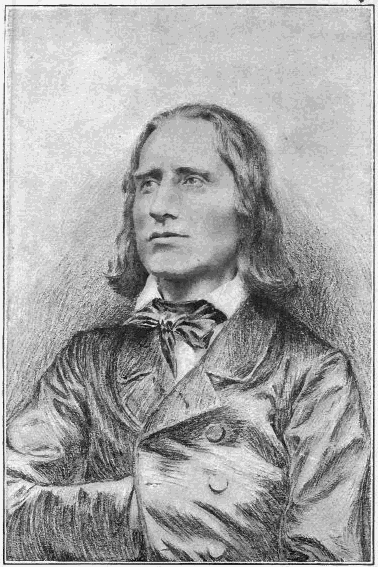 LISZT IN MIDDLE LIFE
"That's one of your own?" asked Liszt when I had finished. "Well, it's a
charming little piece." Still nothing was said about my being accepted
as a pupil. But when we left the Altenburg, he said casually, "You
say you are going to Leipsic for a few days on business? While there you
had better select your piano and have it sent here. Meanwhile I will
tell Klindworth to look up rooms for you. Indeed, there is a vacant room
in the house in which he lives, which is pleasantly situated just
outside the limits of the ducal park."
I can still recall the thrill of joy which passed through me when Liszt
spoke these words. They left no doubt in my mind. I was accepted as his
pupil. We walked down the hill toward the town, Liszt leaving me when we
arrived at the palace, telling me, however, that he would call later at
the hotel and introduce me to my fellow-pupils. About eight o'clock that
evening he came.
After smoking a cigar and chatting with me for half an hour, Liszt
proposed going down to the café, saying, "The gentlemen are probably
there, as this is about their regular hour for supper." Proceeding to
the dining-room, we found Messrs. Raff, Pruckner, and Klindworth, to
whom I was presented in due form, and who received me in a very
friendly manner.
I had no idea then, neither have I now, what Liszt's means were, but I
learned soon after my arrival at Weimar that he never took pay from his
pupils, neither would he bind himself to give regular lessons at stated
periods. He wished to avoid obligations as far as possible, and to feel
free to leave Weimar for short periods when so inclined—in other words,
to go and come as he liked. His idea was that the pupils whom he
accepted should all be far enough advanced to practise and prepare
themselves without routine instruction, and he expected them to be ready
whenever he gave them an opportunity to play. The musical opportunities
of Weimar were such as to afford ample encouragement to any
serious-minded young student. Many distinguished musicians, poets, and
literary men were constantly coming to visit Liszt. He was fond of
entertaining, and liked to have his pupils at hand so that they might
join him in entertaining and paying attention to his guests. He had
only three pupils at the time of which I write, namely, Karl Klindworth
from Hanover, Dionys Pruckner from Munich, and the American whose
musical memories are here presented. Joachim Raff, however, we regarded
as one of us, for although not at the time a pupil of Liszt, he had been
in former years, and was now constantly in association with the master,
acting frequently in the capacity of private secretary. Hans von Bülow
had left Weimar not long before my arrival, and was then on his first
regular concert-tour. Later he returned occasionally for short visits,
and I became well acquainted with him. We constituted, as it were, a
family, for while we had our own apartments in the city, we all enjoyed
the freedom of the two lower rooms in Liszt's home, and were at liberty
to come and go as we liked. Regularly on every Sunday at eleven o'clock,
with rare exceptions, the famous Weimar String Quartet played for an
hour and a half or so in these rooms, and Liszt frequently joined them
in concerted music, old and new. Occasionally one of the boys would
take the pianoforte part. The quartet-players were Laub, first violin;
Störr, second violin; Walbrühl, viola; and Cossmann, violoncello. Before
Laub's time Joachim had been concertmeister, but he left Weimar in 1853
and went to Hanover, where he occupied a similar position. He
occasionally visited Weimar, however, and would then at times play with
the quartet. Henri Wieniawski, who spent some months in Weimar, would
occasionally take the first violin. My favorite as a quartet-player was
Ferdinand Laub, with whom I was intimately acquainted, and I find that
the greatest violinists of the present time hold him in high estimation,
many of them regarding him as the greatest of all quartet-players. We
were always quite at our ease in those lower rooms, but on ceremonial
occasions we were invited up-stairs to the drawing-room, where Liszt had
his favorite Érard. We were thus enjoying the best music, played by the
best artists. In addition to this there were the symphony concerts and
the opera, with occasional attendance at rehearsal. Liszt took it for
granted that his pupils would appreciate these remarkable advantages and
opportunities and their usefulness, and I think we did.
LISZT's private studio, where he wrote and composed, was at the back of
the main building in a lower wing, and may easily be distinguished in
the picture by the awnings over the windows. I was not in this room more
than half a dozen times during my stay in Weimar, and one of these I
remember as the occasion of Liszt's playing the Beethoven "Kreutzer
Sonata" with Remenyi, the Hungarian violinist, and giving him a lesson
in conception and style of performance. Remenyi was a violinist of fine
musical talent, but not a classicist, his style being after the fashion
of the class represented by Ole Bull. He was, as is well known, a
genuine Hungarian, thoroughly at home in the musical characteristics of
his native country. He was unconsciously disposed to color and mark the
music of all composers with Hungarian peculiarities, and this habit gave
rise to a story that sometimes he added to the concluding strain of the
theme in the slow movement of the "Kreutzer Sonata" the peculiar
Hungarian termination as a final ornament. This story probably
originated in a spirit of fun. It was, nevertheless, so characteristic
of Remenyi that it obtained wide circulation.
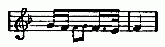
The picture gives a very good view of the house as it appeared in
1853-54. In the nearest corner of the building were the two large rooms
on the ground floor to which reference has already been made, of which
we boys had the freedom at all times, and where strangers were
unceremoniously received. The Fürstin Sayn-Wittgenstein had apartments,
I think, on the bel étage with her daughter, the Prinzessin Marie.
Any one who was to be honored with an introduction to them was taken to
a reception-room up-stairs; adjoining this was the dining-room. This
print is from a water-color painted for me by my friend Mr. Thomas Allen
of Boston. It is copied from a photograph of the original,—a
water-color by Carl Hoffman,—which Mr. Hoffman painted expressly for
his friend Mr. James M. Tracy, a former pupil of Liszt, who is now a
professional pianist and teacher in Denver, Colorado, and to whom I am
indebted for permission to publish it here. Mr. Tracy writes me that it
has been published before, but without his permission.
We boys saw little of the Wittgensteins, and I remember dining with them
only once. I sat next to the Princess Marie, who spoke English very
well, and it may have been due to her desire to exercise in the language
that I was honored with a seat next to her. Rubinstein met her when he
was at Weimar (I shall have more to tell of his visit later), and
composed a nocturne which he dedicated to her. When he came to this
country in 1873 he told me that he had met her again some years later at
the palace in Vienna, but that she had become haughty, and had not been
inclined to pay much attention to him. There are many Wittgensteins in
Russia. When I was in Wiesbaden in 1879-80 I saw half a dozen Russian
princes of that name. There was but one Rubinstein.
Liszt had the pick of all the young musicians in Europe for his pupils,
and I attribute his acceptance of me somewhat to the fact that I came
all the way from America, something more of an undertaking in those days
than it is now. I became very well acquainted with those whom I have
mentioned, especially with Klindworth and Raff, and before many days we
were all "Dutzbrüder."
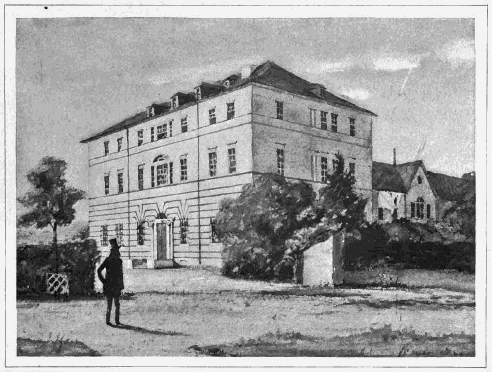 THE ALTENBURG, LISZT'S HOUSE AT WEIMAR
The first evening Raff, whom I had previously never heard of, struck me
as being rather conceited; but when I grew to know him better, and
realized how talented he was, I was quite ready to make allowance for
his little touch of self-esteem. We became warm friends, dining together
every day at the table d'hôte, and after dinner walking for an hour or
so in the park. Nineteen years later I went abroad again and visited
Raff at the Conservatory in Frankfort. He interrupted his lessons the
moment that he heard I was there, came running down-stairs, threw his
arms around my neck, and was so overjoyed at seeing me that I felt as if
we were boys once more at Weimar. Of the pupils and of the many
musicians who came to Weimar to visit Liszt at that time,—"die goldene
Zeit" (the Golden Age), as it is still called at Weimar,—I think
Klindworth and I are the only survivors. Klindworth is one of the most
distinguished teachers in Europe, and taught for many years at the
Conservatory in Moscow. He is now in Potsdam.
WHAT I had heard in regard to Liszt's method of teaching proved to be
absolutely correct. He never taught in the ordinary sense of the word.
During the entire time that I was with him I did not see him give a
regular lesson in the pedagogical sense. He would notify us to come up
to the Altenburg. For instance, he would say to me, "Tell the boys to
come up to-night at half-past six or seven." We would go there, and he
would call on us to play. I remember very well the first time I played
to him after I had been accepted as a pupil. I began with the "Ballade"
of Chopin in A flat major; then I played a fugue by Handel in E minor.
After I was well started he began to get excited. He made audible
suggestions, inciting me to put more enthusiasm into my playing, and
occasionally he would push me gently off the chair and sit down at the
piano and play a phrase or two himself by way of illustration. He
gradually got me worked up to such a pitch of enthusiasm that I put all
the grit that was in me into my playing.
I found at this first lesson that he was very fond of strong accents in
order to mark off periods and phrases, and he talked so much about
strong accentuation that one might have supposed that he would abuse it,
but he never did. When he wrote to me later about my own piano method,
he expressed the strongest approval of the exercises on accentuation.
WHILE I was playing to him for the first time, he said on one of the
occasions when he pushed me from the chair: "Don't play it that way.
Play it like this." Evidently I had been playing ahead in a steady,
uniform way. He sat down, and gave the same phrases with an accentuated,
elastic movement, which let in a flood of light upon me. From that one
experience I learned to bring out the same effect, where it was
appropriate, in almost every piece that I played. It eradicated much
that was mechanical, stilted, and unmusical in my playing, and developed
an elasticity of touch which has lasted all my life, and which I have
always tried to impart to my pupils.
At this first lesson I must have played for two or three hours. For some
reason or other Raff was not present, but Klindworth and Pruckner were
there. They lounged on a sofa and smoked, and I remember wondering if
they appreciated the nice time they were having at my ordeal. However,
not many days afterward came my opportunity to light a cigar and lounge
about the room while Liszt put them through their paces.
Two or three hours is not a long time for a professional musician to
practise, and I had often spent many more hours at the piano, but never
under such strong incitement. I was exceedingly tired afterward, and
actually felt stiff the next day, as if I had performed some very
arduous physical work. Liszt heard of this, and turned it into a joke,
telling people that at the time set for the next lesson I appeared at
the Altenburg with my hand in a sling, and said that I had strained my
wrist while hunting, and would be unable to play. I think this is non è
ver e ben trovato, as I have no recollection of it.
THE best impression of Liszt's appearance at that time is conveyed by
the picture which shows him approaching the Altenburg. His back is
turned; nevertheless, there is a certain something which shows the man
as he was better even than those portraits in which his features are
clearly reproduced. The picture gives his gait, his figure, and his
general appearance. There is his tall, lank form, his high hat set a
little to one side, and his arm a trifle akimbo. He had piercing eyes.
His hair was very dark, but not black. He wore it long, just as he did
in his older days. It came almost down to his shoulders, and was cut off
square at the bottom. He had it cut frequently, so as to keep it at
about the same length. That was a point about which he was very
particular.
AS I remember his hands, his fingers were lean and thin, but they did
not impress me as being very long, and he did not have such a remarkable
stretch on the keyboard as one might imagine. He was always neatly
dressed, generally appearing in a long frock-coat, until he became the
Abbé Liszt, after which he wore the distinctive black gown. His general
manner and his face were most expressive of his feelings, and his
features lighted up when he spoke. His smile was simply charming. His
face was peculiar. One could hardly call it handsome, yet there was in
it a subtle something that was most attractive, and his whole manner had
a fascination which it is impossible to describe.
I remember little incidents which are in themselves trivial, but which
illustrate some character-trait. One day Liszt was reading a letter in
which a musician was referred to as a certain Mr. So-and-so. He read
that phrase over two or three times, and then substituted his own name
for that of the musician mentioned, and repeated several times, "A
certain Mr. Liszt, a certain Mr. Liszt, a certain Mr. Liszt,"
adding: "I don't know that that would offend me. I don't know that I
should object to being called 'a certain Mr. Liszt.'" As he said this
his face had an expression of curiosity, as though he were wondering
whether he really would be offended or not. But at the same time there
was in his face that look of kindness I saw there so often, and I really
believe he would not have felt injured by such a reference to himself.
There was nothing petty in his feelings.
ON one occasion, however, I saw Liszt grow very much excited over what
he considered an imposition. One evening he said to us: "Boys, there is
a young man coming here to-morrow who says he can play Beethoven's
'Sonata in B Flat, Op. 106.' I want you all three to be here." We were
there at the appointed hour. The pianist proved to be a Hungarian, whose
name I have forgotten.
He sat down and began to play in a conveniently slow tempo the bold
chords with which the sonata opens. He had not progressed more than half
a page when Liszt stopped him, and seating himself at the piano, played
in the correct tempo, which was much faster, to show him how the work
should be interpreted. "It's nonsense for you to go through this sonata
in that fashion," said Liszt, as he rose from the piano and left the
room.
The pianist, of course, was very much disconcerted. Finally he said, as
if to console himself: "Well, he can't play it through like that, and
that's why he stopped after half a page."
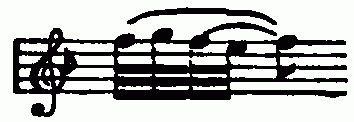
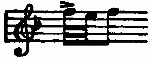
This sonata is the only one which the composer himself metronomized, and
his direction is M.M.
 = 138. A less rapid
tempo,
= 100 or thereabouts, would seem to
be more nearly correct, but the pianist took it at a much slower rate
than even this.
= 138. A less rapid
tempo,
= 100 or thereabouts, would seem to
be more nearly correct, but the pianist took it at a much slower rate
than even this.
When the young man left I went out with him, partly because I felt sorry
for him, he had made such a fiasco, and partly because I wished to
impress upon him the fact that Liszt could play the whole movement in
the tempo in which he began it. As I was walking along with him, he
said, "I'm out of money; won't you lend me three louis d'or?"
A day or two later I told Liszt by the merest chance that the hero of
the Op. 106 fiasco had tried to borrow money of me. "B-r-r-r! What?"
exclaimed Liszt. Then he jumped up, walked across the room, seized a
long pipe that hung from a nail on the wall, and brandishing it as if it
were a stick, stamped up and down the room in almost childish
indignation, exclaiming, "Drei louis d'or! Drei louis d'or!" The point
is, however, that Liszt regarded the man as an artistic impostor. He had
sent word to Liszt that he could play the great Beethoven sonata, not an
inconsiderable feat in those days. He had been received on that basis.
He had failed miserably. To this artistic imposition he had added the
effrontery of endeavoring to borrow money from some one whom he had met
under Liszt's roof.
I HAVE mentioned that Liszt was careful in his dress. He was also
particular about the appearance of his pupils. I remember two instances
which show how particular he was in little matters. I have been
near-sighted all my life, and when I went to Weimar I wore eye-glasses,
much preferring them to spectacles. Eye-glasses were not much worn in
Germany at that time, and were considered about as affected as the mode
of wearing a monocle. The Germans wore spectacles. I had not been in
Weimar long when Liszt said to me: "Mason, I don't like to see you
wearing those glasses. I shall send my optician to fit your eyes with
spectacles."
I hardly thought that he was serious, and so paid no attention to him.
But, sure enough, about a week later there was a knock at my door, and
the optician presented himself, saying he had come at the command of
Dr. Liszt to examine my eyes and fit a pair of spectacles to them. As I
was evidently to have no say in the matter, I submitted, and a few days
later I received two pairs, one in a green and one in a red case. I
thought them extremely unbecoming, but I was very particular to put them
on whenever I went to see Liszt.
Not long afterward Liszt went to Paris, and when we called to see him
after his return, and he was talking about his experiences there, he
said casually: "By the way, Mason, I find that gentlemen in Paris are
wearing eye-glasses now. In fact, they are considered quite comme il
faut, so I have no objection to your wearing yours." As he did not ask
me to send him the spectacles, I kept them, and have them to this day.
Klindworth, Pruckner, and I had played the Bach triple concerto in a
concert at the town hall, and had been requested to repeat it at an
evening concert at the ducal palace. An hour before the ducal carriage
arrived to take me to the concert, a servant came from the Altenburg
with a package which he said Liszt had requested him to be sure to
deliver to me. On opening it, I found two or three white ties. It was a
hint to me from Liszt that I most dress suitably to play at court.
This incident shows the care that Liszt bestowed on little things
relating to the customs and amenities of social life. He evidently sent
the ties as a precautionary measure. Possibly he was not sure whether
Americans were civilized enough to wear white ties with evening dress,
and was afraid I might appear in a red-white-and-blue one. Seriously,
however, it was very kind of him to think of a little thing like this.
BEFORE I went to Weimar I had not been of a very sociable disposition.
At Weimar I had to be. Liszt liked to have us about him. He wished us to
meet great men. He would send us word when he expected visitors, and
sometimes he would bring them down to our lodgings to see us. In every
way he tried to make our surroundings as pleasant as possible. It would
have been strange if, under such circumstances, we had not derived some
benefit from our intercourse with our great master and his visitors.
I shall always recall with amusement a breakfast which, at Liszt's
request, Klindworth and I gave to Joachim and Wieniawski, the
violinists, then, of course, very young men, and to several other
distinguished visitors. Liszt had been entertaining them for several
days. We knew that it was about time for him to bring them down to see
one of us. So I was not surprised when he turned to me one evening and
said, "Mason, I want you and Klindworth to give us a breakfast
to-morrow." I asked him what we should have. "Oh," he replied, "some
Semmel [rolls], caviar, herring," etc.
The next morning Liszt and his visitors came. I remember looking out of
my window and watching them cross the ducal park, over the long
foot-path which ended directly opposite the house where Klindworth and I
lived. It had been raining, and the path was slippery, so that their
footsteps were somewhat uncertain.
The breakfast passed off all right. When he had finished, Liszt said,
"Now let us take a stroll in the garden." This garden was about four
times as large as the back yard of a New York house, and it was
unflagged and, of course, muddy from the rain of the previous night.
Never shall I forget the sight of Liszt, Joachim, Wieniawski, and our
other distinguished guests "strolling" through this garden, wading in
mud two inches deep.
TIME and again at Weimar I heard Liszt play. There is absolutely no
doubt in my mind that he was the greatest pianist of the nineteenth
century. Liszt was what the Germans call an Erscheinung—an
epoch-making genius. Taussig is reported to have said of him: "Liszt
dwells alone upon a solitary mountain-top, and none of us can approach
him." Rubinstein said to Mr. William Steinway in the year 1873: "Put all
the rest of us together and we would not make one Liszt." This was
doubtless hyperbole, but nevertheless significant as expressing the
enthusiasm of pianists universally conceded to be of the highest rank.
There have been other great pianists, some of whom are now living, but I
must dissent from those writers who affirm that any of these can be
placed upon a level with Liszt. Those who make this assertion are too
young to have heard Liszt other than in his declining years, and it is
unjust to compare the playing of one who has long since passed his prime
with that of one who is still in it. In the year 1873 Rubinstein told
Theodore Thomas that it was fully worth while to make a trip to Europe
to hear Liszt play; but he added: "Make haste and go at once; he is
already beginning to break up, and his playing is not up to the
standard of former years, although his personality is as attractive as
ever."
In March, 1895, Stavenhagen and Remenyi were dining at my house one
evening, and the former began to speak in enthusiastic terms of Liszt's
playing. Remenyi interrupted with emphasis: "You have never heard Liszt
play—that is, as Liszt used to play in his prime"; and he appealed to
me for corroboration, but, unhappily, I never met Liszt again after
leaving Weimar in July, 1854.
The difference between Liszt's playing and that of others was the
difference between creative genius and interpretation. His genius
flashed through every pianistic phrase, it illuminated a composition to
its innermost recesses, and yet his wonderful effects, strange as it
must seem, were produced without the advantage of a genuinely musical
touch.
I remember on one occasion Schulhoff came to Weimar and played in the
drawing-room of the Altenburg house. His playing and Liszt's were in
marked contrast. He has been mentioned in an earlier chapter as a
parlor pianist of high excellence. His compositions, exclusively in the
smaller forms, were in great favor and universally played by the ladies.
Liszt played his own "Bénédiction de Dieu dans la Solitude," as pathetic
a piece, perhaps, as he ever composed, and of which he was very fond.
Afterward Schulhoff, with his exquisitely beautiful touch, produced a
quality of tone more beautiful than Liszt's; but about the latter's
performance there was intellectuality and the indescribable
impressiveness of genius, which made Schulhoff's playing, with all its
beauty, seem tame by contrast.
I was not surprised to hear from Theodore Thomas what Rubinstein had
told him concerning Liszt's "breaking up," for as far back as the days
of "die goldene Zeit" it had seemed to me that there were certain
indications in his playing which warranted the belief that his
mechanical powers would begin to wane at a comparatively early period in
his career. There was too little pliancy, flexion, and relaxation in his
muscles; hence a lack of economy in the expenditure of his energies.
He was aware of this, and said in effect on one occasion, as I learned
indirectly through either Klindworth or Pruckner: "You are to learn all
you can from my playing, relating to conception, style, phrasing, etc.,
but do not imitate my touch, which, I am well aware, is not a good model
to follow. In early years I was not patient enough to 'make haste
slowly'—thoroughly to develop in an orderly, logical, and progressive
way. I was impatient for immediate results, and took short cuts, so to
speak, and jumped through sheer force of will to the goal of my
ambition. I wish now that I had progressed by logical steps instead of
by leaps. It is true that I have been successful, but I do not advise
you to follow my way, for you lack my personality."
In saying this Liszt had no idea of magnifying himself; but it was
nevertheless genius which enabled him to accomplish certain results
which were out of the ordinary course, and in a way which others, being
differently constituted, could not follow. His advice to his pupils was
to be deliberate, and through care and close attention to important,
although seemingly insignificant, details to progress in an orderly way
toward a perfect style.
Notwithstanding this caution, and falling into the usual tendency of
pupils to imitate the idiosyncrasies and mannerisms, even faults or weak
points, of the teacher, some of the boys, in their effort to attain
Lisztian effects, acquired a hard and unsympathetic touch, and thus
produced mere noise in the place of full and resonant tones.
Before going to Weimar I had heard in various places in Germany that
Liszt spoiled all of those pupils who went to him without a previously
acquired knowledge of method and a habit of the correct use of the
muscles in producing musical effects. It was necessary for the pupil to
have an absolutely sure foundation to benefit by Liszt's instruction. If
he had that preparation Liszt could develop the best there was in him.
There is danger of unduly magnifying the importance of a mere mechanical
technic. In Liszt's earlier days he inclined in this direction, and
wrote the "Études d'Exécution Transcendante." I remember his saying to
his pupils one day, when these were the subject of our conversation,
that having completed them, his interest in that direction had ceased
and he wrote no more. Moreover, he added, "I expected that some day a
pianist would appear who would make this subject his specialty, and
would accomplish difficulties that were seemingly impossible to
perform." It has been said of Liszt that he worshiped this kind of
technic. I think the assertion does him injustice. A friend of mine who
visited him in Weimar about the year 1858 wrote that Liszt, speaking of
one of his pupils, said: "What I like about So-and-so is that he is not
a mere 'finger virtuoso': he does not worship the keyboard of the
pianoforte; it is not his patron saint, but simply the altar before
which he pays homage to the idea of the tone-composer." A perfect
technic is more than a wonderful power of prestidigitation, or facility
in the manipulation of an instrument. It implies qualities of mind and
heart which are essential to an all-round musical development and the
ability to give them adequate expression.
IN his concertizing days Liszt always played without the music before
him, although this was not the usual custom of his time; and in this
connection I remember an anecdote told to me by Theimer, one of
Dreyschock's assistant teachers. Pixis was an old-fashioned player of
considerable reputation in his day, and was the composer of
chamber-music, besides pianoforte pieces. Among other works of his was a
duo for two pianofortes. While this composition was yet in manuscript it
was played in one of the concerts of Pixis with the assistance of Liszt.
Pixis, knowing Liszt's habit of playing from memory, requested him on
this occasion at least to have the music open before him on the
piano-desk, as he himself did not like to risk playing his part without
notes, and he felt it would produce an unfavorable impression on the
public if Liszt should play from memory while he, the composer, had to
rely on his copy. Liszt, as the story goes, made no promise one way or
the other. So when the time came the pianists walked on the stage, each
carrying his roll of music. Pixis carefully unrolled his and placed it
on the piano-desk. Liszt, however, sat down at the piano, and, just
before beginning to play, tossed his roll over behind the instrument and
proceeded to play his part by heart. Liszt was young at that time,
and—well—somewhat inconsiderate. Later on he very rarely played even
his own compositions without having the music before him, and during
most of the time I was there copies of his later publications were
always lying on the piano, and among them a copy of the "Bénédiction de
Dieu dans la Solitude," which Liszt had used so many times when playing
to his guests that it became associated with memories of Berlioz,
Rubinstein, Vieuxtemps, Wieniawski, Joachim, and our immediate circle,
Raff, Bülow, Cornelius, Klindworth, Pruckner, and others. When I left
Weimar I took this copy with me as a souvenir, and still have it; and I
treasure it all the more for the marks of usage which it bears. I also
have a very old copy of the Handel "E Minor Fugue," which was given to
me by Dreyschock and which I studied with him and afterward with Liszt.
Dreyschock had evidently used this same copy when he studied the fugue
under Tomaschek. It has penciled figures indicating the fingering, made
by both Dreyschock and Liszt. A few years ago I missed this valuable
relic for a while, and was much grieved by my loss. Fortunately it was
discovered in the ash-barrel at the back of the house. Shades of
Tomaschek, Dreyschock, and Liszt!
IN his conducting Liszt was not unerring. I do not know how far he may
have progressed in later years, but when I was in Weimar he had very
little practice as a conductor, and was not one of the highest class. He
conducted, however, and with good results on certain important
occasions, such as, for instance, when "Lohengrin" was produced.
On account of his strong advocacy of Wagner and modern music generally,
he had many enemies, as was to be expected of a man of his prominence.
If perchance a mishap occurred during his conducting there were always
petty critics on hand to take advantage of the opportunity and to
magnify the fault.
One of these occasions happened at the musical festival at Karlsruhe in
October, 1853, while he was conducting Beethoven's "Ninth Symphony." In
a passage where the bassoon enters on an off beat the player made a
mistake and came in on the even beat. This error, not the conductor's
fault, occasioned such confusion that Liszt was obliged to stop the
orchestra and begin over again, and the little fellows made the most of
this royal opportunity to pitch into him.
WHEN Liszt first began his career as an orchestral composer two parties
were formed, one of which predicted success, the other disaster. The
latter asserted that he was too much of a pianist and began too late in
life for success in this direction. Even in Weimar, in his own
household, so to speak, opinions were divided. I remember one of my
fellow-pupils saying that he did not think it was his forte. Raff had
pretty much the same opinion, and I inclined to agree with them. Liszt
was in earnest, however, and availed himself of every means of
preparation for the work. Frequently upon his request the best
orchestral players came to the Altenburg, and he asked them about their
instruments, their nature, and whether certain passages were idiomatic
to them. About the time I came to Weimar to study with him he had nearly
finished "Tasso," and before giving it the last touches he had a
rehearsal of it, which we attended. We went to the theater, and he took
the orchestra into a room which would just about hold it. Imagine the
din in that room! The effect was far from musical, but to Liszt it was
the key to the polyphonic effects which he wished to produce.
AS an illustration of some of the advantages of a residence at Weimar
almost en famille with Liszt during "die goldene Zeit," a few extracts
from my diary are presented, showing how closely events followed one
upon another:
"Sunday, April 24, 1853. At the Altenburg this forenoon at eleven
o'clock. Liszt played with Laub and Cossmann two trios by César Franck."
This is peculiarly interesting in view of the fact that the composer,
who died about ten years ago, is just beginning to receive due
appreciation. In Paris at the present time there is almost a César
Franck cult, but it is quite natural that Liszt, with his quick and
far-seeing appreciation, should have taken especial delight in playing
his music forty-seven years ago. Liszt was very fond of it.
"May 1. Quartet at the Altenburg at eleven o'clock, after which
Wieniawski played with Liszt the violin and pianoforte 'Sonata in A' by
Beethoven."
"May 3. Liszt called at my rooms last evening in company with Laub and
Wieniawski. Liszt played several pieces, among them my 'Amitié pour
Amitié.'"
"May 6. The boys were all at the Hotel Erbprinz this evening. Liszt came
in and added to the liveliness of the occasion."
"May 7. At Liszt's, this evening, Klindworth, Laub, and Cossmann played
a piano trio by Spohr, after which Liszt played his recently composed
sonata and one of his concertos. In the afternoon I had played during my
lesson with Liszt the 'C Sharp Minor Sonata' of Beethoven and the 'E
Minor Fugue' by Handel."
"May 17. Lesson from Liszt this evening. Played Scherzo and Finale from
Beethoven's 'C Sharp Minor Sonata.'"
"May 20, Friday. Attended a court concert this evening which Liszt
conducted. Joachim played a violin solo by Ernst."
"May 22. Went to the Altenburg at eleven o'clock this forenoon. There
were about fifteen persons present—quite an unusual thing. Among other
things, a string quartet of Beethoven was played, Joachim taking the
first violin."
"May 23. Attended an orchestral rehearsal at which an overture and a
violin concerto by Joachim were performed, the latter played by
Joachim."
"May 27. Joachim Raff's birthday. Klindworth and I presented ourselves
to him early in the day and stopped his composing, insisting on having a
holiday. Our celebration of this event included a ride to Tiefurt and
attendance at a garden concert."
"May 29, Sunday. At Liszt's this forenoon as usual. No quartet to-day.
Wieniawski played first a violin solo by Ernst, and afterward with Liszt
the letter's duo on Hungarian airs."
"May 30. Attended a ball of the Erholung Gesellschaft this evening. At
our supper-table were Liszt, Raff, Wieniawski, Pruckner, and Klindworth.
Got home at four o'clock in the morning."
"June 4. Dined with Liszt at the Erbprinz. Liszt called at my rooms
later in the afternoon, bringing with him Dr. Marx and lady from Berlin,
also Raff and Winterberger. Liszt played three Chopin nocturnes and a
scherzo of his own. In the evening we were all invited to the Altenburg.
He played 'Harmonies du Soir, No. 2,' and his own sonata. He was at his
best and played divinely."
"June 9. Had a lesson from Liszt this evening. I played Chopin's 'E
Minor Concerto.'"
"June 10. Went to Liszt's this evening to a bock-beer soirée. The beer
was a present to Liszt from Pruckner's father, who has a large brewery
in Munich."
"Sunday, June 12. Usual quartet forenoon at the Altenburg. 'Quartet, Op.
161,' of Schubert's was played, also one of Beethoven's quartets."
The last entry may not seem to be particularly important, but it may be
as well not to end the quotations from a musical diary with a reference
to a bock-beer soirée.
THE period covered by these extracts was chosen at random, and they give
a fair idea of the many musical opportunities which were constantly
recurring throughout the entire year.
Ferdinand Laub, the leader of the quartet, was about twenty-one years of
age, and already a violinist of the first rank.
Wieniawski and Joachim, young men of the age of twenty-two and nineteen
years respectively, were among the most welcome visitors to Weimar.
Joachim, already celebrated as a quartet-player, was regarded by some as
the greatest living violinist. The playing of Wieniawski appealed to me
more than that of any other violinist of the time, and I remember it now
with intense pleasure.
ON one evening early in June, 1853, Liszt sent us word to come up to the
Altenburg next morning, as he expected a visit from a young man who was
said to have great talent as a pianist and composer, and whose name was
Johannes Brahms. He was to come accompanied by Eduard Remenyi.
The next morning, on going to the Altenburg with Klindworth, we found
Brahms and Remenyi already in the reception-room with Raff and Pruckner.
After greeting the newcomers, of whom Remenyi was known to us by
reputation, I strolled over to a table on which were lying some
manuscripts of music. They were several of Brahms's yet unpublished
compositions, and I began turning over the leaves of the uppermost in
the pile. It was the piano solo "Op. 4, Scherzo, E Flat Minor," and, as
I remember, the writing was so illegible that I thought to myself that
if I had occasion to study it I should be obliged first to make a copy
of it. Finally Liszt came down, and after some general conversation he
turned to Brahms and said: "We are interested to hear some of your
compositions whenever you are ready and feel inclined to play them."
BRAHMS, who was evidently very nervous, protested that it was quite
impossible for him to play while in such a disconcerted state, and,
notwithstanding the earnest solicitations of both Liszt and Remenyi,
could not be persuaded to approach the piano. Liszt, seeing that no
progress was being made, went over to the table, and taking up the first
piece at hand, the illegible scherzo, and saying, "Well, I shall have to
play," placed the manuscript on the piano-desk.
We had often witnessed his wonderful feats in sight-reading, and
regarded him as infallible in that particular, but, notwithstanding our
confidence in his ability, both Raff and I had a lurking dread of the
possibility that something might happen which would be disastrous to our
unquestioning faith. So, when he put the scherzo on the piano-desk, I
trembled for the result. But he read it off in such a marvelous way—at
the same time carrying on a running accompaniment of audible criticism
of the music—that Brahms was amazed and delighted. Raff thought, and so
expressed himself, that certain parts of this scherzo suggested the
Chopin "Scherzo in B Flat Minor," but it seemed to me that the likeness
was too slight to deserve serious consideration. Brahms said that he had
never seen or heard any of Chopin's compositions. Liszt also played a
part of Brahms's "C Major Sonata, Op. 1."
A LITTLE later some one asked Liszt to play his own sonata, a work which
was quite recent at that time, and of which he was very fond. Without
hesitation, he sat down and began playing. As he progressed he came to a
very expressive part of the sonata, which he always imbued with extreme
pathos, and in which he looked for the especial interest and sympathy of
his listeners. Casting a glance at Brahms, he found that the latter was
dozing in his chair. Liszt continued playing to the end of the sonata,
then rose and left the room. I was in such a position that Brahms was
hidden from my view, but I was aware that something unusual had taken
place, and I think it was Remenyi who afterward told me what it was. It
is very strange that among the various accounts of this Liszt-Brahms
first interview—and there are several—there is not one which gives an
accurate description of what took place on that occasion; indeed, they
are all far out of the way. The events as here related are perfectly
clear in my own mind, but not wishing to trust implicitly to my memory
alone, I wrote to my friend Klindworth,—the only living witness of the
incident except myself, as I suppose,—and requested him to give an
account of it as he remembered it. He corroborated my description in
every particular, except that he made no specific reference to the
drowsiness of Brahms, and except, also, that, according to my
recollection, Brahms left Weimar on the afternoon of the day on which
the meeting took place; Klindworth writes that it was on the morning of
the following day—a discrepancy of very little moment.
Brahms and Remenyi were on a concert tour at the time of which I write,
and were dependent on such pianos as they could find in the different
towns in which they appeared. This was unfortunate, and sometimes
brought them into extreme dilemma. On one occasion the only piano at
their disposal was just a half-tone at variance with the violin. There
was no pianoforte-tuner at hand, and although the violin might have been
adapted to the piano temporarily, Remenyi would have had serious
objections to such a proceeding. Brahms therefore adapted himself to the
situation, transposed the piano part to the pitch of the violin, and
played the whole composition, Beethoven's "Kreutzer Sonata," from
memory. Joachim, attracted by this feat, gave Brahms a letter of
introduction to Schumann. Shortly after the untoward Weimar incident
Brahms paid a visit to Schumann, then living in Düsseldorf. The
acquaintanceship resulting therefrom led to the famous article of
Schumann entitled "Neue Bahnen," published shortly afterward (October
23, 1853) in the Leipsic "Neue Zeitschrift für Musik," which started
Brahms on his musical career. It is doubtful if up to that time any
article had made such a sensation throughout musical Germany. I remember
how utterly the Liszt circle in Weimar were astounded. This letter was
at first, doubtless, an obstacle in the way of Brahms, but as it
resulted in stirring up great rivalry between two opposing parties it
eventually contributed much to his final success.
LISZT never questioned Wagner's sincerity. He considered "Lohengrin"
Wagner's greatest work up to the time at which it was composed. It was
dedicated to Liszt, and, as Raff told me, the good man could not
conceive that Wagner would dedicate anything but his best and greatest
to his friend and champion, such was Liszt's faith in the struggling
composer whose cause he had made his own.[1]
On the occasion of the first performance of a Wagner opera in any
neighboring town, a delegation from Weimar was apt to be on hand for the
purpose of making propaganda; and this was the case on Saturday, January
7, 1854, when the opera of "Lohengrin" was given in Leipsic for the
first time.
We boys were demonstrative claqueurs, and almost always succeeded in
making a sensation, especially in a town like Leipsic, where we had
acquaintances among the Conservatory students and could get them to help
us.
The general public and a large majority of the musicians were not at
all favorably disposed toward Wagner's music in those days, and in this
connection a remark of Joachim Raff made to me in 1879-80, on the
occasion of my second visit to Germany, was significant. Raff had been
in earlier years, perhaps, the most ardent of all pioneers in the Wagner
cause. A quarter of a century had elapsed since I had seen Raff, and
naturally one of my first questions was, "Raff, how is the Wagner
cause?" "Oh," said he, "the public have gone 'way over to the other
extreme. You know how hard it was to force Wagner upon them twenty-five
years ago, and now they go just as much too far the other way and are
unreasonable in their excessive homage." "Well," I replied, "I suppose
the matter will find its level and be adjusted as time passes on."
After the performance of "Lohengrin," which, by the way, was successful,
the whole Liszt party, by invitation, went to supper at the house of the
concertmeister, Ferdinand David. Quite a number of other guests were
present. Among them I remember with pleasure my Boston friends and
fellow-townsmen Charles C. Perkins and J. C. D. Parker, who were
temporarily located in Leipsic, pursuing their musical studies.
Brahms also was present, and during the evening he played the Andante
from his "F Minor Sonata, Op. 5."
NOT long after my visit to Raff in 1879-80 I went on a pleasure trip to
Stuttgart, and on account of old associations stopped at the Hotel
Marquand. One of the objects of my visit was to meet again my old Weimar
fellow-pupil Dionys Pruckner, at that time eminent among the staff of
pianoforte teachers in the famous Stuttgart Conservatory of Music.
Alighting at the hotel, I was impressed with the marks of consideration
shown to me by the hotel porter. He was so very attentive that I was
somewhat puzzled. The explanation was apparent the next day when he
respectfully inquired if I was the kapellmeister of New York! He had
read the name and address on one of my trunks and jumped at conclusions.
I told him that I was not that individual, and explained that in New
York no such office existed, although the title might be with propriety
applied to the conductor of the Philharmonic Society. However, the idea
found a lodgment in his head, quite to my advantage, as evidenced by the
many attentions he paid to me throughout my stay.
OVER a quarter of a century elapsed after my first meeting with Brahms
before I saw him again, and then the meeting occurred at Bonn on the
Rhine, on May 3, 1880. He was there, in company with Joachim and other
artists, to take part in the ceremonies attendant on the unveiling of
the Schumann Denkmal.
There were also musical performances, and at a morning recital of
chamber-music the program consisted solely of Schumann's works, vocal
and instrumental, with the addition of the Brahms "Violin Concerto,"
played by Joachim. The concluding number was Schumann's "Piano Quartet
in E Flat Major, Op. 47," Brahms playing the piano part, and Joachim,
Heckmann, and Bellman playing respectively violin, viola, and
violoncello.
THE pianoforte-playing of Brahms was far from being finished or even
musical. His tone was dry and devoid of sentiment, his interpretation
inadequate, lacking style and contour. It was the playing of a composer,
and not that of a virtuoso. He paid little if any attention to the marks
of expression as indicated by Schumann in the copy. This was especially
and painfully apparent in the opening measures of the first movement.
This introductory passage is marked, "Sostenuto assai," followed by the
main movement marked, "Allegro ma non troppo." Instead of accommodating
himself to the quiet and subdued nature of the introduction, the
pianist quite ignored Schumann's esthetic directions, and began with a
vigorous attack, which was sustained throughout the movement. The
continued force and harshness of his tone quite overpowered the stringed
instruments. As an ensemble the performance was not a success.
On going home to dinner, and learning that Brahms was stopping at the
hotel, I gave my card to the porter, with instructions to deliver it to
Brahms as soon as he came in. When about half-way through the table
d'hôte the porter entered and said that Brahms was in the outer hall,
waiting to see me. He was very cordial. At the moment I had quite
forgotten that I had met him at David's house in Leipsic, so I said:
"The last time I met you was in Weimar on that very hot day in June,
1853; do you remember it?"
"Very well indeed, and I am glad to see you again. Just now my time is
very much engaged, but we are going up the river on a picnic this
afternoon—Joachim and others; will you come along? We are going to a
summer restaurant on the Rhine, where they have excellent beer, and it
will be ganz gemütlich."
I regretted extremely that I had to forego the pleasure of this
excursion, and fully realized the opportunity I was losing; but my
party—there were four of us, my wife and I and two children—had
previously arranged our plans, and in order to make connections we were
obliged to go on to Cologne that day.
Here was a companion-piece to the disappointment occasioned by my having
to forego the pleasure and profit of a foot-tramp through the Tyrol with
Richard Wagner, as already related in these "Memories." But so the Fates
ordained.
Partly on account of the untoward Weimar incident, and partly for the
sake of his own individuality, I took a peculiar interest in Brahms. His
work is wonderfully condensed, his constructive power masterly. By his
scholarly development of themes through augmentation, diminution,
inversion, imitation, and other devices, he seems to be introducing new
thematic material, while the fact is, as will be seen on close
investigation, that he is presenting the original theme in varied form
and shape, and gradually unfolding and expanding its possibilities to
the uttermost. In other words, his treatment is exhaustive and complete.
In his later piano compositions this is readily apparent, and as these
pieces are short, and at the same time complete in form, they furnish
excellent opportunities to the student for analytical studies. In all
that relates to the intellectual faculty Brahms is indisputably a
master. I find this to be the consensus of opinion among intelligent
musicians. But there are differences of opinion as regards his emotional
susceptibilities, and it is just this fact that prevents many from fully
accepting him. The emotional and intellectual should be in equipoise in
order to attain the highest results, but in the music of Brahms the
latter seems to predominate. In sympathetic and affectionate treatment,
so far as relates to his piano composition, he does not compare with
Chopin.
I HAVE read in a recent number of a musical magazine the following
sentence: "We have seen with what ardor the first compositions of this
serious young man [Brahms] were greeted by Schumann and Liszt."
I have already mentioned the fact that all of the published accounts of
the first meeting of Liszt and Brahms were far from accurate, and in
fact convey an impression directly opposite to the truth; and the
foregoing statement, according to my belief, is just as far from being
in accordance with the facts. I am quite sure that Liszt was not
enthusiastic about Brahms at the time of the first interview in Weimar
heretofore described, and the letter received from my friend Karl
Klindworth, in Berlin, sustains me in this belief. Liszt was of too
kindly a disposition to treasure up animosity against Brahms on account
of the mishap on that occasion; but the fact that Brahms was put forward
by the anti-Wagnerites as their champion may possibly have influenced
him somewhat. A coolness also sprang up between Joachim and Liszt,
although during my stay in Weimar the violinist had been welcomed so
frequently at the Altenburg. During the entire career of Brahms he and
Joachim were close friends.
LISZT's playing of the Brahms scherzo was a remarkable feat, but he was
constantly doing almost incredible things in the way of reading at
sight. Another instance of his skill in this direction occurs to me and
is well worthy of mention.
Raff had composed a sonata for violin and pianoforte in which there were
ever-varying changes in measure and rhythm; measures of 7⁄8, 7⁄4, 5⁄4,
alternated with common and triple time, and seemed to mix together
promiscuously and without regard to order. Notwithstanding this apparent
disorder, there was an undercurrent, so to speak, of the ordinary ¾ or
4⁄4 time, and to the player who could penetrate the rhythmic mask the
difficulty of performance quickly vanished. Raff had arranged with Laub
and Pruckner that they should practise the sonata together, and then, on
a favorable occasion, play it in Liszt's presence. So on one of the
musical mornings at the Altenburg these gentlemen began to play the
sonata. Pruckner, of sensitive and nervous organization, found the
changes of measure too confusing, especially when played before company,
and broke down at the first page. Another and yet a third attempt was
made, but with the like result. Liszt, whose interest was aroused,
exclaimed: "I wonder if I can play that!" Then, taking his place at the
instrument, he played it through at sight in rapid tempo and without the
slightest hesitation. He had intuitively divined the regularity of
movement which lay beneath the surface.
DEEP beneath the surface there was in Liszt's organization a religions
trend which manifested itself openly now and then, and there were
occasions upon which his contrition displayed itself to an inordinate
degree. Joachim Raff, long his intimate friend and associate, told me
that these periods were sometimes of considerable duration, and while
they lasted he would seek solitude, and going frequently to church,
would throw himself upon the flagstones before a Muttergottesbild, and
remain for hours, as Raff expressed it, so deeply absorbed as to be
utterly unconscious of events occurring in his presence.
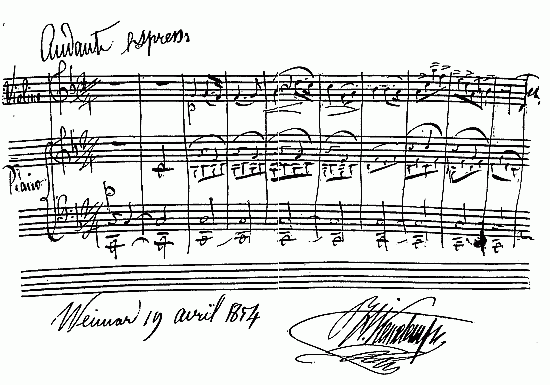 AUTOGRAPH OF VIEUXTEMPS
Rubinstein also told me that on one occasion he had been a witness of
such an act on the part of Liszt. One afternoon at dusk they were
walking together in the cathedral at Cologne, and quite suddenly
Rubinstein missed Liszt, who had disappeared in a mysterious way. He
searched for quite a while through the many secluded nooks and corners
of the immense building, and finally found Liszt kneeling before a
prie-dieu, so deeply engrossed that Rubinstein had not the heart to
disturb him, and so left the building alone.
SOMETIME, I think late, in 1853 Peter Cornelius, nephew of the
celebrated painter of that name, and composer of the comic opera "The
Barber of Bagdad," came to Weimar and was added to the Altenburg circle.
He was well known and highly esteemed by musicians, and as he was always
cheery and bubbling over with musical enthusiasm, I at once became very
fond of him as a friend, and later on paid due homage to his decided
talent as a composer. As an illustration of how easy it is to underrate
the abilities of a new acquaintance the following incident is both
interesting and instructive. In October, 1853, or thereabouts, quite a
large musical festival took place in Karlsruhe, which was under the
general direction of Liszt, who also conducted the orchestra. It goes
without saying that under the management of Liszt a number of selections
from the Wagner operas were played, and one of these happened to be the
bridal chorus from "Lohengrin." Wagner at that time was an entirely new
experience to Cornelius, and after the concert, while speaking to Liszt
of the beauty of Wagner's music, he instanced this bright and pretty
melody, emphasizing its beauty as though it were the special object of
his admiration. We boys, while we recognized the beauty of the bridal
march and its fitness for the place in which it occurs, were apt to
coddle ourselves upon our superior knowledge of Wagner, and would have
saved our enthusiasm for the more completed and distinctly Wagnerian
characteristics. The enthusiasm of Cornelius for the purely melodic
phrases of Wagner, which were in no wise characteristic of his genius,
rather led us to look down upon the musical perceptions of Cornelius—or
perhaps I should speak only for myself and give these as my personal
impressions; but it was not long before his great talent was duly
recognized and acknowledged, at least by musicians. Cornelius was a
charming fellow, and I enjoyed his society because he was so
enthusiastically and intensely musical.
I HAVE already mentioned in these papers my meeting with Joachim in
Leipsic in the year 1849. He was then about eighteen years of age and
already famous as a violinist. He was of medium height, had broad, open
features, and a heavy shock of dark hair somewhat like that of
Rubinstein. I had a letter of introduction to him, which I presented a
short time after my arrival in Leipsic, and received immediately a
return call from him. He was kind and affable, and easy to become
acquainted with, but owing to diffidence on my part I did not improve
the opportunity as I should have done, a circumstance which I now much
regret. He played the Mendelssohn concerto in one of the Gewandhaus
concerts within a month of my arrival at Leipsic, and I heard him then
for the first time, and was much impressed by his beautiful performance.
Subsequently, when in Weimar, I had the pleasure of meeting him on many
occasions, for he was in the habit of going there not infrequently, and
would sometimes take part in the Altenburg private musicales, as well as
in the public concerts at the theater.
During the year 1845-46 I heard and became well acquainted with three
famous violinists, Vieuxtemps, Ole Bull, and Sivori, who came to Boston
and played many times both in public and in private. They were all great
players, each having his special individuality. Vieuxtemps and Ole Bull
I met several times in later years, and became familiar with their
playing. Vieuxtemps came to Weimar and played both in private and in
public. His playing was wonderfully precise and accurate, every tone
receiving due attention, and his phrasing was delightful. Scale and
arpeggio passages were absolutely clean and without a flaw. He was
certainly a player of exquisite taste, and he still preserved his
characteristics when I heard him years later, in 1853 at Weimar, and in
1873 at New York. Ole Bull came to Boston a year or so after Vieuxtemps.
He was a born violinist, and developed after his own fashion and nature,
in the manner of a genius. Vieuxtemps was the result of scientific
training and close adherence to well-founded principles. Ole Bull, on
the other hand, was a law unto himself, and burst out into full blossom
without showing the various degrees of growth. He did not realize the
importance of close attention to detail while in the course of
development.
Sivori was of the gentle, poetic, and graceful class of players. Beauty
and grace rather than self-assertion characterized his style. Ernst,
whom I heard in Homburg in the year 1852, was a player of great
intensity of feeling, and was regarded as the most fervent violinist of
his time. Joachim's style impressed me as classical and rather reserved,
and while I enjoyed and admired it, there was present no feeling of
enthusiasm. Wilhelmj, with his broad and noble style, was certainly most
impressive. Henri Wieniawski had a musical organization of great
intensity, and this, combined with his perfect technic, made his playing
irresistible. Ferdinand Laub, for some reason not so well known to the
general public as he should be, is generally conceded by the most
distinguished violinists to have been the greatest of all
quartet-players. Laub was concertmeister during the whole period of my
stay in Weimar, and was an intimate friend of mine. It will be
remembered that at that time Bernhard Cossmann was the violoncellist of
the Weimar string quartet. I owe many delightful moments of musical
enjoyment to his exquisitely poetical and refined playing. The last time
I met him was at his own house in Frankfort. His wife and children
were present, and being thus quite en famille, we played together, for
the sake of old times, the piano and violoncello sonata of Beethoven in
A major.
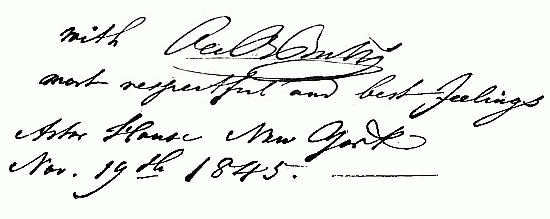 AUTOGRAPH OF OLE BULL
There are many others whom I am prevented by lack of space from
mentioning; but I must not omit the name of my friend Adolf Brodsky, a
violinist of the first rank, and a man of great nobility of character.
His playing is broad, intelligent, and thoroughly musical, whether as
soloist or as first violin in chamber quartet music. Sometimes I have
heard him in the privacy of my own home, where, feeling entire freedom
from restraint, he has thrown himself intensely into his music, to my
thorough and complete musical satisfaction.
I HAVE already had something to say of Eduard Remenyi, the Hungarian
violinist who accompanied Brahms to Weimar in 1853. He was a talented
man, and was esteemed by Liszt as being, in his way, a good violinist.
He remained at Weimar after Brahms left there, and I became intimately
acquainted with him. He was very entertaining, and so full of fun that
he would have made a tiptop Irishman. He was at home in the Gipsy music
of his own country, and this was the main characteristic of his playing.
He had also a fad for playing Schubert melodies on the violin with the
most attenuated pianissimo effects, and occasionally his hearers would
listen intently after the tone had ceased, imagining that they still
heard a trace of it.
Not long before leaving Weimar I had some fun with him by asking if he
had ever heard "any bona-fide American spoken." He replied that he did
not know there was such a language. "Well," said I, "listen to this for
a specimen: 'Ching-a-ling-a-dardee, Chebung cum Susan.'" I did not meet
him again until 1878, twenty-four years after leaving Weimar. I was
going up-stairs to my studio in the Steinway building when some one
told me that Remenyi had arrived and was rehearsing for his concerts in
one of the rooms above. So, going up, I followed the sounds of the
violin, gave a quick knock, opened the door, and went in. Remenyi looked
at me for a moment, rushed forward and seized my hand, and as he wrung
it cried out: "Ching-a-ling-a-dardee, Chebung cum Susan!" He had
remembered it all those years.
MY concert-playing and teaching have naturally made me more interested
in instrumental than in vocal music. Moreover, the principal celebrities
who came to visit Liszt during my sojourn at Weimar were composers and
instrumentalists. For that reason I met but few distinguished
opera-singers during my stay abroad. However, I heard the best of them
in opera or concert.
In Boston, about the year 1846-47, the Havana Italian Opera gave a
season at the Howard Athenæum of that city, and created considerable
interest. They gave, I think for the first time in this country, Verdi's
"Ernani," which was received with great favor. The principal soprano was
Mme. Fortunata Tedesco, who was afterward at the Grand Opéra in Paris
from 1851 to 1857. The tenor was Signore Perelli, who had an
exceptionally fine voice. Both of these singers had well-trained voices
and were well supported by chorus and orchestra. As this was my first
experience in opera, it produced a deep and lasting impression.
The opera season in Leipsic in the year 1852, beginning about the 1st of
February and continuing up to the 1st of May, was notable, for it
afforded the opportunity of hearing in quick succession three singers of
world-wide reputation: Henriette Sontag, Johanna Wagner, and De la
Grange.
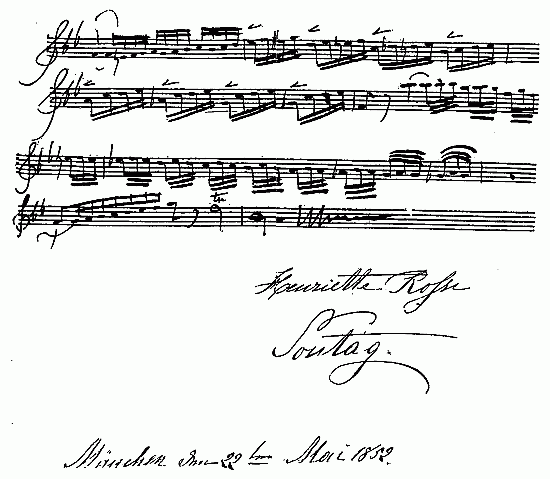 Autograph of Henriette Sontag
The singer of whom I have the liveliest impression is Henriette Sontag,
whom I heard in Leipsic on her first appearance after she had been
twenty years in retirement. The interest I took in the occasion was much
increased by the fact that I had a seat next to Moscheles, who was very
communicative, and gave me an interesting history of his long
acquaintance with Sontag, whom he had heard at her last appearance, I
think, before her retirement. He was naturally on the qui vive, and
impatiently waited for the opera to begin. Like many of her other old
admirers who were in the theater, he was full of expectancy mingled with
dread of possible failure. She appeared as Maria in Donizetti's "Fille
du Régiment" In this part the voice of the singer is heard before she
appears on the stage, and as soon as Moscheles heard Sontag's voice
trilling behind the scenes, he exclaimed with delight, "It is Sontag!
Nobody I have heard since she left the stage could do that! She is the
same Henriette!"
Some of the rôles in which I heard her were Amina in "Sonnambula,"
Martha in the opera of that name, Susan in "The Marriage of Figaro,"
and Rosina in "The Barber of Seville." I enjoyed the lovely feminine
quality of her voice and manner. There was something peculiarly charming
and womanly about her. She sang with unfailing ease and grace, her voice
being so flexible that it sounded like the trilling of birds. The most
difficult roulades and cadences were given with absolute accuracy and
rhythm. It was simply fascinating.
DURING the month of March of the same year, Johanna Wagner, niece of
Richard Wagner, sang in several operas. Among those in which I heard her
were Bellini's "Romeo and Juliet," as Romeo; "Fidelio," as Leonora
or Fidelio; and "Iphigenia in Aulis," by Gluck, as Iphigenia. Here
indeed she was a contrast to Sontag, and in these parts she seemed to me
quite unapproachable. Her voice was large and full, and her acting most
dramatic. Like all the German singers whom I heard, she lacked the
nicety of detail, the clear and beautiful phrasing, characteristic of
the Italians I had heard in Boston. But when I grew to know the German
method, I began to admire it, not so much for the actual singing itself
as for the combination of qualities that entered into it—the artistic
earnestness, the acting, and the musicianship.
IT was my experience that the Germans themselves greatly admired singing
of the Italian school, for when, following Sontag and Wagner, Mme. de la
Grange came the next month and sang an engagement in Leipsic (April and
May, 1852), the management doubled the prices, and, notwithstanding
this, the house was crowded every time she sang. She was in her prime,
and one of the finest singers I ever heard. Her style was brilliant and
dazzling, but never lacking in repose. Her high tones were clear and
musical, without any trace of shrillness, and in the most rapid passages
the tones were never slurred or confused, but distinct and in perfect
rhythmic order. The rôles in which she most appealed to me were as
Queen of the Night in "The Magic Flute," by Mozart, and Rosina in
"The Barber of Seville," by Rossini. But she also sang both parts of
Isabella and Alice in Meyerbeer's "Robert the Devil" in the most
admirable manner.
LISZT was the head and front of the Wagner movement; but except when
visitors came to Weimar and were inveigled into an argument by Raff, who
was an ardent disciple of the new school, there was but little
discussion of the Wagner question. Pruckner started a little society,
the object being to oppose the Philistines, or old fogies, and uphold
modern ideas. Liszt was the head and was called the Padishah (chief),
and the pupils and others, Raff, Bülow, Klindworth, Pruckner, Cornelius,
Laub, Cossmann, etc., were "Murls." In a letter to Klindworth, then in
London, Liszt writes of Rubinstein: "That is a clever fellow, the most
notable musician, pianist, and composer who has appeared to me among the
modern lights—with the exception of the Murls. Murlship alone is
lacking to him still." On the manuscript of Liszt's "Sonate" he himself
wrote, "Für die Murlbibliothek."
MY admiration for Wagner did not go to the extreme of Liszt's and of my
fellow-pupils'. Liszt rarely expressed his opinion of Wagner, because he
took it for granted that everybody knew it, and he was not a
controversialist. I know that he considered those people who refused to
follow Wagner as old fogies, and my colleagues used to twit me for not
being as enthusiastic as they were. Certain passages in his operas have
always given me great musical enjoyment and delight, but here and there
are crudities which, as it seemed to me, were unpardonable in a great
composer. Under these circumstances I could not pose as a genuine Murl,
although this fact did not disturb the genial and fraternal relations
which existed between my colleagues and me; and on occasion also I was
equal to the best of them in exercising the specialty of a genuine Murl
claqueur.
I think that Wagner will always rank among the greatest composers, but
will not always remain as preëminent as he is now in the popular
estimation. Some of his compositions are wonderfully intricate, although
musical, but at times his faults appear and disturb the balance of
things in such a way that the music loses the effect of spontaneity and
becomes forced.
In the Weimar days the general objection of the "old fogies" was that
his music lacked melody. Doubtless by melody they meant the little tunes
of the anti-Wagner period; but the fact is that Wagner has contributed
his share to increasing the scope of melody and enlarging its
boundaries. It may be that he has gone too far in this direction and has
completely obliterated all limitations, thus approaching dangerously
near confusion. It was said that he had no melody, but his scores are
full of it. There are sometimes so many melodies in combination, each
exercising its individuality and proceeding independently, that the
"tune effect" is obscured and lost in the crowd of accompanying tunes.
But to me Wagner's melody seems restless. It comes on suddenly and
progresses without periods of repose. There is almost constant motion,
which produces a feeling of unrest. A sentence must have its commas,
semi-colons, and periods, and punctuation is as necessary in music as it
is in letters.
I have never quite understood just what it is in Wagner's music that so
fascinates many people whom I know to be unmusical.
OF my Weimar comrades, Joachim Raff, it is hardly necessary to say,
became the most distinguished. My first impression of him was not wholly
favorable. He was hard to become acquainted with and not disposed to
meet one half-way. He was fond of argument, and if one side was taken
he was very apt to take the other. He liked nothing better than to get
one to commit himself to a proposition and then to attack him with all
his resources, which were many. Upon better acquaintance, however, one
found a kind heart and faithful friend whose constancy was to be relied
on. He was very poor, and there were times when he seemed hardly able to
keep body and soul together. Once he was arrested for debt. The room in
which he was confined, however, was more comfortable, if anything, than
his own. He had a piano, a table, music-paper, and pen and ink sent
there. How this was accomplished I do not know, but I think Liszt must
have had a hand in it. Raff enjoyed himself composing and playing, and
we saw to it that he had good fare. The episode made little impression
on him: so long as he could compose he was happy. However, the matter
was compromised, and in a short time he returned to his own lodgings. He
was a hard worker and composed incessantly, with only a brief interval
for dinner and a little exercise. We habitually sat together, and
afterward usually took a short walk. I enjoyed his conversation
exceedingly and derived much profit from it.
At about five o'clock in the afternoon, looking out of my window, I
would frequently see Raff coming over the path leading through the park,
with a bundle of manuscript under his arm. He liked to come and play to
me what he had composed. His playing was not artistic, because he paid
little attention to it, and he did not attempt to elaborate or finish
his style.
He composed very rapidly, and many of his compositions do not amount to
much. He could not get decent remuneration for good music, and he had to
live; therefore he wrote many pieces that were of the jingling sort,
because his publishers paid well for them. Sometimes, however, he turned
out a composition which was really worthy, and among his works are
symphonies, sonatas, trios, and chamber-music which gained him
reputation. His symphony "Im Walde" is well known in the musical world,
and his "Cavatina" for violin, although not a piece of importance, is
one of the most popular and effective violin solos and exists in various
arrangements. At times he was much dejected, and there was a dash of
bitterness in his disposition. I think he felt that, being obliged to
turn out music for a living, he would never attain the rank to which his
talents entitled him.
In promoting the cause of Wagner, Raff did considerable work for which
Liszt got the credit. I think that at one time Raff acted as Liszt's
private secretary; but he had decided ideas of his own, and knew how to
express them. Being generally in close accord with Liszt, and having a
ready pen, he rendered great assistance in promulgating the doctrines of
the new school by means of essays, brochures, and newspaper articles. Of
course much that he wrote was based upon suggestions made by Liszt. Raff
was a tower of strength in himself, while at the same time acting as
Liszt's mouthpiece in the Wagner propaganda.
WHEN Dr. Adolf B. Marx of Berlin was in Weimar in June, 1853, it was by
invitation of Liszt for the purpose of bringing out a new oratorio which
he had just composed. As usual on such occasions, we gave him a warm
reception, and Liszt arranged a midday dinner at the Hotel zum
Erbprinzen, at which some eight or ten guests were present. In the
afternoon we all attended a rehearsal of the oratorio, which lasted from
four o'clock until eleven o'clock P.M. According to my present
recollections, the work did not have a brilliant success. I was reminded
of this event by the receipt of the following letter in March, 1901,
from an old friend, Mr. Adolph Stange, who happened to be present on the
occasion:
Suwalki, Poland, Russia,
24 January, 1901.
Dear Dr. Mason: When you wrote your "Memories of a Musical Life,"
July-October, 1900, of Century Illustrated Monthly Magazine, you
probably did not have any presentiment that there is in a distant
country, far from you, somebody who only by one day younger than
yourself (born January 25, 1829) will be reading with the greatest
interest your excellent and truthful description of different
musical celebrities and authorities. Being myself for many years a
pupil of Gerke and of Henselt in St. Petersburg, I had been with
many of the eminent men you name personally acquainted; with
Moscheles and Rubinstein I had more often and more intimate
relations, and my delight was naturally great in reading your true
and graphic account of some of my former musical friends. It is
indeed with a feeling of admiration and gratitude that I am now
addressing these lines to its author. Your interesting description
of your stay at Weimar in 1853 gave me special pleasure, as in that
same year, in May, June, and July, I had also been with Liszt in
Weimar, and I remember you, dear Dr. Mason, perfectly, as well as
Klindworth, Pruckner, the two Wieniawskis, Winterberger, Raff, and
others; they are all living in my memory. That period of my youth
is full of the most beautiful and noble impressions.
Your account of that incomparable meister we both, I dare say,
equally admire, awakened in me Liszt's greatness as artist, and
still more, if I may say so, the greatness of his nature and
character, so richly endowed with so many generous and noble
instincts; and I recall with delight to my mind our pleasant walks
in the Schlossgarten, where we visited Klindworth in his modest
apartments; the supper at the Hotel zum Erbprinzen, where Liszt
wished to get acquainted with the card-game "preference," which I
had to show him; our visits to the Schloss, in the ground floor of
which we listened to Liszt's divine playing and afterward got
invited to dine up-stairs with the Princess Wittgenstein and her
charming daughter. I believe you had already left Weimar when
Professor Adolf Marx came from Berlin to visit Liszt and brought
with him the score of his new oratorio. Marx wished to say a few
words about its performance to Liszt before the first rehearsal,
but was much disappointed, as he told me, not to find an
appropriate moment to speak with the meister, whose attention was
constantly taken up by his pupils. On the day of the rehearsal,
Marx, who was sitting next to me, again expressed his regret at not
having found an opportunity to talk the matter over with Liszt.
Shortly after the rehearsal had commenced I felt several times
Marx's elbows, which, giving way to his enthusiasm, came in close
and sensible contact with mine. At last he exclaimed: "Liszt
guesses my most secret thoughts and intentions in my own
composition!" ...
Let me, dear Dr. Mason, assure you what real and intense enjoyment
I experienced by the perusal of your "Musical Memories," and beg
to thank you from all my heart for giving me the possibility of
recalling once over again those dear and ever-present reminiscences
of a bygone but ever-delightful time in my life. It is seldom one
can read in a biography a description like yours, which expresses
in a few words, with so much reality, truthfulness, and
impartiality, the characteristics of a whole series of well-known
artists. Finally, you will ask: "Stranger, who art thou?" I will
not, like Lohengrin, make a mystery of it, but answer your
question: I wanted to become what you are now! After my return from
Weimar, however, where I had been for a time Liszt's pupil, I
entered into Russian state service, remaining, nevertheless, during
my whole life, though a dilettante, a great and fervent admirer of
that art, and a real artist in my heart. I sign, with veneration to
your person, Dr. Mason, and have the honor to remain,
Yours very truly,
Adolph Stange.
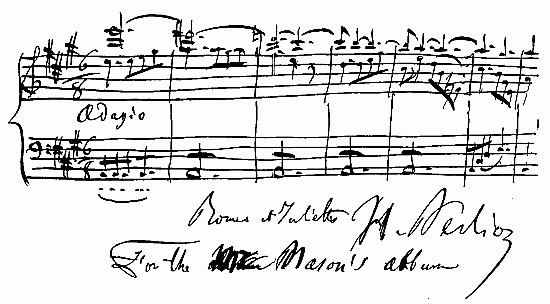 Autograph of Hector Berlioz
Hector Berlioz came to Weimar occasionally, and I remember particularly
one of his visits, which took place in May, 1854. He was famous as
an orchestral conductor, and I saw him in this capacity in a concert the
program of which consisted exclusively of his own compositions. These
were especially attractive on account of their magnificent orchestral
coloring. In this regard he was certainly wonderful, and produced many
gorgeous effects. His masterly skill and intelligence in the treatment
and development of his themes were also everywhere apparent. Every
detail received careful attention, and the result was admirable.
Not long afterward he gave a similar concert in the Leipsic Gewandhaus
Hall, on which occasion the Weimar contingent was of course present.
There was no need of our services as claqueurs, however, for the hall
was crowded and the audience demonstrative.
Schubert was spontaneous and inspired, and thus stands in contrast to
Berlioz. Melody gushed from Schubert at such a rate, and musical ideas
crowded upon each other so rapidly, that he did not take time to work up
his compositions. There are a few which he elaborated with care, but
they are the exceptions, and emphasize the general spontaneity of his
work. If he had constructive power,—and certain passages in his work
show that he had,—he nevertheless failed to make adequate use of it.
His music is charming and delightful on account of its melodious
freshness and naïveté. It appeals directly to the heart. The only
drawback is his servile adherence to conventionalities, such, for
instance, as the old method of invariably repeating every section of a
movement.
Beethoven stands as the model of constructive power and emotional
expression in happy equipoise. Both the head and the heart are
satisfactorily employed, and in his orchestral treatment they find full
expression. This is true of all of his concerted works; but his weak
point is manifested in his pianoforte compositions, especially in the
sonatas, which are not idiomatic of the instrument for which they were
written. It is not intended to find fault with the music per se. It is
simply to say that his ideas are all orchestrally conceived, and as
they are not in the nature of the pianoforte, that instrument is
inadequate to their true expression. The sonatas are not pianistic,
idiomatic—klaviermässig. Had he written them for orchestra, we would
have had thirty-two symphonies.
Chopin's compositions are the very essence and consummation of the
piano, and he is, therefore, the pianoforte composer par excellence.
On the other hand, his orchestral work is weak and incompetent, as, for
example, the accompaniment to his concertos and some other pieces.
Schumann is at home in both directions. He is polyphonic in orchestral
treatment, and at the same time thoroughly pianistic. Without suggesting
comparisons, his music is musical and complete. Beethoven's is heroic.
LISZT sometimes left Weimar for a few days in order to be present at or
to conduct music festivals. On one of these occasions, early in June,
1854, I remained alone at home on account of slight illness. As
Klindworth had gone to London for concert-playing and
pianoforte-teaching, I had moved into a suite of rooms in the Hotel zum
Erbprinzen. As a matter of interest to pianists I here note the fact
that these identical rooms had been occupied by Hummel several years
previously.
On the afternoon of the day on which Liszt left with his cortège the
head waiter came to me, saying that a young man who had just arrived was
in the café inquiring for Liszt and seemed disappointed on learning of
his absence. "I told him," said the waiter, "that you were the only one
of the family here. Will you see him?" I assented, and in a few moments
he ushered in a young man about twenty-four years of age, of strong
features and with a great shock of dark hair, who introduced himself as
Anton Rubinstein. I explained to him that Liszt had gone away for three
or four days to conduct a festival, that I could not say precisely when
he would return; but in the meantime, if I could make him feel at home,
I should be very glad.
After some conversation he asked me to play. I remember very well how he
looked sitting on the sofa, and the position of the piano in the room. I
played, but he did not. I had a suspicion that he was inveigling me into
playing without any intention of allowing me to take his measure. He sat
there like a gruff Russian bear; or perhaps my imagination helped to
produce this impression.
Rubinstein was already quite well known as a child prodigy, but of
course not nearly so famous as he afterward became. I do not recollect
paying him very much attention during Liszt's absence, but, then, he did
not allow me—he was rambling about all the time; nor did I hear him
play before Liszt came back. When Liszt returned, Rubinstein was
immediately invited to take up his residence on the Altenburg. I
remember that there, one afternoon, he played many of his own
compositions. His playing was full of rush and fire, and characterized
by strong emotional temperament. He had a big technic and reveled in
dash and fire. Those who heard Mark Hambourg here during the winter of
1899-1900 can form a very good idea of Rubinstein's personal appearance
at the time of which I write, and also his very pronounced style of
playing. His early touch lacked the mellow and tender beauty of tone
which distinguished it in later years.
RUBINSTEIN's well-known dislike of Wagner, it seems to me, was
temperamental in a large degree, and it was quite natural that he was
not in agreement with him. Doubtless Chopin would not have approved of
Wagner's music, whatever he might have thought of his method. The
melodies of Chopin and Rubinstein are full of sentiment and well
defined, and their compositions run in entirely opposite channels from
those of Wagner, whose music is a vast sensuous upheaval, which
proceeds uninterruptedly from the beginning of an act to the end.
All musicians have a good deal of self-esteem. Rubinstein had his own
way of composing, which corresponded to his musical temperament. He had
to write everything just as it suited his musical ear, and he could not
conceive of any one else having as fine a musical ear as he. At all
events, he never stopped long enough to find out if any one else had.
Few musicians do. Liszt was fond of Rubinstein, and used to call him the
"young Beethoven," on account of a certain fancied resemblance he bore
to the great composer. He also recognized Rubinstein's great ability as
a pianist, although I think that as a player he rated Tausig much
higher. Many years after I left Weimar a relative of mine met Liszt in
Rome. She had a short time previous to this heard Rubinstein in concert,
and was in a state of great enthusiasm about his playing, and so
expressed herself to Liszt. His sole comment was, "Have you ever heard
Tausig?" The inference was that those who had heard Rubinstein and not
Tausig had missed hearing the greater of the two. I think Liszt regarded
Tausig as the best of all his pupils.
As I have said once before in these pages, I never saw Liszt after
leaving Weimar in July, 1854. I occasionally received letters from
him—several of them quite long and exceedingly entertaining. One of
these (the original in French) is reproduced here because it is
characteristic of his pleasantry and good humor:
My dear Mason: Although I do not know at what stage of your
brilliant artistic peregrinations these lines will reach you, I
feel assured that you are not ignorant that I am very, very
sincerely and affectionately obliged to you for keeping me in kind
remembrance, a fact to which the musical journals which you have
sent me bear good witness. The "Musical Gazette" of New York has in
particular given me genuine satisfaction, not alone on account of
the agreeable and flattering things concerning me personally which
it contains, but furthermore because this journal seems to me to
inculcate an excellent and superior direction of opinion in your
country. As you know, my dear Mason, I have no other self-interest
than to serve the good cause of art so far as is possible, and
wherever I find men who are making conscientious efforts in the
same direction, I rejoice and am strengthened by the good example
which they give me. Be so good as to present to your brother, the
head editor of the "Musical Review", as I suppose, my very sincere
thanks and compliments. If he would like to receive some
communication from Weimar upon matters of interest which occur in
the musical world of Germany, I will willingly have them sent to
him through the medium of Mr. Pohl, who, by the way, does not live
any longer at Dresden, where the numbers of the "Musical Gazette"
were addressed by mistake, but at Weimar in the Kaufstrasse. His
wife, one of the best harpists that I know, stands among the
virtuosos of our "Chapelle", and is an important factor in the
representation of the opera, as also in concerts.
Apropos of concerts, in a few days I will send you the program of a
series of symphonic performances, which ought to have been
established here several years ago, and to which I consider it an
honor and a duty to give definite encouragement from the year 1855.
I expect Berlioz toward the end of January. We shall then hear his
trilogy "L'Enfance du Christ", of which you already know "La Fuite
en Egypte". To this he has added two other short oratorios, "Le
Songe d'Herode" and "L'Arrivée à Saïs".
The dramatic symphony "Faust" (in four parts, with solos and
choruses) will also be given in full during his stay here.
In regard to visits from artists who have been personally agreeable
to me during the last month, I would name Clara Schumann and
Litolff.
In Brendel's journal, "Neue Zeitschrift", you will find an article
signed with my name, on Mme. Schumann, whom I have again heard with
that sympathy and absolute admiration which her talent compels.
As for Litolff, I confess that he has made a very vivid impression
on me. His fourth concerto symphony (manuscript) is a very
remarkable composition, and he played it in so masterly a manner,
with such verve, with such boldness and certainty, that I derived
intense pleasure from it.
If there was a little of the quadruped in the amazing execution of
Dreyschock (and this comparison should not vex him; is not the lion
classed among quadrupeds as well as the poodle?), in that of
Litolff, there is certainly something winged; moreover, he has
all the superiority over Dreyschock that a biped having ideas,
imagination, and sensibility has over another biped which imagines
itself possessed of all this wealth—often very embarrassing!
Do you continue your familiar intercourse with the Old Cognac in
the New World, my dear Mason? Let me again commend measure to
you, an essential quality for musicians. In truth, I am not too
well qualified to extol the quantity of this quality, for, if I
remember rightly, I have often employed tempo rubato when I was
giving my concerts (work which I would not begin again for anything
in the world), and even quite recently I have written a long
symphony in three parts, called "Faust" (without text or vocal
parts), in which the horrible measures 7⁄8, 7⁄4, 5⁄4 alternate
with common time and ¾. By virtue of which I conclude that you
should be satisfied with 7⁄8 of a little bottle of old cognac in
the evening, and never exceed five quarts!
Raff, in his first volume of "Wagner Frage", has thoroughly
realized something like five quarts of doctrinal sufficiency, but
that is an unadvisable example to copy in a critical matter, and
above all in the matter of cognac and other spirits!
My dear Mason, excuse these bad jokes, justified only by my good
intentions; that you may bear yourself valiantly, physically and
morally, is the most cordial wish of
Your very friendly affectionate
F. Liszt.
Weimar, December 14, 1854.
You did not know Rubinstein in Weimar?[2] He spent some time here,
and was conspicuously different from the opaque mass of self-styled
composer-pianists who do not even know what it is to play the
piano, still less with what fuel it is necessary to heat one's self
in order to compose, so that with what they lack in talent for
composition they fancy themselves pianists, and vice versa.
Rubinstein will publish forthwith about fifty
compositions—concertos, trios, symphonies, songs, light pieces,
etc., which deserve notice.
Laub has left Weimar. Ed. Singer takes his place in our orchestra.
The latter gives much pleasure here, and is pleased himself also.
Cornelius, Pohl, Raff, Pruckner, Schreiber, and all the new school
of the new Weimar send you their friendliest greetings, to which I
add a hearty shake-hand.
F. L.
Other letters received from Liszt are perhaps not very important, but
with one exception never having been published before, they are printed
in the Appendix.
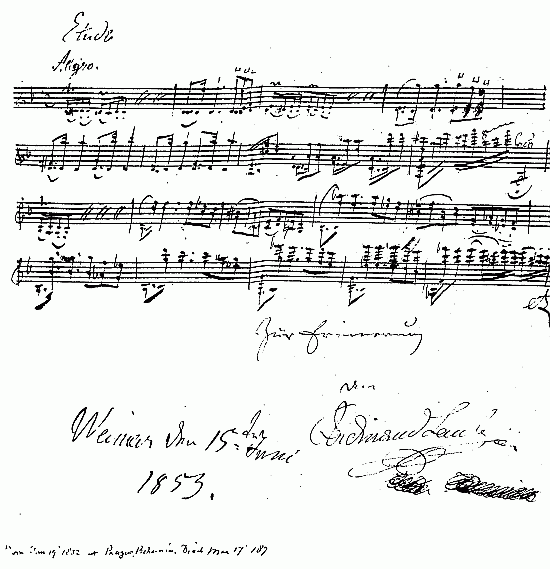 Autograph of Ferdinand Laub
Pupils of Liszt and Thalberg and their pupils in search of an
entertaining diversion may amuse themselves by tracing their
musical pedigree back to Bach, Mozart, and Beethoven, and thus lay claim
to very distinguished ancestry, as shown in the following table:
- Liszt, Franz, born Oct. 22, 1811.
- Czerny, Carl, born Feb. 21, 1791.
- Beethoven, Ludwig van, born Dec. 16, 1770.
- Neefe, Christian G., born Feb. 5, 1748.
- Hiller, Johann A., born Dec. 25, 1728.
- Homilius, G. A., born Feb. 2, 1714.
- Bach, Johann Sebastian, born March 21, 1685.
- Thalberg, Sigismond, born Jan. 7, 1812.
- Hummel, J. N., born Nov. 14, 1778.
- Mozart, Wolfgang A., born Jan. 27, 1756.
If there be any whose pride is not sufficiently nourished by this
display, they may go still further and show, by authentic records, a
descent through Bach from Josquin Desprez, the most eminent
contrapuntist of the Netherlands school, who lived about 1450-1521.
During the winter of 1879-80, which I spent at Wiesbaden on account of
ill health, I received a very cordial invitation to visit Liszt at
Weimar some time in July, and made plans to do so, which were
frustrated, however, through unforeseen circumstances. Bülow, when on
his first visit here, in 1875, told me that the old charm had entirely
passed away. The "Golden Time" was among the things that were.
The last message I had from Liszt was brought to me by Mr. Louis
Geilfuss of Steinway & Sons, who met Liszt in one of the streets of
Bayreuth only a few days before his death, which occurred somewhat
unexpectedly on July 31, 1886.


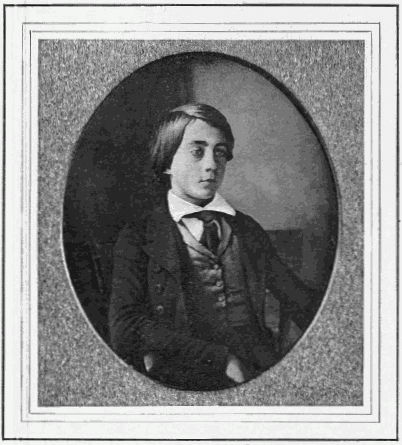
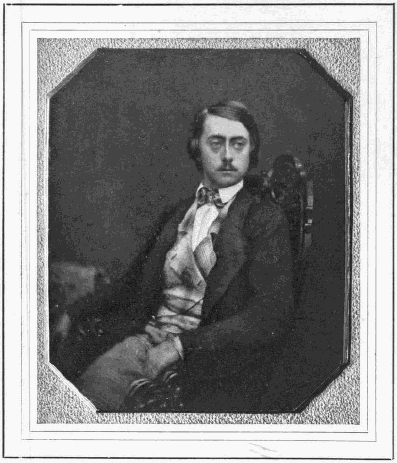
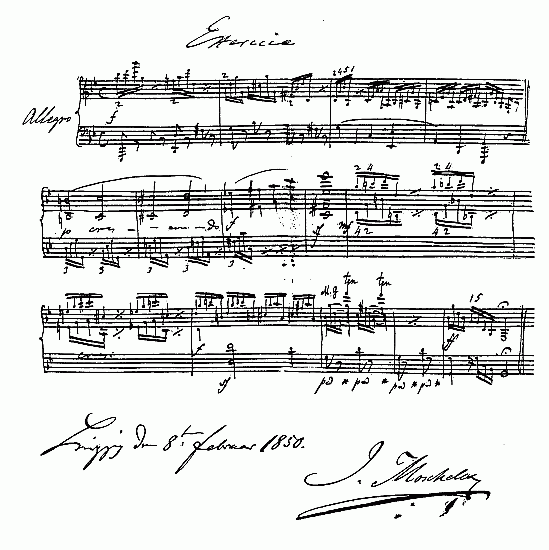





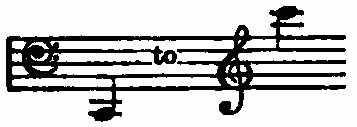
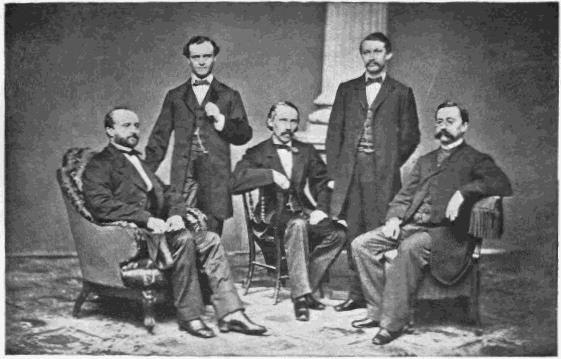
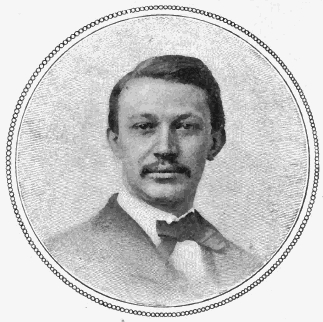


 . This is accomplished
by firmly pressing the open pedal, the finger in the meanwhile playing
the accompaniment. Thus
. This is accomplished
by firmly pressing the open pedal, the finger in the meanwhile playing
the accompaniment. Thus