New original cover art included with this eBook is granted to the public domain.
i
MEMORIES
ii
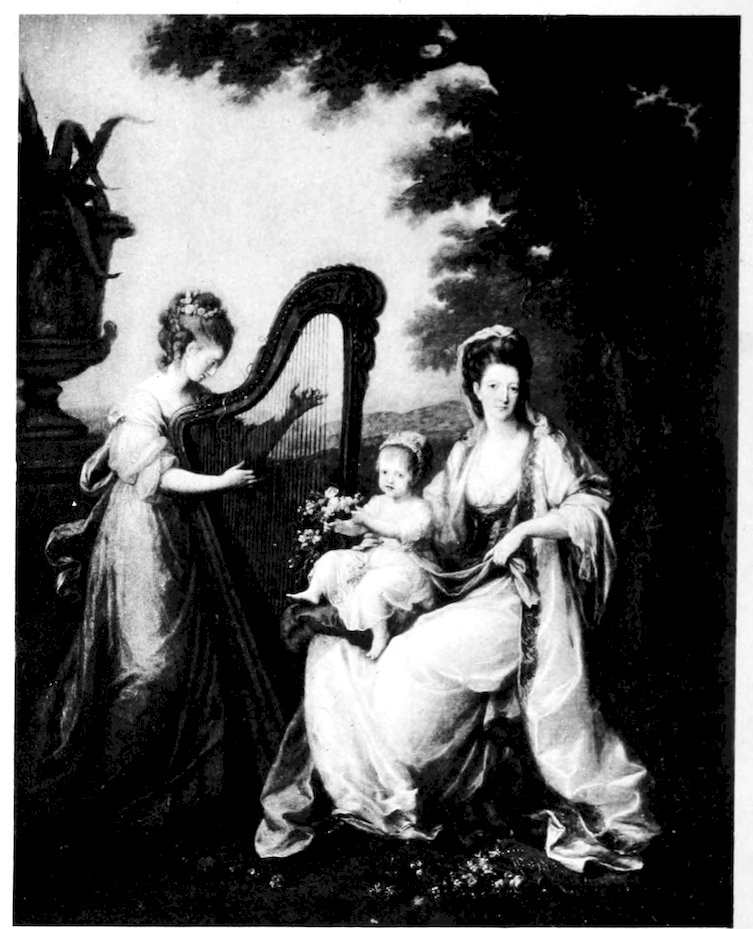
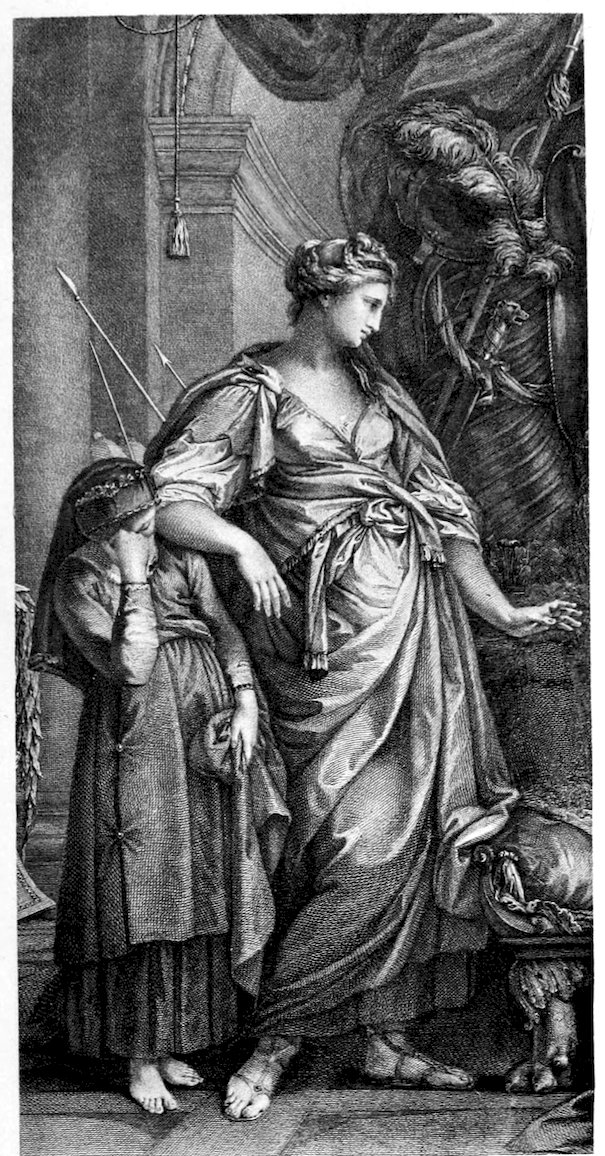
Engr. by J.J. Washington 2a
The beautiful Duchess of Argyll with her daughters Lady Augusta and Lady Charlotte Campbell
By Angelica Kauffman.
iii
BY
C. F. GORDON CUMMING
AUTHOR OF ‘WANDERINGS IN CHINA,’ ‘AT HOME IN FIJI,’ ETC.
WITH ILLUSTRATIONS
WILLIAM BLACKWOOD AND SONS
EDINBURGH AND LONDON
MCMIV
All Rights reserved
“ APOLOGIA. ”
v
I have mentioned many pleasant things that have
been mine by inheritance.
But I have suffered much from one heritage of a
very trying nature, namely, the total inability to
recognise general acquaintances when meeting them
unexpectedly; or even real friends, whom mentally
I know very well indeed, but quite fail to identify
when we are suddenly brought face to face.
This grave social disability I inherit from my
father, to whom the same failing was a life-long trial.
Moreover, it is one for which, unfortunately, the
sufferer does not always get sympathy from those
whom she has failed to recognise. I mention this
chiefly in the hope that it may meet the eye of some
to whom I am told that I have thus occasionally most
unwittingly given offence.
In the rush and hurry of this twentieth century, the
present generation find themselves so fully occupied with
their own contemporaries, that for the most part they can
take little or no interest, even in their own immediate predecessors,
still less in their progenitors of old generations.
But we, who were born before life’s unsatisfying rush
became so great, still like to gather up the traditions of
bygone years, and in fancy see our own “forbears” as
we know them to have been long ago.
As a daughter of the Chief of Clan Cumming, my home
was, of course, at Altyre, in Morayshire, i.e. at headquarters—a
goodly heritage in truth, and yet a mere fragment of
the vast possessions of the Clan in the days of its power.
With regard to antiquity, it is said that the Cummings of
Altyre are directly descended from the Counts de Comyn
who were directly descended from Charlemagne. Robert,
who was fifth in descent, was created Earl of Northumberland
by his cousin, William the Conqueror. He was killed
in Durham in January 1069. Besides broad lands in
Northumberland, his family held estates in Yorkshire and
Wiltshire. From him the old knights of Altyre (who
were also Lords of Badenoch) prove direct descent in the
male line.
In the reign of Alexander III. the Comyns were also
Earls of Buchan, Earls of Menteith, Lords of Galloway,
and Lords of Lochaber, owning vast tracts of country.
2And besides these great barons, there were then thirty
landed knights in the Clan.
Of the Red Comyn who (while alone at prayer in Greyfriars
Church in Dumfries) was stabbed in sudden passion
by Robert Bruce and murdered by Kirkpatrick, it is
recorded that sixty belted knights, with all their vassals,
were bound to follow his banner. But in that sacred and
unguarded hour, only his uncle, Robert Comyn of Altyre,
was near, and shared his fate.
The spelling of surnames in ancient documents is always
liable to variation, but probably no other has lent itself so
largely to the fancy of scribes. In one old charter of the
Altyre family it is spelt in five different ways. Cumeine,
Chuimein, Commines, Cumyn, Comyn, Comin, Coming,
Cumin, Cummine, Cuming, and the modern form of
Cumming, are among these varieties.
The Clan is spoken of by various old writers as the most
potent that ever existed in Scotland; and a quaint old
atlas, published in Amsterdam in 1654 by Jean Blaeu,
quotes a somewhat older Latin work by Sir Robert Gordon
of Stralloch, concerning
“Altyr, qui appartenoit à ceux de la maison de Cumines
qui estoit, il y a plus de trois cens ans, la plus riche, et
la plus puissante de l’Ecosse.”
How it came to pass that this powerful family should, so
quickly after the accession of Robert Bruce, have been
reduced to the comparatively small proportions of later
years, is one of the unsolved mysteries of Scottish history.
CHAPTER I “ Surely goodness and mercy have followed me all the days of my life. ”—Psalm xxiii. 6.
3
Altyre—Dunphail—Numerous Kinsfolk—Cornish Relations—Grants of Grant—Episcopal
Church.
Many a time I have been asked by friends who have found
pleasure in reading my notes of travel in divers countries
to write a record of my early home-life and of various
matters of local interest.
Having rarely kept a journal, except when travelling, I
felt that I had insufficient materials from which to compile
such a record; but after a while I bethought me of one
friend (Miss Murray of Polmaise), with whom for more than
forty years I had corresponded regularly, and as I had
preserved most of her letters, it was possible that she might
have done the same by mine. So to her I applied. The
answer was, “Why did you not write a month sooner?
I have been setting my house in order, to minimise trouble
for my survivors, and have just burnt all my old letters, including
yours.” A few weeks later she entered the Larger
Life, and for a while the thought passed from me.
But now that I am rapidly nearing the appointed term of
threescore years and ten, and have far outlived thirteen of
my fifteen brothers and sisters—i.e. all save one of my
brothers, and one half-sister—it seems well to thread together
such scattered details as may prove of interest to
some of my numerous friends, known and unknown, many
of whom I can never hope to meet face to face, but who
have gladdened me by kind letters, telling me how the records
of my wanderings have beguiled weary hours of suffering
4and weakness (one of these, which gave me special pleasure,
was from the author of the celebrated Book of Nonsense).
So for such sympathetic friends, I will now note some
early memories of those happy days—
“When we all were young together
And the earth was new to me.”
And if such notes are apt to appear egotistic, may I be
forgiven, for assuredly the records of the first fifty years of
my life are those of some one quite different from my
present self in every respect, both of personality and of
surroundings. Indeed, I received a hint of this about
twenty-five years ago, when on my return from wandering
in far countries, I was told that an old family servant was
anxious to see me again after an interval of about fifteen
years. I went to her house, and was received with the cold
glare of non-recognition. I said, “Don’t you remember
Miss Eka?” “Miss Eka,” she said beamingly, “Oh, fine
do I mind her, but,” doubtingly, “surely you are no her?
Eh!! and ye WERE so good-looking!” I like to treasure
that tribute to a forgotten past.
Though I cannot say that I remember the 26th of May
1837, I do vividly remember my father’s assuring me that
early on that morning he had found me in the heart of a
fine large cabbage; so I greatly respected the tall cabbages,
from beneath which I retrieved deliciously sweet, small pears,
which fell from a large overhanging tree—one of the countless
joys of the most delightfully varied series of gardens
that ever gladdened the heart of happy children, and their
elders of all ages.
In looking back and considering lives and characters, I
often think how little weight we give to the inestimable
advantages which have enfolded some of us from our birth
to our grave. Ay, and long, long before our birth, in the
unspeakable blessing of healthy, well-conditioned ancestors,
who have transmitted to their descendants well-balanced
minds in healthy bodies, naturally cheerful dispositions,
and many another pleasant inheritance; all natural gifts
5which we accept as our birthright, quite as a matter of
course, yet the lack of which are to so many life-long drawbacks
for which all the world’s wealth cannot compensate.
And when to these personal gifts there is added the
charm of being born and brought up in singularly lovely
and delightful homes, nurtured in simple, practical faith
and reverence for all holy things, and enfolded in the love
of a large and attached home-circle, and the wider friendship
of very numerous kinsfolk, equally happy in their surroundings,
such an one is truly of the number of those “to
whom much is given.”
Such has been my own experience of life, always surrounded
by good influences.
My mother was the very embodiment of health and
beauty, bodily and mental. In physical stature, tall and
stately, but above all, great in soul and intellect. My
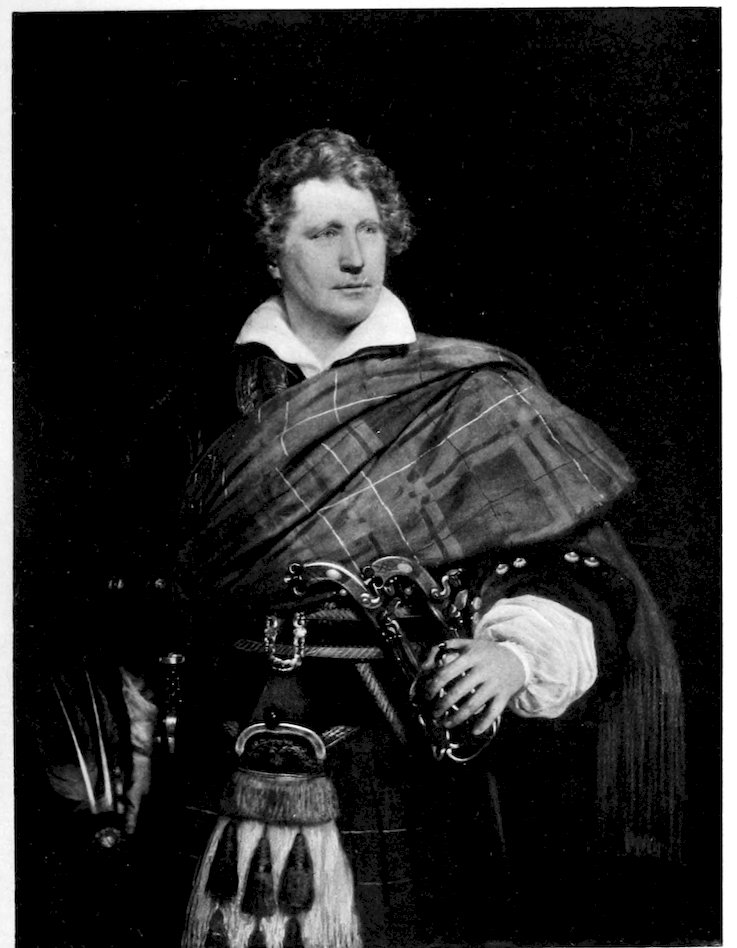
father, Sir William Gordon-Cumming, Chief of Clan Comyn
or Cumming, was as splendid a Highlander as ever trod the
heather, only excelled in beauty and stature by his own
second son, Roualeyn, who was certainly the grandest and
most beautiful human being I have ever beheld.
My mother, Eliza Maria Campbell of Islay and Shawfield,
had eight brothers and sisters, twenty-one nephews and
nieces, and ever so many grand-nephews and nieces. My
father had fifteen brothers and sisters (of whom seven died
young), twenty-nine nephews and nieces, and thirty-four
grand-nephews and nieces.
So I started in life with fifty first cousins, about twice as
many second and third cousins, and collaterals without
number, for the family tree had roots and branches ramifying
in every direction; and as each group centred around
some more or less notable home, it followed that England
and Scotland were dotted over with points of family interest,
in those good old days when it was held that “blood was
thicker than water,” and kinship, however much diluted,
was fully recognised.
Looking back to those numerous centres of cheery and
6hospitable welcome, I realise that they now exist only in
memory. At best the old friends are replaced by a second
or third generation, but too often the old homes have
changed hands; iniquitous death-duties have done their
malignant work in ruining the old landowners and dispersing
the many retainers who for generations had worked
on the estates, in healthy, peaceful country homes.
On the death of my grandfather, Sir Alexander Penrose
Gordon Comyn, my father, then a minor, succeeded to the
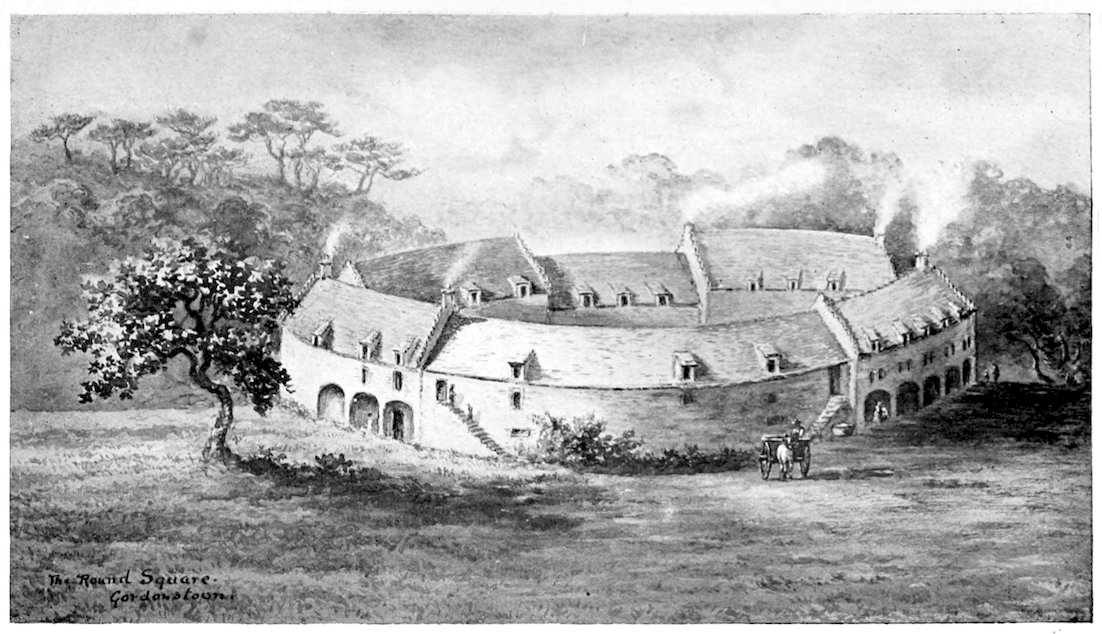
great estates of Altyre and Dallas, Gordonstoun, and
Rose-isle, all in the county of Moray.
Although the Comyns have held Altyre for certainly
seven hundred—probably a thousand years—(it was Sir
Robert Comyn of Altyre who, on 10th February 1305, came
to the rescue of his nephew Sir John Comyn, Lord of
Badenoch, commonly called the Red Comyn, when he was
stabbed by Bruce in the Greyfriars Church at Dumfries,
and who was himself slain by Kirkpatrick)—they seem to
have lived about seven miles from Altyre at the castle of
Dallas (which for a while was called Torchastle), on a bleak,
uninviting moorland. The very ruins of this have now
disappeared, and a luxurious modern house has been built
as a shooting-lodge.
At what date the original house of Altyre was built is
uncertain, but contracts of marriage were there signed about
1581 and 1602 (the latter between James Cuming and
Margaret, sister to Symon, Lord Fraser of Lovat). That
old house was inhabited till A.D. 1789, when my grandfather,
finding it too small for his sixteen children, bought Forres
House, at Forres, from the Tullochs of Tannachie. On his
death it became the dower-house of his widow, who died
there in 1832. For a few years after their marriage, they
had lived at Cothall, close to the river Findhorn, a very
pleasant situation in a green meadow enclosed by old trees.
Only a fragment of ruin now marks the spot.
My father’s intention always was to build an entirely new
7house on a hill about a mile from old Altyre. At great cost,
he levelled the summit of the said hill, making an excellent
carriage road, winding gently round to the proposed site,
from which there is a wide, beautiful view, overlooking the
Altyre and Darnaway woods, with a distant view of the
pretty little town of Forres and of Findhorn Bay, and across
the Moray Firth to the faint blue distant hills of Ross,
Sutherland, Caithness, and Cromarty. It is a delightful
spot, known to this day as “the Situation,” and for many
years building thereon was the dream of my father’s life.
Close to the Situation, another heathery, fir-crowned hill
has from time immemorial been known as the “Gallows
Hill,” whereon any one who had the misfortune to incur the
wrath of the knights of Altyre was ruthlessly hanged in the
“good old days,” when it is related of one awe-stricken wife
that she urged her unwilling husband to go quietly to his
doom and “dinna anger the laird.”
As it was not convenient to begin at once building on the
new site, my father and mother decided that for a while
they would continue to live in the old house; and then
began the laying out of those great, beautiful gardens and
shrubberies of which comparatively little now remains—sacrificed
to the changing taste of successive generations.
They also laid out many miles of romantic woodland paths,
which made the whole place a dream of delight. And so
they became more and more disinclined to leave the home
they had made so fascinating; and as their family increased
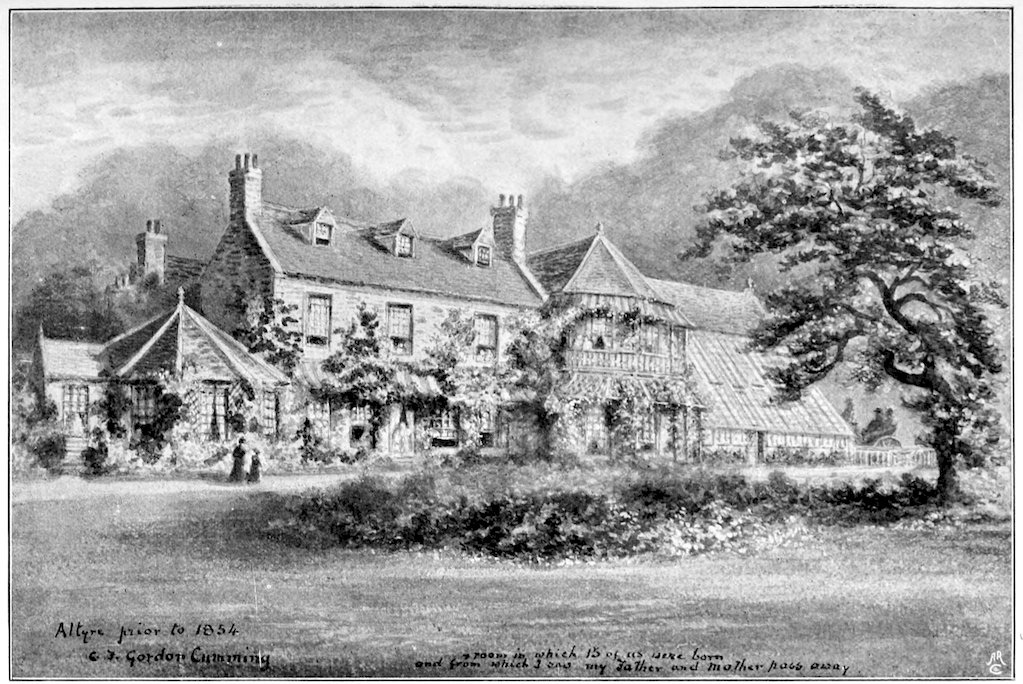
they occasionally added a few rooms to the old place, which
thus gradually developed into a picturesque patchwork,
covered with climbing roses, honeysuckle, and jessamines,
and beloved by the happy children, to whom it was indeed
an earthly paradise, the profusion of flowering shrubs so
lavishly planted in every direction adding their fragrance
to that of the sweet woods.
Moreover, in those halcyon days, we were allowed to
breathe the pure air as God created it for us, unpolluted by
8the fumes of tobacco, which assuredly can have no place in
any paradise—certainly not in the Celestial! Only as years
went on did my brothers yield to the new temptation, and
venture to smoke a pipe in the kitchen when all the household
were safe in bed. As to smoking-rooms, they were not
invented in any houses within our ken.
Among the many incongruities in that dear old home, not
the least was the importation from abroad of three large
fixed baths, which, with an abundant supply of hot and
cold water ready to hand, were a luxury by no means
common eighty years ago.
But far more attractive to the younger generation was a
wooden enclosure, built across a pool in a delightful rivulet
on the further side of the lawn, which, by means of a sluice,
could be deepened at pleasure; and there we could bathe to
our hearts’ content in the clearest and softest brown water,
with trees and sky overhead, only one corner being roofed
as protection in case of rain.
All the water-supply for washing purposes came from one
of these brown rivers, and sometimes after heavy rain its
colour was so dark as greatly to surprise guests from the
south, unused to peat regions; but all confessed that no
crystal streams could yield water so delightfully soft.
Though the entailed lands necessarily passed to my father,
Sir Alexander’s love centred on his second son, Charles
Lennox, to whom he left the lovely estate of Dunphail, on
the romantic banks of the river Devie, just above its junction
with the Findhorn, which is by far the loveliest river in
Scotland, and which divides the fascinating woods of Altyre
from those of Darnaway Castle, one of the Earl of Moray’s
many estates. Dunphail, which had formerly belonged to
the Cummings, had fallen into other hands. Sir Alexander
bought it back for his favourite son.
Of all legends of the north, none is more gruesome than
that which tells how, about the year 1340, Randolph Stuart
(who had been created Earl of Moray by his uncle, King
9Robert Bruce) besieged Alexander de Comyn, the old
knight of Dunphail, and five of his six sons in their strong
castle. For long they held out, till at length Randolph
discovered that night after night the eldest son, Alastair
Bhan (i.e. the fair), contrived to bring them food.
Soon he tracked him to his hiding-place, Slaginnan, a
well-concealed cave in a thickly wooded ravine beside the
river Devie. His followers closed the entrance to the cave
with piles of heather and brushwood, and to his prayer to
be allowed to come out and die “like a man,” fighting for
life, they replied, “No, you shall die like a fox,” and so they
fired the brushwood and smoked him to death. Then they
cut off his head with its masses of golden hair, and threw it
over the castle wall to the unhappy father, crying “There is
beef to your bannocks.”
Starvation soon compelled surrender, and the besiegers
ruthlessly beheaded all their prisoners, carrying off the
heads as trophies, but burying the seven headless bodies in
one grave at the foot of the castle rock; a grave always
known as that of the Seven Headless Comyns. It was
opened in the last century, I believe, by order of Major
Cumming-Bruce, and the truth of the story was fully
confirmed.
This Randolph Stuart was very nearly akin to that other
miscreant, Alexander Stuart, known as the “Wolf of Badenoch,”
son of King Robert II., who bestowed on him the
lordship and lands of Buchan and of Badenoch, wrested from
the Comyns, and who was distinguished only for his savage
brutality. In the year 1390 he swooped down from his
castle of Lochindorb and burnt first the town and church
of Torres, and a month later did likewise by the stately
cathedral of Elgin, the parish church of St. Giles, and
other ecclesiastical buildings, as well as a great part of
that city.
I feel bound to mention this detail, because I have so
often heard it asserted that the cruel “Wolf” was a Comyn,
10whereas our forbears were then in the position of the
unjustly maligned lamb.[1]
Many and glad were the happy weeks we so often spent
among the lovely ferny and birch-clad glades and glens on
every side of beautiful Dunphail, which to us was just as
much home as Altyre itself. These homes were connected
not only by a first-rate carriage road, but by miles of skilfully
led footpaths along the beautiful, craggy banks of the
Findhorn, the Devie, and the Dorbach, through the estates
of Altyre, Logie, and Relugas, all the estates of Cumming
cousins,[2] who were of one heart and one mind in all that
tended to open up their lovely estates, and make their
beauty accessible to themselves and others.
But as both my father and his brother had a curious
talent for instinctively hitting on the very best line for
constructing roads and footpaths through dense and well-nigh
untrodden brushwood, the task was altogether left to
them, resulting in the excellent paths, most of which remain
to this day as their abiding memorial. Others (extending
for miles up the Altyre burn—“by the sweet burnside”—and
through one specially lovely glade known as “the
Sanctuary,” where stately silver pines cast their cool, deep
shade over a carpet of greenest moss) were demolished when
the ruthless railway was led down that glen, and many
more have now been closed, but enough remain to earn
the gratitude of successive generations.
Perhaps the loveliest, and certainly the most unique
stretch of river-hewn rock, is the half mile of the Findhorn
on the estate of Relugas, just above its junction with the
Devie, where at one point the whole volume of brown waters
rushes through a cleft so deep and narrow, that on one
occasion when Randolph, Earl of Moray, was closely pursued
by foes, he actually leaped from crag to crag and so escaped.
11This spot, known as “Randolph’s Leap,” is naturally the
chief attraction to visitors who drive from afar to carry to
more prosaic homes a memory of the dreams of beauty,
which by the generosity of all the lairds in the glen have
for the last three generations been made so easy of access.
Very sad to say, the continuity of these beautiful paths
has recently been destroyed through the selfish policy of
the late non-resident proprietrix of this most fascinating
estate. In order to make her own walks more attractive
to summer tenants, by ensuring their own privacy while
taking unrestricted enjoyment of all walks and drives on
the neighbouring estates, she for some years past only
allowed the public access to this specially attractive half
mile on one day of the week, while quite excluding them
from other lovely river-paths. So that the most interesting
point on the beautiful Findhorn is now the one blot; which
sends many away bitterly disappointed, because their only
opportunity (perhaps in a lifetime) of visiting the district
(or of revisiting the haunts of their youth) was not on the
day so arbitrarily fixed. Remonstrances and representations
on this subject have hitherto proved all in vain.
At the time when I can first remember lovely Relugas, it
was the scene of a curious instance of a man gaining his
heart’s desire. Young Mr. Mackilligan started from Elgin
to carve his fortune in Ceylon, then comparatively unknown
to planters. As he left Scotland, he confided to a friend
that his ideal of all possible bliss would be to own Relugas
(then the property of Sir Thomas Dick Lauder), and to be
the husband of Eliza Marquis, a very handsome and winsome
girl.
Strange to say, on his return, having made his pile, he
found that Relugas was for sale, and that he was still in
time to woo and win the maiden. Thus was his double
ideal fulfilled. But alas! his health was shattered, and
his wife proved equally delicate, so it was truly pathetic
to visit them, and find each confined to a sofa, only able
12to enjoy the beauty which they could see from the
windows.
After his death, his widow deemed it best for her children
to sell the place, which was bought by the George Robert
Smiths, who proved the kindest of neighbours. To them a
special attraction was the near neighbourhood of Dunphail
(only a mile by a lovely river path) the home of their dear
friends, the Cumming-Bruces.
My uncle, Charles Lennox Cumming, had married Mary,
the grand-daughter and heiress of Bruce the famous
Abyssinian traveller, from whom she inherited the estate
of Kinnaird near Falkirk, and the old house containing
many valuable sketches and all manner of travel treasures
from Abyssinia, the Hawaiian Islands, and other regions,
to visit which, in his days, had been a matter worthy indeed
of a great explorer. Of course the heiress retained her own
name, hence the family of Cumming-Bruce.
Even in the beginning of the nineteenth century, the
difficulties of travel were still so great that my Uncle
Charles was deemed quite a hero on his return from
wanderings in Turkey, Greece, and Italy. To the latter
he took his bride—a honeymoon commemorated by the
Italian character of the picturesque house which they built
at Dunphail on their return, also of the little Episcopal
Church in Forres. The very ornamental farm buildings at
Altyre were a similar tribute to Italy by my father.
To students of old Scottish story, it is worthy of note
that this was the very first occasion since the murder of our
ancestor the Red Comyn by King Robert Bruce that the
two clans had intermarried. Curiously enough, the combination
was repeated in the next generation, their only child,
Elma Cumming-Bruce, having married James Bruce, Earl
of Elgin. She died in Jamaica, leaving one infant, Lady
Elma Bruce, who inherited the estates of her grandparents.
She married Lord Thurlow, but her children decided to
bear their clan names. Her eldest son, “Fritz” Cumming-Bruce,
13was killed when gallantly leading his 42nd Highlanders
in the deadly charge at Magersfontein, and a younger
son, Sigurd, died of enteric almost at the same time.
The eldest brother now surviving is the Rev. Charles
Cumming-Bruce, who is establishing much-needed Seamen’s
Institutes at many points between Vancouver and Portland
(Oregon), where he ministers to seamen of many nationalities
and tries to protect them against sharpers of the
worst type. We may be excused a little pardonable pride
in him and his good work as, so far as we can trace, he is
the only relation bearing our name who in recent centuries
has entered holy orders. In fact two Forbes and two
Dunbar cousins are apparently our only ecclesiastical representatives
in any branch of the family.
But it is satisfactory to know that twelve hundred years
ago Cumming the Fair held the Bishopric of the Isles, as
seventh bishop of Iona; and in his memory the Highlanders
still call Fort Augustus on Loch Ness “Kil
Chuimein,” “the Cell of the Cumming.” Now the grey
fort has in its turn been demolished, to be replaced by
St. Benedict’s Abbey, and a large Benedictine monastery.
To return to the beginning of the nineteenth century.
It was not only continental travel which was difficult in
those days. Many a time have I heard my father describe
his early experiences of being sent from Morayshire to
England and back for his holidays by a slow sailing-smack,
a mode of transit which, besides being wretchedly uncomfortable,
cut largely into the holidays; as in foul weather
the voyage to London might take three weeks or even four.
When Sir Robert Gordon brought his family from London
to Gordonstoun, the voyage took them forty days. It was
not till 1822 that the first steamer of any importance
appeared in the Moray Firth, and several years later ere
sufficient trade was developed to make it worth while to
establish a weekly steamer between Inverness and Leith,
calling at intermediate ports.
14In common with several of our kinsfolk, my grandfather
availed himself of his right to send my father to be
educated at Winchester College, being “Founder’s kin” to
William of Wykeham. Hence our early familiarity with
the good old Wykeham motto, “Manners maketh man,”
and with that curious old picture, a life-sized copy of
which hung in the kitchen at Altyre, showing the “Trusty
Servant,” with the swift feet of the deer, the long ears of
the patient ass, the snout of a pig “not nice in diet,” and
the padlocked mouth, which proved how safe in his keeping
were his master’s secrets.
In their early days my father and his brother Charles
travelled together in Italy, where the handsome Highland
dress, which the former always wore in the evenings,
attracted much admiration and curiosity. On one occasion
he observed that two Italian ladies, who were sitting beside
him, were deep in the discussion of some question, and that
his neighbour edged nearer and nearer to him. At last a
gentle finger suddenly touched his knee, and its owner
rapidly retreated with an expression of disgust, exclaiming
to her companion, Carne da vero![3]
The gay Cumming tartan of scarlet and bright green,
crossed with narrow lines of black and white, has generally
been reserved by the men of our family for evening wear,
the dark green and purple, with narrow yellow stripe, of
the Gordons being preferable for day wear. Of course, as
chief of the Clan, my father wore the symbolic three eagle’s
feathers in his broad blue bonnet.
Of our two Clan badges, the Gordon evergreen ivy
leaf, with its pretty motto, Je meurs où je m’attache, has
naturally been more popular than the saugh, or broad-leafed
deciduous willow, known in Scottish song as “the
frush” i.e. brittle saugh-wand. Our family mottoes, Sans
crainte of the Gordons, and Courage of the Cummings,
have undoubtedly proved inspirations.
15It was in Italy that the brothers first made the acquaintance
of my beautiful grandmother, Lady Charlotte Campbell
of Islay, and her lovely daughters.
Here I must record a curious detail of fortune-telling.
Shortly before that memorable meeting, Lady Charlotte and
some of her daughters visited an Italian lady, who expressed
a wish to tell Eliza’s fortune. The girl objected,
but the lady insisted. She told them that political troubles
were even then brewing, and that within a few days complications
would arise which would make their position in
Florence very uncomfortable. But just in the hour of need
two fair-haired Scotsmen would come to their rescue, and
that she would marry the elder of the two.
Strange to say, all came about exactly as the lady foretold.
Sir William and his brother did arrive in Italy just
when political complications had arisen, and hearing that
some of their countrywomen were in difficulties, they at
once went to offer themselves as their escort to Switzerland.
And so it came to pass that in September 1815, in the little
Church at Zurick, Eliza Maria Campbell, aged seventeen,
became Lady Comyn-Gordon, for so the order of the double
surname was then arranged, and the old spelling was not
finally given up till later.[4]
My mother’s sisters, as also her two brothers, were not
long in following her example. Beaujolais (so called after
the Comte de Beaujolais,[5] who was a special friend of Lady
Charlotte) married the Earl of Charleville. Julia married
16Mr. Langford Brooke, of the Mere in Cheshire. (She had
the anguish of seeing him drowned before her windows
while skating on his own lake.) Emma married William
Russell, son of that Lord William who was murdered by
his own valet, Courvoisier. Constance Adelaide married
Lord Arthur Lennox. (Her daughter Constance married
Sir George Russell of Swallowfield.)
It was of Eleanora, the loveliest of all, that Harriet,
Countess Granville (see her Memoirs) wrote: “She is decidedly
the girl I should prefer Hartington’s marrying.
She is beautiful, and dans le meilleur genre, with the
sweetest manners I ever met with. She is really quite
enchanting.”... She goes on to speak of her own little
Granville as “a delightful little companion, so full of
natural tact and instinctive civility, which prevents his
ever being de trop.”
Curiously enough, when the little son grew up, he was
equally attracted by Eleanora’s beautiful niece Castalia,
daughter of Uncle Walter, and they filled the same rôle of
ambassador and ambassadress as his parents had done
before him.
Aunt Eleanora was my mother’s favourite sister, and it
was in the pretty sitting-room at Altyre that, in 1819, she
was married to the Earl of Uxbridge. Her life was very
brief, and in an album of my mother’s I find the verse
quoted as relating to her:—
“Elle était de ce monde où les plus belles choses
Out le pire destin
Et Rose, elle a vécu ce que vivent les roses,
L’espace d’un matin.”
Her son succeeded his father as Marquis of Anglesea;
and of her beautiful daughters, Ellen married a son of Sir
Sandford Graham, and Constance married the Earl of
Winchelsea.
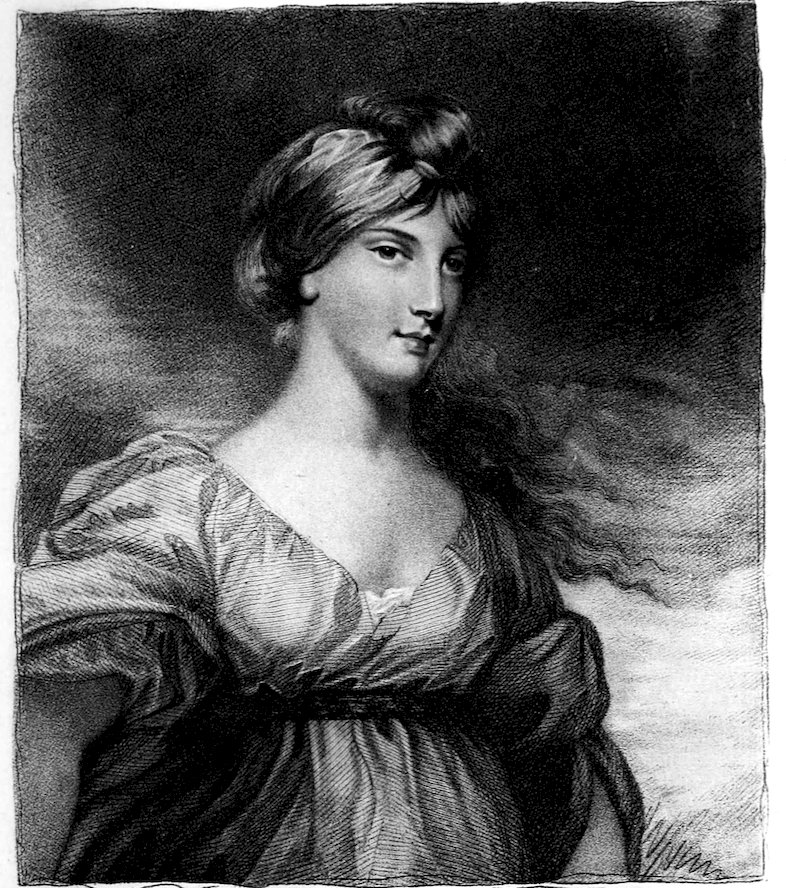
Emery Walker. ph. sc.
Lady Charlotte Campbell.
Of the brothers, Walter Frederick, owner of Islay and
Shawfield, married his own first cousin, Lady Ellinor
17Charteris, who died, leaving only one son, John Francis, the
well-beloved Ian, whose home, Niddry Lodge, near London,
was for so many years the central gathering-point, not only
for all the family, but for all sorts and conditions of men
with whom his great mind found congenial interests in all
the countries where he wandered, sketching and studying
geological and other problems. His book on the action of
Fire and Frost made a considerable mark, as did also his
Tales of the West Highlands, four volumes of old Celtic
legends collected by himself from Highlanders and Islanders,
whose hearts opened wide at the sound of their own Gaelic
tongue, a birthright which likewise proved a key to sympathy
wherever the old Celtic races still survive.
Uncle Walter married secondly Katharine, daughter of
Lady Elizabeth Cole, a sister of Lord Derby. She had one
son, Walter, and four daughters, Augusta, Eila, Violet, and
Castalia, who married respectively, Mr. Bromley-Davenport,
Sir Kenneth Mackenzie of Gairloch, Henry West, and Earl
Granville.
Alas! two bitter sorrows early overshadowed the life of
this dear aunt. First when Uncle Walter discovered that
the princely fortune, which had been deemed inexhaustible,
had, in some totally unaccountable manner, melted away in
the hands of his agents, and that when, in the terrible years
of famine caused by the potato-blight, he was supplying his
starving islanders on Islay with shiploads of grain imported
from America, it was being paid for with borrowed
money. (The islanders, of whom to-day there are only
seven thousand, then numbered twenty thousand.)
It is said that any man of business would have put the
whole matter into the hands of trustees, who could have
put all right in two or three years. But his only instinct
(in which Ian implicitly agreed) was at once to get rid of
the disgrace of being in debt to any one, and so all the properties
were at once thrown on the market. No sooner
were they sold than minerals were discovered on the estate
18of Shawfield, which would have cleared off all deficits, and
which have built up the great wealth of the Whites, as
represented by Lord Overtoun.
The terrible sorrow of leaving beloved Islay was doubtless
in a great measure responsible for the still greater loss
which shortly followed—namely, that of sight. Doubtless
there had been some constitutional weakness latent, but
inability to restrain the bitter tears that would keep on
flowing, even more in sympathy for her adored husband
than for her own great sorrow, was apparently the immediate
cause of this terrible loss, which for fifty long years
threw the shadow of darkest night over one hitherto so
joyous and so blest.
Ere long came the crowning sorrow, when her noble
husband was taken from her; but then as a pillar of
strength came the life-long devotion of her step-son, who
thenceforth made it the chief concern of his life in every
way to minister to her in her darkened lot, and to be at
once father and brother to her children—children of whose
beauty she heard on every side, but whom she was never
to see.
In all my memories none are more pathetic than those of
delightful summer afternoons in the pleasant shady garden
at Niddry Lodge, with all her own strikingly handsome
family and their husbands gathered round her, sometimes
to watch a game of chess with Lord Granville, which was
her special delight, and as she turned her large grey eyes
on one or other of us, and made some comment concerning
friends whom she had recently “seen” and how they looked,
it was difficult to realise that to her all was total darkness.
Ere she once more entered into Light, one great joy was
granted to her in the form of a true romance of the nineteenth
century. Naturally the very name of Mr. Morrison—the
purchaser of her beloved island home—was to her
abhorrent. But once again, as in the days of the Capulets
and Montagues, deepest love was born of her only hate. A
19third generation grew up, and Hugh Morrison wooed and
won the love of Lady Mary Leveson-Gower; and when he
brought sweet Mary Morrison to her ancestral home on
Islay, the joy of the Islanders at this return of the beloved
old race was unbounded.
Of my mother’s other brother John and his wife, I have
no recollection, only that they left a son, Walter, and a
bright, pretty daughter, Edith, who married Mr. Callander
of Ardkinglas, near Inveraray, and died leaving two sons.
Now I must go back to the previous generation to tell
of the mother of all these beautiful sons and daughters,
namely my grandmother, Lady Charlotte Campbell. She
lived till I was quite grown up, and even in old age she was
stately and fair to see, notwithstanding the lamentably free
use of red and white paint. Even in very advanced years
she always sat rigidly upright, and sorely disapproved of
the lounging habits of the younger generations, which she
described as “sitting on their spines”—a most undignified
position.
Latterly she was known to the world as Lady Charlotte
Bury, having unfortunately contracted a second marriage
with the Rev. Edward Bury, which was in no way conducive
to her happiness. Amongst other iniquities, he stole and
sold to a publisher her private journals, kept during the
years when she was the faithful attendant of Queen
Caroline. She never discovered the theft till they
appeared in print as the Diary of a Lady of Quality.
The book was promptly suppressed “by authority,” and
the social annoyances which ensued were painful to a
degree.
By her second marriage she had happily only one daughter,
Blanche, who married Mr. Lyon, and died childless.
In her old age, Lady Charlotte always kept a lovely
portrait of herself standing on an easel beside her, of which
the dear old lady used complacently to say, “It is the only
picture that ever did me justice!” It was just head and
20shoulders, with the strikingly picturesque head-dress which
so well became her, namely a band of black velvet above
her fair hair, and above that, fluffy lace, surmounted by a
tall pale pink or blue satin cap. I think it was by Sant,
and that it was in crayon. (One such remains in the family,
but not the one of which I speak.) Shortly before her
death it disappeared, and none of the family have ever
been able to trace it. Possibly some reader of these pages
may be able to afford a clue to its fate.
She died on Easter Day (31st March) 1861, the same
month in which my father’s sister Sophia, “Saint Cecilia,”
received her promotion to the Celestial Choir.
Lady Charlotte was a daughter of John, fifth Duke of
Argyll, who, in 1759, married Elizabeth, the lovely young
widow of the sixth Duke of Hamilton, one of the three
beautiful Miss Gunnings, whose combined loveliness set
first Dublin and then London crazy.[6]
21Maria married the Earl of Coventry, and Kitty, who,
from their portraits, must have been the loveliest of all,
preferred a quiet country life, and married Mr. Travers.
Elizabeth (or, as she was generally called, “Betty”) was
as winsome as she was fair. Curiously enough, her two
sons by each marriage succeeded to their respective fathers,
so that she had the unique distinction of having been wife
of two dukes and mother of four! Her only daughter by
the first marriage, Lady Betty, married the Earl of Derby,
and of her Campbell daughters, Lady Augusta married
General Clavering, and Lady Charlotte married “Beautiful”
Jack Campbell of Shawfield and Islay.
He was one of a family of thirteen, of whom Margaret
married the Earl of Wemyss; Glencairn (or “Aunt Glen,”
as she was called by my older sisters) married Mr. Carter;
Hamilton married Lord Belhaven (for many years they
acted the part of King and Queen at Holyrood at the
General Assembly of the Church of Scotland); Mary22married Lord Ruthven; Kate married Sir Charles Jenkinson
(their daughters Ellen, Catherine and Georgiana married
respectively the Duke de Montebello, Mr. Guinness and
Mr. Nugent); Elizabeth married Mr. Threipland, and
Harriet married Mr. Hamilton of Gilkerscleuch, whose
daughter Ellinor married Hamilton of Dalzell.
Of all these, the one who held the largest share in my
personal affection was Mary, Lady Ruthven, whose talent
for water-colour painting, for music, and her intense appreciation
of everything good and beautiful, together with her
large-hearted welcome for a wide circle of friends, made a
visit to her favourite home at old Winton Castle in East
Lothian (one of her own beautiful properties) an ever-recurring
pleasure. Some of her own best pictures were of
temples in Greece, where she had travelled much in her
early married days, about the year 1819, when such travel
was a great event.
Lord Ruthven died in his prime, but she lived to the
great age of ninety-six; and very pathetic it was to see this
aged lady every night place beneath her pillow a beautifully
painted miniature of a handsome young man, the love of her
youth. In the picturesque old churchyard at Winton is
the tall Celtic cross which she erected to his memory,
bearing for inscription these words from Dan. X. 19: “O
man, greatly beloved, peace be unto thee.”
She was the owner of large mining property, and took
the keenest interest in personally visiting the families of
her villages with creature comforts for the sick and sympathy
for all. As years advanced, she was sorely tried by
ever-increasing blindness and deafness, while her heart and
mind were active as ever, and longing for information
on the politics and literature of the day. In order in some
measure to satisfy these cravings, her butler had every
morning to read a large part of The Times in a stentorian
voice, and in the afternoon one of the footmen read lighter
literature. Hence her anxiety to be told of “good novels,
23which will not hurt John’s morals.” But she used to
complain pathetically that invariably when they reached
the most interesting point, John would close the book and
say, “I must stop now, my lady, the butler wants me to
clean the silver”—the poor man’s lungs being probably
exhausted.
But the most touching incident of the day was the
invariable assembling of the large household for family
worship, when in a deeply reverent, and perfectly modulated
voice, she would recite a chapter of the Bible, of which she
knew more than fifty chapters and a great many Psalms
by memory, and then offer prayer and praise from the
depths of her own heart. Those family prayers were very
real.
Very impressive also to me was the unfailing regularity
with which the dear old lady invariably marched off to the
parish church. If her guests excused themselves on the
score of weather, she would say to me, “My dear, we are
not made of sugar, and we are not made of salt, so we will
go.” And go we did.
I referred to the beautiful modulation of her voice in
prayer or in reciting the Scriptures, or poems. Unfortunately
as deafness increased, she lost all control of voice in
ordinary conversation, and often her newly introduced
young guests have been electrified by her deeply resonant
tones telling some one else what an excellent parti the
young man or the heiress was, and how suitable a match
he or she would be for the other!
But such little details as these were but the infirmities
of extreme old age of one who, from her birth in 1789 to
her death in 1885, lived under four sovereigns, taking a
keen interest in all political and national events, from the
days of Pitt, and the battle of Waterloo; who had been
the chosen friend of Sir Walter Scott, and frequently
his guest at Abbotsford; who was intimately acquainted
with Rogers and Thomas Moore, Wilson, Lockhart, and a
24multitude of other poets and literary men, including Byron,
and most of the leading artists of that long period.
Of my grandfather’s brothers, Robert inherited the
estates of Skipness, and Colin those of Ard Patrick.
Walter was a naval officer, father of Lady Chetwynd
and Lady Trevelyan.
Robert’s son Walter, who was quite an ideal Highlander,
wrote various capital books on Indian sport, My Indian
Diary and The Old Forest Ranger, by which name he himself
came to be generally called. His eldest daughter, Constance,
married Macneal of Ugadale, whose delightful home in the
Mull of Cantyre overlooks the most magnificent waves
and most beautiful sands and golf-links to be found in
Scotland.[7]
The two youngest sons, whom I vividly remember as
merry, sunny-haired mites, chasing the butterflies among
tall lilies and roses in the old garden, are now the Rev.
Archibald Campbell, Bishop of Glasgow, and the Rev. Alan
Campbell, Episcopal clergyman at Callander. The latter,
alas! became blind soon after his ordination, but seems to
have found that sore affliction no great hindrance to the
success of his ministerial work, so that for several years
(ably seconded by his widowed sister, Mrs. David Ricardo)
he continued his work among rough dock labourers on the
Thames, with whom his influence seemed to be enhanced by
his sore affliction.
The Campbells of Ard Patrick also represent an extensive
branch of our kinsfolk—the one who has entered most
largely into our lives being Ellinor, who married Michael
Hughes, who for many years rented Huntly Lodge, and
made it a centre of hospitality so long as they lived.
Almost all these thirteen grand-uncles and grand-aunts
married, and the majority left children, and children’s
children, to further extend the family connections.
25These were equally numerous on my father’s side, his
Grandfather, Alexander Cumming or Cumyn, having in
most romantic fashion, when semi-shipwrecked off the
coast of Cornwall, wooed and won Grace Pearce, niece and
heiress of John Penrose of Penrose, who was the last
heir male of that ancient family. On the lovely estate of
Penrose close to Helston, the young couple abode; and in
the old charter-room at Gordonstoun are preserved some
quaint letters concerning Cornish customs,[8] especially the
value of the many wrecks, which were commonly spoken
of as God’s blessings. In the same old charter-room there is
also a brief memoir of his father by the eldest son, Alexander
Penrose, in which he tells of his father’s start in life as
a midshipman on board H.M.S. Trafford, whence he was
transferred to H.M.S. Kent, and sent to the West Indies.
On the voyage he deemed himself insulted by a lieutenant,
so on arriving at Port Royal in Jamaica he called him
out, wounded and disarmed him. But as such a breach
of discipline as a middy fighting a lieutenant would have
made his life in the navy a burden, he resigned his naval
career, and enlisted as a grenadier in Harrison’s Regiment,
till he was able to buy his commission, and distinguished
himself at the storming of Boccachica.
At Jamaica, he was stricken with fever; thence the
regiment was ordered to Ostend, which was then held by
the Austrians and besieged by the French. The siege lasted
for three years!
After a brief interval at Portsmouth, the regiment was
ordered to Ireland in transports, but these were compelled
by stress of weather to seek refuge at Falmouth, where all
the regiment was disembarked and remained in cantonments
for some time till the damaged ships could be
repaired.
At a ball in Falmouth, the young heiress of Penrose
graciously signified her willingness to dance with any of
26these shipwrecked officers with the exception of “that
ugly Scotchman,” Captain Cumyn, who, however, was not
long in finding favour with the lady; and being for some
time encamped at Penrhyn, he made such good use of his
opportunities, that when the regiment again set sail for
Ireland, Captain Cumyn and his bride were happily settled
at Penrose.
In due time they were blessed with six sons and three
daughters, most of whom married county neighbours. Hence
our kinship with the Rashleighs, Veales of Trevayler, Fitz-Geralds,
and Quickes of Newton St. Cyres.
Alexander survived his wife, and died at Penrose in 1761.
That estate was subsequently sold to make provision for
the eight younger children, apparently in total ignorance of
the valuable tin mines on the estate, which are said to have
sometimes yielded more in one year than the total price
paid for the whole property.
Their eldest son, Sir Alexander Penrose Comyn, who
was born at Helston in May 1749, assumed the name of
Gordon, when, on the death of Sir William Gordon of
Gordonstoun, and in right of his ancestress, Dame Lucy
Gordon, he succeeded to that property[9] with its delightfully
quaint old house, a mile from the sea, and from the enchanting
coast of broad yellow sands stretching on either
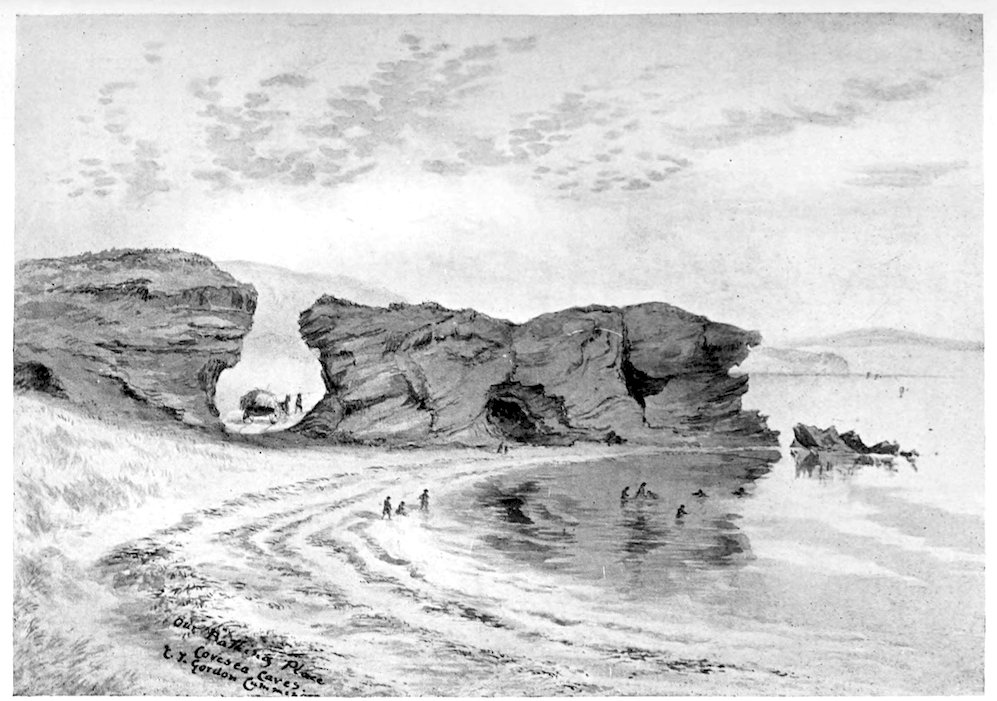
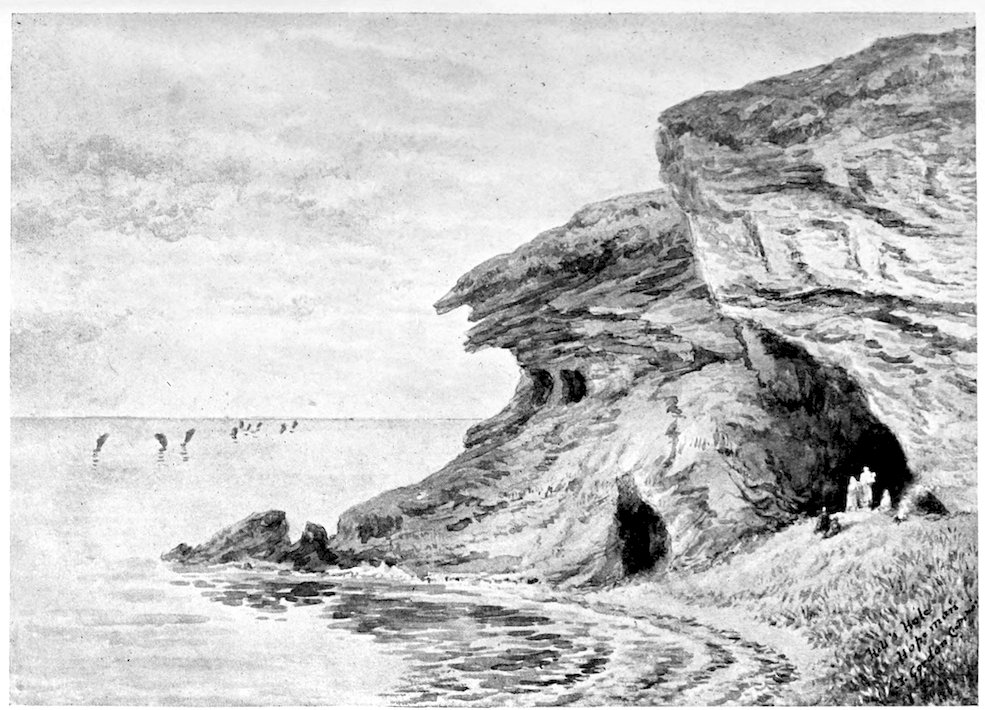
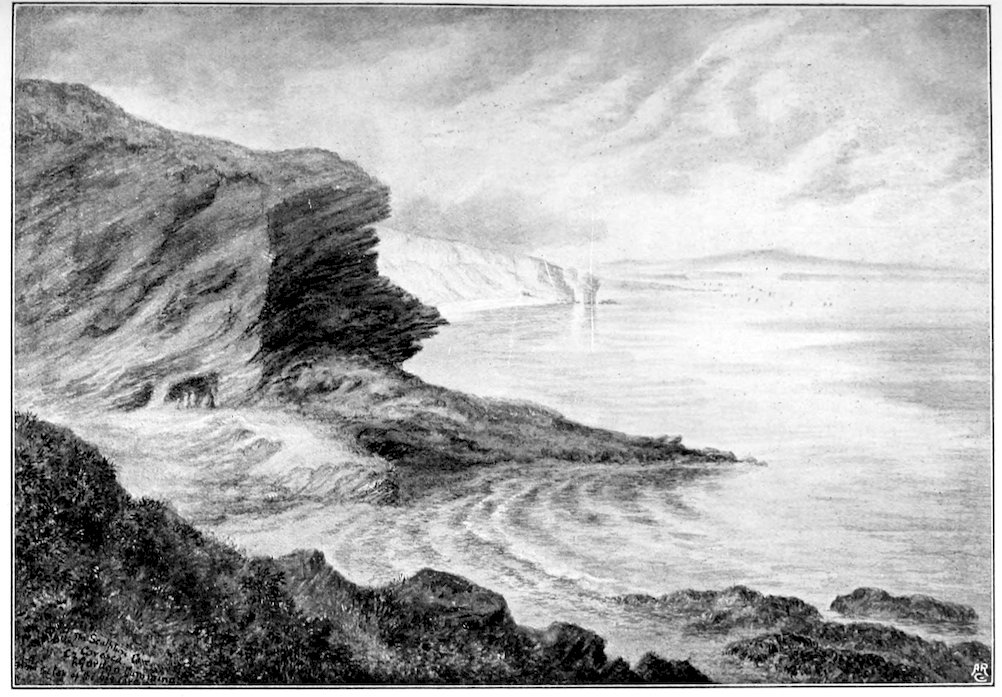
side of sandstone cliffs and large caves of very varied form,
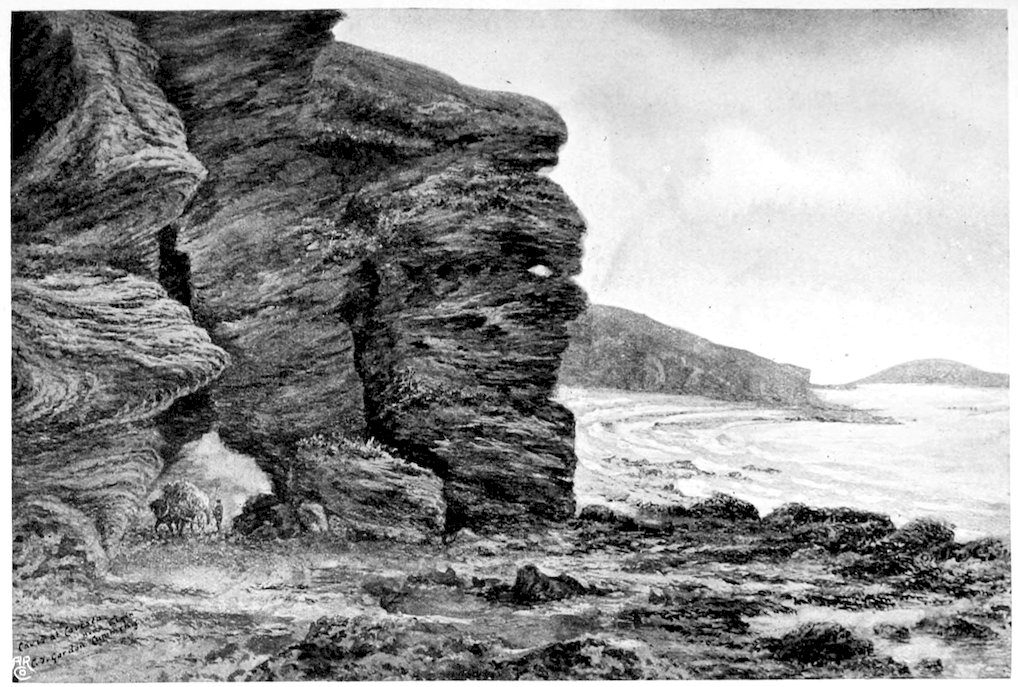
27which extend along the shore for a couple of miles, forming
at low water the most fascinating rock scenery I know of
in Britain or elsewhere, and a truly entrancing playground.
Gordonstoun is only sixteen miles from Altyre, but is
in every respect as complete a contrast as could well be
imagined: the one a simple old Scotch house, with patchwork
additions, all embowered in greenery and blossom,
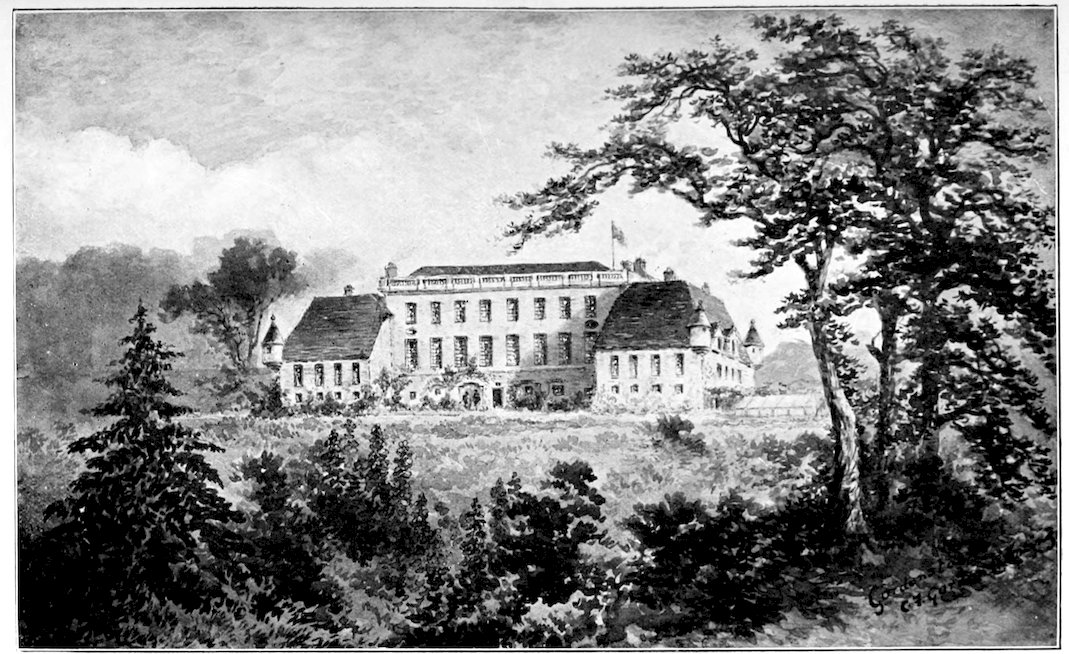
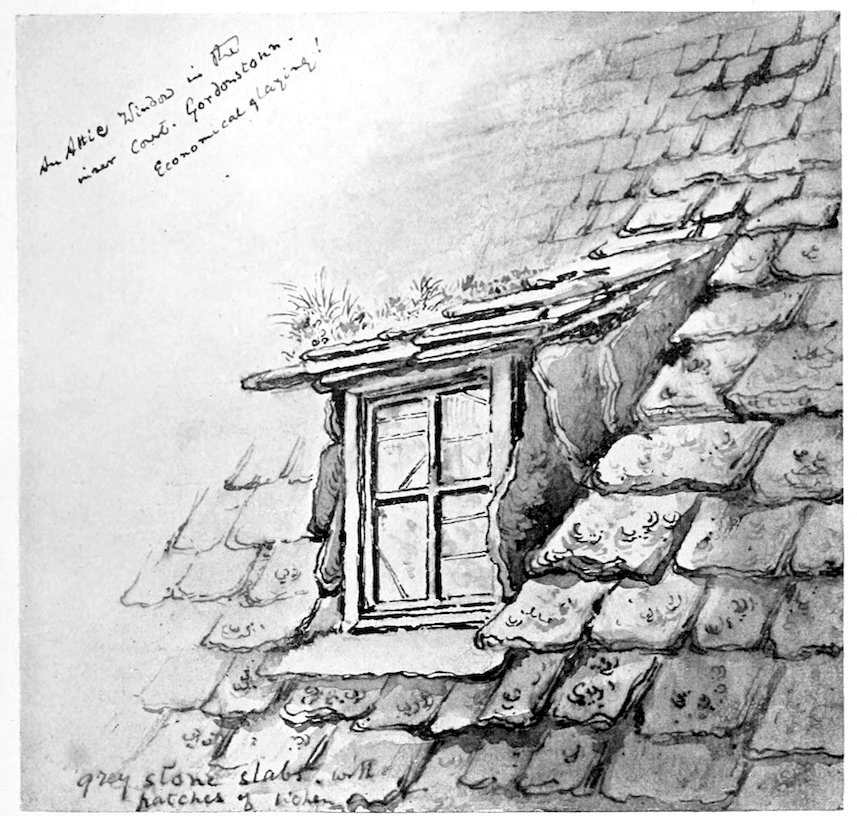
and the other a stern, uncompromising, large grey mansion,
with steep-pitched roofs, slabbed with grey and lichened
stone, and turrets at all corners. Only when inside does
the explorer discover traces of the successive generations
which have produced it—the extraordinary dungeons, the
secret stairs and quaint hiding-places in the thickness of
the walls, behind cupboards, or under floors. Surely no
children ever possessed more delightful homes!
My grandfather did not go far afield in search of a bride.
At Castle Grant, which had for at least eight hundred years
been the headquarters of the Chiefs of Clan Grant, he found
his bride Helen Grant of Grant, one of the six daughters
of Sir Ludovick Grant of Grant by Lady Margaret Ogilvie-Grant,
eldest daughter of James, Earl of Findlater and
Seafield. Sir Ludovick was a fine specimen of the true
Highland chief of the best type, and while not neglecting
the estates, he represented the County of Elgin as M.P. for
twenty years, from 1741 to 1761. He died at Castle Grant
18th March 1773.
His only son succeeded as Sir James, whose sons, Lewis
28and Francis William, successively became Earls of Findlater
and Seafield. Thus “Dame Helen”—my grandmother—was
aunt to the fifth and sixth, and grand-aunt or great-grand-aunt
to the seventh, eighth, ninth, tenth, and eleventh
earls. Was ever succession so rapid in any other family?
Of my five grand-aunts, Hope Grant married Dr. Waddilove,
Dean of Ripon, and Penuel married Henry Mackenzie,
author of The Man of Feeling, a volume very much
admired in its day. One of their sons, John Henry, was
an eminent lawyer, and was raised to the bench as Lord
Mackenzie, generally called “of Belmont” to distinguish
him from two later law lords, who each took the title of
Lord Mackenzie.
He married the Honourable Helen Anne Mackenzie of
Seaforth.
Sir Alexander and Dame Helen had fourteen children
besides MY FATHER, and Uncle Charles Cumming-Bruce.
Their Daughter Helen Penuel married Sir Archibald
Dunbar of Northfield and Duffus; the latter, which is the
family home, being only one mile from Gordonstoun, the
Dunbars have ever been our very closest kinsfolk. That
couple were blessed with ten children, one of whom married
Mackintosh of Raigmore, near Inverness, and became the
mother of some of our dearest relations.
Her eldest son Eneas, generally known in our family as
“the Beloved,” was the very incarnation of genial hospitality,
and many a joyous gathering have we all held under
his elastic roof, especially at the annual great Highland
meeting every September. Never was the fine old proverb
“Where there is heart-room
There is hearth-room,”
better illustrated, for when the utmost possibilities of
packing seemed to have been attained, there was always
some corner found for an extra guest.
He married a sister of Sir Robert Menzies of Menzies,
and thus began our life-long close intimacy with Perthshire,
29and especially with Sir Robert’s beautiful wife, née Annie
Alston Stewart, and her sisters, two of whom owned Killiecrankie
Cottage, overlooking the famous Pass. Many a
happy week have I spent in that exquisite nest, and at
Urrard on the opposite bank of the Garry.
Another of Aunt Helen Dunbar’s daughters married
Rawdon Clavering, and another, Mr. Warden.
The eldest and third sons, Sir Archibald and Edward,
lived till January 1898, when they passed away within a
few days of one another, Sir Archibald in his ninety-fifth,
and Edward in his eighty-first year.
Then we were all electrified when the newspapers informed
us that the cousin whom we had always distinguished as
“Young Archie” was actually verging on threescore years
and ten! His mother was Keith Alicia Ramsay of Barnton,
and his wife was Isabella Eyre of Welford Park. His
father married, secondly, Sophia Orred of Tranmere Hall,
in Cheshire, and in 1890 they celebrated their golden
wedding in the same year as the younger couple celebrated
their silver wedding.
Sir Archibald, senior, was always a fragile invalid, in
pathetic contrast with my stalwart brothers. But he was
wont to say, “A glass box will last as long as an iron one,
if you take care of it.” And he did take such care of his
glass box, that he outlived all save one of my brethren.
Both he and his cheery brother Edward were storehouses
of learning on all points concerning old Scotch lore, especially
on local subjects, and they were the last survivors of those
to whom we could refer any disputed questions. Edward’s
delight was in puzzling out quaint letters in the old family
charter-rooms, many of which he published in three volumes,
entitled, Social Life in Former Days and Documents Relating
to the Province of Moray.
His elder brother’s chief delight was in his gardens,
and in proving how excellent is the soil and climate of
“the Laich” or lowlands of Moray for the growth of fruit,
30especially pears, apples, plums, and small fruits. Great was
his satisfaction when some of his pears took the first prize
at Chiswick, in days when most folk south of the Tweed
still believed Scotland to be a land where a semi-civilised
race lived on oatmeal! How anxiously he watched the
ripening of the first fruits of new varieties, and then at the
exact right moment he brought the precious fruit, divided
into sections that we might each give our verdict of its
merits.
These two dear old brothers lived about twelve miles
apart, Edward’s home being at Sea Park, about a mile from
Findhorn Bay, and their great pleasure in later days was an
occasional visit of one to the other. Both retained all their
mental faculties perfect to the very end, and were only laid
aside by bodily illness for a brief period. When, on
6th January 1898, Sir Archibald passed away, Edward being
unable to attend his funeral, telegraphed to his son the
Rev. John Archibald, to come from London to take his
place. Obedient to his summons, the son reached Sea Park
on 11th January, just in time to witness his father’s death
ere attending his uncle’s funeral, returning thence to make
the necessary arrangements for that of his father.
To return to my father’s numerous sisters. Margaret
married Major Madden of Kellsgrange, in County Kilkenny,
and from her descend our Mortimer cousins. Edwina
married Mr. Miller of Glenlee, the eldest son of Lord
Glenlee, the judge, and her son succeeded to the baronetcy.
She was one of the kindest-hearted women that ever lived,
but she was sorely tried by the number of grandchildren
who accumulated around her. One of these having died, a
friend called to express polite regret, and was somewhat
startled at the truthful, though unconventional reply, “Oh!
my dear, do not condole with me. There is much more
room for it in heaven than in my house!”
Louisa married Lord Medwyn, who, like Lord Glenlee, was
what is known in Scotland as “a law lord,” the wife not
31sharing his title, but being simply Mrs. Forbes of Medwyn.
Her eldest son, William, married Miss Archer Houblon.
Their daughter Louisa married Sir James Ferguson, and
Mary married Lord Mar and Kellie.
The second son, Alexander, became the saintly and greatly
beloved Bishop of Brechin. He was greatly helped in
church-work by his sisters Helen and Elizabeth (commonly
called “Buffy”). Helen, under the name of “Zeta,” published
many lovely songs—in fact all this branch of the
family have been specially distinguished for musical talent.
Their sister Louisa Forbes married Colonel Abercromby,
eldest son of Lord Abercromby, whose delightful home,
Airthrie Castle, lies at the foot of the Ochils, between
romantic Stirling and Bridge of Allan. Her only daughter,
“Monty,” married the Earl of Glasgow.
In those days party politics ran so high as to mar many
a happy courtship, and as all the Forbes and Cumming connection
were uncompromising Tories, Louisa’s engagement to
the son of a staunch Whig family aroused much opposition.
Nevertheless love carried the day, but her mother’s parting
counsel on the wedding day was delightfully characteristic:
“Well, daughty” (i.e. dearie), “you’ll sometimes hear something
good about the Tories, and I’ll tell you what to do
then. Just go to your own room and lock the door, and
have a bit dance by yourself!”
Four of my father’s sisters who did not marry, namely
Jane, Mary, Emilia, and Sophia, lived together with their
mother, Dame Helen, in her dower-home, Forres House,
three miles from Altyre; and on her death, they rented Moy
on the other side of the river Findhorn, and were familiarly
known as “the Moy Aunts.”
The eldest of the four, Miss Jane, was considered the
cleverest, and she certainly was the managing partner, much
given to having a finger in every pie, in a fashion which did
not tend to make her popular with her younger relations.
She was noted for her ready wit, of which, however, only
32one instance now occurs to me. There had been a dispute
between several of the neighbouring proprietors concerning
certain boundaries, and they were disposed to carry the
matter to the law-courts. At last one not interested (I
think it was MacPherson Grant of Ballindalloch on the
Spey) stepped in, and decided the matter to the satisfaction
of all concerned, whereupon the disputants resolved to present
him with a thankoffering, and what could be so useful as a
silver hot-water jug for the brewing of the toddy (whisky
with boiling water and sugar), which invariably ended every
dinner, no matter how great had been the variety of wines
consumed, and of which every lady present accepted a
wine-glassful from the tumbler of the gentleman next to
her, doled out with a silver ladle.[10]
But now the question arose what would be a suitable
inscription, and here again much discussion ensued, when
happily Miss Jane entered the room, and all agreed to refer
the decision to her. Without a moment’s hesitation she
replied, “Presented to Ballindalloch to keep him in hot
water, for keeping his friends out of it,” a neat solution of
the difficulty, which was accepted with acclamation.
The handsomest sister, Emilia, was beloved by Charles
Grant, who afterwards became great in law, and assumed
the title of Lord Glenelg. But her kinsfolk refused to
sanction her marriage to a young Whig barrister, so they
were compelled to part, but each remained constant to the
memory of the other till death reunited them.
Sophia, a fair-haired, gentle little soul, was an exquisite
musician, and was accounted a sort of Saint Cecilia. There
was a charmingly mellow old organ in the dining-room at
Altyre, on which she was wont to play divinely. My
brother Henry likewise delighted in it. After my father’s
death, it was transferred to the Bishop of Brechin’s Church
at Dundee.
In common with all the family, all these sisters were
33great pillars of the Episcopal Church in Forres, that singularly
inconvenient cruciform chapel which was built in
1841. (Prior to that date there seems to have been no
Episcopal service in the town since 1745.) Many of the
congregation drove very long distances every Sunday; and
it must have been bad weather indeed when the Cumming-Bruces
from Dunphail were missing, though they had to
drive eight miles, and others came from still further.
For some time there was no parsonage, and the first
incumbent, the Rev. Alexander Ewing, afterwards Bishop
of Argyll and the Isles, lived at lovely Logie on the
Findhorn, the property of our cousins, the Cummings of
Logie. He was a charming personality, and continued
one of our dearest friends till the day of his death.
His first wife was a daughter of General Stewart of
Pittyvaich, in the valley of Mortlach, in Banffshire. Her
sister Elizabeth married my brother Henry, and Clifford
married Canon Robinson of Norwich Cathedral, who is also
Master of St. Catherine’s at Cambridge. She was one of
the best-loved women in either city, and one of Dean
Goulburn’s most pathetic utterances was his address in
Norwich Cathedral on the occasion of her funeral. To the
grand teacher, whose motto was “Detest affectation” (how
often I think of him when I see women raise their elbow at
a right angle when they shake hands!), her perfectly natural,
genuine sweetness and cordiality to every one especially
appealed.[11]
Mr. Ewing was succeeded at Forres by the Rev. Hugh
Willoughby Jermyn, who was afterwards Bishop of Colombo
in Ceylon, and when driven back to the home-land in
shattered health, was appointed to succeed my cousin,
Alexander Forbes, in the Bishopric of Brechin, and elected
Primus of the Episcopal Church in Scotland.
CHAPTER II The Altyre Gardens—Home Interests—Our Mother’s Death—Early Influences—The Moray Floods. — Note.
34
“In the silence of my chamber,
When the night is still and deep,
And the drowsy heave of ocean
Mutters in its charmèd sleep,
Oft I hear the angel voices
That have thrilled me long ago:
Voices of my lost companions
Rise around me soft and low.
“Oh, the garden I remember,
In the gay and sunny spring,
When our laughter made the thickets
And the arching alleys ring!
· · · · ·
Oh! the radiant light that girdled
Field and forest, land and sea,
When we all were young together
And the earth was new to me.”
(From “The Buried Flower” in Lays of the Scottish Cavaliers by Professor Aytoun.)
On my birth (26th May 1837), within six hours of that
interesting event, I was sent to Moy to the care of my
father’s four unmarried sisters (generally known as “the
Moy Aunts”), because scarlet fever reigned at Altyre; my
brother Walter Frederick and my sister Constance had
just died of it, and Eleanora lay in imminent danger, so a
carriage was in readiness to take away the precious baby
and her wet-nurse as quickly as possible. Thus my travels
began early, though thirty years were to elapse ere opportunity
offered for going further afield than Great Britain.
It was to the death of this brother and sister that I owe
my name, Constance Frederica; but though my mother
wished to keep both names, she shrank from using either,
and so took the sound of the end of the second name, and
called me Eka, the only name by which I have ever been
known in my own family. It was not till school days that
the more dignified Constance came into use.
My memories of the next five years are necessarily very
35limited. I recollect my mother’s glorious masses of hair
falling in clustering ringlets far below her waist. I remember
her lovely songs and her joy in the great beautiful gardens
of her own creation, and those stands of “dusty millers”—large
very varied auriculas—which were the gardener’s special
pride, and above all, the greenhouse on one side of the
house, which was the very first greenhouse in Morayshire.
Among its delights was a fragrant mimosa-tree covered with
sweet yellow blossom, and a large white jessamine with
shining leaves, clustering round upper windows, which,
looking into the greenhouse, had the full benefit of all its
sweetness.
How she joyed in every new variety of favourite flowers,
the splendid fuchsias, the large blue aquilegia (Brodie
Columbine), and the bright blue salvias, whose store of
honey too often proved as irresistible to her naughty child
as to her friends, the bumble bees—a friendship shared
with the fat, ugly toads which the gardeners cherished.
To my mother the staff of under-gardeners were not
merely “hands.” She took the keenest interest in providing
them with all the best books on botany and horticulture,
and many successful gardeners scattered over the world
owed their start in life to her encouragement. A conspicuous
example was that of Jamie Sinclair, who, during the Crimean
War from 1854 to 1856, was found in charge of Prince
Worenzow’s beautiful gardens, and who rejoiced to tell the
British officers of his start from the Altyre gardens.
I find an interesting reference to him, and to my mother’s
care for her employés, in a paper in The Cottage Gardener
(dated about 1856), by Mr. D. Beaton, head gardener to
Sir W. Middleton at Shrubland Park. He tells how he
himself had his earliest training in the gardens at Beaufort
Castle, whence he passed to Altyre. “The collection of
plants there,” he says, “was immense, and I was at the head
of them in less than a twelvemonth. I had access to all the
books and periodicals on gardening.
36“Here I first began crossing, budding plants, and bulbs,
three favourite pursuits with Lady Gordon-Cumming, who
after many years sent seeds of her crossed rhododendrons to
Shrubland Park at my instance.”
I have a letter to my mother from her second daughter,
Ida, telling as a great secret of her hopes and persevering
efforts to obtain a blue geranium by crossing the wild crane’s
bill with a very pure white pelargonium. The result, however,
is not recorded.
Mr. Beaton goes on to say: “The great African lionhunter,
Sir William’s second son, was then learning his
lessons in books and horsemanship; he was the handsomest
boy in all Scotland, and so fond of fun and dancing, that we
could have a ball and supper any night in the year, through
his influence with ‘Mamma.’ Jamie Sinclair, the garden-boy,
was a natural genius, and played the violin. Lady
Gordon-Cumming had this boy educated by the family
tutor, and sent him to London, where he became well
known for his skill in drawing and colouring.
“Mr. Knight, of the Exotic Nursery, for whom he used
to draw orchids and new plants, sent him to the Crimea to
Prince Worenzow, where he practised for thirteen years.
He laid out those beautiful gardens which the Allies so
much admired; had the care of a thousand acres of vineyards
belonging to the Prince; was well known to the Czar,
who often consulted him about improvements, and who gave
him a ‘medal of merit’ and a diploma, or kind of passport,
by which he was free to pass from one end of the Empire
to the other, and also through Austria and Prussia. He
was the only foreigner who was ever allowed to see all that
was done in and out of Sebastopol and over all the Crimea.”
Throughout her brief, bright life, my mother’s influence was
always exerted for good, as beseemed one who was a reverent
student of the Holy Scriptures. She and most of her sisters
were keenly interested in the subject of prophecy, and
eagerly studied every new book that appeared thereon.
37Both she and my father were careful to train their children
in reverent love for the “Holy Book,” and in the practice
of learning by heart at least one verse every day. I think
the very first which I thus learnt was the Psalm from
which, at the beginning of these “Memories,” I have quoted
a verse in the past tense, which sixty-five years ago she
taught me in the future tense.
When her favourite son, Roualeyn, on his deathbed, surprised
us all by his knowledge of the Holy Scriptures, he
told us that through all his stormy life he had never been
parted from the Old Book given him by his mother, so that
his mind was like a well-built fire, ready to respond to the
Divine spark, which at last kindled it so effectually.
Natural as was the worship with which her sons regarded
their beautiful mother, it was doubtless accentuated by her
keen personal interest in all their pursuits; and amongst
minor details, I can remember the skill with which her firm,
capable hands tied those beautiful salmon and trout flies
which beguiled so many bonnie fish—an art in which her
sons became equally adept; and no more acceptable gift
could reach them from far countries than gay feathers with
which to try new experiments.
Perhaps some fishermen may like to know a little secret
confided to me by my brother Roualeyn, which was, that
when the fish were sulky, refusing his best flies (N.B.Fish
invariably means salmon) he would let them rest a while.
Then, tying a bit of tackle off a common rook’s feather on to
a common bait-hook, he would let it float down stream, and
almost invariably captured some inquisitive fish which came
up to look at it.
To me, to whom sewing in any form is as hateful as
having to do the simplest sum in arithmetic, it seems somewhat
remarkable that, notwithstanding the very varied
occupations of my mother and elder sisters, they all excelled
in needlework, both useful and ornamental. They would
gather a handful of graceful flowers, and then and there,
38with coloured silks, reproduce them on red cloth stretched
on an embroidery frame. Some of these are still in the
possession of daughters or grand-daughters, and are so fine
that each would seem as though it must have taken months
of toil.
All my mother’s daughters were endowed with much of
her own artistic talent, and delighted in painting both in
oil and water-colour, fired thereto by frequent visits from
such artists as Sir Edwin Landseer, Sir William Ross,
Saunders, Giles, and others.
Among the early details which most impressed themselves
on the memory of the “Baby” of the home was the
wonderful “Birthday Chair,” which on the 26th of May was
always prepared for her use at all meals. Early in the
morning the elder sisters went out and presently returned
laden with boughs of delicious lilac and graceful golden
laburnum. Tall willow-wands, tied to a high wooden armchair,
formed the light framework to which were fastened
this wealth of fragrant spring blossoms—a lovely bower
wherein the happy child sat in truly regal state.
This pretty custom was kept up till my ninth birthday,
and the lilacs never failed us. Nowadays I doubt whether
a solitary spray would be found in blossom in the North,
just as in those days all the girls reserved their daintiest
muslins to wear at the Inverness Games in September.
Now wisdom and comfort alike demand warm tweeds. And
as to the delicious ripe peaches which we used to gather
on the open wall, the modern gardeners hear of them with
polite incredulity. Are we returning to a glacial epoch?
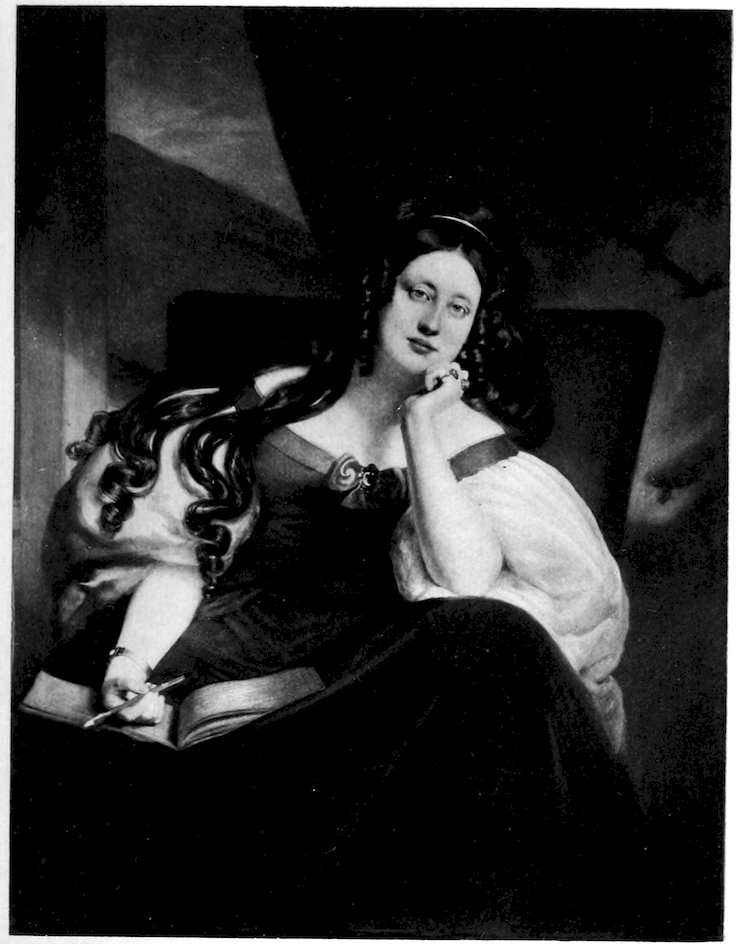
Emery Walker, ph. sc.
Eliza Maria, Lady Gordon-Cumming of Altyre.
Painted by Saunders about 1830.
Among my vivid memories of about 1840 were certain
evenings when my mother returned from distant expeditions
escorted by several gentlemen, whom I now know to have
been Sir Roderick Murchison, Hugh Miller, Agasis, and
other eminent geologists, who at that time were deeply
interested in the newly discovered fossil fish in the Old Red
Sandstone in Ross-shire, on the other side of the Moray
39Firth. Similar fossils had just been found in the Lethen-bar
Lime Quarries, on the other side of the Findhorn.[12] These
were a source of keen interest to my mother, and it was to
search for more that the geologists were invited to Altyre.
Evening after evening there was great excitement in
carefully lifting from a dogcart the spoils of the day,
namely grey nodules which, when gently tapped with a
hammer, split in two, revealing the two perfect sides of
strange fossil fishes, with the very colour of the scales still
vivid. Day by day my elder sisters patiently made
minutely accurate water-colour studies of these, and the
best specimens were sent to the British Museum, where
they still remain, and where certain fishes hitherto unknown,
were called after my mother.
The poorer specimens were deposited in rows under the
verandah, and there remained as familiar objects of our
early days.
On other evenings there was the home-bringing of various
game, furred and feathered, or of bonnie speckled trout
from the Altyre burn, the Loch of Blairs, or Loch Romach
(the latter a curious, long, narrow loch in a ravine between
densely wooded hills); but the special excitement lay in
the silvery salmon caught in the Findhorn by my father,
mother, and brothers, all of whom were skilful fishers.
The keepers loved to tell of one day when my mother
caught, played, and landed eight fine fish to her own rod.
Those who know the rocky bed of the beautiful river,
hemmed in by steep banks, can appreciate the difficulty of
such fishing-ground for a lady, especially one of goodly proportions.
In those days it was very exceptional for ladies
to venture on salmon fishing.
On one occasion she had a very narrow escape of being
washed away by one of those tremendously rapid spates
which now and then occur after very heavy rainfall in the
upper districts, when the river, without any notice, comes
40down in a gigantic flood-wave. She was standing in midstream,
quietly fishing, when suddenly a thunderous roar of
waters, effectually drowning the ordinary sound of the
rushing, swirling river, warned her of something unusual.
She leapt from rock to rock, back to the bank, and had
scarcely time to scramble up the steep footpath ere a
seething torrent, more than eight feet in depth, was dashing
over the spot where she had been standing.
Most delightful of all to the little, fair-haired child with
the long, yellow ringlets was the joy of delightful drives,
sitting “bodkin” between the indulgent parents who so
patiently endured the bumping up and down of the odious
brat who tried to keep time with the postillion.
At that time postillions were the fashion, and the extra
men to be entertained when the house was full of company
(and Altyre always was full) must have been considerable—and
visits were wont to be indefinitely prolonged. When
Colonel (afterwards sixth Earl of Seafield) and Mrs. Grant
of Grant used to come down from Castle Grant they always
had four horses and two postillions, two outriders, valet,
and lady’s-maid. So that entertaining one couple meant
also five men, a maid, and six horses.
Every year there was a season of sore bereavement for us
children, when our parents and older sisters started on the
long drive of six hundred miles from Altyre to London for
the season, posting all the way. Occasionally their journey
was continued to Paris, and several large excellent copies
at Gordonstoun of pictures in the Louvre tell of the special
permission to paint there, granted to them by personal
favour of Louis Philippe, in days when such permits were
not easily obtained.
Among my treasured relics are several letters to me from
my mother, written during her last absence, when I was
just four years old. With these precious letters there are
several locks of exquisitely fine yellow hair, like spun glass,
each folded in the gilt-edged paper, which was then the
41correct note-paper. They are marked in my mother’s
writing as being my own hair at three weeks old, and the
idolised brother and sister who died when I was born.
One lustrous lock is marked by my father as that of his
beautiful boy “Roualeyn,” “Robh Ailean,” two Gaelic
words of which, curiously enough, no one can tell us the
connected meaning. Robh would be pronounced row, like
“to row a boat,” and “ailean” means white. It is possible
that my mother took the name from Rowallan Castle, three
miles from Kilmarnock, which was built about 1270, in the
reign of King Alexander III. of Scotland, by the son-in-law
of Sir Walter Comyn of Rowallane. But that would not
account for my father spelling his son’s name as above. It
is a grand name, but its owner was generally known in the
family as Zoe.
By the time of my birth he was a beautiful lad, captivating
all hearts, and worshipped by the people, in whose eyes
he could do no wrong. I am not sure, however, that his
tutors always shared this view of the case. One in particular
was a young theological student, so exceedingly minute
that when he stepped down from the gig which had been
sent to meet him, and my father perceived the infinitesimal
mortal who had come to take charge of his stalwart sons,
he could not resist the joke, but catching him up in his
arms, carried him to the room where my mother and other
ladies were sitting, and set him down exclaiming, “Eliza,
here’s the new dominie!!”
It was scarcely surprising that on the first occasion that
the little man ventured to suggest reporting some of
Roualeyn’s misdemeanours, his pupil took him by the scruff
of the neck and led him to his mother, saying, “Mamma,
Mr. M‘Watt wishes to make a complaint about me, so I
have brought him here that he may do so.” It would have
been hard indeed for any adoring mother to assume the
correct severity, and certainly Roualeyn rarely had long to
wait for absolution, and leave to forsake the uncongenial
42lesson-books, and be off to the river or the woods, leaving the
little “dominie” the more leisure to pursue his own theological
studies.
It is pleasant to add that in after years not only were
these reminiscences dear to the little dominie himself, but
also that his stalwart pupil held him in very affectionate
remembrance, and it was for him he sent to come and visit
him when, thirty years later, he lay on his deathbed in old
Fort Augustus.
But in those days sport was the one thought of all my
brothers; and I can just remember the tremendous excitement
of stamping out circular wads of pasteboard and other
preparations for the 12th of August, and at other times that
of melting lead in the kitchen to make bullets in moulds for
the roe which were then abundant in the woods. These
were the early stages of that love of sport which subsequently
led to Roualeyn being known as the Mighty Lion Hunter
of South Africa,[13] and to those years of adventure,
hitherto unparalleled, resulting in acquiring that marvellous
collection of trophies of his own gun which were exhibited
in London in 1851. This, be it remembered, was in days
when breech-loaders were unknown, and sportsmen (TRUE
SPORTSMEN, as all my brothers were) were largely dependent
on their own rapidity in muzzle-loading.
My brother William has recorded some of his most
thrilling experiences in tiger-hunting and training wild
Bheel tribes.[14] But my brothers John and Frank, though
quite as skilful and successful in the chase, have left no
record of their prowess, save in the memory of wild tribes
who never forget such bold, brave leaders.
I spoke just now of those few precious letters from my
mother which I so justly treasure. I think I may quote a
43few sentences from the very last she ever wrote to her little
daughter.
“The Clarendon Hotel,
London, May 1841.
“My own sweet little dear Eeka,—How sorry, sorry Mamma is to
hear that her darling little girl has been ill. God bless you, my own
sweet Pigeon, God bless and preserve you from all harm. Do not forget,
my pretty Babe, to say your little prayer to God, Who loves you, and ask
good Mr. Gregory to teach you a line or two of pretty hymns every day,
to please poor old Papa and Mamma when they come back. I sometimes
see very pretty little girls here, but none that I think half so nice and
dear as my own little Eeka and Nell and Alice, when they are good.
Write a little letter to Mother, my darling, Henry will help you, and
tell me what brother Zoe is about, and if he teaches you funny songs.
I wish you could send me one of the lovely nosegays that you gather
every day in the sweet garden. I think all the beautiful purple
rhododendrons must be coming out now. You must send Mamma one
little flowerie of them in a letter, and kiss it just before you shut it up,
and the flower will bring the kiss to Mamma. I hope you are very
good and obedient to dear Chérie. Give her my kind love.
Your dear papa is quite well, and sends you many kisses. Blessings
on my sweet little one. Your own loving mother,
E. M. Gordon-Cumming.”
Alas! ere another May came round, this beautiful and
gracious mother had passed away from earth, leaving her
home desolate indeed.
On the 28th March another little brother was born—her
thirteenth living child. Some time previously she had
been severely injured in stopping a bolting horse in a
gig wherein sat a terrified woman. That injury caused
her intense suffering, and less than a month after the
birth of her beautiful baby she died, in her forty-fourth
year.
Never can I forget that lovely morning, 21st April 1842,
when I was on the lawn in the sunshine with Chérie (i.e.
Julie Périllard, my Swiss bonne). I vividly remember that
she was dressed in white, on account of the heat. I was
gathering blue, pink, and white hepaticas for the dear
mother whose strangely laboured breathing we heard so
44distinctly through the open window.[15] Presently we were
summoned to her room, where nearly all the family were
assembled, and I was lifted up in loving arms to look for
the last time on the dear face. A few minutes later
that bright and blessed spirit had returned to God Who
gave it.[16]
On the 25th all that was mortal was taken away from us.
From far and near crowds assembled, not only “county
neighbours,” but the poorest of the poor who could scarcely
crawl came from distant bothies far in the moorlands,
weeping bitterly for their own loss in the going away of the
ever sympathetic friend and generous physician, who in her
busy life always found time herself to visit the sick and
suffering, her pony and her gillie laden with warm clothing,
simple remedies, and abundant good food and wine,
which cheered and “heartened” the ofttimes lonely and
dejected one. No wonder that she was worshipped and
enshrined in the hearts of the poor.
A simple service was held at the house by Dr. Mackay
of Rafford, the parish minister, and then from an upper
window over the porch we watched the solemn, sad procession
start on the long sixteen miles to Gordonstoun,
near to which, within the park, lies the pretty old
Gothic kirk, St. Michael’s Chapel,[17] where our dead are
45laid to await the Resurrection morning—a precious storehouse,
wherein and around which rest many of our very
nearest and dearest. There the Rev. Alexander Ewing met
the procession, and pronounced the last solemn words.
And so the awful shadow of death fell on that home,
hitherto irradiated by the presence of one gracious
woman.
In the desolation of his grief, my father sought some consolation
in the companionship of his little daughter, not yet
five years old. Being always a very early riser, and knowing
how readily children, like birds, wake with the sun, he
took me to sleep in his room, so that in the early dawn he
might, without disturbing servants (especially the old nurse
who had reared us all), take me out to stroll through fields
and woods, by stream and loch. No one ever more deeply
loved the song of birds, and the beauty of changing seasons,
and especially the infinitely varied lights of “the outgoings
of the morning and evening,” and as all their beauties sank
into his soul, he would ofttimes murmur, “It is a fair
Creation,” “All Thy works praise Thee, O Lord.”
You see he lived before the days of “scorching” bicycling
and motor cars, and perpetual rush, hurry, and scurry,
when men and women walked on their own feet, and still
had time and inclination to drink in the poetry and all the
sweet influences of Nature, as can only be done in stillness
and at leisure. Only to such wooers does she reveal her
treasures of delight.
Specially attractive to the little child was a small birchwood,
which in spring was carpeted with white anemones,
and in which lay a cool spring of purest water. Then a
folded leather cup was produced from the father’s waistcoat
pocket, and they drank together from the fairy fountain.
At other times they met the dairymaid returning
from her morning milking, with her heavy pails hanging
from a yoke across her shoulders, and gladly she halted to
give “her little calfie” a drink from the lid of her pail.
46One thing never absent from my father’s pocket was a
lump of the common indigo, which then was always used in
laundries, and which was very efficacious in counteracting
the pain of wasps’ stings, from which his woodmen suffered
very frequently, the woods being infested by the wasp,
which builds its curiously-constructed nest like layers of
grey paper, forming a ball, ranging from the size of a small
plum to that of an average football. These hang from the
branch of some shrub or tree, and an incautious shake brings
out an angry horde. One of the minor joys of my brethren
used to be the nocturnal smoking of these “wasps’ bykes,”
and I think that this systematic destruction has reduced
their numbers.
I also think there are now fewer of the very high anthills,
which used to be so numerous in the fir-woods among
the dry needles which covered the ground, and which we
were sometimes unkind enough to disturb cautiously, in
order to see the amazing activity of the ant-colonies.
Sir William always had a kind, cheery word for every one
he met, and all the people loved him. If he came suddenly
on a group of old women from the town, who had ventured
too far into his woods in search of firewood, they knew very
well that the laird would be quite ready himself to give
them a helping hand in shouldering their heavy burdens—even
if they chanced to be adorned with sprays of
his recently planted rhododendrons. When unsympathetic
persons occasionally expressed surprise at his refusing to
put up notices to warn off trespassers, he replied that the
only notice to which he could consent would be one requesting
the public to preserve what was thus given for
public enjoyment.
I remember the dismay of a large party of young folk
who had wandered up one Sunday afternoon through the
pleasant woods till they came to a large outlying fruitgarden,
more than half a mile from the house, and found
the splendid crop of ripe gooseberries irresistible, when
47suddenly the laird himself appeared. Naturally they
were about to run off in great confusion, when they were
arrested by his kind voice, telling them to stay and enjoy
themselves; “only,” he added, “be sure you don’t tell the
people in Forres how good they are!”
Between that garden and the sweet Altyre burn there
stood (and happily still stand) some of the finest old trees
on the estate, and beneath these, all round a little pond,
snowdrops and daffodils had been planted so lavishly that
in early spring the ground was first white and then gold,
delightful to see and to gather; and a little further down
the burnside they grew in rank profusion all around the
ivy-covered ruins of an old kirk and quiet kirkyard.
How strangely some small things take root in our
memories, when greater are forgotten. One of the things
which my father impressed on me by word and example was
always to kick aside any loose stone on the road which
might possibly cause a horse to stumble. To this day I
never see such a stone anywhere, without a well-nigh
irresistible instinct to obey the instructions given more
than threescore years ago. And the teaching holds good
in regard to other fellow-creatures as well as horses.
Yet one more detail concerning those early days, which
almost seems as if it might have influenced my later years,
namely, that in my father’s dressing-room were stored the
large illustrated editions of Captain Cook’s Voyages in the
South Sea Isles and various other books of travel.
The pictures in these could not fail to interest any one;
but they were fascinating indeed in comparison with the
wretched woodcuts which alone illustrated books specially
intended for children. Nevertheless we loved those ugly,
and often very prosy books, and read and re-read them,
as no modern child ever seems to do the beautiful books
so profusely lavished on it.
A good story does not lose by repetition, and many
a happy hour we children spent with our quaint old
48Northumbrian nurse, when (having carefully suspended
several fine large apples from a row of nails in her wooden
mantelpiece, and placed a plate beneath each to catch the
drip, mingled with cinders), we settled down (with one eye
on the apples) to thoroughly enjoy one of her somewhat
limited stock of stories. Certainly at least once a week
the petition was, “Please, Nan, tell us the story about the
Fatted Calf.” Such was our rendering of the return of
the Prodigal Son.
Old Nan, who even then appeared to us quite antediluvian
(with a face like a very wizened apple, and a huge
lace cap with large bows of ribbon), lived to receive a home
in my brother Henry’s family, and was eventually buried
beside the old parish church of Mortlach. And Chérie, the
Swiss bonne, who had been with my mother before her
marriage, lived with my eldest sister and her children, till
she likewise was laid to rest beside the ancient church of
Bewick in Northumberland.
She was endowed with a very hasty temper, and her
short method of dealing with youth was simple and rapid.
About the third mistake, came the invariable thump in the
small of the back, which sent us gasping to the other side
of the room, where we were occasionally overtaken by a
substantial brown Bible—a handy missile, and effectual
when hurled by a strong Swiss arm. It was an external
application of spiritual truth with which we would gladly
have dispensed; nevertheless the fine old lady held her
ground with her pupils, and I believe we honestly preferred
her hot temper to the sugar and water of some of her
English colleagues, and with the curious loyalty of children,
it never occurred to us to report to our parents how many
thumps we received. But my eldest sister, remembering
her peculiarities, kept them well in check when under her
control, so that her children of the third generation were
reared on a strictly protected system.
The Biblical knowledge which we acquired from our
49varied teachers was apt occasionally to blend with more
recent events, especially details relating to the Flood, inasmuch
as all manner of events were dated as having
happened before or after the Flood, C’était avant le Déluge.
The catastrophe referred to was locally known as “the
Moray Floods,” which occurred in 1829, just eight years
before my birth. After a summer of exceeding heat and
prolonged drought, an unprecedented deluge of rain commenced
on August 2nd and continued without intermission
for two days, accompanied by a hurricane from the north-east.
All the rivers and every streamlet were quickly
transformed to raging torrents—the Dee, the Spey, the
Lossie, the Nairn, Findhorn, Dorbach, Devie, and (what
chiefly affected my home), the usually half-dry Altyre burn.
The Findhorn, pent in between steep crags, actually at
one point rose fifty feet above the usual level, and at its
junction with the Devie fully forty feet—a brief inscription
on the rock above one of the lovely paths marks the
flood line.
A very graphic description of the whole scene was written
by our neighbour, Sir Thomas Dick Lauder, who, having
married Miss Cumming, the owner of lovely Relugas, just
above the said meeting of the waters, had a full view of the
spate, and records the deafening roar of the flood, rolling
huge boulders over the rocky bed of the river, and the
crashing of trees and shrieking of the wind.
Throughout the district scarcely a bridge was left standing
except the single arch stone bridges, founded on rock and
high above the streams. One at Fochabers, which only
twenty-five years previously had cost £14,000, was swept
away by the raging Spey. That across the Findhorn near
Forres, and the Lossie Bridge at Bishopmill, shared the same
fate. My uncle’s newly-built house of Dunphail escaped
almost miraculously, the high bank on which it stands
having been undermined, so that it fell within three feet of
the east tower. It cost £5000 to repair the damage on that
50estate. Lord Cawdor’s loss was upwards of £8000; the
Duke of Gordon’s was over £16,000.
As to the farmers and poorer people, many were absolutely
ruined, for, of course, where the waters had room for expansion,
they overspread the whole low country, and around
Forres formed a lake covering fully twenty square miles,
carrying houses, timber, crops, even the very soil, out to sea,
and leaving pitiful ruin and desolation in every direction—all
gardens and fine arable land being covered with gravel
and boulders.
Near Elgin, the river Lossie broke all bounds, and
resuming its ancient channel through the Loch of Spynie,
swept away the sluices and bulwarks, which had been
created at great cost to separate it from the sea, which consequently
once again submerged the valuable reclaimed
land, converting it into a salt marsh.
A “Flood Fund” was raised to give immediate relief to
upwards of three thousand of those who were left most
destitute, but in most cases the suffering and loss were
irreparable. Some poor folk were rescued after they had
clung for many hours to the rafters of their ruined cottages.
One young woman was sitting up to her neck in water,
holding in her arms the dead body of her old aunt. Various
other people were drowned. So the Moray Floods hold a
very distinct place in the annals of the province, and figured
largely in the nursery talk of my own early days, especially
such details as the flooding of the lawn at Altyre, and how
my brothers had caught trout from the windows.
Although some of our relations on each side of the family
have attained to threescore years and ten, very few have
gone much beyond that term. A few have attained to fourscore
years, and my uncle, Charles Cumming-Bruce, born in
1790, lived to the ripe age of eighty-four; but they were
51exceptional. The excellent machines entrusted to our care
have generally been worked at high pressure, and consequently
have worn out before their time. Certainly our
race as a whole has not proved long-lived, and sometimes
I marvel how so great a mark has been made in so brief a
period.
Thus my beautiful mother was not forty-four when she
died.
My sister, Seymour Baker-Cresswell, died at forty.
Ida (Adelaide Eliza Baker-Cresswell), died at forty-five.
Alice Jenkinson was but thirty-two.
Eleanora Grant lived to be fifty-nine and a half.
My half-sister, Jane Eliza, was fifty-two.
My sister, Constance, about twelve.
My brother, Walter, about five.
My father lived to be sixty-seven.
His eldest son, Alexander Penrose, died at fifty.
Roualeyn was only forty-six.
Henry lived to be sixty-five.
John died in Ceylon, aged thirty-nine.
Others died in their prime from accidental causes. My
brother-in-law, Oswin Baker-Cresswell, who seemed to be
as mighty in strength as in stature, passed away, after three
days’ illness, at thirty-six, and his eldest son at forty-one.
My other brother-in-law, William Baker-Cresswell, passed
away in his early prime, aged about twenty-nine.
CHAPTER III The Altyre Woods—Banks of the Findhorn—Culbyn Sandhills—Covesea Caves.
52
“They grew in beauty side by side,
They filled one home with glee,
Their graves are severed, far and wide
By mount, and stream and sea.
· · · · ·
“And parted thus they lie, who played
Beneath the same green tree;
Whose voices mingled as they prayed
Around one parent knee.
They that with smiles lit up the hall
And cheered with song the hearth,
Alas! for love, if thou wert all
And naught beyond, O Earth!”—Mrs. Hemans.
I must now recall some of the leading characteristics of the
beautiful surroundings of those early homes in which my
father’s flourishing family of sixteen (fourteen of whom
lived to man’s estate) rejoiced in their glad young lives—now
all an idyll of the past.
Probably the most striking features of Altyre and the
neighbouring estates are the great woods and fields dotted
over with fine old trees, extending in every direction.
Nowhere are the fruits of Sir Walter Scott’s wise counsel,
“Aye be stickin’ in a tree,” better exemplified than in
Morayshire, where in the last two centuries the principal
proprietors have done their utmost to reclothe the land,
once so densely covered with primeval forest, but which
was so ruthlessly cut for firewood and for building purposes,
without a thought of replanting, that by the end of the
sixteenth century the country was all bare.
C. F. Gordon Cumming.
ALTYRE PRIOR TO 1854.
So we are chiefly indebted for the lovely Morayshire
woods of the present day to such men as the sixth Earl of
53Findlater, who planted 8000 acres in Banff and Moray with
larch, Scotch fir, and ornamental trees; while Francis, Earl
of Moray, who succeeded in 1767 to the family estates of
Darnaway, Doune, and Donibristle, is said to have thereon
planted in the two following years thirteen million trees, of
which 1,500,000 were oaks. The Earls of Seafield and of
Fife carried on the good work, and my father and his
brother, Charles Cumming-Bruce, each planted immense
tracts of waste land, which are now remunerative forests.
The latter were among the first to introduce and multiply
the beautiful evergreens which we now look upon as a
birthright, and can scarcely realise that about eighty years
ago rhododendrons, Portugal and other laurels, laurustinus
arbutus, and most of the beautiful varieties of pines and
cedars, were unknown in Britain, so that these have to be
reckoned among the blessings of life in the nineteenth
century.
A drive of about a mile through luxuriant laurels, rhododendrons,
fir, and heather brought us to the West Lodge,
just beyond which flows the Findhorn, which, with its
tributaries the Dorbach and the Devie, forms the loveliest
group of all Highland rivers. The course of the Findhorn
is singularly varied. For some distance near Altyre deep
red sandstone cliffs, crowned with dark fir-trees, rise to a
height of about two hundred feet from the rich brown river,
the colour of which I can best describe as that of London
porter—coffee scarcely supplying the full depth of tone.
Further up stream, the sandstone is abruptly replaced for
many miles by crags of grey gneiss, clothed with the
loveliest hanging woods—the graceful white-stemmed birch,
the alder, the wild cherry, the bird-cherry, mingling with
dark Scotch fir and with an undergrowth of heather and
bracken—a scene exquisitely varied at all seasons, but in
autumn combining to form for the wondrous brown waters
a setting of orange and gold, crimson, scarlet, dark green,
purple and sienna.
54As it nears the sea, this beautiful and romantic river
totally changes its character, and those who know it only
from crossing the railway bridge near Forres see but a
wide, often shallow, stream flowing seawards through level
sands, very soon to form the placid Findhorn Bay, guarded
from the full force of the tide by a bar of its own creation.
From this estuary, a belt of most singular character
stretches along the sea towards Nairn, an expanse two or
three miles wide of arid yellow sandhills, for ever shifting
and changing their form as the strong winds sweep the
fine light sands, beneath which lies buried land formerly so
fertile that prior to 1695 it was called the “Granary of
Moray,” but now known only as the Culbyn sandhills, or,
as it is spelt in an old charter, Cowbyn—and is pronounced
coo.
The earliest mention thereof is the record of how, in the
fifteenth century, Egidia de Moravia, heiress of Culbyn,
bestowed her hand and her lands on Sir Thomas Kynnaird
of that Ilk. In 1695 his descendant, Alexander, last of
the Kynnairds of Culbyn, petitioned the Scottish Parliament
for relief of cess and taxes, showing that the two best parts
of his estates of Culbyn were quite ruined and destroyed by
“an inevitable fatality, occasioned by great and vast heaps
of sand which had overblown the same, so that there was
not a vestige to be seen of his manor-place of Culbyn,
yards, orchards, and mains thereof ... and the small remainder
of his estate, which yet remained uncovered, was
exposed to the like hazard, and the sand daily gaining
ground thereon, where-through he was like to run the
hazard of losing the whole.”
According to tradition, the waving crops were ready for
harvest, when a mighty tempest arose and a strong northerly
gale, and in a single night the fields lay buried beneath two
feet of fine sand. Over a great part of this desolate region
there is now not a trace of vegetation, but here and there
are tracts dotted over with broom and whins, all nibbled by
55the countless rabbits, as if clipped by the hand of some
fanciful gardener. Elsewhere the hillocks are clothed with
dry bent (coarse sea-grass with long roots and fibres, which
does its best to bind the loose sand).[18]
Sometimes the wind lays bare the once arable land, now
so hopelessly buried, and reveals the ridges and furrows formerly
carefully ploughed. In the early part of this century
the tops of apple-trees, and even the chimneys of the old
mansion-house have been seen, but a few hours later all
trace of them had vanished. In some places you come on
tracts of soil and shingle rounded and polished as if by
the action of water, but exactly recalling patches of the
Egyptian desert, where beds of pebbles, polished by the
ceaseless friction of wind and sand, reflect the sunlight
like countless rounded mirrors.
In my childhood this dreary region was haunted by
innumerable foxes, which here reared their young undisturbed,
finding abundant food in the natural rabbit-warren,
varied by clever captures of wild geese and ducks, whose
slaughter called down no vengeance from any farmer. For
further to the west lay a swampy marsh, interspersed with
little lochs, bordered with rank grass and water-weeds, and
these were the favourite feeding-grounds of wild-fowl of all
sorts, including rare varieties of wild-duck, flocks of geese,
and of wild swans.
But now all has been drained to such an extent that the
strong, deep heather and sedgy marshes are replaced by
plantations of fir-trees and fields of oats, and even the sandhills
have been in a great measure conquered and reclaimed.
I know no corner of the world where the face of the earth
has undergone so many remarkable changes within historic
times as along the shores of the Moray Firth, between the
mouths of the rivers Nairn and Spey.
Following the coast eastward from the mouth of the
Findhorn, it is said that where the bright sands now lie crisp
56and firm, there were formerly wide reaches of alluvial mud,
rich in oysters, and further, along the now treeless expanse
towards Burghead, it is certain that there formerly stretched
a great forest which supplied the Danes with timber for
their shipbuilding, when early in the eleventh century
they occupied Burghead.
But the strangest of all these changes were those which
successively transformed the beautiful loch of Spynie, near
Elgin, from an arm of the sea into a great fresh-water lake,
and finally into rich pastures and corn-fields, and all these
changes have occurred since the Bishops of Moray built their
stately palace overlooking the fisher’s village—a palace
which for centuries has been left desolate on the shore of
a half-drained inland loch.[19]
Dearer, if possible, than even the fragrant Altyre woods,
was the breath of old ocean and the great green waves, the
memory of which so often comes back to me, now that I
seem destined to end my days in the very centre of Scotland.
And blending with the invigorating scent of the seaweed-covered
rocks was the honied perfume of white clover and
fields of beans in blossom. Truly a breath of heaven.
My earliest memories of the sea are all associated with
the “Covesea Caves,” which honeycomb the richly tinted
sandstone crags, extending for about three miles along the
shores of the Moray Firth, forming the grand natural bulwark
of my father’s sea-board estate of Gordonstoun—one
of the oldest homes of the Gordons, as Altyre was of the
Comyns.
Strange to say, this fine mass of sandstone crops up quite
suddenly in the middle of a wide expanse of level sands,
which stretch to east and west. As seen at low tide on a
sunny day, these crags afford a feast of colour which, so far
as my pretty wide experience goes, is unsurpassed in any
corner of the world. It ranges from deep Venetian red and
brown madder shot with the gleaming green of wet weed
57within some of the great gloomy caves, to the most vivid
sienna and cadmium glowing in the sunlight, and varied
with pearly grey, all harmonised by grey, green, and golden
lichens. At the base of the crags lie masses of dark brown
rock, fringed with yellow and olive sea-weed, with here and
there stretches of pale sandhills, partly covered with coarse
bent, partly with rich turf, which in the springtime is starred
with delicate primroses, and these in due season are replaced
by tall spikes of rosy foxglove.
Smooth, yellow sands meet the clear blue and green
waters, and with the blue, distant hills seen beyond the
Moray and Cromarty Firths, and the soft blue sky overhead
(varied by dark leaden-grey or dazzlingly white clouds)
combine, even in the prosaic light of noonday, to produce
effects of colour which must rejoice all true lovers of
beautiful nature. Doubtless these unconsciously influenced
our childish minds, when those cave-pierced crags formed
the delightful playground of a happy band of brothers and
sisters in the joyful years of our early youth.
Great was our delight when, in the long summer days,
the family forsook for a while the lovely woods and gardens
of Altyre, and drove sixteen miles in the direction of Elgin
to the delightfully quaint old house of Gordonstoun, which
contains within itself stone-and-lime suggestions of the
successive homes of some twenty generations.
The site of the original house was selected when it was
well not to attract the attention of Danes or Norsemen, so
it lies low, concealed from the sea by rising ground, gradually
sloping upwards for a mile, then descends to the summit
of the aforesaid precipitous crags. These extend from the
small fishing town of Hopeman (which now rejoices in a
branch railway connecting it with Burghead and Elgin) as
far as the little village of Covesea, or the Coissey as it is
called in the old records.[20] At this point the cliffs and
58seaweed-covered rocks end abruptly, or rather, the cliffs
leave the shore and form a great horse-shoe enclosing a
wilderness of bent-covered sandhills—a Paradise for rabbits—curving
round a beautiful bay of fine white sands, which
form a most delightful shore for young bathers.
Many a gleesome hour did we spend there in happy days
long, long ago, rejoicing in the brine-laden breezes. With
childish awe we looked to the Beacon which at high tide
seemed to rise from the waters off the further end of the
bay, and which marked the treacherous Black Skerries, so
dangerous to shipping until a tall lighthouse was erected
on a solitary cliff rising from the sandhills just opposite the
Skerries, and now its ruby and diamond flashes gleam far
over the Firth to warn seamen against venturing too
near.
Naturally our never-ending pleasure centred in the caves.
Some are always accessible in every stage of the tide,
others can only be reached when the receding waters suffer
us to pass certain headlands; and to be hemmed in by the
tide at certain points involves a good many hours’ detention,
though happily no risk of drowning. Indeed in most
of the little bays a tolerably expert scrambler can contrive
to gain the summit by carefully following natural fissures,
several of which have now been artificially improved, so as
to afford secure foothold. One of those is known as “the
lummie” or chimney, suggesting a very steep and narrow
way. Many long years ago, my father was here held captive
by the tide; and a flight of roughly hewn steps, cunningly
zig-zagged up the face of the cliff, show how he thenceforth
secured access to the shore he so dearly loved.
C. F. Gordon Cumming.
THE BATHING-PLACE, COVESEA.
Many a time have I scrambled up and down it, but it
was not till very recently that I had to prove its true value
59in the hour of need. Of course, in order to enjoy a leisurely
walk, especially if sketching is the order of the day, it is
wise to secure an outgoing tide, and so avoid the risk of
unpleasant adventures. By neglecting this precaution, or
rather by rashly assuming from the appearance of the seaweed-covered
rocks that the tide was receding, I narrowly
escaped being held prisoner for a most inconvenient
spell.
Nothing doubting, I made my way to perhaps the only
bay from which at high water there is positively no means
of escape, and, climbing a sandy hillock, entered a cave
known as “the Sculpture Cave,” by reason of certain rude
carvings on its rocky walls, and was soon deeply engrossed
in securing drawings of these.
My sketching-materials being somewhat bulky, I was
happily escorted by a trusty helper, who, after duly inspecting
the interior of the cave, chanced to look out, and
exclaimed in dismay “The tide is coming in fast!” It was
too true, and though we were in no danger, I knew that
anxiety would be caused should we not return for so many
hours. Without a moment’s delay, after hastily packing
the sketches, we ran along the sandy bay to the projecting
crag which closed it in on the side nearest Covesea.
That crag has been hollowed by the ceaseless action of
the waves, and forms one of the finest caves, with three
great arches, two of which face the sea. We entered by
the third, hoping to be able to pass out by one of the
others, but though we quickly took off our boots and stockings,
hoping to be able to wade, we were too late—already
the water was far too deep. I thought we were effectually
trapped, when, to my joy, my companion observed a fourth,
very low, opening on the further side, which neither he nor
I ever remembered having noticed before. By stooping very
low, we found we could just make our way along the little
passage, and were soon safe beyond that crag. But we had
still a considerable distance to scramble over the slippery
60rocks, sometimes above our knees in water, ere reaching
“the lummie,” and right thankfully we climbed that steep
rock-stair, and found ourselves safe on the summit, where
we could rest a while on banks of heather and crowberry.
Thence, an hour later, I watched great crested waves
breaking on the shore, while the rocks along which we
made our way were more than six feet under water.
Beyond the successive distances of wave-worn cliff lay the
headlands of Hopeman and Burghead, whence the fleet of
herring boats were starting for their night of hard toil.
And far in the distance Ben Wyvis rose blue above the two
Sutors which form the entrance to Cromarty Bay. Concerning
these, there is a legend to the effect that in days of
old, a sutor, or cobbler, sat on each headland, and as they
had only one awl between them, they skilfully threw it
backwards and forwards across the Firth.
Very charming is the walk all along the top of the cliffs,
peering down into their dark recesses or watching the endless
changes of light and colour on the wide ocean, while
now and again resting on the brow of some specially attractive
crag. These in springtime are rosy with delicate
sea-pinks nestling among grey lichens, and in autumn they
glow with tufts of rich purple heather, contrasting with the
vivid green of the luxuriant crowberry with its little, hard,
glossy black berries, the search for which wiles away many
a lonely hour for the laddies who herd the nimble black-faced
sheep.
A stranger needs to walk warily, for here and there deep
narrow chasms are partly hidden by the close growth of
plants; and it would be easy to slip into one of these as
into an upright tomb, where only after many days some
herd-lad might discover the too venturesome wanderer.
In some places the rocks are strangely indented with
deep, water-worn holes, only divided from each other by
sharp ridges, very unpleasant to the foot. Each hollow is a
61little cistern where the falling spray or rain collects as in
a cup. Some of the rocks on the sea-level are literally like
a gigantic honeycomb, whose cells are pot-holes, each
large enough to contain a big cannon-ball, or to do serious
damage to the unwary walker whose foot slips on that
unattractive surface.
The higher ledges of this singularly perforated rock are
closely covered with grey and bright yellow lichens, and
gold or brown mosses and green ferns nestle in every
crevice.
Another curious feature of this coast is its changeableness.
Not only is there the variety of finding some bays
of the finest shell-strewn sands, while perhaps the very
next turning brings us to an expanse of great water-worn
boulders, exhausting to clamber over, but these rock
ridges, which seem to be the accumulation of ages, are
really subject to ceaseless change with every wintry storm.
Sometimes they are so piled up as to render the shore
almost impassable, and perhaps by the following spring the
sportive waves have rolled them all back to the ocean
depths.
What days of unclouded happiness those shores recall!
Days when the finding of a tiny scarlet shell was a
well-spring of delight; or when, each provided with a
rusty old sickle and a creel,[21] we followed the receding
tide to search for such crabs as might be lurking in the
rock pools or ledges, concealed by the heavy fringe of
tangle. It mattered little that our treasures were rarely
appreciated by our elders. The excitement of capturing
them with skill, so as to avoid a nip of their claws, lent
them a flavour far excelling that of the finest “partans”
brought by old Meg the fishwife, from rocks far beyond our
reach.
These expeditions were not lacking a spice of possible
adventure, for the sea-weed made the rocks exceedingly
62slippery, and it was often difficult to avoid sliding into the
deep rock pools, many of which, though not larger than a
bath, would have taken us far overhead.
Well do I remember our mischievous glee on one occasion
when a very romantic lady, much addicted to writing
poetry, but also guilty of the folly of wearing a good deal
of rouge, persuaded my father to escort her one lovely
summer evening on to the rocks, when, just as she was
exclaiming on the beauty of one of these pools fringed with
golden weed, her foot slipped, and she disappeared headforemost!
When she emerged, we all contributed dry
handkerchiefs as towels, and did our best to wring her
clothes, which nevertheless clung heavily and chill, making
the walk home slow and exhausting. But the point of the
story lay in the unlucky fact that though the lady’s first
care was to dry her face, she only made matters worse, for
the wet paint merely changed its position, and leaving her
cheeks of an unwonted pallor, settled in a rich glow on her
very prominent nose; an incident which was not likely
to escape keen-eyed young folk, though the lady herself
remained in happy ignorance thereof.
C. F. Gordon Cumming.
HELL’S HOLE, HOPEMAN.
Descending by the steep cart-road from Covesea village
to the caves, the first point of interest is the Dripping
Well, where the villagers leave their tin pails standing all
day to collect the clear, sparkling water which drips drop
by drop from an overhanging rock. Here, too, is a rude
cistern hollowed out of one great stone, which supplies
impatient folk. A well just above the bathing bay yields
their regular supply, entailing many a weary travel up that
steep, grassy hill. Never was there greater need to obey
the good old counsel, “Set a stout heart to a stey brae,”
words of wisdom which come to our aid at many a stiff
turn of life. The dripping-well which supplies such
excellent drinking-water is a good deal further from the
village, but people in those parts do not expect to find
everything ready to their hand, and the luxury of obtaining
63hot and cold water in abundance, with no further trouble
than turning a tap, would seem to them a fairy-tale.
That steep cart-road over the well-worn rock is suggestive
of many a toilsome journey for weary horses and men,
for by it the loads of heavy, wet sea-weed cast up by the
waves are brought to the fields above—ocean’s gift of
precious salts for fertilising the land. Following its track,
we enter a fine, large cave, which, in common with several
others, affords such secure shelter from wind and storm,
that it is a favourite camp for certain gipsies, or, as they are
here called, cairds or tinkers—a quiet, inoffensive tribe, who
from time immemorial have frequented these shores, coming
and going as fancy dictates, and selecting their cave for the
time being, facing east or west, with due regard to the prevailing
wind.
Their favourite haunt, however, is the fine cave (a marvel
of vivid orange colouring) commonly called “Hell’s Hole,”
an obnoxious name, said to be a corruption of Hele’s Hale,
which in some old Norse dialect signified the head of the
harbour. At that time an inlet of the sea extended some
distance inland where now all is green grass—one of the
many strange topographical changes all along this coast.
The harbour now lies considerably to the west, at the town
of Hopeman. Hell’s Hole lies at the westmost extremity of
the wave-worn cliffs.
To these wandering folk, the cave with the unpleasant
name possesses all the charm of a loved home—an attraction
which the most comfortable house made with hands fails to
exert. Well sheltered from all save a western wind, they
here find good grazing for their horses, good water for man and
beast, and plenty of dry whins within easy reach, wherewith
to kindle a blazing fire in the mouth of the cave. So
here men, women, and children assemble; they make their
tin pails, cook, sleep, smoke, drink, live and love or fight, as
the case may be. Here they are born, and here some return
to die, but not many. The country folk say, “There’s a deal
64of killing in a caird,” and a dead caird is rarer than the
proverbial dead donkey. Do you remember that very
characteristic Scottish song, “Donald Caird’s come again”?
But he was a thief and a skilful poacher on moor and loch,
and these tinkers are noted for honesty.
Some of them have some knowledge of the medicinal
properties of herbs, and much prefer their own remedies to
ours. We spoke one day to a poor woman who was on the
eve of her confinement, and was suffering acutely from a
running sore. She bemoaned her helpless condition, which
prevented her from going to a certain wood to search for a
plant, which she said would certainly heal the sore, but
there was no use in sending the bairns to gather it, as
they would never be able to find it, so she must e’en go on
using the doctor’s stuff.
Many efforts have been made to induce the most promising
of the younger generation to settle down to regular
work, but the gipsy blood always asserts itself, and the
yearning for the old wandering life returns. No house
made by human hands can ever have the same charm of
old association as their cave-dwellings.
We had a very pathetic instance of this craving when
the aged mother of the tribe, known to all the country as
“Old Mary,” became so very ill that she submitted to be
taken to the excellent county hospital for treatment.
There she received such care and comfort as in all her life
she could never have dreamt of, but she pined, and was so
miserable, that at last, yielding to her entreaties, her people
brought a cart with straw, and therein carried her to the
beloved cave which had been her birthplace, that she
might die in peace within sound of the waves. They laid
her on a layer of straw beside a crackling fire of whins, the
very smoke of which was fragrant to the dying woman, and
there she lingered for a while, rejoicing in her escape from
the comfortable hospital.
Some of the far-receding caves are haunted by solemn,
65black cormorants—“scarts” the country folk call them—which
dart out with angry cries, as if resenting our intrusion,
and blue rock-pigeons also find here a congenial
home. It is strange how creatures adapt themselves to
circumstances. A little further along the coast, among
the Culbyn sandhills, where no crags or caves are available,
these rock-pigeons occasionally startle the ferreters, by
darting out from the rabbit burrows, in which they have
made their nest.
Among the charms of many of these caves are the
numerous water-worn openings—circular windows—which
tempt one to much scrambling in order to peep out
at the sea from new angles, and to catch new glimpses of
richly-coloured crag. Passing through the first cave of
which I spoke, and out by another entrance, we find ourselves
at the foot of a great solitary rock-mass, in form
something like a gigantic body on two thick legs. This in
our childhood was called the Gull’s Castle, and a somewhat
similar mass further on was known as the Tailors’
Castle; each have evidently once formed part of great
caves which have fallen in, and their fragments have been
dispersed by the waves, or buried beneath the sand.
Overlooking the Tailors’ Castle, and well raised above the
sea, is a small cave, in the centre of which a rudely squared
stone receives the water which slowly filters through the
sandstone roof. In the cliff beyond is a large cave somewhat
difficult of access, the approach being over huge,
smooth boulders. Within, the deep-red colour is relieved
by glistening, green mosses. In this cave lived and died a
solitary tinker, who made a living by weaving bass matting
from the coarse bent which grows on the sandhills. Here,
too, the body of a man drowned on the Skelligs was found
wedged into a cleft, where it had been carried by the waves.
Many a peaceful hour have I there spent, watching the slow
and silent influx of the tide, as it quietly stole onwards over
weedy rock and gleaming sand, till it bathed the base of
66the tall “Castle,” and the pile of fallen rock and shingle
below the cave.
Behind the Gull’s Castle, grassy hillocks nestle round the
base of an amphitheatre of rock, and, well-concealed by
these, a low artificially-squared entrance marks a small
cave known as Sir Robert’s stable—a well-founded tradition
being that here in the days of Jacobite trouble, Sir Robert
Gordon was in the habit of concealing his best horses, so
that when “the Rebels” came to Gordonstoun to requisition
his steeds, they found only common cart horses.
The stable cave is now merely a dark, damp place, very
different from most of the neighbouring breezy caves, daily
washed by the green waves; but it was then probably in
better order. The front was artificially built up, so as to
leave only a small doorway with a peep-hole above the
door, from which watchers within could guard the approach
in times of danger—only the hinges of the old door now
remain. According to tradition there was in those days an
underground passage thence all the way to Gordonstoun
House—a full mile—but if such ever existed, all trace of
it has long since become impassable.
It was not for live stock only that the cave afforded a
secure hiding-place. In those days when smuggling was so
much in fashion, the facilities offered by such a shore as
this were not likely to be overlooked. Consequently even
among old family documents of some of the neighbouring
gentry, letters have been found proving very plainly how
many lovers of good wine, brandy, and tobacco, profited
by all chances of landing their share of cargoes which had
contrived to elude the obnoxious excise duties.
Among the old papers of Sir Archibald Dunbar of
Duffus was found the following tell-tale letter to one of
his ancestors, written in 1710 by William Sutherland,
merchant in Elgin:—
“I have ventured to order Skipper Watt, how soon it pleases God he
comes to the Firth, to call at Caussie, and cruise betwixt that and
67Burgh-head until you order boats to waite him. He is to give the half
of what I have of the same sort with his last cargo, to any having your
order. Its not amiss you secure one boat at Caussie as well as the
burgh boats. The signall he makes will be, all sails furled, except his
main topsaile, and the boats you order to him are to lower their saile
when within muskett shott, and then hoist it again; this, least he
should be surprised with catch-poles. He is to write you before he sails
from Bordeaux, per Elgin post.”
In later years, smuggling here and in other parts of the
Moray Firth seems to have increased to so serious an
extent as to call for special inquiry, and a letter from the
Lord President of the Court of Session was read at a meeting
of the Justices in Elgin, wherein he expressed his hope
that no gentlemen (whatever their connection with, or
tenderness for the unhappy smuggler might be) will be
so impudently profligate as to attempt to screen these cutthroats.
“Such an attempt” he says, “requires more than an ordinary degree
of courage and wickedness; the guilty person cannot hope to remain
unknown; the Minutes of the Court must record his infamy, nor is it
to be expected by him that the character which by such practices he
may purchase shall remain confined to his own country; the common
post can, by an Extract of the Minutes, convey his fame to Edinburgh,
from whence it may be communicated to the whole kingdom.”...
“This mean, shameful course to destruction must be prevented, or our
unhappy country must be undone. Make my compliment to every one
who can lay his hand on his heart and say he does not deserve the title
of Rascal, and believe me to be, etc.
Duncan Forbes.”
That turning king’s evidence might have involved
rascality of a more contemptible form does not seem to have
occurred to this zealous upholder of the law. Doubtless
such illicit stores may in some cases have had to be hidden
for a considerable period ere a safe opportunity arose for
transporting them to their destination, and in some cases
it may have been necessary to trust largely to the honour
of the country folk, who might very well have discovered
and appropriated the hid treasure.
68Hence, in the interior of the “Sculpture Cave,” which
stands well above high-water mark, thus forming a very
secure storehouse, there is inscribed on the rock in large,
well-cut letters, this ban—
Cursed Be They YT Plinder
with the initials JH, the date Mar. 1655 or 1677, and a
peculiar ornamental scroll. Further in the interior, the
same date and scroll is repeated with the well-cut name
JHorn.. Curiously enough, I find that in 1672 James Horne
was minister of Elgin. Was it he who here reminded his
outlying flock of the sin of theft, and had he any personal
interest in the safety of hidden treasure?
That cave, which is entered by a double mouth, seeming
as though it must have been artificially squared, has been
a favourite haunt of many successive generations, and is
the only one on which they have left their rude designs.
Unfortunately, the rock is of so friable a character that it
crumbles at a touch, and the marvel is that any of its
very primitive sculptures should still be discernible, more
especially as with lamentably bad taste many visitors have
proved their own hopeless vulgarity by deeply cutting
their own or their friend’s name or initials, generally in
letters so large, that it now requires careful observation
to trace out the fainter carvings so interesting to the
archæologist.
The last time I visited the cave, I took the trouble to
note the most offensively conspicuous of these names, with
the intention of publishing them for public indignation;
but fortunately for the culprits, a sudden gust of wind
carried away my paper while I was subsequently sketching
from the summit of the crags.
C. F. Gordon Cumming.
THE SCULPTURE CAVE, COVESEA.
Looking to Hopeman, Burghead, Cromarty, and Ben Wyvis.
(How truly witty was the ironic courtesy of the Dowager
Duchess of Athol, who, finding it impossible to prevent
visitors to her lovely grounds at Dunkeld from scribbling
69their names on her favourite summerhouse and elsewhere,
had an attractive white board put up, with a notice that the
Duchess would be much obliged if visitors would kindly
write their names on this board—a request which was
generally complied with, under the impression that it was
complimentary. Of course the board was washed clean
by next morning, and the woodwork of the summerhouse
was spared.)
Of the inscriptions, one bears date 1370, but the designs
are undoubtedly prehistoric. Such are the fish fourteen
inches long, and the curious symbol which, for want of a
better name, is, I believe, known to antiquarians as “the
spectacles.” Another is “the looking-glass,” which figures
in so many stories of divination in the old folklore.
Others seem to be simply the rude symbols of three
fishes, double crescents, and curiously blended double
triangles, also crosses and an hour-glass, all of which have
their counterpart among the rude sculptures in the caves of
Fifeshire. One, however, is, I believe, peculiar to this cave,
namely two figures within a shrine, the whole fifteen inches
high. It has become much less distinct within my own
memory.
Strange indeed are those traces, faint but unmistakable,
of the handiwork of these long-forgotten people. Yet lingering
survivals from heathen times are scarcely yet wholly
extinct among us; and the neighbouring fishing towns of
Hopeman and Burghead have happily retained some
picturesque customs directly linking this prosaic nineteenth
century with those ancient days when fire-worship and
well-worship here prevailed.
Thus at Burghead on New Year’s Eve, reckoned according
to old style, the old ceremony of Burning the Clavie is
still kept up. The fisher-folk and seamen assemble, as
they have done for unknown centuries, and make a portable
bonfire, formed of half an old tar-barrel filled with firewood,
and securely attached to a long handle. Though a nail
70may now be used for this purpose, it may on no account be
struck with an iron tool, but is driven in with a stone.
Nor may a modern lucifer match be used to ignite it, but
a burning peat, and when once ablaze, the strongest man
present is told off to the honour of carrying the Clavie
round the old part of the town, regardless of the streams of
boiling tar, which of course trickle all down his back.
Should he stumble or fall, the omen would be held unlucky
indeed both to the town and to himself.
When the first man is tired out, a second succeeds him
in this post of honour and perhaps a third, and a fourth,
till the circuit of the town is completed. Formerly the
vessels in harbour were likewise thus safeguarded for the
year. Thus is a direct link with the ancient Yule Fire
Festival still kept up.
At Hopeman, the “Holy Well” (though now only called
the Brae-mou Well) continued till very recently to be a
favourite gathering-place on May morning and on Hallowe’en
(the spring and autumn festivals), for it was firmly
believed that at those times the well had healing powers
for those who reverently drank its waters, washed therein
(in a very modified sense), and left a small gift for the
spirit of the well.
A little further inland, on my father’s estate of Dallas,
it is an undoubted fact that so recently as about sixty
years ago, one of the farmers having a murrain in his cattle,
actually sacrificed one of his oxen as a burnt-offering to the
offended spirit of the disease.
Speaking of cattle, I must record a good story told us by
the Rev. Richard Rose, D.D., who in his later years was
minister of Drainie (near Gordonstoun), namely, that when
he was appointed to Dallas as his first charge, he knew an
old man who remembered a celebrated “cattle-lifter,” who
was considered by his neighbours to be a very pious man,
because, before setting out on a cattle-lifting raid in the
laich or low county of Moray, he laid his blue bonnet on
71the ground, knelt down on it, and prayed that the Almighty
would keep him from robbing the fatherless and the widow,
and would guide him to the flocks of rich folk, such as
Duff o’ Dipple![22]
CHAPTER IV Gordonstoun—A Glorious Playground—The Great Picture—The Dungeons—The Charter Room—Old Letters—Ecclesiastical Censures—Successive Lairds—Window-tax.
72
And now to turn to that beloved old grey home which
Cosmo Innes described as “the ghostly old palace of
Gordonstoun.” Ghostly it well might be, could its very
numerous builders appear to give us an inkling of all the
changes it has undergone since those remote days ere
drainage was thought of, and its site, known as the Bog of
Plewlands, was a low, unhealthy swamp, but one which for
security and concealment from the sea, owing to the rising
ground, aided by belts of oak and fir wood, was selected by
the Marquis of Huntly as a desirable site on which to build
a strong keep. It was part of the marsh which bordered
the Loch of Spynie, and which in rainy seasons was invariably
flooded, so that the vaulted chambers of the lower
story were at any time liable to inundation.
Marshland seems to have been greatly in favour in those
troublous times, for the site of old Gordon Castle, near
Fochabers, now richly cultivated land, was anciently called
“The Bog of Gight,” and amongst the miscellaneous papers
of Gordonstoun are numerous letters to both Cummings and
Gordons from the old Dukes of Gordon, simply dated from
“the Bog.”
C. F. Gordon Cumming.
GORDONSTOUN PRIOR TO 1900.
With the exception of the vaulted base, little, if any, of
that ancient stronghold now remains, for each successive
generation has altered and added to it. At one time it
resembled an old French castle, and must have been a very
stately house, embosomed in noble old trees. One of its
owners, having been educated in Holland, surrounded it
73with straight terraces, avenues, and canals. Then the Sir
Robert Gordon generally known as “the Wizard,” pulled
down the middle of the old house and built the present
centre, leaving the wings as they were, with turrets at the
corners of the steep roof of grey stone slabs.
That describes the exterior of the house as it continued
till within the last few years, when, alas! in the course of
extensive internal improvements, the venerable slabs were
ruthlessly broken by careless workmen, and replaced by
modern slates. The long drawing-room, measuring 60 feet
by 22, has seven tall windows, each 9 feet 6 in. by 4 feet,
and the dining-room, 44 by 24 feet, has four tall windows.
Not content with very heavy wooden frames, each of these
upstairs windows was formerly protected by heavy iron
staunchions. Of course all those on the ground floor were
likewise guarded, and a most quaintly varied and irregular
series they are.
At least one large window, still partially built up, recalls
the lamentable tax on windows, which compelled so many
people of small means to shut out the light of heaven. To
this day in many old houses, dummy windows, half or
wholly built up, are an abiding protest against that unwise
legislation, finally repealed only in 1851.
Just outside the house, on one side, are two old buildings
in which we delighted. One was a tall, conical white dove-cot
(somewhat resembling the dove-cots of Egypt), thirty
feet in height, and constructed to contain the nests of a
multitude of pigeons.
The other was known as the Round Square—a title which
sounds paradoxical till you remember that all farm offices
are called “the Square,” and the peculiarity of these, which
were used as stables, with an upper story of rooms, was
that they form a perfect circle, enclosing about an acre of
ground, which is laid out in a regularly concave pavement,
in the very centre of which a round stone lies in a hollow
on the top of a low pillar. When this stone is dropped
74into the hollow, the thud seems to run right round the
circle, forming a perfect echo.
Within the house, in and under the older parts, most
dreary dungeons told not only of sorrowful prisoners of war,
but also of barbarously harsh treatment of tenants and other
neighbours.
And in the more modern centre, curiously constructed
secret stairs and hiding-places are abiding memorials of
turbulent times, when kinsfolk of the laird himself had to
seek sanctuary within the walls of the great house. Thus
in my father’s dressing-room, two planks in the floor could
be lifted and a flight of narrow stone steps led to a hiding-place
ventilated only by a small eye-light opening into one
of the courts. In a room occupied by one of my brothers, a
door like a cupboard concealed a stone stair leading to one
of the little turrets, and to the roof. In another room is an
ordinary-looking cupboard, but beneath its lower shelf is a
spring-bolt, by touching which the back of the press opens, and
reveals a dark recess in which six or eight people can stand.
The most curious of all these hiding-places was entered
from the ground floor of the west wing, where a movable
stone in the pavement could be lifted and a refugee (or
prisoner) descended to a long, narrow cell in the thickness
of the foundation wall. This led into a large space wherein
fifty or sixty people could hide.
But the real horror centred round the gruesome dungeons,
especially one called the “Water Dungeon,” in which, so
recently as 1880, and perhaps later, water has risen to the
depth of a couple of feet, but which in the undrained days
must often have filled to the level of the side-planks on
which alone poor prisoners could rest. I remember the
heavy iron gate of one dungeon, and great locks, the key of
one was ten inches long. There was also a ponderous rusty
iron bar with two heavy shackles attached for legs of
prisoners, and smaller ones for their wrists and neck. There
were also a few old man-traps.
THE ROUND SQUARE, GORDONSTOUN.
75When my grandfather succeeded to these estates everything
was in a most dilapidated condition, all movables
(except the mass of old papers in the charter-room) having
been removed. So my elder brothers and sisters remembered
how when they came to this glorious playground, prior to
1830, the family lived in one of the side wings, for the
whole centre was uninhabitable: all the joists and rafters
were bare, there were no ceilings nor any plaster on the
walls, no glass in any windows, so it was the nesting-home
of innumerable jackdaws and pigeons. Their sport was to
enter one of the great rooms very gently, that they might
startle the birds and see them fly out by the hundred.
I am afraid to say how many cart-loads of birds’-nests
and refuse were removed from those rooms when, in 1830,
my father turned in a regiment of workmen to make the
house habitable. The upper story of fine rooms over the
great drawing-room had apparently never been floored, the
great space under the side roofs was unsafe, so half-a-dozen
carpenters were at work here for two years, besides glaziers,
plasterers, plumbers, painters, etc., ere the family could
move into the central rooms. The large, very handsome
doors can scarcely have been of local manufacture; they
were probably imported from Italy, as were the many
beautiful cabinets and other furniture, which so quickly
transformed the long-neglected house into a home—a home
which has ever since been accumulating treasures from all
ends of the earth, trophies of the chase, savage ornaments,
pictures, etc.
By far the most remarkable picture in the great drawing-room
is a very large one by Gavin Hamilton of “Andromache
bewailing the death of Hector,” while Helen of Troy stands
at the foot of the bier in pitying sympathy. The beautiful
Duchess of Hamilton (afterwards Duchess of Argyll, née
Elizabeth Gunning) stood for Helen; and strange to say,
that picture came into the market and was sold at Christie’s
Auction Rooms, where my grandfather, Sir Alexander,
76bought it, allowing it to remain in London for a while on
exhibition, and then bringing it to Forres House, where it
remained till Gordonstoun was renovated. He little dreamt
that in securing the portrait of the stately “Helen” he was
buying a family picture which would prove of such interest
to all of us, her descendants.
Even the regiment of workmen could not rout all invaders.
Successive swarms of bees had established themselves so
securely in the high pitched roof of the wings that it was
impossible to dislodge them without having recourse to
smoke which was deemed unsafe, so the bees continued in
possession. They were, however, dislodged in the recent
extensive internal alterations, which included turning the
waste space within the high roofs into a series of excellent
sleeping-rooms.
Heretofore that space was one of our favourite playgrounds.
Stowed away in a dark corner of one of these
ghostly, gloomy roof-rooms (I cannot call them attics, seeing
they each ran round three sides of a court), there lay an old
coffin, which to our childish imagination was invested with
supernatural awe, and was supposed to be associated with
some dark tale of mystery. It was, however, only a shell,
a piece of household furniture, ever ready to receive any
inmate, during the interval between death and the manufacture
of a permanent coffin. Apparently every great house
was also provided with a pall for use at its funerals, as the
public undertaker was only prepared to conduct the simple
burial of the townsfolk.
This accounts for a letter from a bereaved widow to Sir
Ludovick Gordon, dated January 1663, announcing that it
has pleased the Lord to remove her husband, the Laird of
Newtoune, “from this lyffe, to that eternall.” Therefore,
writes the lady, “I do humbely entreat your honour for the
leine of your mort-clothe; for it is mor to his credit to have
it, nor the comone mort-clothe of Elgine, seing we expek
sinderie of his friends to be heire.”
Emery Walker, ph. sc.
Andromache bewailing the death of Hector (the beautiful Duchess of Hamilton as Helen of Troy)
Painted by Gavin Hamilton
77This curious old letter is one of a multitude preserved in
the charter-room, which is by no means the least interesting
corner of the house. It is a small chamber between thick
stone walls. We enter by a securely fastened door, opening
off a narrow spiral stone stairway. Here were piled
thousands of musty, mouldy old manuscripts, the accumulation
of many generations, dating back to the reign of King
David II.
The dusty shelves on which they lay heaped in the days
of our childhood fairly fell to pieces from sheer old age,
and have been replaced by substantial drawers of modern
manufacture, wherein are stowed bundles without number;
while on a hanging shelf overhead are ranged a multitude
of old leathern bags, cunningly tied up with strips of leather,
but all containing manuscripts, the work of many busy
hands, and the expression of many an anxious thought, by
eager, earnest men and women, whose very names have long
since been wholly forgotten. Here are public records,
letters concerning the movements of “the rebels,” and the
claims of the Church; letters on the encroachments of rivers,
the draining of marshes, the purchase of lands.
Here are political papers and family documents, cuttings
from old newspapers, account-books, long, intricate judicial
cases, memoranda of all sorts, half-written essays, carefully
preserved letters, and even some scraps of poetry, couplets
which, albeit deemed heavy by us their impatient descendants,
were doubtless much esteemed by our ancestors.
Here are business letters from canny, close-fisted lairds,
and here are feminine notes which prove the Gordon ladies
to have been abundantly endowed with practical common-sense,
and by no means lacking in “an eye to the main
chance.” There are wills and marriage-contracts, notably
the marriage-contract in French between Sir Robert Gordon
and Louyse Gordon, dated 22nd February 1613. There are
letters from Charles I. and II. There are permits to go and
work plantations in New Jersey, and indentures of Sir
78Ludovick Gordon’s son, binding himself apprentice to Mr.
Blaikwood, Edinburgh, Silk Mercer.
The fairly white paper on which they were inscribed has
long since turned yellow and brown from sheer old age; the
ink has faded and is well-nigh illegible, indeed in most
cases only a long-practised eye, aided by powerful glasses,
can decipher the crabbed, contracted old characters, with
their strange and ever-varied spelling. In one charter the
name of Comyn is spelt five different ways. Some are
written on parchment, some in black letter.
To reduce such a mass of confusion to any sort of order
long appeared an utterly hopeless undertaking, but much
was done by the widow of my brother, Sir Alexander, and
our cousin, Edward Dunbar-Dunbar of Sea Park, whose
researches were rewarded by many a curious glimpse into
the manners and customs of our forbears.[23]
A few specimens of these papers may prove interesting.
For instance, now that Lord Lovat’s Scouts have done such
good work in the Transvaal, and purpose being “Ready, Aye
Ready” in time to come, it is curious to read a letter from
the celebrated Simon, Lord Lovat, to his kinsman, Captain
George Cumming, son of the Laird of Altyre, who had written
to ask his assistance in raising recruits for the Hanoverian
army. Lord Lovat’s loyalty was suspected, and he had been
deprived of the command of his own company of Clan
Fraser, his men being drafted into other regiments. But
the old peer had not openly declared for the Jacobites, so
he would have helped his cousin had it been in his power.
He writes:—
“Beaufort, 1st March 1745.
“My dear Cusin,—I received with vast pleasure the honor of your
very kind, polite, and oblidgeing well-writt letter, for which I give you
my most sincere, humble thanks.... I am extreamly sorry and troubled
that it is not in my power to serve you as I could wish ... but if it
was to save my life, I could not pitch this day upon half a dozen, among
all my common people, of the size that you desire, for there is no country
in Scotland so drained of men of size as mine is.”
79He then alludes to his having been so unjustly deprived
of his command, and of having been compelled to give up
“my Company of a hundred men of my own, who had only engaged
with me, for the love they had to me as their Chief. And besides those
that I was oblidged to give in to make up my Lord Crawford’s regiment,
now Semple’s, there were fifty more Frasers in the other few Companys,
so that in Semple’s regiment, when they went out of Scotland, they had
two hundred Frasers in it, and out of the estate of Lovat and all of them
pretty handsome fellows about the size that you want, and fifty of them
above it, so that there is no such thing to be now seen as a man of the
size that you desire, among my common people, except it be a few old
married men.”
Lord Lovat, however, promises to do all in his power by
bidding all his bailies and chamberlains speak to all the
gentlemen’s children of the size required—
“And let them know the handsome offers you make; and it will oblidge
me mightily if they engage with you; and I will give them ane obligation
under my hand, to give them any tack of land that they are capable
of, when they come home with their discharge.”
Considering that the writer was seventy-eight years of
age, his postscript is worthy of record:—
“I beleive you will not be ill pleased to know that I have kept my
health better since the beginning of Jully last, than I have done these
thirty years past, and notwithstanding of this extraordinary severe
storm, that I do raly beleive that the like of it was never seen in this
country. I take the cold bath every day, and since I cannot go abroad,
use the exercise of dancing every day with my daughter and others that
are here with me, and I can dance as cleverly as I have done these ten
years past.”
Two years passed by, and the active old dancer was led
to execution on Tower Hill.
Here is a royal letter, “From our Court at Falkland,
10th July 1633.” It is from King Charles to James, Duke
of Lennox, desiring that as Great Chamberlain of Scotland,
he will “visit, or cause visit, our Wardrobe here, and make
the master therof give an accompt and inventarie”
thereof.
80The duke writes to his loving cousin, Sir Robert Gordon,
“Vice-Chamberlain of His Majestie’s Household in the
Kingdom of Scotland,” to depute him to fulfil this behest.
He writes from Holyrood Palace, which he calls the “Court
at the Halyrudhouse.” He informs Sir Robert that—
“owing to his necessary attendance on His Majestie’s person and
His other more weighty affairs, he has not leisure for this work and
accordingly deputes him as Vice-Chamberlain to visitt the said
Wardrobe, and make a full and perfect Inventory of the same, including
all such bedding and hangings and the like, as shall be found therein
requiring the Master of the Wardrobe to sett his hand ther-untill.”
In those days there were no British colonies as the natural
destination of the younger sons of great houses; it was
therefore nowise remarkable that such should enter trade
as the most lucrative of professions. Accordingly we here
find the indentures of “George Gordoun, sone laufull to
Sir Lodovick Gordoun, Knight Barronett, as prentice to
Mr. Robert Blaikwood, merchand burgess of Edinburgh,
whose shop is situated at the east end of the Luckenbooths,
whereby George Gordoun becomes bound prenteise and
servand to Mr. Blaikwood, to his airt and trade of merchandizeing,
and promises to serve his master leallie and truelie,
night and day, holyday and workday, in all things godlie
and honest, and shall not know nor heire of his master’s
skaith, but shall reveal the same to him and remedy it to
his power.”
He promises never to absent himself from his master’s
service without special license, but should he do so, he vows
to serve him “two dayes for ilk daye’s absense efter the
expyreing of thir indentors.”
Very quaint indeed are the exceedingly plain terms in
which allusion is made to matters of private moral life, such
as do not usually enter into business contracts; in relation
to these, the young man undertakes, that if it should
happen him (as God forbid) to “comitt [any breach of the
seventh commandment] during the course of these ffyve
81yeirs,” he binds himself to serve his master for three years
extra, “in the same estate as if he were bound prentise, Sir
Ludovick Gordon being bound suertie for him!”
Mr. Blaikwood on his part binds himself faithfully, “to
instruct his prenteise in all the poynts, pratiques, and
ingynes of his trade of merchandizeing, as well without as
within the country, and to take him once to London and
once to Holland in the course of the ffyve years.”
George Gordon must have got through his term of
apprenticeship satisfactorily, for we find a statement to that
effect, duly signed by Mr. Blaikwood, who next undertook
the care of a younger brother, Charles Gordon, who, however,
could not brook the restraint of the dull little shop in the
Luckenbooths, with “bed and board” provided by the
worthy merchant, who found he could make nothing of the
wild youth, and so cancelled his indentures, whereupon he
was bound prentice to a Writer to the Signet, to learn the
routine of a lawyer’s office, in the hope that he might follow
in the footsteps of his successful elder brother, Sir John.
The elder brother seems to have been a promising and
enterprising youth, for we very soon find him starting with
his Quaker cousin, Barclay of Ury, to assist in the colonisation
of New Jersey, “a tract of land in America,” which
had recently been purchased by William Pen of Worminghurst,
in the county of Sussex, and eleven partners. Glowing
accounts of the country had been received, but settlers
were required to till the ground, so in order to supply these,
application was made to Government for a grant of convicts.
We accordingly find a document headed, “Ane list of the
hundred prisoners, in the Castle of Dunnottar and under the
Parliament House to be delyvered to Scott of Pitlochry, in
order to their transportation to East Jersey.”
While Sir Ludovick’s sons were serving their prenticeship
at the little shop in the Luckenbooths (so strange a contrast to
the immense rooms of their father’s great country house), their
cousin Viscount Tarbat, son of the Earl of Sutherland, went
82into partnership with Andrew Powrie, druggist, John Dehen,
glass-maker, and others, and took a lease of the new Glasshouse
in North Leith, where for many years they carried on
business as bottle-makers. Lord Tarbat duly remitted his
bottle-making accounts to Sir Ludovick, his trustee, so we
know exactly what it cost to make the bottles, and at what
profit they were sold.
As a not very aristocratic resource for turning an honest
penny, we may next notice an advertisement in the Edinburgh
papers for October 1760, wherein Lady Murray
offers for sale a quack “insect destroying” mixture, “for
effectually destroying that abominable vermin called the
Bugs,” which, if rightly applied, will undoubtedly cleanse
this country of that noxious vermin, with the whole sediment
of them. To be had by applying to Lady Murray, at
her calendar-house in Weir’s Close in the Canongate, who
will show the performance of the same. This secret and
infallible mixture was purchased from a Jesuit for a considerable
sum of money, by a gentleman of distinction when
on his travels in foreign parts. It is offered for sale at
seven shillings each Scotch pint. No less quantity than a
mutchkin is to be sold.
Very quaint are some of the revelations of family details.
Here are letters from Sir Ludovick’s third son John Gordon,
who afterwards received knighthood as an eminent lawyer,
but who on arriving in London, after a course of study at
Utrecht, has to appeal to his father for money to buy a “soot
of cloaths to carrie me home”—and signs himself, “Your sone
and humble servant.”
Judging from the above, how exceedingly limited was
the supply of ready money at this young man’s disposal,
it is curious to find a letter from his stepmother to the
young student, requesting him, ere he leaves Utrecht, to
buy her a necklace of fine pearls. She adds, “Let them
not be dear.” She was a widow with considerable private
fortune; but, like many persons who inflict troublesome
83commissions on their friends, she omitted to supply ready money,
but fears she must rest his debtor for a while. She
addresses him simply as “Sir,” but signs herself, “Your affectionate
Mother, Jean Stewart.”
“P.S.—If there be anie lett book set out by our Deivyns,
send me a good one.”
This postscript, requesting the latest work on divinity,
is a happy corrective of the hankering after the frivolities
of dress. It will be observed that the lady (who was a
daughter of Sir John Stewart of Ladywell) continues to
sign her maiden name, which would, according to old Scots
custom, be that eventually recorded on her tombstone.
Notwithstanding Dame Jean’s appreciation of theological
books, the ecclesiastical powers were by no means satisfied
with her husband’s laxity in church attendance. Consequently
a formal remonstrance is addressed to “the Right
Worshipfull Sir Ludovick Gordoune off Gordonstone,” stating
that “the Synod att Elgin desire to take speciall notice of
his contempt of publick worship and of his withdrawing
himself from ordinances, which hath given a great scandal to
the wholl land.” He is, therefore, summoned to appear at
the next presbyterial meeting, and, if possible, vindicate
himself.
The culprit having ignored the first summons, a second
was sent to him, to which he seems to have replied with a
lack of befitting reverence, for the Synod next despatched
their officer to deliver to him a formal summons to appear
at Inverness and there answer for his subscribing of “ane
scandalous and sinfull protestatione against the Assemblie
of Murray.”
As he still failed to appear, the matter was referred by
the irate ecclesiastics to the Parliament assembled at
Edinburgh, who inflicted on the irreligious laird a fine of
3600 pounds Scots, which was paid in the course of six
months; but whether the culprit then amended his ways
does not appear.
84Such fines would appear to have been a fruitful source of
revenue, His Majesty’s cash-keeper being ever on the alert
to issue “letters of horning” against all “withdrawers from
public ordinances of religion,” and very difficult it often
was to shake off the persecution of these meddlesome
harpies.
Here is “the Petition of Dame Elizabeth Chrightan, Lady
Douadger of Frazer, unto the Right Honourable the Lords
of His Majestie’s Privie Counsell” protesting against the
fine of £1833, 13s. 4d. Scots, decreed against her on this
pretext, before the Sheriff of Aberdeen. The old lady
represents that she was bred from her infancy under loyal
and regular parents, that she herself has never been at
any Conventicle, that her jointure house of Cairnbulg is
three miles from any church, and that as she has neither
manservants nor horses, and is herself an aged, “seiklie”
person, she has not been able frequently to attend.
“But fearing that offence might be taken, she long ago
took ane lodging in the toune of Frazerburgh that she might
the more conveniently wait upon the public ordinances;
where, ever since, she has been ane frequent and constant
hearer, and in particular, upon yesterday[24] last, did take
the Sacrament, as a testificat under the Bishop of Aberdeen’s
hand, heirwith produced, doeth testify. She therefore
craves that their Lordships will annul the decree, founded
upon groundless mistakes.”
Methinks those “good old times” cannot have been an
era of unmixed joy even to the great folk, but still less to the
poor, judging from the records of even this one old house.
Evidently no one was too great to be really independent
of ecclesiastical censure or praise, for we find the first Sir
Robert carefully preserving a testimonial from the presbytery
of Elgin, bearing date A.D. 1646, setting forth that
“since his residence among us, Sir Robert Gordon hath bein
a main advancer off the true religion, and a great forderer
85and helpe in what concerned this present reformation; and
is weill affected to the church and peace of this country,
and hath yeelded full and constant obedience to all publick
ordinances off the Church.”
Let us glance at the history of the successive owners of
Gordonstoun as revealed by these voluminous documents.
The first Sir Robert Gordon was born A.D. 1580. He was
the fourth son of Alexander, Earl of Sutherland, by Lady
Jane Gordon, daughter of the Earl of Huntly. She had
been previously married to James, Earl of Bothwell, and
was universally allowed to have all her life been a most
virtuous and excellent woman; consequently when, at the
early age of twenty, she was put away by Bothwell to
make way for his marriage with Queen Mary, she was
wooed and won by the Earl of Sutherland, by whom she
had five sons and two daughters.
Bothwell’s ground for claiming to have his marriage with
Lady Jane annulled was that, being within the prohibited
degrees of relationship, he had never obtained a dispensation
to sanction his marriage. Strange to say, Lady Jane
appears to have allowed this statement to pass unchallenged,
although the dispensation was actually in her own possession,
and has been found amongst the Sutherland archives
at Dunrobin.
She proved a careful mother, and trained her children in
all goodness, though they lost their father at a very early
age. Her son Robert proved to be “a youth of excellent
parts” and a most accomplished scholar. He was educated
at the University of St. Andrews, and was then sent to
travel in France, whence he returned to London, to the
Court of King James VI., with whom, “by reason of his
singular endowments and remarkable affability,” he became
a mighty favourite, and was appointed one of the Gentlemen
of the Bed Chamber, A.D. 1606, and was endowed with a
pension of two hundred pounds for life.
He likewise found favour with Charles I., who appointed
86him a member of the Privy Council and Vice-Chamberlain;
and also made him premier knight baronet of the newly
created order of Nova Scotia, an honour specially devised
as a reward to be conferred on gentlemen of good birth
who should assist in establishing a colony in that country.
In 1613, Sir Robert married Louyse, daughter of John
Gordon, Dean of Salisbury and Lord of Glenluce, by whom
he had a large family. The dean’s father combined the
dignities of Bishop of Galloway and Archbishop of Athens.
Louyse was brought up with Queen Henrietta Maria.
At the age of sixty-three, Sir Robert deemed himself
entitled to devote his remaining years to the care of his
own estates and his duty as tutor at law to his nephew
John, Earl of Sutherland; so being heartily wearied and
highly dissatisfied with the proceedings of those troublesome
times, he returned to his own country, and spent the
remainder of his days “in remarkable acts of benevolence.”
Travelling from London to the north of Scotland was in
those days no easy matter. So great was the expense and
trouble of a journey by land, especially for “a family man,”
that it was deemed better to travel by sea. Being deeply
attached to his widowed mother-in-law, Geneweiwe Petaw
(whose skilful needlework he specially bequeathed to his
“heyres male”), “he persuaded her, though far stricken in
age, to accompanie him with his wyf and familie, took shipp
at Gravesend 21st April and landed safely at Cowsoe the
31st of May.”
Thus the journey which we now accomplish in about
fifteen hours, then took just forty days!
The old lady ended her days peacefully in her new home
in the grey north; and here, at the age of eighty-three, she
died and was buried; and the weather-worn stone which bears
her name has recently been raised from the threshold of the
old church, and placed within its shelter, where her name
is also recorded on the monumental list of the principal
members of the family there interred.
C. F. Gordon Cumming.
A CORNER OF THE OLD ROOF, GORDONSTOUN.
87Judiciously profiting by the difficulties of some of his
neighbours, Sir Robert contrived to build up for himself a
very pretty estate. First he purchased the lands of Drainie
from the old family of Innes; then, from Lord Huntly, he
obtained the lands of Ogstoun and Plewland. Belornie,
Ettles, and Salterhill were added one by one, and the estate
thus built up was by Crown Charter under the Great Seal
dated 20th June 1642, united into a barony, and called the
Barony of Gordonstoun.
This was no empty title: it carried with it certain
privileges, conferring on the holder rights of jurisdiction
within his barony. He had power over life and limb with
“the right of pit and gallows.”[25] The old Gallowshill at
Altyre still tells of the days when a dempster (i.e. hangman)
was a necessary appendage to each great family, and when
offenders were hanged for very trivial causes. The pit
wherein culprits were drowned seems to have been chiefly
reserved for women, as there existed some prejudice against
hanging a female thief.
At Gordonstoun the neighbouring Loch of Spynie acted
as the pit, and one of the trials recorded is that of Janet
Grant, who being taken red-handed in the act of extensive
theft, was sentenced to be carried to the said Loch, and
there be drowned under water till she be dead. The sentence
was duly carried out, and Janet went down “evacuating
curses on her persecutors.”
Besides the care of his own property, Sir Robert was, as
we have seen, guardian of the young Earl of Sutherland—no
sinecure, as it required a strong hand and a clear head
to protect the large interests involved from the encroachments
of the Mackays, Sinclairs, and other powerful clans,
with whom there were constant feuds; and we must remember
that Dunrobin was by no means so easy of access
in those days as it is now.
Notwithstanding these various causes of anxiety, Sir
88Robert found some leisure for peaceful pursuits, notably for
the compilation of a very curious Genealogy of the Earls of
Sutherland, a volume which contains many remarkable
details of the times, and of the general condition of the
country. It was published about a hundred and fifty
years after his death, and is now very rare.
He commenced the formation of a very valuable library,
which was largely increased by his grandson, the so-called
Wizard, who collected all possible books on necromancy,
demonology, alchemy, and other subjects.
Sir Robert died in 1656, and was succeeded by his son
Sir Ludovick, who enlarged the estate by the purchase of
lands in the parish of Duffus, and of the barony of Dallas
from Robert Comyn of Altyre. His daughter Lucy, however,
married the said Robert Comyn in 1666; and in
virtue of this alliance, the lands, not only of Dallas, but the
whole estate of Gordonstoun, were left to her descendants,
after a lapse of a hundred and thirty years, by the last
lineal baronet of the old race.
The Gordon methods of working for their own advantage
did not find favour with their neighbours, and a popular
rhyme classed them with the farmer’s worst enemies,
namely the large beautiful yellow daisy which choked the
corn, and the hooded crows which stole eggs and young
chicks:—
“The gowd, the Gordon, and the hoodie craw
Are the three worst ills that Moray ere saw.”
But whatever farmers thought, the “gowd” was a joy to
us. I remember when all the fields near Gordonstoun were
a feast of colour by reason of the abundance of scarlet
poppies, golden gowans (i.e. daisies), blue cornflowers, lilac
corn-cockles, purple and yellow vetch, and many another
dainty flower. But, alas! for the destruction of natural
beauty all over the world before the improvements of
cultivation. As in tropical lands, miles of glorious forests
with their fairy-like wealth of tree-ferns and blossoming
89creepers must utterly perish to make way for the planter
with his prim little tea or coffee bushes, so in our own
little isle must all the lovely wild flowers which rank as
weeds be exterminated ere the farmer is satisfied with
his clean land. So now in those same fields you may seek
till you are weary ere you can gather one handful of wild
blossoms.
In the same way in many moorland districts where sheep
abound, the glory of purple heather is a memory of the
past in consequence of their close grazing—in fact it is only
within the belt protected by fences on either side of the
railway that purple bell heather and the delicate “blue
bell of Scotland” flourish undisturbed, so that the railway
companies have become almost the sole preservers of our
native flowers.
Sir Ludovick died in 1688, and his son Sir Robert reigned
in his stead. This is the famous so-called Wizard, a name
and character which in those days were readily bestowed on
any man of scientific tastes. Sir Robert was undoubtedly
a learned man. He had travelled much in foreign lands,
and is believed to have studied at one of the Italian colleges
where the occult sciences were much cultivated, so he
was of course credited with dabbling in astrology and
necromancy.
That he was skilled in chemistry and mechanics is certain,
and much of his time was devoted to the perfecting of
a wonderful nautical pump, which was to prove a priceless
boon to the navy. Among the papers in the old charter-room
are sundry letters from the celebrated Mr. Samuel
Pepys on the subject of this pump. The Lords of the
Admiralty do not, however, appear to have recognised its
merits, for no encouragement was ever given to the inventor,
whose descendant notes in 1740, that “this machine for
raising water on board ships still remains a secret with
the family.”
Sir Robert seems to have kept up a scientific correspondence
90with various philosophers of the day, and probably
rather encouraged the popular belief in his power as a
magician, which ensured him an immunity from idle visitors.
Doubtless the red glare from the furnace in his laboratory
was often seen at night by passing peasants, who interpreted
it in their own fashion, and so came to look on the Laird of
Gordonstoun and his mysterious doings with the awe due to
the supernatural.
Of a studious man who busied himself with his books
during the sunny hours, strange reports might be raised, and
pass uncontradicted, so it was whispered that Sir Robert
eschewed the sunlight to conceal the fact that in its
brightest glare he walked alone, no faithful shadow bore
him company. For he was believed to have studied the
black art in a school where the devil himself was master,
claiming for his fee that now and again one of the students
should become his own for ever.
It was said that Sir Robert, like the rest, had signed this
awful compact, and when lots were cast to decide who must
be the victim of the year, the lot fell on him. But the
canny young Scot proved a match for Satan, for as he stood
ready to secure the last student who passed out of the hall
as his lawful prize, Sir Robert pointed to his shadow on the
wall and bade him take that fellow. Thus was the devil
cheated of his dues. And so Sir Robert was thenceforth a
shadowless man; and as he rode forth in the sunlight, his
horse, his hat, whip, even his spurs, cast clear shadows, but
he himself had none!
The peasants firmly believed that Sir Robert’s magic art
enabled him to defy all natural laws. They told how one
frosty morning he had occasion to drive to some place along
the coast, but being too impatient to make the usual wide
circuit round the shores of the Loch of Spynie (which in his
time was a broad sheet of water, extending very nearly to
Gordonstoun), he determined to drive right across the loch,
which was covered only with a thin film of ice, the growth
91of one night. Bidding his servant look straight before him
and on no account turn his head, Sir Robert urged his four
fiery steeds, and drove lightly over the ice, which bore him
safely till, just as he reached the further shore—a distance
of four miles—the servant, inquisitive as Lot’s wife, looked
back, and beheld a great black raven perched on the back
of the carriage. As he turned, the foul fiend—for it was
himself in the likeness of the bird—flew off with heavy
wing, and immediately the hind wheels of the carriage
sank, and it needed all the force of the good team to
extricate it.
Having thus proven his human servant unreliable, Sir
Robert sought means to secure a better one; and the people
told with bated breath how, after keeping the fires in his
stone vault burning day and night for seven years, he had
succeeded in creating a salamander—a fire-imp—which,
dwelling in the furnace, was thenceforth ever ready to do
his unrighteous work.
Finally, a terrible story was told of how on two successive
nights Sir Robert and his boon companion, the parson of
Duffus, were hunted by the fiend, mounted on a jet-black
horse, and attended by hell dogs, and both were captured,
their dead bodies being left behind.
If it seems strange that such tales could have found ready
credence, we must remember that even the civil and ecclesiastical
teachers had the firmest belief in witchcraft. Just
a hundred years after the time of “Ill Sir Robert,” as the
Wizard was generally called, the Rev. Lachlan Shaw, in
writing his history of Moray, A.D. 1775, affirms that he has
often been present when, four times in the year, all persons
above the age of twelve years were solemnly sworn that
they would practise no witchcraft, charms or spells; and we
know what a multitude of poor old women were done to
death under such accusations. In Scotland alone the
number is estimated at fully four thousand, while in
England three thousand were thus put to death during the
92sitting of the Long Parliament, and as many more soon
afterwards. In Germany and Switzerland the proportion
of victims was even larger.
So we need not wonder that the credulous folk believed
the neighbourhood of Gordonstoun to be haunted by evil
spirits, summoned by the laird, so that for many a long
year it was deemed dangerous to pass the house after dark.
Even the Memorial Chapel, which four years after his death
was erected by his widow, Dame Elizabeth Dundas, above his
grave, on the site of the ancient kirk of Ogston, was long
shunned as “uncanny,” albeit consecrated in the name of
St. Michael and all good angels, to whom also was dedicated
St. Michael’s Well, near the house. There were also two
good wells within the house, a very needful matter in the
olden troublous times.
Notwithstanding his scientific pursuits, Sir Robert proved
himself a very good man of business in the management of
his estates, to which he made considerable additions. Moreover,
his own two marriages and those of his children all
tended to strengthen the family position in the north.
By the marriage of his daughter Lucy with David Scott
of Scotstarvet, the Dukes of Portland, the Earls of Moray,
and the late Viscount Canning all claim descent from this
famous “Wizard of Gordonstoun,” who seems to have really
been one of the most polished and agreeable men of his
day.
The next baronet—also Sir Robert—was a mere child at
the time of his father’s death. He held the estates for
seventy-one years, i.e. till 1772, a long reign marked only
by cruelty and oppression. He was a gloomy and austere
man, and to judge from his portrait in Innes House, a man
of most unprepossessing appearance. It is said that the
artist entreated his unattractive sitter to look as cheerful as
possible; so it is commonly said, “If this was his pleasantest
expression, what must have been his frown?”
And yet the frown must have been his familiar expression,
93for his life’s history is one long story of evil. A very
short experience of military life (when in his early youth
he joined Lord Mar in the rebellion of 1715) sufficed to
sicken him of the war, and he thenceforward lived almost
entirely in his sombre, old, half-renovated house, most part
of which was disused to avoid the payment of a heavy
window-tax.
This much-detested laird seems to have been wholly
occupied in lawsuits with his neighbours, and correspondence
with lawyers, varied with tyrannous oppression of
his unfortunate tenants and a good deal of smuggling.
The latter was considerably facilitated by his receiving a
large portion of his rents in the form of grain and other
farm produce, which was shipped from Covesea or Burghead
in large boats, and thence transported to Inverness, the
purchasers bringing in exchange wines, spirits, clothing,
groceries, and all other things needful.
But it was rumoured that oftentimes vessels not recognised
by the Government contrived to deposit cargoes in the
caves of Covesea, whence they were transported to Gordonstoun
by a long, subterraneous tunnel. Whether the latter
statement be fact or fiction, I cannot say. If such a tunnel
did exist (nearly two miles in length) it has now fallen in,
and even when, more than half a century back, my eldest
brothers attempted to explore it with torches, by following
the traditional entrance from the cave known as “Sir Robert’s
Stables,” they were only able to go a very short distance.
The “Stables,” however, was undoubtedly used, as a place of
concealment, where horses were kept in safety during any
time of special alarm, when royalists or rebels were likely
to come and seize them.
The long list of Sir Robert’s interminable and vexatious
litigations with his neighbours was not confined to the
little lairds (some of whom he well-nigh ruined), but included
such powerful names as the Duke of Gordon, William, Lord
Braco, Dunbar of Duffus, and above all, Lady Elizabeth
94Sutherland, whose lands of Dunrobin, together with the earldom,
were claimed by Sir Robert on the death of her father.
A very lengthy and expensive suit, which was carried to
the House of Lords, and in which all the great legal men of
the day took an active part and keen interest, was at length
decided in favour of the lady, and it was determined that
the Sutherland peerage could go in the female line. After
this Sir Robert, soured and impoverished, made himself
more obnoxious than ever to all around him.
When this strange litigious mortal could find no other
means of harassing his neighbours, he took advantage of a
strong wind from the east, and proceeded to plough up a
tract of worthless soil, or rather sand, in order that it might
be blown all over the fields of Dunbar of Newtown, who,
however, was able to repay the delicate attention with
interest by ploughing a similar tract in a westerly gale.
Pleasant, loving neighbours these!
This genial landlord turned his house into a regular
prison, into whose horrid dungeons men and women were
cast for the most trivial offences, and sometimes for no
offence at all. To his wife, Dame Agnes, daughter of Sir
William Maxwell of Calderwood, and the mother of his five
children (a daughter and four sons) he was by no means a
faithful spouse; and a skeleton, with long, fair, silken tresses,
which was found by my grandfather in one of the lowest
dungeons, is said to have been that of the wife of one of his
poorer neighbours, who would not respond to his attentions.
Another equally resolute lady was confined for many days
in the horrible water-dungeon, so called because of its
sympathy with the overflow from the neighbouring marches.
Thanks to a memorial presented to the Court of Session
in 1740 by the friends of Alexander Leslie, tenant of the
farm of Windy-hills of Gordonstoun, we have an authentic
record of a few of the dark stories of cruel oppression connected
with this gruesome dungeon.
As Laird of the barony of Gordonstoun, Sir Robert was
95empowered to hold courts for the trial and punishment of
offenders within his barony; and this power he used most
tyrannically and unscrupulously, rarely referring any case to
the decision of a regular judge, but seizing whosoever displeased
him, and causing them to be thrown into pits and
vaults, as is shown in this memorial, which sets forth how,
by Sir Robert Gordon’s constant acts and conduct in the
shire of Moray, especially among his own tenants, he is a
known oppressor, and “it is not possible to enumerate the
whole instances of slavery he puts poor tenants to.” Seizure
of horses and fines are recorded; as, for instance, when
William Macgowan, sometime Sir Robert’s tenant in
Dallas, was fined in forty pounds Scots for not spreading
three heaps of burnt ground. We must, however, recollect
that the pound Scots was only equivalent to about eightpence
of our present coinage.
Those who imagine that in the good old times there was
no law against trespassers may be interested by a remarkable
notice of Sir Robert’s physical strength, preserved in a note
from the Rev. Alexander Murray, who tells of much sickness
among his parishioners, so that “severats are daily dieing,
and we sometimes bury at the rate of three a-day. Sir
Robert, I am told, was like to have gone to the Elysian fields,
but has so far recovered as to be able to thrash John Gow’s
wife, for travelling on his forbidden ground.”
But far more serious are the records of imprisonment.
Thus, for some trifling offence was Alexander Lesslie, tenant
of Windy-hills, dragged a prisoner to Gordonstoun and put
in a prison, “which, in place of being a civil prison” (i.e. a
debtors’ prison), “is a most nasty dark vault with an iron
grate, having neither door, window, nor chimney, and where
he lies in a cold and most miserable condition, and is in
much danger of his life; for if it were in the winter time,
he behoved to have a foot or two of stones for keeping him
from the water, because the vault is under ground about two
feet.”
96Numerous other cases are cited as “facts which can all
be proven and made such use of as the lawyer thinks fit.”
“Janet Grant, servant to James Forsyth in Crosshill,
was, without any reason, put into the pit of Gordonstoun,
and died soon after being released.”
“James Marshall, James Robertson, and William Robertson,
three skippers in Covesea, a fisher-town of Sir Robert’s,
were arrested and kept in the stocks a whole night, without
any just cause assigned, and had not the privilege of a
house, but were confined in the open air, in a back close, in
a wild and stormy night, and the said James Marshall was
thereafter put another time in prison, in a most nasty pit far
below ground, where he lay several days, and a short time
thereafter died, and upon his deathbed declared the imprisonment
to be the reason of his death, which happened
about a fortnight thereafter: and James Marshall, his son,
was also imprisoned without any cause, and died also, some
time thereafter.”
Tradition affirms that these luckless fishers had neglected
to secure some of the laird’s boats which had got adrift
from their moorings—hence his wrath. But tyrannous
oppression would appear to have reached its widest possibilities
when we learn that a poor old woman, Margaret
Collie, spouse to Alexander Grant in Muir of Drainie, was
cast into Sir Robert’s noxious dungeon solely for taking the
head of a ling out of the midden or dunghill, believing that
it was “good for curing the gout.”
C. F. Gordon Cumming.
OLD DOVE-COT AT GORDONSTOUN.
This, by the way, is not our sole glimpse of the “folk-medicine”
of this period. Among the multitudinous
“varieties” of old papers, we find a prescription by the
learned Dr. Clark of Edinburgh, for Sir Robert Gordon’s
son, who was suffering from an obstinate cough, suggestive
of the east winds of the fair city. May 20th 1739.—“Give
him twice a day the juice of twenty slettars, squeezed
through a muslin rag, in whey: to be continued while he
has any remains of the cough.” The sletters which were to
97work this cure are those little, grey, armour-plated wood-lice
which are found under old stones, and which, when alarmed,
roll themselves up into hard balls.
Speaking of odd superstitions, there is one which somehow
connected pigeons with death. It was said that a person
lying on a bed of pigeon’s feathers could not die, and it was
customary to apply living pigeons to the feet of a person
in extremis. Thus Samuel Pepys speaks of a man whose
“breath rattled in his throat, and they did lay pigeons at
his feet, and all despair of him.” He also notes how the
queen of Charles II. was so ill as to have pigeons put to her
feet, and extreme unction administered. From this the
birds would appear to have been applied as a last resource
to prevent (or was it to facilitate?) death.
On the other hand, it was supposed that if a man wished
to get rid of his wife he had only to build a pigeon-house.
Sir Robert, who hated his wife, seems to have tried this
remedy, for he built no less than four large dove-cots—circular
towers of about thirty feet in height by sixty-three
in diameter at the base, the interior being curiously fitted
with hundreds of little compartments for nests. One of
these still stands close to the house, and another at a very
short distance. One of the four seems to have been built
for the annoyance of his neighbours, being on a moorland
marsh far from his own cultivated lands, but close to theirs,
and especially to those of Brodie of Brodie, the Lord Lyon
King of Arms. Hence we find a lawyer’s letter of remonstrance,
showing that “Sir Robert’s doves in that dovecoat
will be fedd by the Lyon’s tennant’s corns, especially the
pease of Kinnedar.... The building of this fourth dovecoat
is an iniquous burden levelled at the Lyon.”
How the aggrieved neighbours must have rejoiced when
the Jacobite soldiers found their way to Gordonstoun and
made a raid on the dove-cots! In the spring of 1746 Sir
Robert writes: “The Rebells destroyed my pigeons at
Gordonstoun by shooting the doves; and in the evening,
98when it was to be presumed the doves had entered the
dovecott, they first stoped the dovecott, that the pigeons
could not get out, then broke open the door, and entering,
destroyed the doves within.... They also destroyed my
dovecott of Bellormy.”
Whatever hope Sir Robert may have entertained of
expediting the death of Dame Agnes, he failed signally,
though he succeeded in making her life so miserable that
she left Gordonstoun and went with two of her sons to live
at Pitgaveny, beside the Loch of Spynie. Whereupon her
loving spouse devised a very remarkable means to avoid
being compelled to make her an allowance for aliment. As
he sat down to every meal he sent a servant to Lady Gordon’s
deserted apartments to summon her. Thus was Lady Gordon
“called to her meals”!
When at length he was legally compelled to grant her
maintenance, he assigned to her use the produce of certain
outlying fields, on the verge of which (or, as the old record
says, “on Lady Gordon’s extremities”) he built one of his
great dove-cots with intent that the hungry birds should
feed at her expense.
This much-aggrieved wife survived not only her loving
spouse, but also her four sons, and even Sir Alexander
Penrose Cumming of Altyre, who then succeeded to the
estates, but died in 1806, SO THAT HER JOINTURE WAS PAID
FOR SOME YEARS BY MY FATHER—a circumstance which
certainly seems to bring us very near to all these strangely
old-world doings.
In her later years she moved to a house at Lossiemouth,
where she lived well into the nineteenth century, and was
long remembered by the inhabitants as an energetic old
lady with a gold-headed cane, living in great alarm of an
invasion by the French, against whose approach she fortified
herself by an expedient which was then deemed as
ingenious as it was novel, namely, to crest her high garden
walls with broken glass strongly embedded in lime.
99Great was the rejoicing of rich and poor when in 1772
Sir Robert died, having, as aforesaid, actually been in
possession of the estate for seventy-one years.
Gladly was the accession of his eldest son hailed, and
great were the hopes that he might long be spared to hold
his lands in peace and prosperity. For this young Sir
Robert was an accomplished and kindly man, who, having
escaped from his gloomy home, had spent much of his time
in travel, and now gave promise of becoming a most useful
county gentleman. Several very interesting and beautifully
written diaries remain to prove his keen powers of observation
at home and abroad.
But, alas! his career was hardly begun when, within
three years, he died, and was succeeded by his brother
William, who proved well-nigh as gloomy, retired, eccentric,
and litigious as his father. Shutting up the greater
part of the house, he lived entirely in one wing, practising
strict economy. This measure was partly the result of the
heavy tax on windows, which, having been first imposed in
1695, was considerably increased in 1784, in consequence of
which many of the gentry resorted to the dismal expedient
of building up several of their windows, while others gave
up the use of half their houses, abandoning their empty
rooms to the bats and owls. Nevertheless the obnoxious
tax was still further increased in 1808, nor was it till 1823
that an alleviation was procured, and the final repeal was
enacted in 1851. How quickly we forget pain when past!
How few of the present generation remember the struggles
of the last to secure the free use of light and air!
Sir William lived till 1795, and on his deathbed, knowing
that the title must pass away to the family of Gordon of
Letterfourie, and determined that they should not possess
the estates, he made a will, leaving all his personal property
and the valuable old library[26] to his natural son, and all his
100lands to Sir Alexander Penrose Cumming of Altyre, as the
direct descendant of Lucy Gordon, the daughter of Sir
Ludovick.
Knowing that such a will was liable to be disputed unless
it could be proven that the writer was not only of sound
mind but had also been seen “at kirk and mercat”[27] at a
subsequent date to that of his signing the document, Sir
William actually left his sick-bed to show himself publicly
in the parish church, and on his return home wrote a letter
to the father of the minister to say how much he had been
gratified by the sermon preached that morning by his son.
The cunning old gentleman was well assured that his carefully
dated letter would be preserved by the proud father,
and could be called for should any vexatious questions arise.
So the broad lands passed into the hands of Sir Alexander
Cumming, who consequently assumed the name of Gordon.
But he was by no means suffered to possess the estates
unchallenged, the Duchess of Portland laying claim to them
in right of her descent from another Lucy Gordon, of a later
generation, the daughter of Sir Robert the Wizard. This
Lucy had married David Scott of Scotstarvet, and some
eminent lawyers maintained that her right by inheritance
was sufficiently strong to upset Sir William’s will. So a
tedious lawsuit commenced which wore on through weary
years at an enormous expense to all concerned. The
chances of the litigants appeared so well balanced that
Sir Alexander, dreading the overwhelming costs that would
be entailed on him should he lose his suit, strove to make
some preparation for such a contingency by wholesale
cutting of the fine old timber around the house—ornamental
timber, which was so doubly valuable in this
monotonously flat country.
AN ATTIC WINDOW IN THE INNER COURT.
101From that evil period, it is needless to say, the estate has
never recovered, so far as its appearance is concerned,
though, happily, enough of the ancestral trees remain to
satisfy the rooks, those most faithful adherents to old rook-traditions,
whose cawing chorus and eerie flight at sunrise
and sunset awaken such multitudinous memories of the
past.
CHAPTER V My Eldest Sister’s Marriage—Life at Cresswell—School-days in London—First Sea Voyages—Roualeyn’s Return from South Africa.
102
My first recollection of country-house visiting was when I
was six years old, and my father and my sister Ida took me
with them to stay at Gordon Castle (the Duke of Richmond’s
home near Fochabers). Curiously enough, the
stately duchess, née Lady Caroline Paget, was sister-in-law
to two of my mother’s sisters, Aunt Eleanor having
married her brother, Lord Uxbridge, and Aunt Adelaide
had married the duke’s brother, Lord Arthur Lennox. I
found a congenial playfellow in “Cuckoo” (Lady Cecilia
Lennox, now Lady Lucan), then a pretty child, a few months
younger than myself.
That year also brought me my first experience of the
honour of being a bridesmaid. The bride was my eldest
sister, Anne Seymour Conway, so called after Mrs. Damur,
the sculptress,[28] who was a cousin and intimate friend of my
grandmother.
Seymour was a very attractive girl—tall and graceful,
with a profusion of long, dark, glossy ringlets; she was a
very sweet singer, and a good artist in oils.
The bridegroom was Oswin Baker-Cresswell, eldest son of
Addison Baker-Cresswell of Cresswell Hall, in Northumberland—a
huge pile of solid stone, with tall Corinthian
columns, about nine miles from Morpeth, and one from the
sea, close to which stands the old Tower of Cresswell, which
was old in the days of King John, and still bears traces of
the red-hot lead which the besieged poured on the heads of
the besiegers.
103Close to it were the ruins of the old manor house, which
was destroyed when Mr. Cresswell resolved to erect his
great modern mansion, the cost of which proved to be so
enormous that no one was ever allowed to discover it.
The whole place, like the dear old squire himself, was
solemn and somewhat awe-inspiring, and the sweet little
mother, who was the very incarnation of gentle love, was
so exceedingly delicate that at the time of her eldest son’s
marriage the family were living abroad, and it was to this
great empty house that the young bride was taken, from the
lovely home and the large happy family—
“Whose laughter made the thickets
And the arching alleys ring.”
In place of lovely woods carpeted with ferns and heather,
there were only very young plantations, with miles of
beautifully kept and frequently raked fine gravel paths;
and even the sea-shore, to one accustomed to the variety of
form and wealth of colour of our beautiful Covesea caves,
was dreary and monotonous, added to which, the frequent
cold sea-mists, so very common on the Northumbrian coasts,
all conspired to weigh on the spirits of the young girl.
Ere long she entreated our father to let her have me, as a
bit of young life in the great house; and so it came to pass
that Sir William, accompanied by my second sister Ida,
took me and my Swiss bonne Chérie, posting all the way
from Altyre to Cresswell.
Vividly do I remember our arrival, and all the solemn,
kind old servants indoors and out, who made a pet of the
child who, with the adaptability of early youth, soon learnt
to love everything connected with the big house, even the
grim statuary. In our sitting-room at Altyre sculpture was
represented by a graceful Venus, beautiful heads of Bacchus
and Apollo, and family busts, and one—not beautiful, but
unique—of Madame de Staël, who was a special friend of
my father, each delighting in the ready wit of the other—“Les
beaux esprits se rencontrent.”
104At Cresswell the place of honour in the central hall was
assigned to a life-sized group of the agonised Laocoon in
deadly conflict with the entwining serpents, and all round
the grand staircase were casts of the grim, fractured Elgin
marbles—a source of never-ending puzzlement to the child.
Then there was the delight of the crowds of pheasants,
which came continually to feed out of boxes on the lawn, and
of walks to the one great boulder which we called the Lion’s
Head, and of climbing into the huge head-bones of the
whale which had been cast up by the sea—a unique occurrence,
in memory of which Mr. Cresswell built a high stone
platform, on which the bones repose to the present day.
Or there were large pine cones from the flourishing young
pinasters to be collected, or a prowl round the headland
where the great fossil tree (Lepidodendron) was found. Or
else a delightful ramble along the wide yellow sands of
Druridge Bay, where we picked up such a variety of shells;
and the kind fishers would reserve for me many a treasure
drawn up in their nets. Even the gravel walks supplied
scraps of red cornelian for the young collector.
And if the great walled gardens lacked the romantic
beauty of those at Altyre, they had endless delight for the
child who was allowed a free hand (and much help) in
cultivating her own sheltered nook. There also was a room
entirely given up to canaries, which built their nests and
reared their young in full view of all comers.
When winter came, what excitement there was in decking
the house with holly, and helping the cook to bake “Yuledoughs,”
which were wonderful figures of men and women,
decorated with currants, to appear on the Christmas breakfast
tables, a lass for each lad, and a lad for each lassie. As
to the Yule-logs, the marvel was whence in that treeless
region such great logs could have come.
But the chief wonder was the gigantic game-pie, containing
a turkey, a goose, a hare, and at least a couple (boned,
of course) of every other variety of fur and feather yielded
105by the poultry-yard, or supplied by the sportsman. Its
pie-crust cover, which was lifted off and on bodily, was
adorned with groups of game, which we deemed triumphs
of artistic genius, and the weight of the whole taxed the
strength of the strongest footman.
Then there were the carol-singers, and these were followed
at the New Year by mummers, the latter being men and lads
from the collieries fantastically dressed up. Sometimes the
excitement was varied by deep snow, which necessitated
digging out a road all the way to Morpeth.
In due season came the joys of Easter—of gathering
golden furze blossoms, and of begging for bits of the maids’
last year’s print dresses wherein to boil the gay Pasque
eggs which rejoiced all the village children, and which
rolled so delightfully on the grassy slopes along the sea-board.
And a little later, all the woods were carpeted with
luxuriant primroses, and oh, joy of joys! Chug-dean (the
one little glen, through which flows a sluggish stream whose
steep banks are clothed with natural wood) became all
ablaze with colour—blue hyacinths, pink ragged-robin,
primroses, anemones, fox-gloves, and orchids, and here and
there a delightful nest with eggs or young birds.
Then, indeed, the child realised an earthly paradise, only
occasionally marred by old Chérie’s views of what was
“convenable” for “les demoiselles bien élevées,” and the
despairing cry with which she was wont to check any display
of too exuberant spirits, “Ah! vous êtes un Tom, et puis
un romping boy!” She meant a tomboy and a romp, but
she was apt to get a little mixed!
Very pleasant also was the kindly welcome of all the
cottagers and the fisher-folk. The latter were never tired
of telling of the courage of my sister Ida and “the Captain”
(Bill Cresswell, of the 11th Hussars), and how they sailed
to Coquet Island, Grace Darling’s home, and were caught in
a very alarming storm. (Eventually that young couple
106followed the example of her elder sister and his elder
brother, and started in double harness.)
How I loved the smell of baking in all the cottage ovens,
and the peculiar intonation of the Northumbrian burr-r-r,
with the elevation of the voice at the end of every sentence,
so unmistakable wherever heard. After some years’
absence, how pleasant it was to return to be greeted by the
hearty Anglo-Saxon, “Eh! Miss Coomins, but ye are sair-r-r
waxen!” (i.e. sore waxed, very much grown—good Biblical
English).
In due season there were great rejoicings because of the
birth of an heir, and Baby Oswin was the very ideal of a
healthy baby, and the joy of the family. It is many years
since he passed away from earth, a weary, suffering man,
and his grandsons are now the rising generation.
To mark his advent, my sister invited all the county
neighbours to a ball, and prepared for them a wonderful
surprise, in the shape of a very large and exceedingly
beautiful Christmas-tree—a thing which had been heard of
in German stories, but which no one had yet seen. Needless
to say that all the very ornamental bonbons from Fortnum
and Mason were appreciated to the full.
Up to this time Cresswell had been the only home, for
it was generally supposed that the squire and the dear
fragile little mother were both so old that it would be folly for
the young couple to start a separate home for themselves.
Now, however, my sister urged that a house should be built
at Harehope, at the foot of a sunny hill, where the purple
moorland and juniper-jungle suddenly ends and the rich
cultivated land begins, stretching on the one side to Wooler
and the Cheviot hills, and on the other to the lower range
of the Fawdon hills.
Through this fertile valley a sluggish stream meanders—not
beautiful, but yielding excellent trout. Dull as it is, it
has a most unenviable notoriety, on account of the many
sad drowning accidents it has occasioned. Some local
107lines compare its fatalities with those of the swift-flowing
Tweed:—
“Says Tweed to Till,
‘What gars ye rin sae still?’
Says Till to Tweed,
‘Though ye rin with speed,
And I rin slaw,
For ilka man ye droon
I droon twa.’”
The proposed site was happily situated in regard to
neighbours, as on one side it marches with Lord Tankerville’s
beautiful estate of Chillingham Castle, and the park
where the celebrated wild white cattle still retain their
pure blood—the only herd which can now claim to do so.
In the opposite direction lies Alnwick Castle (the Duke of
Northumberland’s stately home), and up the valley lies
Esslington, one of Lord Ravensworth’s homes; and these
families were all old friends.
After much consideration, it was decided to build a
comfortable Elizabethan house, at the foot of Harehope hill,
and friends and neighbours assembled to see Baby Oswin
lay the foundation-stone of what very soon became a pretty
home. But ere the boy was ten years of age, his father
died of a rapid typhoid fever; his mother quickly followed,
and the five children returned to Cresswell to be brought
up by the grandparents, who lived till all save one were
married or on the verge of so being.
Soon after the laying of that foundation-stone, my father
married again. His bride was Jane Mackintosh of Geddes,
an estate near Nairn. Her sister Kate (who was a
charming musician) married Dr. Norman Macleod of the
Barony Church in Glasgow. He was one of the Queen’s
most trusted friends—one of the largest-hearted and
clearest-headed men who ever influenced his fellows for
good. He originated Good Words, the first periodical which
aimed at producing attractive literature with a distinctly
108religious tone, and did more than any man of his generation
to teach and exemplify true Christian liberty. It is a fact
that at that time an elder of the Presbyterian Church would
scarcely venture to take a stroll on Sunday, unless he could
slip out by a back-door.
Great was the wrath of all the family, when on her bridal
visit to Cresswell, my stepmother persuaded my father to
take me back to Altyre, as a preliminary to sending me to
a first-rate school near London. This was considered
highly infra dig.; but I now look back to it as a wise act,
very valuable to me.
So to Altyre I returned for some months of 1848,
after which my brother Henry took me by stage-coach
“Defiance” as far as Aberdeen, where we slept, proceeding
next day by rail to London. There he drove me to
Hermitage Lodge near Fulham, and left me in the care of
three very kind sisters—Miss Ann, Miss Sophia, and Miss
Isabella Stevens, with whom I lived for the next five years,
and kept up a firm friendship till one by one they passed
away from earth.
I was only about ten years old, and the fifteen other girls
were all from fifteen to seventeen, but we all got on together
very well; and though to the end I continued to be the
youngest girl, I stayed long enough to be the oldest, and
quite an authority on “old days.” Many of the girls were
of good Scottish families, and some have continued my friends
till death. Comparatively few now survive, and they are
grandmothers! The Scottish connection was due to the fact
that the eldest sister had begun life as governess at Brahan
Castle, in Ross-shire, to Louisa Stewart Mackenzie, afterwards
Lady Ashburton.
The fact of having always chattered French with my
“bonne,” and having been otherwise carefully taught by my
sister—how she toiled over the Church Catechism, Rollin’s
Ancient History, Sir Walter Scott’s fascinating Tales of a
Grandfather, Audubon’s gorgeous tropical birds, shell-lore;
109minuet and other steps in dancing, etc.—enabled me to
take a good place, notwithstanding the deficiency of years.
But one altogether new experience was being obliged on
Sunday afternoon to write out all we could remember of
the morning sermon: most of the girls hated this, but at
that time I was happily endowed with an excellent memory,
so that was no great exertion.
We had seats at two churches, one at Walham Green,
where Mr. Garratt officiated; the other, Park Chapel, was
a good deal further off, but Mr. Cadman, who there
ministered, had a wonderful power of securing the attention
and affection of his people, and to this day I can remember
much of his teaching.
The annual confirmations were held by the Bishop of
London (Blomfield) in the fine old Parish Church at
Fulham, and were preceded by prolonged and very careful
confirmation classes. The age-limit prescribed that we
must be over sixteen, so my turn did not come till June 4,
1853, just before I finally left school.
Once a month we had a solemn “party-night,” when we
donned our best muslin dresses and sat in the drawing-room
to act audience to one another’s music. There were
generally a few relations present—fathers, mothers, and
sisters, but no young men. Mr. Garratt, however, occasionally
brought his son, an exceedingly well-behaved boy, who
consequently was admitted to our concert, and to share
the supper we thought so smart.
Thirty years later, on arriving in Japan, the chaplain
of Yokohama was invited to meet me, and was introduced
as Mr. Garratt. A flash of memory bridged the long years,
and I straightway inquired “whether he had ever heard of
Walham Green?” A cordial affirmative made the next
question almost superfluous, “Did he remember Hermitage
Lodge?” So there we met again, and ere long, when Mrs.
Foster and I set our hearts on climbing to the summit of
Fujiyama, “The Holy Mount,” he volunteered to be our
110escort, and a more unselfish and helpful guardian no
travellers could desire.
As a remembrance of that expedition he presented
me with a beautifully modelled bronze wild-duck flying—an
incense burner—which now hangs above my window,
as though flying in from the river.
We were a very happy set of girls, and for the most part
very diligent students, so any small act of rebellion produced
quite a flutter. Such an occasion was that when an
uncongenial girl had been told to stay in her room with
nothing to do till she apologised for disrespect to one of
the sisters. About the third day she came forth, and sought
the awful interview, when she thus expressed her sentiments:
“I have been told I must apologise to you, so I have
come to do so. Of course I can’t make myself feel sorry,
and I am not at all sorry, but all the same, I apologise.”
Needless to say, this black sheep was shortly returned to
the care of her relations.
This little detail was recalled to my memory by a much
more recent case of insubordination, when a small boy had
been punished for some offence, and a kind aunt endeavoured
to improve the occasion. “Now, dear Tommy, I am sure
you are sorry that you were so naughty—you are sorry, dear,
are you not?” “No,” replied the impenitent youth, “I am
not at all sorry. I am very glad. And if I was a little
dog, and I had a little tail, I would wag it!”
I am thankful to say that I have all my life been
endowed with a happy talent of adaptation to my surroundings,
and so our humdrum school-garden yielded me never-failing
interest. The really fine old willow-trees had been
grown from cuttings from the very tree which overshadows
Napoleon’s grave at St. Helena, and the pond afforded me
quite as much pleasure as it did to the fat white ducks who
luxuriated in frogs’ spawn. What delight it was to keep
tadpoles in a bowl and watch them develop into frogs!
There were newts innumerable, and water-mussels, and
111several varieties of snails in shells, and other creatures.
Above all, there were lovely blue dragon-flies, and sometimes
a scarlet one. Moreover, we had “Cora,” a nice young
black retriever, and a cat.
A little ingenuity contrived shady nooks where we could
read in peace, and the open lawn was the scene of many
a joyous romp. Of course the daily formal walk, two and
two, was somewhat trying, but it soon became a matter of
course, and the dulness was somewhat mitigated by our
being allowed to select and vary our companion.
The girls quickly discovered my habit of early rising, and
that I could be relied on to waken them at any hour they
wished, according to what subject they were coaching, so at
night they used to hand me a paper from each room, stating
at what hour each wished to be called, from 4 A.M. onwards.
As we were all obliged to be in bed by ten, this was an easy
matter, and I think it led some of us to a literal and very
helpful interpretation of the promise, “They that seek Me
early, shall find Me.”
In consequence of the distance from home, it was
ordained that I was always to spend the Easter and
Christmas holidays with friends or relations in the south,
and only in summer was there the grand joy of a real homegoing,
which had all the interest of real travel by steamer.
First, there was the drive through the city to Wapping Old
Stairs, and as the vessel was generally lying in midstream,
we had to charter a small boat to take me and my baggage
on board, and of course there were always rough men about,
trying to secure custom. Once on board, I was in the centre
of friends: captain and crew, stewards and stewardess,
welcomed me back year after year, so that I was thoroughly
at home.
At that time the old North Star was running direct
from London to Inverness, calling at various points along
the coast, including Burghead, which is our own seaport,
near Gordonstoun. Thence fishers’ boats came out to fetch
112the cargo and passengers, and many a rough, wet tossing we
had ere reaching our desired haven. Personally, I was a
good sailor, and so wind and waves troubled me little,
especially with the delightful prospect of two months of
absolute happiness, with so many brothers, sisters, cousins,
and friends, rich and poor.
If the family was at Gordonstoun, there was the daily
delight of bathing in our favourite sandy bay—the very
thought of it brings back the invigorating, brine-laden
breeze, and the hum of the bees gathering their store of
heather-honey, and then the scramble over slippery rocks in
search of the black periwinkles, for which, as for every
species of fish with or without shells, my father had a
special weakness.
If we were at Altyre, the bathing in the clear, brown
fresh-water stream was almost as fascinating, and there was
the never-failing delight of wandering along the banks of
the Findhorn—to say nothing of returning thence to the
inexhaustible fruit-gardens; nowhere else have I ever seen
such large black Prussian and white-heart cherry-trees, into
whose branches we climbed, to feed with the least possible
exertion, descending with purple lips and hands. But there
were always abundant gooseberries at hand, and crushed
“berries” remove all such stains.
(The word “berries” in this sense recalls the comment
of one of the fisher-folk at Cresswell, whose experience of
apples had been most uninviting, whereas the excellence of
sweet gooseberries was undeniable. “I cannot think how
Eve could have been tempted by a sour-r-r apple! If it
had been berries I could ha’ understood it.” But you must
supply the burr and the accent for yourself.)
From the gardens, of course, we returned with armsful of
fragrant blossoms to renew some of the many vases. I
believe my mother was the first to devise tall vases and
great spray nosegays, and all her children shared her love
for gathering and arranging flowers. No compliment ever
113gave me such pleasure as the comment of a young farmer
to the effect that “Miss Eka would go to the fields and
bring in a kirn[29] of weeds, and make the most beautiful
nosegays.”
It is strange that comparatively few people seem to
realise how much the beauty of flowers depends on the
lovely wealth of green in which the gem-like blossoms are
set. The writer of the Benedicite appreciated it when he
sang, “Oh ye green things of the earth, bless ye the Lord!”
Exquisite green meadows, or beech and larch-woods in
the first flush of their spring foliage, and the larches
gemmed with rosy tassels. As regards household decoration,
I love to bring in graceful sprays of all manner of green
things—you never realise till you do this what a variety
of form and tint you thus obtain.[30] You soon learn from
experience which will live and which will wither too
quickly, and mercy to your housemaid will lead you to
114select ferns and grasses without seed—those tall graceful
grasses which delight in shady woods; very few of the
pretty field-grasses are satisfactory inmates. Such nosegays
are in themselves things of beauty, but if you have a
few flowers to add, each gains full value from such a setting,
and a pinch of salt in each glass will help to keep them
alive, not forgetting to fill up your glasses every morning,
for these dear things need their breakfast quite as much as
you do yourself.
Delightful as were the woods and the moors and the
river banks, we did not need to go far in search of enjoyment,
for on the balmy summer days what more fragrant
resting-place could be desired than the pleasant lawn,
beneath the cool shade of blossoming lime-trees, where busy,
busy bees murmured their happiness. Sometimes we there
feasted on the fruit of their toil, and surely nowhere else
could bread and butter, milk and honey, have tasted so
delicious.
In those days the five o’clock tea, which every one now
looks upon as a necessity of life (and too often magnify into
a serious extra meal, greatly to the grief of the overworked
internal mill), was only stealthily creeping in as an unrecognised
115luxury. If there was a schoolroom in the house,
favoured guests were invited there—otherwise ladies’-maids
and valets carried a tepid cup ready made from the housekeeper’s
room to their master or mistress. The first step
towards toleration was bringing in a tray of large cups all
full, and all sugared and creamed alike, no fads being
recognised. This arrived at five, and gradually cooled till
one by one came in from their walk.
When this innovation had gone on a little while, my
father decided that it was a bad habit, and forbade the
untempting tray. But after a brief interval it was found
that he himself, as well as his family and guests, had tea
taken to their own rooms, so the farce of prohibition was
stopped, and little by little a simple and pleasanter tea-table
was inaugurated.
My memories seem to run largely towards feeding! I
must recall one more, which was the noble box of cakes and
jam which a loving cook delighted in preparing to solace
my return to school. Though we all shared alike in such
dainties, of course the girl who brought most was deemed
a general benefactress, so the kind cook invariably provided
an array of the very largest “pigs” (i.e. stone-jars), which she
filled with every sort of jam and jelly, and the old carpenter
made an extra strong box for Miss Eka’s school stores,
and indeed the pride of owning that case was a very real
joy.
In 1851 there was no journey to Scotland, for the
year’s attractions centred in London, and all the family
spent the summer there. It was the year of the Great
Crystal Palace in Hyde Park—that fairy-like dream of
Prince Albert which, quite as if by magic, had been realised
by Paxton and a host of assistants.
To the present generation the great Crystal Palace at Sydenham
(which externally is more beautiful than the original
Palace) seems quite a matter of course; but it was very
different to those who, more than fifty years ago, suddenly
116turned aside from the accustomed dusty street to find themselves
in presence of this dazzling fairy palace, within
which, for the first time under one roof, were exhibited
priceless treasures from every corner of the known world.
And not products only, but representatives of every known
land—every shade of colour and variety of dress, while the
ear was bewildered by a general blending of all the principal
tongues of Europe, Asia, Africa, and America. We
are accustomed to such world-gatherings now, but in 1851
they were seen for the first time.
Of course that marvellous palace was the lode-star which
attracted every one again and again, but for us there was
another exhibition of exceeding interest, namely, that of the
amazing collection of hunting-trophies brought from South
Africa by my brother Roualeyn, generally known as, par
excellence, “The Lion Hunter.”
During his prolonged absence in the interior, letters had
become scarcer and more scarce, and only some occasional
quotation from a Cape Town paper, with rumours of his
prodigious “bags,” kept up the hope that he still lived.
Suddenly one day the glass door of my sisters’ pleasant
sitting-room at Altyre opened, and in walked a magnificent
and magnificently-bearded wild man of the woods—a very
gentle savage—followed by a most hideous, elf-like little
bushman called Ruyter, on account of his good horsemanship.
This little man had been the most faithful of all Roualeyn’s
followers—indeed, when he lay on the Great Desert
helpless, by reason of rheumatic fever, and exposed to the
full violence of the tropical sun (which naturally resulted
in sun-stroke), Ruyter alone remained with him, guarding
and tending him to the very best of his ability. So, when
Roualeyn concluded that it was time to return to the home-land,
he very naturally invited the little man to accompany
him, and the faithful creature clave to him. Alas! his
master neglected the doctor’s wise counsel to have him
117vaccinated, and about ten years later, when smallpox was
raging in Inverness, poor Ruyter caught it and died.
For about a year after their dramatic arrival, this strangely
assorted couple remained at Altyre, during which time my
sisters vainly endeavoured to instil into the bushman’s
mind any conception of sacred things or of a spiritual life.
He spoke with affection of his dead mother, but to any
suggestion that she still lived, and that he also would still
live when this poor soul-case ceased to breathe, he had but
one answer, “Massa’s sister, my mother is rotten, and I
shall be rotten.” So they had to drop the subject and leave
him to find out the truth in due season, as between “inherent”
or “conditional” Immortality.[31]
During those quiet months my sisters wrote out, from
Roualeyn’s dictation, those extracts from his voluminous
diaries which were published by Murray of Albemarle
Street under the title, Five Years of a Hunter’s Life in the
Far Interior of South Africa—a book which took the
country by storm, and captivated every boy and lad who
could get a chance of reading it.
Of course armchair reviewers treated it as a delightful
and beautifully written work of fiction, but one which no
person of ordinary intelligence could possibly be expected
to believe; and even when the stupendous collection of his
trophies was exhibited, they smiled at the audacity of any
man who could pretend that all had fallen to his own rifle.
(And there was abundant excuse for their incredulity, when
you remember that in those days there were no breech-loaders—only
the slow old muzzle-loaders, with all their
cumbersome processes.) The sportsman had to carry a bag
of pasteboard wads, a powder-flask, shot-belt, ramrod,
percussion caps, etc. etc., and use each before he could fire—all
now replaced by one neat cartridge. But such sport-made-easy
was then undreamt of. It was not till 1866
(the year in which Roualeyn died) that breech-loaders were
118first used by the Prussians in the Franco-Prussian War,
and after that British muzzle-loaders were transformed.
So none of my elder brothers ever dreamt of such easy
methods.
Doubtless Roualeyn would have been set down as another
Baron Munchausen had not his friend, the great and good
Dr. Livingstone, happily confirmed every word he had written,
and expressed his conviction (as did also several African
chiefs) that Roualeyn had suppressed some of his most
startling adventures, simply from a fear that they would
not be believed.[32]
Strange to say, after coming unscathed through such
appalling dangers, he about twelve years after this time
very narrowly escaped being killed by a fierce Highland
bull, which caught him unawares and tossed him about ten
feet into the air. Mercifully he fell on his back into a
shallow ditch, and had the presence of mind to draw up
his knees against his chest and to hit the bull’s head with
the thick soles of his Highland brogues[33] every time it
approached him, thereby parrying its thrusts.
The ground on either side was ploughed up by the
creature’s horns, and Roualeyn’s kilt was torn into ribbons:
the silver head of his sporran was all dunted in, and his
body seriously cut and bruised. However, a boy who was
119with him at length succeeded in driving off the infuriated
brute, and so Roualeyn was saved.
Among those who were most vividly impressed with his
wonderful descriptions of scenery, and of the vast herds of
wild creatures of every variety, was Harrison Weir, the
great animal painter. He and several other artists of mark
painted a series of twenty-seven great pictures for a diorama,
giving life-like illustrations of the long train of waggons,
each drawn by a dozen oxen, sometimes toiling by the
roughest cart-road along the face of a precipice, sometimes
proceeding up the bed of a river knee-deep in water.
Some of these pictures gave a vivid idea of the countless
herds of beautiful animals, of all of which many specimens
were there for inspection, as was also the very waggon which
had so long been the hunter’s only home. In 1855 this
diorama was added to the attractions of the exhibition, the
hunter himself describing the scenes twice daily. His old
hunting-saddle, resting on the skull of a huge bull elephant,
formed his “pulpit,” where he stood beneath a triumphal
arch of the largest known elephant tusks.
But in 1851 the exhibition of hunting-trophies and a
general talk proved sufficiently attractive to draw crowds,
while Ruyter, concealed in the waggon, occasionally rushed
out with a terrific yell, greatly to the alarm of nervous
visitors. I cannot say that this exhibition was altogether
appreciated by the family, for in those days we had very
rigid ideas as to what might or might not be done by
people of social standing, and the limitations were often
exceedingly inconvenient.
For instance, for ladies to walk without a gentleman or a
footman anywhere except within Belgravia was deemed
quite incorrect. Still worse would it have been to go in a
hansom, and as to setting foot even inside a ’bus, I am sure
my father would have had a fit had any one of us dared to
do such a thing! “Nous avons changé tout cela!”
Of course, being only a schoolgirl, I could not share all
120the gaieties of the London season, which my elder sisters
found so delightful; but there were pleasures enough notwithstanding—long
days on the river with Roualeyn (Zoe
we always called him), and one fascinating day when he
took me to Windsor Castle and to Eton and introduced me
to the scenes of his many delinquencies and their just
retribution!
Then there were gorgeous flower-shows at Chiswick, and
picture-galleries, and visits to friendly artists in their
studios—to Frank Grant, Watts, Philips, and Sir William
Ross. The two last were painting portraits of two of my
sisters.
And there were blissful evenings at the opera, when the
stars were Grisi and Mario, Gardoni, Bosio, Sophie Cruvelli,
Sontag, Castellani, Lablache, and others. I remember one
night in particular, when Grisi was acting Norma, and her
impassioned rendering of the scene with her children thrilled
the whole audience. Afterwards we learned that that night
her favourite child had died, and she had vainly implored
the manager to grant her leave of absence. He deemed it
impossible, and so the agony which we applauded as such
perfect acting was in truth the very outpouring of an aching
heart.
Mario’s exquisitely pathetic singing is to this day a
haunting memory, and though less effective on the stage,
Gardoni’s melodious voice in a concert-room was almost as
fascinating. I don’t think that any one who heard him sing
“Le Chemin du Paradis” could ever have forgotten it. I
never heard any other singer whose “lilt” was so exactly
described by the French phrase “Les larmes dans la voix.”
Among the musical stars whose personal acquaintance I
had the pleasure of making was Salaman, whose “I arise
from dreams of thee” was a delight.
And Ristori also, who was then in her prime, was one of
the sensations of the year. Twenty years later I had the
privilege of again hearing that queenly, fascinating woman,
121and of meeting her socially in the Antipodes at Sydney,
when she and the Marquis del Grillo and their handsome
son and daughter, George and Bianca, were doing a tour of
the world.
How difficult it is sometimes to judge of the effect which
what we deem a great pleasure, may have on other minds.
I remember one evening we thought that, as a rare treat,
we would send some of our Scotch servants to the opera,
and next day asked one of the ladies’-maids whether she
had enjoyed it. “No,” was the decided reply, “we did not
like it at all. You don’t see real leddies and gentlemen
flinging themselves about and skirling yon gate!”[34]
Two more years at Hermitage Lodge brought school-life
to a close, and 1853 was the year of emancipation and full
enjoyment of home, unclouded by any thought of gathering
clouds. Yet these were all too near. For a little while,
however, all was bright, and we revelled in the loveliness of
our homes. I recall one little detail of daily life, which
seems odd now, namely, that every afternoon, quite as a
matter of course, we each brought in flowers or coloured
leaves or wild berries, and made our wreath to wear at
dinner—a full circular wreath. And we always wore full
evening dress, with low bodies and short sleeves, even if by
any chance we were quite alone. The comfort of demi-toilette
had not then received social sanction.
CHAPTER VI My First London Season—My Father’s Accident—Beginning of the Crimean War—Death of Captain Cresswell—Death of my Father—We leave Altyre. — IN MEMORIAM. CANTO CIII.; CANTO CIV.
122
Eighteen hundred and fifty-four was destined to bring us
face to face with some of life’s sternest realities. Little did
we foresee these, as the opening months of the year sped on
all brightly. I have found an old journal kept day by day—the
record of my first London season and first “Northern
Meeting.”
Each day I noted the companions of all those cheerful
doings; and of that whole extensive list not a dozen are
now on earth, and that dozen includes children such as my
youngest half-sister, then a little curly-head, now a grandmother.
Now that all travel is made so very easy, I may as well
describe how we all moved from Altyre to London for the
season. On April 18th, on a lovely Spring morning, we
breakfasted at six, and then my father and stepmother,
with lady’s-maid and footman, started in a carriage called
“the chariot” to post as far as Aberdeen; thence they
proceeded to London by rail.
Two days later my sister Nelly and I, with our lady’s-maid,
the nursery party of three children and two nurses,
the cook, the butler, and other members of the household,
making up a dozen in all, drove in the early morning to
Burghead, where, after considerable delay, we got on board
the Queen, an exceedingly dirty vessel, and a very slow
sailer. Her cargo consisted of six hundred sheep, fifty head
of cattle, and numerous pigs, so closely packed that two
wretched sheep died in the scrimmage. The pigs, as is
123their wont, poor beasts, proved most unfragrant companions,
especially when the wind set in from their quarter.
The vessel was crowded with passengers, apparently
bound for “the gold diggings.” Our party had to pack into
two filthy little state-cabins, where we could only get a
breath of air by leaving open a door leading to the saloon,
where the men were drinking and “havering.”
Thanks to overloading and stoppages, instead of reaching
Edinburgh the following morning, we did not do so till
night, just in time to see the Leith, by which we were to
have proceeded to London, steam away. Happily, however,
the Royal Victoria, a rival steamer, had been detained by
the tide, so we at once went on board, and finding her very
nice and clean, secured the whole ladies’ cabin, which was
large and airy. So we started comfortably, but just as we
were passing the Bass Rock it was found that we had burst
a pipe, which necessitated our immediate return to Edinburgh,
where we lay at anchor till the following morning.
One little joke was afforded us by an English passenger,
who, after gazing at the grand old Bass Rock, with its
clouds of white-winged sea-birds, exclaimed: “I have been
vainly looking for any building, and I cannot make out
where the great brewery can be!” You see his ideas ran
largely on Bass’s Pale Ale!
The two following days were so very stormy that none of
us could venture on deck, and the water poured into our
cabin. However, on the fifth day we reached London, and
forgot all troubles in the warmth of our welcome at 23
Chesham Street.
Next day, April 26th, had been appointed as a National
Fast Day, on account of the Crimean War, which, nevertheless,
was very lightly thought of either by those who
were being ordered to sail or by the friends and relations,
who expected so soon to see them all return. We had all
enjoyed the blessings of peace for so long, that we could not
at all realise the horrors of the near future.
124So all the gaieties of the London season went on unchecked.
For some reason, neither my sister Nelly nor
my stepmother had previously been presented, so they
(presented by the queenly Duchess of Sutherland) monopolised
all the court festivities, my turn being deferred
till the next opportunity. However, nothing could have
been pleasanter than my first ball, given by Sir Adam Hay
of King’s Meadows, who, with his four handsome daughters,
surrounded by flowers and light, remain as a vivid memory-picture
of that happy evening: a group worthy of the
proverbially “Handsome Hays.”
All went cheerily till May 11th. Well do I remember
our afternoon with my beautiful aunt Emma Russell, whom
we found literally covered with young birds: her husband
having found a whole family of long-tailed titmice offered
for sale, had bought them and brought them to her to feed
and try to rear—a trial of patience indeed, the hungry
creatures beginning to chirp for breakfast by about 4 A.M.
We had scarcely left the door when the carriage stopped,
and the footman told us that Sir William had just been
driven past in a cab, and had called to us to follow him.
There had been an accident. We arrived just in time to
see him supported into the house by two men, and covered
with blood, accompanied by a kind doctor who told us that
he had seen Sir William knocked down and run over by a
hansom cab, which had come suddenly round a corner.
My father always carried in his waistcoat pocket the
address of his old friend Dr. Allan, for whom a messenger
had been at once despatched, but in case he might be out,
my sister drove to St. George’s Hospital, and thence brought
back Dr. Prescott Hewitt. The two doctors arrived simultaneously,
and found the chief injury to be a simple
dislocation, which they were able at once to set right.
The other injuries were cuts and severe bruises on the
face and down one side—very painful, but not dangerous.
Strangely enough, the damage had been done by the fall,
125the side down which the wheel had passed having sustained
very little harm.
So for the next three weeks my father was confined to
the house, but neither he nor any one else, except Dr. Allan,
at all realised how serious a shock he had really received.
My three married sisters came to town to see him and cheer
his captivity, for he longed to be out in the midst of his
many friends.
One of the three sisters was Ida, Mrs. William Baker-Cresswell,
whose husband’s regiment, the 11th Hussars,
then stationed at Dublin, was under orders to sail at once
for the Crimea, and she had resolved to accompany him, and
make herself useful should need arise—not that danger was
really expected! Still she was always ready for everything,
and there have been few women so brave and so capable.
Our cousin, George Grant of Grant (Lord Seafield’s youngest
son), who was engaged to my sister Nelly, was also much
with us. His regiment, the 42nd Highlanders, was also
under orders, but all treated the prospect as if they were
going to a picnic.
On May 20th, George sailed with his regiment on board
the Hydaspes, and Ida and Bill Cresswell with the 11th
on board the Panola. From a Dublin paper I quote the
following extract: “The perfect regularity with which the
embarkation of both men and horses was conducted were
unexceptional. But enthusiasm was more than usually
excited by the gallant Captain being accompanied by Mrs.
Cresswell, who, although the only lady, with the spirit of
her race accompanies the regiment to the East. Long and
loud were the cheers of her gallant ‘comrades’ re-echoed
from the shore, which greeted her on reaching the vessel—a
fine ship of nine hundred and sixty-five tons.”
Notwithstanding this praise, the vessel proved a wretched
old tub, and her passengers had to watch one ship after
another, which had sailed long after them, sail past them;
food and accommodation were alike filthy, as were also
126the habits of some of the crew, especially the mate, who
by common consent was named Spitz-Bergen! But my
sister’s brave, bright spirit never failed her, and she made
the very best of everything, whether at sea or on land,
during the prolonged detention in camp at Varna.
My father insisted that we should all go about as if
nothing was amiss with him, and come to amuse him by
accounts of what we had seen, so on May 13th our cousin,
Ian Campbell of Islay, drove Nelly and me to Woolwich to
see the launch of the Royal Albert. It was a grand sight.
There were twelve thousand ticket-holders round the huge
ship, and a vast number of others. As far as we could see,
the roofs of the houses were swarming, every boat, every
steamer, crowded—in every direction a dense, dark mass of
human beings. We were fortunate in having seats very
near the Queen and Prince Consort, and watched her
christening the vessel by breaking a bottle of wine against
her side, which, however, she failed to do until the third
attempt, after which, amid deafening cheers from the
multitudes, she went on board her own yacht, whence
she could better see the launch. The great ship glided
away most majestically, and, plunging into the river, commenced
her career; whereupon we proceeded to Greenwich
Hospital to lunch with the governor.
Another interest out of the run of the regular “society”
treadmill, with two or three events for every evening, was
the arrival in London for the first time of the Cologne
Singers, who came to raise funds for something connected
with the cathedral. They numbered eighty, all Germans.
Some sang solos, others joined in chorus, but instead of any
instrumental accompaniment, some were set apart to hum
the accompaniment, producing a singularly beautiful effect,
like the murmur of the sea, swelling and then dying away.
Another musical interest was the appearance at private
concerts of little “Arthur Napoleon,” a child eight years
old, who played some of Thalberg’s most difficult pieces by
127heart quite beautifully, with wonderful execution and
perfect feeling. It seemed scarcely possible that his thin,
tiny hands could really produce those crashing chords.
By the 10th June my father had made such good
progress that the doctors consented to his accompanying
us to Sydenham to see the Queen open the grand Crystal
Palace in its enhanced beauty, and on its permanent site.
It was a very fatiguing day for him, as we had to start
at eleven, and even then found ourselves in a string of
carriages two miles long, and when we did reach the
Palace, we had literally to force our way through the dense
crowds ere we could reach our seats, which were already
full. However, Lord Ranelagh got seats on the Peers’
gallery for Lady Cumming and my sister, and Sir William
and I secured good standing room in the Commons’ gallery,
whence we had an excellent view of the whole building,
which was most beautiful.
Every available corner being crammed with spectators,
flowers had to find place in baskets suspended between
the pillars, which were all wreathed with fragrant roses
and lilies. In the centre, on a raised dais, stood Her
Majesty’s chair of state, beneath a canopy of crimson velvet.
There in due course of time she and Prince Albert and the
royal family took their places, accompanied by the King of
Portugal, the Duke of Oporto, and many other grandees.
Behind the dais rose the orchestra, consisting of four
hundred instrumental, and twelve hundred vocal performers.
As soon as the Queen entered, Clara Novello rose and sang
the National Anthem, her single clear, rich voice filling
the whole gigantic building, to the amazement of all who
heard her, and then the sixteen hundred sang it in chorus,
which was beautiful but overwhelming.
After the Queen had made her opening speech, all the
principal officials were presented to her, and of course ought
to have backed from the royal presence, but, being
embarrassed by the steps of the dais, each turned round and
128walked down in calm oblivion of court manners, whereat
the two-guinea mob laughed so rudely that the Queen
looked unmistakably angry at their lack of courtesy.
Her Majesty and all the royal party then walked round
the palace in a grand procession, and on their return the
hundredth psalm was sung, the Archbishop of Canterbury
offered prayer, and the Hallelujah Chorus was sung magnificently.
The palace was then declared open, and the
Queen departed, while Clara Novello again sang the
National Anthem, and the choir repeated it in full chorus.
After considerable delay we succeeded in finding our
carriage, and rejoiced when we reached London in safety,
and found that my father was none the worse for an
exertion which had afforded him so much interest.
Thenceforward he refused to be considered an invalid,
and took his full share in all social amusements, one of the
first being a large party to meet many Indian princes:
Tippoo Sahib’s grandson, the Prince of Surat, the Rajah of
Koorg and suite. The Rajah was arrayed in cloth of gold,
and blazed with precious stones, but some of his suite were
very simply attired, one old nobleman being rolled up in
a little shawl, pinned across his shoulders, just like an old
nurse! The Rajah’s interpreter told us that when he first
came to England and saw the mixed parties of ladies and
gentleman, he was so shocked and ashamed that he did not
know which way to look, and longed to hide himself.
Orientals were rarer in London in those days than they
are now. We had previously met them at several balls,
including the Caledonian, which, of course, was attended by
all good Scots. On that occasion my sister and I were in
Lady Kinnoull’s Spanish Quadrille, eight of the ladies being
in black Spanish lace over yellow silk, the other eight
over rose-colour, and all wearing high combs and Spanish
mantillas over our heads. Our cavaliers were all officers
of the Life and Foot Guards in full uniform. Of course
most of the men present were in Highland dress.
129On 5th July we all left town, my father and Lady Gordon-Cumming
returning north, while Nelly and I went to visit
our beautiful sister Alice Jenkinson—the only one of our
mother’s daughters who had inherited something of her
great gift of beauty. She and her husband were renting
a pleasant cottage at Lyndhurst, in the New Forest, then
a delightful rural village, very different to the present town.
(I am reminded of the lapse of years by the thought of her
jovial baby, little Francis, who called himself Mig, and is
still so called by all his intimates, though he has long
since developed into the learned University Librarian at
Cambridge.)
What dreams of delight were our daily expeditions
through that noble forest—its endless green glades lighted
by gleams of vivid sunlight, and the whole air fragrant
with honeysuckle growing in rank profusion. Our favourite
expedition was to the Mark Ash wood, where magnificent
old trees formed a great square, their boughs meeting overhead,
like the green arches of a natural cathedral. We
measured the circumference of four grand beech and oak-trees,
and found each to be about twenty-three feet. One
day while we were there at luncheon a troop of forest-ponies
came up and grazed all around, adding much to the
picturesque scene. Another day the hounds and hunt
passed by, followed by the wretched tame stag, which,
having been chased for three hours, had dropped from
sheer exhaustion and been captured, to be carried home in
a cart. And that was sport!
A week later found us once again tossing on the sea on
our return voyage to lovely Altyre, where the roses were
in full glory, and everything seemed extra luxuriant.
We spent the whole month of August at our beloved
Gordonstoun, many friends coming and going to picnic in
the caves and otherwise amuse themselves. My father,
though still troubled by his bruised cheek, and not up to
his usual mark, was greatly invigorated by the sea breezes,
130and thoroughly enjoyed the walks he so much loved along
the beautiful cliffs and on the shore, and Dr. Allan’s strong
counsel that he should go to a warmer climate was deemed
quite foolish.
On the 1st of September we returned to Altyre, where,
as usual, almost every day brought large impromptu parties
from neighbouring houses, arriving just in time for luncheon,
and then expecting to be escorted through the gardens and
to some of the loveliest points of the river. In these more
conventional days, when no one dreams of dropping in to
meals uninvited, I sometimes wonder how our cooks contrived
to be always ready for such sudden invasions, and
to provide a sumptuous luncheon for perhaps a dozen
unexpected guests from two or three different houses;
however, they were never known to fail.
Amongst the guests whose visits gave us special pleasure
were the dear old Duchess of Gordon (who, being godmother
to George Grant, was particularly interested in my
sister Nelly), and also Lord and Lady March (the late
Duke of Richmond and Gordon). Little did any one then
foresee that after the lapse of many years their son, Lord
Walter Gordon Lennox, would woo and win Alice Grant,
my sister Nelly’s eldest daughter.
This autumn, to our great delight, Relugas (at the
junction of the Findhorn and the Devie) was rented by our
special friends the George Forbes’s of Medwyn. The elder
brother had married my father’s sister, and handsome
George had married Sir Adam Hay’s sister, and although
we were not really cousins, we always considered ourselves
to be so.
On 19th September Mary Forbes married Canon Harford
Battersby, Vicar of Keswick, whose name is now so widely
known and revered as the founder of “the Keswick Convention,”
that wonderful annual gathering of Christian folk,
who, to the number of over six thousand, assemble from
all corners of the world for a week in July in that little
131village in the wilds of Cumberland, previously known
only for its beauty and its manufacture of cedar-wood
pencils.
The wedding was in the episcopal church at Forres, and
the wedding breakfast in my father’s house close to the
church (Forres House). He proposed the health of the
young couple, but his speech lacked its wonted zest. Little
did we dream that it would prove his last appearance at
any such festivity, and that we should only once again
meet the bride and bridegroom. Many years afterwards
I visited their grave in the beautiful “God’s-acre” at
Keswick, and, within the church, saw the white marble
bas-relief of the Canon’s strikingly handsome profile.
Still less did any one dream that the war with Russia
had become a matter of deadly earnest, and that on that
very day our troops had landed in the Crimea, and on the
morrow would charge the heights of Alma, and that two
thousand of our gallant men would be left dead or sorely
wounded on that fatal plain.
Looking back, it does seem passing strange that no
thought of any real danger should have come home to any
of us, but in those days there were no swift telegraphs to
flash their daily and hourly reports, and news only reached
us by letters at very uncertain intervals.
So our social life went on uninterrupted, and, as a matter
of course, the great Highland gathering was held as usual
at Inverness; and our cousins, the Mackintoshes of Raigmore,
assembled (as was their wont) as many friends and
kinsfolk as could be crammed into that elastic house. My
sister and I were of course of the number, so the day after
the wedding we drove to Raigmore, and that night had a
merry household dance, as preliminary to the first-rate
balls on the two following nights, with pipe music, dancing,
and games all the day. In those years no Highland family
who could possibly be present, failed to be at Inverness at
that time, and comparatively few strangers came—a very
132different gathering to the present huge assemblage from
innumerable shooting-lodges.
We returned to Altyre on the 23rd September, and found
Sir William apparently very well, and always much taken up
with his three youngest children.
It was not till 4th October that news reached us of the
battle of Alma, and not till the 10th was the awful official
list of killed and wounded published, including many of our
personal friends and connections.
On the following day came a letter from George Grant
telling us of the death from cholera, after five hours’ illness,
of our dear brother-in-law, Bill Cresswell, 11th Hussars,
and how he had been buried on the plain below the heights
of Alma on the very morning of the battle, the first victim
of the war. While we were at the Highland games, George
and his Highlanders had been burying the slain on that
awful field.
Of our sister he could give no tidings. He only knew
that on arriving from Varna the troops had been landed
without tents, and had to sleep on the damp ground. In
the night Bill, always very delicate, was attacked by
cholera. An alarm was raised that the Cossacks were upon
them, and they were to advance at once. A covered native
cart was procured, and in it Captain Cresswell was placed,
alone in his terrible agony. When they reached their
halting-ground in the dark early morning of the 20th, he
was dead, and his men, who adored him, wrapped him in
his blanket, and buried him.
A few days later we received a letter from my sister
herself, dated Varna Bay, September 22, totally unconscious
of her awful loss. It seems that while they were in camp at
Varna, she had nursed some of the sick men, till she herself
was stricken with fever, and for three weeks lay very ill.
She also suffered torture from a boil on the knee and a
whitlow on the finger, consequent on being thoroughly rundown
by reason of execrable feeding on the voyage from
133England. So, although she accompanied her husband on
board the War Cloud to the Crimea, she was unable to leave
the vessel. The captain (Captain Fox) treated her with the
most courteous kindness, procured a female attendant for
her, and gave her a large, airy saloon. But the vessel had
to return at once to Varna to fetch more troops.
This letter was followed by another, dated 3rd October,
still from Varna. On arriving there the War Cloud had
taken on board a troop and a half of the ill-fated Inniskillings,
who had lost their colonel (Colonel Moore) and
many men, and fifty-six horses, in the burning of the
Europa. Now the authorities obliged them to cram one
hundred and ten horses into the hold, which was only constructed
to accommodate sixty. The very first night a
tremendous storm arose, and continued unabated for two
whole days, during which men and officers were alike incapacitated,
and there was no one to soothe, feed, or water
the poor horses. When the weather cleared they were
lying in heaps, and seventy-five were dead. Ida saw all
these lowered overboard—a pitiful sight.
Meanwhile, the two strong hawsers by which the War
Cloud was attached to the steamer which was towing her
snapped like threads, and they were left far behind, drifting
at the mercy of the winds, which showed no inclination to
help them to Sebastopol. Presently they found themselves
off the coast of Circassia, whence they made their way back
to Varna, disembarked the horses that were still alive, and
shipped a new lot. On arriving they heard of the battle of
the Alma, and vague reports concerning Captain Cresswell,
but so utterly contradictory that they were not worth
credence, so Ida was on the eve of starting to rejoin him,
together with his faithful soldier-servant and his two
chargers—the chargers of the dead.
Then at intervals followed letters confirming the awful
truth, and telling how on reaching Sebastopol, and finding
that the officers who had last been with her husband were
134unable to come to her, she decided to go to them, right into
one of the batteries, which was in full play. She had just
time to duck her head when a ball whizzed over her, and a
shell burst at her feet. But she had the sad satisfaction of
hearing all there was to learn, and recovering a few precious
mementoes from friends—Walter Charteris, Mr. Thomson,
and several others, who were killed on the following day
in the awful battle of Inkerman, in which three of our
generals were killed and five were wounded.
As soon as possible she returned to her husband’s home
and loving family at Cresswell, but ere then the dear home
of her girlhood, from which, two brief years previously, she
had gone forth such a happy bride, was a forsaken nest,
whence all the nestlings had flown. On that wedding day
her father had been in his happiest mood, well pleased to
welcome as a son-in-law one whom he already loved. The
hilarity of the wedding breakfast was nowise lessened
because of the curious accident that drunken men had
carefully packed the wedding-cake upside down, so that all
the sugar-work was reduced to chaos. However, with an
abundant supply of flowers the ruin was effectually veiled,
and only a few ultra-superstitious guests ventured to
whisper that it was an unlucky omen.
For about nine months longer, constant letters to my
sister Nelly from George Grant kept us continually in
touch with the appalling hardships which our troops had to
endure during that terribly prolonged war, extending over
two never-to-be-forgotten Crimean winters, most of his
work lying in the horrible trenches.
Even in England exceptional horrors seemed endless.
Cholera was raging in London to such an extent that whole
streets were almost closed. The newspapers reported nine
thousand deaths. Several of these cases were said to be
real plague, and black flags were hung out from the infected
houses.
At the same time there was a frightful fire in Newcastleon-Tyne
135and Gateshead, in which five hundred persons were
reported as killed or injured.
To return to our home-life at Altyre. The 24th October
was one of the loveliest days of the autumn. I had a long
walk beside the Findhorn, where the colouring was indescribably
lovely, the foliage overhanging the brown river still very
rich, and of every brilliant tint that could be conceived—sea
and sky vividly blue, the distance wonderfully clear,
and Ben Wyvis and the hills beyond covered with dazzling
snow. Tempted by the sunshine, Sir William stood a long
time without his hat and in thin shoes at the front door
talking to a friend, and so brought on a cough. Afterwards
we remembered Dr. Allan’s grave warning, that unless he
would go to a warm climate, the first snow would carry
him off.
The following day being even more lovely, he and some
more of the family drove to Dunphail to luncheon with his
brother, Charles Cumming-Bruce. Towards sunset there
was a shower of hail and a most beautiful rainbow over
Forres, together with an intense golden glow in the west,
the light on the falling hail looking like a shower of fire.
That was my father’s last drive. Two days later he began
coughing up blood, and had to be kept in bed in absolute
quiet, and fed on iced food.
All his sons and daughters who were within reach now
assembled at Altyre—Penrose, Roualeyn, and Henry, Seymour
and Oswin Cresswell—and there were days when he
was better and able to enjoy a little talk. At all times he
enjoyed hearing the family sing in parts in the adjoining
drawing-room. On the night of 22nd November he asked
especially for some of Moore’s Irish melodies; such as
“Peace be around thee” and “Those Evening Bells.” It
was sorely trying for the singers to utter the words—
“And so ’twill be when I am gone:
That tuneful peal will still ring on.”
He had previously made me read the 12th chapter of
136Ecclesiastes, probably more for my sake than his own, as he
knew it so well. Towards 4 A.M. the great change was
apparent. He bade my sister Nelly kneel beside him and
pray. After a little while of restless discomfort, his breathing
became more and more gentle, and closing his eyes he
passed gently away, like a tired child falling into a peaceful
sleep.
When we left the dark, miserable room, and came out
into the broad daylight, the ground was white with the
first pure white snow lying lightly on every twig—as if all
nature was wrapped in a fair shroud, mourning with us for
the going away of one who so devotedly loved all things
beautiful. Strange to say, about two hours after his death
the old pear-tree on the laundry-green, for which he had
such a special liking, and which he had belted with iron to
preserve it, fell with a loud crash, without any apparent
cause.
When we next entered his room, he lay like a beautiful
marble statue, so smooth and fresh, not one wrinkle on the
noble brow, round which the bonnie waving curls clustered
so thickly, and almost a smile on the face. He had always
such a cheery smile and kind word for every one.
We covered his bed with the lovely white camelias he
had so longed to see in blossom. Nell took him one of the
first blooms—it was the last flower he had in his hand, and
when he had admired it he gave it to Seymour to keep.
He looked so calm and beautiful among the pure white
flowers. When my mother died he had covered her with
sprays of orange-blossom from her own favourite trees.
Happily in those days the conventional sending of wreaths
from florists (often in overpowering numbers, to the destruction
of all true sentiment) had not been invented, or at any
rate had not reached the north.
Emery Walker. ph. sc.
Sir William Gordon Gordon-Cumming.
Painted by Saunders about 1830.
He was still beautiful and almost life-like when, seven
days later, he was laid in his coffin, on which were arranged
his favourite plaid and the ornaments of his Highland dress.
137The day of the funeral was one of brilliant sunshine—all
the snow had vanished. There was an immense gathering
of people at the preliminary service by Mr. M‘Intosh, the
parish minister of Rafford, and upwards of fifty carriages
and farmers’ gigs formed the procession at starting; but the
number was nearly doubled ere it reached Gordonstoun
and the dear old Michael Kirk, where the episcopal clergy
of Forres and Elgin awaited the coming of one more silent
sleeper.
I am tempted to quote a few words from one of the
county papers:—
“Sir William was the life and spirit of the place, one whose ever-cheerful
countenance gladdened all hearts. To the poor he was always
kind and affable, to all classes courteous and accessible. As a landlord
he was constantly occupied in the improvement of his extensive estates,
and in promoting the comfort of his tenantry. His hospitality made
Altyre for nearly half a century the great rallying-point of the North,
and besides the multitudes who depended on him for their daily bread,
never did the tongue or look of necessity appeal to him in vain. He
had always a warm greeting for high and low, young and old, and his
very voice rang with the joyous kindness that glowed within towards
every human being.”
Those who have passed through such a trial as that of
leaving a loved home under such circumstances, know how
much the pain is accentuated by the sudden invasion of
officials, who heretofore would have deemed it a privilege
to be allowed to see the inside of the house, now bustling
about, sealing up cupboards and places where valuable
papers or goods could possibly be stored, and making inventories
with surprising valuations of objects of whose real
value they know absolutely nothing.
For my sister and myself, personal anxiety as to the
immediate future was set at rest by our kind brother-in-law,
Oswin Cresswell, who offered us both a permanent
home at his own lovely Harehope.
This happy solution, however, received a temporary
check; for my own general upset, which seemed so natural
138under the circumstances, resulted in my wakening one
morning the colour of a well-boiled lobster, whereupon the
doctor pronounced it to be a decided case of scarlet fever,
but how caught no one could imagine. The result was the
immediate flight of every one who could possibly leave the
house, only my sister and our old nurse, and our ever-faithful
lady’s-maid, Catherine Bruce, remaining with me,
and of course the necessary household staff, whose premises
were all far removed from my room.
Happily the attack proved to be a very mild one, and, on
the whole, we were really thankful for the three weeks of
absolute quiet and breathing-time ere the final wrench.
As an interval of quarantine was essential ere joining the
family party at Harehope, it was decided that we should
first go to lodgings at the Bridge of Allan, and thence to our
dear old uncle and aunt, the Cumming-Bruces, at her own
place, Kinnaird, near Larbert.
So on 22nd December, in a downpour of rain, and with
very heavy hearts, we left dear Altyre and poor old Nan,
looking the picture of desolation. We proceeded by coach
from Forres to Aberdeen, where we slept, and next day by
rail to the Bridge of Allan, where very pleasant rooms had
been secured for us at Mrs. Haldane’s lodgings, Viewforth
House. It was well named, for, standing high above the
little town (as it then was), our windows commanded a fine
view of the Ochils, and also of Stirling Castle and town,
with the distant range of the Grampians, all dazzlingly
white. And through the valley outspread before us the
river Forth meandered like a perpetual reiteration of the
letter S, while the “Banks of Allan Water” recalled the
pathetic song concerning the miller’s lovely daughter.
Kind friends had met us at every halting-point, and also
awaited us in Stirling, so that our first experience of starting
in life on our own account was mitigated so far as
possible. Nevertheless, as in the quiet, misty night we
looked down from our windows past a tall church spire
139rising from below the hill, we felt as though Tennyson had
spoken for us when he wrote of “how strangely falls our
Christmas eve.”
Bridge of Allan,
Christmas, 1854.
“The time draws near the birth of Christ;
The moon is hid, the night is still;
A single church below the hill
Is pealing, folded in the mist.
“This holly by the cottage-eave
To-night, ungathered shall it stand;
We live within the stranger’s land,
And strangely falls our Christmas eve.
“Our father’s dust is left alone
And silent under other snows:
There in due time the woodbine blows,
The violet comes, but we are gone.”
Tennyson.
CHAPTER VII Life in Northumberland—My Sister Eleanora’s Wedding—Alnwick Castle in 1855 and 1892—Serious Illness—Death of Oswin and Seymour Cresswell.
140
A few weeks later we were thoroughly settled at Harehope,
and as the summer advanced we enjoyed long drives to all
points of chief interest in the neighbourhood, such as Holy
Stone village in the Harbottle Hills, where there is a great
pool of very pure water, in which St. Paulinus is said to
have baptized three thousand converts in the days when
Northumbria was still a heathen land.
One day we drove and boated to Lindisfarne, to visit the
noble ruins of St. Cuthbert’s Old Priory—not, however, the
original building, for that was destroyed by the Danes in
the tenth century, and these grand old Norman arches of
dark red sandstone were built in 1094, when in honour of
its martyrs it was named “The Holy Isle.”
Bamborough and Dunstanborough were favourite picnic-grounds,
while Esslington, delightful Chillingham and
Alnwick Castles, and many other homes of kind and
pleasant neighbours, all within easy reach, supplied ample
society, to say nothing of a genuine Northumbrian harvest-home
dance at the farm.
The weary Crimean war still wore on, but many of the
officers who from the beginning had borne the brunt of its
hardship now returned to England, and amongst these was
our cousin, George Grant of Grant, who now came to lay
his laurels at the feet of his fair ladye, and to claim her
promised hand.
And so, on October 2, 1855, the old village church of
Eglingham was the scene of a very pretty country wedding,
141and friends from far and near assembled at Harehope, where
triumphal arches, with masses of scarlet rowan-berries outside,
and really beautiful trophies of Grant and Cumming
and Gordon tartans, and stag’s-horn moss indoors, gave
colour enough to brighten a somewhat grey and misty day.
Kind neighbours, who remembered how recently Harehope
had been a bare hillside, sent generous gifts of beautiful
fruit and flowers. And so, with every promise of a bright
future, the young couple started for their honeymoon in the
English lakes, whence they returned a month later in high
health and spirits to revisit Harehope, ere turning northward
to make a home in Scotland.
They had only been back a few days when George was
suddenly seized with a choleraic attack, and such severe
pain that local medical skill failed to give him relief, and
it became necessary to telegraph to Edinburgh for Dr. Miller,
who by a prompt course of blistering succeeded in relieving
the pain, but it was fully three weeks ere the patient was
sufficiently convalescent to venture out.
Meanwhile, on November 15, my sister Seymour had
added a fifth little one to her nursery, my little god-daughter
Constance—a fine healthy baby, warmly welcomed by all.
According to Northumbrian custom, a large cheese, or
kebbock, known as “the crying-cheese,” was at once produced,
together with a loaf and a bottle of whisky, and
every one in the house, or entering it, was required to eat
and drink for good-luck to the baby.
Six weeks later a happy family party assembled for baby’s
christening in the village church by Mr. Coxe, the vicar
(Archdeacon of Lindisfarne), the same dear old friend who
had so recently officiated at my sister Nelly’s gay wedding.
Little did any one then foresee how very soon he would be
called upon to minister under very different circumstances,
when that little one would be left doubly orphaned.
One of the interests of the neighbourhood at this time
was the extensive work going on at stately Alnwick Castle,
142where “the Sailor Duke Algernon” and Duchess Eleanor
then reigned. There was much anxiety that the rebuilding
of the great Prudhoe Tower should be finished before the
Duke’s birthday—December 15th. This was accomplished,
notwithstanding the intense cold, by working with hot
mortar; and the builders were kept alive during the snowstorms
by oft-repeated jorums of hot ale and ginger. So
the great feat was performed, and after the firing of many
guns, the new flag was hoisted amid tremendous cheering,
the town being crowded. Then all the school-children had
roast beef and plum-pudding to their hearts’ content, and
in the evening there were fireworks and fire-balloons which
gave great delight.
Having decided that, notwithstanding the Gothic and
partly Old Norman exterior of the castle, the interior of the
great state-rooms should be decorated in the richest Italian
style, the Duke resolved as far as possible to employ local
talent, and so, having imported Italian teachers, he started
a school for wood-carving, which wonderfully soon turned
out exquisite work.
I used to delight in seeing this in progress, or when laid
out in compartments on the floor preparatory to being raised
to the ceilings, where, alas! in most of the rooms a further
process of gorgeous painting and gilding, although wondrously
beautiful, nevertheless detracts, in my eyes, from
its original perfection. Except to the expert who notes the
wonderful undercutting, the richly gilded carving, or its
flat blue or crimson background, might almost as well be
stucco. Certainly this wealth of colour is more in keeping
with the rich crimson or yellow satin damask hangings of
all the walls and corresponding furniture, but it is a real
joy that in the great dining-room the noble ceiling has been
left in its primitive beauty, most restful to the eye. Happily
all the very handsome carved doors and shutters were left uncoloured,
as also the rounded Italian tops of all the windows,
and dado of beautiful inlaid wood round all these rooms.
143The fine marbles on the walls of the private chapel and
the staircase all suggest the same Italian inspiration, so that
while externally the grand old castle is a dream of feudal
England, internally it is a gorgeous reproduction of Italian
Renaissance.
It so happened that the first Italians who came to the
castle were Signor and Signora Bulletti, who knew little
or no English. It was therefore great joy to them to find
a very charming young Italian lady acting as governess to
my sister’s children. There was also a German governess
to give the children all possible advantages.
Signorina Banchi acted the part of a good angel to her
countrywoman; but ere long the great architect of the
works, Signor Montiroli, arrived, and he fully shared our
admiration for this ministering spirit. Though he returned
to Italy in single blessedness, he came back ere long to
protest against leaving such a treasure beneath a grey
Northumbrian sky, and so, on October 13, 1856, just a year
after my sister’s wedding, our pretty “Bijou” followed her
example, the happy couple being married in the Roman
Catholic Church at Alnwick. Now, who would have expected
to come across a real Italian romance at so unlikely a spot?
Thirty-six years later, on my return from distant wanderings,
I spent a very delightful week in the old castle, to
share in the rejoicings on the coming of age of Lord Warkworth
(now Lord Percy). It was in every respect a scene
of quite unique interest.
In the first place, the castle itself and all its beautiful
surroundings, with the noble park and river, are like a dream
of some old-world or fairy legend, as also is the way in
which the great House of Northumberland has ever kept
up the best of the old feudal relations with its almost
innumerable tenants of every rank, so that this festival was
no mere outward pageant, but the expression of real all-round
loyalty by the retainers of a loved house.
The castle guests assembled on May 9, 1892. We were
144forty-two at dinner in the beautiful crimson satin damask
dining-room.
On the following day there was a grand dinner to about
sixteen hundred tenants in the guest-hall and the great
covered court—the latter being a huge temporary hall improvised
by covering the great stable-yard with a tent roof.
The whole was decorated in mediæval style, with armorial
shields, large mottoes, banners, armour, pictures, and, of
course, with evergreens. One large trophy was formed of
the old flags and weapons of the volunteer corps of yeomanry,
artillery, and infantry, raised by Duke Hugh II. in
the days when an invasion by Napoleon was dreaded.
One end of the great temporary hall was covered by a
spirited picture of a mediæval tournament, with knights
tilting in a meadow beside the sea at Warkworth Castle, and
the walls of the guest-chamber were hung with fine old
tapestry. The tenants were seated at twenty-seven tables
in the great hall, while the house-party (gentlemen, no ladies—we
ladies occupied a gallery overlooking the whole) had
a raised table in the guest-chamber, so as to be well seen by
all. Behind Earl Percy (the present Duke) stood a trumpeter
or bugler, who blew a resounding call to herald each toast
or response.
Lord Percy was acting for his father, as it was deemed
wiser that the fine old Duke, then in his eighty-second year,
should be spared the unavoidable fatigue of such a week.
But the other grandfather (Lady Percy’s father), the Duke
of Argyll, and Lord Lorne, were present to represent the
Campbell side of the family.
One day about three thousand guests assembled at a great
garden-party. Two thousand invitations were issued to all
the principal tradesmen and neighbours, each to “So-and-so
and party,” which was a liberal order. The temporary hall
was cleared for those who preferred dancing, even by daylight,
and certainly the excellent band and pipers from
Edinburgh were quite inspiriting.
145Another day all the schools of Alnwick and the neighbourhood
assembled, to the number of fully two thousand
children, who, notwithstanding some light showers, had an
ideal day of feasting and shows. On the last day there was
a dinner for fifteen hundred workmen and their wives; and
besides these, multitudes who could not come to Alnwick
had dinners in their own villages, or sent to their own homes.
One day was reserved for county neighbours, and for a
very brilliant ball in the great drawing-room, while in the
dining-room the display of priceless gold-plate on buffets
lighted by electric light, was like a tale from the Arabian
Nights. Specially lovely on that occasion was the beautiful
music-room; its walls of yellow satin damask forming a
perfect background for a profusion of lilac orchids from the
great gardens of Syon House.
Not only within the Castle grounds was there festival.
The whole town of Alnwick was most beautifully decorated,
and at night illuminated; and throughout the week, with
the exception of one doubtful forenoon, the weather was
absolutely perfect; and so the splendid fireworks which
followed the great dinner to the tenants were seen to the
greatest advantage. At night we all adjourned to the park
to witness the beautiful display, which was enhanced by
the burning of coloured fire on the battlements and the
walls, the clouds of coloured smoke producing most weird,
and really somewhat alarming effects. A final bouquet of
two hundred rockets was hailed with shouts of delight by
old as well as young folk.
One detail of very real interest was a visit to the underground
kitchens, where such excellent and abundant food
had been produced within a week for nine thousand people,
a large number of whom, being household or guests, had to
be fed four times daily. We were welcomed by the great
English chef, Mr. Thorpe, the same who, twenty-five years
previously, had organised similar feasting on the coming of
age of Lord Percy (the present Duke). His staff consisted
146of thirteen cooks and a dozen other men, with thirty women—in
all, fifty-six people. I was much amused at seeing
twelve women stirring sixteen hundred pounds of plum-pudding!
I observed with some surprise that all the beautiful
ornamental sweets and cakes that were untouched at the
ball-supper the previous night were set out for the school-children,
but the chef said, sympathetically, “The children
like pretty things.” So they do, especially when so very
good!
These kitchens (or their ancestors!) must have been
dreary indeed in olden days of dim oil-lamps, but now
brilliant electric light reigns, and illumines even the dismal
“bottle-shaped” dungeon, into which of old prisoners were
let down, never again to see the sun.
A long new tunnel, lined with pure white glistening tiles,
had been constructed underground for a small railway,
whose little trucks brought all the courses right under the
dining-room lift, and to a further point to supply the great
temporary hall. Along the intervening distance were
stationed a regiment of immovable waiters, who passed the
dishes from one to another, as skilled firemen hand on their
buckets, instead of running to and fro. Besides all the
waiters, about a hundred neat waitresses took care that all
the multitudes were well and quickly served.
This week of rejoicing in Northumberland, with bonfires
and feasting on all the estates, was followed by festivities
on a smaller scale at Albury in Surrey, and ended with a
great London garden-party at Syon House.
To return from these festivities in 1892 to our quiet life
in the spring of 1856.
The even tenour of life, sometimes at Cresswell, but chiefly
at Harehope, continued till 21st February, on which my
sister Seymour and Baby Constance both became ill with
bad sore throat and red, swollen skin. The doctor came
and pronounced both to be suffering from erysipelas. Both
147became worse and worse; in the mother’s case it was confined
to the head, while baby had it all over her tiny body.
On Friday, 29th (it was leap year), while superintending
the farm-drainers, Oswin took a chill, and at night was
seized with violent shivering and sickness. He came to
breakfast looking like a grey ghost—the strong stalwart
man seemed literally to have shrunken. Yet, ill as he was,
he said he must go to Alnwick to engage servants for an
extra farm which he had decided to take into his own hands.
Of course by night he was very much worse, and on the
following days he was compelled to stay in bed, the good
old coachman devoting himself to his master, as the womenfolk
had their hands so fully occupied with the other
invalids. Although his dear old mother had driven over
from Cresswell to see baby, she was not allowed to see her
son or my sister on account of her own exceeding delicacy.
I, aged eighteen, was the only other relation in the house,
and I was sitting up every night with baby.
On March 4th my sister and baby were both so very ill
that I telegraphed to Edinburgh for Dr. Miller, who arrived
that night, and pronounced that, seriously ill as they both
were, Oswin was much more so, as his was undoubtedly a
case of typhus fever, that it would probably be twenty-one
days ere he reached the crisis, but that his strength was far
too low for such an early stage of the disease. He said he
would at once send trained nurses from Edinburgh, and till
their arrival the faithful coachman must guard his master,
as I was to be with the other patients, and it was necessary
to establish quarantine.
Next day we sent the children and governesses to Cresswell;
my sister had become wildly delirious, baby was
worse, and Oswin’s strength was failing rapidly, notwithstanding
all efforts to sustain it. By the time the trained
nurses arrived he was delirious, and soon became unconscious.
At 5 A.M., March 6th, they admitted me to his room, and a
148few minutes later he passed away. No one was more
utterly astounded than kind Dr. Miller himself when at
noon he returned from Edinburgh; and in truth it seemed
incredible to all that the man who that day week had
seemed to be the very embodiment of health and strength
could have passed away, literally “like snaw-drift in thaw.”
He was only thirty-seven years of age.
The doctors told us that it was essential to keep my
sister in ignorance of the awful truth, as any shock would
turn the erysipelas to the brain, and probably prove fatal.
In her delirium she seemed to have some consciousness of
something being amiss with him, for again and again she
tried to spring from her bed to go to him, and it was heartrending
to hear her asking why he did not come to her.
Baby continued on the verge of life or death.
As consciousness gradually returned, the strain of having
constantly to watch lest any unguarded look or word should
arouse her suspicions, became almost unbearable, and we
were thankful when Dr. Wilson consented to our letting
her know all before the funeral. So on the previous evening,
when the doctor had prepared the way by bringing her very
bad accounts of dear Oswin’s condition, our kind, fatherly
friend, Archdeacon Coxe, went to tell her there was no hope—and
gradually led on to the truth that he had already
been called away.
By this time our dear sister Ida had come from Cresswell
to be with us, and we three sat together at poor Seymour’s
window to see the coffin carried from the house on its way
to old Woodhorne Church, near Cresswell and the sea—the
first of our own generation to be laid there, but now the
resting-place of three of my sisters, and of many other dear
companions of my early years.
From that window we looked down on many details of
dear Oswin’s unfinished work—the half-made approach to
the house—it was barely ten years since he had decided
to build the house itself—the half-levelled bank, half-turfed
149path, the unfinished wall and railing, the site of the lodge
just staked out, the young trees which he had just bought
in Alnwick for his plantation, lying in bundles all unheeded,
the field which he had been draining on that fatal Friday—all
these suggestions of the work of the strong, capable man
so suddenly called away, one by one impressed themselves
on the poor, half-conscious mind, and enabled it gradually
to realise all.
Little by little strength returned, and about a fortnight
later it was arranged that we should all rejoin the family at
Cresswell. But considering the extremes of heat and cold
to which I had been exposed in passing from much-heated
sick-rooms through bitterly cold passages, where doors and
windows were kept open for fear of infection, it is perhaps
not surprising that severe pain in all my limbs should have
set in, and developed into an agonising and dangerous
attack of rheumatic fever, which rendered me absolutely
helpless for six weeks, during which my sister Ida and her
maid nursed me day and night with most devoted care.
I could not even move one finger from its neighbour—each
had its own little pillow, so my nurse’s patience was sorely
taxed.
When at length I was so far convalescent as to be able to
walk into the next room, my sister Seymour, who had gone
to her children at Cresswell, returned thence to see me.
On arrival she confessed that she too was suffering from
severe pain in her limbs, and for a fortnight she also was
helplessly laid up. At the same time the pretty Italian
governess endured a similar attack at Cresswell, which, if
not actually rheumatic fever, was few degrees less painful.
I was warned on every hand that there was every probability
of my having frequent future returns of this most
unpleasant illness, but I am thankful to say that I have
never had the slightest indication of it.[35]
150After so sad an experience, it was decided that I must
leave Northumberland altogether for a while, so in the
middle of May, Ida and I went thence to stay with our
sister Alice Jenkinson and her husband, who were then
renting a place in the vale of the Severn half-way between
Worcester and Malvern—the region of apple-orchards, alike
beautiful in blossom or in fruit.
There we rested, and revelled in roses, and saw all points
of chief interest, especially the whole process of making
china and painting it at the Worcester factory.
After about six weeks all trace of rheumatic fever had so
entirely vanished that I was able to climb to the summit of
the Worcestershire Beacon, where on one side we looked
down into Hereford and right away to the Wrekin in
Shropshire, while on the other side lay outspread a vast
flat plain on which lie the towns of Upton, Worcester,
Tewkesbury, Cheltenham, and Gloucester.
151I spent July in London with kind old Lady Dysart,
doing the usual social rounds, including a good many operas.
Thence right away north to the George Grants, who were
renting Nairnside, some miles from Inverness, from our
cousins, the Mackintoshes of Raigmore. Of course there
was constant coming and going between these two homes,
both of which, on my arrival, I found crammed for a very
good “cattle-show” ball, which a month later was followed
by all the gaieties of the “Great Northern Meeting.”
Afterwards we stayed at Castle Grant[36] for the Grantown
games, which were held on little Lord Reidhaven’s birthday,
so the proceedings began by one hundred and twenty of the
tenants, in Highland dress and headed by flags and pipers,
marching up to the castle to cheer the little Chief and his
parents. At night there was a most picturesque torchlight
dance—Highlanders, with a blazing torch in each hand,
wildly dancing reels on a raised platform on the lawn,
lighted by flaring torches at the four corners.
Then there was a very smart tenants’ ball, at which the
pretty child with the long fair ringlets appeared in black
velvet, trimmed with old point lace, and his Grant plaid,
and was received with great applause, in which he heartily
joined. The memory-picture is interesting in view of his
deeply lamented death just as he attained to manhood.
Visits to many other kinsfolk in the north filled up a
pleasant autumn, and then winter slipped away at Polmaise,
Airthrie Castle, Kinnaird, and Edinburgh, which was then
peopled with relations and intimate friends, all of whom
have now vanished “as a dream when one awaketh.” But
they were very real then.
So they also were in London, where I joined my sister
Seymour in the middle of March, she having by medical
advice taken a house in Rutland Gate for four months.
Alas! from the time when she awoke to realise her terrible
loss she had utterly given way to grief, perpetually wandering
152alone for hours and hours beside the grey misty sea at
Cresswell, or on the bleak moorlands at Harehope, and this
had brought on an obstinate hacking cough, which was
becoming worse and worse.
So at last she consented to take her children to London
for dancing and other lessons, on which she laid great stress,
and there she was so surrounded by near relations, that she
could not help being drawn into sympathy with their
interests also.
She was most anxious that I should go everywhere and
see everything of interest, and as there was no lack of kind
kinsfolk willing to take charge of me, I find the record of
those months full of social interests. But in the multitude
of names of the companions of those days and nights,
I scarcely find the name of any one still on earth; only
here and there an allusion to the marriage of some bright
young girl who perhaps survives as a lone widow, or to
some little child who is now a grandmother.
Among the interests at that time—not “society”—I
specially remember Kean’s acting of Richard II., and the
gorgeous mise-en-scène of Bolingbroke’s entry into London,
scenery and dresses all adapted from old pictures and
chronicles.
Another vivid memory is that of going down the Thames
by steamer and being landed on the “Isle of Dogs,” there to
inspect Scott Russell’s monster ship, the Great Eastern,
which was then—1857—being built. It was not till after
a long climb we reached the upper deck, that we fully
appreciated her enormous size. She was one-eighth of a mile
in length, and was designed to carry ten thousand people.
But the extraordinary facilities for travel, which since
then have created such a fashion for globe-trotting, had not
then developed, and so the ten thousand were never forthcoming,
and as a passenger steamship she proved a failure.
Now much larger vessels belonging to American and
German companies can scarcely meet the demand for
153accommodation. So the Great Eastern was transferred
to other service, and she had the honour of carrying and
laying one of the great Atlantic cables—I forget whether
it was the first or the second.
After being employed in this grand work, it was a sad
come-down to hear of her, about 1887, being anchored in the
Mersey, with variety entertainments on board to attract
sightseers, and covered with gigantic advertisements of a
large mercantile firm. Eventually she was broken up as
being unfit for use. But her builders were the first who
foresaw the possibility of carrying ten thousand people at
a time.
A similar vast number of human beings were constantly
packed into the Surrey Music Hall, where Spurgeon was
then holding services, several of which I attended, escorted
by my stalwart brother Roualeyn. The perfect silence of
so vast a multitude was well-nigh as remarkable as the
eloquence and point of the preacher.
An expedition of very special interest was to Mr. Powell’s
glass-works. We drove to the Strand, where he showed us
some fine stained-glass windows, and then took us all over
the factory and showed us glass in every stage of development.
Amongst other things of interest was the manufacture
of glass sticks, to be made into bugles for trimming
dresses, and, strangest of all, a piece of silk, brocaded with
spun glass, which looked like gold but could never tarnish.
I sometimes recall that day, when in St. Columba’s Church
at Crieff I admire Mr. Powell’s beautiful reredos of glass
mosaic.
Young Oswin being now an Eton boy, we of course went
to college for June 4th, and were duly lionised—playingfields,
boats, and all the orthodox round.
My sister did not gain in health while in London, and
in July we returned to Harehope, where (except that
I occasionally stayed for a few days with country neighbours),
we remained stationary till the following June, many
154members of the family constantly coming to stay for a week
or two.
All the neighbours were most kind in driving long distances
to try to cheer her who had been such a centre of
brightness ever since she entered the county, and also
to arrange pleasant ploys for me. Foremost among these
were the Liddells from Esslington, Lord Ravensworth’s
daughters.
The nearest and most frequent of these kind visitors was
Lady Olivia Ossulston (now the Dowager Lady Tankerville),
who was the very incarnation of breezy sunshine, and who
could cheer my sister better than any one. Lord Ossulston’s
singing (a lovely tenor) was truly fascinating, as was also
their group of five pretty children.
Towards the end of October they went to Paris to visit
the Emperor Louis Napoleon and Empress Eugenie, and
were much interested by the cosy, informal life at Compiègne,
their country home. The guests numbered sixty,
but, including servants, there were nearly a thousand people
in the house. Every day the party drove about the forest
in char-à-bancs, each holding a dozen people, while the
huntsmen, in very ornamental costume, hunted either stags
or wild boars. An open-air picnic, followed by dancing,
sometimes fitted into the programme. One day the entertainment
was varied by a paper-chase, in which the Emperor
himself acted the part of the “hare,” scattering showers of
torn paper.
Every evening the party either danced to the music of a
barrel-organ, acted charades, or played children’s games,
petits jeux innocents, the Emperor and Empress joining with
the greatest spirit. All these easily amused people were
amazed and delighted at the newly invented English
walking-dress, looped up over striped woollen petticoats,
with coloured stockings, as worn by Lady Olivia, the
Duchess of Manchester, and Lady Cowley.
What chiefly surprised the English guests was the total
155absence of any furniture except chairs in all the principal
rooms, and that (except a few books in the Empress’s own
rooms) there were no books nor anything suggestive of any
occupation.
All this time the Indian mails were a source of continual
interest and anxiety, on account of the Indian Mutiny, with
all its horrors. Our brother Bill was stationed in the Mhow
district, far from any other white men. Happily his native
troops and servants loved him as a just and wise man, and
a very successful slayer of tigers, and so he passed safely
through many times of imminent danger. Having won the
affection of some of the wild Bheel tribes, he selected men
of different tribes not likely to coalesce for mischief, and so
succeeded in forming a corps of Bheel police, who did most
valuable service.
Part of the time he was on duty at Indore, and then
guarding the passes of the Nerbudda while our troops
were in pursuit of Tantia Topee. For his excellent work
all through these prolonged anxieties he received warm
thanks from the Indian Government. When after long
years of active service in India he settled down in Scotland,
he wrote an account of some of his personal adventures
under the name of Wild Men and Wild Beasts,[37] illustrated
by his friend and fellow-sportsman, Major Baigrie, a
capital artist.
The long months at Harehope wore on; there was no
longer any concealing the certainty that Seymour’s ever-increasing
illness was consumption in its most trying form;
many a time in her weary hours of dire suffering and
exhaustion did she speak of the cruelty of people who
write romances in which the heroine begins with an interesting
hectic flush, and passes easily away from life.
She said that when the doctor first warned her that by
constant exposure to the cold, raw Northumbrian mists she
would bring on consumption, she only thought that it
156would be an easy way of escape from her great sorrow, but
that if she had had the faintest conception of what in her
case consumption would really mean, she would have taken
every possible precaution from the beginning.
Alas! this wisdom came too late, and her sufferings were
terrible. All through the weary winter and spring they
wore on, and we watched the breathless exhaustion which
we could do nothing to relieve.
At the end of May, as several of the family needed to
visit the dentist, and as the George Grants were at Harehope,
we left them in charge, and went to Edinburgh for a
few days, which also gave me an opportunity of seeing
several of my aunts, three grand-aunts (my mother’s aunts),
and many other relations and friends, amongst others, the
Bishop of Argyll (Ewing) and his daughter Nina. On
Sunday afternoon, in St. John’s Church, he preached a very
striking sermon on “The night is far spent.” We little
thought how far for one of our family.
On June 3rd, George Grant arrived to tell us that the
very night we had started, dear Seymour had become very
much worse, and after a terribly prolonged struggle for
breath, had passed away that morning. We returned at
once with her children, now doubly orphaned. In the
morning they helped to gather her favourite flowers, lily
of the valley and blue Brodie Columbine, and laid them on
her breast.
A week later we sat in the same window whence, just two
years before, she had watched her husband being taken to
his rest; and now she was to be laid beside him in old
Woodhorne Church. It was a long, weary six hours’
journey of thirty miles for those who accompanied the
funeral all the way.
Thus ended our life at Harehope. Less than twelve years
since, in bright hope for the future, we had watched baby
Oswin in his proud father’s arms, lay its foundation-stone.
Henceforth the children lived entirely at Cresswell, and
157I found a home with my sister Nelly as soon as she and
George got settled.
My first move was to Wishaw, to my mother’s aunt,
Lady Belhaven. Although so surrounded by collieries, the
old place retained much charm from its gardens and the
fine old trees on the high banks of the river Calder, while
indoors there were endless beautiful objects. But these
were as nothing compared with the marvellous art-treasures
of Hamilton Palace, which was a favourite drive; a never-failing
source of interest being a fine picture of my great-grandmother
(Elizabeth Gunning) when she was Duchess
of Hamilton.
I returned there often on future visits, as also to the
Duke’s Forest in Cadzow Park, where there still remain
some magnificent old oaks, and also the herd of wild white
cattle, which have some slight difference from those I knew
so well at Chillingham, the inner side of the ear of the
Scottish cattle being black, and that of the English being
pink. Both herds have black muzzles. But Lord Tankerville
told me that his own herd at Chillingham is now the
only absolutely pure breed remaining, each of the others
having had a cross.
Another delightful home in that near neighbourhood was
Barnscleugh, a charming old place belonging to Lady
Ruthven (another grand-aunt). It is most picturesquely
perched on the banks of the Evan, in the midst of terraces
with clipped yews and hollies.
From Wishaw I went to our dear cousins, the Campbells
of Skipness, and after a quiet, peaceful month, Colonel
Campbell took his eldest daughter and me for a tour in
Argyllshire, to show me some of its chief beauties, combined
with getting some fishing himself. It was my first
visit to my mother’s county, and we had a most enjoyable
time at Oban, Inveraray, Dalmally, The Brander Pass, and
many another lovely spot which in after years became very
familiar ground.
158After this came long “homey” visits to the Cumming-Bruces
at Dunphail, to the Murrays of Polmaise at Craigdarroch,
in Ross-shire, and to my eldest brother at Altyre.
(“Pen’s sylvania,” as Lady Anne Mackenzie delighted to
call it, in reference to the name by which we always called
him—Penrose, and his love for his beautiful woods.)
Then to Raigmore, and afterwards a very long visit to the
Bishop of Moray and Ross, and all the large family of
Edens at Hedgefield, Inverness.
Up to about this date St. John’s was the only Episcopal
Church in Inverness, and as it was scantily filled, its congregation
was not very well pleased when the Bishop decided
on purchasing a building beside the river Ness, which had
originally belonged to the Free Church, and had then been
hired by my brother Roualeyn as a temporary museum in
which to exhibit his South African trophies. In this “upper
chamber” the Bishop commenced holding very hearty
services, and the little hall was quickly filled to overflowing.
But when he suggested the erection on the opposite bank
of the river of a large church which should be recognised
as the cathedral for the diocese of Moray and Ross, the
scheme was deemed absolutely visionary. Nevertheless,
such was his strong personal influence, that ere long the
fine building became a reality. In the autumn of 1865,
the Archbishop of Canterbury laid the foundation-stone of
what was thenceforth to prove the “Church-home” of a
crowded congregation.
Emery Walker. ph. sc.
Elizabeth Gunning, Duchess of Hamilton as Helen of Troy
by Gavin Hamilton.
CHAPTER VIII At Home on Speyside—The Last Call to Arms of Clan Grant—A Double Funeral—Macdowal Grant of Arndilly—Aberlour Orphanage.
159
The George Grants being now comfortably settled at Easter
Elchies, on the banks of the Spey, early in January 1859 I
joined them there at what proved to be their happy home
for the next eight years. It is one of the many minor
properties of the Earls of Seafield, and so at that time
belonged to George’s brother, from whom he rented it. It
is a comfortable old house, commanding a beautiful view
looking in one direction down the river to Craigellachie,
a noble wooded crag, with the river sweeping round its
base, and a fine bridge at right angles to the crag. On the
further bank lies the village of the same name, and beyond,
above beautiful Arndilly, rises the fine heathery mountain
Ben Agan.
Looking in the opposite direction, up the river lie the house and village of Aberlour, above which rises Ben
Rinnes (2747 feet in height).
Curiously enough, near Grantown, another crag likewise
bears the name of Craigellachie, “the beacon crag,” and
from it Clan Grant takes one of its two mottos, “Stand
Fast,” and the war-cry “Craig-Ellachie.” What a romance
of olden times it seems when we think of the fiery cross
being carried “o’er mountain and through glen” by fleet-footed
runners to call the clan together for a fray. And
yet it was only seventeen years before I was born that (in
1820) Clan Grant was thus hastily called together for the
defence of Lady Ann and Lady Penuel Grant, who were
then living at Grant Lodge,[38] in Elgin, taking care of their
160brother, Lord Seafield, the fifth earl, who was of weak
intellect.
Lady Ann was very much the reverse, and was greatly
revered by Clan Grant, who virtually regarded her as their
chief,[39] although her brother, the Honourable Colonel Francis
William Grant of Grant, was really curator for the earl,
and succeeded him in the title. He does not seem to have
been in Elgin at the time I refer to. He had been Provost
of the town for three years, but in 1819 was succeeded in
that office by Sir Archibald Dunbar of Northfield. It was
then customary for county gentlemen to act in that
honourable capacity, and the annals of Nairn record that
my father and his brother Charles were elected again and
again to be Provost of Nairn.
The death of King George III. (29th January 1820) necessitated
a general election, and a meeting of the Town
Council of Elgin was called to elect a delegate to represent
the burgh on the day of the election at Cullen.
General Duff, the popular brother of Lord Fife, was the
Whig candidate, and Mr. Robert Grant, Lord Glenelg’s well-beloved
younger brother, who had hitherto been the Tory
member, refused to stand against him, so his place as Tory
candidate was taken by Mr. Farquharson of Finzean, who
was little known, and far from popular. General Duff was
well known, and warmly supported by Lord Fife, who, fearless
of any charge of bribery and corruption, freely bestowed
gifts of all sorts among the poorer electors—money,
trinkets, dresses, shawls, bonnets; and by exceeding
161courtesy to all, and stirring addresses, so turned the tide of
popular favour, that the issue of the election became a
matter of extreme anxiety.
Members of the Town Council were equally divided, the
casting vote resting with the Provost, Sir Archibald
Dunbar, who at this critical moment was absent. All
stratagems being deemed fair, several voters were kidnapped
and forcibly abducted. The Duffs captured Mr. Dick, a
councillor in the Grant interest, and hurrying him into
a post-chaise, drove him off to the seaport of Burghead,
where a boat lay ready to carry him across the Moray
Firth to Sutherland. There he was set at liberty, but
was so hospitably entertained that Elgin saw him no more
till after the election.
The Duffs also captured Bailie Taylor, who was acting
chief magistrate, and carried him down a back lane to
where a post-chaise awaited him likewise, and conveyed
him also to the coast, where an open boat lay in readiness
to take him also to Sutherland. A storm arose, and for
seventeen hours he and his captors were tossed about in
some danger. Finally they managed to land at Brora, and
eventually got home after the election.
The excitement became so great that Lady Ann considered
herself and her brother and sister to be in danger,
and so sent a message to Speyside addressed to young
Patrick Grant (son of Major John Grant of Auchterlair),
bidding him, “Young as you are, rally the Highlanders, and
come to the rescue of your Chief.” That young Highlander
lived to be one of Scotland’s bravest soldiers, Field-Marshal
Sir Patrick Grant, and from his own lips, as well
as from others, I learnt all details of this his first experience
of prompt action as a leader of men.
The express reached Cromdale on Sunday morning, just
as the church was “scaling” (i.e. the congregation dispersing),
and three hundred able-bodied men started then and
there, a summons being sent to the remoter glens to bid
162others follow with all speed. They marched down Speyside
with such goodwill that they reached the village of
Aberlour in the night, and still pressing on, reached Elgin
at about 3 A.M.
But as they passed through Aberlour, an adherent of the
other faction, the Duffs, despatched a mounted messenger
in hot haste to warn the Earl of Fife and the Duff party.
The messenger reached the town in time to rouse the
sleepers, who rapidly armed themselves with old swords,
bludgeons, and other weapons, and formed a guard for the
protection of such members of the town council and
magistrates as were favourable to the Duff candidate, and
therefore liable to be captured by the Grants.
The Highlanders, finding the townsfolk on the alert,
marched to the grounds of Grant Lodge (adjoining the
beautiful old cathedral). There a few hours later they
were joined by about four hundred more staunch men and
true, ready to obey the behest of their chief. Under the
circumstances, it must have been somewhat a difficult
matter to provide food for seven hundred hungry men,
though doubtless even the enemy would be ready so far
to conciliate the invaders.
Ere noon, large bodies of the Earl of Fife’s tenants
assembled from the sea-board villages, and other estates,
armed with bludgeons, so there was a strong probability
that a collision might ensue, more especially as “the mountain
dew” was flowing freely on all sides.
To avert this grave danger, Sir George Abercromby, the
sheriff of the county, escorted by the clergy, came to crave
an interview with Lady Ann, and to entreat her forthwith to
bid her noble guard return to Strath Spey. Sir Patrick
Grant told me that the civic authorities came and knelt
before her, praying her to consent, which she finally did,
on the assurance of the sheriff that special constables
would be sworn-in to ensure peace.
This was accordingly done, and the “specials” patrolled
163the streets all night, but so great was the dread lest the
Highlanders should return to carry off members of the
council known to be favourable to the Duffs, that the
townsfolk resolved to watch all night, and illuminate their
houses, so that no one might approach under cover of
darkness. (An attempt at lighting the streets in 1775 had
quickly been abandoned, and till gas was introduced in
1830, not a glimmer illumined the night.)
That danger was by no means imaginary was proven by the
kidnapping which had already taken place. The very day
but one later, was that appointed for the election by the
town council of the delegate, but owing to the abduction
of Councillor Dick and Bailie Taylor, the Grant party
absented themselves from the meeting, so, although the
Duff party nominated their delegate, there was neither
town clerk nor town seal to attest the commission, which
consequently was invalid.
When the kidnapped councillor and bailie returned,
they in their turn called a meeting, and, thanks to the casting
vote of the provost, elected the delegate in the Grant
interest, whose commission was duly attested by the town
clerk and town seal. Though much legal discussion
ensued, the vote of Elgin in favour of the Grant candidate
was sustained, and Mr. Farquharson was elected member
for the district of Burghs.[40]
Many years elapsed ere the ill-feeling stirred up at this
time abated, and bitter family divisions and estrangement
of old friendships continued for a whole generation.
To us, however, the interest of the election turns on the
picturesque incident of this, probably the last rallying of a
Highland clan for the defence of its chief, and at the time
of which I write many of the older generation were able
to speak as eye-witnesses of the start from Cromdale.
164Another incident which had vividly impressed itself on
the hearts of the Highlanders, was the deeply pathetic
double funeral of George Grant’s mother and eldest brother.
The former, a beautiful and much-loved woman, Mary
Ann, only daughter of Charles Dunn, most unexpectedly
died in London, 27th February 1840, of measles, caught
while nursing her daughter Jane, who was said to have
caught the infection while on a visit to Lord Selkirk at
St. Mary’s Isle, but it did not develop till she reached
London.[41]
Shortly before his death in 1903, the Honourable Lewis A.
Grant, while on a visit to his niece, Lady Walter Gordon
Lennox, pointed out to her the house in Belgrave Square in
which his mother died, and to which he and his brothers
had been summoned to see her for the last time, apparently
regardless of possible infection.
Jane continued so seriously ill that it was impossible for
her father to leave her. The Cullen factor was accordingly
summoned to London, and he brought Mrs. Grant’s body
by sea to Cullen by the steamer North Star—the same
by which, a few years later, I travelled on my school
journeys.
Her two eldest sons, Frank (Francis William), the young
Master of Grant, aged twenty-six, and his next brother,
Ian (John Charles), starting a few days later, travelled
more rapidly by coach to Aberdeen, posting thence to
Cullen House (a beautiful family home on the sea-coast).
There they arrived on March 10th. The Master, never
robust, and now crushed with sorrow, had been unable to
eat on the long journey, and arrived utterly exhausted,
feeling so unwell that the family doctor prescribed as a
simple remedy a Dover’s powder. Alas! when his servant
went to call him in the morning he was dead.
It was generally said that he literally died of grief. But
165as the factor’s daughter, Catherine Fraser, who had to handle
and arrange his clothes, caught measles, as did also her
child (although careful inquiry failed to discover any other
case of that illness anywhere in Banffshire), there can be no
doubt that his clothes carried the infection, and it seems
more than probable that the Master really died of suppressed
measles of a peculiarly virulent type, thrown inward by
the chill of the long, cold journey, and the preliminary
funeral arrangements when the coffin was shipped from the
misty Thames.
The news of his untimely death caused the deepest
consternation throughout the clan, by whom he was
idolised, his personal beauty and bright, sunny nature (so
like that of his youngest brother George) having personally
endeared him to them all. Never was there a sadder scene
than the double funeral on its long journey to Castle
Grant, where for several days the two coffins lay in state
in the long drawing-room, the mother’s coffin draped with
black and the son’s with white, all the pictures and the
stairs being likewise covered with white.
For two days the mournful procession of townsfolk and
tenants continued passing through that sad room, and on
the day of the funeral, the clan assembled from far and
near in heartfelt grief to follow the mother and son whom
all loved so truly, and the pipers played their saddest
laments while the solemn procession wended its way
through the dark fir-forests to Duthil, the family burial-place
of the chiefs of Clan Grant, half-way between Grantown
and Carr Bridge, where, only the previous year, Colonel
Francis William had completed the new mausoleum, little
dreaming that the first to be laid therein would be his own
wife and eldest son.
A curious detail of funeral trappings was that, while
the hearse and four black horses which conveyed the
beloved mother were all bedecked with tall, black ostrich-plumes,
and the attendants wore black crape scarves and
166weepers, the hearse and horses conveying the young Master
were adorned with white plumes, and the hearse was draped
with white, the attendants wearing white crape scarves.
In the same year, on the 26th October, the fifth Earl
died, and once again the clan assembled at Castle Grant to
follow their chief to his last resting-place at Duthil.
He was succeeded by his brother, Colonel Francis
William, who, thirteen years later, died at Cullen. Well
do I remember watching his funeral pass through the
Altyre woods by the Highland road from Forres to Castle
Grant. My sister Nelly and I, with our Highland maid,
lay hidden like roe-deer among the tall bracken, chiefly to
catch a glimpse of George in that sad procession.
Many have been the changes in the immediate neighbourhood
of Craigellachie since the time when we lived there.
The picturesque village itself was a mere hamlet—now
there are villas and a large hotel and whisky distillery;
then in all this district there were only about three small
distilleries. Nowadays the excellent quality of the water
has led to the establishing of about twenty great factories
of fire-water, dotted all over the country, in many a
hitherto delightful, secluded glen.
At that time there was no railway down Speyside from
Grantown to Elgin, or down Glen Fiddich from Keith,
joining the other line at Craigellachie, and crossing the
Spey by a bridge a little lower down the river than the
beautiful carriage-bridge. All this was done before our
eyes on the opposite bank of the Spey. We had feared it
would be a continual eyesore, but, on the contrary, it
proved on the whole a picturesque feature in the general
scene.
Moreover, we found considerable interest in making
friends with many of the navvies, of whom there were
fully two thousand in the district. They welcomed being
recognised as human beings, and were touchingly grateful
for a very little kindness, especially in cases of sickness.
167A large number of them could only speak Gaelic, which
was to us an unknown tongue, but we secured a grant for
a large number of both Gaelic and English Bibles and New
Testaments, which were sold at a reduced rate—also Gaelic
tracts, which were welcomed and, I believe, in many cases
truly valued. I like to remember that my very first venture
into print was a leaflet to accompany these Bibles.
There was at that time no Gaelic service in the neighbourhood,
but some of the men themselves gathered others
together and held open-air meetings every Sunday in the
Arndilly woods and at the quarry—very pleasant in the
sweet summer days, but a very trying ordeal in bitterly
cold winter. Partly for their benefit, but chiefly for that
of other lads in the neighbourhood, I started a lending
library of really readable books, which “took” very well
for a while, but died away when I left the district.
About three miles down the Spey, at beautiful Arndilly,
lived Hay Macdowal Grant, one of the saintliest and most
lovable men I have ever known. His one aim in life was
to awaken or deepen the spiritual life of every one with
whom he came in contact, and undoubtedly his efforts and
his prayers were often crowned with success. He loved to
fill his delightful home with large parties of happy young
people, to all of whom he and his kind wife were “Uncle
Hay and Auntie Loo,” and many a lovely ramble we all
had under his escort.
Perhaps the most notable change in that district has been
the creation of the admirable Orphanage at Aberlour, on
what was then a bare hillside. Now an ideal group of
cottage-homes, clustering round a central hall, form the
happy and real home of upwards of three hundred children,
poor waifs from many parts of the country and many
cities, who, but for this blessed haven, could have known
no shelter but the workhouse, or worse quarters. Now
hundreds of well-to-do young men and maidens, earning
their own living in many parts of the world, speak with
168warm affection of this, their only home; and many try,
when possible, to come to spend their brief Easter or
Christmas holidays here, and attend the church services
at the beautiful episcopal church, which forms a prominent
feature in the grounds.
In our time it was a rare event to have an occasional
episcopal service in some one’s drawing-room, but somewhere
about 1870 the Bishop sent the Rev. Charles Jupp
to live at Craigellachie and hold service regularly. He
and his wife had no children of their own, and their income
was infinitesimal, but when a poor little orphan child
seemed somehow to be thrust upon their care, they felt
bound to do what they could for it.
Presently however, another and yet another seemed to
be equally forced upon them—poor little lonely creatures
with no one to care for them. The matter grew serious
indeed, but they seemed to hear a Voice saying: “Take
this child and nurse it for Me,” so they agreed that if
God really intended them to tend His poor neglected little
ones, He would provide the necessaries of life. So in this
practical faith they accepted the charge, and like George
Müller of Bristol, Quarrier of Glasgow, and Dr. Barnardo,
they proved how faithful a Master they served.
Many a time their faith was sorely tried, when their
great family went on ever increasing, and food and firing
were well-nigh exhausted, but whenever they seemed quite
at the end of their resources, help came from some unexpected
quarter.
So year by year this great work has developed, and under
the hands of the gifted organiser and a body of trustees,
all has been placed on such a sound business footing as to
ensure the local authorities against the possibility which
they so much dreaded (and which for some years led to
considerable antagonism) lest the founder should die,
and leave a large pauper population dependent on the
parish.
169A monthly magazine now carries to all friends reports
of work done and gifts received, and invites purchasers to
stock their gardens with plants from the Aberlour Orphanage
garden. All manner of gifts in aid of this excellent
work should be addressed to “The Rev. The Warden, The
Orphanage, Aberlour, Banffshire,” by whom all visitors to
Speyside will be cordially welcomed.
My journals of the next eight years are records of a very
full social life—of innumerable pleasant, leisurely visits to
many relations and friends scattered over England and
Scotland, not forgetting London and Edinburgh in their
respective seasons, and a full share of very gay doings.
I must say that whatever we did in those days we did in
earnest, and however much bodily exercise in the way of
walks, etc., we had got through in the day-time, we were
never too tired for frequent cheery dances and balls, at
which we all prided ourselves on never missing a dance
from the beginning to the end, which was never before
4 A.M.—sometimes much later. In short, we all had an
apparently inexhaustible fund of health and spirits.
As I turn page after page, full of details of that kaleidoscopic
life, it seems like watching the mazy dances of
midges in the sunshine, never for one moment at rest. And
of all that multitude of active dancers, I am now almost
the sole survivor.
The autumn of 1859 was one never to be forgotten in
our family annals. The return from India, after prolonged
service there, of the 78th Highlanders, to be stationed at
Fort George, half-way between Inverness and Nairn, gave
rise to a succession of enthusiastic “welcomes” in the form
of banquets, sports, and balls. This naturally attracted an
unusual number of visitors; and the Northern Meeting at
Inverness in September was quickly followed by a very
cheery ball at Nairn, to which a hundred and fifty people
came by special train from Inverness, and all the officers
from Fort George, many of whom had only arrived that
170afternoon direct from India, having been five months on
the homeward voyage, sailing round the Cape. (Now we
can travel from London to Peking in three weeks by Trans-Siberian
Railway!)
Then followed a very gay ball at Rosehaugh, given by
Sir James and Lady Anne Mackenzie of Scatwell to the
officers of the 78th and all the neighbourhood from far and
near. I was one of a large merry party who drove all the
way from Moniack—a distance of seventeen miles each
way, and as the ball was kept up till 6 A.M., the morning
was far advanced ere we thought of a little sleep.
Ten days later, Nairn entertained the whole regiment—such
a noble-looking lot of bearded men! The weather was
glorious, and every one walked about on the links beside
the calm, blue sea, while the band played.
A similar banquet at Inverness was quickly followed by
a very brilliant ball for the officers, and on November 4th
they gave a return ball at Inverness which, in point of
tasteful decoration and general satisfaction to all concerned,
was voted an unqualified success.
To us, as a family, a main pleasure in all this autumn was
that so many of ourselves were in the north and constantly
meeting. We four sisters, Alice and John Jenkinson, Nelly
and George Grant, Ida and myself, and also our brothers,
Penrose and Lady Gordon-Cumming, and Henry and his
Bessie, were together more than we had been for years.
Little did we dream that it was for the last time, and that
one brief month later our bright, beautiful sister Alice was
to be taken from us.
But so it was. From Nairn we all scattered. I returned
with my eldest brother (Sir Alexander—to us Penrose) to
Altyre, where he had a large houseful. These dispersed a
week later, as one of the guests developed a gastric or
typhoid fever. The children were sent away, but I elected
to stay and take some little share of nursing, and so
it was in the quiet of the old home that I learnt to
171face the great blank that nothing could ever fill for any
of us.
Alice and her husband and three little ones had reached
Cresswell (in Northumberland) on their homeward way,
and as usual, she and Ida were the life of the party, both
in bright, happy spirits, and Alice in excellent health except
for a twinge of toothache. This must have got worse in
the night, for in the dark, not to disturb her husband, she
had vainly tried to open a tiny bottle of chloroform, a touch
of which sometimes eased the pain. She had therefore felt
for and opened a larger bottle, the fumes of which had overcome
her, the bottle had fallen from her hand, and her dear
face had sunk to rest on that wet pool, to be found cold
and rigid when, in the morning of December 9th, her poor
husband awoke to find only that fair soul-case, from which
the pure spirit had been recalled to God Who gave it.
So another of our happy band of sisters was laid to await
the resurrection morning in old Woodhorne Churchyard by
the sea. The pure white snow lay deep on the ground, and
the day was bitterly cold, but happily there was calm, bright
sunshine and no wind to cause danger to the many mourners
who assembled from far north and south.
Our beloved “parson,” Mr. Jermyn, who had left Forres
to face yellow fever in the West Indies as Archdeacon of
St. Kitts[42] (and had recently returned, broken in health,
172and with a sadly diminished family), came all the way
from Somerset to speak the grand words of promise: “I am
the Resurrection and the Life. He that believeth in Me,
though he were dead, yet shall he live: and whosoever
liveth and believeth in Me shall never die.”
CHAPTER IX The “Home-going” of Three Brothers. — THE CHIEFTAIN’S CORONACH.
173
I will pass over the many interests of the next five years,
varied as they were. They seem so small in comparison
with the great realities which we were called to face in
1865–66, when within nine months, three of our brothers
were taken from us, all in the prime of life, aged respectively
thirty-nine, forty-six, and fifty. Yet, dark as were life’s
shadows, we were blest with light more vivid than we had
ever dared to hope for—such as ought surely to keep faith
and trust strong to the end, whatever the future may have
in store for us.
My brothers John and William had started simultaneously,
about the year 1845, for their respective careers in
the Far East—the former as a cocoanut-planter in Ceylon,
which he combined with much good useful work for Government,
the latter to do very varied work, military and political,
in the Bombay Presidency. Both incidentally found
ample scope for their skill as keen sportsmen in ridding the
jungles of a multitude of dangerous wild beasts—tigers in
Bombay and leopards in Ceylon, with many other creatures
whose destruction rejoiced the natives, by whom both
brothers were truly loved.
In 1860, after the terrible anxieties of his work all
through the Mutiny, William came home for a brief spell
of leave, but it was not till 1865 that he could afford to do
so for long, or, as it proved, permanently. Then the two
brothers agreed to meet in Ceylon and come home together.
But when the time arrived, Bill found that the expense
would be so largely increased by this arrangement, that he
relinquished the idea, and came direct to London, fully
174expecting that John would reach England about the same
time. Alas! instead of his arriving we received the
grievous news that he had died on October 6th, apparently
from a tumour on the brain, in far away Batticaloa, on the
further side of Ceylon, most of which was then clothed
with dense forest, and communication with Colombo or Galle
very slow and difficult.
Three months later, ere any relation could interfere, and
without even the knowledge of his friends on the other side
of the isle, all his worldly goods and the hunting-trophies
accumulated during his twenty long years of exile were
sold by auction for a mere song,[43] and his estate was declared
insolvent. This did not at all tally with his own recent
reports. Curiously enough, he had written to tell me that
he had made a will leaving all he possessed to me, but the
will was not found, and the estate on which he had expended
so much toil and money passed to other hands.
All through these long years this most affectionate brother
rarely missed a mail in writing to one or other of us, often
speaking of his longing to return to Morayshire and to the
dear home faces, and wondering if there was no hope that
any of us could visit Ceylon.
At that time the journey was so slow and so costly that
this seemed utterly out of the question, but so rapidly did
these difficulties become modified that, within two years of
his death, several of his relations did touch Ceylon, and
a little later I myself went to visit his grave, and was so
fascinated with the loveliness of other parts of the isle and
the kindness of many friends, that I lingered there for two
years, sketching the very varied scenery and the wonderful
“jungle cities.”
175Of course the pilgrimage of primary interest to me was to
Batticaloa, where John had lived and died, and where he
had been laid to rest in the peaceful “God’s acre” on the
banks of the wide, calm river, its stillness broken only by
the ever-recurring boom, like distant thunder, of unseen
waves, for ever breaking on the coral strand, where beyond
the thick belt of graceful cocoa-palms which fringe its
shore, lies that great ocean which to him had for so many
years been the sea of separation from all whom he most
loved.
In 1865–66 my brother Roualeyn was living in old Fort Augustus
at the head of Loch Ness, occupying a couple
of the bare barrack-rooms, once tenanted by the Duke of
Cumberland’s soldiers.[44] He had some years previously
built a large handsome room near the Caledonian Canal as a
museum in which to exhibit what he still retained of his
hunting-trophies. Hating the trammels of conventional
life, he chose to live quite apart from us all, taking such
sport as came in his way, and finding in the wild mountainous
districts all around him abundant scope for his love
of natural history.
Thus, in a letter to me dated Fort Augustus, April 1862:—
“I came home last night quite knocked up, having been a long, long
way over this district and Badenoch all alone, across a boundless, desolate
wilderness of sterile rocks and frozen lochs, and deep, great wreaths of
frozen snow—a region too barren for even heather to nourish, and where
the prevailing vegetation is grey moss and several varieties of lichen.
“My object in undertaking a little pilgrimage through so toilsome a
tract was to reach the eyrie of the king of birds. Beyond the howlish
region I have described, I descended into a warmer temperature in a
most sequestered and romantic glen, where three mountain streams meet
and form a continuous succession of enchanting little pools and rugged
cataracts.
“High above them, in the upper ridges of the glen, are bold overhanging
rocks, and here for centuries a pair of golden eagles have been
known to locate, and return year after year to add a few fresh sticks and
176heather to their already colossal nest. As soon as I made the glen, a
noisy little kestrel apprised the eagles of my approach, and presently I
observed the two noble birds soaring in the most majestic manner high
above the glen, and still ascending higher and higher, the audacious
little kestrel accompanying them in their aerial revolutions to a great
height, when I fancy he felt himself above his sphere, and left the eagles
to enjoy in uninterrupted solitude their free and glorious flight.
“I was unlucky so far as securing the eggs I sought, but I found a
grand new nest all ready for eggs, and I purpose to pay another visit to
the glen.”
Later he wrote:—
“There is a Ned Luck’s[45] nest a hundred yards from my door containing
a young cuckoo, which ejected all the rest of the inmates. I
intend trying to train him and make a pet of him.”
In 1864 he wrote:—
“I devote much attention to the interesting study of the habits of
birds, especially the genus falco, from the golden eagle to the peregrine
falcon downwards. I obtained some very beautiful specimens of
the eggs of these noble birds this season. They are very hard to obtain,
being very rare and inaccessible.
“There are a number of interesting wild ducks which breed not far
from here, among which I may mention the velvet duck or scoter,
which is not generally supposed to build in Britain, as also the sheldrake
and the crested merganser, the widgeon, the mallard, and the teal.
That noble bird, the great black-throated diver, and also the red-throated
diver, nestle on certain green isles in lonesome lochs hereabouts.”
In his eagerness to secure the eggs of one of these black-throated
divers, he swam to an island on Loch Tarff on a
bitterly cold day in March 1865, and was so thoroughly
chilled that he contracted a very severe cough, which,
though he made light of it, he was never able to shake off.
About Christmas came tidings of his brother John’s death
in Ceylon. Roualeyn had loved him with the devotion of
an elder brother for a younger one who shared the same
tastes and possessed much of the same skill as a sportsman,
and he had been looking forward anxiously to his return.
Emery Walker. ph. sc.
Roualeyn George Gordon-Cumming. in 1851.
Up to that time he was in apparently magnificent health,
177doing feats of walking on mountains which amazed other
sportsmen. But he had himself been conscious of failing
health, and the sudden news of John’s death came to him
as a crushing blow. He shut himself up in the old Fort,
and towards the end of February one of the men in charge
of the canal-locks sent a letter to tell my brother Bill that
Roualeyn was very ill. He started at once, sending the letter
on to me. I followed the next day, and then in quick succession
came our brother Henry and his Bessie, and Ida,
who in life’s early days had ever been Roualeyn’s special
“comrade.”
Kind neighbours provided sleeping-quarters for such of
us as could from time to time snatch a few hours away from
our darling in that strange sick-room in the grey old Fort.
Its walls still bore the names, carved in their leisure, by the
Duke of Cumberland’s soldiers, and from the wide open
chimney, as in any Highland cottage, the black cooking-pot
hung above the low peat-fire (till we instituted a change).
On the walls hung some of his favourite deers’ heads, to
which we added long trails of stag’s-horn moss, and from
one of these was slung an eagle’s wing, with which we used
to fan him, for, in the difficulty of breathing, he could
scarcely get air enough, though door and window were wide
open all through the bitter winter nights.
His iron bedstead was so narrow that I think it made
him appear even larger than he really was—he did look so
grandly beautiful as he lay there in a blue flannel shirt,
with his old scarlet Cumming tartan plaid thrown round
his shoulders, and his masses of lovely silky curls brushed
straight back from his forehead like a golden halo. His
hair was of a rich nutty brown, and very glossy—not one
grey hair had yet appeared. As he slowly turned his grand
head, it seemed like that of one of his own lions, with a
look of strange surprise in his beautiful eyes, as though
wondering what had befallen him.
Gladly did he welcome us, as one by one gathered round
178him, and for seven days and nights we watched, thinking
that each hour must be the last, so terrible was the agony
and the incessant coughing up quantities of blood, consequent,
Doctor Tolmie told us, on enlargement of the heart
and its pressure on the lungs. All this time and during
the three weeks that followed, kind, strong men from the
canal-locks and other neighbours, constantly came by turns
to do all in their power to help us, and his faithful piper,
Tom Moffat, would soothe him for hours by playing his
favourite old Highland airs on the bagpipes.
At length there came a strange rally, so that for awhile
it seemed possible that he would live, and then, too, came
that marvellous Light, like a tropical sunrise, so dazzling
and intense was the glow that shone more and more unto
the perfect day. It was as if suddenly a dark cloud had
been raised from his soul, and every word of his beloved
mother’s teaching came to him with a full, new meaning.
She had made him learn by heart many chapters of the
Bible and hymns, and he remembered every word. It was
as if he had long possessed a box of treasures, of which he
had only then found the key.
All through these terrible days we had felt it impossible
to speak to him of holy things. At last one night I managed
to say that our praying for him was not enough—he must
do so himself.[46] Then he told me that for months he had
been doing so when alone on the wild hills. But knowing
how little he had allowed his companions to imagine what
was passing in his mind, I reminded him of the necessity
of “confessing his Master before men.” There the
conversation dropped, and for the next two days he made
no allusion to it, and I felt that I could not say a word.
But one night, when I shared the night-watch with
Sandy, his gillie, a tall, bonnie lad who sat in “the ingle
neuk,” crouching over the fire, he called him to his side,
and began speaking to him with a wild, passionate earnestness,
179such as I have never heard from any other lips—speaking
of his own wasted life and of the grand talents of
mind and body which God had given him for His own
service, but which he had so recklessly misused, and imploring
Sandy to see to it that he lived very differently and
took warning by him.[47]
Then he bade him kneel beside his bed while he prayed,
and his prayer was like opening the floodgates of a mighty,
pent-up torrent—the agonised repentance of a strong nature,
with its intense remorse for all the irreparable past, and
chiefly for having so often misled others, yet with the
simplest childlike trust in the perfect love and forgiveness
of his Saviour, in His having sought and found His wanderer,
and His power to save and keep him from falling
again.
From that hour, in every conscious moment (and likewise
in many unconscious ones, though sometimes his delirious
utterances were sad and pitiful to hear), his words were one
long outpouring of faith and love. To every one who came
near him (especially to the kind canal men—tenderest of
nurses—who, after their hard day’s work, insisted on sharing
our watching), he continued to speak in the same strain,
urging them not to follow the example he had given them,
but to begin a different life. One day he had been speaking
very earnestly; then he looked troubled, remembering his
own reckless life, but after a pause he turned to them again,
and said, “Remember, lads, out of the abundance of the
heart the mouth speaketh.” Often and often he would
pray aloud, simply and naturally, just as if he was speaking
to One Whom he saw standing beside him.
The window of the room which we used as our family
sitting and dining-room and occasional sleeping-room looked
right down Loch Ness, which was constantly swept by wild
180snowstorms, while from Roualeyn’s own window, though it
looked into the grim courtyard, we could see the beautiful
Glengarry peaks, all dazzlingly white, and on these, morning
after morning, we watched the first gleam of dawn flushing
the peaks like crimson fire, while the lower land still lay
shrouded in purple gloom. One day, as I was watching
this red light fade into dazzling white and describing it to
him, he whispered, “Though your sins be as scarlet they
shall be white as snow,” and he unmistakably accepted the
promise as his own.
All his words were like a wild, beautiful poem, so full of
metaphors and images drawn from nature, of hills and mists
and storms, and of all living creatures and flowers, all
blended with human sympathy and strange deep pathos. As
I listened, I was continually reminded of the so-called
Poems of Ossian, which were collected by Macpherson in
Skye, and other remote mountain districts, in the original
Gaelic, and by him translated, at the suggestion of David
Hume, the historian, and Lord Lyndoch.
There were fluctuations in his illness, and for awhile even
the doctor thought he would live. He himself clung to
this hope, chiefly, he said, because he knew what influence
he had with all the people around, and that he could use
it so differently. His devoted old tutor, Mr. M‘Watt (Free
Church minister of Rothes on the Spey), now came to see
him, and was a real help and comfort to him. To him he
talked much of this hope of living to work in the right cause.
But after awhile he seemed oppressed by the fear that he
might not be able to stand true, and again and again I heard
him pray, “Suffer me not to fall away from Thee.” It
seemed like the answer to this prayer that he was spared
the sore test of life, and rapidly grew weaker. When Ida
one day spoke of her longing to keep him, and that they
would never part again, he said, “Oh, don’t wish that! I
am very weary of this sad life, and I long to get away to the
Rest.” Little did we foresee that only four years later she
181would follow him to the land where there shall be no more
partings, nor any more pain.
He constantly spoke of his mother in terms of deepest
love, as also of all his brothers and sisters, as if the long
separation from his own people, and the silence, had only
deepened his heart’s yearning for them all.
It grieved him to hear that Penrose, his eldest brother,
was even then suffering grievously, for, he said, “My pain
makes me know what his must be. My Maker, my Saviour
has humbled me sorely, but it has all been to draw me closer
to Himself.” And with his whole soul he pleaded for his
suffering brother. Almost his last utterance was a wild,
passionate cry for him, addressing him by all the old pet-names.
Afterwards this seemed to us like a prophetic call.
Even in the weary half-delirious hours he never uttered
a word that could vex any one, all was an overflowing of
gratitude, chiefly to God, and then to all of us for every
trifling little comfort we could contrive for him, and if ever
his agony wrung from him one word of impatience, his grief
for that was too touching.
One evening he was for awhile anxious and distressed in
mind, but presently he was able to cast all his care on the
Friend Whom he had learnt to trust implicitly, and slept
calmly as a child. When he awoke, the cloud had passed,
and he said to me: “See how my little simple prayer has
gone up to the throne of the Great God, and He has sent
me an answer. He has sent me this peace for Christ’s sake.”
Again, on the last night he seemed somewhat troubled in
mind, but when Ida gently repeated a few verses of strong
promise, he looked up earnestly, saying, “Lord, I believe,
help Thou mine unbelief.” Then she and I sang some of
the old Scotch paraphrases, “I’m not ashamed to own my
Lord,” to the old tune “Martyrdom,” and others, she singing
second, and after awhile he fell into a troubled sleep.
Towards morning (24th March 1866) one deeper breath
ended the struggle, and the emancipated spirit passed away.
182We hung the opposite room with white, and there that
beautiful soul-case lay for three days, while the Highlanders
came from many a distant glen to have one last look at him
who from his boyhood had captivated all their hearts, and
who now lay before them with all the beauty of his earlier
years, but refined and spiritualised. “He looked so grand
when he was dead.”
In the misty early morning of 28th March they assembled
in the courtyard, and carried down the coffin, on which lay
his plaid, bonnet, broadsword, and the Bible and Prayer-book
which his father and mother had given him many
years before when he first left Altyre to join the Madras
cavalry, and from which, through all his wanderings, he had
never parted. (His beautiful goat stood by—a magnificent
white one with splendid horns—which followed him about
like a dog, and which throughout his illness constantly
waited under his window, listening to his voice, and sometimes
climbing upstairs to his door. It seemed to recognise
our right to its allegiance, for, though dangerous to most
people, it was always very obedient to us.)
After prayer by the parish minister, the Highlanders
carried the coffin to the pier, where lay a steamer which we
had chartered, and whose captain had hoisted the Union
Jack at half-mast. As we slowly marched down, the piper
played “M‘Crimmon’s Lament,” the wildest of all the Gaelic
wails, and its echoes mingled with the wild cries of the seapiats
(i.e. peewits) or oyster-catchers, which were breeding
in all the little creeks about the loch. Presently the sun
broke through the mist, and bits of rainbow—bow of
promise—irradiated the snowy mountain summits.
We left the steamer at Drumnadrochit, travelling thence
by carriage to Inverness, and by rail to Elgin, whence we
drove to Duffus, there to be welcomed and cared for by our
cousins, the Dunbars, while in the old hall at Gordonstoun
the coffin rested till Easter Eve, 31st March, whence many
who loved him dearly followed it along the quiet green
183glades to the old Michael Kirk, where we laid him beside
his father and mother. On the coffin lay one lovely cross
of white flowers, in the centre of which, wrapped up in soft
green moss, Ida had placed some sea-shells from the Covesea
sands, to which he had so craved to return. Henceforth
his dust would lie within sound of the waves which he
loved, but might not see again.
On the following morning—Easter Day—we all went
together to church in Elgin, and more real than ever seemed
the glorious greetings of the Morning of the Resurrection.
One who would fain have been with us—our eldest
brother, Sir Alexander Penrose—was prevented from coming
by illness, which for some months had been gradually
intensifying its grip of him. All through the previous
autumn, while struggling to be, as was his wont, the life of
the many balls[48] and other gay doings at Floors Castle,
Kelso, etc., in honour of the young Prince and Princess of
Wales, he had frequently been enduring grievous pain.
But he battled bravely on, till in the month of February
it became evident that he must have further medical advice,
and so, telling his specially loved little son Walter that he
hoped to return to him in a week, he took what proved to
be his last look at his beloved Altyre, and journeyed to the
Cumming-Bruces’ southern home at Kinnaird, near Larbert,
whence he could conveniently go to Edinburgh and back in
a day.
Soon, however, it became evident that much closer medical
attendance was necessary, and he moved first to rooms in
Forres Street, and then to 11 Albyn Place, which was
destined to become to us all hallowed ground indeed.
All through the weary summer months the slow “purification
by fire” went on—days and nights of such agony as
mercifully few human beings are called to endure—hardly
a moment’s respite from pain in some form, except when
184the momentary sharp pain of the morphia needle soothed
and enabled him to sleep for some hours. Always hungry,
yet hardly daring to touch necessary food, for the certainty
of torture, as well as desperate sickness, so soon as it was
swallowed. The only relief he experienced was when by
turns we were almost incessantly rubbing or kneading the
seat of pain, when it would shift to some new place.
His illness sorely perplexed the medical faculty, who
attributed it to the presence of sarcinae, a fungoid or
zoophyte growth on the coats of the stomach, combined with
the gravest form of liver-complaint.
Dr. Christison, whom he consulted in the first instance,
had treated the case so lightly, that the patient placed
himself in the care of Dr. Simpson, who at once corroborated
the above, which was the view taken by Dr. Murray, our
local doctor at Forres. Dr. Simpson was himself at that
time in such precarious health, that the charge of his
patients devolved almost entirely on Dr. Black, who, on my
brother’s very bad days, sometimes looked in seven or eight
times, and soon the strongest brotherly friendship grew up
between him and the sufferer. Often in the moments of
worst torture, when our words seemed powerless to help
him, some little whisper from that grave gentle friend would
soothe and strengthen him.
At first only Annie, his wife, had accompanied him south,
but when his young only daughter, Eisa,[49] realised that her
father was seriously ill, she followed without waiting for
permission, accompanied by little Walter and his governess.
The child, who had been his chief idol, seemed more than
he could bear, so he was sent back to Gordonstoun, and the
two elder boys, who were at school, remained there till the
holidays; but from that moment his daughter was his chief
comfort, and my sister Ida and I helped her in tending him.
(Our ever kind cousin, Lady Emma Campbell, made her
house my home all through these long months.)
185Now once again we were to have the wonderful privilege
of, as it were, standing by to see God fight His own
wonderful battle, and rescue His wanderer. Once again we
watched how, as the outward man decayed, the inward man
was renewed—not suddenly, as with Roualeyn, when it
seemed as if a spark had touched an already well-laid fire.
He knew everything concerning the Christian faith, though
he had never made it a rule of action. Penrose told us that
he knew nothing—hardly the simplest words of Scripture
or of prayer, and that although a fairly regular attendant at
what he called “church parade,” he had never thought of
what was said, or that the words spoken had any reality
whatever—certainly not as concerning himself. He said
he believed that the vast majority of men of his own standing
thought as little. “But,” he said, almost in Roualeyn’s
own words, “when God lays His hand on a man, as He has
done on me, he MUST think.”
Now, when the inner teaching began, and he felt that he
had missed the true aim of life, and was tossing about
rudderless, and would fain find a pilot, he was hardly able
to grasp any consecutive thought. His spiritual perceptions
were as much enfeebled by long neglect as his body was by
illness, so he (the once brilliant raconteur of witty stories,
and ever the readiest at repartee) could only take a few
words at a time and repeat them over and over again, and
even then it was very slowly that their intense reality came
home to him.
First, silently in his own heart the conviction dawned
upon him that he, too, although a first-class landlord, county
gentleman, and leader in society, had nevertheless, as concerning
the great realities of life, wasted his talents as
recklessly as Roualeyn, whom he had so justly blamed.
And so, when I first came to him, he eagerly caught at every
word I could tell him, of all the glad assurances we had in
his death.
“Now,” he said, “you must tell me all about it, just as if
186you were speaking to a child.” And so, childlike, carefully,
and with great difficulty he tried to grasp one thought at a
time—a verse of a psalm, which he could make his prayer
again and again, or a promise—chiefly, “Fear not. I have
redeemed thee. I have called thee by thy name. Thou art
Mine,” which he called “our verse,” and repeated hundreds
of times, whenever a shade of doubt or trouble crossed his
mind.
He liked Eisa or me to read and pray with him every
morning and evening, and when, with the instinct of the old
soldier, he had heard the newspaper accounts of the Prusso-Austrian
war, he liked one of us to read some very simply-told
story, such as “Jessica’s First Prayer.”[50] In the evening
he liked several of his most intimate friends to gather round
the piano in the next room, and sing simple hymns, such as
“Tell me the old, old story,” Keble’s evening hymn, and
various others, which soothed him as he fell asleep under
the brief respite from pain secured by the morphia needle.
As the months wore on, I was sent with his daughter and
eldest son to the Malcolms of Poltalloch, in Argyllshire, for
a much-needed change of air, but we were soon summoned
back by telegraph, in consequence of an attack so agonising
that it seemed as if it must be the last. As I slipped into
his room, he turned to me, and with great difficulty, but with
a look of blessed peace and trust, he whispered “our verse”:
“Fear not. I have redeemed thee. Thou art Mine.” He
had evidently been waiting eagerly for our return, and
longing to tell us by those words how our hearts’ desire
had been granted.
He rallied again, and lived for some days longer, speaking
strong, loving words of counsel to both his elder sons,
bidding them love God and one another. As his strength
allowed, he bade a loving farewell to each of those who had
been about him. Just as Roualeyn took Tom Moffat’s head
187in his hands and kissed him, so Penrose took Peter Dustan,
his devoted manservant, and kissing him tenderly, bade him
be as faithful to his God as he had always been to him.
Then he seemed to have done with earth, and we heard
him praying to be taken “to that Home which Thou hast
prepared for sinners such as I, but who DO believe on Jesus
Christ, as I DO believe on Him.” But sometimes he would
check his prayer, and say that “perhaps God was not ready
for him, and he must be patient and wait. Or that perhaps
there might be need for his suffering longer, and if so, he
was content to bear whatever God laid upon him.” And
patiently he did bear all his sore trial—never one word of
murmuring did we hear from him, formerly so irritable and
exacting, but through all those weary months so gentle
and considerate for every one, and so grateful for the tiniest
cares.
Two nights before he died he bade us sing as usual, but
that night we tried in vain. Then he said, “Oh, if I could
hear the pipes once more!” Suddenly, and for the first
time in all the months since we came to Edinburgh, two
young volunteer pipers struck up just as they marched past
his window. My sister Ida darted out, and told them that
a Highland chief was lying there very ill, and longed to
hear the dear old pipes. She asked if they could halt
awhile and play to him, which they gladly did, playing for
half an hour in the dark under his open window. He said,
“That is music!” and then sank back exhausted, but so
pleased.
Sir Noel Paton wrote some very pretty verses about
that incident, but he thought it had occurred on the last
night of all, whereas Penrose lived on till Sunday morning,
2nd September, “the morning of the Resurrection,” as he
himself said. He was conscious to the very last, though
suffering from frightful cramp; and when Ida closed his
dear eyes I think the one feeling amongst us all was of
intense thankfulness for having been permitted to witness
188so sure and certain a victory after so long and hardly-fought
a battle. “Thanks be unto God for His unspeakable
gift.”
Peace, perfect peace, was the irresistible thought, as
we looked on the calmly beautiful face, like exquisitely
chiselled marble, with the old look of unrest gone for ever,
and replaced, even in death, by the new expression of quiet
trust. Round him lay fair white flowers and sprays of
willow and ivy, his clan-badges.
Dear Sir Noel came to take a last look, and made a
pencil outline of the face which he had first seen in fancy.
For, strange to say, the beginning of our friendship arose
from Sir Noel painting his well-known picture of “The
Wounded Soldier’s Return to his Home,” in which the
soldier bore so striking a likeness to Penrose, that Sir
Noel was repeatedly asked when he had secured sittings,
whereas he had never seen him.
A few days later we all travelled north, and for the
second time within seven months one of our bonnie
brothers rested in the old hall at Gordonstoun preparatory
to the last brief journey. On his coffin were laid his
blue bonnet and plaid, volunteer shako, sword, Bible, and
one lovely cross of white lilies. It was a day of glorious
sunshine (11th September) when he was carried through
the green avenues to the old Michael Kirk, our uncle’s
piper, John Macdonald, playing wild laments alternately
with the volunteer band, which played “The Flowers of the
Forest” and the “Dead March in Saul.” He had always
wished that the latter might be played when he was buried,
but, as he had left the regular army,[51] he thought it could
not be.
C. F. Gordon Cumming.
THE OLD MICHAEL KIRK. 1866.
There was a very great gathering of friends (there were
fully a thousand people in the park), and the Primus,
Bishop Eden, who with many others had come all the way
189from Inverness, read the service most impressively. I
think, as we walked home through the sunshine, with
cloudless blue sky overhead and harvest-fields all around
us, we thought thankfully of our grain so safely garnered
in God’s own storehouse.
Among the friends who gathered round us from long distances
were dear old Mr. Grant of Glen Morriston and his
son John. We trembled for the effect on that truly grand
old man, little thinking that within a year he would have
to lay his own young roof-tree in the quiet old burial-ground
beside Loch Ness. Few indeed of all that kindly
company now survive.
“Far from his fir-clad hills and moorlands brown,
Far from the rushing thunder of the Spey,
Amid the din and turmoil of the town
A Highland Chieftain on his death-bed lay;
Dying in pride of manhood, ere to grey
One lock had turned, or from his eagle face
And stag-like form, Time’s touch of slow decay
Had reft the strength and beauty of his race.
And as the feverish night drew sadly on,
‘Music!’ they heard him breathe in low, beseeching tone.
“From where beside his couch she, weeping, leant,
Uprose the fair-haired daughter of his love,
And touched with gentle hand the instrument,
Singing with tremulous voice that vainly strove
To still its faltering, songs that wont to move
His heart to joy in many a dear home hour;
But not to-night thy strains, sweet sorrowing dove,
To fill the hungering of his heart have power!
And hark! he calls aloud with kindling eye,
Ah! might I hear a pibroch once before I die?
“Was it the gathering silence of the grave
Lent ghostly prescience to his yearning ear?
Was it the pitying God Who heard and gave
Swift answer to his heart’s wild cry? For clear,
190Though far, but swelling nearer and more near,
Sounded the mighty war-pipe of the Gael
Upon the night-wind! In his eye a tear
Of sadness gleamed, but flushed his visage pale
With the old martial rapture. On his bed
They raised him. When it passed—the Highland Chief was dead!
“Yet, ere it passed, ah! doubt not he was borne
Away in spirit to the ancestral home
Beyond the Grampians, where, in life’s fresh morn,
He scaled the crag and stemmed the torrent’s foam;
Where the lone corrie he was wont to roam,
A light-foot hunter of the deer! But where,
Alas! to-day, beneath the cloudless dome
Of this blue autumn heaven, the clansmen bear
Him, with the coronach’s piercing knell
To sleep amid the wilds he loved in life so well.”
J. Noel Paton.
CHAPTER X. Marriages of my Sister Emilia and my Brother William—We leave Speyside and settle in Perthshire—My Visits to Skye and India.
191
On 1st January 1867 the family assembled at Cantray, a
few miles from Nairn, for the marriage of my youngest half-sister,
Emilia, aged eighteen, to Warden Sergison of the 4th
Hussars, and of Cuckfield Park, in Sussex. As the whole
country lay deep in snow, it was deemed wisest to have
the service in the drawing-room, Bishop Eden[52] officiating.
Notwithstanding the snow, people assembled from far and
near, and it was a very pretty wedding.
One such ceremony is said often to lead to another, and
so it proved in this case, for among the guests was a handsome
girl, who proved as good as she was bonnie—Alexa
Angelica Harvey Brand. To her my brother William
promptly lost his heart, as well he might, and in the early
summer they were married from her home near London.
Angelica by name, she proved a true angel in her husband’s
family, and the home which they made for themselves at
Auchintoul, in Banffshire, was for twenty years the gathering-point
where we could all meet, ever sure of a loving
welcome.
Early in this year occurred an unhappy incident in our
family annals. One of George Grant’s brother officers in
the 42nd, on leaving the army, had started on the Stock
Exchange, on which, as in other matters, a little knowledge
has so often proved dangerous indeed. With the kindest
intentions he initiated some of his late comrades into the
192mysteries of many “good things”—a most literal case of
the blind leading the blind, with the usual sad results.
Dear George, ever the blithest and most sanguine of
human beings, soon found himself beyond his depth, and
hoping against hope, was led on to new ventures, till forced
to realise that, instead of doubling his capital, he had lost
all, and must give up the sweet home on Speyside, on
which he and my sister had expended so much loving care.
So on a very sad day in May we all bade farewell to that
lovely spot and came south to Perthshire, halting for a
week at Farleyer, where, as usual, we were one and all
received with the heartiest and tenderest welcome by Sir
Robert Menzies and his lovely and most lovable wife.
It was they who had suggested the then almost unknown
and quite ideal village of Comrie as a desirable spot to establish
a new home on a tiny scale. So a beautiful drive through
the mountains from Aberfeldy to Comrie brought us to “Rosebank,”
into which it took some skill to pack the five children,
their ever-faithful nurse, Catherine Bruce, and her good old
Highland mother, and yet to contrive a room to be my headquarters.
There George and Nell bravely “buckled to,” and
themselves carried on all the drudgery of regular lessons,
and well they both stuck to this uncongenial work.
Their difficulties were greatly lightened by the exceeding
kindness of all their neighbours, Sir David and Lady Lucy
Dundas, at beautiful Duneira, the Williamsons of Lawers,
the Graham-Stirlings of Strowan, the Dewhursts at Abruchill,
Sir Patrick Keith-Murray of Ochtertyre, and, in short,
every one within hail.
That little nest in such beautiful surroundings was my
sister’s home for two years, when it became possible to
move to a somewhat roomier villa in Crieff, which, with the
excellent talent for adaptation to circumstances which
characterises most of our race, she transformed into a pretty
and very happy little home, in which her five children grew
up, well loved by all their neighbours, rich and poor. Here
193the social circle was enlarged by many kind and pleasant
friends further down the Strath, Lady Anne Drummond
Moray at Abercairny, fine old Lady Willoughby D’Eresby
at beautiful Drummond Castle, the Spiers of Culdees,
Murrays of Dotherie, Thompsons of Balgowan, Maxtone-Grahams
of Cultoquhey, and others.
But the consciousness that his imprudence had wrought
so much trouble weighed heavily on George’s naturally
buoyant spirits, and undermined his health, and in May
1873 he very suddenly passed away. My sister continued
bravely to fight life’s battle till, in April 1889, she too
passed from earth to dwell for ever with the Friend on
whose loving guidance and wise over-ruling of all seeming
evil she so implicitly relied. Now all that was mortal of
that faithful pair rests beneath a tall Celtic Cross of grey
granite in the peaceful “God’s-acre” at Ochtertyre, within
Sir Patrick Keith Murray’s beautiful park, and by him
presented for the use of the episcopal congregation of Crieff.
Their eldest daughter, Alice, was already engaged to
Lord Walter Gordon Lennox, and ere long the second,
Muriel, married Geoffrey St. Quintin, younger of Scampston,
in Yorkshire, while their three brothers settled in London.
Of these, William Ogilvie-Grant found most congenial
occupation in charge of the admirable bird department in
the Museum of Natural History in South Kensington, and
has contributed many valuable papers to the publications
of that Society.
To return to 1867, soon after we had settled at Comrie,
I went to London for my brother Bill’s marriage to Alexa
Brand; thence to old friends at York, where the 4th
Hussars were then quartered, and my half-sister Janie and
her brother Fred were staying with our young couple, the
Sergisons. Then a week at beautiful Chillingham Castle,
and two months at Cresswell, after which, back to Comrie,
where the surroundings offered so many fascinating subjects
for sketching.
194In the spring of 1868, I paid a long visit to Lady Emma
Campbell in Edinburgh, and then to Lady Lucy Dundas at
Beechwood, where my half-brother Fred joined me, and we
started together to spend his Easter vacation in the Mull of
Cantyre beside the grand waves of Machrihanish Bay, which
lies just below Losset, the pleasant home of our cousins, the
Macneals of Ugadale.
After three delightful weeks there, we started to spend
ten days in the Isle of Skye with the Frasers of Kilmuir.
There Fred very nearly ended his career, for as I was
quietly sitting sketching the Falls of the Rah, and he
scrambling about the rocks overhead, he missed his footing,
and I saw him flash past me and disappear into a dark pool.
Mercifully the little river was so full that he did not strike
his head on the rocks, and managed to scramble out with
only a bruised knee, which did not hinder his return to
London, though he was lame for six weeks. He lived to do
good work in the army, and died a soldier’s death in the
Burmese war.[53]
As for me, I willingly yielded to most hospitable invitations
to linger amid such delightful sketching-ground, and
to accompany my hosts on fascinating cruises round Skye
and further isles in their little yacht, afterwards finding
sketching-quarters for myself in a farm at the foot of the
wonderful Quirang rocks, and then at Sligachan, right under
the shadow of the grand Cuchullin mountains, watching the
earliest rosy dawn and the last gleam of moonlight on those
wonderful peaks.
From Sligachan I made fully half-a-dozen expeditions to
sketch dark Loch Coruisk and the green sea-loch Scavaig,
each expedition involving fully twelve hours of hard toil,
always accompanied by Alfred Hunt, the artist—most
195delicate interpreter of mountains and mists, and a thoroughly
congenial spirit.
Thus month after month slipped by all too quickly, till
October found me once again at Glen Morriston, and then
at Inchnacardoch, both on Loch Ness. While there, a
letter reached me from Mrs. Sergison, i.e. my young half-sister,
who (a mother ere she was nineteen) had accompanied
her husband and his regiment to India. Now,
having succeeded to the family estates, Warden proposed
leaving the army, but first having a year in India to see
something of the country and of the Himalayas.
They wrote to propose that I should join them for this
delightful year, and that an English nurse, whom they had
engaged to come out immediately and take care of little
Charlie, should act as my lady’s-maid on the voyage.
On first reading a proposal so startling, it seemed simply
ridiculous. For in those days such travel was still very
expensive, and no one dreamt of going to India unless they
were obliged to do so. In fact, in whatever part of India I
found myself, I was invariably told that I was the very
first lady who had gone out except as wife or sister of some
official, more or less under compulsion. So that I really
have been the pioneer of the multitude of women who now
run to and fro throughout the earth! I am glad I had first
innings!
So my first impulse was to decline. Had I done so, the
twelve years of enchanting travel which followed would
never have been dreamt of, for link by link that pleasant
chain wove itself—as the old saying is, “Qui à voyagé
voyagera!” Happily I had a few hours of quiet sketching
beside Loch Ness before post-time, and new lights gleamed
on the subject, so when I went back to the house it was
to write to secure my passage, and to inquire about the best
paints, paper, and waterproof clothing for the tropics—all
of which, and perhaps especially the latter, proved precious
companions.
196Then, bidding adieu to all the kind friends on Loch Ness,
I started on a rapid succession of visits, first to my brother
Bill and his bride at Rose Valley, their temporary home
near Cantray. Then to my brother Henry and Bessie in
their dainty little nest at Pittyvaich, in the heart of sweet
birch-woods and mountain glens and murmuring waters.
Thence to Gordonstoun, and up to Dunphail to the dear old
Cumming-Bruces, who, instead of thinking me mad, like all
the others, highly approved of my Indian ploy.
Then I touched Comrie, and on to Edinburgh to my
cousins Helen and Elizabeth Forbes of Medwyn. The next
day was Sunday, and the Archbishop of York (Thompson)
preached, illustrating his subject by many references to the
mountains, e.g.—speaking of the indelible marks for eternity
left by each day’s life, he spoke of the ineffaceable lines
left in past ages by the glaciers slowly, imperceptibly gliding
onward, ever onward, over the rocks; exactly what I had
been daily studying at Coruisk among the great boulders and
blocs perchés, lying just where they were carried by glaciers
in prehistoric ages.
Finally, one last move brought me to Jane, Lady Gordon-Cumming
in London, for all the numerous last bits of
shopping. At every one of these points, and at innumerable
intermediate halting-places, I was met by shoals of
kind friends and kinsfolk coming to give me a parting cheer—and
some brought gifts, such as a whole case of eau de
Cologne for use on the voyage! As my eye glances over
these pages of my diary, I simply marvel that I could ever
have possessed so many friends, and now certainly not
more than half a dozen survive—at any rate not of those
who were then grown up.
“O! tempo passato!”
FROM A PHOTOGRAPH BY W. CROOKE, 103 PRINCES ST. EDINBURGH.
On 14th November 1868, I embarked at Southampton on
board the P. and O. ss. the Pera, reaching Gibraltar on the
19th, and Malta on the 23rd. It was my very first voyage,
197with the exception of three days’ trips on British coasting-steamers
and yachting in the Hebrides, so that the sudden
change from the cold, grey November mists of Southampton
to the wonderful sunshine and blue sky of the Mediterranean
was a new revelation.
At Malta the governor’s barge was waiting to take me
to the palace of the old knights of St. John, where Sir
Patrick and Lady Grant and the family welcomed me to
what seemed fairyland. The curious narrow streets, with
their picturesque balconies, the tropical flowers, the people,
the shrines, colours, lights and shadows, were all fascinating,
and the palace itself magnificent.
On my return, I halted here for a delightful month as
Lady Grant’s guest, but on this occasion my visit was
limited to one day, from our arrival at sunrise, to re-embarking
in the brilliant moonlight after a visit to the opera—a
lovely house where the governor has a box as a matter of
course—and we refreshed our ears by the music of The
Huguenots. Reading over that day’s diary fills me with
amazement that it should have been possible to crowd so
much sight-seeing and so many new impressions into so
brief a period.
The next great excitement was reaching Alexandria and
bidding farewell to all the friends connected with the
Pera. (Happily many very congenial passengers continued
the voyage to Calcutta.) Then followed all the interests of
first landing in Egypt and mingling in the wondrously
mixed crowds of all nationalities and varieties of costume.
For then there was no Suez Canal. All travellers still
crossed the desert, and Alexandria had not been bombarded.
We saw the orthodox sights, with a few extra ones not
according to programme, as a delay in the arrival of the
steamer from Marseilles gave us an extra day ere we were
all to cross the desert by railway.
This we did on Advent Sunday. Of course everything we
saw was new and fascinating. The tall Arabs, riders on
198mules and asses, men in flowing garments carrying long
green sugar-canes, camels and asses “unequally yoked” to
the plough, sedgy ground, where tall reeds waved their
grand white feathery heads in the breeze. We reached
Suez about 9 P.M., and by midnight were safely on board
the P. and O. ss. Candia.
Our voyage down the Red Sea was perfect, even “the barren
rocks of Aden” were transfigured by the glory of sunset,
which flushed the summits crimson, while the town and
tanks and sea-board were wrapped in imperial purple.
And then came Ceylon and the never-to-be-forgotten
sensation of a first glimpse of real tropics, and the wealth of
luxuriant large-leaved foliage and cocoa-palms. In those
days there was no artificial harbour at Colombo, so Point de
Galle was the point of call, and large steamers anchored at
some distance from land, and the passengers rowed ashore
in native boats. All these delights became very familiar to
me, when not very long afterwards I returned to live my
Two Happy Years in Ceylon.
We reached Calcutta on the 23rd December, and very
kind friends of my Indian brothers came on board to welcome
me and take me to the luxurious palace of Messrs.
Gillanders, Arbuthnot and Co., then represented by Mr.
Ogilvie of Corriemonie. There I spent a most interesting
Christmas, and soon afterwards started up-country, halting
at many points of interest on the way.
The first break on the long railway journey was to visit
the Hankeys at Berhampore. To do so we had to cross the
river Bhagarittee by boat in the clear moonlight, with
picturesque groups of natives crouching round their fires on
the river-bank. Then a thirteen miles’ drive through one
continuous town—Moorshedabad and its suburbs—old
temples half-hidden by rank vegetation, many elephants
quietly feeding under great trees, and everything looking
weird in the misty moonlight.
On New Year’s Eve, Mr. Hankey having been invited by
199the Nawaub of Moorshedabad to bring his friends to a great
“pig-sticking” meet in the jungle, we all drove about
twenty-four miles to Dewan Serai, where, under a group
of very fine old trees, the camp of large, luxurious tents
was pitched. A very nice one was assigned to me and my
maid, Alice Wass, who immensely enjoyed the novelty of
everything, and who proved herself a capital acquisition all
the time we were in India.
Anything so picturesque as that jungle-camp had never
entered my dreams. The multitude of camp-followers,
chiefly robed in white, with large turbans, their quaint
ekkas and other carts, the many horses and bullocks,
fourteen elephants, and a few camels and other animals, all
grouped in the strong light and shadow from the blue
moonlight or the red camp-fires, and the numerous small
tents, all combined to make up a picture which lives in
memory, but defies any painter’s art. We sat in the door
of our tent and watched the close of 1868.
Of 1869 I must not now speak. From its dawn till its
close it was one long delight—every day brought strange
novelties, and found me in some new scene of beauty and
interest.
Always with pleasant companions—old residents who
had made India the home of a lifetime, and were thoroughly
interested in all that concerned the country and its very varied
inhabitants—I was taken from city to city, always with
leisure for painting some of the most striking scenes. Of
these I invariably made minutely accurate pencil-drawings
ere allowing myself to touch colour, and as I worked very
rapidly, and frequently started for my sketching-ground by
4 A.M. (never later than “gun-fire,” i.e. 5 A.M.), I secured
upwards of a hundred very interesting large pictures.
I always found it best, in addition to small sketch-books
and averagely large blocks, to carry one very large zinc
block, which, however tired I might be, I covered anew
every night, often under great difficulties. It travelled in a
200flat tin box, in which also lay all the pictures painted on it.
The advantage of this great block was that when I found
some vast subject I had not to waste time planning how
much could be compressed into a small space, but could set
to work at once with a fairly free hand.
After a happy time at Allahabad with Major and Mrs.
Hanmer, they had arranged to take a holiday in order to
escort me to Cawnpore, Lucknow, Delhi, Agra, Futteyporesickri,
and other places of exceeding interest, with all of
which my hosts were thoroughly familiar.
Then my sister and Warden Sergison joined us, and I
returned with them to Meerut, where the 4th Hussars
were quartered. Very soon they and all available troops
were ordered to Umballa, at the foot of the Himalayas, to
take part in a grand durbar in honour of Sheer Ali Khan,
the Ameer of Afghanistan, who for the first time in history
had consented to come to meet the Viceroy (Lord Mayo).
So it was a very important, as well as a very remarkable
scene. Nowadays the public have been sated with accounts
of durbars, but it was not so thirty years ago.
From Umballa we proceeded to Simla, where my sister
had a delightful bungalow, commanding a vast view of the
snowy range. There I left her with a new baby, while
I travelled further into the Himalayas with Colonel and
Mrs. Graves, who were bent on sport and sight-seeing,
so that more perfect sketching companions could not have
been found. We followed the course of the Sutledge, sometimes
at a great height, sometimes ONLY 10,000 feet above
the sea, while looking up at peaks of from 22,000 to 24,000
feet.
The length of our daily marches was generally dependent
on where we could find a morsel of level ground sufficiently
large to allow of our pitching our tiny hill-tents, each about
six feet square. Sometimes these our temporary homes
were on steep hillsides, looking right up to the snowy peaks,
and sometimes the narrow path led for miles along the face
201of stupendous precipices, where one slip would have landed
us in the raging Sutledge, thousands of feet below.
But sometimes we came to delightful forests of ancient
diodara, which in maturity resemble cedars of Lebanon, and
here in some green glade we could camp beside still waters,
and rest in happy peace for some days.
The weather on our upward journey was ideal, and we
might have had the same for weeks, had not a cruel colonel
refused my companions any extension of leave, so that we
were compelled to return, and meet the wet monsoon—those
“rains” which are rain indeed. And now I was truly
thankful for the happy thought which had led me to secure
the best of waterproofs for myself and my sketching-materials,
thanks to which I was able to secure pictures of misty
forests, even in the midst of the rains.
After an interval of rest at Simla, I again left my sister,
and stayed with the David Frasers of Saltoun at Massourie
and Landour, in another part of the Himalayas. As at
Simla in April and May, the hillsides were glorified by scarlet
rhododendrons, and so at Massourie in October the feast of
colour was supplied by acres of wild single dahlias of every
variety of gorgeous tint—purple, scarlet, and yellow mingling
with grey rocks, and seeming to reach up to the cloudless
blue sky.
After Massourie came Dehra Doon, a lovely plateau
among the foothills of the great range, where noble clusters
of gigantic bamboo flourish to perfection, and thence I had
a delightful expedition to Hardwar, the holiest city of the
Hindoos, being nearest to the source of the Ganges. There
the river, newly flowing from its cradle among the glaciers,
is of the loveliest aqua marine, and clear as crystal, very
different from the foul yellow stream which we found a
week later at Benares, the next holiest city, being nearest
the mouth of the Ganges. Of course, both cities are alike
wholly given to idolatry, but at Hardwar it is in a cleaner
form, whereas at Benares it is overpowering, and the noise
202of the innumerable temples is bewildering. Major Hanmer
most kindly came from Allahabad on purpose to escort me
to Benares, where the Sergisons joined us, and the Rajah
loaded us with kindness. Having been thoroughly lionised,
we returned to the Hanmers at Allahabad, where the
children were safely housed, and thence started for Jubbulpore
and the far-famed “marble rocks” on the Nerbudda,
a lovely, clear green river.
Then by the wonderful newly-constructed railway, winding
through beautiful mountain scenery, till we reached
Bombay, and thence sailed for England.
We halted awhile in Egypt to explore the immediate
surroundings of Cairo, and on 1st January 1870 we embarked
at Alexandria.
On reaching Malta I forsook the Sergisons and stayed for
a delightful month with Sir Patrick and Lady Grant in the
marvellous old palace of the knights of St. John—a month
which included an amazing amount of social amusements,
civil, military, and naval, one brilliant ball at the palace,
and sundry smaller dances. The Governor’s delightful box
at the opera was always available every night that we could
slip in for an hour or so after dinner, and the orange-gardens
and cool marble courts, with masses of flowers, were constant
delights.
Among the pleasantest of many pleasant excursions were
the weekly “naval picnics” to various parts of the isle, and
among our chief naval friends was Captain, afterwards
Admiral, Lethbridge, the very ideal of all that a British
sailor should be. He was at that time commanding H.M.S.
Simoon, which was doing duty as a troopship, and was about
to sail for England with troops of various regiments, chiefly
engineers, with wives and families.
The married officers included some of our special friends,
so when Captain Lethbridge offered me a passage to Portsmouth
I gladly accepted, and enjoyed the new experience
immensely.
203At Gibraltar we were detained long enough to allow us
thoroughly to explore the mighty Rock and all the mysteries
of the wonderful tunnelled galleries excavated in the solid
rock and mounted with hidden cannon to rake any invader.
The whole Rock from base to summit is lined with most
formidable batteries, which are all casemated—truly a marvel
of engineering skill. We climbed to the very highest point,
and thence looked down on the Spanish coast and the towns
of San Roque and Algeciras, and on the vividly blue sea.
Very different was the grey stormy sea and sky, with
sweeping snow-drifts, which chilled us as we neared the
Irish coast, and at Queenstown, on 11th February, I set
foot on Erin’s Isle for the first time. We started again that
night, but the storm intensified to such a pitch that we
returned to anchor for awhile. Again we steamed off on
the strength of a lull, but the weather grew fouler, grand
green waves occasionally washing clean over us, and eight
men at the helm. On the second day, having seen no sun
since leaving Ireland, and consequently taken no observations,
we had to stand out to sea, but at night made the
Land’s End, and anchored under lee of the land. Next day
we made our way to Penzance, where about five hundred
other vessels were weather-bound. Not till the sixth day
did we reach Portsmouth harbour, and very grey and uninviting
our England appeared.
N.B.—After a spell in the tropics in sunshine and colour,
avoid returning to our British Isles in February, or any other
bleak wintry month! Of course the warm welcome of many
loving kinsfolk is a compensation, but it is very difficult to
keep up the illusion that one is really glad to be back.
My well-filled portfolios proved interesting to a multitude
of friends and friends’ friends, who all said they had never
before been able so thoroughly to realise Indian scenery.
It was less entertaining to the artist, who sometimes had to
“do portfolio” four times in one day! Presently, as I settled
down to think over all I had seen in the last three years, I
204was so much impressed by various points of strange resemblance
between old Celtic customs and similar customs
in the Far East that I wrote a very elaborate two-volume
book, which I called From the Hebrides to the Himalayas.
It was published by Messrs. Sampson Low, Marston and
Co., and was very kindly received by the reviewers and the
public; but I felt myself that it was too ponderous, so I
eventually recast it, omitting a good deal of somewhat
irrelevant matter, and Messrs. Chatto and Windus produced
it as two independent volumes—In the Hebrides, and In the
Himalayas and on Indian Plains. On the grey binding of
the former is stamped a spray of brown Hebridean sea-weed,
and on the latter a realistic Himalayan cliff-road and snowy
peak.
At a later period my glimpses of Egypt also found expression,
combined with an account of a semi-shipwrecked
tour in Cornwall, of which I will speak anon. These
reminiscences were also published by Messrs. Chatto and
Windus under the title, Viâ Cornwall to Egypt.
CHAPTER XI Return to England—Visit Cornwall en route to Ceylon for Two Happy Years.
205
February 1870.—In the next few months I paid a multitude
of visits to kinsfolk and friends in London and many
counties—from Dover, Canterbury, Rochester, and Cuckfield
in the south, to Yorkshire, Northumberland, Perthshire, and
Banff in the north.
The most out-of-the-common thing that my diary records
is that on Sunday, 27th March, I went in the morning to
Eaton Chapel, where the Rev. Samuel Minton[54] preached very
ably on the command, “That ye sin not. But if any man
sin, we have an Advocate.” In the afternoon I walked to
St. James’s, Piccadilly, to hear the celebrated Canon Liddon.
The church was densely crowded, and all sat riveted, while
for an hour and forty minutes he spoke on “Desire, when it
hath conceived, bringeth forth Sin, and Sin ... bringeth forth
Death.” It was highly intellectual, and very deep; but so
eloquent that no one seemed to feel it long—not even I,
whose capacity as a patient hearer, especially in the afternoon,
is so limited!
In May I went to Birdsall (which is about two hours by
rail and road from York, its post-town) to pay my first visit
to Lord and Lady Middleton, whose eldest son, Digby
Willoughby, had married my niece, Eisa Gordon-Cumming,
while I was in India.[55] So that numerous brothers and
206sisters and cousins and aunts formed a large company of
warm-hearted kinsfolk ready to welcome me also.
There for the first time I found myself in a real hunting
family, the father of which was Master of his own foxhounds,
and, with one exception, every son and daughter
took to hunting as naturally as ducks take to the water.
And another novelty to me was the family devotion to
silky white fox-terriers, of which every one had his or her
own particular idol.
For my own part, I find my affections invariably incline
to rough animals in preference to smooth ones. I do admire
beautiful collies (I once loved one—i.e. a grand Himalayan
sheep-dog which was given to me as a puppy in Ramnee
Forest, and which accompanied us home, and was the
children’s gentlest playfellow), and I like some Skye
terriers, Shetland ponies, young donkeys, picturesque, wide-horned
Highland cattle, and splendid cart horses, but I do
not find myself touched by well-bred cows, or an endless
succession of faultlessly-groomed hunters in stalls, and
packs of glossy hounds, still less by trembling little smooth
terriers. What a confession! But Birdsall was and is a
paradise for all manner of pets—rough as well as smooth.
That autumn, I paid another delightful visit to the
Middletons at Applecross, their beautiful home and deer-forest
in Ross-shire—beautiful in itself and commanding
a most lovely view of the great Skye hills, from which it is
only separated by a narrow strip of sea. It is, however,
wide enough often to prove a sea of separation which
207occasionally prevents steamers from calling, so that guests
who have for hours been waiting to embark at 1 or 2 P.M.,
are forcibly detained. Many come and go in their own
yachts, the only access by land being a very long drive over
“the Balloch,” which is a tremendously steep ascent and
descent. Some rash guests recently resolved to come on
their motor, and after many hours, during which their
arrival was anxiously awaited, they arrived on foot exhausted,
the motor having stuck half-way.
But once Applecross is reached, it is quite an ideal
Highland home, with an exquisite garden. Specially
delightful to me was its luxuriant hedge of gloire de Dijon
roses, for, in common with Lord Byron, I do love all yellow
and orange roses; which to pink ones seem to me to hold
in the flower-world the same relations as savouries do to
sweets in regard to food—most sweets and pink roses being
to me alike comparatively uninteresting.
I now found my brother William and his wife (Bill and
Alexa) settled at Auchintoul—the home which for the next
twenty years was destined to prove such a true family
centre for us all.
But I do not purpose touching further on domestic
matters, so will pass on to the autumn of 1872, when an
invitation from the “beloved parson” of our dear old Altyre
days—then Bishop of Colombo—to pay him and Mrs.
Jermyn a long visit in Ceylon, led to my going thither, and
remaining for two delightful years in that beautiful isle.
The start was unpropitious. We embarked on board the
Hindoo, a very large, quite new steamer, but one which could
not face such terrible weather as we encountered in the
English Channel. We embarked at Tilbury, and for a week
we battled with the storm; then in trying to make Plymouth
harbour to take up other passengers, our steering-gear
gave way, and we lay all night off the Eddystone
rocks, firing rockets, burning blue fire and other signals of
distress, which were fully understood on shore, but the storm
208was so furious that it was impossible to send us succour,
and if any tug could have ventured out, what could she
have done to aid such an unwieldy giant?
She had sprung various leaks, and had four feet of water
in her hold. The lower fires in the engine-room were
extinct, and had the water risen seven inches higher, the
upper fires must have been quenched, and we must have
foundered. As it was, the combined efforts of the donkey-engine
and of “all hands at the pump” kept us afloat till
morning, when the gale moderated, and it became possible
to rig up some sort of steering-gear and to turn the ship’s
head and run into Plymouth harbour.
Of course no one on board had dreamt of sleeping that
night, as we all knew that we might founder at any moment.
The fine old captain (Kerr) allowed me to sit on deck in
a corner of the wheel-house, and I certainly never spent a
more interesting night. It was all far too exciting to leave
any room for fear.
After the storm came a great calm, and a clear blue sky.
It seemed incredible that we had spent a night in such
imminent danger, and yet landed on a peaceful Advent
Sunday morning, 1st December, and went to St. Andrew’s
Church like all the other folk who had slept in their quiet
beds. How vividly I remember that fine old church, and
the quaint dresses of an ancient charity school.
Of course the Hindoo could go no further. She cost her
owners £10,000 ere she could recommence her sea-going
life, which was brief. Strange to say, eight years later (in
the first week of March 1880), when I had just embarked in
New York harbour on board the ss. Montana, and was on
the point of sailing for England, the ss. Alexandria came
into port, having on board the passengers of the Hindoo,
whom she had rescued just ere, on 22nd February, that ill-fated
vessel foundered in mid-ocean! She had encountered
a furious gale, and for a week was gradually sinking, funnel,
cook-house, and all her ten boats swept away, and three
209officers washed overboard, when she was sighted by the
Alexandria, which succeeded in saving her crew and passengers,
fifty-three in all. On reaching New York, the five
passengers were at once transferred to the Montana, which
thus carried the FIRST and LAST passengers of the Hindoo.
Which of us was Jonah I cannot venture to say, but after
a most prosperous voyage, when we were fully expecting to
breakfast at Liverpool, we were awakened by a crash,
followed by the alarming cry of “All hands on deck!” and
quickly realised that in a dead calm, but dense fog, we had
run right on to the cliffs opposite Holyhead, and lay in a
most critical position with our bows high on the rocks.
Once more we fired signals of distress, which were distinctly
heard at Holyhead; but for some inexplicable reason
no one came to our assistance for many hours—not till a
party of women and children had been rowed to Holyhead
in a boat so leaky as to be more dangerous than the ship
they had left. As I had all my precious portfolios on board,
I had ventured to crave the captain’s permission to stick
to the ship, which he allowed me to do at my own risk,
and in the course of the afternoon I had the satisfaction of
seeing them and myself safely transferred to a seaworthy
tug, which took us to Liverpool.
To return to Plymouth and the Hindoo. Her owners
soon perceived that it would be necessary for them to
charter two smaller vessels, and divide our large body of
passengers into an Indian and a Ceylon party. Till these
could be got ready, we were each allowed ten shillings and
sixpence a day, and were left to our own devices.
To me this was obviously the chance of a lifetime in
which to visit Cornwall, and especially my great-grandmother’s
estate of Penrose, near Helston, and the wonderful
Loe-pool. Emily Sage, who shared my cabin on the Hindoo,
resolved to accompany me, and Reginald Wickham thought
he could not do better than escort us. And so our enforced
detention led to a most interesting fortnight in Cornwall,
210and another in Devonshire, till on 30th December we
embarked on board the Othello, and, after a very pleasant
voyage, reached Colombo on 5th February 1873.
Our various adventures had so thoroughly shaken us all
together, that we had become an exceedingly friendly party,
and were henceforward known in Ceylon as the “Hindoo-Othellos,”
who invariably drew together, just like boys from
the same public school. That voyage resulted in at least
three weddings, including that of the young couple whom I
chaperoned in Cornwall, from whom, after a lapse of thirty-one
years, I have just received a joint Christmas letter,
reminding me of those happy weeks, and telling with gladness
of their soldier and schoolboy sons.
The next two years were one prolonged delight, each day
being crammed with matters of interest, and the very varied
scenery of mountains or sea-coast, rivers and lakes, temples
and palaces, marvellous ruins of pre-Christian cities in the
depths of the great forests, stupendous artificial tanks,
gorgeously coloured foliage, and most picturesque men,
women, and children, Singhalese and Tamil, peasants and
great chiefs—each and all offered subjects so tempting to an
artist that the mere question of what to draw first was
positively bewildering.
Not content with such sights as could easily be reached
by ordinary routes, the bishop most kindly arranged that
his daughter and I should accompany him on some of his
visits to places most difficult of access. One such tour was
done entirely by water, passing from one calm lagoon to
another by means of connecting rivers and canals, where
every turn was a new vision of beauty.
The bishop’s “luxurious” house-boat was simply an
ordinary rice cargo-boat, cleaned and hung with white
calico—so small that most people would never have dreamt
of sharing it with two unnecessary companions; but, as I
have often proved, “Where there is Heart-room there is
Hearth-room,” and in truth those two companions did most
211thoroughly enjoy the expedition thus unselfishly made
possible for them.
Another was a riding-trip through the great forests to
visit some Vedas—the wild aborigines, a few of whom
were just beginning to be slightly tamed and semi-Christian.
Thus incidentally we camped among the wonderful ruins of
the city of Pollanarua, and of the great tanks which in
bygone ages irrigated vast tracts of country, now arid
thorny jungle, except where in recent years British engineers
have restored some of these ancient works.
Long, delightful visits to the Commander of the Forces
and the Governor, i.e. General and Mrs. Kenny, and Mr.[56]
and Mrs. Gregory (the latter at Government House, Kandy
and Queen’s Cottage, Nuwara-Eliya), blended gay society life
with many beautiful expeditions. Alas! the most interesting
of all, which was a very carefully organised three weeks’
journey from Kandy to the pre-Christian city of Anaradhapura,
in the heart of the Isle, and back to Kandy,
involving a good deal of riding, proved too much for a
delicate constitution, and Mrs. Gregory became very ill
from what proved to be an internal development of
dysentery, and a week after reaching her beautiful home
in Kandy, she passed away on 28th June 1873.
Such an event naturally cast a sad gloom over the Isle—she
was so truly sympathetic and considerate for every one.
For myself I proved, as I have often done before, how
soothing are long days of solitary sketching, alone with
beautiful nature; and at that time I found peculiarly
lovely subjects among the huge bamboo clumps overhanging
the beautiful river Gangarowa, on whose banks I was the
guest of the proprietors, Mr. and Mrs. Horsford, most kind
friends.
Then another long, restful visit to a very popular fellow-passenger,
who had come out with us to marry her own
love, Tom Farr. Their sweet nest, Oolanakanda, was
212perched very high on the majestic Allegalla Peak, at the
foot of a mighty crag, and overlooking a billowy sea of
mountain ranges. Few houses command so vast a view,
far above the misty valleys, and the wonderful stillness of
the mountains brought a sense of peace.
From there we could see in the far distance the other great
mountain of Ceylon, known to us as “Adam’s Peak,” but to
the Singhalese as the “Sri Pada,” or Mount of the Holy Foot,
because of an impression, six feet in length, on the extreme
summit of that lofty peak, which is reverenced by millions
of the human race as that of whatever saintly person they
most revere. The Buddhists believe it to have been the
footprint of Buddha, the Mohammedans of Adam, the
Sivites of Siva, while the Roman Catholic Christians
suppose it to have been that of St. Thomas.
All these sects alike make pilgrimage to that sacred
summit, truly climbing “the steep ascent to heaven.” It is
very steep, and a toilsome expedition, and at that time I
could only hear of two white women who had ever
attempted it, but as both had accomplished it, and one was
Lady Robinson (afterwards Lady Rosmead), I refused to
be scared by accounts of its difficulty, whereupon half a
dozen stalwart planters undertook to be my escort, and
well we were rewarded.
We spent a perfectly clear moonlight night on that
wondrous summit, and had the rare good-fortune, both at
sunset and sunrise, to see the extraordinary perfectly
triangular blue shadow falling from the base of the mountain
to the horizon, exactly as I subsequently saw a similar
triangle cast by Fujiyama, the equally sacred mountain of
Japan. I think there can be little doubt that to these
simple nature-worshippers this mysterious and unaccountable
natural phenomenon must have been the original
cause which led them to venerate these lofty peaks.
Not that the shape of the mountain is in any way
responsible for the sharply defined, geometric form of the
213shadow. I am told that the same thing is sometimes seen
from Pike’s Peak in the United States, which has a rounded
summit; but whether the Indian tribes there reverenced
either the mountain or its shadow, no one seems to have
inquired.
The size of the footprint is well in keeping with that of
the so-called “holy tooth,” reverenced by many millions
of Buddhists as that of their founder, but which is probably
that of a crocodile, and fully two inches in length. The
original small tooth was burnt by the Portuguese conquerors.
So then it was revealed to a devout priest that if he looked
in a certain spot on the lake he would find it again in a
lotus blossom.
He accordingly sought, and found this treasure, which is
so jealously guarded that it is only shown when the great
temple at Kandy is in special need of funds, and then
devout pilgrims from afar crowd to worship it. Fortunately
for me, one of these rare exhibitions occurred while I was at
Kandy, and I passed among the worshippers so often that
at length I secured in the palm of my hand a perfectly
accurate representation of the revered ivory.
There is a very gorgeous annual “Perehera,” when the
tooth is supposed to be carried round the city on a splendidly
caparisoned elephant, escorted by many other elephants,
and by all the Singhalese chiefs in their strange costume;
but that is altogether a fraud, as the tooth is never really
taken outside of its own secure part of the temple, and
only an empty shrine receives the homage of the multitudes.
But I must not suffer myself to wander off into memories
of beautiful Ceylon and of the many hospitable homes to
which I was so heartily welcomed in all parts of the isle.
I brought away several hundred very careful paintings of
exceeding interest, which (together with many in other
British colonies) were borrowed and framed for exhibition
by the representatives of these colonies at the great Indian
and colonial exhibitions in London, Glasgow, and elsewhere.
214All the most interesting details of my wanderings are
recorded in Two Happy Years in Ceylon, now published in
a one-volume edition by Messrs. Chatto and Windus, London.
On its blue cover is depicted a Talipat palm-tree in blossom,
showing the stupendous crown of white feather-like blossom,
rising to a height of from twenty to twenty-five feet above
the tree, an effort which occurs but once, after the palm has
lived about forty years; it then produces an amazing weight
of nuts, each the size of a small apple, but useless, and dies
of exhaustion. Its gigantic leaves sometimes measure
twenty-five feet from the base of the leaf-stalk to the outer
rim of the leaf.
I am glad to say that this book also was most cordially
received by critics and the public, as also by the many
religious denominations, to whose overlapping work I had
occasion frequently to refer.
I returned to Britain in the end of July 1874, and
(accompanied by Ceylon portfolios) paid such a round of
visits in England and Scotland, and got through so much
writing, sketching, and other work, as fairly takes my breath
away even to think of, now that I have reached the later
stage, physical and mental, as described by Longfellow:
“The young heart, hot and restless,
And the old, subdued and low.”
Perhaps the pleasantest of all these visits was one to
Inveraray, where Duchess Elizabeth still reigned in all her
beauty and charm, surrounded by a large number of her
sons and daughters, and where Princess Louise showed me
many of her own excellent works of art. The Duke was
always keenly interested in any new ideas or illustrations
of antiquities or natural phenomena, and on this occasion
my very careful drawings of the pre-Christian “jungle”
cities, and, above all, the triangular shadow of the Sri Pada,
gave him special pleasure.
This he requited by himself taking me for several of his
favourite long drives, which compelled me to confess that
215Ceylon itself could produce nothing more exquisite than
Inveraray’s cadmium and burnt sienna-coloured beech-trees,
fairy-like golden birches, and profusion of scarlet rowan-berries,
with a sea-loch as blue as the autumn sky, and wild
Highland cattle of every shade of sienna and ochre, nibbling
the brilliantly yellow sea-weed that fringes the loch. After
a prolonged sojourn among large-leaved, luxuriant tropical
foliage, the greatest charm of British woods lies in the
smallest leaves, and the graceful Highland birches excel
above all others.
CHAPTER XII Start for Fiji—Life in Australia and New Zealand—Death of the Rev. F. and Mrs. Langham.
216
From the moment of my return to Britain, every one seemed
to consider it a matter of course that I should continue the
travels which had hitherto proved so pleasant, so at every
turn I was met by the stereotyped question, “And where
are you going next?” As I had not the remotest prospect
of any more invitations to visit far countries, the question
seemed so silly that I replied in equally stereotyped form,
“To Fiji!” simply because that was the most absolutely
improbable idea that could suggest itself.
Yet of all improbable things this, the most unlikely, very
quickly happened. Before the end of the year the Fijian
chiefs had unconditionally given the whole group of lovely
isles to the Great White Queen, to secure her protection
against unscrupulous foreigners, who were doing all in their
power to ruin the people. The gift was accepted, and the
Honourable Sir Arthur Hamilton Gordon, now Lord Stanmore
(son of the Earl of Aberdeen), was appointed first
governor.
Lady Hamilton Gordon was a daughter of Sir John Shaw
Lefevre—as lovable and gracious as she was pleasant to the
eye—the very ideal of a comely British matron and happy
wife and mother. Believing that my love of travel and of
painting would enable me to make myself happy in the
isles which we all believed to be still somewhat savage
(possibly still cannibal, for really none of us knew anything
definite about them—only a vague recollection of some song
about “The King of the Cannibal Islands”), she invited me
217to accompany her thither, and needless to say, I accepted
with delight.
So on 23rd March 1875 (Tuesday in Holy Week) I joined
the Fijian Government House party at Charing Cross station,
and we crossed to Boulogne, and thence to Paris, where we
attended services at many of the most interesting churches.
On the night of Good Friday we took the train to Marseilles,
where we had a pleasant afternoon of sight-seeing. On
Easter morning we embarked on board the Messageries
Maritimes ss. Anadyr. We had one long day at Naples,
which of course we all enjoyed, although the streets were wet
and muddy, and sea and sky were cold and grey. Strange
to say, these brief glimpses of Paris, Marseilles, and Naples
form my sole acquaintance with the continent of Europe.
For miles ere we reached Port Said, the “blue” Mediterranean
was literally a sea of mud, the result of prolonged
stormy weather, and we had cold grey weather all
the way to Aden. Curiously enough, often as I have passed
through the Red Sea, I have never once experienced the great
heat which many find so trying, and have always found a
dress of navy serge and pilot-cloth jacket the most comfortable
clothing. We halted for three days at Ceylon, where
Point de Galle was still the port of call, and there renewed
several old friendships.
We bade adieu to the Anadyr at Singapore, where we
had a week to wait for the ss. Brisbane, in which we were
to proceed to Australia. A very pleasant bungalow was
lent to Sir Arthur, where we could rest in cool shade under
tropical foliage when we were not exploring the wonders
of the town. But as this was my first contact with real
Chinese life—temples, gardens, processions—all were keenly
interesting, and I was sight-seeing and painting from daybreak
till sunset. One of the most picturesque scenes was
the cemetery on the hillside, with all its horseshoe-shaped
graves overshadowed by clumps of feathery bamboo.
Another scene of special interest was a great festival in
218honour of the moon-goddess, when the houses were all
decorated with scarlet draperies, and the temples were
crowded with gaily-dressed women, as well as men—a rare
sight in China. Even the funeral of a rich man provided
a feast of colour.
On 3rd May we again embarked, but in a very different
vessel to the luxurious French steamer in which we had
travelled so far. The Brisbane proved a dirty little vessel,
with wretched accommodation mid-ships, and five hundred
and twenty very low-class Chinamen fore and aft, either bound
to work on estates in Australia or to try their fortune at the
gold diggings at Cooktown. So from whichever direction
the wind blew, it brought us overpowering stinks of Chinese
cooking—ghee, ancient cabbage, salt-fish, and other horrors.
The poor creatures were packed in tiers several deep—one
of them died, and was dropped overboard.
So, although the sea was calm as glass, literally without a
ripple, and our sail through the beautiful Malay Archipelago,
coasting lovely isles, was delightful to the eye, our afflicted
noses refused to be comforted. We were not sorry when
these poor toilers reached their various destinations, as we
touched at various northern ports—Cooktown, Townsville,
Bowen, Rockhampton, etc.; and when on 21st May we
anchored in Morton Bay, there a small steamer was waiting
to take us up the river to Government House at Brisbane,
where our pleasantest impressions were of the beauty of
the semi-tropical botanic gardens and a sunset drive along
the river banks.
On the 23rd we re-embarked, and on the 25th steamed
up the lovely harbour to Sydney, where we were cordially
welcomed by Sir Hercules and Lady Robinson; but as space
at Government House was limited, Commodore and Mrs.
Goodenough had offered to receive me—a privilege for which
I never can be sufficiently thankful, for to have been the
guest of that grand sailor, saint, and martyr, only too soon
became one of life’s landmarks.
219On 20th August he died from the wounds received eight
days before from poisoned arrows, shot by islanders of Santa
Cruz to avenge cruel kidnapping by a trading-vessel; just
as, for the same reason, they had previously shot Bishop
Patterson, thus in their ignorance slaying their two most
devoted friends.
Ere starting on this fatal voyage, the Commodore had
taken Sir Arthur and all the gentlemen of his party to Fiji,
leaving Lady Gordon, the two children, and me at Sydney,
there to remain till a suitable home could be prepared for
us in the Fijian Isles. We were much made of by many
kind Australians, and I profited by the delay, which enabled
me to explore the Blue Mountains, and secure careful paintings
of Govat’s Leap, the Weatherboard, and other places
of special interest, as well as of many lovely scenes in the
numberless creeks of the great harbour.
What memories of fragrance and beauty come back to
me when I think of the headlands, covered with many
varieties of epacris (which to me appeared like hot-house
heaths), rank masses of scented geranium, thickets of yellow
mimosa, and countless other wild flowers, while in the
gardens large tree-camelias showered their crimson and
white blossoms on the grass, and the scent of orange-blossom
perfumed the air.
On the 9th September we embarked on board the Egmont,
which was specially chartered to take a detachment of
engineers to do Government work in Fiji. Very fortunately
for me, the superintendent of the Wesleyan mission, the
Rev. Fred. Langham, and his wife, obtained a passage on
board of her, and thus we became firm friends, and much of
my delightful voyaging in the next two years to many of
the loveliest isles in the Fijian Archipelago was entirely
due to their kindness in taking me with them in their
mission-ship, when they visited their native clergy.
Australia had given us so much to think about, that our
ideas of the condition of the two hundred and fifty isles
220composing the Fijian group were still somewhat hazy, when
we were startled by Mr. Langham’s reply to one of the
engineers, who told him that they hoped to be of some use
to the poor islanders, and had brought a lot of copy-books
to try if they could teach them something.
He expressed his pleasure that they were coming with
such kindly purpose, but added that they would find the
islanders already knew a little, as they had eight hundred
schools and as many churches, where native teachers taught,
and native clergy ministered, supported by the villagers,
who themselves had built their schools and churches. He
might have added what we subsequently ascertained, that
there was scarcely a house throughout the group (except in
one small mountain district which still continued heathen)
where the family did not begin and end the day with family
prayer and reading the Scriptures, not as a matter of form,
but in all the earnestness of first love.
And yet it was not fifty years since two humble Wesleyan
missionaries had had the amazing courage to land
among those most cruelly cannibal people, and for the first
time deliver to them the Message of Love, which, two thousand
years before, their Master had bidden all who have
heard it, pass on to those who have not received it. And
that message had wrought so marvellous a transformation,
that the whole race had become the gentlest and most
earnest Christians I have ever known.
And this involved their practically becoming vegetarians
as a first step in the new direction, as the isles yielded no
pasturage, and consequently no animal food whatsoever,
except fish, which was a very uncertain supply, and the
pigs, descended from those left by Captain Cook, were far
too precious for use except on great occasions. I often
wonder how we should face such a test as this.
It is not my purpose now to speak of the next two years,
of which every day was full of interest and novelty. In
my book, At Home in Fiji, published by Blackwood, I have
221described all this, and also our enchanting visit to Sir George
Grey, in his delightful Isle Kawau, off the north coast of
New Zealand, and my own still more fascinating visit to
the Wonderland of the pink and white terraces, and all
other marvels of the volcanic region in the North Isle.
The pictures which I happily secured at that time were
all borrowed by the New Zealand Commissioners, for
exhibition in the great Indian and Colonial Exhibition in
London, and were actually on show when the awful tidings
came of how (after its summit had for fully eight hundred
years been the burial-place of great Maori chiefs) Tarawera,
the so-called extinct, but in truth only dormant volcano
had suddenly reawakened as a mighty giant, refreshed by
his sleep of ages, and had wrought awful destruction all
around, reducing to chaos the fairyland which had so fascinated
all travellers.
Here I can scarcely resist recording my gratification at
the wholly unexpected heartiness of the welcome which
was accorded to that book on Fiji and New Zealand by
reviewers representing every phase of opinion. But indeed
I may say the same of each of my books in succession—so
unanimous has been the kindly appreciation with which
my critics have received each fresh series of the notes of
this wanderer.
All I wish now to say about our life in Fiji is simply as
a brief postscript to suggest a few of the developments of
twenty-five years. The Dr. M‘Gregor of my story, whose
sympathy with and influence over brown races was so
remarkable, became the first Governor of British New
Guinea, and now, as Sir William M‘Gregor, rules over
Lagos.[57] He was succeeded in the government of New
Guinea by George Ruthven Le Hunte, who was the youngest
of our party, and whom we called “our British boy,” because
he so excellently embodied our ideal of such an one. He
222received the honour of knighthood on his promotion to be
Governor of South Australia. Captain Havelock, now Sir
Arthur Havelock, has ruled over a succession of colonies, as
has also Sir Arthur Gordon, whose Fijian “Round-Table”
assuredly sent forth many earnest knights-errant to do
their country’s work in distant lands.
Very pathetic was the closing chapter in the life of my
friends, the Rev. Frederick and Mrs. Langham. They had
begun their work in Fiji in 1858, when many of the tribes
were still heathen, and the horrible old customs still continued.
But by their unvarying kindness and courtesy,
and attention to all that was not actually wicked in native
manners (Fijian etiquette being curiously well defined),
they won the love and confidence of the most savage men
and women. Mr. Langham remained longer in the isles
and baptized a larger number of the people than any other
missionary. Except for brief furloughs in Australia, he and
Mrs. Langham were there for forty years.
The Bible was first translated into Fijian in 1865, and
was immensely read and really studied and loved by the
people. But when the missionaries (who had to commence
by reducing Fijian to a written language) became more
thoroughly conversant with its niceties, they felt that a
revision was desirable, and so in 1898 Mr. and Mrs. Langham
and their adopted daughter, Annie Lindsay, came to London
to do this work for the British and Foreign Bible Society.
Annie was the daughter of a neighbouring missionary, and
being born and bred in the isles, spoke the Bau dialect
(which is the purest “classic” Fijian) as her mother-tongue.
Together they worked at verse by verse, and great was their
joy when they heard of the extreme satisfaction with which
in 1901 the New Testament was received by the islanders.
With heart and soul they continued their very toilsome
labour of love, and were far advanced towards completing
the revision of the Old Testament, when just before
Christmas in 1901 Annie caught a cold, which rapidly
223developed into pneumonia, and she died. I received a
heart-broken letter from the dear old man, telling me that
his wife could not raise her head for sorrow, and that she
was suffering from the same illness. Only a few days later
she also passed away, leaving him desolate indeed.
Happily the Rev. Joseph Nettleton and his wife—retired
Fijian missionaries—were at hand to give him such comfort
as was possible, and to help in revising his final proofsheets.
At last the Old Testament was also complete, and
then his life’s work was finished. By the advice of Sir
William M‘Gregor, who for ten years had witnessed Mr.
Langham’s work in Fiji, the University of Glasgow then
conferred upon him the degree of Doctor of Divinity, and
he left London, purposing to go first to Liverpool to address
a conference, and thence to Glasgow to be ceremonially
invested with cap and gown.
On the journey he was taken ill, and after some weeks in
Liverpool he wished to be brought back to London, whence,
on 25th June 1903, he passed away. Shortly before his
death he said: “I have seen a vision. I thought I was
sleeping, as we so often slept on the deck of the schooner
in the South Seas. I awoke at midnight. The Southern
Cross was above me, and all that part of the sky was
luminous. The stars forming the cross came down towards
me. They were very near and very bright. Then behind
the stars I saw the face of my dear one—only her face, for
her robe faded away into light. She smiled, and said to me,
“Edaru ena tiko vata tale (‘We two will live together again’).
It was all very real to me.”
When told that it was doubtless a premonition, as he
himself had reached the brink of “the river,” he said: “It
is all right, all is clear. I have not to seek my Saviour.
He is a living, bright reality to me now. There is no love
like His, and I am resting upon His love. He knows what
is best.” Then he repeated the first verse of “Jesu, Lover
of my soul,” in Fijian. Early on Sunday morning he passed
224away from this earth, on which he had been the means of
helping so many to pass from grossest darkness into the
true light.
Instead of being “capped” on earth, he was called to
receive that crown of life which his Master and ours has
promised to all who are faithful unto death, as he assuredly
was. I think all who knew that venerable old man in his
latter years, with his halo of long, silvery white hair, felt
that they were in the presence of one of God’s own saints.
The close of his life was saddened by a very painful event
on his beloved Rewa river (where I spent such a delightful
time with him and his wife, travelling from village to
village in the mission-boat, right up to beautiful Namosi
with its shapely peaked mountains). This was the nominal
conversion to the Church of Rome of the Namosi Chief and
a considerable number of his tribe, and the solemn auto-da-fé
of two hundred and thirty-eight copies of the New Testament
which were collected in the Namosi district, in exchange for
rosaries, and brought about sixty miles down the river to
Naililili, there to be publicly cremated in a Fijian lime-kiln
by the Roman Catholic sisters and other ecclesiastical
authorities in presence of many natives and Europeans.
Other copies of the Scriptures obtained in the Soloira district
were torn up by the priests on the passage down the Rewa
and thrown into the river, whence portions were recovered and
given to Mr. Swayne, Government Commissioner. When
accounts of this reached Australia, so much indignation was
evoked, that the “Bible-burning” was denied in toto by the
highest ecclesiastical authorities—the quibble being in the
word Bible, instead of New Testament. Afterwards a corrected
version was published to say that “in accordance with
the practice of the Catholic Church to destroy by fire all sacred
objects when worn out, the Catholic sisters had filled one
kerosene-case with soiled and useless Wesleyan Testaments,
which had been exchanged for Catholic books.” Some bystanders,
however, contrived to rescue several Testaments
225which, except for having had the covers violently torn off,
were in perfect condition, as well they might be, seeing that
they were copies of Dr. Langham’s new translation, printed
by the British and Foreign Bible Society in 1901. One
copy bears an inscription proving that it was bought by the
owner on May 23, 1902, less than nine months before it was
so ruthlessly dealt with.
The circumstances which led to this very distressing
occurrence are as follows:—When New Zealand refused to
join the new Australian Commonwealth, some of her politicians
strove to form a New Zealand Commonwealth by
incorporating South Sea Islands, especially Fiji, in which a
special crusade was started against the “crown colony”
form of government, and especially the stringent regulations
against selling liquor to natives, which hitherto have done
so much to save the Fijian race.
The promise of free trade in drink, and of a general
time of glorious liberty, found favour with sundry discontented
white men, and some of the chiefs, amongst others
the Chief of Namosi. The Wesleyan native minister excited
his anger by using all his influence in support of the
existing government, whereupon the chief said that he and
his people would join the “Seventh Day Adventists,” who
have now secured a small footing in Fiji. These refused to
receive him, telling him that as soon as his anger subsided,
he would return to his old church.
Then, in still greater dudgeon, he applied to Father
Rougier for admission to the Roman Church, into which,
needless to say, he was forthwith received, together with
several hundreds of his people, who, whatever their real
religious convictions, believe that federation with New
Zealand will mean getting rid of all the restrictions and
necessary taxation imposed upon them by their present
government.
It is one of the saddest things I know to note how, in all
the different groups of beautiful Pacific isles, the first
226whole-hearted conversion to a simple Christian faith and
life becomes tarnished after much contact with merely
nominal Christians of other nationalities, especially when,
as in New Zealand, political matters and land-grabbing
come into play.
CHAPTER XIII Cruise on a French Man-of-War—Tongan Isles—Samoa—Taheiti—California—Japan.
227
The arrival of British or other men-of-war always brought
some little stir, and some accession to our somewhat limited
society, as of course the officers called at Government House,
where Sir Arthur and Lady Gordon showed them all possible
hospitality.
In August 1877 a French man-of-war, Le Seignelay, came
into harbour on a very peaceful errand. She had been
appointed to take Monseigneur Elloi, the Roman Catholic
Bishop of Samoa on le tour de la mission, i.e. to visit all
the mission-stations in his diocese. He had already visited
Easter Isle and some other very interesting places, but had
still to visit the Samoan (or Navigators), the Tongan (or
Friendly Isles), and the Tahitian (or Society) group.
Two kinder or more courtly gentlemen than the bishop
and the captain, Commandant Aube, could not be found,
and indeed all the officers were gentlemen of the best type.
We all became great friends, and they were keenly interested
in my portfolios of Australia, New Zealand, and many
Fijian Isles which they could not visit. But we could
scarcely believe they were all in earnest when one day
Commandant Aube called and formally invited me to go
with the Seignelay to Tonga, Samoa, and Tahiti.
The invitation had to be reiterated and backed by that of
all our friends on board ere Sir Arthur could believe that it
was really quite genuine, but when Baron Anatole von
Hügel, one of our own party, went on board and saw the
delightful cabin assigned to me through the unselfish kindness
228of M. de Gironde, and brought back fresh messages of
welcome, Lady Gordon so thoroughly entered into my wish
not to throw away so unique a chance of visiting isles which
by no other possibility could I ever hope to see, that it was
decided that I might accept the kind captain’s generous
offer of hospitality, at least so far as Samoa, where I had an
invitation to visit the wife of the consul, and whence I
should doubtless find some means of returning to Fiji.
So on 5th September Lady Gordon, Captain Knollys, and
dear little Jack in his sailor’s dress, escorted me on board
Le Seignelay, which became to me the very kindest home
till 7th October, when we reached Tahiti.
From the 7th to the 15th September we were in the
beautiful Tongan group, where every hour was full of interest;
and from 18th September to 2nd October we were in the
still more lovely Samoan Isles, among mountains, rivers,
orange-groves, palms, splendid thickets of bananas, and
most attractive people. But there, alas! civil war, fostered
by evil white men, was causing bloodshed and misery;
every man’s hand against his neighbour.
It soon became evident that to return thence to Fiji
would be absolutely impossible, even had I cared to risk
travelling in such company as sailed in those trading-vessels.
I therefore gratefully accepted the cordially
renewed invitation to proceed on board Le Seignelay to
Tahiti, where I was first most cordially welcomed by
Mr. and Mrs. Green at the London Mission, and afterwards
by Mrs. Brander, alias “Titaua,” the highest chief next to
King Pomare, who was married to her sister Marau.
All through our voyage my companions had been telling
me of this delightful demi-blanche, Madame Brandère.
So I looked forward with much interest to making her
acquaintance, and when taken by Mr. Green to do so, I was
turning over in my mind what insular topics we could find
in common, when to my amazement she asked whether I
had lately been in Morayshire? and whether I had recently
seen Lady Dunbar Brander?
229Then it suddenly flashed upon my memory that a connection
of the Branders of Pitgaveny had many years
before left the north to carve his own fortune in the South
Seas, and this was how he had done it. He had invested his
capital in trading-ships, which proved highly remunerative,
and had enormously enlarged his connection by marrying
this good and beautiful woman, who owned great estates in
various parts of the group, and ruled her people wisely and
well, but with the absolute power of a feudal chief. She
was a woman of rare ability, who after her husband’s death
carried on all the command of her fleet of trading-ships,
personally ordering every detail, and consulted on many
business matters by the French civil and naval authorities.
Of course their seizure of the isles had been a terrible
trial to her, as to all her people, but she had wisely resolved
to make the best of the unavoidable evil. She was an
earnestly religious woman, and grieved bitterly over the
very immoral influence of the usurpers, which she and the
hitherto loved and revered missionaries were powerless to
counteract. She also suffered seriously in business matters
from the adverse influence of her own trading German
sons-in-law, and from the new French law, which compelled
equal division of property among all her children.
Feeling the need of a strong man with authority to take
her part, she married her husband’s manager, George Darsie,
and some years later actually made up her mind to remove
her younger children from the dangerous influences to
which they were exposed. Such was the strength of her
mother-love, that she forsook her lovely homes in Tahiti
and Moorea, and brought her family to settle at bleak
Anstruther, in Fife, which had been Mr. Darsie’s early home.
A more absolute contrast in every respect to her own poetic
isles could not be conceived, but she felt that it was worth
the sacrifice. At Anstruther she died, and her daughter,
Paloma, “the dove,” who could not bear ever to leave the
spot where that dear mother was buried, happily found her
own true love in the manse close by, and as wife of the
230young parish minister, lived on for some years close to her
half-brothers and sisters.
Of my ideal six months in Tahiti and Moorea, as well as
the enchanting weeks in the Tongan and Samoan groups,
up to that wonderful Easter morning when I passed
through “the golden gates” and landed in California, I
have written a very full account in my Lady’s Cruise in a
French Man-of-War, published by Blackwood.
In California I found such attractive sketching-ground
that six months slipped away like so many weeks, chiefly
in the grand Sierra Nevada. I lived most of the time in
the Yo Semite valley, at the very foot of the stupendous
falls (2630 feet in height), which give their name to the
wonderful valley; thence riding in every direction to paint
the many other falls, and view the sierras from various
mountain summits.
I arrived in the valley when the snows had just melted
sufficiently to make access possible, and when leafless trees
enabled me to secure accurate drawings of crags which soon
were veiled by delicate green foliage; I watched the
thickets of bare sticks develop into masses of most fragrant
small yellow azalea, and the green banks of the “river of
mercy” (the Merced) became starred with a profusion of
lovely blossoms which we cultivate in gardens.
I watched all the changing effects when the melting
snows of the higher sierras brought down all the falls in
flood, and transformed the green meadows in the valley to
quiet lakes, reflecting the sky and trees; then the waters
dried up, leaving everything greener than ever—a rest
and delight to the eye.
But far beyond expression was the loveliness of the Californian
forests, in which (only in about half-a-dozen groves
where the soil is amazingly rich and deep) grow the Sequoia
Gigantea, which we so very unfairly persist in calling
Wellingtonia—the Americans justly saying that if we must
give them a man’s name it should be Washingtonia.
231The only way in which it is possible to give people in
this country an idea of their size is by taking about thirty-five
yards of tape and pegging it out in a circle on the lawn.
Then you can realise the circumference of these trees. The
big ones range from ninety to one hundred and twenty feet.
In themselves they are not beautiful, being very much like
the red trees in children’s Noah’s arks, with a little tuft of
green branches at the top. But they are so surrounded by
entrancingly graceful sugar-pines, Douglasias, and other
magnificent trees, that the whole combines to produce a
dream of loveliness, a true forest sanctuary.
I dare not trust my pen to start on such reminiscences.
It has already had free play in my book, Granite Crags of
California, published by Blackwood.
So I will pass on to 16th August, 1878, when I bade adieu
to San Francisco, to which I paid four distinct visits, and
sailed for Japan, reaching Yokohama on 6th September.
Owing to my somewhat erratic movements, I reached
Japan before the principal letters of introduction which
should have awaited me there, so I had to find quarters at
the hotel, and as the flood of tourists had not then set in,
hotels in the east were not then so luxurious as they are
now.
On the following morning I received one of many pleasant
proofs of how small the world is. A visitor was announced
who, to my pleasurable amazement, proved to be the very
nice woman who had accompanied me to India as my lady’s-maid,
there to take charge of my sister’s children, and who,
refusing a number of “most advantageous” offers of
marriage, had resolutely stuck to her charge till they
reached Sussex, when she announced her engagement to
one of the ship’s stewards. In course of time they found
themselves in Japan, and decided to run a really respectable
hotel for foreigners in Tokio. They had only just
started the enterprise, and very soon found it necessary to
seek fortune elsewhere.
232Needless to say, I very soon moved thither, and was well
cared for till invitations reached me from various kind
friends, first and foremost from Henry Dyer, the creator of
the Kobu-dai-Gakko or Imperial College of Engineering,
which, under his powerful leading and instruction, became
the training-centre for a host of clever young Japanese
engineers, by whom all manner of railway and other work
has been carried out, and bridges built in every part of the
group.
When Japan applied to Scotland for the best man she
could send to teach practical engineering, there was no
doubt at all as to Mr. Dyer being the best, the only drawback
being his youth. But his splendid height and preternatural
Scottish gravity were such that on his arrival in,
I think, 1872, standing fully head and shoulders above his
future pupils, any question as to his age would have been
preposterous, and he was at once recognised as the embodiment
of all the desired wisdom, which was not only to
include the different branches of engineering, but also
various manufacturing arts.
The first problems he had to face were to draw out a
scheme of technical education to enable young Japan to
acquire the most practical knowledge on these subjects, and
to build a suitable college for his purpose. He was met by
suggestions for doing this on a Lilliputian scale, which he
at once set aside, and insisted on a handsome brick and
stone building on high ground overlooking the castle moats.
Within its spacious grounds were houses for himself, as
principal, and for nine professors, dormitories for students,
class-rooms, lecture-rooms, library, a noble common hall,
kitchens, laboratories for the students of chemistry,
engineering, etc.
As all tuition is given in English, the students have to
commence by acquiring a thorough knowledge of an alien
tongue. There are special professors for teaching English,
drawing, mathematics, natural philosophy, chemistry, engineering,
233telegraphic and mechanical engineering, surveying,
architecture, mineralogy, geology, mining and metallurgy.
The four last were added to enable students to help
in developing the great mining resources of the country.
The students acquire their practical knowledge of
engineering in the great Government works of Akabané,
where every conceivable variety of engines and machines
are constructed for use on terra firma. Not only was Mr.
Dyer called upon to supply bridges of every construction
for all parts of the Empire, but machinery of every sort
and kind was required at his hands, often taxing his fertile
mechanical genius to the very utmost.
When we look at the latest maps of Japan, and see the
railways already made, or in course of construction throughout
the group, and hear of the telegraphs, telephones, dockyards,
shipbuilding yards, arsenals, etc., to which Japan
owes so much of her present strength, we can form some
idea of the amount of very varied work which has been
accomplished by students trained at this College.
It was very gratifying to Mr. Dyer, after his retirement
into private life at Glasgow, to receive a letter from the
Prime Minister of Japan, saying that the College he had
created had been greatly instrumental in saving Japan from
Russia.
In the extraordinarily rapid development of Japan in
every branch of Western knowledge, it very soon became
necessary to remove the Imperial College of Engineering to
a much larger building elsewhere, and Mr. Dyer’s building
was transformed into a College for Nobles under the title of
Teikoku Daigaku, or Imperial University.
One point of interest, which will rapidly increase in
value, is the very fine museum in which Mr. Dyer collected
specimens of all manner of Japanese products and models
of the native machinery which is already obsolete, and
would so soon be quite forgotten.
There are also admirable models of all sorts of bridges,
234engines, and mechanical appliances, while round the walls
hang characteristic paintings by native artists, to illustrate
all stages of every process of Japanese industry and agriculture,
such as ploughing, sowing, reaping, tea-planting,
tea-gathering and drying, cultivation of silk worms from
the earliest care of the egg to the production of richest
brocades, house-building, and manufactures of all sorts.
These are a most interesting series, and represent many
phases of native life, which will soon exist only as
memories. For if it be true that soon the children of
Britain and America will fail to understand the simple
parables of “The Sower,” “The Reapers,” and “The
Gleaners,” because to them steam-engines represent all
details of husbandry, it is likely to be equally true in this
country of amazingly rapid progress.
And how amazing it has been! Remember I landed in
Japan in 1878, and the previous ten years had witnessed
the most surprising revolution of modern history. It was
in 1867 that, at the age of fifteen, the present Emperor,
the Mikado Mutsu Hito, succeeded to his divine office, and
that Keiki succeeded to the temporal power as Shogun, the
previous Shogun and Mikado having each died of sheer
over-anxiety and perplexity at all the worries forced upon
them by the determination of foreigners to secure access to
Japanese harbours and commerce, and the heavy indemnities
by which alone the havoc of big guns could be
averted.
Keiki, convinced that the division of power was a serious
drawback to the progress of the country, resigned his office,
and the wondering land slowly realised that the power and
glory of the Shogunate was a story of the past, and that the
Mikado would henceforth hold undivided sway. Very
unfortunately, however, the Imperial Government began by
removing from office all the great daimios who were specially
friendly to the Shogunate, and replacing them by followers
of the Princes of Satsuma and Choshiu.
235This was too much for Keiki, who, repenting of his
magnanimous abdication, placed himself at the head of the
malcontents, and a grievously bloody but happily brief
civil war ensued, in which many temples and beautiful
tombs were destroyed, though happily many were chivalrously
spared in response to the Mikado’s appeal to the
rebels. The Imperial troops came off victorious, and the
last of the mighty and magnificent Shoguns retired to live
the life of a simple country gentleman in his castle at
Skidzuoka, while his followers, no longer encumbered with
two swords, and a very natural craving to make use of
them, devoted themselves to the cultivation of the land, and
of tea in particular.
The city of Yeddo had for long been the Windsor of
the Shoguns. But now its name was changed to Tokio,
which means “the eastern capital,” as Kioto signifies “the
capital of the west,” having for many centuries been the
home where, surrounded by marvels of art, the ancestors of
the Mikado had dwelt in rigid seclusion.
The young Emperor was now induced to abandon that
strange policy, and to show himself to his people. So in
the autumn of 1868 he removed his court from Kioto to
the more accessible position of Tokio, and the castle of the
Shoguns became the Imperial palace.
From that time till the present the only very serious outbreak
that has occurred has been the great rebellion in
Satsuma in 1876–77, when discontented daimios and
samurai, who still clung to the old order of things and
hated to see the annihilation of their own power and the
encroachments of foreigners, strove to make one last effort
to restore the vanished past and regain their lost position.
There was obstinate fighting on both sides, and the impoverished
land once more saw her sons shedding one
another’s blood in civil war, at a cost to the treasury of
upwards of eight millions sterling.
Strange indeed is the change which has so rapidly overspread
236the land. To our matter-of-fact notions it seems
well-nigh incredible that the mighty daimios, who ten
years before exercised greater power than our own highest
nobles in old feudal days, should at the bidding of the
Emperor carry out their high views of chivalry and self-abnegation
in so practical a manner as from sheer
patriotism to give up their vast estates and enormous
retinues, retaining only one-tenth of their revenues, and
quietly assume the character of simple country gentlemen.
Their retainers, the two-sworded Samurai, and even the
proud Hatamoto, formerly the most overbearing class in
the country, all alike dispersed to seek their bread where
they could find it, and from positions of considerable wealth
fell into deepest poverty. Those who had family treasures
of rare old works of art lived for a while by selling these
to foreigners, and set up in trade, formerly so much despised.
Some became clerks in Government offices, some
teachers in the schools, and I was told that many were
earning their daily pittance by running jinrikshas at sixpence
an hour, or working as bettos (grooms) in the service
of the once-hated foreigner; and how friendly and obliging
they are!
Once I realised the antecedents of the jin-riki-ya (our
human ponies), their wonderful endurance and power of
adaptation to circumstances became to me a source of endless
wonder, and was infinitely pathetic. They seemed to
be always cheery, always on the look out for a joke, invariably
obliging and extraordinarily polite, and yet, poor
fellows, what a hard life was theirs, of such abject poverty
as to make them eagerly compete for the wretched small
coin to be earned by trotting for many miles in the capacity
of carriage-horses. The rate of payment is according to a
regular tariff, which varies in different parts of the country,
ranging from five to twelve sen (cents) a ri, the ri being
about two and a half miles!
Such meagre pay for such hard work does not sound
237tempting, yet I was told that in Tokio alone there were
actually twenty-three thousand men who were thus earning
their scanty bread. Many of these were said to have been
of comparatively gentle birth, and certainly they had little
foreseen that a day would come when they would be reduced
to real hard labour. Yet they accepted their lot as
if it were the pleasantest position possible, instead of being
a hard struggle for life. Underfed and wretchedly clothed,
these poor fellows stand shivering in the cold till happily
some one comes by rich enough to hire them.
At certain places there are regular stands answering to
our cab-stands, where a number of jinrikshas are always
in waiting. When a fare approaches they draw lots to
decide which of them shall have the job. Their method of
drawing lots is very simple. They have a bunch of many
pieces of string, all of different lengths, and whoever secures
the longest end gets the run; and off he starts at a rattling
pace, perhaps dragging two full-grown people up hill and
down for several miles.
The power of endurance of most of these men is perfectly
amazing—some of them are so glad to secure a job, that
they will undertake to run twenty miles a day for several
successive days, rather than yield their place and their
little earnings to another. It certainly is not a matter of
wonder that so many should have early developed heart
complaint and consumption, from which many have died.
When I was returning from beautiful Nikko to Tokio with
the French Minister of Legation, who wished to economise
time, we had seven jinrikshas, which with their passenger
averaged two hundred pounds weight. Each was drawn by
two men, who two days previously had brought the Russian
admiral and a party of officers up the long, steep ascent,
trotting eighty English miles in one day, with such wretched
straw sandals that they were almost barefoot. These same
men trotted back with us, doing one hundred and eight
miles in two days, having only halted each day for breakfast,
238and a very few minutes besides, and all that we might
reach Tokio by 3.30. “It is the pace that kills!”
The regulation dress of the jin-riki-ya is a dark blue
garment with long loose sleeves, fastened at the waist, and
tight knee-breeches, also dark blue; bare legs and straw
sandals tied on with wisps of straw. While patiently waiting
for a fare, they sit wrapped up in the scarlet blanket,
which is their only warm garment, and which they most
carefully and kindly wrap round your knees as you take
your seat. For very wet weather they have a waterproof
coat of oiled paper, or else one of grass, which looks exactly
as if they were thatched.
Sometimes when warm with running, and at a safe
distance from the police, they slip off all these superfluous
garments, and reveal most wonderfully beautiful tattooing
of mediæval history, covering them from head to foot.
What tortures they must have endured in the production of
such elaborate pictures! Truly it would be a sin against
art not to allow us to see them!
A large number of the Samurai found useful work in the
police-force, which pervades every district of the wide
empire. They are all exceedingly polite, and very quiet,
rarely interfering unnecessarily. They wear a neat European
uniform—a dark frock coat, belt, and white trousers. One
can scarcely believe that these well-drilled, orderly men can be
the swashbucklers who so recently were ready to cut down
any inoffensive foreigner who did not get out of their way.
Happily they command much the same unquestioning
obedience as do our own police, for you see a tiny official
arrest a prisoner gently but firmly, and then producing from
his pocket a ball of strong cord, he winds it round the body
of the offender, and then ties his wrists to his back, leaving
a couple of yards free, and holding these like reins, he
politely requests the prisoner to walk before him, which he
does without the slightest resistance!
As to the prisons where heretofore prisoners were subject
239to barbarous tortures, all arrangements are now said to be
ideal, and all prisoners are educated to do profitable work,
in whatever line they seem capable of acquiring. Clever
burglars become wonderfully skilful wood-carvers, some are
employed in making fans, others make paper lanterns, straw
sandals, or baskets, some make delicate pottery or cloisonné;
there are weavers, printers, rice-pounders, stone-breakers,
some even constructing jinrikshas, all working for the
good of their country, while perhaps acquiring a hitherto
unknown means of afterwards earning an honest living.
Thus Japanese prisons are now true reformatories.
To return to the Kobu-dai-Gakko. The Mikado and the
Empress Haruku have taken the keenest personal interest
in extensive educational schemes for all classes of their
subjects, and Mr. Dyer’s work at the Imperial College of
Engineering received their strongest personal encouragement.
Only a few weeks before my arrival, the Mikado
had paid the college a state visit, which of course was
a very solemn ceremonial. His Imperial Majesty was
escorted by all the princes of the blood, the great nobles,
privy councillors, and all manner of Government officials,
who, if only they had appeared in their beautiful national
dress, would have been a joy to behold. But, alas! the
silken robes were all replaced by European uniforms; gold
lace, and cocked hats, or, still more unbecoming, by simple
suits of black.
No one can suffer more from this change of dress than
the Mikado himself, who is a man of middle stature, and
not remarkable for personal beauty, but to whom the robes
of state must have lent a dignity which is not enhanced by
a stiff, gold-embroidered black coat, white trousers with red
stripe, and cocked hat.
The very coachman who drove his handsome open carriage
also wore the cocked hat of state. But none of these details
will strike you as remarkable unless you remember that
heretofore the sacred person of the Mikado has been veiled
240from all eyes, his own great nobles only being admitted to
do homage to a glimpse of his robe just revealed from
behind the screen which concealed the Sun of Heaven.
Now, having burst from his bonds, he takes his part freely
in all state ceremonials, after the manner of European
sovereigns.
On the present occasion he was conducted to a dais in the
great hall, where he received an address, and replied in a
short speech, both in Japanese, and both intoned in a rapid
sing-song. Other speeches followed, and some of the leading
students had the very alarming privilege of delivering
short essays on various learned topics, after which His
Majesty made a grand inspection of all departments of the
college, and allowed all the foreign masters and professors
the honour of being presented to him.
As the court ceremonial did not permit of any ladies
being present on that occasion, the Empress was not allowed
to accompany her lord, so she determined to come on her
own account.
A general order had been given for the exclusion of all
foreigners, so of course my host was the last person who
could venture to help me to obtain a stolen glimpse of the
Imperial beauty. However, the chance was one not to be
lost, and so I went out alone in search of a good position,
and fortune proved propitious. I got under a big fir-tree
on a hillock overlooking the library door, at which the
carriages stopped, and with my faithful companions (the
good opera-glasses which have accompanied me on so many
travels) I saw admirably.
First came several carriages with maids-of-honour, in
green brocade dresses and loose scarlet trousers, their glossy
black hair dressed flat like a soup-plate. Then came outriders
bearing purple flags with chrysanthemums or kiku
(the Imperial crest) embroidered in gold, and finally the
Empress’s handsome English close carriage, with chrysanthemum,
which also figured on the scarlet hammercloth, and
241in gold brocade on the white silk lining. But the windows
were closed, and muslin curtains drawn, so that I only saw
the shiny top of the Imperial head as her ladies closed
round the Empress while she alighted. But a few minutes
later they all had to walk along an open verandah very near
my hiding-place.
As she passed along this open corridor in very slow procession,
I had the satisfaction of an excellent view of the
Empress and the attendant Princesses Arisugawa and
Higashi-Fushimi. The impression thus obtained was a
very pleasant one. The Empress has a pleasant and intellectual
expression. She is decidedly small, but looked
extremely dignified in her crimson skirt and white robe of
embroidered silk, made something like a sacque, flowing
loose from the neck, which is the ancient court-dress.
The Princesses wore dresses made in the same style,
white and crimson (the Imperial colours) predominating.
The face and neck of all three ladies were powdered with
white, and all three wore their hair in the true court fashion,
which is quite unlike that of ordinary life. The hair is
combed back from the face and dressed very smoothly
over a concealed framework of light cane, shaped like a
crescent, which encircles the brow and gives just the
necessary support. No ornament of any sort is allowed;
the hair is merely tied at the back of the head with a strip
of white paper, and hangs behind in a simple plait.
I cannot make out whether this white paper is used as
an affectation of studied simplicity, or whether it has some
symbolic meaning, strips of white paper being the most
sacred emblem in the Shinto temples, in which the Mikado,
as the offspring of the sun, receives such devout homage.
From the Empress downwards, all wore foreign shoes. I
only hope they did not prove the thin end of a wedge
which may have brought European fashions to supersede
the national costume, to which the ladies almost without
exception still continued faithful at that time.
242I heard that the Empress won golden opinions from all
present by her gentle, unaffected manners, and evident
interest in everything about the college. Amongst other
novelties prepared for her amusement and that of her
ladies, were microphones and telephones, through which
they listened to the dulcet melodies of a company of blind
musicians, who were stationed in another part of the
building.
They stayed at the college about six hours, and as I
returned to Mrs. Dyer’s house, I saw the Empress’s carriage,
covered with a handsome green cloth, with gold chrysanthemum,
the hammercloth with a blue cover, and all the
carriage-horses and horses of the escort with blue clothes,
all bearing the same Imperial crest, the whole within a
temporary wooden enclosure hung with the black cloth,
with white oblongs, which denotes sacred Imperial property.
I noticed the same curious black and white cloth hung
across a certain bridge in the Mikado’s own beautiful park,
which we understood to be an indication that the further
side was private. In the part to which we were allowed
access there is a succession of ingenious Japanese gardens,
with artificial lakes, streams, cascades, rocks, green lawns,
fine old dwarfed fir-trees, clumps of bamboos, and all manner
of dainty prettinesses.
But these, in varying detail, we saw repeated so often
that I confess they at last lost something of their first
fascination, and that is what can never be said of the
exquisite natural scenery which I found wherever I had the
good-fortune to go, and which was described to me as being
just as lovely throughout the group, and always enhanced
by the prettiness of tea-houses or little shrines perched just
in the right spot for general effect.
As for attempting by any mere words to give the faintest
idea of the enchanting groves and gorgeous shrines at Uyeno,
Shiba, Nikko, and elsewhere, it has been often attempted,
but is altogether hopeless. Coloured stereoscopes of individual
243portions might convey some faint idea, but even they
could do little, for while every detail is artistic and of
exquisite beauty, half the charm lies in the combination of
so many beautiful objects, all clustered together on these
steep hillsides, enfolded in the cool, deep shades of the
evergreen forest, stately cryptomerias whose tops seem to
touch the deep blue sky, and the undergrowth of wild
camelia-trees, which when I first saw them were gemmed
all over with pink single blossoms, and showering their
leaves in a rosy shower on the soft green moss.
When you consider that Tokio alone, with its noble castle,
parks, and moats, overshadowed by most picturesquely
gnarled old “Scotch firs,” is said to cover almost as large an
area as London, and to contain at least five hundred temples
and shrines, besides the countless quaint shows and curio-shops,
and the crowds of delightfully polite, prettily dressed
women and children, you can understand that a traveller
on first arriving finds it difficult to start further afield. Yet
every expedition I made in each new direction seemed more
fascinating than the last, and many kind friends escorted
me to the points of greatest interest from different centres
right away south to Nagasaki, which is the beautiful seaport
nearest to China.
Mrs. Dyer’s hospitable house continued to be my home
from whence to come and go for many weeks. For three
months, each day brought a bewildering succession of
interests and novelties, then as winter advanced I began to
realise that sleeping in Japanese paper houses, with only
movable wooden walls to be run into place round the
verandah at night, was much too chilly for comfort. I
therefore from Nagasaki passed on to China, reaching Hong
Kong on Christmas Eve (in time to witness an appalling
but magnificent fire, which consumed whole blocks of houses
in the town, the house in which I was staying a little way
up the hill, just overlooking this scene of awful beauty).
After six months in China (fully described in my
244Wanderings in China, published by Blackwood), I returned
to Japan for three more months, crammed full of interests.
But on my return to Britain I was assured that Japan
had already been over-written—that all travellers spun
Japanese yarns ad nauseam, and that I had better not
add to the list of such. So I abstained; and if that was
sound advice twenty-four years ago, surely it must be very
much more so now, when the array of scribblers as well as
of earnest writers has multiplied so greatly.
And yet, as I turn over page after page of my diary, which
has lain unopened for so many years, it recalls so much that
was fascinating, that I am sorely tempted to quote a few
passages, though it will be difficult to know how to stop!
CHAPTER XIV Japanese Burial-grounds—Cremation in Many Lands—Sacred Scripture Wheels—Buddhist Rosaries.
245
I have so often found pathetic sketching-grounds in
neglected old churchyards and cemeteries, and moreover
have so long felt that the subject of how to dispose of the
dead so as best to combine reverence for their sacred bodies
with due care for the health of the living, is a matter of the
deepest interest, that this natural instinct led me, quite
unintentionally, to derive my very first impressions of Japan
from the cremation-ground near Yokohama—a spot which,
I need scarcely say, rarely attracts any of the many foreign
visitors—still fewer of the residents!
During my travels in India, I had had abundant opportunities
of witnessing the process of cremation as practised
by the Hindoos, more especially at Benares, that most holy
city of the Brahmins, the bourne which every pious Hindoo
craves to reach in time to die there, on the banks of the
sacred river Ganges. Many a time I have seen the dying
laid down to breathe their last breath alone on the hallowed
shore, while their friends went off to bargain with the
neighbouring timber-merchants for so much wood as their
limited means could procure. Often in the case of the very
poor this sum was so small that the humble fire has barely
sufficed to char the body, which was then thrown into the
river, and suffered to float seaward in company with many
another, in every stage of putrefaction, spreading the seed
of pestilence on the sultry air, and poisoning the stream in
which myriads hourly bathe, and from which they drink.
But in the case of the wealthier Hindoo, the funeral-pyre
246is carefully built, and when the corpse has been washed in
the river, it is swathed in fair linen, white or scarlet, or still
more often the shroud is of the sacred saffron-colour, on which
is showered a handful of vermilion paint to symbolise the
blood of sprinkling, as the atonement for sin. Sometimes
the body is wrapped in cloth of silver or of gold, and is thus
laid upon the funeral-pyre. Dry sweet grass is then laid
over it, and precious anointing oil, which shall make the
flame burn more brightly, and more wood is heaped on, till
the pyre is very high. A Brahmin now brings sacred fire,
and gives a lighted torch to the chief mourner, who bears it
thrice, or nine times, sun-wise, round the body. He touches
the lips of the dead with the holy fire, then ignites the pyre.
Other torches are applied simultaneously, and in a very few
moments the body is burnt, though the fire smoulders long.
Then the ashes are collected and sprinkled on the sacred
river, which carries them away to the ocean.
Night and day this work goes on without ceasing, and
many a weird funeral-scene I have witnessed, sometimes
beneath the burning rays of the noontide sun, while my
house-boat lay moored in midstream to enable me better
to witness all the strange phases of religious and social life
enacted on its shores, and sometimes in the course of our
night journeyings, when the pale moonbeams mingled with
the dim blue flames, casting a lurid light on the withered,
witch-like forms of the mourners, often a group of grey-haired
women, whose shrill wails and piercing cries rang through
the air as they circled round the pyre in solemn procession,
suggesting some spirit-dance of death.
With these scenes in my memory, I made some inquiries,
on my arrival in Japan, as to the method of cremation
practised there; but, strangely enough, could obtain no
information on the subject. It was not one which in
any way obtruded itself on public notice, and none of
my European friends could tell me anything about it—most
declared that the practice was unknown in Japan.
Accident, however, favoured me, for on the third day after
247landing at Yokohama, a friend brought his charming ponies
and invited me to accompany him on a ride, in the course
of which, looking down from the high-road where foreigners
take their daily drive, I observed at some little distance
what seemed to me to be a cemetery.
For me, the peaceful “God’s-acres” of our own land have
always a special interest, and I soon learnt that those of
Japan are invariably worth a visit, the ancestral graves
being ever well cared for, and the cemeteries generally pretty
and picturesque. So this my first discovery in Japanese
burial-grounds was an opportunity not to be neglected. My
companion, though he had often passed by the spot, had
never dreamt of giving it a nearer inspection, but yielded to
what seemed to him my very unaccountable wish to visit it.
So we turned our horses’ heads thither, and soon perceived
that it was indeed a place of graves, full of monuments
of forms new to me. One thing I especially noted was
the enduring care of the living for the dead, for before each
grave were placed the three sacred objects invariably present
in Buddhist worship; a vase to contain fresh flowers
(generally, if possible, a bud of the sacred lotus), a candlestick
whereon was set a taper, as an offering to the departed,
and a brazier wherein to burn incense (generally a pot of
fragrant ash), in which are stuck the familiar joss-sticks.
There are also saucers of holy water.
In a corner of the cemetery I noticed a very insignificant-looking
thatched house; and a talkative Japanese “Old
Mortality” (who seemed to be the guardian of the place),
seeing my glance directed thither, informed my companion
that that was where the dead were burned, and invited us
to enter. Thus unexpectedly was my question answered.
We found a very plain building, with mud walls and earthen
floors, along which were placed six or eight low stone enclosures;
in each of these were heaped dry faggots, on which
were laid the dead brought here for cremation, in square,
box-like coffins, the bodies being placed in a sitting attitude.
At the moment when we entered, three funeral-pyres
248were blazing brightly, and though the bodies could not
have been half-consumed, there was scarcely any perceptible
odour, even in this primitive building without special
chimneys, certainly nothing comparable to that in many an
English kitchen.
Two semi-nude attendants watched by the bodies, and
would remain on duty for six or eight hours, till the fire
had burnt itself out, leaving no human fragment uncalcined.
Then, when nothing remained but pure white ashes, they
would carefully collect these, to be handed over to the
relatives, who on the morrow would bring a simple urn of
red earthenware to receive these cleanly remains, which
would then be interred with all due honour, with or without
further religious service, according to the inclination of
the survivors.
One feature of the graves in this cremation-cemetery
which struck my companion as unusual was the fact that
each grave was marked by a cluster of flat, wooden, sword-shaped
sticks, each bearing an inscription. These are
placed on the grave one at a time at intervals on certain
days after burial. On some graves these inscribed sticks
were so very much larger than on the others, that we
inquired the reason, and were told that they marked the
graves of very wealthy citizens. The highest of all, which
attained to the dignity of a large post, proved to be that of
the chief scavenger of the town!
“Old Mortality” informed us that of the bodies brought
to this particular cemetery, only about one-third were
interred without cremation; that it was a matter of personal
choice, but that Buddhists of the Monto or Shin-shiû,
i.e. reformed sect, were almost invariably cremated, as also
those of the Jodo, Hokke and Zenshu sects. I recollected
that in Ceylon this most honourable disposal of the dead
was reserved only for Buddhist priests, and I afterwards
discovered the same fact at some of the Buddhist monasteries
I visited in China.
249A very few days later, on arriving in Tokio and driving
through one of its suburbs, my attention was arrested by
a group of peculiarly-shaped tall chimneys, very wide at
the base, and ending in a narrow mouth, so strangely
suggestive of old sketching-days in Kent, that the idea
of the familiar farm “oast-house” at once presented itself.
On inquiry, I learnt that this was one of the city crematories,
of which there are about half-a-dozen scattered over the
principal suburbs of the vast city. Supposing that in the
great capital the process of cremation might be performed
more ceremoniously and scientifically than in the country
cemetery which I had previously visited, I determined to
inspect this also. But in the multitude of more attractive
interests, I never found time to do so.
Soon afterwards, however, my friend Miss Bird (now
Mrs. Bishop) visited a similar establishment in the same
neighbourhood; she said it was only after prolonged inquiry
that she succeeded in learning its locality. She
found the same perfect simplicity in all details. The great
chimneys form the only material difference, their object,
of course, being to convey any unpleasant fumes to such a
height as to ensure no nuisance being created in the
neighbourhood. Not only is this desirable result secured,
but even within the premises there is nothing in the least
noxious or disgusting. Miss Bird said that, although thirteen
bodies had been consumed in the burning-house a few
hours before her visit, and a considerable number of bodies
were awaiting cremation (those of the wealthier classes
being coffined in oblong pine chests, and those of the very
poor in tubs of pine, hooped with bamboo), there was not
the slightest odour in or about the building, and her interpreter
informed her that the people living near never
experience the least annoyance, even while the process
is going on.
The only difference between this city crematory and the
burning-house in the rural cemetery was that the highroofed
250mud building was divided into four rooms, the
smallest of which was reserved for such wealthy persons as
preferred to have their dead cremated apart in solitary state,
for which privilege they pay five dollars (about one pound),
whereas ordinary mortals are disposed of in the common
room for the modest sum of something under four shillings.
One shilling’s worth of fuel is the average consumption
required for each body.
Granite supports are laid in pairs all along the earthen
floor, and on these, coffin-chests are placed at 8 P.M., when
the well-dried faggots beneath them are kindled. The fires
are replenished from time to time, and at 6 A.M. the man in
charge goes round the building, and from each hearth
collects and stores in a separate urn the handful of ashes
which alone remains. After the religious service in the
house, the further attendance of the Buddhist priests is
optional, but in many cases they return on the morrow to
officiate at the interment of the ashes.
Having noticed the simplicity, the cleanliness, and the
exceeding cheapness of this method of honourably consigning
“ashes to ashes,” I confess to a feeling of wonder
when, on returning to Britain in 1880, I heard howls of
indignation raised at the bare suggestion that we should
literally carry into practice those oft-repeated but utterly
meaningless words. Men and women who devoutly believe
that the noble army of martyrs has been largely recruited
from the stake, and that multitudes of ransomed souls have
been wafted on the smoke of their own burnt sacrifice to
His presence, “Who maketh the flaming fire His minister,”
nevertheless deemed that it might be irreverent for us thus
to deal with Christian bodies which are to be interred “in
sure and certain hope” of resurrection.
They did not venture to suggest that the martyrs will
suffer in future because their ashes were sprinkled to the
four winds; but religion, superstition, and sentiment were
all arrayed to decry the impious idea of reviving in Britain
251this “cleanly custom” of our Pagan ancestors—a custom
which is said to have been retained by the Celts of Ireland
long after the introduction of Christianity.
This indignation was stirred up, because just at that
time some of our leading scientists began to call attention
to the advantages of cremation, and some of the many
dangers of earth-burial in preserving bacteria and microbes,
which might at any time, even after three hundred years,
be turned up to reproduce horrible diseases in a new
generation.
I ventured to add my testimony in the form of a paper
called “De Mortuis,” which appeared in the Contemporary
Review for June 1883, in which I said: “I think there can
be no doubt that ere long common-sense will carry the
day in this matter, and that Britain will learn from Japan
the wisdom of allowing her children the option of disposing
of their dead in such manner as each may prefer.” So it
was pleasant to read in a leading article in The Scotsman
that the article “De Mortuis” had awakened a very general
interest, and brought to the surface much of that undercurrent
of rational thought on the subject which has been
for some time steadily growing in volume.
In the following year Mr. Justice Stephen, having decided
that cremation was not contrary to law, and Sir
Spencer Wells having stated that by earth-burial it takes
twenty years for a human body to be resolved into exactly
the same original elements as it attains in six hours by the
action of fire, and that consequently in and around London
there are always two millions of dead bodies, decomposing
in the midst of a population of four millions of living
persons, it was formally proposed to erect a crematorium
at Ilford.
On 1st April 1884 there was a very interesting debate
on the subject in the House of Commons, in which it was
stated that in the previous month four bodies had been
publicly cremated in England. Brave pioneers!
252In January 1885 advertisements appeared in public
papers that arrangements were now completed for the use
of the crematorium of the Cremation Society of England,
and by 1900 the “cleanly custom” had become a recognised
institution.
As regards funeral processions, which figure so prominently
in my Chinese diaries, I saw very few in Japan, although
so frequently sketching in picturesque cemeteries. I remember
one on the holy Mount Oyama, wearily toiling up
the long stairs to one of the pretty burial-grounds near the
higher temples. The chief mourners were dressed in white,
but the majority of those following wore their usual blue
garments, blue being accounted mourning. At the head of
the procession a priest bore the sacred tablet, on which was
inscribed the new name of the deceased—the kaimiyo, or
name given by the priests immediately after death, and
by which the spirit will be known in the spirit-world.
After the tablet came a company of priests endeavouring
to intone prayers as well as they could on such a steep
ascent, and next came the square coffin, covered with a
white pall, and followed by the nearest relations of the
dead man.
One curious ceremony connected with funerals in Japan
is that of sprinkling salt on the threshold of the house
whence the dead has been carried, a custom which seems to
me akin to that of the Egyptian women, who sprinkle salt
on their floor in the name of God, in order to prevent evil
spirits from entering their dwelling; or, it may have something
in common with the old Scottish superstition of throwing
a handful of salt after a man appointed to a new
position in life, to bring him luck. As we throw salt over
the shoulder to avert a quarrel, so in Japan a little is
thrown into the fire to avert family discord.
Another matter in which I have been deeply interested
ever since my travels in the Himalayas, is worshipping by
machinery; and my “hunter’s instinct” led me very soon
253after arriving in Tokio to discover for myself the existence
of an exceedingly handsome rotating scripture-wheel,
exactly corresponding to the prayer-wheels of Thibet.
There “the six-syllabled charm,” or ascription of praise
“to the most Holy Jewel, the Lotus” i.e. (Buddha) is inscribed
many thousand times on strips of cloth or papyrus, and is
enclosed in a cylinder of metal, whereon the same mystic
words are inscribed in embossed characters. These are
neat little cylinders, or prayer-wheels, which the devout
carry in their hands, and turn mechanically as they walk,
and there are huge barrels, like enormous vats, which are
made to rotate by working a crank; these are co-operative
devotion stores, available for the whole village, for each
rotation gives the person turning the full merit of having
actually uttered each several prayer or praise in that huge
storehouse, so that any amount of merit may be accumulated
in a very short time.[58]
Having been immensely interested in these Thibetan
wheels, or rather barrels of praise, and having vainly sought
for any trace of any such in Buddhist Ceylon, either in the
monasteries or in the ancient cities, one of my first cares
on reaching Japan was to learn whether anything of the
sort was to be found in its Buddhist temples. I was
assured by several gentlemen, well versed in most matters
having reference to Japanese manners and customs, that
nothing of the sort existed. I, however, determined to
examine for myself so far as might be possible, and (finding
how many of the minor ecclesiastical buildings of the
Buddhist shrines have been suffered to fall into disrepair
since the Mikado’s government decided in favour of the
Shinto religion, and has confiscated so large a proportion
of the Buddhist revenues), I quietly went about, peeping
into many neglected chapels and outhouses, where the
richly gilt and coloured carvings, scarcely to be discerned
254through the thick layers of dust and cobwebs, told of the
falling off of once devout worshippers.
At beautiful Asakusa my quest was first rewarded.
Within the temple grounds stands a very handsome five-storied
pagoda of carved wood, painted deep red, and with
deep projecting roofs—very picturesque. That naturally
drew me thither.
Very near this tall, quaint building stands a small
neglected temple, with nothing externally attractive to
invite the inspection of the foreigner, and the windows are
so closely barred that little can be discerned by peering
through them. That little, however, proved to me that
this small temple had been built solely to contain one large
object, so strongly suggestive, both in form and size, of a
great Thibetan prayer-wheel, that I felt convinced that I
had found the object of my search. After considerable
delay, a very courteous young priest procured the key,
opened the great door, and revealed a most beautiful
specimen of what I must call a scripture-wheel or barrel, as
instead of being full of thousands of copies of the short
Thibetan charm, it is an ecclesiastical bookcase, wherein
are stored the rolled scrolls of the Buddhist canon,
arranged in upright order.
An inscription over the entrance states that as the
Buddhist sacred books number 6771 volumes, no one
person can read them all; but by turning this bookcase
containing them three times, he will secure the same
degree of merit as if he had read them all; and also secure
long life, prosperity, and immunity from misfortunes.
SCRIPTURE WHEEL.
I think this bookcase is hexagonal, and the handsome
panels form six doors for the different compartments,
wherein the treasured scrolls are securely locked, which,
however, no wise lessens the merit acquired by the devout,
who (by the aid of spikes projecting from the base as from
a capstan) cause the heavy machine to revolve sun-wise on
its own axis. By observing this course, the scrolls (which
255of course, like all Oriental books, are inscribed from the
left-hand corner to the right) pass in correct order before
the person turning, and thus, though his mortal eye does
not even see these sacred books, he is credited with the
merit of having recited the whole.
The actual cylinder is encompassed with small slender
pillars, supporting a beautiful projecting canopy of handsomely
carved wood, richly lacquered. The base narrows
considerably, and rests on a stone pedestal of sculptured
lotus-leaves—the invariable symbol round the throne of
Buddha—“The Jewel on the Lotus.”
The whole machine is about twelve feet in height and
ten in diameter—a resplendent erection of the richest
scarlet, black, and gold lacquer. It really seemed quite a
pity that such a very handsome piece of furniture should
be left to decay, but its day is past, and evidently this
method of “turning the wheel of the law” has lost favour
in Japan.
The temple doors being unlocked, a few of the many
idlers came in, chiefly to see what we were doing, and
some gave the wheel a turn, apparently as an excuse for
having come in, but evidently without one grain of religious
feeling connected with it; even the young priest in charge
of the place showed us the wheel as if it were some
curious relic of an obsolete ignorance—the same sort of
feeling with which the young sportsman, proud of his
breech-loading rifle, looks at the old muzzle-loader with
which his father was so well satisfied.
On our asking him to show us how it was made to
revolve, he proceeded carelessly to turn it widdershins,[59]i.e. against the course of the sun. This was a great shock
to my carefully cultivated prejudices and preconceived
ideas, acquired in many lands, both east and west, but
especially remembering how exceeding careful the
256Buddhists of Thibet are concerning the direction in which
their prayer-wheels are turned, or their sacred terraces
walked round; so, when a senior priest came in, my companion,
a perfect Japanese scholar, questioned him on the
subject. He admitted that it was against all rule, and,
turning to his subordinate, remarked: “Well! you are a
pretty fellow, to go and turn the wheel the wrong way!”
But they both laughed, and did not really care a bit.
For public opinion in Japan changes with amazing
rapidity, and it is evident that the scripture-wheel, which
the last generation turned in solemn earnest, is now looked
upon as a mediæval oddity, only suitable for an antiquarian
museum. Young Japan has not only lost faith in the
merit to be acquired by twirling a bookcase, but is ready to
cavil at the holy books themselves, and eagerly welcomes
every rationalistic work with which his new foreign friends
are only too ready to flood the land.
Among the very numerous interests at Asakusa is a
shrine to Ji-zo, the protector of little children. Below his
image are three prayer-wheels which do not contain
prayers, but turning them emphasises the prayers offered
by the worshipper.
The scripture-wheel of Japan being a subject which
apparently has (or had at that time) attracted little attention,
I think I may as well bring together the results of my
own subsequent observations.
Having found one great wheel or barrel in connection with
the temple at Asakusa, and thus satisfactorily proved the
existence in Japan of this singular instrument of devotion,
I continued my researches with renewed interest, and so
explored many temples not often visited by foreigners. I
was one day attracted by the pleasant shady grounds of an
old temple near the Saido Bashi at Tokio. The whole
place was neglected and ruinous—only one poor old priest,
as dilapidated as the buildings themselves, remained in
charge of a temple whose congregation had all melted
257away. But in a small outlying chapel I discovered a
large scripture-wheel. Worshippers there were none, and
the wheel was fast going to decay. There is also one
at the Higashi Hon-gwan-ji temple, where it is equally
neglected.
A fourth and very handsome wheel, resembling in general
form the first I had seen, occupies a small temple in the
beautiful grounds of the temple of Ikegami, which stands
on a wooded hill a few miles from the city of Tokio—very
easy of access. This, too, is a huge barrel, standing upright,
and turning on a pivot by means of long spokes projecting
as from the axle of a wheel. Though very handsome in its
simplicity, this wheel is not gorgeously lacquered, but of
plain, uncoloured wood (which is almost as highly esteemed
as lacquer), and its sacred books are in the form of stitched
pamphlets, arranged in a multitude of small drawers.
I found another very handsome “circulating library” in
the grounds of the Fuji Sawa temple, near the holy isle
of Enoshima. This is a popular temple, which, like that
of Asakusa, is crowded with worshippers. But the great
wheel (which, as usual, occupies a chapel apart) was utterly
neglected, except by such Japanese as came to watch me
drawing it. For several days I occupied rooms at a charming
tea-house overlooking those temple grounds, and I often
watched the picturesque groups of pilgrims and other
devout persons passing in and out, but I rarely saw any one
approach the wheel, and of those who did so, few indeed
ever gave it a turn; and these showed small signs of
devotion.
In fact, of all whom I observed turning the wheel
in various parts of the country, I only noticed one man
who appeared to be doing it in earnest; he in very
truth was working out a solemn task with resolute purpose—a
weary man and heavy laden—apparently too abstracted
to remember that he already bore a somewhat weighty
burden fastened to his shoulders, and was too much
258absorbed to remember to lay it down before he began the
hard labour of turning the heavy wheel. I observed, too,
that in this case the priests seemed quite aware that they
had found a true believer, and they affected the greatest
solemnity, taking care, also, that he should show his faith
by the amount of his offerings.
Having now ample proof that the “rotatory cylinder”
has held a well-established position in old Japan, I
naturally looked for it at all the principal temples. Before
visiting the beautiful shrines of Nikko (where the loveliest
Imperial tombs and temples are cradled in the most
exquisite scenery), I came on a startling statement concerning
how many thousand times the assembled priests
had recited the whole Buddhist canon in the course of a
great festival. The statement excited no comment, and was
apparently accepted as a poetic fiction, but in the light of
the helpful wheel, it seemed to me all plain. So on reaching
the lovely temple grounds I eagerly looked out for this aid
to the task of vain repetitions.
Climbing a succession of long flights of steep stone stairs,
and passing by a tall red pagoda with the usual series of
dark projecting roof, I reached a large open court, surrounded
by many buildings for sacred uses, one of which
precisely resembled those in which I had already found
the scripture-wheels. Peering in through the gilded fretwork
which acted the part of windows, I could faintly discern
a massive object, resplendent in scarlet and gold
lacquer.
C. F. Gordon Cumming.
SHRINE CONTAINING THE SCRIPTURE WHEEL AT NIKKO.
Being now convinced that I had solved the mystery of
those many thousand repetitions of the sacred canon, I
asked to have the door opened; after some delay the priest
was found who had charge of the key; and sure enough
THERE WAS THE WHEEL! a most gorgeous piece of lacquer
work in richest colours, resting on a stone pedestal of lotus-leaves,
and containing the holy books in the form of upright
scrolls. The priest, as usual, did the honours most
259courteously, but without affecting a particle of reverence
for this labour-saving apparatus. Evidently this phase of
superstition had lost its hold on the people, and the
priests make no effort to retain a form which they, too,
have discovered to be but a hollow sham.
In the same court there is a very handsome large bronze
candelabra, enclosed in a great bronze lantern which stands
beneath stately cryptomeria trees, and is only protected by
a light ornamental roof, supported by carved stone pillars.
In general form it resembles a scripture-wheel, and revolves
on its own axis, so many of the pilgrims give it a sun-wise
turn, though apparently only as a matter of form.
Here, too, I noticed the wheel in its simplest form, as
the symbolic decoration on the bronze gateways leading
to the magnificent tomb of one of the Shoguns.
My next expedition was to Kyôto, the ancient capital
of the Mikados—a city crowded with fine old temples.
The very first of these which I entered was one called
Choin, to which I was attracted by the beautiful tone
of its great bell. After lingering for a while in the
great temple, where a multitude of priests were chanting
“Namu Amida Butzu,” “Save us, O Buddha!” I passed on
to examine the other buildings, and the very next I entered—deserted
and silent—contained a cylinder or wheel as
large as that at Nikko, and of brightly coloured lacquer, but
divided into a multitude of small drawers, ticketed, not
with the names of the Buddhist scriptures, but with such
words as “water,” “fortune,” “fire.” This wheel does not
rest on the usual stone lotus blossom, but on a broad base,
the lower part of which is decorated with the images of
divers gods or saints.
I then passed on to the Honguangi, two huge Buddhist
temples in another part of the city. Here I found another
large scripture-wheel, similar to that at Choin.
A few days later, I was on the shores of beautiful Lake
Biwa, which lies embosomed in mountains, in whose green,
260richly wooded valleys, as well as on many rocky ridges,
cluster temples great and small. Of course I could only
indulge in a cursory glance at a very few of these, so have
no idea what antiquarian treasures they may contain. We
halted at the village of Midera, where some very old Shinto
nuns, dressed entirely in white, came and gazed curiously
at me, as I doubtless did at them. In the temple here I
found a very large octagonal scripture-wheel, with fifty-one
small drawers in each of the eight sides. It was the first
I had seen of this form.
Passing on to Osaka, I noticed large scripture-wheels at
several temples, amongst others, at the beautiful eastern and
western Honguangi temples, and also beside the five-storied
pagoda of Tenoji. But all of these are now disused.
On the gateway of Tenoji, and also at the Temple of the
Moon, on the summit of a mountain near Kobe, I saw
several small metal wheels (of the ordinary form—not
barrels) let into the portal, as if inviting all comers to give
them a twirl. At Ishiyamadera, on Lake Biwa, I saw
similar little wheels inserted into the wooden pillars of
the temple. These wheels are from one to two feet in
diameter, and commonly have only three spokes, so that
they are suggestive of a Manx penny with the three legs.
On each spoke there are several loose rings of metal, which
jingle as the wheel revolves, and so call the attention of
the celestial powers to the worshipper, whose merit depends
on the number of the wheel’s revolutions. Each wheel
bears an inscription in the Sanscrit character. No less
than sixteen of these adorn the gateway of the cemetery
of Hakodati, and those who enter give them all a turn—perhaps
on behalf of the dead.
These wheels, which are neither prayer-barrels, nor
scripture-barrels, but simply wheels, seem to carry us back
to the origin of this widely-spread symbol. We know
that from time immemorial, a revolving wheel of light had
been accepted as an emblem of the sun-god, a symbol of
261which traces have survived, both in Europe and Asia, to the
present century. Thus, till recently—probably to the
present time—at the midsummer eve festival, the villagers
of Trier and Konz, on the Moselle, celebrated the feast of
“the fair and shining wheel” (as the sun is called in the
Edda), by carrying a great wheel wrapped in straw to the
top of a hill, where it was set on fire, and made to roll
down, flaming all the way.
In some parts of Scotland, large circular cakes, made
very smooth and flat on the edge, like the tyre of a wheel,
were till recently thus rolled down grassy hills on May
morning, the spring festival of the great wheel of light.
And at Ise, in Japan, the most sacred of all the shrines of
the sun-goddess, the simple offerings of the pilgrims are
small circles of straw.
The wheel having been recognised in India both by the
aboriginal tribes and by the Aryan conquerors as an
honorific symbol, we can understand how, according to
Buddhist lore, it was foretold at the time of Gautama’s
birth that he would become either a Buddha or a king of
the wheel (Chakravarta Rajah). He seems to have attained
both honours, and by “turning the wheel of law”—that is,
by preaching—he is said to deliver all creatures from the circle (or wheel) of oft-repeated births—in other words,
transmigrations.
Hence on certain very ancient sculptures, A SIMPLE WHEEL
APPEARS AS THE OBJECT OF ADORATION. In the Sanchi Tope,
in Bhopal, Central India, and in the Bilsah Tope (both the
work of Buddhists in the first century of our era), the wheel
is shown sometimes surrounded by ministering angels, sometimes
by kneeling figures bringing offerings of garlands. Of
later date, in the Amravati Tope, the wheel is shown
supported by kneeling elephants on the summit of a pillar.
Sometimes only a wheel is shown, overshadowed by the
mystic umbrella, symbolic of all honour and power. Some
sculptures, notably those in the caves of Ellora and Ajunta,
262simply show the wheel projecting from beneath Buddha’s
throne, just as those which have led me to these remarks
project from the gateways in which they are inserted.
My lamented friend and master in wheel and ark-lore,
Mr. William Simpson, who collected many curious facts
bearing on this subject, discovered a passage in a quaint old
French translation of the Mémoires of Hiouen Thsang, the
Chinese pilgrim who, recording his travel in India and notes
on its faiths, states that the sacred Mount Méru rests upon
a golden wheel, while the sun and moon revolve around it.
Speaking of the kings of the wheel, he says elsewhere:
“Lorsqu’un de ces rois Tchakravartius devait monter sur le
trôneUNE GRANDE ROUE PRÉCIEUSEse balançait dans les airs,
et descendait vers lui.”
Those who are versed in world-wide symbolism may
perchance trace some connection between the wheels of
which Homer sang, “Living wheels, instinct with spirit,
which rolled from place to place around the blest abodes,
self-moved,” and the “living wheels full of eyes” which
Ezekiel beheld in his vision, which appeared moving beside
the cherubim, wheresoever these moved, guarding the holy
fire, because the spirit of life was in them, and the glory of
the God of Israel was over them above. Their likeness
was “as if a wheel had been in the midst of a wheel,” and
they were addressed as one, “O Wheel,” or in the margin
“Galgal,” or rolling.[60]
Such similarity of metaphor in the writings of a Chinaman,
a Greek, and a Hebrew are, to say the least of it,
remarkable.
The idea of applying the principle of revolution to
simplify religious duties seems to have originated in the
feeling that since only the learned could acquire merit by
continually reciting portions of Buddha’s works, the ignorant
and the hard-working were rather unfairly weighted in
life’s heavenward race. Thus it came to be accounted
263sufficient that a man should turn over each of the numerous
rolled manuscripts containing the precious precepts; and,
considering the multitude of these voluminous writings, the
substitution of this simple process must have been very
consolatory to those concerned.
Max Müller has told us how the original documents of
the Buddhist canon were first found in the monasteries of
Nepaul, and soon afterwards further documents were discovered
in Thibet and Mongolia—the Thibetan canon consisting
of two collections, together comprising three hundred
and thirty-three volumes folio! Another collection of the
wisdom of Buddha was brought from Ceylon, covering fourteen
thousand palm-leaves, and written partly in Cingalese
and partly in Burmese characters. Nice light reading!
Undoubtedly it must have been a great comfort when
handling these records came to be deemed sufficient.
From turning over these manuscripts by hand to the
simple process of arranging them in a huge cylindrical
bookcase, and turning that bodily, was a very simple and
ingenious transition, and thus the first circulating library
came into existence, somewhere about the first century of
our era.
The honour of this invention is generally attributed to
Fu Dai-ji (i.e. the priest Fu), who lived about A.D. 500; but,
as Fa Hien, a Chinese pilgrim who visited Thibet in A.D.
400, records having seen this particular form of turning the
wheel of the law practised at Ladak, the matter seems open
to question. But in these Japanese temples a life-sized
image of Fu Dai-ji is invariably represented seated near the
revolving library, and his two sons, Fu Sho and Fu Ken (i.e.
Fu of the right hand and Fu of the left hand), stand beside
him.
Knowing how many Japanese institutions own a Chinese
origin, this is in no way surprising, but it is remarkable (if
the wheel reached Japan viâ China) that it should apparently
have died out in that country. Certainly I explored a very
264large number of temples in many Chinese cities without
seeing a sign of anything of the sort till I reached Peking,
and there, by the merest chance, while hunting about in
dusty, neglected corners, I came upon quite a new variety of
the old wheels.
Of these the most important instance is at the great
Lama temple, which is the home of one thousand three
hundred monks, having a living Buddha at their head.
They are a brotherhood of a singularly unpleasant type—intensely
jealous of foreigners, and so offensive and insolent
that many visitors fail to gain admission, even by the help
of liberal bribery. I owed that privilege to the great
influence and strong determination of Dr. Dudgeon, who
escorted me, and whose medical skill had proved beneficial
to the living Buddha and other inmates. With much difficulty
he at last so pacified the rude monks that they
allowed us to inspect all their temples and chapels, and even
pointed out some objects of interest, including a narrow
stair by which we might ascend to a gallery on a level with
the head of the huge bronzed image of Buddha.
I then had the pleasure of discovering that from this
gallery there is access to two circular buildings, one on
either side, each containing a large rotating cylinder. Each
of these is divided into two hundred and fifty niches, and
every niche contains an image. One turn of these wheels
offers homage simultaneously to all the five hundred
disciples of Buddha.
A few days later, while exploring the ruins of the
Emperor’s summer palace, I came on a cluster of small
temples, perched among boulders of grey rock. The
temples, though sadly mutilated, still bore traces of their
former beauty, in the days when they were probably
reserved for the private devotions of the Imperial family.
Vast mounds of broken fragments of brilliantly-coloured
tiles told of the departed glory, and here and there a fine
pagoda of porcelain had survived the general destruction,
265and roofs of brilliant green porcelain tiles gleamed in the
sunlight.
A small but very beautiful pagoda stood within a temple,
on either side of which were circular buildings containing
cylindrical structures similar to those in the Lama temple,
though on a miniature scale. But every niche was empty,
all the images having been extracted either in the first
ruthless pillage by the soldiers of the French and English
armies, or in the subsequent raids of relic-hunters, either
Chinese or foreign.
Knowing of the existence of these two pairs of twin
revolving pantheons, of course, warrants us in assuming that
many more exist, which may reward the search of future
travellers.
Furthermore, I am inclined to believe that a similarly
concentrated act of homage to all saints is accomplished by
striking certain gigantic bronze temple-bells, whereon are
embossed the images of Buddha’s five hundred disciples. I
saw a particularly fine specimen of such a bell at an old
temple in Ningpo; each of the five hundred figures is in a
different attitude, and the whole is a triumph of casting. I
saw other bells thus adorned with long passages from the
sacred books, and each time they are struck the congregation
replies to their solemn boom with an invocation like a roar,
which seems to imply that such bells have a recognised
place in public worship beyond merely summoning the
people to the temple.
As regards revolving libraries, Dr. Edkins, whose acquaintance
I had the pleasure of making at Peking, saw several in
various Lama monasteries in north China. One was at the
Ling-yin monastery at Hang-Chow, and at the Poo-sa-ting
pagoda in the Wootai valley he saw one sixty feet in height
and of octagonal form; that monastery had also three
hundred revolving prayer or praise-wheels. In that district
there were, when he visited it, about two thousand Mongol
Lamas, and in one of their monasteries (in which the great
266monastic kettle is kept ever boiling to supply the ceaseless
demand for tea) he observed a most ingenious arrangement
by which the ascending steam does further duty by turning
a praise-wheel which is suspended from the ceiling.
I myself saw others in the mountain-region above Ningpo,
where a streamlet pouring through the mouth of a sculptured
dragon kept up this ceaseless ascription of praise to Buddha.
And now let me tell you how a worthy old Scottish
minister applied the “turning of the wheel of the law” to
his own preaching. He had a large collection of musty old
manuscript sermons, which he stored in a cask. Every time
he had occasion to preach, he avoided the responsibility of
exercising human judgment in his selection by giving the
cask a twirl, and whichever sermon first slipped out was
deemed the heaven-selected discourse most appropriate to
the occasion!
I mentioned having seen a very interesting scripture-wheel
of uncoloured wood in one of the temples at Ikegami,
where I was shown many strange temples and shrines.
One was full of ex voto pictures of seven female heads, all said
to belong to one serpent (surely a trace of the seven-headed
naga, or serpent, so familiar in Indian mythology). Another
shrine was to a goddess who used to eat children till she was
converted by Buddha, and became their protectress; and yet
another shrine, surrounded by heaps of little stones, tells of a
cruel spirit who stops children on the way to Paradise, and
sets them to heap up stones, so these are offered that the
children may be let off.
Crowds of most picturesque people were assembling to
commemorate the sanctity of Nicheren, founder of a
Buddhist sect, in whose temple we found a great array of
priests in many-coloured robes and stoles—primrose, straw-colour,
sky-blue, and purple—awaiting their high priest,
who shortly appeared, under a large scarlet umbrella of
honour, carried by attendants, and followed by two black-robed
priests. The high altar was loaded with special
267offerings, including five brass lamps. We followed the
worshippers to his tomb in the fir wood (a most picturesque
scene), where his ashes and one tooth received due homage.
But the fascination of such days in Japan lies in the
people themselves—all so gay and apparently happy, so
thoroughly enjoying their holiday—and all the oddities
which are offered for sale on these occasions. Most of
the booths at this particular fair were for the sale of beautifully
made ornamental straw-work, such as baskets and
toys, most ingenious in device and very gay in colour; but
the stalls which interested me most were those exclusively
for the sale of rosaries, of all qualities, to suit all purses,
and made of divers kinds of wood and stone. Those most
in request were made of dark polished wood, but there were
some of sandal-wood, the principal beads being of polished
agate or crystal. There was quite a brisk trade doing in
these “aids to devotion,” which I noticed in the hands of
rich and poor, young and old, but chiefly of devout women
and aged persons.
The Japanese Buddhists of the sect of Nicheren, whose
festival was being celebrated, carry rosaries numbering one
hundred and eight beads; these represent one hundred and
eight holy persons—four beads standing for the great saints,
while two still larger represent the sun-goddess and moon-god,
or the dual principle in nature, while two short pendant
strings of five beads apiece recall the ten Buddhist commandments
or precepts.
Each sect seems to affect a different number of beads,
and a different arrangement. I possess rosaries purchased
in various parts of Japan and China, and all are different.
One has two hundred and sixteen wooden beads, in sets of
twelve, separated by sixteen crystal balls of diverse colours,
and two very large crystals. There are two pendants with six
beads on each, and one connecting bead. Another of these
Japanese rosaries consists of a hundred and twelve beads,
divided into two equal parts by two large beads. From one
268end hang four pendant strings of five beads, at the other end
are two sets of five and one of ten small beads.
I have also a very handsome rosary that belonged to a
Canton mandarin. It numbers a hundred and eight beads,
divided by four large balls of green jade into four divisions
of twenty-seven beads. From one end hang four sets of five,
from the other two sets of five coral-beads. A medallion
and a drop of jade complete the rosary. I was told that
these are now worn by Chinese mandarins solely as ornaments,
but there can be no doubt of their original use.
These oriental rosaries are sometimes of exceeding value,
rubies, emeralds, and other precious stones being thus
utilised by wealthy men. Thus Toderini speaks of “Le
Tespih, qui est un chapelet, composé de 99 petites boules
d’agathe, de jaspe, d’ambre, de corail, ou d’autre matière
précieuse. J’en ai vu un superbe au Seigneur Terpos: il
était de belles et grosses perles, parfaites et égales, estimées
trente mille piastres.”[61]
I cannot lay claim to have seen any so valuable as this,
but some of those carried by Japanese ladies of high rank
are exceedingly handsome. I noticed one in the hands of a
lady, who, attended by her maid, was about to worship at
the shrine of Nicheren. It was so rich, both in material
and workmanship, that it evidently represented the family
diamonds. The owner seemed gratified at my evident
admiration, and handed it to me for closer inspection. Of
course we met and parted with a profusion of low bows.[62]
I observe that the Buddhists do not tell or count their
beads, but rub them between their hands all the time they
are reciting their prayers, and then they twist the rosary so
as to take the form of a Chinese character which signifies
success, and this they reverently kiss. The silken cord on
269which the beads are strung is sometimes tied so as to
assume the same fortunate shape.
With regard to the number of beads on the rosaries in
use among various branches of the Christian Church, while
the ordinary number seems to be a hundred and fifty plus
fifteen, I have one of only forty-five beads, divided into six
sets of seven and one of three beads, connected by silver
medallions of the crucifixion and of the Blessed Virgin,
with inscription in German.
The Coptic Christians still further curtail their devotions,
the Coptic rosary numbering only forty-one beads.
I observe that the Buddhists make use of another numerical
aid to devotion, which is virtually a form of rosary.
Much merit may be accumulated by making numerous
circuits round relic-shrines and temples, and there are
certain favoured spots round which it is desirable to walk
one hundred times. While performing this action, each
person carries in his hand a bunch of one hundred short bits
of string, which he tells off one by one while working out the
full number of meritorious turns!
CHAPTER XV Mythological Plays—Japanese Theatres—The Forty-seven Rônins—Flower Festivals.
270
Amongst the most interesting of my early experiences in
Japan were visits to two varieties of theatres, first to a
mythological drama called the Nô, in connection with a
military religious festival at the Imperial or Shinto temple,
in memory of the soldiers who were killed in quelling the
Satsuma rebellion. First the troops, and then what
appeared an interminable procession of police, all in foreign
uniform, marched by, paused a moment before the temple,
and passed on.
(The sum and substance of Shinto worship is simply
homage to all ancestors, and to the Emperor in particular in
the person of his great ancestress, the sun-goddess, who is
represented by a circular mirror of polished metal, and by
one or more beautiful globes of pure crystal laid on the
altar. Straw ropes, and curiously cut out strips of white
paper called gohei, and the peculiar sort of gateway called
torii, are the only other symbols in this cold system. The
temples are all of plain, uncoloured wood, with thatched
roof of a simple form intended to represent a tent.)
(Including small shrines in the forests, there are said to
be ninety-eight thousand Shinto temples in Japan; but this
worship of their ancestors does not lessen the homage done to
thousands of revered things and persons, who are figuratively
described as “the eight hundred myriads of celestial gods, the
eight hundred myriads of terrestrial gods, and the fifteen
hundred myriads of gods to whom are consecrated temples
in all places of the Great Land of Eight Islands.”)
From the temple we adjourned to the open space facing
271the theatre, where, under a grilling sun, a Nô play was being
acted gratis for the military. We were told that it was a
drama of the fifteenth century, all about semi-deified heroes.
We endured it as long as possible, but were not sorry when
we could courteously retire to luncheon.
Hitherto these Nô have been the only plays at which
nobles and ladies might be present, the ordinary drama
being considered essentially the amusement of the people.
But the Nô being religious plays, all of a mythological
character, have always been highly esteemed, and nobles of
the highest rank built theatres within their own palaces,
where they themselves were the actors in these classical
operas, which represent such scenes as the sun-goddess
being lured from her cave, or the various appearances of the
gods in human form. Doubtless to the educated Japanese
these plays are as attractive as severely classical music is to
the true musician among ourselves, but to the uninitiated
they certainly appear exceedingly dull.
I am told that many of these are beautiful ancient poems,
and as such are familiar to the audience, but to a foreigner,
even if he be a classical student, they are very difficult
reading, and when delivered on the stage in a shrill, high pitched
and very nasal intonation, with an accompaniment
of many discordant classical instruments, they are positively
unintelligible.
The acting is at once stilted and grotesque, the actors
being disguised by hideous wigs and masks of lacquered
wood. The latter are venerable relics which have been
preserved for many generations, each in its own silken
cover, and the dresses are old court-robes of richest gold
and silver embroidered silk brocade.
I found the ordinary theatre very much more interesting
just for once.
Going to the play in Japan is a very serious matter, as
the performance begins at 6 or 7 A.M., and continues till
6 or 7 P.M. So the women and children are awake half the
272night dressing their hair, and painting and otherwise gilding
the lily. Long before dawn they must breakfast in order to
reach the theatre in time to see the quaint old dances, which
are performed just before sunrise, and represent strange
scenes in the lives of the gods and heroes, ogres and apes.
At the earliest glimmer of day the gay theatre street is
thronged with crowds of pleasure-seekers from town and
country, eager to miss no fragment of the play. The
mis-en-scène is excellent; appropriate scenery and beautiful
dresses, and to avoid long pauses, the stage itself revolves,
and you watch a scene of battle and murder disappear, to
be replaced on the instant by some elaborate court pageant.
This is a great advance on the early form of the drama,
as I have seen it performed by Tamil actors at Trincomalee,
where a circular stage of the rudest description was erected
in the centre of a grassy plain; we, the spectators, sat all
round, and the magnificently dressed actors played each
scene four times over, that each section of their audience
might have a good view.
That primitive theatre on the grass was recalled to my
mind on being told that the Japanese name for the theatres
is Shiba-i, which means “the turf-plot,” and recalls the early
days when religious dances and dramas were first invented
and performed on the smooth grass before the temples.
There are no actresses in China or Japan; all female
parts are taken by men, excellently got up, and their parts
are often admirably rendered. A first-rate male actress is
a highly popular person, and receives such ovations as
might rejoice the prima-donna of our own stage; but to
our ears their painfully artificial elocution, and the shrill
falsetto voice which they assume, is very jarring, especially
as there is the accompaniment of a lugubrious and doleful
orchestra. But to me all Japanese music is trying—you
never hear a deep chest-note, only squeaky throat-sounds,
the more tremulous the better, and the accompaniments are
twanging and discordant.
273The theatre street is very conspicuous, all the neighbouring
houses being gay with red paper lanterns at nights,
and by day tall banners with inscriptions on bright ground
flutter from bamboos higher than the roof. The interior
of the building has a gallery, and what we should call the
pit is divided into square boxes, each to hold a family party
sitting on the matted floor. There they can have their tiny
hibachi, or charcoal stove, and smoke, or drink tea, and
eat cakes. Those who really want their money’s worth
stay the whole day, and have their three meals and
entre-mets sent in from the tea-houses all round, so there
is incessant carrying of tea-pots and food-trays, fire-boxes
and pipes.
The friend who engaged a box for me had kindly sent
his servant and family to occupy it since early morning,
for fear of any mistake. They sat on the mats till our
arrival, when chairs were brought in for us. At the outer
door lay a huge pile of sandals and clogs, and the people
hunt out their own each time they go in or out.
As we entered, a nice old lady, bent double, was being
helped out; her son took her on his back and carried her
downstairs. There were a number of very pretty girls in
the house, with well-brushed hair, but all very quietly
dressed, chiefly in grey or dove-coloured robes, with only a
touch of bright colour at the open neck and sash, so that
with no light save that of the grey autumn afternoon, the
theatre looked very dingy till about 5 P.M., when two
chandeliers were lighted.
We arrived at the middle of the great piece, when a
beautiful girl was pleading for her father’s life before a
Buddhist priest, who related his own love-story ere he
became a priest. Then the prisoners were sentenced—their
arms bound, and they were led out to execution. The
curtain fell, and the audience feasted on tiny dainties and
sips of tea or saki.
Then, lest people should weary of one story going on so
274long without a break, a new short play in two acts was
produced. A Daimio has adopted the child of a previous
Mikado. On the reigning Mikado hearing of this, he sends
a messenger to demand the boy’s head. (Bitter anguish of
all concerned.) The Daimio’s chief retainer and his wife,
in the intensity of their loyalty, resolve to give the head
of their own beloved son, a charming, winsome, coaxing
child, who quite enters into the situation, comforts his
parents, tells them how glad he is to be able to make them
an offering of his head. (Applause tremendous!) The father
then tries to cut off the head of his own boy, but cannot.
(Agony of all—this was very fine acting.) Finally the
head is brought in in a wooden-box and presented to the
messenger, who, seeing it, suspects the fraud. Then the
extraordinary couple produce the real prince as their own
child, and of course he is recognised, but the messenger
greatly applauds their loyalty, and gives a receipt as if for
the prince’s head.
Again the curtain falls, and the first play is resumed in
scenes apparently quite unconnected. Scene—A tea-house
beside toriis leading to a Shinto temple. An old man, poor
and weary, hobbles in, leaning on a little child, and faints
from exhaustion. He had been robbed by the man who
had set up this tea-house with ill-gotten wealth. Then the
whole stage revolved on a pivot, at once displaying a new
scene. Coolies getting rather drunk at a saki-shop. Again
the whole stage revolved, showing another scene, and so on
till evening.
Funny little imps clothed in black, even their faces being
veiled in black crape, are supposed to be invisible, and creep
about changing the stage-furniture, or holding a curtain
before dead men to enable them to slip away. At night
they hold lights before the faces of the principal actors that
all may see their play of feature. These are conventionally
got up, the eyes of nobles and high-caste ladies being
painted to look long (the much-admired almond-shape), and
275as if eyes and eye-brows slanted up from nose to temple.
The scenery is throughout of the very simplest, but it
answers its purpose well.
I must not allow myself even a brief summary of our
daily enchanting expeditions, exploring curio-shops and
temples, cemeteries and gardens, always under most able
guidance of various very kind, experienced residents. I
can only say they were bewildering in their variety, their
beauty, and their interest. We lingered long in many
gorgeous Buddhist temples, and specially noted how here
(as wherever else I have come across modern Buddhism)
it incorporates every conceivable variety of gods and
goddesses, as well as rendering divine honour to Buddha
himself, which was the last thing that good teacher of unaided
perfection ever desired.
Specially attractive to the people is the image of Binzuro,
the kind god of medicine. All who are afflicted with any
sort of pain come and rub the seat of suffering on the
image, and then rub their own poor body. The head, feet,
and stomach of the image at Asakusa, originally coated with
brown lacquer, have been so persistently rubbed that much
of the bare wood is now exposed. Another very popular
idol is Daikoku, the god of wealth, a most jovial-looking
person, one of the seven gods of good-fortune. Naturally
he is for ever receiving incense and offerings, and his image
has a place in almost all domestic shrines.
Asakusa is dedicated to Kwan-non, the kind thousand-armed
goddess of mercy, but she here shares her honours
with so many other deities that I did not realise her
individuality till we visited another temple (rather near
Seido, which is a most beautiful old Confucian temple, all
in solemn black and gold lacquer). In that temple a
gigantic gilt figure of the goddess Kwan-non occupies the
centre, and along the walls, right up into the tower, are
ranged rows and rows of gilt images of her, numbering a
thousand! All have many arms, and some have several
276heads growing out of the original head, because the goddess
owns eleven faces as well as a thousand arms.
Afterwards I saw many of her temples, one of the most
remarkable being at Sanju-San-gen-Do, in Kioto, which is
said to contain 33,333 gilt images of her, but that is counting
all the heads. There is one large sitting figure of her
eighteen feet high, and one thousand images, each five feet
high, all carved by celebrated artists in wood, and it is said
that no two images have their arms and the objects held by
them arranged alike!
(Just before visiting that wonderful homage to “mercy,”
I had halted to sketch a quaint relic-shrine on a mound
called Mimi-dzuka, in which were buried five thousand pairs
of ears cut from the heads of the Koreans slain by the
Japanese in the year 1592, and brought back by the
victorious general to be laid at the feet of the Emperor
Hideyoshi!)
Among the endless varieties of quaint shows at Asakusa,
one of the most curious is a representation of many of the
most noted miracles wrought by Kwan-non. Admirably
modelled life-sized figures are arranged in groups, each of
which recalls some signal deliverance of her worshippers in
the hour of danger. One poor fellow was assaulted by
robbers and thrown into the river, whence he was happily
brought up in a fishermen’s net, and the presence of a small
image of Kwan-non in his long sleeve-pocket brought him
back to life. Another group recalls the reward of a kindly
man who bought a tortoise which was about to be killed
and eaten. He restored it to the waters, and three days
later, when his child fell into the sea, it was saved by the
grateful tortoise, who swam ashore with the little innocent
on its back.
Another instance of gratitude for life thus preserved is
that of a girl who saved the life of a crab, and afterwards,
when she was in deadly peril from a snake in human form,
a legion of crabs summoned by Kwan-non came to her
277rescue, and conquered the monster. Quaintest of all is a
group descriptive of a man enduring torture from headache,
to whom it was miraculously revealed that the root of a tree
was growing through the socket of the eye of the skull
which was his in a previous incarnation. On searching the
place indicated, he found the root splitting the skull, and
on clearing it away, the pain subsided.
The temple grounds at Asakusa contain a concentrated
essence of everything most remarkable in the worship and
amusements of the people—it is a daily wonderful fair, and,
however often the oldest resident goes there, he always finds
something he had not seen before. So what would be the
good of attempting to describe it?
But there is one oft-told tale which I cannot forbear
telling, in case it may be new to some one, because, although
it is almost the first story impressed on every traveller in
Japan, I never in subsequent wanderings heard any other
quite so characteristic of that wonderful old chivalry which
in these aspects has so happily passed away. It is the story
which was told to me in the great cemetery at Sen-gaku-ji,
“the Temple of the Spring,” one corner of which attracts
pilgrims from all parts of Japan, for here are the tombs of
the forty-seven Rônins, who, about two hundred years ago,
devoted their lives in the most approved manner to accomplish
vengeance for their dead master. They were the
followers of Takumi-no-Kami, who, under gross provocation,
was guilty of striking Kôtsuké-no-Suké, an officer of the
Imperial court, within the precincts of the palace.
For this offence he was sentenced to perform hara kiri—his
castle was confiscated, and his retainers became Rônins
(literally wave-men, so called because, having no master,
they are tossed about like waves of a troubled sea). But
forty-seven of these faithful adherents determined to avenge
their master’s death. The story of all they underwent
during the long months of patient waiting while they
strove to disarm the suspicions of Kôtsuké and his followers,
278forms a long and highly popular romance, full of details
which to us seem scarcely praiseworthy, but which are
strongly characteristic of the strange code of honour of
Japan.
After unheard of sacrifices, their plan ripened, and with
careful heed of every chivalric detail, the forty-seven Rônins
surprised the palace of Kôtsuké, and, after a furious fight,
succeeded in reaching his sleeping-room. They found him
hiding in a courtyard, dressed in a white satin sleeping-robe,
and falling on their knees before him, they most respectfully
besought him to perform hara kiri and die the death of a
noble man, their leader offering to act as his second and cut
off his head in due form. But, being a low-minded churl,
he could not summon courage for this manly form of suicide,
but crouched trembling before them. At last, seeing their
courtesy was vain, they apologised for the liberty they were
obliged to take, and having slain him, they cut off his head
and placed it in a bucket and departed, carefully extinguishing
all lights, lest perchance a fire might break out and
damage innocent neighbours.
Then they came to the monastery of Sen-ga-kuji, where
their lord was buried. The abbot met them at the gate and
led them to the tomb, where they laid the head as an offering,
after they had washed it. Then they all burned incense,
and having presented to the abbot all the money they had
with them, they prayed him to have masses sung for their
souls, when they should have performed hara kiri. So,
when the sentence of the Imperial Court was pronounced,
these brave men were ready to carry it out, and having
died nobly, they were all buried round the tomb of their
master.
Then the people came to pray at their honoured graves.
But one man (who had mistrusted and insulted one of them
during the time when they were striving to disarm the
suspicions of Kôtsuké) was filled with such agony of remorse
that he came to his grave to implore forgiveness,
279and then offered atonement by performing hara kiri on the
spot. So the pitying priests buried him with the faithful
Rônins, and this is the reason there are now forty-eight
graves, each adorned with its little offerings of flowers and
incense-sticks, oft renewed by pious hands.
In the temple close by, statues of the forty-seven Rônins,
carved in wood and lacquered, are ranged around the gilded
image of the Goddess of Mercy. They are all different, and
represent men ranging from sixteen to seventy years of age.
The tattered garments and rusty old armour of the Rônins
are reverently preserved, together with the documents they
had drawn up for their own guidance. The well in which
the head was washed is likewise held in honour.
It does seem a curious anomaly that a nation naturally
so warlike as the Japanese should also be so delightfully
simple in their enjoyments. Surely no other race is so
emphatically gifted with the poet-mind of childhood.
Nothing is lost on these imaginative people. The changeful
glories of storm and sunshine, of varying autumn-tints,
of pale, beautiful blossoms, are each embodied poems in
which they rejoice, and which they are for ever seeking to
render in words—hence the couplets and verses inscribed
on paper, wood, or stone, whatever material comes handy to
the poet.
To the Japanese people the course of the seasons is
marked by the blossoming of different flowers, and each in
turn becomes a reason for holding festival and making
holiday. Scarcely have the snows of January quite
vanished ere the leafless plum-trees are covered with such
rich blossom as might almost be mistaken for a fresh snowfall.
Straightway the citizens make up pleasure-parties
and expeditions to the neighbouring plum-gardens, where
beneath the blossoming trees are placed most inviting
raised platforms covered with seats, where they can lounge
to their hearts’ content and compose verses in praise of the
spring, the blue sky, or the plum-blossoms, which verses
280they then write with a paint-brush on strips of soft paper,
and fasten them to the boughs in graceful homage. Of
course there are the invariable surroundings of joyous,
gaily-dressed children and women of all ages, and pretty
little attendants to keep up the supply of sweetmeats
and tea.
Hardly is the plum-blossom festival over, when all the
peach trees burst into flower, and their delicate rose-colour
calls for more holidays and more poems. Next and loveliest
of all come the rich masses of double cherry-blossom,
its snowy petals just tipped with pink. This is the season
of seasons, with which none other can compare. The whole
city makes holiday, for even the most poverty-stricken
contrive for a while to forget their cares in such an atmosphere
of delight.
There are various gardens specially celebrated for their
cherry-blossoms, and early in April each of these is visited
by crowds of happy people in their gayest dresses. But
the concentrated essence of delight is to be found at Mukojima,
on the further bank of Sumidagawa (which is a river
as broad as the Thames at Westminster, and crossed by
about as many bridges). Here there is an avenue two miles
long of most beautiful cherry-trees, beneath which the
crowd of poets dream blissfully and gather their inspiration
from ever-falling showers of pale petals. Then they betake
them to one of the pretty garden-houses, where they gain
further inspiration from drinking some decoction flavoured
with cherry-blossom, and under its cheering influence their
poetic thoughts take form, and are committed to paper and
then entwined among the blossoms, as the reverent homage
of devoted lovers.
As the twilight deepens, thousands of gay paper lanterns
glow among the foliage, giving a soft, coloured light, and
producing a most fairy-like effect. Feasting of a most
æsthetic kind is indulged in, with occasional accompaniment
of strange instruments and songs, and then the happy
281holiday-makers return to their pleasure-boats and row
homewards in the clear, beautiful moonlight.
When joyous April gives place to May, and all the cherry-blossoms
have floated away like some dream of ethereal
loveliness, then a new flower-queen reigns for a little
season. This time it is the exquisite lilac wistaria which
holds sway over the hearts of the people.[63] It differs from
the wistaria of our gardens in that instead of bearing its
blossoms in short, thick bunches like grapes, these are
scattered more sparsely, and hang in long graceful clusters,
some of which actually exceed a yard in length. Lady
Parkes assured me that she had seen some of these which
were about five feet in length! On such clusters as these
each pale lilac blossom shows separately, hence no flower
that blows finds such favour with the artists, whether on
paper, porcelain, or lacquer, as does this beautiful fuji
(it bears the same name as the Holy Mountain).
The fuji plants are trained to grow closely over a roof of
trellis-work, through which the drooping clusters hang in
profusion; and beneath this lovely canopy are set the soft
mats which invite all comers to lie in the pleasant shade
and rejoice in the tender golden, green, and lilac hues of the
tremulous leaves and blossoms. I need scarcely say that
the fuji receives its full share of poetic utterances from
enthusiastic admirers, so that by the end of the season
there flutter from its boughs thousands of paper strips or
even wooden tablets, most puzzling to the uninitiated.
The most celebrated wistarias of Tokio are in the grounds
of the temple of Kameido (literally the tortoise-well), where,
in addition to such ecclesiastical sights as the marble ox
and the stable containing the white wooden horses, there is
a highly ornamental artificial lake, spanned by a very
curiously curved bridge. A bamboo trellis-work has been
constructed over part of the lake, and the wistaria has been
so trained as completely to cover the framework, whence
282the long blossoms droop till they almost touch the heads of
the happy groups who establish themselves on matted floors
built out over the lake.
The wistaria is succeeded by gorgeous azaleas, and another
flower, which seems to us far more prosaic, namely, the
peony. Certainly peonies as grown here are magnificent,
and inspire many an artistic painting. And then come the
irises, which are cultivated on a very large scale and in
extraordinary profusion. Again the holiday-makers troop
forth. This time their destination is most probably the
artificial lakes of Hori Kiri, where upwards of three hundred
varieties of iris are to be seen.
August brings the lemon and rose-coloured lotus-blossoms,
with their great bluish-green leaves rising from the
moats and lakes, and November covers the camelia-trees
with exquisite pink and white blossom, turns the maples
vivid scarlet and gold, and is emphatically the month of the
chrysanthemum. The latter has now been brought to such
perfection in Europe that it almost outdoes its Japanese
ancestors, whose loveliness induced the Emperors of Japan
to adopt them as the Imperial crest, so conventionalised that
a sixteen-rayed chrysanthemum symbolises the Rising Sun,
that great ancestress from whom the Mikado claims lineal
descent.
Truly fascinating are the chrysanthemum shows of Japan,
where throngs of flower-loving folk of every degree, from
the wealthiest down to the very poorest, assemble to gaze
enraptured at these triumphs of nature and art. November
brings weeping skies and cold, biting air in Japan as it does
here, but the holiday-makers find intervening days of
radiant sunlight, when the pretty little maidens and
children don their gayest apparel and go forth to join the
cheery sightseers.
Perhaps their way lies by the far-famed wooded hill of
Shiba, where each sportive breeze showers down dainty
pink leaves from the tree-camelias, now laden with lovely
283pink single blossoms. On they walk merrily, as is their
wont, passing temples and moats, lakes and lilies, till they
reach, as we did, the beautiful park of Yueno, near to which
are the most celebrated of the chrysanthemum gardens.
For Japanese gardeners know better than to bring their
treasures to be all crowded together in scanty space. Each
arranges his own little garden so as to exhibit its produce
in the most attractive light, and truly such triumphs of
horticultural art as he has for long months been patiently
preparing could not be exposed to the risks of transportation.
So a visit to the chrysanthemum show of Yueno means
visiting at least a dozen small gardens, each with its special
exhibit of Japanese ingenuity.
In the first place, the laying out of the half or quarter
acre is in itself often a marvel of miniature landscape-gardening,
which represents an infinity of patient toil, were
it only in the production of the dwarf trees—those strangely
perfect miniatures—orange and peach trees—even sturdy-looking,
old gnarled oaks, pines, and cedars, whose twisted
boughs are well in keeping with their weather-beaten
trunks—trees which are probably at least thirty years old,
though their average height is barely two feet. These are
produced by cutting off the tap-root of the baby tree, and
thereafter perpetually disturbing the soil and nipping off
the suckers and young shoots, so the leaves grow smaller
and smaller, all in proportion.
Such trees, growing in beautiful old bronze or blue porcelain
vases, are generally objects of much admiration; but
as November is the chrysanthemum festival, they are now
neglected, and all eyes are riveted on these kind winter
beauties. First rank the magnificent queens of chrysanthemum
society—large, stately blossoms, some so large that
when their long, slender petals are unfurled, they would
cover an average breakfast-plate. Some are white as newly
fallen snow, others creamy saffron, pale yellow, bright gold,
284salmon-coloured, claret, maroon, deep red, brown, and many
other colours, the most fascinating being those whose long
petals are like reversible ribbons, showing on one side
claret-coloured velvet, on the other old-gold satin.
These receive due meed of loving admiration from a race
so passionately devoted to flowers that I have often watched
exceedingly poor men expend what might apparently have
been their last cent on two or three blossoms to carry back
to their humble little home.
But for amusement and special interest, the crowds pass
from one to another of the little gardens which excel in the
production of quaint groups of figures all clothed in garments
of growing flowers. These tiny gardens are scattered
all about in out-of-the-way corners, where, assuredly, we
could never have found them without the aid of sympathetic
jinricksha-men, keenly interested in our sight-seeing,
who ran us through an intricate labyrinth of narrow lanes
and byways, passing on from one garden to another, at
each of which we paid some infinitesimal coin, and joined
the stream of delighted spectators, old and young.
Each gardener has devoted his whole energies to the
production of one complete scene, comprising men and
women, fish, animals, houses—true tableaux vivants of which
the silent, patient flowers are the life. Apparently each
scene is represented by a light wire framework, within
which the plants are growing, and in most perfect health,
but trained with such infinite care that to the eye of the
spectator each presents outside the wirework a compact
mass, either of tiny blossoms or of foliage. Thus patches
of the richest colour, varied with sober green, are produced
wherever they are required, and so the most elaborate scenes
are developed. One gardener shows us a group of figures
sitting beside tiny tables, tea-drinking. Another has a
music-party; a third, of a festive turn of mind (or possibly
a blue-ribbon man), has a drinking-scene suggestive of “wine
in, wit out.” Now we come to an Arcadian scene, with a
285romantic couple on a pretty, high-arched bridge, and beyond
them is a tall pagoda, with walls of white chrysanthemums
and roofs of green, but all the little wind-bells hanging
from each roof are real bells of brass.
Next we come to a scene of court life thirty years ago,
before the nobles of Japan had discarded their strikingly
characteristic garments for the European broadcloth which
to them is so unbecoming. But here we have them in
tippets and wide sleeves and long, loose trousers, and robes,
and extraordinary head-dresses; and all the ladies are in
equally picturesque attire—and, indeed, we have to look
closely before we can feel quite convinced that all this
wealth of rich colour is really produced by carefully-educated
growing plants. True, all the heads, hands, and
feet are wooden, cleverly carved and coloured, but every
other detail is floral.
Here is a charming lady whose whole robe is of red
blossoms, her sash of pearly grey, her under-skirt of green
foliage, the folds of crape round her neck of snowy white
blossoms. Her lord and master has bright golden trousers,
a green robe lined with red blossoms, and a tippet of maroon
chrysanthemums.
In one little garden, gay with camelia-trees in full
blossom, there is a dainty little tea-house. Evidently
this gardener is a jocose man, for in the foreground lies
a gentleman who has tumbled over and dropped his wooden
clogs in terror at beholding some clothes hung up to dry,
which he has mistaken for a ghost. Out run the other
guests, carrying lanterns, to ascertain the cause of the
hubbub. It does not sound very exciting, but then you
must remember that not only are all the figures clothed in
variegated floral drapery, but even the tea-house itself is
made of chrysanthemums; the woodwork is of red blossoms,
the walls of foliage—only the thatch is real, as are also the
pretty paper lamps in the hands of the travellers. So are
the lamps hanging round the cabin of a large green-andgold
286boat, in which are seen a gorgeously dressed but
evidently very aggravating woman and a very picturesque
old Daimio, who is evidently in a towering rage, and has
gone so far as to draw his sword and threaten the lady.
The noble is robed in green, lined with purple and trimmed
with bands of gold, and the lady is chiefly clad in white
and gold, with a claret-coloured under-garment and dark
red sash.
Some of the mythological scenes are exceedingly curious,
one of the most effective showing a woman robed in pink
and green and gold, engaged in a furious combat with a
gigantic fish. The latter is claret-coloured, with red head
and tail and golden fins. The manner in which the scales
are defined is exceedingly ingenious; but space fails, and in
truth such descriptions must likewise fail to convey the
smallest idea of the amusement to be derived from so
ingenious an exhibition as a Japanese chrysanthemum
show.
I saw these in November, just before I left Tokio en
route to Kobe, where I arrived in time to see the dainty,
tiny-leafed maple in full glory. My kind hosts, Mr. and
Mrs. Flower, took me a most beautiful expedition along the
sea-coast and then inland to Mino, which is one of the
glens most celebrated for the glory of its maples. These
clothe the banks of a very rocky stream which rushes down,
forming picturesque waterfalls gleaming dazzlingly through
the veil of scarlet foliage. As usual, charmingly pretty tea-houses
are perched on the most attractive sites overlooking
the stream. Some of the maples were only just turning
from green to yellow, then gold, scarlet, and ermine, such a
marvellous blaze of colour as would be too gorgeous were
it not for the contrast of dark, pine-clad hills all round.
Large merry parties of men and gaily-dressed girls were
thoroughly enjoying their outing, the gentlemen, moreover,
luxuriating in the hot baths, followed by a cooling process,
al fresco, in the original attire of Adam, a custom somewhat
287embarrassing to the prejudiced foreigner. To our uneducated
ears the night was made hideous by the discordant noise
which to Japanese ears is high-class music, otherwise all
were enjoying themselves very quietly. But to us there
was truer music in the ceaseless murmur of the rushing,
foam-flecked river, and the wind sweeping over the fir-crested
hills.
CHAPTER XVI Wayside Shrines—The Fox God—Old Druggists’ Shops—Punishing Refractory Idols.
288
Few things interested me more than the numerous shrines
on mountains, in the forests, or on the sea-shore, loaded
with the votive offerings of poor peasants. Such was the
shrine of a hermit famous for his strong legs. Round this
were hung hundreds of half-worn straw sandals, a silent
appeal from their late owners to have strength such as his
bestowed on them. Some had presented gigantic new
sandals, and a few had hung up roughly-outlined pictures
of the same.
Specially dear to the farmers is Inari-Sama, generally
called “the Fox-god,” whom they reverence as the special
protector of the rice-crops. Inari means literally “riceman,”
and the two Chinese characters used in writing the name
mean “rice-bearing.” We passed quaint little shrines in
the forest, where the wayfarers halted to say a prayer and
cast small offerings into an alms-box, which bore an inscription
to state its purpose, namely, “For feeding hungry
demons.” Thus were the spirits of the forest propitiated.
Every here and there in the steep wooded hills we came to
two well-sculptured stone (or perhaps wooden) foxes sitting
on pedestals. Passing between them, we found stone steps,
and as we ascended we came to another couple, and then
another, and another, till perhaps a long way up we reached
a neat little shrine with a god riding on a fox, and before
him were laid tempting little sugar foxes and bowls of rice.
Some of his numerous temples in the towns have beautiful
wood-carving, and bronze foxes carrying urns with five
flames rising from them. They are always in couples,
289doubtless that one wily beast may watch over the other.
We found a very interesting fox-shrine near Kobe on the
summit of a steep hill, at the foot of which (on the outskirts
of a pretty village of thatched houses) we had noticed
a whole row of wooden torii about twelve feet high, painted
a warm red colour. (The torii, or “bird-rest,” are simply
two upright pieces of timber, supporting a third, which
form the symbolic gateway at the approach to Shinto
temples.) These were votive offerings from farmers, and
led up to a great torii of stone, guarded on either side by
two large stone foxes mounted on pedestals.
At Kuzunomia, a famous Shinto temple near Osaka, I
saw hundreds of these scarlet torii arranged in avenues, all
leading to a very popular fox-temple. The approach to the
main temple is by a fine cryptomeria avenue, beneath which
stand a multitude of great stone lanterns—a pretty and
quaint scene. Round this and several neighbouring temples
it is accounted a work of merit to walk a hundred times,
keeping reckoning by means of bunches of string. Of
course this has originally been the sun-wise turn, common
throughout the world, but here the pilgrims go either
sun-wise or “widder-shin.” (In Scotland the latter was
equivalent to invoking a curse.)
Some people say that the origin of fox-worship was
simply a form of homage to Uga, the benefactor of
mankind, in that he first cultivated the rice-plant. He
is represented in ivory netzkies and other carvings under
the symbol of a snake encircling a bag of rice. Is it not
strange in how many lands we find the same association of
the serpent with the harvest, and his worship as one of the
corn-gods? The attendants of Inari-Sama are foxes, ever
ready to do his will, and therefore entitled to much propitiation
by the farmers. So shrines in his honour and that of
his retainers are multiplied all over the land, and children
and peasants rejoice to celebrate various rustic but most
picturesque festivals in honour of the fox-gods, whose images
290abound in every direction, and who hold so large a place in
legendary lore.
Thus we learn how a noted sword-smith, driven to his
wits’ end by a sudden order from the Mikado to forge a
special blade, prayed to Inari-Sama, who straightway
appeared and bade him do his work and fear nothing.
The pious smith obeyed, and having decked his anvil like
an altar with sacred ropes of rice-straw and symbolic
goheis of white paper, prepared to work single-handed,
when suddenly the fox-god, in the likeness of a man,
appeared and aided him so powerfully that the fame of
that blade went forth throughout the land. In various
tales of old Japan the fox figures as a most exemplary
being; one especially tells of a peasant who saved the life
of a young fox, and soon after, when his child was dying
and the doctor prescribed the liver taken from a living fox
as the only remedy which could save it, the grateful parent-foxes
suddenly appeared, bringing their own young one for
this purpose, as an offering to the good peasants.[64]
On the other hand, here as in China, people often firmly
believe in a form of demoniacal possession[65] in which an
evil fox-spirit has entered into a woman or child, and can
only be driven out by priestly exorcism. Such scenes are
represented in many picture-books. I also saw a finely
painted scroll, many yards in length, representing the dire
mischances which befell certain irreligious persons who had
malignantly compassed the death of some foxes, an act
which is accounted quite as criminal in Japan as in England.
291I wish I could have secured that scroll as an offering for a
certain Master of Fox-Hounds.
At the Kitano-ten-jin, which is a fine temple near Kioto,
I saw near the fox-shrine a handsome bronze bull, and two
others of black and red marble. Amongst the votive
offerings to these were many of straw shoes belonging to
sick cattle, and also pictures of bulls presented by grateful
farmers. Also innumerable metal mirrors (Shinto emblems
of the sun) and beautiful brass lanterns inside the temple,
and great stone lanterns in the outer court, all votive
offerings.
In many places I saw shrines adorned with locks of
human hair, and this particular offering figures prominently
at Kioto, where a great Buddhist temple, the Hon-gwan-ji,
which was burned in an awful fire, has been magnificently
rebuilt, a sum equivalent to £850,000 having been raised,
largely by poor peasants. It is built entirely of wood,
supported on huge pillars imported from the forests of
Formosa, and is adorned with a profusion of admirable
wood-carving of flowers, birds, and beasts.
From one of the beams hang about fifty very stout ropes,
each about fifty feet in length, made entirely from the
glossy black tresses of Japanese women, who, having no
money to offer, brought this votive offering—a sacrifice of
their most precious possession. These ropes represent the
offerings of many thousands of women.[66] The men likewise
contributed masses of their hair, which was woven into
ropes of such strength that by them at least one of the
heavy beams was hauled into position. It was estimated
that 358,883 heads had been shaven to produce that rope!
Of course the regular method of hairdressing for a man,
according to true Japanese custom, necessitates always
shaving the front and middle of the head, so that only the
hair from the back and sides is available to produce that
quaint little tail, stiff with pomatum, which is brought
292forward to the top of the head. Now that young Japan
allows his hair to grow, the work of the professional barber
must be greatly diminished.
All hairdressing, male and female, is done at the shop,
where feminine hairdressers attend to girls and women, and
with skilled hand arrange those glossy loops and chignons
which are always so neat, as if fresh from the artist’s hand,
although they were perhaps dressed a day or two previously.
But the careful damsels have been trained from infancy
only to let their neck rest on the little padded wooden
pillow, which just raises the head sufficiently to prevent
its being ruffled on the mat. It is interesting to find what
is practically the same pillow or neck rest, devised for the
same purpose, in Japan, Kaffraria, and the South Sea
Isles.
The Hon-gwan-ji temples, to one of which I referred
just now, are those of a very remarkable sect of Reformed
Buddhists who separated from the main body in the year
A.D. 1262. Hence they are called the Shin-shiû, or New
Doctrine, but they are also known as the Monto. Their
founder was a saint of the name of Shinran Shônin. He
seems to have attained to a conception of a life of faith,
scarcely to be distinguished from Christianity, from which
it was doubtless adapted.
In place of the cold, unsympathetic teaching of pure
Buddhism, with its faultless standard of well-nigh impossible
morality, and requiring a perfection to which every
man must attain by his own merit, without any aid whatsoever
from any Superior Being (for Buddha only left an
example of superhuman purity and self-extinction, which
his disciples must strive to follow without any help from
him). In place of this cold teaching, Shinran taught that
Buddha the Supreme is full of tender compassion for all
his creatures, and that of his boundless mercy he desires
to help all who rely on his aid and his merit to attain the
blessedness of Nirvana, a state which, to the Shin-shiûist,
293implies no cold extinction, but rather the blessedness of
eternal happiness.
The impracticable standard of pure Buddhism, which
sanctioned no direct worship of any sort, had led to the
growth of a complex mythology in which innumerable
beings who were believed to have attained to the perfect
state were not only recognised as Buddhas, but received
actual worship.
The Shin-shiû sect, while recognising that all these have
attained the rank of Buddhas, maintain that they did so
only by the help and merit of Amida Buddha, who alone
is to be worshipped, and that the true way of salvation is
to have a saving faith in him, to keep his mercy ever in
the heart, to invoke his name in order to remember him,
and especially to cultivate gratitude for his great goodness.
Thus the distinctive doctrine of this reformed sect is a
belief in “help from another,” and the vain repetition of
forms of words is discouraged.
This help does not extend to things temporal, for it is
not lawful to pray for happiness in this present life, that
being a matter beyond the control of any save the individual
concerned, who must make or mar his own present
condition according to his diligence or carelessness in the
practice of morality.
This is the teaching of the learned; but we may be sure
that as regards the mass of the worshippers who have thus
been taught to commune with Amida Buddha as with a
personal Saviour, the craving of the human heart will not
express itself only with respect to things spiritual.
It is evident that the humanity and comfort to be found
in this reformed Buddhism has given it a hold on the
affections of the people which the other sects are rapidly
losing, for whereas they are for the most part growing
weaker and weaker, and their temples falling into decay
from sheer neglect, those of the Monto continue to be
thronged by devout worshippers, who prove their devotion
294to their church by the most open-handed offerings for its
support, and for the repair of its vast temples—temples
which were built on so gigantic a scale, that there might
be room for all the multitude who should assemble to hear
the preaching that proclaimed the welcome news of a
Mighty Helper.
In its appeal to the human sympathies, and consequently
to the masses, the Shin-Shiû seems to me to hold the same
position with regard to other Buddhist sects that the worship
of Juggernath (with its festival of Holy Food, to be
eaten in common by prince and pariah,) does to all other
sects among the Hindoos.
Even the priests are exempt from the life-long struggle
to attain self-righteousness by asceticism, and are freely
allowed to eat both fish and flesh—and also to marry and
make their homes as happy as they can. They are required
to be diligent in preaching, that they may make known to
all men this better creed, and theological colleges have been
established in order to bestow such thorough training, that
the preachers may be fitted to cope with all rival teachers,
whether Christian or Shintoist.
With all its advantages, the Monto creed nevertheless
retains a full belief in transmigration, with all its weary
succession of stages in an interminable existence; so that
the man who, failing to claim the merciful aid of Amida
Buddha, continues to be the slave of evil passions (such as
anger or covetousness), must inevitably at the close of his
present life be reborn as a lower animal, there to be met by
the same mercy, offered to him in a new phase.
I do not know why these temples are built in couples, but
both at Osaka and Kioto there are two close together, the
Nishi, or Western, and the Higashi, or Eastern, Hon-gwan-ji,
whose gigantic twin thatched roofs are conspicuous
objects. I visited them all, and (notwithstanding the Monto
repudiation of a belief in heaping up merit by vain
repetitions) I found outside each of these, large revolving
295scripture-wheels, just the same as one at the
Chi-on-in monastery of the Jō-do sect, and many other
places.
Nevertheless there is a simple solemnity about these vast
interiors, where there is comparatively little of obtrusive
idolatry—only the great gilt images of Buddha and his
disciples, dimly seen in the cool, deep shadow. Leaving our
boots in the verandah not to sully the beautifully clean mats,
we admired the exquisite uncoloured wood-carving of birds,
beasts, flowers, phœnix, and dragons. In the first we entered,
a group of priests in richly-coloured vestments, were chanting
their litanies before the altar, occasionally ringing a
small bell—and the fragrance of incense filled the air.
There were only a handful of worshippers present, but they
were unmistakably in earnest. As we passed behind a
very respectable-looking woman, my companion overheard
her simple petition: “O Buddha,” she said, “I have been
very rude to you; I pray you to forgive me.” And when
she had ended her prayer, she uttered a fervent “Arigato,
arigato”—“I thank you,” with deeper feeling than goes with
many an Amen.
There is said to be room in the temple for two thousand
worshippers, who need no seats nor church accommodation
other than the soft clean mats on which they kneel.
Beyond this house of prayer, there is a hall of preaching,
where a black-robed priest, with crimson hood, expounds
the law to a few attentive hearers, emphasising his words by
tapping on his reading-desk with his fan. What a sensation
it would produce in London if some of our great preachers
carried fans into the pulpit on hot summer days. And yet
what could be more sensible?
An extremely interesting Buddhist temple of quite
another type, is that of Tennō-ji, in Osaka, which is dedicated
to the Goddess of Mercy, but has many other shrines. In one
small metal pagoda three thousand tiny images of many
Buddhas receive homage, and near them are paintings of
296four mythological kings, each wearing the invariable halo,
and holding “The Wheel of the Law.” Small wheels
inscribed with Sanscrit characters are fastened on the
gateways, and the worshippers gave them a twirl; also (as
usual in a building by itself) stands a revolving scripture-wheel
containing all the sacred Buddhist books, inviting
the faithful to give it a turn on its pivot.
Above all towers a lofty five-storied pagoda, each finely
curved roof supported by many dragons’ heads, and terminating
in carved elephants’ heads, the red woodwork gleaming
against the blue sky.
But a specially pathetic interest centres round two
temples, one on each side of the great court, at which
mothers offer the clothes, dolls, and other playthings of their
sick or dead children, quite regardless of the contagion
or infection which these may scatter. To put herself in
communication with the Goddess of Mercy, the sorrowing
mother holds the end of the rope which the priest pulls
while tolling the great bell. (In all the temples there are
long silken bell-ropes which the worshippers pull to call
attention to their prayer, that they may not waste them on
inattentive deities.)
But what interested me most of all in that neighbourhood
was the discovery of two shops which at first I took
to be taxidermists, well filled with specimens of their art.
Like all their neighbours, they were open to the street, so we
were able to take a leisurely survey of their strange contents;
and it was some time before I could quite realise that these
really were druggists’ shops of the pure and unadulterated
old Chinese school, happily quite untouched by foreign
innovations.
So rapidly has the scientific study of medicine been taken
up by the Japanese medical practitioners, that the survival
of such chemists was quite remarkable, and I was greatly
struck by the evident annoyance of a Japanese gentleman,
to whom I expressed my interest in having seen these
297curious mediæval shops; he evidently felt it humiliating that
a foreigner should have seen such a relic of the days of
foolish ignorance! He could not possibly understand how
this glimpse of the little shops in Osaka enabled me to
realise, as I had never done before, what strange medicines
were administered to our British ancestors in the Middle
Ages, and indeed within the last two centuries.
The quaint old men, whose loyal adherence to the
customs of their forefathers afforded me such an interesting
illustration of old Japan and old Britain, were
compounders and sellers of Curoyakie, i.e. carbonised
animals—in other words, animals reduced to charcoal, and
potted in a multitude of small covered jars of earthenware,
neatly ranged on shelves, to be sold as medicine for the sick
and suffering.
Formerly all these animals were kept alive in the back
premises, and customers selected the creature for themselves,
and stood by to see it killed and burnt on the spot,
so that there could be no deception, and no doubt as to the
freshness of their calcined skin or bone medicine. Doubtless
some insensible foreign influence—very likely some police
regulation—may account for the disappearance of the menagerie
of waiting victims and their cremation-ground. Now
the zoological back-yard has vanished, and only the strange
chemist’s shop remains, like a well-stored museum, wherein
are ranged portions of the dried carcases of dogs and deer,
foxes and badgers, fishes and serpents, rats and mice, toads
and frogs, tigers and elephants.
The rarer the animal, and the further it has travelled, the
more precious, apparently, are its virtues. From the roof
hung festoons of gigantic snake-skins, which certainly were
foreign importations from some land where pythons flourish,
Japan being happily exempt from the presence of such
beautiful monsters. I saw one very fine piece of skin,
which, though badly dried and much shrunken, measured
twenty-six inches across; but it was only a fragment ten
298feet in length, and was being gradually consumed, inch by
inch, to lend mystic virtue to compounds of many strange
ingredients. I was told that the perfect skin must have
measured nearly fifty feet in length. I saw another fragment
twenty-two feet long and twelve inches wide—this
also had evidently shrunk considerably in drying, and must,
when in life, have been a very fine specimen.
There were also some very fine deers’ horns, (hart’s-horn
in its pure and simple form), a highly-valued rhinoceros
horn, and ivory of various animals. My companion was
much tempted by a beautiful piece of ivory about ten feet
in length. I think it was the horn of a narwhal, but the
druggist would only sell it for its price as medicine, namely
ten cents for fifty-eight grains—whence we inferred that
the druggists of old Japan, like some nearer home, fully
understand the art of making a handsome profit on their
sales!
Tigers’ teeth and claws were also esteemed very precious,
and some strips of fur of the woolly tiger of China (a much
handsomer animal than the hairy tiger of India), and fragments
of other skins and furs, proved that these also held a
place in the pharmacopœia of old Japan, as they continue
to do in China (the source whence Japan derived many
branches of learning besides the use of letters).
Unfortunately for the little lizards, which dart about so
joyously in the sunlight, they too are classed among the
popular remedies, being considered an efficacious vermifuge,
so strings of these ghastly little corpses are hung in festoons
in many village shops where I have often looked wonderingly
at them. So lizards and dried scorpions (imported as
medicine) also found a place in these strange druggists’
shops, which, with their general litter of oddities of various
sorts, strongly resembled old curiosity-shops, while the
eccentric old men in the midst of it all might have passed
for mediæval wizards, rather than for grave dispensers of
drugs as, in dark caps and flowing robes, they sat crouching
299over their little hibachis (fire-pots) boiling broth of
abominable things in small vessels.
On my return to England, I borrowed from several old
libraries (especially the Advocates’ Library in Edinburgh)
various books on Anglo-Saxon Leechdoms, and sundry medical
works of the seventeenth and eighteenth centuries, especially
such as related to the use of calcined animals, and as I
read the medicine-lore of our very recent ancestors, I
realised how accurately I had seen it represented in Osaka.[67]
Although we cannot flatter ourselves that our ancestors
were as exquisite in their neatness as the Japanese, or their
earthenware jars as dainty and refined, there must have
been just similar assortments of vessels containing the ashes
of goat’s flesh, of dead bees, of wolf’s skull, or swine’s jaw,
nay even of human skulls and bones. On the walls hung
remains of birds, lizards, rats, and moles, together with skins
of serpents, portions of mummies, horns of stags, rhinoceros,
narwhal, and many other items of the strange materia medica
of our own ancestors.
In Hogarth’s illustrations of Marriage à la Mode, Plate III.
shows a druggist’s shop in London in 1745, with shelves
well stocked with little jars, and surmounted by a stuffed
wolf’s head, while on another cupboard (which stands open
to reveal a skeleton) hangs a large narwhal horn, part of a
sword-fish, two dried crocodiles, and sundry other reptiles.
Doubtless such quaint shops were then found near
majestic Westminster Abbey and St. Paul’s, just as the
little Osaka drug-stores still existed side by side with the
latest innovations of science, such as the numerous Japanese
doctors, highly trained in England and America, the railway,
telegraph, gas, and, most remarkable of all, a magnificent
Mint, with fine large English houses for its foreign employees,
and all the latest improvements in all its machinery,
making it far more perfect than our own in London. So I
was told by the English Master of the Mint, who most
300kindly took me all over it and entertained me most hospitably
during my visit to Osaka.
In these streets every shop is a temptation to linger, and
every group of figures suggests sketching, especially those of
children playing happily, although each has a baby securely
strapped on his or her back. Often while I was busily
sketching I found quite a crowd of these courteous little
people silently watching my work, and on one occasion I
counted twelve small boys, each thus carrying the family
baby! They were all so quiet that I should scarcely have
known they were there, but that occasionally one of the
boys would whisper some kind remark to the grave little
one whose small face appeared above his shoulders. They
were most picturesque in their gay dressing-gowns, with
long sleeves and open neck lined with some bright colour,
and gay waist-cloth.
The commonest game of these little folk, encumbered with
babies and long garments, is a variety of battledore and
shuttlecock, in which the sole of the foot acts as battledore,—very
jerky for the babies!
One of the quaintest national festivals in honour of
children is the feast of the Nobori, which are large paper
fishes, floating from tall bamboos; these are attached to the
roof of every house in which a son has been born in the
previous twelvemonth. The emblematic fish is the carp,
which is the emblem of perseverance, a characteristic
which he is said to display in working his way up difficult
rapids. As Japanese babies are legion, a considerable
number of houses in every street are entitled to hang up
this curious announcement, which I have no doubt fills the
happy mother with considerable pride. The open mouth of
the carp catches the breeze, which puffs it out like a balloon,
and keeps it constantly in movement.
As the elder brothers might be jealous of a baby who had
such an honour all to himself, the day is made joyful to
them by gifts of boys’ playthings—warrior dolls, and little
301heroic demi-gods, with any number of flags and banners;
and to these national toys are now added miniature cannon,
guns, and other modern innovations. I need not say that
to me only the purely native toys were attractive, and their
variety is surprising.
Fascinating as are even the commonest kinds of Japanese
dolls (such are now so freely imported to Europe) I was
tantalised by accounts of the delightfully quaint doll-army
which holds sway throughout the land for one day in every
year—namely, the third day of the third month. It is
known as the Hina Matsuri, that is to say “The Dolls’
Festival.” The dolls in question all represent historical or
mythological characters—gods and demi-gods, Mikados and
Shoguns, warlike heroes, Empress and other ladies of note,
minstrels, courtiers, priests. They vary in size from tiny
things to about twelve inches in height, and are made of
wood or baked clay or china, but all alike are beautifully
dressed in correct costume.
Two of these are presented to every baby girl at the first
festival after her birth, and as they are carefully treasured
from year to year, and fresh dolls are occasionally added,
the family doll-house requires to be capacious. When a
girl marries she takes her original brace of dolls with her to
her new home, as an early offering for her prospective
family! The dolls are provided with miniature properties
of all sorts, tiny but exquisitely lacquered tables, with
complete dinner or tea-sets, all requisites for the toilet
and for painting, and making music.
These well-brought-up little Japanese maidens commence
their festival by making formal offerings of sweetmeats and
rice-wine to the dolls who personate the Mikado and the
Kôgô—and then devote the whole long, happy day to play
with the delightful companions who at night will be hidden
from them, not to be seen again for twelve long months. I
have had the luck to be shown some of these precious dolls,
but they are only offered for sale at the orthodox season.
302Japanese ingenuity seems never at a loss for something
on which to expend itself, and as kite-flying is one of the
popular amusements of old and young, much care is bestowed
on decorating the kites. These are generally simply
of a square form, a canvas (sometimes five or six feet
square!) on which to depict strange mythological, theatrical,
or historic scenes. But sometimes the kite-maker
wearies of so prosaic a form, so he shapes his kite like
some great bird or flying dragon, or other strange object.
And he fastens to it a narrow strip of bamboo or whale-bone,
so placed that as it flies through the wind it shall produce
a low humming sound like an Eolian harp.
When grown up men take to kite-flying, they dip the
upper end of the string in glue, and then in powdered glass,
so that it may become a sharp cutting-instrument. Then
several go out together and take sides (sometimes they
adopt the names of the grand old families to give point to
their mimic warfare) and each tries to fly his kite higher
than that of his opponent, and then suddenly to draw it
down, and in so doing cut loose his rival.
As all the shops are open to the street, and the workers
never seemed at all to object to our halting to watch them,
I saw much of the processes of manufacture, from that of
exquisitely delicate patterns of enamel on copper or china,
to that of idols being rough-hewn from the original timber,
and thence up to the highly coloured and gilded article,
ready to receive worship.
On several occasions, in rural districts, I saw a regular
ecclesiastical “spring-cleaning” going on, which was exceedingly
curious. Thus on the shores of beautiful Lake Biwa
we halted at a tumble-down old temple called Go-Hiyaku-Rakkan,
sacred to the five hundred disciples of Buddha, and
there found a painter of images repairing five hundred very
cleverly carved old images, every one different, and all full
of character; a large number of them representing devout
women. The artist was endowing each with a new halo,
303which, with the gaudy fresh paint, vulgarised them. About
half had been thus renovated, and their arms, heads, and
legs were stuck on sticks to dry. The great Amida Butzu
was represented with a wife on either side, one riding on a
lion, and the other on a white elephant.
A few months later I saw various similar scenes in the
course of my wanderings in China, and heard much about
the very peculiar attitude of the Chinese towards the celestial
powers, and their mode of dealing with refractory gods,
who cannot be induced to grant the humble prayers of their
worshippers. This is most strikingly shown in regard to
those gods who are supposed to have special control of the
weather, and whose neglect to send rain in due season (or
rather, their grievously irregular distribution of this gift)
results in the terrible droughts and awful floods which so
frequently devastate vast tracts of the Chinese Empire.
In the first instance the gods are approached in all
humility, with fasting and prayer, the temples are thronged,
and the officials of inferior rank even go thither on foot.
Should they fail to obtain their petition, officials of higher
grade take the matter in hand; first the City Prefect, then
the Governor-General of the Province, clothed in sack-cloth,
and loaded with chains and fetters, and escorted by the Arch-Abbots
of both Buddhist and Taonist temples. Failing
these, a Prince of the Imperial family tries his persuasive
power, and should the Water Dragon still prove obdurate
the Emperor himself assumes his highest office as High
Priest of his people.
Should the Imperial prayer be granted, the good Dragon
is rewarded by a general repair of his temples, and by the
official award of a new title, which is duly chronicled in the
Peking Gazette. Thus in 1867, when after a season of prolonged
drought the scorched earth at last hailed refreshing
showers, a certain well near his temple at Han-tan, in the
Province of Honan, was officially canonised as “The Holy
Well of the Dragon God.”
304But when the gods prove obdurate, their worshippers
sometimes lose patience and resort to most irreverent
methods of bringing them to reason, such as carrying the
idols from the cool shade of their temples, and depositing
them in the scorching sun till they are cracked and blistered,
and their paint and gilding all falls off. Thus they are
supposed to realise something of the discomfort to which
they are subjecting poor human beings.
For it must not be imagined that the idols are incapable
of feeling! Dr. Dudgeon of Peking, who examined a number,
while in process of demolition in various old temples, told
me that inside the idols he found the various organs of the
chest, heart, lungs, abdomen, and intestines in general, all
accurately figured according to Chinese notions of anatomy.
Some of these were several hundred years old, but all in
wonderful preservation, being generally made of rich silk
or satin, the heart being of red silk, with veins of variously
coloured silk proceeding from it. To the heart is frequently
attached a small brass mirror, to enable the god to reflect
the heart of his worshipper, and to this is also attached an
invocation written on silk and wound round a stick. The
bowels are all enveloped in a large piece of silk or satin,
so as to keep all compact.
In certain cases, though no visible idol is made to suffer,
the invisible Water Dragon is made exceedingly uncomfortable
by the application of an iron gag. In the well to
which I have already referred, in the Court of the Temple
of the Water Dragon, outside the gates of the city at Han-tan,
there is kept an iron plate six inches long and half an inch
thick, on which is inscribed a petition for abundance of rain.
When all other means to obtain relief in times of excessive
drought have proved in vain, the Emperor sends a special
officer to travel all the way to the Province of Honan, to
bring this plate to Peking. Its arrival having been duly
notified in the Gazette, it is reverently placed on the altar
in the great Temple of the National gods, where it is supposed
305to act as a key to lock the mouth of the great Water Dragon,
who is chief of the Rain-gods, and this makes him so
extremely uncomfortable, that he hastens to send rain, to
induce his troublesome worshippers to remove the gag!!
It is not only the gods of the weather who are dealt with
in this extraordinary fashion. On the same principle that
a surgeon sometimes bandages the eyes of his patient during
some horrible operation, so while a temple is undergoing
repair, and the dilapidated images are irreverently stowed
away in a corner, their eyes are covered with little strips of
paper, as a hint that they are requested not to observe what
is going on, till all is restored to order.
But the most startling of all human relations to celestial
beings, are when the former venture to sit in judgment on
the latter, and, finding them guilty of misdemeanour, condemn
the idols to decapitation—the form of execution which
is held in the utmost abhorrence, and is deemed infinitely
worse than hanging or crucifixion, because its evil consequences
follow the dead beyond this present life, a decapitated
spirit being immediately recognised as quite unfit
company for respectable spirits, whose bodies were buried
intact. It is therefore evident that to subject a god to such
treatment, represents the very acme of contempt.
Yet this was done in 1889 at Foo Chow, where amongst
the numberless temples to gods of every description, there
is one temple specially frequented by persons desiring to
be revenged on their foes. A few months previously the
Tartar military commander died suddenly, and his death
was forthwith attributed by the populace to the gods of
this temple. Hearing this, the Viceroy of the province
issued commands to the Prefect of the city that they should
be legally arrested, and judicially punished.
Armed with the Viceroy’s warrant, the Prefect proceeded
to the temple and arrested fifteen wooden idols, averaging
five feet in height—hideous beings gaudily painted. Their
eyes were at once destroyed, in order that they might not
306see who was their judge, nor be able to trouble him in this
world or in the life to follow. Thus sightless, they were
brought before the judgment-seat of the Prefect, who having
fully investigated the case, sent his report to the Viceroy,
who pronounced the terrible verdict that all fifteen should
be beheaded, their bodies be cast into a neighbouring pond,
and there left to decay, while their temple should be sealed
with the Government seal, which no man dare break, and
thus be deserted for evermore. Thus were these injudicious
gods banished from Foo Chow never more to trouble the
peace of its inhabitants!
CHAPTER XVII Ascent of Fujiyama—Its Crater—View from the Summit—Triangular Shadow—Numerous Volcanic Eruptions.
307
I must refrain from further memories of delightful Japan,
except to tell of one expedition which was the crowning joy
of my six months in the group. This was my pilgrimage
to the summit of Fujiyama, the Peerless Mountain, Fuji-San!
the most honourable, which is the name by which it
is known by the Japanese.
It is dear to the traveller as the first and last vision of
beauty that enchants him as he approaches the Land of
the Rising Sun, or watches its receding shores. While still
too far at sea to discern any land of ordinary height, this
lovely mountain appears towering above the clouds, sometimes
bathed in golden light, sometimes pale celestial blue,
or else relieved in purply grey against a clear primrose sky;
its colour varying with every change of atmosphere, never
lovelier than when the early sunlight sheds a rosy hue over
the newly fallen autumn snow which clothes that lonely
summit in dazzling white, while the grand unbroken curves
of the wide, far-spreading base sweep downward in purple
gloom. Beautiful as are the low ranges of mountains
around, they are so utterly dwarfed by the gigantic, dormant
volcano, that they serve but to add to its apparent height.
Thus, queenly alike in her beauty and in her solitude, rises
this majestic mountain—the Holy Mount of Japan—the
goal to which, from time immemorial, thousands of eager
pilgrims have pressed year after year. (Though I use the
word gigantic, the height of Fuji does not really exceed
twelve thousand six hundred feet, some say twelve thousand
308four hundred, which, as compared with the height of peaks I
have seen in the Himalayas of nineteen thousand to twenty-one
thousand, is not pre-eminent, but then we always see
those when we are ourselves at an altitude of about ten
thousand feet, whereas Fuji has the full value of isolation,
and rises in a perfect sweep from the sea-level.)
I had seen the fair vision while yet distant a hundred
miles from its base, and from many nearer points both on
sea and land; I had gazed on its snowy crown when, in the
autumn of 1878, I first visited Japan. And yet the hope
of ever being myself numbered among its pilgrims had never
presented itself as a possibility. However, on my return
from six months’ wandering in China, the idea did suggest
itself, but only to be repudiated, so serious were the difficulties
which stay-at-home friends declared to lie in the
path. Nevertheless, the thought, once admitted, returned
with fresh force every time that a break in the envious
clouds afforded us a momentary glimpse of the mysterious
mighty giant.
At last I had the good-fortune to find a lady as anxious
as myself to make the ascent; and a gentleman (a boy friend
of my early schooldays) who had already accomplished it
four times, but always in unpropitious weather, volunteered
to try his luck once more, and be our escort. So, being
duly provided with passports, which ordered us to abstain
from scribbling our names on temples, attending fires on
horseback, and various other crimes, and empowered us to
travel in certain districts for thirty days, we started from
Yokohama at sunrise on 7th August, not, however, beginning
our journey in true pilgrim style, inasmuch as we had
engaged a very good three-horse waggonette to take us as
far as Oodiwara, a distance of about forty miles; a very
pretty drive through cultivated lands and picturesque
villages, beneath cryptomerias and pine avenues, along
beautiful sea-coast, and past orchards and temples.
C. F. Gordon Cumming.
FUJIYAMA FROM THE OTOMITONGA PASS.
Amongst the infinite variety of crops, our attention was
from time to time arrested by whole fields of lovely, tall
309white lilies, the roots of which are used for food. Or else
we passed ponds or flooded fields devoted to the sacred
lotus, whose magnificent rose, white, or lemon-coloured
blossoms peeped up from among the large blue-green leaves,
which rise to a height of three or four feet above the level
of the water—certainly the most lovely of all edible plants.
Heaps of luscious green water-melons, with pink flesh,
were offered for sale, in slices ready cut, to tempt the thirsty
pilgrims, of whom multitudes thronged the road, on their
way to or from the Holy Mount, nearly all dressed in white,
with straw hats like huge mushrooms, straw sandals, a
wallet, a gourd to act as water-bottle, cloaks of grass
matting, sole protection against the rain, and a stout staff
to support their flagging steps on many a weary march.
They come from all parts of the Empire, visiting and making
offerings at all the most sacred shrines along their path.
One at least, sometimes several, in each company carries
a small brass bell, which he rings continually, and the
majority carry rosaries, which they prize exceedingly. Some
of these are really valuable heirlooms, the large beads being
either of crystal or agate.
Every tea-house along the road was gay with a multitude
of quaint calico flags of all colours, having mysterious-looking
symbols inscribed on them. Of these, dozens fluttered
from a bamboo erected in front of the house, or from a long
rope suspended under the eaves. These are the visiting-cards
left by previous pilgrims, and now hung up as testimonials
to attract others.
Another pretty custom added colour to the scene. This
being the seventh month of the Japanese year, a sort of
school examination was going on everywhere, and in front
of every second or third house was planted a graceful bunch
of bamboo, from each twig of which fluttered little strips of
bright-coloured paper, whereon the children of the house
had written some little sentence or poem as a test of their
progress.
When we returned by the same road a fortnight later,
310another festival had its turn. The children’s trees had
vanished, but in every house feasts for the dead were
spread before the domestic shrine; coloured lanterns and
straw ropes, from which fluttered sacred symbols of white
paper, were suspended in the streets. The heaps of water-melons,
too, had disappeared, the sale of all fruit being prohibited
by law, as a precaution against the dreaded cholera,
which, alas! was spreading in every direction, its presence
being marked by a house here and there enclosed by the
police with bamboo fencing, to prevent ingress or egress
from its infected walls. At one door we noticed an onion
hung up, as a charm to keep off the dreaded malady. But
the most singular and common medicines which attracted
our attention, hung out in fanciful patterns outside the
houses, were dried lizards, which, when reduced to powder,
are supposed to be exceedingly efficacious in some simple
childish maladies (as a vermifuge).
But in Japan there is always something interesting to
notice, either for its beauty or its oddity. For instance,
how strange to one newly arrived in the country, is the
first halt at such a tea-house as that where we stopped to
change horses and partake of a light native meal; the pile
of wooden clogs lying on the threshold, the tired coolies
squatting on the mats, enjoying what looks like the
prettiest doll’s feast in little china dishes with bowls of
black and red lacquer, served on lacquer stands by the most
winsome and polite of prettily dressed damsels, while close
by, always next the street, is the kitchen where all these
dainties are prepared!
And probably in the open courtyard a large wooden tub
is being heated, by means of a charcoal stove, for the benefit
of some dusty travellers. Probably those travellers, well-to-do
tradesmen, will proceed to divest themselves of all
superfluous garments, and, hanging them up to air, will sit
down in the very lightest attire, to share the family meal
with the well-dressed ladies of the party. And all these
311different groups—your own included—are, as it were, in
one large open room, for the paper slides which divide the
house into many rooms at night have all been thrown open
during the day, leaving free space.
It was about two o’clock when we reached Oodiwara, the
point at which we were to leave our carriage and ponies
(for in Japan all horses are mere ponies), and proceed in
jinrikshas, literally man-power carriages, which are simply
light bath-chairs, quite a recent invention, but one which
has multiplied all over the land with marvellous rapidity.
Owing to the steepness of the road, we had but a short
run in these little carriages, and were next transferred to
kangos, or mountain chairs, which are basket-work seats
slung on a pole, borne by two men. Being made for the
little Japanese, they are, of course, horribly uncomfortable
for full-grown Europeans, for whose benefit, however,
kangos of a larger size are now made, and can be had at
Myanoshita, whither we were now bound. It is a pretty
village in a wooded valley, noted for its shops for the sale
of all manner of fancy woodwork, and much frequented in
summer by foreigners, for whose benefit two large hotels are
now kept in semi-European style. As we infinitely preferred
a purely Japanese tea-house, we pushed on a short
distance to the far prettier village of Kinga, where we
found excellent quarters, though I confess that the sound of
ever-rushing, brawling waters in the immediate vicinity, is
to me anything but a soothing lullaby.
On the following morning, having secured kangos of extra
size, three men to each, and a packhorse to carry our
baggage and provisions, we started very leisurely across the
plain, and up a very steep ascent to the Otomitonga Pass,
a very narrow saddle, from which on the one side we looked
back on the Hakoni Lake and on the valley through which
we had travelled, while before us lay outspread the vast
level plain from which the faultlessly harmonious curves of
the great mountain sweep heavenward. Probably from no
312other point is so magnificent a view to be obtained as from
this, as we acknowledged when, on our homeward route, we
contrived to reach this point soon after sunrise, and for
a little while beheld the giant revealed in cloudless beauty.
On the present occasion, however, our march was one of
simplest faith—not a break was there in the close grey
mist, which clung around us as a pall, and veiled even the
nearest trees. Vainly did we halt at the little rest-house
on the summit of the Pass, and there linger over luncheon
in the hope that the mist might clear a little. We had to
console ourselves, as our bearers assuredly did, with the
consequent coolness of the weather, and devote our attention
to the beautiful wild flowers which grew so abundantly
along our path. There were real thistles and bluebells
growing side by side with white, pink, and blue hydrangea,
lilac and white hybiscus, masses of delicate white clematis
and creeping ferns hanging in graceful drapery over many
a plant of sturdier growth, and all manner of lilies, greenish
and lilac, crimson, orange, and pure white.
A few days earlier the splendid lilium auratum had been
flowering in such profusion that the air was too heavy with
its perfume. I was told that it grows freely on all the
grassy slopes of Fuji at an altitude of about four thousand
feet, wherever leaf-mould has formed over decomposed
volcanic material. At some of the tea-houses where we
halted for luncheon, bulbs of this glorious lily, cooked with
ginger, were served as a vegetable. It did seem profanation.
I fastened one magnificent spike to the front of my kango,
where the white blossoms shone in relief against the brown
back of my bearer, till, alas! the constant process of changing
men crushed my lilies and their lovely buds.
It was already five o’clock when we reached Gotemba, a
pretty town lying about half-way across the plain, but we
had determined to push on to Subashiri, which is considerably
nearer the base of the mountain. Heavy rain came
on, and the men very sensibly demurred at going farther.
313British obstinacy, however, carried the day, and we subjected
them and ourselves to the misery of reaching our
destination in the dark, to find the only good rooms occupied,
and all our clothes and other goods soaked—a serious
matter in a Japanese house, where the only means of drying
them is over a small hibachi, which is simply a small brass
bowl containing a handful of charcoal. We spent a considerable
portion of the night at this primitive occupation,
aided by a pretty little Japanese damsel, and, as a matter
of course, were not inclined for an early start next
morning.
The village is a long straggling street, gay with the
pilgrim flags which float from its many tea-houses, while
from the grove of rich green cryptomerias which clothes
the base of the mountain, appear the quaint overhanging
thatch roofs of a fine old Shinto gateway and temple, at
which all devout pilgrims pay their vows ere commencing
the ascent. Passing by a shrine, which is the stable of the
sacred white wooden horse, they perform their ceremonial
ablutions at the fountain, where a sacred bronze dragon
ceaselessly spouts clear running water into a stone tank,
from the wooden canopy of which float bright calico flags
which act as towels.
Then the pilgrims, who at this season press on in ceaseless
streams, assemble in groups before the temple, or else kneel
reverently before the sacred mirror on the altar, while the
old priest, rapidly repeating some formula of blessing or of
prayer, holds up a great bronze sort of crozier, from which
floats an immense gohei, a sort of banner of mystically cut
paper hanging in very peculiar folds, which is the Shinto
symbol of God, supposed to have originated in a play on
the word kami, which expresses both God and paper.
Having thus consecrated the first stage of their pilgrimage,
the wayfarers, on their descent, return here, or else by the
sacred village of Yoshida, a very picturesque spot on
another spur of the mountain, where the priest imprints a
314stamp on their garments which shall prove them true
pilgrims in the sight of all men, and the raiment thus
sanctified will become a relic and heirloom for ever.
It was ten o’clock ere we were ready to start. The same
grey uncompromising weather continued, and our one consolation
lay in the cool freshness of the air, knowing how
trying would be the ascent over that great expanse of bare
lava should the sun blaze with the same fierce intensity
that it had been doing for some time previously. We were
already at the height of 2500 feet above the sea-level, and
our route from this point was a steady ascent over volcanic
ash and cinders. The lower slopes of the mountain are all
wooded; a good deal of larch mingles with the fir; cryptomerias
and other pines, willow, maple, and chestnut all
flourish, and raspberries grow abundantly.
About two and a half hours brought us to the rest-house,
where by law we were obliged to leave our kangos, as no
carrying nor any beast of burden is allowed on the Holy
Mount. Even coolies cannot be engaged here, but those
whom foreigners bring with them are winked at, and ours
had agreed to accompany us all the way. From this point
to the summit takes from seven to eight hours’ steady
walking.
There are eight or nine rest-houses at easy intervals, two
or three of which had collapsed the previous winter and
had not been rebuilt; but at the others, which are merely
wooden sheds, we were offered welcome tiny cups of pale
tea, and a bowl of rice with savoury accompaniments, or a
tray of sweetmeats, notably peppermint drops, and a sort of
very strong crystallised peppermint, of which an infinitesimal
quantity is given as a reviving dram. A drink by
no means to be despised, and which we found very sustaining,
is a compound of raw eggs, beaten up with sugar and
hot saki—a kind of wine distilled from rice. In our
character of pilgrims we tasted all that was offered us,
and rather enjoyed the curious fare.
315Our route for some distance lay through pleasant woods,
in which we found a good deal of white rhododendron, blue
monkshood, and masses of large pink campanula and small
bluebells. Further up we passed through thick alder
scrub, and found quantities of real Alpine strawberries,
on which we feasted. Finally we emerged on to the bare
cone, which presented precisely the appearance of a vast
cinder heap.
One coolie had been told off to help each of the ladies,
and mine did me good service by going ahead carrying the
two ends of a hammock which (as being softer than a rope)
I had passed round my waist. We pressed on in advance
of the others, till, after five hours’ climbing, we reached the
rest-house known as No. 6, where I was welcomed by an
old man, who, with infinite discretion, immediately spread
a fautong, or wadded quilt, rolled up another as a pillow,
and heaped up a big fire, the material for which must have
been brought from the woods far below. In a few minutes
I began shivering violently, but was all right ere the others
arrived, which they did in a sharp thunder-shower.
The rain soon ceased, and then for the first time the
summit stood out perfectly clear, seeming so close that it
was quite aggravating not to have gained it. But we were
all thoroughly tired and disinclined to go further, so we
arranged to sleep here. The sunset was magnificent, and a
splendid double rainbow spanned the heavens. We had
brought our own provisions and two Japanese attendants,
so supper was duly served, and we then made the best of
rough quarters.
Our landlady at Shibashiri had kindly lent us a huge
roll of quilts, made up in the form of gigantic wadded
dressing-gowns with sleeves, three of which made a very
heavy coolie-load. In these we wrapped ourselves, and lay
down in the corner farthest from the wood fire, round which
our shivering attendants crouched, but the smoke of which
made our eyes smart horribly. We were, however, soon
316routed from our lair by the heavy rain which dripped
through the roof. Happily we had brought large sheets of
oiled paper to protect our baggage, and these, being spread
as a canopy over our heads, proved excellent protection.
At 1 A.M. we woke and found the rain had ceased, and
that a bright half-moon was shining, so we quickly roused
our host, and made him prepare rice for the coolies, and also
some breakfast for ourselves, and at 3 A.M. we started for
the last, and by far the steepest, part of the ascent. By
mistake we got on to the track by which the pilgrims
descend, which is quite straight instead of zigzaging, and
also leads over very soft decomposed ash, in which we sank
so deep at every step that it was very exhausting.
We therefore struck across the cone, and scrambled over
a belt of rough lava, beyond which we found a very uncertain
track, which, however, eventually led us to the
beaten path, trodden by such multitudes of pilgrims, and so
thickly strewn with their cast-off straw sandals, as to give it
the appearance of having had straw laid over it. As these
shoes cost somewhat less than a halfpenny a pair, they can
be replaced without serious extravagance, and the provident
traveller is wont to carry at least one extra pair; more
would be unnecessary, as they are sold at every halting-place.
Many pilgrims overtook us, hastening upwards, and
repeating in chorus a sort of chant, “Rokkonshōjo, Rokkonshōjo,”
which is a formula expressive of the purity of flesh
and spirit required in those who ascend this holy mount.
Formerly it was requisite that they should undergo a
hundred days of purification ere commencing the ascent.
Towards the summit the path leads right through several
small shrines, in which the faithful may purchase small
paper goheis floating from little sticks, which they plant in
the lava as they ascend; and the curious, whether faithful
or not, can purchase odd pictures and maps of Fujiyama,
showing the various routes by which it may be ascended
from all sides of the country. By dint of great exertion,
317and with the help of my faithful coolie, I managed to reach
the summit at 5.30 A.M., just in time to see all the companies
of white-robed pilgrims kneeling to adore the rising
sun as his first rays gilded the mountain-top, and chanting
deep-toned litanies. It was a very striking scene, though
at a little distance the groups of white figures kneeling
on the dark lava were singularly suggestive of sea-birds
nestling on some high rock—a resemblance which was
increased by their having removed their large mushroom-shaped
white hats and covered their heads with a white
cloth.
I had been told that many women of all ages perform
this pilgrimage. So far from this being the case, among
the many thousands of men whom we met going and returning,
I only observed two women—one very old and
bent almost double; the other a merry girl, who, like ourselves,
seemed more intent on the pleasure of the expedition
than on the expiation of her sins. The fact is, it was only
in the latter half of the nineteenth century that the law
was annulled which forbade any woman to ascend the
holy mountain, so that it really is not customary for women
to go.
Having chanted their sunrise orisons, the next care of
the pilgrims is to march in procession sun-wise round the
crater, a distance of about three miles. On descending the
mountain, the more zealous repeat the sun-wise circuit
round the base of the cone, which of course implies a very
long additional walk. It is the same ceremony which I
have witnessed in many a remote corner of the earth—in
Himalayan forests, or round the huge dogobas in the heart
of Ceylon—and which we still trace in many an old custom
dating from prehistoric times, and not yet wholly extinct in
our own Scottish Highlands.
Being anxious to reach the western side of the crater in
time to see the vast triangular shadow frequently cast by
the mountain at sunrise and at sunset, I hastened round
318and had the good-fortune to witness an effect precisely
similar to what I had seen from the summit of Adam’s
Peak in Ceylon, and which I am told also occurs at Pike’s
Peak, Colorado—namely, a vast blue triangle, lying athwart
land and sea and cloud, yet apparently resting on the
atmosphere, its outlines being unbroken by any irregularity
of hill or valley. It may be interesting to add that when I
witnessed this phenomenon in Ceylon, the edge of the
triangle was tinged with prismatic colours, giving the
appearance of a triangular rainbow.
A magnificent panorama lay outstretched before us. The
world below appeared as a vast plain. On every side
dreamy visions of far away ocean, range beyond range of
dwarfed mountains, wide expanses of level green dotted
with towns, gleaming lakes, and filmy vapours forming
veils which now and again hid some portion of the landscape
from our sight; and, in strong contrast with all this
delicate distant colour, the strong warm madder and chocolate
tints of the lava foreground, melting away into the
hazy greens of the forest below, while here and there, on
some secluded spot, patches of last winter’s snow still
lingered, soon to be covered by a fresh fall.
All around us on the steep slopes of the cone were heaped
up a multitude of cairns of broken lava, memorials of many
a pilgrim band—another link in the chain of curious
customs common to so many races. At short intervals all
round the crater are tiny shrines, where the devotees halt
for the observance of some religious rite of the Shinto faith.
One of these crowns the highest crag, and is conspicuous
from afar by its quaint wooden torii, a curious specimen
of ecclesiastical architecture, which forms the invariable
gateway to every Shinto and many Buddhist temples, but
which to the irreverent foreigner is rather suggestive of a
gallows.
Another of these structures marks the spot where, on the
edge of the crater, a holy well yields pure cold water, with
319which the devout fill their gourd-bottles, to be reverently
carried home, together with large bundles of charms, as a
cure for all manner of ills. I have since noted similar cold
springs in the bed of the great extinct crater of Haleakala,
in the Sandwich Islands, and there is one near the summit
of Adam’s Peak.
I mentioned that one of my companions had already
made the ascent of the mountain several times. On each
previous occasion the weather had been so unpropitious
that the whole scene had been shrouded in cold, grey mist,
and he could not even discern the outline of the crater
which yawned at his feet.
This morning the whole lay bathed in cloudless sunlight,
and a clear blue sky threw out yet more vividly the wonderfully
varied colours of the lava, great crags of which—red,
claret, yellow, sienna, green, grey, and lavender, purply and
black—rose perpendicularly from out the deep shadow,
which still lay untouched by the morning light, in the
depths of the crater. I believe that in reality its depth
does not exceed 500 feet, while its greatest length is
estimated at 3000 feet, its width 1800. We best realised
its size by noting the long lines of figures (their large white
hats giving those near us the appearance of locomotive
mushrooms), which became mere pin-points when seen
against the sky-line on the farther side. We only heard
of one gentleman (a foreigner, of course) who had made a
descent into the crater itself.
Very peaceful and calm was the scene in that clear early
morning, without a sound save the tinkling of pilgrims’ bells.
Yet, by the frequent earthquakes which still cause the land
to tremble, we know that the fires which of old desolated
this region still smoulder, and may at any moment break
out again, and repeat the story of 1707, which is the date
of the latest eruption. According to native traditions, this
huge volcano arose suddenly upwards of 2000 years ago,
the date assigned being B.C. 285. At the same time a mighty
320convulsion rent the earth near Kioto, 300 miles to the
southward, forming a chasm sixty miles long by eighteen
broad, in which now lie the blue waters of Lake Biwa.
The internal fires find vent at many points all over these
fair green isles, which are dotted with boiling springs and
active volcanoes as numerous as those which mark the
Malay Archipelago, Lombok, Sumbawa, Java, Sumatra, the
Philippines—in short, all those isles which, with Japan,
form a chain along which volcanic action extends right up
to the shores of Kamskatka.
In Kiusiu alone there are five active volcanoes. Of one,
near Nagasaki, called the High Mountain of Warm Springs,
noted for its hot sulphur baths, the Japanese tell how, in
1793, the summit fell in, and torrents of boiling water burst
forth. On one occasion it overwhelmed the city of Shima
Barra, destroying 35,000 persons. We are also told of a
mountain fortress in the district which suddenly subsided,
and the place where the hill had stood became a lake.
There has scarcely been one century in which the national
records have not had occasion to record dire catastrophes
caused by earthquakes or volcanic eruptions. In fact there
are historic records of no less than 231 eruptions, many
being of appalling magnitude.
The latest eruption of Fujiyama was in A.D. 1707, when
a mighty earthquake shook the land, and the living fires
forced open a new chimney at three thousand feet below
the summit, vomiting showers of ashes, which fell at distances
of one hundred miles. The cone thus formed
remains to this day, and is called Ho-yei-San. I confess I
grudge the honorific San being applied to the unsightly
lump which, as seen from certain points, mars the otherwise
faultless sweep of the perfect outline.
One of the most active volcanoes in the group at the
present day is that of Asama-yama, which towers to a
height of 8282 feet, and is always capped by a cloud of
heavy smoke, telling of the internal fires. For just a century
321it had been comparatively quiet, and in the summer of 1783
the industrious people were gathering the abundant harvest
of their well-tilled corn-fields, when suddenly came the
awful eruption of dense showers of ashes and red-hot
boulders and rock-masses, which brought total destruction
to upwards of fifty prosperous villages and their inhabitants.
Vast tracts of forest were burnt by the fiery lava-streams
which poured down the sides of the mountain, and for a
radius of many miles the whole country was smothered
beneath a layer of ashes varying from two to five feet
in depth.
The year 1854–55 was marked by appalling activity of
the internal forces. The isle of Shikoku was shaken by an
earthquake so terrific that the solid earth heaved in waves
like an angry sea. Innumerable fissures were rent open,
and from these gaping chasms mud and water were thrown
up. From the mountains fell vast avalanches of earth and
rock, which overwhelmed whole cities, and what escaped the
landslips was destroyed by fires which very naturally broke
out in the ruins. Tidal waves swept the shores and rushed
up the rivers, doing appalling damage and flooding the land.
A Russian frigate which was lying off the coast of Idzu, in
Shimoda, was spun round and round forty times within
half an hour, and was then thrown ashore a total wreck.
In one night seventy shocks were counted. In the district
of Tosa all dwelling-houses were either thrown down or
shaken to their foundations. The country for a space of
four hundred miles presented one widespread scene of desolation.
In the ensuing twelve months upwards of eight
hundred distinct shocks were experienced.
In 1855 occurred an earthquake so terrific that the city
of Tokio was well-nigh destroyed. Upwards of 14,000
dwelling-houses and 2000 strong fireproof storehouses were
destroyed. Multitudes of persons were crushed in their
own falling houses; others fell into clefts and chasms which
suddenly opened beneath their feet and swallowed them up.
322Then fire spread and raged furiously, so that the city was
made desolate, the dead being variously estimated at from
fifty to a hundred thousand.
1888 was marked by one of the most appalling eruptions
that can possibly be conceived, when on a calm peaceful
summer morning, 15th June, without any notice whatever,
Bandai-san, a mountain about 5800 feet in height, after slumbering
for eleven centuries, suddenly reawakened with such
terrific energy that it blew off one of its own huge cones,
thereby destroying thirty square miles of country and six
hundred human beings.
So long had the volcano been at rest, that from base to
summit, it was clothed with richest vegetation, in the midst
of which nestled picturesque groups of châlets, clustering
around the boiling springs which attracted not only invalids,
who came to bathe in the healing waters, but
pleasure-seekers who delighted in the lovely scenery. Consequently
in summer the usually small population of these
pretty villages was augmented to about eight thousand
persons enjoying their pleasant life, so full of graceful
courtesies and pretty customs.
Asama-yama had done its work of destruction in 1783
in the ordinary manner of dry volcanoes, by the ejection of
molten rock and scoriæ, but Bandai-San accomplished its
terrible mission by the agency of steam, which so effectually
permeated the whole mass, that when the explosion occurred,
which suddenly in a moment blew the whole cone,
as such, out of existence, it fell over thirty square miles of
country, in one awful shower of scalding mud, burying
a dozen villages, and causing the death in agony of six
hundred human beings, and of a multitude of animals,
besides involving total ruin to at least four times as many
survivors, of whom a considerable number were terribly
injured.
All was calm and peaceful when, on that beautiful
summer morning, the happy people went out for their
323early bath at one or other of the hot springs on the
mountain; but at 7.30 they were startled by a violent
earthquake-shock. Another and another followed in rapid
succession, the earth heaving like a tossing sea, and then
followed an appalling sound as of the roar of a thousand
thunder-claps, blending with the shriek of all the steam-whistles
and roaring steam-boilers of earth, and ere the
terrified and deafened human beings could recall their bewildered
senses, they beheld the whole mighty cone of
Sho-Bandai-San (one of five which crowned the mountain)
blown bodily into the air, overspreading the whole heavens
with a vast, dense pall of mud-spray followed by dark clouds
of vapour and such stifling gases as well-nigh choked all
living creatures.
Then leaping tongues of infernal flame, crimson and
purple, seemed to flash right up to the heavens, and after
appalling earth-throes, these were succeeded by showers of
red-hot ashes, sulphur, and boiling water, accompanied by
fearful subterranean roaring and rumbling, and by a rushing
whirlwind of hurricane force, uprooting great trees, and
hurling them afar.
Another moment, and there poured forth floods of boiling
liquid mud, which swept down the mountain-side with such
velocity, that within ten minutes the scalding torrent was
rushing past a village ten miles down the valley. The
eruption continued for about two hours, till the awful
mud-wave had poured itself out, transforming thirty square
miles of most lovely country into a chaos of horror, the thick
layer of horrid mud varying in depth from ten to a hundred
and fifty feet; and in places suggesting a raging sea whose
gigantic waves have suddenly been turned to concrete. On
every side reigned absolute desolation, with a horrid smell
rising from stagnant sulphur-pools, and the pretty villages
and courteous people lay buried deep beneath this hideous
sea of mud.
Equally appalling in its suddenness was the awful earthquake
324which in thirty seconds, in the early morning of
28th October 1891, desolated the Nagoya-Gifu and Ogaki
plains, one of the most beautiful, fertile, and thickly inhabited
districts in Japan; Nagoya with a population of
about 162,000, Gifu a busy manufacturing city with
14,083, and Ogaki with 10,522 kindly, industrious people—the
last-named being chiefly known to travellers on account
of the excellence of its curiosity-shops. It is a district of
dark, rugged hills, with waterfalls, foaming rivers, rocky
bluffs, avenues of noble old pine trees, and beautiful sea-coast,
varied by level grassy plains and rich cultivation.
It was the one district in the whole of Japan which
seemed to enjoy complete immunity from all volcanic
disturbances; but never was there a ruder awakening to
full knowledge of the awful changes which may be wrought
“in the twinkling of an eye,” than the awful thirty seconds
which (according to official returns, which are always minimised)
caused the death of 9968 persons, and grievous
bodily injury to 100,000 more. Buildings of every description
fell, as though built of cards, sides of mountains
slipped down and dammed rivers, forming lakes and carrying
away bridges and miles of railway. The cost to
Government was thirty million dollars, but to private individuals
the widespread ruin was incalculable.
As regards results, this has probably been the most
severe earthquake-shock on record, even in Japan. Though
the first few seconds sufficed to accomplish a work of
destruction probably without parallel, the earth tremors
continued from 28th October till 4th November, accompanied
by subterranean roaring.
Beyond a somewhat unusual stillness and warmth, there
was absolutely no premonition, when at 6.30 A.M. (when
the sun had risen gloriously, and workers were all astir)
the solid earth seemed to upheave to a height of three feet,
and as suddenly sank down again, swaying sideways from
east to west and back, as though a giant nurse was violently
325rocking a cradle! In every direction the earth was seamed
with fissures, right across the roads, some of unfathomable
depth; from these spouted geysers of boiling mud, or of
volcanic sand.
The road from Nagoya to Gifu and Ogaki—which on
that peaceful morning had connected such a series of villages
and small towns as to form an almost continuous street
twenty miles in length, all astir with cheerful, kindly
people—was at noon simply a narrow lane between interminable
piles of shattered woodwork, broken tiles, and fallen
thatch: all that had once been comfortable homes, and
which in thousands of cases formed the tomb of most of
the family. As a matter of course, numerous fires broke
out, and consuming all wood and straw-work, cremated
numberless dead and wounded, and the smoke-laden air
was heavy with the stench, though this was far less horrible
than in other places, where mangled bodies lay inextricably
imprisoned beneath heavy rafters, and spread pestilence
around.
Upwards of half a million persons were left homeless and
in absolute penury, as well as in direct mental and physical
distress, mourning their ten thousand dead, and the far
larger number mutilated for life. More than three thousand
wells were totally destroyed, so that thirst was added to
starvation, notwithstanding the marvellous promptitude,
presence of mind, humanity, and power of organisation of
the Japanese officials, aided by the doctors and nurses from
the foreign missionary hospitals, in dealing with such
widespread calamity.
With marvellous rapidity new houses were constructed,
yet multitudes were still homeless when snow fell to the
depth of more than a foot, and then bitter frost set in. Then
came a rapid thaw, and the shattered embankments of the
rivers were wholly unable to withstand the rush of roaring
torrents, and so gave way, flooding large areas of country.
And to all these miseries was shortly added pestilence in
326the form of virulent typhoid fever, bred of the stench of putrefying
corpses and polluted wells; and influenza likewise
claimed many victims, who had to battle with it under such
terrible circumstances.
It is remarkable that, amid this wholesale destruction of
all works of man, so very few trees were overthrown,
and in many places the homes, so suddenly transformed to
wholesale sepulchres, were overhung by camellia-trees
laden with rosy blossoms. Where the bodies of the dead
were buried, the first care of the survivors was to protect
the grave with hoops of slim bamboo, and adorn it with at
least a section of larger bamboo to serve as a vase in which
to place a graceful spray of chrysanthemum. For though
the stone torii and lanterns and pretty bridges were all
overthrown, the flowers blossomed gloriously as ever, while
in the fields the yellow rice seemed to bend under its
weight of grain, as if inviting the reaper—but no reapers
were there, and the appearance of the crops proved delusive,
for the grain was light at best, and was almost destroyed
by severe gales.
Again in 1896, the sea-coast was swept by an appalling
tidal wave which was attributed to a submarine eruption.
And so the tale goes on.
Scarcely a week passes in which a slight shock of earthquake
is not felt; so there is, of course, no certainty that
such scenes of horror may not at any time be repeated.
Moreover, within a day’s march of the mighty mountain lie
the sulphurous boiling springs of O-ji-goku (i.e. the Great
Hell), and, at no great distance in other directions, two sets
of hot springs, both bearing the name of Yumoto. And,
looking down from Fujiyama summit, far on the dreamy
horizon I saw, or fancied I saw, a faint indication of smoke
from the active volcanic isle of Vries (or Ashima), which
lies just off the coast of Idzu. Such neighbours as these
make it impossible to ignore the probability that a day
may come ere long when Fuji-San shall awake from his
327sleep of a century and a half, and may resume his crown of
fire, as Vesuvius, Etna, Tarawara in New Zealand and
many another volcano, fondly assumed to be extinct, have
done ere now.
Vesuvius is said to have made such good use of 150 years
of rest that, at the time of the great eruption in A.D. 1306,
not only were all its slopes richly cultivated, but chestnut
groves and pools of water had sprung up within the crater.
Here on the extreme summit of Fujiyama, we have the
water-springs, but no trace of vegetation, though a few
blades of grass have struggled into life within a very short
distance of the summit.
Whether fiery streams will ever again pour down the
mountain-side and burn their way through the green forests,
we cannot prophesy. At present, however, all seems quiet,
and the mighty giant sleeps.
Having wandered leisurely round the crater I began to
think of breakfast, and, returning to my companions, found
them and our followers already in possession of one of a
row of about a dozen small huts facing the rising sun,
erected as lodgings for the pilgrims. They are tiny stone
houses, partly scooped out of the cinder bank, the roof
weighted with heavy blocks of lava, to resist the force of
wild tempests. There is a small space artificially levelled
in front of the huts from which float numbers of the gay
pilgrim flags already mentioned. Within each hut is a
small space neatly matted, and here, having spread the soft
warm quilts brought with us, I gladly lay down for an
hour’s rest, while my companions made the circuit of the
crater. Our large sheets of oiled paper were hung across
as a curtain to shield us from the glare, and to separate our
corner from that where our host was cooking. Happily, in
mercy to our eyes, he had substituted charcoal for wood.
I may mention, by the way, that water here boils at 184°
Fahr. Above my head, even in this rude hut, was the
invariable domestic shrine. Here, of course, it was Shinto,
328and in addition to the usual sacred mirror of polished
metal, was a model of Fujiyama rudely hewn in lava.
Our quarters being as comfortable as could possibly be
expected, it had been our intention to spend the day and
night quietly on the summit. Unfortunately, however,
our brother pilgrim, who on his previous ascents had already
suffered from mountain-sickness, produced by the rarified
air, was on this occasion so violently and continuously sick
that it was evidently necessary for him to descend at once.
Both our Japanese attendants likewise suffered, and asked
leave to go back. They had crushed sour pink plums on
their temples, which seemed to us a novel remedy, but is
one much in favour in Japan. Had we but known it, nature
had provided a far more efficacious remedy in the snow-drifts
of the crater—bathing the temples with snow being the surest
protection against sickness and headache thus produced.
At first we two ladies decided on remaining by ourselves
(having perfect trust in our coolies), but unfortunately, after
an interval of rest, I too awoke feeling so sick, that, combining
the chances of increasing illness with that of bad
weather on the morrow, it was voted better that we should
also return to the lower world—a decision which I now
sincerely regret, being convinced that my own indisposition
was simply momentary and due to over-fatigue. I am the
more inclined to this belief as two parties of our friends,
fired by our example, made the pilgrimage a few days later;
each spent a night on the summit, coming in for grand
thunderstorms, torrents of rain, and a magnificent sunrise;
but no one complained of any tendency to sickness, though
one stalwart Scot did awaken with a headache, which, however,
he attributed to the mountain dew in which he had
pledged his absent friends, and not to the mountain air.
Our coolies once more shouldered their burdens, with an
alacrity which surprised us, and at 11.30 we regretfully
took our last look at the magnificent scene, and, already
over-wearied, commenced the descent. Large white clouds
329encompassed the base of the mountain, and floating mists
played about the summit, veiling the sun and shielding us
from its burning rays. Nevertheless, the descent was most
exhausting, and seemed never-ending. The path lay straight
down the cone, over deep soft ash and crumbly scoriæ, in
which we sank over the ankles, and which kept penetrating
into our boots. We felt grateful to our pilgrim predecessors,
whose straw shoes strewed the earth in thousands, making
it somewhat better for us.
It was 4 P.M. when we reached the rest-house where we
had left our kangos, and much did we enjoy some good egg
saki, as did also our coolies, who, having made an excellent
meal and transferred the luggage to a packhorse which we
were fortunate enough to secure, shouldered the kangos, in
which we wearily lay, and trotted off quite cheerily, only
halting to smoke beneath a fine old larch-tree, from the
branches of which hung innumerable pairs of old straw
shoes, tied together and thrown up for luck by the happy
pilgrims whose task is accomplished, and who have secured
a store of merit and sanctity to last for years to come. Our
bearers added their sandals, and as many more as they
could find lying on the path, evidently considering it a
good game. They then trotted on down-hill to Subashiri,
where we arrived about 5.30. This time we found the good
rooms reserved for us, and hot baths, the advantage of which
the Japanese so fully understand, were all ready. These,
followed by a good night’s rest, partly restored us, though
I confess I was stiff and aching for many days to come.
We spent the following morning in pleasant idleness at
the old Shinto temple, only doing a three hours’ evening
march to Gotemba, whence we proposed starting long before
daylight. A message was, however, brought to us that the
police, who as a matter of course had demanded our passports,
refused to allow us to pass till we had been inspected
by the doctor, a ceremony which could not be performed
till next day. This was on account of the cholera panic.
330Tired as we were, we concluded that the only thing to be
done was to put on our boots again and march in person to
the police office, where our healthy appearance, and extreme
civility, so overawed two minute policemen, that they
allowed us to pass on unmolested. So at 3 A.M. the good old
landlady and cook were astir, to feed us and our coolies,
and at 4 we started in the dark. At one point the coolies
evidently had a great joke, and, laughing heartily but very
silently, they ran as hard as they could for about half a
mile. We could not understand their fun at the time, but
afterwards discovered that we were passing the house of
the dreaded doctor, who might have detained us as he had
done other people.
The sun rose while we toiled up the Otomitonga Pass,
and at every step the view became more grand, as Fujiyama
stood revealed, rising in cloudless beauty from the vast
intervening plain. Scarcely, however, had we feasted our
eyes on the lovely vision, of which I happily secured a very
careful sketch, when the mists uprose, and in a few moments
not the faintest suggestion of a mountain was visible, to the
great grief of a large party who toiled up the hill from
Hakoni Lake, just too late to see it.
We descended the pass, and, crossing the valley, made
for a region known as O-ji-goku, “the Great Hell,” where,
in a hollow between two dark wooded hills, the steam of
boiling sulphur-springs rises ceaselessly from a bare expanse
of red, broken ground. Before reaching this spot we arrived
at the charmingly primitive tea-house of Sengoku Yu, in the
heart of the beautiful forest. The water from the boiling
sulphur-springs is brought down in bamboo pipes, and is
here cooled in simple but effective baths. One of these
having been told off for our exclusive use, screened, and
placed under the guardianship of a pretty Japanese boy,
who, proud of his charge, sat on watch to keep off all
intruders, we were able to revel in peace, and did our best
to boil away all painful memories of our climb. Then,
331arrayed in cool Japanese dresses, lent to us by our hostess,
we were ready to enjoy a semi-native supper. On the
following morning we repeated our sulphur-bath, and
recommend the process to all future pilgrims.
Then, climbing the hill to make a nearer inspection of
“the Great Hell,” we tried various foolishly rash experiments
in the way of tasting sulphur, alum, and iron-springs,
cooked our luncheon in one, and then, braving the choking
sulphurous fumes, which made us cough violently, we inspected
the process by which sulphur rock is pounded to a
fine powder, thrown into furnaces where it becomes a gas,
and, passing through rude retorts, drips in a deep orange-coloured
fluid into large vessels, where it becomes pure,
solid sulphur, of a pale chrome colour, after which it is made
up in matted bundles and carried down the mountain on the
backs of little Japanese women, that it may finally reach
Yokohama, and be used in making medicinal baths.
With regard to the very unpleasant name given to the
sulphur-producing district, I may mention that in various
parts of both the Northern and Southern Isle we find the
title of Ko-ji-koku or O-ji-goku, i.e. “the Little or the Great
Hell,” while one such spot in the neighbourhood of Nagasaki
is distinguished as the Chiū-to-Ji-goku, or “the Middle-Class
Hell.” One beautiful geyser in the neighbourhood of the
latter is known as the Dai-kiō-kwan, “the Loud Wailing,”
as suggesting the anguish of souls in Purgatory. Naturally
the Buddhists, who exhaust all the resources of art and
language to depict the horrors of the seven hells, were not
likely to let slip so suggestive a natural illustration.
When I was at Nagasaki I had occasion to visit the
courteous Roman Catholic Bishop. While waiting, I had
leisure to inspect sundry large, coloured prints of Purgatory,
the Day of Judgment, and Hell—a teaching of terror;
devils with pitchforks driving affrighted human beings into
pits of flame, and all fully described in Japanese. Having
recently visited the very realistic reproductions of the seven
332hells in many Buddhist temples, I felt that there was little
to choose between these interpreters of the Great Hereafter.
Descending in a thick, soaking mist, we halted at the tea-house
of Obango, where a group of native travellers were
listening in rapt attention to a woman reciting, in an extraordinary
voice down in her throat, gurgling and cackling,
and occasionally blowing through a shell, or loudly tapping
with her fan. She was apparently reciting some old story,
but none of our party could understand a word she said, as
she was speaking in a dialect almost obsolete, which few of
the Japanese themselves could follow. An hour’s row down
the lovely Hakoni Lake brought us to the village of the same
name, where we found many friends in pleasant summer
quarters, and where the chief attraction of every house and
every walk lies in the view it commands of Fujiyama.
Here I spent a delightful fortnight with the Dyers, who
were renting a pretty Japanese house during the summer
vacation. Every day we made delightful expeditions to
specially beautiful scenes, to visit fascinating rural villages,
quite untouched by the foreign element, and we lingered
beneath the shade of grand cryptomerias with an undergrowth
of bright blue hydrangeas, orange tiger-lilies, small
lilac and white lilies, and campanulas.
Remembering our pleasant sulphur-bath at Sengoku Yu,
we went one day to the sulphur-springs at Ashinoyu, which
are more fashionable, and where the whole air is tainted
with the smell of sulphuretted hydrogen, whereas at
Sengoku Yu the baths have a clean smell of sulphurous
acid. So, leaving the town, I consoled myself by sketching
a fine image of Dai Butzu, sculptured on a rock on the hill
above the village, returning by a grand avenue of cryptomerias.
We witnessed a pathetic annual feast for the dead, when
every house spreads a variety of things good to eat before
its domestic shrine. These are for the spirits of all the
hungry dead, not only their own ancestors, but also the
333neglected spirits whose relatives are too poor to provide food
for them. This feast is laid out on many successive days,
and ends in a matsuri, i.e. one of those always attractive
general festivals.
It was tantalising to turn away from such varied beauty
and interest, but an invitation from Sir Harry Parkes to
H.B.M. Legation at Tokio, to witness an absolutely unique
festival given by the people to the Mikado and his American
guests, General and Mrs. Ulysses Grant, was irresistible, and
so I bade adieu to beautiful Lake Hakoni and the many
friends there.
CHAPTER XVIII The People entertain the Mikado and General Ulysses Grant—Return to San Francisco.
334
H.B.M. Legation, Tokio,
August 26, 1879.
My dear Family—My last letter to you was begun on
the summit of Fujiyama. Now this, my very last letter
from Japan, is to tell you about a very remarkable festival,
which really will rank as quite an historical event, being
the first time that the Child of the Sun (the Mikado) has
been known to appear openly at any mere festivity, though
he has recently shown himself at some official ceremonies.
This was a grand entertainment at which the Mikado was
the guest of his people, and which was got up in order to
show General Ulysses Grant of America something of real
old Japanese feats of arms. It was held in the great park
of Uyeno, which is at all times exceedingly beautiful, but
is now decorated like some fairy scene, while the masses of
foliage make a grand background for the countless thousands
of Japanese spectators.
Sir Harry Parkes most considerately invited me to stay at
the Legation, and of course being his guest ensured my seeing
everything to perfection. And truly it is something to have
seen the Son of Heaven, that “spiritual Emperor” concerning
whose hidden radiance we used to hear such vague,
misty statements, and who, only ten years ago, was still
considered too sacred for mortal eyes to look upon. I only
wish we could have seen him and all the Imperial Princes
and great nobles in their beautiful national dress, instead of
the European uniform and cocked hat which is so very unbecoming
to them all.
335Truth to say, personal beauty is not the strong point of
the Emperor Mutsuhito. He is a man of middle height
(perhaps five feet eight), very pale, with clear, dark eyes,
well-shaped brow, and a slight moustache and imperial. It
is a very earnest, grave, sad face for so young a man (he is
only about thirty), but this is fully accounted for by all the
tremendous changes through which he has already passed,
and in which he has borne his part so wisely.
Moreover, he has had his full share of domestic trials, all
his children having died almost at their birth—a serious
matter to the direct descendant of the Sun-Goddess, who
has not only to transmit this high lineage to another generation,
but also to raise up sons who can carry on the ancestral
worship. I was told last year that additions have recently
been made to the Imperial household, after the manner of
Jacob’s domestic circle, in the hopes that as Leah and
Rachel were provided with sons by proxy, so may the
Empress Haruku be blessed.[68]
It was very touching to notice the appearance of extreme
reverence with which the assembled crowds awaited the
moment when they might for one moment look upon the
sacred form of their Emperor. In those vast multitudes all
were quiet and orderly; they had decorated the city for
miles in his honour, and now they were waiting in breathless
expectation for his coming.
At several points he halted to receive addresses, but the
chief interest centred at one spot where many thousands of his
oldest subjects, seated on the ground, waited to do homage to
their Imperial master. Two thousand four hundred persons
upwards of eighty years of age had been gathered together
from every corner of Tokio, and on each was bestowed a
gift in memory of this wonderful day—the very first occasion
when a Mikado had ever been entertained by his subjects.
What strange memories must have passed through the
minds of many of this great company of octogenarians,
336recollecting the marvellous waves of change that have
passed over the land since their early days—the tides of
war, the oppressive feudalism, the all-pervading military
element, the jealous exclusion of all foreign influence—and
now, to see the stupendous honours showered on a foreigner
who was not even noble by birth, simply an American
citizen, but now received by the sacred Son of Heaven as
one for whom he could scarcely sufficiently mark his esteem,
and whose counsel he even deigned to seek.
Every street through which the honoured guests were
expected to pass is so decorated as to be equally attractive
by day and by night. Thousands of flags float from the
eaves, showing the Rising Sun of Japan in scarlet or crimson
on a white ground, or vicé-versâ. All the principal buildings,
and various triumphal arches, are adorned with tiers
of bright paper lanterns, all of the same colour, with the
same emblem, while on either side of the streets, for a
distance of several miles, light fences have been erected,
from which hang continuous rows of lanterns, all alike
representing the rising sun. In some places three or four
such rows are suspended, one above the other, and the effect
produced is excellent. These decorations extend in one
direction for four miles, all the way to the Shin Bashi (i.e.
the new bridge), near the railway station, and also the
whole distance to the palace where General Grant is living.
In Uyeno Park the lanterns are even more numerous and
their decorative effect far greater, for they hang in clusters
of bright crimson from the boughs of all the grand old trees,
as if we had been transported to some fairyland full of
Christmas-trees, all laden with strange, jewelled fruit. I
am told that there are upwards of seventy thousand lanterns
in Uyeno Park alone! Here, too, there are light, airy fences
to support the long lines of lanterns which seem suspended
in mid-air, and which are so hung as to cross and recross
one another again and again. This is a very pretty device,
all the more charming because so simple. At one point
337there is a gigantic sun, entirely composed of crimson
lanterns.
The great feature of the day was a grand tournament, at
which some of the old feudal sports were revived. Sad to
say, these picturesque relics of a Past (which only ten years
ago was The Present) are so rapidly fading away that we
were told there had been considerable difficulty in finding
men who were competent to exhibit their skill, so quickly
has their right hand forgot its cunning in these new utilitarian
days when every man must work hard for his daily
bread. We were told that some of those whose feats so
amazed us all, had to be sought for amongst the working
population, and some were earning their living by hard
toil, running in the shafts of jinrikshas. Yet one and all
ranked as Hatamotos—that is to say, retainers of the
Shogun—and as such were but a few years ago entitled to
lord it over all the civilians and burghers of the city.
It is greatly to be feared that when these few men have
passed away, the last traces of old Japan and its chivalry
will finally fade from the earth. So I felt that I was indeed
fortunate to have this opportunity of even a glimpse of this
ghost of olden days.
We were conducted to excellent seats in the grand stand,
very near that centre of light where (in a pavilion draped
with stars and stripes, mingled with rising suns, which also
floated overhead) the Child of the Sun and the Wellington
of America sat together to witness the feats of arms. These
commenced with various fencing matches, which were
only remarkable for the real old Japanese dresses of the
fencers, and the hearty goodwill with which they smote
one another with their spears, all the time growling like
wild beasts. Then we were shown how women used to
fight, some carrying a net, others a rope attached to a stone
ball, which they could fling round an adversary’s neck and
so lasso him.
Happily all who took part in this great tournament wore
338the picturesque dresses which have so recently been discarded.
Close to us were a group of men in antique yellow
dress, with quaint, tall, dark head-dress, and many others
equally interesting. Just as the feats of arms began, the
essentially foreign band struck up, “Voici le sabre de mon
père,” which was certainly appropriate.
By far the most interesting feature of the day was the
archery, which was so accurate as to be quite wonderful.
The archers were all mounted on swift horses, with gay
trappings, and enormous stirrups shaped like a heavy wooden
sâbot, but beautifully lacquered. The riders wore rich
dresses of various gay colours, and the wide trousers of
the old Samurai, over which fall large flaps of deer or
tiger-skin, the latter denoting high rank. Very wide-brimmed
hats completed the costume, and looked exceedingly
uncomfortable as they were blown backward by the
wind.
At intervals round the course were placed men dressed in
white, like Shinto priests (probably they were priests, as
archery, like wrestling, is so often connected with religious
festivals), in charge of three diamond-shaped targets. The
archers approached one by one, their horses naturally falling
into a swinging gallop. Each rider stood erect in his great
stirrups, with bow bent and arrow poised, not pointing ahead
of him, but sideways, and at the very instant he passed the
first target, the shaft flew from the bow so swiftly that we
literally could not see its course, but in the twinkling of an
eye, a shower of bright fragments of sparkling tinsel fell
from the split target, proving to all far and near how true
had been the archer’s aim.
As the horse galloped on, the archer snatched a second
arrow from the quiver which hung behind his shoulders,
poised it, and again at the very second of passing the second
target the arrow flew, swift and unerring, and again a shower
of glittering tinsel certified his skill to the unnumbered
thousands of spectators, who had closed in around the
339course like a living amphitheatre, and whose applause now
rent the air.
Still the good steed, with neck outstretched, held on his
headlong career, the rider apparently paying no heed whatever
to its guidance, but keeping his own face turned at a
right angle, while he rapidly poised a third arrow, and once
more drawing his bow, at the very instant of passing the
third target, a glittering shower once again proved to the
gazing multitude how infallible was his aim. Again
thunders of applause proved that the old intense sympathy
with all knightly feats of arms is not yet extinct in the
hearts of the people.
As the first archer rode off the course he was succeeded
by several others; all of them, with only one exception, hit
the targets every time. We did feel so sorry for the man
who failed, for such an ordeal as the presence of the Mikado
was in itself sufficient to make any loyal subject nervous,
and when one target was missed, it was scarcely possible to
recover sufficiently to take true aim for the others. Nevertheless,
even Japanese politeness could not silence a little
murmur of derision from the crowd.
The other competitors vied with one another in giving
proofs of their extraordinary dexterity—one man especially
always held his arrow above his head till he was actually
opposite the target, and it seemed to the onlookers as if he
had certainly presumed too far on his skill. But no!
swifter than thought, he fitted the shaft, drew his bow, split
the target, and passed on to repeat the feat a second and a
third time, giving us some idea of what a terrible foe he
would prove were his arrows winged with deadly intent.
The archery was succeeded by various equestrian sports.
A pretty feat, which seemed to depend as much on skill in
taking advantage of the breeze as in actual horsemanship,
consisted in so guiding the steed, that a strip of bright cloth
or ribbon (which at first lay rolled up on a basket fastened
to the back of the rider) gradually unwound itself, till it
340floated as a streamer of about thirty feet in length; a
streamer which might never once touch the ground, however
often the rider might change his course.
Then we had an exhibition of hunting, which was not very
lively. A number of mounted huntsmen, armed with bows
and blunted arrows, started in pursuit of dogs, but these
poor creatures had been so long in captivity and so tightly
tied up, that they had no energy even for flight, but sneaked
quietly off the scene the moment they were unbound. So
then canvas bags were fastened to a long rope and dragged
round the park by a horseman at full gallop, the others
following in hot pursuit.
All the time these sports were going on, there had been
a continuous discharge of day fireworks, a very curious
variety of pyrotechnics. A sound as of a cannon called
our attention to a sort of shell which was shot heavenward,
and there burst with a loud report, which was followed by
a shower of all manner of odd things—fans, miniature
umbrellas, paper handkerchiefs, and a great variety of
ingenious paper ornaments. Occasionally quite a large
paper balloon appeared, gradually expanded, and floated
away into space; or showers of long ribbons of bright-coloured
paper came wriggling down like an army of flying
serpents. Paper fishes, too, seemed to swim, and birds and
butterflies to fly, with every varying current of air. Some
of the shells were filled with chemicals, and as they burst,
the atmosphere was tinted by films of many-coloured
smoke.
At the close of this exhibition the Mikado withdrew in
his handsome European carriage, with mounted escort; and
the Imperial Princes and Princesses—the latter in their
pretty national dress—with the Grant party and other
principal guests (which of course included Sir Harry Parkes’s
party), adjourned to dine in a large temporary building,
consisting of a circular platform with a roof supported by
pillars, and thatched with boughs of cryptomeria—very
341pretty. Here we had an excellent dinner, while food on
a gigantic scale was provided in the park for the general
public.
Afterwards we adjourned to another very pretty circular,
temporary room, which had been fitted up for the Mikado.
His own beautiful chrysanthemum-lacquer furniture had been
removed immediately on his departure, but a very fine
screen of Japanese warriors remained, and all round the
room were flowers in pretty vases, gold-fish in flat dishes,
and the walls were draped with lilac cloth with pattern
of gold chrysanthemums.
As the twilight deepened, we all went to see the fireworks
from stands on the brink of the great lake, which (at
all times beautiful) is now covered with large pink and white
lotus-blossoms. The whole edge of the lake is outlined
with white lanterns, while tier above tier rise lines of
crimson lanterns, marking different streets and tea-houses,
all reflected in the lake. The island on which stands
Benten Sama’s temple, was brilliantly illuminated, and
thence the fireworks were let off, one or two at a time.
This went on for a couple of hours—pretty, but not
exciting.
Finally we had a stroll through the beautiful illuminated
park, crowded with happy people, and in all that multitude
we did not see one person drunk or in any way disorderly;
and so ended a most interesting day, aided by perfect
weather. We came from the Legation in a procession of
sixteen jinrikshas, each drawn by two men, tandem, and
preceded by a mounted orderly. Our human ponies
trotted at a brisk pace the whole five miles, and seemed
none the worse.
On board The City of Tokio, en route to San Francisco,
19th September 1879.
My last voyage to San Francisco was from Tahiti on board
the Paloma, a beautiful little brigantine, weighing 230 tons.
342We were six weeks without once touching land, and the
voyage, which ought to have been about four thousand
miles, proved to be fully six thousand. This was chiefly
due to a succession of calms, which left us quite at the
mercy of unaccountable currents, which carried us far out
of our course, and combined with the very irregular
behaviour of the trade-winds in baffling our onward progress
by taking us far to the west, all of which the Danish
captain and his wife quite seriously attributed to my perversity
in writing letters on board. They said it always
happens when passengers will write, and they knew how it
would be as soon as they saw my ink-bottle, which they
would fain have thrown overboard.
Well, now I am on board a splendid Pacific mail-steamer
424 feet long and weighing 5500 tons; weather perfect,
and very pleasant companions. I never more thoroughly
enjoyed any voyage, or the sense of repose in getting through
three weeks without feeling obliged to go and see ANYTHING—not
even a school of porpoises! for all on board are old
travellers who have exhausted such novelties, and so do not
disturb themselves or their neighbours! Indeed, outside of
our floating city there has been little to see save a lovely
calm sea, across which we glide so steadily that I sit in my
own cabin writing or painting all the mornings. We have
not seen even one sail since we cleared Yokohama (about
four thousand miles).
Our start from Yokohama was a very pretty scene, as the
Japanese authorities, who had arranged a succession of
brilliant receptions for General and Mrs. Grant from the
moment of their landing in Nagasaki, did not neglect to
speed the departing of their warrior guest, whose fame as
a conquering hero appealed so vividly to all their own
fighting instincts.
So when the Grants embarked, they were escorted on
board by a crowd of naval officers in full uniform, with
sword and cocked hat; and as we steamed out of harbour,
343five foreign and many Japanese men-of-war, and all the
other ships, were dressed with flags; the men-of-war manned
yards and fired salutes. One Japanese man-of-war escorted
us forty miles down the Bay of Yeddo, then the men stood
in pyramids up the ladders, and cheered, and then fired the
final salute, after which we settled down to most enjoyable
peace and quiet.
The feeding arrangements are excellent, and the dining-tables
divided into parties of ten, so that each is like a
private dinner-table. I am with the Grants at the Captain’s
table, “Commodore” Maury—so called from his being senior
of the Pacific mail captains. He is an old U.S. naval
officer—a Southerner, and he and the General exchange
interesting war and other reminiscences and anecdotes, and
indulge in much dry humour.
I am much interested by my various companions, and
especially in the American Wellington and his good wife,
with both of whom I have become great friends. We had
met repeatedly in China. She is a very pleasant old lady—affectionate
and kind, and withal full of fun. Of course in
their grand tour round the world she has been entertained
by a vast number of celebrities, and what charms me is the
perfect simplicity retained both by herself and her beloved
“Ulyss” (which is the wifely form of Ulysses). They are
quite unspoilt by all their amazing varieties of fortune, and
by the adulation which has been lavished upon them, and
it is very nice to hear the delight with which the old lady
repeats some instance of her General’s little thoughtfulnesses
for “his sweetheart.”
It was an early love-match and long engagement, when
he was a poor young officer in the Mexican service, and she
the daughter of a superior farmer, who thought the young
soldier was not good enough for his child, and for a long
time would not sanction the match. Finally Ulysses left
the army and joined his father, who was in business in the
leather trade. That did not answer, and for a while he
344lived with his father-in-law, driving the cart to market to
sell the farm produce. (I am told all this by Americans
on board.)
Then the war broke out, and his instincts at once led him
to develop his latent talent. He rose to distinction with
wonderful rapidity, and gained several important battles
with armies of about half the numerical strength of the
Southerners. Finally he became, as you know, Commander-in-Chief
of the vast Northern army, and fought literally a
hundred battles.
Of course he was vilified and reviled by all the democratic
party, even during the eight years that he was President.
But from all accounts he has held steadily on the even
tenour of his way, holding on a wonderfully clean course,
and doing his best to counteract the gross corruption which
seems to pervade every department of the Government.
Palace Hotel,
San Francisco, 21st September 1879.
It certainly has been a stroke of good-fortune that I
should have travelled with the Grants. This city has been
mad with enthusiasm in welcoming them back to America,
and their reception yesterday was stupendous. Though
lacking the grace of Japanese artistic decoration, there was
a feeling of power that was very impressive.
As we entered “The Golden Gates,” which are the headlands
at the mouth of the great harbour, and three hours’
steam from the city, we were met by two small steamers
bringing the municipal authorities and many officers to
welcome the General. Two huge Pacific mail-steamers,
each with three thousand persons standing on deck and
cheering with all their might, also came, purposing to steam
back all the way, one on each side of our ship. Happily
for us, the state of the tide did not allow of their doing so!
The whole route lay between closely-packed steamers, yachts,
and vessels of every description, all covered with flags, and
345densely crowded with human beings, all waving handkerchiefs.
The continuous cheering was stupendous.
One odious steamer played a caliope, an atrocious sort of
mechanical organ, which the papers this morning justly
describe as “devil’s music.” All blew horrible steam-whistles,
but their noise was outdone by that of the
artillery. The whole coast-line on each side of the harbour
bristles with forts, from which was poured forth an incessant
cannonade. Volley after volley reverberated among the
hills, and the clouds of smoke were lighted up with golden
light from a gorgeous sunset behind us—truly “Golden
Gates”—while the city lay clear before us.
All this noise was deafening, and I for one was truly
thankful when, after much delay, we at length reached
this gigantic hotel, in which a thousand persons are now
lodging, and all the neighbouring huge hotels are equally
full. This one is seven stories high, besides the ground floor,
with a “lift” at each corner, which works up and
down ceaselessly. The centre is a vast court into which
carriages drive. It is covered with a glass roof, and the
seven corridors all look down into it. These were densely
crowded as the General drove in, and three hundred voices
sang a chorus of welcome with very long solos by a lady.
After much cheering, a good band played to solace the
people while the General dined, as they were determined to
hear him speak, which at length he did with characteristic
brevity—even this morning’s papers can only expand his
words into four lines.
All the principal streets of the city are literally covered
with flags, which of course looks gay, but monotonous in the
extreme, as the sole idea has been to exhibit the national
flag as many million times as possible. From every house,
every car, every omnibus, and across every street, hung
flags without number, but all without exception the invariable
Stars and Stripes. The General was escorted through
all the principal streets by a vast procession, representing
346all the principal classes of the people, and divisions of the
army, with banners bearing their name. Federals and
Confederates, Northerners and Southerners, walked side by
side, burying all enmities in this enthusiastic welcome.
The different bodies of cavalry were very fine, especially the
artillery, whose first detachment had fifty pure white horses,
then a corps of greys, then bays, etc. Then came a wild-looking
Indian tracker, who acted the part of out-rider to
the carriage-and-six in which sat the General with the
Mayor of the city.
Red, blue, and white lights were burned as the procession
passed, lighting up all the tall spires and towers, and producing
a weird effect of beautiful colour. At last the tired
General reached this great hotel, to receive the aforesaid
final welcome of the day. He and his family have a full
week’s work cut out for them till next Monday, when they
go to seek rest and peace in the Yosemite Valley amid the
stillness of the glorious Sierra Nevada.
On that day I am to sail for Honolulu and the great
volcanoes, active and dormant, under the especial charge of
the Marshal of the Hawaiian Isles, an American who has
lived in the group for thirty-five years. I was introduced
to him (and to several other American Hawaiian families
now returning to the Isles) by Mr. Severance, the Hawaiian
Consul here, whose brother lives at Hilo, near the base of
the active volcano.
I purpose spending a couple of months in the Isles,
returning here just in time to cross the great continent and
spend Christmas with Alastair[69] near Baltimore, and thence
back to England, when the worst of the winter is over....
Your loving sister,
C. F. G. C.
CHAPTER XIX In the Hawaiian Isles—Spiritualism in Boston—Return to Britain—Invention of the System of Easy Reading for Blind and Sighted Chinese. — POSTSCRIPT — ANY SOUL TO ANY BODY. [74] — AT LAST.
347
“So long Thy Power hath blest me, sure it still
Will lead me on
O’er moor and fen, o’er crag and torrent, till
The night is gone,
And with the morn those angel faces smile
Which I have loved long since, and lost awhile.”
The programme sketched in my letter was exactly carried
out. I spent two intensely interesting months in the group
which we used to call “The Sandwich Isles,” and was most
kindly received by many of the principal people, including
the King and Queen, his sisters, and the Dowager Queen
Emma; but especially by Mr. and Mrs. Severance at Hilo.
Also by some of the early American missionaries, who could
tell me first-hand of the marvellous changes they had
witnessed in the Isles since the days when the people first
found courage to defy the wrath of the awful volcanic deities
who manifested their power in such terrible earnest.
Thrilling indeed it was to hear such histories from those
white-haired “fathers,” as they were lovingly called, who
had borne so active a part in the conversion of the whole
race to a pure Christian faith. And thrilling, too, to receive
from eye-witnesses details of the successive appalling eruptions
of the volcano and hairbreadth escapes of the people.
My visit to the active volcano was most happily timed,
as I had the good-fortune to see and paint a succession of
very remarkable changes within the bed of the great crater,
and subsequently to obtain a striking picture of the interior
of the largest dormant crater in the known world, strangely
348suggestive of the illustrations which scientific artists produce
of the face of the moon.
All I saw and heard is fully told in my book Fire
Fountains of Hawaii,[70] which to my own mind is perhaps
the most interesting of my varied travel notes.
Then once again I returned to San Francisco, my impressions
of which, and of the glorious Californian forests,
are recorded in Granite Crags of California (Blackwood).
Christmas with my nephew and niece in Maryland, and
a very quaintly interesting New Year in Washington, were
followed by a visit to wonderful Niagara (which, however,
from its flat surroundings, did not entrance me, as did
Yosemite in its apparent fall from heaven). Then came
a delightful visit to the Winthrops at Boston, where their
charming home was the centre of all the most cultivated
society. There I had the great pleasure of making acquaintance
with Oliver Wendell Holmes, The Autocrat of the
Breakfast-Table, and Longfellow, who each invited me to
spend a most interesting day with them at their respective
homes.
The latter showed me a tree close to his house, bearing
an inscription to say that beneath it Washington took
command of the army. The house itself was Washington’s
headquarters. Mr. Holmes showed me admirable large
landscapes (framed) embroidered by his daughter-in-law with
silk on silk (I think). They are like very effective oil-paintings—certainly
a triumph of needlework.
Mr. Winthrop took me all over Harvard College and to
everything else that was best worth seeing. But one distinctive
feature of Boston—as a centre of spiritualism—he
and his family refused to countenance in any way. Nevertheless,
as a traveller I felt that my acquaintance with
Boston would be incomplete without hearing something
about it, and they therefore most kindly commended me to
the care of a gentleman who, though himself knowing
349nothing about it, undertook to escort me and several other
inquisitive ladies to visit one of the innumerable “mediums,”
whose names and addresses are registered at a regular
business office.
Thither he went, and quite at random wrote down a few
names of mediums, including that of Mrs. Nikersen White,
a delicate little fair-haired lady, with whom he made an
appointment for us on the following morning. What that
lady (who by no possibility could have known any of the
details on which she spoke to each of us) said to us in her
pretty sitting-room, in bright morning sunshine, I do not
care to recall here.
Under the name “Unfathomed Mysteries,” I wrote an
account of that interview, which appeared in Blackwood’s
Magazine for May 1883, and it has been reproduced in Tales
from Blackwood, No. XI. I need only say that the interview
so haunted me, that had I been remaining in Boston,
I should have found it difficult to act on the advice of my
hosts (which I am certain was sound), to have nothing more
to do with it. As it was, my speedy departure for England
counteracted the strong temptation to return.
Of the strange termination of my voyage in being
wrecked in the ss. Montana off Holyhead, I have spoken
in chapter X., when telling of my start for Ceylon on
board the Hindoo, and how the Montana had on board the
first and last passengers of that ill-fated vessel.
Afterwards, when from time to time news reached me of
how the various vessels by which I have travelled have
finally met their fate, I wrote a paper on Some Eventful
Voyages,[71] which appeared in Blackwood’s Magazine for
March 1890. It certainly gave me matter for thought
considering the many, many thousands of miles by land
and sea, which I have travelled in such safety.
Among the new friends whom I was privileged to make
soon after my return to England, few proved so congenial
350as Miss Marianne North, who had travelled over so much
of the same ground as I had done, and with the same love
for faithfully reproducing by her paint-brush everything of
interest. I had accumulated about five hundred large
landscapes in water-colour, and about as many more small
ones. She had upwards of eight hundred oil-paintings, in
each of which the subject was an admirable study of
flowers, and the scenery in which they grew wild was
thrown in as the background.
Sir Joseph Hooker told me that her work was so
absolutely accurate, that he could at once identify any new
plant or variety. It was therefore a matter of national
congratulation when she decided to present all her pictures
as a gift to the Botanical Gardens at Kew, and there herself
to build a gallery in which to exhibit them permanently.
When I first knew her, these only numbered about five
hundred, and her gallery was designed and built to show
that number. But the craving to see more and more of her
beloved plants in their native homes was still so strong,
that she could not resist further arduous travels in tropical
forests, whence she returned with ruined health, but with
about three hundred more paintings, all of which she likewise
presented to the nation. Naturally, the wall-space
which would have shown five hundred to advantage was
insufficient for eight hundred, and with grief I have watched
her actually cut down pictures (which, as I saw them one
by one in her pleasant studio, were most fascinating) to the
size which space would allow, without any isolation between
the pictures except a narrow line of frame. Of course
such close proximity has lamentably spoilt the effect of
each. But nevertheless her grand gift has been an abiding
joy to thousands of visitors to the beautiful gardens at
Kew.[72]
She was a gifted and noble woman, and her home was
351ever a gathering-point for cultured and interesting people.
But whether her early and life-long intimacy with Darwin
and various agnostic[73] thinkers had resulted in her own
happiness, is another question. She always gave me the
impression of being an exceedingly sad woman.
Many a time I have been inclined to regret that I did
not follow her example, and present my portfolios as a
whole to the nation, as illustrations of Greater Britain.
Undoubtedly their real value was collective, in presenting
successively a number of realistic pictures of each district
in each country where I so long sojourned, and worked so
diligently.
But unless I had also been in a position to build and
keep up a costly gallery, as she had done, I knew of no
means to secure a permanent exhibition. So, after acting
private show-woman till my portfolios had become a
weariness to me, I lent three or four hundred for a
few months at a time to various great exhibitions in
different cities—notably the great Indian and Colonial
Exhibition in London, when each of our colonies borrowed
my portfolios of its own scenery, and generously returned
them to me in large frames, with heavy glass, whereby they
became to me a sort of white elephant, requiring stables.
All this involved a good deal of trouble, especially in
re-arranging catalogues, and no advantage whatever, beyond
receiving a couple of medals, from the Indian and
Colonial, and the Forestry Exhibitions. (To the latter
I had contributed pictures of many of the largest or most
celebrated trees in the world.) So at last I made over
about two hundred and fifty of my most important pictures
in India, Ceylon, New Zealand, and the Fijian Isles to my
eldest nephew, to be added to the family travel-accumulations
352at Altyre and Gordonstoun. Many more are scattered
in the homes of other relations, leaving a more manageable
series of portfolios in my own hands, to be looked over on
those very rare occasions when a busy Present allows a
little time to think over the Past.
Two large portfolios containing sixty pictures in China
have really proved the most useful of all, as affording
interesting illustrations of scenes where our missionaries
are at work in that great Empire, and as such have occupied
a definite place in twenty-five of the great Missionary
Exhibitions which within the last few years have been held
in many large cities. They thus help to draw attention to
other exhibits of the particular mission in which (as the
final result of my far wanderings) I have become most
deeply interested.
This is what is commonly called “The Mission to the
Chinese Blind,” a title which only describes the primary
phase of a very much more important invention, namely,
the application to the use of sighted persons, of the same
system by which the blind are so easily taught to read and
write. Those practical men who have taken the trouble to
give the invention a fair trial, all agree that it is destined
to prove one of the most valuable factors in the evangelisation
of China by the Chinese.
In order to understand its value, I must explain that one
of the many difficulties of mission-work in China is due to
having no alphabet. Instead of a simple A, B, C, there is
a complicated ideograph to represent each sound and each
combination of sounds in the many dialects of the vast
empire.
It is said that in the classics of Confucius forty thousand
different ideographs are found. Happily, a knowledge of
four thousand suffices to enable a student to read such a
book as our Bible; but to acquire even these takes an
average student about six years, and even when he has
attained some skill in reading, he has not begun to learn to
353write. It is estimated that only about five per cent. of the
men and one in two hundred of the women in China are
able to read, and these are persons of some leisure.
But our Christian converts are all poor, hard-working
people. It is in China to-day as it was in Judea, when the
Pharisees asked in derision, “Have any of the rulers of the
people believed on Christ?” None of the rulers, but a very
large number of the poor, and when once a Chinaman does
become a Christian, he does so heart and soul, and never
rests till he can persuade friends and neighbours to accept
the same great Gift which has gladdened his own life, albeit
he is certain thereby sooner or later to incur cruel persecution.
But he cannot give his neighbour a book and say, “Read
this for yourself,” for few indeed of the poor can read the
difficult Chinese characters. Hence the value of a system
which will put very cheap books in a very easy character
into the hands of the poorest.
Let me give you a slight sketch of this work and of its
origin. (I have written more fully concerning it under the
title The Inventor of the Numeral-Type for China, printed by
Gilbert and Rivington, St. John’s House, Clerkenwell,
London.) When the inventor, William Hill Murray, was
a boy about nine years of age, his left arm was torn off by
an accident in a sawmill in Glasgow. Ere long he was
employed as a rural postman, carrying the mail-bag on his
crippled shoulder eighteen miles daily, but devoting his
evenings to the study of Greek and Hebrew, and beguiling
his long daily tramp by the study of his Greek or Hebrew
Testament.
After awhile he became convinced that in some way he
was to work for missions, so he applied to the National
Bible Society of Scotland, who employed him for seven
years in selling portions of the Scriptures in foreign
languages to the crews of foreign vessels in the Clyde. All
this time he carried on his own education by rising at 3 A.M.,
and studying in his humble attic till 8 A.M., when he went
354to the Old College for classes till 10 A.M. Then his day of
hard work as an open-air bookseller began.
When for seven years he had thus proved his grit, the
Society asked him if he would go as a colporteur to North
China. He accepted joyfully, and putting his soul into the
study of Chinese and its bewildering ideograph, was soon
able to commence work, when his exceeding courtesy and
unfailing good temper soon won him a favourable reception
among a race who have always something of reverence for
everything literary.
Like every newcomer in China, he was amazed by the
number of the blind leading the blind, in doleful processions
sometimes numbering from ten to twenty, all making
a hideous noise with cymbals and castanets, and howling
dismal ditties, which induce the hearers to give them
infinitesimal coin to bribe them to go and make their
horrible music elsewhere. Their great multitude is due to
leprosy, neglected smallpox, or ophthalmia, and largely to
exceeding dirt.
As a general rule they bear a very bad character, but
occasionally an adult who has been a devout heathen
becomes blind, and of course retains the devout habit of
mind. Now and then one of these amazed Mr. Hill
Murray by coming to buy a copy of “The Foreign Classic of
Jesus” (as they might have asked for the Classics of Confucius).
They said that they wished to possess the book,
hoping that some one would read it to them, as they wished
to know what it was about.
Now, considering the exceeding poverty of these men,
these purchases were the more remarkable, and from that
time Mr. Hill Murray ceaselessly strove to devise some
means by which the blind Chinese might be enabled to
read for themselves. Year after year he persevered, with
small encouragement from any one, for even other missionaries
deemed the thing quite impracticable. And for eight
years all his efforts failed.
355Then came the solution. As a Glasgow man, he had
made his headquarters beside Dr. Dudgeon, likewise a
Glasgow man, then in charge of the medical mission. Just
about the time of Hill Murray’s arrival in Peking a little
blind baby had been added to that family, and of course
became the special pet of every one. When she was eight
years old, a lady was sent out from England to teach the
little Scottish child to read by means of Dr. Braille’s system
of embossed dots, which represent the alphabet, punctuation,
and music.
Naturally Mr. Hill Murray quickly mastered these, but
how could this simple system be applied to China, which
has no alphabet? As he prayed for guiding, the thought
was given to him: “Make the dots represent numerals.
Then write out all the sounds in use at Peking, with a
numeral under each, and in reading or writing only mark
the number, and memory will supply the corresponding
sound.” So instead of reading a n d H e w e n t u p, the
dots all stand only for numbers, and the gliding finger
recognises 1, 26, 48, 94, 308, etc., and simultaneously the
lips utter in Chinese, and He went up in-to an ex-ceed-ing
high mountain, i.e. one numeral suggests one sound.
Having completed this arrangement, Mr. Hill Murray
selected four blind men who were not lepers—a matter of
some consequence in bringing them under his own roof—but
who were otherwise typical cases, their fingers being
either knotted with rheumatism or hardened by toil, and
proceeded to teach them. In less than three months those
four poor blind beggars could read and write fluently, far
better than the majority of their sighted countrymen could
do after six years of study.
It is from this point that my interest in the subject
dates, for at that moment, quite unintentionally, I arrived
not only in Peking, but actually as a guest at the Medical
Mission, where my hosts, Dr. and Mrs. Dudgeon, assured
me that three months earlier these four men were as miserable
356and as ignorant as all the other blind men I saw begging
in the streets. Only a Chinaman can fully estimate the
social rise involved by such a literary triumph as the power
of reading.
I said my journey to Peking was quite unintentional.
In point of fact I had so thoroughly enjoyed my five
months in Southern China, from Canton to Ningpo, that on
my return to Shanghai I decided to make a clear run thence
to California on my homeward way, and I had actually
secured my ticket to Japan, en route to San Francisco,
when it really appeared as if for some reason I HAD to go to
Peking. All my friends in Shanghai seemed to be seized
with an unaccountable determination that I MUST go, and
though I vainly pleaded that it was a long and expensive
journey, and that, moreover, I had not the slightest wish to
visit that dirty city of “magnificent distances,” all my protestations
were silenced, till at last I consented to cancel
my homeward ticket, and accompany a very agreeable
couple, who had just arrived from England, on their return
to Peking, and who most kindly undertook all the trouble
of making arrangements for me on the complicated
voyage.
In the easy way in which, in those days, people in the
East passed on their friends to the assured hospitality of
other friends, several of the leading residents in Shanghai
had consigned me to one of the principal residents in
Peking. Had I gone there I should most certainly never
have heard of the existence of my humble countryman, the
crippled street bookseller. But by one of those developments
which men call chance, a lady at Tientsin had occasion
to send a special messenger to the Medical Mission at
Peking, and mentioned that I was on my way thither, and
so I was met by a heart-warming letter of welcome from
Dr. and Mrs. Dudgeon, inviting me to make their house my
home for as long as I cared to stay in Peking.
Thus it was that, arriving there on 5th June 1879, just
357when Mr. Hill Murray’s first four blind students had
mastered his system, I became an eye and ear-witness of
the perfect success of this very remarkable invention. In
fact I stood, as it were, at the fountainhead of that which I
now believe is destined to be a great river of the Water
of Life for millions yet unborn in the great Chinese
Empire.
But I did not at the time realise how very wonderful it
was, nor dreamt of its infinitely wider value when it should
be applied to the use of illiterate sighted persons. I was
absolutely bewildered by all the varied novelties to be seen
in and around Peking. Then I returned to Japan for six
months, and thence to the Hawaiian volcanoes, so it was
not till, in 1885, when I found leisure to write my
Wanderings in China, that it occurred to me to wonder
how the teaching of the blind was progressing. On inquiry
I learnt with surprise that Mr. Hill Murray was still known
only as a very good colporteur who had a curious fad for
looking after blind people.
So the development of the work was still left entirely
to the self-denying efforts of a working-man, who (with just
one gift from a friend in Glasgow) had contrived, off the
meagre salary intended to support one man, to lodge, feed,
and clothe upwards of a dozen men and boys. The latter,
having become blind through neglect in smallpox, had been
cast by their relatives into foul pools, there to suffocate in
filthy black mud. When washed, fed, and comforted, these
small lads were taught to read to the sick men in hospital,
who never wearied of hearing the little fellows, who read so
fluently with the tips of their fingers.
One of these salvage boys actually started the School for
Blind Women, for, being under eight years of age, he was
admitted to the women’s part of a house in which a blind
woman longed to acquire this wonderful new art, which she
could not possibly have been taught direct by Mr. Hill
Murray. But the small boy taught her to read, write, and
358play the concertina, and then she announced her willingness
to teach other blind women, and I know of at least two
women who separately persuaded their relatives to bring
them a whole month’s journey day by day in the depth of
winter, on a horribly uncomfortable Chinese wheelbarrow,
jolting over the rough, frozen rice-fields, that they might be
taught by her to read the Scriptures, and thus enriched,
return to teach others in their own villages.
In this interval Mr. Hill Murray had also devised an
adaptation of the Tonic Sol-Fa in numerals, by which he
taught all his pupils to read and write music, and also to
play the accompaniments of about two hundred hymns on
harmoniums and American organs, which he had contrived
to buy very cheap, as being quite worthless. But, getting
a Chinaman with two hands to help his one hand, they
replaced the rusty wires, the split reeds, and decayed felts
and leathers, and produced instruments on which this self-taught
musician taught his blind pupils so efficiently that
a number of them are now organists at different mission-stations.
When at last I realised in how great a measure this
remarkable work was still dependent on the small earnings
of the inventor, then for the first time I understood why I
had been constrained to end my prolonged aimless travels
by making that journey to Peking so entirely against my
own inclination. Also, why it had been so ordered that I
became a guest at the Medical Mission at the very moment
when Mr. Hill Murray’s eight years of earnest endeavours
on behalf of the blind had been so signally crowned with
success. If we believe at all in the daily guiding of our
lives, even in smallest details, as I emphatically do believe,
I could not doubt that it was clearly my duty and my
privilege to tell the story of this earnest worker, and so
enable his countrymen and countrywomen to share the
honour of helping him to carry out his beneficent projects.
I accordingly did so, with such success that ere long his
359tiny school was placed on a more satisfactory footing, a
good business committee undertook to do their part in
forwarding his views, and arranged with the National Bible
Society that, while still devoting one-third of his time to
street bookselling (in order to keep his influence with the
people, and avoid the danger of their attributing his work
for the blind to evil magic), he should be able to employ the
remainder of his time in developing his special work.
Thus for ten years from the date of my visit to Peking
we knew only that he was engaged in a very interesting
work on behalf of the blind.
But in 1889 some poor sighted Christians came to him,
and urged him to devise some easy method by which they
also might learn to read rapidly, as they could not possibly
give the time, even if they had the ability, to master the
complicated Chinese characters. Very sorrowfully he explained
to them that the dots could only be felt by the
finger, and were useless to those who would read by the
eyes.
In his grave perplexity he made it a matter of earnest
prayer that God would guide him to some means by which
he might help these people who did so wish to learn to
read. Then in direct answer to his prayer the thought
seemed flashed into his mind, “Just connect the dots by
straight black lines.” That was all—a very simple
thought, but one which solved the whole difficulty. By so
doing, he produced a series of lines, angles, and squares,
forming the simplest set of symbols ever devised for use in
any country.
He at once realised that this was a distinct revelation for
the good of the illiterate sighted, and as soon as possible he
got these simple forms cast in metal printing-type, and
gave them to his blind students, who were embossing the
Scriptures for their own use. They at once recognised them
as being their own symbols, but asked why lines had been
used instead of dots? “Because,” said Mr. Hill Murray,
360“YOU ARE NOW GOING TO PRINT BOOKS FOR SIGHTED PERSONS,
AND YOU WILL TEACH THEM TO READ FROM THESE BOOKS.”
And this has proved a wonderful success. The neat-fingered
blind compositors set up the type, and when the
book, perhaps one of the Gospels, was printed, a blind man
or a blind girl took a class of perhaps a dozen sighted
persons, quite ignorant field-workers or others, and in
periods ranging from six weeks to three months all would
be able to read and write, and could return to their villages
to teach others, who in their turn could carry on the chain
of blessing to more remote villages, carrying with them the
cheap paper-bound books printed at the blind school.
Now it is evident that if Mr. Hill Murray had in the
first instance tried to help the illiterate, he would certainly
have experimented with the alphabetic curved forms—so
dear to us, but so obnoxious to the Chinese, and which,
moreover, would have to be adapted separately for every
variety of dialect. But because he had been guided to
work first for the blind, he had of necessity used
Braille’s symbols, which, being filled in with lines,
produce the simplest set of geometric figures, and
these he had used to denote numerals, and both
geometric figures and numerals are held in reverence
by the Chinese.
Thus he was guided not only to adopt the simplest
possible square and angular forms, but these are also
symbols which the people are naturally inclined to revere.
Further, he was signally guided in having adapted his
system to that dialect of Mandarin Chinese which is
spoken at Peking. For although about three hundred and
eighteen millions of the people talk Mandarin dialects,
these vary greatly in different parts of the Empire, and
had Mr. Hill Murray begun to work in any other part,
even of Mandarin-speaking China, he would have found
a different number of sounds. But from his being led to
begin work at Peking, he of course adapted his system
361to Pekingese Mandarin, and afterwards discovered
that it is the recognised standard for the whole
Empire.
(About eighty-four million persons, chiefly along the
south-east coast, speak non-Mandarin dialects, so different
from one another that each requires a separate version of
the Bible, which has been printed for their use by the great
Bible societies in the Roman alphabet, and this the converts
do learn, notwithstanding their natural repugnance to it.)
Mr. Hill Murray’s conviction is that by his system one
version, with slight modifications for certain provinces, can
be used wherever Mandarin is spoken. Of course it has
opponents among missionaries who have already agonised
over having to learn the four thousand essential Chinese
characters, and would much prefer that the illiterate
converts should have to learn to read by the alphabet,
than that they themselves should have the trouble of learning
the numeral system.
On the other hand, those missionaries who have given
the numeral system a fair trial, are unanimous in their
praise of it, and if any one is sufficiently interested by
this brief outline to care to know more, if he will send
1s. 9d. to my printers, Messrs. Gilbert and Rivington (as
aforesaid), he will receive my little “yellow book,” and
on pages 139 to 160 he will find the testimony of many
men who have used the system and pronounce it an
unqualified success.
Some of its strongest advocates are workers in Manchuria,
where the last thirty years have wrought such
great progress in Christian work. At that time there were
virtually no Christians in that great province. Mr. Hill
Murray had the gladness of selling the very first copy of
the Scriptures which was carried thither by Mr. Wang,
who became instrumental in beginning to arouse attention.
Then a small medical mission was established, and from
that centre the light radiated. By the year 1900 there
362were fully twenty-five thousand staunch Manchurian
Christians, and upwards of a thousand of these who, one
by one, came to the missionaries to ask for baptism stated
that their conversion was due to the teaching and example
of one of the blind men trained by Mr. Hill Murray.
The story of that man is very striking. He was known
as Chang, the Blind Apostle of Manchuria. Alas! we now
have to say “Apostle and Martyr.” He was one of those
who came to the Medical Mission at Moukden to see
whether his sight could be restored. That was impossible,
but he opened his whole heart to receive the
teaching there given. He said, “I have been all my life
studying the systems of Taou, Buddha, and Confucius, and
there is not a grain of comfort in one of them. But to hear
of a Friend who cares for me is very different. I will
be His servant for ever.” Very soon he craved baptism.
But a lengthened probation is always required, and six
months elapsed ere it was possible to follow him to his
mountain home. During that time, he preached his new
faith so earnestly that a considerable number of his neighbours
desired to be baptized with him. Nine were so
unmistakably in earnest, that they were received with
him. Others were required to wait for further instruction.
His friend (the Rev. James Webster) said to Chang that
he feared he had already been subjected to considerable
persecution for his faith, but he replied that it was not
worth speaking about, he had been so cheered by a wonderful
dream. “A dream? what was it?” Then he told how
he had dreamt that his Lord had appeared to him in radiant
light, had put a book in his hand, and then vanished. He
added: “Of course I know it was only a dream, but it was
so vivid that it has been a real comfort to me.”
His friend had the presence of mind to reply, “It was
no dream; it was a true vision, for The Book is now put
into the hands of the blind, but in all Manchuria there
is no one competent to teach you to read it. If you are
363going on teaching others, you must go all the way to Peking
to be taught to read.”
It was a wearily long journey for a blind man. A
hundred miles on foot through the forests back to Moukden;
then by boat down the river to the sea-coast, thence
by ship across the Yellow Sea, then hiring another boat
to go up the Peiho to Peking. But the blind man faced
it all, chiefly to please Mr. Webster, for he did not believe
that he could really be taught to read. But like the others,
within three months he could read, write, and play the
concertina to accompany the hymns he loved to sing.
Mr. Hill Murray tried to persuade him to stay at Peking
for a course of theological training. But he replied, “I
would love to stay with you to learn all that you can
teach me, but none of my people in Manchuria ever heard
about Jesus and His offer of the gift of Eternal Life, and
now that I know this, do you think I can keep it to
myself? No, I must go and tell my people.” So he
returned to Manchuria, and thenceforward till the day of
his martyrdom he never ceased going up and down the
steep mountain-passes, feeling his way along difficult
mountain-paths and visiting all the villages hidden in the
valleys. He preached with such earnestness that, as I said
just now, upwards of a thousand men came one by one to
ask for baptism, because they were convinced from Chang’s
life that his teaching must be good.
His marvellous memory helped him right well, for as
he constantly read the Holy Scriptures with his finger-tips,
he seemed to see the very words ever before him, and he
not only knew by heart the whole of the New Testament,
the Psalms, and several other books of the Old Testament,
and the two hundred and forty hymns in the hymn-book,
but if you named any chapter and verses, he could at once
begin at the right verse, and quote faultlessly to the exact
word indicated.
Of course he was a very marked man, and as soon as the
364Boxers came to his village they seized him, and with him
a young sighted Christian, who, however, could not face
all the horrors and the bloodshed. So he burnt the little
stick of incense at Buddha’s shrine, and they let him go.
He had thereby denied the faith. But old blind Chang
stood stedfast. They forced him on to his knees, and
bade him worship Buddha. He said: “I am on my knees,
but not to that idol. I am kneeling to my Lord Jesus.”
Then one took a sword and cut off his head, and then they
chopped up his body into bits, that in the spirit-world it
might be recognised as that of a malefactor decapitated
and mutilated—a doom of terror in the eyes of all except
decided Christians.
Through much opposition and amid many difficulties Mr.
Hill Murray held calmly on his way, gradually developing
his system, and as home interest increased, we were at
length able to secure really good old Chinese houses, which
were transformed into good schools for blind men and blind
women. There we had good printing-presses, where all
were busily at work, useful and happy. Then in an evil
hour came the Boxer troubles.
Happily Mrs. Hill Murray and her children were not in
Peking during that awful siege. The four eldest were at
Bishop Scott’s school for missionaries’ children at Tientsin,
and were with the Bishop and Mrs. Scott during the bombardment
of that city. Their parents and the younger
children were at the sea-coast, whence Mr. Murray hurried
back to Peking to be with his poor blind people.
The Mandarins came and told him that if he was found
there by the Boxers, his presence would inevitably lead to
a general massacre, but that if he would join the other
foreigners at the British Legation, they would put Chinese
soldiers to guard his schools and all would be well. Having
no option in the matter, he obeyed, and shared in all the
horrors of that appalling nine weeks’ siege, the memory
of which must for ever haunt all who survived it.
365But even in that awful time there were gleams of
wondrous light for those who looked for them, such as in
that hour of direst peril, when the Chinese in their mad
determination to destroy the foreigners, resolved to set fire
to their own most precious national library, the Hanlin,
which was so situated that, should it catch fire while the
wind was blowing from that quarter, the fate of the British
Legation was inevitable. As a measure of self-defence, that
building should have been at once destroyed, but reverence
for its antiquity and for the national archives therein stored
made the besieged resolve to spare it, feeling convinced that
the Chinese would likewise endeavour to save it from harm.
So they could scarcely believe their eyes when they saw
the besiegers commence piling cases all round the building,
which were unmistakably cases of kerosene! Soon a strong
wind set in from that quarter; and when they saw a Chinaman
deliberately set these on fire, all felt that their doom
was sealed. Another moment, and with a wild, rushing
sound the flames commenced sweeping towards the Legation.
Then those who believed that even then, He, at Whose
bidding the raging wind and the waves of Gennesaret were
stilled, could stay the progress of the flames, united in a
brief agonised prayer—such real prayer of faith as perhaps
does not often rise to heaven.
Suddenly the wild roaring of the wind and flames ceased,
the flames rose straight to heaven, not a breath stirred,
there was a great calm. Even those whose prayer had
so mightily availed looked one to another, bewildered—all
were bewildered. Then once more the soughing of the
wind recommenced. What did it forebode? Were they
after all to perish by fire? No! the wind did indeed
rise again, but from quite another quarter, carrying
the flames right away from the Legation, which was
thus miraculously saved. The great Answerer of Prayer
had once more proved “a very present help in time of
trouble.”
366The secular papers (and some who might have known
better than to be ashamed of giving the only clue to this
story of a great deliverance) all described this hour of
awful peril, and all added: “At this moment, when destruction
appeared inevitable, A TOTALLY UNACCOUNTABLE CHANGE
OF THE WIND carried the flames in a new direction, and
the danger was averted.” I suppose many answers to
believing prayer do appear unaccountable to those who
only see results.
But although these lives were spared, doubtless to accomplish
special work on earth, the great enemy was allowed
to triumph appallingly in other places. Upwards of two
hundred European and American missionaries, and according
to the lowest computation, fully twenty thousand
Chinese, who were either Christians or closely associated
with them, were barbarously put to death.
Often as we repeat in the Te Deum, “The noble army
of martyrs praise Thee,” do we ever give a thought to the
Chinese contingent of twenty thousand added to that army
in A.D. 1900? and to the thousands of Japanese martyrs
prior to the year 1870 (in which year eight hundred
families of Christians were scattered and deported from
lovely Nagasaki to bleak districts in the Northern Isle, one
and all expressing their determination to die, as so many
of their brave countrymen and women had already done,
sooner than abjure the Christian religion).
When the arrival of the allies enabled the besieged
missionaries to go forth to their homes, they found nothing
but ruin and desolation—churches and schools totally
destroyed, and converts massacred. Mr. Hill Murray found
only blackened earth to mark the spot where his flourishing
schools and printing-presses had stood. The Chinese
soldiers placed to guard them had decamped on the
approach of the Boxers, who had rushed in and martyred
all the blind women and girls, and as many as they could
catch of the blind men. Some of the latter mercifully
367escaped. When they had thoroughly ransacked and
plundered the mission-house, and destroyed what they
could not remove, they set fire to the whole, and the
beautiful carved wood and other well-seasoned timber of
the old Chinese houses formed a funeral-pyre which utterly
consumed every vestige of the massacres.
Then all foreigners who could possibly be spared, left
Peking in search of much-needed change and rest. But
sorely as he, too, needed it, Mr. Hill Murray utterly refused
to leave the city of awful death till he had hunted through
its slums for any of his blind men who might be in hiding.
In order to prepare a home to which to bring them, he
took possession of an empty, deserted house, and there
established himself under protection of the Union Jack.
After months of patient search he found, one by one, about
seven of his blind men, and two or three of his sighted
helpers, and also learned that two of his blind men had
made their way safely fully three hundred miles across
country haunted by Boxers, straight back to their own
villages.
All this time he was carrying on very troublesome
negotiations with the leading Mandarins, to secure new
premises in which to re-establish his work. This was
only accomplished by their anxiety to induce him to
vacate the house he occupied, which proved to be Imperial
property. He was kept perpetually going to and fro over
the huge city, exhausted by suffocating, midsummer heat,
and constantly exposed to such pitiless rain that for four
months he never knew the luxury of dry clothes. This
brought on torturing neuralgia in the head, and such
excruciating agony in the right eye that for months he
was unable to read or write.
Still he struggled on, till at last he secured suitable
Chinese houses which could be adapted to his purpose.
He had also the satisfaction of receiving from Shanghai a
case of numeral-type which we had just sent out from
368Edinburgh, and which we feared had been melted down
for bullets! He also succeeded in buying a small printing-press
from Shanghai, and forthwith setting his men to
work. And so the first book printed in Peking after the
Reign of Terror was an edition of a thousand copies of the
Gospel of St. John for sighted persons, printed in Murray’s
numeral-type, by blind survivors.
Truly pathetic was the joy of many of the recipients who
had lost everything they possessed, including their precious
books, but who in several instances had written out large
portions of the Gospels from memory, and were actually
teaching some of their neighbours to read from these
manuscripts!
At length, when he had got his new premises and the
poor remnant of his scholars into thorough working order,
Mr. Hill Murray quite broke down, and was sent to London
by the doctor, to see what could be done for him. Of
course the first care was for his precious sight, and he was
received as an in-patient at the Royal Eye Hospital in the
City Road. Alas! it was at once pronounced that the
excruciating agony he had so bravely endured, was due to
glaucōma, and that it had left the right eye totally blind,
and the left seriously damaged, and exposed to the future
danger of a similar attack of glaucōma—a most pathetic
result of his devoted care for his blind pupils.
That poor dimmed eye is an abiding badge of heroism.
Never was V.C. more gallantly won in the service of poor,
defenceless creatures, than this most honourable scar. Had
Mr. Hill Murray left Peking to seek treatment when the
agony commenced, the sight of the right eye might probably
have been saved. But had he once vacated the deserted
house which he occupied and held as a hostage for the
three burnt properties of the Mission, he would have lost
his hold on the Mandarins, who would not have helped him
to secure new premises, except to induce him to remove
himself and his blind men from that house. But this great
369gain to his Mission has proved for himself a dearly-bought
triumph.
The three months of awful anxiety, followed by many
months of hardship and privation, had proved well-nigh
as calamitous to his wife’s health as to his own, but the
terrible expense of the journey for so large a family made
her resolve to remain in China with her children. Soon,
however, she broke down so completely that the doctor
shipped the whole party to London, whence they all came
to Scotland, to Joppa—a seaside suburb of Edinburgh,
where a year of Scottish sea breezes wrought such wonders
for them all, that a twelvemonth later the whole party,
father, mother, seven children, and two young men, practical
printers, sailed to recommence work at Peking.
We can only hope that, as for the last fifty years Mr.
Hill Murray has done more work for his fellow-men with
one arm than most people do with two, so he may be
enabled with the partial sight of one eye to continue his
work of blessing for China’s millions. I felt it inexpressibly
pathetic to see him gazing wistfully at his happy, bonnie
bairns, with all their life before them, and taking comfort
in the thought that if he MUST face the possibility of a trial
so awful as that of total blindness, he has seven pairs of
bright young eyes to see for him.
It had been supposed that it would be deemed desirable
to leave the elder children in Scotland, and it had been
a matter of serious anxiety how to get them disposed of.
Happily the parents soon solved that difficulty by their
determination not to part from even one of their flock.
For they said: “They were all given to us in China, and
we must take them back to China, there to train them all
to work for China.” And this was the wish of all those
little Scottish children, who claim China as their loved
native land, and longed to return to their dear Chinese
friends, both blind and sighted. Thus they will retain
their valuable birthright, which is a perfect knowledge of
370the purest Mandarin Chinese, and they all hope as they
grow up, to be of real use in developing their father’s
schemes for benefiting the illiterate classes of China.
Can you wonder that, from having been an eyewitness
of this work from its very beginning, and having for the
last fifteen years been in constant correspondence with all
concerned in it, it has become to me an ever-increasing
source of interest, both as regards its extension in China
and the endeavour to increase PRACTICAL interest in it in
this country. As I have already said, any one desiring
further information can obtain it by sending for my “yellow
book,” The Inventor of the Numeral-Type for China, and
subscriptions in aid of any branch of the work will be
welcomed either by the Official Treasurer, James
Drummond, Esq., Chartered Accountant, 58 Bath Street,
Glasgow; or by me, Miss C. F. Gordon-Cumming, College
House, Crieff, Scotland.
For as the very extensive correspondence connected with
this work makes it necessary for me to have a permanent
address from which my letters can be daily forwarded, I
some years ago secured a couple of rooms at Crieff, in a
house which has the merit of being probably the oldest in
that little town, and into these I have crammed so many of
my travel treasures and home pictures, as to be continual
reminders of a larger past. And here I can test to the full
that power of adaptation to circumstances which has stood
me in such good stead in many lands (as it did to St. Paul
in his more serious variations!)
In chapter ix. I have chronicled the events which led a
very dear sister to make her home in Perthshire. On my
return from my prolonged travels, that home became my
headquarters. At that time Crieff (which has now become
such a centre of attraction to summer visitors) was quite a
small town, and pleasant open fields and shady lanes, overshadowed
by fine old trees, extended in every direction;
now most of the noble trees have been felled, and the quiet
371lanes are replaced by terraces of comfortable villas and
small gardens, extending along the face of “the Knock,” so
that there are few houses which do not command a fine
view of either the Grampians or the Ochils.
Of all these houses, few are externally so unpromising as
the ugly block of buildings at the top of the High Street
known as “College Buildings” and entered from the street.
They are as hideous as plaster and brown paint can make
them—only from one attic window can we see one side of
the tower, which has been spared by the plasterers, and
reveals the fine rough blocks of red sandstone of which
the college was built. We enter from the street, but so
suddenly does the ground fall, that the back windows command
the finest and most extensive view of Strath Earn,
bounded on the horizon by the whole low range of the
Ochils, stretching right from east to west.
The attention of strangers is often arrested by the ugly
painted tower, capped by a small spire, and also by a
church window, which looks strangely incongruous at the
end of a wing, now transformed into a number of small
flats, but any inquiry as to their origin will only elicit the
information that it was once a ladies’ college. In order
to rescue an interesting history from oblivion, I have noted
the following details from the lips of one who lived in
the college fifty years ago, and was vividly interested in all
concerning it.
Its excellent site was selected towards the close of the
eighteenth century by Dr. Malcolm, who thereon built a
central house, with wings on either side, as a college for
medical students. A high wall enclosed the large garden,
sloping to the south, and forming the foreground to the
grand panorama beyond. So the young men studied amid
pleasant surroundings, but at Dr. Malcolm’s death the
college was broken up. The buildings, however, long
retained the name of “Malcolm’s Houses,” and the garden
wall was known as “Malcolm’s Wall.”
372The side wings of what had been the medical college
were now divided into sets of two rooms, eight on each side
of the central building. These were tenanted by sixteen
families, almost all hand-loom weavers, whose busy shuttles
and cheery songs were heard by those passing along the
street. About a dozen more weavers and their families
occupied small cottages facing the college.
One of these was owned by Duncan M‘Nab, who acted as
“weavers’ agent.” Week by week he distributed the huge
balls of cotton, which they wove into striped and checked
ginghams for tropical countries. My informant vividly
remembers how on a Saturday morning she often saw forty
or more weavers, either receiving these huge balls, or
bringing in their “cuts”—i.e., a portion of their “web”
(pieces of gingham), for which they received part payment,
or “subsistence-money,” for the next week, the balance
being paid when the web, consisting of several pieces, was
complete.
At that time there were upwards of six hundred hand-loom
weavers living in Crieff—both men and women—their
houses being all down the High Street, Comrie Street,
Bridgend, Commissioner Street, Galvelmore Street, and
Burrell Street. Now I believe that not one remains.
The centre of the college was next divided between the
police and the Episcopalians of Crieff, the police-constables
occupying the ground floor, and the basement (including
the present kitchen, scullery, larder, etc.) being divided
into cells for prisoners, while the large drawing-room on
the upper floor was used on week-days as a school for about
fifty children of Episcopalian parents, and on Sundays for
services conducted by Mr. Wildman, who was curate to
Mr. Lendrum, Vicar of the Episcopal Church at Muthill
(three miles distant).
Elliott & Fry
Ere long Mr. Lendrum succeeded in getting the small
Episcopal Church of St. Michael built in Lodge Street, in
the lower part of the town. He then resigned his charge
373at Muthill, and came to live at Bank Place, in Crieff.
Very soon he found an opportunity to buy the college
buildings, and having ejected all the inhabitants, he
remodelled the whole, transforming them into a commodious
college, thenceforth known as St. Margaret’s College, for
sixty Episcopalian girls, some of whom came from the
south of England. They were taught by four resident
governesses—two English, one French, and one German;
also by music and drawing-masters, who came twice a week
from Edinburgh and Glasgow, travelling by rail as far as
Greenloaning, whence the coach brought them to Crieff,
returning next day. The standard of teaching, as proved
by printed examination papers and replies, was excellent.
Dr. Wordsworth, Bishop of St. Andrews, was visiting
director.
Externally the building now assumed a rigidly conventual
aspect. With the exception of the lancet windows
of the chapel in the east wing, with a door to admit
favoured members of the congregation, and the entrance-door
in the centre of the college, surmounted with a cross,
nothing was seen from the street save a dead wall, without
a single window. Those shown in a now very rare engraving
were a survival of the older days, but all built up: the
dormitories in each wing, and the other rooms on the street
side being lighted only by skylight.
On either side of the entrance-door were music-rooms,
glazed like a greenhouse, occupying the space which is now
laid down in grass. The ecclesiastical-looking window,
still so conspicuous as seen from Dollerie Terrace, and so
incongruous in its present surroundings, was that of
St. Margaret’s Chapel, where the girls met for daily
morning and evening church service. A large organ in
the loft between the dining-hall and chapel was played by
one of the governesses, an excellent musician. But on
Sundays and high festivals about seventy-five persons from
the college marched two and two down to St. Michael’s
374Church, at the further end of the town. On Whitsunday
all the girls wore white dresses, forming a pretty procession.
The central house was occupied by the Lendrum family,
the resident governesses, and a family of boarders from
Calcutta; and many leading members of the Episcopal
Church, such as Bishop Wordsworth, Dean Torry, Provost
Fortescue of St. Ninian’s Cathedral; and Captain the Hon.
A. Hay Drummond of Cromlix, met from time to time in
the large dining-room.
The kitchen and laundries were situated near the chapel;
and here we touch on a weak point, for in those days the
pure and abundant waters of Loch Turret had not been
enlisted to bring health and cleanliness to the town, and in
this large house, as in its humbler neighbours, there was
neither water nor drainage. There was, indeed, a pump in
the middle of the garden, but in summer it ran dry, so all
the year round, twice or three times a day, a water-cart
brought water from the burn at Tomaknock, on the Dollerie
road.
But for drinking, the house-maidens fetched water in
pails from a spring half-way down the High Street, and
were much chaffed by the weavers on account of their caps.
In the forenoon all, even the youngest girls, wore large
“mutches,” such as were then invariably worn by old
women; but in the afternoon these were replaced by smart
caps, gaily trimmed, and having long streamers of bright-coloured
ribbon. Neat white aprons were essential. Although
there were thirteen of these maidens, their wages
were not so serious an item as they would be now, as the
majority only received £3 or £4, and the upper servants
£8 per annum.
What with the very inadequate water-supply and other
exceedingly defective sanitary arrangements, the school was
subject to frequent outbreaks of illness—measles, scarlet
fever, and whooping-cough. But after thirteen years
typhoid fever broke out, of so virulent a type that two
375of the girls died, as did also the French governess. The
latter was buried at Innerpeffray. Of course the students
were dispersed, never to meet again, the financial affairs of
the college being found to be in a hopeless muddle.
Mr. Lendrum continued for some years to carry on a
similar school near London, on a larger and more expensive
scale. It was known as St. Margaret’s College, Fulham.
After a while that also came to grief financially.
Once more the college buildings in the High Street came
into the market, and were next bought by the Roman
Catholic Priest, who, with others, lived in them for a while.
Ere long they were sold to the Trustees of Morrison’s
Academy, and used as a temporary house for the Rector
(Rev. William Ogilvie) and his boarders, until the permanent
house at the Academy was built. So Mr. Ogilvie
occupied the central house, and his boys occupied the
dormitories in the wings. He was succeeded by Mr. Tyacke,
whose lamented death was partly attributed to his haste
in removing into the new house aforesaid ere the plaster
was fully dry.
The college buildings were next bought by Mr. Donaldson,
builder, who once again transformed the two wings
into a number of small flats, just as when they were purchased
by Mr. Lendrum. The centre, which is distinguished
as being “College House,” continues to be an old-fashioned
private residence, which is let as lodgings. Its once sombre
old dining-room is now my pleasant sitting-room, where,
surrounded by the pictures and treasures collected in many
climes, I can recall those sunny lands, while watching the
ever-changing lights and shadows, all effects of sunshine or
storm sweeping by turns over the fertile valley of the Earn
and the peaceful Ochils.
As I am jotting down memories of matters of local
interest, which are in danger of being forgotten in the
rush of modern life, I think I must refer to an old Crieff
legend, which, when I first knew the town some forty
376years ago, was generally known. It refers to the hill called
“Callum’s Hill,” about ten minutes’ walk from my door.
It faces the house and park of Fern Tower, which, like
itself, is the property of our cousin, Lord Abercromby. In
the park a few large boulders still remain, of what a hundred
years ago was still a very fine Druidic circle, much frequented
at Hallowe’en and May morning or “Beltane”
(the ancient spring and autumn fire-festivals) by the lads
and lassies, who here kept up the old customs of sun-wise
turns, and sitting round a bonfire shuffling for bits of
oat-cake, leaping across the fire, etc.
The legend was that St. Columba came to Crieff, and
ascending the hill overlooking the stones whence the
Druids worshipped the rising sun, he taught the people of
the true Sun of Righteousness already risen to be the Light
of the World. It was on account of this tradition, which he
had known all his life, that old Mr. Murray of Dollerie
suggested to the congregation of the new Episcopal Church
at Crieff, very near this hill, that it should be called St.
Columba—a suggestion which was at once adopted. But
so little do the present generation know of old tradition, that
you will probably find no one who knows anything beyond
the fact that the hill is Callum’s Hill, but who Callum was
they neither know nor care.
And now (having returned to that corner of Scotland in
which I hope that my beloved body will some day be laid
to rest in the sweet God’s-acre at Ochtertyre), for the benefit
of friends who may not be acquainted with Mr. Cosmo
Monkhouse’s address of a soul to its dying body, I cannot
refrain from quoting lines which so exactly describe the
feelings of one whose soul-case has for well-nigh seventy
years ministered so faithfully to every requirement of an
exacting mistress.
377
“So we must part, my body, you and I,
Who’ve spent so many pleasant years together,
’Tis sorry work to lose your company,
Who clove to me so close, whate’er the weather,
From winter unto winter, wet or dry;
But you have reached the limit of your tether,
And I must journey on my way alone,
And leave you quietly beneath a stone.
“They say that you are altogether bad
(Forgive me, ’tis not my experience),
And think me very wicked to be sad
At leaving you, a clod, a prison, whence
To get quite free I should be very glad.
Perhaps I may be so some few days hence,
But now, methinks, ’twere graceless not to spend
A tear or two on my departing friend.
· · · · ·
“But you must stay, dear body, and I go.
And I was once so very proud of you;
You made my mother’s eyes to overflow
When first she saw you, wonderful and new,
And now, with all your faults, ’twere hard to find
A slave more willing, or a friend more true.
Ay, even they who say the worst about you
Can scarcely tell what I shall do without you.”
378
“When on my day of life the night is falling,
And, in the winds from unsunned spaces blown,
I hear far voices out of darkness calling
My feet to paths unknown.
“Thou Who hast made my home of life so pleasant,
Leave not its tenant when its walls decay;
O Love Divine, O Helper ever present,
Be Thou my strength and stay.
“Be near me when all else is from me drifting—
Earth, sky, home’s pictures, days of shade and shine,
And kindly faces to my own unlifting
The love which answers mine.
“I have but Thee, O Father! Let Thy Spirit
Be with me, then, to comfort and uphold,
No gate of pearl, no branch of palm I merit,
Nor street of shining gold.
“Suffice it if—my good and ill unreckoned,
And both forgiv’n through Thy abounding grace—
I find myself by hands familiar beckoned
Unto my fitting place.
“Some humble door among Thy many mansions,
Some sheltering shade where sin and striving cease,
And flows for ever through heaven’s green expansions
The river of Thy peace.
“There from the music round about me stealing,
I fain would learn the new and holy song,
And find, at last, beneath Thy trees of healing,
The Life for which I long.”
Whittier.
“I know Whom I have believed, and am persuaded that He
is able to keep that which I have committed unto Him against
that Day.”—2 Timothy i. 12.
APPENDIX — Note A The Wolf of Badenoch — Note B The Lowlands of Moray — Note C A Legend of Vanished Waters — Note D Elgin Cathedral and the Church of St. Giles. — Note E — Note F Conditional Immortality — “ Thy Will be Done. ” — Note G Intercessory Prayer — “I PRAY FOR THEE. — Note H — Note I Use of the Rosary — Note J Hair Offerings — Note K On the Medicinal Use of Animals in China and Britain — Note L Magazine Articles
379
From the fact that the lands of Badenoch were so long held
by my ancestors, the Comyns of Badenoch, it has often been
assumed that the fierce “Wolfe of Badenoch” was a Comyn.
This, happily, was not the case, though he held broad lands
wrested from the Comyns, and dwelt in their old Castle of
Lochindorb.
The ruthless Wolf was Lord Alexander Stewart, fourth son
of King Robert the Second, who died A.D. 1390, by whom he
was created Earl of Buchan, when that title was forfeited
by Comyn in 1374. He was also made Earl of Ross in right
of his wife, Eufame, Countess of Ross, in right of whom he
held the Thanedom and Castle of Dingwall, the Baronies of
Skye and the Lewes, lands in Caithness, Sutherland, Inverness,
Nairn, Athol, Banffshire, and Perth, the latter including
Forgandenny and Kinfauns, while from his royal father he
obtained, besides Badenoch, Abernethy, and other lands of
the Comyns, those of Robert de Chisholm in Inverness-shire,
and Strathaven in Banffshire, and was created King’s
Lieutenant for all the North of Scotland. So he was a
most powerful noble, who could brook no contradiction.
When he found that his wife Eufame bore him no
children, he sought another love, Mariota, daughter of
Athyn, by whom he had five illegitimate sons, Sir Alexander,
Sir Andrew, Walter, James, and Duncan. These
all grew up as fierce as their father, each drawing to himself
a company of wild Highlanders, reckless freebooters who
carried fire and sword throughout the country. The eldest
380stormed the Castle of Kildrummy, which belonged to the
Countess of Mar, and either compelled or prevailed on her
to become his wife, whereupon he assumed the title of Earl
of Mar. After this rude wooing, he employed his energies
in the service of his country, and was twice ambassador to
England.
But the chapter in the Wolf’s history which chiefly
affected Morayshire was when, having incurred the censure
of the Church for forsaking his wife, he in revenge took
possession of the Bishop of Moray’s lands in Badenoch,
whereupon he was solemnly excommunicated. To avenge
this step, he swooped down from his mountain stronghold
at Lochindorb, burnt the town of Forres, with the Church
of St. Lawrence and the manor of the Archdeacon, and a
month later dealt likewise with Elgin, which, being almost
entirely built of wood, was quickly consumed, as were also
the Church of St. Giles, “the House of God, ‘Domus Dei,’
near Elgyn, eighteen noble and beautiful manses of the
canons and chaplains, and the noble and highly adorned
Church of Moray, the delight of the country and ornament
of the kingdom, with all the books, charters, and other goods
of the country placed therein.”
Eventually the proud Wolf submitted to the Church, and
by special commission from the Bishop of Moray to Lord
Walter Trail, Bishop of St. Andrews, he was absolved from
the sentence of excommunication, in presence of his royal
brother and many great nobles at Perth, outside the doors
of the Church of the Predicate Brothers, and afterwards
before the High Altar, on condition that he should make
satisfaction to the Church of Moray, and also that he should
send to Rome to obtain the Pope’s special absolution.
He died in 1394, and was buried in the choir of the
Cathedral Church of Dunkeld, where a mutilated but still
stately monument of a knight recumbent in full armour
bears his name as “Senescallus Comes de Buchan et
Dominus de Badenoch, bonæ memoriæ.”
381
Probably in no part of Scotland has the whole face of
Nature been so entirely changed within the last four
hundred years, as in “The Laich of Moray,” namely, that
low-lying portion of the county of Elgin or Moray traversed
by the railway which connects Aberdeen with Inverness.
In comparing Moray of the present day with the ancient
province of Morayland, we must first of all remember how
very much larger was the tract of country formerly bearing
this name, and which included the present counties of
Inverness, Nairn, and Elgin, extending eastward to Buchan
and Mar, and south along the valley of the Spey as far as
Badenoch. Thus, when King Robert Bruce erected his
lands in Moray into an earldom, they extended from
Fochabers on the east to Glengarry and Glenelg on the
western sea-coast. Early overrun by Norsemen, and often
invaded by the Danes, Morayland has ever held a prominent
position in the history of Scotland, and the blood of the old
sea-kings doubtless accounts for much of the turbulence of
the Moray men of old, and the vigour on which they pride
themselves to this day.
Of their ancient turbulence there is proof enough in the
record of kingly murders here perpetrated; for though
history goes to prove that Macbeth killed King Duncan in
fair open fight near Elgin, there is little doubt that King
Malcolm the First and King Duffus were both murdered at
the Castle of Forres, and a certain King Donald was slain in
the same district.
In short, the men of Moray ever strove so hard for independence
that it has been said to puzzle antiquarians to
decide whether at length Scotland annexed Morayland, or
Moray absorbed all the rest of Scotland! That the former
was the true solution must, however, be conceded; inasmuch
382as we find that, A.D. 1160, King Malcolm IV., having conquered
the men of Moray, endeavoured to break their power by
transplanting large bodies into other counties, extending
from Caithness in the north to Galloway in the south,
thereby, of course, greatly benefiting these other races!
Having once obtained a footing in the province, these
Scottish kings showed themselves so well pleased with it,
that they established royal castles at Forres, Elgin, and
Banff, and had other hunting-seats besides. The ecclesiastical
powers also showed a full appreciation of a climate
which has ever been accounted nearer to that of Devonshire
than of any other part of Britain—in fact, local tradition
gives it credit for forty days of fine weather in the twelvemonth
in excess of any other part of Scotland.
Although always noted for this excellent climate, and
also for the exceeding fertility of its soil, its agriculture
appears to have continued greatly inferior to that of the
Southern Lowlands till the beginning of the present century;
so that Morayshire farmers may with just pride point
to its present high state of cultivation and the perfection of
their cattle as among the most notable changes of Moray.
As regards cultivation, Moray now acknowledges no
superior in Britain, though she admits Lincoln and Norfolk
to be her worthy rivals; while, as regards her herds of
polled cattle, the Smithfield prize-list tells its tale year by
year, and Morayshire farmers will not soon forget the unprecedented
circumstance that the two finest beasts in the
Smithfield show for 1881, selected to compete for the
Champion Medal[75] (the highest honour that can be attained
by a British farmer) were both bred and exhibited by the
same man, and that he hailed from the Laich of Moray!
383Altogether, there is a good deal to justify the pride with
which the many Moray men scattered all over the earth
ever speak of this their special fatherland, and their innate
conviction that the world itself could not get on without
“the Moray loons.”[76] The feeling was admirably exemplified
by the reply of a Morayshire gardener when asked his
opinion of the English among whom his lot was cast.
“Weel,” said he, “I’ve nae great faut tae find with the
Sassenach, but I maun remark that for meenisters or gairdeners,
or onything needing head-wark, ye maun come tae us in
the North!”
They will not, however, always give full credit even to
the said ministers, for I remember the comment of an old
man who kept my brother’s lodge, and whose verdict on his
minister was that he was of no more account than the figure
9 with the tail cut off!
Craving forgiveness of all southern readers for quoting
(of course sympathetically!) this tribute to the dear land
which gave me birth, I would now draw attention to some
really remarkable changes in the relations of flood and fell,
land and water, which have here been effected, partly by
drainage and partly by natural causes, and also to various
alterations in the fauna of the province.
In the old historical days, vast tracts of the land now
under cultivation were all beast-haunted forest, wherein
wolves lingered long after they had been exterminated in
more accessible regions. There were also great expanses of
marsh-land dotted with numerous fresh-water lochs, while
the coast was intersected by tidal channels and harbours,
some of which have wholly vanished, while others are so
altered as to render it difficult to trace their ancient boundaries.
Under the head of vanished waters, we may class the
ancient lochs of Cotts, Inchstellie, Inverlochty, Keam, Outlet,
Rose-isle, the Laveroch Loch, and the great Loch of
384Spynie, all of which have disappeared within the last two
centuries, chiefly under the prosaic influence of drainage.
By far the largest of these, and the most important loch
in the province of Moray, was that of Spynie, which has
undergone such a singular succession of changes as to make
its history one of unique interest. In the records of the
thirteenth and fourteenth centuries it figures as an estuary
of the sea—a secure harbour of refuge, on whose shores
stood the ancient burgh of Spynie—a fisher-town, whose
inhabitants were vassals of those mighty lords temporal
and spiritual, the Bishops of Moray.
Strange to say, as years rolled on, the ceaseless labour of
the waves (aided by the rivers Lossie and Spey, which supplied
a multitude of great boulders and masses of gravel)
resulted in the formation along the coast of such enormous
breakwaters in the form of great terraced banks of huge
shingle that, by about the fifteenth century, the sea at last
found itself excluded from the harbour by its own work.
Thenceforward the isolated loch gradually changed from
salt water to brackish, and then became fresh. No longer
tenanted by sea-fish and oysters, fresh-water creatures
began to appear and to multiply. As the waters expanded
more and more, they overspread the cultivated lands on
every side, transforming them to sedgy swamps, which soon
were peopled by shy, man-fearing wild creatures, and became
the favourite breeding-ground of all manner of water-fowl—a
true paradise for naturalists and sportsmen.
Towards the close of the eighteenth century the neighbouring
proprietors united in such energetic efforts to recover
their lost lands that extensive drainage-works were commenced,
and the area of water greatly reduced. But such
difficulties were encountered that, for the first half of the
last century, the Loch of Spynie held its place as a most
attractive feature in the landscape, as its blue waters faithfully
mirrored the noble old tower of the Bishop’s Palace,
and offered a resting-place to immense flocks of wild swans,
385wild geese, and rare birds innumerable. Many a day of
delight have we spent among those reedy inlets, where all
my brothers taught themselves the natural history of their
own home ere seeking wider fields for sport in distant
lands.
But about the year 1860 agricultural interest carried the
day, and the prospective value of the reclaimable lands lent
new energy to the proprietors. Now only one little corner
of blue lake remains to tell of the vanished waters—a
little lakelet covering about eighty acres, with reedy shores
extending over half as much more. But all the rest is
transformed into rich arable land, beautiful only to the eye
of the farmer—a dead level, which for some years waved
golden in the autumn sunlight with heavy wheat-crops.
But Californian competition having taught the Moray
farmers to rely rather on their beasts than on their grain,
turnips now carry the day, and afford cover for the more
commonplace game which has replaced the strange and
interesting creatures, now for ever departed.
Both the climate and the soil of “the Laich of Moray”
rank exceptionally high. Of the former, as I have already
observed, it is locally said to have forty days more sunshine
in the year than any other part of Scotland. The old records
tell that in the grievous famine which caused so much
suffering in the end of the sixteenth century, Moray alone
was exempt, and that meal-merchants came all the way
from Forfarshire to buy the surplus produce, for which they
paid very heavily, and, moreover, had the great cost and toil
of transport across the Grampians.
In the end of the seventeenth and beginning of the
eighteenth centuries there was a grievous period of famine.
For seven years the harvests were so bad that many of the
poorest folk literally died of starvation. 1740, 1782, 1799,
and 1800 were also famine years, and though in each case
Morayshire fared better than the neighbouring counties, the
sufferings of the people were very serious.
386Even in normal years there was often grievous scarcity,
for up to the middle of the eighteenth century turnips and
potatoes were only known as garden vegetables; they were
not grown as field-crops, and there was no sown grass.
Cattle wandered over the stubble-fields and moors, and
picked up a scanty living till the snow drove them to the
byres, where they were kept alive on straw, marsh hay, and
rushes. Sometimes the poor starving beasts were bled that
their starving owners might keep themselves alive.
In Sir Robert Gordon’s accounts of his housekeeping at
Dunrobin, when he was guardian to his nephew, the Earl of
Sutherland, he enters orders to kill red deer in April and
May (when the meat is unfit to eat), because household
meal was exhausted. It was not till about 1760 that
wheat was extensively grown, and that the clover, ryegrass,
and turnips, now so abundant, began to be generally
cultivated.
In those days, when our smart forefathers were so gaily
apparelled with fine lace at breast and wrist, powdered
periwig and cocked hat (terribly inconvenient in windy
weather),[77] the peasantry were looked upon simply as slaves,
bound to the soil, bought and sold with it. They were
ill-housed, ill-fed, ill-clothed. To them a bad harvest surely
brought famine, and famine brought pestilence, and marshfever
and ague annually claimed many victims.
Sheriff Cosmo Innes told me that his own father had told
him how the Highlanders who came in bands to shear his
harvests at Leuchars and Dunkirty used generally to take
home with them a shaking ague from working in the
marshy land. Now, thanks to the farmer and his drainage,
ague and intermittent fever have been banished from bonnie
Moray.
While Spynie’s triple change from sea-harbour to fresh-water
387lake and from lake to corn-land was gradually taking
place in the neighbourhood of Elgin, an equally remarkable
transformation occurred along the coast between Forres and
Nairn, whereby a broad tract of about four thousand acres
of rich alluvial soil was overwhelmed by drifting sands
forming a strange belt of desert. Prior to the winter of
1694 and the spring of 1695, this estate was so fertile as
to be commonly called “the granary of Moray,” but is now
known only as the Culbin Sandhills—a most lamentable
example of what strange freaks Nature can occasionally
indulge in! It is now a most desolate region of yellow
hillocks, composed only of the very finest pale sea-sand,
always in movement, and for the most part drifting eastward,
stirred by every breath of wind, and carried along in clouds,
or running down the hillsides from their summits in
trickles, like rills of running water.
A walk on the pale, phantom hills is like a scene in some
strange dream, where the very ground beneath one’s feet is
all unstable, and runs away from one’s tread. Some of these
great mounds are occasionally upwards of a hundred feet in
height, and from such a summit we obtain a strange and
most eerie view—nothing on every side but a most desolate,
dreary waste of barren sand; but even as we mount our
steps are loosening the sand beneath us, and inviting the
play of the wind which, perchance, ere the morrow has
swept the hillock and sportively scattered its atoms over
the country miles away.
On the lesser hills there is a sprinkling of dry, tufted
bent—that harshest of grasses—but the larger hills are
entirely devoid of any vestige of vegetation, and one
marvels how even the snails subsist, whose bright-coloured,
delicate shells are here so numerous. But though food
seems scarce, rabbits and hares contrive to flourish (the
latter, however, have of late years greatly diminished in
numbers). These in their turn provide an abundant larder
for numerous foxes, to whom these lonely solitudes afford
388blissful hunting-grounds, and both the foxes and rabbits of
Culbin are noted for their remarkable size.
Speaking of Morayshire rabbits, the trapping and shooting
of which is now so serious a care, it is interesting to
note the relation between their increase and the destruction
of all the rabbit foes which gamekeepers account “vermin.”
In the early part of this century all such wild creatures
were allowed to hunt unmolested; consequently, although
rabbits were tolerably numerous along the sea-coast, they
were so scarce in the woods that their occasional appearance
was noted with interest.
This was especially the case on my father’s estate of
Altyre, on the Findhorn River; but about the year 1816
he engaged an English keeper for the express purpose of
killing down vermin. The first year’s bag showed a return
of sixty-five foxes, and almost innumerable wild cats, hunting
domestic cats, weasels, and pole-cats. A second, third,
and fourth year’s work went far towards clearing the woods
of these depredators, greatly to the benefit of the neighbouring
poultry yards.
Then it began to be observed that there were a few
rabbits on the estate. In the second year there was no
mistake about it. In the third, my father bagged twenty
couple in a single field. As years wore on they increased
so as to become a pest. It was almost like the story of
New Zealand. All the young oaks, so carefully planted,
were devoured, and soon the damage to the woods was
estimated at several thousand pounds.
In the year 1840 William Reader, a Norfolk rabbitcatcher,
was engaged, and in the first year, between April
and September, he killed nearly seven thousand rabbits in
the Altyre woods. The annual return for the two following
years was about two thousand, and the number of rabbits
was soon so far diminished that the services of the rabbitcatcher
were dispensed with. Not for long, however, for
soon the increase of the foe, and the destruction of valuable
389young wood, necessitated his recall, and from that day
to the end of the century his work was never-ending.
Then, handing over his work to his son, he retired on a
pension from the laird. He died in 1902, in his eighty-eighth
year, after sixty-two years of faithful service. It is
worthy of note that during his brief absence the rabbits
had contrived to make head again, notwithstanding a
corresponding increase of vermin, the return for one
year showing twenty foxes and a great multitude of
weasels.
In that same year, 1840, the first squirrel was shot in the
Altyre woods by my brother John, then a lad of fourteen,
and the unknown animal was shown to the English trapper
as a great curiosity. It was, however, assumed to have
been a tame squirrel escaped from captivity, as these
beautiful but mischievous little creatures were never seen
north of the Grampians till about the year 1844, when they
were introduced by Lady Lovat, and turned loose in Beaufort
woods as pretty and ornamental little innocents.
Whether these were the progenitors of all the devouring
host which now make havoc in the northern forests, or
whether another couple were turned out by Lady Cawdor in
the woods round Cawdor Castle, is not certain; but this I
know, that when in the autumn of 1855 Sir Alexander
Gordon-Cumming caught a glimpse of the first squirrel
which appeared on his lawn at Altyre, he could scarcely
believe he had seen aright, but with the instinct of a keen
forester, he very quickly despatched this poor little precursor
of the destructive army which so quickly followed.
The notion that this solitary visitor was only the herald
of a rapidly multiplying host of immigrants was not at first
realised, and the keepers, ever on the alert to destroy all
game-consuming vermin, took small heed of these pretty
newcomers, which, of course, were deemed very interesting
strangers. Soon, however, it became known that the Beaufort
and Cawdor woods were suffering severely from their
390depredations, and that rewards had been offered for every
squirrel’s head produced.
All too quickly the nibbling armies made their way
through Lord Moray’s forests of Darnaway, and, crossing
the Findhorn River, invaded the Altyre woods, and there
finding congenial quarters, increased and multiplied so
rapidly that soon the forester reported very serious damage,
and consequent pecuniary loss. The young shoots and
buds of all coniferous trees find especial favour with these
busy and most wasteful foragers, who destroy far more than
they consume, leaping from bough to bough to secure some
bud or cone more attractive than that which they have just
tasted and dropped, so that the whole ground is thickly
strewn with their rejected fragments.
Not content with this wholesale destruction of young
shoots, the squirrels have a fancy for barking trees of a
considerable size within eight or ten feet of the summit,
which is so enfeebled by loss of sap as to offer small resistance
to the next gale, so the snapping of many a good tree
is laid to the account of these depredators. Even when the
wounds heal over, and the tree appears to have recovered,
it carries within it ineffaceable traces of its early sufferings,
and when, twenty years later, it is sold as timber, the buyer
finds to his cost how serious has been the damage done.
Especially do young larch-plantations suffer in the early
spring, when the winter store of nuts has run short. Then
the ground is thickly strewn with the tender young shoots,
and, when weary of these, the foliage is devoured; so, what
with squirrels overhead and rabbits below, the poor trees
have no lack of foes.
Ere long the increase of the squirrels in the Altyre woods
was so marked as to necessitate the employment of an extra
man, whose sole work was to destroy the invaders (and it
required a good marksman to bring down these agile little
creatures, in their never-ending games at hide-and-seek).
Though the warfare has thenceforth been incessant, each
391autumn is marked by a special campaign, when the squirrels
seek a change of diet, and, forsaking the fir-woods, assemble
in force among the oaks, beeches, and other hard woods, to
gather their winter store of acorns, nuts, and beech-mast.
Then the squirrel-slayer and his assistants find their best
opportunity, and wage war unsparingly.
I have no return of the annual squirrel-slaughter on the
estate previous to 1870, but from that year till 1880 the
average annual destruction was a thousand head. It has
now been reduced to about one hundred.
This refers only to the Altyre woods. In those round
Cawdor Castle the damage done was so great that a reward
of threepence per head was offered, and for upwards of
twenty years this price was paid on an annual average of
one thousand one hundred squirrels. In the sixteen years
between 1862 and 1878, a total of fourteen thousand one
hundred and twenty-three squirrels were killed, for which
was paid a sum of £213, 13s. And still they abound!
Strange to say, in the adjacent forests round Darnaway
Castle these pretty pests were very rare till about 1875,
when their numbers rapidly increased. The forester attributes
this fact to their preference for fir-trees, “from prop-wood
to spar-wood size,” and to the fact that, till recently,
there were few trees in the forest of this favoured size.
The fastidious creatures show a marked preference for
young trees of vigorous growth and full of sap. Having
once established themselves, the prolific invaders increased
and multiplied so rapidly that it was found necessary to
put on an extra keeper for their special destruction, besides
offering a reward of one penny per head for every squirrel
slain, notwithstanding which Darnaway still adds from four
hundred to one thousand four hundred to the annual return
of little victims. The total in 1901 was one thousand three
hundred and fifty-eight. And the war of extermination has
to be kept up steadily, in order to prevent a truly alarming
increase.
392At Beaufort Castle the annual return is almost always
upwards of a thousand. In 1898 and 1899 it rose to one
thousand seven hundred and eighty one, and one thousand
six hundred and fifty-one.
The destructive little beauties have now invaded Ross-shire
in such numbers, and have done such grievous damage
to young plantations, that the owners of thirty-eight thousand
acres of wood in that county have formed themselves into an
Anti-Squirrel Club, allowing their gamekeepers fourpence
for every tail (? brush) produced. The return for the first
year, 1903, was four thousand six hundred and forty!
Changes in the natural history of a country creep in so
silently and so unmarked, that it is only by looking back a
few years that we become conscious that old friends have
disappeared, and that new ones have taken their place.
Members of the Society for the Destruction of Rooks and
Pigeons in the North of Scotland, which pays a penny per
bird on so many thousands annually, find it hard to realise
that at the end of the eighteenth century, the arrival of one
pair of wood-pigeons in certain fir-woods not far from the
Lake of Spynie, furnished an interesting topic for the
naturalists of Moray.
My uncle, Sir Alexander Dunbar, used to start on a long
walk from the Duffus Woods to the loch, and would mention
on his return that he had seen the two pigeons, or, as he
preferred to call them, “the cushats.” By the time his
eldest son was a bird-nesting lad, the descendants of the
gentle pair were so numerous as to afford the boys good
sport, and they noted with special interest that these new
colonists bred all the year round, and there was not a single
month in the year in which they did not find nests with
newly-laid eggs. It was some time ere their quest was
successful in the month of January, but at length a mild
winter enabled them to complete the score of the twelve
months.
Of course, the increase of “the cushie do’es” is largely
393due to the fact that proprietors began to protect their game
by killing down the numerous hawks, kites, and buzzards
which had hitherto preyed on all wild creatures. Hence
the increase of hedgehogs, whose very existence in the
country had scarcely been suspected.
Starlings too, now so abundant, were actually unknown,
as was well proven by the absence of their eggs from the
very perfect collection made by my bird-nesting brothers
(at least from the eggs of their own finding in Morayshire).
As the starlings increased, the larks (which had given their
name to the Laveroch Loch) became fewer and fewer. They
almost seem to have vanished with the waters. The hares,
formerly so abundant in the cultivated lands of Gordonstoun
and Duffus, have also greatly diminished since the extensive
drainage of the neighbourhood; while, on the other hand,
the increased area devoted to turnips, and the incessant war
waged on the “hoodie craws” and other vermin, have been
favourable to a corresponding increase of partridges.
Pheasants were in those days quite unknown in this part
of Scotland, as also in the adjoining county of Banff, where
now some five thousand are annually killed on the banks of
the Deveron alone—an increase, however, which of course
is in a great measure due to careful rearing on at least one
large estate.
Here, too, starlings only made their appearance forty
years ago, and the first squirrel was observed about sixty
years ago. Except along the sea-board, rabbits were so
scarce that when, in 1830, Lord Kintore introduced fox-hunting
on the borders of Aberdeen and Banff, his keepers
used to go all over the country carrying rabbits, which they
dropped in couples, in order to provide tempting diet for
the foxes! Indeed in these days of “Ground Game Acts”
it seems difficult to realise that less than a century has
elapsed since the British Parliament deemed it necessary to
pass a special Act (A.D. 1792) for the “Protection of
Rabbits” throughout the kingdom.
394The said “conies” have tempted me to a long digression.
To return from the woods to the sandhills.
To lovers of strange wild birds (naturalists, not bird-butchers)
this Moravian desert has long been a paradise, for
its unbroken solitude has attracted many a shy, rare visitor.
Not only are migratory birds tempted to alight on such a
feeding-ground as this sea-shore (shielded from man’s territory
by this desert belt, with its outer barrier of low fir-woods),
but there are also at the further extremity certain
marshy lochs, and a tract of peat-moss and rank heather,
which afford inviting shelter to a very varied game-list, from
roe-deer to wild swans.
The latter have in recent years been greatly scared by
over-zealous pursuit, and the disturbance of frequent trains
rushing through the fir-woods; but from forty to fifty years
ago, my brothers occasionally had the luck to see flocks of
fifty or sixty of these noble birds quietly feeding in the
sheltered little lochs aforesaid, their presence being, moreover,
a sure guarantee for that of numerous wild-duck, ever
on the watch to profit by the exertions of the swans in
pulling up weeds from the deeper water, of which they
could snatch their share.
Besides the commoner varieties of wild-duck, such as
widgeon and mallard, the rarer scoter and velvet duck, the
morillon and the golden-eye were prizes occasionally secured;
as also the brent goose, the bean goose, and the gossander,
a fish-eating bird of beautiful plumage, with cream-coloured
breast and glossy green back, which found a breeding-ground
just suited to its tastes among the rank herbage beside the
fresh-water lochs, yet within easy distance of the sea.
The shore is still frequented by an astonishing variety of
birds, teal and snipe, curlews, peewits, golden plovers, sandpipers,
and red-shanks, and great flocks of oyster-catchers,
with an occasional tall grey heron, though these last are
fewer since the persistent attacks of the jackdaws succeeded
in driving them from their heronry on the River Findhorn.
395Neither have we heard in recent years of such immense
flocks of beautiful white wild swans as occasionally assembled
in the Bay of Findhorn, where as many as three hundred
birds have been seen to alight, at the time of their October
migrations, there remaining for some hours, to feed and talk,
ere dispersing to their several destinations; for after these
great swan-parliaments they started in every direction, in
parties of from four to twenty, uttering far-sounding musical
calls.
Another shy creature which now rarely, if ever, approaches
this shore, is the seal, which in the early part of the century
haunted the bay, attracted thither by the salmon. The
fishers consequently waged a war of extinction, with such
results that it is recorded that in the year 1790 one man
actually killed a hundred and thirty!
Many conflicting theories have been started to account
for the existence of this strange desert. The work of
destruction appears to have been due to divers agencies,
for in some parts of this region of wind-blown sand we come
on tracts of hard sand, sea-shells, and high ridges of water-worn
shingle, which appear to have been deposited by an
influx of the ocean at some much earlier period. Here and
in the neighbouring peat-moss have been found various
relics of a remote past. Numerous flint arrow-heads and
strange ornaments of bronze—one of which, a ponderous
serpentine bracelet, supposed to have belonged to some old
Viking, was treasured by my mother, and to her children
was ever a talisman to awaken wondering dreams concerning
the pale mysterious sandhills which had given birth to
such eerie legends of diabolic agency.
For, of course, the supernatural must needs claim a place
in the popular tradition which accounts for their existence;
and many a time have we listened, with ever-renewed
interest, to the thrilling tale of the wicked laird of Culbin,
whose iniquities were crowned by refusing to leave his
cards on the Sabbath morning, vowing that he would play
396all day, if the devil himself were his partner—a challenge
which was straightway followed by a thunder-clap and the
appearance of so skilful a card-player that the wicked laird
sat engrossed, hour after hour, and knew nothing of the
awful sandstorm which had overwhelmed his dwelling; and
there to this day he sits in his buried hall, playing a never-ending
game!
Some of the old folks told us how once, as they crossed the
sandhills for the first time after a great gale, they had
suddenly come on the old mansion, the upper part of which
had been laid bare, but a few days later it had again entirely
disappeared, and there remained no landmark on the ever-moving
desert to show even its whereabouts. From time
to time, at long intervals, some of its chimneys have been
laid bare by the wind, and once, about a hundred years ago,
an old apple-tree came to light, and proved its vitality by
blossoming and bearing fruit ere it again disappeared.
Rash is the man who counts on ever finding any one spot
unchanged on the morrow! A case very much to the point
was that of a whole cargo of smuggled goods having been
landed on the shore, and there deposited till they could
conveniently be removed. A few days elapsed ere the
owners returned, and vainly sought for the spot where their
stuff lay concealed. The whole shore seemed to have moved—hills
were level, and the valleys were hills. So from that
day to this nothing has been seen of the lost goods.
At another time a dispute arose as to the boundary
between the estate of Culbin and one of its neighbours, and
the disputants had the incredible folly to waste labour in
transporting a number of stones, eight feet in height, which
were placed on the principal hills to mark the line of march.
It is needless to say that after a very short time had elapsed
there remained no trace of the boundary-stones!
Before examining such records as we possess concerning
the origin of this strange desert tract, it may be well to look
back to some earlier chronicles concerning similar disasters
397that have from time to time befallen our shores. Thus in the
Red Book or Records of the Priory of Pluscarden, preserved
in the Advocates’ Library in Edinburgh, it is stated that in
the year A.D. 1010 the whole low country of Moray was
deluged by the sea.
Less than a century elapsed ere the coast of Britain was
swept by that awful wave which submerged the lands of
Earl Goodwin, and left in their place the dreaded sands
which still bear his name. That this same “devastation by
sand” wrought desolation on the coast of Moray is affirmed
by three ancient chroniclers, Fordun, Buchanan, and Bœthius.
The latter tells how “villages, castles, towns, and extensive
woods, both in England and Scotland, were overwhelmed
by an inundation of the German Ocean, by the weight of
which tempest the lands of Godowine, near the mouth of
the Thames, were overwhelmed by sand; and likewise the
land of Moray in Scotland was at that time desolated
by the sea, castles subverted from their foundation, some
towns destroyed, and the labours of men laid waste by the
discharge of sand from the sea; monstrous thunders also
roaring, horrible and vast!”
Of the destruction of “extensive woods” all along the
coast of Moray and Nairn there is ample proof, as not only
are the broad expanses of peat-moss full of remains of fine
old trees, both oak and pine, furnishing the best of firewood
at the present day, but the same peat is known to extend
far under the sea, and occasionally, after very rough weather,
large masses of peat are washed up from the ocean bed.
The same old forest is known to have extended right along
the coast, and peat-moss crops out from beneath the great
sandhills, which have existed for the last two centuries.
On the other hand, the incursion of the sea has left its
mark in various beaches of water-worn stones, and beds of
sea-sand, with quantities of cockle and other marine shells,
lying at distances of fully a mile from the present sea-board.
Probably this great volcanic or tidal wave deposited sand
398all over the country; but it would seem to have been gradually
absorbed, as the ruined forest eventually became a great
marshy peat-moss, and the once cultivated lands again
gradually became overspread with vegetation and restored
to fertility. As regards this low-lying estate of Culbin, we
find no allusion to anything amiss when, in 1240, it was
held by Richard de Moravia, or when, early in the fifteenth
century, it passed to the Lady Egidia Moray. The heiress
of Culbin bestowed her hand and fortune on Sir Thomas
Kinnaird of that Ilk, and her descendants held the estates
till the end of the seventeenth century, when they were as
effectually destroyed as were those of Earl Goodwin.
There is a tradition to the effect that twenty years before
the final catastrophe there had been several serious alarms,
owing to the vast accumulations of sand which were cast
up by the sea, and which, being carried inland by every
gale from the west, gradually deteriorated the value of the
farms nearest to the sea-board, destroying the pastures.
The first grave alarm seems to have arisen in the autumn of
1676, when the harvest was fully ripe, and the farmers
rejoiced in their good-fortune in holding the richest corn-lands
of the north. On the westernmost farm the reapers
had assembled with their sickles (there were no steam-reapers
in those days), and great was their praise of the
heavy crop of barley which was to be cut on the morrow.
Its richness was noted with wonder, because the summer
and autumn had been so exceptionally dry.
The same dry, warm weather still continued, and there was
a brooding stillness in the air which excited the misgivings
of some, who said it surely presaged storm. Well were
their fears verified. Soon a terrific gale sprang up from the
north-west, carrying blinding clouds of driving sand; and
when the morning dawned, it revealed a level plain of sand,
covering the corn-fields to a depth of fully two feet, so that
only the tops of the barley were visible. Then the wind
fell, and the reapers set about their heavy task of rescuing
399what they could of the grain, while compelled to sacrifice
the straw.
No very serious damage seems to have occurred in the
next few years, for up to 1693 the rental of the estates
showed no diminution, the sixteen principal farmers each
paying on an average two hundred pounds Scots in money,
with forty bolls wheat, forty bolls bear (rye), forty bolls
oats, and forty bolls oatmeal in kind. (Proprietors in those
days needed ample storehouses, and were in fact compelled
to be grain-merchants.) This rental represents a sum which
may have been equal to about £6000 sterling.
But in the terrible winter of 1694–95 the awful calamity
occurred, and in the following summer we find the poor
ruined laird, Alexander Kinnaird, petitioning the Scottish
Parliament for relief of cess and taxes, on the ground that
“the two best parts of his estate of Culbin were quite
ruined and destroyed by great and vast heaps of sand
which had overblown the same, so that there was not a
vestige to be seen of his manor-place of Culbin, yards,
orchards, and mains thereof, and which within these twenty
years were as considerable as many in the county of
Moray; and the small remainder of his estate which yet
remained uncovered was exposed to the like hazard, and
the sand daily gained ground thereon, where-through he
was like to run the hazard of losing the whole ... as a
certificate produced under the hands of thirty of the most
worthy gentlemen of the shire of Moray, Nairn, and Inverness,
thereto can testify.”
Not only were the fruits of the land thus destroyed, but
also part of the fishing, for in 1733 we find mention of the
salmon-fishings on Findhorn being now quite lost by the
alteration of the course of the river, and “having yielded no
rent these several years bye past.”
Very different is the rent-roll in the barony of Culbin in
this year from that which I have already quoted before the
sandstorm. Now we find only thirteen tenants, no longer
400holding equally-divided portions of land, and of these only
six make any payment in money, amounting to an average
of five pounds. Very quaint are the terms of rental.
Thus:—
1. William Falconer, Laich of Culbin, pays nine bolls,
two firlots bear (i.e. rye), six hears of yarn, four capons and
a half, two hens, and thirteen loads of peats.
2. Robert Duncan pays two bolls, one firlot, two pecks
bear, two capons and a half, two hens, and three loads of
peats.
3. Margaret Innes pays two firlots bear, half a capon,[78]
and two loads of peats.
4. John Nicoll pays five pounds ten shillings money, two
hens, and six poultry.
And so on. From the total of this singular rental, considerable
deduction was made for payment of the minister
of Dyke’s stipend, and altogether we can scarcely wonder
that the poor laird found himself compelled to dispose of
his estates for what they would fetch, and so in 1698 we
find a lengthy legal deed of sale, by which he makes them
over to Duff of Drummuir, accompanying the deed “with
my goodwill and blessing”—a remarkable entry to appear in
a legal document, and one which illustrates the existence
of a curious old superstition, to the effect that it was
exceedingly unlucky to enter into possession of any house
or land which the last occupant had been obliged to leave
unwillingly. The cause which had led to his being compelled
to abandon his home was one which might well
excuse the awakening of dormant superstition, and therefore
was Kinnaird the more careful to avert any possible source
of offence.
It would appear that the shock must have preyed on his
401mind, for he did not long survive the sale of his estates:
within three months he was numbered with the dead.
Nor did the Duffs long retain possession of Culbin, notwithstanding
poor Kinnaird’s goodwill and blessing. Only
thirty-five years went by ere it was sold by public roup
for the benefit of John Duff’s creditors, the sum thus
realised being £11,366 Scots, which is somewhat less than
£1000 sterling.
Within the last forty years much has been done to
prevent the further extension of the sand, and to commence
the reclamation of at least the borders of this great Sahara.
The means adopted have been the planting of thick belts of
young fir-trees, which seem as capable of deriving sustenance
from these dry sands as their kindred in mountain
districts are of existing on barren rocks.
Further efforts were also made to bind the light, shifting
sands by transplanting to them large quantities of the
hardy bent, which resembles a very dry rush. Its long
fibrous roots throw out innumerable filaments, forming a
fine net-work. To secure for it a fair start, quantities of
broom and whins were laid on the sandhills and pegged
down, so as in some measure to diminish their exposure to
the wind. How these labours would be facilitated, if only
it were possible to introduce a great family of Californian
lupines, which have wrought such wonders in transforming
the arid sands around San Francisco into fertile soil!
The formation of this strange desert has by no means been
Nature’s only recent freak on these shores. Just beyond
the sandhills lies the pleasant bay of Findhorn, at the
mouth of the beautiful river of that name (not beautiful as
seen at the dead level where it is crossed by the railway,
but most romantic in its loveliness as it cuts its deep rock-channel
through the great fir-forests). Prior to the year
1701 the fishing and seaport town of Findhorn stood upon
a pleasant plain, a mile north-west from the present situation.
That plain is now the bottom of the sea!
402This great change occurred suddenly, when an unusually
high tide burst through the natural sand-bar at the mouth
of the river, and surging shoreward, overwhelmed the town.
Fortunately, however, this danger had long been foreseen,
so the majority of the inhabitants had already forsaken
their homes; consequently few lives were endangered.
The old town of Findhorn was situated near a level peat-moss,
wherein lay embedded roots and trunks of the great
trees which had once nourished in the great forest whose
very existence had been forgotten. In the middle of this
moorland rose a conical artificial mound about forty fathoms
high, called the Douff-hillock. It now lies deep beneath
the waves, for that peat-moss is now the ocean bed, and the
sea has encroached so far into the land, that instead of the
fisher-folk, when bound for the town of Burghead, having a
five-mile walk direct to that headland, they have to make a
circuit of ten miles round the bay.
The last noteworthy effort of the great waters to pass
their accustomed limits on these pleasant shores of Moray
occurred in the year 1755, when the fearful earthquake at
Lisbon spread terror far and near. Its effects were felt
even here, in the form of a volcanic wave, which swept this
coast; and it is especially recorded that in the parish of
Dyke, near Forres, a flock of sheep, folded in apparent
security far beyond the reach of any ordinary tide, were all
drowned by the overwhelming wave.
On the other hand, the sea now appears to be steadily
receding from these parts of the coast. Old men tell us
how, in their youth, they were wont to gather shells and
dig for bait on the wet sands between Campbelton and
Nairn, where now sheep graze on the brine-sprinkled grass.
Moreover, in cutting turf from the older pasture further
inland, they were amazed to discover, beneath the thick
turf, a paved way, leading to a rude pier, which still retained
the iron ring to which boats had been moored at some forgotten
time, ere the waters had retreated.
C. F. Gordon Cumming.
A CAVE AT COVESEA.
403A far more remarkable instance of such recession is to be
found a little further along the coast, beyond the fine
Covesea Cliffs, whose fantastic caves and strangely water-quarried
rocks tell of a time when they, too, must have lain
for countless ages deep beneath the ocean.
But of the changes which have occurred in historic times,
undoubtedly the most remarkable is that to which I have
already alluded, whereby the ocean deliberately built up
the mighty sea-wall which so effectually shut it out from
the once beautiful harbour of Spynie.
Such are a few of the many singular changes which
would doubtless amaze our ancestors considerably could
they return in this nineteenth century to visit their
favourite hunting-grounds in the Lowlands of Moray.
Although in speaking of the Lowlands of Moray I have
briefly referred to the very remarkable changes which within
the last five hundred years have befallen the beautiful Loch
of Spynie, I think it well to record these in fuller detail.
The loch, which was about three miles from Gordonstoun,
was till recently the fairest sheet of blue water in all the
once great and important province of Moray. Now only a
tiny lake, covering an area of about eighty acres, remains in
that little corner, which alone of all the ancient province,
still bears the name of Moray—a small lakelet in a small
county.
Not fifty years have elapsed (I write in 1904) since this
great fresh-water lake was one of the most important
features in the scenery of the east coast. But the circumstance
of chief interest connected with it is that within
comparatively recent years, when our ancestors and their
contemporaries built their castles on the shores of the lake,
404it was an estuary of the sea, a secure harbour, where fishing-smacks
and sometimes trading-ships from far countries
found secure refuge. And now, so complete is the transformation,
and so utterly have the waters vanished, that the
whole district is one wide expanse of rich arable land.
The two prominent objects in the midst of those level
corn-fields, are the little hill on which stand the ruins of old
Duffus Castle, and those of the Palace of Spynie. The former
was once the fortified stronghold of Freskinus de Moravia,
one of a race of barons of renown in the days of King
David I. In later ages it passed to the possession of the
Lords Duffus, who held it till the beginning of the eighteenth
century.
One of their servants, who only died in 1760, used to tell
of the time when Bonnie Dundee, the celebrated Claverhouse,
was a guest in the castle, about the year 1689, and
how she brought the claret from the cask in a timber stoup,
and served it to the guests in a silver cup. She described
Claverhouse as “a swarthy little man, with keen lively eyes,
and black hair, tinged with grey, which he wore in locks
which covered each ear, and were rolled upon slips of lead
twisted together at the ends.”
The old castle was a square tower, with walls about five
feet thick, and defended by parapet, ditch, and drawbridge;
and round about it was an orchard and garden, noted for its
excellent and abundant produce. The moss-grown fruit-trees
remain to this day.
Speaking of this castle, my dear old friend Cosmo Innes,
historian and antiquarian, and for many years Sheriff of
Moray, said: “Of domestic comfort these great lords had not
dreamt. This castle of Duffus had no chimneys nor any
window glass. When the winter winds blew fiercely
across the fen, they shut their stout window-boards—outside
window-shutters—and crowded round a fire of peats in the
middle of the hall, while the smoke found its way out as it
could, and was welcome as communicating some feeling
405of heat to the upper chambers.” What a suggestive
description of a cheerful home!
At a distance of about five miles, on another slightly
raised site, stand the stately ruins of the Palace of Spynie,
which, six hundred years ago, was the summer home of
the Bishops of Moray, at a time ere their magnificent
Cathedral of Elgin (still so beautiful in its decay) had been
ruthlessly pillaged and destroyed. Notwithstanding its
ecclesiastical character, this too was a stronghold, with
loopholed walls of enormous thickness, watch-towers, and
portcullis; and here baronial warrior-bishops, backed by a
goodly company of armed retainers, held their supremacy
over turbulent neighbours, not only by Divine right, but
by very emphatic temporal force, for, as has been well said,
“while holding the crosier in one hand, they could ever wield
the sword with the other, and act the part of commanders
of their stronghold at Spynie, whenever danger threatened.”
Various kings and great nobles had bestowed on the
diocese of Moray grants of land, forests, and fishing, and
the revenues and temporal power of its Bishops as “Lords
of Regality of Spynie,” were so great, that they could well
afford to live as princes, and accordingly they did so—their
households including as many officials, with high-sounding
titles, as those of the greatest nobles.
The title of “Lord of Regality” was no empty name. It
was a grant from the Crown, conferring the right of legal
jurisdiction in a specified district, both in matters civil and
criminal. The Lord of Regality held the power of life and
death, and was the arbitrary sovereign within its territory.
These extraordinary and most dangerous powers were
bestowed on various subjects, and in 1452 were granted by
King James II. to the Bishop of Moray and his successors.
The jurisdiction extended over the lands of the Church in
the shires of Elgin, Nairn, Inverness, Ross, Banff, and
Aberdeen, and included no fewer than nine baronies, besides
other lands.
406These magnificent Prelates were certainly “lords over
God’s heritage” in a most literal sense. Their daily lives
practically exemplified how “when a strong man armed
keepeth his palace, his goods are in peace,” for dire experience
had taught them the need of supplementing their
spiritual armour with every efficient temporal defence.
For though their tenants and vassals were so far privileged
that they were not liable to be called upon to serve the
king in time of war, they were not infrequently compelled
to act on the defensive.
Thus it was that when David Stewart of Lorn was made
Bishop in 1461, and was so sorely troubled by the Earl of
Huntly as to be compelled to pass sentence of excommunication
against him, the wrathful Clan Gordon threatened to
pull the Prelate from his pigeon-holes (in allusion to the
small rooms of the old palace). The Bishop replied that he
would soon build a house out of which the Earl and all his
clan should not be able to pull him. Thereupon he built
the great tower which has ever since borne his name—“Davie’s
Tower,” four stories high, with walls of solid
masonry nine feet in thickness.
Even the large windows of the upper rooms were defended
by strong iron bars, while the casement was occupied by
vaulted rooms, doubtless for the use of the men-at-arms. The
roof is also vaulted and surrounded with battlements. But
neither devotion nor recreation were forgotten in the building
of this lordly palace, for within its great quadrangle stood
the Bishop’s Chapel, and also a spacious tennis-court, while
round about the precincts were gardens well supplied with
fruit-trees. Here the poor of the parish daily assembled at
a given hour, when a bell was rung, and from the postern
gate an abundant supply of bread and soup and other food
was freely dispensed to all comers.
Many a strange change have these grey walls witnessed—ecclesiastical
pomp and martial display—pious and
benevolent lives contrasting with scenes of cruel warfare
407and outrage—but no such changes have been half so startling
as those physical transformations which have altered
the whole aspect of the land. In place of rich harvest-fields
extending far as the eye can reach, much of the country
round and all the distant high ground, was covered with
dense natural forest, haunted by wolves, which were the
terror of the peasants, and afforded worthier sport for the
barons than their descendants can create for themselves in
the slaughter of home-reared pheasants.
Even the older members of the present generation found
true sport in abundance round the reedy shores of the great
fresh-water Loch of Spynie—the largest loch in the land of
Moray—a beautiful sheet of water which, after long resisting
successive efforts at drainage, has within the last forty
years yielded to a determined attack, to the joy of the
farmers and the bitter regret of naturalists and sportsmen.
The latter might (but do not) find a corner of consolation
in being saved from the temptation to lay up for themselves
after years of agonising rheumatism, brought on by long
hours spent in creeping among marshy shallows on bitter
winter mornings—such expeditions as were deemed joy by
my brothers, whose well-filled bag often included some rare
bird—a chance visitor of these shores. For until the middle
of this century the rushes and water-grasses and rank
herbage of the swamps offered such favourable breeding-grounds
as to attract wild-fowl in incalculable numbers;
widgeon and mallard, pochard and pintail ducks, teal, moorhens,
and great flocks of coot. The loch was also the resort
of numerous wild swans, though these had already become
rarer visitants than of yore.
Many were the grey-brindled wild cats which haunted
the neighbouring fir-woods, and many the badgers, which
burrowed like rabbits in the dry banks, thence emerging to
dig up the soil after the fashion of pigs. So numerous must
these creatures have been in bygone times, that they have
bequeathed their name to the lands of Inch-brock, “The
408Isle of Badgers,” a name worthy of note in that it tells not
only of the presence of an animal now well-nigh extinct,
but also of the time when the sea covered these lowlands,
and this now inland farm was a wave-washed isle.
The capercailzie, too (which, being interpreted from the
Gaelic, means “the cock of the woods,” and which had
entirely died out of Scotland till it was recently re-imported
from Norway to Perthshire, where now twenty to twenty-five
brace sometimes figure in a single day’s battue), was a
regular winter guest in the pinewoods of Moray,[79] until the
latter part of the eighteenth century, when it ceased to
make its annual appearance, a loss not much regretted by
the proprietors of the forests, in which this “cock of the
woods” leaves his mark in the destruction of many a
promising shoot.
But when we speak of the blue, fresh-water loch (familiar
to many travellers from the fact that some fifty years ago the
railroad from Elgin to Lossiemouth was constructed right
across its shallow, half-drained bed, so that the passengers
looked to right and left across its glassy waters),[80] we are
speaking of a comparatively modern feature in the landscape.
At the time when these two grey ruins, the Palace
of Spynie, and the Castle of Duffus, were built, both stood
on the brink of a broad estuary of the sea—indeed, there is
little doubt that prior to A.D. 1200, the Castle of Duffus, on
its green hill, was actually an island. Up to the year 1380,
Spynie was a secure harbour, whence “the fishers of sea-fish”
were in the habit of sailing with their wives and
children to the sea, thence bringing back fish in boats.
Thither came trading-vessels from France, Flanders, and
Holland, for until the fifteenth century this loch, known as
409the Bishop’s Port, was the seaport for Elgin, involving only
two miles of land transport. After the closing up of the
lake, Findhorn became the chief port. But in its earlier
days the sea-lake extended about five miles eastward of the
Palace of Spynie to a spot called Kintrae, a Gaelic name
signifying “the top of the tide.”
Strange to say, there are actually four places bearing
this name, each but a little distance from the other, and
evidently marking the gradual recession of the tide, as the
coast-line changed. Finally we come to a spot which still
bears the name of Salterhill, and here, about fifty years
ago, the remains of a salt factory were discovered, in the
course of digging deep drains. There were also salt-works
on the banks of Loch Spynie itself, for they are mentioned
in a deed by Bishop Bricius, bearing date A.D. 1203.
Nearly two centuries later, in A.D. 1383, a protest was
made by the Lord Bishop Alexander Bar, against Lord
John Dunbar, Earl of Moray, and the burgesses of Elgin, respecting
the right of the fishing and of the harbour of Spynie,
which he maintained to be within the ecclesiastical marches,
and to have ever been held by the Bishops of Moray, who,
each in his time, had “fishers, with cobles and boats, for
catching salmon, grilses, and finnacs, and other kinds of
fish, with nets and hooks, without impediment or opposition,
the present dispute excepted.”
Later documents, bearing date 1451, still speak of the
fishermen and harbour of the town or burgh of Spynie.
All manner of shell-fish abounded in this ancient sea-loch,
more especially cockles and oysters. The latter,
alas! have long since disappeared from our shores, together
with the alluvial mud in which they formerly flourished,
the sea-coast being now essentially sandy; but their
presence in older days is proven by the numerous shellmounds,
marking where clusters of fishers’ huts once stood.
These “kitchen-middens” have in recent years been discovered
all along the banks of this great basin. One of
410these (at Briggsies), which covers a space nearly an acre,
and is in many places about a foot in depth, consists of
masses of periwinkles, mussels, limpets, razor-shell, cockles,
and oysters, but especially oysters of very large growth,
such as may well increase our regret that they should have
ceased to exist on these shores. A good deal of charred wood
mingled with the shells, tells of the kitchen fires of the
consumers, and one bronze pin has been found, as if just to
prove that these villagers were possessed of such treasures.
A very remarkable confirmation of the old records regarding
the ancient bounds of the sea was obtained when
the loch was drained, and large beds of oysters and mussels
were found buried beneath the deposit of fresh-water shells and
mud. Several anchors of vessels were found, and sundry
skeletons. In the same connection we may notice the
name of Scart-hill, i.e., the Cormorant’s hill, which now lies
at some distance inland, but which assuredly was originally
on the sea-shore.
When the recession of the ocean deprived the bishops of
their natural harbour, and the fish-supply could no longer
be landed at their very door, they still retained their right
to the coast fishing; and so, in the year 1561, we find the
Bishop and Chapter of Moray granting a charter for “the
fishing called the Coifsea” (which we now call Covesea), to
Thomas Innes, in consideration of certain payment in kind,
the Bishop reserving the right of purchasing the fish caught
at the rate of twenty haddocks or whitings for one penny,
a skate or ling, twopence, a turbot, fourpence, and a seleich,
or seal, for four shillings.
The harvest of the sea included cod, skate, halibut,
haddocks, whitings, saiths, crabs, and lobsters. The latter
continued abundant until the close of the eighteenth century,
when an English company established a lobster-fishery
in the bay of Stotfield, for the London market, and
in the first season forwarded sixty thousand lobsters alive
to town, in wells formed in the hold of the ship, the
411prisoners simply having their claws tied to their sides.
They were captured in iron traps, which seem to have had
the effect of frightening the lobsters away from the coast, for,
like the oysters, their presence here is now a tale of the past.
The lobsters, when captured, were stored in a marine
prison, till an opportunity presented itself for sending them
to the southern market; and the lobster-catchers were
apparently not very discriminating in their selection of a
suitable spot where these cases should be sunk. Hence, in
April 1677, we find an appeal from the Captain of a trading-ship,
The Margaret of Inverness, who, having occasion to
call at the port of Crail, summoned a pilot to take in his
vessel. He says: “Ane Inglish man being heir had two
Lapister-kists[81] in the harbour-muth, and the boatmen towed
close to them, and they aleadge that they did losse two
hundred Lapisters, for which the Bailies heir has fyned me
in thretie punds Scots, and arested and lodged me in
prison till I will pay the same, which I doe think ought not
to be payed by me, since that I had a Poileot, and the chists
lay right in the midle of the harbour-muth.”
No historical record tells how or when the sea threw up
the wide barrier of shingle and sand which in later ages
separated it from the loch, transforming the broad estuary
into a brackish lake with wide-spreading marshy shores,
extending as far as Gordonstoun.
That the change was gradual seems proven by the
formation of a series of raised beaches, distant about a
mile inland from the present coast-line, and forming a
succession of plateaus covered with large rounded stones,
extending for about three miles along the shore. This
curious ridge averages a height of twenty feet above the
sea-level, and is from fifty to a hundred yards in width.
It is known that in these remote times, the River Spey,
which now enters the sea at Fochabers, flowed far more to
the west, and probably brought down from the mountains
412those vast supplies of gravel and water-worn boulders.
But though the Spey may have brought the material, the
process by which the separation of the sea and lake was
effected is all a mystery.
Whether, as some suppose, by sudden storms, or else by
gradual recession of the ocean, certain it is that when
Boece wrote his History of Scotland (which, though not
published till 1526, was probably written earlier, since we
learn that the author was born in Forfarshire in 1465),
the sea was shut out from the lake; and though he mentions
that in his time old persons remembered the lake being
stocked with sea-fish, and although the river Lossie continued
to flow right through the loch, certainly as recently
as 1586 even salmon had all forsaken the loch, and were
replaced by pike and trout, and multitudes of eels.
The cockles and oysters, too (the possession of which
the Bishops maintained as their right), had disappeared
with all other denizens of the salt sea, and in place of
the brown, tangled seaweeds, fresh-water plants had sprung
up. The old historian specially noted the abundant growth
of swangirs, whatever they may be, on the seeds of which
the wild swans love to feed, and large flocks of these
beautiful birds floated in stately pride in the calm blue
loch, while multitudes of wild-duck and all manner of
water-fowl found refuge among the tall bullrushes and
sedges.
C. F. Gordon Cumming.
THE PALACE AT SPYNIE, 1860.
“In this region,” says he, “is a lake named Spiney,
wherein is exceedingly plentie of swans. The cause of
their increase in this place is ascribed to a certeine herbe,
which groweth there in great abundance, and whose seed
is verie pleasant unto the said fowle in the eating, wherefore
they call it swangirs; and hereunto such is the nature
of the same, that where it is once sowne or planted it
will never be destroyed, as may be proved by experience.
For albeit that this lake be five miles in length, and was
some time within the rememberance of man verie well-stocked
413with salmon and other fish, yet after that this
herbe began to multiplie upon the same, it became so
shallow that one may now wade through the greatest part
thereof, by means whereof all the great fishes there be
utterlie consumed.”
Very lovely in those days must have been the view from
“Bishop Davie’s Great Tower,” overlooking the wide expanse
of quiet lake, fringed with willows and rustling reeds
and dark green alders (precious to the fishers as yielding
a valuable dye for their nets), while beyond the recently
created ridge of shingle lay the great stormy ocean, and
the watchers on the tower might mark the incoming of
the fleet of brown-sailed fishing-smacks, or catch the first
glimpse on the horizon of the approach of some gallant
merchantman (or perchance a smuggler’s craft) bringing
stores of claret and brandy, and other foreign goods.
The lake extended from Aikenhead in the east, far to the
west of the ancient salt-works at Salterhill, etc., close to
Gordonstoun, and ferry-boats took passengers across from
point to point.
About the centre of the loch rose the island of Fowl
Inch, where multitudes of water-fowl found a quiet breeding-place,
while the west end of the loch was dotted with green
islets called holmes, which were covered with coarse, rank
pasture, called star grass. In days when no foreign grasses
had yet been imported, this natural growth was precious, so
in the summer-time the cattle were carried by boat and turned
loose on the isles to graze. Of these isles, the principal
were those known as Wester Holme, Easter Holme, Tappie’s
Holme, Skene’s Holme, Picture Holme, Long Holme, Little
Holme, and Lint Holme. This precious star grass also
grew luxuriantly on some parts of the shore at the west
end of the loch, and gave its name to those favoured spots—such
were the Star Bush of Balornie, the Star Bush of
Salterhill, and the Star Bush of Spynie.
Now, he who has a steady head and sufficient nerve to
414venture on climbing the ruined and broken spiral stairs
(through the gaps of which he looks down into the empty
space left by the total disappearance of the rafters and
flooring which once divided the great tower into four stories)
may still stand on Bishop Davie’s battlement, but in place
of the broad lake, he will see only one little corner of blue
water, sparkling like a sapphire in a setting of yellow
gold—the withered reeds of autumn.
This small lakelet, covering about a hundred and ten
acres, of which eighty are open water, lies on the edge of
the dark fir-woods of Pitgaveny, and is carefully preserved
by means of strong embankments separating it from the
broad main ditch, which has so effectually carried off most
of the water. Small as it is, it suffices to attract a considerable
number of wild-duck, and a number of black-headed
gulls breed on its margin, notwithstanding that their
nests are freely pillaged, as their beautiful green, russet, or
brown eggs are in great request for the table. About
eighty dozen are thus taken each week during the breeding-season.
A neighbouring tract of rush-land still shows that art
has not yet wholly triumphed over nature, but to all
intents and purposes Loch Spynie has vanished “like as
a dream when one awaketh.” Gone are the quiet pools,
well sheltered by tall reeds, where wild geese and ducks,
herons and coots, were wont to rear their young; no longer
does the otter haunt the shore, or the booming note of the
bittern echo from the swamp whence the white mists rose
so eerily, and where the fowlers devised cunning snares for
the capture of wild-fowl.
The thick mud, once tenanted by multitudinous eels, and
which afforded such excellent sport to the spearers, was
turned to good account by large tile-works, and the waters
are everywhere replaced by rich green pasture, dotted over
with sheep and cattle or comfortable homesteads with well-filled
stack-yards; while straight, dull roads take the place
415of the old ferries; the boatmen have vanished, the wayfarer
trudges on mile after mile across a monotonous expanse of
ploughed land or harvest-fields, and the wild cries of the
water-fowl are replaced by the shrill steam-whistles that
tell of railway-trains, steam-ploughs, or reaping-machines.
In short, the days of romance and of ague are a dream of
the past, and unpoetic wealth and health reign in their place.
The means by which in the course of many generations
this transformation has been effected, form a curious chain
of incidents in the history of reclaimed lands. For many
years after the separation of the sea from the loch, the River
Lossie continued to flow in its ancient channel, passing
right through the loch, draining the surrounding land, and
carrying superfluous water to the sea. There is reason to
believe that the Bishops, who were then almost sole proprietors,
assisted this natural drainage by the cutting of
deep lateral ditches, by which means some land was reclaimed,
and the loch became so shallow that a road of
stepping-stones was constructed right across it, so that the
Bishop’s Vicar, after preaching to his congregation at Kinnedar
(or “The head of the water”) might thereon cross
to hold another preaching in Oguestown (the ancient name
for the parish church at Gordonstoun).
This road across the water was carefully constructed, and
was known as “The Bishop’s Stepping-Stones.” These were
three feet apart, and on them was laid a causeway of broad,
flat stones, along which the great Church dignitaries might
walk in safety. There was also an artificial island near the
Palace of Spynie—measuring about sixty paces by sixteen.
For what purpose it had been constructed no one can guess,
but it was built of stone, bound together by crooked
branches of oak—a strange survival of those oak-forests
which flourished in this district at the time when the Danes
occupied Burghead, and came to repair old galleys and build
new ones at Rose Isle, compelling the inhabitants to cut
timber for this purpose in the oak-forests.
416Now only bleak, bent-clothed sandhills stretch along the
shore, and from time to time an old root or log is upturned
as if to prove that the tradition was not wholly a delusion.
Not only have the oak-forests disappeared, but the inlet
of the sea where the galleys were constructed has been so
wholly blocked up with sand, that not a trace of it is to be
found, nor is there any mark to suggest at what period this
portion of the coast can have been an island, as its name
indicates.
Strange to say, however, the fisher-folk in the neighbouring
village of Hopeman tell us that about forty years
ago a foreign vessel (“we call them all foreigners unless
they’re British,” say the fishers), bound for Burghead, being
caught in a storm, ran right ashore near Lossiemouth, as the
captain understood by his very old chart that he could run
into Spynie harbour, and thence sail round under shelter
by the back of Rose Isle.
A similar change, though in a smaller matter, is suggested
by the name of Brae-mou, which was formerly Burn-mouth,
at Hopeman, and also by the neighbouring farm of Burnside,
which lies on rising ground near the sea-board of crags,
but where now not the tiniest trickling brooklet is to be
found, nor the faintest indication of any fresh-water stream
having ever flowed.
There is, however, a tradition that two hundred years ago
this and several other burns flowed westward into the lochs
of Rose Isle and Outlet, both of which were filled up, and
their very sites obliterated in the awful sand-storms which,
in the autumn of 1694 and spring of 1695, overwhelmed so
many miles of the most fertile land along the shores of
Moray.
These streams, thus diverted from their natural channel,
turned eastward, and thenceforward flowed into the Loch of
Spynie, thus adding to its water-supply at the same time
as the drifting sand had partly filled up its basin. Consequently
the loch overflowed its bounds, and did vast
417damage to the surrounding lands. The Bishop’s causeway
and other artificial roads, the Spynie islet and various homesteads,
were lost to sight, and well-nigh to tradition.
After the Reformation, when Church and lands were
divorced, the Protestant Bishops, shorn of all temporal
power, might indeed inhabit the Palace of Spynie, but were
compelled to be passive witnesses of the decay of the ancient
drain-works, and the enlargement of the lake. The newly-created
Lord Spynie never lived in the country, and suffered
everything to go to ruin, so the accumulating waters
encroached on the arable land to such an extent as
to necessitate some very energetic measures—nothing less
than turning the course of the river Lossie and providing it
with a new seaward channel.
So in the year 1599 two of the proprietors, Sutherland of
Duffus and Archibald Douglas of Pittendreich, whose lands
chiefly suffered, agreed on this action.
How these “twa lairds” set about their work does not
appear, but they evidently failed, for early in the seventeenth
century most of the neighbouring proprietors
combined, and having taken counsel with Anderson of
Finzeach of Aberdeen, a skilful engineer, they succeeded
in turning the Lossie into a new channel, separating it from
the loch by a great embankment. A map of the province
of Moray, published in 1640 by Sir Robert Gordon of
Straloch, shows that this great work had been successfully
accomplished.
After this the waters were fairly kept within bounds for
half a century, during which men were too much occupied
with stormy politics to give much heed to the care of their
lands. But in 1694 their attention was rudely reawakened
by the terrible calamity to which I have already referred.
The drifting sands which desolated so wide a belt of the
most fertile lands of Moray did similar damage, though in
a less degree, in this district, and so effectually filled the
channels of all streams and a great part of the bed of Loch
418Spynie, that its waters, now greatly enlarged, again overflowed
their bounds, covering the cultivated lands, and
presenting a wide but very shallow surface.
There was danger, too, lest the river Lossie should break
its artificial banks, and return to its original channel. So
in 1706 the neighbouring lairds bound themselves “to maintain
and support the banks of the said river with earth, feal
(i.e. turf), stone, creels, etc., ... in order to keep her
in the channel where she now runs, and where she had been
put by art and force.”
Dunbar of Duffus next attempted to reclaim his own
swamped lands, which bore the appropriate name of Waterymains.
He made great dykes and embankments, set up a
windmill with pumping machinery, and all went well till
a great tempest overthrew the mill and destroyed the
machinery, whereupon the waters once more overswept
the arable lands, of which they retained possession for
many years, during which the neighbouring proprietors endeavoured
to decide on some system of concerted action.
This, however, was effectually prevented by the counter
interests of the family of Gordonstoun. It appears that
when, in A.D. 1636, Sir Robert Gordon purchased these
estates, he had obtained a charter from John Guthrie,
Bishop of Moray, bestowing on him various lands, including
those of Salterhill, otherwise called Little Drainie, “with all
singular parts, pendicles, and pertinents, together with the
passage or ferry-boat in the Loch of Spynie, with the privileges,
liberties, profits, and duties of the same.”
In consequence of this charter, the family of Gordonstoun
claimed the sole right, not only to the possession of boats
on the loch, but also to the fishing and fowling and the use
of the natural pastures on the shores, and the determination
to preserve these rights was a fruitful source of litigation.
It was therefore evident that whatever means were adopted
to diminish the lake would infringe on the “profits and
privileges” of the Gordons.
419Thus matters were left until the year 1778, when we find
local chroniclers bewailing the neglect which had suffered
“the ancient ditch” to be so filled up that the loch was
daily increasing westward, forming a level sheet of water
upwards of four miles in length, and covering a space of
2500 acres, besides the broad margin of marshy land which,
owing to occasional overflows, was rendered worthless.
In the following year Mr. Brander of Pitgaveny (whose
low-lying lands near the loch suffered more severely than
those of his neighbours), resolutely set to work at his own
expense, aided by his brother, to restore the old drain, and
enlarge it so as to form a canal of some importance. He
succeeded in lowering the surface of the lake upwards of
three feet, and recovered 1162 acres of land, of which eight
hundred fell to his own share, and the remainder to Gordonstoun
and other adjacent estates, which touched the shores
of the loch.
Then it was that the stone causeway (which was dimly
remembered in local tradition) reappeared, as did also the
artificial islet aforesaid, and an isle at the west end of the
loch, on which were the ruins of a turf cottage. On excavating
these, there were found a quantity of peat-ashes
and a number of coins, which had apparently been here
buried on some sudden alarm. Little did their possessor
dream what changes would pass over his humble home ere
his hidden treasure was again brought to light!
For a while Sir William Gordon (the last of the strong-minded,
energetic race of the Gordonstoun family) looked
on with comparative indifference, supposing that this effort
to drain the loch would prove as unsuccessful as those of
the past. But when he found that the waters had actually
fallen so low as to stop his ferry-boat, he deemed it
necessary to take active steps for the protection of his
rights; and by application to the Crown he obtained a new
charter, bearing date 22nd July 1780, giving him a right to
“the whole lake or loch of Spynie, and fishings of the same,
420with all the privileges and pertinents thereof, together with
the ferry-boat upon the said loch, with the privileges,
liberties, profits, and duties of the same.” The granting
of this charter was vehemently opposed by the neighbours,
and the Messrs. Brander raised a counter-action and counter-claims,
which kept all the lawyers busy for many years.
Meanwhile, nature and art continued in conflict. Three
years after Mr. Brander’s canal was finished, a great flood
occurred which did it considerable damage; the loch regained
much of its lost ground, and the ferry-boat continued
to ply even to Salterhill until the beginning of the nineteenth
century.
By this time Sir William Gordon was dead, and the
neighbouring proprietors awoke to a conviction that it
would prove remunerative to unite their efforts in making
a great new canal so as to reclaim more land. Telford,
the most eminent engineer of his day, was consulted. (He
was then engaged in the construction of the great Caledonian
Canal.) His suggestion was that a canal should
be cut through the high ramparts of shingle so as to give
the loch a direct outlet to the sea, with mighty sluices at
the mouth to keep back the tide.
It was determined to carry out this scheme, but a considerable
time elapsed ere the neighbouring proprietors
could come to an agreement respecting their several shares
in the expenditure, and in the division of land to be
reclaimed. This matter involved so much discussion, so
many surveys and reports, such examination of witnesses,
and other legal forms, that it dragged on, at an enormous
expense, from 1807 to 1822! when the dispute was finally
submitted to arbitration by the Dean of Faculty.
The work was, however, not allowed to suffer by these
long legal proceedings, and by 1812 it was completed, at
a cost of £12,740, a sum in which law-expenses formed a
heavy item. The lowering of the waters put a stop to
ferry-boats, so it became necessary to construct a turnpike
421road right across the loch. The workmen stood in some
places breast-deep in the water: thus the Bishop’s stepping-stones,
ere many years passed, were succeeded by a substantial
turnpike road; and the eels and pike, which still found
a home in the shallow water, were further disturbed by
the construction of a pathway for “the iron horse.”
For about seventeen years all went well, and although
the sluices at Lossiemouth were of wood and not self-acting,
involving constant watchfulness on the part of the men
in charge, the surface of the loch was maintained at an
almost permanent level. Some expensive alterations were
made in 1827 to avert a threatened danger of inundation
in the fishing town of Lossiemouth; but all such minor
fears were swallowed up in the reality of the great calamity
which befell the whole land of Moray in the memorable
floods of 1829, when very heavy rains on the high lands
caused all the rivers to overflow their natural bounds and
ravage the land. Even the little Lossie, usually so peaceful,
was transformed into a raging torrent, and, bursting
the barriers which had grown up between her and the
loch, overflowed the canal, leaving it choked with great
stones and earth; and rushing seaward, carried away the
sluices. Thus in a few brief hours did the mocking waters
destroy the labour of years.
In that widespread desolation, men had neither money
nor inclination to return at once to the battle; but ere
long the canal was partially cleared, the Lossie turned back
into her accustomed channel, and high banks were raised
to keep her therein. The sluices, however, had vanished,
consequently the canal was simply a great tidal ditch, so
that the loch itself rose and fell about three feet with every
tide. The said ditch was, however, so far effectual that
although the loch did overflow a considerable amount of
cultivated ground, its limits were well defined, and the
raised turnpike road continued perfectly dry.
As years passed by, however, the bottom of the canal
422gradually filled up, and the loch thereupon commenced to
spread further and further, so that the neighbouring farms
suffered severely, as field after field was inundated. Finally,
in 1860 all the tenant-farmers united in a petition to the
proprietors to set about a thorough drainage of the loch.
This was agreed upon, and after many consultations, the
landowners resolved to send a deputation to the fen-country
of England, there to study the various methods
successfully adopted for marsh drainage. Three reliable
men were accordingly selected to represent the proprietors,
the factors, the tenants, while a fourth was added to the
number as professional adviser. These made a careful
examination of the principal waterworks in England, and
of all the various kinds of sluices in use, together with the
methods of working them.
On their return they drew up a report, recommending,
in the first instance, a partial drainage by means of self-acting
sluices, which they calculated would, at a cost of
£2430, so reduce the waters as to leave only a pool covering
about a hundred acres near the old Palace of Spynie.
Steam power, they considered, might, if requisite, be applied
later to a final drainage.
As there were at that time two thousand acres of land
either under water or so moist as to be worthless, there
appeared a fair prospect of a good return for the outlay.
The works were accordingly commenced. Sluices were put
on at the sea, but months of toil and grievous expense
were incurred ere they were in working order. In the
first instance, a foundation of solid masonry had to be raised
on what proved to be a quicksand, and an artificial foundation
of heavy piles had to be prepared. Then the water
poured into the cutting made through the shingly beach
on the one hand, and through the sand on the other—so
that the works were inundated both by sea and loch.
The unhappy contractor, who had never calculated on
such a contingency, pumped and pumped with might and
423main for months, till at length in despair, “out of heart
and out of pocket,” he quietly disappeared from the
country.
It was necessary, however, that the work, once begun,
should be finished. It was accordingly undertaken by two
local tradesmen, who in due time accomplished it satisfactorily,
but at a very heavy loss on their contract. Four
sluices of cast iron, each weighing eighteen hundredweight,
were so finely poised as to be opened or closed by the
rise or fall of a quarter of an inch in the surface of the
water; and when shut not one drop of water could ooze
through from the sea into the canal. Then followed the
great labour of again digging and deepening the canal,
and ere the works were finally accomplished, the expenditure
was found to have been about £8000—rather an
increase on the estimate! Nevertheless, the work is considered
to have been remunerative, as the greater part
of the two thousand acres thus reclaimed has proved first-class
soil, and even the poorer portions are capable of
considerable improvement.
Of course there is a necessity for some annual expenditure,
as repairs are needed to keep the whole in working
order; but so far the drainage of what was once the
beautiful Loch of Spynie may be deemed a complete
success from an agricultural point of view, though to the
naturalist and the sportsman the farmer’s gain is an
irreparable loss.
Much of the low-lying land thus reclaimed proved to
be heavy clay, which produced rich wheat-crops, and till
about thirty years ago a large proportion of this, and
indeed of all the lowlands of Moray, was devoted to this
grain. Now, however, since Russia and California furnish
such abundant supplies, home-grown wheat is no longer
a remunerative crop, so the wheat-fields have vanished,
and are replaced by barley and oats, and especially by
turnips, for Moray is now emphatically a stock-rearing
424district, and the farmer’s energies are concentrated on care
of his beasts.
As concerns the fine old palace with “regality,” its glory
rapidly waned after the date of the Reformation. The last
Roman Catholic Bishop, Patrick Hepburn, was a man who
fully understood the art of making friends with the unrighteous
mammon, and, foreseeing the storm of 1560, he
made provision in due season, and sought to secure a
powerful ally against the day of need. He therefore presented
a large part of the most valuable land of the
diocese to the Earl of Moray, Regent of Scotland, with
fishing and other privileges. He also handsomely endowed
many of his own kinsfolks and friends, including his own
sons, which was indeed adding injury to insult, so far as
his relation to the church was concerned! Having thus
disposed of her property for his own benefit, forestalling
other robbers of church lands, he settled down to a less
harassing life in the old palace, and there died at an
advanced age.
At his death the remaining lands of the diocese were
confiscated by the Crown, and in 1590 were granted to
Sir Alexander Lindsay, son of the Earl of Crawford, who
had found favour with King James VI. by advancing ten
thousand gold crowns to help to defray his majesty’s
travelling expenses when journeying to Denmark to wed
the Princess Anne. Sir Alexander accompanied his sovereign
as far as Germany, when he was attacked by severe
illness, and had to remain behind. King James wrote
from the castle of Croneburg, in Denmark, promising to
bestow on him the lordship of Spynie, with all lands and
honours pertaining thereto. “Let this,” said he, “serve
for cure to your present disease.” Sir Alexander was
accordingly created Lord Spynie, but not caring to live
in the north, he appointed a neighbouring laird to act as
constable of the Fortalice and Castle of Spynie. He
himself afterwards lost favour with the king, and in
4251607 had the misfortune to get mixed up in a family fight
in the streets of Edinburgh, which resulted in his death.
This method of settling a family difficulty was curiously
illustrative of the times. The Earl of Crawford had
assassinated his kinsman, Sir Walter Lindsay, whereupon
Sir David Lindsay of Edzell, nephew of the murdered
man, assembled his armed retainers to avenge the death
of his uncle. The two armed forces met at Edinburgh,
whereupon Lord Spynie interposed and strove to bring
about a reconciliation. Hot words soon resulted in a
fray, and the mediator was accidentally slain, and fell
pierced with eleven wounds. Altogether this is a very
pretty picture of the mediæval method of settling such
questions.
The title died out in the third generation, when the lands
reverted to the Crown, and have since passed from one
family to another, till both lands and ruined palace reached
the hands of the present owner—Captain Brander Dunbar.
Three centuries have passed by since the death of
Bishop Hepburn, for the first hundred of which the old
palace was the seat of the Protestant Bishops, to whom
it was transferred after the Reformation. One of these,
John Guthrie of that Ilk (which means that he was the
proprietor of Guthrie in Angus), held it in the year 1640,
when the Covenanters took arms, whereupon he garrisoned
the palace and prepared for a siege. But when General
Munro arrived with a force of three hundred men, the
Bishop was persuaded to surrender, so only his arms and
riding-horses were carried off.
Again, in 1645, when Montrose laid waste the lands of
Moray with fire and sword, the inhabitants of the neighbouring
town of Elgin (the cathedral town of the diocese)
fled at his approach, to seek shelter for themselves, their
wives, and their treasure, in the Palace of Spynie, which
continued to be the episcopal residence till the time of
Bishop Colin Falconer, who died there in 1686.
426Two years later, in the Revolution of 1688, the palace
was annexed to the Crown, as the lands had already been,
and since that date it has remained uninhabited. As a
natural consequence, its timber and iron-work have
gradually been removed by the neighbouring farmers—the
doors and flooring, the oaken rafters, the iron gate, the
iron chain of the portcullis, have all disappeared, and only
a portion of the massive stone walls now remains to tell
of the glory of this ancient palace. Even the best of
the hewn stones, and the steps of the old stairs, have
been thus appropriated. Never was transformation more
complete than that which has changed this once mighty
ecclesiastical fortress and palace of the sea-board into a
peaceful inland ruin, whose grey walls, now tottering to
their fall, re-echo only the scream of the night-owl, or
the bleating of the sheep which crop the sweet grass within
its courts.
Nevertheless, the position of those who occupy the
reclaimed lands is by no means one of absolute security.
Not only might another year of unwonted rainfall on
the hills repeat the story of the floods of 1829, and restore
the Lossie to its self-chosen channel through Loch Spynie,
to the total destruction of all sea-sluices—but there exists
the ever present and far more serious danger on the west,
where only a narrow belt of low sandhills protects the
cultivated lands from the sea, which in the eighteenth
century made such serious encroachments on the neighbouring
bay of Burghead.
When we note its ceaseless activity all along this coast
(one year building up huge barriers of great boulders to
a height of perhaps thirty feet or more, and in the following
year carrying them all away, to leave only a gravelly
shore), we cannot ignore the possibility that a day may
very possibly come when, after a night of unwonted storm,
the morning light may reveal a gap in the sandhills, and
the fertile lands, which at eventide appeared so safe and
427so peaceful, may lie deep beneath the salt sea, which,
reclaiming its rights, has once more resumed its original
channel, passing round the back of Rose-isle, to restore to
the ancient harbour of Spynie its long-lost character.
There are some points of special interest connected with
these ancient buildings, apart from the ruthless destruction by
“the Wolf of Badenoch” of all that was beautiful in the town
of Forres and the cathedral city of Elgin. (It is a moot-point
whether the possession of a picturesque ruin still entitles
the burgh of Elgin to this honorary title—a doubt carefully
expressed by a conscientious young revivalist in his prayer
for a special blessing on “this city of Elgin, if it be a city!”
By the way, it is interesting to note that in the Chartulary
of Moray, about A.D. 1190, the name Elgin was spelt as at
present, although in various later writings it is called Elgyn,
Helgun, and Aigin.)
The first bishop of the Roman Church in the diocese of
Moray (dating about A.D. 1115) by some means obtained
possession of the Culdee Church, which had long been
established at Birnie, near Elgin—a simple building of
wood and clay. The present church was built about
A.D. 1150. Here the first four bishops lived and died in all
simplicity; but Richard, the fifth bishop, removed the seat
of the diocese to Spynie, and there a stately palace was
erected overlooking the lake, and in 1215 a site was chosen
for a cathedral. But Andrew de Moravia, the seventh
bishop (a son of the powerful family of Duffus[82]), deeming
this site too isolated, and otherwise inconvenient of access
for the people, obtained the sanction of Pope Honorius
(about 1224) to build the cathedral at Elgin on the fertile
428banks of the river Lossie. This was accordingly done, and
the noble building was completed ere the middle of the
century, as were also twenty-two manses as residences for
the canons, all enclosed within the great precinct wall.
The canons were the clergy of parishes in all parts of the
diocese.
But misfortunes soon began, for the cathedral and the
manses were partially burnt in 1270, and in 1390 the
ruthless Wolf of Badenoch (Alexander Stewart, Earl of
Buchan) raided the town and set fire to the cathedral,
destroying the nave and roof and all woodwork. The great
steeple, which is said to have been a hundred and ninety-eight
feet in height, was cracked by the heat, but the
western steeples and beautiful stone arches resisted the
fire. All the manses were totally destroyed.
Only twelve years elapsed ere the town was again raided by
another “noble savage,” namely, Alexander Macdonald, son
of the Lord of the Isles, who plundered whatever had escaped
the covetous Wolf. After this the work of rebuilding the
cathedral progressed slowly, the most energetic worker being
Bishop John Innes, who was consecrated in 1407 and died
in 1414—a brief seven years, in the course of which he
also erected the Bishop’s House in Elgin, and carried out
important works at Spynie.
At the time of the Reformation no damage was done to
the noble pile, but eight years later, in 1568, the Privy
Council ordered that all lead should be stripped from the
cathedral churches of Elgin and Aberdeen and sold for the
maintenance of soldiers, the sheriffs and bishops being commanded
to assist the spoilers. It seems certain that the
nave and side aisles were covered with slates and the chapterhouse
with freestone slabs, and that the lead only covered
wooden spires crowning the three steeples to protect them
from rain and frost. Every trace of spires and steeples has
disappeared, doubtless from that cause.
This mean and sacrilegious theft was the first step towards
429the destruction of the grand old cathedral, and met its just
reward, in that the vessel on which the lead was shipped at
Aberdeen for sale in Holland foundered on its voyage.
In 1637 a terrible gale unroofed the choir and blew down
the rafters. On 28th December 1640 Gilbert Ross, the
iconoclastic Presbyterian minister of Elgin, in company
with the lairds of Brodie, of Innes, and others, took upon
him to destroy the beautiful carved woodwork, their special
spite being directed against the Rood screen, separating the
nave from the choir, on one side of which was depicted the
Day of Judgment, and on the other the Crucifixion—all in
colours and gold so rich that neither had faded or tarnished,
although for well-nigh eighty years they had been exposed
to rain and snow, sun and frost, which had free access to
the unroofed temple.
Mr. Ross, being of a utilitarian spirit, had the woodwork
cut up and brought to his own house as fuel. In those
days, ere lucifer matches were invented, it was very desirable
to keep sufficient fire smouldering all night to secure a
kindling for the following morning, but it was found that
the wood so sacrilegiously hewn down would not keep
alight, so that it was necessary each morning to kindle
fresh fire by means of the cumbersome flint and steel, which
required such patience ere light could be obtained.
When, ten or twelve years later, a party of Cromwell’s
soldiers were quartered here, they could find nothing left
for them to destroy save the beautiful stone tracery of the
great windows, and this they did most effectually, especially
in the western window over the grand porch.
In 1711 the great steeple fell, crushing the whole body of
the building, and for the next hundred years this mass of
finely-hewn stone served as a convenient quarry for the
builders of modern houses in the town, while the cathedral
precincts became the receptacle for all the dirt and rubbish
of the town.
Not till the beginning of the present century was there
430a trace of even antiquarian reverence for this sacred spot.
Then, happily, an enlightened provost was elected (Mr.
King of New-mill) who commenced the work of protection,
and in course of time the Board of Public Works was induced
to take the matter in hand and undertake such
repairs as have prevented further decay, and preserve at
least a memorial of how nobly our ancestors could once
build.
Though all the bishops were buried here, few of their
tombs bear any inscriptions. Among those of most special
interest are a large, bluish slab on the south side of the
choir, beneath which lies the quiet dust of Bishop Andrew
de Moravia, the founder, under whose energetic supervision it
is probable that the stately building was completed. Once
it was covered with fine brass, but that, of course, was soon
pillaged.
Another grave of interest, which can still be recognised
by a sculptured stone showing a recumbent figure in
episcopal robes, is that of Columba Dunbar, who was
Bishop in A.D. 1430. He was a son of the Earl of March,
and nephew of John Dunbar, Earl of Moray, and was
himself a powerful noble who, on his journeys to Rome and
to the Council of Basle, travelled with a retinue of thirty
servants. He died in his palace at Spynie, and was buried
in the cathedral, in the north transept, in the aisle of St.
Thomas the Martyr, now known as “Dunbar’s Aisle.”
Near his dust lies that of Sir Alexander Dunbar of
Westfield, son of the fifth Earl of Moray. He died in
1498, and is represented as a recumbent figure in armour,
having his armorial bearings on his breast-plate. Both
these monuments were much injured by the fall of the
great steeple, which totally destroyed so much that was
interesting and beautiful.
Among the modern memorials is a slab of red granite in
the chancel, above the high altar. It was placed there in
1868 to the memory of the Rev. Lachlan Shaw, who died
431in 1777, aged ninety-one, and was buried here. He was the
author of a very valuable History of the Province of Moray,
up to his own times.
Two burials of interest in the last century were those of
the very latest Duke of Gordon and his wife. He died in
London, 28th May 1836. His body was brought by sea,
and landed near Gordon Castle, whence it was conveyed to
Elgin. On 31st January 1864 Elizabeth, his widow, died
at Huntly Lodge, and she was buried beside the Duke in
the last available space in the family vault beneath the
ruins of the cathedral.
Lastly, I must not fail to claim reverent notice for the
humble grave of a truly devout lover of the cathedral,
namely, John Shanks, one of the earliest keepers appointed
to protect the ruins, when the whole place was still a
wilderness of dirt and rubbish overgrown with tall grass,
brambles, and rank nettles. By his own exertions, without
any one to help him, this frail old man gradually cleared
away the rubbish, laying bare the original outlines of the
building, and collecting such sculptured stones as had
escaped the spoilers. On his tomb is the epitaph written
by Lord Cockburn:—
“Here lyes
JOHN SHANKS, Shoemaker in Elgin,
Who died 14th April 1841, aged 83 years.
“For seventeen years he was the keeper and the shower of this
Cathedral, and while not even the Crown was doing anything for its
preservation, he, with his own hands, cleared it of many thousand
cubic yards of rubbish, disclosing the bases of the pillars, collecting the
carved fragments, and introducing some order and propriety.
“Whoso reverences the Cathedral will respect the memory of this
man.”
The fine parish church of St. Giles, which likewise was
destroyed by the malignant “Wolf,” was ere long rebuilt,
and held its position as “The Muckle Kirk” till the year
1826, an ugly but venerable building, which for six hundred
432years had been the centre of worship in its successive phases—Roman
Catholic, Reformed, Episcopal, and Presbyterian.
The two latter prevailed alternately from A.D. 1560 to the
present day, changing seven times, and the internal fittings
of the church having to be altered accordingly, with very
quaint effect.
Of course the chief changes were effected after the
Reformation, when all the altars were removed, and the side
aisles, formerly left free for private worship, were filled with
hideous pews, as were also the galleries erected in every
available corner, and apportioned to all the trades. There
was the shoemakers’ loft (always well filled), the glovers’
loft (these were once a numerous body, but they dwindled
away till only two remained, and when they died that craft
disappeared from the town). The blacksmiths had their
loft, as had also the tailors and weavers, who sat in a corner
so dark that they could see nothing. For the carpenters a
special loft was erected, A.D. 1751, perched so very high as
to seem extremely insecure. The merchants of the town
occupied a gallery, which was hence called “the guildry
loft,” and the magistrates sat in state in a great pew of
carved oak, beneath a canopy of the same. There was a
considerable amount of old carved oak about the church,
and the emblems of the various crafts were carved on all
the trades’ lofts. The north galleries were apportioned to
the chief heritors of the parish, namely, the Earls of Fife,
Seafield, and Moray, and their tenants and friends.
Prior to 1753 the roof of the church was of open woodwork,
showing the strong rafters, from which hung antique
brass chandeliers, suspended by chains of twisted iron.
Though picturesque, the open roof was voted draughty, so
it was then plastered, and altogether the appearance of the
building was as unlike our reawakened views of seemly
church architecture as could well be imagined, notwithstanding
five massive pillars and arches on either side.
Four of these on each side were square, and the central one
433circular. They and the walls were supposed to date from
the twelfth century, having withstood the flames which
destroyed the roof and all woodwork when, in 1390, the
church was burnt by the ruthless Wolf of Badenoch.
Accustomed as we are to fine churches, brilliantly lighted
for all evening services, it is strange to think that till a
quarter of the nineteenth century had elapsed, this, the
principal church of the county, was only lighted once a
year,[83] on the evening of the first Sunday of November,
when the half-yearly celebration of the Holy Communion
involved extra services. Then only were candles placed in
the four old chandeliers, twelve in each. The pulpit and
the precentor’s seat were likewise illuminated. The magistrates
and all master tradesmen had their own candlesticks,
as had also each family and many private individuals, so
that the gloom was in a measure dispelled by about five
hundred flickering candles, most of which must have been
tallow, with long wicks constantly requiring snuffing, while
the poorer folk could only afford rush-lights, so the light
could not have been very brilliant; and as doubtless many
candles were snuffed with fingers, the result, combined with
the then prevalent habit of spitting on the floor, is not
suggestive of cleanliness!
Now that lightning has become man’s ministering
servant, and one magic touch floods home, church, or
street with vivid electric light, it is really very difficult
to realise how different all this was even in the last century.
I myself can recollect the housemaid’s box containing flint
and steel and tinder, with which to kindle a spark should
the smouldering kitchen fire have died out in the night.
Just imagine how wearisome was such a process on a cold
winter morning, and how great was the advance when the
first large, coarse, lucifer matches were invented. Well do
I remember their strong sulphurous smell, and that of the
servants’ tallow candles, flaring and guttering. And in all
434the cottages the only lamp was that small iron cruisie,
specimens of which are now treasured as antiquarian
curios.
The old church narrowly escaped being the scene of a
dire tragedy, for on a certain Sunday in 1669, just after the
congregation had “scaled” (i.e. dispersed), the roof of the
nave fell in with an awful crash. The timber (which for
three hundred years had supported the heavy slabs of freestone
which were used instead of slates) had decayed, and
at last suddenly gave way. The annals of the burgh record
a meeting, “in the South Yle of Saint Geilles Church,” for
considering the rebuilding of the said church, “laittlie
fallen.”
Five years elapsed ere the necessary repairs were effected,
after which all was secure till 1826, when symptoms of
decay were again detected in the roof, and though the
walls, pillars, and arches were so strong that they would
doubtless have stood for centuries, and the old church could
have been preserved at comparatively small expense, the
town authorities decided, to the dismay of the people, that
the whole must be pulled down, and a modern church of
Grecian design be erected in its stead. The Holy Communion
was celebrated for the last time in the venerated
building of such varied memories, on the 1st October 1826,
and the following day our good old friend Dr. Rose, minister
of Drainie (near Gordonstoun), preached the thanksgiving
sermon, and few of his hearers failed to share in the regret
he expressed at the doom of the time-hallowed building.
But no time was allowed for reconsideration, and no sooner
had the congregation dispersed than the contractor commenced
his work of demolition by unslating the roof, and
two months later the destruction was complete, and included
the carting away of a vast quantity of human bones from
beneath the church and the surrounding street, which for
five hundred years had been the hallowed “God’s-acre” of
the burgh.
435Just two years later, October 1828, the first service was
held in the new church, the congregation being summoned
by the self-same bells which had called their forefathers for
so many generations to worship. The account of them,
culled by Mr. Robert Young from the annals of the burgh,
is so interesting that I venture to quote it:—
“The larger one, for sweetness and clearness of tone, is equal to any
in Scotland. It is said to have been recast in 1589 or 1593. The little
bell, called ‘the minister’s bell,’ bears the following inscription—‘Thomas
de Dunbar, me fecit. 1402.’ It therefore was the gift of the Earl of
Moray, and is a venerable relic of Roman Catholic times.
“The big bell was rent in 1713 by a woman striking it violently with
a large key, for the purpose of rousing the inhabitants to quench a fire
which had broken out in the town during the night. It was recast 17th
August 1713, at the head of Forsyth’s Close, by Albert Gelly, founder,
from Aberdeen, the expense being defrayed by the magistrates; and it
is stated that upon this occasion many of the rich inhabitants of Elgin
repaired to the founding-place, and cast in guineas, crowns, and half-crowns,
and the poorer people smaller silver coins during the time the
metal was smelting, which contributed to enrich the sound as well as the
substance.
“On the king’s birthday, 4th June 1784, it was over-rung and rent by
the boys of the town, when it was taken down and recast at London on
the 17th October the following year, having the names of the magistrates
cast upon it. The expense was again paid by the town. Since that
time no further accident has occurred. It has continued to pour out its
sweet sounds daily, morning and evening, and to summon on Sundays
the congregations of the various churches in the burgh to public worship,
and may continue to do so for ages to come.”
It must be confessed that from a picturesque point of
view Old Elgin in the first half of the seventeenth century
must have been a very much more interesting town than
it is now. Besides the fine old houses of the cathedral
dignitaries—the dean and canons—all the principal county
families had their “house in town,” occupying both sides of
the High Street, and foot-passengers walked beneath low
arcades formed under the projecting houses. All these
were pulled down by degrees.
Curiously enough, though there is nothing to suggest that
Elgin was ever enclosed by walls, it had four gateways,
436which were all standing till about a hundred years ago—namely,
the East Port, the West Port, the Lossie Wynd
Port, and the School Wynd Port. It is supposed that each
had a portcullis, which was pulled down at night, but if so,
they had been removed at some earlier period. These gateways
being narrow, and a hindrance to modern traffic, their
removal was decreed towards the end of last century.
Speaking of the separate “lofts” in the old church
assigned to each trade, the gradual changes in these, as
recorded in the annals, are interesting. In the thirteenth
century we find mention of gardeners, carpenters, builders,
armourers, shoemakers (called sutors), tailors (called cissors),
and glaziers, whose rare art entitled them to a French or
Latin name—vitrearii. About the year 1650 seven crafts
were recognised in the burgh—i.e. saddlers, smiths, metallers,
tailors, shoemakers, weavers, and butchers. But by the end
of the century only six are named—namely, smiths, tailors,
glovers, shoemakers, weavers, and carpenters—and these
held the “exclusive right of exercising their own trade,”
any outsider venturing to encroach on their privileges being
forthwith prosecuted—a tyranny which became intolerable,
and was finally swept away after the Reform Bill was
passed.
While the Loch of Spynie was still an arm of the sea,
bringing cargoes from France, Holland, and Germany, there
and to Lossiemouth, within two miles of Elgin, there was a
considerable foreign trade; but even allowing for a large
export, the amount of malt manufactured in the town was
startling. There were between thirty and forty kilns and
barns, each substantial stone buildings about a hundred feet
in length, for malting and drying the grain; and in A.D. 1697,
out of a population of three thousand persons, no less than
eighty were professional brewers and distillers. One of these
showed that within three months he had brewed four thousand
gallons of ale and four hundred gallons of aqua vitæ, alias
whisky. Considering the very large amount of foreign
437wines, brandy, and gin, which were imported from abroad,
either above-board or by smugglers, we may infer that the
home consumption of our ancestors was considerably in
excess of that of their degenerate descendants.
I record this with something of the feeling of the man
who, when he heard any very bad story, always said: “Now,
I DO like to hear that. I say to myself, ‘I know I am bad,
but I am NOT so bad as that!’”
It is, however, satisfactory and interesting to learn that
early in the eighteenth century the malting-trade had so
fallen off that the kilns were given over to the weavers, and
were filled with their looms, each a centre of busy work,
and this continued till well into the nineteenth century,
when hand-looms gradually disappeared before the steady
advance of spinning-jennies and other machinery.
It is really very difficult to realise how few of the modern
comforts which we deem necessities existed a hundred years
ago. Even in so important a burgh as Elgin there seems
to have been no attempt at lighting the streets, and the
first reference thereto in the burgh annals is in November
1775, when the Council considered the propriety of so doing,
and decided to lay the matter before the principal inhabitants
and the trades, in consequence of which, in the following
February, “Mr. William Robertson was authorised, when
he went to London, to purchase twenty lamps, and also to
buy caps for these lamps.” This tentative effort was, however,
soon given up, and once again the streets were left in
total darkness through the long, long hours of winter nights.
Prior to eight o’clock, there was here and there a faint ray
from a solitary lamp or candle in some shop window, but
after that hour all was darkness, and if any convivial entertainment
was prolonged till after dark (remember that sixty
years ago the dinner-hour was generally about 3 P.M., and
tea and card-parties began at 6), each party of guests was
escorted home by a servant carrying a lantern; and very
necessary was this precaution, for not only were there no
438side pavements for foot-passengers, and carts were left
standing all night at the sides of the streets, but filth of
every description was there accumulated.
But in 1830 a giant step in advance was made, and the
town was lighted with gas. At that time almost every one
who journeyed at all did so on horseback; so there were
scarcely any private carriages in the town—only a few post-chaises
for hire at the principal inn, and to hire one of these
for conveyance to an evening party would have been deemed
ostentatious extravagance. Even two sedan-chairs, which
were imported for this purpose about 1818, obtained small
patronage.
As regards the state of the streets, the town annals contain
various suggestive entries. In September 1776 the
magistrates resolved to stop the practice of thrashing and
winnowing corn upon the street, and there depositing heaps
of stones and manure. They therefore empowered “the
officer who keeps the keys to secure and detain whatever
corn and straw may be found thrashing upon the street, and
the dung or stones flung thereon, until trial.”
In the following year the barking of dogs at night on the
High Street was declared to be so annoying that their owners
were required to keep them indoors, under a penalty of five
shillings fine, and that the offending dog be shot.
In 1778 the Council took note of the spouts or scuttles
projecting from holes in the side-walls of many houses,
through which all manner of filth was constantly ejected
into the street, endangering the clothes of passers-by. It
was therefore ordained that these holes should all be filled
up. Large dunghills or “middens” were, however, allowed
to lie undisturbed in all the narrow wynds, at the doors
of the houses, breeding frequent fevers.
In 1818 it was recorded that the streets were full of holes,
dangerous to carriages and horses; and even so late as 1822
there were no side pavements, and the safest place to walk
was the raised ridge in the centre of the street known as
439the “kantle of the causey,” or crown of the causeway, which
was in fact a ridge of stepping-stones, which in wet weather
afforded the only means of picking one’s way dryshod. The
road sloping downward on either side ended in wide open
gutters, which carried streams of rain-water and sewage
to open ditches and larger gutters (which were often so
flooded as to be impassable), whence they flowed into the
river Lossie.
Yet—we must hope it was from some higher point!—water
was daily brought from the Lossie in pails for cooking
purposes, and clothes were carried to the river-bank to be
washed. There were comparatively few wells in the town,
either public or private, and it was not till 1850 that the
town was fully supplied with pure water.
As regards firing, our ancestors were wholly dependent
on peat and wood. It was not till the year 1754 that a
ship loaded with coals came to Lossiemouth, the first cargo
of the kind known to have been received at that port. The
demand was so small that “the importer could not dispose
of 100 barrels, but the country soon found out the value of
the fuel. On 11th July 1768 the magistrates purchased
from Thomas Stephen, senior, merchant in Elgin, 40 chalders
of coals, deliverable at Lossiemouth, for behoof of the inhabitants
of Elgin, at the price of 21 shillings and sixpence
Scots (1s. 9½d. per barrel), a very considerable price for
those days. On the 10th September they purchased 22
chalders additional from Alexander Davidson, shipmaster
in Aberdeen, at 1s. 10d. per barrel.”
To ensure early hours, it was the duty of the town
drummer to rouse the inhabitants at 4 A.M., and to go the
round of the town a second time at 5 A.M., lest perchance
they might have fallen asleep again; and in like manner at
9 P.M. he and his drum went round to give notice to all wise
folk that it was time to sleep, because
“Early to bed and early to rise
Makes a man healthy, and wealthy, and wise,”
440and that
“He who would thrive must rise at five,
Though he who has thriven may lie till seven.”
The town annals record that in 1769 George Edward, tailor,
was appointed to this office, and as regards the healthiness
of the system, there could not be a better example than
himself, for he never knew ache or sickness till disabled by
old age, and his son, who succeeded him in office, carried
on the tradition of his father.
In those days few people ever left their homes. In the
whole parish of Elgin there were not more than four gigs
in use, and it was a very rare thing for any one to go so
far as Edinburgh; few indeed had ever visited London.
There was no public conveyance north of Aberdeen. A
mail-coach was started about 1812 to run between Aberdeen
and Inverness. This it did very slowly, being run by only
a pair, and those between Elgin and Torres are said to have
been very decrepit old horses.
About the year 1819 a four-horse coach was started,
which, leaving Inverness at 6 A.M., reached Aberdeen at 10
P.M. The original mail-coach followed suit, and the competition
improved matters. About 1826 “The Star” was
started, to leave Aberdeen at 8 A.M. and reach Elgin at 5 P.M.
Other local coaches were started, but were frequently half
empty. In 1835 “The Defiance” was started. Well do I
remember it with its first-class team, and the scarlet coats
of the cheery driver and guard, whose brass horn was the
signal that news from the south was arriving.
In those days postage was so costly that letters were few
and far between. So small was the correspondence even in
the beginning of the nineteenth century, that the mailbags
containing a very few letters were carried by a post-rider
on horseback three times a week. And now our half-a-dozen
heavy posts each day are too few for the present generation,
who must needs telegraph about every trifle, often to the
exceeding disgust of the country recipients of totally unnecessary
441messages, for which they have to pay large sums
as porterage.
“The Defiance” continued to keep up its credit, till it was
driven aside by the arrival of the railway, which was somewhat
late in the day, as the idea that so gigantic an undertaking
could ever pay, was considered preposterous, more especially
the Highland line between Forres and Perth, crossing
barren mountains. However, energetic men pushed the
matter, and bit by bit from the year 1846 onwards, local
railways were made, and finally in 1865 all were amalgamated
under the name of The Highland Railway Company,
with branches in every direction, and crowds of busy
folk and tourists from every corner of the world—a change
indeed since 1800! with the solitary post-runner and an
occasional gig or post-chaise.
One very important reason against travelling on wheels
was that till quite recent times there were no bridges: small
streams were crossed on stepping-stones, and large ones by
ferry-boats, and when rivers were in flood, passengers had
to wait till the waters subsided, sometimes being detained
for days in most uncomfortable quarters, while each year
had a record of persons drowned in rashly attempting to
ford the rivers.
With the exception of an old wooden bridge which crossed
the Spey at Boat of Bridge, and which was ruined at the
time of the Reformation, and a few other slight wooden
bridges, there were none north of Aberdeen till the early
part of the sixteenth century, when the first stone bridge
over the Lossie was erected—a single arch founded on each
side on the rock, and consequently so secure that it remains
in use to this day. Unmindful of the wisdom of the earlier
builders, a two-arch stone bridge across the Lossie was built
in 1814, but being founded on gravel, it was swept away in
the flood of 1829. Now we have stone or metal bridges for
road or rail in every direction.
442
Anne Seymour Conway was the only child and heiress
of Field-Marshal Conway, second son of the first Lord Conway.
In 1747 he married Lady Caroline Campbell, daughter
of John, Duke of Argyle, and widow of the Earl of Aylesbury.
By her previous marriage she had another daughter,
who married the third Duke of Richmond. The mother
and daughters were all beautiful.
Anne Seymour Conway married the Honourable John
Damer, eldest son of Lord Damer, afterwards Earl of Dorchester.
He proved a worthless spendthrift, and on his
father refusing to pay £70,000 for his gambling debts, he
shot himself, after a riotous supper at the Bedford Arms in
Covent Garden. Thus his young widow was left free to
devote her long life to her loved art, and to the congenial
society of the most cultivated of her generation.
When quite a young girl she had been taught by Mrs.
Samon to model dainty statuettes in wax; but when only
eighteen, being provoked by a sneer from David Hume, the
historian, she set herself to chisel his bust in marble, and
succeeded so admirably that she then studied anatomy
under the best masters available. Her uncle, Charles Fox,
and her cousin, Horace Walpole, encouraged her wish to
excel, and the former was wont to say that “he prided himself
more upon her talent than upon his ancient descent.”
She worked very rapidly, and produced spirited groups
of horses and deer. Among her best-known busts are those
of Mrs. Siddons, Miss Berry, Miss Farren, Horace Walpole,
one of Charles Fox, which she gave to Napoleon, three of
Nelson, one of which she presented to William IV., and
which is now at Windsor Castle; another is in the Council
Chamber at the Guildhall. She executed a statue of
George III., a bust of Queen Caroline, and many others.
The two heads of Thamesis and Isis on Henley Bridge
are her handiwork, the latter being a portrait of her friend,
443Miss Freeman of Fawley Court. The Academy in Florence
awarded high honour to her life-like dog; while Horace
Walpole gave her osprey eagle the place of honour in his
gallery at Strawberry Hill.
On his death he left to her that fascinating home with all
its contents, but on the death of her mother, who lived there
with her, she made it over to the next heir, Lord Waldegrave,
together with £2000 per annum assigned for its
upkeep. She then bought York House, Twickenham.
In 1828, being eighty years of age, she died and was
buried in the church at Sundridge, Kent, where her mother
was already laid, probably because Coombe Bank in that
parish had long been in the possession of the Argyll family.
Her tablet in the chancel of the church describes her as
“Sculptrix et Statuaria Illustris Femina.”
By her desire, her working tools, apron, and the leash of her
favourite little dog, Fidele, were buried with her.
Most Christians have been brought up to such implicit
belief in our being all necessarily immortal, that the mere
suggestion that the plain literal teaching of the Bible is
that immortality is a conditional, special gift, is generally
received with grave disapproval. Yet if the references to
this subject are read without preconceived convictions, all
seem to prove that although God created man capable of
Eternal Life, man did not secure the gift, and I find nothing
whatever to show that immortality either of soul or body
was then conferred on him.
The story of man’s first disobedience simply records the
warning, “In the day that thou eatest thereof, thou shalt
surely die,” followed by the curse, “Dust thou art, and unto
dust thou shalt return.” There is not a word that could
444possibly suggest that immortality was conferred on him,
to enable him to endure eternal punishment for temporal
sin. On the contrary, everything goes to show that the
Gift of Immortality was specially reserved. “Lest” (having
now sinned) “he take also of the Tree of Life, and eat, and
live for ever,” man was driven out of Paradise, and cherubim
and a flaming sword were placed to guard the approach to
the Tree of Life.
Observe that before he sinned he was not debarred from
eating of it. He had the option of doing so, but did not.
No sooner had the Devil succeeded in inducing man to
subject himself to the penalty of death, than One stronger
than he undertook to take man’s nature upon Him that by
His perfect Sacrifice He might “destroy death, and him
that had the power of death, that is, the Devil,” and obtain
the right to bestow on man the Gift of Immortality. “For
God so loved the world, that He gave His only begotten
Son, that whosoever believeth on Him should not perish,
but have Everlasting Life.” In Romans ii. 7 St. Paul says
that to those who by patient continuance in well-doing,
seek for Immortality, God gives Eternal Life.
Again, in the plainest and simplest words we are told
that “The wages of sin is death” (simple death—not miraculously
preserved life in torture), “but the Gift of God is
Eternal Life, through Jesus Christ.” This Gift of Life
is the key of the whole Gospel—the “good news” concerning
Him, in knowledge of Whom standeth our Eternal
Life. “Whom truly to know, is Life Everlasting.”
Having thus “brought Life and Immortality to light
through the Gospel,” Christ is justly said to have abolished
Death; and now He proclaims to all, “Whosoever will, let
him take the Water of Life freely.” Now, for the first time
since the expulsion of man from Eden, do we hear again of
the Tree of Life, no longer guarded by a flaming sword, but
as the gift which Christ offers to His redeemed. “To him
that overcometh will I give to eat of the Tree of Life, which
445is in the midst of the Paradise of God.” “Blessed are they
that do His commandments, that they may have right to
the Tree of Life.”
The horrible doctrine of the eternity of evil has developed
as the natural sequence of a belief in inherent
immortality. If once we fully grasp the grand central
truth that everlasting life is ours solely through union with
Christ, Who is our Life, the Pagan theories of a hell as
meaning everlasting life in torture, crumble away almost of
their own accord, yet by their lurid light men have for
centuries distorted the words of Scripture, forcing them to
fit their preconceived ideas.
Look, for instance, at the general character of the illustrations
used by Our Lord and His inspired servants, as
symbols of the doom of the unsaved. If they intended to
suggest continuity of existence under most adverse circumstances,
they would certainly have made use of such figures
as are most enduring in a furnace—such as minerals or
metals. So far from this, every type seems purposely
selected to denote utter frailty and the most perishable
nature, or the most evanescent, such as “smoke,” “the early
dew that passeth away,” “light clouds,” “a dream when
one awaketh.”
Of enduring materials, such as metals, we hear only when
they are “to be tried in the fire” for their own purification,
to make them fit for the Master’s use, as when “He sits as
a Refiner of Silver,” patiently waiting till the purified metal
reflects His own image.
But the swift destruction of those who will not accept
His salvation is invariably compared to that of the most
fragile substances—“an earthenware vessel broken to
pieces” (frail, crumbling eastern pottery), “a garment eaten
by the moth,” “thorns cut up and burned in the fire,”
“bundles of tares tied up ready for burning, BEFORE the
grain is garnered” (Matt. xiii. 30), “as stubble devoured by
fire,” “like withered grass,” “as wax melteth before the
446fire,” “like burning tow,” “like chaff in the furnace of unquenchable
fire” (that is, a fire which will burn till there is
no more fuel to consume), like wood or hay—in short,
every image suggests the most total and absolute destruction
of whatsoever is cast into that furnace.
To those who refuse “Him that speaketh from Heaven,”
St. Paul has told us that “Our God is a Consuming Fire”—not
a Preserving Fire which shall endow whatever is
thrown into it with miraculous vitality in order to enable
it to endure torture for Ever, and Ever, and Ever, without
being consumed.
The same Master Who told us that He came to seek
and to save lost men, told us that He will also say: “Those
Mine enemies which would not that I should reign over
them, bring hither, and slay them before Me.” They would
not accept His gift of enduring life, so even the life which
they have is taken from them. That He will utterly
destroy His enemies is most plainly revealed, but by swift
destruction, not prolonged existence in agony.
How can any one believe that He Whose Name is Love
would choose from His realm of perfect bliss, to look for
ever and ever upon the beings He once so dearly loved,
enduring never-ending agony, which is only made possible
by His miraculously endowing each with the capability of
continued existence in ceaseless enmity to Himself—or
else uttering vain agonised prayers, to which (still more
incredible) He can listen unmoved throughout Eternity.
Which of the creatures in whom He has kindled one spark
of His love could endure to know that this mass of individual
misery was to continue day and night for ever and
ever, while they themselves were in perfect bliss?
Apart from the certainty that the divine flower of mercy
CANNOT thus wither and die in Heaven, the eternal suffering
of human beings necessarily implies the eternal continuance
of evil, and therein an everlasting triumph of the
Devil, whereas we are expressly told by St. John that the
447Son of God was manifested that He might destroy the
works of the Devil. And the same reason is given by St.
Paul, “That through Death, He might destroy him that
had the power of Death, that is the Devil.” St. Paul has
also told us that “The last enemy that shall be destroyed
is Death.”
Not till this is accomplished can Christ’s victory be completed.
The Lord of all Creation must reign alone in His
universe, and THAT CANNOT BE till every trace of the consequences
of sin—the work of the usurper—has been utterly
effaced.
Then, only when all things that do offend have been
totally and for ever destroyed, can His perfect reign begin
on that “new earth, wherein dwelleth only Righteousness.”
Then, too late, it will be known how large a share of
antagonism to God has resulted from the false teaching
about His revelation concerning future life and death. I
doubt whether in any other way has His love been so
persistently “wounded in the house of His Friends,” as by
this unjust misconstruction of His words.
The marvel is how Christians can have gone on from
generation to generation, blindly accepting such horrible
tradition. It can only be accounted for by the belief that
the devil has persuaded them to hold this dark, discoloured
glass between themselves and God. Yet they do hold it,
and cling to it, quite as strongly as to any article of the
creed, and it is only too certain that a multitude of really
earnest Christians will buzz like angry hornets round any
one who ventures to suggest a future less appalling than
the hell of their imagination—that most subtle device of
the adversary to misrepresent God, and estrange men from
His love.
Yet from the careless attitude of even earnest Christians
it is impossible to believe that they in the smallest degree
realise the meaning of the eternal duration of such a life in
death, otherwise their whole lives would of necessity be
448absorbed in one agonised effort to rouse their fellows to
repentance.
As an instance of the perverted meaning attributed to
many passages, take such an one as 1 John v. 11–13:
“God hath given to us Eternal Life, and this Life is in His
Son. He that hath the Son hath Life; and he that hath
not the Son of God, hath not Life.” This statement is in
the plainest words reiterated throughout the Gospel, yet so
skilfully has the enemy sown his tares amid the good seed,
that men’s perverted reading of this and all kindred verses
is: “He that hath the Sonshall have Life after Death, and
he that hath not the Sonshall live for ever in torment.”
Is not this precisely the meaning commonly attached to
the same message as spoken by St. Paul? “As sin hath
reigned unto Death, so might grace reign unto Eternal Life
by Jesus Christ our Lord.” “The Wages of Sin is Death,
but the Gift of God is Eternal Life, through Jesus Christ
our Lord.” Surely these words are very clear; but the
sower of tares has so skilfully added his evil grain, that
wherever in the Holy Scriptures we find this contrast of
death and eternal life, men mentally insert the word
“Eternal” before “Death,” and thus entirely pervert God’s
message of Love.
To me this view of Christ’s work, that the Eternal
Life now begun in me by Him is the special gift which
He died to obtain for me, is infinitely more precious and
love-inspiring than was the belief that the primary object
of His dying for us was to save us from an immeasurable
intensity of punishment which in my secret heart I
felt to be in excess of my own deserts, or those of my
fellow-creatures. Whereas now I can realise that the life
which I NOW live, I live by the faith of the Son of God,
Who loved me, and gave Himself for me. Thus the
dreaded hour of the separation of body and soul which we
call Death, becomes merely an unpleasant incident in life
nowise affecting its continuity.
449I believe the choice of life to be entirely in our own
option. If any one prefers that death shall be to him the
end of life and love, he has only to glide along, and (always
allowing for the last awful awakening to judgment, and to
realise what he has failed to secure) I believe that he will
eventually cease to exist in any form.
For my own part, I prefer the certainty of an eternity in
light and love, WHICH CAN ONLY BE SECURED BY ACCEPTING
IT NOW, as the gift freely offered to each one of us. And
having accepted it, with my whole heart, of course, I do
most earnestly wish that all I care for here should do
likewise, that we MAY BE TOGETHER FOR EVER in that life of
light and gladness.
If any one cares to go deeper into this subject, I would
refer them to the volume which first awoke my own interest
in it, The Glory of Christ in the Reconciliation of all things,
with special reference to the Doctrine of Eternal Evil, by the
Rev. Samuel Minton, M.A., of Worcester College, Oxford,
published in 1869 by Longmans, Green and Co. (Of course
the doctrine of the Eternity of Evil is a natural sequence of
a belief in Inherent Immortality.)
Amongst other authorities whom he quotes are Martin
Luther and Archbishop Whately. The former says, “I
permit the Pope to make articles of faith for himself and
his faithful, such as, that the soul is Immortal.” The latter
says, “To the Christian all this doubt would be instantly
removed if he found that the Immortality of the Soul was
revealed in the Word of God. In fact, no such doctrine is
revealed to us.”
Life in Christ, by the Rev. Edward White, published
about thirty years ago, came as a revelation of undoubted
truth to many perplexed Christians, who felt that their
gravest difficulty crumbled to nothing if the human soul
was not created immortal. But so certain was the storm of
opposition which would encounter any Christian teacher or
worker who ventured to proclaim the new light which had
450dawned on his own soul, that comparatively few had the
courage to face it. (Just as men who love the Episcopal
Church too dearly to leave it, are compelled to make such
mental reservations as enable them to repeat that arrogant
definition of the Christian faith said to have been composed
by a French Archbishop in the fifth century, which is so
unjustly attributed to poor St. Athanasius, and which, I am
told, was not adopted at Rome till the middle of the tenth
century, though it seems to have been accepted in England
about the eighth century.)
In his Commentary on the Epistle to the Romans, vol. ii.
p. 212, Bishop Gore says:—
“Careful attention to the origin of the doctrine of the necessary
immortality or indestructibility of each human soul ... will probably
convince us that it was no part of the original Christian message, or of
really Catholic doctrine. It was rather a speculation of Platonism
taking possession of the Church.”
In his book on Bishop Butler, the late W. E. Gladstone
wrote:—
“Another consideration of the highest importance is that the natural
immortality of the soul is a doctrine wholly unknown to the Holy
Scriptures, and standing on no higher plane than that of an ingeniously
sustained, but gravely and formidably contested, philosophical opinion....
We may perhaps find that we have ample warrant for declining to
accept the tenet of natural immortality as a truth of Divine Revelation.”—Studies
on the Works of Bishop Butler, p. 197.
As regards the teaching of the Old Testament, or even of
Jewish tradition, it is certain that natural immortality
could not possibly have been understood, else how could the
Sadducees, who denied any life after death, have formed so
strong a party?
The sect of the Sadducees seems to have originated about
B.C. 250, and that of the Pharisees about B.C. 150. Whereas
the former denied that there was any Resurrection, the
Pharisees believed in an immortality which doomed the
wicked to endless torment, and the righteous to transmigration.
The latter doctrine is plainly implied in the question
451which was asked by the disciples regarding the blind man
to whom Jesus gave sight, “Did this man sin, or his
parents, that he was born blind?” It is mentioned as
an article of faith by several Jewish writers, including
Josephus. (Quoted by Dr. Pusey, Everlasting Punishment,
p. 69, 3rd edition.)
When Christ put the Sadducees to silence (Matt. xxii.
31–34), it was by telling them of the CONTINUITY OF LIFE
of those who, while yet on earth, have attained to be the
recognised servants of God.
In a volume of Biblical notes I find the following concerning
the Sadducees:—
“‘They divided the hierarchy with the Pharisees, and the Chief Council
seems to have been equally balanced between the two’ (see Acts xxiii.
6–8). When Paul, in presence of the High Priest Ananias, perceived
that the one part were Sadducees, and the other Pharisees, he cried out
in the Council, ‘Men and brethren, I am a Pharisee, the son of a
Pharisee. Of the hope and resurrection of the dead, I am called in
question.’ And when he had so said, there arose a dissension between
the Pharisees and the Sadducees, and the multitude was divided. For
the Sadducees say that there is no resurrection, neither angel nor spirit,
but the Pharisees confess both. In our Lord’s time the family of
Annas the High Priest belonged to this faction (Acts v. 17): ‘Then the
High Priest rose up, and all that were with him (which is the sect of
the Sadducees).’”
Mr. Minton points out the literal origin of many of the
illustrations used concerning the awful fate of all who
refuse to accept Christ’s gift of eternal life, and that His
references to them were illustrations which those to whom
they were addressed would certainly understand figuratively,
such as those alluding to “unquenchable fires,”
which all present knew to have long since burnt themselves
out, having finished their work of destruction.
He quotes the Rev. H. Constable, who writes concerning
the last judgment:—
“That awful scene represents the final destruction of evil, and not the
eternal perpetuation of it in its most aggravated and malignant forms.
All evil, physical as well as moral, represented by Death and Hades,
452has been cast into the Lake of Fire. All who have wilfully continued
to be evil have been consigned to one awful place of punishment.
According to their deserving is their chastisement—‘few stripes or
many stripes.’ Gradually life dies out in that fearful prison. They
who WOULD NOT find Life, have found Death, and the dead know not
anything. There is no eternal antagonism of good and evil, no eternal
jarring of the notes of praise and wailing. Evil has died out, and with
it sorrow. Throughout God’s world of Life, all is joy and peace and
love.”
“Then (after the accomplishment of the doom described in Rev. xx.
14, 15, and Rev. xxi. 8) there shall be no more curse, and no more
death, neither sorrow, nor crying, neither shall there be any more pain.
For God Himself shall dwell with men, and shall wipe away all tears
from their eyes. He will swallow up Death in Victory.
“Is it not amazing that men should profess to believe these glorious
and most blessed promises and yet for one moment conceive such a possibility
as that their fulfilment should be co-existent with the Eternity
of Evil, and of the continued existence through endless ages of countless
myriads of God’s creatures, enduring the most appalling torture, and (so
far from His wiping all tears from off all faces) that the weeping and
gnashing of teeth (which our Lord has told us will accompany the
terrible moment when He has finally shut the door of mercy), shall
continue through all eternity!
“Whereas He has said that nothing shall then exist which is not reconciled
to Him.
“Lord, open the eyes of Thy servants to see the horror of horrors
that their imagination has substituted for the glorious future set before
us in Thy Word of a universe reconciled to Thee, and Thyself all in
all.”
While touching on such solemn subjects, I cannot refrain
from referring to another matter in this present life, in
which the God of infinite love and compassion is maligned.
He says of Himself that, “Like as a father pitieth his
children, so the Lord pitieth them that fear Him. He
doth not willingly afflict the children of men.”
He created everything in His world “very good” and
very happy, and there was no pain or suffering till His
enemy had succeeded in bringing in sin and consequent
death. God’s will is the happiness of His children. And
453yet it is chiefly when horrible accidents occur, and in every
form of sorrow and anguish, that we strive to say “Thy Will
be done,” ignoring the context “as it is done in Heaven,”
where His Will is done, and there is no pain, nor any grief,
because His enemy who causes the suffering has no power
there.
On this subject Mrs. Josephine Butler writes:
“Not until we recognise that there are two ruling powers in the
world can we ever be right in our estimate of or relation to the God of
Love—never till we recognise the dual government can we see straight.
It is a dual government which is at war now, but with a progressive
victory for the Benign and Blessed One, and defeat (with our help) for
the malign one....
“Have readers of the Gospel never fathomed the significance of the
words of Jesus: ‘Shall not this woman, whom Satan hath bound these
eighteen years, be healed?’ Again and again He was angry with the
evil spirit which afflicted men and women. God is not the author of
sin, disease, pain, evil, death. These all come from another source.
They are maliciously inflicted evil” [as we read in the story of poor
Job and his trials—inflicted by Satan, though for some mysterious
purpose permitted by God up to a certain limit]. “Yet God is ever
mending, healing, bringing good out of Satan’s bad, making us heroic
under pains inflicted by the enemy, walking with us through the flames
and the floods of the Evil One’s creating, and making us His own companions,
working for the final victory.
“Was it God who tortured the demoniac boy, whose father brought
him to Christ? If it had been, would God’s Son have said: ‘Come out
of him, thou foul spirit, and enter no more into him?’ ‘God anointed
Jesus of Nazareth with the Holy Ghost and with power, who went
about doing good and healing all that were oppressed of the devil, for
God was with Him.’”
On the other hand, of course we must not forget that
some sufferings and trials are for our education. According
to His own Word, “As many as I love, I rebuke and
chasten.” And those marvellous sayings regarding our
Lord Himself in His human life—that “Though He was
the Son of God, yet learned He obedience by the things
which He suffered,” and that He, the Captain of our salvation,
was made perfect through sufferings.”—Heb. v. 8;
ii. 10.
454But when in that awfully mysterious hour of His human
agony He cried, “Thy will be done,” that surely was,
because He was about to “taste death for every man,”
in order that “through death He might destroy him
that had the power of death, that is, the Devil”
(Heb. ii. 9–14), and so by Himself enduring all, He might
conquer our enemy.
Well did Tennyson write—
“More things are wrought by prayer than this world dreams of;
Wherefore let thy voice rise for me like a fountain day and night.”
Little does the world know how many a mighty change
has been wrought in answer to the unknown prayers of
many a faithful heart. The guardian angel who thus ceaselessly
pleaded for Roualeyn was a saintly woman, Davina
M. ... who in her beautiful girlhood had been the one pure
love of his life, and who loved him with such devotion that
she stedfastly refused to link her life with his from a
conviction that it would be to his disadvantage to marry
beneath his own social rank. She lived to know that her
life-long prayer had been granted, and soon after his death
she also passed to the brighter world.
Something of that romance of sixty years ago is suggested
in the poem of “Euphemia” by his niece Eisa (the Hon.
Mrs. Willoughby, now Lady Middleton) in her volume
On the North Wind, Thistledown, published by King and Co.
In that volume and in The Story of Alastair Bhan Comyn,
published by Blackwood, are woven many traditions of
Morayland.
When travelling in the Hawaiian Isles, I chanced to see
in a local paper some anonymous verses on intercessory
455prayer, which seemed to me so touching, that I will venture
to reproduce them here:—
“When thou art very weak and weary,
When it is dark and all seems dreary,
And suddenly a light almost divine
Upon thy doubting eyes and heart doth shine,
And thou the way to go dost plainly see,
Know, dearest heart, that then I pray for thee.
Far off, in little chamber, I am saying
These words, all softly, and God hears me praying:
‘Dear Lord, I do not know
If all is well with him whom I love so,
But Thou canst tell.
O give him Light to see!
O with him ever be
Till all is well!’
“When with a weight of sorrow and of fears,
Crushed to the earth, thou weepest bitter tears,
Lo! gently round thee arms of tenderest love
Raise thee from depths of woe, and far above
Thou hearest a sweet voice saying ‘Trust in Me,’
Know, dearest heart, that then I pray for thee!
Then, with full heart of love to God, I’m saying
These words, all softly, and He hears me praying:
‘O Lord, perhaps to-day,
Down in the dust,
He thinks not Thou didst say—
“Heart, in Me trust.”
O save him, Lord, in love,
O lift him up above
Out of the dust.’
“When all the answering beauty of the soul
Is throbbing, thrilling with the rapturous whole
Of Nature, as on odorous summer night
The tremulous stars thy senses all delight;
Thou feelest higher joys than these can be,
Know, dearest heart, that then I pray for thee,
For at my twilight window I am saying
These words, all softly, and God hears me praying:
456‘Dear Father, as to-night
He sees the sky
With glorious beauty light,
To Thee on high,
Who this rare radiance wrought,
Raise his adoring thought
Above the sky.’
“Thus always, with full heart of love to God, I’m saying
These words, all softly, and He hears me praying:
‘Dear Lord, both he and I
Are far from strong;
To each of us be nigh,
The way is long.
Perhaps he heeds not me,
Jesus, we both need Thee;
Make us more strong.’”
As these pages are not intended for publication during
my lifetime, but are my last message to many friends
personally unknown to me, I venture here to quote two
letters addressed to a very dear friend, in the hope that
they may possibly prove helpful to some one who finds the
like difficulty in coming into personal touch with the
Master.
“Dear...,—The few words we exchanged last night
have made me wonder whether the doubts you seemed to
express were genuine, or just spoken for the sake of argument.
But because I know too how many minds such as
yours, intellectual difficulties do seem insuperable (their
very wisdom raising earth-born clouds, which hide the
truth, that to ‘babes’ seems so clear and simple), I feel
that I am bound to say plainly that the result of my own
fifty years of thinking on the subject has been to bind me
more firmly than ever to the simplest child’s faith in the
Old Story of the Cross and in The Friend whose love and
presence are to me infinitely more real and more precious
than those of any human being.
457“And I do feel that, knowing Him as I do, beyond all
possibility of doubt—and loving Him, however unworthily—realising,
as I have done even in the brightest years of
life’s young morning, how utterly dark and cheerless my
own life would be but for this ‘fellowship’ (St. John’s own
word—1 John i. 3—so I may write it without presumption),
it would be unpardonable in me not to say so plainly to
any friend who may not yet have been able to realise this—the
only Life-giving truth—the old, old story which Saul,
the cultivated Roman Jew, the persecutor of the despised
sect, was impelled to go and preach to the super-refined
and learned Corinthians, that the crucified peasant Jew was
in truth Incarnate God, Who saw fit ‘to humble Himself
even to death on the Cross that He might make us the
children of God and exalt us to everlasting life,’ and Who
does care for each one of us individually.
“As concerns our intellectual difficulties, we can surely
trust these to Him who made our minds, till He sees fit to
make us capable of understanding all that now perplexes
us. Our personal acquaintance with Himself is FAR CLOSER
than any outside difficulty of that sort, and so I for one am
content to believe that there are many things far beyond
my comprehension in its present undeveloped capacity—things
which I know I must accept on trust till I pass from
the present caterpillar stage to the full, free-winged life
when we shall know all the mysteries.
“Only once in my life was there a time—a long, weary
time of sad darkness, when cold earth-born clouds closed
round me, so as to shut out all the light of His companionship.
I do not mean that I doubted His real presence any
more than I doubt the shining of the sun beyond our visible
rain-clouds, but for me there were only leaden skies, impenetrable
and unresponsive, with only now and then a
gleam of the blessed light. But I knew it was the just
punishment of wilful wrong-doing—‘a needful time of
trouble.’ (For of course in one who does know the Master
458and His love, sins which the world would not recognise as
such, must rank very differently from the world’s standard,
and though He has promised to be our defence, that we
may not GREATLY fall, we all know too well how continually
we do stumble.) But at last the earnest of forgiveness was
granted in the restored consciousness of His presence—a
change quite as distinct as that from the darkness of a
November fog to the glad summer sunlight.
“And now with my whole soul I do thank Him for His
gift of light, and I do realise ever more and more, how
closely He does draw us to Himself when we WILL come to
Him, and what a real and blessed possession is the Eternal
Life, which is His gift to us NOW—the gift of Him ‘Whom
truly to know, is Life Everlasting.’
“This is the truth which myriads have believed, acknowledging
how unnecessary it is that they should understand
how or why it should be, but have simply taken Him at
His word, surrendering themselves wholly to Him, and
have found in Him all-sufficient rest for their souls. And
not only rest, but perfect sympathy and companionship.
“I know you do not class me as quite an idiot in other
matters; surely, then, you can believe that it is no mere
delusion which is to me so intensely real that it fills and
satisfies my heart and all my being, and which makes what
we call living or dying so entirely matters of contentment,
because I am perfectly certain that nothing except my own
wilful yielding to what I recognise as sin can possibly
separate me from Him, and from the Love wherein He
enfolds all who do willingly give themselves to Him to be
His own.
“Though we all do instinctively shrink from revealing our
inner lives to one another, yet those who have once realised
all that this means, cannot but crave that all ‘who call
them Friend’ should share the same secret of inward
peace....”
On one occasion I sent this friend a very beautifully
459illuminated card with the words, “The Lord shall guide thee
continually,” and “Underneath are the Everlasting Arms.”
Much to my surprise, it called forth a letter so unlike her
usual gentle courtesy, that I felt constrained to reply:—
“You and I are constituted so strangely alike in almost
every respect, that from you, beyond any other friend I
possess, I feel entitled to the sympathy of a true understanding
all round. This is why I cannot bear that words
which are to me the expression of all that is most precious
and restful in life should seem to you merely ‘ridiculous
charms.’ I know you only mean that keeping such words
before one’s eyes is so, but when I look back over all the
years of my past life, and recognise that the consciousness of
‘continual guiding’ and the sense of perfect safety in the
enfolding of ‘the Everlasting Arms’ have been my own
mainstay in almost every hour of every day, I feel that
simply to keep such words where my outward eyes must
often rest upon them does help me continually to remember
that the events of my life are not a mere matter of chance,
but are all being planned for me by One who loves me.
“Alas! dear, I know this does not come home to you as it
does to me; and I fear that when you see me fussing over the
trivial cares of every day, you must think that my daily
outward life tells little of the inward peace that passeth
understanding—a just inference, I own, judging from outward
seeming—yet not really true, for though I so often forget
for awhile, I do most truly believe that every tiny detail
of everyday life IS over-ruled, and ordered for me in perfect
wisdom, as I have proven through long years.
“When you told me how a very great botanist had asserted
to you the impossibility of your having found the night-blowing
Cactus in a country where you had actually sat up
all night to paint it, I could not but think how exactly
his reasoning coincided with that of the intellectual people
who cannot believe what WE KNOW of the personal Love of
our Lord. You know these flowers grow there, because
460you saw them. We know the Love of our dear Lord
because we are conscious that He is ALWAYS present with
us, and never fails or forsakes us, in sunshade or in shade.
“I quite sympathise with you as to formal ‘saying
prayers,’ but if you realise that you are always in the
company of a dear Friend, whose sympathy is so perfect
that he understands every thought and wish of your heart,
so that all day long consciously, or even unconsciously, you
instinctively refer everything to Him, how can you think
of a special morning and evening talk with Him as ‘saying’
a form of words, no matter how perfect?
“I do fully enter into your delight in your garden, though
I have none of your scientific knowledge of plants. But
apart from joy in the loveliness of flowers, I find a
wondrous fascination in the perpetual showing forth of ‘the
resurrection of the body that shall be’ in the ever-new
miracles of glorious colour and fragrance evolved from
apparently dead sticks, ugly brown bulbs, and insignificant
seeds.
“All such hints from the visible world become to me
increasingly precious, for the last few years have been
marked by so very many wrenches in parting from our
nearest and dearest, that the whole life-plant feels uprooted,
at least all its fibres are loosened from Mother Earth....”
Among the most noteworthy social changes within my
memory, none is more marked than the diminution in the
use of alcoholic drinks of all sorts in “respectable”
society.
I cannot myself remember, what was a common occurrence
up to a few years before my birth, when the ladies frequently
left the drawing-room before the gentlemen left
the dinner-table, knowing from their prolonged absence that
they would not be pleasant company. But up to thirty or
461forty years ago the amount of wine which, as a matter of
course, every girl took at luncheon, dinner, and dessert, and
often also at bed-time, seems strange to remember, now that
fashion has happily so greatly changed. And if the girl
was delicate, instead of recommending hockey or tennis,
the doctor’s prescription was generally an extra bumper of
port at 11 A.M.
It needed a Sir Andrew Clark to have the courage to
proclaim that “Alcohol is a poison, and as such must be
classed with strychnine, arsenic, and similar drugs.”
Here I must remark that although the old practice of
hospitably “pressing” guests to eat is happily an abomination
of the past, this is by no means the case as regards drink.
If I refuse white bread at dinner, no host expresses anxiety
as to whether I would prefer brown bread, or Hovis, or
French roll. But in regard to wine, the variety of offers
is often wearisome, ending with, “Surely you are not a
teetotaller?”
And yet we know that there are a multitude of men and
women to whom the use of alcohol in any form is a really
grave danger, and MANY WOULD WILLINGLY ESCHEW IT BUT
FOR THE DREAD OF BEING PECULIAR, AND OF HAVING ATTENTION
CALLED TO THEIR ABSTINENCE. It is partly with a view
to helping such as these that it is so desirable to multiply
the number of total abstainers, so that this fatal standard
of good-fellowship may soon become obsolete, and that it
may be as much a matter of indifference whether a guest
drinks wine or not as whether he eats bread.
But since we know that
“Evil is wrought by want of thought
As well as by want of heart,”
perhaps I may venture to point out to some hospitable ladies
that the practice of saturating many of the most attractive
sweets with brandy, rum, or liqueurs, is a most insidious
source of danger to many who are honestly trying to
462conquer the “drink crave,” and whose good resolution has
enabled them to resist the temptation when it comes undisguised,
but who are thrown quite off their guard by the
innocent-looking cream, or cake, or bon-bon, which contains
quite enough of spirit to reawaken the craving for more.
Surely this thought, together with the danger of temptation
in our own kitchens, might avail to banish the use of
alcohol from our cookery.[84]
But quite apart from any desire to benefit our tempted
brethren, the strongest reasons for total abstinence are
supplied by the plain statements of the very highest
medical authorities on the evil effects on the human body
of even the most moderate habitual use of alcohol, Sir
Andrew Clark says that more than three-fourths of the
disorders in what we call “fashionable life” arise from the
use of alcohol, “a poison of which even very small daily
doses are injurious to perfect health, and tend to gradually
enfeeble various organs, whose breakdown some day is
really due to no other cause.” He asserts that it is the
greatest enemy of the human race.
Sir William Gull says: “I hardly know any more
powerful source of disease than alcoholic drink. I should
say that alcohol is the most destructive poison we are
aware of.” Dr. Norman Kerr says he has been able to
trace three-fourths of his cases of heart-disease to its use.
Sir Henry Thompson, in a letter to the late Archbishop of
Canterbury (Temple), states that A VERY LARGE PROPORTION
OF SOME OF THE MOST PAINFUL AND DANGEROUS DISEASES
WHICH HAVE COME UNDER HIS NOTICE ARISE FROM THE DAILY
463USE OF ALCOHOLIC DRINKS, TAKEN IN THE QUANTITY WHICH
IS ORDINARILY CONSIDERED MODERATE. “As to this fact,”
he says, “I have a right to speak with authority, and I
do so solely because it appears to me a duty not to be
silent on a matter of such extreme importance.”
Dr. Murchison enumerates the diseases of various
organs of the body which render life a burden, and
which might never have occurred had it not been for
the daily dose of alcohol.Dr. Alfred Carpenter says:
“Alcohol is a virulent poison, and as such should be placed
in the list with arsenic, mercury and other dangerous
drugs.”
May I advise all who are interested in the subject to
invest one penny in Sir Andrew Clark’s pamphlet, An
Enemy of the Human Race, and another in Strong Drink
and its Results, by D. S. Govett, M.A., Archdeacon of
Gibraltar, both published by the National Temperance
Depot, 33 Paternoster Row, London, E.C. The latter contains
the evidence of many leading medical men, and sums up thus:
“Let no man think himself or his family safe from drink’s
deadly fascination. Remember how in every generation
men of the highest genius have become its slaves. Every
one of these was once a moderate drinker, and intended so to
continue. Let him that thinketh he standeth, take heed
lest he fall.”
Most noteworthy is the change in the attitude of the
clergy in this matter. Fifty years ago it would have been
considered infra dig. for a clergyman to be a total abstainer.
Now a very large proportion of all denominations are so, and
many of our Bishops and Archbishops throw the whole
weight not only of their teaching, but of their very practical
example into this effort to check the moral and physical
ravages wrought in our own land, as well as in those other
countries to which we so largely export the cruel fire-water.
This question in all its bearings formed the subject of
many of Archbishop Temple’s most powerful appeals to his
464countrymen. But I cannot refrain from here quoting one
passage from Dean Farrar, partly because of the one Scriptural
quotation which is so frequently waged against total
abstinence, namely concerning our Lord Himself having
provided wine at the marriage-feast—wine which was
probably the non-fermented juice of the vine. But few
people seem ever to notice the Scriptural references to the
Teetotalers of Judea.
Dean Farrar writes:—
“You sneer at Total Abstainers from the altitude of your
worldly superiority, but the Scripture gives them its heartiest
approbation. God commanded His prophets to pronounce
on the Rechabites a conspicuous blessing because they
abstained from wine. Jeremiah speaks of the health and
happiness of the Nazarites as the flower of the youth of
Jerusalem, for their strength and their beauty. Samson was
a Total Abstainer, whose drink was only from the living
brook, and he was the strongest man time records. John
the Baptist, whom Christ calls ‘the greatest of those born
of woman,’ was a Total Abstainer. The angel of the Lord
in announcing his birth said, ‘He shall be great in the sight
of the Lord, and shall drink neither wine nor strong drink,
and he shall be filled with the Holy Ghost.’”
This widespread tendency to the telling of beads is certainly one of
the strangest developments of devotion. We are apt to consider such
vain repetitions as peculiar to the Church of Rome, whereas we find that
not only do some four hundred and fifty million Buddhists find solace
therein, but also a vast multitude of Brahmins and Mohammedans.
Now, that Brahmins and Buddhists should thus keep a numerical tally
of their devotions is strange enough, but the adoption of this spiritual
treadmill by Mohammedans is more remarkable (though whoever has
heard the frenzied shouts of “Allah el Allah! Allah el Allah!” can
never doubt their faith in the efficacy of much speaking.) But that a
465practice so little in accordance with the spirit of Christianity could have
been a spontaneous growth appears quite impossible, so it is only
natural to assume that it was imported from some heathen land, just as
the veneration for relics, the canonization of saints, the use of rosaries,
the divers orders of monastic life, the rigid vows of poverty and
asceticism, celibacy of the clergy, priestly robes and shaven crowns,
processions carrying banners, chanted litanies, use of incense and
holy water, and very many other ecclesiastical details—can only be
accounted for on the supposition, which, indeed, is well-nigh a certainty,
that they were adopted by the Christians of Egypt from the practice of
the Buddhists, by whom all these things were as religiously observed
long before the Christian era, as they continue to be at this day.
Concerning the origin of the use of the rosary in Christendom (not
its Pagan origin, however!) Dr. Rock tells us that in early days the
truly devout were in the habit of reciting the whole Psalter daily.
But as a hundred and fifty psalms were certainly rather a lengthy
recitation, it became customary to substitute short prayers, which might
be uttered rapidly amid the stir and business of life, without requiring
undivided attention. Hence a hundred and fifty short “Aves” varied by
ten intervening Paternosters, and five Doxologies (thus dividing the
whole into ten decades, came to be accounted as meritorious an act of
devotion as the repetition of the whole Psalter.)
But as the omission of any of the number would have been esteemed
sinful, and the calculation was apt to be inexact, some mechanical aid
was desirable, and various expedients were devised. Thus Palladius has
recorded how the Abbot Paul, who made a point of repeating the
Paternoster three hundred times daily, that he kept count of his prayers
by the aid of a number of small pebbles, which he dropped into his lap
one by one till the tale was told. Then the simpler method of counting
on a string of beads worn round the neck was suggested, and soon
found favour with the devout.
The division of the Rosary into the fifteen decades of small beads for
the Ave Maria, with the large intervening beads for the Paternoster, is
generally ascribed to St. Dominic (born in Old Castille A.D. 1170); but
there is little doubt that this use of beads was common in Spain before
his time, and that it had been borrowed by the Spanish Catholics from
the Mohammedan dervishes who accompanied the Moors on their
invasion of Spain in A.D. 711, and who, in common with their Syrian
brethren, had adopted it from nations further east.
The ordinary Mohammedan rosary or tasbih numbers ninety-nine
beads, often made of sacred earth brought from Mecca, but frequently
only of date-stones. Instead of a large bead to mark each tenth, a
silken tassel does this duty, and assists the pious Islamite in his repetition
of the ninety-nine names of God.
The Mohammedan rosary figures in a very curious ceremony practised
466on the night immediately following a burial, commonly called “the night
of desolation” while the soul is believed still to abide with the body,
ere winging its flight to the place of spirits. About fifty devout men
assemble to perform an act of merit on behalf of the dead. After reciting
certain chapters of the Khoran, they repeat “Allah el Allah” three
thousand times, while one of the party keeps count on a rosary of a
thousand beads, each as large as a pigeon’s egg. Between each thousand
the exhausted worshippers pause to rest and drink coffee. Afterwards
several short prayers are uttered, each being repeated a hundred times.
The whole merit of this very severe bodily exercise is formally assigned
to the deceased; and on behalf of wealthy men it is sometimes repeated
for three nights running—a fact rather suggestive of the pecuniary cost
of such services!
How far Christianity has improved on this original may be somewhat
a nice question, for in such means of acquiring merit for the dead
neither Christians nor Buddhists are lacking, and in all Catholic
countries oft-told rosaries number Christian prayers for the deceased
by ten thousand times ten thousand.
It is believed that this celestial abacus—this method of reckoning
with heaven—originated with the Hindoos, who certainly are known
to have kept count of their oft-told prayers by means of bead-strings
from very early ages; but whether the invention was due to Hindoo
Buddhists or Hindoo Brahmins is not known. Probably, however, the
former may claim this merit, as they were so long the dominant religion
of India, and indeed three centuries before the Christian era they had
overspread all Asia, so that traces of their influence and teaching are
discernible even where successive waves of differing faith have overswept
the land.
To this day, the Brahmins of Guzerat and some other parts of India
carry chaplets of one hundred small and eight large beads, made of
sacred wood; and a truly devout man recites the gāyatri one hundred
and eight times at the rising of the sun ere he proceeds to wash and
dress his idols. This mystic sentence is a short extract from the Rig
Veda—a meditation on the divine glory of the sun-god, and a prayer
that the Divine Giver of Life and Light may enlighten his understanding.
The rosary commonly used by the worshippers of Vishnu numbers
108 smooth beads, made of the wood of the sacred Tulasi
shrub.[85] These represent the 108 most sacred titles of Krishna. In
the course of the elaborate daily morning ritual, certain formulas of
worship are repeated 108 times, count being kept by the aid of the
rosary, which, together with the counting-hand, is concealed under a
467cloth or in a bag (which is called a Go-mukhi). Why this concealment
is necessary does not appear, unless there is some idea of not letting
the left hand know what the right is doing!
But it is equally incumbent on the worshippers of Siva, who, while
reciting his 1008 names and sacred attributes, keep count of their task
on rosaries of 32 or 64 rough berries of the Rudrāska tree,[86] which are
said to have originally been formed from the tears shed by Siva in
passionate anger. These berries have five sides, which are considered
symbolic of Siva’s five faces.
The hideous Saiva Yogis occasionally use grim rosaries of human
teeth collected from funeral-pyres, a more agreeable variety allowed by
the Vishnuvites being the use of lotus-seeds. The various sects have
slight differences in this respect. One at least, (that of Vallabha)
bestows the rosary of 108 Tulasi beads on each child as a token of
church membership, when it attains the age of from three to four years,
and is capable of repeating the eight-syllabled charm, “Sri-Krishnah
saranam mama,” which is, being interpreted, “Great Krishna is the
refuge of my soul.” Another Vishnuvite sect invests each member with
two rosaries—one in honour of Krishna, and the other for the worship
of Radhā.
The votaries of Ganesa, the elephant-headed god, use the seeds of the
kumala, or lotus, for this purpose, while the worshippers of Surya, the
Sun, prefer a string of small balls of crystal—miniatures of the great
crystals which symbolize the sun on the Shinto altars of Japan.
It is always interesting to note the same superstitions in divers
countries. In my book on The Hebrides, page 39, I related the Gaelic-Danish
legend of the “Whirlpool of Corrie Vreckan,” in which the young
Danish prince might have anchored in safety had he been provided with
a cable woven entirely of the long fair tresses of Danish maidens of
faultless purity. But, alas! one lock had been shorn from the head of
one whose fair fame was no longer spotless, so the cable parted, and the
prince and his vessel were sucked down, down, in the raging waters.
I am told that in Malabar a cure for some diseases, and also a
recognised penance, is being tied up to a tree and undergoing a severe
flogging, after which a piece of growing hair is securely pegged into the
bark, and by a sudden wrench it is torn from the head and left hanging
on the tree as a votive offering.
Strange to say, this identical ceremony (minus the flogging) was long
468practised at the village of Berkhampstead in Hertfordshire. The object
to be gained was the cure of ague, and a group of fine old oaks was the
scene of action.
I am told that in Sunderland a popular cure for whooping-cough is to
shave the crown of the head and hang the hair on a bush, in full faith
that as the birds carry away the hair, so will the cough vanish.
In Lincolnshire, a girl suffering from ague cuts a lock of her hair and
binds it round an aspen tree, praying it to shake in her stead. In Ross-shire,
where within the last fifty years living cocks were occasionally
buried as a sacrificial remedy for epilepsy, some of the hair of the
patient was generally added to the buried offering.
In Ireland, at Tubber Quan, near Carrick-on-Suir, there is a holy tree
beside a holy well, which are held in the deepest veneration. Thither,
chiefly on the last three Sundays in June, Roman Catholic peasants
make pilgrimage to worship St. Quan (whoever he may be); and having
gone thrice round the holy tree on their bare knees, each cuts off a lock
of his own hair and ties it to a branch as a charm against headache.
By the end of June the tree is fringed with countless locks of human
hair of all shades.
A recent visitor to some of these Irish holy wells enumerated
amongst many other votive offerings, thirty-nine crutches, six hand-sticks,
and a pair of boots!
These quaint druggists’ shops were indeed a strangely vivid illustration
of what must have been the general appearance of the laboratory of
the learned leeches of Britain from olden times until really quite recent
days—literally until the eighteenth century—as we know from the
official pharmacopœia of the College of Surgeons of London, published
in A.D. 1724, that unicorn’s horn, human fat, human skulls, dog’s dung,
toads, vipers, worms, and all manner of animal substances, either dried,
seethed, or calcined, were accounted valuable medical stores. In the
same medical directory for A.D. 1724, centipedes, vipers, and lizards are
especially enumerated as possessing valued properties!
It will be interesting to glance at a few of these old prescriptions as
compared with those still in favour in China. Here is a letter from a
French Catholic Missionary in Mongolia. “May Heaven preserve us
from falling ill here! It is impossible to conceive who can have devised
remedies so horrible as those in use in the Chinese pharmacopœia, such
as drugs compounded of toads’ paws, wolves’ eyes, vultures’ claws, human
skin and fat, and other medicaments still more horrible, of which I spare
you the recital. Never did witches’ den contain a collection of similar
horrors!”
469Mr. Mitford has told us how at Peking he saw a Chinese physician
prescribe a decoction of three scorpions for a child struck down with
fever; and W. Gill, in his River of Golden Sand, mentions having met a
number of coolies laden with red-deers’ horns, some of them very fine
twelve-tyne antlers. They are only hunted when in velvet, and from
the horns in this state a medicine is made which is one of the most
highly prized in the Chinese pharmacopœia.
With regard to the singular virtues supposed to attach to the medicinal
use of tiger, my cousin, General Robert Warden, told me that on one
occasion when, in India, he was exhibiting some trophies of the chase,
some Chinamen who were present became much excited at the sight of
an unusually fine tiger-skin. They eagerly inquired whether it would
be possible to find the place where the carcase had been buried, because
from the bones of tigers dug up three months after burial, a decoction
may be prepared which gives immense muscular power to the fortunate
man who swallows it.
I was indebted to the same informant for an interesting note on the
medicine folklore of India, namely, that while camping in the jungle,
one of his men came to entreat him to shoot a night-jar for his benefit,
because from the bright, prominent eyes of this bird of night an ointment
is prepared which gives great clearness of vision, and is therefore
highly prized.
Miss Bird, when travelling in the Malay Peninsula, was eyewitness of
a very remarkable scene when, a tiger having been killed, a number of
Chinamen flew upon the body, cut out the liver, heart, and spleen, and
carefully drained every drop of its blood. Those who failed to secure
these, cut out the cartilage from the joints. She learnt that the blood,
dried at a temperature of 110°, is esteemed the strongest of all tonics
and gives strength and courage. The powdered liver and spleen are
good for many diseases, but the centre of the tiger’s eyeball is supposed
to possess well-nigh miraculous virtues. So all these treasured fragments
were sold at high prices to Chinese doctors, who doubtless knew they
would not lose on the retail price!
From the qualities here attributed to tigers’ blood, we can better
understand how it came to pass that in the Tai-ping rebellion the
Imperial troops, having captured a rebel leader at Shanghai, roasted
him, and ate his heart and other vital organs in order to make them
brave! The case is not unique, as in that same terrible civil war the
Tai-pings were guilty of similar atrocities during the siege of Nanking,
though cannibalism per se is a crime as deeply abhorred in China as in
Britain.
In Perak Miss Bird saw rhinoceros’ horn selling at a high price in
the drug-market, a single horn being priced at fifty dollars; and in
Japan a native doctor showed her a small box of unicorn’s horn which,
he said, was worth its weight in gold. He also expressed his faith in the
470value of rhinoceros’ horn. One of the said rhinoceros’ horns was, as
we have seen, among the most valued treasures of the old druggist of
Osaka. This horn, and that of the unicorn, which seems generally to
mean the narwhal,[87] have ever been held in high repute throughout the
East as an antidote to poison, and cups carved from these horns were
used as a safeguard, because they possessed the property of neutralising
poison, or at least of revealing its presence.
And indeed the same virtue was attributed to them by the learned
leeches of Europe. At the close of the sixteenth century, the doctors
of medicine in Augsberg met in solemn conclave to examine a specimen
of unicorn’s horn, which they found to be true monoceros and not a
forgery, the proof thereof being that they administered some of it to a
dog which had been poisoned with arsenic, and which recovered after
swallowing the antidote. They further administered nux vomica to
two dogs; and to one they gave twelve grains of unicorn horn, which
effectually counteracted the poison; but the other poor dog got none,
so he died. Similar statements concerning this antidote, and also concerning
the value of elk’s and deer’s horns powdered, as a cure for
epilepsy, appear in various old English medical works of the highest
authority.
Not less remarkable is the efficacy supposed to attach to antediluvian
ivory, more especially the tusks of the mammoths which have been so
well preserved in Siberian ice that their very flesh has been found
untainted. There they have lain hermetically sealed for many a long
century, and now, when the rivers from time to time wash away fragments
of the great ice-cliffs, they reveal the strange treasures of that
wondrous storehouse. It may be a great woolly elephant with a mane
like a lion, and curly tusks, or a huge unwieldy hippopotamus, or a
rhinoceros, and the hungry Siberian bears and wolves fight and snarl
over these dainty morsels.
Here, then, in these marvellous ice-fields lie inexhaustible stores of
finest ivory, and this it is which the learned professors of the Celestial
Medical Hall value so highly. So these precious tusks are dragged
forth after thousands of years to be ground down and boiled to a jelly,
for the cure of vulgar Chinese diseases of the twentieth century. Alas!
poor mammoth!
Nor are these the only antediluvian relics which are thus turned to
account. Professor H. N. Moseley tells us of the “Dragon’s teeth and
bones” which he bought from the druggists of Canton, where they are
sold by weight as a regular medicine, and are highly prized in the
materia medica both of China and Japan as specifics in certain
diseases.
They proved, on examination, to be the fossil teeth and bones of
471various extinct mammalia of the tertiary period, including those of
the rhinoceros, elephant, horse, mastodon, stag, hippotherium, and the
teeth of another carnivorous animal unknown. He obtained a translation
of the passage in the medical works of Li-She-Chan, which
specially refers to the use of this medicine. It states that “Dragon’s
bones come from the southern parts of Shansi, and are found in the
mountains.” Dr. To-Wang-King says that if they are genuine, they will
adhere to the tongue. This medicine must not come in contact with
fish or iron. “It cures heart-ache, stomach-ache, drives away ghosts,
cures colds and dysentery, irregularities of the digestive organs, paralysis,
etc., and increases the general health.”
Another medical authority, The Chinese Repository, published in
Canton A.D. 1832, states that the bones of dragons are found on banks
of rivers, and in caves of the earth—places where the dragon died.
Those of the back and brain are highly prized, being variegated with
different streaks on a white ground. The best are known by slipping
the tongue lightly over them. The horns are hard and strong, but if
these are taken from damp places, or by women, they are worthless.
From his examination of these so-called relics of the dragon (which
prove to belong to so many different animals which, in successive ages,
have crept to the same cave to die), Mr. Moseley points out how some
imaginative person probably first devised a fanciful picture of the
mythical animal combining the body of the vast lizard with the wings
of a bat, the head of a stag, and carnivorous teeth, which has become
the stereotyped idea of the dragon in all lands.
Even in Europe, fossil bones thus found together in caves were long
known as dragon’s bones, and accounted useful in medicine. Indeed,
so great was the demand for these and similar relics, that our museums
and scientific men have good cause to rejoice that their ancestors failed
to discover what stores of old bones lay hidden in our own sea-board
caves—as, for instance, in that wonderful Kirkdale cavern where the
mortal remains of several hundred hyenas were found guarding the
teeth of a baby mammoth, a patriarchal tiger, a rhinoceros, and a hippopotamus.
Or the caves along the Norfolk coast where Hugh Miller
tells us that within thirteen years the oyster-dredgers dragged up the
tusks and grinders of five hundred mammoths! Or those wonderful
zoological cemeteries where the fossil bones of cave-lions, cave-hyenas,
elephants, mammoths, hippopotami, woolly rhinoceros, red deer and
fallow deer, oxen, sheep, and horses, lay so securely stored for untold
ages beneath Charing Cross and Trafalgar Square!
Of the firm belief of the Chinese in the efficacy of medicines compounded
of the eyes and vitals of a human body we have had too
terrible proof, for it is well known that one cause which led to the
appalling Teintsin massacre in 1870 was the widespread rumour that
the foreign doctors (whose skill all were forced to admit) obtained their
472medicines by kidnapping and murdering Chinese children and tearing
out their hearts and eyes. As this nice prescription is actually described
in their own books as a potent medicine, the story obtained ready
credence, and we all remember the result. Moreover, the same accusation
has repeatedly been spread on other occasions of popular excitement
against foreign teachers, and we need scarcely wonder that it
should obtain credence, when we find that one of the most esteemed acts
of filial devotion is for a son or a daughter to bestow a good slice of his
or her own flesh, to be administered, with other ingredients, to parents
suffering from certain forms of disease, which are otherwise deemed
incurable. Archdeacon Grey of Canton was personally acquainted with
various persons who had endured this voluntary mutilation![88]
I am not aware whether the Lamas of Peking have there introduced
the fashion of administering medicine from a drinking-cup fashioned
from the upper part of a wise man’s skull, but such medicine-cups are
greatly esteemed in Thibet and Mongolia, where they are mounted in
gold, silver, or copper.
Such details as all these are apt to sound to us somewhat as far-fetched
travellers’ tales, but it is certainly startling to realise how exactly
they describe the medicine-lore of our own ancestors, of which traces
survive amongst us even to this day. We know of several cases within
recent years when in the north of Scotland the skull of a suicide was
with great difficulty procured, and used as a drinking-cup for an
epileptic patient. Still surer was it deemed to reduce part of the skull
to powder and swallow it. Even the moss which grew on such skulls
was deemed a certain cure for divers diseases. In the official prescription
of the London College of Physicians, A.D. 1678, the skull of a man
who has died violent death, and the horn of a unicorn, appear as highly
approved medicines. In 1724 all human skulls are declared useful, and
multitudes were exported from Ireland to Germany for the manufacture
of a famous ointment.
Equally precious to the British leech of the last century were the
ashes of a burnt witch collected from her funeral-pyre. Such were
deemed a certain cure for gout or for fever, and eagerly were they
gathered up and treasured.
But just as the Chinese doctor sets most store by the animals imported
from foreign lands, so did our ancestors chiefly prize a preparation of
long-deceased Egyptians, or, as they were described among the standard
medicines quoted in the medical books of Nuremberg only two hundred
years ago, “The embalmed bodies of man’s flesh, called mumia, which
473have been embalmed with costly salves and balsams, and smell strongly
of myrrh, aloes, and other fragrant things.”
The learned doctors of France, Germany, Italy, and Britain all made
great use of mummy, which was pronounced to be an infallible remedy
for many diseases. And so great was the demand for this ingredient, as
to lead to the establishment in Alexandria of a secret factory for converting
all manner of dead bodies into such profitable articles of trade.
The apothecaries of England found an economical substitute in the
bones of ancient Britons. Thus Dr. Toope of Oxford, writing in 1685,
tells how, at the circles on Hakpen Hill, in Wiltshire, he had discovered
a rare lot of human bones—skeletons—arranged in circles, with the feet
towards the centre. He says, “The bones were large and nearly rotten,
but the teeth extream and wonderfully white.” Undisturbed by any
qualms of reverence for the ancestors of his race, he adds: “I dug up
many bushellswith which I made a noble medicine!”
In truth, the human form divine received small veneration from the
philosophers of those days, when the bait most highly recommended for
the luring of fish was a compound of man’s fat, cat’s fat, heron’s fat,
powdered mummy, assafœtida, and various oils. In The Angler’s Vade
Mecum, published in 1681, it is stated that man’s fat for this purpose
could readily be obtained from the London chirurgeons concerned in
anatomy!
Referring to the little shops of the old Japanese apothecaries; the
most remarkable point of similarity between these and those of early
English druggists is suggested by the extensive use of calcined animal-matter,
recommended in the prescriptions which were most highly valued
in England before the Norman Conquest, and which are recorded in
the elaborate Saxon manuscripts, carefully preserved in our national
archives.
These “Leechdoms” are written in ancient black-letter characters,
and are curiously illustrated with pictures of the herbs and animals
which are recommended for medicinal use. From these it appears that
upwards of eight hundred years ago the Saxon hairdressers prevented
the hair from falling by applying a wash of dead bees burnt to ashes,
and seethed in oil with leaves of willow; but should hair be too thick,
then must a swallow be burnt to ashes, and these be sprinkled on the
hair.
Wood ashes seethed in resin, or goat’s flesh or goat’s horn burnt to
ashes and “smudged on with water,” are recommended for any hard
swelling. For pain in the jowl, burn a swallow to dust, and mingle
him with field-bees’ honey, and give the man to eat frequently. For
erysipelas, failing a plaister of earthworms, take a swallow’s nest and
burn it, with its dung, rub it to dust, mingle with vinegar, and smear
therewith.
But, in truth, all animals were turned to good account in these Saxon
474leechdoms, and the wolf seems to have been as highly esteemed as is the
tiger in Japan—a wolf’s head under the pillow was a pleasant cure for
sleeplessness, and the skull of a wolf, when burnt thoroughly and finely
powdered, would heal racking pains in the joints. An ointment made
from the right eye of a wolf was the best prescription the Saxon oculist
could command.
The bite of a mad dog might be cured by laying on the ashes of a
swine’s jaw; while the head of a mad dog, burnt to ashes and spread
on the sore, was a cure for cancer. The ashes of the elder-tree were
applied in cases of palsy, and imperfect sight was improved by an
ointment of honey mixed with the ashes of burnt periwinkles, always
provided that certain mystic words were uttered while gathering this
plant (a wort which had special power to counteract demoniacal
possession).
Such “Leechdoms” as these were all very well in the tenth and
eleventh centuries; but it certainly is startling to find how little,
if any, advance medical science had made by the early part of
the eighteenth century, when the medical works most in repute
contain numerous prescriptions of animal substances, so inexpressibly
loathsome as to make it a matter of marvel how any one could be found
either to prepare them or to submit to their application. Salts of
ammonia in the crudest form were a favourite remedy for external or
internal use.[89]
By far the least objectionable compounds were those prepared from
carbonised animals in the Japanese or early Saxon manner. We find
the ashes of burnt swallows and of their nests still in high favour for
the cure of dangerous sore-throats, and among the remedies for beautifying
the hair are enumerated, “burnt ashes of little froggs,” “ashes of
bees mixt with oyl,” ashes of goat’s dung, goat’s hoof, and cow’s dung,
as also the blood of a shell-crab. But a preparation of the burnt ashes
of swan’s bones, and the blood of a bat or a little frog, with the milk of
a bitch, is effectual for preventing the growth of hair.
For the disease called lethargie, the whole skin of a hare must be
burnt, also “the smoak of kid’s leather burnt, holden to the nose.” The
burnt hairs of the hare cures erysipelas, ashes of a hare burnt whole, with
ashes of burnt willow or ashes of the bark of the elm-tree cureth scalding.
The burnt hoofs of a cow or ankle-bones of a swine are the cure for colic.
For cancer, nothing better has been discovered than the ashes of a dog’s
head, or burnt human dung. As a valuable styptic to staunch bleeding
of the nose, burn the blood of the patient and snuff up the powder
thereof. Ashes of hen’s feathers burnt, and ashes of nettles are also
475beneficial. So likewise were spiders pulverised, or a dried toad worn
round the neck. “Ashes of a burnt frog gleweth veins and arteries and
cures burning.”
The merit of these simple remedies was greatly enhanced by the use
of fine Latin names. Thus the most powerful known remedy in the
treatment of smallpox and dropsy, both for internal and external use,
was a preparation of powdered toad, administered under the name of
Pulvis Æthiopicus. In fact, the more nonsensical the remedy, the more
need was there for a high-sounding name!
We may well believe that for convenience sake many of these calcined
plants and animals were prepared at leisure, and stored, ready for use,
in cases of emergency. Consequently (though we can hardly flatter
ourselves that our ancestors were as exquisite in their neatness as the
Japanese) there is no doubt that the little druggist shops in Osaka gave
us a very fair notion of the surroundings, not only of an ancient Saxon
leech, but of the learned, Latin-quoting doctors of the last century, in
whose magician-like laboratories were stored earthenware jars of every
size containing the ashes of goat’s flesh, of dead bees, of wolf’s skull, or
swine’s jaw, of divers shell-fish, of worts and rinds without number—nay,
even of human skulls and bones. On the walls hung bunches of
dried herbs, and remains of birds and lizards, rats, moles, and such small
deer, together with skins of serpents, portions of mummies, horns of
stags, rhinoceros, narwhal, elephants’ tusks, and many another item of
the strange materia medica of our own ancestors.
Nor need we at the beginning of the twentieth century (with all the
amazing progress made by medical science in the last fifty years) pretend
to have altogether extinguished faith in the old superlatively nasty
remedies. Certainly the simple ingredients are now generally so refined
as to be unrecognisable. Who that inhales the fragrance of eau de mille
fleurs remembers that its principal ingredient is the drainage of the cow-byre?
or that the brilliant, transparent gelatine which enfolds our bonbons
is made from the sweepings of the slaughter-house?
But what I allude to is the survival of the old specifics as popular
folk-medicine, in use to this day among the peasantry in various districts
of Great Britain. The catalogue is almost endless, including divers
methods of applying black snails, eels’ blood, the hand of a dead child or
of a suicide, living spiders, hairy caterpillars, and other strange remedies.
For instance, there are places in England where the country people still
believe that the best specific for all complaints of the human eye is to
burn the flesh of a swallow and apply the ashes to the part affected.
The Japanese, who carefully prepared his dried frogs, toads, and lizards,
may learn with interest that the approved treatment for scrofula at the
present day in Devonshire is to dry the hind leg of a toad and wear it
round the neck in a silken bag, while for rheumatism the toad must be
burnt to ashes, and its dust, wrapped in silk, is to be worn round the
476throat. Both in Cornwall and Northampton poor toads are still made
to do duty for the cure of nose-bleeding and quinsy, while in various
parts of England “toad-powder,” or even a live toad or spider shut up in
a box, is accounted a charm against contagion.
Frogs are well-nigh as valuable as toads to the sick poor. In Aberdeenshire
it is accounted a sure cure for sore eyes to lick the bright eyes
of a live frog, while the peasants of Donegal find wondrous comfort in
rubbing rheumatic limbs with dissolved frog’s spawn. It is also believed
in Ireland that the tongue which has licked a lizard all over will thenceforth
be endowed with a wondrous gift of healing whatsoever it touches.
But it is when we come to the mystic serpent that we find the most
startling connection between the folk-medicine-lore of Britain and Japan.
Considering what insignificant little creatures are our British snakes, it
certainly is strange that they should be quite as highly esteemed as are
the great python-skins in the Chinese school of medicine, wherein the
skin of a white spotted snake is valued as the most efficacious remedy
for palsy, leprosy, and rheumatism.
Strange to say, in our old Gaelic legends there is a certain white
snake which receives unbounded reverence as the king of snakes; and
another legend tells of a nest containing six brown adders and one pure
white one, which latter, if it can be caught and boiled, confers wondrous
medical skill on the lucky man who tastes of the serpent broth.[90]
In some of the Hebridean Isles, notably that of Lewis, the greatest
faith prevails in the efficacy of water in which a so-called serpent-stone
has been dipped. Should such a charmed stone be unobtainable, the
head of an adder may be tied to a string and dipped in the water with
equally good result.
In Devonshire any person bitten by a viper is advised at once to kill
the creature, and rub the wound with its fat. I am told that this
practice has survived in some of the Northern States of America, where
the flesh of a rattlesnake, and especially its oil, are accounted the best
cures for its own bite. Some of the sturdy New Englanders even wear
a snake-skin round their neck, from a firm faith in its power of curing
rheumatism, a faith certainly carried by their fathers from Britain,
where the same remedy is still sometimes applied.
It is not many years since an old man used to sit on the steps of
King’s College Chapel, at Cambridge, and earn his living by exhibiting
common English snakes, and selling their cast-off sloughs to be bound
round the forehead and temples of persons suffering from headache—a
valuable remedy for overworked students!
In Durham an eel’s skin, worn as a garter round the naked leg, is
considered a preventive of cramp, while in Northumberland it is esteemed
the best bandage for a sprained limb.
477So, too, in Sussex, the approved cure for a swollen neck is to draw a
snake nine times across the throat of the sufferer, after which operation
the snake is killed, and its skin is sewn in a piece of silk and worn round
the patient’s neck. Sometimes the snake is put in a bottle, which is
tightly corked and buried in the ground, and it is expected that as the
victim decays the swelling will subside.
This, however, relates to a different class of subject to that which has
led me into this long digression—namely the little drug-stores at Osaka,
with all their curious contents. I can only hope that, should these pages
ever meet the eye of my Japanese friend, he will acknowledge that my
interest in the medicine-lore of his ancestors was certainly justifiable.
My first experience of writing a magazine article was in 1869, when I
sent a sketch of our “Camp Life in the Himalayas” to Dr. Norman
Macleod, who promptly inserted it in Good Words.
In subsequent years I contributed many papers to a great variety of
periodicals and newspapers, chiefly on topics which afterwards found a
place in my books of travel, such as one on “Oiling the Waves,”
which appeared in the Nineteenth Century for April 1882, and contained
much information gleaned from many sea-captains, seamen, and fishers
on the practical value of a very small amount of oil in preventing waves
from breaking in white crests, and so swamping vessels. So many cases
were quoted of ships which were undoubtedly saved by this simple safeguard,
that Lord Cottesloe called the attention of the House of Lords to
the paper, with the result that some small experiment by a lifeboat was
ordered, but the result was nil. The principal evidence on the subject
was reproduced in my book, In the Hebrides.
Of other oily papers I may mention one on “The World’s Oil
Supply,” which appeared in Blackwood’s Magazine in September 1884,
and some papers on “Washing Made Easy,” which told how some
ingenious women in New Zealand had discovered that by adding a little
paraffin to the water in which they were boiling their dirty linen all the
dirt separated, and scarcely involved any further trouble.
I was told that those papers attracted much attention; and it was
interesting to note how many new soaps straightway came into existence,
and have ever since been enormously advertised. But only one of them
gave any clue to the simple new ingredient to which they owe their
success, and of that one I have never seen a single advertisement, therefore
I have real pleasure in confiding to all my readers that it is called
“Evelyn’s Paraffin Soap,” made by Messrs. Ogston and Sons, soap-makers,
Aberdeen, and I consider it the best of any I know. (Of course
478it will be said that this is an advertisement, but it is simply the statement
of a fact.)
In looking over a list of the subjects about which I wrote, not connected
with any of my books, I see that NOW they would be quite
commonplace; but they were by no means so at the time they were
written—as, for instance, my paper on cremation in the Contemporary
Review for June 1883, “De Mortuis.”
So also in regard to a paper on “The Leper Hospitals of Britain,”
which appeared in The Gentleman’s Magazine, September 1884. The
subject was then so old as to be practically new to the current generation,
so of course it was pleasant to have been the one to disinter it.
Rather a curious thing occurred with regard to its publication. I had
offered it to one of the principal periodicals, which detained it for so
many months that I was satisfied that it had been accepted, and so I
abstained from asking troublesome questions. At length, however, I
ventured to do so, and my paper was at once returned to me, and at the
same time I observed that an article on the same subject was advertised
for the next number of the magazine in question. I at once despatched
mine to The Gentleman’s Magazine, and by the exceeding courtesy of
Messrs. Chatto and Windus (who at the very last moment managed to
postpone an article and insert mine), it was launched on the same day
as its rival. The similarity of the two was remarkable, all quotations
being identical.
A paper of specially curious interest, and for which I collected a great
number of very telling illustrations from ancient sculptures and from
modern life in many countries, was one to prove the evolution of the
tall pagoda from the original honorific umbrellas carried in procession
before or after a great man, not for use, but as a badge of rank. At last,
as in Burmah, seven or nine came to be placed above one another, and
so doubtless led to these silken umbrellas being reproduced in stone
erections of five, seven, nine, or even thirteen stories in height. This
paper, which I called “Umbrellas, Aurioles, and Pagodas,” was
published in the June and July numbers of the English Illustrated
Magazine for 1888, and was very well received by the world which cares
about such matters.
Of some interest also were such papers as—
Some Eventful Voyages.Blackwood’s Magazine, March 1890.
Wolves and Were-Wolves. Temple Bar, November 1890.
Unfathomed Mysteries. (Spiritualism at Boston.) Blackwood’s
Magazine, May 1883.
Musical Instruments and their Homes.Blackwood’s Magazine,
April 1891.
Professions for Dogs.Blackwood’s Magazine, November 1888.
Strange Medicines. Nineteenth Century, June 1887.
The Locust War in Cyprus. Nineteenth Century, August 1883.
479Locusts and Farmers of America. Nineteenth Century, January
1885.
The World’s Wonderlands. (In Wyoming and New Zealand.)
Overland Monthly, January 1885.
In the Old Muniment Room of Wollaton Hall. New Review,
October and December 1889.
Our Oldest Colony, Bombay. Macmillan’s Magazine, January
1887.
Sunny Days in Malta. National Review, September 1886.
Of Furred and Feathered Foes. (New Zealand.) Gentleman’s
Magazine, May 1882.
Revered Footprints. (Held sacred.) Time, July 1886.
Footprints of Old. (Fossil and other.) Sun, March 1891.
Prophecies by a Highland Seer. (Very remarkable facts in
Ross-shire.) Belgravia, September 1884.
A Legend of Inverawe and Ticonderoga.Atlantic Monthly,
September 1884.
A Night of Horror at a Highland Castle.Belgravia, October
1886.
Two British Pilgrimages in the Nineteenth Century (to
Iona and Lindisfarne). Cornhill Magazine, August 1883.
Striking “Ile.” (Petroleum springs.) Atalanta, July 1889.
Earth’s Fiery Fountains of Molten Rock.Atalanta.
Earth’s Boiling Fountains.Atalanta, February and March
1888.
A Fiery Flood in Pennsylvania.Atalanta, August 1892.
Divining Rods, Ancient and Modern. Quiver, July 1887.
The Postmen of the World.Cassell’s Family Magazine, July
and August 1885.
The Newspapers of the World.Cassell’s Family Magazine,
August 1884.
On Cuttle-fish as a Dainty Dish.Cassell’s Family Magazine,
July 1883.
On the Social Position of Divers Animals.Cassell’s Family
Magazine, May 1887.
Alligator-Farming.Cassell’s Family Magazine, June 1883.
Destruction of the American Bison. Good Words, June 1884.
How Mother Earth Rocked her Cradle. (In Japan.) Newberry
House Magazine, July and August 1892.
Real Estate in Volcanic Regions. (Japan.) Cornhill Magazine,
February 1890.
Volcanic Frolics. Monthly Packet, September 1886.
The Eruption of Mount Tarawera. (Destruction of the Pink
and White Terraces, New Zealand.) Leisure Hour, October
1886.
480The Ending of the Carnival. (On the Riviera.) Leisure Hour,
May 1887.
Earthquakes in Divers Places. Leisure Hour, June 1887.
The Great Yellow River Inundation. Leisure Hour, March
1886.
The Home of the Blizzard. Leisure Hour, April 1888.
Our Borrowed Plumes. (Fine feathers make fine birds in many
lands.) Leisure Hour, August 1883.
The Hot Lakes of New Zealand. Sunday at Home, October
and November 1886.
4. In the very popular Memoirs of a Highland Lady (Miss Grant of
Rothiemurchus), there are on pp. 284–5 and 387 some statements and
misstatements, which should be read by the light of pp. 163–4—namely
the author’s own reference to Sir William’s fleeting attraction to herself
in his early days.
No shadow ever marred the perfect love and happiness of this noble
couple. The wonderfully gifted and beautiful woman was justly
idolised by her husband and very large family, as well as by a wide
outer circle, rich and poor.
5. In the magnificent Church of the old Knights of St. John in Malta,
there is a beautiful monument to his memory.
6. So many misstatements have been unscrupulously published concerning
these beauties, that I may be forgiven for quoting a few
paragraphs from an excellent article on “The beautiful Misses
Gunning,” which appeared in the Cornhill Magazine for 1867.
“The Gunnings were a branch of an old English family, which had
settled in Ireland in the reign of James I., their estate being Castle Coote,
in Roscommon.
“In 1731, Mr. Gunning married the Honourable Bridget Bourke,
daughter of Lord Mayo—‘a lady of most elegant figure.’ In the two
following years were born their daughters Maria and Elizabeth. At
this time they were living at Hemingford Gray, in Huntingdonshire, but
on the death of Mr. Gunning’s father, the family was transplanted to
the wilds of Connaught, where two other beautiful daughters and a son
were born. One of these daughters died as a child. Kitty married
Mr. Travers in Ireland. The son distinguished himself in the American
war, and became a General and K.C.B.
“In 1748, the family removed to Dublin, and (at the ages of fifteen
and sixteen) the beauties appeared at the Vice-Regal Court, Lord
Harrington being Lord Lieutenant.
“In 1750, they removed to London, and were presented at Court.
Thenceforward they carried society by storm. Horace Walpole declared
of ‘those goddesses’ that ‘they make more noise than any of their
predecessors since the days of Helen of Troy.’ They could not walk
in the parks on account of the crowds that surrounded them in sheer
admiration. When travelling through the country, crowds lined the
roads to gaze at them, and hundreds of people stayed up all night round
the inns where they halted, on the chance of getting a peep at them in
the morning. Imagine a shoemaker realising three guineas in one day by
the exhibition, at a penny a head, of one of their shoes!
“In February 1752, Elizabeth married the Duke of Hamilton and
Brandon. When she next appeared at Court, the excitement was so
great that the highest ladies in the land climbed on chairs and tables to
look at her. Her marriage with this proud but dissipated duke was
not very happy. He died in 1758.
“At five-and-twenty she was handsomer than ever. The Duke of
Bridgewater was among her suitors, and it was after her refusal that he
devoted himself to the making of the Bridgewater Canal and other
useful public works.
“In March 1759, she married Lord John Campbell, afterwards Duke
of Argyll. After her second marriage she almost entirely disappeared
from the fashionable world.
“In 1760, she was created Baroness Hamilton of Hambeldon, in
Leicestershire. She was then in attendance upon Queen Charlotte.
She died in 1790, aged fifty-seven.”
7. My happy memories of Machrihanish Bay were recorded in my first
book, In the Hebrides, published by Chatto and Windus.
9. The double surname resulting from the union of these two estates
was assumed only by my grandfather, and his son Sir William, consequently
it belongs exclusively to my father’s direct descendants.
The only survivors of the last generation who bear it are myself and
my brother Colonel William Gordon-Cumming, now living at Forres
House. Of my other brothers, only three married, namely, Sir Alexander,
Henry, and Frank; their only two daughters married respectively
Lord Middleton and the Honourable Claude Portman. They, however,
left nine sons, who are the fathers of my four little grand-nephews, and
of ten little grand-nieces, four in Scotland, five in New Zealand, and one
in Texas. These are the only members of the family who in 1904 own
our name.
I mention this because we are so frequently asked, “What relation to
you is So-and-so Gordon Cumming?” mentioning one of the many
bearers of the name, unknown to us.
This seems to have arisen from the fact, that when my brother
Roualeyn returned from his wonderful South African hunting expeditions,
many members of Clan Cumming christened a son Gordon in his
honour.
When these grew up, and the use of double names without any
reference to property became the fashion, the families of these “namesakes”
assumed the father’s Christian name as a surname.
Imitation is said to be the truest flattery, but it has its inconveniences,
and in the case of names is liable to produce confusion.
11. I do not know whether to class as affectation, or sheer vulgarity, a
very offensive innovation which I have heard in some Scottish churches,
whose choirs have been carefully taught to pronounce Jerusalem as
Jerry-you-salem!
13. Five Years of a Hunter’s Life in South Africa. By R. Gordon-Cumming.
Published by John Murray.
14. Wild Men and Wild Beasts. By Colonel W. G. Gordon-Cumming.
Published by David Douglas.
15. The window of the room in which fifteen of my father’s children
were born, and from which we saw first my mother, then my father,
pass away. My sister Alice was born in London.
16. Her eldest son, Penrose, was at that time in Canada with his regiment,
the 71st Highlanders. He wrote from Montreal, 27th May 1842:
“I feel as if crushed to the earth. She was too young and beautiful, and
too necessary to her family to be taken from them.... Oh may we,
her children, profit by every advice and the example she showed us
daily.... There never was a mother who loved her children more than
she, or who thought of the absent ones with such affection, as her own
letters show.”
17. St. Michael’s Chapel was erected in 1705 on the site of the ancient
vicarage kirk of Ogston. The present small chapel, with a fine Gothic
window at each end, was built simply as a mortuary chapel for the
family of Gordonstoun.
20. “The lands of Ettles and fyshing, called the Coissey,” were granted
to Thomas Innes of Pethrick by Patrick, Bishop of Moray, in a charter
dated at Elgin and Drainie, the 8th and 18th May 1561, and signed by
the bishop and twelve of the canons of Elgin cathedral, their seals being
also appended. In 1638 these lands and fishings were sold to Sir Robert
Gordon by the grandson of the said Thomas Innes.
26. The library, which numbered about three thousand volumes, was
sold in Edinburgh in the year 1801 for a small sum, but some years later
the vendor—Mr. Constable—bought it back for £1000 and a pipe of port
wine. It was finally dispersed in 1814 by J. G. Cockburn, when it
realised £1530. But from the catalogue of that sale it is obvious that
books of most curious interest had all been withdrawn.
29. Kirn, a few, a handful. Perthshire and Morayshire.
30. I believe that many more owners of gardens would of their abundance
send flowers to friends and hospitals in cities, were it not from the
imaginary necessity of providing boxes. To such may I give some
simple suggestions? Carefully select flowers scarcely half-blown.
Remove all superfluous green from their stalks. Tie them in bunches
with a long strip of wet newspaper about three inches wide, tied round the
ends, that they may drink on the journey. Leave them all in water for
at least an hour before packing.
Spread on the floor a sheet of brown paper, and on that a stout newspaper.
Then sprays of green things to protect the flowers and gladden
the recipient. If you have long ferns, and iris buds, a stick of the same
length is good protection. Then lay in your bunches of flowers and roll
all up securely in the newspapers, and then in the brown paper, when
your parcel will resemble a well-packed salmon, and will travel by parcel-post
for a very moderate sum.
If you leave this to your gardener to do, he will probably supply as
green useless prunings of Portugal and common laurels and unlovable
mahonia, sadly tantalising to the recipient.
Here is a list of desirable out-of-door green things that will live.
Sprays of beech-tree not too young; small trails of ivy. Most ferns,
especially Felix-mas, provided old fronds are selected, free from seed;
but not the lovely Lastrea Dilatata or Lastrea Felix Femina, which
invariably die. Sprigs of Rosa Rugosa, boxwood, Solomon’s seal,
carrot-leaves, periwinkle, a few bits of glossy rhododendron, all varieties
of Aber-vitæ, sprays of Diodera. Most precious of all are bits of Retinospora
Plumosa and Thuyopsis Dolobrata, which will live for months.
For home use, where water is at once available, I would add sprays of
wild raspberry, and leaves of wild cow-parsley, strawberry and potentilla
leaves, bishop’s weed, leaves of large lupins, of columbine, of blue
delphinium, of Dialitra Spectabilis, of pyrethrium; and daintiest of all is
the fumitory (Fumaria officinalis), which gardeners ruthlessly hoe up as
a worthless weed, unless specially bidden to spare some for pet vases.
Perhaps many friends who have no gardens could, if they realised the
above simple method of packing, send parcels of real Scotch heather
(ling, NOT purple bell heather, which dies at once). Also yellow cornflowers,
and Scottish bluebells: the latter carry very well, and all the
buds will bloom. All they crave is a minute’s attention to their morning
“toilette,” just to nip off the dead bells. But in remote districts, mercy
to the walking postman must limit his parcels.
32. In Parker Gillmore’s letters on “The Game of South Africa” I find
this passage:—“In many parts of this remote portion of Africa, I
have come across natives who knew well the mighty Nimrod, Gordon-Cumming—some
even that have hunted with him—and one and all
agreed that he was the bravest and most daring white man they ever
knew. To them I have recounted the principal episodes which he narrates
in his work, and which have been condemned by many of his
countrymen as utterly improbable, nay, impossible, but one and all,
without a single dissenting voice, attested to their truth.
“Sicomey, the father of Khama, now King of Bamangwato, told me of
deeds performed by Gordon-Cumming, which, if possible, outrivalled
those he has recounted in his work, and I have often thought that these
were withheld from the British public for the reason that he had not
authentic witnesses to produce who could endorse his statements.”
35. For the benefit of possible sufferers, I may mention that if I ever do
have a suggestion of rheumatism, I at once attribute it to unsuspected
indigestion, and for a short while adopt Dr. Salisbury’s system of diet,
which consists in refraining from all foods most liable to fermentation,
i.e. all vegetables, milk, sugar, fish, alcohol in any form, and limiting
the “menu” to three good meals daily of very finely minced and well-cooked
beef, with no accompaniment except some crisp toast, and if
necessary a little strong meat-soup or black coffee.
But the less fluid with meals the better, as it weakens the gastric juices,
and fluid is supplied by a good drink of hot water four times a day, i.e.
on first awakening, in the middle of the forenoon and afternoon, and the
last thing at night, always about an hour and a half before or after
eating. This supplies a bath for the internal machinery, and acts on the
same principle as washing the plate you have used at one meal before it
is required for the next meal.
N. B.—Always ask for a small jug of boiling water, a bottle of cold
water, and a cup, that you may prepare your drink to suit your own
taste, otherwise you are apt to get a tumbler of scalding water all ready
poured out. By mixing for yourself and sipping slowly you can probably
manage to swallow a double allowance, and soon learn to enjoy it. Some
people think that a pinch of salt makes it more palatable. I may mention
that I know of hundreds of people once martyrs to the many phases of
indigestion, dyspepsia, and their effects (called by many names, but all
due to the same cause), who attribute their restoration to health to this
simple course of dieting, as taught in this country by the late Mrs. Elma
Stuart (daughter of a Cumming of Logie).
38. This historic house has recently been purchased by Colonel Cooper,
who on August 19, 1903, presented it, with forty-five acres of land, henceforth
to be known as Cooper Park, to the city of Elgin. The boundary-wall,
which separated the grounds from the ruins of the beautiful
cathedral, has been removed, and the house itself adapted to the
purposes of a public library, as also for the exhibition of a loan collection
of pictures, curios, etc.
39. Amongst other old Highland customs which Lady Ann kept up at
Castle Grant was dining in the great hall with “the salt” in the middle
of the long table, and the diners placed above or below the salt according
to their social standing.
40. Until the Reform Bill was passed, the burghs of Banff, Cullen, Elgin,
Inverury and Kintore, were represented by one Member of Parliament,
the town council of each burgh selecting a delegate to represent the
community at the election, which took place at each town in rotation.
41. Lady Jane afterwards married General Sir Edward Forestier-Walker.
42. Hugh Willoughby Jermyn was subsequently Bishop of Colombo, in
Ceylon, where for two delightful years his house was my headquarters,
till total breakdown of health compelled his return to Britain, where in
1876 he was appointed to succeed our cousin, Alexander Forbes, as Bishop
of Brechin. In 1886, on the death of Bishop Eden at Inverness, he was
unanimously elected Primus of the Scottish Episcopal Church. He
entered into rest, September 17th, 1903, aged eighty-three.
His life for the last fifty years had been one long struggle of a brave,
determined spirit for victory over a very frail body, which sorely
hampered him.
Doubtless that ever brave, bright nature was in some mysterious
manner being “made perfect through suffering,” but there we touch on
one of the mysteries for the solution of which we must be content
to wait.
43. Strange to say, ere one brief year had elapsed, his brother Roualeyn’s
noble hunting-trophies were conveyed to London, there to be likewise
sold by auction at a strangely ill-attended sale. Thus were scattered to
the winds the treasures of two of the most successful hunters of dangerous
wild beasts. Almost all Roualeyn’s trophies were purchased by Barnum,
and, sad to say, were burnt in his great fire.
44. The grim grey fort has now been swept away, and on its site stands
the large Roman Catholic Monastery and Church of St. Benedict.
50. I have just learnt that the sale of this pathetic little story by Hesba
Stretton has reached the amazing figure of 1,747,000 copies.
51. He served in the 71st Highlanders, and the 4th Light Dragoons, and
took a prominent part in the volunteer movement from its beginning.
52. Bishop of Moray and Ross. For many years Primus of the Episcopal
Church in Scotland.
53. Major Frederick Gordon-Cumming of the Cheshire Regiment was
shot dead while on convoy-duty against the Chins, a hill-tribe in Burmah,
23rd March 1890. Peace had actually been signed, and he was marching
back to Fort White, when he was mortally wounded by a hill-man lying
concealed among the rocks.
54. The Rev. S. Minton was one of the first who had courage to declare
his own belief in CONDITIONAL IMMORTALITY. See Appendix, Note F.
55. Though I cannot give accurate details of Willoughby history, it is
interesting to me, now that my headquarters are near some of the
Willoughby D’Eresby estates (Drummond Castle and Glen Artney deer-forest),
to know that at some period this great family divided itself and
its numerous estates, one branch being now represented by the Earl of
Ancaster, the other by Lord Middleton.
Although by far the most interesting Middleton property is the magnificent
and quite unique old Wollaton Hall, near Nottingham, the family
have lived chiefly at Birdsall as being the most convenient hunting-centre,
the expensive honour of being M.F.H. being virtually hereditary. Lord
Middleton’s hounds, kennels, hunters, stud-farm, and home-farm are all
objects of keen interest in the hunting and agricultural world, the latter
being especially interested in his splendid shire horses.
62. Any one interested in Japanese rosaries can see some very remarkable
specimens in the collection of Japanese treasures presented to the British
Museum by Sir Augustus Wollaston Franks, K.C.B.
64. Very remarkable is the place assigned to the fox in the medicine
folklore both of Britain and Japan. The Early English prescription
for disease of the joints was to take a living fox and seethe him till the
bones alone be left, and then bathe repeatedly in this foxy essence.
“Wonderfully it healeth!” says the old chronicler. The fox’s liver
possessed special curative powers, and indeed each portion of the fox—his
gall, the fat of his loin, his lung sodden, etc.—each had special
virtues, while those who suffered from foot-addle, i.e. gout, were recommended
to wear shoes lined with vixen hide.
65. See Wanderings in China, by C. F. Gordon-Cumming, chapter xii.
72. Her life-story has been sketched by her sister in Recollections of a
Happy Life.
73. I cannot refrain from quoting a comment by Dr. Alexander, Archbishop
of Armagh, on Agnosticism: “Agnostic, ah! a very high-sounding
word. It’s Greek, you know. It is not quite so fine when you render it
in Latin—Ignoramus!”
74. From Corn and Poppies, by Cosmo Monkhouse, published by Elkin
Matthews.
75. The Champion Medal and Breeder’s Medal for the best beast in the
Smithfield Show, 1881, were awarded to Sir W. G. Gordon-Cumming, of
Altyre and Gordonstoun, who for many successive years carried off first
prizes, his factor, Mr. Robert Walker, being one of the most successful
cattle-breeders in Britain.
77. We hear of forty guineas being paid for a handsome periwig, which,
moreover, entailed continual care and expense to keep it in curl and
beauty.
78. This singular payment of a portion of an animal seems to have been
common. I find that the rental of the Bishop’s Mills (or as they are
described “The Bischopis Mylne,” near Elgin Cathedral), in A.D. 1565,
included, amongst other items, three fowls, four dozen of capons, three
sheep, three lambs, one pig, and three quarters of a mart (or bullock)!
80. The inhabitants of Lossiemouth tell with pride that their railway
across the lake to Elgin was the first line completed in the north! It was
opened for traffic in 1852. The coast-line of rail from London to Inverness,
viâ Aberdeen, was opened in 1858. The Highland line viâ Perth
was opened in 1863.
84. While thus referring to one unintentional source of evil, I would
venture to plead against another, by which grave harm is too often done,
namely, the thoughtless repeating of rather irreverent stories connected
with favourite hymns and verses of Scripture. A slight touch of wit, or
mere absurdity, causes such to stick to the memory of the hearer, never
to be eradicated, destroying the sanctity of what has hitherto been a
purely sacred association. I grieve to say that too often the clergy are
themselves the sowers of these evil tares.
85. The Tulasi (or basil) is deemed very sacred, because Sita, the wife of
Rama, once assumed the form of this humble shrub.
88. In my Wanderings in China, chapter viii., amongst other very
“strange medicines,” I have described how the hot blood of a newly
decapitated criminal is secured as a valuable cure for a disease supposed
to be consumption.
89. See the Collection of Useful Remedies, by John Moncrief of Tippermalluch;
a person of extraordinary skill and knowledge in the Art of
Physick. Printed in the Cowgate of Edinburgh in A.D. 1712.
90. See In the Hebrides. C. F. Gordon-Cumming. London: Chatto
and Windus.