By the Editor
Few old mansions in the city of London could
rival the ancient dwelling-place of the brave
old knight, Sir John Crosby. Its architectural
beauties and historical associations endeared it
to all lovers of old London, and many a groan was heard
when its fate was doomed, and the decree went forth
that it was to be numbered among the departed glories
of the city. Unhappily, the hand of the destroyer could
not be stayed, and the earnest hope had to be abandoned
that many a generation of Londoners might be permitted
to see this relic of ancient civic life, and to realise from
this example the kind of dwelling-place wherein the city
merchants of olden days made their homes, and the
salient features of mediæval domestic architecture.
Shorn of its former magnificence, reduced to a fraction
of its original size, it retained evidences of its ancient
state and grandeur, and every stone and timber told of
its departed glories, and of the great events of which
Crosby Hall had been the scene. It has been associated
with many a name that shines forth in the annals of
English history, and imagination could again people the
desolate hall with a gay company of courtiers and
conspirators, of knights and dames, of city merchants
gorgeous in their liveries of "scarlet and green," or
"murrey and plunket," when pomp and pageantry,
tragedy and death, dark councils and mirth, and gaiety
and revellings followed each other through the portals
of the mansion in one long and varied procession. It
will be our pleasure to recall some of these scenes which
were enacted long ago, and to tell of the royal, noble,
and important personages who made this house their
home.
Many people who live in our great overgrown modern
London—who dwell in the West End, and never wander
further east than Drury Lane Theatre or St. Pancras
Station—have never seen Crosby Hall, and know not
where it stood. If you go along Cheapside and to
the end of Cornhill, and then turn to the left, up
Bishopsgate, the old house stood on the right hand side;
or you may approach along Holborn and London Wall.
Alas! the pilgrimage is no longer possible. Bishopsgate
is historic ground. The name is derived from the
ancient gate of the city that was built, according
to Stow, by some Bishop of London, "though now
unknown when or by whom, for ease of passengers
toward the east, and by north, as into Norfolk, Suffolk,
Cambridgeshire, &c." Some authorities name Bishop
Erkenwald, son of King Offa, as the first builder of
Bishopsgate, and state that Bishop William, the
Norman, repaired the gate in the time of his namesake,
the Conqueror. Henry III. confirmed to the German
merchants of the Hanse certain liberties and privileges,
which were also confirmed by Edward I. in the tenth
year of his reign, when it was discovered that the
merchants were bound to repair the gate. Thereupon
Gerald Marbod, alderman of the Hanse, and other Hanse
merchants, granted 210 marks sterling to the Mayor and
citizens, and covenanted that they and their successors
should from time to time repair the gate. In 1479, in
the reign of Edward IV., it was entirely rebuilt by
these merchants, and was a fine structure adorned with
the effigies of two bishops, probably those named above,
and with two other figures supposed to represent King
Alfred and Alred, Earl of Mercia, to whom Alfred
entrusted the care of the gate. This repair was probably
necessary on account of the assault of the bastard
Falconbridge on this and other gates of the city, who
shot arrows and guns into London, fired the suburbs,
and burnt more than three-score houses. The gate has
been frequently repaired and rebuilt, its last appearance
being very modern, with a bishop's mitre on the
key-stone of the arch, and surmounted by the city arms
with guarding griffins. London "improvements" have
banished the gate, as they have so many other interesting
features of the city.
The neighbourhood is interesting. Foremost among
the attractions of Bishopsgate Street is the beautiful
church of St. Helen, formerly the church of the Nunnery
of St. Helen, the Westminster of the city, where lie so
many illustrious merchants and knights and dames, and
amongst them the founder of Crosby Hall and other
owners of the mansion. The church is closely associated
with the hall. There in that fine house they lived.
There in the church hard by their bodies sleep, and their
gorgeous tombs and inscriptions tell the story of their
deeds. St. Helen's Church was one of the few which
escaped destruction at the Great Fire of London.
There was an early Saxon church here, but the earliest
parts of the existing building date back to the thirteenth
century. There are some blocked-up lancet windows of
the transept, a staircase doorway in the south-east corner,
another doorway which led from the nun's choir into the
convent, and a lancet window. There is a Renaissance
porch, the work of Inigo Jones, erected in 1663. The
main part of the structure is Decorated and Perpendicular,
the fifteenth century work being due to the builder of
Crosby Hall, who left 500 marks for its restoration and
improvement. The whole church possesses many
interesting features, of which want of space prevents a
full description.
Sir John Crosby determined to seek a site for his
house close to this church and the Nunnery of St. Helen,
and in 1466 obtained a lease from Alice Ashford, prioress
of the Nunnery, of some lands and tenements for a period
of ninety-nine years for the yearly rent of £11 6s. 8d.
Doubtless many good citizens of London in the present
day would like to make so good a bargain.
Sir John Crosby, whose honoured name is preserved to
this day by the noble house which he built, was a worthy
and eminent citizen of London—one of the men who
laid the foundations of English trade and commercial
pre-eminence. He attained to great wealth, and his
actions and his bequests prove that he was a very worthy
man. Some idle story stated that, like the famous Dick
Whittington, he was of humble origin and unknown
parentage. Stow says: "I hold it a fable said of him,
to be named Crosby, from his being found by a cross."
A very pretty conceit! He was discovered, when an
infant, or having attained the age of boyhood, sleeping
on the steps of the market cross at Cheapside or Charing;
and the sympathetic folk who found him there named him
Cross-by! Our ancestors, like ourselves, loved a romance,
a nice cheerful story of a poor boy attaining to rank and
opulence, marrying his master's daughter and doing brave
deeds for his King and country. The notable career of
Sir Richard Whittington, thrice Lord Mayor of London,
was so embellished with romantic incident. He was no
poor man's son who begged his way to London,
accompanied by his favourite cat. Was he not the
youngest son of Sir William Whittington, the owner of
Pauntley Manor in Gloucestershire, and of Solers Hope,
Hereford? and was not his famous cat the name of his
ship which brought him wealth and affluence? Or shall
we accept the story of the sale of the cat to the King
of Barbary? So the legend of the foundling Crosby is
equally a fable, woven by the skilful imaginations of
our Elizabethan forefathers. Sir John came of goodly
parentage. There was a Johan de Crosbie, King's Clerk
in Chancery, in the time of Edward II.; a Sir John
Crosbie, Knight, and Alderman of London, in the reign
of Edward III.; and a John Crosby, Esquire, and servant
of King Henry IV., who gave to him the wardship of
Joan, daughter and sole heir of John Jordaine,
Fishmonger—i.e., a member of the Worshipful Company
of Fishmongers of the City of London. This John
Crosby was, according to Stow, either the father or
grandfather of the builder of Crosby Hall.
The family held the manor and advowson of the
church of Hanworth-on-the-Thames, not far from
Hampton Court. This manor was owned by the Sir John
Crosbie who lived in the time of King Edward III., and
after his death it was placed in the hands of a certain
Thomas Rigby for safe custody until John Crosbie, the
son and heir of the knight, should have grown up to
man's estate and attained his majority. This estate
seems afterwards to have passed into the hands of King
Henry VIII., who, on account of its pleasant situation,
delighted in it above any other of his houses.
The father of the founder of the Hall was a friend
of Henry Lord Scrope, of Masham, the unfortunate
nobleman who was beheaded at Southampton for
complicity in a plot against the life of Henry V. He
bequeathed to his friend, John Crosbie, "a woollen gown
without furs and one hundred shillings."
Bene natus, bene vestitus, and doubtless modice
doctus, the qualifications of an All Souls' Fellow, John
Crosby began his career, embarking in trade and
commerce, and undertaking the duties of a worthy citizen
of London. The palmy days of commercial enterprise
inaugurated by King Henry VII. had not yet set in.
Before his time the trade between England and the
Continent was much more in the hands of foreigners than
of English merchants. English trading ships going
abroad to sell English goods and bring back cargoes of
foreign commodities were few in number. The English
merchant usually stayed at home, and sold his wares
to the strangers who came each year to London and the
other trading ports, or bartered them for the produce of
other lands, with which their ships were freighted. The
German Hanse merchants, the Flemish traders, the
Lombards, and many others, enjoyed great privileges in
their commerce with England. But, in spite of this, men
like Crosby were able to amass wealth and make large
profits. Sir John's dealings extended far into other
countries, and he had important connections with the
Friscobaldi of Florence, who with the Medici were the
great bankers and engrossers of the commerce of Europe.
Of the great merchants who laid the foundations of
our English commerce we often know little more than
their names, the offices they held, with a meagre catalogue
of their most philanthropic labours and their wills. It
is possible, however, to gather a little more information
concerning the owner of Crosby Place. The records at
Guildhall tell us that in 1466, the seventh year of
Edward IV., John Crosby, Grocer, was elected with three
others a Member of Parliament. He was also elected in
the same year one of the auditors of the City and Bridge
House. In 1468 we find him elected Alderman of Broad
Street Ward, and two years later Sheriff of London.
He took a prominent part in the old city life of London,
and was a prominent member of two of the old City
Companies, the Grocers and the Woolmen. Of the former
he twice served the office of warden, and preserved a
strong affection for his company, bequeathing to it by
his will considerable gifts. The honourable and
important post of Mayor of the Staple at Calais was
also conferred upon him.
He seems to have been a brave and valiant man, as
well as a successful trader and good citizen. During his
time the safety of the City of London was endangered
owing to the attack of Thomas Nevil, the bastard Lord
Falconbridge, to which reference has already been made.
Stow tells the story graphically. This filibusterer came
with his rebel company and a great navy of ships near
to the Tower—
"Whereupon the mayor and aldermen fortified all along the Thames
side, from Baynard's Castle to the Tower, with armed men, guns and other
instruments of war, to resist the invasion of the mariners, whereby the
Thames side was safely preserved and kept by the aldermen and other
citizens that assembled thither in great numbers. Whereupon the rebels,
being denied passage through the city that way, set upon Aeldgate,
Bishopsgate, Criplegate, Aeldersgate, London Bridge, and along the river
of Thames, shooting arrows and guns into the city, fired the suburbs, and
burnt more than three score houses. And farther, on Sunday, the eleventh
of May, five thousand of them assaulting Aeldgate, won the bulwarks, and
entered the city; but the portclose being let down, such as had entered were
slain, and Robert Basset, portcullis alderman of Aeldgate ward, with the
recorder, commanded in the name of God to draw up the portclose; which
being done, they issued out, and with sharp shot and fierce fight, put their
enemies back so far as St. Bottolph's Church, by which time Earl Rivers, and
lieutenant of the Tower, was come with a fresh company, which joining
together discomfited the rebels, and put them to flight, whom the said Rober,
Basset with the other citizens chased to the Mile's End, and from thence,
some to Poplar, some to Stratford, slew many, and took many of them
prisoners. In which space the Bastard, having assayed other places on the
water side, and little prevailed, fled toward his ships."
In this determined defence of the city against a
formidable attack, John Crosbie took a leading part,
bravely contending against the forces of the foe and
fighting fiercely. Twelve aldermen with the recorder
were knighted in the field by King Edward IV., and
amongst those so honoured were the Lord Mayor of
London, William Taylor, and John Crosby. Our hero
was no carpet knight, no poor-spirited tradesman and
man of peace. Like many other famous citizens of his
age, he could don his armour and fight for his King
and country, and proved himself a gallant leader of a
citizen army, the best sort of army in the world. He
was a devoted adherent of the House of York, and a
favourite of Edward IV., who sent him on an important
embassage to the Duke of Burgundy, who had married
Elizabeth of York, the King's sister. The secret object of
the mission was an alliance against Francis I. of France.
The embassy was also sent to the Duke of Brittany with
the same object, and also to secure the persons of the
Earls of Richmond and Pembroke, who had taken refuge
in France, and there felt themselves secure. The future
Richard III. was nearly persuaded to return to
England; his foot was almost on the ship's deck, when,
fortunately for him, his voyage was prevented. If he
had continued his journey he would never have worn
a crown, as he would have lacked a head whereon to
place it.
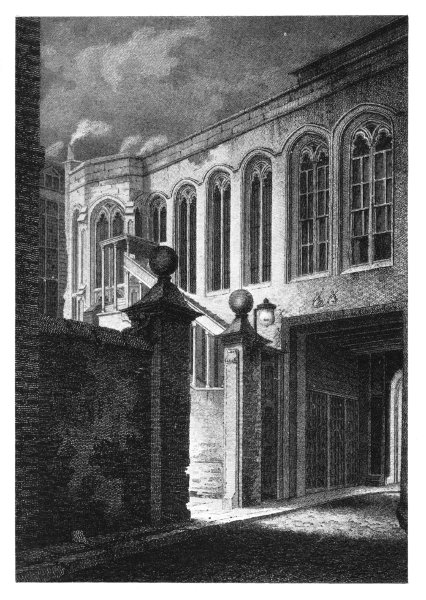
Sir John Crosby not long before his death began to
build the beautiful house in Bishopsgate "in the place
of certain tenements, with their appurtenances let to him
by Alice Ashfield, Prioress of St. Helen's....
This house he built of stone and timber, very large and
beautiful, and the highest at that time in London," as
Stow records. The whole structure was known as Crosby
Place, and rivalled the dimensions of a palace. All
that remained of this magnificent building was the Hall,
together with the Council Room and an ante-room,
forming two sides of a quadrangle. It was built of stone,
and measured 54 feet by 27 feet, and was 40 feet in height.
The Hall was lighted by a series of eight Perpendicular
windows on one side and six on the other, and by a
beautifully-constructed octagonal bay window. It had a
fine roof of exquisite workmanship richly ornamented, and
a wide chimney. Much of the original stone pavement
had vanished. The Council Chamber was nearly as large
as the hall, being only 14 feet less in length.
Crosby Hall has been the scene of many notable
historic scenes. In the play of "Edward IV." by
Heywood, Sir John Crosby figures as Lord Mayor of
London, a position which he never occupied, and the
King dines with him and the Alderman after the defeat
of the rebel Falconbridge at Crosby Hall. He had
just received the honour of knighthood, and thus
muses:—
"Ay, marry, Crosby! this befits thee well.
But some will marvel that, with scarlet gown,
I wear a gilded rapier by my side."
It is quite possible that the King thus dined with his
favourite, but there is no historical account that confirms
the poet's play. The builder did not long enjoy his
beautiful house, and died in 1475, leaving a second wife
and a daughter by his first wife, whom he seemed to
have loved with a more ardent affection than his second
spouse. Soon after his death the man whom he tried
to trap in France, Richard, Duke of Gloucester, came to
reside here, and made it the scene of endless plots and
conspiracies against his luckless nephews and his many
enemies. Crosby Place is frequently alluded to by
Shakespeare in his play, "Richard the Third."
Gloucester tells Catesby to report to him at Crosby Place
the treacherous murder of the Princes in the Tower, and
he bids the Lady Anne to "presently repair to Crosby
Place."
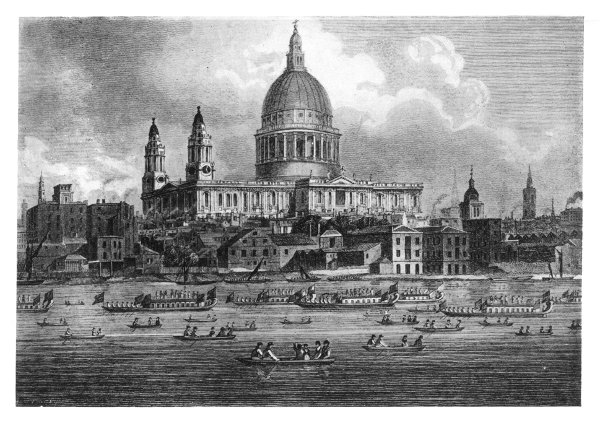
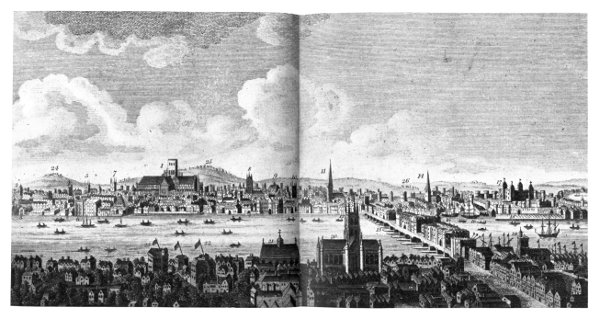
St. Paul's Cathedral, with Lord Mayor's Show on the water.
Engraved by Pugh, 1804.
The house in 1502 passed into the possession of Sir
Bartholomew Reed, Lord Mayor, and then to John Best,
Alderman, from whom it was purchased by Sir Thomas
More, the famous Lord Chancellor. Doubtless it was in
the chambers of Crosby Place that he wrote his Utopia.
He sold the lease to his beloved friend, Antonio
Bonvisi, an Italian gentleman, who had long lived in
England; and when the Dissolution of Monasteries took
place, and the possessions of the Priory of St. Helen's
were seized by the Crown, the King allowed the Italian
to retain possession of Crosby Place. We need not
record all its worthy owners. It was frequently used as
a fitting place for the lodging of foreign ambassadors,
and here Sir John Spencer, having restored the house,
kept his mayoralty in 1594. Enormously wealthy, he
lived in great splendour and entertained lavishly. He
was a great favourite of Queen Elizabeth. It was not
from Crosby Hall, but from his house at Canonbury, that
his only daughter effected her escape in a baker's basket
in order to wed the handsome Lord Compton. Terrible
was the father's wrath, and everyone knows the charming
story of the Queen's tactful intervention, how she induced
Sir John to stand as sponsor with her for an unknown
boy, whom Sir John declared should be the heir of
all his wealth, and how this boy was, of course, Lady
Compton's child, and how a full reconciliation was
effected. It is a very pretty story. It is not so pleasant
to read of the disastrous effect of the possession of so
much wealth had on the brain of Lord Compton, when
he came into possession of his lady's riches. She was
a little vixenish, spoilt and exacting, if she really
intended seriously the literal meaning of that well-known
letter which she wrote setting forth her needs and
requirements. It is too long to quote. Lord Compton
was created Earl of Northampton, and that precious child
of his when he grew to man's estate was killed fighting
for the Royalist cause in the Civil War.
During that disastrous time Crosby became a prison
for Royalists, and later on a great part of the house
was destroyed by fire, and its ancient glories
departed. For a hundred years the Hall was used as
a Nonconformist chapel. In 1778 part of the premises
was converted into a place of business by Messrs. Holmes
and Hall, the rest being used as private dwellings. It
provided a model for the banqueting-hall of Arundel
Castle, and some of the carved stones of the Council
Chamber were removed to Henley-upon-Thames to adorn
a dairy. Alien buildings soon covered the site of the
destroyed portion of the old house. In 1831 it was left
forlorn and untenanted, and in a state of considerable
decay. Then arose a considerable excitement, of which
the struggle of the present year reminds us. Crosby
Hall was doomed. But zealous lovers of the antiquities
of the city determined to try to save it. An appeal
was made, and a restoration fund started, though, like
many other restoration funds, it proved itself inadequate.
A benevolent lady, Miss Hackett, gallantly came to the
rescue, and practically saved Crosby Hall. Her idea
was to convert it into a lecture hall for the Gresham
Professors; but this plan came to nothing, though the
building was repaired, the south wall of the Throne
and Council Chambers being rebuilt. Then a company
was formed to take over Miss Hackett's interest, and the
Crosby Hall Literary and Scientific Institution was
formed, but that scheme came to nothing. Then it was
bought by Messrs. F. Gordon & Co., who restored the
building, attached to it an annex of half-timbered
construction, and converted the premises into a
restaurant. Thus it remained for several years.
Recently the site was acquired by a banking company,
and its demolition was threatened. Immediate action
was taken by Sir Vesey Strong, the Lord Mayor, and
others, to save the building. The fight was fought
strenuously and bravely. Apathy was found in some
quarters where it would least have been expected, and
all efforts were fruitless. It is deplorable to have to
record that the last of the mansions of the old city
magnates has been allowed to disappear, and that Crosby
Hall is now only a memory.
By the Editor
We have stated in the Preface that London
needs no pageant or special spectacular
display in order to set forth its wonderful
attractions. London is in itself a pageant,
far more interesting than any theatrical representation;
and in this final chapter we will enumerate some of
those other features of Old London life which have
not found description in the preceding pictures. We
will "stand by and let the pageant pass," or, rather,
pass along the streets and make our own pageant.
The great city is always changing its appearance,
and travellers who have not seen it for several years
scarcely know where they are when visiting some of
the transformed localities. But however great the
change, the city still exercises its powerful fascination
on all who have once felt its strangely magnetic force,
its singular attractiveness. Though the London County
Council have effected amazing "improvements,"
constructing a street which nobody wants and nobody
uses, and spending millions in widening Piccadilly;
though private enterprise pulls down ancient dwellings
and rears huge hotels and business premises in their
places—it is still possible to conjure up the memories
of the past, and to picture to ourselves the multitudinous
scenes of historic interest which Old London has
witnessed. Learned writers have already in these
volumes enabled us to transport ourselves at will to
the London of bygone times—to the mediæval city,
with its monasteries, its churches, its palaces, its
tragedies; to Elizabethan London, bright and gay, with
young life pulsing through its veins; to the London of
Pepys, with its merry-makings, its coarseness, and its
vice. In this concluding chapter we will recall some
other memories, and try to fill the background to the
picture.
Westminster, the rival city, the city of the court,
with its abbey and its hall, we have not attempted to
include in our survey. She must be left in solitary state
until, perhaps, a new volume of this series may presume
to describe her graces and perfections. The ever-growing
suburbs of the great city, the West End, the
fashionable quarter, Southern London across the river,
with Lambeth and its memories of archbishops—all this,
and much else that deserves an honoured place in the
chronicles of the metropolis, we must perforce omit in
our survey. Some of the stories are too modern to
please the taste of those who revel in the past; and if
the curious reader detects omissions, he may console
himself by referring to some of the countless other books
and guides which the attractions of London are ever
forcing industrious scribes to produce.
Many regrets were expressed when it was found
necessary to remove this ancient school from London,
and to destroy the old buildings. Of course, "everything
is for the best in this best of possible worlds."
Boys, like plants, thrive better in the open country,
and London fogs are apt to becloud the brain as well
as injure health. But the antiquary may be allowed
to utter his plaint over the demolition of the old features
of London life. The memorials of this ancient school
cannot be omitted from our collection.
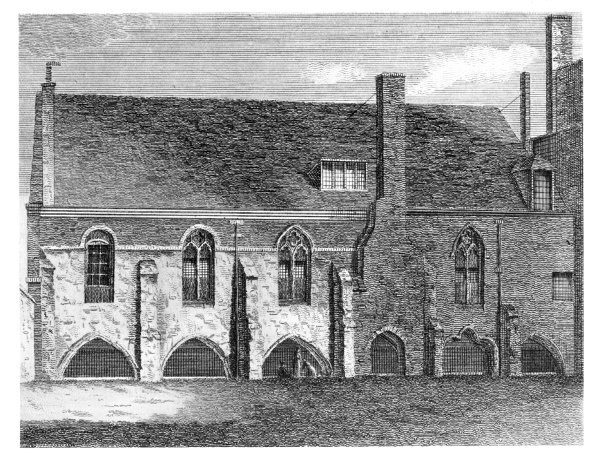
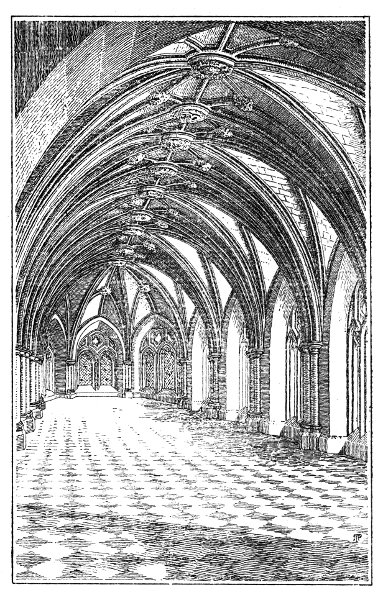
We are carried back in thought to the Friars, clad
in grey habits, girt with cord, and sandal shod, who
settled in the thirteenth century on the north side of
what we now call Newgate Street, and, by the generosity
of pious citizens, founded their monastery. Thus John
Ewin gave them the land in the ward of Farringdon
Without, and in the parish of St. Nicholas Shambles;
William Joyner built the choir; William Wallis the
nave; William Porter the chapter house; Gregory
Bokesby the dormitories, furnishing it with beds;
Bartholomew de Castello the refectory, where he feasted
the friars on St. Bartholomew's Day. Queen Margaret,
the second wife of Edward I., was a great benefactor
of the order, and advanced two thousand marks towards
the cost of a large church, which was completed in
1327, and was a noble structure, 300 feet in length,
89 feet in breadth, and 74 feet high. "Dick"
Whittington built for the friars a splendid library, which
was finished in 1424. The church was the favoured
resting-place of the illustrious dead. Four queens, four
duchesses, four countesses, one duke, two earls, eight
barons, and some thirty-five knights reposed therein.
In the choir there were nine tombs of alabaster and
marble, surrounded by iron railings, and monuments
of marble and brass abounded. The dissolution of
monasteries came with greedy Henry, and the place was
rifled. The crown seized the goodly store of treasure;
the church became a receptacle for the prizes taken
from the French; and Sir Martin Bowes, Mayor of
London, for the sum of £50, obtained all the beautiful
tombs and brasses, marble and alabaster, which were
carted away from the desecrated shrine.
But Henry's conscience smote him. The death of
Charles Brandon, Duke of Suffolk, the King's boon
companion, moved him "to bethink himself of his end,
and to do some good work thereunto," as Fuller states.
The church was reopened for worship, and Bishop
Ridley, preaching at Paul's Cross, announced the
King's gift of the conventual grounds and buildings,
with the hospital of St. Bartholomew, for the relief
of the poor. Letters patent were issued in 1545, making
over to the Mayor and Commonalty of London for ever
"the Grey Friars' Church, with all the edifices and
ground, the fratry, library, dortor, chapter-house, great
cloister, and the lesser tenements and vacant grounds,
lead, stone, iron, etc.; the hospital of
St. Bartholomew, West Smithfield,
the church of the same, the lead, bells,
and ornaments of the same hospital,
with all messuages, tenements, and
appurtenances."
It was a poor return to the Church
for all of that the King had robbed
her. Moreover, he did not altogether
abandon a little profit. He made the
monastic church, now called the Christ
Church, do duty for the parishes
of St. Nicholas in the Shambles,
St. Ewins, and part of St. Sepulchre,
uniting these into one parish, and
pulling down the churches of the first
two parishes. It would be curious
to discover what became of the
endowments of these parishes, and of
the fabrics.
For some years nothing was done to further the
cause of this charity, but in 1552, when Bishop Ridley,
who was a mightily convincing preacher, was discoursing
upon charity before Edward VI., the boy-King was so
moved that he conversed with the bishop, and, together
with the Lord Mayor and aldermen of the city,
determined to found three hospitals—Christ's Hospital
for the education of poor children, St. Thomas's for the
relief of the sick and diseased, and Bridewell for the
correction and amendment of the idle and the vagabond.
Before his last illness, Edward had just strength enough
to sign the charter for the founding of these institutions,
ejaculating: "Lord, I yield Thee most hearty thanks
that Thou hast given me life thus long to finish this
work to the glory of Thy name." The good citizens of
London, with their accustomed charity, immediately set
to work, before the granting of the charter, to subscribe
money for the repair of the old monastic buildings, and
in 1552 three hundred and forty children were admitted,
not so much for educational purposes as for their rescue
from the streets, and the provision of shelter, food, and
clothing. It must have been a welcome sight to the
citizens to see them clothed in livery of russet cotton,
the boys with red caps, the girls with kerchiefs on their
heads, lining the procession when the Lord Mayor and
aldermen rode to St. Paul's on Christmas Day. On the
following Easter the boys and "mayden children" were
in "plonket," or blue—hence the hospital derived the
name of the Blue Coat School. The dress of the boys,
concerning the origin of which many fanciful interpretations
have been made, is the costume of the period
generally worn by apprentices and serving men,
consisting of a long blue coat, with leathern girdle, a
sleeveless yellow waistcoat and yellow stockings, clerical
bands and a small black cap completing the dress.
"Four thousand marks by the year" from the royal
exchequer were granted by the King for the maintenance
of the school, which sum was largely supplemented by
the citizens and other pious benefactors, such as Lady
Ramsay, who founded "a free writing schoole for poor
men's children" at the hospital. Camden says that at
the beginning of the seventeenth century six hundred
children were maintained and educated, and one thousand
two hundred and forty pensioners relieved by the hospital
in alms, and, later on, as many as one thousand one
hundred and twenty children were cared for by this
institution. The governors, moreover, started "place
houses" in other districts—at Hertford, Ware, Reading,
and Bloxburn—where boys were educated.
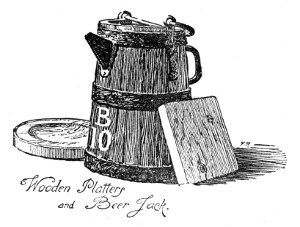
Wooden Platters and Beer Jack.
The buildings were greatly injured by the fire of
1666, when the old monastic church was entirely
destroyed. The great hall was soon rebuilt by Sir John
Frederick, and then the famous Royal Mathematical
School was founded through the exertions of Sir Robert
Clayton, Sir Jonas Moore, Sir Christopher Wren, Sir
Charles Scarbrough, and Samuel Pepys. King Charles II.
granted a charter and £1,000 a year for seven years,
and the forty boys who composed the school were called
"King's boys." They were instructed in navigation, and
wore a badge on the left shoulder. A subordinate
mathematical school, consisting of twelve scholars,
denoted "the Twelves," who wore a badge on the right
shoulder, was subsequently formed. Pepys took a keen
interest in the school, and a series of a large number
of his letters is in existence which show the efforts
he made to maintain the mathematical school. He tells
also of a little romance connected with the hospital,
which is worth recording. There was at that time a
grammar school for boys and a separate school for
girls. Two wealthy citizens left their estates, one to
a bluecoat boy, and the other to a bluecoat girl. Some
of the governors thought that it would be well if these
two fortunate recipients were married. So a public
wedding was arranged at the Guildhall chapel, where
the ceremony was performed by the Dean of St. Paul's,
the bride, supported by two bluecoat boys, being given
away by the Lord Mayor, and the bridegroom, attired
in blue satin, being led to the altar by two bluecoat
girls.
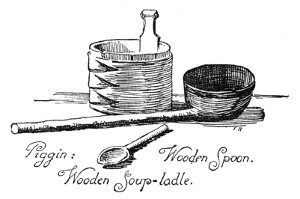
Piggin: Wooden Spoon.
Wooden Soup-ladle.
A noble gift of Sir Robert Clayton enabled the
governors to rebuild the east cloister and south front.
The writing school was erected by Sir Christopher Wren
in 1694, at the expense of Sir John Moore. The ward
over the east side cloister was rebuilt in 1705 by Sir
Francis Child, the banker, and in 1795 the grammar
school was erected. Some of the buildings of the old
monastery survived until the beginning of the last
century, but they were somewhat ruinous and unsafe,
hence, in 1803, a great building fund was formed. The
hall erected after the great fire was pulled down, and
a vast building in the Tudor style begun in 1825, which
was so familiar to all who passed along the eastern
end of Holborn. John Shaw was the architect. You
will remember the open arcade, the buttresses and
octagonal towers, and the embattled and pinnacled
walls, and, above all, you will remember the crowd of
happy boys, clad in their picturesque garb, kicking about
the merry football. The dining hall was one of the
finest rooms in London, being 187 feet long, 51 feet wide,
and 47 feet high; lighted by nine large windows, those
on the south side being filled with stained glass. There
hung the huge charter picture, representing Edward VI.
presenting the charter to the Lord Mayor, the Chancellor,
officers of State, and children of the school being in
attendance. This picture has been attributed to Holbein,
but since the event occurred in 1553, and that artist
could have produced no work later than 1534, the
tradition is erroneous. Two portraits of Edward VI.
are also in the possession of the hospital attributed to
Holbein, but they have been proved to be the work of
a later artist. Verrio's portrait of Charles II., and his
picture of James II. receiving the mathematical boys,
are very large canvases.
It is unnecessary to describe all the buildings which
so recently existed, but have now been swept away.
It is more interesting to note some of the curious
customs which exist or formerly existed in the school,
and some of the noted of the old "Blues." Christ's
Hospital was a home of old customs, some of them,
perhaps, little relished by the scholars. Each boy had
a wooden "piggin" for drinking small beer served out
of a leathern or wooden jack; a platter, spoon, and
soup-ladle of the same material. There was a quaint
custom of supping in public on Sundays during Lent,
when visitors were admitted, and the Lord Mayor or
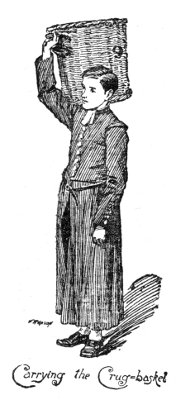
president of the governors sat in state. Quaint wooden
candlesticks adorned the tables, and, after the supper,
were carried away in procession, together with the
tablecloths, crug-baskets, or baskets used for carrying
bread, bowls, jacks, and piggins. Before the supper a
hymn was sung, and a "Grecian," or head boy, read
the prayers from the pulpit, silence being enforced by
three blows of a wooden hammer. The supper then
began, consisting of bread and cheese, and the visitors
used to walk about between the tables. Then followed
the solemn procession of the boys carrying their goods,
and bowing repeatedly to the governors and their guests.
It was a pleasing custom, honoured by the presence of
many distinguished guests, and Queen Victoria and Prince
Albert on one occasion witnessed the spectacle.
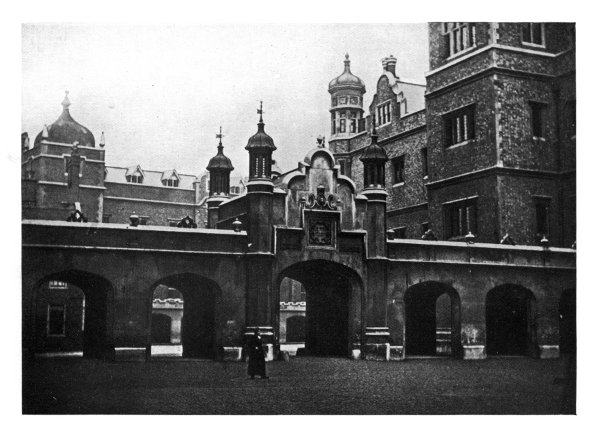
Christ's Hospital: the Garden.
Then there were the annual orations on St. Matthew's
Day, commemorating the foundation of the school, and
attended by the civic magnates. A state service was
held in Christ Church, Newgate Street, and, afterwards,
the Grecians delivered speeches, and a collection was
made for the support of these headboys when they went
to the University. The beadles delivered up their staves
to the Court, and if no fault was found with these officers
their badges were returned to them. The Company was
regaled with "sweet cakes and burnt wine."
At Easter there were solemn processions—first, on
Easter Monday, to the Mansion House, when the Lord
Mayor was escorted by the boys to Christ Church to
hear the Spital or hospital sermon. On Easter Tuesday
again the scholars repaired to the Mansion House, and
were regaled with a glass of wine, in lieu of which
lemonade, in more recent times, could be obtained, two
buns, and a shilling fresh from the Mint, the senior
scholars receiving an additional sum, and the Grecians
obtained a guinea. Again the Spital sermon was
preached. The boys were entitled, by ancient custom,
to sundry privileges—to address the sovereign on his
visiting the city, and the "King's boys" were entitled
to be presented at the first drawing-room of the season,
to present their charts for inspection, and to receive
sundry gifts. By ancient privilege they were entitled to
inspect all the curiosities in the Tower of London free
of any charge, and these at one time included a miniature
zoological garden.
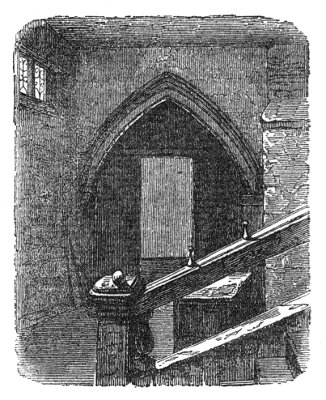
Many are the notable men renowned in literature and
art who have sprung from this famous school. Charles
Lamb, S. T. Coleridge, Leigh Hunt, and countless other
men might be mentioned who have done honour to their
school. Some of their recollections of old manners
reveal some strange educational methods—the severe
thrashings, the handcuffing of runaways, the confining
in dungeons, wretched holes, where the boys could just
find room to lie down on straw, and were kept in solitary
confinement and fed worse than prisoners in modern
gaols. Bread and beer breakfasts were hardly the best
diet for boys, and the meat does not always appear
to have been satisfactory. However, all these bygone
abuses have long ago disappeared. For some years the
future of the hospital was shrouded in uncertainty.
At length it was resolved to quit London, and now
the old buildings have been pulled down, and the school
has taken a new lease of life and settled at Horsham,
where all will wish that it may have a long and
prosperous career. We may well conclude this brief
notice of the old school in the words of the School
Commissioners of 1867, who stated: "Christ's Hospital
is a thing without parallel in the country and sui generis.
It is a grand relic of the mediæval spirit—a monument
of the profuse munificence of that spirit, and of that
constant stream of individual beneficence, which is so
often found to flow around institutions of that character.
It has kept up its main features, its traditions, its
antique ceremonies, almost unchanged, for a period of
upwards of three centuries. It has a long and goodly
list of worthies." We know not how many of these
antique ceremonies have survived its removal, but we
venture to hope that they may still exist, and that the
authorities have not failed to maintain the traditions
that Time has consecrated.
In the pageant of London no objects are more
numerous and conspicuous than the churches which greet
us at every step. In spite of the large number which
have disappeared, there are very many left. There they
stand in the centre of important thoroughfares, in obscure
courts and alleys—here surrounded by high towering
warehouses; there maintaining proud positions, defying
the attacks of worldly business and affairs. A whole
volume would be required to do justice to the city
churches, and we can only glance at some of the most
striking examples.
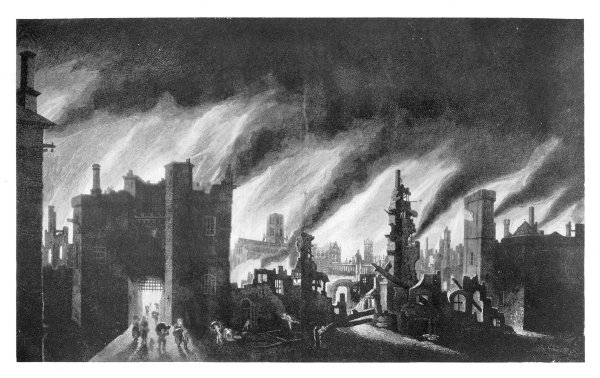
The Great Fire played havoc with the ancient
structures, and involved in its relentless course many
a beautiful and historic church. But some few of them
are left to us. We have already seen St. Bartholomew's,
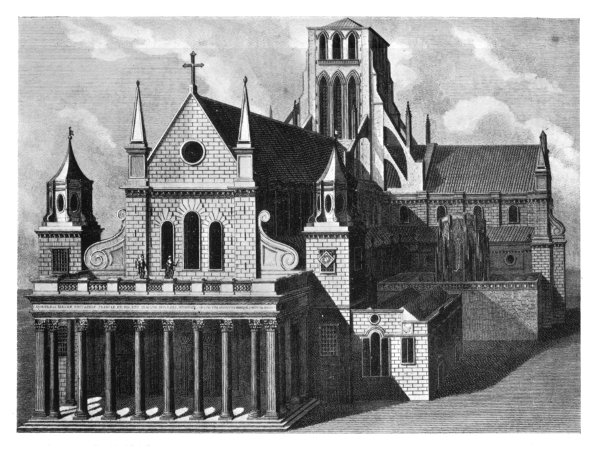
Smithfield, and glanced at the church of St. Helen,
Bishopsgate, and old St Paul's. Wren's St. Paul's
Cathedral has so often been described that it is not
necessary to tell again the story of its building.[11]
"Destroyed by the Great Fire, rebuilt by Wren," is the
story of most of the city churches; but there were some
few which escaped. At the east end of Great Tower
Street stands All Hallows Barking, so called from
having belonged to the abbey of Barking, Essex. This
narrowly escaped the fire, which burned the dial, and
porch, and vicarage house. Its style is mainly
Perpendicular, with a Decorated east window, and
has some good brasses. St. Andrew's Undershaft,
Leadenhall Street, opposite to which the May-pole was
annually raised until "Evil May-day" put an end to
the merry-makings, was rebuilt in 1520-32, and contains
some mural paintings, much stained glass, and many
brasses and monuments, including that of John Stow,
the famous London antiquary. St. Catherine Cree, in
the same street, was rebuilt in 1629, and consecrated by
Laud. St. Dunstan's-in-the-East was nearly destroyed,
and restored by Wren, the present nave being rebuilt
in 1817. St. Dunstan's, Stepney, preserves its fifteenth
century fabric, and St. Ethelburga's, Bishopsgate,
retains some of its Early English masonry, and St.
Ethelreda's, Ely Place, is the only surviving portion
of the ancient palace of the Bishops of Ely. St. Giles',
Cripplegate, stands near the site of a Saxon church built
in 1090 by Alfun, the first hospitaller of the Priory of
St. Bartholomew. Suffering from a grievous fire in
1545, it was partially rebuilt, and in 1682 the tower
was raised fifteen feet. Many illustrious men were
buried here, including John Fox, John Speed, the
historian, John Milton and his father, several actors
of the Fortune Theatre, and Sir Martin Frobisher. In
1861 the church was restored in memory of Milton, and
a monument raised to him. This church saw the
nuptials of Oliver Cromwell and Elizabeth Bowchier
in 1620. All Hallows Staining, Mark Lane, escaped the
fire, and its tower and west end are ancient. St. James',
Aldgate, was built in 1622, and escaped the fire, which
might have spared more important edifices; and St.
Olave's, Hart Street, a building which shows Norman,
Early English, Decorated, and Perpendicular work, was
happily preserved. This is sometimes called Pepys's
church, since he often mentions it in his diary, and lies
buried here. There are other interesting monuments, and
in the churchyard lie some of the victims of the Great
Plague. St. Sepulchre's, near Newgate, was damaged
by the fire, and refitted by Wren, but the main building
is fifteenth century work. Several churches escaped the
Great Fire, but were subsequently pulled down and
rebuilt. Amongst these are St. Alphege, London Wall;
St. Botolph-without, Aldersgate; St. Botolph's, St.
Martin's Outwich. St. Mary Woolnoth was also
damaged by the fire, and repaired by Wren. It stands
on the site of an early church, which was rebuilt in
the fifteenth century; but the greater part of the present
church was built by Hawksmoor in 1716.
A strange, weird, desolate city met the eyes of the
people of London when the Great Fire had died away.
No words can describe that scene of appalling ruin and
desolation. But, with the energy for which Englishmen
are remarkable, they at once set to work to restore their
loss, and a master-mind was discovered who could
grapple with the difficulty and bring order out of chaos.
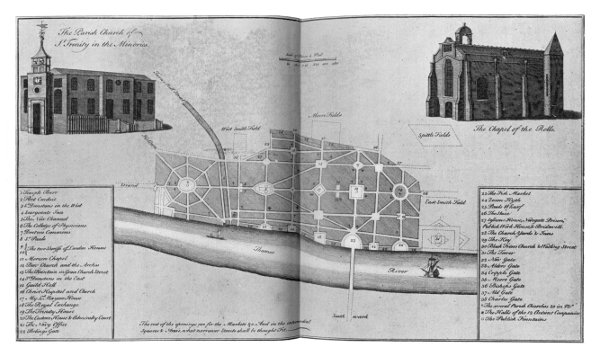
This wonderful genius was Sir Christopher Wren. He
devised a grand scheme for the rebuilding of the city.
Evelyn planned another. But property owners were
tenacious of their rights, and clung to their own parcels
of ground; so these great schemes came to nothing.
However, to Wren fell the task of rebuilding the fallen
churches, and no less than fifty-two were entrusted to
his care. He had no one to guide him; no school of
artists or craftsmen to help him in the detail of his
buildings; no great principles of architecture to direct
him. Gothic architecture was dead, if we except the
afterglow that shone in Oxford. He might have
followed his great predecessor, Inigo Jones, and produced
works after an Italian model. But he was no copyist.
Taking the classic orders as his basis, he devised a style
of his own, suitable for the requirements of the time
and climate, and for the form of worship and religious
usages of the Anglican Church. "It is enough for
Romanists to hear the murmur of the mass, and see the
elevation of the Host; but our churches are to be fitted
for auditories," he once said.
Of the churches built by Wren, eighteen beautiful
buildings have already been destroyed. St. Christopher-le-Stocks
is swallowed up by the Bank of England;
St. Michael, Crooked Lane, disappeared in 1841, when
approaches were made to New London Bridge; St.
Bartholomew-by-the-Exchange made way for the Sun
Fire Office; and St. Benet Fink was pulled down because
of its nearness to the Royal Exchange. Since the
passing of the Union of City Benefices Act in 1860,
fourteen churches designed by Wren have succumbed,
and attacks on others have been with difficulty warded
off.[12]
The characteristics of Wren's genius were his
versatility, imagination, and originality. We will notice
some of the results of these qualities of mind. The
tower hardly ever enters into the architectural treatment
of the interior. It is used as an entrance lobby or
vestry. His simplest plan was a plain oblong, without
columns or recesses, such as St. Mildred's, Bread Street,
or St. Nicholas', Cole Abbey. St. Margaret, Lothbury,
St. Vedast, St. Clement, Eastcheap, have this simple form,
with the addition of an aisle or a recess. His next
plan consists of the central nave and two aisles, with
or without clerestory windows; of this St. Andrew
Wardrobe and St. Magnus the Martyr furnish good
examples. The third plan is the domed church, such
as St. Swithun and St. Mary Abchurch. The merits
and architectural beauties of Wren's churches have been
recently described in an able lecture delivered by
Mr. Arthur Keen before the Architectural Association,
a lecture which we should like to see expanded to the
size of a book, and enriched with copious drawings.
It would be of immense service in directing the minds
of the citizens of London to the architectural treasures
of which they are the heirs.
The churches are remarkable for their beautifully
carved woodwork, often executed or designed by
Grinling Gibbons or his pupils. Pews, pulpits, with
elaborate sounding boards, organ cases, altar pieces,
were all elaborately carved, and a gallery usually was
placed at the west end. Paintings by Sir James
Thornhill and other artists adorn his churches, and
the art of Strong the master mason, Jennings the
carpenter, and Tijou the metal worker, all combined
to beautify his structures.
Within the limits of our space it is only possible
to glance at the interiors of a few of these churches,
and note some of the treasures therein contained.
St. Andrew's, Holborn, has its original fifteenth century
tower, recarved in 1704. It is known as the "Poet's
Church," on account of the singers connected with it,
including a contemporary of Shakespeare, John Webster,
Robert Savage, Chatterton, and Henry Neele, and can
boast of such illustrious rectors as Bishops Hacket and
Stillingfleet, and Dr. Sacheverel. The spire of Christ
Church, Spitalfields, built by Hawksmoor, is the loftiest
in London, and has a fine peal of bells. In the church
there is an early work of Flaxman—the monument of
Sir Robert Ladbrooke, Lord Mayor. The name of
St. Clement Danes reminds us of the connection of the
sea-rovers with London. Strype says that the church
was so named "because Harold, a Danish King, and
other Danes, were buried there, and in that churchyard."
He tells how this Harold, an illegitimate son of Canute,
reigned three years, and was buried at Westminster;
but, afterwards, Hardicanute, the lawful son of Canute,
in revenge for the injury done to his mother and brother,
ordered the body to be dug up and thrown into the
Thames, where it was found by a fisherman and buried
in this churchyard. There seems to be no doubt that there
was a colony of peaceful Danes in this neighbourhood,
as testified by the Danish word "Wych" given to a street
hard by, and preserved in the modern Aldwych. It was
the oldest suburb of London, the village of Ældwic,
and called Aldewych. Oldwych close was in existence
in the time of the Stuarts. These people were allowed
to reside between the Isle of Thorney, or Westminster,
and Ludgate, and, having become Christians, they built
a church for themselves, which was called Ecclesia
Clementis Danorum.
There is a wild story of the massacre of the Danes
in this church in the days of Ethelred, as recorded in
Strype's Continuation of Stow, and in the Jomsvikinga
Saga. As Mr. Loftie has not found space in Saxon
London to mention this colony of Danes and their
doings, I venture to quote a passage from Mr. Lethaby's
Pre-Conquest London, which contains some interesting
allusions to these people:
"We are told that Sweyn made warfare in the land of King Ethelred,
and drove him out of the land; he put Thingumannalid in two places.
The one in Lundunaborg (London) was ruled by Eilif Thorgilsson, who
had sixty ships in the Temps (Thames); the other was north in Sleswik.
The Thingamen made a law that no one should stay away a whole night.
They gathered at the Bura Church every night when a large bell was
rung, but without weapons. He who had command in the town (London)
was Ædric Streona. Ulfkel Snilling ruled over the northern part of
England (East Anglia). The power of the Thingamen was great. There
was a fair there (in London) twice every twelve month, one about midsummer
and the other about midwinter. The English thought it would
be the easiest to slay the Thingamen while Cnut was young (he was ten
winters old) and Sweyn dead. About Yule, waggons went into the
town to the market, and they were all tented over by the treacherous
advice of Ulfkel Snelling and Ethelred's sons. Thord, a man of the
Thingumannalid, went out of the town to the house of his mistress, who
asked him to stay, because the death was planned of all the Thingamen
by Englishmen concealed in the waggons, when the Danes would go
unarmed to the church. Thord went into the town and told it to Eilif.
They heard the bell ringing, and when they came to the churchyard
there was a great crowd who attacked them. Eilif escaped with three
ships and went to Denmark. Some time after, Edmund was made King.
After three winters, Cnut, Thorkel and Eric went with eight hundred
ships to England. Thorkel had thirty ships, and slew Ulfkel Snilling,
and married Ulfhild, his wife, daughter of King Ethelred. With Ulfkel
was slain every man on sixty ships, and Cnut took Lundunaborg."
Matthew, of Westminster, also records this massacre
of the Danes, and other authorities consider that the
account in the Saga is founded on fact. However that
may be, the Danes undoubtedly had a colony here of
their traders, merchants, and seamen, and dedicated their
church to their favourite saint, St. Clement, the patron
of mariners, whose constant emblem is an anchor. Nor
was this the only location of the Northmen. Southwark
was their fortified trading place, where they had a church
dedicated to St. Olaf, the patron saint of Norway. His
name remains in Tooley Street, not a very evident but
certainly true derivative of St. Olaf's Street. There are
three churches dedicated to St. Olave, who was none
other than St. Olaf. St. Magnus, too, tells of the
Northmen, who was one of their favourite saints. Going
back to the church of St. Clement Danes, we notice that
it was rebuilt in 1682 under the advice of Wren, the
tower and steeple being added forty years later.
Dr. Johnson used to attend here, and a pillar near his
seat bears the inscription:
"In this pew and beside this pillar, for many years attended Divine
Service, the celebrated Dr. Johnson, the philosopher, the poet, the great
lexicographer, the profound moralist, and chief writer of his time. Born
1709, died 1794. In remembrance and honour of noble faculties, nobly
employed, some inhabitants of the parish of St. Clement Danes have
placed this slight memorial, A.D. 1851."
One of the most important city churches is St. Mary-le-Bow,
Cheapside. It is one of Wren's finest works;
but the old church, destroyed by the Great Fire, had a
notable history, being one of the earliest Norman
buildings in the country. Stow says it was named
St. Mary de Arcubus from its being built on arches of
stone, these arches forming a crypt, which still exists.
The tower was a place of sanctuary, but not a very
effectual one, as Longbeard, a ringleader of a riot, was
forced out of his refuge by fire in 1190, and Ducket,
a goldsmith, was murdered. The Bow bells are famous,
and one of them was rung nightly for the closing of
shops. Everyone knows the protesting rhyme of the
'prentices of the Cheap when the clerk rang the bell
late, and the reassuring reply of that officer, who
probably feared the blows of their staves. Lanterns
hung in the arches of the spire as beacons for travellers.
The bells of Bow are said to have recalled Dick
Whittington, and those who have always lived in the
district where their sound can be heard are
deemed very ignorant folk by their country cousins.
Whittington's church was St. Michael's Paternoster
Royal, Thames Street, which he rebuilt, and wherein he
was buried, though his body has been twice disturbed.
The church was destroyed by the Great Fire, and rebuilt
by Wren.
It is impossible for us to visit all the churches, each
of which possesses some feature of interest, some
historical association. They impart much beauty to
every view of the city, and not one of them can be
spared. Sometimes, in this utilitarian age, wise men
tell us that we should pull down many of these ancient
buildings, sell the valuable sites, and build other churches
in the suburbs, where they would be more useful.
Eighteen of Wren's churches have been thus destroyed,
besides several of later date. The city merchants of
old built their churches, and made great sacrifices in
doing so, for the honour of God and the good of their
fellow-men, and it is not for their descendants to pull
them down. If suburban people want churches, they
should imitate the example of their forefathers, and
make sacrifices in order to build them. Streets, old
palaces, interesting houses, are fast vanishing; the
churches—at least, some of them—remain to tell the
story of the ancient civic life, to point the way to
higher things amid the bustling scenes of mercantile
activity and commercial unrest. The readers of these
Memorials will wish "strength i' th' arme" to the City
Churches Preservation Society to do battle for these
historic landmarks of ancient London.
Nothing helps us to realise the condition of ancient
London, its growth and expansion, like a careful study
of its street-names. It shows that in the Middle Ages
London was very different from that great, overcrowded,
noisy, and far-extending metropolis which we see to-day.
It is difficult for us in these days to realise the small
extent of ancient London, when Charing was a village
situated between the cities of Westminster and London;
or, indeed, to go back in imagination even a century
or two ago, when the citizens could go a-nutting on
Notting Hill, and when it was possible to see Temple
Bar from Leicester Square, then called Leicester Fields,
and with a telescope observe the heads of the Scotch
rebels which adorned the spikes of the old gateway.
In the early coaching days, on account of the impassable
roads, it required three hours to journey from Paddington
to the city. Kensington, Islington, Brompton, and
Paddington were simply country villages, separated by
fields and pastures from London; and the names of
such districts as Spitalfields, Bethnal Green, Smithfield,
Moorfields, and many others, now crowded with houses,
indicate the once rural character of the neighbourhood.
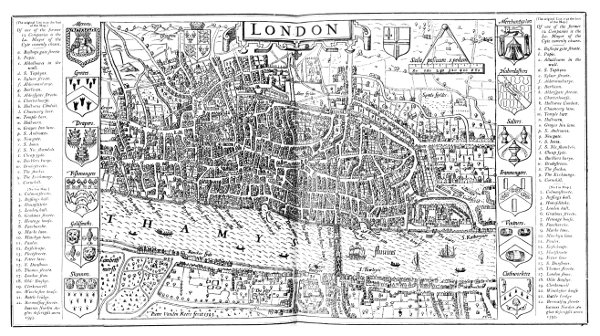
The area enclosed by the city walls was not larger than
Hyde Park. Their course has been already traced, but we
can follow them on the map of London by means of the
names of the streets. Thus, beginning at the Tower, we
pass on to Aldgate, and then to Bishopsgate. Outside was
a protecting moat, which survives in the name Houndsditch,
wherein doubtless dead dogs found a resting
place. Then we pass on to London Wall, a street which
sufficiently tells its derivation. Outside this part of the
wall there was a fen, or bog, or moor, which survives
in Moorfields, Moorgate Street, and possibly Finsbury;
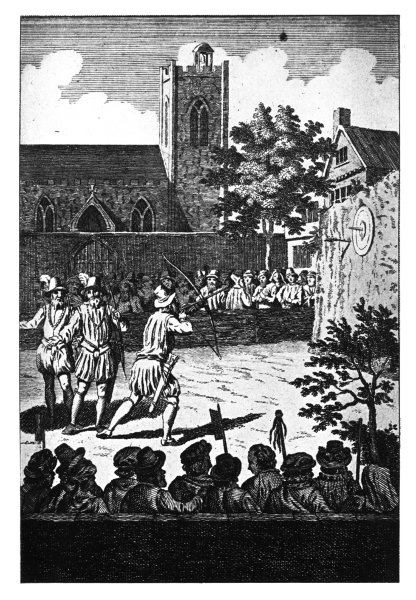
and Artillery Street shows where the makers of bows
and arrows had their shops, near the artillery ground,
where the users of these weapons practised at the butts.
The name of the Barbican tells of a tower that guarded
Aldersgate, and some remains of the wall can still be
seen in Castle Street and in the churchyard of St. Giles',
Cripplegate, the derivation of which has at length been
satisfactorily determined by Mr. Loftie in our first
chapter, and has nothing to do with the multitude of
cripples which Stow imagined congregated there. Thence
we go to Newgate and the Old Bailey, names that tell
of walls and fortifications. Everyone knows the name
of the Bailey court of a castle, which intervened between
the keep or stronger portion of the defences and the
outer walls or gate. The court of the Old Bailey
suggests to modern prisoners other less pleasing ideas.
Now the wall turns southward, in the direction of
Ludgate, where it was protected by a stream called
the Fleet, whence the name Fleet Street is derived.
Canon Isaac Taylor suggests that Fleet Street is really
Flood Street, from which Ludgate or Floodgate takes
its name. We prefer the derivation given by Mr. Loftie.
On the south of Ludgate, and on the bank of the
Thames, stood a mighty strong castle, called Baynard
Castle, constructed by William the Conqueror to aid
him, with the Tower of London, to keep the citizens
in order. It has entirely disappeared, but if you look
closely at the map you will find a wharf which records
its memory, and a ward of the city also is named after
the long vanished stronghold. Now the course of the
wall follows the north bank of the river Thames, and
the names Dowgate and Billingsgate record its memory
and of the city gates, which allowed peaceable citizens
to enter, but were strong to resist foes and rebels.
Within these walls craftsmen and traders had their
own particular localities, the members of each trade
working together side by side in their own street or
district; and although now some of the trades have
disappeared, and traders are no longer confined to one
district, the street-names record the ancient home of
their industries. The two great markets were the
Eastcheap and Westcheap, now Cheapside. The former,
in the days of Lydgate, was the abode of the butchers.
Martin Lyckpenny sings:
"Then I hyed me into Est-chepe
One cryes ribbes of befe and many a pye."
And near the butchers naturally were the cooks, who
flourished in Cooks' Row, along Thames Street.
Candlewick Street took its name from the chandlers.
Cornhill marks the site of the ancient corn market.
Haymarket, where the theatre is so well known, was
the site of a market for hay, but that is comparatively
modern. The citizens did not go so far out of the
city to buy and sell hay. Stow says: "Then higher
in Grasse Street is that parish church of St. Bennet,
called Grasse Church, of the herb market there kept";
and though he thinks Fenchurch Street may be derived
from a fenny or moorish ground, "others be of opinion
that it took that name of Fænum, that is, hay sold there,
as Grasse Street took the name of grass, or herbs, there
sold." Wool was sold near the church of St. Mary
Woolchurch, which stood on the site of the present
Mansion House, and in the churchyard was a beam for
the weighing of wool. The name survives in that of
St. Mary Woolnoth, with which parish the other was
united when St. Mary Woolchurch was destroyed by
the Great Fire. Lombard Street marks the settlement
of the great Lombardi merchants, the Italian financiers,
bankers, and pawnbrokers, who found a convenient
centre for their transactions midway between the two
great markets, Eastcheap and Cheapside. Sometimes
the name of the street has been altered in course of
time, so that it is difficult to determine the original
meaning. Thus Sermon Lane has nothing to do with
parsons, but is a corruption of Sheremoniers' Lane, who
"cut and rounded the plates to be coined and stamped
into sterling pence," as Stow says. Near this lane was
the Old Exchange, where money was coined. Later on,
this coining was done at a place still called the mint,
in Bermondsey. Stow thought that Lothbury was so
called because it was a loathsome place, on account of
the noise made by the founders; but it is really a
corruption of Lattenbury, the place where these founders
"cast candlesticks, chafing-dishes, spice mortars, and
such like copper or laton works." Of course, people
sold their fowls in the Poultry; fish and milk and bread
shops were to be found in the streets bearing these names;
and leather in Leather Lane and, perhaps, Leadenhall
Market, said to be a corruption of Leatherhall, though
Stow does not give any hint of this. Sopers' Lane
was the abode of the soapmakers; Smithfield of the
smiths. Coleman Street derives its name from the man
who first built and owned it, says Stow; but later
authorities place there the coalmen or charcoal-burners.
As was usual in mediæval towns, the Jews had a district
for themselves, and resided in Old Jewry and Jewin
Street.
The favourite haunt of booksellers and publishers,
Paternoster Row, derives its name, according to Stow,
"from the stationers or text-writers that dwelled there,
who wrote and sold all sorts of books then in use, namely,
A. B. C. or Absies, with the Paternoster, Ave, Creed,
Graces, etc. There dwelled also turners of beads, and
they are called Paternoster-makers. At the end of
Paternoster Row is Ave Mary Lane, so called upon the
like occasion of text-writers and bead-makers then
dwelling there." Creed Lane and Amen Corner make
up the names of these streets where the worshippers in
Old St. Paul's found their helps to devotion.
Old London was a city of palaces as well as of
trade. All the great nobles of England had their town
houses, or inns, as they were called. They had vast
retinues of armed men, and required no small lodging.
The Dukes of Exeter and Somerset, the Earl of
Northumberland, and many others, had their town
houses, every vestige of which has passed away, though
their names are preserved by the streets and sites on
which they stood. The Strand, for example, is full of
the memories of these old mansions, which began to
be erected along the river bank when the Wars of the
Roses had ceased, and greater security was felt by the
people of England, who then began to perceive that
it might be possible to live in safety outside the walls
of the city. Northumberland Avenue tells of the house
of the Earls of Northumberland, which stood so late
as 1875; Burleigh Street and Essex Street recall the
famous Sir William Cecil, Lord Burleigh, whose son
was created Earl of Essex. Arundel House, the mansion
of the Howards, is marked by Arundel Street, Surrey
Street, Howard Street, Norfolk Street, these being the
titles borne by scions of this famous family. The
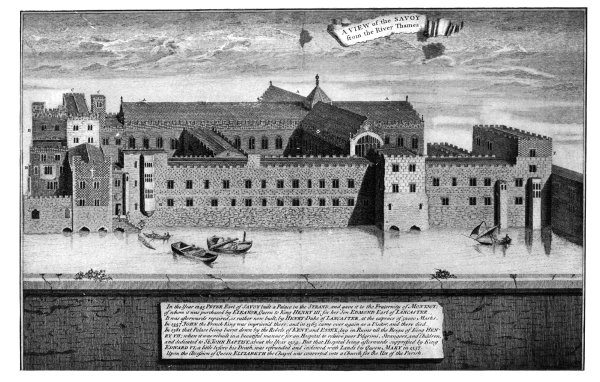
readers of the chapter on the Royal Palaces need not
be told of the traditions preserved by the names
Somerset House and the Savoy. Cecil Street and
Salisbury Street recall the memory of Salisbury House,
built by Sir Robert Cecil, Earl of Salisbury, brother of
the Earl of Essex mentioned above. Then we have
Bedford Street, with Russell Street, Southampton Street,
Tavistock Street, around Covent Garden. These
names unfold historical truths. Covent Garden is an
abbreviated form of Convent Garden, the garden of the
monks of Westminster. It was granted to the Russell
family at the dissolution of monasteries, and the Russells,
Earls of Bedford, erected a mansion here, which has
long disappeared, but has left traces behind in the
streets named after the various titles to which members
of the Russell family attained. In another part of
London we find traces of the same family. After
leaving Covent Garden they migrated to Bloomsbury,
and there we find Bedford Square, Southampton Street,
Russell Square, Tavistock Square, and Chenies Street,
this latter being named after their seat in Buckinghamshire.
Craven buildings, near Drury Lane, tells of the
home of Lord Craven, the devoted admirer of the
"Queen of Hearts," the beautiful Queen of Bohemia.
Clare House, the mansion of the Earls of Clare, survives
in Clare Market; and Leicester Square points to the
residence of the favourite of Queen Elizabeth, and
Villiers Street and Buckingham Street to that of another
court favourite, the Duke of Buckingham. The bishops
also had their town houses, and their sites are recorded
by such names as Ely Place, Salisbury Square, Bangor
Court, and Durham Street.
We might wander westward, and trace the progress
of building and of fashion, and mark the streets that
bear witness to the memories of great names in English
history; but that would take us far beyond our limits.
Going back citywards, we should find many other
suggestive names of streets—those named after churches;
those that record the memories of religious houses, such
as Blackfriars, Austin Friars, Crutched Friars; those
that mark the course of many streams and brooks that
now find their way underground to the great river.
All these names recall glimpses of Old London, and
must be cherished as priceless memorials of ancient days.
In the centre of London, at the eastern end of
Cheapside, stand the Royal Exchange, the Mansion
House, and Bank of England, all of which merit
attention. The official residence of the Lord Mayor—associated
with the magnificent hospitality of the city,
with the memory of many distinguished men who have
held the office of Chief Magistrate, and with the
innumerable charitable schemes which have been initiated
there—was built by Dance, and completed in 1753. It
is in the Italian style, and resembles a Palladian
Palace. Its conspicuous front, with Corinthian columns
supporting a pediment, in the centre of which is a
group of allegorical sculpture, is well known to all
frequenters of the city. Formerly it had an open
court, but this has been roofed over and converted into
a grand banquetting hall, known as the Egyptian Hall.
There are other dining rooms, a ball room, and drawing
room, all superbly decorated, and the Mansion House
is a worthy home for the Lord Mayor of London.
The Bank of England commenced its career in 1691;
founded by William Paterson, a Scotsman, and
incorporated by William III. The greatest monetary
establishment in the world at first managed to contain
its wealth in a single chest, not much larger than a
seaman's box. Its first governor was Sir John Houblon,
who appears largely in the recent interesting volume on
the records of the Houblon family, and whose house
and garden were on part of the site of the present
bank. The halls of the mercers and grocers provided
a home for the officials in their early dealings. The
site of the bank was occupied by a church, St.
Christopher-le-Stocks, three taverns, and several houses.
These have all been removed to make room for the
extensions which from time to time were found necessary.
The back of the Threadneedle Street front is the
earliest portion—built in 1734, to which Sir Robert
Taylor added two wings; and then Sir John Soane
was appointed architect, and constructed the remainder
of the present buildings in the Corinthian style, after
the model of the Temple of the Sibyl at Tivoli. There
have been several subsequent additions, including the
heightening of the Cornhill front by an attic in 1850.
There have been many exciting scenes without those
sombre-looking walls. It has been attacked by rioters.
Panics have created "runs" on the bank; in 1745 the
managers just saved themselves by telling their agents
to demand payment for large sums in sixpences, which
took a long time to count, the agents then paying in
the sixpences, which had to be again counted, and
thus preventing bonâ-fide holders of notes presenting
them. At one time the corporation had a very
insignificant amount of money in the bank, and just
saved themselves by issuing one pound notes. The
history of forgeries on the bank would make an
interesting chapter, and the story of its defence in the
riots of 1780, when old inkstands were used as bullets by
the gallant defenders, fills a page of old-world romance.
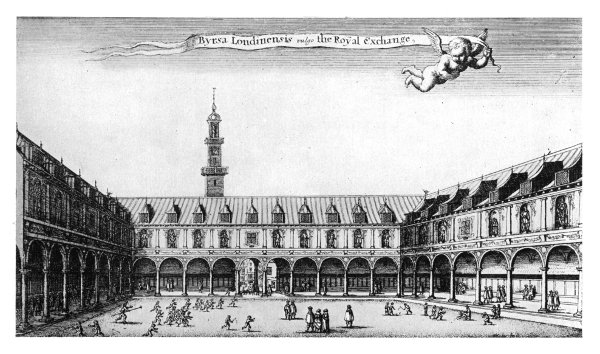
The Royal Exchange.
Engraved by Hollar, 1644.
But interesting as these buildings are, their stories
pale before that of the Royal Exchange. The present
building was finished in 1844, and opened by her late
Majesty Queen Victoria with a splendid state and civic
function. Its architecture is something after the style
of the Pantheon at Rome. Why the architects of that
and earlier periods always chose Italian models for
their structures is one of the mysteries of human error;
but, as we have seen, all these three main buildings in
the heart of the city are copied from Italian structures.
William Tite was the architect, and he achieved no
mean success. The great size of the portico, the vastness
of the columns, the frieze and sculptured tympanum,
and striking figures, all combine to make it an imposing
building. Upon the pedestal of the figure of
"Commerce" is the inscription: "The earth is the
Lord's, and the fulness thereof." The interior has been
enriched by a series of mural paintings, representing
scenes from the municipal life of London, the work of
eminent artists.
This exchange is the third which has stood upon
this site. The first was built by Sir Thomas Gresham,
one of the famous family of merchants to whom
London owes many benefits. It was a "goodly Burse,"
of Flemish design, having been built by a Flemish
architect and Flemish workmen, and closely resembled
the great Burse of Antwerp. The illustration, taken
from an old engraving by Hollar, 1644, shows the
building with its large court, with an arcade, a corridor
or "pawn" of stalls above, and, in the high-pitched
roof, chambers with dormer windows. Above the roofs
a high bell-tower is seen, from which, at twelve o'clock
at noon and at six in the evening, a bell sounded forth
that proclaimed the call to 'Change. The merchants
are shown walking or sitting on the benches transacting
their business. Each nationality or trade had its own
"walk." Thus there were the "Scotch walk," "Hanbro',"
"Irish," "East country," "Swedish," "Norway,"
"American," "Jamaica," "Spanish," "Portugal,"
"French," "Greek," and "Dutch and Jewellers'" walks.
When Queen Elizabeth came to open the Exchange, the
tradesmen began to use the hundred shops in the
corridor, and "milliners or haberdashers sold mouse-traps,
bird-cages, shoeing-horns, Jews' trumps, etc.;
armourers, that sold both old and new armour;
apothecaries, booksellers, goldsmiths, and glass-sellers."
The Queen declared that this beautiful building should
be no longer called the Burse, but gave it the name
"The Royal Exchange." In the illustration some
naughty boys have trespassed upon the seclusion of
the busy merchants, and the beadle is endeavouring to
drive them out of the quadrangle.
This fine building was destroyed by the Great Fire,
when all the statues fell down save that of the founder,
Sir Thomas Gresham. His trustees, now known as the
Gresham Committee, set to work to rebuild it, and
employed Edward German as their architect, though
Wren gave advice concerning the project. As usual,
the citizens were not very long in accomplishing their task,
and three years after the fire the second Exchange was
opened, and resembled in plan its predecessor. Many
views of it appear in the Crace collection in the British
Museum. In 1838 it was entirely destroyed by fire. In
the clock-tower there was a set of chimes, and the
last tune they played, appropriately, was, "There's nae
luck about the house." As we have seen, in a few years
the present Royal Exchange arose, which we trust will
be more fortunate than its predecessors, and never fall
a victim to the flames.
There is much else that we should like to see in
Old London, and record in these Memorials. We should
like to visit the old fairs, especially Bartholomew Fair,
Smithfield, either in the days of the monks or with
my Lady Castlemaine, who came in her coach, and
mightily enjoyed a puppet show; and the wild beasts,
dwarfs, operas, tight-rope dancing, sarabands, dogs
dancing the Morrice, hare beating a tabor, a tiger
pulling the feathers from live fowls, the humours of
Punchinello, and drolls of every degree. Pages might
be written of the celebrities of the fair, of the puppet
shows, where you could see such incomparable dramas
as Whittington and his Cat, Dr. Faustus, Friar Bacon,
Robin Hood and Little John, Mother Shipton, together
with "the tuneful warbling pig of Italian race." But
our pageant is passing, and little space remains. We
should like to visit the old prisons. A friend of the
writer, Mr. Milliken, has allowed himself to be locked
in all the ancient gaols which have remained to our
time, and taken sketches of all the cells wherein famous
prisoners have been confined; of gates, and bars, and bolts
and doors, which have once restrained nefarious gaol-birds.
Terrible places they were, these prisons, wherein
prisoners were fleeced and robbed by governors and
turnkeys, and, if they had no money, were kicked and
buffeted in the most merciless manner. Old Newgate,
which has just disappeared, has perhaps the most
interesting history. It began its career as a prison in
the form of a tower or part of the city gate. Thus
it continued until the Great Fire, after which it was
restored by Wren. In our illustration of the old
gatehouse, it will be seen that it had a windmill at
the top. This was an early attempt at ventilation, in
order to overcome the dread malady called "gaol
distemper," which destroyed many prisoners. Many
notable names appear on the list of those who suffered
here, including several literary victims, whose writings
caused them grievous sufferings. The prison so lately
destroyed was designed by George Dance in 1770.
A recent work on architecture describes it as almost
perfect of its kind. Before it was completed it was
attacked by the Gordon rioters, who released the
prisoners and set it on fire. It was repaired and finished
in 1782. Outwardly so imposing, inwardly it was, for
a long period, one of the worst prisons in London, full
of vice and villainy, unchecked, unreformed; while
outside frequently gathered tumultuous crowds to see
the condemned prisoners hanged. We might have
visited also the debtors' prisons with Mr. Pickwick and
other notables, if our minds were not surfeited with
prison fare; and even followed the hangman's cart
to Tyburn, to see the last of some notorious criminals.
Where the Ludgate Railway Station now stands was
the famous Fleet prison, which had peculiar privileges,
the Liberty of the Fleet allowing prisoners to go on
bail and lodge in the neighbourhood of the prison.
The district extended from the entrance to St. Paul's
churchyard, Old Bailey, Ludgate Hill, to the Thames.
Everyone has heard of the Fleet marriages that took
place in this curious neighbourhood. On the other side
of New Bridge Street there was a wild district called
Alsatia, extending from Fleet Street to the Thames,
wherein, until 1697, cheats and scoundrels found a safe
sanctuary, and could not be disturbed.
Again, we should like to visit the old public gardens,
Vauxhall and Ranelagh, in company with Horace
Walpole, or with Miss Burney's Evelina or Fielding's
Amelia, and note "the extreme beauty and elegance of
the place, with its 1,000 lamps"; "and happy is it for
me," the young lady remarks, "since to give an adequate
idea of it would exceed my power of description."
But the pageant must at length pass on, and we
must wake from the dreams of the past to find ourselves
in our ever growing, ever changing, modern London.
It is sufficient for us to reflect sometimes on the past
life of the great city, to see again the scenes which
took place in the streets and lanes we know so well,
to form some ideas of the characters and manners of
our forefathers, and to gather together some memorials
of the greatest and most important city in the world.
[Transcriber's Note: Links to volume i are external links to
etext 28742 on the Project Gutenberg website. They require an internet connection
and may not be supported by your device.]
Bemrose & Sons Limited, Printers, Derby and London.
Edited by the Rev. P. H. Ditchfield, M.A., F.S.A. Dedicated by kind
permission to the Right Hon. the Earl of Jersey, G.C.B., G.C.M.G.
Edited by the Rev. Compton Reade, M.A. Dedicated by kind permission to
Sir John G. Cotterell, Bart.
Edited by the Rev. G. E. Jeans, M.A., F.S.A. Dedicated by kind permission
to His Grace the Duke of Wellington, K.G.
Edited by the Rev. Thomas Auden, M.A., F.S.A.
Edited by the Rev. P. H. Ditchfield, M.A., F.S.A., and George Clinch,
F.G.S. Dedicated by special permission to the Rt. Hon. Lord Northbourne,
F.S.A.
Edited by the Rev. J. Charles Cox, LL.D., F.S.A. Dedicated by kind permission
to His Grace the Duke of Devonshire, K.G.
Edited by the Rev. Thomas Perkins, M.A., and the Rev. Herbert Pentin,
M.A. Dedicated by kind permission to the Right Hon. Lord Eustace Cecil,
F.R.G.S.
Edited by the Rev. H. J. Dukinfield Astley, M.A., Litt.D., F.R.Hist.S.
Dedicated by kind permission to the Right Hon. Viscount Coke, C.M.G., C.V.O.
A Quarterly Journal and Review devoted to the study of primitive industries,
mediæval handicrafts, the evolution of ornament, religious symbolism,
survival of the past in the present, and ancient art generally. Edited by the
Rev. J. Charles Cox, LL.D., F.S.A. New Series. Vols. 1 to 13, Super
Royal 8vo, buckram, price 12/- each net. Special terms for sets.