Footnotes have been collected at the end of each chapter, and are
linked for ease of reference.
Full page illustrations have been moved to the nearest paragraph
break.
Minor errors, attributable to the printer, have been corrected. Please
see the transcriber’s note at the end of this text
for details regarding the handling of any textual issues encountered
during its preparation.
Any corrections are indicated using an underline
highlight. Placing the cursor over the correction will produce the
original text in a small popup.
Any corrections are indicated as hyperlinks, which will navigate the
reader to the corresponding entry in the corrections table in the
note at the end of the text.
IMemorials
of
Old Devonshire
II
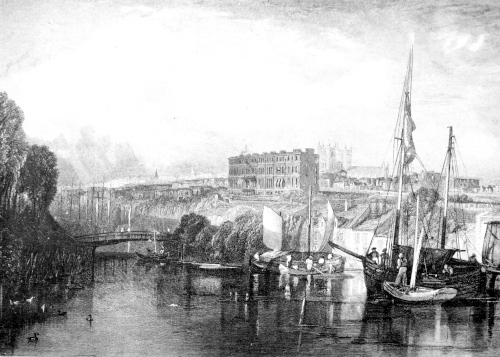
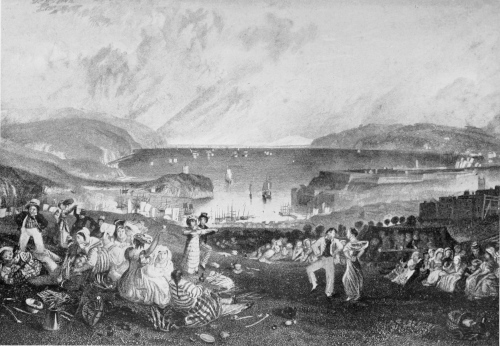
From a Drawing by J. M. W. Turner.]
[Engraved by T. Jeavons.
Exeter.
III
EDITED BY
F. J. SNELL, M.A. (Oxon)
Author of
“A Book of Exmoor”
“Early Associations of Archbishop Temple”
&c.
With many Illustrations
LONDON
BEMROSE AND SONS, LIMITED, 4, SNOW HILL, E.C.
AND DERBY
1904
[All Rights Reserved]
TO THE
Right Hon. Viscount Ebrington,
LORD LIEUTENANT OF THE COUNTY OF DEVON,
AND REPRESENTING ONE OF ITS OLDEST
AND MOST ILLUSTRIOUS FAMILIES,
THESE “MEMORIALS” ARE,
BY PERMISSION,
DEDICATED.
PREFACE
vii
The object of the present volume is to present what
may be termed a history of Devon in episode. A
comprehensive and, at the same time, detailed
record of the county, dealing more or less fully with the
principal events of every town’s life, would require many
volumes as large as or larger than ours, and yet might fail
to impress the reader with the salient features of county
life as a whole. In selecting the subjects for the various
articles comprised in this work, the Editor’s aim has been
to single out such as may be expected, for different reasons,
to appeal to all Devonians, and, perhaps, to some unconnected
with the beautiful shire. The majority of the
articles have been written expressly for the present work,
but three have been reproduced, in shortened form, from
the Transactions of the Devonshire Association, in which
they were published many years ago, and so were in
danger of being forgotten. The Editor deems he has no
need to apologize for thus enriching the volume with the
labours of departed Devonians, whom their compatriots
recall with deep reverence, and whom, were they living,
the Editor would hail as valued collaborators. Of the
other articles, two have already seen print in pamphlet
form, in which, after many years, they had naturally
viiibecome exceedingly scarce. All the other contributions
are new, and most of the papers, both old and new,
have been embellished with illustrations, some of them
curious and rare.
The Editor takes this opportunity of rectifying two
omissions in his preliminary sketch. Owing to some
accident, he failed to refer to the defence of Dartmouth
against the attack of Du Chastel in 1404. This event
was memorable on account of the active part taken by
the women, who, Amazon-like, hurled flints and pebbles
on the French, and thus expedited their retirement. The
other omission concerns the abortive Cavalier rising of
1655. Penruddock and Groves, the leaders in the affair
(for which they suffered death at Exeter), were both
Wiltshire men, but it is certainly interesting that an
attempt which might have antedated the Restoration by
five years was initiated by the proclamation of Charles II.
at South Molton—a town of the county of which George
Monk, to whom the Merry Monarch owed his crown, was
a native.
It only remains for the Editor to thank his many able
contributors for their generous assistance, and to express
the hope that the plan and execution of the work will
prove satisfactory to those who desire a fuller acquaintance
with the families, persons, and places therein mentioned.
No county of England is richer in historic
associations and romantic memories than
Devonshire, whose sons have proved themselves
on many a stubborn day as brave
as its daughters are proverbially fair. We may go
further, and say that no English shire is richer, and
only a few as rich, in those pre-historic remains which
will always exercise a weird fascination over cultivated
minds that would hold it sin to be incurious
as to the beginnings, or, rather, the age-long development,
of man upon the earth. The great mausoleum of these
remains is Dartmoor, with its menhirs, its logans, its
cromlechs (or dolmens), its circles and avenues, and its
famous clapper-bridge; but all over the county are
specimens of the typical round barrow, encrusted with
hoar legends, and possessing, in addition, their strict
scientific interest. The legends attach themselves to the
individual barrows; the scientific problem is concerned
with the almost unvarying form and type. Briefly, it may
be stated that the Devonshire round barrow is a late
variety of the cairn; the long barrow, which is numerously
represented in the neighbouring county of Dorset, being
older and corresponding to the long-headed race which
preceded the round-headed Kelts in the occupation of
Britain. The difference is between the Stone Age and
the Bronze Age, to which the round barrows belong and
bear witness. To the Stone Age are assigned the
chambered round barrows, the so-called giants’ graves,
and the stone kists of Lundy Island.
2Roughly contemporary with the typical round barrows
are those mysterious remains in the great central waste,
to which allusion has already been made. Just as false
systems of astrology were elaborated before the dawn of
clear scientific knowledge, so during the eighteenth century
a complete hagiology was constructed respecting these
remains, which has become untenable in view of more
rigorous historical, philological, and anthropological investigation.
In other words, the accepted interpretation of
these moorland wonders connected them more or less
definitely with Druidism. The prism of imagination
presented those hierarchs in crimson hues. If their
functions included inhuman sacrifices, they themselves
were far from being deficient in dignity. What says
Southey in Caradoc?
Within the stones of federation there
On the green turf, and under the blue sky,
A noble band—the bards of Britain—stood,
Their heads in rev’rence bow’d, and bare of foot,
A deathless brotherhood.
But whether as priests or mere medicine men, the
existence of Druids in Devon has yet to be proved.
Drewsteignton derives its initial syllable, not from them,
but from Drogo; Wistman’s Wood comes, not from
wissen, but is more probably uisg-maen-coed disguised in
modern garb. And, as for those basins on the summits
of the Dartmoor tors, they are purely natural. So the
whole delightful edifice which Polwhele was at such pains
to build up, and which Mrs. Bray described to the
sympathetic Southey, topples down, or, rather, vanishes
into thin air, leaving not a wrack behind.
While the Druids, both locally and generally, belong
rather to the region of myth than of solid history, the
Romans are an indisputable fact in both senses. Still,
their advent in the West Country is not free from
obscurity. One thing seems fairly certain, namely, that
they did not establish themselves in Devonshire by their
3usual method of conquest. Exeter, however, was a
thoroughly Roman city, and traces of the Imperial race
are to be found in local names, such as Chester Moor,
near North Lew, and in the ruins of Roman villas, as
at Seaton and Hartland. The siege of Exeter by
Vespasian is one of those fictitious events which, by dint
of constant reiteration, work themselves into the brain
as substantial verities. The place that Vespasian attacked
was not Exeter, but Pensaulcoit (Penselwood), on the
borders of Somerset and Wilts. Probably the Romans
were content with a protectorate, under which the Britons
were suffered to retain their nationality and their native
princes.
The Saxons, though known as “wolves,” certainly
appeared as sheep or in sheep’s clothing in their earliest
attempts to settle in the county. They lived side by
side with the Britons, notably at Exeter, where the
dedications of the ancient parishes testify to the juxtaposition
of British and Saxon. Here, also, it was that
the West Saxon apostle of Germany, St. Boniface, was
educated in a West Saxon school. But this state of
things was not to last. In 710, Ine, the King of the West
Saxons, vanquished Geraint, prince of Devon, in a pitched
battle; and although there is no reason to think that
he extended his borders much to the west of Taunton,
the work of subjugation thus begun was continued by
Ine’s successors, primarily by Cynewulf (755–784); and
since, in 823, the men of Devon were marshalled against
their kinsmen, the Cornish, at Gafulford, on the Tamar,
the Saxon conquest must by that time have been complete.
Still the victors were not satisfied. In 926, as we learn
from William of Malmesbury, Athelstan drove the Britons
out of Exeter, and, constituting the Tamar the limit
of his jurisdiction, converted Devon into a purely Saxon
province. The immense preponderance of Saxon names
in all parts of the county proves how thoroughly this
expropriation of the Kelts was carried into effect. The
4theory held by Sir Francis Palgrave, amongst others, that
the conquest of Devon was accomplished by halves, the
Exe being for some time the boundary, rests upon no
adequate grounds, neither evidence nor probability
supporting it. In due course, the whole county was
mapped out into tithings and hundreds, in accordance
with the Saxon methods of administration, and the
executive official was the portreeve.
Parallel with the record of Saxon conquest runs the
story of Danish endeavours, stubborn, long-protracted,
but, on the whole, less successful, to secure a footing and
affirm the superiority. In the first half of the ninth
century, the Vikings, in alliance with the Cornish, were
routed by Egbert in a decisive engagement at Hingston
Down, when, according to a Tavistock rhyme—
The blood that flowed down West Street
Would heave a stone a pound weight.
During the latter half of the same century, the Danes
were again active, and in 877 made Exeter their headquarters.
Seventeen years later they besieged the city,
which was relieved by Alfred the Great, who confided
the direction of church affairs in the city and county to
the learned Asser, author of the Saxon Chronicle. In
1001, the Danes, having landed at Exmouth, made an
attempt on Exeter, when the Saxons of Devon and
Somerset, hastening to the rescue, were overthrown in
a severe encounter at Pinhoe, and the piratical invaders
returned to their ships, laden with spoil. The following
year was marked by a general massacre of the Danes
at the behest of Ethelred, and, to avenge this treacherous
slaughter, Sweyn (or Swegen) swooped, like a vulture,
on the land, and, through the perfidy of Norman Hugh,
the reeve, was admitted within the gates of Exeter. As
usual on such occasions, red ruin was the grim sequel;
but in after days, when the Danish dynasty was in
secure possession of the throne, Canute (or Cnut) cherished
5no malice by reason of the tragic horror inflicted on his
race, but conferred on Exeter’s chief monastery the
dignity of a cathedral.
In a secular as well as in a religious sense, far the
most romantic episodes of Saxon rule in Devon centre
around the old Abbey of St. Rumon, Tavistock, the
largest and most splendid of all the conventual institutions
in the fair county. Ordulf, the reputed founder, was no
ordinary mortal. He looms through the mist of ages as
a being of gigantic stature, whose delight it was, with
one stroke of his hunting-knife, to cleave from their bodies
the heads of animals taken in the chase, and whose
thigh-bone, it is said, is yet preserved in Tavistock
Church. But if he had something in common with
Goliath and John Ridd, Ordulf was likewise, and very
plainly, cousin german to Saint Hubert, for having been
bidden in a vision, he built Tavistock Abbey, to whose site
his wife was conducted by an angel. An alternative
version associates with him in this pious work his father,
Orgar. However that may be, the edifice was destroyed
by the Danes in the course of a predatory expedition up
the Tamar to Lydford. This was in 997. It was re-built
on a still grander scale, and bore the assaults of time
until the days of the sacrilegious Hal, when it was
suppressed and given to William, Lord Russell.
So much for the Abbey. Now for the secular romance,
which yields a striking illustration of Shakespeare’s
warning:—
Friendship is constant in all other things
Save in the office and affairs of love:
Therefore all hearts in love use their own tongues,
Let ev’ry eye negotiate for itself
And trust no agent; for beauty is a witch
Against whose charms faith melteth into blood.
Orgar, the father of Ordulf, had a daughter named Elfrida,
the fame of whose loveliness came to the ears of the
King. Edgar, being unwedded, despatched Earl Ethelwold
6to Tavistock on a mission of observation, and the
courtier was empowered, if report erred not, to demand
her in marriage for his royal master. Ethelwold came,
and saw, and was conquered. Although much older than
the fair lady, he fell in love with her, and gained her
assent and that of her father to their union. This he
could do only by concealing from them the more advantageous
offer of a royal alliance. With equal duplicity
he kept from the King not only the knowledge of his
bride’s surpassing beauty, but the bride herself, being
assured that her appearance at court would be fatal.
However, in no long time the truth leaked out, and
Edgar set out for Dartmoor, ostensibly to hunt. Ethelwold,
in desperation, now made full confession to his
wife, whom he charged to disguise her charms, but the
vain and ambitious woman, angered at his deceit, displayed
them the more, and the King, resolved on Ethelwold’s
death, actually slew him at Wilverley or Warlwood in
the Forest.
After the departure of the Romans and before the final
absorption of Devon by the Saxons, there are signs that
the Kelts of South-West Britain were in intimate touch
with their brethren on the other side of St. George’s
Channel. At any rate, the Ogham inscriptions found in
the neighbourhood of Tavistock testify to the missionary
enterprise of the Island of Saints during the latter part
of the fifth and the beginning of the sixth centuries after
Christ. For most purposes, the centre of county life has
from the first been Exeter, but to this rule there was
at one time an important exception, which was not
Tavistock, but the little town of Crediton, situated on
a tributary of the Exe. An old rhyme has it—
Kirton was a market town,
When Exeter was a fuzzy down.
Little can be said for this view on general historic grounds,
but from the standpoint of ecclesiastical Anglo-Saxondom,
7Crediton had a decided claim to the preference, for was
it not the birthplace of Winfrid (St. Boniface), and the
seat of the Anglo-Saxon bishops from the year 909 until
1050, when Leofric, for fear of the Danes, transferred
the see to Exeter? This prelate was installed by
Edward the Confessor and Queen Edith, who, holding
him by the hands, invoked God’s blessing on future
benefactors.
If the Ogham stones of Dartmoor attest the zeal of
Keltic Christianity, Coplestone Cross, a richly-carved
monument near Crediton, is a reminder of the early days
of Saxon piety, when such crosses were erected as shrines
for the churchless ceorls. Coplestone, also, was the name
of a powerful race known as the Great Coplestones, or
Coplestones of the White Spur, who claimed, but
apparently without reason, to have been thanes in Saxon
times. In the West Country, no distich is more popular
or more widely diffused than the odd little couplet—
Croker, Cruwys, and Coplestone,
When the Conqueror came, were all at home.
The invincible William knocked at the gates of the
Western capital in 1066, and was at first refused admission.
If it be true, as Sir Francis Palgrave held, that
Exeter was a free republic before Athelstan engirdled
it with massive walls, the genius loci asserted itself with
dramatic effect when the Conqueror demanded submission,
and, in the words of Freeman, “she, or at least
her rulers, professed themselves willing to receive
William as an external lord, to pay him the tribute which
had been paid to the old kings, but refused to admit him
within her walls as her immediate sovereign.” Dissatisfied
with this response, William besieged the city, which held
out for eighteen days, and then surrendered on
conditions. Exeter, it may be observed, was at this time
one of the four principal cities of the realm, the other
members of the quartette being London, Winchester, and
York.
8The capitulation was followed by the building of
Rougemont Castle, not a moment too soon, for ere it
could well have been completed, the sons of Harold led
an assault on Exeter. This was repulsed without much
difficulty by the Norman garrison, but the Saxons showed
themselves still restless in the West. The army of
Godwin and Edmund fought with fruitless valour on the
banks of the Tavy until, three years after the opening
of the struggle, Sithric, the last Saxon abbot of Tavistock,
betook himself to the Camp of Refuge at Ely, to be
under the protection of the noble Hereward.
Exeter, to which one always returns, stands out prominently
among English towns on account of its many
sieges. Old Isaacke, happily a much better chronicler
than poet, testifies as follows:—
In midst of Devon Exeter city seated,
Hath with ten sieges grievously been straitned.
This is sure proof of the immense value attached to the
possession of the place in troublous times, and prepares
us for the conspicuous part taken by both county and
city in the centuries that succeeded the establishment
of Norman rule. The first Norman governor was Baldwin
de Redvers, whose grandson, another Baldwin, declared
for Matilda when civil war broke out between her party
and Stephen’s. The citizens, on the other hand, espoused
the cause of the King, and were subjected to all sorts
of barbarities, until the approach of a vanguard of two
hundred horse compelled the retreat of the garrison into
the castle. After a three months’ siege, water failed,
and the doughty defenders were forced to yield.
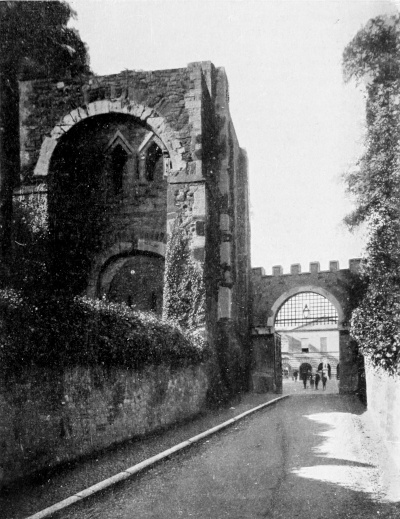
From a Photograph]
[by Frith & Co.
Rougemont Castle, Exeter.
Edward I. held a parliament at Exeter, and his great-grandson,
the famous Black Prince, must have been well
acquainted with the city, as he passed through it more
than once en route to Plymouth, whence he sailed to
France on the glorious expedition which ended at
Poictiers. Its relations with the Black Prince reveal to
us how much the county has receded in practical
9importance since medieval times. Plymouth, indeed,
maintains her place: she is as great now, perhaps
greater, than she was then; and Dartmouth, charming
Dartmouth, is still far from obscure. Nevertheless, it is
idle to claim for the ports of Devon as a class the
relative standing they once enjoyed, when, according to
the Libel of English Policy, Edward III., bent on suppressing
the pirates of St. Malo—
did dewise
Of English towns three, that is to say,
Dartmouth, Plymouth, the third it is Fowey;
And gave them help and notable puissance
Upon pety Bretayne for to werre.
And when Chaucer has to depict a typical mariner, he
begins with the words—
A schipman was ther, wonyng far by weste;
For ought I woot, he was of Dertemouth.
—obviously because of Dartmouth’s national reputation.
Topsham, formerly the port of Exeter, is a truly startling
instance of decline, since as late as the reign of
William III. London alone exceeded it in the amount of
its trade with Newfoundland. On the other hand,
Bideford never possessed all the importance that Kingsley
attributes to it, though relatively of much greater consequence
in ancient days than at present. It is a curious
fact that Ilfracombe, that popular watering-place, sent six
ships to the siege of Calais, as compared with Liverpool’s
one, Dartmouth contributing thirty-one, and Plymouth
twenty-six.
The Black Prince was the first Duke of Cornwall, and
the stannaries or tin-bearing districts of Devon and
Cornwall, which in Saxon and Norman times had been
a royal demesne, passed to this valiant prince and his
successors. The old Crockern Tor Parliament would
furnish material for a fascinating chapter in the romance
of history, but the present sketch is necessarily too brief
to admit of much discussion. Its regulations certainly did
10not err on the side of leniency. “The punishment,” says
Mrs. Bray, “for him who in days of old brought bad tin
to the market was to have a certain quantity of it poured
down his throat in a melted state.” The most important
event in the annals of Chagford, one of the stannary
towns, is the falling in of the market-house on Mr.
Eveleigh, the steward, and nine other persons, all of whom
were killed. This sad disaster, which occurred “presently
after dinner,” is the subject of a rare black-letter tract,
entitled, True Relation of the Accident at Chagford in
Devonshire.
Going back to the Wars of the Roses, the West of
England for the most part supported the Lancastrian
cause. In 1469, Exeter was besieged for twelve days by
Sir William Courtenay, in the interest of Edward IV.;
and in the following year, Clarence and Warwick repaired
to the city prior to embarking at Dartmouth for Calais.
When, however, Edward IV., seated firmly on the
throne, appeared in Exeter as de facto sovereign of the
realm, the citizens, forgetting past grudges, provided such
a welcome for the monarch, his consort, and his infant
son, that he presented the Corporation with the sword
of state still borne before the Mayor. The city had given
him a hundred nobles. Just twice that sum was the loyal
offering to Richard III. when, in 1483, he arrived at
Exeter soon after the Marquis of Dorset had proclaimed
the Earl of Richmond King. A gruesome incident
marked his visit, for Richard, that best-hated of English
rulers, caused his brother-in-law, Sir Thomas St. Leger,
to be beheaded in the court-yard of the Castle. The
name, Rougemont, jarred on his superstitious nature, the
reason being its similarity to Richmond. The point is
referred to by Shakespeare in the well-known play:—
When last I was at Exeter
The Mayor in courtesy showed me the castle,
And called it Rougemont; at which name I started,
Because a bard of Ireland told me once
I should not live long after I saw Richmond.
11In 1497, that bold adventurer, Perkin Warbeck, claimed
admission within the walls, which, so far as the citizens
were concerned, would have been readily granted. The
Earl of Devon and his son were less accommodating,
and, after Warbeck had set fire to the gates, succeeded
in beating off his attack. The pretender’s next appearance
in the city, where the King had taken up his
quarters, was in the character of a prisoner. Henry’s
conduct towards his rebellious subjects was worthy of
a great prince, and affords a marked contrast to the
brutality that characterized the suppression of the next
revolt and the still more notorious savagery of “Kirke’s
Lambs.” When brought before him, “bareheaded, in
their shirts, and halters round their necks,” he “graciously
pardoned them, choosing rather to wash his hands in
milk by forgiving than in blood by destroying them.”
As is well known, the Reformation was not the
popular event in England that it was in Scotland, and
the introduction of the Book of Common Prayer in lieu
of the Mass was the torch which, in 1549, set the western
shires—Cornwall, and Somerset, and Devon—in a blaze.
The opposition, started at Sampford Courtenay by a pair
of simple villagers, soon came to include leaders of the
stamp of Sir Thomas Pomeroy and Sir Humphry
Arundel, who barricaded Crediton, the rendezvous of their
party. The interests of the Crown were befriended by
Sir Peter and Sir Gawen Carew, who, though utterly
unscrupulous and barbarous in their methods of warfare,
failed to arrest the insurrection. Presently no fewer than
ten thousand rebels commenced the investment of Exeter.
At this serious juncture, the Lord Lieutenant of the
county (Lord Russell) took the helm of affairs, and
ultimately raised the siege, the city in the meantime being
reduced to terrible straits through famine. But the rebels
suffered, too. In all, four thousand peasants fell in the
Western Rising. A dramatic episode was the execution
of the Vicar of St. Thomas, who was hanged in full
12canonicals on his church, where his corpse remained
suspended till the reign of Edward’s successor, when the
Roman Catholics regained, for a season, the upper hand.
The geographical position of Devonshire suggests,
what is also the fact, that the county had a considerable
share in the colonization of the Western Hemisphere.
The first port in Devon to send out ships to America
for the purpose of establishing settlements was Dartmouth.
In this enterprise, Humphry and Adrian Gilbert, who were
half-brothers of Sir Walter Raleigh, and whose seat,
Greenway, was close to Dartmouth, took the lead. The
pioneer expedition, which took place in 1579, was productive
of no result; but in 1583, Humphry Gilbert
seized Newfoundland, the present inhabitants of which are
largely of Devon ancestry. This navigator, though brave
and skilful, rests under an ugly imputation which we must
all hope is baseless. According to some, he proposed to
Queen Elizabeth the perfidious destruction of the foreign
fishing fleets which had long made the island their station.
During his homeward voyage Humphry was drowned,
and the manner of his death is depicted in an old
ballad:—
He sat upon the deck;
The book was in his hand.
“Do not fear; Heaven is as near
By water as by land.”
Adrian Gilbert interested himself in the discovery of
the North-West Passage, but neither of the brothers did
much more than secure for Dartmouth a principal share
in the Newfoundland trade, for many and many a year
one of the chief props of Devon commerce.
Of far greater practical significance, as a centre of
maritime adventure, was Plymouth. Hence sprang
William Hawkins, the first of his nation to sail a ship
in the Southern Seas. Hence sprang his more famous
son, Sir John Hawkins, the first Englishman that ever
entered the Bay of Mexico, and who spent the bribes of
13Philip of Spain in defensive preparations against that
tyrant’s fleet. Here was organized the Plymouth Company
founded for the colonization of North Virginia after the
failure of Sir Walter Raleigh (who, like Sir Humphry
Gilbert, had made Plymouth his base) to form a settlement.
The efforts of the Plymouth Company were at
first not very felicitous, but in 1620 it received a new
charter, and although its schemes were absurdly ambitious,
and fell ludicrously short of realization, and although it
was administered for private ends rather than in a large
spirit of enlightened patriotism, still the mere existence
of the company must have tended to promote the flow
of men and money to the new plantations beyond the
seas.
In the Great Civil War, the towns generally were in
favour of the Parliament, but Exeter, on which city
Elizabeth had conferred the proud motto Semper fidelis,
appears to have been Royalist in sympathy. As, however,
the Earl of Bedford, the Lord Lieutenant, held it
for the opposite party, it was besieged by Prince Maurice,
to whom it surrendered in September, 1643. In April,
1646, it was recovered by the Roundheads, but ere this
many interesting events had come to pass. In May,
1644, Queen Henrietta Maria had arrived in the city, and
there, on June 16th, was born the Princess Henrietta
Anne, afterwards Duchess of Orleans. Just at this
moment, the Earl of Essex made his appearance, and
the Queen was fain to escape alone, leaving her infant
in the charge of Lady Moreton and Sir John Berkeley,
who arranged for her christening in the font of Exeter
Cathedral. Her portrait by Sir Peter Lely, which adorns
the Guildhall, was the gift of Charles II., who, in 1671,
thus testified his appreciation of the city’s good services.
The donor himself had been the guest of the Corporation
in July, 1644, when his royal father had received from
the civic authorities a present of five hundred pounds.
Looking further afield, Devonshire was the theatre of
14many stirring events in that fratricidal struggle. It was
in 1642 that the High Sheriff, Sir Edmund Fortescue,
of Fallapit, at the instigation of Sir Ralph Hopton,
called out the posse comitatus, and so precipitated a
conflict. Sir Ralph himself, with the aid of Sir Nicholas
Slanning, assembled a force of some two or three thousand
men, with which he captured first Tavistock, and then
Plympton, afterwards joining Fortescue at Modbury,
where a mixed army of trained bands and levies was
soon in being. The next proceeding was to have been
an attack on Plymouth, but Colonel Ruthven, the commandant
of that town, sent out five hundred horse,
which, after a feint at Tavistock, dashed through
Ivybridge, and delivered a sudden assault on Modbury.
In a moment all was over. Exclaiming, “The troopers
are come!” the trained bands fled in confusion, while
the rest of the army, who knew nothing about soldiering
and had no love for the cause, went after them, save
for a few friends of the Sheriff, who helped him to
defend the mansion of Mr. Champernowne. When this
was fired, the movement collapsed, and the Roundheads,
who had lost but one man, effected a good haul of
county notabilities, including the High Sheriff, John
Fortescue, Sir Edmund Seymour, and his eldest son,
Edmund Seymour, M.P., Colonel Henry Champernowne,
Arthur Basset, and Thomas Shipcote, the Clerk
of the Peace. About a score of these worthies of Devon
were placed on board ship at Dartmouth, and transported
to London.
This initial success of the Roundheads was soon
qualified by reverses. Ruthven, having marched into
Cornwall, was encountered by Hopton at Braddock Down,
and sustained a crushing defeat. In February, 1643,
Hopton laid siege to Plymouth, but Fortune again veered,
and the Royalists were forced to retire in consequence
of a second defeat at Modbury. Attempts were made to
bring about a pax occidentalis, by which both parties
15were to forswear further participation in the unnatural
strife, but they proved abortive. Encouraged by the
defeat of the Earl of Stamford at Stratton, a Cornish
army advanced northwards on the disastrous march which
resulted in the overthrow at Lansdown, near Bath, and
involved the loss of four leading Royalists—Sir Bevil
Grenville, Trevanion, Slanning, and Sidney Godolphin—the
last of whom fell in a miserable skirmish at Chagford.
Later in the year, Prince Maurice exerted himself to
reduce Plymouth, but, although the Cavaliers fought well,
the garrison, equally brave and perhaps more pious, drove
them back to the cry of “God with us!” Among the
besiegers was King Charles himself, but not even the
presence of royalty could alter the situation, and he and
Maurice presently withdrew from the scene of operations.
The siege was not ended till the spring of 1645, in the
January of which year Roundheads and Cavaliers occupied
the same relative positions as Britons and Boers in the
memorable fight at Wagon Hill. Even after this terrible
repulse, the Cavaliers did not quite abandon hope, and
several small actions took place; but the advent of
Fairfax in 1646 led to a precipitate retreat, and the
Cavalier strongholds—Mount Edgecumbe and Ince
House—gallantly defended throughout, had to be
given up.
The last place in Devon to be held for King Charles
was Salcombe Castle, and the person who held it was
the very Sir Edmund Fortescue who was High Sheriff,
in 1642, and, in that capacity, threw down the glove to
his opponents. The “Old Bulwarke” was not a promising
fort, but it stood a siege of four months, when the garrison
were allowed to march out with the honours of war.
Among other articles of surrender, it was stipulated that
John Snell, Vicar of Thurlestone, who had acted as
chaplain to the garrison, should be allowed quiet possession
of his parsonage. This condition was not observed.
16However, Parson Snell was not forgotten after the
Reformation, as he was appointed Canon Residentiary of
Exeter, in which position he was succeeded by his sons.
By the 7th of May, the date of the surrender, the cause
of King Charles was in extremis; and, accordingly, Fort
Charles, as Sir Edmund had re-named the castle, was
fully justified in capitulating. The key of the castle is
said to be still the treasured heirloom of the hero’s
representative.
Devon men took an active part in the Monmouth
Rebellion; and, in common with its neighbours, the county
experienced the judicial atrocities of the notorious
Jeffreys. A “bloody assize” was opened at Exeter on
September 14th, 1685, when twenty-one rebels were
sentenced, thirteen of whom were executed. Thirteen
more were fined and whipped, and one was reprieved. A
feature in this assize was the publication of 342 names,
all belonging to persons who were at large when the
business closed. These comparatively fortunate yeomen
had escaped the search of the civil and military powers,
and were tenants of the open country, living in copses
and haystacks as best they might.
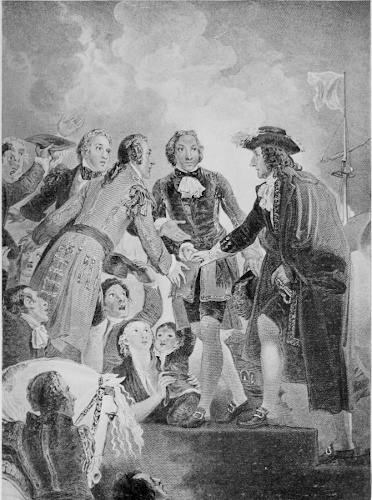
However, vengeance was not long delayed. In 1688,
the Prince of Orange landed at Brixham, and marched
to Exeter by way of Chudleigh. The account of an
eye-witness printed in the Harleian Miscellany gives the
impression that his entry into the city, as a spectacle,
was somewhat barbaric. The pageant included two
hundred blacks from the plantations of the Netherlands
in America, with embroidered caps lined with white fur,
and crested with plumes of white feathers; and two
hundred Finlanders or Laplanders in bear-skins taken
from the beasts they had slain, with black armour and
broad, flaming swords. The troops were received with
loud acclamations by the people at the west gate, and
their conduct was excellent. Meanwhile, the position of
the authorities was far from enviable. In vulgar parlance,
17they were in a “tight place,” not knowing which way
the wind would blow, and being desirous of maintaining
the reputation of the city for unswerving loyalty. The
Bishop and the Dean adopted the safe, if not too heroic,
method of flight, while the Mayor, with more dignity,
commanded the west gate to be closed, and declined to
receive the Prince. The poor priest-vicars, no less
faithful at heart, were intimidated into omitting the
prayer for the Prince of Wales, and employing only one
prayer for the King. On the ninth, notice was sent to
the canons, vicars-choral, and singing lads, that the Prince
would attend the service in the Cathedral at noon, and
they were ordered by Dr. Burnet to chant the Te Deum
when His Highness entered the choir. This they did.
The Prince occupied the Bishop’s throne, surrounded by
his great officers, and after the Te Deum, Dr. Burnet,
from a seat under the pulpit, read aloud His Highness’s
declaration. The party then returned to the Deanery,
where William had taken up his quarters.
The Prince of Orange was in Exeter for three days
before any of the county gentry appeared in his support,
and naturally the members of his suite began to feel
disconcerted. Presently, however, the gentlemen of Devon
rallied to his standard, and in compliance with a proposal
of Sir Edward Seymour, formed a general association for
promoting his interest. A notable arrival was Mr. Hugh
Speke, who, it is said, had been personally offered by
King James the return of a fine of £5,000 if he would
atone for his support of Monmouth by acting as spy on
the Prince of Orange, and had bravely refused. The
Mayor and Aldermen now thought it high time to recognise
the change in the situation and observe a greater
measure of respect towards one who, it seemed likely,
would soon be their lawful sovereign. The Dean, too,
hastened home to give in his adhesion to the Prince; and
William left Exeter with the assurance that the West
Country, which could not forgive the Jacobite massacre,
18was heart and soul with him, and that elsewhere the power
of his despotic father-in-law was rapidly crumbling.
In a second letter, reproduced in the Harleian Miscellany,
we are informed that there had been “lately
driven into Dartmouth, and since taken, a French vessel
loaded altogether with images and knives of a very large
proportion, in length nineteen inches, and in breadth two
inches and an half; what they were designed for, God
only knows.” Possibly for a purpose not wholly unlike that
which inspired the unpleasant visit of some of the same
nation to Teignmouth in 1690, when they fired the town.
It appears that the county force had been drafted to
Torquay with the object of resisting a threatened landing
from the French fleet, which was anchored in the bay.
Certain French galleys, availing themselves of the
opportunity thus afforded them, stole round to Teignmouth,
threw about two hundred great shot into the town,
and disembarked 1,700 men, who wrought immense
damage in the place, already deserted by its inhabitants.
For three hours there was pillage, and then over a
hundred houses were burnt. A contemporary named
Jordan, recounting the circumstances, cannot restrain his
righteous indignation. “Moreover,” says he, “to add
sacrilege to their robbery and violence, they, in a barbarous
manner, entered the two churches in the said town, and
in a most unchristian manner tore the Bibles and Common
Prayer Books in pieces, scattering the leaves thereof
about the streets, broke down the pulpits, overthrew the
Communion tables, together also with many other marks
of a barbarous and enraged cruelty; and such goods and
merchandize as they could not or dare not stay to carry
away, they spoiled and destroyed, killing very many
cattle and hogs, which they left dead behind them in
the streets.” This, the last, invasion of Devonshire,
cost the county £11,030, the amount at which the damage
was assessed, and which was raised by collections in the
churches after the reading of a brief. French Street,
19Teignmouth, conserves by its name the memory of this
heavy, but happily transient, disaster.
With the seventeenth century ends the heroic period
of Devonian history. From that time it figures merely
as a province sharing in the triumphs and distresses of
the country of which it forms part, but having no special
or distinctive record. The most exciting era was, without
doubt, the Napoleonic age, when the dread of a new
French invasion was terminated only by the glorious
victory of Trafalgar.
In conclusion, it may be mentioned that Sidmouth was
the early home of her late Majesty Queen Victoria. Her
father, the Duke of Kent, died there in 1820, and the
west window of the church was erected as a memorial
of this son of George III., whose visit to Exeter in the
preceding century gave such delight to the county.
The Editor.
THE MYTH OF BRUTUS THE TROJAN. By the late R. N. Worth, F.G.S., etc.
20
Brutus, son of Sylvius, grandson of Æneas
the Trojan, killed his father while hunting,
was expelled from Italy, and settled in
Greece. Here the scattered Trojans, to the
number of seven thousand, besides women and children,
placed themselves under his command, and, led by him,
defeated the Grecian King Pandrasus. The terms of
peace were hard. Pandrasus gave Brutus his daughter,
Ignoge, to wife, and provided 324 ships, laden with all
kinds of provisions, in which the Trojan host sailed away
to seek their fortune. An oracle of Diana directed them
to an island in the Western Sea, beyond Gaul, “by
giants once possessed.” Voyaging amidst perils, upon
the shores of the Tyrrhenian Sea they found four nations
of Trojan descent, under the rule of Corinæus, who
afterwards became the Cornish folk. Uniting their forces,
the Trojans sailed to the Loire, where they defeated the
Gauls and ravaged Aquitaine with fire and sword. Then
Brutus
“... Repaired to the fleet, and loading it with the riches and spoils he
had taken, set sail with a fair wind towards the promised island, and arrived
on the coast of Totnes. This island was then called Albion, and was
inhabited by none but a few giants. Notwithstanding this, the pleasant
situation of the places, the plenty of rivers abounding with fish, and the
engaging prospect of its woods, made Brutus and his company very
desirous to fix their habitation in it. They therefore passed through all
the provinces, forced the giants to fly into the caves of the mountains,
and divided the country among them, according to the directions of
their commander. After this they began to till the ground and build
21houses, so that in a little time the country looked like a place that had
been long inhabited. At last Brutus called the island after his own name,
Britain, and his companions Britons; for by these means he desired to
perpetuate the memory of his name; from whence afterwards the
language of the nation, which at first bore the name of Trojan or
rough Greek, was called British. But Corinæus, in imitation of his leader,
called that part of the island which fell to his share Corina, and his
people Corineans, after his name; and though he had his choice of the
provinces before all the rest, yet he preferred this county, which is now
called in Latin Cornubia, either from its being in the shape of a horn
(in Latin Cornu), or from the corruption of the same name. For it was
a diversion to him to encounter the said giants, which were in greater
numbers there than in all the other provinces that fell to the share of
his companions. Among the rest was one detestable monster called
Goemagot, in stature twelve cubits, and of such prodigious strength
that at one stroke he pulled up an oak as if it had been a hazel wand.
On a certain day, when Brutus was holding a solemn festival to the
gods in the port where they at first landed, this giant, with twenty more
of his companions, came in upon the Britons, among whom he made a
dreadful slaughter. But the Britons at last, assembling together in a
body, put them to the rout, and killed them every one, except Goemagot.
Brutus had given orders to have him preserved alive, out of a desire to
see a combat between him and Corinæus, who took a great pleasure in
such encounters. Corinæus, overjoyed at this, prepared himself, and,
throwing aside his arms, challenged him to wrestle with him. At the
beginning of the encounter, Corinæus and the giant, standing front to
front, held each other strongly in their arms, and panted aloud for
breath; but Goemagot presently grasping Corinæus with all his might,
broke three of his ribs, two on his right side and one on his left; at
which Corinæus, highly enraged, roused up his whole strength, and
snatching him upon his shoulder, ran with him, as fast as the weight
would allow him, to the next shore, and there getting upon the top of a
high rock, hurled down the savage monster into the sea, where, falling
on the sides of craggy rocks, he was torn to pieces, and coloured the
waves with his blood. The place where he fell, taking its name from the
giant’s fall, is called Lam Goemagot, that is, Goemagot’s Leap, to this
day.”[1]
Such, in its complete form, is the myth of Brutus
the Trojan, as told by Geoffrey of Monmouth, sometime
Bishop of St. Asaph, who professed, and probably with
truth, to translate the British history of which it forms
a part from “a very ancient book in the British tongue,”
22given to him by Walter Mapes, by whom it had been
brought from Brittany. Geoffrey wrote in the earlier
part of the twelfth century, and he does not indicate
with more precision than the use of the term “very
ancient” the date of his original.
If, however, we are to accept the writings of Nennius
as they have been handed down as substantially of the
date assigned to them by the author—the middle of the
ninth century—the legend of Brutus, though not in the
full dimensions of the Geoffreian myth, was current at
least a thousand years ago; and in two forms. In one
account, Nennius states that our island derives its name
from Brutus, a Roman consul, grandson of Æneas, who
shot his father with an arrow, and, being expelled
from Italy, after sundry wanderings settled in Britain—a
statement that agrees fairly well with that of Geoffrey.
In the other account, which Nennius says he had learned
from the ancient books of his ancestors, Brutus, though
still through Rhea Silvia, his great-grandmother, of
Trojan descent, was grandson of Alanus, the first man
who dwelt in Europe, twelfth in descent from Japhet in
his Trojan genealogy, and twentieth on the side of his
great-grandfather, Fethuir. Alanus is a kind of European
Noah, with three sons—Hisicion, Armenon, and Neugio;
and all his grandsons are reputed to have founded nations—Francus,
Romanus, Alamanus, Brutus, Gothus, Valagothus,
Cibidus, Burgundus, Longobardus, Vandalus, Saxo,
Boganus. He is wholly mythical.
Brutus here does not stand alone. He falls into place
as part of a patriarchal tradition, assigning to each of
the leading peoples of Europe an ancestor who had left
them the heritage of his name. This one fact, to my
mind, removes all suspicion of the genuineness of these
passages of Nennius, which have been sometimes regarded
as interpolations. With Geoffrey not only is the story
greatly amplified, but it is detached from its relations,
and is no longer part of what may fairly be called one
23organic whole. Nennius, therefore, gives us an earlier
form of the myth than Geoffrey. I think, too, that the
essential distinctions of the two accounts render it clear
that the ancient authorities of Nennius and Geoffrey are
not identical, from which we may infer that the original
tradition is of far older date than either of these early
recorders.
But we may go still further. Whether the legend of
Brutus is still extant in an Armoric form, I am not aware,
but it appears in Welsh MSS. of an early date; the
“Brut Tysilio” and the “Brut Gr. ab Arthur” being
important. It has been questioned whether, in effect,
these are not translations of Geoffrey; but there seems
no more reason for assuming this than for disbelieving
the direct statement of Geoffrey himself, that he obtained
his materials from a Breton source. Bretons, Welsh, and
Cornish are not only kindred in blood and tongue, but,
up to the time when the continuity of their later national
or tribal life was rudely shattered, had a common history
and tradition, which became the general heritage. If the
story of Brutus has any relation to the early career of
the British folk, we should expect to discover traces of
the legend wherever the Britons found their way. If
this suggestion be correct, if Geoffrey drew from Armoric
sources, and if the “Brut Tysilio,” which is generally
regarded as the oldest of the Welsh chronicles, represents
an independent stream, the myth must be dated back far
beyond even Nennius, as the common property of the
Western Britons, ere, in the early part of the seventh
century, the successes of the Saxons hemmed one section
into Wales, another into Cornwall, and drove a third
portion into exile with their kindred in Armorica. There
is, consequently, good reason to believe that the tradition
is as old as any other portion of our earliest recorded
history or quasi-history, and covers, at least, the whole
of our historical period.
The narrative of Geoffrey does not give the myth in
24quite its fullest shape. For that we have to turn to local
sources. Tradition has long connected the landing of
Brutus with the good town of Totnes; the combat between
Corinæus and Goemagot with Plymouth Hoe. Like the
bricks in the chimney called in to witness to the noble
ancestry of Cade, has not Totnes its “Brutus stone”?
And did not Plymouth have its “Goemagot”?
The whole history of the “Brutus stone” appears
to be traditional, if not recent. My friend, Mr. Edward
Windeatt, informs me that it is not mentioned anywhere
in the records of the ancient borough of Totnes. I fail
to find any trace of it in the pages of our local chroniclers,
beyond the statement of Prince (Worthies) that “there
is yet remaining towards the lower end of the town of
Totnes a certain rock called Brute’s Stone, which tradition
here more pleasantly than positively says is that on which
Brute first set his foot when he came ashore.” The good
people of Totnes, so it is said, have had it handed down
to them by their fathers from a time beyond the memory
of man, that Brutus, when he sailed up the Dart, which
must consequently have been a river of notable pretensions,
stepped ashore upon this stone, and exclaimed,
with regal facility of evil rhyme:—
“Here I stand, and here I rest,
And this place shall be called Totnes!”
Why the name should be appropriate to the circumstances,
we might vainly strive to guess, did not Westcote and
Risdon inform us that it was intended to represent Tout
à l’aise! We need not be ashamed of adopting their
incredulity, and of doubting with them whether Brutus
spoke such good French, or, indeed, whether French was
then spoken at all.
The stone itself affords no aid. All mystery departed
when it was recently lifted in the course of pavemental
repairs, and found to be a boulder of no great dimensions,
with a very modern-looking bone lying below. However,
25it is the “Brutus stone,” and I dare say will long be
the object of a certain amount of popular faith.[2]
But, according to Geoffrey of Monmouth himself,
Totnes town could not have been intended by him as
the scene of the landing of Brutus. It was when Brutus
was “holding a solemn festival to the gods, in the port
where they had at first landed,” that he and his followers
were attacked by Goemagot and his party. There it was
that Goemagot and Corinæus had that famous wrestling
bout, which ended in Corinæus running with his gigantic
foe to the next shore, and throwing him off a rock into
the sea. There is no sea at Totnes, no tall craggy cliff;
and for Corinæus to have run with his burden from
Totnes to the nearest point of Start or Tor Bay would
have been a feat worthy even of a Hercules.
We are not surprised to find, therefore, that Totnes
has her rivals—Dover, set up by the Kentish folk, and
Plymouth,[3] each claiming to be the scene of the combat
between Corinæus and Goemagot, and claiming, therefore,
incidentally, also to be the port in which Brutus landed.
I do not know that we can trace either tradition very
far into antiquity. They do not occur in the chronicles,
where, indeed, the very name of Plymouth is unknown.
The earliest reference to that locality has been generally
regarded as the Saxon Tamarworth. I am not at all
sure, however, that Plymouth is not intended by Geoffrey’s
26“Hamo’s Port,” which he assumes to be Southampton.
Geoffrey, indeed, says that Southampton obtained the
“ham” in its name from a crafty Roman named Hamo,
killed there by Arviragus; but if the identification is no
better than the etymology, we may dismiss it altogether.
On the other hand, the name of the estuary of the Tamar
is still the Hamoaze—a curious coincidence, if it goes no
further. There is nothing in the story of Hamo itself
to indicate Southampton or preclude Plymouth; only a
few references to Hamo’s Port occur in Geoffrey. One
of these, where Belinas is described as making a highway
“over the breadth of the kingdom” from Menevia to
Hamo’s Port, may rather seem to point to Southampton;
but there is no positive identification, even if we assume
the story to be true. Again, “Maximian the senator,”
when invited into Britain by Caradoc, Duke of Cornwall,
to be King of Britain, lands at Hamo’s Port; and here
the inference would rather be that it was on Cornish
territory. And so when Hoel sent 15,000 Armoricans to
the help of Arthur, it was at Hamo’s Port they landed.
It was from Hamo’s Port that Arthur is said to have set
sail on his expedition against the Romans—a fabulous
story, indeed, but still helping to indicate the commodiousness
and importance of the harbour intended. It was at
Hamo’s Port that Brian, nephew of Cadwalla, landed on
his mission to kill the magician of Edwin the King, who
dwelt at York, lest this magician might inform Edwin
of Cadwalla’s coming to the relief of the British. After
he had killed Pellitus, Brian called the Britons together
at Exeter; and it would be fair to infer that the place
where he landed was likely to be one where the Britons
had some strength. Here, again, whatever we may make
of the history, it is Hamo’s Port that is the fitting centre
of national life; and it is the Hamoaze that best suits the
reference.
This legend of Brute the Trojan was firmly believed
in, and associated with these Western shores, by the
27leading intellects of the Elizabethan day. Spenser refers
to it in his:—
That well can witness yet unto this day
The Western Hogh besprinkled with the Gore
Of mighty Goemot.
Drayton verifies the legend in his Polyolbion, and tells
us how—
Upon that loftie place at Plimmouth, call’d the Hoe,
Those mightie Wrastlers met;
and how that Gogmagog was by Corin—
Pitcht head-long from the hill; as when a man doth throw
An Axtree that with sleight deliurd from the Foe
Roots up the yeelding earth, so that his violent fall,
Strooke Neptune with such strength, as shouldred him withall;
That where the monstrous waues like mountaines late did stand,
They leapt out of the place, and left the bared sand
To gaze vpon wide heauen.
And this article of faith had then long been popular.
Carew, in his Survey of Cornwall, says: “Moreover,
vpon the Hawe at Plymmouth, there is cut out in ground
the pourtrayture of two men, the one bigger, the one
lesser, with clubbes in their hands (whom they terme
Gogmagog), and (as I have learned) it is renewed by
order of the Townesmen when cause requireth, which
should inferre the same to be a monument of some
moment.” Westcote, writing some half a century later,
states of the Hoe—“in the side whereof is cut the portraiture
of two men of the largest volume, yet the one
surpassing the other every way; these they name to be
Corinæus and Gogmagog.” And there these figures
remained until the Citadel was built in 1671—a remarkable
witness of the local belief that Plymouth had played a
prominent part in the affairs of Brutus and his fellows.
We know when these figures ceased to be. Can we
form any idea as to when they originated? Their earliest
28extant mention occurs in the Receiver’s Accounts of the
borough of Plymouth, under date 1494–5:—
It. paid to Cotewyll for ye renewying of ye pyctur of Gogmagog a pon
ye howe. vijd.
Previous to this date there only remain complete accounts
of two years—those for 1493–4 and those for 1486—with
a few fragmentary entries; and as the Gogmagog did not
come to be “renewed” every year, there are no conclusions
to be drawn from the absence of earlier notices.
The next entry is in 1500–1, when 8d. was paid for
“makying clene of gogmagog.” In 1514–15, John Lucas,
sergeant, had the like sum for “cuttyng of Gogmagog”;
and in the following year we read of its “new dyggyng.”
In 1526–7, the entry runs: “Itm pd. for Clensying and
ryddyng of gogmagog a pon ye howe viijd.”; and about
this time it was renewed almost yearly. In 1541–2, the
entry is: “Itm pd. to William Hawkyns, baker (evidently
to distinguish him from William Hawkyns, father of Sir
John), for cuttynge of Gogmagog the pycture of the
Gyaunt at hawe viij.” In 1566–7, the price had gone up
to twenty pence. Probably this ancient monument had
been neglected for some years before the last vestiges
disappeared in 1671. It is not likely to have been
renewed under the Commonwealth, nor do I think it
was revived under the Restoration. It is noteworthy that
the official entries apparently refer to one figure only,
though we know from Carew and Westcote that there
were two. Fourpence a day was about an average wage
for labourers at Plymouth in the opening years of the
sixteenth century, so that the “pyctur” probably took
about two days to cleanse, and therefore must, indeed,
have been of gigantic dimensions.
Some years ago I threw out the suggestion that as
Geoffrey made no allusion to these figures, “it must be
assumed either that he did not know of their existence,
or that they did not then exist.” Believing the latter the
more reasonable conclusion, I suggested, further, “that
29they were first cut in the latter half of the twelfth century,
soon after Geoffrey’s chronicle became current, or not
long subsequently; unless, as is possible, they had a
different origin, and were associated with the wrestling
story in later days.” Finally, I put forward the hypothesis,
“that the legend, in the first place, did refer to something
that occurred in the fifth century at or near the
Hoe, and with which the Armorican allies, whom
Ambrosius called to his aid about the year 438, were
associated; that the Armoricans, on their return to
Brittany, between the fifth and twelfth centuries, under
the mingled influence of half-understood classical history
and of religious sentiment working through the romantic
mind, it developed into the full-blown myth of Brutus
the Trojan; and that when it returned to England, and
was made known under the auspices of Geoffrey of
Monmouth, the Plymouthians of that day, to perpetuate
the memory of what they undoubtedly believed to be
sterling fact, cut the figures of the two champions on
the greensward of the Hoe.”
I am not inclined now to adopt this hypothesis so
broadly as it was then suggested. Probably the story
did take shape in Brittany in some such fashion, but I
now believe we must look far beyond the fifth century
for its origin. There seems, however, little reason to
doubt that the “Brutus stone” of Totnes and the
Gogmagog of Plymouth originated, like the Gog and
Magog of London City, in the popularity of Geoffrey’s
book. The name, of course, linked Totnes with the
legend, but we have absolutely no knowledge whatever
of the reason why Plymouth (any more than Dover)
came into the story. Dover, indeed, has no case what-ever—not
even a “Gogmagog.”
What, then, are the claims of Totnes?
Now, as to Totnes, it is important, in the first place,
to observe that in all the early works, Totnes is generally
alluded to as the name of a district, and not of a town.
30For example, in the story of Brutus, as given by Geoffrey
of Monmouth, his hero “set sail with a fair wind towards
the promised island, and arrived on the coast of Totnes.”
Nennius does not mention any place of debarkation.
Geoffrey makes Vespasian arrive at the shore of Totnes,
and, in quoting Merlin’s prophecy to Vortigern concerning
his own fate, says of the threatened invasion of Aurelius
Ambrosius and Uther Pendragon, “to-morrow they will
be on the shore of Totnes.” Later in the same chronicle,
the Saxons whom Arthur had allowed to depart “tacked
about again towards Britain, and went on shore at Totnes.”
Though the town seems rather to be indicated here, it
is not necessarily so.
However, it is certain that we are to understand the
landing to have taken place somewhere upon the south
coast, for the invaders made an “utter devastation of
the country as far as the Severn sea.” Constantine is
said to have landed at the port of Totnes, which again
may mean a place so called, or the principal harbour of
a district of that name. It is clear, then, all things considered,
that we are not dealing in these older chronicles
with the present Totnes, great as is its antiquity, though
the “Brut Tysilio” does go so far as to specify the
place of Constantine’s landing as “Totnais in Loegria.”
Now, Mr. T. Kerslake, of Bristol, who has applied
himself with singular acumen to the unravelling of sundry
knotty points of our ancient history, is inclined to hold
that the Totnes of the chronicles was a distinct place,
and he has pointed out that the Welsh chronicles contain
“early forms of the names of this favourite British port
that has got to be thus confounded with Totnes.” In
the “Brut Tysilio,” for example, the place of the landing
of Brutus is called “Talnas” (at least, this is the printed
form given in the Myvyvian Archæology); “Brut Gr.
ab. Arthur” reads “Totonys”; and in a third, the
“Hafod Chronicle,” we have “Twtneis.” Mr. Kerslake,
therefore, treats “Talnas” as the earliest form of the
31word, and thereon builds the hypothesis that “the name
given by the British writers to their port would resolve
itself into ‘’t-aln-as’ and if Christchurch Haven should
be conceded to be Ptolemy’s estuary of Alaunus, it would
also be the port called by the Britons ‘Aln’ or ‘’t-Aln-as,’
from which Vespasian advanced up to Alauna Sylva, or
Caer Pensauelcoit—the City in the Head of the High
Wood.”
There can be little doubt, I think, that Mr. Kerslake
is right in regarding Penselwood as the site of Caer
Pensauelcoit, given as Exeter by Geoffrey of Monmouth,
not apparently on the authority of his British original,
but, as in other cases, for his own gloss; and thenceforward
cherished most fondly as one of the worthiest
memories of the “ever-faithful” city by its chief men
and antiquaries. If it was at Totnes town, or in Torbay,
into which some critics have expanded the idea of the
“Totonesium littus,” that Vespasian landed immediately
before his siege of “Kairpen-Huelgoit,” then there is
considerable force in Geoffrey’s comment, “quæ Exonia
vocatur.” If Penselwood, on the borders of Somerset,
Dorset, and Wilts, were this “Primæval British Metropolis,”
then we must give up the idea that Vespasian
landed at Totnes town, or anywhere in its vicinity.
However, it by no means follows that there was such a
place as Totnes in the Talnas sense, as localised by
Mr. Kerslake. Talnas is the single exception, so far as
I am aware, to an otherwise general concord of agreement
in favour of Totnes, at a date when Totnes town
had not yet risen into such prominence as to justify or
explain its appropriation of this tradition. The general
sense of the language used when Totnes and the Totnes
shore are mentioned, lead me, as I have already said,
to the conclusion that it was rather the name of a district
than of a town or port; and it was evidently understood
in this sense by Higden, who in his Chronicle quotes the
length of Britain as 800 miles,“a totonesie litore,”32rendered by Trevisa, “frome the clyf of Totonesse,”
which I take to be only another form of expression for
the Land’s End.
My suggestion is that what we may call the Older
Totnes is really the ancient name for the south-western
promontory of England, and perhaps may once have been
a name for Britain itself, in which case we can understand
somewhat of the motive which led early etymologists
to derive Britain from Brute or Brutus. The myth may
be so far true that an elder name was supplanted by
that which has survived, and that it lingered latest in
this western promontory, perhaps as a name for the
district occupied by the Kornu-British kingdom in its
more extended form. Whether the modern Totnes is
nominally the successor of the ancient title, the narrow
area into which this vestige of far antiquity had shrunk,
may be doubtful; for the name is as capable of Teutonic
derivation as of Keltic. In my Notes on the Historical
Connections of Devonshire Place-names, I pointed out
that a Saxon derivation that “would fit Totnes town
quite as well as any other would be from ‘Tot,’ an
‘enclosure,’ and ‘ey,’ an ‘island’—Totaneys, allied to
Tottenham, and associated with the island by the bridge,
one of the Dart’s most notable features.” For the
original Totnes I suggested: “Perhaps instead of ‘ness,’
a ‘headland’ (Scandinavian), we should read ‘enys,’ an
‘island,’ and Tot may be equivalent to the Dod or Dodi,
which we have in the Dod of the well-known Cornish
headland, the Dodman.... Then we may read
Toteneys the ‘projecting or prominent island’; or, if
‘Dod’ is read as ‘rocky,’ the ‘rocky island.’” I am
satisfied that it is somewhere in this direction we have
to look for the origin of the name, which would seem,
however, to be corrupted from its earliest form when we
first light upon it, and which may, indeed, be a relic of
the giant race whom the followers of Brutus extirpated.
The last sentence may sound somewhat strange, but
33my enquiries into this curious story have led me to attach
more importance to it than at first sight it seemed to
deserve. Stripped of the dress in which it was decked
out by Geoffrey, improving on his predecessors; deprived
of its false lustre of classicism; cleared from the religious
associations of a later day—this myth of Brutus the
Trojan loses its personality, but becomes the traditionary
record of the earliest invasion of this land by an historic
people, who, in their assumed superiority, dubbed the less
cultivated possessors of the soil whose rights they invaded
“giants,” and extirpated them as speedily as they knew
how.
Moreover, though Totnes town has to surrender its
mythical hero, it preserves a record of an elder name for
this England of ours than either the Britain of the later
Kelts or the Albion of the Romans; and if that name
be indeed a survival from these early times, makes
certain what the general aspect of the story renders highly
probable—that it was into this corner of Britain the pre-Keltic
or Iberic inhabitants of our island first entered,
and that it was here their rude predecessors—who to
the diminutive Turanians might indeed appear as
“giants”—made their final stand, just as in later days
the non-Aryan invaders had to fly before the Kelt, and
the Kelt in turn before the Saxon, until the corners of
the island became the refuge not only of a gallant, but
of a mingled race, with one language, one faith, and a
common tradition.
Thus much, indeed, I think we may safely infer from
the local associations of the story, supported as that
inference is by the yet current traditions of the giant
enemies of the Cornish folk.
THE ROYAL COURTENAYS. By H. M. Imbert-Terry, F.R.L.S.
34
When in that incomparable romance, Les
Trois Mousquetaires, the source and parent
of every historical novel of to-day, the
author, Alexandre Dumas, wished to impute
to the leader of his trinity of heroes the possession of
a high and exalted chivalry, he called him Athos.
Probably the intention was to institute a comparison
between the lofty attributes of the character and the
altitude of the celebrated Greek mountain. Possibly,
however, the talented Frenchman may have bestowed this
title on the chief personage of his story because he, the
author, conceived that no more fitting designation could
be given to the embodiment of distinguished and aristocratic
qualities than the actual name borne by the
founder of one of the most illustrious families that has
adorned the brilliant roll of French nobility, has given
Emperors to the East, and subsequently established in
this land of Devon a noble house which is inseparably
connected with the traditions and history of the county.
In the continuation of Aimon’s History of France, an
ancient chronicle of the thirteenth century, it is stated
that the Châtelain of Chateau Renard had a son, named
Athos, who rendered himself famous by his deeds of
daring, and, in the reign of King Robert of France—A.D.
1020—fortified the town of Courtenay.
From this castle, situated on a hill in the rich and
wooded country which stretches over that district
anciently called L’Isle de France, the descendants of
35Athos took their title. The name of his wife, the
mother of the race, is nowhere recorded, although Bouchet,
the historian of the French branch of the Courtenay
family, states that she was “une dame de condition”;
and the truth of this statement is verified by the fact
that in those days, when the prerogatives of birth were
universally acknowledged, her progeny were considered
fitting mates for the noblest in the kingdom.
Jocelyn de Courtenay, the son of Athos and his
unnamed wife, married twice: first, in the year 1060,
Hildegarde, daughter of Geoffrey de Ferole, Comte de
Gastinois; second, Elizabeth, daughter of Guy, Seigneur
de Montlehery, by whom he had three sons—Milo,
Jocelyn, and Geoffry.
At this period of history, the countries of Europe were
undergoing one of those strange religious convulsions
which frequently occurred in the Middle Ages. The
passionate pilgrimage of Peter the Hermit drew motley
crowds of so-called Christians to the Holy Land. Wherever
the small, mean monk of Picardy, seated on his ass,
“pusillus, persona contemptibilis et sponte fluens ei non
deerat eloquium,” as William of Tyre describes him,
preached the holiness of the Cause and the shame to
Christendom that the Sepulchre of the Saviour should
remain in infidel hands, his earnestness and enthusiasm,
if not his eloquence, made thousands of fervid converts.
In those days of lawlessness and violence, few men
of rank but had the stain of blood-guiltiness upon their
souls. The richer hoped to buy salvation and release
from their wrongdoings by founding abbeys and bestowing,
out of their abundance, generous grants of land to maintain
the same; the poorer went pilgrimages, and purchased
the promise of as much future happiness as their
possessions would afford.
But to the fighting noble of the day, whatever means
he may already have taken to obtain the pardon of the
Church, the call to arms by Pope Urban for the defence
36of the Holy Land, proclaimed, as it was, with all the
authority of the Head of Christendom, endowed with all
the plenitude of Papal indulgence, necessarily possessed
a special attraction, for it promised him not only remission
of his sins, but also the hope that the remission
would be gained by exercising those very same deeds of
violence and rapine, the commission of which in his daily
life had probably brought him to believe that eternal
punishment was his just doom.
Small wonder, therefore, that knights and nobles in
large numbers endeavoured thus to gain everlasting
advantages. Among the French nobility who passed
over to La Terre Sainte, Jocelyn II. de Courtenay is
numbered.
The principality of Edessa, a province so situated as
not only to be divided by the Euphrates, but by its
position specially exposed to enemies who surrounded it
on all sides, was then held by Baldwin de Bruges, a
renowned knight, cousin to Godfrey de Bouillon. Baldwin’s
mother and the wife of Jocelyn, son of Athos, were
sisters, their children consequently being cousins.
According to the Archbishop of Tyre, the elder
warrior gladly welcomed his young kinsman, yielding to
his charge those territories which lay farthest from the
enemy, but retaining under his personal supervision the
frontier, on which largely depended the safety of the
Christian dominions.
Blessed with all the advantages a good administration
can bestow, and protected from an unwearying enemy,
to a certain extent, by the river, the country ruled
by Jocelyn de Courtenay acquired such prosperity and
opulence as to excite the envy of the neighbouring
Christian Princes. Indeed, as all chroniclers show, when
the overpowering personality of Godfrey de Bouillon was
withdrawn, the promiscuous host which he led, rent by
great diversity of interests, composed of many nations,
lost the little cohesion it had once possessed, and rapidly
fell apart.
37Baldwin succeeding to the throne of Jerusalem, his
cousin held undivided sway over the whole province.
For thirty years did the gallant Frenchman defend his
domains against the ever-returning infidel hordes, with
varying success—at times a conqueror, at times a captive,
dying in a manner befitting his life, for in his old age,
weak with sickness, broken with wounds, he caused
himself to be carried before his troops as he led them
to succour their fellow-countrymen besieged by the Sultan
of Iconium.
On his advance, the terror his prowess inspired sufficed
to force the enemy to retire, news of which reaching the
ears of the dying warrior, he gave thanks to God that
the last moments of his life should be illumined with
victory, and then immediately expired.
He was succeeded by Jocelyn, third of the name, the
only son of his first wife, a sister of Levon, an Armenian
notable.
It is to be suspected that the wisdom, energy, and
endurance which so strongly characterized the father, and
by which the little state, threatened with innumerable
enemies, could alone be preserved, were, to some extent,
deficient in the son, the deterioration probably being
caused by the mixture of Asiatic blood in his veins.
In all contemporary records, the Pullani or Poulaines,
progeny of Frank Crusaders and Syrian mothers, are
spoken of with contempt and disdain, and although no
lack of valour or even military qualities can be attributed
to Jocelyn II., yet it is plain that the Eastern strain in
his descent rendered him unduly disposed towards the
seductions of a luxurious life; leading him to prefer the
pleasures and ease of residence in the agreeable city of
Turbessel to the constant care and hardships inseparable
from an habitation in his fortified capital, Edessa.
This lack of vigilance on his own part naturally
re-acted on his subordinates, and led, as a logical consequence,
to a serious diminution in the military spirit
38and power of the country. In addition, an embittered
feud with Raynald, Prince of Antioch, deprived him of
the only ally who could, if well disposed, afford prompt
and efficient aid.
Therefore, when Zenghi, or Sanguine, as the name has
been corrupted by the Latin writers, leader of the Atabeks,
with a vast host invaded the city of Edessa, it fell into
his hands before either the ruler or the neighbouring
Christian Princes were prepared to march to its assistance.
Defeated so often as to be without the means of
efficient resistance to the powerful invader, Jocelyn himself
before long became the prisoner of some wandering hordes.
Carried a captive to Aleppo, he soon died, crushed by
the misery of his position and the unwholesomeness of
his surroundings, leaving one son, called by the same name
as himself, and two daughters.
Beatrice, his widow, for a while, with ability and
courage, defended Turbessel against the attacks of
Zenghi’s successor, Noureddin, but receiving inadequate
support from the King of Jerusalem, she yielded the task
of holding the country to the effeminate Greeks, and they
proving incapable of the effort, the whole province, which
from the time of the Apostles had been the home and
refuge of Christianity in the East, was irretrievably overrun
by the infidel.
Jocelyn III., with his mother and sister, took refuge
in Jerusalem, where, for more than twenty years, he led
the existence inseparable from the lot of those who
supported the waning dominion of the Christians—one
constant struggle, not for supremacy, but for life. His
fate is unknown: history has no record of him after the
siege of Jerusalem, so it may well be surmised that he
shared the fate of the slain when the Holy City fell
to the assault of the great Sultan Saladin.
Two daughters were the sole descendants of Jocelyn;
consequently, with him ended the House of the Courtenays
of Edessa.
39But while one branch of the parent stem had thus
died off in less than ninety years, the family tree itself
flourished exceedingly, giving great promise of that
luxuriance which, in after generations, blossomed into
Royal magnificence.
The fall of Edessa, the bulwark of Christianity in
the East, caused the Second Crusade. Again in the roll
of those who took the Cross is to be found the name
of Courtenay, for among the followers of King Louis le
Jeune were numbered William and Reginald of that name,
and also Peter de France, the King’s brother.
When Jocelyn of Edessa, together with his younger
brother, Geoffrey Courtenay, surnamed de Chapalu, sailed,
in the year 1101, for La Terre Sainte, the eldest son of
the house, Milo de Courtenay, remained in France, succeeding,
on the death of his father, to the family domains.
He married Ermengarde, daughter of Renaud, Comte de
Nevers, and by her had three sons—William, Reginald,
and Jocelyn. Of the last, nothing is known but the
name. William, who as aforesaid took part in the Crusade,
died in the Holy Land, leaving, on the extinction of
the Counts of Edessa and the death of Geoffrey de
Chapalu, his uncle, Reginald, his younger brother, sole
heir to the name and possessions of his forefathers.
In those days, when transit was difficult and the social
barriers between the noble and the roturier almost insurmountable,
it was the custom, well known to all who
plunge into the intricacies of French genealogy, and
reasonable enough, considering the circumstances of the
times, for the males of a family of rank to marry, hardly
without exception, the daughters of their neighbours of
like degree.
Life was a very precarious commodity to a man of
the eleventh and twelfth centuries. He lived in an
atmosphere of continuous warfare, and if by nature,
mental or physical, he was disinclined for this turbulent
existence, the only refuge open to him lay in the celibate
40seclusion of the cloister. It frequently occurred, therefore,
that females inherited paternal estates.
To this cause may well be attributed the fact that
the possessions of the Courtenays had become largely
augmented, for Reginald is described as Seigneur of
Montargis, Chateau Renard, Champignelle, Tanlay,
Charny, Chantecoq, and several other seigneuries, all
situated in the Pays de Gastinois and the country round
Sens, many of which, in the time of his progenitors, were
unmistakably the property of neighbouring families.
The possession of great wealth, at all periods of the
world’s history, has been held as a claim to consideration;
and when such opulence is combined with high rank
and birth, the fortunate owner may well cherish lofty
ambitions.
In the early part of what we call the Middle Ages,
the coat armour borne by a warrior surely denoted his
lineage and descent, for, unless assumed for purposes of
disguise, heraldic insignia were used as a means of
showing to which family an individual belonged—not,
as now-a-days, to which family an individual wishes the
world to think he belongs.
In addition to those claims to nobility which are known
to be possessed by Athos, the fact is also acknowledged
that he and his descendants used the arms attributed to
the ancient counts of Boulogne—three torteaux or, on
a field gules—arms which were undoubtedly borne by
Eustace de Bouillon, when he and his illustrious brother
Godfrey journeyed on the Crusade.
It may, therefore, well be believed that the ancestors
of the Courtenays came from the same stock as the even
more ancient house of Boulogne; and it is easy to understand
that the only daughter and heir female of Reginald
de Courtenay was considered a fitting mate for Peter
de France, seventh son of King Louis le Gros.
Indeed, the relations between the Crown and the great
nobles of the kingdom rested far more on a basis of
41equality than the pretensions of the monarch cared to
allow.
Sismondi declares that the real domains of Louis VI.
consisted only of five towns, including Paris and Orleans,
together with estates, probably large, in the immediate
vicinity; the remainder of the country being divided
among the great nobles, some of whom possessed equal,
if not more, extensive territories than their titular
Sovereigns.
The young Prince Peter having but little estate left
him by his father, and no title—for he is always styled
the “King’s son” or “the King’s brother”—took to
himself the name of Courtenay, and from him and his
wife, Elizabeth, sprung that branch of the family which
flourished in France for more than six hundred years.
Five sons and six daughters issued from this union, the
eldest daughter, Alix, marrying, as her second husband,
Aimar, Comte d’Angouleme, by whom she had one
daughter, Elizabeth, who, in her turn, became the wife
of John, and the mother of Henry III., both Kings of
England.
That portion of the Eastern Empire which, having
been conquered by the Latin knights errant remained in
their power, for twelve years had been ruled by Baldwin of
Flanders and his brother, Henry, a wise and politic prince,
upon whose death, in 1217, the male line of the House
of Flanders became extinct.
From respect to the laws of succession, the crown
was thereupon offered to Peter de Courtenay, son
of Elizabeth de Courtenay and Peter of France, who
had married Yolande, daughter of the Count of Hainault,
and sister to both the late Emperors, Baldwin and Henry.
The proffered honour, doubtless, was great, yet the
accession to the Imperial purple proved the precursor of
heavy calamities to the unfortunate Emperor and his
descendants. Peter de Courtenay, it is true, bore the
reputation of a valorous knight and a courageous warrior.
42He served with distinction in the Crusade against the
Albigenses, prompted, perhaps, by a desire to merit the
forgiveness of the Church, whose servants in his own
domain he had, if the chroniclers are to be believed,
treated with the haughty intolerance characteristic of the
arrogant seigneur of the period.
But at that critical time in the history of the Eastern
Empire, the wearer of the Imperial Crown required not
only courage, but talents and diplomacy of the highest
degree, such as Peter neither possessed nor found opportunity
of acquiring.
Arriving at Rome in company with his wife, Yolande,
and his children, Pope Honorius, after some pressure, was
induced to crown him and his consort; but, as Gibbon
hints, performed the ceremony in the Church of
St. Lawrence, without the walls, lest by the act itself
any right of sovereignty over the ancient city should be
bestowed or implied.
In pursuance of a promise to the Venetians, the
Emperor Peter, having first sent his wife and children
by sea to Constantinople, directed his forces against the
Kingdom of Epirus, then under the rule of Theodore
Comnenus. Failing in his object, he fell, either by force
or fraud, into the hands of the Greek despot, and died,
by assassination or in prison, without having entered his
Imperial dominions.
With a discretion rare, indeed, in those days, Philip,
his eldest son, refused the honour of the purple, contenting
himself with the Marquisate of Namur, his paternal fief;
whereupon Robert, the younger brother, accepted the
burden of the crown, and having, with due precaution,
journeyed to Constantinople, was there crowned by the
Patriarch Matthew, with all pomp and circumstance, in
the Cathedral of Saint Sophia.
But in the grandeur of his coronation consisted the
only splendour of his reign. All historians combine in
representing Robert as deficient in every quality requisite
43for the high station he occupied and the necessity of
the realm he had been chosen to rule; even Bouchet,
self-appointed laureate to La Maison Royale de Courtenay,
after describing the death of the Emperor on his return
journey from Rome, whither he had gone to solicit against
his own rebellious subjects the thunders of the Pope, is
constrained to admit that to the weakness of this ruler
may justly be attributed the disgraces which occurred in
the reign of his successor.
Robert dying childless, the crown descended to his
brother, Baldwin, the infant son of Yolande, born during
his father’s captivity. The impossibility of an empire in
the throes of dissolution being governed by a child of
seven years, compelled the barons of the realm to invite
John of Brienne, the old King of Jerusalem, to bring his
wisdom and experience to their aid; but the seeds of
disintegration had too long been sown. Notwithstanding
a two-fold victory against the invader, on the death of
the veteran in 1237, the Latin supremacy in the East well
nigh vanished.
The youthful Baldwin de Courtenay, during the life
of John of Brienne, visited many European courts in
the vain hope of obtaining aid, military or pecuniary, for
the defence of his forlorn dominions, and in the subsequent
five and twenty years of his reign these visits were more
than once repeated, each time with less result, and though,
in fruitless efforts to raise men and money, he alienated
his own patrimony of Namur and Courtenay, although
in desperation he sold the sacred treasures of his capital—the
Crown of Thorns and other relics reputed equally
holy—yet his utmost efforts could in no wise avert the
doom which threatened the Empire, but only availed to
postpone for a while the final catastrophe.
At last the determination of Michael Palæologus
brought the struggle to an end. Constantinople was
invested and taken by the Greeks, the last remnant of
Latin sway, in the person of the Emperor Baldwin and
44his family, taking refuge on board the Venetian fleet,
which lay anchored in the Bosphorous.
With Baldwin and his son Philip, titular Emperor
of Constantinople, ended the elder branch of the
Courtenay family, for the latter left one daughter only,
who married Charles of Valois, a prince aptly described
as “son of a King, brother of a King, uncle to a King,
and father to a King, but yet himself no King.”
The elevation of three of its members to the Imperial
throne undoubtedly conferred great honour on the House
of Courtenay, but the after results most adversely
affected the surviving members. While other families
connected with the French monarchy increased in wealth
and influence, the severe struggles made by three generations
to maintain their Imperial dignity so impoverished
the ancestral domains that the successive holders, though
undeniably of Royal descent and near relationship to the
reigning dynasty, were not esteemed, and could not
obtain recognition of their claims to be considered as
Princes of the Blood Royal. It is true, however, that
much doubt exists as to whether in the early days of
the French nobility, kinship with the King implied any
superiority of rank over others nobly born.
Le Comte Boulainvilliers, to whose family the
Seigneurie of Courtenay, after its alienation, had been
given as a royal fief, declares, in his “Dissertation sur
la Noblesse de France”: “The French knew nothing of
Princes among themselves; consanguinity (parenté) to
Kings gave no rank the same as if descended in the
male line. This is evident by the examples of the Houses
of Dreux, of Courtenay, and the junior branches of the
House of Bourbon.”
Indeed, it is quite apparent to all who read early
French history that the King exercised merely nominal
authority over the nobility, and was considered but as
a chief and leader among those of equal birth and descent,
though differing in degree. It cost King Louis VI. a
45vast deal of trouble to reduce the pretensions of the
Seigneurs of Montlehery, who, allied by marriage to the
houses of Flanders and Courtenay, conceived themselves
in all essentials to be equal to and independent of their
titular monarch, while even more cogent testimony to the
same effect, redolent also to a great degree of the
atmosphere of the times, is borne by the subjoined letter
from Thibaut, Comte de Champagne, to the Abbot of
St Denis, Governor of the Realm in the absence of the
King:—“This is to let you know that Renaud de
Courtenay hath done great injury to the King, ... for
he hath seized on certain merchants that are the King’s
subjects, who have discharged their toll at Orleans and
Sens, and hath stripped them of all their goods. It is,
therefore, necessary, to order him in the King’s name,
they be set at liberty and all that belongs to them
restored. In case he refuse ... and you be desirous
to march an army against him, ... let me know, and
I will send you aid.”
After the extinction of the elder branch in the persons
of the Emperor Baldwin and his son, the House of
Courtenay became so divided that, in the many ramifications
of descent and consequent division of goods, the
Seigneurs de Champignelles, de Tanlay, d’Arrablay, de
Ferté Loupiere, etc., lost their pride of place, and were
undistinguishable from the remainder of the nobility,
direct evidence of which is furnished by the fact that
Bouchet, who certainly loses no opportunity of enhancing
the grandeur of the race, places over the arms of the
Lord of D’Illier the nine-pointed coronet of a seigneur,
and not, as on other occasions, the crown, embellished
with fleur-de-lys, which designated the Royal House of
France.
Yet the right of the Courtenays to be considered of
Royal blood is incontrovertible, testimony to it being
borne by many deeds of partition and contracts of
marriage to which members of the reigning family affixed
46their signatures, in each case describing themselves as
relations and cousins.
Moreover, even in the nineteenth century, the head of
the House of Courtenay received a summons to the
funeral of Henri Dieudonné, Comte de Chambord, Henri
Cinq de France, as “notre parent et cousin.”
Fifteen years after the surviving members had lodged
a final petition for the restoration of their rights of blood,
“by the eternal doom of Fate’s decree,” the death of
Charles Roger de Courtenay, the last male of the line,
the controversy was closed; and thus what Gibbon calls
the plaintive motto of the House: “Ubi lapsus, quid
feci?” for the second time in history received the endorsement
of truth.
But while two branches of the race grew, flourished,
and fell, a third division rose to rank and fortune in this
island, becoming closely allied by links of property and
title with Devon, the fairest shire in the English land—links
which the space of 750 years has strengthened, the
glamour of an historic name, the charm of many a noble
nature, have rendered unbreakable.
In olden times, a nation made it a point of honour
to claim descent from ancestors who had participated in
the siege of Troy. Fashions change. In the twentieth
century, if an individual rises to such eminence that he
is elevated to the peerage, the world knows he must have
had a father, and presumes he had a grandfather. When
the presumption can be carried back for a generation or
two, the basis of an ancient descent is so firmly laid that
a visit to the Heralds’ College will inevitably result in
the discovery of a progenitor among those who fought
with Norman William at the battle of Senlac, undoubtedly,
judging from their reputed descendants, the most prolific
band of warriors that ever peopled a conquered country.
In this, as in some other attributes, the Courtenays
differ from the modern aristocracy.
The first mention of a Courtenay in English history
47occurs in the reign of Henry II., and although Bouchet,
with true prophetic instinct, considers it necessary to
allege that a certain Guillaume de Courtenay crossed over
with the army of William of Normandy, the Battle Abbey
roll of William Tailleur does not contain the name; but
a “Cortney” may be found in the probably inaccurate
transcriptions of the same, which have been inserted in
the Chronicles of Stowe and Holinshed. A certain degree
of doubt, however, exists as to the identity of the first
Courtenay mentioned in English records.
Dugdale, copying the register of the monks of Forde
Abbey—a foundation which benefited largely by the
munificence of the family, and, as long as the spring
flowed, lost no opportunity of gratifying their ancestral
pride—declares that the founder of the name in this
country was Reginald, a son of Florus, younger son of
Lewis le Gross, King of France, who assumed the name
of Courtenay from his mother, the heir female of that
family.
History is silent as to whether Peter, seventh son of
Louis le Gros, ever bore the designation of Florus; but
it is undoubtedly proved by Bouchet and others that the
said Peter married a daughter of Reginald de Courtenay,
and enjoying her possessions, called himself by the title
of her seigneurie. It is also fairly assured that the offspring
of this noble couple did not number among them
any son of the name of Reginald, and the preponderance
of authority seems to show that the Reginald, friend of
Queen Alienore of Aquitaine, who, being divorced from
King Louis, afterwards married Henry of England, was
probably the father of that Elizabeth de Courtenay who
became allied with the Royal family of France.
On many occasions a de Courtenay is mentioned as
accompanying Henry on his travels; and in the year 1167,
Roger de Hoveden records that “Reginald de Curteney”
witnessed a treaty of peace between Henry II. of England
and Roderick, King of Connaught.
48For services rendered to the State, Henry, in exercise
of his prerogative, gave as wards to Reginald de
Courtenay, probably the one aforesaid, the two daughters
of Matilda, herself daughter of Randolph Avenel.
Reginald immediately married the elder, Hawise, and
bestowed her half-sister, Maude, on a William de
Courtenay, possibly his son, probably, as Cleveland
thinks, his brother.
Hawise, as sole heiress to her father, Robert d’Abrincis,
and descended from Baldwin de Brionis, a valorous
Norman knight, inherited large estates in the West of
England—the Barony of Okehampton, the Shrievalty of
Devonshire, the custody of the Castle of Exeter, and the
title of Vicecomes or Viscount; both dignities and land,
as was the custom in those days, being enjoyed, “jure
uxoris,” by her husband, Reginald de Courtenay, passed
to the child of their marriage, Robert, who still further
augmented the position of the family by marrying in his
turn Mary, younger daughter of William de Redvers or
Rivers, sixth Earl of Devon, through whom the House of
Courtenay finally obtained the title which they retain to
this day.
The policy of Henry III. deprived Robert de Courtenay
of the Viscounty of Devon and the custody of Exeter
Castle, but the Barony of Okehampton still remained in
the line, being successively held by John and Henry, son
and grandson of the said Robert.
In 1262, by the failure of heirs male, Isabella, daughter
of Baldwin, seventh Earl, and his wife, Amicia, became
Countess of Devonshire. This masterful lady married
William de Fortibus, Earl of Albemarle, and, surviving
her husband and children for more than thirty years,
exercised despotic sway over the wide domains belonging
to her. She erected a weir across the River Exe, even
now called Countess Weir, for the benefit, as she declared,
of her mills situated on both banks, though the citizens
of Exeter were of different opinion, and on their oaths
49did aver that the Countess had “made a great Purpresture
or Nusance ... to the Annoyance, Hurt and Damage
of the said City.”
At her death, in 1292, the Earldom of Devon reverted
to Sir Hugh Courtenay, second of the name, Baron of
Okehampton, through his great-grandmother, Mary de
Rivers, daughter of William de Ripariis, Redvers or Rivers,
sixth Earl.
Some forty years after the death of his predecessor,
Sir Hugh was summoned by writ, without any further
creation, to take his seat as Earl, but before then he
participated in many Parliaments as a Baron, both Stowe
and Holinshed alleging that he was one of the two Lords
of that rank who carried a solemn message to King
Edward II., demanding from him the abdication of the
throne.
Chiefly by means of judicious matrimonial alliances, the
first members of the English Courtenays added largely
to their rank and possessions.
Following the good example, Hugh, third of the
name and second Earl, wedded, in 1325, Margaret,
daughter of Humphrey de Bohun, Earl of Hereford, Lord
High Constable of England, by her obtaining that
appanage associated so intimately with the Courtenay
name as known in their own county, the beautiful castle
and demesne of Powderham. Earl Hugh assigned this
residence and estate to his younger son, Philip, from
whom is descended the present branch of the family.
High in rank, possessed of great territory, honoured
in the council, foremost in the fray, for a hundred and
fifty years the Courtenays of Devon occupied a great
place in English history. They took part in the battles
of Halidon Hill, Creçy, the siege of Rouen, the triumphal
entry into Paris; as Admirals of the West, repelled
invasion; as Governors of the County, exercised extensive
jurisdiction; and in their just pride of station,
contended with the Earls of Arundel as to who should
50take precedence as premier Peer in the degree which
they held.
Their functions, when acting as rulers of the county,
were varied, for it is stated that in 1383 a command
was issued to them by the King, ordering the punishment
of “certain malefactors and troublers of our peace ...
come lately to Topsham and by force of arms have taken
Peter Hill, a certain messenger of the Venerable Father,
William, Archbishop of Canterbury, and with no small
cruelty and threatening compelled him to eat the wax of
a certain seal of the said Archbishop.”
This William, son of Hugh, second Earl, at first Bishop
of London, afterwards raised to the archiepiscopal see of
Canterbury, possessed so fully the hereditary courage of his
opinions that he not only resolutely opposed the weighty
influence of the Duke of Lancaster and Lord Percy
of Northumberland, when exercised by them in favour of
John Wicliffe, but also as Adam, Archdeacon of Usk,
pathetically declares: “Eciam a facie istius regis Ricardi,
ille vir perfectissimus Willelmus Cantuariensis Archiepiscopus
quia hujus modi taxe resistere volens.” The
strength of the superlative epithet is justified by the said
tax having been levied solely against the clergy.
But the prosperity of the Courtenays, as of most
other noble families in England, was rudely disturbed
by the outbreak of civil strife—the Wars of the Roses.
Supporting strongly the House of Lancaster, they shared
in undue proportions the calamities which befel that
party, three successive Earls of Devon, the sons of
Thomas, fifth in title, giving their lives for the cause they
supported. Thomas, the elder of the three, taken at
Towton, was soon after executed, as historians say, to
appease the ghost of the Duke of York. A few years
later, Henry, his brother, met the same fate; while John,
the youngest, fell in the disastrous battle of Tewkesbury,
the great estates of the family being escheated by the
King.
51Yet once more, with the triumph of Henry VII., the
fortunes of the ancient house revived. The King annulled
the attainder and restored the ancestral domains to the
faithful noble who had followed him into exile and fought
by his side at Bosworth Field, subsequently sanctioning
also the marriage of the eldest son, Sir William Courtenay,
with Katherine, the younger daughter of the late King
Edward IV.; though this royal alliance, as was often the
case in such connections, only led to suspicion on the part
of the reigning monarch and calamity to the aspiring
bridegroom.
In the succeeding reign, Henry, the child of this
marriage, stood high in the favour of the monarch. As
the boon companion of his cousin the King, he tilted
with him at Greenwich; as his brother-in-arms, he fought
at the Battle of the Spurs; in the office of Lord High
Steward, he presided over the trial of those persons who
had fallen under the Royal displeasure; and finally the
honour of a Marquisate was bestowed, and Henry, seventh
Earl of Devon, became the first Marquis of Exeter.
But the friendship of Henry VIII. was almost as
deadly as his enmity. Accused of treason, neither personal
virtues nor high connections availed anything, and so
the Marquis of Exeter was arrested, tried, and executed.
Hume, in this connection, remarks: “We know little
concerning the justice or iniquity of the sentence pronounced
against these men: we only know that the
condemnation of a man who was at that time prosecuted
by the court forms no presumption of his guilt”; but
with characteristic ambiguity he continues: “Though
... we may presume that sufficient evidence was
produced against the Marquis of Exeter and his
associates.”
In the light of present knowledge, it is not difficult
to conjecture the causes of this unfortunate nobleman’s
downfall. There were two actions Henry VIII. never
forgave: Failure to obey his wishes, tantamount to
52disobedience to his commands; and friendship, or even
tolerance, towards those whom he chose to consider his
enemies.
There is little doubt that Henry Courtenay committed
the former as well as the latter form of “lèse majesté.”
A letter from Sir Thomas More to Cardinal Wolsey is
still extant, in which he writes:—“And as touching the
ouverture made by my Lord Shevers for the marriage
of my Lord of Devonshire the King is well content and
as me seemyth very glad of the motion, wherein he
requireth your Grace that it may lyke you to call my
Lord of Devonshire to your Grace and to advise him
secretly to forbere any further treate of marriage with
my Lord Mountjoy.”
Now, in 1526, Henry, Marquis of Exeter, married,
as his second wife, Gertrude, daughter of Lord Mountjoy,
as this letter shows in opposition to the wishes of the
King; and although, truly, the matter cannot in any way
be considered of importance, yet the fact that the lady
was a strong supporter of the ancient Church, taken in
conjunction with the jealousy obviously shown by Henry
towards the power and authority exercised in the West
Country by all who bore the Courtenay name, may well
have had an influence over the fate of the unfortunate
nobleman.
The actual charge, in the State Trial, alleged complicity
with the designs of Cardinal Pole and a desire
to deprive the King of his prerogatives. At this period
of his reign, the one great object of Henry’s life was to
assert his supremacy over the English Church—that
church in whose services and welfare he showed such
deep interest, not only by the extreme frequency with
which he celebrated the marriage ceremony, but also by
the tenacious affection he displayed for her temporal
possessions.
Reginald Pole, at one time Dean of Exeter, born of
a royal stock, allied with many noble English houses, a
53Cardinal, and deep in the councils of the Pope, was an
unsparing opponent of Henry’s aspirations; so if, as
Burnet says, “There were very severe invectives printed
at Rome against King Henry, in which there were nothing
omitted which could make him appear as the blackest of
tyrants, ... and Cardinal Pole’s style was known in
some of them,” even a kindly expression, much less a
spirit of friendliness towards the author of these attacks
would be amply sufficient to draw on anyone, be he
gentle or simple, the wrath of Henry, who “never spared
man in his anger, or woman in his lust.”
Therefore, as Wriothesley, in his Chronicle, relates:
“The third of the same month, the Lord Henry Courtney,
Marquis of Exceter and Earle of Devonshire, and the
Kinge’s neare kinsman, was arraigned at Westminster
Hall ... and there condempned to death, for treason
against the Kinge by the counsaille of Raynold Poole,
Cardinall ... which pretended to have enhaunsed the
Bishop of Rome’s usurped authority againe, lyke traitors
to God and their Prince.”
The same strain of royal blood, breeding jealousy and
mistrust, which had caused the imprisonment of the
grandfather and the death of the father, inflicted also
heavy penalties on the son. Edward, only child of Henry
and Gertrude Courtenay, though but twelve years old
at the date of his father’s execution, was then committed
to the Tower, and there remained close prisoner for
fifteen years.
Released by Mary on her first regal entry into London,
restored to his hereditary titles and property, endowed,
moreover, with ample bodily and many mental charms,
the youthful Earl of Devonshire rapidly rose into favour,
and at one time was even considered as a fitting aspirant
for the hand of the Queen.
But to a young man of twenty-seven, the greater part
of whose life had been spent amid the gloom and
seclusion of a State prison, with only such amusements
54as the translation of Italian theological treatises could
afford, or other similar exercises, whether physical or
mental, as the gaoler would allow, the freedom of the
outer world presented greater temptations than his
untrained nature could resist. Yielding to the dissipations
of the court and, so ’tis said, the more sordid pleasures
of the town, Edward Courtenay sacrificed to the enjoyment
of the moment the opportunities which were offered
him of gratifying splendid ambitions, and, too high placed
to be disregarded, became, as his progenitors before him,
an object of mistrust and suspicion to the occupant of
the throne.
This unfortunate youth has been accused not only
of ingratitude to his royal benefactress by making secret
advances to her sister, the Princess Elizabeth, but also
of the serious offence of disloyalty and treason towards
the monarch. But though, indeed, he may have committed
the former mistake, a critical examination of the
evidence produced clears him of knowing and wilful
participation in any of the serious plots which the
proposed marriage of the Queen with Philip of Spain
had aroused among her subjects. Sir Thomas Wyat
unreservedly absolved Courtenay from all knowledge of
his rising, and the leniency with which Mary, little given
to clemency, extended towards the Earl shows that she,
at least, believed in his innocence.
Probably the truest aspect of the case is shown by
Burnet, who declares, when writing of the harsh treatment
dealt to Elizabeth by her royal sister: “Others
suggest a more secret reason for this dispute. The new
Earl of Devonshire was much in the Queen’s favour, so
that it was thought that she had some inclination to
marry him, but he, either not presuming so high or
having an aversion to her and an inclination to her sister,
who of that moderate share of beauty which was between
them had much the better of her and was nineteen years
younger, made his addresses with more than ordinary
55concern to the Lady Elizabeth, and this did bring them
both into trouble.”
From the original portrait by Sir Antonio More, at Woburn.]
[Engraved by T. Chambars.
Edward Courtenay, Earl of Devonshire.
It is plain enough that this young man, little older
and assuredly not more experienced than a boy, was a
tool in the hands of those astute intriguers, de Noailles
and Simon Renard, the French and Spanish ambassadors.
The one, strenuously opposing the Spanish marriage, the
other, equally determined in his advocacy of the alliance,
united in using the innocent Earl of Devonshire as a factor
in their game, with disastrous results to the unfortunate
victim.
Advised to remove himself far from the scene of
those intrigues which had caught him in their net, Edward
Courtenay departed for the Continent with the declared
intention of travelling to distant lands, even to Constantinople.
That he had no consciousness of having
committed a great offence is evident from his correspondence;
for while frequently expressing the hope that he
may soon be home again, he asks a friend to give him
a buck and some does, so that his park may be stocked
with deer, and gleefully relates that the Emperor and
King Philip had received him kindly. But his health is
not good. He suffers, so he writes, from a disease in
his hip from cold; there is, also, much plague about;
and then no more is heard until the news arrives from
Peter Vannes, the English ambassador to the Venetian
Republic, who was staying at Padua, announcing that
Edward, Earl of Devonshire, had died in that city, on
September 18th, 1556. Ubi lapsus, quid feci?
Noble and honoured in degree, gifted with many
admirable and amiable qualities, the fairest prospects
open before them, yet, one after the other, successive
Earls of Devon, like their even more exalted ancestors,
perished in sorrow and adversity, until, as was generally
believed, their ancient title became extinct.
Yet, far away in the West Country, beneath the oaks
of Powderham, while the elder branches dropped or were
56snapped off, the descendants of Sir Philip Courtenay,
youngest son of Hugh, second Earl of Devon, lived and
thrived, gaining among their own people a love and
devotion which has endured the strain of centuries and
the many vicissitudes of fortune.
Through the course of years the Courtenays of
Powderham followed the example of their greater
kinsmen, taking part in events of national importance,
bearing themselves with distinction against the foreign
foe; with hereditary courage and self-denial opposing
the usurper, Richard of Gloucester, and, in defeat as well
as in victory, supporting the cause of Henry VII.
But in all things, great or small, they essentially were
Devonshire leaders of Devonshire men—living among
their own people, beloved and respected by them.
Peter Courtenay, Bishop of Exeter in 1437, expended
his energy and substance in maintaining and improving
the Cathedral, and to this day the great bell which he
hung in the north tower is called by his name, Great
Peter.
Many a Devonshire Courtenay sat as Knight of the
Shire for his native County; others of the family filled
the office of Sheriff; and thus for 340 years this branch
of the house did its duty punctually and well, earning
fresh honours and new titles in the place of those which
lay in abeyance.
On the death of Edward, eighth Earl, in 1556, at
Padua, the Courtenays of Powderham were represented
by Sir William Courtenay, who died at the siege of
St. Quintin, a few months after the decease of his noble
kinsman, his son and successor, also called William, being
but four years old at the time.
It may be that the tidings of the death of the head
of the house were long in travelling from Italy to distant
Devonshire. It may be that none of the living members
of the family were cognizant of the facts of the case;
but whatever the reasons, for 260 years the Earldom of
57Devon was regarded as lapsed, and no successor claimed
its honour and dignity, though some indications may,
indeed, be found, both in written records and the behaviour
of individuals, of a belief that the title, though latent,
was not extinct.
Gibbon, who himself has conferred a great and undying
honour on the family by devoting, in his monumental
work, a whole chapter to the history of the Courtenays,
uses this significant expression: “His personal honours
as if they had been legally extinct”; and in 1660, when
Charles II. offered the dignity of a Baronetcy to the
then Sir William Courtenay, it was, as Cleveland relates,
refused, “he not affecting that title because he thought
greater of right belonged to him. Indeed, the patent of
Baronetcy was never taken out, although his successors
were always styled as such.”
It is possible, however, that this refusal may have
been due to the natural irritation felt by the head of a
great family at seeing his hereditary and ancestral honours
conferred on others; for in 1602, James I. created Charles
Blunt, Lord Mountjoy, Earl of Devonshire, and on his
decease, six years later, gave the same title to William
Cavendish, in whose line it remained until changed to a
Dukedom.
In the reign of William III., an offer of an English
Barony was made to the head of the Courtenays, and
again refused; but in 1762, the many services of Sir
William Courtenay, eighth of the name, merited a higher
honour, and he, accepting a Peerage, took his seat in
the House of Lords as Viscount Courtenay of Powderham
Castle.
Only surviving his elevation some six months, he
was succeeded by his son, who, marrying a lady of less
exalted lineage than himself, became the parent of one
son and thirteen daughters.
This only son and heir, the tenth in thirteen generations
who successively bore the name of William, on the
58advice, it is said, of that distinguished lawyer, Mr. Pepys,
afterwards Lord Chancellor and first Earl of Cottenham,
in 1830 asserted, by petition to Parliament, his right to
the ancient Earldom of Devon. The grounds of the claim
were as follows: When, in the year 1553, Sir Edward
Courtenay, son of Henry, Marquis of Exeter and Earl of
Devonshire, attainted and executed by Henry VIII., after
having suffered a long confinement in the Tower, obtained
from Queen Mary his release, she annulled the attainder,
and created him, by special patent, “to hold the title and
dignity of Earl of Devon with the said honours and
pre-eminence thereunto belonging, to the aforesaid
Edward and his heir male for ever” (“prefato Edwardo
et heredibus suis masculis imperpetuum”). And this
phrase is again repeated later: “Do grant to the aforesaid
now Earl that he and his heirs male may enjoy
... the same pre-eminence as any of the ancestors of
the said Earl being heretofore Earl of Devon may have
enjoyed.”
With great lucidity and deep knowledge of the subject,
Mr. Pepys maintained that, whereas in the majority of
patents it was usual to restrict the title to the recipient
and his direct descendants (heirs male of his body), in
this instance, as shown by the wording of the deed, the
Sovereign deliberately intended to restore the Earldom
to the heir male of Hugh, second Earl of Devon, which
position was undoubtedly occupied by the claimant,
William, Viscount Courtenay.
Certain cases were cited in support of this contention,
especially the charter given by Richard II. creating William
le Scrope Earl of Wiltshire, and special reference was
made to a patent of Charles I. appointing Lewis Boyle
Baron of Bandon Bridge, which contained a declaration
explaining the express intention of words absolutely
similar to those used in the deed concerning the Earldom
of Devon. The claim was tried before the Committee
of Privileges of the House of Lords, consisting of the
59Lord Chancellor (Lord Brougham) and Lord Wynford,
who himself, as Sir W. Draper-Best, had lately been
raised to the peerage, for the reason, as Greville, in his
Memoirs, amusingly remarks, “that he is to assist the
Chancellor in deciding Scotch causes of which he knows
nothing whatever; as the Chancellor knows nothing
either, the Scotch law is likely to be strangely administered.”
The decision in this case which related to an
English peerage, however, was eminently just, and the
House resolved and adjudged: “That William, Viscount
Courtenay, hath made out his claim to the title, honour,
and dignity of Earl of Devon.”
By this decision, William, Lord Courtenay, succeeded
to one of the great historical titles of England, for the
Earl of Devon is justly entitled to rank with his brothers
of Shrewsbury, Derby, Huntingdon, and Pembroke, who,
occupying Earldoms created before 1600, have been
designated Catskin Earls—a name concerning the derivation
of which authorities differ, some alleging that the
ancient trimming of an Earl’s gown consisted of cat skin,
in the place of ermine; while others are inclined to
believe that in early times Peers of this rank were permitted
to wear four (quatre) rows of fur on their coronation
robes. It is to be feared that now this question “des
jupons” will never be definitely settled.
On the successful issue of his claim, William, ninth
Earl of Devon, both at Powderham, in London, and in
Paris, maintained a state which, however worthy of the
vast domains appertaining to his great ancestors, yet cast
a heavy burden on the mere moderate appanage inherited
by himself, with the inevitable result that the estates were
encumbered and the successor to the title seriously
embarrassed. He died, a bachelor, in 1835, being succeeded
by his cousin, William, the representative of a
younger branch of the family derived from Sir William
Courtenay, third Baronet.
This nobleman, before his accession to the Peerage,
60sat in the House of Commons as Member for the City
of Exeter, at one time also filling the post of Clerk to
Parliament. After a long and valuable life, he died in
1859, the succession devolving upon his son, William
Reginald, eleventh Earl, whose name is still a household
word in the land with which he and his have so long
been associated.
Marrying Lady Elizabeth Fortescue, a member of a
house also closely and honourably connected with the
best traditions of the county, Lord Devon, in all things
which he undertook, exercised an influence indeed worthy
of his illustrious lineage.
Gifted with a great kindliness of disposition—he was
never known to lose his temper or to utter a harsh opinion
of others—and a high sense of the duties and responsibilities
of his position, he spent his life in earnest
endeavours, and whether as President of the Local
Government Board in Lord Derby’s Ministry, or as
Chairman of the St. Thomas’ Union in the neighbourhood
of his own beautiful home, his uniform punctuality
and assiduity was only exceeded by his unfailing courtesy
and amiability.
It has been said of “Devon’s noblest son,” as he was
popularly styled, with equal truth and felicity, that from
the date of his accession to the title till the day of his
death, he identified himself with every good work,
whether in the County of Devon or the City of Exeter;
those which had as their aim the spread of religious
teaching or the advancement of the Church of England
being specially near his heart. So active was the part
he played in all ecclesiastical matters, that on one
occasion, so it is currently reported, Dr. Temple, afterwards
Archbishop of Canterbury, declared: “Why, Lord
Devon is almost a lay Bishop.”
Unfortunately, carried away, perhaps, by a desire to
adequately perform the obligations of his rank, Lord
Devon’s expenditure largely exceeded the income from
61his property. In the hopes that it would materially
conduce to the welfare of that part of Ireland in which
his estates were situated, he laid down, mainly at his
own cost, a line of railway, the heavy outlay on which
and the paucity of returns added considerably to the
encumbrances which then burdened him. It should, however,
be stated that in the last few years this line, which
cost its maker so dearly, has been bought by an important
Irish railway company for many thousands of pounds.
The embarrassments which these ventures charged
upon the property were, moreover, in no way lightened
by the successor to the title, Edward Baldwin, twelfth
Earl, whose expenditure as M.P. for East Devon and
for the City of Exeter, as well as his fondness for sport
in many branches, added costly burdens to an already
overweighted exchequer.
And thus, by a proneness to follow the dictates of
a benevolent heart or the desire to indulge in magnificence
consonant with ancient tradition, without adequate consideration
with regard to the means by which the impulse
was to be gratified, the glories of the Earldom of Devon
have been shorn of their just splendour, and the holders
of the dignity deprived of the due means of maintaining
their hereditary station.
Edward Baldwin died in 1891, and was succeeded by
his uncle, Henry Hugh, thirteenth Earl and Rector of
Powderham, who married Lady Anna Maria Leslie, sister
to the eleventh Earl of Rothes. By her, whose charity
and simple-minded goodness of heart made her universally
beloved, he had two sons—Henry Reginald, Lord
Courtenay, who married Lady Evelyn Pepys, youngest
daughter of the first Earl of Cottenham, predeceasing his
father in 1898; and Hugh Leslie, who is still living.
Lord Devon died in February, 1904, at the ripe age of
93, having survived his beloved wife by seven years.
Ubi lapsus, quid feci? Surely, if worldly prosperity
could be earned by a blameless life and a just discharge
62of every duty, Henry Hugh, thirteenth Earl of Devon,
Rector of Powderham, and Prebendary of Exeter, would
have enjoyed wealth beyond the desires of man; surely, if
the highest place and the greatest honours could be
gained by courage and devotion, they would have adorned
his noble son, Henry Reginald, Lord Courtenay, who bore
the suffering and faced the inevitable end of a dread
disease with an heroic courage which more than equalled
the deeds of his chivalrous ancestors.
It is to be deplored, in these days, when wealth has
usurped to an undue extent that place which used formerly
to be the privilege of high birth or great intellectual
attainments, that the holders of an historic dignity are
deprived, even for a time, of a revenue commensurate
with their name and station; but as it was by the legal
knowledge and forensic skill of Charles Pepys, Earl of
Cottenham, the Courtenays regained their ancestral rank,
so, perhaps, it is reserved for a noble daughter of that
same distinguished family, by her wise guidance, to assist
in reviving the glories of a House which she has graced
with her alliance and enriched with her many virtues.
Yet to those who saw the crowds, all sorts and conditions
of men, which thronged the little churchyard at
Powderham when the last four Courtenays were laid to
rest, it was plainly evident that in their own fair county
of Devon, the land of the green hill and the flowing
river, the love which is felt for all who bear the Courtenay
name is not measured by the breadth of their acres or
the length of their purse-strings, but in the heart of
everyone who knows this ancient house and its kindly
members, there exists a genuine and sincere wish that
the Royal Courtenays may ever flourish in all fulness of
health, honour, and prosperity.
H. M. Imbert-Terry, F.R.L.S.
From a Drawing by F. Wilkinson.]
[Engraved by J. Mills, 1830.
Doorway of King John’s Tavern, Exeter.
OLD INNS AND TAVERNS OF EXETER. By the late Robert Dymond, F.S.A.
63
Whoe’er has travelled life’s dull round,
Where’er his stages may have been,
May sigh to think he still has found
The greatest comfort in an inn.
—Shenstone.
In one of his oracular and sententious utterances,
Dr. Johnson declared that “there is nothing that
has yet been contrived by man by which so much
happiness is produced, as by a good tavern or
inn.” But, inasmuch as Boswell tells us that this opinion
was pronounced just after the great doctor had “dined
at an excellent inn,” we may fairly receive the sentiment
as the pair received their meal—with a grain of salt. It
would be foreign to the purpose of this paper to enlarge
upon the benefits or to denounce the evils connected
with inns and taverns. It is enough to know that they
exercised on the domestic lives and habits of our forefathers
an influence sufficiently potent to establish their
claim to share the attention of historical writers with
churches, and monasteries, and castles. The Royalist
tendencies of the citizens were shown by the “King
John Tavern,” in the Serge Market, at the head of South
Street; the “Plume of Feathers,” at the bottom of North
Street; the “Unicorn,” in the Butcher Row; the “King’s
Head,” formerly in Spiller’s Lane; and the “Crown and
Sceptre,” in North Street.
The oldest of Exeter inns having anything like a
connected history was known for centuries by the inappropriate
title of the “New Inn.” We may enter it now
64without any suspicion of its antiquity. Of the ladies of
the present day who are so familiar with the house, which
bears over its alluring portal the name of “Green & Son,”
probably not one in a hundred suspects that her ancestors
knew it equally well as the principal inn in Exeter. The
archives of the Corporation and of the Dean and Chapter,
to whom it jointly belonged, make frequent mention of
the “New Inn,” the earliest being a lease in 1456, by
which the Master and Brethren of the Magdalen Hospital
granted to Roger Schordych and Joan, his wife, two
tenements opposite “le Newe Inne,” in the parish of
St. Stephen. It appears from Shillingford’s Letters
(p. 85), that the inn was then “newly built,” and one
of the frequent squabbles between the Cathedral and
the City authorities arose out of a “purpresture” or
encroachment said to have been made there by the
Chapter. A few years later, as we learn from Mr. Cotton’s
Gleanings (p. 11), an entry was made in the accounts
of the Receiver to the Chamber of 3s. 4d., disbursed for
“four gallons of wine sent to Lord Stafford at the
Newynne.” From this time it often occurs on successive
renewals of the lease. In John Hoker’s Extracts from
the Act Books of the Chamber, we find that on the
16th February, 1554, during the mayoralty of John
Midwinter, that body resolved to establish at the “New
Inn” the cloth mart previously kept at the “Eagle”
from 1472—"The newe Inne to be bought of Christian,
the wydowe of Thomas Petefyn, and the same to be
converted into a commodious hall for all manner of clothe,
Lynnen or wollyn, and for all other m’chandises and wch
shalbe called the m’chaunts hall." In pursuance of this
arrangement, Edward Clase and Elizabeth, his wife, who
had succeeded Thomas Peytevin, surrendered their lease
to the Chamber in 1555. The Act Book also shows that
Thomas Johnson was deprived of the tenure of the “New
Inn” on the 25th July, 1582, and was succeeded by
Valentine Tooker (or Tucker). This tenant had a
65misunderstanding with the municipal authorities, in which
he induced some of his mercantile customers to take up
his cause; for amongst the municipal records is a letter
addressed to the Chamber on the 20th of June, 1612,
in which Matthew Springham, Walter Clarke, John Pettye,
and eighteen other London merchants, intercede for
Tooker, who had received notice to quit his “nowe dwelling
howse, the Newe Inn”; and they pray that in consideration
of his years and services “some stipend may
be given him.” Shortly after this, Valentine Tooker
died, and in 1617 his sons, Thomas and Samuel, state,
in a letter to Ignatius Jurdaine, the Mayor, that their
father had recovered £43 13s. 4d. from the Chamber by
a Decree in Chancery for being compelled to leave the
New Inn, of which he had been tenant for many years,
and they desired that it might be paid without putting
them to the charge of taking out the Decree under the
Great Seal. They thought it hard that their father
should, without any just cause or indemnity, be thrust
out of doors, “after keeping the New Inn for more than
thirty years, behaving himself honestly, and paying his
rent duly, albeit two or three several times raysed and
enhanced therein on the promise afterwards to enjoy it
for his life.” Notes are added in favour of the petitioners
by the brothers Richard and Symon Baskerville.
This Simon Baskerville, a near relative of the Mayor,
was a man of note and influence at this time. He was
the son of Thomas Baskerville, an Exeter apothecary, and
was born in the city in 1573. He was successively
appointed physician to James I. and Charles I., from the
latter of whom he received the honour of knighthood.
A mural tablet in St. Paul’s, London, records that “Near
this place lyeth the body of that worthy and learned
gentleman, Sir Simon Baskerville, Knight and Doctor in
Physick, who departed this life the fifth of July, 1641,
aged 68 years.” The transactions between the sons of
Valentine Tooker and the Chamber appear to have closed
66on the 3rd of April, 1618, when they acknowledged the
receipt from that body of £6 16s., “in full satisfaction,
recompence and payment, of and for the full and uttermoste
value of all those selynges, stayned or paynted,
clothes, shelfes, and all other goods, chattels,” etc., left
by them in the “New Inn.”
After the year 1612, we find many references to the
“New Inne Halle” or Merchants’ Hall. This was let
separately from the inn, and was used as an Exchange,
where the cloth merchants congregated, and where the
three great yearly cloth fairs drew together traffickers from
all parts to carry on the trade previously conducted at
“le Egle,” opposite the Guildhall. These merchants
rented stalls or shops, which were also distinct from the
inn, and in 1640 they petitioned the Chamber to prevent
“foreigners,” by whom they meant non-residents, from
buying and selling to one another in the city. They
suggested that “the hygher roome of Sent Johns (Hospital)
be ordenyd to be a store as a roome annyxt unto the
New In halle, to reseve all wols browght unto thys cyttaye
by foreners.” These restrictive and protectionist measures,
operating with the introduction of steam power, finally
caused the great woollen manufacture of the West to
depart into districts where trade was freer and coal was
cheaper.
The “New Inn” extended as far back as Catherine
Street, including what was till lately Mr. Seller’s coach
factory. Perhaps the sole relic of the original structure
is the well in the cellar under this part of the old premises.
When this well was opened, in May, 1872, its circular
wrought courses of red sandstone plainly testified to
its antiquity. The stabling was on the other side of
Catherine Street, on a site still used for that purpose,
and belonging to the Duke of Bedford. A fire broke out
in these stables in 1723, and their great extent is shown
by the following advertisement in Andrew Brice’s Postmaster,
or Loyal Mercury: “Whereas there has been a
67Report industriously spread abroad by certain malicious
or designing persons, that all or most of the Stables
belonging to the New Inn, in the High Street, Exon,
are burnt down;—this is to certify that the said Report
is vicious and false, there being but one only Stable any
way damaged by the said late Fire; and that there are
remaining near Three times as much Stable room as
belongs to any other Inn House in that City, with handsome
Accommodation for Coaches, &c., and above an
Hundred Horses.”
The structure already referred to was the first edition
of the “New Inn” on that site. About the time of the
Restoration of Monarchy the house appears to have been
re-built, and then was erected the great Apollo Room,
which still remains the chief ornament of the house.
This splendid apartment is 32½ feet long by 23½ feet
wide, and before the floor was raised by Messrs. Green
to increase the height of the shop below, it was 17 feet
high. The original contract for the construction of the
rich and elaborate ceiling appears to have been made
with the Chamber by Richard Over, who was to receive
£50 “for his skill and labour in playstering the fore
chamber, or dining-room, in the New Inn, according to
the form and mould which he hath propounded and laid
down in a scheme or map.” But the work appears to
have been begun in 1689 by Thomas Lane, a plasterer,
for five shillings a yard, and on the following 20th of
March he was paid by the Chamber £50 for this admirable
work of art. It displays the royal arms, with those of
the See of Exeter, and of the county families of
Hillersdon, Calmady, Prestwood, Acland, and Radcliffe.
The name of this fine room may possibly have been
borrowed from the Apollo Club in London, near Temple
Bar, a place of great resort in the reign of James I. Its
principal room was called the Oracle of Apollo, the bust
of the god being set above the door of the room, whilst
68over the entrance to the house were some verses
beginning:—
Welcome all who lead or follow
To the Oracle of Apollo.
Perhaps our county magistrates sought his inspiration
when they met at the “New Inn” for public business.
Amongst the many illustrious visitors who have been
lodged there, none ever excited more curiosity than that
great potentate, Cosmo III., Grand Duke of Tuscany, who
came with an imposing retinue, on his way to London,
in the spring of 1669. The Mayor and Alderman waited
on him in full state, and were received in a saloon above
stairs, perhaps the one that was afterwards converted into
the Apollo Room. His highness graciously desired the
Mayor to be covered, listened patiently to the inevitable
speech or address, accepted the gift of money (£20),
which it was then customary to present to great personages,
but politely declined his worship’s invitation to a banquet.
The Grand Duke afterwards received Sir John Rolle and
his two sons, John and Denys, and on the next day
returned the visit at their house in the Close, formerly
the town mansion of the Abbot of Buckfast, and now
occupied as a school by Mrs. Hellins. The fortunes of
the “New Inn” began to decline when the Cloth Fair
was removed to St. John’s Hospital in 1778, and its decay
was probably hastened by the rivalry of the “London
Inn,” now the “Bude Haven Hotel.” In his Grand
Gazetteer, published a little before this time, Andrew Brice
describes the “New Inn” as “not undeserving mention,
not only as having most or all the Properties of an Inn
super-excellent, but especially for one most magnificent
lofty and large room, called the Apollo; the Fellow of
which scarce any Inn in the Kingdom can truly boast.
It’s the property of the Chamber. Herein is kept the
present Cloth Hall, and at Whitsuntide fairs the whole
Court and nearly every Room are filled with Clothiers
and their wares. It may casually be acceptable to some
69or other of the worthy Fraternity to note also that the
said Apollo is the only constituted Lodge of Exeter Freemasons.”
When the testy but clever author of this
description ended his long life in 1773, two hundred of
his brother Freemasons, members of several lodges, met
in full costume at the Apollo Room, and joined the
funeral procession to St. Bartholomew’s Yard, singing as
they went a solemn Masonic elegy composed for the
occasion. It was probably not long after this event that
the premises ceased to be used as an inn; but the judges
of assize continued to be lodged there until about the
year 1836, when they removed to Northernhay Place. In
a large upper room, in the rear of the “New Inn”
premises, the first popular Literary Society in Exeter held
its meetings from the year 1830. It was founded five
years earlier in some rooms in South Street, under the
title of a Mechanics’ Institute. Soon after the termination
of its brief but useful existence, its place was supplied
by the still flourishing Exeter Literary Society.
Next, if not equal, in importance to the “New Inn”
was the “Mermaid,” whose yard is now worthily occupied
by two huge blocks of Industrial Dwellings. There was
a great oaken staircase, with carven handrail and ample
landings, leading to the assembly and other large rooms,
for the quality folks, on the left of the entrance. Dr.
Oliver, in a contribution to a newspaper in 1833, mentions
this assembly room as having been used for balls within
the memory of old people then living. It was 56 feet
long and 17 wide. Its arched and moulded ceiling was
enriched with gold and colour. On a carved stone in
the centre of the mantelpiece (30 inches wide by 25 high),
and dated 1632, were impaled the arms of the old Devonshire
families of Shapleigh and Slanning. Travellers and
casual guests were lodged on the left side of the entrance;
and besides the spacious yard there was a large garden
with a summer-house, commanding a prospect of fields
and distant hills. Here the city merchants could look
70down upon their ships in the haven below, as they smoked
their pipes over cups of canary, and held converse
touching their foreign ventures. The “Mermaid” was a
favourite sign with our forefathers, who had a liking for
strange fishes, especially for those connected with fable
or mystery. An old book tells how, once upon a time,
a long consultation on the choice of a sign ended in the
selection of the “Mermaid,” “because,” said the hostess,
“she will sing catches to the youths of the parish.” Not
from the parish only, but from every quarter of the county,
did customers of high degree make their way to the
“Mermaid” of Exeter. They sang catches, if she did
not. "What things we have seen done at the ‘Mermaid!’"
wrote Beaumont to Ben Jonson. Those dashing brethren,
Sir Peter and Sir Gawen Carew, with a gallant company of
knights and squires and justices of the quorum, rode into
its yard, in 1549, after conference with the misguided
Catholic insurgents at St. Mary’s Clyst, and there, after
supper, words waxed high over the terms of dealing with
the rebels.
During the whole of the last century the “Mermaid”
was a great rendezvous for carriers; and Edward Iliffe,
to whom it belonged in 1764, was a partner with Thomas
Parker, of the “New Inn,” and two others, in one of
those long vehicles, then called “machines,” advertised
to carry passengers from Exeter to London in two days.
Iliffe had also “fly waggons,” which performed the
journey in four and a half days, setting out from the
“Mermaid” every Monday, Tuesday, and Thursday. It
may be doubted whether this promised speed was maintained,
for, in the course of some alterations of the covered
entrance in 1825, discovery was made of a board
announcing under the date 1780, that “Iliffe’s Flying Van
leaves this yard every Monday morning for London,
performing the journey in six days.” Edward Iliffe sold
the “Mermaid,” about the year 1810, to Thomas Bury,
a wool-stapler, who erected for himself a substantial brick
71dwelling in the yard. Iliffe prospered in his business, and
ended his days at Exmouth, where he lived at Sacheverall
Hall, with the title of Esquire, and a mural tablet to his
memory may yet be seen in Littleham Church. In later
times the yard became the site of a brewery, carried on
successively by Mr. Joseph Brutton and the father of the
late Mr. John Clench. All traces of its former state are
now obliterated, and the “Mermaid” no longer “sings
catches to the youths of the parish.”
But although the “Mermaid” has completely vanished,
its rival, the “Dolphin,” over the way, still retains the
name, and little but the name, that was once so widely
known. Francis Pengelly, an Exeter apothecary, its
owner at the beginning of the last century, gave it in
charity to trustees for certain benevolent purposes, which
were not to take effect until after the death of Joan,
his wife. Once, in 1725, the “Dolphin” happened to
remain unlet for a week, and was kept open by the
trustees. Their accounts show that during this short
period there came carriers from Moreton, Yeovil, Ashburton,
Totnes, and Okehampton, with fifty-six pack-horses
amongst them. The regular charge was sixpence
per night for each horse. A century before this, the
“Dolphin,” like the “Mermaid,” was frequented by guests
of a higher class. Amongst the documents preserved in
the Record Room of Exeter Guildhall are some lengthy
depositions of witnesses on a charge of murder, supposed
to have been committed by some of these. From their
testimony may be gleaned the following condensed outline
of the story. It appears that on a January night, in the
year 1611, there was staying at the “Dolphin” Sir Edward
Seymour, of Berry Pomeroy, the first Devonshire member
of the new order of baronets created by James I. as a
means of raising money for his royal needs without the
aid of Parliament. Sir Edward was seated in an upper
chamber, playing at cards with some friends, when the
party was joined by Master William Petre, a member of
72a distinguished family no longer connected with Devonshire,
and by John and Edward Drewe, then of Killerton,
but whose worthy descendants are now seated at the
Grange in Broadhembury. One of the Drewes wore a
white hat and cloak, the other was clad in black. Edward
carried a short sword, and John a rapier. These three
young gallants, already flushed with wine at the “Mermaid”
and at the “Bear,” in South Street, drank “a
pot or two of beer” and some more wine with Sir Edward
Seymour at the “Dolphin.” Perhaps they were in too
quarrelsome a mood to be very acceptable company, for
after tarrying there an hour, and indulging in a rude
practical joke on the tapster, they remounted their horses,
dropped in at a few more taverns, and finally rode out
of the city through the East Gate. Here Will Petre
spurred on at a reckless pace up the broad highway of
St. Sidwell, and was soon lost in the darkness. The
Drewes gave chase, but stopped at St. Anne’s Chapel,
and shouted to their companion by name. Receiving no
answer, they groped their way to a house where a light
was burning, but the woman of the house had seen nothing
of Will Petre. They rode on to his home, at Whipton
House, and there found his horse standing, riderless, at
the gate, whereupon a servant of the house came forth
and opened the gate. He (Edward Drewe) then willed
him to take of his master’s horse, and then the servant
demanded where his master was. Drewe, contenting
himself with the answer that he thought he would come
by-and-bye, rode on with his brother to their home at
Killerton. The dawn of Sunday morning showed the
dead body of Will Petre lying by the causeway near
St. Anne’s Chapel, with a ghastly wound on the head.
The hue and cry was raised, and the two Drewes were
taken as they lay in their beds, and brought before the
city justices on the charge of murdering their friend.
Some of the witnesses testified to a quarrel between
Edward Drewe and Will Petre; but, though the papers
73do not disclose the issue of the trial, I think it must have
ended in the discharge of the accused.
The “Bear Inn,” where the three roysterers had called
for a quart of wine, was in South Street, at the lower
corner of Bear Lane. It probably took its name from
the Bere or Bear Gate, which was so styled in 1286, when
the Cathedral Close was first surrounded by a wall. It
was rebuilt in 1481, and was then the town mansion of
the abbots of Tavistock, the wealthiest, if not the oldest,
of the monastic houses of Devonshire. It is described
as “le Bere Inne alias Bere” in the lease; by which John
Peryn, the last abbot, in view of the pending dissolution
of his house, leased it, in the year 1539, to Edward
Brygeman and Jane, his wife, for a term of sixty years.
King Henry VIII., on the 30th January, 1546, granted
the freehold of the premises to William Abbot, Esq., by
whom, on the 15th February, 1548, they were sold to Griffin
Amerideth and John Fortescue, who, on the 28th October,
1549, renewed the lease granted by the abbot to Edward
Bridgman. Shortly afterwards the property was held in
moieties, one of which belonged to William Buckenham,
Mayor of Exeter in 1541, and was, in pursuance of his will,
together with the other moiety which he purchased of
Edward Ameredith in 1565, conveyed by Buckenham’s
executor, Philip Chichester, on the 6th of March, 1566,
to the mayor, bailiffs, and commonalty of the city of
Exeter, for the benefit of the poor persons lodged in the
Twelve (Ten) Cells in Billiter Lane, now called Preston
Street. Prince, in his Worthies of Devon, published in
1701, tells us that the arms of Tavistock Abbey and of
Ordgar, its founder, were “to be seen in painted glass in
the great window of the dining room,” with the figure of
a man standing on a bridge. This was, no doubt, a rebus
on the name of Bridgeman, the former owner. Even so
late as the beginning of the present century, when
Jenkins wrote his History of Exeter, he could remember
that a “great part of the old buildings, particularly the
74chapel, was standing a few years since; they were built
with freestone, of excellent Gothic workmanship, decorated
with fretwork panels. Mutilated inscriptions and different
sculptures were seen, and over the cornice, even with the
battlements, was a cabossed statue of a bear, holding a
ragged staff between its paws.” Dr. Shapter is the fortunate
possessor of some admirable sketches of bits of
the old building from the pencil of the late John Gendall.
These show the heavy stone arches of the basement, and
a massive stone spiral staircase leading to the floor above,
evidently portions of the structure rebuilt in 1481. When
newspapers began to be published in Exeter, early in the
last century, the “Bear” appeared now and then in their
quaint advertisements, and, like the “Mermaid” and the
“Dolphin,” it became a noted house for carriers. One
of these advertisements announced, in July, 1722, that
“Since the widow Wibber has left The Bear, for the Better
Accommodation of Merchants, Tradesmen, &c., who
frequent the Serge Market, at The Mitre, in the same
Street, is commodious Entertainment for Man and Horse
by Henry Dashwood.” Simon Phillip advertised that he
had taken the “Bear” in 1779, and when he died, in
1796, Mary, his widow, continued the business. She kept
it until it ceased to be an inn, and Robert Russell
re-modelled it for his great waggon establishment. This
gentleman, familiarly known as Robin Russell, offered to
assist the Government with three hundred draught horses
at the time of the threatened French invasion in 1798.
He became wealthy, built himself a house, called Russell
House, on the quay at Exmouth, and finally died there
in 1822, at the age of 63.
Our final notice must be given to the inn now known
as the “Clarence.” It was the first in Exeter, if not the
first in England, to assume the French title of hotel, and
in its early days was commonly referred to as “The Hotel
in the Churchyard.” It was built about the year 1770
by William Mackworth Praed, Esq., a partner in
75the adjacent Exeter Bank, the oldest banking-house in
the city. The first landlord of the hotel was Peter Berlon,
a clever Frenchman, who nevertheless failed in 1774, and
was succeeded by one Connor, from the well-known
“Saracen’s Head” in London. Connor remained less
than two years, and the house, which was still known as
“Berlon’s Hotel,” was entered on by Richard Lloyd, who
had kept the old “Swan Inn” in High Street, where
Queen Street now joins it. Lloyd succeeded no better
than Berlon, and in October, 1778, he went to the “New
Inn,” whilst his waiter, Thomas Thompson, took his place,
and the house was thenceforward known as “Thompson’s
Hotel.” This landlord fared better than his predecessors,
for his reign lasted more than twenty years. In 1799,
the hotel was kept by James Phillips, but in October,
1813, he was overtaken by the bad fortune of former
landlords, and was succeeded by Samuel Foote, from
Plymouth. Foote at once proceeded to carry out several
improvements, including the restoration of the large
assembly-room. For decorating this in the “Egyptian
style,” he engaged the services of an artist named De
Maria, whose work on the ceiling is described in a newspaper
of the day as a masterpiece of “classic taste and
elegance.” The new room was opened with a ball in the
following year, and in 1815 a meeting was held there to
consider a plan for lighting Exeter with gas—an invention
which this city was the first place in Devonshire to adopt.
Samuel Foote was chiefly known to fame as the parent
of Maria Foote, the celebrated actress, whose brilliant
career on the stage had just commenced at the time when
her father entered on the hotel. She finally quitted the
boards in 1831 to become the wife of Charles, Earl of
Harrington. The Countess survived until the 27th of
December, 1867. Her only son having died in his father’s
lifetime, the Earldom passed to his uncle.
Samuel Foote was succeeded by Mr. Congdon, who
afterwards took the Subscription Rooms, while Mrs. Street
76became landlady of the hotel. Under Foote and Congdon,
the house was visited by many guests of high distinction.
In 1799, during Phillips’ time, a great crowd assembled
in front to welcome the arrival of Lord Duncan soon
after his great victory at Camperdown, and his lordship
was presented with the freedom of the city.
The Duke of Kent was there in 1802, and in 1806
Lord Cochrane, with his friend, Col. Johnson, set out
from thence in a coach drawn by six horses, decorated
with purple ribbons, to visit the electors of the immaculate
borough of Honiton. In 1817, Samuel Foote received no
less a guest than the Grand Duke Nicholas, afterwards
Emperor of Russia. But the event which earned for the
hotel its present name of the “Clarence” occurred on
the 13th of July, 1827, whilst Mrs. Street was the landlady.
The Duchess of Clarence, afterwards Queen
Adelaide, came to Exeter on her way to join the Duke,
who had arrived at Plymouth by sea. Her carriage was
escorted into the city by a procession, and the streets
through which she passed were gaily decorated. Lord
Rolle and the Recorder received the Duchess at the
hotel, and the Bishop and cathedral dons were introduced.
On the next morning she went to the Bishop’s Palace
and the Cathedral, and then pursued her journey to
Plymouth, by way of Teignmouth and Torquay. In later
years she visited the city as the Dowager Queen Adelaide,
and was again a guest at the “Clarence.”
This sketch of the old inns of Exeter, however imperfect,
may at least suffice to prove their importance in the
trade of the city, and their influence in moulding the
habits of the citizens.
From a Photograph]
[by Frith & Co.
High Street, Exeter.
THE AFFAIR OF THE CREDITON BARNS— A.D. 1549. By the Rev. Chancellor Edmonds, B.D.
77
There are few memorials of county history even
in Devonshire at once as authentic, as interesting
and as important, as that of which the title of
this chapter recalls a single incident. And not
only is it authentic and interesting, but the story comes
to us at first hand. It is written by one who was an
eye-witness of most of the scenes which he describes,
who bore an honoured name, and held an honourable
office in the City of Exeter in the days of Henry VIII.,
Edward, Mary, and Elizabeth. He was uncle of a man
yet more celebrated and gifted than himself—the famous
Richard Hooker. His own name was John; his surname
is sometimes written with one “o,” sometimes with two, and
sometimes it is written as if he had another name
altogether—Vowell. Uncle and nephew belonged, as Sir
FitzJames Stephen says, to the party of progress in the
greatest crisis which the world had seen for many centuries—a
greater crisis, in some respects, than any which has
followed it.
Moreover, he was brought into contact with two men
who in importance are part of the history of their times—Dr.
Moreman, the great Cornish schoolmaster, whose
influence was immense amongst the West Country rebels
who fought at Crediton; and Myles Coverdale, afterwards
Bishop of Exeter, who held a service of thanksgiving a
little while afterwards among the bodies of the slain
78Cornishmen, “as, with stiffening limbs, they lay with their
faces to the stars.”
It is strange that the burning of the barns at Crediton
should be a catchword to recall the struggle that for the
moment seemed to involve the fate of Exeter and even
the religion of England. But the barns at Crediton were
like the barns of Hougoumont at the Battle of Waterloo.
The fight was critical, and it had decisive consequences.
The Diocese of Exeter appears to have shared in the
indifference which throughout the country marked public
opinion in the matter of the Pope’s authority. The words
of the Act of Henry VIII., “in restraint of appeals” (to
Rome), expresses the mind of most men at that time, “by
divers sundry old authentic histories and chronicles, it is
manifestly declared and expressed that this realm of
England is an Empire.” It is tolerably certain that if
the changes brought about in England at the Reformation
had been restricted to the abolition of the authority of
Rome, there would have been no rising such as that which
is here described in opposition to it. But it was otherwise
when the changes extended to the order and nature of
the services by which the religious life of the time was
guided. Then the love which is felt for things familiar
came into play. The old order changed, and yielded place
to new. But the break of the new day was not cloudless
nor serene.
It is so natural to us to think of ourselves in England
as a people of one language, and that a very noble
language, whatever the pure, not to say pedantic, grammarian
may say, that it is hard to think that in this West
Country the English tongue was not universal even as
late as the beginning of the seventeenth century. Devonshire
and Cornwall, which from 1042 to 1877 formed a
single diocese, were in some respects for many centuries
like countries foreign to each other. The Book of
Common Prayer in the mother tongue of the English made
no appeal, in the sixteenth century, to the hearts of the
79common people in Cornwall. This most interesting matter
does not appear to have attracted the notice which it
deserves. If Cranmer and his colleagues could have
made these admirable offices speak to the ears of the
Cornish, as they speak to the ears of the English, Sampford
Courtenay might have been left to fight its own battles,
and the Crediton barns would have lacked at the critical
moment their most eager defenders.
Long after 1549, in King James’ time, when the Great
Bible, despised by the Cornish, despised and rejected as
an alien thing, had as a translation lost its hold upon
the scholars of England, and its successor in public
esteem, the Geneva Bible, was in turn to yield place to
what we now call the Authorised Version, the celebrated
John Norden, with Royal recommendations in his pocket,
was making his journeys and constructing his Speculum,
his topographical description of this kingdom. He never
completed it; indeed, it was not printed till long after
his time. But it is a vivid and for the most part trustworthy
survey of the country generally, and the county
of Cornwall is minutely described. Nowhere can a better
view be had of the condition of the Western part of the
Diocese in the distribution of language. Here are his
words; the spelling is Norden’s: “Of late the Cornishmen
have muche conformed themselves to the use of the
English tongue, and their English is equal to the beste,
especially in the Eastern partes; even from Truro eastwarde
it is in menner wholy Englische. In the West
parte of the Countrye, as in the hundreds of Penwith and
Kirrier, the Cornish tongue is most in use amongste the
inhabitantes, and yet (which is to be marveyled) though
the husband and wife, parentes and children, master and
servauntes do mutually communicate in their native
language, yet there is none of them in manner but is
able to convers with a straunger in the English tongue
unless it be some obscure people that seldom confer with
the better sorte. But it seemeth that in a few yeares
80the Cornish language will be by litle and litle abandoned.”
That was how the case stood in the beginning of the
seventeenth century.
It is no wonder that two generations earlier the leaders
of the Cornish rising demanded that they should be
allowed to have the services of the Church as they had
been accustomed to have them, for that other new Book
was to them a foreign thing. “We will not receive,” they
said, “the new service, because it is but like a Christmas
game.... And we, the Cornish, whereof certain of
us understand no English, utterly refuse the new English.”
Whitaker, himself a Cornish clergyman, though not a
Cornishman, who published his History of the Cathedral
of Cornwall in 1804, and represents the most intelligent
criticism of his time, says, in his vigorous way, as if the
old blood still ran in his veins: “The English was not
desired by the Cornish, but forced upon the Cornish by
the tyranny of England, at a time when the English
language was as yet unknown in Cornwall.” “This act
of tyranny,” he continues, “was at once gross barbarity to
the Cornish people, and a death blow to the Cornish
language.” “To use the universal tongue,” says Freeman,
“whether understood or not, was no grievance; to have
English forced on them was.”
Two centuries before the Book of Common Prayer was
issued, a Bishop of Exeter, John de Grandisson, one of
the most accomplished and travelled of the whole series
of mediæval prelates, was describing the Cornish end of
his Diocese to the Pope who had “provided” him to
his Bishopric. He speaks of it as if it were a foreign
land “adjoining England only along its eastern boundary,
being surrounded on every other side by the sea, which
divides it from Wales and Ireland on the North. On
the South, it looks towards Gascony and Brittany; and
the Cornish speak the language of those lands.” The
barrier of language was breaking down fast in 1549, but
these illustrations will show how real a barrier it was.
81The Act of Parliament which authorised the use of
the Book of Common Prayer and, indeed, commanded it
to be used, took effect on Whitsunday in 1549. A cold
but competent critic, Mr. Goldwin Smith, has remarked
of it that “Cranmer’s singular command of liturgical
language enabled him to invest a new ritual at once
with a dignity and beauty which gave it a strong hold
on the heart of the worshipper, and have made it
a main stay of the Anglican Church.” He adds, however,
that in the backward parts of the country masses
of people willing enough to part with papal supremacy and
courts ecclesiastic “clung to the ancient faith and still
more to the ancient forms.” Various risings against the
new order took place. Two chief struggles stand out from
the rest: one, in the East of England, with its centre
around Norwich, the other, in the West of England,
with its centre round Exeter. It is this last, of course,
with which the present chapter is concerned, and in telling
the story of this fragment of county history, as much use
as possible will be made of Hooker’s own language. It
is a strange thing, however it may be accounted for, that
this racy narrative lay for years in manuscript in the
archives of the City of Exeter, and was not printed till
1765. Even then it was left to private enterprise, and
was published by subscription. The title runs: “The
Antique Description and Account of the City of Exeter,
in three parts, All written purely By John Vowell, alias
Hoker, Gent. Chamberlain, and Representative in Parliament
of the Same. Exon, now first printed together by
Andrew Brice, in North Gate Street. M.DCC.LXV.” It
is dedicated to the two representatives of the City in
Parliament at the time of its publication, and begs them
“Candidly to pardon the Presumptions, and benignly
accept this little Oblation, of their most respectful and
obsequious humble Servant, Andrew Brice.” In such a
modest moment was this precious document given to the
world.
82“It is apparent and most certain that this rebellion first
was raised at a place in Devon named Sampford Courtneie,
which lieth Westwards from the City about sixteen miles.”
Then Hooker marks the day. It was Monday; it was
in Whitsun-week; it fell that year on the tenth of June.
It was indeed a memorable day. For, as already has
been said, the Book of Common Prayer was ordered to
be used on Whitsunday, and was so used in Exeter as
elsewhere, and in Exeter “the day passed off quietly.”
Hooker says the statute was “with all obedience received
in every place, and the common people well enough
contented therewith every where, saving in this West
Country, and especially at this said Sampford Courtneie.”
“For upon the said Monday, the Priest being come to the
Parish Church of Sampford, and preparing himself to
say the service as he had done the day before, ...
they said he should not do so.... The Priest in the
end, whether it were with his will, or against his will, he
relied (sic) to their minds, ... and forthwith
ravisheth himself in his old Popish attire, and sayeth
mass, and all such services as in Times past accustomed.”
Then the movement took shape. Leaders were chosen,
or chose themselves. “William Underhill or Taylor and
one Segar, a labourer,” joined afterwards as “Captains”
by Maunder, a shoemaker, and Aishcaredge, a fish-driver.
“Like lips, like lettice,” says Hooker, “as is the cause
so are the rulers.” These leaders were good enough for
the Sampford Courtenay men, but it was otherwise when
the prevailing discontent, slowly gathering strength at
first, and directed as much against the Lord Protector
Somerset and “the gentlemen” who suddenly had become
rich at the cost of the poor, as at the alteration in the
services of the Church, brought more powerful persons
and larger bodies of men upon the scene. Then the
dimensions of the rebellion revealed themselves. Devonshire
sent knights like Sir Thomas Pomeroie; Cornwall
sent squires like Arundell and Winneslade, doomed to
83end their lives at Tyburn. Arundell’s history is illuminative
of the times in which he lived and of the events in
which he took part. Ten years before, at the dissolution
of the monasteries, he had obtained the revenues of
St. Michael’s Mount. It was by his advice that the rebels
laid siege to Exeter. If he had marched on, his army
would have gathered as it marched. The “ten thousand”
who were at his heels at Exeter would have been fifty
thousand before he reached London; but Exeter held
out stubbornly, and Arundell it was, not Exeter, that
surrendered. But this is anticipatory; and it is necessary
to return to Sampford Courtenay on Whitsun Monday.
When the news of the disturbance at Sampford had
spread through the neighbourhood, the local magistrates
met together to endeavour to pacify the people. They
temporised and were timid; “they were afraid of
their own shadows,” and “departed without having done
anything at all.” So things went on till the news reached
the King and his Council, who already had enough on
their hands elsewhere. Sir Peter Carew and Sir Gawen
Carew, Devonshire men, were sent down with commissions
to deal with the rising as on consideration and conference
with the magistrates might seem best. Lord Russell was
to follow. The two knights came with all haste to Exeter,
and sent for the Sheriff, “Sir Peter Courtneie,” and the
Justices of the Peace, “and understanding that a great
Company of the Commons were assembled at Crediton,
which is a town distant about seven miles from Exeter,
... it was concluded that the said Sir Peter and Sir
Gawen, with others, should ride to Crediton, ... and
to use all the good ways and means they might to pacify
and appease them.... But the people being by
some secret intelligence advertised of the coming of the
Gentlemen towards them, and they (being) fully resolved
not to yield one jot from their determinations, but to
maintain their cause taken in hand, do arm and make
themselves strong, with such armors and furnitures as they
84had, they intrench the highways and make a mighty
Rampire at the Town’s End, and fortify the same, as
also the Barns next adjoining to the same Rampires with
men and munitions, having pierced the walls of the Barns
with Loops and Holes for their Shot.”
When “the Gentlemen” reached the “Rampire,” they
were surprised to find all conference refused, and Hooker
says: “The Sun being in Cancer and the mid-summer
moon at full, their minds were imbrued with such follies,
and their heads carried with such Vanities, that ...
they would hear no man speak but themselves, and thought
nothing well said but what came out of their own mouths.
The warlike knights, after conference, attempted the
barrier, but a volley from the Barns repelled them with
a loss of some, and the hurt of many.” But a servant of
Sir Hugh Pollard, whose name was Fox, set one of the
barns on fire, and the defenders fled. When the magistrates
entered the town, they found none in it but old
women and children. And so it might seem that the
incident was closed, and the rebellion stamped out and
quenched. It was not so. Here Hooker’s account must
be given without alteration or abridgment:—
“The noise of this Fire and Burning was in Post-haste,
and as it were in a moment, carried and blazed abroad
throughout the whole Country; and the common people,
upon false Reports, and of a Gnat making an Elephant,
noised and spread it abroad, that the Gentlemen were
altogether bent to over-run, spoil and destroy them. And
in their Rage, as it were a Swarm of Wasps, they cluster
themselves in great Troops and Multitudes, some in one
place and some in another, fortifying and entrenching
themselves as though the Enemy were ready to invade
and assail them.” Thus “the barns of Crediton,” in themselves
of small importance, became, as in our days for
a moment “Remember Mitchelstown” was, a war cry
in a movement of high and lasting importance.
While the country was in this excited state on the
85West side of Exeter, an incident of no great apparent
importance stirred up a new outbreak on the Eastern
side. The father of Sir Walter Raleigh was riding
through Clyst St. Mary, when he overtook an old woman
on her way to church, telling her beads as she went.
Quite needlessly, but also quite after the fashion of the
time, he entered into a polemical discussion, and so
angered the old lady that she rushed into church, and
shouted that she and her religion had been insulted, and
that a “gentleman” had threatened that if they did not
give up their beads, their holy bread, and their holy water,
he would burn them out of their homes. This was enough
to set the heather on fire on the eastern side of Exeter.
By this time Exeter was the centre of a district in
full revolt, and amongst the country gentlemen and magistrates
there was weakness and division.
It was at this stage that there arrived from Cornwall
and North Devon the promise of support from men of
more mark than the leaders of the village revolutionists.
The barns of Crediton had done their work; the eyes
of all men turned now to the walls of Exeter. The
annals of Exeter are rich in records of worthy conduct.
The proud motto, Semper fidelis, has been no inglorious
boast. Amongst all her chronicles none is more to her
credit than her behaviour throughout this siege. Around
the walls thousands of men were encamped, or came and
went as opportunity offered or necessity compelled. The
Cornishmen brought to the siege men skilled in “underground”
labour, and these dug beneath the walls and
prepared mines. Exeter had also at least one man of
skill in like arts. Setting pans of water over suspected
places, he watched till the vibrations of the water revealed
the blows of the pick-axe below. It was at once
deliverance and merry relaxation of the strain upon the
mind to divert all the slop and drainage of the city into
the besiegers’ mines. John Newcomb was this man’s
name; and like the name of the man who fired the barn
86at Crediton, it bears witness to the genuineness of the
narrative.
Meantime, during this five weeks’ siege, strange things
had happened. One of the Carews had been to London
to convince the Court of the reality of the peril, and with
blunt directness had driven the conviction that the case
was urgent, home to the minds of the Council. Troops
were promised, Germans chiefly, and though their number
was not great, they were used to discipline—war was
their profession, not their pastime—their arrival soon
made a difference. The citizens were cheered and
depressed alternately, as news reached them from the
villages, that Lord Russell and the Carews were coming.
The darkest hour, it is said, is that before the daybreak.
It was so in Exeter at the end of July and the beginning
of August. The siege had lasted five weeks, when
news reached the city that the relieving troops had been
defeated. Sunday, the fourth of August, was the darkest
day of the siege. While the citizens were at Church, and,
in obedience to the law, were using the new order of
Common Prayer and Administration of the Sacraments,
news had reached the ill-affected in the city that the
King’s troops had suffered defeat. A violent mob paraded
the streets, hungry and angry, shouting: “Come out, these
heretics and twopenny bookmen! Where be they? By
God’s wounds and blood, we will not be pinned in to
serve their turns. We will go out and have in our
neighbours; they be honest, good, and godly men.” The
Mayor drove them back to their dwellings, and then the
most faithful of the defenders entered into a covenant of
fidelity to each other, no matter what might befall the
city. Bedford House should be their citadel, and if and
when that ceased to be tenable, they would go out by
the postern gate into Southernhay, and cut their way
through or die together. That very day the reported
defeat was turned into victory. The relieving army, after
reverses all but fatal, finally won the field. Monday inside
87the city was strangely quiet; before midnight the invading
Cornish, the besieging multitude, had melted away.
When the morning of Tuesday broke, Exeter was free.
Such is the bare outline of the last siege but one of
the many which Exeter has sustained. “The barns of
Crediton” raised the country side; the bridge of Clyst
St. Mary pacified it. Between the place where the fighting
began and the place where it ended stood, and still stands,
the ancient city which so often in the past had been a
place of defence to the interests of the country, but never
in all the long roll of her achievements had borne herself
more bravely, more nobly, and more successfully than when
she disdained to surrender at the cry of hunger the rôle
of law-abiding fidelity which was the crown and glory of
her mayor and municipality in the July and August of
1549.
Strangely enough, but fitly, too, the struggle closed
where it began. Back through Crediton, past the
blackened barn, the Royal troops marched. At Sampford
Courtenay the shattered forces of the insurgents had
collected. Once more they fought, “and never gave over
until that both in the town and in the field, they were all
or the most taken and slain. And so,” says Hooker, “of
a traitorous beginning they made a shameful ending.”
It is a pathetic thing to read the Collect for Whitsunday,
with its prayer for a right judgment in all things,
and to think that the first result of ordering it to be said
in the mother tongue was the series of battles, sieges, and
executions which make up the terrible history that began
to unroll its woes outside the Barns of Crediton.
W. J. Edmonds.
GALLANT PLYMOUTH HOE. By W. H. K. Wright.
88
What memories of the past crowd into the
mind as we stand upon the far-famed
Plymouth Hoe, and gaze seaward towards
the open Channel! Looking out over
Plymouth Sound, crowded with shipping from all parts
of the world, one is apt to lose one’s twentieth-century
identity, and to wander in thought over long-past and
well-nigh forgotten days.
For, in truth, there is a glamour and a halo of
romance about Plymouth Hoe which can be found
nowhere else; for there, beyond and around us, spread the
blue waters ebbing and flowing as they have ebbed and
flowed for countless ages, and pregnant with mighty
secrets and a wondrous retrospect.
Beneath those waters lie buried many strange tragedies,
and of the shores are told many wonderful legends; but
there are many living stories connected with our national
and naval history that are to be found enshrined in our
glorious annals. The Hoe, as regards its position and
outlook, has changed but little since the days of Trojans,
Phœnicians, Romans, Danes, Normans, Bretons, and
Spaniards, all of whom in their turn have brought their
ships within the bold headlands to east and west in quest
of spoil or possessions.
The watchers on Plymouth Hoe may have witnessed
many novel sights from their elevated standpoint, and
may have joined in the welcome accorded to many
distinguished visitors.
From a drawing by J. M. W. Turner.]
[Engraved by W. J. Cooke.
Plymouth Hoe.
89From a very early period, Plymouth has occupied a
prominent position in the naval affairs of the kingdom,
and on many occasions has been privileged to supply
men, ships, money, and other requisites for the fitting
out of expeditions—some of a warlike character, against
our aggressive neighbours or foreign foes; others of a
more peaceable intent, destined for the discovery of new
countries and the exploration of unknown seas. From
its position as one of the most westerly ports, and
possessing, as it does, one of the finest harbours in the
world, Plymouth has naturally been chosen as the starting-point
of many of those daring enterprises which have
astonished the world; and doubtless the Hoe has
witnessed many interesting scenes, including the departure
of these diversified expeditions and their triumphant
homecoming. It would seem to us but as a matter of
course that our forefathers should have betaken themselves
to this famous place of outlook when anything
unusual was going forward, even as we do at this time
under similar circumstances. But in olden time there
were many reasons beside those of mere idle curiosity
to prompt the inhabitants of Plymouth to assemble
on the Hoe. With what eager interest must they have
repaired thither in those early days, when the French,
with fire and sword, descended upon it, and made havoc
wherever they went! Small and insignificant as the town
then was, it appeared, nevertheless, to have possessed
a peculiar attraction for our French neighbours, who,
upon several occasions, paid their unwelcome visits.
Thus, in 1339, we find it recorded that the French burnt
the greater part of the town; again, in 1377, the same
depredations were committed; in 1399, the French
attacked Plymouth, but were defeated by the people of
the town and neighbourhood, under Hugh Courtenay,
Earl of Devon, the enemy losing five hundred men,
and flying in disorder to their ships; in 1403 it was
burnt by the French; and again, in 1405, the Bretons
90invaded Plymouth, and burnt six hundred houses. The
name Breton or Briton Side, given to a street in the
lower part of the town, and still in evidence, is traceable
to a connection with this event.
But the brave seamen of gallant little Plymouth were
on other occasions amply revenged for these outrages.
Thus, in 1346, the battle of Cressy and siege of Calais
are recorded, and it is a matter of historical fact that
the latter town was blockaded by twenty-six ships and
over six hundred men mustered by the town of Plymouth,
while Saltash, Millbrook, and other neighbouring places
also sent their quota of help. Again, in 1354, a fleet
of three hundred ships sailed from hence, and within sight
of the watchers on Plymouth Hoe, for the invasion of
France, under the command of the King (Edward III.),
the Black Prince, and other noted leaders. The watchers
on Plymouth Hoe may have also taken part in the
enthusiastic reception given by the people to the Black
Prince, on the occasion of his landing here, after his
memorable victory at Poictiers in 1356, bringing with
him as hostages John, King of France, that monarch’s
youngest son, and some of his principal nobles.
It is, however, to the age of Elizabeth that we must
turn to find the greatest interest centreing around
Plymouth. In that reign, the town attained a degree
of importance that it has never since lost; and, as a
matter of course, Plymouth Hoe was, as in still earlier
times, from its commanding position and extent, the
rendezvous for the townsfolk, as well as the muster-ground
for troops. Many scenes of intense interest that have been
witnessed from this historic spot, rise to the mind’s eye.
“The brave sea-captains it (Plymouth) produced made
a glorious history for England in the reign of Elizabeth.
Drake, first of England’s vikings, as a sailor, went out
with his little fleet of schooners from this port on the
15th of November, 1577, to plough with their small keels
a track through all the seas that surround the globe.
91The birth-roll of Plymouth is rich and illustrious with
names of seamen who wrote them on the far-off islands
and rough capes of continents they discovered. Drake,
Hawkins, Raleigh, Oxenham, and Cook sailed on their
memorable expeditions from this port.”[4]
Many a time and oft did the people of Plymouth
his away to the Hoe to bid Drake and his gallant
company God-speed on their voyages of discovery and
warfare. And it was no empty curiosity that led them
to do this, for Drake was their hero, beloved by everybody,
and his ship’s company numbered many Plymouth
men, the husbands, sons, and brothers of those who looked
wistfully and through blinding tears at the little vessels
fast disappearing in the distance, out into the great
unknown.
And if they thus watched the outgoing, what about
the home-coming? That was an anxious time for the
watchers on Plymouth Hoe, for no one knew until the
ship actually arrived in port how many of their loved
ones had succumbed to the rigours of the varying climate,
disease, storm, and, worst of all, the dreaded Spaniards,
with their horrible Inquisition. It is very evident that
the townsfolk did take a very great interest in the events
and expeditions of this period, for one old chronicler
informs us that “Sir Francis (then Captain) Drake
returning from one of his voyages, and arriving at
Plymouth on Sunday, August 9th, 1573, in sermon time,
and the news of his return being carried into the church,
there remained few or no people with the preacher, all
running to observe the blessing of God upon the dangerous
adventures of the captain.”
But this home-coming of Drake’s, and the reception
then given him, was as nothing compared to that accorded
him when he returned from his voyage of circumnavigation.
As stated before, he left Plymouth on the 15th of
92November, 1577, and returned on the 11th September,
1580. In this voyage he had completely surrounded the
globe—a feat which, it is alleged, no commander-in-chief
had accomplished before. He had five vessels at
starting, the aggregate tonnage of which did not reach
three hundred tons, and a company of men, gentlemen,
and sailors, all told, amounting to one hundred and
sixty-four. Before this voyage was half done, Drake had
parted company with several of his ships, and returned
from that voyage with only one ship, The Golden Hind,
otherwise known as The Pelican. But, alas! there came
a time when the watchers on Plymouth Hoe looked in
vain for their hero; for both he and his companion,
Hawkins (of a noted Plymouth family), died at sea, and
were buried in the ocean, within a few weeks of each
other. It was said of Drake—
The waves became his winding-sheet, the waters were his tomb,
But for his fame the ocean-sea was not sufficient room.
But we have anticipated matters a little. It must not
be forgotten that Drake and Hawkins, with many another
Plymouth captain of renown, fought the Armada of
Philip the Second in 1588. All other events in the
annals of Plymouth and Plymouth Hoe pale into insignificance
beside that culminating event in the history of
the time—that grandest of all England’s triumphs—described
by Camden as “the only miraculous victory of
that age.” For out there, well within sight of the
watchers on Plymouth Hoe, was assembled the English
fleet of a hundred and twenty sail, which was destined,
by the Providence of God, to cause the destruction of
that magnificent armament, “whose descent upon our
shores had lighted up the beacon fires of British defiance
from the Lizard to the Hoe, and roused the spirit of
our loyal tars to drive the proud invaders from the
seas.”
93Let us, for a moment, imagine ourselves thrown back
to that eventful summer’s evening in 1588, so graphically
described by Macaulay, when—
There came a gallant merchant ship full sail to Plymouth bay,
bringing the important and alarming news that the
Spaniards were within sight of our shores. We take up
our position on the Hoe, then, as now, the favourite
resort of the townsfolk, and find much to interest us. Near
the Hoe is “The Pelican” Inn, with its terrace bowling
green, and there we find a noble company assembled.
“Chatting in groups, or lounging over a low wall which
commands a view of the shipping far below, are gathered
almost every notable man of the Plymouth fleet—that
fleet which will to-morrow begin the greatest sea fight
the world has ever seen.”
There we see Lord Charles Howard of Effingham,
Lord High Admiral of England, Sir John Hawkins,
Admiral of the Port of Plymouth, Sir Francis Drake,
Lord Sheffield, Sir Richard Grenville, the hero of the
great fight with the Spaniards a few years later, Sir
Robert Southwell, Martin Frobisher, John Davis, and
possibly Sir Walter Raleigh.
These and many others were on the Hoe at Plymouth
that summer’s evening the day before the coming of the
Armada. Some were enjoying a game of bowls, and
tradition says that in the midst of the game intelligence
was brought that the Armada were in the offing. Howard
called upon the captains to lay aside their toys, and prepare
to shoot in another and more serious game; but Drake,
with that coolness which was one of his most marked
characteristics, respectfully answered his chief: “There is
time enough to finish our game, and to fight the Spaniards
afterwards.” So the game was fought to its finish, and
then there was hurry and bustle on land and sea, men
thronging to the shore to gain their ships, sails being
spread, all sorts of commands being given, and then
94came a waiting time, till the darkness of night fell,
till—
The beacons blazed upon the roof of Edgcumbe’s lofty hall,
and the warning radiance spread from hill-top to hill-top,
from cape to cape, until in a few short hours the
whole land was told that the dreaded and much-vaunted
Armada was at last in the English Channel. There is
no need to follow the story further, as the scene is
shifted from Plymouth Hoe, and the doings of Howard,
Drake, Hawkins, and their brave companions have passed
beyond our ken.
A few years later, in 1620, a little bark lay out there on
the waters of the Sound having on board her the seeds
of a mighty empire; for in the little Mayflower were
the pilgrims who alienated themselves from home and
friends for religion’s sake, and sought in a new clime
a haven of rest and peace. They found it after many
days and the endurance of much hardship. Elihu
Burritt, an American writer, giving his reminiscences of
Plymouth Hoe and the Pilgrim Fathers, says:—
As Noah took in with him all that was worth preserving of the old
world before the Flood, not only of animal, but of mental and moral, life,
so that little ruddered ark, with its sky-lights looking upward to the face
of God by night and day, and filled with the ascending voice of prayer
by those who trusted in His guidance, bore across the wide world of
waters the life-germs of all that was worth planting in the New World, or
that could grow in its soil.
How these seeds of Empire have borne fruit may be
seen in the marvellous growth of the United States of
America, which has now a population exceeding eighty
millions.
A few years later, viz., in 1625, all Plymouth flocked
on to the Hoe, attracted thither by the presence of the
King, Charles I., who there reviewed 10,000 troops
from the counties of Devon and Cornwall. Twenty years
after, the Royalist forces were encamped on Staddon
Heights over yonder, holding the rebel town under close
95siege, and the people who ventured on Plymouth Hoe
noted the white tents of the opposing forces with a
feeling somewhat akin to dismay, for they did not know
what a day might bring forth. But Plymouth remained
staunch to the Parliamentary cause, and withstood
Charles and his armies throughout the whole period
during which the Civil War lasted.
Then, in 1652, a mournful procession landed under the
Hoe with the body of Admiral Blake, who had succumbed
to wounds received in a sharp fight with the Dutch. His
heart was buried in St. Andrew’s Church; his body
received honourable interment in Westminster Abbey.
The next memorable scene was the building of the
Citadel—that huge fortification to the east of the Hoe
proper—which served the double purpose of repelling
invaders and of menacing the rebellious townsfolk, the
memory of whose disaffection still rankled in the minds
of Charles II. and his advisers. This was in 1670.
Another notable scene was doubtless witnessed by
the watchers on the Hoe on the 14th of November,
1698, when Henry Winstanley completed and lighted the
first lighthouse on the Eddystone reef. The story is well
told by Jean Ingelow in a graphic poem, for which we
have only space for a few lines:—
Till up the stair Winstanley went
To fire the wick afar,
And Plymouth in the silent night
Looked out and saw her star.
Winstanley set his foot ashore;
Said he, "My work is done;
I hold it strong to last as long
As aught beneath the sun.
"But if it fail, as fail it may,
Borne down with ruin and rout,
Another than I shall rear it high,
And brace the girders stout.
“A better than I shall rear it high,
For now the way is plain;
And though I were dead,” Winstanley said,
“The light would rise again.”
. . . . . . .
96With that Winstanley went his way,
And left the rock renowned,
And summer and winter his pilot star
Hung bright o’er Plymouth Sound.
The sequel to this episode is a sad one, for it is
recorded that the tower was destroyed on the 26th of
November, 1703, and its public-spirited and confident
designer perished with it.
And men looked south to the harbour mouth,
The lighthouse tower was down.
Other scenes rise up before us as the centuries roll
on. We see the good citizens of Plymouth crowd on to the
Hoe to witness the departure of Captain Cook on his
various voyages of exploration in the South Seas; we
note the pregnant comings and goings attending the great
war with France, stately vessels sailing from the Sound in
all their warlike glory, anon coming back crippled and
wounded, with half their men killed or maimed. Then,
later, we see the arch-cause of all this bloodshed—the
great Napoleon—a prisoner on board the Bellerophon in
Plymouth Sound, while the waters below us teem with
the boats and craft of all descriptions of the curious sightseers.
The years slip by. This time we are at war with
Russia, with France as our ally, and we stand on the
Hoe to watch the stately troopships sailing off with the
flower of our army to court death in the Black Sea or
in the Baltic. History tells the tale.
At another time we watch the first shipload of
emigrants bound for the Antipodes to plant New Englands
in Australia, New Zealand, and elsewhere; and so it
goes on through the centuries—the Plymouth Hoe
beautified by the hands of men, and surrounded by
stately buildings, and within sound of a teeming population,
but in its general character and appearance little
changed since the days of which we have spoken; and
Plymouth men of to-day congregate on the Hoe, and
97watch the huge liners and leviathan battleships coming
and going, even as their far-away ancestors noted the
coming and going of Drake and his fighting ships that
bore over the blue waters of the Sound those pioneers
of empire—the sea-dogs of Devon.
W. H. K. Wright.
A SONG OF EMPIRE.
(Occasioned by the visit of the King and Queen to Devonshire, March, 1902.)
A song, a song of Empire, of Britain, and her fame;
Of sons who fought and fell for her, and gained a deathless name;
Of men who on the trackless deep, or on the battle-field,
Maintained her old supremacy, who died, but scorned to yield.
They sowed the seeds of Empire in far lands o’er the sea;
They made the name of England the watchword of the free.
And by their deeds of daring, on land or on the main,
O’erthrew the pride of Philip, and crushed the power of Spain.
’Twas Drake and his brave seamen who boldly led the van;
’Twas Hawkins, Grenville, Raleigh, and many a Devon man
Who taught the boastful Spaniard how dogged they could be—
That British pluck was e’er a match for old-world chivalry.
Through many an age on history’s page their fame shines clear and fair,
From sire to son the message passed boldly to do and dare;
And whereso’er Old England’s flag is seen the world around,
Shoulder to shoulder, rank on rank, Devonia’s sons are found.
But Britain’s Empire grows apace; and whereso’er they be,
Britannia’s sons still wave aloft the banner of the free.
No narrow jealousies can stay—no obstacles affright:
Their motto is “Right forward, for Britain, Crown, and Right.”
And when the war-note soundeth, as late it sounded shrill,
How nobly rose her sons to arms, obedient to her will!
And as they came to Afric’s shores from many a distant clime,
So will they come for her loved sake, e’en to the end of time.
98Nor race, nor people, clime nor zone her march can stay or bound;
In every land beneath the sun the British bugles sound;
Her warships ride on every sea, her flag flies far and near,
Mother of nations is she still, to all her children dear.
. . . . . . .
“God Save the King,” the people cry, and ’tis no empty sound—
He’s loved and honoured for his worth the whole wide world around.
Despotic power he’ll never wield, but with benignant sway
Rule o’er a people myriad-tongued, who gladly homage pay.
And to his Consort, now a Queen—the Queen we all adore—
We raise our greetings loyally and all our love outpour;
Long life be hers and happiness, and may no cares of State
E’er cast a shadow o’er her crown or love or joy abate.
Let Britons all with pride unite in welcome leal and true,
To Edward, King and Emperor, we’ll raise our shouts anew.
And may our mighty Empire still flourish and increase—
May War and Anarchy give place to Unity and Peace.
W. H. K. WRIGHT.
THE GRENVILLES: A RACE OF FIGHTERS. By the Rev. Prebendary Granville, M.A.
99
The family of Grenville claimed descent from
Rollo the Sea-King, and they did not belie their
fierce and adventurous ancestor. They were
fighters to the core. Rightly they had for their
bearing three horseman’s rests, in which the lance or
tilting spear was fixed. Some, of course, through the
long centuries, were senators, magistrates, ecclesiastics;
but as a rule they were men of the sword, serving their
country by land and sea.
The first Sir Richard de Grenville, “near kinsman to
the Conqueror,” sheathing his sword after the Conquest
of South Wales, settled on the borders of Devon and
Cornwall beside the Severn Sea. Concerning any feats
of arms achieved by his immediate descendants the
chronicles are silent. We have only their frequent summonses
“to go with the King beyond the seas for their
honour and preservation and profit of the Kingdom”;
but another Sir Richard was Marshal of Calais under
Henry VIII., and in the quaint language of Carew,
“enterlaced his home magistracy with martial employments
abroad”; whilst his son, Sir Roger, a sea captain,
and the father of the future hero of the Revenge, after
fighting the French off the Isle of Wight in 1545, went
down in the Mary Rose off Portsmouth, when that ill-fated
vessel, like the Royal George, two centuries later,
capsized and sank with all on board.
100His son, Richard, was then but two years old. The
story of his boyhood has yet to be discovered, but he
first gave vent to his fierce fighting spirit when, a stripling
of some eighteen summers, he took service under the
Emperor Maximilian against the Turks, obtaining therein
the commendation of foreign historians for his intrepidity
and early knowledge of the art of war. Next we find
him taking part in suppressing the Irish rebellion, and
though after this he settled for a while on his English
estates, his restless spirit and natural thirst for distinction
led him to participate in the perils and glories of the
brilliant engagement at Lepanto in 1572, when Don John
of Austria, with the combined squadrons of Christendom,
defeated the Ottoman fleet. On his return to England
he was knighted.
One of the features of the Elizabethan era was the
zeal for colonization which pervaded the West of England.
In common with Gilbert, Raleigh, and many others,
Grenville petitioned the Queen to allow an enterprise for
the discovery of “sundry ritche and unknowen landes.”
Their request was granted, and in 1584 two ships, provided
by Raleigh and Grenville, discovered Virginia; and the
following spring, Sir Richard took command of seven
ships fitted with the first colonists of that country. On
his return journey he sighted a Spanish vessel of 300 tons,
and his ship, the Tiger (which was but 140 tons), out-sailing
the rest of his little squadron, had nearly overhauled
the chase, when the wind suddenly dropped, and the
little Tiger and her big quarry lay becalmed. Sir Richard’s
boats had all been carried away in a gale of wind, but,
determined not to lose his prize, he “boarded her,” says
Hakluyt, “with a boat made with the boards of chests,
which fell asunder and sank at the ship’s side as soon
as ever he and his men were out of it.” The Spaniard
proved richly laden, and Grenville’s dare-devilry won him
£50,000 in prize money.
But his δαιμονίη ἀρετὴ (as Froude calls it) was soon
101to be exemplified in a still more striking manner in that
last great service for his Queen and country, in which
he so nobly sacrificed his life, and which has been told
by Raleigh and Tennyson in “Letters of Gold.” To his
great mortification, he had been prevented from sharing
in the glories of the defeat of the Armada, having received
the Queen’s special commands not to quit Cornwall during
the peril; but in the summer of 1591 he was appointed
Vice-Admiral, under Lord Thomas Howard, and
despatched to the Azores to intercept an unusually
rich treasure fleet, which was lying at Havannah ready for
the homeward voyage. Grenville’s ship was the Revenge,
a second-class galleon, carrying twenty-two heavy guns,
twelve light ones, and twelve small pieces used for
repelling boarders. She had carried Drake’s flag against
the Armada three years before, and was considered one
of the best types of a fighting ship.
On the 31st of August, Lord Thomas Howard’s
squadron, consisting of six men of war and nine or ten
victuallers and pinnaces, was riding at anchor in the bay
of Flores; many of the crews were ashore digging for
ballast, filling water casks, and obtaining fresh provisions
and fruit for the sick, who numbered nearly half the
strength of the fleet, for fever and scurvy had made havoc
among the ships’ companies. Suddenly an English
pinnace, the Moonshine, swept round a headland into the
bay with the alarming intelligence that an armada of
twenty Spanish men-of-war and over thirty transports
and smaller craft were close at hand, despatched by
Philip II. to protect his treasure ships.
Howard at once determined that he was in no condition
to fight a force so superior, and accordingly made
signal to weigh anchor instantly. All obeyed but the
Revenge, Grenville being delayed, according to Raleigh,
in getting his sick men brought on board from the shore;
and when at last she got under way, she had lost the
wind, and was unable to follow the other vessels as they
102ran past the Spanish fleet to windward. A second line of
retreat was still open to him: by cutting his mainsail,
he could run before the wind, pass the Spaniards to leeward,
and rejoin the flag in the open sea. But to pass
an enemy to leeward was a confession of inferiority to
which Grenville would not stoop, and, though urged to
this course by his officers and crew, he scornfully and
passionately refused, and, sword in hand, drove his men
to their posts, swearing that he would hew his way single-handed
through the whole Spanish fleet, or perish in the
attempt.
For a while he prevailed, compelling several of the
foremost to give way, who sprang their luff and fell under
the lee of the Revenge. But his success was short-lived;
the Revenge, coming under the lee of the great San Philip,
of 1,500 tons, was becalmed. This was about three o’clock
in the afternoon; and while the Revenge was hotly engaged
with this gigantic adversary, four more Spanish ships-of-war
ranged alongside, and, after a furious cannonade,
attempted to board her, but in vain; and the San Philip,
after receiving from the lower tier of guns of the Revenge
an especially deadly salvo, “discharged with cross-bar
shot, shifted herself with all diligence from her sides,
utterly misliking her first entertainment.” But her place
was at once taken by another Spaniard, and, indeed,
through the twelve or fifteen hours during which the
battle lasted, Grenville’s ship was constantly fighting
against overwhelming odds. All through the August
night the fight continued under the quiet stars, ship after
ship washing up on the Revenge like clamouring waves
upon a rock, only to fall back foiled and shattered amidst
the roar of artillery:—
Ship after ship, the whole night long, their high-built galleons came,
Ship after ship, the whole night long, with their battle-thunder and flame,
Ship after ship, the whole night long, drew back with her dead and her shame,
For some were sunk, and some were shattered, and some would fight no more;
God of battles! was ever a battle like this in the world before?
103Though wounded early in the day, Grenville was able
to fight his ship from the upper deck till an hour before
midnight, when he was again wounded, this time in the
body, with a musket ball. The sailors carried him below,
and as his wounds were being dressed, a shot crashed
through the Revenge, stretched the doctor lifeless, and
inflicted an injury to Sir Richard’s head from which, in
two or three days, he died.
And still the battle raged; and still ship after ship
drew out of action, utterly defeated by the splendid
gunnery and desperate courage of Grenville’s men.
Gradually the fire slackened; before daylight it ceased
altogether, for the Spaniards abandoned their attempts
to sink the Revenge or carry her by board. Yet fifteen
out of their twenty men-of-war had been hotly engaged
with her: two of them she had sunk outright; a third
was so damaged that her crew ran her on shore to save
their lives; a fourth was in a sinking condition. Dawn
found the enemy’s immense fleet encircling the one English
ship like wolves round a dying lion, and wary of approaching
him in his last agony. When the sun rose, the survivors
of the crew began to realise their desperate plight. Sir
Richard commanded the master-gunner to split and sink
the ship, that thereby nothing might remain of glory or
victory to the Spaniards, and endeavoured to persuade
the crew “to yield themselves to God and to the mercy
of none else, but as they had, like valiant resolute men,
repulsed so many enemies, they should not now shorten
the honour of their nation by prolonging their own lives
by a few hours or a few days.”
The chief gunner and a few others consented; but
the rest having dared quite enough for mortal men,
refused to blow up the ship, and surrendered to the
enemy. Grenville was carried in a dying condition to
the ship of the Spanish Admiral, and as he lay upon his
couch on the deck, the captains of the fleet crowded
round to see the expiring hero, who, feeling his end
104approaching, showed not any sign of faintness, but spake
these words in Spanish, and said: “Here die I, Richard
Grenville, with a joyful and quiet mind, for that I have
ended my life as a true soldier ought to do, that hath
fought for his country, Queen, religion and honour.
Wherefore my soul most joyfully departeth out of this
body, and shall always leave behind it an everlasting
fame of a valiant and true soldier that hath done his
duty as he was bound to do.”
Such was the fight at Flores in that August of 1591—“a
fight memorable even beyond credit and to the
height of some heroic fable.” It has been called
“England’s naval Thermopylæ.” It was from the first as
hopeless a battle as that of the Spartans under the brave
Leonidas, and its moral effects at the time were hardly
less than that of Thermopylæ. Froude tells us it struck a
deeper terror, though it was but the action of a single
ship, into the hearts of the Spanish people—it dealt a
more deadly blow upon their fame and moral strength
than even the destruction of the Armada itself, and in
the direct results which arose from it it was scarcely less
disastrous to them. Men may blame Sir Richard Grenville
for his obstinacy, and what they deem his false
notion of honour in scorning to turn his back upon the
foe when the odds were so overwhelmingly against him,
but at least it must be conceded that his courage and
that of his crew have immortalised his name.
Sir Bevill Grenville. (From an Oil Painting.)
Passing over Sir Richard’s son, John, who followed
Drake and was drowned in the ocean, “which became
his bedde of honour,” and also another son, Sir Bernard,
we come to the latter’s famous son, Sir Bevill—a man no
whit inferior in loyalty and courage to his illustrious
grandsire, and whom men called the English Bayard.
When Charles I., in 1639, raised an army against the
Scots, Bevill Grenville joined the Royal Standard at the
head of a troop of horse at York. “I cannot contain
myself within my doors,” he wrote, “when the King of
105England’s standard waves in the field upon so just an
occasion, the cause being such as must make all those
that die in it little inferior to martyrs. And for my own
part, I desire to acquire an honest name or an honourable
grave. I never loved my life or ease so much as to shun
such an occasion, which if I should, I were unworthy of
the profession I have held, or to succeed those ancestors
of mine who have so many of them in several ages
sacrificed their lives for their country.”
History shows this to have been a bloodless campaign,
but the above extract proves Grenville’s hereditary spirit,
and the King, in token of his approval, knighted him at
Berwick-on-Tweed before the army broke up; and when,
three years later, the storm at last burst over England,
which had been so long threatening, Charles I. had no
more loyal supporter than Sir Bevill Grenville. Clarendon
says he was “the most generally loved man in Cornwall.”
He was the soul of the Royalist cause there, and his
influence was so great that he readily raised a body of
volunteers fifteen hundred strong. At Bradock Down,
near Liskeard, where the first important encounter with
the Parliamentarian troops took place, Sir Bevill led the
van. Describing the fight to his wife, he writes: “After
solemn prayers at the head of every division, I led my
part away, who followed me with so great a courage, both
down the one hill and up the other, that it struck a
terror into them,” with the result that twelve hundred
prisoners were captured, and all the guns. The next
engagement took place at Stratton (distant only a few
miles from Grenville’s own home in the adjoining parish
of Kilkampton) on May 16th, 1643, where he was again
conspicuous for his personal courage. The Earl of
Stamford, who commanded the Parliamentarian troops,
which numbered close on 6,000, all perfectly equipped
and victualled, had encamped in a very strong position
on the top of a hill, now called Stamford Hill, near the
village of Stratton. It is an isolated grassy hill on a
106ridge which runs nearly due north and south. The sides
on the east and south are the steepest, whilst the western
slope has an ancient earthwork near the summit, which
Stamford had defended with guns that ought to have
rendered it impregnable. The Royalist troops, less than
half their number, short of ammunition, and so destitute
of provisions that the best officers had but a biscuit a
day, lay at Launceston. They nevertheless marched the
twenty miles to Stratton “with a resolution to fight with
the enemy upon every disadvantage of place or number.”
In the evening they halted, footsore and hungry, a mile
from the base of the high hill on which the Parliamentarian
troops lay in overwhelming strength, and determined to
attack them at daybreak. Weary as they were, the men
stood to their arms all night, for the enemy were too
near to make rest possible, and with the first light, Sir
Bevill, to whom every inch of the ground was, of course,
perfectly familiar, and to whom, consequently, was committed
the ordering of the fight, divided the troops into
four storming parties. The little army was too small to
merit, when divided into such parts, any other designation.
In the morning the fight commenced, and continued till
the afternoon was well advanced, but no impression could
be made by the gallant Cornishmen, who were repulsed
again and again. At last powder began to fail, and it
became a question between retreat, which implied certain
disaster, or victory. A final and heroic effort was made;
muskets were laid aside, and, trusting to pike and sword
alone, the lithe Cornishmen pressed onwards and upwards.
Grenville led the party on the western slope, and Sir
John Berkeley that on the northern, while Hopton and
the other commanders scaled the south and east sides.
Their silent march seems to have struck their opponents
with a sense of power, and the defence grew feebler.
Grenville first reached the crest, and seized the entrenchment,
and captured the thirteen brass field-pieces and
one mortar by which it was defended; and when
107Berkeley prevailed on the north side, the Parliamentarian
horse fled from the hill headlong down the steep descent,
and made off. This had its moral effect on the defenders
of the other two sides of the camp, and their resistance
perceptibly slackened. Soon the other two storming
parties, who had had the steepest climb, pressed upward,
and the enemy, despite the efforts of their officers to rally
them, made off to the adjoining heights. The victorious
commanders embraced one another on the hard-won hilltop,
thanking God for a success for which at one time
they had hardly ventured to hope. It was no time to
prolong their rejoicings, as the enemy, demoralised though
they were, appear to have rallied somewhat, and to have
shown a disposition to renew the combat; but Grenville
quickly turned their own captured cannon on them, and
a few rounds sufficed to dislodge them. Panic ensued, and
a general stampede, in which arms and accoutrements
were flung aside, concluded the fight of Stratton. By
this decisive victory, not only was Cornwall cleared of
the enemy and secured for the King, but the whole of
Devon, excepting a few of the principal towns, fell into
the hands of the Royalists. The King was not unmindful
of the gallant Sir Bevill’s share in the fight, but wrote
him a gracious letter promising further proofs of his
bounty and favour.
The following June, the Cornish army joined that
under Prince Maurice and the Marquis of Hertford at
Chard, and soon Taunton, Bridgwater, Glastonbury, and
Dunster Castle were taken. They then proceeded to
attack Sir William Waller, who had occupied an extremely
strong position on the lofty ridge of Lansdown, near
Bath. There he had raised a breastwork behind which
his guns were posted, and he had so distributed his foot
and horse as to defend all points of access. Realising
the tremendous strength of his position, the Royalists
wisely resolved not to break themselves upon it, and were
actually turning to resume their march when the whole
108body of Waller’s horse came thundering down the hill
upon their rear and flank, striking them with a crash
they could not withstand, and throwing them into disorder
from which they could not recover, till Slanning
came up with a party of three hundred Cornish musketeers,
and with his aid the enemy were beaten off and chased
back to the hill again. Hopton now assumed the offensive.
The blood of the whole army was beating hotly. It is
said that the Cornishmen, under Sir Bevill, coveted
Waller’s cannon, and begged at least to be allowed “to
fetch off those cannon.” Leave was given, and up the
steep height the Cornishmen went with a rush: the horse
on the right, the musketeers on the left, and Sir Bevill
himself leading the pikes in the centre. In this order the
Cornish moved forward, much as they had moved at
Stratton, slowly and doggedly. In the face of the enemy’s
cannon and small shot from their breastworks, they at
length gained the brow of the hill, having sustained two
full charges from Waller’s horse, but in the third charge
Sir Bevill’s horse had given way; the cohesion of the
pikes was broken, and instantly the enemy was in among
them, hewing them down; the officers were falling fast,
and Sir Bevill himself, sorely wounded and fighting
valiantly, was struck out of his saddle by a pole-axe, of
which hurt he died very shortly. Young John Grenville,
a lad of sixteen, sprang, it is said, into his father’s saddle,
and led the charge, and the Cornishmen followed with
their swords drawn and with tears in their eyes, swearing
they would kill a rebel for every hair of Sir Bevill’s beard;
and at last the whole Royalist force surged over Waller’s
breastworks, and the victory was theirs.
Never was a man more universally or deservedly
beloved than Sir Bevill, and it is said that his untimely
death was as bitterly lamented by the Parliamentarian
troops as it was by his own followers.
Of a very different character and temperament was
his brother, another Sir Richard Grenville, of whose life as
109a soldier only the very briefest sketch can be given. He
seems to have had little in common with the long line of his
illustrious predecessors, except their just pride of ancestry
and their appetite for fighting; for he was undoubtedly a
brave soldier of no little experience and skill. He entered
the army at an early age, and left England when he was
eighteen, and saw much service in France, Holland,
Germany, and the Netherlands. Next he took part in
the disastrous expeditions to Cadiz and the Island of Rhe,
in both of which he was accompanied by his young cousin,
George Monk, who always regarded him as his father-in-arms.
Like Sir Bevill, he accompanied Charles I. to
Scotland, having also raised a troop of horse; and in
1641 he took a prominent part in suppressing the rebellion
in Ireland, when in fire and blood the wretched Irish
were made to do penance for their outburst of savagery,
to which they had been goaded by Strafford’s imperious
rule. Having been recalled to England in 1643 for
insubordination to the Marquis of Ormond, Sir Richard
pretended to adopt the Parliamentarian cause, and was
made a Major-General of Horse; but having learnt all
the secrets of their campaign, he treacherously marched
his soldiers to Oxford, and joined the King. For such
abominable treachery he was rightly denounced, and no
epithets were too choice to apply to him. He was, moreover,
excepted from all pardon, both as to life and estate.
Shortly afterwards he was placed by Prince Rupert in
command of the troops that were besieging Plymouth,
and it was mainly by his successful tactics that Lord Essex
was utterly defeated in Cornwall in 1644, when the King
commanded the Cavaliers in person.
After this he was appointed “The King’s General
in the West,” a title of which he was justly proud, and
which was eventually carved on his tombstone at Ghent.
Considering himself thus constituted Commander-in-Chief,
he afterwards refused, when called upon to do so
by the Prince’s Council, to act in any subordinate position;
110and hence arose those unhappy dissensions and jealousies
which finally wrecked the royal cause in the West.
Grenville was placed under arrest, and cashiered from
his command without any court-martial. In spite of his
overbearing manners and tyrannical conduct, of which
frequent complaints had been made, public opinion was
strongly in his favour and clamoured for his release, whilst
the soldiers refused to be commanded by Hopton or
anyone else, and both officers and men, to the number
of four thousand, petitioned the Prince in his favour.
Sir Richard’s imprisonment and the dissensions that arose
in consequence undoubtedly gave the finishing stroke to
the war in the West; the service everywhere languished;
the soldiers gradually deserted, and Lord Hopton was
compelled, after some faint resistance, to disband, and
accept of such conditions as the enemy would give. Sir
Richard, it must be confessed, represented the worst type
of Cavalier. He was frequently actuated by the dictates
of a violent and revengeful disposition, and was intriguing
and unscrupulous. He died abroad in exile in
1659.
The heroism of young John Grenville, Sir Bevill’s
son, in taking command of his father’s regiment at
Lansdown when the latter fell mortally wounded, met its
recognition a month later at Bristol, when he was knighted.
After this he served under his uncle, Sir Richard, at
the siege of Plymouth and in Cornwall, and apparently
accompanied Charles I. in his march from the West after
the defeat of Lord Essex; for the next time we hear
of him is at the second battle of Newbury (27th October,
1644), where he narrowly escaped his father’s fate. Being
in the thickest of the fight, and having received several
other wounds, he was at last felled to the ground with
a very dangerous one in the head from a halberd, which
rendered him unconscious, and he was left for dead, nor
was he discovered until a body of the King’s horse,
charging the enemy afresh and beating them off the
111ground, found him covered with blood and dust, but still
living. He was carried to where the King and Prince
of Wales were, who sent him to Donnington Castle hard
by, to be treated for his wounds; but no sooner were the
armies drawn off from the field of battle than the castle
itself was besieged by the enemy, and their bullets constantly
whistled through the room where the young
sufferer lay, during the twelve days which elapsed before
the defenders were relieved by the King at the third
battle of Newbury. On his recovery from his wounds,
Sir John Grenville was promoted to the rank of a
Brigadier of Foot, and the following year was appointed
a Gentleman of the Bedchamber to the Prince of Wales,
who had formed a strong attachment for him, which proved
lifelong. He remained with the Prince accordingly during
the rest of the war, and accompanied him in his flight to
the Isles of Scilly, and afterwards to Jersey.
Towards the end of the year 1648 the Scilly Islands
revolted from the Parliament, and became the last
rallying point of the Royalists under Grenville, who was
appointed Governor to hold them for the King; but he
had scarcely been there three weeks when tidings reached
him of the King’s execution. With passionate indignation,
he at once proclaimed Charles II. King, and could
find no words hard enough for Cromwell and the Regicides.
He fortified the islands, already strong from their natural
position and existing earthworks; and in this he was
ably assisted by his brother, Bernard, then barely eighteen,
who had run away from his tutor, and lay concealed at
Menabilly, near Fowey, whence he managed to carry
considerable reinforcements for the defence of the islands.
For two years Sir John carried on a guerilla warfare
against the English republic, and seized many merchant
and other vessels; but when Van Tromp made overtures
to him to cede the islands to the States General, and
offered £100,000 as a bribe, Grenville indignantly refused
to yield an inch of British soil to a stranger, saying he was
112there “to contend against treason, not to imitate it.”
Admiral Blake, who was in pursuit of Van Tromp, next
appeared, and again attempted negotiations for the cession
of the islands, but Grenville was resolved to hold them
for the King alone, and for a whole month made such
a stubborn resistance that when at last Blake prevailed,
Grenville secured terms so exceptionally favourable to the
Royalists that the Parliament refused to ratify them,
till Blake insisted and threatened to resign his commission.
Sir John Grenville’s future career and the prominent
part he took, in conjunction with his cousin, George Monk,
in the Restoration of Charles II., who created him Earl
of Bath, and showered countless honours and endowments
upon him, do not belong to a paper confined to giving
the fighting qualities of the family. These, however, found
expression in his two sons, Charles, Lord Lansdown, and
John, afterwards created Lord Granville of Potheridge.
The latter was in the navy, and took part in most of
the naval engagements of his time, behaving with great
bravery and skill, particularly at the siege of Cork in
1690. Lord Lansdown took part in the wars of Hungary
against the Turks, and was present at the battle of
Kornenberch, the siege of Vienna, at Baracan, Gran, and
several smaller engagements, in all of which he displayed
such unwonted valour and intrepidity for one so young,
that the Emperor Leopold, as a special mark of honour,
created him a Count of the Holy Roman Empire, with
the distinction of bearing his paternal coat-of-arms upon
the breast of the Roman Eagle. He also took part in
the constant reprisals, which marked the reign of
William III., by the English and French upon one another’s
shores; and in one of these assisted in the bombardment
of his ancestral Norman town, Granville, and in another
in the defence of Teignmouth and Torbay.
The fighting spirit of the family was still handed on
in another member of the family—a second Sir Bevill,
113the eldest son of the Honourable Bernard Granville (as
the name was now spelt), who appears to have inherited
all the courage of the grandfather whose name he bore.
On leaving Cambridge, he entered the army, and served
with distinction in his uncle, Lord Bath’s, regiment in
Ireland and Flanders, and was knighted by James II. at
the head of that regiment on Hounslow Heath on the
22nd of May, 1686. When Lord Bath revolted to the
side of the Prince of Orange, Sir Bevill was despatched
to Jersey to disarm the Papists and secure the island—a
mission which he carried out with complete success. After
this he took part in the Continental war against the
French, and behaved with conspicuous bravery at the
battle of Steinkirk, August 4th, 1692. The battle was
going against King William, when Prince Casimer of
Nassau, who was in command of the troops, galloped back
to the English in his right rear, and begged them to
advance, as Count Solmes refused to bring up his infantry.
Rapidly forming Bath’s regiment, with the pikes in the
centre and the grenadiers and musketeers on either flank,
Sir Bevill put himself at its head, and, closely followed
by the Buffs, moved out from the line. He was only just
in time. Baron Pibrach, the Colonel of the Luxemburgers,
had been desperately wounded whilst endeavouring to
rally his men, who were flying in disorder, hotly pursued
by the French. Suddenly out of the crowd of fugitives
hurrying to the rear there emerged a line of glistening
steel, and Bath’s regiment, scarcely discernible from its
foes in its scarlet stockings and breeches, its blue coats
and buff cross-belts, strode sternly forward, its three red
banners waving overhead. A hail of musket balls smote
it in the face; a storm of iron from the batteries mangled
and tore its flanks; but it pressed irresistibly on, and
amid a hurricane of cheers that drowned even the roar
of the cannons, hurled the French infantry from its path,
and recovered the position. But only for a moment.
Again and again the French batteries worked up in dense
114masses along Granville’s front, only to surge back again,
rent and maimed by a pitiless fire. So for another hour
the carnage grew, till Prince Casimer, galloping to Granville’s
side, gave him the order to retire. It was six
in the evening. The allied drums were everywhere
beating the retreat. William had at last given up the
struggle, and the columns were slowly winding to the
rear. There was no pursuit. Sir Bevill’s gallantry was
long remembered and talked of with grateful admiration
by the British camp fires.
This paper must now close with a brief quotation from
a letter written by one who was the last but one of the
representatives of this ancient house in the senior male
line, namely, George Granville (younger brother of the
last-mentioned Sir Bevill), afterwards created Baron
Lansdown of Bideford. Although no opportunity arose
for him to distinguish himself otherwise than in politics
and as a poet, the old fighting spirit was not lacking in
him, and he was eager to gain his father’s permission
to take up arms against the Prince of Orange:—
Sir,—You having no prospect of obtaining a commission for me can
no way alter or cool my desire at this important juncture to venture my
life in some manner or other for my King and my country. I cannot
bear living under the reproach of lying obscure and idle in a country
retirement when every man, who has the least sense of honour, should be
preparing for the field. You may remember, Sir, with what reluctance
I submitted to your commands upon Monmouth’s rebellion, when no
importunity could prevail with you to permit me to leave the Academy.
I was “too young to be hazarded”; but give me leave to say it is
glorious at any age to die for one’s country, and the sooner, the nobler
the sacrifice. I am now older by three years. My uncle Bath was not so
old when he was left among the slain at the battle of Newbury, nor you
yourself, Sir, when you made your escape from your tutor’s to join your
brother at the defence of Scilly. The same cause is now come round
about again. The King has been misled; let those who have misled
him be answerable for it. Nobody can deny but he is sacred in his own
person, and it is every honest man’s duty to defend it. You are pleased
to say it is yet doubtful if the Hollanders are rash enough to make such
an attempt. But be that as it will, I beg leave to insist upon it that I
may be presented to his Majesty, as one whose utmost ambition it is to
115devote his life to his service and my country’s, after the example of my
ancestors.
No unworthy extract, this, surely, wherewith to close
the annals of six centuries of stainless loyalty in a family
whose motto has always been: “Deo, Patriæ, Amicis.”
Roger Granville.
116
THE AUTHOR OF BRITANNIA’S| PASTORALS AND TAVISTOCK.[5] | |By the Rev. D. P. Alford, M.A.
If beautiful country could beget good poets, Tavistock
ought to abound in them. For, on one side, there
is Dartmoor, with its rugged grandeur, stretching
out protecting arms to Brent Tor and Whitchurch
Down; on the other side, there is the majestic Tamar,
winding through its deeply-wooded valley, from Latchley
Weir, past New Bridge and the Morwell Rocks, to Gawton
Quay; whilst through the midst, the sportive Tavy runs
down from its lonely cleave, and gathering up the Walla
on its way, with bright and tawny waters, now creeps,
now rushes past, to break through the beetling cliffs
beyond Crowndale, and glide beneath the Ramsham woods,
to its happy meeting with the Walkham, and thence to
the copse-covered banks at Denham Bridge.
Perhaps it was the rich and varied beauty round his
home that forced some scraps of verse from the rugged
soul of our Puritan incumbent, Thomas Larkham. At all
events, two hundred years later, Vicar Bray was versifying
in the quiet seclusion of his vicarage, and inscribing his
best lines on slate slabs for the garden walls; and at
the same time, Mrs. Bray was writing her local tales in
117imitation of Scott, sending letters to Southey about the
borders of the Tamar and Tavy, and commending to his
kindly notice her poetical protegée, the modest and gentle
maid-servant, Mary Collins. Then, also, Miss Rachel
Evans was writing verse, as well as prose; and her
brother-in-law, Mr. H. S. Stokes, was beginning his
career as a west-country poet here in Tavistock.
All these, however, are local celebrities; and our one
poet of public fame is William Browne, the reverent
disciple of Sidney and Spenser; the personal friend of
Wither and Drayton, Selden and Ben Jonson; the poet’s
poet, who suggested more than one idea to Milton, was
admired by Keats, and highly commended by Mrs.
Browning. He was a bright little man, beloved by his
brother-poets for his simple manners and gentle character;
such another as Hartley Coleridge, without his
weakness of will; so that he was known amongst them
as “Bonny Browne” and “Sweet Willy of the Western
Main.”
William Browne probably came of a knightly family
near Great Torrington; but he was born here in
Tavistock in 1591—just the most stirring time for minds
and morals that England has ever known. The Reformation
had stimulated the conscience, as the New Learning
had liberated the mind; and then our wonderful
deliverance from the mighty power of Spain had produced
an extraordinary national exultation. What wonder that
this newly-awakened energy should find expression in
Spenser and Shakspere, in Hooker and Bacon, and their
innumerable, not unworthy satellites?
But apart from the general excitement, Tavistock had
its own special atmosphere of stirring influences, both
from the past and in the present. The inscribed stones
in the vicarage garden show that the country was occupied
by a Gaelic tribe of Celts early in the Roman times.
But the town owed its fame, and probably its very
existence, to the great Benedictine monastery, founded
118by Earl Ordulf, and sanctified by the relics of St. Rumon
in the days of Edgar the Peaceable. For almost six
centuries it had reflected, and even, for a short while,
directly influenced, through its abbots, the changeful
course of England’s progress. Two of its earlier abbots
were leading statesmen, as well as active prelates. Lyfing,
afterwards Bishop of Worcester, was Canute’s fellow-traveller
to Rome in 1026, and the staunch friend of
the patriotic Earl Godwin. Aldred, also Bishop of
Worcester, and then Archbishop of York, was the wise
counsellor of Edward the Confessor and of Harold, and
the brave rebuker of William I.; he was the great church-builder
and church-reformer of his time, and he was the
first English Bishop to visit Jerusalem.
Our later abbots often illustrate public feeling, though
they could not guide it as these two had done. Thus
the general confusion at the close of Henry III.’s reign
found such a bad sample in our monastery that Abbot
John Chubbe was suspended in 1265, and deposed in
1269. The growing luxury and indifference of the
fourteenth century was seen too plainly in Abbot John
de Courtenay, who was reproved by the good Bishop
Grandisson, in 1348, for neglecting his duties to the
abbey and alienating its property, whilst he kept dogs
for hunting. Bishop Brantyngham’s strong injunctions to
Abbot Thomas Cullyng, in 1387, to restore discipline and
to keep the monastic rules, show that disorder and dissipation
had been tending from bad to worse.
But there is a brighter side to this picture of the
past, and most of our abbots were more learnedly or
more clerically disposed. Some had been slowly collecting
a good library—an early promise of the present Public
Library, the best, for the size of the town, in the West
of England. Others had fostered the “Saxon School,”
probably founded in the early days of the thirteenth
century, and still represented by the Grammar School.
In the spring of 1318, under Abbot John Campbell, Bishop
119Bronescombe consecrated the Parish Church, which had
been rebuilt in the beautiful Decorated style of the day;
and in the autumn of the same year, he came again to
consecrate the Conventual Church, which, in its grand
proportions, was almost a rival of Exeter Cathedral.
Under Robert Bonus, in 1325, was established the Guild
of the Brothers and Sisters of the Light of St. Mary in
the Parish Church; and in 1370, Abbot Stephen Langdon
showed his concern for the good of the town by appealing
to the faithful to help in restoring the stone bridge over
the rude waters of the Tavy. John Denyngton probably
rebuilt much of the Abbey in the Perpendicular style then
in vogue; and he certainly added to his own dignity and
to that of his monastery by gaining the permission of
Henry VI., in 1458, to apply to the Pope, Pius II., for
the privilege of wearing the pontificalia. This, our first
mitred abbot, like his predecessor, Allan of Cornwall, two
hundred years earlier, had come back to Tavistock from
presiding over the dependent Priory of Tresco, in the
Isles of Scilly. Abbot John Banham was more ambitious
than Denyngton; in 1513 a grant of Henry VIII. made
him a spiritual peer, as Baron Hurdwick, and four years
later, a bull of Leo X. exempted him from episcopal
visitation. It was probably to Banham that the abbey
owed an honour more considerable and more in keeping
with the spirit of the age—the setting up within its
precincts of the first printing-press in the West of
England.
But the glory of our abbey had scarcely reached its
height, before it faded suddenly and for ever. Anticipating
the blow which shattered the larger monasteries
in the spring of 1539, our abbot, John Peryn, not emulous
of the fate of the abbots of Glastonbury, Woburn, and
Fountains, assembled his twenty monks in the Chapter-house
on March 20th, and then and there resigned all
their claims into the hands of the King. For this ready
surrender they were rewarded with their lives and various
120pensions. With his pension of £100 a year, the abbot
withdrew to Stonepost, in West Street, and was probably
the “Sir John Peryn” who, in 1543, was paid £6 as
“Jesus’ Priest.”
When William Browne was a lad, middle-aged men
must have known the last Abbot of Tavistock; and old
people could recall—the poorer sort with regretful sighs,
the good old times, when the frequent services still
sounded from the Abbey Church, and the monks distributed
alms at the arched gateway, beneath the present
library. Even Browne himself, a child of the Renaissance,
who hated superstition and loved the Pagan mythology,
could grudge the misuse of sacred buildings; and amongst
other evils done by the Tavy in flood, he tells us how
the stream—
Here, as our wicked age doth sacriledge,
Helpes downe an Abbey.
But though he was fond of Chaucer and our older
poets, and though he felt the influence of the stately
ruins that surrounded his school-house, he loved nature
more than art, and was too full of present life to care
very much for the past. As a boy with boys, he would
spend his holidays breaking away from
An Orchard, whence by stealth he takes
A churlish Farmer’s Plums, sweet Peares or Grapes;
chasing the “nimble Squirrel” in “Blanchdown Woods”;
or, with his rod, following his “native Tavy” in her
“many mazes, intricate meanders.” But as thought came
with years, he would be stealing away alone to cherish
his “Spring of Poesie” with Sidney’s Sonnets or Spenser’s
Faërie Queen, as he wandered over the “Dazied Downes”
that “sweetly environed” his home, or nestled beneath
some shade in “Sweet Ina’s Combe,” half lulled to sleep
by the Walla’s murmurings, or rousing himself to compose
“the pleasing cadence of a line” in tune with those
gentle murmurings.
121Nor, indeed, had all the honour of Tavistock departed
with the overthrow of her abbey. The Russells, who
succeeded to the property, did not neglect the duties
connected with it. They began—as they have continued—to
maintain the religious and educational endowments.
They supplied the borough with statesmen for Members
of Parliament, in the generous patriot, Lord William
Russell, in Lord John, the leader of Reform, and in
the thoughtful, far-sighted Lord Arthur. They improved
the town with wide streets and public buildings, and, more
recently, with a fine statue, the first in the country, of
Francis Drake.
Browne was but a little lad of five when his greatest
townsman finished his heroic course in a sea-grave off
Nombre de Dios, in 1596; but he kept his exploits in
remembrance, and presently celebrated him as the—
—valiant, well-resolvèd Man,
Seeking new paths i’ th’ pathlesse Ocean.
Besides the Drakes, there were several families of
distinction in and about Tavistock when Browne was a
boy: there were Slannings, Kellys, and Champernownes
near by; and in the parish, Glanvills, Maynards, Peeks,
and Fitz.
In that year, 1596, there was born in the mansion
at Fitzford the daughter of John Fitz and Bridget
Courtenay, who, as Lady Howard, was to be so cruelly
maligned by false rumours and fictitious romance. The
family had been long settled at Fitzford, and a John
Fitz was M.P. for Tavistock in 1427. Lady Howard’s
grandfather married Mary Sydenham, of Brympton,
Somerset; and at the back of their quiet tomb in the
Parish Church is the kneeling figure of her father, Sir
John Fitz. He was but a youth of fifteen at his father’s
death, in 1589; and his riotous, wasted life was an
ironical commentary on his kneeling posture. After a
wild and reckless youth, in 1699, when he was twenty-five,
he killed Nicholas Slanning, of Bickley, in a cowardly
122brawl. Coming home from a short sojourn abroad, he
was more quiet for a while; but presently, returning from
London, whither he had gone to be knighted at the
Coronation of James I., he was more dissipated than
ever. He drove his wife and daughters to seek refuge
at Powderham, and upset the usually decent parish with
drunkenness and disorder. At last, on a second journey
to London, in a fit of mad panic, he killed the innkeeper
at Twickenham, and then so stabbed himself that
he died in a few days.
His nine-year-old daughter, the prey of greedy
guardians, after being forced into early marriages,
enjoyed some years of wedded happiness with her third
husband, Sir Charles Howard, fourth son of the Earl
of Suffolk. Then, having suffered years of neglect and
annoyance from her fourth husband, the clever soldier,
but treacherous politician, Sir Richard, brother of the
chivalrous Sir Bevil Grenville, at last, after Fitzford had
been sacked by the Roundheads, and her husband had
fled the country, she settled down in her old home for
twenty-five quiet years, from 1646 to 1671. Her son,
George Howard, managed her property, joined her in
such local contributions as that, in 1670, for the “redemption
of captives in Turkey,” and represented Tavistock
with Lord William Russell in 1660. But as he died some
weeks before her, Lady Howard left her large estates
bordering the Tavy, the mansion of Fitzford, the pleasant
country house of Walreddon, with many goodly farms,
Browne’s favourite Ramsham amongst them, to her first
cousin, Sir William Courtenay, of Powderham.
It was about the year 1606 that William Browne left
the Grammar School for Exeter College, Oxford. He
did not then matriculate or take his degree, but he made
friends with his colleagues, several of whom showed their
poetical taste in commendatory verses to his Pastorals in
1613. Meanwhile, in November, 1611, Browne had passed
on to the Inner Temple, where he largely increased his
123poetical acquaintance. He was on good terms with Ben
Jonson, Chapman, and Massinger amongst our dramatists,
and was therefore probably known to Shakspere; but
his most intimate friends were John Davies, the able
author of Nosce Teipsum; Christopher Brooke, the close
ally of the famous poet and preacher, John Donne;
George Wither, and Michael Drayton. He and Brooke,
in 1613, published in one volume their elegies on the
death of Prince Henry. He had much in common with
the early poems of Wither: their Pastorals exhibit the
same charming simplicity, the same full content in verse-making,
the same indifference to irresponsive maidens.
These lines of Browne:—
And gentle Swaine, some counsel take of me;
Love not where still thou maist; love who loves thee;
strike the same note as that of Wither’s spirited song:—
Shall I wasting in despair,
Die because a woman’s fair?
. . . . . .
If she be not so to me,
What care I how fair she be?
To Drayton, as his “Honor’d Friend,” Browne addressed
some verses introductory to the second part of the
Polyolbion. Regretting the loss to letters when great
Eliza died, with Chapman’s Homer in mind, he boasts
that we can still render the classics into English without
loss:—
Whilst our full language, musical and high,
Speaks, as themselves, their best of Poesy.
Browne’s regret at the general falling-off since the death
of Elizabeth suggests that the verses in her honour,
which were removed with the plastering from Tavistock
Parish Church in 1845, may have been amongst his earliest
efforts. They ended with these flattering words:—
124Browne’s elegy on Prince Henry was reprinted as one
of the songs in the first book of his Britannia’s Pastorals,
which was also published in 1613, with commendatory
verses from Drayton and Brooke and the learned Selden,
besides those from his college friends. In doing the
same kindly office for the second book, in 1616, Ben
Jonson spoke thus highly of the care and finish of
Browne’s work:—
which is so good
Upon th’ Exchange of Letters, that I wou’d
More of our Writers would, like thee, not swell
With the how much they set forth, but th’ how well.
Other verses prefixed to this book came from Tavistock,
and were written by Sir John Glanvill, probably Browne’s
relation, and an old schoolfellow.
After the Fitz, the Glanvill family was the most
important in Tavistock. Settled at Holwell, in Whitchurch,
for many generations, about 1550 they sent a
younger son into the town as a merchant. His son, John,
passed from an attorney’s office to the Bar, and in 1598,
two years before his death, he was made a Justice of the
Common Pleas. In 1615, the fine Jacobean monument
against the south wall of the chancel was erected to his
memory by his widow, probably in gratitude to her sons,
who in that year had conveyed to her Sortridge, her own
family estate, also in Whitchurch, probably forfeited
by her second marriage; for in the interval she had
married Sir Francis Godolphin, and become a second
time a widow. She occupied a dower house in Barley
Market Street, and her second name still lingers in the
“Dolvin Road,” across the Tavy. The Judge, Prince tells
us, lived in part of the Abbey, this being, most likely, the
Abbey House, which Oliver says was occupied in 1635
by Serjeant Maynard. The Barton at Kilworthy was
bought by Judge Glanvill, but it was his eldest son, Sir
Francis, who built the mansion and laid out the terrace
gardens, of which some charming portions are still in use.
125This Sir Francis Glanvill sat, as M.P. for Tavistock, in
1625 and 1628, with the great Commoner, John Pym.
On January 21st, 1626, his son, Francis, was baptized at
Mary Tavy, by reason of the plague raging so fiercely
at Tavistock. So dreadful was the scourge, that six
hundred people died in twelve months; and the little
town had scarcely recovered its normal population in
a hundred and fifty years. The younger Francis dying
without issue, left Kilworthy to his nephew, Francis
Kelly; and he left it to the Manatons, who held it till
it was bought by the Russells about 1770. By his
sisters, daughters, and grand-daughters, Judge Glanvill’s
family became allied to the Brownes, Hamlyns, and
Glubbs of Tavistock, the Grylls of Launceston, to Heles,
Eastcourts, and Polwheles; to the Fowells, the Sawles
of Penrice, and the Doidges of Hurlesditch; besides the
Kellys and Manatons. One of his sisters was the second
wife of Robert Knight, probably the first married Vicar
of Tavistock; and his third son, George, was Vicar from
1662 to 1673.
Sir John Glanvill, the second son, was equally distinguished
in law and politics. He was made Recorder
of Plymouth in 1614, Serjeant in 1637, and Recorder of
Bristol in 1640. As M.P. for Plymouth from 1614 to
1628, he was attached to the country party with Elliott
and Pym, and he had charge of the Petition of Right
before the Lords. Returned for Bristol in 1640, he was
chosen Speaker of the Short Parliament, as a man of
reasonable judgment and soothing speech; but having
joined the King at Oxford in 1643, from 1645 to 1648
he was imprisoned in the Tower as a delinquent. He
was re-appointed King’s Serjeant at the Restoration, and
died soon after at Broad Hinton, his estate in Wiltshire.
It was this worthy fellow-townsman who, in 1616,
addressed William Browne in verses overflowing with
kindly appreciation, and beginning:—
Ingenious Swaine! that highly dost adorne
Clear Tavy! on whose brinck we both were borne!
126Another eminent fellow-townsman, John Maynard,
might have been with Browne at the Grammar School,
and certainly followed him to Exeter College and to the
Inns of Court. Like Sir John Glanvill, Maynard was a
man of mark, both in law and politics; but he was more
of a time-server. He was clever enough to be leader of
the Western Circuit during fifty of the most turbulent
years of our annals. He was “Protector’s Serjeant” under
Cromwell; “Ancient Serjeant” under Charles II. and
James II.; and “Lord Commissioner” after the Revolution
of 1688. He also sat in every Parliament from the
first of Charles I. to the first of William and Mary. He
was presented to the new King at Whitehall when he
was nearly ninety; and William observed that he must
have outlived all the lawyers of his time. “Yes, sire,” he
promptly replied; “and if your Highness had not come
over to help us, I should have outlived the law, too.”
As Maynard took part both in the impeachment of
Strafford and also of Sir Henry Vane, it is no wonder
that Roscommon, Strafford’s nephew and godson, should
write of him:—
The robe was summoned, Maynard at the head,
In legal murder none so deeply read;
or that the author of Hudibras should enquire, in his
witty doggrel:—
Did not the learned Glynne and Maynard,
To make good subjects traitors, strain hard?
It is to Maynard’s credit that he spent part of his
fortune in founding a free school at Bere Alston, which
he had represented in Parliament. Maynard and Courtenay
are names still pleasantly associated in Tavistock
with provision for the deserving poor, in convenient almshouses;
whilst an exhibition to help some “Grammar
scholar,” “of the best ingenuity and towardliness,” on his
way to the University, is a lasting memorial of Sir John
Glanvill.
127In 1626, Browne probably received from another old
schoolfellow, Richard Peeke, a copy of his Three to One,
a short and vigorous account of his recent exploits in
Spain. This Richard Peeke, a gentleman of good family
in Tavistock, had volunteered, in 1625, for the ill-starred
expedition to Cadiz, and being taken prisoner, by his
prowess in defeating three fully-armed Spaniards with a
quarter-staff, had won his life and liberty, and was
presently celebrated in ballads as “Manly Peeke,” and in
a fine old play as “Dick of Devonshire.” He was invited
by King Philip IV. to serve him by land or sea, but
Peeke said he must return to the wife and children who
were sighing for him in Tavistock; so he came back
to settle down quietly in the old home, and, as
one of our pewter flagons tells, he was churchwarden in
1638.
And what was William Browne doing all this time?
In 1614 he had written his masque of “Ulysses and
Circe” for the Inner Temple, where it was performed
13th January, 1614–5. The subject may have been suggested
by Chapman’s Odyssey, printed in 1614, or by
Samuel Daniel’s lyric, “Ulysses and the Siren” (1605),
and it is more than likely that Browne’s masque gave
Milton some hints for his “Comus.” In 1614 he also contributed
seven Eclogues to the “Shepheard’s Pipe,” the
other contributors being C. Brooke, Davies, and Wither.
Browne worked into his first Eclogue the “Jonathas” of
the little-known Occleve, and the fourth is an Elegy on
Thomas, the son of Sir Peter Manwood.
Our little and learned poet, as Prince describes him,
is said to have been appointed, in 1615, Pursuivant of
Wards and Liveries for life. He married a daughter of
Sir Thomas Eversfield, and had two sons, who both died
young. In 1624 he returned to Oxford as tutor to the
Hon. Robert Dormer, afterwards Earl of Carnarvon, who
was killed at Newbury in 1643. Browne, being thirty-three,
matriculated from Exeter College on 30th April,
1281624, and on 16th November took his M.A., being commended
for his knowledge of humane letters and the fine
arts. He seems to have gone abroad with his pupil, and
in 1640 he wrote from Dorking to Sir Benjamin Ruddyerd,
congratulating him on his “late speech in Parliament,
wherein they believe the spirit which inspired the Reformation,
and genius which dictated the Magna Charta,
possessed you. In my poore cell and sequestration from
all businesse, I blesse God and praye for more such
members in the Commonwealth.” Anthony Wood says
he was afterwards domesticated with the Herberts at
Wilton, and prospered there; and it has been fairly proved
that he, and not Ben Jonson, wrote that most perfect
epitaph on the Countess of Pembroke:—
Underneath this sable hearse
Lies the subject of all verse,
Sidney’s sister, Pembroke’s mother;
Death! ere thou hast slain another,
Learn’d and fair, and good as she,
Time will throw a dart at thee.
We do not know when or where our poet ended his
days, but if, oppressed with sorrow or sickness, he turned
with longing to the native scenes which in early youth
he had loved so well, it is likely enough that he is referred
to in the simple entry of the Tavistock register:—“27th
March, 1643, William Browne was buried.”
As poets will, Browne went on writing all through life,
but he published nothing new after 1616. He left in MS.
a third book of the Pastorals, which was first printed in
1852, and a number of smaller poems, sonnets, epistles,
visions, allegories, epigrams, epitaphs, and some jocular
pieces. Amongst the last were the Lydford stanzas,
which contained the first notice of the wild Gubbingses,
and the sharp satire on Lydford Law; about 1630 they
were “commonly sung by many a fiddler” as a Devonshire
ballad.
Why did Browne print nothing new after 1616? He
129had not lost the poetic gift, for much that he left in MS.
is as good as anything he ever wrote. We have examples
in the first and second songs of the third book of the
Pastorals, and nothing that he published is brighter than
the song in the Lansdowne MS. with the pleasant refrain:
In truth, William Browne was, as his friend Drayton
styled him, “a rightly-born Poet.” If, like the “Faërie
Queene,” his Pastorals are vague and diffuse in narrative,
and deficient in human interest, yet, like the “Faërie
Queene,” they abound in happy visions, and fine descriptions,
and wholesome thoughts, expressed in easy, flowing
melody. Browne was akin to Keats and Tennyson in his
love of well-sounding words and sonorous lines. It gave
him keen pleasure—
To linger on each line’s enticing graces.
And his enjoyment of the simple beauties of nature was
as true and heartfelt as Cowper’s. Vivid pictures of
country scenes, and homely sketches of country life, are
presented to us again and again in verse that is always
clear and lucid, though soft and sweet, or rough and
rugged, according to the subject. His carefully-constructed
verses, in their clearness and in their varying tone,
would really seem to have been attuned to the “voiceful
Tavy” which he loved so dearly and celebrated so gladly,
and by whose side many of them were written.
Why, then, with such a gift, so obviously unexhausted,
did he decline to publish anything after the appearance
of the second book of Britannia’s Pastorals, in 1616?
Probably he felt, as S. Daniel had felt before him, that
a people entirely devoted to action and incident could
have little taste for pure poetry. Even as early as 1613
he had described a poor poet, sitting up late, wasting ink
130and paper, and wearing out “many a gray goose quill,”
in the vain hope of immortal renown:—
When Loe! (O Fate!) his worke not seeming fit
To walk in equipage with better wit,
Is kept from light, there gnawne by Moathes and Wormes,
At which he frets.
And, in 1623, when he wrote his commendatory verses
for Massinger’s Duke of Millaine, he was convinced that
there was no demand for any poetry but the drama:—
I am snapt already, and may go my way;
The Poet-Critic’s come; I hear him say:
This Youth’s mistook, the Author’s work’s a Play.
It would be easy to make a pleasant little volume of
selections from the more striking or more beautiful
passages in Browne’s Pastorals, but here we can hardly
find room for half-a-dozen specimens. Of death he
writes:—
Death is no stranger,
And generous Spirits never fear for danger.
Of cheerful content:—
Where there’s content, ’tis ever Holy-day.
Of the Good Shepherd he says that from
the stem
Of that sweet singer of Jerusalem,
Came the best Shepherd ever flocks did keepe,
Who yeelded up his life to save his sheepe.
In Book 2 we have such satire as this, of the “fawning
citizen,”
Who “lives a Knave to leave his sonne a Knight”;
such strong lines as this of the sea:—
The vast insatiate Sea doth still devour;
such vivid pictures as this:—
The whistling Reeds upon the water’s side,
Shot up their sharpe heads in a stately pride;
131or sweetly-soothing verses like these, on the stillness of
nightfall:—
Onely the curled Streames soft chidings kept;
And little Gales that from the greene leafe swept
Dry summer dust, in fearefull whisp’rings stir’d,
As loth to waken any singing bird.
Such passages as these must be admired by every lover
of nature, but the poet will always be doubly dear to
those who have lived amongst the scenes he describes so
tenderly and so faithfully. My own feeling of indebtedness
to one whose poetry had given a sort of sacredness
to his native haunts was thus expressed when I was in
clerical charge of the Tamar side of Tavistock, more than
thirty years ago:—
Nature’s true Poet, blest with fancies sweet,
And voice as swift and changeful as our brooks,
We country swains cast often wondering looks
On those great singers that around thee meet;
For Spenser, Sidney, thy chief teachers were,
And Wither, Drayton, Jonson, called thee friend;
And, like enough, kind Shakespere did commend
Thy “modest muse.” And yet, we all may share
The scenes of beauty that inspired thy lay;
For still, by “Blanchdown Wood” the Tamar sweeps;
Still trickle streamlets down the “Dartmoor” steeps,
And sing blithe music to the lambs at play;
Still through “sweet Ina’s Combe” the Walla leaps,
Hurrying to greet the Tavy on its way.
D. P. Alford.
THE BLOWING UP OF GREAT TORRINGTON CHURCH. By George M. Doe.
132
The town of Great Torrington played a not
inconspicuous part in the Civil Wars, the
culminating and dramatic incident of which was
the blowing up of the Parish Church after the
defeat and flight of the Royalist forces who were then in
the town. The fight at Torrington, too, was the last
important engagement of the campaign in the West, being
the final decisive blow to the Royalist cause there. A
very accurate and full account of the whole of the doings
in North Devon during this stirring time is to be found
in the late Mr. R. W. Cotton’s invaluable work on
Barnstaple and the Northern part of Devonshire during
the Great Civil War, 1642–1646, and the incidents more
particularly relating to Great Torrington were collected
by me and embodied in a little book entitled, A few
Pages of Great Torrington History, 1642–1646, and the
blowing up of the Church is also dealt with in my paper
in the Transactions of the Devonshire Association for
the year 1894.
Though of far less importance than the final battle,
there were two other previous engagements at Great
Torrington. The first of these took place in December,
1642, when a party of Parliamentarian horse and foot from
Barnstaple attacked the Royalists then in the town. From
the varying accounts given by each party, it is, however,
uncertain which side came off best in the encounter.
Great Torrington Church (Old).
Great Torrington Church (New).
133There are entries of burials in the Parish Register of
Great Torrington of this date, one being that of
Christopher Awberry, a trooper of Sir Ralph Hopton,
who was killed by the “goeing off of a muskett unawares
upon the maine gard,” and was buried “Souldier Like,”
and another of Thomas Hollamore, “slaine by ye goeing
off of a muskett.”
In the next year another attack was made on the
Royalist forces under Colonel Digby in Great Torrington,
resulting in a fight on the Commons on the north side
of the town, in which the attacking force was repulsed.
A description of this engagement is given by Lord
Clarendon in his History of the Rebellion.
Between this last date and that of the blowing up of
the Church, there is the following interesting entry in the
Register of Burials of July, 1644:—
Thomas Moncke gent. lieuetennt to Colonell Thomas Moncke of
Poderidge Esq beeing slaine in South Streete the IXth day about 12th
a ’clocke att night by somme of his owne company by reason of some
misprision of the word given being the IXth day att 12th aforesaid was
buried the 10th day.
The “Colonell Thomas Moncke” in this entry was
the father of the unfortunate lieutenant, and brother of
the celebrated George Monk, Duke of Albemarle and
Earl of Torrington, who subsequently played the leading
part in the Restoration of King Charles II. Potheridge,
in the parish of Merton, which is now converted into a
farm-house, was the family seat of the Monks.
On the morning of Monday, the 16th February, 1645,
the Parliamentarian Army, with Fairfax as General and
Cromwell Lieutenant-General, marched from Ashreingney
viâ Stevenstone, reaching Great Torrington late in the
evening, and after some hard fighting in the dark
succeeded in forcing their way into the town and driving
the Royalist soldiers, under Lord Hopton, through the
streets and across the Torridge in the direction of Cornwall.
Hardly had the victors effected an entrance, before
134the Church, which had been used by the Royalists as a
magazine for their powder, was blown up, the explosion
wrecking the surrounding houses and dealing ruin and
destruction in all directions.
There are several very graphic accounts of the catastrophe
and the incidents immediately leading up to it, by
eye witnesses, which cannot be excelled in accurate and
vivid description by any additional embellishments. The
following is that of Joshua Sprigge, the chaplain of
Fairfax:—
Monday, February 16th, the drums beat by four of the clock in the
Morning; the general rendezvous of the army was appointed to be at
Rings-Ash, about three miles from Chimleigh; where, accordingly, by
seven of the clock in the morning, the whole army was drawn up in
battalia, horse and foot, on the moor five miles short of Torrington, and
so marched in order ready for a present engagement, in case the enemy
should attempt any thing in our march through the narrow lanes; the
forlorn hope of horse, commanded by major Stephens and Captain
Moleneux, being advanced towards Stephenston (master Rolls’ house near
Torrington), his excellency understood that the enemy had 200 dragoons
in the House, whereupon a commanded party of horse and foot were
sent to fall on them; but upon the advance of our forces towards them,
the enemy quit the place; yet our horse marching fast, engaged their
rear, took several of their dragoons prisoners, and afterwards the forlorn
hope of horse on both sides were much engaged in the narrow and dirty
lanes; at last we beat them from master Rolls’ house, all along the lane
almost to Torrington. About five of the clock in the evening the van of
the army was drawn up in the park, the forlorn hope of foot was drawn
out near the forlorn hope of horse in the midway, between master Rolls’
house and Torrington, and there lined the hedges to make good the
retreat of the horse; the enemy likewise drew out of the town four or
five closes off, and lined the hedges with musketeers within a close of
ours, and flanked their foot with horse; whereupon good reserves were
sent to second our forlorn hope of foot, lest the enemy, knowing the
ground, and we being strangers unto it, might suddenly encompass us
(it being by this time dark night, and the whole army being then come
up, having marched ten miles that day). About eight at night the enemy
drew off from some of the closes they formerly possessed; whereupon we
gained the ground they quitted, and a council of war being called,
whether it was advisable, being night, to engage the enemy’s body, then
in the town, who were ready with the best advantages of ground and
barricadoes to receive us; it was the general sense of the council to make
good our ground and double our guards till the next morning, that we
135might the better take view of the places where we were like to engage;
whereupon the general and lieutenant-general went from master Rolls’
house to see the guards accordingly set, but, hearing a noise in the
town, as if the enemy were retreating, and being loath that they should
go away without an affront, to that purpose, and that we might get
certain knowledge whether they were going off or not, a small party of
dragoons were sent to fire on the enemy near the barricadoes and hedges.
The enemy answered us with a round volley of shot; thereupon the
forlorn hope of foot went and engaged themselves to bring off the
dragoons, and the reserve fell on to bring off the forlorn hope; and being
thus far engaged, the general being on the field, and seeing the general
resolution of the soldiery, held fit that the whole regiments in order
after them should fall on. And so both sides were accordingly engaged
in the dark for some two hours, till we beat them from the hedges and
within their barricadoes, which were very strong, and where some of
their men disputed the entrance of our forces with push of pike and
butt-end of musket for a long time. At last it pleased God to give us
the victory, our foot first entering the town, and afterwards the horse,
who chased the enemy through the town, the Lord Hopton, bringing up
the rear, had his horse shot dead under him in the middle of the town,
their horse once facing about in the street, caused our foot to retreat, but
more of our horse coming up pursued them to the bridges, and through
the other barricadoes at the further end of the town, where we had no
sooner placed guards at the several avenues, and had drawn our whole
army of foot and most of our horse into the town, but the magazine of
near eighty barrels of powder, which the lord Hopton had in the church,
was fired by a desperate villain, one Watts, whom the enemy had hired
with thirty pounds for that purpose, as he himself confessed the next
day, when he was pulled out from under the rubbish and timber, and
the lead, stones, timber, and iron work of the church were blown up
into the air and scattered all over the town and fields about it where our
forces were; yet it pleased God miraculously to preserve the army, that
few were slain besides the enemy’s (that were prisoners in the church
where the magazine was blown up), and most of our men that guarded
them who were killed and buried in the ruins: and here was God’s great
mercy unto us, that the general being there in the streets escaped with
his life so narrowly, there falling a web of lead with all its force which
killed the horse of one master Rhoads of the lifeguard who was thereon
next to the general in the street, but doing neither him nor the general
any hurt. There were taken in the town about 600 prisoners besides
officers, great store of arms (the lanes and fields being bestrewn with them),
all their foot were scattered, their horse fled that night towards Cornwall
in great confusion: the prisoners we took confessed they had about 4,000
foot and 4,000 horse at least; the service was very hot, we had many
wounded, it was stoutly maintained on both sides for the time.
136From other sources we learn that the main body of
the Royalist Horse was stationed at the end of the barricade
on the north side of the town, and the Prince’s Guards
were in the Castle Green. The word for the night was,
“We are with you,” and the signal was a handkerchief tied
round the right arm. The word for the night of the Parliamentarian
Army was, “Emmanuel, God with us,” and each
man carried a sprig of furze in his hat.
Fairfax himself also gives a detailed account of the
affair in a letter to the Speaker of the House of Commons,
in which he says:—
Accordingly on Monday morning I drew out the army to an early
rendezvous at Ring-Ash, within six miles of the enemy; the weather still
continued very wet and so by all signs was like to hold till we advanced
from the rendezvous; but suddenly, when we were upon march, it,
beyond all expectation, began to be fair and dry, and so continued
whereas we had scarce seen one fair blast for many days before. The
enemy (as we understood by the way), had all their horses drawn together
about Torrington, and with their foot prepared to defend the town, which
they had fortified with good barricadoes of earth cast up at every avenue,
and a competent line patched up round about it, their horse standing by
to flank the same, and some within to scour the streets. Our forlorn
hope had order to advance to Stephenson-park, about a mile from the
town, and there to stay for the drawing up of the army, there being no
other place fit for that purpose nearer to the town on that side we came
on. But when we came near we understood that the enemy had with
200 dragoons possessed the house in the park, and were fortifying it,
being of itself very strong, but upon our nearer approach their dragoons
quitted the house, and our forlorn hope falling on them took many
prisoners and pursuing them near the town were engaged so far as they
could not well draw back to the park which occasioned to sending up
of stronger parties to make them good where they were, or bring them
off; and at last there being some fear that the enemy would draw about
them and hem them in, Colonel Hammond was sent up with three regiments
of foot, being his own, Colonel Harlow’s, and mine, and some
more horse to lie for reserves unto them, by which time the night was
grown on so that it was not thought fit unless the enemy appeared to be
drawing away to attempt anything further upon the town till morning,
in regard none of us knew the ground nor the advantages or disadvantages
of it; but about nine of the clock, there being some apprehension
of the enemy’s drawing away, by reason of their drawing back some
outguards, small parties were sent out towards the town’s end to make a
137certain discovery which going very near their works before the enemy
made any firing, but being at last entertained with a great volley of shot
and thereupon supposed to be engaged, stronger parties were sent up to
relieve them, and after them the three regiments went up for reserves,
till at last they fell on in earnest. After very hot firings, our men coming
up to the barricadoes and line, the dispute continued long at push
of pike and with butt-ends of muskets till at last it pleased God to make
the enemy fly from their works, and give our men the entrance; after
which our men were twice repulsed by their horse and almost all driven
out again, but colonel Hammond, with some other officers and a few
soldiers, made a stop at the barricadoes, and, so making good their
re-entrance, rallied their men, and went on again, major Stephens with
their forlorn hope of horse coming seasonably up to second them: the
enemy’s foot ran several ways, most of them leaving their arms, but
most of their officers, with the assistance of horse, made good their own
retreat out of the town towards the bridge, and taking the advantage of
strait passages, to make often stands against our men, gave time for
many of their foot to get over the bridge; their horse without the town,
after some attempts at other avenues to have broken in again upon us,
being repulsed, at last went all away over another bridge, and at several
other passes of the river, and all fell westward; the ground where their
horse had stood and the bridge they went over lying so beyond the town,
as our horse could not come at them but through the town, which, by
reason of strait passages through several barricadoes, was very tedious,
by means whereof, and by reason of continued strait lanes the enemy
had to retreat by, after they were over the river, as also by the advantage
of the night, and by their perfect knowledge of the country and our
ignorance therein, our horse could do little execution upon the pursuit,
but parties being sent out several ways to follow them, as those disadvantages
would admit, did the best they could, and brought back
many prisoners and horses. We took many prisoners in the town, who,
being put into the church where the enemy’s magazine lay, of above
fourscore barrels of powder, as is reported, besides other ammunition
either purposely by some desperate prisoner, or casually by some soldier,
the powder was fired, whereby the church was quite blown up, the
prisoners and most of our men that guarded them were killed and overwhelmed
in the ruins; the houses of the town shaken and shattered,
and our men all the town over much endangered by the stones, timber,
and lead, which with the blast were carried up very high, and scattered
in great abundance all the town over and beyond; yet it pleased God
that few of our men were slain or hurt thereby, save those in the church
only, our loss of men otherwise in this service was small, though many
wounded, it being a hotter service than any storm this army hath before
been upon, wherein God gave our men great resolution; and colonel
Hammond especially, and other officers engaged with him, behaved themselves
138with much resolution, courage and diligence, recovering the ground
after their men were twice repulsed; of prisoners taken in this service
about 200 were blown up, 200 have taken up arms with us, and about
200 more common soldiers remain prisoners: besides many officers,
gentlemen, and servants, not many slain, but their foot so dispersed as
that of about 3,000, which the most credible persons do affirm they had
there, and we find, by a list taken among the lord Hopton’s papers,
themselves did account them more, we cannot hear of above 400 that
they carried off with them into Cornwall, whither their horse also are
gone, being much broken and dispersed as well as their foot. By the
considerations and circumstances in this business which I have here
touched upon, you will perceive whose hand it was that led us to it, and
gave such success in it, and truly there were many more evident appearances
of the good hand of God therein than I can set forth: let all the
honour be to Him alone for ever.
A letter of John Rushworth, the Secretary to Fairfax,
written at Torrington on the 22nd of February, 1645–6,
states that:—
The other day, being the market day, Master Peters preacht unto the
country people and souldiers in Torrington (the Church being blown up)
he was forced to preach out of a belcony, where the audience was great:
he made a great impression upon the hearts of the people.
This was the celebrated Hugh Peters, the Puritan
preacher, who attended the army in its journeyings.
The following curious certificate is given in the preface
to a work by the Rev. John Heydon, dedicated to Sir
Thomas Fairfax, the title page of which reads:—
The Discovery of the wonderfull preservation of his Excellencie Sir
Thomas Fairfax, The Army, the Records of the Town, the Library, and
blessed Bible, under the hands of the Maior, Aldermen, Capt. and
Schoolmaster of Torrington in Devon. In an Epistle to his Excellency
(and also in the end of a Book, entituled, Man’s Badnesse and God’s
Goodnesse: or, some Gospel Truths laid down, vindicated and explained),
by his Excellencies speciall Command. Never Printed heretofore by any.
By John Heydon, Minister of the Gospel. London, Printed by M.
Simmons, 1647.
The certificate runs:—
We whose names are here subscribed do testifie, that when the
Publick place of God’s worship was blown up by a hellish plot, and his
Excellency was wonderfully preserved, there fell out by Divine Providence,
139that which we look upon as mira non mirabilia, viz., though both the
Books of Common Prayer were blown up or burnt, yet the blessed Bible
was preserved and not obliterated, although it were blown away; and
also the Library, and the books, together with the Records of the Town
were wonderfully preserved: I do testifie, John Voysey, Maior. We
also testifie, Richard Gay, William White Capt., John Ward, Henry
Semor Schoolmaster, and John Heydon Minister of the Gospel. And I
shall be ready to shew the Originall to whomsoever desires it, and craves
condigne punishment if the Originall be adulterated.
Further on Mr. Heydon says:—
Now the Lord confirm you in the true grace of God wherein you
stand, and make you more instrumentall to the Kingdom and Nations that
are Christian the world over, and make you a leading peece to all
Generals that now are, or shall be here after, and move your heart to
pity the Town of Torrington, and as much as in you lyes, to erect a
publick Place for God’s worship there, upon the Publique Stock; the
people being poore, yet those that are Christian, both Magistrates and
Commanders, that have little incouragement from those that they have
adventured their lives for, and expended their estates, for their safety;
the Lord put better hearts into them I say, those are thankefull to God,
and have gladly received those that would impart the Gospel to them,
and keep dayes of Thanksgiving, etc., for so great a deliverance, and
though they stand in the open streets, neither cold nor rain can deter
them from it; they being true Eagles will feed on the carkasse Christ in
the Gospel purely preach’t, as Mr. Peters and divers of the Army can
witnesse, and their own testimony for my self annexed, that spent a day
by way of Thanksgiving since my being under the Command of Coll.
Henry Gray, as it follows word for word in their Certificate annexed, the
20. Decemb. 1646: This day Mr. John Heyden Chaplain to the Honorable
Coll. Gray, did powerfully preach the Gospel of Jesus Christ in
Torrington magna, to the great comfort and incouragement of that great
audience which were present.—John Voysey Maior, Richard Gay, John
Harwood, John Ward, William White, and Henry Semor.
The blowing up of the Church of Great Torrington is
recorded on two stones built into the walls of the south
transept. The inscriptions on these stones run as
follows:—
This Chvrch was blowen up with Powder Febry ye 16th ano 1645 and
rebuilt Ad 1651;
and
This Church was re-erected ano Domini 1651.
140Under the date of February, 1645, there is this entry
in the Register of Burials:—
There have bin buried the 16th 17th 18th 19th and 20th 21st dayes 63
soldyers;
and other entries appear in July and August of the same
year of interments of soldiers.
In the Journal of the House of Lords (Vol. x., 318) is
the following entry respecting the re-building of the
Church:—
10 June 1648Ordered, By the Lords and Commons assembled in Parliament,
That a Grant be prepared, and that the Commissioners of the
Great Seal be hereby authorized and required to pass the same under
the Great Seal, to the Mayor, Aldermen, and Common Council, of the
Town of Greate Torrington, in the County of Devon, for a General Collection
of the Charity of well-disposed People, through all the Counties of
England and Dominion of Wales for Reparation of the Great Church of
the said Town, which was utterly demolished by the Enemies Firing
thereof with their Magazine of Powder, to the Value of Six Thousand
Pounds at least; which the Inhabitants, by reason of the Miseries of the
late War, and Ruin of the said Town, are no Way able to repair.
The only external part of the Church which appears
to have escaped is the vestry, though a few of the piers
and arches at the east end seem to be in their original
condition, and perhaps also the arch of the north transept.
George M. Doe.
HERRICK AND DEAN PRIOR. By F. H. Colson, M.A.
141
The little village of Dean Prior, five miles from
Brent on the high road from Plymouth to
Ashburton, is indissolubly associated with the
name of one of the greatest of our lyric poets;
a poet, indeed, who has a certain touch and power which
is quite unique in English poetry. Robert Herrick was
vicar of this parish for about thirty-two years. The main
facts of his life may be very shortly told. Born in London
in 1591, he was educated at St. John’s College and Trinity
Hall, Cambridge. He spent the earlier part of his life,
after taking his degree, probably partly in Cambridge and
partly in London. It was not till 1629, when he was
thirty-eight years old, that he was ordained and presented
to Dean Prior. Here he remained till 1648, when he was
ejected, and a certain John Syms, a Puritan of some fame
and worth, established in his place. Herrick went to
London and there published his two books of verse,
Hesperides and Noble Numbers. In 1662 he was
sent back to his living, and there spent the remainder of
his days. He died and was buried in the churchyard of
Dean Prior in 1674.
There is not much in this little parish at the present
day to remind one of Herrick. The vicarage is probably
an enlargement of the poet’s house. The newer part
stands on a somewhat higher level than the old, and this
last is probably the “cell,” whose humble comforts Herrick
extols in one of his most true and charming pieces. The
present vicar, Mr. Perry-Keene, who is himself something
142of a poet, and knows and loves well his great predecessor,
showed me what he believes to be Herrick’s “byn.”
Just opposite the Vicarage stands the Church, which
Mr. Perry-Keene tells me has been altered a great deal.
It now contains a monument to Herrick erected in 1857
by a remote kinsman, Mr. William Perry Herrick.
Opposite this recent memorial, in the south aisle, stands
a far more interesting monument. It is a brass with
three figures—husband, wife, and son—but no name or
inscription which might give a clue to the name is legible.
Underneath it, however, run the following verses:—
No trust to metals nor to marbles, when
These have their fate and wear away as men.
Times, Titles, Trophies may be lost and spent,
But virtue rears the eternal monument.
What more than these can Tombs or Tomb-stones pay?
But here’s the sunset of a tedious day.
These two asleep are: I’ll but be undrest,
And so to Bed, Pray wish us all good rest.
This beautiful and interesting epitaph is printed by
Mr. Grosart in his fine edition of Herrick, as being indisputably
the work of the poet. Mr. Grosart also states
positively that the figures on the monument are those of
Sir Edward and Lady Giles, of whom the former died at
Dean Court in 1637. Mr. Grosart speaks on these points
with such certainty that I was surprised to find that the
external evidence for both statements is absolutely nil.
As a matter of fact, the monument itself hardly appears to
belong to Herrick’s time. Mr. Perry-Keene’s opinion is
(and I confess that my own very slight knowledge of such
subjects would have led me to the same conclusion) that
the figures are Elizabethan rather than Caroline. It seems,
therefore, hardly safe to print the inscription as being
undoubtedly Herrick’s work. At the same time I do
believe that the lines are Herrick’s. There is a very
distinct Herrickian ring about them, particularly about
the last three, which to my mind is almost unmistakeable.
143Observe the phrase “I’ll but be undrest.” It borders on
the grotesque; in almost any other poet’s hand it would
have been grotesque. In his hand it acquires a certain
beautiful quaintness, becomes what Herrick himself calls
a “phrase of the royal blood.” I commend this charming
epitaph, therefore, to the reader as the one existing
memorial which connects Dean Prior with Herrick, though
I think he should at the same time be cautioned, that the
ascription of the lines to the poet is based solely on
internal evidence.
About a mile from the Church stands Dean Court, now
a farm-house, in Herrick’s time a manor house, and occupied
during his incumbency by the above-mentioned Sir
Edward Giles, and afterwards by the Yardes. To-day
it looks what it is, and unless there has been considerable
alteration and demolition, it seems a poor house
for such important families.
A charming village is Dean Prior, as indeed are all
the villages on the outskirts of Dartmoor. No wonder that
essayists on, and editors of, Herrick have traced his freshness
and quaintness to the simplicity of a West Country
parish, and that the perfume of flowers which pervades his
pages almost ad nauseam seems to his readers to be
inspired by the soft and luxurious air of Devonshire. In
a word, Herrick’s Hesperides has seemed to be the work
of a Devonshire man drawing his inspiration from
Devonshire, as Barnes from Dorset or Burns from Ayrshire.
I am bound, however, to say that I believe this to
be true only with considerable limitations. Generally
speaking, I hold that while the Noble Numbers do
undoubtedly belong to the Dean Prior period, the same
cannot be said with equal certainty of the Hesperides,
or at least of that part of the Hesperides which has
given Herrick his immortality. The book contains, no
doubt, several pieces, perhaps some sixty in all, which are
shewn by internal evidence to have been written later
144than 1628, but of these, few, if any, are of special merit.
The real Apples of the Golden Garden are practically
undated.
Now we must remember that not only was Herrick
thirty-eight when he went to Devonshire, an age at which
many poets have produced their best work, but that he
hated, or, to use his own oft-repeated expression, “loathed”
Devonshire. This hatred is expressed in numerous
passages. The following, written at the time of his
ejection from the living, may serve as a specimen:—
First let us dwell in widest seas,
Next with severest savages,
Last let us make our best abode
Where human foot as yet ne’er trod.
Search worlds of ice and rather there
Live than in loathèd Devonshire.
“No bird,” says Plato, “sings when it is cold or hungry
or suffering any pain,” and it is a natural inference from
passages like this of Herrick’s that his native genius
suffered rather than gained from his sojourn at Dean
Prior. But on this point he has left us his own testimony
in two important passages. The first runs thus:—
Before I went
In banishment
Into the loathèd West,
I could rehearse
A lyric verse,
And speak it with the best.
The second is—
More discontents I never had
Since I was born than here,
Where I have been and still am sad,
In this dull Devonshire.
Yet justly too I must confess
I ne’er invented such
Ennobled numbers for the press
As where I loathed so much.
At first sight these two passages seem contradictory,
but the contradiction vanishes when we remember that
145Herrick’s book of sacred poems is called Noble
Numbers. To these and these only, as it seems to me,
the “ennobled numbers” of the second passage refers,
and the plain meaning of these lines is that Herrick, as
vicar of Dean Prior, felt his old powers of song-making
gone, and gave his attention mainly to sacred poetry.
To the same conclusion point some lines in the “Farewell
to Poetry,” written probably when he took orders:—
I my desires screw from thee, and direct
Them and my thoughts to that sublime respect
And conscience unto priesthood.
But he adds:—
When my diviner muse
Shall want a handmaid as she oft will use,
Be ready then for me to wait upon her,
Though as a servant, yet a maid of honour.
I do not of course suggest that all this is to be taken
quite literally, or that we are to affirm positively that all
Herrick’s best lyrics date from an earlier period; but that
it is generally true I see no reason to doubt, more especially
as in the many hundred lyrics which
Sing of brooks, of blossoms, birds and flowers,
Of April, May and June, and July flowers,
there is, so far as I can see, little or no trace of Devonshire.
The great poets—whom Herrick looked on as his
masters—Catullus and Horace, understood the magic of
a name, and were fond of grouping their best thoughts
round the names of the particular spots which they knew.
Anyone who reads Catullus’s lines on Sirmio, or Horace’s
on Tivoli, anyone, we may add, who knows Burns, or
Wordsworth, or Scott, will feel the significance of the
fact that Herrick only once mentions by name any place
in Devonshire. It is not that he dislikes localising, for
he lingers affectionately enough over the names of
Richmond, Kingston, and of Hampton Court.
146And on the one occasion, when a Devonshire scene is
described by name, it is in the following lines on “Dean,
a rude river in Devon, by which he sometimes dwelt”:—
Dean Bourn, farewell! I never look to see
Dean, or thy watry incivility.
The reader of Herrick will remember that he goes on
to say that the “currish, churlish” people of Dean are as
rocky as their river. Herrick could hardly be expected to
admire Dartmoor itself. The love of moor and mountain
hardly existed in his time; but the glen of Dean Bourne
is a different thing, and surely nothing but invincible
prejudice can have made Herrick describe it in such
“currish and churlish” terms.
Herrick is par excellence the poet of flowers and fruits.
Cherries, cowslips, daffodils, and primroses are inseparably
connected with his verse. That the rich luxuriance of
Dean Prior must have been a source of continual pleasure
to him we cannot doubt. Yet even in this department of
nature one misses local touches. Where are the high
hedgerows, the ferns, and the fox-gloves? and where are
the apple orchards of Devon?
Herrick was very fond of observing village festivities
and studying folk-lore, and it is generally assumed that
the poems which deal with these subjects were written in
Devonshire and based on Devonshire observations. This
may be so, though I do not know of any evidence in
favour of it. On the other hand there is one small
circumstance which seems to me significant. In Herrick’s
descriptions of barley-breaks, harvest homes, and Christmas
festivities, there is much mention of beer but none
of cider. Cider making had its poetry for Keats:—
Or by a cider-press with patient look
Thou watchest the last oozings hour by hour.
It seems strange that it should never be mentioned by
the poet of cider-land.
One of Herrick’s parishioners stands out pleasantly
147in the pages of Hesperides—“my Prue,” otherwise
Prudence Baldwin, the house-keeper, who apparently
followed him to London at his ejection and returned with
him in 1662. It is generally assumed that the persons
attacked in the epigrams were parishioners. If so, no
wonder they were churlish. It does not appear that many
of the fifty or sixty persons addressed in what Mr. Grosart
calls “verse-celebrations,” were West-Country people, and
on the whole there is as little of local life as of local
scenery in the Hesperides.
The critics, then, seem to me perverse, who, in spite of
Herrick’s assurances, declare that he only pretended to
dislike Dean Prior. They rely, presumably, on his keen
eye for country beauties. Now I venture to doubt whether
Herrick, as we see him in the Hesperides, is one of
the real nature-poets. He knows and loves certain aspects
of nature, more particularly fruits and flowers, bright
colours and sweet smells. Even amongst these he is often
happiest when he can trace some likeness to human beauty.
The famous “Cherries ripe” grew on Julia’s lips, not in
an orchard. Above all poets he understands the
picturesqueness of dress, and when after a catalogue of
Julia’s silks and laces in their “wild civility” he confesses
that he dotes less on nature than on art, he probably
speaks the truth. It is the same with country life; he has
none of the deep respect for the peasant’s healthy and
thrifty life, which lies at the bottom of Virgil and Horace
and Wordsworth’s work. He has plenty of interest in
their May-days and other merry-making, but little, I think,
in their life as a whole. And the few praises of country
life to be found in the Hesperides do not seem to me to
ring very true.
If, then, I read Herrick’s life at Dean Prior aright, he
is not the genial parson, moving light-heartedly among
the people, drinking in the soft air of Devonshire and
pouring it out in spontaneous song, passing from his
sermon to the Maypole, blending Paganism with
148Christianity and ribaldry with religion, without sense of
harm or incongruity—writing, in fact, the Hesperides
on weekdays and the Noble Numbers on Sundays.
Rather it was by the Cam and the Thames that he
imbibed his inspiration, made love to his half-imaginary
mistresses, and learnt—
How roses first grew red and lilies white.
In Devonshire he is a changed man, sobered partly by
isolation and partly by clerical responsibility. He has, no
doubt, his light-hearted and even wanton moods, and often
writes poetry in the old vein; but he feels that the old
lyrical effusiveness is going or gone, and finds his main
occupation in writing sacred poetry.
At any rate he did not write gross or indecent verse
during this period. This all too plentiful element of
the Hesperides need not be fathered on Dean Prior.
He himself calls it—
Unbaptised rhymes
Writ in my wild, unhallowed times.
There is surely no reason why these words should
not be taken in their literal sense, which is that they
were written in Herrick’s youth and before he took orders,
and the pilgrim to Dean Prior need not harrow his
imagination with the revolting picture of this elderly
bachelor sitting in the little vicarage spinning out these
miserable and often pointless indecencies. No doubt it
may be asked why, if these were poems of Herrick’s youth,
condemned by his better judgment, he published them in
1648. Two answers may be given to this question, though
I do not say that either of them is an excuse. In the first
place he had been turned out of his living and probably
wanted money. In the second place, the fact that he describes
himself on the title page as Robert Herrick, Esq.,
seems to indicate that he considered his clerical profession
had gone with his incumbency, and if so, he very probably
149had deluded himself into the idea that clerical responsibility
had gone also.
I will devote the rest of my allotted space to a few
remarks on that part of Herrick’s work which undoubtedly
belongs to the Dean Prior period. I mean the “pious
pieces,” or Noble Numbers. Now it is not to be
denied that there is a great deal of poor stuff in the
Noble Numbers. Nobody is likely to care much for
the metrical creeds, or the tawdry and sensuous poems
on the Nativity or Passion. Still the little book contains
some pieces which English literature could ill spare.
There is, for instance, the strange and, indeed, startling
“litany to the Holy Spirit.” This hymn is actually
included in one at least of our popular hymn-books, and
I have sometimes heard parts of it sung in a village
church. I wonder what the congregation would have
thought of these two stanzas, which, needless to say, are
not to be found in the hymn-book version:—
When the artless doctor sees
No one hope, but in his fees
And his skill runs on the lees,
Sweet Spirit, comfort me.
When his Potion and his Pill
Has or none or little skill,
Meet for nothing but to kill,
Sweet Spirit, comfort me.
Probably they would be greatly shocked, and indeed
everyone must admit that the stanzas show a certain
strange devilry mixing itself with Herrick’s most reverent
thoughts. At the same time, I do not think there is
any real or intentional irreverence in them. There is
one stanza in the “Litany” which has, I think, a personal
interest:—
When the house doth sigh and weep,
And the world is drowned in sleep,
Yet mine eyes the watch do keep,
Sweet Spirit, comfort me.
150Now compare this with the following:—
Night hath no wings to him that cannot sleep,
And time seems then not for to flie but creep.
. . . . . .
Just so it is with me who listening pray
The winds to blow the tedious night away.
And again—
Through all the night
Thou dost me fright,
And holdst mine eyes from sleeping.
I infer from these that Herrick suffered much from
sleeplessness, and if so, may we not with considerable
probability trace the genesis of this celebrated litany to
some sleepless nights in the little vicarage of Dean Prior?
Again it is to the Noble Numbers that we owe the
beautiful “Lord, Thou hast given me a cell.” Familiar
as this poem is, it is only a just tribute to Dean Prior that
these sweet praises of its simple plenty should be set
down here.
A THANKSGIVING TO GOD FOR HIS HOUSE.
Lord, Thou hast given me a cell
Wherein to dwell;
A little house, whose humble roof
Is weather-proof;
Under the sparres of which I lie
Both soft and drie;
Where Thou my chamber for to ward
Has set a guard
Of harmless thoughts, to watch and keep
Me while I sleep.
Low is my porch, as is my Fate,
Both void of state;
And yet the threshold of my doore
Is worn by th’ poore,
Who thither come, and freely get
Good words or meat.
Like as my Parlour, so my hall
And Kitchen’s small:
A little Buttery, and therein
A little Byn
151Which keeps my little Loafe of Bread
Unchipt, unflead:
Some little sticks of Thorne or Briar
Making a fire,
Close by whose living fire I sit
And glow like it.
Lord, I confess too, when I dine,
The Pulse is Thine,
And all those other bits, that bee
There plac’d by Thee;
The Worts, the Purslaine, and the Messe
Of Water-cresse,
Which of Thy kindness Thou hast sent;
And my content
Makes those, and my beloved Beet
To be more sweet.
’Tis thou that crownst my glittering Hearth
With guiltlesse mirth;
And giv’st me Wassaile Bowles to drink,
Spic’d to the brink.
Lord,’tis Thy plenty-dropping Hand
That soiles my land;
And giv’st me, for my Bushell sowne,
Twice ten for one:
Thou mak’st my teaming Hen to lay
Her egg each day:
Besides my healthful Ewes to beare
Me twins each year.
The while the conduits of my kine
Run creame (for Wine).
All these, and better Thou doest send
Me, to this end,
That I should render, for my part,
A thankful heart,
Which, fired with incense, I resigne,
As wholly Thine;
But the acceptance, that must be,
My Christ to Thee.
And now let me ask the reader to note the following
triplet, which occurs in a Christmas Anthem in Noble
Numbers:—
We see Him come and know Him ours,
Who with His sunshine and His showers
Turns all the patient earth to flowers.
152I think if we compare these two poems, which embody
Herrick’s attitude to nature and country life during the
Dean Prior period, with some of the earlier (as I think)
lyrics in the Hesperides, we shall feel that if Dean
Prior took something from him, it also gave him something.
Compare them, for instance, with “Fair Daffodils,
we weep to see,” or the song to “Meddows,” which begins
“Ye have been fresh and green.” These last are beautiful
fancies, among the most beautiful in our language, but they
have not the depth or fulness of feeling which the triplet
has. That breathes the spirit of the true lover of rural
life, and so it seems to me that if Herrick, in this little
out-of-the-way village, felt the lyric power gone, if the
“fairy fancies” no longer “ranged” or “lightly stirred”
as before, on the other hand, something of the peace of a
country village, something of the peace which Wordsworth
felt two centuries later, had descended upon him.
Finally, let me call the reader’s attention to the two
“Graces for little children,” also to be found in Noble
Numbers:—
Here a little child I stand,
Heaving up my either hand;
Cold as paddocks though they be,
Here I lift them up to Thee
For a Benison to fall
On our meat and on us all.
And again—
What God gives and what we take,
’Tis a gift for Christ His sake;
Be the meal of beans and pease,
God be thanked for those and these.
Have we flesh or have we fish,
All are fragments from His dish.
He His Church save and the King,
And our peace here like a spring
Send it ever flourishing.
If I may indulge in a little fancy, I should say that
this last was written for some small Dean Prior “maid”;
153written on one of those delicious balmy days which a
Devonshire spring sometimes, though not, alas! always,
brings; written during the first half of Herrick’s first incumbency,
when peace still “flourished” at Dean Prior, though
perhaps the shadows of the coming trouble were not unfelt
by those who could read the signs of the times. Both
these “Graces” always seem to me to have a peculiar
charm and freshness, and even by themselves they would
go far to justify the view that has been maintained in
this essay, that Herrick’s genius, if hampered and
enfeebled in some ways, was in other ways matured and
mellowed by his sojourn in “dull Devonshire.”
The following passage, which is an extract from an
article in the Quarterly of August, 1809, by Mr. Barron
Field, may be of some interest:—
Being in Devonshire during the last summer, we took an opportunity
of visiting Dean Prior for the purpose of making some inquiries concerning
Herrick, who, from the circumstance of having been vicar of
that parish (where he is still talked of as a poet, a wit, and a
hater of the county) for twenty years, might be supposed to have left
some unrecorded memorials of his existence behind him. We found
many persons in the village who could repeat some of his lines, and
none who were not acquainted with his "Farewell to Dean Bourn"—
“Dean Bourn, farewell; I never look to see
Dean, or thy watry incivility,”
which, they said, he uttered as he crossed the brook upon being ejected
by Cromwell from the Vicarage, to which he had been presented by
Charles I. “But,” they added, with an air of innocent triumph, “he
did see it again,” as was the fact after the Restoration. And, indeed,
although he calls Devonshire “dull,” yet as he admits, at the same time,
that “he never invented such ennobled numbers for the press as in that
loathed spot,” the good people of Dean Prior have not much reason to
be dissatisfied.
The person, however, who knows more of Herrick than all the rest
of the neighbourhood, we found to be a poor woman in the ninety-ninth
year of her age, named Dorothy King. She repeated to us, with
great exactness, five of his Noble Numbers, among which was the
beautiful Litany quoted above. These she had learned from her mother,
who was apprenticed to Herrick’s successor in the vicarage. She called
them her prayers, which, she said, she was in the habit of putting up
in bed whenever she could not sleep, and she therefore began the Litany
154at the second stanza, “When I lie within my bed,” etc. Another of
her midnight orisons was the poem beginning—
“Every night thou does me fright,
And keep mine eyes from sleeping,” etc.
She had no idea that these poems had ever been printed, and could
not have read them if she had seen them. She is in possession of few
traditions as to the person, manners, and habits of life of the poet, but
in return she has a whole budget of anecdotes respecting his ghost,
and these she details with a careless but serene gravity which one would
not willingly discompose by any hints at a remote possibility of their
not being exactly true. Herrick, she says, was a bachelor, and kept
a maid-servant, as his poems, indeed, discover; but she adds, what they
do not discover, that he also kept a pet pig, which he taught to
drink out of a tankard. And this important circumstance, together with
a tradition that he one day threw his sermon at the congregation, with
a curse for their inattention, forms almost the sum total of what we
could collect of the poet’s life.
F. H. Colson.
From a Painting by T. Stothard, R.A.]
[Engraved by George Noble.
The Landing of William III. at Torbay.
THE LANDING OF THE PRINCE OF ORANGE AT BRIXHAM, 1688. By the late T. W. Windeatt.
155
The landing of the Prince of Orange—the Prince
who "saved England"—on the shores of Devon
in 1688, must always be a matter of interest. The
subject has been dealt with by Macaulay and
other historians with more or less detail. I certainly should
not, therefore, have ventured on the subject myself had
it not been for the fact of having had placed in my hands,
through the courtesy of Mr. J. B. Davidson, of Secktor, a
somewhat rare pamphlet, containing many interesting facts
not noted in the papers referred to by Mr. Pengelly, and
from my being the repository of some local anecdotes
worth preserving.
The pamphlet I have referred to is entitled, “An Exact
Diary of the late Expedition of His Illustrious Highness
The Prince of Orange (now King of Great Britain), from
his Palace at the Hague to his Landing at Torbay, and
from thence to his arrival at Whitehall. Giving a particular
account of all that happened and every Day’s
March. By a Minister Chaplain in the Army.” It consists
of seventy-three pages, was printed for Richard
Baldwin, near the Black Bull, in the Old Bailey, in 1689,
licensed April 23rd, 1689. It is dedicated to the Earls
of Bedford and Portland, Viscount Sidney of Sheppy, and
Sir John Maynard, one of the Lords Commissioners of
the Great Seal; and from the Dedication it appears that
the writer was one “John Whittle.”
156This Sir John Maynard was at this time Recorder for
this borough, and member for the borough during the
Long Parliament. He was a very able lawyer, and at
this time near ninety. It is related of him that when he
came “with the men of the law” to welcome the Prince,
the latter took notice of his great age, and said that he
had outlived all the men of the law of his time. Whereupon
Maynard replied, he had like to have outlived the
law itself if his Highness had not come over.
That this pamphlet is genuine, and was written by an
English clergyman who accompanied the expedition
throughout, there is strong internal evidence; and
Macaulay cites it as one of the authorities for several of
his statements with reference to the expedition, though
he does not quote largely from it.
In this diary or, more strictly, narrative, which enters
more fully into particulars than the other pamphlets,
Mr. Whittle gives a graphic account of the arrangements
for, and the departure of, the expedition, the storm which
sent it back again, its refitting, second departure, and safe
(if not miraculous) arrival in Torbay, of all of which the
writer was evidently an eye-witness.
The number of our capital ships or men-of-war was about fifty, which
were very well rig’d, mann’d, and provided with all things requisite; the
number of our fire-ships was about five and twenty; lesser Men-of-war or
Frigats about six and twenty; the number of Merchant Ships, Pinks,
Fly-boats and others was about three hundred and odd; so the total
number of the Fleet as they sailed from the Brill was about four hundred
and odd ships. But at our setting out the second time, at Hellevort-Sluys,
there were near an hundred vessels more, which were Schievelingers
or Boats which the Fisher-men of Schieveling went to sea in.
Whittle gives the following account of the final departure
of the expedition:—
Upon Thursday, Novemb. 1, Old Stile, Novemb. 11, New Stile, after
the Prince of Orange had din’d with all English, Dutch, Scotch, and
French Lords, Knights and Gentlemen attending his Sacred Person, about
three or four of clock in the afternoon, he went on board a new vessel
of about Twenty-eight Guns, with the Rotterdam’s Admiral call’d the
157Brill, as some will have it, and being now in his Cabin, fired, for to
give notice unto all the Fleet to weigh their anchors and make Sail,
which was accordingly done by every Ship with all possible expedition.
The whole Fleet was divided into three Squadrons; the Red Flag was
for the English and Scotch, commanded by Major-General Mackay; the
White Flag was for the Prince’s Guards and the Brandenburghers,
commanded by Count Solms; the Blew Flag was for the Dutch and
French, commanded by Count Nassau. Now every Ship had a certain
Mark, or Token, that it might be known unto what Squadron she
belongd.
So once more the whole Fleet (thro’ God’s blessing) was under sail for
England, with a very favourable East Wind. The darkness coming on
us, all the Ships set out their Lights, which was very pleasant to see,
and the Ship in which the Prince of Orange was, had three Lanthorns,
the Men of War two, and each other Ship one.
Whittle brings the fleet to the English shores, and
thus continues:—
On the morrow-morning, being the Lord’s day, Novemb. 4, Old Stile,
which was the happy Birthday of his thrice Illustrious Highness, the
Prince of Orange; most men were of opinion that we should land either
in the Isle of Wight, Portsmouth, or some other convenient place, about
which matter they were much mistaken, for the Prince of Orange did not
sail, but observe the duty of the day; so all were driven of the Waves.
Prayers and Sermon being done, he went to Dinner with some Nobles
attending him, and about Four of Clock in the afternoon made sail, all
the whole Fleet following the example of his ship; now every Schipper
endeavour’d for to keep sight of the three Lanthorns or Admiral of
Rotterdam’s Ship for the sake of his Highness therein. The darkness
shutting upon us all our Lights were set out as before.
Whittle then brings us down to the morning of
Monday, the 5th of November, and proceeds as follows:—
So when the day began to dawn, we found that we were very near the
English Shore, but whereabout we could not yet tell. The Ship in which
the Prince of Orange was sailed so near the Shore that with much
facility a man might cast a stone on the Land; we were driven very
slowly, all our Sails being struck. The morning was very obscure with
the Fog and Mist, and withal it was so calm that the Vessels now as
’twere touch’d each other, every Ship coming as near unto the Ship
wherein the Prince of Orange was as the Schipper thereof would permit
them. Here we were moving for a while very slowly by the Shore, and
could see all the Rocks there abouts very plain. We perceived that we
should land thereabout, but no place near was commodious for either
158Men or Horses, it being a steep Rock to march up. The Ships did all
observe the motion of the three Lanthorns, which were driven by the
Coast of England back again, for we had sailed somewhat beyond Torbay.
And being thus calm’d for a while, it afterwards pleased the God of
Heaven, that He gave us a West or Westerly Wind, which was the only
Wind that could blow to bring us safe into the Bay; for even to this
place we had an East and South-East Wind, which was indeed a good
Wind to bring us from Holland, and along all the Channel, but not to
carry us into the Bay, there were so many Rocks and Shelves on that
side. Making some Sail again, his Highness the Prince of Orange gave
order that his Standard should be put up, and accordingly it was done,
the White Flag being put uppermost, signifying his most gracious offer
of Peace unto all such as would live peaceably: And under that the Red
or Bloody Flag was set up, signifying War unto all such as did oppose
his just Designs. The Sun recovering strength soon dissipated the Fog,
and dispers’d the Mist, insomuch that it prov’d a very pleasant Day.
Now every Vessel set out its Colours, which made a very pleasant show.
By this time the People of Devonshire thereabout had discovered the
Fleet, the one telling the other thereof; they came flocking in droves to
the side or brow of the Hills to view us: Some guess’d we were
French, because they saw divers White Flags; but the Standard of the
Prince, the Motto of which was, For the Protestant Religion and Liberty,
soon undeceived them.
Others more discreet said, that it was the Dutch Fleet so much talk’d
of in the Nation, and so long expected by most people. This Day was
very remarkable in England before, being the fifth of November, the
Bells were ringing as we were sailing towards the Bay, and as we landed,
which many judged to be a good Omen: before we came into the Bay’s
mouth, as we were near the Rocks, the People ran from Place to Place
after us; and we being so near as to see and discern the Habit of
the Country People, and they able to see us and hear our voices, a
certain Minister in the Fleet, on board the Ship called the Golden
Sun, went up to the top of the uppermost Cabin, where the Colours
hang out, a Place where he could easily behold all the people on the
Shore, and where they might most perfectly see him, and pulling a
Bible out of his Pocket, he opened it, and held it so in his right Hand,
making many flourishes with it unto the People, whose Eyes were fix’d
on him, and duly observ’d him, thereby signifying to the People the
flourishing of the Holy Gospel (by God’s Blessing upon the Prince of
Orange’s Endeavours), and calling out as loud as he was able, said
unto them on the top of the Rock: For the Protestant Religion, and
maintaining of the Gospel in the Truth and Purity thereof, are we all
by the Goodness and Providence of God come hither, after so many
storms and Tempests. Moreover, said he, it is the Prince of Orange
that’s come, a Zealous Defender of that Faith which is truly Ancient,
Catholic, and Apostolical, who is the Supream Governour of this very
159great and fomidable Fleet. Whereupon all the People shouted for Joy,
and Huzzas did now echo into the Air, many amongst them throwing
up their Hats, and all making signs with their Hands. So after the
Minister had given them some Salutations, and they returned him the
same again, he came down from off the upper Deck, unto the vulgar one
among his Acquaintance, who spoke to him about the People on the
brow or side of the mountain.
The bells were evidently ringing for the 5th of
November, and I find that the bells of the parish church
of Brixham are still rung on that day, but I apprehend that
the custom has been continued in commemoration of the
landing of the Prince.
All who know Brixham, even in its present populous
condition, can corroborate the accuracy of Whittle’s description
of the coast, and recognize his felicitous expression
of the people on shore being “on the brow of the
mountain.”
Whittle proceeds as follows:—
The Prince of Orange being come into the middle of the Bay, called
Torbay, attended with three or four Men of War only, that is to say,
one or two sailing before his Vessel, and one on each side the Ship
in which he was; and all the Merchant Ships, Pinks and Fly-boats
coming round him, as near as they durst for safety, the rest of the
Men of War being out in the Rear to secure all the little Pinks and
Fly-boats, and withal to prevent the English Fleet from disturbing us
in our Landing.
At the upper end of Torbay there is a fair House, belonging to one
Mr. Carey, a very rigid Papist, who entertained a Priest in his House.
This Priest going to recreate himself on the Leads, on the top thereof,
it being a most delightsome day, as he was walking there he happened
to cast his Eyes towards the Sea, and espying the Fleet at a distance,
withal being purblind in his Eyes, as well as blinded by Satan in his
mind, he presently concludes that ’twas the French Navy (because he
saw divers White Flags) come to land the Sons of Belial, which should
cut off the Children of God, or as they call us, the Hereticks. And
being transported with joy, he hastened to inform his own Disciples of
the House, and forthwith they sung Te Deum. This was a second
grand Mistake, the third time will fall to our Lot to sing Te Deum for
our safe Landing (as the Prince had it done at Exeter Cathedral in the
Quire): And because false Reports were spread abroad, that the People
of this House had shot several of the Prince of Orange’s Souldiers, and
thereupon they had burnt down the House. I must inform the candid
160Reader that there was nothing at all in it, for our People did not give
them one reviling word, nor they us; some lodged there while we were
at Torbay.
He then proceeds with the following account of the
landing:—
The major part of the fleet being come into the Bay, Boats were
ordered to carry the Prince on Shore, with his Guards; and passing
towards the Land, with sundry Lords, the Admiral of Rotterdam gave
divers Guns at his Landing; the Boat was held length-ways until he was
on shore: So after he had set his Fleet on Land, then came all the
Lords and Guards, some going before his Sacred Person, and some
coming after. There are sundry little Houses which belong unto Fishermen,
between the two Hills, at Torbay where we landed. The People
of these Houses came running out at their Doors to see this happy
Sight. So the Prince, with Mareschal Schomberg, and divers Lords,
Knights, and Gentlemen, marched up the Hill, which all the Fleet could
see over the Houses, the Colours flying and flourishing before his
Highness, the Trumpets sounding, the Hoit-boys played, the Drums beat,
and the Lords, Knights, Gentlemen, and Guards shouted; and sundry
Huzzas did now echo in the Fleet, from off the Hill, insomuch that our
very hearts below in the water were even ravished for joy thereof. On
this Hill you could see all the Fleet most perfectly, and the Men of War
sailing up and down the Seas, to clear them of all enemies; the Ships
in the Rear making all the sail and speed they could.
The Navy was like a little City, the masts appearing like so many
Spires. The People were like Bees swarming all over the Bay; and now
all the Schievelingers are set to work to carry the Men and Horses
unto Shore with speed, for as yet they had done nothing. The Officers
and Souldiers crowded the Boats extreamly, many being ready to sink
under the Weight; happy was that Man which would get to Land
soonest: And such was the eagerness of both Officers and Souldiers, that
divers jeoparded their Lives for haste. Sundry Oars were broken in
rowing, because too many laid hands on them, some jump’d up to their
Knees in Water, and one or two were over Head and Ears. Extraordinary
pains was now taken by all sorts of Men to get their necessary
things to shore, every one minding his own concern. The Night was
now as the Day for Labour, and all this was done, lest the Enemy
should come before we were all in readiness to receive them. The
Country Harmony was, ringing of Bells for our arrival.
The Officers and Souldiers were continually marching up the Hill
after the manner of the Guards, with their Colours flying and flourishing,
Hoit-boyes playing, Drums beating, and all shouting and echoing forth
Huzzas.
161Whittle does not give many particulars of the landing of
the Prince himself. Probably they did not land at the
same time. It is interesting as to this to refer to the
details given by Blewitt in the Panorama. His account is
as follows:—
The 4th of November it anchored safely in Torbay. This was the
anniversary of the Prince’s birth and marriage, and he therefore wished
to render it more memorable by landing on the British shore. The
preparations, however, could not be completed that night, but on the
following day, the Prince, attended by his principal officers, proceeded
to raise his standard on Brixham Quay. At this time Brixham contained
but few houses, and the good people, astonished at the appearance of
such an armament, are said to have stood in silent wonder on the beach.
At last William approached the shore and demanded whether he was
welcome, when after some further pause he was asked his business,
and his explanation considered satisfactory, he was, after a little more
parley, informed that he was welcome. “If I am, then,” said the
Prince, “come and carry me ashore,” and immediately a little man, one
of the party, plunged into the water and carried him triumphantly ashore
to the steps of the pier. On his landing the inhabitants are said to
have presented their illustrious visitor with the following address:
“And please your Majesty King William,
You’re welcome to Brixham Quay
To eat buckhorn and drink bohea,
Along with me,
And please your Majesty King William.”
This story Mr. White very properly calls an absurd
one, as the Prince was not a King, and tea was a fabulous
price.
In a note to this account, said to have been communicated
by the Rev. H. F. Lyte, it is stated as follows:—
The subsequent history of the “little man” who carried the King
on shore is rather singular. Having a short ambling pony, which was
commonly used in fish-jolting, he rode bare-headed before the Prince to
Newton and afterwards to Exeter, and so pleased him by his zeal that
he told him to come to him to court, where he should be seated on the
throne, and he would make a great man of him. He also gave him a
line under his hand, which was to be his passport into the royal presence.
In due time accordingly the little man took his course to London,
promising his townsmen that he should come back among them a Lord
at least. When, however, he arrived there some sharpers, who learnt
his errand at the inn where he put up, made our poor little Brixhamite
162gloriously drunk, and kept him in that state for several successive weeks.
During this time one of the party, having obtained the passport, went
to court with the little man’s tale in his mouth, and received a handsome
present from the King. Our adventurer, recovering himself shortly
afterwards, went to the Palace without his card of admission and was
repulsed as an impostor, and came back to Brixham never to hold up
his head again.
I find that this story of the little fisherman carrying
the Prince on shore is still current at Brixham, the reason
given for it being that it was low tide at the time; the
ending of the story as given to me being that the “little
man” who journeyed to London to see the Prince, owing
to being in difficulties from having lost his horse, and
his boat being out of repair, did see the King, and
received a large sum of money, said to be £100, with which
he built a house in Brixham and lived “happily for ever
after.” His name was Varwell, and one story is that the
Prince, on being carried safely on shore, desired him to
ask a favour of him, upon which the fisherman desired that
no press-gang might be sent to Brixham. The actual spot
on which the Prince landed was where the fish market now
stands, and the stone on which the Prince first placed
his foot was long preserved there and pointed out with
pride and veneration. In 1828 William IV., then Duke of
Clarence, having come into Torbay, landed at the New
Quay at Brixham, and this stone was removed from the
fish market to this place to have the additional honour of
receiving the second Prince of that name who had dignified
Brixham by his presence; and while the Duke stood on
the stone the Rev. H. F. Lyte, on the part of the inhabitants,
presented him with a box of heart of oak eight
hundred years old, a portion of the timber of the old
Totnes bridge, lined with velvet, containing a small portion
of the stone, which the Duke in his reply promised to
preserve as a precious relic.
The stone itself was built into a small granite column
erected to commemorate the landing of the two Princes,
and was set up in the fish market; but in consequence of
163its inconvenient situation it was taken down and subsequently
erected on the Victoria Pier.
Blewitt remarks that the landing of the Prince on the
shoulders of the little fisherman was a very different kind
of landing to that which Northcote has assigned to
William in his celebrated picture. An old Dutch print,
at present in my possession, purporting to be a delineation
of the landing, represents on the land a large and imposing
castle, into which the troops as they land are triumphantly
marching, the Prince’s flag flying from the summit.
To return to Whittle’s narrative, we find him giving the
following account of the proceedings subsequent to the
landing:—
As soon as the Prince had viewed well the Ground upon the top of
the Hill, and found the most commodious place for all his Army to
encamp, he then gave Orders for everything, and so returned down the
Hill unto the Fishermen’s little Houses: One of which he made his
Palace at that time, instead of those at Loo, Honsterdyke, and the
Hague. The Horse Guards and some Foot were round about him at
other Houses, and a strong Guard but a little below the House wherein
his Highness was. All the Lords were quartered up and down at these
Fishermen’s Houses, whereof these poor Men were glad. Now the camp
began to be filled with Officers and Souldiers; for no Officer must move
from his Company or Post. The Foot Guards belonging to the Prince
of Orange did encamp within an enclosure of plowed Land, about which
there was a natural Fence, good Hedges and little Stone Walls, so that
no Horse could touch them; Count Solms being their Colonel or Commander.
Count Nassau’s Regiment encamp’d in another Craft or
Inclosure joyning to that of the Guards, having the like Fence about it
as before. The Regiment belonging unto Colonel Fagell encamp’d in
a Craft or Inclosure next to that of Count Nassau, and so all the
English, Dutch, French, and Scots encamp’d according to the aforesaid
manner. The Souldiers were marching into the Camp all hours in the
Night; and if any straggled from their Companies, it was no easy matter
to find them in the dark amongst so many thousands; so that continually
some or other were lost and enquiring after their Regiments.
It was a cold, frosty night, and the stars twinkl’d exceedingly; besides,
the Ground was very wet after so much Rain and ill Weather; the
Souldiers were to stand to their Arms the whole Night, at least to be
all in a readiness if anything should happen, or the enemy make an
Assault; and therefore sundry Souldiers were to fetch some old Hedges
and cut down green Wood to burn therewith, to make some Fire. Now
164one Regiment beginning all the rest soon followed their Example. Those
that had Provision in their Snap-sacks (as most of the Souldiers had) did
broil it at the Fire, and others went into the villages thereabouts to buy
some fresh Provisions for their Officers, being we were newly come from
Sea; but alas! here was little Provision to be gotten. There was a little
Ale house amongst the Fishermen’s Houses which was so extremely
throngd and crowded that a Man could not thrust in his Head, not get
Bread or Ale for Mony. It was a happy time for the Landlord, who
strutted about as if indeed he had been a Lord himself, because he was
honoured with Lords’ Company.
The little “ale-house” was probably the Buller’s Arms,
which is still in existence. Report says that the Prince
himself slept there, though this is doubtful, and that he
left behind him there, or where he slept, a ring, which fell
into the possession of the landlord, and was preserved with
great care by subsequent possessors, eventually coming
into the possession of one Mary Churchward, who died
somewhere about twenty years ago, from whom the ring
was stolen some years before her death by a thief who
entered her bedroom at night and carried it off owing to
the lady being in the habit of sleeping with her window
open. Persons now in Brixham remember the lady bitterly
lamenting the loss of the ring on account of its having
belonged to the Prince of Orange.
Whittle continues:—
On the morrow after we landed, when all the Souldiers were encamp’d,
the Prince with sundry Noblemen rode and viewed each Regiment, and
then return’d to Dinner at this little House. The number of his
Highness’s Regiments landed here at this Bay was about six and twenty,
the number of Officers about one thousand, the number of Field Officers
about seventy-eight. The number of all his Forces and Souldiers about
fifteen thousand four hundred and odd men. You might have seen several
hundred Fires all at once in this Encampment, which must needs signify
to the Country round about that we were landed. The Prince here was
pleased to accept of Peoples Good-Will for the Deed, because things were
not here to be bought for Mony, no Market-Town being near. Many
People from all the adjacent places came flocking to see the Prince of
Orange. The Horses were landed with all the speed that might be, and
truly were much out of order, and sorely bruised, not able to find their
Legs for some days: Everything that was of present use was posted
to shoar, but the Artillery, Magazine, and all sorts of Baggage and
165cumbersome things were left on Shipboard, and order’d to meet us at
Exeter.
Whittles reference to the fact that many people from
the adjacent places came flocking to see the Prince is confirmed
by other writers.
Local tradition in my own family, handed down from
parent to child with no little pride, says that among those
who flocked to see the Prince from here were two
Windeatts, Samuel and Thomas—father and son, and a
lady whose great niece subsequently intermarried with the
Windeatts. At the time of the Prince’s landing, Samuel
Windeatt, a man about forty, and a strict Nonconformist,
was living in Bridgetown, where the family had been
settled for some years. Hearing the joyful news that the
Protestant Prince of Orange was in Torbay, he immediately
set off to “Broxholme” on horseback, taking his
little son Thomas, then about eight years old, in front
of him, to see the Deliverer of England and his troops.
They narrated the fact on their return that the country
people around brought quantities of apples and rolled them
down the hill to the soldiers; and the truth of this incident
was curiously confirmed some years since. A member of
my family having mentioned this to a gentleman who in
his early days farmed in this part of the country, he gave
me the following interesting account of the stories handed
down to him:—
There are few now left who can say as I can that they have heard
their father and their wife’s father talking together of the men who saw
the landing of William the Third at Torbay. I have heard Capt.
Clements say he as a boy heard as many as seven or eight old men each
giving the particulars of what he saw then. One said a ship load of
horses hauled up to the Quay and the horses walked out all harnessed,
and the quickness with which each man knew his horse and mounted it
surprised them. Another old man said, “I helped to get on shore the
horses that were thrown overboard and swam on shore, guided by only
a single rope running from the ship to the shore”; and another would
describe the difference in the rigging and build of the ships, but all
appeared to welcome them as friends.
My father remembered only one “Gaffer Will Webber,” of Staverton,
166who served his apprenticeship with one of his ancestors, and who lived to
a great age, say, that he went from Staverton as a boy, with his father,
who took a cart-load of apples from Staverton to the high-road from
Brixham to Exeter, that the soldiers might help themselves to them,
and to wish them “God-speed.”
I merely mention this to show how easily tradition can
be handed down, requiring only three or four individuals,
for two centuries.
The lady I referred to as one of those who flocked to
see the Prince was a Miss Juliana Babbage, from a brother
of whom the late Charles Babbage, the famous mathematician,
was descended. She came, when a girl of twelve,
from Barbadoes, and was also a decided Nonconformist.
On the 5th November, 1688, she was attending the old
meeting-house in Totnes, at a thanksgiving service for the
discovery of the gunpowder plot, and while there was told
that the Prince of Orange was in Torbay landing his
troops. She also hailed the news with joy, and as soon
as service was over set off to walk to Brixham, accompanied
by an old lady of her acquaintance, and making
their way to the Prince, they boldly welcomed him to
England. He shook hands with them, and gave them
some of his proclamations to distribute, which they did so
industriously that not one was left in the family as a
memorial. A crimson velvet and gold purse, a pincushion,
and a gold chain, which she is said to have worn on the
occasion, as well as a curious gold locket with hair belonging
to her, are still in the possession of our family.
These stories come to me from a relative who has
attained an honoured old age, who, owing to the early
death of her mother, passed her childhood and girlhood in
an old family circle, and heard from the lips of those
elderly relatives tales of old times, which they had received
in like manner from their relatives. This lady says her
grandmother told her she well recollected her father joking
her mother as to what might have happened if the Prince
had not succeeded, saying, “Oh! mistress, your aunt might
have swung for it!”
167The terror infused into the minds of the men of the
West by the bitter persecution which followed the unsuccessful
rising on behalf of the Duke of Monmouth, was
doubtless sufficient to deter the leading men from openly
espousing the Prince’s cause at this moment.
The first gentleman of any position to do so, and this
he probably did at Brixham, as he lived in the neighbourhood,
was Mr. Nicholas Roope, who was appropriately
rewarded for his adhesion to the Prince by being appointed,
within a short time of the Prince reaching St. James’,
Governor of Dartmouth Castle, in the room of Sir Edward
Seymour the elder, who had then recently died.
In an interesting letter from the last Governor of
Dartmouth Castle (Governor Holdsworth) to Sir H. P.
Seale, Bart., dated May 1st, 1857, the warrant for his
appointment is set out in full. It runs in the name of
William Henry, Prince of Orange, and is dated 7th of
January, 1688–9, and this was followed, on the 18th July
of the same year (1689), by a regular commission, when
the Prince had become King of England.
The authority for the statement that Mr. Roope was
the first to join the King is contained in a letter from
Mr. Roope to the Earl of Nottingham in reply to one from
his Lordship containing a complaint against him. These
letters are set out in full in Governor Holdsworth’s letter.
At Berry Pomeroy, some few miles distant from the
scene of the Prince’s landing, was then living Sir Edward
Seymour the younger, sometime Speaker of the House of
Commons, son of the Seymour who was Roope’s predecessor
in the Governorship of Dartmouth Castle, and
one of the most influential men of his time, whose birth,
says Macaulay, put him on a level with the noblest subjects
in Europe, and who, in political influence and in
Parliamentary abilities was beyond comparison the foremost
among the Tory gentlemen of England. He openly
joined the Prince at Exeter, and he it was who contributed
greatly to the success of the Prince’s cause by suggesting
168that an association should be founded, and that all the
English adherents of the Prince should put their hands
to an instrument binding them to be true to their leader
and to each other. He doubtless was well informed of
what was now going on at Brixham, and we can hardly
imagine him to have been a passive spectator of the great
enterprise. Tradition says that the Prince had a secret
interview with him at a house, now a cluster of labourers’
cottages, still known as Parliament House, situate on the
confines of Berry parish on the road from Berry House to
Brixham, and that there he agreed to come out for the
Prince at Exeter, for which city he was member. Another
account gives the place of meeting at Marldon, at a spot
now called Parliament Hill. The present Duke of Somerset,
with whom I have communicated on this point, has
been good enough to inform me that he believes the
building called Parliament House to have been the place
where the country gentlemen assembled and agreed to
support the Prince, and that the latter probably had some
interview with Seymour at that time, as it was by his
inducement that the country gentlemen, when they met
at Exeter, signed their names to the paper I have been
referred to, promising to support the Prince, and that for
this probably the Prince appointed him Governor of Exeter.
His Grace also informs me that the late Duke, who
had the family papers examined, said that all documents
relating to these transactions appeared to have been carefully
destroyed, and that this precaution was natural after
the recent failure of Monmouth’s landing in the West of
England, though it deprives us, as he says, of many incidents
that would now be very interesting.
There is little information to be gained from the parish
records of Brixham on the subject of this paper, but from
them it appears that at least one poor nameless foreigner
was left behind at Brixham when the Prince’s army began
its march to Exeter, and probably succumbed to the effects
of the voyage, which, from Whittle’s narrative, appears to
169have been fatal to five hundred horses; for in the Register
of Burials for the parish for the year 1688 there appears
the following entry:—
Nov. 21, a fforeigner belonging to the Prenz of Oringe.
In another book, containing an account of those buried
in woollen, in accordance with the law passed to encourage
that trade, the entry is as follows:—
November 21, a Dutchman cujus nomen ignotum.
There is a steep lane leading from the outer harbour
up the hill to where the station now stands, which the
present vicar of Brixham considers derives its name,
Overgang, apparently a Dutch word, from “Obergang,” or
Gang-ober or “over,” and that it arose from the fact of
troops after the landing being repeatedly ordered to gang
over this hill. This may be so; but as I find that the
word “gang,” meaning to go or to walk, was in use in
England in the time of Spenser, it is not improbable that
this lane gained its name before the advent of the Prince
of Orange.
The Prince’s army marched from Brixham on its way
to Newton on the 6th or 7th November, passing along the
narrow lanes of Churston, Paignton, Cockington, and
Kingskerswell, taking apparently a part of two days on
the march, the roads being so bad as to make locomotion
slow and tedious.
Report says that at a place called Collins’ Grave, near
the higher lodge at Churston, where there is high ground
overlooking the river, the army encamped one night; also
that the Prince himself stayed at a house in Paignton, now
the Crown and Anchor Inn. A room there is still shown
as the “Prince’s room.”
In a Protestant sense it is interesting that William
landed within sight of the Bible Tower at Paignton,
where Coverdale, the translator of the Bible, undoubtedly
dwelt, and where he is said to have been probably engaged
170on his translation; and doubtless this tradition was not
lost sight of by those about the Prince on his sleeping
at the “Crown and Anchor,” just outside the palace wall.
The following is Whittle’s graphic account of the
march to Newton:—
Upon Wednesday about Noon, Order was given to march towards
Exeter, and so every Souldier was commanded by their Officers to carry
something or other besides his own Arms and Snap-sack, and this made
many murmur exceedingly. Sundry scores of Horses were thrown overboard
which died at Sea, so that by just Computation the Prince lost
about six hundred Horses at least by the Storm. As we marched here
upon good ground, the Souldiers would stumble and sometimes fall,
because of a dissiness in their Heads after they had been so long toss’d
at Sea, the very ground seem’d to rowl up and down for some days,
according to the manner of the Waves: Therefore, it is the Lords Goodness
that our Foes did not come upon us in this juncture and unfit
Condition. The whole Army marched all the same way, in a manner
which made very ill for the Rear Regiments, and cast them much behind.
Many Country People which met us did not know what to say or think,
being afraid that we should be served as the D. of Monmouth’s handful
of Men were. Notwithstanding, some were so courageous as to speak
out and say, truly their Hearts were for us, and went along with us, and
pray’d for the Prince of Orange; but they said the Irish would come and
cut them in pieces if it should be known. Some Souldiers asked them
if they would go with them against the Popists? and many answered they
were enough themselves, and wanted no more. His Highness, with
Mareschal Scomberg, Count Sohms, Count Nassau, Heer Benting, Heer
Zulustein, Earl of Shrewsbury, Earl of Macclesfield, Viscount Mordaunt,
Lord Wiltshire, and divers other Knights and Gentlemen, came in the
Rear of the middle Line; for as soon as we could conveniently, we were
to march in three Lines, and the Prince was commonly or always in
the middlemost Line, which was the meetest place. So he went unto a
certain Gentleman’s House, about two miles off, where the last Line
encamp’d the Second Night, and lodged there, his own Guards being with
him. The first day we marched some hours after Night in the Dark and
Rain; the lanes hereabout were very narrow, and not used to Wagons,
Carts or Coaches, and therefore extreme rough and stony, which hindered
us very much from making any speed. Divers of the Dutchmen being
unaccustomed to such bad ways and hard marching in the Dirt, wished
themselves back again in their own Country, and murmured because of
the Dark and Rain. At length we came to the Corn-stubble Inclosures
on the side of a Hill, where we encamp’d that Night. It was a red clay,
and it rain’d very hard the greatest part of the Night; the Winds being
high and stormy. Nevertheless, the poor Souldiers being much wearied
171with the Tent-Polls, Spare Arms, and other Utensils for War, which they
had carried all Day and some hours after Night, as well as with the
badness of the March, lay down to take their Repose; and verily the
water run over and under some of their legs the major part of the Night,
and their Heads, Backs and Arms sunck deep into the Clay, being so
very wet and soft, notwithstanding they slept all Night very sweetly, in
their Pee or Campagne Coats. The Souldiers here fetch’d some old
Hedges and Gates to make their Officers and themselves some Fire (as
they had done the night before), else some would have perished in the
Cold, being all over in a Froth with Sweat in marching. And the old
Hedges and Gates not being enough, they fetch’d away the new ones,
for the Weather was not only raw and cold but we ourselves were so too,
having nothing to eat or drink after so bad a day’s journey. The
Souldiers had some good Holland’s Beef in their Snap-sacks, which they
brought, and their Officers were very glad to get part with them, so they
broil’d it at the Fire; some had bought Chickens by the way, but raw,
which they broil’d and eat as a most delicate Dish. Sundry Captains
offer’d any Mony for a Guide to bring them to a House thereabout,
where they might have some provision for their money, but no Guide
could be found; it was exceeding dark, and being all Strangers and
unacquainted with the Country, we could not tell where to find one
House, for those few that were scattering here and there were either in
some little grove of Trees, and so hid from our Eyes, or else in a bottom
amongst the Hills, and so could not be seen. These Quarters did not
content our Minds, for tho’ we got as near to the Hedges as we could
possible with our Fires, yet we could not be warm. Many of the Souldiers
slept with their feet in the Ditch, and their Heads on the side thereof.
We thought this Night almost as long as that in the Storm at Sea; and
judged it to be the dawn of Day some hours before it was. The
Morning appearing rejoiced our very Hearts, for we thought now we
should march presently; and we were sure of this, that worse Quarters
we could never meet with, but much better we hoped to find. A private
souldier, therefore, going in the next Croft for to seek a convenient place,
he found it to be an Inclosure with Turnips, so bringing his Burden away
with him, he came to the Fire and gave those there some, telling his
Comrades of the Place, who soon hastened thereto, and brought enow
with them: Some roasted them and others eat them raw, and made a
brave Banquet. The Souldiers were busy in discharging their Musquets,
after the Wet and Rain, for they durst not trust to that Charge; and
about 11 of the Clock the Army received Orders to march.
The Prince of Orange with the Lords and Gentlemen, rode from this
place unto Sir William Courtenay’s, within a mile of Newton Abbot,
the first Line being about Newton, and the last on their march thither.
The Place where we encamped was trodden to Dirt, and stuck to our
Shoes wretchedly. Now the Regiments marched sundry Roads, of which
172we were right glad, hoping to meet with better Quarters than the Marl
and Clay Crofts. The People came in flocks unto the Cross-ways to see
the Army, but especially the Prince. We met with much civility on the
Road; now they began to give us Applause, and pray for our Success;
sundry Persons enquired for the Declaration of his Highness.
Arrived near Newton, the Prince, as Whittle says, went
to Ford House, within a short distance of the town, the
residence of Sir William Courtenay, who endeavoured
cautiously to abstain from doing anything to compromise
himself with the King, should the latter prevail, and so
managed not to be at home on the Prince’s arrival, but
left directions that he should be hospitably lodged and
feasted. Here he probably stayed two nights to enable
the whole of the troops to come up and be in order for
the march to Exeter, to which place Dr. Burnet and Lord
Mordaunt with four troops of horse were sent on in
advance.
The room at Ford House in which the Prince slept is
still pointed out; it is called the “Orange room,” and is
papered and upholstered in orange.
Mr. Blewitt, in the Panorama of Torquay, says:—“It
is said that his first proclamation was read from the
base of the ancient cross at Newton by the Rev. John
Reynell, the minister of Wolborough”; and Mr. White, in
his valuable History of Torquay, published in 1878,
repeats this statement as a fact. The stone pedestal on
which formerly stood the ancient cross, still remains near
the tower at Newton, in the parish of Wolborough, and is
now surmounted by a public lamp. On this pedestal is
the following inscription:—
The first declaration of
WILLIAM III., PRINCE OF ORANGE,
The glorious defender of the
Liberties of England,
Was read on this pedestal by
The Rev. John Reynell,
Rector of this Parish,
5th November,
1688.
173That the Prince’s declaration was read from the old
cross there can be little doubt, but that the inscription
cannot be looked upon as much of an authority is clear
from the statement that the declaration was read on the
5th; for the Prince’s army did not commence to land at
Brixham until that day, and could not have possibly
reached Newton until the 7th; and that it is erroneous also
in stating that it was read by Reynell is evident from the
following very interesting paragraph from Whittle’s
Diary:—
Now being on their march to Newton Abbot, a certain Divine went
before the Army; and finding that ’twas their Market-day, he went
unto the Cross, or Town Hall; where, pulling out the Declaration of the
Prince of Orange, with undaunted Resolution, he began, with a loud and
audible voice, to read as follows: William Henry, by the Grace of God,
Prince of Orange, &c., of the Reasons inducing him to appear in Arms in
the Kingdom of England, for preserving of the Protestant Religion, and
restoring the Laws and Liberties of England, Scotland, and Ireland, &c.
When the people heard the Prince of Orange’s name mentioned, they
immediately crowded about him in a prodigious manner to hear him,
insomuch that some jeoparded their lives.
The Declaration being ended, he said, God bless and preserve the
Prince of Orange: To which the People, with one Heart and Voice,
answered Amen, Amen; and forthwith shouted for Joy, and made the
Town ring with their echoing Huzzas. The Minister, nolens volens, was
carried into a Chamber near the Place: the Windows were shut, the doors
lock’d and bolted, to prevent the crowd from rushing in.
The People of the House, and others very kindly asked him: Sir, What
will you be pleased to eat? or, What shall we provide for you? Name
what you love best, it shall be had. The Minister answered, What you
please, give me what you will. So they brought forth such as was ready;
and having eaten and drunk well, they desired him to spare them but one
Declaration. Yes, says he, for I have enow in my Pocket, and pulling
them out, he gave Three, because they were of distinct Parishes. He
told the People, he would go and visit their Minister, and cause their
Bells to ring, because the Prince of Orange was come into the Parish,
at Sir Will Courtney’s, tho’ not into the Town; and (says he) this being
the first Market-Town, I cannot but think it much the more proper and
expedient. Whereupon he went to the Minister’s House, and enquiring
for him he was courteously invited in, and desired to sit down: The
Reverend Minister of the Parish coming presently to him, they saluted
each other; and after some communications passed between them, this
174Divine from the Army, desired the Keys of his Church Doors, for to
welcome the Prince of Orange into England with a Peal (that being the
first Market-Town they came to). The Minister answered; Sir, for my
own part, I am ready to serve his Highness any way, but of my own
accord cannot give the Keys; but you know you may command them,
or anything else in my House in the Name of the Prince of Orange, and
then I will readily grant it. So the Divine said: Sir, I demand your
Keys of the Church Door only for an hour to give his Highness a Peal,
and then I will return them safely unto you.
The Minister presently directed him to the Clerk’s house, and desired
him to come and take a Glass of Wine with him after the Peal was
ended, (but the Ringers coming together, they rung sundry Peals) and
he returned the Keys to the Minister.
The People of the Town were exceeding Joyful, and began to drink
the Prince of Orange’s Health. The Country People in the Town were
well inclined towards us; and here was the first favour we met with worth
mentioning. His Highness was most kindly receiv’d and entertain’d at
Sir Will Courtney’s, the Souldiers generally well treated by the Vulgar.
Oldmixon, in his History of the Reign of the Stuarts,
simply says that “the first place the Prince of Orange’s
Declaration was publicly read was Newton Abbot, a
market town near Exeter, and the first man who read it
was a clergyman.” No doubt the fact that it was read
by a clergyman gradually changed into the statement that
it was read by the clergyman of the parish, and so Reynell
became credited with a bold act, which, from Whittle’s
account, he was far too cautious a man to commit, however
favourable he may have been to the Prince’s cause.
The lettering of the inscriptioninscription is evidently modern, and
the Rev. H. Tudor, the present Rector of Wolborough,
informs me that a man, now dead, told him he was
employed to cut or re-cut it, and was never paid for
doing so.
The question remains, and it is an interesting one, who
was the divine who first proclaimed the Prince by reading
the Declaration? I was first inclined to believe, from
the detailed manner in which the story was told, that it
was Whittle himself. It is not improbable, however, that
it was the renowned Dr. Burnet, afterwards Bishop Burnet.
He was the Prince’s own chaplain, and doubtless the head
175and chief of the clergy who accompanied the Prince, and
from his undaunted spirit, and the leading part he took
in the Cathedral at Exeter, he was undoubtedly the divine
most likely to have performed this act. One gentleman
with whom I have been in communication on the point,
and whose opinion always carries weight, says:—
Burnet was such a busybody, that I feel certain if anything was to
be done by a clergyman he would have put himself forward to do it.
No information is to be gleaned from the parish
registers or the books I have inspected relative to what
occurred at Newton during the time of the Prince’s visit,
but I have been favoured with the following interesting
story from a lady now residing at Newton, of the
advanced age of ninety-six, told her by her father, who
heard it from his grandmother, who was a Miss Joan
Bearne, the daughter of Mr. Bearne, a lawyer of Newton
Abbot; viz., that when a girl of sixteen, there was a
stranger staying at her father’s house for about three
weeks, who was only known as “the gentleman,” and who
was out during the day, and only returned in the evening;
that on the entry of William of Orange into Newton from
Ford House, her father took her out to see him, and that
walking by the side of the Prince was the strange gentleman,
who, on passing where Mr. Bearne was standing,
pointed him out as “his host for three weeks” to the
Prince, who at once lifted his hat to him.
[This paper having been written in 1880, sundry allusions must
be interpreted in the light of that circumstance.—The Editor.]
REYNOLDS’ BIRTHPLACE. By James Hine, F.R.I.B.A.
176
Any interest attaching to Plympton belongs to
the olden time. Of many other places it
may be said that the new has entirely
supplanted the old. Modern business
requirements, new warehouses, and thoroughfares, have
had the effect of stamping out all vestiges of the past,
and even the traditions of them. An unpretending
Railway Station and a dozen or more new houses have
not had this effect at Plympton. The town has no
novelties to shew us; the lions are just what they were
two hundred years ago.
Plympton in the olden time had its castle and its
priory, its two churches, and later its Guildhall and
Grammar School. Not quite in the olden time, but only
just on the verge of our prosaic modern time, Plympton
gave to the world England’s greatest painter—a circumstance
which (though forgotten by the native, who on
being asked by a tourist where Sir Joshua Reynolds was
born, replied he “never heeard of sich”) should indeed
make this honoured little town almost as famous as
Stratford-on-Avon.
In the Doomsday Book, Plympton is designated “Terra
Regis,” so also are Tavistock, Ashburton, and Tiverton,
“all which places were then the King’s demesne towns,”
but not boroughs.
From an Engraving]
[by J. E. Wood.
The Cloisters, Plympton Grammar School.
From an Engraving]
[By J. E. Wood.
Norman Doorway, Plympton Priory.
A date anterior to the Norman Conquest has been
ascribed to the castle, on the ground of its similarity to
Trematon, Launceston, and Restormel castles, which
177Borlase and Grose assert to have been built before the
year 900. The antiquaries, however, of the eighteenth
century are often extremely inaccurate in their classification
both of military and ecclesiastical structures. St. German’s
Church, the ancient cathedral of Cornwall, is designated
Saxon by them, whereas its features, as any tyro will now
see, are undoubted Norman; in fact, there are no remains
of Saxon architecture in Cornwall, and it would be
surprising if there were, seeing that the Saxons never had
any permanent hold on this part of Britain; for, though
Egbert is said to have reduced the Cornish Britons to
“nominal subjection” about the year 810, we find that
Athelstan as late as 936 was in conflict with the British
forces, and drove them across the Tamar, and not until that
year had Exeter been subjected to his government.
Restormel Castle is undoubtedly of Norman construction,
and it is probable that the most ancient portions
of Launceston Castle are nearly two centuries later than
the date ascribed by Borlase.
Although, therefore, from the naturally strong position
of all these castles, it is probable that the Britons occupied
these positions for defence, no visible remains can be
considered as anterior to the Norman Conquest. In the
absence of any architectural details at Plympton Castle—the
masonry in the walls being somewhat analogous to
the British masonry found in different parts of Cornwall—there
may be more room for doubt and conjecture here
than in respect to the other castles; yet the rudeness
of the masonry may be accounted for by supposing that
only the vassal inhabitants of the neighbourhood were
employed in the works, under Norman architects and
overseers.
The vestiges of Norman rule are clearly traceable in
the county and borders of Devon. The same independent
character which Exeter maintained against the Saxon
authority, that city endeavoured to assert against the
Conqueror; and the obedience of the western capital
178required to be insured by a number of castles, of a date
not long subsequent to the Conquest. The castles of
Barnstaple, Exeter, Totnes, Plympton, and Trematon
guarded the rivers which gave access to the interior of
the county; and the fortresses of Okehampton, Launceston,
Lydford, Berry, and Tiverton, the inland passes.
Of the castles enumerated here, Berry at least has been
entirely rebuilt at a later period.
Plympton Castle was the chief residence of the Earls
of Devon and Lords of Plympton. King Henry, the
youngest son of the Conqueror, in the first year of his
reign, granted the Lordship to Richard de Redvers or
Rivers and his posterity, to enjoy also the title and possessions
belonging to the Devonshire Earldom. The said
Richard was one of William the Conqueror’s generals in
the battle of Hastings, and obtained the barony of Okehampton
from William Rufus. He was one of the chief
councillors of Henry the First, and was so highly
esteemed by him that he was created first Earl of Devon
since the Conquest. The castle stood on the north side
of the town, occupying a space of about two acres,
extending 700 feet from east to west, including the ditch,
and 400 feet from north to south. Leland says of this
structure, in his Itinerary, “On the side of the town is
a fair large castelle and dungeon in it, whereof the walls
yet stand, though the lodgings be clean decayed.” At
present there only remains a portion of the circular keep
or tower, fifty feet in diameter, on a mound about
sixty feet high. The ruined walls average fourteen
feet in height and are nine feet thick, grouted with
mortar or concrete as hard as the stones themselves.
Around the keep in the thickness of the
wall is a plastered flue, fifteen inches by ten inches,
the purpose of which is not obvious. It has been suggested
that it was designed for the conveyance of sound.
It seems more probable that it was for ventilation. There
is a similar flue at Rochester Castle. The habitable
179portions of Plympton Castle must have been of considerable
extent. These, including the state apartments,
and lodgings (as Leland calls them) for the military and
retainers, were within the outer castle walls, and built
around a spacious basse-court. The ballium wall—embattled
and flanked with towers—was raised on a
platform about 30 feet above the fosse or ditch, in the
position now indicated by a modern path, and by a belt
of trees planted about a hundred years ago. The basse-court
has long been a quiet village green, and the site
of the ballium wall, where stern warriors peered over
frowning battlements, is now a “lovers’ walk.” Such
are the tendencies of modern civilization. Surrounding
the castle wall was a deep moat about 40 feet wide, still
to be traced, except on the eastern side, where it has
been filled up. In Leland’s time it was full of water,
and stored with carp. There are no remains whatever
of the great gateway of the castle (with its drawbridge
and portcullis), which, as shewn by the seal of the Lords
of Plympton, was on the north side. There were probably
towers at the different angles.
In the time of Baldwin de Rivers, second Earl of
Devon and Lord of Plympton, the castle was the scene
of events which strikingly illustrate the then unsettled
state of the country, and the insubordination of even
the most privileged class. Baldwin de Rivers was considered
one of the richest and bravest men of the age;
but having with some other nobles rebelled against King
Stephen, on account, it is said, of the king refusing to
confer certain honours on them, he fortified himself in
his castle at Exeter, where he was besieged by the
monarch; and it appears that certain knights, to whom
he had entrusted his castle of Plympton, being apprehensive
of the Earl’s danger, or alarmed about their own
safety, treated for the surrender of Plympton; and the
king sent two hundred men with a large body of archers
from Exeter to Plympton, who unexpectedly appeared
180under the walls of the castle about daybreak, and,
according to the chronicler, the fortress was then almost
entirely destroyed.
The lands of the Earl, which extended far and wide
round Plympton Castle, and said to have been abundantly
stocked and well cultivated, were harried by the
king’s troops, who drove off to Exeter many thousands
of sheep and oxen.[6] Baldwin was then dispossessed of
all his honours, and banished the kingdom; but afterwards
siding with the Empress Matilda, in the civil wars
which ensued, he was restored to all his honours and
possessions by Henry II. He died A.D. 1155, and was
succeeded by his son, Richard de Redvers.
Baldwin, the eighth Earl, was the last of the male
Redvers or Rivers who held the barony of Plympton.
His death, by poison, occurred in France in 1262, and
the inheritance of the Earls of Devon and Lords of
Plympton descended to Isabella de Redvers, the wife
of the Earl of Albemarle, who styled herself Countess
of Devon. Their only issue was a daughter, Aveline,
who married the Earl of Lancaster, and she dying in
1293, without issue, Hugh Lord Courtenay, next heir to
Isabella, Countess of Devon, and lineally descended from
John Courtenay, Lord of Okehampton, who married the
daughter of Sir William de Redvers, became ninth Earl.
The possession by the Courtenays during succeeding
centuries of the Earldom of Devon and the Barony of
Plympton, was marked by many interesting and even
tragical incidents, but these have no very immediate
connection with the subject of this paper.[7]
181The barony of Plympton was subdivided in the reign
of Queen Mary. In the beginning of the eighteenth
century it was in the hands of three families. It is now
invested in the Earl of Morley.
The castle (probably rebuilt after its partial demolition
in the time of Baldwin de Rivers, second Earl) does
not appear to have been much molested between the
reigns of Stephen and Charles I.; at least, we have no
record of any memorable event during that long interval.
At the beginning of the Civil War, Plympton was
the headquarters of the force which the Royalists then
had in the county. It was one of the principal quarters
of Prince Maurice’s army whilst besieging Plymouth,
from October, 1642, to January, 1643. The King had a
garrison here, which, however, was taken by the Earl
of Essex, in the month of July, 1644. The castle at this
period was mounted with eight pieces of ordnance.
The fertile valley of the Plym was often a tempting
field for plunder to the Plymouth parliamentary troops,
as it had been to the archers of King Stephen five
centuries before. Its rich pasturage and produce induced
a fraternity of pious monks at a very early period to
settle here; which brings me to speak of the once
famous priory of Plympton, the richest and most flourishing
in Devon.
The first monastery or college existing here is said
to have been founded by one of the Saxon kings, possibly
Ethelwolf, who had a palace, so tradition informs us,
at Yealmpton, about four miles distant. This establishment,
however, early came to grief. Leland says:—
The glory of this towne (Plymptoun Marie) stoode by the priorie of
blake chanons, there buildid and richely endowid with landes.
The original beginning of this priorie was after this fascion: one
William Warwist, bisshop of Excester, displeased with the chanons or
prebendaries of a fre chapelle of the fundation of the Saxon kinges,
because they wold not leve theyr concubines, found meanes to dissolve
their college, wherein was a deane or provost, and four prebendaries,
with other ministers.
182The prebende of Plympton self was the title of one, and the prebend of
S. Peter and Paule at Sultown, now caullid Plymmouth, another. Bisshop
Warwist, to recompence the prebendaries of Plympton, erectid a college
of as many as wer ther at Bosenham in Southsax, and annexid the gift
of them to his successors, bisshops of Excester. Then he set up at
Plympton a priorie of canons regular, and after was ther buried in the
chapitre house.
Diverse noble men gave after landes to this priorie, emong whom was
Walterus de Valletorta, lord of Tremerton, in Cornewal, and, as sum
say, of Totnes, who gave onto Plymtown priorie the isle of S. Nicholas
cum cuniculis, conteyning a two acres of ground, or more, and lying at
the mouthes of Tamar and Plym ryvers.
There were buryed sum of Courteneis and diverse other gentilmen in
the chirch of the priorie of Plymtoun.
The second establishment, then—dedicated to the
Virgin Mary and SS. Peter and Paul—of the Order of
St. Augustine, was founded in 1121 by William Warelwast,
Bishop of Exeter, the nephew and chaplain of
William the Conqueror. He was one of the most gifted
and energetic ecclesiastics of his day, and to him we
are indebted for the earliest existing portions of Exeter
Cathedral, including the two noble Norman towers. He
seems to have set his heart on making Plympton priory
the richest and most important in this part of the kingdom,
and conveyed to it very large properties in Exeter.
Many noblemen followed his example.
The rental of the priory shows that certain lands and
rents were attached to the several conventual offices of
almoner, precentor, cellarer, and chaplain of the infirmary.
Some idea of the wealth of the monastery may be
gathered from the fact that at the dissolution it was
rated at £912 12s. 8d. per annum, whereas the whole
annual revenue of the 173 Augustine priories in the
kingdom amounted to £33,027, the average being about
one-fourth that of Plympton.
The founder, Bishop Warelwast, was buried here (as
Leland says) in the chapter house of the priory, as were
also the remains of his nephew, the fifth Bishop of
Exeter. “Whoever is acquainted,” says Dr. Oliver,
183“with the deeds and writings of subsequent bishops, the
immediate patrons of Plympton Priory, must have
observed how closely they imitated the zeal of the
founder in watching and guarding its interests and promoting
its welfare.” Amongst other privileges, the
prior and convent possessed the right of appointing the
rural dean of Plympton.
The venerable building had been destroyed before
Leland’s time, as is evident from his saying “the chirch
that there a late stood,” meaning, of course, the priory
church.
“At present,” says Dr. Oliver, “scarcely a vestige
remains of any of the conventual buildings”; but in
this respect, as we shall hereafter see, he is not quite
correct.
Within one hundred and fifty years after the erection
of the priory church, another sacred edifice was required
for the growing population around; and Bishop Stapeldon,
on Friday, October 29th, 1311, consecrated one in honour
of the Virgin Mary, for the use of the parishioners. The
present chancel and north aisle of Plympton St. Mary
Church are portions of the church then dedicated, the
great body of the church, as we now see it, having been
re-built in a later age and style. It was situate “infra
cemeterium prioratus”; and,and, as a mark of subjection,
the parishioners were required to assist at divine service
in the conventual church on the feast of its dedication,
and to receive the blest palms there on Palm Sunday,
and walk in the solemn procession of that day. This
obligation was sanctioned by Archbishop Courtenay, when
he made a visitation of the diocese of Exeter in 1387,
and confirmed by Pope Boniface IX. For some neglect
of this ancient custom Bishop Lacy expressed his high
displeasure, and enjoined its strict observance in the
future.
In Plympton St. Mary parish there were several
chapels, subject to the priory—one at Newnham, another
184at Hemerdon, and a chapel attached to a lazar-house, of
which there are now no remains. Sutton or South-town,
now part of Plymouth, belonged to the priory of
Plympton. “In the priors’ court there the portreve of
the commonality was elected and sworne into office by
his steward, and the markets, the instruments of punishment,
and the assize of provisions belonged to him.”
Those were not exactly the “furzy down” days of
Plymouth; but it was quite an insignificant place at that
time, compared with its more wealthy neighbour, Plympton.
Its great market, in fact, was Plympton. As Plymouth
grew into more importance, as a naval as well as fishing
station, and as the inhabitants became more influential,
they naturally became anxious to obtain independence
and the right of self-government, with municipal privileges.
Accordingly, the inhabitants petitioned the king and
parliament to be incorporated as early as 1412, and
the answer to the petition was, “Let the petitioners
compound with the lords having franchises before
the next parliament, and report to them of their
having made an agreement.” As a matter of course,
the prior and convent at first opposed their views,
but when the inhabitants succeeded, in 1439, in
obtaining the royal licence and an Act of Parliament,
which constituted them a corporation, under the title of
the Mayor and Commonalty of the Borough of Plymouth,
it was time for the prior and convent to come to terms
with the reformers; and animated with an excellent
feeling, they addressed a petition to Bishop Lacy, representing
that it would be desirable to convey to this
municipal body certain lands, tenements, franchises, fairs,
markets, mills, and services, which they had possessed
therein from time immemorial, and praying his consent
to dispose of them. In January, 1440, as bishop and
patron, he directed a commission to the archdeacon of
Totnes to hold an inquisition, and to report to him the
verdict of the jury. Accordingly, a public inquisition was
185held in the nave of the priory church of Plympton, on
the 7th of January, the gates of the monastery, and the
doors of the church, being thrown wide open for all
comers to enter. That was a memorable day for the
young town; and no doubt many Plymouthians flocked
to the priory, anxious to know the award. The jury
being sworn, found that the premises of the priory, within
Sutton-Prior, had in part been burnt by a hostile descent
from Brittany; that the yearly rental of the lands and
tenements there was £8; of the courts, fairs, and markets,
60s.; and the clear profit from the mills something more
than £10 yearly; that the offer by the mayor and
corporation of the yearly fixed pension of £41 for the
premises aforesaid was deemed by the prior and convent
a satisfactory compensation, and that they were willing
to accept the same; and the jury concurred in recommending
such alienation and sale on such terms.
The parish church of St. Andrew, in Plymouth,
continued an appendage to the priory nearly until the
dissolution of the house. Its perpetual vicar, William de
Wolley, became a professed religious at Plympton; and
on resigning this benefice, the prior and convent granted,
November 23rd, 1334, to Bishop Grandisson, the nomination
of an incumbent, saving, however, their yearly
pension of sixty marks. The bishop nominated Nicholas
de Weyland, a canon of Plympton, December 23rd.
The chapel of St. Katherine on the How also belonged
to the priory; but the following list of chapels appendant
to this house will give some idea of the immense
patronage which it enjoyed:—SS. Mary and Thomas,
Plympton, Brixton, Wembury, Plymstock, Saundford-Spiney,
Egg Buckland, Lanhorn (or Lanherne), Tamerton,
Maristowe, Thrushelton, Uggeburgh, Exminster, Islington,
Newton, Stoke-in-Teignhead, Blackhauton, Bratton,
Meavy, St. Just, Petertavy, etc.; and the tithes of these
places were appropriated to the priory for the promotion
of hospitality and charity.
186Two subordinate priories or cells depended on
Plympton priory—St. Mary de Marisco, commonly called
Marsh Barton, in Alphington parish, and the cell of
St. Anthony in the deanery of Powder, in Cornwall.
Most of the churches appendant to the Plympton
priory have the parvise over the south porch, as at both
the Plympton churches and at Ugborough. Here were
probably deposited books written by the monks in their
hours of study—missals with rich borders, as well as
writings of a more secular character; and possibly the
preaching monks tarried in these chambers between the
hours of divine service.
Dr. Oliver gives the names of thirty Priors of Plympton,
from Ralph, the first prior, to John How, the last, who
subscribed to the King’s supremacy in 1534. During the
administration of some of the priors, the hospitality of
the establishment seems to have been unbounded. In
consequence of the great confluence of the nobility and
their retinues to the priory, the house became overcharged
with debt, and Bishop Oldham, after his first visitation
of the house, in 1505, authorized the prior, David Bercle,[8]
to retire to a distant cell until a new system of economy
could be arranged.
The refectory was by no means an unimportant
portion of the priory. It and the cellar under (which
was in charge of a much-envied functionary, known as
187the cellarer) are the only considerable remains existing
of the once extensive monastic buildings at Plympton.
Here the monks, according to the seasons, had their one
meal or two meals a day; the usual allowance being
“one white loaf, another loaf called Trequarter, a dish
called General, another dish of flesh or fish called Pitance,
three potells of beer daily, or three silver halfpence” for
the teetotalers. This is said to have been the ordinary
bill of fare, but it was, no doubt, amplified to any extent
when the lords and squires were entertained by the prior,
and especially when, as in 1348, Edward the Black Prince
dined at his hospitable table.
But the time was coming when there would be “no
more cakes and ale”—when the prior and brethren would
leave the monastery gates, never again to re-enter them;
when, with their “occupation gone” (like the stage
coachmen and guards of the nineteenth century), they
would be lost in the crowd of a bustling world, and never
seen or heard of more. There was a dark side to the
picture which England then presented; and perhaps the
saddest sight was when, on the morrow after the dissolution,
the mendicant knocked at the almonry door,
knowing no change, and least of all in charity, and for
the first time found no bread or alms for him.
The priory remains, though little known, are of
considerable interest. Besides the Norman cellar, and
the Early English refectory over, there are some scattered
remains of the chapel and cloisters. The cellar is
sixty-one feet six inches by fourteen feet within, stone-arched,
and lighted on the south side by four small
semi-circular-headed windows. The masonry is of great
thickness; and on the north side and east end, in the
width of the wall, is a passage two feet six inches wide,
which probably was nothing more than a dry area, though
the common notion is that it is the commencement of
a subterranean way (now blocked up) leading to the
castle, about a quarter of a mile distant. The original
188entrance to the cellar was by a fine Norman doorway on
the south side. It was only after diligent search that
I found it, encased with many coats of plaster. There
are engaged shafts on each side, and the chevron ornament
is carried round the jambs as well as the arch,
which latter is formed of alternate voussoirs of grey and
green stone.
Above the cellar is the almost perfect outline of the
refectory, with its original fire-place, windows, and roof,
all of an Early English character. The kitchen, a
detached building of the fifteenth century, situated to
the east of the refectory, remains in a tolerably perfect
state, and the position of the old priory mill is indicated
by a modern structure erected about seventy years ago.
Adjoining the mill is the priory orchard, said to be
the oldest in England.
At some distance to the north-west of the domestic
buildings were the chapel and cloisters, of which some
vestiges remain in their original positions, but around
them modern walls and hedges have been formed. The
bases of a doorway, deeply recessed, having four detached
shafts on each side, and beautifully moulded, lead to
the supposition that the Priory as a whole was a most
important architectural work. I also found several scattered
fragments of Early English foliage. No doubt
many interesting objects lie buried in the priory lands,
and possibly even the tombs of the two bishops Warelwast.
In the Norman and Early English and Decorated
work about here we find that granite was never used,
although to be obtained in the immediate locality.[9] It
was probably rejected, not merely because it was hard
to work, but on account of its cold and colourless appearance.
Thus, in the Priory and in the most ancient
portions of the two churches, i.e., the chancels, you will
189find no dressings or moulded work in that material, but
in the beautiful and durable green slate-stone from
St. Germans or Boringdon, and in Caen stone; and to
give still more artistic effect to their buildings, they
used sparingly a close red sandstone, obtained from a
distance. There are some rather old-looking houses
in Plympton, which are said to be built entirely of stone
from the priory, and in one front in particular may be
observed this beautiful masonry of the thirteenth century,
in green and red, arranged almost like a draught board.
The Perpendicular builders were not, as a rule,
remarkable for artistic feeling. They saw beauty in size,
uniformity, and in the endless repetition of a stereotyped
panel; and one can imagine archæologists of the fifteenth
century regarding contemporary architects much as we
look upon the designers of the glass and iron palaces of
the present day. The greater part of the churches of
Plympton St. Mary and Plympton St. Maurice are
Perpendicular and built of granite, in large blocks, and
there is not that sharp and elegant detail in this as in
the earlier work.
St. Mary’s is a pretty and picturesque church now;
but it was probably more than two hundred years before
the granite began to tone down, and the ivy and lichen
to cling to it—neither, as a rule, “take kindly,” as the
saying is in Devonshire, to granite.
The limits of this paper will not allow of my giving
anything like a detailed description of Plympton St. Mary
Church. Full justice has already been done this edifice
by the late Rev. W. I. Coppard, who was largely instrumental
in its being restored. The Early Decorated
chancel—with its fine east window and elaborate sedilia
and piscina—is one of the best specimens of the period
in the county. Not the least interesting part of the
church is the south porch and parvise over, which the
late Mr. H. H. Treby took most commendable pains to
restore. The groining of the porch is admirable, though
190in the re-dressing and chiselling of the ribs and bosses
the original character of the work has been partially
impaired. In restorations, much is lost through the desire
to see things look fresh and new.
In the Strode, or St. Catherine chapel, is the monument
of Sir William Strode, with the effigies of the knight
and his two wives:—
Mary, incarnate virtue, soul and skin
Both pure, whom death nor life convinced of sin,
Had daughters like 7 Pleiades, but she
Was a prime star of greatest charity.
And over the knight:—
Treade soft, for if you wake this knight alone,
You raise an host, religion’s champion,
His country’s staff, right bold distributor,
His neighbour’s guard, the poor man’s almoner,
Who dies with works about him as he did,
Shall rise attended most triumphantly.
The Town Church of Plympton, originally dedicated
to Thomas à Becket, but, when rebuilt in the fifteenth
century, to St. Maurice, consists of a nave, north and
south aisles, and a fine tower at the west end, in the
Perpendicular style of the fifteenth century, and a chancel,
as at St. Mary’s, of an earlier date, having an interesting
sedilia and good decorated window at the east end—speaking
of the masonry, and not of the glass, which is
extremely bad. The south porch has a vaulted roof
and parvise over, as at the other church.
Much has been done of late years towards improving
this parish church, but its internal effect is entirely marred
by the unsightly plastered roof of the nave, and the
close pews or pens. The nave-roof, I find by reference
to the vestry book, was re-constructed in the year 1752,
after the model of the new roof in Stoke Damerel Church,
then recently put up. That was the dark age of English
taste. How very dark may be imagined from this
plagiarism.
191There are memorial windows in this church to
members of the Treby family, and monuments to the
Rev. Samuel Reynolds, Admiral Cotton, and other local
celebrities. The following epitaph is the most curious:—
Saml. Snelling, Gent.
Twise Maior of this
town, he died the 20
Day of Nov. 1624.
The man whose body
That here doth lye
Beganne to live
When he did dye.
Good faith in life
And death he proved,
And was of God
And man belov’d;
Now he liveth
In Heaven’s joy,
And never more
To feel annoy.
The shaft of a large granite cross, probably the
market cross, was discovered about forty-two years ago
embedded in a wall of the Guildhall, taken down in
the course of some alterations.
In the register of this parish are some curious entries.
Thus, there is record of a plague which carried off a
great number of the inhabitants; and on one occasion
forty marriages are said to have taken place in one day,
by proclamation, at the Market Cross. This was during
the Commonwealth, when the religious ceremony was
ignored, and against the entry some stout Royalist or
disappointed bachelor has written: “This was the hour
and power of darkness.”
We have yet to touch on the politics of the town.
Plympton became a borough town, with the privileges
of a market and fairs, by a charter from Baldwin de
Redvers, Earl of Devon, dated March 25th, 1241. The
192borough sent members to Parliament as early as the
twenty-third year of Edward I.’s reign, and continued to
do so until disfranchised in 1832. It was a very
respectable constituency of nearly a hundred free burgesses,
who were sworn in by the corporation, which
consisted of a mayor, recorder, and eight aldermen, called
the Common Council.
The Strode influence was great in the town from a
very early time, and several members of that family sat
in Parliament for Plympton. In Elizabeth’s reign, Sir
John Hele, a distinguished lawyer, and at one time King’s
Sergeant, was returned for the borough. A little later,
Sir Francis Drake, nephew of the great Sir Francis, and
successor to the baronetcy, became member. In
Charles I.’s reign, Sir William Strode, one of the most
distinguished of the great party which then resisted the
undue authority of the Crown, and who, with three
other members, was committed to the tower by the King,
sat in Parliament for Plympton. Another famous
member for Plympton was Sir Nicholas Slanning, a
staunch Royalist, who distinguished himself, especially,
as a brave soldier in the siege of Bristol. Then we have
the memorable names of Sir George Treby (ancestor of
the late Mr. H. H. Treby) and Sir John Maynard, and
at quite a late period in the history of this borough,
Lord Castlereagh represented it in Parliament.
In an interesting address delivered by the last recorder
of the town, Mr. Deeble Boger, on the occasion of the
corporation resigning their functions in 1859, it was stated
that the borough was “what was called a nomination
borough, that is, those two families who had the greatest
number of friends, and to whom, from the period of the
revolution, the gratitude of the borough was justly due—the
Trebys, in whom great interest naturally centred,
and the Edgcumbes, who were connected with the
borough in the same way—possessed the power of
nominating a member, and this nomination consisted in
193their recommending him for election. This power was
subject to one limitation, that the person recommended
should be of the same politics as the electors.”
Perhaps the greatest representative the borough ever
had was Sir Christopher Wren. It was in May, 1685,
that this distinguished architect was elected Member of
Parliament for Plympton. How this came to pass, and
which of the two great parties he represented, we are
not precisely informed, but may easily conjecture, as
Plympton was always a Tory borough. No doubt he
occasionally thought, though he might not say, with
Mercutio, “A plague on both your houses,” for men of
science and artists—and he was in a high degree an
artist—are seldom very ardent politicians. Still, we know
he was a staunch Royalist and Churchman. His father
was Dean of Windsor; his uncle, the Bishop of Ely, had
been imprisoned in the Tower for nearly twenty years
during the Commonwealth; he himself was a Fellow of
All Souls’, Oxford, and held a professorship at that
University, at an extremely orthodox period. There are
other reasons for supposing that he stuck pretty close to
the court and government of the day. His father being
Dean, and Sir Christopher himself having only the year
before been appointed Comptroller of the Works at
Windsor, we may readily imagine that he came down
to the independent electors of Plympton with a rather
strong recommendation from the Dean and Chapter, who
were, as they are still, the patrons of the living in this
borough. And when he came (always supposing that he
did come, and that he did not merely send his respects
from London), he was, no doubt, well entertained by the
gentlemen of his party in the town, and lustily cheered
by the agricultural non-electors, who always exhibited a
great deal of enthusiasm under the stimulating influence
of an election, and were never heard again to express
their sentiments until the next parliament brought down
a new member for the eyes of all Plympton—not to say
194“all Europe”—to gaze upon. Many of the inhabitants,
however, who were acquainted with Sir Christopher’s
fame, may be supposed to have regarded their representative
with admiration and pride. Just nineteen years
before, the terrible Fire had devastated the metropolis,
and now London was rising like a phœnix from the
ashes by his magic wand. Exactly ten years before he had
himself laid the foundation stone of St. Paul’s Cathedral,
and now the first stage of that great work had been just
completed, the choir and its side aisles, and critics, who
remembered old St. Paul’s in its Gothic glory, and had
seen Inigo Jones defacing and tinkering the venerable
fane with his Palladian porticoes and urns, were flocking
to the churchyard. The new structure was already too
grand and unique not to be commended; but there was
yet a quarter of a century’s laborious and incessant work
before the top stone could be raised, and the gilded cross
could crown the noble dome. The same architect, the
same master-builder, and the same bishop, who witnessed
the beginning of the great work in 1675, saw its close
in 1710.
Sir Christopher Wren, the member for Plympton, was
probably the first architect ever returned to the House
of Commons. There have been several since then, and
their presence in Parliament has no doubt tended to
advance public taste, and to further many great and
important national works.
The Guildhall was built or, rather, restored in 1696,
some years after Sir Christopher Wren represented the
town, and it may be safely asserted that he had no hand
in designing the present elevation, because, quaint and
picturesque though it is, his style is nowhere stamped
on it. It is, however, said (with what truth I cannot
say) that he was the architect of Plympton House, a large
and substantial mansion, with a façade of Portland stone,
erected in the reign of Queen Anne for Mr. Commissioner
Ourry, of Plymouth Dockyard. It is a plain but
195costly building, in the then newly-adopted style, with
a certain French character about it. The large and broad
barred sash windows, with their weights and pulleys,
which were novelties at that time, must have greatly
puzzled Snug, the joiner of Plympton, who had been
accustomed all his days to the old English casements.
The Guildhall has more of the mediæval character
about it, with its pillars and arches and covered way, like
the Chester Rows, and probably it was intended to have
some resemblance to the Guildhall in the county town—a
humble but by no means unsuccessful imitation. Thus
we follow suit in buildings as in everything else, though
the architecture of our towns would, no doubt, be more
entertaining if we oftener aimed at originality, and played
a card of our own occasionally.[10]
Speaking of cards reminds me that in the same street
with the Guildhall are some curious old slated fronts,
in which the slates have been cut in the shape of clubs,
196spades, hearts, and diamonds. Under these fronts we
have also the covered way.
We now come to a building a little to the south-east
of the church, around which so many treasured associations
cluster, that we hardly know whether we have yet
said adieu to the sacred edifices of Plympton. The old
Grammar School is the most venerable and interesting
school of art in all England. Here the greatest English
painter—a man for “all time”—learnt the first principles
of drawing. The house in which he was born overlooks
his schoolroom and his playground. Here, too, Northcote,
his clever and eccentric pupil, acquired his, perhaps not
very classic, education. This, also, was the first school
of the late distinguished President of the Royal Academy,
Sir Charles Eastlake, and the Alma Mater of poor
Benjamin Haydon. A mournful interest, indeed, attaches
to the building as connected with the last-mentioned
name. The year before he died Haydon visited the old
Grammar School, and wrote his name in pencil on
the wall, where you may still see it:—
B. R. Haydon,
Historical Painter, London,
Educated here 1801.
Rev. W. Haines (Master).
Head Boy then.
This was only a few months before a dark and
impenetrable cloud shrouded the clear intellect of this
gifted man, and his life—so useful, but so ill-requited—closed
in saddest gloom.
The key-stone of the doorway under the cloister gives
the date of the building as 1664. Strange to say, it is
a Gothic structure of the most picturesque design and
arrangement. At the time it was built, architecture had
been given over almost entirely to the Renaissance and
Italian schools. It is singular, therefore, to find here at
Plympton an unconventional style adopted at such a time,
but it has been suggested that the same eccentric architect
197who designed the fine Gothic church of Charles in
Plymouth in the middle of the seventeenth century built
also the Grammar School in the neighbouring town, and
the points of resemblance are certainly very great. We
have the same evidence of the desire to do something
good and true in both—the same good outline and
arrangement of parts, and the same superadded faults in
little details, as though the designer himself knew what
he was about, but could not bring his workmen up to
the mark. No wonder little Reynolds saw something to
admire in the outline and shadows of the cloisters, for
nothing can be better than the proportions of the pillars
and arches, and the banding of the masonry over in
alternate courses about six inches high, of granite and
dark limestone. In fact, the lower portion of the building
is the most pleasing piece of masonry in this neighbourhood;
and though the large square-headed windows over
are not so good, yet the angle of the roof is excellent,
and the large Perpendicular windows at the ends not
without merit. The schoolroom is about sixty-three feet
long by twenty-six feet in width, the master’s desk at
one end, and on each side of the window (over) a rudely-painted
shield, with the armorial bearings of Hele and
Maynard. Overhanging the entrance on one side is a
small gallery, approached from a chamber probably once
used as a class or flogging room, but now too dilapidated
for either practical purpose, and much in keeping with
the rest of the building, which is rather out at elbows.
In fact—what with the Castle, Priory, and Grammar School—the
description which the American gave of Rome will
apply to Plympton—“Quite a nice place, but the public
buildings very much out of repair.” The Master’s house
adjoins the school-room, and here the great painter was
born. The front appears to be comparatively modern,
but the bedroom in which he is said to have first seen
the light is in the back and older part of the house,
with a window overlooking the school and playground,
198as before mentioned. Some rough sketches, drawn by
Reynolds in his youth, were to be seen on the walls
of this room when Haydon and Wilkie visited the house
in 1809, but have since been obliterated by some barbarous
whitewasher. The engraving represents the
cloisters of the Grammar School, the subject of almost
the first drawing Reynolds ever made.
Sir Joshua Reynolds was born on the 16th July,
1723, and was baptized on the 30th of the same month,
when, by mistake, his name was entered in the register
as Joseph.
It is unnecessary here to give anything like a sketch
of the great painter’s career, but one or two incidents
connected with the place of his birth (to which throughout
his life he was strongly attached) may be mentioned.
He regarded with the greatest satisfaction and pleasure
his visit to Devonshire with Dr. Johnson in 1762. It
was on this occasion that Northcote first saw his great
master. It seems that Sir Joshua went to Plymouth
Dock, in company with the Doctor, on a certain day when
there was a great commotion in reference to some local
matter, probably the water question. “I remember,” says
Northcote, “when he was pointed out to me at a public
meeting, where a great crowd was assembled, I got as
near to him as I could from the pressure of the people,
to touch the skirt of his coat, which I did with great
satisfaction to my mind.”
In 1772, Sir Joshua was elected to the Aldermanic
gown of Plympton, Lord Mount Edgcumbe acquainting
him by letter of the circumstance. The letter in which
he acknowledges the honour, with most hearty thanks, is
in the Cottonian Museum at Plymouth. In the following
year he was chosen Mayor of the borough, and he
declared that this circumstance gave him more gratification
than any other honour which he had received during
his life; and this sentiment he expressed when it was
rather out of place, as the following circumstance related
199by Northcote will shew. Reynolds had built for his
recreation on Richmond Hill a villa, of which Sir William
Chambers was architect, and in the summer season it
was the frequent custom of Sir Joshua to dine at this
place with select parties of his friends. “It happened
some little time before he was to be elected Mayor of
Plympton that, one day, after dining at the house,
himself and his party took an evening walk in Richmond
Gardens, when, very unexpectedly, at a turning of one of
the avenues, they suddenly met the King, accompanied
by a part of the Royal Family; and when, as his
Majesty saw him, it was impossible for him to withdraw
without being noticed. The King called to him, and
immediately entered into conversation, and told him that
he had been informed of the office that he was soon to
be invested with—that of being made the Mayor of his
native town of Plympton. Sir Joshua was astonished
that so minute and inconsiderable a circumstance, which
was of importance only to himself, should have come so
quickly to the knowledge of the King; but he assured
his Majesty of its truth, saying it was an honour which
gave him more pleasure than any other he had ever
received in his life; and then, luckily recollecting himself,
added, ‘except that which your Majesty was
graciously pleased to bestow upon me,’ alluding to his
knighthood.”
On the occasion of his being elected Mayor, he
presented to his much-loved native town his own portrait,
painted, as it seems, expressly to commemorate the
occasion. It was placed in the Corporation dining-room,
but sold by the Common Council for £150 when the
town was disfranchised! That this was “the hour and
power of darkness” there cannot be a doubt.
Sir Joshua Reynolds died on the 23rd February, 1792,
and was interred in the crypt of St. Paul’s Cathedral with
every honour that could be shewn to worth and genius.
His tomb, adorned by one of Flaxman’s best works, is
200almost close to that of Sir Christopher Wren—England’s
greatest painter, we may almost say without any qualification,
and England’s greatest architect—each, during
some portion of life connected with this honoured little
town of Plympton, though by different ties and at different
periods of its history; both resting from their labours
in the great temple which Wren built, and which Reynolds
sought to adorn with his matchless pencil.
The great honour which belongs to Plympton deserves
to be held in lasting remembrance, not merely by every
inhabitant of that town, but by all who have any appreciation
of art or desire for its advancement.
James Hine.
Note.—The authorities for the historical facts in this paper are Dr.
Oliver, Rev. S. Rowe, and Mr. Cotton.
From a Drawing by S. Prout, Jun.]
[Engraved by Neele.
The “War Prison” on Dartmoor, 1807.
FRENCH PRISONERS ON DARTMOOR. By J. D. Prickman.
201
In the early part of the nineteenth century Mr. Thomas,
afterwards Sir Thomas Tyrwhitt, who held the office
of Lord Warden of the Stannaries under the then
Prince of Wales, afterwards George IV., originated the
idea of building a prison on Dartmoor for the numerous
prisoners of war then in Great Britain, who were at that
time mostly confined in hulks and military and naval
prisons. The Government of that day took up the idea,
and, adopting the plans of Mr. Daniel Alexander, proceeded
to carry them out, the first stone of the prison
being laid by Sir Thomas Tyrwhitt on the 20th March,
1806.
The site of the prison—about seven miles east of
Tavistock and about fifteen (straight across the moor)
south of Okehampton—was granted by the Prince of
Wales, as Duke of Cornwall and Lord of the Forest of
Dartmoor.
The building as then built is described in the Notes
to Risdon’s Devonshire, published in 1811, as follows:—
The outer wall encloses a circle of about 30 acres—within this is
another wall which encloses the area in which the Prison stands—this
area is a smaller circle with a segment cut off. The prisons are 5 large
rectangular buildings each capable of containing more than 1,500 men;
they have each two floors, where is arranged a double tier of Hammocks
slung on cast-iron pillars, and a third floor in the roof, which is used as
a promenade in wet weather. There are besides two other spacious
buildings, one of which is a large hospital, and the other is appropriated
to the Petty Officers. The entrance is on the western side, the gateway,
built of solid blocks of granite, bearing the inscription, “Parcere
subjectis.”
202The total cost of the work was nearly £130,000, and
it was completed somewhere about the year 1809, and the
collection of houses gradually formed what is now known
as Princetown.
The first set of prisoners was sent there on the 29th
May, 1809, and the buildings continued to be used as a
war prison from then until the 22nd April, 1814, during
which time no less than 12,679 prisoners underwent confinement
there. During the years 1809, 1810 and 1811,
deaths at the prison were very numerous from one cause
and another, so much so, that a Return was asked for
in the House of Commons, by which it appears that from
May, 1809, to June, 1811, no less than 622 prisoners died.
The following is a copy of such Returns:—
1809.
No. in Prison.
Deaths.
May
2,479
—
June
2,471
9
July
3,059
9
August
4,052
3
September
6,031
15
October
5,993
21
November
5,940
29
December
5,875
63
149
1810.
No. in Prison.
Deaths.
January
5,741
131
February
5,624
87
March
5,399
63
April
5,352
28
May
5,282
25
June
5,261
17
July
5,247
12
August
5,229
16
September
5,209
11
October
5,399
9
November
5,372
12
December
5,247
8
419
203
1811.
No. in Prison.
Deaths.
January
5,728
14
February
5,019
7
March
5,605
11
April
5,594
10
May
6,084
5
June
6,577
7
54
In the year 1812 no less than 6,280 prisoners of war
were confined in the buildings. The total number of
deaths during the whole time the buildings were used as
a war prison was 1,117; of these 1,095 were French, and
22 American, prisoners.
Of the life of the prisoners inside the prison little is
known. We know that Sir Thomas Tyrwhitt procured the
privilege of holding a market and a fair at Princetown,
and that daily markets were held within the precincts of
the prison for the sale by the country people of vegetables,
etc., to the prisoners. There are rumours that the
prisoners gambled away their clothing and rations; but
their life as prisoners on Dartmoor must have been infinitely
preferable to that endured by those who were
previous thereto confined in hulks and transports; but the
details of the life are wanting, and even the pamphlet
written by Capt. Vernon Harris, for many years Governor
of Dartmoor Prison after it was re-opened, gives no great
information on the subject. Many writers of fiction have
founded romances on the prison and the prisoners, but for
the most part on imagination. Probably the best of
the kind, and most accurate in detail, is The Queen of
the Moor, by the Rev. Frederick Adye, who was for many
years resident in the district, and therefore well acquainted
with the surrounding country and the rumours of the
neighbourhood. Monsieur Jules Poulain, a Frenchman
204who is said to have lived at Princetown to be near a
friend who was confined there, has written in the French
language an interesting book entitled Dartmoor, or the
Two Sisters. He, in describing Dartmoor, says:—“Think
of the ocean waves changed into granite during a tempestuous
storm, and you will then form an idea of what
Dartmoor is like,” which indeed gives rather a vivid picture
of the rolling hills and valleys.
Many of the prisoners of war were allowed out on
parole. From Capt. Vernon Harris’ interesting pamphlet
we learn the form of parole was as follows:—
Whereas the Commissioners for conducting His Majesty’s Transport
service and for the care and custody of French officers and sailors
detained in England have been pleased to grant A. B. leave to reside
in .... upon condition that he gives his parole of honour not
to withdraw one mile from the boundaries prescribed there without leave
for that purpose from the said Commissioners, that he will behave
himself decently and with due regard to the laws of the Kingdom,
and also that he will not directly or indirectly hold any correspondence
with France during his continuance in England, but by such letter
or letters as shall be shewn to the Agent of the said Commissioners
under whose care he is or may be in order to their being read and
approved by the superiors. He does hereby declare that he having
given his parole of honour will keep it inviolably.
(Signature)
The following towns in Devon and Cornwall were set
aside for prisoners on parole:—Ashburton, Okehampton,
Moretonhampstead, Tavistock, Bodmin, Launceston, Callington,
Roscoe and Regilliack, but probably prisoners were
from time to time billetted in other towns such as Tiverton
(mentioned later) and elsewhere.
TheThe following notice was sent and posted as notice to
the inhabitants of the town selected for residence of the
prisoners allowed out on parole:—
NOTICE IS HEREBY GIVEN,
That all such prisoners are permitted to walk or ride on the Great
Turnpike Road within the distance of one mile from the extreme parts
205of the Town (not beyond the bounds of the Parish) and that if they
shall exceed such limits or go into any field or cross road they may be
taken up and sent to prison and a reward of 10s. will be paid by the
Agent for apprehending them. And further that such prisoners are to be
in their lodgings by 5 o’clock in the winter and 8 o’clock in the summer
months and if they stay out later they are liable to be taken up and sent
to the Agent for such misconduct. And to prevent the prisoners from
behaving in an improper manner to the inhabitants of the town or
creating any riots or disturbances either with them or among themselves
notice is also given that the Commissioners will cause upon information
being given to their agent any prisoner who shall so misbehave to be
committed to prison. And such of the inhabitants who shall insult or
abuse any of the prisoners of war on parole or shall be found in any
respect aiding or assisting in the escape of such prisoners will be prosecuted
according to law.
In reference to Tavistock, the Prison Commissioners
reported that there were 150 prisoners there allowed out
on parole, and that their conduct was exemplary. The
Report further stated—
Some of them have made overtures of marriage to women in the neighbourhood
which the magistrates have very properly taken pains to
discourage.
When allowed out on parole the prisoner was assigned
to some place of residence, after which he received a fixed
sum for his maintenance, and was permitted to engage in
any kind of business or occupation, and to use any additional
funds he might possess. Many of the prisoners
occupied their time in teaching languages, and in carving
various things such as chessmen, etc.
There are instances of attempts by the prisoners on
parole to escape. At the Devon Summer Assize, 1812,
Richard Tapper, described as of Moretonhampstead,
Carrier, Thomas Vinnacombe and William Vinnacombe
(his brother) of Cheriton Bishop, described in the indictments
as Smugglers (a curious and, one would have
thought, a somewhat prejudiced description of their occupation),
were indicted and convicted of misdemeanour for
206aiding and assisting, with divers other persons unknown,
Casimer Baudouin, an officer in the French Navy; Allain
Michel and Louis Hamel, Captains of Merchant Vessels;
Pierre Joseph Dennis, a Second Captain of a Privateer;
and Andrew Fleuriot, a Midshipman of the French Navy,
to escape from Moretonhampstead. The French prisoners
paid £25 down, and subsequently £150 for the assistance
rendered. They were taken on horseback to Topsham,
and placed in a large boat described as eighteen feet
long, but in going down the estuary of the Exe, however,
not far from Exmouth, the boat grounded on the Bar, and
they were apprehended. The story is somewhat graphically,
though at considerable length, told in the records
of the proceedings.
The French prisoners formed no less than twenty-six
Lodges and Chapters of Freemasons in England and
elsewhere. The only one in the neighbourhood of Dartmoor
was at Ashburton, and the only evidence of it is
an undated certificate granted to one Paul Carcenac,
described as Assistant Commissary, the Lodge being
described as “Des Amis Reunis” (the Re-united Friends).
A copy of the certificate and many further interesting
details concerning this and other Lodges, notably those
at Abergavenny, “Enfants de Mars et de Neptune”; at
Plymouth “Amis Reunis”; at Tiverton, “Enfants de
Mars” (see Bro. Sharland’s Freemasonry in Tiverton,
published in 1899), are given in a most interesting book
by Bro. John T. Thorp entitled French Prisoners’ Lodges,
published in 1900, and printed at Leicester by Bro.
George Gibbons, King Street.
There appear to be but few records of the prisoners at
the various towns, and only the vaguest reminiscences. In
Okehampton it is said that there were about 150 prisoners
on parole. In the Churchyard is a tombstone—a rough
slate slab—on which appears the following:—
207Cette Pierre Fut
Elevee Par
Lamitie a La Memoire
Darmand Bernard
ne au Harve
En Normande Marie a
Calais a Madcle Margot
11e Officer
De Commerce Decedee
Prisoner de Guerre a
Okehampton le 26 October
1815 aged 33 ans
A Labri des vertus
Qui Distinguaient
La vie
Tu reposes en paix
ombre tendre et cherie
Another close by bears the following inscription:—
Many prisoners on parole died and were buried at
Moretonhampstead, but the grave-stones are not easily
decipherable. The following entries of burial appear in
the Register:—
Jan. 24 1811 Jean Francois Rohan French Officer on Parole.
June 11 1811 Arnaud Aubry Lieutenant on Parole.
Buried in Wooling (Shroud) according to act of Parliament.
Of the numerous French prisoners who died at Princetown
no account appears in the parish register, and to
quote again from Capt. Vernon Harris’ book:
208
Little attention appears to have been paid to the last resting-place of
these unfortunates. We read in the account published by R. Evans that
the burial place of the unfortunate captives has been sadly neglected.
Horses and cattle have broken up the soil and left the bones of the
dead to whiten in the sun.
This will be readily understood when it is remembered
the prison remained unoccupied from 1816 until about the
year 1850. To Capt. Stopforth, who was Governor of
the prison in 1865, belongs the honour of collecting the
remains of the prisoners and burying them in two separate
enclosures on the northern side of the prison way from
the public road, and erecting monuments which are at
present existing, being granite columns; the one on the
left or western side being the French, bears the following
inscription:—
In memory of the French
Prisoners of War who
died in Dartmoor Prison
between the years 1809
and 1814 and lie buried here
“Dulce et decorum
est pro patriâ mori.”
The other, being the American, bears the same inscription
except that the word “French” is altered to “American.”
After the prison was discontinued as a war prison,
various schemes were started for utilising the buildings.
The late Prince Consort visited the Duchy Estates in
1846, and the question of making use of the old prison
came under his notice. In 1850 began the formation of
a Convict Settlement, and gradually the old buildings
have been pulled down so that now only one small portion,
known as the French Prison, remains. As a convict
prison all the prisoners—and the average is about one
thousand—are those who have been sentenced to penal
servitude. Many are sent specially to Dartmoor for the
benefit of their health, the climate, in the early stages of
chest complaint, being most efficacious. Medical officers
of the prison and elsewhere have from time to time
209recorded their opinion of the great advantages which are
derived by phthisical patients from residence at such an
altitude above the sea-level.
Much of the information derived is from Capt. Vernon
Harris’ pamphlet, Rowe’s Dartmoor, 3rd Edition, published
in 1896, and from the various references thereto. Some
of the statistics are contained in the writer’s paper on the
prison printed in the transactions of the Devonshire Association,
1901, xxiii. pp. 309–321.
J. D. Prickman.
OTTERY ST. MARY AND ITS MEMORIES. By the Right Hon. Lord Coleridge, M.A., K.C.
210
If the traveller passing down the Vale of Otter by rail
looks out to the East, he will see a great grey
church with transeptal towers—a rare feature—one
crowned with a spire, standing on rising ground
backed by a great continuous chine of hill. Around the
church nestles a small town, and a clear, swift river hastens
by it to the sea. This is the Collegiate Church of Ottery
St. Mary, mainly the creation of Bishop Grandisson.
Edward the Confessor gave the Manor of Ottery St. Mary
in 1061 to the Chapter of the Cathedral Church of Rouen,
in Normandy. Bishop Grandisson bought the Manor in
1335, laid the foundations of the college for forty secular
monks, and amplified the church to suit the college.
Bishop Bronescombe consecrated a church here in 1260.
His work is seen in the nave and transepts of the present
building. Bishop Grandisson built the nave, lady chapel
and side chapels, etc., raised the towers over the transepts,
and covered the whole with a stone-groined roof. The
church left his hands a miniature cathedral. A wealthy
lady, Cicely Bonville, wife, first of the Marquis of Dorset,
and then of Henry Lord Stafford, added the north aisle—1503–1523—with
its grand fan-tracery groining, a purely
indigenous feature, which may be seen repeated at
Cullompton, and the whole result is a majesty and variety
of external elevation which no building of its size can
well surpass. It was the central figure of a group of
211buildings. Chapter-house, library, cloisters, gate-house, all
were there. The houses for the dignitaries stood around.
Fragments alone remain. There still stand the vicar’s
house, the warden’s house, the chanter’s house, and the
manor house containing portions of old work. The houses
of the minister, the sacristan, and the canons have
disappeared.
From these haunts of ancient peace there was issued,
in 1509, Alexander Barclay’s Stultifera Navis, or Ship of
Fools, a translation, or rather paraphrase, of the
Narrenschiff of Sebastian Brandt, which originally appeared
in the Swabian dialect. Barclay’s book contains
much original work, and breaks the great period of literary
silence between Chaucer and Spenser. When we say,
“Man proposes, God disposes,” “skin deep,” “robbing
Peter to pay Paul,” “of two evils choose the least,” “from
pillar to post,” “sticking like burrs,” “over head and ears,”
“you cannot touch pitch and not be defiled,” “making
the mouth water,” “out of sight out of mind,” “the burnt
child dreads the fire,” we are unconsciously using phrases
which appear in their first form in Barclay’s writings.
The town was dominated by the College. The bridge
by which you entered the town from the west was the
bridge of the Holy Saviour. In one of its recesses the
sacred light was ever kept burning, inviting those who
passed to pray. We have Pater-noster Row, Jesu Street,
Chapel Lane, Butts (St. Budeaux) Hill, Paradise; names
of a flavour ecclesiastical. In the Flexton, as the open
space is called where now the Town Hall and a Jubilee
Memorial Pillar to Queen Victoria stand, the markets and
fairs were held, and in the churchyard may still be seen
the ancient stocks. Great fires, however, in 1604, 1767,
and 1866, have destroyed much of interest in the town.
Henry VI. visited the College in 1451, and Henry VII.
in 1497.
The College disappeared at the Reformation. Some
portion of its funds were used to found the King’s
212Grammar School, which took root in what remained of the
collegiate buildings. The fortunes of the school varied
with the capacities of the head masters. It was successful
under the Rev. John Coleridge, 1760–1781, and under his
son, the Rev. George Coleridge, 1794–1808, it became
almost the equal of Blundell’s School at Tiverton. It
subsequently slowly declined, the buildings were unsuited
to modern requirements, and it finally disappeared, reviving
recently on another site in another form under a scheme
of the Charity Commission.
The town must have sadly suffered for a time from a
dissolution of the College. But as soon as the rule of
Philip II. in England was over, and his fanaticism began to
work in the Netherlands, the Flemings flying to England
added a great impetus to our wool trade. Some, I think,
must have come to Ottery St. Mary, for a flourishing
woollen industry sprang up here about this time, and a
small outlying portion of the town still bears the name of
Dunkirk. The pastoral character of the Vale of Otter,
and the ample water-power of the river were advantageous
to the trade, which was only killed by the discovery of
steam.
The great factory built by Sir George Yonge, the
Secretary of State for War in 1790, a prominent feature
to the passer-by, shows the extent to which the industry
once flourished.
In Mill Street there stood a house “beturreted and
wearing a monasterial aspect,” which Sir Walter Ralegh,
who was born at Poer’s Hayes, now Hayesbarton, further
down the valley, is said once to have inhabited. A house
built in the quiet, dignified style of the eighteenth century,
called Ralegh House, marks the site.
Our town and vale were not unnoticed by poets.
William Browne, the author of Britannia’s Pastorals, full
of quaint conceits, but with a true vein of poetry running
through them, alludes to the Naïads who fish and swim in
the clear stream of Otter. And he is believed, on the
213authority of Southey, to be the author of two fine inscriptions
in the small south chapel of the church, one on John
Sherman and his son, who died on the same day in 1617,
and one on the wife of Gideon Sherman, who died in the
first week of her marriage.
Michael Drayton thus described the broad pastoral
character of our vale:—
Here I’ll unyoke awhile, and turn my steeds to meat,
The land grows large and wide, my team begins to sweat.
At the time of the Great Rebellion, Ottery St. Mary
was for a time occupied by the King’s troops. At the
advance of the Parliamentary army, however, in 1645, they
withdrew beyond Exe, and the Roundheads took their
place. The Commander-in-Chief, Sir Thomas Fairfax,
took up his quarters at the Chanter’s House, then owned
by Robert Collins, a strong sympathiser. Fairfax was
accompanied by Ireton as Commissary, and John Pickering
as Colonel. In the dining-room, which still exists, and
was then called the Great Parlour, he met Lord General
Cromwell, and determined on the plan of campaign against
the King’s forces in the West, which terminated in the
capitulation of Sir Ralph Hopton in Cornwall in March,
1646. This room Polwhele calls “the Convention Room.”
Here also a number of members of Parliament, in the name
of both Houses, presented Fairfax with a fair jewel set
with diamonds of great value, which they tied with blue
ribbon and hung about his neck in grateful recognition
of his signal services at Naseby.
Sickness overtook the army during its stay, and they
removed to Tiverton. Local opinion at the Restoration
swung round to the Monarchy, the Stuarts, and the Church
of England. Violent strife, political and ecclesiastical,
embittered social life. The Rev. Robert Collins, of the
Chanter’s House, a descendant of the host of Fairfax, was
the leader of the Nonconformists, and Mr. Haydon,
of Cadhay, a fine quadrangular Tudor House in the
214neighbourhood, upheld the dominant party. Robert Collins
insisted on disobeying the Act of Uniformity, 1662, and
the Conventicle Act, 1664. Haydon resolved to see the
law obeyed. There was a constant besetting of the
Chanter’s House to discover the holding of an unlawful
prayer-meeting, and finally persistent persecution drove
Robert Collins and his family to Holland in 1685, where
he died, brave and unflinching to the last, bequeathing
money to the building of the Independent Chapel at
Ottery St. Mary.
This chapel, built of old-time furze-burnt bricks in the
manner known as “the Flemish bond,” is one of the
oldest in the kingdom, has an air of Quaker-like seclusion,
and is surrounded by a small graveyard occupying the site
of an ancient bowling green. There existed a trap-door
in the floor at the back of the pulpit, through which the
minister could fly in case of danger, into the vaults which
still exist below the schoolroom. The parish workhouse,
now converted into cottages, stands near St. Saviour’s
Bridge. Here, on the ground floor, were ranged the
chained lunatics, to whom passers-by would throw scraps
of bone and odds and ends to appease their raving hunger.
At the Vicar’s House was born, in 1772, Samuel
Taylor Coleridge. His father, the Rev. John Coleridge,
vicar and schoolmaster, was an erudite Hebrew scholar,
and assisted Dr. Kennicott in his literary labours. He was
a pious, simple soul, beloved by his family, whose amusing
absence of mind is described in a diverting anecdote by
De Quincey, not quite fit to be repeated here. One of
his scholars was Francis Buller, who sat for twenty-two
years as a puisne judge, through whose influence Samuel
Taylor Coleridge obtained a nomination at Christ’s
Hospital.
From the Portrait]
[By Peter Vandyck.
Samuel Taylor Coleridge.
This is not the place to describe at length the career
of Ottery St. Mary’s most gifted son. But we can read in
his poems of the profound influence of early scenes in
the home of his boyhood upon the poet’s imagination. In
215his sonnet to the river Otter, his “native brook, wild
streamlet of the West,” in after years he calls up the vision
of the crossing plank, the marge with willows grey, the
bedded sand, the flung stone leaping along its breast.
Then with quaint music hymn the parting gleam
By lonely Otter’s sleep-persuading stream.
Or where his wave with loud unquiet song
Dashed o’er the rocky channel froths along,
Or where his silver waters smoothed to rest
The tall tree’s shadow sleeps upon his breast.
The last two lines describe with exquisite felicity the
peaceful passages between the “stickles” of the bickering
river.
In the year 1789, he cut his initials, “S. T. C.,” on the
rock just outside Pixie’s Parlour, a small cavern in the
sandstone on the left bank half a mile down stream.
Always keenly sensible to music, the cadence of the
old church bells rang in his ears in later life when far away
from home, for he sings:—
Of my sweet birthplace, and the old Church Tower
Whose bells, the poor man’s only music, rang
From morn to evening, all the hot fair day.
He spoke of them to Charles Lamb, his schoolfellow;
for though Charles Lamb never came to Ottery St. Mary
and never heard the bells, he makes his characters allude
to them thus:—
Marg.: John:
Hark the bells, John! Those are the Church bells of St. Mary Ottery— St. Mary Ottery, my native village, In the sweet shire of Devon, Those are the bells.
A. W. Kinglake, the author of Eothen and the History
of the Crimean War, was educated here at Rock House,
now Sandrock, under the Rev. Edward Coleridge, who
kept a successful private school. In the year 1849,
Thackeray published the novel Pendennis. He lived as a
216youth at Larkbeare House, and the scene of many of his
incidents is laid in the neighbourhood. We read of the
little river running off noisily westward, of the fair background
of sunshiny hills that stretch towards the sea, of
the pattens clacking through the empty streets, of the
schoolboys making a good, cheerful noise, scuffling with
their feet as they march into church and up the organ-loft
stair, and blowing their noses a good deal during the
sermon; of the factory, of the single pair of old posters
that earned their scanty livelihood by transporting the
gentry round to the county dinners; of the hollow tree
in Escot Park (then a noble house built by Inigo Jones,
since burnt down, and now replaced by a modern building,
the seat of the Right Hon. Sir J. H. Kennaway), in
which the young lovers deposited their letters; and above
all of the great grey towers rising up in purple splendour,
of which the sun illuminates the delicate carving, deepening
the shadows of the huge buttresses and gilding the
glittering windows.
The town contributed its share to science. Here, in
1806, in Ralegh House, was born Edward Davy. In 1836
he sketched out a plan of telegraphic communication, and
in 1837 he laid down a copper wire round the inner circle
at Regent’s Park, and made wonderful experiments in
electricity with it. In March, 1837, he took the first step
to patent his invention by “entering a caveat,” and
deposited with Mr. Aikin, Secretary of the Society of
Arts, a sealed description of his invention, anticipating
Cook and Wheatstone by two months. His invention and
that of Cook and Wheatstone were held not to be quite
identical. In 1839 he emigrated to Australia, leaving the
field to his rivals.
The inhabitants are remarkable for the love which
they bear towards their birthplace. In London a society
of over one hundred members of townsfolk who have
left to seek their fortunes in other scenes meet at regular
intervals to talk over the present local gossip and call
217up past associations, and to renew or form a community of
feeling based on common love of home. And when the
members take a holiday, the first object of their pilgrimage,
the shrine towards which their footsteps are directed, is
the dear old town of Ottery St. Mary.
Coleridge.
“PETER PINDAR”: THE THERSITES OF KINGSBRIDGE. By the Rev. W. T. Adey.
218
Thersites only clamoured in the throng,
Loquacious, loud, and turbulent of tongue;
Aw’d by no shame, by no respect controul’d.
In scandal busy, in reproaches bold;
With witty malice studious to defame;
Scorn all his joy, and laughter all his aim,
But chief he gloried, with licentious style,
To lash the great and monarchs to revile.
—Pope.
Buried in the vestry vault of the churchyard of
St. Paul’s, Covent Garden, London, so near that
their coffins actually touch, are the mortal
remains of two remarkable Englishmen.
The one is a Worcestershire worthy, Samuel Butler,
the author of Hudibras, a caricaturist in verse of the
times in which he lived. His chief character, giving name
to the book by which he is best known, was suggested by
Sir Samuel Luke, his puritan patron, whilst the book itself,
commenced in 1663 and modelled after the Don Quixote
of Cervantes, is in its faithful exposure of cant and
hypocrisy scarcely inferior to its spirited Spanish prototype.
From a Painting by Opie.]
[Engraved by C. H. Hodges.
Dr. Wolcot (“Peter Pindar”).
The other distinguished person who found a resting-place
so near him, also a satirist and an accomplished
genius with many and varied gifts, was Dr. John Wolcot,
a Devonian, born at Kingsbridge, or, more accurately,
219Dodbrooke, who is better known as Peter Pindar, whose
lively writings were most popular in the time of the later
Georges, and who then enjoyed a large measure of favour
with society, whose questionable manners he so fearlessly
portrayed, and for a while at least with the Court, every
one of whom in turn, from the King and Prince Regent
down to the royal kitchen maids and cooks, he mercilessly,
cleverly, and continuously lampooned.
It is with this latter curious and cosmopolitan poet and
satirist that we have to do. We shall be obliged to tread
carefully as we follow the track of his life and his literature,
for at the very outset we must remember that the times
in which he lived were coarse and in many ways objectionable,
and that he was, if not a product, at least a reflection
of them.
We may wonder why he took upon himself the name
of Pindar with the added apostolic difference—Peter.
Was it done playfully or satirically, as was usual with him?
Perhaps it was a joke at the expense of his neighbours,
whose talk was so seldom on literature and art, but so often
on oves et boves. Turning to the Biographia Classica,
which he very possibly used, we read:—“Pindar, the first
of the lyric poets born in Bœotia.... He quitted his
native country, which was proverbial for the stupidity of
its inhabitants, and went to Athens, where the greatest
honours were bestowed upon him.... Such was the
respect paid to his memory that when the Lacedemonians
took Thebes, they spared his house, as also did Alexander
the Great.” To this historical fact Wolcot frequently
alluded, as, for instance, in the clever poem entitled—
AN ODE TO MY BARN.
By Lacedæmon men attack’d,
When Thebes in days of yore was sack’d,
And naught the fury of the troops could hinder;
What’s true yet marv’lous to rehearse,
So well the common soldiers relish’d verse,
They scorn’d to burn the dwelling-house of Pindar.
220With awe did Alexander view
The house of my great cousin too,
And gazing on the building, thus he sigh’d—
“General Parmenio, mark that house before ye!
That lodging tells a melancholy story:
There Pindar liv’d (great Bard!) and there he died.
“The king of Syracuse, all nations know it,
Was celebrated by this lofty poet,
And made immortal by his strains:
Ah! could I find like him, a bard to sing me;
Would any man like him a poet bring me;
I’d give him a good pension for his pains.
“But, ah! Parmenio, ’mongst the sons of men,
This world will never see his like again;
The greatest bard that ever breath’d is dead!
Gen’ral Parmenio, what think you?”
“Indeed ’tis true, my liege, ’tis very true,”
Parmenio cry’d, and, sighing, shook his head.
Then from his pocket took a knife so nice,
With which he chipp’d his cheese and onions,
And from a rafter cut a handsome slice,
To make rare toothpicks for the Macedonians;
Just like the toothpicks which we see
At Stratford, made from Shakespear’s mulb’ry tree.
What pity that the squire and knight
Knew not to prophesy as well as fight;
Then had they known the future men of metre:
Then had the gen’ral and the monarch spy’d
In fate’s fair book, our nation’s equal pride,
That very Pindar’s cousin Peter!
Daughter of thatch, and stone, and mud,
When I, no longer flesh and blood,
Shall join the lyric bards some half a dozen;
Meed of high worth, and, ’midst th’ Elysian plains,
To Horace and Alcæus read my strains,
Anacreon, Sappho, and my great old cousin;
On thee shall rising generations stare,
That come to Kingsbridge and to Dodbrook fair,
For such thy history and mine shall learn;
Like Alexander shall they ev’ry one
Heave a deep sigh, and say, since Peter’s gone,
With rev’rence let us look upon his Barn.
221His allusions to Pindar the Greater make one fear that
he has paid an ill compliment to his old friends, and that
in his choice of a nom de plume he has allowed, as in
many other instances, his merciless satire to overcome
his evenness of judgment. Like his namesake, he turned
from the country to find his laurels in the town, and
there the parallel ends. It is not true that the people
of South Devon, who singularly combine agricultural
skill with good seamanship, so that they handle equally
well the plough and the oar, are open to any implication
of special dulness.
There is little in common between the two Pindars, the
ancient and the modern. Peter displayed great skill of
a kind in his versification, but no one can say it was to
any extent truly lyrical. We cannot imagine the people
singing his productions. They were popular, readable,
pungent, savoury (too much so by a long way), but certainly
not lyrical, for he had not the singer’s heart or the
singer’s sweetness. Beyond the attraction of “apt
alliteration’s artful aid,” we can see no great reason why
he should have gone so far as Thebes in 540 B.C. to
appropriate the name of that ancient singer of triumphal
hymns for classic warriors.
There is a pretty story of the older Pindar that a
swarm of bees lighted on his cradle in his infancy and
left honey on his lips; but we fear in the case of our
hero they were wasps that came, and that they left some
of the caustic venom of their stings.
The odes of Pindar the Great have survived and are
to be admired “for sublimity of sentiment, grandeur of
expression, energy and magnificence of style, boldness of
metaphors, harmony of numbers, and elegance of diction.”
According to Horace he was inimitable, and all succeeding
writers have agreed in extolling his genius.
Peter Pindar also called his favourite productions
odes. We have them before us in bulky quartos as
originally published, and in numerous volumes of pocket
222size as collected in 1816 by Walker. They were written
in Cornwall, Devon, the West Indies, Bath and London,
and covered a very wide range of subjects. He
approached the realm of poetry as George Morland did
that of pictorial art, refusing no subject on account of its
coarseness, and yet with his fidelity of treatment in describing
both rustic and town life, has often shown a fine
appreciation of truth and of the beautiful.
Like George Morland he was spoiled by moral laxity,
and like him always gives us a sad impression of what he
might have been and might have done, if his clever genius
had been kept within bounds by moral restraint. But,
alas! even as an old man, he retained a taste for the follies
which corrupted his youth, and continued to reflect too
faithfully the spirit of those immoral days when the scandalous
manners of the court were injurious alike to the
Church and the State. It would have been better for him
to have taken the advice he gives in one of his odes:—
Build not, alas! your popularity
On that beast’s back ycleped Vulgarity,
A beast that many a booby takes a pride in,
A beast beneath the noble Peter’s riding.
. . . . . .
Envy not such as have surpast ye,
’Tis very, very easy to be nasty.
The name of the classic Pindar has been associated
with other writers than Dr. Wolcot, who probably have
better claims to use it than ever he had.
Thomas Gray (1716–1771), whose monument in Westminster
Abbey bears these lines:
No more the Grecian muse unrivalled reigns,
To Britain let the nations homage pay:
She felt a Homer’s fire in Milton’s strains,
A Pindar’s rapture in the lyre of Gray.
Jean Dorot (1507–1588) and Pouce Denis Debrun (1729–1807),
have each worn the title of French Pindar, whilst
Gabriello Cluobrera (1552–1637) was the acknowledged
Italian Pindar. Peter’s work has been translated into most
223of the continental tongues, and has been appreciated in
Germany especially but not in France, his Francophobia
being all too evident in many allusions to the French
people. His poetry is too full of the localisms of his
native county to be fully appreciated by any but
Devonians, and too full of personal and political references
and allusions to persons about the court and in
the London society of that day to appeal successfully
to readers of the present generation.
Our Dr. John Wolcot was the fourth child of
Dr. Alexander Wolcot, himself a surgeon’s son
residing at Kingsbridge, on the bank of the estuary at
the foot of the town. The grounds of the family dwelling
extended from the old Dartmouth Road at the back down
to the water’s edge, and the house, though much altered,
still retains its name of Pindar Lodge. His baptismal
register, preserved at the Church of St. Thomas à Becket,
Dodbrooke, is dated May 9th, 1738. Of his mother we
have not been able to gather much information beyond her
name—Mary Ryder—and that she belonged to a local
family. The Ryders are still numerously represented in
the townships both of Kingsbridge and Dodbrooke.
The Grammar School of Kingsbridge, erected at the
cost of the old Puritan, Thomas Crispin, Merchant of
Exeter, and endowed by him in 1670, was the place where
he commenced his education under the mastership of
John Morris. It is to be regretted that no roll of scholars
earlier than 1830 is extant, so that we have to depend
upon indirect though undoubted evidence as to his connection
with this school, but there are lively legends of his
school days preserved in the folk-lore of the district, one
of which is too characteristic to be omitted.
A certain cobbler whose shop was in the street leading
to the Grammar School, a man disliked by the boys, and
specially so by young Wolcot, was, to the amazement and
horror of the whole township, reported to have been cruelly
murdered whilst sitting at his stall. The neighbours,
224on looking in, were terror-stricken to find the man
and his shop from floor to ceiling bespattered with blood.
The cobbler was certainly living, but too terrified to speak
of the nature of his wounds, his features being covered
with gore. He was not, however, seriously injured;
indeed he was much frightened and little hurt. What had
happened was this. Young Wolcot, whose threats of vengeance
against the offender had been somewhat mysterious
for several days, had procured an old blunderbuss from
his father’s house and had duly charged it with powder,
but instead of shot had loaded it with bullock’s blood,
and deliberately fired it in the cobbler’s face; of course
in one moment transforming the whole appearance of
things, and creating in the peaceful neighbourhood a great
sensation.
Such escapades no doubt made it desirable that he
should change his quarters, and he was presently transferred
to the care of an uncle practising as a surgeon at
Fowey, in Cornwall. He attended the Grammar School
for awhile at Liskeard, and after that at Bodmin, under
the mastership of a clergyman named Fisher.
After this he spent one year in completion of his education
in France (1760). He failed to appreciate the
French, and the dislike was quite mutual. Of them he
said in one of his odes:—
I hate the shrugging dogs,
I’ve lived among them, ate their frogs.
—Coll. Works, Vol. I., p. 107.
On his return to England he became his uncle’s pupil
and medical student for seven years. A reflection
of his duties is cleverly given in one of his lyrics, apparently
addressed to Opie, his pupil in art:—
The lad who would a ’Pothecary shine,
Should powder Claws of Crabs and Jalap fine,
Keep the shop clean, and watch it like a Porter,
Learn to boil glysters—nay, to give them too,
If blinking nurses can’t the business do:
Write well the labels, and wipe well the Mortar.
—Odes to Royal Academicians, Ode iii., p. 8.
225Drawing, painting, and classical reading seem, however,
to have claimed too much of his time, and his verse-making
occupations were no doubt hindrances to his
professional progress, for in them he was quite industrious,
and from Fowey, in 1756, he sent his poem on the elder
“Pitt’s recovery from Gout” to Martin’s Magazine.
His apprenticeship over, he spent a short time in the
medical schools of London; then he returned to Devon,
where Dr. Huxham, a celebrated Plymouth physician, did
him the good service of examining him as to his competency
in medicine and surgery, and recommended him
to a northern university—that of Aberdeen—for a degree
by diploma, which he was fortunate enough to get conferred
upon him, receiving his M.D. in September, 1767.
In the same year came an opportunity for foreign travel,
of which he eagerly availed himself. Sir William Trelawney,
a connection of the family on his mother’s side,
and a patient of his uncle’s in Cornwall, was that same
year appointed Governor of the island of Jamaica, and
taking young Wolcot with him, in a short time made the
new-fledged doctor Physician General to the Forces in
the island.
Whilst there, in 1769, the idea seems to have occurred
to his patron rather than to himself that if he could give his
young friend nothing more in the way of official promotion,
there was yet the hopeful field of Church preferment,
which, in the West Indies, he was able to command. The
rich living of St. Ann’s, Jamaica, then enjoyed by an
invalid clergyman, was likely to be soon vacant by his
demise. Sir William was the patron, and without sufficient
thought, as it seems to us, of Wolcot’s unfitness for such a
solemn responsibility, urged him to go at once to England
and qualify by ordination for the post.
This curious candidate for holy orders was actually
ordained deacon on June 24th, 1769, and the following
day priest, but he did not on his return secure the living of
St. Ann’s, as the incumbent recovered his health and lived
226on for years. He was, however, solaced by the inferior
living of Vere, a parish for which Wolcot procured the
services of a curate, himself continuing to reside in the
Government House at Spanish Town. The history of
this transaction and the profanity of the language in which
it is recorded are alike scandalous.
“Go,” said Sir William, “and get japanned. You may
safely say that you have an inward call, for a hungry
stomach can speak as loudly as a hungry soul!” O
tempora, O mores! How very few persons ever imagine
Peter Pindar in clerical guise. Sir William Trelawney
died, Wolcot returned to England in company with his
widow, who died on the voyage. Once more in England,
he showed his good sense by reverting, despite the axiom
“once a clerk always a clerk,” for his future occupation
to medicine, letters, or the fine arts, leaving the sacred
office to others.
As a medical man Peter Pindar was a modified failure
at the best. He was cordially disliked by his brother
practitioners in the Truro district, who in the end drove
him out of it. His treatment of fever patients with copious
libations of cold water roused their wrath, and they utterly
despised the theory expressed in his own words that “a
physician can do little more than watch Dame Nature and
give her a shove on the back when he sees her inclined to
do right.”
In letters he was far more successful, and was undoubtedly
the most popular satirical poet of the Georgian
period. Whether he lampooned individuals, or public
bodies, the Royal Academicians, or Royalty itself, his
versatile genius displayed such a wide range of accomplishments
that he attracted hosts of readers, and his books
commanded a prodigious sale. All the world has read of
the King’s visit to Whitbread’s Brewery, and his wondering
how the apples got into the apple dumplings, and not
a few readers have felt for Sir Joseph Banks, James
Boswell, and Benjamin West, as they came in turn under
his stinging lash.
227His principal poems were issued from time to time as
shilling or half-crown pamphlets. They were written in
irregular, rollicking metre, the most important of them
in the form of odes. In these he shines as a critic of music,
painting, and literature. In all these directions he was,
as he describes himself, “the most merciless Mohawk that
ever scalped.” By such an expression he puts himself out
of court as a safe and equitable judge. His appreciations
of Wilson, of Gainsborough, of Sir Joshua Reynolds, and
of J. M. W. Turner, have been endorsed by the foremost
art writers of our time. Of Turner he said:—
Turner, whatever strikes thy mind,
Is painted well, and well designed.
Perhaps his least-known verses are those written for
music and published from Exeter in the time of Jackson,
the Cathedral organist, who was responsible for the airs to
which they were sung. His own musical accomplishments
were undoubtedly varied and sound.
Dr. Wolcot had much of the Bohemian in his constitution.
He lived in a town where to this day a Puritan
simplicity of manners marks the habits of the middle-class
people. Quakers, Baptists, and Independents of the early
Presbyterian type were numerous in the Kingsbridge of
his day. If the old barn to which he addressed some of
his odes could speak, it would tell of the visits of strolling
players who, anathematised elsewhere, but welcomed by
Peter Pindar, were allowed there to perform their bloodcurdling
tragedies and questionable farces, to the scandal
of the “unco guid.” And besides all this, old Richard
Stanley, the king of the gipsies, grandfather of the present
Romany patriarch of that name, was welcomed year by
year to a shake-down in the straw when he came horse-dealing
to Kingsbridge or to Dodbrooke Fair. Wolcot
stoutly maintained that he never lost an egg or a chicken
by his hospitality to the gipsies. We have heard the
Bucklands, the Stanleys, and the Lees speak of his memory
228as of one who was kind to their fathers, and we have conversed
with old people who have spoken of the building,
which now stands almost unaltered, as the only theatre in
Kingsbridge. Its interior is wonderfully like the picture
of Hogarth’s called the “Strolling Players.” The fact that
Bamfield Moore Carew, the king of the beggars, frequently
lodged in it, adds historical interest to the picturesque and
venerable shanty.
Dr. Wolcot’s real kindness to John Opie, whom he
discovered as a lad working in a saw pit; his industrious
endeavours to educate and refine him; and his generous
assumption of fullest responsibility for his maintenance,
together with his introduction of him to the world in
London, form a creditable chapter in his history which
ought never to be omitted from Peter’s life story. In Dugdale’s
British Traveller will be found the copy of a
written contract made by Opie in favour of his patron and
friend. It begins—
I promise to paint for Dr. Wolcot any picture or pictures he may
demand, as long as I live; otherwise I desire the world will consider me
as an ungrateful son of a ——. [The words are unquotable.]
Opie stood to this obligation, but always made his friend
pay eighteenpence for the canvas!
Opie is said to have paid great deference to Dr.
Wolcot’s instructions. Whilst that gentleman was painting,
he would sometimes lean over him and exclaim, “Ah!
if I could ever paint like you!” to which Pindar replied,
“If I thought thou wouldst not exceed me, John, I would
not take such pains with thee.” For two years he never
painted a single picture without the judgment of his
friend.
It was at the Doctor’s suggestion that his name was
changed from Hoppy to Opie, a name worn by a good
family in Cornwall, and more likely to attract favourable
notice in London, whither they both went together in 1780,
their joint expenses being supplied from one purse. Out
of this last circumstance grew a dispute and estrangement,
229never fully settled. The communistic arrangement
lasted for a short time only. One morning, when Sir
Joshua Reynolds was breakfasting with Wolcot and Opie,
Sir Joshua remarked of Opie, “Why, this boy begins his
art where other people leave off!” Very numerous are the
portraits of his patron which Opie has left behind, representing
Pindar in different stages of his career, most of
them having been engraved and published in various
editions of his works, or in miscellanies containing contributions
from his pen.
If a watchful editor did not restrict us for space, we
should have liked to show how that facile pen of Peter’s
could run on “from grave to gay, and from lively to
severe.” Perhaps there may be room for a sample of
each. We wish he had given us a little more of such quiet
and pathetic writing as
THE OLD SHEPHERD’S DOG.
The old shepherd’s dog like his master was gray,
His teeth all departed and feeble his tongue,
Yet where’er Corin went, he was followed by Tray;
Thus happy through life did they hobble along.
When fatigued on the grass the shepherd would lie
For a nap in the sun—’midst his labours so sweet,
His faithful companion crawled constantly nigh,
Plac’d his head on his lap or lay down at his feet.
When winter was heard on the hill and the plain,
And torrents descended and cold was the wind,
If Corin went forth ’midst the tempests and rain,
Tray scorned to be left in the chimney behind.
At length in the straw Tray made his last bed;
For vain against death is the stoutest endeavour—
To lick Corin’s hand, he rear’d up his weak head,
Then fell back, closed his eyes, and, ah! clos’d them for ever.
Not long after Tray did the shepherd remain,
Who oft o’er his grave in true sorrow would bend;
And when dying, thus feebly was heard the poor swain,
“Oh! bury me, neighbour, beside my old friend.”
230Is not that a genuine piece of pure pastoral writing—grave
and truthful? Of his gay writing there is more
than enough, and much of it is as unfit for modern quotation
as some of the classics in whom he delighted. As
Thomas Bewick could not be persuaded that anything he
actually saw was unsuited for pictorial representation, however
vulgar, if the drawing were true to nature, so Pindar
shocks our sense of propriety continually and without
apology. He could, however, play on the whole gamut
of the soul’s passions, as witness his touching threnody on
“Julia, or the Victim of Love,” in his Smiles and Tears,
a piece no man without a tender heart could ever have
written.
Many jocular little pieces like the following are strewn
among his verses:—
ODE (Introductory).
Simplicity, I dote upon thy tongue;
And thee, O white-rob’d Truth, I’ve reverenced long—
I’m fond too of that flashy varlet wit,
Who skims earth, sea, heav’n, hell, existence o’er
To put the merry table in a roar,
And shake the sides with laugh-convulsing fit.
O yes! in sweet simplicity I glory—
To her we owe a charming little story.
WILLIAM PENN, NATHAN, AND THE BAILIFF.
A Tale.
As well as I can recollect,
It is a story of fam’d William Penn,
By bailiffs oft beset, without effect,
Like numbers of our Lords and Gentlemen.
William had got a private hole to spy
The folks who came with writs, or “How d’ye do?”
Possessing too a penetrating eye
Friends from his foes the Quaker quickly knew.
A bailiff in disguise, one day,
Though not disguised to our friend Will,
Came, to Will’s shoulder compliments to pay,
Concealed, the catchpole thought, with wondrous skill.
231Boldly he knocked at William’s door,
Drest like a gentleman from top to toe,
Expecting quick admittance, to be sure,
But no!
Will’s servant Nathan, with a strait-hair’d head
Unto the window gravely stalked, not ran.
“Master at home?” the Bailiff sweetly said—
“Thou canst not speak to him,” replied the man.
“What,” quoth the Bailiff, “won’t he see me then?”
“Nay,” snuffled Nathan, “let it not thus strike thee;
Know, verily, that William Penn
Hath seen thee, but he doth not like thee.”
A Kingsbridge gentleman having recently come across
the original manuscript of one of the characteristic pieces
written by Peter Pindar, has kindly allowed its publication.
It will be seen that the rhyme describes in his forceful
and not over polite style the outcome of a magistrates’
meeting at Morleigh after the passing of the law against
poaching. It is in the Devonshire dialect:—
EPISTLE.
From Deggony Dolt, farmer, of Stanborough; to John Tolt, waggoner, of Clannaborough.
Lord Jan! hast thee heer’d that at leet Morleigh Town,
Where Just Asses often rag w——e, rogue and clown,
A learge drove of Passons and Tomies and Squires
Met lately to ruin the Poachers and Buyers?
How vierce and how vine they came scampering in,
Zome dreiving, zome riding, zome vat and zome thin;
This mounted on Pony and that Rozinante,
Zome Galloways shodded, zome whisky, zome jaunty.
Mum Doubtful, Tom Guzzle, Jack Jaw, and Ned Tilly,
Dick Doubty, Jan Numskull, and Blockheaded Billy,
Jan Clod from the vield, Janny Jumps from the Shop,
His father sells Incle, woll buy and woll zwop;
Young Nincompoop Simpkins, the son of Jan Huffer,
Wat Windy, Soft Stephen, and Peter the Puffer,
Like mazed men were eager their plans to express,
Tho’ as to their reasons they cou’d not be less,
Where brains are but little and Tyranny’s found
Much bother and bluster most times do abound.
232Our Squires of those yet but a few by the bye
War zich; as to their others, that’s all in my eye,
Our Squires and Parsons and limbs of the Law
Determined strong rules and resolves for to draw,
And then in the Papers the whole advertise,
Sure most as they thaut you’d be acting more wise,
All Game must in future to none else belong,
Their Rerts were so clear, their powers so strong.
To dinner they went, where they grinned and they sneer’d;
The Bottle pushed round till with drink their eyes glared,
All speakers at once, nort but d—m—ie was plain,
Ev’n Parsons took roundly the Lord’s name in vain;
The Reckoning discharged yet at this zome looked bluff,
And grudged the expense tho’ ’twas reasonable enough;
Zome gallopped away, zome halted at ease,
Zome mounted their ponies and two wheeled post chaise.
Not far howsomever went Mum Doubtful ’twas zed
When he tumbled and luckily valled on his head;
Tom Guzzle over zit in a Ditch on the road,
And eased his gorged Stomach of part of its load.
Jan Clod lodged his bones where bars grow in clumps,
And under a hen roost sprawled leet Janny Jumps,
Reversed lay Soft Staphen his heels only zeed,
The rest was concealed in the Briers and Weed;
Here plunged in a Buddle roll’d Parson Jack Daw,
There bald pate Dick Doubty was emptying his Maw,
Wat Windy proceeded, but at length came to ground,
Zome say that his nose in a Cow Dung was found;
But Nort’s ne’er in danger who’s born to be hung,
Will never meet death till on gallows he’s slung.
Jan Numscull, a Mushroom that’s lately arose,
Now stretched on a Dunghill had fuming repose;
Young Nincompoop Simpkin lay speechless hard by,
A large Dap of Cow Dung had closed his left eye,
And Peter the Puffer, he could not tell how,
In spite of his boasting rode into a slough,
While snug in a hogstie got Parson Ned Tilly,
And under a Vuz bush snored Blockheaded Billy,
Thus ended the meeting that made Poachers tremble.
The next thee shall hear when again they assemble.
The late Rev. Treasurer Hawker, M.A., in his sketch
of Wolcot, written for the Devonshire Association in 1877
and published in their Transactions, describes most
233accurately Pindar’s very humorous account of George the
Third’s visit to Exeter in Brother Jan’s Epistle to Zester
Naw. He says:—
The humour is irresistible. It is impossible not to laugh.... There
is a rollicking swing about the description which keeps the whole narrative
going like the steady onward pace of a racing eight-oar, or the
vis vivida of a fast four-horse coach.
He quotes these stanzas as characteristic alike of the
humour and the dialect. Introducing the Royal entry:—
Well, in a come King George to town
With doust and zweat as nutmeg brown,
The hosses all in smoke:
Huzzain, trumpetin, and dringin,
Red colours vleein, roarin, zingin,
So mad seemed all the voke.
The King was not entertained at the Palace, but was
sent to the Dean. Peter says:—
Becaze the Bishop sent mun word
A hadn’t got the means.
A could not meat and drink afford.
Peter affected to have heard the King’s remarks about
the cathedral:—
Zo, said, “Neat, neat; clean, very clean;
D’ye mop it, mop it, Measter Dean,
Mop, mop it every week?”
The unhappy reference of Farmer Tab to the King’s
mental condition, though concealed by his dialect, was
simply cruel, and, of course, was carefully preserved by
Peter:—
And, Varmer Tab, I understand,
Drode his legs vore and catched the hand
And shaked wey might and main.
“I’m glad your Medjesty to zee,
And hope your Medjesty,” quoth he,
“Wull ne’er be mazed again.”
234The King is befogged by the Devonshire word:—
“Maz’d, maz’d, what’s maz’d,” then said the King,
“I never heerd of zich a thing.
What’s maz’d, what, what, my lord?”
“Hem,” zed my lord, and blow’d his nose,
“Hem, hem, sir, ’tis, I do suppose,
Sir, an old Devonshire word.”
Jan Ploughshare is made to say in a later stanza that
he has found royalty so disappointing a show that when
he gets home to Moreton and reads his Bible he shall for
the future “skep the books of Kings.”
The late Rev. Treasurer Hawker further says:—
Kingsbridge may point with some degree of pride to her son’s sturdy
independence, his dislike of jobbery and shams, his refusal to be blinded
or muzzled in his denunciation of abuses by any powerful position or
high rank.... Wolcot was a bad, sensual, vindictive man, yet a
certain respect must, I think, be paid to one who in an age inclined to
toadyism of big people, did not shrink from confronting the false idols
of the day, even if sometimes he toppled them over with undue violence
and contempt.—(Sketch of Wolcot read at Kingsbridge, July, 1887.
Transact. Devon. Association.)
A writer in the Encyclopædia Britannica gives this
most accurate appreciation:—
Wolcot’s humour was broad, and he cared little whether he hit above
or below the belt, but he had a keen eye for the ridiculous, and was
endowed with a wondrous facility of diction.
The same writer truly says that many of his serious
pieces were marked by taste and feeling, and his translation
of Thomas Warton’s Latin epigram on sleep dwells
in the memory through its happy simplicity.
The story is told of the bargain which he made with
the London publishers, who, hearing that he proposed to
sell his copyrights, told off one of their representatives to
negotiate with him. The agent found the old Doctor quite
ready for him, sitting up in bed with a fine churchyard
cough in splendid development, and with a side-table furnished
with an impressive array of medicines. At first a
235sum was offered which Peter considered contemptibly
small. He asked at once a payment of some three hundred
pounds a year, and amidst much painful coughing managed
to say, “I shall not live, I know, to enjoy it long, as you
may see, so there is no excuse for meanness in my case.”
The agent was quite impressed by the scene, and the
bargain was closed for two hundred and fifty pounds yearly
for his life, with the condition that all future writing was
to be for them alone. This was in 1795, and to the
chagrin of his publishers he displayed the vitality so often
seen in annuitants, and actually lived on for nearly a
quarter of a century to enjoy their reluctant generosity.
His minor poems are oftener quoted because they are
freer from objectionable matter. The Razor Seller, and
The Pilgrim and the Peas are well known, and have been
used as recitations, but his longer odes and letters had
more than a passing notice, they were so strong in their
satire, and so numerous as to have affected public opinion.
The very Government were alarmed and pressed upon
him a pension as a means of preventing further onslaughts
upon the foibles and peculiarities of the king. Some preliminary
payments were actually received by him, and all
was at one time apparently settled in his favour when he
suddenly returned the monies paid him, objecting to the
conditions of silence and declining all further favours.
Cruel to the peculiarities of others, he was most sensitive
himself to criticism, and hungry for praise, as he admits
in an appeal to his reviewers:—
I am no cormorant for fame, d’ye see;
I ask not all the laurel, but a sprig!
Then hear me, Guardians of the sacred Tree,
And stick a leaf or two about my wig.
In sonnet, ode, and legendary tale,
Soon will the press my tuneful works display;
Then do not damn ’em, and prevent the sale;
And your petitioner shall ever pray.
It must have been hateful to him to have found at
236last, in Gifford, the scholar and critic who attacked him
in the anti-Jacobin magazine in an article entitled “Nil
admirari, etc.,” a foeman whose satire was as strong as his
own. Gifford speaks of Peter Pindar as “this disgusting
subject, the prolific reviler of his Sovereign and impious
blasphemer of his God”; hard words for one to put up
with, however clearly he may have deserved them.
Though his character is not exemplary, and cleverness
must not be allowed to atone for lack of moral sense, we
do not wish to paint him of too black a hue, if only for
charity’s sake. Gifford’s attack was strong and straight,
and it may be doubted if Peter’s reputation ever survived
it. There was a common fight between these two in which
Peter came off worst. He deserved it, for he was the
aggressor. Discredited in the popular estimation, he
lingered on for a while, and though from 1811 to 1819 he
was suffering from blindness and infirmity, he dictated
verses until within a few days of his death.
Commencing his London residence in 1781, soon after
the publication of his first book of lyric odes, he lived
in many different houses, in Southampton Row (1793);
Tavistock Row (1794); Chapel Street, Portland Place
(1800); 8, Delany Place, Camden Town (1802); 94,
Tottenham Court Road (1807); and Latham Place, Somer’s
Town, where he died on the 14th January, 1819.
Of his personal appearance much has been said. He
has been described as “a thick, squat man with a large,
dark and flat face and no speculation in his eye.” There
are many portraits of him published, most of them by his
protégé, Opie, the “Cornish boy,” as he calls him, whom
he both educated and boomed in the press, a genius of
undoubted merit as a painter. Unless these pictures outrageously
flatter him, his must have been a fine physiognomy.
We have seen eight or nine portraits, taken at
different periods of his life, and in all he appears like a
well-bred and handsome man of the style and period of
George the Fourth. There is a miniature of him, however,
237in the National Portrait Gallery, which is said with
candour to express many of the disagreeable features of
his character. Our own portrait appended to this sketch
is from a painting by Opie, engraved by C. H. Hodges,
and reproduced in photography by Bailey, of Kingsbridge.
One of his most faithful portraits is a miniature by Lethbridge,
a Kingsbridge artist of some fame, who was born
at Goveton, a little hamlet not far from the town.
Probably the last public compliment ever received by
Peter Pindar was the dedication by his scholarly neighbour
to him of the well-known History of Kingsbridge, published
in 1819 (the year of Pindar’s death) by A. Hawkins,
Esq., F.H.S. With the terms of that dedication we might
fitly close our notice:—
To John Wolcot, M.D., long accredited at the Court of Apollo as
Peter Pindar, Esq., these pages commemorative of the History and
Topography of the vicinity of his native earth, are by his permission
dedicated as a mark of sincere respect for his superior genius and talents.
If in our sketch of Peter Pindar we have “extenuated
aught,” we have been wishful to “set down naught in
malice,” and can only endorse the universal opinion as to
his talent, with the unconcealed wish that such great power
had been allowed to exert itself on a higher plane and to
a nobler purpose.
O quantum est in rebus inane!
—Pers. I. 1.
How vain are all his cares!
And oh! what bubbles, his most grave affairs.
—Gifford.
William Thomas Adey.
HONITON LACE. By Miss Alice Dryden.
238
Situated in the fertile vale of the Otter,
surrounded by wooded hills and combes, the
quiet little town of Honiton slopes down a hill,
crosses the river, and ends at the old Hospital
of St. Margaret. The picturesque street seems to have
a repose amid its beautiful surroundings commensurate
with the peaceful industry that has made its undying
fame; for thanks to its having been the head-quarters
of the beautiful lace manufacture, the name of Honiton
is better known than that of many a big city. That its
renown should have overshadowed other places is doubtless
owing to its being situated on the great coach roads
from London and from Bath to Exeter and the ports
beyond; travellers were brought to the spot, who would
alight while their horses rested; they would then be
offered a box of lace at the inn to select from, while
the work-girls themselves looked out for the arrival of
the coaches and pressed their wares on the occupants, who
took away their purchases to other parts of the country
as a speciality of Honiton.
Risdon[12] speaks of it as “a great Market and Thorough-Fair,
from East to West,” and Westcote[13] writes:—“It is
a great thoroughfare from Cornwall, Plymouth, and Exeter
to London; and for the better receipt of travellers, very
well furnished with Inns.”
From a Photograph]
[By Miss Alice Dryden.
Honiton Lace.
239Lace-making has been practically limited to that part
of the county south of Exeter which lies between Dorset
and the Exe. The industry found its way to Devonshire,
if the generally accepted theory be correct, by the Flemish
refugees flying from the persecutions of the Duke of
Alva. Lace was made on the pillow in the Low Countries
about the middle of the sixteenth century, so by the
date of the Alva persecution (1568–77) the people might
have learnt it in sufficient numbers to start it wherever
they set up their new home.
There is much probability to support this theory, and
some names of undoubted Flemish origin did and do still
exist in Honiton, as Gerard, Murch, Groot, Trump. On
the other hand, if there had been any considerable number
of Flemings in Devonshire they would surely have founded
a Company of their Reformed Church, and no reference is
found in the published books of the Archives of the
London Dutch Church of any such Company in Devonshire;
whereas references abound to places in the
eastern counties and Midlands where Flemings were
established.
It was not till we read of bone[14] lace that it may be
taken to mean pillow lace, made either with fish bones
as pins or sheep’s trotters as bobbins. That bones were
used as bobbins is stated by Fuller;[15] but the fish bone
theory is also possible; pins were very high priced at
that time, and it would have been perfectly possible to
use fish bones fine enough for the geometrical laces of
the sixteenth century.
Queen Elizabeth was much addicted to the collecting
and wearing of beautiful clothes, but no definite mention
of English lace seems to occur in the Royal Wardrobe
Accounts.
240The earliest mention of Honiton lace is by
Westcote—“At Axminster you may be furnished with fine
flax thread there spun. At Honiton and Bradnidge with
bone lace much in request”;[16] and, referring again to
Honiton—“Here is made abundance of bone-lace, a pretty
toye now greatly in request”; and therefore the town
may say with merry Martial—
In praise for toyes such as this,
Honiton second to none is.
The famous inscription on a tombstone in Honiton
Churchyard, together with Westcote, proves the industry to
have been well established in the reign of James I. The
inscription runs:—
Here lyeth ye body of James Rodge, of Honinton in ye County of
Devonshire, (Bonelace Siller, hath given unto the poore of Honinton
P’ishe the benyfitt of £100 for ever) who deceased ye 27 of July Ao Di
1617 ÆTATÆ SVAE 50. Remember the Poore.
There have been traditions that Rodge was a valet who
accompanied his master abroad and there, learning the
fine Flemish stitches, taught some Devonshire women on
his return home, and was enabled to make a comfortable
competence by their work.
Rodge was not the only benefactor to the town connected
with the industry; there are two others recorded
in the seventeenth century. “Although the earliest known
MS., Ker’s Synopsis, 1561, giving an account of the
different towns in Devonshire, makes no mention of lace,
we find from it that Mrs. Minifie, one of the earliest named
lace-makers, was an Englishwoman.”[17] “She was a
daughter of John Flay, Vicar of Buckrell, near Honiton.”[18]
She died in 1617, and left money for the indigent townspeople,
as did Thomas Humphrey, of Honiton, lace-maker,
in 1658.
241The advantages of the lace trade were realized by the
time of the Commonwealth. Fuller,[19] writing during that
period, says of bone lace:—
Much of this is made in and about Honyton, and weekly returned to
London. Some will have it called Lace, à Lacinia, used as a fringe on
the borders of cloathes. Bone-lace it is named, because first made with
bone (since wooden) bobbins ...
Modern the use thereof in England, and not exceeding the middle of
the Raign of Queen Elizabeth. Let it not be condemned for a superfluous
wearing, because it doth neither hide nor heat; seeing it doth
adorn. Besides, though private persons pay for it, it stands the State
in nothing; not expensive of Bullion, like other lace, costing nothing
save a little thread descanted on by art and industry. Hereby many
children who otherwise would be burthensome to the Parish prove
beneficial to their Parents. Yea, many lame in their limbs, and impotent
in their arms, if able in their fingers, gain a livelyhood thereby; not to
say that it saveth some thousands of pounds yearly, formerly sent over
Seas to fetch Lace from Flanders.
The English were always ready to protect their own
trades and manufactures, and various were the Acts passed
to prohibit the importation of foreign lace, for the
encouragement of home workers. In 1698 it was proposed
to repeal the last Prohibition, and from the text of a
Petition sent to the House of Commons, some interesting
light is thrown on the extent of the trade at that date.
The making Bonelace has been an ancient Manufacture of England
and the Wisdom of our Parliaments all along thought it the interest of
this Kingdom to prohibit its Importation from Foreign Parts....
This has revived the said Languishing Manufacture and there are now
above one hundred thousand People in England who get their living by
it and Earn by meer Labour £500,000 a year, according to the lowest
computation that can be made; and the Persons employed in it, are for
the most part Women and children who have no other means of Subsistence.
The English are now arrived to make as good Lace in Fineness
and all other respects, as any that is wrought in Flanders; and particularly
since the late Act so great an improvement is made that way that
in Buckinghamshire the highest prized lace they used to make was about
eight shillings per yard, and now they make lace there of above thirty
shillings per yard and in Dorsetshire and Devonshire they now make lace
worth Six pound per yard and in other Places proportionable. The
242Laws formerly made not proving effectual, one more strict passed 36
Years since in the 14th of King Charles II. which said Act recites
“That great numbers of the Inhabitants of this Kingdom were then
employed in making the said manufacture. Since that time the same
has encreased to a great Degree, till of late Years the Art of Smuggling
being grown to greater Perfection than formerly, larger quantities of
Flanders-lace have been clandestinely imported, which occasioned the
Enforcing of the former Prohibition Acts by a late one made in the 10th
year of his Present Majesty.
Secondly, the Lace which used to come for England is but a small
part of their [Flanders] whole Lace-Trade, for they send it to Holland,
Germany, Sweden, Denmark, France, Spain, Portugal, etc., whereas we
make it chiefly to serve our own Country and Plantations.
... The Lace Manufacture in England is the greatest next to
the Woollen and maintains a multitude of People, which otherwise the
Parishes must, and that would soon prove a heavy burthen, even to those
concerned in the Woollen Manufacture ... on the Resolution which
shall be taken in this affair depends the Well-being or ruin of numerous
families in their own Country. Many laws have been made to set our
Poor on Work and it is to be hoped none will be made to take away work
from Multitudes who are already Employed.”
Here follows the numbers of the people in a few places
which get their living by making of lace. Those quoted in
Devonshire as interesting to compare with the present
day are:—
Gittesham
139
Culliton
353
Coumbraleigh
65
Northleigh
32
Sidmouth
302
Axmouth
73
Sidbury
321
Buckerall
90
Farway
70
Upotery
118
Shut and Musbery
25
Southley
45
Fennyton
60
Branscombe Beare and Seaton
326
Widworthy and Offerell
128
Broad Hembury
118
Honyton
1,341
Luppit
215
Axminster
60
Otrey St. Mary
814
Shut and Musbery
25
The Dragoons suppressing Monmouth’s Rebellion in
1680 are stated to have despoiled the poor lacemakers
greatly, and at Colyton broke into the house of a dealer
in bone lace, Burd by name, and stole his goods to the
value of £325.
243The trade was still advancing when Defoe wrote in
1724:—
The valuable manufactures of Lace, for which the inhabitants of Devon
have long been conspicuous, are extending now from Exmouth to Torbay.
Later still we find the people at Honiton make “the
broadest sort that is made in England.”[20] Just previously,
in 1753, the first prize was awarded by the Anti-Gallican
Society, which encouraged home trade, to Mrs. Lydia
Maynard, of Honiton, “in token of six pairs of ladies’
Lappets of unprecedented beauty.” This date seems to
have been the zenith of the lace prosperity, and reverses
soon after set in.
Two fires occurred in Honiton, causing much distress,
and the second, in 1765, was of so devastating a character
that the town had to be rebuilt. Shawe says, writing at
the end of last century:—
For its present condition Honiton is indebted to that dreadful fire
which reduced three parts of it to ashes. The houses now wear a pleasing
aspect, and the principal street extending from East to West, is paved in
a remarkable manner, forming a canal, and well shouldered up on each
side with pebbles and green turf, which holds a stream of clear water with
a square dipping place opposite each door, a mark of cleanliness and
convenience I never saw before.
The American war had an evil effect upon the lace
trade; still worse was the French Revolution, and
also the change of the fashion in dress; lace was no
longer used in profusion in the ladies’ wardrobe, and the
demand for it declined to a serious extent for the workers.
Worse yet, however, was the introduction of machine net,
the first factory being set up at Tiverton in 1815. Lysons[21]
writes just afterwards:—
The manufactory of lace has much declined, although the lace still
retains its superiority. Some years ago, at which time it was much
patronized by the Royal Family, the manufactures of Honiton employed
2442,400 hands in the town and in the neighbouring villages; they do not
now employ above 300. The lace here made had acquired some time ago
the name of Bath Brussels lace; but it is now generally known by its
original appellation of Honiton bone (or thread) lace. It has always
been manufactured from thread made at Antwerp; the present market
price of which is 70l. per lb.; an inferior lace is made in the villages
along the coast, of British thread, called Trolly lace.
No other reference to Bath Brussels lace is forthcoming;
the reason of the name Bath is not apparent. The thread
seems always to have been and is still a difficulty to contend
with in English lace. It seems impossible to get the
very fine, silky, pure flax thread in the home market. A
greater part of the lace made at the present time is wasted
labour by reason of the coarse cottony thread used.
The evolution (if it may be termed so) of Honiton lace
is briefly this. The bone or bobbin lace before mentioned
at first consisted of a small and simple imitation of the
early Italian pillow laces—mere narrow strips made by
coarse threads plaited and interlaced. They got
wider and more elaborate as the workers gained
experience. Specimens may be seen on three Devonshire
monuments of the first part of the seventeenth
century. Whether the lace of the district is imitated or not
it is probably similar to what would have been made there
at that time. On the effigy of a Lady Pole in Colyton
Church, her cape is edged with three rows of bone lace.
Another, which is in excellent preservation, is on an effigy
of Lady Dodderidge in Exeter Cathedral, her cuffs and
tucker being a good pattern of geometric design. The
third is on an effigy in Combe Martin Church, 1637.[22]
Bobbin laces soon became popular, as they were so
much cheaper than the elaborate points; they became so
eminently the speciality of Belgium as to make her the
classic country of pillow work. Belgium was noted for
her linens and delicately spun flax; in consequence, the
245Flemings departed from the style of their Italian
masters, and made laces of their own fine threads; the
fashion of wearing flat linen collars, in the early part of
the seventeenth century, encouraged the new style. They
worked out their own designs, and being fond of flowers,
it naturally came about they composed devices of blossoms
and foliage.
These alterations, in course of time, found their way
to England, there being much intercourse between their
brethren here established and those remaining in Flanders.
The lace continued to get finer and closer in texture, the
flax thread being required so fine that it became necessary
to spin it in damp underground cellars. That the
workers in England could not compete successfully against
the foreigner with their home-made threads we find over
and over again. They also altered the Brussels designs,
and instead of the beautiful fillings and openwork
stitches substituted heavy guipure bars. The vrai
réseau or pillow net ground succeeded the bride
towards the end of the seventeenth century. During
the eighteenth century the flowers were made separately
and worked in with the net afterwards, or rather the
net was worked into the flowers on the pillow. The
best réseau was made by hand with the needle, and
was much more expensive. The advantages of making
the net separately soon declared themselves, and it
formed an extensive branch of the trade. The mode
of payment seems tedious but primitive in its simplicity;
the net was spread out on the dealer’s counter,
and the worker covered it with shillings; as many
as it took to cover it she had as the value of her work.
“A piece bought previous to the introduction of machine
net, 18 ins. square, cost £15. At the commencement of
machine net, in 1808, it could be bought for as many
shillings, and in 1851 for as many pence.”[23]
246Trolly lace comes next in order; it was quite different
from the Honiton type, and resembled many of the
laces made in the Midlands at the present time. It
was made with coarse British thread, heavier, larger
bobbins, and worked straight on round the pillow.
The origin was undoubtedly Flemish, but it is said
to have reached Devonshire at the time of the French
Revolution through the Normandy peasants, driven by want
of employment from their own country, where lace was a
great industry in the eighteenth century. Be this as it
may, lappets and scarves were certainly made of Trolly
lace at an earlier date; Mrs. Delaney, in one of her letters
(1756) speaks of a “trolly head.” Trolly lace, before its
downfall, has been sold at the extravagant price of five
guineas a yard.[24] The origin of Trolly is from the
Flemish Trolle Kant, where the design was outlined
with a thick thread.
The most startling change in the lace industry occurred
after 1816, when the introduction of machine net caused
the vrai réseauréseau to go out of fashion. The cheap mechanical
net took the place of the hand-made ground, throwing
hundreds of hands out of work in a few years, and
upsetting the social economy of the district. Application
on machine net became universal, and the prices
decreasing, the workers lost heart, and gave up their
good old patterns, taking to inventions out of their
heads, and frequently down to the present time copying
some frightful design from a wall paper!
Queen Adelaide, in answer to a petition sent up by the
lace makers, ordered a dress made of Honiton sprigs on
machine net, in which every flower was to be copied from
nature. It was executed at Honiton.[25] The bridal dress
of Queen Victoria, which she ordered from Devonshire, was
carried out at Beer, and cost £1,000. It was made in the
247guipure fashion, the sprigs being connected by openwork
stitches on the pillow. The trade from that time revived,
as lace came once more into fashion, the guipure being the
description made, the sections of the pattern united on
the pillow, or sewn on to paper and joined by the needle
with the various lace stitches; purling is made by the
yard, for the edge.
The lace schools of this time were a great feature,
there being many in every village, and as few other
schools existed, boys in addition to the girls of the place
attended and learnt the industry.[26] The usual mode of
procedure was this. The children commenced attending
at the age of five to seven, and were apprenticed to the
mistress for an average of two years, who sold all their
work for her trouble; they then paid 6d. a week for a
time, and had their own lace, then 3d., and so on according
to the amount of teaching they still required. The young
children went first from 10 to 12 in the morning to
accustom them to work by degrees. At Honiton the full
hours were 8 to 8 in the summer and in the depth of
winter, but in spring and autumn less on account of the
light; as candles were used only from nutting day, the
3rd of September, till Shrove Tide. The old rhyme
runs:—
Be the Shrove Tide high or low
Out the candle we will blow.
At Sidbury it was de rigeur that directly a girl
married, however young, she wore a cap; but till then the
lace-makers were famous for their good hair being
beautifully dressed. When school began they stood up
in a circle to read the “Verses”; if any one read “jokily”
they were given a penalty, and likewise for idleness—so
much extra work. In nearly all schools they were taught
reading from the Bible, and in some they learnt writing.
248The Honiton pillows run rather smaller than those for
Buckingham lace, and do not have the multiplicity of
starched coverings—only three “pill cloths” over the top,
and another each side of the lace in progress; two pieces
of horn, called “sliders,” go between to take the weight
of the bobbins from dragging the stitches in progress; a
small square pincushion is on one side, and stuck into the
pillow is the “needle pin,” a large sewing needle in a
wooden handle, used for picking up loops through which
the bobbins or “sticks” are placed. These last are mostly
turned box-wood, small and light, and no coloured beads
or “gingles” at the end, as that would make them too
heavy for the fine threads. Some of them are of great
age. Mrs. Treadwin found an old lace-maker using a
lace “turn” for winding sticks, having the date of 1678
rudely carved on the foot.
The pillow has to be frequently turned round
in the course of the work, so no stand is used, and it is
rested against a table or doorway, or formerly, in the
golden days, in fine weather there would be rows of
workers sitting outside their cottages resting their “pills”
against the back of the chair in front.
Ever since the Great Exhibition of 1851 drew attention
to the industry, someone or some society has been
trying to encourage better design and better manufacture;
but the majority of the people have sought for a livelihood
by meeting the demand for cheap and shoddy articles—that
dreadful bane of modern times. Good patterns, good
thread, good work, have been thrown aside, the workers
and small dealers recking little of the fact that they themselves
were ruining the trade as much as machinery;
tarnishing the fair name of Honiton throughout the world
among those able to appreciate a beautiful art. Fortunately
there were some able to lead in the right path,
and all honour must be given to Lady Trevelyan, who,
at Seaton and Beer, about 1850–70, designed and superintended
the working of naturalistic flowers and sprays;
249also to Mrs. Treadwin at Exeter, who started reproducing
old laces, and with her workers turned out excellent
copies of old Venetian rose-point, Valenciennes, or
Flemish. Mrs. Treadwin was a woman of culture and
taste who had the best interests of the trade at heart.
In the present work there is a straining after novelty
with no capable designers at the helm. We ought, as a
national duty, to encourage to our utmost any industry
that can be worked in the rural districts. Let the
Education Authorities frankly acknowledge that our Art
Schools cannot turn out lace designers, and import one
of our clever French neighbours to help the Devonian
workers. It would, after all, only be a case of L’histoire
se répète toujours since the days of Benedict Biscop, who
imported vestments which gave the English their first
lesson in embroidery.
Alice Dryden.
“THE BLOODY ELEVENTH”; With Notes on County Defence. By Lieut.-Col. P. F. S. Amery.
250
The Devonshire Regiment, of which the Haytors
now form a battalion, was raised so far back as
1685, has seen a vast amount of service, and has
ever served with distinction before the enemy
in the two centuries of its history. During the rebellion
of the Duke of Monmouth, in 1685, many new corps were
raised, and among them a regiment of musketeers and
pikemen by the Duke of Beaufort. It was composed of
loyal men of Devon, Somerset, and Dorset, and was
known as “The Duke of Beaufort’s Musketeers.” In the
same year, after the rebellion had been crushed at Sedgemoor,
the Duke resigned the colonelcy to his son, the
Marquis of Worcester. At that time regiments were
named after their colonels. The corps was distinguished
by tawny-coloured ribbons in their hats, scarlet coats lined
with tawny-coloured shalloon, tawny-coloured breeches,
stockings, and sashes. Lord Worcester was succeeded in
1687 by Lord Montgomery, who was devoted to the
interests of James II. In 1688 the regiment was in
garrison at Hull, when the Prince of Orange landed at
Torbay. The Governor of Hull was also a supporter of
James. The regiment, however, led by its Lieutenant-Colonel,
Sir John Hanmer, declared with the inhabitants
of Hull for the Prince of Orange and the Protestant party.
Sir John Hanmer was made Colonel, and in 1689 took part
with his regiment in the famous relief of Londonderry. In
2511690 it served under the eye of William III. at the Battle
of the Boyne, where it repulsed three cavalry charges and
materially assisted to secure the Protestant succession. In
1707, under Colonel Hill, it was present at the terrible
battle of Almanza, in Portugal, where, after performing
deeds of valour, it was overpowered and cut to pieces.
Twenty-six officers and nearly all the men were killed,
wounded, or taken. In 1709 it served under Marlborough
in the Netherlands, took part in the siege of Mons, where
it greatly distinguished itself in repulsing a sortie, in which
ten officers and 150 men were lost. In 1715, under
Colonel Montague, it took part against the rebellion under
the Earl of Mar in Scotland, and at the battle of Dunblane
lost eight officers and 108 men. In 1738, Colonel
Cornwallis was appointed, and as Cornwallis’ regiment took
part in the war of Austrian succession. It was present at
the battle of Dettingen, in 1743, where George II. in
person commanded the army, and received a French
cavalry charge in line. Cornwallis’ and another battalion
executed a difficult manœuvre, which brought the enemy’s
cavalry under fire. The name of Dettingen is borne on the
colours. In 1745, at Fontenoy, it again broke through the
French lines, and almost secured victory; its losses were
seven officers and 212 men. It was re-called to England
during the Pretender’s rebellion in Scotland, and sent again
into the Low Countries in 1746, where, as Graham’s regiment,
it took a prominent and honourable part in the
desperate battle of Roucoux against the renowned Marshal
Saxe, where it lost twelve officers and 206 men.
1st July, 1751.—A royal warrant was issued, regulating
the clothing and colours of every regiment. It was now
numbered as 11th Regiment of Foot, and the “facings
spoken of as being green,” but when they were changed
from tawny is not known. The drummers were clothed in
green, faced with red. 1756.—The strength was increased
to twenty companies, which were divided into two battalions.
1758.—The second battalion was constituted the
252Sixty-fourth Regiment, illustrating the birth of new regiments.
The 11th took part in the Seven Years’ War,
1760 to 1763, under the Prince of Brunswick. In 1782
county titles were given to regiments in order to facilitate
recruiting, and the 11th was designated the “North
Devon Regiment,” and the officers were enjoined to cultivate
an intercourse with that part of the county, so as
to create a mutual attachment between the inhabitants and
the regiment. Exactly a century afterwards similar orders
and changes took place for a like purpose. In 1793, when
England was threatened with invasion by the French
Republic, and volunteers were being drilled, the 11th was
defending Toulon against Napoleon. It was evacuated
after a gallant defence by twelve thousand men of five
different nations, over a line of outposts extending fifteen
miles in circumference, against an army of between thirty
and forty thousand men. The 11th formed part of
the garrison under Lord Mulgrave, and distinguished itself
in several sorties, especially that on 30th November, 1793,
when the French were driven from their batteries and
guns spiked. In this affair, Napoleon Bonaparte, then an
artillery officer, received a bayonet wound in his thigh.
Thus the first contact the future Emperor made with a
British battalion was with our Devon Regiment; and he
did not again come face to face with us until the Battle
of Waterloo, although he is said to have watched some of
the battles in the Pyrenees from a distance. In 1798, it
was sent to Ostend on a very hazardous expedition to cut
the Great Canal; it did its work, but was unable to
re-embark owing to a storm, and 24 officers and 456 men
were captured. In 1800, the 11th was sent to the West
Indies, took part in the capture of St. Bartholomew, St.
Martin’s, St. Thomas, St. John, and Santa Cruz; in 1807
to Madeira. In 1808, a second battalion was again added,
which formed a part of the Walcheren expedition in
1809. At the taking of Flushing they took a set of
brass drums belonging to the 11th French Regiment,
253and enlisted the musicians of a Prussian band serving
in the French army, when all the men joined
with their instruments. In 1810 and 1811, they took
part in the Peninsula War. On 22nd July, 1812, the
regiment won glory at the decisive battle of Salamanca,
which led to the French being driven out of Spain. The
11th, 53rd, and 61st Regiments formed a brigade in the
Sixth Division, commanded by Major-General Clinton.
Lord Wellington had noticed that in manœuvring his
troops the French marshal had so extended his forces as
to be unable to support each other. To take advantage
of this mistake, the 11th, as leading its brigade, was
pushed forward under a heavy fire, and was soon engaged
in a desperate struggle, and drove the French from their
ground. At the close of the action a French division made
a very determined stand to recover the retreat. The 6th
British Division again attacked, led by the 11th, and as
the darkness came on overpowered the French, who fled
in confusion. They lost 16 officers, 325 men; only 4
officers and 67 men came out unwounded. The 11th captured
a battery of guns and a green standard without an
eagle. The 122nd French Regiment, which was opposed
to the 11th with two battalions, numbering 2,200 strong,
the next day only mustered 200 men; they were mostly
taken prisoners. Captain Lord Clinton, uncle of our late
Lord Lieutenant, was despatched with the news direct
from the field, and carried with him the green standard.
He landed at Plymouth, and in a chaise and four rattled
up the road to London. As he passed through the towns
on the way he exhibited the standard, and persons now
living in Ashburton remember seeing him pass through;
he was at that time Lord of the Borough of Ashburton.
The 11th earned the nickname of “The Bloody Eleventh”
from the part it had taken in that terrible day. It suffered
severely in the battles in the Pyrenees and following
movements, which resulted in driving the French across the
frontier. It was not present at Waterloo, and in 1816 the
254Second Battalion was disbanded at Gibraltar, the men being
incorporated in the First Battalion. In 1825, new colours
were presented to the regiment whilst at Cork, on which
were added the names of the Peninsula battles. During
the years of peace it moved from station to station, and was
not in the Crimea. During the Indian Mutiny a Second
Battalion was again raised, but did not take part. In
1879–1880, the 11th took part in the Afghan War; in
1881, the regiment ceased to be the 11th and became the
“Devonshire Regiment,” but the green facings were
changed to white, in common with other line regiments,
and are alone borne by the junior battalion, viz., the
Haytor Volunteer Battalion. The Devonshire Territorial
Regiment now consists of two line battalions for foreign
service, two militia battalions, five volunteer battalions, of
which the 1st and 2nd are rifles, total nine.
The reformation and development of the volunteer
force in the middle and latter half of the nineteenth
century, with its embodiment into the territorial line
regiments, has tended to increase the local esprit de corps
throughout the kingdom, and especially in Devon, where
the movement had its birth. A short sketch of the
formation and growth of the volunteers in Devon will,
therefore, not only be of local interest, but will be an
illustration of the steps taken in times of danger for the
defence of our shores in the times of our grandfathers,
and continued through the years of peace under our
late imperial Sovereign, Queen Victoria.
Plymouth and its immediate neighbourhood is the
cradle in which the spirit of volunteer defence has
been nurtured; frequently before the sixteenth century
have French and Spaniards made or attempted
landings there for pillage or destruction, but in
each case they suffered severely from the resolute
resistance of the townspeople. In the Civil War the
inhabitants formed themselves into trained bands and
resisted the Royalist siege. In 1745, when Prince
255Charlie, the young Pretender, landed in Scotland and
gained the battle of Prestonpans, Plymouth again raised
a body of volunteers; and in 1759, when France determined
on a descent on England and had 18,000 men
ready to embark on board the French fleet, Plymouth
again raised two companies of volunteers to strengthen
the militia, one of which undertook to clothe and feed
itself. The destruction of the French fleet by Admiral
Hawke, at the mouth of Quiberon Bay, and the decisive
battle of Minden, where the 20th, or East Devon Regiment,
learned its celebrated “Minden Yell,” removed for a time
the fear of French invasion. When, therefore, in 1779, the
combined fleets of France and Spain held for a time the
possession of the English Channel, and the gallant Elliot
was holding the rock of Gibraltar against famine and
bombardment, and most of our army was fighting in
America, the Spanish and French fleets suddenly appeared
off Plymouth, causing great alarm for the safety of the
dockyard and the numerous French prisoners in the port,
the inhabitants were again ready to enroll themselves.
Mr. William Bastard, of Kitley, the great grandfather of
the present Mr. B. J. B. Bastard, the first Lieutenant-Colonel
of the Haytor Volunteer battalion, offered to
raise a force of 500 men as a corps of Fencibles, and in two
days had 1,500 young men to select from, who wished for
the honour of serving under him. On 23rd August, 1779,
he escorted 1,300 war prisoners to Exeter for safety, and
on the 25th delivered them to the commanding officer there,
and at once returned with his regiment to Plymouth. I
have been unable to find any traditions of this march preserved
in the towns through which they must have passed,
but we may be sure at the time it caused much excitement
along the road and at the places they rested the two nights.
The whole of this eventful period at Plymouth is well
described by Miss Peard in her charming little book,
Mother Molly. The example of Plymouth was followed
by the citizens of Exeter, who also raised a Volunteer
256corps. For these services the King, on the 24th September,
signed a warrant for a baronetcy for Mr. Bastard, who,
however, modestly declined the honour. The supremacy
in the Channel was soon restored by the return of the fleet,
and the victories of Admiral Rodney rendered our shores
safe for a time.
In 1794, the effects of the French Revolution had made
themselves felt in England, and several elaborate plots
were formed to supersede Parliament by a National Convention
after the French model, and to abolish the
Monarchy. Great distress prevailed in the country, which
always forms the best weapon of revolutionists. The rate
of interest rose to seventeen per cent.; the Bank of
England only saved itself by the suspension of cash payment.
Monge, the French Minister of Marine, threatened
to land in England with 50,000 red caps of liberty, and
to overthrow the Government of the country.
It was at this crisis that the Government called on
the different counties to take steps for the defence of the
kingdom, and a meeting of magistrates was called by Lord
Fortescue, the Lord Lieutenant, and presided over by the
High Sheriff, J. S. Pode, Esq., on the 22nd April, 1794.
1795, 7th January, returns showed two troops of cavalry
and twenty-three companies of infantry to have been raised
and equipped by subscription. March 23rd, the Lord
Lieutenant, Earl Fortescue, ordered monthly returns from
each corps. 7th April, 1795, the twelve corps in the
eastern part of the county were formed into a battalion,
under Col. Mackenzie. 2nd June, Colonel Orchard, of
Hartland Abbey, reported that he had inspected his own
regiment, viz., corps at Fremington, Westleigh, Northam,
Hartland, and two companies at Bideford. This appears to
be the six western companies of the north battalion. 1796
returns showed two troops of cavalry, twenty-two companies
of infantry—1,651 men. In this year an attempt
was made by the French to land in Bantry Bay, which,
however, failed, and the expedition was glad to get back
257to Brest, with the loss of four ships of the line and eight
frigates. Early in 1797, another expedition, under Tate,
appeared in the Bristol Channel, off Ilfracombe, with the
intention of burning Bristol. The North Devon Volunteers
turned out with great zeal, and were prepared to
dispute the landing on their coast. The French, however,
turned northward and landed in Wales, where they soon
surrendered to a far inferior force of militia, yeomanry, and
volunteers, commanded by Lord Cawdor, and supported
by a reserve of Welsh women in red cloaks. 1798 saw
the nation in the most serious crisis of its history. The
French Directory having made terms with the European
powers, were able to turn all their attention to the
invasion and conquest of the British Isles. Former expeditions
were designed to stir up the disloyal and assist
them to overthrow the Government, but now a French
army was to land on our shores. The Spanish and Dutch
fleets had been pressed into the French service, but British
courage and seamanship had effectually disposed of them
in the great naval battles of St. Vincent and Camperdown.
Nevertheless, an army was organized, named the Army of
England, and distributed along the French coast in readiness
for embarkation. Flat-bottomed boats were prepared
for landing troops and for service on our rivers. The
bankers of Paris were called upon to advance a loan on
the security of English property. The greatest calamity,
however, was a general mutiny in the Channel Fleet at
the Nore, which expelled their officers, elected their own
admiral and captains, hoisted the red flag, and blockaded
the mouth of the Thames; they seriously discussed the
expediency of making the whole over to the French. If
England could not depend on her fleet she must fall. Had
not prompt measures been taken and the mutiny quelled,
invasion on a large scale would certainly have taken place.
To add to these troubles a formidable rebellion broke out
in Ireland, and its leaders arranged for the support of the
French army, under Hocke, a general of great experience.
258A brigade of 1,000 men actually landed in Ireland, under
General Humbert, beat the local troops, and advanced
into the country, but were compelled to surrender to Lord
Cornwallis; and Admiral Warren caught a French fleet
with 3,000 troops on their way to support them, and only
one of the nine ships returned to France. Such being the
state of public affairs, it cannot be denied that our great
grandparents had good grounds for alarm. There is
hardly a district or family in Devon but has some tradition
of that period. Nervous people were afraid to take off
their clothes at night. Old gentlemen provided themselves
with hollow walking-sticks filled with guineas to
carry with them in their flight. At Totnes my great-grandfather’s
family permanently engaged a post-chaise in which
the women and children might escape to Bristol; the
family plate was packed ready to be taken off, and a belt of
guineas provided. The schoolboys enjoyed it, for there
was no school, as the seniors were too much engaged
in obtaining and discussing news to attend to them. The
saying still exists at Totnes, “Going to Paignton to meet
the French,” for “meeting trouble half-way.” Beacon
fires were prepared to spread the news of any landing. A
story is told of a tramp at Dawlish who, in lighting his pipe,
set a hay rick on fire; the watchers at the nearest beacon
took it for a signal of an invasion, and lighted their fires,
which were answered in every direction, and the people
sprang to arms until “That time of slumber was as bright
and busy as the day.” One old sailor, however, had his
wits about him, when his daughter shook him out of a
deep sleep with the news that the French had landed.
Rubbing his eyes, he told her to go and look at the
weather-cock. She came back saying the wind was from
the north. “I thought so,” said he, “and so it was yesterday.
The French can’t land with this wind.” And so
the ancient mariner turned round and went to sleep again.
The next place in the history of volunteers was
the extension of the area of their service. Up to
259this date the condition of service was confined to
the county of Devon, and in the case of the early Exeter
corps to the defence of the city only. The military
authorities saw the impossibility of mobilising the volunteers,
even to a small extent, who had enlisted under these
conditions. The County Committee were, therefore, instructed
to accept no offers except for service throughout
the military district. It was, however, ultimately arranged
for all volunteers to accept the new conditions, but cities
or large towns should be allowed to maintain a local corps
composed of respectable householders only, to aid the civil
power to protect property. Most of the corps appear to
have been willing to extend their services to the military
district. In January, 1799, it was resolved that no further
offers should be accepted. Each parish was required to
appoint a man and horse to act as guide. The battle of
the Nile and the extinction of the Irish rebellion seem to
have quieted men’s minds for a time. But in April Devonshire
was again astir, for the Committee of Secrecy of the
House of Commons reported that undoubted intelligence
had been received that plans of an invasion and insurrection
in Ireland were being made in France. That the
utmost diligence was being observed in the ports of France
in preparing another expedition to co-operate with the
rebels in Ireland, that it was intended at the same time to
land a French force at different parts of the coast. That
the instructions to Tate, who was taken prisoner in Wales
in 1797, and those of General Humbert, who landed in
Ireland, and who had been destined to command an
expedition against Cornwall, had fallen into the hands of
the Government, and were as follows:—The legion was to
land in Cornwall and to cross the Tamar as quickly as
possible, and to establish itself in the district between it
and the Exe, or, as we should say, in the South Hams.
The “passes and mountains” (Dartmoor) would afford an
easy and safe retreat from the pursuit of the enemy. Thus
Dartmoor was selected both by the French Directory and
260by the English officers for a place of refuge. There,
indeed, in the Dartmoor prisons, many French soldiers and
sailors were destined to find a safe retreat.
But as time went on, and no invasion took place, things
became quieter; the Defence Committee seldom met; the
volunteers, however, continued to drill and to hold reviews.
In 1801, the separate corps were consolidated into
battalions and regiments. The two 1st Devon troops of
cavalry, with those at Bicton, Tiverton, and Cullompton,
united in the “Royal 1st Devon Yeomanry Cavalry,” under
Lord Rolle as Colonel, Sir Stafford Northcote as
Lieutenant-Colonel. The North Devon Corps of Infantry
became the 3rd North Devon Regiment, under Lieutenant-Colonel
Fortescue. The Loyal Exminster Hundred
Regiment of Volunteers, under Lord Courtenay, was
similarly formed. In 1802 came the “Peace of Amiens,”
or, as it is frequently called, the “Cloamen Peace.” It
was a fragile, patched up affair, by which Bonaparte
gained breathing time. “It was a peace everyone was
glad of and nobody proud of.” Volunteer affairs became
quiet, many corps were disbanded, among them the Ashburton
Sergebacks. Old soldiers were discharged from
the line regiments, and militiamen sent to their homes.
In May, 1803, Bonaparte suddenly declared war, and
then, as Emperor, prepared in earnest to invade England.
A camp of 100,000 men was formed on the cliffs at
Boulogne, and a host of flat-bottomed boats gathered for
their conveyance across the Channel. At last the
Emperor Napoleon appeared in camp; all was ready.
“Let us be masters of the Channel for six hours,” he is
reported to have said, “and we are masters of the world.”
But he never was able to be master of the Channel for six
hours. The army waited and drilled, the old Bayeaux
tapestry, which illustrates the conquest of England by
William of Normandy, was searched out to create
enthusiasm, and show what had once been done; all kinds
of schemes were resorted to to obtain the naval assistance
261of other nations, and with success, for the Spanish fleet
joined him. Still, the English fleet, under Lord Nelson,
held the Channel, but any accident might give the six
hours’ mastery, and so England had to be prepared. The
County Defence Committee again assumed the direction of
affairs. The arrangements made in 1798 were once more
put in force. It was in 1803 that the Haytor Regiment
was formed, and commanded by Lord Seymour; it was
1,000 strong, with 250 artillery attached, and appears to
have been made up of all the volunteers in the Haytor
Hundred with those of several towns and parishes adjoining.
Newton Abbot was the headquarters, where Captain
Babb, afterwards Lieutenant-Colonel Babb, was captain.
In the former arming of 1798 Ashburton had formed the
9th Devon Corps, under Captain Walter Palk; they had
clothed themselves with local-made serge, and so gained
the name of Sergebacks; they were disbanded at the
Peace of Amiens, but now again formed and became a
company in the Haytor Regiment, under Captain Tozer.
Bridgetown, being in Berry Pomeroy parish, also was in
the Haytor district. Mr. Milford Windeatt, a relative of
the present Captain Windeatt, held a commission in the
Haytor Corps. Totnes, however, formed a separate
corps, being in the Stanborough Hundred, as did also
Highweek, Kingsteignton, Chudleigh, and Bovey Tracey,
which were in Teignbridge. The Stanborough Regiment,
in which Kingsbridge formed a part, was connected with
Plymouth. Torquay, Paignton, and Brixham supplied
artillery men under Colonel Cary, of Tor Abbey. For the
protection of Tor Bay the authorities garrisoned Berry
Head, which, being in the Haytor Hundred, was committed
to a detachment of the regiment under Colonel
Cary. Many stories remain of this period of service. I
cannot say how long the volunteers were out; probably
they relieved each other. One story frequently told was
of the French fire-ships, for which they were on the lookout,
to be sent among the fleet in the bay, and which
262caused much stir. One night, as the full moon rose red
and fiery out of the sea, the sentry at the headland, who
had come from an inland parish, mistook it for a fire ship,
discharged his musket, and aroused the garrison. The
uniform was similar to the line regiments of the period,
viz., scarlet swallow-tailed coats, turned out with yellow,
blue-black breeches, white cross belts, with a brass plate
having Haytor Regiment thereon; the pouches were
black, the buttons had H.V.R. (Haytor Volunteer Regiment);
officers wore cocked hats, others tall shakoes.
The regiment assembled for field days and drill at
various points in the district. Lord Clifford has a
plan of a sham fight on Bovey-heathfield, but the
movements appear to have been very simple. Lieutenant-Colonel
Babb, whose tablet is in Wolborough
Church, Newton Abbot, commanded the regiment at one
time. On 21st October, 1805, Lord Nelson caught the
combined French and Spanish fleet off Cape Trafalgar.
His last and famous signal, “England expects every man
to do his duty,” was observed and obeyed, and although
he fell in the hour of victory, twenty battleships had struck
their flags ere the day was done. Pitt explained, in his
last public words, “England has saved herself by her
courage; she will save England by her example.” The
crisis had again passed, England could breathe freely once
more, still the volunteers were kept enrolled for a time.
The Haytors were disbanded about 1809, and the old
colours laid up in Wolborough Church until time had consumed
them. The time of peace continued for about forty
years, until the Crimean War, in 1853, left the country
almost without troops to garrison her arsenals. Then
several Volunteer corps were raised, among them the
“Exeter and South Devon,” under Colonel Sir Edmund
Prideaux. At the peace in 1856 it was not disbanded, but
remained embodied until the memorable circular of 12th
May, 1859, in which the Secretary of State for War suggested
the formation of Volunteer corps throughout the
263country as a means of preventing the frequent war scares
caused by the uncertain actions of the French under
Napoleon III. The Exeter corps then became the first
in the kingdom, and through them Devonshire stands at
the top in the precedence of the counties. On 24th May,
1859, the Plymouth corps was formed, but the date of its
acceptance was later on. The movement had life because
it was in accordance with the feelings of the people,
which was shown by almost every town in Devon holding
meetings for the purpose of forming corps, and persons
of every social position offered their services, and in a
large proportion undertook their own outfits. These offers
were mostly accepted by Her Majesty; each corps became
an independent body, and was numbered in the order in
which they were accepted, but joined into administrative
battalions for drill purposes. In 1880, the administrative
battalions were consolidated into corps, which in 1885
were incorporated as volunteer battalions of the county
regiment, of which they have since formed a part, and
in the South African war sent two companies, fully
officered and equipped, to the front. This brings us to
the eve of the proposed changes in the constitution of
our army and military system, and possibly the close of
the volunteer system as we have known it.
“The brave old men of Devonshire!
’Tis worth the world to stand,
As Devon’s sons, on Devon’s soil,
Though juniors of the band;
And tell Old England to her ace,
If she is great in fame,
’Twas good old hearts of Devon oak
That made her glorious name.”
P. F. S. Amery.
JACK RATTENBURY, THE ROB ROY OF THE WEST. By Maxwell Adams.
264
John Rattenbury—or, as he is commonly
called, the “Rob Roy of the West”—was born
at Beer in 1788. His father was a shoemaker by
trade, but before his son John was born, he went
to sea on board a man-of-war, and was never again heard
of. His mother supported herself by selling fish, while
Jack was allowed to run wild, spending his time chiefly at
the water-side, where he acquired a taste for the sea and
for those daring adventures which made him subsequently
so notorious. When about nine years of age, he induced
his uncle, who was a fisherman, to take him with him in
his fishing expeditions. This was the beginning of his
sea training, and continued for some time, until one day,
being left in charge of the boat, while his uncle was on
shore at Lyme, he lost her rudder. For this negligence
his uncle chastised him with a rope’s end, whereupon a
separation ensued. Jack then joined a Brixham fisherman
as an apprentice, but after a space of twelve months,
finding this occupation uncongenial, he engaged himself
to the master of a coasting vessel of Bridport, trading
between that port and Dartmouth.
“Jack” Rattenbury. (From a Lithograph by W. Bevan.)
About this time war broke out between England and
France, and fearing the press-gang, he returned to Beer.
There he found his uncle engaged in collecting men for
privateering, an enterprise which appealed to his roving
spirit, and joining the crew, he, with twenty-two others,
265was conveyed to Torquay and put on board the Dover,
commanded by Captain Matthews. In due course the
Dover was ready for sea, and in March, 1792, started for
her first cruise off the Western Islands. He thus describes
his feelings on this occasion:—
And even now, notwithstanding the lapse of years, I can recall the
triumph and exultation which rushed through my veins, as I saw the
shores of my native country recede, and the vast ocean opening before
me; I was like a bird which had escaped from the confinement of the
cage, and obtained the liberty after which it panted. I thought on some
who had risen from the lowest to the highest posts, from the cabin boy
to the admiral’s flag. I wished to make a figure on the stage of life, and
my hopes and expectations were restless and boundless, like the element
around me.
The privateering enterprise, however, does not appear
to have been very successful. After cruising about the
Western Islands for several weeks without meeting with
any adventure worth relating, the Dover at last fell in with
three American merchant ships laden with French goods,
but as their commanders contended that they were not
lawful prizes, they were allowed to go. It transpired later
on that these very vessels were afterwards taken by an
English cruiser. Not long after, the Dover was captured
by a French ship, and the crew, including John Rattenbury,
were taken to Bordeaux and confined in the prison
of that place. He does not appear to have been badly
treated by his jailers, and he was allowed a certain amount
of liberty, which enabled him to make the acquaintance
of the master of an American vessel, then lying in
Bordeaux harbour, Captain Prowse by name, who, taking
a liking to the lad, allowed him to conceal himself on board
his ship. It was, however, more than twelve months
before the vessel was allowed to leave the port in consequence
of an embargo on all foreign shipping, when,
having taken in a cargo of wine, etc., it was cleared for
New York, which port was reached after a passage of
forty-five days. Here Rattenbury engaged himself as
266cook and cabin boy on board a ship sailing for Havre de
Grâce. On arrival there he was anxious to get home
again. He therefore transferred himself to an American
merchantman belonging to Boston named the Grand
Turk, bound for London, as he supposed, but much to his
disappointment it proceeded to Copenhagen instead. He
returned in her to Havre de Grâce, and thence after sundry
adventures found himself in Guernsey, where, to his
delight, he met his uncle, who took him back to Beer.
He was now sixteen years of age, and remained quietly
at home for six months, part of which time he spent in
fishing. After the roving life he had led, he found this
occupation most uncongenial, and the smuggling trade,
which was then being plied very briskly in the neighbourhood,
offering great inducements, he determined to try
his fortune at it. He accordingly joined a vessel engaged
in this trade between Lyme and the Channel Islands, but
after four months he engaged on another vessel, the
Friends, a brig, commanded by Captain Jarvis. While
in Tenby harbour she was captured by a French privateer.
He thus narrates the incident:—
At eight o’clock the captain set the watch, and it was my turn to
remain below; at twelve I went on deck, and continued till four, when I
went below again, but was scarcely dropped asleep when I was aroused
by hearing the captain exclaim, “Come on deck, my good fellow! here
is a privateer, and we shall all be taken.” When I got up, I found the
privateer close alongside of us. The captain hailed us in English, and
asked us from what port we came and where we were bound. Our
captain told the exact truth, and he then sent a boat with an officer in
her, to take all hands on board his own vessel, which he did, except myself
and a little boy, who had never been to sea before. He then sent his
prize-master and four men on board our brig, with orders to take her
into the nearest French port. When the privateer was gone, the prize-master
ordered me to go aloft and loose the main-top-gallant sail. When
I came down I perceived that he was steering very wildly, through
ignorance of the coast, and I offered to take the helm, to which he consented,
and directed me to steer south-east by south. He then went
below and was engaged in carousing with his companions. They likewise
sent me up a glass of grog occasionally, which animated my spirits, and
I began to conceive a hope not only of escaping, but also of being
267revenged on the enemy. A fog, too, came on, which befriended the
design I had in view. I therefore altered the course to east by north,
expecting that we might fall in with some English vessel. As the day
advanced, the fog gradually dispersed, and the sky getting clearer, we
could perceive land. The prize-master and his companions asked me what
land it was; I told them it was Alderney, which they believed, though at
the same time we were just off Portland. We then hauled our wind
more to the south until we cleared the Bill of the Island. Soon after we
came in sight of land off St. Alban’s. The prize-master then again asked
what land it was which we saw; I told him it was Cape la Hogue. My
companions then became suspicious and angry, thinking I had deceived
them, and they took a dog that had belonged to our captain and threw
him overboard in a great rage, and knocked down his house. This I
supposed to be done as a caution, and to intimate to me what would be
my own fate if I had deceived them. We were now within a league of
Swanage, and I persuaded them to go ashore to get a pilot. They then
hoisted out a boat, into which I got with three of them, not without
serious apprehension as to what would be the event; but hope animated,
and my fortunate genius urged me on. We now came so near shore
that the people hailed us, and told us to keep further west. My companions
now began to swear, and said the people spoke English; this I
denied, and urged them to hail again; but as they were rising to do so,
I plunged overboard, and came up the other side of the boat. They
then struck me with their oars, and snapped a pistol at me; but it missed
fire. I still continued swimming, and every time they attempted to strike
me, I made a dive and disappeared. The boat in which they were now
took in water, and finding they were in a vain pursuit and endangering
their own lives and safety, with little chance of being able to overtake
me, they suddenly turned round and rowed away as fast as possible to
regain the vessel. Having got rid of my foes, I put forth all my efforts
to get to the shore, which I at last accomplished, though with great
difficulty. In the meantime the men in the boat reached the brig, and
spreading all their canvas, bore away for the French coast. Being afraid
that they would get off with the vessel, I immediately sent two men, one
to the signal-house at St. Alban’s and another to Swanage, to obtain all
the assistance they could to bring her back.
By good fortune the Nancy, a cutter belonging to the
Custom’s Service, happened to be lying in Swanage Bay,
under the command of Captain Willis, who, giving chase,
re-captured the brig and brought her into Cowes Roads.
She was restored to her owners, on their paying salvage,
but Rattenbury received no reward for his services, and
two days after re-joining the brig, was impressed into the
268Royal Navy and put on board a cutter cruising off the
Channel Islands. On her return to Spithead, Rattenbury
escaped on board a fishing smack and was landed at
Portland, whence he proceeded, on foot, to Beer, exchanging
his cap with a young man whom he met on the way
for a hat. Some days after a party from the cutter sent
in search of him reached Lyme, but although they failed
to catch Rattenbury they had arrested the young man
with whom he had exchanged hats. He was released,
however, when they discovered that he was not the man
they were in search of.
During the next six months he occupied himself with
fishing and smuggling, but his roving spirit once more
took him to sea, and in March, 1800, we find him sailing
for Newfoundland on board a brig belonging to Topsham,
commanded by Captain Elson. He was now twenty-two
years of age. On its way out the brig put into Waterford
for provisions, but had not been at sea many days before
it had to put back to Waterford for repairs, having sprung
a leak. These were speedily effected owing to the kindness
of Lord Rolle, who lent seventeen of his soldiers
to assist in the work. In due course they reached St.
John’s, Newfoundland, and after discharging a part of
their cargo, proceeded to Placentia and afterwards to
Pacee, where the ship was laid up for three months, while
the crew were employed in catching and curing cod.
When they had secured sufficient for a cargo, they set
sail, in November, for Oporto, but they had not been at
sea many days before they were chased and captured
by a Spanish privateer, and a prize crew put on board.
Rattenbury and an Irish lad were, however, allowed to
remain on board, and the former, by making himself
generally useful, gained the confidence of the Spanish
prize-master, so that when the prize reached Vigo,
Rattenbury, instead of being sent to a prison, was taken
by the prize-master to his own house, and given such a
good character that the owner of the privateer gave him
269his liberty and presented him with thirty dollars and a
mule to take him to Vianna, where the British Consul
gave him a pass to Oporto. Here he met his late
captain and ship-mates, who had also been given their
liberty, and after some days found a vessel bound for
Guernsey, on which he was engaged as mate. After an
exceedingly rough passage he reached Guernsey on the
25th March, 1801, where he found a packet about to sail
for Weymouth, in which he took a passage, and thus
reached Beer once more.
On the 17th April, 1801, he married a young woman
to whom he had become engaged before setting out for
his last voyage and settled down at Lyme. Failing to
find any regular employment, he determined to try
privateering again, and accordingly joined the Alert, a
lugger belonging to Weymouth, commanded by Captain
Diamond. In her he sailed, in May, for Alderney, where,
having taken in a stock of wine and spirits, a course was
steered for the Western Islands in the expectation of
falling in with Spanish vessels, but the venture was not
successful, and the Alert returned to Weymouth on the
28th December, 1801.
Rattenbury now remained at home for four years,
and was employed in piloting and victualling ships.
One day, while at Bridport, he was taken by the press-gang.
He managed, however, to escape, and was pursued
by the lieutenant and nine men of the Greyhound.
During the chase his wife appeared on the scene, and
seized the lieutenant round the neck. A scuffle
ensued, in which the townspeople joined, and Rattenbury
was able to get clear away. After this adventure
he went to live at Beer, and made many trips in
smuggling with varied success; but the lieutenant of
the Greyhound was his most persistent enemy, and was
determined to capture him. On one occasion, at Weymouth,
hearing that the lieutenant was on his track, he
took refuge in a public-house, the landlord of which was
270a friend of his. The lieutenant having received information
as to his hiding-place proceeded to the spot, and at
two o’clock in the morning roused up the house, threatening
to fire at the landlord through the window and force
an entrance if he did not immediately come down and
open the door. On the alarm being given, Rattenbury
concealed himself in the chimney, and remained there for
about an hour, while the premises were being searched.
On the departure of the lieutenant he came out of the
chimney in a parlous condition, black with soot and much
bruised, but, as he says, “triumphing over the sense of
pain itself, in the exultation which he experienced at
having once more escaped out of the clutches of this
keen-eyed Lieutenant and indefatigable picaroon.”
Becoming sick of being constantly hunted, he determined
to take to privateering again, and shipped
accordingly on board the Unity, a cutter then fitting out
at Weymouth, commanded by Captain Head. About
February, 1805, they proceeded to sea, touching at
Alderney to take in provisions and spirits, and steered a
course for Madeira, Teneriffe, etc., in the hope of falling
in with prizes; but they met with no success, and returned
to Beer in August of the same year. In consequence of
his continued want of success in privateering, he determined
never again to engage in it, “a resolution,” he says,
“which I have ever since kept, and of which I have never
repented.”
Rattenbury now settled down ostensibly to a life of
fishing, but actually of smuggling, in which he met with
many adventures and every variety of fortune. He had
not been long at this employment when he was captured
by the Roebuck while off Christchurch, in Hampshire; but
during the chase one of the man-of-war’s men, named
Slaughter, had his arm blown off in the act of firing
one of the guns. The captain was anxious to land the
wounded man, and ordered a boat alongside to take him
ashore, into which Rattenbury smuggled himself, and on
271reaching shore got clear off. That same evening he
borrowed a boat and rescued his companions from the
Roebuck, together with three kegs of gin, part of his
contraband cargo which had been seized.
In the spring of 1806, he was captured by the Duke
of York, cutter, in a fog, and was taken to Dartmouth.
On nearing that port, he jumped overboard, swam ashore,
and concealed himself in some bushes. Two women, however,
who had seen him, inadvertently revealed his place
of concealment, and he was re-taken. When he came on
board again
... He was in such a pickle that his own shipmates could not help
laughing at him, and the captain, completely aggravated, exclaimed, “I
will put you on board a man-of-war and send you to the East Indies,” to
which he replied by calling him an old rascal, an expression which only
tended to sharpen his anger still more.
The smugglers were all tried by the magistrates of
Dartmouth, who sentenced them to a fine of £100, to go
on board a man-of-war, or to jail. They unanimously
agreed to the last condition, but by six o’clock in the
evening they were all so heartily sick of their quarters,
which resembled the “Black Hole of Calcutta,” that they
agreed to serve in the Navy, and were accordingly entered
for the Kite, then lying in the Downs. They were
removed the same evening to the Safeguard, brig, which
lay in Dartmouth Roads. Next morning Rattenbury
asked permission to go on board the Duke of York, on
the pretext that he had a private communication to make
to the captain. While on board, he seized an opportunity
for escaping, jumped down on the bob-stay, and signalling
with his finger a small boat which was passing at the
time dropped into her, and in five minutes was landed at
Kingswear, opposite Dartmouth, whence he made his way
home by land.
Later on he was captured by the Humber, sloop, commanded
by Captain Hill, and taken to Falmouth, where
he was committed by the magistrates to jail. Next
272morning he and one of his shipmates were put into two
post-chaises in charge of two constables to be taken to
Bodmin. As the constables stopped for liquid refreshment
at every public-house on the road they came to, they
became somewhat merry towards evening. This was
Rattenbury’s opportunity. While the constables were
taking their potations at the “Indian Queen,” a public-house
a few miles from Bodmin, he bribed the drivers not
to interfere in what was to follow, and as soon as the
constables came out they were overpowered by the
smugglers. Rattenbury ran to a cottage close by, and the
woman who occupied it showed him a way through the
back door and garden, and having run a mile, on looking
back, he saw his companion, who had escaped in the same
way. That night they reached Newquay together, and
next morning found their way on hired horses to Mevagissey,
whence they took a boat to Budleigh Salterton.
On another occasion he defended himself in a cellar
for four hours with a reaping hook and a knife, against
a sergeant and ten men, all armed, and only escaped
capture through a diversion created by some women
arriving with a made-up story that a vessel had drifted
ashore and that a boy was in danger of drowning.
Towards the end of 1808, through the influence of
Lord Rolle, the soldiers posted at Beer for the purpose of
catching Rattenbury were ordered away, and the ever-present
fear of capture being thus removed, he determined
to settle down as a law-abiding citizen, and with
this object in view took a public-house, spending his
leisure hours in fishing. But unfortunately this business
did not prosper, so that about November, 1812, he reverted
to his old trade of smuggling. In due course he was
captured by the Catherine, a brig commanded by Captain
Tingle, and brought to Brixham. While there his wife
was allowed to visit him, and with her he arranged a plan
of escape. She, in company with the wives of his shipmates,
were to come alongside the Catherine on the next
273day with a good boat. This was done, and Rattenbury,
with his companions, jumped into the boat for the avowed
purpose of helping “the ladies” out of her up the side of
the brig. As soon as the women were all out of the boat,
Rattenbury gave the order to “shove off,” and although
chase was immediately given and shots fired, the smugglers
managed to land at a headland called “Bob’s Nose.” They
quickly scrambled up the cliff, but Rattenbury, taking off
his coat and hat and leaving them at the top of the cliff,
rolled himself down again to the beach and made for
Torquay. On the next day he met his wife, and they set
off together for Beer. His companions, however, were
pursued, the chase being watched from the neighbouring
hills by several hundred people from Brixham, but only
two were re-taken.
Rattenbury remained in his public-house till November,
1813, when he was obliged to close it owing to want of
business and the bad debts he had contracted. He was
now in a bad way, without any obvious means of subsistence,
except fishing, which did not pay, and with a
wife and four children to support. To add to his misfortunes,
in the autumn of the same year, he lost his boat
in a gale. He, nevertheless, managed to pick up a little
by piloting, and in the beginning of 1814 was fortunate
enough to obtain employment with a Mr. Down, of Bridport,
who kept a small boat for fishing. With the wages
thus obtained he was enabled by August to buy another
boat.
During the next few years he was engaged in running
contraband cargoes from Cherbourg, and some of his
expedients for outwitting the revenue officers are
very ingenious. On one occasion the officer who was
searching his ship for contraband goods came across a
goose, which he was desirous of purchasing, but as it was
stuffed with fine lace instead of the orthodox sage and
onions, Rattenbury naturally preferred not to sell it. At
another time he had soldered up some valuable French
274silks in a tin box, so that when his boat was being overhauled
he was able to throw it overboard while the
searchers were in another part of the boat, and the package
being buoyant was subsequently recovered.
One dark night he landed a cargo at Seaton Hole, and
began carrying the kegs one by one on his back up the
cliff, when he tumbled over a donkey lying in the path.
The beast set up such a vigorous braying that it awoke
the preventive officer, who was asleep at the foot of
the cliff, and the whole cargo was consequently seized.
In the summer of 1820, he contemplated building himself
a house, and bought a piece of land for the site.
He at once commenced collecting stones on the coast in
his boat, and till the end of the year was superintending
building operations.
In 1825, while returning from a smuggling expedition,
he was captured off Dawlish by the crew of a coastguard
boat and lodged in Exeter jail, where he remained till the
5th April, 1827, when he was released through the influence
of Sir William Pole. In May, and again in July, he was in
London giving evidence in connection with a scheme for
the construction of a harbour at Beer and a canal from
Beer to Thorverton. He then remained at home engaged
in his old occupations till 1829, when Lord Rolle got him
into the Royal Navy, but falling sick, he was discharged
on 6th January, 1830. His last smuggling adventure
happened in January, 1836. He was bringing twenty tubs
of brandy in a cart from Torquay to Newton Bushel, and
when within a mile of the latter place, at ten o’clock at
night, he was overtaken by some mounted officers, and the
horse, cart, and its contents were seized. Rattenbury,
however, effected his escape. This adventure ended his
career as a smuggler. At the Exeter Assizes, held in
March, 1836, he appeared as a witness on behalf of his
son, who was charged with having been engaged with
others in an affray on Budleigh Salterton beach, in which
some revenue officers were roughly handled. The case
275excited considerable interest, and Rattenbury’s cross-examination
by Mr. Sergeant Bompas afforded much
amusement. The following are some extracts from a
contemporary account of the trial:—
Rattenbury loquitur. He keeps school at sea—fishes for sole, turbot,
brill; any kind of fish that comes to hook. B.: Which do you catch
oftenest, soles or tubs? R.: Oh, the devil a tub—(great laughter)—there
are too many picaroons going now-a-day. B.: You have caught a
good many in your time? R.: Ah, plenty of it! I wish you and I
had as much of it as we could drink—(laughter). B.: You kept school
at home and trained up your son? R.: I have always trained him up
in a regular honourable way, larnt him the Creed, the Lord’s Prayer,
and the Ten Commandments. B.: You don’t find there, Thou shalt not
smuggle? R.: No, but I find there, Thou shalt not bear false witness
against thy neighbour. B.: Nobody smuggles now-a-day? R.: Don’t
they, though! (Laughter.) B.: So these horses at Beer cannot go
above three or four miles an hour? R.: If you had not better horses you
would never get to London. I seldom ride on horse-back. If I do, I
generally falls off seven or eight times in a journey—(great laughter).
Rattenbury’s adventures now come to an end, and he
appears to have settled down to a quiet life for the
remainder of his days, Lord Rolle having generously
allowed him a pension of one shilling a week for life.[27]
Maxwell Adams.
FAIR. By Thomas Wainwright.
276
Barnstaple Fair, although now deprived of
some of its ancient commercial importance by the
establishment of great markets at other centres
in North Devon, still attracts great numbers of
purchasers of horses, Exmoor ponies, cattle, and sheep,
reared by the agriculturists of the neighbourhood. Buyers
attend the fair not only from all parts of Devonshire, but
also from places beyond the borders of the county, among
others cavalry officers come in some years to purchase
horses for the military service of the country, while visitors
from a wide district around the town arrive in large
numbers to enjoy the “fun of the fair.”
This annual event has a very ancient history, for the
claim of the town to the right to hold the fair is granted
in Charters and recognized in Inquisitions from an early
period, in one of which Inquisitions the jurors say that
among divers liberties and free customs used and enjoyed
by the burgesses of the Borough by the Charter of the
Lord Athelstan, of famous memory, King of England, is
the right to hold one fair in the year. The date of the
fair was anciently July 21st, 22nd, 23rd, and 24th, as
appears from the following regulations, which were in
force for a long period:—
1st. The fair shall continue for four days, viz., on the eve and the
day of the blessed Mary Magdalene and the two next days following.
2nd. The whole soil of Boutport Street and the other streets within
the said Borough belongs to the Mayor and Comonaltie of the said
Borough during the fair and until 12 o’clock at noon on the day afterwards.
2773rd. The said Mayor and Comonaltie may set and demise the said
soil one day before the eve of the said fair, and have the whole profits
of the said fair and the bailiff of the said Borough shall collect and
receive the same.
4th. Also they shall there have the cognizance of Pleas and a court of
Pie Poudre, as incident to all fairs.
From a Lithograph]
[by J. Powell.
Queen Anne’s Walk and the Quay, Barnstaple.
The time for holding the fair was changed subsequently,
probably during the reign of King James I., the new
regulations being as follows:—
If the 19th of September be on a Monday, Tuesday, or Wednesday,
the fair shall finish on the following Saturday night, but if on either of the
three subsequent days it shall be allowed to continue until Friday in
the next week.
Another change was made in the year 1852, the fair
being then fixed to commence on the Wednesday nearest
to September 19th, and to continue for the two days following
only, and this is the present regulation respecting
its date and duration. By the latest arrangement the
dealings in horses and ponies are limited to Thursday, the
second day, the first being still devoted to the sale of
cattle and sheep, and the third being par excellence the
pleasure day, although the shows, swings, “horses,” and
other attractions, and the stalls, do a great trade on the
other days also.
The place for holding the fair has also been changed.
A century ago the cattle were disposed of in Boutport
Street, the horses in the North Walk, and the shows and
stalls for pleasure-seekers were located in the Square.
For a few years, about 1880, the cattle and sheep were
placed in Victoria Road, but by the present arrangement
the cattle and sheep are disposed of in the Cattle Market,
the horses in the Strand, and the pleasure-seekers find
their shows and other attractions in the North Walk. It
has already been mentioned that the cattle and sheep now
sold, though still many, are not so many as in the old days
when Barnstaple fair was the only event of the kind in
North Devon. In the year 1824, it was recorded that
2781,440 bullocks were driven in by the northern entrance
into the town, over Pilton Bridge, of which not 300 were
driven out by that road, and of these more than half were
sold, and that it was calculated that £20,000 was expended
in the purchase of cattle.
In the Borough Records we have accounts of the sales
of horses and cattle at an early period, which are interesting
as showing the mode in which security was given by
the purchasers and the prices paid. The following are
extracts from these records:—
Barnestaple. The register of horses and mares bought, sold and exchanged
in the ffayre there holden on the feast day of the Nativitie of
our blessed Virgin Mary, the 8th day of September [O.S.] in the fowerth
yeare of our Sov’eigne Lord Charles, by the grace of God of England,
France and Ireland King, defender of the faith, &c.
[Tolls] For every horse, mare, or colt 8d., viz., for record 4d. and for
custome 2d. apiece of the buyer & seller.
For every bullock 2d., viz., 1d. a piece of the buyer and seller; for
every pigg 1d. a peece; for every calf 1d. a peece.
Abraham Hearson, of Tawton, sold unto one William Earle of Biddiford,
one black mare, with a hitch in the near ear, Price 33sh, John
Dillon knoweth the seller.
Henry Puggesley, of Bratton, sold unto Walter Thomas, of South
Malton, one little bay nagge, with a square halfpenny under the farther
ear, Price 27 sh. The parties know each other.
William Blake, of Chiltenhampton sold unto John Ballamey of Stover
a bay mare with a halfpenny and a slit in the neare eare. Price 43sh. 4d.
Roger Blake of Chittington, knoweth the seller.
William Barber, of Instowe sold unto Thomas Axford, of Lifton one
bay mare with a spade in the further eare, Price 33sh. 4d. Amos Ford
knoweth the seller.
Matthewe Brooke of Clovelly sold unto John Pine of Burrington one
little sorell nagge, toope cut in the neare eare & a slitt in the farther,
price 54sh. 8d. Hugh Dennis Upoostree knoweth the seller.
John Bellamy of Stooerd exchanged with John Ruddicliffe of Bishopp
Nimpton one pinshutt nagge colour blacke for a little blacke nagge, top
cut in the farther eare & a ob, [halfpenny] in the neare. John Bellamey
giveth 13sh. 4d. to boote.
Arthur Serjante of Kirchbe in Lancaster sold unto Richard Chapple
of Ilfarcombe in the County of Devon one greye geldinge snipt in the
bottome of both eares. Price £3 2s. 6d. The parties know each other.
Thomas England of Bristoll sold unto Richard Lyssett of Newport, one
browne baye mare top cutt in the neare eare. Price 10sh.
279The total number of horses disposed of at this fair
was 44, while 6 were exchanged; the prices of two are
not given; the remaining 36 average £2 0s. 0½d. each, the
highest price paid being £4 5s. for “one bay nagge,” and
the lowest 10s. for the bay mare sold by the Bristol dealer.
At fairs in other years the business done in horses was
as follows:—
Average price.
No. of horses sold.
£
s.
d.
1629
39
2
9
8
1630
97
2
9
9
1631
60
2
19
8½
1632
26
2
16
2
1633
33
3
5
0
1634
29
2
18
0
1635
21
2
1
10
1636
17
2
15
7
1637
22
2
19
1
1638
31
2
18
0
1639
36
2
14
0
1641
9
2
14
5
1642
3
—
1643
2
1
15
6
1647
46
4
3
4
1648
5
2
14
0
1649
37
3
15
10
1650
17
4
5
8
1651
12
3
16
0
The absence of sales during the years 1644–46, and
the small number disposed of in 1641–3, may be accounted
for by the following entry in the Parish Register:—
1647. The Regester of the Towne and Burrough of Barnestaple, by
the cause of the troubles and the contagion [plague] was not kept from
the year anno 1642 till the year anno 1647.
The following prices were realized for cattle sold at the
various fairs mentioned above:—
8 heifers, black like, price £30 10s. 0d.
2 black oxen, topp cutt on farther eare. Price £13.
2 heifers and 1 steward. Price £6 13s. 4d.
1 red ox. Price £4 3s. 4d.
2 oxen. Price £10.
280The opening of the fair takes place with the ceremonies
which have attended it for many generations. On the
morning of the first day a large stuffed glove, fixed at
the end of a pole, is displayed from a window of the
Guildhall, having before the year 1852 been exhibited from
the west corner of the Quay Hall, which was demolished
in that year to widen the street and quay, and which had
been, until the dissolution of religious houses by
Henry VIII., an ecclesiastical building, known as
St. Nicholas’ Chapel. In the Receiver’s accounts for 1615
occurs the entry:—
Paid for a glove put out at the fair, 4d.;
and in those for 1622:—
Paid for a paire of gloves at the faire 4d.
Another entry in the same account being:—
Paid for candles to hange by a bull that was not beaten,
from which it may be inferred that bull-baiting was one
of the amusements provided for visitors. The display of
the glove is usually considered to be a symbol of the
welcome extended to all comers. In the Guildhall meanwhile
the sergeants-at-mace are busy preparing for all
comers who care to partake of it the toast and spiced ale,
the latter according to a recipe handed down for centuries.
With this ale are filled the handsome flagons belonging to
the Corporation, and the loving cups charged from them
are passed round to the assembled guests. A few toasts
are then given, among them that of “The Ladies,” the
response to which often affords a good deal of amusement,
for humorous Mayors have been known to astonish a
bachelor in the company, sometimes “a young man from
the country,” by calling upon him to respond; and while
some orators have passed the ordeal successfully, others
have found the situation an embarrassing one. The
speeches ended, and the toast and ale consumed, about
281noon a procession of the Mayor, Corporation, and officials
is formed, and, escorted by a large crowd of on-lookers,
the Town Clerk reads the following proclamation at the
High Cross and other places in the Borough:—
Proclamation for the Fair.
THE MAYOR of this BOROUGH doth hereby give notice
that there is a FREE FAIR within this Borough for all manner
of persons to BUY and SELL within the same which fair begins
on this day WEDNESDAY the and shall continue until
12 o’clock on the night of FRIDAY next the instant
during which time the Mayor chargeth and commandeth on HIS
MAJESTY’S behalf all manner of persons repairing to this
TOWN and FAIR do keep the KING’S PEACE.
AND that all BUYERS and SELLERS to deal justly and
truly and do use true WEIGHTS AND MEASURES and that
they duly pay their TOLL, STALLAGE and other DUTIES
upon pain that shall fall thereon
AND if any OFFENCES INJURY or WRONG shall be
committed or done by or to any person or persons within this
TOWN FAIR and LIBERTY the same shall be redressed
according to JUSTICE and the LAWS of this REALM
DATED this day of September 190
God Save the King.
In the olden time it was the custom to have a stag hunt
on the second day, and the “fair ball” is still, and has
long been, kept up. It was formerly the practice for many
tradesmen to keep open house during the fair, of which
practice some of their customers took very liberal advantage.
Calling on one shopkeeper to pay a small account,
they and members of their family who accompanied them
would enjoy a hearty meal, and after an hour or two in the
fair would repeat the proceeding with another, and sometimes
with a third. This has now been put a stop to by
the reduction of profits, through the competition brought
about by the advent of Co-operative Societies and Companies,
and other causes. Not only have the glories of
282Barnstaple fair been celebrated in prose, but the poet has
sung of them, and this sketch may be appropriately concluded
by giving one of the compositions that used to be
sung:—
BARNSTAPLE FAIR.
Oh! Devonshire’s a noble county, full of lovely views, miss!
And full of gallant gentlemen, for you to pick and choose, miss!
But search the towns all round about there’s nothing can compare, miss!
In measurement of merriment, with Barnstaple Fair, miss!
Then sing of Barum, merry town, and Barum’s merry Mayor too,
I know no place in all the world old Barum to compare to!
There’s nothing happens in the year but happens at our fair, sir!
’Tis then that everything abounds, that’s either new or rare, sir!
The Misses make their start in life its gaieties to share, sir!
And ladies look for beaux and balls to Barnstaple Fair, sir!
Then sing of Barum, merry town, and Barum’s worthy Mayor too,
I know no place in all the world old Barum to compare to!
The little boys and girls at school their nicest clothes prepare, ma’am!
To walk the streets and buy sweetmeats and gingerbread so rare, ma’am!
Their prime delight’s to see the sights that ornament our square, ma’am!
When Powell brings his spangled troop to Barnstaple Fair, ma’am!
Then sing of Barum, merry town, and our indulgent Mayor too,
I know no place in all the world old Barum to compare to!
If milk be scarce though grass be plenty, don’t complain too soon, dame!
For that will very often happen in the month of June, dame!
Though cows run dry while grass runs high, you never need despair, dame!
The cows will calve, and milk you’ll have, to Barnstaple Fair, dame!
Then sing of Barum, wealthy town, and its productive Fair too,
And drink “the corporation, and the head of it, the Mayor too.”
If pigeons’ wings are plucked, and peacocks’ tails refuse to grow, friend!
In spring; you may depend upon’t in autumn they will shew, friend!
If feathers hang about your fowls in drooping style and spare, friend!
Both cocks and hens will get their pens to Barnstaple Fair, friend!
Then, friend leave off your wig, and Barum’s privileges share too,
Where everything grows once a year, wing-feathers, tails and hair, too!
If winter wear and summer dust call out for paint and putty, sir!
And Newport coals in open grates make paper-hangings smutty, sir!
And rusty shops and houses fronts most sadly want repair, sir!
Both shops and houses will be smart, to Barnstaple Fair, sir!
And Barum is a handsome town, and every day improving, sir!
Then drink to all who study its improvement to keep moving, sir!
283King George the Third rode out of Staines, the hounds to lay the stag on;
But that was no great thing of sport for mighty kings to brag on;
The French, alas! go à la chasse in von po shay and pair;
But what’s all that to Button Hill? to Barnstaple Fair?
For we will all a hunting go, on horse, or mule, or mare, sir!
For everything is in the field to Barnstaple Fair, sir!
To Button Hill, whose name to all the sporting world sure known is,
Go bits of blood, and hunters, hacks, and little Exmoor ponies;
When lords, and ladies, doctors, parsons, farmers, squires, prepare
To hunt the stag, with hound and horn, to Barnstaple Fair.
Then up and ride for Chillam Bridge or on to Bratton Town, sir!
To view the rouse, or watch the yeo, to see the stag come down, sir!
There’s nothing else in jollity, and hospitable fare, sir!
That ever can with Barnstaple, in Fair time, compare, sir!
And guests are very welcome hospitality to share, sir!
For beer is brew’d, and beef is brought, to Barnstaple Fair, sir!
Then sing of merry England, and roast beef, old English fare, sir!
A bumper to “the town and trade of Barum and its Mayor,” sir!
When eight or nine sit down to dine, they’ll find enough for twenty;
And after dinner, for dessert, the choicest fruits you’ll share, sir!
E’en walnuts come from Somerset, to Barnstaple Fair, sir!
Then sing of Barum, jolly town, and Barum’s jolly Mayor too,
No town in England can be found, old Barum to compare to.
I will not sing of Bullock Fair, and brutes whose horrid trade is,
To make us shut our window blinds, and block up all the ladies:
Nor of the North Walk rush and crush, where fools at horses stare, sir!
When Mister Murray brings his nags to Barnstaple Fair, sir!
But sing of Barum, jolly town, and Barum’s jolly Mayor too,
No town in England can be found old Barum to compare to.
The ball one night, the play the next, with private parties numerous;
Prove Barnstaple people’s endless efforts, sir, to humour us;
And endless, too, would be my song if I should now declare
All the gaieties, and rarities, of Barnstaple Fair.
Then loudly sing, God save the King, and long may Barum thrive, O!
May we all live to see the Fair, and then be all alive, O!
TIVERTON AS A POCKET BOROUGH. By the Editor.
284
Towards the close of the year 1903 the Earl of
Harrowby generously presented to the Mayor and
Corporation of Tiverton a very complete collection
of manuscripts carefully preserved by his
ancestors and relating to the Parliamentary connection
between themselves and the old Corporation of Tiverton,
swept away by the municipal Reform Act of 1834–5. The
general nature of the tie has long been known. It was
a political nexus binding privileged burgesses to an
influential family, and the sanction was interest. The
motto might have been, on both sides, do ut des, for, while
there were many professions of personal attachment, which
may have been real, it was well understood that the cornerstone
of the whole edifice was mutual advantage. As the
connection, venal in origin, crystallized into permanence
and respectability, it lost something of its sordid character.
Sentiments of honour and loyalty, and even chivalric
devotion, were spoken and cultivated, but these were the
accidents, the trimmings. The substance remained what it
had always been—reciprocal profit. All this was vaguely
familiar to the present generation of townspeople, to whom
traditions of the ancien régime had descended from their
forefathers, but the arrival of twenty-six stout files, crowded
with an infinite variety of curious particulars, has made an
evident change in the situation. We no longer behold
through the dark windows of distorted memory. Now at
last we see face to face; and for the authors of some of
285those “human documents” the Day of Doom would have
already dawned, but for the screen of their own insignificance,
which incriminating papers may remove, but the
discretion of the censor at once re-erects.
From a Lithograph]
[by W. Spreat, Jun.
St. Peter’s Church, Tiverton.
Before we speak of Tiverton as an appanage of the
Ryders, it will be desirable to glance at the subject of
pocket boroughs in general. There are no pocket boroughs
or rotten boroughs now, and readers who have bestowed
no special attention on political or constitutional developments,
may be glad of some measure of illumination as to
their rise and their place in the representative system of
England. An impression formerly prevailed that the
institution dated from the great Revolution, but this, it will
be easy to show, was a fallacy. It was much older. On
the other hand, the pocket-borough was never substituted
by the arbitrary action of the Crown for the open borough,
although it was the settled belief of many of the inhabitants
of Tiverton that under the provisions of that mighty
instrument, Magna Carta, the right of returning members
had been inalienably secured to them, and the circumstance
that this right was in fact exercised by neighbouring towns,
like Barnstaple and Taunton, was considered proof that
the local potwallers, or potwallopers, were the victims of
invidious and illegal discrimination. “Magna Carta,” said
Sir Edward Coke, “is such a fellow that he will not fear
an equal”; and if it had been true that open voting in the
boroughs had been promulgated as the law of the land
after Runnymede, it has been judicially determined that
no departure from that principle, brought about by the
use of the Royal prerogative or by any other means, would
have been recognized as valid. The terms of Magna Carta,
however, do not countenance the view that the burgesses
of any given town became entitled at their own option to
send deputies to Parliament, or that universal suffrage was
the rule. On the contrary, Parliamentary representation
had at that time no existence either in theory or in practice.
The Commons were simply tenants in capite of the Crown.
286After 1265, no doubt, elections began to be held, and
many little places were summoned to return members, who
received salaries from their constituencies in payment of
their services. This charge rendered the honour a costly
burden, and Edward I., one of the wisest of our princes,
varied the direction of the writs so as to distribute the
maintenance of the new third estate over as wide an area
as possible. The towns themselves did not greatly value
the franchise, and, in many instances, petitioned to be relieved
of the dubious privilege. It seems unquestionable
that the mere receipt of an occasional summons did not
create or confirm any inherent or indefeasible right of
unbroken representation, nor do we meet with any attempt
to institute such a system until the days of the Reformation,
when a new spirit invaded the country and the
Commons, as a branch of the Legislature, made rapid
strides in numbers and importance.
Then it was that the lawyers of the Inns of Court, many
of them Puritan in sympathy, disinterred the ancient
records, and, on the strength of one or two summonses,
insisted that such demesne towns, some mere villages, were
boroughs by prescription, and as such possessed the right
to send representatives to Parliament for all time. The
consequence was that about thirty towns, in which great
men at Court had an interest, resumed their lapsed privileges,
and by the reign of Queen Elizabeth the Lower
House had received an accession of sixty fresh members.
This seems to have been brought about in the first instance
by the sheriffs sending precepts to the places in question,
and although in the thirteenth year of Elizabeth a debate
took place regarding the admission of members from towns
not hitherto represented, the practice was not seriously
challenged owing to the efficient patronage and protection
of the courtiers before named. In subsequent reigns the
Commons themselves proceeded to enlarge their body.
James I., indeed, talked of reform, but that pedantic
monarch, far from checking the growth of the borough
287system, was the very sovereign to whom Tiverton was
indebted for its charter.
The small borough, in the nature of things, tended to
become a pocket-borough. In the reign of Elizabeth the
Earl of Leicester “owned” the town of Andover; and the
degree to which this form of property was stretched is
amusingly illustrated by the well-known story of Ann
Clifford, Countess of Pembroke, who lived in the days of
the Merry Monarch. The Secretary of State, Sir Joseph
Williamson, had sent her a letter in which he named a
particular candidate for her borough of Appleby. Incensed
at this presumption, the haughty dame returned the following
reply: “I have been bullied by an usurper, I have
been neglected by a court, but I will not be dictated to by
a subject. Your man shan’t stand.”
The system, it goes without saying, lent itself to numberless
kinds of abuse. It has been stated that at one
period a mistress of the King of France acquired some
borough, and that the Nabob of Arcot was able to secure
the return of seven or eight members, all pledged to his
interest. These assertions may be true or they may not,
but the possibility of such anomalies did not deter apologists
from affirming that the system was not by any means an
unmixed evil.
A splendid senate, too, requires the gay ornamental parts, a sort of
shining plumage. The witty, the ingenious, the elegant, should be represented.
They were faithfully represented in our time by a Sheridan, a
Hare, a Fitzpatrick. Would a young adventurer, as Sheridan was at his
entrance in life, have attracted the eyes of the crowd? Would the attic
Hare or courtly Fitzpatrick have contended at a scene like the Westminster
election? We might have lost not only them, but even the
philosophic eloquence of Burke if all the returns were to proceed from the
crowd.—(George Moore, History of the British Revolution, p. 341.)
This brief sketch will perhaps suffice as an explanation
of the origin and character of the borough system in
general. Let us now turn to the case of Tiverton in particular.
As has been intimated, many of the inhabitants
believed that Tiverton was a borough by prescription, and
288that accordingly the crown could not by its charter limit
the right of election to members of the corporate body
alone. Naturally the evidence relied on was that of State
papers. An inquisition post mortem ao 51 Edw. III. sets
out the extent and value of the manor and borough, from
which it appears that the two were distinct as to rents
and services, and that each had a separate court. By
Letters Patent ao 1 Edw. IV., the King grants the manor,
borough and hundred to Humphry Stafford, Knight, in
special tail without any other description. These data are
obviously insufficient, and search was made at the Rolls
Chapel from the thirty-third year of Henry VIII., the year
of the earliest return to Parliament extant since the reign
of Edward IV. The result was not satisfactory to the
enthusiasts who instituted the inquiry, the first return discovered
being that of 18 James I., when John Bamfylde
and John Davye, Esqrs., were returned by indenture dated
the 20th December, by the Mayor, capital burgesses, and
assistants. It may be added that in Prynne’s Brevia
Parliamentaria there occurs no mention of Tiverton,
which, on all these grounds, can hardly have been a borough
in the sense desired.
Tiverton, then, we may take it as certain, did not enjoy
the right of returning members until the thirteenth year
of the reign of James I., when the Mayor, Capital Burgesses,
Assistant Burgesses of the town and parish, or the
major part of them, were empowered to choose and
nominate two discreet and sufficient men to be burgesses
of the Parliament. The charter was renewed in the same
terms in the fourth year of James II., and again in the reign
of George II., so that we need feel no surprise that, when
the potwallopers from time to time threatened to assert
their supposed right, the members of the Common Council,
assured of their legal position, treated such vapourings
with calm superiority. Until the tidal wave of reform
demolished the bulwarks of their monopoly, the twenty-four
were sole masters and arbiters. It was they who had
289the right to decide who should sit in Parliament for the
ancient town—they and they alone. But how that right
was exercised, if we except the bare list of the Council’s
nominees, there is for a long period no evidence to show.
However, there was always material for a deal, and in
the former half of the eighteenth century Tiverton already
figures as a political tied-house. The overlordship afterwards
acquired by the Ryder family was then vested in a
politician of some note, who in 1728 was one of the representatives
of Tiverton, though the Parliamentary connection
of his house with Honiton was even closer and of
much longer standing, lasting, indeed, from 1640 to 1796.
We allude to Sir William Yonge. Martin Dunsford, the
first real historian of Tiverton, describes him as “a popular
man and closely attached to the minister, Sir Robert Walpole,”
adding that he “had great influence over the leading
members of the Corporation of Tiverton, and generally
directed their choice of burgesses.” The same writer,
referring to Sir Edward Montague and Charles Gore,
Esquire, who in 1761 held one of the seats successively,
makes bold to assert that “there is reason to believe these
members were never in Tiverton, but bargained for their
seats at a distance either with Sir William Yonge or with
Oliver Peard, Esq., the primum mobile, of the Corporation.”
With regard to the former, there is clearly some
misapprehension, as he had died in 1755, but the tradition
that this eminent Devonshire worthy was dictator at
Tiverton must have rested on a solid foundation. It
behoves us, therefore, to render some further account of
him.
In the course of his successful career Sir William, who
was the fourth holder of the baronetcy, became one of
the Lords of the Treasury, and on the restoration of the
order in 1725, was created a Knight of the Bath. Subsequently
he was appointed Secretary at War and Privy
Councillor, and over and above these political distinctions,
was entitled to write after his name the honourable symbols
290LL.D. and F.R.S. As Dunsford implies, he was a great
personal friend of Walpole, and his support was of
inestimable value to that statesman, “the glory of the
Whigs.” Outside the house he does not appear to have
counted (save, of course, in Devonshire), but inside, partly
by reason of his high ability, and partly on account
of his voice, which is stated to have been peculiarly
melodious, his speeches were eagerly listened to. One
curious fact preserved concerning him is that Sir Robert
could speak from notes taken by Yonge, and by no
other.
During the local supremacy of this statesman, and
doubtless under his auspices and sponsorship, there was
introduced to the Corporation of Tiverton a member of
the Bar, Dudley Ryder, Esq., who in 1735 became their
representative. In 1741, the same gentleman, but now
known as Sir Dudley Ryder, Solicitor-General, was
re-elected; and he continued to hold the seat until 1754,
when he was elevated to the great office of Lord Chief
Justice of the Queen’s Bench. Mr. Nathaniel Thomas
Ryder succeeded him, but only for a short time, after
which Mr. Nathaniel Ryder occupied the seat, and
remained one of the members till, in 1776, he was called
to the House of Lords by the title of Baron Harrowby.
As the Hon. Dudley Ryder was still an infant, Mr. John
Wilmot was permitted to fill the vacancy, but on the clear
understanding that he would at the proper time make way
for Lord Harrowby’s son and heir. This condition was
eventually carried out in the most honourable manner,
and, on the part of Lord Harrowby, with a patriotic regard
for the public interests.
Thus, little by little and step by step, the Ryders firmly
consolidated their political influence in the town, and
though only one of the seats was claimed for a member
of the family, the other seat also was evidently at their
disposal. This for a long series of years was entrusted
to the Duntzes, rich merchants of Exeter, who became
291baronets. Apart from politics, the Ryders had no connection
with Devonshire, which they seldom visited, but Sir
John Duntze, living at Rockbeare, and a member of the
Tiverton Corporation, was able to keep a watchful eye
on the local barometer, of whose subtle changes he (and
most of his colleagues) kept Lord Harrowby sedulously
and punctually informed through the post. On the other
hand, poor Duntze, a perfect martyr to rheumatism,
experienced, owing to the exposure of the long journey
by coach, considerable difficulty in attending to his Parliamentary
duties, and for practical purposes Lord Harrowby,
or his nominee, was the London agent of the Tiverton
Corporation. From the point of view of convenience no
arrangement could have been happier.
The above remarks apply to the first Lord Harrowby
and the first Sir John Duntze. The second Lord
Harrowby, after a distinguished official career, was
advanced to the dignity of an earldom, and locally much
regret was expressed that he did not take his second title
from the town so long represented by his grandfather, his
father, and himself. Had this been the case, the present
Lord Chancellor, whose eldest son enjoys the courtesy
title of Viscount Tiverton, must have looked elsewhere for
a subsidiary territorial designation. The second Sir John
Duntze lived at Tiverton in a large house, which he either
erected or restored for himself in the centre of the town;
and an old man named Court, who is still alive, but almost
totally blind, told me a year or two since of a lively incident
which he can remember as taking place in front of the
floridly decorated mansion. The potwallopers of the place,
he said, organized a torchlight procession, the principal
feature of which was a cavalcade of four-and-twenty
bedizened donkeys. The point could not be missed.
The asses were aggressively emblematic of the “corporators,”
and their riders of the family of which Lord
Harrowby was the head.
In 1832, the Parliamentary connection ended with the
292passage of the Reform Bill. The alliance had always been
with the Corporation rather than with the town, although
many of the inhabitants, directly and indirectly, had been
repeatedly benefited by the generous consideration of Lord
Harrowby and his relations. There was, however, in the
town a strong body of malcontents numerous enough to
carry their point, and a potent counter-attraction had arisen
in the person of Mr. John Heathcoat, a resident manufacturer,
whom his opponents derisively styled “Lord
Tiverton.” In view of these facts, Lord Harrowby’s friends
felt it their duty to notify him that no member or adherent
of his family would stand a chance of being returned at
the approaching open election. The members of the
Common Council, loyal to the end, refused the least
countenance or support to any of the new candidates until
his lordship’s wishes had been disclosed, but the day of
their predominance was already past. Politically, the
game was up. Both Lord Harrowby and his brother, the
Hon. Richard Ryder, consented to remain members of the
Corporation, but three years later the “iron hand of
Parliament,” as the Town Clerk expressed it, “terminated
the long continuance and interchange of friendly communications.”
At present the chief, if not the sole
surviving, link between the family of Ryder and Tiverton
is the large share of the ecclesiastical patronage of the
borough still in the hands of Lord Harrowby.
And now for the Ryder correspondence. The earliest
letters appear to date from the time when the Georgian
lawyer was elevated to the bench and the seat which he
had occupied, no doubt to his immense advantage, passed
by inheritance to his son, then a young man fresh from
college. We have the very epistles written by the gentleman
whom Dunsford so grandly names “the primum
mobile of the Corporation,” congratulating him on taking
his master’s degree and absolving him from the unnecessary
trouble of a journey to the south in order to attend his
cut-and-dried election. A letter from Mr. Osmond
293acquaints him with the departure from the town of a
“pretty partner” whose lively manners had enhanced the
enjoyment of a visit, whilst the member for Tiverton was
yet a callow bachelor. Eight years later Mr. Ryder had
joined the noble army of Benedicks, and then we find
Mrs. Peard afflicted with an unselfish anxiety to gratify
his lady with a fine collection of shells.
Such pleasing gifts were the regular accompaniment and
sweetener of the more serious transactions, the graver
obligations which formed the mainstay of the connection.
On the part of the members there was the annual present
of a pair of bucks for the municipal banquet, and one of
the oddest passages in this vast epistolary jungle is to be
found in a letter of Sir John Duntze, in which he informs
his colleague that a member of the Corporation, on bad
terms with another member, announced as the ostensible
cause of the quarrel, that he had been improperly helped
to venison on the occasion of this important festival.
Allusions to the subject are so frequent and unctuous, that
one is tempted to conclude that in those gay, convivial
days the yearly consignment of venison was a more considerable
factor in the case than we should now deem
possible. Thus, Mr. Mayor observes, with the distinctive
air of a man of the world:—
We had on Thursday the Grand Dinner, when ninety-four gentlemen
dined with me, amongst whom was Sir Rich. Bampfylde and Mr. Ackland,
eldest son of Sir Thos. Ackland, who is going to be married to Sir Richd’s
second daughter, a most amiable lady. This is a very great alliance for
Sir Richard Bampfylde’s family, and will be the means of keeping everything
quiet in the county.
This brings us to the topic of the social status of the
Corporation, which was comparatively high. Its critics,
indeed, complained that it included attornies, “very improper
persons to be elected”; and the members were
frequently laughed at for “having Mayors in trade.” In
reply to this heavy indictment it was alleged by one of
their number that at least twenty-two out of the twenty-four
294had landed property either in the town or in the parish.
This was in 1831. In the reign of William and Mary the
“burgesses” are described some as esquires, others as
merchants, and one or two as yeomen; and this standard,
there is reason to think, was consistently maintained.
Tiverton, it may be well to say, was for centuries an important
centre of the woollen trade. Instead of one big
factory, as now, for the production of lace, there were
many modest firms engaged in the manufacture and sale
of serges, etc., and consequently the Common Council was,
above all things, the valued preserve of families enriched
by commerce, some of whom had acquired all the attributes
of gentle birth and breeding. Mr. Worth, of Worth, and
Mr. Cruwys, of Cruwys Morchard, belonged to two of the
oldest families of Devon, and an ancestor of the former
had sat in Parliament for Tiverton in days when the
choice of members was apparently free and unfettered.
With such the Ryders corresponded in the most genial,
unaffected, and friendly way, and, in their somewhat
infrequent visits to the place, were glad to accept their
hospitality. They would, for instance, occasionally stay
with Mr. Dickinson, of Knightshayes, an ancestor of the
present Chancellor of the Duchy of Lancaster (Sir W. H.
Walrond), and once, at least, Air. George Owen, of
Lowman Green, was honoured by a surprise visit from
the younger nobleman.
In the year 1808, this second Lord Harrowby condescended
to be Mayor—a concession which resulted in
a somewhat diverting misconception. It appears that a
Barnstaple correspondent, interested in the working of the
mails, had written to him in the belief that he was a
“common or garden” mayor—a plain Mr. Mayor. His
consternation on learning the truth does not need to be
imagined, for he has pictured it himself:—
I was much mortified at my ignorance at the receipt of your Lordship’s
letter, for which I beg to apologize. Far from having the least idea
that the Corporation of Tiverton was so highly respected and had the
295Honor of a Nobleman of your Lordship’s High Rank for Mayor, I
naturally concluded it to be an open borough like Barnstaple.
Lord Harrowby was coached for the inaugural ceremonies
by the cousins Wood, the elder of whom, Mr. Beavis
Wood, who long filled the office of Town Clerk, was by far
the shrewdest of the Ryders’ multitudinous correspondents.
Even now his clever, incisive letters, lit up with many a
happy jest, are a pleasure to peruse, and neither in his
earlier nor in his later ones was he inclined to spare the
feelings and eccentricities of those with whom his lot was
cast. Thus, on August 5th, 1808, he writes:—
The Mayor now again produced your Lordship’s Letter, desiring to
know the answer they might [deem?] it proper for him to give to it, when
they unanimously acknowledged your Lordship’s kind offer, and gladly
consented to embrace it, and elect you Mayor for the ensuing year. The
Business being unanimous, to be sure on that account from such an offer
it must be pleasant; but those assembled on this occasion did not look
like old Christians in old Times at previous meetings on such occasions.
Twelve o’clock by Day is always a dull, dry time, when old Tiverton
aldermen never met to do chearful Business, as they could not fix their
Nominee by drinking his Health. Father Tucker gave the Company a
Hint of it, but it had no effect. I suppose as those of the Junta are now
under pantile Influence, and have turned their Backs on our Lord Bishop,
they will leave off drinking wine, unless when quite by themselves.
Tempora mutantur. Of the old times and the old
Christians Mr. Wood had told Lord Harrowby not a few
entertaining stories, which are still preserved in his faded
but excellent handwriting. Possibly at some future date
they may be printed for the benefit of students of human
nature, together with extracts from other correspondence,
but with one more specimen of his admirable humour this
paper must be brought to a close.
Sept. 17, 1775.
This afternoon according to the usual Custom the Corporation attended
the new Mayor to Church, but before the Procession moved from the
Town House, there happened a very unseasonable altercation and Dispute
between Mr. Osmond, Mr. Mayor, and Mr. Lewis about the priority of
reading the newspapers which are sent here directed to you. For since
the late spite commenced, and almost during the whole of Mr. Lewis’s
296Mayoralty, care has been taken to prevent the newspapers coming to
Mr. Osmond’s hands, and they have been sent about to persons out of the
Corporation. Words grew high and rough, and this mad Trio did not
end ’till each had called the other a damned Liar. Mr. Atherton[28] was
present, and being met to go to church, the Magistrates recollected themselves,
and after their return from prayers they looked at one another as
quietly as if nothing had happened.
Bemrose & Sons, Limited, Printers, Derby, London and Watford.
Selected from the Catalogue of
BEMROSE & SONS, Ltd.
Memorials of the Counties of England.
MEMORIALS OF OLD BUCKINGHAMSHIRE.
Edited by the Rev. P. H. Ditchfield, M.A., F.S.A. Dedicated
by kind permission to the Right Hon. Lord Rothschild, Lord
Lieutenant of the County. With numerous illustrations of historic
and archæological interest. Demy 8vo, cloth, price 12/6 net.
“A charming book to those who love the corners and byeways of England....
There are some admirable photographs.”—Daily Mail.
“One of greatest interest to historian, antiquarian, or anyone who delights in
the beautiful.”—Bolton Evening News.
MEMORIALS OF OLD NORTHAMPTONSHIRE.
Edited by Alice Dryden. With numerous illustrations. Demy
8vo, handsome binding, cloth extra, gilt top, price 15/- net.
“Exceedingly interesting reading, and well written.”—St. James’s Gazette.“This is a valuable, well illustrated, and interesting book.”—Queen.“A volume of much interest, with good illustrations, mostly photographs.”—Times.
MEMORIALS OF OLD OXFORDSHIRE.
Edited by the Rev. P. H. Ditchfield, M.A., F.S.A., Editor of
“Memorials of Old Buckinghamshire.” Dedicated by kind permission
to the Right Hon. the Earl of Jersey, G.C.B., G.C.M.G.
With numerous illustrations. Demy 8vo, handsome binding, cloth
extra, gilt top, price 15/- net.
“This beautiful book contains an exhaustive history of ‘the wondrous Oxford’
to which so many distinguished scholars and politicians look back with affection.
We must refer the reader to the volume itself ... and only wish that we had space
to quote extracts from its interesting pages.”—Spectator.
“One does not need to be acquainted with the county of Oxfordshire to find
enjoyment in this book.”—St. James’s Gazette.
MEMORIALS OF OLD DEVONSHIRE.
Edited by F. J. Snell, M.A., Author of “A Book of Exmoor,” &c.
Dedicated by kind permission to the Right Hon. Viscount
Ebrington, Lord Lieutenant of the County. Demy 8vo, handsome
binding, cloth extra, gilt top. With numerous illustrations. Price
15/- net.
The list of Contributors includes Lord Coleridge, Rev. Chancellor Edmonds,
B.D., Rev. Prebendary Granville, M.A., Miss Alice Dryden, F. H. Colson,
M.A., W. H. K. Wright, and other eminent writers.
MEMORIALS OF OLD HEREFORDSHIRE.
Edited by the Rev. Compton Reade, M.A., Author of “Vera
Effigies,” “A Memoir of Charles Reade, D.C.L.,” &c., &c.
Dedicated by kind permission to John Hungerford Arkwright, Esq.,
Lord Lieutenant of the County. Demy 8vo, handsome binding,
cloth extra, gilt top. With many illustrations. Price 15/- net.
The list of Contributors includes The Hon. and Very Rev. the Dean of
Hereford, Rev. Custos Duncombe, Right Rev. Prior Cummins, and other
eminent writers.
OTHER VOLUMES IN PREPARATION.
HISTORY OF OLD ENGLISH PORCELAIN | AND ITS MANUFACTORIES.
With an Artistic, Industrial and Critical Appreciation of their
Productions. By M. L. Solon, the well-known Potter Artist and
Collector. In One handsome Volume, Royal 8vo, well printed in
clear type on good paper, and beautifully illustrated with 20 full-page
Coloured Collotype and Photo-Chromotype Plates and 48
Collotype Plates on Tint. Artistically bound. Price £212s. 6d.
net.
“Mr. Solon writes not only with the authority of the master of technique, but
likewise with that of the accomplished artist, whose exquisite creations command the
admiration of the connoisseurs of to-day.”—Athenæum.
“Like the contents and the illustrations, the whole get-up of the book is excellent
to a degree which is not often met with even in English books. Those who are
interested from any point of view in the history of English bone porcelain may be
warmly recommended to study the book, which is a real mine of information and
a beautiful work of art.”—Tonindustrie-Zeitung, Berlin.
“Written in a very clear and lucid style, it is a practically exhaustive account of
the evolution of English Porcelain.”—Connoisseur.
THE ART OF THE OLD ENGLISH POTTER.
By M. L. Solon. An Account of the Progress of the Craft in
England from the earliest period to the middle of the eighteenth
century. The work forms a handsome volume in imperial quarto,
printed on Dutch hand-made paper, with 50 Plates etched on
copper by the Author. Only 250 copies were printed, and the
plates destroyed after publication. Messrs. Bemrose & Sons, Ltd.,
have a few copies left, which are offered at 105/- each net.
Second Edition, Revised. With an Appendix on Foreign
imitations of English Earthenware. Illustrated by the Author.
Demy 8vo, cloth, price 10/6; large paper, 21/-.
THE CERAMICS OF SWANSEA AND NANTGARW.
A History of the Factories. With Biographical Notices of the
Artists and others, Notes on the Merits of the Porcelains, the
marks thereon, &c. By William Turner, F.S.S. Also an
Appendix on the Mannerisms of the Artists, by Robert Drane,
F.L.S. Illustrated with Collotype Plates, plain and coloured, and
half-tone engravings. Crown 4to, buckram. Price 63/- net.
Only a few copies left.
“A welcome contribution to the already large library of potters and lovers of
pots.”—Athenæum.
THE CORPORATION PLATE AND INSIGNIA OF OFFICE
OF THE CITIES AND TOWNS OF ENGLAND AND WALES.
By the late Llewellynn Jewitt, F.S.A. Edited and completed
with large additions by W. H. St. John Hope, M.A. Fully
illustrated, 2 vols., Crown 4to, buckram, 84/- net. Large paper,
2 vols., Royal 4to, 105/- net.
THE RELIQUARY: AN ILLUSTRATED MAGAZINE FOR| ANTIQUARIES, ARTISTS AND COLLECTORS.
A Quarterly Journal and Review devoted to the study of primitive
industries, mediæval handicrafts, the evolution of ornament,
religious symbolism, survivals of the past in the present, and
ancient art generally. Edited by J. Romilly Allen, F.S.A.
New Series. Vols. 1 to 10. Super Royal 8vo, buckram, price 12/-
each net. Special terms for sets. Prospectus will be sent on
application.
GARDEN CITIES IN THEORY AND PRACTICE.
Being an Amplification of a Paper on the Potentialities of Applied
Science in a Garden City, read before Section F of the British
Association. By A. R. Sennett, A.M.I.C.E., M.I.M.E., &c.
Large Crown 8vo. Two vols., attractively bound in cloth. With
many plans and illustrations. Price to Subscribers, 21/- net.
Prospectus will be sent on application.
ACROSS THE GREAT SAINT BERNARD.
The Modes of Nature and the Manners of Man. By A. R.
Sennett, A.M.I.C.E., M.I.M.E., &c., with original drawings by
Harold Percival, and nearly two hundred illustrations. Large
Crown 8vo, attractively bound in cloth. Price 6/- net.
TRACES OF THE NORSE MYTHOLOGY IN THE ISLE OF MAN.
A Paper read before the Isle of Man Natural History and Antiquarian
Society. By P. M. C. Kermode, F.S.A.Scot., &c.
Demy 8vo. Illustrated with 10 plates, paper cover, price 2/6.
“This brochure is undoubtedly a very valuable addition to our scanty knowledge
of an obscure yet extremely fascinating subject.”—Reliquary.
CHURCH AND PRIORY OF S. MARY, USK.
By Robert Rickards. Demy 8vo, paper boards, illustrated,
price 3/6 net.
“It contains much valuable and interesting matter. The original documents in
the Appendix are not the least valuable portions of the work.”—The Western Mail.
“Church historians will find a volume abounding in interest.”—Daily News.
A SHORT HISTORY OF SEPULCHRAL CROSS-SLABS.
With Reference to other Emblems found thereon. By K. E.
Styan. With Notes and 71 Plates and Illustrations of Examples
found in the British Isles. Demy 8vo, cloth, price 7/6 net.
This volume is intended as a short popular history on the
Sepulchral Cross-Slabs of the early centuries, for the use of both
students and general readers.
“Really a work of art. The slabs selected by the author for her well-drawn
illustrations number about seventy. In the introductory chapters a good deal of
information is given which will help visitors to churches where these monuments of
piety have escaped the spoilers’ hands to fix approximately the dates of the slab. We
almost believe that some of the parish priests, who at present are not much inclined to
value such treasures, may be led to take more care of them if they will learn from
Miss Styan what there is to admire in them.”—Church Times.
THE ROMAN FORT OF GELLYGAER IN THE COUNTY OF GLAMORGAN.
By John Ward, F.S.A., Curator of the Welsh Museum, Cardiff, &c.
Printed by order of the Committee of the Cardiff Naturalists’
Society. The book is well illustrated, containing a General Plan
(30 ft. to 1 in.), 13 Plates, and 22 Illustrations in the text, and is
printed in the best style upon good paper. Demy 8vo, 120 pp.,
cloth, gilt, 7/6 net.
The work is the outcome of the excavation of the site of this
Roman Fort by the Cardiff Naturalists’ Society in the years 1899,
1900, and 1901.
“Mr. Ward, evidently, has spared no pains to give the fullest and clearest
description of these interesting remains, and the illustrations, of which there are
a large number, are excellent. They are illustrations in the truest sense of the word.”—Border
Counties Advertiser.
306LLANDAFF CHURCH PLATE.
By George Eley Halliday, F.R.I.B.A., Diocesan Surveyor of
Llandaff, with 59 illustrations in line and half-tone. Royal 8vo,
cloth, price 12/6 net.
“A thoroughly good contribution to the history of Church Plate.”—Reliquary.
THE REGISTERS OF THE PARISH OF ASKHAM, IN THE COUNTY OF WESTMORELAND,
from 1566 to 1812. Copied by Mary E. Noble, Editor of the
“Bampton Parish Registers” and Author of “A History of
Bampton.” Demy 8vo, cloth, price 21/- net.
These Registers contain many interesting entries of the Sandford,
Myddleton, Collinson, Bowman, Law, Holme, Wilkinson, and
Langhorne families, and others, and some reference to Parochial
events. A list of Vicars is included, and some Local Notes.
“Miss Noble has followed up her admirable edition of the “Bampton Parish
Registers” by copying and publishing the Registers of the adjoining parish of Askham,
which go back to the year 1566. She has discharged her self-imposed task with her
accustomed care and ability, and the handsomely printed and substantially bound
volume of 250 pages is not merely a record of marryings, buryings, and christenings
in this ancient parish ... but a valuable contribution to the history of the border
land.”—The Carlisle Patriot.
MATLOCK MANOR AND PARISH.
Historical and Descriptive, with Pedigrees and Arms, and Map of
Parish reduced from the Ordnance Survey. By Benjamin Bryan.
Crown 8vo, cloth, 12/6; large paper, 15/-.
“Mr. Bryan’s history is an excellent record of the rise and progress of the
Matlocks up to the present time, and for many years to come local people will regard
it as the standard work for consultation on all questions arising out of local customs,
local government, local institutions, local events, and prominent local people.”—Derby
Mercury.
HOW TO WRITE THE HISTORY OF A PARISH.
An Outline Guide to Topographical Records, Manuscripts, and
Books. By Rev. J. Charles Cox, LL.D., F.S.A. Fourth Edition.
Crown 8vo, buckram. Price 3/6.
THE FRENCH STONEHENGE.
An Account of the Principal Megalithic Remains in the Morbihan
Archipelago. By T. Cato Worsfold, F.R.Hist.S., F.R.S.L.,
Member of the Council of the British Archæological Association;
Author of “Staple Inn,” “Antwerp, Past and Present,” “Porta
Nigra, the Treasure of Treves,” &c. Second Edition. With
numerous additions and Illustrations. Size 9 in. by 6 in.,
cloth, price 5/-.
“Mr. Worsfold has compressed into a small space a great amount of interesting
detail with regard not only to the megalithic and other stone monuments, but also to
the Roman and early Mediæval remains in the district he has sought to illustrate.
His style is easy and attractive, and his little work may induce visitors to France, who
are interested in objects of remote antiquity, to take the opportunity of seeing a part
of the country which abounds with them.”—Athenæum.
2. An old inhabitant of Totnes, named John Newland, states that he and
his father removed this stone from a well which they were digging about
sixty years ago, and deposited it in its present position. The stone is
precisely such a boulder as occurs in large numbers in the deposit left
by the Dart on the further margin of the alluvial flat or “strath” at
Totnes, and which is cut through by the tramroad to the quay, near
the railway station. Popular opinion is in favour of the authenticity of
the stone, but it can hardly have been the “rock” referred to by Prince,
already cited, “towards the lower end of the town”; and for my own
part, I am inclined to regard it as the “modern antique” Newland’s
account would make it, to which the old tradition has been transferred.
Moreover, there is yet current a local tradition that Brutus landed at
Warland. If this is not held to dispose of the present “Brutus stone,”
it certainly indicates an important divergence of authorities.
3. Bridport also, on the ground of its etymology, Brute-port (!).
5. Chief authorities for this paper: Dugdale and Oliver’s Monasticon;
old documents connected with Tavistock, recovered in ancient oak chest
in 1886; various papers on Tavistock Worthies, in the Transactions of
the Devonshire Association; Mr. A. H. Bullen’s “Life of William
Browne,” in the Dictionary of National Biography; and Mr. Wm.
Carew Hazlitt’s Introduction to the Roxburghe Club Edition of Browne’s
Works, 1868.
6. Devonshire wool was already a valuable commodity, and was bought
at that time, it is said, by Flemish merchants who frequented Devonshire
ports.
7. One remarkable circumstance—mentioned by Pole—concerning Henry
Courtenay, created Earl in 1525, may be noted. “This Henry,” says
Pole, “was soe intimate unto King Henry the 8th, that having no issue
he intended to have made hym his successor unto the crown; but afterwards
he fell into high displeasure of the King, so, as being questioned
with divers others for ayding of Cardinale Poole, and intencion for the
raising of forces on the Pope’s behalf, he was arraigned, convicted, and
executed for treason.”
8. There is a quaint letter extant of this hospitable prior, which Dr.
Oliver gives. It is—
“To his rev’ende broders in Criste, Maister Dene and Maister Chaunter,
of Excester, or on’ of theym, this to be delyvd. in goodely haste. Right
rev’end broders in Criste, in my most lovynge maner y recomaunde me
unto yow p’ynge yow right hartely to be good maisters to a prieste called
I. David Neyton, a lovyer of myn’ which trustyth by your favors to be
on’ of your vicaryyes in Synte Peters Churche if he be a person’ necessary
to occupye a such rome yn your’ sayde churche y p’y yow that he may
the rader for my desyre be accepte to the same rome, and he and y shall
p’y for the longe contynuance of your bothe prosperyteis, which God
p’sve to his pleasur’ and your hartes desyres—Amen. Writyn in haste
penultimo die Aprilis by your olde louyer and bedman’.
10. Over the Guildhall are the arms, carved in stone, of Sir Thomas
Trevor, Knight, and Sir George Treby, Knight. Members of the Treby
family were often connected with the corporation of the borough. In
1755 the parishioners at a vestry then held passed a resolution concerning
the ringing of the church bells, “George Treby, Esq., and the other
gentlemen belonging to the corporation,” being respectfully included in
the said resolution.
“Agreed on Easter Monday, March the 31st day, 1755, by us whose
names are hereunto subscribed, being the Parishioners then present at
the Vestry then held. That only five persons shall, and are by the
authority of the said Vestry allowed to ring the Bells of this Parish for
the future, and that they shall ring only on such public days as the
Parishioners shall from time to time agree to and approve of, and that
the said five persons that shall undertake to Ring shall be obliged likewise
to chime the Bells on every Sunday in the forenoon and the afternoon, at
the proper season for Divine Service, and that they shall be obliged to give
their due and regular attendance, both in the fore and afternoon of every
Sunday upon the Service of the church, and that they be at Liberty to
ring for George Treby, Esq., and the other Gentlemen belonging to the
Corporation, as often as the said Gentlemen shall signify it to be their
pleasure to have the Bells rung, and that the said Ringers are never
to ring after Eight of the clock in the Evening, or before Seven in the
morning.”
“The Ringers are never to ring after Eight.” Thus are old customs
and traditions handed down from age to age.
“The Curfew tolls the knell of parting day.”
11. Entered in the Death Register of the parish as Ann Duchane.
12. Survey of Devon, 1605–20 (printed editions, 1785, 1811).
13. View of Devon, circiter 1630 (first printed, 1845).
14. The term bone lace is wrongly interpreted as representing the raised
Venetian points, which have been likened to carved ivory or bone.
22. There is an example of opus araneum or lacis, net work embroidered
with a simple floral design, on the collar of Bp. Stafford, 1308, in Exeter
Cathedral.
23. Antique Point and Honiton Lace. Mrs Treadwin. No date.
25. Queen Adelaide also caused to be introduced the Maltese lace, that
continued to be made for years here and there.
26. Mrs. Treadwin in her younger days saw some twenty-four men lace
makers in Woodbury, one of whom had worked at his pillow so late as
1820. From being taught as boys, the sailors used to employ themselves
in the winter making some of the coarse laces.
27. This account of John Rattenbury is compiled from a somewhat scarce
little book entitled Memoirs of a Smuggler, compiled from his Diary and
Journal, containing the Principal Events in the Life of John Rattenbury,
of Beer, Devonshire, commonly called “The Rob Roy of the West.”
Sidmouth: J. Harvey, 1837. 12mo.
28. The Rev. Philip Atherton, M.A., Headmaster of Blundell’s School, and
a member of the Corporation.
Transcriber’s Note
The Index distinguishes between ‘de Courtenay’ and ‘de Courteney’. However,
the latter does not appear in the text. The index is given as printed.
Errors deemed most likely to be the printer’s have been corrected, and
are noted here. The references are to the page and line in the original.
This Castle, was built by Baldwin de Bronys, & was at first call’d Ochementon; it descended to Rich. de Rivers or Riparus, & from him to his Sister
Adeliza, who marrying one of the Courtenays, it came into that Noble family, & so continued til K.E.IV. seized it, for their adherence to the House of Lancaster. K.H.
VII. restord it to the Courtenays, but K.H.VIII. again alienated it & dismantled the Castle & Park, yet Ed. Courtenay in Q. Marys Reign obtain’d a Restoration, but he dying without
Issue Male, it came by a female into the Mohuns Barons of Mohun & Oakhampton, & by the like failure of ye male it came by marriage to Christopher Harris of Heynes Esqr.
For the most noble John, Duke and Earl of Bedford, Marquess of Tavistock, Baron Russel
of Thornbaugh, and Baron Howland of Streatham. Proprietor of these Remains.
This Prospect is humbly Inscrib’d by Your Grace’s most Dutiful, and Obedient Servants, Saml & Nathl Buck.
Ordigarius or Orgarius Duke of Devonshire & Cornwall, whose Daughter was married to K. Edgar, Very
probably kept his Court here, till his son Odulph built this Abbey Anno 961, for then the whole Mannor of
Tavistock, & Jurisdiction thereof, were given to the Monastery with view of Frank Pledge, Gallowes Pillory
assize of Bread Beer &c. The Church was dedicated to St. Mary &. St Rumon. The Danes burnt it but it was
soon rebuilt, In the Reign of Ed. I. The abbot claim’d the aforesaid Priveleges, which were by that King
allow’d & confirm’d. There were some famous Men Abbots thereof, particularly two Bishops & one Earl
of Devonshire; of the Courtenay family, Lectures were herein read in the Saxon language to preserve
it in Memory; it was of the Dignity of the Mitred Abbots, who sat as Barons in Parliament. Their
Power and Priveleges continued till the Dissolution by K. H. 8. who gave it to John L’d Russel, in
which Noble Family it still continues. Annual Value £902 5 7¾.