The wandering minstrel and his sister—that great-hearted, most
beautiful, and devoted sister, whom we cannot help loving so
devoutly,—went in the spring of 1799 to visit their friends, the
Hutchinsons, at Stockton-on-Tees, and remained there, with occasional
exceptions, until the close of the year. Here dwelt Miss Mary
Hutchinson, for whom the poet had begun to conceive such passion as he
was capable of from the time of her visit to him and his sister, at
Alfoxden. For although Dr. Wordsworth is silent also respecting this
visit, De Quincy tells us that it actually took place.—And now the
lovers—in their saturnine way—had leisure to cement their attachment,
and what is more, they took advantage of it, as their subsequent
marriage, about the commencement of the present century, sufficiently
proves.—Many other things, however, occupied the poet’s attention
beside this, and we find him, September 20, planning another tour, and
this time through the lake district, with his friends Cottle and
Coleridge. It was the first time that the latter had seen the lake
country, and he, in writing to Miss Wordsworth, thus speaks of it:—
“At Temple Sowerby we met your brother John, who accompanied us to
Hawes-water, Ambleside, and the divine sisters, Rydal and Grasmere. Here
we stayed two days. We accompanied John over the fork of Helvellyn, on a
day when light and darkness co-existed in contiguous masses, and the
earth and sky were but one. Nature lived for us in all her grandest
accidents. We quitted him by a wild turn, just as we caught a sight of
the gloomy Ullswater.
“Your brother John is one of you; a man who hath solitary usings of his
own intellect, deep in feelings, with a subtle tact, a swift instinct
of truth and beauty; he interests me much.
“You can feel what I cannot express for myself, how deeply I have been
impressed by a world of scenery, absolutely new to me. At Rydal and
Grasmere I received, I think, the deepest delight; yet Hawes-water,
through many a varying view, kept my eyes dim with tears; and the
evening approaching, Derwent-water, in diversity of harmonious features,
in the majesty of its beauties, and in the beauty of its majesty ... and
the black crags close under the snowy mountains, whose snows were
pinkish with the setting sun, and the reflections from the rich clouds
that floated over some, and rested over others!—it was to me a vision
of a fair country: why were you not with us?”
It was in this tour that Wordsworth resolved to settle at Grasmere.
First he thought of building a house by the lake side, and to enable him
to do this, his brother John offered to give him £40 to buy the land.
There was a small house to let, however, at Grasmere, which, after much
deliberation with his sister, he finally hired, and the two
inseparables entered upon it on St. Thomas’s Day, 1799.
One of the very finest of all Wordsworth’s letters—written to Coleridge
four days after the settlement at Grasmere—details, with a graphic and
truly poetic power, the wanderings of the sister and brother from
Sockburn to their new home. It is too long, however, to quote here, and
for a perusal of it the reader is referred to the Memoirs.[H]
The poet lived at Grasmere with his sister for eight years.[I] “The
cottage,” says Dr. Wordsworth, in which Wordsworth and his sister took
up their abode, and which still retains the form it wore then, stands on
the right hand, by the side of what was then the coach road, from
Ambleside to Keswick, as it enters Grasmere, or, as that part of the
village is called, “Town End.” The front of it faces the lake; behind is
a small plot of orchard and garden-ground, in which there is a spring,
and rocks; the enclosure shelves upward towards the woody sides of the
mountain above it.—Many of his poems, as the reader will remember, are
associated with this fair spot:
“This spot of orchard ground is ours;
My trees they are, my sister’s flowers.”
In the first book of the “Recluse,” still unpublished, he thus expresses
his feelings in settling in this house at Grasmere, and in looking down
from the hills which embosom the lake.
“On Nature’s invitation do I come,
By reason sanctioned. Can the choice mislead,
That made the calmest, fairest spot on earth,
With all its unappropriated good,
My own, and not mine only, for with me
Entrenched—say rather peacefully embowered—
Under yon orchard, in yon humble cot,
A younger orphan of a home extinct
The only daughter of my parents, dwells;
Aye, think on that, my heart, and cease to stir;
Pause upon that, and let the breathing frame
No longer breathe, but all be satisfied.
O, if such silence be not thanks to God
For what hath been bestowed, then where, where then,
Shall gratitude find rest? Mine eyes did ne’er
Fix on a lovely object, nor my mind
Take pleasure in the midst of happy thoughts,
But either she, whom now I have, who now
Divides with me that loved abode was there,
Or not far off. Where’er my footsteps turned,
Her voice was like a hidden bird that sung;
The thought of her was like a flash of light
Or an unseen companionship, a breath
Or fragrance independent of the wind.
In all my goings, in the new and old
Of all my meditations, and in this
Favourite of all, in this the most of all....
Embrace me then, ye hills, and close me in.
Now in the clear and open day I feel
Your guardianship; I take it to my heart;
’Tis like the solemn shelter of the night,
But I would call thee beautiful; for mild,
And soft, and gay, and beautiful thou art,
Dear valley, having in thy face a smile,
Though peaceful, full of gladness. Thou art pleased,
Pleased with thy crags, and woody steeps, thy lake
Its one green island, and its winding shores,
The multitude of little rocky hills,
Thy church, and cottages of mountain stone
Clustered like stars, some few, but single most,
And lurking dimly in their shy retreats,
Or glancing at each other cheerful looks,
Like separated stars with clouds between.”
All this is a burst of quiet, yet beautiful, and almost ecstatic,
enthusiasm—the like of which is not to be met with elsewhere, I think,
in poetry. Surely, Wordsworth was worthy of his sweet cottage, and
sweeter and dearer sister, and his glorious lake, with its one green
island,—his mountains, and woods, and dales,—his church, and the
cottages, “clustered like stars,” around it; for he had the great heart,
and large brain, which Nature makes the condition for all those who
would share her communion. And, then, his tastes were so simple,
natural, and unaffected; he lived so close to Nature, and knew so many
of her secrets, and loved her too, with the passion of a first and only
love. Yes, surely, he was worthy of all he enjoyed.
During the three years which elapsed, between the poet’s entering upon
the cottage at Grasmere, and his marriage, he was very industriously,
and even laboriously, employed in cultivating his art; for he had
resolved that poetry should be the business and not the pastime of his
life. We find Coleridge urging him to continue the “Recluse,”—by which
he meant, as Dr. Wordsworth informs us, the “Prelude;”—in the summer of
1799, and again in October of the same year, he says he will hear of
nothing else but the “Recluse;” for in the mood he was in at that time,
he was wholly against the publication of any small poems. He desired
that his friend should build, what my friend J. H. Stirling calls an
“Opus;” but Wordsworth, though still at work upon the foundations of his
opus, cannot rest without making little oratories—holy cells—in the
pauses of his labour. Hence a new volume of poems was soon ready for
publication; and as the 12mo. edition of the “Lyrical Ballads,” was by
this time exhausted, Wordsworth determined to reprint them, and add this
new volume to the work, calling the two conjointly “Lyrical Ballads, in
two Volumes.” The pieces now presented to the public, included some of
his finest lyrical effusions. Amongst others, “Lucy Gray,” “Nutting,”
“The Brothers,” “Ruth,” “Poor Susan,” “The Waterfall, and the
Eglantine.” This new edition was published, in 1800, by Messrs.
Longmans, who offered the poet £100 for two editions of the two volumes.
In 1801, Wordsworth presented a copy of the “Lyrical Ballads” to the
Right Hon. C. J. Fox, accompanied by a characteristic letter; in reply
to which, Mr. Fox expresses his high admiration of many of the poems,
particularly of “Harry Gill,” “We are Seven,” “The Mad Mother,” and “The
Idiot Boy.” Mr. Fox, however, takes exception to blank verse, as a
vehicle for subjects which are to be treated with simplicity.
Other poems of deep interest succeeded these new lyrics; and I will name
“The Leech Gatherer,” and the “Ode to Immortality,” because these poems
have always been great favourites with me; and, further, because I wish
to add here the notes which the poet has furnished respecting them. And
first of all “The Leech Gatherer:”—speaking of this poem to his friends
he says,—
“I will explain to you in prose, my feelings in writing that poem. I
describe myself as having been exalted to the highest pitch of delight
by the joyousness and beauty of Nature; and then as depressed, even in
the midst of these beautiful objects, to the lowest dejection and
despair. A young poet in the midst of the happiness of Nature is
described as overwhelmed by the thoughts of the miserable reverses which
have befallen the happiest of all men—viz., poets. I think of this till
I am so deeply impressed with it, that I consider the manner in which I
was rescued from my dejection and despair almost as an interposition of
Providence. A person reading the poem with feelings like mine, will have
been awed and controlled, expecting something spiritual or supernatural.
What is brought forward? A lonely place, ‘a pond by which an old man
was, far from all house and home;’ not stood, nor sat, but was.
The figure presented in the most naked simplicity possible. This feeling
of spirituality or supernaturalness is again referred to as being strong
in my mind in this passage. How came he here? thought I, or what can he
be doing? I then describe him, whether ill or well is not for me to
judge with perfect confidence; but this I can confidently affirm, that
though I believe God has given me a strong imagination, I cannot
conceive a figure more impressive than that of an old man like this,
the survivor of a wife and children, travelling alone among the
mountains, and all lonely places, carrying with him his own fortitude in
the necessities which an unjust state of society has laid upon him. You
speak of his speech as tedious. Everything is tedious when one does not
read with the feelings of the author. The ‘Thorn’ is tedious to
hundreds; and so is the ‘Idiot Boy.’ It is in the character of the old
man to tell his story, which an impatient reader must feel tedious. But,
good heavens! should he ever meet such a figure in such a place; a
pious, self-respecting, miserably infirm old man telling such a tale!”
Having thus shown the feelings of the poet in writing “The Thorn,” I
will quote, secondly and lastly, the note to the celebrated “Ode.”
“This,” he says, “was composed during my residence at Town End,
Grasmere. Two years at least passed between the writing of the first
four stanzas and the remaining part. To the attentive and competent
reader the whole sufficiently explains itself; but there may be no harm
in adverting here to particular feelings or experiences of my own mind
on which the structure of the poem partly rests. Nothing was more
difficult for me in childhood than to admit the notion of death as a
state applicable to my own being. I have said elsewhere—
“A simple child
That lightly draws its breath,
And feels its life in every limb,
What should it know of death?”
But it was not so much from the source of animal vivacity that my
difficulties came, as from a source of the indomitableness of the spirit
within me. I used to brood over the stories of Enoch and Elijah, and
almost to persuade myself that, whatever might become of others, I
should be translated in something of the same way to heaven. With a
feeling congenial to this, I was often unable to think of external
things as having externally existence, and I communed with all that I
saw as something not apart from, but inherent in my own immaterial
nature. Many times, when going to school, have I grasped at a wall or
tree to recall myself from this abyss of idealism to the reality. At
that time I was afraid of such processes. In later periods of life I
have deplored, as we have all reason to do, a subjugation of an opposite
character, and have rejoiced over the remembrances, as is expressed in
the lines “Obstinate Questionings,” &c. To that dream-like vividness of
splendour which invests objects of sight in childhood, every one, I
believe, if he would look back, could bear testimony, and I need not
dwell upon it here; but having in the poem regarded it as presumptive
evidence of a prior state of existence, I think it right to protest
against such a conclusion which has given pain to some good and pious
persons, that I meant to inculcate such a belief. It is far too shadowy
a notion to be recommended to faith as more than an element in our
instincts of immortality. But let us bear in mind that, though the idea
is not advanced in revelation, there is nothing there to contradict it,
and the fall of man presents an analogy in its favour. Accordingly, a
pre-existent state has entered into the popular creeds of many nations,
and among all persons acquainted with classic literature is known as an
ingredient in Platonic philosophy. Archimedes said that he could move
the world if he had a point whereon to rest his machine. Who has not
felt the same aspirations as regards the world of his own mind? Having
to wield some of its elements when I was impelled to write this poem on
the ‘Immortality of the Soul,’ I took hold of the notion of
pre-existence, as having sufficient foundation in humanity for
authorising me to make for my purpose the best use of it I could as a
poet.”
Now, in this note, and in the “Ode” which it illustrates, will be found
the key to all Wordsworth’s philosophy, and to the secret of his mind as
a poet. The mystic spiritualism which imbues all his writings, is the
great distinguishing feature which marks and separates him from merely
didactic and descriptive poets; and, were this element wanting in him,
we should have a fine reporter of Nature’s doings—a fine painter of
objective effects—but no creator—no idealist, and therefore, properly
speaking, no poet, in the high signification of that term. Luckily,
however, for Wordsworth and for the world, he possessed the spiritual
faculty, and kept it always active; so that his eye, even in the
presence of the meanest objects, was open to the ideal things of which
the symbols they were. The infinite was ever present to his mind, and
he saw all objects through that medium of light and relationship. But
the great band of critics outside the fine region in which Wordsworth
dwelt, could not of course understand this “Ode,” or the general tone of
Wordsworth’s poetry, and therefore they denounced it, as
incomprehensible, mystic, and absurd. But because they had no faculty
with which to appreciate spiritual representation, or even to believe
in spirituality as a fact belonging to the nature of man, that was no
reason in the estimation of our poet, that he should cease to sing his
wonted strains in his wonted manner. In alluding to this depreciation of
his poems, he very sorrowfully says, somewhere in his letters or notes,
that it is a fact that “nineteen out of every twenty persons are unable
to appreciate poetry;” and we are bound to confess that this hard
judgment is truth. Even the better sort of “Reviews,” in which we should
have expected at least a recognition of the genius and noble aims of the
poet, stood out dead against him; and Jeffrey’s “This will never do,”
in speaking of “The Excursion,” shows how blindly bigotted and
intolerant were such critics in those days. As a sample of the abuse,
and utter want of judgment which characterised Wordsworth’s critics,
take the following anecdotes, which are recorded by the writer on
“Wordsworth,” (Chamber’s Tracts) as a good joke, or I will hope, as a
picture of the folly of the time.
“A writer in Blackwood for November, 1829, gives an amusing sketch of a
party where the ‘Intimations of Immortality,’ revered by the initiated
as the ‘Revelation,’ was read aloud by a true disciple, in a kind of
unimaginable chant then peculiar to the sect. There were one or two
believers present, with a few neophytes, and one or two absolute and
wicked sceptics! No sooner had the recitation fairly commenced, than one
of the sceptics, of laughing propensities, crammed his handkerchief
half-way down his throat; the others looked keen and composed: the
disciples groaned, and the neophytes shook their heads in deep
conviction.’ The reciter proceeded with deeper unction, till on being
asked by a neophyte to give an explanation, which he was unable to give,
he got angry, and ‘roundly declared, that things so out of the common
way, so sublime, and so abstruse, could be conveyed in no language but
their own. When the reciter came to the words, ‘Callings from us,’ the
neophyte again timidly requested an explanation, and was informed by one
of the sceptics, that they meant the child’s transitory gleams of a
glorious pre-existence, that fall away and vanish almost as soon as they
appear. The obstinate neophyte only replied, in a tone of melancholy,
‘When I think of my childhood, I have only visions of traps and balls,
and whippings. I never remember being “haunted by the eternal mind.” To
be sure I did ask a great many questions, and was tolerably obstinate,
but I fear these are not the “obstinate questionings” of which Mr.
Wordsworth speaks.’ This is but a small sample of the Wordsworthian
scenes and disputations then of every-day occurrence. In 1816 a kind of
shadow of Horace Smith again took the field. It seems that Hogg intended
to publish an anthology of the living British bards, and had written to
some of them for specimens. A wag, who had heard of the project,
immediately issued an anthology, purporting to be this, but containing
merely the coinage of his own brain. As may be imagined, Wordsworth
occupied a prominent corner; and indeed some of the imitations—for most
were imitations rather than parodies—did him no discredit. ‘The Flying
Tailor,’ however, was not an infelicitous burlesque of the poet’s blank
verse:—
“Ere he was put
By his mother into breeches, Nature strung
The muscular part of his anatomy
To an unusual strength; and he could leap,
All unimpeded by his petticoats,
Over the stool on which his mother sat,
More than six inches—o’er the astonished stool!”
Enough, however, has been said about these critics, for the present, at
least. Wordsworth’s was a struggle to get for poetry, once more, a true
utterance; to annihilate the old dead, mechanical form which it had for
the most part assumed, from the time of Pope downwards to him; for
although Burns and Cowper had sounded the first trumpet in this morning
of the resurrection, it was reserved for Wordsworth to awake the dead,
and infuse into them a new and living soul.
During the residence of the poet at Grasmere, his sister kept a diary of
the proceedings of their little household, which, with Wordsworth’s
letters, are the chief biographical records of this period, respecting
the poet himself. The following extracts will give some idea of the calm
and beautiful life which they led together:—
“As we were going along, we were stopped at once, at the distance,
perhaps of fifty yards from our favourite birch-tree; it was yielding
to the gust of wind, with all its tender twigs; the sun shone upon it,
and it glanced in the wind like a flying sunshiny shower; it was a tree
in shape, with a stem and branches, but it was like a spirit of
water....
When we were in the woods before Gowbarrow Park, we saw a few
daffodils close to the water-side.... As we went along there were
more, and yet more; and at last, under the boughs of the trees, we saw
there was a long belt of them along the shore. I never saw daffodils so
beautiful. They grew among the mossy stones about them; some rested
their heads on these stones, as on a pillow; the rest tossed, and
reeled, and danced, and seemed as if they verily laughed with the wind,
they looked so gay and glancing.”
The poet was frequently indebted to this beautiful sister for the
material of his poems; and many of the minor pieces are a musical
transformation of her descriptions of natural scenery, and the feelings
with which she beheld it. The poem of “The Beggars” is an instance of
this; and if the reader will peruse “The Daffodils,” and compare it with
Miss Wordsworth’s description of these fair flowers, as quoted above,
he will perhaps discover how much the poet is indebted to her, in this
instance also. Here is the poem.
“I wandered lonely as a cloud
That floats on high o’er vales and hills,
When all at once I saw a crowd,
A host, of golden daffodils,
Beside the lake, beneath the trees,
Fluttering and dancing in the breeze.
Continuous as the stars that shine
And twinkle on the milky way,
They stretch’d in never ending line
Along the margin of a bay:
Ten thousand saw I at a glance,
Tossing their heads in sprightly dance.
The waves beside them danced; but they
Outdid the sparkling waves in glee:
A poet could not but feel gay,
In such a jocund company:
I gazed—and gazed—but little thought
What wealth the show to me had brought.
For oft, when on my couch I lie
In vacant, or in passive mood,
They flash upon that inward eye
Which is the bliss of solitude;
And then my heart with pleasure fills,
And dances with the daffodils.”
In writing to his friends the Wranghams, November 4, 1802, Wordsworth,
after thanking them for their good opinion of this poem, alludes to
“Butler, Montague’s friend,” as having said of it (the poem,) “Aye, a
fine morsel this for the reviewers,”—and adds, “When this was told me
(for I was not present) I observed that there were two lines in that
little poem, which, if thoroughly felt, would annihilate nine-tenths of
the reviews of the kingdom, as they would find no readers. The lines I
alluded to were these—
‘They flash upon that inward eye,
Which is the bliss of solitude.’”
And, now, I will make a few quotations from Miss Wordsworth’s journal:—
“1802. Wednesday, April 28.—Copied the ‘Prioress’ Tale.’ W. in the
orchard tired. I happened to say, that when a child, I would not have
pulled a strawberry blossom; left him, and wrote out the ‘Manciples’
Tale.’ At dinner he came in with the poem on children gathering flowers
[the poem entitled ‘Foresight’].
“April 20.—We went into the orchard after breakfast, and sat there.
The lake calm; sky cloudy. W. began poem on the “Celandine.”
“May 1.—Sowed flower seeds; W. helped me. We sat in the orchard. W.
wrote the ‘Celandine.’ Planned an arbour,—the sun too hot for us.
“May 7.—W. wrote ‘The Leech Gatherer.’
“May 21.—W. wrote two sonnets, ‘On Buonaparte,’ after I had read
Milton’s sonnets to him.
“May 29.—W. wrote his poem “On going to M. H.” I wrote it out.
“June 8.—W. wrote the poem ‘The sun has long been set.’
“June 17.—W. added to the ‘Ode’ he is writing [‘On the Immortality of
the Soul’].
“June 19.—Read Churchill’s ‘Rosciad.’
“July 9.—W. and I set forth to Keswick, on our road to Gallow Hill (to
the Hutchinsons’, near Malton, York). On Monday, the 11th, went to
Eusemere (the Clarksons’). 13th, walked to Emont Bridge, thence by Greta
Bridge. The sun shone cheerfully, and a glorious ride we had over the
moors; every building bathed in golden light; we saw round us miles
beyond miles, Darlington spire, &c. Thence to Thirsk; on foot to the
Hamilton Hills—Rivaux. I went down to look at the ruins; thrushes
singing, cattle feeding amongst the ruins of the abbey; green hillocks
about the ruins—these hillocks scattered over with grovelets of wild
roses, and covered with wild flowers: could have staid in this green
quiet spot till evening, without a thought of moving, but W. was waiting
for me....
July 30.—Left London between five and six o’clock of the morning,
outside the Dover coach. A beautiful morning. The city, St. Paul’s, with
the river—a multitude of little boats—made a beautiful sight, as we
crossed Westminster Bridge [Wordsworth’s sonnet “On Westminster Bridge”
was written on the roof of the Dover coach]; the houses, not overhung by
their clouds of smoke, were spread out endlessly; yet the sun shone so
brightly, with such a pure light, that there was something like the
purity of one of Nature’s own grand spectacles.... Arrived at Calais at
four in the morning of July 31st.
Delightful walks in the evening; seeing far off in the west the coast of
England, like a cloud, crested with Dover Castle, the evening star, and
the glory of the sky: the reflections in the water were more beautiful
than the sky itself; purple waves, brighter than precious stones, for
ever melting away on the sands.
August 29.—Left Calais, at twelve o’clock in the morning, for Dover ...
bathed, and sat on the Dover Cliffs, and looked upon France; we could
see the shores almost as plain as if it were but an English lake.
Mounted the coach at half-past four; arrived in London at six, August
30. Stayed in London till 22nd September: arrived at Gallow Hill on
Friday, September 24th.
On Monday, October 4th, 1802, W. was married, at Brompton church, to
Mary Hutchinson.... We arrived at Grasmere, at six in the evening, on
October 6th, 1802.”
And that the reader may hereafter have a clear perception of the persons
of the poetic household at Grasmere, I will now go to De Quincy, who has
drawn portraits of them, which, in the absence of any similar literary
venture, are invaluable. Speaking of Mrs. Wordsworth, he says,—she was
a tall young woman, with the most winning expression of benignity upon
her features that he had ever beheld; her manner frank, and
unembarrassed. “She was neither handsome or comely, according to the
rigour of criticism, and was generally pronounced plain-looking, but
the absence of the practical power and fascination which lie in beauty,
were compensated by sweetness all but angelic, simplicity the most
entire, womanly self-respect, and purity of heart, speaking through all
her looks, acts, and movements. She rarely spoke; so that Mr.
Slave-trade Clarkson used to say of her, that she could only say God
bless you. Certainly her intellect was not of an active order; but in a
quiescent, reposing, meditative way, she appeared always to have a
social enjoyment from her own thoughts; and it would have been strange
indeed, if she, who enjoyed such eminent advantages of training, from
the daily society of her husband and his sister; not only hearing the
best parts of English literature daily read, or quoted by short
fragments, but also hearing them very often critically discussed in a
style of great originality and truth, and by the light of strong poetic
feeling,—strange would it have been had any person, dull as the weeds
of Lethe in the native constitution of mind, failed to acquire the
power of judging for herself, and putting forth some functions of
activity. But undoubtedly that was not her element: to feel and to enjoy
a luxurious repose of mind—there was her forte and her peculiar
privilege; and how much better this was adapted to her husband’s taste,
how much more suited to uphold the comfort of his daily life, than a
blue-stocking loquacity, or even a legitimate talent for discussion and
analytic skill may be inferred from his celebrated verses, beginning:
‘She was a phantom of delight
When first she gleamed upon my sight;’
and ending with this matchless winding up of
‘A perfect woman, nobly planned
To warn, to comfort, to command;
And yet——’
going back to a previous thought, and resuming a leading impression of
the whole character—
‘And yet a spirit too, and bright
With something of an angel light.’”
“From these verses,” continues De Quincy, “it may be inferred what were
the qualities which won Wordsworth’s admiration in a wife; for these
verses were written upon Mary Hutchinson, his own cousin, and his wife;
and not written as Coleridge’s memorable verses upon “Sara,” for some
forgotten original Sara, and consequently transferred to every other
Sara who came across his path. Once for all, these exquisite lines were
dedicated to Mrs. Wordsworth; were understood to describe her—to have
been prompted by the feminine graces of her character; hers they are and
will remain for ever.” To these, therefore, De Quincy refers the reader
for an idea infinitely more powerful and vivid, he says, than any he
could give, of what was most important in the partner and second self of
the poet. And to this abstract of her moral portrait he adds the
following remarks upon her physical appearance. “She was tall, as
already stated; her figure was good—except that for my taste it was
rather too slender, and so it always continued. In complexion she was
fair; and there was something peculiarly pleasing even in this accident
of the skin, for it was accompanied by an animated expression of health,
a blessing which in fact she possessed uninterruptedly, very pleasing
in itself, and also a powerful auxiliary of that smiling benignity which
constituted the greatest attraction of her person. Her eyes—the reader
may already know—her eyes
‘Like stars of twilight fair;
Like twilight, too, her dark brown hair;
But all things else about her drawn
From May time and the cheerful dawn.’
But strange it is to tell, that in these eyes of vesper gentleness,
there was a considerable obliquity of vision; and much beyond that
slight obliquity which is often supposed to be an attractive foible of
the countenance; and yet though it ought to have been displeasing or
repulsive, in fact it was not. Indeed, all faults, had they been ten
times and greater, would have been swallowed up or neutralised by that
supreme expression of her features, to the intense unity of which every
lineament in the fixed parts, and every undulation in the moving parts
or play of her countenance, concurred, viz., a sunny benignity—a
radiant perception—such as in this world De Quincy says he never saw
equalled or approached.”
Such, then, is the portrait of Mrs. Wordsworth; and now for that of
sweet, musical, romantic, true and generous Dorothy. She was much
shorter, much slighter, and perhaps in other respects as different from
Mrs. Wordsworth in personal characteristics as could have been wished
for the most effective contrast. “Her face was of Egyptian brown: rarely
in a woman of English birth had a more determined gipsy tan been seen.
Her eyes were not soft, as Mrs. Wordsworth’s, nor were they fierce or
bold; but they were wild and startling, and hurried in their motion. Her
manner was warm, and even ardent; her sensibility seemed
constitutionally deep; and some subtle fire of impassioned intellect
apparently burned within her, which, being alternately pushed forward
into a conspicuous expression by the irrepressible instinct of her
temperament, and then immediately checked in obedience to the decorum of
her sex and age, and her maidenly condition (for she had rejected all
offers of marriage, out of pure sisterly regard to her brother, and
subsequently to her sister’s children) gave to her whole demeanour and
to her conversation, an air of embarrassment and even of self conflict,
that was sometimes distressing to witness. Even her very utterance, and
enunciation often, or rather generally, suffered in point of clearness
and steadiness, from the agitation of her excessive organic sensibility,
and perhaps from some morbid irritability of the nerves. At times the
self-contracting and self-baffling of her feelings, caused her even to
stammer, and so determinedly to stammer, that a stranger who should have
seen her, and quitted her in that state of feeling, would have certainly
set her down for one plagued with that infirmity of speech, as
distressingly as Charles Lamb himself.... The greatest deductions from
Miss Wordsworth’s attractions, and from the exceeding interest which
surrounded her in right of her character, her history, and the relation
which she fulfilled towards her brother, was the glancing quickness of
her motions, and other circumstances in her deportment—such as her
stooping attitude when walking, which gave an ungraceful, and even an
unsexual character to her appearance when out of doors. She did not
cultivate the graces which preside over the person and its carriage. But
on the other hand she was a person of very remarkable endowments
intellectually; and in addition to the other great services which she
rendered to her brother, this may be mentioned as greater than all the
rest, and it was one which equally operated to the benefit of every
casual companion in a walk—viz., the extending sympathy, always ready,
and always profound, by which she made all that one could tell her, all
that one could describe, all that one could quote from a foreign author,
reverberate as it were a plusieurs reprises to one’s own feelings, by
the manifest pleasure it made upon her.... Her knowledge of literature
was irregular, and not systematically built up. She was content to be
ignorant of many things; but what she knew and had really mastered, lay
where it could not be disturbed—in the temple of her own most fervid
heart.”... At the time this sketch was written, both the ladies were
about twenty-eight years old. “Miss Wordsworth,” continues De Quincy,
“had seen most of life, and even of good company; for she had lived,
when quite a girl, under the protection of a near relation at Windsor,
who was a personal favourite of the royal family, and consequently of
George the Third.” Nevertheless, De Quincy thinks that “Mrs. Wordsworth
was the more ladylike person of the two.”
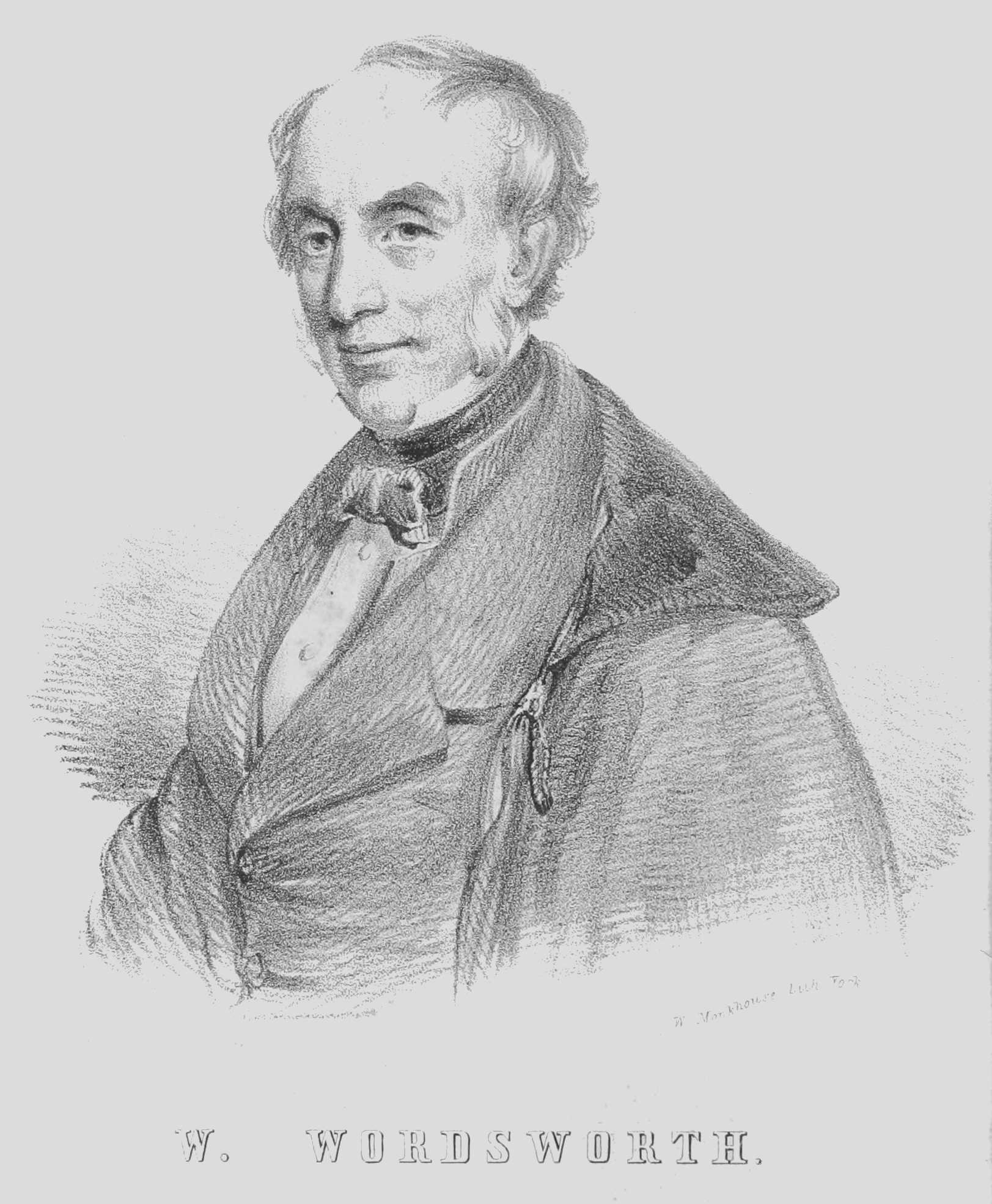
The last figure, and the greatest, in this little group of portraits, is
Wordsworth’s, and it is certainly hit off, like the others, with a free
and discriminating hand.
“Wordsworth was, upon the whole, not a well-made man. His legs were
positively condemned by all the female connoisseurs in legs that De
Quincy ever heard lecture on that topic; not that they were bad in any
way that would force itself upon your notice—there was no absolute
deformity about them; and undoubtedly they had been serviceable legs,
beyond the average standard of human requisition; for with these
identical legs Wordsworth must have travelled a distance of one hundred
and seventy-five to one hundred and eighty thousand English miles,—a
mode of exertion which to him stood in the stead of wine, spirits, and
all other stimulants whatever to the animal spirits; to which he has
been indebted for a life of unclouded happiness, and even for much of
what is most excellent in his writings. But useful as they have proved
themselves, the Wordsworthian legs were certainly not ornamental; it
was really a pity that he had not another pair for evening dress
parties, when no boots lend their friendly aid to mask our imperfections
from the eyes of female rigourists—the elegantes formarum
spectatrices.... But the worst part of Wordsworth’s person was the
bust; there was a narrowness and a stoop about the shoulders, which
became striking, and had an effect of meanness, when brought into close
juxtaposition with a figure of a most statuesque “order.” ... Further
on, De Quincy relates how he was walking out with Miss Wordsworth, the
poet being before them, deeply engaged in conversation with a person of
fine proportions, and towering figure,—when the contrast was so marked,
and even painful to the poet’s sister, that she could not help
exclaiming: “Is it possible? Can that be William? How very mean he
looks!” “And yet,” continues De Quincy, “Wordsworth was of a good
height, just five feet ten, and not a slender man; on the contrary, by
the side of Southey, his limbs looked thick, almost in a
disproportionate degree. But the total effect of Wordsworth’s person was
always worst in a state of motion; for, according to the remark I have
heard from the county people, ‘he walked like a cade;’ a cade being a
kind of insect which advances by an oblique motion. This was not always
perceptible, and in part depended (I believe) upon the position of his
arms; when either of these happened (as was very customary) to be
inserted into the unbuttoned waistcoat, his walk had a wry or twisted
appearance; and not appearance only,—for I have known it by slow
degrees gradually to edge off his companion, from the middle to the side
of the high road.’ Meantime his face—that was one which would have made
amends for greater defects of figure; it was certainly the noblest for
intellectual effect, that, De Quincy says, he ever saw. Haydon, the
eminent painter, in his great picture of Christ’s Entry into
Jerusalem, has introduced Wordsworth in the character of a disciple
attending his Divine Master.... “Wordsworth’s face was of the long
order, often classed as oval, ... and if not absolutely the indigenous
face of the lake district, at any rate a variety of that face,—a
modification of the original type. The head was well filled out.... The
forehead was not remarkably lofty ... but it was, perhaps, remarkable
for its breadth and expansive development. Neither were the eyes large,
... on the contrary, they were rather small; but that did not interfere
with their effect, which at times was fine, and suitable to his
intellectual character.... The mouth and the region of the mouth—the
whole circumference of the mouth, were about the strongest feature in
Wordsworth’s face. There was nothing especially to be noticed in the
mere outline of the lips, but the swell and protrusion of the parts
above and around the mouth are noticeable.” And then De Quincy tells us
why. He had read that Milton’s surviving daughter, when she saw the
crayon drawing representing the likeness of her father, in Richardson
the painter’s thick octavo volume of Milton, burst out in a rapture of
passionate admiration, exclaiming—“This is my father! this is my dear
father!” And when De Quincy had procured this book, he saw in this
likeness of Milton a perfect portrait of Wordsworth. All the
peculiarities, he says, were retained—“A drooping appearance about the
eyelids—that remarkable swell that I have noticed about the mouth,—the
way in which the hair lay upon the forehead. In two points only there
was a deviation from the rigorous truth of Wordsworth’s features—the
face was a little too short and too broad, and the eyes were too
large.—There was also a wreath of laurel about the head, which, (as
Wordsworth remarked,) disturbed the natural expression of the whole
picture; else, and with these few allowances, he also admitted that the
resemblance was, for that period of his life (but let not that
restriction be forgotten;) perfect, or, as nearly so as art could
accomplish. This period was about the year 1807.
Here, then, thanks to De Quincy, who, for these “Lake Reminiscences”
alone, is well worthy of a pension, which, had I been Prime Minister, he
should have had long ago; for no living man is more deserving of this
distinction for the service he has rendered to our literature:—here, I
say, we have portraits of the inmates of the white cottage at Grasmere;
and beautiful portraits they are. One could have wished that Dr.
Wordsworth had given a little more vitality to his biography of these
inmates—that he had used his pallet and brushes a little more freely
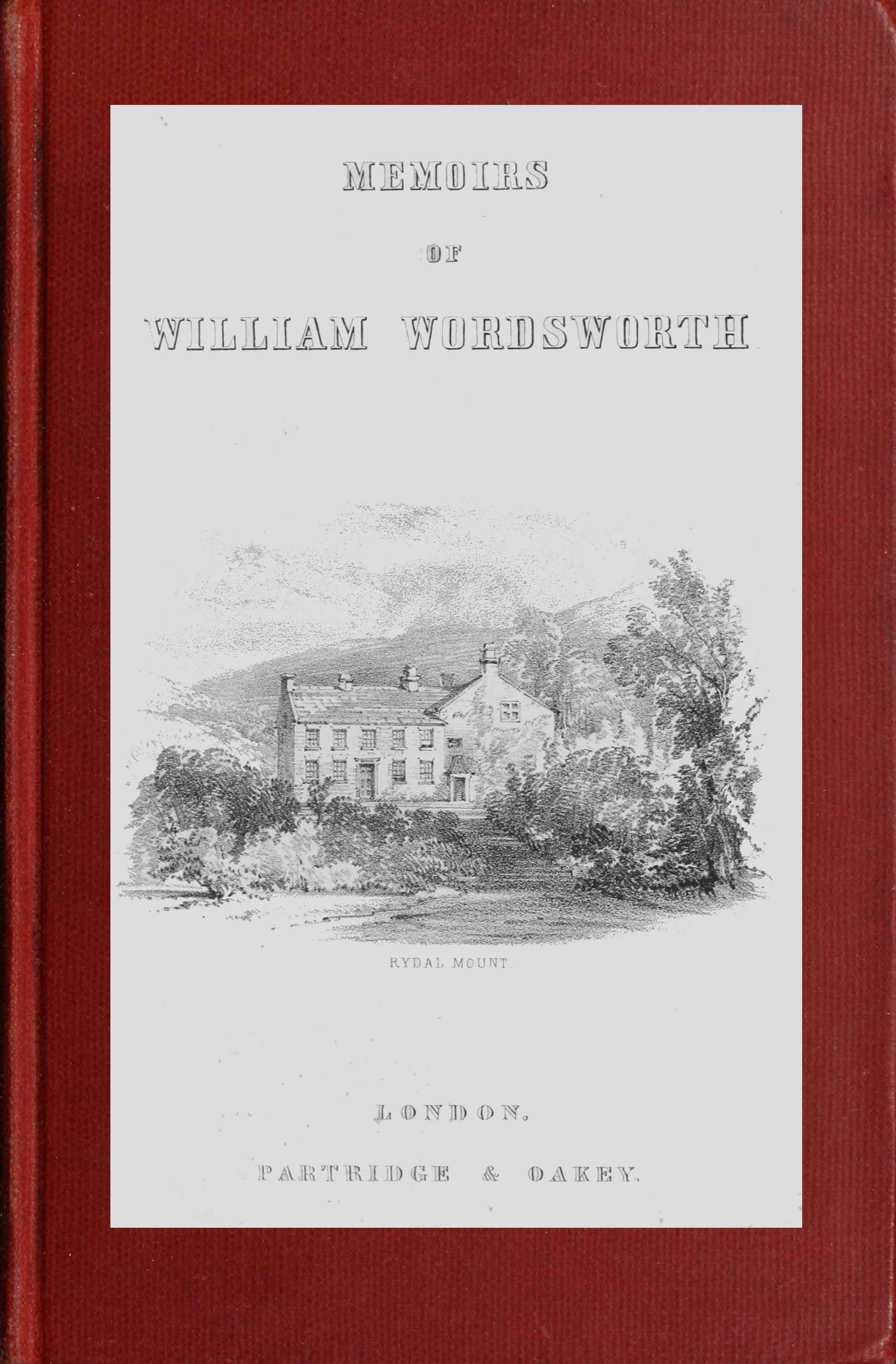
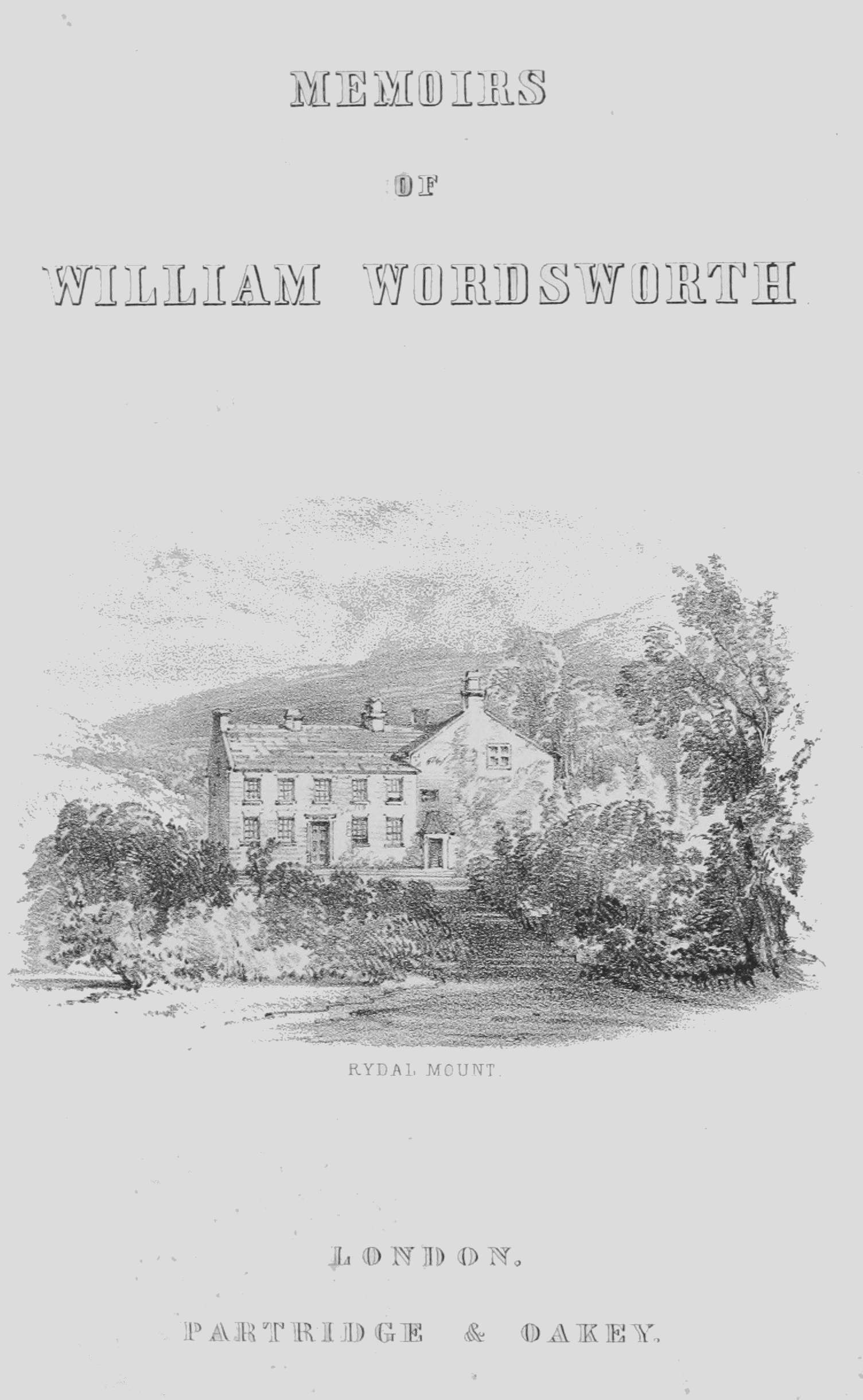
(for he can paint, if he likes, as the description of Rydal Mount
shows); but instead of vitality, we have dry facts—which are the mere
bones of biography—and these are often strung together with very
indifferent tendons. We have no picture, for example, of the poet’s
wedded life at this time—we cannot get behind the scenes; all we know
is, that a wedding had taken place, and the good doctor tells us, that
the twain were afterwards very happy all the days of their life, just as
fairy tales wind up. There seems to be a good deal of needless reserve
about this matter; and I, for one, do not thank the greedy poet when he
says, touching his private life, that “a stranger intermeddleth not with
his joy.” No one wishes to meddle with it; but to sympathise with
it, and to know how this joy manifested itself in the little household,
appear to be legitimate demands of the curious lovers of Wordsworth,
and, indeed of all curious men, whether lovers of Wordsworth or not. But
the doctor has nothing to say on these points; and all we can gather
respecting them is to be found in the “Prelude,” and one or two other
poems. Here is the extract from the “Prelude,” expressing the poet’s
feelings as he left the cottage with his sister before his marriage:—
“Fareweil! thou little nook of mountain-ground,
Farewell! we leave thee to Heaven’s peaceful care,
Thee, and the cottage, which thou dost surround.
We go for one to whom ye will be dear;
And she will prize this bower, this Indian shed,
Our own contrivance—building without peer;
A gentle maid....
Will come to you, to you herself will wed,
And love the blessed life that we lead here.”
And in this place it will be well to give De Quincy’s sketch of the
cottage itself, where this blessed life was lived, and to share which
the poet went to fetch his bride from her father’s house:—“A little
semi-vestibule between two doors, prefaced the entrance into what might
be considered the principal room of the cottage. It was an oblong
square, not above eight and a half feet high, sixteen feet long, and
twelve broad; very prettily wainscotted, from the floor to the ceiling,
with dark polished oak, slightly embellished with carving. One window
there was—a perfect and unpretending cottage window—with little
diamond panes, embowered, at almost every season of the year, with
roses; and in the summer and autumn, with jessamine and other fragrant
shrubs. From the exuberant luxuriance of the vegetation around it, and
from the dark hue of the wainscotting, this window, though tolerably
large, did not furnish a very powerful light to one who entered from the
open air.... I was ushered up a little flight of stairs—fourteen in
all—to a little dingy room, or whatever the reader chooses to call it.
Wordsworth himself has described the fire-place of this, his—
‘Half kitchen and half parlour fire.’
It was not fully seven feet six inches high, and in other respects of
pretty nearly the same dimensions as the rustic hall below. There was
however, in a small recess, a library of perhaps three hundred volumes,
which seemed to consecrate the nook as the poet’s study, and composing
room; and so occasionally it was.”
So far then, De Quincy; and the following poem, already alluded to, will
give an idea of the poet’s feelings respecting the bride he brought with
him to share the cottage blessedness of Grasmere.
“She was a phantom of delight,
When first she gleamed upon my sight;
A lovely apparition, sent
To be a moment’s ornament.
Her eyes as stars of twilight fair;
Like twilight too her dusky hair;
But all things else about her drawn
From May time and the cheerful dawn;
A dancing shape, an image gay,
To haunt, to startle, and waylay.
I saw her upon nearer view,
A spirit, yet a woman too!
Her household motions light and free,
And steps of virgin liberty;
A countenance in which did meet
Sweet records, promises as sweet;
A creature not too bright or good
For human nature’s daily food;
For transient sorrows, simple wiles,
Praise, blame, love, kisses, tears, and smiles.
And now I see with eye serene
The very pulse of the machine;
A being breathing thoughtful breath,
A traveller between life and death;
The reason firm, the temperate will,
Endurance, foresight, strength and skill;
A perfect woman, nobly planned,
To warn, to comfort, to command;
And yet a spirit still, and bright,
With something of angelic light.”
This beautiful poem, so full of calm affection, and intellectual homage,
is a fair sample of Wordsworth’s love poems, as well as a charming
tribute to his wife’s loveliness and virtue. In early life, it is
thought by De Quincy and others, that the poet had experienced a
tragical termination to an early love, and that the poems of which
“Lucy” is the theme, were addressed to the object of this love; but
Wordsworth always maintained a mysterious silence about the whole
affair, and would never resolve the riddle of this attachment. The
“Lucy” poems, however, beautiful as they are, are chiefly valuable as
exhibiting the kind of passion which love showed itself in
Wordsworth. Passion, in the proper meaning of the word—viz., deep,
fiery, intense, and all-embracing feeling, was certainly not
Wordsworth’s. His love was calm, intellectual, and emotional—but it was
not passion. All his love seems to have passed through his head before
it touched his heart. And yet he loved his wife, and lived, as I said
before, very happily with her.
Mrs. Wordsworth, however, was a true household woman, and had not
acquired that faculty of walking which Wordsworth and his sister
possessed, in so eminent a degree. In about a year, therefore, after his
marriage—that is, August 14, 1803,—we find Wordsworth parting from his
wife, and making a tour into Scotland, with his sister and Coleridge,
taking Carlisle on the way. When they arrived at Longtown, they found a
guide-post pointing out two roads,—one to Edinburgh, the other to
Glasgow. They took the latter road, and entered Scotland by crossing the
river Sark. Edinburgh was no favourite place with Wordsworth, and for
reasons which are sufficiently obvious. The tourists then passed through
Gretna Green to Annan, leaving the Solway Frith, and the Cumberland
hills to their left hand. On Thursday the 18th August, they went to the
churchyard where Burns is buried; a bookseller accompanied them, of whom
Miss Wordsworth had bought some little books for Johnny, the poet’s
first child. He showed them first the outside of Burns’ house, where he
had lived the last three years of his life, and where he died. It had a
mean appearance, and was in a bye situation, white-washed, and dirty
about the doors, as all Scotch houses are; flowering plants in the
windows. They went on to visit his grave. He lies in a corner of the
churchyard, and his second son, Francis Wallace, is beside him. There
was no stone to mark the spot. The greatest bard that had sung in
Britain for some centuries, lay buried there like a dog. A hundred
guineas, however, had been collected to build a monument over his ashes.
“There,” said the bookseller to the visitors, pointing to a pompous
monument, a few yards off, “there lies Mr. John Bushby, a remarkably
clever man; he was an attorney, and hardly ever lost a cause he
undertook. Burns made many a lampoon upon him; and there they rest as
you see.” Yes, indeed, there they rested; and that was the deep, sad
moral of the story. We shall all rest so at last. They then went to
Burns’ house. Mrs. Burns was not at home, but had gone to the sea-shore
with her children. They saw the print of “The Cotter’s Saturday Night,”
which Burns mentioned in one of his letters having received as a
present. In the room above the parlour Burns died, and his son after
him; and of all who saw this parlour on this 18th of
August,—Wordsworth and his sister, Coleridge and the poor
bookseller—who survives? “There they rest, as you see.”
The tourists travelled subsequently through the Vale of the Nith, and
crossing the Frith, reached Brownhill, where they slept.
“I cannot take leave of this country,” says Miss Wordsworth, in her
Journal, “without mentioning that we saw the Cumberland mountains within
half a mile of Ellisland (Burns’ house) the last view we had of them.
Drayton has prettily described the connection which the neighbourhood
has with ours, when he makes Skiddaw say—
‘Scurfell from the sky,
That Annandale doth crown, with a most amorous eye,
Salutes me every day, or at my pride looks grim,
Oft threatening me with clouds, as I oft threatening him!’
These lines occurred to William’s memory; and while he and I were
talking of Burns, and the prospect he must have had, perhaps from his
own door, of Skiddaw and his companions, we indulged ourselves in
fancying that we might have been personally known to each other, and he
have looked upon those objects with more pleasure for our sakes. We
talked of Coleridge’s children and family, then at the foot of Skiddaw,
and our own new-born John, a few miles behind it; and the grave of
Burns’ son, which we had just seen, by the side of that of his father;
and the stories we had heard at Dumfries, respecting the dangers which
his surviving children were exposed to, filled us with melancholy
concern, which had a kind of connection with ourselves, and with
thoughts, some of which were afterwards expressed in the following
supposed address to the sons of the ill-fated poet:—
“Ye now are toiling up life’s hill,
’Tis twilight time of good and ill!”
During this Scotch tour the party walked through the vale of the Clyde,
visited Glengyle, the scene of some of Rob Roy’s exploits, Loch Lomond,
Inverary, Glencoe, Kenmore, and the Duke of Athol’s gardens; resting
whilst in this latter place on “the heather seat which Burns was so loth
to quit that moonlight evening when he first went to Blair Castle.” Then
they went to the Pass of Killicranky, respecting which Wordsworth wrote
the following sonnet.
“Six thousand veterans practis’d in war’s game,
Tried men, at Killicranky were arrayed
Against an equal host that wore the plaid,
Shepherds and herdsmen. Like a whirlwind came
The Highlanders; the slaughter spread like flame;
And Garry, thundering down his mountain road,
Was stopped, and could not breathe beneath the load
Of the dead bodies! ’Twas a day of shame
For them whom precept, and the pedantry
Of cold mechanic battle do enslave.
Oh for a single hour of that Dundee,
Who on that day the word of onset gave!
Like conquest might the men of England see!
And their foes find a like inglorious grave.
In the year 1803, when this sonnet was written, an invasion was hourly
looked for; and Miss Wordsworth and her brother (for Coleridge had left
them, worried by the “evil chance,” and something worse perhaps at Loch
Lomond) could not but think with some regret of the times when from the
now depopulated Highlands, forty or fifty thousand men might have been
poured down for the defence of the country, under such leaders as the
Marquis of Montrose, or the brave man who had so distinguished himself
upon the ground where they were standing.
The tourists returned by way of Edinburgh, visiting Peebles and Melrose
Abbey. Sir Walter, then Mr. Scott, was, at the time of their visit to
the abbey, travelling as Sheriff of Selkirk to the assizes at Jedburgh.
They dined together at the Melrose Inn. Sir Walter was their guide to
the abbey, taking them into Mr. Riddel’s gardens and orchard, where they
had a sweet view of it through trees, the town being quite excluded. Sir
Walter was of course at home in the history and tradition of these noble
ruins, and pointed out to his visitors many things which would otherwise
have escaped their notice. Beautiful pieces of sculpture in obscure
corners, flowers, leaves, and other ornaments, which being cut in the
durable pale red stone of which the abbey is built, were quite perfect.
What destroyed, however, the effect of the abbey, was the barbarous
taste of the good Scotch people who had built an ugly, damp charnel
house within the ruins, which they called a church!
Quitting Melrose, they crossed the Teviot by a stone bridge, and
visited Jedburgh. It rained all the way, and they arrived at the inn
just before the judges were expected out of court to dinner, very wet
and cold. There was no private room but the judges’ sitting-room, and
they had to get private lodgings in the town. Scott sat with them an
hour in the evening, and repeated a part of his “Lay of the Last
Minstrel.” Their landlady was a very remarkable woman; and Wordsworth
wrote some verses expressive of the feelings with which she inspired
him. Here is the burden.
“Aye! twine thy brows with fresh spring flowers,
And call a train of laughing hours,
And bid them dance, and bid them sing,
And thou, too, mingle in the ring.”
Miss Wordsworth gives the following sweet picture of the home at
Grasmere on their return:—
“September 25th.—A beautiful autumnal day. Breakfasted at a
public-house by the road-side; dined at Threlkeld; and arrived there
between eight and nine o’clock, where we found Mary in perfect health.
Joanna Hutchinson with her, and little John asleep in the
clothes-basket by the fire.”
At the ferry-house, and waterfall of Loch Lomond, Wordsworth had been
struck with the beauty and kindness of two girls whom they met there,
and on his return to Grasmere he wrote the following lines upon one of
them:—
“Sweet Highland girl, a very shower
Of beauty is thy earthly dower!
Twice seven consenting years have shed
Their utmost bounty on thy head:
And these grey rocks; this household lawn;
These trees, a veil just half withdrawn;
This fall of water that doth make
A murmur near the silent lake;
This little bay, a quiet road,
That holds in shelter thy abode;
In truth together ye do seem
Like something fashioned in a dream;
Such forms as from their covert peep
When earthly cares are laid asleep.
Yet dream and vision as thou art,
I bless thee with a human heart:
God shield thee to thy latest years!
I neither know thee, nor thy peers;
And yet my eyes are filled with tears.”
This Scottish tour was a little episode in the quiet history of the
poet’s residence at Grasmere. The truth is, that Wordsworth could not at
this time rest long, even in his beautiful Grasmere, without the
excitement of pedestrian travel and adventure. It was likewise a part of
his education as a poet; the knowledge which he thus acquired of men,
manners, and scenery. He had devoted himself to poetry; and every thing
that tended to feed the divine faculty, he grasped at with an avidity
equally as intense as that with which your mere canine man grasps at
food for his perishing body. Nothing comes amiss to him; high and low,
great and small; from the daffodil to Skiddaw—from Skiddaw to heaven
and its hosts of glorious stars,—all are seized by this omnivorous
poet, fused in his mind, and reproduced by him in song. His limited
means are no barrier to his wanderings; he and his sister can live upon
black bread and water, so far as rations are concerned; but setting
aside the necessity of the case, this economy is for a sacred
purpose,—viz.:—that they may enjoy the communion of Nature, and
partake of her spiritual banquets. The gods, however, had determined to
pet Wordsworth, and recompense him for his religious devotion to their
doings through early life; and, to say nothing of the bequest of Raisley
Calvert, the second Lord Lonsdale, just as the poet needed a wife, and
larger means, paid the debt which his predecessor owed to Wordsworth’s
father, amounting to £1,800, as the share of each member of the family.
This was a most fortunate circumstance to Wordsworth and his sister;
though it mattered little to the rest, because they were well appointed
in life. De Quincy says that, a regular succession of similar, but
superior, God-sends fell upon Wordsworth, to enable him to sustain his
expenditure duly, as it grew with the growing claims upon his purse; and
after enumerating the three items of “good luck,” mentioned above, he
adds:—and “fourthly, some worthy uncle of Mrs. Wordsworth’s was pleased
to betake himself to a better world; leaving to various nieces, and
especially to Mrs. W., something or other, I forget what, but it was
expressed by thousands of pounds. At this moment Wordsworth’s family had
begun to increase; and the worthy old uncle, like every body else in
Wordsworth’s case (I wish I could say the same in my own), finding his
property clearly ‘wanted,’ and as people would tell him ‘bespoke,’ felt
how very indelicate it would look for him to stay any longer, and so he
moved off. But Wordsworth’s family, and the wants of that family, still
continued to increase; and the next person, being the fifth, who stood
in the way, and must, therefore, have considered himself rapidly growing
into a nuisance, was the Stamp-Distributor for the county of
Westmorland. About March, 1814, I think it was, that this very
comfortable situation was vacated. Probably it took a month for the news
to reach him; because in April, and not before, feeling that he had
received a proper notice to quit, he, good man—this
Stamp-Distributor—like all the rest, distributed himself and his
offices into two different places,—the latter falling of course into
the hands of Wordsworth.
“This office, which it was Wordsworth’s pleasure to speak of as a
little one, yielded, I believe, somewhere about £500 a year. Gradually
even that, with all former sources of income, became insufficient; which
ought not to surprise anybody; for a son at Oxford, as a
gentleman-commoner, could spend at least £300 per annum; and there were
other children. Still it is wrong to say, that it had become
insufficient; as usual it had not come to that; but, on the first
symptoms arising that it would soon come to that, somebody, of course,
had notice to consider himself a sort of nuisance elect,—and in this
case it was the Distributor of Stamps for the county of Cumberland.” And
in this strain of good-humoured banter—stimulated no doubt by his own
precarious circumstances, in a measure, circumstances which ought not in
his case to be precarious,—De Quincy relates how another £400 a year
was added to the poet’s income from the increase of his district as
Stamp-Distributor.
In 1842, since De Quincy wrote the above, Wordsworth resigned this
office, and it was bestowed upon his son,—whilst he (the poet,) was put
down upon the Civil-list for £300 a year, and finally made Poet
Laureate.
To return, however, to the more even tenor of these Memoirs:—A
circumstance occurred in the year 1803, shortly after the Scottish tour,
which will further illustrate the “good luck” of Wordsworth, although in
this instance he did not avail himself of it. Sir George Beaumont, the
painter, out of pure sympathy with the poet,—and before he had seen or
written to him,—purchased a beautiful little estate at Applethwaite,
near Keswick, and presented it to him, in order that he (Wordsworth) and
Coleridge, who was then residing at Greta Hall, might have the pleasure
of a nearer and more permanent intercourse. A fragment of Sir George’s
letter (good Sir George, who could recognise genius, and was noble and
generous enough to prove his recognition in a most practical form) is
printed in Dr. Wordsworth’s “Memoirs,” and it shews what a fine heart he
had, God bless him! It is dated October 24, 1803, and runs thus:—
“I had a most ardent desire to bring you and Coleridge together. I
thought with pleasure on the increase of enjoyment you would receive
from the beauties of Nature, by being able to communicate more
frequently your sensations to each other, and that this would be the
means of contributing to the pleasure and improvement of the world, by
stimulating you both to poetic exertions.” The benevolent project of
this excellent baronet was defeated, partly because Coleridge soon
after left Greta Hall for a warmer climate, being impelled to this
course by ill health, and partly from private considerations respecting
Wordsworth and his family, which, however, do not transpire in the
“Memoirs.” A curious fact in connection with this gift of Sir George is,
that Wordsworth neglected to thank the donor, or to take the slightest
notice of it, for eight weeks after the writings were placed in his
hands. In a letter addressed to the baronet, dated Grasmere, October
14th, 1803, Wordsworth apologises for this apparent neglect, and
attributes it partly to the overpowering feelings with which the gift
inspired him, and partly to a nervous dread of writing, and a fear lest
he should acknowledge the honour that had been done him in an unworthy
manner. “This feeling,” he says, “was indeed so very strong in me, as to
make me look upon the act of writing to you, not as the work of a
moment, but as a thing not to be done, but in my best, my purest, my
happiest moments.” Thus strangely began one of the few friendships which
Wordsworth cultivated with men, and one which lasted through the life of
the noble-hearted baronet, who, in dying, in the year 1827 (on the 7th
of February), left Wordsworth an annuity of £100 to defray the expenses
of an annual tour. (Another instance of the poet’s “good luck!”) It is
right to add, that Wordsworth was deeply affected by his friend’s death,
and that he has left, in his “Elegiac Musings,” some noble lines to his
memory.
Amongst the occasional visitors at Grasmere between the years 1800 and
1804, was Captain John Wordsworth, the poet’s second brother, who was
eventually lost in the Abergaveny East Indiaman, on the 5th of February,
1804. His brother was a man of fine taste and discernment, and
prophesied in various letters and at various times, the ultimate success
of Wordsworth’s poetry. Wordsworth felt severely the untimely death of
his brother, whom he loved with that devoted family fondness, which was
characteristic of him. Writing to Sir George Beaumont upon this event,
he says: “February 11th, 1808. This calamitous news we received at two
o’clock to-day; and I write to you from a house of mourning. My poor
sister, and my wife, who loved him almost as we did (for he was one of
the most amiable of men) are in miserable affliction, which I do all in
my power to alleviate; but, Heaven knows, I want consolation myself. I
can say nothing higher of my ever dear brother than that he was worthy
of his sister, who is now weeping beside me, and of the friendship of
Coleridge; meek, affectionate, silently enthusiastic, loving all quiet
things, and a poet in everything but words.” The lyre of the poet
sounded his praises in three poems. The first is entitled “Elegiac
Stanzas suggested by a picture of Peel Castle in a storm, painted by Sir
George Beaumont.” The next is “To a Daisy,” which suggests his brother’s
love of quiet and peaceful things, and closes with the tragedy of his
death, and the discovery and final burial of the body in the country
churchyard of Wythe, a village near Weymouth.
“And thou, sweet flower, shalt sleep and wake,
Upon his senseless grave,”
he concludes, returning thus finely to the simple flower which suggested
the melancholy train of thought that runs through the poem. The third of
these sad lyrical verses refers to the scene where the poet bade his
brother farewell, on the mountains from Grasmere to Patterdale. The
verses upon the “Picture of Peel Castle,” is the best of all these
pieces; and as a fitting conclusion to this brief memorial of the poet’s
brother, I will transcribe it.
“I was thy neighbour once, thou rugged pile!
Four summer weeks I dwelt in sight of thee:
I saw thee every day; and all the while
Thy form was sleeping on a glassy sea.
So pure thy sky, so quiet was the air!
So like, so very like, was day to day!
Where’er I looked, thy image still was there;
It trembled, but it never passed away.
How perfect was the calm! it seemed no sleep;
No mood, which season takes away or brings:
I could have fancied that the mighty deep
Was even the gentlest of all gentle things.
Ah! then, if mine had been the painter’s hand,
To express what then I saw; and add the gleam,
The light that never was on sea, or land,
The consecration, and the poet’s dream;
I would have planted thee, thou hoary pile!
Amid a world how different from this!
Beside a sea that could not cease to smile
On tranquil land, beneath a sky of bliss.
A picture had it been of lasting ease,
Elysian quiet, without toil or strife;
No motion but the moving tide, a breeze,
Or merely silent Nature’s breathing life.
Such, in the fond illusion of my heart,
Such picture would I at that time have made;
And seen the soul of truth in every part,
A steadfast peace that might not be betrayed.
So once it would have been—‘tis so no more;
I have submitted to a new control;
A power is gone, which nothing can restore;
A deep distress hath humanised my soul.
Not for a moment could I now behold
A smiling sea, and be what I have been;
The feeling of my loss will ne’er be old;
This, which I know, I speak with mind serene.
Then, Beaumont, friend! who would have been the friend,
If he had lived, of him whom I deplore,
This work of thine I blame not, but commend;
This sea in anger, and that dismal shore.
O ’tis a passionate work!—yet wise and well;
Well chosen is the spirit that is here;
That hulk, which labours in the deadly swell,
This rueful sky, this pageantry of fear!
And this huge castle, standing here sublime,
I love to see the look with which it braves,
Cased in the unfeeling armour of old time,
The lightning, the fierce wind, and trampling waves.
Farewell, farewell, the heart that lives alone,
Housed in a dream, at distance from the kind!
Such happiness, wherever it be known,
Is to be pitied, for ’tis surely blind.
But welcome fortitude, and patient cheer,
And frequent sights of what is to be borne!
Such sights, or worse, as are before me here.—
Not without hope we suffer, and we mourn.”
—1805.
About a month after his brother’s death, Wordsworth concluded his
“Prelude,” upon which he had been employed for upwards of six years. In
allusion to this poem, Coleridge, in the “Table Talk,” says: “I cannot
help regretting that Wordsworth did not first publish his thirteen books
(there are fourteen of them,) “On the growth of an individual
mind,”—superior, as I used to think, on the whole, to the “Excursion!”
... Then the plan laid out, and I believe partly suggested by me was,
that Wordsworth should assume the station of a man in mental repose,
one whose principles were made up, and so prepared to deliver upon
authority a system of philosophy. He was to treat man as man, a subject
of eye, ear, touch and taste, in contact with external nature, and
inferring the senses from the mind, and not compounding a mind out of
the senses; then he was to describe the pastoral and other states of
society, assuming something of the Juvenalian spirit as he approached
the high civilization of cities and towns, and opening a melancholy
picture of the present state of degeneracy and vice; thence he was to
infer and reveal the proof of, and necessity for, the whole state of man
and society being subject to, and illustrative of, a redemptive process
in operation, showing how this idea reconciled all the anomalies, and
promised future glory and restoration.”
Wordsworth himself unfolds his own plan of the poem to Sir George
Beaumont, in a letter dated December 25th, 1804. It was to consist,
first of all, of a poem to be called “The Recluse,” wherein the poet was
to express in verse, his own feelings concerning Man, Nature, and
Society—and, secondly, a poem on his earlier life or the growth of
his own mind. This latter poem was “The Prelude,” two thousand verses
of which, he says, in the same letter, he had written during the last
ten weeks. “The Prelude,” therefore, which was not published till after
the poet’s death, was first written, and “The Recluse,” subsequently.
Only a part of this poem, however—viz., “The Excursion,” except, of
course, “The Prelude,” is published; “The Recluse” Proper, being still
in MS.
Besides these larger works, Wordsworth threw off—not without care and
meditation,—for no man ever wrote with more method and purpose—many
minor poems, and amongst them was “The Waggoner,” dedicated to Charles
Lamb, but not published until 1819. It was in this year (1805) that
Wordsworth, Sir Walter Scott, and Sir Humphry Davy ascended Helvellyn
together; and learned the sad story of poor Charles Gough, who perished
in attempting to cross over Helvellyn to Grasmere, by slipping from a
steep part of the rock, where the ice was not thawed, and beside whose
remains his faithful dog was found many days afterwards, almost starved
to death. This affecting incident afforded a theme for both
poets—viz., Sir Walter and Wordsworth, and each wrote upon it without
knowing that the other was similarly engaged. Scott’s poem is entitled
“Helvellyn,” and Wordsworth’s “Fidelity.”
In 1807, Wordsworth issued two new volumes of poetry, in 12mo., which
contained some of his best pieces; but which, like all his poems, did
not gain immediate popularity. It is true that a fourth edition of the
“Lyrical Ballads” had been called for, and that this indicated a growing
taste in the public mind for Wordsworth’s effusions; but the critics
assailed him with the bitterest animosity, and on the whole without much
reason. With no reason, in short, so far as the poetic principles—the
canon of his poetry—was concerned, and only with some show of reason in
the instance of his peculiar mannerism. For although he was often misled
by his craving after simplicity, and uttered what might be called
without any violation of truth or desecration of the poet’s name and
memory—drivel—still he had published poems of a very high order,
such as had not been published in the lifetime of any man then living.
The critics, however, could not let him alone, could not see the
manifest beauties of his poetry, or would not see them, but denounced
the whole without reserve or mercy. In the meanwhile Coleridge cheered
him on, and on his return to England, in the summer of 1806, Wordsworth
read “The Prelude” to him in the gardens of Coleorton, near
Ashby-de-la-Zouch, Leicestershire, where the poet was then residing at
the invitation of Sir George Beaumont; and the high commendations which
Coleridge poured upon this poem animated Wordsworth to increased
exertion and perseverance. During his residence at this beautiful house,
he composed the noble “Song at the Feast of Brougham Castle,”—the
finest thing of the kind in our language; and he left behind him as
usual, many records of his feelings at Coleorton. The poet’s letters to
Sir George Beaumont and an occasional one to Sir Walter Scott, are
amongst the most interesting transcripts we have of his mind at this
period.
It was in the beginning of the winter, 1807, that De Quincy paid his
first visit to Wordsworth; and I find great fault with Dr. Wordsworth
that he makes no allusion to De Quincy in all his memoirs of the poet.
This is the more unpardonable, inasmuch as De Quincy is a man of the
highest calibre—of the most refined taste,—of the profoundest
scholarship, and possessing the widest acquaintance with general
literature—to say nothing of his transcendant genius—of any man who
has lived in this generation. Unpardonable, likewise, because De Quincy
was a devout lover, and a chivalrous defender of Wordsworth, when it was
not fashionable to speak well of him, and when a man who praised him
stood a fair chance of being estimated, if not called, a madman. Neither
can I ever forgive the poet himself for his cold neglect of the great
Opium Eater. Such a man as De Quincy is not to be treated with contumely
and despite, even by such a man as Wordsworth; for assuredly, in point
of genius, both men stood pretty much upon the same level, and
Wordsworth was far inferior to De Quincy in the other important matters
specified above. De Quincy’s demon did not inspire him to write verses,
but to write essays—and what essays! I do not know the writer who has
ever taken so wide a range of subjects, and written upon them in such
grand and noble English. De Quincy was a prose architect, Wordsworth a
poetic one; and this is all the difference between them. In genius they
were equal. Some day, perhaps, De Quincy will be better appreciated. We
are indebted to De Quincy for the best account existing of the poet, his
family, and home at Grasmere and Rydal; and no one would go to Dr.
Wordsworth for information when he could go to De Quincy. Not that I
have anything to say against Dr. Wordsworth personally, but I dislike
his studied exclusiveness. The men who for long years were in constant
intercourse with the poet, and on terms of friendship with him—Wilson,
for example, as well as De Quincy—cannot be shut out from his biography
without manifest injustice both to them and to the poet; and yet this is
systematically done. Perhaps the good doctor has a clerical horror of
his great-uncle being associated with loose Men of Letters; men, too, of
not quite an orthodox cast in their opinions; genial, jovial, and full
of all good fellowship besides. But of what avail could such horror so
manifested be? The world will know the truth at last; and it is right
they should; and one thing is certain enough, that Wordsworth will
suffer no dishonour in the companionship of De Quincy and Wilson.
When I first read No. 1, of the “Lake Reminiscences,” by De Quincy, in
“Tait’s Magazine,” I could scarcely believe what I read; and nothing
would have convinced me of its truth, short of the authority which
announced it. I had looked upon Wordsworth as a kind-hearted, generous,
and unselfish man; noble, friendly, and without the vanity which has so
often blurred the fair page of a great man’s nature. I was sorry to find
that I was mistaken in this estimate of the poet; and that he, like me,
and all the rest of us, had faults and failings manifold. De Quincy’s
own account of his first visit to Wordsworth, the deep reverence with
which he regarded him, and the overwhelming feelings which beset him on
the occasion, is very affecting; and contrasted with the poet’s
subsequent treatment of him, his wanton throwing away of that noble and
affectionate heart, and his total disregard of the high intellectual
homage which De Quincy offered to him, is still more affecting, and
full, likewise, of pain and sorrow. Whilst he was a student at Oxford,
De Quincy twice visited the Lake Country, on purpose to pay his respects
to Wordsworth; and once, he says, he went forward from Coniston to the
very gorge of Hammerscar, “from which the whole vale of Grasmere
suddenly breaks upon the view in a style of almost theatrical surprise,
with its lovely valley stretching in the distance, the lake lying
immediately below, with its solemn boat-like island, of five acres in
size, seemingly floating on its surface; its exquisite outline on the
opposite shore, revealing all its little bays, and wild sylvan margin,
feathered to the edge with wild flowers and ferns!
“In one quarter a little wood, stretching for about half a mile towards
the outlet of the lake, more directly in opposition to the spectator; a
few green fields: and beyond them, just two bow-shots from the water, a
little white cottage gleaming from the midst of trees, with a vast and
seemingly never-ending series of ascents, rising above it to the height
of more than three thousand feet. That little cottage was Wordsworth’s,
from the time of his marriage, until 1808. Afterwards, for many a year,
it was mine. Catching one glimpse of this loveliest of landscapes, I
retreated, like a guilty thing, for fear I might be surprised by
Wordsworth, and then returned faint-hearted to Coniston, and so to
Oxford, re infecta.—This was in 1806. And thus, from mere excess of
nervous distrust in my own powers for sustaining a conversation with
Wordsworth, I had for nearly five years shrunk from a meeting for which,
beyond all things under heaven, I longed.”
This nervous distrust yielded in after life to a sober confidence, and a
matchless power of unfolding his thoughts colloquially. In the
meanwhile, that is to say, in 1807, Coleridge returned from Malta, and
De Quincy was introduced to him first of all at Bridgewater, and met him
again at the Hot-wells, near Bristol,—when, upon discovering that he
was anxious to put his wife and children under some friendly escort, on
their return homewards to Keswick, De Quincy offered to unite with Mrs.
Coleridge in a post-chaise to the north. Accordingly they set out.
Hartley Coleridge was then nine years old, Derwent about seven, and the
beautiful little daughter about five. In such companionship, then, did
De Quincy pay his first visit to Wordsworth, at Grasmere,—a most
interesting and artistic account of which he has written in “Tait’s
Magazine,” and to which I have been frequently indebted in the
compilation of these Memoirs. The cottage has already been described,
and the reader who has followed the course of this imperfect history,
will remember the portraits of its illustrious inmates. Let us now see
how it fared with De Quincy, when he met the mighty man of his heart. He
was “stunned,” when Wordsworth shook him cordially by the hand, and went
mechanically towards the house, leaving Mrs. Coleridge in the chaise at
the door. The re-appearance of the poet, however, after exercising due
hospitality to his lady guest, gave him courage, and he found that the
said poet was, after all, but a man. His reverence for him, however,
continued unabated, and for twenty-five years, during which time De
Quincy lived at the lakes, in constant communion with Wordsworth, his
reverence for the poet’s genius remained the same, and still remains,
although he has long since ceased to respect him in so highly as a man;
not, however, because Wordsworth was not of unimpeachable character, and
estimable in so many ways, but because he had not that generous love for
his friends which friendship demands. De Quincy confesses his
estrangement from the poet with sorrow, and some bitterness of heart;
and the following extract will throw all the light upon this subject
which can be thrown at present:—
“I imagine a case such as this which follows,” says De Quincy, in
alluding to the estrangement spoken of above—“the case of a man who for
many years has connected himself with the domestic griefs and joys of
another, over and above his primary service of giving to him the
strength and the encouragement of a profound literary sympathy, at a
time of universal scorning from the world; suppose this man to fall into
a situation, in which, from want of natural connections, and from his
state of insulation in life, it might be most important to his feelings
that some support should be lent to him by a friend having a known place
and acceptation, and what may be called a root in the country, by means
of connections, descent, and long settlement. To look for this might be
a most humble demand on the part of one who had testified his devotion
in the way supposed. To miss it might—— But enough. I murmur not;
complaint is weak at all times; and the hour is passed irrevocably, and
by many a year, in which an act of friendship so natural, and costing so
little (in both senses so priceless), could have been availing. The ear
is deaf that should have been solaced by the sound of welcome. Call, but
you will not be heard; shout aloud, but your ‘ave!’ and ‘all hail!’ will
now tell only as an echo of departed days, proclaiming the hollowness of
human hopes. I, for my part, have long learned the lesson of suffering
in silence; and also I have learned to know that, wheresoever female
prejudices are concerned, there it will be a trial, more than
Herculean, of a man’s wisdom, if he can walk with an even step, and
swerve neither to the right nor to the left.”
Leaving this sad subject, however, let us return to De Quincy at
Grasmere in 1807. Mrs. Coleridge, on leaving the poet’s family for
Keswick, invited De Quincy to visit her and Southey, and it was arranged
that Wordsworth and the Opium Eater should go together. Accordingly
they set off in a farmer’s cart to Ambleside, and from thence mounted
the ascent of Kirkstone. Descending towards Brothers’ Water—“a lake
which lies immediately below; and about three miles further, through
endless woods, and under the shade of mighty fells, immediate
dependencies and processes of the still more mighty Helvellyn” they
approached the vale of Patterdale, and reached the inn, by moonlight.
“All I remember,” says De Quincy is—“that through those romantic woods
and rocks of Stybarren—through those silent glens of Glencoin and
Glenridding—through that most romantic of parks then belonging to the
Duke of Norfolk—viz., Gobarrow Park—we saw alternately for four miles,
the most grotesque and the most awful spectacles—
——“Abbey windows
And Moorish temples of the Hindoos,”
all fantastic, all as unreal and shadowy as the moon-light which created
them; whilst at every angle of the road, broad gleams came upwards of
Ullswater, stretching for nine miles northward, but fortunately for its
effect, broken into three watery channels of about equal length, and
rarely visible at once.”
The party, (for Miss Wordsworth and the poet’s children were present on
this occasion,) passed the night in a house called Ewsmere, and in the
morning, leaving his family at this inn, the poet set out, with De
Quincy, for a ramble through the woods of Lowther. These are the woods
concerning which the poet, in a letter to Sir George Beaumont, dated
October 17, 1805, says:—“I believe a more delightful spot is not under
the sun. Last summer I had a charming walk along the river, for which I
was indebted to this man [alluding to a good quaker, who was Lord
Lowther’s arbiter elegantiarum, or master of the grounds, and who was
making improvements in them, by virtue of his office], whose intention
is to carry the walk along the river side till it joins the great road
at Lowther Bridge, which you will recollect, just under Brougham, about
a mile from Penrith. This, to my great sorrow! for the manufactured
walk, which was absolutely necessary in many places, will, in one place,
pass through a few hundred yards of forest-ground, and will there efface
the most beautiful specimen of forest pathway ever seen by human eyes,
and which I have paced many an hour when I was a youth, with one of
those I best loved. There is a continued opening between the trees, a
narrow slip of green turf, besprinkled with flowers, chiefly daisies;
and here it is that this pretty path plays its pranks, weaving among the
turf and flowers at its pleasure.” And it was in these woods, just five
days after their introduction to each other, that Wordsworth and De
Quincy spent a whole glorious morning in wild ramblings and in
conversation. They dined together, towards evening, at Emont Bridge, and
then walked on to the house of Captain Wordsworth, at Penrith. The
family was absent, and the poet had business which occupied him all the
next day; so De Quincy took a walk, sauntering along the road, about
seventeen miles, to Keswick, where he enquired for Greta Hall, the
residence of the poet Southey. “It stands out of the town a few hundred
yards, upon a little eminence, overhanging the river Greta.” Mrs.
Coleridge and Southey came to the door to welcome their visitor.
“Southey was in person somewhat taller than Wordsworth being about five
feet eleven in height, or a trifle more, whilst Wordsworth was about
five feet ten; and partly from having slenderer limbs, partly from being
more symmetrically formed about the shoulders, than Wordsworth, he
struck me as a better and lighter figure, to the effect of which his
dress contributed; for he wore, pretty constantly, a short jacket and
pantaloons, and had much the air of a Tyrolese mountaineer.... His hair
was black, and yet his complexion was fair; his eyes, I believe, hazel,
and large, but I will not vouch for that fact; his nose aquiline; and he
had a remarkable habit of looking up into the air, as if looking at
abstraction. The expression of his face was that of a very acute, and an
aspiring man. So far it was even noble, as it conveyed a feeling of
serene and gentle pride, habitually familiar with elevating subjects of
contemplation. And yet it was impossible that this pride could have been
offensive to anybody, chastened as it was by the most unaffected
modesty; and this modesty made evident and prominent, by the constant
expression of reverence for the great men of the age (when he happened
to esteem them such), and for all the great patriarchs of our
literature. The point in which Southey, however, failed most in
conciliating regard was, in all which related to the external expression
of friendliness. No man could be more sincerely hospitable, no man more
completely disposed to give up, even his time (the possession which he
most valued), to the service of his friends; but, there was an air of
reserve and distance about him—the reserve of a lofty, self-respecting
mind, but, perhaps, a little too freezing,—in his treatment of all
persons who were not amongst the corps of his ancient fireside
friends. Still, even towards the veriest strangers, it is but justice to
notice his extreme courtesy, in sacrificing his literary employments for
the day, whatever they might be, to the duty (for such he made it,) of
doing the honors of the lake, and the adjacent mountains.”
De Quincy says that the habits of the poet Southey were exceedingly
regular, and that all his literary business was conducted upon a
systematic plan. He had his task before breakfast, which, however, must
have been an inconsiderable nothing, for it occupied him only an hour,
and rarely that, for he never rose until eight, and always breakfasted
at nine o’clock. He went to bed precisely at half-past ten, and no
sleep short of nine hours, refreshed him, and enabled him to do his
work. He usually dined between five and six, and his chief labour was
done between breakfast and dinner. If he had visitors, he would sit over
his wine, and talk; if not, he retired to his library, until eight, when
he was summoned to tea. At ten he read the London papers; “and it was
perfectly astonishing,” says De Quincy, “to men of less methodical
habits, to find how much he got through of elaborate business, by his
unvarying system of arrangement in the distribution of his time.” All
his letters were answered on the same day that they arrived. Even his
poetry was written by forced efforts, or rather, perhaps, by what De
Quincy calls, “a predetermined rule.” It was by writing prose, however,
that Southey got his living—made “his pot boil,” as he says; and his
chief source of regular income was derived from “The Quarterly Review.”
At one time, however, he received £400 a year for writing the historical
part of “The Edinburgh Annual Register.” This, however, he gave up,
because the publisher proposed to dock £100 from the salary which he had
previously paid him.—Southey, however, could afford to lose this large
income, because he had an annuity which had been settled upon him by his
friend, Charles Wynne, “the brother of Sir Watkin, the great autocrat of
Wales.” This annuity, however, when his friend married, Southey
voluntarily gave up; and the Granvilles, to whom Wynne was related by
his marriage, placed Southey on the civil list, for the sacrifice which
he thus made.
Such, then, were the circumstances of Southey at the time of De Quincy’s
visit, and it must be owned that they were very comfortable, for a poet.
Wordsworth came on the day after De Quincy’s arrival, and it was evident
that the two poets were not on the most friendly terms; not that there
was any outward sign of this,—on the contrary, there were all the
exteriors of hospitality and good feeling on both sides; but De Quincy
saw that the spiritual link between them was not complete, but broken;
that, indeed, they did not understand, or fully sympathise with each
other. Their minds and habits were different—I had almost said totally
different. Wordsworth lived on the mountain top, composed there, and
drew his inspiration direct from Nature; Southey lived in his
magnificent library, and was inspired more by books than by natural
objects.—Wordsworth’s library consisted of two or three hundred
volumes, mostly torn and dilapidated; many were odd volumes; they were
ill bound—not bound—or put in boards. Leaves were often wanting, and
their place supplied occasionally by manuscript. These books “occupied a
little homely book-case, fixed into one of two hollow recesses, formed
on each side of the fireplace by the projection of the chimney into the
little solitary room up stairs, which he had already described as his
‘half kitchen, half parlour.’.... Southey’s collection occupied a
separate room—the largest, and every way the most agreeable in the
house.”
Wordsworth’s poetry was subjective—referred chiefly to the inner life
of man; and his dealings with Nature had a special reference to this
inner life, his imagery being the mere vehicle of his thought. Southey’s
poetry, on the contrary, was essentially objective,—a reflex of the
outward nature, heightened by the fiery colouring of his imagination.
Wordsworth had a contempt for books, or, at all events, for most
books,—whilst Southey’s library, as De Quincy says, was his estate.
Wordsworth would toss books about like tennis balls; and to let him into
your library, quoth Southey, “is like letting a bear into a
tulip-garden.” De Quincy relates, that Wordsworth being one morning at
breakfast with him at Grasmere, took a handsome volume of Burke’s from
his book-case, and began very leisurely to cut the leaves with a knife
smeared all over with butter. Now tastes and habits such as those which
marked the two poets could not unite them very closely together; at all
events, not at this time; although they were subsequently, and in later
years, upon terms of close intimacy and friendship. Upon the present
occasion, however,—that is to say, during De Quincy’s visit to
Southey—the two poets managed very well together, and the evening was
passed agreeably enough. Next morning they discussed politics, and to
the horror of De Quincy, who was then a young man, and took no interest
in the passing movements of nations, and had always heard the French
Revolution, and its barbaric excesses, stigmatised as infernal,—who
was, moreover a loyal person according to the tradition of his fathers,
and a lover of Mr. Pitt—to his horror, the two poets uttered the most
disloyal sentiments, denouncing all monarchial forms of government, and
proposed to send the royal family to Botany Bay! This proposal, which
Southey immediately threw into extempore verse, was so comical, that the
whole party laughed outright, and outrageously; they then set off
towards Grasmere.
De Quincy speaks in the highest terms of Southey, and in the comparison
which he institutes between Southey and Wordsworth, the latter certainly
sustains loss. I refer the reader to the “Lake Reminiscences” for this,
and other most interesting particulars relating to these poets. Still I
cannot bid adieu to these “Reminiscences,” without using them once more,
as materials for an account of Greta Hall and its occupants.
Southey and his family did not occupy the whole of the Hall, but shared
it with Coleridge and his family, and with Mrs. Lovell and her son.
There was no absolute partition, but an amicable distribution of the
rooms. Coleridge had a study to himself, in which was a grand organ,
about the only piece of furniture it could boast of. To atone for this,
the windows looked out upon a magnificent sweep of country, and objects
of sublimity and beauty met the eye wherever it wandered. Southey’s
library—already described as the best room of the house—was open to
all the ladies alike. The books in it were chiefly English, Spanish, and
Portuguese, well selected, being the best cardinal classics of the three
literatures; fine copies, and decorated externally with a reasonable
elegance, so as to make them in harmony with the other embellishments of
the room. This was aided by the horizontal arrangement, upon brackets,
of many rare manuscripts, Spanish or Portuguese. The two families always
met at dinner, in a common drawing-room.
The scenery around Greta Hall was grand beyond all power of description.
“The lake of Derwent Water, in one direction, with its lovely islands—a
lake about ten miles in circuit, and shaped pretty much like a boy’s
kite; the lake of Bassinthwaite in another; the mountains of Newlands,
arranging themselves like pavilions; the gorgeous confusion of
Borrowdale, just revealing its sublime chaos through the narrow vista
of its gorge; whilst the sullen rear, not fully visible on this side of
the house, was closed for many a league by the vast and towering masses
of Skiddaw and Blencathara—mountains which are rather to be considered
as frontier barriers, and chains of hilly ground, cutting the county of
Cumberland into great chambers, and different climates, than as
insulated eminences; so vast is the area which they occupy; though there
are, also, rich, separate, and insulated heights, and nearly amongst the
highest in the county.”
Such, then, is the description of Southey’s house and neighbourhood, as
given by De Quincy. The first visit of the Opium Eater to
Wordsworth—including these visits to Greta Hall, and wanderings through
the lake districts—extended over a week; and at the conclusion of that
time, when it was necessary for him to return to Oxford, to save his
Michaelmas term, he witnessed, and has described one of the most
extraordinary scenes, at the table of the woman with the “Saracen’s
Head,” in company with Wordsworth and his sister, that has, perhaps,
ever been enacted at any supper table in the kingdoms of this world. I
can give no account of it here, and refer the reader once more to the
“Reminiscences:” all I will say, in conclusion is, that in the following
November (1808), De Quincy returned to Grasmere, and took possession of
the late cottage of the poet; who, with his family, had removed to a
house, called Allan Bank, about three-quarters of a mile off, which had
recently been built by a Liverpool merchant, at a cost of £1,500; a
damp, cold, and incurably smoky house, which defects the poet set forth
so eloquently to the proprietor, that he allowed him to live in it for a
merely nominal rent.
The reason for Wordsworth’s removal, was the increasing number of his
family. And here I may as well give a list of this family, adding to it
the only one who was born after the period to which I now allude. They
are as follow:—
John, born 18th June, 1803.
Dorothy, called, and generally known as, Dora, born 16th August, 1804.
Thomas, born 16th June, 1806.
Catharine, born 6th September, 1808.
William, born 12th May, 1810.
Thomas and Catharine, died in their childhood; John and William are
still living; and Dora, “My own Dora,” as the poet loved to call her,
after a wedded life, more or less happy (she married Edward Quillinan,
Esq.), she died in 1847, just three years before her venerable father.
Wordsworth was singularly fortunate in his family. There was no jars nor
discords in the sacred temple of his home; but beauty, love, and all the
virtues and the graces dwelt with him, and ministered to his happiness
and repose. He loved his children with an intense affection; and sweet
Dora, his best beloved, exercised an influence over him, more beautiful
and harmonising perhaps, even than that which his sister exercised in
his early life, and still continued to exercise, because it was deeper,
and struck deeper into the very being of the poet. This child threw a
sacred halo round his soul, and inspired one of the sweetest of his
lyrics. Only a month after her birth he wrote:—
“Hast thou then survived
Mild offspring of infirm humanity?
.... Hail to thee!
Frail, feeble monthling.... On thy face
Smiles are beginning, like the beams of dawn,
To shoot, and circulate. Smiles have there been seen;
Tranquil assurances that heaven supports
The feeble motions of thy life, and cheers
Thy loveliness; or shall those smiles be called
Feelers of love, put forth as if to explore
This untried world, and to prepare thy way
Through a strait passage intricate and dim?”
In the autumn of the same year we find him writing the lines “The Kitten
and the Falling Leaves,” suggested by the delight of his dear Dora at
the pretty frolics of a kitten on the wall, playing with the leaves of
autumn.
“Such a light of gladness breaks
Pretty kitten! from thy freaks;
Spreads with such a living grace,
O’er my little Dora’s face.”
then the poet resolves that he will have his glee out of life:—
“I will have my careless season,
Spite of melancholy reason;
Will walk thro’ life in such a way,
That, when time brings on decay,
Now and then, I may possess
Hours of perfect gladsomeness;
Keep the sprightly soul awake,
And have faculties to take,
Even from things by sorrow wrought,
Matter for a jocund thought;
Spite of care and spite of grief,
To gambol with life’s falling leaf.”
He likewise addresses “The Longest Day” to her; and what a contrast to
the last poem! Instead of gambolling with the falling leaves, and making
life a grand holiday, he exhorts his child, now grown older, to think of
higher matters:—
“Summer ebbs; each day that follows
Is a reflex from on high,
Tending to the darksome hollows,
Where the frosts of winter lie.
Now, even now, e’er wrapped in slumber,
Fix thine eyes upon the sea,
That absorbs time, space, and number,—
Look thou to eternity!”
And a little later, when the possibility of blindness came like a gloomy
shadow to darken his more thoughtful moments; he anticipates the time
when his own Dora shall guide his lonely steps. Poor Dora! she died of
consumption, after trying, in vain, the warm south of Portugal. And yet
she is not dead, and cannot die. In Dr. Wordsworth’s Memoirs, second
volume, there is a fine portrait of her, and a sweet, mild, gentle, and
spiritual girl she is; the eye singularly beautiful, and full of deep
mystic fire. The poet has also drawn a portrait of her:—
“Open, ye thickets! let her fly,
Swift as a Thracian nymph, o’er field or height!
For she, to all but those who love her, shy,
Would gladly vanish from a stranger’s sight;
Tho’ where she is beloved, and loves
Light as the wheeling butterfly she moves;
Her happy spirit as a bird is free,
That rifles blossoms on a tree,
Turning them inside out, with rich audacity.”
And all this sweet surfeit of painting is true to the spirit of the
beautiful girl; the spirit which stirs her thoughts, and makes all her
movements an impulsive comminglement of music and poetry. A more airy,
celestial form could not be imagined than hers. It seems to float on the
atmosphere. And then she is so happy, and loving to those who love her.
“Alas! how little can a moment show
Of an eye where feeling plays
In ten thousand dewy rays;
A face o’er which a thousand shadows go!—
She stops—is fastened to that rivulet’s side;
And these (while, with sedater mien
O’er timid waters that have scarcely left
Their birthplace in the rocky cleft,
She bends) at leisure may be seen
Features to old ideal grace allied,
Amid their smiles and dimples dignified—
Fit countenance for the soul of primal truth;
The bland composure of eternal youth!
What more changeful than the sea?
But over his great tides
Fidelity presides;
And this light-hearted maiden constant is as he.
High is her aim, as heaven above,
And wide as ether her good will;
And like the lowly reed, her love
Can drink its nurture from the scantiest rill;
Insight as keen as frosty star
Is to her charity no bar,
Nor interrupts her frolic graces
When she is far from those wild places,
Encircled by familiar faces.
O the charms that manners draw,
Nature, from thy genuine law!
If from what her hand would do
Her voice would utter, aught ensue
Untoward or unfit;
She in benign affections pure
In self-forgetfulness, secure,
Sheds round the transient harm, or vague mischance
A light unknown to tutored elegance:
Hers is not a cheek shame-stricken,
But her blushes, are joy-flushes;
And the fault, if fault it be,
Only ministers to quicken
Laughter-loving gaiety,
And kindly sportive wit,
Leaving this daughter of the mountains free
As if she knew that Oberon, king of faery
Had crossed her purpose with some quaint vagary,
And heard his viewless bands
Over their mirthful triumph clapping hands.”
A fairer drawn portrait—a more beautiful poem, as a whole—does not, I
think, exist. Alas! sweet Dora.
To return, however, to the narrative. When Wordsworth was living at
Allan Bank, and during the time that Coleridge sojourned with him, two
prose works appeared, by these two poets, which are memorable to all
scholars. The former wrote his famous “Essay on the Convention of
Cintra,” and the latter dictated (for he did not write it) his still
more famous work entitled “The Friend.” Notwithstanding Wordsworth’s
devotion, therefore, to poetry, it will be seen that he was not
indifferent to the passing events which were writing their history in
the blood of nations. Speaking of his “Convention of Cintra,” in a
letter to Southey, he says, “My detestation, I may say abhorrence, of
that event, is not at all diminished by your account of it. Bonaparte
had committed a capital blunder in supposing that when he had
intimidated the Sovereigns of Europe, he had conquered the several
nations. Yet it was natural for a wiser than he was to have fallen into
this mistake; for the old despotisms had deprived the body of the people
of all practical knowledge in the management, and of necessity of all
interest in the course of affairs. The French themselves were astonished
at the apathy and ignorance of the people whom they had supposed they
had utterly subdued, when they had taken their fortresses, scattered
their armies, entered their capital cities, and struck their cabinets
with dismay. There was no hope for the deliverance of Europe till the
nations had suffered enough to be driven to a passionate recollection of
all that was honourable in their past history, and to make appeal to the
principles of universal and everlasting justice. These sentiments the
authors of that Convention most unfeelingly violated; and as to the
principals, they seemed to be as little aware even of the existence of
such powers, for powers emphatically may they be called, as the tyrant
himself. As far, therefore, as these men could, they put an extinguisher
upon the star that was then rising! It is in vain to say that after the
first burst of indignation was over, the Portuguese themselves were
reconciled to the event, and rejoiced in their deliverance. We may infer
from that, the horror which they must have felt in the presence of their
oppressors; and we may see in it to what a state of helplessness their
bad government had reduced them. Our duty was to have treated them with
respect, as the representatives of suffering humanity, beyond what they
were likely to look for themselves, and as deserving greatly, in common
with their Spanish brethren, for having been the first to rise against
that tremendous oppression, and to show how, and how only, it could be
put an end to.” The poet apologises for the seeming inconsistency of his
conduct in opposing the war against France at its commencement, and in
urging the necessity of it in the later affairs of Spain and Portugal,
by showing that he, and those who thought with him, “proved that they
kept their eyes steadily fixed upon principles; for though there was a
shifting or transfer of hostility in their minds, as far as regarded
persons, they only combated the same enemy opposed to them under a
different shape; and that enemy was the spirit of selfish tyranny and
lawless ambition.”
So far, then, the “Essay on the Convention of Cintra.” Coleridge’s prose
work, “The Friend,” was a serial, composed of papers upon various
subjects, written mostly by Coleridge himself, with occasional
assistance from Wordsworth, Professor Wilson, and others. In the
seventeenth number of “The Friend,” the latter writer, in a letter to
the Editor, speaks of Wordsworth as a “great teacher,” and a “mighty
voice not poured out in vain.” “There are hearts,” he says, “that have
received into their inmost depths all its varying tones; and even now
there are many to whom the name of Wordsworth calls up the recollection
of their weakness and the consciousness of their strength.” The letter
was signed “Mathetes,” and might be called a warning voice to the young
upon the illusions and popular fallacies of the age. It insisted
likewise upon the dues belonging to antiquity; combated the notion that
human nature is gradually advancing to perfection, and that the present
time is wiser than the past. “Mathetes” maintained that reliance on
contemporary judgment had grown into contempt for antiquity, and argued
that the youth of his time could only be rescued from this perilous
condition by the warning voice of some contemporary teacher; and that
this teacher he imagined Wordsworth to be.
Wordsworth replied, in numbers seventeen and twenty, acknowledging that
we are too apt to value contemporary opinion, to the neglect of
antiquity; but denying that the doctrine of progress is injurious; and
exhorting the young to rely upon themselves, and their own independent
efforts; cherishing along with this, an abiding sense of personal
responsibility. I cannot, however, analyse the fine treatise which
follows, and must refer the reader to the treatise itself; merely
adding, that a sounder or more philosophical discourse—so practical
withal—has rarely been written. An “Essay on Epitaphs,” was
subsequently written by Wordsworth in “The Friend,” February 22nd, 1810,
and was afterwards republished by him, as a note to “The Excursion.”
Wordsworth regarded epitaphs as holy memorials, and censured the
epigramatic efforts of Pope, and other writers of this species of
composition. A bad man, he says, should have no epitaph; and that which
the poet wrote over his own child, in the churchyard of Grasmere, may be
instanced as illustrating his own idea of what epitaphs should be.
In the year 1810, Wordsworth wrote an introduction to, and edited the
text of, a folio volume entitled, “Select Views in Cumberland,
Westmoreland, and Lancashire;” by the Rev. Joseph Wilkinson, which were
afterwards printed in his volume of “Sonnets on the River Duddon,” and
still later, as a separate publication. This introduction and text
consisted of a description of the Lake Country, which is finer than
anything of the kind existing, if we except the delicate and beautiful
picture-writing of Gray, the poet, who visited this district in October
1767. And here end the chief incidents in the personal and literary
life of Wordsworth, up to the time of his removal to Rydal Mount.