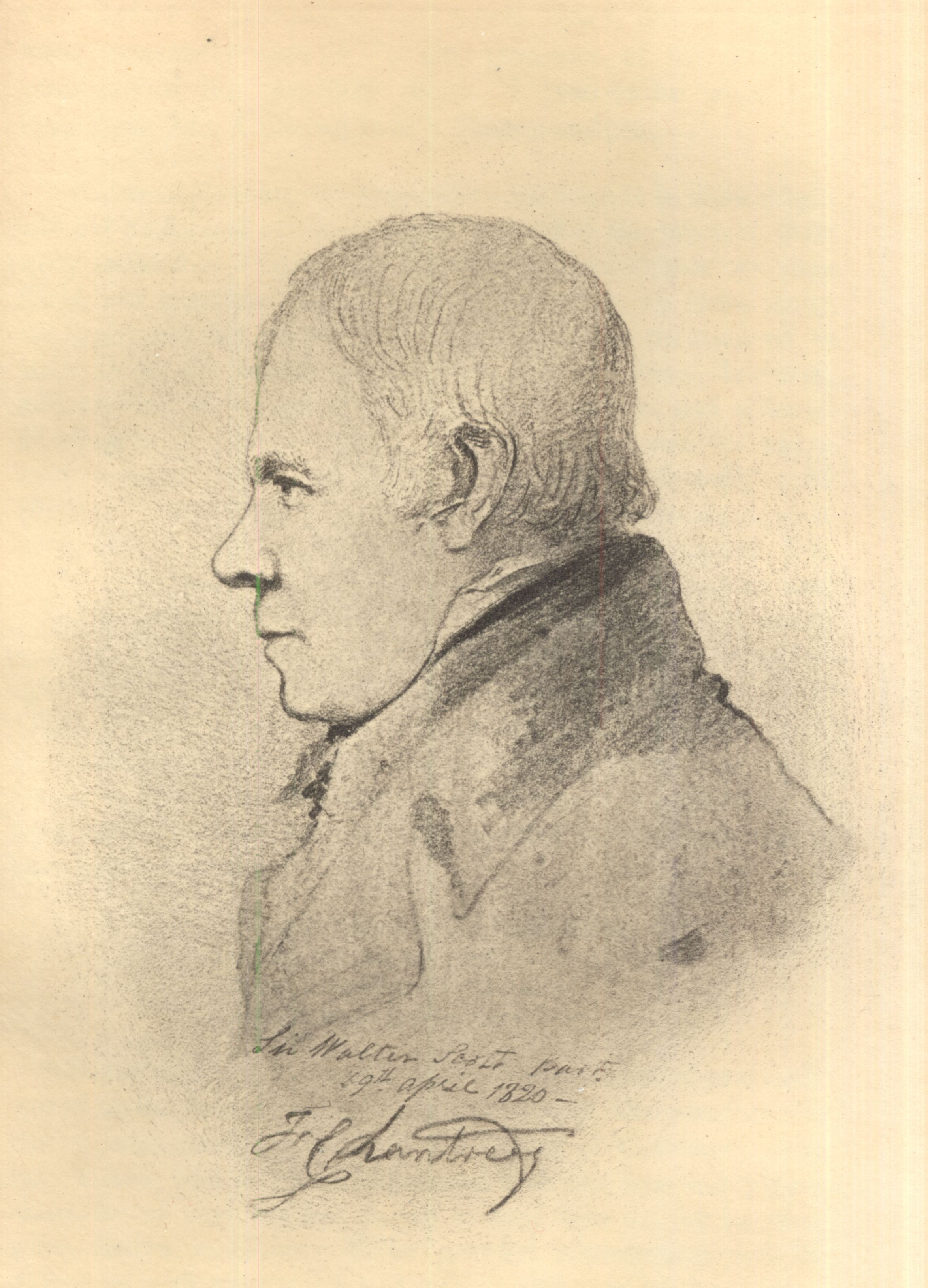
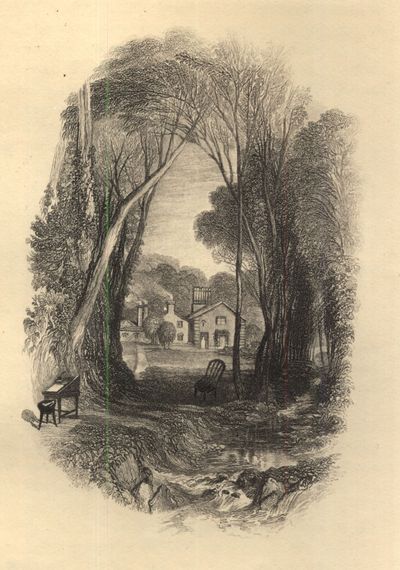
RECURRENCE OF SCOTT'S ILLNESS. — DEATH OF THE DUKE OF
BUCCLEUCH. — LETTERS TO CAPTAIN FERGUSON, LORD MONTAGU, MR.
SOUTHEY, AND MR. SHORTREED. — SCOTT'S SUFFERINGS WHILE DICTATING
THE BRIDE OF LAMMERMOOR. — ANECDOTES BY JAMES BALLANTYNE,
ETC. — APPEARANCE OF THE THIRD SERIES OF TALES OF MY
LANDLORD. — ANECDOTE OF THE EARL OF BUCHAN.
1819
It had been Scott's purpose to spend the Easter vacation in London,
and receive his baronetcy; but this was prevented by the serious
recurrence of the malady which so much alarmed his friends in the
early part of the year 1817, and which had continued ever since to
torment him at intervals. The subsequent correspondence will show that
afflictions of various sorts were accumulated on his head at the same
period:—
TO THE LORD MONTAGU, DITTON PARK, WINDSOR.
Edinburgh, 4th March, 1819.
My dear Lord,—The Lord President tells me he has a letter from
his son, Captain Charles Hope, R. N., who had just taken leave of
our High Chief, upon the deck of the Liffey. He had not seen the
Duke for a fortnight, and was pleasingly surprised to find his
health and general appearance so very much improved. For my part,
having watched him with such unremitting attention, I feel very
confident in the effect of a change of air and of climate. It is
with great pleasure that I find the Duke has received an
answer from me respecting a matter about which he was anxious,
and on which I could make his mind quite easy. His Grace wished
Adam Ferguson to assist him as his confidential secretary; and
with all the scrupulous delicacy that belongs to his character,
he did not like to propose this, except through my medium as a
common friend. Now, I can answer for Adam, as I can for myself,
that he will have the highest pleasure in giving assistance in
every possible way the Duke can desire; and if forty years'
intimacy can entitle one man to speak for another, I believe the
Duke can find nowhere a person so highly qualified for such a
confidential situation. He was educated for business, understands
it well, and was long a military secretary;—his temper and
manners your Lordship can judge as well as I can, and his worth
and honor are of the very first water. I confess I should not be
surprised if the Duke should wish to continue the connection even
afterwards, for I have often thought that two hours'
letter-writing, which is his Grace's daily allowance, is rather
worse than the duty of a Clerk of Session, because there is no
vacation. Much of this might surely be saved by an intelligent
friend, on whose style of expression, prudence, and secrecy, his
Grace could put perfect reliance. Two words marked on any letter
by his own hand would enable such a person to refuse more or less
positively—to grant directly or conditionally—or, in short, to
maintain the exterior forms of the very troublesome and extensive
correspondence which his Grace's high situation entails upon him.
I think it is Monsieur le Duc de Saint-Simon who tells us of one
of Louis XIV.'s ministers qu'il avoit la plume—which he
explains by saying that it was his duty to imitate the King's
handwriting so closely, as to be almost undistinguishable, and
make him on all occasions parler très noblement. I wonder how
the Duke gets on without such a friend. In the mean time,
however, I am glad I can assure him of Ferguson's
willing and ready assistance while abroad; and I am happy to find
still further that he had got that assurance before they sailed,
for tedious hours occur on board of ship, when it will serve as a
relief to talk over any of the private affairs which the Duke
wishes to entrust to him.
I have been very unwell from a visitation of my old enemy, the
cramp in my stomach, which much resembles, as I conceive, the
process by which the deil would make one's king's-hood into a
spleuchan,[16] according to the anathema of Burns.
Unfortunately, the opiates which the medical people think
indispensable to relieve spasms, bring on a habit of body which
has to be counteracted by medicines of a different tendency, so
as to produce a most disagreeable see-saw—a kind of pull-devil,
pull-baker contention, the field of battle being my unfortunate
præcordia. I am better to-day, and I trust shall be able to
dispense with these alternations. I still hope to be in London in
April.
I will write to the Duke regularly, for distance of place acts in
a contrary ratio on the mind and on the eye: trifles, instead of
being diminished, as in prospect, become important and
interesting, and therefore he shall have a budget of them. Hogg
is here busy with his Jacobite songs. I wish he may get
handsomely through, for he is profoundly ignorant of history, and
it is an awkward thing to read in order that you may write.[17] I
give him all the help I can, but he sometimes poses me. For
instance, he came yesterday, open mouth, inquiring what
great dignified clergyman had distinguished himself at
Killiecrankie—not exactly the scene where one would have
expected a churchman to shine—and I found, with some difficulty,
that he had mistaken Major-General Canon, called, in Kennedy's
Latin Song, Canonicus Gallovidiensis, for the canon of a
cathedral. Ex ungue leonem. Ever, my dear Lord, your truly
obliged and faithful
Walter Scott.
Before this letter reached Lord Montagu, his brother had sailed for
Lisbon. The Duke of Wellington had placed his house in that capital
(the Palace das Necessidades) at the Duke of Buccleuch's disposal;
and in the affectionate care and cheerful society of Captain Ferguson,
the invalid had every additional source of comfort that his friends
could have wished for him. But the malady had gone too far to be
arrested by a change of climate; and the letter which he had addressed
to Scott, when about to embark at Portsmouth, is endorsed with these
words: "The last I ever received from my dear friend the Duke of
Buccleuch.—Alas! alas!" The principal object of this letter was to
remind Scott of his promise to sit to Raeburn for a portrait, to be
hung up in that favorite residence where the Duke had enjoyed most of
his society. "My prodigious undertaking," writes his Grace, "of a west
wing at Bowhill, is begun. A library of forty-one feet by twenty-one
is to be added to the present drawing-room. A space for one picture is
reserved over the fireplace, and in this warm situation I intend to
place the Guardian of Literature. I should be happy to have my friend
Maida appear. It is now almost proverbial, 'Walter Scott and his Dog.'
Raeburn should be warned that I am as well acquainted with my friend's
hands and arms as with his nose—and Vandyke was of my opinion. Many
of R.'s works are shamefully finished—the face studied, but
everything else neglected. This is a fair opportunity of producing
something really worthy of his skill."
I shall insert by and by Scott's answer—which never reached
the Duke's hand—with another letter of the same date to Captain
Ferguson; but I must first introduce one, addressed a fortnight
earlier to Mr. Southey, who had been distressed by the accounts he
received of Scott's health from an American traveller, Mr. George
Ticknor of Boston—a friend, and worthy to be such, of Mr. Washington
Irving.[18] The Poet Laureate, by the way, had adverted also to an
impudent trick of a London bookseller, who shortly before this time
announced certain volumes of Grub Street manufacture, as "A New Series
of the Tales of my Landlord," and who, when John Ballantyne, as the
"agent for the Author of Waverley," published a declaration that the
volumes thus advertised were not from that writer's pen, met John's
declaration by an audacious rejoinder—impeaching his authority, and
asserting that nothing but the personal appearance in the field of the
gentleman for whom Ballantyne pretended to act, could shake his belief
that he was himself in the confidence of the true Simon Pure.[19] This
affair gave considerable uneasiness at the time, and for a moment the
dropping of Scott's mask seems to have been pronounced advisable by
both Ballantyne and Constable. But he was not to be worked upon by
such means as these. He calmly replied, "The author who lends himself
to such a trick must be a blockhead—let them publish, and that will
serve our purpose better than anything we ourselves could do."
I have forgotten the names of the "tales," which, being published
accordingly, fell still-born from the press. Mr. Southey had likewise
dropped some allusions to another newspaper story of Scott's being
seriously engaged in a dramatic work—a rumor which probably
originated in the assistance he had lent to Terry in some of the
recent highly popular adaptations of his novels to the purposes of the
stage; though it is not impossible that some hint of the Devorgoil
matter may have transpired. "It is reported," said the Laureate, "that
you are about to bring forth a play, and I am greatly in hopes it may
be true; for I am verily persuaded that in this course you might run
as brilliant a career as you have already done in narrative—both in
prose and rhyme;—for as for believing that you have a double in the
field—not I! Those same powers would be equally certain of success in
the drama, and were you to give them a dramatic direction, and reign
for a third seven years upon the stage, you would stand alone in
literary history. Indeed already I believe that no man ever afforded
so much delight to so great a number of his contemporaries in this or
in any other country. God bless you, my dear Scott, and believe me
ever yours affectionately, R. S." Mr. Southey's letter had further
announced his wife's safe delivery of a son; the approach of the
conclusion of his History of Brazil; and his undertaking of the Life
of Wesley.
TO ROBERT SOUTHEY, ESQ., KESWICK.
Abbotsford, 4th April, 1819.
My dear Southey,—Tidings from you must be always acceptable,
even were the bowl in the act of breaking at the fountain—and my
health is at present very totterish. I have gone through a
cruel succession of spasms and sickness, which have terminated in
a special fit of the jaundice, so that I might sit for the image
of Plutus, the god of specie, so far as complexion goes.
I shall like our American acquaintance the better that he has
sharpened your remembrance of me, but he is also a wondrous
fellow for romantic lore and antiquarian research, considering
his country. I have now seen four or five well-lettered
Americans, ardent in pursuit of knowledge, and free from the
ignorance and forward presumption which distinguish many of their
countrymen. I hope they will inoculate their country with a love
of letters, so nearly allied to a desire of peace and a sense of
public justice—virtues to which the great Transatlantic
community is more strange than could be wished. Accept my best
and most sincere wishes for the health and strength of your
latest pledge of affection. When I think what you have already
suffered, I can imagine with what mixture of feelings this event
must necessarily affect you; but you need not to be told that we
are in better guidance than our own. I trust in God this late
blessing will be permanent, and inherit your talents and virtues.
When I look around me, and see how many men seem to make it their
pride to misuse high qualifications, can I be less interested
than I truly am in the fate of one who has uniformly dedicated
his splendid powers to maintaining the best interests of
humanity? I am very angry at the time you are to be in London, as
I must be there in about a fortnight, or so soon as I can shake
off this depressing complaint, and it would add not a little that
I should meet you there. My chief purpose is to put my eldest son
into the army. I could have wished he had chosen another
profession, but have no title to combat a choice which would have
been my own had my lameness permitted. Walter has apparently the
dispositions and habits fitted for the military profession, a
very quiet and steady temper, an attachment to mathematics and
their application, good sense, and uncommon personal strength and
activity, with address in most exercises, particularly
horsemanship.
—I had written thus far last week when I was
interrupted, first by the arrival of our friend Ticknor with Mr.
Cogswell, another well-accomplished Yankee—(by the bye, we have
them of all sorts, e. g., one Mr. ****, rather a fine man, whom
the girls have christened, with some humor, the Yankee Doodle
Dandie). They have had Tom Drum's entertainment, for I have
been seized with one or two successive crises of my cruel
malady, lasting in the utmost anguish from eight to ten hours. If
I had not the strength of a team of horses, I could never have
fought through it, and through the heavy fire of medical
artillery, scarce less exhausting—for bleeding, blistering,
calomel, and ipecacuanha have gone on without
intermission—while, during the agony of the spasms, laudanum
became necessary in the most liberal doses, though inconsistent
with the general treatment. I did not lose my senses, because I
resolved to keep them, but I thought once or twice they would
have gone overboard, top and top-gallant. I should be a great
fool, and a most ungrateful wretch, to complain of such
inflictions as these. My life has been, in all its private and
public relations, as fortunate perhaps as was ever lived, up to
this period; and whether pain or misfortune may lie behind the
dark curtain of futurity, I am already a sufficient debtor to the
bounty of Providence to be resigned to it. Fear is an evil that
has never mixed with my nature, nor has even unwonted good
fortune rendered my love of life tenacious; and so I can look
forward to the possible conclusion of these scenes of agony with
reasonable equanimity, and suffer chiefly through the sympathetic
distress of my family.
—Other ten days have passed away, for I would not send this
Jeremiad to tease you, while its termination seemed doubtful. For
the present,
"The game is done—I've won, I've won,
Quoth she, and whistles thrice."[20]
I am this day, for the first time, free from the relics
of my disorder, and, except in point of weakness, perfectly well.
But no broken-down hunter had ever so many sprung sinews, whelks,
and bruises. I am like Sancho after the doughty affair of the
Yanguesian Carriers, and all through the unnatural twisting of
the muscles under the influence of that Goule, the cramp. I
must be swathed in Goulard and Rosemary spirits—probatum est.
I shall not fine and renew a lease of popularity upon the
theatre. To write for low, ill-informed, and conceited actors,
whom you must please, for your success is necessarily at their
mercy, I cannot away with. How would you, or how do you think I
should relish being the object of such a letter as Kean[21] wrote
t'other day to a poor author, who, though a pedantic blockhead,
had at least the right to be treated as a gentleman by a
copper-laced, twopenny tearmouth, rendered mad by conceit and
success? Besides, if this objection were out of the way, I do not
think the character of the audience in London is such that one
could have the least pleasure in pleasing them. One half come to
prosecute their debaucheries, so openly that it would degrade a
bagnio. Another set to snooze off their beef-steaks and port
wine; a third are critics of the fourth column of the newspaper;
fashion, wit, or literature, there is not; and, on the whole, I
would far rather write verses for mine honest friend Punch and
his audience. The only thing that could tempt me to be so silly,
would be to assist a friend in such a degrading task who was to
have the whole profit and shame of it.
Have you seen decidedly the most full and methodized collection
of Spanish romances (ballads) published by the industry of
Depping (Altenburgh and Leipsic), 1817? It is quite
delightful. Ticknor had set me agog to see it, without affording
me any hope it could be had in London, when by one of these
fortunate chances which have often marked my life, a friend, who
had been lately on the Continent, came unexpectedly to inquire
for me, and plucked it forth par manière de cadeau. God prosper
you, my dear Southey, in your labors; but do not work too
hard—experto crede. This conclusion, as well as the confusion
of my letter, like the Bishop of Grenada's sermon, savors of the
apoplexy. My most respectful compliments attend Mrs. S.
Yours truly,
Walter Scott.
P. S.—I shall long to see the conclusion of the Brazil history,
which, as the interest comes nearer, must rise even above the
last noble volume. Wesley you alone can touch; but will you not
have the hive about you? When I was about twelve years old, I
heard him preach more than once, standing on a chair, in Kelso
churchyard. He was a most venerable figure, but his sermons were
vastly too colloquial for the taste of Saunders. He told many
excellent stories. One I remember, which he said had happened to
him at Edinburgh. "A drunken dragoon," said Wesley, "was
commencing an assertion in military fashion, G—d eternally d—n
me, just as I was passing. I touched the poor man on the
shoulder, and when he turned round fiercely, said calmly, you
mean God bless you." In the mode of telling the story he failed
not to make us sensible how much his patriarchal appearance, and
mild yet bold rebuke, overawed the soldier, who touched his hat,
thanked him, and, I think, came to chapel that evening.
TO ROBERT SHORTREED, ESQ., SHERIFF-SUBSTITUTE, ETC., JEDBURGH.
Abbotsford, 13th April, 1819.
Dear Bob,—I am very desirous to procure, and as soon as
possible, Mrs. Shortreed's excellent receipt for making
yeast. The Duke of Buccleuch complains extremely of the sour
yeast at Lisbon as disagreeing with his stomach, and I never
tasted half such good bread as Mrs. Shortreed has baked at home.
I am sure you will be as anxious as I am that the receipt should
be forwarded to his Grace as soon as possible. I remember Mrs.
Shortreed giving a most distinct account of the whole affair. It
should be copied over in a very distinct hand, lest Monsieur
Florence makes blunders.
I am recovering from my late indisposition, but as weak as water.
To write these lines is a fatigue. I scarce think I can be at the
circuit at all—certainly only for an hour or two. So on this
occasion I will give Mrs. Shortreed's kind hospitality a little
breathing time. I am tired even with writing these few lines.
Yours ever,
Walter Scott.[22]
TO HIS GRACE THE DUKE OF BUCCLEUCH, ETC., LISBON.
Abbotsford, 15th April, 1819.
My dear Lord Duke,—How very strange it seems that this should be
the first letter I address to your Grace, and you so long absent
from Scotland, and looking for all the news and nonsense of which
I am in general such a faithful reporter. Alas, I have been
ill—very—very ill—only Dr. Baillie says there is nothing of
consequence about my malady except the pain—a pretty
exception—said pain being intense enough to keep me roaring as
loud as your Grace's ci-devant John of Lorn, and of, generally
speaking, from six to eight hours' incessant duration, only
varied by intervals of deadly sickness. Poor Sophia was alone
with me for some time, and managed a half-distracted pack of
servants with spirit, and sense, and presence of mind, far
beyond her years, never suffering her terror at seeing
me in a state so new to her, and so alarming, to divert her mind
an instant from what was fit and proper to be done. Pardon this
side compliment to your Grace's little Jacobite, to whom you have
always been so kind. If sympathy could have cured me, I should
not have been long ill. Gentle and simple were all equally kind,
and even old Tom Watson crept down from Falshope to see how I was
coming on, and to ejaculate "if anything ailed the Shirra, it
would be sair on the Duke." The only unwelcome resurrection was
that of old ****, whose feud with me (or rather dryness) I had
well hoped was immortal; but he came jinking over the moor with
daughters and ponies, and God knows what, to look after my
precious health. I cannot tolerate that man; it seems to me as if
I hated him for things not only past and present, but for some
future offence, which is as yet in the womb of fate.
I have had as many remedies sent me for cramp and jaundice as
would set up a quack doctor: three from Mrs. Plummer, each better
than the other—one at least from every gardener in the
neighborhood—besides all sorts of recommendations to go to
Cheltenham, to Harrowgate, to Jericho for aught I know. Now if
there is one thing I detest more than another, it is a
watering-place, unless a very pleasant party be previously
formed, when, as Tony Lumpkin says, "a gentleman may be in a
concatenation." The most extraordinary recipe was that of my
Highland piper, John Bruce, who spent a whole Sunday in selecting
twelve stones from twelve south-running streams, with the
purpose that I should sleep upon them, and be whole. I caused him
to be told that the recipe was infallible, but that it was
absolutely necessary to success that the stones should be wrapt
up in the petticoat of a widow who had never wished to marry
again; upon which the piper renounced all hope of completing the
charm. I had need of a softer couch than Bruce had
destined me, for so general was the tension of the nerves all
over the body, although the pain of the spasms in the stomach did
not suffer the others to be felt, that my whole left leg was
covered with swelling and inflammation, arising from the
unnatural action of the muscles, and I had to be carried about
like a child. My right leg escaped better, the muscles there
having less irritability, owing to its lame state. Your Grace may
imagine the energy of pain in the nobler parts, when cramps in
the extremities, sufficient to produce such effects, were
unnoticed by me during their existence. But enough of so
disagreeable a subject.
Respecting the portrait, I shall be equally proud and happy to
sit for it, and hope it may be so executed as to be in some
degree worthy of the preferment to which it is destined.[23] But
neither my late golden hue (for I was covered with jaundice), nor
my present silver complexion (looking much more like a spectre
than a man), will present any idea of my quondam beef-eating
physiognomy. I must wait till the age of brass, the true
juridical bronze of my profession, shall again appear on my
frontal. I hesitate a little about Raeburn, unless your Grace is
quite determined. He has very much to do; works just now chiefly
for cash, poor fellow, as he can have but a few years to make
money; and has twice already made a very chowder-headed person of
me. I should like much (always with your approbation) to try
Allan, who is a man of real genius, and has made one or two
glorious portraits, though his predilection is to the historical
branch of the art. We did rather a handsome thing for him,
considering that in Edinburgh we are neither very wealthy nor
great amateurs. A hundred persons subscribed ten guineas apiece
to raffle[24] for his fine picture of the Circassian
Chief selling Slaves to the Turkish Pacha—a beautiful and highly
poetical picture. There was another small picture added by way of
second prize, and, what is curious enough, the only two peers on
the list, Lord Wemyss and Lord Fife, both got prizes. Allan has
made a sketch which I shall take to town with me when I can go,
in hopes Lord Stafford, or some other picture-buyer, may fancy
it, and order a picture. The subject is the murder of Archbishop
Sharp on Magus Moor, prodigiously well treated. The savage
ferocity of the assassins, crowding one on another to strike at
the old prelate on his knees—contrasted with the old man's
figure—and that of his daughter endeavoring to interpose for his
protection, and withheld by a ruffian of milder mood than his
fellows:—the dogged fanatical severity of Rathillet's
countenance, who remained on horseback, witnessing, with
stern fanaticism, the murder he did not choose to be active in,
lest it should be said that he struck out of private revenge—are
all amazingly well combined in the sketch. I question if the
artist can bring them out with equal spirit in the painting which
he meditates.[25] Sketches give a sort of fire to the imagination
of the spectator, who is apt to fancy a great deal more for
himself, than the pencil, in the finished picture, can possibly
present to his eye afterwards.—Constable has offered Allan three
hundred pounds to make sketches for an edition of the Tales of my
Landlord, and other novels of that cycle, and says he will give
him the same sum next year, so, from being pinched enough, this
very deserving artist suddenly finds himself at his ease. He was
long at Odessa with the Duke of Richelieu, and is a very
entertaining person.
I saw with great pleasure Wilkie's sketch of your Grace, and I
think when I get to town I shall coax him out of a copy, to me
invaluable. I hope, however, when you return, you will sit to
Lawrence. We should have at least one picture of your Grace from
the real good hand. Sooth to speak, I cannot say much for the
juvenile representations at Bowhill and in the library at
Dalkeith. Return, however, with the original features in good
health, and we shall not worry you about portraits. The library
at Bowhill will be a delightful room, and will be some
consolation to me who must, I fear, lose for some time the
comforts of the eating-room, and substitute panada and toast and
water for the bonny haunch and buxom bottle of claret. Truth is,
I must make great restrictions on my creature-comforts, at least
till my stomach recovers its tone and ostrich-like capacity of
digestion. Our spring here is slow, but not unfavorable: the
country looking very well, and my plantings for the season quite
completed. I have planted quite up two little glens,
leading from the Aide-de-Camp's habitation up to the little loch,
and expect the blessings of posterity for the shade and shelter I
shall leave, where, God knows, I found none.
It is doomed this letter is not to close without a request. I
conclude your Grace has already heard from fifty applicants that
the kirk of Middlebie is vacant, and I come forward as the
fifty-first (always barring prior engagements and better claims)
in behalf of George Thomson, a son of the minister of Melrose,
being the grinder of my boys, and therefore deeply entitled to my
gratitude and my good offices, as far as they can go. He is
nearer Parson Abraham Adams than any living creature I ever
saw—very learned, very religious, very simple, and extremely
absent. His father, till very lately, had but a sort of half
stipend, during the incumbency of a certain notorious Mr.
MacLagan, to whom he acted only as assistant. The poor devil was
brought to the grindstone (having had the want of precaution to
beget a large family), and became the very figure of a fellow who
used to come upon the stage to sing "Let us all be unhappy
together." This poor lad George was his saving angel, not only
educating himself, but taking on him the education of two of his
brothers, and maintaining them out of his own scanty pittance. He
is a sensible lad, and by no means a bad preacher, a stanch
Anti-Gallican, and orthodox in his principles. Should your Grace
find yourself at liberty to give countenance to this very
innocent and deserving creature, I need not say it will add to
the many favors you have conferred on me; but I hope the
parishioners will have also occasion to say, "Weel bobbit, George
of Middlebie." Your Grace's Aide-de-Camp, who knows young Thomson
well, will give you a better idea of him than I can do. He lost a
leg by an accident in his boyhood, which spoiled as bold and
fine-looking a grenadier as ever charged bayonet against a
Frenchman's throat. I think your Grace will not like him
the worse for having a spice of military and loyal spirit about
him. If you knew the poor fellow, your Grace would take uncommon
interest in him, were it but for the odd mixture of sense and
simplicity, and spirit and good morals. Somewhat too much of him.
I conclude you will go to Mafra, Cintra, or some of these places,
which Baretti describes so delightfully, to avoid the great
heats, when the Palace de las Necessidades must become rather
oppressive. By the bye, though it were only for the credit of the
name, I am happy to learn it has that useful English comfort, a
water-closet. I suppose the armorer of the Liffey has already put
it in complete repair. Your Grace sees the most secret passages
respecting great men cannot be hidden from their friends. There
is but little news here but death in the clan. Harden's sister is
dead—a cruel blow to Lady Die,[26] who is upwards of
eighty-five, and accustomed to no other society. Again, Mrs.
Frank Scott, his uncle's widow, is dead, unable to survive the
loss of two fine young men in India, her sons, whose death
closely followed each other. All this is sad work; but it is a
wicked and melancholy world we live in. God bless you, my dear,
dear Lord. Take great care of your health for the sake of all of
us. You are the breath of our nostrils, useful to thousands, and
to many of these thousands indispensable. I will write again very
soon, when I can keep my breast longer to the desk without pain,
for I am not yet without frequent relapses, when they souse me
into scalding water without a moment's delay, where I lie, as my
old grieve Tom Purdie said last night, being called to assist
at the operation, "like a haulded saumon." I write a few lines
to the Aide-de-Camp, but I am afraid of putting this letter
beyond the bounds of Lord Montagu's frank. When I can do anything
for your Grace here, you know I am most pleased and
happy.—Ever respectfully and affectionately your Grace's
Walter Scott.
TO CAPTAIN ADAM FERGUSON, ETC., ETC., ETC.
Abbotsford, April 16, 1819.
My dear Adam,—Having only been able last night to finish a long
letter to the Chief, I now add a few lines for the Aide-de-Camp.
I have had the pleasure to hear of you regularly from Jack,[27]
who is very regular in steering this way when packets arrive; and
I observe with great satisfaction that you think our good Duke's
health is on the mending hand. Climate must operate as an
alterative, and much cannot perhaps be expected from it at first.
Besides, the great heat must be a serious drawback. But I hope
you will try by and by to get away to Cintra, or some of those
sequestered retreats where there are shades and cascades to cool
the air. I have an idea the country there is eminently beautiful.
I am afraid the Duke has not yet been able to visit Torres
Vedras, but you must be meeting with things everywhere to put
you in mind of former scenes. As for the Senhoras, I have little
doubt that the difference betwixt your military hard fare and
Florence's high sauces and jellies will make them think that time
has rather improved an old friend than otherwise. Apropos of
these ticklish subjects. I am a suitor to the Duke, with little
expectation of success (for I know his engagements), for the kirk
of Middlebie to George Thomson, the very Abraham Adams of
Presbytery. If the Duke mentions him to you (not otherwise) pray
lend him a lift. With a kirk and a manse the poor fellow might
get a good farmer's daughter, and beget grenadiers for his
Majesty's service. But as I said before, I dare say all St.
Hubert's black pack are in full cry upon the living, and that he
has little or no chance. It is something, however, to have tabled
him, as better may come of it another day.
All at Huntly Burn well and hearty, and most kind in
their attentions during our late turmoils. Bauby[28] came over to
offer her services as sick-nurse, and I have drunk scarce
anything but delicious ginger-beer of Miss Bell's brewing, since
my troubles commenced. They have been, to say the least,
damnable; and I think you would hardly know me. When I crawl out
on Sibyl Grey, I am the very image of Death on the pale
horse—lanthorn-jawed, decayed in flesh, stooping as if I meant
to eat the pony's ears, and unable to go above a footpace. But
although I have had, and must expect, frequent relapses, yet the
attacks are more slight, and I trust I shall mend with the good
weather. Spring sets in very pleasantly, and in a settled
fashion. I have planted a number of shrubs, etc., at Huntly Burn,
and am snodding up the drive of the old farmhouse, enclosing the
Toftfield, and making a good road from the parish road to your
gate. This I tell you to animate you to pick up a few seeds both
of forest trees, shrubs, and vegetables; we will rear them in the
hot-house, and divide honorably. Avis au lecteur. I have been a
good deal entrusted to the care of Sophia, who is an admirable
sick-nurse. Mamma has been called to town by two important
avocations: to get a cook—no joking matter,—and to see Charles,
who was but indifferent, but has recovered. You must have heard
of the death of Joseph Hume, David's only son. Christ! what a
calamity!—just entering life with the fairest prospects—full of
talent, and the heir of an old and considerable family—a fine
career before him: all this he was one day, or rather one
hour—or rather in the course of five minutes—so sudden was the
death—and then—a heap of earth. His disease is unknown;
something about the heart, I believe; but it had no alarming
appearance, nothing worse than a cold and sore throat, when
convulsions came, and death ensued. It is a complete
smash to poor David, who had just begun to hold his head up after
his wife's death. But he bears it stoutly, and goes about his
business as usual. A woeful case. London is now out of the
question with me; I have no prospect of being now able to stand
the journey by sea or land; but the best is, I have no pressing
business there. The Commie[29] takes charge of Walter's
matters—cannot, you know, be in better hands; and Lord Melville
talks of gazetting quam primum. I will write a long letter very
soon, but my back, fingers, and eyes ache with these three pages.
All here send love and fraternity. Yours ever most truly,
Walter Scott.
P. S.—By the bye, old Kennedy, the tinker, swam for his life at
Jedburgh, and was only, by the sophisticated and timid evidence
of a seceding doctor, who differed from all his brethren, saved
from a well-deserved gibbet. He goes to botanize for fourteen
years. Pray tell this to the Duke, for he was
"An old soldier of the Duke's,
And the Duke's old soldier."
Six of his brethren, I am told, were in court, and kith and kin
without end. I am sorry so many of the clan are left. The cause
of quarrel with the murdered man was an old feud between two
gypsy clans, the Kennedies and Irvings, which, about forty years
since, gave rise to a desperate quarrel and battle on Hawick
Green, in which the grandfathers of both Kennedy, and Irving whom
he murdered, were engaged.
In the next of these letters there is allusion to a drama, on the
story of The Heart of Mid-Lothian, of which Mr. Terry had transmitted
the MS. to Abbotsford—and which ultimately proved very successful.
Terry had, shortly before this time, become the acting manager of the
Haymarket Theatre.
TO D. TERRY, ESQ., HAYMARKET, LONDON.
Abbotsford, 18th April, 1819.
Dear Terry,—I am able (though very weak) to answer your kind
inquiries. I have thought of you often, and been on the point of
writing or dictating a letter, but till very lately I could have
had little to tell you of but distress and agony, with constant
relapses into my unhappy malady, so that for weeks I seemed to
lose rather than gain ground, all food nauseating on my stomach,
and my clothes hanging about me like a potato-bogle,[30] with
from five or six to ten hours of mortal pain every third day;
latterly the fits have been much milder, and have at last given
way to the hot bath without any use of opiates; an immense point
gained, as they hurt my general health extremely. Conceive my
having taken, in the course of six or seven hours, six grains of
opium, three of hyoscyamus, near 200 drops of laudanum—and all
without any sensible relief of the agony under which I labored.
My stomach is now getting confirmed, and I have great hopes the
bout is over; it has been a dreadful set-to. I am sorry to hear
Mrs. Terry is complaining; you ought not to let her labor,
neither at Abbotsford sketches nor at anything else, but to study
to keep her mind amused as much as possible. As for Walter, he is
a shoot of an Aik,[31] and I have no fear of him: I hope he
remembers Abbotsford and his soldier namesake.
I send the MS.—I wish you had written for it earlier. My
touching, or even thinking of it, was out of the question; my
corrections would have smelled as cruelly of the cramp as the
Bishop of Grenada's homily did of the apoplexy. Indeed I hold
myself inadequate to estimate those criticisms which rest on
stage effect, having been of late very little of a play-going
person. Would to Heaven these sheets could do for you what
Rob Roy has done for Murray; he has absolutely netted
upwards of £3000: to be sure, the man who played the Bailie made
a piece of acting equal to whatever has been seen in the
profession. For my own part, I was actually electrified by the
truth, spirit, and humor which he threw into the part. It was the
living Nicol Jarvie: conceited, pragmatical, cautious, generous,
proud of his connection with Rob Roy, frightened for him at the
same time, and yet extremely desirous to interfere with him as an
adviser: the tone in which he seemed to give him up for a lost
man after having provoked him into some burst of Highland
violence, "Ah Rab! Rab!" was quite inimitable. I do assure you I
never saw a thing better played. It is like it may be his only
part, for no doubt the Patavinity and knowledge of the provincial
character may have aided him much; but still he must be a
wonderful fellow; and the houses he drew were tremendous.
I am truly glad you are settled in London—"a rolling
stone"—"the proverb is something musty:"[32] it is always
difficult to begin a new profession; I could have wished you
quartered nearer us, but we shall always hear of you. The
becoming stage-manager at the Haymarket I look upon as a great
step: well executed, it cannot but lead to something of the same
kind elsewhere. You must be aware of stumbling over a propensity
which easily besets you from the habit of not having your time
fully employed—I mean what the women very expressively call
dawdling. Your motto must be Hoc age. Do instantly whatever
is to be done, and take the hours of reflection or recreation
after business, and never before it. When a regiment is under
march, the rear is often thrown into confusion because the front
do not move steadily and without interruption. It is the same
thing with business. If that which is first in hand is not
instantly, steadily, and regularly despatched, other things
accumulate behind till affairs begin to press all at once,
and no human brain can stand the confusion: pray mind
this, it is one of your few weak points—ask Mrs. Terry else. A
habit of the mind it is which is very apt to beset men of
intellect and talent, especially when their time is not regularly
filled up, but left at their own arrangement. But it is like the
ivy round the oak, and ends by limiting, if it does not destroy,
the power of manly and necessary exertion. I must love a man so
well to whom I offer such a word of advice, that I will not
apologize for it, but expect to hear you are become as regular as
a Dutch clock—hours, quarters, minutes, all marked and
appropriated. This is a great cast in life, and must be played
with all skill and caution.
We wish much to have a plan of the great bed, that we may hang up
the tester. Mr. Atkinson offered to have it altered or exchanged;
but with the expense of land-carriage and risk of damage, it is
not to be thought of. I enclose a letter to thank him for all his
kindness. I should like to have the invoice when the things are
shipped. I hope they will send them to Leith, and not to Berwick.
The plasterer has broke a pane in the armory. I enclose a sheet
with the size, the black lines being traced within the lead; and
I add a rough drawing of the arms, which are those of my mother.
I should like it replaced as soon as possible, for I will set the
expense against the careless rascal's account.
I have got a beautiful scarlet paper, inlaid with gold (rather
crimson than scarlet) in a present from India, which will hang
the parlor to a T; but we shall want some articles from town to
enable us to take possession of the parlor—namely, a
carpet—you mentioned a wainscot pattern, which would be
delightful—item, grates for said parlor and armory—a plain
and unexpensive pattern, resembling that in my room (which vents
most admirably), and suited by half-dogs for burning wood. The
sideboard and chairs you have mentioned. I see Mr. Bullock
(George's brother) advertises his museum for sale. I
wonder if a good set of real tilting armor could be got cheap
there. James Ballantyne got me one very handsome bright steel
cuirassier of Queen Elizabeth's time, and two less perfect, for
£20—dog cheap; they make a great figure in the armory. Hangings,
curtains, etc., I believe we shall get as well in Edinburgh as in
London; it is in your joiner and cabinet work that your infinite
superiority lies.
Write to me if I can do aught about the play—though I fear not:
much will depend on Dumbiedikes, in whom Listen will be strong.
Sophia has been chiefly my nurse, as an indisposition of little
Charles called Charlotte to town. She returned yesterday with
him. All beg kind compliments to you and Mrs. Terry and little
Walter. I remain your very feeble but convalescent to command,
Walter Scott.
P. S.—We must not forget the case for the leaves of the table
while out of use; without something of the kind, I am afraid they
will be liable to injury, which is a pity, as they are so very
beautiful.[33]
The accounts of Scott's condition circulated in Edinburgh in the
course of this April were so alarming, that I should not have thought
of accepting his invitation to revisit Abbotsford, unless John
Ballantyne had given me better tidings about the end of the
month.[34] He informed me that his "illustrious friend" (for
so both the Ballantynes usually spoke of him) was so much recovered as
to have resumed his usual literary tasks, though with this difference,
that he now, for the first time in his life, found it necessary to
employ the hand of another. I have now before me a letter of the 8th
April, in which Scott says to Constable: "Yesterday I began to
dictate, and did it easily and with comfort. This is a great point,
but I must proceed by little and little; last night I had a slight
return of the enemy, but baffled him;"—and he again writes to the
bookseller on the 11th, "John Ballantyne is here, and returns with
copy, which my increasing strength permits me to hope I may now
furnish regularly."
The copy (as MS. for the press is technically called) which Scott
was thus dictating, was that of The Bride of Lammermoor, and his
amanuenses were William Laidlaw and John Ballantyne;—of whom he
preferred the latter, when he could be at Abbotsford, on account of
the superior rapidity of his pen; and also because John kept his pen
to the paper without interruption, and, though with many an arch
twinkle in his eyes, and now and then an audible smack of his lips,
had resolution to work on like a well-trained clerk; whereas good
Laidlaw entered with such keen zest into the interest of the
story as it flowed from the author's lips, that he could not suppress
exclamations of surprise and delight—"Gude keep us a'!—the like o'
that!—eh sirs! eh sirs!"—and so forth—which did not promote
despatch. I have often, however, in the sequel, heard both these
secretaries describe the astonishment with which they were equally
affected when Scott began this experiment. The affectionate Laidlaw
beseeching him to stop dictating, when his audible suffering filled
every pause, "Nay, Willie," he answered, "only see that the doors are
fast. I would fain keep all the cry as well as all the wool to
ourselves; but as to giving over work, that can only be when I am in
woollen." John Ballantyne told me, that after the first day he always
took care to have a dozen of pens made before he seated himself
opposite to the sofa on which Scott lay, and that though he often
turned himself on his pillow with a groan of torment, he usually
continued the sentence in the same breath. But when dialogue of
peculiar animation was in progress, spirit seemed to triumph
altogether over matter—he arose from his couch and walked up and down
the room, raising and lowering his voice, and as it were acting the
parts. It was in this fashion that Scott produced the far greater
portion of The Bride of Lammermoor—the whole of the Legend of
Montrose—and almost the whole of Ivanhoe. Yet, when his health was
fairly reëstablished, he disdained to avail himself of the power of
dictation, which he had thus put to the sharpest test, but resumed,
and for many years resolutely adhered to, the old plan of writing
everything with his own hand. When I once, some time afterwards,
expressed my surprise that he did not consult his ease, and spare his
eyesight at all events, by occasionally dictating, he answered, "I
should as soon think of getting into a sedan chair while I can use my
legs."
On one of the envelopes in which a chapter of The Bride of Lammermoor
reached the printer in the Canongate about this time (May 2,
1819), there is this note in the author's own handwriting:—
Dear James,—These matters will need more than your usual
carefulness. Look sharp—double sharp—my trust is constant in
thee:—
"Tarry woo, tarry woo,
Tarry woo is ill to spin;
Card it weel, card it weel,
Card it weel ere ye begin.
When 'tis carded, row'd, and spun,
Then the work is hafflins done;
But when woven, drest, and clean,
It may be cleading for a queen."
So be it,—W. S.
But to return: I rode out to Abbotsford with John Ballantyne towards
the end of the spring vacation, and though he had warned me of a sad
change in Scott's appearance, it was far beyond what I had been led to
anticipate. He had lost a great deal of flesh—his clothes hung loose
about him—his countenance was meagre, haggard, and of the deadliest
yellow of the jaundice—and his hair, which a few weeks before had
been but slightly sprinkled with gray, was now almost literally
snow-white. His eye, however, retained its fire unquenched; indeed it
seemed to have gained in brilliancy from the new languor of the other
features; and he received us with all the usual cordiality, and even
with little perceptible diminishment in the sprightliness of his
manner. He sat at the table while we dined, but partook only of some
rice pudding; and after the cloth was drawn, while sipping his toast
and water, pushed round the bottles in his old style, and talked with
easy cheerfulness of the stout battle he had fought, and which he now
seemed to consider as won.
"One day there was," he said, "when I certainly began to have great
doubts whether the mischief was not getting at my mind—and
I'll tell you how I tried to reassure myself on that score. I was
quite unfit for anything like original composition; but I thought if I
could turn an old German ballad I had been reading into decent rhymes,
I might dismiss my worst apprehensions—and you shall see what came of
the experiment." He then desired his daughter Sophia to fetch the MS.
of The Noble Moringer, as it had been taken down from his dictation,
partly by her and partly by Mr. Laidlaw, during one long and painful
day while he lay in bed. He read it to us as it stood, and seeing that
both Ballantyne and I were much pleased with the verses, he said he
should copy them over,—make them a little "tighter about the
joints,"—and give me them to be printed in the Edinburgh Annual
Register for 1816,—to consult him about which volume had partly been
the object of my visit; and this promise he redeemed before I left
him.
The reading of this long ballad, however (it consists of forty-three
stanzas),[35] seemed to have exhausted him: he retired to his bedroom;
and an hour or two after, when we were about to follow his example,
his family were distressed by the well-known symptoms of another sharp
recurrence of his affliction. A large dose of opium and the hot bath
were immediately put in requisition. His good neighbor, Dr. Scott of
Darnlee, was sent for, and soon attended; and in the course of three
or four hours we learned that he was once more at ease. But I can
never forget the groans which, during that space, his agony extorted
from him. Well knowing the iron strength of his resolution, to find
him confessing its extremity, by cries audible not only all over the
house, but even to a considerable distance from it (for Ballantyne and
I, after he was put into his bath, walked forth to be out of the way,
and heard him distinctly at the bowling-green), it may be
supposed that this was sufficiently alarming, even to my companion;
how much more to me, who had never before listened to that voice,
except in the gentle accents of kindness and merriment.
I told Ballantyne that I saw this was no time for my visit, and that I
should start for Edinburgh again at an early hour—and begged he would
make my apologies—in the propriety of which he acquiesced. But as I
was dressing, about seven next morning, Scott himself tapped at my
door, and entered, looking better I thought than at my arrival the day
before. "Don't think of going," said he; "I feel hearty this morning,
and if my devil does come back again, it won't be for three days at
any rate. For the present, I want nothing to set me up except a good
trot in the open air, to drive away the accursed vapors of the
laudanum I was obliged to swallow last night. You have never seen
Yarrow, and when I have finished a little job I have with Jocund
Johnny, we shall all take horse and make a day of it." When I said
something about a ride of twenty miles being rather a bold experiment
after such a night, he answered that he had ridden more than forty, a
week before, under similar circumstances, and felt nothing the worse.
He added, that there was an election on foot, in consequence of the
death of Sir John Riddell, of Riddell, Member of Parliament for the
Selkirk district of Burghs, and that the bad health and absence of the
Duke of Buccleuch rendered it quite necessary that he should make
exertions on this occasion. "In short," said he, laughing, "I have an
errand which I shall perform—and as I must pass Newark, you had
better not miss the opportunity of seeing it under so excellent a
cicerone as the old minstrel,
'Whose withered cheek and tresses grey
Shall yet see many a better day.'"
About eleven o'clock, accordingly, he was mounted, by the help of Tom
Purdie, upon a stanch, active cob, yclept Sibyl Grey,—exactly such a
creature as is described in Mr. Dinmont's Dumple—while
Ballantyne sprang into the saddle of noble Old Mortality, and we
proceeded to the town of Selkirk, where Scott halted to do business at
the Sheriff-Clerk's, and begged us to move onward at a gentle pace
until he should overtake us. He came up by and by at a canter, and
seemed in high glee with the tidings he had heard about the canvass.
And so we rode by Philiphaugh, Carterhaugh, Bowhill, and Newark, he
pouring out all the way his picturesque anecdotes of former
times—more especially of the fatal field where Montrose was finally
overthrown by Leslie. He described the battle as vividly as if he had
witnessed it; the passing of the Ettrick at daybreak by the
Covenanting General's heavy cuirassiers, many of them old soldiers of
Gustavus Adolphus, and the wild confusion of the Highland host when
exposed to their charge on an extensive haugh as flat as a
bowling-green. He drew us aside at Slain-men's-lee, to observe the
green mound that marks the resting-place of the slaughtered royalists;
and pointing to the apparently precipitous mountain, Minchmoor, over
which Montrose and his few cavaliers escaped, mentioned that, rough as
it seemed, his mother remembered passing it in her early days in a
coach and six, on her way to a ball at Peebles—several footmen
marching on either side of the carriage to prop it up, or drag it
through bogs, as the case might require. He also gave us, with all the
dramatic effect of one of his best chapters, the history of a worthy
family who, inhabiting at the time of the battle a cottage on his own
estate, had treated with particular kindness a young officer of
Leslie's army quartered on them for a night or two before. When
parting from them to join the troops, he took out a purse of gold, and
told the good woman that he had a presentiment he should not see
another sun set, and in that case would wish his money to remain in
her kind hands; but, if he should survive, he had no doubt she would
restore it honestly. The young man returned mortally wounded,
but lingered awhile under her roof, and finally bequeathed to her and
hers his purse and his blessing. "Such," he said, "was the origin of
the respectable lairds of——, now my good neighbors."
The prime object of this expedition was to talk over the politics of
Selkirk with one of the Duke of Buccleuch's great store-farmers, who,
as the Sheriff had learned, possessed private influence with a
doubtful bailie or deacon among the Souters. I forget the result, if
ever I heard it. But next morning, having, as he assured us, enjoyed a
good night in consequence of this ride, he invited us to accompany him
on a similar errand across Bowden Moor, and up the Valley of the Ayle;
and when we reached a particularly bleak and dreary point of that
journey, he informed us that he perceived in the waste below a wreath
of smoke, which was the appointed signal that a wavering Souter of
some consequence had agreed to give him a personal interview where no
Whiggish eyes were likely to observe them;—and so, leaving us on the
road, he proceeded to thread his way westward, across moor and bog,
until we lost view of him. I think a couple of hours might have passed
before he joined us again, which was, as had been arranged, not far
from the village of Lilliesleaf. In that place, too, he had some
negotiation of the same sort to look after; and when he had finished
it, he rode with us all round the ancient woods of Riddell, but would
not go near the house; I suppose lest any of the afflicted family
might still be there. Many were his lamentations over the catastrophe
which had just befallen them. "They are," he said, "one of the most
venerable races in the south of Scotland—they were here long before
these glens had ever heard the name of Soulis or of Douglas—to say
nothing of Buccleuch: they can show a Pope's bull of the tenth
century, authorizing the then Riddell to marry a relation within the
forbidden degrees. Here they have been for a thousand years at least;
and now all the inheritance is to pass away, merely because
one good worthy gentleman would not be contented to enjoy his horses,
his hounds, and his bottle of claret, like thirty or forty
predecessors, but must needs turn scientific agriculturist, take
almost all his fair estate into his own hand, superintend for himself
perhaps a hundred ploughs, and try every new nostrum that has been
tabled by the quackish improvers of the time. And what makes the
thing ten times more wonderful is, that he kept day-book and ledger,
and all the rest of it, as accurately as if he had been a cheesemonger
in the Grassmarket." Some of the most remarkable circumstances in
Scott's own subsequent life have made me often recall this
conversation—with more wonder than he expressed about the ruin of the
Riddells.
I remember he told us a world of stories, some tragical, some comical,
about the old lairds of this time-honored lineage; and among others,
that of the seven Bibles and the seven bottles of ale, which he
afterwards inserted in a note to The Bride of Lammermoor.[36] He was
also full of anecdotes about a friend of his father's, a
minister of Lilliesleaf, who reigned for two generations the most
popular preacher in Teviotdale; but I forget the orator's name. When
the original of Saunders Fairford congratulated him in his latter days
on the undiminished authority he still maintained—every kirk in the
neighborhood being left empty when it was known he was to mount the
tent at any country sacrament—the shrewd divine answered: "Indeed,
Mr. Walter, I sometimes think it's vera surprising. There's aye a talk
of this or that wonderfully gifted young man frae the college; but
whenever I'm to be at the same occasion with ony o' them, I e'en
mount the white horse in the Revelations, and he dings them a'."
Thus Scott amused himself and us as we jogged homewards: and it was
the same the following day, when (no election matters pressing) he
rode with us to the western peak of the Eildon hills, that he might
show me the whole panorama of his Teviotdale, and expound the
direction of the various passes by which the ancient forayers made
their way into England, and tell the names and the histories of many a
monastic chapel and baronial peel, now mouldering in glens and dingles
that escape the eye of the traveller on the highways. Among other
objects on which he descanted with particular interest, were the ruins
of the earliest residence of the Kerrs of Cessford, so often opposed
in arms to his own 'chieftains of Branksome, and a desolate little
kirk on the adjoining moor, where the Dukes of Roxburghe are still
buried in the same vault with the hero who fell at Turn-again.
Turning to the northward, he showed us the crags and tower of
Smailholm, and behind it the shattered fragment of Ercildoune—and
repeated some pretty stanzas ascribed to the last of the real
wandering minstrels of this district, by name Burn:—
"Sing Erceldoune, and Cowdenknowes,
Where Homes had ance commanding,
And Drygrange, wi' the milk-white ewes,
'Twixt Tweed and Leader standing.
The bird that flees through Redpath trees
And Gledswood banks each morrow,
May chaunt and sing—sweet Leader's haughs
And Bonny howms of Yarrow.
"But Minstrel Burn cannot assuage
His grief while life endureth,
To see the changes of this age
Which fleeting time procureth;
For mony a place stands in hard case,
Where blythe folks kent nae sorrow,
With Homes that dwelt on Leader side,
And Scotts that dwelt on Yarrow."[37]
That night he had again an attack of his cramp, but not so serious as
the former. Next morning he was again at work with Ballantyne at an
early hour; and when I parted from him after breakfast, he spoke
cheerfully of being soon in Edinburgh for the usual business of his
Court. I left him, however, with dark prognostications; and the
circumstances of this little visit to Abbotsford have no doubt dwelt
on my mind the more distinctly, from my having observed and listened
to him throughout under the painful feeling that it might very
probably be my last.
On the 5th of May he received the intelligence of the death of the
Duke of Buccleuch, which had occurred at Lisbon on the 20th April; and
next morning he wrote as follows to his Grace's brother:—
TO THE LORD MONTAGU, DITTON PARK.
Abbotsford, 6th May, 1819.
My dear Lord,—I heard from Lord Melville, by yesterday's post,
the calamitous news which your Lordship's very kind letter this
moment confirmed, had it required confirmation. For this
fortnight past, my hopes have been very faint indeed, and on
Wednesday, when I had occasion to go to Yarrow, and my horse
turned from habit to go up the avenue at Bowhill, I felt deeply
impressed that it was a road I should seldom travel for a long
time at least. To your Lordship—let me add, to myself—this is
an irreparable loss; for such a fund of excellent sense, high
principle, and perfect honor have been rarely combined in the
same individual. To the country the inestimable loss will be soon
felt, even by those who were insensible to his merits, or wished
to detract from them, when he was amongst us. In my opinion he
never recovered from his domestic calamity. He wrote to me, a few
days after that cruel event, a most affectionate and remarkable
letter, explaining his own feelings, and while he begged that I
would come to him, assuring me that I should find him the same he
would be for the future years of his life. He kept his word; but
I could see a grief of that calm and concentrated kind which
claims the hours of solitude and of night for its empire, and
gradually wastes the springs of life.
Among the thousand painful feelings which this melancholy event
had excited, I have sometimes thought of his distance from home.
Yet this was done with the best intention, and upon the best
advice, and was perhaps the sole chance which remained for
reëstablishment. It has pleased God that it has failed; but the
best means were used under the best direction, and mere mortality
can do no more. I am very anxious about the dear young ladies,
whose lives were so much devoted to their father, and shall be
extremely desirous of knowing how they are. The Duchess
has so much firmness of mind, and Lady M. so much affectionate
prudence, that they will want no support that example and
kindness can afford. To me the world seems a sort of waste
without him. We had many joint objects, constant intercourse, and
unreserved communication, so that through him and by him I took
interest in many things altogether out of my own sphere, and it
seems to me as if the horizon were narrowed and lowered around
me. But God's will be done; it is all that brother or friend can
or dare say.—I have reluctance to mention the trash which is
going on here. Indeed, I think little is altered since I wrote to
your Lordship fully, excepting that last night late, Chisholm[38]
arrived at Abbotsford from Lithgow, recalled by the news which
had somehow reached Edinburgh,—as I suspect by some
officiousness of ****. He left Lithgow in such a state that there
is no doubt he will carry that burgh, unless Pringle[39] gets
Selkirk. He is gone off this morning to try the possible and
impossible to get the single vote which he wants, or to prevail
on one person to stand neuter. It is possible he may succeed,
though this event, when it becomes generally known, will be
greatly against his efforts. I should care little more about the
matter, were it not for young Walter,[40] and for the despite I
feel at the success of speculations which were formed on the
probability of the event which has happened. Two sons of *******
came here yesterday, and with their father's philosophical spirit
of self-accommodation, established themselves for the night.
Betwixt them and Chisholm's noise, my head and my stomach
suffered so much (under the necessity of drowning feelings which
I could not express), that I had a return of the spasms, and I
felt as if a phantasmagoria was going on around me. Quiet, and
some indulgence of natural and solitary sorrow, have
made me well. To-day I will ride up to Selkirk and see the
magistrates, or the chief of them. It is necessary they should
not think the cause deserted. If it is thought proper to suspend
the works at Bowhill, perhaps the measure may be delayed till the
decision of this matter.
I am sure, my dear Lord, you will command me in all I can do. I
have only to regret it is so little. But to show that my
gratitude has survived my benefactor, would be the pride and
delight of my life. I never thought it possible that a man could
have loved another so much, where the distance of rank was so
very great. But why recur to things so painful? I pity poor Adam
Ferguson, whose affections were so much engaged by the Duke's
kindness, and who has with his gay temper a generous and feeling
heart. The election we may lose, but not our own credit, and that
of the family—that you may rest assured of. My best respects and
warmest sympathy attend the dear young ladies, and Lady Montagu.
I shall be anxious to know how the Duchess-Dowager does under
this great calamity. The poor boy—what a slippery world is
before him, and how early a dangerous, because a splendid, lot is
presented to him! But he has your personal protection. Believe
me, with a deep participation in your present distress, your
Lordship's most faithfully,
Walter Scott.
Scott drew up for Ballantyne's newspaper of that week the brief
character of Charles, Duke of Buccleuch, which has since been included
in his Prose Miscellanies (vol. iv.); and the following letter
accompanied a copy of it to Ditton Park:—
TO THE LORD MONTAGU, ETC., ETC., ETC.
My dear Lord,—I send you the newspaper article under a different
cover. I have studied so much to suppress my own
feelings, and so to give a just, calm, and temperate view of the
excellent subject of our present sorrow, such as I conceive might
be drawn by one less partially devoted to him, that it has to my
own eye a cold and lifeless resemblance of an original so dear to
me. But I was writing to the public, and to a public less
acquainted with him than a few years' experience would have made
them. Even his own tenantry were but just arrived at the true
estimation of his character. I wrote, therefore, to insure credit
and belief, in a tone greatly under my own feelings. I have
ordered twenty-five copies to be put in a different shape, of
which I will send your Lordship twenty. It has been a painful
task, but I feel it was due from me. I am just favored with your
letter. I beg your Lordship will not write more frequently than
you find quite convenient, for you must have now more than enough
upon you. The arrangement respecting Boughton[41] is what I
expected—the lifeless remains will be laid where the living
thoughts had long been. I grieve that I shall not see the last
honors, yet I hardly know how I could have gone through the
scene.
Nothing in the circumstances could have given me the satisfaction
which I receive from your Lordship's purpose of visiting
Scotland, and bringing down the dear young ladies, who unite so
many and such affecting ties upon the regard and affection of
every friend of the family. It will be a measure of the highest
necessity for the political interest of the family, and your
Lordship will have an opportunity of hearing much information of
importance, which really could not be made the subject of
writing. The extinction of fire on the hearths of this great
house would be putting out a public light and a public
beacon in the time of darkness and storms. Ever your most
faithful
W. S.
On the 11th of May, Scott returned to Edinburgh, and was present next
day at the opening of the Court of Session; when all who saw him were
as much struck as I had been at Abbotsford with the lamentable change
his illness had produced in his appearance. He was unable to persist
in attendance at the Clerks' Table—for several weeks afterwards I
think he seldom if ever attempted it;—and I well remember that, when
the Third Series of the Tales of my Landlord at length came out (which
was on the 10th of June), he was known to be confined to bed, and the
book was received amidst the deep general impression that we should
see no more of that parentage. On the 13th he wrote thus to Captain
Ferguson, who had arrived in London with the remains of the Duke of
Buccleuch:—
TO CAPTAIN ADAM FERGUSON, ETC., ETC., MONTAGU HOUSE, WHITEHALL.
My dear Adam,—I am sorry to say I have had another eight days'
visit of my disorder, which has confined me chiefly to my bed. It
is not attended with so much acute pain as in spring, but with
much sickness and weakness. It will perhaps shade off into a mild
chronic complaint—if it returns frequently with the same
violence, I shall break up by degrees, and follow my dear Chief.
I do not mean that there is the least cause for immediate
apprehension, but only that the constitution must be injured at
last, as well by the modes of cure, or rather of relief, as by
the pain. My digestion as well as my appetite are for the present
quite gone—a change from former days of Leith and Newhaven
parties. I thank God I can look at this possibility without much
anxiety, and without a shadow of fear.
Will you, if your time serves, undertake two little
commissions for me? One respects a kind promise of Lord Montagu
to put George Thomson's name on a list for kirk preferment. I
don't like to trouble him with letters—he must be overwhelmed
with business, and has his dear brother's punctuality in replying
even to those which require none. I would fain have that Scottish
Abraham Adams provided for if possible. My other request is, that
you will, if you can, see Terry, and ask him what is doing about
my dining-room chairs, and especially about the carpet, for I
shall not without them have the use of what Slender calls "mine
own great parlor" this season. I should write to him, but am
really unable. I hope you will soon come down—a sight of you
would do me good at the worst turn I have yet had. The
Baronet[42] is very kind, and comes and sits by me. Everybody
likes the Regalia, and I have heard of no one grudging their
hog[43]—but you must get something better. I have been writing
to the Commie[44] about this. He has been inexpressibly kind in
Walter's matter, and the Duke of York has promised an early
commission. When you see our friend, you can talk over this, and
may perhaps save him the trouble of writing particular directions
what further is to be done. Iago's rule, I suppose—"put money in
thy purse." I wish in passing you would ask how the ladies are in
Piccadilly. Yours ever,
W. Scott.
The Bride of Lammermoor, and A Legend of Montrose, would have been
read with indulgence had they needed it; for the painful circumstances
under which they must have been produced were known wherever an
English newspaper made its way; but I believe that, except in numerous
typical errors, which sprung of necessity from the author's inability
to correct any proof sheets, no one ever affected to perceive
in either tale the slightest symptom of his malady. Dugald Dalgetty
was placed by acclamation in the same rank with Bailie Jarvie—a
conception equally new, just, and humorous, and worked out in all the
details, as if it had formed the luxurious entertainment of a chair as
easy as was ever shaken by Rabelais; and though the character of
Montrose himself seemed hardly to have been treated so fully as the
subject merited, the accustomed rapidity of the novelist's execution
would have been enough to account for any such defect. Of Caleb
Balderstone—(the hero of one of the many ludicrous delineations which
he owed to the late Lord Haddington, a man of rare pleasantry, and one
of the best tellers of old Scotch stories that I ever heard)—I cannot
say that the general opinion was then, nor do I believe it ever since
has been, very favorable. It was pronounced at the time, by more than
one critic, a mere caricature; and though Scott himself would never in
after-days admit this censure to be just, he allowed that "he might
have sprinkled rather too much parsley over his chicken." But even
that blemish, for I grant that I think it a serious one, could not
disturb the profound interest and pathos of The Bride of
Lammermoor—to my fancy the most pure and powerful of all the
tragedies that Scott ever penned. The reader will be well pleased,
however, to have, in place of any critical observations on this work,
the following particulars of its composition from the notes which its
printer dictated when stretched on the bed from which he well knew he
was never to rise.
"The book" (says James Ballantyne) "was not only written, but
published, before Mr. Scott was able to rise from his bed; and he
assured me, that when it was first put into his hands in a
complete shape, he did not recollect one single incident,
character, or conversation it contained! He did not desire me to
understand, nor did I understand, that his illness had erased
from his memory the original incidents of the story, with which
he had been acquainted from his boyhood. These remained
rooted where they had ever been; or, to speak more explicitly, he
remembered the general facts of the existence of the father and
mother, of the son and daughter, of the rival lovers, of the
compulsory marriage, and the attack made by the bride upon the
hapless bridegroom,[45] with the general catastrophe of the
whole. All these things he recollected just as he did before he
took to his bed: but he literally recollected nothing else—not a
single character woven by the romancer, not one of the many
scenes and points of humor, nor anything with which he was
connected as the writer of the work. 'For a long time,' he said,
'I felt myself very uneasy in the course of my reading, lest I
should be startled by meeting something altogether glaring and
fantastic. However, I recollected that you had been the printer,
and I felt sure that you would not have permitted anything of
this sort to pass.' 'Well,' I said, 'upon the whole, how did you
like it?' 'Why,' he said, 'as a whole, I felt it monstrous gross
and grotesque; but still the worst of it made me laugh, and I
trusted the good-natured public would not be less indulgent.' I
do not think I ever ventured to lead to the discussion of this
singular phenomenon again; but you may depend upon it, that what
I have now said is as distinctly reported as if it had been taken
down in short-hand at the moment; I should not otherwise have
ventured to allude to the matter at all. I believe you will agree
with me in thinking that the history of the human mind contains
nothing more wonderful."
Soon after Scott reappeared in the Parliament House, he came down one
Saturday to the vaulted chambers below, where the Advocates' Library
was then kept, to attend a meeting of the Faculty, and as the
assembly was breaking up, he asked me to walk home with him, taking
Ballantyne's printing-office in our way. He moved languidly, and said,
if he were to stay in town many days, he must send for Sibyl Grey; but
his conversation was heart-whole; and, in particular, he laughed till,
despite his weakness, the stick was flourishing in his hand, over the
following almost incredible specimen of that most absurd personage the
late Earl of Buchan.
Hearing one morning shortly before this time, that Scott was actually
in extremis, the Earl proceeded to Castle Street, and found the
knocker tied up. He then descended to the door in the area, and was
there received by honest Peter Mathieson, whose face seemed to confirm
the woeful tidings, for in truth his master was ill enough. Peter told
his Lordship that he had the strictest orders to admit no visitor; but
the Earl would take no denial, pushed the bashful coachman aside, and
elbowed his way upstairs to the door of Scott's bedchamber. He had his
fingers upon the handle before Peter could give warning to Miss Scott;
and when she appeared to remonstrate against such an intrusion, he
patted her on the head like a child, and persisted in his purpose of
entering the sickroom so strenuously, that the young lady found it
necessary to bid Peter see the Earl downstairs again, at whatever
damage to his dignity. Peter accordingly, after trying all his
eloquence in vain, gave the tottering, bustling, old, meddlesome
coxcomb a single shove,—as respectful, doubt not, as a shove can ever
be,—and he accepted that hint, and made a rapid exit. Scott,
meanwhile, had heard the confusion, and at length it was explained to
him; when, fearing that Peter's gripe might have injured Lord Buchan's
feeble person, he desired James Ballantyne, who had been sitting by
his bed, to follow the old man home—make him comprehend, if he could,
that the family were in such bewilderment of alarm, that the ordinary
rules of civility were out of the question—and, in fine,
inquire what had been the object of his Lordship's intended visit.
James proceeded forthwith to the Earl's house in George Street and
found him strutting about his library in a towering indignation.
Ballantyne's elaborate demonstrations of respect, however, by degrees
softened him, and he condescended to explain himself. "I wished," said
he, "to embrace Walter Scott before he died, and inform him that I had
long considered it as a satisfactory circumstance that he and I were
destined to rest together in the same place of sepulture. The
principal thing, however, was to relieve his mind as to the
arrangements of his funeral—to show him a plan which I had prepared
for the procession—and, in a word, to assure him that I took upon
myself the whole conduct of the ceremonial at Dryburgh." He then
exhibited to Ballantyne a formal programme, in which, as may be
supposed, the predominant feature was not Walter Scott, but David,
Earl of Buchan. It had been settled, inter alia, that the said Earl
was to pronounce an eulogium over the grave, after the fashion of
French Academicians in the Père la Chaise.
And this silliest and vainest of busybodies was the elder brother of
Thomas and Henry Erskine! But the story is well known of his boasting
one day to the late Duchess of Gordon of the extraordinary talents of
his family—when her unscrupulous Grace asked him, very coolly,
whether the wit had not come by the mother, and been all settled on
the younger branches?
Scott, as his letters to be quoted presently will show, had several
more attacks of his disorder, and some very severe ones, during the
autumn of 1819; nor, indeed, had it quite disappeared until about
Christmas. But from the time of his return to Abbotsford in July, when
he adopted the system of treatment recommended by a skilful physician
(Dr. Dick), who had had large experience in maladies of this kind
during his Indian life, the seizures gradually became less violent,
and his confidence that he was ultimately to baffle the enemy
remained unshaken.[46]
As I had no opportunity of seeing him again until he was almost
entirely reëstablished, I shall leave the progress of his restoration
to be collected from his correspondence. But I must not forget to set
down what his daughter Sophia afterwards told me of his conduct upon
one night in June, when he really did despair of himself. He then
called his children about his bed, and took leave of them with solemn
tenderness. After giving them, one by one, such advice as suited their
years and characters, he added: "For myself, my dears, I am
unconscious of ever having done any man an injury, or omitted any fair
opportunity of doing any man a benefit. I well know that no human life
can appear otherwise than weak and filthy in the eyes of God: but I
rely on the merits and intercession of our Redeemer." He then laid his
hand on their heads, and said, "God bless you! Live so that you may
all hope to meet each other in a better place hereafter. And now leave
me, that I may turn my face to the wall." They obeyed him; but he
presently fell into a deep sleep; and when he awoke from it after many
hours, the crisis of extreme danger was felt by himself, and
pronounced by his physician, to have been overcome.