Tooi and Teterree—Mr. Marsden’s Second Voyage to New Zealand—Progress
of the Gospel there—Shunghie—His ferocity—Mr.
Marsden returns to New South Wales—Third Voyage to New Zealand—Malicious
charges brought against him in his absence—A
Commission of Inquiry—Its result—Letters, etc.—Approbation of
the Government.
The New Zealand mission still continued to occupy
Mr. Marsden’s thoughts. He seems to have been
always alert, turning every hint to account, seizing
every occasion and employing every likely instrument
to promote the grand design. The excellent quality
of the New Zealand flax had not escaped him. He
induced two young New Zealanders, whom he had
brought with him to Paramatta, to visit England,
which they did in H. M. ship Kangaroo, and were
placed under the care of his friends in London. “I
wish on no account,” he writes to Mr. Pratt, “that
they should be idle; if they cannot be useful in
forming a vocabulary, (of the Maori language of which
he was now anxious that a grammar should be prepared)
let them be put into a rope walk, and be kept
close to labour while they remain in England.” They
were both chieftains, Tooi and Teterree; still the
reader must not suppose the rope walk was to them a
degrading employment. Mr. Marsden had another
object in view besides their improvement, and he
wished to impart to his friends in London something
of his own enthusiasm in behalf of the Maorie race.
“The Society will see,” he says in his letter to the
secretary, Mr. Pratt, “from these two young men
what the natives of New Zealand are. They are
prepared to receive any instruction that we can give
them; they are fine young men, and in temper and
natural parts very like their countrymen in general.”
They seem to have deserved the character here given
them. We insert a letter from each, written while
they were in England. The first is addressed to Mr.
Pratt while Tooi was on a visit amongst the manufactories
of Staffordshire and Shropshire.
“Madeley, Sept. 17, 1818.
“Dear Sir,—I am much obliged and thank you,
Mr. Pratt, for the letter you sent me. I so pleased
when Mr. Pratt finds a ship. I want a ship to go
home. I have been to Coalport. I made four cups.
Mr. Rose tell me, ‘You soon learn.’ ‘Yes,’ I say,
‘very soon learn with fingers, but book very hard,’ etc.
“To Mr. Pratt.
Thomas Tooi.”
The other letter is in a graver strain from Teterreeto Mr. Marsden.
“Church Missionary House, October 12, 1818.
“My dear Friend,—I like Englishman much; he
love New Zealand man. I very sick in missionary
house, and very near die; nothing but bone. Kind
friend missionary pray for me every night.
“I kneel down in my bed-room every night, and
pray to Jesus Christ our Saviour to learn me to read
the book.
“Very nice country England. I never see the
king of England; he very poorly, and Queen Charlotte
very poorly too.
“I see the iron make, and bottle blow. Tooi blow
a bottle, and I blow a bottle. I make four cups at
China work, etc. Farewell, good friend.
“Teteree.”
Their English education being completed, the young
chieftains returned to Paramatta, and Mr. Marsden
embarked a second time for New Zealand, taking Tooi
and Teterree with him, with several missionaries, three
mechanics and their families. They landed at
Rangheehoa, in the Bay of Islands, on the 12th
August. The rival chiefs Shunghie and Koro-Koro
now contended for the site of the new missionary
settlement which Mr. Marsden contemplated, each
being anxious that his own domain should be preferred,
and offering a grant of land. The spot was
selected at Kiddee Kiddee (or Keri-Keri) a district in
the territory of Shunghie, at the head of a fine
harbour; but such was the distress of the disappointed
chieftain, whose part was taken by young Tooi, that
Mr. Marsden almost relented: “He made strong
appeals to our feelings, and urged his request by every
argument that he could advance, so that we were
obliged to promise to accompany him on the next day
to Parroa, and that we would build him and Tooi a
house if the situation pleased us, and send one or two
Europeans to reside amongst them.” The stores were
now landed, and all the beach exhibited a scene of
happiness and busy civilization; fourteen natives
sawing timber, others cutting knees, etc.; “a sight
more grateful to a benevolent mind could not possibly
have been seen; our hearts overflowed with gratitude.
We viewed the various operations with delight, and
considered them the dawn of civil and religious liberty
to this land of darkness, superstition, and cruelty.”
Such were the comments which the missionary leader
noted down at the time, and in reading them we are
made to feel how much Christian benevolence excels
the mere selfishness of the most enterprising colonist.
Simply for the good of others, without the hope or
wish of reaping any other advantage than that of
extending the kingdom of God amongst a savage race,
the little missionary band, self exiled, and consecrated
to a life of unknown toil and hardship, exult in laying
the foundations of their settlement, as the Jews of old
exulted when they began to build their temple to the
living God. On the next sabbath day, the work was
consecrated with prayer and praise. Mr. Marsden’s
simple language best describes the scene:—
“August 22.—We assembled on the beach for
public worship, as there was no place sufficiently spacious
to hold the people. We were surrounded with
natives and a number of chiefs from different districts.
“It was gratifying to be able to perform worship to
the true God in the open air, without fear or danger,
when surrounded by cannibals with their spears stuck
in the ground, and their pattoo-pattoos and daggers
concealed under their mats. We could not doubt but
that the time was at hand for gathering in this noble
people into the fold of Christ. Their misery is extreme,
the prince of darkness has full dominion over
their souls and bodies; under the influence of ignorance
and superstition many devote themselves to
death, and the chiefs sacrifice their slaves as a satisfaction
for the death of any of their friends. This is a
tyranny from which nothing but the gospel can set
them free.”
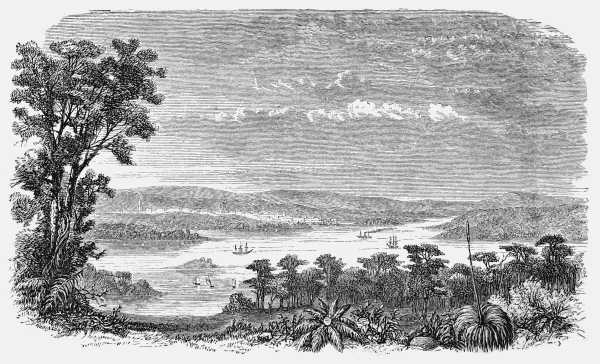
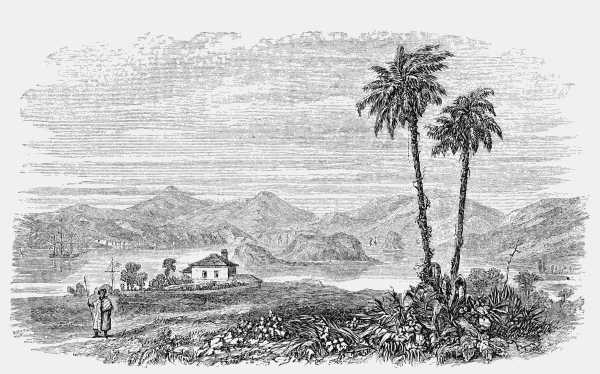 THE BAY OF ISLANDS, NEW ZEALAND
During this three months’ sojourn, besides the attention
which Mr. Marsden gave to the missions in
the Bay of Islands, he made a circuitous journey of
seven hundred miles, exploring the country with a
view to more extensive operations. His arrival over
land and in health, at the Bay of Islands, on his return,relieved the minds of his anxious friends the missionaries,
and “gave them additional cause,” they
say, “to bless and thank God for his protecting care,
and that he had again heard and answered our supplications.”
“There is not one in ten thousand, I think,”
writes Mr. Hall, “who could or would have borne the
privations, difficulties, and dangers, which he has
undergone. I pray that he may reap the fruits of his
labour by the New Zealanders turning from their degraded
state to serve the only living and true God.”
Mr. Marsden’s journal of this second visit will be
valuable in time to come, as perhaps the best record
in existence of the character and habits of a wonderful
people, on whom civilization had not yet dawned, and
whose spiritual darkness was profound. He landed,
during a coasting voyage, with young Tooi, on the
small island of Motooroa. “The first object that
struck my eye was a man’s head stuck on a pole near
the hut where we were to sleep; the face appeared
beautifully tattooed; it was the head of a chief who
was killed by Shunghie’s people. The sight,” he
says, “naturally excited feelings of horror in my
breast.” Most men would have felt something of
alarm. But Mr. Marsden seems to have been a perfect
stranger to fear; and if courage, whether physical
or moral, makes a hero, he must be ranked high in the
heroic class. He merely adds, “This caused me to
value more and more the blessing of Divine revelation,
and the blessing of civil government.”
In his journal on a tour to the River Shukeangha,
he writes thus:
“September 28, 1819.—After we had passed the
swamp, we came into a very open country, for many
miles round covered with fern. The part through
which we walked was gravelly, and not very good in
general.
“The wind increased toward evening, and blew
strong from the rainy quarter, so that we had the
prospect of a very wet night, without a single tree to
shelter us from the storm for about eight miles from
the swamp we had passed. At this distance was a
wood, through which our road lay, which we were
anxious to reach, if possible, in order to shelter ourselves
from the wind and rain. With this hope we
pushed forward, and arrived at the edge of the wood
about nine o’clock. The rain now began to fall heavily.
The natives cut branches of fern and boughs of trees,
and made us a little shed under the trees, to afford us
some shelter. The blackness of the heavens, the
gloomy darkness of the wood, the roaring of the wind
among the trees, the sound of the falling rain on the
thick foliage, united with the idea that we were
literally at the ends of the earth, with relation to our
native land, surrounded with cannibals whom we knew
to have fed on human flesh, and wholly in their power,
and yet our minds free from fear of danger—all this
excited in my breast such new, pleasing, and, at the
same time, opposite sensations, as I cannot describe.
“While I sat musing under the shelter of a lofty
pine, my thoughts were lost in wonder and surprise,
in taking a view of the wisdom and goodness of God’s
providential care, which had attended all my steps to
that very hour. If busy imagination inquired what I
did there, I had no answer to seek in wild conjecture:
I felt with gratitude that I had not come by chance;
but had been sent to labour in preparing the way of
the Lord in this dreary wilderness, where the voice of
joy and gladness had never been heard: and I could
not but anticipate with joyful hope the period when
the Day-star from on high would dawn and shine on
this dark and heathen land, and cause the very earth
on which we then reposed to bring forth its increase,
when God himself would give the poor inhabitants his
blessing. After reflecting on the different ideas which
crowded themselves upon my mind, I wrapped myself
up in my great coat, and lay down to sleep.”
He visited an island where he met with a singular
spectacle. A number of natives were at work, breaking
up the ground with a sort of spatula, or wooden spade,
to plant their sweet potato. Amongst these was
Koro-Koro’s head wife, or queen. “Her Majesty was
working hard with a wooden spade, digging the ground
for potatoes, with several of the women and some men.”
The royal infant lay on the ground sprawling and
kicking by her side; “the old queen earnestly requested
that I would give her a hoe, showing me the
difficulty she had in digging with a stick; a request
with which I promised to comply.” We leave the
reader to admire at leisure the Homeric simplicity of
the scene, or to indulge in those sentiments of contemptuous
pity to which Englishmen are possibly more
prone.
In another place, he found the head wife of Shunghie,
though perfectly blind, digging in the same
manner, surrounded by her women, and apparently
with as much ease as the rest. The offer of a hoe in
exchange for her spatula was accepted with joy. The
scene drew forth these reflections: “When we viewed
the wife of one of the most military chiefs, possessing
large territories, digging with a spatula for her subsistence,
this sight kindled within us the best feelings
of the human heart. If a woman of this character,
and blind, can thus labour with her servants, what
will not this people rise to, if they can procure the
means of improving their country, and of bettering
their condition? Their temporal state must be improved
by agriculture and the simple arts, in connexion
with the introduction of Christianity, in order
to give permanence and full influence to the gospel
among them. Our God and Saviour, who is loving to
every man, and whose tender mercies are over all his
works, is now, blessed be his name, moving the hearts
of his servants to send relief to the poor heathen, even
to the very ends of the earth.”
The journal affords us repeated evidences of a phenomenon,
which recent occurrences in India have at
this moment deeply impressed on the heart of England,—one
with which both divines and legislators
ought to have been acquainted (for it is not obscurely
referred to in the word of God), but which a foolish
and spurious benevolence has led many to deny—namely,
that the most Satanic ferocity frequently lurks
under gentle manners, and is even to be found in connexion
with the warmest natural affection. Nothing,
for instance, can be more affecting than the meeting
of Tooi and his sister, after the absence of the former
in England. Tooi himself anticipated a scene, and
half ashamed, when he saw his sister at a distance,
tried to avoid the interview in public, and requested
Mr. Marsden to order off the canoe in which they
were approaching. But her love could not be restrained;
in an instant she sprang into the boat, fell
on her knees, and clung to Tooi. He saluted her in
return; when she gave vent to her feelings in tears
and loud lamentations, which she continued for about
an hour. “Tooi conducted himself with great propriety,
suppressing all his wild feelings, and at the
same time treating his sister with all the soft and
tender feelings of nature. I could not but view his
conduct with admiration.” When Tooi was in England,
he had been taught to read and write, and instructed
in the doctrines of Christianity; and he and
his companion Teterree were general favourites, from
their gentle manners and quick intelligence. They
were one day taken to St. Paul’s by Mr. Nicholas,
who naturally supposed they would be lost in astonishment
at the grandeur of the building, but they expressed
neither surprise nor pleasure; on which that
gentleman makes this just remark; “It is only things
of common occurrence, I suspect, that strike the
mind of a savage. The faculties must be cultivated to
fit them for the enjoyment of the beautiful or the
sublime.” One thing, however, did strike them, and
caused no small excitement. In walking up Fleet-street,
they suddenly stopped before a hair-dresser’s
shop, in the window of which were some female busts.
They screamed out “Wyenee! Wyenee!” (Women!
Women!) taking them for dried heads of the human
subject. “I took some pains,” adds their kind conductor,
“to beat this notion out of them, lest they
should tell their countrymen on their return that
Europeans preserved human heads as well as New
Zealanders.”
These bursts of feeling were, it seems, quite natural;
intense sorrow or savage exultation, the extremes of
tenderness and of brutality, were indulged by turns,
without any suspicion on their part of insincerity in
either. Immediately after, Mr. Marsden mentions
that he passed a canoe in which he recognised an old
acquaintance, Hooratookie, the first New Zealander
introduced into civil society—Governor King having
once entertained him with great kindness. Hooratookie
was grateful; spoke of the governor’s daughter,
then a child, with unfeigned regard, calling her by her
Christian name, Maria. But looking into his large
war-canoe, capable of holding from sixty to eighty
men, with provisions, Mr. Marsden observed on the
stern the dried head of a chief. “The face was as
natural as life, the hair was long, and every lock
combed straight, and the whole brought up to the
crown, tied in a knot, and ornamented with feathers,
according to the custom of the chiefs when in full
dress. It was placed there as an incentive to revenge.
It is possible the death of this chief may be revenged
by his children’s children; hence the foundation is
laid for new acts of cruelty and blood from generation
to generation.”
Mr. Marsden’s fame now preceded him, and wherever
he went, he was received not with rude hospitality,
but with courteous respect. One chieftain offered up
an ovation and prayer on their arrival. “He invoked
the heavens above and the earth beneath to render
our visit advantageous to his people, and agreeable to
us, and that no harm may happen to us, whom he
esteemed as the gods of another country. We heard
the profane adulations with silent grief, and could not
but wish most ardently for the light of Divine truth to
shine on such a dark and superstitious mind.” Yet
this man was a ferocious cannibal; and when Mr.
Marsden expressed his anxiety for the safety of the
missionaries after he should have left them, he was
calmed by the assurance that, as we had done them no
harm, they had no satisfaction to demand, “and that
as for eating us, the flesh of a New Zealander was
sweeter than that of an European, in consequence of
the white people eating so much salt.” From this the
conversation turned to that of eating human flesh,
which they defended with arguments which to them
appeared, no doubt, perfectly conclusive. They alleged
that fishes, animals, and birds, preyed upon each other;
and that one god would devour another god, therefore
there was in nature sufficient warrant for the practice.
Shunghie explained how it was the gods preyed on
each other, “and that when he was to the southward,
and had killed a number of people and was afraid of
their god, he caught their god, being a reptile, and
ate part of it, and reserved the remainder for his
friends.”
Shunghie, the greatest of New Zealand warriors,
was at the same time a striking instance of that union
of gentleness and ferocity which characterized this
people. To the missionaries his kindness was always
great, and his respect for Mr. Marsden knew no bounds.
An instance of his good feeling may here be noticed.
In the beginning of 1817, a naval expedition, under
his command, sailed from the Bay of Islands. It consisted
of thirty canoes, and about eight hundred men.
Its object was to obtain peace with his enemies at the
North Cape. The chief took an affectionate leave of
the settlers, and told them that if he fell they must be
kind to his children; and if he survived, he would
take care of their families when they should die. The
expedition returned, however, in about a fortnight,
his people having quarrelled with those of Wangaroa,
into which place they had put for refreshment; and
being afraid, he said, that the Wangaroa people would
attack the settlers in his absence, he, for the present,
abandoned the expedition.
Shunghie was again preparing for war when Mr.
Marsden paid his second visit to New Zealand; his
army, to the number of several thousand men, were
already assembled; his war-canoes were ready, and
all his preparations complete; yet in deference to the
remonstrances of Mr. Marsden, he again abandoned
his scheme of conquest or revenge, and dismissed his
followers.
Shunghie paid a visit to England about the year
1820. His majestic person, graceful manners, and
gentle yet manly disposition were much admired. He
was one of Nature’s nobles; what might not be expected
from such a man when he returned home again?
George the Fourth invited him to Carlton Palace, and
received him with marked attention, presenting him
with some military accoutrements and costly fire-arms.
Yet the heart of a savage never ceased to beat beneath
this polished exterior, while his pride was fanned to
madness by the consideration he received in England.
“There is,” he exclaimed, “but one king in England;
there shall be only one king in New Zealand.” Returning
by way of Sydney he there happened to meet
with Inacki, another chief, with whom he had an
ancient feud. He told him that when they got back
to New Zealand he would fight him. Inacki accepted
the challenge, and Shunghie accordingly assembled,
on his return to New Zealand, no fewer than two
thousand men to attack Inacki. The latter was
prepared to receive him, and for some time the
event of the battle that ensued was doubtful. At
length Shunghie, who had the greatest number of
muskets, and who had arranged his men in the form
called, in Roman tactics, the cuneus, or wedge, placing
himself at the apex and directing those behind him to
wheel round the enemy, from the right and left, or to
fall back into their original position as opportunity
offered, shot Inacki. The savage Shunghie immediately
sprang forward, scooped out the eye of the dying man
with his knife, and swallowed it; and then, holding
his hands to his throat, into which he had plunged his
knife, and from which the blood flowed copiously,
drank as much of the horrid beverage as the two hands
could hold. Amongst the horrible superstitions of
the Maories, one was that the eye of a victim thus
devoured became a star in the firmament, and thus
the ferocious Shunghie sought for honour and immortality.
With the sword which he had received as a
present from King George in England, he immediately
cut off the heads of sixteen of his captives in cold
blood; this was done to appease the spirit of his son-in-law,
who had fallen in battle. In this battle, Shunghie
and his tribe were armed with muskets, his opponents
only with the native weapons, the club and spear.
His victory, therefore, was an easy one, but his revenge
was cruel. A New Zealand traveller, who visited the
spot in 1844, says: “The bones of two thousand men
still lie whitening on the plain, and the ovens remain
in which the flesh of the slaughtered was cooked for
the horrible repasts of the victorious party, and yet so
numerous were the slaves taken prisoners that the
Nga-Puis (the tribe of which Shunghie was the head)
killed many of them on their way to the Bay of Islands
merely to get rid of them.”[I] Such was the gentle
Shunghie when his viler nature was let loose—a
frightful specimen of human nature, varnished by
education, but unvisited by the grace of God. We
turn aside for a moment to describe a scene in bright
contrast with these revolting details. Amongst the
few who escaped the general slaughter was Koromona,
a chief who became blind soon afterwards, but
hearing archdeacon W. Williams preach at Matamata,
was converted. “For the last four years,”
says the traveller above mentioned, “Koromona has
been a native teacher, and may be seen every sabbath
day with his class instructing them in the
truths of the Scripture with an earnestness which is
truly admirable; he is now about to start to preach
Christianity to a tribe which has not yet received it.
His memory is wonderful; he knows the whole of the
church service by heart, and repeats hymns and many
long chapters verbatim.” Thus the gospel won its victorious
way, and proved itself triumphant over hearts no
less depraved and passions no less degraded than those
of Shunghie himself. No earthly power could have
effected such a change; it was wrought by that
“gospel” which is truly “the power of God unto
salvation to every one that believeth.”
Amidst such scenes the missionaries dwelt in peace.
War, and its inseparable and more hideous companion,
cannibalism, showed themselves at their gates, but
were not allowed to hurt them. Under the good
providence of God, their security was owing, in a great
measure, to the prudence and courage with which
Mr. Marsden planned and carried out his projects.
Himself a stranger to fear, he infused courage into
those around him, and both he and they felt secure
under the shield and buckler of the Almighty. No
doubt the fearlessness of Mr. Marsden won the admiration
of these savages and contributed not a little to
his safety. His journal abounds in instances such as
that which follows. The scene is in a Maori village,
and the writer is surrounded with cannibals. “After
conversing on several subjects, we had supper, sung a
hymn, and then committed ourselves to the Angel of
the everlasting covenant, and so lay down to rest; a
number of the natives lay around the hut and some
within. I slept well until daybreak, being weary
with walking.”
He appears to have arrived at home, after this
second visit to New Zealand, towards the close of
November, 1819. In February, 1820, he was once
more on his way back to New Zealand. His letters
bear ample testimony to a fact which all who were
acquainted with him in private life observed, that his
heart was full of affection, and that his home was the
scene of his greatest happiness. He had not returned,
it is true, to be greeted with public honours; on the
contrary, he was still a marked man. The governor
and many of the leading men in the colony were
prejudiced against him. We believe it is to this
period of his life that an anecdote which we give on
the best possible authority belongs. The governor
had consented to his recent visit to New Zealand with
reluctance, and had limited the period of his absence
with military precision, threatening at the same time
to deprive him of his chaplaincy unless he returned
within the given time. The last day arrived, and the
expected vessel was not in sight. The governor
repeated his determination to those around him, and
Mr. Marsden’s friends were filled with anxiety, and
his wife and family at length gave up all hope. Towards
evening the long-wished-for sail appeared in the offing,
and at eight o’clock in the evening Mr. Marsden quietly
walked into the governor’s drawing-room with the
laconic and yet respectful address, “Sir, I am here to
report myself.” But within the bosom of his family
all was peace, and his presence shed light and joy on
everything around him. His circumstances were
prosperous—for his farm, which was almost entirely
committed to Mrs. Marsden’s care, was now a source
of considerable income; his children were growing up
to manhood under their parents’ roof; his circle of
friends and visitors was large, for there were no bounds
to his simple hospitality; and the clergy of the colony,
men like minded with himself, had now begun to
regard him not only with affection, but with the
reverence which belongs to years and wisdom and
wide experience.
Yet at the call of duty this veteran was ready, on
the shortest notice, to resume a life of such toil and
hardship as nothing could have rendered welcome, its
novelty once over, but motives the most solemn and
commanding. H.M.S. Dromedary, Captain Skinner,
was directed by government to proceed from Sydney
to the Bay of Islands to receive a cargo of New Zealand
timber for trial in the dockyards of England; and Sir
Byam Martin, controller of the navy, knowing something
of the energy of Mr. Marsden’s character, and
his great acquaintance with New Zealand, requested
that he would accompany the Dromedary, which
was joined by the Coromandel, in order to facilitate
the object of their visit. With this request he felt it
his duty to comply. He arrived in New Zealand on
the 20th of February, and embarked on board the
Dromedary to return on the 25th of November.
Thus nearly the whole year was given to the service
of New Zealand.
The time was not lost. On his arrival, a difficulty
occurred which he only could have set at rest. The
natives had come to the determination to exchange
nothing, nor to do any kind of work, except for muskets
and powder. His first business was to assemble the
few European settlers, the advanced guard of that
mighty band of European colonists which was soon to
follow, and to persuade them not on any account to
supply the natives with these weapons of war, in their
hands so sure a source of mischief. With regard to
the duty of the missionaries there could be no doubt;
and this he explained to all the powerful chiefs. They
had come among them to preach the gospel of peace,
how then could they be expected to furnish the means
and implements of destruction? In writing to the
Missionary Society at home he says, and he must have
written such a sentence with an aching heart, “I
think it much more to the honour of religion and the
good of New Zealand even to give up the mission for
the present, than to trade with the natives in those
articles.”
After a short time spent in the Bay of Islands, at
the mission, he proceeded, sometimes in company with
Europeans, but for the most part alone, upon a tour
of many hundred miles through regions yet untrodden
by the foot of civilized men, mingling with the native
tribes, accompanying them in their wanderings from
place to place, teaching the first lessons of civilization
and gospel truth, and receiving everywhere from these
savages the kindest attention and the most hospitable
welcome in return.
On their way to Tourangha, he writes, under the
date of June 20: “The day was far spent when we
reached the plain. We walked on till the sun was
nearly set, when we stopped and prepared for the night.
The servants, who had the provisions to carry, were
very tired. There were no huts on the plain, nor
any inhabitants, and we were therefore compelled to
take up our lodging in the open air. I was very
weary, having had no rest the preceding night; and
having come a long day’s journey, so that I felt that
rest would be very acceptable, even on a heap of fern
or anything else.
“The peculiar scene that surrounded me, furnished
the mind with new matter for contemplation on the
works and ways of God. The mystery of his providence,
and the still greater mystery of his grace,
were all unsearchable to me. I had come from a
distant country, and was then at the ends of the earth,
a solitary individual, resting on an extensive wild,
upon which no civilized foot had ever before trodden.
My companions were poor savages, who nevertheless
vied with each other in their attentions to me. I could
not but feel attached to them. What would I have
given to have had the book of life opened, which was
yet a sealed book to them,—to have shown them that
God who made them, and to have led them to
Calvary’s mount, that they may see the Redeemer who
had shed his precious blood for the redemption of the
world, and was there set up as an ensign for the
nations. But it was not in my power to take the
veil from their hearts, I could only pray for them, and
entreat the Father of mercies to visit them with his
salvation. I felt very grateful that a Divine revelation
had been granted to me; that I knew the Son
of God had come, and believed that he had made a
full and sufficient sacrifice or atonement for the
sins of a guilty world. With compassionate feelings
for my companions, under a grateful sense of
my own mercies, I lay down to rest, free from all fear
of danger.”
It was during this tour that the following letter
was addressed to the lady of his excellent friend Dr.
Mason Good. It is long, but the reader will scarcely
wish that it had been shorter. Let it stand on record
as an evidence of the power of true religion in maintaining
amidst the rudest scenes, and the rough
warfare of an adventurous life, all the gentleness and
affection of the most refined and polished society of a
Christian land.
“New Zealand, Sept. 22, 1820.
“Dear Madam,—Your kind favour arrived in the
Bay of Islands September 7, the evening I returned
from a long journey. I had no sooner cast my eye
over your letter, than busy imagination transported
me from the solitary woods, dreary wastes, and savage
society of New Zealand, into ‘the polished corner’ of
Guilford-street, and surrounded me with every cordial
that could refresh the weary traveller, revive the
fainting spirits, and blow the languishing spark of
Christian love with a heavenly flame. I had literally
been living for weeks a savage life, as far as outward
circumstances went. I ate, I slept in the thick wood,
in a cave, or on the banks of a river, or sea, with my
native companions, wherever the shadows of the
evening, or gathering storm compelled us to seek for
shelter. Every day as I advanced from tribe to tribe,
I was introduced to new acquaintances; my object
was to gain from observation and experience that
knowledge of savage life which I could not learn from
books, and to make myself well acquainted with the
wants, wishes, and character of the native inhabitants,
to enable me, if my life should be spared, to aid to the
utmost of my power in their deliverance from their
present temporal miseries, which are great upon them,
and from their much sorer bondage to the prince of
darkness. I am happy in having obtained this object
to a certain extent, at the expense of a few temporal
privations, and a little bodily evil. When I have lain
down upon the ground after a weary day’s journey,
wrapped up in my great coat, surrounded only by
cannibals, I often thought how many thousands are
there in civil life, languishing upon beds of down, and
saying, with Job, ‘in the evening would God it were
morning,’ while I could sleep free from fear or pain,
far remote from civil society under the guardian care
of him who keepeth Israel. Though I everywhere
met with the greatest kindness from the natives, as
well as hospitality, for they always gave me the best
fern-root, potato, or fish in their possession, yet I
could never have duly estimated the sweets of civil
life, and the still greater mental gratification of
Christian communion, if I had not passed through
these dark regions of Satan’s dominions, on which the
dayspring from on high hath never cast a single ray.
You cannot conceive how great a feast your letter
was, after so long a fast. I was instantly present
with every person you mentioned, and lived over again
some of those happy moments I once spent under
your hospitable roof. A sacred warmth flowed round
my soul, my heart was sweetly melted under the
influence of that pure and undefiled religion which
dropped from your pen, like the heavenly dew, as it ran
through every line. What shall we call those pure
sensations that thus warm and captivate the soul?
Do they flow from the communion of saints, or at
these delightful moments does some invisible seraph
touch our lips with a live coal from God’s altar? If
you have ever experienced similar feelings, their
recollection will explain more fully my meaning than
my words can express. When these lines meet your
eye, may they find your soul rapt up to the third
heaven! But to where am I now wandering? the veil
of the flesh is not now rent, we have not yet entered
into the holy of holies. Though God has given you
and your seed the land of Goshen, and you have light
continually in your dwelling, yet you are still in
Egypt, while I am constrained to dwell in Mesech,
and to dwell in these remote and dark tents of Kedar.
But, my dear madam, seas and continents will not
long separate the people of God. I humbly hope the
day is at no great distance, when we shall join the
spirits of just men made perfect. At present you
abound with blessings.... Jacob often
thought of Bethel, and when in his afflictions he
seemed to have forgotten that sacred spot, God said
unto him, ‘Arise and go to Bethel, and dwell there.’
It will always be safest for us to dwell also at Bethel.
I must now close, as my paper is nearly full, and your
patience must also be tired when it comes to your
turn to read what I have written.
“Remember me to your sister, Mrs. Skinner. Tell
Mr. Good I received his last letter, and will answer it
at a more convenient season. I was on my passage to
Port Jackson in a small schooner, but adverse winds
drove me back almost dead with sea-sickness. I have
been here since February last, and when I shall get
home I am uncertain; I venture no more in the
schooner. Mrs. M. wants me back, as she has much
upon her hands. It gave me great satisfaction to
hear my son had arrived safe. I knew your kindness
would far exceed my wishes. I will endeavour, as
far as able, to pay all my debts when I see Mr.
Good and you face to face; till then you must give me
credit, and if I do not pay you, you will be sure to
receive both principal and interest in the resurrection
of the just.
“I remain, dear madam,
“Yours, in the bonds of Christian love,
“Samuel Marsden.”
The immediate object of his visit being accomplished,
he returned to Sydney, where a strange reception
awaited him. Governor Macquarie had sent
to Lord Bathurst a despatch in answer to the statements
of the senior chaplain, already noticed, in which
he brought heavy charges against the latter, which
deeply affected his character, not only as a magistrate,
but as a Christian man and a minister. The office of
a magistrate he had been compelled to undertake in
common with the other clergy of the colony, who were
all included in the commission of the peace. For this
there was no justification except hard necessity. Mr.
Marsden, however, had long been weary of the irksome
task, and had once and again requested the
governor to accept his resignation. This the governor
had expressly declined to do, on the ground that “his
services as a magistrate were too beneficial to the
public;” but in fact, it would seem, only that he
might have the opportunity of inflicting upon him the
annoyance of a formal dismissal, which was shortly
afterwards notified in the “Sydney Gazette.”
Lord Bathurst, in consequence of the governor’s
despatch, determined upon a step which gave great
satisfaction to Mr. Marsden’s friends at home, and
sent out a commissioner to investigate upon the spot
the truth of these and various other matters affecting
the state of the colony, which had now obtained public
notoriety, and had already engaged the attention of
the British parliament; and Commissioner Bigge
arrived during Mr. Marsden’s absence to manage the
inquiry. On his return we find him seeking a public
and searching examination of his whole conduct.
Addressing a letter to the commissioner, he says: “I
am happy to meet every charge that can be brought
against me. I have no wish to do more than set my
character right in the opinion of his Majesty’s government
and in that of the Christian world; and I am
unfeignedly thankful to you for the fair opportunity
you afford me to justify my public and private conduct.”
Among the many charges brought before the commission
of inquiry was that already preferred against
Mr. Marsden by the governor in his despatch to Lord
Bathurst, namely, that he had been guilty of extraordinary
severity as a magistrate. Another, scarcely
consistent with the first, was, that more profligacy
and depravity were to be found amongst the convicts
of Paramatta than in any other district, and
that this was owing to the neglect of the senior
chaplain. Perhaps it would have been impossible to
have brought forward any two charges of a more painful
nature. Happily the first was easily disproved, or
rather it fell at once to the ground for want of proof.
The second was the more cruel, because, while the
facts bore out the statement, Mr. Marsden was the only
public man in the colony who was not guilty, by his
silence at least, to some extent of the iniquities which
the governor affected to deplore. Paramatta was, in
fact, the receptacle of the most hardened and depraved
of the convict class; it received the sweepings of the
jails in every district. There were nearly two hundred
women and seven hundred male convicts there,
while the factory was so small as not to be able to
contain more than sixty women, and the remainder
were obliged to find lodging for themselves or to sleep
in the open fields. This was Mr. Marsden’s answer
to the commissioner; it was a repetition of the remonstrance
which he alone had had the courage, two years
before, to present to the governor, and then to remit
home to England. Thus he found himself arraigned
as the cause of those very evils—evils, too, lying at
his own door—which he had obtained so much obloquy
for attempting to remove. The reflection is a trite
one, but it will bear to be repeated, that the Christian
philanthropist must look for his recompense in heaven,
and not from man. “If when ye do well and suffer
for it, ye take it patiently, this is acceptable with
God, for even hereunto were ye called.” A third
charge was that he had squandered public money in
building the female orphan house. He showed, however,
on his defence, that the lieutenant-governor,
judge-advocate, and others, who formed the committee,
had examined the accounts and passed them
every quarter, and that the governor had himself
afterwards approved of them, and published them in
the “Sydney Gazette” three years before the charge
was made. It now appeared further that Mr. Marsden
had advanced largely to the institution; to the amount
indeed of more than eight hundred pounds, for the
mere cost of the building; “and this,” he says, “must
have been known to the governor, as I was obliged to
apply to him for repayment for some of these sums, and
received an answer that he could not assist me.”
Such are some of the trials which they must learn
to encounter who would be brave and fearless soldiers
of the cross. They must expect to have their motives
censured, their tempers blamed, their actions misconstrued,
sometimes by men as good, or, at least, as
honest as themselves. Governor Macquarie left the impression
of his genius upon the youthful institutions of
Australia, where his memory is still honoured as that of
a great man; yet his conduct to Mr. Marsden was oppressive
and unjust. It is consoling to know that there
had been nothing in the personal conduct of the latter
unworthy of his sacred calling. The commissioner, in
the conclusion of the investigation, inserts, for Mr.
Marsden’s information, the governor’s testimonial of
his character, which, considering the charges brought
against him, certainly does go far to prove that misapprehension
and exasperated feelings had betrayed
his excellency into a warmth and precipitancy of
which, in moments of less irritation, he felt ashamed.
“The governor admits that Mr. Marsden’s manner to
him has been constantly civil and accommodating, and
that nothing in his manner could provoke the governor’s
warmth. The governor admits his qualifications,
his activity, and his unremitting vigilance as
a magistrate, and in society his cheerful disposition
and readiness to please.”
While this inquiry was pending at Sydney, the
governor addressed a letter to Lord Sidmouth, and
published it in England. It was a defence of his own
line of policy against various attacks which had been
made against it in the House of Commons by the
Hon. H. Grey Bennett and others. In the course of
his defence, the governor not only ridiculed Mr. Marsden’s
letter on the necessity of a female factory, and
his account of the melancholy condition of the convict
women, but charges him with being himself accustomed
to traffic in spirituous liquors, and in consequence
of being displeased at having so many public-houses
in his neighbourhood.
Malicious, and absurd as the accusation was, carrying
with it its own refutation, it found some who
were weak or wicked enough to believe, or however to
repeat it. It was revived in the colony, and republished
in one of the Sydney newspapers after Mr. Marsden’s
death. Such is the tenacity of slander. “Only throw
mud enough,” says the eloquent Mr. Burke, “and
some of it will be sure to stick.” Mr. Marsden felt
his character so seriously compromised that he wrote
home to the minister in self-defence, and also addressed
a statement of the case to the new governor, Sir
Thomas Brisbane. After showing the absurdity, and
indeed the impossibility, of the charge, since, in the
first place, the governor himself had granted a monopoly
to certain contractors to purchase and land all spirits
brought to the colony, and that in the second he had
no licence, he adds: “Such is the watchful eye that was
kept upon my whole conduct by night and by day, if
I had been guilty of that or any other impropriety, it
would have been impossible for me to have escaped
detection.” So far as any pretence of truth could
have been urged in support of this foul slander,
namely that “he kept a public-house for the sale of
ardent spirits, selling them in any quantity from a pint
to a puncheon,” it may be stated in his own words:
“In the infancy of the colony, previously to my arrival,
barter was established among all classes from the
governor downwards. As there was neither beer nor
milk, tea nor sugar, to be purchased at any price,
wine and spirits became the medium of exchange.
As the colony progressively advanced in agriculture,
commerce, and wealth, barter gradually decreased, and
money transactions became more general. I can affirm
that for the last eighteen years I have not had in my
possession as much spirits as would allow my servants
half a pint a head per week. And at no period
of my residence did I ever purchase spirits for sale.”[J]
These were not the only troubles through which he
was called to pass. But enough has been said both
to explain the difficulties in which Mr. Marsden was
placed and to clear his character from the vile aspersions
cast upon it. It is with pleasure that we turn
from these false and disgraceful charges to follow him
in those Christian and philanthropic pursuits which
have given splendour to his name.
On the arrival of Sir Thomas Brisbane, in 1821, to
assume the government of New South Wales, Mr.
Marsden immediately waited upon him, when he
received the assurance of his countenance and support,
not only as a colonial chaplain, but as the representative
of the great missionary work going forward in
New Zealand. Such encouragement was opportune;
he thanked God and took courage; for the difficulties
were great, and from time to time grievous disappointments
and vexations had occurred. It was about this
time that the seminary at Paramatta, for the education
of New Zealanders, was abandoned. It had its origin
with Mr. Marsden, and was conducted for some time
in his own house. It was indeed one of his most
favourite plans, and its failure was a severe disappointment.
It was found, however, that the change
of habits and of climate was injurious to the health of
the New Zealanders, while the results were not always
such as might have been desired. But nothing could
damp his ardent zeal, or quench his spirit of enterprise.
“I see,” he says, writing to his friends at
home, “the way preparing for the spread of the gospel.
I feel the fullest conviction that the South Sea Islands
will now receive the blessing of civilization and the
gospel. The work is great, and many difficulties may
oppose it. The foundation is now firmly laid, and
no power on earth can overturn it. To impart these
blessings to the New Zealanders is an object worthy
of the British nation: a more noble undertaking
could not be suggested to the Christian world.”
This at least was not the mere declamation of the
platform, but the deliberate expression of the views
of one who had toiled and suffered in the cause for
twenty years, and had scarcely been cheered, at
present, with the sight of a single New Zealand convert.
“Here,” at least, “is the patience of the
saints.”
His home duties were not neglected; nor was his
the easy philanthropy which overlooks the humble
claims of the rustic flock or obscure parish, while it
stalks abroad on some heroic enterprise which may feed
the vanity, while it satisfies the conscience, of the
actor. Through his exertions Paramatta had now its
association in behalf of the Bible Society, which already
collected funds for the Parent Society in England.
An early report from this institution contains a remarkable
account of his visits to the sick bed of a
young woman, whose experience beautifully illustrates
the text, that the Scripture “is able to make us wise
unto salvation through faith which is in Christ Jesus.”
It brings the writer also before us incidentally as a
spiritual pastor and an enlightened minister of Christ.
“Some time ago,” says Mr. Marsden, “I was called
on to visit a young woman, about twenty years of age,
in one of our districts, who was extremely ill, and who
wished very much to see me before she died. On my
arrival at her father’s house, I found her heavily
afflicted, and death appeared to be at no great distance.
I sat by her bedside with the Bible in my hand; expecting
to find her, as I have but too often found
others in similar circumstances, ignorant of the first
principles of religion.
“I read a portion of this sacred book to her, and was
most agreeably surprised to find that she not only understood
the letter but the spirit of the Scriptures.
“I asked her father how she became so well acquainted
with the Scriptures: he said he did not know—she
was always reading her Bible at every opportunity,
and sometimes sat up whole nights for that purpose.
He observed, she was a very dutiful daughter: he had
a large family, and she, being the eldest, and very
industrious, was of great service to her mother and
the younger branches of the family; the only indulgence
which she desired was to be allowed to read the
Bible when her work was done; but he could not
account for her attachment to it; and it seemed very
strange to him that she should attend to it so much.
I asked him if she was in the habit of going to church,
as I did not personally know her. He said she went
sometimes, but was generally prevented, from the distance
and the large family which she had to attend to.
“This young woman may be said to have obtained
her religion wholly from the Bible. None of the
family knew anything of the Bible but herself. I
visited her during the whole of her sickness, from the
time she sent for me, until she fell asleep in Jesus.
Her faith was simple, her views of the way of salvation
clear. She gave me many proofs of this, in the various
conversations which I had with her during her sickness.
The Bible was more precious to her than gold;
she had found it, under the influence of the Divine
Spirit, her counsellor and her guide, and by it she had
been brought to a knowledge of the only true God,
and Jesus Christ whom he had sent; and hereby she
was filled with a hope full of immortality. Previously
to her last sickness, she had enjoyed good health: it
was in the prime of youth and vigour that she had
read her Bible, and loved it, so that she had not to
seek God, for the first time, in this trying moment;
but found him a present help in sickness and in the
approach of death. The Bible had testified of Christ
to her: she had found eternal life revealed therein;
and the Divine promises were both great and precious
to her soul.”
Such instances of faith, and of the happy effects of a
simple reliance upon the atonement, were at that time
of rare occurrence in the colony. Instances of conversion
simply from the reading of the Scriptures are
not perhaps so rare as we generally suppose. Lieutenant
Sadleir, who himself resided at Paramatta, has
remarked upon this occurrence: “It is gratifying to
the reflecting mind to observe such glimmerings of
light in the midst of so much darkness. Although
found in obscurity and in the cottage of the peasant,
it proved that there were some who had not bowed the
knee to the Baal of universal licentiousness.”
Mr. Marsden’s anxiety for the female convicts was
not to be abated by ridicule or opposition. We find
him, in August, 1822, addressing a letter to Dr.
Douglas, the police magistrate of Paramatta, on their
behalf. Some of the sentiments are beautifully touching.
The substance of the plea on their behalf is
“that these poor creatures, who are confined in the
penitentiary, and who have committed no offence in
these settlements, be allowed the privilege of attending
at least once on the sabbath day on public worship.”
The request was surely reasonable, and in urging it
he rises to a pathetic eloquence: “There is no nation
under the heavens in whose bosom the wretched and
unfortunate finds so warm a reception as in our own.
The unhappy situation of the female convicts during
their confinement in the different jails in the empire
interests the best feelings of the human heart. They
are instructed by the counsels of the wise, consoled by
the prayers of the pious, softened by the tears of the
compassionate, and relieved by the alms of the benevolent.
The noble senator does not pass over their
crimes and their punishments unnoticed; he is anxious
for the prevention of the former, and the mitigation
of the latter; nor does the wise politician consider
them beneath his care.” He then speaks with natural
exultation of “the watchful eye with which the
British government provides for their wants and conveniences
during their voyage to New South Wales,
even more liberally than for the brave soldiers and
sailors who have fought the battles of their country,
and never violated its laws;” and then follows a sentence
which leaves us uncertain whether more to
admire his patriotism or the gentleness of his nature
and the warmth of his heart:
“This apparently singular conduct may seem as if
the British government wished to encourage crime
and afterwards reward it; but upon a nearer view this
principle of action will be found to spring spontaneously
from virtue, from that inherent, laudable,
Christian compassion and anxiety, which the father of
the prodigal felt for his lost son, which kept alive the
spark of hope that he might one day return to his
father’s house and be happy. This parable of our
blessed Saviour’s most beautifully exhibits the character
of the British nation towards her prodigal sons
and daughters, and is more honourable to her than all
the victories she has achieved by sea and land.”
The welfare of the female convict population lay
near to Mr. Marsden’s heart; scarcely his beloved New
Zealanders and their missions engaged more of his affection.
His plans for the improvement of their temporal
condition, and his incessant labours for their
spiritual welfare, occupied no small portion of his time
and thoughts; and there is good reason to believe that
his labours amongst these outcasts were not “in vain
in the Lord.” Standing, as we should have thought,
himself in need of encouragement, he stimulated the
languid zeal of others. Mrs. Fry and other philanthropists
were now engaged in their great work of
amending our prison discipline at home. We have
inserted a letter from that excellent lady to Mr.
Marsden. His answer to it must have cheered her
spirits amidst the many disheartening toils to which
she was exposed.
“The Wellington had just arrived when,” he says,
“I went on board, and was highly gratified with the
order which appears to have been maintained in that
vessel. I could not have conceived that any ship could
have been fitted up to have afforded such accommodation
to the unfortunate female exiles as the Wellington
was. All the women looked clean, healthy,
and well. They had not that low, vicious, squalid,
dirty look which the women at former periods have had
when they first arrived. I believe there has been very
great attention paid by the master and surgeon to
their morals and comfort, in every possible way. The
very sight of the arrangements of the vessel showed
that the humane and benevolent wishes of the
Christian world had been carried into effect, and
proved beyond all contradiction that order and morality
can be maintained upon so long a voyage in a
female convict ship.... The present inquiry
into the state of this colony, before the committee of
the House of Commons, will greatly benefit this
country. I can speak from painful experience that
for the last twenty-six years, it has been the most
immoral, wretched society in all the Christian world.
Those who are intimate with the miseries and vices of
large jails alone can form any idea of the colony of
New South Wales. I know what Newgate was when
I was in London, in the years 1808 and 1809. I was
then in the habit of seeing that miserable abode of
vice and woe. What has since been done in Newgate
may be done elsewhere, if suitable means are adopted
by those in authority, seconded by individual exertions;
much might be done in these colonies towards restoring
the poor exiles to society, with the countenance and
support of the government. Great evils are not
removed without great difficulties. When I visited
the Wellington, I saw much had been done in
England, and more than I could have credited, had I
not been an eye witness of the situation of the
females.”
Sir Thomas Brisbane, the new governor, was not
slow to perceive the worth of services such as those
which Mr. Marsden had rendered to the colony, and
pressed him to accept once more the office of a magistrate.
In reference to this, “I wish,” says Mr. Marsden,
in a letter to Dr. Mason Good, “to avoid the
office if I can; but I fear it will not be in my power,
without giving offence. The judges as well as the
public and the magistrates have urged me to take the
bench at the present time.” In the same letter, he
adds: “I feel happy that I have stood firm against all
calumnies and reproaches, and have been the instrument
of bringing to light the abominations that have been
committed here: and some of the evils are already
remedied.” The friends of religion and virtue in England
could not fail to sympathize with him, being well
assured that substantially he was fighting the cause of
true piety and equal justice, against profligacy and
oppression. Mr. Wilberforce wrote to him in the
year 1823, with his usual warm affection:—
“Though I may be a somewhat doubtful and unfrequent
correspondent, I am not an uncertain friend;
and where good will, as in your instance, is grounded
on early esteem, and cemented by the consciousness of
having many mutual friends, I should be ashamed if that
should suffer any decay from the impression not being
often renewed. It was with no small concern that I
heard that anything unpleasant had occurred. I had
meant to endeavour to obtain a sight of any letters or
papers to our common friends, and to have consulted
with them whether any, and if any, what measures,
could be taken for the benefit of your colony, or in
your own support, which, without a compliment, I
hold to be in a degree coincident.... And now, my
dear sir, farewell: but I ought not to conclude without
congratulating you on the progressive advancement,
as I trust, of the religious and moral interests of your
Australian world, and begging that you will always
inform me unreservedly whenever you conceive I can
be of use publicly, or to yourself personally.
“I remain, with much esteem and regard,
“My dear sir,
“Your sincere friend,
“W. Wilberforce.”
The report of Commissioner Bigge was made public
soon afterwards; and with it the clouds which had
gathered so long around the chaplain of Paramatta
were at last dispersed. He was too prominent a mark
not to be again assailed. Always in the front of the
battle when the oppressed required protection, or evil
doers in high positions his bold assaults, it was not in
the nature of things that he should lead a very quiet life.
His calling was peculiar; so were his talents; and the
latter were admirably fitted for the former. But for
the present his triumph was complete, and the government
at home appreciated his faithful service. The
document which follows requires no further comment.
It was not received till some time had elapsed, but we
insert it here as a fitting conclusion to the chapter:—
“Private Secretary’s Office, Sydney, 9th April, 1825.
“Reverend Sir,—I have the honour to acquaint
you, by command of his excellency the governor, that
Earl Bathurst, having taken into consideration your
long and useful services in the colony of New South
Wales, has determined upon increasing your stipend
to the sum of four hundred pounds sterling, per
annum.
“I have further the pleasing satisfaction of coupling
with it his lordship’s instructions to the governor, to
acquaint you that it has been done in consideration of
your long, laborious, and praiseworthy exertions in
behalf of religion and morality.
“I have the honour to be, reverend Sir,
“Your obedient servant,
“John Ovens,
“Private Secretary.
“To the Rev. Samuel Marsden,
Principal Chaplain.”
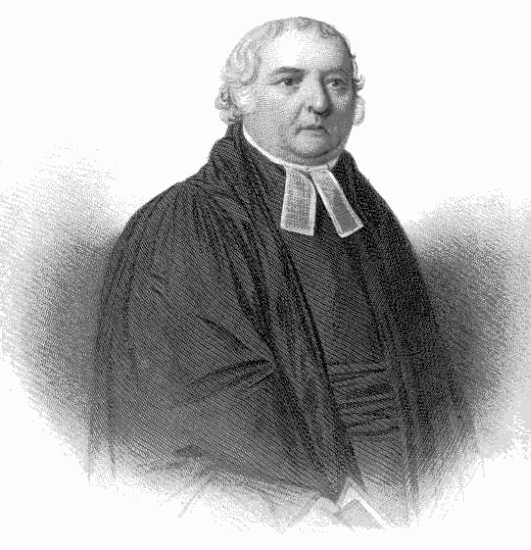 Revd. Samuel Marsden