Buoyancy of Lady Hester Stanhope’s spirits—Death of Miss
Williams—Mrs. ——’s first visit to Lady Hester—The Author
is summoned to Damascus to attend Hassan Effendi: declines
going—Discussions between Lady Hester and Mrs. —— thereupon—Lady
Hester’s hatred of women—She sends her maid
to revile Mrs. —— —The Author resolves to return to England—Alarm
from soldiers on their march—Lady Hester
assists Abdallah Pasha in laying out his garden—Anecdotes of
the first Lord Chatham—Fresh discourses about the Journey
to Damascus—Anecdotes of Mr. Pitt—His attachment to Miss
E.—His admiration of women—His indulgence towards other
people’s failings—Lady Hester and the fair Ellen—Strange
history—Mr. Pitt’s attention to the comfort of his guests, and
of his servants—Strange rise of one of them—Lady Hester’s
pathos—Paolo Perini’s expected post of artilleryman.
Her ladyship, in several conversations, took great
pains in acquainting me with all the material events
that had occurred during my absence in Europe, and
in what relation she stood with the pashas and governors
of the neighbouring towns and provinces, proceeding,
in succession, from occurrences relating to the
most exalted individuals, to those connected with the
lowest persons that surrounded her. She talked of
her debts, her illnesses, her trials and sufferings, and
never finished a day without picturing to herself a
brighter futurity, when her worth would be more
appreciated, when the clouds that overspread her
existence would be dissipated, and when the neglect in
which she was left by her friends would meet with its
just punishment, and her magnificent star rise again,
with renewed splendour, to gladden the world, and
those, more particularly, who had been faithful to her
cause. This buoyancy of spirits saved her from the
despondency which others, in her deserted state, must
inevitably have felt. The work of years to come was
chalked out in her active imagination; plans were
sketched; new channels of correspondence were to be
opened; her household was to be remodelled; fresh
buildings were to be raised; learned researches were to
be made: valuable manuscripts were to be procured.
It is impossible to say what was not projected; but
her faithful Miss Williams still rose uppermost in
her mind, and her first care was to see the last duties,
yet remaining, paid to her memory.
As that excellent person occupied an important
position in Lady Hester Stanhope’s house and affairs,
I will here make room for the following account of
her sickness and death, as it was given me by Um
Ayôob, a respectable widow of Jôon. This woman
was in the habit of doing needlework at Lady Hester’s,
when she would pass whole days together at the
house. One day, as she and Miss W. were sitting in
the same room sewing (it was on a Friday), Miss W.
said to her, “Dear me, how cold I am—I am all in a
shiver!” The season (it being autumn) was very
sickly, and many of the servants were lying ill, one
being at the very time dangerously so with continued
bilious fever. The shivering, however, passed over.
Um Ayôob went home at night, and the following
day returned to her work. Miss W. was on her legs
again. The day after she had an attack of intermittent
fever. This was Sunday, and on Monday she was
pretty well again. Expecting the return of the fit on
Tuesday, the good widow asked Miss W. whether she
should remain with her; but Miss W. said “No:
your daughter has got an ague as well as myself; so
go, and attend upon her—she may want you in the
night; and come to me on Thursday, as to-morrow I
shall not require your services, for I intend to remain
quiet all the day.” So, on Wednesday, Um Ayôob
did not go. On Thursday she was baking, when a
servant came to her, and said, “Make haste, for God’s
sake! you are wanted to attend on Miss W.” As
the old lady’s bread was just baked, she thought she
would take a couple of hot cakes in a clean towel, with
the idea that Miss W. might like them buttered for
her breakfast. “So,” said Um Ayôob, when she told
me the melancholy story, “as I was hastening along the
bottom which divides the village from the Dar, I was met
by little Gayby, crying, ‘Oh, come, come—run, run!’—‘What’s
the matter?’ I asked.—‘Oh, oh! she’s dead!
she’s dead!’ sobbed Gayby.—‘Who’s dead?’ cried I,
terrified out of my senses.—‘Miss Williams,’ answered
she. I was struck with horror, and, quickening my
pace as fast as I could, I arrived out of breath, and
found the tale but too true—Miss Williams had
breathed her last.”
It appeared that, on Wednesday morning, Lady
Hester, who was herself ill in bed, had given orders to
the little girl, Gayby, to prepare, from the medicine-chest,
a dose of salts and senna, she being too ill to
see to it herself. This dose, according to the assertion
of Nasara, one of the maids, who waited on Miss
W., produced an extraordinary effect through the
day and night, and Miss W. was not free from its
action until she expired. Besides the black dose, she
took also three pills, but of what nature I could not
learn. The persons who attended on her were
Nasara, Gayby, and Fatôom, the Fatôom so often
named in these pages, who was at that time eleven or
twelve years old. Um Ayôob, who loved and regretted
Miss Williams (as indeed did almost everybody),
sat by her corpse the remainder of the day.
In the course of the afternoon, she was surprised to
find that the body, so far from becoming cold, retained
almost its natural living heat. There happened
to arrive at Lady Hester’s the preceding day a
doctor of the country, who had been sent for to attend
on Moosa, the man-servant, then lying dangerously
ill, and who died two days after Miss W. Um Ayôob
called him into the room, and begged him to feel the
body, and say whether there was not yet life in it.
He was equally of opinion with the widow that the
appearances were very surprising, and the more especially
as the cheeks retained some colour, and (according
to Um Ayôob’s expression), as something kept
continually bubbling inside of her like boiling water.
The doctor went to Lady Hester and told her what
he had seen, and asked her permission to open a
vein. Lady Hester, who was overwhelmed with
affliction at the loss of a person so dear to her, said,
“Do what you please.” He accordingly opened a
vein in the foot, and the blood spirted out, said Um
Ayôob, as from a living person. After having taken
what he thought a sufficient quantity, he bound up
the incision; but life never returned, and on Sunday
she was buried in the burying-ground of the monastery
of Dayr el Mkhallas, the coffin being followed
by the French vice-consul and some merchants of
Sayda.
I must here observe that the letting of blood was
an ill-judged expedient for restoring the living action,
because it only completed the exhaustion already carried
to its utmost point by the previous depletion of
the bowels. The case is not the same as when, after
a fall or an attack of apoplexy, the opening of a vein
may give an impulse to the suspended circulation, just
as a touch of the finger to the balance of a watch will
set it going when it has stopped. But here the vital
warmth should have been nourished and promoted by
every available means, and nature should have been
left to husband her internal resources until reanimation
had been effected.
In company with my family, I visited Miss
Williams’s grave, and could not forbear shedding
tears over it; for I had known her many years. She
was a creature of remarkable singleness of mind, of
unstained purity, and so universally beloved that the
people of the neighbourhood and the peasantry talk
of her to this day as a model of virtue and goodness.
The only monument raised over her grave was a rude,
oval-shaped wall, topped with thorny shrubs, to keep
the jackalls from scratching for her corpse.
In the register of the monastery, they have (as I
was told) put her down as a Catholic, and had spread
a report that she had died in that faith, in order that
popular prejudice might raise no objection to her
lying in Catholic ground. Over the tomb a tamarisk-tree,
with its delicate, evergreen, feathery branches,
waves in the wind. A few tombs of venerable bishops,
devout merchants, and holy monks, stand in relief
from the rocky barrenness of the spot, with Arabic
inscriptions commemorative of their piety and virtues.
It is only to be regretted that some similar memorial
has not been raised to Miss Williams.
Miss Williams had now been dead more than two
years, and the room in which she died had never been
entered, from the hour that her corpse was carried out
of it. The door had been barred up by cross laths
nailed over it; and, from the circumstance of Lady
Hester Stanhope’s having repeatedly declared she
never could pass by the door again, a sort of dread
had crept over the maids and slaves, akin to that
which is common in England when a chamber of some
house is reported to be haunted. A breathless silence,
and expectation of something supernatural, accordingly
reigned in the quadrangle, when the carpenter
proceeded to knock away the laths, and, through
cobwebs and dust, I introduced, with some difficulty,
the rusty key into the keyhole, and, with considerable
effort, forced open the door. The floor was covered
with dust, and thick, long cobwebs hung across from
wall to wall: on the floor lay scattered in confusion a
few books, a hair-brush, and various papers. A sort
of disorder was apparent in the furniture, such as
would arise in a room hastily left. A box of papers,
containing a list of Lady Hester Stanhope’s debts and
memoranda relating to them, lay open in a recess, and
seemed the last thing that had occupied Miss W.’s
attention; for, alas! the increasing embarrassment
of Lady’s Hester’s money concerns might naturally
be supposed to harass her mind, seeing that, at one
time, her noble patroness, bred in the lap of luxury,
had been reduced to the necessity of selling for their
weight (since they would not pass current), forty
English guineas, given to her by her brother James
when they parted, and saved when she was ship-wrecked,
not knowing, when they were gone, where to
look for a penny. An empty work-basket lay turned
upside down on the floor; and an air of desolation and
disorder in the room and closets showed that whatever
had been worth pilfering had been carried off by the
wicked servants during the time which elapsed between
her death and burial.
“Poor Miss Williams!” thought I; “what must
have been your sufferings at that sad hour, with no
one of your own country to close your eyes, and surrounded
by slaves and peasant women, who robbed you
instead of attending to your wants! Yet, with what
fidelity and attachment did you not follow your benefactress
from a comfortable home, where a happy circle
regretted you, to endure the numberless privations
which constant confinement, want of society, and a
residence in an uncivilized country, necessarily bring
with them! Even I, had my earlier arrival not been
retarded, might have contributed to soothe your last
moments, if not to save your life!”
On opening the closets that were locked, her linen,
her writing-desk, her paint-box, and sundry other
articles were seen neatly arranged, as one would suppose
an English woman would place them. I unlocked
the desk, removed the papers, which her relatives had
written for, as well as some others that Lady Hester
thought I should find there; and, shutting the
closet again, withdrew with melancholy thoughts
on the uncertainty of human hopes, resolved to defer
until another day the inventory of her goods and
effects.
The next day, I remained with Lady Hester Stanhope
from eleven in the morning until ten at night,
the greater part of the time being employed in looking
over Miss W.’s papers, which consisted principally
of rough copies of letters dictated by her ladyship.
When I and my family were comfortably settled in
our little cottage in the village, Lady Hester appointed
a morning to receive Mrs. ——, on the occasion of
her first visit. On reaching the house, I conducted
her to the saloon, where, after introducing her, and
sitting a little while, I retired, in compliance with
Lady Hester’s usual custom of never liking to have
more than one person with her at a time. Here Mrs.
—— remained about three hours, and then took her
leave; and I, having sent her home under the care of
a servant, presented myself to hear Lady Hester’s
opinion about her, a necessary consequence that
always followed when any person quitted her whom
she had seen for the first time. Our conference lasted
until past midnight. The night proved very tempestuous:
the wind howled, the thunder rolled, the
rain beat against the shutters; and, when I returned
to the village, wet through, I found Mrs. —— sitting
disconsolate, and terrified at the war of the elements,
alone, as it were, in the midst of the horrors of the
night, and unable to make herself understood by the
slaves, who knew no language but Arabic.
Next morning, at breakfast, we talked over the conversation
that had passed between her and Lady
Hester Stanhope. Lady Hester had used the kindest
expressions; and, at the close of her visit, getting up
and ringing for a handsome Turkish spencer in gold
brocade, had put it on her with her own hands, and
had wound on her head a beautifully embroidered
muslin turban. Mrs. ——, not understanding Lady
Hester’s humours, who had in all this imitated the
Eastern manner of robing people when they go away,
had taken them both off and left them on the table,
so that they were sent home the next day. This,
I knew, would be a grievous offence in Lady Hester’s
eyes.
Things, however, went on satisfactorily until the
25th of January, when a messenger came from Damascus,
sent by a person of an ancient and noble
family, named Ahmed Bey, beyt Admy,[41] with a letter
to Lady Hester Stanhope, saying that, “her physician’s
arrival from England having been reported to
the Pasha, he, Ahmed Bey, had been solicited by his
highness to write to her, and request she would spare
the doctor, a short time, to cure a complaint with
which a friend of the Pasha’s, called Hassan Effendi,
Tâat ed Dyn, was afflicted in the roof of his mouth,
which was peculiarly painful to him, and a source
of deep regret to the faithful, in consequence of his
being one of the most distinguished chanters of the
Koran.”
This Ahmed Bey was a very old friend of Lady
Hester Stanhope’s, and a nobleman who had honoured
me with his particular notice some years before, during
our stay at Damascus; she, therefore, laid great stress
on my going, and wished me to prepare immediately
for my departure.
As I did not think it right to leave my family for
three weeks or a month alone in a cottage, where no
human being could understand them, I suggested to
Lady Hester the propriety of writing a polite excuse
to Ahmed Bey, expressing my inability to comply
with his wishes for the present. But she had my
compliance so much at heart, that it was agreed she
should see Mrs. —— herself, and endeavour to remove
her scruples, flattering her she could contrive, with
her accustomed fertility in expedients for all difficulties,
some means to reconcile her to my departure, and
show her the groundlessness of her fears. Mrs. ——
accordingly paid a second visit to Lady Hester, who
began by endeavouring to act on her pride, by telling
her my reputation would be ruined among all the
Pashas, if I refused to go to a great man, like Hassan
Effendi, and that her own consequence would be
lessened; moreover, that our ambassador at Constantinople
would hear of it, and take it ill, with many
arguments of the like sort. Finding this mode of
reasoning had no effect, she tried to frighten her, by
assuring her very gravely that there were dervises,
who, interested in the well-being of holy men, and
especially of a chanter of the word of the Prophet,
would, by unknown charms, inflict all sorts of evils
upon her, make hair grow on her face, bring out
blotches on her body, &c. The reader will be surprised,
when he is told that Lady Hester Stanhope
affected to believe all this. Mrs. —— lent a civil but
incredulous ear. Her ladyship then endeavoured to
engage her consent by holding out the benefits that
would accrue to me in a pecuniary light, and the
shawls and brocades that I probably should bring back
to her as presents from such grand folks. But the
foretaste of solitude in a village during winter, which
the many lonely evenings already passed there had
given her, was too strongly impressed on her mind,
and she respectfully but firmly answered, that, if I
chose to go, of course she could not help it, but that
it never could be without rendering her miserable:
upon which they parted, with no good will on her
ladyship’s side; and from that hour began a system
of hospitality to Mrs. ——, which never ceased until
our departure.
This leads me to say a word on the extraordinary
hatred that Lady Hester Stanhope bore to her own
sex, although from what cause I do not know: but
during her travels and her residence on Mount
Lebanon, in all the visits she received from persons
of whatever condition, their wives, if travelling with
them, seldom or never obtained access. She professed
a general dislike to women, and said she had never
known but three, among the hundreds she had been
acquainted with, of whom she could speak with unreserved
admiration. Hence it was that she considered
married men as necessarily miserable, and how
often did she quote Sir —— ——’s case to illustrate
her views. That same evening she reproached me for
yielding to the idle fears of a woman, and painted very
ridiculous and amusing pictures of the henpecked husbands
she had known in her time, of whom the most
prominent was Lord ——, and the most suffering, the
baronet alluded to above. In conclusion, she told me
she should write an answer to Ahmed Bey, telling
him I was governed by my wife, and could not
come.
It was customary for her to send over to the village
every morning a servant and horse to fetch me; but
on the 26th, 27th, and 28th of January he did not
come; and I very well knew that some explosion of
anger would take place on her part: it being an unpardonable
thing in her eyes for any living being to
oppose her purposes, and much more for a woman to
do so. In the evening of the 28th, her factotum, the
bailiff, came with a message, requesting to know
whether I had overcome Mrs. ——’s scruples, and, if
not, desiring I would certify it in writing. Accordingly,
I wrote a letter, in which I justified my own
refusal to go to Damascus, on the ground that
Mrs. —— was totally new to the country; had no
soul to talk to; had, in compliance with Lady Hester’s
wishes, brought no maid-servant who could understand
her; and that I could not find it right to leave her,
much as I regretted the disappointment and vexation
that such a step caused her ladyship, and her friend
and mine, Ahmed Bey.
February 3, 1831.—I heard no more of Lady
Hester until this day, when the horse was sent, and,
on entering her saloon, a stormy altercation took place
between us, in the presence of her secretary. The
final result was, that I signified my wish, as soon as
I had done what I could for her, to take my family
back again to Europe, regretting I had come so far to
so little purpose. “I have given,” said she, “a good
deal of advice to many persons in whom I have taken
an interest, and you are the last of my disciples whom
I thought I could make something of: but it is like
cutting the hair off the legs of half-bred horses; it
grows again, and you may often get a kick in the face
for your pains. You know what a good opinion they
had of you in this country, which I kept up; but your
conduct now has spoiled all: for when a man gives his
beard to a woman it is all over with him. Remember
my words, and write them down.”
But she was not to be so easily foiled. She returned
to the charge, and again urged me to undertake
the journey to Damascus. She called my attention
to the words of Ahmed Bey’s letter, describing Hassan
Effendi’s malady: “His chest is without pain, and
so is his throat, and the complaint seems to be in his
mouth.” These expressions she interpreted as a clear
indication that this great man was somebody who had
a communication to make to her, which was of too
much importance to be trusted to a letter, and that
that was what was meant by the “complaint in the
mouth.” Anxious, therefore, to know what this secret
business was, she thought neither of the state of the
weather (for the snow was lying deep on the upper
chain of Mount Lebanon, over which the road to
Damascus lay), nor of the complete loneliness in which
my family would be left. It is true that, in another
cottage in the village, Mr. Chasseaud and his wife lived,
and they had shown every disposition in their power
to enliven Mrs. ——’s solitude; but this was the rainy
season, and there were days when it was impossible to
get from house to house, owing to the violence of the
wind and the torrents of water that fell from the
heavens: and, when the rain abated, the mud, mixed
with dung of cattle, so completely filled the paths,
that it was impossible to walk five steps.
That there was cause for apprehension, when left
alone, may be seen from what had occurred on the
24th of January. It rained heavily, and I was sitting
writing in the evening, when the black slave told me
that about two hundred soldiers had halted for the
night in the village, on their way to join Abdallah,
Pasha of Acre, who was besieging the castle of
Nablôos, where the inhabitants were in a state of insurrection,
brought on by the arbitrary exactions of
the local government. In those days, soldiers in villages
often committed many excesses. We had no
bolt to our front door, nor any fastening but a hook to
the window-shutters. About nine in the evening, the
following note was brought me by Mr. Chasseaud’s
servant:
“Dear Dr. ——,
“We have a great many troops this evening
in the village, and some of them very cut-throat-looking
fellows. I am well armed, and do not care for
them. You would not do wrong to be also on your
guard.
“Yours truly,
“J. Chasseaud.”
But I had no arms, excepting my fowling-piece,
which was nailed down in a case that I had not yet
had time to open; so, putting my reliance on the
respect which the name of Lady Hester Stanhope obtained
for those belonging to her establishment, and on
the heavy rains, I wrote on, not altogether free from
alarm, when, sometimes, the blasts of wind shook the
door and window-shutters, and made me uncertain
whether the noise I heard was that of the elements or
of man.
A truce seemed now to have been concluded between
Lady Hester and ourselves, by a suspension of hostilities,
but it was only to mature a fresh attack.
Abdallah Pasha had been busied for some months in
making a European garden in the environs of Acre,
as a place of recreation for himself and his harým, and
Lady Hester had given him many useful instructions
in the laying of it out, and had from time to time
sent her Italian servant, Paolo Perini, to lend a
helping hand. The following day, therefore, was spent
in writing a letter about the building of a pavilion,
which was dictated in French, and then translated
into Arabic by her Arabian secretary, Khalyl Mansôor,
who, being a shopkeeper at Sayda, was sent for
whenever there were Arabic letters to write. Much
amusement arose about the construction of a phrase,
in which pillars of the Ionic order were named.
Mansôor hinted that the word Ionique had a signification
in Arabic which rendered it impossible to use it.
I had made a drawing of the five orders of architecture,
and what was to be written was an explanation of their
differences, so that a full hour was spent in getting
over the difficulty.[42] Then a letter was written to
Abd el Rahmàn Berber, a Turkish merchant, with a
remittance of five hundred dollars, due for interest on
money lent; and, as he was about setting off on his
pilgrimage to Mecca, the remittance was accompanied
with a supply of medicines and small stores for his
journey, such as tea, chocolate, syrups, &c.
February 4.—This day was passed in writing letters
of advice and bills of exchange on London, and a letter
to the Emir Hyder, of Shumbalàn; also in arranging
Miss W.’s papers. In addressing the bills of exchange
to the house of Messrs. Coutts and Co., Lady
Hester’s recollections were carried back to that opulent
banker’s times. “One day,” said she, “on calling
on Mr. Coutts, the old man happened to be very gay,
and, on my entering his room, he addressed me
thus:—‘I consider myself one of the most enviable
of men: let me see—I have had the visit of one, two,
three, four, five, six, and you make the seventh,
of the handsomest women in London.’ The Miss
Gubbinses had just been there—they went out as I
entered; they were beautiful, doctor! On another
occasion, old Coutts put his hands on each side of
my face, and kissed me on the forehead, with an
exclamation of ‘Good God! how like my old friend,
your grandfather! You must forgive an old man, if
he can’t refrain from almost embracing you—it is
the exact sound of his voice. Ah!’ he continued, ‘I
think I see him now, seated in that chair; and, after
I had been explaining my views in politics, or on anything
else, cutting them all up at once by something
that was indisputable.’ That is, doctor, just as if a
person had been going on explaining their views respecting
a child, and another should say, ‘that’s all
useless—the child is dead.’ My grandfather dived
into futurity, as I do. Mr. Pitt, too, would often tell
me how much I was like Lord Chatham, my grandfather.
Sometimes, when I was speaking, he would
exclaim, ‘Good God! if I were to shut my eyes, I
should think it was my father! and, how odd! I
heard him say almost those very words forty years
ago.’ My grandfather, doctor,” said Lady Hester,
going on, “had gray eyes like mine, and yet, by
candlelight, from the expression that was in them, one
would have thought them black. When he was angry,
or speaking very much in earnest, nobody could look
him in the face. His memory on things even of a
common nature, and his observations, were striking.
On passing a place where he had been ten years before,
he would observe, that there used to be a tree, or a
stone, or a something, that was gone, and on inquiry
it always proved to be so; yet he travelled always
with four horses, at a great rate.”
February 5.—The whole day was taken up in
making a drawing to explain the nature of a forcing-pump,
or engine, for watering the shrubs and flowers
in Abdallah Pasha’s garden.
February 6.—From one in the afternoon until ten
at night, not excepting the time we were at dinner,
Lady Hester Stanhope talked of the Damascus affair,
endeavouring to prove to me that my refusal would
endanger my life, and embroil the government of
Damascus with Mr. Farren, the new consul-general,
who was expected from England; showing that, in
her situation, where her consideration among the
natives depended entirely on opinion, Mrs. ——’s
opposition to her will, if not effectually put down,
would be subversive of all her authority, and make it
be supposed she was not the great personage she was
held to be; inasmuch as, among Eastern nations, in
all clans, communities, and separate governments,
there was, and ought to be, but one will, which was
that of the head. I admitted all this to be true; but
told her, there seemed to be no other way of settling
the affair than by our withdrawing at once to Europe.
She gave me to understand we might certainly go if
we liked, but that we should find it more difficult than
I suspected. This was no idle threat of hers, and I
knew it; for not a peasant would dare to let out his
camels, mules, or asses, to one who was known to have
incurred her displeasure; and to send to Sayda to hire
them was equally impossible, seeing that no one would
go willingly on such an errand; or, if he did, her
influence extended far enough to frighten camel-drivers
and muleteers from their engagement. The close of
the conversation was a separation far from amicable;
so that on the 8th, 9th, and 10th of February, I did
not see her.
February 11, 1831.—My horse was sent over, and
I remained from noon until my dinner-time. All was
gentleness and urbanity. The conversation turned on
Mr. Pitt, her father, and her brothers; on Tom Paine,
Mr. Way, Mrs. Nash, and others. She seemed to be
disposed to resort to her customary tactics, which were
to make attacks at intervals, and then to wait a day
or two, to see if they had taken effect. I will relate
some of her anecdotes.
“Mr. Pitt loved ardently Lord A*******’s
daughter,”[43] said Lady Hester Stanhope; “she was
the only woman I could have wished him to marry.
I had never seen her; and, as she frequented Beckenham
church, I went on a visit to Mr. Grote’s, the
banker, to get a sight of her. I went to church with
Mr. Long’s brother, dean of somewhere, I forget now,
a monstrous handsome man. As soon as we appeared
in the pew, she knew who I was, and her whole body
became of one deep red. A paleness followed; she
drooped her head, put her hand to her face, and bent
over her book, as if praying. When the service was
over, I considered that the meeting with her was not
a scene fit for the church-porch, but I was resolved to
have a close look at her. As we approached her, she
pretended to be talking in an animated manner with
some of her party, but her attention was evidently
turned towards me. When we saluted, I saw she
was beautiful—very beautiful, doctor.
“Next day rat-tat-tat came a carriage and four to
Mr. Grote’s door. ‘My dear Mr. Grote, we have
long been neighbours, but I don’t know how it is, we
have not seen so much of each other as we ought to
have done.’ This was Lord A. and the mother. The
young lady was more collected by this time, and
the conversation went on very well. On the following
day, Mr. Grote and I called at Lord A.’s; but, the
porter not having received his instructions, we were
rudely sent away. The carriage had hardly got twenty
yards, when out came my lord, and a whole posse of
them, with a thousand apologies for the blunders of
servants; and we returned, and went in. She had
been walking out, drawing, or something; and when
she pushed up her bonnet, and turned her hair aside,
oh, doctor, what a forehead was there!
“Poor Mr. Pitt almost broke his heart when he
gave her up. But he considered that she was not a
woman to be left at will when business might require
it, and he sacrificed his feelings to his sense of public
duty. Yet Mr. Pitt was a man just made for domestic
life, who would have enjoyed retirement, digging
his own garden, and doing it cleverly too. But
it was God’s will it should be otherwise. I never
saw her afterwards but once, when she was Lady
B**************. Oh dear! how she was
changed! I remember, it was at Lady Chatham’s.
When I first knew her, she had a mouth no bigger
than an eye. Well! on entering the room at Lady
Chatham’s where she was, some years after her marriage,
I recognized her no more than if I had never
seen her. She saw it, and began speaking of persons
with whom I was acquainted. This made me think
the more who she could be; when, observing my embarrassment,
she said, ‘I see, Lady Hester, you have
forgotten me.’ Well, doctor, her mouth was grown
quite large and ugly, and I have observed that it does,
as people grow older;—I don’t know why: but look
at mine, and you’ll see just the same thing.
“‘There were also other reasons,’ Mr. Pitt would
say; ‘there is her mother, such a chatterer!—and
then the family intrigues. I can’t keep them out of
my house; and, for my king’s and country’s sake,
I must remain a single man.’”[44]
Lady Hester said it was fine fun to see these
match-making mothers bring their daughters down to
Walmer to try to get Mr. P. into a scrape, and the
extraordinary distance at which he contrived to keep
them. Sometimes, if they approached him, or wanted
to plant their daughters too near him, it was the fire
was too warm, or the air from the window, or some
excuse for removing his chair to a distance from them.
I observed, “it was not to be supposed that a man,
buried in state affairs, could give a thought to the
tender passion.”
“I beg your pardon,” she replied; “I have heard
him talk in raptures of some women. He used to
say, he considered no man ought to marry who could
not give a proper share of his time to his wife; for,
how would it be if he was always at the House, or in
business, and she always at the opera, or whirling
about in her carriage?”
“People thought Mr. Pitt did not care about
women, and knew nothing about them; but they
were very much mistaken. Mrs. B——s, of Devonshire,
when she was Miss W——, was so pretty, that
Mr. Pitt drank out of her shoe. Nobody understood
shape, and beauty, and dress, better than he did; with
a glance of his eye he saw it all at once. But the
world was ignorant of much respecting him. Who
ever thought that there was not a better judge of
women in London than he? and not only of women
as they present themselves to the eye, but that his
knowledge was so critical that he could analyze their
features and persons in a most masterly way. Not a
defect, not a blemish, escaped him: he would detect
a shoulder too high, a limp in the gait, where nobody
else would have seen it; and his beauties were real,
natural, beauties. In dress, too, his taste was equally
refined. I never shall forget, when I had arranged
the folds and drapery of a beautiful dress which I
wore one evening, how he said to me, ‘Really, Hester,
you are bent on conquest to-night: but would it be
too bold in me, if I were to suggest that that particular
fold’—and he pointed to a triangular fall which
I had given to one part—‘were looped up so?’ and,
would you believe it?—it was exactly what was wanting
to complete the classical form of my dress. He was so
in everything.
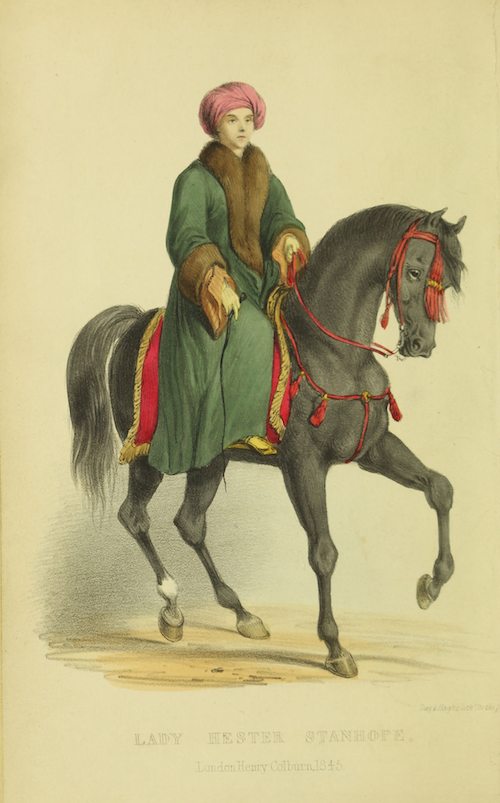
“Mr. Pitt used to say, when I went out in my
habit and a sort of furred jacket, that women, when
they rode out, generally looked such figures; but
that I contrived to make a very handsome costume
of it.
“He had so much urbanity, too! I recollect returning
late from a ball, when he was gone to bed
fatigued: there were others besides myself, and we
made a good deal of noise. I said to him next morning,
‘I am afraid we disturbed you last night.’ ‘Not at
all,’ he replied; ‘I was dreaming of the Mask of
Comus, Hester, and, when I heard you all so gay, it
seemed a pleasant reality.’
“To show you what an excellent heart Mr. Pitt
had, and how full of sympathy he was for people whom
others spurned, I’ll tell you what happened one day,
when we were at Walmer. I said to him, ‘Who do
you think is coming down to dinner to-night?’ ‘I
don’t know, Hester: tell me.’ ‘Why,’ said I,
‘H**** D*****’s mistress:—oh! but I’ll pretty
soon look her out of countenance.’ I was only in
joke, doctor. H. D., who was by the same mother as
Lord D., but born before the mother was married, had
for his mistress a very excellent woman, whose meritorious
conduct every body spoke of: so I thought I
would have a little fun about her, and told Mr. Pitt
that H. D. was going to bring her with him. ‘My
dear Hester,’ cried Mr. Pitt, ‘for God’s sake, don’t
distress the poor woman, if she is coming—now, pray,
don’t!’ ‘Oh! yes, I will, I will,’ I replied. ‘Now,
I entreat you,’ said Mr. Pitt. ‘Here she comes,’
cried I; and a post-chaise drove past us, near the
drawbridge. Mr. Pitt turned his head towards me as
it passed, pretending to be talking to me, ‘She is
very pretty,’ said I. ‘Well,’ said Mr. Pitt, ‘I must
go and give some orders about her room;’ and he was
actually going to put her in the best room in the
house, and to desire some other persons who were
expected to be sent to the village, when I told him it
was all a joke; for it was only H. D.’s post-chaise,
with his man in it, come down before his master.”
Here Lady Hester Stanhope paused for a little time,
as if musing; and, at length, led away by her reflections,
when she resumed the conversation, she uttered
certain sentiments, which, however startling in comparison
with the mere conventional morality of society,
I am emboldened to transcribe. “Doctor,” she said,
in an impressive tone, “I saw in the newspapers an
account of a poor creature found on the step of a door
in some street in Westminster. She was named the
Fair Ellen—a wretched outcast from society—and
was in the last stage of starvation. A poor forlorn
woman, like herself, found her there, took her home,
sold her petticoat to relieve her, and, probably from
her over-anxiety to give her something good for her
weak stomach, fed her more than she was able to bear,
and the Fair Ellen died. Now, doctor, let the friend
of the fair Ellen come to me, and I will receive her to
my bosom, and she shall be my friend; for such sentiments
as hers will I honour and respect wherever I
find them.” She went on: “How strange it is that
immorality, in England, is met in some persons by
such severity—much too great; and, in others,
escapes animadversion! * * * * *
The poor are spurned for errors not half so gross as
what the wealthy my lords do in the open face of day,
and set people at defiance to boot.”
She went on: “To get inmates for brothels, and
mistresses for the rich, fancy a procuress to some
great my lord, who sets off for Wales, or for some
distant province of England. Down she goes, accompanied
by a sort of confidential servant, whom she
affects to retain from the great attachment that her
poor dear husband had for him; and she places herself
in handsome lodgings in a town, or in some pretty
cottage in a village. There she visits the poor and
the sick, or does some act of charity to make herself
talked about, and, in the mean time, looks out for
some handsome girl. When she has found one that
she thinks will suit her purpose, she first takes her as
her maid, treats her with great kindness, and, when
the girl has conceived a liking for her, she all of a
sudden pretends she has received news from London
of the death of a brother, or the sickness of a dear
friend, and says she must set off directly. The poor
girl, whom she has fed with hopes of what she may
become some day, by telling her that she has no relations
that she cares for and perhaps may leave her
something when she dies, desires to be taken with
her; and the procuress, with a show of generous
feeling for her, says she will not let her go, unless she
can ensure her bettering herself, and begs that her
parents will have a paper drawn up, that she is to
remain five or seven years with her, or else she, the
lady, is to give her fifty pounds. The parents, delighted
with the disinterested offer of their child’s
mistress, get the agreement legally drawn up, sign it,
and sign their daughter’s ruin.
“As soon as they are in London, dress, pleasure,
and other allurements, are offered her. She forgets
her humble home, and becomes the dupe of her artful
seducer. If any inquiry is made after her, perhaps
the fifty pounds are paid; and the very agreement
that was to secure her safety becomes the bond of
her destruction.
“Lady Hamilton was brought from Wales in this
manner, a fine, rosy-faced, and rather blowsy country
girl. A set of virtuosoes wanted a model for a Venus,
and some of them, who knew Lady H., fixed on her;
but Sir W. H. took her out of their hands, and
carried her to Naples. Yet how did she end?—with
not money enough to bury her; and so did
Mrs. Jordan.”[45]
February 12 to 18.—It rained so hard, that, for a
week, we were almost confined to the house. Our
good friends, Mr. and Mrs. Chasseaud, when it was
possible, either came and passed the evening with us,
or we went to their cottage. On awaking, on the
morning of the 16th, we found the bed-room and the
counterpane of our bed wet with the rain, which had
penetrated the roof in every part, excepting, luckily,
over the children’s bed. The bedding and carpets
were obliged to be removed into another room. The
day proved very stormy; and, for two or three days
more, we were compelled to live and sleep in the same
room, being the only one that was waterproof. The
occasional squalls were so violent, that a gust of wind
would whirl a large copper ewer to the distance of a
yard. All the trelliscourt of our terrace was blown
away, like chaff before the whirlwind.
February 21.—Nine hours were spent to-day in
conversation with Lady Hester, from three in the
afternoon until midnight. She spoke of Lord Stewart
de Rothsay, of the Duke of Sussex, of Mr. Pitt, and
many other persons. The weather was beautiful; and,
although the sides of Mount Lebanon, only a few
miles off, were covered with snow, we sat until sunset
with the windows open. The climate of Syria is, probably,
one of the most pure and balmy in the world.
Lady Hester, from one thing to another, returned
to the subject of Mr. Pitt’s amiable disposition. “It
is wonderful,” said she, “what a man Mr. Pitt was.
Nobody would have suspected how much feeling he had
for people’s comforts, who came to see him. Sometimes
he would say to me, ‘Hester, you know we have
got such a one coming down. I believe his wound is
hardly well yet, and I heard him say, that he felt
much relieved by fomentations of such an herb: perhaps
you will see that he finds in his chamber all that
he wants.’ Of another, he would say—‘I think he
drinks ass’s milk; I should like him to have his
morning’s draught.’ And I, who was born with such
sensibility, that I must fidget myself about everybody,
no matter whom, was always sure to exceed his
wishes.
“Would you believe, doctor, that, in the last weeks
of his last illness, he found time to think about his
groom, in a way that nobody would have suspected in
him? He had four grooms, who died of consumption,
from being obliged to ride so hard after him; for they
drank and caught cold, and so ruined their constitutions.
This one I am speaking of, when first attacked
in the lungs, was placed at Knightsbridge, and then
sent to the seaside. One day, Mr. Pitt, speaking of
him, said to me—‘The poor fellow, I am afraid, is
very bad: I have been thinking of a way to give him
a little consolation. I suspect he is in love with
Mary, the housemaid; for, one morning, early, I found
them talking closely together, and she was covered with
blushes. Couldn’t you contrive, without hurting his
feelings, to get her to attend on him in his illness?’
“Accordingly, soon after, when he was about to set
off for Hastings, I went to see him. ‘Have you nobody,’
I asked him, ‘whom you would like to go to
the sea-side with you?—your sister or your mother?’
‘No, thank you, lady.’ ‘There is the still-room
maid, would you like her?’ ‘Ah, my lady, she has a
great deal to do, and is always wanted.’ From one
to another, I, at last, mentioned Mary, and I saw I
had hit on the right person; but, however, he only
observed, he should like to see her before he went.
Mary was, therefore, sent to him; and the result of
their conversation was, that he told her he would
marry her if he recovered, or leave her all he had if
he died—which he did.
“Mr. Pitt once obtained a servant in a very odd
way. Riding on the moors with a friend, they came
to one of those flocks of geese, which, picked of their
feathers, are driven about by a boy, with a bit of red
rag at the end of a long stick. ‘We must ride round,’
said Mr. Pitt; ‘we shall never get through this
immense flock.’ ‘Yes, but you may,’ cried a sharp-looking
boy, who had heard him, ‘if you will only
keep your horses quiet. Sh—sh—ee—ee—ayi—ayi!’
and the boy waved his stick here and there, and in a
minute or two the flock opened, and, wheeling to the
left and right in regular columns, made a passage,
through which they rode. ‘That must be a clever
lad,’ observed Mr. Pitt; ‘he manœuvres his little
army in a wonderful manner—a general could not do it
better;’ and he ordered the groom to inquire to whom he
belonged. A day or two afterwards he was sent for, and
put into the stables. Next, he was made an undergroom;
then taken to town to wait on the upper
servants, and afterwards made a footman; until, one
day, Mr. Pitt, going down to Hollwood with Mr.
Dundas, and three or four friends, to talk about some
parliamentary business (a custom he had, when he
wanted to discuss any particular plan in quiet), lo and
behold! the cook fell down in an apoplectic fit, and
died; and the butler, who saw it, was so affected that
he was seized with a fit of the gout. This butler was
also Mr. Pitt’s valet, on such occasions as when he was
out of town for a day. Mr. Pitt was in a sad fidget
about the dinner: but the young man in question
said, ‘Don’t, sir, send off any express for a cook: if
you think proper, the maid shall dress the dinner.
These are all your intimate friends, and will take no
notice: their servants as yet know nothing of the
matter; for I thought they might be frightened to be
where there is a dead man. Let me manage, and all
will go well, without any alarm being spread.’ He,
accordingly, dressed Mr. Pitt, saw to everything, and
acquitted himself so well, that Mr. Pitt was more than
satisfied with him, and soon afterwards made him his
valet; but he did not live long enough to have his services
recompensed. He died quite young, at twenty-seven.
He was a man all fire and activity. Mr. Pitt would
say to him, ‘You must go down to-day to such a
place, and I shall be there the day after to-morrow.’
‘You will excuse me, sir,’ the man would reply, ‘but
I sha’n’t go; for, if I do, who will attend to you when
you take your physic to-morrow? You will be busy,
and put it off; and nobody knows how to give it but
myself.’ ‘Well, well,’ Mr. Pitt would answer, ‘do so
then;’ and would excuse him by an—‘Ah! he is very
anxious about me—I must let him have his own
way.’”
It was a remarkable proof of Lady Hester Stanhope’s
memory, that, whatever subject she stumbled
on, she had an inexhaustible fund of anecdotes ready;
and, having got into the servants’ hall, she seemed as
much at home there as in the drawing-room. She
told me a pathetic history of a faithful servant, who,
in the pecuniary distresses of his master, served him
for several years with the purest disinterestedness. I
was so touched by her eloquent and forcible manner
of relating the story, and with the self-application
that I made of it to my own tardiness in going to her
in her distress, together with my present intention of
leaving her, owing to our recent differences, that I
burst into tears, and wept, as the expression is, bitterly.
She soothed my feelings, endeavoured to calm my
emotions, and disclaimed all intention of conveying
any allusion to me. This led her to say, how little
malice she ever entertained against any one, even towards
those who had done her injury, much less against
me, who had always shown my attachment to her:
and she said that, even now, although she was going
to lose me, still her thoughts did not run on her own
situation so much as on what would become of me:
and I firmly believed her.
February 23 to 26, 1831.—Another fresh trouble
now harassed Lady Hester. Paolo, her Italian
servant, who had been sent to Acre to assist in laying
out the Pasha’s garden, made or received offers there
to fill a good post in the Artillery, he having served
as a soldier during Buonaparte’s campaigns. He,
therefore, came back to her ladyship’s, to signify his
intention of leaving his place, hoping she would, in
consideration of his services, give him a character to
the Pasha. There had been some shuffling in the
business on Paolo’s part, so Lady Hester was determined
to play him a trick, as he had tricked her.
Instead, therefore, of a written good character, she put
a blank sheet, undercover, to the Pasha; and, causing
it to be directed with the customary titles and superscription
to his highness, she gave it to Paolo, paid him
his wages, and sent him off, exulting in the prospect
of the lucrative post he was about to be promoted to.
When he had obtained admittance to the Pasha, he
presented his letter, and, the seal being broken, a
blank sheet was all that the cover contained. Another
letter to the Pasha, explaining what had been done,
had been despatched by a special messenger, in which
Lady Hester Stanhope showed Paolo’s unfitness for a
gunner, and urged him not to expose his men to the
chance of being blown to pieces at the cannon’s mouth
by the ignorance of a man who would make a decent
valet, but a very bad artilleryman. The Pasha took
the hint, and sent Paolo about his business, who
hastened back to Beyrout, and retreated, crestfallen,
to Europe.
Nothing farther was said about the Damascus affair.
A long letter, on the organization of a body of regular
troops, was drawn up, and sent to Abdallah Pasha.
This, with the trouble of translating it into Arabic,
occupied three or four days. Letters were written to
Dr. Dusap, of Cairo, relative to the purchase of some
black slaves, to Lord Ebrington, and to some other
persons, which filled up the time until March 7.
The intervals of writing were devoted to conversations
on the coming of the Murdah, or new Messiah, and
Lady Hester laboured hard to make me a convert to
her doctrines. She expressed her regret that the
result of the fulfilment of her predictions would be for
strangers, and not for her friends.