Anthony Wayne, of whose military career America has
much to boast, the son of a respectable farmer in Chester
county, Pennsylvania, was born on the 1st of January, 1745.
His propensities and pursuits being repugnant to the labors
of the field, his father resolved to give him an opportunity of
pursuing such studies as his acquirements might suggest, and
accordingly placed him under the tuition of a relative of erudition
and acquirements, who was teacher of a country school.
Our young hero was by no means an attentive student; his
mind seemed, like the young Napoleon, bent on a military
life, for instead of preparing his lessons for recitation during
his leisure hours, he employed himself in ranging his playmates
into regiments, besieging castles, throwing up redoubts,
&c. &c.
He was removed from the county school into an academy
of repute in Philadelphia, where he soon became an expert
mathematician, sufficiently so, that on his leaving school he
became a land surveyor, with a very respectable and lucrative
business. At the persuasion of Dr. Franklin, he removed to
Nova Scotia, as agent for a company of settlers about to
repair to that province on a scheme of emigration.
As an able negotiator he acquitted himself honorably, and
returned to Pennsylvania, where he married the daughter of
Benjamin Penrose, an eminent merchant of Philadelphia, and
settled once more on a farm in his native county. The aspect
of affairs between the mother country and the provinces at
this time convinced our young hero that desperate means
must soon be resorted to to prevent invasion from abroad and
insurrection at home. Satisfied that the controversies between
the two countries would only be adjusted by the sword, he
determined to apply himself to military discipline and tactics,
that whenever his country required it, he might devote his
energies in raising and preparing for the field a regiment of
volunteers. The moment arrived, and young Wayne was
only six weeks in completing a regiment, of which he was
unanimously chosen colonel. At the sound of taxation the
undaunted spirit of liberty burst forth, and thousands of
young and fearless patriots thronged around the sacred banner
to enrol themselves in a cause which must eventually end
in freedom. News of the opening of the revolution at Bunker’s
Hill and Lexington arrived, and Washington, who had
accepted the command of the army, repaired to the seat of war.
Congress, now sitting at Philadelphia, called upon the
colonies for regiments to reinforce the northern army, and the
one raised by the exertions of Anthony Wayne was the first
called into service, and upon him was conferred the command.
His orders to join General Lee at New York were quickly
obeyed, whence he proceeded with his regiment to Canada, to
be stationed at the entrance of Sorel river.
Shortly after his arrival there, news arrived that a detachment
of six hundred British light infantry were advancing
toward a post called Trois Rivières (Three Rivers). Anxious
to check their advance, or strike before they could concentrate
their forces, three regiments, commanded by Wayne, St. Clair
and Irvine, commenced their march for that purpose. Unfortunately,
however, untoward circumstances compelled them
to retreat with considerable loss of men, and Colonels Wayne
and St. Clair severely wounded. The movements now devolved
upon Wayne, who collected the scattered troops and
returned to his former post at Sorel river, where he remained
but a short period, being followed by a heavy British column,
giving him only sufficient time to leave the fort before the
enemy entered it. The retreat was made good by the able
conduct of Wayne, who, with his stores and baggage, safely
arrived at Ticonderoga.
At a consultation among the generals it was determined
that at this post they should take their stand. After reconnoitering
the fortifications, and finding them so well prepared
to resist an attack, the British general re-embarked his forces
and retired to Canada.
Immediately on the withdrawal of the British troops,
General Gates repaired to Washington’s army, leaving Colonel
Wayne in entire charge of Ticonderoga. This high compliment
paid to Colonel Wayne, agreeable to the troops and
approved of by Congress, caused the gallant soldier to be promoted
to the rank of Brigadier-general. He remained at this
post six months, when, Washington having marched his main
army into Jersey, General Wayne solicited permission to join
him, which he did at Bound Brook, a few miles from Brunswick,
in New Jersey. Soon after the arrival of Wayne,
General Howe, having received reinforcements from England,
at New York, took up his line of march across Jersey, in
order to intercept the American army before reaching Philadelphia.
Washington conceived the plan of General Howe to
be to surprise the city of Philadelphia and disperse the congressional
assembly, who were then sitting there; he accordingly
dispatched Wayne and his troops to meet and strike
them, in order to resist their passage at Chad’s Ford. This
was done, and a sharp conflict ensued, which was gallantly
kept up until late in the evening, when it was thought prudent
to retreat; the loss sustained by the Americans was
stated to be three hundred killed and four hundred taken
prisoners. The statement given by the British general himself,
was one hundred killed and four hundred wounded, but
which was afterwards ascertained to be nearly double that
number. In this battle the young patriot Lafayette first drew
his sword in the cause of America’s freedom, and although
severely wounded in his leg at the very onset of the battle,
he continued to cheer and encourage his soldiers, (with the
blood flowing from his wound, having bound his sash around
it,) till the end of the conflict.
The British, taking a circuitous route, now marched with
all haste towards Philadelphia, and Washington wishing to
give them the meeting before reaching the city, retired to
Chester, where both armies met at some distance from the
Warren tavern, on the Lancaster road. General Wayne
commenced the action with great spirit, but a violent storm
came on which rendered it impossible for the battle to continue,
and each army withdrew from the field.
Washington, in order to save Philadelphia, with the main
army fell back and crossed the Schuylkill at Parker’s ferry,
leaving General Wayne with about fifteen hundred men to
watch the enemy, who had retreated back about three miles.
After remaining at that post for four days, he was apprised of
the near approach of the British army, and after giving three
distinct orders to one of his colonels to lead off by another road
and attack the enemy in the rear, which order was not understood,
and consequently not obeyed, gave the British time to
come upon them before they could make good their retreat.
The enemy fell upon them with the cry of “No quarters,”
and one hundred and fifty of his brave men were killed and
wounded in this barbarous massacre. The next battle at
which this valiant soldier distinguished himself, was at Germantown.
The British having taken a position in the immediate
vicinity of that village, General Wayne, moving with
much secrecy, attacked them in their camp at the dawn of day,
but after many hours of hard fighting and a succession of untoward
circumstances, was obliged to retreat. The loss of the
Americans in this action, was one hundred and fifty-two killed,
five hundred and twenty-one wounded, and four hundred
taken prisoners; the loss of the British was eight hundred
killed and wounded.
The British army remained in nearly the same position
till the 26th of October, when General Howe, with a detachment
of his troops, took peaceable possession of Philadelphia.
Watson, in his Annals of Philadelphia, says,—“As they
entered the city, Lord Cornwallis at their head led the van.
They marched down Second street without any huzzaing or
insolence whatever, and the citizens thronged the sidewalks
with serious countenances, looking at them. The artillery
were quartered in Chestnut street, between Third and Sixth
streets. The State House yard was made use of as a parade
ground.”
Congress had previously been removed to Lancaster, in the
interior of the state, sixty miles from Philadelphia. Washington
and his army were posted at White Marsh, about fourteen
miles from Philadelphia, and in order to draw the commander-in-chief
from his strong position, the British general,
Howe, marched his soldiers to the neighborhood of the American
lines, and after many demonstrations of attack, finding
that Washington was not disposed to bring on another action,
retreated again to the city. This gave Washington an opportunity
of proceeding to Valley Forge, where, in the month
of December, with his almost famished and naked soldiers,
they cheerfully commenced building huts with their own hands
in the woods. Early in January, General Wayne repaired
to Lancaster, where the government was then located, to use
his exertions in raising supplies, both of provisions and clothing,
for the army.
In part did he succeed, but the scarcity of provisions becoming
so great, that Washington was at length compelled to
detach a body of troops, under General Greene, with orders
to obtain “an immediate supply of provisions by any means
within his power.” This was done by seizing every animal
fit for slaughter; and by this means the immediate wants of
the starving troops were supplied.
In order to prevent a similar deplorable state of want, our
gallant hero, who knew no danger, in the month of February,
a most inclement season, left the army with a body of troops
on an expedition to New Jersey, to secure cattle on the banks
of the Delaware.
This, of all others, was a dangerous enterprise, for the British
were wintering in detachments in many places near the Delaware.
However, in our hero bravery knew no fear, and for
the relief of his suffering soldiers he was determined to attack
and wrest from the British, (whenever he came in contact,)
provisions for his men and sustenance for his horses. After
several skirmishes, which might really be termed battles, he
succeeded, by his soldier-like and judicious management, in
capturing from them and sending to the American camp several
hundred fine cattle, some excellent horses, and a large
amount of forage. About the middle of March he returned to
Valley Forge, to receive the thanks of his commander-in-chief
and the blessings of the army. The British remained
in quiet possession of Philadelphia till the 18th of June following,
when they commenced their march through Jersey.
On the same day Washington left Valley Forge in order to
follow them, and on the 24th encamped about five miles from
Princeton, while the British had encamped at Allentown.
During the winter General Howe had requested to be recalled,
and the command now devolved upon Sir Henry Clinton.
Wayne, with four thousand men, was ordered, accompanied
by Lafayette, with one thousand men, to take a position near
Monmouth Courthouse, about five miles in the rear of the
British camp, in order to prevent their reaching the Highlands
of New York. Washington, who had determined to
attack the British the moment they moved from their ground,
received intelligence on the morning of the 28th of June that
they were on their way. The troops were immediately under
arms, and General Lee ordered to march on and attack the
rear, as the enemy advanced towards the troops of Wayne
and Lafayette. This was done, and the Americans, though
much fatigued by their previous march, fought with such
determined bravery that the British gave way. Taking
advantage of the night, which saved them from a total rout,
they withdrew to the heights of Middletown, leaving behind
them two hundred and forty-five killed of their soldiers, and
many of their officers; others they had before interred. The
following is an extract of a letter of Wayne to a friend:—
“Paramus, 12th July, 1778.
“We have been in perpetual motion ever since we crossed
the Delaware until yesterday, when we arrived here, where
we shall be stationary for a few days, in order to recruit a
little after the fatigue which we have experienced in marching
through deserts, burning sands, &c. &c.
“The enemy, sore from the action of the 28th ult., seemed
inclined to rest also. They are now in three divisions; one
on Long Island, another on Staten Island, and a third in New
York.
“The victory on that day turns out to be much more considerable
than at first supposed. An officer who remained on
the ground two or three days after the action, says that nearly
three hundred British had been buried by us on the field, and
numbers discovered in the woods, exclusive of those buried
by the enemy, not much short of one hundred. So that by
the most moderate calculation, their killed and wounded must
amount to eleven hundred, the flower of their army, and
many of them of the richest blood of England.
“Tell those Philadelphia ladies who attended Howe’s assemblies
and levees, that the heavenly, sweet red-coats, the accomplished
gentlemen of the guards and grenadiers, have been
humbled on the plains of Monmouth. These knights have
resigned their laurels to rebel officers, who will lay them at
the feet of those virtuous daughters of America, who cheerfully
gave up ease and affluence in a city, for liberty and
peace of mind in a cottage.
“Adieu, and believe me
“Yours most sincerely,
“Anthony Wayne.”
The British commander, having in the night escaped from
his adversary, took a strong position on the high grounds
about Middletown, where remaining, however, but a few days,
he proceeded to Sandy Hook, and passed over to New York.
Washington, at this time, proceeded by slow and easy
marches to the Highlands of the Hudson.
It was his intention to fortify West Point, and the Highlands
of the North River; accordingly the works at Stony
and Verplanck’s Points were commenced for that purpose,
yet only on Verplanck’s a small but strong work had
been completed and garrisoned by seventy men, under Captain
Armstrong, while the works on Stony Point, of much
greater extent and of incomparably more importance, were
unfinished. To secure these valuable positions was a matter
of great magnitude both to the British as well as American
commander-in-chief; hence was the determination of fortifying
the Highlands, so as to comprehend within it these important
positions. To arrest the progress of these fortifications, Sir
Henry Clinton sailed with a fleet up the Hudson, and landed
his troops in two divisions; the one under General Vaughan,
destined against the works at Verplanck’s on the east side of
the river—the other, which he commanded in person, against
those of Stony Point, on the west side. The fortifications
on Stony Point being unfinished, were abandoned without
resistance, on the approach of the enemy, who instantly commenced
dragging some heavy cannon and mortars to the
summit of the hill, and on the next morning about sunrise
opened a battery on Fort Fayette, erected on Verplanck’s, the
distance across being about one thousand yards.
The cannonade during the day, from the very commanding
position of Stony Point, as also from vessels and gun-boats
in the river, occasioned much injury to the fort; which, being
invested both by water and land, and no means of saving the
garrison now remaining, Captain Armstrong, (who had command,)
after a gallant resistance, was compelled to surrender
himself and troops prisoners of war. Sir Henry proceeded
immediately to place both forts in what he supposed a perfect
state of defence, especially that of Stony Point, which he
garrisoned with six hundred men, under the command of an
officer distinguished for his bravery and circumspection. In
consequence of Washington being now at West Point, Sir
Henry declined a further movement up the Hudson, but remained
with his army at Phillipsburg, about midway between
New York and Stony Point. Immediately on the arrival of
Wayne at head quarters, Washington commenced laying
plans for the recapture of Stony Point, and in a conference
between the commander-in-chief and Wayne, the latter, emphatically
to express his willingness to undertake the perilous
enterprise, is said to have remarked:—“General, if you will
only plan it, I will storm Hell!”
As no industry had been wanting in completing or repairing
the works at Stony Point, which the length of possession by
the British would admit of, that post was now in a very strong
state of defence; its garrison consisted of the seventeenth
regiment of foot, the grenadier companies of the seventy-first
and some artillery; the whole under the command of Lieutenant
Colonel Johnson. The garrison at Verplanck’s was
under the conduct of Lieutenant Colonel Webster, and was
at least equal in force to that of Stony Point. General
Wayne was appointed to the difficult and arduous task of
surprising and storming Stony Point, for which Washington
provided him with a strong detachment of the most active
infantry in the American service. These troops had a distance
of about fourteen miles to travel over high mountains,
through deep morasses, difficult defiles and roads exceedingly
bad and narrow, so that they could only move in single files
during the greatest part of their journey. About eight o’clock
in the evening of the 15th of July, the van arrived within a
mile and a half of their object, where they halted, and the
troops were formed into two columns as fast as they came up.
While they were in this position, Wayne, with most of his
principal officers, went to reconnoitre the works, and to observe
the situation of the garrison. It was near midnight before
the two columns approached the place; that on the right,
consisting of Febiger and Meigs’ regiments, was led by General
Wayne. The van, consisting of one hundred and fifty
picked men, led by the most adventurous officers, and commanded
by Lieutenant Colonel Fleury, advanced to the attack,
with unloaded muskets and fixed bayonets. They were preceded
by an avant-guard, consisting of an officer of the most
distinguished courage, accompanied by twenty of the most
desperate private men, who, with other officers, were intended
to remove the abatis, and whatever obstructions lay
in the way of the succeeding troops. The column on the
left, was led by a similar chosen van, with unloaded muskets
and fixed bayonets, under the command of Major Stewart;
and that was also preceded by a similar avant-guard. The
general issued the most positive orders to both columns, (which
they strictly adhered to,) not to fire a shot on any account,
but to place their whole reliance on the bayonet. The two
attacks seem to have been directed to opposite points of the
works; whilst a detachment under Major Murfree engaged
the attention of the garrison, by a feint in their front. They
found the approaches more difficult than even their knowledge
of the place had induced them to expect; the works
being covered by a deep morass, which, at this time, happened
to be overflowed by the tide.
The general, in his official papers, says, “that neither the
deep morass, the formidable and double rows of abatis, or the
strong works in front and flank could damp the ardor of his
brave troops; who, in the face of a most incessant and tremendous
fire of musketry, and of cannon loaded with grape-shot,
forced their way at the point of the bayonet through
every obstacle, until the van of each column met in the centre
of the works, where they arrived at nearly the same time.”
General Wayne was wounded in the head by a musket-ball,
as he passed the last abatis; but was gallantly supported and
assisted through the works by his two brave aids-de-camp,
Fishbourn and Archer, to whom he acknowledges the utmost
gratitude in his public letter. Colonel Fleury, a French officer,
had the honor of striking the British standard with his
own hand, and placing in its room the American stars and
stripes. Major Stewart and several other officers received
great praise; particularly the two Lieutenants Gibbons and
Knox, one of whom led the avant-guard on the right, and
the other on the left. Both, however, had the good fortune
to escape unhurt, although Lieutenant Gibbons lost seventeen
men out of twenty in the attack.
There is nothing in the annals of war which affords more
room for surprise, and seems less to be accounted for, than
the prodigious disparity between the numbers slain in those
different actions, which seem otherwise similar or greatly to
correspond in their principal circumstances, nature and magnitude.
Nothing could well be supposed, from its nature and
circumstances, more bloody, in proportion to the numbers
engaged, than this action; and yet the loss on both sides was
exceedingly moderate.
Nothing could exceed the triumph of America and Americans
generally, upon the success of this enterprize, and the
vigor and spirit with which it was conducted.
It must, indeed, be acknowledged, that considered in all its
parts and difficulties, it would have done honor to the most
veteran soldiers. General Washington, the Congress, the
General Assembly, and the Supreme Executive Council of
Pennsylvania, were emulous in their acknowledgments, and
in the praises which they bestowed upon General Wayne,
his officers and troops. In these they particularly applaud
the humanity and clemency shown to the vanquished, when,
by the laws of war, and stimulated by resentment from the
remembrance of former cruelty received from the British,
they would have been justified in putting the whole garrison
to the sword.
As soon as Stony Point was taken, the artillery was
directly turned against Verplanck’s, and a furious cannonade
ensued which necessarily obliged the shipping at the latter
place to cut their cables and fall down the river. The news
of this disaster, and of Webster’s situation, who also expected
an immediate attack on the land side, no sooner reached Sir
Harry Clinton, than he took the most speedy measures
for the relief of Verplanck’s. The whole British land and
naval force was in motion. But, however great the importance
or value of Stony Point and Verplanck’s, Washington
was by no means disposed to hazard a general engagement on
their account; more especially in a situation where the command
of the river would afford such decisive advantages to
his enemy in the disposition and sudden movement of their
troops, whether with respect to the immediate point of action,
or to the seizing of the passes, and cutting off the retreat of
his army, as might probably be attended with the most fatal
consequences.
In his letter to Congress, he says, that it had been previously
determined in council not to attempt keeping that
post, and that nothing more was originally intended than the
destruction of the works and seizing the artillery and stores.
This adventurous and daring feat kept the advanced posts of
the British in a state of serious alarm.
By the journals of Congress for July 26, 1779, it appears
that the attack on the fort at Stony Point was ordered by
General Washington on the 10th of July. General Wayne
issued his orders on the 15th, on the night of which day the
attack was made. The prisoners taken were five hundred and
forty-three; not a musket was fired by the Americans; and
although the laws of war and the principle of retaliation for
past cruelty, would have justified the sacrifice of the garrison,
yet not a man was killed who asked for quarters. Soon after
this gallant action, General Wayne repaired to his family
in Chester county, and thence to the seat of Government,
to use his exertions in stimulating the councils of the nation
in behalf of the suffering army, one-half of which was at
this time nearly barefooted, and otherwise destitute of comforts.
As the winter was now approaching, Washington was
preparing to take up his quarters at Morristown, New Jersey,
in order to restrain the British, who were then stationed at
New York, from incursions into the adjacent country.
In May, 1780, Wayne was ordered to repair to the camp at
Morristown, and resume his command in the Pennsylvania
line. Little more than useless marches, and casual skirmishes
with the enemy was accomplished during this year.
In November of the same year Wayne appears before his
government supplicating supplies for his soldiers. This he accomplished,
and returned in December to his winter quarters
at Morristown, where he remained till the end of February,
1781. Receiving orders to join the southern army under
General Greene, now in Virginia, Wayne accordingly commenced
collecting his troops; but, from so many and unaccountable
delays, it was May before he could concentrate
them at York, Pennsylvania. Early in June the Pennsylvania
troops, eleven hundred in number, formed a junction
with Lafayette, whom they met in Virginia, and determined
at once to march against Cornwallis, who was now retreating.
Lafayette held a position about twenty miles in the rear of
the British, whilst the advanced corps of Wayne kept within
eight or nine miles, with the intention of commencing an
attack on the rear guard, after the main body should have
passed the river. Lafayette, having received intelligence that
the enemy were preparing to cross the James river, he immediately
took a position at Chickahominy church, eight miles
above Jamestown. Early the following morning, Wayne
believing that the main army of the British had effected its
passage, was determined to march forward and attack the rear
guard; but upon arriving within sight he found he was mistaken,
and that he had now to confront the whole British
force with only five hundred men; the only safe mode which
he could now calculate upon, was that of attacking vigorously
and retreating precipitately. “For,” said he, “moments decide
the fate of battles,” and accordingly the firing was commenced
with great firmness at three o’clock, and continued till five in
the afternoon.
In this severe but gallant action one hundred and eight of
the Continental troops were killed, wounded and taken; most
of the officers were severely wounded, and many of the field
officers had their horses killed under them. Lafayette, in his
official notice of this action, says—“From every account the
enemy’s loss has been very great, and much pains taken to
conceal it.”
In a letter from General Washington to Wayne, he adds:—“The
Marquis Lafayette speaks in the handsomest manner
of your own behavior, and that of the troops, in the action
at Green Spring. I think the account which Lord Cornwallis
will be obliged to render of the state of southern affairs, will
not be very pleasing to ministerial eyes and ears, especially
after what appears to have been their expectations by their
intercepted letters of March last. I am in hopes that Virginia
will be soon, if not before this time, so far relieved as to
permit you to march to the succor of General Greene, who,
with a handful of men, has done more than could possibly
have been expected; should he be enabled to maintain his
advantage in the Carolinas and Georgia, it cannot fail of
having the most important political consequences in Europe.”
The movements of Cornwallis indicated a permanent post at
Yorktown, a short distance up the York river, where he had
removed the principal part of his forces, and commenced his
fortifications. Washington hearing of this movement, commanded
Lafayette to take early measures to intercept the
retreat of Cornwallis, should he discover the intended blow,
and attempt a retreat by North Carolina.
At the interposition of the Marquis Lafayette with his
government, a French fleet, consisting of three thousand troops,
were equipped and dispatched to the assistance of struggling
America; and on the 2d September landed at Burwell’s Ferry,
near this place. Lafayette, who was encamped about ten miles
from General Wayne, on hearing of the arrival of the French
fleet, requested an interview with him. In a letter to a friend,
Wayne describes an accident that occurred to him on his
way thither:—“After the landing of the French fleet, and
pointing out to them the most proper position for their encampment,
I received an express from the Marquis Lafayette,
to meet him on business of importance that evening. I proceeded
accordingly, attended by two gentlemen and a servant.
When we arrived in the vicinity of the camp, about ten
o’clock at night, we were challenged by a sentry, and we
made the usual answer, but the poor fellow being panic-struck,
mistook us for the enemy, and shot me in the centre of the
left thigh; then fled and alarmed the camp. Fortunately, the
ball only grazed the bone, and lodged on the opposite side to
which it entered.” The main works of Cornwallis were at
his strongly fortified garrison at Yorktown, on the York river.
He also occupied Gloucester, on the opposite side, where he
erected works to keep up the communication with the country.
General Washington reached the neighborhood of this interesting
scene of operation on the 14th of September, and immediately
proceeded on board the Ville de Paris, (flag-ship of
the French admiral,) where the plan of the siege was concerted.
Subjoined is an extract of General Wayne’s diary of the
siege of Yorktown and capture of Lord Cornwallis:
“On the 28th of September, 1781, General Washington
put the combined army in motion, at five o’clock in the morning,
in two columns, (the Americans on the right and the
French on the left,) and arrived in view of the enemy’s lines
at York about four o’clock in the afternoon.
“29th. Completed the investiture. The enemy abandoned
their advanced chain of works this evening, leaving two
redoubts perfect within cannon-shot of their principal fortifications.
“30th. The allied troops took possession of the ground
vacated by the British, and added new works.
“1st October. The enemy discovering our works commenced
a cannonade, continuing through the day and night
with very little effect.
“2d. Two men killed by the enemy’s fire.
“3d. A drop-shot from the British killed four men from
the covering party.
“4th. The redoubts were perfected; the enemy’s fire languid.
“5th. Two men killed by rocket-shot.
“6th. Six regiments, viz., one from the right of each
brigade marched at six o’clock, P. M., under the command of
Major General Lincoln and Brigadier Generals Clinton and
Wayne, and opened the first parallel within five hundred and
fifty yards of the enemy’s works and their extreme left, which
was continued by the French to the extreme right.
“7th. The parallel nearly complete, without any opposition,
except a little scattered fire of musketry, and a feeble
fire of artillery, by which a few of the French troops were
wounded and one officer lost his leg.
“8th. Completed the first parallel; two of the Pennsylvanians
were killed by rocket-shot.
“9th. At three o’clock P. M., the French opened a twelve
gun battery on the extreme right of the enemy; and at five
o’clock the same day, a battery of ten pieces was opened on
their extreme left, by the Americans, with apparent effect.
“10th. At daybreak three more batteries were opened, (one
of five heavy pieces by the Americans, and two containing
twenty-two by the French,) opposite the centre of the British
works; at five P. M., another American battery of two ten inch
howitzers was also opened, which produced so severe a fire,
that it in a great degree silenced that of the enemy; at seven
o’clock P. M., the Caron, of forty-four guns, was set on fire
by our balls and totally consumed.
“11th. Second parallel opened this night by the Pennsylvanians
and Marylanders, covered by two battalions under
General Wayne, on the part of the Americans.
“12th. Nothing material.
“13th. That part of the second parallel which was opened,
nearly completed.
“14th. A little after dark, two detached redoubts belonging
to the enemy were stormed; that on the extreme left by the
light infantry, under the Marquis Lafayette, in which were
taken a major, captain, and one subaltern, seventeen privates,
and eight rank and file killed.
“Our army lost, in killed and wounded, forty-one. The
other was carried by the French, under the Baron de Viominial,
who lost, in killed and wounded, about one hundred
men. Of the enemy eighteen were killed, and three officers
and thirty-nine privates were made prisoners. The above
attacks were supported by two battalions of the Pennsylvanians,
under General Wayne; whilst the second parallel
was completed by the Pennsylvanians and Marylanders,
under Colonel W. Stewart.
“15th. Two small batteries were opened this evening.
“16th. The enemy made a sortie, and spiked seven pieces
of artillery, but were immediately repulsed, the spikes drawn,
and the batteries again opened.
“17th. The enemy beat the chamade at ten o’clock A. M.,
Cornwallis now sent out a flag, proposing a cessation of hostilities
for twenty-four hours, and that commissioners might
be appointed to meet to settle the terms upon which the garrisons
of York and Gloucester should surrender. General
Washington would only grant a cessation for two hours; previously
to the expiration of which, his lordship, by another
flag, sent the following terms, viz:—The troops to be prisoners
of war; the British to be sent to Great Britain, and not
to act against America, France, or her allies, until exchanged;
the Hessians to Germany, on the same conditions; and that
all operations cease until the commissioners should determine
the details. To this his excellency returned for answer:—That
hostilities should cease, and no alterations in the works,
or any new movement of the troops, take place, until he sent
terms in writing; which he did on the 18th, at nine o’clock,
A. M., allowing the enemy two hours to determine. They
again requested more time; and the general granted them
until one o’clock, when they acceded to the heads of the
imposed terms, and nominated Colonel Dundas and Major
Ross, on their part, to meet with Colonel Laurens and Viscount
de Noailles on ours, to reduce them to form, which was
completed by nine o’clock at night; and on the 19th, at one
o’clock P. M., the capitulation was ratified and signed by the
commander of each army, when the enemy received a guard
of Pennsylvania and Maryland troops in one of their principal
works, and one of the French troops in another. At four
o’clock, the same afternoon, the British army marched out
of Yorktown with colors cased, between the American and
French troops, drawn up for the purpose, and then grounded
their arms agreeably to capitulation.”
After this successful struggle, General Wayne was commanded
to repair without delay to the aid of General Greene,
who was encamped near Savannah, Georgia, in which state
the enemy had been long rioting without the fear of opposition
from either regulars or militia. Not, however, before the
19th of January, 1782, did he reach the Savannah river, and
having crossed it with a detachment of the first and fourth
regiments of dragoons, with this force, aided by a small state
corps and a few spirited militia, he soon routed the enemy
from some of their strongest posts. Wayne receiving intelligence
of a body of Creek Indians being on their march to
Savannah, detached a strong party of horse under Colonel
McCoy, dressed in British uniform, in order to deceive and
decoy them. This deception succeeded, and the Indians were
all surrounded and taken without the least resistance.
General Wayne, in a letter to a friend, dated the 24th of
February, writes, “It is now upwards of five weeks since we
entered this state, during which period not an officer or soldier
with me has once undressed for the purpose of changing his
linen; nor do the enemy lie on beds of down—they have
once or twice attempted to strike our advance parties. The
day before yesterday they made a forward move in considerable
force, which induced me to advance to meet them; but
the lads declined the interview, by embarking in boats and
retreating by water to Savannah, the only post they now hold
in Georgia.” This post remained in possession of the British
till the month of May, when the British administration, having
resolved upon abandoning all offensive operations in America,
it was ordered to be evacuated. Accordingly, on the 11th of
July, 1782, Savannah was delivered into the possession of
General Wayne, whose time was now fully occupied in replying
to the numerous applications of the merchants and citizens
of that place. About the end of November, General
Wayne, with the light infantry of the army, and the legionary
corps, reached the vicinity of Charleston, S. C., where Greene
was posted near the Ashley river, a convenient position to
attack the rear of the enemy when the hour of evacuation
should arrive; but a proposition from the British General, to
be permitted to embark without molestation if he left the
town untouched, was acceded to, and on the morning of the
14th of December, General Wayne had also the honor and
satisfaction of taking peaceable possession of Charleston, thus
closing his last active scene in the war of the American revolution.
General Wayne continued busily engaged at the south till
the following July, when he took passage for Philadelphia
in very delicate health, having contracted a fever while in
Georgia.
In 1784, Wayne was elected by his native county to the
General Assembly, where he took deep interest in every act
which agitated the Legislature. His family estates, which
had so long been inoperative, now claimed his attention;
which, for the space of two years, was most assiduously
devoted to them. President Washington nominated Wayne
to the Senate as Commander-in-chief of the United States
army—which was confirmed and accepted the 13th of April,
1792. The object of this high and honorable post being
bestowed on Wayne, was to bring to a close the war with the
confederated tribes of Indians, which was raging on the
northwestern frontier. During the four years of Indian warfare,
General Wayne suffered severely from his previous
disease, living, however, to witness the termination of those
troubles which had so long existed, but not to share in the
happy results which his bravery and exalted wisdom had
consummated. He died at Presque Isle, on the 15th of
December, 1796. An able writer thus portrays the character
of this exalted man:—
“The patriotism, spirit and military character of General
Anthony Wayne are written on every leaf of his country’s
history, from the dawn of the revolution to the close of his
eventful life. If you ask who obeyed the first call of America
for freedom? It was Wayne! he was first on the battleground
and last to retire. If you ask who gallantly led his
division to victory on the right wing at the battle of Germantown?
Who bore the fiercest charge at the battle of Monmouth?
Who, in the hour of gloom, roused the desponding
spirits of the army and nation by the glorious storming and
capturing of Stony Point? It was General Anthony
Wayne.
“In Congress, July 26th, 1779, it was resolved unanimously,
that the thanks of Congress be presented to Brigadier General
Anthony Wayne, for his brave, prudent and soldierly conduct,
in the spirited and well-conducted attack of Stony
Point.”
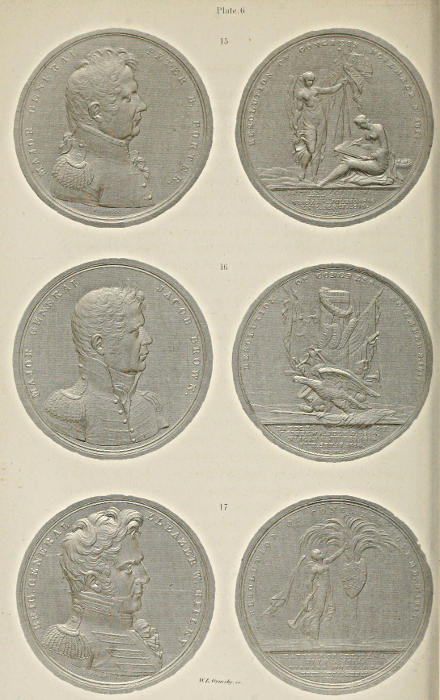
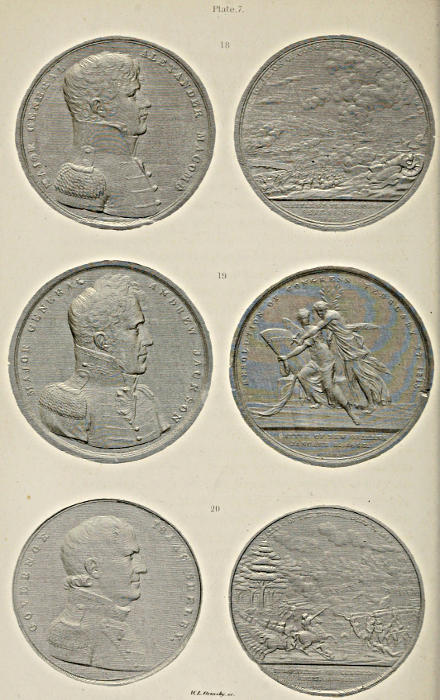
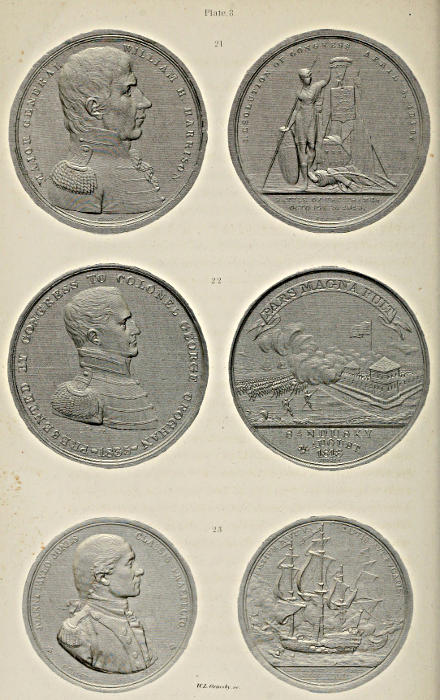
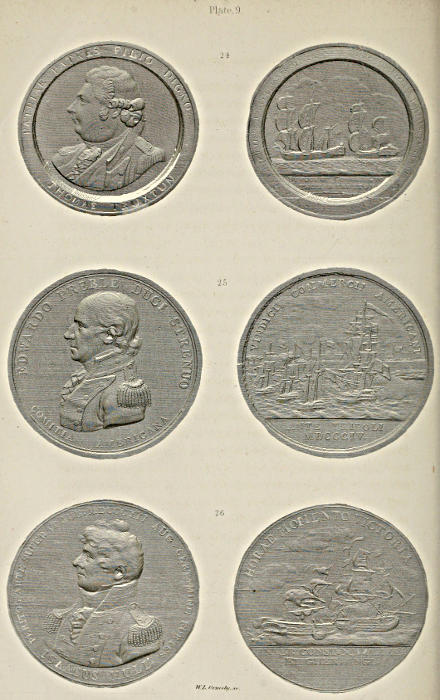
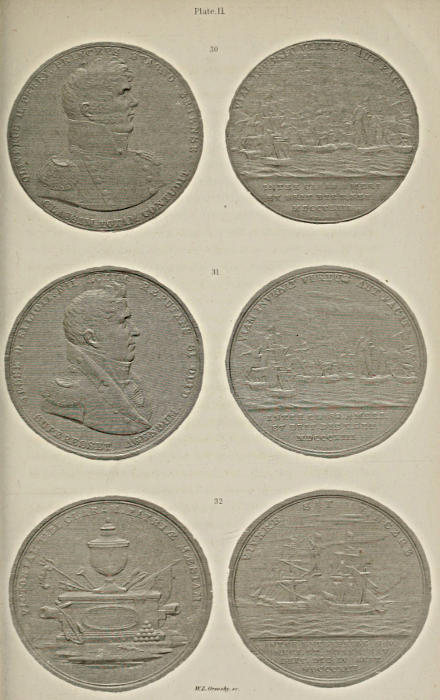
A gold medal was voted to him at the same time, of which
the following is a description taken from the original in the
possession of his family. (See Plate II.)
Occasion.—Taking of Stony Point, on the North River,
by storm.
Device.—An Indian Queen crowned, a quiver on her back,
and wearing a short apron of feathers: a mantle hangs from
her waist behind: the upper end of the mantle appears as if
passed through the girdle of her apron, and hangs gracefully
by her left side. She is presenting, with her right hand, a
wreath to General Wayne, who receives it. In her left
hand, the Queen is holding up a mural crown towards the
General. On her left and at her feet an alligator is stretched
out. She stands on a bow: a shield, with the American
stripes, rests against the alligator.
Legend.—Antonio Wayne Duci Exercitas comitia Americana.
Reverse.—A fort, with two turrets, on the top of a hill:
the British flag flying: troops in single or Indian file, advancing
in the front and rear up the hill: numbers lying at
the bottom. Troops advancing in front, at a distance, on the
edge of the river: another party to the right of the fort. A
piece of artillery posted on the plain, so as to bear upon the
fort; ammunition on the ground: six vessels in the river.
Legend.—Stony Point expugnatum.
Exergue.—15th July, 1779.
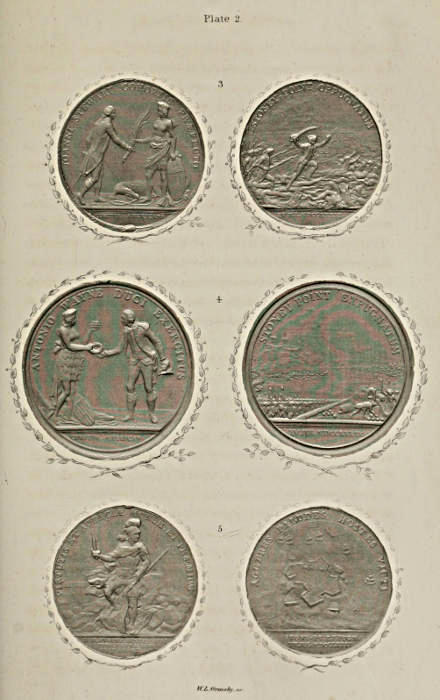
Plate 2.
3
4
5
W. L. Ormsby, sc.