Birth and elevation of Sixtus IV.—Genealogy of the
Della Rovere family—Nepotism of that pontiff—His
improvements in Rome—His patronage of letters and
arts—His brother Giovanni becomes Lord of Sinigaglia
and Prefect of Rome—His beneficent sway—He pillages a
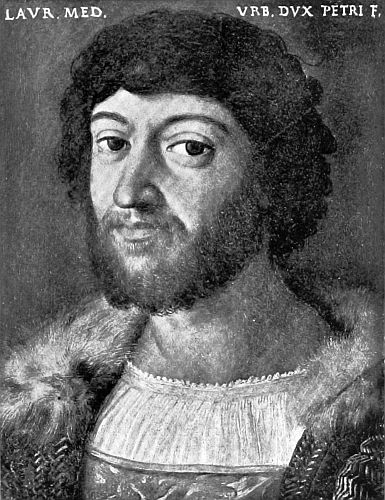
papal envoy—Remarkable story of Zizim or Gem—Portrait of
Giovanni—The early character and difficulties of Julius
II.—Estimate of his pontificate.
ON the 21st of July, 1414, in the village of Celle, upon the Ligurian
coast, near Savona, there was born to Leonardo della Rovere and
Luchina Muglione, a male child, who, fifty-seven years thereafter,
was called to fill the chair of St. Peter, from whence he showered
upon his numerous relations temporal and ecclesiastical dignities.
That Pontiff was Sixtus IV.; of these relatives many have already
found a place in our pages; and from their stock sprang the second
ducal dynasty of Urbino.
Upon the origin of this family a mystery has been thrown, by writers
devoted to adulation rather than to truth. There was established
near Turin a race of della Rovere, lords of Vinovo, whose nobility
is traced from the eighth century, and from whom it was the pride of
Sixtus to claim a descent, which his flatterers readily humoured,
and which the annalists of Urbino adopted as an article of their
political creed. Posterity has repudiated the allegation, for "in
Italy, at least, it is vain for heraldry to tell a tale that history
will not substantiate."[206] The seigneurs of Vinovo were not,
however, loath to admit a blood connection with two Popes, who, in
return for such aggregation to the old stock, conferred cardinals'
hats upon their cousins of Piedmont. Although the tombstone of
Leonardo was said to exhibit the Vinovo bearings, with a suitable
difference, his humble birth is universally admitted. The burgess
of Savona plied a fisher's trade, and even his son is supposed to
have followed in boyhood the same apostolical calling; an occupation
singular rather than inappropriate, for one destined to wear "the
fisher's ring," and to wield the authority of him who was divinely
called to be a netter of men. The superstition or policy of Sixtus
stamped with unmerited importance certain quasi-supernatural
incidents attending his birth. Whilst pregnant, his mother dreamt
that a boy was born to her, whom two Franciscan friars forthwith clad
in the tunic, cowl, and cord of their order. The name Francesco was
accordingly bestowed on the child, whose gestures seemed to confirm
its sacred vocation, the first motions of its little hands being
those of benediction. Whilst undergoing the usual ablutions, the
infant appeared faint and dying, whereupon its mother vowed that, if
preserved to her, it should wear the Franciscan dress for the next
six months. The removal of this habit having on two occasions been
followed by dangerous illness, the boy's destination to a monastic
life was confirmed, and his training conducted accordingly.[*207]
After rapid progress in classical and dialectic studies, he went
to the university of Bologna, and in his twentieth year maintained
various public disputations before a general chapter of his order
at Genoa, with erudition and success which astonished his audience,
and gained him the marked commendation of his superiors. He then
graduated in philosophy and theology at Pavia, and in his public
displays distinguished himself by a simple and perspicuous style
of argument comparatively exempt from the jingle of words that
usually characterised these exercises. His celebrity extending in
all directions, he was engaged by the authorities of many large
towns to deliver lectures, which were attended by the most learned
ecclesiastics, his preaching being not less acceptable to the
people of all ranks. His friendship and counsel were sought by the
distinguished men of his time, including Cardinal Bessarion; and
he employed his pen in various religious controversies, especially
in one, carried by other disputants to blows, between two branches
of Franciscans, the Minims and Predicant Friars, as to "whether
the blood of Christ shed in his passion partook of his divinity."
Having attained the rank of General, he proved most zealous in
the inspection and reform of the convents under his jurisdiction,
personally visiting them in all quarters. At length, in 1467, he was
made Cardinal by Paul II., whom he was chosen to succeed on the 9th
of August, 1471.
We have had occasion, in a previous portion of this work, to notice
the policy of Sixtus as it affected the duchy of Urbino, and it
forms no part of our plan to enter further into the events of his
pontificate. Neither need we detail those in that of his nephew
Julius II., except in so far as they fall to be narrated in our
Third and Sixth Books. Our present purpose is to offer a condensed
view of the della Rovere family, preceding its establishment in the
sovereignty of Urbino, and to enliven what would otherwise be a dry
genealogical sketch, by a few passing observations on the character
of its two Pontiffs, and on the influence of their reigns.
The children of Ludovico Leonardo della Rovere by Luchina Stella
Muglione were these:—
1. Francesco, afterwards Sixtus IV.
2. Raffaele, whose line will presently occupy our
attention.
3. A sister, whose husband Giovanni Basso and children were adopted
into the family of della Rovere and bore that name. They were:—
1. Girolamo of Recanate, made Cardinal of S.
Chrisogono in 1477, and died in 1507.
2. Antonio, who married in 1479 Caterina Marciana,
niece of Ferdinand of Naples, and died soon after.
3. Guglielmo, who died in 1482.
4. Francesco, Prior of Pisa.
5. Bartolomeo.[208]
4. Iolanda, who married Girolamo Riario, and, dying in 1471,
left:—
1. Cardinal Pietro Riario, the favourite of his
Uncle Sixtus IV., who died in 1474.
2. Girolamo, Lord of Forlì, and, in right of his
wife, Caterina Sforza, sovereign of Imola, whose name is
familiar to those who have followed our narrative, and
who was assassinated in 1488. Among their children were
Ottaviano, dispossessed of his states by Cesare Borgia
in 1500; Orazio, Bishop of Lucca; Galeazzo; and Cesare,
Patriarch of Constantinople. Their line still subsists
in the Riario Sforza of Naples, one of whom was in 1846
Cardinal Camerlingo at Rome.
3. Ottaviano, Bishop of Viterbo.
4. A daughter, married to one Sansonio, whose son Raffaele,
made Cardinal of S. Giorgio in 1477, has been mentioned as
an accomplice in the Pazzi conspiracy.
Raffaele della Rovere, younger brother of Sixtus, had, by
Teodora Manerola—
1. Bartolomeo, Bishop of Ferrara and Patriarch of
Antioch.
2. Giuliano, who became Pope Julius II., and whose
natural children were—
1. Raffaele, who married Niccolosa Fogliano of
Fermo, and was murdered in 1502.
2. Felice, famed for her beauty and talents, who
married Gian-Giordano Orsini, not Marc Antonio Colonna, as
stated by Roscoe.
3. Leonardo, created Prefect of Rome in 1472. He died 1475,
leaving no issue by Giovanna, natural daughter of Ferdinand King of
Naples. According to Giannone, she was Catarina, daughter of the
Prince of Rossano, by Dionora, sister of Ferdinand, and she brought
him the duchy of Sora, which descended to his heirs.
4. Giovanni, Duke of Sora, Prefect of Rome, and Seigneur of
Sinigaglia, to whom we shall return.
5. Luchina, whose children were adopted as of the della
Rovere name. By her first husband Gabriele Gara, a gentleman of
Savona, she had—
1. Raffaele.
2. Sisto, Cardinal of S. Pietro in Vinculis, who
died in 1517, aged forty-four. His death is said to have
been occasioned by terror for the menaces of Leo X., who
suspected him of aiding his cousin the Duke of Urbino
in recovering his state, by advancing money out of vast
benefices, estimated at 30,000 to 40,000 ducats a year.
De Grasses describes his frame as exhausted by shameless
debaucheries, and adds, that he could neither read nor
write. The latter assertion is so incredible as to throw
doubt upon the former; yet such an accusation in the diary
of a papal master of ceremonies seems to infer that similar
immoralities were then scarcely regarded as scandalous in
the sacred college. The taint left by Alexander VI. had not
yet been effaced by blood and tears in the sack of Rome.
3. Sista, whose first husband, Geraud d'Ancezun,
died in 1503, after which she married Galeazzo, son of
Count Girolamo Riario.
By her second husband, Gian-Francesco Franciotti Lucca,
a merchant in Rome, who was her junior by eleven years,
Luchina had—
4. Galeotto, Cardinal of S. Pietro in Vinculis,
and Archbishop of Benevento, who died in 1508, aged
twenty-eight. In 1505 he was appointed to the Cancelleria,
and his public revenues, amounting to 40,000 ducats a year,
were liberally administered in the patronage of letters.
5. Nicolò, who left a son Giulio.
6. Lucrezia, wife of Marc Antonio Colonna, who
fell at the siege of Milan, in 1522.[209]
Giovanni della Rovere, Prefect of Rome and Seigneur of
Sinigaglia, died in 1501, having married in 1474 Giovanna di
Montefeltro, who, dying in 1514, had issue—
1. Federigo, who died young.
2. Francesco Maria, who, as Duke of Urbino, will
occupy attention in our next Book.
3. Maria, married in 1497 to Venanzio Varana,
Lord of Camerino, who was slain in 1503, with three of his
sons, by order of Cesare Borgia. Another son, Sigismondo,
shared the campaigns of his maternal uncle the Duke of
Urbino, and failing to recover his patrimonial state from
the usurpation of his uncle Giulio Cesare Varana, was
assassinated at his instigation in 1522: his wife was
Ottavia, daughter of Giulio Colonna. A scandalous intrigue
of Maria in her widowhood will be mentioned in the life
of her brother,[210] but it did not prevent her finding a
second husband in Galeazzo, son of Girolamo Riario, Lord of
Forlì.
4. Costanza, who died unmarried at Rome in
November, 1507.
5. Deodata, a nun of Sta. Chiara at Urbino.
On the accession of Sixtus, the papal treasury was supposed to be
full of money and jewels, which it had been the passion of Paul
II. to accumulate. Yet he declared that but 5000 crowns were found
in bullion, and the few precious stones that were forthcoming
appeared not to have been paid for. Notwithstanding this seeming
disappointment, which was very generally discredited, and the outlay
of 20,000 crowns for the funeral of Paul, and for his own coronation,
he discharged the debts of several antecedent pontiffs, and
particularly those due by Paul for St. Mark's palace. But these heavy
expenses, with the alleged simony attending his election, and the
enormous sums lavished by his nephews, gave colour to an allegation
that he had seized and misapplied large hoardings of his predecessor.
The favour bestowed by him upon his nephews was excessive, even in
days when nepotism was at its height, and his fondness for the two
Riarii originated suspicions casting a dark shadow upon his moral
character; while gossip, with its usual inconsistency, lent currency
to the surmise that they owed to him their paternity as well as
the advancement of their fortunes.[211] One of his early acts was
to confer upon Pietro, the elder of them, and upon Giuliano della
Rovere, cardinal's hats on the same day. These cousins were, however,
of very opposite habits, and so long as Pietro lived, Giuliano's
influence with his uncle was small. The former, known as Cardinal of
S. Sisto,
"Whom the wild wave of pleasure ever drove
Before the sprightly tempest, tossing light,"
|
was magnificent beyond example, lavish in his tastes for silver and
gold stuffs, splendid dresses, spirited horses. He was surrounded
by troops of retainers, and filled his house with rising poets and
celebrated painters. He was munificent to the learned, generous to
the poor, and frequently celebrated public banquets and games at
prodigious expense. Though he lived but two years and a half after
his elevation to the purple, he had in that brief space completed a
rarely equalled career of civil and ecclesiastical preferment, of
public extravagance, and personal debauchery. Taddeo Manfredi, Lord
of Imola, having been expelled by domestic intrigues, was bribed by
the Cardinal with 40,000 crowns to assign that fief to his brother
Girolamo Riario, an arrangement sanctioned willingly by Sixtus,
reluctantly by the consistory. After making a progress to Lombardy
and Venice as papal legate, with a pomp unequalled even in an age
of splendour, Pietro returned to Rome, and died in January 1474, of
fever aggravated by previous excesses. Panvinio says he seemed born
to waste money, and estimates his expenditure whilst cardinal at the
enormous sum of 270,000 golden scudi.[212]
The wars into which the Pontiff recklessly plunged, from rage
against the Medici and anxiety to consolidate a sovereignty for
Count Girolamo, occasioned vast expense, and the deficiency of his
exchequer led him to adopt expedients of an eventually dangerous
tendency. Panvinio asserts for him a disreputable priority in the
creation of places and offices, in order to raise a revenue by their
sale. The simony thus systematised tended at once to taint the
morals and degrade the reputation of the Roman court. Under Borgia's
pontificate we have seen it carried to a frightful height, and
attended by scandals the most heinous; in that of Leo X. it became a
mainspring of the Reformation.
Yet it was not by wars alone that the papal treasury was embarrassed,
nor were the bounties of Sixtus limited to claims of nepotism, for
he reaped from many the praises due to a liberality large rather
than discriminating. The whirlwind of Turkish invasion had lately
swept over the ruins of the Eastern Empire, and for the Christian
princes who fled before it, abandoning their states to seek a
precarious hospitality, Rome formed the natural refuge. Thither
came the expelled despots of Albania and the Morea, the crownless
queens of Cyprus and Bosnia, all of whom received from the Pontiff
a welcome and honourable entertainment due to their misfortunes and
to their virtual martyrdom. To such European princes as visited
the Eternal City, in performance of their religious duties, he
accorded a splendid reception. But there were other outlays still
more creditable to him, as adorning the city and ameliorating the
condition of its inhabitants. He was the first pope who earnestly
set about rescuing from degradation the monuments of ancient Rome,
and improving the modern city. Among numerous public buildings
erected, restored, or decorated by him were the Ponte Sisto, the
great hospital of Santo Spirito, the old Vatican Library, the
aqueduct of Trevi, the churches of La Pace, il Popolo, S. Vitale, S.
Sisto, S. Pietro in Vinculis, and many others. To the Riarii, by his
encouragement, we owe the Cancelleria Palace and the adjoining church
of S. Lorenzo in Damaso. The restoration of that of the SS. Apostoli,
begun on a grand scale by his nephew Pietro, was interrupted by the
early death of that dissolute minion, whose tomb remains in the
choir, finely conceived and beautifully executed. Nor was public
convenience overlooked amid such magnificent creations. As Augustus
was said to have replaced his capital of brick with one of marble,
it became proverbial that Sixtus rebuilt in brick what he found of
mud. He paved the streets, re-opened the sewers, conveyed the aqua
vergine to the heart of the city. By proclaiming the jubilee at the
end of twenty-five years, instead of each half-century, he doubled
the influx of pilgrim revenues; and, warned by the catastrophe of
its preceding celebration, when crowds had been trodden down on the
Ponte S. Angelo, he provided for the devout multitude a new access
to S. Peter's by the bridge which bears his name. His beneficial
undertakings, however, extended far beyond the Eternal City: he
cleared out the choked harbour of Ostia, thoroughly repaired the
crumbling church of St. Francis at Assisi,[*213] and began, in
honour of the Santa Casa at Loreto, that gorgeous fane which was
unworthily finished by the next Pontiff of his name. Neither was
he indifferent to the social disorganisation of his metropolis. He
curbed its lawless state by a rigorous police. Public begging was
strictly suppressed; and all who could not prove some legitimate
means of livelihood were banished. Malefactors of every sort, after
summary conviction, were whipped through the streets, and consigned
to the galleys or the gallows. Daily executions took place for a
time, and though the measures adopted were both sanguinary and
oppressive, order and security were in a great degree restored to the
thoroughfares.
There is reason to fear that the stern discipline, whereby he
vindicated public manners, was not applied to his personal habits.
Yet the character given of him by Infessura, whereon depends most
of the scandal by which his memory has been blackened, appears so
grossly exaggerated as to defeat its own end, and to establish a
charge of prejudice, if not of malevolence, against its author. To
transcribe it would be to stain our pages; but its purport is summed
up in some ribald Latin verses, borrowed, probably, from Pasquin,
which impute to the Pope every imaginable iniquity and disgraceful
indulgence, and congratulate Nero in being at length exceeded in
crime.[*214]
Although the name of Sixtus, as a friend of letters and arts,
has been dimmed by the more glorious ones of Nicolas V. and Leo
X., which at no long intervals preceded and followed him, the
memorials remaining of his judicious patronage are interesting and
important. Innocent III., in building the Hospital of S. Spirito, had
embellished it with six frescoes illustrative of its destination.
To these Sixtus added twenty-seven others, forming a cycle of
the personal and public incidents of his life, from his mother's
miraculous vision, to his anticipated introduction into Paradise by
St. Paul, in recompense of his piety. These paintings are no longer
visible; nor do we know from whose pencils the vast series emanated,
but in the Sistine Chapel, which perpetuates his name, and was his
most important artistic undertaking, his choice was unexceptionable.
Apart from the celebrity conferred upon it by the subsequent impress
of Buonarroti's stupendous inventions, the series wherein the lives
of our Saviour and of Moses are contrasted constitutes a chapter of
scarcely equalled importance in the progress of Christian painting.
Who can view the mighty themes of that oratory,—the types and
antitypes of scriptural history on its walls, the creations of
Omnipotence on its roof, the final Judgment over its altar,—without
gratitude to the della Rovere pontiffs, by whom these triumphs were
commissioned, and for the most part carried out? This may, indeed,
be called the foundation of the Roman pictorial school. Giotto, Fra
Angelico, Gentile da Fabriano, and Masaccio had, indeed, visited
the metropolis of Christendom, but no pontiff before Sixtus had
summoned hither, and at once employed, all the most distinguished
artists of Central Italy. The glorious band, though headed by
Perugino,[*215] consisted of Florentines,—Signorelli, Botticelli,
Rosselli, della Gatta, and Ghirlandaio; but these soon returned to
the art-loving and art-inspiring Arno, leaving on the plain of the
Tiber few other works, and a most transient influence, in exchange
for the classical ideas which they had imbibed in "august, imperial
Rome," and which quickly supplanted the sacred traditions of their
native school. Although Pinturicchio was not associated in their
labours upon the Sistine, he was busy upon other not less important
mural decorations, which still adorn the churches of Aracoeli, Sta.
Croce in Gerusalemme, and S. Onofrio. But Sta. Maria del Popolo was
especially the scene of his triumphs, under the auspices of various
Cardinals della Rovere, and other members of the consistory, who were
instigated by example of his Holiness to such laudable employment of
their exorbitant incomes.
Panvinio speaks of this Pope's solicitude to gather from all Europe
additions to the library founded by Nicolas V., and attest his having
first put it upon a satisfactory footing, by appointing qualified
persons to superintend it, and by assigning it an adequate endowment.
Though the rooms in which he placed books have been devoted to other
purposes, ever since Sixtus V. removed the augmented collection to
its present site, a most interesting memorial of the Pontiff's family
and court remains, and has till lately adorned its original locality.
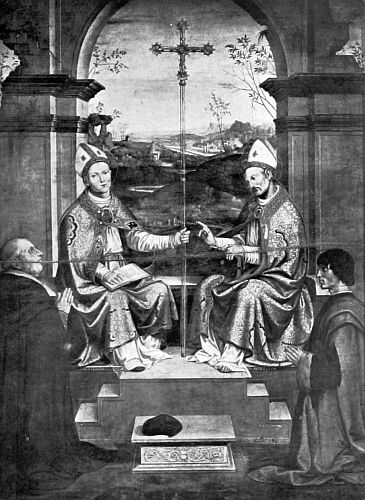
It is a fresco, now transported to the Vatican Picture-gallery,
wherein Sixtus sits in a noble hall of imposing architecture, with
his librarian Bartolomeo Sacchi, surnamed Platina, kneeling at his
feet, and pointing to an inscription, which enumerates in rough
Latin verses, those ameliorations for which Rome was indebted to his
Holiness. In attendance stand his two favourite cardinal nephews;
Pietro, with features expressive of unrefined sensualism, wearing the
russet habit of the mendicant fraternity, from whose discipline he
emerged to lavish ill-gotten gold with rarely equalled prodigality;
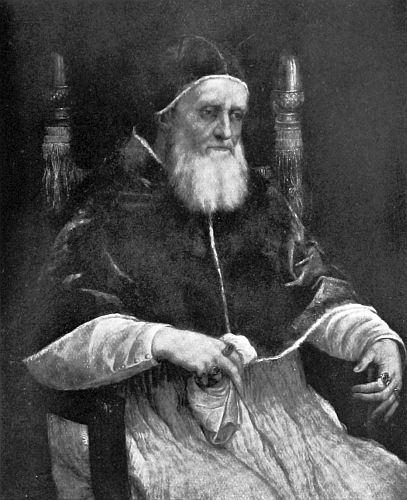
whilst in the cold and unimpassioned countenance of Giuliano, we
vainly seek for those massive features, and that angry scowl, which
the pencil of Raffaele subsequently immortalised. The group is
completed by the two younger nephews, Girolamo, Lord of Forlì, gawky
and common-place in figure, with the Prefect Giovanni, of blunt and
burly aspect. It would be difficult satisfactorily to render so large
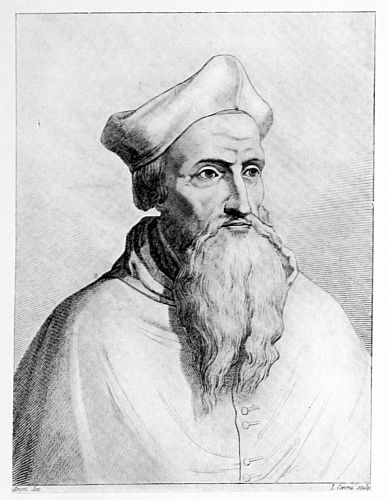
a group in these pages, but we give an unedited and speaking likeness
of the Pontiff from a miniature of the same size prefixed to the MS.
of Platina's Lives of the Popes, dedicated to him and now in the
Vatican Library.
Besides the claims of this fresco upon our notice, from representing
the important members of the della Rovere family, it would be still
more interesting to us, were it, as formerly supposed, from the
pencil of Pietro della Francesca, court-painter of Urbino. It is now,
however, ascribed, almost beyond question, to a pupil of his, sung by
Giovanni Sanzi, as
"Melozzo, dear to me,
Who to perspective farther limits gave." |
His accurate study of geometrical principles taught him the most
difficult art of foreshortening, which he particularly adapted
to ceilings and vaulted roofs with a magical effect heretofore
unattempted. Applying a like treatment to the human form, he
succeeded in giving to the features a relief not inferior to that
attained by the plastic manner of Squarcione and his followers,
but infinitely excelling them in natural and noble character; and
thus, for the first time since the revival, as in the picture just
described, he gave to simple portraiture the stamp of historical
delineation. Melozzo, by birth a Forlian, had probably attracted the
notice of Girolamo Riario, on taking possession of his new state,
and the patronage bestowed upon him by the Count and his brother the
Cardinal, reflects credit upon their discrimination. In 1473, he was
employed by the latter to paint, in the apsis of SS. Apostoli at
Rome, our Lord's Ascension in presence of the apostles, one of the
grandest works of the time, miserably sacrificed by the destructive
alterations of last century. Some much over-daubed fragments of this
wonderful composition are built into the great stair at the Quirinal
Palace, and single heads are preserved in the sacristy of St. Peter's.
The favour of this Pontiff, whom the prejudiced Infessura has
libelled as "the enemy of literary and reputable men," included
merit from every quarter. Baccio Pintelli, of Florence, was his chief
architect; Antonio Venezianello was conjoined by him with the Umbrian
della Francesca and Signorelli to decorate the sacristy at Loreto;
he pensioned Andrea d'Assisi, when early blindness had clouded those
great gifts ascribed to him by Vasari; the Tuscan Verrocchio, who had
come to Rome as a goldsmith, became, by his encouragement, a sculptor
of eminence, and the inventor of that charming style which da Vinci
brought to perfection in Lombard painting.
Deferring our notice of Giuliano, the favourite nephew of Sixtus
IV., we shall now mention his younger brother Giovanni,
immediate ancestor of the della Rovere Dukes of Urbino. He was born
in 1458, but we have no information as to his life before his uncle's
elevation. The ancient and honourable dignity of Prefect of the
favoured [alma] city of Rome was held by the Colonna, from the time
of Martin V., until the death of Antonio, Prince of Salerno, in 1472.
His son, Pier-Antonio, had been named to that office in reversion by
Pius II., but, upon the ground of nonage, Sixtus set aside his claim
and appointed his own nephew Leonardo della Rovere. He, too, having
died in 1475, the Pontiff conferred the prefecture, (with remainder
to his eldest son), on his next brother, Giovanni, to whom, on the
12th of the preceding October, he had given an investiture, in full
consistory, of Sinigaglia, Mondavio, Mondolfo, and Sta. Costanza.
At the same time, his marriage with Giovanna, second daughter of
Federigo, the newly-created Duke of Urbino, was celebrated with
becoming pomp, her dowry being 12,000 ducats; and on the 28th the
almost childish couple made a festive entry into their tiny state.
The Duke's presence and influence, though gladly given, were probably
not required to secure them a rapturous welcome, for elevation from
obscure provincialism to petty independence was ever a welcome boon
to an Italian community. To signalise and commemorate the auspicious
event, a young oak tree was planted in the piazza, with the motto in
Latin, "Long may it last," and was inaugurated amid boundless and
universal joy. A tournament was next day celebrated, succeeded by a
ball, in which the sovereigns and their new subjects freely mingled.
From the narrative of Fra Graziano[216] we learn the immense benefit
which the new order of things brought to that hitherto obscure town.
Though boasting a certain importance under imperial Rome, it had
become so decayed as hardly to afford stabling for twenty horses.
The Prefect lost not a moment in meeting the exigencies of his
position; and though but a boy in years, proved himself possessed
of matured wisdom. Summoning from all quarters the best architects
and engineers, he opened new streets, and paved them; built palaces,
churches, convents, and a large hospital; constructed a harbour,
erected a citadel, and fortified his capital. But his most happy
expedient was the encouragement of an annual fair, which, gradually
extending in importance, rendered Sinigaglia a mart of commerce, and
continues to this day the most important in Italy.[*217] Nor were
his exertions confined within the city. Mondaino and other places of
minor note shared these improvements; and he brought from Lombardy
and Romagna a population of skilful agriculturists, to clear and
cultivate the forest lands which spread far around, until his state
became a fertile and corn-exporting district.
The moral welfare of his people was meanwhile not overlooked; and
the strict propriety which he exerted himself to maintain, was
enforced by example as well as by precept. In his own practice,
and in the circle of his sanctimonious court, the decencies of
life were enforced with an almost monastic discipline, strangely
at variance with the usages of his age, and the temperament of his
near relations. Fra Graziano sums up his character as moderate in
his tastes, prudent in his counsels, mild, liberal, and just in
his administration, devoutly religious in his observances. His
consort possessed virtues, graces, and accomplishments worthy of her
husband's merits and her own beauty.
The Prefect does not, however, seem to have been able in person to
superintend the beneficent administration which he had the good sense
to institute, for the Pontiff's doating nepotism required much of
his presence after the loss of Pietro Riario. The youthful couple
accordingly spent several years at the Vatican; and on their return
home, in 1479, Giovanni was presented by the city of Sinigaglia with
twelve silver cups weighing eighteen pounds. In 1482, they were
again sent for by Sixtus, who gave his nephew a palace on the Lago
di Vico. Even after his uncle's death, the Prefect enjoyed a large
share of papal favour, having from Innocent VIII., the baton as
captain-general of the Church. But, on the accession of Alexander
VI., the star of the della Rovere waned. In Cardinal Giuliano his
Holiness saw a powerful and talented rival; in the Prefect an
obstacle to his ambitious views for his bastard progeny. The former
prudently retired to France; the latter lived quietly in his vicariat.
In 1494, the Lord of Sinigaglia signalised himself by a feat worthy
the freebooting practice of his times. Zizim, or Gem, son of Mahomet
II., had right by his father's will to half the Turkish empire, but
was expelled by his brother Bajazet, in 1482.[*218] Having fled
to Rhodes, and placed himself under the protection of the Grand
Master, Bajazet offered the latter a pension of 40,000 (or as some
say 450,000) golden ducats, on condition of his being retained in
safe custody. From Rhodes he was removed to France, and, in 1489,
was brought to Rome, where, though received with much distinction by
Innocent VIII., he found himself virtually a prisoner, or hostage.
Bajazet, after failure of an attempt to have him assassinated, agreed
to pay that Pontiff and his successor, the same yearly subsidy of
40,000 ducats for his custody and entertainment, besides supplying
the Holy See with various important Christian relics from Palestine.
In 1494, the Sultan's usual annual pension having been remitted to
Rome through one Giorgio Bucciardo, accompanied by costly presents
for Alexander VI., the envoy, on leaving Ancona, where he had
disembarked, was set upon and plundered by Giovanni della Rovere.
After appropriating most of the treasure, to extinguish alleged
arrears of pay from the Holy See to himself and his troops, the
Prefect sanctified the deed by dedicating the residue to pious works,
employing the rich oriental stuffs for church ornaments. Soon after,
there were circulated in Rome, certified copies of a correspondence
between Alexander and the Sultan, with the oral instructions of his
Holiness, which Bucciardo had been induced to divulge, and which
throws a curious colour on this chapter of diplomacy.[219]
The envoy, on being accredited to the Sultan, had to state to his
Highness, that the King of France was advancing upon Rome and
Naples, in order to dispossess Alfonso, the Pope's vassal and ally,
and to carry off Gem, with the project of providing him with a fleet,
and supporting him in an invasion of Turkey. That as his Holiness had
incurred great expenses in military preparations against a danger
thus affecting the Sultan as well as himself, he prayed from him an
advance of the 40,000 ducats due in November, to be remitted by the
bearer. And he was further to induce his Highness to adopt every
means likely to alienate his Venetian allies from French interests in
the approaching struggle, and to attach them to the party of Naples.
The Sultan's answer is contained in a letter addressed to the
Pontiff, wherein this passage occurs:—"For these reasons, we began,
with Giorgio Bucciardo, to consider that for your Potency's peace,
convenience, and honour, and for my satisfaction, it would be well
you should make the said Gem, my brother, die, who is deserving
of death, and detained in your hands; which would be most useful
to himself and your Potency, most conducive to tranquillity, and
further, very agreeable to myself! And if your Mightiness is content
to oblige me in this matter, as in your discretion we trust you will
do, it is desirable, for maintenance of your own authority, and for
our full satisfaction, that your Mightiness will, in the manner
that seems best to you, have the said Gem removed from the straits
of this world, transferring his soul to another life, where it will
enjoy more quiet. And if your Potency will do this, and will send us
his body to any place on this side of our channel, we, the foresaid
Sultan Bajazet Chan, promise to pay 300,000 ducats at any place your
Mightiness may stipulate, that your Potency may therewith buy some
sovereignties for your sons." To this cold-blooded offer are added
many general professions of eternal amity towards his Holiness, and
promises that his subjects will everywhere forbear from aggression
upon Christians; and after stating that he had in the envoy's
presence taken his oath for the performance of all these obligations,
he concludes thus:—"And further I, the aforesaid Sultan Bajazet
Chan, swear by the true God, who created the heaven, the earth, and
all things therein, in whom we believe, and whom we adore, that I
shall make performance of every thing contained above, and shall
never in any respect countermine or oppose your Mightiness. From
our palace at Constantinople, the 15th of September, in the year of
Christ's advent, 1494."
Although discredit was thrown upon these documents by the Roman
court, and the whole affair was alleged to be a device of Cardinals
della Rovere and Gurk, to screen the Prefect at the Pontiff's
expense,[220] it appears clear that a bribe was offered by Bajazet
for the destruction of his brother, who did not long survive this
incident. Alexander accepted 20,000 ducats from Charles VIII. to put
Gem into his hands during six months, as a tool for his ambitious
design upon the East; and in the treaty between his Holiness and
the French monarch, dated 15th January, 1495, there is a special
article that the former should consign "the Turk" to his Majesty
as a hostage, to be kept in the castle of Terracina, or elsewhere,
in the ecclesiastical territories, from whence Charles came under
a promise not to remove him "unless in case of need, in order to
prevent an invasion of the other Turks, or to make war upon them."
He also bound himself to defend the Pope from any descent of the
Infidel upon the Adriatic coast, and, on quitting Italy, to restore
Gem to his custody, his Holiness meanwhile continuing to draw the
Sultan's pension, and for due observance of these conditions, Charles
bound himself in a penalty of 800,000 ducats. By another article he
undertook to arbitrate in the complaint brought against the Prefect,
in the affair of Bucciardo and the captured subsidy. It is further
stipulated that the Cardinal della Rovere should be restored to
favour, and replaced as legate at Avignon; and that, on termination
of the Neapolitan enterprise, Ostia should be again surrendered into
his hands.[221]
This oriental Prince's sudden demise, which soon followed, was
attributed to various causes, but a general belief imputed it to
poison, in implement of the Pope's engagement to Bajazet. Zizim
is represented as far superior to his countrymen in mind and
attainments; and we shall by and by find him honoured as a Maecenas
of literature. A very different impression is, however, left by the
amusing, but obviously caricatured, description of him transmitted
from Rome in 1489, by Andrea Mantegna, the painter, to his patron
the Marquis of Mantua:[222]—"The Turk's brother is here, strictly
guarded in the palace of his Holiness, who allows him all sorts of
diversion, such as hunting, music, and the like. He often comes to
eat in this new palace where I am painting,[223] and for a barbarian,
his manners are not amiss. There is a sort of majestic bearing about
him, and he never doffs his cap to the Pope, having in fact none; for
which reason they don't raise the cowl to him either.[224] He eats
five times a-day, and sleeps as often; before meals he drinks sugared
water like a monkey. He has the gait of an elephant, but his people
praise him much, especially for his horsemanship; it may be so, but
I have never seen him take his feet out of the stirrups, or give any
other proof of skill. He is a most savage man, and has stabbed, at
least, four persons, who are said not to have survived four hours.
A few days ago, he gave such a cuffing to one of his interpreters
that they had to carry him to the river, in order to bring him round.
It is believed that Bacchus pays him many a visit. On the whole he
is dreaded by those about him. He takes little heed of any thing,
like one who does not understand, or has no reason. His way of life
is quite peculiar; he sleeps without undressing, and gives audience
sitting cross-legged, in the Parthian fashion. He carries on his head
sixty thousand yards of linen, and wears so long a pair of trowsers
that he is lost in them, and astonishes all beholders. Once I have
well seen him, I shall forward your Excellency a sketch of him, which
I should send you with this, but that I have not yet fairly got near
him; for when he gives now one sort of look and then another, in the
true inamorato style, I cannot impress his features on my memory.
Altogether he has a fearful face, especially when Bacchus has been
with him. I shall no longer tire your Excellency with this familiar
joking style; to whom I again and again commend myself, and pray your
pardon if too much at home." Homely it is in good earnest, being
written in the Lombardo-Venetian dialect, some passages of which
baffle translation.[225]
It is, however, time to return from the digression into which this
singular and romantic history of the Turkish Prince has tempted us.
Alexander, greatly exasperated by the insults put upon his envoy,
and by the loss of a most opportune remittance, threatened the
Prefect with deprivation of his state; but finding his people, and
the neighbouring communities prepared to stand by him, deferred his
vengeance. Notwithstanding a reference of the whole affair to the
French monarch, by the treaty of 1495, nearly six years elapsed ere
Giovanni della Rovere was formally absolved from the daring exploit.
He was not spared to witness the revival and aggrandisement of
his family's fortunes by his elder brother's election to the papal
throne. On the 6th of November, 1501, death found him already attired
in a winding-sheet appropriate to the devotional habits of the age,
the cowl formerly worn by the beatified Fra Giacomo della Marca.
Two miles west from Sinigaglia, on a rising ground which overlooks
the city, commanding the fertile vale of the Misa, from its Apennine
rampart to the bright waves of the blue Adriatic, there stands a
convent of Zoccolantine Franciscans. It was founded by the piety
of the Prefect and his consort; it was the chosen retreat of their
devotional hours, and was selected by them as the spot for their
last repose. There he was laid, agreeably to his dying wish, in
the Franciscan habit; and a plain marble slab in the pavement
commemorates his titles, and her worth, "in prosperity and adversity
comparable, nay preferable, to the best and noblest of her sex."
There, too, was composed by Father di Francia, guardian of the
convent, that brief record of the merits of his sovereign and patron
from which the preceding sketch has in part been compiled. The
original MS. has disappeared in the general havoc of ecclesiastical
treasures; but in the adjoining church there has been marvellously
preserved from the sacrilegious rapine of French invaders, from the
selfish gripe of unscrupulous collectors, and from the merciless
ignorance of modern restorers, an interesting memorial of the
persons, piety, and artistic tastes of this princely pair. Into a
small picture of the Madonna and Child are introduced, on either
side, portraits of Giovanni della Rovere and his wife, their arms
devoutly crossed, their dress displaying no royal gauds except her
simple string of pearls, and a large crystal bead suspended from his
neck by a double gold chain. Their regular and unimpassioned features
are, probably, somewhat idealised by the pencil of one more happy,
as well as more habituated, to embody inspirations of religious
mysticism, than to portray the indexes of human passion. Nothing is
known of the artist, but he must have been among the foremost in the
Umbrian school.
By his will, the Prefect left his only son under the joint
guardianship of the Venetian senate, his widow, his brother the
Cardinal, and the gallant Andrea Doria, whose faithful services
we have formerly mentioned. To his consort he bequeathed 20,000
ducats, and 7000 to each of his daughters. On the 18th of November,
Francesco Maria rode through Sinigaglia, to receive the allegiance
of his subjects; but being only eleven years of age, his mother
continued to govern for his behoof, whilst his education was chiefly
conducted at the court of her brother, the Duke of Urbino. For a
time she was spared the fate of the Romagnese princes; and it was
not until Guidobaldo's second flight that the arms of Borgia reached
her frontier. Aware how deeply her personal safety was perilled by
the approach of so sanguinary a foe, her friend Doria, who commanded
the garrison, sent her off disguised in male apparel; and, after
a fatiguing flight through mountain-paths, she reached Florence,
accompanied only by one confidential servant and a female attendant.
The defence of her citadel against an overwhelming force being
utterly vain, Doria retired just before the massacre of his allies by
Cesare Borgia, which we have recounted in our nineteenth chapter of
this work. There, too, we have narrated the young Prefect's escape
to France, where he remained under his uncle's auspices, until the
latter was called to assume the triple tiara. Giovanna lived until
1514, and passed from worldly trials just before adverse fortune had
again exiled her son from his rightful states. Ere we proceed to
consider his eventful life, we shall close this chapter with a few
brief notices of his uncle Giuliano, the greatest of the della Rovere
race.
An account of Julius II. should be, in a great degree, a
history of Italy during the crisis of its fate; but as we have in
other portions of this work to glance at those events of his life
and pontificate most connected with the politics of Urbino, and with
the succession of his nephew to that duchy, we shall here, as in the
case of his uncle Sixtus, limit ourselves to a few notices of his
character and personal history, including his exertions in behalf of
art.
Giuliano della Rovere[*226] was in most respects the reverse of
Pietro Riario, his cousin and rival in the affections of Sixtus IV.
Moderate in his tastes and habits, his attendants were chosen for
their orderly lives; his equipages were as scanty as the exigencies
of rank would permit; his table was economical as his apparel,
unless when called upon to show fitting hospitality to persons of
distinction. Among the virtues with which he adorned the dignity
of cardinal, Panvinio enumerates the modesty of his demeanour, the
gravity of his address, the elegance of his winning manners. The
less partial Volterrano characterises him as somewhat severe in
disposition, and of a genius ordinary as his learning. Dignities were
conferred upon him in rapid succession by his uncle, including the
sees of Albano, Sabina, Ostia, Velletri, and Avignon, with the more
important offices of Grand Penitentiary and Legate of Picene and
Avignon. The latter appointment occasioned his prolonged residence
out of Italy during the reign of Innocent VIII., and afforded him a
convenient escape from the snares of his inveterate enemy Alexander
VI. Their mutual disgusts, arising from opposite characters and rival
interests, were, according to Infessura, brought to a climax by the
Cardinal's adherence to Neapolitan interests, in December, 1492, on
the question of Leonora Queen of Hungary's divorce. He then retired
to his citadel-see at Ostia, where, at the abbey of Grotta Ferrata,
his moats and battlements remain, witnesses to his warlike spirit,
as well as to the perils of those troubled times. But, considering
himself even there insecure, he ere long withdrew to Naples, whence,
after narrowly escaping seizure by the Pope's emissaries, he again
reached Ostia in an open boat. On the approach of an army under
Nicolò Count of Pittigliano, he fled thence to France, leaving the
garrison in charge of the Prefect, who soon capitulated, on condition
that neither he nor his brother should incur ecclesiastical censures.
Grotto Ferrata was about the same time seized and delivered over to
Fabrizio Colonna, on payment of 10,000 ducats.
The outrages which the Cardinal had thus received at the hands of
the Borgian Pontiff, in unworthy vengeance for his honest opposition
to the nepotism and other scandals which then disgraced the Vatican,
galled his pride, tending to rouse that fierce spirit which, although
alien to the character ascribed to his earlier years, became the
bane of his pontificate. This was, indeed, the turning point of
his life, and it developed a policy utterly at variance with his
ultimate views. Having attended Charles in his march across the Alps,
his ardent temperament often aided to sustain that weak monarch's
wavering resolutions. Had he then considered more his country's
interests, and less his private wrongs, the storm might yet have been
averted, and Italy might have been spared, for a time, from those
ultramontane armaments which he now conducted into her bosom, but
which it was the aim of his after-life to eject. The French King,
having achieved his rapid acquisition of Naples, instigated the
Colonna to seize upon Ostia, and, as he passed northward, restored
it to its cardinal-bishop, who there once more sought security
from the Pope. But Giuliano found in his stronghold no adequate
protection against so bitter and unscrupulous a foe. Alexander, on
the retirement of the French army, entered into an alliance with the
reinstated King of Naples, and in 1497 employed Gonsalvo di Cordova
to reduce Ostia, whose garrison had embarrassed the navigation of the
Tiber, and intercepted supplies from his capital. Eschewing the risks
of an unavailing resistance, the Cardinal once more escaped by sea,
and rejoined Charles at Lyons, whilst the Great Captain was rewarded
for his easy conquest with the Golden Rose.
Cardinal della Rovere, having in 1597 been declared enemy of the Holy
See, and deprived of his benefices by the Pontiff, against the will
of the consistory, withdrew for security to his native shores, and
awaited at Savona the conclusion of what was to many of his order
a reign of terror. At the moment of Cesare Borgia's invasion of
Urbino, he narrowly escaped the fate destined for his brother-in-law
Guidobaldo, and his nephew, the young Prefect. On pretence of a
complimentary mission to Louis XII., the papal fleet had sailed
towards Provence, with orders to visit Savona, where, if the Cardinal
did not voluntarily pay his respects to the envoys, he was to be
inveigled on board, and carried off. But warned by past experience
against civilities emanating from such a quarter, he escaped the
danger by cautiously evading the perilous invitation.
The sudden and unanimous election of Giuliano to succeed Pius
III.—which we have elsewhere narrated—may well be deemed
marvellous, considering the various interests that distracted the
conclave, and the influence still ostensibly possessed in it by
Valentino, the arch-foe of the Rovere race. There could be no more
convincing proof that all parties were tired of the recent system,
nor of their resolution to put an end to similar enormities. His
morals, though hitherto far from immaculate, were pure in comparison
with those which prevailed around him; above all, his lapses were
neither matter of bravado, nor of open scandal.[227] His errors were
of a loftier range, and if more directly perilous to the public,
they belonged to a nobler category, and sprang from generous and
praiseworthy impulses, and tended to public objects and the elevation
of the papacy. Ascending a throne shaken by complicated convulsions,
succeeding to a treasury drained for selfish ends, and to an
authority waning under long-established abuses, it was his bounden
duty to beware ne aliquid detrimenti respublica capiat. But, not
content with resisting such further "detriment to the commonwealth,"
and with recovering the ground recently lost, his conscience, more
perhaps than his ambition, urged him to new triumphs. He was a great
pontiff after the mediæval estimate of the papacy. Little occupying
himself with the bulwarks of a faith which he presumed impregnable,
or the dogmas of a church still paramount over Christendom, he
considered the temporal sovereignty and aggrandisement of the Keys to
be his special vocation. Like the early Guelphs, he regarded Italy
as St. Peter's patrimony, to be vindicated from all intruders: to
establish her nationality, and extirpate the barbarian invaders,
were merely steps to that end. Italian unity, though not as yet
proposed for political aspirations or utopian dreams, was the result
towards which this policy would probably have led both Julius and
his successor, had the former been longer spared, and had the narrow
views with which the latter pursued it not involved him in continual
difficulties, and accelerated the decline of papal ascendancy.
But no personal ambition ever dictated the schemes of Julius, nor
did a thought for the nations whose destinies he hazarded ever cross
his mind. In the spirit of a crusader he marched against Perugia and
Bologna; he personally superintended the siege of Mirandula; and
when he donned the casque and cuirass, it was because they were to
him more familiar than the wiles of diplomacy. A stranger to those
dilatory tactics which we shall find marring the reputation of his
nephew, the Duke of Urbino, success crowned his aggressive measures
and impetuous movements, when greater circumspection might have
been attended with less advantageous results; and it was his good
fortune not to outlive those reverses which his precipitation almost
necessarily incurred. He was, in truth, gifted with qualities and
talents befitting the camp rather than the consistory, and Francis I.
pronounced him a better general of division than a pope. Had he been
bred a condottiere, the political aspect of Italy might have been
convulsed by him, and the papacy might have suffered still more from
his sword than it did from his policy. Yet if his militant tastes
occasioned greater scandal than the less blustering turbulence of
Alexander and Leo, and have proved equally detrimental to popery,
they are hallowed in the eyes of its champions in consideration
of his purer motives. By them accordingly he is upheld as one of
its pillars, while by most historians he has been mentioned as a
favourable exception to the prevailing bad faith of his times. Yet,
though greedy of conquest, he was far from indifferent to those
internal reforms requisite for the stability of his government.
According to Capello, the Venetian envoy, he possessed great
practical sagacity, and was led by no one, though willing to hear
all opinions. His judicious measures added two-thirds to the revenue
of the Holy See, chiefly by correcting the depreciated currency in
which it was paid. In personal expenses he was penuriously sparing,
contracting with his house-steward, to whom he allowed but 1500
ducats for the monthly bills of the palace.[228]
But this picture has its reverse. In the two following chapters
of these memoirs we shall find the head of the universal Church
harassing his flock by perpetual warfare—the high-priest of the
Christian hierarchy seemingly indifferent to the purity of Catholic
rites, and utterly oblivious of peace and charity.
By lovers of art the memory of Julius II. will ever be embalmed
among the foremost of its princely patrons, and his appreciation
of literature may be learned from his remark, that letters are
silver to the people, gold to the nobles, diamonds to princes. We
have elsewhere to speak of his vast undertakings in architecture,
sculpture, and painting, which earned from Vasari the reputation
of a spirited pontiff, bent upon leaving memorials of a zealous
and liberal encouragement of art. His lavish outlay on St. Peter's
strikingly contrasts with his habitual economy. To meet it he
authorised a general collection, towards which the Franciscans
gathered 27,000 ducats, and in 1507 he proclaimed a sale of jubilee
indulgences. This device laid all Christendom under contribution, and
proved so productive that he and Leo were tempted almost annually
to repeat it, little aware what weapons they were thus forging for
future schismatics. The example of his uncle Sixtus, in summoning for
the decoration of his capital whatever talent merited such patronage,
was followed up by him with the energy belonging to his nature.
Besides commencing the metropolitan fane, the immense cortile,
corridors, and loggie of the Vatican, and the unequalled frescoes
of the stanze, he was truly the founder of a museum of ancient art.
He rescued the Laocoon and rewarded its discoverer; the Apollo and
the Torso took their epithet of Belvidere from the pavilion in which
he placed them.
Rome owes to him, among other improvements, one of its longest and
finest streets, bearing his name, where he began a series of palaces
for public offices and the courts of justice, unfortunately never
completed. The churches which he re-founded or decorated include
S. Pietro in Montorio, Sta. Agnese, SS. Apostoli, and the Madonna
del Popolo. In the last of these are the beautiful windows which
he brought two famous glass-painters from Marseilles to execute;
and beneath them those purest specimens of the revival, in which he
invited Sansovino's exquisite chisel to commemorate his talented
rival Ascanio Sforza, and his cousin the Cardinal of Recanati. For
objects so laudable the moment was propitious, and fortune seconded
his efforts; but it was more than chance which enabled him to select
at once the greatest painter, the most gifted sculptor, and the first
architect whom the modern world has seen,—to give simultaneous
employment worthy of their genius to Raffaele, Michael Angelo, and
Bramante.
His successor has found among ourselves a biographer[*229] who
brought the enthusiasm of a eulogist to grace the more solid
qualifications of a historian, whose eloquence has thrown around
the era of Leo a brilliancy leaving in comparative obscurity the
pontificate of Julius, whence many of its rays were virtually
borrowed. But the progress of our narrative will lead us to introduce
some less flattered sketches of the Medicean pontiff. In stimulating
the search for choice fragments of antique sculpture, the son of
Lorenzo de' Medici but followed the course which his father had
indicated, and which Julius had zealously pursued. St. Peter's,
perverted under him into a crowning abuse destined to wean men from
their old faith, had been founded by his predecessor as the mighty
temple of a church, Catholic in fact as well as in name. Michael
Angelo, summoned by Julius to decorate his capital with the grandest
of his efforts in architecture, sculpture, and painting, was banished
by his successor to waste his energies in engineering the marble
quarries of Pietra Santa. Raphael was diverted by Leo from that cycle
of religious frescoes which the genius of Julius had commissioned,
in order to distract his powers upon multifarious, less important,
and less congenial occupations.
Nor need we fear a comparison between these pontiffs on more
important points of their respective policy. The wars of Julius were
undertaken for the aggrandisement of the papacy, and his nephew was
used as an instrument to that end. Those of Leo were waged for the
interests of his family at the expense of the Holy See. The former is
reported to have left five millions of golden ducats in the treasury;
the latter unquestionably burdened it with heavy debts. The measures
of Julius may have encouraged divisive courses and a schismatic
council; but those of Leo matured the Reformation, and permitted a
small cloud, which he might have dispersed while forming upon the
horizon, to spread unheeded over the heavens, until Central Europe
was withdrawn from the light and influence of the Roman church.
In fine, during the pontificates of Sixtus and of Julius more was
done for the encouragement of literature and arts, for the temporal
extension of the papacy, and for the embellishment of its metropolis,
than has ever been effected in any similar period. The combined
reigns of the two Medicean popes have left no equal memorials. It
cannot be doubted that the patronage bestowed by his ancestors on
men of science and letters was liberally continued by Leo; yet it is
as much to the zeal of partial historians, as to his own policy of
success, that he stands indebted for the halo of glory which marks
his as a golden age. In many instances he but followed out the aims
of Julius, reaping their undivided glory; in others he fell sadly
short of his predecessor in energy and comprehensive views. The bad
seed which he freely scattered ripened into irreparable mischiefs
under his vacillating nephew, and the sack of Rome, which we shall by
and by describe, was their crowning calamity. After that event the
proud city was once again left desolate and impoverished, the prey
of barbarian spoilers; its population thinned, its court outraged,
its glories gone. When the judgment of posterity has passed into a
proverb it is too late to question its equity, or to appeal from its
fiat, and the name of Leo the Tenth will thus remain identified with
his age as the star whence its lustre was derived, although Italy was
then brightened by not a few orbs of scarcely inferior brilliancy or
less genial influence.