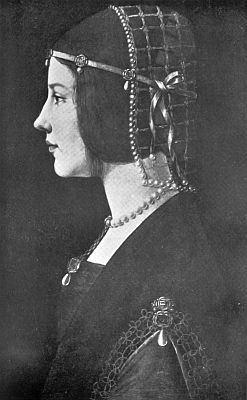
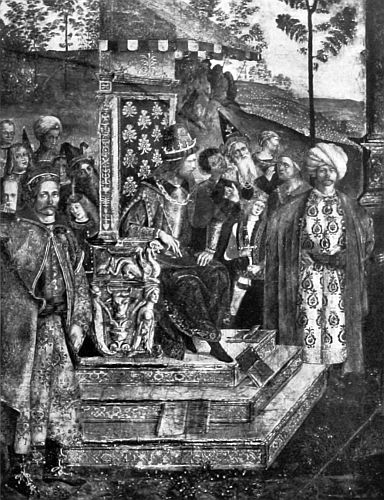
The war of Ferrara, and death of Duke Federigo—His
character and portraits.
THE sparks of discord, though smothered, were still smouldering in
many quarters. Sixtus, whose restless ambition was stirred by schemes
of nepotism for his unscrupulous nephew of Forlì, forgot not that
Ferdinand had baulked him of full vengeance upon the Medici, and
brooded over that monarch's threat of letting the Infidel march upon
his capital. He also calculated that, in the scramble of a general
war, some pickings might fall to the lot of Count Girolamo. Venice,
moreover, had had good cause for apprehending retribution for Naples,
for the scurvy trick she had played in bringing the Turks upon Lower
Italy; and thus was the way prepared for new party combinations. It
was against the Duke of Ferrara that these were chiefly directed; for
besides the offence of being son-in-law to Ferdinand, his territory
was a desirable acquisition both to the Republic and to Count
Girolamo. To Venice the latter accordingly proceeded in September, on
a mission from his uncle, and arranged for the partition of that
duchy, of which Lugo and Bagnacavallo were to be his share, with full
liberty to expel the Manfredi from Faenza and to appropriate their
possessions. Among other preliminaries, he stipulated that Federigo
should command the allied army, a proceeding not only unauthorised by
the Duke, but in direct opposition to the moderate counsels and
peaceful policy earnestly pressed by him upon the youthful envoy,
during a recent visit at Urbino. The appointment was accordingly
declined, nor was his determination shaken by an offer from the
Signory of 80,000 ducats as retaining pay, on condition of his taking
no part in the war: one of his family demurring to his rejection of so
advantageous a proposal, he replied, that "good faith and its
observance are still better, and worth more than all the gold in the
world." In a long and earnest letter he warned the Pontiff of the
impolicy and mischief of such projects, and the miserable results of
fresh contests in Italy; urged upon his Holiness that the moment was
favourable for turning the united arms of Christendom against the
Turks, while distracted by disputes between the sons of Mahomet; and
offered his shattered limbs for any post in that glorious cause. Views
so repugnant to the schemes of Sixtus had no weight in the Camera, and
gave great offence to Girolamo Riario.
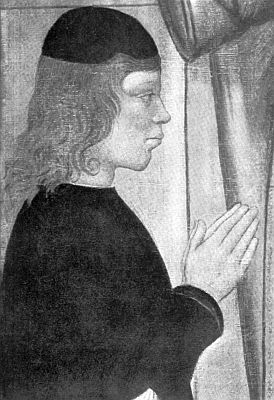
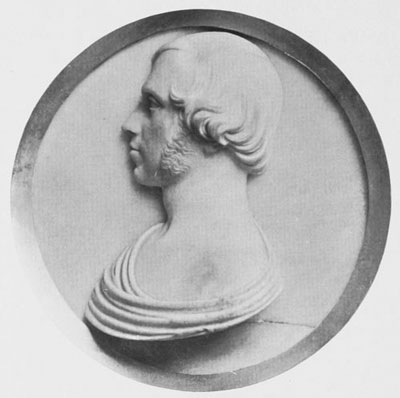
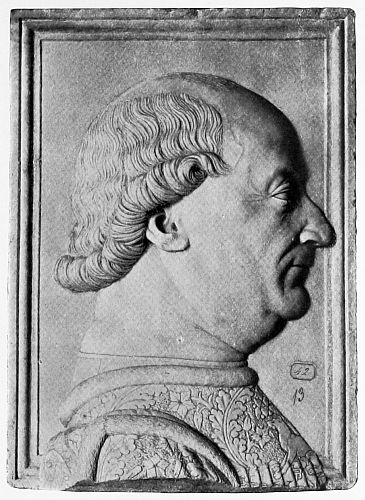
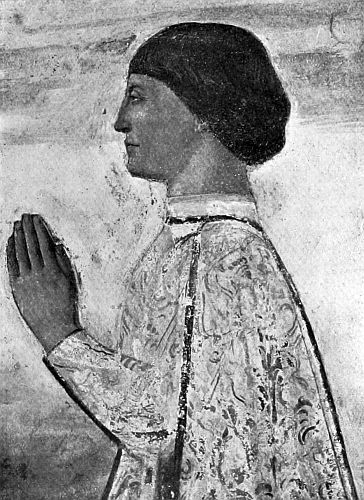
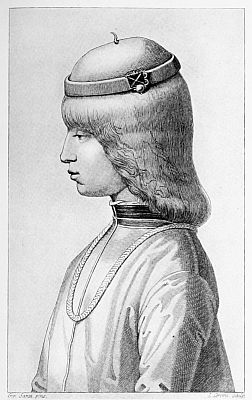
Alinari
ASTORGIO III. DE’ MANFREDI
From the picture by Scaletti in the Pinacoteca of Faenza
As it was in his father-in-law Ferdinand's quarrels that the Duke of
Ferrara was likely to be victimised, the former was not slow to
interpose for his protection. Personal feeling, as well as a sense of
justice and a keen perception of the true interests of Italy, brought
Lorenzo de' Medici to the same side, while the adherence of Milan,
Mantua, and Bologna was secured by an apprehension of the ambitious
advances of the Holy See and Venice upon Romagna and Lombardy. By
these six powers a league was accordingly formed to defend Ferrara;
and, on the 17th April, Federigo was engaged as its captain-general
for three years. During war he was to provide 600 men-at-arms and 562
infantry, with 165,000 golden ducats of pay; in peace he was to have
65,000 ducats, finding 300 men-at-arms and 375 foot soldiers. In the
event of death, his son and troops were to complete the stipulated
period of service, with 15,000 ducats of personal pay.[195] Opposed
to him was Roberto di Sanseverino, as leader of the Venetian army;
and the papal contingent was nominally under Count Girolamo, who did
not take the field, although the quarrel was in a great measure for
his profit. The command of the ecclesiastical forces, thus vacated by
the Duke of Urbino, had devolved upon his son-in-law Roberto
Malatesta, who remained in Central Italy to occupy the Neapolitan
troops at home, and protect Rome from the rebellious Colonna and
Savelli. The Genoese and the Marquis of Montferrat adhered to the
Venetian alliance.
The offer of an engagement by the League had been carried to Federigo,
by six envoys commissioned from its leading powers, and was readily
accepted. His preparations being completed, he set forth from his
capital on St. George's day, while tearful eyes and ominous sighs
attested his subjects' anxiety at the departure of their paternal
sovereign, bent by failing health and advancing years. Besides his
wonted suite, there followed him for many miles a train of men
distinguished in letters and arts, philosophers, theologians, jurists,
astronomers, and architects. By his side rode his nephew and
confidential friend Ottaviano della Carda, to whom, as if anticipating
his approaching end, he warmly and affectionately recommended his son
Guidobaldo and all his friends. At the foot of the Apennines this
sorrowing convoy quitted him to return home, whilst he crossed the
mountains to Borgo San Sepolchro, where he was received by Lorenzo de'
Medici. In the Val d'Arno he met his old and sage friend Antonio
Bellanti, with a troop of white-plumed lances, exiled from his native
Siena by adverse factions, and offered him a safe retreat in his state
until times should change; an invitation which he declined, and so
incurred a bloody death. At Florence the people gladly welcomed the
conqueror of Volterra, and the magistracy received him at the door of
the Palazzo Vecchio.
The war now impending was alike iniquitous in its motives, and
disastrous in its attendant circumstances. Its seat was in the lower
plains of Lombardy, where they merge into a wide delta, formed by the
arterial channels of the rivers Po and Adige, and veined by the minor
drainage of the Polesine and Ferrarese territories. Most of
"That level region, where no echo dwells,"
was, and still continues, so embanked that its waters may easily be
let loose upon the hapless cultivators, submerging their dwellings and
swamping their crops. Numerous streams, navigable by boats, laid it
open to privateering incursions, highly attractive to amphibious
Venetian adventurers. Finally, the malaria, always generated by summer
heats, was naturally more inveterate when invaders had opened the
sluices and broken the banks, thereby flooding an unusual extent of
marsh-land. Thus ravaged by fire and sword, and decimated by disease,
the unhappy natives had good cause to curse the ambition of which they
were victims. In no part of Italy had the people been so exempt from
the calamities of war. The family of Este, ever addicted to habits of
almost effeminate indulgence, had been long represented by Duke Borso,
whose reign, as described in the Ferrarese Diary, was one continued
revel at home and pageant abroad. Those who would understand the
extent to which prodigal magnificence and immoderate festivity were
carried in the Peninsula, will there find details of refined luxury
and lavish expenditure, scarcely credible in an age but emerging from
what we are accustomed to regard as barbarism, or in a state enjoying
no extraordinary resources.
The plan of the campaign was to reduce Ferrara by a combined attack,
in which a flotilla of five hundred vessels of light draught, fitted
out at Ancona and Venice, was to ascend the Po, and co-operate with
the troops of Sanseverino. War was proclaimed on the 3rd of May, but
the Venetian general had already opened his operations by invading the
Polesine, a fenny dependency of the d'Este family extending between
the Adige and the Po. Marching his army southward from Legnano, he
crossed the Veronese marshes upon a hastily constructed roadway of
beams, supported by flat boats and faggots, and attacked Mellara on
the north bank of the Po. Having taken it in three days, he advanced
eastward to Castelnuovo, which capitulated after a ten days' siege.
Following the river's course, he reached Ficheruolo on the 11th of
May, and immediately invested it. This place being scarcely more than
twelve miles from Ferrara, already menaced by the armament on the
lower reaches of the river, the Duke of Urbino advanced to meet the
enemy, and posted himself at La Stellata, which lay opposite
Ficheruolo and commanded the passes of the Po. His opinion of the
state of matters may best be gathered from a despatch addressed by him
about this time to Lorenzo de' Medici, and printed by Fabronio from
the Florentine archives.
"Magnificent and dearest Brother,
"Your mightiness will see by the copy, herewith sent to the
eight lords of the Balia, of a letter I have written to the
most illustrious Duke of Ferrara, that I am advised of the
loss of the fort of Mellara, and of the enemy's intention to
unite the flotilla with their land forces, and to advance
with the stream upon Ferrara: nor can there be a question
that this design may to a certain extent succeed, unless
prevented by speedy and effective measures on the part of
the most serene League, that illustrious lord not being able
to maintain himself single-handed, as your magnificence has
already heard from himself.
"The remedy that occurs to me in this urgent danger is that
your excellent Signory should send him as many infantry as
possible, preferring those of Romagna, and the Val di
Lamone, both as nearest and as the best drilled, and thus
more suitable than any others that can be thought of. And so
soon as the most illustrious Lord Duke of Milan shall
forward the infantry and cavalry, for whom I have applied to
him, I shall move upon the duchy to make the enemy pull up.
And when the most serene League shall provide what is
requisite for honour and utility, enabling me to face him, I
am prepared to prove to him that it is one thing to form a
project, but quite another to carry it into effect. I care
not to detain your magnificence, feeling assured that once
aware of the importance of this, your prudence will not
delay the needful provisions.
"I urgently remind your magnificence to forward with all
speed the infantry, as agreed on, into my state and that of
the Lord Costanzo [of Pesaro]; for I have ordered my
men-at-arms not to follow me till these come up, seeing it
would be a risk to expose our territories without a force
equal to defend them at all hazards.... From Rovere
[opposite Mellara], the 4th May, 1482."[196]
The affairs of the League were far from promising. Ferdinand, caring
little to send his troops through a hostile state in search of distant
and unprofitable laurels, preferred carrying on a little war of his
own against the Pope in the Pontine marshes to marching upon Lombardy.
The Tuscans, ever averse to battle-fields, employed their
stipendiaries, under Costanzo Sforza, in guarding the Umbrian
principalities. The brunt of the war thus fell upon the Lords of
Milan and Mantua; and the Duke of Urbino, ill satisfied with their
exertions, took boat soon after the date of this despatch, and
proceeded in person to urge further exertions upon them both. Sanzi,
somewhat inconsistently, selects this visit of urgency to pause upon
his raptures with the works of art he saw at Mantua, introducing an
episodical criticism, and a catalogue of the best painters and
sculptors of Italy, which will be afterwards noticed.[197] On the 20th
of May he returned, bringing with him their contingents to La
Stellata, where the League lay almost inactive during the siege of
Ficheruolo on the opposite bank of the Po, their offensive operations
being confined to a pretty constant and galling discharge of long
swivels across the river into the Venetian camp, which they also
submerged by cutting the banks of the Mincio. This irksome aggression
was answered by a message from Sanseverino that he would presently
return fire for their water, and by sending to Federigo a fox in a
cage, as a hint that, with all his cunning, he too might be entrapped;
a paltry taunt, which provoked only a smile from the veteran. No
warfare could be more irksome and inglorious; but Federigo, regarding
Ferrara as Italy's best bulwark against the ambitious maritime
Republic, resolved to defend it at any sacrifice. Ficheruolo held out
until the end of June, by which time the marsh fever had become more
fatal than human weapons, and mowed down both armies. The Venetian
proveditore or commissioner was among its earliest victims; but, as
the summer heats increased, the epidemic spread with augmented
virulence, until 20,000 men are said to have perished in this
miserable contest. Passing over the sad details, we may borrow from
Sanuto an absurd incident which varied these horrors. In order to
divert the people from their misfortunes, and to inspire them with
courage, their sovereign had devolved extensive powers upon a
commission or council of sixteen "sages," and the Duchess sent for a
wandering friar, whose eloquence and sanctity were in high repute, to
preach in the cathedral. One of his orations was wound up by an offer
to provide an armada of twelve galleons, which should disperse the
Venetian force before Ficheruolo. On the appointed day he produced a
dozen of pennons, each surmounted by a cross, along with figures of
Christ, the Madonna, and forty saints; and with these he formed a
procession, marching at its head, and followed by a concourse of
fanatics to the river's brink, opposite the leaguer. There he
commenced shouting a sermon across the stream to Sanseverino; but the
Duke of Urbino, attracted by the hubbub, sent him away, covered with
ridicule, saying, "Why, Father, the Venetians are not possessed! Tell
the Duchess it is money, artillery, and troops that we want to expel
them." Although Federigo's obstinate policy averted from the doomed
capital the visitation of a siege, its miseries were scarcely the less
from such exemption. Many dead bodies, thrown by both armies into the
river, aggravated the pestilence, which, spreading to the city, so
deterred the peasantry, that its supplies were interrupted, until
famine augmented the mortality. In this crisis, Sanzi represents the
commander of the League as addressing to the Pontiff the following
remonstrance:—
"Most holy Father! turn thy face away
From this so needless and destructive war,
Which direst ills on Italy entails:
Thy pastor's hand put forth that rose to pluck,
Ere others reap its glory: be invoked
With sov'reign and paternal care to free,
From discipline so ruinous and harsh,
Rome, and the dwellers in Ausonia's lands,
Whose bootless passions, pitiably wrecked,
In suicidal outrage spend themselves,
With benefit to none. While time remains,
Oh, Sire! this fatal error shun, nor choose
A course which all your merit tarnishes!"
|
The game in which Sixtus had engaged was one of selfish ambition and
nepotism, and he played it boldly, unmoved by this appeal, or by the
straits to which he was reduced by his lawless barons. In the words of
the same old chronicler,—
"Hapless was then the holy Father's case,
Each house in Rome a garrison, each street
Alive with armed escorts; e'en by day
Rapine was rife as in the lonely wood,
And unredressed, while cardinals
Were seized in full consistory; for now
Colonna's and Savelli's bands were up;
The Pontiff's power at discount."
|
Under a robust frame Federigo concealed the taint of a vitiated
constitution, and though but entering upon the autumn of life, long
exposure and fatigue, aggravated by repeated severe accidents, had
anticipated the effects of age. Yet he rallied from the first attack
of malaria, at all times dangerous to one of his years, and, had he
yielded to the persuasions of friends and confederates by retiring to
Bologna during the unhealthy season, his valuable life might have been
spared. He owned the justice of their apprehensions, but, deeming his
personal danger in remaining to be fully counterbalanced by the
probable loss of Ferrara, which, at that juncture, he considered the
key-stone of Italian policy, should he quit the army, he rejected the
reiterated representations of his family and adherents, refusing on
any consideration to relinquish the post of honour and duty. But,
whilst he spared not himself, he ever and anon renewed to the allied
powers his remonstrances against their folly in thus pitting a brave
army against a noxious climate. As his saddest trial was to see fresh
levies of his attached subjects prostrated by sickness on arriving
from the healthful breezes of their native uplands, he sent away his
son Antonio, with all whom he could spare, reserving in the camp at
La Stellata but 400 of his immediate followers, whom the foggy
atmosphere and putrid water soon thinned away to forty.
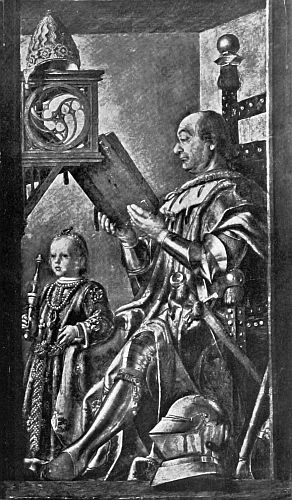
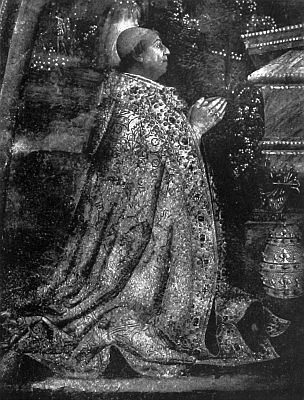
Anderson
FEDERIGO DI MONTEFELTRO
After the picture by Justus van Ghent, once in the Ducal Collection
at Urbino, now in the Palazzo Barberini in Rome
A relapse of fever having supervened about the beginning of September,
he felt that his end was approaching, and calling around him the
commissioners of the League, showed them how all his repeated warnings
had come true, protesting that his life was sacrificed to unflinching
duty in an evil cause. After exposing to them his plan of escape from
the jaws of destruction, by removing the seat of operations into a
healthy part of Lombardy, he recommended to them the surrounding
country and fortresses, and then formally resigned his command, thus
briefly reviewing his military career:—
"To Heaven's almighty Lord my thanks are due
For eight-and-forty years of manhood, spent
In war's most worthy calling, though of these
Three-fourths the cares of high command on me
Imposed, beneath time-honoured banners, all
Unstained by foreign insult, and upheld
Proudly victorious. Mine the task has been
To conquer further frontiers for their states,
With gainful triumphs and distinctions high,
Or vindicate a good and lasting peace."[198]
|
The commissioners at length, by affectionate persuasions, induced the
invalid to leave his army in charge of the Lord Giulio Orsini, and
withdraw to Ferrara, where a villa of the Duke was prepared for his
reception.[199] But it was too late. The disease rapidly gaining
ground, he set himself to prepare for death like a Christian hero,
and, by the grace of God, was permitted to do so in full exercise of
his mental powers. "Having arranged all matters pertaining to the
succession of his son, he began to attend to his soul's salvation,
and after confessing himself repeatedly, as a faithful and good
Christian, he set in order all that seemed to him tending to his
future welfare, and took, in their prescribed order, the sacraments of
the Church. It was graciously vouchsafed him from on high to perform
all this with a mind amply prepared by full examination, so that
nothing was omitted that behoved a faithful Christian; and this favour
was granted him by God for his perseverance through life in the
habitual exercise of virtue, for on every occasion his clemency
entitled him to the appellation of father of the miserable, and
protector of the afflicted."[200]
Among the friends who tended his last hours was his secretary,
Comandino Comandini, to whom he gave instructions for his funeral; but
his son, Count Antonio, having come from the army to visit him, was,
according to Sanzi, received with this reproof:—
"How! wouldst thou thus my gallant comrades quit,
In time of need, to gaze upon a corpse?
Far other course the urgent hour demands!
The sacred church's all-consoling rites,
Like staid and thoughtful Christian, then he sought:
Nor did they fail his latest pangs to cheer.
Few were the watchers round his lonely couch,
To whom, in sadly soothing words, he spoke
Of gentle kindness, and to God his soul
In peace committed, spurning mundane moils.
* * * * * * *
Just as a locust by the sun struck down,
With holy zeal his last behests were told
In charity and love; and, having touched
The hand of each in turn, with tears bedewed,
That lofty and unvanquished spirit sped;
Whilst on his lips, with pious fervour, late
Lingered the names of God and of our Lady,
Giving good hope, if man such signs may read,
That to a glorious home its flight was winged."
|
Veterani, another laureate of Urbino, composed a touching sonnet on
his patron's death, which begins thus:—
"With ever-welling tears I weep for him,
On him I call, of him I nightly dream,
And to my lips his cherished image strain,
Till by my stains of grief its smile grows dim.
To it my verse I vow, it living deem
For solace of my stricken soul, in vain!"
|
The Duke died on the 10th of September, within a few days of the
premature decease of Roberto Malatesta of Rimini, his son-in-law, and
successor in command of the papal troops.[*201] Aided by the factious
barons of the Campagna, the Duke of Calabria had gradually penetrated
to the gates of Rome, when Roberto, on the 21st of August, dispersed
his army in a pitched battle, and returned in triumph as saviour of
the Eternal City. His death supervened in a few days, in consequence
of a draught of cold water, or, as some thought, of poison
administered by the jealous Count of Forlì; and Sixtus, to testify
gratitude or remove suspicion, forthwith erected a monument to his
general in St. Peter's, with an epitaph testifying that his life had
been attended by valour, his death by victory.[202]
Although character is usually best estimated by the evidence of
contemporaries speaking from personal knowledge, some allowance must
be made for the language of adulation applied to princes by their
subjects or favourites. Yet in reference to one whose elevated
qualities are so well established as those of Federigo, less caution
than usual is requisite in adopting the words of his courtiers, and
seldom has the meed of praise been more amply confirmed by the award
of posterity. We shall, therefore, willingly give a place to the
testimony left by one of the most eminent of his acquaintances. Poggio
Bracciolino, who had studied the world in many courts and countries,
thus writes of him:—"Besides his rare eloquence and acquirements, and
the many excellent personal and mental endowments accorded him by
nature, his military skill was especially conspicuous, wherein he was
surpassed by no contemporary captain. For who does not know the
prudence of his undertakings, the promptitude of his actions, the
soundness of his decisions, rendering him as it were the model to our
age of those great men of antiquity gifted with all the arts of
command?" Francesco di Giorgio, the associate of his studies, and the
comrade of his campaigns towards the close of his glorious career,
ranks his generalship higher than any known to history from the days
of old Rome, and acknowledges himself his debtor for many important
suggestions as to fortification. The principle of his tactic was,
according to this most competent authority, great caution at the
commencement of an engagement, holding himself in readiness to support
any point exposed by mistake or failure of a subordinate; and, when
such opportunity occurred, an impetuous daring which, "with eyes to
see and wings to fly," remedied the mischief and secured the victory.
"Considerate of his soldiery, compassionate to the enemy, it was his
pleasure to mitigate the horrors and miseries of war. He was liberal
and merciful, but uncompromisingly just. An eloquent orator, a most
subtle philosopher, an eminent moralist, an expert and ingenious
mathematician, his intellectual habits were confirmed by long and
constant practice. So intense was his admiration of worth, that he
sought to attract to his court and reward every man conspicuous by
virtue and attainments. A Mars in the field, a Minerva in his
administration, he was equally feared and loved." Such is an abstract
of the character which Francesco terms but an atom of the encomium due
to his patron.
Let us now hear Pirro Pirotti, who seasons his tribute with something
more quaint and racy than most of the eulogists who followed in his
wake. In dedicating to Federigo the Cornucopia of his uncle Nicolò
(who had united the medley honours of apostolic secretary, governor of
Umbria, archbishop of Siponto, and poet-laureate of Frederick III.),
Pirro apostrophises its happiness, "in having you as the foremost to
welcome and assign it a place in this your palace, so truly worthy of
a victorious prince. At the first glance which it will enjoy on
entering your magnificent library, all glittering in marble, silver,
and gold, though without speech or life, it will seem to exult and
rejoice. It will also be read by you, in whom flourish all the virtues
desirable in a prince: it will experience your bounty, clemency,
courtesy, and wisdom. With you will it visit the porticoes, palaces,
fanes there raised, so costly and magnificent. It will admire your
experience in the arts of peace and of war; it will hear of your deeds
foreign and domestic, your successes far exceeding expectation, your
stratagems and triumphs, your fame, bounded but by the sun's far
circuit. It will survey with admiration your almost superhuman frame,
your robust limbs, your dignified bearing, your mature years, a rare
majesty, coupled with not less affability; qualities, in short,
befitting a prince selected as generalissimo of the Roman states. It
will further be the companion and sharer of your studies and your
discussions; it will witness all the honours you pay to professors of
belles-lettres, and the reception bestowed by you on men of learning,
in consequence whereof the fine arts, long exiled wanderers, are
through you alone restored to life and country."
Were we to quote every contemporary compliment to the Duke's
character, we should fatigue our readers with fulsome epithets. None
is more condensed or complete than the notice of his death by Pietro
Cyrneo, a resident in Venice, against which Federigo was then
fighting. "He was gifted with all virtues beyond all other mortals;
for he was a man of consummate prudence, truthful in his discourse,
righteous in his judgments, provident in his counsels, conspicuous for
his worth, distinguished for the uniform purity of his morals, liberal
of his charities; most eloquent, of unprecedented equity, consummate
justice, singular sincerity, superhuman wisdom; equally learned in
every branch of study, patient under reverses, most moderate in
prosperity; the bravest of generals."
One more such tribute, and we have done. It was paid by Vespasiano,
who concludes his biographical sketch with the attestation that,
having long resided at the court of Urbino, he witnessed most of what
he relates, and that whatever did not come under his own observation,
he had from persons of credit attached to the Duke's service.[203] "In
Messer Federigo were united many virtues, and his age produced no one
superior in every laudable quality. In military science, which was his
peculiar profession, he was excelled by no commander of his time;
uniting energy with consummate judgment, he conquered by prudence as
much as by force. The like wariness was observed in all his affairs;
and in none of his many battles was he ever worsted. More numerous
were the victories he gained and the places he captured, and all
redounding to his honour.... His modesty equalled his merit. Duke
Galeazzo Maria Sforza having one day observed, 'Whenever I have
fighting on hand, I should wish to keep by me your Lordship, who, in
my opinion, cannot be worsted'; he replied, 'I learned all that from
his excellency the Duke your father.'... Nor may I omit, among his
remarkable excellences, the strict observance of good faith, wherein
he never failed. All to whom he once gave his word, might testify to
his inviolate performance of it, but especially the two sovereigns of
Naples, whom he served above thirty-two years."
Of Federigo's personal habits and conduct, we borrow some interesting
sketches from the same pen:—"He was singularly religious, and most
observant of the Divine commands. No morning ever passed without his
hearing mass on his knees. He fasted on all the vigils enjoined by the
Church, and during every Lent. The year preceding his death, the Lord
Ottaviano, being most affectionately attached to him, procured from
the papal court a dispensation for his eating flesh, which was
presented to him one morning at table; whereupon, turning to Ottaviano
and smiling, he thanked him, but added, 'Since I am able enough to
fast, why will you not let me do so? What an example should I give to
my people in omitting it!' and so continued his meagre fare as before.
Every morning he attended mass and sermon with his household, and such
others as chose. During his forenoon meal he had a homily of St. Leo,
or some other religious book, read to him, and when any striking
passage occurred, he made the reader pause that he might understand it
thoroughly. His clemency and compassion were remarkable, and he was
prone to pardon all offences, excepting blasphemy and fraudulent
murder. He daily distributed at his palace a considerable amount of
bread and wine, besides administering to the necessities of many
unfortunate persons of learning or of birth. He was, in short, a
refuge for all men of worth. Large were his donations to charitable
institutions, and his secret alms to modest paupers; indeed, none ever
vainly appealed to his compassion. When an ecclesiastic came into his
presence, he took his hand with much respect, and would not let him
speak until seated by him; indeed, he honoured all holy men beyond any
other personage of my day. He liberally endowed various monastic
orders, and extended his special protection to the nunnery of Sta.
Chiara, which he had built in Urbino, repairing weekly to the grating
to inquire after the welfare of her inmates from the superior, an aged
and honourable lady. Even his own establishment was conducted with the
regularity of a religious fraternity, rather than like a military
household. Gambling and swearing were unknown, and singular decorum of
language was observed, whilst numerous noble youths, sent there to
learn good manners and military discipline, were brought up under the
most exemplary tuition.
"His subjects he regarded as his children, and was at all times
accessible to hear them personally state their petitions, being
careful to give answers without unnecessary delay. He walked freely
about the streets, entering their shops and work-rooms, and inquiring
into their circumstances with paternal interest. On market-days he
went among the peasants, conversing and jesting with them about their
bargains. When riding through the country, he always accosted those
whom he met; and by these various means, so gained the attachment of
his subjects, that, as he passed by, they used to bend the knee and
shower blessings upon him. The large sums he spent at home, on
buildings and other improvements, enriched his people, among whom a
pauper was nowhere seen.
"In summer he was in the saddle at dawn, and rode three or four miles
in the country with half-a-dozen of his court, attended by one servant
and two footmen unarmed, reaching home again when others were just up.
After mass, he went into an open garden and gave audience to all
comers until breakfast-time. When at table, he listened to the Latin
historians, chiefly Livy, except in Lent, when some religious book was
read, any one being free to enter the hall and speak with him then.
His fare was plain and substantial, denying himself sweet dishes and
wines, except drinks of pomegranates, cherries, apples, or other
fruits. After dinner and supper, an able judge of appeal stated in
Latin the causes brought before him, on which the Duke gave judgment
in that language; and I have been assured that these decisions were
worthy of Bartolo and Baldi.[204] When his mid-day meal was finished,
if no one appeared to demand audience, he retired to his closet and
transacted private business, or listened to reading until evening
approached, when he generally walked out, giving patient ear to all
who accosted him in the streets. He then occasionally visited the
convent of Sta. Chiara, or at other times repaired to a meadow of the
Franciscans, where thirty or forty of the youths brought up in his
court stripped their doublets, and played at throwing the bar, or at
wrestling, or ball. This was a fine sight, which the Duke much
enjoyed, encouraging the lads, and listening freely to all until
supper-time. When that and the audiences were over, he repaired to a
private apartment with his principal courtiers, whom, after some
familiar discourse, he would dismiss to bed, taunting them on their
sluggish indulgences of a morning.
"Federigo inculcated courtesy as a most valuable quality in a
sovereign, and he practised it to a remarkable degree in his
intercourse with all ranks. He entertained a very modest estimate of
his own merits, but was most particular in recollecting and
acknowledging services of any sort, and in giving credit for
assistance where it was due: he never indulged in detraction nor
permitted it in his presence. Though of a naturally choleric temper,
he by long attention brought it entirely under control, and was on all
occasions the peace-maker among his people. In short, no state of
Italy for a long period had been ruled by a sovereign in all respects
so worthy of admiration."
It would have been easy to condense the substance of these extracts in
smoother language and more balanced periods, but we prefer laying them
before the reader in their original form, and with the genuine impress
of the grateful feelings which dictated them. Although already
occupying so large a space, we venture to add a passage from Muzio,
who, writing seventy-two years after Federigo's death, had gleaned
from the traditions of Urbino several traits characteristic at once of
his hero, and of what is not less germane to our purpose, the
primitive manners of an age when European civilisation was starting
into vigour.
"In person, Federigo was of the common height, well made and
proportioned, active and stout, enduring of cold and heat, apparently
affected neither by hunger nor thirst, by sleeplessness nor fatigue.
His expression was cheerful and frank; he never was carried away by
passion, nor showed anger unless designedly. His language was equally
remarkable for modesty and politeness; and such his sobriety that,
having once had the gout, he immediately left off wine, and never
again returned to it. His inclinations were naturally amorous and
addicted to sensual indulgence, but so entirely were they under
control, that even in earliest youth nothing was ever alleged against
him inconsistent with decorum and the due influence of his rank. He
was uniformly courteous and benignant to those of private station, as
well as to his equals and to men of birth. With his soldiers he was
ever familiar, calling them all friends and brethren, and often
addressing them as gentlemen or honoured brothers, whilst he
personally assisted the sick and wounded and supplied them with money.
None such were excluded from his table; indeed he caressed and invited
them by turns, so that all loved, honoured, served, and extolled him,
and those who had once been under his command were unwilling to follow
any other leader.
"But if his kindness was notable in the camp, it was much more so
among his people. While at Urbino, he daily repaired to the
market-place, whither the citizens resorted for gossip and games, as
well as for business, mixing freely with them, and joining in
discourse, or looking on at their sports, like one of themselves,
sitting among them, or leaning on some one by the hand or arm. If, in
passing through the town, he noticed any one building a house, he
would stop to inquire how the work went on, encouraging him to
beautify it, and offering him aid if required, which he gave as well
as promised. Should any answer him, that although desirous of making a
handsome dwelling, he was frustrated by the refusal of some neighbour
to part with an adjoining hovel at a fair price, Federigo sent for its
obstructive owner, and urged him to promote the improvement of the
city, kindly assisting to arrange a home for him elsewhere. On hearing
that a merchant had suffered loss in his business, he would enter his
shop to inquire familiarly into his affairs, and, after learning the
extent of his difficulties, would advance him the means of restoring
his credit and trade. Once, meeting a citizen who had daughters to
marry, he said to him, 'How is your family?—have you got any of your
girls disposed of?' And being answered that he was ill able to endow
them, he helped him with money or an appointment, or set him in some
way of bettering himself. Indeed, such instances were numberless of
his charitable and sympathising acts, among which were the numerous
poor children of talent or studious tastes whom he educated out of
love for letters. On the death of those in his service, he took
special interest in their families, providing for their maintenance or
education, or appointing them to offices, and continually inquiring in
person as to their welfare. When the people came forth to meet him as
he went through his state, receiving him with festive demonstrations,
he had for each a word. To one, 'How are you?' to another,'How is your
old father?' or 'Where is your brother?' to a third, 'How does your
trade thrive?' or 'Have you got a wife yet?' One he took by the hand;
he put his hand on the shoulder of another; but spoke to all
uncovered, so that Ottaviano Ubaldini used to say, when any person was
much occupied, 'Why, you have more to do than Federigo's bonnet!'
Indeed, he often told the Duke that his cap was overworked, hinting
that he ought to maintain more dignity with his subjects. Talking of
his courtesy: when returning one day from Fossombrone to Urbino, he
met a bride being escorted to her husband by four citizens, as was
then customary; he at once dismounted, and joined them in accompanying
her, and sharing in their festivities.
"Many similar anecdotes are preserved of him at Urbino and other
places; and it is told that, during a year of great scarcity, several
citizens secretly stored up grain, in order to make a large profit,
which being known to the Duke, he summoned them to his presence, and
thus addressed them:—'My people, you see how severe is the dearth;
and that, unless some measures be adopted, it will increase daily. It
is thus my duty to provide for the support of the population. If,
therefore, any of you possess grain, say so, and let a note of it be
made, in order that it may be gradually brought to market for supply
of the needy; and I shall make up what is required, by importing from
Apulia all that is necessary for my state.' Some there were who stated
that they had a surplus beyond their own wants; others said they had
not even enough. Of the latter he demanded how much more they
required, and had a list taken of what each asked. He then regulated
the sale of what had been surrendered; and sent meanwhile to Apulia
for a large store of corn. When it arrived, he prohibited all further
sales of grain, and called upon those who had stated themselves as
short of supplies to purchase from him the quota they had applied for,
accepting of no excuse, on the allegation that, having bought in a
quantity for them, he could not let it be useless. Thus were those
punished who, refusing to sell what they had over at a fair price,
lost the advantage of their stock, and were forced to pay for more. In
the distribution of this imported grain, he desired that the poor who
could not pay in cash, should be supplied on such security as they
could offer. The distribution took place in the court of the palace,
under charge of Comandino, his secretary; and when any poor man came,
representing that, with a starving family and nothing left to sell, he
could find no cautioner, Federigo, after listening from a window to
the argument, would call out, 'Give it him, Comandino, I shall become
bound for him.' And subsequently when his ministers wished to enforce
payment from the securities, he in many instances prevented them,
saying, 'I am not a merchant: it is gain enough to have saved my
people from hunger.'
"There arose a notable matter which he had to settle, in reference to
Urbino. The citizens, having come to a resolution that no one from the
country ought to have houses in the town, petitioned Federigo to pass
such a law, on the ground that, the city being theirs, no one else
ought to intrude pretensions to it. He replied that there was much
reason in this, and that he wished to gratify them in every such just
proposal; but, before doing so, he wished their opinion what he ought
to say, should the country-folks in turn ask a favour, alleging that,
as the city was for the townsfolk, and the rural districts for
themselves, the citizens should be prohibited from holding extra-mural
property. Not knowing what to answer, they remained silent, and no
longer asked for any law of the sort. He was most particular in the
performance of justice, in acts as well as words. His master of the
household having obtained large supplies for the palace from a certain
tradesman, who had also many courtly creditors, and could not get
paid, the latter was obliged to have recourse to the Duke, who said,
'Summon me at law.' The man was retiring with a shrug of his
shoulders, when his lord told him not to be daunted, but to do what he
had desired, and it would turn out for his advantage and that of the
town. On his replying that no tipstaff could be found to hazard it,
Federigo sent an order to one to do whatever this merchant might
require for the ends of justice. Accordingly, as the Sovereign issued
from the palace with his retinue, the tipstaff stood forward, and
cited him to appear next day before the podestà, on the complaint of
such-a-one. Whereupon he, looking round, called for the master of his
household, and said, in presence of the court, 'Hear you what this man
says? Now give such instructions as shall save me from having to
appear from day to day before this or that tribunal.' And thus, not
only was the man paid, but his will was made clear to all,—that those
who owed should pay, without wronging their creditors.
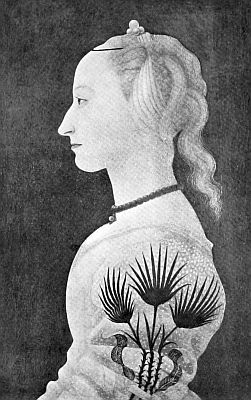
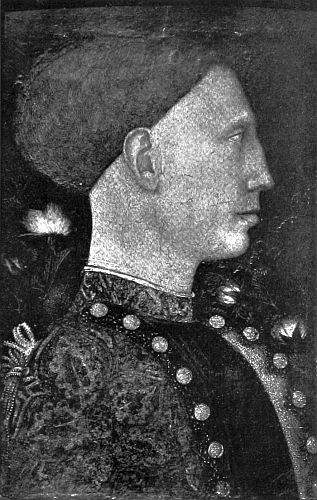
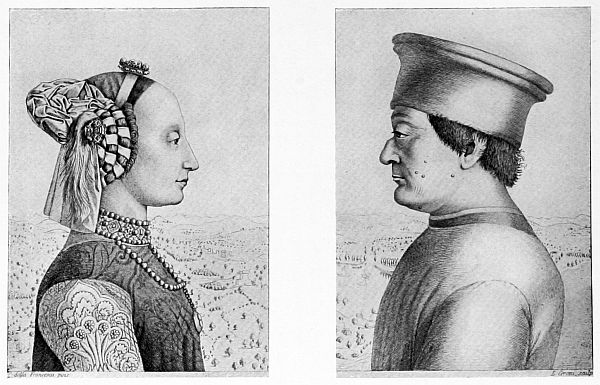
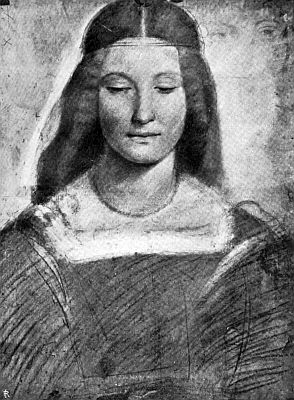
THE CONTESSA PALMA OF URBINO
After the portrait by Piero della Francesca in the National Gallery
"It having been represented to him that the fashion of going armed
gave daily occasion for brawls and tumults, he made the podestà put
forth a proclamation that no one should carry any weapon, and took
care to be passing with his court when the crier was publishing it.
Stopping to listen, he turned:—'Our podestà must have some good
reason for this order, and that being so, it is right he should be
obeyed.' He then, unbuckling his sword, gave it to one of his suite to
be taken home; whereupon all the others did the same. Thus by his
example he maintained more prompt and perfect justice than others
could effect by sentences, bail-bonds, imprisonments, tortures, or the
halter; ... and it was just when he made least show of power that he
was most a sovereign. One Nicolò da Cagli, an old and distinguished
soldier in his service, having lost a suit, went to Fossombrone to
lodge an appeal with Federigo, and, finding that he was hunting in the
park, followed him, without ever considering that the time and place
were ill adapted for such a purpose. At the moment when he put his
petition into his sovereign's hand, a hart went by with the hounds in
full cry. The Count spurred after them, and in the hurry of the moment
dropped the petition, which Nicolò taking as a personal slight, he
retired in great dudgeon, and went about abusing him roundly, as
unjust, ungrateful, and haughty. Federigo hearing of this, ordered the
commissary of Cagli to send the veteran to Urbino, who hesitated to
obey the summons, dreading punishment of his rashness. In reliance,
however, on his master's leniency, and his own merits, he set out, and
found the Count at breakfast in the great audience chamber. It was
customary while at his meals, for those who had the entrée to fall
back on each side, leaving the entrance clear, so that he saw Nicolò
come in: and when he had done eating, he called and thus addressed
him:—'I hear that you go about speaking much ill of me, and as I am
not aware of having ever offended you, I desire to know what you have
been saying, and of what you complain.' At first he turned it off with
some excuse, but on being pressed for an explanation, he recounted
what had occurred in the park; and that, considering his long and
zealous service, his sacrifices and wounds, it appeared to him a
slight, and virtually a cut direct, to run after a wild beast when he
came in search of justice; that having in consequence let slip the
opportunity of appealing, and so, irretrievably lost a cause of much
importance, he had in irritation given too great licence to his
tongue. Whereupon, Federigo, turning to the bystanders, said, 'Now see
what obligations I am under to my subjects, who not only peril their
lives in my service, but also teach me how to govern my state!' and
continued thus to the litigant, 'Friend Nicolò! you are quite right;
and since you have suffered from my fault, I shall make it up to you.'
He then ordered the commissary of Cagli to pay him down the value of
the house, and all his travelling expenses, although the fault was
clearly his for not bringing his appeal at a fitter time. Again,
during one severe winter, the monks at S. Bernardino,[*205] being
snowed up, and without any stores, rang their bells for assistance;
the alarm reaching Urbino, Federigo called out the people, and went at
their head to cut a way and carry provisions to the good friars."
These extracts, illustrating the true spirit of a paternal government,
amply account for the esteem in which the Duke of Urbino was held by
contemporaries, and for his fame which still survives in Italy,
although partially obscured north of the Alps by Sismondi's
indifference to whatever merit emerged among the petty sovereigns of
that fair land. Immensely superior to most of them in intellectual
refinement and in personal worth, he may be regarded as, in military
tactics, the type of his age, and was sought for and rewarded
accordingly. He served as captain-general under three pontiffs, two
kings of Naples, and two dukes of Milan. He repeatedly bore the baton
of Florence, and refused that of Venice. He was engaged by several of
the recurring Italian leagues as their leader in the field. From the
popes he earned his dukedom, and the royal guerdons of the Rose, the
Hat, and the Sword. Henry VII of England[*206] sent him the Garter;
Ferdinand of Naples conferred on him the Ermine. In fine, Marcilio
Ficino, a philosopher as well as a courtier, cited him as the ideal of
a perfect man and a wise prince.
Federigo's dying requests were, that his nephew and confidential
friend Ottaviano Ubaldini should charge himself with the care of his
youthful heir, and that his body should be interred by that of his
father in the parish church of S. Donato, a short distance eastward
from Urbino. The funeral, though celebrated with
"Those rites which custom doth impose,"
was more remarkable for the heartfelt grief which attested the
calamity fallen upon his people. His funeral oration, pronounced by
Odasio, whom we shall afterwards find performing the like sad office
to his son, is preserved in the Vatican, and has furnished us with
some traits of his character. His body, duly embalmed, was enclosed in
a marble sarcophagus in the new church of the Zoccolantines, which he
left unfinished, close to that of S. Donato.[*207] Thirty years after
his death, it was laid open by his grandson, Duke Francesco Maria, who
reverently plucked a few hairs from his manly breast.[208] The tomb,
thus strangely violated, remained open, and Baldi, who wrote in 1603,
describes the corpse as still perfect, except a slight injury to the
nose, and resembling a wooden figure, fleshless, and covered with
white skin. It was attired after the fashion of Italy, in a gala dress
of crimson satin and scarlet, with a sword by its side. Muzio tells us
that he too had seen the body half a century before, when it was
visited by Duke Guidobaldo II. and many of his people.
We may here notice six likenesses still preserving to us the form and
fashion of that body, with which his people's posterity thus strangely
held converse, beginning with, I. the portraits of Federigo and his
consort, painted in tempera by Piero della Francesca, now in the
Uffizi gallery at Florence, which we reproduce. The individuality
belonging alike to the features and the costumes could scarcely be
doubted, even had we not historical authority for the Count's broken
nose, and that of Giovanni Sanzi for Battista's "grave and modest
eye," already more particularly mentioned at page 218.[*209] The clear
tone and enamel finish are admirable, notwithstanding a thick varnish,
with which old tempera pictures are invariably dabbled, under the
recent management of the Florence gallery. The panels are painted on
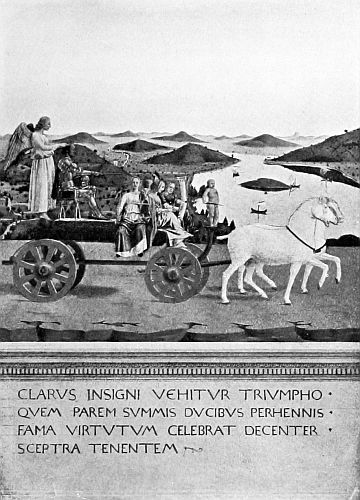
both sides, the subjects on the reverse being triumphs of the two
sovereigns in a style of mythological allegory then in fashion. On a
car drawn by two milk-white steeds with docked tails, driven by Cupid,
Federigo sits on a curule chair, in full armour, pointing forward with
his truncheon, and holding a helmet on his knee, whilst a winged
Victory, standing behind, crowns him with a garland. On the front of
the car ride four female figures, one of whom, representing Force, has
in her arms a broken Corinthian column; another, emblematic of
Prudence, is placed in the centre of the group, holding a mirror in
her hand; her face, bright with youthful hope, looks in advance to the
future, and the profile or mask of a bearded and wrinkled old man,
affixed to the back of her Janus head, contemplates the past with
matured experience; a metaphor closely followed by Raffaele for his
Jurisprudence in the Stanza della Segnatura. Justice is introduced
with her scales and two-edged sword; and the fourth figure is
scarcely seen. The distant country, in this as in the others of these
pictures, shows that their author was unable to apply to landscape the
excellence in linear perspective displayed by his architectural
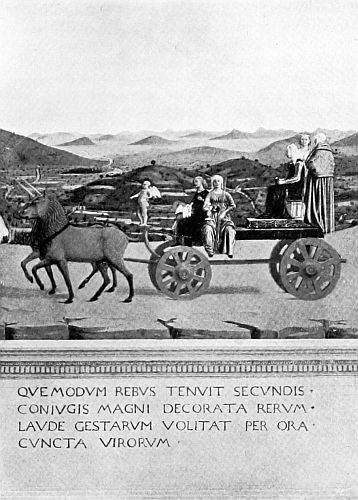
designs. Countess Battista's triumph is similarly treated; but her car
is drawn by bay unicorns, types of purity, and she sits on a chair of
state, splendidly attired, with an open book on her knee. Behind her a
bright maiden, meant probably for Truth, contrasts with an elderly
female in semi-monastic dress who may be intended for
"A pensive nun, devout and pure,
Sober, steadfast, and demure,
All in a robe of darkest grain,
Flowing with majestic train,
And ashy stole of Cyprus lawn
Over her decent shoulders drawn."
|
On the front of the car, Faith, with cross and chalice, sits by
Religion, on whose knee the pelican feeds her young, emblematic of the
Saviour's love for mankind. Under each of these allegorical paintings
is a strophe of Sapphic measure, which may be thus rendered:—
"In gorgeous triumph is borne the hero, whom enduring fame worthily
celebrates as a sovereign, equalling in his virtues the greatest
generals.
"Thus conducted amid her prosperity, and illustrated by the laurels of
her mighty husband's deeds, her name circles in the mouths of
mankind."[210]
II. Our next portrait of this Duke was probably obtained by the
Barberini family at the devolution of Urbino to the Holy See, about
1630, and remains in their palace at Rome. It is on a three-quarters
panel, life size, in full armour, wearing the ducal mantle of crimson
flowered with gold, and an ermine cape. From his neck hangs the order
of the Ermine, and below his left knee is the Garter. The ducal cap of
yellow silk, thickly studded with pearls, hangs on a tall lectern in
front of his armchair. He holds a crimson book, and reads from it to
his son, standing by his knee, in a yellow frock richly jewelled, a
sceptre in the boy's right hand. This head and figure have been copied
by Clovio, in an illuminated volume which we shall describe in VI. of
the Appendix; and although ascribed to Mantegna, they may rather be a
work of Piero della Francesca (if I may form an opinion after the
single visit and distant inspection allowed me in 1845 by its jealous
owner), but always with the proviso that that able artist's
blindness[*211] had not supervened in 1478, when, from the prince's
age, this picture must have been done. We have no notice of Mantegna
having been at Urbino, although this is probable, from Sanzi's
admiration of him.[212]
III. In 1843, there was in the possession of the widow Comerio, at
Milan, a very small head of Federigo on copper, which she wished to
sell as a Raffaele for 200l. I have learned, by the kindness of an
intelligent friend, that it is a good old copy of the seventeenth
century, the composition slightly varied from the Barberini picture
and Clovio miniature. It may have been the original of a poor
engraving prefixed to Muzio's life of this Duke, and would scarcely
have been noticed here had not the Abbé Pungileone, with his usual
lack of discrimination, ventured a conjecture that it was done by
Raffaele from a work of his father; a random guess, discountenanced by
the Italian editor of Quartremere de Quincy, notwithstanding his
readiness to adopt all speculative Raffaeles in the hands of his
Milanese townsmen. It is a duty to expose such blunders, especially
when greedily adopted as a foundation for imposture.
IV. The picture of which we have now to speak possesses strong claims
upon our interest. Among the artists of Urbino who will figure in our
twenty-seventh chapter was Fra Carnevale, a Dominican monk, who, at
the Duke's desire, painted, for his new church of the Zoccolantines,
an altar-piece, transferred by French rapine to the Brera gallery at
Milan, where the imperfect restitution of 1815 has left it. Tradition,
fortified by a questionable MS., points out the Madonna and child as
portraits of Countess Battista and her son, while Federigo's figure
kneeling before her throne, cannot be mistaken. But, as we shall
afterwards have occasion to show, the genius of Christian art was at
that time opposed to embodying in sacred personages the lineaments of
real life, and, although the apocryphal legend has been received
without challenge by two recent commentators on Fra Carnevale, a
monkish limner seems unlikely to have infringed the rule.[213]
Marchese, correctly describing the picture from Rosini's print, tells
us that before the enthroned Madonna and four attendant saints "is the
Duke of Urbino in armour, prostrate on his knees, and imploring her
favour for himself and his children, who appear grouped behind the
throne." After praising the life-like heads of these portraits, this
critic from the cloisters questions the propriety of so stowing away
the ducal progeny. But an artist friend, who at my request examined
the original work since I have been able to do so, informs me that the
latter are winged angels in long white robes and pearl necklaces,
although with faces apparently taken from the life. Federigo's figure
is unquestionably introduced, by a usual and very beautiful licence,
as donor of this altar-piece, thus bearing witness to the devotional
spirit which dictated his gift; and could we have it replaced in the
church that was reared at his bidding, over against the sarcophagus
which contains his remains, and believe that on its panel, painted in
pious commemoration of the birth of an heir, are preserved the
features of six of his family, no more interesting memorial of
Urbino's golden days could be conceived.
V. This Duke's portrait is delineated in another altar-piece at
Urbino, in which, being from the hand of a Fleming, such mixture of
sacred and historical art is less inconsistent. Having already alluded
at page 205 to the occasion on which it was commissioned, and having
to describe it in our thirtieth chapter, we need not further notice it
now.
VI. I saw at Florence in 1845, in the hands of Signor di Tivoli,
master of languages, an interesting but ruined picture painted on
panel, apparently by a Venetian master of the sixteenth century. In a
chair of state, on the elevated platform of a vast hall, is seated
Duke Federigo, with Guidobaldo at his knee, the Garter embroidered on
his left sleeve, and its star on his ducal mantle. Three courtiers
stand behind him, and another group on the floor below, listening to
the prelections of a figure in black robes. On a cornice of the saloon
is inscribed "Federigo Duke of Urbino and Count of Montefeltro." We
conjecture this subject to be a sitting of the Academy degli
Assorditi, though it may represent Odasio or some other lettered guest
reading his compositions: in either case the painting is an
interesting, though scarcely contemporary, memorial of this lettered
court.[214]
By his first marriage Federigo had no family, but his wife Battista
Sforza brought him eight children in twelve years. Their son was the
youngest, but the daughters' seniority is disputed.
1. Guidobaldo, his heir.
2. A daughter, who died in infancy, 1461.
3. Elisabetta, born in 1461-2, betrothed March 1471, and
married in 1475 to Roberto Malatesta, Lord of Rimini, with
12,000 florins of dowry. This match was intended to solder
up the long feuds of the Montefeltri and Malatesta. At the
age of twenty she heard, at the same moment, of the deaths
of her husband and her father, and soon after assumed the
veil by the name of Sister Chiara, in a convent of
Franciscan minor observantines which she founded at Urbino
in honour of that saint, endowing it with all her
possessions.
4. Giovanna, married in 1474, to Giovanni della Rovere,
nephew of Sixtus IV., who became Lord of Sinigaglia and
Prefect of Rome. From this marriage sprang the second
dynasty of Urbino, as we shall see in chapter xxxi.
5. Agnesina, married in 1474 to Fabrizio Colonna, Lord of
Marino, Duke of Albi and Tagliacozza. She inherited the
talents and literary tastes which, as we have already seen,
had descended to her mother, and transmitted them to a still
more gifted daughter, the illustrious Vittoria Colonna,
Marchioness of Pescara. Of this marriage was also born
Ascanio Colonna, Duke of Palliano, who, in 1526 and 1529,
set up claims upon Urbino, on the ground that his mother was
an elder sister of the Prefectess Giovanna.
6. Costanza, married to Antonello Sanseverino, Prince of
Salerno, and had a son born in 1507. Their grandson was the
patron of Bernardo Tasso, whom we shall mention in chapter
l.
7. Chiara, a nun.
8. Violante, married to Galeotto Malatesta.
Federigo's natural children were:—
1. Bonconte, a youth of singular promise and
accomplishments, on whom, in absence of legitimate issue,
were centred his father's hopes. Having been sent at
fourteen to the court of Naples, he died there of plague.
2. Antonio, who was legitimated, along with his eldest
brother, in 1454, and became a student. But soon devoting
himself to arms, he attended his father in many campaigns,
and especially in the fatal one of Ferrara. A cloud,
however, came over his military renown at the battle of the
Taro in 1495, where he misconducted himself under the banner
of St. Mark. He married Emilia, youngest daughter of Marco
Pio of Carpi, and died childless soon after 1500. His wife
was the chief ornament of Urbino when its court was the
model of intellectual refinement, and she will often be
noticed in after portions of this work. Her charming social
qualities are celebrated in prose and verse by Castiglione,
and she is called by Bembo a magnanimous and prudent lady,
remarkable for wisdom as for warm affection. The Duchess
Elisabetta, whose friend and companion she had been, alike
during the bright days of wedlock and the blight of
widowhood, bequeathed to her in 1527 the liferent of Poggio
d'Inverno, and appointed her an executrix of her will. Her
portrait from a medal will be found in our second volume.
3. Bernardino, who died at Castel Durante, 1458.
4. Gentile, a celebrated beauty, who married Agostino
Fregoso of Genoa, and had the Montefeltrian fief of Sta.
Agatha. Their sons, Ottaviano and Federigo Fregoso, will
figure in our twenty-first chapter, and attained the
respective dignities of Doge of Genoa and Cardinal.
Ottaviano's posterity were Marquises of Sta. Agatha in the
seventeenth century.