London, January 27, 1834.—Sir Henry Halford has just
been telling me that the late King George IV., whose senior
physician he was, asked him two days before his death to
say on his word of honour whether the case was desperate.
Sir Henry, with a significantly grave face, answered that
his Majesty's condition was very serious; whereupon the
King thanked him with a movement of his head, desired the
Sacrament and communicated very devoutly, inviting Sir
Henry to communicate along with him. Lady Conyngham
was in the adjoining room. So no human interest was
absent from the deathbed of the Royal charlatan while he
partook of the Sacrament for the last time.
London, February 7, 1834.—Yesterday I was at Lady
Holland's, who finished some story or other which she was
telling me by saying, "I didn't get this from Lady Keith
(Mme. de Flahaut), for she hasn't written to me for more
than two months." Then she added, "Did you know that
she hated the present Ministry in France?" "Of course,"
I answered; "it was you who told M. de Talleyrand all the
nasty things she was saying here about the French Cabinet
at the time when it was formed." "True," replied Lady
Holland, "all the same, the Cabinet must be preserved.
Lord Granville has written to Lord Holland to say that we
must not believe everything Lady Keith says about the
precariousness of the Duc de Broglie's position, for she is a
bitter enemy of his and longs for his downfall." I said
nothing, and the subject dropped. But, after this, don't
speak to me of the friendships of this world!
Anyhow, they write rather amusingly of M. and Mme. de
Flahaut from Paris, saying that their favour at the Tuileries
is declining, he being considered a superannuated coquette,
and she a foxy old intriguer.
Warwick Castle, February 10, 1834.—I left London the
day before yesterday, and got as far as Stony Stratford,
where I advise no one to pass the night. The beds are bad
even for England, and I never experienced anything more
like a trappist's couch. I left yesterday morning in the
midst of a bitterly cold and extremely thick fog. It was
impossible to get any idea of the country, which, however,
from certain occasional glimpses, I believe to be rather
pretty, especially about Iston Hall, a beautiful place owned
by Lord Porchester. You pass a superb gate, from which
there stretches a vast park, beyond which there is a view of
a valley which seemed to me charming. Leamington, a few
miles further on, is well built and cheerful.
As to Warwick itself, where I arrived yesterday morning,
one enters by a fortress gate. Its aspect is the most severe,
its courtyard the most sombre, its hall the most enormous,
its furniture the most Gothic, and its style the most perfect
that you can possibly imagine. Everything suggests the
feudal system. A large and rapid river bathes the foot of
the great dark old battlemented towers. The monotonous
noise of the water is interrupted by the crackling of the
great trees which burn in the gigantic fireplaces. In the
hall huge logs are piled upon the dogs which stand on
slabs of polished marble, and each log requires two men to
put it on the fire.
I have only just glanced rapidly at the stained glass in
the great broad windows, which are on the same scale as the
fireplaces, at the armour and the antlers and the other
curiosities of the hall, at the fine family portraits in the
three great drawing-rooms. As yet I am only familiar
with my own room, which is completely furnished with
Boulle and carved walnut, and, in addition to these antique
splendours, is full of all the modern comforts.
Lady Warwick's boudoir is also full of interesting things.
She came to my room yesterday to fetch me, and after
showing me the boudoir she took me to the little drawing-room,
where we found Lord Monson, the son of her first
marriage, a little man, or rather boy, shy and silent, and
much embarrassed by the exiguity and weakness of his
person. Lady Monson was also there. She is a striking
contrast to her husband, being a tall blonde Englishwoman,
stiff and bony, with long features and large hands, a great
broad flat chest, angular in her movements, and rather like
an old maid, but pretty and kindly. Here, too, was Lady
Eastnor, the sister of Lady Stuart of Rothesay; ugly, like
all her family, but well-bred, like all Lady Hardwicke's
daughters. Lord Eastnor, a mighty hunter and a great
eater and drinker, was also of the party; and his brother, a
parson, who, I believe, has not shaved since Christmas, and
who never opened his mouth except to eat. Lord Brooke,
the son of the house, is fifteen and very nice looking; his
tutor was with him, and was silent and respectful, as tutors
should be. Finally, there was the striking figure of Lady
Catherine Neeld, a sister of the Ashleys and a daughter of
Lord Shaftesbury. She is celebrated for the suit she brought
against her husband, of which all the papers were full last
year. She is a friend of Lady Warwick's who protects,
shelters, and defends her. She is a bold, rather loud person,
with a malicious tongue and familiar and somewhat audacious
manners. She is well made, has a white skin and beautiful
fair hair, but neither eyebrows nor eyelashes. Her face is
long and narrow; her eyes have no special merit, and her
nose and mouth remind you of what Madame de Sévigné
said of Madame de Sforze when she described her as being
like "a parrot eating a cherry."
Lord Warwick had a touch of rheumatic gout, and kept
his room. No one seemed to miss him.
The lady of the house is far from being in harmony with
the splendid pile which she inhabits. She has been pretty
without being beautiful; she is naturally witty, but has not
improved her gifts by study. She knows nothing of the
traditions of her castle. Her disposition is all towards fun
and informality; her bodily habits are nonchalant, and
altogether this plump, lazy, idle little woman seems anything
but the natural mistress of her vast, sombre, and almost
terrifying house. Moreover, every one seems to me a pigmy
in these rooms, to fill which you would require superhuman
creatures like the King-maker. Our generation is too
meanly proportioned for such an abode.
The dining-room is fine, but less grandiose than the rest
of the house. On leaving table a long time before the men
we went to the great drawing-room, which is flanked by two
smaller ones. In this huge room there are some splendid
Van Dycks, and the panelling is entirely of cedar in its
natural colour. The perfume of this wood is very agreeable.
The furniture is covered in velvet damask, the prevailing
tone of which is deep red. There are many really magnificent
pieces of Boulle, and several marbles brought back from
Italy. The two enormous windows form deep recesses and
have no curtains, being simply framed in cedar wood. In
this huge area there were only about a score of candles,
which reminded me of will-o'-the-wisps, which deceived the
eye rather than illuminated the room. I have never seen
anything more chilling and depressing than this drawing-room,
in which the ladies' conversation was very languid
indeed. I kept thinking that the portrait of Charles the
First and the bust of the Black Prince would come and join
us at coffee before the fire. At last the men came, and
after them the tea, and at ten o'clock a sort of supper. At
eleven a general move was made to bed, which seemed to be
a relief for every one.
During this long evening I thought many times of the
description given by Corinne of her mother-in-law's château.
At dinner nothing was talked of but county balls and
Leamington Spa, and other petty gossip of the neighbourhood.
Feature by feature it recalled Madame de Staël's
description.
In the morning Lady Warwick took me over the Castle,
which I should have got to know better if I had been left
to myself, or had been put in charge of one of the two
housekeepers, the elder of whom is ninety-three. To look at
her you would think she was going to tell you all about the
Wars of the Roses. The châtelaine cares nothing whatever
about all the curiosities with which her domain is stored, and
took me through them at breakneck speed.
I did, however, manage to stop for a moment before the
saddle and caparison of Queen Elizabeth, which she used on
her progress from Kenilworth to Warwick, and I took up
the lute presented by Lord Leicester to her Majesty, a
wonderfully carved instrument, with the Queen's arms in
raised copper on the wood, and close by them the favourite's
own, which seemed to me a trifle impertinent. I noticed
a curious portrait of the Queen in her coronation robes which
showed a terrible resemblance to her terrible father. A propos
of this portrait Lord Monson told me a thing I did not
know, viz., that Elizabeth, who always affected a youthful
appearance, never allowed herself to be painted except in
full face and so lighted as to avoid any shadow on her
features which might accentuate the lines, and so indicate
the number of her years. It is said that this idea was so
constantly in her mind that she always faced the light when
she gave audience.
The library at Warwick is not particularly remarkable,
and did not appear to me to be much used. Queen Anne's
bed-chamber with the bed of the period is a fine room.
At ten Lady Warwick and I entered a carriage, Lady
Monson and Lord Brooke escorting us on horseback, and we
drove through an interesting landscape to the celebrated
ruins of Kenilworth. There I was really disappointed, not
because the ruins do not give the idea of a vast and noble
building, but because the country is so flat, and the absence
of trees is so complete, that there is nothing which you could
call picturesque. It is true that there is a superb coat of
ivy over all, which is good as far as it goes, but is not enough
to make a picture.
Lady Monson is less ignorant of the locality than her
mother-in-law, and she pointed out to me the banqueting-hall,
Queen Elizabeth's room, the buildings constructed by
Leicester which, though more modern, are more ruinous than
the rest, and the gate-house through which the Queen's
procession passed, and which was built specially for the
occasion. This erection is still in a good state of preservation,
and is inhabited by one of the tenants of Lord Clarendon,
the owner of the ruins. In the interior there is a chimney-piece
with the initials and the crest of Leicester. The wing
in which Sir Walter Scott lodges Amy Robsart owes its
celebrity to romance and not to history.
I was not allowed to ascend the towers, as the stability of
the ruins is doubtful, and only last year Lady Sefton's niece
had an accident here. Besides I was assured that the view
was in no way remarkable.
We made a détour on the return journey and passed right
through Leamington. The whole town, and especially the
bathing establishment, seemed to me quite pretty. Just
now it is gay with hunting men, who live here much as they
do at Melton Mowbray.
When we got back it was not yet dark, and Lady
Warwick took me to see a pretty view of the River Avon
at the bottom of the park, which is beautifully planted.
I was also shown some glass-houses, which are neither very
well kept nor very full of flowers, but in which is kept the
Warwick Vase—a huge vessel of white marble beautifully
shaped and carved. It was brought back from the Garden
of Trajan by the father of the present Lord Warwick.
To-morrow I return to London.
London, February 12, 1834.—M. de Talleyrand told me
that yesterday evening, while playing whist with Madame de
Lieven, who had Lord Sefton for a partner, the Princess,
with her habitual absence of mind, revoked twice, whereupon
Lord Sefton quietly remarked that it was quite natural that
these abominable Dardanelles should often cause Madame de
Lieven to revoke. This caused much merriment to the
company.
I have a letter from M. Royer-Collard in which occurs the
following sentence: "I like M. de Bacourt very much
indeed. His clear, simple and intelligent conversation is
charming, and I find no one here who talks so well. Our
mutual understanding is complete."
London, February 15, 1834.—The Duchess-Countess of
Sutherland called for me yesterday and took Pauline and me
to the Panorama of the North Pole in which Captain Ross
plays a prominent part. Both painting and perspective are
beyond anything I have seen of its kind; but everything
which relates to adventures so terrible and sufferings so prolonged
is intensely interesting.
One of Captain Parry's crew in the Fury who had afterwards
been with Captain Ross, happened by chance to be
there. He gave Pauline a little piece of the fur with which
he had covered himself when among the Esquimaux, and
presented me with a fragment of granite taken from the
most northerly point reached by the expedition. We asked
him many questions, and he often recurred to the moment
when they sighted the Isabella, which rescued them and
brought them home. This was on the 26th of August, and
he told us that as long as he lived he would drink to the
memory of that happy moment on every anniversary.
Last night we had a rout, at which there was nothing
remarkable either in the way of dresses or of beauties or of
absurdities. The Marquis of Douglas is extraordinarily
handsome, and Miss Emily Hardy seemed to me rather
smitten with him.
The Ministry was represented by Lord Grey, Lord Lansdowne,
and Lord Melbourne. The Cabinet is much embarrassed,
for every day incidents are happening in the House
of Commons which show up vividly the serious divisions in
its ranks. Last night Lord Grey's face showed visible traces
of this.
London, February 20, 1834.—A new and very ugly story
is afloat concerning Count Alfred d'Orsay which is as follows:
Sir Willoughby Cotton, writing from Brighton at the same
time to Count d'Orsay and to Lady Fitzroy Somerset, cross-directed
the letters so that M. d'Orsay on opening the letter
which he received, instead of seeing the mistake and stopping
at the first line, which ran "Dear Lady Fitzroy," read it
through and found, among other Brighton gossip, some
pleasantries about Lady Tullemore and one of her lovers, and
a sharp saying about himself. What did he do but go to
the club, read out the letter before every one, and finally
put it under cover and send it to Lord Tullemore! The
result very nearly was a crop of duels. Lady Tullemore
is very ill, and the guilty lover has fled to Paris. Friends
intervened, however, and the thing was hushed up for the sake
of the ladies, but M. d'Orsay cut (and cuts) an odious figure.
London, February 27, 1834.—The latest joke is to spread
rumours of Lord Palmerston's marriage with Miss Jerningham.
She was at the Russian Embassy yesterday overdressed
and bedizened as usual. Madame de Lieven made her a
target for her wit, but couldn't quite get out of inviting her.
No doubt, in order to avenge this constraint, she said quite
loudly that Miss Jerningham reminded her of the usual
advertisement in the Times: "A housemaid wants a
situation in a family where a footman is kept." Clever and
only too true, but most uncharitable! She was good enough
to add that the comic papers had christened Lord Palmerston
"the venerable cupid."
London, May 1, 1834.—Mr. Salomon Dedel arrived this
morning from the Hague, bringing me a letter from General
Fagel, which contained the following: "Someone has found
out that Dedel had expressed the hope that he might
reappear in London armed with instructions to bring the
affair to a conclusion." Dedel mentioned the matter to the
King, who replied: "The purpose of your absence was to see
your relatives and friends of whom you can give news if anybody
asks you." Further on the same letter runs: "We wish
to be forced by the five powers, and will take no account of
a partial coercion like that of 1832. If the powers are not
unanimous we shall continue to refuse any definite arrangement.
At the worst we prefer the road to Silesia to
recognising Leopold."
Madame de Jaucourt, referring to the insane party spirit
now in the ascendant in France, writes to M. de Talleyrand
that her brother M. de Thiard said at her house the other
day: "I would give my right arm to have Charles X. back
in the place from which we deposed him."
Is it not curious that young Baillot, who has just been
assassinated during the late troubles in Paris, should have
often boasted of having killed several people during the days
of July 1830 in exactly the same way as he was killed
himself?
I have just heard of an amusing thing said by the old
Marchioness of Salisbury. Last Sunday she was at church,
a rare thing with her, and the preacher, speaking of the Fall,
observed that Adam excusing himself had cried out, "Lord
the woman tempted me." At this quotation Lady Salisbury,
who appeared not to have heard of the incident before,
jumped up in her seat saying, "Shabby fellow indeed!"
I have just been paying a morning call on the Queen,
whom I found much agitated, anxious, and yet pleased,
about her impending journey to Germany. The King
arranged it without her knowledge and superintended the
smallest details. It is he who has chosen the suite, engaged
the servants, and selected the carriages. It has all been done
in such a hurry that the Queen has not yet recovered from
the shock. She doesn't know whether to be glad at the
prospect of seeing her mother, who is aged and infirm, or to
be worried about leaving the King alone for six weeks.
She told me that the King wanted to invite M. de Talleyrand
and me to Windsor during our stay at Salt Hill, but that she
herself had dissuaded him as it would have led to other
invitations, and they would have had to ask, among other
people, the Princesse de Lieven, for whom the King does not
care.
The Queen coughs and thinks herself quite ill, but she
hopes to be restored by her native air.
It is impossible not to be struck, every time one sees her,
with the perfect simplicity, truth and uprightness of her
Majesty's character. I have rarely seen a person more
devoted to duty or more self-consistent in all that she says
and does. She is both kind and cheerful, and, though not
beautiful, she is perfectly graceful. The tones of her voice
are unfortunately nasal, but what she says is so full of good
sense and real kindness that it is a pleasure to listen to her.
The satisfaction she feels in speaking German is very natural,
and I feel this every time she does so. I wish, however,
that she indulged herself in this way more sparingly in the
presence of English people. In her own interest it would
be better for her if she had more of the Englishwoman in
her; no one could have remained more characteristically
German than she has, and I fear that this sometimes gives
offence. How is a monarch to escape doing so nowadays?
They are made responsible for everything and are always
threatened with punishment merited or unmerited. The
poor Queen has already a sad experience of the bitterness of
unpopularity and of calumny. She has always faced attack
with dignity and valour, and I am sure she has courage
enough to confront any danger.
This is St. Philip's day; the Lievens and Lady Cowper
dined with us, and Prince Esterhazy came in afterwards. I
have noticed for some time a certain sharpness in his manner
to the Lievens which is unusual in him. The pleasantries
which he addresses to the Princess soon turn to irony. I
suspect that on her side she will not regret his departure.
She has never managed to subdue him; he slips through
her fingers, and his jests, always subtle and sometimes malicious,
embarrass her and put her out. They are constantly
on their guard with one another, and they make up for the
resulting constraint by frequent interchanges of pin pricks.
The Queen told me that Esterhazy, when lately at
Windsor, spoke to her of M. de Talleyrand with the greatest
enthusiasm, saying that one of his greatest pleasures was to
listen to his conversation. He added, that when he got
home he often made a note of what he had heard from
M. de Talleyrand. It seems that Esterhazy keeps a
journal in great detail. He told the Queen so, and explained
that this habit was of such long standing that the journal
already filled several large volumes, which he was fond of
re-reading. The Queen was surprised, not unnaturally, to
discover such a sedentary habit so consistently maintained
by one whose manners were so restless and whose ideas were
so often scattered.
Lord Palmerston since our return from France has never
accepted an invitation to dinner with us, and has never come
to a single one of our receptions. However, we invited him
again to-night, and thought that the presence of Lady Cowper
might attract him, but he sent excuses at the last moment.
London, Friday, May 2, 1834.—Alva writes that he
hears from his nephew, the Marquis de Miraflorès the Spanish
Minister in London, that Lord Palmerston never ceases
praising the brilliancy of his diplomatic début here. The
marquis, being a fool, does not perceive the cause of this
eulogium, which is, of course, the treaty of quadruple alliance
proposed by him at Lord Palmerston's own instigation, the
results of which, though by no means apparent as yet, may
be more embarrassing than pleasing to its author and to
France.
M. de Montrond writes to M. de Talleyrand to say that
he has caused his desire to come to London to be intimated
to M. de Rigny, who, before allowing him to go, desires him
to make sure whether M. de Talleyrand would like it. M.
de Montrond is much annoyed at this obstacle, but I am
grateful to M. de Rigny for having raised it. As a matter
of fact, last year M. de Montrond professed to be charged
with a secret diplomatic mission, and was simply a nuisance.
The bad temper he felt and showed when he was not
admitted to the secret concerns of the Embassy often made
him forget his manners, annoyed M. de Talleyrand and was
most unpleasant for everybody. For the last eighteen
months M. de Montrond has had the management of a
thousand Louis of the Foreign Affairs Secret Service money:
I doubt if he ever gives them back the change!
In London all the workmen are in rebellion; the tailors
have stopped work for want of hands. It is said that on
the cards for Lady Lansdowne's ball there was inscribed:
"The gentlemen to appear in their old coats." Now the
laundries have caught the infection, and soon we shall have
to wash our own linen like the princesses in the Odyssey.
London, May 3, 1834.—M. de Talleyrand speaks with as
much truth as wit of the "dangerous benevolence" of Lord
Holland. With the most perfect geniality, the most
equable temper, the gayest pleasantries, and the most
obliging manner in the world, his Lordship is always ready
to set light to the revolutionary train, and he feels the
greatest annoyance of which he is capable when he is
unsuccessful.
Yesterday I dined with Sir Stratford Canning. His
house is curious, beautiful, admirably planned and full of
souvenirs of Constantinople and of Spain. He himself is
full of courtesy and learning; his conversation is witty, and
if it were not for a certain contraction of the lips which
spoils an otherwise fine face, and for the oppressed air
of his wife, one could hardly understand the bad accounts
of him which one hears almost everywhere. This, at
least, was the pretext on which the Czar refused to receive
him last winter as Ambassador at St. Petersburg.
London, May 4, 1834.—Koreff is a braggadocious creature
with a vein of indiscreet curiosity which I have sometimes
noticed on the Continent, and which here inspires me with
the most profound mistrust. His wit and his learning are
lost among the bad features of his character, which often
make him quite impossible. He lives on gossip of all kinds,
public and private, and when he can get nothing else to
talk about he talks about medicine. Then he assumes the
physician and deifies his art. You hear of patients saved by
him when all hope was gone; of his marvellous discoveries,
of magnetism, homeopathy true and false, of things natural
and supernatural, possible and impossible. Everything
serves to magnify his importance, to surround the poor
creature with an atmosphere of the marvellous, which covers
his want of real dignity.
We had him to dinner with Sir Henry Halford, and I
don't think they took to each other. What, indeed, could
they have in common? Science perhaps, if by science they
both understood the same thing. Sir Henry is a suave and
polished person—measured, discreet, supple, and deferential;
a perfect courtier, a man of fortune, highly respected, and a
great practitioner. He has never sought to be anything to
the great but their doctor, and consequently, without seeking
it, he has found himself in all family and State secrets.
Koreff, on the other hand, poses as a man of letters and a
statesman, and has thus made persons in great places chary
of having him as their doctor. This was how he came to
grief at Berlin; he will find it difficult to regain his ground
at Paris, and he won't, in my opinion, be a success in
London.
A propos of gossip and indiscreet curiosity, I cannot forget
a very true reflection which the Duke of Wellington has
just imparted to me on the subject of Alava. "Whoever
aims at being in everybody's confidence," said his Grace,
"must necessarily give his own confidence to more than one
person, and this he usually does at some one else's expense."
The Duke's honest commonsense is admirable. I had a
long talk with him to-day at dinner, and I should like to
remember everything he said. Truth and simplicity are
becoming so rare that one is anxious to gather up the
crumbs.
The Duke of Wellington's memory is very sure. He
never quotes inexactly; he forgets nothing and never
exaggerates; and if there is something a trifle abrupt, a
little dry and military in his conversation, what he says is
nevertheless attractive owing to its naturalness, its fairness,
and the perfect good manners with which he says it. His
manners are indeed excellent, and a woman has never to be
on her guard against a conversation taking an awkward
turn. In this respect he is much more reserved than
Lord Grey, though in many ways the latter's education is
more elaborate and his intelligence more cultivated than the
Duke's.
The Duke of Wellington made a rather striking remark
to me about the English character, to the effect that no
people have a greater hatred of crimes of violence. In
England a murder is discovered with the greatest promptitude.
Every one helps to discover the assassin; tracks him
out and denounces him, and is eager that justice should be
done. He assured me that the English soldier is the least
cruel in the world, and that once a battle is over he hardly
ever commits deeds of violence. He is a great robber, no
doubt, but not a murderer.
The excessive and naïve vanity of Lady Jersey, which
amuses the Duke, led us to talk of Madame de Staël, with
whom he was well acquainted, and whose absurd pretensions
struck him as much as her wit and eloquence dazzled him.
Madame de Staël, who wished to appear to his Grace in
every character—even in the most feminine—observed one
day that what she liked most in the world to hear was a
declaration of love. She was so elderly and so ugly that
the Duke could not help replying, "Yes, when you can be
sure that it is genuine."
Lady Londonderry, who is celebrated for her eccentricities,
being near her time, and certain she would have a son,
has ordered a little hussar costume—the uniform of her husband's
regiment. When she was ordering it she told the
tailor that it was for a child six days old. "Your ladyship
means six years?" replied the tailor. "No, indeed,"
answered Lady Londonderry; "six days; it is for his
baptism!"
In the last years of George IV. the Duke of Cumberland
enjoyed a good deal of his favour. Yet it was then that
the King said, in reply to the Duke of Wellington's inquiry
why H.R.H. was so universally unpopular: "It is because
there are no lovers, no brothers and sisters, no friends, whom
the Duke of Cumberland would not set by the ears if he
came among them." It is said, however, that the Duke is
no fool, but so cross-grained that he spoils everything
he touches.
The Queen's approaching departure for Germany is causing
anxiety to the King's best friends. It appears that his
Majesty, who is the best of men, is subject to occasional
attacks of strange excitement, that he takes extraordinary
ideas into his head, and that his condition is sometimes so
abnormal that he threatens to lose his balance altogether.
The Queen, with her watchful kindness and her excellent
good sense, watches over him at these crises, cuts them
short, exercises a calming and moderating influence, and
brings him back to a proper frame of mind.
At the present moment the King is very angry with
Dom Pedro about the last commercial decree, which was
published in Portugal the very day before the signature of
the treaty of quadruple alliance in London. His annoyance
will probably not carry him so far as to refuse to ratify the
treaty, for with all his goodness the poor King is not very
"consistent," as they say here.
I am told that Lord Durham was so uplifted by the
reception prepared for him two years ago at St. Petersburg
by the efforts of Madame de Lieven, and by that which he
obtained recently at Paris (thanks to M. de Talleyrand's
letters), that he doesn't think that a private situation is any
longer worthy of him. His plan, of which he makes no secret,
is to turn out Lord Grey, his father-in-law, and to put
himself in his place, or at least to get into the Cabinet, the
result of which would be the resignation of all the other
members. He would, perhaps, consent to be satisfied with
the Viceroyalty of Ireland, or as a last resort to take the
Embassy at Paris; but if all these fail, he declares that he
will put himself openly at the head of the Radicals and
declare a war to the knife on all existing institutions.
I know that Pozzo is writing hymns in honour of the
King of the French, reminiscences of which occur in the
speech he has just made on the occasion of the Feast of
St. Philip. He doesn't mind M. de Rigny, for, as a matter
of fact, it is the King who is now his own Minister of Foreign
Affairs. Above all, he seems much pleased to be rid of
M. de Broglie, whose passion for argument, scornful manners,
and exclusive devotion to Lord Granville did not smooth or
sweeten his relations with the rest of the diplomatic corps.
Pozzo, like many others, does not think that France has
got through her revolutionary troubles. He seems anxious
about the future, and I think this feeling is shared by all
who are not blinded by preposterous over-confidence.
London, May 5, 1834.—I have just heard a piece of
very sad news, my excellent friend the Abbé Girollet is very
ill. I shall soon have no one left to love, no one in whose
affection I can trust. The dear Abbé was so happy at
Rochecotte in his pretty house among his books, his flowers,
his poor, and his neighbours. It was a touching picture
which I had few opportunities of enjoying, and which I
shall probably never see again. It will remain to me as a
dream cut short by my absence, but pleasant to remember
while life lasts, for it will be consecrated to the purest and
most faithful of God's servants, to the most faithful of
friends, to the most tolerant of men.
The Duchess of Kent gave a reception last night in
honour of her brother, Duke Ferdinand of Saxe-Coburg.
There was such a crowd that it was like one of the Queen's
drawing-rooms. The young Princess Victoria struck me the
moment I saw her as having grown a little and as being
paler and thinner. By this she is much improved, though
still too small for the fifteen years which she will complete
in three weeks time. The little queen that is to be has a
fine complexion and magnificent chestnut hair. In spite of
her small stature she is well made; she will have pretty
shoulders and fine arms, her expression and her manners are
sweet and kindly, she speaks several languages fluently, and
it is said that she is being very carefully educated. Her
mother and the Baroness Lehzen, a German lady, take
complete charge of the Princess. The Duchess of Northumberland
only fulfils her functions as Governess on State
occasions. I have heard the Duchess of Kent reproached
for surrounding her daughter so much with Germans that
her English accent is defective.
London, May 6, 1834.—Last night I dined at Lord
Sefton's; he was just back from the House of Lords, where
Lord Londonderry had been renewing his attack of a few
years ago, and accusing the Government of being managed
and duped by "that wily politician" M. de Talleyrand.
His expressions are as unalterable as his opinions, for they
are the very ones he used three years ago. On that
occasion he was sharply taken up by the Duke of Wellington,
who, though belonging to the same party as Lord
Londonderry, made the rude speech of the latter the
occasion for a most flattering reference to M. de Talleyrand.
It seems that Lord Grey did the same yesterday. To him
it came much easier, for it was his own cause that he was
defending; still I am obliged to him, though I do not class
what he did with the conduct of the Duke of Wellington.
I went with Lady Sefton to the opera of Othello. It
used to be my favourite opera, but yesterday it did not
impress me so favourably. Rubini, with all the grace and
expressiveness of his singing, lacks the ringing force which
made Garcia incomparable in the part of Othello. The
orchestra was meagre, and the concerted pieces were not
worked up enough. Mlle. Grisi acted and sang well; I
thought her better than Mme. Malibran, but she fell short
of the sublime simplicity and greatness of Mme. Pasta.
There are more beautiful voices than hers and more beautiful
women than she, but Mme. Pasta and no other is
the true Tragic Muse, and no one can replace her in my
admiration or in my recollection. When she was making
her début at Paris, Talma, who was still alive, was transported
by her words, her poses, and her gestures, and
exclaimed: "That woman has discovered in a day what I
have been seeking for thirty years."
London, May 8, 1834.—I have already spoken of the
good action performed three years ago by the Duke of
Wellington in answering Lord Londonderry's attack on
M. de Talleyrand. He completed it the day before yesterday
by showing openly by repeated exclamations of Hear!
Hear! how thoroughly he agreed with the high opinion
which Lord Grey expressed of M. de Talleyrand. Several
people have been kind enough to seize the opportunity of
expressing their regard for M. de Talleyrand. Prince de
Lieven and Prince Esterhazy, at the King's levee yesterday,
both thanked Lord Grey for doing justice to their veteran
colleague.
M. de Rigny writes confidentially to M. de Talleyrand
that the marriage of Princess Marie of Orléans to the second
brother of the King of Naples has been decided, and that
the contract will be prepared with Prince Butera, who has
just arrived in Paris. The admiral seems to think that
certain questions of interest will delay the conclusion of this
affair. I should be sorry, for the Orléans Princesses—pleasant,
well-mannered, well-dowered great ladies as they are, are
none the less difficult to marry. There is about them a
faint aroma of usurpation which deters certain princely
families from an alliance with them. It is curious that
King Louis-Philippe, who has for his children the sort of
affection which it is the fashion to call bourgeois, is so stiff
about helping the Princesses, his daughters, out of their
difficult position by the large dowries to which they are
entitled. Princess Marie would be better in Italy than anywhere
else. She has any amount of imagination and vivacity,
but her deportment is defective, and in spite of an education
which should have assured her principles, she has a freedom
of manner and conversation which might produce an idea
(utterly mistaken as it would be) that they were not very
solid in their foundations.
Yesterday we carried out our plan, formed more than a
year ago, of visiting Eltham, a barn which once was a
banqueting-hall of the Kings of England. From the days
of Henry III. down to the time of Cromwell, they frequently
occupied the palace of which this hall was a part. Its
proportions are fine, but it is no longer possible to judge
of its decoration. Several pieces of wall, the moat, now
planted and watered by a pretty brook, and a Gothic bridge
covered with ivy and very picturesque, show the former
extent of the Royal manor.
Yesterday we dined with the Duchess of Kent. The
strong scent of the flowers with which her small and low
rooms were crowded, made them unwholesome without
making them pleasant. Everything was stiff and sombre
at this party to which a few of the nobility and the more important
of the diplomatic corps were invited to meet the Royal
family. The Princes present were on far from good terms.
The King was cross with the Duchess of Kent. The Duke
of Cumberland was absent for the good reason that he
wasn't invited, not having called on his sister-in-law since
his return from Berlin. Everything down to the arrangement
of the chairs, which made conversation impossible,
emphasised the weariness of the evening. The proceedings
were interminable, the room was very hot, our hostess was
visibly ill at ease. She is not uncivil, but has an unnatural
sort of air, awkward and pedantic at the same time. The
Duke of Somerset took the most sensible course and went to
sleep, leaning against a pilaster, immediately after dinner.
Everybody was disposed to criticise, and hardly concealed
their desire to do so. The Queen complained of the heat,
and at dessert said to the Duchess that if she had eaten
enough it would be a mercy if she might leave the table. The
King said to his neighbours that the dinner was à l'entreprise,
and pretended not to understand a word of what Duke
Ferdinand of Saxe-Coburg was saying. His Highness, who
is the Duchess of Kent's brother, is ugly, awkward, and
embarrassed; he has made no great impression here, especially
not with the King, to whom he showed no great
anxiety to be introduced. His Majesty, on the other hand,
kept him waiting for a long time before receiving him, which
made the Duchess of Kent very cross.
Madame de Lieven pointed out to me the familiarity
with which Esterhazy addresses and treats the Royal Family.
She professed to be much scandalised, and said that the fact
that he was a relation (to which I referred) was no excuse at all.
They are always rivals, and this, they say, was very marked
in the late reign. The Princesse de Lieven by cultivating
first Lady Hertford and then Lady Conyngham, and by
reason of her thinness, which kept the favourite from fearing
her as a rival, managed to get into the King's intimate circle,
and thus she contrived to get even with the Esterhazys,
whose pleasant manners, great position, and family connection,
naturally brought them nearer to the throne.
The absence of Lord Palmerston, who should have been
asked to meet the ambassadors, was much noticed. It is
said that he is in the Duchess of Kent's black books, and
that when he bows to her at Drawing-rooms she never says
a word to him. It was a surprise, also, not to see the Saxon
Minister, a sort of family envoy for the Queen, for the
Duchess herself and, above all, for Duke Ferdinand, to whose
person he is officially attached.
The Duchess of Gloucester could not deny herself the
pleasure of ending a civil and apologetic phrase by a
charitable remark on the innate awkwardness of the Duchess
of Kent, and the Princesse de Lieven was bold enough to
recall the fact that George IV. used to speak of his sister-in-law
as "the Swiss Governess." Whatever be the faults of
the Duchess of Kent, it must be admitted that her political
conduct shows much prudence. As she will, no doubt, be
called upon to act as Regent, this is not unimportant. No
one knows what her political opinions are, or to what party
she leans. She invites them all, mixes them well at her
parties, and keeps everyone in a state of perfect balance.
Her obstinate conduct towards the Fitzclarences is small-minded
of her, and to explain it she affects a ridiculous
prudery. I know that in answer to the remonstrances of
Lord Grey on the subject, she said, stupidly enough: "But,
my lord, you would not have me expose my daughter to
hear people talking of bastards and have her asking me
what it meant." "In that case, madam," replied Lord
Grey, "do not allow the Princess to read the history of
the country which she is destined to rule, for the first
page will teach her that William of Normandy was called
the Bastard before he was called the Conqueror." It is
said that the Duchess was much annoyed with Lord Grey.
London, May 9, 1834.—M. de Talleyrand learns by telegraphic
despatch from Paris that a Secretary of Embassy
coming from Spain brings news that Don Carlos has left the
Peninsula, and is embarking for England, which he wishes
to choose as arbitrator in his family quarrel about the
Crown. This seems very improbable, and before believing
it everybody is awaiting confirmation.
The curiosity and interest aroused by M. de Talleyrand
in England are as great as ever. As we were leaving our
carriage at Kensington the other day, we saw women being
lifted up by their husbands in order to see him better.
Scheffer's portrait of him is now with Colnaghi, the print-seller,
for the purpose of being engraved. It attracts many
interested spectators, and the shops in front of which M. de
Talleyrand's carriage stops are immediately surrounded by a
crowd. The portrait at Colnaghi's is placed next to that of
Mr. Pitt. "There is a man who made great events," said
someone, pointing to the latter, "he" (indicating M. de
Talleyrand) "was clever enough to foresee them and profit
by them."
M. de Talleyrand told me yesterday that when he got rid
of his priest's orders he felt an extraordinary desire to fight a
duel. He spent two whole months diligently looking for a
quarrel, and fixed on the Duc de Castries, who was both
narrow-minded and hot-tempered, as the man most likely to
gratify him. They were both members of the Club des Echecs,
and one day when they were both there M. de Castries
began to read aloud a pamphlet against the minority of the
nobility. M. de Talleyrand thought he saw his chance, and
requested M. de Castries to stop reading what was personally
offensive to him. M. de Castries replied that at a club
everybody might read or do what he pleased. "Very
well!" said M. de Talleyrand, and placing himself at a tric-trac
table near M. de Castries, he scattered the pieces lying
on it with so much noise as to drown entirely the voice of
the reader. A quarrel seemed inevitable, and M. de
Talleyrand was delighted, but M. de Castries only flushed
and frowned, finished his reading, and left the club without
saying anything. Probably for him M. de Talleyrand
could not cease to be a priest.
London, May 10, 1834.—Yesterday I read very hurriedly
M. de Lamennais' book the Paroles d'un Croyant; it is the
Apocalypse according to a Jacobin. It is, moreover, very
tedious, which surprises me, as M. de Lamennais is a man of
much intelligence and undeniably has talent. He has just
reconciled himself with Rome, but this will break the peace,
for his sworn enmity to all temporal power must be displeasing
as much to the Pope as to any autocrat.
It was much whispered yesterday that the King of England
was feeling more keenly than usual the influence of the
spring season, during which every year his physical and mental
equilibrium is markedly disturbed. When one thinks of the
family history of the House of Brunswick one finds reason to
be alarmed.
I never heard on the Continent of the malady known here
as "Hay Fever," which shows itself at the time when the hay
is cut. At this time many people, the Duke of Devonshire
and Lady Grosvenor among the number, suffer from fever,
insomnia, and much nervous trouble. Those who suffer
from this disorder come back to town and avoid all meadows
and the scent of hay.
The King's physical malaise, however, is accompanied by a
curious mental agitation and a strange loquacity. If this
unpleasant state of matters is not ended by July, I am
convinced that the Queen will disregard his wishes, and will
not go to Germany. She alone has any salutary and
moderating influence on him at such times.
I hear from Paris of the marriage of Elisabeth de Béranger
to Charles de Vogüé, one of my cousins, who is both well bred
and well endowed. She was much sought after, for, besides
her birth and fortune, she has both beauty and talent. I
knew her well when she was a child—a charming creature,
with much vivacity and a strong will of her own—a
characteristic which has probably become more marked since
her mother's death, as she is an only child and worshipped
by her father.
Another marriage is also announced—that of my niece
à la mode de Bretagne, the Princesse Biron, whose fiancé is
Colonel Lazareff, an Armenian in the Russian service. He is
said to be fabulously rich, and to possess palaces in the East,
and gems and treasures of all kinds. I don't know what
brought him to Dresden, where he made my niece's
acquaintance while she was staying with her sister, the
Comtesse de Hohenthal. She is said to be very much in love,
but I confess that this Armenian origin, this splendour in
the manner of the Arabian Nights, make me rather anxious.
Sorcerers and swindlers often come from unknown countries;
their jewels often turn to coal-dust; they can rarely face the
light of day. In a word, I should have preferred for my niece
a man who was rather better born, rather less wealthy, and
rather less oriental.
London, May 12, 1834.—The febrile and nervous condition
of the King of England becomes more and more marked; he
really says the most bizarre things. At the State Ball he
said to Madame de Lieven that people's minds had been
rather unbalanced lately, and pointing to his cousin, the
Duke of Gloucester, he added: "Now, for instance, he believes
in the transmigration of souls, and he thinks that the souls of
Alexander the Great and Charles the First have passed into
his." The Princess replied rather flippantly: "The dear
departed must be much astonished to find themselves there!"
The King looked at her with an uncertain air and went on,
"Fortunately he is not clever enough to bring his head
to the block;" which for His Majesty is really not so
bad.
What is more serious than these absurd speeches is that
he sleeps ill, has frequent fits of anger, and has a childish
military mania. Thus he goes to the barracks, gives the
most preposterous orders without consulting the officers,
reduces the regiments to disorder, and makes himself the
laughing-stock of the troops. The Duke of Wellington and
the Duke of Gloucester, both Field Marshals, and Lord Hill,
the Commander-in-Chief, thought it their duty to make joint
representations in respectful but serious terms. They were
very ill received, Lord Hill being especially mishandled by
his Majesty, who frightened him very much. If the poor
King's mind were to give way they say it would certainly be
on the subject of the army, for he thinks he has great
military talent, or about women, with whom he thinks he
is irresistible. They say that his only reason for hastening
the Queen's departure is his desire to be a bachelor for six
weeks.
He has already taken time by the forelock in handing to
the Queen all the presents that she will find it necessary to
give while on the Continent. The Royal Family is very
anxious; they would like to prevent the King from exposing
himself so much to the sun, from drinking so much sherry,
from seeing so many people. They want him, in fact, to lead
a more retired life till the present crisis, which is so much
worse than its predecessors, has quite passed off, but he is
very hard to manage.
Among his strangest remarks I must quote his inquiry
addressed to Prince Esterhazy, "whether people married in
Greece?" "I ask," he added, noticing that the Prince was
rather astonished, "because, as of course you know, there are
no marriages in Russia."
The good Duke of Gloucester, who is much attached to the
King, is sincerely grieved. As to the Duke of Cumberland, he
doesn't hesitate to proclaim in the clubs that the King is
mad, and that it is his father's case over again. This is
neither brotherly nor filial. Some people are already
beginning to consider who would get the Regency if this sad
state of matters should persist or become acute; it is still
rather a feverish condition than absolute insanity. The
Duchess of Kent doesn't count so long as the King lives and
may have children. The Princess Victoria, heiress-presumptive,
is not of age, and the question would therefore be
between the Queen and the Duke of Cumberland, both of
whom are almost equally unfavourable to the present Cabinet.
Thus things will be allowed to go pretty far before the
existence of the evil is admitted. Yesterday Lord Grey
was saying with a great affectation of emphasis, that the
King was never better in his life.
When it became known here that Jerome Bonaparte
intended to come, the Court of Würtemberg was warned
that it would be undesirable that he should bring the
Princess, his wife, along with him, as, in spite of the near
relationship, she could not be received. Jerome, therefore,
came alone, and in spite of the hint he had received he
sought an audience with the King which M. de Mendelsloh,
the Würtemberg minister, was foolish enough to request.
The moment the King heard of it, he said: "He may go to
the Devil." He is so touchy about the Bonapartes that he
very nearly forbade the Duke of Sussex to come to Court for
having received Lucien, and took it very ill that the Lord
Chancellor exposed the Duke of Gloucester to the chance of
meeting the Prince de Canino at one of Lady Brougham's
parties.
Lord Durham dined with us yesterday for the first time, and
I had my first opportunity of a direct conversation with him.
I watched the movements of his face, which is praised highly,
and with reason; but I noticed that it does not improve
when he is speaking, and his smile suits him ill. His lips
express bitterness more than anything else, and all that comes
from within seems to diminish his good looks. A face may
remain beautiful even when it ceases to express kindness, but
a laugh which is not genial impresses me most unfavourably.
Lord Durham passes for a wit. He is ambitious, irascible,
a spoilt child of fortune; the most susceptible and the
vainest of men. For all his pretensions to a nobility dating
from the Saxons, while his father-in-law, Lord Grey, is
content to trace his descent back to the Conquest, Lord
Durham professes all the most Radical doctrines. This, they
say, is only a device to obtain power. Heaven grant that it
may not be his ruin.
London, May 13, 1834. Charles X. said to Madame de
Gontaut on April 25: "Louise's education is finished. I
should be glad if you would go the day after to-morrow—the
27th." Mademoiselle who is much attached to Madame de
Gontaut was in despair.[15]
The Duchesse de Gontaut behaved with great courage, and
spent the 26th in vain attempts to console Mademoiselle,
whose new governess is said to be, provisionally, the
Vicomtesse d'Agoult. This is to replace a clever woman by
a Saint. All this happened before the Duchesse de Berry
arrived; she did not get back till May 7.
I hear that Jerome Bonaparte played the King as much as
he could. At the Opera he sits alone at the front of his box,
and the gentlemen who accompany him stand behind his
chair.
I spent an hour or more yesterday with the Princess
Sophia of England. She is well read, a good talker and very
animated, and yet on the plea of bad health she lives a very
retired life. She is said to possess in a high degree the
talent (if it can be so called) of mimicry in which she
resembles his late Majesty George IV. I am told that they
used to amuse each other very much and mutually drew each
other out. Yesterday, indeed, the conversation turned on
Mme. d'Ompteda, a good sort of woman, but, to say the
least, eccentric, and the Princess was pleased to repeat
for my benefit a complaint which Mme. d'Ompteda had
made to her of someone at Court. It was the most comic
imitation I have ever seen, and I was so convulsed with
laughter that I had to beg the Princess's pardon. She did
not appear, however, to be very much shocked at my unconventional
behaviour.
London, May 14, 1834.—M. Dupin, the elder, has written
to M. de Talleyrand to announce his arrival, and signs himself
"votre affectionné Dupin." M. Dupin has often taken
M. de Talleyrand's part, and I believe to good purpose, but
his letters did not use to be so Royal in their terms.
It appears that the Quadruple Alliance Treaty has reached
Lisbon and has been approved. The ratification is expected
at any moment in spite of the violent anger of Dom Pedro,
who is much incensed because France, England, and Spain
thought fit to give the title Infante to Dom Miguel in spite
of Dom Pedro's decree depriving him of it.
London, May 15, 1834.—It is asserted that M. Dupin
is coming to London to show himself, wishing to accustom
Europe to his greatness, for it seems that he hopes next
session to combine the Presidency of the Council with the
Ministry of Foreign Affairs. In a time like the present it is
no longer safe to describe the most extravagant ideas as
chimerical! This is not the first time that M. Dupin has
aspired to the portfolio of Foreign Affairs. Two years ago
he tried to take it by force, and when the King tried to make
him see that he was perhaps not quite fit for this department,
M. Dupin had a violent fit of temper, and taking one of his
feet in both hands he showed the sole of his shoe to the King,
saying, "Ah! Ah! is it because I have nails in my shoes
that I am not considered fit to treat with Monsieur Lord
Granville!" The King, in spite of his habitual indulgence,
grew so angry at the increasing insolence of M. Dupin that
he seized him by the collar and, pressing his closed fist
against his chest, forced him out of the room. This I have
from an eye-witness. They were soon reconciled however, and
met again on friendly terms. The Parisians have thick skins.
The Quotidienne at first praised M. de la Mennais's textbook,
but after some hesitation the Faubourg St.-Germain
decided to dislike it. They even asked M. de Chateaubriand
to undertake a refutation, but he replied that he admired
every page and every line of it, and that if he said anything
publicly about it at all he would give it the praise which it
deserves. M. de Chateaubriand becomes, or affects to
become, more and more Republican, and is saying that any
form of monarchy has become impossible in France.
The Carlists are going to take part in the elections, and to
send as many Republicans to the Chamber as they can when
they can't succeed themselves. The words Republic and
Republican are now current everywhere and no one is shocked.
People's ears have got used to them.
London, May 16, 1834.—This is the most charming time
at which to see London. The squares are green and full of
flowers; the vegetation in the parks is extraordinarily rich;
all the balconies of the houses are packed with plants. All
this, with the creepers which cover many of the houses up to
the second storey, makes such a pretty picture that one is the
less inclined to regret the sun, which would soon put an end
to all its freshness.
The same sort of reflection occurred to me yesterday
morning at the Queen's Drawing-room, where the brilliancy
of these splendid English complexions, the beautiful blonde
hair falling in long ringlets on the rosiest cheeks and the
whitest necks in the world, almost prevented one from
lamenting the absence of expression and movement which
accompanies these beauties. It is the fashion to criticise
Englishwomen for their want of style. They walk badly, it
is true, but in repose their nonchalance is not ungraceful.
They are usually well made and less pinched in their toilettes
than Frenchwomen. Their proportions are finer and more
developed. They sometimes dress without much taste, but
at least each pleases herself and there is a diversity in their
dresses which brings out each one very well. The bare
shoulders, the flat coiffures, and the long locks of the young
girls here, would be very unsuitable in France, where very
young girls are almost all small, dark and thin.
I am tempted to apply to Englishmen morally what I
say of English gardens and of the beauty of Englishwomen.
Their conversation is cold, reserved and unimaginative to a
degree which, for a long time, is very tedious. But this
feeling gives way to one of real pleasure if one takes the
trouble to look for the good sense, the goodness, the learning,
and the cleverness which are concealed under the shyness and
embarrassment of their exterior. One has hardly ever any
reason to regret having encouraged their timidity, for they
never become either familiar or indiscreet, and they are so
grateful to one for having divined them and for coming to the
rescue of their mauvaise honte that this alone is a reward in
itself. I only wish that they would not expose those
miserable orange blossoms to the thick fogs of their atmosphere,
that the women would not take the Paris Journal des
Modes as a model of dress, and the men would not attempt
the freer and more animated style of conversation which is
current on the Continent. Detestable caricatures when they
are copying others, the English are admirable when they are
themselves; they are well fitted to their own territory, and
they should be judged only on their own ground. An
Englishman on the Continent is so much out of his element
that he runs the risk of being taken either for an idiot or a
coxcomb.
London, May 17, 1834.—The Swedish Minister, M. de
Bjoerstjerna, who is always singing the praises of his sovereign
even in the most trifling matters, was boasting to M. de
Talleyrand the other day of the strength, the grace, and the
youthfulness which King Charles-John has retained at his
advanced age. He was particularly enthusiastic about the
thickness of his Majesty's hair, which he asserted was all "as
black as jet." "That seems indeed wonderful," said M. de
Talleyrand, "but is it not possible that the King dyes his
hair?" "No, I assure you," replied the Swede. "Then it is
indeed extraordinary," said M. de Talleyrand. "Yes, indeed,"
continued M. de Bjoerstjerna, "the man who every morning
pulls out the white hairs from his Majesty's head must have
sharp eyes." This is worthy of the popular reputation of
Sweden as the Gascony of the North.
Samuel Rogers the poet is, no doubt, a great wit; but he has
a turn for malice and even brutality. Someone once asked
him why he never opened his mouth except to speak evil of
his neighbours. He replied, "I have a very weak voice, and
if I did not say malicious things I should never be heard."
He lives with Lady Holland, and amuses himself by
exacerbating her fears of illness and death. During the
cholera epidemic Lady Holland was a prey to indescribable
terrors. She could think of nothing but precautionary
measures, and on one occasion was describing to Rogers all
that she had done. She numerated the remedies she had
placed in the next room—the baths, the apparatus for
fumigation, the blankets, the mustard plasters, the drugs of
every sort. "You have forgotten the only thing that would
be of any use," observed Mr. Rogers. "And what is
that?" "A coffin," replied the poet. Lady Holland fainted.
Count Pahlen has returned from Paris. He saw the King
privately one evening, not having with him the uniform
necessary for a formal presentation. The King said he
should like to see him at one of the great balls at the Palace,
and, the Count having excused himself on the score of having
no uniform, the King replied, "Never mind, come in an
evening coat as a member of the opposition!" As a matter
of fact, M. de Pahlen went to the ball, which was splendid
in a material sense, and found himself and a group of
opposition deputies in plain clothes among the Diplomatic
Corps, and what is called the Court who were all in uniform.
Prince Esterhazy came to say good-bye yesterday. He
was visibly moved on leaving M. de Talleyrand, who, on his
side, was hardly less so. One cannot part from anyone so
old as M. de Talleyrand without a feeling of anxiety, and
when an old man says farewell he does so with a kind of
self-consciousness which is unmistakable.
Prince Esterhazy is generally popular here, and will be
justly regretted. Everybody wishes him very much to come
back. The subtlety of his wit does not affect the uprightness
of his character. The sureness of his manners is beyond
praise, and in spite of a certain informality in his bearing,
and his ways of behaving, he never ceases to be a great
nobleman.
London, May 18, 1834.—This week the King of England
seems better. The weather is not so hot, and his excitement
has given place to a kind of exhaustion. He has often
been seen with tears in his eyes. This, too, is a sign of want
of balance, but it is less alarming than the irritability of last
week.
Woburn Abbey, May 19, 1834.—This house is certainly
one of the finest, the most magnificent, and the greatest in
England. The exterior is without interest; the site is low and,
I think, rather damp. English people, however, hate to be
seen, and, to secure privacy, are quite willing to dispense with
an extended view. It is rare that a great house in England
has any prospect but that of its immediate surroundings, and
you need not hope to amuse yourself by watching the movements
of the passers by, the travellers, the peasants working in
the fields, the villages or the surrounding country. Green
lawns, the flowers round about the house, and splendid trees
which block all the vistas—these are what they love and what
you find almost everywhere. Warwick and Windsor are the
only exceptions that I know at present.
The party at present at Woburn are almost the same as
those I met on my first visit. There are Lord and Lady
Grey with their daughter Lady Georgina, Lord and Lady
Sefton, Mr. Ellice, Lord Ossulston, the Duke and Duchess,
three of their sons, one of their daughters, M. de Talleyrand
and I.
All these people are clever, well educated and well
mannered, but, as I observed before, English reserve is
pushed further at Woburn than anywhere else, and this in
spite of the almost audacious freedom of speech affected by
the Duchess of Bedford, who is a striking contrast to the
silence and shyness of the Duke and the rest of the family.
Moreover, in the splendour, the magnificence, and the size
of the house, there is something which makes the company
cold and stiff, and Sunday, though it was not kept very
strictly, and they made M. de Talleyrand sit down to cards,
is always rather more serious than any other day in the
week.
Woburn Abbey, May 20, 1834.—Our party has been increased
by the arrival of the Lord Chancellor. He talked
to me of the great aristocrats of the country, and said that
previous to Reform the Duke of Devonshire with his £440,000
sterling a year, his castles, and his eight boroughs, was as
powerful as the King himself. This expression "previous to
Reform" well expresses the blow which has been struck at
the ancient constitution. I made Lord Brougham admit as
much. He maintained that it was necessary, and though he
began by saying that he had only clipped wings which had
become rather too long, he ended by claiming that a complete
revolution had been effected without bloodshed. "The
great moment of our Revolution," he added with evident
satisfaction, "was in 1831, when we dissolved the parliament
which had dared to reject our Bill. The people is as
imperishable as the soil, and all changes must in the end work
for their benefit. An aristocracy which has lasted for five
centuries has lasted as long as it can last!" This was the
point in his conversation which chiefly struck me, the more
so as he commenced with a sort of hypocrisy which
evaporated sooner than mine. He began by sparing my
aristocratic prejudices to some extent, and I returned the
compliment by sparing his passion for levelling. Five
minutes more of our tête-à-tête and he would have got to
1640 and I to 1660.
London, May 21, 1834.—They showed us a corner of the
park at Woburn which I had forgotten. It is called the
Thornery, because of the number of hawthorns which the
enclosure contains. The blossom is very charming just now,
and there is a cottage in the middle which is quite pretty.
Lord Holland told the Duke of Bedford that he should
take us to Ampthill, which belongs to him and which lies
only seven miles from Woburn. Lady Holland wanted us
very much to see a fine portrait of herself as a Virgin of
the Sun which is there, and which is, in fact, very pleasing; it
must have been very like her.
The house at Ampthill is gloomy, damp, ill-furnished, and
ill-kept—a sad contrast with one of the most delightful
parks you could see anywhere. It is not, however, without
some associations of interest. Katherine of Aragon retired
here after her divorce, but there is no trace of the ancient
castle which was on the mountains, and not at the bottom of
the valley like the present house. A Gothic cross is placed
on the site of the ancient building, and on the base are
inscribed some bad verses, which have not even the merit of
being contemporary, commemorating the cruelties of Henry
VIII. Another of the curiosities of the place is a number of
trees so old that, in the time of Cromwell, they were already
past being used for shipbuilding. They have quite lost
their beauty, and will soon be like what in Touraine are
called "truisses."
Lord Sefton said yesterday in the presence of Lord
Brougham that all Queen Caroline's defenders had risen
to the highest positions in the State, and instanced Lord
Grey, Lord Brougham, and others. On this, I said to the
Chancellor that I supposed he would now be ready to admit
that his cause was a very bad one. But he would not admit
it, and tried to convince us that if the Queen did have lovers,
Bergami was not among the number. He wished us to
believe that he at least was convinced of this, and in support
of this assertion, which neither he nor anyone else took
seriously, he told us that during the last three hours of the
Queen's life, when she was quite delirious, she spoke much of
Prince Louis of Prussia, of Victorine Bergami's child, and of
several other people, but never once mentioned Bergami
himself. I thought that for a great lawyer, this style of
proof was much too negative and inconclusive.
London, May 22, 1834.—On our return to town yesterday,
we heard the news of the Prince de Lieven's recall. This is
a political event of some importance; it is a very serious
matter for London society. M. de Lieven's excellent
character, his cleverness and perfect manners won him
friendship and esteem everywhere, and Mme. de Lieven of
all women is the most feared, respected, sought after, and
courted. Her political importance, which was due to her wit
and knowledge of the world, went side by side with an
authority in society which no one dreamed of questioning.
There were complaints sometimes of her tyranny, of her
exclusiveness, but she maintained in this way a useful barrier
between really good society and society of the second class.
Her house was the most select in London, and the one the
entrée to which was the most valued. Her grand air, which
was perhaps a trifle stiff, was most appropriate on great
occasions, and I can hardly imagine a Drawing-room without
her. Except Lord Palmerston, who has brought it about by
his obstinate arrogance, in the matter of Sir Stratford
Canning, I am sure that no one is glad at the departure of
M. and Madame de Lieven. M. de Bülow, however, is
perhaps also rather relieved to be freed from the surveillance
of the Princesse. The part he had to play before her was
never a simple or an easy one.
M. de Lieven's appointment as Governor of the young
Grand Duke may flatter and console him, but it can hardly
give her much pleasure, and she will not care much for the
frigidity and emptiness of St. Petersburg after twenty-two
years spent in England amid political excitements of all
kinds.
It would appear that the three Northern Courts, in opposition
to the Southern Quadruple Alliance are disposed to conclude
a separate engagement with Holland. Little is being
said, but arms are being sharpened in silence.
The Cortes is summoned for July 24. The telegraphic
news from Spain, which arrived the other day, only caused a
flutter on 'Change and evaporated pitiably enough. I hear
from Paris that General Harispe has been requested not to
telegraph in future anything that is doubtful, and that the
President of the Council has been made to promise not to
spread news of this kind before it is confirmed.
Admiral Roussin has refused the Ministry of Marine.
There was some question of appointing Admiral Jacob.
M. de Rigny left the Council quite free to appoint him either
Minister of Marine or Minister of Foreign Affairs. The
decision is not yet known.
A propos of the departure of the Lievens, the Princesse tells
me that some weeks ago when Lord Heytesbury came back
from St. Petersburg, Lord Palmerston said to M. de Lieven
that he intended to appoint Sir Stratford Canning as
Ambassador. The Prince de Lieven wrote to his Government,
and M. de Nesselrode replied in the name of the Emperor
that the violent temper and unaccommodating disposition,
and, indeed, the whole character of Sir Stratford, were personally
disagreeable to him and that he desired that someone
else might be sent—anyone but Sir Stratford. Lord
Palmerston then explained his reasons for wishing to overcome
this opposition, and M. de Lieven promised to lay them
before the Emperor. The next day he sent a courier with
despatches to this effect to St. Petersburg, but the courier
had hardly embarked before the nomination of Sir Stratford
Canning as Ambassador at St. Petersburg appeared in the
London Gazette. This piece of discourtesy confirmed the
Russian opposition on the one hand, and the obstinacy of
Lord Palmerston on the other. The English Cabinet claimed
to nominate whom it pleased to diplomatic positions, and
the Emperor Nicolas, without contesting its right to do so,
claimed an equal right on his part to receive only whom he
pleased. The breach widens, and the opposition of the two
political systems, coupled with the antagonism of individuals,
makes one fear that in the present complicated state of
international politics peace is neither well established nor
likely to last for long.
London, May 23, 1834.—I believe the Cabinet is
embarrassed by M. de Lieven's departure, and that Lord
Grey is personally very sorry. Lord Brougham also seems to
feel how regrettable it all is. I have long letters on the
subject from them both, which are very interesting and which
I shall carefully preserve.
M. de la Fayette is dead. Though he had all his life never
given M. de Talleyrand cause to like him, his death has not
been indifferent to the Prince. At eighty-four and upwards
it must seem that all one's contemporaries are one's friends.
London, May 24, 1834.—Lord Grey has just paid me a
long and very friendly visit. He was much grieved at the
departure of the Lievens, but was at pains to refute the
opinion that the rudeness of Lord Palmerston was the cause.
I could see that he was most anxious that the germs of
controversy between M. de Talleyrand and Lord Palmerston
should not develop. He could not have shown more personal
goodwill to us than he did.
We dined at Richmond with the poor Princesse de Lieven,
who is really much to be pitied. I fear that things are
really much worse for her than they seem. I think that she
flatters herself that she will be able to keep up with things
both by reason of the confidence of the Emperor and the
friendship of M. de Nesselrode, as also through the favour
enjoyed by her brother, General de Benckendorff. I fear,
however, that she will soon lose touch with the map of
Europe, or that she will only be able to look at it through
some very small spy-hole, which would certainly be for her a
living death. Her hopes and her regrets are all expressed with
naturalness and vivacity, and she seemed to me even nicer
than usual, for she was keeping nothing back, and was
quite simple and unconstrained. Such communicativeness
in persons usually reserved always produces a specially
striking impression.
The abominable article about her in the Times, which is
really a disgrace to the country, made her weep at first. She
confessed that she was deeply hurt to think that these were
the farewell words addressed to her by the people of a
country which she was leaving with so much regret. But
she soon felt that nothing could be more despicable or more
generally despised. In the end she recovered her equanimity
so completely that she described in her best manner (which
is very good indeed) a ridiculous scene in which the Marquis
de Miraflorès played a prominent part. This little
creature, whom I have always considered an insupportable
idiot, but whose face pleased Mme. de Lieven as it certainly
did not please me, came and sat beside her at a Ball at
Almacks. The Princess having asked him whether he
were not struck with the beauty of the English girls, he
replied with a sentimental air, a voice full of emotion, and a
long and significant look, that he did not like women too
young, and preferred those who had ceased to be so and
whom people called passée.
The Duchess of Kent has a really remarkable talent for
giving offence whenever it is possible to do so. To-day is her
daughter's birthday, and she was to have taken her for the
first time on this occasion to Windsor, where there was to be
a family party in honour of the occasion. Owing to the
death of the little Belgian Prince, who was less than a
year old, and whom neither his aunt nor his cousin had ever
even seen, the Duchess decided not to grace this mild festivity
with her presence. Nothing could have annoyed the King
more.
London, May 25, 1834.—King Leopold seems disposed
to call his nephews to the succession to the Belgian Throne.
Does this mean that he has ceased to count on direct
descendants? They are annoyed about it at the Tuileries,
but I fancy that no one minds very much anywhere else, as
the new kingdom and the new dynasty are not taken very
seriously as yet.
The exhibition of pictures at Somerset House is very
mediocre, even worse than last year's. The sculpture is
worse still. The English excel in the arts of imitation,
but are behind everybody in those which require imagination.
This is one of the most conspicuous results of the
absence of sun. Surrounded as they are by masterpieces
from the Continent British artists produce nothing which
can be compared with these! All colour is lost in the fog
which envelops them.
London, May 26, 1834.—Lord Grey's Ministry is on
the verge of breaking up, owing to the resignations of Mr.
Stanley and Sir James Graham, which are threatened if he
makes further concessions to the Irish Catholics at the expense
of the Anglican Church. If he refuses these concessions in
order to keep Mr. Stanley, whose parliamentary talents are of
the first order, the Cabinet will probably find themselves in a
minority in the House of Commons, and the fall of the whole
Ministry will be the result. This, at least, is what was being
said and believed yesterday, and Lord Grey's careworn face
at Lord Durham's dinner-party, and some remarks which Lady
Tankerville, with naïve silliness, let fall, gave ample confirmation
to the rumour. The question will be settled to-morrow
(Tuesday the 27th) on the occasion of Mr. Ward's motion.
Madame de Lieven has not concealed from me her
hope that, if the Cabinet changes, either wholly or in
part, and if Lord Palmerston is among those who go out,
there may be a chance of her staying here. She flatters
herself that the first act of the new Foreign Secretary would
be to ask the Russian Government that M. de Lieven might
not be removed. In these circumstances, she added, she
would count on the influence of M. de Talleyrand with the
new Minister, whoever he might be, to persuade him to take
this step.
London, May 27, 1834.—It is a curious thing that
Marshal Ney's son, who is in London, should wish to be
presented at the Court of England who abandoned his
father when they might have saved him. It is also curious
that he should wish to get himself presented by M. de Talleyrand,
who was Minister when the Marshal was arrested and
tried, and that his presentation should take place on the same
day as that of M. Dupin, who was his father's defender, and
that all this should happen in the presence, as it were, of
the Duke of Wellington who, without departing in the least
from the terms of the capitulation of Paris, might have
protected the prisoner, but did not think fit to do so. The
young Prince de la Morkowa doubtless failed to make these
reflections, but M. de Talleyrand knew very well that others
would make them for him, that they would be unpleasant
for everyone concerned, and by no means least for the young
man himself. He, therefore, declined to make the presentation
on the ground that the interval between his receiving
the request and the date of the presentation was too short
to fulfil the necessary formalities.
Yesterday, at seven o'clock in the evening, I received an
interesting note from a confidential friend of the Prime
Minister: "Nothing has changed since yesterday, and there
is no improvement in the situation. We shall spend to-night
in trying to keep the question open, that is to
say, to keep it from being regarded as a Cabinet question,
and to leave everyone free to vote as he likes. The Lord
Chancellor is trying hard to secure the adoption of this
expedient, but Lord Grey, who is evidently anxious to
resign, may very likely wreck the plan."
London, May 27, 1834.—After much agitation and
uncertainty Lord Grey has decided to let Mr. Stanley and
Sir James Graham leave the Ministry; their example will
probably be followed by the Duke of Richmond and Lord
Ripon. Lord Grey remains, taking the side of Mr. Ward's
motion. For a moment his better instincts suggested that
he should resign, but Mr. Ellice, under whose influence he is
at present, pushed him in the other direction, and the
Chancellor was urgent with the King, who begged Lord Grey
to remain.
Yesterday Ministers were singing the King's praises with
tears in their eyes. The poor King, in spite of his scruples
of conscience, has supported Reform, so the Lord Chancellor
says he is a great King and joyfully adds, with that verbose
intoxication which is so characteristic of him, that yesterday
was the second great day in the annals of the beneficent
English Revolution. This strange, undignified, unconventional
Chancellor dined with us yesterday. He is dirty,
cynical and coarse, drunk both with wine and with words,
vulgar in his talk and ill-bred in his habits. He came
to dine with us yesterday in a morning coat, ate with
his fingers, tapped me on the shoulder and conversed
most foully. Without his extraordinary gifts of memory,
learning, eloquence and activity no one would be more
anxious to have done with him than Lord Grey. I do
not know any two characters more diametrically opposed.
Lord Brougham who was wonderful in the House of
Commons is a constant source of scandal in the Lords
where he turns everything upside down. He, the Chancellor,
is often called to order! He is always embarrassing
Lord Grey by his eccentricities; in short he is wholly
out of his element, and I believe that he would be only
too glad to bury the whole Peerage with his own hands.
Yesterday we had M. Dupin at dinner to meet him,
another of the coarser products of the age. He is loud and
sententious as becomes a public prosecutor, and he has a
heavy plebeian vanity which is always in evidence. The first
thing he said to the Chancellor, who remembered meeting
him some years before, was, "Oh yes, when we were both at
the bar."
Lord Althorp, in the House of Commons yesterday, asked
that Mr. Ward's motion might be adjourned in order that
the Government might have time to fill the gaps left by
the resignation of several members of the Cabinet. This
was agreed to.
No one can understand what inspires the Duchess of
Kent's continued ill-feeling against the Queen. In spite of
the Duchess's refusal to take the Princess Victoria to Windsor,
the Queen wished to go to Kensington to see her the day
before yesterday evening. The Duchess of Kent refused, on
some trifling pretext, to receive Her Majesty, who was much
hurt. Nobody can understand what motive there can be
for such conduct. Lord Grey yesterday attributed it to
Sir John Conroy, the Duchess's Gentleman-in-Waiting, who
is said to be very ambitious, very narrow-minded, and very
powerful with the Duchess. He thinks that if the Duchess
became Regent he will be called upon to fill a great position,
which he is even now anticipating. He imagines that he
has been insulted in some way or other by the Court of
St. James's, and his revenge is to sow discord in the Royal
family. I heard of the latest scene at Kensington from
Dr. Küper, the Queen's German Chaplain, who, on leaving
Her Majesty yesterday morning, came to tell me how unhappy
the good woman is about it. Lord Grey, to whom
I was talking about it at dinner, told me that King Leopold,
when he left England, had told him that he was very sorry
to leave his sister under such a bad influence as that of
Sir John Conroy, but that, as the Princess Victoria was fifteen
and would be of age at eighteen, the Duchess would either
not be Regent at all or would be so only for a very short time.
London, May 29, 1834.—Princess Victoria as yet only
appears at the two Drawing-Rooms which celebrate the
respective birthdays of the King and Queen. I thought at
yesterday's (which, by the way, lasted more than three hours,
and at which more than eighteen hundred people passed the
Presence) that this young Princess had made great progress
in the last three months. Her manners are perfect, and she
will one day be agreeable enough to be almost pretty. Like
all Royalties, she will have acquired the art of standing for a
long time without fatigue or impatience. Yesterday we all
collapsed in turn, except the wife of the new Greek Minister,
whose religion accustoms her to remain standing for long
periods. She stood the ordeal very well, being further supported
by curiosity and by the novelty of her surroundings.
She is astonished at everything, asks the strangest questions,
and makes naïve observations and mistakes. Thus, seeing
the Lord Chancellor pass in his State robes and full-bottomed
wig, and carrying the embroidered purse containing the
Great Seal, she took him for a bishop carrying the Gospels,
an error which, in the case of Lord Brougham, was particularly
comic.
Yesterday the Princesse de Lieven, for the first time,
appeared in the Russian national dress which has just been
adopted at St. Petersburg for State occasions. This costume
is so noble, so rich, and so graceful that it suits any woman,
or rather it suits no woman ill. The Princess's dress was
particularly well planned and showed her off well, as the
veil concealed the thinness of her neck.
Nothing else was talked of yesterday at Court and elsewhere
but the resignation of four members of the Ministry,
which deprives it of much of its moral force. This is particularly
so in the case of Mr. Stanley because of his great
talents, and in the case of the Duke of Richmond because of
his great position. The Conservatives are much pleased,
their ranks being increased and those of their adversaries, if
not numerically diminished, at least very ill-filled. Lord
Mulgrave, Lord Ebrington, Mr. Abercromby, and Mr.
Spring Rice are spoken of for the Cabinet, but nothing is
settled yet.
At the big Diplomatic dinner for the birthday, which
took place at the house of the Foreign Secretary, Lord
Palmerston had for the first time invited ladies, and sat
between the Princesse de Lieven and myself. He was chilly
on the right and breezy on the left, and obviously ill at
ease, though his embarrassment was not at all increased by
the fact that he was not in his drawing-room ready to receive
the ladies as they arrived, but came in afterwards without
making the slightest excuse.
M. Dupin is being very well treated here by all that is
brilliant and exalted in society, and likes it so much that he
is quite out of conceit with Paris. He considers that the
Court at the Tuileries is wanting in dignity, that the women
are not well enough dressed there, that the company is too
much mixed, and that King Louis-Philippe is not Royal
enough! What with dinners and drawing-rooms, receptions
at Court, routs, concerts, the Opera, races, &c., M. Dupin is
launched on a course of dissipation which will make a
grotesque dandy of him; and the result, if I am not mistaken,
will astonish Paris.
Madame de Lieven is fond of talking about the late King
George IV. She tells me that he hated common people so
much that he never showed the least civility to M. Decazes,
whom he saw only on one occasion—when he presented his
credentials. As to Madame Decazes, as he held no drawing-room
while she was in London, he avoided receiving her at
all, and he could not be persuaded to grant her a private
audience or to ask her to Carlton House. He behaved with
almost equal incivility to the Princesse de Polignac, the
obscurity of whose English origin was an offence to him.
As to Madame Falk, the reason why she never saw the late
King is even more curious. Madame Falk's exuberant
Flemish charms are so well developed that they alarmed
Lady Conyngham as being likely to be too much to the
King's liking, and she always succeeded in preventing her
from being received.
M. Dupin was so much struck by the magnificent apparel
of the ladies of the English Court that he made a remark to
me on the subject, which is really amusing. "The Queen
of the French should lay down a rule about Court dress;
this would impose on the bourgeois vanity, which in our
country is always wishing to show itself at Court, the tax of
an expensive dress."
London, May 30, 1834.—The Portuguese ratifications of
the treaty of Quadruple Alliance have come in at last.
They are however inexact and incomplete. The whole
preamble of the Treaty is passed over in silence. It is
difficult to believe that this is not due rather to malignity
than inadvertence. The Attorney General was summoned
to the Foreign Office to discover some device which would
make the exchange possible. Nothing could be found to which
there was not some objection, but Lord Palmerston was
inclined to carry out the exchange leaving the preamble on
one side. This would deprive the Treaty of its moral force—perhaps
the only kind of force which it possesses. The
decision on this point will not be reached until this morning.
I have often heard it said that there is no one more
astute than a madman; something I have just heard makes
me think that this is true. Replying to the congratulations
of the Bishops on the occasion of his birthday, the King
assured them with tears in his eyes that as he felt himself an
old man and near the time when he must render up his
soul to God, he did not wish to charge his soul with the
guilt of wronging the Church and would support with
all his strength the rights and privileges of the Anglican
Clergy. This remark was made the very day that His Majesty
pressed Lord Grey to remain and to allow Mr. Stanley to resign.
Last night the rearrangement of the Ministry was not
completed. What seems to me certain is that no one wants
Lord Durham. They say he is in an indescribable state of
fury. Lady Durham, whom he has treated with great
cruelty as he does every time he is angry with Lord Grey,
fainted yesterday while dining with her mother, and her
husband did not even turn his head to look at her.
The Marquis of Lansdowne who has quite lately spoken
in Parliament in favour of the Church, may very well also
retire from the Cabinet. It depends on what happens next
Monday in the House of Commons. When she heard this,
Lady Holland went in all haste to Lord Brougham's to tell
him that she should consider Lord Lansdowne's resignation
a great misfortune which should be avoided at all costs.
The Chancellor who has no liking for Lord Lansdowne's
moderation replied that for his part he thought it would be
a very good thing and that he would do all he could to
bring it about. Thereupon Lady Holland got angry and
enumerating the merits of her friend asked Lord Brougham
if he had considered all that Lord Lansdowne represented.
"Oh yes," was the answer, "I know that he represents all
the old women in England."
London, May 31, 1834.—The English Ministry is rearranged,
but none of its characteristics are any more distinct
than they were before.
By means of declarations and reservations it has been
found possible to proceed with the exchange of ratifications
with Portugal.
I think that this week's work is a poor performance
indeed and that its results in the future will be no better.
London, June 1, 1834.—Yesterday I met the Ministers
who were leaving office and those who were coming in. The
former seemed to me happier than the latter and I think
they had reason.
Lady Cowper in spite of her subtle and delicate wit is
both nonchalant and naïve. This makes her say things
which are startling in their excessive frankness. Thus she said
to Madame de Lieven yesterday morning, "I assure you that
Lord Palmerston regards you as an old and pleasant
acquaintance whom he is very sorry to lose, that he is quite
aware of all your husband's excellent qualities, and that he
knows that Russia could not be more worthily represented
than by him. But you see that that is the very reason why
England must profit by your departure." Madame de
Lieven was no less struck by the sincerity of the avowal than
annoyed by its implication.
Lady Cowper rather thoughtlessly also showed her a letter
from Madame de Flahaut in which, after expressing some polite
regret at the recall of M. de Lieven, she lamented the choice
which had been made of a chargé d'affaires. He was, she said,
a venomous and wicked little wasp, fiercely Russian in sentiment,
a savage enemy of Poland, and to sum all up in one
word a cousin german of Madame de Dino, which she added
is very much against the interest of England whose one
object must be to keep Russia and France apart.
For the rest it is said that Pozzo is delighted that my
cousin Medem is leaving Paris. He has always praised him
and treated him well, but perhaps Paul's direct and intimate
relations with M. de Nesselrode had begun to embarrass
Pozzo. I don't believe it however.
Yesterday, while dining with Lord Holland, M. Dupin
showed rather too much of the legislator. Poor Lord
Melbourne, especially, who was half absent and half asleep,
was bored with a long dissertation on divorce which was all
the more out of place as his wife, who had for long been a
source of great trouble to him, has just died insane and
under restraint. Lord Holland, who makes friends easily
with all those whom he does not wish to hang for their
political opinions, told me that he disliked M. Dupin very
much, and that he had all the bad points of Lord Brougham
with none of his extraordinary ability and versatility.
A propos of the Chancellor I hear bad accounts of his
character. For instance it was Lord Holland who forced
the Duke of Bedford's hand and so got him into Parliament.
For four years thereafter Lord Brougham never set foot in
Lord Holland's house. When he did call he did so for no
apparent reason, without embarrassment and without excuses.
The Chancellor's leading gift is his ready memory and
presence of mind which enable him to have at hand at a
moment's notice all the facts and arguments relevant to the
subject of his speech. Thus Mr. Allen says of him that he
has always a legion of devils of all colours ready to obey
him, and that of these he is himself the chief. Lord
Holland says that no scruple can stop him. Lady Sefton
told me in confidence the other day that as a friend he was
neither sincere nor faithful. Lady Grey says outright
that he is a monster and it is in this way that every one
talks who is intimate with him or belongs to the same party.
Hylands, June 2, 1834.—The Republicans are annoyed
with M. de la Fayette for choosing as his burying-place
the aristocratic cemetery of Picpus. They are also angry
because there were so many priests at the mortuary chapel
to receive the body. A hogshead of earth from the United
States was placed in the grave. A propos of M. de Lafayette,
I have several times heard M. de Talleyrand tell how he
went to his house with the Marquis de Castellane, another
member of the Constituant Assembly, early on October 7,
1789, to propose some arrangements for the safety of
Louis XVI., who had been taken to the Tuileries the night
before. They found Lafayette, after the terrible two days
which had passed, calmly having his hair done!
Here at Hylands we are with M. Labouchere, an old and
kind friend. The place is very cheerful, and distinguished
for its wonderful flowers and vegetables. M. Labouchere,
who is a cosmopolitan sort of person, has collected about
him many souvenirs of travel, but Holland is the most
conspicuous; and he takes most pains with his flower-beds,
on which he spends a great deal of money.
Hylands, June 3, 1834.—A note from Lord Sefton,
written yesterday from the House of Lords before the end
of the sitting, the result of which we do not yet know,
informs me that the Commission of Inquiry on the Church
of Ireland, which Lord Althorp has proposed, will not
satisfy the demands of Mr. Ward and his party. Mr. Stanley
and Sir James Graham scoff at the Commission, and intend
to move the previous question. Sir Robert Peel holds back;
Lord Grey is very low, and the King is quite ready either
to support him or to send for another Minister. Pressed
by the difficulties of the situation, he has neither principles
nor affections, and in this he shares what I believe to be the
position common to all Kings.
London, June 4, 1834.—It seems that Dom Miguel is
hors de combat, and is on the point of giving in and
quitting the Peninsula. I gather that the signatories of
the Quadruple Alliance attribute his submission to the news
of the signing of their treaty. If this be so, the moral
effect is all the more satisfactory, as the material result
would probably not have been great.
In the English Parliament Mr. Ward declined to be
satisfied with the Commission of Inquiry. Lord Althorp
moved the previous question, supported by Mr. Stanley—who
made an admirable speech on the inviolability of
Church property—and by all the Tories. The previous
question was adopted by a large majority. It cannot be
pleasant for the Ministry that this vote is due only to their
enemies, for whom it is a triumph, and to the four Ministers
who have resigned. The real opinion of the Cabinet, the
different combinations which have divided it and ruled its
actions—all this is so confused and complicated that it is
difficult to understand what really is the idea which governs
its jerky and inconsequent mode of progression.
In the Commons Lord Palmerston has denounced the
principle upheld by Lord Lansdowne in the Upper House,
where every one was surprised to see a known Socinian[16] like
him speak in favour of the clergy. In this matter all
is contradictory. Lord Grey has wavered hesitatingly
among all the combatants, not exalting one party, not
urging on the others. He is shouldered, jostled, and
pushed about by everybody, and he emerges in a battered
condition from the mêlée. If in his friends' eyes he is still
a decent, honest sort of person, in the eyes of the public he
is now only a feeble old man—an exhausted Minister.
Lady Holland usually does everything that other people
avoid. She went to a window in Downing Street to observe
the Members of Parliament who went to Lord Althorp's
meeting two days ago in order that she might speculate
with more accuracy about each. Her speculations are rarely
charitable. She thinks that she palliates her inconceivable
egotism by flaunting it without shame; she exploits other
people without mercy for her own benefit, and treats them
well or ill according to calculations more or less personal.
She never allows any one else's convenience to stand in
her way. The most one can do is to credit her with a few
good qualities, and even these are based on some interested
motive. When her caprices and her exigence has worn out
the patience of her friends, she tries to regain their favour
by the most abject condescension. She abuses the false
position she holds in society—with which well-bred people
are careful not to reproach her—in order to conquer and
oppress them. The position she has is, it must be admitted,
the best proof of her ability. In her time she has done the
most unheard-of things, and she has been forgiven everything.
For instance, she gave out that her eldest daughter
was dead in order not to be forced to surrender her to her
first husband, and when she had ceased to care for this child
she brought her back to life again, and to prove that she
was not buried she had the grave opened, and the skeleton
of a goat was found in the coffin. This is going a little too
far! However, she is a social despot in her own numerous
circle. The reason of this is, perhaps, that she does not try
to force herself on any one, and that she may be said rather
to rise superior to prejudice than to struggle against it.
M. de Talleyrand keeps her very well in hand, and is
becoming the avenger of all her acquaintance. Every one
is delighted when Lady Holland is a little mishandled, and
no one comes to her assistance, Lord Holland and Mr. Allen
as little as any one.
Lady Aldborough came one day to Lady Lyndhurst and
asked her to be so kind as to find out from her husband,
who was then Chancellor, what steps she should take in an
important case. Lady Lyndhurst refused, in the rude and
vulgar manner which is characteristic of her, to undertake to
obtain the required information, adding that she never interfered
in such tedious matters. "Very true, my Lady,"
answered Lady Aldborough, "I quite forgot that you are
not in the civil line." Lady Aldborough is witty, and what
she says is brilliant, even when she speaks French. She is
often a trifle too bold and free-spoken. Thus, when she
heard how the Princesse de Léon had been burned to death,
and when some one said that the Prince had been more
of a brother to his wife than a husband, Lady Aldborough
exclaimed, "What! Virgin as well as Martyr! Ah! that
is too much."
The condition of the English Cabinet is very curious.
Sir Robert Peel said in the House that he couldn't understand
it at all; and this being so, every one else's ignorance
may well be excused. What is clear to everybody is that if
no member of the Cabinet is absolutely destroyed they are
all wounded, some say mortally. That they are enervated
is evident. I am sorry for it for Lord Grey's sake, for I am
really attached to him; in the rest I have not the slightest
interest. Lord Palmerston will not restore their credit.
M. de Talleyrand may say what he likes. He may have a
gift for the despatch of business; he may speak and write
French well; but he is a rude and presumptuous person, his
behaviour is arrogant, and his character not upright. Each
day some new and more or less clear proof of his duplicity
comes to light. For instance, how is it that, while
Lord Grey is arguing loudly against King Leopold's plan
for choosing himself a successor, and while Lord Palmerston
seems to be of the same mind, the latter is writing privately
to Lord Granville in support of the King's idea? This
constantly embarrasses the Ambassadors in their relations
with him, and above all puts M. de Talleyrand in a very
painful position.
London, June 5, 1834.—The Duc d'Orléans writes to me,
without any prompting on my part and without any obvious
motive, a letter of which the point seems to lie in the
following phrase, which appears to be intended to show that
he does not approve of the conduct of his father's ministers:
"I consider there is already a reassuring sign in this disposition
to limit party quarrels to an electoral college and
to wage war by manifesto alone. May this tendency in time
eliminate the system of brute force, which I regret to see
nowadays in all parties, and which is the favourite argument
not only of the opposition but also of those in power!" I
think there is good sense and good feeling in this reflection.
If the Duc d'Orléans had good counsellors I should have
confidence in his future. He is intelligent, brave, graceful,
well-educated, and energetic. These are excellent gifts in a
Prince, and, matured by age, they might make him a good
king. But those about him, both men and women, are so
commonplace and small-minded! Since the death of
Madame de Vaudémont there is no one of any distinction or
nobility of mind or character.
Lady Granville has given a ball in Paris in honour of the
birthday of the King of England. She had the gallery
filled with orange-trees, and the company waltzed round
them. Lamps were placed behind the flowers, so that there
was very little light in the room. Nothing could be more
favourable to private conversation. Eight thieves dressed
to perfection came in through the garden, but such a large
number of unknown men attracted attention, and notice
was taken of it too soon. They saw that they had been
observed, and made good their escape. Their intention
seems to have been to snatch the women's diamonds
when they had gone into the garden, which was to be
illuminated.
London, June 6, 1834.—The English Cabinet, so feebly
reorganised, does not hold its head very high; all the
honours are with the seceding Ministers. Lord Grey is
under no illusions, and is by no means proud of the great
majority of last Monday; for, as one of his friends said to
me: "This majority is not the result of affection for
Ministers; it is due merely to fear that the Tories will
come in and dissolve Parliament." Nothing, I think, can
be truer. For the rest, the Cabinet already feels the need
of strengthening. They say that Lord Radnor, a friend of
the Chancellor's and a Radical big gun, will be made Lord
Privy Seal.
It seems certain that Dom Miguel and Don Carlos are
really leaving the Peninsula, the one for England, the other
for Holland.
The Prince de la Moskowa having persisted in his desire
to be presented, was presented yesterday, along with the
Prince d'Eckmühl. Their desire was so strong that they
tried to get Mr. Ellice to present them in the absence of
M. de Talleyrand, as if that were possible, apart from its
being objectionable! Really, young Frenchmen have no idea
how to behave, and Mr. Ellice, whose gentility is of recent
growth, had lent himself to this pretty scheme!
Lord Durham and Mr. Ellice are called here, comically
enough, "the Bear" and "the Pasha."
London, June 7, 1834.—Lucien Bonaparte has at last
reappeared here, and is addressing the French electors from
London. After his manifesto to the Deputies last year he
disappeared for several months, and is said to have visited
France secretly during the recent troubles at Lyons and
Paris. His new letter is more turgid than ever, and even
more full of literary affectations than the first; is in other
ways a most abject production and in very bad taste.
Lucien, whom I had never seen before his arrival in
England, as he was in disgrace with the Emperor, was said
to be at least as able as his brother, and to have more
decision of character. I have heard it said that it was he
who saved Napoleon on the 18th Brumaire, and, in fact, I
had heard him greatly praised. My actual meeting with
him, as often happens, did not come up to my expectations.
He seemed to me cringing in his manners and false in his
look. He is like Napoleon in the outward shape of his features—not
at all in expression. I saw him last year, at a concert
at the Duchesse de Canizzaro's, beg her to introduce him to
the Duke of Wellington, who was present. I saw him cross
the room, and come up bowing and scraping to be presented
to the victor of Waterloo, whose reception was as cold as
such baseness deserved.
As I live in a London house[17] celebrated for the great
robbery suffered by the old Marchioness of Devonshire, who
is its owner, and for a ghost which appeared to Lord Grey
and his daughter during their tenancy, I will relate here
what Lord Grey and Lady Georgiana have often told me in
the presence of witnesses—Lord Grey quite seriously and
circumstantially, Lady Georgiana with repugnance and
hesitation. It seems, then, that Lord Grey was crossing
the dining-room on the ground floor, whose windows look
into the square, to go to his own room. He had a light in
his hand, and he saw behind one of the pillars by which the
room is divided a pale face, which appeared to be that of an
old man, though the eyes and hair were very black. Lord
Grey at first started back, but on raising his eyes he again
saw the same face staring at him fixedly, while the body
seemed to be hidden behind the pillar. It disappeared as
soon as he moved forward. He searched, but found nothing.
There are two small doors behind the pillars and a large
mirror between them, so there may well be some natural
explanation of the apparition. Lord Grey, however, denies
that it was either a burglar or the reflection of his own face
in the glass. As a matter of fact, at that time his hair was
fair and his eyes are blue. However that may be, he told
his family next morning at breakfast what he had seen the
night before when he was going to bed. Lady Grey and
her daughter thereupon exchanged glances with a meaning
look, and Lord Grey asked what they meant. They told
him that they had concealed the thing from him till
then for fear of being laughed at, but that one night
Lady Georgiana had been awakened by feeling some one
breathe on her face. She opened her eyes, and saw the face
of a man bending over her. She shut them, thinking she
was dreaming, but when she opened them again the face was
still there. She screamed, and the face disappeared. She
then jumped out of bed and rushed into the next room,
locking the door behind her, and threw herself half dead
with fright on the bed of her sister, Lady Elizabeth.
Lady Elizabeth wanted to go and examine the haunted
room, but Lady Georgiana would not allow her. Next day
the windows, doors, and bolts were found in good order, and
what she had seen was pronounced to be a ghost, though
the fact that a flat piece of roof comes close up under one
of the windows might suggest even to the credulous that
some footman in love with one of the maids was the hero of
this nocturnal adventure.
Nevertheless, the house has a very bad reputation. I
sleep in the room from which Lady Devonshire's diamonds
were stolen, and my daughter in that in which Lady
Georgiana's ghost appeared. When we came to the house there
were actually people who thought us astonishingly brave!
At first the servants were afraid to go about the house at
night except in couples. To be quite frank, the conviction
with which Lord Grey and his daughter described their
experiences made me also a little uncomfortable—a feeling
which did not wear off for some time.
We have been here nearly three years, and nothing has been
stolen and there has been no apparition. Yet once, when we
were away in France, and when the door of my room was
locked, the housemaid, the porter, and the maids swore that
they heard a violent ringing of a bell, the cord of which is at
the foot of my bed. They said that they went to the room
and found the door locked as it should have been, and when
they opened it they could find no explanation of the noise.
They tried to make me believe that the bell rang on
July 27, 1832, at the very time of my accident at Baden-Baden.
A mouse was probably the real cause of this
incident.
It is said that Lord Grey's father had a similar and very
curious experience; and that Lord Grey himself, besides the
Hanover Square ghost, saw one at Howick, which was
even more remarkable, but of which he does not care to
speak. Of course, this being so, I have not asked any
questions about it, but several versions of what happened
are in circulation, and the thing has lent itself to caricature.
London, June 8, 1834.—Lord Radnor's extravagant pretensions
have put an end to the idea of admitting him
to the Ministry. They are now said to be thinking of
Lord Dacre, whose appointment would, it is believed, be
satisfactory to the Dissenters. The Privy Seal, which is held
provisionally by Lord Carlisle, is destined for the newcomer.
When I called yesterday on Madame de Lieven she had just
received letters from St. Petersburg which have at last made
clear what her new position in Russia is to be. It seems to
me to promise well. Instead of being a puppet at Court
and groaning under the burden of perpetual ceremonial, the
Princess is to have a house of her own. The Emperor
wishes that his son shall learn there to know society and
how to converse and conduct himself in the world.
This plan is set forth with infinite tact and kindness in a
letter from the Empress, which is very happily expressed,
perfectly natural, and full of cleverness and affection. Of
course it has become a great interest and a great consolation
to Madame de Lieven. She sees herself possessed of a direct
influence on affairs, and in a position as independent as is
possible in Russia. Her imagination is busy developing and
improving this new sphere for her energies, and I must say
in justice to her that her projects have not a trace of
childishness or small-mindedness. She knows exactly what
she wants to do, and the lines of her scheme are broad
and well thought out. The pleasure she derives from the importance
of her prospective position was evident, but anything
else would have been hypocritical, and I was pleased that she
did not think it necessary to pretend to sentiments she did not
feel before me. Her great desire is to render the young
Grand Duke the immense service of accustoming him to
great and exalted company, to make her house sufficiently
distinguished and sufficiently agreeable to accustom every
one, including the Emperor and Empress, to enjoy there
the pleasures of conversation rather than amusements for
which they are perhaps growing too old. Her ambition
is to restore to the Russian Court the splendour and the
intellectual culture which were its glory under the Great
Catherine. She hopes in this way to attract foreigners by
exciting their curiosity and providing it with a worthy object.
All this fully occupies the Princess, who has it in her to
play this part well, though it would be difficult anywhere,
and is doubly so in Russia, where thought is as much
fettered as speech.
There was a reasonableness and a delicacy in the letters
both of the Empress and M. de Nesselrode which accords
with all I hear of the Czar Nicolas and which augurs well for
the result of this second education of the heir to the throne
of ice. I was particularly glad to see that the frankness
with which Madame de Lieven had expressed her regret at
leaving England had been well received. She said to me
à propos of this, "It proves to me that one can be sincere
in our country without breaking one's neck." I hope that
she may find more and more reason to think so, but it will
be necessary to keep this sincerity in cotton wool for some
time to come.
She spoke to me with great admiration of the Emperor as
a man with great gifts who is destined to become the greatest
figure in contemporary history. On this I repeated to her a
remark made by M. de Talleyrand with which she was
much pleased. This is what he said: "The only Cabinet
which has not made a single mistake during the last four
years is the Russian Cabinet, and do you know why that is
so? The Russian Cabinet is never in a hurry."
The Queen of England has shewn Madame de Lieven on the
occasion of her recall much of the kindness which is natural
to her, though it must be difficult for her Majesty to forget
how little respect the Princess showed her during the life of
George IV. and that of the Duke of York, and above all how
discourteous the patronesses of Almack's with Madame de
Lieven at their head were to her on the only occasion she was
there when she was still Duchess of Clarence. I have even on
one occasion heard the Queen remind Madame de Lieven of this
incident in such a way as greatly to embarrass her. However
all these old quarrels are forgotten, and when the leave-taking
came the Queen's conduct was perfect. As to the King it is
different; he has never even said either to M. or Madame
de Lieven that he was aware that they had been recalled.
They blame Lord Palmerston and I don't think they are
far wrong.
London, June 9, 1834.—Yesterday I found the Duchess-Countess
of Sutherland very busy getting together twenty
ladies to join in offering Madame de Lieven some tangible
token of the regret felt at her departure by the ladies of her
particular acquaintance. This idea is particularly English,
for the spirit of association is everywhere in this country
and enters even into matters of compliment and civility. I
thought that the Princess could not but be pleased and
flattered, and I was delighted to add my name to the list.
Ten guineas is the subscription and I believe the testimonial
will take the shape of a fine bracelet inside which our names
will, if possible, be inscribed.
M. de Montrond has returned from Paris. His wit is as
ready and as cutting as ever, and, though he is certainly
anything but a bore, I again feel with him the uneasiness
which one has in the presence of a venomous creature with
a poisonous sting. The charm which used for a long time
to fascinate M. de Talleyrand is gone and has left behind
a sense of fatigue and oppression which is the more felt
as their long standing friendship and the remembrance of
their past intimacy hardly permit them to make an end
of it.
I don't think there is anything new in what M. de
Montrond tells me of Paris. He speaks of the King's
ability; no one contests it. It is equally well known that
the King is always talking, and always of himself. M. de
Montrond complains of the complete destruction of Parisian
Society, of the spirit of division which is breaking up everything
and which does not decrease. He gives amusing
accounts of the embarrassments of the Thiers family, of the
high diplomatic ambitions of Marshal Soult for his son, of
the alarm of Rigny and others at the kind of effect produced
here by M. Dupin. They think that it is ominous of a
future premiership and are almost angry with M. de Talleyrand
for showing him attention. They do not see that
M. Dupin's reception here is only a compliment to us, he
being a man who is less fitted than any one in the world to
shine in good English society, and that our object is merely
to turn the turgid stream of M. Dupin's eloquence in
favour of the English alliance of which he is a bitter
opponent.
I found Lord Grey yesterday in a state of depression
which he did not attempt to disguise. It is a contagious
malady, and seems to have attacked all his adherents. Lord
Grey's lassitude and weariness is to my thinking the most
alarming symptom of the weakness of the Cabinet as now
constituted. Lord Durham's attacks on Lord Grey in the
Times wound him deeply. Conservatives and Radicals are
alike speculating on the succession of the Whigs, and it is
impossible to disguise the fact that this is a critical moment
for every one.
While talking yesterday to a friend I remembered that
when I was seventeen, I, like many other women of the period
in Paris, was romantic or silly enough to consult Mlle.
Lenormand who was then much in vogue, taking what I
thought sufficient precautions not to be recognised by her.
One had to fix the day and the hour beforehand and this I
arranged through my maid giving a false name and address.
She gave me an appointment and on the day named I
went with my maid in a cab, taken at a distance from my
abode, to the Rue de Tournon where the sorceress lived.
The house was of good appearance and the rooms clean and
even rather pretty. We had to wait till a gentleman with
moustaches had left the chamber where the Sibyl delivered
her oracles. I made my maid go in first and my turn came
next. After some questions about the month, day and hour
of my birth, and about my favourite animal, flower and
colour, and about the animals, flowers and colours which I
particularly disliked, she asked whether she should make the
great or the little cabala for me, the price being different.
At last she came to my fortune and told me what follows.
I may have forgotten some insignificant details but I give
the main part of what she predicted, and I have since
repeated it to several persons, my mother and M. de Talleyrand
among the number.
She said that I was married, that I had a spiritual bond
with an exalted personage (my explanation of this is that
the Emperor was my eldest son's godfather), that after much
pain and trouble I should be separated from my husband,
that my troubles would not cease till nine years after this
separation, and that during these nine years I should
experience all manner of trials and calamities. She also said
that I should become a widow when no longer young but
not too old to marry again which I should do. She saw me
for many years closely allied with a person whose position
and influence would impose on me a kind of political position
and would make me powerful enough to save some one from
imprisonment and death. She said also that I should live
through very difficult and stormy times, during which I
should have very exciting experiences, and that one day even
I should be awakened at five o'clock in the morning by men
armed with pikes and axes who would surround my house
and try to kill me. This danger would be the consequence
of my opinions and the part I was destined to take in
politics and I should escape in disguise. I should still be
alive, she said, at sixty-three. When I asked whether that
was the destined end of my days she answered, "I don't say
you will die at sixty-three, I only mean that I see you still
alive at that age. I know nothing of you or your destiny
after that."
The leading circumstances of this prediction seemed to me
then too much out of the probable course of events to cause
me any anxiety. I told my friends about it as a sort of
joke, and, though the most improbable parts of it have come
true, such as my separation from my husband, my prolonged
troubles, the interest in public affairs which M. de Talleyrand's
concern with them has imposed on me, I confess that
unless some one has mentioned some similar matter, I think
very rarely about what Mlle. Lenormand told me, and very
little of herself though she was a remarkable person. She
seemed to be over fifty when I saw her. She was rather tall
and wore a loose, black, trailing gown. Her complexion
was ugly and confused, her eyes were small, bright and
wild; her countenance, coarse and yet uncanny, was crowned
with a mass of untidy grey hair. The whole effect was
unpleasant, and I was glad when the interview was over.
I thought of her prophecies in July 1830, when I was
alone at Rochecotte surrounded by conflagrations, and was
receiving the news of what was happening in Paris, and
when I saw General Donnadieu's regiments marching past
my windows on La Vendée where it was thought Charles X.
would go. I heard some denouncing the Jesuits whom they
were silly enough to accuse of setting fire to their houses
and fields, and others crying out against "malignants" such
as I. The Curé came to my house for refuge and the
Mayor asked whether I did not think that the soutane,
which according to him reeked of brimstone, should be
turned out of the commune. Already I saw myself surrounded
by pikes and axes, and escaping as best I could
disguised as a peasant. I escaped then, but I have sometimes
said to myself that it was only a postponement and that I
should not get off in the end.
London, June 10, 1834.—Lord Dacre, who was to have
joined the Ministry, has had a fit and fallen from his horse
which puts him out of the question. They are now
thinking of Mr. Abercromby for the Mint with a seat in
the Cabinet.
Yesterday we had at dinner M. Dupin, the young Ney
and Davoust, M. Bignon and General Munier de la
Converserie. If to speak ill of every one is to praise one's
self M. Dupin did it to perfection. He treated with the
utmost scorn the King and his Ministers and every man and
woman in Paris. Some are mean, dowdy chatterboxes, others
are robbers, smugglers, I know not what. Immorality was
castigated and justice brandished her flaming sword. M.
Piron, the cicerone and the very humble servant of M.
Dupin, multiplied his formulæ of adulation. What he
chiefly praised was the lucid and detailed manner in which
the great man had explained to the English Ministers the
embarrassment and danger of their position. I think they
would have been equally obliged if he had not crossed the
sea to tell them what they know only too well already.
After dinner I had to endure the honeyed insincerity of M.
Bignon. He reminded me of Vitrolles' cloying and inferior
manner, he is rather like him in face, distinctly like him in
his talk and above all in his bearing. I think however,
that M. de Vitrolles' conversation is more vivacious, and his
imagination more brilliant. As yesterday was the first time
I have spoken to M. Bignon it would be wrong to judge
him on one conversation, but one cannot fail to be struck
with his calm and submissive manner which at once puts one
on one's guard.
London, June 11, 1834.—Mr. Abercromby's appointment
was in last night's Globe. We shall see if this will mollify
the tone of the Times which ill-treated poor Lord Grey
shamefully yesterday morning.
Among the many sayings of M. de Talleyrand here is
one which is very good and not much known. M. de
Montrond was saying to him last year that Thiers was a
good sort of man and not so impertinent as you would
expect from a parvenu. "I will tell you the reason," replied
M. de Talleyrand: "c'est que Thiers n'est pas parvenu, il
est arrivé." I fear that this remark is too subtle to be
altogether true, but that is the fault of M. Thiers.
Impertinence is becoming a familiar method with him.
Since his marriage he has been living in a kind of solidarity
with the smallest sort of people, ill reputed pretentions,
parvenus assuredly and not arrivés. It is impossible, in
spite of the floods of wit with which he deluges the mud
which surrounds him, that he should not be bespattered if
not smothered. It is really a great pity.
London, June 12, 1834.—At Holland House yesterday
I heard a story of how the Abbé Morellet complained to
the Marquis of Lansdowne that at the Revolution he lost
his pensions and his benefices though he had written and
spoken so much on the Revolutionary side, and of how
the Marquis answered: "My dear sir, how can you be
surprised, there are always a few wounded in the victorious
armies."
London, June 13, 1834.—There is a rumour that Dom
Miguel has escaped and that a conspiracy has broken out at
Lisbon against Dom Pedro; all kinds of sinister details are
added. This, it seems, is nothing but a Stock Exchange
trick, the truth being that there were some unpleasant
demonstrations against Dom Pedro when he showed himself
at the play. The simultaneous expulsion of both the rivals
would be the most satisfactory conclusion of the great drama.
There is some surprise that Dom Miguel has not yet
disembarked in England. Don Carlos arrived yesterday at
Portsmouth in the Donegal.
Spain is annoyed, and with reason, because the Duke of
Terceira and the English Commissioner who made Dom
Miguel sign an undertaking not to return did not exact a
similar promise from Don Carlos. They now wish England
and France to take measures against Don Carlos so as to
make him an outlaw in Europe. This however is not
admissible, in spite of the notes of the Marquis de Miraflorès
and the diatribes of Lord Holland.
The conversation at Holland House is very curious.
Little Charles Barrington was there the other day and said
he had been prevented from riding a donkey because it was
Sunday and because religious people didn't ride donkeys on
Sunday. Mr. Allen grunted in reply, "Never mind: the
religion is only for the donkeys themselves."
Mr. Spring Rice has just been elected at Cambridge, but
by a small majority, which is by no means pleasant for the
Ministry.
Sir Henry Halford, M. Dedel and the Princesse de Lieven
came back from Oxford yesterday, moved, enchanted, intoxicated
by the festivities on the occasion of the installation
of the Duke of Wellington as Chancellor of the University.
This occasion is really in its way unique. The Duke's
character and his past career—it is only four years since he
would have been stoned at Oxford for having passed Catholic
emancipation—the magnificence of the ceremony, the number
and the quality of the company, the immemorial traditions
of the scene, the excitement of everybody, the unanimous
applause—everything in fact was wonderful and the like
will never be seen again. Even the Duke of Cumberland,
universally unpopular as he is, was well received there.
The Anglican spirit was in the ascendant, all personal
animosities vanished in the presence of the dangers with
which the Church is threatened, and this secured a
favourable reception for every one who is believed to be
ready to rally to her defence. In the Duke of Wellington
it was less the great Captain whom they were cheering than
the Defender of the Faith.
It is annoying to record that the undergraduates used the
licence granted to them on such occasions to hoot the names
of Lord Grey and others, which they called out loudly in
order to have the pleasure of hissing them. The Duke of
Wellington, on every occasion of their occurrence, showed
that these demonstrations displeased him, but in spite of
these signs of his disapproval they were several times
repeated.
They say that when the Duke shook hands with Lord
Winchelsea, on whom he had just conferred the Doctor's
degree, every one recollected the duel which had once taken
place between the two, and that this gave rise to a storm
of cheering. The applause, however, was not less when
Lord Fitzroy Somerset approached the Duke, his faithful
friend and comrade, and being unable to give him his
right hand, which he lost at Waterloo, extended his left.
But what excited the greatest and most prolonged enthusiasm
was an ode addressed to the Duke, the two final lines of
which were as follows:
Till the dark soul a world could not subdue
Bowed to thy genius, chief of Waterloo.
At this point the whole audience rose spontaneously; the
cries, the tears, the acclamations were thrilling; and, as
Madame de Lieven said: "The Duke of Wellington may
die to-day, and I may depart in peace to-morrow, for I have
been present at the most marvellous scene that there has
been during the twenty-two years that I have spent in
England."
London, June 14, 1834.—A German improvisatore
named Langsward has been recommended to me by Madame
de Dolomieu. I had to gather together in his honour all
the people here (few enough) who know a little German.
The entertainment was not bad. There were bouts rimés,
which he filled up very creditably; some verses about
Inez de Castro; and, later on, a prose piece—a scene of
lower-class Viennese life—which showed real verve and
talent. The talent for poetic improvisation almost always
indicates faculties of an unusual order. This is the case
even with Southern people, whose language is naturally very
harmonious. Poetic inspiration is a proportionately greater
achievement in the less flexible accents of Northern countries.
Still improvisatori, even Sgricci, have always seemed to
me more or less frigid or more or less absurd. Their
enthusiasm is overdone and false; the close rooms in which
they are confined inspire neither the poet nor his audience.
Nothing in them or their surroundings is in the key of
poetry. I think that if you are to produce an enthusiasm
which will really gain every one you must have a landscape
for your stage, the sun to light you, a rock for seat, a lyre
for accompaniment, for your subject great and immediate
events, and a whole nation for audience. Corinna if you
like, Homer above all! But a gentleman in a dress-coat in
a little London drawing-room, posturing before a few women
who are trying to get away to a ball, and a few men, of
whom half are thinking of the Belgian protocols and the
other half of Ascot races, can never be more than a trifling
little rhyming doll who is tedious and quite out of place.
Madame de Lieven showed me yesterday a letter from M.
de Nesselrode, in which he complains of the ill-will and the
troublesome, teasing manner of Lord Ponsonby, who, he
adds, is goading the poor Divan to fury. Admiral Roussin
appears charming by comparison.
Dom Miguel has really embarked, and is going to Genoa.
London, June 15, 1834.—Dom Pedro is hardly relieved
of his brother's presence and free of the supervision of
the Cortes, and he has already begun to destroy convents,
monks, and nuns. I do not know whether this, too, will
excite admiration at Holland House, but to me it seems a
piece of impious folly which may well bring speedy repentance
in its train.
The Rothschilds, who are by way of knowing everything,
have been to M. de Talleyrand to say that the Marquis de
Miraflorés has just left for Portsmouth to take money
to Don Carlos on condition of his signing guarantees
similar to those given by Dom Miguel.
M. Bignon, the day he dined at Lord Palmerston's, when
M. de Talleyrand was there, said to the latter that he
wished to have a word with him, and with a mysterious
and confidential air, added: "Now that I have dined with
Lord Palmerston they can no longer say at Paris that I
can't be Minister." This curious piece of reasoning was
followed by a series of indiscreet criticisms of the French
Cabinet and expressions of surprise that overtures of the
same kind had not been made to M. de Talleyrand by
M. Dupin. Nothing assuredly can be more presumptuous
than this spirit, whether it takes the supple and cringing
form of M. Bignon or the didactic and crude shape of
M. Dupin.
London, June 16, 1834.—A propos of M. Dupin, when
his mother died some time ago, at Clamecy en Nivernais, he
had cut on her tomb, "Here lies the mother of the three
Dupins."
There are some good stories here of him and the amiable
Piron, his cicerone. Mr. Ellice one day took them both
to see some sight or other in London. In the carriage
M. Dupin unfolded a large-checked pocket handkerchief, very
vulgar in design, and holding it some distance from his face,
spat into it, aiming very precisely at the middle of the
handkerchief. On this M. Piron said to him aloud, with a
very knowing air, "Sir, in this country one does not spit in
public."
The choice of Mr. Fergusson for a high legal appointment
gives an even more Radical tinge to the English Cabinet.
Lord Grey, almost without knowing it, has thus been
dragged to the verge of an abyss, into which his weakness
is thrusting him, but from which all his instincts and
natural tendencies hold him back. Lord Brougham boasts
that he has set everything right; Lord Durham, on the
contrary, says (no doubt in order to prepare the way for
himself) that it is he alone who has persuaded all the new
recruits to join. Meanwhile he has retired to his villa near
London, whence he declares, "I have made Kings and refused
to be one myself."
The Marquis of Conyngham is, they say, to go to the
Post Office and not to have a seat in the Cabinet. His
selection is a social matter, with which politics, it appears,
have very little to do.
The Duke of Richmond has accepted an invitation to
the High Tory dinner to be given on the 22nd to the
Duke of Gloucester. The Duke of Wellington, who has
sworn never to go to the City again after their shameful
conduct to him in 1830, refused, and did not conceal the
reason. And yet the Lord Mayor is not the same as in
1830, and probably the Duke would now have a most
flattering reception. However, he has taken an oath and
will not break it.
Mr. Backhouse, Under Secretary of State for Foreign
Affairs, has been sent to Portsmouth to hold himself at the
disposition of Don Carlos on every point except that of
offering him money. This reserve seems to be the only
way of assisting the negotiations which are being conducted
by the Marquis de Miraflorès, who is himself commissioned
to offer the Infante, on behalf of his Government, an annual
allowance of £20,000 sterling, on condition of his entering
into obligations similar to those contracted by Dom Miguel.
It is thought that the abject poverty to which the Prince
himself, his wife and children, the Duchess of Beïra, seven
priests, and a suite of ladies (seventy-two persons in all),
who are with him in the Donegal, are reduced, will smooth
the course of the discussion. It is said that they have not
so much as a change of linen. It is not known what Don
Carlos's plans are. Some say that he wants to retire to
Holland; others say Vienna; others again talk of Rome.
This last idea seems to be peculiarly unpleasing to the
present Government in Spain, but no one has the right to
dictate a choice.
M. de Palmella is expected here quite soon. He says he
is coming on private business, but it is generally supposed
that it is in order to concert measures for getting rid of
Dom Pedro, whose absurd behaviour is displeasing every
one. Then would be the time to choose a husband for
Doña Maria da Gloria, and the opportunity, perhaps, of
bringing out this young Princess who is still somewhat
elephantine in her style.
Lord Palmerston, with his usual courtesy, sent Mr. Backhouse
to Portsmouth without so much as mentioning the
matter to M. de Talleyrand, who only heard of it by public
rumour. This led to a candid little conversation between
Lord Grey and me. No one, it must be admitted, is better,
more frank, more sincere or better intentioned than the
Prime Minister. I am always as much touched by his good
qualities as a man as I am struck by his incompetence as a
politician. He ran downstairs after me at his house to
exculpate Lord Palmerston, to assure me that he had no
ill-intention, and to beg me to make excuses for him to
M. de Talleyrand. I replied to him with the old French
proverb to the effect that hell is paved with good intentions,
and added in English, "Well, I promise you to tell M. de
Talleyrand that Lord Palmerston is as innocent as an
unborn child, but I don't believe a word of it." This made
Lord Grey laugh, and he took what I said in excellent part
as he always does.
London, June 17, 1834.—Don Carlos refused to see
M. de Miraflorès and would receive no one but Mr. Backhouse,
whom he gave to understand that he would not
accept a penny if he had to sign away the smallest fragment
of his rights. He commissioned M. Sampaïo, formerly Dom
Miguel's Consul in London, to find him a house at Portsmouth,
where he wants to rest for a fortnight, and thereafter
one near London, where he will remain for some time.
The British Government attributes Don Carlos's refusal
to a credit of a million, which they are convinced has been
opened on the Prince's behalf with M. Saraiva, Dom Miguel's
former Minister here. They even say that the credit was
opened for him by the Duc de Blacas, which is very unlikely.
The Bishop of Leon, who is said to be a bad man but clever
after the fashion of a Spanish monk, is with the Infante, and
is the leading spirit and the brain of this exiled Court.
The Marquis of Conyngham, son of George IV.'s celebrated
favourite, has been definitely appointed to succeed
his brother-in-law, the Duke of Richmond, as Postmaster-General.
He is a young and good-looking man of fashion
with many love affairs, who writes and receives more billets-doux
than serious letters, and is therefore called "the Postmaster
of the twopenny post."
London, June 18, 1834.—At all meetings of ladies there is
always much confusion and controversy, so, in spite of the
presidency of the Duchess-Countess of Sutherland, there
have been many discussions and hesitations over the bracelet
which is to be presented to Madame de Lieven. Some ladies
have retired from motives of economy, others because the
affair was not put under their charge; thirty remain. The
choice of the jewels and the fashion of the setting have also
given rise to difficulties. Opals are not to be thought of;
the Princess dislikes them. Rubies are too expensive.
Turquoises come from Russia; to give them would be to send
coals to Newcastle. The same applies to amethysts, and as
to sapphires, the Princess already has magnificent sapphires
of her own. "Emeralds perhaps."—"No."—"Yes."—"Well
perhaps——."—"Why not?"—"It won't be what I
expected."—"Peridots are so common."—"Let's ask the
Princess herself." This in the end is what we did; the
mystery was revealed, the surprise abandoned, and a large
pearl chosen.
Then came another question, more literary and more
delicate in character, the question of the dedicatory inscription.
The committee wished it to be in English, so, as a
foreigner, I retired. They kindly expressed regret, but of
course I persisted and remained as a mere spectator. It
was very amusing. Twenty ways of putting the inscription
were tried. Poetry and allegory were suggested. Some
wished for a play of words suggesting that a pearl had been
chosen because the Princess was a pearl among women.
Others thought that the image was not sufficiently precise;
they wanted some allusion to be made to the Princess's
talent for affairs, a suggestion which was declared out of
order. There was the further difficulty of putting on
record the names of the donors without offending other
ladies in society. So I was consulted. I said that I didn't
know enough English to have an opinion. They asked
what I should put if it were in French. I told them, and,
weary of the struggle, they decided to translate it into
English and adopt it. The wording is very simple:
"Testimony of regard, regret and affection presented to
the Princess Lieven on her departure, by some English
ladies of her particular acquaintance, July 1834."
London, June 19, 1834.—Madame de Lieven called on
me yesterday morning. Her agitation grows as her departure
draws nearer, and carried away by a sort of feverish
excitement which consumes her, she said to me that she was sure
there was one person besides Lord Palmerston who was glad
she was going, and that was the King of England. He had
refused to write an autograph letter, which while saving the
Minister's face, might have reversed the decision as to M. de
Lieven's recall. Palmerston had lectured the King on the
objections to foreign ambassadors staying too long in London,
where they became too much at home, and even came to
acquire a real and important influence. In short, the King
is delighted at Madame de Lieven's departure, and she
blames Palmerston for it, which does not increase her
partiality for him. She may find some consolation in
thinking of the abyss which is opening at his feet. The
whole Ministry is as shaky as possible; and Lord Palmerston
is the least secure of them all. His colleagues think little
of him. Lord Grey does not deny that his speeches in
the House of Commons are bad. The Corps diplomatique
detest his arrogance. English people think him ill-bred.
His one merit, when all is said and done, seems to consist in
his remarkable facility for speaking and writing French.
The Lievens' departure, which every one, and most certainly
Lord Grey regrets, is so generally attributed to Lord
Palmerston's impudent obstinacy that no one even pretends
to conceal his conviction that this is the case, not even Lord
Palmerston's colleagues in the Ministry. Thus he is never
invited to the numerous farewell dinners and parties which
are being given to the Lievens, and this is the more remarkable,
as of course Lady Cowper is always there. This has
not failed to give him great offence, and he has especially
resented Lord Grey's attitude. The latter has made a merit
of this with Madame de Lieven, saying to her, on one
occasion: "You see I have got all your friends and haven't
asked Palmerston." Poor Lady Cowper gets the benefit of
all Lord Palmerston's ill-humour, and they say he is very
unkind to her.
The Duke of Saxe-Meiningen has arrived by the King's
invitation to escort the Queen, his sister, during her German
tour. Her departure, is fixed, they say, for July 4,
but the King is pressing her to go on the 2nd, and
he is so strangely anxious to hurry her away, having made
all the arrangements himself, that many people think that
he will not be in such haste to let her come back. No one
doubts that he expects to enjoy himself very much in his
renewed bachelorhood, and every one trembles to think of
the kind of enjoyment he may fancy. The nature of his
pleasures, no less than the type of person he is likely to ask
to share them, is a source of anxiety to decent people.
There is no doubt that he has singular projects in his head,
for the other day at dinner, he shouted out to an old admiral,
who had been a great friend of his long ago, to ask "whether
he was as great a rascal as ever." The admiral answered
that the days of his follies were over; but the King replied,
"that for his part he meant to begin again!"
A letter from M. Royer-Collard is always an event for
me: in the first place, because I am very fond of him; and,
secondly, because he says so much in so few words, in a
striking way, and in a tone which is entirely individual, and
gives much food for thought. Here is an extract from one
which I have just got; it is quite true and yet malicious in
a well-bred way: "He [Thiers] is very clever; what he
wants is Society and the experience which Society alone can
give, a little dignity and a little principle. As I write
this it comes into my mind that you will take me for a
doctrinaire, which would be very unjust, for principle is a
weakness which doctrinaires don't cultivate."
London, June 20, 1834.—Intercepted letters show that
the Duke of Leuchtenburg, weary of the tumult caused by
the design of the Duchess of Braganza's sister to marry him
to Doña Maria, asked the Duchess to do no more in the
matter, as too much suspicion had been aroused and success
was impossible. At the same time he begged his sister not
to forget their young brother Max, who has not been suspected,
and who might have a better chance. Now that
this new plan is revealed it will probably be as keenly
opposed as the ex-Empress's first intrigue. They say she is
extraordinarily energetic and ambitious, though to outward
view she is all quietness, amiability, and simplicity.
Last night, in our drawing-room, the conversation turned
on the character and position of Mirabeau, and I heard M.
de Talleyrand repeat a curious story. It appears that at
the time of the Restoration he was entrusted during the
Provisional Government with the most confidential of the
Revolutionary archives, and that he found among them a
receipt in due form, given by Mirabeau for a sum of money
received from the Court. This receipt was made out in
detail, and stated precisely the services which Mirabeau
undertook to perform. M. de Talleyrand added that in spite
of this financial transaction it would be unjust to say that
Mirabeau was "bought," and that in accepting the price of
promised services he did not surrender his independent
opinion. He wished to serve France as much as to serve the
King, and reserved for himself liberty of thought and action
as well as liberty of choice of means to bring about the object
which he engaged to realise. It follows that, without
deserving the extreme imputations of baseness and vileness
which some have made against him, Mirabeau's moral character
was very far behind his astuteness. He belonged to
a bad stock; his father, his mother, his brother and sister
were all either insane or criminal. Yet in spite of his
execrable reputation, of his being regarded everywhere
much as a convict let out of prison, of his hideous ugliness and
constant lack of money, what a marvellous influence his
very memory has! The book just published by his adopted
son brings out very strikingly the power of his prodigious
personality and the charm of his superabundant vitality,
which imposes itself upon you in spite of the tedious formality
with which the author has sought to adorn his subject.
The authenticity of the sources, the abundance of quotations
from the original, and their extraordinary interest, often
make up for the awkwardness and heavy-handedness of the
execution.
The book, moreover, has for me the great merit of
enlightening my ignorance. I had only the vaguest ideas
on the subject of Mirabeau, owing to my very imperfect
knowledge of the Revolutionary period, which is too near
my own time for me to have studied it historically, and
which is yet too far off for me to have known it as a
contemporary. All I know is derived from M. de Talleyrand's
stories and the Memoirs of Madame Roland. Besides,
I have such a horror of this repulsive and terrible epoch
that I have never had the courage to think much about it,
and have almost always leapt hurriedly across the abyss
which separates 1789 from the Empire. M. de Talleyrand's
Memoirs might no doubt have helped me, but I have always
been too much occupied with his individual fortunes to pay
much attention to the general situation. M. de Talleyrand
in the Memoirs is much clearer about the causes of the
catastrophe than about its details, and he was out of France
during the most critical years. His sojourn in America is
one of the most agreeable episodes in his career, and for the
reader—as indeed it was in reality for himself—it is a period
of rest and relief, during which the horrors of the Convention
are kept out of sight, and you have time to take breath
before coming to the stirring events of the Empire.
M. de Talleyrand went on to say, as regards Mirabeau's
receipt, that he regarded it as a family paper which he had no
right to keep, and handed it over to Louis XVIII. himself,
and knew nothing of what had become of it.
London, June 21, 1834.—M. de Talleyrand was over
fifty-three when he began to write the Memoirs, or rather a
small volume on the Duc de Choiseul. In 1809, when he
was going to take the waters at Bourbon l'Archambault, he
asked Madame de Rémus to lend him a book to read on the
way. She gave him Lacretelle's Histoire du dixhuitième
Siècle, a work both inaccurate and incomplete. M. de
Talleyrand, annoyed by the errors and the ignorance of
the author, employed his leisure while at the waters in
making a rapid sketch of one of the periods which Lacretelle
had particularly misrepresented. Those who came
to know this fragment were so much pleased with it,
and M. de Talleyrand was so much amused by writing
it, that he formed the idea of grouping subsequent events
round another person whom he had known very well. He
then put together his study of the Duc d'Orléans, a piece
no less curious than the former, but since almost entirely
rehandled and incorporated in his own Memoirs. These,
of course, contain reminiscences of an even more personal
character, and complete the story of the two epochs, of
which one saw the preparation and the other the climax
of the crisis in which M. de Talleyrand played a historic
part. Most of the Memoirs (and in my opinion the most
brilliant part) was written during the four years that he was in
disgrace with the Emperor Napoleon. From 1814 to 1816
he added almost nothing to the Memoirs; later, and up
to 1830, he devoted himself to revision, correction, and
amplification. He inserted the portion about Erfurt, and
another on the Spanish catastrophe, which brought Ferdinand
VII. to Valençay, in the main body of the narrative,
and brought it down to just after the Restoration; but as
all the copies of his despatches during the Congress of
Vienna (of which the originals are at the Ministry of
Foreign Affairs) were stolen from him, he was without
materials or notes for this interesting period, and this is
sometimes obvious in the Memoirs.
It is indeed unfortunate that M. de Talleyrand never kept
a journal or took notes. He is abominably careless about his
papers, and when he set about collecting his reminiscences he
had nothing to depend upon for the details but his memory,
which is no doubt very good, but of course is too much
overburdened not occasionally to leave regrettable gaps.[18]
I have often heard M. de Talleyrand tell most amusing
stories, which are omitted from the Memoirs because by
the time he came to write he had forgotten them. I
myself was wrong not to write them down as I heard them,
and to trust, like him, to my memory, which is so often
deceptive for oneself and insufficient for others.
M. de Talleyrand has, unhappily, been too ready to read
his Memoirs, or parts of them, to all sorts of people. He
has got sometimes one person, sometimes another, to copy
the manuscript, and has dictated portions now and then.
The result is that their existence has become known, and
has awakened political anxiety in some quarters and literary
jealousy in others. Treachery and cupidity have speculated
on their importance. It is said, and I am disposed to
believe it to be true, that several garbled copies exist,
envenomed by the slanderous and uncharitable temper of
their possessors, and that these are some day to be published.
This would be a misfortune, not only because of
the evil passions which would be awakened, but also because
these unfaithful copies would deprive the authentic Memoirs,
when they do appear, of their merit, their freshness, and
their interest. They would be spoiled in the forestalling.
Nothing can be more free from slander than the real
Memoirs. I do not say that there are not occasional sallies
of that gay and subtle malice which is so characteristic of
M. de Talleyrand's wit. But there is nothing unkind,
nothing insulting and less scandal than in any work of this
kind. M. de Talleyrand treats women with respect or at least
with politeness, restraint and indulgence though they have
occupied so large a place in his social existence. It is clear
that he is grateful for the charm which they have imparted
to his life, and if some day serious persons find the Memoirs
incomplete as history, and curious ones do not find all the
revelations they expect, they may perhaps blame M. de
Talleyrand's careless indolence; women at least will always
be grateful to him for the good manners which inspired his
reticence and deprived the cynical publicists of to-day of new
weapons for calumny and evil speaking.
London, June 22, 1834. Sir Robert Peel with whom I
dined yesterday pointed out to me that M. Dupin, who was
also present, was much more like an American than a
Frenchman. This is nearly the worst compliment which
could be paid any one by an Englishman of good breeding.
Sir Robert seemed to me to be in quite particularly good
spirits. His careful questions about the members of the
French Ministry, his insistence on his affection and admiration
for M. de Talleyrand made me think that he had some
idea in his mind that he would soon be in a position in
which he would have direct dealings with them. I asked
him whether he thought that Parliamentary manners and the
tone of debate had changed since the Reform Bill was passed.
He said they had up to a certain point, but that what had
particularly struck him was the complete absence of any new
talent, notwithstanding the accession of new members to the
House of Commons.
I thought him at least as much pleased as surprised by
this. He has certainly excellent reasons for not wishing that
the old parliamentary celebrities should be effaced.
His house is one of the prettiest, best arranged, and best
situated in London. It is full of fine pictures and valuable
furniture, yet there is nothing pompous or ostentatious about
it. Everything is in the best taste and nothing shows a
trace of Sir Robert's humble origin. Lady Peel's modest
but distinguished countenance, her quiet and amiable
manner, the intelligent faces of the children, the wealth of
flowers which shed their perfume through the house, the
great balcony opening on the Thames, from which you can
see both Westminster and St. Paul's—everything combines
to make the general effect both complete and charming.
Yesterday evening was fine and really hot, and the combined
brilliance of a lovely moon and of the gaslight on so many
bridges and buildings made one feel one's self anywhere
rather than in foggy England.
London, June 23, 1834.—Lord Clanricarde, Mr. Canning's
son-in-law has resigned his place in the Household because
he is angry at not getting the Post Office which was given to
Lord Conyngham.
The great Conservative dinner in the City the day before
yesterday was signalised by the presence of the Duke of
Richmond, and by his Grace's reply to the Lord Mayor when he
proposed the toast of the Duke of Wellington and the Peers
who were present. The Duke of Richmond made a sort of
public profession of his attachment to Church and State, and
when the Lord Mayor proposed the health of the Earl of
Surrey, the eldest son of the Duke of Norfolk, who is a
member of the House of Commons, but who is not a
Conservative and who is a Catholic, the Earl replied that he
was convinced that the House of Commons would not be
behind the Upper Chamber in maintaining the Church, yes,
the Church and the ancient constitution of the realm. The
cheering was immense.
Everything, it seems, tends to bring Mr. Stanley and Sir
Robert Peel closer and closer together. It is hoped that this
alliance, already far advanced, will bring about the fall of the
present Cabinet, but a sharp transition is not desired, for that
might frighten John Bull who doesn't like Coalition Cabinets.
London, June 25, 1834.—In the large provincial towns
of England there are every year what are called "Musical
festivals." At these as a rule the great oratorios are given,
and celebrated artists from all countries are engaged at great
expense. These festivals last for several days; all the smart
people from the various parts of the county come into the
town where the music is performed in the churches in the
mornings, the evenings being given up to diversions of a
more worldly character. Next to horse racing these functions
draw the greatest crowds.
In London a festival takes place only every fifty years,
and yesterday was one of these anniversaries. The whole
Court was present in state and will be on the three remaining
days. Westminster Abbey was full, and, though less imposing
than at the King's coronation, the spectacle was even
more brilliant. The arrangements were excellent; there was
no crowding or embarrassment; everything went very well.
The number of musicians, vocal and instrumental, was
enormous—seven hundred in all. Unfortunately the Abbey
is so high, and constructed on principles so detrimental to
all musical effect, that the prodigious numbers of voices and
instruments which, it was said, was enough to bring down
the building, hardly filled it. One felt this particularly
during the first part of Haydn's Creation. Handel's Samson,
a broader and more powerful composition, was more suited
to the circumstances of the occasion. The Funeral March
made a deep impression on me and the final air sung by
Miss Stevens with a trumpet obbligato was very fine. But
the general effect was marred by the great mistake of placing
the singers so low that their voices were lost before they
could rise to the roof, there to find the point from which they
could re-echo. I think the organ is the only instrument
which can sufficiently fill a great cathedral. In such a place
all the orchestras in the world sound thin and incongruous,
and I was sorry yesterday that the organ was not used
in the concerted pieces as it would have made the effect
richer and more impressive. I even felt that this concert
music was out of place in a church. It was like the effect
of an academic panegyric, however beautiful and noble, being
pronounced in a pulpit instead of a funeral sermon.
London, June 26, 1834.—A propos of certain of our
countrymen M. de Talleyrand remarked yesterday: "It is
extraordinary how much talent vanity consumes." Nothing
can be truer, especially as he applied it.
It is announced that the Greek Order of the Saviour and
the Portuguese Order of Christ have been conferred on
M. de Talleyrand. On the occasion of his receiving the
latter he told me that under the Empire, when Orders were
raining upon him from every side, the Comte de Ségur, Grand
Master of the Ceremonies, seemed rather cast down because he
had not got any. M. de Talleyrand begged the Emperor
to allow him to give M. de Ségur the Order of Christ which
he had just received. This was done to M. de Ségur's great
satisfaction, and he never afterwards appeared without his
broad ribbon.
London, June 27, 1834.—The late Lord Castlereagh had
a curious way of speaking French. He said to Madame de
Lieven that what gave him most pleasure in her conversation
was that his mind became "liquide" when in her company,
and one day, speaking of the union which prevailed among
the Great Powers, he said to her that he was delighted to
say that they were all dans le même potage, a rather too
literal translation of the English idiom "in the same mess."
Yesterday I had a long conversation with my cousin Paul
Medem. He understands very well the difficulties of his
position, which begin with the keen regret with which M. and
Madame de Lieven are yielding him the place. These difficulties
will be removed in part by the very wise advice of the Czar,
that he should remain altogether outside the internal politics
of England, and become neither Whig nor Tory. He told me
that the real reason why he had been preferred to Matuczewicz,
was the marked and uncompromising character of the
opinions which the latter had adopted in England, where he
went in for politics with the vigour of John Bull himself.
June 28, 1834.—The King of England is ill and his
haste to see the Queen depart has suddenly changed into keen
regret that she is going. She did everything she could to
persuade him to allow her to stay, but the King replied that
it was too late to change his mind, that all was ready and
that she must go. To stay now would give rise to all sorts
of unfortunate conjectures which should be avoided.
"Besides," he added, "if a change in the Ministry comes
soon it is better that you should be absent so that they cannot
say, as they did some years ago, that you influenced me."
The same day, speaking of his Ministers, the King said, "I
am tired to death of these people," and when some one
observed that if so, it was very curious that he did not
dismiss them, he replied very sensibly, "But two years ago
when I sent for the Tories they left me stranded at the end
of twenty-four hours and abandoned me to the Whigs.
This must not happen a second time. I shall therefore do
nothing one way or the other, but let them fight it out as
best they can among themselves." Things will not, however,
turn out as before, for it was the refusal of Sir Robert Peel
to take office which wrecked the plan on the former occasion.
Now he is willing to take up the succession, and public
opinion is prepared to see him do so.
I hear much of internal dissensions in the Cabinet. It
appears that Lord Lansdowne will not remain with Mr.
Ellice, especially since the declaration of the latter in favour
of the principles of Mr. O'Connell. It is also said that
Lord Grey doesn't get on with Mr. Abercromby. Finally
the disunion of the Cabinet is obvious, even to the public,
and is being, I think, rather cleverly exploited by the
Conservative Party.
The Prince de Lieven yesterday introduced Paul Medem
to Lord Grey, who appeared much embarrassed, and, after
a long silence, found nothing to talk about but France,
M. de Broglie, M. de Rigny, the elections, &c., just as he
might have done with a French chargé d'affaires. For a
Russian one, just come from St. Petersburg, this was very
curious—Lord Grey's praises of Broglie were excessive; his
questions about Rigny cold and distrustful.
London, June 29, 1834.—It is very strange that, as things
are, Lady Holland, who has always professed to be a friend
of Lord Aberdeen in spite of the difference of their political
opinions, should have asked M. de Talleyrand to meet him at
dinner at her house!
Yesterday I took leave of the Queen; everything seemed
definitely arranged for her departure.
Don Carlos and his suite are established at Gloucester
Lodge, a pretty house in one of the suburbs, which is called
Old Brompton. This house, whose present owner is unknown
to me, was built by the mother of the present Duke
of Gloucester who gave it its name. Don Carlos's close
proximity to London much embarrasses all the members of
the diplomatic corps, whose courts have left their relations
with Spain conveniently vague. The signatories of the
Quadruple Alliance are of course out of the game.
London, June 30, 1834.—The Marquis de Miraflorès
makes no progress in the difficult art of behaving tactfully
in society. The other day he made another curious lapse.
It was at the house of Lord Brougham the Chancellor,
where he had been talking to M. de Talleyrand. The
latter, turning to go, found himself face to face with Lucien
Bonaparte. They greeted each other and exchanged
inquiries, coldly but politely, and M. de Talleyrand was
about to take his leave when he was stopped by the Spanish
Minister, who in a loud voice asked the French Ambassador
to present him to Lucien Bonaparte! It was a perfect
example of tact!
The Duke of Wellington, whom I saw yesterday at a
concert in honour of Madame Malibran, told me that he
had been with Don Carlos that morning, and had had a
very curious conversation with him. He could not give
me an account of it then because of the crowd which
surrounded us listening to everything we said, but he told
me that nothing could exceed the squalour, poverty and
untidiness of this King and Queen of Spain and the Indies.
The Duke was the more astonished at this, as they have
found money here, and might easily have bought a little
soap and clean linen. All that the Duke told me of the
conversation was as follows. First he told them the truth
as he always does, and, seeing a priest, then observed, "God
doubtless does much for those who invoke His help, but He
does even more for those who do something for themselves."
The priest only said that there was a Spanish proverb to the
same effect.
London, July 1, 1834.—Yesterday we received the news
of the death of Madame Sosthène de la Rochefoucault, an event
which proves that I am right in maintaining that there is no
such thing as a malade imaginaire. Nothing, in fact, can
be so tedious and wearisome as to be constantly watching,
dieting and pitying one's self. How could any one keep up
such a pretence unless some serious and painful symptom
condemned one to it? But there are two things which the
world never will believe in—the troubles and the sufferings
of others. Every one is so afraid of being asked for
sympathy and help, that it is found more convenient to
deny the facts than to sacrifice one's self. All my life I
have heard Madame Sosthène abused; she was described as a
lazy, complaining creature who had in reality the constitution
of a Turk. When one does not look delicate, and
even sometimes when one does, nothing short of dying will
convince people that one is really ill. The world is only too
ready to give exhibitions of its curiosity, its indiscretion, and
its calumny, but its compassion, like its indulgence, only comes
after the event, when you have no longer any need of it.
M. de Montrond talks of returning to Louèche to put his
poor body in a bath. It would be a good thing if it were
possible to put his soul in also. His visit here was an even
worse failure than that of last year. When you have survived
yourself, your fortune, your health, your wit, and your
manners, and when there does not even remain the faintest
reflection of your past glories to give you a little consideration
in the world, the spectacle which you present is
deplorable. I said one day to M. de Talleyrand that in
my opinion nothing was left to M. de Montrond except to
blow out his brains. He replied that he would do nothing
of the sort, because he had never been able to put up with
the smallest deprivation, and he would not willingly accept
the deprivation of life any more than any other.
Madame de Montrond, who was divorced from her first
husband[19] in order to marry M. de Montrond, told me that
one day, after she had been divorced for the second time
and had resumed her maiden name Aimée de Coigny, she
was being driven in a phaeton with M. de Montrond, who
himself took the reins. She was admiring the fine pair of
English horses and praised the view, the equipage, and the
driver. "It is not much of a pleasure," he replied; "what
would be worth doing would be to harness two young tigers,
lash them to fury, to tame them, and then to kill them."
This is, indeed, the language of an insatiable soul.
London, July 2, 1834.—The Queen is definitely going on
the 5th. She will cross in the yacht Royal George, which
people are going to visit out of curiosity, as well as two
splendid steamboats, which will act as tugs when necessary.
The whole Yacht Club will escort her, and the North Sea
will be covered with a charming little fleet. The Queen is
to land at Rotterdam some time on the 6th, and will
proceed the same evening incognita to her sister, the
Duchess of Weimar, who lives in the suburbs of The Hague.
The Prince of Orange, I understand, is to be there as if by
chance. The Princess of Orange is in Germany with her
sister.
London, July 3, 1834.—Lord Grey has become extremely
nervous and irritable. Yesterday, while dining with Lord
Sefton, he was, as they say here, quite cross because dinner
was later than usual; because Lady Cowley, a witty and
animated woman but a great Tory, was there; and, finally,
because every one was in full dress for the Duke of Wellington's
ball. It is really curious that a man in Lord
Grey's exalted position and of such a noble nature as he,
should be so sensitive to small matters, and should have
nerves so childishly susceptible.
The Duke of Wellington gave a splendid ball, very
magnificent, brilliant, and well-arranged. All the guests
did their best not to dim the lustre of the proceedings, and
I think they were successful.
M. Royer-Collard writes to me: "The aspect of the
elections is deceptive; they are much less ministerial than
they seem. Next Session will be very heavy, and the
Ministry is prepared for trouble. The great number of
coalitions is a very serious symptom. What must be the
violence of the hatreds which have formed such an alliance!"
Further on he adds, "When one knows a person one is
usually able to predict with fair accuracy what he will say
or do in given circumstances, but M. Dupin defies all calculation.
The rashness of his speech is such as cannot be
foreseen; it is the same here as in London, and it makes it
impossible that he should ever come into power."
London, July 4, 1834.—The other day the Queen said
something which seemed very ridiculous to the person to
whom she said it, but which seems to me quite intelligible,
probably owing to what M. de Talleyrand would call my
allemanderie. She said that "during the sixteen hours
which she spent last week in Westminster Abbey during the
performance of the great oratorios, she had had more time
and leisure to reflect on her position, and for self-examination
than she usually had." This has led to her making discoveries,
for instance that she was more attached to the
King than she was perhaps aware, that she was more
necessary to her husband than she had thought, and, in a
word, that henceforth England was her only true country.
All this makes her departure particularly painful, but she
has one consolation. This is the thought that when she is
away the King will be more disposed to assist in bringing
about a change of Ministry, and that it cannot be supposed
that in doing so he is yielding to her influence. There is
much, perhaps too much, frankness in such pieces of self-revelation,
but I think that all these ideas are perfectly
natural, and I understand perfectly how they were inspired
in the places and circumstances above described.
The King for his part gives the most curious explanations
of his regret at the Queen's leaving him, which
grows keener day by day. Thus he said to Madame de
Lieven yesterday. "I could never explain to you, Madame,
the innumerable ways in which the Queen is of use to me."
This is a strange and rather ridiculous way of putting it.
The King has gout in his hands which makes it difficult to
use them, prevents him from riding, and often from writing.
This causes him much pain when he has many papers to sign,
and makes him depend on his valet in the smallest matters.
All his fine plans of resuming his bachelor existence and
of amusing himself as suits his fancy are abandoned. So
much so that his Majesty concluded his confidences to
Madame de Lieven by saying that once the Queen is gone he
would go to Windsor and live there like a hermit, never leaving
the place till she came back.
The departure of her Majesty, which takes place to-morrow,
will be a really splendid spectacle. Besides her own
vessel the two great steam-boats and all the Yacht Club,
the Lord Mayor, and all the City Companies will escort the
Queen in their State barges as a mark of respect up to the
point on the river at which their jurisdiction ends. It is
said, too, that a Dutch fleet is to be sent to meet her.
Almack's, the celebrated Almack's,[20] which for twenty years
has been the despair of the middle classes, the object of the
emulation and the desire of so many young ladies in the
provinces, Almack's, which gives or withholds the stamp of
fashion, Almack's, the despotism par excellence, ruled with a
rod of iron by six of the most exclusive ladies in London;
Almack's, like all modern institutions, carries in its bosom the
seeds of its own destruction! Following on a relaxation of
internal regulations came a violation of its privileges, for the
Duke of Wellington dared to give a ball on Wednesday, the
day devoted and consecrated exclusively to Almack's. Finally,
there has been disunion and a conflict of jurisdiction in the
Council of Six, and like the constitution of Church and State,
so much shaken at present, Almack's also threatens to fall to
pieces, and we fear for the safety of an institution where
young ladies find husbands, women of position an exercising
ground for their pretentions, novelists the most
brilliant scenes in their stories, foreigners their introduction
to society, and everybody a more or less legitimate interest
to occupy them in the height of the season.
Lady Jersey is accused of being the subversive spirit.
The counts in the indictment against her are numerous.
She would not allow the appointment of younger patronesses,
who being livelier than their elders might have revived the
fading interest people took in the place. She had been
much to blame in giving tickets carelessly to people who
were anything but elegant, and had refused to submit her
lists to the inspection of her colleagues. Further, having
herself introduced an undesirable element at the balls, she
had decried them, and in spite of the fact that she was a
patroness had ceased to go herself, and had persuaded the
Duke of Wellington to give a ball on Wednesday. She had
tried to force the other patronesses to change the day, and
finally, not content with having set at naught in this way
all the most sacred traditions of the institution, she had
written an arrogant and preposterous letter, or rather
manifesto, to Lady Cowper, complaining that, as her advice
had been disregarded, Almack's had clashed with the Duke of
Wellington's Ball, and threatening that, as she was very
angry at this, she would resign her position as a member of
the Committee. It is expected that at the next meeting
there will be a great row. I confess that if the public were
admitted I should certainly be present.
It must be admitted that Lady Jersey carries blind vanity
to a degree which is beyond all bounds. She is absolutely
stupid, and her origin is bourgeois.[21] Her husband is too
indulgent, and she is beautiful with a beauty which is imperfect
but very well preserved. Her health is robust, her
energy untiring, and the possession of all these advantages
has convinced her that she has enough money to excuse all
her caprices, enough beauty to be the despair or the rapture
of all the men about her, enough wit to rule the world, and
enough authority to be always paramount without question
in the favour of princes, in the confidence of statesmen, in
the hearts of the young men, and even in the opinion of her
rivals. She thinks her superiority so incontestable that
modesty is unnecessary and would be merely hypocritical, so
she does without it perfectly. She speaks of her beauty, which
she exhibits with all the complacency of Helen of Troy, of
her wit, her virtue, and her sensibility each in its turn. Piety
arrives punctually on Sunday and departs on Monday. She
has neither restraint nor ability, nor generosity, nor kindness,
nor honesty nor dignity. She is either mocked or hated,
either avoided or feared. In my opinion her heart is bad, her
head empty, her character dangerous, her society tedious, but
when all is said and done she is as they say, "the best
creature in the world."
London, July 6, 1834.—The rather violent altercation in
the House of Commons between Mr. Littelton, Chief Secretary
for Ireland, and Mr. O'Connell has not been well received,
and has brought out in a strong light both the indiscretion
of the former and the want of principle of the latter.
After such a scene it was expected that the two champions
would have a mutual explanation not without arms, and that
Mr. Littelton would resign or be dismissed. But the
political epidermis is neither very fine nor very sensitive;
the manners and customs of Parliament make people callous
very quickly, and ambition and intrigue promptly dethrone
every sentiment of delicacy, and sometimes every sentiment
of honour.
Mr. Stanley made another long speech the day before
yesterday on the eternal question of the Irish Church,
launching defiance at the Government of which he was
so lately a member. This was so easy to foresee that I
was astonished at the stupidity of Ministers and their
friends, who maintained breathlessly that Mr. Stanley would
remain their friend and defender after his resignation as he
had been before. As if between politicians there could be
any other bond of union except common ambition?
The Neapolitan Minister thought it his duty to present
himself before Don Carlos, who sent for him. He made up
his mind, however, not to commit his Court without instructions,
and to give Don Carlos no higher title than
"Monseigneur." However, when he got to Gloucester
Lodge, he was solemnly introduced into the presence of
the Prince, who received him standing in the midst of his
Court, the Princesses at his side so black and ugly, with
eyes of such an African cast, that poor old Ludolf became
confused, and hearing every one cry "the King," and feeling
these four terrible black eyes fixed on him with the fury of
wild beasts, he felt that if he did not go beyond "Monseigneur"
his last hour was come; and so he scattered
"King" and "Majesty" right and left, and was glad to
escape alive from that den of brigands!
The Princesse de Lieven gave us a charming day in the
country yesterday. The company showed both good humour
and good taste, and consisted of the Princess, Lady Clanricarde,
M. Dedel, Count Pahlen, Lord John Russell, and
myself. The weather was splendid, except for two thunder-showers,
which we all took in good part. We dined at
Burford Bridge, a pretty little inn at the foot of Box
Hill, only half of which we were able to climb owing to
the heat. We also visited Deepdene, a country house which
belongs to Mr. Hope,[22] and well deserves its name. The
vegetation is fine, but the place is low-lying and melancholy;
the house is in a pretentious Egyptian style, which is grotesque
and ugly.
Mr. Denison's property of Denbies,[23] which we next
visited, is admirably situated; the view is rich and varied,
but the house is insignificant, at least from the outside.
All this country is quite picturesque—remarkably so, in
fact, when one thinks how near it is to a great city like
London. The party was undoubtedly very pleasant, and I
like to look back on it.
London, July 7, 1834.—The Duke of Cumberland has
announced his intention of visiting Don Carlos, which much
displeases the King. The Duke of Gloucester would be
tempted to go too, but he was unwilling to do so without
telling the King, who begged him not to do so.
Here is exactly what passed between the Infante Don
Carlos and the Duke of Wellington. The Infante began
by sending the Bishop of Leon to the Duke, who thought
him a fat and rather common priest, but that he had more
sense than all the rest of the party put together. The
Bishop begged the Duke to go to see his master and
give him his advice. The Duke declined to advise on a
position the details of which, as well as the resources
available, were unknown to him, but felt that he could not
very well refuse to call on Don Carlos, with whom he had
the singular conversation which follows:
Don Carlos. Do you advise me to go by sea and rejoin
Zumalacarreguy in Biscaya?
Duke of Wellington. But have you the means of
getting there? (No reply.) Have you a seaport at your
disposal where you would be sure to be able to disembark?
Don Carlos. Zumalacarreguy will take one for me.
Duke of Wellington. But in order to do so he would
have to leave Biscaya. Moreover, you must not forget
that, in accordance with the Treaty of Quadruple Alliance,
England will not allow you to start for Spain, having
engaged to expel you from that country.
Don Carlos. Very well. I will go by way of France.
Duke of Wellington. But France has entered into the
same engagements.
Don Carlos. What would be done if I crossed France?
Duke of Wellington. You would be arrested.
Don Carlos. What impression would be produced on the
other Powers by this?
Duke of Wellington. The impression that a Prince had
been arrested.
Don Carlos. But if there were a change of Ministry here
they would restore me in Spain.
Duke of Wellington. Many intriguing persons, some of
them of the highest rank, will try to persuade you that this
is so, and I cannot sufficiently warn you against such a
delusion. England has recognised Isabella II., and cannot
go back on that recognition or on the engagements entered
into by treaty. What I say may be unpleasant, but I think
that to say it is the greatest service I can do you. I know
this country well; you need expect nothing from it. I am
indeed astonished that, after the treaty our Government has
signed, you should have chosen it for your residence. From
many points of view you would, I think, be much better off
in Germany. I do not know the strength of your party in
Spain, or what its chances of success may be, but I do not
believe that you will ever find any honest or efficient help
except in Spain itself.
Such is the conversation, which seems to me very interesting
as illustrating the extraordinary ignorance of the one
and the simple straightforwardness of the other. The Duke
was much struck by a sort of cretinism which distinguishes
this unhappy Prince, who knows and has learned nothing,
who has neither dignity, nor courage, nor address, nor intelligence,
and who really appears to be on the lowest rung
of the human ladder. It is said that the Princesses, the
children, and, in fact, every one about him, are much of the
same sort. It is a pitiable spectacle.
The Duke of Wellington does not believe in the million
sent by M. de Blacas. He thinks that it is no doubt rather
the Spanish clergy who have sent a little money.
I told the Duke that I had seen many people who were very
curious to know what title he had given to Don Carlos when
he was with him. He said, "You see from what I have told
you that there is nothing in the conversation I had with the
prince which might not be printed; there is nothing which
could offend any one. The curiosity you mention reminds
me of that shown by all Spaniards during the Peninsular
War, to know the manner in which I addressed Joseph
Bonaparte when I communicated with him as I often did.
His French correspondence was often intercepted and brought
to me. It contained much information that I could not
allow him to have, but also news of his wife and children of
which I had no wish to deprive him, and which I used to
send through the French outposts. On these occasions I
used to write to the French General saying, 'Acquaint the
King that his wife, or his eldest daughter, or his younger
daughter, is better, or not so well, as the case might be, that
they have gone to the country,' &c. &c. I never said the
King of Spain, and I addressed my communications to the
French General commanding, and not to the Spanish
Generals of Joseph's party. Thus in this title of King there
was no recognition to be inferred. It was a piece of civility
and nothing more, and as such was of no consequence."
Thus the Duke left me to my own reflections on the manner
in which he addressed Don Carlos when he saw him.
All these poor Spaniards were at the Opera yesterday,
where, as was natural, they were the object of much
curiosity.
I hear from Paris that they are busy bringing a Governor
of Algiers into the world. Marshal Soult would like to send
a Marshal, others want a civilian in order that the Duc
Decazes may have the place. He is loudly asking for it,
and Thiers for one has promised that it shall be his. It is
a curious thing to see a favourite of Louis XVIII. taking
refuge in Algiers! I can remember a time when people
were casting about for a means to send him far away and
when Algiers with its Dey, its slavery and its bow strings,
would have been considered at the Pavilion Marsan to be a
most excellent solution of the problem. Rascality, eccentricity,
reverses of fortune, catastrophes have not been
wanting in the years which I have seen, the number of which
seems double and treble what it really is when I think of the
immensity of the events which have happened, the destinies
which have been destroyed, the ruins and the recoveries
which they have witnessed.
London, July 8, 1834.—The English Ministry cannot
either live or die. Each day demolishes a fraction of the
edifice; it is impossible that the Cabinet should not feel
itself shaken to its foundations, and yet against all parliamentary
tradition it remains in office in defiance of the
insults and indiscretions, the paltry cowardice of one set of
people, the paltry treachery of others. Even the King is
not acting straightforwardly; the Conservatives are ready
to take up an inheritance which seems within their grasp,
but they prefer taking it over quietly to snatching it from
the dying hands of its present owners. Meanwhile nothing
is done, nothing decided, and the astonished and expectant
public looks on uncomprehendingly. Lord Althorp announces
that Mr. Littleton has offered his resignation which Lord
Grey has refused to accept. Lord Grey denies that
the Cabinet has taken a decision announced by the Duke
of Richmond with (according to his account) the special
permission of the King. If the old Parliamentary tradition
were observed this strange incident would lead to some
drastic solution of the problem, but as things are, no one
expects anything more than some paltry patching up of the
Ministry. In the meantime while they are haggling over
the price of existence at home, Lord Palmerston is finding a
peremptory settlement for all foreign questions, refusing
explanations to one party, declining to accept them from
another, irritating and alarming everybody. It is not
assuredly a case for imitating John Huss on his way to
execution who, seeing a poor old woman hurrying with a
blind zeal for the glory of God to throw another faggot on
the pyre on which he was to be burned, exclaimed Sancta
simplicitas!
A propos of Lord Palmerston and his reputation even
among those who cannot do without him, I shall quote the
remark of Lord William Russell, the most tranquil and
moderate of men. Madame de Lieven had expressed to him
her desire to see him Ambassador at St. Petersburg, at an
early date, to which he replied, "Nothing could be more
splendid or fortunate for my career, yet if Lord Palmerston
thought of me I should refuse. What he wants is not an
enlightened and truthful agent, but a man who will
distort the truth to suit his prejudices. If you display any
independence, whether of language or of opinion, it irritates
him. His one thought is how to get rid of you and bring
about your ruin. When I was at Lisbon my views did not
agree with his, so he attacked my wife's reputation, and if I
were to send him any information from St. Petersburg except
what he wanted to receive, he would simply say that I had
been bought by Russia and try to dishonour me in that way.
No gentleman can in the end consent to do business with
him."
London, July 9, 1834.—Paul Medem was telling us
yesterday that nothing was so curious as the excessive
partiality shewn by the Duc de Broglie, when he was Minister,
for Lord Granville. The preference given by him to the
British Ambassador over all the rest of the diplomatic corps
seemed natural in the circumstances, but, as it was not only
an exclusive preference but an anxious, jealous and absorbing
passion, it became ridiculous, embarrassing and often inexpedient.
Another fact which was not less curious was that the
day after he left the Ministry when he was going the round
of the Ambassadors and explaining to them the reasons for
his resignation, the Duc de Broglie, by way of softening
what he wrongly supposed to be their regret, added that
his ideas and his system were still represented in his pupil
M. Duchâtel whom he had put there after having initiated
him into the great affairs which were to be the chief concern
of his life, and having formed him as a statesman of the first
eminence. This legacy so pompously announced seemed of
less importance to the legatees than to the testator.
London, July 10, 1834.—I learned from the Times
yesterday that Lord Grey and Lord Althorp, having asked
for the adjournment of several Bills in the House of Lords, and
having had a very long meeting of the Cabinet, tendered their
resignations to the King, who immediately accepted them.[24]
Without hearing any more I left Town with the Countess
of Sutherland and Countess Batthyány to spend the morning
at Bromley Hill, a charming country house where Lord
Farnborough, Mr. Pitt's old friend, always lives, devoting
himself entirely to this delightful habitation which is
remarkable alike for its fine situation, its beautiful woods,
flowers and water, and the perfect taste and care with which
it is managed. We were quite delighted with everything
and sorry to go back to the smoke and politics of London.
We could hear nothing more about the great event of the
day except the simple fact of the King's message to Lord
Melbourne. Nothing is known as yet of what passed between
the King and him. In the evening we went to Lord Grey's
and found him en famille. His children seemed cast down,
his wife angry; he alone was cheerful, simple and friendly,
displaying the noble and candid demeanour which is natural
in him, and which in its way is quite touching. He told
us quite naturally that there had been a series of difficulties
and dissensions which were constantly renewed from the
beginning of the session onwards, and that the last incident—the
foolish indiscretion of Mr. Littelton of which Lord
Althorp gave such a lame explanation in the House of
Commons—had made Mr. Littelton's resignation insufficient,
and had necessitated his own and Lord Althorp's.
I thought that in Lord Grey's family it was Mr. Stanley
who was hated most, for it was his resignation, followed by
a bitter speech, which produced the situation in which the
Littelton incident was only the culminating crisis. The
Commons were so far from satisfied with Lord Althorp's
speech on this that a series of groups developed, each of
which was capable of making its displeasure felt. This is
what put an end to Lord Grey's prolonged uncertainty. He
seemed to us satisfied with the effect produced by the personal
explanation of his whole conduct which he had just
given in the House of Lords.
Mr. Ward his son-in-law came with news of the House
of Commons, where it appeared that Lord Althorp's explanations
were received coldly enough. The impression there
was that, besides Lord Grey and Lord Althorp, Messrs.
Abercromby, Grant, and Spring Rice had also left the
Ministry. This Lord Grey said was incorrect. Only he
and Lord Althorp had actually resigned, and indeed the
Chancellor had gone so far as to say in the House of
Lords that for his part he meant to stay, and would not
give up the Great Seal unless formally ordered to do so by
the King. On this I ventured to ask whether the Premier's
resignation did not necessarily involve that of all the other
members of the Cabinet. "In theory, yes," replied Lord
Grey, "but in fact, no. But you are right, it is the usual
custom, and, as a matter of fact, any Ministry is dissolved.
However, these gentlemen individually may remain in the
new Cabinet." His manner in answering was visibly awkward
and embarrassed.
Next we went to Lord Holland's; he was much more
upset than Lord Grey, and much irritated at the attack
made on the Cabinet by the Duke of Wellington in Parliament,
which he considered to be malicious and in bad taste.
He said that the Tories seemed quite ready to take up the
succession, but he hoped the Chancellor's speech would disgust
them with the undertaking by showing them what
enormous difficulties they would have to contend with.
He added, moreover, that "you can't go out to dinner
without being asked," and that, so far, the King had not
summoned the Tories to office, but had sent for Lord Melbourne,
though he did not know what had passed at the
interview.
To our question whether the Cabinet was entirely or only
partially dissolved, Lord Holland replied that the King must
consider himself to be without Ministers, and that for his part,
though he had not handed in his resignation, he regarded
himself as out of office. On this question there is an air of
uncertainty which proves how much these gentlemen are
attached to their places and how unwilling they are to give
them up. Lord Melbourne arrived while we were there, and
we discreetly retired, being no more enlightened by the end
of the day than we had been at the beginning.
There is no new light, it seems, on the Spanish situation.
There is a cholera scare which the Queen Regent is trying
to make an excuse for retirement from the public eye at a
time which is said to be embarrassing for her. It is a bad
thing for Her Majesty to lose the esteem of a public whose
good opinion and goodwill are so desirable. The cholera
and the Queen's seclusion are throwing the conduct of
Government business into great confusion. They talk of
changing the place of meeting of the Cortes.
It is asserted that the Infante Don Francesco, is still at
Madrid with his wife, who is on bad terms with the Queen
Regent although she is her sister, and is aiming at the
Regency for himself instigated by his consort. It is even
hinted that his plans are more ambitious still. Civil war is
still general in the north, and the principal actors in the drama
being placed as they are, it is impossible to predict what the
result of the present state of matters in the South of Europe
will be.
London, July 11, 1834.—When the King sent for Lord
Melbourne yesterday he spoke to him of his desire that a
Coalition Ministry should be formed, and asked him to
undertake it. Yesterday morning, however, Lord Melbourne
had to write to the King to say that the task was impossible.
At the same moment Lord Brougham, who does not conceal
his desire to stay in office and direct affairs, has also written
to the King to say that nothing would be easier than to reconstruct
the administration out of the ruins of its predecessor
and to continue to govern on the same system. Two leading
Tories have told Madame de Lieven that if they were sent for
by the King they would accept office. Their plans were
made, they said, and when asked whether they would have
the courage to dissolve they said that they would not dissolve
because they believed that they could control the
existing House bad as it is. They also expressed themselves
very favourably on the subject of the French Alliance and
especially regarding M. de Talleyrand, whose conservative
policy inspires them with so much confidence that they say
he is the only French Ambassador who would suit them.
Yesterday we had at dinner some relics of the fallen
Ministry. The causes of the catastrophe were freely discussed;
it seems to have been due to a series of small
treacheries or, as Lady Holland said, to High Treason.
Lord Brougham, whom Lord Durham, perhaps justly,
described as a rogue and a madman, appears to be the villain
of the piece. He has been secretly corresponding with the
Marquess Wellesley, the Lord Lieutenant of Ireland, in order
to persuade him to make reports to Lord Grey different from
those previously sent and intended to induce him to abandon
the Coercion Bill. On the other hand he asked the Lords
Justices for an opinion on the state of Ireland and on the
measures which should be adopted, but, as it was not what he
wanted, it never reached Lord Grey and has every appearance
of having been suppressed, Mr. Littelton's indiscretions—Lord
Althorp's want of energy, the difficulties of the situation
as a whole—all this put together ended Lord Grey's irresolution.
He had for some time past been decided not to face
next session. He wished to retire after the present one and
to choose his successor. I believe that he is sincerely glad
to be out of the turmoil, but that he is sorry to have resigned
when his position was honey-combed with treason and without
knowing into whose hands power would fall. He is
very dignified about it, but his wife is full of regret and
irritation at the loss of all the chances of establishing her
family which came from her husband's being Prime Minister.
Lady Holland is quite prostrate with regret for the
comfort in which the Duchy of Lancaster kept her husband.
Lord Holland talks of it all with a mixture of geniality,
indifference, annoyance and good spirits which is rare,
amusing and astonishing.
No one knows, foresees, or even guesses what is to be the
result of the crisis.
The King is at Windsor surrounded by an undistinguished
crowd of relatives, legitimate and illegitimate, who have
neither cleverness nor consistency and who are not even agreed
among themselves. It is impossible to gauge what influence
they will have one way or the other. The presence of the
Queen would have had more effect, but I am glad to think
that her absence relieves her of all responsibility. The
King foresaw this, and said so several times, and her own
consolation on leaving was the thought that she could not be
accused of influencing the Royal decisions.
London, July 13, 1834.—It is evident that several people
have been duped this week. The most surprised and upset
are of course the Conservatives. They and the public with
them have always imagined that the King, too weak to
dismiss the Ministry, would none the less be delighted to get
rid of them and would eagerly seize the first opportunity to
recall the Tories to office. Yet hours and days pass without
their being sent for.
I dined with them yesterday; they were obviously disappointed,
and the Duke of Wellington, next whom I sat at
dinner at Lady Jersey's, talked quite frankly to me about it.
I quite agreed with his opinion of the inevitable result of the
King's conduct. Lord Grey represented the last stage
between innovation and revolution, and the King, by letting
slip a natural and decent opportunity, will be unable to retrace
his steps, and will precipitate himself into the abyss which is
destined to engulf the monarchy and the country. The
effect which this will have in Europe is incalculable.
Some one who was dining last night in the opposite camp
told me that the Whigs were sure that the King had come
back to town in order to leave Lord Melbourne free to choose
what Ministry he liked as he had refused to construct a
coalition. This conjecture is confirmed by the fact that
several prominent members of the House of Commons have
appointments with Lord Melbourne this morning. It appears
that the question is whether the more drastic clauses of the
Coercion Bill for Ireland are to be abandoned. Lord
Melbourne wishes to retain them, but in that case it would
be necessary to do without Lord Althorp who seems to be
the only person capable of leading the House of Commons.
All doubts will probably be resolved when it comes to the
point, and to-morrow we shall have a reconstructed or at least
a readjusted Ministry, smoothly plastered to the outward
view but bearing in itself the seeds of its destruction. What
I have long believed and sometimes said seems to be coming
true.
Sir Herbert Taylor, George III.'s private secretary, with
whom once upon a time Princess Amelia fell hopelessly in love,
who was said to be without influence under George III., and
who was a model of discretion under George IV., occupies the
same position under the present King. I have always suspected
him of being a devoted friend of the Whigs and especially
of Lord Palmerston. He was the only man at Windsor to
whom the King could speak during the crisis, and through
whom all the necessary communications could have passed.
His prompting and his subterranean, yet active and long
prepared intrigues are believed to be the cause of what is now
happening.
Rumours succeed and destroy each other. One is wearied
out with curiosity, unsatisfied and unjustified. It is said
again that Lord Melbourne will be quite at liberty to govern
his Ministry as he will. It is also said that the King, who
has certainly not left Windsor, has sent Sir Herbert Taylor
to Sir Robert Peel.
Again it is asserted that Dom Pedro is dead and Don
Carlos gone. In fact the city and the clubs are amusing
themselves (to kill time I suppose) by disseminating the
most extraordinary and contradictory news. People end by
believing nothing and listening to no one, and meanwhile one
waits patiently with a sort of lassitude until the Gazette
announces officially who is going to take up the heavy and
difficult task of the Ministry.
Meanwhile Lord Grey occupies himself with little dinners
at Greenwich, where he consoles himself for his fall and the
treachery of his friends, Madame de Lieven for her gilded
exile, and M. de Talleyrand for the conflict of unsatisfied
ambition and a natural weariness. The other day Lord
Grey said very happily in his farewell speech in Parliament,
that when one was seventy years old as he was, one might
manage affairs very well in ordinary times, but that in a
period so critical as the present it needed the activity and
energy which belong only to youth.
This is a truth which I have had the opportunity of
verifying in my own circle, and I have felt that in public life
it is above all things necessary to choose a good moment for
retreat, not to lose the proper moment, and so to quit
politics gracefully, thus carrying with you the applause of
the spectators and avoiding their hisses.
London, July 14, 1834.—This morning people were
writing from Windsor to London to find out what was going
on. The King's silence had been complete; and in his long
walks with his sister, the Princess Augusta, or his daughter,
Lady Sophia Sidney, all conversation was carefully avoided,
and nothing was talked of but the weather.
The Queen's journey has met with some difficulties; and
Lord Adolphus Fitzclarence, who it appears is not a very
skilful sailor, had some difficulty in finding the way, and
besides, the royal yacht drew too much water. Fortunately,
the Duke and Duchess of Saxe-Weimar, and the Prince and
Princess of the Netherlands had come in a Dutch steamer to
meet her Majesty, who was able to go on board the latter
vessel with her maid, and proceed to The Hague direct; the
suite reached Rotterdam with some difficulty.
It seems to have been very fortunate that the Queen was
able to avoid Rotterdam herself, for they are so much
annoyed that they had prepared an ugly reception for her.
It had been arranged here that she was to meet neither the
King nor the Queen of the Netherlands, and this condition
had been strongly insisted on by the King of England. A
"chance meeting," however, which might take place at the
palace of Loo, had been talked of.
Sir Herbert Taylor has of late been the centre of interest
for a good many people, and has been discussed in many
conversations. In this way I learned that when he was
proposed as private secretary to George III., who had
become blind, it was also proposed that he should be made
a Privy Councillor. The mere idea roused the King to fury,
and, in the presence of all his Ministers, he said to Mr.
Taylor: "Remember, sir, that you are to be my pen and
my eye, but nothing else; that if you should presume but
once to remember what you hear, read, or write, to have an
opinion of your own or to give any advice, we should part
for ever." And, as a matter of fact, under George III. and
later under George IV., Mr. Taylor was never more than a
kind of lay figure without eyes to see or ears to hear, or a
memory to remember. They say that things are changed
now, though he still keeps up the appearance of the greatest
reserve and the most profound discretion. I heard on the
same occasion that, until he grew blind, George III. never
used a secretary, even for making envelopes or sealing
his letters. His correspondence was extensive as well as
secret; he always knew what was going on in society and
all the political intrigues; and when displeased with his
Ministers or distrusting their measures he would secretly take
the advice of the Opposition. He was never taken by
surprise, followed public opinion, and combined considerable
learning with a great dignity of carriage.
Since the day before yesterday a rumour has been afloat
that Don Carlos has already quitted London and has already
landed in France, everybody supposing that he was lying ill at
Gloucester Lodge. This though generally believed is not
yet proved. What makes me doubt it is that M. de Miraflorès
claims that it is true, and boasts that he has led Don
Carlos into this proceeding by means of an agent in his pay
who, he says, persuaded the unfortunate Prince to take this
step in order to betray him to the first Spanish patrol on
the frontier, from whom he would receive short shrift. This
singular and horrible boast would have to be taken seriously
if uttered by any other person. But M. de Miraflorès is as
idiotic in politics as in love, and it is quite likely that
the whole story is false, or at any rate, that the agent who
is said to have inveigled the Prince has only duped the
diplomat.
Yesterday evening, politeness, interest, curiosity, and
affection, in a word, every possible motive, good and bad,
brought an unusually large number of people to Lady Grey's
Sunday reception, which is believed to be her last. It was
being said there in veiled language, but in a manner
which admitted of no doubt, that Lord Melbourne had come
back from Windsor, Prime Minster, and charged with the construction
of a new Ministry out of the old Cabinet, to which
Lord Grey alone will not return. If this is so, the former
will commence in the sinister character of a traitor, and the
latter will end with the melancholy countenance of a dupe.
The King will have been weak enough to prefer patching up
matters to being energetic for a day or two, which might
doubtless have been difficult, but would have been at least
dignified, and certainly salutory for the country. The Tories
will never forgive him for having drawn back, and posterity
will condemn him for his feebleness.
Last night it seemed as if everything in the greatness of
England was dwindled, shrunken, and soiled. The Diplomatic
Corps separated into groups, the expression of which was
remarkable. The new Spain, the new Portugal, Belgium
still in outline, everything which depends on the disorder and
weakness of the Great Powers, looked at Lord Palmerston
with great anxiety, which as the certainty grew that he would
stay in office, changed into an expression of affection and
triumph. Scorn and hatred contracted every fibre of the
Princesse de Lieven. The French Ambassador, neither a
reactionary like the North, nor a propagandist like the
English, seemed full of care rather than annoyance, more
sorry than surprised, and had the air of a man who, seeing
the part of honest man played out, feels that his own is
finished, and that the time has come for retiring with
honour. The English themselves seemed humiliated, and
under no illusions about the appearance of moderation which
cloaks the feebleness of the present policy. In fact, the
patch-up of the Ministry will lead more slowly perhaps, but
by a process of disintegration equally sure, to the ruin which
would have been the result had Lord Durham and Mr.
O'Connell reached office at a single stride.
The more one examines Lord Brougham's conduct, the
more one is struck with the shamelessness of his character.
The day before yesterday the venerable Lord Harewood
asked him where we were, and whether the Ministry would
be reconstructed, and the Chancellor replied, "Where are
we? Where do you suppose we can be when at a critical
moment like this we have to deal with people who take it
into their heads to talk of their honour? What have we
to do with honour at such a time?"
If he is not troubled by considerations of his honour, he
troubles himself equally little about his dignity. Yesterday
when every one was so much agitated, in spite of the established
custom that the Chancellor of England shall attend
Divine Service at the Temple Church, he thought fit to
accompany Madame Peter to Mass, and to sit beside this
lady all the time, courting her not less assiduously than his
colleague, Lord Palmerston.
This morning, it is said, they will throw a sop to Lord
Durham, and will make him Lord-Lieutenant of Ireland in
order to get rid of him. At the same time, the revived
Ministry will abandon the Coercion Bill. If this be done,
they will have crowned Mr. O'Connell King of Ireland on
the anniversary of the taking of the Bastille. July 14 is
certainly the great day in the modern revolutionary annals.
I have just met a Conservative Peer, a clever and honourable
man who moved me greatly. With tears in his eyes he
lamented the degradation of his country, the ruin of this
great and venerable fabric. He foresaw the terrible struggle
which may immediately arise between the two Houses; the
Radical spirit which, whether they like it or not, must
control the present Ministry, and those which will rapidly
succeed it. The present Cabinet in everybody's opinion is
still-born, and people are surprised that so good and intelligent
a man as Lord Melbourne should lend himself to such
a farce. His sister tried to explain it by saying that one
must sacrifice one's self for one's country, but Madame de
Lieven answered, "The country cannot be saved by men who
dishonour themselves."
Lord Melbourne's friends who know him well say that his
indolence will very soon get the upper hand, and that with
a vigorous "damn!" he will cast off everything. It is,
indeed, strange to see the most nonchalant man in England
called to the conduct of affairs at such a critical moment for
the country.
London, July 15, 1834.—Lord Grey called and stayed a
long time. We spoke of the recent crisis as if it were
already ancient history, and with the same detachment and
sincerity as of old. He argued feebly, and as it were to
ease his conscience, against my melancholy forebodings,
defended his successors collectively and abandoned them
in detail; or at least he agreed that their position was
difficult, and that they cut a sinister figure on their re-entry
into power. He was silent when I told him that the public
thought Mr. Littleton was the fool, Lord Althorp the
weakling, the Chancellor the villain of the piece. He
shrugged his shoulders when I quoted to him a curious
remark made by his brother-in-law, Mr. Ellice, in Lady
Grey's drawing-room the evening before, which was as
follows. Replying to the regret expressed by some one
at Lord Grey's retirement, "No doubt," he said, "it is a
pity from many points of view, but it was bound to come.
He was quite sick of the business, and, at any rate, this will
have the advantage of giving us more scope, making our
progress freer and getting us out of the policy of compromise,
which is no longer possible."
Lord Grey said and repeated several times that he
regretted neither power nor office, and that for several
months past he had felt enfeebled, without interest in
anything, and unable to do any business except with
repugnance and lassitude. He confessed that what had
made him feel most bitter was the conduct of some of his
own people, especially Lord Durham, whose violence,
hauteur, ambition and intrigues had afflicted him the more
as his daughter had been the first to suffer. He could not
doubt that Lady Durham's last miscarriage was due to her
husband's brutality. He told me that in spite of the terror
inspired by his character, it was proposed to give him, in the
new Cabinet, the place left vacant by Lord Melbourne's
transfer to the Treasury. Lord Durham's ambition and
malevolent activity make him so inconvenient to any
Ministry of which he is not a member, that it seems
almost better to admit him, and to try in this way to
neutralise his ill-will. Lord Grey was doubtful, however,
whether they could make up their minds to do so, he was
so much detested by every one.
Lord Grey was sure that he had persuaded Lord Althorp
to resume his place in the Cabinet[25] in spite of the many
embarrassments of his position. He says that without
Lord Althorp they could never control the House of
Commons. He flattered himself also that he has persuaded
Lord Lansdowne to stay, but he was not sure of
this. In fact, being persuaded that the accession to
power of either the Tories or the Radicals would mean
revolution, he did all he could with all the energy in
his power to patch up the miserable Cabinet which has
just betrayed him. He cannot or will not understand
that it is Radicalism very thinly veiled just as much
as if O'Connell or Cobbett were already in office.
I sat next the Chancellor at the Duchess-Countess of
Sutherland's dinner. He was very genial, and invited me
to drink the toast of the day, the 14th of July. "At
dessert," I replied, well knowing that his restless mind
would forget all about it. As a matter of fact, the
matter quite slipped his memory. I could not, in any case,
have drunk the toast, for this date, which has already
such unhappy associations, was certainly not purified
yesterday.
The Chancellor asked me if I had seen Lord Grey and if
I was not struck with his simplicity, which he said was such
that he could conceal, dissemble and contain nothing. "He
is a child in candour and thoughtlessness, and he yields to
the impressions of every moment." "His is a very noble
nature," I replied. "Yes, yes, no doubt," said he, "it is
the nature of a very nice child, which reminds me that
Mr. Hare, a friend of Mr. Fox as well as of Fitzpatrick and
Grey, used always to call him 'Baby Grey.'"
There is no doubt that Don Carlos is gone. Some say
he embarked on the Thames when he was supposed to be at
the Opera, and that he will land in Spain at one of the
points where he is supposed to have a following. Others,
and among them M. de Miraflorès, say that he has gone viâ
France; that M. Calomarde managed the whole thing from
Paris, instigated by him (Miraflorès) in order to entrap
Don Carlos. Anyhow, he is gone, and whatever be the
result of his enterprise it cannot be without effect.
London, July 16, 1834.—Lord Melbourne's successor at
the Home Office is known; it is Lord Duncannon, who has
been transferred from the Woods and Forests, which he
leaves to Sir John Cam-Hobhouse. The latter is celebrated
for his friendship with Lord Byron, his Eastern travels,
and his very liberal opinions, in which, however, he is less
extreme than Lord Duncannon, who is said to be quite
violent. This shows that the Cabinet has taken on a more
decidedly revolutionary character.
Yesterday it was certain that Don Carlos had left
London; to-day his arrival in Spain is equally beyond
doubt. The Tories say he has got to Navarre after
having crossed all France; and this, too, is the version of
M. de Miraflorès, who now perhaps regrets having boasted
of having deceived the Prince and surrounded him with
spies who were to deliver him up to the first Spanish outpost,
while as a matter of fact he has arrived safe and sound
among his own people, by whom, it is said, he has been
enthusiastically received.
The English Ministry yesterday admitted knowing of
Don Carlos's arrival in Spain, which is believed to have
taken place on the 9th, but they say that he landed at a
port in Biscaya attended only by a single Frenchman, and
that his partisans eagerly welcomed him. It is asserted
that he only went to Spain because the Northern provinces
invited him, and threatened that they would declare their
independence and constitute themselves a Republic if their
natural leader did not come to them. It is clear that
there must have been great hopes on the one hand and
much to lose on the other before a man so timid and so
incapable as Don Carlos could have been persuaded to run
such a risk. Moreover, his conversation with the Duke of
Wellington, which I set down above, shows that his mind
has for several weeks been occupied with this plan of going
to Spain.
London, July 17, 1834.—The friends of the new Ministry
are wearing themselves out with assertions that the
policy of the French alliance will not be altered in any way.
I believe this is true; but, in the interests of both countries,
I should have preferred that the alliance had been founded
on social order and had not depended for its continuance on
revolutionary sympathies, which give just cause for anxiety
to the rest of Europe, and may bring about conflicts in
which it would be difficult to predict who will be the victor.
We are more and more decided to return to France
immediately after Parliament rises, and perhaps even sooner.
Our more distant future is not yet to be foreseen, but
Lord Grey's example is another proof that the great figures
of history should themselves choose the circumstances of
their retirement, and should not wait till it is imposed upon
them by the mistakes or the perfidy of others.
Yesterday we received the two first volumes of a book,
entitled M. de Talleyrand. I have hardly looked at it, but
M. de Talleyrand has read it. He says that nothing could
be more stupid, false, tedious, and ill-imagined, and that he
would not pay five shillings to have it suppressed. I admit
that I am less philosophic, and that on occasions of this
sort—which in a libellous age like ours are so numerous—I
always remember a saying of La Bruyère's, which seems to
me remarkably true. "Excessive calumny," he says, "like
excessive praise, always leaves a trace behind." As a matter
of fact, the world is divided into the foolish and the
malevolent, and so there are always people who will believe
what is improbable, especially about an opponent.
London, July 18, 1834.—Fatuity in men is a thing
which spreads from one point to all the rest. M. de Miraflorès,
who is very pushing with women and rather ridiculous,
is not less presumptuous in politics. He launches out madly
and credits himself with successes which are only due to the
personal passions of the people, and which will perhaps
hardly be justified by the final result. Thus he proclaims
himself the inventor of the Quadruple Alliance, the first
idea of which was suggested to him by Lord Palmerston.
Now that Don Carlos's reappearance on Spanish territory
renews the old difficulties, the little Marquis, proprio motu,
without waiting for orders from his Government, sends a
perfect olla podrida of a note—a masterpiece of absurdity—appealing
to France and England to extend the scope of the
treaty whose object was believed to be accomplished.
The present circumstances are, however, very different.
Three months ago the two Pretenders, Miguel and Carlos,
were both penned up in a little corner of Portugal, and
were thus more particularly the business of England. Now
Don Carlos is in the north of Spain, near the French
frontier. Will England carry her revolutionary tendencies
so far as to allow a French army to enter the Peninsula?
Would not that be the signal for Lord Palmerston's resignation?
On the other hand, can France, after declaring
against Don Carlos, allow him again to seize a power which
he would use against her? It is not that the Government
of the Queen-Regent, which becomes more and more decrepit,
is likely to be a very good neighbour. King Louis
Philippe finds himself in the dilemma of being faced on the
other side of the Pyrenees either with the Republican or
the Legitimist principle. The mezzo termine can only be
maintained by armed force—in fact, by conquest!
This reminds me of a very true remark made by M. de
Talleyrand which has often come back to my mind during
the last four years. It was said in the midst of the intoxication
of the great days of 1830. M. de Talleyrand found
one of his friends full of hopes and illusions, patriotic
phrases and emotion, over the scene at the Hôtel de Ville,
the Lafayette accolades, and the popularity of Louis
Philippe. "Monsieur," said he, "what is wanting in all
this is a trifle of conquest."
They say that in Spain Martinez de la Rosa is passé, and
can no longer maintain himself in power; he will be replaced
by Toreno, and will become President of the House
of Peers. It is also said that the Queen-Regent will create
him Marquis de l'Alliance.
London, July 19, 1834.—Everything that is happening
here reminds one of the first scenes of the French Revolution.
The analogy is striking, the copy a trifle too servile.
The aristocracy, the minority of the nobility, the tiers état,
have each their counterparts in the Tories, the Whigs, and
the Radicals. The Whigs are blinded by jealousy and
personal ambition, and will not see that they have any other
enemies than the Tories; they see no danger except on that
side, and in order to keep their rivals out of office they are
precipitating themselves and all their class into the abyss
which has been dug for them by the Radicals.
In talking over all this yesterday M. de Talleyrand quoted
a remark made to him by the Abbé Sieyès during the
sittings of the Constituent assembly. "Yes, we get on very
well now that we are discussing only Liberty; it is when we
get on to Equality that we shall quarrel."
At the very lively sitting of the Lords of the day before
yesterday Ministers very clearly marked out the line they
mean to follow, and the very men who in Lord Grey's time,
less than a fortnight ago, held the repressive clauses of the
Coercion Bill to be indispensable, announced their abandonment
amid the jeers and scoffs of the House. This was as
much as to say that the Cabinet in order to survive was
putting itself at the disposal of the Radical majority in the
House of Commons, was flouting the opposition of the
Lords and doing its best to make it of no account. As
one might expect, the irritation which results from this is
sharply expressed in the Upper House. All the consolation
Ministers have is the approbation which O'Connell is good
enough to bestow upon them.
London, July 20, 1834.—I much prefer Lord Grey's
second speech delivered the day before yesterday in the
House of Lords to make clear his position which had been
misrepresented by both parties, to the first speech in which
he announced his resignation. The latter I thought was too
long and too tearful, and entered too minutely into his family
affairs. The speech of the day before yesterday was more
laconic, and more closely argued; its dignity was remarkable
and, while avoiding any bitterness or personality, the speaker
exposed the chicanery which had forced him to retire. He
remains well disposed to the guiltiest parties and full of
kindness to his successors as individuals, but he will have
nothing to do with their policy. His retirement in accordance
with his own instincts is greeted with the applause of all
sensible people, the humiliation of those whom he has
quitted, and the lively displeasure of all those who are the
real enemies of social order.
A fortnight ago I confess Lord Grey seemed to me nothing
more than an old man worn out, shaken to pieces, and
on the point of being discredited. Since his resignation his
last political acts have been illumined with a brilliant gleam.
His fine talent for oratory which he exercised so long in
opposition has recovered all its energy now that he is out of
office again, and it may be truly said that Lord Grey who
has had one fall after another has again reached the foremost
place now that he has got free of the shameful ambuscades
by which he has been overpowered. The Cabinet is now
much afraid of him and would fall low indeed if Lord
Grey was not compassionate enough to throw over it the
mantle of his protection. His colleagues, who lately spoke
of him with more pity than respect, tremble at his words to-day.
Ah! how wise it is not to survive one's self in politics,
and how necessary it is to choose time fitting for retreat.
A resignation which is both less important and less
honourable is that of Marshal Soult.[26] The reasons for his
disappearance which is accepted by the King and little
regretted by the Cabinet, are said to be internal quarrels
about the question whether Algeria shall have a military or
a civil governor—about a speech from the Throne, more or
less detailed, which is to be delivered on July 31 next, but
above all the terror of the Army estimates which the Marshal
is said to be afraid to face next session. They say that they
will offer his place to Marshal Gérard.
Most fortunately for the Queen Regent of Spain some
accident seems to have happened which will enable her to
appear at the opening of the Cortès. She has much need of
a piece of good luck to re-establish her position which she has
so curiously compromised by her frivolity and inconsequence.
Lord Howick, eldest son of Lord Grey, who has no great
reputation for either physical or intellectual merit, has just
resigned his position as Under Secretary of State at the Home
Office, thus following his father's example and fortunes. This
is the only instance of fidelity which his father is likely to
encounter.
Yesterday I saw Lady Cowper at her own house; she
seemed to me depressed and preoccupied. With her intelligence
it is difficult for her not to be afflicted by conduct
in her relatives and friends which is so wanting in credit. She
pointed out to me not without reason the change which has
come over London life and society, the care people take to
avoid each other, the hostile way in which they speak of each
other, the unrest of every one, their distrust of the present,
their gloomy forebodings for the future, the general disorganisation,
the dispersion of the diplomatic corps, and the
absence of all government and all authority. This was
striking language from the sister of the Premier and the
intimate friend of the Foreign Secretary.
She tried hard to persuade me that the offence given by
the latter to the corps diplomatique, and in particular to M.
de Talleyrand, should not be attributed to any evil intention
but simply to a certain neglect of forms which may well be
excused in a man overwhelmed with work. She seemed to
be especially embarrassed by the thought that M. de Talleyrand
might take Lord Palmerston's conduct to him as a
reason for retiring. She used all her wit in fact, all her charm
and good taste, and she has all these qualities in a high degree,
to justify her friends and to mitigate the bitterness which
they have provoked. I left her much pleased with her way
of putting things but not at all converted on essential points.
London, July 21, 1834.—The great need in which the
Ministry find themselves of some speaker in the House
of Lords less discredited than the Chancellor and cleverer
than the other Ministers who are peers, has led them to
make a most extraordinary proposition, characteristic of
the absolute want of sense and refinement which distinguishes
Holland House. They seriously suggested that
Lord Grey should remain, not as Prime Minister, but
as Lord Privy Seal! He had the good taste to laugh at
this proposal, taking it as a thing too grotesque to take
offence at. But how could they have had the impudence to
make such a request?
However, everything is so strange just now that one need
be surprised at nothing. Here for example is the full story
of how Lord Melbourne discharged the task committed to
him by the King of doing his best to form a Coalition
Ministry. No doubt the thing was impossible; still, Lord
Melbourne chose a curious way of bringing it about. He
wrote on behalf of the King to the Duke of Wellington and
to Sir Robert Peel telling them of the commission with which
he had been entrusted, and adding that in order to save
them trouble he would send them a copy of the letter which
he had just written to His Majesty showing how he himself
regarded the question. This letter contained nothing but a
strong argument against any attempt at agreement with the
other side and an enumeration of all the difficulties which
made coalition impossible. The Duke of Wellington and
Sir Robert Peel replied by acknowledging his letter and
thanking him respectfully for the communication made to
them on behalf of the King. The King was surprised that
these gentlemen did not reply in greater detail and sent to
ask for their observations. They answered: "They are all
contained in Lord Melbourne's letter to His Majesty, we
have nothing to add." Thus the curious negotiation
terminated.
London, July 22, 1834.—The phase of calm and prosperity
through which the French Government seemed again
to be passing seems to be rather disturbed by the dissensions
of the Ministers among themselves which have been
caused by the resignation of Marshal Soult. It appears
that people are anxious and divided in opinion on the
length and the greater or less importance of the short
session announced for July 31. It comes at an inconvenient
time for discussing events in the Peninsula, and the flood of
oratory will probably embarrass the Government. Were
Don Carlos to prevail we should have a personal enemy on
our frontiers; if the Queen-Regent triumphs, which she can
only do by throwing herself more and more into the "movement,"
we shall have a revolutionary and anarchist neighbour.
This could not be indifferent to our Government, which
already has only too much of the same sort of thing to
contend with. It seems, moreover, that the two armies
were too near each other not to come to blows, and the first
decisive success of either side will probably settle the subsequent
course of the conflict. Thus the issue is awaited
with great and anxious curiosity.
Now that the quarrel is no longer being fought out in
Portugal, but in Spain, the English are drawing out of it,
and will give only slight support to their dear Miraflorès.
The burden of the business is reserved for France, and it
bristles with difficulties.
In the City yesterday news was spread of the death of
the Queen-Regent. Some said she had been poisoned; some
that she had died of the results of the accident which had
led to her retirement. The news is probably false, but in a
country like Spain, in time of civil war, religious fanaticism,
family jealousy and quarrels run riot; evil passions of all
sorts are let loose, and no crime is more improbable than
the daily spectacle of folly and disorder.
Mr. Stanley, who replaces Lord Howick as Under-Secretary
of State at the Home Office, is quite different from the
Mr. Stanley who was lately in office. He is a kind of
would-be dandy, and a complete Radical of the worst and
lowest sort. He was for a time private secretary to Lord
Durham.
The latter has contemptuously refused the embassy at
Paris, which, as he well knew, was only offered to him
because he is not wanted here. He replied that he would
accept no place from a Cabinet which would not receive him
as one of themselves. Lord Carlisle has resigned the Privy
Seal.
London, July 24, 1834.—It was generally said yesterday
that the Infanta Maria Princess of Portugal and wife of
Don Carlos, has also secretly left England to follow her
husband to Spain, leaving her children here with her sister
the Duchess of Beira. Princess Maria is said to be possessed
of much courage and decision of character. Probably she
thinks that she has more than her husband, and that her
presence will inspire the Pretender with all the energy which
he needs in his difficult situation. All these Portuguese
Princesses are demons either in politics or in love, and
sometimes in both. One of them, married to a Marquis de
Loulé, had an adventure with a British naval officer, which
caused much scandal at Lisbon. M. de Loulé was furious
and sent away his wife, keeping the children. Dom Pedro
required his brother-in-law to take her back, but I did not
hear how the matter ended.
Princess Isabella also caused some talk while she was Regent,
and Dom Miguel, it is said, tried to give her poison in a
vegetable soup. She is now at Lisbon, reunited to the rest
of her family, or, rather, her relatives, for love and hate are
alike so perverse in the House of Braganza that they can
hardly be said to respect in any way the natural family ties.
A propos of Pretenders and curious manners, Lord Burghersh
yesterday told me a great deal about the Countess of Albany,
whom he knew at Florence. There she had as cavaliere servente
M. Fabre, the painter, who had lived with her since the
death of Alfieri. They used to walk out alone, with only
M. Fabre's big dog to keep them company. They also
dined alone. From eight to eleven the Countess received
all Florence. While this was going on M. Fabre retired to a
mistress of an inferior order. At eleven he reappeared at
the Countess's, and his arrival was the signal for the whole
company to disperse in order that they might sup tête-à-tête.
The one was never asked out without the other; this is the
etiquette in Italy, and is carried to a naïve extreme. Here
is an example: Lord Burghersh, who was British Minister
at Florence, opened his house with a great ball, to which he
thought that he had invited every one of importance. However,
not being as yet very well up in the manners and
customs of society, he forgot to invite a gentleman who was
attached to a certain fair lady. On the morning of the ball
my lord's steward came to him with an open letter which he
had just received, and which he asked his master to read.
Lord Burghersh read as follows: "Sapete, caro Matteo, che
sono servita da il Cavaliere so-and-so; he is not invited to
Lord Burghersh's, which, as you will understand, makes it
impossible for me to go to his ball; please correct this mistake."
The mistake was, in fact, corrected, and Lord Burghersh
never forgot the lesson. "Sapete" to a servant, and "sono
servita" are expressions of a naïveté which is almost beyond
belief, yet quite according to Italian manners. But, to
return to the Countess of Albany and M. Fabre, her
ladyship having died, M. Fabre painted a portrait of the dog,
the companion of their walks, had it engraved, and sent a
proof to each of the Countess's friends with the following
inscription: "To the friends of the Countess of Albany
from M. Fabre's dog."
London, July 25, 1834.—The Ministry grows very bitter
against Lord Grey, being incensed at his dignified retirement
and his just disdain of the preposterous proposal of the
Privy Seal. He is called weak, incapable and capricious,
and insult is added to perfidy. The thin veil with which
this treacherous conduct is covered does not conceal it
sufficiently to prevent Lord Grey himself from beginning to
be embittered by it. I know that he has said that if his
successors went another step in the direction of revolution
he would not only cease to vote for them but openly declare
against them. Decidedly he has returned to his better
instincts, and I believe he will have the courage to purge
himself, so far as that is possible, of the imputation of having
led England along a road to ruin.
Lord John Russell the mildest, the wittiest, and the most
honourable of Jacobins, the most simple minded and the
most candid of revolutionaries, the most agreeable, but also
by the very reason of his virtue, the most dangerous of
Ministers, was telling me yesterday that some months ago he
had a violent argument with Lord Grey about a measure on
which they did not agree. On this occasion, Lord Grey
declared to him that he would never consent to put his
name to a revolutionary measure. "After Reform," added
Lord John in his mild little way, "this showed great
weakness and want of logic." "You would be right," I
replied, "if Lord Grey, when he allowed you to pass the
Reform Bill, had foreseen all the consequences; but you
will agree with me that he did not foresee them, and that
you took good care not to point them out to him in time."
Lord John laughed and said very charmingly, "You don't
expect me to confess, do you?" If all the revolutionaries
were of the type of Cobbett and O'Connell, or of the ill-bred
and cynical nature of Lord Brougham, it would be easier to
be on one's guard. But in the witty, fragile figure of the
Duke of Bedford's son how could one suspect that there lurks
so much perversity of judgment, how could one imagine that
a body to all appearance so frail and exhausted could be
capable of such persistence in thought and such violence in
action?
London, July 29, 1834.—An expedition to Woburn
Abbey has interrupted this journal. This, the third visit
which I have paid to this splendid place, was much pleasanter
to me personally than the two others, but it has furnished
me with nothing to add to my previous descriptions of it.
Nothing happened there at all out of the ordinary course
of English country-house life. The hospitality dispensed
is on a great and generous scale with a little more pomp and
ceremony than one wants in country life, at least according
to Continental ideas.
A party at Woburn in particular is as carefully arranged
as a London dinner-party. Twenty or thirty persons who
know each other, but not familiarly, are invited to be
together for two or three days. The hosts go to their
house for the special purpose of receiving their guests, and
return to town after their departure. They have thus
themselves the air of being on a visit. However, when all
is said and done, there is so much to see and admire; the
Duke of Bedford is so charming, such a perfect embodiment
of the grand seigneur; the Duchess is so attentive, that it
is impossible not to carry away with one the most pleasing
impressions. My own impression was particularly so, and
this in spite of the rather melancholy cloud on the countenances
of some of the leading figures. Lord Grey, for
instance, has collapsed in a rather startling way; he seems ill
and worn out, and takes no trouble to conceal his attitude,
which is becoming more and more bitter. The most voluntary
of abdications are always followed by regrets; one may
die of overwork; one flickers out when one is shelved. It is
so difficult to be satisfied both with one's self and with others.
Madame de Lieven, also, despite all her efforts, was
fainting under the burden of saying good-bye, of going
away and staying away. She is really very unhappy, and
I am very sorry for her. This is the more the case as no
person of ability has ever found less resources within herself
than she. She always relies for help on her surroundings.
She must have the stir of news and conversation, and when
she is alone there is nothing left for her to do but to go to
sleep. She weeps to have to quit England; she fears
St. Petersburg, but what she feels most is the journey—a
week of solitude! Her husband and children don't count!
She will stay a day at Hamburg solely for the purpose of
exchanging a few words with new people. She seized with
avidity the idea of arranging that the Baron and Baroness
de Talleyrand should visit her, though she has never seen
them and does not know whether they will amuse her. She
was obviously consoled when she managed to persuade Lord
Alvanley to go on his way to Carlsbad by Hamburg in the
same packet as herself, and this though Lord Alvanley
warned her that sea-sickness made him very bad company.
For her, indeed, ennui is like a conscience; her one idea is
to fly from herself.
When we got back to London we heard of the Madrid
massacres—always the same horrible fable of the poisoned
wells, which infuriates popular ignorance wherever there is
an epidemic of cholera, and produces mad atrocities. The
monks have been the victims on this occasion, and the
convents have been pillaged in spite of religious fanaticism.
The hand of authority was weak and impotent: the
Government had retired to St. Ildephonse, terrified and
irresolute, not knowing whether in these melancholy circumstances
of plague, riot and civil war, the Cortès should be
summoned or prorogued, or, if they should be summoned, to
what place or under whose auspices! It is impossible to
imagine a concourse of circumstances more melancholy in
themselves, more fatal for Spain, or more unpleasing neighbours
for France.
Louis-Philippe is very unwilling to interfere openly and
directly in the destinies of Spain. He has even showed
this unwillingness so clearly, that the Ambassadors at Paris
have divined his secret and are taking great advantage of it.
The attitude of the Ministry, which has to reckon more
directly with the national vanity and susceptibility, is much
less decided. This is the situation in which the Chambers
will meet the day after to-morrow.
One of the chief ostensible motives for Marshal Soult's
retirement was his insistence on the appointment of a
soldier to govern Algiers in opposition to the rest of the
Cabinet which demanded that the Governor should be a
civilian. It appears that Marshal Gérard took the same
line as his predecessor, and that his friendship with the
King has enabled him to carry his point; anyhow, General
Drouet d'Erlou has just been appointed to the post.
London, July 31, 1834.—Last year, when M. de
Talleyrand left for the Continent, the King of England
said to him, "When are you coming back?" The year
before he had said, "I have told my Ambassador at Paris
to say to your Government that I particularly wish to have
you here." This year he says, "When are you going?" I
think one can find in these varying expressions a trace of
Palmerstonian influence.
Yesterday at the King's levée Lord Mulgrave received
the Privy Seal which Lord Carlisle has resigned.
In our drawing-room the conversation turned on the talent
of certain people for telling ghost stories. This reminded me
of the interest with which two years ago at Kew[27] I heard
from the Duchess of Cumberland the story of an apparition
seen by herself, the remembrance of which seemed to cause her
much emotion. The impression she produced on us was the
deeper as the hour was late and a terrifying thunderstorm was
raging outside the house.
The story is as follows. The Duchess of Cumberland,
then Princess Louise of Prussia, had gone to visit her mother's
relatives at Darmstadt. She was lodged in a state apartment
in a part of the castle which was rarely used, the
furniture of which, though magnificent, had not been changed
for three generations. Wearied with her journey she quickly
fell asleep but all the same soon felt on her face a breath
which awakened her. She opened her eyes and saw the face
of an old lady who was leaning over her own face. Terrified
by the sight she immediately drew the bed-clothes over her eyes
and remained motionless for several moments. Want of air,
however, made her change her position and impelled by
curiosity she again opened her eyes and saw the same venerable
face, pale and gentle, still staring at her. She then screamed
loudly and the nurse of Prince Frederick of Prussia who slept
with the child in the neighbouring room, the door of
communication being open, rushed in and, finding her mistress
bathed in a cold sweat, remained with her for the rest of
the night. Next day the Princess related what had happened,
and urgently requested that her room might be changed,
which was done. No one was surprised for it was said in the
family that whenever any descendant of the old Duchess of
Darmstadt, who had occupied this apartment, slept there,
this venerable ancestress would come and pay her posterity
a visit. The Duke of Weimar and several other princes were
cited as examples proving the truth of this story. Many
years later the Duchess of Cumberland, then Princess Solms,
and established at Frankfort, was invited by her cousin, the
Grand Duke of Hesse Darmstadt, to a great festivity which
he was preparing. The Princess went, intending to return
to Frankfort the same night. Supper over she went to a
room where her travelling dress had been laid out and was
followed by the young Grand Duchess then recently married.
The latter asked the Princess Solms whether the story of the
ghost was true and asked that it might be told her in detail.
She wished to discover whether the impression left had been
strong enough to make the Princess remember the features
of their venerable ancestress. The Princess was sure that it
was so. "Very well," said the Grand Duchess "her portrait
is in this very room with two others of the same period.
Take the light and tell me which you think represents the
spectre, I shall see if you are right." The Princess with some
repugnance approached the portraits and had just recognised
that of the old grandmother when the picture and its frame
crashed to the ground with a terrible noise and, had the
ladies not immediately fled, they would have been crushed by
its weight.
I do not say that this story is particularly good in itself.
I only know that it made a deep impression on me because
it was very well told, and because, when in this style of
narrative you hear some one say "I saw, I heard," it is
impossible not to treat the matter seriously. The Duchess
was perfectly serious and her emotion strong, so that I have
never doubted the truth of what she told us.
The Duchess of Cumberland's absence has left, for me at
least, a gap which is very noticeable in London. She is
clever and well educated, her manners are most refined and
very queenly, she is graceful and kindly and still beautiful,
especially in figure. Her kindness to me has been enhanced
by her again lately bestowing it on my second son. In fact,
whatever judgment be passed on her character, which is not
equally admired by everybody, it is impossible not to
recognise that she possesses great qualities and not to be
touched by her great affliction—the infirmity of her son
Prince George. He is an amiable, good-looking youth, who
at fifteen after terrible suffering has lost his sight. He is a
fit object at once of pity and admiration; his resignation is
angelic, he shows no impatience, no regrets, no ill temper,
and he hides his sadness from his mother. He sustains the
courage of his attendants by his own, and, young as he is, he
already inspires all the respect due to a great character.
His favourite occupation is improvising on the piano, and his
favourite melodies are sad and serious; but when he recognises
his mother's step he changes to a gay and animated theme to
make her think he is happy. So long as it was hoped that
remedies might check the inflammation and restore him his
sight his education was suspended. After a time, however, his
tutor—an excellent man—became convinced that his education
was suffering and his sight not profiting by this and he
proposed that the young Prince should resume the course of his
studies and continue them as far as possible without the aid of
sight, on a plan submitted by him. Prince George was silent
for a time, then said with a serious air, "Yes sir, you are
right, I shall follow your advice for I feel that as one door is
being closed for me I must try all the harder to open another."
London, August 1, 1834.—What a melancholy dinner
we had last night at Lord Palmerston's! It was a farewell
party for the Princesse de Lieven. She went against her
will, we simply for her sake. Lady Cowper was making
visible efforts to appear at ease, Lady Holland wanted
explanations of Lord Palmerston's latest offences against M. de
Talleyrand; every one obviously felt that our approaching
departure will be as final as that of the unfortunate Princess.
M. de Bülow was pale and embarrassed and looked like a
pickpocket caught in the act. Poor Dedel resembled an
orphan at the funeral of both his parents. Lord Melbourne
with his coarse Norman farmer style of build looked like
anything rather than a Prime Minister.
The defeat which the Ministry purposely incurred yesterday
in the House of Commons by letting the Radicals beat them
on the question of the Irish Church did not make them
look very happy, and in fact there was a melancholy sense of
embarrassment in everything and on everybody, which
oppressed me excessively.
I had not the courage this morning to go and say good-bye
for the last time to poor Madame de Lieven, who is half
dead with weariness and emotion. It was really kinder not to
increase her agitation. I am distressed at her departure as
it separates me from a personage of real distinction without
much hope of seeing her again; but it also brings home to
me in the most painful manner the changes which have taken
place here during the last four years, and which have done so
much to dim the brilliancy and splendour of England. What
losses the Corps Diplomatique has suffered! Kind and gentle
M. Falk with all his subtlety, his learning, and his wit,
is replaced, first by the cross-grained M. de Zuylen, and now
by the excellent but insignificant Dedel. Madame Falk's
frank and simple high spirits are also much missed. M. and
Madame de Zea were more intelligent by far than the
liliputian Miraflorès, M. and Madame de Münster, were in
every way much superior to the Omptedas. I can find no
one to replace the excellent Madame de Bülow, and I believe
that her absence has left her husband's evil tendencies far too
much without the check which his wife's simple and honest
nature imposed. Esterhazy is universally regretted. His
perfect good-humour, the certainty of his social touch, the
ease of his character, the magnificence of his way of life, the
subtlety of his wit, the correctness of his judgment, and the
kindness of his heart made him much beloved here, and not
likely to be forgotten. Wessenberg has also left a vacant
place which has not been filled. The departure of the
Lievens enlarges the social breach, and our own will complete
the ruin. The neutral ground afforded by diplomatic
households is especially valuable in a country divided
by party spirit, in which, politics having broken so many
other ties, society can no long hold together in the old
way.
We learned yesterday by telegraph that the Queen Regent
of Spain had opened the Cortès in person at Madrid on the
24th; that order was restored in the city; that the cholera
was diminishing a little; and that Don Carlos was retiring
further and further towards the French frontier.
London, August 3, 1834.—Nothing, I think, shows more
clearly the state into which the home policy of the English
Government has fallen than a remark made to me yesterday
by Lord Sefton. "Do you know," he said, "that, in spite of
my admiration for Lord Grey, I think that we have come to
a point at which it is not only fortunate for himself but
a very good thing for the country that he has retired?
He would never have consented to the slightest courtesy
being shown to O'Connell and his friends, and yet we
have no alternative but to satisfy them. It is urgently
necessary to conciliate them by condescensions against which
Lord Grey would have rebelled, and which are less repulsive
to his successors, from my friend the Chancellor downwards.
It is a good thing, you see, that we have a
Government composed of people who have no objection to
condescend as much as may be necessary!"
There seems to be general approval of the speech made
by the Queen of Spain. In order to appreciate it properly
one must know the condition of the country better than I
do. The best wish I can send her Majesty is that she may
not again have to deliver such a long one, and that the
circumstances of her future speeches may be very different.
They say that she spoke very gracefully. She deserves
praise for having recovered her nerve, and run the risk of
infection in coming back to address the Cortès.
The cholera is carrying off many people at Madrid. The
sanitary arrangements are bad; the heat is torrid, and
cleanliness is unknown. Twice as many women as men fall
victims to the disease. The mother of Madame de Miraflorès
is among those who have succumbed.
Don Carlos, it appears, is on the point of recrossing the
frontier. It is said that he is so close to it that his outposts
and the French outposts are in sight of each other.
I don't know what ill wind is blowing in Paris, but I
incline to think that all is not so quiet there as it seems.
Here is an extract from a letter from Bertin de Veaux on this
subject: "It seems that you and the Prince de Talleyrand
are fated never to come to Paris except during a
Ministerial crisis, for our Ministry is no steadier than that
in London. Here, moreover, people have made up their
minds to live from hand to mouth and, except the actors, no
one pays any attention to the play. However, when you do
come your salon will soon be full, and it is before you and
the Prince that all our actors, great and small, will
come and try their 'poses,' as they call them nowadays."
In another letter there is a great deal about the dangers
of to-day and to-morrow, of the obvious aspirations of some
people, of under-currents and cross-currents, of the cabals,
and the unmeasured ambition of certain small men, and the
ill-temper and sullenness of the rest. A propos of the
cruel disappointments experienced by M. Decazes, it is added:
"Poor M. Decazes may strike the earth all round him as loudly
as he likes; he can make nothing emerge. It is said that
he now wants Semonville's place, and that he has perhaps
some chance of getting it as Semonville is a convenient
person to disoblige, being formidable to nobody. I do
not at all like this habit of burying people before they
are dead, and I thought that they had had enough of it since
their attempt on MM. de Marbois and Gaëte, which was not
a success with the public. One is quite delighted when one
comes home to find that one has not been robbed of anything."
London, August 4, 1834.—It seems certain that on the
eve of the opening of the Cortès, a very extensive Republican
conspiracy was discovered, in which many important persons
were concerned. Palafox and Romero have been arrested;
they say that their supporters were chiefly in Galicia. In
Aragon and Catalonia the Carlists are the dominating
faction, and are making themselves troublesome. Thus
there are two flags under which Spain divides and arrays
herself.
When Mr. Backhouse went to see Don Carlos in the
Donegal the latter said that he had heard of the treaty of
Quadruple Alliance, but wished to see the text. Having
read it, he returned it to Mr. Backhouse without remark but
with an ironical smile, which became a disdainful laugh when
Mr. Backhouse said to him that he believed the Prince to be
mistaken about the strength of his party in Spain. Except
for this the Prince was polite, gentle, and even kindly.
Parliament was to have risen on the 12th, and most
members hoped to leave London even earlier. But the day
before yesterday the Duke of Wellington called a meeting of
his supporters at his house, and begged them to remain at
their posts in the interest of the safety of the country, and
to use their majority, which is admitted to be formidable,
on the dissenting question, to strike another blow for the
Church on the debate on the remaining measures which have
still to be discussed. There is some reason to fear that the
Irish Protestant clergy will be left without means of subsistence
if O'Connell's Tithes Bill is rejected, and this makes
it rather doubtful what course the Lords will take. The
Bishops, however, seem to think that the Bill would be just as
bad for them as even the absence of any financial provision. It
is certain that this week marks the crisis of the affair: if the
Bill is thrown out there will be a collision between the two
Houses. Will the Ministry resign? Or will it demand
carte blanche of the King? Will this be a further step in
the direction of revolution? Or will they be satisfied, as
the Chancellor said yesterday, to leave the Irish clergy to die
of hunger? Lord Grey said that it would not be so easy to
leave them to die of hunger, as there was a law which
enacted that their subsistence must be provided for, whether
by tithes or otherwise. As to a creation of Peers, it was
observed that it would be necessary to create a hundred
and fifty, and on this Lord Grey said that two hundred
would not be enough, because all the old Peerage, and himself
at their head, would revolt against any Government
mad and wicked enough to proceed to such an extremity.
Besides, it remained to be seen whether the King would
consent. The King is ill, depressed and exhausted; he
admits as much himself, and especially his mental preoccupation,
which he does not attempt to conceal. He is
obviously suffering from extreme oppression, and from great
weakness of one eye, which he can hardly open.
This is what passed about the Garter vacant by the death
of Lord Bathurst. The King sent it to Lord Melbourne
as his Prime Minister. The latter respectfully declined it
and begged that His Majesty would bestow it on the
recipient Lord Grey would have chosen, that is to say, on
the Duke of Grafton. The King did in fact send it to the
Duke, but he, deeply affected by the death of his favourite
son, and moreover feeling himself aged and averse from the
world, begged His Majesty to give it to some one who would
be able to show it more often, and who would be more active
in his service. It is thought that it will go to the Duke of
Norfolk, but he is a Catholic, and it would be the first
instance of such a favour being conferred on a dissenter.
A heavy blow has just fallen on the Duke of Wellington
in the midst of the heavy cares which devolve on him as
Leader of the Opposition. Mrs. Arbuthnot, a clever and
sensible woman, who was both discreet and devoted and the
Duke's faithful friend, has just been carried off by a few days
violent illness. She was in all the flower of her age, and
hitherto her health had been robust. The Duke has thus
lost in one week his old friend Lord Bathurst, and Mrs.
Arbuthnot his confidante, his consolation, his home! Deaths
and departures make London very dismal just now—every one
is going about discomfited and with long faces. People are
terrified at the run of bad luck in which every day brings
forth some new catastrophe.
London, August 5, 1834.—It is certain that Dom Miguel
has signed his protest. The Duke of Alcudia and M. de
Lavradio are with him; they are all preparing to join Don
Carlos whenever he gains the slightest success.
Lady Holland and Lady Cowper are doing all in their
power to secure that M. de Talleyrand and Lord Palmerston
part on good terms. I can understand that the friends of
the latter should desire this. It is important to them that
there should not be occasion to blame Lord Palmerston's
personal incivility for the total dispersion of the more important
part of the Corps diplomatique, and that the evil
reputation of the English Ministry all over Europe should
not be emphasised by what M. de Talleyrand says of it at
Paris. They will succeed in securing an amicable parting
without any overt rupture, but it is impossible that a ferment
which has been going on so long should not issue in
ill-feeling, embarrassment and rancour. M. de Talleyrand
could never forget that he has been uncivilly treated by a
man younger and less capable than himself. Lord Palmerston,
not impertinent in form, would take every opportunity
of being so in fact, and this would be all the easier as the
age and indolence of M. de Talleyrand would make it
every day more easy to lead him into some false step.
Nothing, therefore, would be more ill-advised than to come
back, and in spite of all the pleasant and gratifying memories
which attach me to England, I confess that I shall be
relieved on M. de Talleyrand's account when he is out of
public life.
London, August 6, 1834.—It is confirmed that the Duke
of Norfolk is to have the Garter.
Spain is asking for additional articles in the Treaty of
April 22 called the "Quadruple Alliance." She asks for
British cruisers on the coast of Biscaya, for a Portuguese
army corps, for French money and munitions of war and for
troops on the French frontier. She asks all her allies for
the moral support of a declaration in favour of the Regency,
extending and explaining more fully the object of the first
treaty.
The prolonged uncertainty and ignorance regarding
Rodil's movements are causing anxiety about his success, and
to the resulting alarm is attributed the fall on the Stock
Exchange at Paris. Ugly catastrophes have occurred as the
result of the particular misfortunes of the moment. The
Rothschilds who had flooded Europe with Spanish stock,
and who are still encumbered with a good deal themselves,
are very cross and extremely anxious.
Some clever people are saying that the Queen Regent's
most serious danger does not come from Don Carlos, but
from what is called the party of the "movement." One is
much disposed to accept this view when one thinks of the
horrible remark made by Romero Alpuende, who called the
massacres at Madrid on July 17 "a slight measure of
patriotic relief."
London, August 8, 1834.—Rodil, it seems clear, has
gained a very distinct success all along the line of the
Carlists. In a regular war this might end the struggle, but
in a civil conflict ordinary rules do not apply, and a party
which seems annihilated to-day comes to life again to-morrow.
M. de Talleyrand took leave of the King the day before
yesterday. The King was very gracious to him and to me,
regretting that in the absence of the Queen his bachelor
establishment prevented him from asking me to Windsor,
where he would have been charmed to see me before I left.
This is more courteous than correct, for the Princess
Augusta is doing the honours of the Castle; ladies have
been invited, among others Lady Grey and her daughter.
But it is nicely put and in Society that is all one has a right
to ask.
The King talked much about the seriousness of
the situation and observed that the cards were well shuffled,
on which M. de Talleyrand replied, "for our part, sir, we
play with our cards on Your Majesty's table."
London, August 9, 1834.—I know nothing more embarrassing
for a host than obvious mutual hostility at close
quarters among his guests. Yesterday we thought we had
escaped the Chancellor, but he came at dessert and prolonged
our dinner, eating much at his ease in his usual dirty
manner. As he ate he talked, helping himself to all subjects,
as he did to all the dishes, without stopping and without
restraint. We suffered agonies, especially on account of
Lord and Lady Grey, and, in fact, he put us all out completely,
and increased, if possible, the contempt and loathing
that I feel for him.
Lord John Russell, who was dining with us, is also a little
Radical, but at least he has his father's good taste and good
breeding.
Speaking of popularity and of the trouble which great
people should take for the less exalted classes of Society, Lord
John told me yesterday that nothing could overcome the
Duke of Bedford's hatred of the lesser people with whom he
is surrounded. One day his steward suggested that some of
them should be asked to dinner and the Duke refused. The
man of business said, "But Your Grace, this civility will
perhaps save you fifteen thousand pounds at next election."
"Perhaps," replied the Duke, "but if by spending money I
can save myself boredom and annoyance I consider it well
spent. I will pay the fifteen thousand pounds, but I will not
give the dinner." Yet the Duke of Bedford is very free
handed, very charitable, and undertakes works on a considerable
scale solely in order to give employment to the poor.
However, he is not popular, and the wounded vanity of the
middle classes has more weight than the gratitude of the
indigent whose necessities he has relieved.
Lord and Lady Grey and their family, having, as they
said, need of change of scene and surroundings, wanted to
come and pay us a visit in France. But the sort of
triumphal progress which would have awaited Lord Grey
there struck terror into the present Ministry, who would
have shrunk from the comparison of the honour done to
their victim and the contempt under which they themselves
languish. So Lord Grey was persuaded that if he went to
France now it would look as if he went on purpose to secure
an ovation, which would be an improper thing to do. Thus
we shall not have the pleasure of seeing him, which I regret
on his account, as I fear that in his present irritable and
painful mood he may suffer real harm from solitude and
ennui, and his wife also, for she is even more deeply
wounded than he is himself. Lord Grey has worn himself
out, morally and physically, with his labours. How much
better it would have been if he had resigned six weeks
sooner—at the same time as the four really distinguished
and honourable members of the Cabinet? He would then
have marched out with all the honours of war instead of
laying down his arms!
Every one is bitten with the taste for travel, and the
Lord Chancellor, like the rest, had planned a holiday to be
spent in a picturesque and amorous pilgrimage on the banks
of the Rhine in the train of Mrs. Peter. But it seems from
what he told me yesterday himself that the King would not
allow him. Since Lord Clarendon's time no Chancellor of
England has quitted the country, and the precedent is not a
happy one, for Lord Clarendon only went on his travels
because his master was in flight. Others say that the King
has nothing to do with the change in Lord Brougham's
plans, but that the necessity of paying fourteen hundred
pounds out of his salary to arrange for a Commission
of the Seals in his absence is the real reason why he is not
going.
London, August 11, 1834.—Lord Palmerston has given
us a farewell dinner. This is in his line; he loves to speed
the parting guest. But he did not take much trouble about
it. Besides several diplomatists of the second order there
was no one there but Mrs. Peter—not a single person of
eminence in English Society, no one of those who are known
to be our friends. It was done as a duty, or, perhaps as an
atonement—nothing more. Perhaps he hates the Lievens
more than he does us, but he intends to advertise equally
his contempt for both.
A propos of the Flahauts, he put in an attempt at an
explanation of his never accepting a single one of our invitations.
On this subject, half laughingly and half bitterly,
I told him a few home-truths, which went off very well.
There were many hints and double meanings and sly digs in
our conversation, which reminded me of those that take place
at the Opera ball, where the thought is all the freer for the
appearance being veiled and dissimulated. I amused myself
by frightening the "young man," as Madame de Lieven called
him. He thought it necessary to pretend to be most
desirous of our prompt return; I took him at his word, and
said that I went further, and that in my opinion M. de
Talleyrand should not go away at all. He then looked
very foolish and went off on the other tack, saying that a
change of air was necessary and, in fact, indispensable; that
one required refreshment, both physical and mental—in
short, all he wanted was to see the last of us.
I looked at him closely yesterday. It is seldom that a
man has a face so expressive of his character. The eyes are
hard and pale, the nose turned up and impertinent. His smile
is bitter, his laugh forced. There is no dignity, or frankness,
or correctness either in his features or his build. His conversation
is dry, but, I confess, not wanting in wit. He has
on him a stamp of obstinacy, arrogance, and treachery, which
I believe to be an exact reflection of his real character.
London, August 12, 1834.—In spite of the slow progress
made by Don Carlos it is difficult to be quite happy about
the state of Spain. General Alava, who has gone back
there after many years of exile, seems struck with the
demoralisation and confusion which he sees. All natural
bonds are broken by party spirit—the ferocity and violence
of these Southern fanatics, no longer directed against the
foreigner, have recoiled cruelly on themselves. Republicanism
is gaining everywhere where religion is not on the side of
the Legitimist party. It appears with all the tawdry
emotion of revolutionary eloquence in the address of the
Procuradores to the Queen-Regent. Already since the
opening of the Cortès the Ministry is at variance with
the Second Chamber, and one cannot think how a Regency
with such a feeble Government can possibly overcome so
many adverse circumstances.
I lately saw, at Lord Palmerston's, a portrait of little
Queen Isabella II., sent by the Regent to his Lordship. To
judge by this picture, she is not at all a pretty child. She
seems to have insignificant eyes and her father's wicked
mouth; and, on the whole, is an ugly little Princess. It is
a pity; women destined to sit on a throne, especially a disputed
one, find it a dangerous thing not to be beautiful.
The species of bankruptcy proclaimed by M. de Toreno,
which has proved so fatal to a horde of small rentiers at
Paris, is making the little Queen's cause unpopular there.
It seems to me that this is in a way fortunate; for if vanity
and the furia francese had rushed the Government into
taking too prominent a part in promoting the success of
their little neighbour, they would have found themselves
drawn into a series of embarrassments and into a network
of dangers the effect of which would have been incalculable.
King Louis-Philippe is shrewd and alert enough, where his own
dynastic interests are concerned, not to remain coldly aloof
from this struggle, which cannot but end to his disadvantage,
whether anarchy triumphs under Isabella II. or Legitimacy
carries the day under Don Carlos. This being the case, it
would not be advisable to ruffle our other neighbours (for
they are neighbours and not allies) by too definite acts of
intervention. England alone is allied with us, but, undermined
as she is by so many internal wounds, can she still
assert herself as she ought in the councils of Europe?
Certainly not; and she must be well aware of the fact, for
neither in the Eastern Question nor in any other question
which has come up during the last two years has England
made good in action the boasting of her language.
The cholera continues to ravage Madrid, attacking chiefly
the upper classes and particularly women. It has also
appeared again, though slightly, in Paris and London.
London, August 13, 1834.—The Irish Tithes Bill has
been rejected by the House of Lords, as was expected, and
by so large a majority that it would be difficult to create
enough new Peers to redress the balance. And yet how can
one imagine next Session opening with the same Upper
House and the same Ministry? The Ministry say that they
will not give in, that they care nothing for the House of
Lords, and will get on with the Commons alone without
caring at all about the Clergy or the Peers, and without paying
much attention to the Crown. It is the Crown that
should assert itself at this juncture; but, alas! the Crown
is in a most benighted condition.
Lord Grey told me he did not agree with the Chancellor
that the only obstacles came from the House of Lords. He
thinks that there will be very serious trouble in the Commons,
where Mr. Stanley, the ex-Minister, is preparing a most violent
attack on the Government. Lord Grey has been staying
away from the House of Lords; he feared he might perhaps
be forced to speak and that, not being able to hide his
distaste for the Cabinet's alliance with O'Connell, he might
do an injury to the Ministry for which he does not wish to
be responsible.
London, August 14, 1834.—Grandees of Spain, it seems,
are allowed to behave in a very free and easy way with their
sovereigns. They smoke cigars with them and often finish
the cigar which the monarch has left half consumed. The
Duke of Frias, who was once Ambassador here, is a curious,
absurd, and absent-minded person who puts himself about
for nobody; he came back some time ago on a few days
visit to London. He went to the King's levée, and pushing
forward his funny little face said to His Majesty: "You
must know me." The King, who at first did not clearly
remember him and was offended at the familiarity of his
manner, said: "No, I don't know you." "I was Ambassador
here," replied the little Duke, "when you were only Duke of
Clarence." On this the King very nearly lost his temper,
and, waving him on, repeated emphatically: "No, no, I
don't know you." He then turned to the Minister of the
Netherlands who came next and said to him aloud: "Who
is that clown?" This was a curious scene.
London, August 18, 1834.—For several days I have been
oppressed by the unwholesome atmosphere in which we live
in London, profoundly agitated by the illness of my friends,
and overwhelmed with all the preparations for my approaching
departure. Thus my notes have been neglected. I
should have liked to set down some of my last recollections
of London, which are blurred with illness, anxiety and regret,
but which are none the less precious.
I have seen the Duke of Wellington and Lord Grey, who
came to say good-bye, and expressed a friendship and esteem
which I consider a great honour. Lord Grey I leave trying
to quiet his conscience and to deceive himself about the too
rapid progress of his country's affairs, which he has placed in
a train that his successors will accelerate.
The Duke of Wellington is not deceived about the
seriousness of the situation, but he has made up his mind to
struggle to the last and doesn't know the meaning of
discouragement. It is not that he wishes to oppose all the
proposals of the Ministry or to obstruct systematically all
administration and stop the machinery of government. He
is too honest a man for that. But he thinks it his duty and
that of the Upper House to make themselves a bulwark for
the protection of the ancient and fundamental bases of the
constitution. The personality of the King spoils almost
every chance of safety. His successor is a child with perhaps
almost more against her, the more so as her mother, the
future Regent, seems to be very obstinate and very narrow-minded.
It is impossible not to think with terror of the future of
this great country, which was still so brilliant and so proud
four years ago when I came to it, and whose glory is now so
tarnished when I am leaving it perhaps for ever.
I do not admit the possibility of M. de Talleyrand's
coming back. There are too many good reasons why he
should not. I set them forth in a letter which I have
written to him and which describes his position pretty
correctly, so I insert it here.
"I have a serious duty towards you of which I am never
more conscious than when your glory is at stake. When I
speak to you you sometimes find me a little irritating, and
then I am silent and do not tell you all that I think—the
whole truth. Allow me therefore to write to you, and please
forgive anything that may seem displeasing because of the
devotion which inspires what I write. Without claiming a
very great share of cleverness I don't think I am altogether
at fault in forming an opinion about you whom I know so
well, and whose difficulties and embarrassments I am in such
a good position for observing. It is not therefore lightly
that I press you to abandon public life and to retire from the
scene where a disordered society is playing a sorry part. Do
not remain any longer at a post in which you will necessarily
be called upon to demolish the edifice which you have
laboured so hard to sustain. You know what I feared last year,
and how greatly, when you made up your mind to return to
England. I foresaw all the repugnance which you would
find in performing your task with the instruments at your
disposal. Confess that my forebodings have to a great
extent been realised. This year there are a thousand additional
aggravating circumstances. Think of the circumstances in
which you would find yourself. What do we see in
England? A society divided by party spirit, and agitated by
all the passions which arise from that spirit, losing every day
something of its brilliancy, its breeding and its security, a King
without firmness influenced chiefly by the very man of all his
Cabinet who has most injured you, a frivolous, presumptuous,
arrogant Minister, who pays you none of the respect due to
your age and position. He obstructs and impedes business by
every means in his power. His one thought is to secure
the triumph of his own ideas; he has no thought of educating
himself by studying yours. He leads you on from
uncertainty to uncertainty, entraps you with contradictions,
leaves you in ignorance and doubt, carries on independently of
you things in which you ought to have a share, and then glories
in the success of his treachery and scorn. Do you think
you can preserve much longer with such a man, the dignity
which befits you? Do you not feel that it is already compromised,
in fact, and soon will be in the public eye?
Moreover, do you think that an Ambassador who is a great
personage, a man of your social gifts, can be acceptable to
a Government which is being swept away by the current of
Revolution, especially when you have already enough to do
to struggle against a similar movement in your own country?
You have founded an alliance on a common basis of good
order, stable equilibrium, and conservation of existing
institutions. Will it please you to continue it on the basis
of common sympathy with anarchy?
"Do not forget that the support and consolation which you
have found for several years in your relations with your
colleagues will no longer be there, now that the face of
the Diplomatic Corps in London has changed so much.
The new Spain, the new Portugal, the shapeless form of
Belgium, are the only conspicuous features, as impudent as
they are vulgar. You would therefore be isolated in
England and in the trying situation which would be the
result, where would you find support? Not in the Government
you represent, for pettiness, indiscretion, vanity,
and intrigue dominate everything in Paris. Only the
greatness of your position in London enabled you to
hold them in check. Our little Ministers are more on
Lord Granville's side than ours, and you would not have
their support in dominating things here. You came
here four years ago, not to make your fortune, your
career or your reputation. All these were made long ago;
you came, not out of affection for those who are conducting
our government, for whom you have neither love nor
affection. You came solely to render a great service to your
country at a moment of the gravest peril. It was a perilous
enterprise at your age! It was a bold thing to reappear to
still the storm after fifteen years of retirement! You
accomplished what you attempted; let that suffice you.
Henceforth you can do nothing but diminish the importance
of what you have done. Remember the truth of Lord
Grey's words: 'When one has kept one's health, and one's
faculties, one may still at an advanced age usefully occupy
one's self with public affairs. But, in critical times like the
present, a degree of attention, activity and energy is
required which belongs only to the prime of life and not to
its decline.' When one is young, one moment is as good as
another for joining in the fray; when one is old the only
thing to do is to choose a good time for leaving it. Here
Lord Grey was the last, all too feeble barrier against the
revolutionary spirit; here you have been the last barrier
against the struggle of the powers with each other. Lord
Grey realised too late that he was being carried away by the
torrent; do you not also feel that your influence has become
as inadequate as his? The noble and touching farewell
words of Lord Grey threw a last fleeting ray of light on his
career; his retirement became a triumph; another day and
he was effaced! The last two champions of the old Europe
should quit public life at the same time. May they carry
with them into their retirement the consciousness of their
efforts and their services, and may history one day show that
the coincidence of their departures was honourable to both.
"This and only this I conceive to be the fitting close of
your public life. All considerations which might lead you
to think otherwise are unworthy of you. You cannot be
influenced by the possibility of a little more amusement,
a few more social resources. Are you to count the trifling
excitements of dispatches, couriers, and news? The interest
produced by such things is too often a child's plaything.
Are we even to consider the more or less material tranquillity
we enjoy? Is the epoch of shocks and revolutionary torments
at an end in France? I do not know. Is it more or
less distant in England? I cannot tell. Will solitude be
trying? Shall we seek distraction in travel? What in a
word will be the arrangement of our private life? What
does it matter? I am younger than you, and might,
perhaps, more naturally take some thought for that; but
I should think myself unworthy of your confidence and of
the truth which I am now venturing to tell you if the
slightest consideration of my own comfort made me keep
anything from you. When one is a historical personage as
you are, one has no right to think of any other future than
the future of history. History, as you know, judges the end
of a man's life more severely than the beginning. If, as I am
proud to believe, you think as highly of my judgment as of
my affection, you will be as frank with yourself as I am with
you now. You will have done with all self-created illusions,
all specious arguments and subtle pieces of self-love, and you
will put an end to a situation which would soon lower you
in other eyes than mine. Do not bargain with the public.
Dictate its judgment, do not submit to it. Confess that
you are old in order that people may not say that you are
aging. Say nobly and simply before all the world, 'The
time has come!'"
Dom Miguel has left Genoa and has been seen at Savona.
This is particularly displeasing to Lord Palmerston.
London, August 19, 1834.—It appears that while Dom
Miguel was at Savona several vessels were seen in the offing
which hoisted English colours and made many signals,
following which Dom Miguel is said to have returned to
Genoa. This is what was being said yesterday, but no
explanation is forthcoming.
London, August 20, 1834.—M. de Talleyrand left
London yesterday, probably never to return. That, at
least, is what he said himself.
There is always something solemn and peculiarly painful
in doing a thing for the last time, in departure, in absence,
in saying good-bye, especially when one is eighty. I think
he felt it, I know I feel it for him. Besides, surrounded as
I am with illness, and ill myself, this being the anniversary
of my mother's death, remembering all the pleasant things
that have happened to me in England, I feel very weak and
discouraged by the thought of departure. I said good-bye
to M. de Talleyrand with a heart-sinking as great as if I
was not to see him again in four days, and I might well
have said to him as I said to Madame de Lieven, "I mourn
my departure in yours."
M. de Talleyrand's last impressions of his public life here
were not precisely agreeable. After many hours spent at
the Foreign Office in the company of M. de Miraflorès, of
M. de Sarmento, and of Lord Palmerston, who, as usual,
kept everybody waiting a long time, the additional articles
(which are of no great importance) of the Treaty of April 22,
the Quadruple Alliance, were signed in the middle of the
night. Lord Palmerston wanted to extend the scope of the
Treaty. M. de Talleyrand, on the other hand, desired rather
to narrow its obligations. Lord Granville's absence from
Paris had left the French Government free from this source
of obsession, so they held their ground and authorised
M. de Talleyrand to maintain his position, and Lord
Palmerston gained nothing by his wilfulness, Lord Holland
by his draughtsmanship, or Miraflorès by his antics.
There are two stories which I have heard M. de Talleyrand
tell so often that for me they have lost their freshness.
They seemed very good when first I heard them, so I will set
them down here. They both have to do with the campaigns
of the Emperor Napoleon, which ended in the Peace
of Tilsit.
At Warsaw, where he remained during part of the winter
of 1806-7, the Emperor received an ambassador[28] from
Persia, who seems to have been a man of wit. At any
rate, M. de Talleyrand says that Napoleon asked the
Persian whether he was not surprised to find a Western
Emperor so near the East, and that the Ambassador replied,
"No, sir, for Tah-masp-Kouli-Khan got even nearer." I
have always had my doubts about the authenticity of this
retort, which, I believe, to have been invented by M. de
Talleyrand himself in one of his moments of irritation
against the Emperor, an irritation to which he gave vent in
malicious sayings usually attributed to other people. Some,
however, he acknowledged as his own, and, indeed, I have
heard them said for the first time; such, for instance, as his
remark in 1812, "It is the beginning of the end" (C'est le
commencement de la fin), which has been so often quoted since,
which has received such numerous applications, and has become
public property and almost a commonplace. The unfortunate
campaign of 1812 inspired more than one of M. de Talleyrand's
most mordant sayings. I remember one day M. de
Dalberg came to my mother's, and said that all the matériel
of the army was lost. "Not at all," said M. de Talleyrand,
"for the Duc de Bassano has just arrived." The Duc de Bassano
was at that particular time, and for a very good reason, the
object of M. de Talleyrand's displeasure. The Emperor
desired to recall M. de Talleyrand to office, and it had been
agreed that he should follow His Majesty to Warsaw. This
was to remain a secret until the day of his departure. The
Emperor, however, told the Duc de Bassano who, being
disturbed at the revival of a favour which might disturb his
own position, told his wife. She took it upon herself to
put an end to the affair, and used, for this purpose, a
M. de Rambuteau, a talkative, pompous, and smooth-spoken
person, pretentious and pliant at the same time, who fancied
himself in love with the Duchess, and did her husband's dirty
work. M. de Rambuteau, then, having been thoroughly
coached by the Duchesse de Bassano, went about everywhere
spreading the news of the journey to Warsaw, saying that
M. de Talleyrand was boasting about it and telling every
one. The Emperor was offended, and M. de Talleyrand
remained in France preparing reprisals.
But to come to the second story which M. de Talleyrand
so often tells—he says that the Persian Ambassador, who
made such subtly witty replies to the Emperor Napoleon,
was a very tall, handsome man, whereas another Oriental,
the Turkish Ambassador,[29] was a little man, short, squat,
common and ridiculous. At a great ball, given by Count
Potocki, the two Ambassadors were ascending the staircase
together, and the little Turk darted forward in order to
enter the ball-room before his colleague. The latter, seeing
himself passed, stretched out his arm so as to make a kind
of yoke, under which he calmly allowed the Mussulman to
pass.
London, August 22, 1834.—The English Ministers
wished to insert in the King's Speech on the prorogation of
Parliament a phrase very offensive to the Upper House, in
revenge for the rejection of the Dissenters Bill and The
Protestant Clergy in Ireland Tithes Bill. But the King
opposed this with sufficient firmness to secure the abandonment
of the phrase, after a very sharp struggle which rather
delayed the hour of the sitting.
The Queen has returned from her journey and has been
received with ceremonious cordiality by the City of London,
the chief magistrates of which went out to meet her. Her
health is better. I think with pleasure of all the consolations
which Providence in its equity reserves for her.
M. de Bülow announces that he has applied for leave of
absence on family affairs and that he is sure to obtain it.
He says he wants to go to the Hague to face the storm there,
and having dispersed it at the Hague, to face more boldly
that which he foresees at Berlin. I believe he will in fact
go to the Hague, but much more for the purpose of rehabilitating
himself by a few platitudes than of fighting his quarrel
to a finish. He does not wish to reach Berlin until he has
received absolution at the Hague; that at least is my opinion.
London, August 23, 1834.—Here I end my London
Journal with the regret that I did not begin it sooner. It
would perhaps have possessed greater interest if I had. But
four years ago when I arrived in this city I had neither
pleasant memories of the past nor much interest in the
present, nor much thought for the future. I then asked no
more of each day as it succeeded its predecessor than a little
distraction, and I paid little attention to the features which
marked out each from the other....
Dover, August 24, 1834.—I was quite astonished to find
myself expected here and all along the road. The Duke of
Wellington who goes this way to Walmer Castle, his residence
as Lord Warden of the Cinque Ports, had announced my
arrival. A single family named Wright, who are very
excellent people, keep almost all the inns on the road.
Last year after a storm I was received here by a very pretty
Mrs. Wright, who kept the Ship Hotel. She had the
manner of a Queen and it was only to-day that I learned
that she had been one—on the stage, and that her husband
had been ruined by her extravagance. The hotel is now
kept by people called Warburton, who do it in great style.
I was again struck by the respectful politeness with which
one is received in English inns when one changes horses, and
with the pleasant language and good manners of the humblest
people. On the way I heard of the Duke of Wellington, of
the death of Mrs. Arbuthnot, of the passage of M. de
Talleyrand, of the desire to see us back in England, and all
this in the most charming way possible.
I am to sail in a French packet—the weather is good and
the sea calm. Farewell to England, but not to the memory
of the four happy years which I have spent there, and which
have passed with a rapidity to be explained by the interest
of the events which have happened, and the particular sources
of pleasure and contentment which I have found there!
Farewell once more to this hospitable country which I leave
with regrets and gratitude!
Paris, August 27, 1834.—I arrived here yesterday
evening at ten o'clock to find M. de Talleyrand awaiting me.
The general impression I got of him was that he was rather
depressed and bored; yet he said he was very much pleased with
the Tuileries where he seems to be much in fashion. He also
says that he is so popular in Paris that the passers-by stop
before his carriage and lift their hats to him; but in spite of
all this he repeats that he knows no one here, that he is
bored and that every one is aged and worn out.
Paris, August 28, 1834.—I was at Saint-Cloud yesterday.
The King did me the honour to speak to me a great deal,
perhaps too much, for I had to say something on my side,
and at Court my one desire is to be silent. This conversation,
however, was very interesting, for the King, who
is witty on all subjects and intelligent about everything,
talked about many things—the state of England at present,
the break-up of which is so disquieting for her neighbours,
Lord Grey's retirement which is greatly deplored here, Don
Carlos's departure from England and the part great or small
which the Duke of Wellington played in bringing it about.
Here he is supposed to have arranged it all, a belief which
I vigorously combated as I believed myself in duty bound to do.
Then we talked of intervention in Spain, then of the Salic
Law and in fact of everything that is occupying people just
now. The King talked very well. He insisted much on the
fact that he alone had opposed the immediate intervention demanded
by his Ministers, and closing his large hand he
showed me his fist and said, "Do you understand Madame? I
had to hold back by the mane steeds which have neither
mouth nor bridle!"
As regards the Salic law he said, "I am 'Salic law' to my
finger tips; the Dukes of Orleans always have been, you will
believe me when I say so. But when I struggled for the
law they thought that I should have less chance if it were
destroyed, so every one lent a hand in its destruction instead
of helping me to maintain it. I was left alone to fight
French ignorance and vanity and all the other difficulties of
the situation, and now I am reproached with having abandoned
my own cause in that of Don Carlos. I have no enmity
against him, no love for Isabella, but people would have what
has come to pass. The two years before I came to the
Throne saw the preparation of the deplorable state of things
which now prevails in the Peninsula. However, whether
Anarchy triumphs under Isabella, or the Inquisition under
Don Carlos, I may be troubled by them being my neighbours,
but I cannot be shaken. We have made enormous internal
progress, though I admit that much remains to be done, and
with what instruments!"
The King then entered into many details relating to the
troubles of his office and ended by saying, "Madame you must
know that I have to be the Director in everything and the
Master in nothing."
A propos of the state of England, and of the complications
which will arise there owing to the age and sex of the heir
to the throne, His Majesty said, "What a deplorable thing
it is to see all these little girl Kings in a time like the
present!" He went on to a dissertation full of real eloquence
on the disadvantages of female rule, then suddenly stopped
with a polite phrase and a sort of apology which was quite
unnecessary. So I said that I thought that what M. de
Talleyrand said of wits was true of women, "they were useful
for anything but sufficient for nothing."
The King then talked for a long time about the restorations
at Versailles and Fontainebleau. He has had Louis XIV.'s
room at Versailles refurnished exactly as it was, that is
with hangings embroidered by the Demoiselles de Saint-Cyr.
One panel represents the Sacrifice of Abraham, a second that
of Iphigenia, a third the loves of Armida. The King has
had replaced in this room a portrait of Madame de Maintenon
giving a lesson to Mlle. de Nantes. Versailles will be a
true Museum of the history of France. I am grateful to
the King for his respect for tradition; our historic monuments
will owe him a great deal.
What a sad letter Alava writes from Milan! He paints
a most melancholy picture of Spain, and can foresee only
a series of circumstances, each of which will be more fatal
than the other. He tells me that the ignorance and
presumption there are beyond belief, and that the half-knowledge
of things which comes from France and England
is perhaps doing more harm than absolute ignorance.
The state of bankruptcy there is flagrant; the cholera
is more horrible than elsewhere, and is made worse by
the stupidity of the people who at the funerals of cholera
victims are seen eating tomatoes and cucumbers raw! At
Segovia, on the other hand, the sanitary junta ordered that
in each house visited by the epidemic all the effects of the
deceased should be burned and all the survivors shut up in
the hospital, including the priest present during the last
moments of the departed!
Paris, August 29, 1834.—How excited and busy every
one is at Paris! How their minds work! How completely
tranquillity and calm are unknown here! Yet there is progress
and amelioration everywhere, but without regularity or
measure. There are so many small intrigues, small passions
and small cabals to exhaust people that no one can enjoy
what is good or rest his soul in the prospect of a quiet
future. This feverish way of living consumes people, and I
find the members of the French Cabinet appallingly aged.
They are little old men with the saddest air in the world.
M. Thiers has passed through a series of disillusions and
embarrassments which have made him wish for retirement;
he feels humiliated and discouraged. The King has supported
him, cheered him up and protected him, and has not
been sorry to make this protection felt. He even said, "It
is no bad thing that Messieurs les gens d'esprit should see
from time to time that they have need of the King."
M. le Duc d'Orléans spent an hour with me. He is
anxious to be married and is determined to be so. He is
weary both of dissipation and of the youthful frivolities
which are injuring and belittling him. He is also disgusted
with the real inactivity of his public life. He desires a
home, a house of his own. He wishes to take root, to form
a circle, to settle down, in short, to get older. All these views
are very proper.
The choice of a wife is the more difficult, as there are
more prejudices than ever to overcome. The Russian
Grand-duchess would be the most brilliant marriage, but
would they have him? Then there are some sentimental
regrets for Poland here which would make such a marriage
unpopular in France and perhaps impossible in Russia. An
Austrian Arch-duchess would not be very easy to get, and
besides, alliances in that quarter always seem to be unlucky.
The King of Prussia's niece, to whom Louis-Philippe inclines,
seems to be insignificant in appearance and delicate in health.
She has been brought up in habits of parsimony, and the
possible subjects of quarrel which might arise between two
Powers between whom the Rhine is in dispute, make the
Duke somewhat averse from the Prussian Princess. From
reports which are current it appears that the young Prince is
more in favour of the second daughter of the King of Würtemberg,
who is tall, well made, pretty, witty and vivacious.
She takes it from her mother, the Grand-duchess Catherine of
Russia, one of the most distinguished women of her time,
and, when she wished to be so, very charming. She was,
however, an ambitious, restless and intriguing person, and I
hope that her daughter does not resemble her in everything.
M. le Duc d'Orléans asked for M. de Talleyrand's advice and
mine on the subject; we asked for time to reflect.
The Prince has invited himself to Valençay for the
beginning of October to talk all this over at our ease. He
has sense and a good judgment, and is not without ambition.
There are excellent features in his character, but both his
qualities and his defects make a distinguished wife essential.
They say that Marshal Gérard is not pleased with his post
as Minister of War. It appears that he only took it on a
promise of a portfolio for his brother-in-law M. de Celles—a
foolish and impracticable idea. However, they promised
in order to persuade the Marshal to accept, and then were
not ashamed to break their word.
As to the marriage of the Prince Royal, I see that the
question of religion is indifferent to him and of secondary
importance to the King. The Queen alone would stand out
for a preliminary conversion, but no rupture of negotiations
would occur on this point.
The exaggerated ideas of the King of Naples on the
subject of the Princess Marie's dowry have suspended all
idea of a marriage in that quarter. There is general regret
in the Royal Family except on the part of the Princess herself,
who dreams of continuing here her aunt's existence,
which she thinks charming.
Paris, August 30, 1834.—From what M. Thiers tells me,
it seems that the King, on Marshal Soult's retirement,
thought of summoning M. de Talleyrand to the Presidency
of the Council. This idea is even now again in his mind
when he thinks of Marshal Gérard's probable retirement.
But M. de Talleyrand would not accept on any account and
besides, as Thiers said to the King, "Madame de Dino does
not wish it."
At dinner yesterday at Saint-Cloud the King spoke to me
with much acrimony of the Duc de Broglie who, he said, had
wished to keep him out of everything. He complained
bitterly of the Duke's conduct. He complains of a good
many people, but is arranging with Rigny and counting on
M. Thiers.
M. de Talleyrand is very much the fashion indeed at the
Palace because he is saying everywhere that the King should
have a free hand. I am also the fashion because I am a good
listener, and because I say, as I think, that the King is the
cleverest man in France. The King speaks on all subjects
very well, a great deal, and at great length. He listens to
himself, and, at least, is conscious of his ability. He loves
the memory of the Regent, of whom Saint-Cloud naturally
reminds him. He told me that Louis XVIII. also loved
his memory and appeared much shocked at the calumnies
of which he had been the object. "I," he said, "am his
best justification." But when Louis XVIII. said all this he
ended curiously, for, having insisted on the outrageous character
of these calumnies, he added, "Nevertheless, the verses
of Lagrange-Chancel are so good that I have them by heart
and like to say them over."[30] This was a curious conclusion
to come to in a conversation with the present King.
Paris, September 1, 1834.—This morning I saw M. de
Rigny, who told me that the news from Spain was most
embarrassing. Martinez de la Rosa is beginning to say that
without the armed intervention of France all will go to the
devil. The King is very strongly against intervention, much
more so than his Ministers, who seem to me to be much
agitated by this terrible neighbour.
Hatred of Lord Palmerston is so general here that no one
troubles to conceal it. M. de Rigny is deafened by it on all
sides. A propos of this he told me that as Palmerston's
exhibitions of arrogance and his hostile demonstrations
were never, in fact, followed by any action, they had ceased
to make any impression, and that people only said, "Ah,
that's only one of Palmerston's little outbursts!" and then
thought no more of it.
M. Guizot has succeeded to Rigny's place in this house; he
is much pleased with the internal condition of the country,
but he justly says that, if in addition to our domestic difficulties
we had to interfere in a revolution in Spain, and were
to be at the same time confronted with one in England we
should indeed be undone. It seems certain that the new
Chamber of Deputies is infinitely better than the last, and that
it is recruited from a higher class. Material progress has also
sensibly advanced. France left to herself without external
embarrassments is evidently in a very good way indeed.
Prince Czartoriski, very languid as usual, also came in;
he intends to establish himself definitely at Paris.
At last I have been able to go out and call on the
Werthers, where I heard more complaints of Palmerston.
When I came back M. de Talleyrand set me to arranging
papers, and I turned up a curious letter, signed Ferdinand,
Carlos, Antonio, which was written from Valençay by these
three Princes to express their gratitude and affection.
Paris, September 2, 1834.—I have had a visit from
M. Thiers, who told me what follows. All reports from
Spain agree that Don Carlos will have just as many men as
he can get muskets, and that he is only waiting for a consignment
of arms to march on Madrid, where everything is
going wrong. Dom Miguel in his turn is preparing to reappear
in the Peninsula. If, therefore, the blockade is not
effective enough to prevent the importation of arms the
Queen's cause is desperate, unless France intervenes actively in
Spanish affairs. The question may arise in an acute form
at any moment and opinion is much divided. Bertin de
Veaux and some others are in favour of armed intervention
if it should become necessary to save the Queen, because, they
say, if Don Carlos triumphs Carlism will become everywhere
audacious, and France will have an implacable enemy on her
frontiers. With so immediate a danger behind her here,
every movement would be paralysed in a war, which would
be all the more likely to be forced on her, and her chances
of success the less. To this the King and M. de Talleyrand
reply: "But if you intervene you will have war all the
sooner! And, moreover, who is going to help you? Is
England, undermined by her internal troubles, likely to be
of any assistance?" To that the answer is: "Her neutrality
is enough." "But can you count on her neutrality. Does
it not depend on the duration and composition of the present
Cabinet, whose existence is extremely doubtful?" M. de
Rigny is much distracted by these conflicting opinions
and is terribly embarrassed. Every one is racking their
brains for an expedient.
Rochecotte,[31] September 7, 1834.—The weather, which had
been wretched for two whole days, improved yesterday, and
a veritable sun of Austerlitz pierced the clouds to welcome my
arrival at Langeais.[32] All the town surrounded the carriage, and
all along the road, till I reached this place. I received many
greetings and saw many smiling faces which much pleased me.
The valley is very green, the Loire is full; the careful
cultivation and the resulting richness are admirable; the
hemp, which is one of the local industries, is as high as the
vegetation of the Tropics, and in fact I am delighted with
all I see.
Rochecotte, September 8, 1834.—My life here is neither
political nor social, and can be of no general interest. I will,
however, continue to note the little incidents which strike me.
Yesterday, after luncheon, while I was resting my poor
head in a chaise longue in the salon, the Abbé Girolet sat
beside me in a large arm-chair and told me he had a favour
to ask. This was that I should undertake to be his sole
executor. He has little of value to leave, and the charges
on the succession will absorb at least the whole of it, but
there was no one but me whom he could trust to look after
his servants and his pensioners, and if I would do so he could
die happy. I said he should do as he liked, and asked him
to leave everything to me as he wished, but to spare me
details then which would be painful to me, and which in any
case I should learn only too soon. He took my hand and
thanked me warmly for what he calls my kindness to him,
and then after this momentary effort relapsed into the silent,
almost somnolent condition from which he rarely emerges.
Valençay, September 11, 1834.—I arrived here yesterday
evening, having stopped for a little on the way at Bretonneau's
charming country house near Tours, and having
admired the delightful road from Tours to Blois, which is so
full of memories for me. It was dark, except for the moon,
when I reached the post station of Selles, where I was
expected. At the first crack of the postillion's whip every
window was lit up with candles by the inhabitants, the effect
of which was quite like an illumination. While they were
changing horses the population surrounded the carriage with
cries of welcome. Even the Sister Superior of the hospital,
an old friend of mine, came to the door of the carriage
to speak to me though it was nine o'clock. I was quite
deafened and overwhelmed, but at the same time much
touched. It was more than four years since I had passed
that way, and I was far from expecting that they would
remember the few services I rendered them in old times.
At last, at ten o'clock, under a magnificent moon, I
reached my destination in the splendid courts of Valençay.
M. de Talleyrand, Pauline, Mlle. Henriette,[33] Demion, and
all the servants were under the arcades with many lights.
It made a pretty picture.
Valençay, September 12, 1834.—Here is the principal
passage in a letter from Madame Adélaïde to M. de Talleyrand:
"You will no doubt remember the discussion which
took place in my room on the absurdity, the danger, and the
uselessness of declaring war on Don Carlos. It seems, nevertheless,
that some people wish to raise the question again.
You treated the question in my presence in a manner so
lucid and convincing that one would hardly have thought
that it would have come up again. However, I think it
right to warn you that there is a danger of it, and you would
do well to make clear in England the danger of taking this
false step, which can only end in evil. It seems that England
is embarrassed by a promise to furnish Spain with naval
assistance, and that this absurd proposition is being entertained
as a way out of that promise. I think, therefore,
that it would be well if you at once wrote to England
on the subject. I attach great importance to this, for no
one can do it so well or so effectively as you."
Here now is M. de Talleyrand's answer.[34] "I implore the
King to persist in his refusal to declare war against Don
Carlos, for I think that this would be the most deplorable
way of smoothing the embarrassment of the English Ministers.
I am not surprised that they are embarrassed; I have been
expecting that they would be so for a very long time. I
have never been able to understand the levity with which
during the last two years they have been throwing themselves
into all the difficulties which have arisen in the Peninsula.
In 1830 London was the appointed place, the only
suitable scene for negotiations on a great scale. Now England
gets nearer to disorder as France recedes further from it, and
the negotiations should be brought back to Paris and conducted
under the eagle eye of the King. England will not
dare to venture alone, and the other Powers will range themselves
on our side in disapproving a declaration of war.
Thus we shall risk nothing in refusing to declare war. It
will be a good thing to gain time, and Lord Granville's
absence from Paris gives us a pretext for avoiding a peremptory
answer. If I hesitate to obey the suggestion that
I should write to England on the subject, it is that I have
reason to believe that any letter would produce an effect contrary
to that which I should desire. The English Cabinet
has lately found me reserved and cold, and careful to avoid
entangling my Government in any of the troublesome complications
of the Peninsula. I cannot doubt that they distrusted
me in all these transactions, and were offended at my
lack of enthusiasm. Now that the English Ministers are
embarrassed by promises which I allowed them to make
without allowing France to participate, they are not likely
to receive with goodwill either my advice or my warning."
Madame de Lieven writes most kindly from St. Petersburg;
she will soon be left alone with her pupil, with whom she is
much pleased. The Emperor goes to Moscow, the Empress
to Berlin, and then the Lievens enter on their duties and
go into their own house, about which she seems to me,
very naturally, to be rather in a hurry. I think her teeth
are on edge already, though she is consoled by her august
hosts.
Valençay, September 16, 1834.—Labouchère, who arrived
here yesterday, says nothing can be compared to M. de
Toreno's conduct but that of the Rothschilds.[35] The former,
before declaring the bankruptcy of the Spanish Government,
sold out huge quantities of stock, speculating in the opposite
sense from the Jews, and, as he was in the secret, he not
only consolidated his personal position, which was very
insecure, but made enormous profits, while almost every
place in Europe has been very badly hit.
Valençay, September 25, 1834.—Here is an extract from
a letter written by M. de Rigny to M. de Talleyrand:
"Calm is restored at Constantinople, but Mehemet Ali is
furious at the obstinacy of the Porte and talks of independence;
we are going to try to soothe this feverish attack.
Toreno, from being the adversary of the French creditors,
has constituted himself almost their champion; we shall
know to-morrow or the day after what resolution has been
adopted by the Cortès. Meanwhile, however, things are
going no better in Spain, and at Madrid they are beginning
to talk loudly of the necessity for our intervention. They
wished to replace Rodil by Mina, but they are being treated
with great coolness at St. Petersburg for not being present
at the inauguration of the column.
"I saw yesterday a letter from Lord Holland, who is congratulating
himself on the stability of the English Ministry;
I don't know what that is worth.
"Semonville has sent in his resignation in writing. He
would have wished Bassano to be his successor; the
place has actually been given to Decazes, which perhaps
you won't think any better. Molé refuses to be Vice-President,
being wounded at Broglie being put before him.
That is his whole reason. Is it reasonable? Villemain
refuses to be Perpetual Secretary. That would be, he
says, to abandon his political future! On the other hand,
Viennet would be quite ready to abandon his for the
permanency.
"We have just had two or three bad elections. As for
the amnesty, the decision is negative. I fear they will
regret having taken this course when we are in the middle
of a cross-fire of law-suits, lawyers, platform oratory, and
newspaper articles. It is necessary in this country to look
a few months ahead!"
A letter from Lady Jersey informs me that Palmerston
has refused to be Governor-General of India, and that the
Duchesse de Berry is about to have a child—legitimate this
time.
Valençay, September 28, 1834.—When we got back
yesterday from our walk we found the house full of visitors,
male and female, who had driven here, and were inspecting
everything with interest. The steward told us that it was
Madame Dudevant, with M. Alfred de Musset and a party.
At the name of Dudevant the Entraigues made several exclamations
which I did not understand till they explained that
Madame Dudevant is no other than the author of Indiana,
Valentine, Leone Leoni—in fact, George Sand! She lives in
the Berri when she is not running about the world, as she
often does. She has a château near La Châtre, where her
husband lives all the year round, and occupies himself with
agriculture. He it is who looks after the two children he
has by the woman of genius. She herself is the daughter
of a natural daughter of Marshal de Saxe; she often
appears in men's clothes, but was not so attired yesterday.
When I entered my apartments I found the whole party
parleying with Joseph[36] for permission to see them, which is
not usually allowed when I am here. On this occasion I
wanted to be civil to neighbours, so I myself threw open the
doors, showed them everything, and explained things, and
finally escorted them as far as the large drawing-room, where
the heroine of the occasion, seeing my portrait by Prud'hon,
thought herself obliged to pay me many compliments. She
is small, dark, and insignificant in appearance, between thirty
and forty. Her eyes are good, and her hair is dressed in a
pretentious way, such as is described as "classical" on the
stage. Her tone is dry and abrupt; her judgments on
artistic matters are very positive. The bust of Napoleon
and Canova's Paris, as well as Thorwaldsen's bust of Alexander
and a copy from Raphael by Annibale Carraci (which
the good lady took for an original) gave her many opportunities.
Her language is very fine. On the whole, she is
not elegant; the rest of the party were quite common, in
appearance I mean, for not one of them opened his lips.
In the evening I had another visit after my own heart
from a sister of the order of nuns at Valençay, who was a
novice here. Though she is only thirty-three she is already
the first assistant at the mother house, whence she comes to
inspect here. She looks upon Valençay as her cradle. She
came here at the time when I founded the small institution
here, and was then remarkably fresh and beautiful. Now
she is thin and pale, but still very sweet and gentle in
appearance. In spite of her sanctity, which has advanced
her so rapidly in the Order, she is very fond of me, and
kissed me just as if I was worthy of it, expressing much joy
at seeing me again, poor sinner that I am.
Valençay, October 7, 1834.—Yesterday I had a long
conversation with M. de Talleyrand about his plans of
retirement, which led me to speak to him frankly on several
important features of his position. I had the courage to
tell him the truth, as is always right when dealing with
people of his great age.
Valençay, October 9, 1834.—M. de Montrond, who has
been here some days, asked to see me yesterday about an
important matter. I saw him, and after some pleasantries
which I received rather coldly, he said that he had come to
announce his departure, at which I should not probably be
surprised, considering the extraordinary way in which M. de
Talleyrand was treating him. He spoke for a long time
and complained bitterly. He is deeply hurt, and that
makes him say many nasty things. He added that he
knew quite well that I didn't like him, but that I had
always been kind and civil to him, and wished to thank me
for it, and to say that, though he had no doubt I should
not agree with him, I should be bored to death, and the life
I was leading would certainly become insupportable, though
it would be difficult for any one to live it more gracefully.
In short, he took pains, for what reason I know not, to
stand well with me.
I confess that I was very ill at ease during his remarks,
which, though broken and abrupt in his usual style, lasted
for some time. Here is a summary of my answer, or rather
of my answers. I regretted all that might suggest a quarrel,
for that would do no good to any one and would damage
him (M. de Montrond) most. Society would side against
him, as his rudeness to M. de Talleyrand would explain the
latter's want of patience. To complain and explain his
grievances by the existence of motives such as he had
suggested to me would be in very bad taste, and there were
some things which should not be said even when they
seemed to be true, especially after forty years of a friendship
which on M. de Talleyrand's part might be described
as patronage. As far as I was concerned, I could not be
dull in the midst of my duties and family interests; besides,
my life, my habits, my whole existence had for long been
bound up with M. de Talleyrand's interests. This was
my destiny, with which I was well satisfied and desired no
other.
On this he resumed: "It is clear that you are destined
to bury him. Then you are very clever and have a great
gift for speech and action. You are also enough of a
great lady to know how to take things in a certain way.
As for me, the only thing to do is to go."
I took him up then. "You have something more to do,
and that is to go away civilly without a scene, and not to
tell any one that you did so because you were angry. You
have, above all, to avoid speaking, I do not say ill, but
even lightly, of M. de Talleyrand." He said, "You make
very pretty speeches this morning, but if I do as you wish,
what will you do for me?"—"I will keep the true cause of
your departure secret."—"You are too clever, Madame de
Dino."—"I know what I am saying."
He asked me if I would shake hands with him and
promise to be good natured about him. "Yes, if you do not
speak amiss of M. de Talleyrand." "Very well. I shall not
go straight to Paris. I shall go to d'Argenson at Ormes to
get over this, and when I have got back my 'lamb-like
temper,' I shall speak to the King and invent some business
to excuse my not waiting for his son here." "Do what you
like so long as you behave like a gentleman." He is gone.
At luncheon he said that he had got a letter which obliged
him to leave to-day.
The fact is, that I had been expecting something of the
kind. M. de Talleyrand, after many years of too long
suffering patience, has suddenly gone uncompromisingly to
the other extreme, and the day before yesterday so clearly
indicated to M. de Montrond that he was not wanted here,
that the latter could not overlook it. It is possible that
M. de Montrond will impose some restraint on his tongue,
just sufficient that is to avoid an accusation of bad faith,
but it seems to me impossible that he will not take some
underhand way of revenging himself, for he is hurt and
upset. To have to go on the eve of the arrival of a large
and distinguished party of English people to whom he was
preparing to do the honours of Valençay, not to be here
when M. le Duc d'Orléans is expected—these are two
real disappointments for which he will not forgive M. de
Talleyrand.
In the first and most virulent part of his conversation
with me he frequently referred to the King and to M. de
Flahaut in such a way as to persuade me that he means to
take the latter's part absolutely, in order that he may be
able to injure M. de Talleyrand with His Majesty. What
can one expect of a being like him? But also how childish
to lose one's temper after forty years![37] M. de Montrond
said to me, "He should treat me with the kindness and
intimacy of an old friend, or else with the politeness of a
host." To this I replied, "But would not M. de Talleyrand
also be justified in saying to you that you give him neither
the deference due to one's host, nor the attentions due to
his age and to your former relations? In what other house
would you have dared to run down everything as you do
here? You have criticised his neighbours, his servants, his
wine, his horses, in fact everything. If he has been rude
you have given him provocation, and, indeed, there are too
many witnesses of your habit of perpetual contradiction
to make it possible for you to complain of the anger it has
aroused."
Valençay, October 14, 1834.—We have staying here
Lady Clanricarde, Mr. and Mrs. Dawson Damer, and
Mr. Henry Greville. I went for a long drive yesterday
with Lady Clanricarde, and talked to her a great deal
about her father, the celebrated Mr. Canning, and of her
mother, who was not less distinguished, but who did not
appear to be much beloved by her daughter. Lady Clanricarde
is clever; her manners are restrained, dignified, and in
good taste; but, judging from what I saw, I consider her
rather hard-hearted and intellectually stiff. Both her
manners, however, and her character have, in my opinion, a
real value. She never lets herself go and has no personal
magnetism, but when all is said and done, she is a figure
of real distinction and of the best and most exquisite
breeding. Mrs. Damer is a good soul—nothing more.
Valençay, October 18, 1834.—Speaking to Lady Clanricarde
of Lord Palmerston and Lady Cowper, we fell to
wondering what it is that enables some people to retain so
much influence over some others, and I made an observation
on the subject against which she protested, to the effect that,
"it is by what they demand that men preserve their influence
over women, while it is by what they concede that women
preserve their influence over men."
Valençay, October 21, 1834.—Yesterday the news came of
the dreadful fire at Westminster. It is a terrible catastrophe
and one which is distinctly ominous, as it suggests that the
political edifice is crumbling along with the material one,
and that the old walls refused any longer to be dishonoured
by the profane doctrines of to-day. There is something in
this which may well impress not only the imagination of the
multitude, but the mind of every thinking person.
The English party here all believe that the fire was the
work of an incendiary, because it began in the House of
Lords. The Globe, which was sent to M. de Talleyrand,
kept us all up very late, for we were anxious to know all the
versions of the disaster. It appears that the loss in papers
and documents of all kinds is enormous, and is due not only
to the fire, but to their being scattered and blown away.
What a pity! It is said that it will cause much confusion,
and many gaps in the proceedings of the Courts.
Yesterday, I took Lady Clanricarde and Mrs. Damer to
see the little convent, the school and all the small institution
conducted by the Valençay sisters. This is the sort of thing
which makes very little impression on English women. For
all their cleverness and goodness, they are not charitable in
the true sense of the word, and they have a singular unwillingness
to come in contact with poverty, misery, misfortune,
illness or suffering. This distant manner of theirs
with lesser people, so useful in society, freezes and irritates
me when I see it applied even to the poor. Thus Lady
Clanricarde, so agreeable in society, found nothing to say to
my poor sisters who are so simple and devoted. She hardly
put her nose inside the door of the school, and gathered up
her fine skirts, that they might not be rumpled by the little
girls who were going to their places. The two ladies were
much astonished that I found so much to say, and above
all, when they saw me stopped several times in the village by
people who wanted to consult me about their business. This
way of living is incomprehensible to an Englishwoman, and
at that moment, Lady Clanricarde, clever as she is, and well
disposed to me, was surprised, I am sure, to think that I
knew how to eat properly at table, and was wearing a dress
made by Mlle. Palmyre!
Valençay, October 23, 1834.—All yesterday it rained in
torrents, and it was impossible to go out. Our English
friends made music barbarously enough all morning; and in
the evening three letters came. One was from Lord Sidney
to Henry Greville, saying that M. de Montrond had got
back to Paris, and was telling everybody that Valençay had
become quite uninhabitable, that Greville and the Damers
were being bored to death, and that only Lady Clanricarde
could put up with it. H. Greville read this in a low
voice. Lady Clanricarde continued aloud, M. de Talleyrand
asked what it was, and the whole passage was read to him.
The second letter was from M. de Montrond to Mr.
Damer, and inquired how he was getting on at Valençay.
The writer observed that he was not anxious about H.
Greville who loved tittle-tattle, and would get what he
wanted there. Mr. Damer read this also aloud.
The third letter was from M. de Montrond to myself, and
was as cool as possible in tone. I passed it to M. de
Talleyrand who, annoyed at what he had just heard, read it
too aloud. It reminded me of Célimène's letter! I don't
know what reflections this little scene may have provoked,
for I went to bed immediately afterwards.
Valençay, October 26, 1834.—The weather improved a
little yesterday; just now it is very cold but dry, with
brilliant sunshine. Let us hope that it will last for the arrival
of M. le Duc d'Orléans who is expected to-night! The
populations of fourteen Communes are in motion and people
are coming from Châteauroux and even from Issoudun which
is ten or twelve leagues from here. The fact that it is
Sunday makes it easier for them to gratify their curiosity
and whatever the papers say there will be nothing else in the
way of magnificence or festal preparations than a crowd. I
believe that M. le Duc d'Orléans will be very well received
by the country folk. Never since the days of la Grande
Mademoiselle has any Prince of any dynasty come here.
The whole country between Blois and Châteauroux, so well
treated by the Valois, has been, as it were, disgraced and forgotten;
none of the succeeding Governments would do
anything for this corner of Berri. When I first came here
everything in the way of civilisation was as it had been in
the time of Louis XIII. M. de Talleyrand has done something
to secure a little progress, and I too have done a
little, but it is only this year that we have been able to organise
a system of post horses. So far there is not even a diligence,
and for many people, even in easy circumstances, the only
means of conveyance is pataches, that is, carriages without
springs. In such a remote part a Prince is still somebody.
Our communes are flattered that one is about to wander into
our solitudes, and they will cry out "Vive le Roi!" with all
their might, which is the best thing that they can do.
Among those who arrived last night were the Baron de
Montmorency and Madame la Comtesse Camille de Sainte-Aldegonde.
The Baron de Montmorency was long ago on
the point of being the Lauzun of the Mademoiselle of his
day,[38] and though he declined the honour of the alliance he
has remained very intimate with Neuilly. Madame de Sainte-Aldegonde
lives in a very pretty house between here and
Blois; she is one of the Queen's ladies and a great friend of
the Baron de Montmorency. Her first husband was General
Augereau. She is my own age and we came out at the same
time. We were both ladies-in-waiting to the Empress Marie
Louise, but we did not see much of each other, for she
followed her husband to the front and never came to Court.
On the fall of the Empire we lost sight of each other
completely. Madame de Sainte-Aldegonde has been extremely
beautiful, and if her expression were more agreeable she
would be so still, but she never had a kindly air owing to her
eyebrows which are very dark and turn up too much; and, as
she has lost the softness of her first youth, there remains a
certain crudity which is not attractive. Her voice is rather
high-pitched, and, though polite and well-bred enough, she
lacks that ease and smooth courtesy which can only be
acquired at the time when one first learns the elegances of
life. When one does not learn them in one's cradle one may
be presentable, but one can never be distinguished, yet after
all, considering everything, she will pass muster.
Valençay, October 27, 1834.—M. le Duc d'Orléans came
yesterday, in very bad weather, an hour sooner than he was
expected, which much upset both us and the sightseers.
However, our little Garde Nationale was there to receive him.
The Municipality were also assembled and a certain number
of people were there to greet him as he passed. There
were no speeches, for which I think he was thankful.
M. le Duc d'Orléans began by having some conversation
in the salon with M. de Talleyrand, M. and Madame de
Valençay and myself. He announced, much to my surprise,
that Madame de Rigny, Thiers and Guizot were coming. My
surprise was not lessened when Monseigneur told me that the
King was strongly urging his Ministers to come here because
it was a good excuse to suspend the Councils for a few days.
These had become almost impossible owing to the outbursts
of Marshal Gérard, and a crisis was inevitable. It was desired,
however, to postpone it for a time, and, with this in view,
not to call the Cabinet together. Marshal Gérard was in a
minority of one, all the Ministers being united against him.
When Monseigneur retired to his apartments I went to
dress and went down at once in order to be first in the salon.
I found there General Petit commanding the 5th Division,
General Saint-Paul commanding the Department of the Indre,
and General Baudrand of the Prince's suite with his
secretary M. de Boismilon.
After dinner there was a slight fit of solemnity, which I
soon dissipated by taking up my work as usual. The Prince
thanked me cordially for doing so. Then every one grouped
and arranged themselves naturally. A little later M. de
Talleyrand took his usual evening walk, and when he came
back he found Lady Clanricarde, the Prince, Henry Greville
and me playing whist gaily together. Music was playing in
the vestibule, and in a word the ice was broken.
After tea the Prince vanished, and at eleven everybody
went to bed.
Valençay, October 28, 1834.—Here is an account of
yesterday. After breakfast M. le Duc d'Orléans went over
the Château and its immediate neighbourhood, my son and
I acting as his guides. All our guests who had not already
seen what there is to see followed.
When we got back three carriages, a phaeton, and six
saddle-horses were in attendance. Each member of the
company took his place. M. le duc d'Orléans, the Marchioness
of Clanricarde, the Baron de Montmorency and
I were in the first carriage. M. de Talleyrand, Madame
de Sainte-Aldegonde, General Baudrand, and M. Jules
d'Entraigues were in the second, and so on. After crossing
the park and an isolated piece of the forest, we stopped at a
pretty pavilion, from which there is a fine view. The
military band was concealed behind the trees, which still
have much of their foliage. There was a considerable crowd,
and the whole made a very pretty forest scene. We then
plunged into the forest itself, and did not return till it was
time to dress for dinner.
After dinner we took the Prince to a ball at the Orangerie.
The courts, the keep, and the railings were illuminated, and
the effect was very fine. The ball-room was very finely
decorated, and so full of people that one could scarcely move.
There was, however, no vulgar pushfulness, and if the cries of
greeting were ear-splitting, they were such as always please a
Prince. He walked all through the room, greeted every one, and
talked a little. They were, in short, much pleased with him; so
pleased, indeed, that, though he only stayed an hour, they were
still shouting under his windows at two o'clock in the morning.
Valençay, October 29, 1834.—Yesterday before luncheon
our Royal guest, with his aide-de-camp, my son, and the
Baron de Montmorency, went to visit the spinning mill and
the quarries from which came the stone of which the Château
is built. He thought the quarries superb. After luncheon
we took him to the ironworks. There was a cheering crowd;
the men did their work well, both casting and forging.
Inside the fine building they produced and repeated an
effect of fireworks with the flaming molten metal which was
very fine and much amused our English ladies. On the way
back we made a slight detour to see the ruins of Veuil.[39]
The band was hidden in one of the old towers. A great
fire had been lighted in the only room which remains intact,
and in which we were served with refreshments. In the
courtyard and through the half-ruined archways were seen
national guards and peasants, who cheered and threw their
hats up into the air. This little excursion was very pleasant
in spite of the dull weather. The sun, or rather the moon,
would have made it perfect.
At dinner, besides our guests of last night, we had the
Prefects of Indre-et-Loire and of Loir-et-Cher, General
Ornano, and Colonel Garraube, a Deputy, to whom we owe
the band that has given so much pleasure. After dinner
there was whist, a few turns of a waltz, &c.
Later on there was a real ball and supper for the servants,
and in honour of the servants of the Prince Royal; it was
really very pretty.
Yesterday at dinner I was a little surprised at something
my Royal neighbour said to me. He asked me when we
were going to Rochecotte.—"I don't know, Monseigneur."—"But
you can't spend the winter here where it is so cold."—"Oh
no, we never intended to do that."—"Are you coming to
Paris?"—"I really don't know."—"For, of course, England
is out of the question since Lord Palmerston won't go to
India." I looked straight at the Prince with some surprise,
and said: "I believe that Lord Palmerston's departure
would certainly have recalled the Ambassadors to London,
and that if he stays that will keep them away; but M. de
Talleyrand's plans are very uncertain, and, moreover, depend
on the King's wishes."—"Your uncle told me that he thinks
we have got out of England all that we can, and that great
affairs are no longer to be transacted in London, but in
Paris, under my father's eye."—"Yes, that is M. de
Talleyrand's idea, because the King's honesty and ability
have inspired confidence in Europe in inverse ratio to the
distrust which the policy carried on in England for the last
months has aroused."—"My father very much wants M. de
Talleyrand to return to England, but before talking to your
uncle about it I told the King that I thought it was impossible."—"It
certainly would be difficult, Monseigneur."—"But
you, Madame, what are your wishes?"—"Whatever
will be agreeable to the King, Monseigneur; and if M. de
Talleyrand does not go back to London it will be because
he is persuaded that, things being as they are, he would be
of no use. Personally, I am extremely fond of England; a
thousand ties of gratitude and admiration bind me to that
country, especially the Queen's kindness, and the friendship
of Lord Grey and the Duke of Wellington. But there are
some friends whom one does not lose simply because one
leaves them, and I hope in course of time to go and thank
my English friends for all their kindness to me during the
last four years."[40]—"But, to leave the question of the
Embassy, what will M. de Talleyrand do?"—"Whatever
the King wishes. If the King wishes to see him, he will go
and pay his respects; if his Majesty will allow him to rest, he
will remain in retirement, taking care of his legs, which, as
you see, are very weak and very painful. In a word,
Monseigneur, he will always be the King's most devoted
servant." And at this point this somewhat curious conversation
came to an end.
Valençay, October 30, 1834.—Yesterday morning all our
neighbours from Tours, Blois, and the neighbourhood left
rather early, as did M. Motteux, who left a charming English
dog as a present for M. de Talleyrand. The excellent man
left us with much regret, having greatly enjoyed his visit,
most of which he spent in the kitchen, in the press house, or
at market. He said very little, but was neither indiscreet
nor in the way, nor spiteful with his tongue.
Before luncheon M. le Duc d'Orléans visited the two
hosiery establishments,[41] made purchases, and gave orders.
After luncheon he asked to be shown our schools and the
establishment of the Sisters, and gave a large sum for the
poor. He seemed much struck by the excellent management
of the little convent, and particularly with the manners of
the Superior. On this occasion he told me that one of his
ancestors lent money to the Holy See and was not repaid at
the appointed time. The Pope, however, by way of compensation
sent a Bull creating all the male posterity of his family
sub-deacons from their birth and canons of Saint-Martin of
Tours, with the right to touch the sacred vessels without
gloves, and to sit on the Gospel side of the church instead
of the Epistle side. King Louis-Philippe was installed
Canon of Tours at the age of seven.
Later on, we took the Prince to the ponds in the forest,
by the side of which there was a great camp-fire.
Before dinner the Prince again desired some private
conversation with M. de Talleyrand and then with me.
Afterwards we played pool on the billiard-table. The scene
was very animated, the ladies being of the party. Tea
taken, the letters came, and announced the resignation of
Marshal Gérard; and M. le Duc d'Orléans, retired, put on his
travelling dress, and at half-past eleven, after saying many
gracious things, he departed.
Although everything went off very well during his visit,
and though the Prince was really perfectly charming to
everybody, I am nevertheless much relieved now that he
is gone. I feared every moment that some accident would
happen, and for this reason opposed every idea of a shooting
party; I feared disloyal cries, bad weather, a thousand things;
and, besides, I was worn out with fatigue.
As I foresaw, the visit of M. le Duc d'Orléans has thrown
some light on our future, for M. de Talleyrand said to him
that there was no more for him to do in London. He
pointed out Lord Palmerston's personal character, the line
taken by the English Cabinet, the absence of all the haut
corps diplomatique from London, and the evident tendency of
all the Courts to cease acting in that capital and to choose
another centre of high politics. Besides all this, the weariness
of his legs made it impossible for him to return to
England unless a reaction occurred which made him—M. de
Talleyrand—a more suitable person than any other to conduct
the affairs of France there. For the moment he
thought that any one would do just as well, if not better,
than he. M. le Duc d'Orléans said positively that he had
been charged by the King to discover the intentions of
M. de Talleyrand, and at the same time to express the
King's desire to talk with him if he did not mean to return
to London. His Majesty was most anxious that M. de
Talleyrand should not abandon his interest and participation
in the work at which he had laboured so much.
M. le Duc d'Orléans told me a curious thing—that
eighteen months ago Lucien Bonaparte had written him a
rather abject letter, begging him to obtain for him the post
of French Minister at Florence!
I have just heard that the King has positively refused to
call the Duc de Broglie to the Presidency of the Council in
place of Marshal Gérard. It is clear that it was this Ministerial
crisis which prevented the arrival of the three Ministers
who were to have come here. I am quite glad it did, for this
took away all political significance from the Prince's visit.
He spoke much of Rochecotte and of his desire to visit it
again next summer.
Valençay, October 31, 1834.—M. le Comte de la Redorte
is staying here. He is a man of undoubted erudition. He
has studied a great deal, and travelled much. He remembers
everything, but, unfortunately, instead of waiting till you
knock at his door, as an Englishman would do, he throws it
wide open and forces you to come in. Though his face is
fine and his manners charming, and the sound of his voice
delightful, he is simply a bore. He fills his conversation
with facts, dates, and figures; he enters into the most
minute details; he plunges head first into the heaviest
economic topics, and wearies, extinguishes, and crushes his
audience. His opinions, moreover, are cut and dried on
every subject; his judgments are absolute; his expositions
are all arranged beforehand. It is deadly dull! Our
English party groaned under him! He left after luncheon,
and as he was going M. de Talleyrand said: "There is a
mind which stopped before it arrived." He said a rather
sharp thing about Madame de Sainte-Aldegonde, who also left
this morning. Speaking of her very dark eyebrows, which
surmount rather expressionless eyes: "These," he said, "are
bows without arrows."
Here is an extract from a letter from Paris, dated the
29th, which came yesterday: "The post-horses were waiting
in M. de Rigny's courtyard on Sunday the 26th, and he
was just about to leave with Bertin de Veaux, when the
King sent for him and commanded him to put off his
departure for a day. He never got another opportunity of
getting away. Yesterday, at four, Marshal Gérard forced
the King to accept his resignation. M. de Rigny has
determined not to accept the Premiership which they wish
to offer him. He thinks he has neither the talent nor the
consistency necessary for the post. He cannot disguise from
himself that the only reason for offering him the place is
the difficulty of getting any one else; and if his refusal costs
him his place he will console himself with the reflection that
it is better to go out of office in this way than to go later
on less honourably. And yet what will be the end of all
this? What appears most probable is the addition of
M. Molé to the Ministry. M. Thiers would much like
to be Premier, but he does not yet dare to be openly a
candidate. M. Molé would not remain long. His means,
his character, his surroundings, will all combine to promote
his speedy fall. This would be enough to enable M. Thiers
to realise his ambition—at least he thinks so. He would,
however, have been better pleased to see M. de Rigny
undertake the part intended for M. Molé, but that even
his eloquence could not achieve!"
Valençay, November 1, 1834.—I hear from Paris that an
article in terms very insulting to M. de Talleyrand and
myself has just appeared in a periodical review. For many
years I have been afflicted with insults, libels, and gutter
calumnies of all kinds, and I shall be so persecuted till the
end of my days. Living as I have done in the house of
M. de Talleyrand, and in his confidence, how could I escape
the licence of the press and its attacks in the most libellous
age of journalism? It was long before I got used to it. I
used to be deeply wounded, very much upset, and very unhappy,
and I shall never become quite indifferent. A
woman never could be, and would, in my opinion, be the
worse for becoming so. However, as it would be equally
absurd to allow one's peace of mind to be at the mercy of
people one despises, I have made up my mind to read nothing
of this kind, and the more directly concerned I am the less
I desire to know about it. I do not wish to know the evil
people think or say or write about me, or about my friends.
If they do wrong, or if I myself am not all I should be, I
am quite aware of the fact, and want to forget it. As for
calumny, it disgusts and enrages me, and I see no reason
why I should acknowledge the dirt thrown at those nearest
and dearest to me.
There are so many pains and mortifications in this life,
and so many are inevitable, that my only thought is how
to avoid as many as possible, for I am sure that enough
remains to test my courage and resignation.
Another of my motives for not investigating these
malevolent incidents is that I find it too hard to forgive
them, for if gratitude is one of the most prominent characteristics
of the good part of my nature, I am always afraid
that I have a compensating amount of rancour. I have
never forgotten a service or a friendly word, but I have
perhaps too often remembered an insult or an unkind
remark. Thank heaven, my rancour does not go the length
of revenge, but I suffer for it all the same. I know nothing
so miserable in the world as bearing malice, and, silent and
inoffensive as I remain externally, the feeling rankles within
and I am quite upset by it.
Unfortunately, I have had only too many occasions to
scrutinise, analyse, and dissect my moral self. Who is there
who has not a chronic moral malady, like a chronic physical
one? And who is there who, having passed a certain age,
is not or ought not to be well aware of the rules he should
follow, for the good of his soul, no less than his body?
Valençay, November 4, 1834.—I have just returned from an
expedition which we made to Blois and its neighbourhood
with our English friends, who were going back to Paris. The
day before yesterday, we visited Chambord which seemed,
as it in fact is, bizarre, original, full of interest and rich in
detail. It is situated in an ugly country, and is in a
deplorable state. The window of the oratory of Diane de
Poitiers, on which Francis I. wrote his impertinent couplet
about women,[42] is still there, but the panes are broken. The
verses were not creditable to a chivalrous monarch.
The place where the Bourgeois gentilhomme was first acted
before Louis XIV. also exists, as well as the table on which
the body of Marshal Saxe, who died at Chambord, was
opened and embalmed. It is in fact the only piece of
furniture left in the Château.
We got back to Blois rather late, and yesterday morning
we visited the castle, which is now a barracks, and certainly
one of the most interesting monuments of France. The
four sides are in four separate styles of architecture. The
oldest part dates from the time of Stephen of Blois, King of
England of the Plantagenet stock. The second oldest dates
from Louis XII. and bears his emblem, the hedgehog, with
the motto: Qui s'y frotte s'y pique. Then comes the part
built by Francis I. with its Renaissance elegance. It was
here that the Duc de Guise was murdered, that Catherine de
Medicis died, and here too is the hall where the celebrated
States General of Blois assembled. You are shown the fireplace
where the body of the Duc de Guise was consumed,
and the dungeon where the Cardinal and the Archbishop of
Lyons were imprisoned, the little niche where Henri III.
placed the monks whom he ordered to pray for the success of
the assassination, and the room where the widow of John
Sobieski died. Lastly, the fourth side was built by Gaston
d'Orléans in the style of the Tuileries, and was never finished.
Near the castle is an old pavilion in which were the baths
of Catherine de Medicis, and not far off is a shed which served
as a retreat for the favourites of Henri III.
On returning here from this excursion, I heard the sad
news of the death of Princess Tyszkiewicz, which took place
the day before yesterday at Tours. I had to break the news
to M. de Talleyrand. At his age such losses afflict the
mind more than the heart, for they seem rather a personal
warning than a sorrow. He was more startled than I; I
was more affected than he, for I had a real affection for the
Princess, and I was very grateful to her for all that she was
to me long ago. Though she had survived herself, I cannot
think without pain of the part of the past which is buried
with her, for when one loses friends one loses not only them
but a part of one's self.
M. de Talleyrand agreed with me that we could not allow
this poor but illustrious lady, the niece of the last King of
Poland, and only sister to the unfortunate Marshal Prince
Poniatowski, to be laid to rest among strangers. She will
be buried at Valençay.
A letter from Paris which came last night says, "nothing
is settled about the Ministry. The thing grows ridiculous,
and the intrigues show no signs of stopping. The day
before yesterday it was thought that everything was settled,
and that Thiers was going off to Valençay, but yesterday all
was changed and things are as they were. There has never
been such a dissolving force as Thiers; his oratorical gifts
are costing us dear, but some conclusion must be reached.
M. de Rigny is quite ready to retire, M. Guizot is still
supporting Broglie for the Presidency of the Council, and
Thiers is backing Molé."
Valençay, November 6, 1834.—The other day M. Royer-Collard
told me something that is very amusing because it is
so characteristic of him. He said that the second Madame
Guizot was reproaching him vigorously with having repudiated
all religion, and with having refused to be its patron
and protector. She said that by complaining, as he did,
that he was claimed by the religious party, he caused much
embarrassment to its members. She therefore begged him
to cease attacking them and turning them to ridicule on
every occasion, as he was in the habit of doing. "Ah,
Madame!" he replied, "you wish then that I should leave
the public in error, and thus deprive myself of my only
consolation, and my only chance of revenge." She was
furious. The one thing which annoys M. Royer-Collard,
(and it annoys him very much) is Guizot and all his works.
This annoyance is perhaps not altogether unfounded. He
has no love for M. de Broglie whose lofty virtue did not
seem to him adequate to the circumstances which recently
arose, and as for Madame de Broglie he likes her even less,
because her piety does not preserve her from any of the
agitations of public life, and is even compatible with political
intrigue. The contrast involved in this is displeasing to him.
Valençay November 7, 1834.—Here is an anecdote which
is quite authentic, having been told me by an eye witness,
and which struck me very much. M. Casimir-Périer, as is
well known, died of cholera. Besides this he was completely
out of his mind during the last ten days of his life; a
tendency to insanity had already revealed itself in several
members of his family. Well, several hours before his
death two of his colleagues in the Ministry, with two of
his brothers, were talking in a corner of the room of the
embarrassment which the arrival of Madame la Duchesse de
Berry was causing in la Vendée, of the resulting difficulties
for the Government, of what ought to be done, and of the
responsibility involved in doing it, and of the fear and
reluctance every one had in assuming this responsibility. This
conversation was suddenly interrupted by the sick man who sat
up in bed and exclaimed: "Oh if only the President of the
Council were not mad!" Then he fell back on the pillow and
was silent. He died shortly afterwards. Is not this striking,
and does it not make one shudder as one does at King Lear?
Valençay, November 9, 1834.—I went to Châteauvieux
yesterday to see M. Royer-Collard. He had received letters
from several of the Ministers who have resigned. From
these he understands that no sooner were the five resignations
sent in than they were politely accepted. The King
sent for M. Molé, and entrusted him with the Presidency of
the Council, and the task of recomposing the whole Cabinet.
M. Molé asked for twenty-four hours to consider matters,
and to see whom he could persuade to act with him.
However, as everybody declined to share the task, he was
himself compelled to withdraw, and so the whole situation
has again become vague, and perhaps impossible.
Almost all the papers have again broken out against
M. de Talleyrand. Some say he is dead, some that he
is ill in mind and body, others insult him grossly and
foully. M. Royer-Collard explains this new access of
savagery to the fear that the Presidency of the Council will
be offered to M. de Talleyrand and accepted by him. It
seems that many people, struck by the absence of good men,
wish the King to look to us, and that the terror which this
inspires in certain others envenoms all that they do, or say,
or write. It is a melancholy privilege to be the last resort
of some people and the object of the detestation of others,
and that at an age when the need of rest should be the ruling
consideration, and the one aim in all things should be to
make a good end.
Valençay, November 10, 1834.—Here is an extract from
a letter from M. Royer-Collard received yesterday: "I will
say in all seriousness to M. de Talleyrand that, after four
years absence, I am not surprised that he attaches more
importance to newspaper articles than they now possess.
He does not know how much the prestige of the press, like
all other kinds of prestige, is worn out. Any one who
replied to a newspaper after the lapse of a day or two,
would not be understood; the occasion would be forgotten.
Violent language can no longer either exalt or abase any
one. Amid torrents of praise or abuse one remains exactly
where one was before. It is the characteristic of this evil
age.
"No, nothing is settled at Paris, because nothing that will
pass muster is possible. Here are seen the natural consequences
of the last revolution. M. de Talleyrand was
clever enough and fortunate enough to turn it to his glory,
but he could not repeat the miracle. His last piece of
ingenuity must be to choose the right moment for the end,
I had almost said for breaking both with England and
France, as this year has made them. I often come back to
the idea that last year was the time he should have gone
and put himself in a position of safety. It was natural to
make the mistake; I made it myself. You, Madame la
Duchesse, alone were right. From this very arm-chair from
which I am writing to you to-day, I was blind enough to
combat you, knowing nothing about it. You alone were in
a position to know and to judge. I was wrong; this is yet
another piece of homage which I am anxious to pay you."
Valençay, November 11, 1834.—Mr. Damer writes from
Paris as follows: "Have you heard a horrible story relating
to Madame and Mlle. de Morell, the sister and the niece of
M. Charles de Mornay, of something which happened at the
Military School at Saumur. A young man of that town
called M. de la Roncière, not a particularly high-minded person,
fell in love with Madame de Morell, who may, or may not,
have given him some encouragement. I don't know exactly
whether she did or not, but finally she dismissed him. On
this he vowed vengeance, and transferred his attentions to
the daughter, a young girl of seventeen. He wrote her
frequent threatening letters, saying he would kill her father
and mother if she did not listen to him, and one night she
was found in a condition which amounted to insanity. On
hearing of her condition, the young man fled from the
school, but has since been arrested. He then produced
letters, whether genuine or not, which he says were written
to him by the mother and daughter, and which are exceedingly
compromising. They say Charles de Mornay has
come to Paris about this affair."[43]
Valençay, November 12, 1834.—A letter written the day
before yesterday from Paris, while the King was signing, in
the next room, the order creating the new Ministry, which
was too late to appear in the morning papers yesterday,
arrived in the evening. The names are unexpected and
almost new. If this were the case with all of them, it
might not perhaps much matter, but one name is that of
the Duc de Bassano, who grew grey in the splendours of the
Empire, and who has been blamed for its fall. Another is
that of M. Bresson, who will probably create a sensation and
who, in the article of improbability, would have deserved
the celebrated letter on the marriage of M. de Lauzun. I
need not set down what we Londoners thought who witnessed
the birth, ruin, and resuscitation of this person, all of which
took place in such bewilderingly rapid succession. It is also
needless to say that this arrangement of the Ministry puts
an end to all M. de Talleyrand's irresolution, and will give
wings to his resignation of the London Embassy.
Valençay, November 13, 1834.—Here is the impression
produced on M. Royer-Collard by the new phase of the
Ministry. "But this is a Polignac Cabinet! I expected
anything rather than this adventure. I am much surprised
that M. Passy, who is a man of parts with a future before
him, should have enrolled himself in that troupe. The
former Cabinet is now thrown into opposition, but whether
it attacks or treacherously supports the new one, it is making
a path for itself back to power. It seems inevitable to me
that it will return." "Adventure" is indeed the right word!
Valençay, November 16, 1834.—We learned by last
night's post that the fancy Ministry had literally lived
"ce que vivent les roses, l'espace d'un matin." The comparison
is not outrageous. On the evening of the 13th,
MM. Teste and Passy handed the King their resignations,
which they explained by a reference to the pecuniary
position of the Duc de Bassano. It was inevitable that
these resignations should be followed by others, and, as a
matter of fact, M. Charles Dupin came and offered his the
following morning. On this, M. de Bassano recognised that
it was all up.
On the day before yesterday, the 14th, at four in the
afternoon, nothing was arranged, or planned, or hoped.
What a cruel and deplorable situation for the King! If
one wanted to put this Ministerial crisis into a play, it
would not be possible to apply the twenty-four hours rule!
I think the conduct of MM. Teste and Passy was unpardonable.
It appears that it was they who had insisted at first
that the Duc de Bassano should have the Presidency of the
Council and the Ministry of the Interior, and certainly they
did not then learn for the first time of M. de Bassano's
financial position, which for two years has been well known
to every one.
Valençay, November 18, 1834.—Here is the most important
passage of a letter written yesterday by M. de Talleyrand
to Madame Adélaïde. "What a relief! I cordially thank
Marshal Mortier for having accepted the Presidency of the
Council! I would fain follow his example and mount the
breach once more, but for me England is out of the question.
I should like Vienna doubtless in many ways, and, besides,
it would suit Madame de Dino who, with all her devotion to
me, is very sorry to leave London, where she was so much
appreciated. But at my age one no longer seeks business so
far afield. If it was only a question of a special mission to
a congress, such as those of Verona or Aix-la-Chapelle, I
should be delighted. And if such a case arises, as is by no
means improbable, and the King thinks me still capable of
representing France, let him issue his orders and I will leave
instantly, only too happy to devote my last days to his
service. A permanent mission, however, is now no longer
possible for me, and especially not at Vienna where twenty
years ago I represented the Restoration. Has Your Royal
Highness thought of that circumstance, especially with
reference to Charles X. and Madame la Dauphine, who often
comes to Vienna, and who there receives all the honours
due to her rank, her misfortunes and her near relationship
to the Imperial family? In England, the Bourbons of
the elder branch are merely private persons. In Austria
they are Princes and almost pretenders. For the King's
ambassador this makes an enormous difference which this or
that person might not perhaps feel, but which is decisive for
me, across whose career 1814 is written in large characters. No,
Madame, there is now no other life for me but that of frank
and complete retirement in privacy and simplicity. Perfidy
alone can accuse me of any arrière pensée; at my age one
occupies one's self only with memories.[44]..."
The Journal des Débats announces M. de Talleyrand's
resignation,[45] and for its own purposes tries to connect it with
the Bassano Ministry. Assuredly, of all explanations this
might have been the most plausible, but it has nothing to do
with any of the people whose names have occupied the attention
of the public during the last fortnight. The event might
have been recorded in a more sincere and dignified way,
but party spirit distorts everything for its own ends.
Never mind, we need bother our heads about it no longer!
It is stated that, during the Ministerial crisis, M. de
Rigny behaved with great propriety, firmness and dignity.
This was not so with everybody, and here is a detail the
authenticity of which is certain. At the celebrated Council
of ten days ago, when every one threw off the mask and M.
Guizot tried to impose M. de Broglie on the King as Minister
of Foreign Affairs, the King raised his hand and said, "this
hand will never sign a decree recalling M. de Broglie to
the Ministry of Foreign Affairs." Then M. Guizot called
upon the King to state why he refused. "Because he
nearly embroiled me with all Europe," was the reply, "and
if any attempt is made to force my hand I will speak
out." "And we, Sire," returned M. Guizot, "will write."
Has the like ever been heard of? And after this is it
possible that the same people can again assemble round the
same green table to regulate the destinies of Europe?
Valençay, November 19, 1834.—We heard last night by
letter from London of the great event of the change of
Ministry in England and the return of the Tories to
power.[46] This morning did not pass without a despatch
rider from the King, who brought a letter in His Majesty's
own hand and one from Mademoiselle. These letters are
full of caresses, prayers and supplications. My name
even, which is frequently repeated, is invoked. Every kind
of pressure is brought to bear on M. de Talleyrand, to
resume his Embassy. The Prince Royal writes to me in
this sense in the most pressing manner, and all the other
letters we received by this post are in this key. Mrs.
Dawson Damer writes that she hopes that the change of
Ministry in England will induce M. de Talleyrand to
withdraw his resignation, and that the Queen of England
will never forgive me if it is otherwise. Lady Clanricarde
says that she is all the more afraid that the Tories may
fail in their task, as the result would be that England
would again fall into the clutches of Lord Durham, and
that she sees only one agreeable feature in the situation,
which is the practical certainty of my return to London.
This is very gracious but not convincing.
M. de Rigny writes excusing himself for his long silence.
He seems to me much disgusted by the events of the last
fortnight, and not very hopeful about the future of the
French Ministry, though M. Humann has accepted office, and
the process of patching-up is complete. He adds the regulation
passage about the impossibility of our not returning to
London, and the King's positive wishes in the matter.
M. Raullin, from his little corner, also thinks it necessary
to swell the chorus. He says that Madame de Broglie's doctrinaires
are of the same opinion, but all this coterie, like the
Bourse and the Boulevards, are very much agitated by the news
from England. He tells me some amusing things about the
Duc de Bassano and M. Humann. The courier sent after
the latter found him at Bar, and he said he would not answer
till he got to Strasbourg. I like this Alsatian phlegm.
It is also said that Admiral Duperré is very coy about
accepting the Ministry of Marine. Till yesterday morning
there were ministers only in petto. M. de Bassano was
imperturbably signing things and working with great ardour
at the Ministry of the Interior.
M. de Talleyrand has also received a great many letters.
M. Pasquier, in reply to a letter of excuses for not being able
to be present at the case,[47] insinuates a phrase about the
immense services he is still called upon to render. Madame
de Jaucourt writes a few lines, at the dictation of M. de Rigny
saying, "Come, we can't do without you, and save us."
Finally M. de Montrond, who has said nothing for a long
time, writes that the news from England has fallen on every
one like a flood of boiling-water. Every one is distracted,
and Lord Granville takes the change in his country much
amiss. He also says he is commanded by the King to make
us understand the necessity of our return to England, and
that MM. Thiers and de Rigny look upon it as their one
hope of salvation.
Valençay, November 24, 1834.—M. de Talleyrand fortunately
refuses to withdraw his resignation, but such is the
singular prestige which he enjoys that stocks go up and down
at Paris according to the greater or less probability of his
departure for London. Letters from all parts call on him
to come to the rescue, and any number of people whom we
do not even know by name, write to beg him not to abandon
France. The reason is twofold. The French public will
never regard the Duke of Wellington as anything else but
an ogre, or M. de Talleyrand as anything but a person
whom the Devil will carry off some day, but who in
the meantime, owing to an unholy bargain with the Prince
of Darkness, has the power of bewitching the Universe.
How idiotic it all is! The public is so credulous in its
beliefs, so cruel in its revenge and its injustice!
Valençay, November 27, 1834.—A letter from the King
came yesterday, in reply to that in which M. de Talleyrand
persisted in his resignation, and among other things contained
the following: "My dear Prince, I have never seen anything
more perfect, more honourable, or better expressed than the
letter which I have just received from you. It has deeply
touched me. No doubt it costs me much to recognise the
justice of most of the reasons which make you refuse to return
to London, but I am too sincere, and too much the friend of
my friends not to say that you are right."[48]
This exordium is followed by a new invitation to come to
Paris with all speed to talk over everything. M. Bresson
writes to M. de Talleyrand a very witty and clever letter,
in which he begs him to be so kind as to write him all the
witticisms with which his sudden apotheosis will no doubt have
inspired him. He is anxious not to miss a single one.
M. de Montrond writes that the King says there can be
nothing finer than M. de Talleyrand's letter, and that his
reasoning is conclusive. For the rest, they are in great
embarrassment, and look back to Marshal Soult with regret,
and are even seeking to get him back. A new ignominy for
our little Ministers! It appears that the Army is in a state
of disorganisation.
The Poles who came here for the funeral of the Princess
Tyszkiewicz are saying kind things about us, it appears, in
Paris. Valençay is approved of only by the Prince
Royal, being opposed by the Flahaut influence. M. de
Montrond is furious at the kind things which are being
said about Valençay, which he has always treated with
ridicule.
Valençay, December 1, 1834.—When I was passing
through Paris three months ago I saw M. Daure who, in
very bad company, was writing in the Constitutionnel, and
seemed to me to be in very poor circumstances. I offered
him my interest with M. Guizot to get him employment in
the researches into the ancient manuscripts and charters of
the South, with which the Ministry of Public Instruction is
occupied. I went so far as to make an application on his
behalf, which was well received. I left for Valençay and
heard no more of M. Daure, nor of his application, till a
fortnight ago, when I heard from M. Guizot that Daure had
been nominated to the place for which I had applied. I at
once wrote to Daure, forwarding the Minister's letter, but,
not knowing his address, made inquiries at Paris which
remained without result, and my letter was awaiting some
light on the whereabouts of the poor man, when yesterday
evening I received two letters with the Montauban postmark;
one in Daure's handwriting, the other in a handwriting
unknown to me, which I opened first. It was from
an abbé, a friend of Daure, who in accordance with his last
wishes, informs me of his death—and what a death! He
has committed suicide! Daure's own letter, written shortly
before his mad act, touched me deeply, and I will even say,
made me very proud. He refers to the people whom he
liked in London. I blame myself very much for not asking
him to come here this year; it would probably have turned
him aside from this dreadful end.
It recurred to my mind last night that last autumn, at
Rochecotte, while walking alone with him on the way to
visit my schools I spoke to him of his future, and lectured
him about his carelessness and extravagance. He replied
with much gratitude, and begging me not to be at all
anxious about him as he had a resource in reserve of
which he could not speak to any one, which he had prepared
long since, and which he would have if everything else failed.
He was not, he said, so improvident as he seemed, and was
as free as possible from anxiety about the future. I thought
he meant that he had saved a little money—fool that I was!
He killed himself at the very moment that we were burying
poor Princess Tyszkiewicz here. What a sad November it
has been!
Here is a little piece of politics taken from one of yesterday's
letters. "The position of the French Ministers will be
decided in a week. They intend to seize the first opportunity
(which will not be long in coming) to speak frankly of all
they have done and all that has happened, so as to make their
position tolerable, or else to go out. They have had their
fill of degradation and do not wish to remain in power any
longer on the present conditions. They must see what the
Chamber means to do and what its attitude will be. There
was some talk of a speech from the Throne but they decided
that this would not do, and I think they were right."
Valençay, December 2, 1834.—I am on the eve of a new
trouble—the probable death of the Duke of Gloucester, which
will be a real sorrow. How should I not mourn one whose
esteem, confidence and friendship were so sincere and so
thoroughly tried?
I hear from Paris that the new Ambassador in London
will not be appointed till Sir Robert Peel has constituted
his Government. Sir Robert, it is thought, was to pass
through Paris yesterday. Another reason for not making
the appointment for a week or ten days is that no one would
dream of accepting it till there is some light on the fate of
the French Ministry which is most uncertain. The slackness
of Deputies in attending the Chamber is attracting attention
as a symptom of their disinclination to interest themselves
in the quarrels of the Ministers. These quarrels are subterranean
but very real. There is always the same revolt
against the arrogant pedantry of some and the tangled
intrigues of others; it is only their fear of the Chamber
which keeps them together at all.
They say the King is much depressed, and perhaps his
Cabinet owe their remaining in office to the fact that he is
as much afraid of the Chamber as they are. I hear that
there is much ridicule of a letter from M. Bresson in reply
to a remark of the Quotidienne. "M. Bresson," writes a
friend, "has been giving us his genealogy and has been
telling us that he has been an important person from the
day when he handed the despatches to 'the unfortunate and
too much misunderstood Bolivar,' to that on which he nearly
became Minister of Foreign Affairs! We are very fortunate
to be represented at Berlin by so considerable a personage!
Can you understand this mania for writing to the newspapers?
And can you wonder that the importance of the
press is so great?"
M. de Talleyrand is quite furious because diplomatic
communications are being bandied about at the Bourse and
the Opera. This as well as many other things makes it
impossible to serve some people.
Paris, December 7, 1834.—Here we are back in Paris,
whose exhausting and unquiet life is so bad both for
M. de Talleyrand and for me. Yesterday we were already
overwhelmed with visits and social duties.
At twelve I received M. Royer-Collard who, on his way to
the Chamber, called to ask for me. He only came in and
went out again, and the real object of his visit was, I think,
to discharge a commission for M. Molé. The latter asked
him to tell me that he wished to come to our house again,
but on the first occasion to come to see only me and to see me
alone. This meeting is fixed for tomorrow, Monday, between
four and five.
M. Royer-Collard gone, M. le Duc d'Orléans arrived, and
hardly had he sat down when he began to discuss a piece of
Madame de Flahaut's gossip. It all passed off with great good
temper and good manners, but I don't think I surrendered
any of my advantages. I was quiet and restrained, without
the slightest trace of animosity. This was my chief position:
"Madame de Flahaut's remarks about me do not affect me.
I pay no attention to them. It is impossible that two
people whose circles, habits and positions are so different as
ours, could ever come to quarrelling, or that I could be
offended by her. What offends me is the harm she is doing
you, Monseigneur."—"But my principal reason for liking her
is that nobody else does."—"Oh, if you reckon it proportionately
on that principle your Royal Highness must simply
adore her!" We burst out laughing and the matter
rested there.
He spoke of another subject, namely, how wrong it was of
him not to write to us for so long after his visit to Valençay.
I replied, "Monseigneur, in view of the great age of M. de
Talleyrand it was not very good manners on your part, but
you have a frank and graceful way of doing things which
makes one charmed to forgive you."
He then came to general questions. He is much embarrassed
and troubled by his present situation, annoyed
with his dear friend Dupin for the curious way in which he
treated the Monarchy last night, and astonished at Lord
Brougham, of whom he tells the following story. On the
day of Lord Brougham's arrival in Paris, M. le Duc d'Orléans
met him at Lord Granville's. Unsuitable as the place was,
in my opinion, for such a topic, the conversation turned on
the Amnesty of which the ex-Chancellor declared himself a
violent partisan. The Duc d'Orléans disputed this view but
without apparently convincing him. The following day at
the Tuileries Lord Brougham drew a paper from his pocket
and, showing a corner of it to the Prince Royal, said, "Here
are my reflections on the Amnesty which I am going to show
to the King." This of course was another piece of ill-breeding
on the part of a foreigner, but he did in fact hand the
paper to His Majesty. It was found to be a violent
argument against the Amnesty! When mobility reaches
a certain point it is, I think, an evident symptom of
insanity!
M. le Duc d'Orléans concluded his visit by trying to make
me feel that M. de Talleyrand was under an imperative
obligation to attach himself in a public manner to the
Government. I replied by a reference to the state of his legs.
We parted on the best of terms.
When I came down again I found the Entresol crowded.
There was Frederick Lamb, Pozzo, Mollien, Bertin de Veaux,
and General Baudrand. In spite of the great variety of
opinions represented they talked as freely of everything as if
they had been in the street. The most animated was Pozzo,
who poured scorn inconceivable on the French Ministry,
pitying the King and speaking very well of him, bemoaning
the embarrassment of his Ambassadors in foreign countries
which is caused by what is going on here, and much annoyed by
certain passages in a speech delivered last night by M. Thiers.
Later on we dined with Count Mollien, where there were
M. Pasquier, Baron Louis, Bertin de Veaux and M. de Rigny,
who came late and brought news of the vote of the Chamber,
which is favourable if you like, but which will cost the
Ministry dear, and from which, as M. de Rigny at least has
the sense to see, nothing can be predicted as to the course of
the Session.
It appears that after a speech by M. Sauzet, which is said
to have been admirable, the House wavered and the Ministry
gave themselves up for lost. M. Thiers feared to put it
to the touch, but finally did so almost in despair. He
spoke, it is said, miraculously, and sent everybody on the other
tack. His speech the night before had been a fiasco, and
the English were furious with him on account of his strange,
and, indeed, inexcusable phrase about England. Yesterday,
however, he seems to have triumphed completely.
Here is a curious fact of which I am quite certain. M.
Dupin had promised the King three days ago to support
the order of the day. The day before yesterday he voted
against it; yesterday again he spoke against it but voted for
it. Why? Because after M. Sauzet's speech the Ministers
thought they were lost, and said to M. Dupin: "M. le Président,
prepare yourself to go to the King and have your
Cabinet ready, for, in an hour from now, we shall have
resigned." M. Dupin, much upset, said: "but I didn't
think that all this would be so serious; I have no wish
to see you fall, for I do not at all desire that the burden
should again fall on my shoulders." With these words he
tried to escape and leave the Vice-President in his place,
when Thiers taking him by the arm said: "No, M. le
Président, you shall not go till the question is settled; if
it goes against us you will go nowhere else but to the
King where you will be condemned to be Minister."
This, no doubt, is very interesting, but what an atmosphere!
What people!
Paris, December 8, 1834.—Yesterday, when I got back
at four, I was astonished to see the Duc d'Orléans, whom I
supposed to be already on his way to Brussels. He was
not to leave, however, for another hour, and he came to tell
me that Sir Robert Peel had passed through Paris, and had
sent his brother to him (the Duc d'Orléans) as an intimate
friend, to beg him to make his excuses to the King for not
requesting the honour of an audience. His Majesty would,
however, easily understand that in the circumstances hours
were centuries. We drew two conclusions from this: first,
that Sir Robert Peel had decided to accept the Premiership,
for an ordinary private individual would not have considered
himself of sufficient importance to send such a message;
secondly, that the courtesy of his language proved a feeling
rather friendly to France than the reverse.
Speaking of Sir Robert Peel, I had a letter from him
yesterday, written from Rome, about the Bassano Ministry,
very civil and kind in its terms, in which he says that what
alarms him most in this combination is that it may prevent
M. de Talleyrand from returning to London.
Paris, December 9, 1834.—Frederick Lamb, who came
to see me yesterday morning, told me several curious things.
He gave me a worse idea than ever of Lord Palmerston;
incredible details, for instance, on his conduct with regard
to the Eastern Question, and many other matters of which
in London we could only form a superficial opinion. He
told me that at the time of the quarrel between England
and Russia about Sir Stratford Canning, Madame de Lieven
had wanted the matter to be arranged so that Frederick
Lamb should go to St. Petersburg and Sir Stratford Canning
to Vienna. This was proposed to Prince Metternich, who
replied: "This arrangement will arrange nothing, for the
one ambassador whom we will never agree to accept is Sir
Stratford Canning."
He told me also that M. de Metternich said of Lord
Palmerston: "He is a tyrant, and the age of tyrants is
over."
Frederick Lamb detests Lord Granville, but he does not
believe that the Tory Cabinet will succeed, though he does
not think that the Radicals will necessarily be their successors.
He thinks Lord Grey will come back, and is looking for
means to extrude Lord Palmerston and Lord Holland. Like
Pozzo and M. Molé, he says extraordinary things of M. de
Broglie. If we may believe them, no one ever made such
blunders.
When I got back yesterday, at four, I received M. Molé.
It all passed off as if we had parted only yesterday. He
spoke to me, as he used to do, of himself, his affections,
friends, attitude of mind—all with the charm which is
peculiar to him. He told me that I was much more
amiable even than I was four years ago, and he stayed
nearly an hour. I have always thought that nobody's conversation
is so good, so rapid, or so agreeable as his. He is
in very good taste in an age in which good taste is unknown.
Perhaps he is not high-souled enough to rule, but he is
high-minded enough to refuse to be degraded, and that is
already much.
Many names, many facts and deeds, were passed in review
during that hour, and I was much pleased with the natural
manner in which he approached every topic. He told me
that my mind was so just that even those who feared my
enmity were reassured; and, in fact, all went off excellently.
I am not sure that this will be so between M. de Talleyrand
and him. I have undertaken to arrange a meeting, and
both parties have begged me to be present at this first
interview, which is rather amusing.
M. Molé told me that he yesterday refused an invitation
to dine with M. Dupin on the ground that the latter had
given a distorted version in the tribune of the purely unofficial
relations between them a fortnight ago. M. Molé
added that he had no thoughts of the English Embassy—as
some people were saying—for he did not wish to accept
anything from the present Ministry.
He never sees the Duc de Broglie at all now. He thinks
Rayneval is the only possible Ambassador for London just
now, and intends to speak about it to the King, with whom
he says he is on very good terms. He is scarcely on bowing
terms with Guizot, and his relations with Thiers are very
cold.
Paris, December 10, 1834.—Yesterday evening M. de
Talleyrand was overwhelmed with a procession of visitors.
A great many things were said, of which the following
seemed to me the best.
They come from Frederick Lamb, who came first, and
with whom we were for some time alone. He talked a
great deal of M. de Metternich and of his remark made
four months ago about King Louis-Philippe: "I thought
he was an intriguer, but now I see quite well he is a King."
He also told us that on the day of the fall of the last
English Ministry Lord Palmerston sent the news to the
British chargé d'affaires at Vienna, and asked him to
acquaint M. de Metternich, adding: "You will never be in
a position to make to M. de Metternich a communication
which will give him more pleasure." The chargé d'affaires
took the despatch to the Prince, and for some unknown
reason read the whole of it to him, including even this last
phrase. M. de Metternich made the following reply, which,
I think, is in very good taste: "Here is another proof of
Lord Palmerston's ignorance of men and things. I cannot
be pleased at an event the consequences of which I cannot yet
measure. Tell him that I receive the news not with joy but
with hope."
Paris, December 12, 1834.—I dined yesterday at the
Tuileries; besides M. de Talleyrand, there were the
Molliens, the Valençays, and Baron de Montmorency. I
sat between the King and the Duc de Nemours; the
last-named has conquered his shyness a little, but he is
still very timid. He is as white and blonde and pink and
slim and transparent as a young girl, and not pretty in my
opinion.
No conversation could be more interesting than the
King's, especially when, deserting politics, he plunges into
the innumerable memories of his extraordinary life. I was
struck by two anecdotes which he told extremely well, and
though I fear I may spoil them in the repetition, I will put
them down. There was in the room a portrait of M. de
Biron, Duc de Lauzun, which the King has just had copied
from one lent him by M. de Talleyrand. This naturally
led the talk to the original of the portrait, and the King
told how, when he came back to Paris in 1814, he saw at
his first reception an old man, who approached him and
asked for a few minutes private conversation away from
the crowd. The King placed himself in the embrasure of a
window, and then the unknown drew from his pocket a ring
mounted with the portrait of the Duc d'Orléans, the King's
father, and said: "When the Duc de Lauzun was condemned
to death I was at the Revolutionary Tribunal, and
as he was going out M. de Biron, whom I had met several
times, stopped before me, and said: 'Monsieur, take this
ring and promise me that if ever occasion offers you will
give it to the children of M. le Duc d'Orléans, assuring them
that I die a faithful friend of their father and a devoted
servant of their House.'" The King was naturally touched
by the scrupulous fidelity with which after so many years
the commission had been discharged, and asked the unknown
his name. The latter refused, however, saying: "My name
will not interest you, and might even awake painful memories.
I have carried out the promise I made to a man about to
die. You will never see or hear of me again;" and, in fact,
he never reappeared.
This is the second anecdote. When the present King
was still in England with Louis XVIII. and the Comte
d'Artois, the last-named insisted absolutely on his cousin
wearing the uniform of the French emigrés, and especially
the white cockade. This the Duc d'Orléans persistently
refused, and said he would never do. He appeared always
in civil dress, which gave rise to many bitter discussions. In
1814, the Duc d'Orléans, following the whole of France,
adopted the white cockade, and the Comte d'Artois took the
uniform of Colonel-General of the National Guard. The
first day on which the Duc d'Orléans appeared at the
Comte d'Artois', the latter said to him, "Give me your
hat." He took it, turned it over, and, playing with the
white cockade, said: "Ah, ah! my dear cousin, what is this
cockade? I thought you were never going to wear it?"
"I thought so too, Monsieur; and I thought also that you
were never destined to wear the coat I see you in to-day. I
am very sorry you have not adopted the cockade, which suits
it best." "My dear fellow," replied Monsieur, "do not
deceive yourself. A coat matters nothing. You may take
it or leave it; it is all the same. But a cockade is a
different thing; it is a party symbol, a rallying point; and
the symbol which you adopt must never be withdrawn."
What I liked in the King, as he was pleased to recount this
scene, was that he hastened to add: "Well, Madame,
Charles X. was right, and what he said was cleverer than
might have been expected." "What the King says is true,"
I replied. "Charles X.'s explanation was that of a man of
honour and a gentleman, and it is certain that in him there
was much of both." "Assuredly there was," added the
King; "and besides that he has a very good heart." I
was very much pleased to see justice done to him in that
quarter.
At nine I went with Madame Mollien to the Comtesse de
Boigne's. She had been to see me first, and had caused me
to be told at Madame Mollien's that she would be much
flattered if I would come and see her sometimes in the
evening. Hers is the leading salon at present; the one
good house which belongs, I will not say to the Court, but
to the Ministry, as that of Madame de Flahaut belongs to
the Duc d'Orléans, and that of Madame de Massa to the Court
proper. There is no fourth. At Madame de Boigne's there is
a reception every evening; politics is the leading subject,
and they talk of nothing else. The conversation seemed to
me strained and rather embarrassing owing to the direct
questions which the speakers rather indiscreetly hurled at
each other. "Will the Duke of Wellington be able to go
on?"—"Do you think that Mr. Stanley will join Sir Robert
Peel?"—"Do you believe that a reconciliation between
Lord Grey and Lord Brougham is possible?" These are
specimens of the interrogations with which I was naïvely
assailed. I escaped by pleading absolute ignorance, concluding
with a laugh by saying that I did not expect to
have to solve questions of conscience on a festive occasion.
The matter ended there, but I got a disagreeable impression
in spite of the excessive graciousness of our hostess, and I
was glad to get away.
Paris, December 14, 1834.—Lady Clanricarde came to
breakfast yesterday, and at half-past eleven we left for the
Académie française. M. Thiers, who was being received,
had secured the best places for us, which I was grateful to
observe were far from those occupied by his family, who
were with the Duchesse de Massa in an elevated gallery. In
our neighbourhood there were only Madame de Boigne, M. and
Madame de Rambuteau, Marshal Gérard, M. Molé, M. de
Celles, and Madame de Castellane. The last-named has got
stouter, heavier, and thicker, but she retains her pleasant
face, the mobility of whose lower parts is so attractive. She
seemed so delighted, so moved, and so touched on seeing me
(I used to be intimate with her and knew all about her
affairs, so much that the imprudence of her subsequent
quarrel with me was incredible) that I was quite touched
too, and we shook hands. She said, "May I come and see
you again?" and I answered, "Yes, with all my heart."
Here is the story. When the Tuileries were against me
under the Restoration, Madame de Castellane turned against
me, and, without thinking of the injury it was in my power
to inflict on her, she broke with me. I was deeply hurt,
because I was very fond of her; but to revenge myself would
have been mean, and, in spite of all my faults, I am
incapable of doing anything so low as that would have been.
I think that at the bottom of her heart she was grateful to
me for having spared her.
M. de Talleyrand, as a member of the Institute, came
into the hall leaning on the arm of M. de Valençay. The
effect of his entry was unbelievable. Every one rose with
one accord in the galleries, as well as on the floor of the
house, and this, no doubt, with a certain stirring of
curiosity, but also with an impulse of respect, of which he
was deeply sensible. I know that in spite of the crowd
which obstructed the approaches every one made way for
him.
The sitting began at one. M. Thiers is so small that
he entered without being seen, being surrounded by Villemain,
Cousin, and some others. No one noticed him till he
stood up alone to begin his speech. He spoke with the
best possible accent, and pronounced everything distinctly.
His voice was sustained, and his gestures rare. He was not
over voluble, and for the first few moments he was as pale
as death and trembling from head to foot. This made a
much better impression than if he had displayed the insolence
with which he is often reproached. In spite of the
disagreeable tone of his voice, he never offended the ear; he
was neither monotonous nor shrill; and, in fact, Lady
Clanricarde went so far as to think him splendid!
M. de Talleyrand and M. Royer-Collard were opposite to
him, and he seemed to speak only for them. His discourse
was brilliant. I do not know whether it was precisely
academic, though it was full of wit, of good taste, and fine
language in certain places, but there is no doubt that it
was political, and he spoke it much more as if it was an
improvisation than as if it was a lecture. Certain of his
movements, too, recalled the tribune, and on the audience
the effect produced was much more parliamentary than
literary, but always favourable and sometimes even enthusiastic.
M. de Talleyrand was quite moved, and M. Royer-Collard
moved his wig up and down in a way that signified
the most lively approbation! The passage on calumny
was spoken with a conviction and an intimacy which was
contagious, and was received with a salvo of applause.
The discourse is in the highest degree anti-revolutionary.
He is orthodox in his literary principles, he is—and this is
what I like in him above all—he is penetrated through and
through with a sentiment of honesty which greatly pleased
me, and which should be useful to M. Thiers throughout the
remainder of his career. This fine speech did not require
the tedious reply of M. Viennet to bring out its excellence;
no one listened to him, and he only succeeded in drawing
attention to the fact that the hour was very late and that it
was dreadfully hot.
It is said that during M. Thiers' speech M. de Broglie
was making merry jests. M. Guizot was cross, and not very
well satisfied, I think, to see his rival make a double success—political
and literary—in the same week.
Paris, December 16, 1834.—Yesterday I paid several
calls, and found Madame de Castellane in. She had missed
me when she came to see me. She insisted on my hearing
her history during the past twelve years; and she tells it so
well that I thought she must have had some practice in
pouring it into the ears of others than myself in these cooing
tones. She has lost all her youth, and is a large, short,
squat person. Except for her smile, she is no longer the same
person that I once knew—physically, that is. Morally, I
thought she had made up her mind to be grave, rather than
that she had become serious. She is witty and caressing as
ever, and she talked a great deal; I very little. My heart
was full of many old memories; and though she was kind
I could not recover my old confidence in her. However, I
received all she said well, and I am not sorry to be on good
terms with her again.
Paris, December 17, 1834.—Yesterday I allowed myself
to be persuaded to go with her to the Court of Peers. We
sat, not in a conspicuous box, but in that of the Duchesse
Decazes, which is in a retired position, and from which one
can see and hear without being seen. I had never been
there, the sittings not having been public till 1830. The
proceedings of yesterday had been very much advertised and
excited general curiosity, so the House was full.
Whenever one comes to Paris one is always sure of finding
some scandalous drama in progress for the amusement of the
public. Yesterday it was the case against Armand Carrel of
the National.
M. Carrel did not at all correspond to my expectations.
No doubt he was impertinent, but not with that kind of
bold and energetic insolence, that verve and talent which
impress you even while you are offended with the man himself.
The effect of the speech he had written was very
feeble, and he made an impression which was positively
painful when he tried to speak extempore. It was General
Exelmans who vociferated about the assassination of Marshal
Ney, and scandalised every one. His manner was that of a
drunken man, and was all the more ridiculous as no one
could help remembering the platitudes he used to utter
during the Restoration; which, I understand, were very
cruelly cast up against him last night at the Minister of
Marine's party. In the morning in the House of Peers he
was supported only by M. de Flahaut, who was in a great
state of excitement, and whose behaviour was most improper.
He disgusted everybody by his cries of "Go on! Go
on!" addressed to Carrel when the President wished to
bring him to an end. It was this encouragement which
made Carrel resist M. Pasquier and argue that he had no
right to stop him when a member of the Chamber and, in
fact, one of his judges, pressed him to continue.
On this occasion I learned from every one that M. de
Flahaut was universally detested for his arrogance, ill-temper,
acrimony, and ignorance. He will soon become as unpopular
as his wife.
M. Pasquier presided with firmness, moderation, dignity,
and coolness. I confess, however, that I agree with those
who would have preferred him to stop M. Carrel when he
spoke of "the young men who had fought gloriously in the
troubles of last April," and not when he referred to the case
of Marshal Ney. The first question dealt with—material
interests—would have found more sympathy both inside and
outside the House.
We had a dinner yesterday—a dozen people, my daughter
Pauline being the twelfth. It is not a bad thing that she
should learn to listen to serious conversation without being
bored. She has a good manner in society, where her open
countenance and kindly manners seem to please. After
dinner people came to pay visits just as if we were Ministers.
The fact is that it was Thursday, the reception day at the
Ministry of Foreign Affairs and the Ministry of Marine, and
I suppose that people took us on the way going or coming.
Paris, December 19, 1834.—M. le Duc d'Orléans is returned
from Brussels; he came to see me yesterday, and
invited me to a ball he is giving on the 29th. He stayed
only a moment, when he was sent for by the King; the
reason for which I learned later.
M. Guizot was the next visitor. He seemed less at his
ease than usual, and tried to compose himself by prosing
about England, France, and all sorts of things, but he must
have found me a very unworthy listener. As a matter of
fact, I listened without enthusiasm, for he was extremely
tedious, and soon departed.
Madame de Castellane then came, quite out of breath, from
M. Molé, in order that I might warn M. de Talleyrand of
what was going on. M. le Duc d'Orléans, carried away by
the deplorable Flahaut influence, proposed at the opening
of the sitting of the House of Peers to-day and the reading
of the minutes of last meeting, to protest along with his
group against the assassination of Marshal Ney, and to
demand the revision of the case. Fortunately, M. Decazes
was warned, and went and told M. Pasquier. He rushed to
M. Molé, who is one of the twenty-three survivors of the
peers who tried the Marshal. There was a great and well-justified
tumult in the camp. They went to Thiers, who
hastened to the King, who knew nothing of the affair, and
was very angry. He sent after his son everywhere, and after
a very lively scene he forbade him to do anything. His
great argument was as follows: "If you demand that
Marshal Ney's case shall be re-opened, what will you say to
any Carlist peer who comes (as some one very well may) and
asks that the verdict against Louis XVI.—which was assassination
if you like!—shall be reversed?" I heard the last
part of the affair from M. Thiers, who came to see M. de
Talleyrand quite at the end of the morning. Bertin de
Veaux, who had got wind of the thing, also arrived quite out
of breath.
Finally, the King's good sense prevailed and put a stop to
this nice business. But that it should ever have entered
any one's head to propose such a thing is one of the extraordinary
features of this age!
Paris, December 20, 1834.—Yesterday I got a letter
from London, dated the 18th, and took it at once to M. de
Talleyrand. I read him a passage about the terror caused
by the suggestion that M. de Broglie might be sent as
Ambassador to England, and the necessity of nominating
M. de Talleyrand's successor. He quite saw the point, and
at once wrote that he wished to see the King. At this very
moment M. de Rigny arrived, bringing him another private
letter to see. M. de Talleyrand has been urging the choice
of Rayneval, which, I think, has not pleased M. de Rigny, if
I may judge by what he said to me at dinner: "There is
a very strong reason for not sending M. de Rayneval to
London, but that is the secret of the Minister of Foreign
Affairs; if it was the Admiral's secret I would tell you." I
did not insist.
I know that at five o'clock it was arranged with the
King that Rigny should write a letter, confidential but
producible, to London, in which he should say that the King
would choose Molé, Sainte-Aulaire, or Rayneval, and that
they would be glad to know which of the three would be
most agreeable to the Duke of Wellington. I went so far
as to say to M. de Talleyrand that this seemed to me a very
maladroit proceeding, as if the Duke chooses Rayneval it
will be very difficult not to appoint him, and if he wants
Molé, Molé will refuse, and they will, in fact, have to take
Sainte-Aulaire, who is not wanted either by the King or by
the Council, or by the Duke. How badly everything is
directed and managed here! There is no common sense or
simplicity, or elevation of mind anywhere, and yet they
pretend to govern not only thirty-two millions of subjects,
but also all Europe!
Paris, December 21, 1834.—I heard the following facts
on excellent authority: (1) They don't want to send Rayneval
to London as ambassador; (2) it is Broglie's doctrinaire
group who are opposing it; (3) London was yesterday
offered formally and officially to Molé, who formally and
officially declined it; (4) this morning they had got to
Sébastiani but nothing was settled.
Paris, December 24, 1834.—Sébastiani was being talked
of yesterday as if his appointment would be in the Moniteur
of to-morrow, but the more public his name is made the
greater clamour it excites. M. de Rigny is dying to resign
his Ministry and ask for the London Embassy, but they are
afraid that the machine might go to pieces under the difficulties
caused by the resignation of an important member of
the Cabinet. It seems that it is the condition of Rayneval's
financial affairs which prevents his being appointed.
He is said to be over head and ears in debt and almost
bankrupt.
Paris, December 28, 1834.—I heard through M. Molé
that M. de Broglie had an astonishing influence on the present
Ministry, which was unsuspected by the King, that M.
Decazes used to go every morning and tell him all that went
on; that M. de Rigny and M. Guizot allowed themselves
to be much influenced by him, and that no choice was made
without being previously submitted to him.
Will it be believed that in the Journal des Débats they
translate all Sir Robert Peel's speech and leave out—what?
The complimentary passage about the Duke of Wellington
which certainly contained nothing offensive to France. And
this when the Duke is Foreign Secretary, and is extremely
well disposed to France, and when the Débats is reputed the
semi-official organ of the Government. Truly people here
are extraordinarily maladroit in spite of the French wit!
Paris, December 29, 1834.—Poor little Madame de Chalais
died last night. She was such a happy person; with that
good and regular happiness which it is given only to some
women to experience. Life forsakes those who are weary of
their pilgrimage all too slowly; it always goes too quickly
from those who are enjoying the journey. In whatever
way one importunes Providence, whether one fatigues
one's self with prayers or allows one's wishes to be divined
in discreet silence, the answer is almost always no, and the
sentence usually irrevocable.
What grief at Saint-Aignan! There she was the darling
of all the inhabitants. I seem to hear the cries of all these
old servants whom I know and for whom she represented the
third generation they had served. The poor, the sick, the
well-to-do—all idolised her. She was so helpful, so kindly,
and so gracious! It is more than a death; it is the
destruction of a young happiness and of an ancient and
illustrious race. I am profoundly shaken by it.
Paris, December 31, 1834.—Yesterday morning I had a
good long visit from M. Royer-Collard. He told me the
whole history of his professorship, and gave me a glimpse of
his system of philosophy; then he talked a great deal about
Port Royal. The hours he gives me are really precious,
but too rare and too short for all that there is to learn from
a mind like his.
Madame de Castellane came afterwards; if I were to allow
it for an instant she would constitute herself my sick nurse!
She told me that M. Molé was writing his Memoirs, and
that there were already five volumes.
Then came M. le Duc d'Orléans; he told me a great deal
about his Ball of the night before, of which the following,
among the rest, remains with me. The greatest elegance
was blended with the utmost originality. The company
was brilliant, the supper superb; there were flowers, artistically
grouped statues, lights enough to blind you, white and
gold everywhere, new liveries, grooms-of-the-chambers in
full dress with swords by their sides, clad in velvet and
powdered. The women were covered with diamonds; the
Queen was charmed and Madame Adélaïde jealous, saying,
"This is pure Louis Quinze." All the men were in uniform,
but in boots and trousers, while M. le Duc de Nemours, who
wore the coat of a general officer covered with gold lace, and
came in short breeches, stockings, and shoes, was voted by
every one extremely distinguished and good-looking. M. le
Duc d'Orléans asked me whether I did not prefer boots and
trousers for a soldier, and I replied, "The Emperor Napoleon,
who gained a few battles, when he dined alone with the
Empress wore silk stockings and buckled shoes every
evening."—"Really?"—"Yes, Monseigneur."—"Ah, that
is different." Here is the reverse of the medal. The Deputies
invited (invited I mean as Deputies only, for there were
others who were asked as Ministers and Generals), of
whom there were only: MM. Odillon Barrot, Bignon, and
Etienne, came in ordinary evening dress in order to be more
conspicuous.
The Prince Royal is full of singular contrasts. There
are, for instance, his aristocratic tastes and pretensions, and
his detestable politics. Yesterday we had a crow to pluck
for the first time on the subject of the Duke of Wellington.
"How like the King you are," said the Prince. "My
father knows you are always talking to me on his side,
and so he likes you very much."—"Monseigneur, I never talk
except on my own side and on the side of your interests:
but all the same I am very proud of the approbation of the
King." It all ended very kindly, for he asked leave to add
his portrait to those which I have collected at Rochecotte.
Here, then, I end this year 1834, memorable in my life
because it closes the English period. The four years which
I have just passed in that country have placed me in a new
frame, given me a new point of departure, and directed me
towards a new series of ideas. They have modified the view
taken of me by the world. What I owe to England will, I
hope, never leave me, and will remain with me till the end
of my life. Now let us lay up a provision of strength for
the evil days, which probably will not fail to come, and for
which it is well to be prepared.
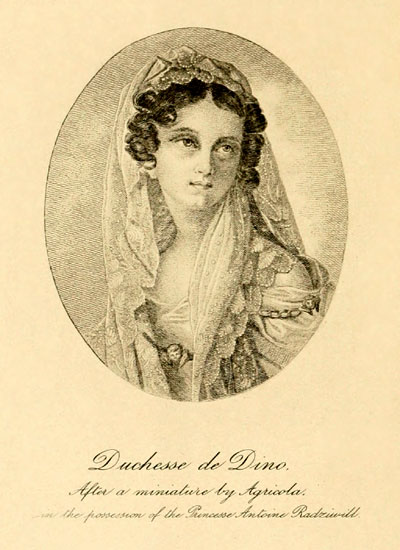 "
"