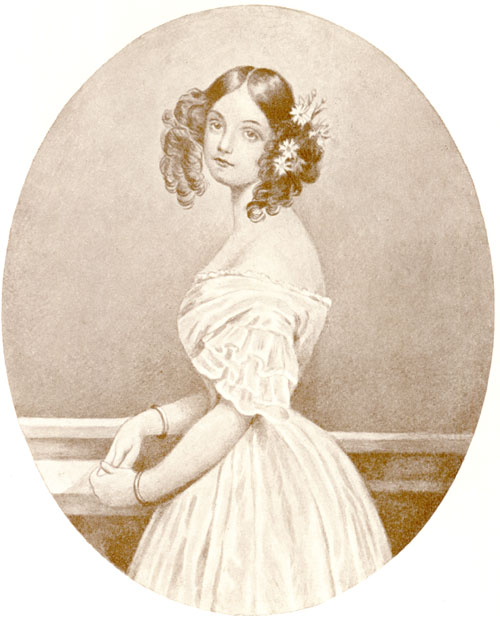
Rochecotte, January 1, 1841.—Yesterday passed by uneventfully.
In the morning I had mass said in my chapel for
the late M. de Quélen, and shed heartfelt tears during the
service. In the evening my son Alexander, my son-in-law and
Pauline gave us some music. They sang vaudevilles and
mimicked characters with a vivacity which delighted me, as I
am always afraid that they may be bored here, though I admit
that their frame of mind was in complete contrast to my own.
On the stroke of midnight punch was served; some tears fell
into my glass when I thought of those with whom I had so
often spent this anniversary.
Rochecotte, January 2, 1841.—M. de Salvandy writes to
me as follows concerning the reception of M. Molé at the
Academy: "M. Molé spoke to a magnificent audience. He
was seated between M. de Royer Collard and M. de Chateaubriand;
on this occasion the latter broke his usual custom
of avoiding public appearances. It was a special honour,
either to M. Molé or to the memory of the late archbishop.
The highest society from the Faubourg Saint Germain were
there, in fact all the special friends of M. Molé and everybody
who can be called anybody nowadays. M. Molé was
continually applauded, and his cleverness, his taste and
courageous speaking well deserved this reward. He gave a
fair and respectful account of this pure and noble character
and spoke of M. de Quélen without concessions or reticence
or consideration for his own position. His ambition seems
to have burnt its boats, with such enthusiasm did he speak of
old time manners and society and so warmly did he emphasise
the ideas and principles of good order. He only touched
upon present times to utter a eulogy upon the King, and
you know that present times are not agreeable to him. I
was especially struck by the vigorous approval of the audience;
it was a public rehabilitation of the persecuted Prelate and
the canonisation of his memory by a layman before a public
which was not entirely sympathetic or legitimist; for there
was a lively manifestation of approval at certain passages in
Dupin's reply, opposing the Restoration and the Englishman.
Dupin's answer was quite characteristic, and I need say no
more of it. M. Guizot and M. Thiers seem to have foreseen
the success of M. Molé, for they did not appear and their
absence was widely commented upon. In short, this session
has greatly raised M. Molé in the opinion and esteem of
right-minded people, but it has been in particular a great day
for the memory of the Archbishop, for his family and his
friends, and for those who felt his blessing as he was at the
point of death. For this reason I hasten, Madame, to give
you an account of it, as by this means I can realise its
meaning more exactly and more deeply than if I had merely
listened.
"M. Guizot has informed me of the nature of the
despatches received from St. Petersburg, from Vienna and
from London, which are in all respects excellent. There is
a desire to bring France back to the concert of Europe, a
readiness to make advances and to seek means and opportunity.
Peace is restored and I should be inclined to say,
more than peace."
I am delighted at M. Molé's success which I foretold to
him when he read me his speech at Paris in September; and
am delighted not only on his account, but also because he
has done something to restore the reputation of this holy
Archbishop, who was so misjudged during his lifetime.
Rochecotte, January 3, 1841.—Yesterday I received many
letters from Paris which repeat practically what M. de
Salvandy wrote concerning M. Molé's speech at the Academy.
M. Dupin seems to have been quite unspeakable, and in
short, entirely himself; M. Royer Collard grumbled throughout
his speech and said, "This speech is sheer carnage."
In fact the dead lay in heaps beneath Dupin's destroying
charge. Noticeable were the thunders of applause when he
inveighed against the revelation of state secrets, a direct
thrust at M. Molé; but a most dramatic point, I am told,
was Dupin's gesture in recalling the fact that a Molé, as
an alderman of Troyes, had helped Charles VII. to drive out
the English. His gesture and pose called forth repeated
bursts of applause. Fortunately the diplomatic body were
not present. It is a strange sight to see Dupin inveighing
against the coalition of which he was a member.
M. Molé should be fully satisfied with his triumph, which
has been complete, striking, brilliant and unusual. On this
question M. Royer Collard writes as follows:—"No doubt
more than one correspondent has told you of M. Molé's
triumph, for such was the nature of his success, before a
numerous and brilliant audience. I was glad to hear the
speech which you and I have known for some time. If it is
not an artistic production, it is the work of a clever man who
has known better times than these and who has retained
good traditions. The defects were not obvious; his courage
appeared so natural that it was unnoticed; the beauties of
it, which were by no means small, were understood and fully
appreciated. M. de Quélen has shared the honour of the
day, in truth it is he who has really triumphed, to such an
extent did the audience share this solemn work of rehabilitation.
I saw the most hard-hearted shedding tears. As
M. Affre did not think of his predecessor, no one thought of
him. M. de Quélen has carried the archbishopric of Paris
to his tomb; there is not and will never be another archbishop;
this striking and mournful glory is his."
I am extremely delighted at this posthumous triumph, as
I have every reason to be, for I honoured, supported, cared
for and perhaps even consoled the subject of it during his
lifetime.
M. Molé's speech contains some admirable lines referring
to the Cardinal of Périgord.
Before sessions of the Academy are held, speeches are by
rule examined by a committee of members who act as censors
and decide whether any passages should be struck out. M.
Dupin did not conscientiously carry out this arrangement
and his speech in public was not that which left the hands
of the committee. It is expected that next Thursday when
there is a special meeting of the Academy, explanations
of the fact will be demanded. Mignet, who was present at
the public session, is said to have been in a very bad temper
and the newspapers of M. Thiers are preparing to fulminate
against Dupin.
It is said that Mgr. Affre has proposed to change his
cathedral precentors without calling a meeting of the
Chapter; that the Chapter met to discuss the question; and
that Mgr. Affre, when he heard of it, made a great uproar
and forbade any meeting unless authorised by himself. New
Year's Day then arrived. The Chapter have been accustomed
to meet to send congratulations to the Archbishop: his
prohibition was positive; they therefore did not meet, and
have not congratulated the Archbishop. The result will be
some new storm, for Mgr. Affre is a stormy character. The
Sacré Cœur had much difficulty in securing permission to say
a mass for Mgr. de Quélen at the end of the year; however,
permission was granted, and there was a suffocating
crowd.
Rochecotte, January 5, 1841.—For twenty hours snow has
been falling steadily. We are absolutely buried under this
thick shroud. One might be living in the north with all its
horrible cold, and it is impossible to go out. All communications
will be cut off, though the storm should last
only a few hours. What a winter it is!
Rochecotte, January 7, 1841.—Yesterday I had a letter
from Madame de Lieven, in which the main points are as follows:
"Things in general seem to me to be going better,
though security is not absolutely certain. Have I written to
you since the news from St. Petersburg arrived? Do not
believe the exaggerations of certain newspapers on the point,
but believe what is true, that the tone of the last communications
is quite proper; that Russia is sincerely anxious to
see France return to the concert of Europe, and is hoping
that the present Ministry will remain in office. This demonstration,
which experts consider to be more friendly than
any that has been made at St. Petersburg, has caused much
pleasure here and some anxiety to the English. There is no
further development at present. At London attempts are
being made to find a point of junction with France which is
everywhere desired. Can you think of one? Jerusalem.
Jerusalem delivered from the yoke of the infidels! Jerusalem,
a Christian town, open to all Christian worship; a free town
guaranteed as such by Christianity! What do you think of
this? I should much like to see it. Is it likely that so
simple an idea and so easy to perform could be rejected, for
if ever the idea is carried out, it could be to-day. Lord
Melbourne will probably laugh at it and Lord Palmerston
too.
"The opening of Parliament has caused much discussion.
It is said that Peel and the Radicals will easily overthrow
the Ministry, but I see no reason for it at this moment.
Time will show.
"The Academy meeting caused a twenty-four hours' sensation.
M. Molé enjoyed a great triumph. I was unable to
hear his speech and it reads to me a trifle forced; such is
also the impression of many people, and it has even been
called somewhat insignificant. About M. Dupin's speech I
have nothing to say. From the point of propriety it speaks
for itself, but it amused me. My taste, however, is not particularly
good.
"I hope you will make no mistake about the conclusion of
the Egyptian question. Whatever happens, Mehemet Ali
will preserve the pashalik as hereditary in his family; but
what a conflict of opinions among the sailors, the Ambassador
and the Minister of Foreign Affairs!
"I am told, my dear Duchesse, that the King of Prussia is
a little strange in his conduct, that the fact is remarked
among his people, that his popularity is rapidly declining,
and that the old King is more regretted every day."
Rochecotte, January 12, 1841.—M. de Salvandy writes as
follows: "I think that the Powers are seriously looking for
an opportunity and an excuse to bring us back to the concert
of Europe. The declarations of Prince Metternich; the
Russian despatch with its unusual expressions concerning
the wisdom of the King and his services to Europe, the
desire to come to an understanding with his Government;
and the sentiments, too, of Prussia, which are more French
and less Russian than ever, are providing food for reflection
in England. Lord Palmerston is finding his course more
difficult than he expected. The Duke of Wellington and
Sir Robert Peel will propose amendments; it is said that
these amendments will be in favour of France and will pass,
and the Tories seem certain on the point. I cannot believe
it. It is impossible to think that the real successes of
Palmerston throughout the Asiatic continent from St. Jean
d'Acre as far as China, should mark the date and the reason
of his fall. In any case it is certain that England, both as a
government and as a nation, is concerned with the question
of our isolation and of our liberty of action.
"Here the question of fortifications takes precedence of
everything else. It has been simplified by M. Thiers' resolution
to make no proposal without the approval of the
Government. He abandons or modifies his amendments
according to the desires of the Cabinet and so the struggle
will not be in that direction. Victory or failure will be
shared by MM. Thiers and Guizot. However, by a strange
change of opinion M. Guizot seems to be threatened at the
outset of this proposed plan. MM. de Lamartine, Passy and
Dufaure, forty votes on the Left, together with Tracy and
Garnier-Pagès, in short, fifty votes at least will be against
the proposal. People are also asking whether Marshal Soult
is not against the idea. His position seems somewhat obscure.
People wonder whether the objections which he offered to the
detached forts in 1833, to the compromise and the continuous
circuit walls proposed in 1840, are not more prominent
in his mind than any other interest; whether he does not
expect to advance his views by rejecting half the law which
might easily end in the overthrow of the whole, and also of the
oratorical party in the Cabinet, bound as they are to support
their project in its entirety. People are also wondering
whether this last result is not the object which the parliamentary
strategy of the Marshal has in view. The Prince
Royal, whom I saw yesterday, seems uneasy on the point.
But what then can be the idea in the background? Can it
be a combination of Passy and Dufaure, with Passy as the
Minister of Foreign Affairs? This would be to restore the
Ministry of May 2, which would not act upon the first
occasion and will be no more possible now that it is dead.
A combination of Soult and Molé is very unlikely; and
finally, will M. Molé come forth from his ruins? All this is
very obscure. M. Molé is very touchy. There are too many
people who would regard adherence as an honourable confession
of error. In any case it is certain that M. Guizot's
prospects are impaired and that even at the Tuileries the
chances of his overthrow are regarded as more probable
than they would formerly have been. It is noticed that
he makes no mention of London. Can he have reached the
point when he begins to doubt of success, though he never
doubted it before, and to consider the possibilities of a
retreat?
"Rambuteau yesterday held a house-warming in his new
rooms in the Hotel de Ville. They are magnificent and are
characterised by splendour, luxury and good taste: the
paintings, the ornaments and the furniture are admirable;
it is pleasant to see an object worthy of praise and since we
are now under the electoral régime I am glad to see that it
can produce something at least that is earmarked by good
taste and a certain grandeur. It is curious to see the town
of Paris treat its Prefect in this way. Let us hope that this
will pave the way for the kings.
"M. Pasquier has been greatly disappointed that he has
not been elected to the Academy in place of M. Pastoret.
He had great hopes, but the candidature of M. de Sainte
Aulaire was too well supported. He is keeping himself for
the place held by the Bishop of Hermopolis. [1] Is it not
remarkable, Madame, that at his age a man should think of
inheriting anything, and should still have ambition, holding
the rank he does?"
Rochecotte, January 18, 1841.—Madame de Lieven writes
from Paris as follows the day before yesterday: "Madame
de Nesselrode is full of the great men of France, and has
certainly come to Paris chiefly to see them. M. Eynard of
Geneva has them on show; he invites Madame de Nesselrode
to dinner with each of them alternately. I do not think he
has missed one so far, except Garnier-Pagès.
"The Queen of England's speech is awaited here with some
curiosity. People are wondering whether she will say anything
suitable in view of the situation here. There is no
inclination in Paris to diverge from the line of conduct that
has been decided upon; an armed peace, quiet expectation
and isolation, threatening no one, neither disturbed nor disturbing.
Our neighbours, however, are anxious, and would
like to see this state of suspense at an end. Lord Palmerston's
obstinacy drives them to despair, for it is but too true that
he is the real governor of Europe. Some means of forming a
connection for France must somehow be found, and an intermediary
has not yet been discovered. It is certain that the
Pasha's position will be made hereditary.
"France has made peace with Buenos Aires, and Rosas,
the tyrant of this republic, has been appointed ambassador
here and will arrive in the spring. England will arrange
the difference between Spain and Portugal.
"Conversation is concerned with nothing but fortifications;
it is not quite clear whether the Chamber is in favour of
them. The King on the one hand and M. Thiers on the
other, are taking infinite trouble over the question. The
Ministry will support the proposals but will not die of grief
if they fail to pass.
"M. de Barante has been ordered to remain at St. Petersburg;
some inclination to coquetry has been obvious in that
quarter, but time alone will show whether any definite result
will follow. M. de Lamartine had an audience of the King
which lasted two hours and a half and is said to have been
much impressed. He talks a great deal about it. The
question of diplomatic changes will not arise until the
matter of the fortifications has been settled."
I have the following news from Madame Mollien: "There
is every readiness to support the law concerning the fortifications
in the Tuileries, but considerable reluctance in the
Chamber. The château is greatly obliged to M. Thiers for
joining the general opinion in his report; he is anxious to
reassure the Chamber as to his position. It is said that he is
greatly wearied by his partisans of the Left and has had a
lively scene with Odilon Barrot which reached the point of
insults and in which he termed the journalists of the party
"ruffians." The fact is that if this law does not pass, the
thirty millions already expended, the works that have been
begun, the private property that has been bought up,
destroyed and ruined and the devastation of the Bois de
Boulogne, would place him in a terrible position; and so he
is as gentle as a lamb and sends his wife to the Tuileries.
The Ministry would be content with what would cause him
embarrassment; the château, on the other hand, is making
common cause with him; thus the position is very complex.
The Duc d'Orléans is in a bad temper: the recall of Marshal
Valée which was issued in the course of two hours without
any previous notice to himself, has greatly wounded his
feelings; he does not like the idea of the Marshal's return
because he is one of his personal enemies and he fears for the
safety of Africa in the hands of Bugeaud. However, he is
retiring somewhat more into the background in adherence to
the wishes of the King, who is growing anxious about his
successor, as Louis XIV. was about the Grand Dauphin.
All our princes live like the Infantas of Spain, in loneliness
and obscurity. The Pavilion Marsan is nothing more than
a wearisome convent; on the ground floor there is very little
vivacity and equally little on the first floor. The King
retains his imperial confidence in his star. He thinks less of
M. Guizot than he did some time ago, and does not so much
dread a change of Ministry."
Rochecotte, January 17, 1841.—The Duc de Noailles who
came here yesterday, read this morning in the drawing-room
half of the article which he has written upon Jansenism,
which is to be inserted in the work he is preparing upon
Madame de Maintenon. [2] This part of the book is written
cleverly and clearly; at the same time I can criticise it for an
excessive partiality to the Jansenists and a failure to observe
a proper moderation of tone.
Rochecotte, February 1, 1841.—Yesterday I received this
bulletin from M. de Salvandy: "Our Ministry is the feeblest,
the most diminished and the most elusive that ever was seen.
I do not know, Madame, whether I have told you what I
have often told them, that there is only one danger for them;
not the danger of supporting views which might be defeated,
but of having no opinion at all, or even worse, of having two
opinions. They have run straight upon the rocks with sublime
carelessness, in consequence of Guizot's speeches and with
utter foolishness in consequence of Marshal Soult's speech,
while the general attitude and language drive them along
most miserably. The truth is that as a matter of principle
they brought forward their proposed law concerning the
fortifications in defiance of the Marshal's opinion and
opposed their military expert because they thought that
public opinion was on their side. Since that time the
position assumed by M. Thiers as a supporter of the bill has
kept them awake and though they agreed with him in
committee they were attempting to secure some means
of checking him when he was with us in the Chamber.
Schneider's amendment has been proposed with their support
in opposition to M. Thiers and in agreement with
the Marshal against M. Guizot, with the support of another
combination which is more or less public property. Thus
M. Guizot has suddenly revised his opinion and after asking
us to pass the law in his great speech with a significant
phrase, he went round to the members three days ago and
solemnly told us that he was opposed to it. The great
success of M. Dufaure has again produced a change in these
views, as people fear that the real strength of the opposition
may lie in that quarter. Yesterday evening Thiers demanded
that they should explain themselves. They asked for a
night to think over the matter, but reflection will tell them
nothing that can make such conduct worthy or politic. No
question was ever so badly managed. They have succeeded
in securing the protectorate of M. Thiers, in exasperating
him by their obvious treachery and in separating MM. Passy
and Dufaure, while also wounding the feelings of the Conservative
party, the majority of which is ready to reject the
great bulwark of M. Thiers. In any case, they are defeated,
for they have conspired against all in turn. What will be
the result of all this? Great discredit and deep divisions, if
nothing else. I am going to the Chamber where I will try
and write a postscript to describe the tone of the Cabinet
and the vote of the Assembly, but I expect storms, and as I
am acting as President in place of M. Sauzet, I must keep
my hand upon the bag of Aeolus."
"Postscript from the Chamber.—The Marshal has made a
speech of coarse and obvious duplicity which is setting the
Chamber on fire. I have only time to send you my kind
regards with this letter."
Rochecotte, February 2, 1841.—Yesterday's letters say
nothing; the newspapers announce that Schneider's amendment
has been rejected and that the forts and the continuous
circuit wall will probably be adopted, notwithstanding the
most inconceivable speech from Marshal Soult which was
counterbalanced by the really clever speech of M. Guizot.
Rochecotte, February 4, 1841.—It was very cold yesterday
but quite clear and I went for a walk with my son-in-law in
the woods where there is always shelter in spite of the
absence of leaves. To-day it is snowing as if we were in
Siberia. Last night the thermometer fell more than ten
degrees. Winter has indeed begun again.
The newspapers tell us that the fortifications have been
voted; even those who voted for them did not want them
and it is difficult to know who has been duped in the whole
business. One of the jests current in Paris is no longer to
refer to Marshal Soult by his long-standing title of the
Illustrious Sword, but to speak of him as the Illustrious
Scabbard. This is not bad and tickled my fancy.
Rochecotte, February 5, 1841.—The following is the chief
passage in a letter from the Comtesse Mollien: "So we are
to have fortifications. In this very complicated question
every one has been taken in and it is difficult to see who has
gained an advantage apart from M. Thiers, whose delight,
however, is largely qualified by the success of M. Guizot, for
it is generally admitted that the Chamber of Deputies was
carried away by his last and most admirable speech. It now
remains to deal with the Chamber of Peers, which might
show some obstinacy, according to rumour. This Chamber is
quite in favour of outer forts at a greater or less distance in
connection with one another, etc., but there will be some
trouble in passing the proposal for a continuous circuit
wall through that Chamber. You have doubtless seen from
the articles in the Journal des Débats that this newspaper
supported the law. The truth is very different; the real
supporter is Auguste de Veaux, the son of Bertin de Veaux,
who alone supported this view with such warmth that he
outraged the policy of the newspaper against his father and
uncle, who were no less warm supporters than himself of the
contrary opinion, but eventually yielded to his youth and to
his position as deputy. At the château there is general
delight, but I think that too little trouble is taken to conceal
the fact that the circuit wall is only the passport for the
rest. M. Bertin de Veaux was saying the day before
yesterday that this circuit wall was the tomb of Parisian
civilisation until it became the tomb of the monarchy. It has
certainly already become the tomb of general conversation;
people are wholly absorbed by it. Men and women, young
and old, talk of nothing else and it is most wearisome and
ridiculous.
"There has been a monster ball at the Tuileries. There
will be no others: no select ball, but one concert and nothing
else; only on the Monday festival there will be a small
masked ball confined to the family and the households; the
young people alone will be masked and ladies who are not
dancing will wear white to distinguish them from the rest."
Rochecotte, February 7, 1841.—The Chamber of Peers
seems far from favourably impressed by the proposal for
fortifications and wishes to oppose it. I doubt if it has
the energy to do so. Mdlle. de Cossé is to marry the
Duc de Rivière. She will be very rich and wishes to be
a duchess; he has very little money. Old Madame de la
Briche is quite in her dotage. This does not prevent her
from following her social inclinations and saying and doing
extraordinary things.
Rochecotte, February 9, 1841.—My son-in-law hears that
the disagreements about the fortifications and the manner in
which the whole business has been conducted is likely to place
every one in a false position; the Council, the Chamber and
every one are at cross purposes; the Chamber of Peers is excited
and exasperated and wishes to propose an amendment,
in which direction it is urged by Marshal Soult, Villemain
and Teste, but is held in check by Guizot and Duchâtel.
Amid all these disturbances the vote for the Secret Service
Fund will pass without difficulty. Then there is no other
serious question during this session and M. Thiers is said not
to be in a position to give battle on the latter point.
The situation in general, according to the statement of
M. Guizot is good, for the Left, he adds, is reduced to
impotence for a long time. He seems to be more and more
pleased with the state of foreign policy, with the advances
which are made to us, and of which he boasts a great deal.
He goes so far as to say that the union with the four Powers
has been broken, though this statement seems to me a trifle
premature.
Rochecotte, February 11, 1841.—I find the following in a
letter from the Duc de Noailles: "I have been studying the
question of the fortifications, since this ridiculous law is
thrust upon us. I cannot stomach it, and will not let it
pass without raising my voice against it. The Duc d'Orléans
shows great energy in the matter: he goes every day to the
Chamber of Peers, even when we have nothing before us but
petitions; he makes notes and observations with our grand
referendary, M. Decazes, who hangs about the Chamber with
a pocket-book, upon all the peers who are for or against and
adds up the votes beforehand. Yesterday he sent some one
during the session to M. de Vérac who rarely appears in the
Chamber, to learn his opinion. He said that if there was any
want of water to make mortar for the buildings, he would
rather give his blood than that they should be interrupted.
He told M. de Mornay who spoke on the opposition side of
the Chamber of Deputies, that he had spoken as a marquis
and not as a patriot. In short, he is canvassing all the peers,
sending them invitations, asking them to dinner and using
every possible means. It is true that almost all the Chamber
will vote for the law, to such an extent have they been crushed
by the revolutions which have harrowed our country. As you
are deeply attached to the Duc d'Orléans, you will be sorry
to hear of the unseemly and revolutionary remarks which
this law has evoked from him and which are in circulation
everywhere. M. Molé is working his hardest to oppose the
proposal, but he will probably not be bold enough to speak
against it openly; M. Pasquier is no less furious and will
probably be equally silent.
"We have had a charming evening's entertainment at the
house of Madame Récamier, [3] on behalf of the sufferers from the
conflagration at Lyons. I was in charge of the arrangements
and the platform at the back of the room was most suitable
for the music and the recitals. The professional musicians
performed admirably; the little Rachel came late because the
committee of the Théâtre Français had forced her, with their
usual inconsiderateness, to play Mithridate the same day.
She arrived at eleven o'clock with a grace, an eagerness to
help and a simplicity which charmed every one. She gave
the Dream of Athalie and the scene with Joas with excellent
effect; it will be even better on the stage, as stage effects are
lost in a drawing-room. Her conversation and manner caused
equal satisfaction. The result was excellent—five thousand
francs. Two hundred tickets were sent out at twenty francs
a ticket, but nearly every one paid forty, fifty or even a
hundred francs a ticket. It is a very pleasant way of collecting
money. M. de Chateaubriand, who usually goes to
bed at nine, stayed until midnight. M. de Lamartine was
also there and two abbés to represent the convent; the Abbé
Genoude and the Abbé Deguerry."
The Duc is devoting himself to art no less than to politics.
Rochecotte, February 12, 1841.—Several Legitimist newspapers
have published so-called letters written during the
period of exile by King Louis-Philippe to the Marquis
d'Entraigues, and a long letter written to the late M. de
Talleyrand by the King, while M. de Talleyrand was
ambassador at London. The Cabinet considers that the
newspapers should be seized, the editors arrested and a
charge of forgery brought against them before the courts.
I sent for the newspaper containing the letter which was
supposed to have been written to M. de Talleyrand. I am
convinced that it is an absolute forgery. M. Delessert, prefect
of police, has asked my son, M. de Valençay, to write to me
and inquire whether I knew if any papers had been stolen
from M. de Talleyrand at London; whether it was possible
for any one to have abstracted them at Paris during his illness
and at the time of his death; and finally, whether I knew a
woman who was concerned in the whole business [4] who says
that she had lived at Valençay and even in the château; in
short, he wishes to know my recollections and my opinion of
the whole story. I talked over the matter with my son-in-law,
and we concluded that we would be bound to reply. I
therefore gave M. de Valençay a reply, telling him to read my
letter to M. Delessert but not to leave the letter in his hands.
In it I said that I had never known this woman or heard of
her, which is exactly true; that all M. de Talleyrand's
important papers had been deposited by him in foreign
countries in sure hands and in places which would render
theft quite impossible, and that no papers could have been
found at his house in Paris, if any attempt had been made to
abstract them, of which I had no recollection; that, in short,
all my recollections and impressions contributed to convince
me that the letter in question was a forgery. As a matter
of fact, it is a very long letter upon European affairs which
was never written by the King; moreover, neither the King
nor Madame Adélaide in their letters to M. de Talleyrand
ever expressed the thoughts, the opinions, or the projects
expounded in this letter. It appears that the Abbé Genoude
and M. de la Rochejaquelein, in the course of a journey to
England, bought the King's so-called letters from this woman
and came to publish them in France under the deception of
animosity and party spirit. However, the whole business is
very unpleasant for the King and the trial very wearisome
to follow; these men assert that they have originals in the
King's handwriting, which are no doubt forgeries, though
proving them to be so is a hateful business.
The Legitimist newspapers also publish some fragments of
a diary, or rather some memoirs of Madame de Feuchères;
the forgery here is obvious to myself, who am well aware of
the relations which existed between her and the Royal
Family, and are totally misrepresented by these fragments.
Her family and the executors of her will have published an
absolute denial of the existence of these supposed memoirs.
However, the Legitimist newspapers proceed as before to
publish instalments of this absurdity, and there are idiots
or ill-disposed persons who still persist in believing them
authentic.
Rochecotte, February 15, 1841.—I have been asked a
question about Madame de Salvandy, who corresponds with
the Austrian Minister to the United States; her maiden
name was Mlle. Ferey, and she was a niece of the Oberkampf
family; she is thus connected with the Jouy oilcloth. [5] She
is not a distinguished person, though not vulgar; she is not
pretty and not exactly ugly; she is not pleasant, but not
badly brought up; not clever, but no fool; and after this I
think it must be admitted that she is not a nonentity. I
should add that she has been a good daughter, a good wife
and a good mother; that she bores her husband and wearies
her children by her continual efforts to be correct; and in
conclusion that she is a thorough-going Protestant, always
scattering little French Bibles about without her husband's
knowledge, who is a good Catholic.
A summary of my correspondence is as follows. I found
it here when I returned from Tours, where I had gone for a
few hours to be present at a charity lottery.
Madame de Lieven writes: "Enthusiasm is rising once
more at the Tuileries on behalf of the fortifications at Paris,
and is said to have reached Dumouriez. The fortifications
are desired and will be secured, for it is thought that the
Chamber of Peers will show a majority in their favour, notwithstanding
the Legitimist conspiracy of Molé and Pasquier.
England will be obliged to make advances to France, as
Parliament is urging it in that direction and society also.
Notwithstanding the outward success of the English Cabinet,
the Ministry is growing weak and it is even said that it will
fall. Lord Palmerston alone retains full confidence in his
fortune. The whole of Europe shows great confidence in
M. Guizot, especially Prince Metternich, who asks of him
only one thing—namely, that he will continue in office. I
think he is as safe as any one can be in France. I think the
proposal regarding Jerusalem will not pass unnoticed."
The Duchesse de Montmorency writes: "I told you a few
days ago that Mgr. Affre had forbidden the Chapter to meet,
and that the Chapter had strictly carried out his orders by
offering him no New Year's congratulations, as a meeting
would have been necessary for that purpose. The result has
caused a disturbance among the clergy which is now at its
height. Even at the Tuileries they are beginning to repent
of the unfortunate choice that was made in M. Affre, as he
had a violent quarrel with M. Guillon, Bishop of Morocco,
the Queen's first almoner, and a great favourite at the
château. M. Guillon, though he had been entirely hostile
to Mgr. de Quélen, went to the King to complain of Mgr.
Affre. Unfortunately he cannot be removed. He has turned
M. de Courtier, the very popular priest of the foreign missions,
out of his parish, and he has only his masses to live upon.
The canons of Notre Dame no longer say mass at the high
altar, as to do so would be a means of meeting, and similarly
at matins and the other offices. Things are almost as if the
cathedral was under an interdict. Mgr. Affre is so hot-tempered
that when his secretary, a young and innocent abbé
to whom he had dictated some extraordinary letters, ventured
to remark upon the fact, he was immediately dismissed
without notice. How Christian, pastoral and evangelical
such conduct is!
"M. Demidoff has sent back the secretary, the butler and
the servants that he had here; it is not yet known whether
he has reached Russia, or whether the Emperor Nicholas will
allow his wife to come with him; the possibility is doubted.
"The affairs of the Duc Decazes are in fearful disorder and
his servants are leaving him; he is also said to be very ill."
M. Raullin writes: "Yesterday at Notre Dame we had a
sermon from the Rev. Father Lacordaire, who wishes to
restore or to establish in France the Order of Dominicans
with their beautiful white cloaks. The whole of Paris was
there and the church was crowded. The sermon provoked
much criticism, both favourable and adverse. It was a
harangue in the style of Peter the Hermit preaching the
Crusade to the people, except that in this case the Crusade
was directed against no one, but was to support Catholicism.
It was Rome and France marching together since the time of
Clovis to the conquest of true liberty and of civilisation. In
all this there was a mixture of papacy and of nationalism,
of spiritual monarchy and of universal liberty which was
thundered forth in a style that might shake the pillars and the
very foundations of every Gallic church. I hope that similar
attempts will not often be made, but for once in a way such
outbursts do no harm. I was especially struck by the vast
concourse of people and the close attention with which they
followed all the words of this Dominican revivalist. As to
the result of his attempt, I am afraid that imagination and a
sense of the picturesque are all that will be stimulated. I
do not like attempts to start new movements by something
extraordinary."
The Duchesse d'Albuféra writes: "Madame de Rambuteau,
in order to avoid the terrible crowd which invades the rooms
of the Hotel de Ville, declared that she would only ask those
of her new acquaintances who were introduced to her on
Tuesday mornings. Such was the reply that she sent to a
note from Madame d'Istrie, who asked permission to introduce
her sister, Madame de La Ferronnays. The idea of
introduction as an excuse from Madame de Rambuteau to
Madame de La Ferronnays has been considered ridiculous;
it has become a jest and a byword and many people in high
society decline to visit the Hotel de Ville.
"Madame de Flahaut is entirely absorbed in the task of
attracting the Faubourg Saint-Germain to her house; the
Duc d'Orléans is distinctly angry in consequence; but as
princes no longer go to salons, Madame de Flahaut says that
she will not continue to sacrifice her tastes to the whims of
the Duc d'Orléans. Emilie, her daughter, who keeps house
for her, is influencing her in this direction. On Thursdays
there is dancing at Madame de Flahaut's house: some one
was saying before the Marquise de Caraman that these entertainments
were balls for young people, to which the marquise
replied, 'And for young women too, for I have been invited,'
upon which remark it was remembered that her baptismal
certificate does not seem to agree with this claim."
Finally, M. de Valençay writes that Madame de Sainte
Elme, the author of the Contemporary Memoirs, is deeply
implicated in the affair of the pretended letters from the
King. The prefect of police is still busily occupied in the
task of getting to the bottom of this intrigue.
M. de Valençay went to hear Father Lacordaire and says
that he looks like a fine Spanish picture. His sermon was
very republican and his mode of expression very different
from that hitherto employed in the pulpit, but he has much
talent and vigour.
He adds that M. de Chateaubriand is reading his Memoirs
at Madame Récamier's house; Madame Gay swoons with
admiration and Madame de Boigne makes faces. These
two tendencies were especially brought out by a very striking
portrait of the Duc de Bordeaux. The Duchesse de Gramont
Guiche was present and was not remarkably pleased with the
passage in which her name was mentioned, in which M. de
Chateaubriand said: "Madame de Guiche, who has been a
great beauty."
There is nothing else in my letters which seems worth
quotation, and even what I have extracted is chiefly trivial.
Rochecotte, February 23, 1841.—Some time ago I was
advised to read a novel by M. Sainte-Beuve and not to be
alarmed by the title of it, which was "Pleasure." I read
half of it yesterday; though it wanders from the point in a
manner more metaphysical than religious, and though the
affectation and ruggedness of the style is obvious, I have
been deeply touched by the book, which displays a profound
knowledge of the human heart, a true sense of good and
evil, and generally speaking, a loftiness of thought which is
unusual in modern authors.
My son-in-law hears from Paris that the Chamber of
Deputies was much disturbed by the report of M. Jouffroy
concerning the secret service funds. The Chamber seems
to have been living in a profound calm which has been
disturbed by this report. It has revived all quarrels and
severely criticises all past Ministries, while it speaks of the
policy of the present Cabinet in terms which are unacceptable
to many of its supporters. In short, it is an unfortunate
incident, which is important in so far as it strengthens the
arms of that important fraction of the Chamber known as
the Dufaure-Passy party.
Rochecotte, February 24, 1841.—In the Friend of Religion,
a little magazine which I take in to lend to my priest, I
have found a long extract from the famous sermon of
M. Lacordaire, which recently caused so much sensation at
Paris, and which fortunately seems to have met with strong
disapproval. As a matter of fact what I read is quite inconceivable,
though there are many passages full of vigour and
talent; but these are overwhelmed by strange assertions
which reach the point of the scandalous and the dangerous.
As his subject he took the duty of children to parents and
from thence proceeded to an enthusiastic eulogy of the
democracy: he said that Jesus Christ was above all things
a member of the middle classes, and that France is supported
by God because it breathes democracy. The late Mgr. de
Quélen was quite right in his refusal to allow M. Lacordaire
to preach unless he were himself present to keep an eye
upon him. He mistrusted these strange doctrines which
had long before been derived from his connection with
M. de Lamennais, and though M. Lacordaire has remained
a Catholic, he is largely affected by this evil teaching, which
he received in his youth.
Prince Pierre d'Arenburg writes to say that on the day of
the collection at Notre Dame Mgr. Affre summoned the
ladies who were collecting to the sacristy, but he did not
speak to them or give them a word of thanks, which they
expected, as they were always accustomed to it from Mgr.
de Quélen, who invariably thanked them with perfect grace;
that Mgr. Affre then sent them into the church with a most
abrupt "Now then, start," which was received with murmurs
on the part of the ladies, according to my letter.
M. de Valençay writes to say that he has heard from a
reliable source that overtures from the English Cabinet
are still awaited and that it is believed that they will be
forthcoming. He had met Madame de Lieven who had
commissioned him to send me news of the fact and to add
that M. Guizot is on the best of terms with the German
courts. It appears that this week will decide the fate of
the English Cabinet, which will be vigorously attacked.
The law upon the fortifications will not be put to the
vote in the Chamber of Peers for a fortnight. It will be
fiercely attacked by M. Molé, by the Chancellor and by the
Legitimists. The court is very angry with the two first
named. What the fate of the law will be is absolutely
unknown as yet.
Madame de Nesselrode has left Paris full of enthusiasm for
Parisian life, for Parisian things and people. I admit her
goodness of heart and her generosity, but I think very little
of her judgment.
Rochecotte, February 26, 1841.—I hear from Paris that a
very select ball was given by Madame Le Hon and that she
and Madame de Flahaut are now trying to refine their salon
and to attract the Faubourg Saint-Germain; that in this
respect a kind of reaction is expected; that every one is
anxious to be counted a member of high society; that those
who were formerly sought are now disdained and those are
flattered who were formerly rejected.
I hear from Vienna that the daughter of the Prussian
Minister Maltzan, a pretty young girl of twenty-four, is to
marry Lord Beauvale, the English Ambassador; in age he
could easily be her father; he has been a great rake and is
eaten up with gout. However, she has preferred him to
several possibilities, because he is an English peer, ambassador
and brother of the Prime Minister. She has decided to
make a brilliant marriage.
Rochecotte, February 27, 1841.—Yesterday my daughter
had a long letter from young Lady Holland of whom she
had seen a good deal at Florence. This little lady is now at
London. I have asked my daughter's permission to select
the interesting passages from this letter: "I doubt if any one,
whatever trouble he took, could discover a more painful
situation than ours, because I think that no one could find
such a woman as Lady Holland, my mother-in-law. She
surpasses everything that could be imagined in the way of
rapacity and selfishness, and in a novel her character would
be thought exaggerated and impossible. As you know, she
became possessor of everything from my father-in-law, but
that is not enough for her. She wishes to pull down
Holland House where she spent forty years of her life and to
build and to sell; in fact, Heaven knows what she does not
wish, for the other day she was anxious to make an arrangement
with her son which would deprive us of our small
income which was arranged at our marriage, so that if the
Ministry were to change to-morrow it is quite possible we
should be reduced to live upon the interest from my dowry.
Fortunately she cannot destroy Holland House without my
husband's consent and he says he would rather cut his hand
off than consent to sacrifice the smallest part of it, even of
the park. Similarly she cannot sell the other estate of
Ampthill without his consent. He would willingly give his
consent to pay off the large mortgages with which she has
burdened the property, which was immense and free from
debt at the time of her marriage with Lord Holland, if she
on her side would do something. She has so much of which
she can unfortunately dispose that my husband has been
advised to ask something in return for his consent. He only
asked her to leave the house as it was during his father's
lifetime, whom he worshipped, and whose memory is most dear
to him. He told her that the library and papers which his
father left behind were a hundred times more precious to him
than the real property and the silver of which she can dispose.
Well, she declines to do anything. She has consulted all her
friends, who have pointed out the truth and asked her to do
the right thing. The result is scenes and quarrels, while we
must look on at everything and not offer a complaint. It is
a difficult position and sometimes I feel my blood boil, but
I restrain myself for my husband's sake and follow the
example of his sons and his daughter whose patience towards
her is angelical and who show a delicacy, a tenderness
and reserve which she certainly does not deserve at times.
In short, we must hope that a day will come when we shall
be able to live in peace and return to that dear house which
we have not been permitted to approach since our arrival.
At present we must start as soon as we can and return to
Florence by way of Paris.
"Fanny Cowper is not to marry Charles Gore. She cannot
yet decide what she will do, and remains very pretty. [6] The
chief beauty of the moment is Lady Douro. The Duke of
Wellington has recovered but commits such imprudent acts
that it is impossible to rely upon him. Lord Cardigan has
been hissed in the theatre, which is very unpleasant for those
who go there. I went to his trial which interested me
greatly. [7] He is a handsome man, pale and interesting, and
we peeresses were all so pleased that he was acquitted; but it
was a somewhat theatrical business and I am afraid that in
these days of reform and discontent it may cause some outcry
against the House of Lords. My husband clearly pronounced
the words 'Not guilty, upon my honour,' but they were
delivered best of all by my cousin, Lord Essex. Towards
evening the robes of the peers, the red tapestry and the
presence of the ladies made a striking effect. The ladies
chiefly admired were Lady Douro, Lady Seymour, Lady
Mahon and my cousin, Caroline Essex.
"Our dear aunt, Miss Fox, of whom we are very fond,
since she has been a real mother to my husband, has given us
much anxiety. She has been very ill, but I hope that she is
out of danger; she regrets her brother whom she loved for
himself alone. There is no sense of vanity, no regret for loss
of position, and no ambition in her grief, while everything that
she has seen or heard since his death has shocked and pained
her. We have also been alarmed for my poor cousin, Lady
Melbourne; an illness after a miscarriage was nearly the
death of her, but I now hope and trust that she is out of
danger; these, however, are incidents which hurt and leave
their marks. She thought she was dying and left all that
she loved with calmness, submission and tenderness, forgetting
nothing that could conduce to the happiness of her husband
whom she was leaving.
"We spent a week at the beginning of the year at
Windsor; it was a picture of perfect happiness; our dear
little Queen, handsome Prince Albert and the little Princess,
a pretty and good-tempered child, ready to do anything with
a smile, a certain sign of good health. The Queen is said to
be with child again. We were dining there four or five days
ago and the Queen seemed to me to be not quite well, though
she danced a good deal two evenings later, but in any case
she is so strong that one cannot judge by appearances."
Rochecotte, March 1, 1841.—My last month of Rochecotte
is now beginning, much to my regret. I have been as well
here as I can be at present. I live free from fatigue, agitation,
trouble and constraint; all these I shall find at Paris,
but there would be a certain affectation if I stayed away
altogether; and before starting for Germany I have a number
of little things to do and some preparations to make which
can only be done at Paris, so I have resolved, though with
much reluctance, to start in April.
Yesterday I had a letter from Madame Mollien, which
seems to me amusing from beginning to end: "I must say a
word to you of this fancy dress ball, a carnival ball which
will form an epoch in the annals of the Tuileries, because for
some hours it has brought back to its walls, which are usually
so sad, the frank, simple and unrestrained cheerfulness which
can only be seen in the simplest salons. The success of the
entertainment was due to the Prince de Joinville; no one
could withstand his impetuosity. The costumes were varied,
generally rich and tasteful with a few exceptions; there are
exceptions everywhere. The Queen, the old Princesses and
the old ladies who were not wearing costumes went in
succession to the gallery of Louis-Philippe. All in costume,
ladies and gentlemen, met in another part of the château and
made a solemn entry about half-past eight to the sound of an
appalling band, composed of all kinds of more or less barbarous
instruments which the Prince de Joinville has collected
in his travels. He himself, in true Turkish costume,
carried an enormous drum of a most oriental kind, on
which he made a tremendous noise. A magician preceded
the procession as a herald, and the company was conducted
by the Duchesse d'Orléans. She was splendid with a dignified
air: her costume was that of Marie of Burgundy, black velvet
richly embroidered with gold and trimmed with ermine;
the tall pointed cap which forms part of this costume was
ornamented at the front with a velvet bow embroidered
with enormous stones; the cap itself was of cloth of gold
surmounted by a veil of tulle embroidered with gold.
Two ladies and two gentlemen, alike in costumes of the
age of Louis IX., escorted the Princess. The two ladies,
whose costumes were like hers though not so rich, were
Mdmes. de Chanaleilles and Olivia de Chabot; the men
were M. Asseline, her Secretary of private commands, and
M. de Praslin, who looked very well in a long cloak of brown
velvet and marten fur, and called himself Philippe de Commines.
Poor Princess Clémentine was not a success: she wore
a Turkish costume which the Prince de Joinville had brought
back from Syria; it was handsome but heavy and ungraceful,
and her supple and charming figure was not shown off until
after supper when she took off the enormous headdress which
was crushing her, to be able to dance more at her ease. The
Duchesse de Nemours, on the other hand, was charming: she
had copied a portrait of the wife of the Regent, whom she is
supposed to resemble. The outer dress was of red velvet,
very short, with a skirt standing out and trimmed with rubies
and diamonds all round, upon a skirt of white satin trimmed
with two rows of broad green fringe and garlands of pearls;
a small velvet cap with one little feather standing upright
was put on the side of her head and touched her forehead,
leaving her head almost bare upon one side. Her very fair
hair slightly powdered, curled, fluffy, turned up on one side
and falling down on the other, gave her a coquettish appearance
and an apparent want of care which was charming. I
have never seen her so pretty, and so every one said. The
others are not worth mentioning. At the same time there
were some pretty dresses, including ladies of the time of the
Ligue, of the Fronde, of Louis XIII., of Louis XIV., some
Spanish costumes, and also a vivandière of the time of
Louis XV., which caused quite a sensation. Madame de
Montalivet and Madame de Praslin each appeared as Mlle.
de Hautfort, in rivalry. Many of the ladies were powdered.
The Duc d'Orléans did not return from Saint Omer as he had
said he might do, to the great vexation of the Princesse; I
think his absence rather spoilt her evening. The Prince de
Joinville speedily rid himself of his Turkish costume; his
two young brothers first appeared in military costumes of
the last century. After the first dance they all three went
away and soon came back again; the Prince de Joinville and
the Duc d'Aumale as débardeurs and the Duc de Montpensier
as a fifi of the time of the Regency. If you happen
to have a neighbour who is accustomed to go to fancy dress
balls (I do not think M. de Castellane is), you can ask him for
explanations of these costumes. Their chief merit and probably
the reason for their choice, is that they are an excellent
support in themselves to revelry, as they authorise and even
require a cheerful manner. The quadrilles were formed only
in two rows; as there was plenty of room they were able
to stand without crowding. As the couples at each end
would have had too much space to traverse, each figure was
repeated only twice instead of four times, and thus without
rest or relaxation, ever in movement, each dance finished by
a general galop to music played in much quicker time for
that purpose. This went on till half-past three in the
morning with a vivacity which I could hardly believe possible.
The Queen was greatly amused, and the King himself seemed
to find some pleasure in all this gaiety. He stayed till
supper, which was served in the Galerie de Diane at little
round tables, as at small balls. The Infants and Infantas
of Spain were all in costume, excepting their father
and their mother. She only danced the English dance,
which concluded the ball. Her partner was an Incroyable
of the Revolution, and they looked sufficiently incredible.
However, she excused herself from the last galop which ended
this dance and was more uproarious than all the rest. The
Prince de Joinville had the Duc de Nemours as his page, and
he took a very cheerful part in all these gaieties throughout
the evening. He made some attempt to imitate his brother,
but the Prince de Joinville with his wild spirits coupled with
his grave and handsome face, his alertness and originality,
was in every respect inimitable. I have forgotten to mention
M. and Madame de Chabannes: she appeared as a lady from
the Court of Charles IX.; her costume, which was said to be
designed by Paul Delaroche, was exactly correct, and made her
absolutely hideous. He was wrapped from head to foot in those
waves of white muslin in which the Arabs are dressed; this
was not an imitation, for the whole thing came from Algiers—the
costume, the dagger, the pistol, and also an enormous
gun which he had captured at Blidah or at Milianah. He
was on duty, and in this costume he preceded the King and
Queen when they came from their apartments to the ballroom.
In my opinion he showed not the least proof of courage in
this campaign.
"There was a continuation of these festivities the next
day. All those in costume who cared to do so met at the
house of M. de Lasalle, the King's ordnance officer, and the
Incroyable of the Infanta. His wife had a splendid costume,
said to represent Mlle. de Montpensier. The Duc de
Nemours, the Prince de Joinville and the Duc d'Aumale
appeared at this improvised meeting, which went on until
five o'clock in the morning, and is said to have been extremely
gay. It was Shrove Tuesday, when everything is permitted.
There was also some amusement in the morning: Madame
Adélaïde gave her children's breakfast as usual; the King
and Queen always attend it as well as the Princesses; it is
held in the Palais Royal in Madame's own rooms. Several
tables are placed in three rooms, at one of which the Royal
Family sits and is served with all kinds of dainties. This
table is the most amusing point. This year Madame had
added a little performance to amuse the King; a piece from
the theatre of varieties was played, the Chevalier du Guet,
which may perhaps have amused the King but certainly not
the children; of that I am certain. My two nephews were
with me, for Madame had invited them with a kindness
which would not allow me to refuse. I stayed there from
three o'clock till seven and then went back to spend the
evening at the Tuileries, as I was on duty, so that by Ash
Wednesday I was nearly dead with weariness.
"There has been not a word spoken to-day about the
fortifications, or of the secret service fund, though to tell the
truth certain statesmen would not be entirely out of place
amid these Carnival disguises."
Rochecotte, March 2, 1841.—M. de Valençay writes to say
that he dined yesterday, which was Thursday, with Marshal
Soult, a large dinner-party to forty guests. The Aylesburys,
the Seafords, Lady Aldborough, the Brignole and Durazzo
parties, and the Francis Barings were there. My son sat
near Francis Baring, a clever and agreeable man, of whom he
had seen a great deal at M. de Talleyrand's house, especially
in England, and who seems to retain a warm regard for his
memory. They had much talk. Sir Francis told him that
a large number of M. de Talleyrand's letters had recently
passed through his hands, as he had been going over and
arranging all the correspondence of his father-in-law, the
Duke of Bassano. He added that after reading these letters
his impression was that my uncle had right upon his side
in his differences with the Duke of Bassano concerning the
policy of the Emperor Napoleon. In the course of this
conversation Francis Baring gave him a piece of information
which might be useful to us, telling him that one of his
friends came to him a short time ago and said, "You are not
aware that Thiers professes to have found, while turning
over certain papers, some documents which compromise M.
de Talleyrand in the affair of the Duc d'Enghien." My son
then went into certain details to show Baring that the
information which M. Thiers professes to have acquired
could only be erroneous, that my uncle had never known
anything of the Emperor's projects or his secret opinion
regarding the Duc d'Enghien, and every one who knew
Napoleon was not astonished at the fact.
I am glad to know what M. Thiers professes to disseminate
as information, with the object of giving an appearance
of authenticity to the History of the Consulate and the
Empire, which he is now writing.
When you have returned from your exile, [8] I shall ask you
to request Francis Baring to lend you the letters of which
he has spoken to my son. These letters might very well
form a part of our great work, in my opinion. [9]
The discussion upon the secret service funds has been
much more prolonged than was expected. In any case the
vote is a matter of doubt.
Yesterday's news was the scanty majority by which the
English Ministry carried Lord Morpeth's bill—five is indeed
a small number; possibly it indicates the approaching fall of
the Cabinet. [10]
It is impossible as yet to say what the fate of the bill
concerning the fortifications of Paris will be in the Chamber
of Peers. The Duc de Broglie is one of the most vigorous
supporters of this law.
The newspapers announce the marriage of the old King of
the Low Countries with the Comtesse d'Oultremont. [11] The
aunt of the King of Prussia, the old Electress of Hesse has
just died. The poor woman had led a sad life with many
trials and reverses; her wretched husband is marrying the
lady with whom I have so often seen him at Baden.
Rochecotte, March 3, 1841.—The Duc de Noailles writes
telling me that M. de Flahaut is assiduously paying court to
M. Guizot on every possible occasion and in particular every
evening at Madame de Lieven's house, where his attentions
begin as soon as he has passed the door. In short, he seems
as devoted to him as he was to M. Thiers; however, he will
not secure the Vienna post unless Sainte-Aulaire goes to
London, which he will only do if M. de Broglie who is urged
to accept London, should continue to refuse it.
The Duc also says that the King regards the question of
the fortifications as a peace problem, and declares that war
need only be made more difficult to become more unusual;
that Germany is quite right to fortify herself; and that we
should fortify ourselves, because in this way we shall check
our impetuosity and each raise obstacles which will prevent
mutual attacks. The Duc d'Orléans, on the other hand,
regards the question from a revolutionary point of view; he
says that Europe will never permit his dynasty to continue or
recognise the principle of the Government which triumphed
in 1830. Some day or other Europe will attack him, and he
should prepare for defence even to-day. The Duc de Noailles
himself seems to be preparing a speech, for which he claims
a great deal.
Rochecotte, March 5, 1841.—The following is a passage
from a letter which I received yesterday from M. Molé:
"The coalition has prevented the powers of good from
triumphing henceforward; power can only be exerted now
at the price of concessions, which I will never make, so I
consider my political or rather my ministerial career as
terminated. When any question seems to be worth the
effort, I shall do my duty to the Chamber of Peers, but
neither more nor less than that. On that point I am irrevocably
decided. Blindness is everywhere paramount, and
in particular where clear-sightedness should reign. This
reason makes me doubt the future, which I regard in the
darkest colours and with many apprehensions of approaching
disaster."
M. de Salvandy writes saying that he has to go to Toulouse
this month on family business and will ask me to put him up
on his way. He adds, "The campaign upon the question of
the secret service funds has been waged as mercilessly as that
upon the fortifications question. M. Thiers emerges defeated
and without prospects; M. Guizot triumphant in word but
weakened in reality, for the majority are disturbed by the
observations of M. Dufaure. The session seems to be concluded,
but the vote of credit will arouse it to fresh life at
the expense of M. Thiers, and the discussion upon the law of
the fortifications, if it should end in the Chamber of Peers
according to the wishes of M. Molé, which seems unlikely,
would complicate the situation more than ever."
The newspapers announce the death of M. de Bellune, who
received the sacraments from the hands of my cousin, the
Abbé of Brézé, in the presence of M. de Chateaubriand, the
Marquis de Brézé and M. Hyde de Neuville. No one could
come to an end as a more thorough-going Carlist than he.
M. Alexandre de La Rochefoucauld has also died, but not in
so Legitimist a fashion.
M. Royer-Collard is sad, depressed and ill, and is angry
that M. Ancelot should have been elected to M. de Bonald's
seat in the Academy instead of M. de Tocqueville.
Rochecotte, March 7, 1841.—I am delighted to hear that
you like the letters of Madame de Maintenon, [12] and am
deeply flattered by the likeness that you find between the
nature of her intellect and of mine. However, the Duc de
Noailles has several times made the same observation to me.
I wish I were more capable of living up to the resemblance.
Apart from her mental qualities and a certain weakness due
to her position and to the time in which she lived, she had a
loftiness of soul, a firmness of character and a purity of
principle and of life which raised her very high in my
esteem and provided a better explanation of the astonishing
fortunes which followed her, than her beauty, her grace and
her lofty thoughts can do.
Rochecotte, March 8, 1841.—Yesterday evening my son-in-law
read us a delightful article upon Mlle. de Lespinasse in
the Revue des Deux Mondes of March 1. The article is well
written and reminds me of several incidents which M. de
Talleyrand told me of this personage, who was no favourite
of his. He thought that she was wanting in simplicity, for
one of the best features of M. de Talleyrand's taste was his
respect and liking for simplicity. He admired it in every
case, in mind, manner, language and feeling, and only a
strange conjuncture of circumstances or a very strained
position could ever prevent this noble instinct of simplicity
from influencing his own character and actions. Exaggeration
and affectation he always hated. My own failings in
this respect were corrected in a remarkable degree by my
intercourse with him. At the time of my marriage I was
somewhat to blame in those directions, though I hope that is
not the case now. The improvement is due to him, as are
many other things, for which I cannot sufficiently thank his
memory. To return to Mlle. de Lespinasse, I well remember
reading her Letters which appeared shortly after those of
Madame du Deffant. I was not greatly attracted by them;
affected enthusiasm is by no means the same as real feeling,
and passion is not tenderness. In view of the want of principle
that characterised the eighteenth century, the one safeguard
for the individual was the yoke imposed by society with its
customs and demands. If one were ever so little outside that
circle, there was no check, and imagination carried people very
far and very low. Mlle. de Lespinasse, having neither family
nor fortune, was not obliged to consider a society to which
she only half belonged, and led the life of a clever man who
is also a lady-killer. But now I seem to be writing an article
on the subject myself and what we read yesterday is much
better than this.
Rochecotte, March 9, 1841.—The following is an extract
from a letter which I have from the Duchesse de Montmorency:
"People here think only of fortifications: those who usually
trouble but little about politics are full of them and society
looks very askance upon those who are supposed likely to vote
in support of the law. My husband says that he has not yet
been enlightened; our family interprets this to mean that the
King has won him over. The fact is that he is influenced by
my son who has been commissioned by the Château for this
purpose, all of which vexes me exceedingly.
"M. Gobert, treasurer of the fund for the orphans of those
who died of cholera, was very devoted to the memory of the
late Mgr. de Quélen, and had a terrible scene with Mgr. Affre
at a meeting of the committee, when the Archbishop wished
to dismiss him. M. Gobert replied that he would not stir; in
short, the whole business was very scandalous and it is impossible
to understand how these scenes of fury and abuse of
authority will end.
"The Duc de Rohan is marrying his daughter to the
Marquis de Béthisy, a very suitable match.
"In the newspapers you will see the filial comedy that has
been played by the Prince de la Moskowa. M. Pasquier is
praised for not having allowed him to speak. I am told that
the Duc d'Orléans induced the Prince de la Moskowa to enter
the House of Peers in order that he might vote for these stupid
fortifications. It is also the Duc d'Orléans who influences the
Journal des Débats. Old Bertin and the chief editors are
strongly opposed to the fortifications, but young Bertin,
orderly officer to the Duc d'Orléans and M. Cuvillier Fleury,
private secretary to the Duc d'Aumale, insert what they
please in the newspaper, or rather what the Château pleases.
I know that Bertin de Veaux said the other day to one of my
friends, 'Pray do not think that I am inclined to support so
fatal a measure.'"
Rochecotte, March 14, 1841.—It was so fine yesterday and
I had owed a call so long to the wife of my sub-prefect, [13] that
I resolved to go to Chinon with my son-in-law between lunch
and dinner. The road from this house to Chinon is pretty
and easy. At Chinon itself I visited the great and noble
ruins of the castle which overlook the rich and smiling valley
of the Vienne: the room where Joan of Arc offered her holy
sword to Charles VII.; the tower where Jacques Molay, the
grand master of the Templars was long confined; and the
subterranean passage leading to the house of Agnes Sorel;
all these things can still be seen and one regards them with
the eye of faith, which is the most important element in
archæology. If this ruin were restored as that of Heidelberg
has been, the result would be most picturesque. I stayed for
a quarter of an hour at the office of the charity organisation
where the Sister Superior now is who spent fourteen years in
the household of Valençay and who had several times expressed
a desire to meet me. She is a thoroughly good person and
liked everywhere, and her departure was much regretted at
Valençay. When I rang the bell a sister came to tell me
that the Mother Superior was at the point of death and had
received the last sacraments a few hours before. However, I
asked her to tell the invalid that I was there and she insisted
upon seeing me. I was much saddened by the interview
which cheered the failing life of this excellent person. She
told me, as the late Mgr. de Quélen once told me, that from
the first day when she had seen me to the day of her death
which was now at hand she had never passed a day without
praying for me. It is good to be loved by Christian souls
and their loyalty is to be found nowhere else.
When I returned from Chinon I found two letters which
will influence my movements during the summer; one was
from the King of Prussia who had heard of my travelling
proposals and asks me to go and see him at Sans Souci. This
induces me to go to Berlin about May 12 and so one point is
settled. The other letter is from my sisters who tell me that
they will remain at Vienna until July 1, and that I ought to
carry out the proposal I had formed to go and see Madame
de Sagan there if she had lived. I am anxious that the tie
between my sisters and myself should be maintained. This is
only as it should be and it is also a comfort; we are now
reduced to a very small group and the tie of blood has a
strength which one is surprised to find persisting in spite of
all that should naturally destroy it or at any rate weaken it.
Rochecotte, March 16, 1841.—Yesterday I had a letter from
Madame de Lieven who says: "The Firman conferring
heredity seems sheer humbug; such was the opinion of the
Pasha and even more so the opinion of Napier, the English
admiral. He has advised the Pasha to refuse it, which he has
done very politely. While these events were in progress in
the East, we here received a very polite invitation from London
to rejoin the concert of Europe in order to settle the Eastern
Question in general, and this invitation was preceded by a
protocol announcing that the Egyptian question was entirely
settled. As the terms of invitation seemed to be suitable,
there was a disposition here to open negotiations. Your
Government has proposed some verbal changes which were
immediately accepted, and the matter was almost concluded
when the news that I have just told you arrived. M. Guizot
immediately brought the matter to a standstill, for the Egyptian
affair, instead of being terminated, is beginning again,
and the Sultan and the Pasha are as far from an understanding
as ever. The Firman was dictated by Lord Ponsonby and the
other three representatives opposed it. The English at Paris
are ashamed of this despicable trick; every one regards it as
an act of bad faith, and there is some small amusement at the
embarrassment which will be caused to the northern Powers,
as the document will have to be drawn up again unless the
whole quarrel is to be reopened as if no Treaty of July 15
had ever been made. Meanwhile the Germans are yearning
to see the isolation of France come to an end, as this position
forces them to undertake great expense in the way of armaments,
while France will not hear of any understanding as
long as the difference with Egypt persists.
"And what of America? Lady Palmerston writes to me
every week and says in her last letter, 'We are very pleased
with the news from America, and everything will be settled.'
This means that poor MacLeod will be hung and the
English territory will be seized. If this will satisfy them,
all well and good. [14] In China, English affairs are also going
badly.
"Bresson will certainly return to Berlin. M. de Sainte-Aulaire
has recently arrived. He will go to London, when, I
cannot say, probably when you send an ambassador there. I
do not know who will go to Vienna.
"Lord Beauvale had an attack of gout during the
celebration of his marriage; [15] he told the priest to hurry
up, and was taken home very ill. The next day he was in
bed and his wife had dinner at a small table at his bedside.
They will come to Paris on their way to England.
"Adèle de Flahaut is dying; her father is behaving like a
madman, but her mother shows a man's courage.
"I have decided to send you Lady Palmerston's letter
so that Pauline may read the details that interest
her."
The following is Lady Palmerston's letter to the Princess:
"I must tell you that my daughter Fanny is engaged to
Lord Jocelyn. He is a charming young man of twenty-eight,
handsome, cheerful, loyal, clever and pleasant, and he has
travelled in every part of the world. He has just come back
from China, of which he gives very interesting accounts.
We are all very pleased with the marriage, which is quite
romantic. He sent his proposal in writing from Calcutta a
year and a half ago but could not wait for an answer as he
was obliged to start for Chusan; so he has been nearly two
years wavering between hope and fear and reached Liverpool
without knowing whether he would not find her married to
some one else, for in the English papers which he sometimes
saw he occasionally found announcements of Fanny's marriage
with some other person. Lord Jocelyn's father is Lord
Roden, a great Tory, but that, you know, is a trifle which does
not disturb us, as Fanny's happiness is our first object, and
love and politics do not go together. Moreover, he is not a
fanatic like his father, but very reasonable and steady in his
ideas.
"The news from America is pretty good upon the whole:
it is all a matter of talk and party spirit; the out-goers wish
to make the position difficult for the in-comers, almost in
European style."
I now propose to copy a little romance which was
composed by Henry IV. and which I have found in the
Memoirs of Sully. It seems to me full of elegance and
charm, and to be even more graceful than Charmante
Gabrielle:
Dawn of day
Come, I pray,
Gladden thou mine eyes;
My shepherdess
My heart's distress
Is redder than thy skies.
She is fair
Past compare;
See her slender form,
Eyes that are
Brighter far
Than the star of morn.
Though with dew
Touched anew,
Roses are less bright,
No ermine
So soft is seen
Nor lily half so white.
How pretty it is! Henry IV.'s letters are also charming; in
fact his figure alone lends interest to this extraordinary work
which is as heavy and diffuse as possible, though interesting
to any one who has the patience to delve in it.
Rochecotte, March 27, 1841.—My son-in-law hears that
the speech of M. Molé against the proposed fortifications has
not answered the general expectation; that the speech of
M. d'Alton Shée, which was said to have been written by
M. Berryer, sparkled with wit and clever mockery and
delighted the Chamber of Peers, which is really as much
opposed to the law as the Chamber of Deputies was, though
it will probably vote as the other Chamber has done.
Rochecotte, March 29, 1841.—I have now reached my last
week of country life which will be filled with a thousand
details, arrangements, accounts, and orders to be given. I
shall greatly miss my solitude, my peace, the regularity of
my daily life, the simplicity of my habits, the health-giving
work without fatigue or agitation, which profits others and
therefore myself. I cannot help feeling some anxiety at
leaving the protecting haven where I have been taking shelter
to set sail again. Society is a troublesome and stormy sea to
sail, for which I do not feel in the least fitted. I have no
pilot and cannot steer my ship alone, and am always afraid of
running upon some reef. My wide experience has not given
me cleverness, but has merely made me distrustful of myself,
which does not conduce to the possibility of a good
passage.
Rochecotte, April 2, 1841.—I see a notice in the newspapers
of the death of the Vicomtesse d'Agoult, mistress of the
robes to the Dauphine. The loss of so old and devoted a
friend must be a severe blow to the Princess, especially
during her exile. There are few griefs and trials through
which she has not passed.
Rochecotte, April 3, 1841.—The newspapers announce that
the amendment which would have sent back the law upon the
fortifications to the Chamber of Deputies, has been rejected
by the House of Peers by a considerable majority. This
means that the law will pass in its original form. The
Château will be delighted.
The Duchesse de Montmorency tells me that I shall find
hypnotism again the rage in Paris: every one has his own
medium, and little morning and evening parties are given at
which experiments are performed. This fashion was introduced
by Madame Jules de Contades, the sister of my neighbour,
M. du Ponceau. Her brother, who has been three months
in Paris, has obtained a woman of Anjou who is very susceptible
to hypnotism. She was with him at Benais [16] last
autumn, and Dr. Orye tells me wonderful things about her.
He was formerly very incredulous, but what he has seen of
this woman has shaken his unbelief.
Rochecotte, April 4, 1841.—Certainly Paris is now to have
its fortifications. The Duc de Noailles writes me a letter
upon the subject which is very politic and probably very
judicious, but which I found very wearisome. He adds, "I
may tell you as a piece of news that the Princesse de
Lieven is giving dinners; she has very fine silver and china,
and invited me last Monday with M. Guizot, Montrond,
M. and Madame de la Redorte, Mr. Peel (brother of Sir
Robert Peel) and Mrs. Peel. This was the second dinner
she has given. The first was to her Ambassador and his
niece Apponyi. She also gave an evening reception for the
Duchess of Nassau, the widow and the daughter of Prince
Paul of Würtemberg, who came to spend a fortnight in
Paris to see her father who has been at death's door and is
still very ill. The Duchess of Nassau is deaf but she is very
pleasant and agreeable. She did not wish to call at the
Tuileries but her father insisted. The whole of the Royal
Family, except the King, called upon her the next day.
Three days later she was invited to dinner and refused, saying
that she was obliged to go to Versailles on that day. She
refused before mentioning the subject to her father, who is
certainly not a supporter of the Philippe party, but felt the
unpleasantness of the refusal. He has insisted that she
should make an appointment with the Queen for her farewell
call: the Queen replied that she was very sorry, but that the
engagements of Holy Week would not allow her to receive
her. As soon as she arrived, the Court placed its theatre
boxes at her disposal; she refused, saying that she would not
go to the theatre at all, though she has been to the Opera in
the box of the Duchesse de Bauffremont. In our faubourg
people are delighted with this conduct, which seems to me
utterly stupid and in bad taste." I also think such pranks
are ridiculous.
As you are reading the little Fenelon, [17] remember that I
especially recommend the third and fourth volumes; I consider
it is equal to Madame de Sévigné and La Bruyère.
The whole work is pervaded with the inimitable grace and
the fine and gentle austerity of the Christian bishop, an
aristocrat, a man of God and of the world, whose intellect
was terrifying, as Bossuet said.
I was starting in an hour and am very sorry to go. When
and how shall I return? The unforeseen plays too large a
part in the life of each of us.
Paris, April 6, 1841.—At length I am in this huge Paris
and my impressions are by no means favourable.
Paris, April 9, 1841.—Madame de Lieven wrote asking
me to come and see her, and I asked her to a quiet dinner
with myself. She accepted the invitation and appeared in
full dress, less thin than before, and in good spirits. She
told me that her Emperor is as unsociable as ever; that the
little Princess of Darmstadt cannot endure the climate of
St. Petersburg and that the cold has given her a red nose;
the young heir is by no means in love with her, but will
marry her. The Princess assures me that nothing has been
settled as regards diplomatic changes; that Sainte-Aulaire
will go to London and Flahaut to Naples and the rest
remains a matter of chance. It is thought that Palmerston
is secretly encouraging the strange actions of Ponsonby, as
the Eastern Question is by no means settled. Lord Granville
has been obliged to resign on account of his health. Lady
Clanricarde is very anxious to come to Paris, but the little
Queen and Lady Palmerston do not like her; however, she
has been reconciled to Lord Palmerston, whom she used to
hate. It is said that the Queen would like to appoint Lord
Normanby to Paris, as he is a weak member of the Cabinet.
M. Decazes is so ill that people are thinking of his successor.
Some mention M. Monnier as a possibility, and I
have heard other names which I do not remember.
Paris, April 10, 1841.—I should be glad to have something
interesting to say of Paris, where the clash and strife
of interests is so strong, but I have nothing and seem to be
more vacant and listless even than at Rochecotte. Many
words buzz about my ears and leave no impression and merely
prevent the quiet course of my reflections.
Yesterday after lunch I called upon Madame Adélaïde.
She had heard through a third person that I was at Paris
and had asked me to come. I had not proposed to appear
at the Château until after Easter. I found her ill and
strangely changed; thin, bent, tired and grown old. She
was very pleasant, but really harassing with her interminable
discourse upon the fortifications. I think she must have sent
for me to discuss this subject, as if I had any opinion upon
it or as if my idea could be of any importance. I was more
interested by the portrait of Queen Christina of Spain which
she showed me and which is an agreeable picture. This
Queen did not go to Naples because her brother would not
receive her. She should now be at Lyons, and it is thought
that she will come back here where the Court seems to be
favourably inclined to her. For the stout Infanta there
seems to be less liking, and she has not increased her
popularity recently by sending her three eldest daughters
into a convent for no obvious reason. Since her arrival
here she took the three Princesses to balls and other social
functions, and now shuts them up in this way.
M. Molé came to see me towards the end of the morning,
and is very depressed upon the subject of politics. The fact
is quite clear that no one has gained either power or reputation.
The Court seems to have been so entirely committed
to these wretched fortifications which no one wants, not even
those who have voted for them, that the consequences have
been almost ridiculous. Many people's feelings have been
hurt on this question and all who did not promise their vote
were ridiculed and insulted point blank. It is said that the
Prince Royal has not spared himself in the matter. I am very
sorry, as I shall always be about anything that may injure his
position. At the present moment he is at St. Omer.
Paris, April 12, 1841.—Some one has just come in to tell
me a sad piece of news. The pretty Duchesse de Vallombrose,
who was quite young, was confined of her second child a few
days ago and was attacked with puerperal fever two days
later. The servant whom I sent to inquire for her was told
that she died last night. It is very dreadful. The little
schoolmistress of Rochecotte was cured of this same disease by
country doctors, while the Duchesse de Vallombrose, with the
whole of the faculty about her, dies in spite of their supposed
science. Life indeed realises but little of what it promises.
Paris, April 13, 1841.—The death of the Duchesse de
Vallombrose was yesterday a general subject of conversation.
The unfortunate woman seems to have had no suspicion of
her danger. A priest was fetched who, fortunately on this
occasion, was a capable man (the Abbé Dupanloup), and was
obliged to prepare her mind for this terrible conclusion.
Deaths of this kind in the time of Louis XIV. would have
produced sudden conversions, but nothing can effect the worn-out
emotions and the dead consciences of our age, where
everything is flat and dull, at home and abroad.
Paris, April 14, 1841.—M. de Sainte-Aulaire came to lunch
with me yesterday to ask some questions concerning the
nature of the London Embassy and its social position, as he
is preparing to move thither. M. Royer-Collard came in
before he had gone and they talked of the French Academy
and of a new Book which M. Nodier is preparing, The
History of Words. People say that it will be a curious and
serious work, excellently written by a clever man, and a book
of real authority.
M. Royer-Collard told me that on the day of his daughter's
death his study door opened three times in a quarter of an
hour to admit M. Molé, who was quite simple; M. Thiers,
who was less so; and M. Guizot, who was nothing of the
kind. Their meeting made the incident stranger still. M.
Guizot fell upon the neck of M. Royer-Collard, pale and in
tears, and the bereaved father felt too weak to keep him back,
and I think he was quite right. Two of M. Guizot's children
had been dangerously ill, and had been saved by the care of
M. Andral. [18] M. Royer-Collard had called upon M. Guizot
to congratulate him upon their recovery, and since that time
when the two men met in the Chamber, they have shaken
hands and exchanged a few words. As I am a supporter of
peace in general, and think that the more we advance in life
the more we should incline in that direction, I told M. Royer-Collard
more than once that I was glad of the reconciliation.
My children came to dinner with me and after they had
gone I went to bed. I might go into society if I pleased, or
give receptions here, but I have an invincible dislike to these
functions, and the hour during which I am at home to friends
seems to me the longest in the day. Our dear M. de
Talleyrand, whose insight was so profound and who spoke
more truly of every one than I realised at the time, told me
very correctly that when my children were married I should
fall out of society. As a matter of fact I can no longer
endure it. My priest, my White Sisters, my garden, my poor
people and my workmen, are enough for me. What one
knows as friends in society are quite uninteresting compared
with them. Madame de Maintenon said, "My friends interest
me, but my poor people touch my heart." I have often
applied this phrase to my own case and understand its
meaning fully.
Paris, April 16, 1841.—Yesterday the eldest daughter of
the Duc de Rohan-Chabot, with whom we are connected,
was married to the Marquis de Béthisy. It was a fine wedding,
and all the high society of the Faubourg Saint-Germain
were there. I was invited to the celebration. The Church
of St. Thomas d'Aquin could hardly contain the crowd; the
throng in the sacristy was overwhelming; people were elbowing
one another on the steps, while the driving rain increased
the confusion, far from diminishing the haste of the visitors
to return home. The Abbé Dupanloup who daily baptizes,
confesses, buries or marries some one from our quarter, uttered
a discourse which was somewhat long, though it touched
those who listened to it. But nearly every one was thinking
of such wholly mundane affairs as dress and display. At
Paris, and in our society, marriage is rarely an event of any
solemnity, and the words of the priest are the only serious
utterances amid the extreme frivolity, in which the marriage
service can scarcely be heard. It was a sight which evoked
more than one sad reflection, especially for those who remembered
that in the same church the evening before the last
prayers were said over the coffin of the young and beautiful
Duchesse de Vallombrose.
Paris, April 17, 1841.—Yesterday I took advantage of
the kindness of the Comte de Rambuteau, who offered me his
box for the last performance of Mlle. Mars. There was a
crowded audience and every one worth knowing was there,
including the whole of the Royal Family. Mlle. Mars
exhausted all the artifices of her dress with surprising
success and all the resources of her talent with even greater
success. Her voice was in no need of training or study: it
was always fresh and perfectly modulated; if she would
avoid parts that are too young for her and change her style
she might have continued on the boards for a long time to
come. Her farewell performance was a brilliant event and
she was overwhelmed with flowers and applause. The
Misanthrope was disgracefully murdered by the poor company
and Mlle. Mars alone respected Molière. In les Fausses
Confidences, there was more unity and vigour and Mlle. Mars
was a triumphant success.
Paris, April 25, 1841.—M. Royer-Collard in the course of
his last visit but one to my house told me that he had some
twenty of M. de Talleyrand's letters which he would give me
if I cared to have them. I accepted his offer, as I am glad to
have as many of M. de Talleyrand's autographs as possible.
He brought them to me the day before yesterday; yesterday
I read them through and some are excellent for the gracious
and studied simplicity which was peculiar to his style.
Among them I found what I had long been seeking for,
though I had never been able to put my hand upon it; a
copy of the letter which M. de Talleyrand wrote to Louis
XVIII. when the memoirs of the Duc de Rovigo on the
subject of the Duc d'Enghien [19] appeared. I knew that he
had written it, but I had confused the dates and was under
the impression that this letter had been addressed to Lord
Castlereagh instead of to the King. M. de Talleyrand sent a
copy of it to M. de Royer-Collard, which copy I am now
delighted to find again.
M. de Villèle, who has not been at Paris since 1830 is now
there. This is an event for the Legitimist party. They are
keenly anxious that he should be reconciled to M. de
Chateaubriand, and yet the two gentlemen have not met
hitherto, simply for the reason that neither of them will
make the first call, though both declare that they would be
delighted to see one another again and to forget the past.
Paris, April 26, 1841.—Yesterday before the benediction
I said good-bye to all my good friends of the Sacré Coeur.
All these ladies are very proper and Madame de Gramont is
quite an exceptional personage for her cleverness, her kindness
and her graciousness combined with firmness. She is
very kind to me and I am more at my ease with her than
with any society personage. The fact is that I am out of
touch with society and realise the fact daily; society not only
disgusts me but irritates and displeases me. I am disturbed,
wounded and agitated by it and go out less every day: the
mental peace and balance which I have recovered with such
difficulty in my retirement are lost here. I am dissatisfied
with myself and by no means satisfied even with those
concerning whom I have no complaint to make.
Paris, April 29, 1841.—Yesterday at the end of the
morning I had an infinite number of callers who came to say
farewell and all seemed equally tiresome; I can only make
one exception in the case of the good and excellent Russian
Ambassador, [20] who proposes to spend part of the summer at
Carlsbad. His Sovereign is certainly not going to Ems; it
appears that the courts of St. Petersburg and of Berlin are
not upon good terms and that the King of Prussia sent his
brother William to be present at the wedding of the Hereditary
Grand Duke merely in order to avoid an open breach.
The strained relations between these two Courts are due to an
opposition of commercial interests, to the unpopularity of
the Russians in Germany which the Governments cannot
overlook and especially to the behaviour of the States in the
Grand Duchy of Posen and to the liberty there granted for
the use of the Polish language. The Emperor Nicholas flew
into a temper and said that he might as well be living next
to the Chamber of French Deputies. These details are
quite official. I have them from the King himself whom I
saw for a long time yesterday at his sister's house, to whom I
went to say good-bye. I found both of them much disturbed
by the sentence of acquittal pronounced a few days
ago in the notorious case of the false letters attributed to the
King. [21] The verdict is in fact wrong and unjust, for no one
knows the foolishness of these letters better than myself.
On this occasion we talked of many matters which prove that
no one can ever write too little, that hardly anything should
be entrusted to paper and that letters should above all be destroyed.
I went home feeling really terrified on this question.
Paris, May 1, 1841.—Yesterday I called upon the Duchesse
d'Orléans to receive certain messages for Berlin. She showed
me her two children: the eldest, the Comte de Paris, is the
very image of his grandfather, the King, though he is shy
and delicate; the second is like his mother and seems to be
livelier than his brother.
Paris, May 3, 1841.—The weather has grown cooler in
consequence of a storm during the night, which fortunately
did not break soon enough to disturb the fireworks and the
illuminations in honour of the baptism of the young prince. [22]
The ceremony at Notre Dame passed off very well and was
entirely noble and dignified. The little Prince was delightful.
Every one noticed the admirable bearing of the Duchesse
d'Orléans, her reverent bows and the care with which she
crossed herself after entering the church. I should like to
have gone, and the kindness of Madame Adélaïde had given
me an excellent opportunity, but I was anxious about my
daughter and did not go, as I did not wish to miss the
doctor's visit. [23]
Paris, May 5, 1841.—M. Bresson, who came to say good-bye
yesterday, seems destined to return to Madrid and is by
no means pleased at the prospect. He evidently expected to
go to Vienna. The King proposes to send Montebello to
that capital, but M. Guizot, who is influenced by Madame de
Lieven, wishes Vienna to be given to M. de Flahaut. Rumours
are in wide circulation that Madame de Lieven is making the
appointments to ambassadorial posts, and there is a violent
outcry against her in the French diplomatic body.
Pauline is better, but not well enough to accompany me to
Berlin. I am sorry to leave her, and the long journey weighs
upon my mind. It is real isolation. I shall be truly glad
when I find myself once more in Touraine; I feel that my real
home is there, where I have my strongest interests, duties and
a useful centre of work. Anywhere else I exist but do not
put out roots.
Metz, May 6, 1841.—I am now far from Paris and regret
nothing in it except my daughter, and have no great hopes
that my journey will be a relaxation. I dread the annoyance
of it and the wearing life of high roads and inns.
Mannheim, May 8, 1841.—I left Metz at midday, after a
good rest. I then came on here without stopping, arriving
at ten o'clock in the morning. I was not searched at the
frontier, but a terrible storm in the night almost made me
lose courage. However, I literally made head against the
storm, and am now at Mannheim. The inevitable Schreckenstein
was waiting for me and wished to take me to the castle
where a room was ready for me. I declined, and think that I
pleased others as much as myself by so doing. After dressing
I called upon the Grand Duchess Stephanie who had placed
a carriage at my disposal. She looks better than she did at
Umkirch when she was suffering from her terrible illness, but
she can hardly move her left arm and remains a little lame.
It is whispered that what she considers to be rheumatism is
something much more serious; the doctors wish to send her
to Wildbad; she talks quite as usual. Princess Marie has
grown rather heavy and is somewhat faded, not to any great
extent, but there is no prospect that she will marry.
I called upon Baroness Sturmfeder, who is outwardly a great
lady, and upon old Walsch, who was beguiling her old age
with the Charivari, the Wasps and the Ready Made News,
lampoons which are now fashionable; from such sources she
derives her ideas and her kindly sentiments. After leaving
the castle I was driven to the Duchess Bernard of Saxe
Weimar whom I had seen in England; her husband is the
loving and beloved uncle of the Duchess d'Orléans. This
was a mark of respect upon my part, the more advisable as
I am bound to meet them before long at dinner at the castle.
I have now returned and am resting until dinner-time, which
is at half-past four.
Since leaving Paris I have been reading a great deal, first
a novel by Bulwer, Night and Morning; it is not uninteresting,
but not equal to the early works of the same writer;
then a short but delightful book, The Letters of the Princesse
de Condé, sister of the last Duc de Bourbon, who died in
the Temple as a nun. These letters were written in her
youth to one who is still living, and of whom she was very
fond, and quite unselfishly so. This was M. Ballanche, the
friend of Madame Récamier, who published the letters without
appearing as the hero of them. They are authentic, marked
by simplicity, tenderness and loftiness of thought, full of
devotion, delicacy, sentiment, reason and courage, and written
at a time and in a society when the author, her style and
her sentiments were quite exceptional. The book is most
delightful. [24] Finally I have a small work by Lord Jocelyn,
now the husband of Fanny Cowper, concerning the English
campaign in China. I was attracted by the author's name,
but found the book quite uninteresting.
Mannheim, May 9, 1841.—Yesterday I dined with the
Grand Duchess, who afterwards showed me over the castle,
which I pretended to see for the first time. She told me so
many things that I can hardly remember any of them. One
point has remained in my mind, the fact that Princess Sophia
of Würtemberg, who married the Hereditary Prince of the
Low Countries, is on very bad terms with her mother-in-law,
who will not even see her son's children. This Queen has
introduced the strictest etiquette and an infinite variety of
Court dress.
I also learnt that the King of Prussia had passed a law
making divorce very difficult in his states. It certainly was
scandalously easy to procure; but the Grand Duchess, who
was expecting the divorce of Prince Frederick of Prussia, was
greatly vexed by this disappointment. The fact is that poor
Prince Frederick, whose wife is mad, ought to be provided
with some means of breaking so sad a tie. The first use he
would make of an opportunity would be to marry Princess
Marie.
The Duchess of Weimar told me that her sister, the
Dowager Queen of England, [25] had lost the use of one of her
lungs and that the other was very delicate. The sight of
the Duchess of Weimar reminded me of London, Windsor
and the best time of my life. Her likeness to her sister,
which extends even to her voice, though this was not their
best feature, quite overcame me, as it reminded me of those
years that are now so far away.
Mannheim, May 10, 1841.—I am about to leave Mannheim
after a very kind reception. The poor Grand Duchess constantly
talks of her death, though this does not prevent her
making many plans. I wish she could realise her idea of
marrying her daughter. She took me for a drive yesterday
along a pretty part of the bank of the Rhine. A
port has been made at Mannheim which attracts commerce
and brings some life to this town where life has long been
dormant. On the whole, I think the town preferable to
Carlsruhe. I had a letter from my son-in-law written the
day after my departure from Paris. Pauline was going on
fairly well, though her nerves were still shaken and she was
very weak. He also says: "At the Prince's baptism the
register was signed in the following order: the King and his
family, then the Cardinals, the President and officials of the
Chamber of Peers, then the President of the Chamber of
Deputies. Then came the turn of M. de Salvandy, the vice-president,
who publicly refused to sign on the ground that
the Chamber of Deputies should not be represented as inferior
to the Cardinals. He wishes to make a public matter of it,
which will produce a bad effect, the more so as the Chamber,
with reference to the law concerning secondary education,
showed itself quite unfavourable to the religious reaction
which is obviously in progress; moreover, such susceptibility
might easily cause an unpleasant outburst.
Gelnhausen, May 11, 1841.—I travelled faster than I had
thought possible, and instead of sleeping at Frankfort as
I had intended I went ten leagues further, and am now
lodged in a little inn which at any rate is clean; this will
allow me to reach Gotha to-morrow without spending part
of the night in my carriage. I had lunch at Darmstadt.
Frankfort aroused many memories as I passed through it,
for it is a town that I have crossed at different times, and in
very different circumstances. The first of these was the
most important, for at Frankfort I was married. Afterwards
I saw my good friend Labouchère there for the first time;
he has often reminded me of the incident since.
The Grand Duchess Stephanie has given me a book
which has just been published at Stuttgart; obviously the
publication was inspired by Austria, for the documents which
the book contains seem to me to come from Vienna, and
probably from the study of Prince Metternich or its neighbourhood.
This little volume contains notes in French by
Gentz upon several political questions, all treated in a spirit
of great opposition to France. Their publication at this
moment and the editor's preface seem to me to show that
they have been produced with a purpose. The most interesting
part of the book to me is the journal of Gentz kept
during his stay at the Prussian headquarters the week before
the battle of Jena. He was a close observer and a lively
writer, and the result is quite interesting. There are also
commentaries upon a correspondence between Mr. Fox and
M. de Talleyrand at the time when the peace of Amiens was
broken. The book can certainly offer several forms of
attraction.
Gotha, May 12, 1841.—I had proposed to arrive here
yesterday evening but the outskirts of Fulda and Eisenach
are so complicated that I had to sleep at Eisenach, where I
naturally dreamt of St. Elizabeth. I am staying here for a
few hours to see the Dowager Duchess who was a great
favourite of my mother and was quite vexed with me last
year because I left Germany without paying her a visit here.
Apart from this, my monotonous travels are proceeding without
incident and in fairly fine weather.
Wittenberg, May 13, 1841.—The Dowager Duchess of
Gotha received me with the utmost kindness, asked me to
dinner and hurriedly invited five or six people from the town
who had known me in my youth. She dines at three o'clock
and at six o'clock I asked leave to continue my journey. I
would have stayed longer if the poor duchess had not grown
so deaf that the honour of replying to her questions was
literally exhausting. I preferred to spend the night in my
carriage, for if I had slept at Gotha, I should certainly have
had to spend the evening at the Castle. I am therefore going
to take my rest here that I may not reach Berlin entirely
exhausted. I have borne the journey very well so far and my
little halt at Mannheim was a pleasant interruption to the
monotony of my life on wheels.
For the last two days I have been reading a life of Queen
Blanche of Castile by a certain lady whose work was well
reviewed; the facts are interesting but the style is poor and
the tone of the work is very anti-Catholic. While I am
reading I cannot help conducting a silent course of refutation
against the author; silence is very appropriate here at
Wittenberg, the old cradle of the Reformation. From the
convent of the Augustine monks, the ruins of which are now
before my eyes, Luther launched his first firebrand, and he
was buried in the church by the side of the inn.
Berlin, May 15, 1841.—I arrived here yesterday evening
but have seen no one yet except my business man, Herr von
Wolff. At midday I called upon the Countess of Reede, the
Queen's chief lady and an old friend of my mother, and then
upon the chief lady of the Princess of Prussia, to deliver the
numerous parcels which the Duchesse d'Orléans had asked me
to take to this Princess. I then went to the Werthers, to
Countess Pauline Neale and Madame de Perponcher and I
found no one at home.
Berlin, May 16, 1841.—No one would guess who gave
me his arm to the mass from which I have just come. It
was Peter von Arenberg who has come to ask that his
property on the right bank of the Rhine should be made
an hereditary fief for one of his sons.
Berlin, May 17, 1841.—To-day is a day of sad and
grievous memories, being the third anniversary of the death
of our dear M. de Talleyrand. It is a day which always
arouses many recollections and I am sure that these will
not be without their influence upon others. I wish I
could spend it in quiet thought, but that is impossible
here.
Yesterday was an unusually busy day for me and I am
quite wearied. Mass was followed by the necessary calls
upon the great ladies of the country; dinner with the
Wolffs; tea with Princess William, the King's aunt; a
prima sera with the Radziwills; while I spent the latter
part of the evening with the old Prince of Wittgenstein.
Besides all this I had a long call from Humboldt who is
starting for Paris in a few days. It was impossible to
breathe. The worst part of it is that everything here
begins so early and that the day is divided in an unusual
and very disagreeable manner.
Berlin, May 18, 1841.—Yesterday I dined with the King
and Queen who had come to spend a few hours in town.
They were both most kind and pleasant. I saw Prince
Frederick arrive from Dusseldorf, who is also one of the
old acquaintances of my youth. He still looks surprisingly
young. His wife is expected here; she seems to have become
totally insane.
I heard yesterday, while dining with the King, that one
of the unfortunate Infantas of Spain whom their mother
so cruelly placed in a convent, had escaped with a Polish
refugee, but had been caught at Brussels; a fine escapade
for a princess! It seems impossible to repress Spanish blood
at the age of twenty. The King also said that Espartero
had been proclaimed sole regent and dictator in Spain.
Berlin, May 20, 1841 (Ascension Day).—Yesterday I went
from Berlin to Potsdam by the first train. The King had
asked me to be present at a great parade. It was a fine
spectacle. The weather was propitious, the troops splendid,
and the music magnificent, but the day was somewhat
fatiguing.
The day before yesterday I dined with the Princess of
Prussia and in the evening I went to a rout given by
Countess Nostitz, the sister of Count Hatzfeldt. All that I
have to do is to go about, to show good temper, kindliness
and gratitude for my many kind receptions; at the same
time, when I can return to my idle life I shall be delighted.
Berlin, May 21, 1841.—There is a great monotony about
life here; dinners with princes, etc. Yesterday I dined with
Princess Charles, after spending an hour with the Princess
of Prussia, whose conversation is lofty and serious. In the
evening I spent some time by the arm-chair of the old
Countess of Reede and with her daughter Perponcher. I
was then obliged to show myself at the Werthers, who are at
home on Thursdays.
Berlin, May 22, 1841.—Yesterday evening I went to the
Wolffs to meet various learned men, artists and literary
people. At Berlin the upper-middle-class society provides
the pleasantest opportunities for conversation.
The present King has great ideas for adorning his capital,
and is giving a remarkable stimulus to Art.
Life proceeds much as usual. Yesterday I dined with
Princess William the aunt, and spent the first part of the
evening with the Princess of Prussia and the latter part of it
with Madame de Perponcher, where a distinguished artist,
Hensel, showed us his sketch-book, which was full of strange
portraits. The heat was unusual.
Princess Frederick of Dusseldorf, who is not quite right in
her head at times, was dining with Princess William. She
must have been rather pretty, and there is nothing unusual
about her.
Pauline writes from Paris that she is going to Geneva for
change of air and to try her strength, and that if she feels
better, she will travel through Bavaria and meet me at
Vienna.
I am returning this morning to Potsdam, where I have
promised to spend the day, and shall come back to-morrow.
How pleasant it would be to find myself once more in my
little manor house at Touraine.
Berlin, May 24, 1841.—As the evening party at Potsdam
was over at ten o'clock, I was able to return here in the
evening by the last train, after spending the day with the
Queen. She improves greatly upon close acquaintance, as is
usually the case with persons who are simple and somewhat
reserved. We had a pleasant drive in the evening, and an
interesting conversation at tea-time under the portico of the
Charlottenhof, when the King talked much upon the state of
Art in Germany.
Berlin, May 25, 1841.—Yesterday I went to the manœuvres
with the Princess of Prussia, her young son and Princess
Charles. The King's staff was most brilliant, our position
was excellent, the weather was perfect, and the sight of the
troops, of the spectators who had come from the town in
crowds, of the ladies' carriages, and in short of the whole
gathering, made the subject worthy of the brush of Horace
Vernet; nor did the business last long, an hour and not
more. The Princess of Prussia took me back to lunch with
her and kept me talking almost until dinner-time. Madame
Perponcher came to fetch me to dine near her mother's chair,
as her gout still keeps her somewhat of a prisoner. I then
went to the Radziwills to the jubilee festival of the Academy
of Singing. The Academy is composed of four hundred and
fifty members, amateurs of every class: by their rules they
are not allowed to use any instrument but a piano and may
perform only sacred music. The institution thus resembles
the Ancient Music at London, but the performance here was
infinitely better, and was marked by a unity, an accuracy
and a majesty truly remarkable. None but Germans could
thus sing the most complicated fugues without the help of
an orchestra and with such tremendous tone.
I then went to an evening reception given by the Countess
Neale, where Lord William Russell told me that his Ministry
had suffered a heavy defeat in Parliament, but he did not
seem to think they would resign. He told me that poor
Mitford, whom I recently met unexpectedly as he was leaving
the diligence at Fulda to meet his wife at Wiesbaden, found
that she had deserted him with Francis Molyneux of all
people. She is not very young or very beautiful, and she has
several children.
My son, Valençay, writes that the races at Chantilly were
most brilliant and fashionable. He stayed at the Château, and
is loud in his praises. He says that the Infanta who was caught
and brought back, is now staying with Madame Duchâtel,
the wife of the Minister of the Interior, as she positively
refuses to return to her mother, whom she fears would beat
her. She persists in saying that she married the Pole, but
refuses to disclose the name of the priest who married them.
Berlin, May 26, 1841.—The old King of the Low Countries,
who is here incognito as the Comte de Nassau, is in very bad
health, and is said to be attacked by senile gangrene. His
wife, [26] who is very kindly treated by the Prussian Royal
Family, takes great care of the King who cannot do without
her for a moment. She never leaves his side. People say
that she is really very bored and disgusted by this illustrious
marriage which Holland will not recognise in spite of the
old King's fury. The refusal to give recognition in Holland
is based upon the fact that the marriage banns were not
published, nor did any one venture to publish them, as the
most violent public demonstrations were feared.
Yesterday morning I accompanied the Wolffs and Herr
von Olfers, the Director of the School of Fine Arts, to the
studio of Wichmann, to whom I had given an order to copy a
charming model that I had seen of a nymph drawing water.
It will be finished in a year.
The Prince of Prussia paid me a long and interesting
visit. He talked a great deal about the state of the country
and the difficulty of government. Difficulties there certainly
are, but there is also here a solid basis on which to rest.
Berlin, May 28, 1841.—Yesterday morning was spent with
Herr von Wolff discussing business. Our conversation was
interrupted by the Court High Marshal, who brought me a
very touching present from the King. It is a copy in iron
of a statue which I had admired last year at Charlottenhof;
a young faun upon a pillar in the midst of a basin pouring
water out of an urn upon which he is crouched. The whole
work is six feet high and very pretty. The King told me
that he would ask me to have it placed upon one of the
terraces of Rochecotte, which shall certainly be done.
I dined with Princess Albert. Her father is better, and
she is starting with him shortly for Silesia. Her husband
wearied me, and she herself is like a colt broken loose. In
fact the whole household was not to my taste. Herr and
Frau von Redern, who were also dining there, took me to
their box to hear Seidelmann in the part of the Jew. [27] He
is now the fashionable actor, but he compares unfavourably
with my recollections of Iffland.
Berlin, May 30, 1841.—The Radziwills most kindly
arranged a musical matinée at their house in a pretty vaulted
room opening on to their splendid garden. Goethe's Faust
was performed which had been set to music by the late Prince
Radziwill, the father of the present generation. Devrient,
the first tragedian from the Berlin theatre, declaimed certain
passages to musical accompaniments, and a large body from
the Conservatoire gave the choruses. The general effect was
excellent and gave me real pleasure. [28]
Berlin, May 31, 1841.—I propose to leave here to-morrow
for Dresden and to proceed thence to Vienna.
Yesterday I went to the High Mass of Pentecost which
was very well performed and sung in the Catholic church,
but the church was so crowded and the heat so suffocating
that I thought I should be ill. However, on leaving Mass
I had to appear at the farewell audiences of the Princess of
Prussia and of Princess Charles, and then to dine with an
old friend. While we were at table I received an invitation
to go to tea at Schönhausen, the summer residence of the
King, two leagues from Berlin. I was fortunately able to
reach Schönhausen in time, and after tea I stayed on to
supper which was served in the open air under a verandah
lighted by lamps. Apart from the Royal Family and the
officials on duty there were the Duke and Duchess of Leuchtenberg,
Herr von Arenberg, myself, Rauch, Thorwaldsen
and the chief director of the museum, Herr von Olfers. It
was an agreeable and interesting party. Thorwaldsen has a
fine head resembling that of Cuvier, but he wears his hair in
a strange manner, long white locks falling over his shoulders.
I prefer the features of Rauch which are better proportioned,
and in my opinion nobler and simpler. The Duchess Marie
of Leuchtenberg is extremely like her father, the Emperor
Nicholas, though with a very different expression: her head
is classical in form, but too long for her body which is small;
she is as white as a lily, but her finical and fantastic manners
did not charm me. The Queen had mentioned me to her, and
the King introduced me to the Duke of Leuchtenberg, who is
strikingly like his sister, the Duchess of Braganza, though his
general appearance is common and does not justify the marriage
he has made. At Schönhausen I paid my last farewells.
Dresden, June 2, 1841.—The day before yesterday I left
Berlin overwhelmed and spoilt with kindness, but wearied
by the dreadful heat. The Baron von Werther whom I saw
on my last day at Berlin, told me he feared that M. Bresson
had not been entirely happy during the last years of his
stay; that his speech had caused much displeasure and
inspired great distrust; that he was ill-informed if he
thought the contrary; and that all his reliable sources of
information had been closed since the death of the old King.
The Princess of Prussia and Madame Perponcher spoke to
the same effect. I also learnt that when the treaty of July 15
was made known here, M. Bresson committed an inconceivable
outburst, drove down the Unter den Linden and shouted
war in the wildest manner. I am really sorry that he should
re-enter upon a position that he has spoilt.
Dresden, June 3, 1841.—Yesterday evening I went to the
theatre to see the new auditorium which has a great reputation
throughout Germany. It is, in fact, of considerable
size, pretty and well decorated. The boxes are convenient,
the seats comfortable and there is an air of grandeur about
the whole. The decorations are fresh, the costumes brilliant
and the orchestra good, but the singers so bad that I could
only stay for half an hour.
Prague, June 5, 1841.—Prague is not without interest for
me. I there spent the year of mourning for my father with
my mother and sisters and afterwards revisited the town
upon two occasions shortly after the Congress of Vienna. I
have been spending to-day there and think I have driven
round to every object of interest: the chief churches, the
tomb of Tycho Brahé and his observatory; all the offerings
in honour of St. John Nepomucenos, his relics, the old castle,
the Calvary from whence Prague is to be seen as a panorama;
Wallenstein's war horse, which has been stuffed, and the various
traces of the Hussite war and of the Thirty Years War; the
bombs thrown by Frederick II.; the chapel where Charles X.
prayed twice a day and which was restored by him, bears
the arms of France and of Navarre. Prague, like Nuremburg,
is one of the oldest towns in Germany: the latter may be
more interesting to artists, but the former is more attractive
to the archaeologist, and I am one of the latter class.
Prague contains sixteen convents, every class of monk is to be
found there, and though upon a much larger scale it reminds
me of Friburg in Switzerland. Especially characteristic are the
large residences, almost all kept by the great Bohemian lords
who own them and who are generally deserting Prague in
favour of Vienna. I was curious enough to look in at the
theatre of the Leopold Stadt to see a local farce played by a
Vienna company. The auditorium which was by no means
beautiful, was crowded and the laughter was loud and long;
I stayed only a short time as it was too hot and the Vienna
lazzi are not to my taste. I do not understand them.
Vienna, June 8, 1841.—I had a most unpleasant journey
from Prague hither. The weather had broken: it was cold,
stormy, and damp; I spent the first night in my carriage
and the second in a small inn, eventually arriving here at
three o'clock this afternoon. I am staying in rooms which
my sisters had engaged for me. I have already seen my
quondam brother-in-law, the Count of Schulenburg, whom I
shall make my major-domo, for which position he is exactly
suited.
It is strange to be once more at Vienna. [29] The whole of
my destiny is contained in the name of this city, and here
my life of devotion to M. de Talleyrand began and that
strange and unusual association was formed which could only
be broken by death, though broken is the wrong word; I
should have said interrupted, for I have constantly felt
during the past year that we shall meet elsewhere. At
Vienna I entered upon that troublesome and attractive life
of publicity which rather wearies than flatters me. I found
much amusement here and many occasions for tears: my life
became complicated and I was involved in the storms which
have so long roared about me. Of the many who turned my
head and provided me with amusement and excitement, none
remain. Old and young, men and women, all have disappeared;
indeed the whole world has undergone two changes
since that time. My poor sister with whom I was to live, is
also dead. Prince Metternich alone remains; he has sent me
very pleasant messages and I shall probably see him to-morrow.
I doubt if I shall sleep to-night; I am greatly disturbed
by the ghosts which haunt these scenes and which all speak
with one voice of the vanity of the things of this world.
Vienna, June 10, 1841.—The choice of M. de Flahaut as
French ambassador here, which recent news from Paris
represents as increasingly possible, has aroused general
dissatisfaction. Madame de Flahaut wrote to Lord Beauvale,
the English ambassador, to try and disarm this opposition
and said that people need not be afraid of her husband's
appointment as she would not be able to follow him for a
long time. This is certainly an unusual method of seeking
popularity.
I went back to my house yesterday at two o'clock in the
afternoon to await Prince Metternich who had sent word to
say that he would come at that time. He kept his appointment
and I did not find him greatly changed. It is a real
pleasure to see him again and to find him in possession of all
his freshness of mind, his power of judgment, his wide knowledge
of men and affairs and his genial kindness to myself
which has never varied. He stayed for two hours upon which
I look back with great pleasure. As a rule he never pays
personal visits. His wife sent to say that she would have
come if she had not been afraid of wearying me, as she was
extremely anxious to make my acquaintance. No one could
have been kinder; I am dining with them to-day in their
suburban villa where they are spending the spring.
I hear that Schlegel, the platonic admirer of Madame de
Staël, is at Berlin to help in the publication of the works of
Frederick the Great. M. Thiers was expected there and I
am glad to have missed him. It has been decided to receive
him as a member of the Academy and as a historian, but not
as a politician and certainly not as a statesman. Meanwhile
M. Guizot seems to be taking walks with the Princess de
Lieven at nine o'clock in the morning in the gardens of the
Tuileries, which is their mode of observing nature.
I found that Marshal Marmont had called when I came
home yesterday evening. I had seen him from a distance at
the opera.
Vienna, June 11, 1841.—Yesterday I dined with Prince
Metternich. He has a pretty house like a small edition of
Neuilly, and has collected many artistic objects which are
tastefully interspersed with fine flowers and many other
things without any appearance of overcrowding. There
were at dinner, apart from the master and mistress of the
house, only the unmarried daughter of his first marriage, my
sisters, the Louis Saint-Aulaire, husband and wife, and the
two Herren von Hügel, who are constant visitors at the
house. Princess Metternich is very pretty, quite natural
and attractive, an original character; and as she was kind
enough to be anxious to please me, she naturally succeeded
without difficulty. After dinner I called upon some members
of the Hohenzollern family who are here, and finally went
to tea with an old friend of my sisters'. There were a dozen
people present who were all unknown to me apart from
Prince Windisch-Graetz, a Count O'Donnel, a survivor of
the Hotel de Ligne, and Marshal Marmont, who did not
seem to have changed.
Vienna, June 12, 1841.—Yesterday morning I went with
my sisters to call upon their great friend Princess Amelia
of Sweden, at whose house I met her sister, the Grand
Duchess of Oldenberg; she is going to Munich with her
husband to see the Queen of Greece, who has come there in
the course of a tour. I then called upon a Polish lady
whom I had known long ago at the house of Princess
Tyszkiewicz at Paris, whose niece she was. She was then
called Madame Sobánska and enjoyed a certain reputation.
I found her considerably changed; she is a person of wit
and some beauty, but is rather spiteful and a gossip—a
character to be feared. I had hardly returned from these
calls when Marshal Marmont came in. He talked a great
deal of his anxiety to return to France, but I think pecuniary
rather than political reasons are the hindrance. He spends
his life here at the French Embassy.
Vienna, June 14, 1841.—Yesterday I went to hear mass
at the Church of the Capuchins, with the intention of afterwards
seeing Father Francis, who was with my sister in her
last moments. I was anxious to learn from him some details
on the subject of religion which my other sisters could not
give me. I found him a pleasant and clever man, who
seemed to conceal beneath his mendicant friar's dress a considerable
knowledge of the world and a considerable power
of making his way in it. He is said to be the director
here of all whose consciences are divided between God
and the world, a difficult task in which success is not
easy.
Vienna, June 15, 1841.—Louis de Sainte-Aulaire came to
see me yesterday morning. He told me that the illness of
Marshal Soult to which the newspapers refer, is not so much
connected with the law concerning recruiting, against which
the Duc d'Orléans publicly voted, as due to an outbreak of
paternal rage. He regards the nomination of M. de
Flahaut to Vienna as a slight upon his son; he threatened
to resign, and it is not yet known whether M. de Flahaut
will have the honour of dislocating the Cabinet or whether
he will be obliged to abandon Vienna. M. Bresson has
started from Paris for Berlin in a very bad temper.
Vienna, June 16, 1841.—Yesterday I had a letter from
Madame de Lieven from Paris; she writes as follows:
"Marshal Soult has caused a small municipal crisis. The
Duc d'Orléans voted against him upon the recruiting law:
the Marshal's views were rejected and he was extremely
angry; the result being a fit of palpitations with a possibility
of an apoplectic stroke; hence the threat to resign. It is
very doubtful whether he can be appeased, and his wife is
most anxious about his health. It is a great perplexity, as
the two positions which he occupied will have to be filled.
M. Guizot has resolved not to become President of the
Council; however, there is some hope that the Marshal will
remain in office. In England there is a far more serious
crisis. Parliament will be probably be dissolved to-morrow,
but the electoral outlook is doubtful. Possibly a House of
Commons may be returned similar to the House now to be
dissolved, in which case it will be impossible for any one to
govern the country. Meanwhile much agitation prevails.
The Eastern Question is by no means settled; on the contrary,
Turkey grows daily more disturbed.
"Lady Jersey is anxious for her daughter to marry
Nicholas Esterhazy. The young people are extremely fond
of one another. Paul Esterhazy is trying to get out of the
matter which is difficult.
"The Prince de Joinville was most warmly received at the
Hague. The King and Queen overwhelmed him with marks
of violence. What impression will this make at St. Petersburg?
"M. de Flahaut has been nominated as Ambassador to
Vienna. The proposal has been accepted but with no great
warmth. In any case there can be no further changes or
nominations, for the London post remains vacant, as Lord
Palmerston will not conclude the eastern problem, and
nothing will be done until Sainte Aulaire has gone to
London."
Vienna, June 17, 1841.—Charles de Talleyrand came
yesterday to tell me the latest news from Paris. Marshal
Soult's quarrel has been settled: he will remain in office,
and his son-in-law will go to Rome as ambassador; the
Marshal is to receive 600,000 francs in payment of some loan
which he professes to have made to the State. The Turko-Egyptian
business is settled: the act will be ratified and
sent to Alexandria, and the five Courts will meet at London
if they have not already come to an agreement.
Vienna, June 18, 1841.—Yesterday evening I went to hear
a German tragedy and then to tea with Prince Metternich.
At the end of the evening the Prince began to talk over a
round table, and was most kind and interesting. Except on
Sundays when they are at home he sees very little society,
and his house in my opinion is the pleasanter in consequence.
Marshal Marmont is there every day.
Vienna, June 19, 1841.—Yesterday I went with my sisters
to visit the Imperial Picture Gallery. I am surprised that
it is not better known, for it contains some most beautiful
works. It lies outside the town in a palace called the
Belvedere, which was built by Prince Eugène of Savoy. The
interior is very handsome.
I dined at the house of Princess Paul Esterhazy and with
Prince and Princess Metternich and their daughter, Prince
Wenzel, Lichtenstein, Schulenburg, Lord Rokeby, Count
Haugwitz and Baron von Hügel. Princess Esterhazy was
very amusing with her fear of Lady Jersey as mother-in-law.
The marriage, however, has not been definitely settled.
Vienna, June 21, 1841.—I am delighted to hear that you
like Fenelon's Letters. [30] They explain everything in a form
which illustrates the faithful and courageous devotion paid to
this kindly and holy Archbishop by the courtiers of the
great King. He is able to give a charm and a grandeur to
religion, to make it at once simple and attractive by its
loftiness. If to read the story with his intercourse with his
friends does not produce conversion, at any rate no one can
fail to derive from it a love of goodness, of beauty, and
a desire to lead a better life as a prelude to a good death.
The History of Port Royal by Sainte-Beuve is certainly
interesting. It is a great subject, but treated in a style
which is neither sufficiently serious nor simple, and cannot
worthily represent the austere and imposing figures of
Jansenism.
Vienna, June 25, 1841.—I propose to start next Wednesday
and from Prague to take the road which will bring me
back to my nieces in Saxony; from thence I shall go by
Lusatia to upper Silesia to see my sister Hohenzollern who
will be there at that time, and shall afterwards go to my own
property at Wartenberg where I hope to be on July 26.
Vienna, June 26, 1841.—Yesterday I dined with Prince
Metternich; only the family were present. I went on to the
theatre and afterwards to the Volksgarten, a kind of Tivoli,
where Strauss plays his waltzes, where Styrians sing and all
the good or bad society of Vienna meets during this season.
My sisters who were with me, then took me to their house
where we had tea.
Lord Palmerston rouses much discontent as he continually
raises some new obstacle when the Egyptian question is at
the point of conclusion. His conduct is strangely tactless.
All kinds of conjectures are in the air and much exasperation
was displayed where I was dining yesterday.
Vienna, June 28, 1841.—The weather here yesterday was
most remarkable: after midday a violent wind arose which
raised clouds of dust, completely shrouding the town and
suburbs; the burning wind was a real sirocco which withered
and exhausted every one.
I went to mass at the Capuchin church to say goodbye to
Father Francis who gave me his blessing. I then returned
home to wait for Marshal Marmont who had asked permission
to read me forty pages from the manuscript of his
memoirs which he has devoted to justifying his conduct
during July 1830. I was unable to refuse. I learnt
nothing particularly fresh, as I knew all the remarkable
facts which clearly prove that the imbecility of the Government
was incomparable and that the Marshal was very
unfortunate in being called to conduct a business both ill-devised
and ill-prepared; so he needed no justification in
my eyes, but I was interested to hear full details of the
scene with the Dauphin, of which I knew nothing and the
words and gestures of which pass the powers of imagination. [31]
The reading was interrupted by various reflections and was
further prolonged for the reason that the Marshal reads
slowly and continually stammers and hums and haws. His
delivery is extremely laboured.
I then went with my brother-in-law, Schulenberg, to dine
with the Countess Nandine Karolyi at Hitzinger, a village
near Schönbrunn. I was by no means anxious to go but as
she had been so kind as to ask me, I could not refuse. She
lives in one half of a charming cottage which belongs to
Charles von Hügel, the traveller whose infatuation for
Princess Metternich drove him to spend seven years in the
East. On his return he built this house and has filled it
with curiosities from India. He lives in one half of the
house and Nandine in the other. It is prettily situated,
surrounded with flowers and looks quite English. I was by
no means delighted with the dinner. The mistress of the
house is eccentric, an exaggeration of the Vienna type, and
the gentlemen about her corresponded. I went away as soon
as possible and spent an hour in farewell talk with Princess
Louise of Schönburg.
Vienna, June 29, 1841.—Yesterday at night-fall I went
with my sisters, Schulenberg and Count Haugwitz to the
Volksgarten where the whole of Vienna does its best to
enjoy the dew amid clouds of tobacco smoke. Fireworks
and Strauss were the amusements provided. One positive
refreshment was the ices, of which an enormous quantity
seemed to be consumed. The population of Vienna are
quiet, well-dressed, entirely respectable and very mixed,
for in these amusements the aristocracy take part. There
was no sign of a policeman, nor were any needed.
Vienna, June 30, 1841.—I am leaving Vienna this evening.
The heat continues to be extreme and will make my journey
very unpleasant. I shall not send off this letter until I reach
Dresden; correspondence is more certain outside the Austrian
states. I do not mind people reading my expressions of affections,
but my impressions and opinions are another matter. I
trust therefore that I have been prudent in this respect during
my stay here.
Tabor, July 1, 1841.—I left Vienna yesterday at seven
o'clock in the evening. In the afternoon I had a visit from
Prince Metternich. He was kind and confidential, and the
idea that he has deteriorated is quite wrong. Perhaps he
expresses himself more slowly and vaguely than he used to
do, but his ideas are in no way confused, his opinions are
firm and decided, he remains moderate and gentle in temper,
and in short is entirely himself. He strongly advised me to
return by way of Johannisberg, whither he will go from
Königswart in the month of August and stay until September.
His wife urged me to do the same and showed me the utmost
kindness. Her beauty strongly appeals to me, though it is
a style often spoilt by harshness of voice, common manners
or vulgar language. She is generally disliked at Vienna to
my astonishment, for I think she is good-hearted though
unpolished. Several people kindly came to say good-bye at
the last moment. My sisters, with Schulenburg and Count
Maurice Esterhazy, who is the smallest and liveliest of the
family, accompanied me two leagues beyond Vienna, where
my travelling carriage was waiting for me. Count Esterhazy
is the same who was at Paris; he was afterwards attached to
the Austrian embassy at Berlin, where I last saw him. This
post he left a few days before I came to Vienna, as he is
going to Italy, where his mother is now lying ill. He is a
close friend of my sisters', somewhat malicious like all very
small men, but a pleasant talker and far more civilised and in
better taste than people generally are at Vienna, especially
the men, who are usually very ignorant. On the whole I
prefer Berlin to Vienna society. At Vienna people are richer
and more high and mighty and their naturalness is affected:
at Berlin I admit there is more affectation, but there is much
more culture and intellectualism. Life at Vienna is extremely
free and easy: people do anything they please without being
regarded as eccentric, but though no one is surprised at his
neighbour's doings slander is as commonly current as elsewhere,
and I am ready to assert that a false good nature of a
very dangerous kind is prevalent. At Berlin life is more
formal and more attention is paid to a certain decorum: the
consequence is some stiffness, but words are more carefully
weighed, and as there is less reason for backbiting there is
more real kindliness. Personally I have nothing but praise
for the hospitality of either town and remain entirely grateful
to them both. I was especially struck at Vienna by the
manner in which men and women commonly address one
another by their baptismal names; however slight acquaintanceship
is, provided people belong to the same clique,
family names disappear, and to use them is thought a mark
of bad taste. Women are constantly kissing one another
and invariably upon the lips, which I think horrible. Men
continually kiss ladies' hands, and at first sight society seems
to be composed of brothers and sisters. Perhaps twenty
people in speaking to me or in reference to me would say
"Dorothea;" those less familiar would say "Duchess
Dorothea;" the most formal would use the term "dear
Duchess," but no one would say "Madame" or "Madame la
Duchesse." I am astonished that anything remains of my
hands; and my cheeks, which I try to substitute for my lips,
have suffered a perfect martyrdom. The coquetry of the
women at Vienna is obvious, nor is any attempt made to
disguise it, though the churches are full and the confessionals
besieged; but there is no appearance of real devotion, and
the sincere and active faith of the Royal Family has no
influence upon society, which displays its independence by
habitual opposition to the Court.
Dresden, July 3, 1841.—I have now returned to my starting
point of a month ago. I came here from Tabor without
stopping, except for dinner at Prague and for lunch this
morning at Teplitz. I am never wearied by the country
between Teplitz and Dresden. It is Saxony in all its beauty,
rich and smiling and pleasantly united to the strength and
wildness of Bohemia. It is the only picturesque part of the
journey between Vienna and Dresden apart from Prague and
its neighbourhood.
At the gates of Teplitz I saw a procession of pilgrims
descending from a chapel upon a hill with rosaries in their
hands, singing psalms; it was a touching sight and I should
like to have gone up to worship in my turn but the approach
of a storm obliged me to continue my journey without stopping.
I am reading the History of the Life, the Writings and the
Doctrine of Luther by M. Audin. It is the most learned,
impartial, interesting and Catholic study of the subject
that I have come across. As I left Vienna I finished the
Life of the Saint Dominic by the Abbé Lacordaire, which
is written with a view to effect and pleased me only
moderately.
I hear in the inn that M. Thiers has been expected for the
last three days. I hope he will not arrive until after my
departure to-morrow. I propose to reach Königsbruck this
evening and to stay a few days with my nieces.
Königsbruck, July 5, 1841.—I reached here yesterday at
five o'clock. At Dresden I had a call from Duke Bernard of
Saxe Weimar who was staying in the same hotel as myself.
He was coming from Berlin where he had been spending a
fortnight with his niece, the Princess of Prussia.
In the same hotel I also met Countess Strogonoff, formerly
Countess Ega, whom I had seen last year at Baden and who
then pleased me greatly. She told me that as soon as I had
left Baden, Madame de Nesselrode spent every evening until
she started for Paris at the public gaming-table, playing
Benacet, opposite the old Elector of Hesse, and that she lost
or won during the evening with the same imperturbable
calmness the twenty louis which she had made her limit.
What a strange person!
At Dresden during mass I saw the widow of Prince
Maximilian of Saxony, who had returned from Rome where
she married her chamberlain, a certain Count Rossi, a
cousin of the husband of Fraulein Sontag. She is obliged to
return to Dresden from time to time under the terms of her
marriage settlement. Her husband accompanies her and
continues to act as chamberlain. She seems to me to be
neither young nor pretty, well made nor fashionable; he is a
tall man with an imperial beard and the air peculiar to the
husband of a princess.
I also found here the Count of Hohenthal, his wife and
Fanny, my two nieces, who received me most affectionately
and were full of their travels in Italy. The weather is
beautiful and the peace and silence of the country are
delightful. I have also found letters from Paris. M. Molé
writes four pages which seem to contain no news except
that Madame de Lieven reigns and governs at Paris, to say
the least of her.
The Duchesse d'Albuféra tells me that the Princesse de
Lieven is giving little musical evenings to bring out her
niece, Countess Annette Apponyi. The princesse is resuming
all the tastes of her youth and happiness. It will be
fortunate if the powers of M. Guizot would also revive the
destinies of France and make them flourish.
The Duchesse de Montmorency writes to say that the
Vicomtesse de Chateaubriand has gone to take up her duties
with the Duchesse de Berry. Would any one have suspected
that she was a court lady? She has sought this distinction
long ago. She took with her the nurse of the Duc de
Bordeaux, the one who was only able to nurse him for three
days. It is a strange journey and I do not understand the
meaning of it.
The Duc de Noailles writes to say that in view of Eastern
events brought about by the successive revolt of the provinces,
a movement at Paris is being prepared similar to that
which took place to meet the case of Greece some years ago.
A committee is being formed for the relief, that is to say, for
the revolt of the Christian populations in the East. This
committee is composed of men from the Left and the Centre;
the Legitimists have been asked to join and have been
offered the presidency which would be given to the Duc de
Noailles himself. The question has been complicated by the
Royalist party which also wished to act in the same direction
but tactlessly began upon too small a scale.
My son, M. de Dino, informs me that a recent decree
issued by the Archbishop of Paris, orders that there are to be
no doors in the middle of the confessionals. This is said to
be thought very ridiculous. It is a somewhat humiliating
precaution for the clergy and is also quite superfluous, for the
sides of the confessional boxes are shut in so that the penitents
and the confessors are always separated and when the
middle is closed the confessor can listen to the penitents
without distraction. Mgr. Affre can devise nothing that is
not ridiculous.
Königsbruck, July 6, 1841.—I am grieved to hear the news
which has just reached me of the death of the Queen of
Hanover; [32] another figure of my London life thus disappears.
The Duchesse d'Albuféra writes that the Princesse de
Lieven is leading quite a pastoral life in her little house at
Beauséjour, where she spends the day. She has a little
garden which she waters with little watering-pots which
M. Guizot was seen to bring to her door in the Rue
Saint-Florentin. He goes to dinner at Beauséjour every
day. At the funeral of M. Garnier-Pagès, the radical
deputy, the crowd was so great that the procession extended
from the Bastille to the door of Saint-Denis. The speeches
delivered over the tomb were all full of revolutionary
and religious maxims in the style of The Words of a
Believer by M. de Lamennais. The editor of the Peuple
wrote, "We offer you our regrets, but these are not enough,
we offer you also our promises!" Such is my delightful
news from Paris.
Hohlstein, July 11, 1841.—I left my nieces the day before
yesterday after dinner and arrived here yesterday morning. [33]
I crossed the whole of Lusatia which is a fine province. The
weather had cleared up but as soon as I arrived here the rain
began furiously; it has rained all night and is now falling
heavily, to the detriment of the fine view which I ought to
have from my bedroom windows which look upon the Silesian
mountains.
Hohlstein, July 13, 1841.—Yesterday I took advantage of
several intermissions in the bad weather to visit the park,
the kitchen garden and the surroundings. It is all pretty
and well kept and sometimes picturesque. I have a letter
from Madame d'Albuféra from which I extract the following:
"Madame de Flahaut is starting to-morrow with her
daughters for Ems. She is deeply grieved concerning the
talk about her husband. Yesterday she was in tears at
Beauséjour while visiting Princesse de Lieven. It does not
seem to be entirely settled whether they will go to Vienna
or not. There is a general idea that M. Bresson will be
appointed to Vienna and that the Marquis of Dalmatia will
take his place at Berlin. Turin and Madrid will then remain
vacant. Madame de Flahaut told me that if either of them
were offered to her husband, she would be inclined to refuse
but that the decision would lie with him. I know that his
friends would advise him to accept. He is staying at Paris
to see the end of the business and hides his agitation better
than his wife; but he is plainly ill at ease for several reasons.
Naples is out of the question, as it is said that the King will
not have them there.
"Events in England increase the depression of Madame de
Flahaut. The triumph of the Tories appears certain and the
overthrow of the Whigs inevitable. The Granvilles are at
La Jonchère [34] awaiting the result. Lord Granville cannot
move and can only speak with difficulty, but his mental
powers are unimpaired."
Hohlstein, July 21, 1841.—The newspapers give official
news of the date when the plenipotentiaries of the five Courts
signed the joint protocol referring to the East. [35] I imagine
that this will enable the final rearrangement of the French
diplomatic body to be made.
I have a long letter from M. de Chalais which speaks only
of his private life and gives me no news except that the
Princesse de Lieven has written a long letter to the Duc de
Noailles asking that she might be allowed to appoint him
her executor in her will, as she says that she has an intuition
that she will die at Paris. Meanwhile she seems to be excellently
well.
M. Royer-Collard writes as follows in reference to the
speech before the Academy of M. de Sainte-Aulaire: "I
must say a word concerning the reception of Sainte-Aulaire;
the newspapers flatter him; the audience was very brilliant
but the speech of the new member colourless and cold. M.
Roger's speech was more successful than it deserved to be;
so much the worse for the public." M. Royer-Collard also
told me that after paying a visit to Versailles with his
daughter, he had another attack of the fever which nearly
carried him off a few years ago at Châteauvieux. It is
obvious that his system then received a shock from which
it will never recover.
Günthersdorf, July 27, 1841.—I left Hohlstein the day
before yesterday in the morning and reached Sagan at two
o'clock. After dinner I went to the castle to select certain
family portraits of which I wish copies to be made for
Rochecotte. I then went to the church to decide the place
and the form of the little monument which is now to be
erected in memory of my father. It is time that this was
done, as he has now been buried in the church for forty
years, and apart from tradition no one knows the place of
his burial. Yesterday I went at an early hour to the little
church which is picturesquely situated at the end of the park
of Sagan, in the vault of which the remains of my late sister
have been laid. Mass was said there at my request for the
repose of her soul. The church was filled with beautiful
flowers and rare plants brought by the castle gardener; a
considerable number of people were also present. I then set
out for Deutsch-Wartenberg which belongs to me and came
on here in the evening with Herr von Wolff who is staying
for two or three days, to meet Herr von Gersdorf whom I
expect. They have to settle between them the legal questions
which have arisen between my sons and my sister
Hohenzollern, concerning the allodial claims of the latter
to the greater part of Sagan.
I found that some improvements had been made here; the
garden is well kept and everything perfectly neat.
I have several letters. Madame de Lieven writing under
date July 15 tells me that Queen Victoria is paying a round
of visits to the Whig Ministers, a proceeding which is
thought very inadvisable in the present situation and that
no one would be astonished if she began a coup d'état
rather than endure a Tory Ministry. It is also possible that
to avoid Sir Robert Peel she may summon Lord Liverpool,
a measure not likely to meet with success. It is said that
the eldest son of Lady Jersey is to marry the daughter of
Sir Robert Peel; that Lady Palmerston is quite revolutionary
in her sentiments and more furious than any one
because she is obliged to leave the Ministry. All these
rumours are extremely vague.
The Duchesse de Montmorency tells me of the marriage of
Mlle. Vandermarck, daughter of the stockbroker, with the
Comte de Panis, owner of the fine château of Borelli near
Marseilles.
Günthersdorf, July 31, 1841.—A letter from M. Bresson
from Berlin tells me that he is expecting General de Rumigny
to stay from the 15th to the 20th of August, as the King of
Prussia has invited him to the manœuvres in Silesia and at
Berlin. He tells me that M. and Madame Thiers are to
arrive at Berlin at the same time. The Duc de Noailles
writes that Lady Clanricarde will spend the next winter at
Paris and that Lord Cowley's nomination in place of Lord
Granville is expected. He adds that the little Rachel has
just arrived at Paris; that only Marshal Soult's triumph in
England could be compared to hers; that he had letters from
her in London in which she showed the utmost delight over
her success, though remarkable to relate, her head was not
turned by it. I think that the Duc's head would be less
steady under such circumstances.
Günthersdorf, August 1, 1841.—Madame de Perponcher
tells me that the King of Hanover is quite overwhelmed by
the death of his wife, over whom he seems to have watched
most admirably. For a long time he was under a delusion
concerning the state of her health and when the doctors told
him that there was no hope, he was completely crushed.
However, as soon as he recovered his spirits he went to the
Queen and spoke of her religious duties as well as a Catholic
could have done. The Queen heard the terrible news with the
utmost firmness and received the communion with the King,
her daughter, the Duchess of Anhalt and poor Prince George.
The despair of the latter was heartrending; as he could not
see his mother, he could not be persuaded that she was dead
and insisted that he should be allowed to touch her body.
As soon as the father put the mother's cold hand in that of
her son, the poor blind man was overcome with a kind of
madness. He has since been sent to the seaside. These
details are cruel and really most heartrending.
Günthersdorf, August 6, 1841.—My sisters have been here
since the first of the month and seem to enjoy themselves in
spite of the terrible weather.
Yesterday I had a letter from M. Bresson who says:
"There is no positive news from Paris: M. de Flahaut has
refused Turin and declines to commit himself concerning the
offer of Madrid. He says that he maintains the fact that
Vienna was offered to him, which M. Guizot will not admit.
Whether it was offered or not, he is doing his utmost to
secure it and Madame de Flahaut is watching from Ems for
the arrival of Prince and Princess Metternich at the Johannisberg.
I remain in an attitude of expectation and am
resolved only to leave Berlin for Vienna or London.
"Herr von Werther has resigned the Ministry of Foreign
Affairs. His place will be taken by Count Maltzan, but who
will replace him at Vienna is not yet known. The King has
given Werther the Order of the Black Eagle and has made
the title of baron hereditary in his family; hitherto it had
been only a personal title. Arnim of Paris has been made a
count.
"The Toulouse disturbance is causing me more anxiety; [36]
no other town in France has followed this bad example.
The July festival has been celebrated in an orderly manner.
The whole of the loan will not be required; the financial
deficiencies are being repaired and we shall find that France
has recovered her strength and reorganised her military
power. My ardent desire is that all this may make for
peace."
Such is the prose, or if you prefer it, the poetry of M.
Bresson.
Günthersdorf, August 7, 1841.—I have a letter from M.
Molé who complains of his health and refers to the disturbance
at Toulouse and the general condition of France with
as much gloominess as M. Bresson showed satisfaction in the
letter which I quoted yesterday.
The Duchesse de Montmorency writes saying that Mgr.
Affre prohibited M. Genoude from preaching. The latter
then went to learn the reason for this prohibition: the
Bishop replied that it was due to his anti-governmental
opinions; M. Genoude angrily replied that if the Bishop
persisted in maintaining his prohibition, he would print the
whole of Mgr. Affre's writings of a few years ago, in opposition
to the July monarchy, the original signed documents
being in his possession. The Archbishop thereupon relented
and M. Genoude will preach. This is an attitude truly
worthy of a bishop! The incident naturally induces me to
draw comparisons with the past and strengthens my conviction
that Mgr. de Quélen was the last real Archbishop
of Paris. The present age seems unable to produce any
great or noble lives. There is a dead level of hopeless
mediocrity.
Günthersdorf, August 16, 1841.—As I write this date I
cannot but remember with deep regret an anniversary which
will always be dear and sacred to me; this is the day of Saint
Hyacinthe, the patron saint of the late Mgr. de Quélan.
I am certain that mass is being said for him at the Sacré
Cœur. For many years a shrub was taken to him from me
on this day. Two years ago, when he was still ill at Conflans,
he called my servant into his room, who then brought him
an orange tree and asked Madame de Gramont to write
a note saying that of all the flowers he had received mine
had given him the greatest pleasure. Now I can do no more
than pray to him in heaven. I often think that he is united
with Him to whom he has so often prayed himself, and that
both intercede before God on my behalf, to gain me the
blessing of a good death, and especially a Christian life, for
rarely does the one come to pass without the other; and if
God sometimes shows His mercy at a late hour, we have no
reason to be idle or to omit any effort to deserve it. These
true and heartfelt words I often repeat to myself, but do not
derive a full measure of comfort from them. The worldly
spirit, the old enemy, is difficult to eradicate.
At Wartenberg I inspected the Protestant school. Last
year I was present at the examination of the Catholic
children, and I can say, without prejudice, that the latter
school is infinitely superior to the former.
The post brought me a letter from the Court Marshal,
giving me an official announcement from their Majesties of
their proposal to pass here on the 31st of this month.
Günthersdorf, August 18, 1841.—I have a letter from M.
Bresson. He had announced his visit to me long ago, and
now asks me to transfer it to the 31st of this month, so that
he may stay here on that day to see the King and leave on
the 1st. He tells me that when the King learnt of his
proposal to come here, he told him at his last audience that
he hoped he might meet him at my house; he also tells me
that the diplomatic nominations will not be made until the
Tory Ministry comes into office, which the Queen of England
is unable to avoid.
He adds that M. and Madame Thiers are at Berlin and are
arousing keen curiosity; crowds gather as they pass. M.
Thiers seems anxious not to give his journey any political
meaning and is showing great circumspection. He has asked
to see the King. M. Bresson was awaiting at the time when
he wrote to me an answer to this request from Sans Souci.
Günthersdorf, August 20, 1841.—Yesterday I took a long
drive through my estates on the other side of the Oder.
The weather was very fine and this morning is also quite
clear. I trust it may be as fine for the King's visit.
Günthersdorf, August 21, 1841.—In Germany birthdays
are even more important festivals than baptismal days, [37] so
since yesterday, compliments and bouquets have been coming
in. All the Catholic priests came yesterday to offer their
good wishes and have promised to say mass for me this
morning. Yesterday evening all the masters of the Catholic
schools, of which there are twelve upon my estates, came
together, though some of them live twelve leagues away, to
sing to me in detachments with the best pupils of their
schools; simple and touching verses very well written and
thought out, with no instrumental accompaniment; it was
very pretty and kind; any mark of affection is always deeply
felt by me and I was therefore greatly touched.
Günthersdorf, August 22, 1841.—Yesterday I had a
numerous company to dinner and took them to the shooting
competition arranged in the pheasant preserves. All the
gamekeepers, farmers and servants were there. There was
music in the copses, flowers everywhere and a beautiful sunny
day. I offered three prizes, a sporting rifle, a hunting knife,
and a game bag. The two Prefects in whose department
I have property, came in after dinner and took tea. It was
so fine that in spite of nightfall, the company did not separate
until my bedtime.
Günthersdorf, August 25, 1841.—Yesterday I had a letter
from the Princesse de Lieven, the chief news of which is as
follows: "It is said that the society of Vienna will receive
M. Bresson very coldly. Prince Metternich has hinted as
much here. He has no great liking for any of the competitors
for this post, and less liking for Bresson than for the
others. Apponyi says so without constraint. I think that
Lord Cowley will take Lord Granville's place. Lady
Palmerston is greatly distressed at losing Downing Street: [38]
Lord Palmerston puts a better face upon the matter; his
address to the electors of Tiverton marks the end of his
career in French opinion. Much ill feeling on the matter remains
here and we part with him upon distinctly bad terms."
I propose to leave Silesia in a week from to-day and should
like to see my dear Touraine again on October 1. The local
newspapers contain no news except that the King received
M. Thiers, not at Sans Souci, but at Berlin in a private
audience which lasted twenty minutes. M. Thiers wore his
academician's dress and the orders of Belgium and Spain.
Throughout his journey he has been the object of curiosity
which was rather keen than kindly, and if he understood
German he would have heard more than one caustic remark.
I have made arrangements with my gardener and an
architect for the decorations for the day when the King is to
stay here. The decorations will consist of numerous garlands,
pyramids, festoons and arches of dahlias of every colour
which will decorate the King's path from the avenue to the
house. There is nothing magnificent or imposing about this
place: there is no view, but it is fresh and green; the trees
are beautiful and the garden well kept. The house is large
but not striking, without architectural beauty and surmounted
by a heavy ugly roof, so that only by means of
flowers can any daintiness be given to the whole. The hall
is to be turned into an orangery and, in short, the whole will
appear in holiday though unpretentious dress, which will at
any rate show my good intentions.
Günthersdorf, August 30, 1841.—My niece, Hohenthal,
arrived here yesterday. She told me that Madame Thiers
had been so ill at Dresden that she had been taken from her
hotel to the doctor's house. M. Thiers told some one who
repeated it to my niece, that his audience with the King
of Prussia was short and cold and that the King talked of
nothing but Art; his attitude seems to have been well
advised. General de Rumigny, on the contrary, is most
kindly treated.
Günthersdorf, August 31, 1841.—Yesterday after dinner I
set out with my nephew Biron and we went to Grünberg to
await their Majesties at the house of the Queen's chief lady,
who had gone in advance of her. A prodigious number of
triumphal arches, deputations, addresses and cavalcades made
their Majesties so late, that they did not reach their resting-place
until half-past ten at night, though this hour was very
suitable for the illuminations and fireworks at our chief
centre. Many of the principal landowners in the district
were there. The King and Queen first received me alone and
then the rest of the company was admitted. Their Majesties
wished to keep me to supper, but as I still have a great deal
to arrange here, I asked permission to withdraw and reached
home at half-past one in the morning. Fortunately it was a
beautiful moonlight night.
I found General de Rumigny at Grünberg. He is following
the King to the manœuvres and will arrive here this
morning. The weather is magnificent and I should like to
kneel down and send up a prayer of thanks to the sun for his
kindness.
, September 1, 1841.—Yesterday passed off
very well. Their Majesties were in excellent spirits and most
kind. The weather was perfect, flowers were abundant and
there was a good lunch suitably served; the population in
holiday attire came in large numbers and behaved excellently.
I drove after the King with my nephew to the first village
where horses were changed. This village is on my estate
and His Majesty was again greeted with a triumphal arch by
my keepers and with country receptions of every kind. The
King, who did not know that I was following, as I had not
told him, was quite surprised to see me. He got down from
his carriage and made me take his place as the Queen wished
to embrace me once more. In short they seem to have been
quite satisfied, which is a great pleasure to me.
General de Rumigny started immediately after the King,
M. Bresson after dinner and the Birons after tea. My niece,
Hohenthal, went away last night and so I am here alone.
Günthersdorf, September 2, 1841.—I have decided to
start this evening and before I go I am designing a new
addition to the garden, which will make it truly magnificent,
and I have commissioned the architect to replace the heavy
rotten roof with gables and a flat roof.
Berlin, September 3, 1841.—I reached here after covering
fifty-four French leagues in seventeen hours. In this country
where one cannot arrange for relays, this is excellent
travelling.
M. Bresson told me that no one could be more surly or
disagreeable than Madame Thiers: she has been ill, or
pretended to be ill, and declared that she would die if she
stayed any longer in Germany, which seemed to her like
Siberia.
Berlin, September 5, 1841.—Yesterday I went to the
Werthers who are soon to exchange their diplomatic post
for one at Court. Werther himself, like a good courtier,
suggested this change at the proper time and has thus
spared himself possible mortification and obtained an
excellent post. Frau von Werther and Josephine regret
the change.
Berlin, September 6, 1841.—I am going to entrust myself
to the railway as far as Potsdam. At Potsdam I shall dress
and dine with Princess Charles of Prussia at Klein Glienicke
at the gates of the town. I shall then resume my journey
and spend the night in my carriage in order to reach
Leipzig to-morrow morning. There I shall find the
Hohenthals who are bringing my niece Fanny Biron,
whom I have promised to take with me to France. A
winter in Saxony is thought to be too much for her health,
which is delicate.
Leipzig, September 6, 1841.—I left my Berlin hotel
yesterday morning. I had chocolate with Madame de
Perponcher and learnt from her the sad news of the sudden
death of my young and charming neighbour, Princess
Adelaide Carolath, who was married under the most dramatic
circumstances a year ago to her cousin and died in a few
hours of an attack of suppressed measles. She was quite an
ideal character and I have been deeply affected by this
sudden death.
From Berlin to Potsdam I travelled with Baron von
Arnim, master of the ceremonies, who was also dining at
Glienicke. The Princess drove me round the park in her
pony-chaise. After dinner I went for a walk and then said
good-bye.
Weimar, September 9, 1841.—We parted from the Hohenthals
at Leipzig yesterday morning. The two sisters were
much depressed at their separation; however, the open air
and the pretty country through which we have been travelling
enabled Fanny to recover her spirits.
Here I found a letter from the Princess of Prussia who
is staying at Kreuznach on the Rhine and asks me to go
and see her while I am at Johannisberg. I shall certainly
do so, though it will prolong my journey by an additional
day.
Frankfort-on-Main, September 11, 1841.—I arrived here
this morning in fine weather. My niece proposes to spend
a few days with her former governess at Bonn, to see her
brother who is in garrison there and is now ill. We shall
meet again at Mayence on the 15th. I am starting for
Johannisberg to-morrow.
Frankfort, September 12, 1841.—Yesterday at tea-time
Count Maltzan came in. He is taking the baths at Kreuznach
and came over to see his niece Fanny. He is very
pleased with his position as Minister of Foreign Affairs. I
doubt if he will suit the King of Prussia in the long run, for
he is vehement, irascible and impetuous, and though the
King is angelically good he is very quick tempered. However,
it is no business of mine. The Count is a kind and
pleasant drawing-room talker, and when he has got rid of
his habit of gossiping, which he contracted at Vienna, he
will be a pleasant person, except for those who have to transact
business with him.
Johannisberg, September 13, 1841.—I arrived here yesterday
at two o'clock, the weather being extremely hot. I had
known this place in past years and few changes have been
made. There is an extensive and beautiful view, though I
prefer the view from Rochecotte, which is similar, because of
the forest which crowns my house, and also because of the
vegetation along the Loire and the hillsides opposite me,
which make the valley grander and more beautiful. Here
the vines cover everything. The house is very large and the
rooms spacious but somewhat poorly furnished. I was most
kindly received, not only by the master and mistress of the
house but by many other acquaintances: my cousin, Paul
Medem, who would as soon go back to Stuttgart as Minister
as to Vienna to the post of Chargé d'Affaires; Tatitscheff,
who is almost entirely blind, and Neumann who is returning
to London to-morrow.
I have no news; Prince Metternich says there is none.
He is very pleased to hear of the Whig downfall in England
and very well disposed to M. Guizot; he is sorry that the
Duc de Montebello is not to be sent to him at Vienna. He
has very humble letters from M. de Flahaut, and begins to
think that a minister who writes confidential platitudes
beforehand should be easier to manage than any other.
However, nothing is as yet officially known concerning the
movements of the French diplomatic body. Apponyi and
his family are expected to-day on their way from Paris.
They are to stay here before proceeding to Hungary on
leave. Let us hope that they will bring some positive
news concerning the nomination of the French Ambassador
to Vienna.
Johannisberg, September 14, 1841.—I have accomplished
my excursion to Kreuznach, which occupied the whole of
yesterday: I did not return till half-past eight in the evening
and was obliged to cross the Rhine in the darkness, which I
did not find particularly pleasant, in spite of the beauty of
the scene; the lights of the steamboats from the banks
reflected in the river, and the masses of the rocks increased
by the darkness of the night made an imposing scene which
I only half enjoyed as I was somewhat afraid. At Kreuznach
I spent several hours with the Princess of Prussia who
was as kind as ever. I was sorry to find her considerably
changed, uneasy concerning her health, and tired by taking
the waters, from which so far she had experienced no other
result. I dined with her, and Count Maltzan was present.
Prince Metternich yesterday received an official intimation
that M. de Flahaut had been appointed to the Vienna
embassy; he is not greatly pleased at this news. The other
changes in the French diplomatic body were not then known.
M. de Bourquency is very fashionable here; though the
Prince does not know him personally, he was full of praises
of his behaviour at London; at the same time he added that
a diplomatist, who was also a contributor to the Journal des
Debáts, was one of the curiosities of the age.
Johannisberg, September 15, 1841.—Yesterday I did not
go out all day though the weather was beautiful. I was
very glad to rest; moreover, so much time is spent here in
receiving a succession of callers that country life properly so
called is impossible.
Mayence, September 16, 1841.—I left Johannisberg yesterday
and was much touched by all the kindness of the master
and mistress of the house, and very glad that I had been
able to pay them a visit. I arrived here in good time, and
found Frau von Binzer, Paul Medem and Baron Zedlitz awaiting
me. The baron, who is a well-known poet, has now taken
the place of Gentz with Prince Metternich on account of
some political publication. While I was dining with these
people, three cannon shots announced the steamboat by which
the Princess of Prussia was travelling up the Rhine on her
way to Weimar through Mannheim. The boat stopped here
for ten minutes, and as it put in some thirty yards from the
hotel I went to spend these ten minutes on board with the
Princess; she was not expecting me, and showed the utmost
satisfaction at this small attention.
The evening was warm and beautiful and we drove round
the town, the outskirts of which are pretty, and went to see
the statue of Gutenberg by Thorwaldsen, which is a handsome
piece of work. On our return we heard that a courier
from the Rothschilds had arrived from Paris, bringing the
news of a small rising in Paris during which a pistol shot
had been fired at the Duc d'Aumale, who, however, was
not hit. [39]
Metz, September 18, 1841.—I arrived here yesterday
evening in a torrential downpour of rain, which makes
travelling extremely unpleasant. At the hotel I found
General d'Outremont, who was in command at Tours for
a long time. He is at Metz for inspection and asked to
see me. He told me that the disturbances at Clermont were
even more serious than those at Toulouse, in fact the newspaper
that some one has lent me regards them as very
serious.
Paris, September 20, 1841.—I have now returned to the
great Babylon. The good and excellent Barante was awaiting
my arrival. He has spent the evening here and given me
the following news: the disturbances in Clermont seem to
have been of the most serious character, a real Jacquerie and
the most disquieting demonstration that has taken place in
France since 1830. [40] Barante who has been absent for three
and a half years, was astonished and horrified by the general
degradation, especially in political morality, which is obvious
here. He wittily said that he had not yet come across a man
in Paris who had a good word for another. He proposes to
spend six weeks at his house in Auvergne and will then stay
here for the winter and not return to St. Petersburg till the
spring. Sainte-Aulaire started forty-eight hours ago for his
new post in London. His wife will not follow him until
February and Madame de Flahaut will not go to Vienna
until she has married her daughter, Emilie, for whom no
suitor has yet appeared.
Bertin the elder is dead and Bertin de Veaux is suffering
from a fresh attack.
Paris, September 21, 1841.—Madame de Lieven routed me
out yesterday at a very early hour. She came to ask questions
and told me nothing: she can repeat to all Europe what I
have told her concerning the corner of the world known to
me; I persisted in speaking kindly of every one, which vexed
her, and eventually told her that people were thinking and
saying everywhere that it was she who made and unmade
ambassadors, at which she was considerably embarrassed.
Moreover, what I was saying was quite true; it is believed
everywhere and I think with reason. She asked me to dinner
on Thursday at Beauséjour.
Humboldt also called; I told him my Silesian news.
Finally M. de Salvandy arrived, delighted to be ambassador
at Madrid and prepared to return for the session of
the Chamber of Deputies and to retain his vice-presidency.
My son, Valençay, came to dinner with me and told me of
the death of old Hottinger, which I am sorry to hear. He
was a most honourable man, deeply attached to the late M.
de Talleyrand and a friend of Labouchère. Many recollections
of the past are disappearing outwardly with terrible
rapidity.
There is some small continuous agitation in the distant
quarters of Paris; I do not understand the reason for it; it
seems to be the normal state of Paris. A return to the great
outbursts of 1831 would be to restore our youth but not our
strength, at a time when we should grow old in order to grow
greater. Fortunately the troops are in excellent spirits everywhere,
but are also required everywhere. The authorities are
determined and even anxious to make vigorous use of them.
This is all very well and it is fortunate for them that they
have the power and have no foreign war upon their hands in
addition to these internal disorders.
My letters from Auvergne [41] are not satisfactory. Pauline
shall certainly spend her winter in the south at Rome, if I
do not go to Nice. She is so anxious to see me that I am
deciding for Nice, where I shall go in the month of December
and return in March. I hope the change will also do my
niece Fanny good. For me personally it is a great sacrifice.
I should like a long rest and to shut myself up at Rochecotte,
but Pauline is really ill and warmly expresses a desire to see
me, and her husband joins in supporting her wish with such
persistence that I cannot hesitate.
Paris, September 22, 1841.—Yesterday evening I went with
my son Valençay to Saint-Cloud, where I was able to see the
whole Royal Family together, including even their Belgian
Majesties. All are starting for Compiègne. The Queen had
news of the Prince de Joinville from Newfoundland. He is
proceeding to Halifax.
Paris, September 23, 1841.—Yesterday I saw the Abbé
Dupanloup who told me that he had in his possession a series
of letters which had passed between M. de Talleyrand and
Cardinal Fesch, of the greatest interest, and others which
had passed between M. de Talleyrand and the Chapter of
Autun at the most difficult and troublesome time: he is
the better pleased by these discoveries as they confirm his
opinion of M. de Talleyrand and in general do him great
credit.
Yesterday I went to dinner at Beauséjour with Madame de
Lieven and took Barante who was invited. The other guests
were the Duc de Noailles, M. Guizot and Mr. Bulwer. The
conversation was animated and varied, while Barante talked
much more naturally and agreeably than any one. Of news I
heard none.
Paris, September 26, 1841.—Yesterday I went to Champlâtreux
with Baron Humboldt. The weather was very
unpleasant and spoilt our excursion. I had known Champlâtreux
long before: time has in no way destroyed its
beauty; on the contrary, for M. Molé has laid it out
magnificently. His improvements are excellent but should be
continued and especially the little panes of glass should be
removed from the windows in the large rooms, as they spoil
the general effect. On the whole it is a noble mansion, not a
feudal, but a parliamentary building, as befits a descendant
of Mathieu Molé, of whom memorials are everywhere to be
found and very properly so. Particularly excellent is the
portrait of the grandmother, the daughter of Samuel Bernard,
in the large room; with her dowry M. Molé's grandfather built
the present residence. The park is beautiful and finely laid
out, while M. and Madame Molé are most kind and pleasant
hosts.
The fortifications are in their most advanced state from
Paris to Saint-Denis, but for the moment the state of affairs
is simply frightful and looks like chaos.
Yesterday's event, for every day brings an event in this
country, was the truly scandalous acquittal of the National; [42]
it must be admitted that we cut a very poor figure here.
Paris, October 1, 1841.—Yesterday I saw M. Guizot at my
house. I was anxious to say a word to him on behalf of
Charles de Talleyrand who, I hope, will soon join M. de
Sainte-Aulaire at London. M. Guizot told me that Lord
Cowley would certainly be the ambassador at Paris and his
appointment is desired here. Sir Robert Peel refused court
appointments to Lord Wilton and the Duke of Beaufort,
saying that people with more depth of character and less
doubtful morality were required about the person of a young
Queen. The Duke of Beaufort has refused the embassy of
St. Petersburg, and the Marquis of Londonderry the embassy
of Vienna. Both wished for Paris and were greatly exasperated
by their failure to secure it. They are now forming
the nucleus of a small opposition party.
M. Guizot gives the following explanation of the two
somewhat unusual nominations of M. de Flahaut as ambassador
to Vienna and of M. de Salvandy to Madrid: he says
that he thought it advisable to deprive M. Thiers of the one
and M. Molé of the other. An admirable explanation and
of course entirely in the interests of the country!
Courtalin, October 3, 1841.—I arrived here yesterday
evening after dining and sleeping with Madame Mollien. I
am now in the midst of the Montmorency family, many of
whom are here.
Rochecotte, October 7, 1841.—Once more I am back at my
little Palazzo where I arrived in the morning to my great
delight and have been most interested to see the arrangements
and improvements that have taken place during my
absence.
Rochecotte, October 12, 1841.—I have spent the last few
days in arranging my new library and putting the books in
order. It is a tiring business but has absorbed me greatly.
My son and daughter-in-law Dino have arrived and also my
niece Fanny and her governess, who spent a few days at Paris
after my departure.
Yesterday I had a call from the Lady Superior of the
Daughters of the Cross from Chinon. She is the one who
received the communion last spring when I went to see her.
She asserts that she began to get better from the moment of
my visit. She brought me some rosaries and wished to pray
in my chapel. She also brought me my lithographed
portrait from a room where she found it and persuaded me
without much trouble to add an orphan's place to the establishment
which she administers. I have thus secured the
right of sending an orphan from the village of Saint Patrice
of which Rochecotte is a part, to receive a Christian
education from these excellent women, and I shall make my
choice to-day.
Rochecotte, October 14, 1841.—The changed situation in
Spain has occupied all minds at Paris, for war has really
broken out again. It is a dreadful business and will end in
the massacre of the innocent Isabella. [43] Queen Christina is
by no means anxious to leave Paris, where she finds life
pleasant. She is terrified by the idea of returning to Spain
of which she speaks with disgust and scorn. All who know
her regard her as clever, kind and courageous in time of
need, but naturally idle, pleasure-loving and devoting herself
to amusement as far as she can, as she is obliged to despair
of ever playing a part in politics again. She is very fond of
her children by Muñoz and she has little affection for her
royal daughters.
Rochecotte, October 24, 1841.—Yesterday I had some
letters containing news. Madame de Lieven writes:
"England is obviously disturbed about the news from America
and speculators in every country are greatly alarmed. It is
difficult to think that war will not be the consequence of the
complication in the case of Grogau [44] added to that of
MacLoed. The newspapers are full of Spain; attempts at
insurrection are everywhere a failure. Espartero does his
duty in punishing the guilty, but it is piteous to see the
most cultured and brilliant figures in Spain falling. The
death of Diego Leon, the idol of the army and of Madrid,
made Queen Christina shed floods of tears. I do not know
how she will escape the consequence of Olozaga's publications;
she disavows them but no one believes her. Demands are
issued that France should send Christina back; the government
naturally refuses and will continue to offer hospitality
to the niece of the French Queen. I do not think that
Salvandy will start immediately for his post in Madrid:
Sainte-Aulaire has secured the favour of Aberdeen; Flahaut
is starting for Vienna shortly."
The Duchesse d'Albuféra tells me that the Duchesse de
Nemours is with child, to the great delight of the Queen and
that the household at Compiègne which has been so long
disturbed seems to be in perfect harmony.
Rochecotte, October 25, 1841.—Yesterday I had a letter
from M. de Salvandy, of which the following is an extract;
"It is not impossible that I may receive orders to start
within the next twelve days. You will have seen what has
happened at Madrid: the insurrection with its sudden outbreak
and its sudden ending. We have undergone all kinds of
deceptions here and have proclaimed them and published
them in our public and private deeds, in our relations with
the Spanish Government, with its Minister and with every one.
The Minister has demanded that Queen Christina should be
sent back and has been justly and vigorously refused, but so
vigorously that what the Madrid authorities will say or do
no one can conjecture. Hitherto relations have not been
entirely broken off; nothing will be known for another ten
days. At present we are much disconcerted by our foolish
actions and are trying to avoid the consequences as gently as
possible. At the first favourable moment my departure will
be urged. In this undignified position mine is the only bearable
situation, because I have shared none of these delusions;
I have contradicted them, as every one knows and Spain is
thankful to me. Spain asks that I should start. I have
pointed out two or three matters upon which I should like
satisfaction; they will be granted and we shall thus be able
to put a better face upon the matter, but I am astounded at
this method of conducting the business of the world."
M. de Salvandy tells me that he will come here on his way
to Spain.
Rochecotte, November 6, 1841.—I hear that the Russian
Ambassador at Paris has just received orders from his
Sovereign to start for St. Petersburg in a week. Every one
is attempting to conjecture the reason.
Rochecotte, November 11, 1841.—The Duchesse d'Albuféra
writes to say that the real reason for the sudden recall of the
Russian Ambassador, Count Pahlen, by the Emperor
Nicholas in the midst of winter, is to secure that he shall not
be the spokesman of the diplomatic body before the King on
New Year's Day when congratulations are offered. It is even
said that, in order that the Russian Ambassador may be the
youngest ambassador at Paris, Pahlen's place will be taken
by M. de Bouténieff, but this is only a rumour.
Rochecotte, November 16, 1841.—Yesterday when we were
about to sit down to dinner I saw M. de Salvandy arriving.
I thought that he was on his way to Madrid. Nothing of
the kind. Exhausted by the continual questions concerning
his reasons for delay and the time of departure, he resolved
to pay a round of visits in the country to avoid inquisitive
people: he then came from Pontchartrain and is going on
from here to Madame Maillé and to others of his friends.
He says that the session of the Chambers at Paris will be
stormy and that the ministerial rivalry of MM. Dufaure and
Passy will cause difficulty.
Rochecotte, November 18, 1841.—M. de Salvandy went
away yesterday after lunch. The evening before he had had
dreadful news from Spain where anarchist massacres are
proceeding; Espartero seems to be at last anxious for the
presence of the French Ambassador and M. de Salvandy
assumes that he will soon be crossing the Pyrenees. Before
he went away he related a somewhat amusing incident; a few
days ago he met the Demidoffs at the house of the Duchesse
Decazes; there were only three or four persons in the room
and the conversation was almost general. They were speaking
of a story which is now going round Paris, to the effect
that Mlle. Rachel had sold herself to M. Véron for two
hundred thousand francs; whereupon M. Demidoff, in a
manner impossible to imitate cried, "See the power of
money!" Those present, after an involuntary glance at
Madame Demidoff, preserved a solemn silence, which was
fortunately interrupted in a moment by another caller.
Yesterday I had a letter from Madame de Lieven. She
says that the Queen of England was disappointed that she
had not been confined of twins; she was hoping that the
Prince of Wales would be accompanied by a Duke of York. [45]
England has presented a Note requesting an explanation of
the concentration of French troops near the Pyrenees, and
announcing that she would not permit France to carry war
into Spain. She has thus stopped a strongly marked inclination
to support the friends of Queen Christina with cannon
shot; and this Queen is in great despair that people should
wish to use her as a pretext. Speaking of herself, she says
that her chance is over and that no one should think of her
as a possibility; that she would never return to Spain or she
would certainly meet the fate of Marie Antoinette.
Yesterday evening in the drawing-room we read a eulogy
upon Madame de Rumford, written by M. Guizot, who had
sent it to me. I thought it rather dry and the sentences too
long; in short it wants grace, though not thought.
Rochecotte, November 27, 1841.—I have had letters from
my son-in-law from Carrara, dated the 17th. To-morrow
they were to have reached Florence, but they encountered
a storm for eighteen hours in the Gulf of Spezzia: the ship
was damaged and they were in some danger. At length
they fortunately came into harbour and are now in a pony
trap, for it was impossible to disembark their carriage. He
gives a dreadful account of their journey. Poor Pauline was
exhausted and entirely worn out; she had a presentiment
that the crossing would be a bad one, for she wrote to me
from Genoa saying that she was very reluctant to take this
route.
Rochecotte, November 28, 1841.—I have a letter from
Pauline from Lucca which adds some serious details to those
related by her husband. They nearly foundered and were
themselves obliged to gain the coast in a small boat. My
son-in-law was almost drowned; in short, it was a regular
disaster. I long to hear that my dear Pauline is resting for
a few weeks at Florence. During the terrible time that they
spent at sea two ships were lost and all on board perished,
off Livorno.
Rochecotte, December 2, 1841.—Yesterday I concluded my
round of farewell visits in weather which really gave these
attentions some value. After dinner M. de Salvandy came
in; this time he was definitely on his way to Madrid and is
starting this morning.
Yesterday I had letters from Pauline written at Florence
and dated the 22nd. She is living on the kindness of
friends, as she has not yet recovered either her trunks or her
carriage. She reached the town like a heroine in a novel,
with her jewel box under her arm and not a single garment
in her possession.
Rochecotte, December 3, 1841.—Yesterday morning a huge
flash of lightning and a clap of thunder followed by a waterspout
bursting over Rochecotte, made us rush hurriedly out
of our rooms; there were two inches of water in the dining-room
and four in the kitchen. Madame de Podenas arrived
shortly afterwards with her son from the house of her
mother, the Duchesse des Cars, who has a country house on
the other side of Tours. I had known Madame de Podenas
very well in times past and am always glad to see her again.
I had even intended, as I thought she was in Italy, to make
a journey from Nice to Genoa to see her, as she has been
settled for the last few years in a villa near that town. The
villa which she has bought is called Il Paradiso and was
built by Michael Angelo. She is greatly changed but is
as cheerful and pleasant as ever. She boldly resumed her
journey in the course of the evening. M. de Salvandy
started yesterday morning for Madrid; Alava, who was here,
went to Tours, Vestier to Chinon, and my son to Valençay,
so that Fanny and myself will be alone until we shortly start
for Nice.
Rochecotte, December 5, 1841.—Yesterday my time was
entirely devoted to preparations for departure. My niece's
health does not improve, I am not very well myself, and the
weather is frightful.
Yesterday I had a very kind and obliging letter from the
Duc d'Orléans; he writes to bid me farewell before my
departure, and to offer me his congratulations on the escape
of the Castellanes from the dangers of the sea; he had heard
of their adventures from the Duchesse d'Albuféra. He
seems very uneasy at the general state of public opinion, and
by no means satisfied with the policy of the authorities.
Saint-Aignan, December 7, 1841.—I left my pleasant little
Rochecotte yesterday morning to resume the monotonous
life of high-road travel, which is the more unpleasant in
consequence of the dreadful weather. We lunched at Tours
with the Prefect, Alava and Vestier. As we passed by
Chenonceaux I paid a half-hour's call, which I had been
owing for years, upon Madame de Villeneuve. We then
continued our journey here in a furious downpour of rain.
When the road leaves the department of Indre-et-Loire and
enters that of Loir-et-Cher it deteriorates; moreover the
rain and the inundations from the Cher have spoilt the road,
and we travelled through a kind of lake. I will not conceal
the fact that I screamed several times. We were very kindly
received by M. de Chalais, his brother and the Baron and
Baronne de Montmorency: these are the only inhabitants of
the residence apart from the architect who is working at it;
a considerable amount of building is in progress, which is
solid and even rich as far as construction goes, but unfortunately
in a style which does not seem to me sufficiently akin
to that of the original building; for instance, there is a
heavy Saxon tower by the side of the pointed turrets of
Louis XI. The castle is very cold: the hot-water pipes, the
double windows, the hangings, the door curtains and the
draperies at Rochecotte make any other home impossible to
me, and everywhere else I am frozen.
Yesterday at Chenonceaux I saw a very pretty portrait of
Queen Louise de Vaudémont and a large coloured window of
modern construction which the King had just sent to the
Villeneuves. The Duc de Montpensier came over to Chenonceaux
from Amboise this summer and to his influence this
attention is due. It is enough to show that the young
Prince did not enter the bedroom of Madame de Villeneuve
as I did, where the portrait of the Duc de Bordeaux, presented
by Berryer, is hanging at her bedside, so that the mistress of
the house can see it morning and evening.
Valençay, December 8, 1841.—I arrived here yesterday
evening. I am going to hear mass with the Sisters at the
tomb of our dear M. de Talleyrand. To-morrow morning
we are to start again and to dine and sleep with Madame
d'Arenberg at Menetou-Salon.
Menetou-Salon, December 10, 1841.—The Prince and Princesse
d'Arenberg were so kind as to keep us a day longer, the
weather being abominable. Fanny and my son Valençay,
who joined us here yesterday, so strongly urged this additional
delay, that I have resolved to remain here the whole
of to-day. Yesterday it was impossible to go out of the
house. We barely had the energy to go round the château
which M. d'Arenberg has restored from a state of ruin to a
vast and noble mansion. It has the characteristics of the
hunting châteaux that I prefer, severe in style, simple and
convenient, and placed in the middle of very fine forests.
I much prefer Menetou to Arlay, their château in the Franche-Comté.
My cousin's three children are well brought up,
pleasant and cheerful. The whole of the household is very
happy and everything is done upon a large scale.
The arrangements at the end of the house are not yet
complete, but with handsome forests, plenty of space and
money, all can easily be finished and of these three conditions
the d'Arenbergs can avail themselves. The only point at
Menetou that I can criticise is the horrible red, white and
orange paint with which the outer walls are daubed. M.
d'Arenberg says that it is in Flemish style, but I think it is
hideous. The kennel is a perfect little jewel. Sporting
influences are everywhere predominant and everything is
done to the blast of horns and the barking of dogs; the
children know the different blasts by heart and can instantly
distinguish the blast which means the quarry is sighted from
that which proclaims that it has broken cover and the blasts
which denote an old or a young boar.
Lyons, December 14, 1841.—The day before yesterday,
which was Sunday, we were escorted after mass by my son
Valençay and M. d'Arenberg, to Bourges, where I visited the
curious house of Cujas and the very interesting one of Jacques
Coeur; then we saw the normal school which was formerly the
house of Jacques Coeur's brother; after that we saw the old
palace of Charles VII. which has now become a convent for the
Blue Sisters and went to the cathedral. The funeral oration
was being given for M. de Villèle, the last Archbishop of
Bourges. Don Carlos, [46] his wife and his children were duly
present at this honour paid to the prelate whose charity and
whose care had alleviated their sad captivity. Don Carlos is
less ugly and insignificant than I thought: his wife was so
hidden by her hat that I could not make out her face; the
hat and the shawl were those of a woman of poverty, which
I was sorry to see. I passed by the sad little house which
has been assigned to them and which was surrounded by
soldiers on guard and policemen.
In order to change horses at Bourges infinite formalities
are necessary, an authorisation from the Prefect and visas,
which are invariably troublesome. After surviving these
vexations, we had lunch and parted from M. de Valençay and
M. d'Arenberg. We hoped to reach Moulins the same day
but the weather became so frightful that we took refuge in a
horrible little inn where the smoke was blinding. At daybreak
yesterday we started off again and reached Lyons
to-day at midday. Lyons impressed me as always, and it is the
fifth time I have seen it, by its original and picturesque
position; but I found it sadly changed, since I was here,
fifteen years ago, in consequence of the enormous quantity of
steam engines which have come into use, as the coal which
they burn has blackened all the buildings. The fog common
at this time of year is as black as that of London and from
the general colour and the smell I could almost have thought
myself in England. Lyons has greatly deteriorated in consequence
and even the pretty square of Bellecour seems to me
no longer to justify its reputation, since it has been coloured
dark grey.
Aix-en-Provence, December 17, 1841.—Fortunately I have
no accident to relate and unfortunately no interesting descriptions
to give. The sky even of Provence is by no means
beautiful at this moment; the ground as usual is dry and
bare, the olives are wretched little trees, while we have not
yet entered the zone of orange-trees. When I first visited
the south my ideas of the country were very illusory and
every later visit has confirmed me in the conviction that
apart from the view over the Mediterranean when one has
reached it and the colour of the sky when it happens not to
be clouded as it now is, there is nothing beautiful to be
expected from this district. We spent some time in visiting
Avignon. I had known it long ago, but Fanny was curious
and we had lunch there this morning. We explored the old
castle of the popes which is now a barracks and the church of
La Miséricorde.
Nice, December 20, 1841.—We have now reached the end
of our journey which has lasted a whole fortnight. We left
Aix the day before yesterday, after my niece had satisfied her
archæological curiosity and started in sunshine which would
have been delightful had it not been accompanied by the
mistral. At nine o'clock in the evening we reached Brignoles,
but were horrified by the dreadful filth of the inn and resolved
to continue our journey. When we had fairly entered the
mountains of the Esterel, which involve an ascent of four
hours and a descent of three, the cold became cruel. At dawn
the summits of the mountains showed themselves covered with
snow. At the highest point, where the post house is situated,
twenty mountaineers of wild appearance, all armed with guns
were starting in pursuit of the wild boars and wolves which
inhabit this rough district. This band of mountaineer hunters
were accompanied by some policemen and customs' house
officers and were firing trial shots which made the rocks re-echo;
they formed a picture worthy of a painter, but we had
no thoughts of the picturesque, so intense did the cold of the
night seem. When we reached the valley the temperature
suddenly changed; the sun was warm, the sea blue, the olive-trees
tall and covered with fruit, the orange-trees laden with
their golden balls and the hedges of rose-trees in flower. The
town of Cannes overlooked by its old castle, stood out delightfully
as a background to the landscape upon the rough mountains
which we had just left; the island of St. Margaret
floated peacefully upon an azure sea and was an excellent
completion to a view which we badly needed to thaw our
minds and recover our taste for the south, which we were
much inclined to abuse. Before entering Cannes we saw on
the right hand the villa Taylor and on the left the villa
Brougham; these looked like country houses belonging to
retired stockbrokers. Lord Brougham's villa is shut off from
the road by a great iron railing, each point of which is surmounted
by a large gilded fleur-de-lis.
From Cannes we had only nine leagues to cover to reach
Nice and as it was only nine o'clock in the morning, we hoped
we might be able to dine here yesterday, but misfortune came
upon us. When we reached Antibes, the last station before
Nice, at midday, there were no horses to be had and we were
emphatically told none would be forthcoming before four
o'clock, after which hour there is no driving to Nice because
the bridge of the Var is broken down and the passage is impossible
after nightfall. We were therefore obliged to
remain at Antibes and sleep there; but where to sleep was
a question. The inns in this town are indescribable and
travellers never stop there; there are muleteer public-houses
of the most disgusting appearance. A meal was served to us
which revolted us so far that we ate nothing but dry bread,
and instead of sleeping in beds which, after the previous night,
would have been very pleasant, we returned to our carriages.
Shut up in these boxes and bestowed in a stable which was
half a barn, we watched for dawn which came very late.
Cats were mewing all round us [47] and then a storm burst with
as much fury as though we were in the midst of summer;
thunder, lightning and rain threatened our miserable shelter.
At last, at seven o'clock in the morning we were delivered
from our prison and started to Saint Laurent du Var. There
we were obliged to leave our carriage and embark in a little
boat which brought us after much tossing to the Sardinian
customs house, where two carbineers allowed us to warm ourselves
at their fire. Our carriage went three-quarters of a
league up stream and passed the river by a ford which was
almost impracticable and very dangerous. Meanwhile we
soaked a little dry bread in the very sour wine of the country
and opposed our umbrellas to the gusts of wind and rain. At
length we reached Nice at one o'clock, amid driving rain and
by a furious sea. The hurricane continues and the waves are
loudly roaring and rising so high that they almost reach the
summit of the terrace on which stands the house where Fanny
and myself occupy the second floor. Our windows look
directly on the sea and before us to the right and to the left
there is nothing else. On sunny days the reflection will be
frightful and in times of rain a vast grey sheet is confused
with the sky and forms the saddest possible outlook; the
roar of the waves is also most dismal. We have an enormous
room and though it has a fireplace, it is very cold. My
room is small and might be warm but the chimney smokes;
everything is very dirty, as the old houses in Nice generally
are. I cannot describe the general impression of sadness
and desolation which comes over us. The better side of
the situation which consoles us for all the rest is to see
Pauline, who is neither better nor worse than when I left
her seven months ago, as she is still suffering from her
throat; she is thin and looks feverish, but her illness has
not been aggravated. She and her family are at one end
of the quarter which is known here as La Terrasse, while I
am at the other.
Nice, December 22, 1841.—Yesterday I called upon the
Grand Duchess Stephanie between lunch and dinner; she is
spending the winter here with her daughter. She took me
for a drive in her carriage upon the jetty in weather which
reminded me of the Chain Pier at Brighton. The Grand
Duchess has excellent rooms at some distance from the sea
in the midst of a charming garden, with a beautiful view of
the mountains; the house is well furnished, cheerful and
clean, exactly the contrary to mine and very little more
expensive. The Grand Duchess is infinitely better since she
took the waters of Wildbad, but her restlessness and the
fidgety and flighty nature of her conversation which her
disease had checked have reappeared with an emphasis really
annoying.
I had no letters from Paris yesterday: a rise in the river
has carried away the boats and made the ford impassable, so
that was impossible to pass the Var two hours after the time
when we crossed it.
Nice, December 24, 1841.—Yesterday I met a large number
of acquaintances at the house of the Grand Duchess, but few
worth mentioning apart from the de Maistre family. She
puts on her cards, la comtesse Azelia de Maistre, née de Sieyès.
The two names look strange side by side; however, she
seems a very pleasant person, while he has the wit of that
particular kind which his name implies.
Nice, December 25, 1841.—Yesterday after lunch I took
my niece and the Castellanes to Saint Charles, in the most
beautiful weather. The sun was almost too warm and the
short walk threw one into a perspiration; the sky was
magnificent and the view beautiful, and the smell of the
roses, the violets and the orange flowers intoxicating. On
returning to the town I left a few cards, and went home
to rest, for the burning sun and the keen sea air were most
fatiguing.
There is a strange custom here. On Christmas Eve and
Christmas Day and throughout the intervening night,
cannons are fired every half-hour; bands of sailors and
country people go about the streets singing and howling
and making the most horrible din; for twenty-four hours
this uproar has never ceased for a moment and I should think
no one has had a wink of sleep.
Nice, December 27, 1841.—I can remember the time when
we went to Mannheim to pay our respects to the Grand
Duchess Stephanie on Saint Stephen's Day. The same day
here is being kept as a festival. At ten o'clock she went to
hear mass at the College of the Jesuits: the Father Rector,
who is kind and polite, had invited a dozen people who were
intimate with the Grand Duchess, and my daughter and
myself were included. The choral mass was very well given
and we were then allowed to follow the Grand Duchess round
the whole of the establishment, an exceptional privilege, and
the ladies saw everything, even the cells of the Fathers. In
each class one of the pupils made a little speech, simple and
suitable to the occasion. We then found coffee, chocolate
and sherbet with cakes and sweets in the rector's parlour.
There he offered the Grand Duchess a reliquary containing a
relic of Saint Etienne. As she professes a great admiration
for Silvio Pellico, he added a copy of this writer's poetry,
nicely bound with an autograph letter by Pellico. The
Father Rector was the support and consoler of Pellico's
mother while he was in prison, and afterwards strongly
influenced him to lead a Christian life. He is now said to
be living in unusual sanctity. This little attention which
was most tastefully offered was entirely successful. Before
leaving the college we went into the physical laboratory
where we were shown some electrical experiments. When
we went away all the Fathers and pupils drew up in line
and the youngest offered the Grand Duchess a bouquet of
the kind only procurable in this country where flowers are
abundant and where their colour and perfume are incomparable.
The whole morning's visit was admirably arranged;
there was no pedantry, nothing was too long, the tactfulness
and common sense of the Jesuits were quite obvious. The
pupils looked very healthy and were polite and well
mannered.
After dinner we went with Fanny and the Castellanes
to the Grand Duchess. Princesse Marie had invited some
fifty persons to take part in a game of proverbs given in
rhyme, which had been specially arranged by several
Russian and Italian society people and proved quite
successful.
Nice, December 29, 1841.—Yesterday I called upon
several people, including the Comtesse Louis de Narbonne,
the widow of the friend of M. de Talleyrand and mother
of Madame de Rambuteau. She is pleasant and cheerful,
but it is obvious that she has lived a great deal in the
provinces and very little with her husband. By birth she
is Mlle. de Montholon, cousin of the first husband of Madame
de Sémonville.
Nice, December 30, 1841.—Yesterday was Pauline's twenty-first
birthday and to celebrate the double anniversary of her
birth and her majority, she came to lunch with me with her
husband and her little girl. She found some small presents
and a German cake with as many candles as she had lived
years. This little surprise pleased her. In the morning I
went with Fanny and her former governess to visit a garden
on the hillside protected by wooded slopes from the wind,
with a view of the mountains and the sea which is reputed to
be extremely pretty. The villa in the centre was closed, but
the garden, which contained a large number of rare flowers
and is more carefully tended than usual here, was open. We
met the owner, a merchant of Nice, at the end of a walk
where he was giving instructions to his workmen. He was
very polite, loaded us with flowers and promised me some
seeds for Rochecotte; his villa is called St. Helena. We
returned very pleased with our walk, although the weather
was by no means kind.
Nice, December 31, 1841.—The Grand Duchess called
yesterday when I was finishing lunch and carried me off to
see a country house near Nice which is very well situated
and remarkable for the surrounding woods of pine-trees and
holm oaks and arbutus. The shade of trees is not often to
be found here, as the gardens are usually built in terraces
looking southward and leading more or less towards the
sea; any variety of style is therefore not to be despised.
Moreover yesterday's walk reminded me of one which I had
projected in the woods around Rochecotte and pleased me
for this reason. The owner is a retired merchant and an old
bachelor. He is very polite, and, according to the custom of
the country, loaded us with flowers and gave us orangeade to
drink. I thought this refreshment cold under the circumstances,
for it was by no means hot and driving had certainly
made us no warmer. I therefore walked home from the
house of the Grand Duchess to restore the circulation; the
distance is about that from the Louvre to the Arc de
Triomphe in the Champs Elysées.
This is the last day of a year of which I am not sorry to
see the end: it can count as two years in my life by reason
of its length; however, it has not been entirely unfortunate;
the months spent at Rochecotte were quiet and the time
while I was in Germany was not without interest and
satisfaction.
This is also the second anniversary of the death of Mgr. de
Quélen. It could not pass unnoticed by me, for he was a
great loss to me, and his regular and protecting kindness left
one of those gaps which can never be filled, for nothing
can take the place of that which has been consecrated by
time.