MEMOIRS OF SARAH DUCHESS OF MARLBOROUGH, AND OF THE COURT OF QUEEN ANNE.
Transcriber’s Note:
The cover image was created by the transcriber and is placed in the public domain.
BY MRS. A. T. THOMSON,
AUTHORESS OF “MEMOIRS OF THE COURT OF HENRY THE EIGHTH,” “LIFE OF SIR WALTER RALEIGH, &c.”
IN TWO VOLUMES
VOL. I.
LONDON:
HENRY COLBURN, PUBLISHER,
GREAT MARLBOROUGH STREET.
MDCCCXXXIX.
LONDON:
PRINTED BY IBOTSON AND PALMER,
SAVOY STREET, STRAND.
INTRODUCTION.
iii
Had the subject of this Memoir lived in the
present day, copious accounts of the part which
she performed in public life would have instantly
been given to the world. Her domestic
habits, and her merits and demerits of every description,
would have been amply discussed.
With her personal qualities we should, from a
thousand channels, have been familiarised. Every
peculiarity of her resolute and singular character
would have been unveiled to the inspection of an
inquisitive and amused public: nor would there
have been wanting those who would have eagerly
grasped at such an opportunity of commenting
upon the politics, manners, and events of the
day, as that which the biography of the Duchess
of Marlborough affords.
It is, nevertheless, a fact, that ninety-six years
ivhave elapsed since the death of this celebrated
woman, and, as yet, no complete account of her
singular career, no memoirs of her as a private
individual, of any length, or of any importance
in other respects, have appeared; and it is remarkable,
that both the Duke and Duchess of
Marlborough, two persons who acquired in their
lifetime as great a share of celebrity as any
British subjects ever enjoyed, incurred a risk of
not being commemorated, after their decease, by
any connected and adequate work.
The biography of John Duke of Marlborough,
undertaken by three individuals, was completed
only by Lediard, who had served under
the hero of Blenheim, and who may be supposed
to have felt a sort of personal interest in his
illustrious career. The coldness of those to
whom the task was deputed, recommended as
it was to their zealous attention by the promise
of a considerable sum to forward its completion,
proves how feebly the public called for such a
production. It was not until the Duchess was
on her deathbed that she began to arrange
the voluminous materials of the life of her
husband. It was not until two years before
her death that she published her own Vindication,
which she entitled “An Account of the
Conduct of the Dowager Duchess of Marlborough,
vfrom her first coming to Court, to the
year 1510.”
This book, published in 1742, after provoking
several replies, fell into a partial oblivion. The
animadversions and discussions to which it gave
rise, and the contemptuous opinion pronounced
upon it by Horace Walpole, whose fiat in the
fashionable world was decisive, have therefore
remained unanswered. Garbled as it was, it is
yet a work replete with ability, carrying a conviction
of the sincerity of its authoress, and unfolding
the motives by which she was actuated, with
force and clearness. The following extract will
afford the reader an opportunity to form a judgment
of the Vindication by the Preface to the Duchess’s
narrative. The just and noble sentiments which
she expresses upon the acquisition of a good name,
and likewise upon posthumous reputation, must
prepossess the mind strongly in favour of that
which is to follow these sound and well-expressed
motives of action.
“I have been often told that there is a sort of
philosophy, by which people have brought themselves
to be indifferent, not only whether they be
at all remembered after death, but whether, in
case their names should survive them, they be
mentioned with praise or infamy. If this be
vireally a point of wisdom, it is infinitely beyond
my reach; and I shall own further, that it seems
to me too refined and sublimed to be attained by
anybody who has not first got rid of the prejudices
of common sense and common honesty. I
will not pretend to say that the passion for fame
may not sometimes be excessive, and deservedly
the subject of ridicule. But surely, my lord,
there never was a single instance of a person of
true honour, who was willing to be spoken of,
either during life or after it, as a betrayer of his
country or his friend; and I am persuaded that
your lordship must have observed, that all those
who, at this day, declare themselves wholly
careless about what the world, or the circle of
their acquaintance, will say of them when they
are dead, are quite as unconcerned to deserve a
good character while they live.
“For my own part, I frankly confess to you, and
to the world, that whatever vanity or weakness
the ambition of a good name may be thought,
either by philosophers or by ministers of state, to
imply, I have ever felt some degree of that ambition
from the moment I could distinguish between
good and evil. My chief aim (if I have
any acquaintance with my own heart) has been,
both in public and private life, to deserve approbation:
but I have never been without an earnest
viidesire to have it, too, both living and dead, from
the wise and virtuous.
“My lord, this passion has led me to take more
pains than you would easily imagine. It has
sometimes carried me beyond the sphere to which
the men have thought proper, and, perhaps,
generally speaking, with good reason, to confine
our sex. I have been a kind of author. About
forty years ago, having understood that the wife
of the late Bishop Burnet, a lady whom I greatly
esteemed, had received unfavourable impressions
of me, on account of the unhappy differences between
Queen Mary and her sister, I wrote a
faithful narrative of that affair purely to satisfy
that one person.
“And when, after my dismissal from Queen
Anne’s service, I perceived how industriously
malice was employed in inventing calumnies to
load me with, I drew up an account of my conduct
in the several offices I had filled under her
Majesty. This piece I intended to publish immediately,
but was dissuaded from it by a person
(of great eminence at this day) whom I thought
my friend. I have since imagined that he had,
by instinct, an aversion to accounting. It was
said, as a reason for deferring the publication of
my Account, that prejudice and passion were
grown too violent and stormy for the voice of
viiireason to be heard, but that those would, after
some time, subside, and that the truth then
brought to light would unavoidably prevail. I
followed the advice with the less reluctance, as
being conscious of the power of an easy vindication,
whenever my patience should be pushed to
extremity.
“After this I set myself another task, to which
I was partly urged by the injustice, and I may
say ingratitude, of the Whigs. It was to give
an account of my conduct with regard to parties,
and of the successful artifice of Mr. Harley and
Mrs. Masham, in taking advantage of the Queen’s
passion for what she called the church, to undermine
me in her affections. In this undertaking
I had the assistance of a friend to whom I furnished
materials. Some parts of the work were
of my own composition, being such passages as
nobody but myself could relate with exactness.
This was not originally intended to be published
until after my death.
“But, my lord, as I am now drawing near my
end, and very soon there will remain nothing of
me but a name, I am desirous, under the little
capacity which age and infirmities have left me
for other enjoyments, to have the satisfaction, before
I die, of seeing that name (which, from the
station I have held in the great world, must unavoidably
ixsurvive me,) in possession of what was only
designed it for a legacy. From this desire I have
caused the several pieces above mentioned to be
connected together, and thrown into the form
into which I now venture to address them to
your lordship. They may possibly be of some
use towards correcting the folly and injustice of
those who, in order to judge of the conduct of
others, begin with forming to themselves characters
of them, upon slight and idle reports, and
then make such characters the rule by which
they admit or reject whatever they afterwards
hear concerning them. If any such happy
effect as this might reasonably be hoped from the
perusal of these papers, I should be far from
making any apology for offering them to your
lordship; I would not call it troubling your
lordship with them. No, my lord, you will
not esteem it a trouble to read them, even though
you should judge them useless for the purpose I
have mentioned. The friendship you favour me
with will make you find a particular satisfaction
in this justification of my injured character to the
world. And I imagine that there is no honest
mind, how much soever it may chance to be
prejudiced against me, but will feel something
of the same pleasure in being undeceived.
“The original letters, of which, either in
xwhole or in part, the copies will be here found, I
have directed to be preserved in my family as incontestable
vouchers of the truth of what I am
going to relate.”
The works which this “Account” very soon
elicited, in reply to its able strictures upon persons
and things, are enumerated in those chapters
of this work which relate particularly to the
scurrilous attacks from which the Duke and
Duchess perpetually suffered. The latter, indeed,
lived too short a period after her Account
of her Conduct appeared, to refute the misstatements
which were circulated in various pamphlets,
and by other works of ephemeral celebrity. It
was, perhaps, for the best, that an opportunity of
acrimonious retaliation was not afforded to one
who was apt, to use her own expression, to
“tumble out her mind” in a manner not always
either very decorous, nor very gratifying to her
hearers. Those who recommended the Duchess
to postpone her work were doubtless well acquainted
with her peculiarities, and dreaded the
violence of that explosion which must ensue.
It was, probably, the wish of her friends and relations,
as it is said to have been their expectation,
that the Vindication should be posthumous.
xiThe Duchess of Marlborough, in addition to
her own powerful efforts, had the good fortune
also to be defended by the pen of the celebrated
Henry Fielding. It must, however, be acknowledged,
that possibly the defence of the great novelist
was not disinterested. Fielding wrote, as it is well
known, many fugitive political tracts, for which he
was accused of venality, and it was generally understood
that they were remunerated by the party
whom he espoused. It is extremely probable
that a man disposed to make his talents profitable
may not have been ashamed to vindicate the
conduct of the wealthy and powerful Duchess, for
a consideration; and there were circumstances in
the family of Fielding which confirm the supposition.
His father, Edward Fielding, served
under the Duke of Marlborough; and his sister
Sarah, the accomplished friend of Bishop Hoadly,
had, through that medium, ample opportunities
of introducing her brother to the Duchess. The
work which Fielding published in 1742, was
entitled “A Full Vindication of the Dowager
Duchess of Marlborough, both with regard to
the Account lately published by her Grace, and
to her Character in general; against the base
and malicious invectives contained in a late
scurrilous pamphlet, entitled ‘Remarks on the
xiiAccount,’ &c. In a Letter to the noble Author
of those Remarks.”
The Duchess had been dead nearly two years,
when an anonymous biography, concise and
meagre, entitled “The Life of Sarah Duchess of
Marlborough,” was published in 1745. This small
volume, for into one small volume in those days
was the long life of the departed Duchess compressed,
has every appearance of being written by
a person amicable to the Duchess, although not
in her confidence; no original letters are introduced,
and the anecdotes of the Duchess, which
are given, though favourable, are not so voluminous
as those which one might glean in an hour,
in the present day, from newspapers. The Life
was, in all probability, according to the custom of
the Duchess, ordered and paid for by her; perhaps
the task was remunerated whilst she was alive;
but, from the coldness with which it is written,
it was probably completed after her death.
This little book has hitherto constituted the
sole biography of Sarah Duchess of Marlborough.
Her own Vindication commences and ends with
her court life, and its title-page distinctly states
it to be “An Account of the Conduct of the
Dowager Duchess of Marlborough, from her first
coming to Court to the year 1710. In a letter
from herself to my Lord ——.” The name
xiiiof this favoured nobleman, Earl Cholmondeley,
has been supplied by Sir John Dalrymple in his
manuscript notes on the work entitled the “Opinions
of the Duchess of Marlborough.”
With such scanty materials for a foundation,
those who are disposed to read the work of
which this Introduction forms a portion, might
naturally dread that many of its details must
be gleaned from report, supported by questionable
authority. Fortunately, however, the
Duchess, among other precise and valuable
habits, had a custom, not only of preserving
every letter that she had received, but of describing
its contents in her own peculiar terms
on each epistle. During her residence abroad
with the Duke, after their reverse of favour, she
composed, also, an elaborate justification of herself,
in the form of a letter to Mr. Hutchinson; a
narrative which supplies ample materials for compiling
that period of her life to which it relates.
She likewise prepared other statements, which,
with her letter to Mr. Hutchinson, she was persuaded,
as she says, by her friends, not to publish,
until a very long time after the events to
which they related were almost forgotten by the
world. These she framed afterwards into the
Account of her Conduct, leaving out, as Horace
Walpole declared upon report, and as subsequent
xivinvestigations have manifested, the most pungent,
and of course the most interesting, portion of her
communications.
A great portion of the Duchess’s narrative
having been delivered in conversation to Hooke,
the historian whom she employed to make the
book intelligible, the most characteristic portion
of the Account, which was suppressed by the prudence
of Hooke, is of course wholly lost. In the
materials which the Duchess collected to form
the volume, many minute particulars which
were not deemed worthy of insertion in the
Account, are, however, preserved; and it has been
the good fortune of the authoress of these Memoirs
to supply, in some instances, the garbled
passages from the Duchess’s papers, and to restore
to the Vindication the Duchess’s own language;
those expressive and happy phrases which, as the
reader will perceive, described her own sentiments,
and portrayed the characters of others, in
a manner that no dispassionate historian could
imitate.
Of such papers as were deemed fit for publication
by the Marlborough and Spencer families,
Archdeacon Coxe, in compiling his elaborate
“Life of John Duke of Marlborough,” had the
free use, with the privilege of making copies. In
the able work of this indefatigable historian
xvhe availed himself, in some measure, of most of
these valuable materials; but in the progress of his
heavy task, he never forgot that he was compiling
a biography of the Duke, not the Duchess, of
Marlborough; that he was dealing with the enterprises,
the treaties, the opinions, and the
projects, of men, and not with the intrigues,
the foibles, the feelings, and the quarrels of
women. He has, therefore, but rarely, and incidentally,
referred to the Duchess of Marlborough:
hastening from the subject, as if he
indeed feared that her formidable spirit might be
recalled by the expressions of disapproval which
he cautiously bestows upon her, by the hints
which he gives of her temper, and the conclusion
to which he fails not to lead the reader, that
she was the source of all the Duke’s disappointments
and reverses. This determination on the
part of the Archdeacon, and the manifest prejudice
which he had imbibed against the Duchess
of Marlborough, may readily be traced, by those
who are induced to examine the manuscripts which
were placed in the Museum by the executors of Dr.
Coxe. These papers, which formed, in part, the
materials for the Life of the great General, and
also for the Duchess’s “Account,” are extremely
interesting, and afford a satisfactory basis for a
memoir. They contain, amongst other documents,
xvimany private letters, from which a selection has
been already published, with great success, under
the title of “Private Correspondence of the
Duchess of Marlborough.” They comprise also,
not only a mass of papers relating to the
Duke’s continental and political affairs, but a
discussion upon the reasons for the dismissal
of Lord Godolphin, the mode in which it was
effected by Queen Anne, some curious correspondence
relative to the building of Blenheim,
the letters of Lord Coningsby to the Duchess,
and her grace’s long and reiterated remonstrances
with the Treasury upon various topics, passages
of which develope more of her character than
long pages of description could unfold.
These documents arrived at the manuscript
office of the British Museum in a state of the
greatest confusion, rendering it almost surprising
that they had been preserved at all. By the
industry and judgment of Mr. Holmes, they
have been carefully arranged, in a manner well
adapted to lighten the task of examining manuscripts,
always, be the writing ever so legible,
more or less laborious. To them, many of the
details, and much of the interest, which the
second volume of this work may perhaps be
found to possess, are to be attributed. An
author may augur somewhat confidently of interesting
xviiand pleasing a reading public, when he
can make his principal characters speak for
themselves. Without the aid of these manuscripts,
the Memoirs of the Duchess would not have had
the character of originality to which, in some degree,
it is presumed, they may aspire. It is
curious that in many instances the Authoress has
found it desirable to extract from these documents
the very passages which Dr. Coxe had
most carefully rejected. In the few memorials of
the Duchess to which he has referred in his work,
he has passed his pen across all lively observations,
as irrelevant, all detail, however illustrative of
her character, as unnecessary. Everything that
could cheer the reader during the recital of
vexatious politics, and after the enumeration of
battles, was discarded, or discussed briefly.
Such are some of the sources from which information
for these Memoirs has been gleaned.
The published works which have been consulted,
were selected without any reference to their
political bias. The merits of those famous questions
which agitated this country in the reigns of
James the Second, William, and Anne, have been
so fully and ably treated in the histories of
Dalrymple, Macpherson, Cunningham, Somerville,
Swift, and by many other writers, that it
would be presumptuous, inadequate to the task
xviiias the Authoress considers herself, to revive such
discussions. The aim of this work is chiefly to develope
private history, connecting it, by general
remarks, with the leading events of the day.
From a sense of her own incompetency, the
Authoress has, therefore, abstained as much as
possible from political discussions; conceiving
also, that to the generality of readers, it is a relief
to escape from subjects which provoke controversy,
and to retire into the private sphere of
life, where the contemplation of character, and
the investigation of motives, become chiefly interesting.
These Memoirs, although they aspire not to
the dignity of history, must, however, necessarily
embrace various themes, and comprise descriptions
of public men. The Authoress has endeavoured,
in all that she has had to perform, to regard
justice and moderation as her guides; to draw
her portraits from the most approved sources, discarding
all considerations of party, until the
outlines were traced, and the colours filled in.
The ferment of political strife which impeded
important business, and disgraced society in the
reign of Anne, subsiding during the reign of her
successor and his son, is revived amongst us;
and the similarity of those great topics which
then came before parliament, to those which
xixhave, of late years, engaged our legislators, cannot
but be obvious to such persons as are conversant
with our annals.
It is singular that a degree of uncertainty prevails
both with respect to the birthplace of the
Duchess of Marlborough, and with regard to the
place of her grace’s decease. Neither is there any
record in the possession of her descendants which
supplies us with an account of her last moments.
Regarding this important point, the Authoress applied
both to his Grace the Duke of Marlborough
and to Earl Spencer for information. To her
inquiries, a prompt, but unsatisfactory reply was
returned by the Duke of Marlborough; namely,
that he had, in compliance with the Authoress’s
request, examined such documents as he possessed,
relating to the Duchess of Marlborough; but that
the search had been fruitless, as far as any account
whatsoever of her death was concerned. His
Grace expressed also uncertainty respecting the
spot where his celebrated ancestor breathed her
last, but stated that he believed it to have been at
Holywell. To Earl Spencer a similar application
was made. His lordship answered, almost in the
same terms as the Duke of Marlborough, that
every paper relative to the Duchess which was fit
for publication had been published, and that
there was nothing in such as were not deemed
xxproper for publication, relating in any way to her
last hours.
It appears singular that there should have been
no record preserved, among her numerous grandchildren
and relatives, of the decline and death
of one who had played so conspicuous a part in
life as the Duchess of Marlborough. Perhaps
this deficiency may be accounted for by the dissensions
which divided the Duchess from her
grandchildren, more particularly Charles Duke of
Marlborough, her grandson, and from his Duchess,
the daughter of her enemy, Lord Trevor. On the
other hand, her favourite and heir, the honourable
John Spencer, was one of those reckless beings
who are not likely to dwell with much attention
upon the deathbed of an aged relative. With respect
to the belief entertained by the present Duke,
though not, as his grace expresses it, with any certainty,
that the Duchess died at Holywell, the Authoress
has only to offer the opposing testimony of
the work before alluded to, namely, the Life of
Sarah Duchess of Marlborough, which states
that she died at the Friary, St. James’s, Marlborough-house.
There is much presumptive
evidence in favour of this statement. Almost to
her latest hour, as may be seen in the Coxe
Manuscripts, the Duchess was in correspondence
with Mr. Scrope, secretary to Mr. Pelham, who,
xxiin one of his letters, begs the honour of an interview,
and names an evening. This occurred about
four days before the Duchess’s demise. Now it
is not probable that a man in an official station
could undertake a journey to St. Albans in those
days, when even the passengers by the mailcoach
to Windsor rested at Staines, and dined
upon the road. It seems, therefore, probable
that her Grace’s earliest biographer was right,
and that the worn-out frame and restless spirit
of this wonderful woman ceased to exist in the
great metropolis.
It is incumbent upon the Authoress to express
to his Grace the present Duke of Marlborough her
thanks for his prompt and polite replies to the inquiries
with which she ventured to trouble his
Grace. To the right honourable Earl Spencer she
has to make similar acknowledgments. To several
of her literary friends she also owes obligations.
It seems scarcely necessary, where anything
curious is to be elicited, or any kind action to be
performed, to mention the name of William Upcott.
That name occurs many times in the
course of this work. To Mr. Upcott the Authoress
owes, besides several valuable suggestions, two interesting
manuscript letters, now for the first time
xxiipublished in the Appendix of the second volume.
The first of these completes the correspondence,—on
the part of the Duchess, angry and characteristic,—between
her Grace and the Duke of
Newcastle; part of which is to be found in the
“Private Correspondence.”
The second letter, likewise in the Duchess’s handwriting,
a copy of which Mr. Upcott has allowed
the Authoress to make from his valuable collection
of autographs, relates to an action with
which the Duchess was threatened in 1712. The
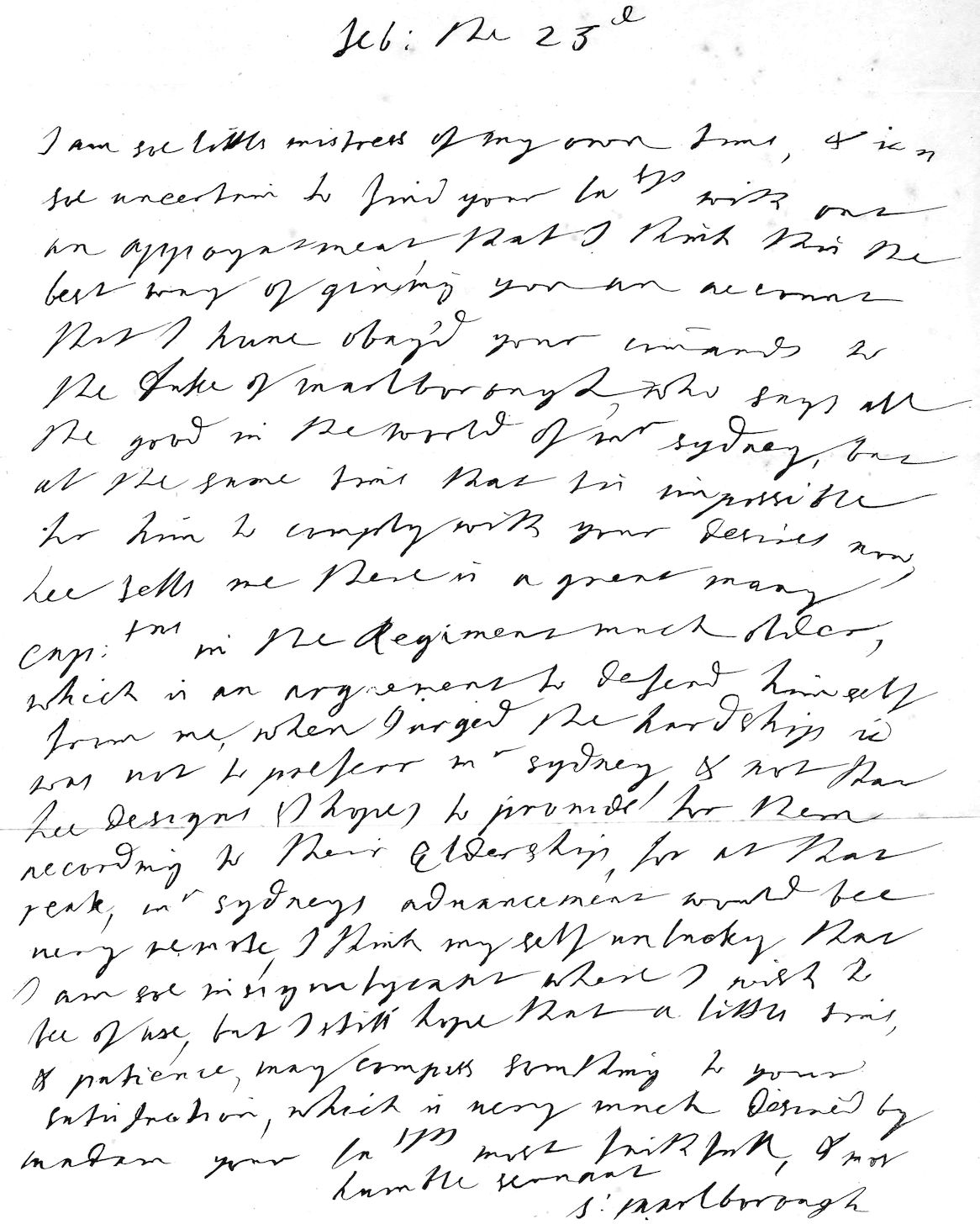
Authoress is also indebted to Mr. Upcott for a
fac-simile of the Duchess’s handwriting, for
various anecdotes selected from the newspapers
of the day, those perishable but important records;
and for a perusal of several scarce tracts and
books, of which ample use has been made in these
volumes. She cannot, indeed, recal to mind the
urbanity, liberality, and intelligence of that
gentleman, without rejoicing that she has been
favoured with his aid, in the performance of a
task of no inconsiderable difficulty.
It is with the greatest pleasure and gratitude
that the Authoress acknowledges her obligations
to Mr. Holmes. Upon her application to
him at the Museum, he entered with a kind and
lively interest into her researches, and facilitated
them in every way. To his aid, and to his intimate
xxiiiknowledge of the manuscripts, she owes
that selection of materials which he pointed out
as most remarkable.
The Authoress has expressed, in a note in the
first volume of these Memoirs, her acknowledgments
to the Rev. Henry Nicholson, Rector of St.
Alban’s Abbey, for the important information
which she derived from him, regarding the birthplace
of the Duchess. Had it not been for the
assistance of that gentleman, directed to the subject
by the local inquiries of friends, she must
have followed Dr. Coxe in erroneously stating
that the Duchess was born at Sandridge.[1]
The Authoress has great pleasure in acknowledging
her obligations to another gentleman
of great classical and literary attainments,
the Rev. I. S. Brewer, to whom she owes so many
useful suggestions, that she only regrets she had
not the benefit of referring to his superior knowledge
at an earlier period of the work than that
at which it was first obtained.
The Authoress cannot close this introduction
to the latest of four historical and biographical
xxivworks, without thus publicly expressing her
thanks to Mr. Keats, of the British Museum,
for his indefatigable attentions to her; and for the
assistance which she has on many occasions derived
from his endeavours to aid her researches.
Hinde Street, London,
April 27, 1839.
CONTENTS OF THE FIRST VOLUME. — CHAPTER I. From 1660 to 1678.
xxv
CHAPTER I.
State of the country previous to the birth of Sarah Jennings—Her parentage—Account of her sister, La Belle Jennings—James the Second—Characters of Anne Duchess of York, and of her successor Maria d’Esté—The Princesses Mary and Anne—Origin and character of John Churchill—His family and circumstances
Marriage of the Princess Mary—Marriage of Colonel Churchill and Miss Jennings—Characters of Anne and Mary—Friendship of Anne for Lady Churchill—Appointment of the latter to be Lady of the Bedchamber to the Princess—Death of Charles the Second
Change of manner in James—Character of Queen Mary—Her submission to her husband—Surrender of the crown to William—The indecision and reluctance of Anne—Her stipulation for a settlement—The part which Lady Churchill is said to have taken in the affair—She asks advice from Lady Russell and Archbishop Tillotson—The different qualities of these two advisers
Character of Godolphin—His advice respecting the pension to the Duchess of Marlborough—Feuds of Mary and Anne—Deficiency of respect towards Prince George—Attachment of Marlborough to his wife—Her residence at Holywell House—Birth of her children—Cloud lowering over the fortunes of Lord Marlborough
State of Parties—Character of Lord Nottingham—of Bentinck—Influence of the Villiers family—Of Lady Orkney—Quarrel of the Queen and Princess—Marriage of Frances Jennings to the Duke of Tyrconnel—Suspicions of the Earl and Countess of Marlborough entertained at court—Disgrace of Lord Marlborough
Release of Marlborough from prison—Confession of Young—Altercations between Anne and Mary—Illness of Anne—of Mary—Death of the latter—Reconciliation of King William to the Princess
Circumstances attending the Peace of Ryswick—Appointment of Marlborough to the office of preceptor to the Duke of Gloucester—Bishop Burnet—His appointment and character
Accession of Anne to the throne—That event considered by the Whigs as unpropitious—Coronation of the Queen—Dislike of Anne to the Whigs—Efforts of Lady Marlborough—Dismissal of Somers and Halifax
Dissatisfaction of the Countess of Marlborough—Formation of the new Cabinet—Her efforts to convert the Queen—Quarrels with Lord Rochester—Reports concerning the sale of offices—The Duchess’s sentiments on the proper mode of such appointments—Cabals within the court
Dangers which beset Marlborough—Peculiar circumstances attending his return to England—Order in Council forbidding the sale of places—Lord Marlborough raised to a Dukedom—Sentiments of the Duchess on that occasion
Remarks on costume and manners in the time of Anne—Literary men, their habits and station in society—The system of patronage—Its effects in degrading the moral character of writers—producing not only flattery, but slander—Mrs. De la Rivière Manley—Dr. Drake—Prior—Congreve
Fac-Simile of a Letter of the Duchess of Marlborough.
J. Netherdift Lithog.
MEMOIRS
OF THE
DUCHESS OF MARLBOROUGH.
1
State of the country previous to the birth of Sarah Jennings:—Her
parentage—Account of her sister, La Belle Jennings—James
the Second—Characters of Anne Duchess
of York, and of her successor Maria d’Esté—The Princesses
Mary and Anne—Origin and character of John
Churchill—His family and circumstances.
The period which preceded the birth of the
distinguished individual whose singular course
is traced out in these Memoirs, was one of apparent
luxury and security, but of actual and
imminent peril to the national welfare. Charles
2the Second, in the decline of what could scarcely
be deemed his days of prosperity, had not,
indeed, experienced the bitterness of grief,
which, in the fatal events that succeeded the
rebellion of Monmouth, reduced the afflicted
monarch to a state of depression which hurried
him to an unhonoured grave. That painful
scene, which in its effects upon the health and
happiness of Charles recalled to remembrance
the anguish of the royal mourner for Absalom,
had not been as yet enacted: Monmouth was to
appearance still loyal, at least, still trusted; and
the ascendancy of the Roman Catholic persuasion
over our Established worship was, at
that time, problematical.
The opinions of reflective men, hushed by the
wise determination not to anticipate the effect of
probable events, which might accomplish all
that they secretly desired, were resolving, nevertheless,
into those famous schools of politics,
which it were wrong to denominate factions, and
which were afterwards divided into the three
parties interwoven with all modern history, denominated
Jacobites, Tories, and Whigs.
It is true it was not until some years afterwards
that these celebrated appellations affixed
to each combination certain characters, which
have ever since, with little variation, retained the
3stamp which each originally bore; but the names
only were wanting. Public opinion, in those
worthy to assert its importance, had actually
arranged itself under three different banners;
although it required some signal manifestations
on the part of government, to draw forth the
forces marshalled under these, from the state of
inaction in which for the present they remained.
Amongst the middle, or moderate party,—who,
not contending, like the Jacobites, for the indefeasible
and divine right inherent in one family
under every circumstance, asserted generally
the principles of arbitrary government,—a great
portion of the gentry, landed proprietors, numbers
of whom had fought and bled for the Royal
cause, and yet, who were, from the same high
spirit and loyal dispositions, equally ready
to defend their country from oppression should
occasion require, might at this period be enumerated.
This respectable portion of the community
were, for the greater part, of the Protestant
faith; and, therefore, whilst dreading the
notion of republicanism, they were attached to the
reigning monarchs, and averse to the succession
of James, or to the Yorkist Party, as it was
called—a name which, by a singular coincidence,
had already proved fatal to the peace of England.
4Upon the virtue and strength of the Tories, as
they might then be called,—though eventually
they merged, as the abettors of the Revolution,
into the bolder faction, with whom from necessity
they were joined,—much of what has since
been preserved to us, depended. Notwithstanding
the practice which obtained among those who
had sufficient influence, of sending their sons into
the army, and their daughters to court, it is from
the royalist families that many of those who promoted
the Revolution, and who even suffered for
their premature exertions in the cause of liberty,
have sprung. Individuals who would have
shuddered at the name of Revolution, whilst yet
their restored monarch ruled the country,—with a
facility which, when we consider his character and
example, is incomprehensible,—became, in after
times, impatient to distinguish themselves in a resistance
to the unsettled mandates of a court, and
in their eagerness to promote the dominion of
just and fixed laws. Amongst this class was the
family of Churchill; and, if we consider the
Duchess as its chief representative, that of Jennings.
The origin, principles, and circumstances
of the latter family we are now about to discuss.
Sarah Duchess of Marlborough, the subject
of this Memoir, a gentlewoman by birth, and a
favourite of fortune, affords, in the narrative of
5her chequered life, an instance that integrity,
unless accompanied by moderation, cannot protect
from the assaults of slander, nor personal and
hereditary advantages insure happiness.
This celebrated woman, the beautiful and intellectual
offspring of wealthy and well-descended
parents; the wife of the most distinguished, and
also of the most domestic and affectionate of
men; blessed as a parent beyond the lot of most
mothers; the favourite of her sovereign, and
endowed with superabundant temporal means;
lived, nevertheless, in turbulence and discontent,
and died, unloved, unregretted, and calumniated.
Her original condition in life was fixed by Providence
in a station, neither too high to enjoy
the quiet privileges of domestic comfort, nor too
low to aspire to distinction; and it was rather her
misfortune than her privilege, that she was singled
out, in early life, to receive the favours of the
great. She was the daughter of a country gentleman
in good circumstances. Her family had,
for many generations, possessed an estate at
Sandridge in Hertfordshire, near St. Albans, at
which place, it has been stated, the father of the
Duchess could muster a tenantry sufficient to
influence considerably the election of members for
the adjacent borough of St. Albans.[2]
6The family of Jennings had been held in
high estimation by the House of Stuart, and
were distinguished among the adherents to the
Royal cause. The Duchess, whatever might be
her subsequent opinions of rulers and princes,
sprang from a race devoted to the hereditary monarchy.
Her grandfather, Sir John Jennings,
received the order of the Bath, in company with
his unfortunate young patron, Charles the First,
then Prince of Wales; and the partiality of the
Stuart family, when restored, was successively
manifested by proofs of favour to the owners of
Sandridge.[3]
These details refute the reports which prevailed,
during the sunshine of prosperity which the
Duchess enjoyed, that her parents were of mean
origin. It was also stated, by the scandalous
writers of the day, that her mother was a woman
of abandoned character, rejected from society,
and of the lowest extraction. Among the various
proofs which might be adduced in contradiction of
this aspersion, the most convincing is the correspondence
which Mrs. Jennings maintained, with
families of respectability in her own neighbourhood.
A letter is still extant, between Sarah
Duchess of Marlborough and the daughter-in-law
of Sir John Wittewronge of Rothamsted
7Park, near St. Albans, in which this calumniated
lady is referred to by Mrs. Wittewronge, addressing
the Duchess, as “your noble mother.”[4] This,
and the still stronger testimony which will be
presently adduced, disprove the insinuations of
party writers, who required but a slender foundation
of surmise upon which to ground their injurious
attacks.
Those who thus wrote were perhaps aware,
that they could scarcely wound a person of the
Duchess’s disposition more deeply than by an aspersion
of this description. Yet, in her celebrated
Vindication, written in old age, the Duchess, with
calmness, refutes in these terms those who sought
to defame her origin: “Though I am very
little concerned about pedigree or families, I
know not why I should not tell you, that his (her
father’s) was reckoned a good one; and that he
had in Somersetshire, Kent, and St. Albans,
about four thousand pounds a year.”[5]
8The mother of the Duchess belonged, in fact,
to a family in some degree superior to that of her
husband. She was Frances Thornhurst, daughter
of Sir Giffard Thornhurst of Agnes Court in
Kent, and heiress to her father’s property. Thus,
on both sides, the Duchess might regard her
origin with complacency; and the expression of
the antiquary Collins, when he describes her
relatives “as a considerable family,” is justified.[6]
This point, of little importance had it not
been obscured by malignity, is readily ascertained:
but of the dispositions, principles, and
attainments of the parents who nurtured one who
played so conspicuous a part, we have no authentic
record. It is a singular fact, that until a diligent
inquiry was made, with a view to the compilation
of these Memoirs, a degree of obscurity existed, even
with regard to the birthplace of the Duchess.
Archdeacon Coxe explicitly declares that she was
born at Sandridge; but, on examining the parish
registers of that place, no mention of that fact,
nor indeed of the birth of any of the Jennings
family, is to be found in them; nor are there in the
church, as it now stands, any monuments inscribed
with that name. Neither does there appear to have
been any house on the estate at Sandridge, of
9nearly sufficient importance to have been the
residence of the Jennings family.[7] It appears,
however, from indisputable testimony, that Sarah
Jennings was born on the twenty-ninth day of
May,[8] in the year 1660, at Holywell, a suburb
of St. Albans, and in a small house, very near
the site of the spacious mansion afterwards erected
10there by her husband, John Duke of Marlborough.
It is to be regretted that a reference to the
registers of the Abbey of St. Albans will not
assist in establishing this point: in the fire
which broke out in that noble building in 1743,
a portion of those valuable memorials was
burnt. But tradition, corroborated by probability,
has satisfied the minds of those most qualified
to judge, that at Holywell, the future
“viceroy,” as she was sarcastically denominated,
first saw the light.[9]
This celebrated woman was one of five children,
11all of whom, excepting Frances Duchess of Tyrconnel,
she survived. Her brothers Ralph and John
died young; and one of her sisters, Barbara, who
married a gentleman of St. Albans, named
Griffiths, died in London in 1678, in the twenty-seventh
year of her age.[10]
By the early demise of these relatives, the
Duchess acquired that hereditary property which
became afterwards her home. At a very early
age, however, she must have left Holywell, to
enter upon the duties of a courtier. She was
preceded in the service of Anne Hyde, Duchess
of York, by her eldest sister Frances, the celebrated
La Belle Jennings, who graced the halls in
which the dissolute Charles and James held
carousal, and who followed the destinies of the
exiled James to a foreign land.
Resembling in some respects her sister,
Frances Jennings was equally celebrated for
her talents and for her beauty. Her personal
charms were, however, of a softer and more
alluring character than those of the imperious
Sarah. Her bright yet delicate complexion,
her luxuriant flaxen hair, and her attractive
but not elevated features, might have been
liable to the charge of insipidity, but that a vivacity
of manner and play of countenance were
12combined with youthful loveliness, in riveting
the attention on a face not to be forgotten.
Like her sister, Frances possessed shrewdness,
decision, penetration, and, their frequent attendant
in woman, a love of interfering. Proud
rather than principled, and a coquette, this lovely,
aspiring woman had no sooner entered upon
her duties of a maid of honour, than her youth
and innocence were assailed by every art which
could be devised, among men whose professed
occupation was what they termed gallantry.
Frances united to her other attractions remarkable
powers of conversation; her raillery was
admirable, her imagination vivid. It was not
long before her fascinations attracted the notice
of that devotee and reprobate, James Duke of
York, whose Duchess she served. But James, in
directing his attention to a Jennings, encountered
all the secret contempt that a woman could feel,
and received all the avowed disdain which she
dared to show. To his compliments, the indignant
and persecuted maid of honour turned
a deaf ear; and the written expressions of the
Duke’s regard were torn to pieces, and scattered
to the winds. Nor was it long before Frances
Jennings found, in a sincere and honest attachment,
an additional safeguard against temptation.
13Sarah, at twelve years of age, was introduced
into the same dangerous atmosphere.
Fortunately for both sisters, in Anne Duchess of
York they found a mistress whom they could
respect, and in whose protection they felt security;
for she possessed—the one great error in her
career set apart—a sensible and well-conditioned
mind.
Her court was then the chief resort of the gay
and the great. It was the Duchess’s foible (in
such circumstances one of injurious effect) to pride
herself upon the superior beauty of her court,
and on its consequent distinction in the world
of fashion, in comparison with that of the Queen,
the homely Katharine of Braganza. But she
had virtue and delicacy sufficient to appreciate the
prudence and good conduct of those around her,
and to set an example of propriety and dignity,
in her own demeanour, becoming her high station.
United to a husband who, in the midst of depravity,
“had,” says Burnet, “a real sense of sin,
and was ashamed of it.”[11] Anne, had she lived,
might have possessed, as a Protestant, and as a
woman of understanding, a salutary influence
over the mind of her husband;—an influence
which prudent women are found to retain, even
when the affections of the heart are alienated
14on both sides. But her death, which happened
in 1671, deprived England of a queen-consort
who professed the national faith; and, in her,
James lost a faithful and sensible wife, and the
court a guide and pattern which might have
checked the awful demoralization that prevailed.
Anne was succeeded by the unfortunate Maria
Beatrix d’Esté, Princess of Modena, called,
from her early calamities, “the Queen of Tears.”[12]
Into the service of this lovely child, for such she
then was, Sarah Jennings, in consequence of the
partiality entertained by the Stuarts for her
family, who had been always Royalists, was,
shortly after the death of her first patroness, preferred.
In the young Duchess of York Sarah found a
kind mistress, an affectionate and a liberal friend.
Her subsequent desertion of this unhappy Princess
is, we are of opinion, one of the worst
features of a character abounding in faults;
and proves that ambition, like the fabled Upas
tree, blights all the verdure of kindly affections
which spring up within the human heart.
Maria Beatrix, the beloved, adopted daughter
of Louis XIV., encountered, in her marriage
with James, a fate still more calamitous than that
15which the ungainly Katharine of Braganza, or the
lofty but neglected Anne Hyde, bore in unappreciated
submission. Beautiful beyond the
common standard, and joyous as youth and innocence
usually are, this unhappy woman came,
in all the unconsciousness of childhood, to incur
the miseries of suspicion and obloquy, and to experience
subsequent reverse, even poverty. She
was hurried over to England, when little more
than fourteen years of age, to become the
bride of James, then no longer young, in
whom bigotry was strangely united to looseness
of morals, which habitual and prompt
repentance could not restrain. In his phlegmatic
deportment, in spite of the natural grace
of all the Stuarts, vice failed to attract, yet ceased
not to disgust; nor can we be surprised that
repeated and fruitless negociations were necessary
to procure him a wife, after remaining a widower
for more than two years.[13]
In November, 1673, the ill-fated Princess of
Modena landed at Dover. The match, which
had been accelerated by the promise of a portion
to Maria, his adopted daughter, from the King of
France, was universally unpopular in England. It
had been, however, already concluded, the Earl of
Peterborough having, in September, married the
16Princess by proxy, in Italy. He had conducted
the bride to Paris, when Parliament met, and the
Commons voted an address to the King, to prevent
the marriage of his brother and the Princess,
on the plea of her religion. The hopes of a dowry
prevailed, at a time when Charles was so impoverished
as to entertain an idea of recalling the ambassadors
from foreign courts, from the want of
means to support them; and the Princess was married
to the Duke, at Dover, on the same evening
that she landed, to prevent further obstacles, the
ceremony being performed according to the rites
of the Church of England.[14]
The Duke and the Duchess proceeded to Whitehall,
where no very cordial welcome awaited their
arrival. The Duchess was refused the use of the
private chapel, which had been stipulated by the
marriage articles, and the Duke was advised by
his friends to withdraw from the country.[15]
Such was the reception of Maria D’Esté, the
mother of the Pretender, and, as such, the innocent
cause of many national disasters. In her
service, and favoured by her kindness, Sarah
Jennings passed many years; nor can the subsequent
desertion of this lovely and unfortunate
Princess, which the then influential Countess of
17Marlborough justified to herself, be viewed in any
other light than as an act of the coldest ingratitude.
During the twelve years that Mary enjoyed a comparatively
private station as Duchess of York, she
passed her time, and engaged those around her, in
innocent amusements and revels, which have been
always peculiarly agreeable in their rulers to the
English people. Young and light-hearted as she
then was, Mary was herself the fairest flower of
the court, over which she presided with the gay
grace of her country. “She was,” says Macpherson,
“of exquisite beauty. Her complexion
was very fair, her hair black, her eyes full of
sweetness and fire. She was tall in her person,
and admirably shaped; dignified in her manner,
and graceful in her deportment.”[16]
By the sweetness and propriety of her conduct,
she, in her hours of sunshine, made herself universally
beloved, notwithstanding her religion;
and amid the storms of her subsequent career
she showed a spirit and heroism which deserved
a better cause, and a clinging attachment to
James which merited a worthier object.
There is no reason to conclude that at first Sarah
Jennings lived constantly in the household of the
Duchess. “I was often at court,” is an expression
which occurs in a passage of her Vindication. She
18seems, indeed, to have remained in the proximity
of the Duchess, chiefly for the purpose of being
a sort of playmate, rather than attendant, of
the Princess Anne, the step-daughter of her
royal mistress, whose favour she ultimately succeeded
in obtaining, and for whose dawning
greatness she relinquished her adherence to the
falling fortunes of the Duchess. It is probably
to this intimacy with the juvenile branches of
the court that Sarah, in part, owed that correctness
of conduct, which not even the malice of
her enemies could successfully impugn; and soon
a sincere and well-founded attachment, the great
safeguard to wandering affections, ended in an
engagement which gave to the beautiful Miss
Jennings an efficient and devoted protector.
In the year 1673, John Churchill, afterwards
Duke of Marlborough, was appointed to be a
gentleman of the bedchamber to the Duke of
York,—probably on occasion of the Duke’s marriage.
Churchill was at this time a colonel in
the army, and already his fame stood high as
an officer of enterprise; whilst, at the court,
there were few of the young gallants of the day
who could cope with this gifted man, in the
dignity and symmetry of his person, in the
graces of his manner, or in the charm which
good-breeding, and a species of benevolence in
19small and every-day matters, confer upon the deportment.
The illustrious name of Churchill requires,
however, some comment, before the disturbed
course of his love-suit to his future wife, the solace
and torment of his later days, can be unfolded.
Roger de Courselle, or Courcil, one of the
Barons of Poitou, who followed William the
Conqueror to England, and settled first in Somersetshire,
and afterwards in Devonshire, under the
anglicised name of Churchill, was the direct
progenitor of Colonel Churchill. It is worthy
of remark, that at different periods the ancestors
of our great warrior have been noted for valour.
In the reign of Stephen, Sir Bartholomew
Churchill lost his life defending Bristol Castle,
in the cause of the king; and in the disturbed
times of Edward the Fourth, William, a lineal
descendant of Sir Bartholomew, fought under
the banners of the Courtenays in Devonshire, for
his sovereign. Successive proofs of loyalty were
given by the Churchill family; and Sir Winston,
the father of the hero of Blenheim, left the University
of Oxford, whilst a youth, to enlist in the
army of Charles the First, in which he served
with distinction, as a captain of horse, in several
battles.[17]
20It was the inevitable consequence of the political
turmoils in which the family of Colonel
Churchill bore a part, that his patrimony should
have suffered. His youth was passed in privacy
and restraint; and perhaps to that circumstance
may be traced that love of order in his affairs,
and that close regulation of his expenditure,
which in his prosperous days procured for him
the opprobrium of penuriousness. During the
civil wars, his father had married a daughter of
Sir John Drake, of Ashe in Dorsetshire, where
Sir Winston was thankful, after the execution of
Charles the First, to retire, his estates being sequestrated
by Parliament, and a fine of upwards of four
thousand pounds imposed upon him for his adherence
to the Royal cause.
In the safe seclusion of Ashe, John Churchill
was nurtured; and, although upon the restoration
of Charles the Second the family estate was
recovered, his father was honoured with knighthood,
and employed by government, his valiant
son never derived any pecuniary advantage from
the paternal property.[18] Sir Winston ultimately
was reduced to circumstances of difficulty, in
21which he died, bequeathing his estate to his
widow, with a request that she would leave it to
his third son, Charles. To his family connexion,
not solely to fortune or to his own merits, was
John indebted for his elevation to distinction.
His condition therefore, in some respects, resembled
that of his early and late affection, as far
as worldly and external circumstances are concerned.
The family of Churchill, like that of Jennings,
was ancient; and young Churchill possessed, in
the power of referring to a long line of ancestry,
an incentive, to an ardent mind peculiarly attractive,
to aim at distinction, not only for self-gratification,
but with the hope of restoring to former
honour those whose fortunes and fame had been
crushed, but not obliterated. Colonel Churchill,
even from his childhood, had been connected
with a court, and destined to share a courtier’s
duties and rewards. From his boyhood he was
honoured with the notice of Royalty, the Duke
of York being his first patron.
To the influence of James he owed his rapid
promotion in the army; and, as in all similar
cases, several causes, such as were incidental to
the Stuart family, and probably from their known
looseness of principle, were assigned for his success.
But to the good-nature and discernment
22of James the Second, the first opportunity afforded
to Marlborough of becoming great must be attributed.
Observing the enthusiasm of the high-minded
boy, then his page, during the reviews of
the regiments of Foot Guards, James inquired of
the youth “what profession he would prefer?”
Churchill, neither overpowered nor abashed by
this trait of condescension, fell upon his knees,
and owned a predilection for that of arms, venturing
to beg “for a pair of colours in one of
those fine regiments.” His petition was granted,
and at sixteen years of age Churchill entered the
army.
This commencement of his fortune has been
stated, but erroneously, to have been the result
of James’s passion for Arabella Churchill, the
sister of the young officer, and afterwards the
acknowledged mistress of the prince. But Arabella,
who was younger than her brother, had
not at that time attracted the notice of her brother’s
patron. In all probability her transient
influence over the Duke—that influence which
excited the sole pang of jealousy ever evinced
by Anne Hyde—accelerated the rise to eminence
which Churchill gained with unusual rapidity,
and in consideration of which he appears, in
compliance with the custom of the day, to have
witnessed, without the burning blushes of shame,
23his sister’s disgrace. Arabella, indolent, easy,
not beautiful,[19] and unambitious, soon lost her
royal lover’s regard. She bore him, however,
two sons, one, the celebrated James Fitz-James,
Duke of Berwick; the other, Henry, Grand
Prior of France; and two daughters, Lady Waldegrave
and Mrs. Godfrey.
At the period of his appointment in the household
of the Duke of York, Colonel Churchill was
in his twenty-fourth year. Already had he distinguished
himself at the siege of Tangier during his
first campaign, and had served afterwards under
the Duke of Monmouth, and nominally under
Louis the Fourteenth; but, to the especial advantage
of his military character, he had fought
under the banners of Marshal Turenne. Already
had he signalised himself in the attacks on Nimeguen,
where his courage attracted the discerning
eye of Turenne, who gave him the name of the
“handsome Englishman;” and a station of importance
having been abandoned by one of
Turenne’s officers, Captain Churchill was appointed
to maintain it, which he effected, expelling
the enemy.[20]
24At the siege of Maestricht Churchill still further
advanced his fame, and received the thanks of
Louis the Fourteenth, and his fortunes seemed to
his youthful mind advancing to their climax,
when he was presented to Charles the Second by
the Duke of Monmouth, with this warm-hearted
asseveration, characteristic of that gallant nobleman.
“To the bravery of this gallant officer,”
said the Duke, addressing his royal father, “I owe
my life.” The last reward of Churchill’s valiant
exertions had been an appointment to the command
of the English troops auxiliary to France;
a post which the Earl of Peterborough had
resigned.[21] The fame of these various services
had been extolled by friends at court, and by
connexions, influential in various degrees, and
for various reasons.
Recalled, at sundry times, to the duties of a
court life, the hero who surpassed the generals
under whom he served, surpassed also the
courtiers with whom he came into frequent collision.
He was endowed with personal beauty,
height of stature, (being above the middle size,)
activity, and sweetness of expression: in short,
25the perfection of the species, high intellect combined
with perfect grace, was exhibited in this
great, and, when chastened by the course of events,
subsequently good man. His countenance was
mild, thoughtful, commanding; his brow lofty,
his features regular but flexible. His deportment
was dignified, and, at the same time, winning.
“No one,” said one who knew him personally,
“ever said a pert thing to the Duke of Marlborough.”[22]
The same consummate judge even attributed
the great success of the Duke “to the Graces, who
protected and promoted him.” “His manner,”
Lord Chesterfield declares, “was irresistible,
either by man or woman.”
Like most young men destined to the profession
of arms, the education of Churchill was
limited. Lord Chesterfield, indeed, declares that
the great Marlborough was “eminently illiterate,
wrote bad English, and spelt it worse;” and he
goes so far as to assert, that “he had no share of
what is commonly called parts; he had no brightness,
nothing shining in his genius.”
But with this opinion, however backed by high
authority, it is impossible for those who trace the
career of Marlborough to agree. That he was
not a man of extensive intellectual cultivation, as
26far as the learning to be acquired from books
was concerned—that he was not calculated to
harangue in the senate with peculiar distinction,
nor addicted deeply to the study of the closet—may
readily be admitted. It may even be allowed
that he was deficient in the science of orthography—in
those days less carefully instilled in youth
than in the present time.[23] But that he was absolutely
illiterate, or even of mediocre parts
moderately cultivated, his private letters sufficiently
disprove. They are all admirably expressed;
clear, emphatic, and in well-constructed
sentences. His father was a man of letters, the
author of an historical work,[24] and by Sir Winston
was the education of Churchill superintended,
until he was placed at St. Paul’s school,
London.[25]
To the “cool head and warm heart” of Marlborough,
as King William the Third expressed
it, he owed his early and progressive success.
He was at once the object of affection and of
27confidence. His calmness, the suavity of his temper,
until disease, most cruel in its effects on that,
broke down his self-command; his forbearance—his
consideration for others—the gentleness with
which he refused what he could not grant—the
grace with which he conferred favours—these
qualities, combined with indefatigable industry,
hardihood, and a judgment never prejudiced by
passion, were the true sources of Churchill’s
greatness, the benignant spirits which made the
gifts of fortune sweeter when they came.
It is uncertain at what time or in what manner
the first tokens of ardent affection between Colonel
Churchill and the youthful Sarah were exchanged.
The authoress of the “Life of Zarah”
has given a romantic description of their first
meeting, in which, as in other ephemeral works,
we may suppose there may be some foundation of
truth, but no accuracy of detail. According to
this account, the youthful fancy of Sarah was
first attracted by the grace of her valiant lover in
the dance—a recreation in which he particularly
excelled. “Every step he took carried death in
it,”[26] and the applause and admiration which
Colonel Churchill obtained, sank deep into the
heart of one whose ambition was perhaps as easily
stimulated as her love. Yet that her affections
28were interested in the addresses of the brave
Churchill, is manifest from her rejection of another
suitor of higher rank, the Earl of Lindsay,
afterwards Marquis of Ancaster, and of others,
by whom she was considered as “the star and
ornament of the court.”[27]
The correspondence between these celebrated
lovers during the anxious days of courtship was
preserved by the survivor, with a care that
marked the honour which she felt she had received
in being beloved by such a man as Marlborough.
They are said, by Archdeacon Coxe, to have displayed
the most ardent tenderness on the part of
Churchill, with alternations of regard and petulance
on that of the lady. Her haughtiness, and
the sensibility of her future husband, fully appear
in these letters. Yet, notwithstanding the defects
of character which they betrayed in the one party,
the attachment on the side of the other increased
in ardour, and continued sufficiently strong to
overcome all obstacles. Amongst these, the scanty
portion of Sarah, no less than the still greater
deficiency of means on the part of her lover, formed
the principal impediment. In order to show the
different circumstances of each of the families with
which they were connected, it is necessary to
give some account of their various members, and
29of the fortunes which they had at this time begun
to share.
The adherence of the Churchill family to the
royal House of Stuart, and the adverse effect of
that adherence upon the fortunes of Sir Winston
Churchill, have been already mentioned. Sir
Winston, a man of considerable learning and
of approved bravery, had indeed so far retrieved
his circumstances, and relieved his estate of its
heavy burdens, as to be able, in 1661, to stand
for the borough of Weymouth, and to sit in the
first parliament called by Charles the Second.
He was afterwards appointed a commissioner of
the Court of Claims in Ireland, and constituted,
on his return from that country, one of the comptrollers
of the Board of Green Cloth,—an office
from which he was removed, but to which he was
restored. But these appointments appear to have
been the sole compensation which he received
for his active services; and he seems to have
devoted the latter portion of his days to pursuits
of literature rather than of ambition, being one
of the first fellows of the Royal Society, and the
author of an able and elegant historical work on
the Kings of England, which composition he
dedicated to Charles the Second.[28]
Sir Winston’s means were encumbered, however,
30with seven sons and four daughters; and
although seven of this numerous family died in
infancy, yet still a sufficient number remained to
entail anxiety upon the owner of an impoverished
estate. George Churchill, the third surviving
son, like his brother John, owed the first gleams
of royal favour to family interest, but insured
its continuance by his merit. He distinguished
himself both by sea and land; was a faithful servant,
for twenty years, as a gentleman of the
bedchamber to George of Denmark, and attained,
under King William, the post of one of the commissioners
of the Admiralty.
Charles, the fourth son, was also bred to arms,
and, at an early age, signalised himself at the
time of the Revolution. To him the landed property
of Sir Winston descended, on account of
some pecuniary obligations which his father
owed him, and which prove how circumscribed
were still the means of the brave and estimable
Sir Winston. Like his brothers, Charles held
offices under the crown, and was appointed
governor of the Tower of London by Queen
Anne.[29] Thus, whilst, by merit and interest conjoined,
the sons of Sir Winston Churchill attained
independence, and perhaps wealth, it was
natural for him to desire that his eldest surviving
31son should farther advance his fortunes by an
advantageous marriage; nor was it inconsistent
with the notions of the day, to look upon marriage
solely as a negociation in which the affections
were not even consulted, or were at least regarded
as of secondary import.
That such were the sentiments of Sir Winston
and Lady Churchill, appears from the strenuous
opposition which they made to their son’s union
with Miss Jennings: for at present her portion was
inconsiderable, and her family interest not to be
compared with that of the Churchills. It is true
that the estate at Sandridge, to which the Duchess
afterwards became co-heiress, was more productive
than those lands which Sir Winston Churchill
had saved from the grasp of the parliament;
but still it was encumbered by a provision for her
grandfather’s numerous issue; nor was it until the
death of her brothers, without children, that
Sarah and her sister Frances shared the patrimonial
property. Thus circumstanced, and precluded
on both sides from the expectation of parental
aid, the young soldier was obliged to depend upon
his own powers of exertion, to find means to form
an establishment for the lady to whom he made
his ardent suit.
The young Duchess of York was, at this juncture,
the counsellor and confidante of Sarah, and
32she appears to have offered her and Colonel
Churchill some pecuniary assistance in this emergency.[30]
Nor was her bounty the only source
from which a future provision for the lovers was
derived.
It is always an ungracious task to touch upon
the errors of those who, by a subsequent career
of honour, have left, as the final testament to posterity,
an example of domestic virtue. The income
which Colonel Churchill possessed,[31] is said
to have been derived from a dishonourable source.[32]
Amongst the causes of his rapid rise in the
army, as well as of his success at court, his relationship
to the celebrated Barbara Villiers, afterwards
Duchess of Cleveland, has been naturally
regarded as one of the most powerful explanations
of the favours which he received. This infamous
woman, described by Bishop Burnet as “a woman
of great beauty, but enormously vicious and
ravenous, foolish, but imperious,”[33] governed
33Charles the Second, as it is well known, by the
exhibition of the most tempestuous passions,
which she ascribed in his presence to jealousy of
him, whilst her intrigues with other men were
notorious. She was second cousin to Churchill
by his mother’s side, being the daughter of Villiers
Lord Grandison, who was killed at the battle
of Edge Hill. Whilst Churchill was a youth,
she imbibed for him too strong a partiality, in
such a mind as hers, to appear even innocent, if it
really were so. Her passion for him was as sudden
as it was disgusting; and however it may have
procured him some temporary assistance, it drew
upon him the displeasure of the King, who at
one time forbade him the court.[34] The advocates
of Churchill have endeavoured to attach little
importance to this disgraceful connexion, for
which his youth and the temptations of the court
alone furnish an apology; yet they cannot, whilst
they excuse, entirely deny a fact which undoubtedly
sullies the fair fame of Churchill.
Lord Chesterfield, in holding up the Duke of
Marlborough as a model of good breeding and
irresistible elegance and suavity, thus touches
upon the fact of his being under pecuniary obligations
to the imperious Duchess of Cleveland.
“He had,” says his lordship, “most undoubtedly
34an excellent, good, plain understanding, with
sound judgment. But these alone would probably
have raised him but something higher than
they found him, which was page to King James the
Second’s queen. There the graces protected and
promoted him; for while he was an ensign in the
Guards, the Duchess of Cleveland, then favourite
mistress of the King, struck by those very graces,
gave him five thousand pounds; with which he
immediately bought an annuity of five hundred
pounds a year, of my grandfather Halifax, which
was the foundation of his subsequent fortune.”[35]
Upon this slender annuity, thus disreputably
obtained, the hopes of Churchill and of the
young object of his affections depended. Sarah
appears to have been capricious and undecided
in her conduct during the progress of their
engagement, which lasted three years.[36] The
cause of these variations of feeling has been
assigned to the opposition made by Sir Winston
and Lady Churchill to their son’s forming a
union so far below their expectations; but it
may be referred to various other sources. The
high-minded Sarah must have been often offended
and wounded, in the nicest feelings, by the past
irregularities of Churchill’s life. Those irregularities
were renounced, it is true, upon his engagement
35with her, and his honourable and well-toned
mind was recalled to a sense of that beauty
which attends purity of conduct, and its power to
dignify characters even of a common stamp. But
the effects of his past conduct were found in the
bitterness and jealousy of those by whom he had
been hitherto flattered,[37] and by whom doubtless
the defects of his moral character may have been
grossly exaggerated. Sarah may have intended
to prove the constancy of her accomplished
lover, when, hearing that his parents destined
him to become the husband of a young lady
of superior fortune to her own, though of less
beauty, she petulantly entreated him “to renounce
an attachment which militated against
his worldly prospects;” and adding many reproaches,
pungent as her pen could write,—and
in the vituperative style she had few equals,—she
declared that she would accompany her sister
Frances, then Countess of Hamilton, to Paris,
thus finally to end their engagement. Her address
to the honour, to the heart of Churchill, was
not made in vain; he answered her by an appeal
to her affection, and by earnest remonstrances
against her cruelty, and a reconciliation was the
result.[38]
36Whilst these sentiments secretly occupied the
heart of Churchill, and of her who loved him,
perhaps, less for his excellencies than for the
effect which they produced upon others, several
events took place at the court of Charles, in
which Colonel Churchill, during the intervals of
his military service, participated,—his office of
master of the robes to the Duke of York, an
appointment granted him in 1673, retaining him
near the court; whilst Sarah, in the course of
her attendance on the Princess Anne, must have
taken a considerable interest in the events which
immediately concerned the royal family.
CHAPTER II. COURT OF CHARLES II. —1677 to 1681.
37
Marriage of the Princess Mary—Marriage of Colonel Churchill
and Miss Jennings—Characters of Anne and Mary—Friendship
of Anne for Lady Churchill—Appointment of
the latter to be Lady of the Bedchamber to the Princess—Death
of Charles the Second.
It was fortunate for the subject of this Memoir
that her introduction into the great world took
place under the auspices of a young and virtuous
Princess, almost of the same age with herself. It
is true, that to the charge of Katharine, the
neglected wife of Charles the Second, no graver
crime could be alleged than her subserviency to
the King’s pleasures; for in her own conduct she
was irreproachable. When first she became Queen
of England, she endeavoured, with such judgment
as she possessed, to reform the manners of her
adopted country, and to introduce propriety of
38demeanour into the court. Unhappily Katharine
was not endowed with those graces which are
likely to recommend virtue. She is described by
a contemporary as “a little ungraceful woman, so
short-legged, that when she stood upon her feet
you would have thought she was on her knees,
and yet so long-waisted, that when she sat down
she appeared like a well-sized woman.”[39]
Brought up in a monastery, the simple-minded
Katharine vainly hoped to reform her dissolute
husband, whose inconstancy at first grieved and
shocked her virtuous notions. Unlike her
rival, Anne Duchess of York, a shrewd and
worldly woman, who strove to fill her saloons
with the young and the fair, Katharine was surrounded
by her countrywomen, old, stiff, ungainly,
repulsive Portuguese ladies, of birth and
pride, who soon became the subjects of infinite
merriment to King Charles’s court. These exemplary
ladies came possessed with the notion
that they should quickly bring the English to
conform to their new customs; but Charles
speedily undeceived them, and by his express
order they were soon shipped off again for Portugal.[40]
The injured Queen was, at the time that
39Sarah and Colonel Churchill became acquainted,
sinking fast into the obscurity which was alone
redeemed from oblivion, after Charles’s death, by
her patronage of musical science, and by the
concerts which she gave at Somerset House,
whither she retired, to reside until she returned
to Portugal.[41]
Charles, impoverished in circumstances, and
governed at this time almost wholly by the
Duchess of Portsmouth, who was under the influence
of France, astonished both his subjects
and the foreign courts, by the alliance which he
selected for his niece, the Princess Mary, at this
time in her fifteenth year. It was whilst Colonel
Churchill and his future wife were in all the uncertainties
of suspense, that the nuptials of William
of Nassau with Mary were solemnised. This young
Princess is said to have owed the decision which
gave her a husband to whom she was entirely
subservient, to a sudden prepossession of her royal
uncle in favour of the Prince. The King is reported
to have said to Sir William Temple these
characteristic words:—“I never yet was deceived
in judging a man’s honesty by his looks; and
if I am not deceived in the Prince’s face, he is
the honestest man in the world, and I will trust
him, and he shall have his wife; and you shall
40go immediately and tell my brother so, and thus
it is a thing resolved on.”[42]
This mode of deciding an union highly agreeable
to the English, although unwelcome to the
Duke of York, was adopted and carried instantly
into effect, in order to avoid the importunities of
the Duchess of Portsmouth, who was entirely an
instrument in the interests of France. Louis the
Fourteenth, when informed of the marriage being
declared in council, could not help marking his
resentment towards the Duke of York, through
the English ambassador, Lord Darnley,—who
justified James by saying that “he did not know
of the King’s decision until an hour before it was
proclaimed, nor did the King himself above two
hours previously.” Upon which Louis uttered
these prophetic words: that “James had given
his daughter to his greatest enemy.”[43]
In the ensuing year, 1678, the marriage of
Sarah Jennings and Colonel Churchill is presumed
to have taken place.[44] Secret their union
certainly was, for a letter addressed by Colonel
Churchill to his wife, from Brussels, April 12,
1678, is directed to Miss Jennings; but the epistle
was carefully preserved by his wife, who left, in
41her own handwriting, these words on the back:
“I believe I was married when this was written,
but it was not known to any but the Duchess” (of
York.) In the same year he writes to her, addressed
to Mrs. Churchill, at Mintern, his father’s
seat, where probably the young bride had taken
up her abode in the intervals of her attendance
at court; or perhaps that attendance was discontinued,
and not constantly resumed until a
year or two afterwards. The ceremony took
place in the presence of Mary Duchess of York,
who bestowed presents of considerable value on
the bride; and some months afterwards the marriage
was avowed.[45]
Little of domestic comfort for several years seems
to have been the portion of Colonel Churchill in
his marriage. His first absence was on occasion
of the Duke’s retiring, first to Brussels, and afterwards
to the Hague, accompanied by the Duchess
of York, and by the Princess Anne; an event which
took place in the beginning of the year 1678. But
although at this time attached to the service of
the Duke of York, and ignorant of the Duke’s
designs upon the religion and the liberties of
England,[46] Colonel Churchill’s interests with
Charles appear not to have suffered; for he
obtained in February a regiment of foot, and was
42shortly afterwards sent on a mission of importance
to the Prince of Orange. The following
letter from him to his wife breathes sincere affection.
It is dated Brussels, April 12th.
“I writ to you from Antwerp, which I hope
you have received before now, for I should be
glad you should hear from me by every post. I
met with some difficulties in my business with
the Prince of Orange, so that I was forced to
write to England, which will cause me to be two
or three days longer abroad than I should have
been. But because I would lose no time, I despatch
all other things in the mean time, for I do,
with all my heart and soul, long to be with you,
you being dearer to me than my own life. On
Sunday morning I shall leave this place, so that
on Monday night I shall be at Breda, where the
Prince and Princess of Orange are; and from
hence you shall be sure to hear from me again;
till then, my soul’s soul, farewell.”[47]
Colonel Churchill had, however, the enjoyment
of passing the summer of this year with his
wife at Mintern, where he had the happiness of
finding her reconciled to his parents; but this
transient enjoyment of domestic quiet was not of
long duration. The Colonel was obliged to repair
43to London, where he received instructions to join
the allied troops in hostilities against France,
and received a commission from the Duke of
Monmouth, appointing him, as British commander-in-chief
in the Netherlands, to the command
of a brigade in Flanders. But, happily,
being driven back by contrary winds to Margate,
Colonel Churchill learned, in time to prevent
his proceeding to the Continent, that the Prince
of Orange had signed a treaty with the French,
and that a general peace was the result.[48]
The dissolute rule of Charles was now drawing
to a close; but its last years were disturbed
by faction, and disgraced by acts of rigour, which
were with justice imputed to the influence of the
heir apparent. Colonel Churchill and his wife remained,
however, attached to the service of the
Duke and Duchess of York, and accompanied their
royal highnesses to the Hague and to Brussels—a
journey which was undertaken by James in
compliance with a request addressed to him from
his brother, that he would for a time absent himself
from the British dominions.
This may probably be considered as the happiest
epoch in the life of Churchill, and of the
partner of his bright fortunes. Although confided
in by James in all important points, notwithstanding
44the difference of their religious
faith, Churchill took no share in political intrigues,
and with a calm dignity retained his own
opinions, unbiassed by example, or by what might
be deemed interest. “Though I have an aversion
to popery,” thus he explained his sentiments
to a confidential friend, “yet I am no less averse
to persecution for conscience sake. I deem it
the highest act of injustice to set every one aside
from his inheritance upon bare suppositions of
intentional evils, when nothing that is actual appears
to preclude him from the exercise of his
just rights.”[49]
On the other hand, Mrs. Churchill had at present
no important part in life to act, no dreams of
greatness to disturb her routine of duty and service
to a mistress who appears to have treated her with
the utmost kindness. The Princess Anne, indeed,
accompanied her father to the Continent,
and shared with her stepmother the attentions
and the society which afterwards became so
essential to the future Queen of England. But
Anne’s importance was at present overshadowed,
and her chances of future elevation were remote,
even in her own anticipations.
During the course of the summer, James was
recalled to England by the illness of his brother;
45but finding that Charles was likely to recover, he
returned to Flanders, in order to bring over
his family to the British Isles,[50] although he was
not permitted by the King to remain in London.
Colonel Churchill, meantime, was despatched to
Paris upon diplomatic business, with an especial
recommendation from James, who designated
him in his letter “master of the wardrobe.”[51] It
was not, however, considered expedient by Charles
or his advisers that the Duke of York should
continue in England, and accordingly it was
given out, by authority, that the Duke having
represented to his Majesty that it would be more
proper that he should remain in his Majesty’s
dominions than in those of any other Prince, the
King had consented to his Royal Highness’s removal
to Scotland.
The Duke and Duchess of York, therefore,
with a numerous suite, composed of many of the
nobility and persons of distinction, departed
for Edinburgh, leaving the Princess Anne,
and Isabella, her half-sister, at St. James’s. In
this tedious journey, which, performed with much
parade, lasted a month, Churchill and his wife
46accompanied the Duke and Duchess,[52]—Colonel
Churchill, from the desire of escaping those
contentions which then agitated public men, and
occupied both Houses, concerning the succession,[53]
prudently avoiding a seat in parliament, which he
might readily have obtained.
It was for some years the occupation of
Churchill, and of his wife, to follow the footsteps,
and in some measure to share the anxieties, of
the Duke and Duchess of York. During the
present year, James returned to London; but he
was again driven to Scotland by the efforts of the
adverse party, and was again accompanied by
Churchill.
After a year spent on the part of Churchill
in many important missions, he had the
happiness of hearing, on his return to Scotland
after one of these embassies, that he had
become a father. The infant Henrietta, afterwards
Duchess of Marlborough, was born in
London, whither Mrs. Churchill had accompanied
the Duchess of York, July the tenth, 1681.[54]
The character of the Duchess of Marlborough
as a mother remains yet to be developed; but
the letters of Colonel Churchill to her, at this
47period, bespeak a sense of domestic happiness,
and prove that she was still, as indeed she ever
was, ardently beloved by his, the most affectionate,
as it was the bravest heart.
“I writ to you,” he says in one of these unpremeditated
epistles, “last night by the express,
and since that I have no good news to send you.
The yachts are not yet come, nor do we know
when they will, for the wind is directly against
them, so that you may believe I am not in a very
good humour, since I desire nothing so much as
being with you. The only comfort I had here
was hearing from you, and now, if we should be
stopped by contrary winds, and not hear from
you, you may guess with what satisfaction I shall
then pass my time; therefore, as you love me,
you will pray for fair winds, that we may not
stay here, nor be long at sea.
“I hope all the red spots of our child will be
gone against I see her, and her nose strait; so
that I may fancy it to be like the mother, for she
has your coloured hair. I would have her to be
like you in all things else. Till next post-day
farewell. By that time I hope we shall hear of
the yachts, for till I do, I have no kind of patience.”[55]
48The constant services of Churchill were at
length rewarded with an elevation to the peerage,
an honour which he owed entirely to the recommendation
of James in his favour. He was
created Baron Churchill of Eyemouth in Scotland,
and made also Colonel of the third troop of
Guards.[56]
Weary, probably, of a courtier’s life, it was
now Lord Churchill’s desire to withdraw Lady
Churchill from the court, and to enjoy with her
the privacy which their mutual affection might
have rendered delightful. But so peaceful a lot
was not to be the portion of this remarkable
pair, who were destined to act a conspicuous part
in the great sphere of public action.
It is not stated what were Lord Churchill’s
particular motives for thus wishing to withdraw
from the greatness which was “thrust upon
him,” at a time when James, his patron, was
restored to his royal brother’s favour, and when
his own influence was daily increasing. But we
may look into the history of those fearful times
for a solution of this inquiry. The feelings, upright
and humane, of Churchill, and even of his
less sensitive wife, had doubtless been harrowed
by the occurrences of the preceding year. The
Rye House Plot, and its melancholy termination,
49must have saddened the heart even of the strictest
adherent to James, and probably opened the eyes
of Churchill to the real dispositions of that Prince,
whose indifference to the value of human life gave
the character of retribution to his subsequent
misfortunes. Russell sacrificed, and the unhappy
Essex, impelled by a fear of his impending fate,
forced to commit suicide, it is no wonder that
Churchill was sickened by the events of those
calamitous days, and that he longed to withdraw
her who was dearest to him from a scene in which
the events of tragedy were mingled with the
heartless merriment of a festive court.
Whilst Lord Churchill was advancing his fortunes,
the influence of his young wife over the
pliant mind of the Princess Anne was equally
advancing, though unseen, and establishing for
Lady Churchill an ascendency which fixed her
destiny in the public walks of life.
From childhood, Anne had been accustomed
to the society of her future favourite. A slight
difference of age, Lady Churchill being the elder
of the two, aided, rather than impeded, the
happy intimacy of girlhood. Anne was accustomed
to depend for amusement upon her new
friend; and as they grew up, and became severally
absorbed in the cares of womanhood, Anne,
as well as Sarah, found that hopes and disappointments,
50on the all-engrossing subject of wedlock,
were the portion of the Princess as well as
of the subject.
Anne, like others of her high rank, was spared
the perplexity of choice. Already, at an early
age, she had been addressed, in secret, with professions
of attachment by the young Earl of
Mulgrave, afterwards Marquis of Normanby, one
of the most accomplished and amiable noblemen
of his time. But these proposals were checked
as soon as they were discovered, yet not before
Anne had imbibed a partiality, or, in the cold
words of the historian of her reign, an “esteem,”
for the young man, which continued in the form
of a kindly regard, until party and politics broke
the charm which the recollection of an early attachment
had created.[57]
George the First, at that time possessing very
slender hopes of becoming King of England,
visited this country with the intention of marrying
the Princess Anne, but left the British
shores somewhat dishonourably, without justifying
the hopes which he had excited.[58] At the
period when he married his cousin, the ill-fated
Dorothea, there was indeed a third daughter of
James Duke of York living, the Princess Katharine,
who died in 1671. Anne, therefore, was by
51no means an object of so much importance in the
eyes of European princes as she became upon the
failure of issue to Mary, and after the abdication
of her father. Her uncle, Charles the Second,
undertook, however, the disposal of her fate, as
he had already decided that of her elder sister.
In selecting the husbands of his nieces, the
profligate, well-bred monarch seems to have
searched for qualities as opposite as possible to
those displayed in the Stuart line; consigning
Mary, at sixteen, to the sickly, reserved, grave, and
even austere Prince of Orange; and choosing for
Anne a worthy, staid individual, ten years older
than herself, and exactly such a man as would have
filled with propriety the situation of a country gentleman,
and enjoyed the not arduous, but yet not
unimportant duties which usually fall to the lot of
that respectable class. Prince George of Denmark,
recommended to the favour of Charles chiefly by
his being of the Protestant faith,[59] had, four years
previous to his marriage, visited England; and
at the command of his brother, Christian the Fifth
of Denmark, he returned to make an offer of
marriage to the Princess Anne.[60] It cannot for
a moment be supposed that, even with the advantage
of these renewed opportunities, there was any
great attachment on either side. Never, however,
52in the annals of royal wedlock, were two characters
more completely assimilated than that of
Anne and her approved lover. The Prince was
brave, good-natured, and not too wise; yet sufficiently
sensible to be free from ambition, and to
remain contented, in after times, with being the
first royal consort that had not shared monarchical
power. His patrimony was small, but ample
enough to render him comfortable until a settlement
was made, and consisted in the revenues of
some small islands belonging to the crown of Denmark,
which yielded about ten thousand pounds a
year.[61] He was inclined to those principles which
had recently acquired the name of Toryism, but
never took more than a subordinate part in politics;
and was so unoffending, that he made not a
personal enemy. Neither was the good Prince
George without accomplishments. He had travelled
much, was a linguist, somewhat of an antiquary,
and patronized the arts. Report asserted
that an asthmatic complaint, with which he was
severely affected during the course of his life,
and of which he ultimately died, had its origin in
convivial habits, in which Anne, when Queen, has
been declared not loath to join.[62] But that propensity,
when not carried to excess, was never in
England an unpopular quality; and Prince
53George was eminently qualified to endear himself
to the English nation.
The Princess to whom he was affianced possessed
a temper almost as replete with good-nature
as his own. At the period of her marriage,
the qualities which eventually formed the
subject of so much vituperation and of so much
praise, could not have been developed, even to
the scrutinizing observation of her young companion,
Mrs. Churchill, who afterwards portrayed
her royal mistress with the distinctness of
a powerful and sarcastic mind. The education
of the Princess had been limited, and her capacity
was inferior to that of her sister Mary; yet the
characters of both these Princesses, represented
differently by different parties, appear to have
been possessed of considerable merit. If we set
apart, first, her conduct to her father, and afterwards
the undue jealousy evinced by Mary
towards her sister, few individuals appear in so
amiable a point of view as that of the Princess
of Orange. Religious without bigotry, gentle
yet firm, fond of domestic life, yet coming forward,
when occasion called her, into the sphere
of public duties with credit to herself and with
benefit to the nation, Mary, as a queen and a
wife, was a pattern not only to persons of her
own elevated station, but to women of every
54sphere and in every age. This Princess was, at
the time of her sister’s marriage, in Holland, with
her husband, William of Nassau.
Anne was a personage altogether of an inferior
stamp. In many points she resembled strongly
the other members of her family who have figured
in history. Like Charles the First, she was
pious, generous, and affectionate, but obstinate,
and not devoid of duplicity when it suited her
purpose. Her religion had not, however, the
sublimated character of that which consoled the
unhappy Charles in adversity; but became, like
all her other dispositions, a habit, an implicit
faith, a formal observance, rather than a sentiment.
Her nature was a strange compound of
warm affections and of repelling coldness. As
in all weak minds, her friendships were called
into being by the gratification of her selfish inclinations;
and hence, as the Duchess of Marlborough
well describes them, “they were flames of extravagant
passion, ending in indifference or aversion.”[63]
With those defects which proceeded
from deficient cultivation, Anne, however, as a
lady of elevated rank, and afterwards as a
ruler, possessed some admirable qualities. Her
sense of duty supplied the place of strong sensibility.
55She was a kind mistress; as a wife, incomparable;
though lavish to her favourites, (an
hereditary trait,) not to be led by them into what
she disapproved; just and economical, gracious
in her manners, and desirous of popularity. Her
nature was placid, her temperament phlegmatic;
great designs and lofty sentiments were not to be
expected from one of so gentle and easy a temper;
but in propriety she equalled, if she could not
excel, her reflective and discreet sister. In the
early part of her life she was, like the Stuarts
generally, extremely well-bred, until unnecessary
and indecorous familiarity with her inferiors broke
down the effects of early habit.
In person Anne was comely, and of that ample
conformation and stature well adapted for royalty.
Her love of etiquette, and her exactness in trifles,
were convenient and commendable qualities in the
rules of a court, in the days of the good old school;
and an attention to those forms which are much
observed in the monarch of a people prone to free
discussion, rendered her a favourite with the
public. Her figure, before it became matronly,
or in the words of the Duchess, (after their
quarrel,) “exceeding gross and corpulent,” was
esteemed graceful; her face was agreeable, though,
from a weakness in her eyes, her countenance
had contracted somewhat of a scowl, described
56by the Duchess, whilst she admits that “there
was something of majesty” in the Queen’s look,
“as mixed with a sullen and constant frown, that
plainly betrayed a gloominess of soul and a
cloudiness of disposition within.”[64] But this
may have been the effect of years and of care,
when the complexion also participated in the
coarseness of the person, induced, as it was said,
by the use of cordials, to which the Prince her
husband incessantly invited his consort.[65]
To complete the portrait of Anne, the beauty
of her hands, and the sweetness of her voice in
speaking and reading, must not be forgotten:
they were universally allowed; whilst her graceful
delivery in addressing the Houses of Parliament
met with incessant applause.[66] It is remarkable
that with such respect was Anne treated by her
subjects, that the Peers, in her presence, waived
the privilege of wearing hats in parliament, to
show that they are hereditary legislators.[67]
Such was the Princess Anne; and few contrasts
could be more singular than herself, and the
friend whom she selected for her confidante, and
whom she made many sacrifices to conciliate.
The Duchess of Marlborough, according to
Swift, was the victim of “three furies which
57reigned in her breast, the most mortal of all
softer passions, which were—sordid avarice, disdainful
pride, ungovernable rage.”[68] The first of
these demons may be the companion of middle
age: rage and pride may have haunted the young
and lovely maid of honour; but avarice is not
the vice of youth. In all lesser points of
disposition and feeling, the Princess and her
favourite were dissimilar. The Princess was a
lover of propriety and etiquette, even to an inspection
of the ruffles and periwigs of her servants.
Her sense of decorum was so nice, that,
on her accession to the throne, she caused the
bust of herself on the gold coin to be clothed as
it was, according to ancient custom, on the silver.
Nothing offended her, as Queen, so much as a
breach of the customary observances; and Lord
Bolingbroke having visited her one day in haste,
in a Ramillie tie, she remarked “that she supposed
his lordship would soon come to court
in his nightcap.”[69]
For the Duchess of Marlborough, in her old
age, and probably still more in the days of her
youth, to dwell on trifles, was a burden too heavy
for one of so impetuous a nature. Though we are
not authorised to conclude from the assertion of
58her enemy, “that she delighted in disputing the
truth of the Christian religion, and held its doctrines
to be both impossible and absurd,”[70] yet
it is certain, from her own avowal, that she was
a latitudinarian in matters of form, and detested
and set at defiance those who made “the church”
a word of excuse for intolerance and faction.
The occupations in which these young friends
delighted were also totally dissimilar. The
Duchess, all her life, delighted in conversation,
in which the Princess not only did not excel, but
in which she took little pleasure.[71] Anne was
an accomplished performer on the guitar; she
loved the chase, and rode with the hounds until
disabled by the gout. Her companion found the
amusements of the court very tedious, and but
little suited to her restless and energetic mind.
But habit on the one hand, and interest on the
other, soon reconcile differences. From playing
together as children, the Princess learned, first,
to prefer her companion to any other child; next
to endure, then to love, the plain-spoken, fearless
girl, who, according to her own account, and to
that of her friend Dr. Burnet, never flattered any
one; then soon grew up a sentimental feeling,
which they called friendship, and distinctions of
rank were laid aside, and names of familiarity
59adopted in place of titles of honour.[72] When the
Princess became the wife of George of Denmark,
she made it her earnest request to her father
that her friend should be appointed one of the
ladies of the bedchamber—a wish with which
James, an affectionate parent, readily complied.
The Duchess of Marlborough, when arranging,
in hours of sickness and in old age, the materials
for her Vindication, thus simply relates the steps
preparatory to her preferment.
“The beginning of the Princess’s favour for
me,” says the Duchess, “had a much earlier
date than my entrance into her service. My
promotion to this honour was chiefly owing to
impressions she had before received to my advantage.
We had used to play together when she
was a child, and she had even then expressed a
particular fondness for me. This inclination increased
with our years. I was often at court,
and the Princess always distinguished me by the
pleasure she took to honour me, preferably to
others, with her conversation and confidence. In
all her parties for amusement I was sure, by her
choice, to be one; and so desirous she became of
having me near her, that upon her marriage
with the Prince George of Denmark, 1683, it
60was at her own request to her father I was made
one of the ladies of the bedchamber.”[73]
Assisted by the force of early associations, the
stronger mind quickly asserted an influence over
the weaker intellect, an influence retained so
long as prudence directed its workings. But
the Duchess, in what appears to be an impartial
statement of facts, declares that she owed
this influence partly to a dislike which the Princess
had imbibed against Lady Clarendon, her
relation and first lady of the bedchamber, who,
according to the Duchess, “looked like a mad
woman, and talked like a scholar.” And, indeed,
she adds, “her Highness’s court was so
oddly composed, that I think it would be making
myself no great compliment if I should say,
her choosing to spend more of her time with me
than with any other of her servants did no discredit
to her taste.”
The writer of the foregoing paragraph might,
however, have carried away the palm from women
superior even to the Countess of Clarendon,
whom she has been accused of misrepresenting.
Beautiful according to the opinion of her contemporaries,
her beauty indeed appears, in the portraits
painted in her bloom of youth, to have
61been commanding as well as interesting. Her
figure is asserted to have been peculiarly fine, and
her countenance was set off by a profusion of fair
hair, which she is said to have preserved, without
its changing colour, even at an advanced age, by
the use of honey-water.[74] Several years after
she had become a grandmother, the freshness
of her lovely complexion, and her unfaded attractions,
caused her, even in the midst of four
daughters, each distinguished for personal charms,
to be deemed pre-eminent among those celebrated
and high-bred belles.[75]
But the secret of that extraordinary influence
which Sarah Duchess of Marlborough acquired
over every being with whom she came into contact,
originated not in her attributes of beauty and of
grace. Mrs. Jennings, her mother, represented
as she was by the infamous Mrs. Manley, the
wretched authoress of the “New Atalantis,” as a
sorceress and a depraved creature too vile to live,
was also allowed by the same authority to have cultivated
in her daughter every art that could charm.
That of conversation, in particular, the Duchess of
Marlborough is said to have possessed. Shrewd,
sarcastic, fearless, so beautiful that all she said
62was sure to be approved by the one sex; so much
in fashion and in favour, that nothing she did
could possibly be disapproved by the other; Sarah
might readily, without any extraordinary
cultivation of intellect, figure greatly in repartee,
dogmatize with the security of a youthful beauty,
and gain, perhaps, in asserting her crude opinions,
knowledge and experience from the replies
which one so lively would know well how to
elicit. It appears that at this time she had never
even dreamed of politics, nor thought of cultivating
that vigorous intellect so much applauded
in after times by the great ones of the earth.
Education had contributed little to extend the
sphere of her inquiring mind. She knew no
language but her own, and never had the
industry nor the ambition to learn even
French.
Bishop Burnet, who knew her intimately,
thus describes his own and his wife’s friend.
“The Duchess of Marlborough was,” says he,
“a woman of little knowledge, but of a clear
apprehension and a true judgment.”[76]
The account which the Duchess gives of the
manner in which many hours of her day, in
the season when the improvement of reason ought
to be progressive, were dissipated, is, in few words,
63“that she never read nor employed her time in
anything but playing cards, nor had she any
ambition.”[77] Well might she declare herself to
be weary of a court life.
Such was the friend to whom the Princess was
early bound by the ties of habit, and afterwards
by something almost more ardent than common
friendship; and exactly was she adapted, from
independent, uncompromising spirit, half magnanimous
and half insolent, to attain a complete
dominion over every faculty of Anne’s shallow
mind. The Princess, inured to courts, and
probably sickened by the mechanical homage
which she could remember from her infancy,
might have distrusted adulation in one not much
older than herself, and who had been her playmate
before the cruel distinctions of rank were
recollected or regretted. “But a friend was what
she most courted.”[78]
“Kings and princes, for the most part,” remarks
the Duchess, “imagine they have a dignity
peculiar to their birth and station, which
ought to raise them above all connexions of
friendship with an inferior. Their passion is to
be admired and feared, to have subjects awfully
obedient, and servants blindly obsequious to their
pleasure. Friendship is an offensive word; it
64imports a kind of equality between the parties;
it suggests nothing to the mind, of crowns or
thrones; high titles, or immense revenues, fountains
of honour, or fountains of riches, prerogatives
which the possessors would always have
uppermost in the thoughts of those who approach
them.”[79]
Such were the notions of royalty which the
Duchess entertained, and which Hook, the historian,
whom she employed in her old age to
write the famous Vindication of her career from
which this quotation is borrowed, has well expressed
in his own language. Yet the decided,
dauntless way in which this clause against monarchs
is struck off, is strongly characteristic of
the Duchess, and must have met with her cordial
approbation, if not solely suggested by herself.
“The Princess,” she, however, proceeds to state,
“had a different taste. A friend was what she
most coveted; and, for the sake of friendship, (a
relation which she did not disdain to have with
me,) she was fond of that equality which she
thought belonged to it. She grew uneasy to be
treated by me with the form and ceremony due
to her rank; nor could she bear from me the
sound of words which implied in them distance
and superiority. It was this turn of mind which
65made her one day propose to me, that whenever
I should happen to be absent from her, we
might in our letters write ourselves by feigned
names, such as would import nothing of distinction
between us. Morley and Freeman
were the names her fancy hit upon, and she left
me to choose by which of them I would be called.
My frank, open temper led me to pitch upon
Freeman, and so the Princess took the other;
and from this time Mrs. Morley and Mrs. Freeman
began to converse together as equals, made
so by affection and friendship.”[80]
This well-meant but dangerous experiment
shows at least that Anne understood the nature
of true friendship, which, like all other “perfect
love, casteth out fear;” whilst it is also obvious
that the kind-hearted Princess did not comprehend
the character of the remarkable and highly
gifted being for whose sake she thus broke
through the trammels of etiquette.
The friendly compact, unequal as it was, grew
under the pressure of those trials which Anne
had to encounter during the reign of her father
and sister. When she found that James had
complied with her earnest request that Lady
Churchill might be placed in her service, she
66communicated the intelligence to her favourite,
in terms of joy and affection.
“The Duke came in just as you were gone,
and made no difficulties, but has promised me
that I shall have you, which I assure you is a
great joy to me. I should say a great deal for
your kindness in offering it, but I am not good at
compliments. I will only say that I do take it
extremely kind, and shall be ready at any time
to do you all the service that lies in my power.”[81]
This graceful mode of making the person on
whom the favour was conferred, appear to give,
not to receive, the benefit, was met by Lady
Churchill, according to her own account, with
a sincerity which was the surest test of regard,
and the proof of real gratitude.
“I both obtained and held this place without
the assistance of flattery—a charm which, in
truth, her (the Princess’s) inclination for me,
together with my unwearied application to serve
and amuse her, rendered needless; but which,
had it been otherwise, my temper and turn of
mind would never have suffered me to employ.
“Young as I was when I first became this high
favourite, I laid it down as a maxim, that flattery
was falsehood to my trust, and ingratitude to my
dearest friend.”[82]
67“Well would it be for society if this maxim
were universal!
“From this rule I never swerved; and though
my temper and my notions in most things were
widely different from those of the Princess, yet,
during a long course of years, she was so far
from being displeased with me for openly speaking
my sentiments, that she sometimes professed
a desire, and even added her command, that it
should be always continued, promising never to
be offended at it, but to love me the better for
my frankness.”[83]
Consistently with this injunction, we find the
Princess thus affectionately addressing her future
“viceroy.”
“If you will not let me have the satisfaction
of hearing from you again before I see you, let
me beg of you not to call me your highness at
every word, but to be as free with me as one
friend ought to be with another; and you can
never give me a greater proof of your friendship,
than in telling me your mind freely in all
things, which I do beg you to do; and if ever
it were in my power to serve you, nobody would
be more ready than myself. I am all impatience
for Wednesday, till when, farewell.”[84]
The marriage of Anne was followed immediately
68by the execution of Lord Russell, which,
with the trial and condemnation of Algernon
Sidney, took place during the same month,
and within five days of each other; and the
populace, who had viewed with smothered indignation
the sufferings of these patriots, were
ready to cheer their future Princess, the Defender
of their Faith. Subsequent events brought all
thinking and disinterested observers to regard
with hope the consistent though quiet adherence
of the Princess to those principles in which her
uncle Charles had from policy caused her to be
nurtured; his firmness in this respect showing
both the laxity of his own faith, and the paramount
influence which worldly considerations
had over his wavering and probably sceptical
mind.
The banishment of the Duke of Monmouth
from court, the execution of Sidney, the sentence
of fine upon Hampden, the surrender of
their charters by the corporations, and lastly, the
death of Charles the Second, succeeded each
other in rapid and fearful array; and a critical
period to all those connected with public affairs
was now drawing near. But the thoughtless life
and pernicious example of the monarch who had
so grossly betrayed his trust, now drew to its close;
and the retribution of what are called “the pleasant
69vices” became more painful to the beholder
from the force of contrast.
In the midst of a plan for subverting the liberties
of his people, by forming a military power, to
be governed solely by Roman Catholic officers, and
devoted to the crown, Charles fell into despondency.
His usual vivacity forsook him; and,
with it, his gaiety of spirits, his politeness, in him
the result of innate good-nature, deserted him. The
best bred man in Europe became rude and morose.
He saw indeed that the popularity which he had
in the early part of his reign enjoyed, was now no
longer his; he reflected that he had no son to
succeed him; that he was, as far as the crown
was concerned, childless. Monmouth, the child of
shame, whom he had recklessly raised to honour
and importance, had caballed against his father;
yet that father loved him still. Monmouth had
outraged the filial duties, but Charles could not
eradicate from his own heart the parental affections.
The unhappy King pined at the absence
of his son. He perceived and dreaded the designs
and principles of James, and was mortified
at the court already paid to his successor. Upon
some altercation between the brothers, Charles
was one day heard to say, “Brother, I am too
old to go to my travels a second time; perhaps
you will.”[85]
70Broken-spirited, but not reclaimed, Charles
sought to console himself in the dissolute conversation
of those wretched women whose society
had been the chief object of his life. But
even the worst of men have an intuitive sense of
what is due to domestic ties; and the mind is so
constituted, that transient pleasure only, and not
daily comfort, is to be found in those connexions
which have the troubles, without the sanctity of
marriage. The Duchess of Portsmouth, who is
said really to have loved Charles, was unable to
console him without sending for his son. Monmouth
came, and was admitted to an interview
with his father; but whilst measures were being
concerted for sending James again into Scotland,
Charles was struck with apoplexy. He died in
two days afterwards, by his last act reconciling
himself to the Church of Rome, and belying all
his previous professions. “He was regretted,”
says Dalrymple, “more on account of the
hatred which many bore to his successor, than of
the love entertained to himself.”[86]
CHAPTER III. 1684 TO 1687.
71
State of manners and morals—Of parties—Defence of
Churchill—His share in the Revolution—Progress of that
event.
The new reign brought with it early demonstrations
of royal confidence towards Lord
Churchill, and consequently to his wife. Almost
the first act of James was to despatch Churchill
to Paris to notify his accession, and to establish
more firmly the good faith which already subsisted
between James and the French monarch.
Lady Churchill, meantime, continued to hold
the same post near the person of Anne, who resided
at her palace in the Cockpit, Westminster.
The Duchess, in her “Conduct,” has given no
insight into this period of her life. We may
suppose it to have been passed in the quiescent
round of duties more insipid than fatiguing, and
72in the still more irksome society of the domestic,
good-natured, but uninteresting Princess.
The court amusements in those days were of a
description perfectly in unison with the tastes and
habits of the higher classes, to whom the satire
of St. Evremond, upon a similar order of persons
in France, might have been, without even a
shadow of sarcasm, applied. “You live in a
country,” says St. Evremond, writing to Mademoiselle
de l’Enclos, “where people have wonderful
opportunities of saving their souls: there,
vice is almost as opposite to the mode as virtue;
sinning passes for ill-breeding, and shocks decency
and good manners, almost as much as
religion.”[87] The sarcasm was just,—that not what
is good or what is bad, but what was considered
fashionable, or agreeable, was the rule for those
who lived in the great world to observe. Gambling
was the passion, intrigue the amusement, of
those days of fearful iniquity. The female sex,
in all ages responsible for the tone given to
morals and manners, were in a state of general
depravity during the whole period of Lady
Churchill’s youth; and even those who were
reputed most virtuous, and held up as patterns
to their sex, overlooked, if they did not countenance,
73the open exhibition of vice within their
very homes. The Duchess of Buckingham, “a
most virtuous and pious lady in a vicious age
and court,”—“lived lovingly and decently with”
her husband, the arch-profligate of the time; and
though she knew his delinquencies, never noticed
them, and had complaisance enough even to entertain
his mistresses, and to lodge them in her
own house.[88] Queen Katharine, the neglected
and insulted wife of Charles the Second, deemed
it her conjugal duty to fall down on her knees at
his deathbed, and to entreat pardon for her
offences. Whereupon the King vouchsafed to
answer her, “that she had offended in nothing.”[89]
So humbled, so degraded, were the few virtuous
female members of the debased English aristocracy;
and so slight was that virtue which could
bear, in the closest tie, the constant exhibition of
vice! That a woman should forgive—that her
best interests, her only chance of happiness, consist
in a dignified endurance of the worst of evils,
a vicious husband—no reasonable being can
doubt; but that as a Christian, as a female, she
cannot be excused in remaining within the contamination
of vice, is not to be disputed.
74Continental alliances, the exile of the restored
Princes during the greater portion of their youth,
and the consequent introduction of foreign
amusements and foreign manners, to which we
must add a yet tottering and unsettled national
faith, may account, in a great measure, for this
universal corruption. Nor can we suppose the
lofty Lady Churchill to have escaped wholly
from the pernicious influence of what she must
have seen and heard. Masquerading was the
rage; and not only in private, or in gay halls or
banquet-rooms, but in the streets and alleys, the
theatre, and other places of public resort, it was
adopted as a diversion, to pass away hours tedious
to uneducated minds.
In the reign of Charles, Frances Jennings, the
eider sister of the Duchess, was flattered, rather
than ashamed, at the publicity of her adventure in
the theatre, disguised as an orange-girl, in the
sight of the Duchess of York, her patroness, and
of the whole court.[90] The frolic was, indeed, fully
borne out in its extravagance and assurance by
precedent. “At this time,” says Bishop Burnet,
“the court fell into much extravagance in masquerading;
both the King and the Queen and
all the court went about masked, and came into
houses unknown, and danced there with wild
75frolic. In all this, people were so disguised,
that, without being in the secret, none could know
them. They were carried about in hackney
chairs. Once the Queen’s chairmen, not knowing
who she was, went from her. So she was
quite alone, and was much disturbed, and came
to Whitehall in a hackney coach, some say in a
cart.”[91]
On another occasion, Queen Katharine thought
it not unseemly to resort to a fair at Audley, in
company with the Duchesses of Buckingham and
Richmond, disguised like country lasses, all in
red petticoats, waistcoats, et cetera; Sir Bernard
Gascoigne riding before the Queen on “a cart
jade,” and the two Duchesses also on double
horses, one with a stranger before her, the other
with Mr. Roper. These ladies happened so to
have overdressed their parts, as to excite the attention
of the crowd; looking, as it is related,
“more like antiques than country volk.” The
Queen, however, who made her way up to a booth,
to buy “a pair of yellow stockings for her sweethart,”
was discovered, as well as her attendant,
Sir Bernard, “by their giberish,” to be strangers.
The result may easily be supposed; the assembled
country people mounted their horses,
76and, all amazement and curiosity, pursued the
royal party to the court gate.[92]
This adventure was, however, less remarkable
in those days, from the practice which
Charles the Second maintained, of pursuing
his diversions almost continually in the
midst of his people, walking about the town
without guards, and with a single friend.
Hyde Park, described by a contemporary as
“a field near the town,” and used as a course,
was beginning to be fashionable, and was preferred
to other places of resort by Charles, on
account of its fine air, and extent of prospect. It
was at this time the private property of a publican,
and the entrance was guarded by porters
with staves, by whom a sum of money was levied
upon every horseman, coach, or cart that entered.[93]
Here, to give a specimen of the manners of the day,
Charles exhibited one of the first coaches made
with glass windows, presented to him by the accomplished
Grammont, and the source of a
bitter contention between Lady Castlemaine, and
Miss Stewart, afterwards Duchess of Richmond,
as to which of them should succeed the Queen,
and the Duchess of York, in the distinction of
driving in the new-fashioned vehicle.
77Spring Gardens, the resort of the fashionable
world after driving in Hyde Park, and the scene
in which many of the plots of our old comedies
are laid, were also much in vogue at this period.
“Here” says an old writer, “were groves and
warbling birds, alleys and thickets,” and in the
centre a place for selling refreshments, similar to
the cafés in the Parc at Brussels, or in the Bois
de Boulogne at Paris. And here, the enclosure
opening into the broad walks of St. James’s Park,
were many idle hours wiled away by both sexes.
These recreations, with water parties on the
Thames, were the amusements in which the soberminded
Anne, and her high-bred and haughty
attendant, Lady Churchill, might indulge without
loss of dignity, or danger to reputation.
The Princess regulated her household concerns
with the utmost order, and maintained a decree
of economy which could not have been
carried on had she mixed generally in the amusements
of the court, or dipped into the dangerous
diversions of games of chance.[94] According to
the Duchess of Marlborough, she had a much less
allowance for her privy purse than any previous
sovereign had before received;[95] but she managed
with so much prudence, as to pay out of that, and
78from the civil list, many pensions and other matters,
which had never previously been discharged
from the same source.
“She bought no jewels,” says her friend, “nor
made any foolish buildings during the whole of
her reign;”—“and in the article of robes,” continues
the Duchess, “she was saving; for it will
appear by all the records in the Exchequer, where
the accounts were passed, that in nine years she
spent only 32,050l., including the Coronation
expenses.”[96]
In the service of this staid Princess, Lady Churchill
continued an inactive, but not an inattentive
observer of all that was passing in the busy
world, in which her turn to govern, and to shine
with unrivalled splendour, had not yet arrived.
Anne, meantime, was occupied with maternal
cares. Her first living child, a daughter, died
when a year old, in 1686;—another similar loss,
nearly at the same age, succeeded. Some years
afterwards, the birth of William, declared at his
baptism to be Duke of Gloucester, an event
which took place at Hampton Court in 1689, was
regarded by the country, as well as by the royal
parents of this cherished and promising child, as
a boon which might completely establish the Protestant
succession.
79During the short but eventful reign of James,
little is mentioned of Lord Churchill, or of his
lady. Whatever were their sentiments, they engaged
in no public discussion on the occurrences
which agitated all men’s minds, until the revolution
was ripe for execution. From the King’s
first public attendance at mass, to his secret
and hurried departure from his kingdom, all
was confusion and mournful anticipation, and,
by a succession of tragical events, the public mind
was prepared for the last great result.
At length Queen Mary became the mother
of a living son, and in the disputes to which the
birth of the Prince of Wales gave rise, we find
Lady Churchill’s name mentioned in some correspondence
relative to that affair. Party differences
ran high upon this subject, and Lord
Chesterfield is of opinion that the shameful fable
of the Prince’s supposititious birth effected more
to secure the Protestant succession than any other
event whatsoever. The concurring testimony of
successive writers has now assigned to the unfortunate
Pretender the legitimacy which, by the
singular and audacious attempts of a faction, and
the fabrication of a servant, was disputed. Happy
would it have been for that individual if the
calumnies of his enemies had had foundation, and
the secure contentment of a private station had
been his lot!
80Lady Churchill appears, from some expressions
of the Princess Anne, to have been a witness of
the singular intrigues which, in behalf of Anne’s
interests, as well as to further those of the Protestant
cause, were carried on, to throw discredit on
the birth of the Prince. Various were the accounts
of the part taken by Anne on this occasion. It
is said, that upon some quarrel on the subject
between her Highness and the Queen, touching
the approaching confinement of the latter, her
Majesty, sitting at her toilet, threw her glove
at the face of the Princess; upon which Anne, indignant,
withdrew from court; and upon the pretext
of her health, or perhaps in consequence of
the command of the King, she repaired to Bath,
in order to drink the waters at that fashionable
place of resort.[97] From this circumstance, the
Princess was absent at the time of the birth of the
infant Prince; but her letters upon the subject,
and the inferences which she draws from details
gathered from hearsay, afford a curious specimen
of the coarseness of court gossip, and the peculiar
vulgarity and common-place character of Anne’s
mind.[98]
It is a proof of the consistent firmness of Lord
81Churchill in adhering to the mode of faith which
he venerated, that no employment, nor any distinction
but a colonelcy of a troop of horse-guards
upon the quelling of Monmouth’s insurrection,
was assigned to him during the short reign of
James, for he was not of that material which James
wanted to turn to active purposes.
Whilst the King’s designs were not developed,
and the liberties of his country were not openly
threatened, Lord Churchill remained inactive, if
not neutral: but, after the declaration of Indulgences
in 1686, he was roused into exertion by apprehensions
from past events, perfectly justifiable.
That he had also private intelligence of James’s endeavours
to gain the Princess over to his religious
persuasion, appears from the statement given by
the Duchess, in her concise account of affairs at
this period.
“What were the designs of that unhappy
Prince (James) everybody knows. They came
soon to show themselves undisguised, and attempts
were made to draw his daughter into them. The
King, indeed, used no harshness with her; he only
discovered his wishes, by putting into her hands
some books and papers, which he hoped might
induce her to a change of religion; and had she
had any inclination that way, the chaplains
were such divines as could have said but little in
82defence of their own religion, or to secure her
against the pretences of popery, recommended to
her by a father, and a King.”[99]
Anne had been the object, since her father’s accession,
of the jealousy of the court, on account
of her having borne children. In her heart a
true Protestant, she had expressed herself to Lady
Churchill, two years previously, in a manner
which showed evidently that she was not disposed
to be a convert, and which proved also her dependence
upon her strong-minded friend. Her expressions
relate to the introduction of four peers of the
Roman Catholic persuasion into the privy council.
“I was very much surprised,” she writes, “when
I heard of the four new privy counsellors, and
am very sorry for it; for it will give great countenance
to those sort of people, and methinks it
has a very dismal prospect. Whatever changes
there are in the world, I hope you will never forsake
me, and I shall be happy.”[100]
These sentiments, consistent with the character
of a Princess who is said, by one who knew her
best, “to have had no ambition,”[101] were participated
by the Prince of Denmark, who, although
a privy counsellor during the reign of his father-in-law,
had always been treated with coldness by
that sovereign. Upon the declaration of Indulgences
83by James in his own person, without
the consent of parliament, Lord Churchill began
overtures to the Prince of Orange, through
Dykefelt his agent, and Russell and Sidney, the
great instruments of the revolution. The resolution
of the Princess Anne to “suffer all extremities,
even to death itself, rather than be
brought to change her religion,” was transmitted
through the same channel. The terms in which
these assurances were conveyed, were worthy of
the great mind from which they proceeded.
“In all things but this,” writes Lord Churchill
to the Prince of Orange, “the King may command
me; and I call God to witness that, even with
joy I should expose my life for his service, so
sensible am I of his favours. I know the
troubling you, sir, with this much of myself, I
being of so little use, is very impertinent; but I
think it may be a great ease to your Highness
and the Princess to be satisfied that the Princess
of Denmark is safe in the trusting of me; I being
resolved, though I cannot live the life of a saint,
if there be ever occasion for it, to show the resolution
of a martyr.”[102]
Happily, however, there proved to be no necessity
for the performance of this brave determination;
“the projects of that reign,” as the
84Duchess well observes, “being effectually disappointed
as soon as they were openly avowed.”[103]
The birth of a son, and the ceremony which
declared him to be Prince of Wales, accelerated,
in a marked manner, the course of the
infatuated King’s destruction. Nonconformists,
and the High Church party, Whigs and Tories,
now plainly foresaw a total subversion of government
in Church and State, all hopes of a
Protestant succession to the throne being annihilated.
Those who had upheld the doctrine of passive
obedience, perceived that they were authorised,
by the measures which James adopted, to form
schemes for the prevention of his further designs:
otherwise there would be no difference between
the constitution of Great Britain and that of an
absolute monarchy. The doctrines of passive obedience
had, it was well understood, been so industriously
spread throughout the laity, as well as
among the clergy, from a dread of those excesses
which the Presbyterians and Conformists had permitted
and extenuated in the last revolution, that
many conscientious persons for some time doubted
whether they ought to refuse an unlimited obedience
to the sovereign. But the dangers of a
sinking state, and of a tottering church, opened
the eyes even of the most scrupulous, and convinced
85them that much ought to be sacrificed, in
order to restrain the royal prerogative, and to save
their best interests, and the objects of their veneration,
from destruction.[104]
Under these threatening clouds, an union of all
parties began to be considered as the only safe, the
only practicable, the only honourable project to
guard the country from anarchy, by protecting
the laws. Nor can those be censured, who from
considerations of such importance, and from general
views, divest themselves, in such an extremity, of
private interests, even of private obligations, for the
sake of ensuring peace, by obtaining justice, and
with it, the protection of a moderate and constitutional
ruler. It requires infinite moral courage
to give up the long-maintained and often-repeated
dogmas of a party; and we are bound to hope,
and to believe, that when great evils require so
great a sacrifice, the motive which impels the
change must proceed from some source higher
than mere personal advancement. But unhappily,
the world generally judges otherwise.
Lord Churchill, and the gifted woman who
probably in a great degree participated his
irresolution, and influenced his counsels, have
shared largely in the condemnation bestowed
upon others who adopted the same course which
86they, on this great occasion, thought it wise and
right to pursue. Those who accuse them of ingratitude,
must, however, recollect that there is a
higher degree of gratitude than any which can
be due to an earthly power; and that there are
duties which no obligations can annul; a disregard
of which becomes treachery in its most extended
sense.
The conduct of Lord Churchill, throughout the
reign of James the Second, was a consistent endeavour
to withdraw from all participation in
honours which he could not receive from the King
without degradation, and from schemes which he
must have viewed with disgust. Even when James
sent to require his presence at the birth of the
Prince of Wales, he declined to attend, assigning
some slight reason. His desertion of James, as it
was called, was the work of some years, not the
sudden impulse of a day; it was wrung from
Churchill unwillingly, and by painful degrees,
and not till after his reflective mind had been saddened
by an unparalleled succession of injuries
inflicted upon his unhappy country, until mournful
presage knew not where to stop. Brought up
in notions of devoted loyalty to the Stuarts, his own
family, that of his wife, his intimate friends, and
his brothers, being all wedded to the same opinions
and devoted to the same cause, the conduct of
87Churchill on this occasion astounded the King
more, it is said, than that of any of the other men
of character and influence of the time. It was
easy for the enemies of Churchill, or of his party—for
personal enemies he could scarcely have—to
account for the measures taken with caution, but
pursued with vigour and firmness, by this great
man. Dean Swift, whose aspersions, unlike
most ephemeral writings, ate into the heart of his
victims like caustic, and when once engrafted on
the memory even of the indifferent, can scarcely
be erased, has thus in his own charitable way
explained the matter.
In describing the character of Churchill he
says:—“He was bred up in the height of what is
called the Tory principle, and continued with a
strong bias that way till the other party had bid
higher for him than his friends could afford to
give.”[105] In another singular production of the
day, entitled “Oliver’s Pocket Looking Glass,”
he was compared to Judas, and even reproached for
ingratitude towards James, on the score of his
lavish generosity to the degraded Arabella
Churchill, the sister of the Duke.[106] But Churchill
adopted not the measures which he prudently
but resolutely adhered to, without a respectful
88but manly remonstrance with James, which
proved his real attachment to the royal person,
and his desire to warn him, if possible, from continuing
his infatuated course.[107]
The recapitulation of those events by which
the liberties of the people, and the stability of the
Church of England, were secured, belong to history.
The fatal blow given to the King’s power
was struck by the union of the Tories and the
Whigs. Whilst the majority of the laity and
clergy laboured in conjunction to effect the important
end in question, some there were who
deemed that determined but calm resistance rebellion,
and who formed the new party under the
name of Jacobites.
After this explanation, it is obvious what path
the subject of this Memoir was henceforth called
to pursue; although in a secure and peaceful
course, even in that popular career, she and Lord
Churchill were not, from the difficulties of the
times, enabled to continue.
1688. At length, after a delay of a month
within his own territories, the Prince of Orange
hastened to the sea-coast, in order to set sail for
England. But he was prevented from embarking
by continued south-west winds, which lasted for
nearly three weeks, during which time the
anxiety of the English, and of the inhabitants of
89London in particular, could only be equalled by
the panic of James, and the miserable uncertainties
of all who were connected with the royal
family.
Meantime all ordinary occupations in the city
of London were suspended; the usually busy
citizens were employed in inquiring the news,
and in looking at the steeples and weathercocks
to ascertain which way the wind blew. The
general eagerness for the arrival of William was
only exceeded by the general apathy respecting
James. Even prayers were offered for that
usually unwelcome visitant, an east wind, or,
as it was now christened, “the Protestant wind.”[108]
Many individuals were known to rise in the night,
to gratify their curiosity on this point.
But this intense expectation pervaded the metropolis
only. In the country there was an indifference
more fatal to James than the utmost
turbulence could have proved: “A state of
apathy,” says Dalrymple, “which to the wise
appeared more dangerous to the King than all
the zeal of those in London against him; for opposition
leads to opposition of sentiment; but that
Prince approaches to his ruin whose subjects are
unconcerned about his fate.” Meantime James,
blinded by his danger, gave orders for the host
90to be elevated forty days for his protection: thus
rashly offending the opinions of that people
whom he vainly attempted to enslave.[109]
At length the Prince of Orange, after many
interruptions and dangers, landed at Torbay,
whilst the King, still confiding in the protection
of those spiritual weapons upon which he placed
reliance, remained inert. When a report that
the armament of the Prince of Orange was shipwrecked
was brought to him one day at dinner,
he was heard with great devotion to say, “It is
not to be wondered at, for the host has been exposed
these several days.” Even his adversary
was not without some superstitious feelings; his
great desire being to land on the fourth of November,
because it was his birthday and his marriage-day,
and it might therefore prove fortunate.
But his English adherents were rejoiced that the
landing could not be made effectual until the day
after, which was the anniversary of the discovery
of the gunpowder plot.
Notwithstanding a conditional promise from
James, “upon the faith of a King,” to call a free
Parliament, disaffection to his cause grew rapidly,
spreading among those upon whom the unhappy
monarch had most fondly relied. He placed himself,
however, at the head of his assembled troops,
91consisting of twenty-four thousand men, at
Salisbury, resolving, as he declared, to show himself
King of England.[110] He entrusted the command
of a brigade to Lord Churchill, whom he appointed
lieutenant-general. The memorable
letter addressed by Churchill to his sovereign,
relinquishing the command, did not guard him
from certain strictures upon this passage of his
life; with what measure of justice, it has been
left to the biographers of that illustrious general
to declare.[111]
Meantime the Princess Anne and Prince
George were acting in concert with the popular
party, whom they had long secretly favoured,
although the exact mode and time of their proceedings
appears not to have been fixed. During
the six days that James remained at Salisbury,
the unhappy monarch’s mind was every hour
fretted and depressed by the news of some fresh
defection. The first sea-officer that went over to
the Prince of Orange was the brother of Lord
Churchill, Captain Churchill, who joined the
Dutch fleet with his ship. Humbled and alarmed
lest he should be delivered up even by his own
troops, James retreated towards London. The
night before he commenced his march, Prince
92George of Denmark and the young Duke of
Ormond, who had lately received the order of
the garter, supped with him. The King was in
deep dejection; the Prince and the Duke were
also lost in thought, meditating their own private
schemes. On the following morning intelligence
was brought to James, that his two guests of the
preceding evening had gone over in the night to
the Prince of Orange. Prince George thought
it his duty to leave a letter of excuses. This
royal personage, long a cipher in the court, which
he could be said neither to disturb nor to adorn,
had been accustomed to say, when he heard of
the desertion of any of James’s friends, “Est-il
possible?” an ingenious mode of avoiding any
expected opinion on so awkward a subject. On
being acquainted with the Prince’s flight, James
recalled to his attendants the notable phrase, by
the sarcastic observation, “So est-il possible is
gone too!” And with this sole exclamation he
allowed his relative to pass from his remembrance.
Having left his troops quartered at different
places, deserted indeed as he went along by most
of his officers, but retaining the common soldiers,
whose simple reasoning taught them to follow
their sovereign, James re-entered his capital.
But here a severer blow than any which he
93had hitherto experienced, fell upon him: the
Princess Anne had fled. At first, to aggravate the
distress of James, a mystery was made of her
flight, and it was insinuated that the King, by encouraging
the Papists, had been instrumental in
the death of his child. The Earl of Clarendon,
her maternal uncle, and her nurse, ran up and
down like distracted persons, declaring that the
Papists had murdered the Princess. James, who
had fondly loved his daughter, and who had
always shown her the utmost tenderness,[112] burst
into tears, and in the agonies of parental feeling
exclaimed—“God help me, my own children
have forsaken me!”
He had trusted, as it seemed, to the kindly
and womanly nature of Anne; but her affection
was considerably less than her prudence. Yet public
opinion, adjudging to the Princess those softer
qualities which become a wife and a daughter,
were willing to exculpate her, at the expense
of her advisers, for a feature in her character and
conduct which offended the natural feelings.
It was soon perceived that an ill-timed caution,
not excusable fear, dictated her flight. By all
good minds Anne has been, and she remains,
condemned for this act.
94It was doubtless the duty of the Princess to remain,
to have received and consoled her father.
However others might judge or counsel, she was
still his child; and the heart which could be
cold towards a parent in such an extremity as
that in which the degraded and unhappy monarch
now found himself, must have been deficient
in all that is high and generous, even if it could
boast some amiable dispositions in the sunshine of
life.
It was soon ascertained with whom, and where,
Anne had fled; and the public, commonly
right in matters of feeling, could not readily forgive
her whom they fixed upon as the prime adviser
of the Princess.
Upon learning that the Prince of Denmark
had deserted the King, and that James was returning
to London, the Princess, as Lady
Churchill in her own Vindication declared, was
“put into a great fright. She sent for me,” continues
the same writer, “told me her distress,
and declared that rather than see her father she
would jump out of the window. This was her
very expression.”[113]
Such was Anne’s first outbreak of emotion, not
for her father, but for herself; it was probable
95she was more afraid of her quick-tempered stepmother
than of her subdued and unhappy father.
A rumour had indeed prevailed that the Queen
had treated the Princess ill, and had even gone
so far as to strike her.[114] Be that as it might,
Anne addressed a letter to her stepmother, announcing
that having heard of her husband’s desertion
of James, she felt too much afraid of the
King’s displeasure to remain, and to risk an interview.
She stated her intention not to remove
far away, in order that she might return in case
of a happy reconciliation. She declared herself
in a distressing condition, divided between duty
to a husband, and affection to a father; and,
after commenting upon the state of public affairs,
she ended her epistle in these terms:—“God
grant a happy end to all these troubles, that the
King’s reign may be prosperous, and that I may
shortly meet you again in peace and safety. Till
then, let me beg of you to continue the same
favourable opinion that you hitherto had of
“Yours, &c.
“Anne.”
The following account of the caution with
which Anne concerted her flight, and the mode
in which she put it into execution, is given by her
96who acted so conspicuous a part in the tragicomic
transaction.
“A little before,[115] a note had been left with
me, to tell me where I might find the Bishop of
London, (who in that critical time absconded,) if
her Royal Highness should have occasion for a
friend. The Princess, on this alarm, sent me
immediately for the Bishop. I acquainted him
with her resolution to leave the court, and to put
herself under his care. It was hereupon agreed
that, when he had advised with his friends in the
city, he should come about midnight in a hackney
coach to the neighbourhood of the Cockpit,
in order to convey the Princess to some place
where she might be private and safe.
“The Princess went to bed at the usual time,
to avoid suspicion. I came to her soon after;
and by the back-stairs which went down from
her closet, her Royal Highness, my Lady Fitzharding,
and I, with one servant, walked to the
coach, where we found the Bishop and the Earl
of Dorset. They conducted us that night to the
Bishop’s house in the city, and the next day to
my Lord Dorset’s, at Copt Hall. From thence
we went to the Earl of Northampton’s, and from
thence to Nottingham, where the country gathered
round the Princess; nor did she think herself safe
97until she saw herself surrounded by the Prince
of Orange’s friends.”[116]
Inoffensive, and even popular from her strict
adherence to Protestantism, Anne immediately
met with defenders. A small body of volunteers
mustered round her, and formed a guard, commanded
by no less a person than Dr. Compton,
Bishop of London, the resolute prelate who had
opposed the court on various occasions, and especially
in his refusal to suspend a Protestant
clergyman for exposing papistical errors.[117] This
zealous man, who had been a cornet of dragoons
in his youth, now rode before the Princess and
her suite, including Lady Churchill, carrying
a drawn sword in his hand, and pistols on
his saddle-bow.[118] In this chivalric guise the
fugitive party reached Northampton, and travelled
on to Nottingham; where the gallant Earl
of Devonshire, the friend of Russell, had raised
a band of volunteers to assist the cause of the
revolution.
It happened that the famous Caius Gabriel
Cibber, the sculptor, or, as it was called in those
days, statuary, was at this time at Chatsworth,
engaged by Lord Devonshire in the embellishment
98of that sumptuous place, and, in the words of
Colley Cibber, in altering “from a Gothic to a
Grecian magnificence.” Colley Cibber himself
was visiting at Chatsworth, in order to be under
the restraint of his father’s eye, until the period of
his going to college should arrive; no unnecessary
precaution, as it appeared by his after life.
Colley Cibber, in pursuance of his father’s commands,
travelled from London to Nottingham,
and found the country in a state, if it may be so
expressed, of peaceful commotion. When he
arrived at Nottingham, he found his father in
arms there, among the Earl’s volunteer company.
Caius, the sculptor, whose undying fame is preserved
in the exquisite figures on Bethlehem
Hospital, was aged, and averse to the thoughts of
a winter campaign; and he persuaded his patron
to allow him to retire to Chatsworth to finish his
works, and to substitute his young son, more fit
for the business of war, into his honours and
regimentals.
The Earl consented, and Colley Cibber
“jumped,” as he expressed it, “into his father’s
saddle.”
He had not been many days at Nottingham,
before news of the Princess Anne’s flight reached
that city, accompanied by the report that two
thousand of the king’s dragoons were in pursuit
99to bring her back to London. On this
alarm, the volunteers scrambled to arms, and advanced
some miles on the London road, in order
to meet the Princess and her cavalcade, Anne
being attended only by the Lady Churchill and
by the Lady Fitzharding. The party, thus
guarded, entered Nottingham in safety, and were
lodged and provided for by the care and at the
charge of the Earl of Devonshire; and the same
night all the noblemen and other persons of distinction
in arms had the honour to sup at her
Highness’s table. There being more guests in
number than attendants out of liveries to be
found, Cibber, being well known in the Earl of
Devonshire’s family, was desired by the maître
d’hotel to assist at the table. It fell to the lot of the
young officer of volunteers to attend upon Lady
Churchill, and he has left the following interesting
memorandum of that occasion.
“Being so near the table, you may naturally
ask me what I might have heard to have passed
in conversation at it, which I certainly should
tell you, had I attended to above two words
that were uttered there, and those were, ‘some
wine and water.’ These, as I remember, came
distinguished to my ear, because they came from
the fair guest whom I took such pleasure to wait
on. Except at that single sound, all my senses
100were collected into my eyes, which, during the
whole entertainment, wanted no better amusement
than that of stealing now and then the delight
of gazing on the fair object so near me. If so
clear an emanation of beauty, such a commanding
grace of aspect, struck me into a regard that had
something softer than the most profound respect
in it, I cannot see why I may not, without
offence, remember it, since beauty, like the sun,
must sometimes lose its power to choose, and
shine into equal warmth the peasant and the
courtier.”[119]
Such was the impression which Lady Churchill,
most likely unconsciously, produced upon the
imaginative Cibber, who, fifty years after this
memorable scene, describes it in the foregoing
glowing terms.
The Duchess, in more homely phrase, thus
describes the share which she took in this event,
in the narrative which her enemies feared would
be posthumous;[120] so late in life was it before she
could resolve to enter upon a review of those
events of her youth, in which sweet and bitter
recollections were mingled.
101“As the flight of the Princess to Nottingham
has been by some ignorantly, not to say maliciously,
imputed to my policy and premeditated
contrivance, I thought it necessary to give this
short but exact relation of it. It was a thing
sudden and unconcerted; nor had I any share in
it, further than obeying my mistress’s orders in
the particulars I have mentioned, though indeed
I had reason enough on my own account to get
out of the way, Lord Churchill having likewise,
at that time, left the King, and gone over to the
other party.”[121]
The assistance which Lady Churchill afforded
the Princess on this occasion, was the first action
of her life in which she directly took a share in
public affairs, and evinced the effects of that influence
upon her gracious patroness, which afterwards
became so conspicuous and remarkable.
Her conduct was severely criticised, and “a deluge
of scurrility, falsehood, and defamation,”[122]
was drawn down upon her by this first manifestation
of her importance in the political world.
In analysing her conduct in this transaction, we
have first to consider the truth of her statements,
and afterwards the cogency of those reasons which
swayed her actions at so critical a period.
102It is scarcely possible, in the first place, to
suppose that no plan had been concerted by the
Princess and her friends, for her security in a
storm which they must have beheld lowering
for some considerable period of time. Lord
Churchill had chalked out his own course, and
with that decision and prudence which characterized
his whole career, had avowed his intentions,
and carried them promptly into effect. Prince
George, a weaker vessel, had coqueted with the
winds, and hovered about the shore, before putting
out his barque of small resolution to sea, trusting
to the only gale that ever blew him any importance
in the course of his royal existence. These
two, for the time, influential men, the one borrowing
all his small lustre from the Princess his
wife, the other passionately attached to a woman
of rising influence and of strong discernment,
could never have desired to conceal their projects,
nor even the slightest particulars of their daily
movements, from those on whose affections they
placed dependence, and whose sentiments were
in unison with their own. There can be but
little doubt that the plans for the demeanour
of the Princess were fully matured before it
was necessary to have recourse to action; with
the Bishop of London, an avowed enemy to
court measures, for her spiritual adviser, Lady
103Churchill for her friend, and Cavendish, the
friend of Russell, for her host. Whether on this,
and on all other occasions of minor politics,
Lord Churchill controlled his wife, or his wife
controlled him, it is of little purpose to inquire.
On this occasion they doubtless were
wholly agreed; nor can we view the actions of
the Princess Anne from this period until the memorable
year 1710, otherwise than with a reference
to the opinions and wishes of her presiding
genius.
To these observations may be added the rumours,
stated by Lediard as facts, that six
weeks before she left Whitehall, Anne had ordered
a private staircase to be made, under pretext of
a more convenient access to Lady Churchill’s
apartments, but, in fact, to secure a mode of
escape whenever her person or her liberty were
in danger. The night before her Royal Highness
withdrew, the Lord Chamberlain had orders
to arrest the Ladies Churchill and Berkley, but, on
the request of the Princess that he would defer
executing those orders until after she had spoken
to the Queen, he complied with her wishes. The
Princess’s women, on entering her chamber the
morning after her flight, were surprised to find
their mistress fled; and the excitement of the
people, on the suspicion of outrage to her, was so
104great, that they threatened to pull down Whitehall,
unless the place of her retirement was instantly
discovered.[123]
It cannot be disputed but that the Princess
acted with a degree of pusillanimity which was a
feature in her character, and throughout her
subsequent life made her the victim of daring
minds, of whose intrigues she was the slave, and
at the same time, from her exalted station, the
active principle. Anne knew her father too well
to suppose, that whilst he retained the power
to defend his daughter, he would suffer her to be
treated with indignity, or allow violence to be
done to her feelings as a wife, or to her opinions
as a Protestant. The pretext that it was unsafe
for her to remain, on account of the schemes
which might be formed against her by the priests,
was a needless alarm, and an ungenerous insinuation.
If we are to conclude that Princes may
discard natural feeling, and ties of duty, from
their consideration, in times of difficulty, we may
commend the prudence of Anne in absenting
herself from a scene of distress wherein her
father was the chief actor; we may excuse her
from remaining to receive the deserted and degraded
king, justly expiating grave offences by
the bitterest mortifications, but stung most by
105the utter alienation of one daughter, and the
heartless discretion of the other. But had Anne
continued in London, had she waited to receive
the dishonoured King, and, by kindly sympathy
and filial affection which is of no party, endeavoured
to soothe the pangs of his return to his
gloomy capital—had she thus solaced the most
painful hours of a father whom she was to see no
more, she would have compromised no party,
nor entailed upon herself any responsibility. She
was a passive neutral being; unambitious, and,
in those days, whilst her brother and sister lived,
comparatively unimportant: any breach of what
is called consistency, that fatal word which seems,
in a public sense, to be invented to banish sincerity
and to smother nature, would, in her, have
been attributed to the most amiable source; except,
perhaps, by her stern formal brother-in-law,
or by her virtuous, wise sister,—a pattern of wives,
but an undutiful and heartless daughter, and a
cold and ungracious sister.
Anne wanted soul—wanted resolution and
character more than heart; and at a critical
period, when she might have acted so as to avoid
subsequent self-reproach, and might have reaped
the satisfaction to her own mind that she had not
added to the sharpness of the “serpent’s tooth,”
106she absconded—for the flight had much of that
character—under the auspices of Lady Churchill,
and guarded by the Bishop of London. It is
natural to suppose that the yearnings which in her
latter days she felt towards her brother, the Pretender,
and her manifest distaste to the Hanoverian
succession, proceeded, in a degree, from a
too late regret for the part which on this occasion
she had been induced to take, and which was
quickly followed by her surrender of her right to
William the Third.
There is something in the very style of Lady
Churchill’s exposition of the whole matter, that
marks a sense of shame and regret, as she slides
rapidly over the particulars of the event.
Fearless herself, one may almost picture to
the mind her contempt, when the Princess
expressed, in childish terms, her fear of her
father. Upon that point, the alleged excuse
of her nocturnal flight, Lady Churchill endeavours
guardedly to excuse her royal mistress.
She dwells with far less minuteness and distinctness
on her own motives than on the
subsequent explanations of other matters, in
which she avows and defends her unequivocal
counsels to the Princess, and brings conviction
that she acted a sincere and upright part on those
occasions.
107Her known character for resolutely maintaining
her own will, in opposition even to that of
Anne, fixed upon her all the ephemeral obloquy
with which the Jacobite party assailed the proceeding.
It was supposed, and not without reason,
that the Princess was even at this time much
more under her control, than was the first lady of
the bedchamber under that of her mistress, whom
she scorned to cajole, but contrived to command.
“Flattery, madam,” says her bitterest assailant,
“is what you never happened to be accused
of, nor of temporising with the humours of your
royal patroness. The peccadillos you have been
supposed answerable for, are of a quite contrary
class—of playing the tyrant with your sovereign,
of insisting on your own will in opposition to
hers, and of carrying your own points with a high
hand, almost whether she would or not.”[124]
Yet, with the inconsistency which often accompanies
invective, this foe of the Duchess adds:
“Flattery does not always imply fulsome praises
and slavish compliances; none but the grossest
appetites can swallow such coarse food. There
is a species, of a much more refined and dangerous
nature, which never appears in its own shape,
but makes its approaches in so happy a disguise,
as to be mistaken for truth, simplicity, and plain
108dealing. Your Grace had discernment enough
to find that the Princess had an aversion to the
first; so you, very adroitly, made use of the last;
and, as you confess yourself, found your account
in it.”[125]
CHAPTER IV.
109
Change of manner in James—Character of Queen Mary—Her
submission to her husband—Surrender of the crown
to William—The indecision and reluctance of Anne—Her
stipulation for a settlement—The part which Lady Churchill
is said to have taken in the affair—She asks advice from
Lady Russell and Archbishop Tillotson—The different
qualities of these two advisers—1688.
The Protestant Lords assembled at the Privy
Council held by James the Second imagined
that the King was altered, and that his powers of
mind had forsaken him. They asked each other
“where were the looks, and where was the spirit,
which had made three nations tremble?” “They
perceived not,” says Dalrymple, “that the change
was not in the King, but in themselves.”[126] In
their consciousness of the monarch’s feebleness,
contrasted with former power, consisted the
change.
110The Princess Anne was not, it is to be presumed,
enabled to conquer her fears of encountering
her humbled parent, since no mention is
found of her return to the metropolis until after
all storms were hushed and Mary, “possessing
neither the authority of a queen, nor the influence
of a wife,”[127] became the presiding power of
the concerns of a remodelled court.
The personal character of Mary may be said
to have had a considerable influence upon the
conduct of Lady Churchill, and upon her position
in that purified region, the British court; since,
during the whole period of her short reign, the
two royal sisters were scarcely ever on affectionate
or even friendly terms; and it has been deemed
necessary by Lady Churchill to justify herself as
the supposed cause of these continual differences,
not to say complete though disguised alienation,
between those Princesses.
Bishop Burnet has described, in his character
of Queen Mary, a perfect model of feminine excellence.
“The queen,” he says, “gave an example
to the nation, which shined in all the parts
of it.”[128] Tall and majestic, of a form exquisitely
proportioned, her countenance expressive and
agreeable, notwithstanding a constitutional weakness
111in her eyes, Mary moved with dignity and
grace, spoke with equal propriety and spirit, and
acted, when occasion required, with masculine
resolution. In all that duty and station exacted,
she was admirable. She possessed, in its perfection,
that quality, “not a science,” as Pope expresses
it, “but worth all the seven, prudence.”
Her intentions for the benefit of her subjects were
excellent.[129] Her first and continual care was to
promote reform in every department which she
superintended. She began by attacking those
habits of idleness which had tended to demoralise
the court, and exposed its fair ornaments to many
temptations. She set the fashion of industry, by
employing herself in needlework, working many
hours a day herself, with her ladies and her maids
of honour similarly engaged around her, whilst
one of the party read to the rest. She freed her
court from all doubtful or censurable characters,
so that there was not a colour of suspicion of any
improprieties, such as had been the source of just
censure in the preceding reigns. She expressed
a deep sense of religion, and formed a standard
of principle and duty in her mind, upon the sense
of her obligations as a Christian. Industrious and
pious, she was consequently cheerful and unconstrained.
Every moment had its proper employment;
112her time being so apportioned out to business
and diversion, to the devout exercises of the
closet, and to the polite customs of the court, that
the most scrupulous observer could not pronounce
her to be too serious or too merry, too retiring
or too busy, nor could find out the slightest cause
of censure in her well-considered actions, nor in
her prudent yet engaging deportment. Her
capacity was great; her memory, and the clearness
of her comprehension, were particularly
remarkable; her attention to everything laid
before her was that of a superior and reflective
mind. Yet she was humility itself; her distrust
of her own judgment was accompanied by an
absolute reverence for the King’s opinions; and
her perfections were crowned, in the sight of the
English people, by her firm though unobtrusive
adherence to the Protestant faith, of which she
was regarded as the chief stay and support, after
her merits and her opinions had been fully disclosed.
Such were the qualities assigned to Mary by
her zealous panegyrist; but with all these attributes,—admirable
in a private sphere, excellent in
a queen,—like many persons of regular habits, patterns
of virtue in a quiet way,—perfect when not
put out of their habitual course,—prudent, submissive,
and placid, Mary had one grand defect. She
113wanted heart. Gentle in her nature, whilst
free from the passions of pride and anger, she
was devoid also of the generosity which sometimes
accompanies those defects in character.
She rarely gave cause of offence, but she could
not forgive. Too good a wife, she sacrificed filial
to conjugal duty; forgetting that the Saviour,
whose precepts she honoured, throughout all his
high vocation, knew no obligation which could
obliterate the duty to parents. But Mary may
be held up to the degenerate wives of the present
day, as one who would have been at once their
model and their reproof, had she been placed
under different circumstances. In anything less
than the cruel alternative of ceasing to revere
and to protect a parent at the command of a husband,
or, for the sake of her consort’s political
views, Mary would have risen pre-eminent in
esteem, both immediate and posthumous.
Transplanted early to a foreign soil, she devoted
herself with ready submission to the wishes, the
pursuits, the very prejudices of a husband whom
she could not have loved, had she not possessed
feelings different from those of her sex in general.
At his command she became sedate and obedient;
her naturally good spirits were subdued
into the tone which her reserved but not unimpassioned
husband deemed becoming in woman,
114and essential in her who had the honour of
sharing his damp climate and cold heart.
This, indeed, became her second nature; yet,
at the king’s command, the staid, domestic Mary
roused herself from her simple habits and matronly
reserve, and was converted into a patroness
of mirth and folly; for she was enjoined to use
every art to entertain, and charm the fascinating
Duke of Monmouth, in order to annoy and endanger
her father and his throne. William, jealous
to a degree, and concealing under his dry
exterior a temper of a furious violence,[130] ordered
his exemplary wife to attract and to be attractive,
and she obeyed. She received visits in private
from the Duke; she danced, she skated, because
Monmouth loved those amusements. “It was
diverting,” says a contemporary writer, “to
behold a princess of Mary’s decency and virtue,
with her petticoats tucked half-way to her waist,
with iron pattens on her feet, sometimes on one
foot, sometimes on the other.” No less extraordinary
was it to hear that Mary was permitted
to receive the Duke alone every day after dinner,
to teach her country dances in her own apartment.[131]
So accommodating was this pattern of
conjugal obedience, that she could not only lay
115aside natural feelings, but, what is perhaps
more difficult, dispense with long-cherished habits,
and reassume the part of girlhood, after a
long period of matronly dignity, which somewhat
resembled the precision, without the liberty, of
a single life.
In matters of weightier import than learning
country dances, or skating on Dutch canals,
Mary was equally subservient. The flight of
James from London; the arrival of the Prince of
Orange at St. James’s; the subsequent withdrawal
of James entirely from the British dominions; the
acknowledgment of the convention summoned by
William, that the tranquillity of the country was
owing to his administration, and the petition of
that body that he would continue to exercise
regal power,—were events which would have been
regarded by an ambitious woman with the utmost
intensity of interest.
The declaration of the Houses of Parliament,
five days afterwards, that the crown had become
vacant by the desertion or abdication of James
disclosed fully to Mary the realization of those
dreams of greatness, which an aspiring or even
busy female would have cherished in her heart, in
the absence of those natural feelings with which
Mary was but little troubled. But the gentle
Queen was here again all duty and obedience;
116her mind was but a reflection of her husband’s
will and pleasure. Instead of hurrying to occupy
the throne to which she might with scarcely an
effort have been raised, she remained, at the desire
of her consort, patiently in Holland, in order to
prevent any intrigues which might be formed in
favour of her ruling alone,—a proposal[132] which
gnawed into the very heart of the proud, reserved
William.[133] Upon her being detained still
longer in Holland by contrary winds, or perhaps
by a secret gale in the form of a conjugal command,
the Earl of Danby was despatched for the
purpose of detailing to her the debate in Parliament
respecting the successor to the vacant throne;
and at the same time to intimate that if she desired
to reign alone, he doubted not but that he should
be able to insure the accomplishment of her
wishes. The Princess, with a firmness which
had something of magnanimity in it, replied, “that
she was the wife of William Prince of Orange,
and would never be any other thing than what
she could share in conjunction with him;” adding,
“that she should take it very ill if, under pretext
of a concern for her, any faction should set up a
divided interest between her and her husband.”
To confirm this answer, and to prevent misunderstanding,
117she sent the letter brought to her by
Lord Danby, and her answer, to the Prince; and
thus prevented any jealousy, on the score of her
hereditary right from interfering with her domestic
comfort and the confidence of her husband.[134]
Such was Mary, unlike the rest of her imprudent
race;—unlike them, perhaps, from the early
tuition[135] of her stern husband, a very Utilitarian
of the seventeenth century. That she will be
fully proved deficient in tenderness—that her
feelings were even too much under control—(for
we may control our feelings until they cease to
exist—extinguished by the constant pressure of a
dense and foggy mental atmosphere)—that the
good principle within her displayed itself rather
in the absence of wrong than in active zeal—that
she was amiable without being beloved, and
commendable without attaining popularity, was
fully shown during her short possession of regal
power.
Whilst the debates concerning the monarchy
were carried on, the Princess Anne began to manifest
some traits of character for which the world had
not hitherto given her credit. Unlike her sister, she
was not an unconcerned observer of the startling
schemes which were bruited, nor of the great
changes to which the absence of her father had already
118given birth. Even her placid temper appears
to have been ruffled at the reported desire of William,
through the intrigues of his favourite Bentinck,
to rule alone; and to exclude her family from
the possession of a crown which they were little
likely to regain when lost. But William, checked
by the demonstration of English spirit in one of
his English adherents, contented himself with a
declaration, first, that in case of a regency being
proposed, he should decline that office: he
would accept of no dignity dependent on the life
of another. Secondly, that if it were the design
of the people to settle the Princess alone on the
throne, and to admit him to a participation of
power only through her courtesy, he should decline
that proposal also. “Her rights he would
not oppose. Her virtue he respected. No one
knew them better than he did. But he thought
it proper to let them know that he would hold no
power dependent on the will of a woman.” And
he concluded with an intimation that if either
of these schemes were adopted, “he should give
them no assistance in the settlement of the nation,
but return to his own country, happy in
the consciousness of the services which he had,
though in vain, endeavoured to do theirs.”[136]
This declaration on the part of William had
119the intended effect. There appeared to men
of all parties no alternative between making the
Prince of Orange king, or recalling the exiled
monarch. The first of these plans was, after
much procrastination, adopted.
One obstacle alone was opposed to the decision
of the leading partisans of William;—the consent
of the Princess Anne to waive her right to
the crown was necessary before the accession of
William could be accomplished.
The Jacobite party, on the pretext of regard
to Anne, but actually for their own factious purposes,
supported her in the indecision, not to
term it opposition, which the Princess at first
evinced, in respect to the proposal to relinquish
her right in favour of William.
Anne, after wavering long, after contradicting
herself at various times, and keeping all around
her and connected with her in suspense, at last
consented to postpone her claim in favour of the
Prince of Orange; stipulating at the same time for
an ample revenue, to support her dignity as next
heir to the throne.[137] This step, which was, under
all circumstances, the wisest for herself, and the
most considerate for the good of the nation, that
Anne’s counsellors could have advised, was attributed
to Lady Churchill,—“one,” says Dalrymple,
120“of the most interested of women, who
possessed at that time the dominion of her
spirit, and who hoped to serve her own interest
and her husband’s by betraying those of her
mistress.”[138]
It will here be necessary, and we think not
uninteresting to the reader, to insert Lady
Churchill’s account of the share which she had
in the transaction.
“Quickly after this,” (speaking of the Princess
Anne’s flight to Nottingham,) “the King
fled into France. The throne was hereupon declared
vacant, and presently filled with the
Prince and Princess of Orange. The Parliament
thought proper to settle the crown on King
William for life, and the Princess of Denmark
gave her consent to it. This was another event
which furnished simple people with a pretence to
censure me. It was intimated that, to make my
court to the King and Queen, I had influenced
the Princess to forego her undoubted rights. The
truth is, I did persuade her to the project of that
settlement, and to be easy under it after it was
made. But no regard to the King nor the Queen,
nor any view of ambition, had the least share in
moving me to this conduct, any more than to
121what inconsiderable part I acted in the business
of the Revolution.”[139]
Lady Churchill proceeds to say, that, with
respect to the Revolution, “it was evident to all
the world, that as things were carried on by King
James, everybody sooner or later must be ruined
who would not become a Roman Catholic. This
consideration made me very well pleased at the
Prince of Orange’s undertaking to rescue us from
such slavery. But I do solemnly protest, that if
there be truth in any mortal, I was so very
simple a creature, that I never once dreamt of
his being King. Having never read, nor employed
my time in anything but playing at cards,
and having no ambition myself, I imagined that
the Prince of Orange’s sole design was to provide
for the safety of his own country, by obliging
King James to keep the laws of ours, and that
he would go back as soon as he had made us all
happy; that there was no sort of difficulty in the
execution of this design, and that to do so much
good would be a greater pleasure to him than to
be king of any country upon earth. I was soon
taught to know the world better. However, as
I was perfectly convinced that a Roman Catholic
was not to be trusted with the liberties of England,
I never once repined at the change of the
122government; no, not in all the time of that persecution
I went through. I might, perhaps, wish
it had been compassed by some other man, who
had more honour and justice than he who could
depose his father-in-law and uncle to maintain
liberty and the laws, and then act the tyrant
himself in many instances; but I never once
wished that the change had not been made.
“And as to giving King William the crown
for life, it was the same principle of regard for
the public welfare that carried me to advise the
Princess to acquiesce in it. It is true, that when
the thing was first started, I did not see any
necessity for such a measure; and I thought it
so unreasonable, that I took a great deal of pains
(which I believe the King and Queen never forgot)
to promote my mistress’s pretensions. But
I quickly found that all endeavours of that kind
would be ineffectual; that all the principals, except
the Jacobites, were for the King, and that
the settlement would be carried in Parliament,
whether the Princess consented to it or not. So
that in reality there was nothing advisable but to
yield with a good grace. I confess that, had I
been in her place, I should have thought it more
for my honour to be easy in this matter, than to
show an impatience to get possession of a crown
that had been wrested from my father. And as it
123ought to have been a great trouble to the children
of King James to be forced to act the part they did
against him, even for the security of liberty and
religion, (which was truly the case,) so it seems
to me, that she who discovered the less ambition
would have the more amiable character.
However, as I was fearful about everything the
Princess did, while she was thought to be advised
by me, I could not satisfy my mind till I
had consulted with several persons of undisputed
wisdom and integrity, and particularly with Lady
Russell of Southampton House, and Dr. Tillotson,
afterwards Archbishop of Canterbury. I
found them all unanimous in the opinion of the
expediency of the settlement proposed, as things
were situated. In conclusion, therefore, I carried
Dr. Tillotson to the Princess, and, upon what
he said to her, she took care that no disturbance
should be made by the pretended friends, the
Jacobites, who had pressed her earnestly to form
an opposition.”[140]
Having thus explained to Anne the reasons
which, in her opinion, rendered it compatible
with the honour of the Princess to surrender her
right to the crown for the time being, Lady
Churchill, aware of the responsibility in which
she involved herself, and acknowledging that
she was fearful about everything the Princess
124did, whilst she was thought to be advised by her,
adopted the wise precaution of consulting persons
of “undisputed wisdom and integrity,” before
she permitted the Princess to send in her decision
upon this momentous point.
The individuals to whom Lady Churchill applied
for counsel were such as a woman of discernment,
and of right intentions, would desire
to consult. The female friend to whom she
addressed herself was the illustrious Rachel Lady
Russell, the beloved wife, counsellor, friend, the
high-minded support and solace, of one of the
most noble of men.
The tragedy in which Lord Russell terminated
his life, was fresh in the remembrance of the
public. Five years before the Revolution, he
had been brought before his Peers on his trial,
and being told that he might avail himself of the
assistance of one of his servants to take notes of
the proceedings in short-hand,—“I ask none,”
was his reply, “but that of the lady who sits by
me.” And when the assembly beheld the daughter
of the virtuous Lord Southampton rising to
assist her lord at this extremity, a thrill of anguish
moved the spectators.[141]
But very recently, the loyalty, the good faith,
the bravery of the Russells, had been recalled to
public remembrance, even by the unhappy cause
125of their heartfelt calamity. When James, in his
utmost need, had summoned a council of the
Peers to ask their advice, in passing to the council
chamber he met the Earl of Bedford, father of
Lord Russell, who had offered a hundred thousand
pounds for his son’s life—a sum which James,
then Duke of York, had persuaded his brother to
refuse. James, reflecting upon the probity and influence
of the Russells, and catching, in his hopeless
state, at any straw which could arrest his
ruin, said to the Earl, “My lord, you are a good
man; you have much interest with the Peers;
you can do me service with them to-day.” “I
once had a son,” was the heart-broken father’s
reply, “who could have served your Majesty on
this occasion;” and with a deep sigh he passed on.
To the widowed daughter-in-law of this venerable
man Lady Churchill addressed herself. Nor
would Lady Russell have permitted any step to be
entertained, that was derogatory to the honour
of her who sought such aid in her judgment;
for in this noble woman, faithful in her grief to
the memory of him whom she constantly prayed
to rejoin, the gentlest qualities were united to the
loftiest heroism. Her husband’s death was preferable
in her eyes to his dishonour. In one
long fixed look, in which the tenderness of the
fondest affection was controlled on the part of
126her husband by great and lofty resolves, on hers
by a fortitude which sprang from the deepest feelings,
had the Lady Russell parted from her lord.
From the time of his death, Lady Russell, from
a sort of common tribute, had taken a high place
in society. She bore her sorrows with the patience
of an humble believer in a future state of peace
and of re-union with the lost and the beloved;
but not all the too late tributes to the motives
and excellence of him whom she had lost—neither
the reversal of the attainder by parliament, nor the
ducal honours conferred upon the family, nor even
the universal respect and national sympathy—could
recal her to the busy world, bereaved, to her, of
all that was valuable. She lived in a dignified
and devout seclusion at Bedford House, formerly
Southampton House, in Bloomsbury Square, that
beloved abode, at the sight of which the eyes of
her noble husband had been filled with tears, as
he passed to the place of his execution in Lincoln’s-inn-fields.
Here, consoled by the society
of the pious and the learned, cheered by the
hopes of an hereafter, and honoured in her dark
old age, Lady Russell resided, until death, in
1723, released her from an existence rendered
still more mournful by blindness, brought on by
continual weeping.[142]
127One of the brightest ornaments of the age in
which she lived, Lady Russell was as accomplished
as she was high-minded. To her counsels
the celebrated Dr. Tillotson often recurred.
By him, as by all who knew her, she was
regarded as the first of women;[143] nor could that
woman continue her friend, whose motives were
not pure, and whose conduct was not irreproachable.
The other counsellor to whom Lady Churchill
put forth her case, was the good, the learned, but
calumniated Archbishop Tillotson.
In this selection, also, she showed great prudence.
Tillotson was the common friend of both
the Princesses, and the spiritual adviser of Mary,
who entrusted to him the chief charge of the concerns
of the church, with which William the Third
did not consider himself justified to interfere.
Tillotson was of a different temperament from
the heroic Lady Russell, and it was perhaps for this
very reason that Lady Churchill consulted him.
With the soundest judgment and the kindest
temper, this revered prelate had a sensitiveness
of disposition which tended to render him cautious,
perhaps timid, in his measures. “He
was,” says his dearest friend, “a faithful and
zealous friend, but a gentle and soon conquered
128enemy.”[144] But he was truly and seriously
religious, without affectation, bigotry, or superstition;
and it may be supposed that the
dauntless thinker, Lady Churchill, whose original
mind detested these prevalent defects, delighted
in conversing with one of so enlightened
a spirit. “His notions of morality were
fine and sublime;”[145] and she might well feel
that she could not go wrong, with one so scrupulously
virtuous to guide her. The influence of Dr.
Tillotson as a preacher, his sermons being then
accounted the patterns for all such compositions,
might also sway her in requesting his counsels;
whilst “the perpetual slanders, and other ill
usage,” with which, according to his friend, he
had been followed, and which gave him “too
much trouble, and too great a concern,”[146] might,
she may well have thought, have taught him to
feel for others, and induced him to double caution
in pointing out the right path, to one beginning
the weary road of public life, in which she, too,
found that vanity and vexation of spirit went along
with her on her journey.
It is not to persons such as these that we address
ourselves, when we intend to follow a crooked
line of policy. We may judge favourably of
the purity of our motives, when we determine
129to question the wise and the good, upon the
mode and spirit of our actions; and Lady
Churchill, when she hastened to disclose her
perplexities, and to unfold her intentions, to two
persons of undoubted probity and of known
piety, may have felt satisfied that she need not
blush to confess them to a higher power.
The result of her deliberations was a determination
to influence the Princess to surrender
what she could scarcely deem her rights, in
favour of William and Mary, during their separate
lives; but with precedence to her, and to her
children, to any issue which William might have
by a second marriage, in case of the death of his
Queen. And it might have been inferred that,
for this important decision, the gratitude of the
King and Queen would have been effectually secured
to Lord and Lady Churchill, who had
both shared in the good office. But such was
not the result.
This obstacle to the settlement of the crown
being removed, the Prince and Princess of Orange
were declared King and Queen, in accordance
with the votes severally of both Houses of Parliament,
upon a motion of Lord Danby. The
populace, who remembered how the crown had
tottered on James’s head at the coronation, and
who recalled the pleasantry of Henry Sidney,
130keeper of the robes, who kept it from falling off,
remarking, as he replaced it, “This is not the
first time that our family has supported the
crown,”[147] were now startled by the circumstance,
that the day of the proclamation of William and
Mary was also that of the accession of the unfortunate
James; and the assembled crowds pointed
at the statue of the unhappy monarch, with its
face turned to the river, and its back to the palace,
in bitter and sarcastic allusion.[148]
This event, which took place on the 6th of
February, 1689, was, in six days afterwards, succeeded
by the arrival of Queen Mary in London.
Her singular, and, to a sensitive mind, truly
painful situation, raised many conjectures with
respect to her probable conduct. But whether,
as it is asserted by some, she was warned by
William to control her emotions, for his sake,
upon her first appearance as a sovereign, the deposer
and successor of her father; or whether her
extraordinary levity proceeded from the heartlessness
of a common-place character, it is difficult
to decide. Political feuds may, indeed,
sufficiently, though not satisfactorily, account for
hardness of heart, and an oblivion of the dearest
ties; and Mary’s pliant mind, and warped, but
not unaffectionate temper, had been long worked
131upon, during a series of intrigues, of which her
father was the object, and her husband the first
agitator.
Whatever was the nature of her feelings, the
cold and light deportment which she manifested
on her entrance into her palace at Whitehall, the
last refuge of her deposed and deserted father,
gave considerable offence. Mary, it was thought,
might have remembered, with compassion, the
unfortunate, and, as far as grave offences
were concerned, the innocent Queen, her stepmother,
Mary of Modena, who had last inhabited
the very apartments into which she was
now herself conducted. She might have bestowed
one passing serious thought upon that unhappy
fugitive, who only two months previously,
had left that house privately, with her infant son,
the Prince of Wales, then five months old, carried
by his nurse; one faithful friend, the Count de
Lauzun, the sole companion of her flight. From
this palace she had crossed the Thames, in the
darkness of night, unsheltered, in an open boat,
the wind, and rain, and swell of the river, conspiring
to detain and terrify her, and to add to
the gloom of her situation. On this palace,
standing for shelter under the walls of an old
church in Lambeth, had the wretched Queen
fixed her eyes, streaming with tears, and searching,
132with fruitless tenderness, for the flitting
shadow of her husband across the lighted window;
whilst, starting at every sound which came
from that direction, the desolate mother sometimes
suspended her anxious gaze, to look upon
her sleeping infant,[149] unconscious of her miseries,
unconscious of the hope deferred, the disappointment,
the perplexities which awaited him in his
future career, as the penalty to be paid for royal
birth.
But if Mary, disliking her stepmother, of
whom, indeed, she knew but little, and regarding
her as a bigot whose pernicious influence drove
James, in the opinion of the Princess Anne,
into greater outrages upon justice than he would
otherwise have inflicted; if Mary, thus prejudiced,
gave not one reflection to her stepmother,
nor doubted the reality of her imputed brother’s
relationship, she might yet have bestowed some
few natural tears upon the fate of her father.
Many there were who could have told her, had
her heart yearned for such or for any intelligence,
how James, when his Queen and his son were
gone, shuddered at the solitude of his palace;
how, in every look from others, he read danger
and dark design; how he dreaded alike kindness
or distance; and when informed by Lord Halifax
133(who, to induce him to leave England, deceived
him) that William meditated his death, he broke
out into the bitter exclamation, “that small was
the distance between the prisons of princes and
their graves”: a saying which he quoted of his
father, and which now appeared to his affrighted
mind prophetic of his own destiny. The indecision,
the confusion of mind, the helplessness of her
father, might rise to Mary’s mind, as she entered
the hall whence he had been accustomed to issue.
The feebleness of majesty without power might
occur to her; the hapless King ordering out
guards, no longer his, to fight the Prince, and
affecting to summon a council which would no
longer meet at his command, might have induced
some reflections on her own account.
But Mary, unmoved, entered the palace, passed
through those rooms which scarcely two months
before had been opened, the day after James’s
flight, to receive his expected levee, and walked
unconcerned towards her bedchamber, and into
the suite of apartments prepared for her. It was,
on this occasion, the duty of Lady Churchill to attend
her Majesty, and her account of the Queen’s
conduct is too lively, has too much an air of
truth, to be omitted.
“I was one of those,” says the Duchess, “who
had the honour to wait upon her (the Queen)
134to her own apartment. She ran about, looking
into every closet and conveniency, and turning
up the quilts upon the bed, as people do when
they come into an inn, and with no other sort of
concern in her appearance but such as they express;
a behaviour which, though at that time I
was extremely caressed by her, I thought very
strange and unbecoming. For whatever necessity
there was for deposing King James, he was
still her father, who had been so lately driven
from that chamber, and from that bed; and if
she felt no tenderness, I thought she should at
least have looked grave, or even pensively sad, at
so melancholy a reverse of his fortune. But I
kept these thoughts in my own breast, not imparting
them even to my mistress, to whom I
could say anything with all the freedom imaginable.”[150]
Two days after the arrival of Mary, both
Houses of Parliament went in state to bestow
the crown upon her husband and on her. The
King, having accepted the gift for himself, and
for his consort, was proclaimed with Mary, King
and Queen, “in the very hall of that palace,”
says Dalrymple, “from which the father had
been driven; and at the gate of which her grandfather
had, by some of those who now placed the
crown on her head, and by the fathers of others,
135been brought to the block.”[151] On the following
day Lord Churchill was sworn a member of the
privy council, and a lord of the bedchamber;
and two days before the coronation he was
created Earl of Marlborough,—a title which he
was supposed to have taken in consequence of a
connexion on his mother’s side with the family of
Ley, Earls of Marlborough, extinct ten years
previously. But this famous designation did
neither augur unbroken prosperity to the receiver,
nor insure to the donor, King William,
the devoted fidelity of Marlborough; and the
reign upon which we are now entering may be
considered to have been, in most respects, a season
of anxiety to the spirits, and of depression to the
affairs, of Lord Marlborough, and of her who
participated in every emotion of his heart.
CHAPTER V.
136
State of the British Court—Character of William.
The English court now presented a strange and
gloomy contrast to those seasons of reckless dissipation
which had characterised it in the two
preceding reigns.
The personal character of the monarch, his
weak health and retired habits, had considerable
influence in producing this change. William
appeared, indeed, almost of a different species to
the well-bred and easy-tempered Charles the
Second, and to the affable though stately James.
Both these monarchs were remarkable for the
happy grace with which they bestowed favours;[152]
William, as even his warmest panegyrist allows,
generally “with a disgusting dryness, which was
137his character at all times, except in a day of
battle, for then he was all fire, though without
passion; he was then everywhere, and looked to
everything.”[153] His “Roman eagle nose,” and
sparkling eyes, ill corresponding with a weak
and emaciated body, gave expression to a countenance
otherwise disfigured by small-pox, the
effects of which, added to a constitutional asthma,
produced in him a deep and constant cough, the
surest obstacle to conversation.
Without considering this impediment as having
a continual influence over his deportment,
King William was one of those cynical personages
who adhere to silence as a type of wisdom,
and despise the talkative; and who, having
seen some mischiefs arise from too great fluency
of speech, take refuge from indiscretion in cautious
taciturnity. Like most of those who defeat
the purpose of society, in thus fencing themselves
from animadversion, the King was extremely
prone to make severe remarks and
hypercritical comments upon others. His very
senses, according to Burnet, were provokingly
“critical and exquisite.” Devoid of imagination,
which would have stood in the way of his
unnatural philosophy, he was an exact observer
of men and manners. Nothing escaped his
138piercing eye, nor was forgotten by a mind endowed
with a most extraordinary memory, which
never failed him.[154] Like most reserved, phlegmatic
men, he imbibed strong and lasting prejudices;
and whilst he did not stoop to revenge,
he was unable to shake off unfavourable impressions
of others, whether founded or unfounded.
When to these qualities we add the facts that he
could not bear contradiction, his temper being
so peevish to a degree, that he could not bring
himself to love the English, and that he preferred
the retirement of the closet to the brilliancy
of the ball-room or banquet, it might be
easily foretold, that with good intentions, possessed
of sincerity, of religious belief, and of
valour, William and his court would become
eminently distasteful to the English people.
The Queen endeavoured to the utmost of her
power to dissipate the disgust which she could
not but perceive to exist in the public mind,
since the court was, in great measure, deserted.
But as she interfered not in public concerns, and
as there was, on that account, little to be gained
from her influence, her vivacity, and the redundancy
of her conversation, (in which she delighted,)
did not attract the gay and the interested,
and her efforts were fruitless.
139A few days after his accession, William, notwithstanding
the advice of his friends, took refuge
from that society which he so much despised and
disliked, in the retirement of Hampton Court,
which he left only to attend the Privy council
on stated days; and the people soon found, to
their infinite discontent, that it was the design
of the sovereign to add to this old and irregular
building new tenements, upon an expensive and
magnificent scale, for his own and for the Queen’s
apartments. Thus retired from the gaze of his
metropolitan subjects, the King did little to conciliate
their affections, as far as the cultivation
of those arts extended, which his predecessors
had patronised. For his introduction of
the Dutch style of gardening into England, the
nation has little cause to be grateful. Yet gardening
was the only art which seemed to afford
him any satisfaction.
In this stately edifice, the proud monument of
a subject’s wealth, and of a monarch’s munificent
taste, Lady Marlborough, in her attendance
upon the Princess Anne, must have passed a
considerable portion of her time.
It was not long before misunderstandings
began to disturb the serenity of that constant
intercourse which at first subsisted between the
140two sisters. On the first arrival of Queen
Mary, the Princess, as Lady Marlborough relates,
“went to see her, and there was great
appearance of kindness between them. But
this,” adds the Duchess, “quickly wore off, and
a visible coldness ensued; which I believe was
partly occasioned by the persuasion the King had,
that the Prince and Princess had been of more use
to him than they were ever likely to be again, and
partly by the different characters and different
humours of the two sisters. It was, indeed, impossible
they should be very agreeable companions
to each other; for Queen Mary grew weary of any
body who would not talk a great deal, and the
Princess was so silent that she rarely spoke more
than was necessary to answer a question.”[155] It
was, however, apparent that the subsequent alienation
of the sisters had a deeper foundation than
mere difference of taste, or discrepancy of habits,
which might naturally be looked for between
two sisters separated so early, and passing the season
of their youth in scenes widely different, and
with characters totally dissimilar. That Mary had
received some impressions prejudicial to the friend
and counsellor of her sister, previous to her
accession, is manifest from the following justification
141of her favourite, which the Princess had
thought necessary, in the preceding year, to write
to her sister.
“Cockpit, Dec. 29, 1687.
“... Sorry people have taken such pains to
give so ill a character of Lady Churchill....
I believe there is nobody in the world has better
notions of religion than she has. It is true, she
is not so strict as some are, nor does not keep
such a bustle with religion; which I confess I
think is never the worse; for one sees so many
saints mere devils, that if one be a good Christian,
the less show one makes, it is the better, in my
opinion. Then, as for moral principles, it is
impossible to have better; and, without that, all
the lifting up of hands and eyes, and going often
to church, will prove but a very lame devotion.
One thing more I must say for her, which is,
that she has a true sense of the doctrine of our
church, and abhors all the principles of the church
of Rome; so that, as to this particular, I assure you
she will never change. The same thing I will venture,
now I am on this subject, to say for her
lord; for though he is a very faithful servant to
the King, and that King is very kind to him,
and I believe he will always obey the King in
all things that are consistent with religion; yet,
142rather than change that, I dare say he will lose
all his places, and all that he has.”[156]
This prepossession against the Countess of
Marlborough may have originated only in her
known and determined spirit; but it was doubtless
aggravated by the relationship and correspondence
of the Countess with her sister, now
Lady Tyrconnel, the warm and busy partisan of
the exiled monarch, of whom her husband, Lord
Tyrconnel, was an active and influential adherent.
The Queen seems to have adroitly thrown her objections
to Lady Marlborough into the form of
scruples concerning her religious opinions, hoping
that Anne’s strict notions upon those points might
be offended by her favourite’s carelessness upon
matters of form, then of absolute importance in
the tottering state of our national church, and
at all times aids and props to devotional exercises,
of the greatest assistance to habitual
piety. But the insinuations of Mary, in whatever
terms they may have been couched, only
served to strengthen friendship which a species of
adversity still rendered essential to the Princess
Anne.
The Countess, however, was retained in her
143post about the Princess, “a situation seemingly
of little consequence,” observes Dalrymple, “but
which, for that very reason, her pride and spirit
of intrigue determined her to convert into a
great one.”[157]
Like all busy, violent women, especially if their
ardent dispositions have a bias to politics, Lady
Marlborough seems to have been peculiarly
obnoxious to the other sex. There is not an
historian who praises her without some reservation;
and the majority of those who touch
upon the notorious influence which she exercised,
mingle admiration for her talents with marked
dislike to her personal qualities. Yet, amid the
conflicting interests by which even the placid
Anne was harassed, Lady Marlborough proved a
firm, zealous, and judicious friend, regardless of
her own advancement in court favour, and of her
husband’s military aggrandisement, for which a
weaker mind would have trembled, ere it had
boldly ventured upon interference in political intrigues.
The first cause of discord between the Queen
and the Princess of Denmark was upon a subject
of domestic convenience. Upon such themes
the spirit of Lady Churchill was peculiarly excitable.
In order to understand precisely the
144nature and merits of a quarrel and a dispute
which would have been summarily, and perhaps
peaceably settled, had men, instead of women,
been immediately concerned in adjusting it, it
is necessary to explain the sort of residence
which Anne, in common with other brandies of
the royal family, was obliged at that time to
adopt.
It has already been stated that the Princess
Anne resided at the Cockpit, Westminster, in
apartments which were allowed to her at the
time of her marriage, by her uncle, Charles the
Second. Concerning these well-situated accommodations,
a perpetual irritation, a continual
negociating, intriguing, and consequent ill-will,
seems to have been excited. Some description
of the localities, and of the advantages which
Anne derived from the appropriation of the
Cockpit to her use—advantages which sorely
vexed her royal sister—may not, therefore, be
deemed impertinent.
The ancient Palace of Whitehall, situated beyond
Scotland Yard, and on the same side of
the street, was obtained by Henry the Eighth,
from Wolsey, in 1529, and, until consumed by
fire in 1697, was the residence of several of our
monarchs, who found their account in thus
living in the centre of the metropolitan world,
145and at the same time in a healthy and airy
situation.
In very few years after Henry the Eighth had
obtained possession of Whitehall, he procured, in
addition to its immediate precincts, the inclosure
of the St. James’s Park, which he received from
the Abbot and Convent of Westminster in exchange
for other property, and appropriated to
the improvement of the noble structure of Whitehall
Palace. One portion of the inclosure he
converted into a park, another into a tennis-court,
a third into a bowling-alley, and a fourth into a
cockpit.
The Cockpit was situated near to what is now
called Downing-street; and was the only access
from Charing Cross to St. James’s Park, and the
buildings beyond. Henry, for the accommodation
of passengers, erected two gates, one of which
opened from the Cockpit into King-street, Westminster,
on the north, and the other into Charing
Cross. The former of these was known by
the name of Westminster Gate, and the other
by the name of Cockpit Gate. Both were
eminently beautiful; and before the year 1708,
that of the Cockpit was still remaining, and
added considerable dignity to the entrance into
Anne’s courtyard, being adorned with four lofty
towers, battlements, portcullises, and richly decorated.[158]146Westminster Gate had no less a reputation
than its neighbour, and is said to have
been erected upon a design of Hans Holbein.
Successive innovations in different reigns had,
however, long before the Princess of Denmark
honoured the Cockpit with her residence, annihilated
its uses and original splendour. Apartments
had been built over the space, where Henry,
with his coarse taste, delighted, in the truly
national and disgraceful sport. The Palace of
Whitehall, including the Cockpit, was one vast
range of apartments and offices, extending to the
river. There was even a gallery for statues, accessible
to young artists, and rooms to the number
of seventy were remaining until lately.[159] The
rooms were lent, or given, or let, to different
persons who rejoiced in royal favour; and the
same tenement, if one so vast and of such a character
could be so considered, contained Charles
the Second, his court, his queen, the haughty
Castlemaine, and the beautiful, dangerous, and
devoted Louise de la Querouaille.
The rooms at the Cockpit appear, however,
147to have been in some respects inconvenient to the
Princess of Denmark. Their situation, when all
between them and the village of Charyng was an
open space, when Westminster Abbey rose uninterrupted
to the view, and when St. James’s Park,
peopled with birds, was daily the scene of all that
London could boast of aristocratic splendour,
must indeed have been at once gay and commanding.
Yet, notwithstanding these advantages,
the Princess desired, for certain reasons, to
exchange her apartments for others; and she encountered,
in that desire, an unkind, and, as it
appears, an unnecessary opposition from Mary.
The Duchess of Marlborough thus explains
the affair; and as other historians have not
thought it worth their notice, we must consider
her account of it to be conclusive.
“The Princess, soon after the King’s coming
to Whitehall, had a mind to leave her lodgings,
(the way from which to the Queen’s apartment
was very inconvenient,) and to go to those that
had been the Duchess of Portsmouth’s, which
the King on her request told her she should have.
But the Princess requesting also (for the conveniency
of her servants) some other lodgings that
lay nearest to those of the Duchess, this matter
met with difficulty, though her Highness, in exchange
for all she asked, was to give the whole
148Cockpit (which was more than an equivalent) to
be disposed of for the King’s use. For the Duke
of Devonshire took it into his head, that could he
have the Duchess of Portsmouth’s lodgings, where
there was a fine room for balls, it would give him
a very magnificent air. And it was very plain
that while this matter was in debate between the
King, the Queen, and Princess, my Lord Devonshire’s
chief business was to raise so many difficulties
in making the Princess easy in those
lodgings, as at last to gain his point. After
many conversations upon the affair, the Queen
told the Princess ‘that she could not let her
have the lodgings she desired for her servants,
till my Lord Devonshire had resolved whether
he would have them, or a part of the Cockpit.’
Upon which the Princess answered, ‘she would
then stay where she was, for she would not have
my Lord Devonshire’s leavings.’ So she took
the Duchess of Portsmouth’s apartment, granted
her at first, and used it for her children, remaining
herself at the Cockpit. Much about the
same time, the Princess, who had a fondness for
the house at Richmond, (where she had lived
when a child,) and who, besides, thought the air
good for the children, desired that house of the
Queen; but that likewise was refused her, though
for many years no use had been made of it, but
149for Madame Possaire, a sister of my Lady Orkney’s
and Mr. Hill.”[160]
Notwithstanding these manifestations of a
petty and somewhat tyrannical ill-nature on the
part of Mary, the Princess, who was propriety
itself, “continued,” says the Duchess, “to pay
all imaginable respect to the King and Queen.”
But no humble endeavours on the part of Anne
could avail to soothe the irritations of her sister
and brother-in law, whilst they perceived that,
bred up amongst the people, she was dear to
their subjects, and that on important occasions
her interests became their cause; and a jealousy,
aggravated in its bitterness by the well-known
disposition of Anne to befriend her brother, and
by her equally certain repentance for her conduct
to her father, became a permanent sentiment in
the mind of Mary.
It was reasonable in the Princess to expect
that having given up her right in the succession,
the King and Queen should study to promote her
comfort in all essential respects. Her father, at
her marriage, had settled upon her a suitable
annuity of thirty thousand pounds; and now that
a fresh arrangement was to be made, Anne
expected that a permanent and independent
revenue would be secured to her.
This was in the King’s power, the civil list
150amounting to no less a sum than six hundred
thousand pounds a year. But William had no
intention of making the Princess independent, if
he could possibly avoid such a step; his policy
was to keep her in subjection to himself and
to her sister, in order, if possible, to insure
her fidelity in times when no one around him
was exactly to be trusted, and when he was
obliged to pardon insincerity, and to be blind even
to treachery.[161] The King even expressed some
reluctance to continue to Anne the allowance
which she had received,—a line of conduct which
was viewed with just indignation by his sister-in-law,
who had facilitated his Majesty’s accession to
the throne by her compliance with his wishes, at
the time of that revolution which had banished
those whom she most loved from the crown.
Stimulated by a sense of this injustice, and
prompted by the Countess of Marlborough, Anne
resolved to appeal to Parliament, knowing that in
that assembly the Tories and the disaffected
would warmly support her claims, as the ready
means of producing dissension at court, and of
rendering William unpopular.[162]
Upon the report of Anne’s intentions being
conveyed to the Queen, a scene truly singular, as
occurring between two royal personages, both
151celebrated by historians for their moderation and
discretion, took place in the heated atmosphere of
that scene of faction, Kensington Palace.
The Queen sought an interview with her
sister, for the purpose, and to use the Duchess of
Marlborough’s expression, “one night taking her
sister to task about it;” commencing her attack
by asking her what was the meaning of those
proceedings. To which the Princess, somewhat
evasively, replied, “she heard that her friends
had a mind to make her some settlement.”
The Queen, upon this reply, lost that command
of herself for which she had hitherto been
remarkable.
“And pray, madam,” she thus addressed the
Princess, “what friends have you but the King
and me?”
Anne felt the taunt deeply; and resented it
with as much warmth as her nature could muster.
The intimation of her dependence, conveyed
in this speech, appears from the following remarks,
penned by her friend and confidante, to
have stung her severely. How characteristic of
that sharp-sighted person is the sarcastic tone of
the concluding remark!
“I had not the honour to attend the Princess
that night, but when she came back, she repeated
this to me. And, indeed, I never saw her express
152so much resentment as she did at this
usage; and I think it must be allowed she had
great reason, for it was unjust in her sister not
to allow her a decent provision, without an entire
dependence on the King. And, besides, the
Princess had in a short time learnt that she must
be very miserable, if she was to have no support
but the friendship of the two persons her Majesty
had mentioned.”[163]
In justification of the narrow principle adopted
by William and his Queen on this occasion,
Mr. Hampden, junior, spoke in the House of
Commons, representing the impolicy of settling
a revenue on a Princess who had so near a
claim to the crown, and who might be supported
by a number of malcontents. He adduced
in favour of his argument the withdrawal
of a motion for settling a separate allowance of a
hundred thousand pounds a year upon the
Queen;[164] but his arguments did not prevail, and
the debate was adjourned to the next day. Some
of the Princess’s friends, encouraged by the general
feeling in her favour, even proposed to allow
her seventy thousand pounds yearly;—and the
King, annoyed at the course which the debate
took, and fearful of its issue, prorogued parliament.
153Whilst the subject was thus warmly discussed,
the Queen, although conversing every day with
her sister, observed a cautious silence on the subject
of her settlement: and the most strenuous exertions
were made, to prevail on the Countess of
Marlborough to persuade the Princess to give up
the point in dispute. The most intimate friend
of the dauntless Sarah was the Viscountess Fitzharding,
third sister of Edward Villiers, who was
successively created, by William, Baron Villiers
and Earl of Jersey.
The family of Lady Fitzharding, though of
Jacobite tendencies, exercised over William a
prodigious ascendency, through the influence of
two of its members; the Earl of Jersey, who was
himself in high favour with the King; and the
Countess of Jersey, though a Catholic, was much
esteemed by the Queen: whilst Elizabeth Villiers,
sister of the Earl, was the acknowledged
mistress of the monarch.[165] Partialities so unaccountable
and incongruous are not surprising to
the reader who has gone through the private history
of courts and kings.
Through this channel Mary now sought to
influence Lady Marlborough, the oracle to whom
her sister Anne implicitly deferred. Every art
154was used, either “through flattery or fear,”[166]
to dissuade the Princess from the pursuit of a
settlement. The Duchess thus describes these
ineffectual efforts:—
“My Lady Fitzharding, who was more than
anybody in the Queen’s favour, and for whom it
was well known I had a singular affection, was
the person chiefly employed in this undertaking.
Sometimes she attacked me on the side of my
own interest, telling me, ‘that if I would not
put an end to measures so disagreeable to the
King and Queen, it would certainly be the ruin
of my lord, and consequently of all our family.’
When she found that this had no effect, she endeavoured
to alarm my fears for the Princess by
saying, ‘that those measures would in all probability
ruin her; for nobody, but such as
flattered me, believed the Princess would carry
her point, and in case she did not, the King would
not think himself obliged to do anything for her.
That it was perfect madness in me to persist,
and I had better ten thousand times to let the
thing fall, and to make all easy to the King and
Queen.’”
Little could Lady Fitzharding understand the
character of her gifted friend, when she attempted
to dissuade her from any undertaking in which
155she had resolutely engaged. On the contrary,
the Duchess, persisting the more strenuously in her
determination the more it was opposed, with a
true feminine spirit writes:
“All this, and a great deal more that was
said, was so far from inclining me to do what
was desired of me, that it only made me more
anxious about the success of the Princess’s affair,
and more earnest, if possible, in the prosecuting
of it.” For, as she further declares, she would
rather have died than have sacrificed the interests
of the Princess, or have had it thought that she
had herself been bribed or intimidated into compliance
with the wishes of the court.
Lady Marlborough, therefore, employed all the
powers which she possessed, to forward the settlement.
She justly reflected, as the Princess’s
friend, that anything was better than dependence
upon William’s generosity, of which she had no
opinion. For Lord Godolphin told her that the
King, speaking of the civil list, “wondered very
much how the Princess could spend thirty thousand
pounds a year, although it was less,” adds
the shrewd Duchess, “than some of his majesty’s
favourites had.”[167]
Meantime King William and his Queen were
perfectly aware, as it appears, with whom the
156resistance to their plans originated, and they took
measures, accordingly, to appease and to satisfy
her who already held “that good sort of woman,”[168]
their royal sister, in a kind of subjection to her
will and opinion. Accordingly, a few days before
the question was put to the vote, a message
was despatched to Lady Marlborough, offering,
on the part of the King, to give the Princess
fifty thousand pounds a year, if she would not
appeal to parliament.
The person employed on this delicate embassy
was Charles Talbot, Duke of Shrewsbury, whom
the King had taken into his favour, although once
a Catholic, and the godson of Charles the Second.
This nobleman, according to William,
“the only man of whom both Whigs and Tories
spoke well,” was an enemy to those party distinctions
by which even great and good men were
betrayed into the violence of faction. Easy,
graceful in his deportment, and accomplished, he
was peculiarly adapted, from his charms of manner,
and even of countenance, notwithstanding
the loss of an eye,[169] to act the part of mediator
between the irritating and the irritated, especially
when of the gentler sex.
157Empowered by William to use his own discretion
in the mode of persuasion to be adopted,
the Duke obtained an interview with Lady Marlborough.
He unfolded the object of his mission,
which he sought to strengthen.
The result of these negociations was favourable
to Anne. She gained her point, and an income
of fifty thousand pounds was settled on her by
parliament. Some of the members persisted in
proposing an allowance of seventy thousand
pounds, but the Princess was advised by her
friends to accept of the smaller sum, and not
to combat the point any longer against the influence
of the crown.
Notwithstanding this arrangement, the Countess
thought it incumbent upon her not to allow
the Princess to accept of the settlement without
further advice. She sent, therefore, to ask the
opinion of the Earl of Rochester, who was then
“just creeping into court favour,”[170] by means of
the interposition of Bishop Burnet, who recommended
him to the Queen’s regard and forgiveness.
For Rochester was one of those who had
wished for a regency instead of a king, and
who endeavoured to instil into his own party
those notions of arbitrary government which he
had imbibed in the reign of Charles the Second,
158under whom he had held several high ministerial
appointments.
Lord Rochester, like all party men in his time,
had his admirers and his censurers. Although
considered a man of abilities, and although his
private character was highly respectable, there
were some points in his conduct of which an
adversary might take advantage, to question this
nobleman’s integrity.[171]
Having refused to turn Catholic, in King
James’s time, the earl had received an annuity of
four thousand a year, on his life and on that of
his son, settled upon him as a compensation of
the Lord Treasurer’s staff, which had been taken
from him on that occasion. Lady Marlborough’s
observation upon the opinion which this nobleman
now delivered to her is therefore peculiarly
pungent.
“Nevertheless,” she says, “I was so fearful
lest the Princess should suffer for want of good
advice, that after I had heard of the Commons
voting 50,000l. a year, I sent to speak with my
Lord Rochester, and asked his opinion whether
the Princess ought to be satisfied, or whether it
was reasonable she should try to get more. (I did
not then know how much his heart was bent on
making his court to the Queen.) His answer to
159me was, that he thought not only that the Princess
ought to be satisfied with 50,000l., but that
she ought to have taken it in any way the King
pleased; which made me reflect that he would
not have liked that advice in the case of his own
4000l. a year from the Post-Office, settled on him
and his son.[172] But I was not,” she adds, “so
uncivil as to speak my thought, nor so foolish as
to struggle any longer. For most of those who
had been prevailed with to promote the settlement
were Tories, among whom my Lord Rochester
was a very great man. Their zeal on the present
occasion was doubtless to thwart King William,
for I never observed that on any other they
discovered much regard for the Princess of Denmark.”[173]
The success of the affair was justly attributable,
as she affirms, not to any faction making the passive
Princess the plea for a vexatious opposition
to the court, but, as she forcibly expresses it,
“to the steadiness and diligence of my Lord
Marlborough and me; and to this it was imputed,
both by those to whom the result was so exceedingly
disagreeable, and by her to whose happiness
it was then so necessary.”[174]
Anne was at this time deeply sensible of all
that she owed to the firmness and zeal of these
160devoted servants. “She expressed her gratitude
in a manner generous to a very high degree;” and
from this time, until many years afterwards, the
interests and the happiness of the Churchill
family were the objects of her solicitude, and of
a munificence certainly conferred with delicacy,
and often rejected on their part with a spirit of
independence and disinterestedness.
CHAPTER VI.
161
Character of Godolphin—His advice respecting the pension
to the Duchess of Marlborough—Feuds of Mary and Anne—Deficiency
of respect towards Prince George—Attachment
of Marlborough to his wife—Her residence at Holywell
House—Birth of her children—Cloud lowering over
the fortunes of Lord Marlborough.—1789.
Whilst encountering many enemies, both male
and female, whose hostility the Countess of Marlborough
might set down to the score of envy, she
possessed one friend who, through life, influenced
all her actions, and who has been supposed to
have gained her affections.
It would be a libel upon human nature to imagine,
that the cherished wife of John Duke of
Marlborough could be fascinated by the lesser
constellation of talents and of virtues, displayed
in the character of the minister Godolphin. The
impure and consequently illiberal judges of conduct,
162who pride themselves on what is called
knowledge of the world, may decree that a cordial
and confidential friendship, in the simple
acceptation of the word, cannot exist between the
two sexes, where similarity of age is joined to
congeniality of temper and taste. But, happily
for society, some men are honourable, some
women high-minded; reliance may gratify one
party, and approbation and esteem secure the
kindly feelings of the other. A friendship firm,
generous, and delicate, may exist between persons
of different sexes; and where it has this
pure source, it will ever be found beneficial, permanent,
and delightful.
Resembling, in one respect, his distinguished
friends, Godolphin had early in life been attached
to the service of the Stuart family. The first
situation that he held was that of page to Charles
the Second; the last appointment that he retained
under the Stuarts was the painful and
precarious office of lord chamberlain to the
blameless and unhappy Mary of Modena, for
whose beauty, misfortunes, and interests, he ever
expressed admiration, compassion, and regard.[175]
Queen Anne, it is said,[176] had been touched
by the merits of one whom it required merit to
163appreciate, and had loved Godolphin when young,
but was prevented by state necessity from marrying
a subject.[177] After the revolution, in the progress
of which Lord Godolphin acted the part of
an honest statesman, yet forgot not the duty of a
grateful subject, he was approved and retained
in the Treasury by William, who appointed him
also one of the Lords Justices of the kingdom in
his absence. Godolphin, indifferent to the blandishments
of rank, absolutely declined the honour
of the garter; and raised, unwillingly, to the
Peerage, was as disinterested in respect to the
gains, as in regard to the honours of successful
ambition. In this particular he displayed a character
totally unlike that of the gifted woman for
whom he has been said, by Tory writers, to have
cherished a passion which influenced his political
bias.[178] His disposition, in other respects,
little resembled hers. He was of a reflective, inquisitive
turn of mind; slow but unerring in his
conclusions; possessed of exquisite judgment in
all the affairs of life; yet of a temper so peculiarly
amiable, possessed of sentiments so unusually
lofty, that he might have lived in the
most innocent retirement, from the purity of his
164motives and the elevation of his general character.
Superior to the low practices by which
weaker spirits toiled for ascendency, Godolphin
never condescended to a courtier’s arts. His promise
was inviolate; he detested not only falsehood,
but, what in his situation was most difficult,
he never permitted himself to have recourse to
the more prevailing, and as it is believed safer,
form of that vice, dissimulation. Like Marlborough,
Godolphin, when asked to confer favours,
softened his refusals with a kindness and frankness
which propitiated even the disappointed.
The notions of economy, which this great
minister adopted, not grounded on a passion for
wealth which sullied the brightness of the great
Churchill’s virtues, were applied with the same
rigid care to the public means, as to the expenditure
of his own private fortune. Grave even
to sternness, he won universal esteem from his
inflexible justice, and in society was the object
of affection, no less than of respect. Disfigured
in countenance by the small-pox, and severe in
expression, there was yet something bright and
penetrating in his eye, something engaging in
his smile, which procured him the favour of the
female sex,—to whom, with all his profound experience
of men and manners, with all his infallibility
of judgment, and his gravity of deportment,
165Lord Godolphin was, during the whole
of his life, passionately devoted.[179]
The name of Godolphin (signifying a white
eagle) was of ancient origin. His immediate progenitors,
country gentlemen of the county of Cornwall,
were distinguished for their loyalty to the
Stuarts during the civil war.[180] According to
Dean Swift, who mentions the circumstance in
that casual, careless way which answers the intentions
of malice without wearing its aspect,
Godolphin was intended for some trade, until his
friends procured him the office of a page at the
court of Charles the Second.[181] From this
humble station he rose rapidly into political consequence;
for he sat in the first Parliament after
the Restoration, as member for Helston in Cornwall,
and was shortly afterwards employed in
various high offices, until appointed to the commissionership
of the Treasury, at the same time
that he was called to the House of Peers.
During the reign of James the Second, Godolphin
enjoyed the favour of Queen Mary, to whom
he was chamberlain, and of James, who reappointed
him one of the Lords of the Treasury.
Educated in high church tenets, Godolphin, like
his friend Lord Marlborough, became a Whig
when the Protestant succession was in danger.
166Yet, whilst he managed, with consummate prudence,
to act as one of the commissioners appointed
by James to treat with William at his landing,
and was so skilful and so fortunate as to retain
his situation of Treasury Lord upon the accession
of William,—Godolphin, courageous, and, like
most courageous men, tender-hearted, was among
the few of the deposed monarch’s courtiers who
gave him the solace of their attendance and sympathy.
He accompanied the abdicated King
to the sea-side when he quitted England, and
maintained a correspondence with him until his
death.
It is not always possible to calumniate noble
and popular characters, but it is generally easy
to ridicule the greatest and the best. Lord Godolphin’s
weakness, according to one whose
inimitable strokes of satire sink into the memory,
were love of play and vanity.
“Physiognomists would hardly discover,” says
Dean Swift,[182] “by consulting the aspect of this
lord, that his predominant passions were love
and play—that he could sometimes scratch out
a song in praise of his mistress with a pencil and
a card—or that he hath tears at his command,
like a woman, to be used either in an intrigue of
gallantry or politics.” Conformably to this
167devotion to dames and damosels was his lordship’s
romantic admiration of the beautiful
exiled Queen, Mary of Modena, whom he used
to address in letters, in which love was ambiguously
mingled with respect; “whilst little presents
of such things as ladies like”[183] accompanied
these epistles,—such tokens of regard to one so
unfortunate and so interesting being always first
shown to King William, though with the knowledge
of James’s Queen. But in these minor
traits, mentioned as inconsistencies and follies,
there is a touch of generous sentiment, at the
disclosure of which Lord Godolphin, amidst all
his vast concerns and political pursuits, need not
have blushed.
It was to this valued friend, both her own and
her husband’s best counsellor, that the Countess
of Marlborough applied for advice, about a year
after the settlement on the Princess had been
made, in a matter of some delicacy. The Princess,
from gratitude for her friend’s exertions,
wrote to offer her a pension of a thousand pounds.
The manner in which this proof of a generous
friendship was offered, speaks honourably for
Anne’s goodness of heart and propriety of feeling.[184]
“I have had something to say to you a great
168while, and I did not know how to go about it. I
have designed, ever since my revenue was settled,
to desire you would accept of a thousand pounds
a year. I beg you will only look upon it as an
earnest of my good-will, but never mention anything
of it to me; for I shall be ashamed to have
any notice taken of such a thing from one that deserves
more than I shall be ever able to return.”
Some delay having taken place in the payment
of this annuity, the Princess wrote a letter,
couched in terms of the most sincere affection, to
her “dear Mrs. Freeman,” begging her not to
think meanly of her faithful Morley for the negligence
of her treasurer.
Upon this the Countess began to take seriously
into consideration the propriety of accepting her
Highness’s kindness. The circumstances of her
family were not, as she alleged, great; yet she
was far from catching at “so free and large an
offer,” until she had sent the first letter from the
Princess to Lord Godolphin, and consulted him
upon the matter.
Lord Godolphin’s opinion was favourable to the
wishes of the Princess. He replied, that there
was no reason in the world for Lady Marlborough
to refuse the pension, knowing, as he did, that it
was entirely through her activity, and the indefatigable
industry of Lord Marlborough, that the
169Princess had obtained her settlement;[185] and the
proffered income was gratefully accepted.
The good understanding which had subsisted
between the two royal sisters had never been based
upon sincere affection, and the slightest accident
served to discompose, and even to annihilate, their
apparent friendship. Anne, who had repented,
with tears, of her conduct to her father,[186] and
was not consoled for filial disobedience by her
husband’s expected aggrandisement, was doubtless
scandalised by the manifest determination
of her sister to encourage every demonstration
of public opinion which her father had discountenanced.
An occasion soon offered. The only
dramatic exhibition which the retiring Queen
witnessed was the play of the “Spanish Friar,”
which had been forbidden by the late King. But
Mary was duly punished for this want of good taste,
to say the least of it, or deficiency in filial feeling.
The repartees in the drama happened to be such
as the spectators, hearing them with preoccupied
minds, could readily appropriate to the Queen.
Mary was abashed, and forced to hold up her
fan, and, to hide her confusion, turned round
to ask for her palatine, her hood, or any article of
dress she could recollect; whilst the audience, not
yet softened towards her by those respectable
170qualities which afterwards gained their esteem,
directed their looks towards her, whenever their
fancy led them to make any application of what
was said, to the undutiful and unpopular daughter
of James; and the Queen, upon another diversion
of this kind being proposed, excused herself upon
the plea of some other engagement, whilst the
affair furnished the town with discourse for a
month.[187]
It was evidently the policy or pleasure of Mary
to retain the different members of her family, as
much as circumstances permitted, in subjection.
In particular she insulted her sister by a marked
indifference to Prince George, her brother-in-law,
who, though remembered by posterity as the
“Est-il possible” of King James, was a man of
respectable conduct, of valour, humanity, and
justice.[188] William, however, held his brother-in-law
in utter contempt; and the manner in which
he repaid the Prince’s desertion of his father-in-law,
would have been peculiarly galling to a gentleman
of a warmer temper than, fortunately, the
Prince appears to have been. When William was
obliged to go to Ireland, and to enter upon that
171memorable campaign which finally decided the
peace of the United Kingdom, Prince George involved
himself in a great expense to attend
his Majesty, with a zeal returned only by ungracious
and unbecoming conduct,—William not
even suffering the Prince to go in the same coach
with him; an affront never before offered to any
person of the same rank.[189]
Prince George, a pattern of patience, one of
those characters who have not, and who cannot
have, a personal enemy, submitted not only to
this indignity, but to every possible species of
irreverence, during the whole campaign. He distinguished
himself at the battle of the Boyne, and
was yet treated by the King, says the Duchess
in her “Conduct,” “with no more respect than
if he had been a page of the back-stairs.”[190]
These slights and disappointments came to a
crisis, when the ill-used Prince, determined not
again to be exposed to such contumely, requested
permission of the King to serve him at sea as a
volunteer, without any command. The King,
who was going to Flanders, embraced him by
way of adieu, but said nothing; and silence being
generally taken for consent, the Prince made preparations,
and sent his baggage, arms, &c., on
board. But the Queen, according to the Duchess,
172had “her instructions neither to suffer the Prince
to go to sea, nor to forbid him to go, if she could
so contrive matters as to make his staying at
home appear his own choice.”
Mary, in conformity with her invariable
practice, followed to the very letter the wishes
of her royal husband, and endeavoured to
make the Countess of Marlborough her agent
upon this occasion. But her Majesty had yet to
learn the fiery temper of her with whom she attempted
to deal. “She sent a great lord to me,”
says the Duchess, “to desire I would persuade
the Princess to keep the Prince from going to sea,
and this I was to compass without letting the
Princess know that it was the Queen’s desire.”
The Countess’s reply was, that she had all the
duty imaginable for the Queen, but that no consideration
could make her so treacherous to her
mistress as she should consider herself, if she
attempted to influence her in that matter, without
telling her the reason; and she intimated that she
“would say what her Majesty pleased to the
Princess, if she were allowed to make use of
the Queen’s name.”
The affair ended in Prince George’s submission
to a peremptory message, forbidding him to go
to sea, and conveyed through the Earl of Nottingham.
He justly felt himself rendered ridiculous
173to the public, by being obliged to recal his
preparations, to obey like a school-boy, and to
remain at home.
Whilst these minor events were disturbing the
peace of the royal household, the first campaign
in Ireland called Marlborough away from the
home and the wife whom he loved so well.
Every letter to the Countess which he penned during
his absence, breathes a devotion which time
and distance seem only to have heightened. In
the hurry of military movements, in the excitement
of unparalleled triumphs, his heart was
ever with her. “I am heart and soul yours,”
was his constant expression. “I can have no
happiness till I am quiet with you.” “I cannot
live away from you.”[191] Again, he beautifully
concludes one letter: “Put your trust in God
as I do, and be assured that I think I can’t be
unhappy as long as you are kind.” So true and
elevated was the attachment of that affectionate
heart. “Pray believe me,” he says, writing in
1705, immediately after the battle of Ramilies,
“when I assure you that I love you more
than I can express.”[192] These and other innumerable
fond asseverations, even when his wife
had passed the bloom of youth, and, it appears,
no longer possessed (if she ever did) equanimity
174of temper, speak an attachment not based upon
evanescent advantages. With a candour inseparable
from a great mind, he generously took
upon himself the blame of those contentions by
which the busy and harassing middle period of
married life, that period in which love often dies a
natural death, is, in all stations, apt to be embittered.
On one occasion, after thanking her, as
for a boon, for “very many kind expressions” to
him in a letter, he says, “in short, my dear
soul, if I could begin life over again, I would
endeavour every hour of it to oblige you. But as
we can’t recal what is past, forget my imperfections,
and as God has been pleased to bless
me, I do not doubt but he will reward me with
some years to end my days with you; and if that
be with quietness and kindness, I shall be much
happier than I have ever yet been.”
This longing for home, and for the undisturbed
enjoyment of all that home gives, appears in
every effusion of that warm heart, the natural
feelings of which neither the dissipations of a
court, nor the possession of power, nor the incense
of nations, could alienate from the fondest
objects which life presents to a mind not vitiated
by selfishness. Marlborough, amidst all his
troubles, was happiest in his nursery. There
the guilelessness, the freshness of the infant
175mind appeared to him in beautiful contrast
with the measured phrase, and the mask of
prudence, adopted insensibly in the world; the
petty cares and wants of children, so easily solaced—their
unconsciousness of all that is painful,
all that is anxious—operate as a charm on
the sickened heart and harassed mind, and bring to
the wearied passenger through life some sense
of happiness, some trust and hope that all is not
disappointment and deception in this probationary
state. Those parents who turn with disgust
and indifference from children, as merely
sources of care, may picture to themselves the
great Marlborough the playfellow of his little
girls.
“You cannot imagine,” he writes from Tunbridge
to Lady Marlborough, “how I am pleased
with the children; for they, having nobody but
their maid, are so fond of me, that when I
am at home they will always be with me, kissing
and hugging me. Their heats are quite gone, so
that against you come home they will be in
beauty.
“If there be room I will come on Monday, so
that you need not write on Sunday.
“Miss is pulling me by the arm, that she may
write to her dear mamma; so that I shall say no
more, only beg that you will love me always as
176well as I love you, and then we cannot but be
happy.”
To this charming and natural letter the fond
father added, in his own handwriting, the following
little postscript from his daughter:—
Happy and amiable Marlborough! and blessed
the parents, to whom still the affectionate though
unconscious dependence of their children brings
a thousand minute and indescribable enjoyments!
With the affections of such a man, Lady
Marlborough might have been the happiest, as
well as one of the most distinguished of women,
had she risen superior to the temptation of intrigue,
and discarded the workings of tea-table
politics with the scorn which they deserved. But
her unquiet spirit allowed her no real happiness.
External circumstances, which were peculiarly
in her favour, contributed to ruin her peace, by
fostering her domineering and busy temper. Indulged
by her husband in living at her birthplace,
he gratified her inclination still further, by
purchasing the respective shares of her sisters,
Frances and Barbara, joint co-heiresses with herself,
177and built a mansion on the spot, called
Holywell House. At this place Lord and Lady
Marlborough resided, the house being described
as one of great magnificence, and they left it
only to enter upon the yet more majestic pile of
Blenheim House, when repeated success had
raised them to the climax of their greatness. The
birth of six[194] children successively—of two sons
and four daughters—added to their domestic felicity,
whilst yet those children were spared to
them, and continued amenable to the domestic
control. Some troubles, incident to human nature
generally, were allotted to the distinguished
parents, but mitigated by advantages so abundant,
that the early portion of their married life must
be considered as peculiarly blessed.
During the first two years after the accession
of William, Lord Marlborough only enjoyed his
home and country at brief intervals, that were tantalising
even to one who felt himself destined to high
offices, and framed for glorious enterprises. On
his return from the Netherlands, the King, though
secretly nettled at his interference in the affair of
the settlement, was obliged to acknowledge that
it was to Marlborough that the success of his
troops at the siege of Walcourt, a small town in
the Low Countries, was to be chiefly attributed.[195]178In the close of the year 1690, Marlborough was
entrusted with the command of troops sent to
Ireland, in which country he had refused to
act whilst James the Second, his former benefactor,
remained in that island. But when
James retired to France, Marlborough prepared
to use his utmost exertions, in conjunction with
others, to reduce the remainder of that kingdom
to obedience. The success of his endeavours
enabled him to return to England on the 28th of
October, and to experience a favourable reception
from King William; but he was obliged
almost immediately to resume his command in
Ireland, where he remained during the winter.
The following year found him still active in military
affairs, serving under William himself in
Flanders, with a distinction and success that
wrung praises from his enemies. Even William
was forced to acknowledge that “he knew
no man so fit for a general who had seen
so few campaigns;”[196] and to the praises of the
Prince de Vaudemont, who prophesied of Marlborough
that he would attain a higher point of
military glory than any subject William possessed,
the phlegmatic monarch relaxed so far from his
usual taciturnity as to reply with a smile, “he
believed that Marlborough would do his part to
179make his words good.” But all these services
were obliterated shortly afterwards from the
royal mind; and a cloud of adversity, though
not of disgrace—for nothing can disgrace the
virtuous—lowered over the fortunes of Marlborough.
CHAPTER VII.
180
State of Parties—Character of Lord Nottingham—of Bentinck—Influence
of the Villiers family—Of Lady Orkney—Quarrel
of the Queen and Princess—Marriage of
Frances Jennings to the Duke of Tyrconnel—Suspicions
of the Earl and Countess of Marlborough entertained at
court—Disgrace of Lord Marlborough. 1689.
In order to understand the vicissitudes of favour
which Lord and Lady Marlborough experienced,
some insight into the state of parties, and some
acquaintance with the characters of public men,
are essential; although a lengthened discussion
upon the subject, in a work of this nature, would
be wearisome and inconvenient.
Scarcely had William the Third ascended the
throne, than he found that “his crown was
encircled with thorns.”[197] In the hurry and stir of
events, carried away by the strong current of
181sympathy, the Tories had promoted his elevation;
but when dangers were past, they remembered,
too late to retrieve, what they considered to be
their error—that in so doing they had departed
from all their established maxims; they recollected,
not only that they had dethroned James,
but that they had preferred his daughters and
the Prince of Orange in the succession, to the
infant Prince of Wales; and, to excuse their inconsistency,
they were forced to pretend a mere
submission to events which they had actively
promoted. This faction, reluctantly styled by
Burnet, in the portion of his history[198] relating to
this period, “Tories,” were therefore avowedly
hostile to the court, and yet not to be considered
as its sole, nor indeed as its most dangerous
enemies.
The clergy, the majority of whom had inveighed
from the pulpit against the right of infringing
upon the order of succession, were, from
motives of the same description, inimical also to
the Calvinistic King, whose known attachment
to Dissenters inspired a jealousy of him, and towards
his numerous adherents of the same tenets
with himself, which was quickly manifested by the
Bishops. Among the seven prelates who had
been persecuted by the late King, only one, the
182Bishop of St. Asaph, did homage to the new
monarch, and took the oaths. And when Mary
sent to ask Sancroft’s blessing, the cutting reply
of the Archbishop was, “that she must seek her
father’s first, otherwise his would not be heard
in heaven.”[199]
Thus repelled, William looked in vain for a
servile compliance from the Whigs; they had the
plea of consistency to shackle the support which
they might be expected to give the royal minion
of their power; and, having always opposed the
crown, they were unwilling to relinquish that
jealousy of its prerogative for which their party
had hitherto been distinguished.
After the happy termination of the war in
Ireland, factious spirits, like gnats after rain
coming forth in the sunbeam, began to show
themselves, and to congregate for action. Whilst
some complained of the great standing army
kept up after the contest with James and his adherents
was finally and triumphantly concluded—whilst
some murmured at one grievance, some
at another—Englishmen of all parties were disgusted
with the preference given to the Dutch,
on whom alone the confidence of the sovereign was
bestowed. Nor did William take any means to
ingratiate himself in the affections of his adopted
183country. He shut himself up all day, attended
chiefly by Bentinck, whom he had created Earl
of Portland, and who shared his favour with
Henry Sidney, the only Englishman whom the
King really liked. By degrees, a new feature in
the character of the chosen successor of James,
alienated from him that party who had placed
him on the throne, and who began to think that
there was something contagious around that
unenviable position. Naturally cautious, and
ignorant of our constitution, William took offence
at the warmth of those who professed liberal
opinions, mingled with notions of republicanism,
from which he recoiled with as much dread as
his prerogative-loving predecessors. The name
of liberty became intolerable to him; and it
was soon found that his love of monarchy, and his
sense of its high privileges, were far greater than
could possibly have been expected, in a prince
whose pretensions rested upon the suffrage of the
great body of the nation.[200]
These opinions were supposed to be cherished
in William by the Earl of Nottingham, who was
chosen Secretary of State with the Earl of Shrewsbury.
Lord Nottingham had opposed the settlement
of the crown with vehemence, and in copious
orations; declaring, however, when the
184party opposed to him had prevailed, that “though
he could not make a king, yet, upon his principles,
he could obey one better than those who
were so much set on making one.”[201] It was this
minister’s successful endeavour to infuse distrust
and dislike of the Whigs into the mind of his sovereign—to
gain every species of information which
could assist his efforts, from the lowest sources
and by the lowest means—every angry speech in
political meetings being reported to his Majesty’s
ears, and making a deep impression on the mind
of William.[202] Yet Nottingham has been said,
even whilst holding his office of secretary, to
have always kept “a reserve of allegiance to his
exiled master;”[203] whilst the necessities of a numerous
family induced him to take an employment
in the existing government.
The great ambition of this nobleman was to be
at the head of the church party. Regular in
his religious duties, strict in morals, and of a
formal, unbending character of virtue, the zeal
of Nottingham, affected or real, aided by a
solemn deportment, and by a countenance the
inflexible gravity of which accorded with his disposition,—it
was not until years afterwards that
his actual insincerity was discovered, and that it
185was found that the principles which he professed
had been all along at variance with those which
he actually entertained.[204]
Amongst sundry Tories and Jacobites who,
by the influence of Nottingham, were preferred,
Lawrence Hyde, Earl of Rochester, contrary to
all expectation, was made a privy counsellor.
His near relationship to the Queen, his niece, had
not hitherto secured royal favour. He was
accounted a man of abilities, although immeasurably
inferior in that respect to his celebrated
father; he wrote well, but was an ungraceful
speaker. Devoted to the exiled monarch,
Rochester, whilst he perceived the errors of
his royal brother-in-law, opposed the act of settlement,
and voted for a regency—a step which
Queen Mary found it difficult to forgive; nor was
it until after Bishop Burnet had wrought upon
her mind, that she consented to receive her uncle,
or to forget his opposition to her reign. By degrees,
however, he rose in her regard, and attained
a degree of influence which was exerted
against Lady Marlborough in particular, and of
which she felt the effects. Lord Rochester, with
many excellent and respectable qualities, united
a spirit somewhat too zealous to be productive
of benefit in the state affairs at that time; he
186was considered as the leader of the high church
party; and, refusing the oaths of allegiance to
William and Mary, remained a non-juror until
his death.[205]
The more placid, but more steady opposition
of Bentinck, Earl of Portland, to all that Lady
Marlborough proposed and desired, was supposed
by her to be even more effective than the turbulent
temper of Lord Rochester. Brave, faithful,
disinterested, charitable, a favourite without presumption,
a consummate statesman without forgetting
the higher duties, Bentinck would have
been a valuable and a devoted friend, had
Lady Marlborough been so fortunate as to
possess his esteem; nor is there any reason to
suppose that he was at any time her implacable
enemy, although his interests, and even his affections,
were centered in the monarch whom
Lady Marlborough has treated, in her “Conduct,”
with so little respect.
Descended from an ancient family in the province
of Guelderland, Bentinck was first page to
William Prince of Orange, and afterwards gentleman
of the bedchamber. When William
was made stadtholder, Bentinck continued near
him, and was with him when the Prince was
attacked with the small-pox, a disease which had
187been peculiarly fatal to the stadtholder’s family.
On this occasion, and during the progress of a
disorder then shunned with as much alarm and
horror as the plague and cholera have since been,
and the first symptoms of which were regarded
almost as the signal of death, Bentinck never
deserted the sick room of the Prince. He administered
medicines to his master, and was the only
person who lifted him in and out of bed.[206] The
first day of the Prince’s convalescence was the
commencement of Bentinck’s illness. He begged
of William to allow him to return home, as he
could no longer combat against the symptoms of
disease. Happily, William had not to grieve
that the life of his devoted servant had been
sacrificed by his tender care. From that time
Bentinck was peculiarly favoured by the reserved
but not ungrateful Prince; yet so little dependence
is there to be placed on human affections,
so constantly are we to be admonished that
nothing is stable, nothing wholly satisfactory, in
this life of chances and changes, that the generous
Bentinck afterwards found himself supplanted
in his sovereign’s regard by Keppel Earl of Albemarle;
and, whilst he still retained the confidence
of William, perceiving that his personal
influence with the King was gone, in 1698 he
188retired from court, leaving those offices which he
had so long held in the household to be performed
by deputy.
During the first six or eight years of the
reign of William and Mary, Lord Portland, however,
enjoyed all that favour and those distinctions
which his prudence, and the courage which
he had displayed both in military and civil
affairs, so well justified. The avowed favourite of
the King, and deriving considerable grants from
the crown, he spent the sums for which he was
indebted to the Treasury and to British lands, in
promoting the welfare of the English peasantry.
Besides daily extensive charity among his poor
neighbours, Lord Portland built and endowed a
charity school on his estate in Buckinghamshire;
and passed his days in the domestic, and dignified,
and useful retirement of an English nobleman
of the old school; visiting Holland every
summer, but living mostly in England. It was
before going as ambassador to negociate the
peace of Ryswick, that he endeared himself to the
English nation by being actively instrumental in
saving the noble edifice of Whitehall, in which a
fire had broken out, which was chiefly checked
by the zeal and liberal aid of this noble foreigner
graft upon our English nobility.[207]
189The Earl of Portland became eventually one
of the richest subjects in England. But, as
there is a dark spot on all human brightness, he
rendered himself unpopular to many, notwithstanding
his extensive charities—notwithstanding
his profusion “in gardening, birds, and household
furniture,”—qualities truly English,—by a
frugality which, in the continental nations, is carefully
instilled into youth by education and practice,
but which is uncongenial to the habits of
the English nation. The resentment of Queen
Anne and of the Duchess of Marlborough was
shown in a manner not displeasing to the public,
when, on her accession, the Queen deprived Portland
of “the post of Keeper of Windsor Great
Park.”[208]
Whilst we accord to Bentinck every merit due
to one so estimable, it must be allowed that his
relationship to the Villiers family contributed
greatly to the support of that rank which he held
in the King’s esteem, whilst it was at the same
time the cause of the hostilities afterwards declared
between his lordship and the vehement lady whom
he had the fortune mortally to offend. By his
first marriage with Mrs. Villiers, fourth sister
of the Earl of Jersey, Lord Portland strengthened
his interests doubly. Lady Jersey was the confidante
190of Mary; Lord Jersey was in high favour
with William; whilst Elizabeth Villiers, afterwards
Lady Orkney, was the mistress of the gloomy and
grave, but, as it seems, not altogether faithful
husband of the subservient and devoted Mary
Stuart.
There was, however, an intermediate person, a
third sister of Lord Jersey, the Viscountess Fitzharding,
one of the favoured few who were prized
by the Countess of Marlborough, but, as it seems,
a spy upon her friend, and a betrayer of her
secrets. This lady held a confidential situation
in the household of the Princess of Denmark,
and was also one for whom Lady Marlborough
entertained what she truly calls “a very
singular affection”—a possession of which she
shamefully availed herself, by repeating all that
she heard, and perhaps more than what she heard,
in the Princess’s family. The pernicious effect of
such repetitions, even between relatives affectionately
attached, may readily be conceived; but in
the dissensions of two sisters, whose earliest instructions,
when they referred to conduct to each other,
had in all probability been those of distrust—whose
interests clashed, whose relative position
was every way awkward, whose husbands were
on indifferent terms, and who resembled each
other only in one respect, that of displaying filial
191ingratitude to a misled and culpable monarch,
but an affectionate father—it was certain that a
spark would kindle a flame between spirits so
ready for combustion.
At length the smothered discords between
Mary and her sister broke out, and once blazing,
they were never entirely extinguished. The
imprudence, vulgarity of taste, or rather deficiency
in feeling, of the Princess and of her favourite,
in their ordinary conversation and correspondence,
cannot be justified. It is often from errors
apparently trivial, though originating from coarseness
of mind and violence of temper, that the
most serious inconveniences, sometimes the greatest
misfortunes, originate. The Princess and her
favourite considered it high diversion to vent their
dislike to the King, in applying to him opprobrious
terms, the most decorous of which was “Caliban,”
whilst others will not bear repetition.[209]
These offensive expressions, though, after the
death of Queen Anne, carefully expunged by the
Duchess even from her original letters, as well as
in her “Conduct,” were, however, acknowledged
by Lady Marlborough, in the indorsements of letters
from Lady Orkney to her ladyship; and they
were carefully collected and repeated by Lady
Fitzharding, whom the malcontents supposed to
192be in their confidence. The hour of disgrace
was, however, at hand—disgrace inflicted in the
tenderest point, and calculated to humble, if any
thing could humble, the lofty spirit of Lady Marlborough.
That, however, which would have crushed
a gentler spirit, scarcely pressed upon hers; as
appears by her subsequent effrontery, which even
her own skilful defence could not extenuate.
But even if the comparative grossness of the
times, and the aggravations received from the
court, cannot justify the Princess and her “dear
Mrs. Freeman,” neither can the petulance, meanness,
and love of power which Queen Mary displayed,
be excused.
There is always something in feminine altercations
that is ludicrous as well as painful. Few
women know how and where to stay the course of
anger; when it once begins to flow, every charm,
every grace so fondly prized by the sex, is obliterated,
when retort follows retort, and retaliation
grows vigorous; and dignity, to assert which the
fair sex is oftentimes so valiant, takes its departure
immediately we become vociferous in its defence.
One evening, in the interregnum between
the quarrel concerning the settlement and
their final feuds, the Queen, who had lived
outwardly on tolerable terms with her sister for
some time, “began,” as the Princess Anne expressed
193it, “to pick quarrels,” upon the sore
subject of the annuity, and to intimate that supposing
some twenty or thirty thousand pounds
were to be taken off the fifty thousand allowed,
the Princess, she presumed, could live upon it
“as she had done before;” upon which an indecorous
altercation ensued.[210] On the following
day, Lord Marlborough, after performing his
usual duties as lord of the bedchamber, received,
through Lord Nottingham, the humiliating intimation
that he was dismissed from all his employments,
both civil and military, and forbidden
the court. This blow is said to have been totally
unexpected by the Earl, from whom the King
had parted on that very morning in the usual
manner.[211]
Lord Marlborough received the intelligence
communicated by Lord Nottingham with the
composure of a superior mind. “He retired,”
says one of his biographers, “with the calmness of
the old Roman dictator, wishing to be succeeded
by a better servant, and by one more concerned
for his Highness’s honour.”[212]
Of course, innumerable causes for this unlooked
for occurrence were started by the public,
always curious on such occasions. By some it
194was said that a letter had been intercepted,
which gave rise to suspicions unfavourable to the
Earl. By others the disgrace of Marlborough
was ascribed to the resentment of Lord Portland,
whom Marlborough was in the habit of designating
“un homme de bois;”[213] by many, the
interference of Marlborough and the Countess
in the matter of the settlement was referred to as
the cause of his loss of favour and office, without
taking into account that it was then two
years since that affair, and that Marlborough had
been in the mean time so employed and distinguished
by the King as to have obtained from the
Marquis of Carmarthen the invidious appellation
of the “General of favour.” But, whilst it has
been allowed that these various causes, severally
and conjointly, might have, in some degree,
effected the result so painful to the Earl and so
aggravating to the Countess, the recent boldness
of Marlborough, in representing to his Majesty
the detrimental effects of his undue partiality to
the Dutch, was the immediate source of the
King’s marked displeasure.
“It was said,” relates Lediard, “that all the
resentment was, for the liberty he had taken to
tell the King, that though himself had no reason
to complain, yet many of his good subjects were
195sorry to see his royal munificence confined to one
or two foreign lords.” French historians make no
scruple to name the Earl of Portland and Rochford,
both Dutchmen, to be the lords here hinted
at; and add that the King turned his back upon
the Earl without making any answer, and soon
afterwards sent him a dismissal from his employments,
and forbade him the court. Those who
considered the jealousy or envy of foreign officers
a reason for his lordship’s disgrace, assert it to be a
confirmation of their opinion that the Earl was not
employed again, nor recalled to council, until
this motive ceased, and an end was put to the war
by the peace of Ryswick.[214]
The Countess of Marlborough, however, makes
no allusion to this ungrateful and petulant behaviour
of the King.[215] “This event may be accounted
for,” she says, speaking of the dismissal
of his lordship, “by saying that Lord
Portland had ever a great prejudice to my Lord
Marlborough, and that my Lady Orkney, (then
Mrs. Villiers,) though I had never done her any
injury, except not making my court to her, was
my implacable enemy. But I think it is not to
be doubted that the principal cause of the King’s
message was the court’s dislike that anybody
should have so much interest with the Princess
196as I had, who would not obey implicitly every
command of the King and Queen. The disgrace
of my Lord Marlborough, therefore, was designed
as a step towards removing me from about
her.”[216]
Lord Rochester, the Countess proceeds to
say, was also her foe, having warmly opposed
her coming into the Princess’s family in the first
instance, and wishing at that time greatly for her
removal; believing that if he could compass it, he
should infallibly have the government of both
the sisters, his nieces, although he had never
done anything to merit the confidence of the
Princess.
There was, however, still another reason assigned
for the event which caused so much speculation.
The beautiful Frances Jennings, the
“glass and model” of her fair countrywomen in
the days of Charles the Second, had twice
changed her condition since she had officiated, in
the bloom of youth, at the court of the Duchess
of York. The first affections of Frances were bestowed
on the noted Jermyn, for whose unworthy
sake she rejected the brave Talbot, marrying, in a
temper of mind betwixt pique and ambition, Sir
George Hamilton, a maréchal-de-camp in the
French service, and grandson of the Earl of Aberdeen.
197In 1667, Lady Hamilton becoming a widow,
and the attachment of Talbot being unchanged
by time, she became his wife; a marriage unfortunate,
as far as ambitious views were concerned,
as the high rank which Talbot afterwards
obtained as Duke of Tyrconnel was not
acknowledged at the court of William.
Between the Duchess of Tyrconnel and her
sister Lady Marlborough, there never subsisted
any very cordial intercourse,[217] nor was the connexion
likely to prove anything but a source of
suspicion towards the Earl and Countess. The
Duchess of Tyrconnel, on the part of William,
exercising the ingenuity with which nature had
endowed her, in tormenting those admirers who
were too importunate, or, when she ceased to attract
those who were too cold, turned her lively
talents to political intrigue, in which she played
a deep game: but her cabals were often detrimental
to the cause which she espoused, and
terminated finally in her becoming one of those
needy Jacobites about the court of St. Germains,
whom the beset and unfortunate exiled monarch—as
unfortunate in his friends as in his enemies—was
obliged to satisfy with some portion of his
own pension.[218]
The Duke of Tyrconnel, united as he was to
198this busy spirit, had qualities which would have
adorned a better cause than that for which, with
zeal and address, he long combated in the
sister country. “He was,” says Clarendon, “a
very handsome man, wore good clothes, and was,
without doubt, of a clear, ready courage, which
was virtue enough to recommend a man to the
Duke’s good opinion; which, with more expedition
than could be expected, he got, to that
degree, that he was made of his bedchamber.”
To this qualified praise must be added the undoubted
stigma attached to the conduct of Tyrconnel,
having in his youth been one of those
“men of honour,” so termed by Grammont,
who acted as counsel to James the Second, when
Duke of York, in order to facilitate his nullifying
the marriage contract between his Highness and
Miss Hyde. If such were the arts by which he
recommended himself to James, and obtained,
added to various other means, a fortune, as we
are told, of forty thousand a year, they are not
much to his credit.
The first object of Tyrconnel’s admiration was
Miss Hamilton, to whom he offered his hand and
fortune; and further proffered as many sacrifices
as she could desire of the letters, hair, and pictures
of a former flame, the Countess of Shrewsbury;
and although these articles had no intrinsic value,
they testify strongly—such, at least, is the opinion
199of that competent judge, Count Grammont, of a
lover’s “sincerity and merit.”
Refused by Miss Hamilton, whose affections
were engaged to the gay, the captivating, the
admired, the profligate Grammont, Lord Tyrconnel
had next wooed, and nearly won, the
capricious Frances Jennings. In both these instances
he had the good sense and good taste
(only to be mentioned as remarkable in such days
as those) to select women of reputation—with
our modern ideas, we can scarcely say of virtue—for
the objects of his adoration. But whilst he
laid at Miss Jennings’ feet the honours, in prospect,
of a peerage, and the present respectability
of an ancient name, though represented by an
impoverished family—though his wealth tempted
her, and the elegance of his person and manners,
in a court where the art of good-breeding was
the only art studied, were acknowledged, he had
been again, as it has been seen, unsuccessful.
In this mortification the vanity of the rejected
suitor was solaced by the languishing attachment
of the automaton, Miss Boynton, one of those
young ladies who enjoyed the reputation of performing
fainting-fits upon the slightest occasion,
and who had formerly won his regard by swooning
away upon his account at their first interview.
To this languid lady, a contrast to the lively
200Frances Jennings, Lord Tyrconnel had been
eventually united. Affected in manners, weak
in mind, and uninteresting in person, she proved
perhaps a better helpmate to this determined
Jacobite than his equally resolute and more
intriguing second wife, to whom, after the death
of her first husband, he was united.
Such is the account of that historical romance
by Grammont, to which we owe the very questionable
advantage of an intimate acquaintance
with the court of the second Charles.
To those personal gifts which appeared so dangerous
in the eyes of Miss Boynton,[219] the Duke
of Tyrconnel added the still more important acquisition,
derived from the habit of frequenting the
best company, of knowing how to recommend
himself to others by that knowledge, which
seems in a man of the world a sort of instinct, of
the dispositions, the weaknesses, and wishes of
those with whom he converses. With prodigious
vanity, much cunning, and little principle,
Tyrconnel displayed some noble qualities. By
James the Second he had been appointed to
the command of the army in Ireland; by James
raised to the Peerage—first to an earldom, then
a dukedom; by James he was appointed Viceroy
201of Ireland. Upon the invasion of Ireland by
the Prince of Orange he bravely defended it,
nor could the offers which were held out to induce
him to submit, make any impression upon
his integrity.[220]
Tyrconnel sank into insignificance after the
battle of the Boyne in 1690, but the English
court still jealously watched his movements; and
his close connexion with the Earl and Countess
of Marlborough was not forgotten by those who
envied the high qualities of the one, and disliked
the proud spirit of the other, and aggravated,
doubtless, the secret dislike which Queen Mary
indulged towards the Countess of Marlborough.
Since the origin of most mischief is attributed
to women, an imputed act of indiscretion, on the
part of that lady, was alleged, at any rate, to
have been made an excuse for the sudden disgrace
of her husband.[221] The Earl, it was reported, had
mentioned to his wife, in confidence, a scheme
which had been confided to him, to surprise
Dunkirk—a project which had been concerted
by William, and had proved abortive. Lady
Marlborough, as it was also rumoured, had
spoken of this plan to the lady of Sir Theophilus
Oglethorp;[222] and it had been carried, in some
202manner, of course, to Lady Tyrconnel, and from
her to the French court.
The author of “The Other Side of the Question,”
in confirmation of this report, has stated,
but on no assigned authority, that four persons
only in England were privy to the design on
Dunkirk; namely, “the King, Lord Marlborough,
and two more; that one”[223] of these four
communicated the secret to his wife, who, as it
was said, sold it to Lady —— for what she
could get: that in consequence, the said design
miscarried, and those concerned in it abroad
were hanged: that upon this, the King sent for
his three confidants, and having with some trouble
found out the leak, expressed himself, on the
occasion, in his dry way, as follows—“My lord,
you have put a greater confidence in your wife
than I did in mine.”
This conjecture, or tradition, however,—for
though a prevalent report at the time, it is nothing
more,—is refuted by the fact that the
design against Dunkirk was not projected until
the month of August, 1692, whereas the Earl
had been dismissed from his employments in the
previous January;[224] and although every possible
obloquy that could be cast upon the Countess of
203Marlborough was likely to be propagated in the
court, where she was known to be out of favour,
yet it is certain that no misconduct of hers, nor
indiscretion on the part of her husband, on the
score of the projected siege of Dunkirk, could
have occasioned the harsh usage which his lordship
had experienced.
Lord Marlborough, although disgraced, was not
without advocates, as the King soon perceived.
Admiral Russell, one of a family noted for magnanimous
courage in the cause of justice, “put
himself on ill terms with the King,” as Lediard
relates, by pressing to know the grounds of the
Earl’s disgrace; and almost reproached William
with his oblivion of the Earl’s services, who had,
as he said, “set the crown on the King’s
head.”[225]
This generous interference, and the regret for
the occasion of it which the Princess of Denmark
evinced, only irritated the King and Queen more
and more against their oppressed sister-in-law and
her favourite. On the twenty-ninth of January, the
Princess received an anonymous letter, informing
her that a dangerous cabal was formed among the
Portland and Villiers family against the Earl
and Countess of Marlborough, and apprising her
that their misfortunes would not end with the
204Earl’s dismissal, but that he would be imprisoned
as soon as the prorogation of Parliament had
taken place. The unknown friend who wrote
this letter, added, that the interview which Marlborough
had held with his friends Godolphin
and Russell, on the day of his disgrace, had excited
the jealousy of the court; whilst the tears
which the Princess had herself been seen to shed
since that event, had added to the irritation of
her sister and brother.[226]
Perhaps the Princess Anne might, in the midst
of her tears, remember with a pang the indulgent
conduct of the father whom she had deserted, and
who, according to a writer contemporary with
her favourite, had twice paid debts which the
mercenary spirit of that favourite, according to
the same account, which must be taken with
some reservation, had led the Princess to incur.[227]
Whatever were Anne’s feelings, those expressed
by Lady Marlborough were quite in accordance
with her high spirit, which, with a hardihood
which certainly has the effect of disguising our
faults far more than the varnish of dissimulation,
she avows in her own peculiar way.[228]
“But to come to the sequel of the King’s message:
205I solemnly protest that the loss of my
Lord Marlborough’s employments would never
have broke my rest one single night upon account
of interest; but I confess, the being turned
out is something very disagreeable to my temper;
and I believe it was three weeks before my best
friends could persuade me that it was fit for me
to go to a court which (as I thought) had used
my Lord Marlborough very ill. However, at
last they prevailed, and I remember the chief
argument was urged by my Lord Godolphin,
who said that it could not be thought that I made
any mean court to the King and Queen, since to
attend the Princess was only to pay my duty
where it was owing.”
The consequence of this advice, upon which
Lady Marlborough so much relied, was, that “she
waited on her mistress to Kensington.” Particulars
of the interview may readily be conceived.
The offended dignity of Mary, the suppressed
vexation of the tearful Anne, the flush of anger
on the brow of the haughty lady in waiting, that
subdued but not intimidated favourite, nature
struggling with etiquette, as she bent before the
Queen whom she hated, and followed the Princess
whom she governed and despised;—all these
circumstances combined must have formed a
fine scene for the pen or the pencil.
206Unfortunately, no details of the meeting are
permitted us, but the effect which it had upon
the temper even of the mild and prudent Mary,
may be inferred from a letter which the Queen
wrote to her sister on the ensuing day.
After premising that she had something to say
which she thought would not be very pleasing to
the Princess, the Queen reminded her sister that
nobody was ever “suffered to live at court in my
Lord Marlborough’s circumstances.” It was
therefore incumbent on her Majesty, as she
thought, though much against her will, to tell
her sister how very unfit it was that Lady Marlborough
should stay with the Princess either;
“since that,” added the Queen, “gives the husband
so just a pretence of being where he ought
not.”
“Taking everything into consideration,” the
Queen, therefore, plainly intimated to her sister,
that, since she had allowed Lady Marlborough
to accompany her to Kensington on the foregoing
night, her Majesty was reduced to the necessity
of plainly telling her, that her lady of the bedchamber
“must not stay,” and “that she had
all the reason imaginable” to look upon Anne’s
bringing her as “the strangest thing that ever
was done; nor,” added the Queen, “could all
my kindness for you, (which is ever ready to
207turn all you do the best way at any other time,)
have hindered me from showing you that at the
moment; but I considered your condition, and
that made me master myself so far as not to take
notice of it then.”
“But now,” adds the Queen, “I must tell
you, it was very unkind in a sister, would
have been very uncivil in an equal, and I need
not say I have more to claim, which, though
my kindness would make me never extort, yet
when I see the use you would make of it, I must
tell you I know what is due to me, and expect
to have it from you. ’Tis upon that account, I
tell you plainly, Lady Marlborough must not
continue with you in the circumstances her
lord is.”
This assumption of the Queen towards her
offending sister, Mary softened by kinder terms.
“I have all the real kindness imaginable for
you,” she added, “and as I ever have, so will
always do, my part to live with you as sisters
ought;” and neither the King nor she were willing,
as she said, to have recourse to harsher
means.
But, notwithstanding the resolution expressed
in the foregoing paragraph,—“the sight of Lady
Marlborough,” the Princess proceeds to say,
“having changed her style, does naturally change
208her thoughts.”[229] “She could pass over most
things,” and “live with her sister as became her,”
but she complained of the want of common civility
exhibited by that sister, in not comprehending
her wishes, and avoiding the contact with
which she had placed her with Lady Marlborough.
This reproof was felt severely by Anne, and
gave dire offence to her who had courted the
rebuke, and it afforded Mary the desired opportunity
of putting a direct affront upon her. Nor
could numbers of affectionate expressions, nor what
the Duchess of Marlborough calls, in the conclusion
of the epistle, “useless repetitions,” intended
“to remind her sister of the distance
between them,” heal the wounds thus made, nor
reconcile Anne to a sister who had incurred the
displeasure of one whom she loved better than all
the world besides.
From this time the firebrand of discord, thrown
between the two royal sisters, was never extinguished
except by death. The mortification
inflicted upon Lady Marlborough was bitterly
commented upon by her, years after she had outlived
the effects of other changes in those whom
she served, and those whom she endeavoured to
209serve. This first humiliation was, perhaps, her
bitterest pang of the sort; and she, to “whose
temper the being turned out was not very agreeable,”[230]
must have writhed under the banishment
from that court, in whose atmosphere she had
been accustomed from her early youth to consider
herself as a privileged individual.
Queen Mary, having struck the first blow, was
resolved not to relax in her displeasure. The
Duchess, in recalling this period of her life,
endeavours to show the inconsistency of the
Queen, in expelling from her sister’s service one
whom she had formerly designated as a “kind,
dear friend, from whom she hoped that her sister
would never part.”[231] But Mary then knew the
Countess only by letter, and by report, as the beloved
wife of an influential man disposed to liberal
measures, and devoted to Protestantism,—as a
Whig in principle herself, and having influence
enough to make her husband turn round to her
opinions; as a woman to be feared, encouraged,
courted. Even after her arrival in England, Mary
behaved towards her subsequent foe with a consideration
which would, says the Duchess of Marlborough,
have engaged “some people to fix the
210foundation of their future fortunes in her favour;”
nor could any one, she asserts, have had a greater
chance to rise in it than herself, “if she could
have broken the inviolable laws of friendship;”
but this transient sunshine was now overclouded,
and events succeeded each other, which added to
the darkness of the storm.
The Princess Anne returned an answer to the
Queen’s letter the day after she had received it,
having first consulted her uncle, Lord Rochester,
requesting him, with the greatest earnestness, to
assist her in this affair, and to convey her letter
to the Queen; an office which his lordship declined,
promising, however, that he would speak
to the Queen upon the subject. The epistle, in
consequence of his lordship’s refusal to act as a
mediator, was therefore sent to Mary by one of
the Princess’s own servants.
The reply, probably penned only by Anne,
and composed either by her who was termed her
“Dictatress,”[232] or by Godolphin, is couched in
calm but resolute terms.
No apology is tendered for the act which had
offended the Queen; no possible reason for the
dismissal of Lady Marlborough is allowed: she
is justified throughout; whilst a reference to
Lord Marlborough’s conduct, which might have
called down an answer, is prudently avoided.
211It is to the unkindness of her sister to herself
personally, that the Princess principally objects.
The whole letter bespeaks a stronger mind to
have been employed in its careful construction
than the Princess of Denmark possessed; doubtless,
he who gave the advice to go to court, and she
who followed her there, were its authors.[233] Lord
Rochester, who had only recently crept into royal
favour, was wise enough not to convey the offensive
document. No other answer was returned
to it than a message by the Lord Chamberlain to
the Countess of Marlborough, to forbid her remaining
any longer at the Cockpit.
The residence designated by this undignified
name has been already described, and its appropriation
to the Princess Anne, at the time of her
marriage, specified. It appears to have been only
sufficient for the Prince and Princess of Denmark
and their household, their children being established
in the Duchess of Portsmouth’s former
apartments in the palace, whither it had formerly
been the wish of Anne to remove.[234]
212The Cockpit being, however, within the precincts
of Whitehall, the command issued by
Queen Mary for the removal of the Countess of
Marlborough was certainly an undue exertion of
authority, since it was disputed by several people
whether the King had power to remove any individual
from the Cockpit. At the time of the
Princess Anne’s marriage, Charles the Second
had bought this house from the Duke of Leeds,
and settled it on his niece, and on her heirs. It
was, therefore, clearly her own property, and the
attendants whom she chose to retain under its
roof were separately and especially her servants.
But Anne, though she might, says the Duchess,
have insisted on her right “of being mistress in
her own house,” was resolved to avoid all risk of irritating
the King and Queen; and she determined,
consequently, upon retiring from the Cockpit, instead
of continuing to brave the displeasure of
these royal personages by retaining her favourite
in that abode. She wrote, therefore, respectfully,
but not submissively, to her sister, declaring that
since all that she had said, and all that Lord Rochester
had urged, could not prevent the Queen
from exacting a mortifying sacrifice from her,
she was resolved to retire, and to deprive herself
213of the opportunity of assuring her of that duty
and respect which she had always been, and
which she should always be, desirous of showing
her Majesty.[235]
The Princess took prompt measures for her
departure. She sent to desire an interview with
the Duchess of Somerset,[236] from whom she requested
the temporary loan of Sion house; and
the Duchess, with many professions of service, after
retiring to consult with the Duke her husband,
waited on her highness, to acquaint her, in a very
respectful manner, that Sion house was at her
service.
As soon as this arrangement was known, the
King, according to the Duchess of Marlborough,
sent for the Duke of Somerset,[237] and did all he
could to persuade his grace to retract his promise
to the Princess; “but in vain; so,” as the
214Duchess contemptuously remarks, “there was an
end of that matter.”[238]
Previous to Anne’s removal from the Cockpit,
however, she deemed it incumbent on her to
wait upon the Queen at Kensington, and to make
“all the professions that could be imagined;”
but Mary met all these advances with a cold
disdain; or, in the words of the Duchess, “was
as insensible as a statue;” and when she did
answer her sister, it was in the same imperative
and offended style as that in which her letter had
been dictated.
This alienation of the royal sisters was, however,
fully explained by events which reflect no
honour either upon Lord or Lady Marlborough.
Even the panegyrists of the great Churchill have
not attempted to extenuate, whilst they were unable
to deny, his political intrigues at this epoch.
No individual in the British dominions was
215more fully aware of the fact, that King James
still lived in the hearts of the English, than he
who held the unenviable post of his successor.
The progress of the French arms abroad contributed
greatly to the unpopularity of William,
whilst at the universities, and amongst churchmen
of all ranks, the divine and indefeasible
nature of hereditary right was still strenuously,
and by the Archbishop of Canterbury, with eight
bishops in his train, publicly maintained.
The retired habits of the King, his cold exterior,
his uniform preference of his Dutch followers
in all appointments about the court, the
vast expense and indifferent management of the
war in Ireland, the presence of foreign troops,
and the neglect of the navy, all grievous and
tender points with the English nation, produced
a secret but universal discontent. The Marquis
of Halifax was heard to declare, that if James
could be prevailed on to make advances to the
Protestants, it would be impossible to keep him
four months longer out of the kingdom.[239]
Under these circumstances, there were, even in
the British cabinet, not a few who regretted, and
even repented, the part which had been so recently
enacted in the late settlement of the
crown. The dissolution of the Parliament, or
216Convention as it was called, irritated these discontents;
a secret correspondence was held, even
from the very centre of the court, with the monarch
at St. Germains; the Duke of Bolton, the
Marquis of Winchester, the Earls of Devonshire
and Montagu, the Marquis of Carmarthen, one
of the principal abettors of the Revolution, were
all more or less implicated in the conspiracy.
At this critical period, the fidelity, the honour,
and the prudence of Marlborough, sank beneath the
powerful temptation of avenging upon William
the slights which he had suffered, and of raising
his own fortunes by restoring the Stuart dynasty.
Historians have been at a loss to comprehend the
motives of one who had so recently sacrificed all
private considerations to what he justly deemed
imperative necessity.[240] Ambition, and, in the
mind of Marlborough its too frequent attendant,
the love of gain, sufficiently account for his defection
from William, who, prejudiced, as the
Duchess asserts,[241] by Bentinck, availed himself
of the services of Marlborough in war, but was
little disposed to recompense his toils by appointment
to lucrative civil offices.
Whatever might be the motives of Marlborough’s
culpable correspondence with the exiled
King, the fact itself was not long concealed
217from William, who was cruelly compelled to
employ many to whose dissimulation he was not
a stranger; whilst James was equally unable to
rely on the assurances of those whose perfidy to
another did not augur the most perfect fidelity to
his own cause.[242] All classes in society were now,
however, more or less infected with Jacobitism.
Those who were dissatisfied with the treatment of
the British court were secretly addressed by the
agents of James, whilst the lower classes were
stimulated by means of the press, which formerly
had published many libels against the Duke of
York, but which were now loud in his favour.[243]
It was not long before this conspiracy, the first of
the many ineffectual attempts which were made
to restore James, began to assume the distinct and
fearful form of a threatened invasion.
In the latter end of the year 1690, James
despatched into England Colonel Bulkley, whose
daughter was afterwards married to the Duke of
Berwick,[244] and Colonel Sackville, with instructions
218to probe the sentiments of the people, and to
attach to him the disaffected. Bulkley first addressed
himself to Lord Godolphin[245] by allurements
and promises. At their interview he inquired,
in a tone of despondency, but kindly, respecting
the court of St. Germains; but, on being asked
by Bulkley what he would sacrifice in order to
serve the cause of the deposed monarch, Godolphin
started from his chair, and exclaimed that
he would leave the office in which he had lately
been replaced, that of first lord of the Treasury,[246]
in order that he might be free to promote the
restoration of James.
Lord Halifax was the next of William’s ministers
who received Bulkley with open arms; and
his ready profession of loyalty to James encouraged
the more wary measures of Godolphin and
Marlborough. Bulkley, however, meeting these
two noblemen in the park, solicited them to
return with him home to dine at his lodgings:
the invitation was accepted, and Colonel
Sackville was summoned to join the conference,
and to receive the declaration of Marlborough’s
penitence. The Earl could neither eat, nor
drink, nor sleep, as he assured Colonel Sackville,
219from the pangs of conscience; and he protested
that he would risk the ruin of all his fortunes to
redeem his apostasy. But, in fact, Marlborough,
although employed by William in situations
of high trust, had never entirely broken off
all correspondence with James’s adherents. When
he, in conjunction with other great men, had invited
William Prince of Orange to England, he
had, perhaps, in common with many others, no
expectation that William would become king.
His connexion with the Duke of Berwick, his
nephew, and with Earl Tyrconnel, had enabled
him to maintain a secret but continued correspondence
with those active agents of the exiled
King. Marlborough had long since made his
peace with James. He had been the first to
give intelligence to the Jacobite party of William’s
intention to visit Ireland, and was the chief
person to despatch timely notice to any of that
faction who were threatened with warrants of the
privy council, of which he was a member. Yet the
services which he had performed in the taking
of Cork and Kingsale somewhat abated those
hopes of his defection from William, which James
had never entirely abandoned.
The conference with Bulkley was not the first
step of Marlborough’s treason;—for such, in fact,
after the settlement of the crown by the voice
220of Parliament, oaths of allegiance taken, and
offices of military trust exercised, it must be
deemed.
In January, 1689, the year preceding the visit
of Bulkley, Marlborough had addressed James by
letter. He had petitioned for the forgiveness of
the exiled King, and for that of the Queen. He
had promised that the influence of Lady Marlborough
to bring back the Princess Anne to her
duty should be exerted. Upon this assurance
pardon had been granted;[247] and in consequence
of this reconciliation further measures were resorted
to by Marlborough.
The Duke of Shrewsbury was next brought into
the plot; yet both the Duke and Godolphin were
urged by Marlborough, the one to continue in
office, the other to endeavour to regain it, that they
might more effectually serve their liege lord and
sovereign. Lord Carmarthen also was willing
to be reconciled, though cautiously neither giving
nor refusing promises; whilst Marlborough
went so far as to proffer his exertions to induce
a revolt of the army in England, and to
urge an invasion of twenty thousand men from
France with James at their head, acknowledging
that all schemes for his restoration must be
221visionary, unless they were seconded by the King
of France.[248]
At length an arrangement for striking this
decisive blow was completed. The two admirals,
Russell and Carter, were drawn into the scheme,
and Louis the Fourteenth was assured that the
army would be conducted by Marlborough,
the fleet by Russell,[249] and informed that the
management of the church was to be left to the
judgment and responsibility of the Princess Anne.
That Princess, instigated by her friends, had
already sought a reconciliation with her father;
her motives, it is to be feared, being of a very
mixed nature, resentment towards William and
Mary actuating her far more than a late return
of filial duty.
The admirable energy and sound judgment of
Queen Mary, it is well known, saved the country
from the threatened invasion, and defeated the designs
of the conspirators. In the absence of William,
whilst her mind was saddened with anxiety for
the King’s safety, not knowing whom to trust, she
222summoned the Parliament by proclamation; she
issued warrants against the disaffected, amongst
whom were many persons of high rank; and, collecting
the militia of Westminster, and the trained
bands of London, in Hyde Park, she appeared
amongst them at two days’ review, and commended
their readiness and loyalty. By a master-stroke
of policy she prevented the defection of
the navy, and is acknowledged to have contributed
greatly to strengthen the tottering adherence
of her naval commanders. Being apprised,
in the absence of the King, that several of
the English officers were disaffected, she desired
Lord Nottingham to write to Admiral Russell,
informing him that she would change none of the
officers, and that she imputed the reports which
had been raised against them to the contrivance
of his enemies and of theirs. The officers returned
an assurance, that they were ready to die
in her cause and that of their country; and her
generous and wise confidence was justified in the
event.
The battle of La Hogue, in which Russell retrieved
the credit of the navy, and proved his
valour and his restored sense of loyalty, saved
our country.[250]
The same high policy adopted by Mary, magnanimous,
223it must be acknowledged, as well as
prudent, was pursued by William. Upon his return
from Holland, after the battle of La Hogue,
he reproached Godolphin with the correspondence
he had carried on. The minister denied the fact;
but William, placing a letter in his hand, which
had been stolen from the cabinet of the exiled
Prince, desired him “to reflect on the treachery
of those whom he was trusting, and the mercy
that was shown him.” The generous mind of
Godolphin was touched, and he remained ever
after a faithful servant to William.[251] The Duke
of Shrewsbury was won over by a similar line of
conduct. With the Earl of Marlborough a more
severe policy was adopted.
1692. On the 5th of May, a fortnight before
the engagement of La Hogue, Marlborough was
suddenly arrested, along with two other noblemen,
and Dr. Spratt, Bishop of Rochester, on a
charge of high treason. The Duchess thus scornfully
mentions the occurrence:—
“Soon after the Princess’s going to Sion, a
dreadful plot broke out, which was said to be hid
somewhere, I don’t know where, in a flowerpot,
and my Lord Marlborough was sent to the
Tower.”[252]
“To commit a peer of the realm to prison,
224it was necessary there should be an affidavit
of the treason. My Lord Romney, therefore,
Secretary of State, had sent to one Young,
who was then in gaol for perjury and forgery,
and paid his fine, in order to make him what
they call a legal evidence; for, as the court lawyers
said, Young, not having lost his ears, was an
irreproachable witness. I shall not dwell on the
story of this fellow’s villany, the Bishop of Rochester
having given a full account of it in print.”[253]
The miscreant named Young, whose negative
virtue Lady Marlborough thus describes, was at
that time imprisoned in Newgate for the nonpayment
of a fine. This man, being an adept
at counterfeiting hands, drew up an association in
favour of James the Second, annexing to it the
signatures of Marlborough, the Bishop of Rochester,
and others. He also forged several letters
from Marlborough; and, after secreting the
pretended document of association in the palace
of the Bishop of Rochester, at Bromley in Kent,
he gave information of its being lodged there.
Measures were instantly taken to secure the supposed
delinquents.
In this season of adversity, new to Marlborough,
some tried and faithful friends proved their
respect for his honour, by rejecting the infamous
225accusation with contempt. Lady Marlborough
thus describes the conduct of friends and of relatives.
Her testimony adds one to the many
bitter convictions which the narrative of life
presents, that the ties of blood are sometimes
found inferior in strength to the close bonds of
friendship, in those on whom we have no other
claim.[254]
“And though these considerations had no
weight with the King, they had so much with
my Lord Devonshire, my Lord Bradford, and
the late Duke of Montagu, that they thought it
infamous to send my Lord Marlborough to prison
on such evidence; and therefore, when the warrant
for his commitment came to be signed at
the council table, they refused to put their hands
to it, though at that time they had no particular
friendship for him. My Lord Bradford’s behaviour
was very remarkable, for he made my Lord
Marlborough a visit in the Tower; while some
of our friends, who had lived in our family like
near relations for many years, were so fearful of
doing themselves hurt at court, that in the whole
time of his confinement they never made him or
me a visit, nor sent to inquire how we did, for fear
it should be known.”
The affectionate heart of the Princess of Denmark
226produced a prompt letter of condolence upon
the arrest of the Earl; an event, which it appears,
from one passage, was to be succeeded by a less
abrupt, though equally strict, mode of imprisonment
of Anne and her husband. But William was
probably fearful of the consequences of such a step
as that to which Anne alludes; and the degradation
of the Princess into a private station, with the
loss of all public honours usually paid to one of
her rank, seems to have been the only penalty
imposed upon his sister-in-law.
“I am just told by pretty good hands,”[255] the
Princess writes, “that as soon as the wind turns
westerly, there will be a guard set upon the
Prince and me. If you hear there is any such
thing designed, and that ’tis easy to you, pray let
me see you before the wind changes; for afterwards
one does not know whether they will let
one have opportunities of speaking to one another.
But let them do what they please, nothing shall
ever vex me, so long as I can have the satisfaction
of seeing dear Mrs. Freeman; and I swear
I would live on bread and water, between four
walls, with her, without repining: for as long as
you continue kind, nothing can ever be a real
mortification to your faithful Mrs. Morley, who
wishes she may never enjoy a moment’s happiness
227in this world, or in the next, if ever she
proves false to you.”
These expressions of affection are reiterated in
various forms, in several other letters which the
Countess of Marlborough at this time received
from her royal mistress.[256] These epistles speak
well for the generosity of feeling and good-breeding
of Anne. The utmost delicacy towards the
inferior, the warmest sentiments for the friend,
prevail; and those obstacles, which gave the
character of heroism to their mutual regard,
were doubtless highly favourable to the Countess’s
influence. A little love of opposition reigns in
all female bosoms; to oppose their wishes, is to
strengthen those wishes until they become ardent
passions. This, indeed, seems to have been exemplified
in the warm intercourse of Mrs. Morley
and Mrs. Freeman, and in the midst of state
intrigues, dangers, invasions, and treasons, to
have thrown a character of romance over their
difficulties and their separations, which must
have proved consolatory at least to the disinterested
party in a friendly alliance which has
met with undeserved ridicule.
The anxieties of the Countess probably produced
an indisposition to which her friend, in
one of these letters, refers. After telling her
228friend, “for God’s sake, to have a care of her
dear self, and give way as little to melancholy
thoughts as she can,” she suggests a trial of
ass’s milk, and regrets the necessity of her dear
Mrs. Freeman’s being “let blood.”[257]
The proud, imperious Countess writhed under
the disgrace of her lord; and the world might
also assign another reason for her distress, and
for the passionate expression of her dislike towards
his enemies, and towards those of the
Lord Treasurer, which even in her latter days
dictated the pages of her personal narrative.
Amongst the political enemies of Lady Marlborough,
the most celebrated, and the least scrupulous,
was the celebrated Dean of St. Patrick.
Swift, who patronised the authoress of the
“Atalantis,” the infamous Mrs. Manley, and who
procured that most abandoned woman remuneration
from the Tories, for the imprisonment which
she sustained for some of her lampoons,[258] has
adopted one of her falsehoods gravely, and as a
matter of acknowledged fact, into his “Remarks
upon the four last years of Queen Anne’s reign.”
In his character of Lord Godolphin, he says:
“His alliance with the Marlborough family, and
his passion for the Duchess, were the cords which
dragged him into a party which he naturally
229disliked, whose leaders he personally hated, as
they did him.”
This assertion, in which the reputations of two
persons are sacrificed by a side-blow, alludes to a
report prevalent during the prosperous years of
Lady Marlborough’s life, and called into being
by that very prosperity. It originated with
Swift’s tool, Mrs. Manley, or, as she chose to call
herself, Rivella, who was subsequently employed
by the Tory party in their periodical, “The Examiner,”
after Swift had relinquished his part in
it: but he has not blushed to acknowledge that he
supplied this disgrace to her sex with much of
the venom poured out upon the Whigs, in that
noted publication.[259]
By the agency of Mrs. Manley, a rumour was
spread abroad reflecting on the nature of that
friendly connexion between the Marlborough
family and Godolphin, which a closer tie afterwards
cemented. An intrigue of the grossest character was
described, by the pen of that wretched woman, as
having taken place between the Lord Treasurer and
the Countess of Marlborough; whilst even her devoted
husband was alleged to have been acquainted
with it, and to have connived at it for purposes of
his own interest, and from party motives.[260]
230These calumnies, which, says the anonymous
author of the Duchess’s Life, “however improbable
it seems, we remember the time when many people
believed more firmly than they did their creed,”[261]
originated in the intimacy, both personally and in
correspondence, not only between the Earl of Marlborough
and the Lord Treasurer, but between Godolphin
and the able and influential woman whose
intellectual sway asserted an enduring power over
both these good and distinguished men. In all the
difficulties and anxieties of the Earl and Countess,
Godolphin participated. Their opinions, their feelings,
were in unison with those of the Lord Treasurer.
Like him, nurtured in high church and
Tory principles, they had abandoned with reluctance
those doctrines when the spirit of the age no
longer went with them. Like him, their early prepossessions,
their maturer affections, leaned to the
Jacobite cause. The Countess, indeed, being
younger when the mischievous tendencies of those
bygone notions of prerogative and divine right
were disclosed to her, had more thoroughly imbibed
sentiments of the Whig party than Lord
Marlborough and Godolphin; but in essential
points this celebrated triumvirate accorded.
It was easy for the opposite faction to raise conjectures,
and to disseminate calumnies, upon the
231basis of a friendship so closely cemented, that
neither the Earl nor the Countess ever acted without
first consulting him whom they regarded as their
best friend. It is easy to demolish, by the blast of
malignity, every fair fabric which the best affections
of our nature raise up; it is easy to put the
worst construction upon intimacies, the sources of
which the innocent mind would gladly lay bare to
the whole world. Endowed with beauty, with wit,
fearless in her temper, unbending in her opinions,
Lady Marlborough was not, nevertheless,
one of those individuals whom the infections of
slander could eventually taint. She was of too independent
a nature to be readily susceptible of the
tender passions. Her domestic character, as a mother,
acknowledged to be exemplary even by those
who commended her not,[262] afforded the best refutation
to the corrupt passions of which she was accused.
The neglect of daily duties is generally the
first signal of a woman’s ruin—the first indication
that her mind is unsettled, her inclinations
gone astray, her peace and composure destroyed.
The virtuous, blameless character of the Princess,
who gave the Countess of Marlborough her favour
and countenance, was, in a minor degree, a refutation
of the malignant charge, raised doubtless
in the hope of rending asunder the unanimity of
232three powerful persons, by awakening the gnawing
pangs of suspicion, and the dread of an endangered
reputation, to disturb their repose.
The uniform confidence of the most devoted,
if not the best beloved of husbands; the pride,
the virtuous pride, which he felt in her great
qualities; the undying love which he bore her through
the toils of campaigns and the turmoil of politics,
triumphantly assert the innocence of that woman,
of whose misdeeds there would have been abundant
willing witnesses, eager to offer their testimony
to the absent and injured husband. But the
Earl left her, as it appears, without a misgiving
with respect to her moral conduct; and trusted
her to the honour, as he often commended her to
the advice, of that friend whom he loved to his
dying hour, and whom he bitterly regretted after
his death.[263]
It is impossible to unveil the secrets of the
human heart; but to those who believe in the
existence of virtue, honour, friendship, all the
probabilities are in favour of Lady Marlborough’s
innocence of this hideous charge. From this
period of her life, however, when Godolphin became
her acknowledged ally, must be dated the
influence which that firm and notable friendship
began to exercise over her opinions and conduct,
233as well as the ascendency of her own political
influence.
Godolphin, who, according to the Duchess herself,
“conducted the Queen, with the care and
tenderness of a father or a guardian, through a
state of helpless ignorance, and who faithfully
served her in all her difficulties,”[264] now shared
the counsels, as he had participated in the
scheme of Marlborough to restore James. According
to his female friend, he was admirably
calculated for an adviser; being, as she describes
him, “a man of few words, but of a remarkable
thoughtfulness and sedateness of temper; of
great application to business, and of such despatch
in it, as to give pleasure to those who attended
him in any affair.”[265] Thus provided with an
able and efficient counsellor, less bigoted, perhaps,
to her virtues than her still enamoured husband,
and, by the equability of his temper, well
adapted to calm what Dr. Burnet terms her
“impetuous speech,”[266] Lady Marlborough succeeded
in steering through the rest of this reign
in far more tranquillity than could possibly have
been anticipated from its commencement.
CHAPTER VIII.
234
Release of Marlborough from prison—Confession of Young—Altercations
between Anne and Mary—Illness of Anne—of
Mary—Death of the latter—Reconciliation of King
William to the Princess. 1694.
The pretended association and audacious forgery
of Young were discovered immediately upon his
being confronted with the Bishop of Rochester.
The Earl of Marlborough was consequently released,
but not until the 15th of June, that being the last
day of Term. He was then admitted to bail, the
Marquis of Halifax and the Duke of Shrewsbury
being his sureties; an act of kindness for which
they were, however, erased shortly afterwards
from the list of privy counsellors.[267]
Some time afterwards, when Young was on
the point of suffering the penalty of death for
another offence, he confessed, with pretended
contrition, that he had obtained the Earl of
Marlborough’s seal and signature by addressing
235him under the character of a country gentleman,
inquiring the character of a domestic.
This avowal completely exonerated Marlborough,
who had been himself startled at the similarity
of the signature, subscribed to the association, to
his own handwriting.
Conscious, perhaps, of deserving disgrace, Lord
Marlborough remained during the latter years of
Williams reign chiefly at Sandridge, sometimes
exchanging his residence for apartments at
Berkeley-House, which Lady Marlborough, in
virtue of her office about Queen Anne, inhabited
on the removal of the Princess thither from Sion
House. The Countess of Marlborough meantime
devoted herself to the care of the Princess,
who was confined, at Sion House, of a lifeless infant,
whilst yet altercations between her and
her sister were rife. Anne, however, sent due
intelligence of her confinement to Queen Mary,
first by Sir Benjamin Bathurst, and then by
Lady Charlotte Beverwart, who waited until the
Queen should have held a conference with the
Earl of Rochester, before she could see her Majesty.
The delivery of her message produced a
visit to Sion House, of which the Duchess gives
the following account.[268]
“She (the Queen) came attended by the
236Ladies Derby and Scarborough. I am sure it
will be necessary to have a good voucher to persuade
your Lordship[269] of the truth of what I am
going to relate. The Princess herself told me,
that the Queen never asked her how she did, nor
so much as took her by the hand. The salutation
was this: ‘I have made the first step, by
coming to you, and now I expect you will make
the next, by removing my Lady Marlborough.’
The Princess answered, that she had never in all
her life disobeyed her, except in that one particular,
which she hoped would some time or
other appear as unreasonable to her Majesty as
it did to her. Upon which the Queen rose up
and went away, repeating to the Prince, as he
led her to the coach, the same thing that she had
said to the Princess.”
Lady Derby, one of the Queen’s ladies in waiting,
took up the cue from her royal mistress, and
never even went up to the bedside to inquire how
the Princess was. The Queen, indeed, upon her
return, was heard to say, “she was sorry for
having spoken to the Princess,” whose agitation
she had observed was so great, that “she
trembled, and looked as white as the sheets.”[270]
Nevertheless, soon after this visit, all company
237was forbidden to wait upon the Princess, and her
guards were taken from her.
The King was not in England when these indignities
were offered to the Princess, and Mary
and her constant adviser, Lord Rochester, were
alone responsible for the harshness with which an
only sister was treated. But Anne, as the presumptive
heir apparent, was dear to a people who
dreaded the horrors of civil war, and of a disputed
succession. In coming from Sion House to London,
without guards, her coach was attacked by
highwaymen, a circumstance which produced
many severe animadversions on the danger to
which the heir of the throne was exposed, without
an escort, at a period when such adventures
were not unknown even in Piccadilly.[271]
Lady Marlborough, distressed at being the
manifest cause of the indignities offered to her
gracious mistress, entreated Anne to allow her to
leave her, and used every argument her thoughts
could suggest to persuade the Princess to that
effect. These well-meant endeavours were
unavailing; for “when I said anything that
looked that way,” the Duchess relates, “she fell
into the greatest passion of tenderness and weeping
that is possible to imagine;[272] and though my
238situation at that time was so disagreeable to my
temper, that could I have known how long it was
to last, I could have chosen to have gone to the Indies
sooner than to endure it, yet, had I been to
suffer a thousand deaths, I think I ought to have
submitted rather than have gone from her against
her will.”
The result of the Princess’s vexations was a
fever, after her confinement, on recovering from
which she sent to Dr. Stillingfleet, Bishop of Worcester,
hoping through his mediation to convey
to Mary her sense of the honour which the Queen,
in her last heartless visit, had conferred upon her.
Dr. Stillingfleet, whom the Princess found, in her
conversation with him, to have become very partial
to the Queen, undertook to be the bearer of a
letter, in which Anne requested permission to pay
her duty to her sister. The Queen’s reply evinced
a determined, and, if not an unkind, almost persecuting
spirit. She began by telling her sister
that since she had herself never used compliments,
“so now they will not serve.” She declared
that “words would not make them live
together as they ought;” there was but one thing
she had required, “and no other mark would
satisfy her.”[273] But she must have been ignorant
of the tenacity of her sister’s disposition, and only
239partially aware of the influence which the Duchess
exercised over the easily moulded Anne, if she
could have expected such a sacrifice.
Meantime Lord and Lady Marlborough had
the misfortune to lose their infant son, Lord
Brackley,—an event to which Anne alludes in the
following terms.
“I am very sensibly touched with the misfortune
that my dear Mrs. Freeman has had of
losing her son, knowing very well what it is to
lose a child; but she knowing my heart so well,
and how great a share I bear in all her concerns,
I will not say any more on this subject, for fear
of renewing her passion too much. Being now
at liberty to go where I please, by the Queen’s
refusing to see me, I am mightily inclined to go
to-morrow, after dinner, to the Cockpit, and from
thence privately in a chair to see you some time
next week. I believe it will be time for me to
go to London, to make an end of that business of
Berkeley-house.”
This letter of condolence contained a copy of
the cold and arbitrary reply of the Queen to the
Princess; the original, Anne specifies, being
kept by her, in case it should be necessary to show
it for her own justification. At the same time she
observes, that having extorted an admission from
Dr. Stillingfleet that she had made “all the advances
240that were reasonable,” she thought that
the more “it was noised about that she would
have waited on the Queen, but that she refused
to see her, the better; and therefore that she
should not scruple saying so to anybody, when
it came in the way.”[274]
Not, however, satisfied with the perpetual assurances
of the Princess, that “only death should
part her from her dear Mrs. Freeman”—that if
her dear friend should ever leave her, “it would
break her faithful Mrs. Morley’s heart”—and
other repeated declarations of the same nature,
the Countess sought to ascertain the sentiments
of the Prince George, upon the subject of her
quitting the Princess’s service. The reply of the
warm-hearted, and certainly at this period of her
life, the generous Anne, was equally distinct upon
this point as upon the other bearings of the
question.
“In obedience to dear Mrs. Freeman, I have
told the Prince all she desired me, and he is so far
from being of another opinion, that, if there had
been any occasion, he would have strengthened
me in my resolutions, and we both beg you
would never mention so cruel a thing any
more.”
“Can you think either of us so wretched,” she
241continues, “as for the sake of twenty thousand
pounds, and to be tormented from morning to
night with flattering knaves and fools, we should
forsake those we have such objections to, and
that we are so certain are the occasion of all
their misfortunes?”
“No, my dear Mrs. Freeman,” she thus addressed
her in another part of her letter, “never
believe your faithful Morley will ever submit.
She can wait with patience for a sunshiny day,
and if she does not see it, yet she hopes England
will flourish again. Once more give me leave to
beg you would be so kind never to speak of
parting more, for, let what will happen, that is
the only thing that can make me miserable.”[275]
It is curious, but to the experienced observer
of all that passes among the social relations of
life, whether of friendship, love, or kindred, not
surprising, to find these letters so full of tenderness,
and of disinterested attachment, and so
acceptable at one time to Lady Marlborough,
thus characterized, when she dipped her pen in gall
to write the character of her former patroness.
“Her letters,” says the plain-spoken Duchess
in her private memoranda, “were very indifferent,
both in sense and spelling, unless they were generally
enlivened with a few passionate expressions,
242sometimes pretty enough, but repeated over
and over again, without the mixture of anything
either of diversion or instruction.”[276]
Thus firmly fixed in the affections of the Princess,
none of the numerous efforts which were made by
different members of the household, many of whom
had been promoted to their situations by the Countess,
availed to induce Anne to allow her favourite
to be removed—Lord Rochester, her uncle, in vain
working to effect that end. The result was a
direct and unhappily prolonged hostility between
the Queen and the Princess, and it was made a
point of duty with regard to the one sister, that
no courtier should visit the other. Lady Grace
Pierrepoint was one of the few ladies, with the exception
of some female members of Jacobite families,
who determined to make her election between
the two courts in favour of Anne; other ladies of
high rank made their visits very rare, paying
their respects only on certain occasions. A more
decided mark of royal spleen was testified, through
the agency of Lord Rochester, when the Princess
visited Bath. This nobleman, who loved pageants
and addresses, “wrote to the Mayor of Bath, a
tallow-chandler, forbidding him, or any of his
brethren of the corporation, to show any respect
243to the Princess Anne, without leave from the
court.”
“But it must be owned,” says the Duchess in
her contemptuous way, “that this lord had a
singular taste for trifling ceremonies. I remember,
when he was treasurer, he made his white
staff be carried by his chair-side, by a servant
bare-headed; in this, among other things, so
very unlike his successor, my Lord Godolphin,
who cut his white staff shorter than ordinary,
that he might hide it, by taking it into the chair
with him.”[277]
“My Lord Rochester,” however, must, the
Duchess imagines, “have been disappointed, if
he expected that the Princess regarded this petty
exertion of power with anything but contempt.”
Anne was, in fact, infinitely more vexed to observe
a frown on the brow of her favourite, than to be
precluded from the honours usually paid her.
“Dear Mrs. Freeman must give me leave to
ask her,” writes the submissive Queen, on one
occasion, “if anything has happened to make
her uneasy. I thought she looked to-night as
if she had the spleen. And I can’t help being in
pain whenever I see her so.”[278]
With respect to the mayor’s omission of the
wonted respect of going to church with her, Anne
244thought it was a thing to be laughed at; nor was
she probably disturbed in her general placidity by
“another foolish thing,” as the Duchess calls it,
a trifling, but characteristic proof of Mary’s unsisterly
vengeance. When the Princess resided at
Berkeley-House, it was her habit to attend St.
James’s church; and the preacher, in compliance
with custom, ordered a copy of his text to be laid
upon her cushion. But Mary, carrying her resentments
into that sacred edifice without whose porch
worldly passions should be left, ordered that this
observance also should be abandoned: the minister,
however, refusing to comply, unless an
order were given in writing, which the Queen
and her advisers “did not care to do,” “that
noble design,” as the Duchess terms the Queen’s
prohibition, “was dropt.”[279]
Berkeley-house, to which the Princess about
this time removed, was the scene of all those
cabals, those fears and resentments, those heart-burnings
and bickerings, by which a minor court,
in open hostility with the more powerful, but less
popular head of the family, is tolerably sure to be
infested. Berkeley-house, standing on the site
of Devonshire-house, and giving the name to
Berkeley-square, was at this time the last house
in Piccadilly, a distinction which Devonshire-house
245also possessed until long after the year
1700.[280]
The Princess lived here with her favourite and
other friends in a very quiet manner, never seeing
the Queen, who still, through Lady Fitzharding
and other mediators, insisted upon the dismissal
of Lady Marlborough as the condition of
reconciliation between herself and Anne; whilst
Anne, with her native obstinacy, adhered to her
friend in preference to her kindred.
The unkindness of the Queen, however, could
only injure the Princess in one way, that of stopping
her revenues; but Lord Godolphin was Treasurer,
a man too useful to the court to be offended, and
who, as the King knew, would quit his office in
preference to refuse paying an annuity which had
been voted by act of Parliament. Between these
discordant sisters, one stay, one common subject of
interest and source of affection, there still however
was, to mitigate the anger of Mary, and to
preserve the semblance of a bond of union between
the family. The hopes of the nation, the
pride of his family and his preceptors, and the
promising representative of weak parents, the
infant Duke of Gloucester was now the sole object
of mutual interest, for to their common
parent the royal sisters could not look conjointly
for comfort. Anne had, indeed, already reconciled
246herself to that culpable monarch, though injured
parent, whom she had deserted in the hour of
trial; and, upon the threatened invasion of
James, had written to assure him that she should
fly to him the instant she heard of his landing,
saying, “She could ask for his forgiveness, being
his daughter, but how could she ask him to present
her duty to the Queen?”[281] But Mary, at
variance to her dying day with her father, could
not join with her sister in those expressions of
duty and sentiments of affection, which might
have proved a bond between her and Anne, but
which were all turned to bitterness in the mind
of one who loved her husband, to use her own habitual
expression, “more than she loved her life.”[282]
William Duke of Gloucester, a child, at this
time, of three years old, was now, therefore, the
only bond between these disunited sisters. This
Prince, subsequently the favoured charge of
the great Marlborough, and of the celebrated
Bishop Burnet, was the only surviving offspring
of the Prince and Princess of Denmark, of six
children, most of whom had died as soon as they
were born, and only one of whom, a daughter,
had attained the age of a twelvemonth. Both
William and Mary appear to have regarded this
247promising but premature scion of their house as
their own peculiar possession; and William, especially
after the death of his Queen, manifested
the tenderest solicitude for the health and welfare
of the young Prince; a circumstance which
seemed to imply that the Duke had been dear
to his deceased and lamented wife.[283]
The Duchess of Marlborough, indeed, intimates
that whenever her Majesty made the young
Prince any present of “rattles” or other playthings,
“she took especial care to have her attention
inserted in the Gazette. Whenever the
Duke was ill, she sent a bedchamber woman to
Camden-house, to inquire how he did. But
this compliment was made in so offensive a manner
to the Princess, that I have often wondered
how any mortal could hear it with patience. For
whoever was sent, used to come without any
ceremony into the room where the Princess was,
and passing by her, as she stood or sat, without
taking more notice of her than if she had been a
rocker, go directly up to the Duke, and make
their speech to him, or to the nurse, as he lay in
her lap.”[284]
The Princess, however, happy in her favourite
circle, seems to have received these indignities
with her wonted apathy, whilst she
248testified her affection for Lord and Lady Marlborough
by the offer of a pension of a thousand
pounds a year, creating a new place in her household
as an excuse for that granted annuity to one
whom she considered as a victim in her cause. But
Marlborough, though his income was materially
reduced by the loss of his lucrative employments,
respectfully declined the generosity of his kind
patroness.[285]
These bickerings between the Queen and the
Princess were soon, however, painfully and effectually
terminated. The small-pox at that time
raged fearfully in London. Thousands died of
the disease, and apprehensions were entertained
for the safety of the Queen, who had never had
the cruel distemper. Mary had a short time
previously been much concerned at the sudden
decease of Archbishop Tillotson, who was struck
with palsy whilst performing service in Whitehall
Chapel. She had spoken of this revered
prelate with tears, and her mind had been considerably
disturbed at the loss of so valuable a
friend. Whilst still grieving for this event, she
fell ill; but her natural spirits sustained her.
The disease seemed to subside; and to Bishop
Burnet, who was with her for an hour on the day
of the attack, she complained of nothing. On the
249following morning she went out; but returned
oppressed with the cruel malady to her closet.
There she shut herself up, burnt many of her
papers, and put the rest in order. Nevertheless,
thinking it might be only a transient indisposition,
she used some slight remedies: these were
ineffectual to relieve her, and in two days the
small-pox appeared in its most malignant form.[286]
The Princess Anne was at this time indisposed,
and remaining, by her physician’s advice, upon
one floor, lying constantly on a couch. Yet, upon
hearing of the Queen’s illness, she sent a lady of
the bedchamber with a message of kindness and
respect, begging that her Majesty would allow
her the happiness of waiting on her, and declaring
that she would run any risk in her present situation
to have that satisfaction. To this message,
which was delivered to the Queen herself, a
reply was returned, in the King’s name, that the
Queen would send an answer on the following
day. Accordingly a letter arrived, announcing
that, since the Queen was ordered to be kept as
quiet as possible, the writer, Lady Derby,[287] was
250ordered by the King to request that the Princess
would defer her visit.
The construction which Lady Marlborough put
upon this “civil answer was, that poor Queen
Mary’s disease was mortal, more than even if the
physicians had told her that it was;” yet she
added also the uncharitable interpretation, “that
the deferring the Princess’s coming was only to
leave room for continuing the quarrel, in case
the Queen should chance to recover, or for reconciliation
with the King (if that should be thought
convenient) in case of the Queen’s death.”[288]
Be that as it may, the two sisters never met
again. The King, overwhelmed by a knowledge
of the Queen’s danger, seems to have been occupied
with far different thoughts than those imputed
to him by the Duchess, and probably consulted
only the Queen’s well-doing, when he prohibited
a harassing interview between her and the
Princess, which might have hastened the approaching
event. On the third day of Mary’s illness,
the stern, reserved monarch was completely
bowed down by the intelligence that the medical
advice called to supersede the erroneous treatment
of Dr. Ratcliffe, was resorted to too late.
He called Dr. Burnet into his closet, and with a
burst of anguish exclaimed, that there was “No
251hope of the Queen; that, from being the happiest,
he was now going to be the most miserable creature
upon earth.” The Queen bore the awful
consciousness of approaching death with far more
composure than he, for whom she had sacrificed
every other tie, could assume. When apprised
by Archbishop Tenison that all hope of her recovery
was at an end, she quickly comprehended
the reverend prelate’s intention, for which he
sought to prepare her by degrees. She evinced no
agitation. She said, she thanked God that she
had always resolved that nothing should be left
to the last hour; she had then nothing to do, but
to look up to God, and submit to his will. Indeed,
as one who loved this virtuous Princess observes,
“her piety went farther than submission,
for she seemed to desire death rather than life.”[289]
Whilst this solemn scene was passing at Kensington,
the Princess sent every day to inquire
after the state of the Queen, but received no
encouragement to urge her desire of an interview.
On one occasion, the Lady Fitzharding,
who had the charge of the Duke of Gloucester,
broke into the room where the dying Mary lay,
and declaring the Princess’s message to her,
endeavoured to impress her Majesty with a sense
of her sister’s distress. The Queen, according to
252the Duchess of Marlborough, returned no answer
but “a cold thanks.”[290] Nor did she ever, in the
course of her illness, send any message whatsoever
to the sister from whom she was estranged.
In extenuation of this seeming inconsistency in
one so devout, it must be stated, that she had
so far adopted the stoical notions of her husband,
as to preclude him and herself from the trial of a
last farewell. After causing to be delivered to
him a small casket, in which she had formerly
written her sentiments, she devoted her time
to prayer. The Archbishop of Canterbury
administering, and all the bishops standing
round, Mary received the Holy Communion—that
solemn service, in which, even in the fulness
of health, we cannot participate without an
awful consciousness of the immediate presence of
our Maker. Faint but calm, the dying Queen
followed the whole office; and, when that was
concluded, she composed herself to meet her God.
She slumbered sometimes, but she was not refreshed;
for, “like others who labour and are heavy
laden,” nothing refreshed her but prayer. At
last her strong reason began to be obscured, her
speech to falter; she tried in vain to say something
to the King; she endeavoured to join in
the holy offices of the archbishops. Cordials
253were given her; but all was ineffectual; and she
sank about one o’clock in the morning of the
twenty-eighth of December, her disorder having
first displayed fatal symptoms on Christmas Day.[291]
In this beautiful picture of an exemplary
deathbed, but two objects are wanting: a father
reconciled, a sister restored to affection. But the
father, who regretted more that his daughter
died unforgiven by him, and undutiful, than her
death itself, was at a distance; his pardon and
his blessing could not have been obtained. The
sister prayed for admission, and was refused.
Such is the effect of party violence, which ruled
even in the breast of the pious, affectionate, and
strong-minded Mary! If it be said, “how hardly
shall a rich man enter the kingdom of heaven,” it
may also be a matter of consideration how difficult
it must prove for the soul, torn by the strong
contending passions which darken a political
career, to enter into that blessed rest, where selfishness
and ambition can find no mansion!
The Princess Anne, unchecked by indifference
to her amiable advances, by the advice of Lord
Sunderland and others, wrote to the King,
shortly after the Queen’s death, a letter expressive
of her “sincere and hearty sorrow for his
254affliction,” and declaring herself “as sensibly
touched by his misfortune,” as if she had not been
so unhappy as to fall under her sister’s displeasure.
Her letter found the King too dejected, and too
much humbled by his calamity, to think of refusing
her petition. During the Queen’s illness,
his anguish had broken out into violent lamentations;
after her death his spirits sank so low,
that many persons feared that he was following
her. In this depression of spirits and strength,
he betook himself to those aids of religion which,
with a due seriousness, and a respect for sacred
subjects, he had never, during his busy intercourse
with the great world, resorted to with
heartfelt earnestness, as the only solace, the only
cure for bereavements which leave us heart-broken,
dependent, and wretched beings.
Whilst William was in this state of mind, the
great and good Lord Somers, who had long lamented
the feuds which disturbed the royal
family, visited him at Kensington, for the purpose
of interceding with a view to reconciling
these differences. He found the King sitting at
the end of his closet in an agony of grief, little to
be expected from one who rarely betrayed the
passions by which his spirits were now overwhelmed.
The King, lost in his own bitter
reflections, paid no attention to the entrance of
255Lord Somers, until that nobleman, remarkable
for his courtesy and prudence,[292] broke the silence
by expressing a hope that now all disunion between
his Majesty and the Princess Anne might
cease. “My lord, do what you will; I can
think of no business,” was the agonised reply of
the King; and to all the observations which
Somers made, he returned no other answer.[293]
The Duchess of Marlborough, however, imputes
the reconciliation to Lord Sunderland, who had,
on all occasions, as she says, shown himself
to be a man of sense and breeding, and had used
his utmost endeavours, before the Queen’s death,
to make up the breach between the two sisters,
though, she thinks, he never could have succeeded
during the lifetime of Mary. Although the reconciliation
was opposed by the Earl of Portland,
yet the quarrel was at last adjusted; and
Anne visited the King, who received her with
cordiality, and promised her that St. James’s
palace should in future be her residence.[294]
“And now,” says the Duchess, “it being
publicly known that the quarrel was made up,
nothing was to be seen but crowds of people of
all sorts flocking to Berkeley-house, to pay their
256respects to the Prince and Princess: a sudden
alteration which, I remember, occasioned the
half-witted Lord Carmarthen to say one night to
the Princess, as he stood close by her in the circle,
‘I hope your highness will remember that I came
to wait upon you when none of this company did;’
which caused a great deal of mirth.”
But although matters were thus publicly made
up, the King, at least in the opinion of the Duchess,
never cared to testify the slightest public respect
for Anne, nor to conciliate her regard. From
the beginning of his reign, when he committed
the heinous offence on which much stress was
laid, that of disappointing the Princess of a plate
of peas on which she had set her mind,[295] to the
last hour, he was still mightily indifferent to the
placid, but, it must be acknowledged, somewhat
uninteresting Anne. But all his affronts were
borne with imperturbable patience by the Princess.
When she waited upon his Majesty at
Kensington, no more respect was shown her than
to any other lady, “till the thing caused some
discourse in town, after which Lord Jersey waited
upon her once or twice down stairs, but not
oftener. And if any one came to meet her,”
continues the Duchess, “it was a page of the
back-stairs, or some person whose face was not
257known. And the Princess, upon these occasions,
waited an hour and a half, just upon the same
foot as the rest of the company, and not the least
excuse was made for it.”[296]
All this submission was very galling to the
proud, high-spirited favourite, who would have
braved William in presence of his whole court,
had she been the Princess, rather than have paid
one tribute of respect to the careless and contemptuous
monarch. Lady Marlborough looked on
indignant, and was of opinion that the Princess
conciliated a great deal too much. She could
not endure that her royal mistress should move a
single step that she would not have taken in her
place; nor was there a single advance on Anne’s
part of which she approved, except her last letter
to the Queen, and her offer of visiting her dying
sister.[297] This candid acknowledgment she makes
with an almost indecent boldness, not to be wondered
at in one who, in her later days, defended
herself, in a court of justice, a suit against her
grandson.[298]
It must, indeed, be allowed, that the list of
petty grievances with which the Duchess swells
the indignities offered to the Princess Anne, appears,
at this distance of time, puerile and vexatious.
258Her complaints are detailed with a
solemnity which seems ridiculous, now that all
the stirring passions which gave importance to
those incidents are at rest. Her narrative, sarcastic
as it is, was unfortunately polished by the
hired assistance of Hook, the historian, and, after
repeated revisions, which must have shorn many
pungent and characteristic passages, was given
to the disappointed public, respectably moderate.
Still these “annals of a wardrobe,” as Horace Walpole
designates them, this “history of the back
stairs,” possess—as even he who speaks of “old
Marlborough” with bitter contempt is fain to
allow—some “curious anecdotes, some sallies of
wit, which fourscore years of arrogance could
not fail to produce in so fantastic an understanding.”[299]
With the account of the death of Queen Mary,
much of the Duchess’s caustic satire subsides.
Still she has a few touches reserved for William.
Even the sorrow which the monarch experienced,
and his desolate situation in a foreign country,
where he reigned unloved, did not soften the unceasing
aversion and contempt with which the
Duchess regarded the royal widower.
His first grave offence, after Mary’s decease,
was his silence in regard to a letter written by
259the dutiful and subservient Anne, congratulating
his Majesty upon the honour done to his name
and adopted country, by the taking of Namûr.
Probably the King would have received congratulations
with a better grace, from any one than
from her, who might regard herself as having a
sort of partnership interest in the glory of England.
Good wishes from Anne were somewhat like
the next heir to an estate setting forth a strain of
rejoicing, on the growth of timber, or on the improvement
of lands, to him who was actually in
possession. The King took no notice of the
humble epistle, or, in the Duchess’s words,
“showed his brutal disregard for the writer,” by
never returning “any answer to it, nor so much
as a civil message.”[300]
The next offence, and it certainly was one
which spoke ill of William’s good breeding, was
his compelling Prince George to wear coloured
clothes on the royal birthday, almost immediately
after the death of his brother, the King of Denmark.
The Prince, knowing that deep mourning
was sometimes allowed in certain instances, requested,
through Lord Albemarle, permission
to keep on his mourning when he paid his respects
to his Majesty.[301] William’s ungracious reply
was, that he should not see his brother-in-law
260unless he came in colours; and the subservient
Prince was forced to comply.
“I believe,” says the Duchess, after relating
this instance of William’s contemptuous conduct,
“I could fill as many sheets as I have already
written, with relating the brutalities that were
done to the Prince and Princess in this reign.
The King was, indeed, so ill-natured, and so little
polished by education, that neither in great things
nor in small had he the manners of a gentleman.”[302]
The Duchess makes no allowance for his
Majesty’s habits and character. Precise as he
seems to have been in the article of Prince
George’s attire, William hated formalities, and
especially those public addresses which must be
so peculiarly tedious to a sovereign. Respecting
this very siege of Namûr, touching which he
gave so much offence to the Duchess, he committed
an act of ill-breeding towards no less an individual
than the mayor of a borough. This worshipful
person having come to court to present an
address, combining the two dissimilar topics of
condolence for the death of the Queen, and congratulation
for the success at Namûr, introduced
himself by saying that “he came with joy in one
hand and grief in the other.” “Pray put them
261both into one hand, good Mr. Mayor,” was the
King’s laconic remark, heedless of the impression
which he made upon formal courtiers and ladies
in waiting, who, like the Duchess of Marlborough,
could sooner pardon a defect in morals,
than a solecism in manners.[303] It was probable,
from his Majesty’s known aversion to compliments,
public and private, that he intended no
offence to the Princess Anne, when he committed
the “brutality” of not answering her letter.
Notwithstanding the spirit manifested in these
animadversions by the Countess of Marlborough,
the Earl sought every opportunity of maintaining
the good understanding between the Princess
and the court.[304] This he justly thought of importance,
possibly for the reason avowed by Dalrymple,
that an apparent reconciliation between
the royal family had all the good effects of a real
one, “because it obliged inferior figures to suspend
their passions by the example of their superiors.”[305]
But Marlborough, although taking an
active part in the House of Lords, was not at
present allowed to enter the royal presence,
though having a “fair and very great reversion”
of favour.[306]
262The only adverse event during the remaining
portion of William’s reign, which particularly
affected Lord and Lady Marlborough, was the
conspiracy of Sir John Fenwick, one of the
most active Jacobites of the day. With this
party, though not personally with Fenwick,
Marlborough, it cannot be denied, had been
deeply and culpably implicated. No considerations
can excuse the dishonourable intercourse
which Marlborough, in conjunction with Godolphin
and others, had carried on with the exiled
monarch. It resulted from a temporising and
mean policy, which sought to secure an indemnity
from James in case of his restoration, or of the
accession of the Prince of Wales. If the reasons
which engaged Marlborough to aid the accession
of William were valid, and sprang from a pure
source, those reasons were still in force to promote
the peaceable rule of the reigning monarch,
and to support him on his throne.
The rash encouragement which Godolphin and
Marlborough had given to James’s emissaries,
now involved them in a serious dilemma. Fenwick,
convicted, upon the evidence of an intercepted
letter to his wife, of being concerned in
the plot formed at this time to assassinate William,
sought to avert the justly merited sentence
from which he afterwards suffered, by a disclosure
263of the names of those whom he declared to have
been concerned in the conspiracy. He was instructed
in the details of his pretended confessions,
by Lord Monmouth, afterwards the noted and
eccentric Earl of Peterborough. He accused the
Duke of Shrewsbury, the Earl of Marlborough,
Godolphin, and Russell, of treasonable practices;
and of having, in particular, accepted pardons
from the late King.
These noblemen were, however, fully cleared
of the charges made against them by Fenwick;
and Marlborough, standing up in his
place in the House of Lords, solemnly denied
ever having had any conversation whatsoever
with Sir John Fenwick during the reign of the
present King. Lord Godolphin vindicated himself
in the same manner. Fenwick was executed,
and Monmouth stripped of all his offices, and
sent to the Tower; but was saved from further punishment
by the mediation of Bishop Burnet.[307]
Cleared, therefore, from this atrocious accusation,
Marlborough, who, with his wife, had suffered
much uneasiness whilst the proceedings against
Fenwick were pending, experienced, in the end,
the security which a subject derives from the dominion
of a rightly thinking and high-minded
prince, and the superior strength and wisdom
264of such a government to the uncertain rule
of passion and despotism. It was William’s
policy to make large allowance for the transient
defection of his subjects; to endeavour to bring
them back to duty by mildness and forgiveness;
and to show no petty spleen, nor undue displeasure
at the lingering fondness which they might cherish
for their absent and justly-deposed monarch.
Some time, however, elapsed before Marlborough
received any outward proof of his sovereign’s
restored confidence. William, indeed, openly
regretted that he could not employ a nobleman
who was great both in military affairs and as a
cabinet minister, and “one who never made a
difficulty.”[308] But, at length, either the King’s
scruples were overcome: or, as he allowed, in any
enterprise, choosing to act upon the principle
of converting an enemy into a friend, he appointed
Marlborough to a situation of the
highest trust.
CHAPTER IX. 1697, 1698.
265
Circumstances attending the Peace of Ryswick—Appointment
of Marlborough to the office of preceptor to the
Duke of Gloucester—Bishop Burnet—His appointment
and character.
The peace of Ryswick, in 1697, was accompanied
by two acts, intended, on the part of William the
Third, to relieve and indemnify his predecessor
for some of his disappointments and afflictions.
On the one hand, the King bound himself to pay
fifty thousand pounds a year to Mary of Modena,
the wife of James; a sum which would have been
her jointure had she continued Queen of England.
By another act William consented that the son of
James the Second, afterwards known as the Pretender,
should be educated in England in the Protestant
faith, and should inherit the crown after his
266own death.[309] Such were his just intentions; but,
in consequence of the distinct refusal of James on
both these points, the Pretender lost his crown,
and his mother her jointure; and the hopes of
the country, and the kindly feelings of the King,
were henceforth centered in William, the young
Duke of Gloucester, the only surviving child of
the Prince and Princess of Denmark.
The Duke was now entering his tenth
year; and it was thought advisable to withdraw
him from the care of female instructresses,
and to place him under the guidance of the
learned and the valiant. He was a child of singular
promise, and of a precocious capacity,
foreboding weakness of body and premature
decay. The King long hesitated before he could
resolve to comply with the wishes of the Princess
Anne, who earnestly desired that Marlborough
might be appointed her son’s governor. The
situation was first offered to the Duke of Shrewsbury,
but was declined by that nobleman, whose
infirm health rendered him, at that time, desirous
of retiring from public life. There was a considerable
struggle in the mind of William before he
could decide to place, in so responsible an office as
that of governor, the man upon whom all the
most enlightened of his advisers had fixed, as the
proper tutor for the Prince. At length, the persuasions
267of the Earl of Sunderland, and of Lord
Albemarle, who had succeeded Lord Portland in
the royal favour, induced the monarch to bestow
the honour upon Marlborough. It was conferred
with these remarkable words: “Teach the Duke
of Gloucester, my lord, to be like yourself, and
my nephew cannot want accomplishments.”[310] On
the evening of this appointment, June 19th,
1698, Lord Marlborough was sworn one of the
privy council.
This sudden restoration to good fortune and to
the King’s confidence acted doubtless beneficially
upon the disposition of Lord Marlborough, who,
like all superior natures, received benefits with the
kindly spirit with which they were proffered.
But no conciliation could mollify the implacable
spirit of Lady Marlborough, nor reconcile her to
the monarch who had once consented to the indignity
offered to her, of forbidding her the court.
Instead, therefore, of softening her tone when she
discusses the events of this period, or of acknowledging
the distinction conferred on Lord Marlborough,
she refers to the arrangements respecting
the household of the young Duke, as plainly
proving that the Princess judged rightly, when
she refused, on a former occasion, to leave her
settlement to the generosity of the King.
268William, as the Duchess affirms, obtained from
Parliament a grant of fifty thousand pounds a year
for the settlement of the young Duke, but allowed
the young Prince five thousand pounds only of
that sum, refusing even to advance one quarter
for plate and furniture, which the Princess Anne
was therefore obliged to supply out of her own
funds.[311] The Princess received, also, a promise
from his Majesty that she should have the appointment
of all the household, excepting to the
offices of the deputy-governor and gentlemen of
the bedchamber. The message which brought
Anne this assurance was, what the Duchess calls,
“so humane,” and had so different an air from
anything the Princess had been used to, that it
gave her “extreme pleasure;” and she instantly
set about to fill up the appointments, making
various promises to her own, and undoubtedly to
her favourite’s, friends. What then were the consternation
of the Princess, and the fury of the
Countess of Marlborough, when, after a long
delay in confirming these appointments, they
were apprised that the King, who was going
abroad, would send a list of those persons whom
he had selected for the Duke’s household.
The cogitations of two ladies, on such an occasion,
may be imagined. The disappointment of
269various friends, the affronts sustained by others—the
loss of patronage—the sure gain of contempt
and ridicule—all the awkwardness of the affair
must have ruffled even the placid Anne, who was
probably, however, not half sufficiently incensed
to satisfy the far more irritable and indignant
Countess.
Anne, too, was in that condition which rendered
any annoyance to her a matter seriously to be
dreaded. She had settled who were to be grooms
of the bedchamber, and who were to be pages of
honour, and was not by any means disposed to
unsettle these appointments.
All this was duly represented to the King by
Lord Marlborough, who respectfully hoped that
his Majesty “would not do anything to prejudice
the Queen in her present state;” but this
intercession produced no other effect than a violent
fit of passion in the King, who declared
that the Princess “should not be Queen before
her time,” and that he would make a list of what
servants the Duke should have.
At length, however, Keppel Earl of Albemarle,
who had more influence than any other courtier
with the King, undertook to settle the affair. He
took the list of the household made out by the
Princess, and, whilst they were in Holland, showed
it to the King. The list was, as it happened,
270approved by William, with very few alterations.
But that was not, the Duchess declares, owing
to the King’s goodness, but “to the happy choice
which the Princess had made of the servants.”
Nay, she further insinuates that the reason of
William’s desiring to alter the list was, that he
might place in the household some of the servants
of the last Queen, and by that means save their
pensions.[312]
At length, however, the arrangements were
completed. It must be acknowledged they were
made somewhat too soon for the benefit of the
royal child. The young Prince, delicate in
frame, would have been happier perhaps, and, in
the event of his living, stronger in mind as well as
in body, had nature, and not etiquette, been made
the rule of his youthful pursuits, and if state and
ceremonials, too fatiguing for his infancy, had
been postponed until his childish powers could better
sustain their injurious effects upon his health.
But the little victim, who had struggled into boyhood,
the only one of his family, and who was
doomed to be the national hope, and the sole
object of the monarch’s care, was to be rendered
valiant, theological, wise—a hero, a wonder—in
short, that miserable being, a prodigy.
Marlborough was to teach him military tactics
271and the theory of war. The boy delighted in
all that boys of simpler habits, and in a happier
sphere, usually delight in. He learned with
facility all the terms of fortification and of navigation;
knew all the different parts of a strong
ship, and of a man of war; and took pleasure in
marshalling as soldiers a company of boys who
had voluntarily enlisted themselves to form his
troop.[313] All this the great Marlborough himself
taught him. In the departments of classical literature
and theology, the Duke had another preceptor,
scarcely less celebrated.
Dr. Gilbert Burnet, whom William now appointed
governor to the Duke of Gloucester in
conjunction with Marlborough, was at this time
Bishop of Salisbury, a see which he wished to resign
on being appointed preceptor to the young Prince;
being conscientiously averse from holding any preferment,
the duties of which he could not in person
superintend. Dr. Burnet was the intimate friend
of the Countess of Marlborough; and probably
he had had some share in forming her political
opinions, and in weaning her from the Tory
party, in whose principles the Countess had been
reared.
It was scarcely possible for the Countess to
possess a more valuable friend, nor the Duke of
272Gloucester a more enlightened preceptor, than
this able, uncompromising advocate of civil and
religious freedom—this pious divine, this disinterested,
scrupulous, and zealous man. Burnet
was of Scotch descent, and his character exhibited
some of the noblest features which distinguish
the inhabitants of the north of the Tweed,
in all varieties of situation and circumstance.
Like many great men, he owed much of his eminence,
and most of his religious impressions, to
his mother. She was a Presbyterian, a sister of
the famous Sir Alexander Johnston, Lord Warristoun,
who headed the Presbyterians during the
civil wars, and whom no alliance nor kindred
could bend to show any lenity to those who refused
the solemn league and covenant. Dr. Burnet’s
father, differing from these opinions, from
the conviction that the Presbyterians did not
intend to reform abuses in the Episcopal church,
but to destroy that church itself, resolutely rejected
the league and covenant; and was, on that
account, at three several times, obliged to fly
from his native county of Aberdeen; and, during
one occasion, to remain five years in exile. Such
were some of the consequences of fanatic zeal, in
those disturbed and uncomfortable times.
By his father, himself a barrister, Burnet was
educated, until he attained ten years of age, when,
273being a master of the Latin tongue, he was removed
to Aberdeen College, and at fourteen began to
study for the bar; such was the precocity of his
intellect; in some respects, the effect of the
custom of the day.
Fortunately for the Church of England, Burnet,
after a year’s application to the law, changed
his course of studies, and applied himself to divinity,
for which his father had originally destined
him. When eighteen years of age, he was put upon
his trial as a probationary preacher, the first step
in Scotland towards an admission into orders,
both in the Episcopal and in the Presbyterian
church. From this epoch in his career, he devoted
his life to the service of the church. He
improved his notions upon many matters, in those
times still unsettled, relative to the rites and ceremonies
of the church, by conversing with the
learned at the English universities. By foreign
travelling, he enlarged his ideas concerning the
differences into which learned and pious men fall,
upon points of discipline and matters of doctrine.
Whilst residing in Holland, he became acquainted
with the leading men of the various persuasions
tolerated in that country; the Arminians, Papists,
Unitarians, Brownists, and Lutherans, all passed
under review in his reflecting mind; and, from
the observation of the pious dispositions and high
274motives, of which he met with instances among
all professing Christians, he drew this satisfactory
and benevolent conclusion, that nothing but general
charity could be acceptable to the great
Ruler of men; he learned to abhor severity, and
to see the beauty and wisdom of universal toleration.
Thus prepared for the eminent station which
he afterwards filled, and for the great part which
he had to act, Burnet, during a protracted intercourse
with the kings and nobles of the land,
held fast his integrity. When chaplain to
Charles the Second, he remonstrated with him on
his licentious course of life, fearless of the consequences
to himself. He laboured with as little
success to convert James from the doctrines of
papacy. At a time when silence would have best
aided his preferment in the church, he published
his History of the Reformation, for which he
received the thanks of both Houses of Parliament.
Nor did he lose any opportunity of publicly admonishing,
and of privately reclaiming, the abandoned
members of the aristocracy; and of calling
sinners of all ranks and conditions to repentance.
His preaching was earnest, unstudied, emphatic,
effective. He improved upon the Scottish mode
of giving premeditated discourses from memory,
and by allotting many hours of the day to meditation
275on any given subject, and then accustoming
himself to speak upon those aloud, he attained
a remarkable facility in that mode of religious
instruction, which is, of all others, when well acquired,
the most effective.[314]
It was whilst this excellent and energetic man
was chaplain to Charles the Second, an unwilling
witness of the corruptions of the court, that he
was requested to visit a female of abandoned character,
who had been treading the paths of destruction
with the celebrated Wilmot Earl of
Rochester. Burnet, at this time without any
parochial duty, never refused his aid to those who
sought it. He went to the sinner, and left her penitent;
but the good which he did ceased not
here, but shed its beams forth in a “naughty
world.” The Earl of Rochester, hearing of the
manner in which the divine had reclaimed the unfortunate
partner of his guilt, sent for Burnet; and
during a whole winter, once in every week, went
276over with him all those topics by which infidelity
attacks the christian religion. The judgment of
the sceptic, Rochester, was convinced; his conviction
of the importance of moral duty established;
his proud spirit laid prostrate; his
opinions and his deportment entirely changed.
He died a sincere penitent; whilst Burnet, in
bequeathing to posterity the memorial of the
sceptical difficulties, of the true contrition, of this
misled and sinful man, has left to the infatuated
and to the erring a legacy of inestimable price. In
the words of Dr. Johnson, speaking of the
bishop’s account of these conferences, entitled
“Some Passages in the Life of John Earl of
Rochester,” “the critic ought to read it for its
elegance, the philosopher for its argument, the
saint for its piety.”[315]
Burnet, both by his own account and that of
his biographer, appears to have been very unwilling
to undertake the charge now offered to him
by the King, and pressed upon him by the Princess.
“I used,” he says, “all possible endeavours to
decline the office.”
Having once, however, consented, he devoted
himself with his usual ardour to the important
277task of educating the Prince. His admirable
observations on education, in the conclusion of
his History, show how excellently qualified the
bishop was for the task. He went beyond his
age, and was devoid of the narrow views and prejudices
of his time. The great design of instruction
was, as he justly thought, to inculcate
great and noble sentiments, to give general information,
to avoid pedantry, and to represent
virtue and religion in the true light, as the only
important, the only stable acquisitions in this
sublunary state. He looked with regret on the
errors committed by parents of the highest rank,
who, lavish in other respects, were narrow in their
notions of expenditure on education; he regarded
education as “the foundation of all that could
be proposed for bettering the next age.” He considered
that “it should be one of the chief cares
of all government.”[316]
With such a preceptor, it may readily be supposed
how exact, and how earnest, would be those
lessons guided by such high principles. “I
took,” says the bishop, “to my own province, the
reading and explaining the scriptures to him, the
instructing him in the principles of religion and
the rules of virtue, and the giving him a view of
history, geography, politics, and government;”
278instructions which the peculiar though simple
eloquence of the bishop might have rendered invaluable
in any other case.
But such advantages as these were adapted to
one of riper years, and of a more hardy constitution
than the feeble Prince. His progress was
indeed amazing. Under the guidance of the bishop
he attained a religious knowledge which was, says
Burnet, “beyond imagination.” His inquiries,
his reflections, his pursuits, were those of a
precocious and highly endowed mind. The
custom of the times authorised this hot-bed culture
to the infant mind. Our nobles and gentry
were generally members of the universities at a
period of life when now they would be school-boys.
But the approved mode of rearing a vigorous
plant cannot be pursued with a tender and delicate
shoot. Henry Prince of Wales, the wonder
of the court of James the First; and the Duke of
Gloucester, the last remaining object of the
Princess Anne’s maternal affection, are instances
of excellence too prematurely developed to be
permanent. The event of two years showed,
indeed, that the care and zeal bestowed upon the
powers of the Duke’s mind might with advantage
have been postponed, however admirable the intentions,
and valuable the instructions, of his
distinguished preceptors.
279Whilst Marlborough, with his eminent colleague,
was training up the young Prince to prove,
as they hoped, an honour to his country, the great
general’s own family were growing up around him,
displaying more than the ordinary graces and
promise of youth. At this time, five children, one
son and four daughters, formed the domestic
circle of Lord and Lady Marlborough. Yet they
were not destined to derive unalloyed felicity from
these fondly prized objects of paternal affection.
Their eldest son, afterwards Marquis of Blandford,
a youth of considerable attainments, and of great
moral excellence, was eventually consigned by his
disconsolate parents to an early grave. The
beauty and talents of their daughters were counterbalanced
by defects which occasioned many
heart-burnings, and much “home-bred” infelicity,
in the latter period of Lady Marlborough’s life.
Henrietta, the eldest daughter of these distinguished
parents, inherited much of her mother’s
spirit, with more than Lady Marlborough’s personal
charms, and with a great portion of that mother’s
less enviable temper. When old age and
bitter humiliation had added to the Duchess of
Marlborough’s native moroseness, which they ought
rather to have subdued, their eldest daughter and
she were long at variance, and never reconciled.
280Yet, in a happier season, better expectations and
brighter hopes were formed in the prospect of an
union between Lady Henrietta, and the son of
Lord and Lady Marlborough’s most intimate and
valued friend. At this time, in her eighteenth
year, the Lady Henrietta had already attracted
many admirers. The intimacy of her parents
with Lord Godolphin directed, however, her inclination
to one object, Francis, Lord Rialton,
the eldest son of the Earl. The attachment
between these two young persons began at a very
early age, and was viewed with approbation by
the parents on both sides, although the advantages
to be derived from the projected marriage
were chiefly, in worldly respects, on the side of
Lord Rialton; Godolphin having, two years previously,
resigned his situation as first lord of
the Treasury, at the time of Sir John Fenwick’s
accusations, and, whilst he conducted the public
finances, he had rather impaired than improved
his own property. But similarity of political
opinions, a close intimacy, mutual confidence and
respect, rendered the prospect of a near alliance
with Godolphin not only agreeable, but advantageous;
and Marlborough, in his subsequent
campaigns, and after Godolphin was reinstated in
his office, experienced the benefit of possessing
281a friend at the head of that important department,
in which Lord Godolphin, as first lord of
the Treasury, aided all the great general’s designs,
by a prompt attention to a supply of those
means without which the most skilful projects
could not have succeeded.
When Lady Henrietta had completed her
eighteenth year, the marriage with Lord Rialton
took place. The fortune of Lord Marlborough
did not, at this time, authorise him to bestow a
large portion on his daughter; yet he prudently
and honourably declined the ample settlement
which the Princess Anne, with kindness of intention,
and delicacy of manner, offered to make in
favour of the lovely bride. The sum which her
royal highness proposed was ten thousand
pounds; one half of which was accepted by her
favourites, who added five thousand pounds to
the liberal gift. And with an establishment ill
suited to their rank, but probably sufficient for
happiness, the young couple were obliged to be
content.
Lady Anne Churchill, next in age to Lady
Rialton, and according to Horace Walpole, “the
most beautiful of all Lady Churchill’s four charming
daughters,”[317] excelled her sister Henrietta in
sweetness of disposition, as well as in external
282advantages. Her amiable manners, and the possession
of mental qualities beyond her age, particularly
endeared this beautiful and affectionate
daughter to her parents. She was the object
of admiration, as well as of affection. Lady Anne
received, before her marriage, the flattering tribute
of complimentary verses from Lord Godolphin,
who delighted to relieve the duties of the
great master of finance by the fascinating attempts
of the poetaster.[318] Lord Halifax, of whose poetry,
we must agree with Dr. Johnson, that “a short
time has withered the beauties,”[319] celebrated also
the charms of Lady Anne, in verses somewhat
better, though not above mediocrity. Yet it was
not the fate of this admired young lady, at first, to
inspire that ardent attachment in the husband
selected for her by her parents, which her beauty
and her goodness of disposition merited.
Amongst the most intimate of Lord Marlborough’s
friends, Robert Spencer, Earl of Sunderland,
secretary of state and president of the council
to James the Second, had proved himself, at the
time of Marlborough’s disgrace at court, the most
zealous of his advocates. Sunderland, who had encountered
a variety of accusations for countenancing
popery to please King James, and for betraying
that monarch afterwards to William, was now in
283high favour with the reigning sovereign, over
whom he exercised a remarkable ascendency.
Although beloved neither by Whig nor Tory, his
ministry was more efficient than any which succeeded
it in the time of William. Of disputed
integrity, but of acknowledged talents, Lord Sunderland
was, however, constrained to bend beneath
the violence of party. He withdrew about
this time from public life, notwithstanding the
earnest entreaties of the King that he would
remain near him; and, fearing that in the attacks
made upon him by the Tories he would not be
supported by the Whigs, Sunderland fled from
the censures for which he felt there was too real
a foundation, in his conduct during the preceding
reign.[320]
Between the Countess of Sunderland and Lady
Marlborough there existed a friendship of an
enthusiastic, almost a romantic character. This
affectionate intimacy was accounted for by mutual
obligations and common misfortunes, shared by
the two great statesmen, the husbands of these
two ladies.
After the revolution, Marlborough had exerted
his influence to assist Sunderland in exile and
distress. When Marlborough fell into disgrace,
Lord Sunderland had pleaded his cause, and adhered
284to him with a grateful constancy; advocating
with the King the expediency of placing
Marlborough in the office of preceptor to the
young Duke of Gloucester. The warm attachment
between the two Countesses sometimes aroused even
the jealousy of the Princess Anne, who considered
Lady Sunderland as her rival in the affection
of the spoiled and flattered Lady Marlborough,[321]
and envied the terms of equality which rendered
the friendship of the two Countesses a source of
mutual happiness. Not devoid of romance in her
early years, though in her latter days she degenerated
into coarseness of mind and vulgarity of
manners, Anne felt, it seems, the insuperable barrier
which her exalted rank had placed between her
and the delights of a true, disinterested friendship.
Charles Lord Spencer, the only son of the
Earl and Countess of Sunderland, reported to
have been famed alike for “his skill in negociations
and his rapid equestrian movements,”[322] was
the object to whom the ambition of his parents now
pointed, as a probable bond of union between their
family and the powerful houses of Marlborough
and Godolphin. The lovely Lady Anne was
god-daughter to the Countess of Sunderland.
Her beauty, her accomplishments, and the favour
which she already enjoyed with the Princess
285Anne, were all cogent reasons for promoting the
match, in the eyes of the veteran courtier and
statesman, Sunderland. The first proposals in
the affair seem to have originated on his side.
In one of the letters written on the subject he
says:[323]
“If I see him so settled, I shall desire nothing
more in this world but to die in peace, if it please
God. I must add this, that if he can be thus
happy, he will be governed in everything, public
and private, by Lord Marlborough. I have particularly
talked to him of that, and he is sensible
how advantageous it will be to him to do so. I
need not, I am sure, desire that this may be a
secret to every one but Lady Marlborough.”
Notwithstanding their friendship for the family
of the Earl, the suggestion of a closer bond was
not at first received by Lord and Lady Marlborough
with encouragement. Perhaps they
might regard the betrothing of their favourite
daughter to Lord Spencer somewhat in the light
of a sacrifice. That young nobleman had displayed
a character of mind both uncommon and
repulsive: grave, cold, and staid in his deportment,
an ardent, impetuous, and somewhat
haughty spirit was concealed beneath that icy
exterior.[324] His political principles were those of
286republicanism; his notions of filial duty were
tinctured by the actions of his school-boy
studies. Already had he anathematised his father
in the House of Commons, with all the powers of
a ready eloquence, and declared against the crafty
Earl for protecting traitors, and for permitting
his mother to harbour her own daughter, the
wife of the attainted Lord Clancarty. For this act
of Roman heroism, Lord Spencer had been extolled
by the violent party, and his loyalty to the
King eulogised; since, to serve his Majesty, he
would not scruple to expose his father. But
cautious observers had questioned this unnatural
display, which was supposed to be concerted between
the young lord and his father; and Lord
Spencer had lost some friends from the supposition.[325]
The detestation which Lord Spencer expressed
for his father’s opinions, and especially for those
which he had adopted on his conversion to the
Church of Rome, was, however, sincere. On the
death of Lord Sunderland, he took care to manifest
his unseemly disrespect, by casting out of the
library which his father had collected, all the
works of the holy fathers, or, as he called them,
“dregs of antiquity,” which he considered well
287replaced by the works of Machiavel.[326] This
self-opiniativeness characterised his whole career.
Though professing himself a devoted adherent of
Lord Somers, Lord Spencer had neither the moderation
nor the true patriotism of that great and good
man.[327] He carried all his notions to extremes;
mistook violence and recklessness for zeal, and
bluntness for sincerity; and his private deportment
was ill calculated to obliterate the unfavourable
impression which his public career had imparted.
To this dark picture we must add, however,
before we consider the portrait of Lord Sunderland
to be complete, some, though few, enlivening
touches. Eager for distinction, or at least
for notoriety, this nobleman was, nevertheless,
exempt from the mercenary motives by which
many public men were debased. His high spirit
led him, though not rich for his station, to reject a
pension offered him by Queen Anne, when, during
her reign, he was left out of the administration.
The same indifference to his pecuniary interests
caused him to reject, with indignation, the attempts
made by his mother-in-law to reinstate
him in his employments, in the reign of George
the First.[328] And when it is stated that he discarded
288the “holy fathers” from his library, after
his father’s death, it must be added that he replaced
them by numerous works of great value,
forming a library of considerable extent, and selected
with admirable judgment.
To this ungenial partner the young and lovely
Anne was eventually consigned. At first, indeed,
her parents made many objections to the
marriage. The coldness and indifference of Lord
Spencer to their daughter was the chief obstacle.
He was now a widower, having recently lost, in
the Lady Arabella Cavendish, a wife whom he
idolised, and for whom he still mourned with all
the depth of feeling, and tenacity of a man of
strong passions, and reserved nature. His political
violence was another impediment, in the opinion
of the rightly-judging mind of the great
Marlborough, who saw in the times nothing to
justify, but everything to deprecate, temerity and
factious heats. But the Countess of Marlborough,
more disposed to Whig opinions, viewed that objection
to Lord Spencer with far less anxiety
than his coldness to her darling child, and
the increased gloom of the young nobleman’s
deportment and countenance. From those she
augured little of happiness to a daughter for
whom she evinced true maternal apprehensions,
289and who lived not to harass and aggravate her,
when the once fascinating Countess, degenerated
into “Old Marlborough,” had become captious
and vindictive. High-minded, though faulty,
Lady Marlborough dreaded that her daughter
should be sacrificed to a man who loved her not,
and who might be induced to marry whilst his
affections were buried in the grave of another.
The eagerness of Lord and Lady Sunderland for
the promotion of the match—their remonstrances,
the earnest solicitations, which they addressed
to their son—all added to her apprehensions, and
occasioned her to draw back somewhat from the
first steps in her projected alliance.
By degrees, however, the grief of the gloomy
young widower yielded to the loveliness and
youthful graces of the Lady Anne. He began
not only to tolerate, but to cherish, the idea of a
second marriage. The growing attachment became
ardent, as his other passions; and his
mother, eagerly communicating the change in his
feelings to her friend, urged Lady Marlborough
to hasten an union now anxiously desired by her
once reluctant son.
Lady Marlborough found some scruples, some
objections on the part of her husband, still to
overcome. But her influence was paramount.
290In spite of many forebodings, induced by the
headstrong nature of Lord Spencer, he gave his
consent; but his prognostications, that political
differences between him and his future son-in-law
would ere long arise, were unhappily justified.
The marriage, however, after a series of negociations
which lasted eighteen months, was
solemnised at St. Albans in January 1699–1700,
the Princess Anne bestowing a dowry of five
thousand pounds upon the bride, and her father
adding as much more.[329]
The young couple appear to have lived happily
together, though not without some alloys
from the habits and circumstances of Charles
Lord Sunderland. Lady Sunderland became
the centre of a political and fashionable circle,
and, as the “Little Whig,” (so called from the
smallness of her stature,) took the lead in that
party in the great world. Years afterwards, the
solicitude which Swift evinced to conciliate her
ladyship’s favour, when, during the struggle for
power between the contending parties, the influence
of the “Little Whig” might avail his selfish
pursuits, proves the estimation in which Lady
Sunderland’s fascinations were held.[330]
The Lady Elizabeth, Countess of Bridgwater,
third daughter of the Earl and Countess of Marlborough,
291is said to have eclipsed her three sisters
in beauty of countenance, eminently gifted as
they were in personal advantages, whilst she was
inferior to none in excellence of disposition. Her
face is described to have been remarkable for
symmetry: and its sweet and intelligent expression
lent that indescribable charm to beauty which, in
Lady Elizabeth, captivated some singular and
highly-gifted admirers. Pope ventured to admire,
and admiring, first depicted her face, and
then her mind.
Yet the poet threw all the drawings which he is
said to have made of this amiable lady into the
fire. “She was,” says the monumental inscription
to her memory in Little Gaddesden church,
Hertfordshire, “a lady of exquisite fineness, both
of mind and body; agreeably tall; of a delicate
shape and beautiful mien; of a most obliging,
winning carriage; sweetness, modesty, affability,
were met together; whatsoever is virtuous, decent,
and praiseworthy, she made the rule of all
her actions; her discourse was cheerful, lively,
and ingenuous; pleasing, without ever saying too
292much or too little; so that her virtue appeared
with the greatest advantage and lustre; her address
was as became her quality, great, without
pride; admired and unenvied by her equals; and
none condescended with greater grace and satisfaction
to her inferiors.”[332]
For this accomplished being a suitable settlement
in life was provided; and, at a very early
age, she was united to Scrope, Earl, and afterwards
Duke, of Bridgwater.
If we may judge from the inscription on her
monument, this union appears to have been as
replete with happiness as the fondest parents
could have wished. “Happy,” says the epitaph,
“her lord in such a wife; happy her children in
such a mother; happy her servants that duly
attended upon her. Being arrived at the highest
pitch of worldly felicity, in full enjoyment of
tenderest love and esteem of her entirely beloved
husband, universally admired and spoken of for
every good quality.”[333]
Such were the terms employed in describing
this beloved child of the Marlborough family,
whose early fate, like that of her sister, Lady
Sunderland, afterwards embittered their father’s
293old age, and hastened his death by the effects of
grief.
His youngest daughter, Lady Mary, Pope’s
“Angel Duchess Montagu,” married, in 1705,
John Montagu, Duke of Montagu, Grand Master
of the Order of the Bath, and the trusted servant
of successive sovereigns.[334] The Duchess of Montagu
became, eventually, one of the bedchamber
ladies to the Princess of Males, afterwards Queen
Caroline, towards whom her mother, the Duchess
of Marlborough, imbibed a strong aversion.
“The Angel Duchess Montagu,” beautiful as
her sisters, appears not to have verified that
name in her subsequent conduct to her mother,
with whom she was long at bitter variance.
At this epoch of the Duchess of Marlborough’s
life, Lady Mary was, however, yet a child,
and her mother’s temper had not shone forth,
as afterwards it became apparent, in her conduct.
Thus, in the exalted stations which her children
attained, the ambition of Lady Marlborough,
as a mother, may be supposed to have been fully
gratified. But whilst she accomplished for them,
aided by their personal advantages, connexions
all advantageous, though not equally splendid,
294she omitted to sow the good seed of filial subjection,
which is ever best secured by cultivating
the affections. In her family she may be said
to have been peculiarly unhappy. Not many
years elapsed after Lord Marlborough was raised
to a dukedom, before his son, the Marquis of
Blandford, the sole male representative of his
father’s honours, was summoned to an early
grave. The title eventually descended in the
female line, and Lady Godolphin became Duchess
of Marlborough. With this daughter Lady
Marlborough was many years embroiled in endless
contentions, and the latter period of the illustrious
Marlborough’s life was employed in the vain
attempt to mediate between two fierce and
grasping combatants. Money, as usual, was the
cause of the combustion, and a total alienation
the result.
Lady Sunderland died young, but her sons
became at once the delight and the torment of
their grandmother in the decline of her long-lived
importance, and, as it almost appeared,
of her judgment and sense of decorum.
Lady Bridgwater also died too early for her
contentions with her mother to be signalised;
but she left a daughter, the Duchess of Bedford,
afterwards married to Lord Jersey, between whom
295and the Duchess of Marlborough a running warfare
was long maintained.
With her youngest daughter, the Duchess of
Montagu, the irritable Duchess was on terms
equally unhappy. The Duke of Marlborough
was heard to observe, speaking to his wife of this
daughter, “I wonder you cannot agree, you are
so alike!”—a speech which augurs ill for the
Duchess of Montagu’s temper. The lively
and amiable Duchess of Manchester, granddaughter
of the aged and morose Sarah, and
described by one who knew her as “all spirit,
justice, honour,” possessed that influence over
her grandmother which gay and open characters
often seem to acquire, by the unpremeditated
frankness which charms whilst it half offends.
“Duchess of Manchester,” said her old grandmother
to her one day, “you are a good creature,
but you have a mother.”—“And she has a mother,”
was the arch and fearless reply.[335]
Such were the anecdotes in circulation at a
later period. In her own youth Lady Marlborough
rendered the beauty and accomplishments
of her daughters serviceable in her own
elevation to power. She afterwards obtained for
so many of them posts about the Queen, that
296Anne was said to have her court composed of one
family.[336] Yet the Duchess lived to prove, in the
joyless isolation of her old age, how completely
all our wishes may be realised without producing
happiness.
CHAPTER X.
297
Death of the Duke of Gloucester—Its effects on the Succession—Illness
and Deathbed of William—His last
actions—1700.
The death of the Duke of Gloucester cast a
gloom over the last year of King William’s life,
whilst it caused not only maternal grief, but
scruples of serious import, in the mind of the
young Prince’s mother, the conscientious but
weak-minded Anne.
The Earl and Countess of Marlborough were
at Althorp when they were apprised of the dangerous
illness which had attacked the young
Prince.[337] The Duke was of delicate frame, and
for some years had been languishing. It was not
to be supposed that a child could live in health
or enjoyment whose premature intellect was, before
298the age of eleven, stocked with “Greek and
Roman histories,” “the gothick constitution,
and the beneficiary and feudal laws,” added to
various other acquirements, equally obnoxious
to the natural tastes of children, and therefore to
be gradually and slowly introduced into their
progressive capacities. Neither could the visits
of five cabinet ministers, once a quarter, to inquire,
by the King’s orders, into his progress,
have been otherwise than stimulating and fatiguing
to the unhappy child.[338] On the 24th of July,
1700, he attained his eleventh year. On the ensuing
day he was taken ill; “but that,” says his
Episcopal tutor, “was imputed to the fatigues of
a birthday, so that he was too much neglected.”
On the following day he grew much worse, and
at the end of the fourth day he was carried off, his
complaint proving to be a malignant fever. His
mother, the Princess, attended him throughout
his illness “with great tenderness,” according to
Burnet, “but with a grave composedness that
amazed all who saw it: she bore his death with a
resignation and piety that were indeed very singular.”[339]
The Earl of Marlborough hastened to Windsor
upon the first intelligence of the fatal disease, but
arrived only in time to receive the last sigh of his
299young and interesting charge. Thus died the
last of seventeen children that the Princess Anne
had borne, dead and living, and thus William
expressed his feelings on the event, in reply to
the letter sent him upon this occasion by the
Earl of Marlborough.
“I do not think it necessary to employ many
words in expressing my surprise and grief at
the death of the Duke of Gloucester. It is so
great a loss to me, as well as to England, that
it pierces my heart with affliction.”[340]
By this melancholy event the strength of the
Jacobite party was considerably augmented. The
Princess, indeed, still leaned to that faction.
The part which she had acted in the Revolution
had occasioned her incessant regret. Zeal for
the Protestant religion, the popular outcry, and
the persuasion that the Prince of Wales’s birth
was an imposture, had, at that eventful period,
influenced her conduct. Upon the death of her
son, however, her feelings were awakened towards
her own family. She wrote to inform
James the Second of her calamity. She began
to regard her brother’s legitimacy with different
views from those which, during the irritations between
her and her mother-in-law, she had been
disposed to entertain.[341] She privately solicited
300her father’s sanction for her acceptance of the
crown in case of the King’s death; and, far from
being averse to the restoration of her own family,
she declared her resolution to make a restitution
of the crown, whenever it was in her power to
perform what she considered an act of justice.[342]
The decline in William’s bodily health, and
mental energy, rendered these negociations by
no means unimportant, for the King’s mind had
been harassed by a series of trying and aggravating
events. His distress and irritation upon
the disbanding of his guards, and his exclamation,
“If I had a son, by God these guards
should not leave me!” betrayed the humiliation
and the bitterness of spirit from which the unhappy
monarch suffered; and it is well known
that he even meditated relinquishing that crown
which had cost him his peace of mind. Wasted
with vexation, asthmatic, dropsical, his Majesty
had recourse to wine to recruit his cheerfulness.
Even in a state of partial inebriation, William
was still the politician. He wished to have it
supposed that he intended to settle the succession
upon the reputed Prince of Wales, in order that
his real design, of entailing it upon the Electress
of Hanover, might not transpire prematurely.
In one of those parties in which the King relaxed
301himself, in company with the infamous Lord
Wharton, whom he always called “Tom,” he
said to his lordship, “Tom, I know what you
wish for—you wish for a republic.” “And not
a bad thing, sir, neither,” was the reckless peer’s
reply. “No, no,” returned the King, “I shall
disappoint you there. I shall bring over King
James’s son upon you.” Lord Wharton, with a
low bow, and an affectation of deep reverence,
answered, sneeringly, “that is as your Majesty
pleases.” William was not displeased at the answer
thus elicited.[343]
When the succession was, by act of parliament,
entailed upon the Princess Sophia of Hanover,
a woman of rare endowments, of science,
knowledge of the world, and personal accomplishments,
it was the office of Lord and Lady
Marlborough, by their endeavours, to prevent any
opposition on the part of Anne; and they are supposed
to have employed their influence, since,
independent of their advice, she adopted no measure.[344]
The Prince of Denmark took little share
in public affairs, and was merely the affable,
obliging cipher that nature had originally intended
him to appear.
Upon the death of James the Second, and the
302proclamation of his son, in France, King of
England, a storm was suddenly aroused in the
British dominions. Both Whigs and Tories at this
time were averse to the restoration of the Stuarts.
It has been alleged, as a reason for this indifference,
that the Tories being in power, and having
place, had little more to desire. The Whigs were
bound by the principles which actuated them at
the Revolution. All parties were indignant that
the King of France should presume to name a
King of England, without consulting the English
people.
The summoning of a new parliament which
entered into all William’s views for war, and the
conclusion of what is called by historians the
Second Alliance, were events which rapidly followed
the indignity imposed at St. Germains.
Not satisfied with those proceedings, the House
of Commons attainted the young Pretender, a boy
of twelve years old, and framed a bill, which
passed into a law, requiring all persons in public
stations to abjure him. A similar act, attainting
the exiled Queen, Mary of Modena, was also
contemplated; but the peers, high-minded generally
as a body, refused to countenance the
measure.
William, conscious of his decay, signed this
treaty, the last to which he put his name. He
appointed the Earl of Marlborough general of
303the troops in Flanders, and ambassador at the
same time, knowing his great abilities both as a
general and as a diplomatist, and believing he
could best serve his country by placing such a
trust in such a man. The final actions of the
sovereign were those of a benefactor to his country.
The last charter which he signed was the
East India Charter, then esteemed, as a political
measure, of great importance. The last act of
parliament to which he gave his consent, was
that fixing the succession in the House of Hanover.
The last message which he sent to Parliament
was a recommendation of an union between
England and Scotland: this was five days before
his death.
Broken with premature decay, for he was now
only in the fifty-second year of his age, William,
whilst planning a war which he calculated to
finish with glorious success in four years, received
his death-stroke. Some say that he was
mounted on a charger once belonging to the
unfortunate Sir John Fenwick, whose death was
imputed to William as an act of injustice; others,
that he was on a young and ill-trained horse,
when, by the stumbling of the animal, he was
thrown, and dislocated his collar-bone. The
King was near Hampton Court at the time of the
accident. The bone was set, and might have
304united without difficulty; but his Majesty had
business at Kensington, whither, disregarding
pain, he went in his coach. The bandage of the
setting was unloosed, but was set again. Fever
came on; a cough, fatal to so debilitated a frame,
succeeded. The King, retaining his composure
to the last, gave his consent, when on his deathbed,
to the act of attainder against the Pretender,
in compliance, it is said, with the entreaties
of the Princess Anne,[345] who was terrified at the
anticipated result of his death without the act
being completed.
And now William prepared to meet that Creator,
whose precepts, as given to us through his
Son, he had in many respects studied to obey;
though the snares of a political career, and the
peculiar situation in which his elevation to the
throne had raised him in this country, had presented
to him incessant temptations. Since the
death of his Queen, the King had been devoted
to Lady Orkney, to whom he had made a grant
of some lands in Ireland, which, in common with
those given to Lord Portland, and other followers,
had been revoked by parliament. Yet, whilst
unfaithful to Mary during her lifetime, and degrading
the pure memory of her character, and her enthusiastic
attachment to himself, by putting such
305a successor in her place in his affections, William
cherished the memory of his lost wife.
Fastened to his arm was found a ribbon attached
to a gold ring, in which was some
hair of Queen Mary. Unknown to any of
his attendants, the reserved monarch had carried
this relic about him, and it was discovered only
when the last offices of laying out the body were
performed.[346]
On his deathbed, William’s affections seemed
to be restored to their wonted channel. Lord
Portland, whose faithful services had been of late
superseded by the attractive qualities of Keppel
Lord Albemarle, stood near him. The dying King
looked steadfastly at him, endeavoured to speak to
him, but was unable. He placed Portland’s hands
upon his heart, and in that position expired.
His last words, uttered with composure, were
these, “Je tire vers ma fin.” It is remarkable,
that upon the post-mortem examination, when
almost every important organ of the suffering
monarch’s emaciated frame was found to be
diseased, his head was alone exempted from any
trace of disease.[347] Hence his eye, that eagle eye,
which his foe, the Duke of Berwick, could not
306regard at the Battle of Landen without admiration,
retained its brilliancy and its searching
keenness of expression to the last.[348]
The character of William the Third has been
minutely expatiated upon by historians. In
comparison with the monarchs of the Stuart
line, he rose transcendent; but even without challenging
such a parallel, his merits appear of the
highest order. His intellectual powers were by
nature capacious and sound. His acquirements
were admirably adapted for the station which he
held. Courageous, prompt, discerning, war was
his favourite pursuit. Reserved and taciturn in
private life, on public occasions his eloquence was
both effective and polished. The last speech that
he made in parliament, and which appears to
have been impromptu, was one of the ablest
harangues ever addressed by a British monarch
to his subjects.
The outward deportment of William, like the
unsightly binding of a scarce book, concealed his
merits from the vulgar eye, whilst, by the reflective,
the intrinsic value was more strongly exemplified
by contrast. More than irritable, passionate,
or, as the language of the times expresses
it, “choleric” to his attendants of the bedchamber,
307his benevolence, his ready forgiveness, his
magnanimous appreciation of merit even in those
whom he personally disliked, were shown in
innumerable passages of his life. These qualities
were conspicuously displayed in the restoration of
Lord Marlborough to royal confidence, after a detected
intercourse with the court of St. Germains.
And whilst Lady Marlborough casts aspersions
on the noble-minded monarch, of petty import, she
is obliged, for consistency’s sake, to pass over those
later days of his life, when William generously
placed a man whom he disliked at the head of
military affairs, for the simple, but unfashionable,
and, unhappily, not often regal reason, that he
thought him best adapted to fill that trust.
The unreasonable jealousy which he evinced towards
the Princess Anne was, in fact, the great
blemish of his social character.
Descended from a noble succession of heroes,
the five great Princes of Orange, William, proud
of his own country, must, in spite of that natural
partiality, be regarded as one of the greatest
benefactors that these islands have ever possessed.
To him we owe the secure establishment
of that faith for which he showed regard, not by
forms, for those he somewhat too much despised,
but by maintaining that toleration which is its
essence. It is melancholy to reflect that William,
308deceived, disappointed, and latterly disliked
by his subjects, was often so depressed as to long
for his release. Yet, as his prospects brightened,
and when James’s death removed a continual
source of faction, he declared to his faithful Portland,
that “he could have wished to live a little
longer.”[349]
By the King’s death, the weight of affairs in
England fell upon Marlborough, who immediately
returned to this country. And now, to
the dawn of his fortunes, overclouded as they
had sometimes been, succeeded the brightness of
day. In his fifty-third year, Marlborough was
still vigorous; his activity was unimpaired, his
constitution unbroken, except by occasional attacks
of ague, when in campaign. His experience
of men, his insight into parties, his popular qualities,
independent of his public services, had
been attained during a long course of vicissitudes;
circumstances sufficiently adverse to form
a decided and well-poised character. At this
period, too, the manly comeliness of person which
he is said afterwards to have regretted, when
gazing at an early picture of himself he exclaimed,
“That was a man,” still remained, undiminished
by age and toil.
“From his birth,” says a contemporary writer,
309“the Graces were appointed to attend and form
him; polished in address, and refined in manners
as in the gifts of nature; fit to adorn a court, and
shine with princes.”[350]
The Countess of Marlborough, ten years
younger than her distinguished husband, though
past the bloom, could scarcely have lost the attractions
of her surpassing, and what is more
remarkable, unfading beauty of face and form.
Perhaps the “scornful and imperious” character
of her countenance, described by Horace Walpole,
may have assumed its fixed expression about
this time, when she discovered the extent of her
influence, and was betrayed into a forgetfulness of
what was due to her own station, and to majesty.
“Her features and her air,” says her sarcastic
censor, “announced nothing that her temper did
not confirm;” and he seems to consider it doubtful
which of these two attributes had the greatest
influence in “enslaving her heroic lord.”[351]
Until an advanced age, Lady Marlborough
possessed evident remains of remarkable loveliness;
her fair hair, so celebrated, was unchanged
by time; her most expressive eyes still lighted
up her countenance; her flashes of wit enlivened
her natural turn for communicating those
310reminiscences of former days, which could scarcely
have appeared tedious under any circumstances,
but which the shrewdness and talent of this extraordinary
woman rendered exceedingly diverting.
There was one feature in the Duchess of Marlborough’s
composition which contributed to
enhance the charms of her conversation, and
which, probably, strengthened the influence
which she acquired over the minds of others.
This was her fearless plain-speaking. The style of
her Vindication shows her candour; the matter
of that amusing work, with certain exceptions,[352]
establishes her character for truth. Even her
worst enemies appear in their replies to have
been unable to disprove, or even to deny, most of
her statements, but were forced to content themselves
with abusive comments.[353] The same
311honesty and openness, we are told, were manifested
in the Duchess’s conversation as in her
writings. “This might proceed,” observes the
editor of a recent publication, “partly from never
thinking herself in the wrong, or caring what
was thought of her by others.”[354] It might
also proceed from that knowledge and that tact,
which, during “sixty years of arrogance,” as
Horace Walpole terms her career, she must have
acquired; and which, perhaps, taught her, that
needless explanations are, in conversation, as in
print, the worst of policy. But, with all her
faults, duplicity has never been alleged against
the lofty Duchess of Marlborough. It was foreign
to the generous warmth of her nature; it was
foreign to the audacity, for no milder term can
be applied, of her temper. Evasion would scarcely
have suited her purpose with the placid, subservient,
but also somewhat manœuvring Anne, who
was born not to rule, but to be ruled, and who was
daunted by the arrogance and fearless truth of her
groom of the stole. Disingenuousness would have
destroyed her influence over the just and honourable
Marlborough,—an influence which even
coldness, conjugal despotism, nay, fiercer passions,
could not destroy, but which would have
312sunk directly, had the foundation of that faulty
but lofty character been found defective. It
was not Lady Marlborough’s beauty, it was
not her native, though untutored ability, it was
not her wit, which prolonged her influence over
her husband; but it was her truth, her contempt
of meanness, her abhorrence of flattery,
and her genuine fidelity to friends.
She was, as Doctor Johnson has expressed it,
“a good hater;” and if that signify “a hater”
without the garb of dissimulation—a hater who
eschews false alliances, and hangs out true
colours—one may be allowed to feel a certain
respect for the character, even whilst we condemn
the principle of hatred. No one ever accused the
Duchess of Marlborough of smiling to betray.
She could have torn her foes to pieces, sooner
than have accorded to them one reverence which
her heart conceded not. Her insolence to the
Queen, her contempt of Anne’s understanding,
and her presumption and arrogance, cannot,
however, be defended. Nor can the unfeminine
qualities which she displayed, be viewed otherwise
than with dislike and disgust.
The Duchess of Marlborough’s dismissal
from Anne’s favour may be said to have commenced,
in reality, when that Princess ascended
the throne of England. The favourite
313was now wholly devoted to Whig principles;
Anne was always, in her heart, a Tory. Lady
Marlborough could ill brook opposition from one
whose actions she had for years guided, and who
had scarcely dared to move except at her bidding.
The Queen had, as a monarch, one great failing,
which characterised the house of Stuart: she
allowed too great familiarities in those around
her, and forbore to rebuke insolence, or even to
check presumption.[355] No one was so likely to
presume upon this want of dignity as the Countess
of Marlborough. Her haughtiness soon
grew into downright contumacy. Even whilst
holding the Queen’s fan and gloves, or presenting
them to her Majesty, in the capacity of an attendant,
she turned away her head with contempt
directly afterwards, as if the poor harmless
Queen inspired her with disgust.[356] How long Anne
bore with such conduct, remains to be seen. For
the first ten years of her reign Lady Marlborough,
however, ruled paramount.
CHAPTER XI.
314
Accession of Anne to the throne—That event considered by
the Whigs as unpropitious—Coronation of the Queen—Dislike
of Anne to the Whigs—Efforts of Lady Marlborough—Dismissal
of Somers and Halifax—1702.
Queen Anne was not tantalised by suspense
concerning the result of her predecessor’s illness.
Particulars were hourly sent by Lord
and Lady Jersey to Lady Marlborough, of the
King’s state, as “his breath grew shorter and
shorter;” an attention which, instead of gratifying
the Countess, “filled her,” as she declares, “with
horror.”[357] The courtiers, who had been weeping
at the bedside of the late monarch, hastened to
depart from Kensington, and to remove into the
more genial atmosphere of St. James’s palace,
where they offered their congratulations to the
new sovereign in crowds.[358] The Queen was proclaimed
315in the courtyard of St. James’s, on the
day of the King’s death, March the eighth, 1702, at
five o’clock in the afternoon, both Houses of Parliament
attending the ceremony.[359] A solemn
mourning was ordered, and the members of the
privy council were enjoined to hang their
coaches with mourning, and to put their servants
in black liveries; the Queen wearing purple—at
that time royal mourning. Two days after the
King’s death, her Majesty went to the House of
Lords, attended by Lady Marlborough, and preceded
by the Earl of Marlborough, carrying before
her the sword of state. She addressed both
Houses in the usual mode, and inspired admiration
and confidence by the dignity, self-possession,
and graciousness of her manner. “Her speeches
were delivered,” says Bishop Burnet, “with
great weight and authority, and with a softness
of voice, and sweetness in the pronunciation, that
added much life to all that she spoke.” Yet she
offended the partisans of the late King, by saying
“that her heart was entirely English;”[360]—which
appeared to challenge an invidious comparison
with one whose affections, it was well known,
had often reverted to the kingdom which he had
316quitted.[361] The speculations which were set afloat
concerning the fate of parties, and the opinions
which her Majesty’s political appointments would
display, may readily be imagined. By a proclamation
issued, however, immediately after her
accession, the Queen signified that all persons at
present in authority should continue to hold
their places, until her Majesty’s further pleasure
should be made known.[362]
Notwithstanding the known influence, and the
avowed opinions, of Lady Marlborough, the
Whigs regarded the accession of Queen Anne as
unpropitious. The principles of the adverse
party had been instilled into her mind at a very
early age, by Compton, Bishop of London. She
owed the Tories many obligations; in particular,
the settlement of her annuity, which they had
secured, in opposition to the wishes of William and
Mary. Her mother’s family were devoted loyalists,
or, rather, when times changed and appellations
were changed also, zealous Tories.
The capacity of Queen Anne was limited, her notions
were contracted, her prejudices consequently
strong.[363] Any opinions imbibed could with difficulty,
therefore, be eradicated from a mind which
317could view only one side of the question; and early
prepossessions seldom lose their hold over our
feelings, even when our judgment strives to
dispel their influence. Easy, and regardless of
forms in private, Anne, when seated on her
throne, was jealous of her prerogative, retaining
that attribute of the Stuarts, whether it were
implanted by others, or the result of a disposition
naturally tenacious of certain rights. Her heart
had never been wholly weaned from her father
during his lifetime, nor from those sentiments
which James had inculcated both by precept and
example; and, in the Whigs, she saw only
a party who were anxious to curb the power, and
to abridge the independence of the crown, upon
a plan equally systematic and dangerous.[364]
Before any political changes were adopted,
the funeral of King William took place. After
several deliberations in council, it had been
agreed to perform his obsequies privately. The
royal corpse was carried from Kensington in an
open chariot, during the night of Sunday, the
12th of April, to the chapel of Henry the Seventh
at Westminster. The pall was borne by six
Dukes. Prince George was chief mourner, supported
by two Dukes, and followed by sixteen of
the first Earls in England, as assistants, among
318whom was the Earl of Marlborough. A long
train of carriages closed the procession. Amidst
the solemn service, and the swelling anthem, the
body of William was interred in the same vault
with Charles the Second, and with his late consort,
Queen Mary.[365]
On the twenty-third of April the coronation of
Queen Anne took place. Her Majesty was carried
in a low open chair to Westminster Abbey, from
the Hall. The ceremonies were those anciently
prescribed, and the Queen made the responses
with her usual clear articulation and accurate pronunciation.[366]
When the Holy Bible was opened,
she vouchsafed to kiss the bishops;[367] and the ceremonials
of the day concluded with a banquet,
during which Prince George sat by her side. The
Queen, who had remained at the Duke of Gloucester’s
apartments in St. James’s till her own
rooms were hung with black, now went to Kensington
at night, and remained at St. James’s
during the day.[368] The Countess of Marlborough
was, on all occasions, her constant attendant.
The change from royal robes to suits of mourning;
from festive halls, and the shouts of the people,
319to the now deserted apartments of her son, or her
own sombre, though stately chambers, would
have grated upon a more sensitive disposition than
that which Anne possessed. Perhaps the coronation
of her father, when the crown tottered upon his
head; perhaps the half rebuke of her sister, upon
a similar occasion, occurred with bitterness to one
who was now nearly the last of her family, with
the exception of her maternal uncle, and of her
attainted nephew. At the coronation of Mary,
Anne, observing the Queen to be heated with the
weight of the royal robes, and tired with the solemnity,
said to her in a low voice, “Madam, I pity
your fatigue.” “A crown, sister,” returned Mary,
quickly, “is not so heavy as it seems to be, or
as you think it;” the words being eagerly caught
by the curious attendants around.[369]
Whilst the public were amused with the
pageantry of this imposing ceremony, busy cabals
occupied the private hours of the Queen, and within
her palace, a contemporary writer has not hesitated
to affirm, there was a very busy market of all
the offices of government. “For,” says Cunningham,
“the Queen’s own relations being kept at a
distance, all things were managed by the sole authority
of one woman, to whom there was no access
but by the golden road; and it was to no purpose
320for the Earl of Rochester to set forth his own
duty, affection, and the rights of consanguinity.”[370]
This “woman,” it needs scarcely to be stated,
was the Countess of Marlborough, whose frank
avowal of her exertions to form the Queen’s
household, at this period, in her Conduct, was
not necessary to establish that which all the world
knew. With respect to the grave charge preferred
against her by Mr. Cunningham, the consideration
of her imputed corruption must be
hereafter discussed.
The elevation of her royal mistress to the
throne brought the Countess, as she observes,
“into a new scene of life, and into a sort of consideration
with all those whose attention, either
from curiosity or ambition, was turned to politics
and the court.”[371] Hitherto, whilst her personal
influence over the Princess had furnished many a
topic for the gossip of the day, it had produced no
apparent effect upon the affairs of the nation, the
Princess herself never having been allowed any
means of interference in politics, or power in public
appointments. But now the Countess began to be
regarded as one who possessed a great extent of
patronage,—that curse and temptation, as it often
proves; in short, as one, “without whose approbation
neither places, pensions, nor honours were
321conferred by the crown.”[372] The intimate friendship
with which she was honoured by the Queen
favoured this supposition.
Yet the Countess’s ascendency over her Majesty,
great as it was, proved not sufficiently strong
to overcome those obstinate, though it must be
acknowledged, honest prejudices by which the
Queen was governed. Queen Anne had, as the
Duchess observes, “been taught to look upon all
Whigs, not only as republicans who hated the very
shadow of legal authority, but as implacable enemies
to the Church of England.” Prince George
carried this dislike of the popular party even to a
greater length; and, having received many indignities
from a Whig ministry in the former reign,
he threw into the scale against them all his resentments.
Even Lord Marlborough and Lord Godolphin,
though open to conviction, and having (so
says the Duchess) “the real interest of the nation
at heart,” were, from education and early associations,
partially Tories, and of “the persuasion
that the high church party were the best friends
to the constitution, both of Church and State;
nor were they perfectly undeceived,” remarks the
gifted instrument of the conversion of these great
men, “but by experience.”[373]
The Countess of Marlborough had, therefore,
322almost invincible obstacles to encounter, before
she could hope to compass that which she
avowedly had at heart, the establishment of the
Whig party in the royal councils. But to so determined
a spirit as hers, impediments based upon
the wills and opinions of those whom she was
wont to govern, only heightened her ardour in
the cause which she espoused. From natural
disposition, an enemy to all false pretensions, and
to everything that resembled hypocrisy or cant,
the clamorous zeal for religion boasted by the
Tories was peculiarly disgusting to her frank
temper. She detected, through the outcry raised
against the Whigs, the workings of self-interest,
not the fervour of attachment to the sacred
Liturgy, and to the purified ordinances which had
been so lately rescued from impending destruction.
The plea set forth for “safety of the
church” she regarded merely as a plausible
means of working upon weak minds, and blinding
others to the selfish motives of personal ambition.
For many years a secure looker-on,
almost in a private station, Lady Marlborough
had probably seen sufficient of the leaders of both
parties to be fully aware that men of all political
opinions are actuated by mixed motives, and that
whilst we witness many transactions which are of
“good report,” we must not seek for “whatsoever
323is honest, whatsoever is pure,” from the principal
actors in a political faction. It was Lady Marlborough’s
lot chiefly to observe the higher orders
of society, whose immediate interests were affected
by the success of those opinions which they maintained,
and she could not, from experience, be
aware that it is the middling classes who really
and earnestly cherish certain notions, in the importance
of which to the public good they firmly
believe. Public opinion is composed of more
extended tributes than those which the Countess
of Marlborough took into account. There can be
little doubt, from the manifestations which popular
feeling continually displayed during the reign of
Queen Anne, that the pervading sentiments of
the people were in accordance with those of the
high church party, whose intolerance and perversion
of terms she justly reprobates. “The
word church,” observes the Duchess, fearless of
the calumnies which attached a want of religion
to her other failings, “had never a charm for me,
in the mouths of those who made the most noise
with it; for I could not perceive that they gave
any other distinguishing proof of their regard for
the thing, than a frequent use of the word, like
a spell to enchant weak minds; and a persecuting
zeal against Dissenters, and against more
real friends of the church, who would not admit
324that persecution was agreeable to its doctrine.”
And after this strong passage she adds, “And
as to state affairs, many of these churchmen
seemed to me to have no fixed principles at all,
having endeavoured, during the last reign, to
undermine that very government which they had
contributed to establish.”[374]
Such persons as those to whom the Duchess
here alludes, have been well described by a later
writer, of sound discernment, as exhibiting “in
their conversation the idiom of a party;” and
suspecting “the sincerity of those whose higher
breeding and more correct habits discover a better
taste.”[375]
Notwithstanding Lady Marlborough’s efforts,
the Queen continued to be extremely reluctant to
show any favour to the party which her favourite
espoused. Lord Marlborough and Lord Godolphin,
being thought to stand on neutral ground,
were, in a degree, claimed by both Whigs and
Tories; but it was owing to the zeal and perseverance
of Lady Marlborough that any professed
Whigs were retained in office. The Earl
of Marlborough was, indeed, obliged to be
absent for a fortnight, whilst all the cabals called
into play, on the forming of a new cabinet, were
in activity.[376] By the Queen’s command, in his
325capacity of commander of the English forces,
and plenipotentiary, he was sent to the Dutch
states, with a letter of condolence to them on the
death of William. Whilst at the Hague, the
Earl was appointed by the States, general of their
forces, with a salary of ten thousand pounds a
year;[377] and on the fifth of April he returned to
take the chief direction of affairs, and to receive
new honours from the hand of his gracious
sovereign.
Although reported to have been “more ambitious
of gain than of power,” the Earl and
Countess must have experienced considerable
disappointment when the formation of the new
cabinet was completed. Lord Somers, who at
this time was a deferential votary of the powerful
Countess, and Lord Halifax, who came into public
life under Lord Godolphin’s auspices, were both
dismissed the council. In order to comprehend
the state of parties, and to understand in which
direction the weight of talent and influence was
likely to preponderate in those unsettled times,
some reference must here be made to the preceding
reign; and a short account of the principal actors
in the scenes of those factious days may not prove
uninteresting.
326Lord Somers, whom Horace Walpole describes
as “one of those divine men, who, like a chapel
in a palace, remain unprofaned, whilst all the
rest is tyranny, corruption, and folly,” had possessed
more influence in the councils of William
than any other minister. He was, therefore, on
the accession of Anne, one of the most conspicuous
marks for the violence of faction. Agreeably to
custom, those who could discover little to blame
in the elevation of this distinguished statesman,
deprecated his origin. The race from which he
rose to a pre-eminent sphere, have been described
“as the dregs of the people.”[378] To his honour,
and not to his shame, might the fact redound, supposing
the statement to be true; but, unhappily
for those who exulted in such a source of humiliation,
and attributed the modest demeanour of
the Lord High Chancellor to a consciousness of
this humble origin, Somers sprang from a family
both ancient and respectable.
His ancestors, though not distinguished by the
honours of rank, were neither “hewers of wood
nor drawers of water.”[379] From the time of the
Tudors, one branch of the Somers family had
owned and inhabited an ancient house in the
327northern suburbs of the city of Worcester, which
edifice, hallowed by the appellation of the
“White Ladies,” from its site, that of an ancient
monastery, had been spared by foes, and honoured
by friends, during all the convulsions of the civil
wars. In “Somers’s House,” as the respected
tenement was called, Queen Elizabeth had been
received, and entertained in her progress through
the county. The extensive and richly cultured
gardens of the old conventual residence had furnished
the famous pears which that Queen, in
the fulness of her approbation, had added to the
city arms, as a testimony both of her satisfaction
in eating the fruit, and of her admiration at the
good order by which a tree, laden with it, and
transplanted from the garden of the “White
Ladies” into the market-place, could be preserved
from injury.
In Somers’s house Charles the Second took
refuge before the battle of Worcester, and left there
the sacred relics of his garters, waistcoats, and
other garments, when he fled to Boscobel. And
in this time-honoured mansion, where his mother
was placed for security, was born the celebrated
John Somers, just at the eventful time of the
battle of Worcester, 1651. His birth occurring
in this species of sanctuary, and in those times
328of commotion, was not inserted in any register.
The father of Lord Somers, notwithstanding
the protection which his roof had afforded to
Charles the Second, commanded a troop of horse
in Cromwell’s army; but quitted the profession
of arms upon the establishment of the Commonwealth;
and, enjoying a patrimony not exceeding
three hundred pounds a year, took a house in the
precincts of the cathedral at Worcester, and
commenced practising as an attorney. On his
father’s pursuit of this calling, honourable in
proportion to the principle with which it is exercised,
the future greatness of the young John
Somers was founded.
The civil wars had thrown into confusion some
of the finest estates in the county; and the elder
Mr. Somers, in his legal capacity, found ample employment
in settling disputed rights, and revising
dilapidated fortunes. Amongst other families,
the Talbots, Earls of Shrewsbury, placed their
estates and finances in his hands. The Earl of
Shrewsbury, at that time young, gay, accomplished,
the godson of Charles the Second, and
the pupil of Father Petre, was a Roman Catholic;
and had been, from his infancy, the object
of the zealous care and attention of those active
329missionaries, the Jesuits. His spiritual guides and
his other tutors had formed a brilliant, and perhaps
what may be termed an amiable character,
but had not produced a sound statesman, or an
irreproachable moralist. From his infancy, the
licentiousness of a court, and the darker passions
that lurk in the shadows of that bright scene, had
been familiar to this young nobleman.
Five years before his acquaintance with Somers
commenced, Lord Shrewsbury had lost his father
in a duel with the Duke of Buckingham, whose
horse was held by the abandoned wife of the murdered
nobleman, in the disguise of a page. Lord
Shrewsbury had attractive and popular qualities,
which rendered him afterwards the darling of a
people in whose cause he proffered his fortune and
influence, to compass the Revolution. At the period
when his acquaintance with the Somers family
began, he was disgusted with the unsatisfactory life
of a courtier, notwithstanding the adulation paid to
his rank and to his possessions, through the medium
of personal flattery, and by the incense
offered to his talents. Resolved, also, to rid himself
of the numerous priests and other dependents
who thronged around him, he retired to his estate
in Worcestershire, where much of his property was
situated; but his seat at Grafton not being in a
fit state to receive him, the young nobleman made
330the house of his agent, at the White Ladies, his
principal abode. And here a strange contrast
must have been presented to the scenes, and the
society which the young but satiated man of
fashion had quitted. “Somers’-house,” as the
old mansion was irreverently called by the vulgar,
was large enough to contain many separate families;
and numerous Blurtons, Foleys, and Cookseys,
with whom the family of Somers had intermarried,
had already taken up their abodes in the capacious
edifice. These simple, and, as it happened,
united and industrious relatives, lived in the most
primitive manner that could be devised, somewhat
after the fashion, but without the peculiarities, of
a Moravian establishment. They spent the mornings
in their respective occupations: some attended
to the farm on the Somers property, and in cultivating
teasels; others were engaged in the clothing
trade, in manufacturing woad and madder; others
superintended the labours of the cottagers,
dependencies twenty in number, after the conventual
fashion; and the making of bricks,
tiles, and other building materials, which the
dilapidated state of the city brought into great
request. When the labours of the day were
ended, all the relatives, their children and visitants,
repaired to the great hall of the old nunnery,
dined together at one common table, the
331products of their farm and their fish-ponds furnishing
the viands, and passed the evening in
conversation or merriment, or in discussions more
engrossing, on politics and family interests. At
Christmas, the board was spread after the ancient
fashion; and the collar of brawn, and the huge
saltcellar were displayed in the old conventual hall
during the whole winter.
In this busy and happy scene, the friendship of
Lord Shrewsbury with young Somers took root.
Often occasional visiters swelled the number of
the inmates; for the old dormitories of the nuns
were used by the hospitable father of Lord Somers
to supply the deficiency of inns and taverns. Nor is
it of slight importance to trace those circumstances
which mark the early portion of a great man’s
life. In the motley society of the “White Ladies,”
the future Chancellor of England probably
learned to know himself and others. His prudence,
his pliability in matters of little consequence,
his firmness in matters of moment, may
all have had exercise in the various emergencies
and temptations to which a boy is exposed
among a large assemblage of older persons, with
whose affairs, and in whose family politics, he
must necessarily, sometimes involuntarily, participate.
332So ardent was the friendship contracted in
these scenes between Lord Shrewsbury and
Somers, that the latter, although intended for the
bar, delayed his removal to the university until
he was twenty-two years of age, in order that he
might not sooner be separated from his friend,
and from the society at the “White Ladies.” So
strong was the attachment formed by Lord Somers
to the old house where these social days were
passed, that one of his first cares, in after times
of prosperity, was to repair the venerable edifice,
together with the Priory of St. Oswald adjoining.[380]
Nor did the happy community of the
“White Ladies” cease to welcome their favourite
member, young Somers, at each college vacation,
after his removal to Oxford. The Earl of Shrewsbury
and his friend made, upon such occasions,
that happy home their place of meeting. The
foundation of Somers’s fortunes was laid by the
introduction which his friend afforded him to
Lord Shaftesbury, Sir William Temple, and other
leaders of the opposition, to the court of Charles
the Second: but a far greater benefit was achieved
for Lord Shrewsbury himself, in his conversion to
a pure faith.
333The vacations of the “White Ladies” were
not idly, though they might sometimes be unprofitably,
spent. The celebrated Richard Baxter
acted as the spiritual guide of several members of
the Somers family, and at that time resided at
Worcester. By the arguments of this pious divine,
aided by the conversation of Mr. Somers, who
was nine years older than his friend, Lord Shrewsbury
was prepared for that conversion to the Protestant
faith, which Tillotson afterwards confirmed
and commemorated. It might have been well
for public morals, if the pursuits of the two friends
had not taken another direction. The famous
“Tale of a Tub” is supposed to have had its
origin in the leisure of the White Ladies. Shrewsbury
and Somers are said to have sketched the
characters, and composed the plan of the poem;
Lord Shaftesbury, and Sir William Temple treasured
up the imperfect outlines, and entrusted
them to Swift; Swift manufactured the materials
into their well-known form, and gave them to
the world.[381]
Like all really popular works of fiction, life
itself supplied the characters. Blurton, the uncle
of Lord Somers, was portrayed in Martin, the
good church-of-England man. The grandfather of
Lord Somers was exhibited in Jack the Calvinist,
334the devoted disciple of the Presbyterian Baxter.
Father Peter was drawn from the famous Father
Petre. For the publication of this noted satire,
Swift, as it is well known, lost the chance of a
bishoprick, in consequence of Queen Anne’s
scruples.
The introduction to Russell and Sidney, which
Lord Shrewsbury afforded to his friend, confirmed
those political principles which Somers in a degree
inherited. During the reign of Charles the
Second, he was employed in writing state papers,
ascribed to Sidney, but certainly the productions
of Somers’s pen. He wrote the celebrated answer
to King Charles’s declaration on dissolving the
last Parliament. The study of the classics varied
the severer toils of law and politics. It was not,
however, until he had entered his thirty-seventh
year, that Somers drew upon his merits as a
lawyer, and a statesman, the distinguished approbation
which had hitherto been accorded to him
by the learned few. In 1688 he became counsel
for the bishops imprisoned by James the Second;
and by the great display of ability on that memorable
occasion, his future station in his profession,
and in the state, was determined.
From that epoch in our country’s annals,
Somers held on a consistent and a patriotic
course, until his death. He rose, says his bitterest
335foe[382] to “be the head and oracle” of the Whig
party. “He hath raised himself by the concurrence
of many circumstances,” says the same
writer, “to the greatest employments of the state,
without the least support from birth or fortune;
he hath constantly, and with great steadiness,
cultivated those principles under which he grew.”[383]
Although incorrupt in his high station, he was
compared to Bacon, but only in the intellectual
features of his noble character. As a statesman
he was true to his principles, above the littleness
of avarice, inflexible upon points of conscience,
benevolent, energetic, just. During his
long life he sought every adequate means of
benefiting mankind, and he projected schemes to
benefit posterity.
The public career of Somers was irreproachable,
but not happy. Often deceived in those whom he
thought his friends, or the friends of his principles,
Lord Somers had suffered the indignity and injustice
of an impeachment in the late reign. His glorious
refutation of that factious charge achieved
for him a reputation which an untried man could
scarcely have attained.
It was these trials of fortitude that drew from
the early friend of Somers the following observation.
336“I wonder,” thus wrote the Earl of Shrewsbury
from Italy, “that a man can be found in
England, who has bread, that will be concerned
in public business. Had I a son, I would sooner
breed him a cobbler than a courtier, a hangman
than a statesman.”[384]
Lord Somers had no opportunity of evincing
how far his sentiments in this respect agreed with
those of the noble Earl. He never married, and
his moral character shared in the general contamination
of the age.[385] The Duchess of Marlborough,
in her opinions of the Whigs, comments
severely on his conduct in this respect; even
whilst he was seated on the woolsack, he offended
the laws of society, and injured his best interests
by his example.[386] But her insinuations against
his integrity as a chancellor were refuted, by the
unblemished probity which all historians have
attributed to this eminent and upright, but, as
it must unhappily be allowed, not wholly irreproachable
man.
Lord Halifax was the other Whig member
of the council who was dismissed at the
same time with Somers. These noblemen were
both, at that time, the personal friends of the
Earl and Countess of Marlborough; yet it was
337impossible, the Countess declares, to introduce
Lord Somers into the administration until near
the close of Marlborough and Godolphin’s influence
with the Queen.[387]
Lord Somers, bland and courteous, never
offending in word or look, humble, as if unconscious
of his great abilities, and yielding to others
far inferior to himself in judgment and knowledge,
was not enslaved by the talents, the beauty,
and the power of Lady Marlborough; and, even at
this time, he was secretly disgusted by her arrogance
and love of domination. He submitted to the
will of the Queen, as manifested in his dismissal,
with a lofty calmness, which gave that act of her
Majesty the semblance of an indignity, disgraceful
to her judgment, rather than of a
mortification imposed upon Somers. Nor did
the slights of worldly friends, and the taunting
opposition of foes, weaken his resistance to
those measures of which he disapproved, or abate
his ardour to promote schemes of which he
augured well, whether proposed by a party who
had deserted him, or by adversaries who rejoiced
in his adversity. Repressing the impulses of a
temper naturally impetuous, he permitted the extensive
information which he possessed concerning
338all the political interests of Europe, his profound
knowledge as a lawyer, and his manly eloquence,
still to be useful in the service of his country; and
his great character stood unsullied by petulance;
a mark for envy, which could not sap its noble
foundations, although it might by calumny injure
and deface its exterior. But whilst Lord Somers
thus encountered unmerited contumely, his companion
in the loss of office, Lord Halifax, was
not so resigned to the loss of an importance
on which his vanity rendered him dependent for
comfort.
“Mouse Montague,”[388] as Lady Marlborough,
writing after their estrangement, contemptuously
calls Lord Halifax, was descended from the house
of Manchester, but, being a younger brother, his
patrimony amounted to fifty pounds a year only.
With this, as the Duchess remarks, he “could
make no great figure.”[389] His name was given
him for a political work, which first brought him
into notice; for it was the fashion of the day to
attach some appellation to the great men who
most attracted public attention. Even the pulpit
339was sometimes the origin of such appropriations;
and the great Godolphin is said to have been
mortified and enraged by the addition of “Volpone”
to his other designations, affixed to him by
a sermon preached by Dr. Sacheverel.
Mr. Montague, endowed with his humble title,
soon rose into fame. He became a member of
parliament, and attracted the notice of Godolphin.
He had abilities which recommended him to the
notice of that able minister. His knowledge of
finance was accurate; and he displayed minor qualifications
which were serviceable, when conjoined
with those of others, though they might not have
enabled him to stand alone. Montague exercised
the arts which please, and possessed the talents
which dazzle. It would be presumptuous to say
of the man whom Addison extolled, and whom
Steele described, (in a dedication be it remembered,)
as “the greatest of living poets,”[390] that he
had, as Swift said of Lord Sunderland, but an
“understanding of the middling size.” But he
was, as Pope observes, “fed with dedications,”
though he does not appear, from all accounts,
to have been very willing to recompense his
flatterers by feeding them in return. As a politician,
he was timid and uncertain, because
governed more by a desire for his own interest,
340than by a fixed principle. His oratory was energetic
as well as elegant; but his conduct wanted
the vigour which gave expression to his language
only. His patronage of literature and of literary
men, however it may have been ridiculed, was
the most respectable feature in a character which
cannot stand the test of examination. His poems,
with the exception of two, were written upon
public events, in which the views of a politician
were mingled with the gallantry of a man of
the world. It is not to be expected that a poem
on the death of Charles the Second, or an ode on
the marriage of the Princess Anne, should display
much inspiration. His lordship’s verses on
the Toasting Glasses of the Kit-Cat Club are
allowed by Horace Walpole, with contemptuous
brevity, to be “the best of the set.” His “knack
of making pretty ballads,” which Lady Marlborough
graciously ascribed to him, elevated as
it was by flattery into excellence, was not the
only social talent which Lord Halifax possessed.
He read aloud admirably; and Lord Godolphin,
having a good deal of that business to do, employed
him frequently in this way. His manners,
notwithstanding that the Duchess of Marlborough
compares him, for ill-breeding, to Sir Robert
Walpole, were acknowledged to be elegant. His
disposition was social; and, where circumstances
341did not tend to draw money from his pocket, he was
benevolent. He had the merit (ascribed to him
by Steele, who sullied the just praise by the subsequent
flattery) of having, “by his patronage,
produced those arts which before shunned the
light, into the service of life.”[391] To his exertions,
as first commissioner of the Treasury, the stability
of paper credit and the improvement of the
crown were due. He projected the national
library; and, to bring his merits to their climax,
he had the honour of sharing an impeachment
with Somers, and of defending himself against it
with success.
Lady Marlborough encouraged the advances
made by Lord Halifax to procure her favour, and
courted his regard in return. His predominant
weakness was a love of female admiration; and
although, as the Duchess, in her old age, and
when there was no Lord Halifax to show himself,
or to hear her remarks, observed, “he was a
frightful figure,” yet he “followed several beauties
who laughed at him for it.”[392] Such were her
expressions when parties and politics pleased no
longer. In her younger and busier days, the
manœuvring Lady Marlborough humoured the
politician and the coxcomb, by “projecting marriages
342and other allurements.”[393] “She came,” says
Cunningham, “one evening to his lordship’s country
villa, as if by accident, bringing with her performers
and instruments to compose a concert,
which lasted till late in the night.”[394] The Italian
music, then lately introduced, engrossed
the fashionable world; and so busied in the
acquisition, and with the patronage of this
newly-imported taste, were even politicians, that
the enemies of the Duke of Marlborough
gave out that men of no experience—men frequenting
the theatres, squandered the public
money, as well as their own, and mismanaged
public affairs. Lady Marlborough attended the
numerous entertainments with which Halifax,
combining profit with pleasure, treated the citizens,
with whom he possessed much interest.
The ladies all smiled upon the noble poet, who
managed his costly galas with skill and effect.
But the thrifty politician (careful and covetous,
as many persons are in private who passionately
love display) ate upon pewter when alone, that his
plate might not be injured by too much rubbing.
Indeed, according to Lady Marlborough, he did
worse; for he sometimes paid the authors whom
343he patronised, with presents given by others, the
merit of which he took to himself.[395]
Lord Halifax had not, at this period of his
life, experienced how unsafe it is to lay bare the
weaknesses of the heart of man to that dangerous
being, a female wit. Self-interested, vain,
restless, petulant, and even almost absurd, as he
was, we cannot suppose him devoid of some good
qualities, which secured him the confidence of
Godolphin, and the esteem of Somers; yet the
well-known and, in their way, almost unequalled
lines of Pope will be called to recollection.
In strong contrast with Halifax, how must the
social qualities of Somers have risen in comparison;
how refreshing must have been his good
sense, which set forth all his great qualifications
in order and beauty; how delightful that delicate
sense of politeness which sprang in him
from a humanity of disposition; which appeared
in the least important of his actions; which manifested
344itself in the kindly expression of the countenance,
in the refined manners, in the very tone
of his voice. How admirable at once the solidity
and the eloquence of a mind which comprehended
not only the most abstruse sciences, the
most profound and varied knowledge, but which
displayed the graceful acquirements of an accomplished
gentleman. Whilst Halifax employed his
hours of recreation “to fetch and carry sing-song
up and down,” Somers, by dividing his time
between the public scenes of life, and the retirement
of a cheerful, not an unemployed and
gloomy and selfish retirement, attained a perfection
of taste, an elegance and purity of style, that
few men of his profession and station, engrossed
as they must necessarily be with dry and recondite
researches, have been enabled to acquire. He
had, says Swift, “very little taste for conversation;”[397]
and, unlike his associate Buffo, who
“Received of wits an undistinguished race,”
consoled himself, in his hours of recreation, “with
the company of an illiterate chaplain or favourite
servant.”—Yet the man who never delivered an
opinion of a piece of poetry, a statue, or a picture,
without exciting admiration from the just,
and happy, and delicate turns of expression which
345he adopted, must have loved to commune with
higher minds than the unsuitable companions
whom Swift has assigned to his leisure hours.[398]
Queen Anne retained in his office, as lord
high steward, William Duke of Devonshire.
This nobleman, “a patriot among the men, a
Corydon among the ladies,”[399] had officiated at
her Majesty’s coronation, as he had done at that
of William and Mary,—where his stately deportment
and handsome person, as in costly attire
he bore the regal crown, eclipsed the sickly
monarch, lowly in stature, behind whom he
walked, whilst his daughter bore Queen Mary’s
train. Whilst a boy, he had borne the royal train,
with three other noble youths, at a similar ceremonial,
when Charles the Second ascended the throne.
Yet, though descending from a stock devoted to
the Stuarts, and though his grandmother, the celebrated
Countess of Devonshire, was instrumental
in the Restoration, the high-minded peer became,
upon conviction, a strenuous supporter of that
liberty and of those rights upon which the second
James so largely encroached. He voted for the
bill of exclusion, and spoke boldly, though always
with politeness and temper, upon that
famous measure. At the trial of his friend Lord
346Russell, when it was almost deemed criminal to be
a witness in behalf of the illustrious prisoner, Lord
Cavendish, with the Earl of Anglesea, Mr. Howard,
Tillotson, and Burnet, gave his testimony to
the honour, the prudence, and good life of the
distinguished sufferer. When he found that the
doom of Russell was inevitable, he sent him a
message, entreating to be allowed to change
cloaks with him, and to remain in the prison
whilst Russell should make his escape. The
noble refusal of the generous offer is well known.
It was Cavendish’s sad office to attend his beloved,
and more than ever honoured friend, to
the last; to solace the wretched Lady Russell, and
bear the last message of affection from the noblest
of beings to one who merited all his love. In
the court, and in the senate, Lord Cavendish displayed
the gallant qualities which had been
manifested in the prison of Lord Russell. Insulted
in the precincts of the court by Colonel
Culpeper, a creature of King James’s, he retaliated
by dragging the offending party out of the presence-chamber,
and caning him on the head. For
this act he was prosecuted and fined 5000l. But
Cavendish, then Earl of Devonshire, chose rather
to go to the King’s Bench prison, than to pay a fine
which he thought exorbitant. He escaped to Chatsworth,
where, in the midst of difficulties occasioned
347by loans in the former earl’s time to the exiled family
never repaid, and aggravated by Lord Cavendish’s
own rash castigation of Culpeper, his energetic
mind framed a plan for remodelling the venerable
pile in which he had sought security. The famous
waterworks, the gardens, pictures, statues, and a
great portion of the modernised structure, were the
result of this nobleman’s magnificent taste and profuse
expenditure.[400] His splendour and liberality
were guided by an economy as essential to the
peer who wishes to retain his independence, as to
the peasant. His attention to the meanest of his
guests was such, that when he gave an entertainment,
he would send for the groom-porter to inquire
if he, and all of the same degree, had received
due provision. His love of liberty was
shown in a favourite saying of his, “that the
deer in his park were happier than subjects under
a tyrannical king:” or, as he expressed the same
sentiments in his own poetry—
“O despicable state of all that groan
Under a blind dependency on one!
How far inferior to the herds that range,
With native freedom, o’er the woods and plains!”[401]
348But whilst the noble Cavendish detested that
tyranny under the effects of which Russell had perished,
and the whole British nation had suffered,
in the properties and safety of its subjects, during
the reign of James the Second, his well-conditioned
mind cherished the elevating sentiments of
loyalty, where loyalty was justly due. That bond
of social union he prized, as every rightly thinking
man must prize it, as an auxiliary to freedom, and
a rallying point for the sincere, and the well-intentioned
of all political opinions, however opposed
on other points. The character of Lord Cavendish
affords an illustration of the truth, that it is perfectly
consistent with the lover of liberty, and the
advocate of the subject’s right, to cherish the most
ardent zeal for the maintenance of regal authority,
and to feel the strongest personal attachment to the
sovereign. Far from being one of those who, in
the unsettled state of the government, desired that
its disarranged elements might settle into a republic,
the Earl of Devonshire, though he
signed the association to invite William the
Third to England, was the first of the nobility to
step forward to protect the person of the Princess
Anne, whom he guarded with a loyal and chivalric
zeal which has been already described.
This model for English noblemen had received
the honour of a dukedom in 1694, the preamble
349to his patent containing some of the highest
compliments from William and Mary ever offered
from a monarch to a subject. He was one of the
few who was honoured with an equal respect and
confidence by their successor. Unhappily for
the Whig party, to whom his influence was consistently
given, this peer did not enjoy his restored
fortunes, and high favour, many years after
the accession of Anne. His deathbed was instructive,
as the last scene of a life which,
exhibiting the most generous and heroic qualities,
had displayed, nevertheless, sundry irregularities.
The love of pleasure and the love of
virtue are sometimes strangely conjoined in the
same character. Courteous, though commanding;
in person at once attractive and stately;
accomplished in the ornamental arts—poetry,
painting, music; standing on a high eminence,
and living, from his youth upwards, in public
life;—the errors of the Duke of Devonshire were
attributable to the pervading spirit of the times.
What we call virtue in private life was not then
recognised by the great and fashionable. The
Duke, like most other men of his class, had
fallen into those received notions which exempt
men from the purity, and decorum, which are at
once the restraint and the safeguard of woman.
On his deathbed the man of pleasure and of the
350world felt that he had driven off his repentance
too late. Happily, his senses were spared to
him. He sent for Dr. Kennet, and entreated
that prelate “to pray heartily with him to God
that he would accept of his repentance.” He
declared himself ready to ask pardon of all whom
he had offended, and also to forgive others. At
every successive visit from his reverend adviser,
he reiterated his repentance. His prayers for the
“peace of God” were earnest, and, as it seemed,
effectual. After the many agonising struggles of
a wounded and chastened mind—after evincing
his real piety by acts of justice and of charity,
(beautiful planets, which should ever shine upon
the deathbed,) peace was given to him. Fortitude
and patience were added to that inward
conviction of pardon. He fixed the probable
hour of his departure, and asked what was the
easiest way of dying. His soul departed, as it
seemed, in a peaceful slumber. “And thus,”
says his biographer, “he fell asleep, not merely
like an ancient Roman, but rather like a good
Christian.”[402]
The death of Cavendish raised up a memorable
controversy among the clergy, upon the propriety
of receiving deathbed repentance, and of ratifying
it with the administration of the sacraments.
351The question, as was usually the case in those
days, was raised by party clamour rather than by
religious zeal; and Dr. Kennet, who preached
the funeral sermon of the Duke, was branded
with opprobrium by the whole body of the clergy,
for a contempt of discipline.[403]
Of a very different character was Thomas,
created, in 1714, Marquis of Wharton, whose
white staff was given by the Queen, before his
face, to Sir Edward Seymour,—an affront so
marked as to draw down the following threat in
private from the offended nobleman:—“That
he would soon provide himself with other rods
to chastise the new ministers.”[404] This able,
but unprincipled man, received his dismissal
in a manner very different from the dignified demeanour
of Somers, on incurring a similar
mortification. Wharton was a specimen of those
unsound materials of which parties are composed,
and of which honest and great men are forced,
by political compact, to make use. It seems
singular that a man who scoffed at all religions,
and outraged every right feeling, should have
been brought up in the most rigid puritanical
principles. The mother of Lord Wharton, more
especially, was one of the zealous adherents to
352the Presbyterian faith. But though he deviated
from the parental precept, and conformed to the
national worship, Wharton had imbibed in his
early education a love of constitutional freedom,
which not all the seductions of royal favour could
efface.[405] His morals he owed to a different school.
A favourite companion of Charles the Second, he
never, like Marlborough, and Somers, and Cavendish,
retrieved the errors of early youth by a sincere
and effectual amendment. The consciences
of those individuals were wounded by a sense of
their transgressions; but his was hardened. His
nature was debased by habitual sin; they, “like
sheep, were led astray,” but their hearts were not
corrupted. Purity, holiness, honour, had always
charms for these great men, and must always
have charms for those who are really great;
but, to Lord Wharton, these lights were dim.[406]
353In the opinion entertained of Lord Wharton by
the world, William seems to have coincided; for,
in spite of Wharton’s activity as one of his most
354powerful partisans, and of his Majesty’s endurance,
not to say enjoyment, of his coarse and
fearless jokes,[407] he advanced Wharton to no
place of political importance. By William, Lord
Wharton was made comptroller of the household,
an office far below his ambition, and, as far as
ability should be taken into account, his deserts.
Wharton was an associate, but not a friend, of
Marlborough and Godolphin. He was, in truth,
a brier in their path; a dangerous friend, more
dreaded than a foe; a man whose elevation they
feared even more than his open enmity. He was
an able debater, bold, and therefore likely to
be, to a certain extent, powerful; for irresolute
characters are governed by those of a decisive
and fearless temper. His fluency, however,
was devoid of all grace, his manner was coarse,
355his wit pungent, but always tainted with grossness.
His attacks upon others were unsparing
and reckless.
The absence of all religion—not merely the
sceptical turn of many of those who aimed at
being thought wits, but an avowed, and, as it is
not difficult, in such a case, to believe, an actual
infidelity,—may sufficiently account for the dereliction
from all that is honourable and estimable,
which Thomas Lord Wharton’s political
career presented. It also accounts for the
marked indignity offered to him by Queen
Anne in the mode of his dismissal. Sir Edward
Seymour, the leader of the Tories, and
the promoter of the impeachment of Somers and
Halifax in 1701, was substituted in his place.
The privy seal was given to the Marquis of Normanby,
a nobleman of great accomplishments
and of personal beauty, who was not the less
agreeable to Anne from having been the first who
aspired to her hand, before Prince George was
fixed upon as her destined husband. Rich,
young, attractive, Lord Normanby, then Lord
Mulgrave, might doubtless have succeeded in obtaining
her consent; but though his addresses
were silenced, they were not forgotten by the
Queen.[408] The appointment of Lord Nottingham
356and Sir Charles Hedges to be principal secretaries
of state completed the manifestation of the
Queen’s inclination for the high church party.
CHAPTER XII.
357
Dissatisfaction of the Countess of Marlborough—Formation
of the new Cabinet—Her efforts to convert the Queen—Quarrels
with Lord Rochester—Reports concerning the
sale of offices—The Duchess’s sentiments on the proper
mode of such appointments—Cabals within the court.
1701–2. The Countess of Marlborough viewed all
these changes with a very dissatisfied mind. “The
wrong-headed politicians,” as she designated them,
who succeeded those “who had been firm to the
Revolution,” found, in her, a determined, and, what
was more to their injury, a persevering enemy.
The Countess did not, after the manner of her sex,
break out into loud invectives at these ministerial
appointments, nor excite the Queen, if that were
possible, by violent arguments, to maintain a
cause which always becomes dearer to ladies in
proportion to the frequency of the attacks made
upon it. Sagacious, though resolute, she resolved,
from the very beginning of the Queen’s reign,
358“to try whether she could not, by degrees, make
impressions on her, more favourable to the
Whigs.” The difficulties of her task would have
deterred a less ardent character; and the zeal
with which she accomplished her purpose argues,
in some measure, for the reality and genuineness
of her principles; for if, as it was broadly stated,
offices were avowedly sold by Lady Marlborough,
it could be of little importance to her, supposing
that she were governed solely by such base
motives as were imputed to her, which party had
the ascendency, as long as she herself remained
in favour.
“As to private interest,” remarks the Duchess,
“the Whigs could have done nothing for my
advantage more than the Tories. I needed
not the assistance of either to ingratiate me
with the Queen; she had, both before and
since her accession, given the most unquestionable
proofs that she considered me, not only as a
most faithful servant, but as her dear friend.[409]
“It is plain, therefore,” continues the Duchess,
“that I could have no motive of private interest
to bias me in favour of the Whigs; everybody
must see that had I consulted that oracle about
the choice of a party, it would certainly have
directed me to go with them to the stream of my
359mistress’s inclination and prejudice. This would
have been the surest way to secure my favour
with her.”[410]
She appears, nevertheless, from one of the
Queen’s letters, never to have abated in her zeal
for the Whig principles, on account of the Queen’s
often avowed predilections for the Tories. “Your
poor, unfortunate, faithful Morley,” writes Anne,
who, after the death of the Duke of Gloucester,
added the last epithet to those terms of affection
which she generally used, “would not have you
differ in opinion with her in the least thing.
And upon my word, my dear Mrs. Freeman,”
she adds, “you are mightily mistaken in your
notion of a Tory. For the character you give of
them does not belong to them, but to the church.
But I will say no more on this subject, but only
beg, for my poor sake, that you would not show
more countenance to those you seem to have so
much inclination for than for the church party.”[411]
Such was the style in which the Queen of England
addressed her subject, about a year after her
accession. But it is probable that even at this
time Anne began to fear, rather than to love this
female keeper of her royal conscience.
The world, at least the court world, all contributed,
of course, to intoxicate, by interested
adulation, the haughty, rather than vain mind
360of the groom of the stole and keeper of the privy
purse. The Whigs, whom Lady Marlborough
declared she regarded as her personal enemies,
paid her but little respect, but the Tories were
ready to overwhelm her with compliments, upon
any little service, paid or unpaid, which she
might condescend to perform for one of their
party. Lord Rochester, whom the Countess
never forgave for having recommended Queen
Anne to send her to St. Albans during the disputes
between the two royal sisters,[412] condescended
to write her a “very fine piece,” when a vacancy
occurred in the Queen’s household, and when it
was his desire that his daughter,[413] Lady Dalkeith,
first cousin to her Majesty, should be made one
of the ladies of the bedchamber. “I confess,”
says the Duchess, “indeed, I was not a little
surprised at this application from his lordship.
I thank God, I have experience enough of my
own temper to be very sure I can forgive any
injury, when the person from whom I have received
it shows anything like repentance. But
could I ever be so unfortunate as to persecute
361another without cause, as my Lord Rochester
did me, I am confident that even want of bread
could not induce me to ask a favour of that person;
but surely his lordship had something very
uncommon in his temper.”[414]
The appointment was not given to Lady Dalkeith,
on the pretext that the number of ladies
fixed by the Queen had been exceeded during
the lifetime of the deceased lady whom Lady
Dalkeith had wished to succeed; to which
was added the declaration, that upon the first
vacancy the list was to be reduced to ten, which
number the Queen considered sufficient.
This, probably, was merely an excuse. The
Duchess, indeed, declares that she could have
forgiven his lordship’s ill-treatment of herself,
if she had thought that he sought to promote
the Queen’s true interest. “But the gibberish
of that party,” as she calls it, “about non-resistance,
and passive obedience, and hereditary
right, I could not think it forebode any good to
my mistress, whose title rested on a different foundation.”
She therefore naturally desired to keep
Lord Rochester, a high churchman from hereditary
principles, and his family, as much from the
Queen’s presence as she possibly could; whilst
she endeavoured by all possible means to work
362upon the opinions of the well-disposed, but shallow
and obstinate Anne.
It is not such minds as those either of the
Queen or the favourite, that are open to conviction.
“I did,” says the Duchess, “speak very
freely and very frequently to her Majesty upon
the subject of Whig and Tory, according to my
conception of their different views and principles.”[415]
The Queen had, indeed, assured her
that she could not give her a greater proof of
her friendship than in speaking plainly to her
on all things; and of this proof the Countess
was ever disposed to give her Majesty the full
experience and benefit.
The Queen had not long ascended the throne,
before an order in council was issued, to “prohibit
the selling of places within her Majesty’s
household.” But this, it was observed, was not
done, until Lady Marlborough had disposed of a
considerable number.[416] Indeed, from the testimony
of various historians, this practice, on the
Countess’s part, appears to have been notorious;
yet how can her noble professions be made to agree
with her alleged shameless corruption?
“If I had power to dispose of places,” she
writes to Lord Godolphin, “the first rule I would
have would be, to have those that were proper
363for the business; the next, those that deserved
upon any occasion; and whenever there was
room, without hurting the public, I think one
would with pleasure give employments to those
who were in so unhappy a condition as to want
them.”[417]
Upon the disinterestedness or the cupidity of
Lady Marlborough’s disposition, and respecting
the sincerity of her professions, posterity is far
more likely to put a fair and just construction
than were her jealous and party-inflamed contemporaries.
The conduct of the Queen, in throwing
her government chiefly into the hands of the
Tories, was attributed to the understanding
between Lord Marlborough and that party, that
the war with France and the grand alliance
should be continued; a measure upon which he
founded the basis of his future fortunes.[418] By
some writers it was insinuated, that a difference of
opinion upon political subjects existed between
the Earl and his Countess; and that the Queen’s
first political changes were promoted by Lord
Marlborough in opposition to the Countess,
and accomplished for the purpose of being at
the head of the grand confederacy: and it was
surmised that he fell into the Queen’s inclinations
to favour the Tories, contrary to the
364wishes of his Whig consort.[419] By another partisan
of the high church party it has been declared, that
when Queen Anne came to the throne, both the
Earl and Countess of Marlborough were the
“staunchest Tories in the kingdom;” and that
the subsequent change of politics was accounted
for by jealousy of the Queen’s relations, Prince
George and Lord Rochester, whose influence
was obnoxious to those who would not be contented
with a divided rule. “Hence,” says
this writer, “these two noble personages now
mentioned, thought fit to put themselves at the
head of the Whig interest, which they knew they
could manage without fears of a rival.”[420]
Meantime, the administration of the late King’s
affairs led to much discontent, and gave rise to
shameless peculation. “This was an age,” says
a contemporary writer, “when such a spirit of
rapacity prevailed, that not only were bad men
greedy of gain, but even those that were reputed
men of virtue endeavoured to bring all things
into confusion, so that they might acquire to
themselves preferments, titles, and honours.”[421]
Godolphin, whose character for probity stood
well with all parties, descended so far as to advise
the Queen not to pay the late King’s debts, or, at
365least, only so much as he thought proper to allow.
He discharged the claims of those who could exercise
the greatest political interest; others he delayed;
others disallowed; a proceeding dishonourable
to the Lord Treasurer, the more especially
as the King had left assets enough to satisfy all
demands, independent of aid from the Exchequer.
And whilst this ill-advised frugality was disgraceful
in the extreme, it was likewise inconsistent
with the laws of England, by which every just
claimant is entitled to protection.[422] The Prince
of Denmark presented the King’s equipages and
horses to Lord Grantham, the master of the
horse. The Queen took the royal ensigns of the
Order of the Garter. When the rest of King
William’s goods and furniture were to be divided,
Lord Montague threatened the Countess of
Marlborough with a prosecution for his share,
which, it is presumed, he suspected her ladyship
of appropriating; but the favourite contrived
to pacify the angry nobleman, and to
effect an union by marriage between her own
and Lord Montague’s family.[423]
Upon the return of Lord Marlborough from
Holland, the Queen announced to both Houses
of Parliament her intention of declaring war
against France, and this measure being approved,
war was proclaimed on the fourth of May.
366The succession was now settled, and the Electress
Sophia of Hanover was ordered to be
prayed for by her christian name, indicating
that her title to the throne was by her own blood.
Towards this Princess, eminent for her accomplishments
and personal character, Anne evinced
throughout her reign far more jealousy than she
ever manifested towards the young Pretender,
lately proclaimed in France, King of Great Britain.
It was reported, immediately after the death of
William the Third, that that monarch had left
among his papers a scheme for setting aside his
sister-in-law from the succession, for bringing in
the House of Hanover, and even for imprisoning
Anne to effect this purpose. The Tories, in
order to influence the elections, talked loudly
and confidently of the truth of these reports.
Five commissioners, namely, the Dukes of Somerset
and Devonshire, the Earls Marlborough,
Jersey, and Albemarle, were empowered to examine
his late Majesty’s papers, in order to prove
the truth or falsehood of these rumours. Eventually
they were declared by a vote of the House
of Commons to be false and scandalous.[424]
The oath of abjuration, notwithstanding a
general expectation to the contrary, was taken
by both Houses of Parliament, with, however, a
mental reservation by many, that the right of
367the pretended Prince of Wales, solemnly abjured
by them, was a legal, and not a divine right, or
birthright; nor did they consider their abjuration
binding in case of a revolution or a conquest.
“This,” says Burnet, “was too dark a thing to
be inquired after, or seen into, in the state matters
were then in.” Yet the lurking spirit of
disaffection, like a blight, had its unseen but
perceptible influence upon all classes of society;
more especially upon that which, struggling to
hold the reins of empire, was harassed by party
clamour. The well-known, and, it must be acknowledged,
excusable partiality of the Queen
for her own family, kept alive the spirit of Jacobitism
in the country. Lady Marlborough
fearlessly spoke her sentiments to the Queen on
this subject.
“When I saw,” she observes, “she had such
a partiality to those that I knew to be Jacobites,
I asked her one day whether she had a mind to
give up her crown; for if it had been her conscience
not to wear it, I do solemnly protest I
would not have disturbed her, or struggled as I
did. But she told me she was not sure the
Prince of Wales was her brother, and that it was
not practicable for him to come here, without
ruin to the religion and country.”[425]
368Whilst this struggle for power was carried
on between parties at home, Marlborough was
negociating in Holland for a continuance of that
alliance which raised his prosperity to its height.
The French monarch, on the death of William,
had in vain endeavoured to detach the Dutch
from the English interest. The personal
influence of Marlborough, and his talents as a
negociator, completely frustrated this attempt on
the part of Louis; but some time elapsed before
he could, with equal success, arrange another
matter of dispute. The Queen was extremely desirous
that her husband, the Prince of Denmark,
should succeed to the command of the united
forces, and, in a great measure, supply the place
of the late King in Holland. The Dutch were
by no means agreeable to this proposition, which
was, in the first instance, made an absolute condition
by the Queen. Prince George had the
ambition to desire, without the talent to acquire
distinction; he was, moreover, a confirmed invalid,
and of a very moderate capacity for anything,
especially for military operations. The States,
therefore, offered to Marlborough the powers
which he had negociated to obtain for Prince
George, and that great general deemed it expedient
to accept their proposals, and to return to
England, to expound all that had passed between
him and the States, and to maintain the necessity
369of promoting a good understanding between them
and England.
Lord Rochester, in the council, with other
Tories who were favourable to the French interests,
loudly opposed a war which they foresaw
would augment the power of Marlborough, and
consequently of his lady and her Whig friends.
But, notwithstanding these clamours, war was
proclaimed on the fourth of May, in London, at
the Hague, and Vienna; and Marlborough once
more set sail from the English shores, and repaired
to Holland. But whilst the measures
which he advocated were thus carried into effect,
Lord Marlborough had the mortification to perceive
a growing coolness between himself and
Lord Rochester, an impetuous and well-intentioned
man, between whom and Lord Marlborough
there had been a friendship of long
standing, unshaken by Lady Marlborough’s dislikes
and bickerings.[426] In quitting the shores of
England, the great general experienced, in the
midst of many sources of vexation, how invariably
the eminent, and the successful, pay a tax to the
rest of mankind for the possession of their envied
advantages. Marlborough, hurried from one
kingdom to another—harassed by the loss of
friends—fortunate, but not happy—would, in certain
370seasons of depression, have gladly exchanged
all his bright prospects and high honours, for the
leisure of Holywell, and for the real affection of
his idolized wife. Lady Marlborough accompanied
him to Margate, where her husband was
detained for some days by contrary winds. At
last the wind changed; the vessel was ready to
sail; the signal to depart was given. Lord
Marlborough, who had been solicitous for war,
ardent in the expectation of reaping honours on the
plains of Holland, eager to depart, saw the signal
which summoned him, with unwonted anguish.
He contemplated, perhaps, years of separation
from her to whom, in absence, every fond thought
was given; who, though past the bloom of youth,
was the object of an attachment almost romantic—an
attachment, enthusiastic as it was, which elevated
the noble and affectionate heart of the great
Marlborough. Since the accession of Anne, his
domestic comfort had indeed been impaired by
the altered position of his spoiled and arbitrary
wife. The event which called her forth into
public life, called forth also passions which embittered
the intercourse between her and the good,
the moderate, the kind-hearted Marlborough. It
was in vain that he had endeavoured to control
her vehement enmities, or to subdue her eager
desire of interference in political affairs. Her
371busy spirit was not kept in subjection by any of
that useful fear which sometimes serves as a restraint,
on important occasions, to women who,
in the minor concerns of life, can act the tyrant
with a resolution worthy of a reasonable cause.
Lady Marlborough was not restrained, by any
respect for the understanding of the Queen, from
intruding her notions on politics, when unbidden
or unwelcome. Her high spirit had been wounded,
unpardonably, by the appointment of a Tory
ministry, in direct opposition to her wishes; and
she chose not, even whilst obliged to submit, to
permit the Queen to enjoy her sovereign pleasure
unmolested. Incessant bickerings, in which
Marlborough and Godolphin were obliged to
interfere, and to soothe the angry passions of
“Queen Sarah,” as she was popularly called,
had already begun to weaken the ardent friendship
of Mrs. Freeman and Mrs. Morley, while
they embittered the life of Lord Marlborough in
another way. Both Lord Godolphin and the Duke
considered it their duty, in such disputes, to take
the Queen’s part. Doubtless, as far as fluency,
courage, and perseverance were concerned, it was
obviously the weaker side; but, in the adjustment
of these differences, Lord Marlborough and
his wife were often opposed in opinions; and
Godolphin and Marlborough must infallibly have
372been disposed to agree with their subsequent foe,
Harley. “I see,” said that consummate courtier,
“no difference between a mad Whig and a mad
Tory.”[427]
Matrimonial differences were the result of
these rencontres; and the temperate, benevolent
Marlborough suffered keenly from the occasional
irritability of a wife, to purchase whose affections
he would, as it appears from his letters, have made
any sacrifice but that of principle.
Notwithstanding all these painful remembrances,
the bonds of domestic life, which he was leaving,
had abundant charms to rivet the noble heart of
the most humane, the most exemplary of heroes.
Lord Marlborough, who could face the enemies
of his country undaunted, was overwhelmed with
grief when he bade his wife and family farewell.
He hastened on board the vessel, to conceal the
agitation which he could not master. How
beautiful, how touching, is the following letter,
written by him from on board the vessel, shortly
after this parting!
“It is impossible to express with what a heavy
heart I parted with you when I was at the waterside.
I could have given my life to have come
back, though I knew my own weakness so much
that I durst not, for I should have exposed myself
373to the company. I did, for a great while, with a
perspective glass, look upon the cliffs, in hopes I
might have had one sight of you. We are now
out of sight of Margate, and I have neither soul
nor spirits; but I do at this minute suffer so much,
that nothing but being with you can recompense
it. If you will be sensible of what I now feel,
you will endeavour ever to be easy to me, and
then I shall be most happy, for it is only you that
can give me true content. I pray God to make
you and yours happy, and if I could contribute
anything to it with the utmost hazard of my life,
I should be glad to do it.”[428]
What can we say to the woman who could
undervalue such affection, and fritter away the
happiness, the glory of being Marlborough’s wife,
in petty intrigues and heart-burnings which
marred their matrimonial felicity. Some qualities
there must have been, generous and attaching
in her character, which attracted, in spite of the
vexations raised by her provoking activity and
interference—in spite even of temper, that word
of mighty import in the catalogue of human
woes—the ever-returning affection of her husband
towards her. The most gentle, the most irreproachable
of wives could scarcely have deserved
proofs of tender consideration more touching than
374the foregoing and following letters; and, probably,
to speak seriously, would not have received them.
It is a remarkable fact, that the most arrogant
women often inspire the greatest devotion in those
to whom fate has united them, especially if the
partner of that lot be of a gentle and clinging
disposition.
“I do assure you,” writes the great Marlborough,
on occasion of some political broil, “I had
much rather the whole world should go wrong
than you should be uneasy, for the quiet of my
life depends only on your kindness. I beg you
to believe that you are dearer to me than all
things in the world. My temper may make you
and myself sometimes uneasy; but when I am
alone, and I find you kind, if you knew the true
quiet I have in my mind, you would then be
convinced of my being entirely yours, and that it
is in no other power in this world to make me
happy but yourself.”
On another occasion he adds, “’Tis impossible,
my dearest soul, to imagine the uneasy
thoughts I have every day, in thinking that I
have the curse, at my age, of being in a foreign
country from you, and, at the same time, with
very little prospect of being able to do any considerable
service for my country.”[429]
375And again:—
“July 17, 1702—from the Meuse.
“We have now very hot weather, which I hope
will ripen the fruit at St. Albans. When you
are there, pray think how happy I should be
walking alone with you. No ambition can make
me amends for being from you. If it were not
impertinent, I should desire you in every letter to
give my humble duty to the Queen, for I do
serve her in heart and soul.[430]
“I am on horseback, or answering letters all
day long; for, besides the business of the army, I
have letters from the Hague, and all places where
her Majesty has any ministers; so that if it
were not for my zeal for her service, I should
certainly desert, for you know, of all things, I do
not love writing.”
At another time he writes to her, “I am very
impatient for the arrival of Devrell, you having
given me hopes of a long letter by him; for
though we differ sometimes in our opinion, I
have nothing here gives me so much pleasure
as your letters; and believe me, my dearest soul,
that if I had all the applause, and even the
whole world given me, I could not be happy if I
had not your esteem and love.”[431]
CHAPTER XIII.
376
Dangers which beset Marlborough—Peculiar circumstances
attending his return to England—Order in Council forbidding
the sale of places—Lord Marlborough raised to a
Dukedom—Sentiments of the Duchess on that occasion.
The Countess of Marlborough was now left to
steer her course alone, amid the intricacies of
politics. Her path was protected by the friendly
assistance of Lord Godolphin, who was at once
her guide and support, and the constant correspondent
to whom Marlborough disclosed his
inmost sentiments.
Dangers and difficulties perplexed the hero,
even amid his most brilliant success. The campaign
of the Meuse had been concluded, Liege
taken, and Marlborough was preparing to return
to England, when an accident occurred
which had nearly closed for ever the splendid
career of him on whom the fortunes of England
377depended. In descending the Meuse, from
Maestricht, in order to go to the Hague, the
boat in which he sailed was separated in the
night from its companion, manned with sixty
men, and Marlborough was left with a guard of
twenty-five men only. A French vessel from
Gueldre was lurking among the reeds and sedge
on the river, as Marlborough’s small party became
apparent. The adverse party suddenly
rushed on the boat, and overpowered the guards.
In this situation, the coolness of Marlborough,
and his perfect command of countenance, saved
him from discovery. The Dutch deputies on
board were furnished with French passports, but
Marlborough disdained to solicit one from these
functionaries. A man standing near him thrust
into his hands a pass which he drew out of his
pocket. It happened to be a French passport
which had been formerly given to General Churchill,
Lord Marlborough’s brother, who had quitted
the service from ill health. Although aware that
it was out of date, and that the slightest inspection
might detect the imposition, Marlborough composedly
presented it. He was, in consequence,
permitted to proceed, whilst his escort were detained.
To the man who saved his life, he gave
a pension of fifty pounds.[432] Marlborough reached
378the Hague in safety, where rejoicings of the
greatest enthusiasm upon his escape gratified the
kind heart which was touched by the homely tribute
of the lower orders.
It must have been with no common feelings
that the Countess welcomed back her husband,
after a risk so imminent. In her Vindication
of her Conduct she alludes but seldom to Marlborough,
and seems to make far less account of
his victories and defeats, than of her own successful
or frustrated intrigues; and of the sentiments
with which she welcomed to his home
him whom the multitude compared to Cæsar for
good fortune, and declared that he was shown
to be peculiarly in God’s favour, from his unparalleled
success,[433] there is, in her writings, no
record.
During the Duke’s absence, the Tory party
had been greatly augmented in strength. After
disposing of several important posts, to most of
which Tories were preferred, her Majesty, in July,
passed an order in council against the selling of
places in her household and family; but this was
not issued until, as the enemies of Lady Marlborough
observed, abundance of places had been
purchased from the favourite.[434]
Elections for a new Parliament were carried
379on with great warmth, the Tory interest
predominating. On the sixth of August, the
Queen prorogued the Parliament until the eighth
of October; and three weeks afterwards, accompanied
by Prince George, she set out by Windsor
for Bath, the use of the waters being recommended
for the Prince’s asthma. It is probable
that Lady Marlborough, in her capacity of Groom
of the Stole, accompanied her royal mistress on
this occasion; it indeed appears, from several of
the letters, that she[435] frequently visited Bath.
At Oxford, where the Queen rested one night,
she was received with manifestations of loyalty
and affection. She honoured the convocation
of the university with her presence, and, in
reply to an address, assured the magnates of
“her favour and protection; and that she should
always have a particular regard to this great
body, so considerable in itself, and so useful both
in Church and State.” After receiving the
usual present of a Bible, a common prayer-book,
and a pair of gloves, Queen Anne partook of a
splendid banquet, at which most of the distinguished
members of her government were
present, many of whom had received the title of
Doctor of Law. When these ceremonials were
380finished, she proceeded on her road to Bath, where
she remained until the beginning of October,
and where, doubtless, “Queen Sarah” remained
with her Majesty.
And now commenced that course of prosperity
which proved so intoxicating to the mind of Lady
Marlborough, and which is said to have engendered
the vice of cupidity in the otherwise noble
nature of Marlborough. It is one of the besetting
temptations of a long career of success, that it
induces us to set a value upon our exertions, and
our merits, which produces the curse of discontent.
Nothing can come up to our sense
of what we deserve: and the bounties of fortune,
like some luscious liquors, create only a thirst for
more.
The Queen, in her speeches at the opening of
her first Parliament, referred to the successes of
her arms under Lord Marlborough, she was
answered by an address, congratulating her Majesty
upon that head, and declaring that the Earl
had signally “retrieved the ancient honour and
glory of the English nation,” a phrase which
satisfied neither Marlborough nor his captious
wife. The Queen went in great state to St. Paul’s
to return thanks, and received an address of congratulation
from the Commons upon the recovery
381of her asthmatic consort, whose illness had assumed
the form of lethargy.[436]
In November Lord Marlborough returned,
and immediately received the thanks of the
House of Commons for his services. This honour,
accepted with the most graceful, or, as some
call it, artful humility by Marlborough, was succeeded
by a declaration of the Queen in council,
that it was her intention to make his Lordship a
Duke.
Her determination was expressed in these terms:
“I am so satisfied of the eminent services of
my Lord of Marlborough to the public and myself,
both in the command of the army, and in
the entire confidence he has settled between me
and the States General, that I intend to make
him a Duke.”[437]
This new distinction is said to have proceeded
entirely from the favour of her Majesty, unsolicited,
and indeed by Lady Marlborough undesired.
It is difficult to believe this of so ambitious
a woman; yet thus writes Lord Godolphin to her
Ladyship on this momentous occasion.
In sending to Lady Marlborough the address
of the House of Lords, he says:—
“I am apt to think Mrs. Morley may have
382something to say to you upon the subject, which
perhaps you may not like; but I think it should
be endured upon such an occasion, when it is
visible to the whole world that it is not on your
account.”[438]
The Queen followed this prefatory letter with
the following gracious and delicate mode of announcing
her intentions.
“St. James’s, 22nd October.
“I have had this evening the satisfaction of
my dear Mrs. Freeman’s of yesterday; for which
I give you many thanks, and though I think it a
long time since I saw you, I do not desire you to
come one minute sooner to town than it is easy
for you, but will wait with patience for the
happy hour; and only beg, when you do come,
you would send for a coach, and not make use of
a chaise.
“Lord Treasurer intends to send you a copy
of the address of the House of Lords, which is to
be given me to-morrow, and that gives me an opportunity
of mentioning a thing which I did not
intend to do yet. It is very uneasy to your poor
unfortunate, faithful Morley, to think that she
has so very little in her power to show you how
383sensible I am of all Lord Marlborough’s kindness,
especially when he deserves all that a rich
crown could give. But since there is nothing
else at this time, I hope you will give me leave,
as soon as he comes, to make him a duke. I
know my dear Mrs. Freeman does not care for
anything of that kind, nor am I satisfied with it,
because it does not enough express the value I
have for Mrs. Freeman, nor ever can, how passionately
I am yours, my dear Mrs. Freeman.”[439]
“Ambition,” the Duchess of Marlborough observes,
“had no share in procuring that new
title;”[440] and the following extract from a letter
addressed by her, on this occasion, to one of her
friends, appears to confirm the declaration of one
who was as little addicted to duplicity as any
person inhabiting the atmosphere of a court
could possibly be.
“I believe,” she says, “there are very few in
the world who do not think me very much pleased
with the increase of honour the Queen gave Lord
Marlborough when he commanded the army at
her coming to the crown; and perhaps it is so ridiculous,
at least what few people will believe, that
I would not mention it but to those that I could
384show the original letters to. If there be any
truth in a mortal, it was so uneasy to me, that
when I read the letter first upon it, I let it drop
out of my hand, and was for some minutes like
one that had received the news of the death of
one of their dear friends; I was so sorry for anything
of that kind, having before all that was of
any use.
“I fear you will think what I say upon the
subject is affected; and therefore I must repeat
again, that it is more uneasy to me for a time
than can easily be believed. I do think there is
no advantage but in going in at a door; and
when a rule is settled, I like as well to follow
five hundred as one. And the title of duke in a
family where there are many sons is often a great
burthen; though at that time I had myself but
one, I might have had more, and the next generation
a great many. To conclude, a higher
title was not my feat; and if I saw you, I could
convince you of it.”
Lord Godolphin, who knew her reluctance to
the proffered honour, wrote to soothe her alarms,
and to pacify her on the occasion. At the time
that these letters were written, there was not the
slightest reason to suppose that they would ever
be made public; and the Countess is therefore
385borne out in her assertion, that the distinction
came to her family, not only unsolicited but undesired.[441]
“I give you many thanks,” writes the Lord
Treasurer, “for the favour of your letter, which
I received this evening. I did easily believe
Mrs. Morley’s letter would make you uneasy,
but having her commands not to speak of it, I
durst not say any more, than just to prepare you
to submit to what I found by her she was convinced
was necessary for the satisfaction of the
public. I have waited upon her this evening to
let her see how truly uneasy you were, and have
begged of her, when she sees you, not to part
till she has made you easy again, either by your
submitting to please her, or by her condescending
to cure your apprehensions.”[442]
Lord Marlborough appears to have been far
less averse to the favour meditated by his gracious
sovereign than his more cautious, and, in
common affairs, more sagacious wife.
Nov. 4th.—“You know,” he observes, writing
from the Hague, in reply to some letters in which
the subject had been broached, “I am very ill at
compliments, but I have a heart full of gratitude;
therefore pray say all you can to the Queen for
386her extraordinary goodness to me. As you have
let me have your thoughts as to the dukedom,
you shall have mine in short, since I shall have
the happiness of being with you so soon.”
He proceeded, however, to take counsel upon
the occasion from the Pensionary Heinsius, a
man of great sagacity, and one of his intimate
and partial friends. Heinsius, across the channel,
ventured to differ with the female arbiter who
ruled Godolphin and Marlborough, and strongly
recommended the acceptance of the high honour.
He represented that it would give Marlborough
greater consideration with the allied princes, and
could not create jealousies, since it was bestowed
wholly as a reward for the good services of
the last campaign. To Marlborough’s objection
that he should, until he had an estate, make a
worse figure as a duke than as he was, the Pensionary
replied, that “the Queen’s kindness was
such, Lord Marlborough need not doubt a fortune;
and that whatever was done at this time,
for his fortune as well as the title, would be
without envy, since all the people were pleased
with what he had done.” Heinsius concluded
his arguments by representing to the great general
that it was not reasonable to expect in any
future campaign such signal success as had accompanied
the last; and he begged his lordship,
387for “the good of the common cause, the Queen’s
service, and his own sake, that he would think
this the proper time for being distinguished.”
This discussion made considerable impression
on the judgment of him whom it chiefly concerned.
Lord Marlborough assured the Pensionary
that he would acquaint the Lord Treasurer
and Lady Marlborough of the matter, and
that he should be guided entirely by their decision.
“I do beg of you,” he adds, addressing
his wife, “that you will do me justice that it is
not my vanity that makes me think what the
Pensioner says is reasonable.”[443]
The Queen having, on the second of December,
announced her intention of honouring the Earl
of Marlborough with a dukedom, enhanced the
obligation conferred, by sending, in ten days
afterwards, a message to the House of Commons,
stating that she had added to the distinction a
pension of five thousand a year upon the revenue
of the post-office, payable during the term of her
Majesty’s natural life. She further observed,
“that if it had been in her power, she would
have granted the same terms in the pension as
in the honour, that is, by making it permanent;
388and that she hoped they would think it so reasonable
in this case, as to find some methods
of doing it.”[444]
This message occasioned warm debates in the
House, and an address was returned, importing
that the Commons, “to their inexpressible
grief,” could not comply with her Majesty’s
wishes; and that they begged leave to lay before
her Majesty their apprehensions of making a
precedent for the alienation of the revenues of
the crown, which had been so much reduced by
the exorbitant grants of “the late reign.”
The Queen, notwithstanding sundry complimentary
matters from her Majesty to the Commons,
and from the Commons to her Majesty, was yet
unable to accomplish her point. Her justly-prized
general and his favoured wife were fruitlessly
indignant, at what they considered almost as a
desertion of their interests, by their ministerial
friends. They, on the other hand, attributed the
Duke’s efforts to have the grant of five thousand
a year made perpetual, to that fondness for money
with which this great man has been repeatedly,
and, perhaps, not undeservedly, reproached.[445]
Sir Christopher Musgrave remarked, “that he
disputed not the merit of the Duke of Marlborough’s
389services; but that it must be acknowledged
they were well paid;” and the profitable
employments which had been already bestowed
upon different members of his family were brought
into array against his demands.
Whilst these objections to the Duke’s claims
were boldly advanced in the House of Commons,
the public, without the doors of that august assembly,
were lavish of satirical remarks, which stung
the Duke and Duchess, and even the Queen herself,
to the very quick. Amongst other satires that
were circulated, a lampoon was handed about,
importing that the Queen intended to give one
Duke (Marlborough) all the gold which another
Duke (Ormond) had brought from Vigo.[446]
Wounded and incensed by these remarks, the
Duke entreated the Queen to recal her message,
lest he should be the cause of obstructing the
public business.[447] The Queen complied with this
request; but, on the very day when the Commons
390presented their remonstrance, generously
intimated her intention to the Duchess of Marlborough,
of adding to the annuity of five thousand
pounds, two thousand pounds out of the privy
purse. This kind and prompt mark of affection
was thus announced:
“I cannot be satisfied with myself without
doing something towards making up what has
been so maliciously hindered in the Parliament;
and therefore I desire my dear Mrs. Freeman
and Mr. Freeman would be so kind as to accept
of two thousand pounds a year out of the privy
purse, beside the grant of the five. This can
draw no envy, for nobody need know it. Not
that I would disown what I give to people that
deserve, especially where it is impossible to reward
the deserts; but you may keep it as a secret
or not, as you please. I beg my dear Mrs.
Freeman would never any way give me an
answer to this; only comply with the desires of
your poor, unfortunate, faithful Morley, that loves
you most tenderly, and is, with the sincerest passion
imaginable, yours.”[448]
The proffered bounty was, with a feeling of
honour, lofty and praiseworthy, declined. So
disinterested a refusal might be considered as
391setting aside the charge of covetousness against
Marlborough, and the imputed, grasping conduct
of his wife. But, unhappily for those who would
wish to exalt human nature, years afterwards,
when the Duchess was out of favour, she had
the meanness, by her own acknowledgment, to
claim the two thousand pounds a year thus
offered, and thus, at the same time, refused; and to
press her claim by sending the Queen one of her
own letters, in which she enforced the Duchess’s
acceptance of the grant; and to demand that her
Majesty should allow her to charge the sum, with
arrears, from the time of the offer, in the privy
purse accounts. The Queen, though alienated
from her favourite, was generous enough to agree
to her proposal—the Duchess mean enough to receive
the money.[449] The original refusal, therefore,
we cannot but suppose, proceeded from the just,
though not liberal Marlborough, who disdained to
accept, from the Queen’s private bounty, a grant
which the assembly of the nation had refused.
Thus was the affair settled; but Marlborough
never forgave the Tories their opposition to his
claims. In offering to the Parliament his hearty
thanks for their approbation of his services, he
made this speech:—“He was overjoyed,” he said,
392“that the House thought he had done service to
the public; but that he would hereafter endeavour,
as it had always been his wish, that he
might be more indebted to his country, than his
country to him.”[450]
The subsequent rupture between Marlborough
and the Tories originated on this occasion. The
Duke was indignant, it is said, at being placed
merely on a footing with Sir George Rooke, and
the Duke of Ormond, who received the thanks of
the Houses at the same time with his grace. He
was also wounded, and not without reason, at
the apparent disposition to undervalue his services
which his friends manifested. These sentiments
were shared, to their fullest extent, and
exasperated with every womanly invective, by
her who had continually regretted the early partiality
of the Duke to a party whom she abhorred.
But it was not long before, in the course of
events, the Duchess perceived that her direst foes
were not those who openly and vehemently opposed
her ambitious views.
Amid the clamours of Whigs and Tories, and
during the storm of their hostilities, a middle or
moderate party gradually and silently arose, and,
fostered by circumstances, attained a powerful
393ascendency. These “trimmers,” as they were
contemptuously called, gained accession to their
numbers, amongst those who, like the Duke of
Marlborough, beheld with regret the extravagances
into which both factions were betrayed, in
their avidity for preferment.
Robert Harley, afterwards Earl of Oxford, was
the leader of this new and powerful schism from
the Tory school of politics,—which he appeared, in
a great degree, to have latterly deserted.
The political career of this being of ephemeral
influence was, indeed, one of artifice. “His
humour,” says Lord Cowper, “was never to deal
clearly, nor openly, but always with reserve, if
not dissimulation, or rather simulation, and to
love tricks, even, where not necessary, but from
an inward satisfaction he took in applauding his
own cunning. If any man was ever under the
necessity of being a knave, he was.”[451]
The great instrument of the proud Sarah’s fall,
Harley, was well understood by his foe, even whilst,
yet, he flattered her weaknesses, and temporized
with the party whom she espoused. To a plain,
familiar, unoffending manner, great application
and extensive reading, Harley united an aspiring
genius, and, as the Duchess remarks, as much
394knowledge as any one living, “of the secret of
managing the corruptions of human nature.”[452]
Educated among dissenters, his moderation, and
the support which he gave to the succession of
the house of Hanover, had conciliated the Whigs,
whose cause he now pretended, with various reservations,
to advocate. His election to the
office of Speaker had been, nevertheless, regarded
by the Tories as a triumph, although it had been
carried almost by unanimous consent. Yet, by
dexterous management, Harley contrived, when
the high church party became overbearing and
obnoxious, to erect in himself that resource, of
which the Queen afterwards availed herself, to
balance parties. Extolled by Swift “for venturing
to restore the forgotten custom of treating
his prince with respect,” Harley was suspected
of some deep design by others, when, at his own
table, he expatiated with admiration upon the
manner of the late King’s death, which he compared
to that of the ancient heroes, as if it had
been above “the mere condition of mortal men.”[453]
Yet, in public, he still espoused the interests of
the Tories, flattering the Whigs, nevertheless,
with assurances that he was satisfied that neither
King William, nor his ministers, had any design
395but for the public good, and condoling with them
upon the persecution that they had of late years
encountered from the clamours of the adverse
party. Thus a foundation was laid for that
future eminence which Harley, to the downfall
of Marlborough and his lady, enjoyed, but with
short duration.[454]
In private life Harley was amiable, and, as far
as money was concerned, singularly disinterested,
for the times in which he lived. With all the
weight of business on his mind, he had the power
of enjoying the relaxation of conversation in an
easy, light-hearted, and pleasing manner. A
patron, as well as a proficient in learning, he was,
as Pope relates, “above all pain, all anger, and
all pride;” and thus, by that happy combination
of qualities, escaped those displays by which the
vanity and frequent absurdity of Halifax rendered
the character of a patron odious, and
avoided the ridicule, which sometimes, with less
reason, alighted upon Godolphin.
Lord Rochester, the main prop of the Tories,
and at present the determined rival of Marlborough,
was his ally; but proved, subsequently,
the only impediment of Harley’s pre-eminent
favour with the Queen. By much prudence, by
the courtesy of his manners, and the command
396of his temper, he was peculiarly formed to ingratiate
himself at a court. Rochester and Harley
were, however, opposed to the favourite and her
gallant husband. But, at this period, both personal
regard and affectionate gratitude were
still in favour of the Duchess’s continuance in
prosperity and power.
Aware of her Majesty’s inclination, Marlborough
and his wife sought every means of gratifying
the Queen’s earnest wishes, in respect to
the elevation of her consort, Prince George, to
an equal share of the regal dignity with herself.
The desire which Anne cherished for the accomplishment
of this end, strongly marks her
affectionate disposition and unambitious character.
But although the Prince of Denmark might be
considered as the least dangerous of men, the
measure, when brought forward, was overruled
by a jealous parliament, as unconstitutional.
Disappointed as she was, Anne sought
consolation in the endeavour to obtain for her
husband a provision in case of his surviving
her; a project in which the Tories warmly concurred.
To the bill which was brought in for
granting a pension of one hundred thousand
pounds yearly, a clause was annexed, continuing
to the Prince, after the Queen’s death, the offices
which he held during her lifetime; and the
397most violent opposition was raised by the Peers
to this clause, which was contrary to the Act of
Settlement. The Whigs were clamorous against
it, as deviating from the principles of the Revolution,
and the bill passed by one vote only. Marlborough,
who was still considered as belonging
to the Tory party, argued strenuously in the
Queen’s behalf, and his efforts were repaid by
expressions of affectionate gratitude on the part
of Anne.
“I ought,” wrote her Majesty, “to say a great
deal to both of you in return, but neither words
nor actions can ever express the true sense Mr.
Morley and I have of your sincere kindness on
this, and on all other occasions; and therefore
I will not say any more on this subject, but that,
to the last moment, your dear, unfortunate, faithful
Morley will be most passionately and tenderly
yours.”[455]
The Queen, who was devotedly attached to her
husband, notwithstanding the disparity of their
age, and other circumstances, never forgave those
who opposed this measure. It was true that there
was little apparent probability of the Prince’s
living so long as to feel the loss of station and
decline of influence which the Queen’s death
would entail upon his Royal Highness. He had
398for years been afflicted with an asthma, which
during the winter (1702) endangered his life.
Yet Anne evinced, on the subject of a provision
for her consort, a zeal which she had never yet
shown on any other subject.[456] The great world,
whilst it admired her domestic qualities, had not
given her credit for the strong conjugal affection
which marked and elevated both her own
private conduct, and which had adorned the
character of the late Queen. The courts of
the Stuarts had not been accustomed to qualities
so respectable and so amiable. Hence,
when even the sedate and virtuous Anne promoted
John Sheffield, Earl of Mulgrave, and
afterwards Marquis of Normanby and Duke
of Buckinghamshire, to be a privy councillor,
her preference to that brave and accomplished nobleman
was attributed to an early prepossession;
Lord Mulgrave having paid his addresses to her
before she was contracted to Prince George.[457]
Queen Anne resembled, it may be presumed,
most other women, who rarely cease to regard
with complacency the man who has once displayed
towards them affection or admiration, even when
those feelings have not been reciprocal. If, by
a stretch of imagination, anything like romance
can be attached to the recollection of this amiable
399Princess, the early addresses of the young nobleman,—addresses
which were prohibited as soon as
discovered,[458] though proffered at a time when
there was little probability of Anne’s becoming
Queen of England,—may be deemed romantic.
“Anne,” says the arch-satirist of her day, “had
undoubtedly no turn for gallantry, yet so far resembled
her predecessor, Queen Elizabeth, as not
to dislike a little homage to her person. The
Duke,” he adds, “was immediately rewarded, on
her accession, for having made love to her before
her marriage.”[459]
Lord Mulgrave, whom the Queen was thought
for such reasons to promote, had been a warm
adherent to her father, even whilst he manfully
reprobated and ridiculed that monarch’s religious
faith.[460] Like Rochester, he influenced the Queen’s
mind,—it may without scandal be presumed, in
some measure through her affections,—to the
Tory party. In conformity with the fashion of
the day, he affected literature.
“The life of this peer,” says Horace Walpole,
with his usual pointed and well-bred ill-nature,
“takes up fourteen pages and a half in folio in
the General Dictionary, where it has little pretensions
to occupy a couple. The author of
400the Dictionary,” he adds, “calls the Duke one
of the most beautiful prose writers and greatest
poets of this age; which is also,” he says,
“proved by the finest writers, his cotemporaries;
certificates that have little weight, where the
merit is not proved by the author’s own works.”
“It is said,” adds the malicious Walpole, “that
the Duke wrote in hopes of being confounded with
his predecessors in the title; but he would have
been more easily confounded with the other
Buckingham, if he had never written at all.”[461]
Notwithstanding the Queen’s earnestness on
the subject of a provision for the Prince her husband,
a protest was signed against that clause
which enabled him to keep his employments
in the next reign, thus making him an exception
to all other foreigners similarly situated. It
bore the names of seven peers, whilst those of
twenty-eight were affixed to a still stronger protest,
objecting to the whole bill. Amongst the
noble names which thus appeared, that of Lord
Sunderland, who had lately succeeded that celebrated
statesman his father, gave the greatest
offence to Anne, and distress to the Duke and
Duchess of Marlborough. Lord Sunderland had
aggravated his offence by speaking against the
grant. His father-in-law was grieved, and surprised
401at the part which his son-in-law took;
but the Duchess was incensed by what she considered
as a mark of disrespect, and an act of
defiance to her will, by one usually flattering and
subservient to his stately mother-in-law.[462] Her
daughter, Lady Sunderland, with difficulty effected
a reconciliation; for the principles of the
Whigs were forgotten in the service of Majesty.
This perplexing and irritating conduct on the
part of Lord Sunderland was one of a series of
political vexations, which Marlborough and his
Duchess experienced at the hands of that able,
but violent nobleman.
The Duchess of Marlborough had now wholly
embarked on that voyage of politics which ended
only with her long and weary life. A taste for
the excitement for cabal, like a passion for gaming,
grows with indulgence; it is rarely wholly
relinquished, but fastens itself upon the character,
until every faculty is absorbed in what is popularly
termed a spirit of party.
The Duchess, whatever were her private motives,
had, it must be allowed, extended and
sound views upon such subjects as engaged
the powers of her energetic mind. Doubtless
402the society of the able men whose intimacy
she had secured, contributed to enlarge those
opinions, which could scarcely have been formed
in the courts of Charles the Second and his brother,
or improved into principles in the contracted
court or common-place society of the
virtuous, but prejudiced Anne.
It is difficult to draw a distinction between
what may be called real liberality of sentiment,
and a pernicious licentiousness of profession in our
religious concerns. The principle of toleration
was mingled, in the days of William and of Anne,
with a dangerous laxity, which required rather
the counsels of the preacher, or the correctives
of an enlightened press, or the chastening hand
of popular education, to prevent its growth, than
the questionable efficacy of penal enactments.
The Test and Corporation Acts had rendered the
Sacrament of the Lord’s Supper an essential observance
to all those who held offices of trust.
This measure, passed (1673) in the time of
Charles the Second, had moderated the bitter
feelings towards dissenters, in which the high
church party had, until that time, indulged; and
the zeal which many dissenters had displayed
in the service of the country at the Revolution,
had procured them offices under government, to
obtain which, they had in many instances not
403scrupled to receive the Communion. A participation
in this ceremonial was, by law, only
incumbent once, and it might be followed by an
immediate, and regular attendance on the services
and sacraments of a dissenting meeting-house.
The laxity and dissimulation to which this
practice conduced, called for remedy; and the
remedy was either to be obtained by remitting
the test, thus unscrupulously nullified, or by
strengthening the penal enactments.
The question became, as usual, a matter for
faction to agitate, rather than for the calm light
of reason to settle, The dissenters were countenanced
by the Whigs: and were supporters
of the war, which they deemed essential to
establish the principles of the Revolution. The
Tories, in attacking them, attacked, therefore,
their adversaries in various ways, and, as it was
argued, more from political virulence, than from
religious zeal. Yet, since it was allowed that there
were many dissenters who reprobated the practice
of thus prefacing the Sacrament by making
it the vehicle of a false profession, so it may be
presumed that there were also numerous persons
amongst the high church party, who viewed such
evasions of truth with real indignation, independent
of party zeal, and who really desired, in
the clamour for reformation, that such scandal to
404religion, and such temptation to the worst passions
of our nature, should be prevented by legislative
enactments.
It is agreeable to reflect that more just and
delicate notions of religion, and its invariable attendant,
integrity, now prevail, and that conduct
in these matters, such as was common, and even
habitual in the days of which we write, would
be reprobated by all thinking people in our own
times. Men who aspired to hold public offices
were then frequently to be seen receiving the
Communion of the Church of England once,
and, having complied with the statute, were
never known to enter a church of the established
form again. Even Prince George received the
sacrament as high admiral, yet maintained his
Lutheran chapel, in which, when interest called
him not elsewhere, he was a continual attendant
and communicant.[463] Nor were those who raised
the clamour against such inconsistencies, to use
the mildest term, much to be commended for
the regularity or sincerity of their religious
observances. Sir Edward Seymour, the leading
partisan of the church, confessed, when
discussing the subject of non-conformity, that
it was then seven years since he had received
the sacrament, or heard a sermon in the Church
405of England. It was remarkable that the leading
members of the House of Commons, who
were the most active against dissenters, were all
descended from dissenting families. Amongst
these were Harley, and Henry St. John, afterwards
Lord Bolingbroke.[464]
The bill for preventing occasional conformity
was, however, brought into the House of Commons.
Its advocates did not attempt to conceal
the existence of party motives, but contended,
that since the last reign had been begun with a
law in favour of dissenters, it was becoming that
the gracious sovereign now on the throne should
show, by some mark, her determined protection of
the established church.[465] Whilst in the preamble
a spirit of toleration was asserted, the enactments
of the bill were severe, though vague, and tended
to promote the vices of informers, and to produce
a spirit of inquisition into every man’s actions. It
affixed a heavy fine upon every person holding a
public office, after attending any meeting of dissenters,
not according to the Liturgy of the
Church of England, where more than five persons
were present, besides the family. Upon functionaries
so offending, while exercising their duties,
it affixed a fine of five pounds for every day so
406employed; and, after attending such meeting,
they were incapacitated from holding any office,
until after a whole year’s conformity to the
church;—the great object of the bill being, according
to a Whig “historian, to model corporations,
and to cast out of them all those who would not
vote in elections for the Tories.”[466]
Such was the opinion of Bishop Burnet. The
Duchess of Marlborough gives us a much more
highly-coloured delineation of the motives and
workings of this famous measure, than even the
determined and strenuous prelate.
The Church of England, the Duchess thought,
could not be in any immediate danger with such
a “nursing mother” as the Queen, or, as the
Tories called her, the illustrious ornament of the
church; and the Tories, in bringing forward this
famous measure, “by the heat and agitation with
which they over-acted their part, exposed their
monopolizing ambition, which ought to have
been better concealed under the cloak of zeal for
the church.”[467]
The affection of her Majesty for the church,
the Duchess considered, could not be doubted,
since, for its better security, she had chosen “its
renowned champions to be of her ministry and
council. Nevertheless,” she adds, “in the very
407first new parliament after her Majesty’s accession,
it was thought necessary, with all diligence,
to provide new strength, new supports for this
flourishing church, as if it had been in the most
tottering and declining condition.”[468] The motives
for such conduct were, in the Duchess’s
estimation, interested and invidious. The bill
did not, in her opinion, “aim at excluding the
occasional conformists only, but all those constant
conformists, too, who could not relish the high
church nonsense of promoting religion by persecution.”
The measure, if intended, as the Duchess further
asserts, to distinguish in her Majesty’s estimation
the friends, from the foes of the church,
succeeded in producing that effect, as subsequent
events fully proved. Those who contemplated
by its enactments the immediate prevention of the
scandal of non-conformity, were disappointed, for
it was not finally successful. It was brought into
the Commons and passed; its “hottest” panegyrists
being, according to Cunningham, “the
clergy, and a crowd of women of the lowest rank,
inflamed, as it were, with a zeal for religion.”
“These women,” he observes, “expressed as
great an exultation at the supposed victory, as if
they had taken more pleasure in such religious
408triumphs, than in the gratification of even their
lusts and their appetites.”[469]
The Peers, however, less carried away at this
time by religious or political zeal than the Commons,
threw out the bill, being of opinion, not only
that it was the offspring of party and prejudice, but
that it would be impolitic during the time of war
to disgust so large a body of her Majesty’s subjects
as the Protestant dissenters. They argued,
also, that it was not then expedient to set about
the reformation of religious controversies.
The decision of the press was against the court,
but highly acceptable to the people. Prince
George, though himself an occasional conformist,
was not ashamed to go to the House and vote for
the bill;[470] yet even this singular proof of the
Queen’s good wishes towards the measure could
not save it. The commercial part of the nation were
warm in their dislike to its principles and details.
Lord Somers, in a celebrated speech, in which he
designated the great body of merchants, tradesmen,
and mechanics, as “the nation,” denounced the
measure. Lord Wharton lent the aid of his forcible
eloquence to advocate the cause of toleration.
His speech was strongly characteristic. “Men’s
minds,” he argued, “are different, and their sentiments
of divine worship, various. It were,
409indeed, to be wished, but is hardly to be expected,
that men were all of one opinion. Many people
like variety, as I myself do, provided it be not
injurious to the public.” It was not long after
these debates, that these two lords, “having,”
says Cunningham, “over-strained their voices in
the heat of debates in Parliament, fell into
dangerous sickness.”[471] Such was the violence
with which the discussion was carried on.
The loss of the bill was a great mortification
to the Tories; and Lord Rochester, about this
time, resigned his appointment as Lord Lieutenant
of Ireland, it was said, chiefly from his
unwillingness to leave England, lest the church
should be betrayed in his absence. But it was
with more truth supposed, that jealousy of Lord
Godolphin, and vexation at the Queen’s not
making Rochester her sole director and adviser,
had a share in producing his lordship’s resignation.
This, “if true,” says the Duchess,
“affords a remarkable instance how much self-love
and conceit can blind even a man of sense;
for such, by his own party at least, he was
esteemed to be. I don’t wonder he should like
power, (it is what most people are fond of,) or
that, being related to the Queen, he should expect
a particular consideration: this was very natural
410and very reasonable, if he had behaved himself to
her as he ought. But when one considers that
his relation to her was by such a sort of accident,
and that his conduct had been so very extraordinary,
it is an amazing thing that he should imagine
that he was to domineer over the Queen
and everybody else, as he did over his own
family.”[472]
“Whether the church was in any danger or
not before,” adds the Duchess, contemptuously,
“it could not be questioned by any good churchman
but it now began to be in some peril, when
my Lord Rochester was no longer in place, nor in
the council.”[473]
The Duchess, during the progress and defeat
of the Conformity Bill, endeavoured, but unsuccessfully,
to bring the Queen over to her own
views of the important subject. Yet Anne, on
being informed that a great portion of her subjects
were greatly offended at the attempt made
by this bill to shackle their religious professions,
endeavoured, in her speech on the opening of the
next Parliament, to dissuade the House from this
measure, as it might prove a barrier to union at
home, and consequently detrimental to the prosecution
of the war abroad.
Marlborough, though still reputed to be
411a high churchman, seconded the wishes of the
people by every effort in his power. His popularity,
on that account, rose to a pitch of the
greatest favour; and the money and the trade of
the country being in the hands of those who
espoused the cause of the Dissenters, Lord Godolphin
began also to be convinced of the importance
of the Whigs as a body, “and to pay
them as much regard as the times and the Queen’s
prejudices would permit.”
The next blow to the Tories was manifested by
the removal of Sir Edward Seymour and Lord
Jersey from their employments, and by the resignation
of Lord Nottingham, who was indignant
at the favour shown to the Whigs.
The same party spirit which affected the political
world, ran with aggravated fury throughout
the whole body of the clergy. Divisions now
took place, “to describe which,” says Burnet, “new
names were found out; and they were distinguished
by the name of High Church and Low Church.”[474]
Those who treated the dissenters with moderation,
who expressed approbation of the Revolution, and
aversion to the House of Stuart—those who
wished well to the present war, and ill to France—were
considered by their opponents to favour the
presbytery, and to be ill affected to the church.
412Amongst such, the Duchess of Marlborough
figured conspicuously, and, whilst her day lasted,
with powerful effect upon the growth and strength
of the party with whom she delighted to be
classed.
CHAPTER XIV.
413
Death of the Marquis of Blandford—His character. 1702–3.
How often does it occur, that in the hurry of life
some event interposes to show us the fruitlessness
of our cares—to prove to us our position, as powerless
instruments in the hand of Providence—to
mark the weakness of our wills, and the transient
nature of all that we prize, and of all that we have
sought to gain, by rising early, and late taking
rest, and eating the bread of carefulness!
Whilst the Duchess of Marlborough, by the
workings of her powerful mind, swayed the destinies
of party, and governed her sovereign, it
was decreed that a chastising hand should humble
and restrain her; that the blow should be aimed
in the tenderest part, calculated, to lower her
proudest aspirations, and to touch with poignancy
414those maternal affections of which even the most
worldly are never destitute, but which the worldly
taste only in bitterness; for interest and pleasure
deaden the daily emotions and gentle pleasures of
domestic life, whilst they cannot wholly avert the
sting which the dormant affections receive.
The Duchess had borne her husband two sons.
Of these, Charles, the younger, died at an early
age. John, the elder, survived until the age
of seventeen, when, in all the promise of future
celebrity and excellence, he was taken from his
parents, just as their hopes of him, their pride of
him, and their love of him, had raised their expectations
to the utmost height.
Commanding in person, and strong in intellect,[475]
this noble youth united with the high spirit of
his mother, the gentleness, and graciousness, and
strong principles of his father. His religious
habits, his frequent attendance on the holy sacrament,
his assiduity in his studies, and the regularity
of his conduct, proved that, how much
soever his parents had been absorbed in the concerns
of the world, and in the pursuit of greatness,
they had neither neglected the formation of his
intellect, nor the far more important yet corresponding
culture of his sense of duty, and his
best affections.
415Well might the bereaved parents afterwards
exclaim with Congreve, when death had robbed
them of this star which shed a ray of brightness
on their path of life,
The original intention of the Duke and
Duchess was, that their son should, by the favour
of the Queen, fill the place of master of the
horse to the young Duke of Gloucester. Upon
the death of that young Prince, Lord Blandford
was sent to King’s College, Cambridge, having
been prepared for that seminary of knowledge by
his previous education at Eton. At Cambridge
he was placed under the tuition of Mr. Hare, afterwards
Bishop of Chichester, the chaplain subsequently,
and the friend and correspondent, of the
Duke and Duchess. Under his guidance, and enjoying
the friendship of Horace, afterwards Lord
Walpole, the young nobleman added credit to his
416name, by a regularity which would have become
the lowliest as well as the most exalted member of
the university. His classical attainments were
considerable; the courtesy of his manners accorded
with an affectionate and modest nature;
and his good sense appreciated the important
benefits of that college discipline, from which a
feebler or more presuming mind would have
revolted.
With all these excellencies—the excellencies
which would have adorned him in private life,
had he been spared—Lord Blandford cherished
the ambition to resemble and to emulate his
father, in the brilliant course of a military
career.
When scarcely sixteen, he entreated permission
to join the campaign in the Netherlands. His
request was not gratified; for although Marlborough
could not repel a thirst for distinction
which so well accorded with his own nature, the
mother of the high-spirited youth dreaded for her
child the dangers which appear not to have overwhelmed
her at any time with apprehensions for
his father. Lord Blandford, nevertheless, ardent
and resolute, persisted in his desires, and sought
to obtain for himself and Horace Walpole commissions
in the cavalry, that they might serve at
the same time, and in the same regiment.
417The parent, who dreaded for her son perils
by land, and perils by sea, was doomed to lose
him by that fatal complaint, which then, in most
instances, baffled medical skill, and proved the
scourge of society. The small-pox raged in
Cambridge. Lord Godolphin, who was at Newmarket,
wrote to the inquiring mother accounts
of her son’s health, which were calculated to
satisfy her maternal anxieties, whilst yet the disease
had not attacked the delicate, and, as it
seems, prematurely gifted youth. Lord Churchill,
the lord treasurer acknowledged, was thin almost
to emaciation; but he dwelt more minutely
upon the displays of his mental and moral
qualities than on his health.
“I repeat to you that I find Lord Churchill very
lean. He is very tractable and good-humoured,
and without any one ill inclination that I can
perceive. And I think he is grown more solid
than he was, and has lost that impatience of
diverting himself all manner of ways, which
he used to have. This is truly just as I find
him, and I thought it might not be improper
to give you this account, that you might be
the better judge whether you would desire to
see him now, according to the proposal I made
in my letter of yesterday, or stay for that satisfaction
418until my Lord Marlborough comes
over.”[477]
This was in August, 1703. In October, Lord
Godolphin received the young nobleman as a
guest in his house at Newmarket, where, unhappily,
the small-pox then raged. But it was
vainly hoped, by precautions, to avert the risk of
infection.
“What you write,” thus Lord Godolphin addressed
the anxious mother, “is extremely just
and reasonable; and though the small-pox has
been in this town, yet he, going into no house
but mine, will, I hope, be more defended from it
by air or riding, without any violent exercise, than
he could probably be anywhere else.”
In a few days afterwards, more particular accounts
reached the Duchess, and her maternal
pride must have been highly gratified by the
encomiums which so consummate a judge of character
as Lord Godolphin passed upon her son.
“Your pretty son,” as the lord treasurer
terms him, “whom I have just now parted from;
and I assure you, without flattery or partiality,
that he is not only the best natured and most
agreeable, but the most free-thinking and reasonable
creature that one can imagine for his age.
419He had twenty pretty questions and requests, but
I will not trouble you with the particulars till I
have the honour to see you.”
The foregoing opinion was the last expressed
by this well-judging and warm friend, concerning
him upon whom the fondest hopes were placed.
How gratifying, yet how mournful! Yet the
noble youth was prepared for that better sphere
to which he was thus early called, to spare him,
in mercy, from the snares and troubles of the
world, in which he might otherwise have acted
a conspicuous, but probably not a happy part.
The letter was followed by alarming intelligence.
The small-pox, in its most malignant
form, had attacked the darling of these distinguished
parents. The Duchess hastened to
Cambridge, and found her son in great danger.
She sent to London for additional medical assistance,
and the Queen, feeling as a mother bereaved,
and acting with her usual consideration,
despatched two of her own physicians in one of the
royal carriages. The medicines were also sent by
express from London. But the cares, the fears, the
hopes, the efforts of all those who were interested
in the young man, were unavailing. The fatal
disorder ran rapidly its devastating course. Dr.
Haines and Dr. Coladon, the court physicians,
hastened in vain to aid the expiring youth. The
420grief of the highest, and the sympathy of the
lowest, individuals in her Majesty’s realms, availed
not: for his hour was come. How far we are,
in such instances, to look to secondary causes, it is
difficult to say; but it is easy to suppose that the
imperfect knowledge of disease in those unscientific
days, the unnatural and irritating mode
of treating it which prevailed, even within the
memory of man, may have aided that consciousness
of the importance of his recovery to his
parents, and the painful observance of their grief,
in increasing the danger of the amiable and
lamented youth.
The Queen took his illness to heart, as if it had
been the scene of her own sad deprivation acted
over again.
“I writ two words to my dear Mrs. Freeman,”
she says, addressing the Duchess, “and could
not help telling her again that I am truly
afflicted for the melancholy account that is come
this morning of poor Lord Blandford. I pray
God he may do well, and support you. And give
me leave once more to beg you, for Christ Jesus’
sake, to have a care of your dear precious self;
and believe me, with all the passion imaginable,
your poor, unfortunate, faithful Morley.”
Lord Godolphin, in a calmer, but equally kind,
equally friendly strain, thus proffers the valuable
consolations of a sympathetic heart. “The best use
421of one’s best friends is, to assist and support one
another under the most grievous afflictions. This
is the greatest trial of your submission and resignation
to the Divine Providence that God Almighty
could possibly send you, and consequently
the greatest opportunity of pleasing Him, by that
respect and submission which is always due to
his severest trials; and, at the same time, the
greatest occasion of letting the whole world see
that God Almighty has blessed you with a
Christian patience and fortitude, as eminent as
the reason and understanding by which you are
justly distinguished from the rest of your sex.”
The concern of a friend is expressed in the
foregoing fragment; the anguish of a father in
those passages which follow.
The character of Marlborough, the great, the
affectionate, the good, the pious, shines forth in
these extracts.
“I am so troubled at the sad condition this
poor child seems to be in, that I know not what
I do. I pray God to give you some comfort in
this great affliction. If you think anything under
heaven can be done, pray let me know it, or if
you think my coming can be of the least use, let
me know it. I beg I may hear as soon as possible,
for I have no thought but what is at
Cambridge.
422“I writ to you this morning,” he adds,
“and was in hopes I should have heard again
before this time, for I hope the doctors were
with you early this morning. If we must be so
unhappy as to lose this poor child, I pray
God to enable us both to behave ourselves with
that resignation which we ought to do. If this
uneasiness which I now lie under should last long,
I think I could not live. For God’s sake, if
there be any hope of recovery, let me know it.”[478]
These mournful anticipations were followed by
the too probable result. Within a few hours
after the unhappy father had written this letter,
he set off for Cambridge, where he arrived only
in time to see his son expire, on the morning of
Saturday, the twentieth of February, 1704.[479]
The condolence of friends and relations, and
the sympathy even of foes, followed this event.
To the chosen place of Lord Blandford’s interment,
in King’s College Chapel, whose sacred
walls had witnessed his early and late piety,
beneath whose roof he had been a constant attendant
at morning and evening prayers,—the
disconsolate parents followed the earthly remains
of their lost treasure. An inscription, in elegant
Latin, on a monument erected to his memory,
perpetuates the recollection of his early promise.
Not only of the highest rank by descent, but of the
423most exalted virtues, the external qualities of one
so favoured by fortune, and endowed by nature,
corresponded, as the inscription states, with his
mental attributes. He possessed, it is said, the
stately and manly form, and the surpassing symmetry,
which constitute the perfection of manly
beauty.[480] In the quickness of his faculties alone
did he resemble his mother. His admirable humility,
and sweetness of manners, in the midst of
all that rank and affluence could effect to spoil
him, were the bright reflection of his glorious
father. In purity of conduct, though introduced
early to a court life, between the period of his
leaving Eton and entering on an academic life
at Cambridge, he was more happy than that
parent; for men are to be judged by circumstances.
A sense of religious duty (the only
effectual safeguard) led to a “strict observance
of decorum, that rather,” says an historian,
“seemed innate, than acquired.”[481] He
retained of the court nothing but its politeness,
and desired, in the bright prospects which apparently
awaited him, nothing but true honour
and distinction, not from his position alone, but
from his own strenuous exertions.
His parents were deeply, but differently affected
by their calamity. The high spirit of the
Duchess was subdued, and the best dispositions
424of her heart were touched, by this bereavement:
but ambition soon regained its ascendency over
her soul, and the chastening hand was forgotten
in the busy interests of the day, the hour. Marlborough,
on the contrary, though quickly summoned
to a fresh campaign, carried about with
him the yearning tenderness, the mournful, though
no longer poignant regrets, which a sensitive
mind retains for a beloved and lost object. After
the first bitter pangs had been assuaged, he set
off for the seat of war; but in the heart of enterprize,
amid the busiest scenes in which he was
engaged, the father recalled all that he had hoped
and planned for his lost son. In a letter to Lord
Godolphin, written from Cologne, he says:
“I have this day seen a very great procession;
and the thoughts how pleased poor Lord
Churchill would have been with such a sight,
have added very much to my uneasiness. Since
it has pleased God to take him, I do wish from
my soul I could think less of him.”[482]
Alas! how many parents may utter the same
natural but fruitless wish!
The Duchess, unfortunately for those who feel
an interest in probing the long since tranquillized
emotions of her turbulent spirit, imposed upon
the Duke a condition, with which, in the true
425spirit of honour, he complied, (though, as he states
himself, with regret,) of burning the letters which
she wrote to him. She seems, however, to have
written in a kind and consolatory manner, and we
may infer from the lively gratitude of her husband,
that such was not always her custom.
What a picture of real attachment is presented in
the following passage of the Duke’s answer!
“If you had not positively desired that I would
always burn your letters, I should have been very
glad to have kept your dear letter of the 9th, it
was so very kind, and particularly so upon the
subject of our living quietly together, till which
happy time comes, I am sure I cannot be contented;
and then I do flatter myself I should
live with as much satisfaction as I am capable
of. I wish I could recal twenty years past, I do
assure you, for no other reason but that I might
in probability have longer time, and be the better
able to convince you how truly sensible I am at
this time of your kindness, which is the only real
comfort of my life; and whilst you are kind, besides
the many blessings it brings me, I cannot
but hope we shall yet have a son, which are my
daily prayers.”[483]
His earnest solicitude on the subject of her
health seems to have been fully shared by the
426Duchess with respect to him. Marlborough, like
many men whose minds are tasked to the utmost
of their bodily strength to bear, suffered severely
from the headache. How that over-wrought frame
and intellect at last broke down, it is melancholy
to reflect.
“I have yours of the eighteenth, by which I find
you were uneasy at my having the headache. It
was your earnest desire obliges me to let you
know when I have those little inconveniences of
the headache, which are but too natural to me;
but if you will promise to look upon my sicknesses
as you used to do, by knowing I am sick
one day and well another, I must not be punctual
in acquainting you when I am uneasy. I think
you are very happy in having dear Lady Mary
with you; I should esteem myself so, if she
could be sometimes for an hour with me; for the
greatest ease I now have is sometimes sitting for
an hour in my chair alone, and thinking of the
happiness I may yet have, of living quietly with
you, which is the greatest I propose to myself in
the world.”
At the very time of his investing the fortress of
Huy, after being distracted by opposing councils,
compelled to adopt plans which he disapproved,
and harassed by fatigues, being often fourteen
hours of the day on horseback, and marching
427sometimes five days together,[484]—it was in the
midst of these trials of strength and patience that
his heart turned towards home, and he found
leisure, in the midst of a camp, to write those
beautiful letters, unequalled for simplicity, and
in the true expression of a tender and noble
nature.
Lord Godolphin had written to his friend the
painful intelligence that he thought the Duchess
to be much out of health. This information
roused all the tenderness and apprehensions of
the hero’s sensitive mind.
“For God’s sake,” he writes, “let me know
exactly how you are; and if you think my being
with you can do you any good, you shall quickly
see you are much dearer to me than fame, or whatever
the world can say; for should you do otherwise
than well, I were the unhappiest man living.”
Notwithstanding the offer of this noble sacrifice—noble
in one who was not merely carried on
by impulse, but who had laid plans of the
greatest extent for the aggrandizement of his
country—the Duchess, who appears to have been
a domestic tyrant, could never be wholly satisfied
without incessant expressions of regard and devotion.
She could not forbear, even at this
distance, adding to his many troubles by her
428exacting spirit. She scrutinized even the language
of affection, with the fastidiousness of a
spoiled child, loath to be contented.
From the following and other passages, we are
led to conclude that the hopes of having a child
to supply the loss of him from whom he had been
severed, were, at one time, revived in the Duke’s
mind. On a former occasion he wrote to his
wife thus:—
“What troubles me in all this time is your
telling me that you do not look well. Pray let
me have, in one of your letters, an account how
you do. If it should prove such a sickness as
that I might pity you, yet not be sorry for it, it
might make me yet have more ambition. But if
your sickness be really want of health, it would
render me the unhappiest man living.”
These hopes were further raised, only, unfortunately,
to be frustrated. In all other respects
the Duchess of Marlborough, pre-eminently
blessed, was destined to that one cankering disappointment—that
the children of the son-in-law
whom she least loved, became the heirs of those
honours so dearly purchased by Marlborough.
“I have just now,” says the Duke, in one of
his letters, “received yours of the sixth. What
you say to me of yourself gave me so much joy,
that if any company had been by when I read
429the letter, they must have observed a great alteration
in me.”[485]
Yet, with his usual delicacy and consideration,
he writes in a consolatory strain, when it appeared
to the Duchess that he thought more of
his disappointed hopes, than of the ill health
which caused them. He urged upon her the
tranquillizing of her busy mind, by quiet, and
cessation from business, and by looking to higher
sources of comfort than the adulation of society, or
the favours of a monarch. The chastening hand
was not extended to Marlborough in vain, when
he could think and write in terms such as these.
After entreating his wife to think as little as possible
of worldly business, and to be very regular
in her diet, which he trusts, by the aid of a good
constitution, may set her right in time, he addresses
her in the following beautiful strain:—
“Op-heeren, Aug. 2.
“I have received yours of the twenty-third,
which has given me, as you may easily
believe, a good deal of trouble. I beg you will
be so kind and just to me, as to believe the truth
of my heart, that my greatest concern is for that
of your own dear health. It was a great pleasure
to me, when I thought we should be blessed with
430more children; but as all my happiness centres
in living quietly with you, I do conjure you, by
all the kindness which I have for you, which is as
much as man ever had for woman, that you will
take the best advice you can for your health, and
then follow exactly what shall be prescribed for
you; and I do hope that you will be so good as to let
me have an exact account of it, and what the physicians’
opinions are. If I were with you, I would
endeavour to persuade you to think as little as
possible of worldly business, and to be very regular
in your diet, which I should hope would set
you right in a very little time, for you have naturally
a very good constitution. You and I have
great reason to bless God for all we have, so that we
must not repine at his taking our poor child from
us, but bless and praise him for what his goodness
leaves us; and I do beseech him, with all
my heart and soul, that he would comfort and
strengthen both you and me, not only to bear
this, but any correction that he should think
fit to lay on us. The use, I think, we
should make of his correction is, that our
chiefest time should be spent in reconciling ourselves
to him, and having in our minds always
that we may not have long to live in this world.
I do not mean by this that we should live retired
from the world, for I am persuaded that by living
431in the world, one may do much more good than
by being out of it; but, at the same time, to live
so as that one should cheerfully die when it shall
be his pleasure to call for us. I am very sensible
of my own frailties; but if I can ever be so happy
as to live with you always, and that you comfort me
and assist me in these my thoughts, I am then persuaded
I should be as happy and contented as it
is possible to be in this world; for I know we
should both agree, next to our duty to God, to
do what we ought for the Queen’s service.”
Happy would it have been for the Duchess,
had these higher principles of conduct guided her
future path through life. But while the afflictions
which bore down the spirit of her husband sank
into a good soil, in the mind of this ambitious
and restless woman, schemes for the aggrandizement
of her family soon succeeded to the gloom
of her son’s deathbed, and effaced all the solemn
lessons which she had there learned.
CHAPTER XV.
432
Remarks on costume and manners in the time of Anne—Literary
men, their habits and station in society—The
system of patronage—Its effects in degrading the moral
character of writers—In producing not only flattery, but
slander—Mrs. De la Rivière Manley—Dr. Drake—Prior—Congreve.
The manners and spirit of the period of which
we treat are so fully exemplified in those periodical
publications of the day, which are in the
hands of every English reader, that no digression
for the purpose of illustrating the mode of social
life, with which we are all so familiar, appears
necessary. With the costumes of the fashionable
world, the pages of the “Tatler,” “Spectator,”
and other works, have rendered us intimately
acquainted. It is sufficient to remark, that in
this last respect the customs which prevailed in
the reign of William were but slightly varied
433when Steel and Addison handed them down to
fame. Formality of manner, and decorum in
dress, had already succeeded the negligence and
indelicacy of the preceding century. Still there
were gross absurdities creeping into vogue. As
we have ever borrowed the most startling extravagances
from the French, so we owed to Louis the
Fourteenth the long reign of perukes, in the adoption
of which we were servile copyists, until good
sense drove out those disfiguring encumbrances,
and left mankind free to breathe and to move untrammelled.
When Anne reigned, many lived,
more especially amongst the sons of the aristocracy,
who could scarcely remember to have
worn their own locks. Boys were quickly disguised
in flowing curls—the higher the rank, the
greater the profusion. Thence they rose to the
dignity of a scratch for their undress, and to that
of the waving flaxen peruke, called by a wag,
“the silver fleece.” White wigs, frosted with
powder, had succeeded the dark curling perukes
which were in vogue in the reign of Charles the
Second; and the use of powder had become
lamentably universal. For this extravagance
outraged nature was indebted, also, to that most
artificial of human beings, Louis the Fourteenth,
whose very statues were laden with enormous
434wigs; and the monarch himself wore one even
in bed.[486]
William the Third seldom varied his dress;
but, after the accession of Anne, female extravagance
and male absurdity rose to their climax.
Whilst the summit of each exquisite courtier was
crowned with a flowing peruke, redolent of perfume,
and replete with powder, on the which sat
a small cocked-hat, his nether proportions were
mounted aloft on high heels, affixed to varnished
and stiffened boots, or to shoes garnished
with large buckles. The costume of the present
court dress, with its accompaniments of plain
cravats and lace ruffles, completes the picture.
The ladies of the court of Anne were befitting
partners for such objects. Their hair was curled
and frizzed, and in the early part of the eighteenth
century it rose high, surmounted by a sort of veil
or lappet, but diminished to a small caul with
two lappets, termed a mob. Raised heels continued
in vogue to a very late period; whilst
hoops, in Anne’s time, were in their infancy, commencing
in what was then called a “commode,”
which gently raised and set out the flowing train.
In this respect our fair ancestresses resembled our
modern ladies; but in one essential point they
435differed greatly. Modesty of attire, brought into
public estimation by the example of their truly
respectable Queen, was uniformly studied; and
the loose and indelicate style in which Sir Godfrey
Kneller and Sir Peter Lely painted the
female aristocracy, was to be seen no more.
With some deviations, the commendable practice
of being adequately clothed, continued until after
the time of Sir Joshua Reynolds, whose portraits
bear out the fact, that decency of apparel in his
days, as it had been in those before him, distinguished
a gentlewoman from a female of loose
character. Unhappily for the nineteenth century,
this distinction is now thoughtlessly abandoned.
Concerning the immorality of our forefathers,
many hints must necessarily, in the course of this
work, escape, without any intention of enlarging
upon so disagreeable a subject. There is little
doubt but that the free strictures of the public press,
conjoined with the influence and example of the
court, served greatly to check the misrule and
reckless profligacy which, even in the sober days
of William, had been accounted spirited and
fashionable by the young nobility and their sycophants.
The “Hectors,” a species of the bravo
genus, were the illustrious predecessors of the
436“Mohawks,”[487] whose inglorious courses have been
the subjects of so much admirable satire from
Addison,[488] and who have gradually subsided into
a description of creature less dangerous, though
perhaps equally reprehensible and offensive. The
female portion of the community, among the
higher ranks, are described by a contemporary
writer to have been the slaves of punctilio and
ceremony, and to have sat, in all the stateliness of
their costume, “silent as statues”[489] in the company
of men,—amongst whom alone cultivation of
the intellect, in those days, had become general.
No sooner was a settled monarchy established,
and the country relieved from the dreaded dangers
of a second civil war, than literature revived,
and resumed the flourishing aspect, though not
the sound and vigorous condition, to which, in
the days of Elizabeth, it had happily attained.
The impoverished state of a great portion of the
country, and the decay of many ancient and once
437wealthy families, rendered the pursuit of literature
essential as a profession to those who preferred
walking in the paths of science, or
following the footsteps of the Muses, to the perilous
duties of a soldier, or to the service of a church
torn by contentions, and threatened with hourly
destruction.
The profession of letters is supposed to have
been at its height of prosperity during the middle
and latter part of the reign of Anne. Some unpleasant
peculiarities, however, attended its exercise.
Since those days, the extension of education,
and the general taste for knowledge which has
consequently been diffused, have gradually effected
a considerable change in the position of literary
men. The lettered and the scientific are now
able to rise to fame independent of individual
patronage, excepting in instances of extreme
poverty, by which the exertions are either
shackled or turned into different and inferior
channels.
In the times of Anne, that approbation of literary
merit which is necessary to its existence, and
which gradually swells into an universal tribute
to genius, originated with the higher orders of
society, or, at least, if unparticipated by them,
languished and died away. In our own days, on
the contrary, it is the testimony of the middle
438classes to merits which they are now qualified to
discern, and the gratification which they manifest
in the productions of the lettered world, which
lead the way to what is vaguely called popularity.
It is not easy to define the causes of this remarkable
change in one part of our social economy.
From the exclusive enjoyment of the privileges
of education, which were confined to the
higher classes, and by them only moderately
enjoyed, arose the system of patronage which, for
nearly a century, regulated the commonwealth
of letters. The benefits conferred proceeded solely
from the nobility and richer gentry, amongst
whom literature and the arts found that protection
which is now derived from the common
tribute of mankind. No distinction was accounted
greater, among the nobility, than the
power, and disposition, to reward literary merit.
To be a patron of the learned, to protect, with
more effectual aids than mere empty commendations,
some one, if not several, of the needy wits
who came to the metropolis on speculation, was
as essential a line of conduct to any young nobleman
who aspired to fashionable distinction, as it
is now to belong to a certain order of society, or
to possess the attributes, without which gentlemen,
in every age, must sooner or later sink in the
estimation of their own class. There were few of
439the stately halls and pleasure saloons of the
noblemen of that time, in which some learned
dependent was not to be seen, sharing the festivities,
and enhancing the social pleasures of the
liberal patron, whom he failed not to repay in
sonorous verse, or with dedications in prose, of
lofty phraseology. The old system of remunerating
dedications by sums of money, unhesitatingly
offered and unblushingly received,
prevailed even until the close of the eighteenth
century. More solid advantages were also derived
to the fortunate literati by patronage.
The celebrated St. Evremond took his seat at
Devonshire-house, pensioned by its high-minded
and noble owner, and experienced such liberality
in England, that he declined returning to France,
even when not only permitted, but encouraged
to dwell in his native country. Dryden had his
Buckingham and his Ormonde, ducal patrons
with whom he lived on terms of familiarity; and
Congreve had friends no less elevated in rank, the
Dukes of Marlborough and of Newcastle. Halifax,
as we have seen, was “fed with dedications,”
by Steele and others. Gay had his Queensberry,
in whose stately abode he was absolutely domesticated.
Innumerable other instances might be
adduced.
The notorious fact, that whilst the middling
440and lower classes were generally indifferent to
literature, the gay and the great mingled some
attentions to it with all their daily frivolities and
nightly revelries, may be accounted for, in the
beginning of the last century, by the distinctions
of Cavalier and Roundhead being not as yet wholly
obsolete: the spirit, though not the form, of
these distinctions remained. Before the civil
wars, and as long as the Stuarts ruled, taste,
fancy, wit, the culture of letters, and the patronage
of the arts, were cherished by the highly-horn
and the well-bred, the more that they were
avoided by the Puritans, as temptations to forget
the grand business of life. The young nobleman
who had not some small amount of poetical fame,
amplified into extraordinary fecundity of genius
by the gratitude of poorer and wittier men,
seemed to the world scarcely to have fulfilled his
destiny, as a man born to all the luxuries of praise
and fame. The commotions of the second James’s
reign, and the indifference of his grave successor
to the interests of learning, checked, but did not
annihilate the notion, that to nobility some
exhibition of literary taste, and an extensive
appreciation of it in others, were essential
attributes.
The effect of this prevailing fashion of patronage
on the one side, and of dependence on the other,
441was not to destroy our literature, assuredly, for
never were its shoots so abundant, nor its blossoms
so fair, as in the famed Augustan age; but
whilst it called forth imaginative minds, and
rendered the pursuit of letters a profession worthy
of the name, in so far as emoluments might be
procured, it debased the moral character of men
in proportion as it rendered their intellectual
powers marketable to the rich and the powerful.
Adulation became a trade; and when such base
commodity was found to be in request, slander
was soon perceived to be no less profitable to
him who sped the arrow of calumny which flieth
by night, or the pestilence of destruction by day.
Indelicacy, and its consequence, immorality,
being likewise acceptable, in an age when a father
could jest with his son on the success of that
son’s amours,[490] the taste of the lofty and luxurious
patron was even consulted by writers whose
nobleness of thought and elevation of fancy might
have led the world to expect better fruits from
the growth of their own untrammelled inclinations.
Hence that mixture of “dissolute licentiousness
and abject adulation,” of which Johnson
too justly accuses Dryden; but from which our
older poets, the pure and exalted Milton, and his
inimitable predecessors, Shakspeare, Cowley,
442Spenser, were nobly exempt. The merriment,
and the adulation of Dry den were, as Johnson
also remarks, “artificial and constrained, the
effects of study and meditation,—his trade, rather
than his pleasure;” and the same may, with
reverence, be observed of the prince of flatterers,
the great, the little, the powerful, the weak, the
satirical, the fawning Alexander Pope.
The system of patronage called into being
another class of writers, who also “traded in
corruption.” These were the political pamphleteers
of the day, a paid regiment, in which,
to the disgrace of the sex, a female author, unparalleled
in any day for the power of invention,
or rather of perversion, received no slight encouragement
in her gross and horrible attacks upon
personal character, from the most eminent in
rank and in intellect among the party by whom
her services were hired.
Mrs. de la Rivière Manley, or Rivella as she
was figuratively called, the pupil, in her early
days, of the infamous Madame Mazarin, and
the confidante of the scarcely less infamous
Duchess of Cleveland, was the disseminator, if
not the originator, of those calumnies which
party spirit chose to affix to the characters of the
Duke and Duchess of Marlborough, and of the
latter in conjunction with Lord Godolphin. Her
443own history, translated from the French, and
supposed in the narrative to be communicated by
Louis Duc d’Aumont, ambassador in England,
in 1712, to his friend General Tidcomb, whilst
taking the air in Somerset-house garden, is said,
by its dreadful details, sufficiently to prepare
those who are condemned to read it, for the subsequent
works of this wretched woman. Of these,
the most popular were her “Atalantis,” the
“History of Prince Mirabel’s (Marlborough’s)
Infancy, Rise, and Disgrace, collected from the
Memoirs of a Courtier lately deceased,” and the
“Secret History of Queen Zarah and the Zarazians,”[491]
first published and inserted among the
State Tracts by Dean Swift, in 1715.[492] This
patronage on the part of Swift, which scarcely
excites our wonder in the clergyman who could
remodel and publish the “Tale of a Tub,”
ceased only with the life of the abandoned
Rivella, which closed at an advanced age, in
1724.
Dr. James Drake, the author of “The Memorial
of the Church of England,” was a man of
liberal education and of considerable attainments,
which, unhappily for him, were applied to serve
444political rancour, instead of being confined to the
medical profession, of which he was a member.
Dr. Drake was a native of Cambridge, a Master
of Arts in that university, and fellow both
of the College of Physicians and of the Royal
Society. Yet he found it more profitable, notwithstanding
the patronage of Sir Thomas Millington,
to devote his talents to the service of
booksellers, who quickly appreciated his powers
of invective and ridicule. It was disappointment
on not being made one of the commissioners
of the sick and wounded, which induced Drake,
after successive publications, to publish the “Memorial,”
in conjunction with Mr. Poley, the
member for Ipswich. In this production, after
referring to the death of King William, Drake
comments upon the “numerous, corrupt, and
licentious party throughout the nation, from
which the House of Commons was sometimes not
free,” who might “entertain hopes, from the advantage
of being at the helm, and the assistance
of their rabble, to have put into practice their
own schemes, and to have given us a new model
of government of their own projection,” and “to
have mounted their own beast, the rabble, and
driven the sober part of the nation like cattle
before them.” That this was no conjecture was
proved, the author stated, by the conduct of the
445party to the Queen, towards whom, “not contented
with showing her a constant neglect and
slight themselves, they also instructed their whole
party to treat her with disrespect and slight.
They were busy to traduce her with false and
scandalous aspersions; and so far they carried
the affront, as to make her at one time almost
the common subject of the tittle-tattle of every
coffee-house and drawing-room, which they promoted
with as much zeal, application, and venom,
as if a bill of exclusion had been then on the
anvil, and these were the introductory ceremonies.”[493]
Lord Godolphin, and certain other of the
ministry, were so much scandalized at these comments,
that they represented to Queen Anne that
the publication was an insult to her honour,
and prevailed upon her Majesty to address both
Houses upon the subject, in the Parliament which
met October 27th, 1705. Accordingly, after a
long debate, “it was voted that the church was
not in danger,” and her Majesty was entreated
to punish the authors of the “Memorial.” The
printer was accordingly taken into custody, and,
being examined before one of the secretaries of
state, deposed that the manuscript of the “Memorial”
446was brought to him by a lady in a mask,
accompanied by another lady barefaced, who, together,
stipulated to have two hundred and fifty
copies printed, which were delivered to four
porters sent by the parties who brought the
“Memorial.” But although the lady without a
mask and three of the porters were found, Dr.
Drake remained undiscovered; and the indignant
ministry were obliged to convict him upon
another publication.
Drake was the editor of a newspaper, entitled
“The Mercurius Politicus,” for which
he was prosecuted in the Queen’s Bench
in the ensuing year, but acquitted upon a
flaw in the information, the word NOR being
inserted in the written information, and, in the
libel given in evidence, the word NOT. Eventually
the prosecution killed Drake, for the
anxieties attending it, and the ill usage of some
of his party, brought on a fever of which he died,
bitterly exclaiming against the severity of his
enemies. Thus speedily were extinguished an
energetic spirit, and abilities adapted to higher
purposes than those to which they were applied.
Besides displaying in his writings great command
of language, Dr. Drake possessed a well-stored
and philosophic mind. Amid historical,
447political, and even dramatic works, he published
a “New System of Anatomy,” which met
with deserved praise and success.[494]
It would require a work of some extent to describe
the innumerable productions of the day in
which the Duke and Duchess of Marlborough,
under fictitious names, were alternately defamed
and defended. The authors of these productions
came forth like bats and owls, in the twilight and
in darkness, when the political day of the great
Colossus, as the Duke was called, and of “Queen
Sarah,” was overcast by the shades of night.
They were for the most part answered, and they
cannot, on the whole, be said to have affixed any
stain upon the memory of the great hero, or on
the more faulty conduct of the imperious favourite,
whom they assaulted generally in the
grossest manner, and with invective rather than
facts.[495]
448Attacks so violent as these soon pass out of
remembrance, consumed in their own heat; for
it is only the wary and well-directed operations of
a cautious hand that wound, and injure, and endure.
Already had the Duke, and Duchess, and
their party a powerful, though latent foe, who,
in the retirement of an Irish parsonage, divided
his days between the gentler arts of deluding the
affections, and alternately beguiling and breaking
the hearts, of weak, but fondly disinterested
women; and of advancing the cause of the church,—if
those efforts could be called advancement,
which disseminated immorality, whilst they advocated
the constitution of the hierarchy. Jonathan
Swift, by all accounts the least lovable, and
yet the most dangerous, of mankind, was at this
time nominally a Whig, but a disappointed Whig,
in his inert and chrysalis state, awaiting only the
necessary change to become a Tory. Brought
up in dependence, and his deportment as a
449“fine gentleman spoiled,” as he declared, by a subservience
half affectionate, half abject, towards his
great patron, Sir William Temple,[496] the arbitrary,
sarcastic, and selfish spirit of this most able, but
most unhappy man, grew under the check of adversity,
which cannot soften all natures. He was
a tyrant,—from the domestic cruelty of forcing
a guest to eat asparagus in King William’s way,[497]
to the monstrous ingratitude, indelicacy, and
perfidy of influencing his supposed wife, the
beautiful, the devoted Stella, to bear the imputed
ignominy of being his mistress. He was a timeserver,
as selfish men may be expected to become;
and a calumniator, from the same narrow
principles of self-advancement. Swift, at this
period, was living in the unrestrained enjoyment
of the attachment with which he had inspired the
unhappy Stella, then scarcely twenty years of
age, in all the bloom of that beauty of form and
face which were destined to fade beneath the pressure
of suspense, expectation, disappointment, and
despair. Already had the moral profligate, if we
may so call him, secured his Stella from the addresses
of a respectable clergyman, who had
applied to Swift in the capacity of the lady’s
450guardian, acting in which office Swift had demanded
such unreasonable terms of settlement,
that the honest lover was unable to accede to
them.[498] This love of evasion, this mixture of
moderation with passion, of prudence with grasping
desires, marked the political, as well as the
personal character of Swift. Generally speaking,
the high churchmen of those days were
Tories, and the low churchmen Whigs. It is
not easy to say why, except for the purposes of
party, this should be the case; nor can we
reasonably justify a suspicion that an ardent promoter
of the principles of the Revolution, like
Swift, could not be equally sincere in his ultra
notions of liberty, and in his vehement advocacy
of the high church cause. His subsequent abandonment
of the Whig party confirms the uncomfortable
and foreboding feelings with which we
behold him, in one poem extolling the constancy
of Archbishop Sancroft, who refused the oaths to
William and Mary,[499] and, in another, on the
burning of Whitehall,[500] declaring that nothing
could purify that ancient palace, after the residence
of the Stuarts. Speaking of James the
Second—
It was not difficult to predict that Swift
would be one of the first to lend his too powerful
aid to darken the portraits of the Whigs, when
any future cloud should throw a gloom over those
services and talents which he once magnified and
extolled.
The advocate of Somers, and of Halifax, Oxford,
and Portland, in 1701, Swift had now become
the friend of Addison, Steele, Arbuthnot,
and other noted men, whom he met at Button’s
coffee-house, and to whom, not knowing his rare
talents, nor hearing him at first even utter a syllable,
they gave the name of “the mad parson.”
The appearance of the “Tale of a Tub,” in 1704,
published in spite of his intimacy with the
little knot of friends, called “Addison’s senate,”
in order to benefit the interests of the high church
party, by exposing the errors and corruptions of
Popery, concentrated the good-will of the Tory
chiefs, who could not be blind to the powerful
assistance of one who could aid them with the
engine of ridicule. But, in giving to the world
this production, Swift proved himself to be, like
many unprincipled men, near-sighted, and destroyed
all hopes of that high preferment to which
452he aspired. Although the “Tale of a Tub” has
since been claimed, but with no certainty, as the
original idea of Somers,[502] and although it was, at
the time of its publication, imputed to a pedantic
and simple cousin of Swift, the real author was
tolerably well surmised, and eventually ascertained.[503]
The real lovers of religion, and the sincere adherents
of the Church of England, were shocked
and disgusted by this celebrated satire, and
Queen Anne could never be prevailed upon to
bestow on the author the preferment which he
panted to obtain, by fair, or, if these were inexpedient,
by any means.
If other statements are to be credited, one who
held a high place in her Majesty’s confidence was
the original framer of the bold composition.
Whether this conjecture be true or not, there
is abundant reason to conclude that Swift enriched
the original design by the effusions of his surpassing
wit, to which he sacrificed the all important
considerations of character. It was not
453long before he gave proofs, that if he were not
the sole author of the “Tale of a Tub,” he was
fully capable of being so, by his Letter on the
“Relaxation of the Sacramental Text,” which he
also endeavoured, but vainly, to conceal.[504] But
it was at a later period that Swift began that
series of attacks upon the Duke and Duchess of
Marlborough, and on their party, in his papers
in the “Examiner,” a periodical paper set on
foot by himself, Dr. Atterbury, St. John, Prior,
Dr. Frend, and other Tory writers, after the administration
had passed from the hands of Godolphin
and Marlborough into those of Harley
and his party. To this powerful production,
sustained with an apparent calmness and exactness
of statement, which gave indescribable effect
to its bitter remarks and searching analyses, the
Duchess of Marlborough was indebted for much
of her unpopularity, and Harley for a considerable
proportion of his influence over the public
mind.[505] The portion of the papers for which
Swift was solely responsible, are acknowledged
to be greatly superior to the subsequent essays.
Swift himself prophesied the inferiority. Upon
the publication of number forty-four, which was
the last he wrote, he intimated to his friends that
454the rest would be “trash for the future;” and the
subsequent papers were, he says, “written by
some under-spur leathers in the city, and were
designed merely as proper returns to those Grub-street
invectives which were thrown out against
the (Tory) administration by the authors of the
‘Medley’ and the ‘Englishman,’ and some
other abusive detracting papers of the like
stamp.”
The result fully bore out this prediction; and
the “Examiner,” of all the attacks which were
made upon the Marlborough party and their
friends, the most obnoxious to them, and beneficial
to their enemies, soon sank in reputation,
and altogether ceased. But its disparaging
effects upon those whom it assailed were long
experienced; and the party which this celebrated
publication attacked, never recovered the popularity
and stability which it first undermined.
APPENDIX. — Letter from Mistress Wittewronge , daughter-in-law of Sir John Wittewronge, Bart. of Rothamsted Park, Herts, to the Duchess of Marlborough , referring to Mrs. Jennings . — Extract from “An Account of the Conduct of the Duchess of Marlborough. 1742. ” — FROM THE QUEEN TO HER SISTER THE PRINCESS ANNE. — THE PRINCESS ANNE’S ANSWER TO THE FOREGOING LETTER. — FROM THE PRINCESS ANNE TO THE QUEEN. — Two Letters of kindness from the Princess of Denmark to Lady Marlborough. — THE PRINCESS ANNE TO LADY MARLBOROUGH. — TO LADY MARLBOROUGH FROM THE PRINCESS ANNE. — THE DUCHESS OF MARLBOROUGH TO THE QUEEN. [506] — Extract from the Duchess’s Letter to Mr. Hutchinson. ( This passage relates to the Duchess accepting two thousand pounds out of the privy purse: a sum, which she had formerly refused from the Queen. Taken from the Coxe Manuscripts, vol. xliii.) — Extract from a Letter written by the Duchess of Marlborough, vindicating herself from the charge of selling places; and touching also upon other matters. —Taken from the Coxe Manuscripts, vol. xliv. p. 2. — Extract from a work called “Sylva, or the Wood,” published in 1788; describing the limited education of the Duchess, and the manner in which she delivered the Vindication of her Conduct, so often referred to in this Volume, to Mr. Hooke. [507] — An Inventory of the Jewels belonging to the Duke and Duchess of Marlborough. —Copied from the Coxe Manuscripts, vol. xlviii. — Dated December the 30th, 1718, from a book of Sarah Duchess of Marlborough’s. —Additional Catalogue. — An Account of what the Grant of Marlborough-House has cost the Duke and Duchess of Marlborough. [509]
455
457
Sir John Wittewronge came to England from Ghent, in consequence of the
persecutions of the Protestants in Flanders. One of his family was maid
of honour to Queen Anne, probably through the interest of the Duchess,
who appears from this letter to have been a friend of the family.
May it please your grace, when your grace was last at
St. Albans, I endeavoured to have the honour of making
my duty in person, but word was brought me by the servant
I sent, that your grace’s stay there was soe short, that
company was not expected; and not knowing when I may
hope to have any opportunity of speaking, humbly crave
pardon, that I presume to express myself in this manner,
which I thought could not be well omitted without a seeming
neglect, both of my duty and interest, since your grace
will please to remember that it was told me I should be in
a capacity in London ere it were long, which I took as a
gracious intimation that some favour was intended for my
husband, who, I am sure, will deserve it, and has no hopes
from any other hand. I must own my affection to the
memory of your noble mother, who honoured me with her
458love, and bestowed upon me many costly favours, which
may seem an odd argument in my behalf to hope for more
from your grace; but it is godlike to confer new mercies
on them who have been the objects of former ones without
any merit, especially upon such as are truly thankful
for what they have received. I begg at least forgiveness,
and shall ever remain
Your grace’s most dutyfull
Thankful Servant,
Mary Wittewronge.
For her grace the Duchess of Marlborough.
(Endorsed in the hand writing of Mr. Wittewronge)
My wife to Duchess Marlb.
Kensington, Friday, the 5th of Feb.
Having something to say to you which I know will not
be very pleasing, I chuse rather to write it first, being unwilling
to surprise you, although I think what I am going
to tell you should not, if you gave yourself the time to
think, that never anybody was suffered to live at court in
my Lord Marlborough’s circumstances. I need not repeat
the cause he has given the King to do what he has done,
nor his unwillingness at all times to come to such extremities,
though people do deserve it.
I hope you do me the justice to believe it is as much
against my will that I now tell you, that after this it is
very unfit Lady Marlborough should stay with you, since
that gives her husband so just a pretence of being where he
ought not.
I think I might have expected you should have spoke to
me of it. And the King and I, both believing it, made us
459stay thus long. But seeing you was so far from it that you
brought Lady Marlborough hither last night, makes us
resolve to put it off no longer, but tell you she must not
stay; and that I have all the reasons imaginable to look
upon your bringing her as the strangest thing that ever
was done. Nor could all my kindness for you (which is
ever ready to turn all you do the best way, at any other
time,) have hindered me from showing you that moment,
but I considered your condition, and that made me master
myself so far as not to take notice of it then.
But now I must tell you it was very unkind in a sister,
would have been very uncivil in an equal, and I need not
say I have more to claim: which though my kindness
would make me never exact, yet when I see the use you
would make of it, I must tell you I know what is due to
me, and expect to have it from you. ’Tis upon that account
I tell you plainly, Lady Marlborough must not
continue with you in the circumstances her lord is.
I know this will be uneasy to you, and I am sorry for it;
and it is very much so to me to say all this to you, for I
have all the real kindness imaginable for you; and as I
ever have, so will always do my part to live with you as
sisters ought. That is, not only like so near relations, but
like friends. And, as such, I did think to write to you.
For I would have made myself believe your kindness for
her made you at first forget that you should have for the
King and me; and resolved to put you in mind of it
myself, neither of us being willing to come to harsher
ways.
But the sight of Lady Marlborough having changed my
thoughts, does naturally alter my stile. And since by that
I see how little you seem to consider what even in common
civility you owe us, I have told you plainly; but withall
assure you, that let me have never so much reason to talk
anything ill of you, my kindness is so great, that I can
pass over most things, and live with you as becomes me.
460And I desire to do so merely from that motive; for I do
love you as my sister, and nothing but yourself can make
me do otherwise; and that is the reason I chuse to write
this rather than tell it you, that you may overcome your
first thoughts; and when you have well considered, you
will find, that though the thing be hard, (which I again
assure you I am sorry for,) yet it is not unreasonable, but
what has ever been practised, and what you yourself would
do, were you in my place.
I will end this with once more desiring you to consider
the matter impartially, and take time for it. I do not
desire an answer presently, because I would not have you
give a rash one. I shall come to your drawing-room to-morrow
before you play, because you know why I cannot
make one; at some other time we shall reason the business
calmly; which I will willingly do, or anything else that
may show it shall never be my fault if we do not live kindly
together; nor will I ever be other by choice but your truly
loving and affectionate sister,
M. R.
Your Majesty was in the right to think your letter would
be very surprising to me. For you must needs be sensible
of the kindness I have for my Lady Marlborough, to know
that a command from you to part with her must be the
greatest mortification in the world to me; and, indeed, of
such a nature, that I might well have hoped your kindness
to me would have always prevented. I am satisfied she
cannot have been guilty of any fault to you; and it would
be extremely to her advantage if I could here repeat every
word that ever she had said to me of you in her whole life.
I confess it is no small addition to my trouble to find the
want of your Majesty’s kindness to me upon this occasion,
461since I am sure I have always endeavoured to deserve it
by all the actions of my life.
Your care of my present condition is extremely obliging,
and if you would be pleased to add to it so far as upon my
account to recall your severe command, (as I must beg
leave to call it, in a matter so tender to me, and so little
reasonable, as I think, to be imposed upon me, that you
would scarcely require it from the meanest of your subjects,)
I should ever acknowledge it as a very agreeable
mark of your kindness to me. And I must as freely own,
that as I think this proceeding can be for no other intent
than to give me a very sensible mortification, so there is
no misery that I cannot readily resolve to suffer, rather
than the thoughts of parting with her. If, after all this
that I have said, I must still find myself so unhappy as
to be farther pressed in this matter, yet your Majesty
may be assured, that as my past actions have given the
greatest testimony of my respect both for the King and
you, so it shall always be my endeavour, wherever I am, to
preserve it carefully for the time to come, as becomes
Your Majesty’s
Very affectionate Sister and Servant,
Anne.
From the Cockpit, Feb. 6th, 1692.
I am very sorry to find that all I have said myself, and
my Lord Rochester for me, has not had effect enough to
keep your Majesty from persisting in a resolution which
you are satisfied must be so great a mortification to me, as,
to avoid it, I shall be obliged to retire, and deprive myself
of the satisfaction of living where I might have frequent
opportunities of assuring you of that duty and respect which
462I always have been and shall be desirous to pay you on all
occasions.
My only consolation in this extremity is, that not having
done anything in all my life to deserve your unkindness, I
hope I shall not be long under the necessity of absenting
myself from you; the thought of which is so uneasy to me,
that I find myself too much indisposed to give your Majesty
any farther trouble at this time.
February 8, 1692.
To Lady Marlborough.—I had last night a very civil
answer from the Bishop of Worcester, whom I sent to
speak with, but have heard nothing more of him since, so
I dare not venture to go to London to-day for fear of missing
him. If he comes in any time to-morrow, I will not fail
of being with my dear Mrs. Freeman about five or six
o’clock, unless you are to go to the Tower. And if you
do, pray be so kind as to let me know time enough to
stop my journey. For I would not go to London, and miss
the satisfaction of seeing you. I could not forbear writing,
though I had nothing more to say, but that it is impossible
ever to express the kindness I have for dear Mrs. Freeman.
To Lady Marlborough.—Sir Benjamin telling me you
were not come to town at three o’clock, makes me in pain
to know how your son does, and I can’t help inquiring after
him and dear Mrs. Freeman. The Bishop of Worcester
was with me this morning before I was dress’d. I gave
him my letter to the Queen, and he has promised to send
it, and seemed to undertake it very willingly; though, by
463all the discourse I had with him, (of which I will give you
a particular account when I see you,) I find him very
partial to her. The last time he was here, I told him you
had several times desired you might go from me, and I repeated
the same thing again to him. For you may easily
imagine I would not neglect doing you right upon all occasions.
But I beg it again for Christ Jesus’s sake,
that you would never name it any more to me. For be
assured, if you should ever do so cruel a thing as to leave
me, from that moment I should never enjoy one quiet hour.
And should you do it without asking my consent, (which if
ever I give you may I never see the face of heaven,) I
will shut myself up, and never see the world more, but live
where I may be forgotten by human kind.
This letter proves that, so early as the year 1707, the good
understanding between the Queen and her favourite was
undermined.
August 7, 1707.
Lord Marlborough has written to me to put your Majesty
in mind of Count Wrateslaw’s picture, and in the same
letter desires me to ask for one that he sent Lord Treasurer,
which came from Hanover, which I have seen, and which I
know you would not have me trouble you with; and I have
been so often discouraged in things of this nature that I
believe nobody in the world but myself would attempt it;
but I know Mrs. Morley’s intentions are good, and to let
her run on in so many mistakes that must of necessity draw
her into great misfortunes at last, is just as if one should
see a friend’s house set on fire, and let them be burnt in
their bed without endeavouring to wake them, only because
they had taken laudanum, and had desired not to be disturbed.
This is the very case of poor dear Mrs. Morley; nothing seems
agreeable to her but what comes from the artifices of one
that has always been reported to have a great talent that
464way. I heartily wish she may discover her true friends before
she suffers for the want of that knowledge; but as to the business
of calling for the Princess Sophia over, I don’t think
that will be so easily prevented as she (perhaps) may flatter
herself it will, though I can’t think there can be many, at
least, that know how ridiculous a creature she is, that can
in their hearts be for her. But we are a divided nation;
some Jacobites that cover themselves with the name of
Tory, and yet are against the crown. And whoever comes
into the project of that sort must do it in hopes of confusion.
Others there are that are so ignorant that they really believe
the calling over any of the House of Hanover will secure
the succession, and the Protestant religion. And
some of those gentlemen that do know better, and that
have so many years supported the true interest against the
malice of all the inventions of the enemies to this government,
I suppose will grow easy, and be pretty indifferent at
least in what they think may be of no ill consequence, further
than in displeasing the court, not only in this of the Princess
Sophia, but in anything else that may happen; and as Mrs.
Morley orders her affairs, she can’t expect much strength
to oppose anything where she is most concerned. Finding
Mrs. Morley has little time to spare, unless it be to speak
to those that are more agreeable, or that say what she likes
on these subjects, I have taken the liberty to write an
answer to this, which you will say is sincere, and can be no
great trouble only to sign it with Morley.
But to return to my own case. When the Queen had
turned me out of my places, the next thing I had to do was
465to make up my accounts for the robes and privy purse,
with all the care and exactness I could. But in the mean
time, while some of my friends persuaded me to let the
Queen be asked whether she would not allow me to take
out of the privy purse the two thousand pounds a year
which she had so often pressed me to accept, since the
reason of my refusing it now ceased, when she turned me
out of my places, I must confess it went much against
me to desire anything of her; but when I considered how
great a sum of money I had saved her by the management
of my offices, the real service I had done her in many respects,
and the dear hours of my life I had spent upon her
for many years together, without either asking or having
anything of her, (except those few trifles I mentioned before,)
after she came to the crown, which any one would
think was the proper time for her to have rewarded her old
servants, I thought I should not be in her debt though she
should give me what I had so often refused, and therefore
that I might very well suffer myself to be governed by my
friends in letting her be asked about this matter; and accordingly
I consented that a copy of one of her own letters,
in which she pressed me so much to take that money out of
the privy purse, should be shown to her, and that the person
who carried it should tell her that I desired to know,
before I made up my accounts, whether she still was willing
that I should take the money out of the privy purse
according as she had desired me in that letter. When this
was proposed to her, she blushed and appeared to be very
uneasy, and not disposed to allow of my putting that money
into my accounts; but for want of good counsel or instructions
to defend herself in refusing that which she had been
so very earnest with me to accept before, she consented
that I should do it. Then I sent in my accounts with that
yearly sum charged in them from the time she had offered
it to me. But I still used this further caution, of writing
at the bottom of the accounts, before I charged the last
466sum, a copy of the letter I mentioned before, that when she
signed them, she might at the same time attest her own
letter, and the offer she had made me of her own accord,
and pressed me to take in this manner—“Pray make no
more words about it, and either own or conceal it, as you
like best; since I think the richest crown could never
repay the services I have received from you.” After this
the Queen kept my accounts almost a fortnight by her, in
which time I don’t doubt but they were well examined by
Abigal and Mr. Harley; but there was no fault which they
could pretend to find with them, and they were sent back
to me, without the least objection being made against them,
signed by the Queen’s own hand, who had writ under
them that she allowed of them, and was satisfied they were
right; so that the new ministers had nothing left them
in this matter but to whisper about the town some scandalous
storys of it, and to employ such of their agents as
the Examiner in propagating them.
I don’t pretend to give you any particular account of
these, or any other abusive storys that were industriously
raised of me, but leave you to judge of them by the matters
of fact which I have now given you a relation of, and which
I have told in so full a manner as I think will give you a
clear notion of my whole behaviour in all the concerns I
had with the Queen, and particularly with respect to everything
in which she seemed to show any uneasiness towards
me.
And upon the whole, I solemnly swear, as I hope for
happiness here or hereafter, that besides the case of the
467pages to the Princess, which I have told you of, I never did
receive the value of one shilling in money, jewells, or any
such thing, either directly or indirectly, for the disposing
of any employment, or doing any favour during my whole
life, nor from any person whatsoever, upon any such account;
and that if there is any man or woman upon earth
that can give the least proof to the contrary, I am contented
for the future to be looked upon both by friends and
enemies, as one of the vilest of women, worse than Abigal
herself, when I consider her as instrumental in doing the
greatest mischief that a nation can suffer; the reducing it
from the most flourishing to at least a dangerous condition;
and as acting the most ungratefully and injuriously to a
person to whom she owes her very bread.
I may be thought, perhaps, in this to put my own vindication
upon too ticklish a bottom, when it is considered how
far the malice of men will go, in these times especially, in
maintaining the greatest falsity against others, when they
can serve their own purposes by it. But as everybody
ought to look upon all general reflections, where no proof
is offered at, to be only mere aspersions; so I depend upon
it that I shall be able to convict any man, to his own
shame, that shall dare to produce any particular instance
against me, of my having taken anything for the disposal
of any employment. I am sensible my enemies have not
wanted inclination to have done this long ago, if there had
been any room for it; and it is no small vindication of me,
that their own impudence, as great as it is in this respect,
has not carried them so far as to offer at any proof against
me of this nature.
There is another public vindication of me which I think
I ought to take notice of, and that is, that soon after the
Queen came to the crown, I was the cause of having the
strictest orders made against taking of money for the disposing
of places that were ever known at the court; which,
how consistent it was with having any designs of my own
468of making money that way, I leave any one to judge. In
the green cloth I found means of making it necessary, for
every one that came into any employment there, to make
an oath, in the strictest terms that could be, that he did not
pay anything for it. And though I could not so easily
procure any such effectual means to prevent the same practice
with respect to the dispensing of other employments,
yet I often pressed the Queen to do all that was possible
in it; and upon this there was an order of council made,
which everybody knows of, about it. All this, I hope, is
sufficient to clear me from anything cast upon me with
respect to the disposal of employments.
The “old Sarah,” as she was then called, published, in
1742, an Account of her Conduct under Queen Anne;
which account, by the way, affords an excellent insight
into the manœuvres of a court, and would greatly confirm
the idea given of it in the two preceding numbers. She
was assisted herein by Mr. Hooke, the historian, to whom,
though oppressed with the infirmities of age, and almost
bed-rid, she would continue speaking for six hours together.
She delivered to him her account without any notes,
in the most lively, as well as the most connected manner;
and though the correction of the language is left to Hooke,
yet the whole is plainly animated with her spirit; and as
some philosophers have said of Saul with regard to body,
she was tota in toto, et tota in qualibet parte. She was of
469a strong understanding and uncommon sagacity, which I
premise to justify my wonder at the strange neglect of
education among the females; for her woman would have
written as well, and perhaps better.
Here follow, merely as curiosities, two letters from her
own handwriting, directed “For Doctor Clarke, att his
haus near St. James’ Church,” without alteration of either
grammar or orthography; that is verbatim et liberatim, as
Mrs. Bellamy upon a like occasion expresses.
Weight.
Value.
Car.
Gr.
£
s.
d.
In the Duke of Marlborough’s George, eleven jewels
0
95
A brilliant of the first water, and very lively weight, in a ring; the gift of the Emperor
10
1½
900
0
0
A brilliant drawing to the crown, and a fowle on one side; the gift of the king of Prussia, in a coulant to a cross
13
0¼
1,500
0
0
In her grace the Duchess of Marlborough’s earrings, the two brilliants under
900
0
0
A fine spread brilliant, the bottom very deep, drawing upon the blue
6
2¾
450
0
0
A high-crowned brilliant, good water, and perfect cleane
7
0½
450
0
0
A clear lively stone, well spread, but a little drawing, (in the cross)
5
2½
300
0
0
A fine stone of good water, perfectly cleane, but thin, (the middle stone of a button for a loope)
2
3½
150
0
0
A spread stone, but drawing to the crown, (in a collet for a little cross)
3
1¾
150
0
0
A good water, and a fine lively cleane brilliant, (in the cross)
4
1¾
130
0
0
A fine lively cleane stone, but drawing in the water, (in the cross)
4
2½
130
0
0
470The middle stone of a button for a loope, very white, extremely spread, and cleane and lively
2
0¾
100
0
0
A very fine stone, in all perfection of colour and cleaness, (in the cross)
2
1¾
60
0
0
A cleane stone, a little drawing, (in the cross)
2
2¼
60
0
0
A brilliant of the first water, and almost perfectly cleane, (in a ring)
5
0
210
0
0
One fassett diamond drawing
2
3¼
100
0
0
The other fassett drawing yellowish. The two middle stones of the button
2
0½
80
0
0
Forty-four fassetts in the loopes
7
2
45
0
0
Sixteen fassetts in the buttons above
9
0
72
0
0
Two high fassett diamonds through the four points in buttons, each set round with eleven brilliants, all valued at
220
0
0
Forty-four fassett diamonds in the two loopes
35
0
0
Twenty-two fassett diamonds in a buckle
60
0
0
Two loopes with forty brilliants in them
Twenty-four brilliants round the two brilliant buttons
Twelve buttons of the same sort
355
0
0
Twelve loopes that go with them
135
0
0
Two buttons of another fashion, with seven diamonds, each of them about the bigness of the middle stone
130
0
0
Two loopes, with thirteen diamonds in each, and one large diamond at the bottom of each loope
210
0
0
Four buttons, with nine diamonds in each, of another fashion and smaller
50
0
0
Four loopes, with ten diamonds in each loope
25
0
0
A fine large rose diamond, perfect cleane, set for a coulant
360
0
0
Five fossett diamonds in a cross
220
0
0
A pair of ruby earrings set with brilliants about them, and a cross and coulant set with diamonds, and a pearle necklace to it, with rubies mixt with them, all at
90
0
0
A blue enamelled cross set with diamonds
20
0
0
A pair of shoe-buckles set with fossett diamonds
20
0
0
A large brilliant in a ring, in which is his grace the Duke of Marlborough’s picture
800
0
0
Two rose diamonds cut through the pints, very high, cleane and lively
170
0
0
Two middle drops to earrings
160
0
0
Four side drops to ditto
70
0
0
A yellow rose diamond, set in a ring which his grace wears
150
0
0
A large brilliant ring; the gift of the Emperor
1,500
0
0
A large rose diamond set in a ring; the gift of the King of Poland
1,500
0
0
471Endorsed in the Duchess’s handwriting with these words:
“All the brilliants and other small diamonds, except those
described in this book, were bought with the Duchess’s
own money, as likewise all the pearles of every sort. The
two best pendant drops cost of Mr. Dolbin 500l., and
were once valued at 2,200l.”
A large pearl necklace, containing thirty-nine pearls;
the two end pearls are what are called pendant pearls.
Two very large pendant pearls that cost five hundred
pounds, but are valued at more than double the price, set
in earrings with two brilliant diamonds.
Two hundred and eighty-four pearls in a string, for
a bracelet.
Three strings in a necklace, with a brilliant hook. Near
four hundred pearls in three; and the hook contains sixteen
diamonds.
One hundred and forty-seven pearls in a bracelet, with
the Duke of Marlborough’s picture.
Nine old pearls.
A pair of pendants, with eight false French pearls, set
about with brilliants.
A pair of ruby earrings, with six drops, set round with
diamonds.
A ruby cross, set round with diamonds.
In the necklace twenty-six fossett diamonds; all the
rubies false but the middle one and those in the cross.
Five large diamonds in a cross; one very large one for
the middle collet, one large one to buckle it behind, with
two little ones: in all nine.
A brilliant buckle for a girdle, with sixteen diamonds.
472A brilliant buckle for the Duke of Marlborough’s picture,
with eight diamonds and a drop.
Such another buckle for four pictures of my daughters.
The Duke of Marlborough’s picture in a ring.
A large buckle for a girdle of fossetts.
A buckle for a girdle of lesser fossetts.
Four diamond buckles and loops, to put on the neck of
a manteau.
Six diamond buckles and loops for manteau sleeves:
there is in the loops for the sleeves one hundred and twenty-four
diamonds, some brilliants, and some fossetts.
Fifteen loops set for stays, and eight buttons.
One very fine ring fossett set transparent.
Six pendant drops set in a sprig, fossett stones all.
Six very fine brilliant drops in a pair of pendants, and
two very fine fossetts for the earrings of those pendants.
A very large brilliant ring set transparent.
Two pins with four fossett diamonds.
Sixteen collets set with cristalls and hair; sixty little
brilliants set in collets to go between the cristalls.
A buckle for one of the bracelets with eight little brilliants
and a drop.
Ten brilliant buckles for stays, and two taggs (one
lost.)
Eight little square buckles for a waistcoat, fossett, and
ten taggs.
Seven little white brilliants, unsett.
A little yellow diamond for the hook of a necklace.
Madame d’Escalache’s picture in a locket.
Thirty-six brilliant collets, pretty large, for a necklace.
Seventeen of those diamonds generally used for the
boddice.
A little bracelet with gold crosses.
A little locket of cristall with my Lord Godolphin’s
hair.
A pair of earrings with four pretty large brilliant
diamonds.
473Two little diamond hooks to set drops upon.
Fourty-four small diamonds set in fassetts.
Thirteen more of the same sort.
Two small fassett drops with two little diamonds, for
earrings.
Two diamond knotts with false blue stones, for earrings.
A large amethyst ring.
A small Turkey ring.
Two French pearls with diamond tops.
A pair of diamond knotts with false green earrings.
A pair of diamond knotts with eight false green stones.
A ring with my mother’s hair, and four brilliant diamonds.
A gold snuff-box, with two of the Duke of Marlborough’s
pictures in it.
A gold snuff-box, with the Duchess of Portsmouth’s picture
in it.
A pair of shoe-buckles.
Lady Anne Egerton’s and Lady Dye’s diamonds, that are
in use, are not in this account.
Mr. Gibson valued the best pearl necklace by weight that
was bought of the Duchess of Beaufort at six hundred and
eight pounds, and said he would give so much for it to sell
it again, in October, 1715; and besides that, there were
five pearls added to it, bought of the Duchess of Montague.
Paid to Sir Richard Beeling, upon a pretended debt of
Queen Dowager’s, two thousand pounds.
474Building the house, and making the garden, very near
fifty thousand pounds.
That article seems almost incredible, but it is not really
so extravagant as it appears, because it is the strongest
and best house that ever was built; and if it were worth
the trouble to look into old accounts when they signify
nothing, I could prove what I have said by the payments
out of the accounts. As to what has been paid for two
grants in Queen Anne’s time, there being a mistake in one
of them which occasioned another, and the renewal in King
George the First’s time; likewise the fine and payments
upon account of the four little houses to make the way,
must have cost a good deal. But it is not worth the
trouble of summing up the particulars. The yearly rents I
pay to the crown are five shillings; and thirteen pounds
fifteen shillings for Marlborough-house; and thirteen
pounds fifteen shillings for the four little houses. The
land-tax for Marlborough-house is sixty pounds a year;
for the four little houses I don’t know what it is. The
Examiner magnified the vast profit I had by this grant
from the crown, which it never cost one shilling. Likewise
a great value was set upon the advantage of the lodges in
Windsor Park. None of the expense of building either
was done by the crown; and it cost the Duchess of Marlborough
a great sum of money to make those two lodges
what they are, who lost an arrear due from King George
the First, the allowance for keeping the Park. After that,
his present Majesty, by letters patent under the privy seal,
bearing date the twenty-ninth day of June, in the second year
of his reign, was pleased to grant to the ranger of the Great
Park at Windsor an allowance of five hundred pounds a year
in consideration of the charge of supplying hay for feed of
the deer, and paying under-keepers, and gate-keepers, and
other subordinate officers doing duty or service there, their
wages; and to authorise and direct the payment of the
said fee, salary, or allowance, at the receipt of the Exchequer,
475quarterly, out of his treasure applicable to the uses
of his civil government. This salary was stopt by another
order at Christmas, 1736, since which time the Duchess of
Marlborough has been at the whole charge of all the payments
in his Majesty’s Park; notwithstanding that by her
grant she has as strong a right to it as anybody can have
from the crown. And though Queen Anne gave her this
grant, at King George’s coming to the crown she paid the
usual fees as if it had been given her then, and which ’tis
plain, by what has passed since, could not be taken from
her. But she did not think it worth making a dispute
about that. There is likewise in the order to recal the
payment, from the crown, that Mr. Bridgman should not
continue his payment for an allowance he had for keeping
one of the King’s gardens in the Park. That is a thing I
don’t pretend to have a right to have, for it is not in my
grant; nor do I know more of it than that my Lord Ranelagh,
when he reduced the prices of the gardeners to the
crown, I suppose to please some former ranger before I
had it, obliged the gardeners to pay a hundred pounds a
year to the gardener that kept that garden in the Great
Park. And likewise they paid an allowance out of theirs
for keeping the garden that comes into the Little Park;
and some allowance for some fruit-trees planted in that
park. But I don’t know the particulars of the last exactly,
because I have computed that this grant of Marlborough-house,
which the crown never paid one shilling for, besides
the constant rent of the crown, and taxes, at fifteen hundred
pounds a year. Now money is at three per cent.
This statement terminates thus abruptly.
1. It is the impression of her descendant, Earl Spencer,
that the Duchess was born at Holywell: and the facts which
are stated in chapter i. p. 10 of the first volume, and for
which the Authoress is indebted to the kindness of Mr.
Nicholson, abundantly prove that conviction to be just.
2. Life of Sarah Duchess of Marlborough, 1745, p. 61.
4. The letter, now amongst the papers of John Bennet
Lawes, Esq., the descendant of Sir John Wittewronge, Bart.,
is too much mutilated to be copied or inserted in the appendix.
The Duchess, from the vicinity of Sandridge to
Rothamsted Park, was probably early acquainted with the
family of Wittewronge. She bought some land from Sir
John Wittewronge.—See her Grace’s will.
5. A Letter from the Duchess. Private Correspondence
of the Duke of Marlborough. Colburn, 1837, vol. ii. p. 112.
6. For a more detailed account of the Jennings or Jennyns
family, see Appendix I.
7. Sandridge is a straggling and by no means picturesque
village, in the vicinity of St. Albans. The property once belonging
to the Jennings family descended to the favourite
grandson of the Duchess, Lord John Spencer, (commonly called
“Jack Spencer,”) and was sold by the present Lord Spencer
to John Kinder, Esq., who has built a handsome house on
the estate.
The manor of Sandridge, at the time of the dissolution,
formed part of the possessions of the Abbot of St. Albans,
and is thus described in the Domesday Survey. “It
answered for ten hides. There is land to thirteen ploughs.
The Abbot himself holds Sandridge. Three hides are in the
demesne, and there are two ploughs here, and a third may
be made. Twenty-six villanes here have ten ploughs
Meadow for two ploughs. Pasture for the cattle. Pasturage
for three hundred hogs. The whole value is 18l. When received
12l. And the same in King Edward’s time.”—Clutterbuck’s
Hist. of Hertfordshire, p. 216.
Upon the dissolution, this manor came to the crown, and
was granted by charter, anno 32 Henry VIII., to Ralph
Rowlat, whose sister married Ralph Jennings, the grandfather
of Richard Jennings.
8. With the day of her birth I have been assisted by the
kindness of a friend. Coxe mentions merely the year.
9. I am enabled, by the kindness and intelligence of the
Rev. Henry Nicholson, rector of the Abbey of St. Alban’s,
to give the corroborating evidence to this fact. A member
of the highly respectable family of a former rector of
St. Albans distinctly recollects that it used to be the
boast of her aunt, an old lady of eighty, not many years
deceased, that she had herself been removed, when ill
of the small-pox, to the very room in the house where
Sarah Duchess of Marlborough was born. This was a small
building since pulled down, and its site is now occupied by a
summer-house, between what is called Holywell-street and
Sopwell-lane in St. Alban’s, and within the space afterwards
occupied by the pleasure-grounds of the great house
at Holywell. Holywell is said by tradition to have been
so called, because in it was a well, marked in an old map of
St. Albans, where the nuns of Sopwell used to dip their
crusts, too hard to be eaten without such a process.
10. Clutterbuck’s History of Hertfordshire, p. 57.
11. Bishop Burnet’s Hist. of His Own Times, vol. v. p. 53.
17. See Archdeacon Coxe’s Life of John Duke of Marlborough, vol. i. Introduction, p. 45; also Lediard’s Life of
Marlborough. For a further account of the Churchill name
and lineage, see Appendix II.
20. This early exploit was the result of a wager of Turenne’s.
“I will bet a supper and a dozen of claret,” said
the general, “that my handsome Englishman will recover
the post with half the number of men commanded by the
officer who has lost it.” The wager was accepted and won.—Lediard,
vol. i.
23. For a specimen of the errors, in this respect, imputed
to the Duke, see Appendix, No. I., in an extract from the
newspapers of his time.
24. “Divi Britannici; being a Remark on all the Kings of
this isle, from the year of the world 2855 unto the year of
Grace 1660.”—General Biography, art. Churchill.
32. Bishop Burnet alludes to this intrigue between Marlborough
and the Duchess. “The Duchess of Cleveland,
finding that she had lost the king, abandoned herself to great
disorders; one of which, by the artifice of the Duke of
Buckingham, was discovered by the king in person.”—Hist.
of his own Times, vol. i. p. 370.
234. Whitehall, partly rebuilt by James I., who found it in
a ruinous state, comprehended within its walls, although unfinished,
different suites of rooms, in which the various members
of the royal family, their several retinues, the great
officers of state, and in the times of Charles the Second and
James, the female favourites of those monarchs who could
sanction their pretensions.—Pennant’s London, v. i. p. 191.
236. Elizabeth Percy, Duchess of Somerset, daughter and
sole heiress of Joceline Percy, Earl of Northumberland.
This lady had been affianced to Henry Cavendish, Earl of
Ogle, only son of Henry Duke of Newcastle, but his early
death, in 1680, prevented the completion of the nuptials.
The Duchess afterwards supplanted the Duchess of Marlborough
in the confidence of Queen Anne.—Granger, vol. iii.
p. 437.
237. Charles Seymour, commonly called the proud Duke of
Somerset.
238. It may here be observed, that probably this firmness
and propriety of conduct on the part of the Duke and
Duchess of Somerset laid the foundation of that partiality
which Anne evinced towards them, to the prejudice, as it
proved, of her earlier friends. The Duchess, or, as the
Duchess of Marlborough was wont to call her, “the great
lady,” was an avowed opponent of the Tory party, and became
in after life a most influential, as well as a most active
friend to Whig principles.
244. Marshal Berwick, the son of James II., and the nephew
of Marlborough, was twice married. His first wife was a
daughter of the Earl of Clanricarde, and in 1699 he married
a lady attached to the court of the exiled Queen of England,
and niece of Lord Bulkley.—Memoirs of the Duke of Berwick,
vol. i. p. 17.
245. Autobiography of James II., edited by Macpherson,
p. 235.
249. Russell avoided an engagement with the French fleet:
he never failed entreating King James to prevent the meeting
of the two fleets, assuring him that as an officer and an
Englishman, he could not avoid firing on the first French ship
that came in his way, even if he should see the King on the
quarter-deck.—Notes to Berwick’s Memoirs.
287. Lady Derby was Lady Elizabeth Butler, daughter of
Thomas Earl of Ossory; married to George ninth Earl of
Derby, who died in 1702, and was succeeded by James
tenth Earl, who had been groom of the bedchamber to
William the Third.—Burke’s Peerage.
314. It is told of Burnet, that on the consecration of some
bishops, Bishop Williams was appointed to preach the sermon
at Bow Church. The clerk had twice given out the
psalm, and still the bishop, detained by some accident, did
not appear. Burnet was desired by the Archbishop of
Canterbury to supply his place. He did so, and preached
one of the best sermons he had ever been known to deliver.
315. Johnson’s Lives of the Poets, art. Rochester. See
also Life of Bishop Burnet, by Thomas Burnet, Esq.
352. With one exception: in her “Conduct” she seems to
imply that the Duke of Marlborough had held no correspondence
whatsoever with James the Second. She does not,
indeed, say so; but disingenuously says, if Lord Marlborough
had acted so and so. There was abundant proof of his negociations
with the exiled family.
353. Such is the style of the work, entitled, “The Other
Side of the Question,” and also of the “Review of a late
Treatise, entitled ‘An Account of the Conduct of Sarah
Duchess of Marlborough, &c.,’ in a Letter addressed to a
Person of Distinction.” In this work, which was written by
a nobleman, there seems to be more of invective than of
fact.
354. Lord Wharncliffe’s edition of Lady Mary W. Montague’s
Letters. Introduction, p. 75.
406. His infamous example was renewed in that singular,
gifted, and most profligate nobleman, his son, Philip Duke of
Wharton. Modern times scarcely furnish a parallel to the
character of this peer.
“Like Buckingham and Rochester,” says one who understood
him well, “he comforted all the grave and dull, by
throwing away the brightest profusion of parts on witty
fooleries, which may mix graces with a great character, but
can never compose one. If Julius Cæsar had only rioted
with citizens, he had never been the emperor of the world.”
The courage of this bad, wild, singular man was not equal
to his assurance. Abuse sometimes displays cowardice; it
is the cool and temperate who are usually courageous. Lord
Wharton, with the levity of a man who really loved nothing
but pleasure, and really prized nothing but self-interest,
could jest at his own want of heroism. When seized by the
guard in St. James’s Park for singing the Jacobite air, “The
King shall have his Own again,” as he has himself recorded
in his ballad,
“The duke he drew out half his sword,
The guard drew out the rest.”
The worst attribute of Philip Duke of Wharton, as a citizen
of the world, was his indifference to reputation. Men of
pleasure are not generally indifferent to a character for
honour and consistency; but Lord Wharton cared merely
for ephemeral applause. Attached, in reality, to no party,
and having no actual motives but those of expediency, there
was not the slightest dependence to be placed upon those
visionary things, his opinions, beyond the moment when he
was haranguing a popular assembly, or debating in the
House of Lords. It is well known that at a later period, in
1723, upon the third reading of a Bill of Pains and Penalties
against Atterbury Bishop of Rochester, Lord Wharton
accomplished a brilliant display by a most dishonourable
artifice. He went to Chelsea, where the minister resided,
and professing his resolution to effect a reconciliation with
the court by speaking against the Bishop, requested some
suggestions upon the case. Thus enticed, the minister went
over the whole argument with his lordship. Wharton returned
to town, passed the night in drinking, (his libraries
being, as Horace Walpole observes, made taverns,) went to
the House of Lords, without going to bed, and made a most
eloquent speech in favour of the Bishop, showing all the
weak points of the arguments which he had thus surmounted,
in the most able and masterly manner.
413. Lord Rochester married Henrietta, daughter of Lord
Burlington, by whom he had five daughters and one son,
who succeeded him in his titles. “He was,” says Mackay,
“easily wound up to a passion.”—Pref. to Clarendon Papers,
vol. i. p. 18.
446. The Duke of Ormond had recently, in a very gallant
manner, taken Vigo, in conjunction with Sir George Rook.
A great booty was taken, but whilst the Spaniards sustained
a heavy loss, the English were not comparatively benefited.
“A great deal of the treasure taken at Vigo,” says Burnet,
“was embezzled, and fell into private hands; one of the galleons
foundered at sea.”—Burnet, vol. v. p. 115.
487. See “Account of a Journey to England,” a scarce tract
in the British Museum, written at the command of a nobleman
in France. 1700.
488. These have since degenerated into the innocent race of
dandies, that “domestic wonder of wonders,” as a modern
writer terms the species—Sartor Resartus, p. 284.
494. Biographia Britannica. He wrote the “Sham Lawyer,
or Lucky Extravagant,” which he declares on the title-page
to have been “damnably acted” at Drury Lane.
495. It is not likely that many people will now take the
trouble to read the answers to the Duchess’s “Vindication.”
The principal of these are, “Remarks on the Conduct of a
certain Duchess, in a Letter from a Member of Parliament
to a young Nobleman. 1742.” “The Other Side of the
Question, in a Letter to her Grace, by a Woman of Quality.
1742.” The pamphlets for and against the Duke are numerous, and of various titles. “Oliver’s Pocket Looking Glass,
1711, new-framed and cleaned, to give a clear view of the
Great Modern Colossus.” “No Queen, or no General.
1712.” “Rufinus, or the Favourite; a Poem.” “Our Ancestors
as well as We, or Ancient Precedents for Modern
Facts;” with others of less imposing titles. “The Story of
the St. Alb—ns Ghost, or the Apparition of Mother Haggy.
1712;” a coarse, disgusting attempt to satirize the Duke
and Duchess and their family.
502. See Maddock’s Life of Somers; and also Cooksey’s,
p. 21.
503. Swift, indeed, at the very moment that he was revising
a new edition of the poem, wrote to his bookseller, hinting
that he thought that his little parson cousin was at the
bottom of the Tub.
508. This curious list proves the exact habits of the Duchess.
509. Coxe MSS., vol. xliii. p. 158. Also copied from the Duchess’s own writing.
END OF VOLUME I.
LONDON:
PRINTED BY IBOTSON AND PALMER, SAVOY STREET.
Just published, Second Edition, 2 vols. 8vo., with Portraits, Price 28s.
THE DUCHESS OF MARLBOROUGH’S PRIVATE CORRESPONDENCE.
ILLUSTRATIVE OF THE COURT AND TIMES OF QUEEN ANNE.
(Now first published from the Originals.)
WITH
HER SKETCHES AND OPINIONS OF HER CONTEMPORARIES.
“This is a very delightful work. We have closed the volumes with a confirmed
impression that in many of the highest points of conduct, courage, and
understanding, the Duchess of Marlborough was the most remarkable woman
of her own or any other day.”—Examiner.
“In point of interest, and the developement of character, court and cabinet
intrigues, state of parties, and public manners, this interesting and valuable
publication rivals in merit the celebrated correspondence of Horace Walpole.”—Warder.
Henry Colburn, Publisher, 13, Great Marlborough Street.
TO BE HAD OF ALL BOOKSELLERS.
Just ready,
THE DUKE OF MARLBOROUGH’S CORRESPONDENCE
WITH THE DISTINGUISHED PERSONS OF HIS TIME.
(Now first published.)
Two vols. 8vo., uniform with the Duchess of Marlborough’s Correspondence.
Henry Colburn, Publisher, 13, Great Marlborough Street.
⁂ ORDERS RECEIVED BY ALL BOOKSELLERS.
TRANSCRIBER’S NOTES
P. 86, changed “assigning some slight treason” to “assigning some slight
reason”.
P. 201, changed “battle of the Boyne in 1651” to “battle of the Boyne in 1690”.
Silently corrected typographical errors and variations in spelling.
Archaic, non-standard, and uncertain spellings retained as printed.