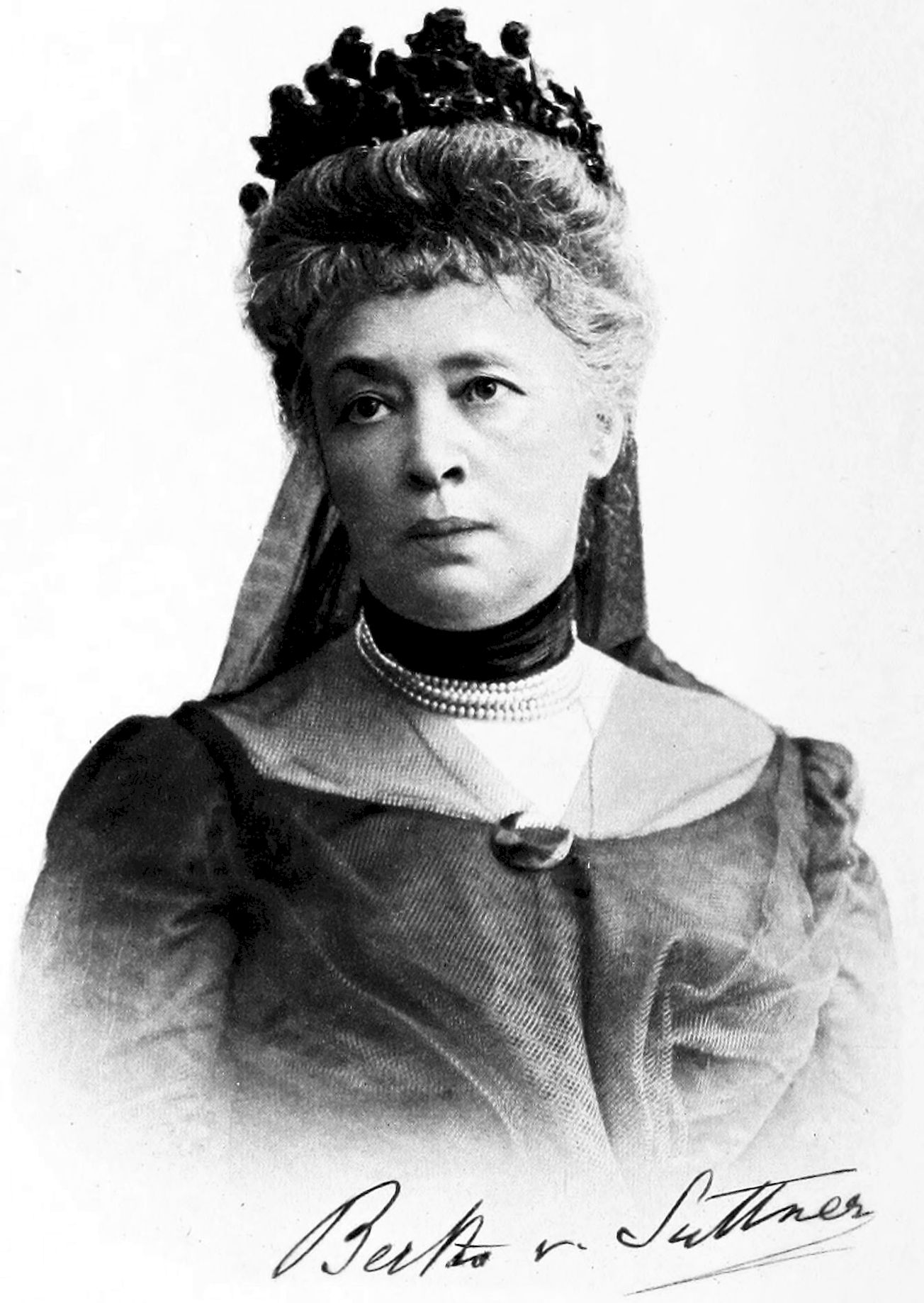
MEMOIRS OF BERTHA VON SUTTNER THE RECORDS OF AN EVENTFUL LIFE AUTHORIZED TRANSLATION VOLUME I
Transcriber’s Note:
The cover image was created by the transcriber and is placed in the public domain.
MEMOIRS OF BERTHA VON SUTTNER
PUBLISHED FOR THE INTERNATIONAL SCHOOL OF PEACE
GINN AND COMPANY, BOSTON AND LONDON
1910
COPYRIGHT, 1910, BY GINN AND COMPANY
ENTERED AT STATIONERS’ HALL
ALL RIGHTS RESERVED
The Athnæum Press
GINN AND COMPANY · PROPRIETORS BOSTON · U.S.A.
PREFACE TO MY ENGLISH AND AMERICAN READERS
v
It is a great gratification to me that the story of my
life—which I cannot suppose to be of general interest
except in so far as it is linked with the story of a world-wide
movement—is now put before the great community
of the English-speaking nations; for it is in
these very nations that the origin of that movement is
to be sought, and by them its final victory is being
most efficiently hastened. I have been brought to a
clear recognition of this fact especially by the days I
have spent in the United States and in England in
recent years. There I perceived with astonishment
and admiration how in these two countries (especially
in America) the peace problem, still largely antagonized
or ignored on the continent of Europe, has not
only met with widespread comprehension but also
received already a positive and practical working out.
Little of this is told in the present book; yet in it I
have set down the fact that the reading of English
scholars and thinkers (Herbert Spencer, Henry Thomas
Buckle, etc.) was what opened my mind to take in
the peace cause, and furthermore that a tract of the
London Peace Association presided over by Hodgson
viPratt, accidentally coming to my knowledge, gave the
initial occasion for all that I have endeavored to do as
a helper in the peace movement.
In the year 1904 I came to America on the occasion
of the Boston Congress. Of the sublime impressions
that I there received I give a brief and fragmentary
account in the supplementary chapter appended to
this edition. In the year 1907 I attended the Interparliamentary
Conference in London, and there had
opportunity to hear Campbell-Bannerman speak; his
proposals for the limitation of armaments, and for a
League of Peace among states, bore renewed witness
to the pacifist disposition of British statesmen. A year
later, while the Peace Congress was being held in
London, it was my privilege to meet the King and
Queen of England; and in words that I heard from
the mouth of Edward VII, and in those which he
caused to be written to me by his private secretary,
Lord Knollys, I have confirmation of the fact that
the name by which he has passed into history, Edward
the Peacemaker, is in full measure his due.
At the last moment, just as I am writing these lines,
the question of the peace of the world has led to the
taking of remarkable steps in America. The most
prominent men in the Union—Taft, Roosevelt, Elihu
Root, Knox, etc.—are coming forward with positive
proposals for the organization of the world, and the
House of Representatives has accepted a most significant
law. Of this one of the greatest American
viiworkers for peace writes me as follows in a letter dated
from Skibo Castle, June 30, 1910:
... The greatest news received lately is the passing of a bill by
the House and Senate of the United States, establishing a commission
to take measures to bring about a League of Peace among
nations. Mr. Roosevelt is to be chairman. This means business.
America is now in earnest. We hope she will no longer be dragd
into enormous armaments. The good work goes bravely on.
Always yours
Andrew Carnegie
Yes, indeed: our brothers of the English-speaking
race—especially those in the young New World—“mean
business” when they undertake anything. And
their enterprises are not (as an old prejudice assumes)
limited to the commercial and financial domain, but
embrace the region of the highest human thought, and
rest upon the deepest ethical foundations.
Elvira. Playing “puff.” My mother’s singing. Clairvoyant Aunt Lotti. Roulette and trente-et-quarante. Castles in the air. My first journey. Season in Wiesbaden. Return. Grillparzer and Ebner-Eschenbach at Elvira’s. Radetzky’s death. A schoolgirl romance.
Anastasius Grün. Friedrich Halm. Grillparzer. Wagner. Lenau’s sister. Military autographs. King Ludwig of Bavaria. Schiller’s daughter. Liebig. Schücking. Mädler. Körner. Anderssen. Meyerbeer. Rückert. Hebbel. Gregorovius. Lamartine. Victor Hugo. Manzoni. Dickens.
Singing lessons resumed. Maître Duprez. The school in the Rue Laval. In the house of the Princess of Mingrelia. In the imperial box at the opera. Summer at Duprez’s place in the country. Return to Paris. Princess Salomé’s engagement. Prince Achille Murat. The wedding. With the young couple. Off to Baden-Baden.
Resumption of music study in Milan. Outbreak of the Franco-German War. My double existence in the world of books. Return of the victorious troops to Berlin.
Resolve to take a position. The Suttner family. Artur Gundaccar von Suttner. Life in the Vienna palais and in Schloss Harmannsdorf. The Exposition year. Secret love. Letters from the Princess of Mingrelia. Marriage of Prince Niko. Zogelsdorf quarry. Three happy years. I tear myself away. Departure.
Arrival in Paris. Alfred Nobel’s personality. Unendurable agony of separation. Two dispatches. A plan of action. Arrival at Vienna. Blissful meeting. At last and forever united.
On the Black Sea. Jason mood. Arrival in Asia. The hotel in Poti. Kutais. Count Rosmorduc. Reception at Prince Zeretelli’s. National dances. Journey to Gordi. Prince Niko with escort comes to meet us. Arrival at Gordi. Ceremonious reception.
Lessons. Rumors of war and outbreak of war. Red Cross fever. The plague on the horizon. Bad times. Conclusion of peace. Mathilde. Beginning of literary career.
Another summer in Gordi. Business projects. Removal to Tiflis. Princess Tamara of Georgia. Our manner of life. Double position. Continued authorship. Illness.
The capital of Mingrelia. Our little house. Labors on the Murat estate. Social life at the Murats’ and the Dedopali’s. Lonely summer at Zugdidi. New literary labors. Prototype of Es Löwos. New horizons. Study together.
The Dedopali’s death. Death of my mother. Prospect of coming home. Translation of “The Tiger’s Skin.” Sojourn in a Mingrelian village. A bit of Georgian history. Queen Tamara.
Departure from the Caucasus. First destination, Görz. Return to Harmannsdorf. Family life and neighborly visits. Literary correspondence. Writers’ convention in Berlin.
Schriftstellerroman and Das Maschinenzeitalter. Journey to Paris. Renewed acquaintance with Alfred Nobel. The Schnäbele affair. Madame Adam’s salon. Princess Tamara of Georgia in Paris. Max Nordau. A ball in the palais of the Revue des deux mondes. Victor Cherbuliez. Ludovic Halévy. Alphonse Daudet.
Return from Paris. International Peace Association. Das Maschinenzeitalter by “Jemand.” Anonymity attains its end. Bartholomäus von Carneri. At the Carneri table. In the hotel Meissl.
How the plan for the book originated. Study of sources. The model of my hero. Satisfaction in writing the word “End.” Unanimously rejected by the editors. The publisher’s scruples. Publication. How the book was received. Favorable and hostile criticisms. Personal contact with the peace movement resulting from the novel. The Peace Congress of 1889 in Paris. Founding of Interparliamentary Union.
xiiThe news of the Crown Prince’s death. Sojourn in Mentone. Octave Mirbeau. A winter in Venice. Old acquaintances. Princess Tamara and Marietta Saibante. Visit of Felix Moscheles to the widow “Tillings.” Moscheles as peace propagandist. Formation of a section in Venice through Marquis Pandolfi. The Grelix. The Princess of Montenegro. Princess Hatzfeld, born Von Buch. A memory of Cosima Wagner.
PART SIX
XXVIII. THE AUSTRIAN INTERPARLIAMENTARY GROUP IS FORMED
Return. Skeptical reception of my reports. Resumption of our literary labors. Pandolfi suggests enlisting recruits in the Austrian parliament for the conference at Rome. Correspondence with members: Baron Kübeck, Pernerstorfer, Dr. Jaques, Dr. Exner. The group is formed, Baron Pirquet turning the scale.
Appeal in the Neue Freie Presse. Response from the public. Adhesions and contributions of money. Prosper von Piette sends a thousand florins. Dr. Kunwald. Preliminary meeting. Joining the International League. Circular for the formation of a national union. Letter from the Duke of Oldenburg. Permanent organization. Voices from members of the world’s intellectual aristocracy.
Frame of mind. Life together in the Hotel Quirinal. General Türr and his career. Little revolution against Bonghi. Alsace-Lorraine. The Grelix couple. Baron Pirquet. Opening festival on the Capitol. Ruggero Bonghi as chairman. Weighty words. Founding of the Bern Central Bureau. Echoes. The monthly Die Waffen nieder is launched. A. H. Fried. “The Important Thing.”
My review. Invitation to Berlin. A. H. Fried and his plans. The reading. The Berlin Tageblatt on a letter from Frédéric Passy. A banquet. Voices from the press. Evening at Spielhagen’s. Dinner at Mosse’s. The Empress Frederick. Professor W. Meyer does us the honors of “Urania.” Excursion to Hamburg. An evening tea with Hans Land, Dr. Löwenberg, Otto Ernst, and Detlev von Liliencron. A letter of Liliencron’s.
His confession of faith. Further development. Candidacy for the Reichstag. From his address to the electors. On the fear of revolution. Idealists in act. My first meeting with Egidy. Visit at his home. Consistency of preaching and practice. A letter from Egidy.
Journey to Switzerland. Poem by Count Hoyos. Letter from Prince Camillo Starhemberg. Opening of the Congress. First impulse to arbitration treaties, from America. League of European states. Social life of the Congressists. Arturo de Marcoartu. Alfred Nobel complies with my invitation. On the lake of Lucerne. A parable by Ruchonnet. Protest against distorted reports. A lively debate. Arrival of the Interparliamentarians. The Conference. A prophetic toast.
Arrival at Zurich. Nobel begins to take an interest in the peace movement, and joins us. Trips on the lake. A glimpse into his views of life. His first project for an act in furtherance of the cause of peace.
XXXIX. ESTABLISHMENT OF THE GERMAN PEACE SOCIETY IN BERLIN
PART ONE 1843–1861 — I CHILDHOOD My certificate of baptism · The revolution of 1848 · Landgrave Fürstenberg · The Feather Ball · Castle Matzen — II EARLY YOUTH Elvira · Playing “puff” · My mother’s singing · Clairvoyant Aunt Lotti · Roulette and trente-et-quarante · Castles in the air · My first journey · Season in Wiesbaden · Return · Grillparzer and Ebner-Eschenbach at Elvira’s · Radetzky’s death · A schoolgirl romance — III AN AUTOGRAPH ALBUM Anastasius Grün · Friedrich Halm · Grillparzer · Wagner · Lenau’s sister · Military autographs · King Ludwig of Bavaria · Schiller’s daughter · Liebig · Schücking · Mädler · Körner · Anderssen · Meyerbeer · Rückert · Hebbel · Gregorovius · Lamartine · Victor Hugo · Manzoni · Dickens — IV MORE EPISODES OF YOUTH The War of 1859 · A prank · Elvira’s marriage
1
3
What gives me some justification for publishing
my experiences is the fact that I have met
many interesting and distinguished contemporaries,
and that my participation in a movement which has
gradually grown to be of historic consequence has
given me many glimpses into the political affairs of
our time; and that hence, all in all, I have something
to say that is really worth publishing.
Of course, if I meant to tell only of this period of
my life, I should have to confine myself to the history
of the past fifteen or twenty years, and wholly forego
conjuring up pictures from my youth; and I should
have to deny myself the writing down of those personal
recollections which my whole changeful life has
stamped upon my memory. But I will not deny myself
this. Now that I have been induced by the above-mentioned
reason to write my memoirs, it shall be a
genuine record of a life. Once again shall the stages
of the long journey come in due order before my inward
eye, and from them what seems to me suitable
for reproduction shall be photographed on these pages.
4So, without further exordium, let us begin:
The beginning of all human life is birth. Where
and when and in what environment I came into the
world is most authentically shown by my certificate of
baptism. Here is the copy of that document:
Certificate of Baptism
ad W.E. 200
From the Register of Births and Baptisms of the Parish of St.
Maria-Schnee, Lib. XIII, pg. 176, it is hereby officially certified that
in the year one thousand eight hundred and forty-three (1843) on the
ninth day of June was born in S.C. 697/2, and on the twentieth day
of the same month was baptized in accordance with the use of the
Catholic Christian Church by the then parish priest, the Reverend
Father Thomas Bazán,
Bertha Sophia Felicita Countess Kinsky of Chinic and Tettau,
legitimate (posthumous) daughter of the Right Honorable Franz
Joseph Count Kinsky of Chinic and Tettau, retired Royal and Imperial
Lieutenant Field-Marshal and Actual Chamberlain, born in Vienna—a
legitimate son of his Excellency the Right Honorable Ferdinand
Count Kinsky of Chinic and Tettau, Royal and Imperial Chamberlain
and Grand Steward and seigneur of the domain of Chlumec, by his
wife the Honorable Lady Christine, born Princess Liechtenstein—and
his wife, the Honorable Lady Sophia Wilhelmine Countess Kinsky of
Chinic and Tettau, born Von Körner, born in Prague (a legitimate
daughter of the Honorable Herr Joseph von Körner, Captain of
Cavalry in the Royal and Imperial Army, by his wife Frau Anna,
born Hahn).
The sponsors at the christening were Barbara Kraticek, lady’s
maid, and the Honorable Herr Arthur Count Kinsky of Chinic and
Tettau. Midwife Frau Sabina Jerábek of S.C. 124.
Hereto witness the hand of the undersigned, and the parish seal.
Prague, Parish of St. Maria-Schnee, November 27, 1866
Dr. (illegible)
Minister at St. Maria-Schnee
5At this christening service—though I vowed and
abjured so many things in it—I was not present.
For I do not understand by the word “I” the living
corporeal form in which it is contained, but that self-consciousness
which is absent both in infancy and
also at frequent intervals throughout life: in sleep, in
fainting, in narcotic stupefaction, under the influence
of drugs, and in a great many moments when one
merely breathes and does not think, look, hear; when
one merely continues his existence vegetatively until
the I resumes its functions.
Prague, then, was the city where they set up my
cradle, over which, as over all cradles, so much was
unprophesied. But my mother, who at my birth was
already a widow, soon moved to Brünn, and what I
remember of childhood is events that took place in
the Moravian capital.
There I see myself standing by the window—five
years old—and looking down into the “great square,”
where a noisy throng is in wild commotion. A new
word strikes upon my ear,—Revolution. Every one
is looking out; every one is repeating the new word
and is greatly excited. What my sensations were I no
longer remember, but at any rate I too was excited,
else the picture and the word would not have impressed
themselves on my mind. But there is no more to it.
The picture does not arouse any comprehension; the
word has no meaning. Thus appears my first experience
of a historical event.
6But my memory reaches farther back, and shows me
a scene which I was concerned in at the age of three,
and which stirred me far more powerfully than the
political overturnings of the year 1848.
I am about three years old. It is a beautiful afternoon,
and my mother and my guardian are planning
to take me with them to a picnic in the Schreibwald.
The Schreibwald, a favorite place for excursions from
Brünn, shines among my memories of childhood as the
sum of all natural beauty, festive joy, woodland shade,
mountain-climbing, social meals,—in a word, as the
acme of that combination of delights known as a picnic.
At that date, on the memorable afternoon, all these experiences
were doubtless not yet part of my consciousness;
perhaps it was the very first time I was to be
taken to the Schreibwald; but to me the name was forever
afterwards associated with the following event.
They dressed me in a white cashmere frock trimmed
with narrow red braid. A superb thing—décolleté; I
can still see before me the pattern of the braiding,
I could draw it on paper. How the onlookers would
marvel when they espied that! I felt myself beautiful
in it, positively beautiful. And then my guardian, looking
out of the window (I can see him too in his general’s
uniform), remarked that it was clouding up, it
would probably rain. There followed a short session of
the cabinet,—the general, my mother, and the chambermaid
Babette,—and the decision was announced: the
beautiful new frock might suffer harm.
7“Put an old frock on the countess,” was my mother’s
command. But the countess declared most positively
that she protested against it. I am in the new frock:
j’y suis, j’y reste; with this plagiarism thirty years in
advance of its original she made known her inflexible
will. Perhaps, as a matter of fact, not so much with
words as with shrieks and stamping of feet.
But consequently the next picture in this indelible
picture gallery shows me the brilliantly clad, beautiful,
and energetic creature laid on a large table, her face
against the table-top, her red-embroidered frock lifted
by the obliging hand of the tall army man who stood
by; and from the maternal hand, slap, slap, the first
whipping, with its burden of despair and dishonor,
came down on the object.
Yes, despair: that there could be such great woe in
the world, and the world not go to pieces under it, was
most likely incomprehensible to me. At last the wild
sobbing subsided; I was stood in a corner and had to
beg for pardon—the victim of such grievous outrage,
beg for pardon into the bargain! But I did; unhappy
I was, deeply unhappy, but subdued. To-day I do not
know why this occurrence made such a deep impression
on my soul; was it injured vanity on account of
the ravishing frock, or injured honor on account of the
disciplinary procedure? Probably both.
Still another picture is fixed in my memory. Oh, I
must have been a very vain and pleasure-loving little
ninny! My mother comes into the nursery; she is
8wearing a beautiful gown, such as I have never yet
seen on her, and jewelry on her bare neck: mamma is
going to the ball, and they explain to me that this is a
festivity where all are dressed so beautifully as that and
dance in rooms that are all lighted up. I want to be
taken with her, to go to the ball too. “Yes, my little
roly-poly is going to the ball too.” (I scream with
delight.) “To the Feather Ball she is going.” With
that the beautiful mamma kisses me and goes. “So,”
says Babette, “now we will get ready for the Feather
Ball.” And she begins to undress me, which I permit
in joyful anticipation. But when, instead of being
dressed in my best, I am put to bed and learn that
this is the Feather Ball, I break out in wild sobbing,
deceived, trifled with, humiliated.
I must delay a moment over the portrait of my
guardian. It cast a friendly radiance over all my
childhood and early youth. Friedrich, Landgrave of
Fürstenberg, had been the comrade and friend of my
deceased father, and he faithfully fulfilled till his death
the duties which he had undertaken as guardian and
protector and watchful friend to the fatherless child.
I simply worshiped him; I regarded him as a being
of a higher race, to whom I owed and gladly rendered
unconditional obedience, honor, and love. He was an
elderly gentleman, past fifty, when I came into the
world; and, such being the way of children in judging
age, he seemed to me ever so old, but ever so dear. So
9smiling, so jolly, so lordly, so indescribably kind. That
confectionery that he used to bring with him! those
rich Christmas presents that he gave me! that care
for my education, my health, my future!
Lordly—he was a lord in fact. A member of the
proudest Austrian nobility, Master of the Ordnance,
ultimately captain of the Arcièrengarde, one of the
highest positions at the court. He was never absent
at any of the great court functions, and brought me
such lovely bonbons from every imperial dinner. His
lofty station inspired me with pride rather than awe.
For me he was “Fritzerl,” to whom I said du; on
whose knee I used to climb, as long as I was little,
and pull his mustache.
He died unmarried. His life was so methodically
ordered, it ran its course so free from cares and passions,
between service and sociality, that the wish to
change it never arose in him. In Vienna he occupied
handsome bachelor quarters in the Inner City; in
Moravia he had a domain where he often spent a
few weeks of the summer to see what his factors were
doing; but he preferred, instead of living in his own
lonely castle, to spend the summer months as a guest
at the homes of his old mother and his various sisters.
He never took journeys. At the Austrian boundarymonuments
the world came to an end for him. Devotion,
both churchly and military, had an essential place,
I will not say among the virtues of his character, but
among the virtues of his station in life. He was never
10absent at any Sunday mass, any feast of the church, or
any parade. He had an enthusiasm for Field Marshal
Radetzky, whom he had known well personally. The
glory of the Austrian army was in his eyes one of the
most admirable constituents of the universe. Society
(by this name he distinguished the circle in which he
was born and in which he moved) was to him the only
class of human beings whose lives and fates interested
him; and he always attended all the great functions
given at the houses of the Schwarzenbergs, the Pallavacinis,
etc. In the Adelskasino he had his regular
rubbers of whist with sundry friends of his own rank.
He was fond of card-playing in general—not gambling
games, for he was in the highest degree steady,
but innocent games such as piquet, omber, tarteln.
This last he used to play with my mother at his twice-a-week
morning visit to our house, and I was allowed
to sit by to mark the points of the game with my little
pencil. The various marriages in society interested
him greatly; he had a troop of nephews and nieces
who made more or less successful matches. He himself,
though the male line was to become extinct with
him, did not think of marrying. The reason was that
he cherished an affection for a lady who, while she
was the widow of an aristocrat, was not by birth capable
of being presented at court, so a marriage with
her appeared to be simply out of the question. He
would not cause such a vexation to his family—and
at bottom it would have been a vexation to him
11too; for everything that was out of the rut, outside
of tradition, outside of “correctness,” went against
his grain.
This figure stands before my memory as a type of
the old-fashioned Austrian: a type of which there are
doubtless some specimens still, but which, as is the
fate of all types, is dying out. Our country is now
made up of Slavs, Germans, Croats, Italians, (it would
not do at all to say Magyars, they would grievously
resent it,) and a few more nationalities, but the collective
name “Austrian” cannot again become a proudly
patriotic conception until—if ever—all the different
races, with individual autonomy, form a federative state
as do the Germans, French, and Italians in Switzerland.
A friend of mine—a middle-class man, but one who is
made very welcome at court—was lately telling me of
an interview that he had with the Emperor not long
ago. In the course of a political conversation the
Emperor asked him to what party he belonged: “To
the one which has only a single adherent, that is myself.”
“And what party is that?” “The Austrian, your
Majesty.” “Well, how about me? don’t you count me?”
rejoined Franz Joseph, smiling.
—To come back to the past and my dear Fritzerl.
It is a good thing that he did not live to see the
events of 1866. The defeats in Bohemia, the severance
of Venetia,—it would have cut him to the heart.
And he would have found it simply incomprehensible,
as it were a calamity violating all the laws of nature,
12and especially all divine ordinance. In that conception
of the world which characterizes the type that I refer
to, an essential point is the belief that Austria is the
center of the world, and that any disaster which befalls
it—especially any disaster in war—means an unnatural
neglect of duty on the part of Providence. Unless
such defeats be meant as punishment, as merited
chastisement for the spread of unbelief, the dissolution
of morals,[1] the dissemination of revolutionary ideas.
Then, surely, there is no help but by introducing
strict discipline, reorganizing the army vigorously;
then perhaps the Creator can be reconciled and the
history of the world corrected by future reconquests.
Fritzerl was spared these pains and these reflections.
If I said just now that there were still living some
specimens of that type, I was probably mistaken. It
is simply impossible that to-day the world is still mirrored
in any head as it was mirrored in the heads of
those who were born within the eighteenth century,
who lived during the first introduction of the railway,
who held the first photograph in their hands, who saw
with some repugnance the displacement of oil lamps
by petroleum. Essential to that old Austrian type
(and it is the same with the old English and other old
national types) is a certain limitation of experience
and knowledge which to-day can no longer exist even
in the most conservative circles.
13That types alter from generation to generation, that
outlooks, views, feelings change, is a fact of which one
can best judge by one’s self when one looks back into
the past. For every man, though in most cases he hugs
the delusion of being a uniform continuous ego with
definite qualities of character, is himself a chain of the
most diverse types. Every new experience—leaving
quite out of account the bodily changes of blooming
and fading, of health and disease—modifies the mental
essence. How much one sees, whether with the
bodily eye as a landscape or with the mental as an
outlook on the world, is not a matter of stronger or
weaker eyesight, but peculiarly a matter of horizon.
If I look back into my childhood and youth, I do
not see myself as the same person, as having altered,
but see standing side by side the most diverse girl
forms, each with a different horizon of ideas and filled
with different hopes, interests, and sensations. And if
I set beside them the forms from my maturer womanhood,
or my present age, what have I (beyond the mere
recollection, as faint as the recollection of pictures long
since seen, or books long since read) in common with
those phantoms, or they with me? Dissolving mists,
flying shadows, a passing breath, is what life is.
My first love was no meaner a person than Franz
Joseph I, Emperor of Austria. To be sure I had
never seen him,—only his picture,—but I idolized
him ardently. That he would marry me did not seem
to me at all beyond the bounds of possibility; on the
14contrary, fate owed me something of the sort. Of
course I should have to wait five or six years yet, for
I recognized that a ten-year-old child could not be
made empress. I should have to have bloomed out
into a maiden of fifteen or sixteen, the most beautiful
maiden in the land; the young sovereign would sometime
espy me, enter into a conversation with me, be ravished
with my qualities of mind, and immediately lay
his august person at my feet. That was the time when
I was convinced that the world had a fairy-tale fortune
ready for me. I exerted myself sincerely to deserve it
and to be ready to show brilliantly, when it came, that
I had found my right place; learning, learning, practicing,
practicing, amazing myself with my progress
and knowledge. I was a real infant prodigy—in my
own eyes. It is true that I spoke French and English
well (from my earliest childhood I had had French
and English bonnes), I played the piano remarkably
well, I had read an enormous deal: the Abbé Fleury’s
Histoire de France, Le Siège de la Rochelle; Victor
Hugo’s Ruy Blas and Marie Tudor; half of Schiller,
Fladung’s Physics; “Jane Eyre,” “Uncle Tom’s Cabin,”—those
were the books (not children’s books, it will
be seen) in which I reveled at that age. Besides, I
loved to dip into the cyclopedia and pluck blossoms
of all branches of knowledge. From love of learning?
I will not assert it; I think those lovely blossoms
seemed to me desirable only to make a wreath of for
my adornment.
15As an evil chance would have it, so soon as the year
1854—consequently I was only eleven years old—Emperor
Franz Joseph espied his cousin Elisabeth,
engaged in conversation with her, and laid his august
person at her feet. I was not exactly unhappy (there
are plenty more fairy princes), but thenceforth I took
a lively interest in Elisabeth of Bavaria, sought for
portraits of her, thought she bore some resemblance
to me, and imitated her way of doing her hair. You
see, my actual vehement passion for my young liege
had died out some time since. Chiodo caccia chiodo;
the Italians use this proverb to illustrate the fact that
one love expels another.
On my eleventh birthday I had been taken to the
theater for the first time. “The White Lady”[2] was
given. Ah, but that George Brown! (“What joy to be
a soldier!”) Yes, that is the comeliest profession—next
to that of opera tenor. For anything more captivating
than that singer,—I still remember his very
name, Theodor Formes, so the impression must have
been deep,—anything more chivalrous I had never
dreamed of. The prince destined for me must look
like that. He would not even have to be a prince;
only, if possible, in case he was not a tenor,—I would
not have given Herr Formes the mitten,—at any rate
a soldier. In telling this I see that I was a silly girl, to
be sure, but not a genuine child. That is probably due
16to my not having had any playmate of my own age, but
living only in the world of books, whose heroes were
themselves not children but grown people, whose fortunes
turned mostly upon love and marriage.
The most important thing in the universe, anyhow,
was my little person. The course of the world was
only the machinery whose wheels were all geared for
the purpose of preparing a radiant good fortune for me.
Was I alone such a foolish, conceited child, or is this
center-of-the-world feeling a natural feeling in general
among children and creatures of limited intelligence?
Is modesty a noble fruit which ripens only on the tree
of experience and knowledge?
It is just by this that the type of a man or of a
class may be authentically gauged—by what appears
important. Of notable importance to me in those days
of childhood, besides the all-overtopping “I,” were the
Christmas festival; the great spring house-cleaning;
the Old Ladies’ Home at Brünn; chestnut-gathering
in the paths of the Augarten, carpeted with autumn
leaves; Fritzerl’s visits, my mother’s beautiful singing,
this mother’s axiomatic great love for me, and my love
for her, which was so great that when she went to
Vienna for two or three days I would sob for hours
as if my heart were broken.
With such a circle of importance I might frame all
the various sections of my life, and thereby most clearly
realize the phases, from that first memory of the important
pattern of braid on the white cashmere frock
17down to the ideal of an assured international reign of law,
which to-day appears to me a thing so important as to
discount everything else.
Here it is a question of something that is yet to
come into existence, and I think that attention to such
things is but rare. Most people—and with them I
in the earlier epochs of my life—take the surrounding
world and the prevailing conditions as something
given, axiomatic, almost unalterable, upon whose origin
one thinks but little, and upon making any possible
change in it not at all. As the air is here for
breathing, and one is not called upon to make any
change in it, so the given social order—political and
moral—is here to furnish the atmosphere, the vital
air, of our social existence. Of course one does not
think that in these words, for the conception I speak
of is altogether artless; that is, it exists rather in sensation
than in consciousness, just as we also, without
becoming conscious of it, draw breath constantly and
do not think of the quantity of nitrogen and oxygen
in the air.
The recollection of a visit to the country in the year
1854 has remained vividly fixed in my memory. To
this day I see before me different pictures of the castle,
garden, and forest of the domain of Matzen, while so
many other scenes which I have since looked upon
have vanished from my memory. A peculiar camera
it is that one carries in his head, in which many
pictures etch themselves so deeply and clearly, while
18others leave no trace. It must be that the apparatus
just snaps open for a moment in the brain, but remains
closed most of the time, so that the outer world does
not get photographed.
Then was not the first time that I had been at
Matzen, but of the earlier visit I have only a very dim
idea. I only see myself carried into the drawing-room
in the nurse’s arms to be caressed there by the lady of
the house, Aunt Betty Kinsky, and her two grown
daughters, Rosa and Tinka. In the year 1854, when
my mother was invited to Matzen again, Aunt Betty
no longer held sway there; she had died some years
previously, and the daughters had married away,—Rosa
to a Baron Hahn in Graz, Tinka to General
Count Crenneville, commandant of the fortress of
Mainz. Mainz, you know, was at that time an Austrian
garrison. How things do shift on this changeable
surface of our earth—where everything, indeed,
is in a continual process of change; but more swiftly
and unexpectedly than mountains and valleys, than
the forests and cities of a country, do its political
boundaries and dependencies change.
To come back to Matzen, which still stands on the
same spot, but which I have not seen again since then,—it
was at that time under the dominion of a newly
married couple. On the same day when Emperor
Franz Joseph celebrated his wedding with Elisabeth
of Bavaria, Count Christian Kinsky, the present lord
of Matzen and Angern, had brought home his bride,
19Countess Therese Wrbna. A handsome and happy
young couple.
A merrier, wittier man than “Christl” Kinsky cannot
be imagined. To this all Vienna society bears witness.
Even at an advanced age, in the anything but merry
position of provincial marshal, he was able to bring
gayety and good humor even into the party-rent provincial
assembly hall.
The castle, old and towered, stands on a wooded
mountain; from the second story a door leads out to
a bit of level ground on which a decorative garden is
planted, and before the garden grill lies the forest. A
pavilion stands in the garden, and on the table in it lay
colored glasses, blue, yellow, red. They had me look
out upon nature through these (this memory dates from
an earlier visit at Matzen, when I was still quite small),
and to see this blue forest, this yellow garden, this green
sky, was a magical surprise to me—I screamed with
happiness. Oh, there is nothing to beat having been
just lately born, and feeling as new everything—everything—that
the world offers; tasting everything for
the first time. It would be fine to keep being born
over again and keep beginning everything over again
from the start, traversing again the magic realm of surprises
that dazzles us with the first colored glass, with
the first Christmas-tree candle, somewhat later with
the first kiss, and always as an undreamed-of virgin
country....
20
When I was nearly twelve years old I was for
the first time vouchsafed the good fortune of
getting a companion of almost my own age.
A sister of my mother, known to me as Aunt Lotti,
came on a visit, accompanied by her only daughter,
Elvira. We two girls were fired with friendship for
each other. I say “fired,” for our mutual affection was
an ardent one, and Elvira in particular showed a real
adoration for me.
Aunt Lotti was the widow of a Saxon named
Büschel, by occupation a gentleman of leisure and
bookworm. Elvira had, so to speak, grown up in her
father’s library. Büschel’s favorite department had
been philosophy, and he conversed with his little one
mainly about Hegel, Fichte, and Kant. For refreshment
from such heavy diet he handed her Shakespeare.
And for very special sugarplums, Uhland,
Körner, Hölderlin. Of course the result of this education
was a little bluestocking. Elvira had begun
writing at the age of eight,—songs, ballads, and the
21like,—and when I made her acquaintance she had
already composed several dramas in prose and a few
tragedies in verse. That she was to become the greatest
poetess of the century was a settled thing in her
mind, in Aunt Lotti’s, and in mine. Perhaps she would
have, if an early death had not snatched her away.
She did win the recognition of great connoisseurs—I
name only Grillparzer, who read her pieces with
admiring amazement and prophesied a great future
for her. In our family circle her genius was undisputed.
And she had that quality which stands for
half of genius, iron-faced industry. Every day she—the
child—voluntarily spent three or four consecutive
hours at the writing-desk and wrote, wrote, wrote.
Often she had several pieces of work on the stocks,—a story,
a drama, and various poems in between. I
remember the titles of some of the large pieces: one
was called “Karl the Sixth,” another “Delascar.” The
name of this last hero (I think he was a Moor) particularly
pleased me, and seemed to me to be of itself
a guaranty of success. Whether these dramas were
ever completed I do not remember. I know I made
their acquaintance in the form of outlines—it was
only individual scenes that were already finished, certain
especially effective monologues. Elvira was an
indefatigable user of the file. If on one day she had
read to us a great speech of Delascar’s, she often let
us hear on the next day an entirely new edition of
the same speech.
22To me her future renown was a tenet of faith.
And she did not doubt the fairy-tale fortune that life
must bring to me; for, though she conceded my
intellectual inferiority (there was not a vestige of literary
tendency in me, the lyre was no more my instrument
than the French horn), she had unbounded
admiration for my physical endowments and social
talents—I must become a great lady and take all
hearts by storm. As may be seen, we did not fail
in mutual appreciation, and this was the soil in which
our friendship flourished so luxuriantly.
Elvira did not hope any social successes for herself.
She was conscious of her bashfulness and her lack of
beauty. Small, with too large a head, a Schiller head,
she was certainly not a pretty girl; besides, she was
awkward in her movements, helpless in conversation,—no,
as a woman she would assuredly never please,
while she was convinced (a conviction which I shared)
that I as such would achieve all sorts of triumphs.
She contented herself with the part destined to her,
to become the Sappho of the nineteenth century. A
modest little pair of cousins, it must be confessed!
So we were friends and swore lifelong fidelity to
each other; we were playmates too. But he who at
this word imagines that we played together with dolls
or hoops, as would have befitted our age, is mistaken.
We played “puff.” That was a game invented by us,
named so by ourselves, with which we used to amuse
ourselves, for hours at a time.
23It consisted in this: we acted a comedy. Elvira
took the part of the hero, I of the heroine. The hero
kept changing: now it was a French marquis, now a
Spanish student, or a rich English lord, or a young
navy officer, or a statesman who has come to rather
mature years, often a king appearing incognito; but
I always represented myself, the heroine was always
Bertha Kinsky, mostly sixteen or seventeen years old,
but in many combinations already getting elderly—say
twenty-two or twenty-three. The comedy usually
ended with a marriage; but there were occasions when
the hero died—then, naturally, it was a tragedy.
Before the game began, the time and place of the
action were specified, the hero’s name and description
had to be settled, and a situation prescribed. For example:
In the year 1860 Bertha would be staying at a
castle near Moscow as the guest of the Russian ambassador’s
wife. The lady’s brother, Prince Alexander
Alexandrovitch Rassumof, a very gloomy and melancholy
misanthrope, tall, elegant, dressed in black, with
uncannily gleaming eyes, is among the inmates of the
house, but rarely shows himself. He is understood to
have been through a great misfortune (a dark story of
a false woman, of an opponent shot in a duel—the
particulars are not known) and to have withdrawn from
the world. The scene represents the garden, on the
bank of a pond where a few swans are gliding. I am
sitting on a bench under a weeping willow with a
book in my hand, and from a side alley comes, buried
24in deep thought,—Alexander Alexandrovitch. Now,
after this was settled, the game could begin, and we
said “Puff.” By this magic word we were transformed
into the dramatis personæ—I into the seventeen-year-old
Bertha, Elvira into the mysterious Russian.
And the dialogue began. If we wanted to interrupt
the game for a moment, we said “Puff,” and straightway
we were again the two little cousins, telling each
other something: a scenic remark, such as “This pencil
means a pistol,” or perhaps something private that had
no connection with the game. And only when “Puff”
was pronounced again was the dialogue resumed. To
indicate that the one or the other changed color we
had special signs: a quick and slight inflation of the
cheeks meant a faint blush; vigorous inflation, repeated
a few times, meant “suffused with crimson”;
a swift, lightning-like drawing down of the corners of
the mouth was turning pale; a complete rolling over
of the under lip was downright ghostly pallor. The
course that the piece was to take was not sketched
in advance, but was left to the spontaneous development
of the conversations and feelings, for in it we
really felt awaking interest in each other, budding
affection, and usually, to end with, glowing love that
led to union for life. Such a dialogized novel often
lasted for days; for we could not go on playing without
interruption, since we were called away by other
occupations,—lessons, walks, meals, etc. The presence
of our mothers did not always disturb us: we sat down
25in another corner of the room, out of hearing, said
“Puff,” and the gloomy Alexander, or whatever was
the name of the hero of the day, was there again.
To be sure we liked the game better when we were
alone, for then the dialogue could be accompanied
with telling gestures, and emotion could be expressed
by raising our voices. When such a comedy was
played through, a new hero and a new situation must
be devised. Not always did something suggest itself;
if not, we sat or walked together in a state of sober
paff, or chatted, till suddenly the one or the other
cried Wasatem. (Abbreviation for Ich weiss ein Thema,
“I know a topic.”) If the proposed topic seemed good
and interesting, then the word was “Puff,” and the
transformation was accomplished.
I remember that once, when we were playing in
our corner of the room, Aunt Lotti, busy with embroidery
at the other end, called out, “There, I don’t
like your cough a bit, Elvira! So dry and so obstinate—we
shall have to ask the doctor.” Now Elvira had
at that time no cough whatever, but we had for several
days been engaged in an extraordinarily touching game
of puff, in which the lover was a consumptive doomed
to death.
I have spoken of my mother’s beautiful singing.
This singing played a great and influential part in my
childhood and later life. My mother always regarded
it as a tragical missing of her vocation that she had
26not become an opera singer. In her early youth a
famous Italian maestro had tested her voice and given
her the assurance that no such soprano had been heard
since Grisi, Pasta, and Malibran, and to this was to
be added her dazzling presence; in short, the loftiest
triumphs, the richest harvests of gold, would have lain
open to the beautiful girl if she had adopted the theatrical
career. Such was the opinion of the maestro,
who also undertook to give her singing lessons after
the old Italian method, and had, among other things,
brought it to pass that she gave Norma’s entrance
recitative with full-toned and tragic power, again putting
to shame all the Grisis, Pastas, and Malibrans.
But neither my grandparents nor “Aunt Claudius,”
who had taken charge of my mother and brought
her up, would hear a word of the theater, which in
those days was still regarded as a sink of iniquity;
and mamma’s Norma recitative never rang out on the
boards, but very often thereafter in my nursery (where
our piano stood), and imprinted itself on my soul as
the ne plus ultra of womanly heroism and of operatic
art. Druid priestess and mistletoe bough, passion,
sublimity,—thus stood in my imagination the gleaming
picture of Norma, enveloped in sweetest magic of
melody, in unearthly potency of voice.
To her old age my mother felt it as an affront, as
a deprivation of all the treasures that nature by her
wonderous gifts had destined for her, that she had
not been allowed to take a course of training for the
27theater. Indeed, if I should prove to have inherited
this voice, she might perhaps then be able to experience
in her daughter the same triumphs that
she had missed; but of course the theatrical career
would be still more out of place for a Countess
Kinsky than it would have been for Fräulein von
Körner, and it would not have done even to tell of
such an idea to Fritzerl. Nor did any wish for it
awake in me myself. I saw my future plainly before
me, it was marked out for me in our daily games of
puff: to be grown up and introduced into the world,
to have hearts and offers of marriage flying to me, to
meet the one, the only one, to whom my heart too
would fly, because he was the most aristocratic, the
most beautiful, the wisest, richest, and noblest of all.
What he would offer to me, and I richly pay back
to him, would be perfect and lifelong happiness.
It was soon manifest, too, that I had not a phenomenal
voice; and only in such a case could my mother
have contemplated the project of an artistic career for
me, so there was no more talk of that possibility.
Whether my mother really possessed such a splendid
voice as that maestro had persuaded her, and talent
with it, of course I could not judge, but I took it on
trust as a part of my creed; her singing pleased me
very much, but what does a child understand? When
I now go back to that time in thought, doubts come
up in my mind, for her repertory was very dilettantish.
Besides that Norma recitative and the immediately
28following adagio, Casta diva, she sang only the very
easiest songs, making such a selection as—in my
present judgment—does not itself give reason for
inferring an artistic taste. To be sure, at that time
there were no songs by Wolff and Brahms, not to
say Richard Strauss; but even in those days pieces
like Du hast Diamanten und Perlen, “Spanish Serenade,”
Blau Äugelein, Gute Nacht du mein herziges
Kind, “Oh, tell me, will she come to pray upon my
grave,” and the like, belonged in the category of street
songs and sentimental trash. She was not a pianist,
so she could not accompany herself. Three times a
week she sang for an hour accompanied by my piano
teacher. If he brought a new song she had him play
the voice part with the accompaniment, and the learning
was a prolonged and toilsome task for her. From
all this I now conclude that she was by no means a
musical genius; and it takes that, aside from the
strength, volume, and tunefulness of the voice, to be
a Pasta, Grisi, Malibran, or a Henriette Sontag. My
mother told many stories of the fortunes and victories
of these celebrated stars; then with the story there
sounded the undertone that she had been deprived
of enjoying the like successes, and the feeling fastened
itself upon me that a great singer was a marvelous
sort of being at whose feet all contemporaries knelt
in adoration.
My dear mother’s was altogether a rather enthusiastic,
high-keyed temperament. Often she gave
29expression to her feelings in poems; but she had no
ambition or vanity connected with this branch of her
talents. She did not think herself a gifted poet; but
she never lost the conviction that she could have been
in music a star of the first magnitude.
Soon we had still more leisure to carry on our
games of puff, Elvira and I. Our two mothers took
a trip to the baths in the summer of the year 1855,
and we two stayed at home under the charge of a
governess. Their destination was Wiesbaden. The
two ladies liked it so well there that in the early
summer of the next year they went there again, and
this time,—oh indescribable ecstasy—they took us
with them. The first considerable journey in my life!
Up to that time I had only been taken a few times
to Vienna for two or three days, and that had been
to me each time a festal occasion; but now a real
journey to foreign parts, a prospective stay of weeks
or perhaps months in a famous resort—it was too
heavenly!
Besides, utility was to be combined with pleasure
there. For nothing less was intended than to carry
off one or two millions from the gaming-table. Aunt
Lotti regarded herself as a clairvoyant. She was always
having to do with presentiments, dreams, magnetic
sleep, and such things. During the epidemic
of table-tipping she had also been an extraordinary
medium. Under her fingers the tables danced and
30leaped, and then even cupboards that weighed hundreds
of pounds, etc. I often saw it myself; and when
I helped form the chain there was such a coruscating
“fluid” coming into my finger-tips too, that everything
that I touched—the tables, the piano teacher’s tall hat,
and the piano itself—began to run around. I remember
it clearly, and could therefore come out as a palmary
witness for table-tipping if I were not distrustful
of the testimony of a child’s perception. It may have
been imagination. But Aunt Lotti would not let any
doubts be raised as to the whole sphere of the occult
in general. Nothing could offend her more than not
to acknowledge her gift of second sight.
In other respects she was a very sensible woman, and,
as the widow of a scholar who had made her a participant
in his intellectual concerns, she was many-sided
in her culture and free-thinking in her tendencies; so
her vein of occultism could not be taken as childish
superstition. There was something else too. She
often suffered from convulsions, and readily fell into
hypnotic sleep, which in those days was not yet called
by that name but by that of magnetic sleep, and the
visions of which were rated as clairvoyance. The result
was that she regarded these phenomena, which lay
beyond the range of her normal waking life, as an
especially mysterious power of her own, a power of
vision reaching into the future.
During her stay at Wiesbaden the preceding year she
had learned that when she went into the roulette room
31a number came into her mind, and then this number
won. She did not play, she only noticed this in silence.
My mother preferred to look on at the playing in the
trente-et-quarante room, and she thought she perceived
in herself too the gift of foreseeing when black won.
She too did not play; but when they were back from
the journey neither of the two sisters could get rid of
the idea that it would really be an easy thing for them
to get a colossal fortune out of the German banks.
But such a thing was not to be lightly undertaken;
it was essential to test the phenomenon. So Aunt
Lotti got a little bag with thirty-six numbers and a
zero, my mother six packs of cards, and now a systematic
test was carried out. Aunt Lotti threw herself
into a sort of trance by fixed staring and concentrated
thinking, till a number flashed through her brain; then
Elvira put her hand in the bag and drew out a number.
To be sure, it was not invariably the foreseen
one, but very often an adjoining or similar one. For
instance, the seer’s number was 5 and the drawn one
was 6 (adjoining) or 25 (similar); so the method was
determined to be that the transversals of the number
thought of should be bet on. Only those who know
roulette will understand me; I consider it superfluous
to make myself clearer to others, as I have not the
least intention of starting a propaganda for Aunt
Lotti’s system of play. Regular accounts were kept
of the losses and winnings, and the result was uniformly
a large amount of net winnings. Was there
32self-deception about it? I do not know; but the
imaginary ledger always showed immense accumulations
of profit. For the start was made with small
stakes, and as the capital grew the stake was increased
till it reached the maximum, and in this way
there was no limit to the gains. Poor gambling-houses!
Would we content ourselves with relieving them of
one or two millions, or would we ruin them entirely?
That was left for further consideration. The latter
would certainly be a moral deed, for gaming is an
evil passion by which so many are seduced and ruined
or at least injured, for it is a vice which—Aunt Lotti
despised gaming; it was hateful to her; but when
one was furnished with such a miraculous gift would
it not have been a downright sin not to lift the
treasures to which one needed only to put out a hand?
Aunt Lotti took no stock in my mother’s similar
plans, for she was no clairvoyant, no natural wonder,
only a sort of imitator. It would soon be seen that
nothing was to be realized. But my mother’s tests
came out just as brilliantly. I myself dealt the cards
and entered the winnings and losses in a little book.
The winnings were always so much the greater that
the first million was reached in a few weeks. “Chance,”
opined Aunt Lotti. Self-deception? I now ask myself
in this case also. The figures were there, and now
plan-making and air-castle building broke out among
us in great style. In the neighborhood of Brünn there
is a Liechtenstein domain, Eisgrub, with a marvelous
33castle and park; we had seen it once when we were
on a picnic. We would buy Eisgrub. Perhaps Prince
Liechtenstein would not part with it—well, one can
have anything if one only pays a price well above
the market value. The castle was most beautifully
furnished, but yet a good many things would have
to be changed; for instance, I was to have a chamber
with porcelain walls and porcelain furniture. This
porcelain room afforded me such anticipatory joys
of possession as few things ever did. The pink
diamonds in my future jewel case were a delight to
me too. All people have white diamonds—the pink
stones would be something special. But our wishes
did not turn merely toward ornament and show; we
meant also to practice beneficence on a large scale,
i. e. build asylums for the blind, hospitals, etc.; and
surprise with adequate properties all our kinsfolk and
acquaintances who were suffering from any sort of
lack. This whole array of dreams of the future, which
had consolidated into an assured expectation, represented
“the important thing” to me at that time.
Elvira kept aloof from all this plan-making. She
set no store by earthly possessions; the only harvest
she wanted to reap was poetic fame; her fancy was too
thoroughly busied with its own creations to occupy
itself with idle air-castle-building into the bargain. Our
games of puff had undergone some modifications now:
at present the hero no longer needed to be furnished
with wealth, but other combinations were devised. A
34poor but proud lieutenant rejecting the adored millionairess
who absolutely throws herself at his head,
but moved to relent by the sight of her despair threatening
to pass into consumption.
Thus the summer of 1856 came on, and the journey to
Wiesbaden was undertaken. Each of the million-huntresses
carried in her cartridge box (i. e. portemonnaie)
a capital of a few hundred florins set apart for this use;
and the game bags too, i. e. two big portfolios with combination
locks, were in readiness for the noble quarry.
My guardian Fürstenberg was not taken into confidence:
he was the personification of propriety and
sober sense; anything queer was hateful to him. He
did not approve of the journey itself to begin with. If
he had known what crazy ideas (for he would certainly
have thought them crazy) were connected with it, he
would perhaps have put in a veto. He did try to talk
them out of the trip to the foreign watering-place; he
was particularly not suited with the fact that I was to
be taken along. I ought not to be interrupted in my
studies; besides, it struck him that my education in
the most important things was very backward. Thus,
e. g., I was not at all skillful with the needle. To be
sure I regaled him every Christmas, and on the day
of his patron saint, with embroidered pillows and
slippers that teemed with roses and lilies, if it was
not cat-heads or lion-heads for variety; but I was not
capable of knitting an honest stocking, he knew, and
he disapproved. I did not seem to him pious enough
35either: I knew the catechism by heart, no doubt, and
had taken my first communion, but yet it did not
seem to him that I had the right zeal for the faith,
took the right pleasure in going to church.
As a counterpart to my guardian, Landgrave Fürstenberg,
my cousin had her godfather General Count
Huyn. He too had been on terms of close friendship
with her father, and continued always anxious about
his godchild’s welfare. He was more than conventionally
pious, he was exaggeratedly pious. He had carried
on long discussions with Elvira’s father; the Protestant
scholar’s philosophy accorded but ill with the Catholic
aristocrat’s religiousness verging on bigotry, but this
divergence had been no detriment to their friendship—it
was in the sphere of the most profound speculation
that they conducted their theologico-philosophical
debates, for Count Huyn’s piety was not that of
simplicity but of Scriptural learning, so both of them
found intellectual stimulus in these disquisitions.
Elvira had to write to her godfather every week, and
usually received answers—friendly admonitions, little
sermons. He knew of her poetic activity, but did not
approve of it. Literature seemed to him most unbecoming
to women. Virtuous and pious, modest and
gentle, industrious, submissive, unassuming,—these
were to be the qualities that it was for his little goddaughter
Karoline (he never called her Elvira) to acquire.
My cousin respected her godfather highly, but
did not lay his sermons to heart. She, who had already
36read—I will not say understood—Hegel and Fichte
and Kant, was not to be reached by the precepts of
the primer. As a philosopher’s daughter and pupil
she had come to take a view of the world which went
beyond the line of creeds and represented deism on a
basis of natural science.
I too, despite my youth, had fed my mind on Kant
and Descartes, had studied Plato’s Phaedo and Humboldt’s
Kosmos, and along with these the history of the
wars of the Inquisition and of religion; and to the
question “What religion do you profess?” I should
have replied with Schiller, at that time my favorite
poet, “None—I am too religious to.”
The first long journey—that brings on an indescribably
sweet fever. Traveling was not indeed so comfortable
at that time as to-day (though the comfort
of to-day does still leave a great deal to be desired);
there were then neither dining-cars nor toilet-rooms
nor sleeping-cars; there was much of martyrdom connected
with the ride; yet this journey seemed to me
the sum of all enjoyment—nay, more, of all happiness.
When we arrived, our mothers were totally used
up; we two schoolgirls felt nothing but sheer bliss.
First a day of rest in the hotel, then house-hunting;
then moving to a villa on the street that runs along
the Kurort to the Dietenmühle; from our balcony
one could hear the tones of the music at the Kur.
Visit to the Kursaal. Entrance by a vestibule; then
37through a great ballroom with marble pillars, then to
the right into the suite of gaming-rooms. Children
were not admitted there; but we two, Elvira with her
fourteen years, I with my thirteen and tall of my age,
were regarded as young girls, and the liveried porters
made no objections. All four of us wandered through
the two roulette parlors, the two trente-et-quarante
parlors, and the adjoining reception-rooms. All this
was not at that time so gorgeously furnished as are
now the gaming-rooms of the Casino at Monte Carlo,
but was more like the interior of a castle. After we
had seen the halls we went back through the ballroom
and out on the other side of the building, to the terrace
and the park. In the middle of the park lies a
large pond, out of which rises a fountain, and on
which dazzlingly white swans float. The music—an
Austrian military band from Mainz—is playing on
the terrace; and below the terrace stand chairs and
tables, and there one sees a numerous and elegant
assemblage sitting, standing, walking up and down.
Many uniforms among them. The Prussian and Austrian
garrisons from the fort, and also the Nassau
army, are numerously represented there. Our mothers
had a few last year’s acquaintances here; among others,
a Nassau court dignitary with his wife; and by chance
these were present on that first day, so social life was
immediately started. That did not at all suit our
mothers though: they had come for a far too serious
piece of work to give themselves up to sociality. But
38in the forenoons they would be free, for the patrons
of the place did not assemble till the time of the
afternoon music; and perhaps it was even better to
take the mind off now and then from the harassing
exertion of the efforts to foresee.
A very tall youth in cadet uniform came up to our
group. He was a nephew of the Court Marshal of
Nassau, and begged to be introduced; Baron Friedrich
von Hadeln. The young man saluted respectfully
first the older ladies, then, with equal respect, us two.
We thanked him graciously: we really were, then,
already veritable young ladies.
Friedrich von Hadeln—he may have been eighteen
years old—had strikingly noble features, a sort of
Roman head. He talked very vivaciously, addressing
especially us two. Elvira could not overcome her
bashfulness, and remained reticent. I reaped the
benefit of the conversational practice in our games
of puff, and engaged in a lively dialogue.
The main action of the plot began at once on the
next day. Aunt Lotti betook herself to the roulette
table and won. While she was in the gaming-room
we two girls stayed out on the terrace under my
mother’s protection. And when my mother then went
about her serious task—likewise winning on the first
days—Aunt Lotti took up the business of watching
over us. My youth fell in a time when a girl of good
family must not stay a quarter of an hour unwatched.
Ten steps across the street alone—that must not
39happen; by that one would have been, if not lost,
yet irremediably compromised. The chaperon system,
from which the young womanhood of to-day has made
its escape by the bicycle, by the tennis-racket, and by
the total change of standpoint in general, was then in
its fullest vogue.
The thriving business of the millions (each had
already doubled her working capital) was carried on
only in the forenoon; the afternoon was filled out at
the Kur music, or in walks to the Dietenmühle or
the Greek chapel, and very frequently young Hadeln
joined us. In the villa next door to us there lived an
English family, Sir and Lady Tancred, with a seventeen-year-old
daughter named Lucy. My cousin became
violently infatuated with Lucy, but the little
Englishwoman preferred me. I remember a call that
the Tancred family made upon us, when the mother
(who, be it said, was expecting very soon to be again
a mother) sat down to the piano and sang an English
ballad. The lady, who may have been thirty-four to
thirty-five, seemed to us inordinately old, and the recollection
of her performance remained in our memory
for years as a fearfully comical episode. To be sure,
she also sang without any voice, and with that English
exaggeration of accented syllables which in itself is
so unmusical. To choke down our laughter cost us
an unspeakable effort at the time, and for years it
continued to be a favorite comic performance in our
circle when I sat down to the piano and sang as
40Lady Tancred “Oh—remembrance will come and
remembrance will go—oh!”
Every Wednesday there was a ball in the great
ballroom of the Kurhaus, but it was a very mixed
company that attended. Every Saturday, on the other
hand, there was held in the small halls a “réunion
dansante” to which one had to procure cards of invitation,
and in which there came together only the
élite of the outsiders and the leaders of local society.
Lady Tancred meant to take her daughter to one of
these. Our mothers were urged to come too, and to
bring us. “Ridiculous!” said they; “such children
at a grown people’s ball! It’s out of the question.”
But the Tancreds kept soliciting them, and we plied
them with the most urgent entreaties, till the scruples
gave way. Why, were we being treated as children
here at all? Were we not taken to the Kursaal, to the
music in the park? did not all the people, especially
the young gentlemen, behave toward us as if we were
grown up? Oh well, then, so be it; these little réunions
are not formal balls anyhow, and if it gives the children
such very great pleasure....
Meanwhile the great undertaking had fallen off
somewhat. The winnings were gone again. Some
blunder had been made, against which they would
be on their guard in the future—you see it is different
here from what it is at home—one gets carried
away and plays without regard to the system; such a
thing must not happen again. The thing to do now
41was, first rest a few days, and then begin at the beginning
again and adhere strictly to the rules.
The preparations for the réunion were made. We
were to wear misty white dresses, and for ornaments—the
idea originated with us children—a wreath of
cornflowers in our hair, a garland of cornflowers outlining
the top of the corsage, and the overskirt caught
up with little bunches of cornflowers. In the villa next
door lived a florist; the order was given to him. I can
still remember how I felt in the greenhouse where the
florist took our order: how damp and warm it smelt
there, how the red and white and yellow blossoms
flamed round about—but loveliest among all the gay
flower-mosaic the blue of a mass of cornflowers. Would
we not look like elves of the field, so fresh and unassuming
and poetic?—And that in the brightly lighted
ballroom! We should make a sensation, and we were
blissful—blissful as ever silly girls can be before their
first ball, which they really have not yet any proper
right to attend. But were we not exceptional creatures
altogether, born to exceptional fates? If the million-factory
did go wrong, what of it? The cornflowers
would be a more original adornment than diamonds,
and happiness did not lie in the external world and its
treasures; it lay in us, in our buoyant sense of youth,
in our—let me say it—immeasurable conceit. The
one the greatest female dramatist of the future; the
other, if nothing else, at any rate a beauty thronged
with adorers—Oh, the silly, silly girls!
42The great day came on. The florist punctually
delivered his garlands: they were fastened to our
clothes and into our hair; it really did look pretty,
even if not so celestial as in our eyes. There was
still daylight—for the month was June and the hour
for the assembly was eight—when we, each with her
mamma, got into two carriages (in one our toilets
would have been crumpled up too much) and arrived at
the Kursaal with beating hearts. On entering the brilliantly
lighted parlors we saw our image in the ceiling-high
mirrors, and observed the fact that the cornflowers
appeared no longer blue but lilac. However, this did
not impair the originality of the floral ornaments.
We met many acquaintances, and new ones had
themselves introduced. Friedrich von Hadeln asked
me for the first quadrille. I thought I noticed that a
shade of annoyance flew over Elvira’s face. My vis-à-vis
in this first quadrille of my life was Hadeln’s older
sister Franziska. When her brother told me Franziska
was twenty-three years old, I was amazed that so elderly
a young lady still cared to dance, and I felt pity for her.
Among the Nassau officers who had themselves
introduced to my mother and me there was a Prince
Philipp Wittgenstein, who, as far as I can remember,
paid noticeable attentions to me. Was a living game
of puff to begin on this very first evening? Nay, for
the young lieutenant did not especially please me, and
I did have sense enough to see that I was still rather
too young to marry. But it is a fact that a week later,
43on occasion of the second réunion, Prince Philipp
Wittgenstein formally asked my mother for my hand.
My mother laughed: “The child is thirteen years
old—under these circumstances you will not take
offense at my declining your offer.” Thereupon the
suitor withdrew. The affair was to me a pleasant little
triumph, but I did not take it to heart.
Our stay in Wiesbaden was prolonged into the
autumn, and ended with recognition of the fact that it
is not so easy to break the bank—easier to break one’s
self. After alternations of good and bad luck the capital
that we brought with us was expended, a supplementary
remittance was likewise lost, and the castle of
Eisgrub at Brünn and the pink diamonds went up
in smoke.
The two ladies did not on that account doubt their
miraculous endowments; they only conceded that the
excitement of real gambling paralyzes this gift—that
one may be clairvoyant enough at home, but at the
green table, where real gold is paid out or is drawn in
by the pitiless rake, this magnetic force ceases to work.
It was painful to renounce the beautiful dream, but
against the fact of the fiasco nothing could be said, so
the affair was given up; we went back to our home
somewhat poorer in money, richer in experience. The
two mothers were very much cast down, but the daughters
were enraptured with the journey and with their
taste of the pastimes of watering-place life. These
memories would be something to live on for a long time.
44Now we moved from Brünn to Vienna. Social life
was over. We were relegated to the schoolroom again,
as befitted our age. I devoted myself with redoubled
industry to my studies in languages and the piano, and
made excerpts from Brockhaus’s Konversationslexikon.
The games of puff grew somewhat rare, for Elvira lived
in a distant quarter of the city with her mother, and we
came together only once or twice a week. She continued
writing poetry. “Delascar,” which had been
interrupted by the journey to Wiesbaden, was now
polished and finished. Then came a comedy, Der
Briefträger (“The Letter-Carrier”), and a sequence of
ballads whose collective title I do not now remember.
The young poetess wanted to get the verdict of experts,
and sent her manuscripts to Joseph von Weilen,
whose dramas were at that time having much success
in the Burgtheater, and to Feldmann, the writer of
comedies. And she ventured higher yet: she addressed
herself to Grillparzer, who was at the height of his
renown, and to Marie von Ebner-Eschenbach, whose
star was then beginning to rise.
These two came to call on Elvira, and it was at our
apartments. I can still see in my mind the old and
somewhat morose Grillparzer as he came into our room,
fatigued with stair-climbing. He had a lively conversation
with Elvira, and urged her to keep on writing
diligently—she might come to produce notable work.
And young Marie Ebner—she was twenty-eight at
the time—came likewise to return Elvira’s visit and
45give her verdict. This too, I believe, was favorable.
Unhappily I cannot recall the details of these interesting
visits. I have retained merely the impression that
on that occasion Frau Ebner was especially pleased
with me, though I was only a secondary person there.
Later too, when she corresponded with Elvira or met
her, she always inquired with interest for the beautiful
(she said “beautiful,” I cannot help it, and after nearly
half a century it is permissible to claim the long-lost
epithet) Countess Kinsky.
Shall I here interpolate a personal description and
tell how I looked at fifteen? Why not? Well, then,—an
incredible abundance of hair, dazzling white little
teeth,—Enough, I would rather stop. This self-flattery,
even if it does date back to gray antiquity, has too
silly a sound for me.
One day—it was in the beginning of the year 1858—my
guardian came in looking quite pale.
“Do you know the news?”
“What has happened?” cried my mother. “Why,
you are all upset!”
“Radetzky is dead!”
I remember that the news made on me the impression
that one of the world’s darkest catastrophes had come
upon it—the great Field Marshal no more! I knew
what adoration Fritzerl felt for him and how painfully
this loss must affect him. To be sure, Radetzky was
already ninety-two; but for that very reason it seemed
as if he were not to die at all, or at least as if he were
46predestined to come to be a hundred. At any rate the
world, particularly Austria, was the poorer by a treasure.
Such a hero! Such a demigod! My admiration for
soldierly fame was devotional. There was nothing more
piously loyal to the military than I. If any one had
at that time had the idea of writing a book with such
a nefarious title as Die Waffen nieder I should have
deeply despised the author. Elvira was just the same.
Radetzky’s death put her muse in a painful commotion
at once. That same day a long poem was produced:
a poetic wreath of all plants and flowers to lay on the
grave of the victor of Custozza—roses, immortelles,
pansies, but chiefly laurel, a stanza for each species.
With pride and emotion she gave us the hearing of
this poem. She wept; I wept; Aunt Lotti decided,
“To-morrow you must send that to your godfather
Huyn and ask his judgment.”
Next day the manuscript went off to Galicia, where
General Huyn was in garrison at the time. The answer
arrived after a while,—in verse too. The yellowed
sheet is in my possession, and I will copy it here;
not that it has intrinsic literary value, but it offers an
illustration of the pious spirit that so strikingly characterized
the writer.
Stanislau, February 18, 1858
To Karoline
A host of lines thou sendest me,
For critic aid applying!
In prose I’ve shown proficiency,
But not in versifying.
47Yet to myself I did confess,
If I am fit to greet her,
I must my little poetess
Address likewise in meter.
Once more, as in the days gone by,
Because the task compels me,
On Pegasus I’ll boldly fly,
And give thee what sense tells me.
The blossoms full of Love’s bright glow
Express their feelings fairly;
And yet their pretty praises go
With that old man’s life barely.
One thing, besides, has been left out
(An error hard to pardon)
That grows most freely all about,
Ev’n in our hero’s garden.
The thorns it is, that interlace
With all through which we wander,
At every time, in every place—
My Karolin’, O ponder!
The Lord has set them in our life
In every shape of sorrow,
That we might from this painful strife
Look gladly to a morrow.
The thorn flower thus upraised its voice:
“Thou fortunate old hero,
In thee let all the world rejoice,
At last I give thee zero!
“This warrior, as he reached his goal,
Finds me with ready warning
To men who fame and glory’s scroll
Crave too much for adorning.
48“To all I fain a song would raise,
As from this tomb they sever,
That outward pomp and human praise
Can make men happy never.”
· · · · ·
The world of men goes blindly on,
Deceived by seeming merely;
The higher Judge ascends the throne;
He, He alone sees clearly.
Before the mighty judgment seat,
To hear the final sentence,
Proud kings and poorest serfs will meet,
Relying on repentance.
The dead will heed no song of praise,
No vain encomium paid them.
What will avail thy tuneful lays?
Thy prayers alone will aid them!
My child, up to this lofty height
A God man’s soul hath lifted:
“That we on earth may still unite
With those who’ve from us drifted.”
They who i’ the Faith have found release,
And passed away before ye,
Cry, “Seek within your heart for peace,
Not in this world’s false glory.”
Believe me, ’tis a solemn fact,
When Christians find interment
There’s nothing that will more detract
Than Eulogy’s preferment.
So in thy song of praise make known
How, ’spite of banners flying,
Within the tomb, unrobed, alone,
A hapless wretch is lying;
49And he, a sinful mortal, now
His honors seeming hateful,
Will, trembling in God’s presence, bow,
And for thy prayers be grateful.
Then to thy beauteous wreath of fame,
Of laurel and everlasting,
Which to the splendor of his name
On the marshal’s tomb thou ’rt casting,
Choose one more blossom, meek and still,
To soothe earth’s grief its dower,
Which may our hearts with comfort fill—
That is the passion flower,
The symbol of the Cross. When dyes
Of dawn the world astonish,
And the laurel cries, “Here a hero lies!”
This shall to prayer admonish.
J. K. H.
Thus wrote the general about the Field Marshal.
Aspergillum and saber!
Elvira was not edified; she had hoped for more appreciation
of her martial hymn.
The summer of the same year we spent at the
castle of Teikowitz, the Moravian estate of Landgrave
Fürstenberg. He himself was not there, he had only
put the castle hospitably at our disposal. Aunt Lotti
and Elvira were invited too. There were no other
guests, and calls were not exchanged with neighbors;
so we four women spent this summer in real rural isolation
and quiet. The beautiful park full of flowers, and
the near forest, offered us blithe enjoyment of nature.
Elvira wrote poetry more assiduously than ever, I kept
50up a great deal of reading and piano-playing. We two
drew closer and closer in friendship—exchanged oaths
to be constant in our friendship till our life’s end. Our
mothers found it a little tedious, it would seem, for as
a pastime they took up their experiments again to see
if the faculty of presentiment still worked. Once more
numbers were drawn and trente-et-quarante cards dealt,
“but only for fun,” they said. For it was proved that
the atmosphere of the gaming-room suspended the
capacity for guessing, even when it had stood the tests
ever so well at home; so we would not allow the great
plans and projects to take another start. But it really
would be interesting to ascertain whether that capacity
had been altogether annihilated by the time spent at
the real bank, or whether in the quiet of merely fictitious
play it would reappear.
And lo, it did reappear. Not quite so brilliantly as
before, but yet sufficiently to achieve great imaginary
winnings. Should we perhaps risk it once more after
all? Perhaps a second time they would be hardened
against the “agitation” there? But no, that would be
temerity. Besides, gaming is a detestable thing, it really
afforded no pleasure at all—so no thoughts of going
to the German watering-places again! But here in
Teikowitz it was just as innocent as it was interesting
to test that occult power.... Elvira, who officiated as
drawer of the numbers, often urged that we should take
another trip to Wiesbaden by all means; if not this
year, next year anyhow. That was all the dream of her
51life, to see Wiesbaden again—it had been so divinely
beautiful there.
Before me lies an old album which belonged to my
cousin, and which I received after her death. On the
first leaves there are entries in which is mirrored a
chapter of romance that was enacted between us girls.
On the first page a small painted portrait shows my
mother, the giver of the album: “Your loving Aunt
Sophie, May 2, 1857.” Then come a few dried flowers
and album-verses from various friends and acquaintances,
witty inscriptions after the style of “S. N. D.
our friendship never,”—
And now begins the romance:
For dear heaven’s sake!
Bertha Kinsky
Past!
8th July:
Remember that day. The 3rd friendship was sworn, the 8th you
have proved it.
And on the next leaf,
Thank you!!
[Dried spray of birch]
Not past any more! These leaves are the witnesses of its ceasing
to be past.
Here follows the elucidation of these enigmatical
inscriptions:
52One day I went into Elvira’s room, and, as was very
often the case, found her sitting at her writing-desk.
I came up to her and saw her hastily cover up the
blank-book in which she had been writing.
“What did you hide the book for?”
“I?” and she was suffused with fiery red.
“Show it to me.”
“No, no—”
“Have you secrets from me? Do you call that
friendship?”
“You would laugh at me, mock at me!”
“Mock at you, I? You think thus of my friendship?”
“The book has love-songs in it.”
“Well, every poet writes those; there’s nothing to
laugh at in that. On the contrary, I always feel that
you write too many ballads, nothing that sounds personal.
Read me one of those love-songs, do.”
She drew out the book:
“All right, you shall hear the first—there are ten
of them in all.”
She read. They were glowing stanzas. I do not
mean such as many of our up-to-date young girls print,
volcanic outbursts of eroticism; but, within the range
of the permissible, the respectably permissible, they
were enthusiastic outpourings of heartfelt devotion. I
thought them marvelous.
“You must send that to Grillparzer.”
“No, there must never a stranger see these poems—my
love is my secret.”
53“Your love? Why, surely that is only poetry; we
don’t see anybody but the old schoolmaster and the
minister; your verses are addressed to an ideal—”
“My ideal is alive; look here!”
She pushed the book over to me and pointed to the
final poem. The next to the last line ended with the
word adeln (unhappily I have forgotten the rest of
the line), and the last ran
Weil ich dich liebe, Friedrich zu Hadeln.
(Because I love thee, Friedrich of Hadeln.)
“For dear heaven’s sake!” I exclaimed. It had given
me a turn. There before me was the miracle. A real
living love for a real living object. Elvira seemed to
me transformed, and now the remembered figure of
the Nassau ensign too came before my soul bathed
in magical light. Yes, he was in truth handsome, and
assuredly there was in his nature the power to adeln,
“ennoble,” those who had learned to understand and
to love him, the adorable Friedrich von Hadeln.
To make a long story short, in a few days I too was
“in love.” I let Elvira pour out to me her enthusiasm
and her accounts of what had so greatly pleased her
about him, and what she had felt all this time with this
hidden passion in her heart; I called back to my memory
the features of him who was so glowingly admired;
and soon I could not understand how it was that I had
not also fallen in love on the spot—now, now, the fire
began to burn in my heart too. I remember exactly
how at a certain time it came over me clearly, the
54consciousness that I was equally in love with the irresistible
Friedrich. In the night I had dreamed vividly
of Wiesbaden. Again I danced the quadrille with the
ensign, his elder sister vis-à-vis,—I felt the pressure of
his hand in the chaîne anglaise and heard the tone of
his voice. In the morning, on waking, I had the feeling
that something new, rich, warm, gladsome, was inundating
my soul. What could this be? For a few seconds
I had no answer to this question, but then, with the
recollection of the dream, I knew what it was: love.
I relate this because this sensation remained so distinctly
stamped on my memory that I have derived
from it a piece of knowledge which perhaps not every
one has discovered, or not every one preserved in
memory,—to wit, that in youth being in love comes
upon one like something elemental, like a newly existing
sort of material so to speak, and is then carried
around with one as a possession, as a treasure. If it be
even a hapless love, by this very misfortune one feels
himself enriched, elevated, transformed. It may be a
suffering, but it is a suffering which is unspeakably
sweeter than all hitherto-known joys. That my love
was a hapless, nay, a tragic love, was a thing of which
I was conscious not without pride. The humorous
side of the whole thing did not become clear to me
till long afterward. At the time I saw only the frightful
situation—I loved the same man for whom the
friend of my bosom was burning, therefore I loved
hopelessly.
55Was I to confide in her, or lock my terrible secret
in the depths of my soul? I decided for the former. I
had reproached her too bitterly for having so long kept
silence toward me—and we had then exchanged the
promise that henceforth we would impart to each other
everything, everything. I owed her a confession, therefore,
and I made it in the way of inscribing on the page
of her album the lamentable word “Past!” in English.
But now Elvira showed herself in her whole greatness.
She said, “My friendship shall not only be sworn,
it shall be proved too.—I step back, I renounce—be
Friedrich von Hadeln yours.” And I could set down
in the album, “On the 8th of July you have proved
your friendship.” For a while I hesitated to accept
the self-sacrificing present, but in a short time I seem
to have given in, since so soon as July 13th I could set
down that it was no longer past. “You are beautiful,
you are brilliant,—by the gift of your hand he will
become a thousand times happier than by insignificant
me—therefore I renounce, not only for your sake but
for his.” These reasons she adduced, and such as
these; and I took possession of the sweetheart so
nobly resigned to me, took possession so thoroughly
that henceforth our games of puff assumed a new form.
I remained the heroine, but the hero no longer played
different parts; he was always Friedrich von Hadeln
again and again, only in different situations.
But the drollest thing about this schoolgirl romance
is that next summer we really made the journey to
56Wiesbaden again, that we met Him there, and that he
paid neither of us the least attention. This reality
speedily sobered us. We did not laugh at each other
as we deserved, for we had too much respect for the
conflicts of soul that we had undergone; but we were
cured. And in later years we laughed, too, over the
story.
57
I will still linger over that album. There sounds
forth from the book, as it were, a whole chime of
tones from the past; a whole procession of spirits—right
illustrious spirits among them—goes by. Ah,
that is the fine thing about youth, that it operates with
as many hopes as old age does with memories; to it
the joyous “will be” beckons from every quarter—to
age the gloomy “has been” shows itself at all points.
So let us turn the leaves. Here is a letter from
Anastasius Grün[4] to Elvira, in its envelope. The poet
writes:
Esteemed young Lady:
Your letter addressed to my dear wife bespeaks so unaffected a
frame of mind, so noble an aspiration, and at the same time so tender
and womanly a disposition, that it would in any case come very hard
for me to decline the request addressed—properly speaking, to me—in
so earnest a tone, even were it one less easy of fulfillment.
Busied as I am at this moment, I must to-day limit myself to these
few lines, that I may not again, as I lately did by inadvertency, miss
58a date set by you. I hope the opposite leaf [it is not in the album]
may meet with a friendly reception from you.
With deep respect, esteemed young lady, your most humble servant
I can still remember the acquisition of this leaf of
the album. Aunt Lotti, Elvira, and I had one afternoon
gone on a pilgrimage to the hamlet where rest
59the ashes of Nikolaus Lenau,[6] for whose melancholy
poems Elvira cherished an enthusiasm. On this occasion
we visited the poet’s sister, who was living in a
little country-house not far from the graveyard. Frau
Schurz told us much about the unhappy man’s last
years, spent in incurable insanity, and showed us many
relics, silhouettes of himself and of Sophie Löwenthal,
the woman whom he had loved so passionately with a
love not unreturned but unaccepted; and she herself
took us to the graveyard to pick there the twig that
I have now before my eyes.
Is it accident, or did Elvira know that Nikolaus
Niembsch once meant to tear himself away from
Sophie Löwenthal and to marry another who was also
one of the great and famous figures of the time? At
all events, on the following page of the album stands
the following autograph:
Ich will, das Wort ist mächtig
“I will,” the word is mighty;
When spoken staunch and still,
It tears the stars from heaven,
The single word “I will!”
Karoline Sabatier-Ungher
Karlsbad, May, 1861
Yet it seems she did not speak it ernst und still
enough, the beautiful singer, when it came to holding
fast the greatly loved and already affianced Niembsch
60von Strehlenau; for he let her go and returned to
Sophie.
Now comes a very strongly military leaf. It bears
the signatures Schwarzenberg, Benedek, FML., Fürstenberg,
G. d. C., v. Wrangel, Field Marshal.[7] Alongside
Wrangel’s name somebody (the insertion is not
in Elvira’s hand) has inscribed the following brief dialogue
reproducing the famous general’s wooing. It
is well known that in spite of all his victories he
never succeeded in conquering the dative and the
accusative, and when he wanted to apply to the father
of his intended for her hand the conversation in all
probability developed itself thus:
“Will you call me your son-in-law?”
“I’m sorry, but I have none.”
“Beg pardon—I meant to say, may I call you my
father-in-law?”
61There is furthermore inserted upon that military
album-leaf a document which, as the knot that fastens
it informs us, was given to my cousin by her “dear
godfather Huyn.” It is a large folio page of official
paper, with the following not uninteresting contents:
K. K. Landesgeneralkommando in
Verona. II. Sektion Nr. 1064
No. 24
To his Excellency, Royal and Imperial
Chamberlain, Colonel, and Sub-Chief of
Quartermaster General’s Staff, &c., &c.,
Johann Count Huyn
The nature of the remodeling required for the defective
embrasures in the Molinary and Hlavaty works must be
determined by commission.
As chairman of this commission is appointed Lieutenant
Field Marshal Baron Stwrtnik, Director of Field Artillery
of the 2d Army; and as members of it Your Excellency,
Lieutenant Colonel von Swiatkiewicz of the General Staff,
and Major Khünel of the 7th Regiment of Artillery.
The time and place for the meeting of the commission
are to be fixed by its chairman.
Radetzky
Verona, October 27, 1856
No. 34
Received at the Royal and Imperial
Quartermaster General’s Staff Division
of the 2d Army
Verona, October 29, 1856
Benedek, FML.
Despite remodeled cannon, despite the installation
of the k. k. Generalquartiermeisterstabsabteilung der
622. Armee in Verona, three years later this same Verona
was to be Austrian no longer, and what befell this
same Benedek ten years later on Bohemian battlefields
we know. Confidence in the necessity and utility of
remodeling cannon—just now it is howitzers—remains
unshaken in military circles.
Elvira and I, of course, felt the due reverential
respect for these signatures of generals, and for the
complicated technical expressions and complicated
arrangements which meant our country’s fame and
safety.
The following page too filled us with respect—the
loyal deference which is paid to the wearers of crowns.
Be it known that Elvira, when she was writing to all
the European poets she could think of (I believe she
was one of the first specimens of that species which
has since then so greatly increased, the youthful autograph
hyena), had among the rest sent a letter in
verse to King Ludwig I of Bavaria, asking him for
a line. By return mail came the answer, which is
fastened into the album with pink ribbon:
63Though we each other’s living voice ne’er heard,
Poet in poet must a cousin see.
To those who to the spheres have learned to soar
The earth gives satisfaction nevermore.
Ludwig
Next follows a leaf with a relic of a genuine king
of Poetryland. It is a bit of lilac silk accompanied
with the following statement from Schiller’s daughter:
Greifenstein ob Bonnland, June 20, 1861
Here, my dear young lassie, in accordance with your own wish,
comes something that once belonged to Schiller—lilac was his favorite
color, and this is a bit of silk from his last waistcoat. May it be a
sweet remembrance for you! Your Schiller memorial of November
10, 1859,[10] in the form of a poem, unfortunately did not come to hand;
perhaps you will send me another copy, and will also mention to me
the receipt of this piece of lilac, that I may be set at ease by knowing
that it is in your hands—by seeing your wishes fulfilled.
I always rejoice with all my heart at knowing that Schiller’s spirit
finds a home in young hearts; remain attached to him through all
stages of life, my dear young lady, and kindly accept this little memento
from me.
Respectfully and sincerely yours
Emilie von Gleichen-Russwurm
born von Schiller
Elvira was as enthusiastic for science as for poetry,
so it is only natural that in her treasury of handwritings
she wanted to see represented also him who was
at that time the most celebrated of chemists. He
gladdened her with the following letter:
Your lines of July 8 fill me equally with esteem for the writer and
with joy, for they show me a young lady making earnest efforts to
enrich her mind with the incomparable treasures of science; and it
64causes me the more pleasure that my writings are among those which
have attracted your interest and attention. I only wish that my writings
may find many such readers of your sex. Accept the assurance
of high esteem with which I sign myself
Justus Liebig
Munich, July 13, 1861
From Levin Schücking Elvira received three lines
dated from Rome:
The Lord give thee a time of stillness, warm air, and a quiet heart.
The next leaf bears inscriptions from three Vienna
authors:
Wenn du dem toten Buchstaben trauest
If you trust in the lifeless letter,
Then, dear girl, most wrong are you.
In the eye is the sole true language,
In the heart the key thereto.
Dr. I. F. Castelli
Um zweierlei bin ich bemüht
Two things have been worth effort in my eyes—
God often sends them both in my life’s span:
That he who knows me not my song should prize,
And he who knows me should esteem the man.
Joseph Weilen
Sei Dichterin in der Welt der Poesie
Be poetess in the world of poesy,
But never poetess in life’s practice be.
’Tis fine when thy rich mind the world bewitches,
Yet finer when thy heart a heart enriches.
Leopold Feldmann
Now a bit of starry sky, sent by the world-renowned
director of the observatory at Dorpat:
651925
Feb. 15.
True orbit of the
double star
S Virginis,
calculated by J. H. Mädler.
Principal star
1836
April 11.
Dorpat, in January 1862
All that is great, and all
that is beautiful, is truly great and
beautiful only by being felt
in perceptive hearts.
J. H. Mädler
Once more a letter from Schiller’s daughter:
Greifenstein ob Bonnland, November 27, 1861
Here, honored young lady, is a page of Theodor Körner’s manuscript,
which I have been endeavoring to get for you and which I succeeded
in obtaining for you day before yesterday. A goodly ornament for your
album, and I hasten to dispatch it to you, to afford you this pleasure
while it is still November. I would gladly have sent it to you on the
tenth,[11] but on that dear and sacred day it was not yet in my hands.
Begging that you too, as hitherto, will hold me in a friendly remembrance
which shall bring us warmly together on every Schiller Day,
I am with the deepest regard
Yours sincerely
Emilie von Gleichen-Russwurm
born von Schiller
Beside it, with the note “Original manuscript of
Theodor Körner. Unpublished poem!” a much-yellowed
sheet of coarse deckle-edged paper on which
stand several stanzas with deletions and corrections:
Enamored youth! The poem did not receive its
final polish nor its last stanzas, and was left unprinted;
apparently it did not seem to him good enough to
print. It was just dashed off in an hour of intoxicating
happiness. He saw life ascending as a cloudless sun,
in the radiance of youth, in the light of the Horae—and
how soon an enemy’s bullet was to destroy this life!
Can it be calculated how much of the beautiful and valuable
that stupid bullet shot away from posterity?
I turn more pages. There follows, from A. Anderssen,
the great chess-player, a twenty-two-move game of
67chess; from G. Meyerbeer, the beginning of the overture
to the tragedy Struensee.
Then once more a verse with an illustrious signature:
Reines Herz gibt reinen Sinn
Clean heart gives the man clean sight;
In the pure eye clear and bright
Mirrored lies the world.
Clouded heart gives clouded eye,
World and life and destiny
All in darkness curled.
Friedrich Rückert
And another great poet writes for the album,
Und musst du denn, trotz Kraft und Mut
If, spite of strength and courage good,
The thorns your skin will tear,
See to it only that your blood
Does not the rose besmear.
Friedrich Hebbel
A historian too has his say:
Priests place themselves between men and the Deity only as
shadows: as when the eye takes to its help a smoked glass, to see
the sun through this dull medium.
Ferdinand Gregorovius
Rome, February, 1865
Two French letters:
Mademoiselle, vous êtes la poésie même, la poésie vivante et aimante.
A. de Lamartine
Il y a dans votre lettre, Mademoiselle, toute une âme charmante et
c’est avec bonheur que je dépose à vos pieds le nom que vous demandez
pour votre Album.
Victor Hugo
Waterloo, 14 juillet 1861
68From the author of I Promessi Sposi:
[13]E troppo ricompenso per dei poveri lavori la simpatia d’un animo
gentile e elevato come quello che si manifesta nella lettera ch’ Ella
m’ha fatto l’onore di scrivermi. In un tale animo è cosa naturale che
abbia luogo anche l’indulgenza; e se, in questo caso, essa eccede, è
una ragione di più per eccitare in me una viva riconoscenza. Del
rimanente, l’eccesso dei buoni sentimenti è un inconveniente dei meno
pericolosi in questo mondo. Dio mantenga e ricompensi le nobili
inclinazioni di cui le ha fatto dono.
Voglia gradire la rispettosa espressione della mia riconoscenza e
l’attestato dell’ alta stima con cui ho l’onore di rassegnarmele.
Umilmo, devotmo servitore
Alessandro Manzoni
Under the date “Gads Hill Place Higham by
Rochester Kent, Monday twenty-seventh January
1862,” and on mourning paper, Charles Dickens sent
the transcript of some lines from “David Copperfield.”
The book further contains all sorts of dried plants
picked at famous places, pictures, bits of flags, even
a scrap “from the shirt worn with his wedding suit
by Louis I of Anjou,” a little stone from “the ruins
of the palace of Catherine Cornaro, Queen of Cyprus,”
69another from “Torquato Tasso’s prison door”—a
whole panorama of historical shadow-pictures. All,
all, who are gathered on these pages, are dead—all
but the one who inserted the word “Past.” And this
word is the real leitmotif of the whole book: Past,
past—and so I close it with a sigh.
70
So the year 1859 saw us in Wiesbaden again, and
there we experienced the episode, so mortifying
after our sacrifices made and accepted and after all my
puff romances of the past year, of the incomparable
Friedrich von Hadeln not wasting on us a word, not a
look, beyond the most ceremonial politeness. So far as
I now remember, we did not greatly take this mortification
to heart: Elvira was perhaps glad that she did
not have to witness a rival’s triumph, and I was perhaps
relieved at not inflicting such deep suffering on
my luckless friend and at the same time making such
a bad match into the bargain. Nor did the real Hadeln
continue to inspire in me those sensations which his
image in memory had inspired. In short, we spent a
very enjoyable summer in Wiesbaden.
And yet it was the summer of 1859, i.e. the battles
of Magenta and Solferino were being fought. Austria,
our country, was suffering defeats. Great bloody fights
were heard of. But I know perfectly that at that time
the event was as indifferent to me, as little existent, as
it would to-day be indifferent to me to learn that a
volcano had broken out in a West Indian island
71whose name I had never heard. An elemental event
at a great distance, that is what the war in Italy was
to me. I did not read the newspapers much either;
to be sure we often went into the reading-room where
the papers lay open, but there it was not the political
but the literary papers that attracted us; all the more
as Elvira had written some novelettes which were
accepted by family magazines, and I had in mind
the idea of also writing one.—For in the preceding
summer, in the white heat of emotion, I had put into
rhyme three stanzas to the object of my affections.
But in my case the next to the last line did not rhyme
with Hadeln (one really must not be so utter an ape),
but with Friedrich.
In the illustrated papers pictures of “the theater of
the war” did strike my eye from time to time, but I did
not pause over them: soldiers and horses lying about,
broken cannon, or confused scrimmages, such as I
have seen a great many of in history textbooks, do not
make pretty pictures. I turned over the leaf quickly.
We did not have in the war anybody nearly connected
with us, for whom we might have trembled.
My brother, who in the year 1854 had been commissioned
as lieutenant, had left the service a year before
the war, because he had spit blood and because the
service in general was in the highest degree repugnant
to him. He was living with us. Mother was
jubilant over her only son’s not being still in the army
when the war broke out.
72So I did not concern myself in the least about events
in Italy. There did not arise in me any feeling of
horror at the atrocities and misery that were connected
with them (why should one be horrified at inevitable
deaths that do not concern one?), and of all things
there did not arise any feeling of revolt at the waging
of war—I was too thoroughly penetrated with the
respect and admiration which are generally accorded
to this form of historical eventuation. I was not disturbed
by any inkling of the shadow of a possibility
that one could think of war’s not being in the world
at all. As well might one think of leaves not being on
the trees, or waves on the sea. Why, war is the form
in which human history accomplishes itself: the founding
of empires, the settlement of controversies, are
seen to by war. Perhaps I did not even reflect on the
matter so much as that; I only accepted it as something
existent and irreversible, as one accepts the
existence of the sun. Many may share this standpoint
even to-day; at that time almost all did still share it.
Not even Dunant had yet written his little book “Solferino”
and thereby given the impulse for the founding
of the Red Cross. No one was yet thinking of the possibility
of internationalizing the care of the wounded
in war; who (except a few men like the Abbé de St.
Pierre and Immanuel Kant) would have dared think
of endeavoring to obtain an international agreement
not to make any such wounded at all?—In the year
1849, to be sure, a Peace Congress had already been
73held with Victor Hugo in the chair; but who, beside
the participants, knew anything about it? Every time,
like every man, has for its own a certain field of
thought, beyond which nothing is perceived.
When we returned to Austria the war was over.
Austria had lost Milan—and our two mothers also
had losses to record. All systems, methods, gifts of
presentiment and of conjecture, had shown themselves
fallacious, and it was solemnly vowed that henceforth
and forever the green table was done with. The fee
for the lesson had had to be paid, but at least they
were now free from the delusion, and at heart glad
to be free from it; for gaming is not only reprehensible,
it is really also disagreeable, repulsive. Now,
thank God, there was no longer any need of tormenting
one’s self with the trying duty of utilizing the gift
of second sight; for it had been proved once more,
and this time definitively, that the faculty of presentiment
failed to work at green tables.
The fee for the lesson had not been small. Economy
was the word now. My mother gave up her residence
in Vienna and rented a little country place near the
city, in Klosterneuburg. Here two years were to be
spent in the utmost seclusion and frugality. After this
period I should be eighteen years old, and a sufficient
sum would have been laid by to replace that “fee”
and to come back to the world, into which I was then
to be introduced. Meanwhile this lonely life in Klosterneuburg
was not at all without charms. Aunt Lotti
74and Elvira were with us, and we two girls again diligently
took up our studies and other occupations.
Elvira wrote new dramas, corresponded, and industriously
wrote letters to all kinds of famous people.[14] I did
a good deal of piano-playing and studied languages.
For our recreation there was more puff-playing too:
Friedrich von Hadeln had nothing more to adeln now;
once more the most varied figures were introduced as
the heroes of our romances, from American cowboys
to European attachés of legation and on again to
Indian Maharajahs. Once every week came my dear
guardian Fritzerl driving out from Vienna, played his
game of tarteln with mother, and told all the happenings
at court and in society. There was also an elderly
clergyman from the Klosterneuburg convent who was
often at our house—a bel esprit, philosopher, and
jovial associate. We took long walks in the Danube
meadows in Aunt Lotti’s company; my mother was
not a good pedestrian and contented herself with taking
the air in our little garden. It was quite a wild
garden, with a brook running through it. I still remember
happy hours spent in dreaming on the banks
of that brook; the water dancing over pebbles, the
growth of bushes all along the bank, among them a
few willows with low-hanging branches, all afforded
me a quite peculiar enjoyment that I have never
found again in any landscape in the world.
75The winter then, to be sure, was rather monotonous
in our country nest. So once, for diversion’s sake, I
played a prank in all quietness. Without telling anybody
anything, I composed an advertisement and sent
it to the Vienna Presse, where it appeared; it made a
sensation in our circle.
“I’m going to write to those people!” cried Elvira.
The words of the advertisement were:
“From pure caprice on the one hand, and from the
mind’s demand for an exchange of ideas on the other,
a brother and sister of gentle birth, living in a lonely
castle, desire to enter into correspondence with persons
who feel warmly and think deeply. The correspondence
will be supervised by a stern papa who means to
show the young enthusiasts how unpractical they are
with their idea of an exchange of souls. Address Cela
n’engage à rien, office of this paper.”
“Yes, I’ll write to those people,” repeated Elvira.
“I forbid it,” said Aunt Lotti; “who would answer
an advertisement?”
“Oh, let her, aunt,” I pleaded.
My mother fired up: “Perhaps you mean to write
too? You’ll do no such thing!”
“Oh, no, I shouldn’t at all care to,—the stuff is
too crazy.”
There was a good deal more of talk back and forth
about the unconventional advertisement, but I did not
betray by the change of a feature that I was the
criminal.
76In sending in the advertisement I had at the same
time written to the editor of the Presse to collect the
answers that came in, and, after the lapse of some days,
to dispatch them to Klosterneuburg, poste restante,
under a certain cipher.
Five days later we were going by the post office on
our usual walk.
“Please, aunt,” said I, “let us go in; I want to buy
stamps.”
We went in. But at the window, instead of asking
for stamps, I inquired, “Is there anything for
A—R 25?”
The clerk looked, and handed me a bulky package.
My heart leaped into my throat with joy.
“What does that mean?” cried the others.
“You’ll find out at home.”
When we reached home I tore open the envelope
and let about sixty or seventy letters fall on the table,
all bearing the address Cela n’engage à rien.
“Look, these are the answers to my advertisement—I’m
the brother and sister!”
“And there’s my letter too,” cried Elvira, pulling
out a missive on which she recognized her own writing,
“that’s mean!” and she tore it into little bits.
“So you did answer in spite of my prohibition!”
said Aunt Lotti in indignant tones.
“And you send advertisements to the paper behind
the backs of us all?” added my mother, not less indignant.
“You are a nice pair of children!”
77“Well, to pay for it we now have the entertainment
of reading all this,” I said soothingly.
And the reading did in fact prove very amusing.
Some of the answers were imbecile, but others were
witty; and among the witty ones were some so interesting
that we decided to reply to them, anonymously
of course, and this time with our mothers’
permission.
A letter from a lady, signed “Doris in See,” had
especially captivated Elvira. She assumed the rôle of
the “brother” in the advertisement, and entered into a
correspondence with Doris in See which soon became
very lively. I too selected some correspondents, but the
letters soon petered out. My cousin, however, wrote
Miss Doris longer and longer letters and poems, fuller
and fuller of devotion, and whole treatises too on the
most various topics; and Doris wrote as assiduously to
Mr. “Kurt im Walde”—that was the name that Elvira
signed.
A whole year long the manuscripts—they could
no longer be called letters—flew back and forth; the
two souls had actually gone out to each other in full
exchange.
Then conscience awoke in Elvira.
“Doris thinks I am a young man; she will be falling
in love with me yet; I must confess to her that her
comrade Kurt is a girl.”
And she did. Back came a voice of jubilation:
“Glorious! my best friend, my poet and thinker
78Kurt, is a young woman, and Doris—I must tell it
now—is an officer in his Royal and Imperial Majesty’s
navy.”
The end of the story was that soon afterward Elvira
married Doris, alias Joseph Tiefenbacher, ensign on a
ship of the line in the Austrian navy, and was perfectly
happy in her short married life.
PART TWO 1862–1872 — V ENTERING THE WORLD Engaged · The engagement ended · Baden · Marietta · Season in Rome · Carnival at Venice — VI A SEASON IN HOMBURG VOR DER HÖHE Our way of living · My first singing lessons · The Princess of Mingrelia · Tsar Alexander II · Adelina Patti — VII HERACLIUS OF GEORGIA A disappointed dream of love — VIII NOVITIATE IN ART Back to Baden · Singing lessons · Great hopes · A test before Madame Viardot — IX THE YEAR 1866 Return · Elvira’s death · Fürstenberg’s death · The war · Homburg once more · Back to Baden · Baron Koller — X RESIDENCE IN PARIS Singing lessons resumed · Maître Duprez · The school in the Rue Laval · In the house of the Princess Mingrelia · In the imperial box at the opera · Summer at Duprez’s place in the country · Return to Paris · Princess Salomé’s engagement · Prince Achille Murat · The wedding · With the young couple · Off to Baden-Baden — XI SEASON IN BADEN-BADEN Resumption of trente-et-quarante · Baroness Seutter · Acquaintance with King William I of Prussia · A letter from the king — XII PARIS AGAIN Return to Paris · Renunciation of an artistic career · A dream of Australian gold · Betrothal of Heraclius of Georgia — XIII THE YEAR 1870–1871 Resumption of music study in Milan · Outbreak of the Franco-German War · My double existence in the world of books · Return of the victorious troops to Berlin — XIV PRINCE WITTGENSTEIN Duet practice and betrothal · Art journey and—end · Letters from Castle Wittgenstein
79
81
And now I was to be taken “into the world.” Our
name might have given us the right to move
among the highest aristocracy, for there is doubtless
not a family of the high nobility of Austria with which
we were not connected by blood or by marriage. But
one is ill acquainted with this high nobility if one thinks
that name and kinship suffice to get one received. For
this there is required (it was especially so in my youth;
now they have come to be somewhat less exclusive)
first and foremost the possession of sixteen great-great-grandparents;
in other words, the right of admission
to court. This we had not—my mother was not Geborene;
besides, our means were also very modest; so it
was not possible for us to attain to the first society—the
société, as it styled itself—of Vienna. That stung
me; oh, what a vain, superficial thing I was! To think
it was essential to the happiness of life to move among
the crème, and to think I was suffering an unmerited
wrong by the withholding of this happiness!
Now it came to pass that one of the richest men in
Vienna sued for my hand through the mediation of the
82author Joseph von Weilen, who used to call at our
house. Mother and guardian declared themselves favorable.
To be sure the suitor was not an aristocrat, and
already fifty-two years old. But he was willing to surround
my existence and my mother’s with the utmost
splendor, villas, castles, palaces,—I was dazzled and
said “yes.”
I do not attempt to put a good face on this fact. It
is an ugly fact when an eighteen-year-old girl is willing
to give her hand to an unloved man so much older
than herself, just because he is a millionaire! to call it
by its right name, it is selling herself. If I were writing
a novel I should certainly not tell such a story of
its heroine, if she was intended to be attractive; but
what I am setting down here is the experiences of a
real person, for whose actions I am not by a long way
so responsible as I should be for those of a figure
drawn from fancy. For the latter would be fashioned
according to my own present views and feelings, while
this eighteen-year-old Bertha Kinsky—though it is
I myself—is nothing more than a vague picture in
memory. What the original of the picture experienced
is retained in bare outlines in my recollection;
it has also contributed to the shaping of my present
character; but what sort of character that original
itself had at that time appears to me as a thing in
which I have as little part as in the caprices of Cleopatra
or Semiramis.
A few pictures from this engagement episode:
83The presentation: Herr von Weilen brings the
suitor for a morning call. Stiff conversation in the
drawing-room. Each studies the other. Pleased? No,
the elderly gentleman scarcely pleases me—but does
not displease me. Invitation to dinner the next day;
Fürstenberg also there. Still stiff. On the fourth or
fifth day a letter to my mother asking for my hand. I
hesitate. That same evening we were to go to a ball—my
coming out. An aristocratic picnic: the crème
used to appear at this ball, but not exclusively—elements
of less consequence are also present. I can still
see my toilet, a white dress sprinkled all over with little
rosebuds. Full of joyous anticipation I entered the
hall. Full of piqued disappointment I left it. I had
found but few partners; I should have been left to
sit out the cotillion had not a homely infantry officer,
who had had his matrimonial proposals rejected in
numerous quarters, taken pity on me. The aristocratic
mothers sat together, my mother sat alone; the countesses
stood in groups and chattered, I knew none of
them; at the supper merry little coteries were formed,
I was left out. On the way home I said to my mother,
“Mamma, I have made up my mind now, I will accept
the proposal.”
The next picture: The happy suitor, in possession
of my acceptance, brings me a whole cargo of betrothal
presents: a set of sapphires and a pearl
necklace. He also presents to me his nearly sixteen-year-old
daughter (for he was a widower), and she
84calls me her dear, beautiful mamma, which is great
fun for me.
Next picture: A brilliant ball in the haute finance,
in which we participate as affianced lovers. Now I am
surrounded, and the most gorgeous young cavalry
officers are paying court to me—one in particular
begs permission to call at my house when I am married.
Evidently he thinks an old man’s young wife may
become interesting. But my fiancé is furious, and
makes a scene with me because I propose to go out to
supper on the uhlan’s arm. I laugh, leave my cavalier,
and take the arm of the angry man.
“Oh, I’ll be good,” I say soothingly.
Still another picture: A drive about the city, three
of us, my mother and the engaged couple, to look at
house-furnishing goods, carriages, gowns; also a drive
to the suburbs to look at the truly princely villa that
was destined as a nuptial gift for me.
One picture more: An afternoon at our home. My
betrothed and I are alone for the first time.
“Bertha, do you know how ravishing you are?” He
puts his arm around me and presses his lips to mine.
The first love-kiss that a man had given me. An old
man, an unloved man.—
With a suppressed cry of disgust I tear myself free,
and in me arises a passionate protest—No, never—
On the next day the presents were sent back; I
broke the engagement. My people had indeed tried
to remonstrate: the scandal—the breach of faith—I
85ought not to have said yes, I had not been compelled
to, but to draw back suddenly now—I should at least
think it over for a while yet—
“No, no—I cannot, cannot—I’d rather die!”
And so the letter of dismissal was sent off.
A few hours later the daughter rushed to me and
wept at my feet: I must not treat her father so badly—I
must revoke the cruel decision....
But there was no changing my mind now. Stubbornly
I clung to my “I cannot, I cannot!”
Soon the whole episode lay behind me like a bad
dream which I felt it a refreshment to have waked
from. My engagement and disengagement had taken
place at carnival time; in the summer I was no longer
thinking of them. We spent this summer in Baden
near Vienna, where my mother had bought a small
villa. It was a jolly summer, full of picnics, watering-place
music, and dancing parties.
A little circle of society was formed, including a few
elegant and pretty young girls and numerous young
gentlemen, mostly officers, and also the indispensable
mothers; we met daily—often three times a day, at
noon in the park during the music, in the afternoon
walking to the Helenental, and again in the evening
(if there was not a réunion) at the home of one family
or another, or at the evening music in the park. I had
formed an especially intimate friendship with a girl of
my own age, by name Marietta, Marchesa Saibante.
86She was a striking sight: a tall and rotund figure (at
that time angular thinness was not yet stylish), raven-black
hair and eyes, dazzling teeth, very red lips and
very red cheeks—but withal a snub nose and coarse
features in general.
Marietta’s mother, a Baroness Scheibler by birth,
had been married to an Italian, Marchese Saibante, and
was a widow of many years’ standing. She had only
this single daughter, and worshiped her. With the two
lived also an unmarried sister of the Marchesa, and this
Aunt Helene, as she was called, worshiped Marietta
still more. The two middle-aged ladies (what a pity
there is no German word for the expressively descriptive
English “middle-aged”) did not let their favorite
get a step away from their immediate presence. They
were living in very modest circumstances, but were
rather prideful, since they were related to all the
illustrious families of the aristocracy. A deceased third
sister had been married to a Prince Auersperg. They
had also a rich uncle, Field Marshal Count Wratislav,
who cherished a particular affection for Helene. This
uncle was constantly being spoken of. Very often, too,
mention was made of a cousin with the proud name
Rohan (Roi ne puis, prince ne daigne, Rohan je suis).
Cousin Rohan was spoken of only incidentally—not
pretentiously,—“I have a cousin who is a Princess
Rohan,”—but there were told anecdotes and facts that
were in themselves worth speaking of, and that only
happened by chance to be connected with Cousin
87Rohan. Query: do not most people have among their
kinsfolk and friends, or even mere acquaintances, a
person who is in a higher position then theirs, whom
they regard as their “Cousin Rohan” and utilize for
the apparently unintentional embellishment of their
conversation?
That summer Elvira celebrated her marriage with
Doris in See. Marietta and I figured as bridesmaids.
While the breakfast was still going on the young couple
left Baden for Pola, where the newly married ensign’s
ship was lying at anchor.
Now I was thrown altogether on Marietta. It was
a strong contrast. After my cousin,—the poetess, the
scholar,—the Rohan’s cousin, who was a worldling
through and through, with nothing else in her head but
the enjoyments and glitter of social life. She had tasted
of them, despite her limited circumstances; for she had
spent a whole carnival in Prague, and had there, under
the ægis of the Auerspergs, the Wratislavs, and the
Rohans, danced at twenty balls and flirted (without
results) with many an épouseur. Now in Baden it was
dancing and coquetting again; Marietta and I were the
belles of the season. These entertainments were now
“the important thing.”—As if the world had been
created for no other purpose than to be our place of
amusement.
The following winter we (that is, my mother and
brother and I) spent in Rome. It had come about thus.
The just-dethroned Queen of Naples, with her suite,
88had spent this summer at the Weilburg in Baden as
guests of Archduke Albrecht. The historic tragedy
that had preceded, the defense and loss of Gaeta, had
made but little impression on me; I only listened with
interest to the stories that were told of it by the queen’s
chief steward, an old principe, who often visited us.
It was he who depicted to us the life of foreigners in
Italy, especially in Rome, so temptingly, and urged us
so strenuously to come there next winter that we let
ourselves be prevailed upon. The prospect took my
fancy greatly. Yet, to my shame, I must avow that
what attracted me was not eternal Rome with the
magic of its historic memories, but the portrayals of
Roman society life. And it remained so during our
stay. What made most impression on me there—what
was to me “the important thing”—was not the Vatican
and Castel Sant’Angelo and the Forum, but the Monte
Pincio with its elegant Corso, the Teatro Costanza with
its opera season consisting of two alternating operas
(one of them Il Trovatore), and the balls and soirées
that we attended in the palaces of the Roman magnates
or in the drawing-rooms of the colonies of foreigners.
I did not bring away deep impressions in any respect
from that stay in Rome; it was reserved to a time
many years later for me to take in, with some comprehension,
the enchantment which this classic soil must
exert upon any half-way receptive mind.
Our friend of Baden days, the Neapolitan principe,
once invited us to an excursion to his home city, and
89took us from there to Pompeii, the Blue Grotto, and
the marvelous Capo di Monte, where he owned a villa—but
it was rather dilapidated, as was he himself for
that matter. When he came out next with a proposal
of marriage, at the close of the season when we were
already packed up for our journey, I said “no” without
hesitation. I would not conjure down upon myself a
second time the fate which I had newly escaped—that
of becoming the wife of an unloved old man. Oh yes,
if my suitor’s twenty-five-year-old son, the black-eyed
Duca di ..., who quite pleased me, had appeared as
suitor, I do not know—but he did not take it into his
head; I think he was more inclined to feel an antipathy
to me, for he must have seen into his father’s plans,
and a second marriage on the father’s part would presumably
have been extremely unwelcome to the son.
Not till afterward did we learn that in our circle it had
been generally assumed that the elderly principe, who
loaded us with attentions, had even in Baden been my
unacknowledged fiancé.
From Rome we returned to Baden, where the life of
last year’s season was repeated; and in the following
winter, 1864, we went to Venice to go “into the world”
again there.
Venice! Thee too, marvelously charming, death-pale
queen of the lagoons, I learned only in much later
years to understand and love. Totally insensible to her
beauty I was not, to be sure, even at that time; but
yet “the important thing” to me was social life. It
90did my heart good to be again in the vicinity of my
beloved cousin Elvira. Her husband was now stationed
at Venice, and the couple were living there quite
secluded, but in the profoundest domestic happiness.
Only two things disturbed this happiness: first, the
young husband’s prospective early return to sea service,
which threatened them with a year’s separation,
and secondly Elvira’s unsettled health; she coughed
much, and was often seized with the fear that she
was consumptive. Those who surrounded her, and
the physician too, would talk her out of this fear, and
then she would once more give herself up to the full
gladness of living.
I, meanwhile, was reveling in the enjoyment of the
Venetian carnival. Venice was at that time an Austrian
city, and society life moved in Austrian circles.
The houses which we frequented were those of the
Austrian governor, the Austrian consul, and sundry
Austrian aristocrats. A rich English family named
Greaves, adorned by a beautiful daughter, also kept
open house, but the Italian families were hostile and
held aloof.
Our life ran this course: at noon a military band
played in the Piazza di San Marco, and there—just
as we used to do in the Kurpark at Baden—we promenaded
up and down, accompanied by whatever gallants
were at hand—mostly navy officers—and continued
the conversations of last night’s ball. If it rained, we
sat in the cafés under the Procuratie and had our
91social intercourse there. At five in the afternoon we
called on each other, and every evening we met at
private balls or soirées. A great fancy-dress ball was
given, and once—I think it was in the Wimpffen
house—there was an exhibition of amateur theatricals,
and living pictures with them.
The toilets that I wore on these three occasions I
can still see in my memory. I do not intend to describe
them, but only to show by this confession what it is
that makes so deep an impression on a silly girl’s
mind—and, withal, I was not even one of the silliest.
They made much of my intellect—they made much
of me in every way that season at Venice, so that I felt
myself one of their queens. An agreeable feeling, at
all events. It went to my head violently, and I took
advantage of this agreeable self-sufficiency to send
some suitors off with vigorous refusals. This brought
upon me worldly-wise reproaches from my people; but
how well it is for me that I did this, for otherwise I
should be to-day the wife of some admiral or commodore,
and should not have possessed that husband
whose possession was my life’s consecration, nor should
I have come into touch with the peace movement, in
which my activities and endeavors have received their
most fervid inspiration.
One may be disposed to stigmatize as frivolity the
type of character exhibited by a young female who is
wholly taken up with social enjoyments, who does not
concern herself about the events that move the world,
92but who does bestow on her own toilets, worn at festal
occasions, such intense attention that after forty years
the memory is not yet extinct. Well, I would ask an
old, ever-so-efficient general if he does not remember
the clink of the saber dragging behind him when he
went out for the first time after he received his commission;
I would ask the most learned professor of
the political sciences if he cannot still see before his
eyes the color of the ribbon which he wore on his
student cap.
But in these things—ball bouquet, lieutenant’s
saber, students’ society colors—there lies something
additional, quite other than what they are; the fragrance
and clink and gleam is of the symbol; they
are admission cards to the advertised great festival,
winning tickets for the hoped chief prizes of the great
lottery,—the Future.
Ball triumphs—I can still remember what intensified
feelings of intoxication they bring with them. I
say intensified, for youth in happy and care-free circumstances
is in itself an intoxication. One need not
be “frivolous” by a long way—in the sense of superficial
and brainless—if one then plunges with a certain
passionate fullness of satisfaction in the flood of social
amusements; there is vibrating a peculiar electric fluid
full of invisible sparks which mean to discharge themselves
as happiness or as love—or at least as joy. And
the warmer a girl’s emotional life is, the more her mind
has been fed on poetic diet, the more proudly she feels
93that she has treasures of happiness to bestow, the more
devoted love she feels the force within her capable of,
so much the more sensitive is she to the mysterious
crackle of those sparks. He who does not hear the
crackle, to whose head the intoxicating foam is not
rising, through whom the passionate hopes of happiness
are not glowing,—well, he does find the whole
business flat and vapid, and charges the young fools
who are giving themselves up to all this with being
superficial.
But after a few seasons a sobering-down comes to
everybody. One who lets himself be forever satisfied
with social festivities, even when the first flush of youth
is past and the promises have not been fulfilled, who
does not then recognize “the important thing” in other
aims, in new duties, in serious activity, is indeed irredeemably
frivolous.
Besides, I was talking of the feelings of our young
girls in society at the time of my youth. To-day everything
has changed greatly. The girl fresh from a good
school no longer, as at that time, finds in the ball
her highest joy and her only opportunity for fulfilling
her vocation, a happy conquest. Dancing is being
displaced by sport, and of callings that are open to
women there are more every day. Society life itself
has grown more tedious too: the young men shun
the ballrooms; the seasons do not last so long that
people get better and better acquainted and so enjoy
each other’s company more and more; neither in winter
94in the city nor in summer at the watering-place does
society meet for the whole season—they fly from place
to place, from the mountains to the sea, from the
northern city to the South, from Scheveningen to
St. Moritz, from the Pyrenees to Egypt, up to the not
distant time when from the Isle of Wight they will
make excursions to the fashionable Japanese baths.
95
1864—that was the year in which the Austrian
troops, in conjunction with the German, were waging
war against Denmark. When I call up that year in my
own memory, this event plays no part in it at all.
Doubtless I must have heard something of it, but, as
no one near and dear to me was participating in it,
what I heard was too faint a tone to leave traces on
my psychical phonograph. And in general the naïve
conception of martial events which was then mine, and
is doubtless widespread even to-day, is that wars are
things that take place as necessarily and regularly and
outside of the sphere of all human influence as do
processes in the interior of the earth and in the firmament;
so one is not to get into a rage over them. And if
they take place at a distance it is like the collision of
two stars—such a thing does not really concern one,
one will not let himself be disturbed in his occupations
and amusements by it—at most one may find it interesting
that “history” has again become active, and
may be anxious to see what new lines its stylus will
engrave on the map. I do not think, for that matter,
96that I felt this anxiety. I did not read the political
part of the papers when I read papers at all (my reading
consisted only of French and English books); and
if I learned of the victory of the allies, and took pleasure
in it, this was at most brought about by the fact
that the Düppler-Schanzen-Marsch was to be seen in
all the music shops, with the usual pretty picture of
charging soldiers on the cover, one of them in the foreground
at the left waving the flagstaff on high, while
at the top the bunting rolls over the whole page in
such great undulations that one positively hears it flap
in the wind. The cover of that piece of music has
remained in my memory; aside from this, of the whole
Schleswig-Holstein campaign—nothing.
The year 1864, especially the summer, brought me
far other experiences, which affected me deeply and
have remained indelible in my memory.
We had gone to Bad Homburg v. d. Höhe. In causing
my mother’s choice to fall upon this place, the attraction
of the trente-et-quarante table was certainly the
determining factor. It was her intention never again
to enter a gambling-room—this she had declared
years ago; but now the hankering had awakened again,
and also the idea that perhaps it might after all be
possible to repeat the experiment that had been made
at home, and to harvest a trifle of a million, which is
in all cases agreeable. I did not say no to this scheme,
for Homburg was incidentally a very fashionable watering-place,
where I should certainly find opportunity for
97entertainment. My guardian did not approve at all;
he thought the gambling-room dangerous for my
mother, and the society that moved there unsuitable
for me. Homburg was reputed to be a haunt of the
Parisian demi-monde. And in fact, we used to see
on the terrace that year two notably striking figures
whose names are doubtless still in the memory of
those who go back to the time of the second French
empire, Cora Pearl and Léonide Leblanc. I was not
unacquainted with the existence of the haute galanterie
of Paris. As a reader of the French novelists,
Alexandre Dumas, Eugène Sue, George Sand, Paul
Féval, who were then the latest thing, I had acquired
a knowledge of the life and luxury of the grandes
courtisanes, as they were called by those authors.—Yet,
along with such society, Homburg harbored also
a highly respectable community of foreigners who
came to take the waters, from everywhere under the
sun—especially Russians and English.
Our apartments had been engaged in advance, in a
house that stood opposite the Kursaal; its owner was
a banker named Wormser. Frau Wormser was a dear,
sensible, prepossessing woman. With this mention I
send a greeting to her in the realm of shadows.
I do not know how Homburg has developed since
then. I see it before me like this: a long, wide street
leading from the railway to infinity, interrupted on the
right hand by a square where the Kursaal stands; along
the street the houses either are hotels,—the usual
98Englischer Hof, Russischer Hof, or other Hof,—or
bear a placard reading Appartements meublés. When
you get beyond the Kursaal the hotels diminish, the
street leading to infinity takes on the character of a
small city, and into it open the little streets and alleys
that pertain to the capital of the reigning Landgrave
of Hesse-Homburg. At that time the last of the landgraves
was seated on this throne; for two years later
not only did his line die out with him, so that the landgraviate
fell to Hesse-Darmstadt, but by the terms of
the peace of September 3, 1886, it was incorporated
into the kingdom of Prussia as a part of the province
of Hesse. Hesse-Homburg patriotism, if there was any,
must have been retrimmed in quick succession into a
Darmstadt patriotism, a Nassau patriotism, a Prussian
and an Imperial German patriotism.
Where the great street broke off at Kurhaus Square,
a side street turned to the right, running opposite the
Kursaal to the park. Here was the foremost hotel of
the place, Hotel Bellevue, and around the corner, where
the park was already beginning, stood the large three-story
Weckerlin house, on the ground floor of which I
had many a joyous hour—of this more anon.
When we arrived we knew nobody, but acquaintances
are readily formed in watering-places. Thus it
came to pass that on the very first evening, at our
landlord’s bank, where my mother was having money
changed (the capital for the indubitable winning of
those millions), we fell in with an old gentleman whom
99Herr Wormser introduced to us as “Banker Königswarter
from Paris.” Then when we came to the music
the next afternoon Herr von Königswarter joined us,
and introduced to us several other guests of the
spa, both gentlemen and ladies. Thus we became
acquainted with a Countess Vitztum who lived in
Paris, Baron Alphonse Rothschild from Naples, and
several others whom I do not now remember.
We had organized our life thus: mother spent the
forenoon at her work, I stayed at home meanwhile
(for it was settled as a fundamental principle that I
was not to enter the gambling-rooms), and during this
time I occupied myself with my piano and with my
books. We had immediately rented a piano and subscribed
for six volumes at a time from the circulating
library, which was in the house next door. I was
always a ravenous devourer of books: without three
volumes of belles-lettres (novels in several volumes
were the style then), two of Tauchnitz, and one of
German science, I was not to be contented. In all
time to which my thoughts go back, I have always,
under all circumstances and in every situation, led two
lives—my own and that of my reading. I mean, the
events that I lived through and those that came to
me through description have simultaneously enriched
my store of memories; to the persons known to me
in daily intercourse there have been added the heroes
of my authors; it is under the influence of a double
experience that what I am has taken shape. The
100stories of the “Thousand and One Nights” belong to
my impressions of the Orient just as much as does my
real stay in the Caucasus, and many a living gallant
has quickened my pulse less acutely than has the
imagined figure of Marquis Posa. And does not one
often feel it as one of the experiences of life when from
the words of a thinker or scientist a new truth breaks
forth, when suddenly a fold of the veil that wraps the
great mystery “Universe” is lifted?
—Well, then, I devoted the forenoon to my occupation
at home. At one o’clock my mother came from
her work (oh, how laborious and really hateful she said
it was!) and we lunched in our room. In the afternoon
we dressed nicely for the concert; at seven o’clock
came dinner at the Kurhaus restaurant, mostly in company,
and after it, three times a week, opera. Just then
Adelina Patti, still quite young but already renowned,
was singing there als Gast. She was receiving an
honorarium of five thousand francs for every performance.
I heard her in La Sonnambula, Faust, Lucia di
Lammermoor, Don Pasquale, La Traviata, Linda di
Chamouni, Crispino e la Comare. It must surely be a
divine sensation to stand there on the boards, the
incarnation of an ideal figure, and with the magic of
one’s art to take so many hearts captive, to acquire
so much glory, honor, wealth, and withal to intoxicate
one’s self with the sweetness of one’s own voice,—these
thoughts, joined with a certain feeling of envy,
ran through my mind while Patti sang, and now I
101understood why my mother had felt it such an impairment
of her happiness in life that she had been hindered
from becoming a Malibran. Malibran, it was
affirmed, had been a hundred times greater than Patti;
and her voice (my mother’s) had, she said, been put on
a level with Malibran’s by connoisseurs. Might not I,
perhaps, have inherited this divine gift?
We sent for the leader of the orchestra at the opera
to come and test whether I had voice, and if I had, to
give me singing lessons. He came, tested, thought the
material was good, and gave me lessons; of course
only exercises for developing the voice. That was
somewhat of a bore to me; I should have liked to learn
a bravura aria at once, and I felt it as a disappointment
that when I let a beautiful F or G swell to fortissimo
and then diminish again till it died away, the
Herr Kapellmeister did not spring up to cry out in
enthusiasm, “Why, that beats Patti!” And so we gave
up the lessons after a week—the more readily because
to my mother, whose work often failed of success in
most inexplicable fashion, the fee of twenty francs an
hour seemed decidedly too high.
One afternoon, at the music, Herr von Königswarter
said to us,
“The Princess of Mingrelia has a keen desire to
make the acquaintance of the ladies.”
We had long known who the Princess of Mingrelia
was, since we saw her daily in the Kurpark and at the
102theater, and since Herr von Königswarter, who was on
friendly terms with her, had told us as much as he
knew of the story of her life. Ekaterina Dadiani, formerly
princess of the Caucasian country (now incorporated
in the Russian empire) of Mingrelia, was a
very elegant lady of about forty-six or forty-seven, still
goodly to look upon, and must in her youth have been
a dazzling beauty of the genuine Georgian type. She
had for some years been living in Europe, alternately
Paris and St. Petersburg, for the sake of her children’s
education; in summer she came regularly to drink the
health-giving waters of Homburg. Every morning at
seven o’clock she went to the spring; she often made
the round of the gambling-rooms, but never played; at
the afternoon concert she used to sit in a particular
place on the Kurhaus terrace, always surrounded by a
whole little court. Her family consisted of two sons
and a daughter. Her oldest son Nikolaus, called Niko,
was at that time seventeen years old, her daughter
Salomé sixteen, and her youngest son André fourteen.
Her household (she occupied the whole ground floor
of the Weckerlin house) comprised a secretary, the
governess for her daughter, the tutor for the boys, a
valet, and two maids.
After her husband’s death she had taken the reins of
government as her son’s guardian. Once, hard pressed
by the Turks, she herself went against the enemy at
the head of her horsemen. But it had been impossible
for her to hold her ground, and she had to accept the
103protection of Russia, a protection that was practically
annexation. The heir was allowed to keep his title of
Prince of Mingrelia, and his lands, but in the form
of a majorat; the throne he must forego. A considerable
appanage was set apart for the dowager princess,
and at the Russian court she was allowed the rank of
a foreign sovereign. She was content, for those Caucasian
principalities and kingdoms—Georgia, Imeretia,
Mingrelia, etc.—were always threatened by Mohammedan
enemies, and under Russian safeguard they
could develop peacefully, thrive, and remain true to
their ancestral standards of life, their customs, their
languages, and their dress.
In the princess’s company there were frequently to
be seen a few Caucasian ladies wearing their picturesque
home costume; she herself ordered her gowns
from Worth and wore them with all the chic and elegance
of a genuine grande dame. She spoke French
fluently, even though it was with a strong Russian
accent; with her children she conversed mostly in the
Georgian language.
The desired acquaintance was made. I brought the
interesting woman girlish admiration, and she took
me to her heart. Soon I became almost a child of the
house. At first I only sat in the great circle during the
concert; then the princess invited me to accompany
her to the spring in the morning, to come and see her
at her apartments, to dine with her. My mother held
aloof: a few formal calls made and returned, that was
104all. I, on the other hand, was taken into the intimacy
of the princess, who had a great predilection for young
people. Salomé, her daughter, far nearer to me in years,
came in contact with me much less than did her
mother; she, with her hardly completed sixteen summers,
was still rated as a child, and had to stay with
her governess most of the time.
By her fellow-countrymen the princess was addressed
as “Dedopali”; this means queen, literally “mother
of mothers,” and is in that country the correct title
for every female sovereign. I was generally called by
the family “la contessina.” A friend of the Dadiani
household, the Italian Marchese Almorini, had thus
addressed me, and the designation had stuck to me.
He was a comical sight, this Almorini. An old beau,
always paying compliments, always skipping about,
always aux petits soins with the ladies. He did not
show his age: he wore a coal-black wig and dyed his
beard. He could relate so many stories and chronicles
of times long gone by that there had grown up a
standing joke that he had been centuries in the world,
like Cagliostro.
The princess’s secretary, who was likewise her
courier, major-domo, shawl-bearer,—in a word, factotum,—bore
the name of Monsieur Ferry, and was a
Frenchman. He was the picture of devotion. Since
one cannot all the time be bending the upper part
of the body forward as in reverential salutations, he
stood with his hip sloping to one side when he spoke
105to his mistress, and always addressed her as “Altesse.”
He was a man of about forty, with a reddish imperial
and side whiskers. The old valet, called Monsieur
David, a fat, smooth-shaven Swiss, had been one of
the household for twenty years, had served the late
prince in Mingrelia, and was the genuine type of the
devoted old servant, possessing the absolute confidence
of his mistress and the love of her children.
Innumerable and clear-cut are the recollections
which the hours that I spent in the Dedopali’s house
and in her company have left in my mind. The
oriental, exotic quality, commingled with the Russian
and Parisian tone of high society, spiced with romance
and surrounded with the glitter of wealth, exercised a
peculiar fascination upon me; I was truly downright
happy in this relationship, it was to me like the coming
true of indefinite, long-cherished dreams. When I
entered her apartments in the Weckerlin house at
any hour I had a glad and buoyant feeling. From the
front room one entered a large dining-room with three
windows and a balcony; at its right there was a corner
drawing-room in which the princess spent most of her
time, and back of that was her sleeping-room. At the
left of the dining-room were the children’s rooms. It
was only an ordinary appartement meublé, though a
high-grade one; nothing of princely splendor about it;
but yet by the many personal objects scattered about,
by the flowers, by the fashion in which the furniture
was placed, the whole had a private and characteristic
106stamp of its own; the very odor that filled these
rooms—a mixture of orange-flower perfume, Russian
cigarettes, and leather—had something personal about
it. In the course of years I met the Dedopali in
many places, and everywhere that she stayed this
same odor hovered about her rooms and adhered to
all her possessions.
I spent many hours in that corner drawing-room
and listened to the words of the princess, who related
to me much that was romantic in her career. She
would stay in Europe a few years more, and then
return to her own country with her sons. In the
meantime her daughter would doubtless have married.
“And you, too, Contessina, will sometime visit me in
the Caucasus with your husband, will you not? You
are already twenty-one, and so pretty—you must
soon make a brilliant match and be right happy.—Come,
I will show you what wedding present I intend
for you.”
And she took me into her sleeping-room, commanded
her maid to set out the jewel casket, and showed me
her treasures,—a magnificent collection of pearls,
diamonds, and other precious stones. She took out
a pretty little brooch of brilliants.
“See, this is the cadeau de noce, mais d’abord il faut
avoir ‘le promis.’”
She questioned me: was there no one who was attentive
to me, no one who especially pleased me? No,
my heart was free.—She herself, a short time before,
107had been not far from contracting a second marriage.
The preceding summer at Biarritz the Duke of Osuna,
the greatest and richest nobleman of Spain, had sued
for her hand, but she could not make up her mind to
it; she was now living only for the future of her children,
and besides she was already taking too much
delight in looking forward to her return to her native
land, from which she was banished until her son Niko
should have reached his majority.
One afternoon, during the Kur-concert, we were all
sitting on the terrace once more in our usual places
in the Dedopali’s circle. There was a rumor that the
Tsar, Alexander II, was in Homburg on that day:
perhaps he would come into the Kurpark. In fact,
suddenly a commotion arose, and from all sides came
the cry, L’Empereur, l’Empereur!... And down below
in the park could be seen the tall, imposing figure
of Alexander II, who, accompanied by his aides, was
promenading below the terrace. As soon as his eye
fell on the Dedopali he came hurrying up the steps.
The princess arose and moved forward to meet him,
and he seized her hand and kissed it. The rest of us
stood at a respectful distance; but I heard when after
a short conversation the Emperor proposed in a somewhat
louder tone and in French, “Shall we not take
a turn through the gaming-rooms?” And he offered
her his arm. The rest of us followed.
At the roulette table Alexander II borrowed a few
gold pieces from his companion,—either he had no
108money with him or else he thought that borrowed
money brings luck,—and threw the stake on the red.
He won, let the money stand a few times, but ultimately
it was swept in by the little rake, relentless
even toward autocrats.
Another episode remains in my memory, a call
which Adelina Patti paid to the Princess of Mingrelia.
She came accompanied by a lady companion, and remained
a short half hour in the corner drawing-room,
while I also happened to be there. The sort of awesome
timidity with which the autocrat of all the Russias
had affected me a few days before filled me now in a
different way, but almost to the same degree, in the
presence of this victorious yet childishly bashful sovereign
in the empire of song—an empire which had
stood before my mind as one of the mightiest ever
since my childhood. The conversation turned principally
on music, and when she was asked as to her favorite
rôle, Adelina Patti named Marguerite in Faust.
109
One day a new figure appeared in the princess’s
circle. A man of about forty: elegant figure of
medium height, regular features with a melancholy,
almost gloomy expression, and a long, narrow black
imperial.
“My dear cousin, Prince Heraclius of Georgia—my
darling Contessina, of whom I have told you so much,”
said the princess, as she introduced us.
The cousin from Georgia pleased me and I pleased
him also. Such a thing is detected instantly. A lively
conversation immediately sprang up between us. Now
we met several times a day, for the prince was constantly
in his cousin’s company, was invited to her
rooms for all meals and for the evenings. In the evening
they used to have music—what is called music:
the oldest son drummed on the piano and sang all
kinds of songs from the music-halls and the boulevards;
the rest joined in; I rendered a few real piano
pieces,—Chopin nocturnes, Mendelssohn caprices, and
Liszt rhapsodies,—sang a few of the ballads that were
lying around, and reaped a rich harvest of applause.
I was admired day after day as a musical marvel.
110I liked to have the Dedopali tell me about her
cousin. He was the son of the last King of Georgia;
properly bore the name Bagration, just as the Russian
emperors are Romanofs—he was a “Bagratide.” This
designation sounded to me particularly heroic and
classic. He had a palace in Tiflis and an ancient royal
castle in the mountains. He lived much in Europe,
but frequently went back to his home in the Caucasus,
where he was still treated by the population as a king.
In temperament he was melancholy rather than cheerful,
the probable cause being his not altogether robust
health—his yellowish complexion indicated a diseased
liver. To cure such ailments he alternately drank of
the waters of Homburg, Karlsbad, or Vichy.
“He would cure his ailments better,” added the
princess, “if he would take a young wife who would
cheer him up and make him right happy, a sweet
young wife like you, ma petite Contessina—Just try
and see if you can’t turn his head a little; it has long
been the wish of my heart to have him married.”
Such advice turned my head a little. I really found
this exotic sprig of royalty, this dark Bagratide, who
was at the same time a thorough homme du monde, in
the highest degree interesting. There is yet a step
from being interested to being in love, but not a very
long one. The slightest occasion, and this step is taken.
This is the way it happened with me (I made use of
this episode many years later in my novel Trente-et-quarante):
111One day I had again been invited to dinner at the
Villa Weckerlin. Those who sat next me at table
were an Englishman—Lord Hillsborough—and
Heraclius. After dinner the company repaired to the
salon; the mistress of the house requested me to play
something for them. Without being urged, I sat down
at the grand piano and played with bravura a Chopin
valse. Heraclius stood near me.
“You are an artist,” he said when I had finished.
It was now time to break up. The princess’s guests
had also taken a box at the opera for that evening, and
it had been agreed that we should go to the opera
together.
I followed the princess into her dressing-room to
rearrange, my hair a little. The locks to be curled, and
the faded roses to be replaced with fresh ones. While
Masha, the maid, was doing this work, I looked at my
own picture set in the silver frame of the toilet mirror.
How advantageously this thick polished glass showed
the image: or was it the effect of the champagne that
my cheeks glowed so vividly, as if they had been
rouged? I took up the oval hand mirror; it showed
the same dazzling color; and by means of the double
reflection I could now also see the effect of the spray
of roses drooping between the dark locks at the back
of my neck.
The princess stood near the toilet table.
“Take a little poudre de riz, my love,” she said, and
lifted the silver cover of a round glass jar. I pressed
112the puff into the fragrant powder and dabbed it against
my face and neck; how cooling it was, how refreshing
to the hot cheeks! And then, after the visible traces
of rice flour had been wiped off with the soft rabbit’s
foot, the too deep red in the cheeks had been changed
to a tender rose, the lips glowed the more vividly, and
the eyes sparkled darker than before.
To complete my toilet the princess gave me a
sandalwood fan with steel spangles, and now we were
ready.
When we entered the box the performance was
already in progress. They were giving Rigoletto. Gilda
was just rushing down the steps to meet her father.
Mio padre!—Figlia mia! As it were a flood of delicate
waves of tone came purling down from the stage,
and the thickly packed theater presented a brilliant
spectacle. The impressions of life’s splendor and joy
which I was receiving that day kept on crescendo.
Heraclius of Georgia was present in the box. He
sat opposite me and kept his eyes fixed on me. It
seemed to me as if the captivating melodies in the
duet between Gilda and the duke expressed what was
streaming from heart to heart between Heraclius and
me, still unspoken but already understood on both sides.
I listened to the fiery strains of Verdi, and slowly
moved my fan back and forth, every motion sending
me a breath of sandalwood. Once I slightly turned
my head and met the eyes of my vis-à-vis fixed upon
me full of tenderness and admiration. Then I dropped
113my lids, but soon, in spite of myself, I lifted them again
and gave the dear fellow a long, full gaze of love.
Now the curtain fell; the princess turned around,
and Heraclius stood up; he made room for various
visitors who came crowding into the box, and went
out. Shortly afterwards I saw him on the other side
of the house with his opera glass directed on me. During
the rest of the performance Lord Hillsborough
stayed in the box and Heraclius did not return.
After the quartet in the last act the princess
stood up.
“Let us go,” said she; “I do not want to see the
coming storm and the dragging out of the bag with
the corpse. Instead, let us take a turn through the
gaming-rooms.”
At the exit of the auditorium stood Heraclius. He
came to my side.
“The performance is over at last! Were you very
much fascinated by the Englishman’s conversation?”
“I was fascinated by the Italian’s music,” said I
in reply.
A long gallery leads from the theater to the gaming-rooms.
Heraclius walked by my side, and I expected
every moment that he would put into words what had
just now been uttered through the eyes; but then the
princess began to involve her cousin in a conversation,
which lasted till we entered the gaming-rooms.
Here we took our stand at the roulette table, and
the princess flung some gold pieces on the tableau.
114“I am going to make a proposition,” said Heraclius
to his cousin. “To-day is Wednesday, and there is a
ball here; let us go to the gallery and look on.”
The princess agreed, and the little company mounted
the steps leading to the ballroom gallery.
This was full of people. There was hardly a place
to be found between the spectators who were leaning
over the railing. We had to separate; the princess took
her place at one end of the gallery, I was at the other.
Heraclius joined me. It was like a tête-à-tête. Crowded
by the people who stood beside us, he had to come so
near me that his arm rested on the railing close against
mine. What we said no one else could hear, for the
noise of the waltz music prevented words exchanged
at close quarters from carrying to any remoter place.
It was to a Strauss waltz—the Morgenblätter—that
the couples on the floor below were whirling. But,
though I looked down, I saw little of the swarm on
the floor; my ball was up above. More giddily than
under the maddest galop time I felt myself whirled
onward by the prince’s proximity, by his words. The
atmosphere was oppressive; the chandelier near us
poured out a hot and dazzling light. I kept my fan
going incessantly, and with its sandalwood scent it
said something to me—for scents also speak—that
enravished me.
“You are a magnificent girl,” Heraclius’s flattering
voice was whispering in my ear meantime. “You have
all the qualities to turn the soberest heads, to set the
115coldest hearts to beating. I had no idea that earth
contained a being who could exercise such a witchery
as you—”
“Children!” exclaimed the princess, coming up to
us, “it is beyond endurance here; this heat is suffocating,
the light makes one’s eyes ache, the music
is deafening, and there is not much to look at in
the dancing of those four or five ill-gowned Homburg
girls. Don’t you agree with me? Let us go!”
Well, we had to go, for it was for the princess to
decide, but I assuredly did not agree with her. The
heat-radiating chandelier was to me a magic sun, the
noise of the wind instruments was like the music of
the spheres—a more glorious festivity I had never
yet experienced.
The princess and her cousin accompanied me to the
door of my house. It was still open.
“A demain, chérie!” said the princess, kissing me
on the forehead. “But not at the spring,” she added.
“Come at two o’clock.”
My mother was still up.
“How late you are! The theater was out long ago!”
“We have been looking on at the ball, mamma.”
“How did you enjoy yourself? Tell me.”
“To-morrow, dear mamma!”
I kissed my mother and went to rest.
Rest? “Who ne’er distressful nights upon his bed
has sat in tears,” runs the well-known poem; but whoever
has not through a long night, awaking every ten
116minutes, kept tossing from one side of the bed to the
other, with a beloved name upon his lips, a glowing
beatitude in his heart,—he also “knows you not, ye
heavenly powers.”
A hundred times I started up from my slumber, and
if I was not at once conscious why I was so utterly
happy and whom I loved so very dearly, the sandalwood
fan, which lay close to me on the stand, quickly
told the story. Its fragrance played the Morgenblätter,
poured out the hot light of the ballroom chandelier,
and pressed a sleeve of black cloth gently and tremblingly
against a sleeve of white muslin. Then I would
deliciously go to sleep again, only to be reawakened soon
by a powerful heart-throb. And so it went till morning.
Once again, just as when I was enamored of Friedrich
von Hadeln, I was seized at waking by the consciousness
of the rapturous “I love,” and with it the
still more rapturous “I am loved.” Warm, almost tangible,
it gushes from the heart, sweet, tender, full of
yearning and yet glad in possession—for even yearning
is a possession. Thus there is on earth something
which yesterday was still unknown, still not in existence,
and which to-day, so to speak, fills the world,—the
unspeakably precious treasure, which is so wholly
and completely the “one important thing.”
I was not to see him for three days; he had gone
to Paris for that time. I filled these days with studies
regarding the Caucasus and its history. Not only what
the Dedopali could tell me, but also what I found in
117the encyclopedia and in Dumas’s book Le Caucase,
gave me a glimpse into the distant, fabulous realm
whose throne should by right have belonged to my
Prince Heraclius.
On the second day I received from Paris a package
and a letter. The package contained a full bonbonnière
from Boissier, the accompanying letter a few polite
lines. There was nothing out of the ordinary in it, but
it intoxicated me outright, for it was signed with the
name of Heraclius of Georgia, and from its thick paper
adorned with a princely crown there exhaled a faint,
but peculiarly sweet, fragrance. This letter-sheet and
the sandalwood fan—both told me untranslatable
things.
On the third day I went over to the Dedopali’s
with quick-beating heart. I found her in her usual
place in the little drawing-room.
“Ah, bon jour, Contessina—I have a greeting to
transmit to you. My cousin writes me from Paris....
He was to be here to-day himself, but—I am not surprised
at it in him, he is a man of moods—instead of
coming, he writes to bid me farewell for this year; he
left Paris yesterday to go direct to Tiflis.”
And I—silly thing—I burst into tears.
“For God’s sake, what is the matter, Contessina?”
“Oh, Dedopali,—it is too cruel!”
“What?... that my cousin has gone home? So
you are in love with him?... Perhaps it may be your
fate after all,—he may come back again; don’t cry.
118No man deserves to have a girl cry for him if he is
capable of passing by his own good luck like that.
Besides, all may yet turn out as your heart desires.”
These words were a balm to me. Merely the right
to hope,—that is all that youth desires. And so I
hoped that Heraclius would write me from Georgia.
But he did not.—
119
However, it was not an inordinately long time
before the image of the Georgian prince had
grown dim in my memory. And gradually, once more,
something quite new became the object of my life, the
“one important thing.”
We returned to Baden greatly disappointed—my
mother in her great hopes of gain, which had to be
exchanged for no inconsiderable certainty of loss, and
I in my exploded dream of love; and there we proposed
to live very quietly and frugally in our country house,
and spend the winter too in seclusion there.
We had a lodger in our house, an old music teacher,
who had been an orchestra conductor. One day he
asked to see us.
“Pardon me, Frau Gräfin, and pardon me, Komtesse,[15]
if I permit myself to make this call; but I consider it
my duty—it is perhaps a question of something great
and rare—something extraordinary in the Komtesse’s
fate, something which—” He struggled to find words.
120“Well, what do you mean?” asked my mother, and
I too was keyed up to a high pitch. (“Something great
and rare”—those who are hungry for life are always
looking for that with yearning eyes.)
“I have often heard the Komtesse sing. She has had
no training at all, but she has a voice such as comes
only once in a hundred years, such as I have not heard
since Jenny Lind, and it really quite reminds one of
Jenny Lind’s. The same meltingness, the same power,
that same something,—in short, the Komtesse has
millions in her throat, she has a glorious career before
her if she wishes—this I had to say.”
So, then, it might be that glory and fortune were to
be mine—I did not at all distrust the artistic judgment
of the music teacher and experienced orchestra
conductor. My mother was likewise entranced. Her
old predilection for the profession of a great singer,
the profession which in youth she had so longed to
have as her own, caused her now to grasp with delight
the hope that her old-time dreams might be fulfilled
in her daughter. And the millions which she had had
to let dry up in her throat, the confidently expected
millions which the abominable trente-et-quarante table
had denied her, should come flowing to our house after
all! She immediately arranged with the music teacher
to give me lessons every day.
Professor Beranek had in fact been a singing-teacher
at the conservatory, and had trained several important
operatic artists; so the formation of my voice could be
121intrusted to him. He wanted to instruct me for a year,
make me thoroughly musical, give my voice the right
position and fluency; after that I should have to study
a year or two more with an Italian maestro, and then
I might rise above the musical horizon as a star of the
first magnitude. I must take up the Italian career, that
was settled; my mother herself insisted upon that, for
the names of Pasta and Grisi and Malibran still filled
her head, and only by traveling from Paris to London,
from Milan to Madrid, from St. Petersburg to America,
could one win the aforesaid millions and that world-wide
reputation which makes artists in song into
half-queens.
Ah yes, crowns,—that was what my young ambition
craved. Nothing had come of the royal crown of
Georgia; that had faded into air together with the
dream of love; in its place glory should now crown
me, and instead of love should be Art! One can burn
as passionately for Art as for a beloved. Whoever
loves Art and is loved by Art—that is, whoever
loves it with the power of achievement—may find
life perfectly satisfying.
Now came for me a time, a whole year, when I lived
for only one object,—Song; that had now become the
“one important thing.” On the very day after our interview
the instruction began. In order that it might
make rapid progress, and I might in a year advance
as far as others did in a conservatory course of several
years, the lessons were fixed at four hours a day,—two
122hours in the forenoon and two in the afternoon,
with the requisite interval of rest between. Scalesinging,
vocal exercises, score-reading, the science of
harmony: I was to become a thorough musician; as
phenomenal in artistic schooling as in vocal talent,—simply
the greatest cantatrice of the century. Herr
Beranek went into ecstasies every day, and thus kept
us fancying that the marvelous had really come to
pass, that an enormous prize had fallen to me in the
lottery of life. Or rather that a treasure-trove was
assuredly within sight, but that it must be dug for.
And I dug and dug with a diligence, a perseverance,
a joy, that was unique of its kind. From morning till
night, through the long months of the autumn, of the
winter, of the spring, nothing but notes,—sung, played,
read, written notes,—and yet it was a whole world,
full of sweetness and beauty, full of inspiration, full of
proud satisfaction. I do not know (seeing that I never
attained to it) whether a successful career as a prima
donna really carries with it as much happiness as is to
be experienced in the preparation for it, when the time
is occupied with study, and triumph seems sure.
As material for study we ordered a whole little music
library: Garcia’s “Method” in two large volumes; the
scores of all the operas that were to form my future
repertory—all with Italian text. That was by no
means a monotonous life. On the contrary, it was full
of the tragic, of passion, of ebullient joy, of the tenderest
devotion, of the most heroic uplift, of funereal
123horror, of epithalamial bliss; in short, of all the feelings
and fates which belonged to the heroines of my
operas. Norma, Amina, La Traviata, Lucia, Linda, I
myself was—one after the other, as I sat at the piano
and memorized the text and melody in which were
expressed all the sadness and the joy, the sweetness
and the horror, which I tried with all my might to
realize so that I might one day carry it triumphantly
into the souls of my listeners. And the Edgardos and
Manricos, Gennaros and Alfredos, who were destined
to accompany my soprano in harmonious trios and
sextets,—these also I saw before me; I simply loved
them. Do not take it that I was imagining the singers,—they
were to remain a matter of indifference to
me,—but the forms created by the dramatist and composer,
and all their heroism, all their poetry. In just
the same manner the young girl reading her Schiller
becomes enraptured by the Don Carloses and Posas,
the Ferdinands and Karl Moors,—only in the study
of the operas there is added the ineffable something
that wells forth from the magic tones of the music.
Music says things which are not contained in any
language. What can now and then stream forth from
a sequence of tones, from a chord, from a rhythmical
crescendo, is as little to be repeated in words as is the
fragrance of flowers, the taste of a fruit. There are
melodies which tell a story, arpeggios which caress,
chords which burn; in many measures one feels as if—now
I am endeavoring, after all, to find words for
124that of which I have just said that it lies outside of
language; it is in vain. But a hundred times more
powerful yet is the enjoyment of the charm of music
when one is filled with it not only as a recipient but
also as a giver, as a creator; when one is himself the
transmitter of this mysterious and ineffable something
to the souls of others; when one feels that thousands
of auditors are seized by the same waves of passion,
of rapture, of exultation, or of pain.
To be sure, I experienced all this not as a reality,
but only as the foretaste of a thing to come—but a
thing whose coming I did not doubt, which seemed
to me like a boundless wealth that was not indeed in
my hands in the form of gold, but I had in my possession
well-secured drafts for it. Not only did the study
of the rôles afford me this enjoyment, but even the
mere practice of scales and the composition of roulades,
the dry work of the technic of my art, gave me
gladdening and enlivening sensations. For the concept
“Art” had taken hold of me with all the power that is
inherent in it, that results from the worship of art in
books on the history of art, and from the worship of
artists by the public. When studying for the chosen
calling, one feels—at least I felt—intrusted with
a mission which carried with it something priestly,
something holy.
The question arises, Was not vanity also involved?
Was I not gloating rather over the prospect of arousing
admiration, of enjoying a world-wide fame (for I was
125not expecting anything small, thanks to my master’s
indefatigable praise and expressions of wonder), or else
over the thought that the heroine whom I should
represent would be so graciously personified in me,
that the brilliant satin train in the first acts would
make my tall, slender figure so effective, and that
my loosened hair in the tragic final scene would fall
down below my knees in billowy natural abundance?
Should I not—apart from the might of song—also
as a woman set all hearts afire?
Oh, but nothing, nothing should or could turn me
from my art; all homage I would put away from me,
every discreditable demand the proud lady in me
would spurn, and every enticement to renounce the
stage and enter wedlock would leave the proud artist
unmoved. Whoever stands on the highest pinnacle of
Art belongs henceforth and forever to its temple
service.
Such were my thoughts and intentions as I practiced
solfeggios or wrote out my harmony exercises;
and I was happy in it.
We lived in absolute retirement; my guardian visited
us only once or twice a month, and nothing of these
musical plans was divulged to him. The first that he
should learn was to be the fait accompli, when I had
made my appearance in a great theater with overwhelming
success. We had no intercourse with the
families that wintered in Baden, and we never went
to Vienna. It was a rigorous novitiate in art; nothing
126was to divert me from my studies, nothing else but
learn, learn, learn, was to fill my time. I was no longer
so young, and I had to make up in a single year what
other pupils accomplish in four or five years.
There was only a single family which we met socially
from time to time; this was two old ladies, daughters
of a general, and their brother, a retired first lieutenant
of hussars, also well on in years, who had a barytone
voice and had missed his calling,—that of an opera
singer,—to his deep regret. I sang Italian duets with
him, but without letting him guess my plans of the
future. I should properly say, a duet; he had no more
in his repertory. It was the scene between the brother
and the sister in Lucia di Lammermoor. We performed
the piece dramatically, singing by heart and
putting in all the action, I carrying myself forward into
my beckoning future and my partner going back to
the past that he had let slip. He was convinced that
he would have made a great singer, exactly as I was
convinced of my coming greatness, and most likely
his melancholy conviction was just as fallacious as my
joyful one was.
I remember that our duet cost us much study before
we could do it together. The lieutenant was not
especially musical, and did not keep time well, and I
too was very prone to slip, for I had not yet begun to
sing arias at all with my teacher—he insisted strictly
on my practicing nothing but scales and arpeggios;
the Lucia duet, which was performed in the house
127of the Cortesi sisters, was basely kept a secret from
my master.
After about a year and a half of this preparatory
course, Professor Beranek made the announcement
that it was now time for me to finish my studies
under a famous singing-teacher. Our choice fell on
Pauline Viardot-Garcia. Many artists had gone forth
from her instruction; and anyhow, Garcia’s two-volume
“Method” having been my gospel, in whom could I
have felt greater confidence than in the daughter of
that incomparable master?[16] So off went a letter to
Baden-Baden.
It must have been an exuberant letter. I knew that
Madame Viardot was very particular and refused many
who wished to take lessons of her. To be received by
her was an especial favor granted only to those who
had real talent. I tried, therefore, to prejudice her in
my behalf by my letter itself. I could not well speak
of my talent (although, resting on my teacher’s assurances,
I felt no doubt of it), so I must have written all
the more of enthusiasm for art, of ardor in my vocation,
and such trite things, and naturally intimated also
128that I desired to put myself under none but the foremost
teacher in the world. At any rate, Madame Viardot
answered that I might come and let her test me.
My mother and I went to Baden-Baden without
delay. On the appointed day and at the appointed
hour we presented ourselves at the Villa Viardot. We
were shown into a small ground-floor salon and told
to wait a little while. I still see the piano in the corner
at the right by the window. There were several music
cabinets with scores; on the walls, pictures and photographs
of artists; through the open balcony door a
glimpse of the garden. In the background of this was
a pavilion, presumably the dwelling of Ivan Turgénief,
Madame Viardot’s friend of many years.
In this waiting time I was seized by a horrible panic.
Something that I had never yet felt in my life. Something
that actually took away my breath and tortured
me. Is this, then, what is called stage fright, le trac?
Why, that is not at all unlike what one must feel at
going to the guillotine! How can one—God have
mercy!—sing in such a state?
“Mamma,” I wailed, “I shan’t be able to sing a note!”
“Don’t be childish! Who’d be worried, when you
have such a voice? Madame Viardot will consider
herself fortunate to get such a pupil.”
The door of the next room opened and in came
the dreaded one. A lively, elegant woman of forty,
with features not beautiful but interesting. There
was a little introductory conversation which I do not
129remember, and then I was dragged to the block—I
mean the piano.
“Have you brought any music? What will you
sing for me?”
“All I can do is scales and exercises.”
“One can judge of your voice by those, no doubt,
but not of your talent, not of your degree of ability.”
“Then, please, the duet with the barytone from
Lucia.”
“A duet?”
“Yes, madame; so far I have not sung any pieces
at all; it only happens that I know this one.”
“Very well.” She found the score and played the
introduction.
My throat was utterly choked. I started in a tremble.
But after a while my voice grew firmer, and after
a few measures it went to my own satisfaction. Mother
nodded approvingly. I believed that I had given of
my best.
But the great teacher shut up the score in the
middle of a measure and said, “The truth of the
matter is, you can do nothing at all.”
It was as if I had been given a box on the ear and
a dagger-thrust both at once.
“Let us have another trial, then, with notes filées—in
order to see what might be made of the material—there
is certainly voice there—”
And she struck low C. This test was easier for me.
Still I could not give all that I had—the tones were
130hoarse and my breath was short. After the two octaves
up to high C were tested, she stood up.
“How old are you?” she asked.
“Past twenty,” I replied with a half lie, for I was
already twenty-two.
“That is too late to start from the beginning. At
twenty, one ought to be already trained. And tell me,
why do you really want to go on the stage? You have
social standing—your name shows it.”
In reply I said something about ambition and love
for art.
“That is all very pretty, but I can only advise
you not to give up your position. Your voice is not
bad, but it is not extraordinary, and it is questionable
whether you could learn anything.”
“Madame, she has talent,” insisted my mother.
“And under your instruction it would most certainly
develop.”
“But I cannot tell to-day whether I will undertake
to give her this instruction. The young lady
must first take a few lessons, and then I will decide
whether I will go on with her—yes or no. According
to my impression of to-day, there is little chance
for yes.”
“Oh, do not judge by to-day’s test; the poor girl
was so nervous—I really did not know her.”
“If one suffers from nervousness, one is not fitted
for the career of an artist; an additional reason for
giving it up.”
131“Her timidity will disappear when she gets used to
it,” urged my mother.
“Very well, then; come next Monday at the same
hour.” And we were dismissed.
We returned to the hotel, and there I gave vent to
my suppressed anguish in a burst of tears.
“Never, never again will I set foot in that Viardot
villa! Let us go away, mamma; I will never let myself
be seen in that woman’s presence again! It is over—it
is all over!” My world lay in ruins. The “one
important thing” was annihilated.
132
We journeyed back to our Baden villa. Professor
Beranek was indignant at Madame Viardot.
For a long time I would sing no more. But at length
he brought me to it.
“You will not have been the first,” he said consolingly,
“who has failed of recognition at a trial and has
then put the false prophets to shame through greatness
fairly won.”
But my self-confidence was too completely crushed.
It did not so quickly wake to new force. At the
same time a hard sorrow befell me. Word came from
Venice that my cousin Elvira was very ill, that her
lung trouble had taken a turn for the worse, and
that she was confined to her bed. Not many days
later there came the news of her death. For the first
time in my life I learned how it feels to lose a dear
one. An incomprehensible emptiness, an unintelligible
shuddering....
The bereaved mother came to us. She was on the
verge of despair. Now of course all singing was hushed
in the house.
133The year 1866 brought me still another severe loss,
that of my much-loved paternal friend Fürstenberg.
He departed this life after a brief illness at his residence
in Vienna. And one thing more that unblest
year brought,—war.
I am ashamed to say it again, but this event made no
impression upon me—none at all. I took knowledge
of it just as one learns by hearsay that somewhere in
the distance floods have set in, or fires broken out,—elemental
events, of a very lamentable nature, but they
will pass by. And at bottom the thing is not uninteresting—it
is something historical. The Prussians
will of course get a thrashing; and if we should lose
the game, there would be peace again after it anyhow.
We had no one dear to us in the army, so we were not
anxious. I read no newspaper; and the stories that
they told,—victories of the Prussians in Hannover,
at Frankfurt, later also in Bohemia (but not much of
it came to our ears, and if anything did I have forgotten
it),—nothing of all that has remained imprinted
on my memory: a proof that it was heartily indifferent
to me.
To-day I cannot understand how I could be so stupid.
Even apart from my future ardent sentiments in
behalf of peace, which ought at that time to have
been already dormant in the young woman of twenty-three
and to have been awakened on this occasion,
such a tremendous event should at any rate, even from
the ordinary point of view, have stirred me, should
134have filled me with some kind of emotion, either patriotic
enthusiasm or tingling human sympathy or, if
nothing more, anxiety and terror; but there was nothing,
nothing.
It would not be necessary to set down in these reminiscences
the confession of such a fact, doubly humiliating
for a future opponent of war, but the incongruity
that is here apparent is a thing that distinctly deserves
scrutiny. The most interesting thing for the
reader of memoirs, I think, is always the opportunity
to observe how and whereby certain destinies, talents,
or deeds, which are known to pertain to the writer
of the memoir, have been prepared for and developed;
one wishes to trace out what inner aptitudes,
and what outer influences, have contributed to the
formation of the total product. From this there always
result useful lessons and bits of knowledge. Provided,
of course, that the autobiographer is entirely
sincere: useful lessons are to be drawn only from
unfalsified facts.
Here, in bringing to my present consciousness the
conception of war that I then had, I myself find
occasion for an interesting observation, an instruction
worth taking to heart. Human society as a whole
passes through just such stages of shifting ideas,
knowledges, conceptions, and judgments, as does an
individual man. Should not I to-day fully understand,
and fully pardon, the fact that the generality of
men in their preponderating mass take as cold and
135unconcerned an attitude toward war (when it does not
lay hold directly of their own lives) as did I myself
a few decades ago? Should I be amazed that this
same generality regards the occasional breaking out
of wars as a matter of course, a thing involved in
natural law, which one may possibly sigh over, but
which one cannot condemn and cannot antagonize?
Against the inevitable one raises no voice of blame,
strikes no blow.
And as the individual (in the case in hand, I myself)
may under the influence of experiences and considerations
come to have quite altered views, so may
and will the generality obtain new insights and act
accordingly.
When to-day in certain circles I meet with case-hardened
misconception of the peace movement, when
they try to show me the obvious naturalness and historical
necessity of the scourge of war by arguments
at which wrath and discouragement threaten to take
possession of me, all I need to do, that my wrath may
subside and my courage rise, is to think back to my
own past. Moreover, in the matters of war and peace
the generality is not even in such a state of stupidity
any longer, for by this time almost every one has at
least heard something of the movement, and the number
of those who sympathize with it or even take an
active part in it is growing every day. A greater and
greater number of people are taking sides on the issue,
either for it or against it; but at the time of which I
136am now talking the fact was that no one knew anything
about the peace movement, because there was
none; for the sporadic emergence of individual minds
who took a stand for the abolition of war cannot be
called “a movement.”
We spent the summer of 1886 once more in Homburg
vor der Höhe, and although the war penetrated
into our very near neighborhood there were no indications
of it to be detected in the life of the bathers
and gamblers at that cosmopolitan watering-place.
The official band played; Patti sang; the Spaniard
Garcia, who had become famous for his luck at gambling,
continued to make his harvest of a hundred
thousand francs a day at the trente-et-quarante table—until
one fine morning he did begin to lose, and
gradually put in all the millions he had won, and
something of his own besides.
The Princess of Mingrelia was there again with
her family, and I spent many hours of the day in her
company. Her daughter, Princess Salomé, was by
this time eighteen and released from the nursery, and
I now kept up as lively an intercourse with her as
with her mother. In age we two girls were actually
better mates; an additional point was that we took
riding lessons together, and every morning we used
to go for a ride side by side in the roads of the park,
under the oversight of the riding-master. That was
a fine occasion for chatting, and we soon formed a
cordial friendship.
137Salomé was to be presented at court at St. Petersburg
the following winter, and to be introduced into
society there—she looked out into the future with
joyous hopes and plans; I, on the other hand, assumed
rather a melancholy and resigned aspect, as one who
no longer expected much from life. The two deaths
by which dear ones were taken from me had really
made me low-spirited; and the collapse of my artistic
dreams had left me in a bad frame of mind, but of
this matter I told her nothing. I confided to my new
friend only the fact that two years before I had
been in love with her uncle Heraclius—now, indeed,
I had got the unhappy passion out of my mind, but
yet there remained a certain dejection. Salomé only
laughed at me for it.
“How could one ever fall in love with such a sallow,
bilious old man! No, no, Contessina, you will yet find
a much better one.”
The Dedopali’s two sons also had now grown up
into tall, handsome young men. Prince Niko, the
older, once caused us all a fine fright. He was to have
a duel. He had been pursuing a little lady from Paris
too ardently, and a rival had got into a rage over it;
ugly words were exchanged, and the other man announced
that on the following day he should send his
seconds. The scene had had witnesses, and the old
princess learned of it. Weeping and trembling she
told me about the misfortune that had befallen, and I
wept and trembled with her. Nothing was to be done
138about it: duels also belong to the unavoidable dispensation
of things in this world—what young nobleman
could refuse to take part in them?
It was a sad business, of course, but no one in our
circle dreamed of such a thing as harboring a mutinous
thought against the absurdity of it. There was
at that time as little talk of an anti-dueling league
as of a league in opposition to duels between nations.
To be exposed to murdering and being murdered
was simply one of the chivalric and patriotic necessities
that life brings to men. And when that is the
case women can do nothing else but weep in timid
admiration.
But the duel did not come off: I cannot recall now
whether the opponent had left town or whether the
witnesses had succeeded in effecting a reconciliation. I
only know that the threatening cloud passed over, and
that we were all very happy. My really deep-felt and
spontaneously shown sympathy had brought me much
closer yet to the Mingrelian family; and especially
Prince Niko himself, as long as he lived, never forgot
that I had so taken to heart the danger to which he
had been exposed.
When we went home that autumn the war was a
thing of the past. We took still another lodger in
our Baden villa, a Saxon officer. He most courteously
came to make us a call. I do not think that we talked
much about the campaign just ended, for I remember
139only that at the Herr Lieutenant’s second visit, which
was his visit of farewell, I sang something for him; I
can also remember what it was,—the adagio from the
grand aria in La Sonnambula, “Ah non credea.” The
Saxon officer was enraptured.
“Oh, most gracious countess, you sing like Patti!”
“That young man has a great appreciation of art,”
remarked my mother, when the lieutenant had taken
his departure.
“And are you really going to stick to your decision
that you will renounce an artistic career,” she added
after a while; “is that reasonable, is it courageous?”
“But Madame Viardot’s decision—” I opposed
hesitatingly.
“Madame Viardot is not infallible; and if you had
only kept on with her for a while—”
“Not for the world would I have come into her
sight again!”
“But there are other great singing-teachers; we will
ask Beranek.”
Herr Beranek was still our lodger, and naturally he
was ready at once to take up the proposition of resuming
the musical plans. He spoke of Lamperti in Milan,
Duprez in Paris, and Marchesi in Vienna as among
the greatest teachers. I would not hear of Vienna, but
in the very act of pronouncing this limitation I had
already tacitly acknowledged that perhaps I would be
content, either in Milan or in Paris, to pick up the thread
which had been so abruptly broken off in Baden-Baden.
140And to that it gradually came. I no longer gave a
decided “no” when any one spoke to me of an artistic
future, and I resumed my singing lessons with Beranek.
The old love of song, the old ambitious plans, the old
self-confidence awoke and gathered strength once more.
The resolve to persevere in my studies, and to continue
them under some famous master, matured in
my mind. I wrote to Maître Duprez in Paris to ask
him if he would be willing to accept an ambitious,
enthusiastic pupil; he replied that he would, and so it
came to pass that my life had once more found the
“one important thing.”
There was living at that time in Baden an old bachelor,
a former ambassador, with whom we constantly
associated. His name was Baron Koller. He was tall
and very thin, closely shaven, extremely correct and
elegant in his attire. He owned a house near the
Kurpark, externally insignificant, but furnished in exquisite
taste within. Here he frequently gave us little
dinners.
The contemplation of the beautiful mementos which
he had gathered about him in his rooms was a great
pleasure to me. I “turned the leaves” in these rooms
as in an interesting book of memoirs. All those fabrics,
weapons, trinkets, female portraits, had stories to
tell of distant journeys, of high life at courts and in
society, and of intimate love affairs. And the master
of the house himself: ancien régime in his manners,
sparkling with wit in his conversation.
141There developed between the old gentleman and me
a sort of—what shall I call it?—esprit-flirtation, a
tossing back and forth of conversational shuttlecocks.
He took special delight in my mastery of the elegances
of the French language, and, because I realized this, I
wrote in that language a whole booklet about his home,
associating with the various trinkets and pictures imaginary
stories and all sorts of observations. I copied it
neatly, tied it with a blue ribbon, and sent it to him.
He then gave it back to me, as a loan, with his marginal
notes. He wanted me to see what keen pleasure
the reading of it had given him,—a pleasure which
was expressed in underlinings, exclamation marks, and
a few brief sentences.
One time he honored me by the gift of a cup of old
porcelain with the inscription Respice finem. To this
I made answer in a few rhymed lines, the text of
which I find jotted down in the diary which I was
keeping at that time:
RESPICE FINEM
Zu fluges Wort, ein hemmnis dem Beginnen,
Das fühne Taten scheut in zauderhastem Sinnen;
Das mit berechnend faltem Geist
Das heute wegen Morgen von sich weist,
Und das manchen, der zu viel ans End’ gedacht,
Verzagt und flügelnd um sein Glüd gebracht.
Wagen und Beginnen liegt in jedes Menschen hand—
Das Ende hat fein Weiser noch erfannt.
142Es trifft nicht in die vorgedachte Bahn,
Wie sie ersonnen hat des Grüblers Wahn;
Drum hat sich arg getäuscht, wer an das End’ gedacht,
Wenn er zu lichten wähnt der Zukunft dunkle Nacht.
Des Daseins höchste Frag’ ist: Werden und Bestehen,
Es wirke alles ohne Sorge ums Vergehen.
Die Blüte denkt ans Welken nicht,
Ums Löschen unbekümmert strahlt das Licht;
Im Weltenplan hat Gott ans Ende nicht gedacht,
Denn was er schuf, hat ohne Ende er gemacht.
Think on the End
Too shrewd a phrase, by which the start is checked!
It shuns bold acts and dallies to reflect,
And, coldly calculating, thrusts away
For some To-morrow’s sake the sure To-day;
It brings the chance of happiness to naught
For many, who too much upon the end have thought.
Daring, beginning, lies in each man’s hand;
The end no sage’s eye has ever scanned.
It does not come by such a course at last
As by the purblind reasoner was forecast.
Therefore he sadly errs who on the end has thought,
If to light up the Future’s darksome night he sought.
To grow, to hold our ground, is life’s supreme affair.
No anxious thought of perishing should enter there.
The flower on fading does not think,
The light does not in fear of quenching sink.
God, when he planned the world, upon the end ne’er thought,
For endless did he make the universe he wrought!
143He often sent me books from his library, and I
wrote down for him my impressions regarding them;
and so back and forth went messages, flowers, bonbons,
and manuscripts,—a real flirtation! But it was
wholly without erotic background; for the gallant diplomat
might have been my grandfather.
144
At the beginning of the year 1867 we traveled
to Paris.
But, I remember, of the powerful impression which
it must produce on every one to come for the first time
to the mighty metropolis about which one has heard
and read so much,—of this impression I felt very little,
my mind was so full of the “one important thing.”
Even the prospect of the pleasure of meeting the Dadiani
family of Mingrelia again here did not come so
close to me; the only thing that I could think about,
that made me tremble with terror and excitement, was
the question, How will Maître Duprez judge of my
voice, what progress shall I make, and what shape will
my artistic career take?
The maestro owned a mansion on the Rue Laval,
in which was a hall with a stage. Adjacent were small
study-rooms in which the maestro and his son, Léon
Duprez, gave private instruction. Every Friday the
more advanced students gave arias and scenes from
145operas on the stage, and the little theater was filled
with an audience of their friends and of strangers
from outside. On the other side of the court was a
small hôtel used as a residence by the Duprez family,
which consisted of the father and mother, the son and
daughter-in-law.
At our first visit in the Rue Laval we were conducted
into the theater building. First we went into a
small waiting-room, around the walls of which ran bookcases
full of opera scores. Students of both sexes
were sitting and standing about, chatting. In the
theater too a few scattered individuals were sitting
and listening to the performance of a quite young
girl who, with the accompanist of the establishment,
Monsieur Maton, was practicing the Rosina aria, Una
voce poco fa. Monsieur Maton had written out most
artistic colorature for her; it purled and warbled like
anything.
So then this school enables one to reach such a
bravura! It inspired me with courage and the resolution
to be very industrious.
Still, what verdict would the maestro pass on me
after the test?—surely not like the severe Viardot.
With quaking heart I mounted the steps to the stage,
behind which was the room where M. Duprez was
waiting for me. A benevolent old gentleman, well
along toward eighty, but lively and vigorous, came to
meet me. He had white curly hair, ruddy cheeks, and
smiling eyes.
146“Well, mademoiselle, so it was you who wrote me
that enthusiastic letter, was it? You want to be something
great or else nothing at all, do you? Well, then,
let me hear how your voice sounds, and see if you can
read notes.”
He handed me a book of original solfeggios and sat
down at the upright piano. This time the test resulted
favorably.
“Beautiful voice; I shall be able to make something
of you—in two years you shall be la première
force.”
I was happy, simply happy! Now the hours of instruction
were settled; I was to have lessons twice a
week. That was not enough for me.
“I should like to come every day, maestro.”
“You may do that; on the other days my son or
M. Maton will practice with you. But I have only
two hours a week, that is to say, half hours, to spare;
that is quite enough.”
We rented and furnished a small flat in the Rue
Laval, and forthwith began for me an active epoch
of study, bright with hope. I spent all my forenoons
in the theater building of the Hôtel Duprez, always
accompanied by my mother, a thing which seemed
rather tiresome and superfluous to the others who frequented
the school. I put myself wholly into the do,
re, mi, and into a little aria which the maestro had
composed and which he gave me to study for my first
piece. But I felt especial interest in my fellow-pupils,
147who were on the most various levels of ability; and
the Friday performances, as I did not yet participate
in them, were to me a great enjoyment. When later
I myself had to sing up there it was an agony to me,
to be sure; for the old nervousness came over me
again, and I won no applause. But this did not take
place till after the lapse of some time; for the present
I was busied only with learning, and I went at it in
joyous mood.
In the public recitals there participated also some
of the maestro’s finished pupils who were already
filling engagements at the theaters and had attained
celebrity: the tenor Engel (known as Angèl); Mademoiselle
Marimon, the chanteuse légère of the Opéra
Comique in Paris; and Jeanne Devriès of Brussels,—all
three artists of the first rank. A young sister of the
last-named, Fidès Devriès, had begun taking lessons
only a short time before, and was the favorite of the
maestro, the admiration of the whole class. She filled
me with green-eyed envy. She was pretty as a picture—I
could have forgiven her that, but she was sixteen
years old, which put my twenty-three to shame, and
she was making such rapid strides that although she
had been in the school only a short time she already
sang like a virtuoso and without the slightest nervousness.
Ultimately she was engaged at the Paris Grand
Opera, where she made her début as Ophelia with
huge success. When I witnessed with what facility
young Fidès learned the most difficult coloratures,
148with what correctness she read at sight, what peculiar
magic dwelt in the timbre of her voice, and with what
freedom and assurance of victory she moved on the
little stage, always greeted and rewarded with the
applause of the listeners and teachers, I was compelled
to say to myself: “That is talent, that is the
special gift, that is the something that lies beyond
ambition and industry, which one cannot attain but
must have, and which I have not....”
I was in and out of the house of the Princess of
Mingrelia a great deal. I did not divulge to her anything
of my artistic plans. She supposed the “Contessina”
had come to Paris merely for the sake of being
with her and her daughter, and she invited me to all
her dinners and receptions. Together with her family
and a numerous body of servants she occupied a suite
in the Hôtel du Louvre, with private entrance and
private stairway. In the long array of reception rooms,
and especially in the salon filled with flowers and bric-a-brac
where she usually kept herself, there was once
more the odor of Russian cigarettes and orange flowers.
I felt myself transported back to the Weckerlin villa at
Homburg, and could not help thinking of my infatuation
for the Georgian prince, the Bagratide Heraclius.
I inquired about him.
“What! Is his picture still alive in your heart, little
Contessina? Well, he is soon coming to Paris ... and
if you can’t have him, we will find another husband
here for you, for it is high time you were married—twenty-three
149already, that is almost being an old
maid! I shall marry off my Salomé before she gets
to be twenty; only it is a pity, dearest, that you have
not a good big dot. That is the main question here
in Paris. Grace and beauty do not suffice. Salomé is
to get an income of fifty thousand francs, a present
that her brother Niko gives her; with that it will be
an easier matter to find a good parti. And I already
have my eye on some one, a member of the imperial
family.”
“Of Russia?”
“No, of France.”
The princess and her daughter never missed any of
the Empress Eugénie’s petits lundis, and the Empress
herself had proposed the marriage plan to which the
Dedopali referred. She would not say anything more
definite about it just then, and even Salomé, whom
I questioned, professed to know nothing at all of the
matter.
The imperial box at the opera was frequently put
at the disposal of the two ladies, and they often invited
me to accompany them. One morning, when I
came to my lesson at the music school, young Madame
Duprez called to me:
“Were you at the opera yesterday evening?”
“Yes; Madame Sass was a splendid Valentine.”
“So that was you, was it? In the Emperor’s box?”
“Yes,” I replied, inwardly amused, in a tone as if
it were my usual habit to occupy such places and no
150others at the theater. I felt that the incident made an
impression on the whole school; evidently they were
not in the habit of seeing the pupils in the monarch’s
box. In the Mingrelian salon, on the other hand, my
musical performances made a great impression again;
there they were evidently not in the habit of seeing
dilettantes sit down to the piano and treat the company
to concert waltzes and colorature arias. Little—say,
petty—gratifications of vanity.
The expected Prince Heraclius of Georgia did not
come to Paris. Probably if he had come the flame in
my heart would have flared up again, and the ambitious
dream of becoming a great lady might have displaced
that of the “great artist”; all the more because doubts
about my talent kept growing upon me, the wretched
nervousness refused to be overcome, and when I performed
on the experimental stage I was unable to make
a real success. Only my mother kept stimulating my
courage and ambition; the maestro, too, promised that
in a year or two of study he should form me into a
superior artist, and I persevered.
The next summer (the Mingrelian family had gone off
to the German watering-places again) we betook ourselves
to the Duprez country estate, to continue the
instruction there, it being interrupted in the school
at Paris. In October we went back to the city, and
the Mingrelian family too moved into the Hôtel du
Louvre again. The old life of the preceding year
was repeated: artistic interests and enjoyments in the
151Rue Laval, social interests and enjoyments with my
Asiatic friends.
One day toward the end of the winter I received
from Princess Salomé a dispatch: “Enjoy my good
fortune with me; I have just become engaged to
Prince Achille Murat.” On the same day she had sent
me a card by mail, which I received a few hours later
than the telegram. The little yellowed forty-year-old
card is still among my old papers. I reproduce it in full:
Princesse Salomé Dadiani
de Mingrélie
Ma bien bonne Contesco, venez demain
à deux heures précises—vous passerez
la journée avec nous. J’ai une foule de choses
très pressées à faire et je m’adresse à
vous comme à mon amie dévouée, pour vous demander
votre aide. Ne m’oubliez pas auprès de Mme.
votre mère. Soyez bien exacte.
I joyously obeyed the summons—there is nothing
in the world more interesting to young girls than an
engagement—and found the whole house in happy
excitement.
I was told how it all came about. The affair, contemplated
during the preceding winter by the Empress
Eugénie and the Princess Ekaterina, had been brought
to a satisfactory conclusion the week before. The Emperor
undertook to provide his nephew with an allowance
of fifty thousand francs a year, which excellently
comported with the bride’s similar income; he also
agreed to pay the young man’s debts.—Well, yes,
152debts—it was known to the whole town that he
was one of the most extravagant high-livers in Paris.
Among the diamonds of the then so celebrated “belle
Hélène,” Hortense Schneider, were many jewels which
Prince Achille Murat had laid at her feet. The prince
was regarded as one of the handsomest of the young
people in high society. The son of Prince Lucien
and an American woman, he very much reminded
one of an Englishman in his manner, in his accent,
and in the blond type of his face. All this I knew
from hearsay before the news of the betrothal came
to me.
I found the fiancée busily engaged in sending announcements
of her good fortune to all her St. Petersburg
and Parisian acquaintances, and I must needs
help her address the envelopes. She was really happy.
To be sure the whole affair was arranged by the relatives
on both sides, and she had seen her fiancé only
three or four times; but in those circles, especially
in France, they are used to having marriages contracted
in this way. And the dazzling appearance of her suitor
when introduced to her had thrown a spell over her:
she was genuinely in love with the young man, and
heartily enjoyed the thought of becoming “Princesse
Achille Murat.”
Now she had before her also the interesting task of
making up the trousseau, of superintending the appointments
of a little palais in the Elysée quarter, and
of receiving the wedding gifts, the first installment of
153which had appeared that very day in a “river of diamonds”
that her own mother had given her, and a
pearl necklace which her fiancé had laid at her feet.
So she had, as the old song[17] puts it, “diamonds and
pearls”; she had beautiful eyes as well, a twofold
princely crown, a hundred thousand francs of income,
her nineteen years, and a handsome husband: “Darling,
what more would you have?” To me also all this
seemed at that time like the pinnacle of human happiness,
and I honestly rejoiced with my friend. Later,
much later, I learned that there is something “more”
than all that, that there is a happiness which in its
inward depth, even in very limited circumstances, is
more radiant than any external glory, any affluence.
Oh, my unspeakable married bliss ... but I will not
anticipate.
On that same day I became acquainted with Salomé’s
fiancé; before that time he had been no frequent
visitor at the house. The first call which he had made,
a few days previously, had been connected with the
ceremonious proposal for the hand of his chosen.
“Chosen” is the wrong expression; I should have
said “the lady intended for him.” He pleased me very
well—twenty-one years of age, exceedingly tall and
slender in figure, a thin blond imperial, dazzling teeth,
154faultlessly elegant and assured behavior. It must be
confessed, not a trace of tenderness: as he preserved
a severely correct, not to say chillingly ceremonious,
behavior toward every one, so he did even toward his
betrothed.
Every morning, from that time forth, came the traditional
great bouquet of flowers, sent to the house by
a messenger, and in the afternoon appeared the suitor
himself to faire son cour for a brief hour.
The wedding was celebrated in the early days of
May, 1868. A wedding which embraced three separate
ceremonies,—first the civil service in the mairie, then
a forenoon wedding according to the Catholic rite in
the Tuileries, in the presence of the Emperor and
Empress, and at nine o’clock that same evening in the
Greek church according to the Orthodox rite. I participated
in this last ceremony as first bridesmaid. My
function consisted in holding a crown over the bride’s
head during the whole marriage service. An illustrious
company filled the brightly lighted, flower-decorated
chapel. The ladies’ toilets were of great magnificence.
The bride wore a veil which had been made for her
at Brussels, with her family arms, the Golden Fleece,
woven into its fabric. It flowed down from a diadem
of diamonds, the Empress Eugénie’s wedding gift.
The bride’s mother was adorned with the stars and
ribbons of various orders. Among the jewels that were
here displayed, I was especially struck by the historic
set of emeralds which the bridegroom’s sister, the
155celebrated beauty Anne Murat, the wife of the Duc de
Mouchy-Noailles, had put on in honor of this solemn
occasion.
And is it not to a certain extent humiliating that I
myself on this occasion allowed the parade of toilets
and jewelry to sink so deep into my mind that at this
day I can still see it all? I will even confess that I
remember what I myself wore,—a gown made by
Worth, of white gauze over rose-colored silk lining,
garnished with innumerable little volants from the waist
to the train—it is to be hoped that at that important
and solemn hour when my friend stood before the altar
to be dedicated to an unknown destiny, I thought of
something besides those many little spangles; but it
is a fact that I still see the rose-pink shimmer rippling
through the white threads of the gauze.
After the wedding there was a small ball at the princess’s.
The innumerable volants had an opportunity
to whirl around in the dance, and I remember that my
partner in the first quadrille was a Prince Bourbon.
The newly wedded pair had disappeared from the festivity
early and unobserved. They had decided not to
take a wedding journey; they took up their residence
at once in their newly furnished petit hôtel in the Rue
de Pressbourg.
There I spent many hours. Salomé usually invited
me to dinner, and I was expected to come an hour
earlier so that we might have time to chat before the
husband and the guests should appear. After dinner,
156especially when we three were alone, we usually went
to some one of the so-called petits théâtres, which
Salomé was not allowed to attend before she was
married, and which it now gave her much amusement
to become acquainted with. I ought not by rights to
have been taken along either, being still unmarried;
but, in the first place, now that I was twenty-four years
old I was no longer included in the category of young
girls, and in the next place, in the baignoire we were
invisible to the general public.
My friend seemed to feel very happy; at least she
was always cheerful and in good humor, and took
delight in all the festivities and receptions that were
held in her honor in the circle of her new family, at
court, at her husband’s parents’, at the Mouchys’. She
took me with her to her relatives, and so I shared in
many of these entertainments. But the season soon
drew to an end, summer was upon us, and society
scattered.
The young couple went first for a few weeks to the
ducal château of Mouchy, and planned to be at Baden-Baden
for the rest of the season. Hereupon I urged
my mother that we too should go to Baden-Baden.
During the last part of the time I had greatly neglected
my singing lessons in the Duprez school; it
was becoming clearer and clearer to me that I had not
such great talent as I had imagined, and I hoped in
my secret heart that a sojourn in the great world’s
splendid watering-place, where I should be included
157in my friend’s circle, might perhaps turn my fate in a
different and happier direction. My mother may have
cherished the same hope, or else she felt a drawing to
the trente-et-quarante bank in order once more to test
whether the old gift of divination might not make
its appearance even now; in brief, we started off for
Baden-Baden.
158
We took up our quarters in the large Villa
Mesmer, situated opposite the Kursaal, where
Queen Augusta of Prussia was accustomed to lodge
during her yearly visits to this watering-place. She
was not to arrive till a few weeks later, and in the
meantime we were assigned to a part of her suite, including
the large drawing-room, the windows of which
gave upon the park. Impatiently I awaited the arrival
of the Murats, who had already engaged rooms at the
Villa Stéphanie. The interesting life would begin only
when my friends should make their appearance.
While waiting for them I made the acquaintance of
a charming woman who was domiciled in Baden-Baden—the
Baroness Seutter. She conceived a great
predilection for me and frequently invited me to her
house, where the local society of the city were accustomed
to gather.
My mother, who long ago had passionately abjured
all gambling, began again—merely out of curiosity,
just for once—to risk a gold piece or two. And lo
and behold, the results of the early tests followed!
159Could it be that the marvelous gift had awakened
again? We could at least try it and see, as long as
it would last. And in reality the luck held; the originally
wagered ten louis had grown into a little pile of
thousand-franc notes—if this would only hold out for
a couple of months, with gradually increasing stakes,—and
why not?—then would la réussite be made.
All the extinguished hopes flamed up again.
One day I received the disquieting news that the
young Murat couple had changed their plans and
would not come that summer to Baden-Baden; the
rooms in the Villa Stéphanie were given up. We also
were now compelled to leave our quarters, as Queen
Augusta’s arrival was imminent. It would have been
reasonable of us to go home, since the object of our
coming—to be with the Murats—had failed; but
we preferred to remain. The laborious business of
winning in the Kursaal had indeed for a time dropped
off, then started up again, and again dropped off—this
last time, however, only from blunders which might
be avoided later, and so it seemed necessary to make
further tests. And I had many opportunities of amusement
in consequence of my acquaintance with the
Baroness Seutter; so I also would rather remain in
brilliant, wonderfully beautiful Baden-Baden than return
to our own simple Baden. In place of the rooms
which we were compelled to vacate in the main villa
our landlord gave us pleasant quarters in a dépendance.
Shortly after Queen Augusta’s arrival the old king,
160William I, also came to Baden-Baden with the intention
of staying about a week. From our windows we
could see the main part of the villa and the king’s
working room. He sat there every morning at his
writing-table, which was moved up close to the open
window, and he could be seen there as he worked.
Nay, it was my lot before very long to see the victor
of 1866 close at hand and to make his personal acquaintance.
I ought properly, as an Austrian, to have
cherished patriotic resentment against our vanquisher;
but I confess that I felt nothing of the sort—only a
huge respect for these very victories. The idea of a
winner of battles, a conqueror of countries, was to me
still, as my history lessons had made it, the sum of all
greatness, of all glory. Of course some one must suffer
damage in order that victories and conquests may be
attained; that in this case it happened to be my native
country that was hurt, was a circumstance which could
not make the king less lovable—I certainly would not
wish to be so egotistically unfair. Moreover the old
man was well known to be fascinatingly affable and
thoroughly kind-hearted; in short, I could not cherish
any patriotic rancor against him.
Frau von Seutter invited me one evening to accompany
her to her box. It was the performance of an
Italian opera, but I cannot remember what work was
presented. I only know that we sat next to the grand-ducal
box, and that King William was one of the
occupants of it. He nodded a greeting to Frau von
161Seutter and kept looking across at us. On the following
day the baroness proposed that I should go
with her to a musical matinée at Madame Viardot’s—there
the most fashionable public was sure to be
found; but I would not be persuaded. I never wanted
to be seen by Madame Viardot as long as I lived!
In the afternoon Frau von Seutter told me that the
matinée had been most brilliant. Among those who
were present was the King of Prussia. He had asked
her who that young lady was, at the opera the evening
before; he thought he had recognized his neighbor
whom he had often seen from his window.
A few days later I saw the king again at a soirée
which a great society lady—I cannot now recall her
name—had given in his honor. Living pictures were
a part of the entertainment. In the course of the evening
Frau von Seutter presented me to the old monarch.
“Oh,” he cried smiling, as he extended his hand,
“we have known each other for a long time—from
our windows!”
From that time forth it very frequently happened that
the king addressed me in the Kurpark, where, during
the afternoon music, he used to walk up and down before
the Kursaal, in the midst of the guests, and that he
then continued his promenade for a while at my side,
chatting with me. I have no diary of that period, and
therefore cannot reproduce the tenor of these conversations.
I remember only that I asked him for a photograph,
which was courteously furnished with his
162autograph on it. I was required to give him mine in
return, but the king found it a poor likeness and asked
for another. After a few days he departed from Baden-Baden.
On the morning of his departure I sent over
to him the desired photograph with an accompanying
note. What its contents were I do not now know, but
I must have made some reference to conquest—possibly
with an allusion to 1866. The answer that he
sent back is in my possession. It was put into my
hands by a special messenger just as I was on the point
of going with the Baroness Seutter and a few other
ladies to the railway station to present the departing
king with some flowers. Here is a copy of the letter:
Baden, 23. 10. ’68
I have just received your photograph, gracious countess, somewhat
better than the one which you were kind enough to hand me yesterday.
In permitting myself herewith to express my most sincere
thanks for it, I must likewise do so, and still more feelingly, for the
kindly lines that accompanied the picture. In the passage about
conquest an error seems to have crept in; you probably meant to
say that you knew very well that you had made a conquest, the conquest
of a graybeard in his seventy-third year, whose sentiments still
often receive very lively impressions, especially when, though only
too infrequently, they are kept fresh by a vis-à-vis!
Most earnestly recommending myself to your continued remembrance,
I remain, gracious countess,
Your very devoted
Wilhelm Rex
163
The Baden-Baden season was coming to an end.
The Princess Murat wrote me that, as her plans for
the summer had fallen through, we must return to Paris
again in the ensuing winter, and there make up for what
had been missed; she would give me many opportunities
of enjoyment with her. We obeyed this suggestion,
and journeyed back from Baden-Baden to Paris.
I refused, however, to go on with my lessons at the
Duprez school. Singing had ceased to be the “one
important thing.” Now that I had lost the conviction
that my talents could raise me to the highest
pinnacle of that art, I would give up the thought of
practicing it publicly, and hereafter would merely exercise
it for my own private enjoyment. My mind was
now more and more directed to “high society”; association
with all the princely, imperial, and royal
personages had perhaps gone to my head. At any
rate, the democratic tendencies which have marked
my maturer years had not as yet been awakened.
During the last part of our stay at Baden-Baden a
young man had managed to obtain an introduction to
164me, a very young man, who paid me notable attentions;
every day he used to send me a magnificent bouquet.
He was an Englishman, but born in Australia, where
his father, it was said, had enormous possessions. I
had not given further thought to this handsome youth,
who, being apparently eighteen or nineteen, scarcely
seemed a suitable candidate for marriage with me now
that I was twenty-five, until one day he sent in his
name at our Paris residence and begged permission
to bring his father, who had just arrived from Melbourne.
We consented, and the next day we received
a call from an elderly gentleman, who was so lame
that he had to be carried upstairs.
“Ladies,” his discourse began, “I am going to tell
you without circumlocution what has brought me to
you. In all probability I have not long to live, and I
have an only son whose happiness in life I would
gladly see assured. To be sure he is young to be
married,—twenty years old,—but with us early marriages
are not rare. He has fallen passionately in
love with you, my dear young lady, and begs me to
ask you for your hand; this I accordingly do with all
formality. You will perhaps find this somewhat presumptuous
on such a short acquaintance; but in the
first place I have a very brief time before me,—I
may be called away at any moment,—and in the
second place I have so much to offer that there is no
undue pretension in my acting as I do. I am the richest
man in Australia. Among other things I own a
165whole street in Melbourne. My boy is my sole heir,—but
even during my lifetime I am ready to settle
upon him and my daughter-in-law a kingly fortune.
The choice of the place where they may decide to live
is left entirely to the young lady. At all events a hôtel
in Paris shall be bought. It is of course necessary that
you be able to obtain information about us: apply to
the house of Rothschild, to which my letters of credit
are directed. And now I beg of you to take a week to
decide this question, and meantime to permit my son to
spend an hour or two every afternoon in your house, so
that the young people may become better acquainted.
I myself am too ill to repeat my visit very often.”
After this pretty discourse, to which I made no
reply and my mother only spoke a few words about
“surprise” and “thinking it over,” the old gentleman
bade us farewell, and we were left alone with our
amazement. That same evening I related the circumstance
to my friend and her husband.
“What fabulous good fortune, Contessina! You
must seize it....”
I made some protest: “But I scarcely know the
young man, I do not love him, I am too old for
him....”
But my friends parried these objections. Especially
Prince Achille threw himself into the matter. He
offered his services to make the necessary inquiries,
and, through his real-estate agent John Arthur, to see
to the purchase of a magnificent palais. He ventured
166the prophecy that I should have the finest salon in
Paris. Even if the young man did not boast an aristocratic
name—I contributed that; and millions, so
many millions, mean far more nowadays than rank
and title. All this sounded very pleasant to me; my
mother regarded the affair as a great stroke of luck,
the young man was elegant and handsome and seemed
to worship me,—so we said Yes.
Then the father appeared a second time and invited
us to a drive which put me into a genuine Arabian-Nights
frame of mind. We drove through the Champs-Élysées;
it was for me to select one of four or five
splendid palaces which were for sale. My choice fell
on the Hôtel Païva,—a regular jewel casket, which
Count Henckel-Donnersmarck had set up for the
beautiful Madame Païva.
From the Champs-Élysées we drove to the Rue de
la Paix. My future father-in-law had us stop in front
of a great jewelry establishment. His valet lifted him
out of the carriage and assisted him into the shop,
where an easy chair was put at his service. The rest
of us stood near by. He ordered them to show us the
richest jewels that were to be had. The complaisant
jeweler brought out his most magnificent wares, and
the velvet caskets as they were opened disclosed to
my eyes the prismatic sparkle of solitaires and the
mild glory of pearls as big as peas.
“What is the price of this rivière?” asked the
Australian.
167“Two hundred thousand francs,” was the answer.
Then turning to me, “Does that please you?”
Yes, it pleased me! And now he took up a pearl
necklace.
“That is not bad,” he commented, “but it has only
three rows; could one not have five?”
“Of the same size? That would be difficult to
obtain,” replied the jeweler.
“Well, we will not decide to-day,” said the old gentleman,
and we left the shop.
“I want to go to a few other jewelers,” he said,
when we took our seats in the carriage, “but not to-day.
I now know what your taste is. Moreover, I have
brought with me from Australia some stones which
are far finer and larger than those we have seen here.
I will have them mounted as a diadem.”
I rejoice to this day that I had that drive in Paris.
I experienced thereby a sensation which it is vouchsafed
to few human beings to enjoy,—the feeling of
having immeasurable wealth at one’s command; of
being able to secure, by merely nodding, anything
that money can buy. At the first moment it is an
intoxicating sensation, but—this observation I also
value: the intoxication soon passes away and gives
place to a certain sense of surfeit; it comes over one
like a weariness, “If one can so speedily have everything
that one wishes, what then is left to wish for?”
And then, above and beyond the treasures that money
provides, how many treasures there are which are not
168purchasable,—love, glory, honor, lightness of heart,
health—what good did his row of houses in Melbourne
do the poor lame man? And I, instead of belonging
to a strong, influential, well-beloved husband,
to whom I might look up, on whom I could rely—this
lad....
Prince Achille came to us in order to make the
acquaintance of my suitor. I think he did find him
rather insignificant, but that seemed to him only one
thing more in his favor.
“You will make of him whatever you want; you
will be able to twist him around your little finger!”
He invited him to dinner for the next evening. But
the next evening, after we had been waiting for our
guest a quarter of an hour, a message came: “Mr. F.
is ill and begs to be excused.” The next day the indisposition
had fortunately passed away. Inquiries at the
Rothschilds’ brought no detailed information; the head
of the house was at Nice, and the clerks could only
report that a letter of credit bearing the name in question
had actually been presented and honored. And
now the betrothal was to be solemnly celebrated.
Prince Achille’s parents had the friendliness to offer
their house in which to hold the banquet, and they
sent out the invitations. Arrayed in a sky-blue toilet
which I had had fashioned at Worth’s for the occasion,
and with a throbbing heart, I entered the salon. The
carriage had been delayed on the way, and so we—my
mother and I—got there rather late. The whole
169company was assembled, but the future bridegroom
had not as yet arrived! A painful quarter of an hour
elapsed, and then, the one expected still failing to appear,
we went out to dinner. I was seated at the right
of the aged head of the house—the place at my right
remained vacant for the time. We had reached the
third course, in a very painful frame of mind, when
a note was brought: “Mr. F. begs to be excused; he
has been suddenly taken ill.” After this the dinner
went off very stupidly. Of course the engagement
toasts had to remain undelivered, and the champagne
glasses were drained only to the speedy recovery of
the absent one.
I foreboded nothing good. This repeated excuse to
my friends, and at the betrothal banquet above all
things, and in such a cool tone,—what could it signify?
The mail brought me the next morning an explanation
of what it meant: a letter from the father,—only
a few lines, with the tidings that the two men
had gone to England. They had come to the painful
decision that the engagement must be broken. The
disparity of ages was too great, for the young man
was—it had to be confessed—not twenty but only
just eighteen. “Farewell, and may you be as happy
as you deserve. Yours truly.”—
And that was all! The whole fairy-tale dream blown
away! Later we learned that all that row of houses
in Melbourne, and the rest of the millions, were only
figments of the imagination.
170Of course for a time I was hurt and humiliated on
account of this episode. I felt that I had been made
a mock of before the whole Murat family. Still my
friends endeavored to sustain me and kept assuring
me that all the discredit fell on the two Englishmen,
and that it was really a piece of good luck to be rid
of those erratic people. And soon I really became
reconciled.
The same winter I had another experience which
lives in my memory. One day I received a note
bearing the signature “Princesse Annette Tschawtschawadze,”
inviting me to call upon this lady at
the Grand Hôtel, where she and her two daughters,
Lisa and Tamara, were sojourning. At Homburg I
had known Princess Annette, who was a sister-in-law
of the Dedopali, and I was delighted to see her again.
An interesting incident in her life had often been
told me. The notorious Circassian leader Shamyl had
once abducted her. It was at the beginning of the
fifties. The young woman was sitting with two of
her younger children and a French governess on the
veranda of their villa in Kachetia, when suddenly a
band of horsemen fell upon them. The men leaped off,
tied the women securely, and lifted them up on their
horses. The two children were put into Princess
Annette’s arms, and away went the troop. In addition
to her terror, the young woman experienced the fearful
agony of having one of her children slip from her
arms as they kept growing weaker, and seeing it
171crushed under the horses’ hoofs. The whole abduction
was for nothing but ransom. The ladies were treated
with the most scrupulous respect in Shamyl’s abode;
only he set a very high price on their release—not
a price in money, but some political concession or
other. The ransom was granted, and Princess Annette
was given her liberty; but never in her life could she
recover from the horror that she felt at the moment
when her child fell from her arms.
I found the lady in her hôtel salon, and among the
visitors (oh, surprise!) I perceived Heraclius Bagration,
Prince of Georgia. And still greater was my
surprise when Princess Annette presented to me her
seventeen-year-old daughter Tamara and the elderly
gentleman as—affianced!...
It did give me a shock; but my feelings for him had
long ago cooled down, and so I was able to offer
tolerably unembarrassed and sincere congratulations.
172
Prince Achille Murat was an officer in the
French army; in this capacity he received orders
to take up garrison duty at Algiers. Of course his
wife went with him, and consequently Paris once
more became empty for me. My heart also was empty,
and the plans for the future had gone to wrack and
ruin. Our small property had dwindled sadly with all
these costly lessons and the other expenses of a
luxurious existence ... and so it came about that I
turned my attention to singing again. We journeyed
to Milan for the purpose of studying opera parts under
Maestro Lamperti and, if possible, to make my début
at the Scala. Lamperti gave me an examination—found
my voice marvelously beautiful—but I should
have to study with him for at least a year before I
could venture to think of appearing in concert or
opera. Very good—on then with the do, re, mi, fa, sol,
la, si....
I studied and practiced diligently, but the “one
important thing,” the world-filling thing so to speak,
173which at the beginning of my apprenticeship I found
in hoped-for mastery of my art, had vanished from me.
And now the Franco-German War broke out. I
received word from Salomé Murat that she had given
birth to a son in Algiers, and that he was born on the
first of July, the very day when war was declared. I
had not seen the tempest coming, and when it broke
it aroused as little interest in me as did the storm of
1866. I was occupied with far more serious troubles:
I could not make a success of my artistic career.
Whenever I sang at a test, nervousness closed my
throat and I made a failure. The “Singsang” was
becoming a torment. But I struggled on, for the others
kept assuring me that this nervousness could be conquered,
and that then my talent would come out victorious.
Under the stress of this I paid little heed to
the mighty tragedy which was at that time convulsing
the world. Other woes than mine were there suffered;
my contemporaries there were trembling with
other anxieties! Once more did I let this elemental
event pass over the horizon without any inward revolt.
The repeated victories won by Germany filled me with
great respect, while at the same time the fall of the
Napoleonic dynasty, with which I had come into such
close contact, aroused my sincere sympathy; on the
other hand, I was glad for my delightful royal vis-à-vis
that he was to wear the proud imperial crown.
About all the distress and the horrors which followed
in the wake of the Franco-German War I heard little—or
174would not hear anything; I put it aside with my
habitual fatalistic C’est la guerre. Politics did not interest
me in the least; I did not read the newspapers.
This gave me all the more time for books. Books
carried me into another world in which, along with my
own individual life, I led a second life. In my early
childhood I had been seized by the passion for reading
and learning; through my intercourse with Elvira, poetess
and daughter of a savant, it was still more fanned
into flame, and never, under any circumstances, has it
left me. Whether at home in Baden or off traveling;
whether studying at the opera school or moving in high
life amid joys and festivities; whether in love and
engaged and disengaged again; whether my existence
was offering me splendor and pleasures or care and
worriments,—I always spent many hours every day
in the company of books.
At the time of which I am now speaking, what I had
read would have filled a stately library. All of Shakespeare,
all of Goethe, all of Schiller and Lessing, all of
Victor Hugo. The last-named,—a world in himself,—who
had already made such a mighty impression upon
me as a child with his Ruy Blas, I felt called upon
to know in all his works; and I was intoxicated with
his command of language, with the sunward flight of
his genius. Anastasius Grün, Hamerling, Grillparzer,
Byron, Shelley, Alfred de Musset, Tennyson, among
poets; and of the novelists I knew all of Dickens, all
of Bulwer,—better say at once, all of the Tauchnitz
175collection. In French the novels of George Sand,
Balzac, Dumas; the dramatic works of Corneille, Racine,
Molière, Dumas fils, Augier, Sardou.
Yet scientific writings interested me as much as
elegant literature, perhaps even more. I read works on
ethnography, chemistry, astronomy; but my favorite
branch was philosophy. Kant, Schopenhauer, Hartmann
(“The Philosophy of the Unconscious”), Strauss,
Feuerbach, Pascal, Comte, Littré, Victor Cousin, Jules
Janet, Alfred Fouillée,—the three last named in the
Revue des deux mondes, which I regularly read from
the first page to the last,—these and many others, all
of whose names I cannot here enumerate, were my
intellectual comrades, in whose company I led a happy
double existence quite apart from my personal doings,
and in this my soul expanded most comfortably.
The period of iconoclasm had not then arrived, with
immense zeal to throw discredit on the works of the
earlier poets, and one could rejoice with undiminished
pride in the lofty circle. In science, on the other hand,
the really noblest of all—I mean natural science—had
not as yet attained to the height, the influence,
and the revolutionary effect on intellects which it has
since won through the theory of evolution. Its application
to spiritual and social phenomena was still unknown
to me. I knew nothing then of social philosophy
and sociology. To be sure, Darwin had already
published his “Origin of Species”; the economic problems
had already been propounded in the works of
176Lassalle and Engels; Buckle had already brought out
his “Introduction to the History of Civilization”; the
battle over Büchner’s “Force and Matter” was already
on; Herbert Spencer’s principal works were already
issued; yet thus far nothing of all this had reached me.
I received with avidity whatever books told me of
nature and human society as things existent, but I did
not conceive them as things nascent; and, above all, I
lacked the idea that social conditions are destined to
become different and that man with his eyes open can
militantly coöperate toward this evolution.
When the Franco-German War was ended we
chanced to be sojourning in Berlin. My studies had
brought me to the Prussian capital, for the reason
that I desired to make some experiment also in the
German method of singing. From an Unter den Linden
balcony I saw the entrance of the victorious troops
returning from France. The picture remains in my
memory full of sunshine, enthusiasm, fluttering banners,
scattered flowers, triumphal arches,—a lofty,
historic festival of joy. How different would my impression
of it be at the present time—but the history
of this change will come much later.
177
Now follows another episode from the days of my
youth,—again an engagement romance. When I
say “days of my youth,” that is relative; for the romance
ran its course during the summer of 1872, when I was
already twenty-nine years old, and this age is not called
“young” in a girl.
It was in Wiesbaden. A young man—Adolf, Prince
Sayn-Wittgenstein-Hohenstein was his name—sought
our acquaintance. It appeared that he was favored by
nature with a phenomenal tenor voice and was passionately
devoted to singing. This naturally formed a
basis of acquaintance, and later of attraction. He had
once heard me as I was singing by an open window,
and this had induced him to make my acquaintance.
We asked him to call and bring his music. He willingly
acceded to this request. I was astonished that
the pieces which he brought were not only songs, but
also and for the most part opera airs, and he was no
less astonished to find that I too had a supply of scores.
The first thing that he sang for us was the aria from
Faust,—“O dimora casta e pura.” I accompanied him
178on the piano. When he had finished the aria—he
had sung it wonderfully—I opened my score of Faust
and began to sing the soprano part of the duet; he
immediately joined in, and we sang the duet through
like two regular opera artists.
“Have you been preparing for the stage, Countess?”
he asked in amazement.
“I might ask you the same question, Prince.”
The question remained this first time unanswered.
We had each found such pleasure in this assured and
accurate part-singing that we arranged to have music
together assiduously. He now came to our house every
day, and the duet from Faust was followed by the duet
from Roméo et Juliette and then by the duet between
Raoul and Valentine.
Soon the young man confided to us that he had
indeed the intention of devoting himself to the art.
Within a month he proposed to start for America, and
there, under an assumed name, to appear in concerts
or perhaps on the stage. It had been a difficult matter
to extort permission from his parents, but his passion
for singing was so overmastering that he would have
been willing to renounce everything in order to make
his beloved art his profession. He also had hopes of
winning great pecuniary rewards. Being a younger
brother of the heir of entail, he had no expectation of
inheriting wealth, while in America first-class tenors
always reaped an abundant harvest of dollars.
Thereupon I told him also what plans I had
179cherished, and that they had been wrecked merely
on account of my insuperable nervousness, which
crippled me whenever I was about to sing before a
numerous company or at a decisive test. He had experienced
the same thing, but had in the course of
time succeeded in getting the better of it.
And so we understood each other perfectly. Our
voices blended splendidly, and the end was—does not
every one suspect what the end was? For a fortnight,
for hours every day, to declare to each other in major
and minor, in tender and passionate tones, Io t’amo—Je
t’adore—will sterben—gern ... für dich—“will
gladly die—for thee”—cannot be done with impunity,
especially if the two are sympathetic. And so
it came to pass that we agreed to unite our fortunes,
which were so similar.
Prince Adolf Wittgenstein sued for my hand and
his offer was assented to by my mother. My assent
he had already obtained in the kiss with which one of
the duets, dying in sweet thirds, had ended.
Our plans were thus formulated: The trip to America
should be made—more than ever was the acquisition
of a competency needful; he would immediately
inform his parents of the betrothal; as his recognized
fiancée I should remain in Europe, and if his venture
succeeded then he would return and carry me back.
A letter of approval speedily came from his parents,
and so we became Bräutigam und Braut. In this
relationship the singing of love duets grew twice as
180delightful. To be sure, the sadness of the quickly approaching
separation was mingled with our happiness.
Only a fortnight more and Adolf would be obliged to
go to Bremen; his passage on the steamer was already
taken, and the concert in which he was to make his
début in New York was already announced. So have
courage: a few months would soon pass, and next
spring we could enter into the alliance of love. We
exchanged rings and vows, and my betrothed set out
for Bremen, where he was to sail, while we returned
to Austria. We betook ourselves to Graz, where a
sister of my mother’s had settled with her children.
There we proposed to live in quiet retirement until
Adolf’s return. Our Baden villa was sold—song and
the infallible clairvoyant power had swallowed up
almost everything. My mother had her inalienable
widow’s portion left, and I enough to provide a suitable
trousseau for my approaching marriage.
I looked to the future now not with quietude, to
be sure, but still with joyful anticipation. Not with
quietude—for what if Adolf failed in his plans, or
what if he should change his mind while over there ... such things do happen! And with joyous anticipation—for
it would be likely to be an interesting,
happy life by the side of a fellow-artist, who bore a
great name, too, and was a dear, poetic, good-hearted
man, to whom I was, if not indeed passionately, yet
cordially, attached!
From Bremen had come a farewell telegram full of
181love, and now several weeks must pass before I could
get a letter from New York.
But news of him reached me sooner than I expected,—terrible
news. I found in the paper an item only a
few lines long, with the heading:
Died on the Passage
A cable dispatch received by the family of Fürst Wittgenstein, at
Castle Wittgenstein, reports that Prince Adolf Wittgenstein, who was
on his way to America, suddenly died on board and was buried at sea.
I uttered a shriek, and spent the whole night kneeling
by my bed and sobbing.
The next morning, with the forlorn hope that possibly
the tidings were false, I wrote to the family, and
received from Adolf’s twin brother the following reply:
Schloss Wittgenstein, November 20, 1872
Liebe verehrte Gräfin Bertha,
How infinitely hard it is for me to send you these lines, for they
are to tell you that the report which you read in the papers is true.
Alas, you cannot believe, dear Countess, what unspeakable grief
we all, and I especially, feel at the tidings of the sudden death of our
dear, good, generous-hearted brother. His heart has ceased to beat!
Poor Adolf died, as we learn through the office of the Imperial
Chancery, suddenly, on the 30th of October, in consequence of
some physical injury apparently caused by terrible seasickness; his
dear body was buried at sea. So runs the fatal telegram which
reached Berlin from New York on the 6th of November and was
transmitted to us on the following day. I cannot tell you, dear
Countess, what we felt and suffered at this report; and even now I
am not able to realize and believe the frightful fact. I do not know
why the God of infinite goodness summons my dearest-beloved twin
brother, now in the full bloom of his youth, just as he was on the
182point of attaining the goal of his desires! O God, how infinitely
painful for us who are left bereaved! I know, dear Countess, what
grief will fill your heart at these tidings. You too loved my good
brother so dearly. Ah, if he had listened to me, he would have
remained in Europe and gone to Italy, and later to London. I
had all but brought it about. You may perhaps remember, in his
letters, how inconsolably he wrote that people did not want him to
be happy. One who has no firm faith, and does not assure himself
that whatever God does is well done, could not but despair at this so
unspeakably sad event. If we might only call our dear Adolf back, if
only he could be with us again! The last token of life that my father
received from him was from Southampton. On the 23d, I believe, the
ship went on from there; on the 28th it reached New York, but without
our dear brother—we have not even his beloved body; that
thought, that it is in the depths of the sea, is terrible! Three days
before the ship arrived, our dear brother departed. I cannot write any
more to-day, forgive me, honored Countess. This very week we expect
details from the captain and the ship’s surgeon; perhaps also a message
of farewell from dear, good-hearted Adolf. My mother has just
received your letter; she will certainly write you. I should have been
glad to write you, but I did not know your address.
So good-by for to-day. Try to be submissive to the blow, as
we try; and may God, who is all-powerful, who inflicts wounds and
heals them, grant you strength to endure the grief for him who
is lost.
I kiss your hands, dear and honored Countess, and, with cordial
greetings to your mother, I remain, in sincere and faithful attachment,
Your mourning friend,
Wilhelm Prinz Sayn-Wittgenstein
Then came the promised letter from the old princess:
My dear Countess,
Alas, if I could only tell you that the news which has shocked
you, that our dearly beloved Adolf perished on his sea trip, was not
true! No, my dear Countess, God called away the dear, beloved,
183angelic son. Why did he have to leave us? That question we keep
asking, and for all answer can only say, that for three years and more
it had been his most ardent wish to devote himself to art; that in
numberless letters he has said again and again, “If you want to see
me once more happy, contented, and well, as I was ten years ago,
then grant my request and let me go to America.” The prince could
never make up his mind to grant his wish; only after he was fully
persuaded that he would be miserable here, did he at last yield and
grant him the desired permission.
I feel that you, my dear Countess, will mourn for our dear son
with us, and preserve an affectionate remembrance of him; for your
letters to the dear departed have told me that you loved him from
your heart. It would have been a great consolation to me if my
beloved Adolf had been able to have you with him in his journey
to that distant land—yet how terrible for you, if it had been so!
Ah, I thank God for having made the last weeks of my dear child’s
life happy through your friendship; he went away with such joyful
anticipations—he believed that he should see his home and family
again, and bring you to his home, dear Countess,—alas, it was not
to be; we must lose him for this short hand-breadth of life which God
still lets us live; but we shall find him again there, where is no more
pain, no more disappointment, no more parting!
I shall always be glad to hear that you are happy, and I assure
you of my sincere sympathy as
Your devoted
Amalie Fürstin Sayn-Wittgenstein
Schloss Wittgenstein, November 22, 1872
A few weeks later Prince Wilhelm wrote me again:
Most honored Countess,
At last I am able to send you, as I promised, the particulars
regarding Adolf’s last days. Pardon me for any delay in doing so;
I have been obliged to make the transcripts for all the absent brothers
and sisters, and I have recently had to assist my father in many
other matters.
184The princess was much rejoiced over your last letter of sympathy,
and thanks you heartily for it. My late brother’s effects have not as
yet come; things take a long time when transacted through the
office of the Imperial Chancery. The steamer Rhein was back from
New York long ago, and on the 14th of the month sailed again for
that port.
We have received the sincerest sympathy from near and far, from
high and low, and only one voice has been heard regarding my dear
brother: he was loved, honored, and respected by every one. Our good
Adolf passed away, it seems, while asleep. He died in the night of
the 29–30th of October, having been on deck in good spirits and full
of jokes the day before. He did feel very weak during the last days,
and had suffered severely from seasickness; but it did not manifest
itself as in other people—he only suffered infinitely, and that brought
about his sudden demise. He had no forewarning of it; on the very
evening of the 29th he talked a great deal with his fellow-traveler
M. de Neufville, and with the captain in his cabin. Neither the captain,
nor the steward who waited on him and was on the watch that night,
heard the slightest thing. On the morning of the 30th M. de Neufville
thought he was still sleeping, and sat down on his bunk, never once
dreaming that he was beside the dear dead. Let me break off from
this sad theme. I am somewhat calmed and strengthened. I cannot
thank God sufficiently for having been so kind to my dearest brother.
I hope to meet him again in the life to come. I inclose a charming
poem dedicated to my brother Adolf’s departed spirit, composed by
some one in Wiesbaden, who signs the name “Glücklich.” It will
surely please you.
How is it with you, dear Countess, and with your mother? Do
you intend to stay in Graz all winter? I may possibly visit my
youngest brother, Hermann, in Berlin for a few weeks, or, if it should
be too cold here, go to Wiesbaden where our Crown Prince and his
wife are staying. As soon as my departed brother’s effects arrive I
will send you some of his song books as a memento. Perhaps you
might suggest one or another that you especially care for.
Of course we are spending the holiday season very quietly. I
will now close, so that the letter may get off to-day, and that you may
185at length receive the long-desired details with whatever power they
have to set the mind at ease. Remember me most cordially to the
Countess your mother, and keep me in your friendship.
With hearty greetings, liebe, verehrteste Komtesse,
Your most respectful and devoted
Wilhelm Prinz Sayn-Wittgenstein
Schloss Wittgenstein, December 19, 1872
From Adolf’s fellow-traveler, M. de Neufville, mentioned
repeatedly in the above letter, I received a long
memorandum about the voyage and the sad ending;
whereupon I wrote him, and received the following
reply:
P. O. Box 2744, New York, March 12, 1873
Hochverehrte Gräfin,
Your friendly and confiding letter of February the sixth reached
me a few days ago, and I should have replied sooner if time had
permitted. All the more I have thought about you, highly honored
Countess; for it is so easy for me to enter into your feelings of grief,—and
permit me, while expressing my best and sincerest thanks
for your confidence, to use this phrase, La douleur fait facilement
fraternité.
I have known only too well what it means when one must suddenly
give back to the Lord the loved ones whom one has cherished
here below and from whom one has expected so many pure delights.
Yet it is infinitely encouraging to know that they are only being kept
safe for us, and that they are in a place where there are no disappointments
and no partings. How thankful we must be that we
have this assurance within us at a time when unbelief is gaining
ground so frightfully and is sweeping along one wavering soul after
another.
I am very sorry that I can only partially answer your various
questions, because many a dear and true word spoken in regard to
you by the late prince has escaped my memory during the four
months and a half that have elapsed, though not without leaving
forever in my heart an exalted impression of your personality. He
186told me on the very first Saturday evening—we were scarcely an
hour out of Bremen—about your musical talent and your great love
for art, and on the very next day we were given a chance to admire
his splendid tenor voice: he sang the Tannenwald, and a song the
title of which I do not know; I think it began with J’aime toujours.
He sang this song several times; he persuaded me to play the Abt
songs on the ’cello, and could never hear them enough; likewise
Mendelssohn’s So ihr mich vom ganzen Herzen suchet (“If with all
your hearts ye truly seek me”) he sang with piano and ’cello accompaniment.
On the 29th of October, at noon, we talked together confidentially
for the last time. He was in his berth and I sat near him;
he spoke of our living together in New York, of my taking part in
his concerts, and suddenly he turned the conversation to his betrothed
(he had your picture in his hand when I went into his cabin). He
told me of your delightful association in Wiesbaden, and then he
added, in a troubled tone, “I think, so many times, How will it be
when I get back again—will she love me then just as dearly as she
did before my departure?”
Fortunately I was able to free our dear, never-to-be-forgotten prince
from these disturbing thoughts by giving him to read a poem which
had been sent to me at Bremen by a beloved hand. It is Spitta’s (?)
Was macht ihr, dass ihr weinet und brechet mir mein Herz? [“What
mean ye, to weep and to break mine heart?” Acts xxi, 13]. It is so
beautifully carried out,—how we all are united in the love which
comes from God. We talked about that poem, and then I thought
it was better to let the prince rest, and I went away.
Alas! this was the last hour when we could talk alone and confidentially.
May a faithful memory be the bridge that unites this
hour with the joyful meeting again.
I hope that on another occasion I may have more time to write
to you; to-day I had to use for that purpose a few moments in the
office.
Thanking you again from the bottom of my heart for your trust
in me, I remain with perfect respect and reverence
Your devoted
Ch. de Neufville
187And that was the end of a painful and yet beautiful
episode of my life,—a short romance of the magic
of song, and of melancholy resignation. On board the
Rhein a mourning flag was raised, a choral was sung,
the ship’s engines were stopped, and a body was
lowered into the ocean with salvos of guns. On the
silent heart of the man who there disappeared in the
waters—an artist, a prince, a good-hearted man—was
laid the photograph of his betrothed, and the billows
of the ocean murmured a sobbing wedding song to the
dead and my picture.
PART THREE 1873–1876 — XV IN THE SUTTNER HOUSE Resolve to take a position · The Suttner family · Artur Gundaccar von Suttner · Life in the Vienna palais and in Schloss Harmannsdorf · The Exposition year · Secret love · Letters from the Princess of Mingrelia · Marriage of Prince Niko · Zogelsdorf quarry · Three happy years · I tear myself away · Departure — XVI THE ZENITH OF HAPPINESS Arrival in Paris · Alfred Nobel’s personality · Unendurable agony of separation · Two dispatches · A plan of action · Arrival at Vienna · Blissful meeting · At last and forever united
189
191
Summer, 1873. The brief romance was not forgotten,
but the sharp pain of it was assuaged.
The love borne “on the pinions of song” had not made
too deep an impression on my heart; the whole affair
had passed swiftly by and vanished like a dream. I
spent a few weeks in deep, genuine grief; then the
tears began gradually to dry up, and life again made
its rights prevail—and all the more powerfully as the
necessity was upon me to earn my own livelihood.
Our property was quite used up; I was obliged to
leave home. My mother could live on her widow’s
portion, but I did not want to be a burden upon her,
although she entreated me to stay with her and once
more attempt to take up my artistic career. Of that I
would hear positively nothing more. Thirty years old—that
is no time to begin an artistic career; and the
remembrance of the pangs that I had suffered through
nervousness, the various fiascoes connected with my
tests, made the mere thought of “Singsang,” as I called
192it, detestable. Neither was I willing to remain inactive
at home in narrow circumstances, and grow sour. I
wanted to see more of the world; I wanted to accomplish
some work. With my perfect command of
French, English, and Italian, with my superior artistry
in music, unusual in one not a professional, with my
extensive acquirements in other branches of knowledge,
I could make myself useful and brilliant in the
outside world.
So I took a position that was offered to me as instructor
and companion to four grown-up daughters in
the baronial house of Suttner.
Here was I first to win the crown of my life. Blessed
be the day that brought me to that house; it was the
bud from which the hundred-leaved rose of my good
fortune opened out. That day also opened the door
through which there could enter that Bertha Suttner
whom, with her experiences of the purest married bliss
and the deepest woes of widowhood, with her participation
in the critical issues of the time, I feel myself to
be to-day, while that Bertha Kinsky of whom I have
hitherto been writing hovers before me like a figure in
a picture book, whose adventures—in vague outlines—are
indeed known to me, but do not affect me.
The Suttner family occupied their own palais in
Canova Street, Vienna. One side looked out on the
Karlskirche across the Vienna River, the other on the
Musikverein building. We—that is to say the baron,
the baroness, the four daughters, and I—occupied the
193first floor; in the mezzanine lived the oldest son Karl,
who had been married a few months previously to a
marvelously beautiful woman born Countess Firmian,
and the third and youngest son Artur Gundaccar.
The second son, likewise married, a former captain of
cavalry, who had fought in Bohemia in 1866, lived on
the manor of Stockern.
“Papa” Suttner, at that time fifty-one years of age,
a goodly man, an Austrian cavalier of the old school,
conservative—not to say reactionary—in his political
ideas, always welcome at court. “Mamma” Suttner,
about the same age, with traces of great beauty, somewhat
formal and cold in her bearing. The daughters,
Lotti, Marianne, Luise, and Mathilde, aged twenty,
nineteen, seventeen, and fifteen, each prettier than
the other. Especially Mathilde, the mother’s favorite,
had a truly angelic look with her wavy blond hair, her
dazzling complexion, and her regular features. Two
other living beings belonged to the family,—Schnapfel,
a yellow-haired Pintscher, a constant companion to
Papa and Mamma; and Amie, a wise white poodle with
a laughing physiognomy, the confidante of the girls.
It was a great establishment; the household servants
were a valet, a chasseur, serving men, a lady’s
maid, housemaids, a cook, a scullery maid, a coachman,
and a porter. Carriages and opera box. The dwelling—I
still see it before me: antechamber with Gobelin
tapestries on the walls; a suite of three drawing-rooms,
one green, one yellow, and one blue; the mother’s
194bedchamber in lilac; the father’s office, which served
also for a smoking room, with leather-covered furniture
and wooden wainscoting. Then two other chambers for
the girls,—Lotti and Marianne slept together, and so
did Luise and Mathilde; my room was next to theirs.
The girls and I were soon the best of friends. I did
not play my rôle as instructor too strictly; a few hours
in the morning were regularly spent in the study of
music and the languages, but the rest of the time was
nothing but enjoyment, joking, and jollity. I did not
parade the dignity of my thirty years, nor yet the
authority of my position. We five were playmates.
Our days were fairly regular: in the morning, before
breakfast, a walk in the neighboring city park; at nine
o’clock, coffee together in Papa’s office (in connection
with which Mamma made inquiries about the progress
of the lessons and laid down all sorts of rules of behavior
and other good advice); from ten till twelve,
lessons; at noon, déjeuner à la fourchette all together
in the dining-room; from one o’clock on, music, school
tasks, etc., alternating, until it was time to dress for the
five-o’clock dinner.
The occupants of the mezzanine floor, Karl with
his wife and Artur, were present at the dinner. Artur,
then a young man of twenty-three, was the special
favorite of his sisters. Not only that, he was the favorite
of every one. I never knew any one, not one, who
was not delighted with Artur Gundaccar von Suttner.
As rare as white blackbirds are those creatures who
195radiate a charme so irresistible that all, young and
old, high and low, are captivated by it; Artur Gundaccar
was such a person. I purposely do not translate
the word charme by “enchantment” because the French
word gives a hint at the derivative charmeur, an expression
which would be very inaptly rendered by “enchanter.”
What such a charme consists in, is hard to
say; it is not so much a complex of characteristics as
it is a characteristic in itself. It operates by an inexplicable
and irresistible magnetic and electric force.
One thinks it needful to explain why some persons
are so attractive and pleasing and inspire such confidence
and affection in others, and ascribes this to their
cheerful disposition, their friendly spirit, their good
looks, or their talents; but that is all a mistake: others
have the like characteristics, perhaps even to a higher
degree, but the same effect is not produced, for they
are no charmeurs. They are not sunshine-people.
Artur Gundaccar was. When he entered a room it
immediately grew twice as bright and warm as it was
before. This does not mean that I fell in love with
him at first sight; I only shared the delight which the
four sisters felt when the favorite brother joined in
their jests and diversions, when he sat in our midst
chatting, when he chanced to take part in our entertainments
and excursions. He could not do this any
too often, for he had to drudge in preparation for a
civil-service examination; this, to be sure, he did as
little as possible, for he learned very easily but not
196with avidity. Zeal for the study of law was not one
of his strong points. “A lazy dog” his former tutor,
now his private secretary, complainingly called him;
his father dubbed him “a frivolous good-for-nothing”;
“He is a real affliction,” sighed his mother; and at
the same time they all worshiped him. He was handsome
and elegant beyond all comparison. He had an
incredible gift for music; without having studied, he
played everything by ear and composed ravishing
melodies. And the basis of his character—is this
perhaps the secret of the sunshine effect?—the basis
was kindness.
I have wandered from my account of the order of
our day. After dinner Mamma used to drive in the
Prater with some of her daughters. Mathilde, the
youngest, was readiest for this; the others had no
pleasure in this slow promenade back and forth through
the “Nobelallee.” However, the rest of us too went
down to the Prater to the Exposition. For the year
1873 was the year of the World’s Exposition; it was
also the year of the “crash.” In this crash Baron Suttner
senior suffered serious losses, but he kept it from
the knowledge of his family. It was only discovered
at a later period.
The excursions and the visits to the Exposition gave
us many enjoyments. On Sundays we brought them
into the forenoons, and then Artur Gundaccar and
some of his friends used to join us. In the evenings
we went twice a week to the opera, taking turns in
197using the box; almost every day callers came to tea.
Then we had music, played social games, and talked,
until eleven o’clock. This first summer, as the Exposition
was open, the family remained in town until the
middle of July, when we went into the country to
Castle Harmannsdorf. Moving-day was a gala day to
all of us, for the girls liked ten thousand times better
to be in the country than in Vienna, and so did the
sons. There is nothing more delicious than to leave
the hot, dusty city, and arrive at a beautiful castle
where in every room there is a scent of freshness;
where you are surrounded by park and forest; where
you look forward to a long period of recreation and
enjoyment of nature.
Harmannsdorf possesses a beautiful old castle with
a central and two corner towers; a vast stone terrace
gives into the park, of which the foreground, laid out
in the French style by Lejeune, the creator of Schönbrunn,
is richly adorned with vases and statues. You
pass from it to walks shaded by pine trees many
centuries old, and into grounds laid out in English
style; of these, one quite wild in character is called
Das Wäldchen,—“the little forest.” But we liked the
real forest still better. There we used to go often
afternoons, taking along a pony cart drawn by donkeys
and loaded with edibles and drinkables—we had invariably
the feeling of an excursion to the country,
although we were in the country already. And how
happy, happy we were!
198Artur Gundaccar was the soul of these festivities.
And gradually and blissfully it dawned upon us that
we loved each other. The sisters gave their laughing
benediction. The parents knew nothing about it; there
could of course be no question of our being married,
so they would have put an end to the affair most
speedily. Why destroy the innocent happiness, why
banish the “Midsummer Night’s Dream” mood? And
so we guarded our secret, and the sisters helped us
to guard it. It was a delightful time. Not without
melancholy, because we knew that a life union was
impossible for us; but as yet we refused to think of
the separation—for the present we would be glad
in the divine gift which was ours because our hearts
kept time in their beating, because their flames
streamed together into one. Guilelessly, unselfishly,
unreservedly, with utter trust, with tender devotion,
we loved each other.
From the first I had announced that in three years
I was going to leave Europe and we should be obliged
to part. This was the way of it. I had kept up a lively
correspondence with my Caucasian friends and told
them of the change in my worldly circumstances. The
old Princess of Mingrelia, who had now returned home,
offered to take me into her family, but not until she
had finished building and furnishing a castle in her
home town of Zugdidi. The old castle, which the
prince had furnished in European style and with
great magnificence, had been destroyed by the Turkish
199bands when the Dedopali was compelled to take
flight, and now she had in mind to build a new one
still finer.
I had seen the plans and had often been told the
details of the decoration. There was a hall in Persian
style, another in the style of Louis XIV; furniture
and hangings and works of art the princess had gradually
acquired during her residence in Europe, and had
dispatched them to Zugdidi. Enormous packing cases
were piled up there and were waiting to be opened.
Once I myself was charged with procuring something
for her: a big music box (I might go as high as fifteen
thousand francs) which should play orchestral pieces.
I remember that I had Artur go with me to make
this purchase. A music box was wound up and played
a waltz as a test.
“Perhaps I shall dance to this waltz in Zugdidi,”
I said.
“As if I would let you go!”
“It will have to be; I have made up my mind.”
“Let us not talk about it.”
I had also kept up a correspondence with Salomé.
She lived in the vicinity of Paris and was now the
mother of a second little boy. The Empress Eugénie
was his godmother, and he was christened Napoleon.
Nikolaus of Mingrelia was aide to the Emperor of
Russia and living in St. Petersburg. Here is a letter
which the princess wrote from a halting place in her
journey to her home land:
200Yalta, September 12, 1873
My dear Contessina,
It is now a fortnight since I came here. I am occupying a charming
villa situated on the gulf and giving a view of the whole place, as
well as of Livadia, the palais of the Empress, on the mountain opposite
me. Last Sunday, after mass, I was invited to breakfast at
their Majesties’, and there met the Grand Duke and Grand Duchess
Mikhaïl,—he is governor of Caucasia,—the Queen of Greece, and
others. I have discovered that the Grand Duchess Maria Alexandrovna,
the Emperor’s only daughter, has grown considerably and
is prettier than when I saw her last. Her fiancé, Prince Alfred, is
expected here next week. Niko and André are in Mingrelia, where
they are anxiously expecting me. Salomé is coming to Yalta on the
24th; she will spend some time with the Princess Orbeliani,[18] my
cousin’s widow, who has a little estate near by, and will then join
us in Mingrelia. I leave Yalta on the 3d of October and reach Poti
four days later. Adieu, dearest Contessina; I wish you as much
happiness and good fortune as you deserve.
Your very devoted
Ekaterina
In the spring of 1874 the princess with great delight
informed me that her son was betrothed to the
daughter of Count Adlerberg, a lifelong friend of
the Tsar’s.
One of the next letters brought the description of
the wedding, and in one that came still later the arrival
of the young couple at Gordi, the summer residence
of the Mingrelian family, was depicted. I insert the
description here, for it gives a vivid picture of the
country in which later I was destined to spend so
many years with my husband.
201The journey of the newly married couple went off in excellent
shape. A special ship was put at their service to bring them directly
across from Odessa to Poti, and from there a special train brought
them to Kutais. The whole trip was one endless ovation. The inhabitants
lined the way, and at all the stations they were received by the
princes, nobles, and residents of the district with songs, shouts of
joy, and salvos of musketry. They were compelled to stop and repair
to floral temples where refreshments were ready, and there again
began songs, dances, and other diversions.
At Kutais the travelers remained two days, where the banquets,
balls, and receptions threatened to last forever, so that the young
couple had to steal quietly away in order at length to reach Gordi.
At the entrance of the mountain pass is a bridge which leads over
a rushing stream. There the carriages are left, since the heights can
be reached only on horseback or in palanquins.
So, as soon as the equipages were emptied, they all crossed the
carpeted bridge, which was roofed with a continuous arbor of flowers
and adorned with a triumphal arch marking the boundary of Mingrelia.[19]
Thereupon they took their way to a tastefully decorated pavilion,
where the young couple were received by a delegation of my son’s
officials and servants, as well as by all the princes and nobles of the
region. After the health of the newly wedded couple had been toasted,
all those who had been on horseback mounted so as to make a cordon
around Mary’s palanquin, and the imposing procession started out
along the road which leads up the mountain for seven kilometers.
At the first cannon shot which announced their arrival I went with
my suite to the balcony of their dwelling, where I first received the
cavalcade of the prince from the Letchgum, who, under the leadership
of Prince Gregor, Niko’s uncle, were riding ahead of the newcomers;
then I caught sight of the young couple, who, amid the ringing of all
the bells, the music of a march played by the military band, and the
roar of cannon echoing from the mountains, approached and received
from the steward at the head of his people the bread and salt in
accordance with the custom of the country.
202Then they hastened up to me and knelt before me, to receive my
blessing, with the holy picture, on the threshold of their new dwelling.
This moment was so affecting and so solemn that the tumult
of the billowing throng suddenly changed to the deepest silence.
Tears stood in the eyes of all; Mary showed herself especially
moved, so that I had to conduct her into the house to give her time
to recover.
At last we proceeded to the church, where the Te Deum was
celebrated, and the archimandrite, together with my almoner, delivered
appropriate addresses. After the religious solemnities were finished I
conducted my daughter-in-law into the great hall and there presented
her with my gift, a parure of diamonds. As regards the dwelling that
I have prepared for them, I can truly call it a jewel casket.
We rested for a while; then the festivities began, and lasted till
late at night. Orchestral performances, national songs and dances,
firing of guns, games, athletic sports, alternated. The number of
guests came to three hundred, of whom a part ate under the great
trees in the park. On the next day it began again, for we celebrated
Mary’s birthday; and for this occasion I had prepared an evening
surprise—fireworks, and an illumination of the mountains with
Bengal lights, which furnished a magical spectacle.
Whenever I received such a letter I read it aloud to
the Suttner family, and it was taken as a settled thing
that as soon as the castle was completed I was to go to
the Caucasus. This work was continually delayed, but
we were perfectly satisfied that it was. Life, alternating
between Harmannsdorf and Vienna, was so happy!
Harmannsdorf, especially, offered us a whole succession
of delights. During the hunting season came a
throng of guests, and there were dancing and theatricals.
In the park was a large hall with stage and
dressing rooms. There we performed various dramas
and comedies, which were witnessed not only by the
203Harmannsdorf public and the inhabitants of the neighboring
castles, but also by the peasants of the surrounding
villages, who came flocking in and filled the
theater. Then the harvest and vintage festivals, the
excursions to the neighboring Stockern, where also
a jolly throng of young people sojourned, and above
all the favorite donkey-wagon parties and the stolen
moments of confidential tête-à-têtes. The only dissonances
that made their appearance in the house
sprang from unfortunate business transactions. On
the estate of Zogelsdorf, which belonged to Harmannsdorf,
were quarries which were operated actively
but unprofitably. The new Vienna museums were
built from the Zogelsdorf stone, and the statues of
Hercules that adorn the Burgtor were chiseled from
it; yet a dishonest overseer was the cause of this
business resulting in serious losses instead of profit,
But the burden of this anxiety rested more on the
parents; the children heard little about it and did not
take it to heart. The brilliancy of our outward life was
not diminished, and our gay and joyous activities went
on as usual. Artur Gundaccar and I had sad moments
only when we could not succeed in banishing the
thought of our approaching separation....
“Oh, no more of that,” one or the other of us would
say after such an outburst of grief; “nothing endures forever;
let us thank fate for granting us this bit of heaven.”
I confided this love story to my mother, who had
remained at Graz with her sister. Of course, she urged
204me either to insist on a marriage or to leave the house;
but I quieted her.
At last, however, his mother too began to have her
suspicions. With icy coldness but with all delicacy she
gave me to understand this. And I had always known
that on that side sanction for marriage was not to be
expected. I had not thought of it myself either. I saw
the unreasonableness of such a match. Absolutely
penniless, seven years older ... and he still without
employment, also without means, but qualified and
assured to make a brilliant marriage—all the girls
were crazy about him—should I stand in the way of
his future? That had never been my plan—there
must one day be a parting, and now that the secret
was half disclosed the moment had come for me to
tear myself away. I mustered up all my courage and
said to the baroness: “I am going to leave the house.
I cannot go to Mingrelia yet, the castle will not be
finished for another year. Could you not give me a
recommendation to London? I should like to find a
position there in the meantime—far from Vienna.”
“That is right, my dear child,” she exclaimed
warmly, “I understand you.... See, in to-day’s paper
I have found an advertisement for something which
would perhaps suit you; would you like to answer it?”
The advertisement read: “A very wealthy, cultured,
elderly gentleman, living in Paris, desires to find a lady
also of mature years, familiar with languages, as secretary
and manager of his household.”
205So I wrote offering my services, and received a
reply signed with the then to me unknown name
Alfred Nobel.
I showed the letter to the baroness; she made inquiries
and learned that the person in question was
the famous and universally respected inventor of dynamite.
Mr. Nobel and I exchanged several letters. He
wrote cleverly and wittily, but in a melancholy tone.
The man seemed to feel unhappy, to be a misanthrope,
with the widest culture, with deeply philosophical views.
He, a Swede, whose second mother tongue was Russian,
wrote in German, French, and English with equal
correctness and elegance. My letters too, for whatever
reason, seemed to have a very stimulating effect on
him. After a brief delay an agreement was reached:
I was to take the position. The day of my departure
for Paris was set. Now for saying farewell, separating
from what is dearest ... Scheiden tut weh: the truth
of that popular proverb I experienced.
I can still call up from the past those hours of parting.
It was on the evening before I was to leave. I
had been for several days at the house of an acquaintance
in Vienna, to make my preparations. The last
day Artur also came in from Harmannsdorf to be
with me for the last time. My hostess left us alone—she
knew that we still had much to say to each other.
But it was hard to talk. We clung in a close embrace
and wept. “To part!” Is it possible? Have we the
strength for it? It must be—what could we do if I
206remained? Ah, it would have been too beautiful ...
it could not be.... And again two salt-tasting kisses,
again sobs and new laments, new grief-trembling words
of endearment. Before he went he knelt before me
and humbly kissed the hem of my gown:
“Matchless, royally generous-hearted woman—I
thank thee, thank thee from the bottom of my heart!
Through thy love thou hast taught me to know a happiness
which shall consecrate all my life. Farewell!”
207
I reached Paris early in the morning. Mr.
Nobel came to meet me at the station and took
me to the Grand Hôtel on the Boulevard des Capucins,
where rooms had been engaged for me. He left me at
the door and said he would call a few hours later after
I was rested. I could not as yet take up my quarters
in his little palais in the Rue Malakoff, because the
suite that I was to occupy was just being carpeted
and furnished for me; so for the time I should have
to stay on at the hotel.
Alfred Nobel made a very pleasing impression. He
was not indeed an “elderly gentleman,” as the advertisement
gave us to understand and as we all imagined
him, gray-haired and feeble—not at all. Born in 1833,
he was then forty-three years old, rather below the
medium height, with dark, full beard, with features
neither ugly nor handsome; his expression rather
gloomy, softened only by kindly blue eyes; in his voice
there was a melancholy alternating with a satirical tone.
Sad and sarcastic, such was his nature. Was that the
reason Byron was his favorite poet?
208After a few hours, then, when I had rested and refreshed
myself and sent a dispatch to Harmannsdorf,
he came to see me. The letters that we had written to
each other caused us to meet on a different footing
from that of entire strangers, and the conversation was
immediately put on an animated and stimulating basis.
After déjeuner, which we took in the dining-room downstairs,
we got into his carriage and drove through the
Champs-Élysées. Then he showed me his house, and
the rooms that were reserved for me.
But those rooms I never occupied. Before they were
ready I had left Paris again. This is the way it came
about. I was unhappy—ever so unhappy. Homesickness,
the bitterness of longing, the agony of separation,
made me suffer as I had not thought that any one could
suffer. Dispatches from Artur and letters from him
and his sisters came speeding to me every day. The
sisters wrote that no one would know Artur, that he
never spoke, that he seemed to be suffering from
melancholia. When I was alone all I could do was to
weep or write home or groan with heartache.
When I was with Alfred Nobel I was for the moment
diverted, for he could chat and tell stories and philosophize
so entertainingly that his conversation quite captivated
the mind. To talk with him about the world and
humanity, about art and life, about the problems of
time and eternity, was an intense intellectual enjoyment.
He kept aloof from social life: certain forms of
shallowness, of falsity, of frivolity, filled him with wrath
209and disgust. He was full of faith in the abstract ideal
of a coming loftier humanity,—“when once people
come into the world with better-developed brains,”—but
full of distrust of the majority of the men of his
day, for he had had to make the acquaintance of so
many low, selfish, insincere characters. He was distrustful
also of himself, and bashful even to the point
of timidity. He regarded himself as repulsive; believed
that he was incapable of inspiring sympathetic
feelings; was always afraid that people were merely flattering
him because of his enormous wealth. That was
doubtless the reason why he had never married. His
studies, his books, his experiments,—those were what
filled his life. He was also a writer and poet, but never
published any of his poetical works. A philosophical
poem a hundred pages long, written in the English
language, he gave me to read in manuscript; I found
it simply splendid.
He must soon have discovered that I was burdened
with a secret sorrow.
“Are you fancy-free?” he asked me one day.
“No,” I answered honestly.
He pressed me further, and I told the whole story of
my love and my renunciation.
“You have acted bravely; but be completely courageous,
break off the correspondence also—then let
a little time pass ... a new life, new impressions—and
you will both forget—he perhaps even sooner
than you!”
210Break off the correspondence? I could not; it
was my consolation. What was I to do in my lonely
hours if I did not write to my dear one—tell him
everything minutely, all my experiences and all my
feelings?
Alfred Nobel could give me only one or two hours a
day, for he was tied to his work. He had another new
invention in mind.
“I wish I could produce a substance or a machine,”
he said to me, “of such frightful efficacy for wholesale
devastation that wars should thereby become
altogether impossible.”
About a week after my arrival Mr. Nobel was
obliged to go for a short time to Sweden, where a
dynamite factory was being established; the king
himself had summoned him.
I was now quite alone. The yearning for the man
of my heart grew beyond endurance. Then I received
two dispatches. One was from Stockholm,—“Arrived
safely, shall be back in Paris in a week”; and the other
from Vienna,—“I cannot live without thee.”
And my soul gave a cry, “Nor I without thee!” and
I had to act accordingly. Another sleepless night,
during which a plan of action was matured, and on
the next day I wrote to Stockholm that it was impossible
under the circumstances for me to take the position
in the Rue Malakoff. I thanked him for all the
confidence and friendliness which had been shown me,
but I must return to Vienna.
211I owned a valuable diamond cross, an inheritance
from my guardian Fürstenberg; I went out to dispose
of this, and the price which I received for it was sufficient
to cover the hotel charges, to buy a ticket for the
next express train for Vienna, and to leave me some
ready money. I acted as if I were in a dream, as if
under irresistible compulsion. I did have flashes of
consciousness that this was folly, that perhaps I was
running away from a good fortune and into the arms
of a misfortune; but I could not, could not do otherwise,
and the bliss which I expected to feel in the
instant of meeting again outweighed everything else
that might come, even were it death.
I had not announced my coming—I wanted to take
him by surprise. I drove from the station to a hotel,
and sent to the Canovagasse a note in a disguised
hand, begging Herr Baron Artur to come to the
Hotel Metropole, Room No. 20, where a lady from
Paris had a message from Countess Bertha to give him.
He could be there in half an hour. With throbbing
heart I listened to every step in the corridor. I had
not long to listen till I recognized the beloved footfall;
there was a knock at the door; I tried to say “Come
in,” but my voice failed me. Nevertheless the door
opened and—it was he!
I flew to him with a cry of joy.
Du, du selber!—“It is your own self!” he cried,
and we were once again sobbing in each other’s arms,
just as on that evening when we parted, only this time
212not with feelings of pain but rather of unbounded
happiness.
“I have thee, I have thee again—I will never let
thee go.”
“No, never again!”
We sat down on the sofa, nestling close, and we
began our story. What he had suffered, what I had
suffered ... how he had already begun to think of
suicide.... “No, no, we belong together, nothing shall
ever part us again....”
But what now?—what was to be done?
“Leave planning till later,” I besought. I felt so
completely satiated with bliss by this festal meeting
that I could not attend to questions and doubts and
the making of projects. Of all tender speeches such
as are used by lovers and poets, “Thou art an angel,”
“Thou art my all,” and the like, the loveliest and most
significant is Du bist die Ruh!
But he awakened me from “Rest.”
“We must talk about the future,” he said. “One
thing is clear,—it must never happen again that we
let ourselves be parted, or that we actually separate of
our own accord for wretched considerations of worldly
wisdom. We will be married,—that is settled.”
Yes, that was settled. We had honestly tried to
separate, and had seen that it was impossible, simply
impossible. To have each other forever was unspeakable
happiness; to renounce each other forever was
synonymous with dying. With this choice set before
213us, there could be no further hesitation. To live, to
live and be happy!
And so we did begin planning. We would be married—secretly—and
then out into the world! We could
surely make our way: we would work, put our talents
to profitable use, find a situation.... To the Caucasus!—was
my proposal. There I had powerful friends. The
Dedopali had years and years before made me promise
to come and make her a visit with my husband. Thither,
then, should be our wedding journey. Through their
relations with the emperor of Russia it would be
possible to secure a position in the Russian court or
state service....
The plan was carried out. No one was allowed to
know of my return from Paris; I went into hiding for
a few weeks with a family in Lundenburg—very dear
people. In the meantime My Own—I never called
him Artur, but My Own, so I shall do the same here
in these recollections—provided for the publishing of
the banns, secured trusty witnesses who would hold
their tongues, made everything ready that was necessary,
documents, traveling money, luggage, etc. Fortune
favored us; the family got no wind of the banns
published in a remote suburban church, and one fine
morning—it was June 12, 1876—I drove in my traveling
dress and hat to Gumpoldskirchner parish church;
my betrothed was waiting for me there with his witnesses
and mine, and in a side chapel a priest of
venerable years united us. We were man and wife.
PART FOUR 1876–1885 — XVII WEDDING JOURNEY On the Black Sea · Jason mood · Arrival in Asia · The hotel in Poti · Kutais· Count Rosmorduc · Reception at Prince Zeretelli’s · National dances · Journey to Gordi · Prince Niko with escort comes to meet us · Arrival at Gordi · Ceremonious reception — XVIII IN KUTAIS (1877) Lessons · Rumors of war and outbreak of war · Red Cross fever · The plague on the horizon · Bad times · Conclusion of peace · Mathilde · Beginning of literary career — XIX TIFLIS Another summer in Gordi · Business projects · Removal to Tiflis · Princess Tamara of Georgia · Our manner of life · Double position · Continued authorship · Illness — XX ZUGDIDI The capital of Mingrelia · Our little house · Labors on the Murat estate · Social life at the Murats’ and the Dedopali’s · Lonely summer at Zugdidi · New literary labors · Prototype of Es Löwos · New horizons · Study together — XXI OUR LAST DAYS IN THE CAUCASUS The Dedopali’s death · Death of my mother · Prospect of coming home · Translation of “The Tiger’s Skin” · Sojourn in a Mingrelian village · A bit of Georgian history · Queen Tamara
215
217
I see us next on board the steamship that was to
take us from Odessa across the Black Sea to the
port of Poti. It was My Own’s first sea voyage in all
his life; he passionately loved the sea, had always
longed to take a voyage, and now he reveled in the
fulfillment of his wishes.
Our goal was the land whither Jason went in his
quest for the Golden Fleece. I think there was much
of the Jason mood in us both at that time: a mingling
of delight in adventure, confidence of conquest, the
intoxication of hope. Before us lay a world of things
new and surprising; we were going to set foot on a
land consecrated by the most classical legends, and
experiences which we could not even well imagine
beckoned us onward.
We knew that we were expected and should be
received with open arms. I had written from Vienna
to the Dedopali, and to Prince Niko, who also was
at that time sojourning in the Caucasus, telling our
whole romance and announcing our visit. A joyous
218“Welcome” was wired back to us. We both thought
it likely that my old friend Niko would secure for My
Own a position as aide to the emperor or something
of the sort. And altogether we were so inordinately
enraptured at being together, our bold stroke had
aroused in us such an intense feeling of happiness,
everything thus far had gone so sur des roulettes, that
we looked forward to a constant increase in our good
fortune. One day we should return home in triumph;
but it would be a long time before we should want to
return home; for the present, out into the wide, beautiful,
rich, wonderful world! we were after the Golden
Fleece. Nor did we need it—that was the best part.
Whatever treasures the world might grant or deny us,
we had in each other measureless riches. And My Own
felt all this even more keenly than I. He was only
twenty-six years old, and this was his first journey into
the Unknown. I had already experienced so much disillusionment,
and had already, with my thirty-three
years, emerged in a measure from that state of intoxication
which is called youth; but I caught the
contagion of his youthful enthusiasm, and was as
childish as he.
After a calm passage our steamboat landed us on the
Asiatic shore. A different continent—it fills the comparatively
inexperienced traveler with a peculiar pride,
a pride upon which old globe-trotters look down with
a smile. My Own set his foot on the un-European soil
with the haughtiness of a conqueror.
219“So,” said he exultingly, “here we are in Asia!”
Whether Asia or Australia, whether earth or Mars,
cried the exultation within me, we are together, and
that is the main thing.
A messenger from the princess was on the landing-place
to meet us. He handed me a letter from his
mistress with a renewed welcome and the request that
we should delay our arrival at Gordi—the summer
residence—for a week, till our hosts, who as yet were
still at Zugdidi, had had time to establish themselves
in their mountain abode. We were to trust ourselves
to the direction of her messenger, who would conduct
us to the town of Kutais, where we might put up at
the hotel for the time being. So we turned the arrangements
over to this factotum, a Georgian steward, who
spoke a little broken French. He wore the national
costume: long caftan, cartridge shells across the chest,
bashlyk on head, dagger in belt.
There would not be another train for Kutais that
day, hence we had to spend the night at Poti. The
place had only a very simple inn, to be sure, but que
faire?—This phrase, adopted from the Russian chto
dyelat, often came to our ears in that country; it
imports that resignation, coupled with a shrug of the
shoulders, which does not so much enunciate the question
what one is to do in order to contend against
something as intimate rather that nothing can be done.
The inn was in truth very simple: we spent the
220night in chairs because the beds proved to be too
thickly inhabited, and when we wanted to make our
toilets and looked for a washstand there was none to
be found. I rang for the chambermaid. One appeared
in the form of a barefooted peasant with a scrubby
beard and a forest of curly black hair. We could not
make him understand what we wanted, and called to
our aid our factotum, who had also put up at this
palace hotel of Poti. Then it was made known to us
that the house possessed only one tin washdish, which
was carried from one room to another as it was needed,
and with it the towel—in what a condition!
Not especially refreshed by this resting-place, but
in unruffled good spirits, we continued our journey
the following morning in order to reach our next stop,
Kutais, the capital of the province of the same name.
There another messenger from the Mingrelian family
was also awaiting us—the young prince’s intendant, a
portly, tumultuous Armenian, who likewise could speak
broken French, and wore the European dress. He conducted
us to the best inn of Kutais; this was certainly
not a palace hotel either, but might be so regarded in
comparison with the hole where we had been the day
before, for here each guest had his own washbasin
and even his own towel, and the rooms and beds were
clean. But everything we saw and heard—and smelt—seemed
to us so terribly exotic: the strange types
of people, the strange costumes, the strange architecture
of the buildings, and—as to the sense of smell—a
221quite peculiar and not disagreeable odor of sundried
buffalo dung. The buffaloes themselves, which
are used here to draw loads and as milch cattle, and
which we had already seen idling in sundry mudholes
on our way to Kutais, were an exotic phenomenon to us.
The heat was frightful. One could hardly endure it
in the rooms, and we spent our days and took our
meals (consisting of mutton, mutton, mutton) on a
wooden balcony which ran around the house over
the court.
After two days our Armenian took his departure,
and a third messenger came to be our guardian and
protector. This time it was a family friend of the
Dadianis, an old French nobleman de vieille roche,
with the fine manners de l’ancien régime. His name
was Comte de Rosmorduc. Born in Bretagne, he had
come to the Caucasus some twenty-five years before
(for what reason I do not know) and had settled down
there for good. He had married a Mingrelian woman,
and owned a house which he had himself built at Zugdidi.
He was a welcome associate of the princess and
her children, and later became a dear friend of ours also.
He now did us the honors of Kutais. He introduced
us at the home of General Zeretelli, the foremost house
in the city. The Zeretellis were Caucasians and relatives
of the Dadianis. They showed themselves very
obliging, even arranging for a great reception in
our honor on the following evening, to which all the
notabilities and aristocratic families of the place were
222invited. The daughter, Nina, was a famous beauty, but
as she was twenty-five she was regarded already as
an old maid. Girls in the Caucasus usually marry at
fifteen or sixteen. The Countess Rosmorduc, who was
then thirty-five, had been married for twenty years.
She also was a great beauty; but we did not make
her acquaintance until the next year.
The soirée at the house of the Zeretellis left an ineffaceable
impression on our minds, because it was the
first time that we got a glimpse of the social life of
the country. Here we saw ladies in their national
costume and witnessed for the first time the performance
of the national dance—the Lesginka. We also
participated for the first time at a banquet where the
fiery Kachetin wine was poured from slender silver
flagons into great drinking-horns, and where a toastmaster,
chosen to this honorable office, proposed the
healths—on this occasion, as first of all, the health of
the guests from Austria. The host and hostess did not
sit down at table but helped serve. Among those present
we found many who spoke French, and where that
was not the case Count Rosmorduc, who had learned
the language of the country, served as dragoman.
In the salon stood a piano. My husband sat down
at it and played some of the waltzes which he had
himself composed, and the Caucasian society was full
of admiration and danced to this music with perfect
grace. But they were most pleasing in the Lesginka.
This dance is usually executed by only one couple,
223while the rest sit in a circle and clap their hands in
time to the music. The accompaniment is provided
by a small native instrument which endlessly repeats
a certain melody three bars long, and by tambourines
adorned with little bells, on which skillful hands thump
with an increasingly lively rhythm. The dance itself is
a pantomime of the immemorial play of love: pursuit,
flight, enticement. The men perform artistic pas; the
women fairly float along the floor, the long, heavy silken
garment concealing the feet so that they look as if they
were rolling on invisible casters; the veil which is
attached to their headdress flows behind them, and
from the arms, stretched out in circling gestures, float
the long double sleeves. As a conclusion to the festivity
I treated the company to an Italian bravura aria and
then to Auber’s Laughing-Song—Carlotta Patti’s show
piece; the laughter in the song infected everybody, and
the whole ended with a chorus of laughter.
And now the next morning we started for the goal
of our journey, for Gordi, situated on a high plateau
among the mountains. Count Rosmorduc chartered
a troika and escorted us. It was jolly riding behind
that spike team; the more the springless vehicle shook
us up, the more fun we had out of it. The way was
splendid; all the hedges were abloom with cascades
of wild roses. At the same time the heat was frightful.
All the more delightful the prospect that we were going
among the mountains, where, as Count Rosmorduc
assured us, cool and almost raw winds blow all the time.
224After a journey of several hours across the plain we
came to Pompey’s Bridge; this is that place where one
must leave the carriage and ride horseback the rest of
the way. We were now at the entrance of the defile,
and the peaks of the mountains which we were to climb
stood out steeply against the azure sky. The stream
which roared and foamed under Pompey’s Bridge
roared perhaps twice as loud in our ears because it
had been described to us as the “Hippus” of the
ancients; what classic craft—doubtless even Jason’s
Argo when he went to capture the Golden Fleece—must
it not have rocked on its billows! This was the
place, I remembered from the Dedopali’s letters, where
the young princely couple on their home journey had
dismounted from the carriage, where the bridge had
been spread with a carpet, and a triumphal arch of
flowers had marked the boundary line of Mingrelia.
There was no triumphal arch awaiting us at Pompey’s
Bridge, but there was a pleasing surprise: Prince
Niko, accompanied by a great retinue, had ridden down
to the threshold of his dominion to welcome the “Contessina”
and her husband. Under a tent a table was
spread with refreshments. There we had breakfast
first and a toast of welcome was drunk, and then
we addressed ourselves to the ascent. Horses were in
readiness also for us and Count Rosmorduc; for me
a gentle pacer. Prince Niko lifted me to the saddle,
and now we had to ride up the seven kilometers of
serpentine road, while the cavalcade of the princely
225escort, in their picturesque costume, were around us
performing all sorts of feats of horsemanship in their
high saddles, springing up and down the steep sides
of the pass, and offering a perfectly wonderful spectacle.
And as we rode upward the temperature grew cooler
and cooler, and the prospect over abysses and valleys
more and more magnificent. The sun had already
disappeared behind the mountains when we arrived at
our destination. Gordi is situated on a great plateau,
in the background of which, buttressed by a mountain
wall, stands the prince’s castle, a wide edifice flanked
with towers and adorned with numerous balconies and
terraces. On the right and left at intervals were small,
neat wooden villas. One of them was occupied by the
dowager princess; one by Niko himself, because his
castle was another that was not yet completed; one
was for us; and the rest served as quarters for the
other guests and neighbors.
The Dedopali was standing on the terrace of her
villa to welcome us. Around her stood her women,
her almoner, her private secretary, and her bodyguard.
She took me into her arms and bade me welcome.
“Présentez-moi votre cher mari, ma petite contessina,
ou faut-il dire ‘baronessina’ maintenant?”
She kissed my husband on the forehead, in Russian
fashion, when he bent over her hand after the introduction.
We were soon conducted over to our little house,
where we were to rest and dress for dinner. The small
226guest villa, built on a level with the ground, consisted
of a sitting-room hung with gay cretonne and provided
with furniture of the same, a bedchamber, and
rooms for the man and maid who had been put wholly
at our disposition. The dinner was served at the Dedopali’s
villa, on a broad open veranda. After dinner the
company—there had been about thirty at the table—went
out on the plateau, which lay in full moonlight;
and now dances were performed, rockets were set
off, choral songs were sung, and not till midnight did
we retire.
That was our reception at Gordi.
227
Our wedding excursion to the Caucasus lasted
nine years. A long honeymoon!
The first summer we spent uninterruptedly in Gordi,
where we were kept until the family themselves went
away—Niko to St. Petersburg, the Dedopali to Zugdidi.
But the illusion regarding a position at the Russian
court had shown itself to be an illusion. At first Niko
took kindly to the idea, but soon it became apparent
that if an attempt should be made to turn it into a
reality, impossibilities would be encountered. So what
was to be done? That life of nothing but pleasure
and festivity which we had led there in the mountains
could not be kept up without end, and to be forever
“an always welcome guest” is really not a vocation. We
had broken with Harmannsdorf—or rather the parents
had broken with us: they could not pardon us for our
reckless step. Neither did we seek pardon. We had
defiantly announced that we would make our way,
and now we had to do it. We had kept up a most
affectionate correspondence with the brothers and
228sisters, but the parents sent us a wrathy letter of
reproach and repudiation, and never another word.
My mother, to whom My Own had made a visit before
our journey, had not indeed approved of the
whole match and of the erratic elopement; but in a
few days she had taken My Own into her heart, and
her blessing accompanied us.
We now decided to settle in Kutais, and, for the time
being, until Prince Niko had found a suitable situation
for us (which he still treated as a possibility), to earn
our living there by giving lessons in music and the
languages. A cousin of the princess, who had been
visiting at Gordi with us and whose home was in
Kutais, promised to get pupils for us in her circles.
These were certainly not exhilarating prospects, but
our inner exhilaration was invulnerable. The whole
life, the whole country seemed to us so interesting that
the intensified sense of travel and adventure with
which we had started out remained ever vivid; and,
moreover, we were so unspeakably happy in each other
that really (just as there are conditions in which one
envies all people) we pitied all people who were not
ourselves. The most delightful thing was that we
felt our love not only not diminishing, but all the
time increasing.
So, after the general breaking up of the party at
Gordi, we went to Kutais, where another friend of the
Dedopali—General Hagemeister—took us into his
house as guests to remain until we should find a house
229and pupils. In a few weeks we were established in a
little home of our own, and a number of the daughters
of noble families in Kutais had presented themselves
to me for piano and singing lessons. My Own gave a
few lessons in German.
Now rumors of war began to buzz through the air.
The year before an insurrection had broken out in
Bulgaria. (It was asserted in other than Russian countries
that this was fomented by Russian agents.) Russia
demanded of Turkey reforms and guaranties for the
safety of the Christians. Now the great powers met
in conference—from November, 1876, until January,
1877, in Constantinople; in March, 1877, in London;
but their decrees were refused by Turkey. Would
Russia now declare war? This portentous question
was on every tongue. The troops were waiting in
expectation on the border.
And, sure enough, on the 24th of April came the
Russian declaration of war, and, simultaneously, the
crossing of the Pruth and of the Armenian border.
The news was the more exciting for the reason that
the Caucasus itself served as one of the two theaters
of the war, and an invasion of Kutais by the Turks
was one of the possible dangers.
I do not remember that we felt anxious. Nor did
I have any feeling of protest against war in general,
any more than in the years ’66 and ’70. My Own
likewise looked upon the war that had broken out as
merely an elemental event, yet one of especial historical
230importance. To be in the midst of it gives one personally
an irradiation of this importance.
We received from my mother, from my sisters-in-law,
letter after letter, telegram after telegram: we must
make our escape! We did not think of such a thing;
on the contrary we wanted to make ourselves useful,
and we offered our services to the governor, Prince
Mirsky, as voluntary nurses of the wounded. Only one
condition we made,—that we should work in the
same place, if possible in the same hospital. That
was not possible; they wanted to use him here and me
there, and so we withdrew our offer. For to separate,
especially in such perilous circumstances, no price
would tempt us! So we remained in Kutais. Our
sympathies (at that time we still had “sympathies” in
war) were with the Russians. The word was, “to free
our Slav brethren”; that was the common talk all
around us, and we accepted it in perfect faith. Moreover,
a second watchword was in the air, raised by the
Mohammedans living in the Caucasus, by the wild mountain
tribes, Shamyl’s comrades: revolt—shaking off
the Russian yoke. All this sounded very heroic. But no
insurrection broke out; the Caucasus proved to be satisfactorily
Russianized and loyal. The sons of the land,
looking very handsome in their Cossack uniforms, went
to the front as one man to beat the Turks. “Sotnias,”
as bodies of a hundred mounted noblemen were called,
joined the army as volunteers, and we saw them riding
away under our windows.
231The first death announced in the war bulletins was
that of a young fellow whom we knew in Kutais, the
only son of a Russian general’s widow.
Of course, in all the neighborhood everybody who
remained behind was seized with the Red Cross fever:
making bandages, sending off supplies of tea and tobacco,
treating the regiments that went through with
food and drink, collecting money, planning and executing
enterprises of beneficence,—all for the good
of the poor soldiers. To-day it seems to me there
might be something still better than this good,—not
to send them out! To-day, too, we know from
Tolstoi, the man who has the courage of truth, what
the case was with the “dear Slav brethren” at that
time. He writes thus in his book “Patriotism and
Christianity,” which came out since the war:
Just as is now the case with the love between the Russians and the
French, on the eve of the Turco-Russian war we had a sudden view
of the love of the Russians for I know not what Slavonic brethren.
These Slavonic brethren had been ignored for centuries; the Germans,
the French, the English, were and still are infinitely nearer
to us than these Montenegrins and Servians and Bulgarians. And at
that time we began to celebrate solemn festivities and organize receptions
under the puffing of men like Katkof and Aksákof, who are
very properly regarded in Paris as models of patriotism. Then, as
now, the talk was of nothing else than the sudden love with which the
Russians were burning for the Slavs of the Balkans.
First—exactly as was just now done in Paris—people gathered in
Moscow to eat and to drink and to talk nonsense to one another, to
melt with emotion over the noble feelings which they had, and to say
things about peace and harmony, passing over in silence the main point—the
project against Turkey. The press magnified the enthusiasm,
232and little by little the government took a hand in the game. Servia
revolted; diplomatic notes and semi-official articles began to appear.
The newspapers produced more and more lies, inventions, and grew
so heated that at length Alexander II, who really did not want the
war, could not help giving his consent. And then what we know
took place: hundreds of thousands of innocent men were lost, and
hundreds of thousands were reduced to savagery and robbed of every
Christian feeling.
Well, at that time we two believed in this Slavonic
brother love. My husband sent to the Neue Freie Presse
at Vienna a series of letters about those events of the
war of which the echo reached us. These were gratefully
accepted for a time, but at length were found to
be too pro-Russian—the Neue Freie Presse took the
side of the Turks—and were declined.
As far as I was concerned, since I could not take
care of the wounded, at least I helped diligently in the
enterprises got up by the ladies of Kutais in their
behalf. I remember an evening garden-party which
assembled the inhabitants of the city on the “Boulevard,”
as a promenade in the middle of the town,
shaded by trees, is called. There were Chinese lanterns,
orchestral music (“God save the Tsar,” a potpourri
from Glinka’s opera Zhizn dlya Tsarya, the
Balkan March, Slavonic songs, and the like), sale
booths, and a tombola. Between two trees, brilliantly
lighted up, had been placed a great painting of a
touching scene on the battlefield: in the foreground
a wonderfully beautiful Russian sister of charity, with
tears on her cheeks, bending tenderly over a wounded
233Turkish soldier, whose head she was raising in order
to give him nourishment; in the background a tent,
powder smoke, dead horses, and bursting shells. I myself
shed a tear or two as I stood in front of that
picture; and at the tombola, where I bought chances
till my pocketbook was drained, I won a small earthen
vase, which I had them raffle off again. And thus I
believed that I had paid my tribute of sympathy for
the tragedy of the Balkans.
The war took its course. We received very sad letters
from the Dedopali; she was worried about her
two sons, who had gone with the army.
Suddenly there arose the rumor that the plague had
broken out in a place not far away. That filled us
with real dismay. When the news came I burst out
in self-reproaches.
“Oh, where have I brought you? It is my fault that
you came here, My Own.”
He comforted me: “Not for a moment have I regretted
it. If only nothing happens to you! But even
if we must perish now, still we have had our share of
happiness.”
The pestilence, however did not spread. The fate
of being carried off by the terrible angel of destruction,
to which we had resigned ourselves, was spared us.
In other respects things were going very badly with
us. In the disorder caused by the events of the war
no one any longer thought of taking lessons, and we
were fearfully pinched. There were days when we
234actually made the acquaintance of the specter Hunger.
But everything that befell us, whether joy or sorrow,
brought us closer and closer together, and later we
were grateful to Fate for having enriched us with such
experiences. Without doubt they were essential to the
strengthening of our characters, and to educating us
into that sympathy with the sorrows of humanity, with
the wretchedness of the people, which in days to come
formed the basis of our united work in the service of
mankind, and which awakened in each of us feelings
that gave delight to the other.
The war moved toward its end. On March 3, 1878,
the Peace of San Stefano was signed. The Dedopali’s
two sons had come out unscathed; the older—with
the rank of colonel—had fought at Plevna in the emperor’s
suite; the younger, then a captain, had taken
part in the storming of Kars. In Kutais many families
were in mourning. The returning sotnias (“hundreds”)
did not return as hundreds.
Our family at home were greatly rejoiced that the
war had spared us. My mother-in-law had gone with
her two daughters Luise and Mathilde to spend the
winter in Florence, because the latter was ill with
a severe cough and the physician had prescribed a
mild climate. In the spring, on their way home, they
stopped at Meran, and from there came the news that
Mathilde’s condition had grown worse; that she was
suffering from severe attacks of fever, and her life
was in danger. A few days later came the tidings of
235her death. Not yet twenty years old, and so beautiful
and so worshiped by her mother ... how could that
mother bear such a blow!
They say she looked like an angel on her bier with
a wreath of roses on her golden hair unbound and
streaming down on both sides. The remains were
brought back to Harmannsdorf—it must have been a
sad journey for the poor mother—and from there were
transferred to the family vault in Höflein.
The news brought us deep grief, and we wept bitterly
for the sister so prematurely snatched away from
us, with whom we had spent many happy hours, and
who had always stood lovingly by us.
As I say, it was ebb tide in the lessons. So my
husband tried his hand at writing. The war correspondence
published in the Presse had been much praised,
and in producing it he had discovered in himself a
talent for writing a light and picturesque style. He
now composed some descriptive articles on the Caucasus
and its people, and sent them to various German
weeklies. These contributions were gladly accepted
and paid for.
Was it envy or was it imitativeness? I wanted to
see if I could not write something too. I had never felt
the call within me. When I was sixteen—at that time
it was envy and imitativeness, awakened by Elvira’s
successes—I had indeed written a short story entitled
Erdenträume im Monde, and a periodical which long
since had suspended publication, Die deutsche Frau,
236had brought it out and through the editor’s correspondence
department had asked for further contributions:
“I should not bury my talent.” Since that time, however,
with the exception of letters (which I was tremendously
fond of writing), I had written nothing.
So now, in the year 1878, I made my first (the Erdenträume
did not count) attempt as an author. I
composed in all secrecy a feuilleton entitled Fächer
und Schürze—“Fans and Aprons”—and sent it to
the old Presse at Vienna, and lo and behold! almost
by return mail I received a copy of the paper containing
it, and twenty florins. Oh, that first honorarium of
an author! What a proud satisfaction its receipt gives—indescribable!
The little work was signed with the
pseudonym B. Oulot, a word formed from the nickname
“Boulotte,” which had been given to me at the
Suttners’; and when I saw these six letters in print
under the feuilleton, which really seemed to me a very
good one, I had the impression that about that time
Central Europe must be stirred by the question, Now
who can this B. Oulot be?
And from that moment I have gone on writing without
interruption up to this day.
237
In the summer of 1878 we were again guests at the
Mingrelian summer residence.
The two sons for whom the Dedopali had trembled
had now come to Gordi also, decorated with various
orders; likewise Prince Niko’s wife Mary. And, in
addition to these, Achille Murat with his wife and
their two boys. It afforded me great pleasure to see
my friend Salomé once more, and we had again a
delightful time in this dear and merry circle. Count
Rosmorduc contributed not a little to the entertainment.
This old Frenchman had the gift of relating
endless anecdotes from his life, exciting, witty, and
touching, and of never repeating himself.
We still found that nothing came of the position for
My Own. There was all the more of making plans
and building castles in Spain. Businesses were to be
taken over, colonists to be imported, a trade in wood
to be started. Niko and Rosmorduc were especially
inventive of such projects, in which my husband was
always to have lucrative functions. Various things
238were actually entered upon: negotiations were begun,
extended correspondence was carried on, but in the
end nothing came of it.
So winter approached again, the colony at Gordi
separated, and this time we decided to try our fortune
at Tiflis; it was there that we could avail ourselves
of the best recommendations. Here was the home of
Princess Tamara, the widow of Heraclius of Georgia.
He had died after a long illness, during which he is
said to have been unendurably capricious, and his
beautiful young widow had the most important house
in Tiflis next to the grand-duke-governor’s. There we
were received with the greatest kindness.
Tiflis is a city half Oriental, half West-European.
In the European quarter the same sort of life prevails
as in our great cities: European toilets, European
manners, French cooks, English governesses, jours,
soirées, conversation in Russian and French. Princess
Tamara had her own palais, furnished with exquisite
taste, and in her salons met the cream of the local
society, consisting of dignitaries of the grand-ducal
court,—the grand duke himself often used to come
there,—of various governors and generals, and the
great people of the city. Tamara’s younger sister, as
beautiful as she herself, had married a general and
also lived in Tiflis.
Our social position there was something quite
peculiar. We had to be earning something, so that we
might live,—hence in the forenoons I went to several
239houses giving music lessons, for which I was well
paid; my husband had a place under a French wall-paper
manufacturer and builder, as bookkeeper and especially
as designer of new patterns. For this service
he received a salary of one hundred and fifty rubles a
month, and moreover we had board and lodging in
the pretty private house of the manufacturer, Monsieur
Bernex of Marseilles. The bell for work rang at five
o’clock in the morning. Then My Own, My Own who
at home had been so spoiled and in truth shamefully
lazy, had to get up. He did it right gayly; then he
went to the press-room to oversee the workmen. At
eight o’clock he sat down with the owner and the
bosses to the early breakfast, consisting of a pail of
weak coffee with milk, and black bread—it tasted
good to him!—then he had to go to the office and
figure and design till one. Meantime I had given a
few lessons, and we all ate dinner together at the
Bernex table. In the afternoon My Own had to go on
business errands, to customers, to the customhouse, to
the railway station, all long distances; he did it with
pleasure. But after six o’clock in the evening we were
free, put on full dress, and almost every evening dined
en ville, now with the Princess of Georgia, now with
her sister, and with all the great families of the city.
Our romance was generally known, also our close relations
with the Dadiani family; and in society we were
not treated as the factory employee and the music
teacher, but as a sort of aristocratic emigrants, not
240only on a footing of equality but with that peculiar
courtesy which is usually shown to illustrious foreigners.
We could not help laughing about it.
I kept up my literary labors as far as my time permitted.
I wrote novels,—Doras Bekenntnisse, Ketten
und Verkettungen,—and carried about with me the
scheme of a larger work, Inventarium einer Seele. My
husband got very little opportunity for writing, for
now his employer had set him to work also at designing
architectural plans. And he did it. How he made
a success of it I do not understand to this day; but it
is a fact that several houses and castles in the vicinity
of Tiflis were built from his plans. As he played the
piano without having taken music lessons, so he made
architectural designs without having studied architecture.
He had already picked up enough of the Georgian
language to be able to get along with the native workmen
and contractors. In the meantime I was perfecting
myself in Russian, which I had already begun to
study in Vienna with a view to the prospect of residing
in Zugdidi as the Dedopali had planned for me. That
castle, by the way, was not even then finished; nor was
it finished during the lifetime of its mistress.
During our sojourn in Tiflis I underwent an illness,
the only one in my whole life. The period of this illness
is among my sweetest, dearest recollections. I
could not eat: my stomach refused everything that
I took. I could not walk: if I tried to take a few
steps, I fell down. Certainly that does not sound as
241if one were bringing up sweet, dear recollections; and
yet God knows it was a happy time. I was in a state
of half-stupefied faintness, lying down gave me a comfortable
sense of rest, and My Own’s care and assiduity
and tenderness cradled me into a deep quiet consciousness
of bliss. This lasted about six weeks; then I was
well again, and we two were a good bit more in love
with each other than ever.
242
We changed our residence from Tiflis to Kutais
again, then to Gordi and to Zugdidi, and to
many other places; I cannot here recount in chronological
order and in detail all the migrations that filled
up our nine years of the Caucasus. Nor was it external
events that were the “important thing” for us; it was
inner experiences, there in our exile, that made of us
two wholly new persons,—two happy persons, two
good persons.
We spent a few lovely years in the little town of
Zugdidi, the Mingrelian capital; only a village, although
a capital. A long row of Oriental houses with
open shops, stall on stall; for that reason the row was
called “The Bazaar”; but it was also called “The
Boulevard,” because the street was planted with a
double row of tall trees. And what trees! Nothing
less than mimosas, if you please. When they were in
bloom the whole place was filled with drowsy fragrance.
Besides this Oriental row there was a bunch of little
peasant huts occupied by—Württemberg peasants:
243this was “the German colony.” Then, scattered about
in larger and smaller fenced grassplots or fields of
Indian corn, one-storied houses in the style of the
Caucasus,—that is, built of wood and surrounded with
verandas; also, in a garden, Count Rosmorduc’s villa;
then the Princess’s provisional dwelling on the border
of the great park, in the midst of which rose the unfinished
magnificence of the castle,—this was Zugdidi.
There was to be something else added. Achille and
Salomé Murat had decided to take up their residence
in the Caucasus. A large uncultivated domain was
assigned to them, and upon it a country house, farm
buildings, stables, flower and kitchen gardens, greenhouses,
and cultivated fields were to be created. And
all this we actually saw created in the course of
four years.
For ourselves we had rented the cottage of a German
colonist. Paradisal, according to our ideas; in itself it
was not so very pretentious. Level with the ground,
three low-studded rooms and a kitchen. A wooden
veranda in front of the entrance. The first room was
our drawing-room. We had got at the bazaar a sufficient
quantity of a very inexpensive red material, and
we used it to tapestry the walls of the drawing-room
and to provide the windows with hangings. We were
our own upholsterers. The material was cut and sewed
together, then tacked up, and it was done. For furniture
our red drawing-room had a very large table which
served both of us as a writing-table, a few chairs, another
244table, and a takhta. This is a piece of furniture which
is never lacking in a Caucasian room,—a long, wide
divan, uncovered and without a back. A rug is thrown
over it and forms the covering; four long bolsters
covered with carpeting serve as the back and arms.
One can add a few fancy pillows, and it makes the
most comfortable contrivance for sitting, lying down,
or lounging. With the aid of a few bookcases, a few
vases kept always full of fresh flowers, a mirror over
the fireplace, and a carpet on the floor, the red drawing-room
assumed an almost elegant appearance. We were
to the last degree proud of it.
The two other rooms were arranged with corresponding
luxury as a bedchamber and dressing-room. Our
corps of servants consisted of the daughter of our
Swabian landlord, who lived in another little house
situated behind the grass-grown court; we also had a
fundus instructus consisting of five geese. These
marched forth independently to pasture every morning
and came dignifiedly home toward evening. Of course
they had been acquired for culinary purposes; but
having watched them every day from our balcony returning
home so unsuspiciously, we felt it so hard to
betray their confidence that during our whole residence
there we left them in possession of their lives. One
may enjoy roast fowl, but it should not be personal
acquaintances.
The reason for our settling in Zugdidi was that
Prince Achille Murat had engaged my husband as
245overseer and assistant in the construction of his buildings
and other improvements. Designing plans and
directing workmen had become his specialty. Prince
Murat himself was a sort of amateur architect, amateur
farmer, and amateur gardener; so the two shared in
making and executing plans. Gardens were plotted,
wooden ceilings painted, ditches dug, wall-paper put
on, horse-thief-proof stalls constructed, all with combined
forces; I frequently saw the two, owner and
manager, together enthroned on the top of a ladder or
wading in the depths of a drainage-ditch. And now
and then, in a short dress of rough cloth, the princess
herself, armed with paint-brush, spade, or shovel, also
gave her aid. I had another field of labor: for two
hours every day I taught German and the piano to
the two little boys, Lucien and Napo.
The princely couple’s servants did not take existence
so easily as their masters; there was constant changing
and friction; the correct English coachmen and grooms,
the exquisite French chefs, could not put up with these
primitive, inchoate conveniences. They would not remain
in the wilderness and disorder. Except for a
faithful valet of long years’ standing and a chambermaid
of the same kind (and even these felt that they
were martyrs), all rebelled. Then, each time, new regents
of the kitchen and stable would be imported, for
Prince Achille could not live without the finest French
cookery and without sportsmanlike English appointments
for his horses, his carriages, and his hunting.
246Twice a week we used to eat in the villa on which
they were working, and after dinner, at which, in contrast
to the forenoon’s workaday garb, all appeared in
evening dress, the evenings were spent in chatting,
music, and chess-playing. Great amusement was afforded
also by the caricatures which my husband made
and brought with him; they presented a complete
chronicle of the calamities which had attended the
building operations and a whole portrait gallery of exaggerated
but speaking likenesses of the various persons
involved. Among the many talents with which
My Own was endowed was that of wielding an extraordinarily
witty pencil. Once he sent to the Fliegende
Blätter a series of illustrations to the examples
given in the Ollendorf grammars, such as “The
candelabra of thy uncle is larger than the cat of
my aunt,” “The industrious apprentice of the baker
has seen the melancholy captain,” “The French gentleman
has a long walking-stick and the poor Russian is
cold,” and the like, which were accepted and made a
great hit.
In the winter, when we stayed at Zugdidi with the
Dedopali, Sunday was the day on which her children
and we were regularly invited to dinner. In the summer,
however, we were left at Zugdidi quite alone,
and we enjoyed this life the most. My husband devoted
a few hours in the morning to superintending
the work on the Murat estate, and the rest of the time
belonged wholly to me; and then both of us could write
247diligently. At this time were produced the novels
Ein schlechter Mensch, Hanna, and the book entitled
Inventarium einer Seele, by B. Oulot; and Daredjan,
Ein Aznaour, and Kinder des Kaukasus, by A. G.
von Suttner. Time also was ours for reading together,
for studying together, for long conversations about
everything between heaven and earth, and we evolved
a philosophy of life, a view of the universe, which we
should never have reached under other circumstances,
nor either of us without the other; we had won for
ourselves a genuine Eden of harmony, with new, wide,
bright horizons.
But one cannot revel forever on the heights of
thought; one must have one’s little corner of the earth,
one’s humble everyday home; and the reason why we
felt so utterly contented in ours was that we had quite
unintentionally fulfilled that command of the Saviour
which says, “Be ye therefore as little children.”
We talked nonsense, we did absurdities, we had invented
a language of our own, we flung the most shocking
insults at each other, we had the wildest romps
and the most extraordinary songs, we played, not indeed
with dolls, but with creatures of our fancy; in short,
we were silly, silly, happy children. I embodied this
phase of our life in a monograph entitled Es Löwos,
which appeared first in the Munich monthly Die
Gesellschaft, and then in book form. Many reproached
me for it, saying, “One does not expose such privacies
to the multitude.” As if one wrote for the multitude!
248One always imagines as one’s readers those in whom
a string tuned to the same note is vibrating. There
are never more than a few such in the multitude. In
Es Löwos I went so far as to imagine only one, and
always apostrophized as “One” this sympathetic, comprehending
person, who perchance had experienced
the like in his own life. And lo and behold! in the
course of time I received something like a hundred
letters from the reading public, in which the writers
assured me that they had had all my experiences, and
signed themselves “The One.”
Our studies had opened to us a new horizon, I said
just now. That must be enlarged upon a little. It
was especially through the natural sciences that undreamed-of
lights broke upon our minds. But not as
they were usually taught in the schools, mere classifications
of plants and animals into species and orders,
mere enumerations of mineralogical and geological formations,
mere dry elements of physics and chemistry
with their proper figures and symbols; no, we gained
our knowledge from the works of the latest students
of nature, those who are also philosophers of nature,
and from whose investigations bursts the radiance of
a new discovery, namely, that our whole glorious world
is subject to the law of evolution. By evolution from
the simplest origins it has developed into its present
complexity and is assured of incalculable transformations
yet to come. Then these other truths perceived
by modern science, the transmutability of all forces
249one into another, the unbroken concatenation of all
causality, the indestructibility of atoms, the uninterrupted
continuity between the inorganic and the
organic world, between physical and psychical life,—in
short, the unity of the world, and the consequent
inference that the development of human society also
goes on in accordance with the same laws and that it
also is assured of incalculable future transformations.
The authors in whose works we immersed ourselves
were Darwin, Haeckel, Herbert Spencer, Whewell
(“History of the Inductive Sciences”), Carus, Sterne,
etc.; and, above all, the book which was a revelation to
me, Buckle’s “History of Civilization.” I had already
read this book, and several of those just mentioned,
before my marriage; and I had brought them in my
trunk. Now My Own had also to make their acquaintance.
I had the advantage over him that I had read
more works on the natural sciences than he had; he
had the advantage over me of loving nature more
passionately than I did. The magnificence of a beautiful
landscape, the sublimity of the sea, and the glory
of the glittering firmament inspired in him more than
enjoyment and admiration; they inspired him with
religious awe. And he had such ability to see what
nature has of sweet and mighty fascination, that from
it grew that force of description which he put into his
books on the Caucasus. The landscapes which formed
the background of his novels Daredjan and Aznaour
were painted with glowing, brilliant colors, and won
250the unanimous praise of the critics. In analysis of
character, construction of plot, inventiveness, his novels
were less successful—it was for this reason that he
achieved no abiding place in literature; but in the reproduction
of nature he was a past master. The secret
of this faculty was that he loved nature. Any love
multiplies any power tenfold. As I have already said,
we were mutually complementary,—we helped each
other upward. He taught me to enjoy nature, I helped
him to understand her. At my desire he had to read—read
with me—all those works which I had already
looked into, and in which I now for the first time
thoroughly steeped myself. This grasping of a new
truth by two together makes the possession twice as
certain, the comprehension twice as clear.
A rich life we led there in that far-off peasant cottage,
around which at night we often heard the jackals
howling. Rich, although our income was the scantest;
although our housekeeping was so insignificant that it
happened when our only housemaid was ill that we ourselves
got the midday meal ready, and once—full of
gayety over it—scrubbed the floors ourselves with
sand and scrubbing-brush. Rich in happenings and
in experiences, although for weeks at a time we saw
not a human being and nothing actually happened
to us; the source of our happenings was in our books
and our hearts. The rarest of all earthly fates was ours:
complete, firmly-anchored happiness.
251
In the summer of 1882 the Dedopali was taken ill.
We were just at that time her guests again at Gordi.
The physicians whom her son summoned from Tiflis
prescribed a “cure” at Karlsbad. But she refused to
leave her fatherland.
“I hope to get well again,” she said to me, “but if
this should really be my last illness I desire to die
here near the Convent of Marthvilli, where I shall be
buried. I should not like to make the long journey
back from Europe in a box.”
Her condition gradually grew worse, and when we
left Gordi in the autumn we had no hope of ever seeing
her again; and, in fact, we soon received from
Prince Niko by telegraph the news that his mother
had passed away painlessly and with Christian resignation.
Although I was prepared for the news, it was
a sore grief to me, and I deeply mourned for this
friend of many years. She was laid away in the crypt
of the Convent of Marthvilli, in the midst of a gigantic
mourning assembly, in which the population of all the
252neighboring provinces participated; thousands and
thousands had made the pilgrimage to the ancient
cloister which contained the ancestral tomb of the
princes, to pay the last honors to the “Queen of
Mothers.”
At the beginning of the year 1884 I suffered a far
heavier bereavement—my mother. I had confidently
hoped to see her again very soon, for our home-coming
was now in immediate prospect, and she herself was
looking forward to this reunion with yearning joy. In
that moment death snatched her away with only a
brief illness. Full of sympathy and love, My Own
did his best to console and comfort me.
The period of our exile was coming to an end. The
parents, who now recognized how faithfully and happily
we clung to each other, how bravely we had made our
way without ever claiming their help, had given over
their obstinate rancor and were bidding us to come to
Harmannsdorf. We had in the meantime reached a
position of independence, and could therefore return
home without any sense of humiliation. To be sure,
nothing had come of the hoped-for situations at the
Russian court, and the various plans for business
undertakings that were to bring us a competency; but
we had both won a place in literature which gave us
the prospect of a sufficient and increasing income and
assured us an honorable position. The critics lauded
us, editors asked for articles, publishers wanted manuscripts.
My husband’s Caucasian stories and novels
253were meeting with great success, and my Inventarium
einer Seele, in which I had set forth all my views about
nature and life, about science and politics, had made
somewhat of a sensation; my belles-lettres were equally
in demand. And we both felt that we still had a good
deal to say, that the fountain of inspiration would yet
pour abundant streams; the new calling had become
for us “the one important thing.”
Our return was set for the month of May; it was
still three months to that time. We proposed to use
these on a work which one of my husband’s friends,
a Tiflis journalist, had urged us to undertake. This
was a French and German translation of the national
epic of Georgia, “The Tiger’s Skin,” by Shosta Rustaveli.
As we did not know the Georgian language thoroughly,
the work was to be done in this way: Mr. M—— (his
name, all except the initial, has slipped from my memory)
was to give us the poetry literally in such imperfect
French as he knew; we would then translate
this into correct French, and from that into German.
There was at that time a plan of bringing out a great
holiday edition of “The Tiger’s Skin,” for which the
painter Zychy had drawn splendid illustrations. In
order to be able to carry out this work undisturbed,
we accepted Mr. M——’s invitation to move with him
to a remote Mingrelian village where his father was
the pope and owned a little house, in which he would
take us as boarders for a nominal sum. There we
could regularly devote two morning hours and two
254afternoon hours to “The Tiger’s Skin,” and the rest of
the time we spent in walking, reading, and “looking forward”
(a business in itself) to the coming journey home.
We enjoyed twice as much as ever the wildness,
the primitive conditions, of that Caucasian solitude, in
anticipation of once more plunging into the bustle of
European civilization. The little house that we inhabited
was, so to speak, not furnished at all; we had
brought with us for our room our own takhta and a
few other conveniences, among them a zither. This is,
to be sure, not one of the indispensable comforts of
life; but, as we had no piano, we satisfied our craving
for music with the little Styrian instrument, on which I
played accompaniments for my sentimental songs and
My Own twanged most lively heel-tapping Ländler.
The room in which the pope, his son, the son’s
old nurse, and we took our meals contained nothing
but a table and the necessary number of chairs. The
menu alternated between two dishes, one day chicken,
the next day mutton; and the napkins were changed
only once a fortnight. The pope supped his broth with
a noise that reminded one of sporting whales. Below
our room was a cellar in which sauerkraut was being
made, and the odor from it came up to us through the
cracks in the flooring; but nothing, nothing disturbed
our good humor, and the actively progressing translation
of the Georgian poem gave us lively satisfaction.
A whole vanished world opened before us—the world
of the thirteenth century in this remote corner of the
255earth. An epoch to which the Georgians look back
with pride, because it was the climax of their country’s
glory—the epoch when the great Queen Tamara was
on the throne. Shosta Rustaveli sang at her court
and celebrated her fame, her power, her charms. We
learned from the mouth of our patriotic journalist even
more of the past of his country, and of the departed
splendor of Queen Tamara, than we did from the poetry
of the Georgian bard. Her name stirs the Georgians
to real religious devotion; the memory of those ancient
days celebrated by Rustaveli lives as something sublime
and immortal.
The Georgians look back on a history extending
over twenty-three centuries; their first king, Phamawaz
by name, was elected three hundred and two years
before Christ, and the Christian religion was introduced
four hundred years after Christ by Saint Nino. Like
every ancient history, that of Georgia is a history of
wars. The land was surrounded by hostile nations and
tribes; in particular, it was constantly assailed by the
Ottomans and Persians. Of course the chronicles tell
of the victorious battles which the Georgians fought
against their enemies, and their pride in this finds
expression in their greeting. “Good-morning” in Georgia
is gamardjoba, which means victory; the reply is
gamardjosse, “May he (God) make you victorious.”
The reign of Queen Tamara is regarded as the golden
age of the land. The chronicles aver that under this
queen prosperity prevailed, the fine arts flourished,
256splendid buildings were erected,—the same as you
find it in all the ancient documents of flattery under
the name of history, where all possible achievements
are always ascribed to the then reigning monarch.
If the rulers were cruel, the strictness of their rule is
praised; if they were not, then this negative virtue
is extolled to the skies. So it is to be read in the
chronicle concerning Tamara, “No one at her command
was deprived of his limbs or of his eyesight”;
and that is the more noteworthy as at her time and
afterwards the principle laid down by one of her ancestors,
the heroic Wakhtang Gorgaslan, was in full
force: “Whoever in war escapes death and fails to
bring back the head or the hand of an enemy shall
die by our hand.”
How little it does take to kindle admiration in the
biographer of a king; among us too there are very
many people who have no predilection for tearing off
limbs and putting out eyes, and no one heaps glory
and praise upon us on that account.
At the beginning of her reign Tamara’s kingdom
was threatened by the Persian caliph Nasir-ed-Din,
who marched against the borders with a “numberless”
host. Then Tamara summoned her troops; in ten days
she collected battle-joyous legions from all quarters,
had them march before her in review, and addressed
them with the following words: “Brothers, let not your
hearts sink when you compare the throng of your foes
with your own small numbers. Surely you have heard
257of Gideon’s three hundred men and the innumerable
multitude of Midianites that they overcame. Remain
fearless, and put your confidence in the bravery of
each.” Then she delivered to them the banner of her
ancestor, the banner of Gorgaslan (author of the above-mentioned
edict, “Whoever in war escapes death,” etc.).
Of course the troops went and won a brilliant victory
over the foe. When they returned home the queen
hastened to meet them, and the soldiers, enraptured
to see her in their midst, compelled all the chieftains
of the Persian army to bend their knees before the
queen. Probably the incident is related differently in
the Persian chronicles.
A few years later Rokn-ed-Din, sultan of Asia Minor,
collected eight hundred thousand (!) men and marched
against Georgia. He sent the queen, by his ambassador,
the following polite message: “I would have thee
to know, O Tamara, sultana of the Georgians, that all
women are of weak understanding. Now I come to
teach thee, thee and thy people, no longer to draw
the sword, which God has given into our hands
alone.” This note was signed with the writer’s name
and titles; among others, “Highest of all Sultans on
Earth, Equal to the Angels, God’s Privy Councilor,”
and the like.
Tamara read the message “without haste.” She
gave her commands for the troops to assemble, and
she herself rode out at the head of her army against
the enemy. Of course the victory was complete; the
258streets of Tiflis were decorated and the queen made
her triumphal entry glittering like the sun....
That the chronicles have as much to say of her piety
as of her bravery is a matter of course. The alliance
of “saber and aspergillum” is as old as these two
symbols, whatever forms they have been, and are, exchanged
into. There is a national poem of Georgia,
which every peasant knows by heart, in which the
following story is told of that famous queen: It was
again on a great day of victorious rejoicing. Tamara
had put on all her precious ornaments—her crown
of precious stones, her gold brooches and strings of
pearls. Anew she glitters like the sun. She desires
that all her people be happy. She has given orders to
her treasurer to distribute gifts and alms to all the
great and all the small. “Hast thou fulfilled my command?”
she asks. “Are all satisfied?” He answers,
“Lady, I have distributed gifts in accordance with thy
will; only one beggar woman received nothing, for she
insisted on coming to thee to receive her alms from
thine own hands. We refused to admit her—she
would take nothing from us, and with angry face she
went away.” The queen is in consternation, and gives
orders to make search for the beggar woman and
bring her into her presence. But she waits in vain;
the couriers cannot find the woman again. Then suddenly
an inspiration comes to the queen; she sinks on
her knees before the sacred icons, crosses herself, and
cries in an ecstasy: “I know, I know now who that
259beggar woman was; thou, O holy mother of God, hast
sent her to me.” And she tears all the precious ornaments
from her body and carries everything, the pearls
and the diamonds, to the nunnery of Gaenathi, dedicated
to the Madonna.
And in this nunnery, which is situated not far from
Kutais, it is said that Tamara was buried.
Our translation of “The Tiger’s Skin” was never published;
but we did not regret the time which we spent
in this work. Through that, and through the tales and
observations which our enthusiastic Georgian patriot
connected with it, we were thoroughly initiated into
the nature, the history, and the spirit of the people
and of that magical land in which we had spent so
many years; and we learned the chronicles of all the
families with which we had been associated, whose
names—the Orbelianis, the Zeretellis, the Gruzinskys,
the Dadianis, the Mukhranskys, the Tchavtchavadzes—have
as proud a ring in that land as the Montmorencys,
Manchesters, Borgheses, Liechtensteins, etc.
have with us. And we were able to penetrate deeply
not only into the history but also and especially into
the nature of the country, to observe the customs of
the people in this rural solitude, in the nearer or remoter
inns where our landlord took us to weddings,
funerals, and baptisms.
But, interesting as all this was, we counted the days
that separated us from our return home, and the nearer
this came the more we rejoiced in the anticipation of it.
PART FIVE 1885–1890 — XXII AT HOME Departure from the Caucasus · First destination, Görz · Return to Harmannsdorf · Family life and neighborly visits · Literary correspondence · Writers’ convention in Berlin — XXIII A WINTER IN PARIS Schriftstellerroman and Das Maschinenzeitalter · Journey to Paris · Renewed acquaintance with Alfred Nobel · The Schnäbele affair · Madame Adam’s salon · Princess Tamara of Georgia in Paris · Max Nordau · A ball in the Palais of the Revue des deux mondes · Victor Cherbuliez · Ludovic Halévy · Alphonse Daudet — XXIV THERE IS A PEACE MOVEMENT Return from Paris · International Peace Association · Das Maschinenzeitalter by “Jemand” · Anonymity attains its end · Bartholomäus von Carneri · At the Carneri table · In the Hotel Meissl — XXV DIE WAFFEN NIEDER How the plan for the book originated · Study of sources · The model of my hero · Satisfaction in writing the word “End” · Unanimously rejected by the editors · The publisher’s scruples · Publication · How the book was received · Favorable and hostile criticisms · Personal contact with the peace movement resulting from the novel · The peace congress of 1889 in Paris · Founding of Interparliamentary Union — XXVI INTERCOURSE WITH FRIENDS In port · Trip to Vienna · Literary circles · Balduin Groller · Theodor Herzl · Letter from Count Hoyos · Letter from Friedrich Bodenstedt — XXVII MENTONE AND VENICE The news of the Crown Prince’s death · Sojourn in Mentone · Octave Mirbeau · A winter in Venice · Old acquaintances · Princess Tamara and Marietta Saibante · Visit of Felix Moscheles to the widow “Tillings” · Moscheles as a peace propagandist · Formation of a section in Venice through Marquis Pandolfi · Grelix · The Princess of Montenegro · Princess Hatzfeld, born Von Buch · A memory of Cosima Wagner
261
263
In May, 1885, nine years after our elopement, we
returned home. Not without a pang did we say
farewell to the Caucasus; we had grown very fond of
the beautiful country, and our friends there also found
it hard to let us go. But the delight, after such a long
separation, of coming back “to our house” as a happy
couple, who had proved their right to such happiness
and had fought their way to a self-supporting profession,—this
delight outweighed all the grief of leave-taking,
and just as jubilantly as we had originally set
sail from Odessa to carry our love and our passion for
adventure to the legendary land of Colchis, so jubilantly
did we set sail from Batum to cross the Black
Sea once more: homeward—homeward!
Our first destination in Europe was Görz, the place
where lay my mother’s grave. There we desired to
kneel before we returned to the Suttners’ paternal
house. Therefore we went directly through Vienna
without pausing, and it was only when that visit of
pious sorrow had been paid that we turned our faces
264back to the north again. Then we spent one day in
Vienna with Brother Karl, whose reception of us gave
a foretaste of the welcome that was awaiting us. We
appointed the next day for our arrival at Harmannsdorf.
Artur begged that no one should come to
meet us at the station, so that he might find all
his dear ones at once in the Harmannsdorf that
he so loved.
So, then, at the station of Eggenburg only the family
carriage was waiting for us. From Eggenburg to our
destination is another three miles. Ah, that splendid
drive! It was a sunny, fragrant May day; the song of
larks in the air, red clover in the meadows, radiant
joy in our hearts. The landscape in the distant mountain
land, where, according to the myth, the earthly
paradise was situated, was unquestionably grander and
finer than this flat Lower-Austrian region—but this
was home. A hundred sweet recollections arose in
my mind, and doubtless a thousand in his; it was the
abode of his youth and childhood. When we reached
the place on the road where the tower of the castle
becomes visible, he stretched out his left arm toward
the horizon with a cry of joy, and with his right
pressed me to him.
“Willkommen zu Hause, mein Weib!” he said in a
tone of deep emotion. It was the only time in his life
that he called me “wife”; perhaps this is why that
moment, with all its blessed solemnity, has remained
so clearly impressed upon my mind.
265And now the arrival,—the entrance through the
gate, the pause before the castle drawbridge, where
the whole family was assembled,—well, we know from
the Bible how it is usual to celebrate the return of the
prodigal son.
The best rooms in the castle had been made ready
for us, and thus I was “at home” under the roof of
Harmannsdorf—a roof that was to protect our happiness
for seventeen years longer.
Now began for us a new life, a family life. Harmannsdorf
was occupied by the parents and the three
daughters; the eldest also, married to a Count Sizzo
at Trent, was with us making a visit. The oldest son,
Karl, secretary in the Department of Commerce, came
every Saturday, and always spent his vacation at Harmannsdorf
with his beautiful wife and his twelve-year-old
daughter Mizzi, who was a pupil at the Sacré Cœur
Convent. As such she was very piously inclined, and
made the most strenuous endeavors to convert her
Uncle Artur, for whom she had conceived an ardent
affection and whose ecclesiastical lukewarmness caused
her great anxiety as to the salvation of his soul. The
second oldest brother, Richard, lived with his family
at the castle of Stockern, a mile and a half distant,
and of course the intercourse between Stockern and
Harmannsdorf was very lively. Of other neighbors,
whom we constantly saw, those we liked best were
the owners of Mühlbach, Baron and Baroness Josef
Gudenus, and the castellan of Maissau, the grand
266master of the huntsmen, Count Traun. From Vienna
often came Artur’s former schoolmates; in short, the
domestic and social life left nothing to be desired in
agreeableness and liveliness of intercourse. And yet
we managed to save out many hours for laborious
solitude. For we kept up our scientific studies, were
always reading the same books together, and also
writing together; not that we collaborated in authorship,—each
worked independently, and we each read
the other’s writings only after they had been printed,—but
we wrote at the same worktable.
Even while we were in the Caucasus we had entered
into correspondence with many of our contemporary
authors. This correspondence was now carried on
even more assiduously. My Inventarium had brought
me many unknown friends in literary circles.
Thus one day we were surprised by an enthusiastic
letter from Friedrich Bodenstedt. As the poet of
Mirza Schaffy had himself spent many years in the
Caucasus, he took a keen interest in Artur Gundaccar’s
Caucasian stories. M. G. Conrad of Munich, in
whose newly founded monthly magazine, Die Gesellschaft,
had appeared Es Löwos and other things, had
also engaged us in correspondence. Hermann Heiberg,
Robert Hamerling, Count von Schack, Ludwig
Büchner, Konrad Ferdinand Meyer, Karl Emil Franzos,—those
are some of the names of our correspondents;
also Balduin Groller, who had long exchanged letters
with B. Oulot in the Zugdidi days without suspecting
267that this nom de plume concealed a woman, as he himself
tells the story in one of his delicious feuilletons.
I was fulfilling my duty as editor of a great literary periodical.
That flood of generally mediocre manuscripts, all of which demanded
to be read! Occasionally, as in a big, stupid cake, a raisin here and
there—the rare products of genius. Once there was a special editorial
feast-day; I had found a big raisin, a work of remarkable depth and
delicacy and quite incomparable grace of construction. That was a
delight, a genuine intoxication; a new talent—that is certainly nothing
trifling, is it? Above all things, what is the man’s name? B. Oulot—a
singular name, but the world will soon get used to it. But this
was not the only singularity. I take into my hand again the letter
which accompanied it. Where does the man live and what else does
he do? A Russian postage-stamp; the letter is dated from Zugdidi,
Government of Kutais.... And there is also a request for leniency,
as the work is the writer’s first. That too! I see to it at once that
the honorarium shall be sent immediately, so as to keep the new contributor
in good humor, and I write a letter of unreserved appreciation
of this first work, with an urgent request for further articles.
These also came, and my delight and astonishment kept on increasing.
They betrayed a scientific and philosophical competence
equal to that of any university professor, but at the same time a
grace, and a humor that triumphed over everything—no, assuredly
it was not a university professor.
We got to talking together, of course through letters. We could
not get to the end of all that we had to say to each other. In this
exchange of ideas we discovered that we had in common so many
opinions about art and life that it would have been sheer nonsense
to keep bothering with society flourishes, and we began to use the
“thou” like two good comrades. It was brother heart on this side,
brother heart on that; but on one occasion I must have expressed
myself so vigorously and so unequivocally—between comrades one
is not so particular about little things—regarding some question
which would have come within the purview of the as yet unpromulgated
Lex Heinze, that a protest might seem proper. It followed in
268a very delicate, perfectly unobtrusive manner. The next letter ended
with Deine ergebene—the feminine form.
I was dumfounded. So B. Oulot is a woman—who would have
thought that of the man! I demanded an explanation and received
one. B. Oulot was—Baroness Bertha von Suttner, born Countess
Kinsky.—Well, all right then. I did not feel offended at it after that,
and anyhow there was no changing it now.
This was just at the time of “the revolution in literature,”
and we followed with the liveliest sympathy the
phases of that revolution. Conrad, Bleibtreu, Alberti—we
read all that they wrote and were amazed at their
audacities. A Moderne was beginning to show its head—which,
to be sure, has since been thrown on the rubbish
heap by the very most modern Modernen. And in
the plastic arts too the first symptoms of the Secession
began to be distinguishable. Everywhere there was fermentation.—After
all, there is at every period a newest
thing which surprises and puzzles, is antagonized,
wins, and soon becomes vieux jeu. That the present
phase seems to one to be so unprecedentedly subversive
of all that has been supreme, is mere illusion.
In October of this year, the first year of our return,
the Congress of the Authors’ Union held its session
in Berlin. In our capacity as members of the Union
we were invited to be present, and we needed no
second invitation.
I preserved in my diary a few pictures of this congress—the
first which I had ever attended in my life—and
later turned them to account in my Schriftstellerroman.
269On the evening before the first business meeting,
a “gathering and informal greeting of the members of
the Union” took place in the Kaiserhalle.
At the entrance of the assembly hall, from which
comes the loud buzz of hundreds of voices speaking
at once, stands the host, that is to say, the President
of the Congress, to receive the guests. That
is Hermann Heiberg,—tall, fair, elegant, with nobly
formed features.
The hall is packed; only with difficulty can one
make one’s way from place to place. A large number
of those present have already taken their seats at two
or three long tables which run from one end of the
hall to the other. With difficulty are places secured
for us.
Hermann Heiberg introduces various colleagues to
us, and these fetch still others. As often as a name
celebrated in literature is mentioned, I am stirred by
the same kind of joy that one feels when at a raffle a
winning number is called. There is only one thing
that is often bitterly disappointing,—sometimes the
actuality so utterly fails to correspond to the mental
picture that one has formed of the author in question.
To be sure this picture was quite misty, indefinite,
lineless as it were, and yet one regrets its annihilation.
What, were these fragrant love-songs, these rapturous
fancies, written by the brutal-looking stout man? And
can it be that this awkward little bourgeois manikin is
the author of those exquisitely elegant pictures of high
270life? What! Did that downy-bearded youth yonder
who looks like a grocery clerk write those essays
dripping with wisdom and experience?
Various figures and faces attract my attention, and
I ask who they are. An imposing female apparition in
black toilet with transparent sleeves—an interesting
face: Frau Ida Boy-Ed, the author of Männer der
Zeit. A small man with long white hair and benevolently
beaming eyes in a beardless face; that is Paulus
Cassel, an apostle of self-sacrificing philanthropy.
There, leaning against a column,—a sharp contrast
to the Apostle Paulus,—a dark Mephistophelian phenomenon:
it is Fritz Mauthner the satirist. Near him
is a pretty, animated young woman—it is the American
Sara Hutzler, whose specialty is original child-scenes;
the one who afterward married the dramatist
Kainz, but died within a short time.
There at last—we recognize him by his picture—is
Mirza Schaffy, our dear correspondent-friend Bodenstedt.
He hastens to us and sits down with us. Then
follow new reminiscences of the Caucasus; it was
there that the poet spent the most joyous years of his
youthful activity. And he tells of Tiflis, of the forests
of Mingrelia, of the roofs of the Oriental houses on
which in the moonlight beautiful women play the lute
and dance, and to which in the silence of the night a
young German poet is summoned for a tryst; of the
Platonic passion which the beautiful wife of a Russian
general inspired in the same youth, and which even
271to-day gleams as the most magical recollection in the
poems of the gray-haired man.
Not only on that evening but during the whole session
of the Authors’ Congress, Friedrich Bodenstedt
was our constant companion; we could not weary of
telling one another of the Caucasus.
On the next day the business meetings began. It
was the first session of a Union that I had ever
attended. The whole affair—the green table standing
on the lofty podium, the members of the directorate
sitting around it, each with a pile of paper in front
of him, the president in the midst—made a solemn
impression on me. It aroused in my mind the comprehension
of a thing which is destined to assume ever
deeper and more widely inclusive dimensions in the
humanity of the future; that is to say, the consciousness
of solidarity. This is a consciousness which works
even more efficaciously than the command “Love your
neighbor as yourself”; for in the right kind of solidarity
your neighbor is identical with yourself to begin
with. That the interests of all are at the same time
the interests of each, and vice versa, gives to each
individual such a heightened feeling of existence as if
he were the whole: he can no longer separate his ego
from the collectivity, since this is—as the word Union
signifies—one, and therefore inseparable. Of course
that is only the ideal conception of a Union; in practice
the thing often lacks its own life principle, unity.
This is not the place to tell of the matters dealt
272with and the course that the business took, although I
find these stated in my notebook. Let me only sketch
two or three more features of the convention.
At the Rathaus, greetings by the Bürgermeister,
and addresses following. An address by Max Nordau
was on the programme, but unfortunately this fell
through. The Lord Mayor of Berlin, in gala attire,
welcomed the guests and said all the flattering things
that can be said to “the laborers of the mind,” “the
bearers of civilization,” those who embody “the progress
of the idea of our time” and constitute “the
pride of the nation.” After the perfunctory speech of
thanks for the “honor of such a reception” in “the
Metropolis of the Intellect,” and the like, begin the
promised addresses,—addresses in connection with
which the New York Staats-Zeitung later made the
remark that “the association of literary Freelunchers,
instead of discussing arrangements for furthering the
interests of their profession, talked about the relation
of Old Fritz to German literature and about the
Goethe House.”
On the sixth and last day, banquet and ball in
the hall of the “Harmonie.” Again Hermann Heiberg
stands at the entrance and welcomes his colleagues
and numerous guests from Berlin society. The great
hall, made as light as day, is speedily filled; the guests
take their places at table, and when the roast comes in
the toasts and speeches begin. The first speaker is
Karl Emil Franzos, who in the name of the Danube
273states says all sorts of friendly things to the capital of
the German Empire. Then Julius Wolff. The speakers
mount a tribune so that they may be better heard.
Among them there are women. It is incomprehensible
to me ... how can one have the courage to talk
so in public? A young Russian woman with a foreign
accent praises ger’manische poetry. An elderly authoress
also ascends the tribune. Her voice is so weak that
only those quite close to her can hear what she says;
although conversation is resumed throughout the hall,
she goes on haranguing indefatigably in a plea—as
we afterwards come to learn—for putting up a memorial
tablet on the house of Gutzkow. With all zeal—especially
with sweeping movements of her arms, the
only part of the address that the audience can make
out—she explains the imperative necessity for this
memorial tablet, until some one at the foot of the tribune
cries out, “It was put up long ago.”
Now Oskar Justinus recites a poetical toast to the
women that write, and points out that even in the most
ancient times there were bluestockings, for it is well
known that Leda was not averse to taking a quill in
her hand.
The last address is delivered by Hermann Heiberg,
in bringing the banquet to an end. Raising his glass,
he says: “May that be fulfilled which each one wishes
in the bottom of his heart, be it right or be it—according
to the world’s ideas—wrong.... The world’s
ideas are often false, and what is warmly wished has
274a right to be granted.—So I drink to the fulfillment
of our warmest wishes!”
“A strange toast,” remarked some one at the end
of our table; “Heiberg seems to be talking in a fever.”
“That would be nothing to wonder at,” said my husband;
“the ungrateful task of taking charge of a festival
brings with it so much annoyance and worry that—as
he himself told me a little while ago—it is only
with quinine that he keeps himself up.... And then
he is one who understands everything, forgives everything,
and would be willing that everybody should
have a bit of happiness, whether what they wish is
right or—in the opinion of the world—wrong. I am
one who have had fulfilled a warm wish which other
people condemned—and it was my happiness.”
“And mine, too,” I added under my breath.
275
Now once more followed a long and industrious
period of work in our dear Harmannsdorf. We
all stayed in the country, even in winter; the palace
in Vienna had been sold, for the quarry and other
business transactions had turned out badly. But none
of us had any yearnings for the city; the social companionship
of the numerous members of the family,
the sleighing parties on the snow-covered fields, mailtime
with its manifold messages from the wide world,
the sessions of joyous labor at our common writing-table,
the reading aloud to each other of some interesting
scientific book, the many little jokes and silly
tricks which we still kept playing on each other,—for
we remained like children,—all this filled our days
so satisfactorily that we assuredly did not hanker for
the pleasures of city life.
And then when spring awoke, about Easter-time, how
we did enjoy finding the first violet in the sward of the
park! and there followed the series of ever-increasing
276pleasures in the first umbels of the elder, the first call
of the cuckoo, the first note of the blackbird.
“After all,” My Own remarked, “that is pleasanter
to hear than the howling of the jackal. Now spring
was thoroughly beautiful in the home of Medea too;
but really the charm of the things which one has been
accustomed to since childhood, the beauty of one’s
own garden, the thousand greetings which come to
one from the tones, the scents, and the colors of one’s
own home, are sweeter than the most splendid impressions
of travel.”
In this time I wrote my Schriftstellerroman (“Romance
of an Author”) and Das Maschinenzeitalter
(“The Age of Machinery”). The latter afforded me
great enjoyment, for in it I threw off from my mind
all that had accumulated within me of grief and exasperation
at the conditions of the present, and of glowing
hopes for the future so full of promise. The book
was not to appear under my own name; it was signed
Jemand—“Some One.” The motive for this anonymity
was not cowardice, but, as it was altogether scientific
and philosophical themes that were very freely treated
in the Maschinenzeitalter, I was afraid that if the book
were signed with a woman’s name it would not reach
the readers whom I desired; for in scientific circles
there is so much prejudice against the capacity of
women as thinkers that a book signed with a woman’s
name would simply remain unread by those for whom
it was expressly designed.
277When the second winter after our return from the
Caucasus was coming on, we decided to see a bit
of the European world. The Maschinenzeitalter was
finished, and I had (not without difficulty) found a
publisher for it,—Schabelitz in Switzerland. It was
not to appear till spring.
We decided to spend a few weeks in Paris, which
My Own had never seen. The payment for a novel
sufficed to cover the expenses of the trip, and we set
forth with that full sensation of enjoyment which is
involved in the notion of a pleasure trip. I can still
remember: deep snow was lying on the fields around
Harmannsdorf, a fierce snowstorm was blowing into
our faces as the sleigh took us to the station, and we
rejoiced in it and laughed immoderately. If the road
was drifted so as to be impassable, well, then we would
start some other day; our trips in the Caucasus had
accustomed us to far more serious difficulties. There
we had often ridden on the edge of abysses and crossed
narrow, swaying bridges; had reached ferries which
the ferryman refused to take us over on account of
the dangerously swollen state of the water, so that we
had to seek shelter in a wooden hut, content ourselves
with a meal of bread, sardines, and Kachetin wine,
sleep on a bare bench,—and yet we used often to recall
even these experiences as blithesome recollections.
The sleigh took us to the station without mishap;
only the luggage-sled arrived too late, so we had to
wait for a later train, and could not continue our
278journey to Paris on the same day, as we had meant
to, but were obliged to spend a day in Vienna.
Our sojourn in Paris proved to be very pleasurable.
We sauntered on the boulevards and in the Champs-Élysées;
we drove in the Bois; we were assiduous
attendants at the theaters great and little; we visited
the museums; we made excursions to Versailles, Saint-Cloud,
and Sèvres; and we took in all the other similar
diversions that every visitor to Paris feels he must
enjoy.
I wrote a note to Alfred Nobel, with whom I had
all along kept in touch by correspondence,—perhaps
in the eleven years eleven letters had passed between
us,—to acquaint him with our presence in Paris. He
came without delay to look us up. I found him unchanged,
except that he had grown somewhat gray,
but he was more deeply than ever immersed in his
labors and inventions. My Own took a keen interest
in his chemical investigations, which he explained in
detail with the help of his crucibles and other apparatus
when, a few days later, having invited us to dinner,
he did the honors of his house and his laboratory.
He still lived very much aloof from the world; the
only house which he frequently visited was Madame
Juliette Adam’s, and he took us there.
The author of Païenne and editor of the Nouvelle
Revue lived in her own house in the street named after
her the Rue Juliette Lambert. As every one knows,
Madame Adam was a great patriote, which at that
279epoch signified a representative of the idea of revanche.
And I can remember that in our very first call she
steered the conversation into a political channel. But
just then was one of the moments when it was generally
believed that the war of revenge, predicted for
sixteen years, was coming. Herr von Bismarck was in
want of a military law valid for seven years, and in the
German parliament the method of “War in Sight”
was employed as is usual on such occasions. The
recipe is a sure one: with a view to this all military
demands are readily granted. Furthermore, the Schnäbele
incident on the frontier happened, and on the
horizon, slowly mounting, appeared General Boulanger’s
black horse. What an outpouring of amateur
political opinion there was! Wherever one went this
question was asked, Will it break out? In the newspapers,
and still more in the air, there was the anticipation
of some great event. In the Chat noir, that
famous artists’ Gschnas-Café (the ancestor of all the
cabarets that now flood the world), Caran d’Ache was
conducting his magic lantern “L’Épopée,” Napoleonic
war scenes, and cela fait vibrer la fibre patriotique.
Madame Adam also vibrated.
And she invited us in a most friendly way to a
great evening reception which was to take place at
her house within a few days. Of that soirée I have
preserved a rather lively recollection.
The little house in the Rue Juliette Lambert was
filled with guests from the first landing of the staircase
280to the farthest corner of the salon. On the threshold
of the salon door stood Madame Adam, an imposing
and captivating figure. She wore a dark-red velvet
gown with long train, diamonds on the bosom, and
diamonds in her white hair massed high. Her face
under this white hair looked still youthful,—somewhat
in the style of Marie Geistinger as la belle Hélène.
Of course, as the duty of a hostess required, she gave
each person a gracious word with a gracious smile.
“Ah, dear baron,” she said to my husband, “I am
so much attracted toward you because the country
which you describe so excellently in your books, the
semibarbarous Caucasus, is so fascinating to me.”
Certainly, it was well known how much everything
Russian fascinated Madame Adam, the glorifier of
Aksákof and of General Skóbelef. “How can a woman
ever busy herself so much with politics?” was my
thought at that time. “How much that is disagreeable,
and sometimes ridiculous, she brings upon herself by
that! And how can one bother herself with editing
a review into the bargain?”
Many distinguished men—artists, authors, politicians—were
gathered in Madame Adam’s salons,
and many pretty women. Madame Napoleon Ney was
pointed out to us as one of the most famous beauties
of Parisian society. Unfortunately, one could not make
the acquaintance of all the interesting persons present;
the throng was so dense that one had to stay in his
corner and be contented with talking to a few in his
281own vicinity. And for the most part one had to be
still and listen, for—as was the custom in Paris—the
guests were served with all sorts of artistic delectations:
a pianist played Hungarian melodies; an author
of great promise, but as yet unknown, read a few short
stories; and Mademoiselle Brandés, at that time not
yet engaged at the Théâtre Français, declaimed a
poem. But even here, amid this artistic and social
gayety, the dark word “War” was buzzing through
the room; here and there the names of Bismarck and
Moltke and Schnäbele were heard, and prophecies
that next spring it surely would come to something
were boldly uttered, but without detracting from the
spirit of cheerfulness that prevailed; these vaticinations
probably aroused fine hopes in the hostess, enthusiastic
for her country’s glory as she was. I was no
longer so indifferent in the presence of these things
as I had been during my youth. I already hated war
fervently, and this frivolous trifling with the possibility
of it seemed to me as lacking in conscience as in common
sense.
It was a great joy to us to meet in Paris a friend
from the Caucasus, Princess Tamara of Georgia. The
beautiful young widow had been established in the
French capital for a year with her two half-grown
girls; she lived in a fascinatingly furnished mansion in
the Elysée quarter. We were very frequently invited
to her functions, and always found a large company
there, Russians for the most part. General Baron
282Frederiks, who afterward became, and is still, chief
master of ceremonies to the Tsar, was a friend of
the house.
We cultivated literary society extensively. A Dr.
Löwenthal, who had written to me on account of my
Inventarium einer Seele when we were still in the
Caucasus, and with whom, after an ardent exchange of
ideas, we two had become close friends, made us
acquainted with Max Nordau. The greatly celebrated
author of “Conventional Lies,” although then only
thirty-eight, had very thick snow-white hair, which
was very effective with his black beard, black eyes, and
interesting face. There were some unforgettable hours
which we four spent in conversation about God’s
magnificent world and the conventional, lie-ridden
world of humanity.
In the Buloz house, where we attended a ball a few
days after the Adam soirée, there was not so strong a
flavor of politics as in the home of the Nouvelle revue;
here homage was paid to only two things, the Revuedes deux mondes and the Académie Française. The
Buloz house had the reputation of being a center of
the literary and intellectual life of Paris. On Madame
Buloz’s Tuesdays half of the Forty Immortals were
to be found there, and of course all the collaborators
of the Revue, from which the Academy so often draws
its recruits. The solid old palais in the Faubourg
Saint-Germain, with its ground floor devoted to the
offices of the monthly, and its big reception rooms on
283the floor above, had a grave and dignified air. The
furnishings of the salon were of rich and substantial
plainness. The tone all through the house was rather
stiff, puristic, erudite—in short, academic. The same
tone, you know, that permeates the so often uncut
pages of the articles in the old Revue. The married
life of the husband and wife seemed to be exemplary.
M. Buloz, a man of serious and steady look, and at the
same time amiable, of about forty, with full red beard
trimmed to a point—liking best of all to talk about
his Revue, the conduct of which cost him much labor,
for he read every line of the manuscripts that were
sent in, and sternly repelled any encroachment of frivolous
realism—who could have suspected at that time
that a few years later he would be compelled to part
from his Revue, and that under such frivolous circumstances
as he would never have permitted one of his
colleagues to incorporate in a novel? Most surprising
and startling for the whole serious milieu came the
sudden discovery that M. Buloz had wasted nearly all
his property, besides incurring a million in debts,—all
for a woman. A separation resulted—whether
Madame Buloz got one or whether she pardoned him
I do not know—but a separation from his Revue, the
proud paternal inheritance. He was forced to leave
the management; and the monthly, which ever since
its foundation, for more than a half century, had borne
the name of Charles Buloz, both father and son, came
out with the name of Brunetière.
284Since then the undertaking has fallen off in circulation;
various new monthlies have come into existence
to enter into active rivalry with this great-grandmother
of reviews. At that time it was in full flower; it had
a circulation of 25,000 copies and brought its stockholders
large and ever-increasing dividends. At that
ball M. Buloz told me that his father had for thirty
years published the magazine under a deficit; then
suddenly came the change—the Revue was read all
over the world and its owners became millionaires.
“You see, gracious lady,” added M. Buloz jestingly,
“if a periodical has been kept up for a time, it can
expect further duration and some profit; only the first
thirty years are rather hard sailing.”
The connections which we formed at the Buloz
house brought us into relations with various members
of the Academy. I remember one evening which we
spent with Victor Cherbuliez and when we met Ernest
Renan. It was but a small circle of people that was
grouped around the fireplace there, and the result was
a genuine causerie, such as cannot be had in reception rooms
filled with hundreds of people. There were
present M. and Mme. Cherbuliez and their daughter;
M. and Mme. Renan; M. de Rothan, a former diplomat
and author of highly valued political articles
and contemporaneous reminiscences, especially regarding
Alsace-Lorraine; his wife; and lastly, Ludovic
Halévy, the latest of the Academicians. The merry
blasphemer of the Grecian Olympus,—for with the
285aid of the equally merry Meilhac he had exposed
Jupiter, Juno, Venus, and Mars to Offenbach’s musical
mockery,—the creator of Madame Cardinal, mistress
of the household, and her daughters who “went on the
boards,” was sparkling with wit in his conversation too.
As a novelist, however, he was also successful in striking
the serious strings; remember his novel L’Abbé
Constantin, with its tinge of sentimentality and its
harmlessness for boarding-school misses. And by no
means did he fail to make the famous patriot fiber
vibrate; he became the historian of the invasion of
1871, and celebrated the military glory and the heroic
misfortunes of the conquered.
So it came about that when the conversation that
evening touched upon the predominant question of the
day—the threatening war-cloud—Halévy welcomed,
with some pathos, the possibly approaching day of
requital.
Renan excitedly took the other side. He did not
conceal his horror for national massacres in general,
but as a thinker he was especially pained by the hostility
between his nation and “the nation of thinkers.”
He acknowledged that he had learned much from German
philosophy, and spoke with the greatest respect
of its representatives in both older and later times.
I had expected that Renan should be ugly in his
outward appearance, for that was notorious; but this
expectation fell below the reality: short, stout, sallow,
with a broad, beardless face, reminding one of
286Grützner’s monks, a monstrous bald cranium,—with
these qualities, the author of the Vie de Jésus gave me
at first glance the impression that he was the ugliest
man I had seen in my life. Ten minutes after he had
begun to speak, this impression was effaced. Not only
tolerable did he seem to me, but possessed of a genuine
charm.
Another charmer whose acquaintance we made in
Paris was Alphonse Daudet. In his case the power
of the intellect, the fiery, easy discourse, were accompanied
by an externally beautiful appearance. With
his flashing black eyes, his thick curling hair, his
mobile, aristocratic features, Alphonse Daudet could
not have helped pleasing every one even if he had not
been Alphonse Daudet. His wife—who was more
of a collaborator to him than the world suspects,
though his grateful testimony to the fact was public
and plain-spoken—was likewise a very attractive personality.
I often called there on her day at home.
The man of the house was not present on these occasions,
but stayed shut up in his workroom. It was in
this that he used to receive us and fascinate us with
his gift of fiery conversation.
287
In the spring of 1887 we returned home from Paris
enriched with many experiences and impressions.
One thing especially I had learned there, which had
a decisive influence on my after life and work. In a
conversation about war and peace—a theme which
was already mightily filling my soul—our friend Dr.
Wilhelm Löwenthal informed us that there existed
in London an “International Peace and Arbitration
Association,” the aim of which was to bring about,
by creating and organizing public opinion, the establishment
of an international court of appeal which
should take the place of armed force in settling disputes
between nations.
“What! Madrid had such a girl, and I learn it for
the first time to-day!” cries Don Carlos, when, in the
scene with the Princess Eboli, she discloses her soul
to him. Just so I felt. What? such a league existed,—the
idea of justice between nations, the struggle to
do away with war, had assumed form and life? The
news electrified me. Dr. Löwenthal had to give me
288on the spot all the details about the formation of the
Association, its aim, its methods, and the persons who
were associated with it. What I learned was as follows:
The name of the founder and president of the Association
was Hodgson Pratt. The Duke of Westminster,
the Earl of Ripon, the Bishop of Durham, and
others were among its directors. Its headquarters
were in London.
Hodgson Pratt, a man of lofty ethical and philanthropical
principles, had, within a few years, journeyed
over the Continent for the purpose of calling into
existence branches of his society. Since then there
were in Stuttgart a “Württembergischer Verein,” Fr.
von Hellwald, president; in Berlin a provisional committee,
Professor Virchow, president; in Milan a
“Unione lombarda per la pace,” Professor Vigano,
president (after him, Teodoro Moneta); in Rome an
“Associazione per l’arbitrio e la pace,” Ruggero Bonghi,
Minister of Instruction, president. Others in Sweden,
Norway, and Denmark.
The appeal which the London society had adopted as
the basis of its propaganda, a copy of which Dr. Löwenthal
handed me, contained the following introduction:
Lately a member of the English ministry declared that England’s
greatest interest is peace. Could not the same thing be said of every
civilized country?
The international political conditions in the civilized world when
contemplated arouse no less astonishment than reflection.
On the one hand men of every rank and of all shades of opinion
desire progress, the common advantage and happiness of mankind;
289and the object of all the endeavors of the men of science, the enlightened
writers and thinkers, culminates in the accomplishment of this
progress and well-being.
On the other hand, in opposition to these endeavors, the fruits of
industry and diligence are constantly sacrificed in behalf of military
objects, and this sacrifice serves to delay and hinder all progress.
Has the time not arrived, at the close of the Nineteenth Century,
for all men to consult together and get into agreement to put an end
to this folly, this terrible plague which can be avoided only through
a common understanding and endeavor?
But how arrive at this result? Through the irresistible power of
widely directed and energetically organized public opinion.
The means for attaining this propaganda and this organization is
to be found in the formation of a great league, with branches in all
European cities.
The appeal goes on to explain what the league was
to aim at and what were to be its methods.
On my return I found awaiting me the proof sheets
of my book Das Maschinenzeitalter (“The Age of
Machinery”). I added in the chapter entitled “Zukunftsausblicke”
(“Glimpses into the Future”) an
account of the London League. Just as I had previously
known nothing about it, I took it for granted
that my readers also were unacquainted with this
phenomenon of the times. For in that thing called
“Publicity,” the endeavors of a few hundred men—even
of a few thousand—disappear like so many
drops of carmine in an arm of the sea.
When the book came out, shortly afterward, I had
the satisfaction that not a single one of the very
numerous critics who devoted whole columns to their
290reviews of it ever suspected that “Jemand”—Some
One—could possibly belong to “the weak-minded
sex.” Doctor Moritz Necker, the well-known literary
editor of the Vienna Tagblatt, in writing to me about
another matter, mentioned that he had recently been
reading an anonymous book called Das Maschinenzeitalter;
in his mind there was no doubt that the author
was Max Nordau. Cherbuliez was of the same opinion,
and in a sixteen-page article in the Revue des deux
mondes designated Max Nordau as the author of the
work he was reviewing. Max Nordau met this with
a published declaration that he did not know the
book, and that he was in the habit of signing what
he wrote.
For some time I had been in correspondence with the
philosopher Bartholomäus von Carneri, to whom, after
reading his Sittlichkeit und Darwinismus (“Morality
and Darwinism”), I had written a letter expressing my
admiration; he had replied that he knew and prized
my Inventarium, and a regular correspondence had
ensued. I had not revealed to him anything about
my anonymous book; I was all the more pleasingly
surprised when in the newspaper report of the parliamentary
proceedings I found a speech of Carneri’s,
delivered in the Austrian Reichsrat the day before, in
which he mentioned Das Maschinenzeitalter. Thereupon
I asked him what kind of a book it was, and
who was the author. To this he replied that the
author was not named, but he had guessed who it was—Karl
291Vogt; he had instantly recognized him by
his style. Many, however, believed that he himself,
Carneri, had written the book. Then I confessed to
him that I was the guilty one, but begged him to
keep the secret, and this he agreed to do.
At the beginning of the next autumn we had gone
to Vienna for a fortnight, as we often did. At the
hotel at which we put up we learned that the member
of the Reichsrat from Styria, B. von Carneri, was in
the same house. The prospect of becoming personally
acquainted with my famous correspondent was extremely
tempting to me, and we sent in our names to
him. The savant received us with alacrity. An old
man, a sick man,—almost a cripple,—and yet what
gayety and freshness! Carneri had never been well in
his life. His head was all the time bent over to his
right shoulder, he could walk only with difficulty, and
since his early youth he had not spent a day without
agonizing pain. And he called himself a happy man;
he not only called himself so, he was. His intellectual
labors, his political activities, the possession of a
beloved daughter and a beloved son-in-law, the high
regard which he had won in the learned world and
among his parliamentary associates, may well have
been the basis of his enjoyment of life; but the real
secret was doubtless that he not only dealt in philosophy
but actually was a philosopher, that is to say, a
man who can pass beyond the miseries of life and
thankfully enjoy its beauty.
292We spent some exhilarating hours in Carneri’s company;
all the themes which we had broached in our correspondence
were discussed, and the friendship which
had begun through our letters was only confirmed by
this personal association. That same evening we met
again. When the member from Marburg-an-der-Drau
stayed in Vienna during the sessions of the parliament,
he was accustomed to take his supper at a certain
long table in the hotel dining-room, and at that table
a number of his colleagues and other prominent personages
from the political, literary, and learned circles
of Vienna used to gather. The “Carneri table” at the
Hotel Meissl was a sort of salon of wit and talent.
That evening we also took our places at this table,
and listened with interest to the lively conversation,
the center of which was our friend Carneri, at whose
right hand I sat. I can remember one episode. My
neighbor on the right suddenly spoke past me to my
neighbor on the left, and said to him:
“Say, I have bought the book you quoted in
your speech lately. Do you still not know who
‘Jemand’ is?”
“No, I have not a suspicion,” replied Carneri, and
exchanged a smiling glance with me. “And what do
you say to it?”
My right-hand neighbor began a long dissertation
on Das Maschinenzeitalter, and another man who had
also read it joined in the conversation. What was
said I no longer recall; I only know that it was not
293disagreeable to me, but amused me immensely, especially
when I threw in the remark, “I shall have to get
that myself,” and some one cried, “Oh, that is not a
book for ladies!”
294
But I no longer had “The Age of Machinery”
and its fate so much at heart. I had on the
stocks another work, which had taken possession of
me; to this all my thoughts and purposes were turned.
I wanted to be of service to the Peace League, and
how could I better do so than by trying to write a
book which should propagate its ideas? And I could
do it most effectively, I thought, in the form of a
story. I should certainly find a larger public for that
than for a treatise. In treatises one can only lay down
abstract appeals to the reason, can philosophize, argue,
and dissertate; but I wanted something else: I wanted
to be able to put into my book not only what I
thought but what I felt, felt passionately; I wanted
to give expression to the pain which the image of
war burned into my soul; I wanted to present life,
palpitating life, reality, historical reality; and all this
could be done only in a novel, and best in a novel
295written in the form of an autobiography. And so
I went ahead and wrote Die Waffen nieder, “Away
with Weapons.”[20]
It was to be the history of a young woman whose
fate was closely involved with the wars fought in our
own day. But in order that the historical events introduced
should correspond to the reality, that the descriptions
of the battle scenes should be truthful,
it was requisite for me to make preliminary studies
and collect material and documents.
This I did conscientiously, as well as I could. I
read up in big-volumed histories, I rummaged in old
newspapers and archives, to find reports of war correspondents
and military surgeons; I got such acquaintances
of mine as had been in the field to relate
episodes of battles; and during this period of study
my horror of war waxed to the most agonizing intensity.
I can certify that the sufferings through which
I led my heroine were actually experienced by me
while I was working on it. What a woman must
suffer when she knows that a beloved husband is
engaged in war I could now more easily imagine, for
the depth of my own conjugal love sufficed to put me
mentally in such a situation. And the portrayal of a
noble personality, as I attempted it in drawing the
figure of my hero, was rendered the easier by the fact
that my own husband sat as model for this character.
296What a feeling of relief and satisfaction when I
wrote the word “End” at the bottom of the second
volume!
Now for placing it. I had no fears about this; many
periodicals had begged me to send them a manuscript,
and that great weekly which had printed my earlier
works, and which had never refused anything I sent,
would doubtless publish this manuscript too. I sent
it in without misgivings. My astonishment was not
little when the reply came:
Gracious Lady:
It is with regret that we find ourselves compelled to return to
you the ... [some compliments] manuscript. Large classes of our
readers would take offense at what it contains.
So I tried it on another editor: the same result.
And then on others—unanimously rejected. In one
of the answers (which were all more or less sugar-coated
with courteous phrases) it said: “In spite of all
these merits, however, it is quite out of the question
to publish the novel in a military country.”
So perhaps it was better to forego the thought of
serial publication and let Die Waffen nieder make its
first appearance in book form; and so I sent the much-traveled
package to my publisher Pierson. He hesitated
a long time. The book seemed to him dangerous.
At that time there had just been decided in Germany
a case under the press laws, of which the consequence
was to be an increase in the strictness of the censorship
and a rigorous suppression of all writings that
297contained any sort of mutinousness against existing
institutions. Pierson advised that I should give the
manuscript to some experienced statesman to look
over, and ask him to strike out everything that could
give offense. I cried out in indignation at such a
demand. A work in which I had written off from my
soul all the rage and all the pain that the hallowed
“existing institution” of war had begotten in me (and
assuredly in thousands of others beside me, only that
they dared not express it)—to get somebody to lop
and trim in diplomatic-opportunist fashion such a
work, which, whatever its worth or worthlessness, had
at least the one merit of being hotly felt and unreservedly
sincere,—to remodel it by the rules of that
most contemptible of all arts, the art of suiting everybody,—no,
sooner into the stove with it. Then I
should alter the title at least, was the publisher’s next
suggestion. No! The title embraces in three words
the whole aim of the book. Of the title, too, not a
syllable is to be changed. After this ultimatum Pierson
gave way, and Die Waffen nieder made its appearance.
The publisher had no cause to regret his audacity:
to-day the novel is circulated by hundreds of thousands
and has been translated into a dozen languages. From
this quite unexpected success I draw only one conclusion:
the idea which permeates the book was to the
taste of the public. In spite of the editors’ fears that
the warlike German public would take no interest in
the idea of peace, it was shown that this idea is
298cherished in wide circles—even in military circles;
for from these too there came to me many tokens of
appreciation. When a musical note sounds strongly
in a room, this does not demonstrate so much the fullness
of the tone as the favorable acoustic properties of
the room. The spirit that usually obtains in newspaper
offices, in theatrical directorates (as a generality,
in managements of all sorts), is usually behind the
times with regard to the wants of those masses who
are in each case concerned: judgments are formed
there according to the state of public opinion as it
made itself felt ten or twenty years ago; but meanwhile
public opinion itself, in its uninterrupted transformation,
has progressed to another stage.
So I am ready to believe that a book against war,
appearing at the beginning of the seventies, when the
intoxication of victory still effervesced in Germany and
the wrathful clamor for revenge still raged in France,
would have had no success whatever. The cult of
arms, too, had to attain those huge dimensions whereby
it has since then harnessed the peoples under its
heavy yoke, it had to have brought the world to the
brink of ruin, in order that the watchword “Away
with Weapons” might find so powerful an echo.
Every day brought me reviews from far and near,—feuilletons
and editorials. Bartholomäus Carneri
published a ten-column article in the Neue Freie
Presse, J. V. Widmann a series of five feuilletons in
the Bund. I received criticisms from Russia, where
299the book appeared in five different translations,—one
of them authorized by me,—criticisms from America,
from England, from the Scandinavian countries, where
even in its first year translations were made.
I was now brought into living touch with all those
who were connected with the peace movement, or who,
having had their attention drawn to the existence of
such a movement by my book, were now joining it.
The following letter afforded me especial pleasure,
The inventor of dynamite wrote me:
Dear Baroness and Friend:
I have just finished reading your admirable masterpiece. We are
told that there are two thousand languages—1999 too many—but
certainly there is not one in which your delightful work should not be
translated, read, and studied.
How long did it take you to write this marvel? You shall tell me
when next I have the honor and happiness of pressing your hand—that
amazonian hand which so valiantly makes war on war.
Nevertheless you make a mistake to cry “Away with Weapons,”
because you yourself make use of them, and because yours—the
charm of your style and the grandeur of your ideas—carry and will
carry much farther than the Lébels, the Nordenfelts, the De Banges,
and all the other implements of hell.[21]
A. Nobel
300In a Reichsrat debate on the military budget (April
18, 1891) Minister Dunajewski, of the Department of
Finance, spoke the following words:
“There has recently appeared a book called Die
Waffen nieder. I can only advise the gentlemen to
devote a few hours to the reading of this novel; any
one who then still has a predilection for war I can
only pity.”
Of course opponents were not lacking. Anonymous
letters of ridicule and of abuse; withering criticisms—“What
the good old lady tells about her misfortunes
is indeed very sad; but the conclusions drawn from
them can elicit from the serious politician only a
smile”; “emotional silliness”; “obtrusive, inartistic
didacticism”; “Brummagem that totally fails of its
purpose”; “the authoress ought to return to her short
stories, in which she has shown a quite clever talent”;
etc. Even one of the great in the realm of literature,
Felix Dahn, sent out an epigram which went the
rounds of the press, but which—the poet himself
will concede this—cannot boast of much poetic beauty:
301Everything in this world is in reciprocity. What
comes as a result is in turn the cause of new results.
So here. I had written the book with the design of
rendering, in my own way, a service to the peace
movement, of whose incipient organization I had
learned; and the relationships and experiences that
grew out of the book have swept me more and more
into the movement, so that at last I was compelled
to go into it not only, as I had at first intended, with
my pen, but with my whole being.
Meanwhile, during the time of the World’s Exposition
of 1889 in Paris, a Peace Congress had been held
there, presided over by Jules Simon. This was taken
as an opportunity for creating also the institution of
Interparliamentary Conferences. The year before, two
men—Randal Cremer, member of the English Parliament,
and the French deputy Frédéric Passy—had
set to work to form an Interparliamentary Union.
They enlisted the support of a number of their colleagues,
and in the year of the Exposition these assembled
in a first conference (of the English Parliament
three hundred members were present), and it was agreed
that adherents should be secured from the popular
assemblies of all the European countries, and that
every year an Interparliamentary Conference should
be held. For the next conference, the second, London
was named as the place of meeting.
To all this the contemporary world paid but little
attention, one might say paid none at all. But I
302followed these events with the eagerest and most hopeful
interest. Through the monthly periodical Concord,
the organ of the London Peace Association, I was kept
informed of what was going on, and I read attentively
the reports of all the speeches delivered in the assemblies,
and of the resolutions passed. But as yet the
idea of taking part in the movement myself, otherwise
than with my pen, never entered my mind.
303
After our return from Paris we remained quiet
and secluded at Harmannsdorf. An uneventful
life, but no empty life. There is no way in which a
life can be better filled than with labor and love. Of
course there is not much to tell about it. The reminiscences
of my youth, with all its betrothals and art-plans
and varying adventures, have certainly made more
amusing reading.
The period of storms was past; we were now in
port. The midday sun of youth no longer blazed, and
now there lay on our horizon something like the tints
of evening. But not yet time to lay aside work; there
was yet much to be done. And we had to bear a great
grief, to fight a hard battle. It was not sorrow of our
own that weighed upon us, but the sorrow of the
world; we took the field not against personal enemies,
but against the enemies of mankind—cruelty and
falsehood!
It is a common belief that only people who are
themselves unfortunate can understand the misfortunes
of others, and they call that the hard school of
304suffering. With us it was different: whatever we experienced
of deep pity, of warm wishes to help and to
better, had its root in the joy which we had in life and
life’s beauties. It was in the college of happiness that
we had learned that here on earth life may be—in
other words, ought to be—glorious and joyous and
rich in love. The unfortunate are likelier to get embittered:
“other folks may as well have their troubles
too,” they think, and they comfort themselves by saying
“there is no such thing as happiness anyhow.” We
knew better: there is. It is only that not all find it,
that very few indeed can find it because so much
stupidity blocks the way to it,—these things will not
let the happy be at peace.
For a little change from our workaday existence in
the country we had brief trips to Vienna. There
we attended the theater and associated with a few
friends, mostly in literary circles. When Carneri was
in town we joined the “deputy table” at the Hotel
Meissl. We had a very pleasant intercourse with
Balduin Groller, then editor of the Oesterreichische
Illustrierte Zeitung. While still in the Caucasus we
had formed an epistolary friendship with him, a friendship
which has remained steadfast to this day. Humor
and heart are the two qualities which characterize
Balduin Groller as a feuilletonist and as a man. This
is why in his company one is excellently amused and
at the same time is in such a comfortable frame of
mind; you laugh at his dry wit and bask in his warm
305geniality. That he was a handsome, dark-eyed, elegant
man, an adept in sports, did not detract from the
effect. Moreover, he liked us as well as we liked him,
and those evenings when we four—Groller has the
dearest little wife—chatted together over our food
and wine were most delightful. Often Theodor Herzl
joined us. He also sparkled with wit. And that head
of his—like an Assyrian king’s! He ought to have
been really king of the new Zion, whose awakener he
was, and which might perhaps already exist if he had
not died so prematurely.
We had in Vienna a dear and interesting friend,
Count Rudolf Hoyos, a handsome old gentleman,
every inch an aristocrat, but a democrat in his views.
I perceive that this is the third time I have laid stress
on external beauty in describing the persons of notable
men. I cannot help it—in the first place they really
were handsome, these three, and in the second place,
I like handsome people better than homely people.
One must forgive homeliness; but one ought not to
neglect beauty.—Count Hoyos was a free and brilliant
intellect. He had published a volume of poems in
which a few pearls were to be found. His residence—a
whole floor in the palace of the “Adliges Kasino”
on the Ringstrasse—was a museum: paintings, art
furniture, bric-a-brac, antiquities, vases, fabrics, carved
cabinets, armorial trophies, bronzes, costly books,—it
took hours and hours to admire all the rare objects.
The host, however, preferred to spend his time in a
306little oriel where there was room only for one table with
various mementos on it, besides his easy chair with a
reading-desk, a little divan and a rocking-chair for at
most three callers, and an easel with the portrait of a
woman—a woman whom Rudolf Hoyos had loved; a
great lady who had once been the center of a distinguished
and witty circle, but who was no longer living.
Count Hoyos remained unmarried. I have a large
number of letters from him, and one of them I will
introduce here; his character will thus most clearly
be shown:
Toblach, August 13, ’90
Many years ago, at a Thé d’esprit, I was introduced to a daughter
of Bettina Arnim. Her first words after the introduction, as she
handed me my cup, were, “What do you think about the immortality
of the soul?” “I believe in immortality, but not in the soul,” was
my reply.
This story is suggested by the article “Carus,” excellently translated
by you in the last magazine. It interested me very much, but
did not at all satisfy me.
Do you know a children’s game Frau Gevatterin, leih mir d’
Scher’,[23] in which those who take part keep changing their seats, while
there is always one who finds all the chairs taken, because there are
more players than there are seats? Carus lets his ideas play this
game, or rather the designations for the ideas. Ego, personality,
soul, its activity, spirit, idea, consciousness, and so on, keep changing
their places with great agility—but there is always one of them that
gets nothing.
It does no good to give all ideas new names or to foist new meanings
upon old words—there is always one left in the air; that is, he
no more finds the ultimate cause than do the rest of us, only he does
not acknowledge it as we do.
307What answer does C. give to the question with which the article
starts? Is that which used to be called Soul a cause or an effect
(that is, a phenomenon)? Does he believe that every cause begets
effects, the children of which again become causes? Does he close
the circle and regard the last effect as the first cause and vice versa?
He constantly provokes me to contradiction even in details. For
instance, he brings Luther forward as a “progressive spirit,” because
he substituted the Bible for the Church—belief in authority for
belief in authority—! Whither this progress has led, we can see by
the sanctimonious frauds with the halo! these Bismarcks with the
tiara—!
Pardon, if C. is a favorite with you, but frankness is the first condition
of a wholesome correspondence. Even with Villers I used to
have frequent controversies.
Your many-sided activity and creative enthusiasm fill me with
admiration, like a great drama of nature. Now pray allow yourself
the enjoyment of the latter, as I did yesterday in my world’s-end
thunderstorm.
Gratefully yours
R. H.
Best regards to your worthy husband.
Here also I introduce a letter which I received
from Mirza Schaffy, after I had sent him a review of
my novel by Carneri in the feuilleton of the Neue Freie
Presse. The Peace Congress which Bodenstedt tells of
is the one that took place in Paris in the year 1849,
under the presidency of Victor Hugo, when Cobden
was present.
Wiesbaden, April 8, ’90
Best thanks for the article you kindly sent me regarding your admirable
work; I am returning it herewith, as soon as I have read it.
Carneri has wielded his pen like a master and written just after my
heart. The other printed sheets which I also inclose are the last
pages of the second volume, which is soon to be out, of my Recollections.
On the last page of all you will find how it was I came to
be sent from Berlin to Paris as a peace man and a free-trader. The
308thing was so suddenly arranged that I had no time left to prepare a
speech. And besides, I could not have said anything that was not
already included in the Berlin letter of adhesion which I was to deliver.
Moreover, I had never yet spoken in public, and had no desire
to make my first experiment in a foreign language. So everything
would have been sure to go off without a ripple had not Richard
Cobden insisted on making me make a speech, and that in the very
first session. I had taken my place in one of the front rows of the
hall, which held between five and six thousand people, and I had
been calmly listening to a half-dozen addresses—among them a very
good one by Bastiat—when Cobden perceived me and immediately
came down from the platform, seized me by the hand, and made me
go with him and take a place in a chair next him on the platform. As
vice president he sat at Victor Hugo’s left, and, when Victor Hugo
opened the congress with solemn grandiloquence, had immediately followed
with an address in fearful French but immensely effective.
I obstinately refused his insistence that I also should be heard,
and I believed that I had safely got out of it, when suddenly my ear
caught a whispered conversation between him and Victor Hugo:
“Il faut le faire parler de quelque façon que ce soit.”
“Mais il m’a prévenu, déjà hier, qu’il n’a pas préparé un discours.”
“Donnez-lui toujours la parole; il faut donc bien qu’il dise quelque
chose!”[24]
The next moment the bell tinkled and the voice of the president
was heard,
“Je donne la parole à Mr. Fr. Bodenstedt de Berlin.”[25]
I got to my feet in some trepidation, and said, in as good French
and in as loud a voice as I could just then command, that the president
had been aware ever since my arrival that I had not come to
make a speech; “mais même si j’avais préparé un discours, je ne
le prononcerais pas aujourd’hui ici....”
“Pourquoi pas? Pourquoi pas?”
309“Je vous en dirai la raison tout franchement. Je viens de promener
mes regards à travers cette vaste salle, où l’on voit représentées par
leurs drapeaux toutes les nations civilisées du globe, mais le drapeau
de la nation la plus civilisée, le drapeau allemand y manque!”—[26]
After all eyes had looked in vain for the German flag, which was
nowhere to be found, M. E. de Girardin arose to his full height and
cried in a solemn nasal tone, “Monsieur, vous êtes le drapeau vivant
de l’Allemagne ici!”[27]
During the storm of applause that followed these words, I remembered
that at breakfast I had seen in the Charivari a cartoon of
Girardin, with these words for a legend: “Mr. de Girardin commence
à flotter avec le vent.”[28] So I got up, as soon as the hall was quiet
again, and said, “Merci du compliment, bien que je ne puisse pas
l’accepter dans toute la force du terme, attendu que je ne flotte pas
avec le vent, moi!”[29]
Indescribable effect. Hundreds of Americans and Englishmen
cried, “The translation! The translation!”
M. de Coquerel, curé de Ste. Madelaine, translateur officiel, gets up
and begins:
“The learned gentleman has said—”
I interrupt him, politely begging permission to translate my words
into English myself; in doing so I make an allusion to our Anglo-Saxon
relationship, and arouse great enthusiasm.
Now arose M. de Cormenin (Timon) to protest against Germany’s
being la nation la plus civilisée du globe: only France, said he, could
be so designated.
310“Let us put it to the test,” I cried.... “How is the greatness of
a nation known? By its great men. Name me six of your great
living men and I will wager that every German schoolboy knows
their names; then I will mention six Germans who are their peers,
and I will acknowledge myself beaten if you yourself can give me
any tolerably satisfactory account of their importance.”
So the matter was thrashed back and forth without its being possible
to speak of it as a speech; I myself was farthest of all from
having the idea that I had made one. But Fate often plays strange
tricks with us. Szarvady, Wilhelmine Claus’s husband, was my guide
through Paris, and we had agreed to dine at the Hotel Rougemont
at six o’clock with some of his acquaintances. He had not been at the
meeting, but had taken me to Victor Hugo’s the day before and had
there learned that I was not going to make a speech. Great was his
astonishment at reading in all the evening papers the most contradictory
reports of the speech I did not make. John Lemoine in the
Journal des Débats was praising my fine English, and Galignani’s
Messenger remarked as follows about my French:
“The learned gentleman delivered himself in a most exquisite
French.”
That is the only sentence which my memory retains as an attestation
of my oratorical triumph. In Paris I was called le drapeau vivant
de l’Allemagne for a few days, and from there the phrase went over
into all the German papers, where it kept its vogue for a few years.
Now it is to be read only on a “triumph cup” which a fascinating
young lady presented me; on it she had painted me as I then was,
in my thirtieth year, with a full head of curly hair, slender, and vivacious.
This young enthusiast afterwards married the famous Orientalist,
Professor Matzstein, and is still living in Berlin.
But, to turn from this swift success of a witticism to a soberer
tone, I must tell you briefly of a soirée which I attended at Alexis de
Tocqueville’s. He was at that time Minister of Foreign Affairs and
was the most intelligent Frenchman whom I ever knew. With him,
Cobden, and Bastiat I had a long conversation in which the peace
question was treated more exhaustively than was possible in the
Congress. We agreed that the fruit of peace could be ripened only
311on Germanic soil, while France and Russia would remain disturbing
elements as long as they should have the power to be such.
As far as I personally am concerned, I have always found myself
in a difficult position as an apostle of peace. My father-in-law was a
colonel. One of my sons-in-law is likewise a colonel. Two of my
wife’s brothers went to fight against France as young captains in 1870.
One of them did not come back at all; the other lost a leg at the
storming of the heights of Spichern, and now hobbles round as a
major. All my wife’s tears could not keep my only son from going
as a volunteer against France, where he won the Iron Cross and the
Order for Valor, with swords. He is now living in St. Paul on the
Mississippi....
Yesterday I was interrupted while writing the first sheet of this,
and now the second is drawing to an end. I will only call your attention
to a poem entitled Die kriegerische Nazarener (“The Warlike
Nazarenes”), which went through all the papers in 1854, before the
breaking out of the Crimean War, and which you will find on page 120
of the ninth volume of my collected works (Berlin, Decker, 1867).
It might be very appropriate for reprinting in the new edition, as is
shown by the utterances of three ecclesiastical potentates, which it
illustrates:
The issue is the battle of the Cross against the heathen.
The Metropolitan of Moscow
It is for the glory of God that you are fighting.
The Archbishop of Paris
Jesus Christ, our Saviour, for whose sake you fight, will bless your
arms.[30]
With best greetings to the husband also,
Friedrich Bodenstedt
312
In the beginning of the year 1889 (my novel was
then still a manuscript in Pierson’s hesitating hands)
we once more gave ourselves the treat of a little pleasure
trip. And this time our course took us to the
Riviera—our destination Mentone. We were caught
on the way by the news of Crown Prince Rudolf’s death.
The first report spoke of it as a hunting accident; only
a little at a time did we learn the terrible contradictory
details. The tragedy affected us deeply.
From Mentone, our headquarters, we made excursions
to Monte Carlo, Nice, Cannes. Naturally My
Own was fascinated with the beauties of the Riviera.
To one who loves nature so passionately as he did the
sight of this blooming, paradisal corner of the world
must afford an intense enjoyment; and the combination
there of the charm of artificial luxury with the charm
of nature was a double attraction to him, with his
receptivity for every kind of elegance. But we did not
313participate in this social life; our vacation budget
would not have permitted it, nor had we any inclination
to do so.
We made a very interesting acquaintance a few days
after our arrival at Mentone,—that of Octave Mirbeau.
The young writer had even then become famous
through his novel Le Calvaire. I knew the novel, and
a chapter in it that describes a marvelous scene from
the Franco-German War—describes it in a way that
expresses a hearty condemnation of war. The chapter
had captivated me, and it was a pleasure to me to be
able to shake hands with the author.
Octave Mirbeau with his pretty young wife lived in
a tiny villa which he had bought in Garavent, and there
they invited us to dinner. The young writer looked
more like an Englishman than like a Frenchman.
He reminded me a little of Achille Murat. Very tall,
broad-shouldered, with a fine blond mustache. But, if
his exterior had an English air, his manner and conversation
were genuinely French, that is to say, full of
piquant wit. Yet he talked also of very serious things.
Social problems seemed to be what he had most at
heart. There need be no misery in the world, was his
fixed belief; that there nevertheless was, was the occasion
of his wrath.
On our way home from the Riviera we spent a week
in Venice. The beautiful dead city of the doges was
like a revelation to My Own. He fell in love with it.
It filled him with jubilant admiration. And so we
314made up our minds that sometime we would spend a
whole winter in Venice.
This plan we carried out in the year 1890–1891.
We took rooms in a small palazzo on the Grand Canal.
A delectable little palace, on the outside gilded and
gayly colored—the Palazzo Dario; we rejoiced in the
view of it every time we saw it from the gondola. The
interior also pleased us immensely, for the rooms were
wholly in old Venetian style. We had taken a gondola
by the month. One of the two gondoliers was likewise
our valet. The landlady furnished us with good Italian
cooking, and I had engaged a pretty girl as my waiting
maid. You are not to suppose that we had discontinued
our work. The forenoon hours were regularly appropriated
to writing. We were happy as happy could
be. Die Waffen nieder had been out now for a year,
and I was still receiving critical articles from the
periodicals and letters from the public regarding it.
How round the world really is, and how small!
Wherever one goes one always meets friends and acquaintances
from the remotest regions. So it was here.
We were introduced into society by our consul general,
Baron Kraus, and quite unexpectedly we met dear old
friends.
Princess Tamara of Georgia, in whose house in
Tiflis, and again four years before in Paris, we had
spent so much time, was now settled in Venice and was
there introducing her two daughters into society. I
even found a friend of my girlhood days—Marietta
315Saibante—in the Marchesa Pandolfi, whose salons in
the Palazzo Bianca Capello were a meeting-place for
Venetian society. We had not seen each other in nearly
twenty-five years, and had quite lost track of each
other; so it was a delightful surprise to both of us to
meet again so unexpectedly. Her husband, a member
of the Italian parliament for Sicily, had just come from
Rome. He is the same Marchese Benjamino Pandolfi
who afterwards took a prominent part in the peace
movement.
One forenoon my husband and I were sitting and
chatting together after breakfast, when a card was
brought in. On it was written the inquiry whether
Mr. Felix Moscheles of London, who had chanced the
day before to learn through Sir Austen Henry Layard
that the author of Die Waffen nieder was in Venice,
might be permitted to present his respects.
I sent down word that it would be a pleasure to me.
My husband went to meet the visitor in the anteroom.
“My wife will be much pleased ...” he began
politely.
“What! How is this?” cried the other. “Can you be
Baron Suttner? So you are not dead? Why, you were
shot in Paris!”
“Excuse me, no....”
Thereupon the two gentlemen came in where I was,
and the stranger explained why he had been so surprised
to find me in the possession of a living spouse,
when he knew from the story of my life, which he had
316lately read, that I had lost my two husbands, and he
had not supposed (somewhat reproachfully) that I was
married for the third time.
We laughingly explained to him that the two deceased
military men were mere creations of fancy,
and all that was taken from reality was the loving
and happy wedded intercourse which the book depicts—and
this, thank God, had not been sundered
by any cruel fate.
Mr. Felix Moscheles, a son of the famous musician,
and editor of the correspondence between his father
and Mendelssohn, now explained to us that he, together
with Hodgson Pratt, Cardinal Manning, Lord Ripon,
the Bishop of London, the Duke of Westminster, and
others, belonged to the directorate of the London Peace
Association. Being a permanent resident of London
and a naturalized Englishman, he had set himself the
task of carrying on propaganda for his peace association
whenever he was traveling. His chief specialty
was table-d’hôte conversion; but this, he laughingly
acknowledged, was generally a wretched failure, or else
brought upon him the counter attempts of old women
tract distributers to convert him.
The preceding winter he had spent with his wife in
Cairo, where he had made quite a number of Egyptian
studies,—Mr. Moscheles is a painter by profession,—and
there he had succeeded in winning over sundry
beys to his peace theories. A friend from Berlin had
sent him my book, and that had awakened in him an
317eager desire to make the acquaintance of the unfortunate
woman who had suffered so much by war and who
had expressed in this book so much that he himself had
at heart. Now the day before he had learned quite by
accident, in a soirée at the house of Sir Austen Henry
Layard, the well-known ex-diplomat, that the author
was in Venice, and he could not but pay his respects
to her: first as a friend of peace, to thank her for the
book, and secondly as a man, to express his sympathy
for the poor broken-hearted widow ... and—what
disillusions life brings—he is received by the husband
of a jocund woman!
In the course of the conversation Mr. Moscheles
told us that it would have been very agreeable to
him if in Venice he could have met with people
who would be disposed to form a local section of
the Peace Association; but that there was no prospect
of it—no one took any interest in the question.
He was therefore planning to return to England in
two days.
“Who knows?” said I. “Perhaps it might be possible
to do something in the matter after all. This evening
there is a reception in Casa Pandolfi; I will speak
about your wish to the marquis, who, to the best of my
knowledge and belief, belongs to the Parliament at
Rome and to the Peace Association there.”
So that same evening, in what had been the Palazzo
Bianca Capello, while the young people were dancing
in the next room, I asked the host for a word with
318him. With but little hope of any results I told him
about the visit of the English friend of peace, and about
his desire. The Marquis Pandolfi seemed very much
surprised to hear me speak of such things; and even
more joyfully surprised was I when I now learned that
he was one of the most enthusiastic and active adherents
of the cause, that the group of sympathizers in the
Italian Chamber already comprised a large proportion
of the popular representatives, and that he, Pandolfi,
was at work on the organization of this group and the
preparations for the next conference. He most willingly
took up the idea of having a section formed in
Venice, and commissioned me to request Mr. Moscheles
to be good enough to call on him for further conference
the next forenoon.
A few days later a provisional committee had
been formed, a notice sent out, and a meeting called.
About a hundred persons attended at the hall,
among them many journalists and lawyers. Only two
women were present,—Mr. Felix Moscheles’s wife
Grete and I.
The two given names Grete and Felix had among
their friends grown into the collective name Grelix.
For Grelix is altogether of one mind; Grelix is enthusiastic
for every kind of social progress and works for
it; Grelix paints in partnership, visits every picturesque
corner of the earth with sketchbook and pencil;
Grelix’s self is a pretty sight too, he with his thick
snow-white hair crowning still fresh features and an
319elastic figure, she looking as if she might be his
daughter, nice and delicate as a little doll, with goldblond
hair tumbling about a rococo face; and the
house in London, containing the two studios and all
the art treasures collected in traveling, is called “The
Grelix,” after its owner.
Pandolfi gave those who were present a kindling address—it
is well known how fierily Italians speak if
they are orators—in which he urged the formation
of a Venetian section of the universal European league
of peace and explained the aims of the interparliamentary
group to which he belonged. Then several others
took part and expressed their views.
It was the first time in my life that I had been present
on such an occasion, for I had never belonged to
any kind of a Union, or looked on at a meeting of one
or at its formation. The result was that a committee
was at once appointed, with Pandolfi as chairman; dispatches
were sent to the Peace Association in London
and to the peace and arbitration group in Rome; and
so the group so ardently desired by our English guest
was founded.
The next day all the Italian papers had notices of
this event, and for a while it was the talk of the day
in our circles. In such fashion, to be sure, as parlor
talk in the presence of a new movement, striving to
accomplish a great revolution in any field, ordinarily
is,—expression of sapient doubts and probable objections,
hinted mockery, condescending recognition
320of the noble aim,—and all against a background of
stolid, obstinate indifference.
And especially—is it credible?—especially women
are the ones that manage to find beautiful aspects of
war, that neither can nor will conceive of a condition
when their sons will not any longer have to die for
their country, but simply to live for it.
Among the ladies of Venetian society with whom I
associated at that time, and who showed some interest
in the newly founded Pandolfi Union, these two were
foremost: first the widowed Princess Darinka of Montenegro—who
died a year later. “We shall yet live to
see the world shaking off war,” she said to me. “The
Emperor of Russia, you may believe me, cherishes a
deep horror of it.” Well, she did not live to see that
day; but what difference does the presence of us
ephemera make when it is a question of the history
of humanity, which goes on living—and we in it—?
The second of the women who took an interest in
the question was the Princess Hatzfeld, born Von
Buch. A splendid old lady—she had just celebrated
her seventieth birthday. She had a receptive
mind and warm enthusiasm for everything that took
place in the world in politics and art. When Richard
Wagner was living in Venice she was on terms of
intimate friendship with him and Frau Cosima. She
was the first who learned of his fatal illness and hastened
to his deathbed. A note from the stricken wife,
“Come!” had summoned her. When she entered the
321room where Wagner lay, he had just drawn his last
breath, and Frau Cosima with a wild cry threw herself
on his dead body. After a while she rose to her feet,
and, pale, tearless, stepped to a little table on which
lay a pair of scissors; these she seized, and, cutting off
her long thick tresses, placed this blond silken cushion
under the dead man’s head.
PART SIX 1890–1891 — XXVIII THE AUSTRIAN INTERPARLIAMENTARY GROUP IS FORMED Return · Skeptical reception of my reports · Resumption of our literary labors · Pandolfi suggests enlisting recruits in the Austrian parliament for the conference at Rome · Correspondence with members: Baron Kübeck, Pernerstorfer, Dr. Jaques, Dr. Exner · The group is formed, Baron Pirquet turning the scale — XXIX FOUNDING OF THE AUSTRIAN PEACE SOCIETY Appeal in the Neue Freie Presse · Response from the public · Adhesions and contributions of money · Prosper von Piette sends a thousand florins · Dr. Kunwald · Preliminary meeting · Joining the International League · Circular for the formation of a national union · Letter from the Duke of Oldenburg · Permanent organization · Voices from members of the world’s intellectual aristocracy — XXX UNION FOR RESISTANCE TO ANTI-SEMITISM A. G. von Suttner, Count Hoyos, Baron Leitenberger, and Professor Nothnagel found the Union · Article in the Neue Freie Presse — XXXI THE CONGRESS IN ROME Frame of mind · Life together in the Hotel Quirinal · General Türr and his career · Little revolution against Bonghi · Alsace-Lorraine · The Grelix couple · Baron Pirquet · Opening festival on the Capitol · Ruggero Bonghi as chairman · Weighty words · Founding of the Bern Central Bureau · Echoes · The monthly Die Waffen nieder is launched · A. H. Fried · “The Important Thing”
323
325
On our return from Venice to Harmannsdorf we
stopped for a few days in Vienna.
On the very first evening we met at the Hotel
Meissl a few members of the Reichsrat who were
friends of ours, and, still under the influence of our
exciting experiences, I told them the whole story of
the founding of the Venetian Peace Society through
a member of the Italian chamber. I also told them
about the Interparliamentary League which had been
formed in Paris in the year 1888, had met in London
the year before, and was to have its rendezvous in
Rome this year.
The gentlemen listened with interest but with very
skeptical faces. As to joining, none of them had any
idea of it.
At Harmannsdorf we industriously resumed our
work. My husband wrote his Caucasian story “Shamyl,”
and I also sketched the plan of a new novel, Vor dem
326Gewitter (“Before the Storm”). What was meant was
the political and social storm whose clouds are rolling
up in all quarters. Literary work did not keep me from
busying myself with the peace cause so dear to me, for
I kept up a steady correspondence with Hodgson Pratt,
Moscheles, Frédéric Passy, and others.
I received word from Pandolfi that he, encouraged
by his success in Venice, was now zealously at work
in the Roman chamber, enlisting as large a committee
as possible for the Interparliamentary Conference.
He was having brilliant success; three hundred senators
and deputies enrolled themselves. Now he was
especially concerned to have parliamentary committees
formed in Germany and Austria also, in order
to send representatives to the conference in Rome,
the date of which was set for November. He urged
me, in case I had any connections with Austrian parliamentarians,
to assist in the matter. That was at
the beginning of June. What difficulties and what
delays preceded the formation of an Austrian group,
will be apparent from a bunch of letters which I have
preserved from that time. The writers were people
with whom I had communicated in the matter first
personally (we went to Vienna for that purpose) and
then by correspondence.
From Baron Kübeck, whose name I found in the
London Peace Association and who therefore seemed
to me most fitted to further the cause, I received a
very explicit answer, which is interesting especially by
327its excursions into the domain of foreign politics as
they were understood in the year 1891 in our political
circles.
Vienna, June 11, 1891
Highly honored, most gracious Baroness:
First of all I beg your kind indulgence for my long delay in
answering your friendly communication. The highly interesting
inclosure I return with thanks, having taken a copy from the address
circular (which should perhaps be sent also to Smolka and
Trautmannsdorf?).
My now somewhat overcrowded affairs, and especially my attempts
to sound some of my more prominent colleagues, are responsible for
this delay.
Taking all together, I believe that I find among the great men of
our party very little agreement with our—your—great ideas; that
is to say, in theory they may assent, but hardly as regards working
to bring them over into practical life.
Hofrat Beer regards it as inopportune and impossible to go to
Rome as a representative of the parliamentarians; Professor Suess
is a kind of war man himself in spite of his peace-breathing utterances;[31]
Bärnreither considers public talk about the matter as premature, and
so it goes. The proposition receives most assent, and, as it seems to
me, practical appreciation, among a few cultured Poles—why? because
they, having a tinge of cosmopolitanism, do not take that parochial
standpoint which unfortunately plays the principal part among
our German deputies.
I think I have also a strong inclination to sail in the cosmopolitan
channel; which has stamped me with a certain foreignness in the
circles with which I am in closest political harmony, and yet—wrongly.
But never mind—to business!
The opinion of the Poles with whom I have talked agrees with
mine that the present condition of chauvinistic hatred of Germany in
France, and likewise the danger threatening us on the side of Russia,
328cause the Triple—or rather Double—Alliance, with its foundation of
exorbitant military preparation, to be a defensive necessity, a guaranty
of peace, even in the eyes of the populaces concerned. There is much
truth in this too, since the French of to-day are not to be capacitated,
and Russia is only looking for a chance to conquer the rest of Europe
and British India by a sudden attack at an unexpected moment—which,
considering her supply of half-savage, battle-tried, and pugnacious
men, may easily be realized some day when Russia’s shortcomings
shall be exceeded by those of Europe; so probably nothing remains
but to wait for the ultimate undoing of this perpetual Gordian
knot, whether through the arduous work of a peaceful partition or
through the horrors of war.
But still there can and must be endeavor after that which can prepare
for the final victory of arbitration, and under this head come
economic questions: customs unions, the facilitation of rail and water
transportation by unified tariffs, reciprocity of the credit system and
of the circulating medium, and so on. This will at least be now attempted
between Germany and Austro-Hungary, and will probably
be extended to Switzerland, Belgium, Italy, and some of the Balkan
states. The aim of these agreements is doubtless, among other things,
to make the burden of military preparations more endurable, and that
is something.
Furthermore, an effort should be made to diminish the horrors of
war, especially to put some limitation on the use of explosives[32] so as
to bring the destruction of property—to say nothing of human life—not
utterly out of proportion to the military purpose to be attained
(vide the bombardment of Alexandria by Admiral Seymour, etc.).
This is the aim of the Polish gentlemen, one of whom, Koslowski, is
my fellow member in the Cobden Club of London and was also
present at the last Peace Congress. The second Pole would be
Sopowski, who has studied the Oriental question as very few have,
and has written very interestingly on it; finally, Szepanowski, whose
long residence in England has made him a genuine thorough-going
cosmopolitan.
329As regards arbitration, you will admit, most gracious Baroness, that
in a great political question arising, for example, between France and
Germany or between Russia and Austria, and affecting their very existence,
it will doubtless be impossible to find a power which could
undertake the office of arbitration, or to which it would be intrusted.
Perhaps the Pope? Yes, the idea would be quite worthy of the
Supreme Head of the Church, but will Protestant Germany or schismatic
Russia ever acquiesce in such an award? I doubt it. Yes, in
minor territorial questions (Luxemburg, Samoa, the Carolines, etc.)
submissiveness to an arbitrator who occupies a suitable neutral position
is possible and probable; but in such world-affecting questions as
those I have mentioned, probably not so soon, probably not in the
first thousand years.
This I desired to lay before you, most gracious Baroness. You
know how much I admire and appreciate you and your noble activities,
and would so gladly share in them as your faithful follower; but
our contemporaries will not heartily coöperate, and this must be taken
into consideration. But the modus to be provisionally adopted, as I
have permitted myself above to indicate it, bids fair to be successful
in securing many present advantages; and to this I should like to
draw your attention.
Accept, etc.
Max Kübeck
P.S. In Berlin, so far as my knowledge goes, Dr. Barth would be
our man; I will write him.
Permit me to lay at your feet my discourse on British India.
The Socialist deputy Pernerstorfer:
House of Deputies, Vienna,
June 16, 1891
Highly honored Lady:
I would willingly, at least for myself personally, obey your friendly
summons to go to Rome for the Peace Conference. But this is quite
out of the question for me, since such a journey, especially at the
present moment, exceeds my pecuniary ability; all the more as I
should have to take it not alone but accompanied by my wife. So
what remains possible toward meeting your desires is that I should
330help along the propaganda for the Conference among the members of
the Austrian House of Deputies. Now you do mention some names,
and I have not the least doubt that the men you name are warm
friends of the efforts toward peace. Yet this friendship is certainly
nothing but a highly Platonic one, which does not go further than
pathetic assurances and sentimental phrases. You clearly have a far
too favorable opinion of the Austrian Parliament; the thoughts that
govern this house are of a purely practical, and often a very selfish,
nature. Ideal endeavors are here regarded as ideological, and moral
indignation is not taken seriously. It would be a tempting theme for
a writer of creative power to hold up a mirror to the world in a political
novel. The detestable picture would be seen of a class brutality
such as had never before come to light in such a degree.
So I cannot do anything in this second direction either. It is possible,
no doubt, to induce a few members of the Austrian Parliament
to take a trip to Rome, on which occasion they would have also to
take part in the Peace Conference; but do you really regard that as
any gain and as especially desirable?
I would not let this opportunity pass, highly honored lady, without
thanking you from the bottom of my heart for the great gratification
which you have given to me, as well as to so many, many others, by
your splendid book Die Waffen nieder. For those who, like myself,
are in public life, such a book is more than an enjoyment; it is a
great consolation and means an uplift and a new stimulus.
With the deepest respect,
Your sincerely devoted
Pernerstorfer
Here follow two more letters from deputies:
House of Deputies, Vienna,
June 21, 1891
Much-honored Baroness:
First of all allow me to thank you most heartily for your exceedingly
delightful favor. Baron Kübeck had already spoken to me
of your noble endeavors, with which I too am in the most cordial
sympathy.
331As I have long been in touch with the English Committee—and
also have the pleasure of personal intimacy with Rugg. Bonghi—I am
fairly well au courant with the condition of things. Besides, it has
always intensely interested me to follow the course of cases in which
the principle of arbitration has come to be applied in international
controversies.
Certainly it cannot be denied that progress in this matter takes
place with infinite slowness; hence, to begin with, it is peculiarly difficult,
at least in our circles, to enlist adherents for a cause which
to-day seems still Utopian. The counter argument, in the words
“Russia, France,” is not to be got rid of.
We must, therefore, begin by realizing that to-day there can be
attained at best nothing more than perhaps to have a small number
of deputies show an inclination toward an expression of sympathy,
and, in addition, toward inducing one of their number to go to Rome.
Baron Kübeck and I will not fail to try for this. You will understand
that of course I shall not fail to confer with Baron Pirquet and
Pernerstorfer, and likewise with Count Coronini.
In case I have any favorable news to send, I shall take pleasure in
reporting it, since personal contact with you, Frau Baronin, even if
it be only by letter, can only be very delightful to me.
With respect,
Dr. Jaques
Dr. Wilhelm Exner, president of the Technological
Trade Museum and section chief, wrote:
Vöslau, June 29, 1891
Highly honored Baroness:
Your friendly lines of the twenty-sixth instant cause me some embarrassment,
as does any disproportionately great reward which one
yet neither can nor would decline. I am much surprised to find any
value attached to the fact when a politician who as such plays so unimportant
a part joins himself to those who declare for an idea the
justification of which cannot be gainsaid by any one. I made my
avowal to the last Peace Congress held in London; what does that
signify in comparison with your brilliant literary propaganda?!!!
332I am going to send your letter to an autograph collector, who is
a friend of mine, the Princess Pauline Metternich, if you will allow me.
It is my intention to go to Rome, if my parliamentary duties permit
of it, and I look forward to obtaining one great personal advantage
thereby—your acquaintance. If my genial colleagues Pirquet
and Kübeck also go to Rome, the days there are likely to be splendid.
This prospect is almost too fine to hope for realization.
For the present, allow me, honored Baroness, to express to you
my sincerest and warmest thanks for your letter, and to put myself
with the greatest pleasure at the service of that endeavor for which
your pen is proving to be such a valuable factor.
With especial esteem, respect, and devotion, most gracious Baroness,
Yours,
Exner
To this correspondence belong also the two following
letters from the Marquis Pandolfi in Rome.
I
Rome, June 13, 1891
Dear Baroness,
I have to inform you that the deputies of Germany have replied,
accepting all our propositions and promising to visit us. Only they
wish the Conference to be postponed till the beginning of November.
So then all countries have heeded the appeal with the exception
of the parliaments of Vienna and Budapest. These must be labored
with, and you can do that better than I, with the assistance of a friend
in the Reichsrat.
I am sending you the copy of a letter which I have addressed to
the Germans; it may serve you as a pattern of what you will want to
write to your friends, of course with such changes as are requisite.
Finally, I beg you to give me the names of the presiding officers of
both houses in Vienna and Budapest. I am sending you under separate
cover the constitution of our Committee, and later, as soon as it is
printed, you will receive the full list of our Parliamentary Committee,—more
than three hundred members.
Best regards to your husband, etc.
B. Pandolfi
333II
(Without date)
Dear Baroness:
I have come to Stra for some days. As soon as I return to town
you will get:
The first circular, which we have sent to all our deputies and
senators;
The second circular, which we dispatched a few days ago.
Baron Kübeck will have to do just as I did if he wants to make a
success of it:
1. In order to form the first nucleus of deputies he must personally
tackle the most active and best-known members, one at a time,
and request their signatures to a declaration by which they concur in
the formation of a Parliamentary Committee.
2. When this first nucleus is formed (thirty or forty are enough)
hold a first meeting and appoint a provisory board.
3. Then the board will send out invitations to all the deputies,
explaining the purposes of the organization, and, above all, the first
purpose—to designate a number of such deputies as are willing to
come to Rome.
4. After that, for all further steps, to communicate with me.
5. As soon as the committee is formed and the board appointed
you must let me know their names, and thereupon a letter will be
sent to the gentlemen in the name of the whole Italian Committee,
asking them to come to Rome. They will receive the formal invitations
and programmes later.
In the meantime I will inform you that at the last conference in
London thirty-six members of foreign parliaments were appointed to
make preparations for the third conference. Among these thirty-six
members Austria is represented by Count Wilczek and Cavaliere
Bolesta von Koslowski, and Hungary by Count Apponyi and Dr.
Viktor Hagara. I have sent to each of these four gentlemen a circular,
of which you shall receive a copy as soon as I get to Rome;
but thus far not one of the gentlemen has replied, so far as I am
aware, and this is not encouraging.
334Altogether this committee of thirty-six has turned out badly, and
I think the matter must be otherwise arranged in future.
The best way is for Parliamentary Committees to be formed in each
country in the manner that I have explained above.
With heartiest greetings, etc.,
Pandolfi
The Interparliamentary Group in Austria was formed—formed
through the zeal, born of real conviction, of
one of the deputies to whom at my suggestion Baron
Kübeck (himself not wholly convinced, as his letter
shows) had addressed himself: Peter, Baron Pirquet.
He remained for years at the head of the group, represented
it with talent and tact at all the subsequent conferences,
and his crowning act was the organization of
the Interparliamentary Conference at Vienna in the
year 1903. After the group was formed, delegates for
Rome were appointed, among them Dr. Russ and
Baron Pirquet, and thus the participation of Austria
in the third Interparliamentary Conference was assured.
335
But how was it with the Peace Congress,—that is,
the congress of the private peace society, which
was to meet in Rome at the same time,—would Austria
be unrepresented in that? Of course, since no
peace association existed in Austria. This thought
gave me no rest. It must surely be possible to gather
adherents for the idea. The result of my excogitations
was an appeal which I sent to the Neue Freie Presse
on the first of September, 1891, without much hope
that the paper would publish it. Great were my joy
and amazement when on the third of September, on
opening the sheet, I discovered my article in a prominent
place, with a footnote by the editor saying that “no
one can have a better right to speak on the question
proposed than the author of Die Waffen nieder.”
By way of introduction the article told of the approaching
congress in Rome, the assured participation
of the Austrian parliamentarians, and the need of
336forming also a private association whose delegates
should take part in the congress at Rome. Then it
went on:
This is the way affairs stand: Armies millions strong—divided
into two camps clashing their arms—are awaiting only a signal to
spring at each other; but in the mutual trembling dread at the
immeasurable horror of the threatening outbreak may be found some
security for its delay.
But postponement is not suppression. The so-called “blessings”
of peace which the system of armed dread endeavors to maintain are
guaranteed to us only from year to year, are always represented only
as lasting, “it is to be hoped,” for a while yet. Of the abolition of
war, of a total suppression of the principle of force, the powers that
are leagued in an armed fraternity for “the maintenance of peace”
will not hear a word. To them war is sacred, ineradicable, and men
must not dream of doing away with it; but it is also, in view of the
dimensions which a coming conflagration will develop into, dreadful
to them, inexcusable before their own consciences, so it must not
be begun.
But what an unnatural thing that is which must not stop nor begin,
not be denied nor affirmed! An eternal preparation for that which
is to be avoided by the preparation, at the same time an avoidance of
that which by the avoidance is prepared! This monstrous contradiction
is thus explained: that creation of historical antiquity which they
are still trying to preserve—“merry” war that shifts jurisdictions,
bestows power, and claims only a fraction of the population—has
in the course of time, through the development of civilization, become
a moral and physical impossibility.
Morally impossible because men have lost something of their
savagery and disregard of life; physically impossible because the
accessions to our technology of destruction during the past twenty
years would make of the next campaign a thing that would be something
quite new and different, no longer to be designated by the name
of war. If one should prepare a bath for long hours, heat the water,
heat it until it boiled and ran over, then could what happened to any
337one who should at last get into the tub, or rather fall in, still be called
a “bath”? A few years more of such “maintenance” of peace, of
such inventions of machines for murder,—electric mines, ekrasit-loaded
aërial torpedoes,—and on the day when war is declared all
the Dual, Triple, and Quadruple alliances will be blown to shivers.
Those who have the slow-match in their hands luckily take notice
of this. They know that with such a supply of powder the consequences
would be terrible if they should carelessly or even wantonly
set it afire. So in order to increase this beneficent carefulness the
supply of powder is constantly increased. Would it not be simpler,
voluntarily and unanimously to take away the slow-matches? in other
words, disarm? Establish an international reign of law—fuse into
one group the separate groups which constantly swear to each other
that if attacked by some other group they will fight shoulder to
shoulder—found the alliance of the civilized states of Europe?
The various alliances now stand face to face as equals in power
and dignity. What is to hinder their making what they now set as
their aim—peace—the foundation of their existence? What hinders
it? the law of inertia on the one hand, and on the other hand the
fomented national hatred, the flurry constantly kept up by the noisiest
party—the war party—in every land.
The noisiest to be sure—but yet at the same time the smallest.
A little body of chauvinists here and there. In Russia a group of
Panslavists—the Tsar desires peace; in France a group of revenge-seekers—the
government desires peace; among us and in Germany
a few militarists—both the emperors desire peace. To say nothing
of the people; they yearn for peace and have a right to it. The shouts
of martial comradeship which are uttered here and there on the occasion
of various welcomes to fleets, and which may so easily be interpreted
as the expression of a desire for war on the part of the peoples,
ought no longer to be so misunderstood: have we really not yet
learned that there is nothing more epidemic than hurrahs and vivas?
that these shouts must always, on behalf of every cause, rend the air
as soon as the first signal is given—by a natural necessity, like the
rolling of thunder after the flash of lightning?
Small then, that is certain, is the number of those that still desire
338a state of war. Still smaller the number of those that acknowledge
this desire aloud and proclaim it in their own name. On the other
hand, infinitely great are the masses who yearn for peace, not peace
prolonged in fear and trembling but peace securely guaranteed.
Among these, however, the number is again very small who believe
in the possibility of fulfillment for their wish, and who have combined
to proclaim aloud their purpose and to make for this goal with united
effort. He who waves the white flag has millions behind him, but
these millions are still dumb.
The article then went on to tell of the beginnings
that had already been made in other countries, and
ended with a request that people would send in letters
of adhesion, with the purpose of having the supporters
unite in a league which might send its representatives
to the congress in Rome.
It had surprised me that the Presse so willingly
printed my appeal; I was still more surprised at the
response which it awakened in the public. Hundreds
of letters (they will be found among my possessions
when I die) poured in on me from Vienna and from
the provinces and from all classes of society. Enthusiastic
concurrence, joyous offers of coöperation, also
promises of pecuniary assistance. A rich manufacturer
of Bohemia, Prosper Piette was his name, inclosed in
his simply registered letter a thousand-florin note to
be expended at will in the service of the cause; I
sent the offering to Rome by the next mail, to the
committee for the organization of the congress.
Out of the letters I selected a few which were especially
adapted to inspire confidence, and entered into
339personal communication with the writers of them
so as to form, with them and with their help, a provisory
committee that should call a first meeting.
Doctor Kunwald the lawyer, one of the first who had
sent in their names in response to my article, and
whose letter was among the most enthusiastic, gave
me efficient help in this matter. An invitation was
extended to all authors of letters of adhesion living
in Vienna to meet together on a certain day at a certain
place for the purpose of holding a constituent
assembly. Accompanied by Doctor Kunwald I repaired
to the designated hall. My husband had been
ill with bronchial catarrh for several days, and could
not come from Harmannsdorf to Vienna. The meeting
was pretty well attended. The chairmanship was
conferred upon me as having sent out the original
summons; but, since I was too inexperienced to perform
the duties of the office in parliamentary manner,
I authorized Dr. Kunwald to preside in my name.
Those present listened to the reading of that article
of the constitution of the English Peace Association
which says:
Each of these national sections, however great the number of
their members may be, is constituted through the simple fact that all
are agreed to work for the common end.
Even an assembly held in a private house, without any appeal to
the public, may be regarded as the nucleus of such a section. It is
sufficient to nominate a secretary and to vote to meet at least once a
month, in order to keep in touch with the progress of the union and
to devise means for propaganda.
340As soon as a section is recognized by the Central Committee in
London, it belongs to the Association.
I was now commissioned to draw up a new circular
inviting to the definitive formation of an association,
and to induce influential personages to join in signing
this circular as preliminary committee. I undertook this
labor, and on the eighteenth of October all the journals
printed the following appeal, with full headings:
The International Peace and Arbitration Association (headquarters
in London; president, Hodgson Pratt; vice presidents, the Duke of
Westminster, Cardinal Manning, the Marquis of Ripon, the Bishop
of London, etc.), whose various branches, established in almost every
country in Europe, are to be represented at the next Congress (Rome,
November 9, 1891), has now among the rest, by action taken at a preliminary
meeting of sympathizers held on the twenty-ninth of September,
an Austrian section.
But in order that this section may be able effectively to perform
the duties devolving on it in this country, in order that it may be in
a condition to spread and grow strong, it has determined to organize
itself as a regular and legal society, whose constitution is then to be
submitted to the proper authorities for acceptance.
The Association is not to be political, for its object—“the
furtherance of the principle of a durable peace among the nations”—is
purely humanitarian. If, in the last analysis, it is incumbent upon
this tendency to exert some influence on the course of politics in
general, this is only what is common to all humanitarian and civilizing
efforts; for all such are characterized by aiming at the amelioration
and progress of human society, and thus influence the development
of social conditions in all directions. We are concerning ourselves
only with one thing,—the recognition and promulgation of the simple
principle that
human society—whether as individuals or as groups of individuals,
called nations—has to seek the foundation of its true welfare in unity,
not in separation; in mutual cöoperation, not in mutual enmity.
341Moreover, connection with the society presupposes the conviction
that war is a fearful evil, but by no means an unavoidable evil; that
in the intercourse of civilized nations the status of force should, and
may, be replaced by the status of law.
So one who joins the general Peace Association, or any of its
branches, does not have to start with any political programme; on
the contrary, the advocacy of any such programme is excluded from
the debates of the meetings by the constitution. In the community of
purpose is to be found the reason why the hosts of the friends of
peace may be drawn from all ranks and all parties; hence it is, too,
that in the lists of members of the various peace societies the names
of Whigs and Tories, of socialists and aristocrats, of freethinkers
and church dignitaries, stand together.
If service in the army were not in limine a bar to all participation
in public associations, even active soldiers might become members;
for they are not there to defend war, but to defend their country
in case war breaks out. They have just as much human right to
desire the disappearance of this calamity as the physician has to
desire the disappearance of epidemics. A universally known and
honored person has given to this view the following noble and
courageous expression, in a letter in which he offers his name for
membership:
“... Although upon the breaking out of any war in which Germany
was involved (I am a colonel à la suite in the Prussian army; I
was retired in 1875 as a semi-invalid) I should immediately present
myself for reinstatement in the army, yet I am in no sense fond of
war; on the contrary, I regard war as a terrible calamity, even for
the victor. I have taken part in two campaigns, not as one of a large
staff but with the troops, and have thus had enough—more than
enough—of opportunity to know from my own observation and experience
the whole unnamable wretchedness which every war brings
in its train. Joyfully, therefore, do I accept your invitation, and will
most gladly strive to further, to the extent of my powers, the large-hearted,
noble, and—may God grant it—also beneficent undertaking
which you have started.
“Elimar Herzog von Oldenburg.”
342The first, the only purpose which we have in view is the intimation
of our own desire for peace and the creation of a sufficiently
educated public opinion.
The practical methods to be used in our activities for this purpose
consist in the dissemination of printed matter, circulars, and declarations;
the insertion of articles in the daily press, the delivery of
public addresses, the familiarization of people with the literature of
the subject, and, upon sufficient occasion, the publication of pamphlets
or books; the sending of delegates to meetings and congresses; constant
communication with the allied societies, and unremitting care
to keep up to date the knowledge of the condition and progress of the
general movement.
To the constituent assembly—to which all who have sent in their
adhesion, or shall send it in, will receive invitations; it will be called
together in the second half of this month—is reserved the acceptance
of the proposed constitution, the election of the permanent board of
management, and the appointment of the delegates which the Austrian
Peace Society now in process of formation wishes to send to Rome.
Vienna, October 18, 1891
The preliminary committee:
B. Ritter von Carneri
Geh. Rat Graf Carl Coronini
Graf Rudolf Hoyos
Prof. Freiherr von Krafft-Ebing
Reichsratsabgeordneter Freiherr von Pirquet
P. K. Rosegger
Dr. Carl Ritter von Scherzer
A. G. Freiherr von Suttner
Bertha Baronin von Suttner-Kinsky
Fürst Alfred Wrede
A few days after the publication of this circular the
definitive formation of the governmentally authorized
Österreichische Friedensgesellschaft—Austrian Peace
Society—took place in the Old Rathaus, with a membership
of two thousand.
Enthusiastic addresses were made, and the delegates
were appointed—six in number—who should
343represent the youngest peace union at the congress.
The treasury of the society had already sufficient funds
to enable it to pay traveling expenses.
Now we made our preparations for going to Rome.
I also wrote to sundry distinguished personages at
home and abroad, requesting letters of greeting and
approval which I might lay before the congress.
Some of these, as well as of those that had already
been sent spontaneously, I insert here; they belong to
the history of the beginnings of the Austrian Peace
Society:
Madame:
I was just reading your novel Die Waffen nieder, which Mr. Bulgakof
had sent me, when I received your letter. I greatly appreciate
your work, and the idea comes to me that the publication of your
novel is a happy augury.
The abolition of slavery was preceded by the famous book of a
woman, Mrs. Beecher Stowe; God grant that the abolition of war
may follow upon yours. I do not believe that arbitration is an efficient
means of abolishing war. I am just about finishing a treatise on this
subject, in which I discuss the only means which in my opinion can
render wars impossible. Nevertheless, all efforts dictated by a sincere
love for humanity will bear fruit; and the congress at Rome, I am
certain, will contribute much, just as that at London last year did, to
popularize the idea of the flagrant contradiction in which Europe finds
itself between the military status of the nations and the Christian and
humanitarian principles which they profess.
Receive, Madame, the assurance of my sentiments of genuine
esteem and sympathy.
Receive my sincere thanks for giving me too an occasion for announcing
my whole-hearted indorsement of the lofty and magnificent
work in which you are taking such a prominent part both in word
and deed. I joyfully and unreservedly declare myself in accord with
the objects of the International Peace and Arbitration Association.
That these objects are attainable, that some day they will be attained,
is my firm and heartfelt faith, just as I believe in the progress of
humanity. And I could think of nothing that could occupy a human
life more greatly and worthily than to cöoperate in bringing about this
realization,—than to fight for assured peace. If in this battle you
can make use of my assistance, highly honored lady, then command
me utterly; your call will always find me willing and prepared. I
shall never cease to exert myself in public and in private to have war
recognized more and more widely as what it is,—as the saddest and
most shameful relapse into barbarism, the most terrible crime against
the genius of humanity.
Accept the expression of the hearty respect with which I shall
always be
Your wholly devoted
Ludwig Fulda
Paris, October 30, 1891
... You will not doubt that I am with you at heart, and that I
have the warmest sympathy and approval for your efforts to disseminate
ideas of peace, of reconciliation, of civilized forms of law, even
in the relations of nation to nation.
Of course I know, as well as the doubter and scoffer who seems
to himself so wise, that the Peace and Arbitration League can scarcely
count on practical results at this moment or in the immediate future.
But as a writer I believe in the might of the word, and its function
in changing traditional views and spreading new and better ones. If
I did not believe in this, I should long ago have broken my pen.
So let us write and speak unweariedly against the horror of war.
Semper aliquid haeret, and gradually we shall convert the governments
and nations from barbarians to men!
Dr. Max Nordau
345Munich, October 29, 1891
... My most respectful greeting to all friends of peace! Only the
brute in man can desire war. So let all the inciters and promoters of
war be treated as brutes and put out of the decent society of civilized
men. And, moreover, let any one who in the press eggs on war and
speaks in favor of wholesale murder be brought before the courts as
a common bravo and assassin.
... The last word in this fearful question of blood, to which the
flower of the country is sacrificed, does not rest with the men at all,
but with the mothers.
Dr. M. G. Conrad
Neuilly-Paris, October 12, 1891
... I rejoice in that happy event, the newly formed Peace Society.
This is a fresh encouragement to our endeavors, a new reason to hope
for good results. To be sure there are still many prejudices to meet,
and perhaps also enmities to overcome; but that is only one more
reason for recognizing the necessity of having our efforts supported
by an imposing number of representatives of all nations. It is time,
it is high time, that genuinely universal demonstrations should—by
encouraging the timid—call forth an uprising of the conscience of
mankind, and that society should stand on its guard against the ruin,
the misery, the crime, by which it is threatened.
Frédéric Passy
Député de la Seine, membre de l’Institut et président de la
Société française de la paix et de l’arbitrage
Paris, October 30, 1891
I trust my telegram of greeting to the Austrian Peace Union
reached the meeting in time.
Our League, founded at Geneva in the year 1867 under the
chairmanship of Garibaldi and Victor Hugo, was the first peace
society, I think, that elected a woman to its committee. This will
show you, gracious lady, how deeply we wish you well in your noble
initiative. With all our hearts we extend to the newly founded society
our sympathy and devotion.
Charles Lemonnier
Président de la Ligue de la paix et de la liberté à Genève
346Berlin, November 12, 1891
Your name is mentioned among the promoters of a movement which
is to lead humanity “upward,” Christianity toward its fulfillment.
I regard it as my duty to approach you respectfully and to beg
you to regard me as one of those who join in the loftiest efforts with
all their might. Every fiber of my being belongs to the “upbuilding
of a kingdom of God on earth,” to the “coming of Christianity.”
This comprehends all the efforts of good men. I am all on fire with
idealism, and yet I am no fancymonger. You have to do with “a man
among men.” Undismayed, but also unbefooled, I shall go on in the
paths that are marked out for me. The more comprehensive our action
is, the more effective; the more resolute, the more beneficent; the more
simultaneous along the whole line, the more thorough the success.
“Now, then, something must come.” I live in the firm conviction
(to me the word “belief” would not be enough for this) that we stand
before the gate that at once parts us from and admits us to the age
of completion. To grasp the latch with a vigorous hand seems to me
the duty of all those to whom God has granted the ability to do so.
M. v. Egidy, Oberstleutnant a. D.
Kilchberg near Zürich
... From the inmost conviction I declare myself in accord with
the aims of every peace union, in obedient veneration of our sublime
Master from Nazareth. Here his disciple, our dear Leo Tolstoi, is
incontrovertibly in the right.
Only I believe that we of our profession can accomplish even more
for the good and great cause through our slowly but certainly infiltrating
books than through associated activities—of this you yourself
have given a shining example—though of course the latter also have
their value.
Conrad Ferdinand Meyer
(Without date)
I do not believe there can be a thinking and feeling man who does
not inwardly belong to the League of Peace; and if our states were
“Christian” not merely on paper but in the deep meaning of the
word, there would be no need of a League of Peace.
Friedrich Spielhagen
347Jena, October 31, 1891
Gracious and honored Lady:
I hope that these lines, with the assurance that I thoroughly approve
the aims of the International Peace and Arbitration Association
and am ready and willing to become a member, will reach you while
you are still in Vienna.
Although I believe with Heraclitus that battle is the father of all
things, yet I hope and wish with all my heart that the better stock of
competition for the higher blessings of civilization may displace the
savage and cruel conflict of races and the bloody warfare between
nations, which at present still, as in the Middle Ages, brings the greatest
wretchedness to the “highly civilized” nations of the present day.
May the Peace Congress in Rome on the ninth of November be
attended by the best results!
With especially high respect, your devoted
Ernst Haeckel
348
Before I write of the congress in Rome I want
to go back a bit. In the spring of 1891—consequently
before the founding of the Interparliamentary
Group and the Peace Association in Vienna—my
husband had also brought into existence an association
of which I wish to tell.
We were still in the Caucasus when, at the beginning
of the eighties, we were informed of the Anti-Semitic
movement started in Prussia, and propagated
by Court Chaplain Stöcker. This phenomenon, I need
hardly say, aroused lively disgust in us. We set forth
the arguments against this reversion to the Middle
Ages in various articles written for the Vienna papers
on which we were regular collaborators, but the articles
were returned to us on the ground that in Austria
there was no Anti-Semitism, and if any of it should
spread from Prussia to us the only proper attitude
toward it would be contemptuous silence. Later events
showed that this attitude was not the proper one.
Wrong must be withstood if it is recognized as such;
there is no other way. In such cases silence, though
349professing to express contempt, is itself contemptible.
Not only must the victims react against it, it is also
for those who are not personally concerned to antagonize
a wrong wherever they see it. Their silence is complicity,
and generally springs from the same motives
as the silence of the victims,—that is, from timidity.
Only not to come into any collision, only not to subject
one’s self to annoyances,—that is the motive at bottom,
even if it does outwardly bear itself as genteel
reserve.
After we came home the Anti-Semitic movement in
Vienna had taken on especially brutal forms. In the
year 1891 it had even gone as far as violence. The
indignation which my husband felt boiled over.
“Something must be done!” was his decision.
And he sat down and wrote a constitution and a
plan of action and an appeal. And now what he had
to do was to find some prominent men who would go
hand in hand with him. That same evening—we
were just then in Vienna—he went to look up Count
Hoyos in his residence on the Kolowratring. “The
gentleman is not in,” said the servant; “he is downstairs
in the club.” My husband immediately betook
himself to the lower floor, where the clubrooms were
situated, and sent for the count, who was sitting at
a whist table.
“What is it, dear Suttner, anything very urgent?”
“Yes, justice for the persecuted—”
“Out with it!”
350Count Hoyos took hold of the matter enthusiastically,
and proposed to invite his whist partner, Baron
Leitenberger, the well-known Liberal manufacturer, to
join the provisory committee. So he also was called
out, and a few moments later the formation of the
league was a settled thing among these three. The
next day Professor Nothnagel, so highly regarded both
as a man and as a savant, came in with them; and a
short time afterwards the constituting assembly met,
with these four men at the speakers’ table. After the
appeal had been printed in the papers, several hundred,
including personages prominent in Viennese
society and politics, had joined. On the day after the
first meeting the Neue Freie Presse published the following
article, which will give the best explanation of
the author’s ideas and purposes:
THE UNION FOR RESISTANCE TO ANTI-SEMITISM
By A. Gundaccar von Suttner
Vienna, July 21
Yesterday our Union came into existence as a legally recognized
society, to begin action against that hostile movement which is aimed
directly against a portion of our fellow-citizens. This is the object
stated in section 2 of the constitution: in plain terms, to combat the
Anti-Semitic movement, and to do this by public lectures, the dissemination
of informatory literature, discussions, and, if necessary, the
founding of an organ to represent the Union.
Politics is excluded: primarily because our Union is not political,
and in the next place because the matter in question is social in the
strict sense of the word and has nothing to do with the conduct of
state business. The proof of this lies in the fact that we reckon
351among our members persons of every shade of belief, that we welcome
without exception every one who is in full enjoyment of his
civic rights.
A certain order of opponents who are never at a loss for false and
mendacious allegations have already made the attempt to represent
our Union as one that purposes to take the field against Christianity
in favor of the Jews. Hostile attacks of this kind carry their own condemnation.
As a proof of the falsity of their assertions stands the fact
that we already number among our members priests of the two chief
Christian denominations, and that we announce the distinct expectation
of gradually enlisting all those who are first and foremost called
to preach the word of peace, of love to our neighbors, of humanity.
In a time when men are founding societies to protect dumb
animals from cruelty—and that with absolute justification—it is, I
think, only logical that we should at last take a stand also against
cruelty to our fellow-men, all the more as the attacks have not been
confined to assaults upon honor, but have taken the form of acts of
violence which have given our Jewish fellow-citizens every reason to
fear for the safety of their existence. I will mention only those
suburban heroes who smashed the windows of Jewish women and
shouted threats of murder at them; those soldiers who struck down
an old man on the street; that schoolboy who thrust a knife into the
eye of one of his Semitic comrades. These are individual cases out
of many; a single one would have been enough to stir all right-thinking
men to a great cry of indignation.
The party against which we are arraying ourselves seems to have
contemplated nothing less than to decree for Austria a sort of moral
state of siege, and thereby to bring a pressure to bear on the timorous
souls of whom there are more than enough, whereby many of these
will allow themselves to be enrolled in order not to call down upon
their heads the wrath of that association, which is always ready with
the appellative Judenknecht. Special laws directed against the Jews,
like those that have reached such a magnificent development in Russia,
would naturally not have been long in making their appearance, and
ultimately, as a logical consequence, special laws against all who do
not think as do those gentlemen of the persecuting party.
352Well, to-day, by good fortune, it appears that there are still Austrians
who will not submit to such a reign of terror, and who answer
such demands with the cry, “Browbeating won’t work.”
In the bosom of the opposing party, on the other hand, the reign
of terror has broken out; every one who there believes himself
called to be a leader takes the proverb “Bend or break” to heart;
every one collects his troops around him and forms a detachment
which snarls at every other. Skirmishes also have already been
fought, with fists and words, and the lawsuits growing out of them
show us clearly and distinctly what is going on behind the scenes of
that stage. This ought to open the eyes of many an objective observer
who has supposed that he was falling in with the demands of
the times if he joined that troop.
Originally, when Herr Stöcker was still having his day, Anti-Semitism
attempted to put itself on the ground of Christianity, and of
threatened Christianity at that, and to conjure up a religious question.
This plan was a lamentable failure, for there were enough honorable
religious teachers who opposed it. Then the attempt was made to lay
emphasis on race differences and to make these the basis of up-to-date
persecution. Here also the results were meager, and so they ultimately
hit upon the method of rousing human passion, of heating up the
hatred and envy of all those, bringing all those to the burning-point,
who had little or nothing to lose but hoped to gain much. Of course
the matter could not be allowed to pass as mere commercial or competitive
jealousy; a scientific whitewash had to be applied to the whole
thing, and so they got footing on the social question: accumulated
capital is the destroyer of the little man; the Jew has accumulated
capital in his hands, therefore the Jew is the destroyer of the little
man. That there are among the Jews themselves whole masses of
little men who have scarcely a crust to nibble was entirely lost from
sight—such a thing simply does not count with logicians of that
stamp; they have in sight only the Christian little man and the
Jewish big man.
It is a recognized fact that you can fool the heedless masses with
certain catchwords as much as you please. It is the children’s game,
Schneider, leih’ mir die Scher (“Puss in the Corner”), arranged for
353the use of grown-up people: the one who tries to find a place knows
perfectly well that the place to which the other directs him is not
empty, but he runs toward it obediently, and meanwhile the wily fox
swaps his place for a better and snaps his finger laughingly at the one
dispossessed. This is the game played by those men who sin at the
phrase “social question”: “The Jew has an empty place”—and
the dupe makes for the Jew. Since he knows incidentally that his
“friends” are not well disposed toward the Jew, he means at least
to get this much advantage from the game, that he will vent his temper
on the man; he can do this without any expenditure of great courage
and without peril, for he has behind him a superior power which
springs to his aid—if the aid costs nothing more than a few fisticuffs.
As far as this dragging in of the social question is concerned,
these florid speakers only commit the trifling error of adopting for
their science absolutely faulty premises, so that their whole edifice
is shaky at its foundation. No social reformer, no economist of the
present time will look for the evil in accumulated capital as such.
The man who should keep his millions locked up in his strong box
in the form of packages of bank notes—for so the common throng
imagines it—would ultimately perish of starvation, for it is a law of
nature that what is not renewed is at last used up. Accumulated
capital, then, is not in itself the cause but only the result. The evil
has its roots elsewhere; and if once these roots are radically extirpated,
then capital will of necessity circulate in such a way as to pass
through all hands.
A few representatives of the people have already indicated the
solution of the social enigma—if I am not mistaken, Dr. Menger
recently. It is not our affair, however, to go into this in detail here,
for our aim is simply to bring out the fact that the Anti-Semitic movement
on the basis of social science stands on feet of clay, and that
the men who to bolster their cause trespass on this ground have only
an utterly superficial acquaintance with the question, most of them
none at all. But the average man allows himself to be persuaded
easily, for he has learned a deal at school—but not logical thinking.
Now if he sees that another is (or rather seems to be) doing this business
for him, then so much the better; then he gladly lets the other
354take the trouble and believes that he has done his part when he joins
in the hue and cry.
A few days ago an Anti-Semitic member of the Reichsrat took
the floor with an interpellation; it related to our Union and to the
accession of a man whose name is spoken with reverence and gratitude
throughout all Austria. The speech may receive a suitable rejoinder
in a proper place; I wish only to mention here that the said
deputy used words to this effect: that it appeared by our appeal that
the Union intended to wage battle in a “hostile,” extremely “acrimonious,”
and “unscrupulous” manner against the Anti-Semitic party
as such and also against all those citizens who cherish an Anti-Semitic
spirit.
Hostile? Acrimonious? Unscrupulous? I should hope not! Those
who think that they have to see in Anti-Semitism a movement serviceable
to the general good we pity because they are on the wrong track,
and we hope that we shall be able by convincing proofs to bring them
back to the right path. Those that have found in Anti-Semitism personal
means for personal ends we despise, as every honorably-thinking
man despises him who uses unfair means to promote his own interests.
Hostility and acrimony, therefore, are not the right words. And as
for unscrupulousness, it depends on what the word is taken to mean.
If our opponents expect that we are going to take the tone that they
are pleased to use,—in which, for instance, they give their readers in
the Unverfälschte Deutsche Worte the news about the formation of our
Union,—they, are mistaken. Such co-workers we would never accept
into our membership, for decency is above all things to be preserved
in our camp. We are of the opinion that no cause can ever be helped
toward good repute by abusive words. Some hundreds of years ago
they would indeed have had their effect, for then behind such strong
expressions came knock-down arguments with the fist, and the stronger
fist prevailed. But really to-day the great majority is better bred, and
rowdy attack with word and deed is not to the taste of the cultured
inhabitants of Austria.
Among our objects is also that of stirring our fellow-citizens to independent
thinking. We do not wish to dictate, we wish to lead and
to point out the way which it would be wise to take. Our two
355weapons are to be reason and the sense of justice; with these, we are
fit to meet all attacks. We cannot be put down with pseudo-science,
with juggled statistics, with distortion of truth and justice, and other
such approved weapons; for we have in our ranks men who are preeminently
qualified to annihilate such arguments with strictly scientific
and expert methods, and to floor their antagonists coram publico. In
a word, we feel that we are strong, we feel that we are equal to the
work which we have undertaken.
Their opponents proved to be stronger. I shall have
occasion hereafter to tell something of the course that
matters subsequently took. But now I will return to
the point where I broke off—to the Peace Congress
at Rome.
356
To Rome! No one can undertake the journey to
the Eternal City without being overcome by a
certain feeling of awe. There vibrates in the soul a
diapason of historic and æsthetic tones, of memories of
antiquity and the Renaissance; pictures rise of Forum
and Vatican, of gladiators and cardinals, of palaces and
churches, of entrancing gardens and dazzling treasures
of art. We also, both of us, quivered with this peculiar
frisson of joyous expectation when we found ourselves
in the train that bore us Romewards. My Own
naturally felt it with especial force, for he was to see
the Eternal City for the first time. And this frame of
mind was still more intensified by the object of our
journey,—a congress, a Peace Congress. That was
history too, only not ancient history, but the most
modern; strictly speaking, the history of a future at
whose gates one could as yet only knock; but what a
new and beautiful world lay behind these gates!—And
357was I actually on my way thither as the delegate
of a society which I myself had called into existence,
and should I there—in the Capitol—meet and
take counsel with statesmen from all climes? Was
it not an unheard-of temerity, or, in simpler terms, a
piece of impudence? It had all come about so quickly;
I had acted under such an irresistible impulse, under
the compulsion of an eager will, but also under the
protection of that naïveté which consists in ignorance
of difficulties and hindrances, and which helps forward
every hazardous undertaking better than deliberation
and experience.
When we arrived at our destination the Interparliamentary
Conference was still in session; our Congress
was not to begin till two days later. Almost all the
participants in the two events had taken up their
quarters in the Hotel Quirinal; and so this whole international
society of pacifists—at that time, to be sure,
the expression “pacifism” had not been coined—was
brought together in constant intercourse,—in the
large dining-room at meals, in the halls at all hours
of the day in conferring groups, in the drawing-rooms
in social intercourse. Here I found all the old friends
and colleagues with whom I had so long been in correspondence,
and many new friends besides. I remember
that at my first arrival there was standing in the
vestibule a tall, martial figure, with a white mustache
a quarter of a yard long, and an acquaintance who was
present introduced “General Türr.” Happy omen, that
358the first antagonist of war whom we met at the place
of the Congress was a general, “a grizzled warrior”!
His life’s history comprises a whole chronicle of wars:
in 1848 as lieutenant under Radetzky in Italy; in 1849
with Kossuth in the Hungarian Revolution. Banished
from Hungary, he was one of the English army in the
Crimean War; in 1855 arrested in traveling through
Hungary, condemned to death—pardoned through
the efforts of the Queen of England. In 1859, on
Garibaldi’s general staff, he takes part with the thousand,
in the expedition to Marsala; fights at the Volturno
with his division; in 1860 is military governor
of Naples; in 1861, general-adjutant to King Victor
Emmanuel. And how he, the battle-tried veteran, was
here, to take part in the peace campaign. Not as a
new convert; even when serving with Garibaldi he had
been taught the misfortune of war and the hope that
a European peace organization might be possible, for
he was the inspirer of the famous manifesto sent out
by Garibaldi to the princes of Europe inviting them
to union; and ever since 1867 he had been a member
of the French Peace Society founded by Frédéric Passy.
As the Interparliamentary Conference was still in
session when we reached Rome, we had the opportunity
of making the acquaintance of the representatives
of the fourteen different parliaments who were
here assembled under the presidency of Minister Biancheri.
It was originally intended that Ruggero Bonghi
should preside, but he had withdrawn, for a whole
359little revolution had broken out, and the German and
Austrian parliamentarians would not have gone to
Rome if Bonghi had not waived the chairmanship.
What had occurred? The famous savant and former
Minister of Public Instruction had published in some
review an article which contained language expressing
sympathy with the French conception of the Alsace-Lorraine
question. I find among my letters an echo
of the feeling that was aroused at that time in both
the parliaments of Central Europe. Superintendent
Haase, member of the Austrian Reichsrat, wrote me:
Noble and highly honored Baroness:
After a three weeks’ absence I came to Vienna yesterday by way
of Teschen, where I gave hasty attention to only the most important
official papers and packed into my trunk the private letters that had
arrived for me. I am sincerely distressed to find now that your letter
of the twenty-third of last month has remained unanswered, and that
you must be having a very curious idea of my politeness. So, in the
first place, I crave your pardon.
As regards the business, I must make a distinction between
the general and the specific. Whatever service I can perform in
the cause of human charity will always be gladly done; and if you
should ever be in want of my commonplace services, call upon me.
It will be a double pleasure to me to help forward a good work
if at the same time I can be of service to an ideal woman, so
worthy of deference for her high-mindedness. Do not, I beg of
you, take this as banal flattery. But the special case with which
we are concerned to-day has become different since you wrote to
me. To take part in the Interparliamentary Conference this year,
and in the Peace Congress at Rome, as I had intended, is no longer
possible for me.
For, even though Signor Bonghi does at a later time give out
that Alsace-Lorraine will not be spoken of at the Congress, yet in
360consideration of what he has already said he is not the man under
whose leadership the friends of peace can meet in conference.
War is not merely a misfortune, it is a crime, committed by the
person who calls it forth. But in the statement that a demand which
can be made effective only through the force of arms is justifiable
there is surely involved a sort of “summons to the dance,” and whoever
issues it, even indirectly, becomes an accessory and responsible
for the bloody consequences. Signor Bonghi’s utterances about the
position of France toward Alsace-Lorraine would, in case France declared
war upon Germany, compel him to approve of this war at least.
This involves a logical impossibility of his condemning war altogether;
and if he nevertheless does so, he comes into contradiction with himself:
Bonghi versus Bonghi.
This contradiction would be bad enough in all conscience if it related
to a war of Peru against Chile; but, since the point of Bonghi’s
well-known utterance is directed against Germany, those among the
friends of peace who are friends of Germany can least of all participate
in an assembly over which Bonghi presides and to which he
in a sense gives character. I do not know how you feel about this
matter. But I should wish that all of us who unite with our hereditary
love and fidelity to our Austrian imperial dynasty and fatherland the
warmest sympathies for our ally, the German Empire, should not part
company in our feelings about this situation.
And now, highly honored Baroness, accept the expression of my
most distinguished consideration, with which I sign myself
Your wholly devoted
Dr. Haase
Vienna, October 9, 1891
The days before the opening of our Congress were
devoted to preparatory labors and to confidential communications.
The French, English, and Italians wanted
to bring before the Congress a discussion of the Alsace-Lorraine
affair, which had been tabooed by the Interparliamentarians;
but we Austrians succeeded in
persuading our foreign colleagues not to touch upon
361this ticklish theme. It would make the Germans too
shy to be handled; they would be afraid of being regarded
at home as guilty of high treason should they
permit the result of the Frankfurt treaty to be treated
as a “question” in their presence. The peace movement
was as yet a very tender plant; it must be kept
away from any over-chilly draft. In the confidential
session there was utterance of various views, but not
the slightest discord. All alike felt themselves comrades,
fellow-combatants for a great object which promised
a blessing equally to all nations. The two great
peace veterans Frédéric Passy and Hodgson Pratt had
the gift of spreading around them an atmosphere of
confidence and devotion; it was felt that the fundamental
trait in their nature was greatness of soul. And
Ruggero Bonghi made a third. The chairmanship of
the Congress was put into his hands.
We also met the Grelix couple—that is, Grete and
Felix Moscheles. Grete looked as if she were Felix’s
daughter, a dainty little Sèvres figure; blond hair, done
up with the touch of genius and framing her face as
with a mist of gold; a delicately cut and amusing visage—amusing
because it was animated by mischievous
dimples and sparkling eyes, and because the mouth,
opening a trifle awry in speaking, disclosed among her
white teeth an especially comical, conical eye-tooth. At
the same time this little woman with the scintillating
wit always wore, in opulent variety, toilets in the height
of style and yet arranged to suit her own artistic taste—Grete
362is a painter. Always costly ornaments suited
to her gown; but an enthusiastic socialist—the two
things are quite compatible, it seems.
Baron Pirquet, who had taken part in the Conference
as a member of the Reichsrat, now came into
the Congress in his quality as a director of the Austrian
Peace Society. This man of peace had, like General
Türr, begun his career in the military service. The
son of an Austrian general of Belgian extraction, he
had been in the campaign of 1859 against Sardinia as
a lieutenant of dragoons; and then for many long years
was connected with the diplomatic service. Very distinguished
in his appearance, with a classically handsome
head and most delightful manners—such was
the man outwardly. The inner man I learned to value
in after years as a true friend and as a zealous worker
in the cause of peace. He remained at the head of the
Austrian group of the Interparliamentary Union until
he was taken ill; and he prepared the way for, and
brilliantly organized, the Conference of 1903, which
was held in Vienna.
Great and deep were the impressions which I brought
away from those meetings in Rome. In later times I
have been present at many other Peace Congresses
which were not less magnificent; but that one was
the first I had attended, and we know how everything
which is experienced for the first time is felt as a
tenfold intensified experience.
First the opening session on the Capitol. The very
363approach of the delegates was spectacular. When
they got out of their carriages on the square before
the Capitol, a military band played the march from
Lohengrin, and a double lane of guards in gala uniform
stood on the terrace, on the steps, and before the
entrance of the great hall where the meeting was to be
held. In the hall itself, the walls of which were decorated
with the flags of all the nations represented,
stood the president’s table, in the background on a
platform; on the right and left, in seats arranged like
those in an amphitheater, a numerous public; and in
front of these seats, on each side, a row of curule chairs
reserved for the leaders of the various delegations (just
imagine with what pride I took my place there: sella
curulis—once the seat of honor for the kings, and later
for the magistrates); at the directors’ table Minister-President
Biancheri, who delivered the address of welcome.
After he had finished, the delegates of the peace
societies were to speak, one for each country. They
were called up in alphabetical order: “Angleterre”
was the first. Hodgson Pratt left his curule chair and
mounted the platform. When he had ended his words,
“Autriche” was called, and, as I was the presiding
officer of the Austrian group, I as their spokesman had
now to repair to the chairman’s table.
Stage fright ... that was a condition from which
I had suffered distressfully all my life. When I was to
sing at the Duprez recitals, or later at concerts, or even
before two or three expert critics, the demon trac would
364always, even after long familiarity with the experience,
clutch me by the throat and deprive me of half my
powers amid unspeakable moral anguish. And here,
for the first time in my life, at a world’s congress, in the
presence of statesmen, in such a solemn assembly, in
such a place—the Capitol!—I was to deliver a public
address, the words of which would be taken down stenographically
and sent off by telegraph by the newspaper
correspondents of all countries. One would have supposed
that the aforesaid demon must now pounce upon
me and throttle me lamentably. Nothing of the sort.
Quite calmly, unconcernedly, in glad exaltation, I said
what I had to say, and a storm of applause followed
my words. This is the way I explain the matter: stage
fright is an accompaniment of vanity, a trembling question
addressed to Fate: How shall I please? with the
whole accent on the word “I.” Here at the Capitol,
among the servants and interpreters of a world cause,
I was an incidental! I had something to say which
seemed to me important, and which I knew would be
a welcome and joyous message to the like-minded persons
who surrounded me. Who was going to say it,
and what personal impression my insignificant person
would produce, was a thought that did not come to my
consciousness at all; and so I spoke without any uneasiness,
with the assurance of an ambassador who has
definite and good tidings to communicate. I could tell
them that in a country of Central Europe where no
Peace Society existed till six weeks ago, to-day, at the
365first summons of a powerless woman who had no other
claim than having written an honest book, two thousand
people had already banded together that they might be
represented in Rome; and if in a few days two thousand
fellow-combatants had offered themselves, then
at the next Congress there would be twenty thousand
members of the Austrian group to be represented. In
conclusion I laid on the chairman’s table some of the
most enthusiastic letters of approval, signed by illustrious
names—Tolstoi, Haeckel, the Duke of Oldenburg,
and others.
I was mistaken in my prophecy that during the
following year the membership of the Union would
be increased tenfold. The New does not march forward
so rapidly. When it first makes its appearance
it powerfully attracts all who were already quietly
cherishing similar ideas. The rest of the world now
gives ear in surprise, but means to wait and see if
the New is successful; and if that does not come to
pass immediately, then they turn away again and decide
that the matter has no vitality. Meantime it
germinates and sprouts and ramifies quietly until it
reveals itself once more to the contemporary world
with a new impulse.
So my début as a Peace-Congresswoman came off
with great success, and I confess I was rather proud that
I had spoken—think of it! on the Capitol; the only
woman in history to whom such a thing had happened.
But this pride was somewhat taken down when there
366came to my notice a newspaper item which told of the
occurrence and added that “it was not the first time that
one of the sisterhood had quacked on this spot, and this
time it was not even a matter of saving the Capitol—”
On the next day the deliberations began. Ruggero
Bonghi presided. The vivacious little man acquitted
himself of that duty with humor and rigor, to the delight
of all. He was easily enraged, and then he pounded
heavily on the table with his fist; and universal applause
followed this gesture, for it always emphasized
an energetic preservation of order. Famous savant
and philanthropist that he was, he enjoyed Queen
Margherita’s especial confidence. She intrusted him
with the management of her charities, and frequently
enjoyed his gift of conversation.
I jotted down at that time some weighty passages of
his introductory discourse:
The question is often raised whether these unions are working
toward a goal that can be attained; but this question comes from
men who have incorrectly understood the teachings of history and
do not see that the progressive development which lies behind us is a
guaranty for what is going to be.
The system of arbitration has already been repeatedly put in
operation for the settlement of controversies; and what we demand
is nothing further than that this principle should unfurl its banner
and call to humanity, “Here I am. Change your course and I will
give you peace.”
It is said that the armies and fleets, that this monstrous expenditure
of men and money, is for the purpose of preserving peace. It
would follow that our opponents pursue the same object as we do—with
367the difference that we pursue that end with means corresponding
to the cause, while they proceed in a manner diametrically contrary
to it.
It is certain that we have before us a lofty ideal; and those that
ridicule the ideal and its adherents are like men who should maintain
that it were idle to take a torch when one had to go through a dark
passageway.
Every nation should contribute its quota to the general good of
humanity. In this way the human race would move toward an increasing
perfection, which, sustained by intelligence and philanthropy,
will awaken the energy for greater and greater performances.
At this Congress it was determined to found a central
bureau at Bern. The plan for this was suggested
by Frédéric Bajer, and he and Hodgson Pratt made
the proposal. Although attacked in certain quarters—is
not every positive new thing always attacked?—the
motion was carried, and Élie Ducommun, the Swiss
delegate, was commissioned to take charge of the
preliminary arrangements. The privilege of starting
the first fund in the treasury of the Bern bureau was
mine by virtue of the circumstance that the proprietor
of the Roman daily Fanfulla, the Marquis Alfieri,
asked my authorization to publish an Italian translation
of my novel Die Waffen nieder in the feuilleton
of his paper, to which I agreed on condition that the
honorarium—fifteen hundred francs—should be paid
over to the treasury of the Bern bureau when it should
be founded.
In order to give a picture of those days and of
the impression that they made on my mind at that
368time, I insert here what I wrote about them in the
first number of my monthly, Die Waffen nieder, in
January, 1892:
Echoes of the Peace Congress
So, then, the beautiful days at Rome and Naples have now rushed
past us like the rest!...
But this does not mean that all that filled those days has vanished—that
is to say, that the words are stilled, the thoughts dispelled,
the pictures obliterated.... We know that every slight motion of the
hand, by disturbing the surrounding air, operates to immeasurable distances,
and in the same way we know also how through unreckonable
time the movement of spirits sets the surrounding and succeeding
world of spirit in vibration.
“Never-to-be-forgotten” is the word ordinarily employed for days
so richly filled. But it is not the correct word, for ultimately everything
is forgotten; even should all those who shared the experience
preserve to the end of life their recollections of what they experienced,
yet there comes the time in which they themselves are forgotten, in
which their ashes are scattered to the winds, their archives buried in
ruins. So we will not call the contents of these days of the Congress
never-to-be-forgotten, but rather ineradicable.
And be it said that this event cannot be compared with a slight
motion. The echo which the Congress and Conference this time
awakened in the public could hardly have been wished louder. When
it is realized how the Peace Congresses of 1889 and 1890 passed
almost unnoticed, and what general attention was attracted to the one
this year, it is fair to hope that in like progression one of the next will
become an event that stirs the world. And to bring this to pass would
take nothing more than either an avalanche-like spread of the announced
will of the nations for peace, or the resolve of the governments
themselves to come together in a High Council of Peace to
plan the bases of arbitration treaties.
Such confidence in the simple and probable realization (most likely
within our lifetime) of the ideal set before us should fill the hearts
of those that are fighting for this. Let the skepticism that wisely
369balances difficulties be left to those that stand aside. “Let us keep ever
before our eyes the sacred purpose which we have set before us,”
said Bonghi in his concluding address; “let us work with such fiery
zeal as if the attainment of this depended wholly on us and as if we
could attain it even to-morrow. If others hinder us, then it is not our
fault. Let us scorn those that jeer at us and pity those that do not
understand us. What we desire is the noble, the just, the beneficent;
and if there be any one who believes that these things are forever
denied to men, then for God’s sake and for man’s let him hold his
tongue, for life would be altogether too sad if we all had to think as
he does.”
“Words, words!” say our opponents in derisive tones. This objection
also Bonghi meets with that genial humor which frequently flashes
through his style. “You reproach us for putting forth nothing but
words; did we ever claim to be cannon?” And in saying this he gave
that short chuckle of his which stimulated his hearers to irresistible
laughter.
Truly it would be nothing to deplore if the purpose of these congresses
and conferences—the international reign of law—received
valid realization by their pronouncements; rather, it is to be deplored
that doubters and scoffers exert themselves to retard such realizations,
and that those who have the power of decision are not already coming
together for united work, but are contenting themselves—each
in isolation—with avowing their own peace purposes in words—words—meanwhile
augmenting the preparation for war by their uninterrupted
action.
It is only mutual mistrust that keeps up this inner contradiction.
But fair dealing will put this mistrust to rout; the lust for war perpetually
attributed to “the others” will prove itself to be a phantom; the
suspicion that the governments are not willing to renounce war, that
the peoples are not willing, will disappear, and thereby the renunciation
will have become a reality, the word an act.
What accelerative effect the congresses are producing in this respect,
cannot be determined by any measurement. The opponents of
the movement, indeed,—the indifferent or the so-called “practical,”—stick
at the lack of immediate validity in the resolutions, at the
370difficulties, misunderstandings, and blunders which must inevitably
come up in the deliberations of a multitudinous (and also polyglot)
body of men.
“That such an unwonted instrument of will must work imperfectly
for a time is obvious,” remarked a member of the German Reichstag,
Dr. Barth, in speaking of the Conference, “and it takes just about
the intellectual superiority of Frau Wilhelmine Buchholz and her (very
widely scattered) kin to see nothing more behind this natural imperfection.
On the other hand, whoever has any understanding for the
imponderable things in the life of nations, and can separate the appearance
from the actuality, will recognize in this as yet clumsily
working Conference a very notable stir of the humanitarian sense
of solidarity.”
It is to be desired that Congress and Conference may in future be
held simultaneously, that is to say in alternate sessions, so that the
participants of the one may be able to attend the other; for the representatives
who meet in the Interparliamentary Conference are for
the most part also members of the peace societies of their respective
countries; their voices should therefore not be wanting in the deliberations
of the Congress. And especially should all share unitedly in the
festivities, the receptions, the gala performances and excursions which
the city where the Congress is held offers to its peace guests. Too
much is demanded of the people when they are expected to divide
their enthusiasm between two successive occasions dedicated to the
same object. Two opening ceremonies on the Capitol, two gala representations
of Amico Fritz, two special trains to Naples and Pompeii,
two illuminations of the Forum and the Colosseum in the course of a
fortnight; it was a serious tax. And yet the Roman Committee, the
authorities, and the generous-hearted southern populace managed to
entertain in equally brilliant fashion first the Parliamentarians and
immediately afterwards the delegates of the Peace Unions.
The two bodies are really at bottom only two different forms of
the same movement, closely connected, the one an outgrowth of the
other; the upper and lower house of the same parliament, so to speak.
The unconstrained intercourse in an exalted frame of mind, plus the
joyous acclamations of the populace, the waving of banners, the bands
371of music,—all this brings on fraternization and mutual understanding
more, almost, than the deliberative work that precedes it. Besides,
what can be produced by the congresses does not consist in effective
paragraphs of law; it is only a fundamental thought that is to be
championed—a great, shining, heart-warming fundamental thought—the
principle of the solidarity of nations, the fellowship[34] of all the
civilized peoples. Of such a fellowship void of enmity we surely have
a joyous foretaste when we—the representatives of seventeen different
nations—banquet around a flower-decorated table (the word
PAX in white camellias on a green background) or take a jolly excursion
in a special train furnished by the government, are greeted on
our arrival by a crowd shouting evviva and received with official manifestations
of respect, and take our places in the waiting landaus or
banner-hung boats—and all this under the gracious ensign of harmony;
they were intoxicating moments full of blessed inspiration.
We forgot that what we had come to battle for there is not yet attained,
that the world outside is still in the sign of Hate; at all events
the world that we were just then in the midst of was unanimously
inspired by the same faith, the same ideal. Yes, they were—I had
almost said—“never-to-be-forgotten” hours!
There such images and impressions were imprinted on our minds
as could be received only in such circumstances. It is one thing for
a solitary tourist to wander through the streets of Pompeii, another
thing for a happy pair on their wedding journey; still another for the
assembled participants in a Peace Congress. All thoughts converge
to the same paramount center. The view of Vesuvius, for example,
whose summit was enveloped in clouds of smoke, could only on this
occasion have suggested to a traveling politician the following observation
which I heard from the lips of our Austrian delegate, Baron
von Pirquet:
“How the old volcano hides his face in a veil of fog—apparently
he is ashamed, in presence of us friends of peace, of the destruction
which he has poured out upon the poor city and its wretched inhabitants.
And yet what is the petty mischief that he has on his conscience
compared to the devastation and scenes of horror that were
372spread over this very same region by the martial legions!... How
infinitesimal are the crimes of such a mountain against mankind in
comparison with the crimes against mankind which men perpetrate;
it is for us to be ashamed.”
And when we all stood in the great arena listening to the explanations
of the professor who was detailed by the government to guide
us, that the gladiatorial contests were counted “the indispensable”
for the Romans, we could not but say to each other, “And yet people
have learned to dispense with them and to abhor them.” So if to-day
many still count war indispensable, what does that prove? Or, again,
many of us might make this observation: at bottom it was an innocent
gratification to look on and see how a few dozen wrestlers—criminals
at that, condemned to death—stretch each other on the sand or are
killed by wild beasts, compared to that other custom of drilling millions
of innocent men for the giant arena in which they are to be mangled
and dashed to pieces not by lions and tigers but by artificial murdermachines....
In one of the little Pompeian houses an ancient inscription was
still perceptible on the wall; our professor of archæology read it off:
A WOE TO HIM WHO CANNOT LOVE
A DOUBLE WOE TO HIM WHO WOULD PROHIBIT LOVE.
Then the thought thrilled through me:
O ye who would hinder us from working at the weaving of the
band that is to gird all nations together in concord, ye who scoff at
us because we would choke out hereditary hate, because we would fan
the flame of the love of humanity—“a double woe to you!”
The monthly from which the above extract is taken
was published for eight years until the end of the century,
when it was replaced by the Friedenswarte. The
idea of issuing a periodical did not come from me.
After the newspapers had spread the tidings of the
founding of a Peace Society in Vienna and the part
which it was to take in the approaching Congress, a
373young publisher in Berlin wrote me an enthusiastic
letter in which he suggested the establishment of an
organ for the new movement; he would publish it, I
was asked to be editor in chief and to put my name
on it as such. An eager devotee of the idea of peace
since his earliest years, since he had for the first time
seen the Vereshchágin pictures, he now desired to dedicate
all his powers as a publicist to the cause of peace.
His letter was burningly written, and I consented.
From that day to this A. H. Fried has been my most
zealous fellow-combatant.
So then I stood in the midst of the young movement;
I had a new Union to preside over, a review
to edit, a regular correspondence to carry on with the
colleagues whom I had gained in Rome, and once
more my life and activities were filled with something
which I recognized as “the one important thing.”
PART SEVEN 1892–1898 — XXXII HOME AND FRIENDS We two · Business troubles · Deaths · Family life at Castle Stockern · Home theater · The twelfth of June · Visit of Prince André Dadiani — XXXIII LETTERS FROM ALFRED NOBEL — XXXIV IN BERLIN AND HAMBURG My review · Invitation to Berlin · A. H. Fried and his plans · The reading · The Berlin Tageblatt on a letter from Frédéric Passy · A banquet · Voices from the Press · Evening at Spielhagen’s · Dinner at Mosse’s · The Empress Frederick · Professor W. Meyer does us the honors of “Urania” · Excursion to Hamburg · An evening tea with Hans Land, Dr. Löwenberg, Otto Ernst, and Detlev von Liliencron · A letter of Liliencron’s — XXXV MORITZ VON EGIDY His confession of faith · Further development · Candidacy for the Reichstag · From his address to the electors · On the fear of revolution · Idealists in act · My first meeting with Egidy · Visit at his home · Consistency of preaching and practice · A letter from Egidy — XXXVI VARIOUS OPINIONS Letters from Alphonse Daudet, Paul Heyse, the Bishop of Durham, Ruggero Bonghi, and Count Kamarofski — XXXVII THE BERN SESSIONS Journey to Switzerland · Poem by Count Hoyos · Letter from Prince Camillo Starhemberg · Opening of the Congress · First impulse to arbitration treaties, from America · League of European states · Social life of the Congressists · Arturo de Marcoartu · Alfred Nobel complies with my invitation · On the Lake of Lucerne · A parable by Ruchonnet · Protest against distorted reports · A lively debate · Arrival of the Interparliamentarians · The Conference · A prophetic toast — XXXVIII VISIT TO ALFRED NOBEL Arrival at Zurich · Nobel begins to take an interest in the peace movement, and joins us · Trips on the lake · A glimpse into his views of life · His first project for an act in furtherance of the cause of peace — XXXIX ESTABLISHMENT OF THE GERMAN PEACE SOCIETY IN BERLIN
375
377
These pages have of late been very full of Union
reports and “movement” news, and it looks as if
we both had been immersed in political life and sadly
taken up with league-breeding. But when I look back
to those days, there rise in my memory a multitude of
other recollections connected with our private life, with
the family and social life that we led, and especially
with our cloudlessly happy married union. The outside
world with its mediæval darkness and its pitiable
conditions caused us much annoyance, and we took
the field against these as well as we could; we found
much satisfaction, too, in the battle itself; but our chief
joy, our wealth, our fullest gratification, was each other.
We had lost nothing of our gayety, of our frivolous
childishness, nothing of our deep, fully confiding love.
We swam in it as fishes in the sea; and, whatever
made us gasp and suffocate when we ventured out on
the beach sands, we could always dive back again into
the vivifying currents of our happiness.
A filigrain happiness, a miniature happiness. It
did not consist of soaring emotions and boisterous
378enjoyments. The everyday was its territory; the everyday
with the petty sweetnesses of comfort and humor.
We were not lost in astonishment, in admiration, in
worship of each other; better than anything of that
kind, we loved each other,—loved with all our weaknesses
and faults. To lay one’s self out to be of assistance,
to procure a better existence for our fellow-men
now and in the future, is all very fine. Yet the best
and first of duties is to give as much joy as possible to
one’s partner in life, and at the same time to be joyful
one’s self. To what end do we want to free mankind
from persecution, from disease, from oppression, from
violent killing, if not to provide mankind with the possibility
of enjoying life? So that is the chief end. But
we ourselves, and those who stand nearest to us, have
the same claim; why should this claim be left unrecognized,
when it is the easiest of all to satisfy? If in a
circle of ten each sacrifices himself for the welfare
of the other nine, who of the circle gets the intended
welfare? Well, we two did fare “cannibalistically well,”
if not wie fünfmalhunderttausend Säuen, “like half a
million swine,” as the well-known student song has it,
yet like two jolly little pigs.
And it was not all a bed of roses at Harmannsdorf
either. The business of the estate would not go right,
the quarry least of all. They changed superintendents,
changed managers, negotiated with agents for contracts,
but there was no improvement. On the contrary,
the enterprises planned, ever arousing new hopes, led
379to risks, and when they ended in smoke we were a bit
worse off than before, but ready to come up to the
next hope all the more trustfully. And, since a modicum
of volatility was characteristic of the whole house
of Suttner, we shook off the worry and took from the
day whatever of good the day brought.
All these long days had also brought something of
sorrow. My Own’s oldest brother Karl was suddenly
attacked by pneumonia, which carried him off in a
week. My sister-in-law Lotti, the Countess Sizzo by
marriage, lost her husband. The bereavement was not
very severe. It had not been a wretched marriage, but
not a happy one either; the two were incompatible and
lived for the most part separated,—he in his home in
Southern Tirol, she at Harmannsdorf. Karl’s daughter
Mizzi, who was then sixteen, after his death came to
live in her grandparents’ house and was always with us
thenceforth. Her uncle Artur, whom she genuinely
worshiped, had to take her father’s place.
The liveliest intercourse was kept up with the neighboring
castle of Stockern. There lived (and still live)
my husband’s older brother Richard, nicknamed Igel,
“hedgehog”; his wife Pauline, called Das Weib, née
Ponz von Engelshofen, châtelaine of Stockern and
mother of five children,—one daughter and four sons,
the eldest of the sons born in 1871, the youngest in
1886, so that there was much fresh, gay youth; and,
in addition, governesses, tutors, aunts, cousins, and other
guests. Lively times were always going on there. Very
380often the whole train would come to Harmannsdorf,
especially on occasion of birthdays, patron saints’ days,
hunts, vintages, and harvest-homes; still more frequently
we drove over to Stockern, or both families
would join in excursions to near-by Rosenburg or
some other place of resort.
“Das Weib” was the last survivor of several brothers
and sisters who in the war year of 1866 had fallen
victims to the epidemic of cholera which had broken
out in the country. The stories of that time when nine
persons in the family and service of Stockern were
carried off by the destroying angel in six days served
as the basis for the episode “The Cholera Week” in
my novel Die Waffen nieder.
Now grass had grown over all that tragedy. Man’s
memory is so terribly short. Stockern was now full of
happy people, and we two contributed our mite to the
gayeties. Uncle Artur was his young nephews’ favorite
comrade, and “Tante Boulotte” was no spoil-feast either.
I recall among other things a tragi-comedy entitled
“Cleopatra,” which was performed on the domestic
stage. My Own had written the text, in gory doggerel,
and composed the music for it as well. The rôle of the
Egyptian queen was intrusted to my hands. The eldest
son of the house, at that time already a lieutenant of
dragoons, appeared as a helmeted officer of the Roman
Guards; a neighboring proprietor played Antony; the
young girls of the family had to enact the part of slaves,
and the author of the masterpiece mimicked an old
381wandering prophet who knew all things in advance,
from the Queen’s death of snake-bite up to the latest
events in the Vienna city council. The governess at
Stockern, a wonderfully pretty young English lady,
had to play the part of Cleopatra’s maid, whose most
important function it was to groom her mistress’s pet
snake. Miss Pratt’s English accent had a monstrously
comical effect. As she knew no German, her part had
been hammered into her only with the greatest difficulty.
In a soliloquy she had to apostrophize the snake
intrusted to her care with the words o du elendes Mistvieh—“O
you wretched dung-brute” (from that specimen
of the text may be got some idea of the loftiness
of the poem), but she declaimed it o du ellen Mittwoch!
From that day, when people at Stockern wanted to be
rude they called each other Mittwoch, “Wednesday.”
To us two the greatest festival of the year was always
the twelfth of June, the anniversary of our marriage.
But we never cared to celebrate it with more company
than ourselves, and so it came to pass that if we
were at Harmannsdorf at that date we left for parts
unknown early in the morning and were gone at least
twenty-four hours. Having run away on our real wedding
day, we did so on the anniversaries too. Of all
things, no congratulations and toasts on that day; we
wanted to be alone—in devotion. We would drive
down to the railway, take tickets to any station; arriving
there, we would hunt up the local hotel to order
a dinner, and then go out into the fields and woods.
382June, you know, is the happy month when everything
is in full bloom, when roses grow rank and the cuckoo
calls, when all nature is a wedding celebration. We
would wander about for a few hours and then come to
our dinner with a glorious appetite; we would have it
served under an arbor in the hotel garden. And then
out to the woods again. There we would seek out a
shady or perchance a sunny place—we were not
afraid of the sun, but had a lizard-like predilection for
its caressing glow—and there other hours of hallowed
dialogue would pass: hours which were prolonged till
the setting of the sun, till the rising of the moon, till
the blowing of the evening breezes. Then back to the
inn, where supper was awaiting us in a neat room. And
our material for conversation was still not exhausted—from
year to year it grew richer; for what we said to
each other on those days was the manifold variation of
the now cheerful, now melancholy, but always sweet,
theme, “Do you remember?” All that we had experienced
together, seen together, learned together, we
passed in review, and when we took out and rearranged
our memories and conceptions it was as if we were
counting treasures,—the joy of wealth obsessed us.
Rich we were in remarkable memories that were common
to both, rich in accordant ideas, and superlatively
rich in intertwining feelings of never-cooling affection,
of never-failing confidence.
And on the next day we would go back among men
again—as if nothing had happened.
383We had kept up a correspondence with our friends
in the Caucasus. The Murats were still in Zugdidi;
Prince Niko was living for the most part in St. Petersburg.
One day there came from Prince André Dadiani
a letter postmarked at Vienna, to say that he was
passing through the city and ask if he might call.
We, too, had to be in Vienna—for a festival meeting
of the Peace Union, at which, among other things,
Peter Rosegger and the court actor Lewinsky made
addresses. Accordingly I wrote the prince to come
to the meeting, and he did so. After the addresses the
company stayed to supper, and our Caucasian friend
stayed with us. All this may possibly have been Greek
to the Russian officer who had fought at Kars, but he
expressed himself as quite in sympathy with my aims
and endeavors; whether from politeness or conviction,
I will not undertake to say. On the following day we
took him with us to Harmannsdorf, where he remained
for some time as our guest.
384
I kept up a regular correspondence with Alfred
Nobel. I will quote here some of his letters[35]:
Dear Baroness:
If I have not replied sooner to your kind and courteous letter, it
is because I was in hopes of bringing you my answer de vive-voix,
my respects de vif-cœur.
Here I am in Vienna, but you are not, and I am told that you do
not often come. On the other hand, if I should go to Harmannsdorf
I should be greatly afraid of causing you trouble, and in this respect
I am as timid as the most sensitive woman.
How happy I am to know that you are happy and contented, back
at last in a land which you love, and rested from struggles of which
my sympathy can measure the extent.
What shall I tell you of myself—a shipwreck of youth, of joy,
of hope? An empty heart, whose inventory is a white—or gray—page.
Pray remember me cordially to your husband, and accept, dear
Madame, the assurance of my best sentiments founded on profound
respect and genuine devotion.
A. Nobel
Vienna, Hôtel Imperial, August 17, 1885.
The visit at Harmannsdorf was nevertheless paid.
In the year 1887 we had seen Nobel again in Paris,
and the following letter shows that we were urging him
to visit us in our own home:
385Dear Baroness:
The proof that there is no justice in this world is that you take
me, I am sure, for an ill-bred man and an ingrate. And yet there is
no truth in it, for ever since I had the pleasure of seeing you at my
house I have been anxiously watching for the moment of leisure that
should permit me to go and shake hands with two friends. But if you
could see, only for a day or two, the life I am leading, you would realize
how impossible it is to make the two ends meet. For a week past,
with my trunk packed, I have not been able to get away; and yet
my visit to Manchester is urgent. But at this moment all the dynamiteurs
in the world—the dynamiteurs are the directors and managers
of the dynamite companies—have conspired to come here and
bother me with their affairs,—conventions, plans, deceptions, etc., and
I am ardently wishing that a new Mephisto would come to enrich hell
with these evil-doers.
A thousand friendly things—never friendly enough for you—and
the assurance of my good will.
A. Nobel
Paris, January 22, 1888
The following letter is the answer to mine in which
I wrote that I had been told at a florist’s that he was
married and that the presence of a Madame Nobel had
been announced in Nice. I asked whether I might
congratulate him. He wrote back:
Dear Baroness and Friend:
What an ingrate this old Nobel is, but in appearance only, for the
friendship which he feels for you only increases, and the nearer he
approaches the final nothingness the more he values the few persons—men
or women—who show him a little genuine interest.
Could you have really believed that I was married, and married
without informing you? That would have been a double crime against
friendship and against courtesy. The bear has not as yet got so far
as that.
In making me married, the florist was using flowery language. As
for Madame Nobel of Nice, it was in all probability my sister-in-law.
386That is how the secret and mysterious marriage is explained. Everything
does in the end get explained in this world below, except the
magnetism of the heart, to which this same world is indebted for its
existing and living. Now this magnetism is just what I must be lacking
in, since there is no Madame Nobel and since in my case the dust
that is thrown in the eyes is inadequately replaced by gunpowder.
You see there is no jeune femme adorée—I am quoting word for
word—and I shall not find in that direction a remedy against my
nervosité anormale—once more a literal quotation—or against my
gloomy ideas. A few delicious days at Harmannsdorf might perhaps
cure me, and if I have not as yet replied to your arch-amiable and
friendly call of hospitality, that comes from a multitude of reasons
which I will explain to you by word of mouth.
Whatever happens, it is absolutely necessary that I should come
soon to see you, for if not, who knows if I ever have this pleasure and
consolation. Fate, alas! is unwilling to be converted into an insurance
company; and yet we would offer her very tempting premiums.
I beg of you, assure your husband of my best sentiments; as
for yourself, it is idle to reaffirm to you my affectionate and fraternal
devotion.
A. Nobel
Paris, November 6, 1888.
On December, 10, 1889, my husband’s oldest brother
Karl died. As Nobel, during his last stay at Vienna,
had become acquainted with Karl and his wife, I informed
him of the bereavement. Nobel wrote:
Copenhagen, December 19, 1889
Dear Baroness and Friend:
On receipt of your brief note of the 10/12 I addressed to the
Baronne Charles de Suttner the expression of my condolence. Will
you be the intermediary of my lively sympathy for your husband and
your relatives?
I also have sad news to announce. I am just here from Stockholm,
where I have been to conduct to her last home my poor dear mother,
who loved me as people do not love nowadays, when feverish life
serves as a check on sentiment.
387I press your two hands—the little hands of a dear, kind sister
who wishes me well just as I wish her and hers well.
A. Nobel
My appeal in the Neue Freie Presse of September 9,
1891, was partially reproduced in the Paris newspapers,
and editorially commented on. Nobel wrote to me regarding
this:
My dear Friend:
Delighted I am to see that your eloquent pleading against that
horror of horrors—war—has found its way into the French Press.
But I fear that out of French readers ninety-nine in a hundred are
chauvinistically mad. The government here are almost in their senses;
the people, on the contrary, are getting success- and vanity-drunken.
A pleasant kind of intoxication, much less deleterious unless it leads
to war, than spirits of wine or morphium.
And your pen—whither is it wandering now? After writing with
the blood of martyrs of war, will it show us the prospect of a future
fairy-land or the less utopian picture of the thinkers’ common-wealth?
My sympathies are in that direction, but my thoughts are mostly
wandering towards another common-wealth, where silenced souls are
misery-proof.
With kindest regards ever yours
A. Nobel
Paris, September 14, 1891
After the Austrian Peace Society had been founded
and the Roman Congress was in prospect, I informed
my friend about it and asked him for a contribution to
the treasury of the Union; here is his reply
53 Avenue Malakoff, October 31, 1891
Dear Baroness and Friend:
I do not see very clearly what great expenses either the Peace
League or the Peace Congress can have to bear. Nevertheless I am
quite ready to make a pecuniary contribution to its work, and I hasten
to send you for this object a check, inclosed herewith, for £80 sterling.
What you need to get, I think, is not the money but the programme.
388Wishes alone do not assure peace. The like may be said of big dinners
with big speeches. One ought to be able to present well-minded
governments with an acceptable plan. To demand disarmament is
almost to make one’s self ridiculous without profiting any one. To
demand the immediate establishment of a court of arbitration is to
come into collision with a thousand prejudices and to make every
ambitious man an obstructer. To succeed, one ought to be content
with more modest beginnings, and do as they do in England with
legislative projects whose success is dubious. In such cases they
content themselves with passing a temporary law, limited in duration
to two years or even to one year. I do not think there would
be found many governments that would refuse to take into consideration
such a modest proposition, provided it were supported by statesmen
of note.
Would it be too much to ask, for example, that for one year the
European governments should engage to refer to a tribunal formed
for this purpose any difference arising between them; or if they
should refuse to take this step, to defer every act of hostility until
the expiration of the period stipulated?
This would be apparently little, but it is just by being content with
little that one arrives at great results. A year is such a small period
of time in the lives of nations, and the most blustering minister will
tell himself that it is not worth while to break by force a convention
of such short duration. And at the expiration of that period all the
states will make haste to renew their peace compact for another year.
Thus, without a shock and almost without realizing the fact, they will
come to a period of prolonged peace.
Then only will it be of any use to think of proceeding little by
little to that disarmament which all good men and almost all governments
desire.
And suppose that in spite of everything a quarrel should break out
between two governments, do you not think that nine times out of
ten they would calm down during the obligatory armistice which they
would have to respect?
Believe, dear Baroness, in my affectionate sentiments,
A. Nobel
389
As aforesaid: on January 1, 1892, began the publication
of my review Die Waffen nieder, through
the house of A. H. Fried, Berlin. The publisher helped
me very zealously in the editing. Distinguished collaborators
were represented in the very first numbers:
Carneri, Friedrich Jodl, Ludwig Fulda, Björnson, Bonghi,
Karl Henckell, Rosegger, Widman, Moritz Adler,
and others sent me articles. I published the review for
eight years, until the end of 1899. From that time forth
its place was taken by the Friedenswarte, edited by
A. H. Fried, which is still—in 1908—being published,
and to which I regularly contribute a running
chronicle entitled Randglossen zur Zeitgeschichte,
“Comments on the History of the Time.”
But let us return to 1892. Through my participation
in the Congress at Rome, through my editorial labors
on the peace review, through correspondence with
sympathizers in all parts of the world, through the
390duties connected with the Vienna Union, I was now
wholly absorbed in the movement. The next object
of my desire—and in this also I was incited and supported
by A. H. Fried—was to see a peace society,
established in Berlin likewise.
I received from the Berlin Press Society an invitation
to give, on one of their literary nights in the following
March, a public reading of some chapters from my
novel Die Waffen nieder in behalf of the endowment
fund of the Society. I accepted the invitation, and my
husband and I started for Berlin full of anticipation.
For I had learned by previous letters from A. H.
Fried that a very special honor was in store for me,
namely a banquet, whose committee of organization
presented the following signatures: Dr. Baumbach,
vice president of the Reichstag; Dr. Barth, member
of the Reichstag and editor of the Nation; Wilhelm
Bölsche, author; Oskar Blumenthal, dramatic writer;
Gustav Dahms, editor of the Bazar; Paul Dobert,
editor of Zur guten Stunde; Karl Frenzel, writer; Dr.
Max Hirsch, member of the Reichstag; Hans Land,
author; A. H. Fried, publisher; L’Arronge, theatrical
manager; Fritz Mauthner, author; Dr. Arthur Levysohn,
editor in chief of the Berliner Tageblatt; O. Neumann-Hofer,
editor of the Magazin; Paul Schlenther;
Prinz Schönaich-Carolath, member of the Reichstag;
Zobeltitz; Albert Traeger, member of the Reichstag;
Julius Wolff; Baron von Wolzogen; and Friedrich;
Spielhagen.
391It was A. H. Fried who had been the original promoter
of this affair, and who had also succeeded in obtaining
such brilliant names on the dinner committee.
He was waiting for us at the railway station on our
arrival, and this afforded me my first opportunity of
becoming acquainted with the publisher and co-creator
of my review. A young man of twenty-eight, all fire
and flame for the cause of peace, full of zeal for organization.
He began at once to unfold plans for using
my presence toward realizing the establishment of a
proposed union. There was already in existence a small
Interparliamentary Group, and this must now be followed
by a private peace society which might send its
representatives to that year’s Peace Congress at Bern.
The hall where my reading had been announced as
to be given had been long sold out, so that many
demands for seats had to be refused. The Empress
Frederick had engaged a row of places, but the death
and funeral obsequies of her brother-in-law the Grand
Duke of Hesse called her away from Berlin at that time.
The evening of the reading was successful—that is
to say, I was received with applause and was applauded
at the end; but I read altogether too softly, as I afterward
heard. That the public and the critics gave me
such a favorable reception in spite of that, I attributed
to their sympathy with the cause which I represented.
Frédéric Passy sent a letter to me at Berlin, in which
he pleaded for our cause with his usual eloquence. I
handed the letter over to the editors of the Berliner
392Tageblatt, and it was published on the day after my
reading with the following editorial comment:
Mr. Frédéric Passy, the president of the French Peace Society, a
political economist whose high reputation is not confined to France, is
a member of the Académie des Sciences and enjoys universal respect.
If there were never any but such voices sounding over the Vosges
from France, the cause of peace, of humanity, of the higher civilization,
would soon have the victory. Let us hope that Mr. Passy’s eloquent
words will waken in his own country also the universal response
which they so thoroughly deserve.
A glittering picture of the dinner has remained in
my memory. In the richly flower-decked banqueting-hall
stood a table laid for two hundred and fifty guests.
There was a preliminary gathering in side parlors, and
there I made the acquaintance of a great number of
literary colleagues of both sexes, and also found again
many whom we had met seven years earlier at the
Authors’ Convention; there were also parliamentarians,
publicists, and other notabilities of Berlin. About
ten o’clock Friedrich Spielhagen escorted me to the
table, at which he presided. He it was, too, who pronounced
the oration of the evening. After he had
ended, my right-hand neighbor, Dr. Barth of the Reichstag,
spoke. And now I had to express my thanks. A
stenographer took down my maiden after-dinner speech,
and I found it the next morning in the newspapers:
It is in joyful exhilaration that I express to you, Meister Spielhagen,
and to you, Herr Dr. Barth, and to all the company who have done
me the honor of gathering here, my deep-felt thanks. To be so
acclaimed and by such persons—for those who entertain me are
393certainly among the foremost in the literary and political world here—must
indeed fill any one’s heart with pride.
Indeed, if one feels, as I do, that this lavish homage so far exceeds
the desert of her to whom it is offered, then must the wish be aroused
to protest against it and to cry out: It is too much—take back the
praise, take back the expression of such kindly sympathy! You fill
me with happiness, but you fill me also with mortification.
Yet I can gather from your addresses that the reason why the
honor conferred upon me so far exceeds the value of my performances
and my person is that it does not really concern them, but the principles
which I endeavor to serve. They are the same principles to
which you, highly honored artists, representatives of the people, and
publicists, devote your work and your works—the enfranchisement,
ennoblement, and fraternization of civilized mankind. Those minstrels
and legislators and journalists who pay homage to war and stir
up national differences have assuredly remained absent from this
banquet.
I trust that an echo from this festival so indescribably beautiful to
me will make its way to all our fellow-citizens. By this I mean all,
whatever nation they belong to, who strive for righteousness. All
on this side or that side of the Rhine, this side or that side of the
ocean, this side or that side of every other boundary of country or
class—I could wish that these fellow-citizens of ours might learn how
in the circle of the most intellectual men of the capital of the German
Empire a simple woman, hitherto unknown to them, has been so
brilliantly honored, merely on account of the will which she has manifested
in the cause of peace. In giving me your approval for a book
bearing the title “Away with Weapons,” in sanctioning my endeavor
which took me to the Peace Congress at the Capitol, you coin that
title into a watchword and recognize that endeavor as a legitimate
ideal of civilization.
Thus understood, ladies and gentlemen, I joyfully accept all that
you have said to me; thus understood, no enthusiasm is too impetuous
for me, no love too warm, none of those who entertain me too
high in rank and repute. With joy I take from your hands the roses
and the wreaths, and—merely as an intermediary—lay them at the
394feet of the genius in whose name you have summoned me here. In
this sense I am ready to drain my glass in the heartiest thanks to you
who are present, and in brotherly greeting to the absent friends of
peace in all nations, in the name of the whole table!
Albert Traeger spoke after me, and then, as a
special surprise, the great tragedian Emanuel Reicher
was called upon and read to us a translation of Maupassant’s
short story La Mère Sauvage.
In the account given in the Berliner Tageblatt, from
the pen of the editor in chief, it said:
It cannot be sufficiently reiterated that this festival has powerfully
contributed to strengthen all who have at heart the blessings of international
peace in their endeavor diligently to cultivate the humanitarian
and civilizing might of the peace idea, without reference to the unfavorableness
of the times and the tendencies of the day. Thus, then, the
festival that was planned in honor of a single person may be considered
as a link in the chain of phenomena by means of which the
enlightened spirits of the century are seeking to build up the higher
(kulturellen) interests of humanity.
Nevertheless, I must note that several Berlin newspapers
spoke disparagingly of my appearance there in
particular and of my aims in general, for the most part
making reference to the so-often-cited saying of Moltke,
“Perpetual peace is a dream and not even a beautiful
one!” But even the antagonistic voices refrained from
abuse and ridicule. That would not have been the
case twenty or perhaps even ten years before. Then
the whole matter would have been half laughed to
death, half scolded to death,—or wholly smothered to
death by silence.
395We stayed in Berlin for a number of days, and these
days were crowded with participation in conferences,
talks, and plans for the establishment of a German
Peace Society in Berlin. Yet nothing definitive resulted.
Dr. M. Hirsch and Baumbach were in favor;
Rickert disapproved.
Friedrich Spielhagen gave us a delightful reception
at his house one evening before my reading took
place. About forty persons were present. At the
table I sat between the host and Albert Traeger.
There I became acquainted with Ossip Schubin, Wolzogen,
Stettenheim, Dahms, Wolff. A Prinz Reuss,
an officer, asks for an introduction, and says in a modest
way,—of course it was meant ironically,—
“I ought to be ashamed of being in uniform in
your presence.”
I could not think of anything to say; later, on the
stairs, some very appropriate answers occurred to me.
I also remember a Lucullus dinner which the proprietor
of the Berliner Tageblatt, Rudolf Mosse, and
his wife gave us in their splendid new palais. Frau
Mosse, who was engaged in all sorts of philanthropic
undertakings, often had the opportunity of talking with
the Empress Frederick. She knew that the Empress
would have been glad to hear me. The Empress
had now returned from the funeral of the Grand Duke
of Hesse, and on the next day Frau Mosse was to meet
her at some kind of a function. She intended to ask
her if she wished me to be presented to her. This
396would have been a great pleasure for me, because I
cherished a deep respect for the widow of Frederick
“the Noble.” But the following day I received a note
from Frau Mosse stating that her plan had fallen
through; her Majesty thought best to forego the
pleasure—“from motives of prudence.”
Professor Wilhelm Meyer also invited us to inspect
his “Urania,” and he did us the honors of all the sections,
explaining the whole series of wonders in his
poetically clear manner. “Those are the churches of
the future,” I wrote in my diary at that time.
From Berlin we made an excursion to Hamburg.
Hans Land accompanied us. My diary mentions drives
among marvelously beautiful country establishments;
a trip on the Elbe to Blankenese; meals in the famous
Restaurant Pfordte; a performance of Der Vogelhändler
in St. Paul’s Theater; and an evening tea at our
rooms in the hotel. This made a vivid impression
in my memory, for we had a very interesting little
circle and the conversation was highly stimulating.
Our guests, besides Hans Land and his sister and
brother-in-law, were Dr. Löwenberg, Otto Ernst, and
Detlev von Liliencron. Otto Ernst was not as yet the
celebrated dramatist, but a simple school-teacher; yet
he had with his Offenes Visier written himself on our
hearts. Detlev von Liliencron was already at the
height of his celebrity—the king of German lyric
poets at that time. Certainly no pacifist; on the contrary,
a strenuous, mettlesome advocate of war—but
397none the less admired by me. I welcomed the chance
of making his acquaintance. His conversational talent
was brilliant. I had corresponded with him some years
before, expressing my admiration and sending him some
of my husband’s writings. I insert his reply here:
Kellinghusen (Holstein), April 27, 1889
Gracious Baroness:
How gracious and kind of you—hearty thanks! Twice already
I have been eager to write to you; first after reading Es Löwos, which
I find so incomparable, and then after reading the Inventarium einer
Seele. I did not do so especially because I thought you would not
care to pile up still more correspondence. Now I have the privilege
of offering you my sincerest thanks for both,—and how touching,
heart-quickening and lovely is Es Löwos!
You, most gracious Baroness, and your husband are fighting together
with us, the little band that there is of us, against the absolute
bogging, the absolute collapse, of our literature. We who are living
shall have no laurels,—scorn and ridicule are too strong,—but we
have smoothed the way for our successors.
I have already heard so much about you from my friend Hermann
Friedrichs, whom I honor so highly—if only he were not so gloomy.
In political matters—I am very conservative, and am growing more
so every day if possible—Friedrichs and I are antipodes. But in
other respects we have many views in common.
You must be in the midst of springtime in your beautiful Lower
Austria; in my cloudy and ever-damp home and in the loneliness in
which I am compelled to live like a deaf-mute, scarcely a leaf is on
its way.
I beg you most humbly to remember me most cordially to your
husband. Daredjan[36]—wonderful.
I am the most gracious Baroness’s most obedient
Baron Detlev Liliencron
Captain retired
398Well, between the date of that letter and our meeting
in Hamburg three years had passed, during which
the most gracious Baroness had chosen “Away with
weapons” as a watchword, which probably went against
the grain of the most obedient and conservative Captain
retired. None the less we got along together all
right.
From Hamburg we went home by way of Berlin
again, but stopped there only from one train to another.
During this delay we conferred once more with Dr. M.
Hirsch, who promised that he would do his best to
establish a Berlin Peace Union.
I have not yet told of one encounter which took
place in those Berlin days. Because it was the one
that made the deepest and most lasting impression on
me, because it remained interwoven with my further
thought and activity, I have reserved speaking of it to
the end.
On the forenoon of the eighteenth of March—it
was the day after my reading—we made the acquaintance
of a man with whom we had already had intellectual
relations for a long time,—Moritz von Egidy. I
would remind the reader of his letter of November,
1891, which I quoted among the other documents
addressed to me on the occasion of the Congress at
Rome. Now I was to see face to face the man who
had offered to join with me in “putting his hand to
the latch of the gate that admits us to the age of
completion.”
399One forenoon during our stay in Berlin—I had
just written to Egidy to ask when we might see him—his
card was handed to us. He came in, and—but
of this man, this creature of light who was snatched
away all too soon from the world of his day, I will not
speak incidentally, but devote a special chapter to him.
400
Von Halbheit halte den Pfad rein,
Der ganze Mann setzt ganze Tat ein,
Und wahre Ehre muss ohne Naht sein.
Emst Ziel
Keep thy path from halfness free;
Whoso is whole, whole deeds plies he;
Genuine honor must seamless be.
When the report went through the papers that
a lieutenant colonel of the Prussian army had
written a pamphlet entitled “Serious Thoughts,” in
which he renounced the teachings of the Church, and
that as a result of this he had been obliged to send in
his resignation, it was regarded as a spicy bit of news.
People sent for the pamphlet expecting to find in it
the views of an enemy of religion; and behold, they
were the thoughts, the serious and quickened thoughts,
of one of the most religious and Christian men that
could be found; but one who, like unnumbered multitudes
of his contemporaries, did not regard the
dogmas and formulas of official orthodoxy as true and
binding—who, however, in contradistinction to the
401contemporaries that pass over this discord, considered
it incompatible with his human dignity and his religious
nature to pretend to a belief which he did not cherish.
His demand was that the Church should cease to impose
articles of faith that are in contradiction with the
conscience of the time, and that instead of the narrow
sects a broad, great, united Christianity should embrace
all those who feel the need of a consecrated life, and
who carry in their hearts faith in God, and the Christian
ideal.
Honest, solid, frank, glowing with inward warmth,
was every word of the booklet; and even one who occupied
a quite different standpoint—that is to say, one
who had not reached the author’s degree of doubt or
who had got far beyond it—could not but feel the one
desire to shake that man’s hand.
That it is not compatible with the position of an
active officer to utter thoughts that are not merely
“serious” but revolutionary, since they assail an established
institution sanctioned by the State, was doubtless
clear to the penalized lieutenant-colonel himself;
and he accepted his discharge without resentment, as
a matter of course. And where he had posted himself
he kept his stand, with head erect.
To be of use to the men of his time, to make a way
out of untenable contradictions for them, to free the
sacredness of genuine inward religion from external
fetters of falsehood, was what had constrained him to
write. And he felt himself doubly bound to continue
402the work that he had begun after a multitude had
flocked to him waiting for his further leading.
The sentence above, “Where he had posted himself
he kept his stand,” is in reality inaccurate, for
Egidy went on from this place step by step in the
same direction—that is, along the upward path of
knowledge—with the same resolute gait, and where he
stood a few years later he had immeasurably widened
his field of view, and consequently his field of influence
also. Although he remained true to himself, or rather
by remaining true to himself, he had become almost
another man since his first appearance with his “Serious
Thoughts”; he had gone on thinking with the same
seriousness, gone on willing with increasing power, and
the domain which he surveyed at the end of his career,
the ideal toward which he was then striving, went as
far beyond his first announcement as that went beyond
the narrow dogmatic track which he had originally renounced.
And yet he did not for a moment need to
disavow the basis of his endeavor; the watchword that
he followed was from first to last “Religion no longer
beside our life, our life itself religion!” Only his religion
was then no longer “Mere Christianity,” but the
push toward goodness, inner consecration; the striving
for knowledge, for development. “Love is power” was
another of Egidy’s maxims. He had begun with the
demand for a change in the religious sphere, because
there first he felt the discrepancy between old canons
and new needs of the spirit; but gradually his demands
403had extended to the bettering of all—especially social
and political—conditions.
He had put himself at the service of his convictions
with a strength of character that was matched only by
his strength for work. He went on lecture tours, published
a weekly entitled Die Versöhnung (“Reconciliation”),
gave an answer to every one who in person or
by letter came to meet him either as a seeker for advice
or as an opponent; he took a stand publicly with
regard to all problems and events of the day, and when
election time came he announced himself a candidate
for the Reichstag.
But the election went against him. One who subscribes
to no party programme does not get the voters,
for they too have been drilled into partisan politics.
Here are a few passages which I have extracted from
his appeal to the electors, premising only that this man
was never an opportunist, that he forever scorned to
say A and insinuate B, or to show gray in order to
attain white. Certainly this method is unpolitical according
to prevalent customs, and apparently Egidy’s
attempt to enter political life was wrecked on that reef.
The worship of party and special interests in which
our life is swamped comports but ill with a series of
declarations in which the first sentence ran, “I belong
to no party and to no group of interests,” and where a
little further on it says:
The question does not concern the advantage of a group or class,
or the principles of a party; the question is to serve the community—without
404any limitation of the concept. He who cannot take into
his heart and brain the concept community (Gemeinsamkeif) in all its
completeness and elevation, is no such representative of the people
as the times require.
The goal which Egidy saw before him was,
for every individual an intellectual independence limited by nothing,
and an existence secured against all material oppression, for these are
the conditions of inner freedom. There is no such thing as a welfare
outside of freedom, at least for any one who feels himself a man.
Until all are free, none is free. The ruling portion of the people is
just as little free as the ruled. The continual fear of losing the rule
paralyzes the sense of welfare—makes unfree.
We need conditions which shall make it possible for every one of the
people to lead a life worthy of humanity. We are a people no longer
under guardians, and we shall get ourselves these conditions. The way
to this end: a peaceable transformation of our circumstances, from
the present as starting-point, with the unselfish coöperation of all. No
tabula rasa, not a “future society” to begin day after to-morrow; but
a resolution of the people, clearly expressed in some form or other,
that from now on other fundamental conceptions sway our institutions
and consequently our existence. The change of conditions takes
place in proportion to the progressive development in ourselves.
We all, without exception, are in a process of development. The
transition to a new view of the world, which has long been on the way,
is to take place during the next few years in the soul of the people.
Whoever hampers this development commits a crime against the
ordinances of God. Only when rationality and natural sensibility rule
the thought of the majority, can we dare think of actual upbuilding.
All enterprises undertaken in the meantime are only barracks which
will be crushed by the spirit of the new time as it will soon appear
with elemental power.
Again, as to his attitude toward the military bills
that were pending at the time of his candidacy, Egidy
expresses himself in such fashion as no legislator in
405our country has yet ventured on. He binds himself
neither to Yes nor to No. He reserves the right to
examine each situation as it comes:
Should the duty of the representative of the people be understood
as many would have it, he would not need to enter the hall, but
might send in on paper the written Yes or No with which his electors
have stamped him for each individual question. Just because I believe
so fearlessly in the victory of good in the world as a whole, just because
I believe rock-firmly in peace, I must also conscientiously hear
the others. If the representative comes to-day to a decision that binds
him, then he relinquishes the right to approach the champions of the
measure with questions, desires, proposals, and discussions. What
more intelligence does any one need who is tagged beforehand?
On the other hand, a candidate for election must carry with him
serious reflections regarding this as well as every question. My reflections
are as follows: I am persuaded that we are not on the immediate
verge of a war; nor is a war between civilized nations any longer
thinkable. We are on the verge of peace. A war of battles is a phenomenon
which the consciousness of civilized nations has got beyond.
“Peace” does not mean “no more struggle”; “peace” means only
“no more war.” That we ourselves do not desire war and have no
use for it, we affirm on every occasion; our neighbors assert the same.
Either we have confidence in these assertions, and then nothing hinders
us from accordingly realizing peace,—to-day we are only living in an
armistice,—or we do not have confidence in these assertions, and
then we must forthwith get a certainty of how we stand with our
neighbors. The present status is unworthy of a dignified nation. “The
quietest man cannot live in peace if it does not suit his malignant
neighbor”—but the proof that the neighbor is malignant is lacking;
the proof that it does not suit the neighbor is lacking; and, above
all, the proof is lacking that from the moment when we should
pave the way for peace it would not suit the neighbor; quite
apart from the fact that we have no right to designate ourselves as
quietest men. As yet nothing has been done to convince our neighbors
by our actions that we love peace. Only after attempts directed
406toward this end have shown a negative result will it be permissible
to say that our neighbor is thinking of war. But in that case the
sooner we strike the better. So I shall first ask for the proof of the
factors of danger which the champions of these measures may allege,
and shall, as occasion may demand, suggest and support measures
which shall practically demonstrate to our neighbors that love for
peace which we have always professed. Si vis pacem, para pacem.
One party must begin; he is free to begin who is most sensibly conscious
of his strength; he is bound to begin who can say with the
best conscience: “Not from fear of war do I put aside my weapons,
but from love for peace.” The manliness of the nation should assuredly
not be lost; but for its exercise the handiwork of war is no longer
necessary, nor for its preservation the battlefield.
It was a time when in the German Empire the
combating of the so-called revolutionary parties was
part of the order of the day. Egidy took a stand with
regard to this question also, and gave his discussion of
it a particularly interesting turn; for his conception of
“religion, order, propriety,”—three ideas which he
assuredly held in the highest esteem,—differed fundamentally
from the popular conception which demands
a clinging fast to all the established. He who fights
under the banner of Evolution does not want to “revolutionize”
the established, but to “transform” it. I let
Egidy speak for himself:
I do not see any revolution (Umsturz, “upset”) threatening, anyhow:
at least I do not feel threatened so long as I still have the confidence,
which hitherto remains unshaken, that we shall wake to reason
at the right time. To begin with, there is no need of thinking of such
a thing as an upset, but only of the breakdown, the collapse, of an
antiquated view of the world. Things can come to an upset, i.e. a
topsy-turvy state, a reign of terror, only if the representatives of the
407hitherto-existing order, in melancholy blindness or from outright selfish
motives, contumaciously oppose the collapse of antiquated notions, set
themselves against the breakdown of untenable social formations. That
they can prevent the collapse is of course a thing not to be thought of,
no more than any one may imagine that he occasioned this breakdown.
Egidy’s style acquires a distinct individuality from
its conciseness and perspicuity of expression, which are
the consequences of the absolute honesty and straightforwardness
of his thought. Never, for the sake of a
fine-sounding phrase or a rhetorical effect, will a superfluous
word or a periphrasis be found in it; but the
heartfelt quality of the thought does now and then
create for itself new words and new compoundings
which unintentionally become stylistic beauties:
The community is a living organism, in which injuries can be cured
only from within outward, only by a new, pure, warm heart-blood. No
sentimentality, no full-toned din of words. The will to resolve. The
doing, also, by each in his own way. We want to be practical idealists,
idealists in realization, idealists in act.[37]
We were entertaining callers when Lieutenant
Colonel von Egidy was announced: our ambassador
Count Szechenyi, and Ossip Schubin the famous
Austrian novelist, who had moved from Bohemia to
408Berlin awhile previously with her sister the painter.
A pretty, vivacious, elegant lady. A new novel of hers
had just been published, adding yet more to her already
well-established reputation as a notable delineator
of Austrian high life. When Egidy came in
Count Szechenyi took his departure, but Ossip Schubin
remained awhile longer. Joyously we went forward
to greet our caller and shake hands with him.
After a long correspondence a first meeting is the
meeting after an absence.
Egidy, although rather short in stature, had a very
martial appearance; his bearing, his voice, his accent,
were altogether those of a Prussian officer of hussars.
But the rigorous face with its thick mustache was
lighted up by a pair of smiling, gleaming blue eyes.
The presence of the strange lady kept the conversation
in conventional channels at first; there was no
talk about the things that were close to our hearts.
The lieutenant colonel and the authoress had ten
minutes of very lively converse. Then Ossip Schubin
took leave of us. Later it came out that neither of
them had ever heard of the other. Evidently Egidy
was not interested in fiction and Ossip Schubin cared
still less for political addresses.
Then, as soon as we were alone, we broached the
subject of the efforts in which we were respectively
engaged. I had not then heard any of Egidy’s public
speeches, but even in his conversation words
flowed warmly and eloquently from his lips. He was
409so completely penetrated with his ideas, his plans, his
hopes, that he uttered what he was full of. Such an
utterance were his speeches also, as I afterward discovered;
only in them he spoke with an exceptionally
loud, clear, and deliberate utterance, and was often
carried to heights of eloquence by his inward fire. In
the drawing-room, of course, he spoke gently and more
simply, but still with ever logical fullness of thought,
always consistent with himself. We now let him know
our ideas and aims also. The peace cause Egidy had
not yet included in his programme, although theoretically
he agreed with us.
The next day we visited him in his home. A beautiful,
harmonious family circle. A congenial wife—born
Princess of something, I have forgotten the name—and
ten children. To be sure, not all ten were at home.
The oldest son was serving in the navy; one daughter
was studying in Sweden; but at any rate there was a
fine bunch of Egidy children present, and all seemed
to worship their father. One of the daughters acted
as his secretary. Charming hours those were which we
spent in the plainly furnished home in eager speech
and reply, in which the wife and the older children took
part, about the loftiest aims of human struggle and
labor,—reconciliation, peace, consecration of life. “We
are pulling on different ropes,” said Egidy to us, “but
it is the same bell.”
Later, when on the occasion of his candidacy I wrote
to him how desirable it was that such servants of the
410community, such thinkers who stood above narrow
party interests, should be members of the popular assembly,
and how different everything would then at
once be, he wrote back to me:
Everything will not be different at once, but gradually—of course;
but the tempo decides. “Gradually” everybody says; the point is
whether it is slow step by numbers—One—back again—One—back
again—Twooooo (you surely know something of the drillground?)
or, of course, rather livelier, try even a bit of quick step for
aught I care—no need that it be a double quick with tambours battants.
And it is coming. It has to come. What phases we may still
have to pass through I would not say, in view of the latest phenomena
in our public life. As yet I still do not believe in a bloody settlement.
The incoming of the new view of the world will come about, not without
tears and outcries, but still as a natural process, as a birth.
You speak of my working power. Well, yes, I have working
power and creative impulse, and how I yearn to be able to bring
both “immediately” into service. Inwardly I am so well prepared
and equipped that at a second’s notice I could take up my duties. I
am sure of myself. If one chooses to speak at all of a value which
I may be supposed to represent (as your words do in such a wonderfully
pretty way), this value can only be seen in the future. Many
have already spoken and written, but if they were put before the
“doing” they gave out; they made miserable compromises with shallow
unchangeableness and other wretched notions. Honesty, concord,
the bringing into concord of preaching and practice, is what the business
means for me. And in this matter I will not yield a hair’s breadth
from my apprehension of the truth.
On our return from Hamburg, where we had gone
after my Berlin address, we stopped in Berlin (as has
already been mentioned) for only an hour at the railway
station. Thereupon Egidy wrote me the following
letter, which also I will put on record here because it
411shows so very clearly how Egidy conceived of his busy
work and of a possible coöperation with me:
Berlin, N. W., Spenerstrasse 18, May 11, 1892
Highly honored Lady:
You passed through Berlin and we knew nothing about it, when
we had been taking so much pleasure in the anticipation and planning
everything so as to enjoy, if possible, a few more hours of interchange
of thought with you and Herr von Suttner.
For in truth I had my heart very much set on it. I would gladly
have anchored our acquaintance on a ground that might be fruitful
for the community. We must act (operate) on one set of principles.
Guerrilla warfare of individuals, or even of groups, must be superseded
by a systematic action of all under one controlling idea, with each one
conscious of the object to be attained. The heads of all columns must
now appear on the battlefield; those who always do nothing but talk
of religion, Christianity, and the Church, without being honest men
or thinking of their brothers,—those we leave to march in circuit
around the battlefield as they have been doing in the past. Our idea
is the conquest, not merely the combating, of the old view of the world;
the new appears to me under the name “Christianity,” to you under
the name “Humanity.” That ought not to separate us, however,
but should make the one complement the other. Perhaps, too, with
the meaning which I give to the concept “Christianity,” “Humanity
brought closer to the Godhead,” you may be able to accept the word.
For the success of our endeavors, and that is the only point that concerns
us, the word “Christian” is indispensable. Yes, the circles that
you already have will be content with the word “Man”; but millions
will not accept it.
We must take Christianity seriously—that is the sentence which
I lately cried out to the literary world when I had invited them to
meet in the Chamber of Deputies. In speech and writing, in our own
lives, wherever we come forward, we must verify the Christian consciousness,
must “live love” I was understood without doubt—but
faith is lacking; faith in the possibility of a realization of my endeavors.
And that is fearfully sad!
412Others again, who share the faith with me, cannot conceive the
realization with retention of the external forms, as I strive for it;
often, therefore, they scarcely believe in the audacity and intrepidity
of my will. The sort of spiritualization of the established (altar and
throne), or “idealization,” is to them unthinkable, and just as unthinkable
to them is it that in my concrete demands on the future I go beyond
them all. None of all these dream of anything so radical as the
changes I want to make, because in many cases, it must be admitted,
they lack the clear conscience: they want to “destroy”—much at
any rate—while I would only build up.
I recently had an intensely serious interview with two teachers.
One of them wanted to compile the views of the most prominent
champions of the development of mankind relative to the schools:
the anonymous author of Maschinenzeitalter—I helped him over the
anonymity to begin with (could do so the more freely because on the
day before that splendid booklet Wilhelm II., Romantiker oder Sozialist
had come into my hands, on the cover of which Frau v. S. is named as
the author of that work). It was highly interesting to hear and to see
how the two developed the fact that, and the reasons why, they had
believed, not believed, believed again, and ultimately not believed, this
or that. The other observations of these (still rather young) men
were also very noteworthy, their zeal for the development of mankind
downright magnificent. And of such there are thousands—only the
faith is lacking, and for that we ourselves are to blame, if we do not
work unitedly and so become to those who are striving and willing,
demanding and yearning, a real safeguard for their hopes.
Therefore, Frau von Suttner, place your efforts also under the banner
of a pure religiousness, true and genuine;[38] only so can you uphold
them before every one as justified. Those who care nothing for
the word “Religion” will not ostracize your efforts because of a word;
and those to whom religion is everything will recognize your efforts
for very religion’s sake. But religion in a sense which excludes any
limitation of belief, any Churchism and any Judaism, all sectarianism,
and the like.
413I had my heart too much set on saying these additional words,
highly honored lady; I may take it, since the acquaintance we have
formed, that you have a friend’s comprehension of the unreservedness
of my discussion. We are dealing here with something too high for
phrase-making. Above all, I beg you to see in the fact that I have
written you thus at all a proof of pure and genuine esteem—else
had I remained silent. And this honest and convinced esteem I feel
(together with all my family) in no less a degree for your husband,
whom I respectfully salute. My wife and daughter desire me to express
to both of you their warmest greetings and respects. Your visit
remains for us all a valued memory.
Sincerely yours
M. von Egidy
I should not be at a loss to characterize the whole
man Egidy in one word. Just as there are, for example,
men of steel and iron, so hard and keen; men of gold,
so good and true; men of wax, so soft and plastic; so
is Egidy, in his transparent luster, a man of crystal.
414
After our return from Berlin we gave ourselves
up once again to our literary and propagandist
labors. We exerted ourselves to find out what distinguished
contemporaries thought of our purposes, and
to utilize their approval if we got it. So it was that
I gained the authoritative approval of Björnson and
Fulda and Edmondo de Amicis and Émile Zola and
many others. But we also encountered opposition
and doubt, though only rarely. My husband, who during
our stay in Paris had won Alphonse Daudet’s
sympathies, now wrote to him about the founding of
the Peace Society and about the Congress in Rome,
and asked him if he would help in the cause. Here is
the answer:
My dear Colleague,
War is odious and your work is fine. So I am with you against
war; but do you really believe that we can do anything in behalf of
peace except wave our arms and utter sounds? To me war is
a thing fated, and the apple side of my nature—mankind is divided
into pears and apples, idealists and others—the terrible apple side
of me, then, takes from me all hope of success in the campaign which
I am ready to undertake with you.
Remember me to Madame Suttner, and believe me wholly
Yours, Alphonse Daudet
415And to me a famous German poet wrote:
Honored Baroness:
Is there need of an express assurance of my warmest approbation
of the ends and aims of the Peace League? And yet, as I am convinced
that mankind, ruled as they are more by passions and instincts
than by reason and love, will approach these ends only by the civilizing
labors of centuries if they ever do at all, it goes against my grain to
express in solemn protests, from which I am unable to hope for any
practical result, pious wishes which for a nobler humane minority are
self-evident. As long as European civilization is still threatened by
a half-Asiatic barbarism which will never submit to an arbitrator’s
decision but will yield only to force, I regard the Ceterum censeo of
such congresses even as a danger, like everything else by which our
readiness for defense, indispensable in the interest of the world’s
peace, is impaired.
Englishmen cannot but hail with the fullest, heartiest sympathy
the work which you have taken in hand, as well as the success that
has attended it. The promotion of the business of peace in the
nearest future depends in large measure on the mood of the German
race, and on this you have already made a deep impression.
As far as I am personally concerned, I have faith enough—may
I say, I have confidence enough in the power of the Christian
416faith?—to expect that if once the magnanimity of opposing nations
is awakened, which is quite within the range of possibility, there will
also be found a way to obviate the persistent causes of mutual irritation.
Then the natural institutions of peace will suffice to furnish the
nations with that powerful discipline, consisting in self-denial, which
at present has to be maintained by perpetual readiness for war.
Would it be going too far to express the hope that even our generation
may yet live to see France, Germany, Russia, fenced in as it
were by a neutral girdle, enabled to improve their resources without
being obliged to anticipate untoward events, and to perform their
functions in the service of man—at the same time forwarding the
kingdom of God on earth.
May a rich blessing attend your efforts!
With the sincerest feelings of respect, dear Madam, I am
I had kept up a correspondence with the chairman
of the Congress at Rome, Minister Ruggero Bonghi.
Here is one of his letters (the original in Italian):
Anagni, July 9, 1892
Dear Friend:
Since you permit me to call you “friend,” I will no longer give
you any other name, for there is none tenderer. And the consciousness
that I am speaking to a friend sweetens writing for me, makes
it almost seem pleasanter to me than wandering about the fields to
breathe in the fresh breezes which blow here on the heights of the
Apennines in these early morning hours—here where I now, as
Petrarch says, “dwell serious and sad” (doglioso e grave or seggio),
and where in days gone by so much martial rage was let loose, while
to-day such deep peace and quiet reign. Here in this ancient Anagni
whose origin is lost in gray antiquity, which took the highest place
in a people that had been subjected by Rome, and which was once
the home of haughty popes who from their dwelling-place there
ruled the world—here, I say, I indulge in considerations about the
417fortunes of my country, about the difficult remedies for its ailments;
and withal, in my orphanage I watch the little girls grow up. And
I instruct them so that when they have grown big, and return to
their families, they may have an influence upon them to make them
better and may turn the future into a more friendly channel....
It almost seems to me, dear friend, that I am thus doing a work
perhaps more useful—though it may be insignificant—than the
work of very many who carry their chatter into the assemblies, and
their passions and infatuations into the privy council. And when
I think of you I rise to that ideal of unity and peace which lives in
your spirit and your heart, and which bears witness to nobility of
soul in those who can grasp it and love it,—while despising it,
deriding it, and denying it, attests the opposite.
What has war accomplished here? It has laid waste these landscapes,
and often in the course of the centuries scattered the inhabitants
so that even the traces of their habitations have disappeared.
Often, also, in the course of the centuries, Anagni and the Secco
valley above which it lies have risen; and as often it has been again
reduced by the power of arms and the ambition of the great. And now
the valley is unhealthy; one can scarcely get safety from its miasmas
up here, about five hundred meters above the level of the sea.
I have an idea, and I am almost afraid to express it, my dear lady.
It is this: I believe that Rome, by which the first conquest of these
territories was effected, also brought the first misfortune upon them.
Either the whole history of the first centuries of Rome is false, or
else the peoples which first fell under the Roman yoke were previously
happier and more numerous and lived on healthier and more fruitful
lands and in more widely spread residences than after that. What
benefit has war realized here or anywhere else?
If in the deeds to which it constrains men not all is evil, and if
many a virtue shines out in connection with them, this is because
man, savage and—I feel like saying—bestial as he may become,
still never wholly ceases to be human, and in some way mitigates the
harm which his own work inflicts. If war has done anything good in
any respect, this has been done, one may say, in its own despite and
contrary to its intent. Even if many instincts impel man to war, how
418much nobler are those that repel him from it! How august sounds
the voice that would restrain him from it, in comparison to the angry
shout that eggs it on! To-day I read the maxim of old Lao-Tse:
“If two armies of equal strength are pitted against each other, the
victory belongs to that one whose leader was the more merciful.”
That is—unfortunately—not correct. But it is one of those
human illusions that are more valuable than a truth, because they
prove that man feels ruth at the use of arms, that his conscience is
not easy even when he is compelled to use them, and that he seeks
the basis for victory in some virtue, in some feeling that might absolve
him. We promoters of peace, who work for it with glowing zeal,
have in the last analysis no other object than this,—that man shall
become wholly human.
And, as I am in the habit of ultimately ending my letters to my
friends, I make an end of this one. Have a little affection for your
Bonghi
After my trip to Berlin I received from Bonghi the
following lines, this time written in French:
Rome, April 26, 1892
I follow you and applaud you. You have everything that is necessary
for the beneficent and intelligent part that you are playing. You
have had the courage to go and plant our banner in Berlin, in the
very fortress of our enemies.
Write me, dear Baroness, as often as you can; you will be doing
me a very great favor. A thousand greetings to your husband.
Yours altogether
R. Bonghi
From the famous Russian folklorist and professor in
Moscow University, Count Kamarofski, I had received
an article for my review and the following letter:
Moscow, May 18/30, 1892
Highly honored Lady:
Accept my thanks for your letter and the pamphlets accompanying
it. You are right: you are no stranger to me since I have learned to
419esteem you from your beautiful story, Die Waffen nieder. I am sending
you herewith my lecture which I delivered in behalf of the famine-stricken,
and give you permission to make such extracts from it as
you may see fit. As for an original article for your review, I will get
one ready as soon as I find the opportunity.
In Russia people defend the tremendous military preparations
as necessary on account of the Triple Alliance, and especially of
Germany; thus every one talks of his merely defensive designs,
and attributes to his neighbor the most threatening plans. Surely a
melancholy sign of the times!
In view of this, all friends of peace are called upon to act on public
opinion, and through it on the governments, as much as possible; and
certainly the chief part in this noble effort belongs to women, for they
are most able to influence education and morals.
I am yours, etc.
Graf L. Kamarowsky
420
In August, 1892, we proceeded to Bern, where the
fourth World’s Peace Congress and the fourth Interparliamentary
Conference were invited to meet. It
was our first journey to Switzerland—for us both an
intense delight. The name Switzerland awakens in the
mind a whole mass of mountain poetry and ideals of
freedom: glaciers and Rütli oath, cow bells and Tell’s
arrow. To go with this, a highly modern international
hotel life. The plainest and most democratic
country in Europe, and withal the meeting-place of
the traveling aristocrats and plutocrats of the Old
and New Worlds.
The way to Bern took us to the Lake of Zurich.
My Own reveled in the spectacle of this magnificence
of nature. Curious—when my mind reverts to the
journeys which I took with my husband, it is only
421through the medium of the pleasure which he found
in them that I recall all the beauties of art and nature
which we enjoyed. Now I myself am also susceptible
to such enjoyments; but when I was with him I felt
only the reflex of his feelings.
We put up at the Berner Hof. On our first arrival,
although it was late in the evening, we met many of
our friends of the Rome Congress,—Frédéric Passy,
Ducommun, the Moscheles pair, Hodgson Pratt, Pandolfi,
Émile Arnaud, and many others. The next morning
a new, joyous surprise: the glass door of our room
opened out on a great terrace, and from here the gaze
swept over the hotel garden, over the city, and over
the horizon of snow-glittering peaks of the surrounding
mountains.
“It is beautiful here, my Löwos!”
“Yes, My Own, beautiful; and we will have our breakfast
here on the terrace.”
So the luminous pictures flash, so fresh breezes of
happiness blow over from the past into my gray, lonely
present, as I look back upon the journeys which we
two took together, when we carried with us everywhere,
into the most serious days filled with work and
political problems and into the different imposing surroundings,
our modest, sunshiny bit of home. On that
first morning in the capital of the Swiss Confederation
the mail brought me various letters,—from Count
Hoyos a poem dedicated “to the Peace Council at
Bern,” and entitled
422Never Throw Down your Weapons
Wenn blinder Haft die Krallen regt
When blindfold Hatred’s claws are shown
And Falsehood’s wings come dark behind,
Stand to your arms, and lay not down
The weapons of the Mind!
The war of nations, demon strange,
Before the truth shall shrieking flee;
Man’s genius good shall fearless range
After the victory.
Pour from your sword-blade floods of light,
Be love the sign upon your shield;
These arms by their o’erwhelming might
Shall make the tempter yield.
From the Liberal member of the Herrenhaus, Fürst
Camillo Starhemberg, whom I had requested and half
persuaded to come to the Interparliamentary Conference
at Bern, I received the following communication,
interesting from many points of view:
Schloss Hubertendorf, Nied.-Oest.
August 21, 1892
Honored Baroness:
The quite abnormal heat that has been prevalent for some time
has so affected my nerves and made me so unwell that I shall hardly
be able to carry out my intention of taking part in the Conference
at Bern.
I will not yet definitively decline, but I hardly believe that I can
get to Bern. I have no desire to act as a dumb listener and looker-on,
and for taking a part in word and deed I do not, to speak frankly,
feel myself either in the mood or well enough.
At the request of Baron Pirquet I have, during the recent sessions,
put questions to various members of the Herrenhaus, and sounded
423them as to whether they would not be pleased to take part in the
deliberations of the Conference, and, anyhow, to express their sympathy
with our endeavors by letting their names appear on the list
of those who are working for peace in the world.
Unfortunately, the least that I got was a courteous declination; in
most cases it was an ironical answer, of course always in such polite
terms as admitted of no decided protest. I had also the opportunity
of speaking with a personage of exalted position about the idea of
peace in general, but everywhere I found expressed more or less the
idea that the German lady betrothed to a German officer, on page
nine of the Festival Number of Die Waffen nieder, develops:[41] Sooner
sacrifice millions, sooner bring upon men limitless misery, sooner ruin
states financially, decimate the population, plunge families in want,
mourning, and the deepest distress, than be unfaithful to traditional
ideas; every thought of a peace movement of that kind is actually
interpreted as if there must be cowardice back of it.
I cannot say that these utterances which I have recently heard
enhance my hopes of a speedy success, but none the less I harbor the
conviction that sometime the idea will make its way, and that at least
the civilized nations of Europe will acknowledge allegiance to the
principle of arbitration and will bring their controversies to a decision
in that way.
I had not very long ago an extremely interesting letter from a Pole
who is very warm on the peace question and sends me all sorts of
peace journals and bits of news, but will not agree to peace, to the
idea of a permanent peace anyway, till Poland is an independent kingdom
and free both from Russia and from Austria—and he himself
admits that of course this could not be attained until after a bloody
war and strife. And this is the way with a good many adherents of
the peace idea: first they want to see their own object attained, they
424shrink from no difficulties, no deluge of blood, and only when they
have gained their own ends are they willing to make peace. The fact
is, to accept subordination, to submit, is what individual men cannot
do, much less peoples and nations; and just as we stand for the idea
of peace and are carrying on a propaganda for it—of course only
with very slight progress against the existing hostility to it—so others
are fanning the hatred and discord of the nations, are egging on the
nations to senseless national hatred, and use this to serve their own
foul purposes, to attain their own despicable ends.
Most heartily wishing the best success to you at Bern, highly honored
Baroness, and promising that in thought and feeling I shall be
one at this so honorable assemblage which is striving for the ennobling
of humanity, I sign myself with the assurance of my fullest
respect and devotion,
Your sincerely admiring and appreciative
Starhemberg
I had also written to Alfred Nobel asking him to
come to Bern and attend the deliberations of the Congress,
but had received no answer to this.
—So after the festive breakfast on our terrace we
went with tense anticipation to the opening of the
Congress. The great hall of the Bundesrat was filled
to the last seat. The galleries were crowded as densely
as on days when an especially interesting parliamentary
session is expected.
Louis Ruchonnet, who the year before had been
President of the Swiss Republic, was to be chairman.
In the hall we met several more friends. Professor
Wilhelm Löwenthal of Paris was among them. After
Ruchonnet’s inaugural address a representative from
each of the different nations made remarks; and that
brought the first formal session to a close. The
425deliberations did not begin till the second session,
which took place in the afternoon in the hall of
the Museum.
In the course of years I have attended more than a
dozen peace congresses and conferences, the protocols
of which I possess in as many volumes. I cannot
propose to insert in these recollections of my life the
speeches, resolutions, and festivities which this small
library chronicles. I shall reproduce only what especially
impressed itself on my mind, what was a part of
my experience so to speak, and thereby afford to such
of my readers as here seek a historical sketch of the
movement with which my name and activities are
associated a glance at its development. It is always
interesting to follow the line along which certain phenomena
of contemporary history move—now swiftly,
now slowly, now standing still or even backing, to go
forward again with all the greater rapidity; it is noteworthy,
too, how many an after-phase is prophetically
adumbrated, how projects come up and are dropped and
afterward come up again as something entirely new;
how that which is at first a matter of contention gradually
becomes a matter of course, and how apparently
insurmountable obstacles, which one does not even try
to remove, are later found to have simply vanished away.
In Berlin no peace society had as yet been formed,
so Germany was not represented by any one from its
capital, but by Dr. Adolf Richter from Württemberg.
From the United States Dr. Trueblood, president of
426the Boston Peace Society (founded in 1816), was there.
Ducommun was in the chair at the second session, and
made a report on the establishment of the permanent
International Bureau, the honorary secretary of which
this splendid man continued to be until his death
in 1906.
Hodgson Pratt brought an interesting piece of information:
the President of the United States had sent
to all governments a letter announcing the resolution
of the United States Senate and House of Representatives
expressing the wish to have permanent arbitration
treaties concluded with all other nations. Hodgson
Pratt added to this communication the proposal that
we should work in every country to have this letter
answered by the respective governments. So that was
the beginning—suggested by America, supported by
England—of “permanent arbitration treaties.”
There was debated, and adopted, a motion proposed
by E. T. Moneta, S. J. Capper, and the Baroness Suttner,
with the title, “A Confederation of European States.”
Oh, that Capper! What a half comical but wholly
pleasing figure of a congressman! The white beard of
a prophet and a tall white hat. A vibrant voice that
uttered itself by preference in French but with the
most exaggerated English accent; enthusiasm and fire,
and at the same time solid common sense.
But to return to the motion, “A Confederation of
European States.” At that time the idea had not
yet begun to be understood at all; it was generally
427confounded with “United States,” after the pattern
of North America, and proscribed for Europe. So
thoroughly proscribed that a Swiss paper called Les
États-Unis d’Europe was forbidden to be brought
into Austria.
The Capper-Moneta-Suttner motion read:
Whereas both the injury caused by armed peace and the danger
that is ever threatening the whole of Europe from a possible great war
have their basis in the condition of lawlessness in which the different
states of Europe stand toward one another;
Whereas a confederation of European states, which would be desirable
also in the interest of the commercial relations of all countries,
would do away with this condition of lawlessness and create permanent
legal relations in Europe;
And finally, whereas such a confederation would in no wise impair
the independence of the individual nations as regards their internal
affairs, and therefore as regards their forms of government:
The Congress invites the European peace societies and their
adherents to exert themselves, as the highest aim of their propaganda,
for the formation of a confederation of states on the basis of
the solidarity of their interests. It moreover invites all the societies
in the world, especially at the time of political elections, to draw attention
to the necessity of a permanent congress of nations, to which
every international question should be submitted, so that every conflict
may be settled by law and not by force.
The members of the Congress—at least the greater
part—were together the whole day long, for most of
them lodged in the same hotel and took their meals
there at a great common table between the sessions.
There they went on conferring during luncheon and
dinner. Especially at the after-dinner coffee, which was
taken in a covered veranda adjoining the dining-room,
428groups of friends were formed and indulged in unconstrained
conversation.
One afternoon a large circle of us was gathered in
this veranda to hold a mock trial. At table a little
controversy had arisen between the Marchese Pandolfi
of Rome and Senator Arturo de Marcoartu of Madrid.
Now, in jest, a court of justice was appointed; the two
contending parties had to submit their cases, each of
them chose an advocate, and the judge was to give his
decision. I no longer remember what it was all about;
I only know that it was very amusing. One of the advocates—it
was Gaston Moch, a former French artillery
officer—proved to be very witty, and the two opponents
likewise put the whole tribunal in the merriest
of moods by their repartee.
Arturo de Marcoartu was the only Spaniard who
attended the Peace Congress; I believe the Spanish
Interparliamentary Group and the Spanish Peace
Society consisted of himself and no one else,—at
least he was the only active member. He spoke a
good deal and was very long-winded, and he was not
a popular speaker because he had a very indistinct
enunciation and he was all the time repeating himself;
but when his speeches were read they were found
to contain notable ideas. He had been working for
years with the greatest zeal to help spread the idea of
universal peace. Even before the first London Conference
he had tried in Vienna to win to the cause a
number of prominent politicians and aristocrats, and
429had found appreciation and assistance in Fürst Joseph
Colloredo, a very liberal-minded man. The beginning
of an activity had ensued, but this first stream was
soon lost in the sand. I shall by and by introduce a
letter from Marcoartu, containing many interesting
discussions and observations which have been justified
by events. As long as he lived Marcoartu never was
missing at a Peace Congress or an Interparliamentary
Conference; since his death, Spain has been unrepresented
at the Congresses.
To return to that afternoon in the veranda: my husband,
who was employed as Pandolfi’s advocate, was in
the act of delivering a humorous plea, when a waiter
came to me where I sat at one side, said that a gentleman
in the drawing-room wished to speak to me, and
handed me the man’s card,—Alfred Nobel. Joyfully
surprised, I hastened to the drawing-room, where my
friend came to meet me.
“You called me,” he said; “here I am. But incognito,
so to speak. I do not want to take part in the
Congress or make any acquaintances, only to hear
something specific about the matter. Tell me what
has been done so far.”
We remained absorbed in a long conversation.
Alfred Nobel displayed much skepticism, yet he
seemed anxious to see his doubts dispelled. He left
Bern that same evening, but he made my husband
and me promise to come and visit him for two days
at Zurich after the Congress was adjourned.
430Among the festivities which were arranged for the
benefit of the Congressists was an excursion to the
Lake of Lucerne. It was a grand trip. We had a
collation at Lucerne. Of course toasts were made;
but all after dinner eloquence evaporates with the
froth of the champagne. Nevertheless, something that
Ruchonnet said—not in a speech but in conversation
with his vis-à-vis—made a great impression on
me, and I copied it into my diary. Some one had
spoken of the objection that is often heard made by
the opposing party that it would be an impossibility,
a misfortune, to reduce the armies—it would be
simply unthinkable from the standpoint of civilization
and political economy. Then Ruchonnet made this
comparison: If to-day, by some misfortune, the sun
should be darkened, then men would use every effort
to provide artificial light and artificial heat; new industries
and new professions would come into existence;
and then, if after a few generations people should come
along with the proposition to abolish the sun’s eclipse,
there would be a general outcry, “That would be a
calamity, an impossibility—what would become of the
heat factories, of the numberless light-makers?”
On the day after the excursion to Lucerne the deliberations
were resumed. First of all, A. G. von Suttner
took the floor to protest against the false, distorted
reports of a certain correspondent. The person inculpated
had done nothing less than to send the newspapers
a telegram in which the opening assembly was
431pictured as a turbulent scene among people who were
stirring up war in their own camp. The speaker read
aloud the distorted reports in question, which had
furthermore given the foreign press material for sarcastic
comments, and called on the chair to send an
official denial to the newspapers; and this was done.
It proved later that the correspondent was an avowed
opponent, who had declared to a colleague that he
was not willing that the movement should take root
in Switzerland.
There did come a somewhat lively scene in the
course of the Congress, however, when the Polish
member of the Austrian Parliament made a speech
in which he demanded the restoration of Poland as an
independent kingdom. Ducommun, who was in the
chair at that session, as well as several other speakers,
notably Frédéric Passy, laid down the law to the
Polish patriot, who would not accept the partition of
his fatherland, declaring that the Congress could not
possibly occupy itself with the revision of Polish history.
The justice of the future is to be made ready
for; the individual injustices of history cannot now be
rectified, for all the divisions of the land as at present
constituted are based on the ground of force; new
laws, new ordinances—and they must be worked for—have
no retroactive power.
Now the Parliamentarians too took their turn in
Bern. Their Conference was to be opened after the
close of our Congress, on the twenty-ninth of August.
432There we again met many old acquaintances: Dr.
Baumbach and Dr. Hirsch from Berlin; Frédéric
Bajer from Denmark; Philip Stanhope, brother of the
Minister of War, Cremer, Dr. Clark, from England;
and many others. We also learned to know many new
faces: from Norway the president of the Storthing,
Ullman, was present, and Honduras and San Salvador
were this time represented by Minister Plenipotentiary
Marquis de Castello Foglia. Altogether thirteen
nations were represented. The sessions were held in
the Federal Palace. The rest of us—non-parliamentarians—were
allowed to be present in the galleries.
The Conference was received by the director of the
Department of the Exterior, Bundesrat Droz. Of the
transactions I note the following:
The French Senator Trarieux and the Englishman
Stanhope took up the American overture in regard
to arbitration treaties and proposed the establishment
of an international tribunal. Pandolfi pleaded for “a
permanent International Conference.” Marcoartu demanded
the neutralization of isthmuses and straits.
Baumbach, vice president of the German Reichstag,—even
then the German politicians were showing themselves
very reserved toward the idea of peace,—spoke
in behalf of the protection of private property at sea
in times of war. The debate on this topic became
rather excited. The Frenchman Pourquery de Boisserin
explained in fiery words that a Peace Conference
could not, on principle, take under advisement any
433eventualities of war—and there he was right, a hundred
times right!
The other standpoints, however,—“that we cannot
be satisfied with pious wishes; we cannot as yet proclaim
permanent peace, so we must content ourselves
with what is attainable, and every factor that works
toward the humanizing of war, the diminution of its
horrors, is itself a mighty step toward better things,”—these
standpoints won the day, and the Baumbach
motion was passed.
Even at luncheon—I sat between Baumbach and
Pourquery—the controversy was kept up. And it has
lasted till to-day. There are still those who want to
guide the work of peace along the course of mitigating
and regulating the phenomena of war, in order
to demonstrate thereby that they are too practical to
strive for the “impossible,” and in order to postpone to
misty future times the attack on the real enemy, “war,”
for which they show especial regard and respect; and
in contradistinction to these there are those who assert
that if the goal lies in the south one ought not to pave
the way toward the north.
During the session of the Conference the Parliamentarians
were given a festival at Interlaken. On that
occasion Schenk, who afterward became President of
the Confederation, offered a toast containing a prophecy
for which even the speaker himself probably did
not foresee so speedy a fulfillment.
“I am glad,” said he, “to see the representatives of
434parliaments here assembled to deliberate about peace
and arbitration; still more glad should I be on the day
when the official commissioners of the governments
should assemble for the like purpose—and that day
will come.”
That day arrived only seven years later, when twenty-seven
governments sent their official representatives to
The Hague for that same purpose.
435
We left Bern a few days before the close of the
Conference in order to accept the invitation of
Alfred Nobel, who was staying at Zurich. Our host
had put at our disposal in the Hotel Bauer au lac,
where he himself lodged, a suite of rooms that the
Empress Elisabeth had vacated the day before after
a short visit. I found still lying on the toilet table a
pale faded rose....
Alfred Nobel came to meet us at the railway station
and conducted us to the drawing-room prepared for us,
and there, a half hour later, he joined us at dinner. He
had us tell him all about the meetings of the Bern
Congress. He also gave us his name as a member of
the Austrian Peace Society, with a contribution of two
thousand francs. He had sent a like sum through me
to the Congress committee at Rome the year before.
“What you are handing me,—and I thank you for
it,”—I said, “comes from amiability rather than from
conviction. A few days ago in Bern you expressed
your doubts regarding the cause....”
436“Regarding the cause and its justice—no, I have
no doubts about that, but only as regards the question
whether it can be realized; nor do I yet know how
your Unions and Congresses propose to take hold of
the work....”
“Then if you knew that the work was being well
taken hold of would you take a hand and help?”
“Yes, I would. Inform me, convince me,—and then
I will do something great for the movement.”
I replied that I could not then, entre la poire et le
fromage, explain the whole matter, expel deeply-rooted
doubts, and evoke firm conviction; but I would from
that time forth keep him posted, send him regularly
my review and other publications appertaining to the
matter, and would endeavor to give him not only “information”
but enthusiasm.
“All right, try for that—I like nothing so much
as to be able to feel enthusiasm, a capacity which my
experiences in life, and my fellow-men, have greatly
weakened.”
Nobel owned a tiny aluminium motor boat, in which
we took delightful trips around the lake in his company;
the silvery craft darted swiftly over the waters
without rocking. We sat leaning back in comfortable
deck chairs covered with soft plaids, let the magic panorama
of the lake shores pass before our eyes, and
talked about a thousand things between heaven and
earth. Nobel and I even agreed that we would write
a book together, a polemic against everything that
437keeps the world in wretchedness and stupidity. Nobel
was very strongly inclined to Socialism in his views:
thus, he said it was improper for rich men to leave
their property to their relatives; he regarded great
inheritances as a misfortune, for they have a paralyzing
effect. Great accumulations of property should go
back to the community and common purposes; the
children of the rich should inherit only so much that
they could be well educated and kept from want, but
little enough so that they should be stimulated to work,
and through this to renewed enrichment of the world.
The days in Zurich went swiftly. Trips on the lake,
excursions to places within and without the city, during
which I admired the opulence of the villas that
fringe the city, which all look more like castles.
“Yes, the silkworms have spun all that,” said Nobel.
“Perhaps dynamite factories are even more profitable
than silk mills,” I remarked, “and less innocent.”
“Perhaps my factories will put an end to war even
sooner than your Congresses; on the day when two
army corps may mutually annihilate each other in a
second, probably all civilized nations will recoil with
horror and disband their troops.”
It was his belief that scientific progress and technical
discoveries are destined to regenerate mankind.
“Every new discovery,” he wrote me once, “modifies
the human brain and makes the new generation capable
of receiving new ideas.” From a letter of Alfred
Nobel’s which was not addressed to me, but came
438under my eyes, I copied the following passage; it
gives a glimpse into his philosophy of life:
To spread the light is to spread prosperity (I mean general prosperity,
not individual wealth), and with prosperity will disappear the
greatest part of the evils that are the inheritance of dark ages.
The conquests of scientific investigation, and its ever-widening field,
awaken in us the hope that the microbes—the soul’s as well as the
body’s—will gradually disappear, and the only war which mankind
will wage will be the war against these microbes. Then Bacon’s
splendid phrase that there are deserts in time will be applicable only
to times that lie far back in the past.
On our departure I had to reiterate my promise to
keep Alfred Nobel regularly informed about the progress
of the peace movement; and from that time forth,
though (alas!) I never saw him again, I corresponded
with him indefatigably in regard to the cause of peace.
As a testimony of how quickly and eagerly he became
interested in its behalf I include here a letter which he
wrote me a few months after our meeting in Switzerland:
Paris, January 7, 1893
Dear Friend:
May the new year prove prosperous to you and to the noble campaign
which you are carrying on with so much power against human
ignorance and ferocity.
I should like to dispose of a part of my fortune by founding a
prize to be granted every five years—say six times, for if in thirty
years they have not succeeded in reforming the present system they
will infallibly relapse into barbarism.
The prize would be awarded to him or her who had caused Europe
to make the longest strides toward ideas of general pacification.
I am not speaking to you of disarmament, which can be achieved
only very slowly; I am not even speaking to you of obligatory
439arbitration between nations. But this result ought to be reached
soon—and it can be attained—to wit, that all states shall with solidarity
agree to turn against the first aggressor. Then wars will become
impossible. And the result would be to force even the most
quarrelsome state to have recourse to a tribunal or else remain tranquil.
If the Triple Alliance, instead of comprising only three states,
should enlist all states, the peace of the centuries would be assured.
440
When we came home from Bern much work
was waiting for us. The editing of the review,
the duties of the presidency in our two Unions, and at
the same time uninterrupted literary activity,—all this
gave us much to do. My correspondence had greatly
increased. It was my ardent wish that a peace society
should be established also in Berlin. During my visit
there the matter had indeed been broached, but had
not come to anything. Now once more I began correspondence
with prominent persons in Berlin in order
to take further steps in this matter. Even at the beginning
of the year I had written letters with this object
in view, and now I resumed these connections with
redoubled zeal.
Passages from my own letters give some precise
basal facts about the course of events connected with
the founding of that society. I will put down these
passages. The material lying before me consists of the
letters that I wrote in those years to my publisher,
A. H. Fried, who zealously coöperated with me in this
matter—who indeed had really given the first impulse
to it. He preserved all my letters, and has, at my
441request, put at my service the package containing those
of 1892, from which there clearly appear, authentically
and in chronological sequence, certain data which I
should otherwise have forgotten long since, relating to
that enterprise which lay so close to my heart.
January 2, 1892
There is really as yet no German peace society. Virchow was persuaded
originally, but has since then relapsed into silence. Max Hirsch,
member of the Reichstag, now wants to found one. Dr. Barth, the
editor of the Nation, is also on our side. In Frankfurt there is also a
Union, I believe.
January 14, 1892
Your question about Dalberg is justified too, for such a party politician
as Hirsch would not be the right man at the head of the movement.
I am just at work getting into communication with others
in Berlin.
January 29, 1892
It is almost certain that there is now going to be a peace society
in Germany. Hirsch wrote me to-day that the sixty deputies of the
peace bureau of the Reichsrat[42] will doubtless effect the formation of
a society, and that I shall find it already in existence when I reach
Berlin. That would doubtless mean a growth for our paper.
March 1, 1892
Laying of the corner stone during my visit—that would be splendid!
I would see to communicating a great declaration of sympathy
from the French Parliament on that occasion. If only a revolution
does not break out in your beautiful Berlin between now and then,
and the Lord God of Dannewitz throw in a bomb[43]....
442March 9, 1892
Gustav Freytag would doubtless be the right man as to his standing,
but, I believe, not as to his opinions.
April 4, 1892
Dr. Hirsch has written me that the question [as to the establishment
of a society] cannot come to discussion in the assembly mentioned;
but that I must not be troubled. Well, for a time I will not
be troubled, and then I shall go to writing letters and articles until
a German peace society is formed. We must have it. Karpeles ought
to talk with Hirsch. To get signatures, a provisory committee must
first be made up, which then signs under the reservation that they will
not have to be active afterwards. That is the way I did in Vienna.
Then the big fish remain only as honorary presidents. That suffices
perfectly.
April 9, 1892
To-day I wrote a long letter to Karpeles to push the Berlin peace
society; if you have the opportunity, look up Karpeles and talk with
him about the matter. If only Du Bois-Reymond would lend us his
name! A German society must be called into existence before Bern.
Bern, August 31, 1892
Because of the society forming here you need not discontinue your
labors there. Just go ahead gathering names, please. It will ultimately
centralize itself in Berlin all the same.
September 5, 1892
Yes, the Berlin movement will halt—that I understand [because of
the worthless partisan reports about the Bern Congress]; but between
now and the next Congress societies must be formed and they will be.
September 10, 1892
The Grelling news is very good. I can now see that the society in
Berlin will be formed. I will write to Grelling.
Karpeles is quite right in his unwillingness to serve; the thing to do
is for him to coöperate, to get people into the committee, but not to
sign. As things stand, the initiative must not have too many Jews back
of it, else it will be immediately classified; no more than it could afford
to be, say, too strongly Social Democrat. The Austrian comic papers
are caricaturing me as the leader of a troop of Polish Jews as it is.
443I will name several other people who will be helpful to the German
society. The time for founding the society is the most propitious
conceivable on account of the impending military bills. In order that
the mammoth petition which our Bureau has drafted may get signatures
in Germany as well as elsewhere, societies must also exist there.
The manifestation may become just as imposing as that against the
school laws,—even more imposing! since it is to spring up simultaneously
all over Europe.
September 1, 1892
Here are two more letters of adhesion to the Berlin peace society.
Hirsch’s is indeed good news.
October 24, 1892
—No, nothing can be done with the party men who will not do
anything but go with Rickert and the opponents of the Peace Union
there; especially if they take the view that the military bill—that
splendid occasion for a mammoth protest—is a hindrance. Nor do
we need the Radicals; they constitute the Peace-Conference group
anyhow—others will surely join. Only there must be one to appear
as chairman.
October 27, 1892
I will try to induce Hoyos, Starhemberg, or the Duke of Oldenburg
to come to the Berlin assembly, or at least to write. Wrede
will write—he cannot take the journey. Am looking forward to a
bulletin with keen anticipation. Südekum must write me fully and
frequently.
October 28, 1892
Dr. Förster will not be willing, I think. Also too much worried.
Bothmer, perhaps—I am writing to him and others. I do not know
whether his means will permit. So you need titles, you Democrats?—Don’t
see the need of it. He who was born in Bethlehem had no
title either, and his Union is still flourishing.
November 1, 1892
It seems things have got into a scrape. Well, it will go through; it
cannot get wholly to sleep again now.... The notice of an incipient
society—how am I to do that? Without names, without details....
I have often announced that one was going to be formed,—before
my Berlin trip and before Bern,—and nothing ever came of it. People
444will not believe my word any longer. Possibly the inclosed? If you
agree, send it to the printer. Anyhow, such a notice can be made at
the last moment, and you who are on the spot will know best what
there is that can be said.
November 1, 1892
What our Südekum—he is one of us—writes me causes me to
doubt whether the peace society that we need is going to be formed.
In the inclosed I have set down a few thoughts relating to that. Herewith
I send also a letter to Hetzel. Please see that it reaches him.
I wrote to Oldenburg yesterday, also to Hoyos. But of course all
these suppose that it is to be a Union after the pattern of the
Austrian one. If, however, it is the forming of a new political party,
so be it; but outside of the great Union which women and teachers
may join. Our head center is at present the Bern Bureau. That is
the rendezvous of nonpolitical Unions. The politicians meet in the
Interparliamentary Conference; and even they must have the tact
not to trot out the status quo, else the French members instantly leave
the hall, and what is the good? In the same way the French must
keep quiet about their hopes of recovering their lost provinces through
the future arbitration tribunal or future congresses of governments,
else the Germans would have to leave. There will be time to get an
agreement on these matters when, through the power of public opinion,
the governments shall be compelled—with a view to the assurance
of peace—to adjust such questions. Adieu! it is to be hoped that
the majority of the preliminary committee will vote for the formation
of a nonpolitical Union. And it is to be hoped that then Dr. Schlief
will not deprive us of his energies.
November 4, 1892
Received your two letters to-day simultaneously. Am highly delighted
about Förster, Spielhagen, etc. Well, I will not exult until I
know definitely how the session of Thursday resulted, since it is still
possible that an agreement was not reached. But then I shall scream
with delight. Oldenburg has been predisposed through me. A request
to join the committee will then have more of a chance to succeed if
coming from Förster and Spielhagen. Especially Spielhagen, because
Oldenburg is literary too and must therefore be taken hold of on the
445fellow-craftsman side. The incendiary letter desired I will write to
the Excellency mentioned.[44] Next thing you will be putting me into
correspondence with Death.... Am eager for the next news; but
should not be surprised, and not discouraged, if the thing did not get
into running order at once.
November 5, 1892
My dear Friend:
I have not in a long time experienced a greater joy than that
which your dispatch afforded me! That is splendid. What we owe
to you in this matter is incalculable; if you had not kept tirelessly
at work, nothing would have been effected,—at least not for a long
time.
Fifteen founders! Of these Förster and Spielhagen alone would be
sufficiently influential. If Levysohn is also of the number, then the
Berliner Tageblatt will do much for its reception among publicists,
and Mosse, we may hope, for the pecuniary side. Wrede’s dispatch
went off without my having anything to do with it, else I should not
have permitted my name to be put in the foreground. Well, of course
the main thing will be the greetings for the first great public meeting;
and I will be trying to induce Krafft-Ebing, Starhemberg, Oldenburg,
etc., to be on hand. Then will the Germans and Austrians be working
“shoulder to shoulder,” but not in the old teeth-showing style.
You must now endeavor to have our review the “official organ”
of the German society. The secretary would then have to send a
short report each month. If in the other cities of Germany still other
societies should arise, so much the better for the movement.
November 7, 1892
Through a blunder my letter to Roggenbach only went off to-day,
so that it will not be in his hands before Wednesday. Passy wrote me
to-day a delighted card about the bonne nouvelle from Berlin,—as if
I were not aware of it! Your letter came too late, because it was addressed
to the Chamber of Deputies. His address is Frédéric Passy,
de l’Institut, Neuilly, near Paris.
It is too bad that Schlief stays out; but the Union could not be
political. If on the outside there is formed a political party devoted
446wholly to the interests of peace, that would be fine, of course. It is
good that the A.-L.[45] question is passed over in silence; but it must
be real silence, not saying in the appeal that we say nothing of it because
we do not recognize it; that would render the international relations
of the new society more difficult. The solution must be, “We do
not say where the right lies in the pending conflicts; we only desire
that a system of law and a tribunal should be created in which those
who are competent and in authority (as we are not) should settle the
conflicts without violence.”
November 9, 1892
Grelling’s words in the first meeting give me great pleasure. Let
Schlief just form his political party outside; all the better.
November 13, 1892
Virchow’s sympathy is valuable. I would propose to make use of
this sympathy in this way,—to add to the appeal something like the
following:
“Prevented by professional obligations in other departments from
taking an active part in the management of our society, but penetrated
with perfect sympathy for our aims, the following persons have
permitted us to use their names in this appeal and so to make known
their agreement with what is here said:
“Virchow. Schönaich-Carolath. Etc.”
The page proofs of this appeal must be sent to such of the persons
concerned as we wish to draw in further. To-morrow I will let you
have a sketch; to-day no time.
If so be that the appeal is already made, I hope it is as brief as
possible. That avoids contradiction. It does not need to make converts
before it can do its work. Only sympathizers come in, anyhow;
and they are—God be praised—numerous.
November 14, 1892
Here is that sketch. Perhaps the gentlemen will find in it something
to start from. I think perhaps what is good in it may be the
fact that it contains a programme which marks out the line for further
447activity and eliminates that which a peace union cannot do; that is to
say, itself founding peace, removing the political causes of war.
Here is also a second sketch for notices in the papers—will be
easier to find room for than the big appeal. Oh, this overloading with
work! One is caught in the wheels of so many machines that one
scarcely knows where one is. You are in it too now. It is lucky, anyhow,
that Südekum can help. The unpleasantnesses and difficulties
in the birth and infancy of the Union—oh, I know them too; the
only thing that helps one over them is a look toward the loftiness of
the goal. With hearty hand-clasp to the brave comrade in arms, etc.
November 16, 1892
From Roggenbach I received the inclosed letter, which I beg
that I may have back after a few days. I send it because it contains
so much that is important, and what it contains is so useful for the
formation and the programme of the new society, that it is well for
you and the comrades to read it. The point is—this grows clearer
and clearer—neither to deny nor to affirm the status quo; simply
to leave it unmentioned. Only in this way can Frenchmen and Germans
work in common for our end.
November 21, 1892
In your letter received to-day I am startled by “Förster is not
willing.” Had he not already given his adhesion? Have we not
published the news a little too soon? To-day I have written twelve
pages again to Roggenbach.
November 29, 1892
I am very much delighted at the organization of the Committee.
If a session took place, please get this intelligence into No. 12....
Unfortunately, Oldenburg will not come forward. He declares he
has never wanted to go before the public politically, and as a colonel
still less can he do so in the peace movement. But perhaps I may
accomplish something yet. On the seventh of December he is coming
to the General Assembly; on the eighth we dine with him and
his wife at Castle Erlaa; perhaps at dessert he can be brought to
something.
448December 3, 1892
The remissness of Förster and G[isitzky] I can very easily explain
to myself; they are with their whole soul “Ethics,”[46] and in that
case one cannot take charge of any second undertaking. The position
of president might well remain temporarily vacant. The main thing
is the secretary. Besides him, all the great names as “Honorary
Presidents.”
December 5, 1892
Here is the letter desired. Write address and name on it. Perhaps
in the meantime K. [Professor Kohler] has already declined or
you have another in mind.
December 5, 1892
That was right unfriendly of Spielhagen. In the very lines in which
he declined [the presidency] he might have included a manifesto. The
heart must be in it. Well,—and thank God,—ours is!
December 16, 1892
As to the election of a president, I think once more that if worst
comes to worst the position can remain vacant and two vice presidents
can be chosen. The main thing would be an energetic secretary.
To drop the matter is no longer admissible. They are rejoicing
over it too warmly in Bern; besides, it has already been announced
everywhere by the autograph correspondence of the Bureau. Hodgson
Pratt is in raptures. So stick tight and hold out. If they do not
at once get a clear idea of what they are about, no matter; the important
thing is, to be; the rest takes care of itself.
December 21, 1892
How my heart throbs at it! [That is, at the meeting of the German
Peace Society set for the twenty-first of December.] How I rejoiced
over your Habemus Papam! Yes, that is a Christmas deed!
Thus the long-desired formation of the Society had
become an accomplished fact!
1. Sitten, like French mœurs and Latin mores, has the double meaning of
“morals” and of “customs,” “manners.”—Translator.
2. La Dame blanche, opera by Adrien François Boïeldieu, composed in 1825.
Theodor Formes died in 1874, at the age of forty-eight.—Translator.
3. From the word “Past!” on, these inscriptions are in English. Of course
the fifteen-year-old German girl’s English is literally reproduced here; it is
much better than most of our schoolgirls could do in German.—Translator.
4. Pseudonym of Anton Alexander Graf von Auersperg, a distinguished
liberal Austrian epic and lyric poet, born 1806, died 1876.—Translator.
5. Born 1791, died 1872; published his last drama 1840; began to be very
famous as a dramatist about 1850.—Translator.
6. Pseudonym of Nikolaus Franz Niembsch Edler von Strehlenau, born
1802, became insane 1844, died (in an asylum at Oberdöbling near Vienna)
1850.—Translator.
7. Count Friedrich Heinrich Ernst von Wrangel, Prussian general, was born
1784, was made Field Marshal 1856, died 1877; commanded the troops of the
Germanic Confederation against Denmark in 1848, and the allied troops of
Prussia and Austria against Denmark in 1864, but withdrew from the command
in May of the latter year. But Lieutenant Field Marshall Felix Ludwig Johann
Friedrich von Schwarzenberg, Austrian statesman and general, died in 1852,
before Wrangel received the title of Field Marshal. I infer from this, and from
the following sentence, that these signatures did not constitute a single
inscription.—Translator.
8. The joke is the same as in the story of the Englishman who mistook the
American ambassador in his plain evening dress for a waiter, and gave him
the order, “Call me a cab,” to which Ambassador Choate replied, “You’re a
cab,” and afterwards defended himself by saying, “He asked me to call him a
cab, and I did; and I would have called him a han’som’ cab if he hadn’t been
so ugly.” But in English the troublesome words are a mere ambiguity; in German
it is a case of erroneously using for the one sense the forms that properly
convey the other sense, so that the interpretation which the father-in-law puts
upon the suitor’s words, strained as it looks in the translation, is really the only
interpretation which the words as spoken will bear.—Translator.
9. Observe that previous to 1870 it was patriotic, not unpatriotic, for a Bavarian
to speak of an Austrian as a fellow-countryman. It is quite likely, however,
that the land of Parnassus is here meant.—Translator.
10. The centennial anniversary of Schiller’s birth.—Translator.
12. If the illegible word is a proper name, it should be a masculine name of
four syllables with accent on the third. If not a proper name, it should be
preceded by “the” in the translation.—Translator.
13. Too great a reward for my poor labors is the sympathy of so courteous
and lofty a soul as is manifested in the letter which you have done me the
honor to write to me. In such a soul it is a matter of course that indulgence
also must find a place; and if in this case it is excessive, this is one reason the
more why it should arouse in me a lively sense of gratitude. For the rest, excess
in kindly feelings is one of the least dangerous disorders in this world.
May God preserve and reward the noble inclinations which he has bestowed
upon you.
Pray accept the respectful expression of my gratitude, and the assurance
of the high esteem with which I have the honor of signing myself
Your most humble and devoted servant
Alessandro Manzoni
14. Compare the dates of the autographs in the preceding chapter.—Translator.
15. Both titles are “countess” in English; but in German Gräfin is the
count’s wife or widow, Komtesse his unmarried daughter.—Translator.
16. Manoel Garcia del Popolo Vicente, a native of Seville, born 1775, died
1832, was successful as singer and composer, and supreme as music teacher.
The reputation of his book Metodo di canto is high and permanent. He had
two daughters, Maria born in 1808 and Pauline born in 1821. The elder,
named Malibran by marriage, was one of the most renowned singers of the
nineteenth century; she died in 1836. Pauline made her first appearance on
the stage in 1837; married Louis Viardot, at that time director of the grand
opera at Paris, in 1840; remained on the stage, with much success, till 1863;
and settled in Paris as a teacher of singing in 1871.—Translator.
Je viens d’achever la lecture de votre admirable chef-d’œuvre. On dit qu’il
y a deux mille langues—ce serait 1999 de trop—mais certes il n’y en a pas
une dans laquelle votre délicieux ouvrage ne devrait être traduit, lu et médité.
Combien de temps vous a-t-il pris de composer cette merveille? Vous me
le direz lorsque j’aurai l’honneur et le bonheur de vous serrer la main—cette
main d’amazone qui fait si vaillamment la guerre à la guerre.
Vous avez tort pourtant de crier “à bas les armes” puisque vous-même
vous en faites usage, et puisque les vôtres—le charme de votre style, et la
grandeur de vos idées—portent et porteront bien autrement loin que les
Lébel, les Nordenfelt, les de Bange et tous les autres outils de l’enfer.
“But he notified me himself, yesterday, that he has not prepared a speech.”
“Call on him all the same; then he will have to say something!”
25. “Monsieur Friedrich Bodenstedt of Berlin has the floor!”
26. —“but even if I had prepared a speech I would not deliver it here
to-day—”
“Why not? Why not?”
“I will tell you why frankly. I have been running my eyes over this immense
hall where all the civilized nations of the globe are seen represented
by their flags; but the flag of the most civilized nation, the German flag, is
not there!”
27. “Sir, you are the living flag of Germany here!”
28. “M. de Girardin begins to flutter in the wind.”
29. “Thanks for the compliment, though I cannot accept it with all its
implications, since I do not flutter in the wind!”
30. Bodenstedt gives the Russian’s word in German, the Frenchman’s in
French, and the line “Jesus Christ” etc. in English, implying that this was
said by the Archbishop of Canterbury or some other Englishman, though the
speaker is not named.—Translator.
31. Here my correspondent was in error; Professor Suess does not think
otherwise than his utterances indicate. Eduard Suess is one of our profoundest
intellects and noblest characters.—B. S.
32. “On n’humanise pas la guerre, on la condamne parce qu’on s’humanise,” says
Frédéric Passy.—B. S.
35. The original of Nobel’s letters is in French, except that of September 14,
1891, which is in English.—Translator.
36. The title of A. G. v. Suttner’s first novel with scene laid in the Caucasus.
37. The new lexical formations which this quotation professes to exemplify
will be best seen in the original: Keine Empfindelei, kein klingendes Wortgetöse.
Sich-entschließen-wollen. Jeder in seiner Weise auch tun. Wir wollen
praktische, wollen Verwirklichungs-, wollen Tatidealisten sein. The translator
finds himself unable to reproduce these compounds in English without losing
their quality as “stylistic beauties”; for he does not recognize the language
of recent newspaper headlines as English until he shall hear the same sort of
language in conversation, or read it in letters, or at least see it in the newspapers
themselves elsewhere than in headlines.
38. The longing for higher development, and the faith in it, is religiousness.—B.
S.
39. The letter of the Bishop of Durham is given by the Baroness in German,
without any such note as she appends to the next letter. Presumably, then,
the Bishop himself translated his English thoughts into German when he
wrote. But even on this assumption the present version has substantially the
character of a retranslation, and retranslations must be largely conjectural.—Translator.
41. An article by Björnson, in which he relates this anecdote: “A German
lady betrothed to a German officer was making a journey through Norway.
Certain persons were talking with her about the war that might soon break
out over Alsace-Lorraine, and some one said it would be best if Alsace-Lorraine
could dispose of itself in accordance with its own will. At this the German
lady replied, ‘Rather than that, two million soldiers, my fiancé among them,
should lie dead on the battlefield!’”
42. The Baroness inserts “sic!” probably with reference to the wording of
her own letter rather than of Hirsch’s.—Translator.
43. Upper and Lower Dannewitz are in Moravia, fifty miles or so north of
Vienna. Grimm says that to speak of the Lord God of one or another town
is a popular German form of asseveration, probably originating from the
former presence of a miracle-working image of Christ in the place named.—Translator.