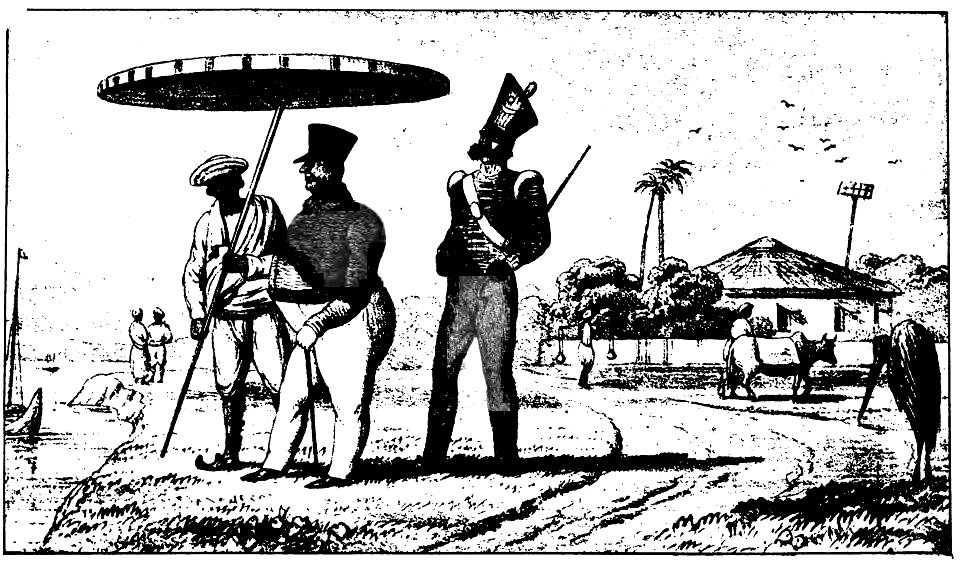
On the evening of my arrival at Dinapore, I was sitting
on the roof of my boat, observing the dobees, or washermen,
thumping their clothes, natives cleaning their teeth
with primitive tooth-brushes of stick, and other similar
sights which diversify the animating scene of an Indian
ghaut, when the distant and inspiring strains of a full
military band broke upon my ear. “Egad!” thought I,
“there’s some fun going on; a promenade, no doubt, with
all the beauty and fashion of Dinapore assembled; I’ll
go and see.”
I ordered Ramdial to bring out the jubba walla coortie
(the laced jacket), which had never yet graced my person
in any public assembly. A splendid thing it was, with a
huge silver epaulet, and “tastily turned up with a brimstone-coloured
lapelle;” I thought there could hardly be
its fellow in all Dinapore. A neat white waistcoat, crimson
sash (tied in a dégagé knot under the fifth rib), coatee
over all, hat a shade on one side, and flourishing a clean
bandanna in my hand, with a sprinkling of lavender upon
it, me voilà, an ensign of the first water.
I soon reached the scene of attraction in the principal
square, and a lively scene it was. There were congregated
groups of officers, chatting and laughing around
belles seated in tonjons; others, three or four abreast,
promenading backwards and forwards, hands behind them,
279and examining the structure of their legs; gigs and carriages
drawn up, their occupants attentively listening;
syces walking their masters’ chargers up and down;
chuprassies, silver-stick men, and other native servants,
mingled with the throng of sepoy orderlies and European
soldiers in undress.
I mingled with the crowd, and promenaded too; but,
alas! I knew no one; and who so solitary as he who,
amongst a crowd, experiences the sickening reflection
that there is no one of the many assembled with whom
he holds the slightest community of thought or feeling!
The shades of evening were deepening—the assembly
thinning—the finale, “God save the King,” was playing—busy
memory had awakened thoughts of those who
did regard me, far, far away—and I was waxing thoughtful
and sad, when I suddenly heard the sound of a
familiar voice.
I turned, and recognized in the speaker my shipmate
and brother-cadet, honest Grundy. I sprang forward to
address him.
God knows—for it is hard to answer for that fickle
and selfish thing, the human heart, which has rarely the
courage to brave the “world’s dread laugh,” and follow
its own more generous dictates—whether I should always
have done it with equal promptitude, for Grundy, in a
mere fashionable sense, was not an acquaintance to be
proud of; but now I stood in need of sympathy, and
there are seasons when anything in the shape of a friend
is acceptable—when we are not fastidious, and are overjoyed
to exchange greetings with aught in the shape of
humanity.
“Grundy, my boy,” said I, facing him, “don’t you
know me?”
Grundy stared vacantly for a moment, for I was considerably
metamorphosed by my new habiliments; but
soon recognizing me, his features relaxed into an expression
of good-humoured delight.
“Odds life, Gernon! is that you, man?” said he,
280grasping my hand; “why whaur the dickens are you
from?”
I soon satisfied him, and he told me he was now
doing duty with a regiment at Dinapore, and lived in a
bungalow not very far off.
“Are you alone, Grundy?” said I.
“Alone!” replied my friend with a sigh; “oh, no;
there are six of us in the bungalow—Griff Hall, as they
call it—all young hands, none of us a year in the
country, and a tearing life we lead; it does not suit me
at all, though, and I mean to leave them as soon as I
can get another place and a quiet man to chum with.”
“Yes, I know your pacific habits, Grundy, and
wonder how you got amongst such a set; who and what
are they?”
“Why, there’s first, Mr. McScreechum, an assistant
surgeon; three infantry ensigns, besides myself, and a
Lieut. Fireworker,[43] of artillery. I think they are all
mad, particularly the doctor, for such a man for mischief
I never met with in all my born days. But, Gernon,
lad, I hope you will stay for a day or two, at least,” said
he, slapping me on the shoulder; “for it glads my heart
to see you again, man.”
I accepted Grundy’s invitation, and we proceeded to
Griff Hall.
We found the doctor, with two or three others, on the
chabootra, or terrace, of the bungalow, all laughing and
joking. The former, a huge fellow, six feet two, with a
freckled face and a carroty poll, in the act of compounding
a glass of brandy-and-water. Grundy presented me
as his friend on the way to join my regiment.
“Glod to see ye, sir; glod to see ye,” said the doctor,
presenting me his shoulder-of-mutton hand; “we’ll use
you weel at Griff Hall, sir, and eeneetiate ye intoo oor
Eleuseenian mesteries. What’s for dinner, Larking?”
said he, turning to a slender, pale youth, in a red camlet
281raggie; “what have ye got for a treat to-night? Nae
mair of your d——d skeenny kid and tough goat mutton
I hope. Ah! ye’r a braw chiel to cater for a gentleman’s
mess.”
“I’ll resign my post to you with pleasure, doctor, if
not satisfied with my proceedings,” replied the caterer;
“but I think things will be better to-day, for I have
given Rumjohn a good trouncing for palming that stuff
upon us yesterday. I’ll tell you what there is, doctor,
by-the-bye, a capital rooee muchee,[44] for I secured it myself
this morning.”
“Weell,” said the doctor, “a rooee muchee’s nae bad
thing, if it’s frash.”
At this moment, three more ensigns, inmates of Griff
Hall, hove in sight, rattling up on tattooes, or galloways—tits
combining some pleasant varieties of fiddle-head,
goose-rump, swish-tail, &c.
In India, every one (i.e., European officer) must keep
a piece of horse-flesh of some sort or other, though it
must be allowed that griffins, for obvious reasons, were
never remarkable for possessing superior studs. As the
new-comers approached, full canter and shuffle, the doctor
put forth a screech, compounded of an Indian war-whoop
and a view halloo, by way of welcome: the fun
was evidently beginning.
One of the ensigns on the terrace jumped down into
the road, took his hat off his head, whirled it round, and
hooted loudly, to make his friends’ horses bolt or shy.
The doctor, too, seizing a sort of long besom which
stood in an angle of the bungalow wall, darted forward
with it to aid in putting the detachment to the
rout.
“Doctor, what the deuce are you about, man?”
shouted the immediate object of his attack; “don’t be
so infernally ridiculous.”
“Stir him oop with the lang pole,” roared the doctor,
282nothing daunted; “stir oop the bombardier’s wonderful
animal.”
And so saying, he poked the besom under the tail of
the tattoo, who resented this rear attack by launching
out his heels, jerked off the Lieut. Fireworker’s cap, and
finally bolted, with his rider half-unseated, across the
compound, amidst the shouts and laughter of his comrades,
the doctor, with his wild red locks flying, and his
feet in slippers, pursuing him with his besom at the pas
de charge.
McScreechum soon returned, puffing and blowing, and
flourishing his besom, and the Lieut. Fireworker shortly
after joined the group, having disposed of his runaway
Bucephalus, but with a countenance darkly portentous
of mischief.
“Dr. McScreechum,” said he, “I’ll thank you, sir,
not to take such liberties with me in future, for I will
not put up with them.”
“Stir him oop with the lang pole,” said the doctor,
still flourishing his besom.
“Others may submit to them, but I will not.”
“Stir him oop with the lang pole,” again replied
McScreechum.
All joined the medico in rallying the indignant lieutenant
out of his wrath. The good-humoured Scotchman
brewed and presented him a glass of grog, to allay
the fury of “the black dog,” as he termed it.
“A soft answer turneth away wrath,” saith the proverb,
and on the same principle, even a practical joke,
though ever to be avoided, may be so softened by a little
tact as to allay the anger which, in nine cases out of ten,
it is sure to excite.
All these wild doings at an end, and matters properly
composed, we adjourned to the dining-room, being summoned
by a rather dingy-looking butler, or khanseman,
very much resembling the worthy who has been recorded
in these pages as having so suddenly decamped with my
plate-chest.
283Six wall-shades with oil glasses, a long table occupying
the centre of the room, and about as many
chairs as guests, constituted the sum total of the furniture.
In accordance with the almost universal custom of the
military circles in India, camp fashion was the order of
the day—that is, each gentleman had his own plates,
knives and forks, and glasses, with a brace of muffineers,
containing pepper and salt, flanking the same; these
last, of every variety of size and shape, of glass, silver,
or pewter, with a corresponding variety of patterns in
the cutlery and plates, constituted as motley a show as
can well be imagined.
The servants, too, were of the Rum-Johnny order—a
dissolute, dirty set of Mahomedans, whom I have before
described—those usually picked up by young officers on
account of their speaking the English language, a qualification
which is pretty certain to insure their rejection
by old Indians. The dingy attire and roguish looks of
these fellows harmonized well with the style of the entertainment.
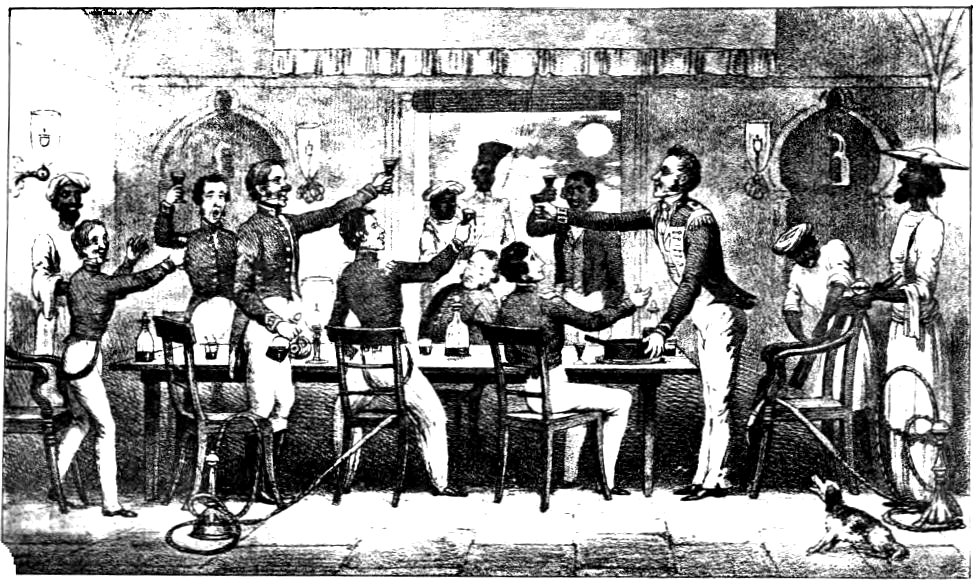
The doctor took the head of the table; the noble fraternity
of Griff Hall and their guests were soon seated.
The khanseman-jee appeared, staggering under a huge
dish, which he deposited at the head of the table;
having done so, he lifted up the cover with the air of a
major-domo, and there smoked the rooee muchee already
mentioned.
“Wha’s for fesh?” asked the doctor, plying the fish-knife
with the vigour of an Irish bricklayer when handling
his trowel. “Wha’s for fesh? Here’s a bonnie
fellow; ‘a sight like this is gude for sair een,’ as my old
father, the provost, used to say.”
The rooee muchee was in great request, and other
viands followed, all very good of their kind, I thought,
and proving the efficacy of the rattan in some cases.
Great was the talking and laughing, and the dinner
sped merrily. Never has it been my lot to encounter
284a more light-hearted, thoughtless, and jovial set of
fellows than the inmates of Griff Hall.
The cloth removed, hookhas bubbled; the bottle
passed freely, and the conversation became animated;
among other things, the scenes and flirtations at the
band that evening were passed in review.
“Who noticed Miss Simper, the new spin, talking to
that old fellow, MacGlashum?” said Ensign O’Toole,
a young Hibernian; “sure I hope she’s not going to take
that broken-winded old fellow.”
“By my saul, I don’t know,” replied Ensign MacClaymore;
“but I think if she gets a major, and a gude
Scotchman to boot, she could na do better.”
“Faith, I think she’d find an Irishman suit her better
than an old or a young Scotchman aither: oh, an Irishman’s
heart for the ladies!”
“Meaning yourself, I suppose,” retorted the Highlander,
dryly; “you Paddies think there’s nought like
yeer’sels in the world.”
“Faith, now, I don’t think we’ve half the consait of
your Scotchmen, at all,” replied O’Toole, “though a
grate dale more to be proud of. Where will you find
janius like that which auld Ireland has produced—such
poets, statesmen, and haroes?”
“Proud!” said the other contemptuously; “hooever
may fall short in those respects, thank Gude, auld Scotland
was never conquered,—never conquered, sir, as some
other countries have been.”
“I’ll tell you the reason,” said the other bitterly; “the
poor beggarly country was never worth the trouble and
expense of conquering.”
“Eh! sir,” said the young Caledonian, his eyes flashing
fire, “what’s that you say, sir? I’ll no sit here and
listen to that. What do you mean, sir?”
“Mean!” retorted the other, sternly, “just what I’ve
said, Ensign MacClaymore, and so just make your most
of it; if you’ve more to add, let it be outside.”
Several attempts were made to check this angry dialogue,
285but in vain. All was now confusion; the angry
patriots half arose, and darted fierce looks at each other
across the table, their more peacefully disposed neighbours
endeavouring to quiet and retain them in their seats.
Things were fast verging towards “war, horrid war.”
Dr. McScreechum now arose, like Satan in Pandemonium,
thumped the table to engage attention, and with
the voice of a Stentor, proclaimed silence, and called
the belligerents to order.
“Gentlemen,” said the doctor, “silence if you please,
and listen to me. I am the moderator of this assembly,
and by vairtue of the pooers confided to me, I proclaim
pax. I’ll have na quarrelling here; doun wi’ your foolish
naytionalities; aren’t we all kintramen and brithers,
as my gude old father, the provost, used to say? You,
Donald MacClaymore, and you, Denis O’Toole, I’ll fine
you each a dozen of claret, and proclaim you baith ootlaws
of Griff Hall, unless you shak hands, like sensible
fellows; shak hands, ye fire-eating donnard deevils ye,
and then I’ll gee ye a sang. ‘Auld lang syne, my dear,
for a’ lang syne.’ Wha’s for a sang?” This seasonable
interruption, in the doctors peculiar way, turned the tide
of war. A furious drumming on the table followed;
glasses danced and jingled, and “Auld lang syne for
ever!” resounded through the hall. MacClaymore and
O’Toole caught the spirit of the movement, shook hands
across the table, and the glorious Scottish air broke
forth splendidly, like an elegy over buried animosities.
The doctor, half-seas-over, was now completely in his
element; his huge red head rolled from side to side, and
one eye, half shut, leered with Bacchanalian philanthropy
around the table.
Thus he stood, his arms crossed, and holding the hand
of each of his right and left neighbours, as he worked
them up and down with a force and energy proportioned
to the varying sentiments of that celebrated ditty, which
has to answer for being the proximate cause of more
boozing and maudlin sentimentality than any ever
286written; for oh, that potent collocation of words, “for
auld lang syne,” goes direct to the exile’s heart, particularly
when softened by the genial glass; touches its tenderest
chords, and awakens, like the “Ranz de vaches,”
the sweetest and most soul-subduing reminiscences of
youth, and all its never-to-be-forgotten associations.
After this bout, anchovy toasts and broiled bones were
put in requisition, Ensign O’Toole insisted upon mulling
a saucepanful of port, to keep the beer and claret warm.
At length, some fell asleep in their chairs; others, including
Grundy and myself, dropped off to bed, though
abused by the peep-o’-day boys for our recreant qualities.
Away we went, heartily tired, leaving a few choice
spirits to keep it up, the doctor talking in thick and
almost inarticulate tone about “Sheshero’s Epeestles to
Hatticus.”
“You may well be tired of such a life as this,” said I,
next morning; “it would kill me in a week; how do you
stand it?”
“Why,” replied Grundy, “I keep as clear of it as I
can; besides, it is not very often that we have quite such
a jollification as we had last night; however, the eternal
racket we have does not suit me, and I shall cut it as soon
as I can; it goes against my conscience, too, to witness
some of the tricks they play upon one another. One
day they hanged one of the lads for fun by the punkah
rope till he was black in the face; and about a month
ago sent a sub., a poor soft fellow, a voyage on the Ganges
in an open boat; and as he did not return for a week,
it was a mercy he was not starved or drowned.”
“How was this, Grundy?” said I.
“Why, the doctor and the lads were always poking
fun at him, and making him a boot (butt). One night,
something such another as last, they made him believe
he had been insoolted, and must fight. Sawney said he
would rather take an apology, but they told him it was
quite impossible that the affront could ever be washed
out but with the blood of one of them. They said it
287must be settled immediately, and went out with lanterns
to the back of the bungalow. The unfortunate lad was
in a dreadful fright, but they made him fire; the pistols
were loaded with powder only, but his antagonist fell;
they said he had killed his man, and must fly immediately,
or, if he fell into the hands of the civil power, he
would inevitably be hanged. They hurried the poor
young fellow off the ghaut, put him on board a fishing-canoe,
telling him to row for his life till he came to some
station, one hundred miles or so down the river, where
he would have a better chance of a fair trial, and must give
himself up. It was about a week before he was brought
back to cantonments, burnt as black as a tinker. There
was a terrible kick-up about it, and well there might be,
for ’twas a cruel joke. The doctor and all the parties
concerned were threatened with a court-martial; but,
somehow or other, it all blew over.”
Pranks such as these are now, I believe, happily rare
in India, as everywhere else; but those who remember
the country twenty or thirty years ago will doubtless be
able to recall many such manifestations of boyish folly.
It is not desirable that youth should be converted prematurely
into thoughtful philosophy; care, in the
ordinary course of things, will come, soon enough, and
need not be hastened; but I am an advocate for its
buoyancies being restrained within moderate bounds, that
with it fun should not be allowed to degenerate into mischief
or cruelty, wit in vulgarity, and friendly intimacy
into coarse familiarity and practical joking.
We breakfasted very late, and the tenants of Griff
Hall dropped in one by one en déshabille, evincing painful
symptoms of the previous night’s debauch—red eyes,
trembling hand, and glued lips. One took a dose of
seidlitz, another five grains of calomel, and as for appetite,
there was none.
These are a few of the early effects of intemperance; its
ultimate consequences are not so briefly described.
I remained but one day more at Dinapore, which was
288partly devoted to reporting my arrival, en route to join—a
measure enjoined on all military voyagers, but not
always attended to. I also saw the troops, European
and native, at brigade exercise, &c.; and in the evening
witnessed a tattoo race—officers riding their own ponies.
This was a very comical affair.
It was a little before sunset when Grundy, the Lieutenant
Fireworker (who had entered his pony), and I,
walked down to the course, which is situated a little
behind the cantonment, being separated from it by a dry
nullah,[45] over which there are one or two bridges.
We found a great number of the inhabitants of the
cantonment—some in gigs, some on horseback, and others
on foot—assembled to witness the sport.
There was a good show of ponies, some of them
certainly “rum’uns” to look at, but, as was fully proved
in the sequel, “devils to go.” Long tails and swish tails,
stumps, crops, and wall-eyes were there in perfection.
The young officers who were to ride them, amongst whom
I recognized more than one of the inmates of Griff
Hall, marched about in their top boots and velvet hunting-caps,
cracking their whips with countenances expressive
of the full sense they entertained of the awful
contest in which they were about to be engaged.
Some, too, tightened their ponies’ girths; others passed
their hands down their fore-legs, as if to rub out the
knots and clean the back sinews; some put their arms
lovingly round their animals’ necks, or gratified their love
of tormenting by pinching the flanks of their steeds, and
enjoying their abortive attempts to bite.
Amongst this throng was a very remarkable character,
well known at Dinapore, the clerk of the course, or
whatever other name properly appertains to the master of
the ceremonies on such occasions. He was a little, old,
sun-dried, invalid sergeant, of a meagre form, but most
determined spirit. I was greatly amused by the consequential
air of the diminutive old fellow, as he stumped
289about in a rusty hunting-cap, cracking a tremendous
whip, and clearing the environs of dogs, boys, and all
other interlopers.
The time for the race having arrived, the young men
mounted, some in red jackets, some in white, and others
in full jockey attire. The clerk of the course ranged
them all in proper order; eagerness was in every eye as
they bent forward, impatient for the word. Ladies stood
up in carriages, and many a neck was outstretched to
catch a glimpse of the start: when at last a thundering
“Ready,” “Off,” from the little mummified sergeant, and
away flew the tattoos, “Punch,” “Cocktail,” and “Mat-o’-the-Mint,”
and many a nameless steed besides. Such
digging, spurring, and straining; such crossing and
jostling as was there! one pushing ahead for a space, and
then another passing him, and so on!
When the whole troop had got about half-way round
(it was a sweepstakes, round the course), the leading
pony bolted, and was followed by all the rest, entering
the gates leading to a bungalow, the first of a series
there commencing; there they very deliberately drew up,
where doubtless they had often drawn up before, when
carrying their masters on their rounds of morning visits.
Intense were the roars of laughter which issued from
the spectators assembled, occasioned by this little episode.
Haul, dig, pound, and spur, and they were again placed,
and off—but ah! the unlucky fates! the meridian of
another bungalow entrance no sooner reached, than away
with them again, follow my leader, like a flock of sheep
through a gap, or a string of wild geese.
I thought verily I should have died outright, and as
for honest Grundy, and many of my neighbours, they
stamped and roared till the tears ran down their cheeks.
All this time we could see, though the distance was
considerable, that the jockeys were hard at work, getting
their tattoos once more under weigh through the opposite
segment of road leading from the attractive bungalow, the
other horn, as it might have been termed, of the dilemma.
290The course regained, away they went once more: the
struggle was becoming warm; they had turned the curve,
and were in a line with the winning-post; bettors were
now on the qui vive—“ten to one on Cocktail”—the
little sergeant squatting bands on knees, taking a judgmatical
observation, when lo! no sooner had they reached
a certain bridge before mentioned, leading in a rectangular
direction to cantonments, than away they sidled,
and at last one and all made a fair bolt of it, right before
the wind, for “home, sweet home.”
“Zounds!” said the sergeant, “if they bea’nt all off
agin, I’m a Dutchman.”
And off sure enough they were, amidst renewed peals
of laughter. I doubt if any race ever produced half the
amusement. “They are gone, they are gone, and never
will return.”
This was literally the case with some; but several of
the heavy sailers managed to tack, and came in amidst
the half-mad shouts of unexpected winners, proving truly
that “the race is not always to the swift,” and that the
best-founded expectations may be unexpectedly disappointed.
Two or three races on a smaller scale followed; but
all was flat after the unique scamper I have attempted to
describe; pleasure and excitement had expended themselves,
and were not to be renewed immediately. Under
these circumstances, Grundy and I bent our steps towards
the band, accompanied by the young artillery
officer, who, having proved the winner, was in high
spirits.
Our dinner this evening passed off far more soberly
than that of the preceding one. The doctor was evidently
suffering from a reaction of the vital spirits, and
on more than one occasion seemed disposed, like a
certain old gentleman when he was sick, to be religious
and sentimental. After a bottle or two of Hodgson,
however, and a due proportion of claret, he rallied, and
proposed a round game at loo, as a mode of passing the
291evening, which was joyfully assented to by the whole
party.
The tables were consequently cleared, wine-glasses,
&c., were placed on teapoys and side-tables, and to work
we all proceeded, keeping it up till two in the morning,
when I retired minus a very considerable pinch of
General Capsicums “snuff,” with a firm determination
to cut cards from that time for evermore: a resolution
which I religiously kept—till the next time temptation
came in my way.
At the time to which my Memoirs refer—and I am
not aware that any material change has since taken place—gambling
was unfortunately too prevalent in India. I
have known nearly the whole of a small station, ladies
inclusive, keep it up for weeks, alternately at each other’s
houses, rarely missing a day.
The party would assemble after breakfast, and having
distributed fish, and set pen and ink to write I O U’s,
would commence business in good earnest. Tiffin would
constitute a break, and after being rather impatiently
despatched, operations would be resumed, and continued
till time for the evening’s drive. After this, and dinner
over, another round of this absorbing amusement would
close the day.
What a world of bad feeling in men, of keenness and
unfeminine cupidity in women, have I seen elicited on
those occasions, and what studies for the curious in
physiognomy; what expressions of various kinds have I
observed in the faces of the party, when the hour drew
near for inditing I O U’s and settling the accounts of
Dr. and Cr.; what earnest pleadings for another round
on the part of the losers, and conscientiously-expressed
determinations to retire to rest on the part of the
winners!
Cards and dice are pests, the offspring of idleness, and
the parents of vice and crime. They are the concomitants
of semi-barbarism, and their gradual disappearance
is one of the indices of advancing civilization and
292mental improvement. I began to think this one night
after losing Rs. 1,100 at hazard and double-or-quits, and
the impression has continued to gain strength ever since.
Next morning, after breakfast, I bade adieu to Griff
Hall and honest Grundy; had my hand almost squeezed
to a jelly by the good-natured son of the provost, and,
repairing on board my bolio, was soon once more under
weigh for the “far west.”
Very different, however, were the feelings which now
attended my onward progression. I had lost my kind
and pleasant Mentor, Captain Belfield, and his amiable
maiden sister. There were no more social rambles, no
more agreeable disquisitions, no more tours in search of
the picturesque, no more chess.
I felt how insufficient my own thoughts were to supply
the hiatus caused by their absence, and mentally ejaculated,
as I occupied my lonely cabin at night, with poor
Alexander Selkirk,
“Oh, solitude, where are the charms
That sages have seen in thy face?”
I cannot quit the subject of my two friends without
saying a few more words regarding them. I have already
stated briefly that Captain Belfield and his sister afforded
a fine example of that tender attachment—that perfect
love and affection which should ever subsist between
persons so nearly connected. They truly lived for each
other, and the imparting of mutual pleasure seemed to
constitute one of the highest gratifications of their lives.
It was quite refreshing to observe the warmth and
cordiality with which they met in the morning, as she,
the picture of neatness and refined simplicity—the very
beau ideal of the real English gentlewoman—stepped
from the sleeping apartment of the budgerow, whilst he,
closing his ponderous Sanscrit or Persian folio, and
laying it on the breakfast-table, would rise with extended
hand and a cheerful smile to greet her. Then at night,
too, after the short but fervent prayer to the Father of
293all, which the captain himself would offer up extempore,
how attentively would he light her taper, and then
with a tender salute commend her to her chamber and
repose.
If two or three can love in this way, I have since
sometimes thought, why not all the world? but all the
world, my good griffin, are not brothers and sisters.
True, true; I had forgotten that. The more, alas! the
pity.
Though, however, the hearts of the pair were thus
united, there was not an equal accordance in all their
sentiments and opinions. This, however, though productive
of numerous discussions, never led to acrimonious
disputes. They agreed to disagree. Nature had cast
the brother and sister in the same mental mould, to
borrow a phrenological term (which I do with respect);
the organization was equal. The same fine sense and
kindliness of disposition in both; but circumstances had
favoured in different degrees the development of their
respective qualities. Benevolence, veneration, and ideality
must have been large in both, though the captain had
evidently been at pains to curb the vagaries of the latter.
He had left his home a mere boy, with his mind almost
a blank sheet, on which anything might have been
inscribed. Whilst others his contemporaries plunged
into idleness and dissipation, he, by some chance, flew to
the solace of books. In them he studied that mystery
of mysteries—man, comparing, as life advanced, the
living manifestations of his character with all that he
found recorded of his acts; he perused the works of
historians, theologians, and metaphysicians, on all sides
of all questions; and arrived at one grand conclusion,
which is, that truth is a very hard thing to get at, and,
like the ideal good of Goldsmith’s Traveller, “allures
from far, and as we follow, flies.” He certainly sought
it ardently, though he could not felicitate himself, he
said, exactly in having yet found the “true truth.” A
self-taught genius, who thought vigorously, and expressed
294himself strongly, he was, no doubt, somewhat of an
Utopian; at least such I know Captain Marpeet thought
him.
Miss Belfield had been reared in the elegant seclusion,
but subject to the somewhat contracting influences of
an English country life (nature, if I may so express it,
seems to have intended nations as well as individuals to
be gregarious), enjoying in her father’s pretty vicarage
her pets, her flowers, and the agreeable and polished
society of the superior gentry of the vicinity. In the
neighbouring village she dispensed her little charities,
assuaged the sorrows of the poor and needy, and did all
the good she could in her limited sphere; but of the
sufferings of the world on a grand scale she knew not
much, and as little understood, perhaps, their real causes
and remedies. High as were her qualities of heart and
intellect—and admirably would she write and speak on
all matters on which she allowed them free scope—she
was not (and who is?) without a defect; hers was one
frequently to be met with amongst the most amiable and
estimable of our countrywomen, a gentle intolerance and
quiet assumption of infallibility on those subjects on
which a very little reading and reflection ought, perhaps,
to convince us that we should hold our opinions with
the most trembling diffidence—I mean religion, and
other kindred subjects relating to the powers and duties
of mind, and the great interests of society, but particularly
the former. This would evince itself in the
expression of extreme pity and commiseration for the
obstinacy or delusion of those who conscientiously
differed from her in such matters, she, by her manner,
never seeming to entertain the smallest shade of
suspicion that she herself might be in error. This
spirit, partially veiled by the graces of her manner, the
kindness of her heart, and the evident rectitude of her
intentions, did not look so ill as the ugly monster intolerance
generally does; still it was her dark side, and
but ill accorded with the general good sense by which she
295was characterized; her reading on these points had been
as exclusive as her brother’s had been general.
Equally holding to certain fundamental points, they
were both anxious to regenerate mankind, but were
widely opposed in respect to the means to be employed
for that purpose. The captain looked primarily to
schools, lectures, locomotion, and the wide diffusion of
commerce and intelligence, and thought if man fell by
eating of the tree of knowledge, he figuratively was
destined to rise by a repetition of the act. Miss Belfield
principally relied on the multiplication of churches and
Sunday-schools, the extension of missionary labours, the
early conversion of the Jews, and the like. He thought
that religion was the first subject to which an instructed
mind would direct its attention. Miss Belfield, on the
contrary, considered it the very last on which, if not
forced upon him, he would seek to be informed. She
considered man as radically vicious, that suffering was
necessary to try him, and that it was perhaps better to
preach resignation to evils, than to waste time in vain
attempts to diminish them materially. Her brother
differed, too, in this, and thought that happiness was
quite as well calculated to fit us for heaven as
misery; and that it was almost a libel on the Deity to
suppose that the thanks and praises of a rejoicing
heart would not be as acceptable as those emanating
from one bowed down by sorrow and suffering. He
thought that the evils inseparably annexed to our condition,
such as death, sickness, and the loss of those
tenderly beloved, were trials sufficient, without our
unnecessarily increasing the load by fictitious ones—clearly
the result of our follies, contentions, and
prejudices.
He used to compare society, as at present constituted,
to a body of undisciplined troops, composed of jarring
detachments, under incompetent leaders, and amongst
whom the finest military qualities and powers are neutralized
or impaired by want of concert and organization.
296“Educate your masses,” he would say, “for without
you do that no conceivable form of government will produce
happiness to the governed. Construct the finest
piece of mechanism you may, on the strictest principles
of art, if the material is rotten and unsound, it must give
at some point—the due antagonism of its springs will be
destroyed, and it will not work.”
This diversity of views, which I have endeavoured to
describe, used to give rise, as I have already stated, to
numerous animated discussions.
I used to listen to these collisions of intellect, during
the evenings we passed together, with much interest; and
when I could see my way through the pros and cons,
was wont sometimes to venture an opinion, to which the
captain and his sister always listened with eagerness, as
if anxious to know how the matter would strike on my
young and unsophisticated mind.
Some of these discussions, that is, the substance of
them, I still remember, and had I space, and were this
the place for them, I might here be tempted to record.
Lest my reader may be inclined to think otherwise, I
must here state, in justice to the good captain, now no
more, that he was no leveller; he considered perfect
equality as impracticable as to construct a perfect column
without a base and a capital, and that the fabric of society
must ever fine away to a point, but that instead of being,
as at present, founded, in great part, on misery, prejudice,
indigence, and ignorance, it might be made to rest
on the solid basis of virtue and happiness.
His grand axiom was—and he used frequently to repeat
it to his sister—“If by reading, observation, and
reflection, I have learnt anything respecting my fellow-creatures,
it is this: that eight-tenths of their sufferings
have been and are entirely of their own creation, and
that it is within the powers of the human mind to diminish
the amount of moral and physical evil to an incalculable
extent. The upper classes appear to govern the
world, but in reality it is the ignorance and prejudice of
297the ‘tyrant majority’ which rule it. In these, the more
educated find what physically Archimedes sought—the
fulcrum to move the world: the head is the governing
part of the body, but we all know how a disordered
stomach will affect it.”
I had but little more intercourse with the good captain
and his sister during my stay in India, though we met
now and then, and maintained an occasional correspondence.
He, poor fellow, was never destined to revisit his
native land, for after saving a small competence, and
just as he was preparing to return, death, by one of
its most appalling agents—cholera-lodged a detainer
against him, and instead of enjoying the easy evening of
life he had fondly anticipated amongst the scenes of his
boyhood, he was destined to fill a cold tenement, six feet
by two, in St. John’s churchyard, Calcutta.
’Tis not for me to describe Miss Belfield’s feelings on
this occasion; indeed, who can describe the anguish of
heart, the utter desolation, which the loss of a brother
or a sister, endeared by union of sentiment and every
tender association of youth, necessarily occasions? I
learnt that she almost sunk under the blow; and a few,
very few lines, which she wrote me shortly after, told
forcibly the extent of her sorrows, and indicated the
gratifying fact that she considered I had a right to participate
in them.
Well, years rolled away. I returned home, with a
broken constitution, and a lack of rupees, in the English
sense of the term;[46] and some time after that event received
the following letter:—
“Swines-Norton, June 10th, 18—.
“I have for some time been aware of your return to
your native land, having heard of you from mutual
298friends. Pray, when your avocations will allow of your
leaving London, endeavour to visit my retirement. I
have a small room in my cottage at your service, and
shall enjoy great pleasure, in some respects a sorrowful
one, in meeting you again, and in reviving old recollections
of those days when first we became acquainted. I
will reserve all further communications till we meet; in
the meantime am,
“My dear Captain Gernon,
“Yours most truly,
“A. Belfield.”
“To Brev. Capt. Gernon,
“5, Peppercorn-buildings,
“Pimlico.”
I was not long in finding out Miss Belfield’s retreat.
The Highflyer coach dropped me at the Bull, a foaming,
rampant fellow, the only thing evincing any signs of life
and animation in the small sleepy village of Swines-Norton,
in ——shire. A few smock-frocked clowns, a
bandy-legged ostler, and a recruiting-sergeant, who
seemed wofully out of his element, loitered in front of
the little inn as I descended.
“What luggage had you, sir?”
“Nothing but a small carpet-bag.”
“Come, Bill, bear a hand, and get the gentleman’s
bag out of the hind boot.”
The bandy-legged ostler soon disengaged my property;
the spruce bluff coachman clutched his reins and cracked
his whip, and made the over-frisky off-leader dance a
saraband.
“Has Davy brought up that there black mare?” said
the landlord, sauntering out with his pipe and tankard of
half-and-half.
“Yes; he’s down there along o’ Tom at the Blackbird.”
All right—crack—whisp—a nod to the pretty chambermaid
at the window—ya-hip! and away bowled the Highflyer,
299leaving me “alone in my glory,” saving and except
the drowsy specimens of humanity afore-mentioned.
“Can you tell me where a lady named Miss Belfield
resides?”
“Miss Bulfield—Miss Bulfield—be that she, Jem, as
lives furder end o’ Tinker-pot-lane?”
“The lady, I mean,” said I, “returned from India
some years ago, and resides in something cottage, but I
have forgotten the name.”
“All right, sir, that’s she—now you mentions the
Heast Hinjies. I knows she’ve a-got a parrotkeet—jist
go on to the church, and then turn to your right hand,
and keep straight on as ever you can go ’til you comes to
a lane; when you be at the top o’ that, get over the stile
and go across the footpath till you comes to the furder
end o’ the field, and then anybody’ll tell you where
Myrtle Cottage is.”
“Thank you, my man,” said I.
And I forthwith set out on my voyage of discovery. It
was a sweet summer’s evening, glorious, tranquil, sad.
I heard with delight the cuckoo’s voice, the tinkle of the
sheep-bell, and the cry of the jackdaws, as they sported
about the burnished vane of the old weather-stained
steeple. I was in no hurry, but loitered in the quiet
village churchyard, where naught was moving save some
two or three little ragged sheep; and oh! who could
describe the sensations, the sadly pleasing, confused, but
undefinable sensations, which crowded upon me during
the little half-hour that I spent there?
Seated on an old grey tombstone, alone, and looking
up at that rustic monitor, the village clock—whilst the
soft summer air played on my face, and soothing rural
sounds fell on my ear—the events of my past life, the
images of friends departed—all I had done and left undone—passed
like visions—dissolving views—before me.
Brother Indians, try sometimes, after your period of toil
is o’er, the effect of a summer’s musing in a rural churchyard—’twill
calm the perturbation of your spirits, place
300things in their true lights before you, and act as oil on
troubled waters. But, to be brief, I found Miss Belfield’s
cottage—neat, modest, elegant, and retiring, just as I
remembered herself. The parrot screamed in the little
hall, and a very antiquated dowager of a spaniel, with an
opaque eye, emitted a husky bark as I entered.
“Be pleased to take a seat, sir,” said the tidiest and
modestest of little maids, “and my mistress will be with
you immediately.”
I took a seat—my spirits were in a flutter, almost
bordering on pain. The door opened, and the hand of
Miss Belfield was locked in mine. We both started a
little.
“Most truly glad to see you,” said she, with deep
emphasis, her eyes full of tears. I placed my other hand
over the one of hers which I held in my grasp, and answered
her by a soft and earnest pressure, which told how deeply
I reciprocated the feeling.
“Well,” said she, smiling, after a pause, “I suppose
we must not compliment each other on looks, for I am
almost afraid to think how long it is since we parted—but
I hope our mutual regard has not suffered by the
lapse of time.”
I assured her that my respect and esteem for her were
as fresh as ever. Years and ill-health had given me a
slight curve in the shoulders. The freshness of my complexion
had long been converted into a delicate yellow;
my hair was grey beyond the power of Macassar oil to
restore, and crows’ feet had dug their ineffaceable marks
at the angles and corners of my face.
Miss Belfield’s eyes I once or twice caught resting on
me, as if involuntarily—for she instantly averted them
on their encountering mine. She was doubtless comparing
me to my former self—and exclaiming inwardly,
“Oh! what a falling off is here!”
If she was struck by my changed appearance, I was
no less so with hers. Time and Care, rival ploughmen,
had deeply furrowed her brow—her embonpoint was gone;
301and the iron-grey locks peeped here and there through
the muslin of her cap. Still, as of old, the ease, the
urbanity, the refinement, and, at the same time, the simplicity
of the gentlewoman, shone in Miss Belfield as
conspicuously as ever.
As we stood near the fire, and during the pause which
followed the ardour of question and answer incident to a
first meeting, Miss Belfield drew my attention to a portrait
over the mantelpiece; it was that of an officer, in
somewhat old-fashioned regimentals.
“Do you know that?” said she, in a subdued and
choked tone, pointing to it with her finger.
I did indeed; ’twas my old friend, the good, the kind,
and thoughtful captain. There he sat, serenely, with his
book half-opened and resting on his knee, just as he was
wont to look in days of yore, when I rattled into his
budgerow, after one of my shooting excursions.
“Come,” said Miss Belfield, gently withdrawing me
from its contemplation, “lunch awaits us in the next
room, and you must require refreshment.”
I must reserve a more detailed account of Miss Belfield
for some future part of my autobiography,—that devoted
to England; let it here suffice to state, that after a week’s
visit to my amiable friend—one characterized by every
thing that was pleasing—I returned to London, having
first promised to repeat my visits from time to time, to
draw and botanize, and talk of old times; and settle,
over a cup of Howqua’s mixture, the great questions
now agitating the world. But to proceed.
I passed the old fort and station of Buxar, where a
few invalids doze out the evening of their Indian existence,
and saw some European veterans, almost as black
as the natives, with large mushroom hats, bobbing for
fish on the banks of the river, and in due time reached
Ghazepore, the station of one of H.M. regiments.
Here I found my shipmate, Ensign O’Gorman. The
ensign, on whom I called, received me as an Irishman
and a British officer in the royal service might be supposed
302to do. Could a volume say more for its warmth
and cordiality? I dined with him at his mess, at which
urbanity, kindness, and good cheer combined their attractions
to render this one of the pleasantest evenings I had
spent in India. Oar ship adventures were discussed;
our fellow-passengers were passed in review, and we were
supremely happy.
“By the way,” said I, rather carelessly, “have you
heard what has become of Olivia Jenkins?”
“Oh, didn’t you hear she is married?”
“Married!” I exclaimed, and a mouthful of pillaw
stuck in transitu in my œsophagus, nearly producing a
case of asphyxia.
“Good heavens! you don’t say so?”
“Oh, it’s a fact,” said O’Gorman; “but what’s the matter?
you appear unwell.”
“Oh, I am quite well,” said I; “but let’s take a
glass of wine.”
I tossed off a bumper, and felt relieved.
“And so—little—Olivia—Jenkins—is actually—married?
Good heavens! only think of that!”
“Why, sure,” said the ensign, smiling, “there’s nothing
very strange in a pretty girl getting married; but,” added
he, looking hard at me, and after a pause, “I suspect you
were a little touched in that quarter yourself; am I not a
true diviner?”
“I acknowledge it,” said I; “I did like that girl. Good
heavens! and so little Olivia Jenkins is actually married!”
The ensign pressed me to stay with him a week, but I
was forced to decline his hospitality, and resumed my onward
route the next morning.
In a few days I reached Benares—Kasi, the splendid—the
Jerusalem or Mecca of the Hindoo world. What a
treat to look upon a picture of human existence, just as it
probably was when Alexander the Great was a little chap!
As I glided past the swarming ghauts, where the pure-caste
damsels, the high-born Hindoo maidens, of this
strange and antique land, displayed their lovely forms,
303and laved their raven tresses in the sacred stream; where
the holy bramin and the learned pundit, seated cross-legged,
marked with ashes and pigments, pattered their
Veds and Purans, I felt this in all its force; whilst the
blowing of the conch, or the tinkling of bells, announced
the never-ending round of Poojah and devotion!
Here and there, the sacred Bull of Siva, and the yoni
and lingam, festooned with wreaths of lotus or chumbalie,
met the eye; whilst crowded boats, jingling bylies (ruths
or native carriages), armed natives in the varied costumes
of India (here assembling in the common centre of
religious hopes and duties), with an elephant or two
half-immersed, would serve to complete the foreground
of this interesting picture.
Behind arose, somewhat after the manner of those
congregated architectural masses in Martin’s pictures,
though of course inferior in the boldness of their proportions
and general taste and magnificence of the
outline, the closely-wedged masses of this most curious
and old-world city; the continuity of buildings occasionally
broken by masses of foliage, or a cuneiform
temple, with its tapering bamboo and blood-red pennon.
High over all, in the centre of the city, on a natural
eminence, towered the celebrated mosque of Aurungzebe,
with its two lofty minarets, which command a magnificent
prospect of the surrounding country. This mosque
is erected, it is said, on the site of a Hindoo temple of
great sanctity, which was previously desecrated by having
the blood of a cow sprinkled over it.
When the Mahomedans and Hindoos have a serious
flare-up, the cows and pigs are pretty sure to suffer for
it. The one is held in the highest veneration by the
Hindoo, the other in utter abomination by the Moslem;
consequently, the killing of one in a mundil, and of the
other in a mosque, in pursuance of the lex talionis, generally
constitutes the crisis of a religious dispute.
Such is revenge, when passion and fanaticism are in the
ascendant, and such the gusto with which, by contending
304religionists, the stab is given in the most tender and
vital part.
Having nearly cleared the city, I landed, accompanied
by Ramdial Sirdar, to take a peep at the interior of this
strange place; and strange, indeed, I found it. Streets
swarming with people, and some so narrow that one of
our draymen could hardly work down them, unless
edgeways. Here, in the crowded chowks, waddled the
huge braminy bull, poking his nose into the bunyah’s
grain basket, in disdainful exercise of his sanctified
impunity; whilst byraggies, fakeers, pundits, and bawling
mendicants, and much more, that I cannot here
describe, made up a scene as curious in itself, as striking
and interesting to me from its novelty.
In the course of my ramble, Ramdial gave me to
understand that, if I was desirous of an hummaum, or
bath, after the Indian fashion, I could have one at
Benares for a rupee or two, which would purify my outer
man, besides being wonderfully agreeable. I had heard
much of such baths in the “Arabian Nights,” and in works
of the like sort, and thought this a good occasion to
compare facts with early impressions; in short, I determined
to be parboiled, and having intimated the same to
Ramdial, I departed with him and my kidmutgar, after
an early dinner, to the hummaum, or Ghosul Kaneh.
This was a considerable distance from my boat, in a
garden, in the outskirts of the city. We entered the
building, and Ramdial having explained who I was and
what I wanted, an attendant of the bath showed me a
small apartment, in which I was requested to disrobe.
Having peeled, a pair of curwah drawers, or pajammas,
were given to me, which descend about half-way down
the thigh, and are tied in front with a string.
All being ready, I, rather nervous, submitted myself
to the guidance of an athletic native, similarly habited to
myself.
We passed through a narrow dark passage, and I
began to look out for adventures. The slave of the
305bath showed me into a little confined apartment, some
ten feet by four, filled with steam, on one side of which
were reservoirs of water of different temperatures, in
separate compartments, about (as well as I can recollect)
breast-high.
Here I found another attendant, who, after sluicing a
bowl or two of water over my body, laid me out on a
long board, occupying the centre of the narrow apartment,
and, aided by his companion, commenced rubbing
me with soap and pea-meal from head to foot.
This over, they proceeded to rub me down slowly with
keesahs, or rough gloves, bringing off flakes and
rouleaus of cuticle and epidermis astonishing to behold.
Flayed alive, they proceeded to shampoo and knead me,
producing the most pleasing and grateful sensations.
The strong man now bade me rise, and then and there
began to play the castanets on my vertebral column,
beginning at the topmost articulation; this he effected
by placing his leg behind me, swinging my body gently
backwards and forwards, and then by a sudden jerk, the
very reverse of pleasant, producing the desired dislocation
and its accompanying crack; having done with the
spine, he rung the changes on my toes, knees, and
fingers. To effect all this, he entwined his brawny limbs
about me in a most gladiatorial style, which was far
from agreeable.
At length, after a few more sluicings, I was given to
understand that my purifications were at an end; something
was then thrown over me, and I was led back to
the place from whence I came. There I dressed, and
never in my life experienced such a feeling of purity and
buoyancy. I felt as if a new man, cleansed mentally
and bodily, and ready to open a fresh account with the
world.
My kitmudgar, Fyz Buccas, a worthy little fellow, had
not been idle or inattentive to my comforts during my
absence; for no sooner had I dressed, and was giving
the last shake to a clean cambric handkerchief—the finale
306of the toilet in India—than he presented me with a cup
of hot coffee, which he had prepared outside, and brought
in afterwards my kalioun, which I had recently set up;
taking this then in my hand, and putting the mouth-piece
between my lips, I stretched out my legs, leaned
my head back, and, half-closing my eyes, immediately
departed for the seventh heaven, in a cloud of odoriferous
incense.
The following day brought me to Sultanpore, the
station of a regiment of native cavalry, about midway
between Benares and Chunarghur. Here I stayed a few
days with a cornet, to whom I was the bearer of a letter.
There are no native cavalry lower than this in the Bengal
presidency; these, consequently, with the exception of
the Governor-General’s body-guard (who are differently
attired), were the first I had seen of that arm.
On the whole, this body of black dragoons pleased me
well; their dress was French grey, buckskin breeches, and
long military boots, with high blue mitre-shaped caps,
terminating at the apex with a sort of hemispherical
silver knob; those of the native officers were covered with
red cloth, with silver mountings.
The European officers wore helmets (since changed to
shakos), but in other respects were dressed like their
men. Some of the troopers were tight, well-made fellows,
and the native officers large, portly gentlemen; but, if
I may be allowed a pun, should say there were more
Musulmans than musclemen amongst them.[47]
Europeans in general peel much better than natives,
though the latter, being generally taller and more equally-sized,
look better, I think, in a body; nevertheless,
amongst the sepoys are frequently found men, models of
symmetry and muscular vigour, with whom few Europeans
307would be able to cope. Their great degree of
strength is, however, in general, artificially induced by the
continued practice of gymnastics, the magdas, or clubs,
and the use of the iron-stringed bow, &c.
I arrived at Sultanpore during the great Mahomedan
festival of the Mohurrum, and the cantonment, neighbouring
bazaars, and villages, were resounding with
firing and shouting.
This festival, as is pretty well known to all in any
degree acquainted with Oriental history, is held in honour
of the martyrdom of Hussain and Hosein, the sons of
Ali, who fell on the fatal field of Kerbela, a catastrophe
beautifully told by Gibbon, and which even he, who
attaches no belief to the pretensions of Mahomed, can
hardly peruse without emotion.
If such are the feelings of the infidel, what must be
those of the believer? The Sunni makes it a season of
silent grief and humiliation, whilst the Sheahs, or followers
of Ali, abandon themselves to the wildest and
most passionate demonstrations of sorrow.
Tazeahs, or representations of the shrine of Kerbela,
of all sizes and shapes, more or less richly adorned with
gilding, &c., are borne daily in procession for a period of
many days, followed by crowds of the faithful, shouting
“Hussain! Hosein!” beating their breasts, and indulging
the most violent semblance of grief.
My friend, the cornet, drove me out one evening to
witness the tumasha (sport). As we approached the
spot where the greatest concourse was assembled, my
ears were saluted by alternate shouts of what I was subsequently
informed were intended for the words “Hussain,
Hosein,” but uttered by the whole mass as sharply
and compactly as a well-delivered platoon fire, or the
fitful escapes of steam from an engine.
The English soldier, with the natural proneness of
honest John Bull to effect a national assimilation whenever
he can, calls these processions “Hobson, Jobson;”
and it is but fair to allow, that “Hussain, Hosein,” when
308shouted forth in the manner described, sound exceedingly
like “Hobson, Jobson.”
On reaching the dense crowd, in the centre of which
the tazeah, like a ship on a heaving sea, rocked to and
fro, a wild scene of excitement met our view. Here
were numbers of Mahomedan troopers, in their undress,
many of them carrying tulwars[48] under their arms, with
fakeers, servants, and bazaar people, all lustily lamenting
the fate of Hussain and Hosein.
The tazeah had a splendidly gilded dome, and in the
front of it was the figure of a strange creature, with the
body of a camel, and a long tapering neck, terminating
with a female face shaded by jet black ringlets; round
the neck of this creature, which I take it was intended
to represent Borak, on which Mahomed made his nocturnal
journey to heaven, were strings of gold coins.
All this magnificence was supplied at the expense, I
was told, of a devout old begum, the left-handed wife
of an invalid general at Chunar, with whom, as will appear,
I became subsequently acquainted.
On the seventh night of the Mohurrum, it is usual to
celebrate the marriage of Hussain’s daughter (nothing
being perfect in this world without a little love) with her
cousin, a gallant partisan of the house of Ali; Dhull
Dhull too, the faithful steed of Hussain, his housings
stuck full of arrows, forms a part of the pageant, and
serves to create a still more lively image of the touching
event which it is intended to commemorate.
The Mahomedans, when worked up to a high state of
religious excitement and frenzy, on these occasions,
are dangerous subjects to deal with; very little would
then induce them to try the temper of their blades on
the carcases of any description of infidel, Hindoo or
Christian.
The relator was once at Allahabad when the great
Hindoo festival of the Hoolee, a sort of Saturnalia, and
the Mahomedan Mohurrum unluckily fell together; and
309was present with the judge, Mr. Chalmers, when a deputation
from each of the religions waited upon him in
connection with the subject of the apprehended bloodshed
and disturbance, in case the processions of the two
should meet.
The requests and the reasonings of the parties were
highly characteristic of the genius of their respective
religions. The Hindoos urged, mildly, that as their ancestors
had possessed the country from time immemorial,
and long before the Mahomedans came into it, they did
not see why they should postpone the celebration of
their religious rites, because the former chose to take
offence at them; they disclaimed the slightest wish to
insult or offend the Faithful, but contended for their
right to parade the city in procession, with music, &c.,
as of old.
The Mahomedan moollahs, on their part, urged that,
as the Hindoos were kaffers and idolaters, it must be
(and they put the case very feelingly to Mr. Chalmers)
exceedingly galling to them if they were allowed to
parade their music and processions near their mosques
and tazeahs:
“Betwixt the wind and their nobility.”
The judge endeavoured to impress upon these last
reasoners that the poor Hindoos had virtually as good a
right as they had to perform their religious rites in their
common city; and as for their being unbelievers, they
could with equal reason return the compliment.
All this, however, had no effect; they could neither
perceive the reason or justice of it, and declared their
dogged determination to shut up shop and suspend proceedings,
unless the Hindoos were forced to postpone
theirs, or remove to a distance; to this the judge refused
his assent, declaring that both parties should have equal
justice, and that he would avail himself of both the
civil and military power to keep the peace between them.
Some time after the departure of these deputations,
310information was brought that bodies of armed Mahomedans
were coming into the town and assembling at the
barree, or residence of one of their principal men, a
great landholder, who was considered the head of the
Sunnis there. The judge immediately ordered his gig,
begged me to step into it, and, accompanied by a couple
of orderly horsemen, we drove to his residence, which
was situated on the banks of the Jumna. It consisted
of many buildings irregularly disposed through one or
more courts, in which were also situated two or three
small mosques.
On dismounting, and entering the first enclosure, we
observed many Musulmans, with heads inclined as if in
profound thought, slowly moving about, and habited in
long black tunics, the mourning garb of the Sunnis,
with real or well-simulated looks of dejection. There we
were met by the Mahomedan chief, who appeared to
deem himself insulted by the suspicion which the unexpected
visit implied.
“Follow me, Sahib,” said he, “and examine all the
arms my place contains; you will find they are few,
and only loaded with powder, and could not have been
bought for the purpose you imagine.”
On saying this, or something to the same effect, he
took us to where several rows of matchlocks, rusty and
dingy pieces of ordnance, were piled. The judge said
he had feared that it was their intention at night to commence
an onslaught on the Hindoos, and that he was
determined to preserve the peace. The chief disclaimed
any such intention, but I well recollect his concluding
observation.
“Our religious observance,” said he, “is gum (grief),
theirs is shadee (uproar, literally ‘a wedding’), and they
ought not surely to be allowed to pass within our hearing;
pray consider this;” and so forth.
The result of all this was, that half a battalion and
a couple of six-pounders were ordered down to the
city in the evening, and occupied the chowk, or marketplace,
311during the night. This grievously offended both
parties, and they kept quietly within their several
bounds. But for this interference, there can be little
doubt that blood would have been spilt.