There was a hardness in his cheek,
There was a hardness in his eye.—Peter Bell.
“I beg you will not misunderstand me, Mrs Oswald; I vow to you that this
girl shall never cross my threshold, and if William persists in his
folly he must choose between her and me; for assuredly he shall not keep
his place with both. I tell you her father was a fool and a weakling,
and you know the injury he did me. My mind is made up; before I receive
this girl (I care nothing for her own good qualities—they do not
concern me in the slightest) as my daughter, I will disown my son. If he
wants to prolong her poverty, and to make himself a servant all his
life, let him persist in his madness; and if you encourage him further
in it, the consequences lie with yourselves. I have toiled and laboured
to enrich him, and if he thwarts me thus, he shall rue it!”
The speaker was a wiry, dark man, about the middle height, with a face
in which you could read habitual obstinacy. It had redeeming qualities;
you could see how a great enough matter might elevate the constitutional
pertinacity into brave determination, and the eyes were intelligent and
clear; but the rigid muscles of his mouth wore their sternest expression
to-day, and a cloud lowered darkly upon his face. He was standing with
his back to the fire in a good-sized, comfortable dining-room, the front
windows of which looked out upon the Main Street of Fendie. The house
was withdrawn a little from the line of the neighbouring buildings, in
modest dignity, and bore over its portico and stone pillars the
important title “Bank;” and the obstinate gentleman in the dining-room
within was Mr George Oswald, at that time the sole representative of
banking interests in the borough of Fendie.
The very emphatic speech which we have already recorded, was addressed
to his wife, who sat opposite to him. She was very calmly engaged with
her sewing, though her face was sufficiently grave to show that her
husband’s words were not mere empty breath. When he had concluded, she
raised her head.
“I cannot see what necessity there is for making any vows to me, George.
If you are determined not to hear what I say, and what William says
about this very sweet and innocent girl, of course you must have your
own way, as you always have; but as for your vows—you know that is
quite unnecessary.”
“I know no such thing!” said Mr Oswald, imperiously. “You fancy I will
forget by and by, and that you may renew this subject again; but I
protest to you, Jane, that neither your son nor you shall ever move me
on this point—that—”
“George,” interrupted his wife, “I hear Hope coming down-stairs; pray do
not let her be a party to this discussion. I am reluctant that she
should even know how you regard the Buchanans, for Hope is inclined to
have an opinion of her own, and to express it more freely perhaps than
she should at her years. Let us drop this subject, I beg; I promise you
I will not renew it.”
The cloud passed from the banker’s face—his stern mouth relaxed. It was
the young voice without, singing so gaily as its owner came bounding
down-stairs, “Hame, hame, hame! oh, it’s hame fain wad I be—” that
chased the mist from his face and from his mind. He was kind enough in
all his relationships, if somewhat exacting and rigid; but he was
indulgent to an extent, which only the stern and vehement nature can
reach, of all the whims and caprices of his favourite child.
Hope Oswald was fourteen, and had been for two or three years at a
famous educational establishment in Edinburgh. Her father looked with
natural satisfaction on the houses and lands which his industry had
acquired, read with satisfaction his own name high in the list of bank
shareholders in his own private office; was pleased when he saw “George
Oswald, Esq., of Fendie,” figuring in his local newspaper as connected
with some county or borough reform, or public good-work; but the
banker’s eye looked never so proud as when a metropolitan broad-sheet
informed him how, at the examination of the famed establishment in
Edinburgh, “Miss Hope Oswald, Fendie,” had carried off prize on prize.
The stern man read the half-yearly list of school-girl honours with
secret exultation. It was a matter of genuine happy pride to him; and
Mrs Oswald smiled within herself, as year after year her husband
expressed in joyous terms his wonder, that the name of Miss Adelaide
Fendie of Mount Fendie, the daughter of their aristocratic neighbour
“up the water” did never by any chance make its appearance among this
honoured number, while “our Hope” had won almost as many distinctions as
there were distinctions to win.
But Hope was weary of gaining prizes, and longed exceedingly to return
home; so she was granted an interregnum. Six blithe holiday months were
to pass before she returned to Edinburgh, and on this same day she had
arrived in Fendie.
The age of awkwardness had scarcely commenced with Hope. She had not
begun to be self-conscious, and in consequence escaped the inevitable
physical attendant of that unpleasant mental state. She did not yet
think of people seeing her when she danced about through the rooms and
passages, and ran races in the garden, and waded secretly in the water;
nor of people hearing her, as she went about everywhere, singing aloud
in the exuberance of her joy. She was only a girl yet: she scarcely felt
the budding woman begin to stir within her healthful breast.
So the dining-room door swung open, wider than it needed to do, and Hope
came in with a bound. She had hazel eyes and auburn hair, and an
animated blithe face, whose claims to beauty, if it had any, no one ever
thought of deciding. She was tolerably tall and tolerably stout, and
exceedingly firm, and active, and vigorous. The “Misses” in Edinburgh
whispered among themselves, that Hope had a predilection for masculine
games, and was as strong as a boy; but Hope denied the slander stoutly,
affirming that its solitary foundation was one unlucky slide, and two or
three snowballs, in both of which the stupid and docile Adelaide Fendie,
whom no one thought of blaming, was as much implicated as she.
Hope was rather talkative; she had a great deal to say about her
Edinburgh experiences, and both the father and the mother were good
listeners; the sterner parent however being by far the most indulgent
now.
“And what did your friends say when you came away, Hope?” asked Mr
Oswald; “was there much lamentation?”
“They were all very sorry,” said Hope, “and they all wished they were
coming too; only big Miss Mansfield that’s going to India, she did not
care, for she thinks we are only girls and she’s a woman, and she’s
always speaking about Calcutta—as if anybody was caring for
Calcutta!—and little Mary Wood would hardly let me go, mamma—she
wanted to come too. Will you let her come at the vacation, mother?—for
when all the rest go away, Mary has to stay with Miss Swinton, because
she has no friends.”
“But Miss Swinton is very kind, is she not?” said Mrs Oswald.
“Miss Swinton is always good to everybody,” said Hope promptly, “but
when little Mary sees us all going away, and nobody coming for her, she
greets—”
“She greets, Hope!” said Mr Oswald, holding up his hand in reproof.
“Well, father,” said the brave Hope, “it is a far better word than
cries:—cries! as if folk had only cut their finger! and Miss Swinton
says our tongue is as good a tongue as the English, and we need not
think shame of it.”
Mr Oswald submitted to be defeated, well-pleased and smiling—
“And what does Miss Swinton do at the vacations, Hope?” asked her
mother.
“I don’t know, mother; sometimes she stays at home, sometimes she goes
away to some of those places that the Glasgow girls are always talking
about—Rothesay, or somewhere about the Clyde. She was there with Miss
Buchanan last year; and oh, mamma, I had almost forgotten—how is our
Helen Buchanan? I must go to see her to-day.”
The banker’s brow contracted suddenly. His wife was wary, and a good
politician; she took no notice of Hope’s unsuitable inquiry.
“Miss Swinton went to stay with one of the young ladies, did she? does
she do that often, Hope?”
“Sometimes, mother; they are all so fond of her—and I don’t think she
has ever been in the south country. Perhaps she would come to Fendie, if
you were to ask her, mother, and bring little Mary Wood.”
“Well we shall see,” said Mrs Oswald; “and what about Adelaide Fendie,
Hope?”
“Oh, Adelaide Fendie is coming home; the school is not good enough for
her; and they’re going to have a governess at Mount Fendie, for her, and
Victoria, and little Fred—Poor governess! I am very sorry for her, I am
sure, whoever she is. I would far rather keep a school like—”
Mrs Oswald interposed hastily, “Is it some one from Edinburgh, Hope?”
“No, indeed, mamma. Only somebody from England that Mrs Heavieliegh
knows; and I almost hope she will be as stupid as they are, for if she
is not, they will kill her. I would not live at Mount Fendie for all the
world; and no one can teach Adelaide anything, except to do Berlin work,
and thump, thump upon the piano.”
“Come, Hope, this is too bad,” said her smiling father. “I hope you can
thump upon the piano to some purpose yourself. We must hear you
to-night, you know.”
“I don’t care about it, father,” said Hope; “it is very dreary, except
folk will just let me play my own tunes; but then there’s these awful
waltzes and things, that were never made for anything but people’s
fingers. Adelaide could play them for days, father; but they make me
dizzy; for there’s nothing but noise in them.”
“I am afraid you are quite giddy enough already, Hope,” said Mr Oswald.
“Miss Swinton says I am sensible,” said Hope, with offended dignity.
“Miss Swinton says she can trust me with the little ones better than
Miss Mansfield,—and Miss Mansfield’s seventeen!”
The father and mother laughed; but Miss Swinton’s testimony to Hope’s
good sense pleased them nevertheless.
“Adelaide is coming home in a week,” said Hope, “and she said the new
governess would be at the Mount before her. I am to go up every day,
Adelaide says, if you will let me, mother; and I would like to go
sometimes, but not so often; and I want to go to Mossgray, to see old
Mrs Mense, and the Laird; and up to Friarsford to Maggie Irving, and
down to the Waterfoot to see the Flower of Fendie; but first of all—”
“That will do, Hope,” said her mother, fearful that the interdicted name
might fall from Hope’s gay lips again; “but I think you might show us
those drawings of yours that you used to write so much about:—you can
arrange your visits to-morrow.”
“But I want to go into Fendie to-night, mother,” urged Hope, “to see—”
“We cannot part with you to-night, Hope,” said Mrs Oswald; “and now go
and bring your drawings and let your father see them.”
Hope obeyed. Mr Oswald began to walk about the room, almost inclined to
be angry with his daughter; this pertinacious attachment to the one
person in Fendie whom he tabooed, and the constant recurrence of her
name, annoyed him greatly; and the banker had a consciousness that his
wife and his son William were much more likely to submit, so far as
external action went, to his stern will, than was the much privileged
girl-daughter, who appeared fully as much inclined to sway him as he was
to sway her, and did it as effectually. The grave and painful constraint
with which William curbed a will as strong as his father’s, raised in
the banker’s mind an angry feeling of antagonism; but the frank
resistance of Hope was much less easily managed. Mr Oswald began to feel
an involuntary “drither” as to his success in this part of the
contest—a dubious consciousness that Hope might be too many for him.
The exhibition of drawings did not succeed. Hope perceived that there
was something wrong, and with eager girlish curiosity could not rest
till she had fathomed it. William was strangely grave and taciturn, she
thought; she seized the earliest opportunity of questioning him.
By the dining-room fireside, the brother and sister sat in the twilight
alone. Hope took advantage of the propitious moment.
“William, is there anything the matter?”
William stirred the fire thoughtfully and sighed. The light threw a
gleam upon his face, and made it look very grey and grim, as his sister
thought. Hope was not inclined to wait for his tardy answer; she plunged
into the middle of the questio vexata.
“William, I want to know about Helen Buchanan.”
William started.
“Hush, Hope—do not speak of her, I beg.”
“Why?” said Hope. “I like her better than anybody else in Fendie: why
should I not speak of her?”
There was no point on which Hope and her taciturn brother agreed so
perfectly. He smiled a momentary smile, and then answered gravely,—
“Because you do like her better than any one else in Fendie, you must
not speak of her, Hope—and especially recollect that her name must not
be mentioned before my father, unless you wish to hear her spoken of
with anger and disrespect, which I am sure you do not.”
If I may not speak, I pray,
All the words I have to say,
Where shall I go hide them?
Nought say I ’gainst words of thine,
Do not listen, father mine—
So you need not chide them.—Song.
Hope Oswald was very much puzzled. She could by no means understand why
this perfectly unreasonable interdict should be put upon her free and
unfettered speech, and was not in any degree inclined to submit to it.
She resolved to be at the bottom of the mystery.
Mr Oswald and William were no sooner fairly lodged in the office the
next morning than Hope began her investigation. Mrs Oswald sat sewing
again; she had an old-fashioned horror of idleness.
“Mother,” said Hope, “I want you to tell me what ails Helen Buchanan?”
“Hush, my dear!” said her mother.
“But why should I hush, mamma? and why am I never to speak about Helen?
William told me the very same; and it’s too bad—as if you could not
trust me!”
“What makes you think there is anything to trust you with, Hope?” said
Mrs Oswald.
“Oh, I know—because you will not let me speak, and say always, hush!
hush! Mother, do tell me: what is the matter with Helen?—what ails
her?”
“Nothing ails her, Hope—she is perfectly well.”
Hope became very impatient.
“But you know you don’t mean that, mamma; there is something wrong;
and would it not be better to tell me than to be always saying ‘hush!’”
Mrs Oswald smiled.
“It is not always so easy to tell, Hope:—for instance, why do you call
me ‘mamma’ one moment, and ‘mother’ the next?”
“Oh, that is easy,” said Hope; “because the girls at school say mamma,
and it sounds best there; and when I come home, William says mother,
and it is home-like and—and the right word; but I forget sometimes, and
mix them at first. So now, mother, if you please, tell me about Helen
Buchanan.”
“You are a very pertinacious girl,” said Mrs Oswald; “but remember,
Hope, if I tell you this, that you must be very prudent and sensible,
and never mention it again.”
“I will be very prudent and sensible, mother,” promised Hope, with a
reservation.
Mrs Oswald hesitated still: the impatient Hope volunteered to thread her
mother’s refractory needle, and urged her petition still more warmly. A
slight fugitive smile crossed the good mother’s face—then she became
very grave.
“Helen’s father died long ago; he used to be very fond of you when you
were a baby, Hope; but you cannot remember him.”
“Oh, yes! was he not very thin and pale, mother, with a white high
forehead, like Mossgray?—I do mind him.”
“Hush, Hope! you are interrupting me now. He was a very delicate, gentle
man, this poor Mr Buchanan; but he was not at all like Mossgray, and
when he died, your father and he were not good friends.”
“Yes, mother, I know that,” said the disappointed Hope; “but is that
all?”
“Wait a little; do not be so impatient!” said Mrs Oswald. “And foolish
people said that your father’s sternness killed this delicate man. I
believe Mrs Buchanan thinks so still.”
Hope started.
“Then Helen will not be friends with us because my father was poor Mr
Buchanan’s enemy:—is that it, mother?”
“No, Hope, that is not it. Helen knows that her father was a weak man,
and Helen is a wise, good girl, and would not do anything so foolish;
but Helen is only a poor schoolmistress, Hope, and your brother William,
you know, will be rich.”
“Oh, mamma!” exclaimed Hope, clapping her hands as the conjunction of
these two names threw sudden light upon the mystery, “are they going to
be married?”
“I very much fear you are not the sensible person you call yourself,”
said her mother; “your father will not let them be married, Hope.”
Hope’s bright face became suddenly blank.
“Mother, there is nobody like Helen Buchanan in all Fendie! why will my
father not let them be married?”
“Because her father did him wrong, Hope; and because she is poor.”
“Because she is poor!—Helen is a gentlewoman, mother!—and because her
father did wrong! But that is not Helen’s fault. If my father did wrong,
no one would blame William or me.”
“Take care, Hope; you are treading on dangerous ground,” said Mrs
Oswald; “and though it is not Helen’s fault, your father has made up his
mind, and William must submit.”
“But, mother,” said Hope doubtfully, “William is old—William is a man.”
“And what then?”
“I don’t know,” said Hope, hesitating; “perhaps it would be quite wrong,
but—mother, is William always to do what my father bids him?”
“And why should he not, Hope?” said Mrs Oswald; “does it alter his duty
that he is old?”
“I don’t know, mother,” said Hope again; “but if my grandfather were
living now, my father would not always ask him before he did anything,
as I ask you; and perhaps William is right, and perhaps—mother, what
would my father do if William disobeyed him?”
“I believe he would never speak to him again,” said Mrs Oswald.
Hope shrank back and looked afraid.
“And all that he has, Hope, he would take from William and give to you.”
“To me, mother? that would not do William any harm,” said Hope, looking
up brightly; “though if my father would not speak to him—but he
would, mother—he could not help it.”
“My dear, I have known your father longer than you have,” said Mrs
Oswald; “and besides, Hope, Helen Buchanan would not consent if your
father did not consent; she is as firm as he is.”
“Then it is all because everybody is proud, mother,” said Hope, turning
away disconsolately, “and would rather make other folk unhappy than give
up their own will.”
“There are some things in the world, Hope,” said Mrs Oswald, “that are
of more importance than even making people happy.”
“I know, mother,” said Hope: “it is best to be right always, whether
we are happy or not; but this is not right, I am sure—my father does
not know—there is nobody in Fendie like Helen Buchanan!”
Mrs Oswald sighed.
“You must not speak so of your father, Hope, he knows what is right
better than you do.”
Hope looked sceptical; those frank instinctive impulses of the young
heart, which had no complicated mesh of secret motives to hinder its
prompt out-going, were perhaps better guides after all than the groping,
worldly wisdom of elder minds; wisdom whose wary steps are supposed to
be guided by the caution of clear-sightedness, when it is only the timid
caution of the blind.
“But I may go to see Helen Buchanan, may I not, mother?” asked Hope,
after a pause.
“Surely, Hope; I have no wish to restrain you, and your father will not,
I dare say, unless you speak of her again before him, as you did
yesterday; and you must be cautious of that, for it only aggravates your
father’s prejudice and vexes William, without doing any good.”
“And am I not to speak about Helen at all?” said Hope.
“No, my dear, not now. I do not forbid you praising Helen as frankly as
you blame Adelaide Fendie—and you must restrain that last propensity of
yours a little, Hope—but do it cautiously and warily, and let me see
something of this wisdom and good sense which Miss Swinton has
discovered. You see I trust you, Hope.”
Hope drew herself up.
“I will be very careful, mother, no fear, but may I go to see Helen
now?”
“Helen will be busy now, Hope.”
“Well, then, come to the Waterside, mother; I want to see Mossgray, and
I want to see Maggie Irving. Come!”
The indulgent mother laid aside her work and went.
Friarsford was a farm-house standing on a little eminence at some
distance from the Water, and Maggie Irving was the farmer’s daughter.
She was a year older than Hope Oswald, and one of her Fendie intimates.
The house was only a little out of the direct road to Mossgray, and Mrs
Oswald and her daughter turned up the winding by-way to make their first
visit there.
Matthew Irving of Friarsford was wealthy and had some ambition. He was
exceedingly desirous to give his children good education, and with the
masculine part of them he had succeeded tolerably well, thanks to the
academy of Fendie; but the hapless Maggie was less fortunate. She was
the only daughter; especial pains, and care, and labour had been
expended upon her training, and the father and mother, exulting over
their accomplished girl, thought the process a perfectly satisfactory
and successful one.
Maggie had been sent to the house of a relative in one of the busy towns
of Lancashire to learn English, and she had learnt it to perfection.
Maggie had a piano, and could play you against time, all manner of
inarticulate music. Maggie could draw, as three or four copies made from
French lithographs—patterns, as Maggie and her mother called
them—hung there, elaborately framed, upon the walls, to testify.
Moreover, Hope Oswald’s quick movements had swept upon the ground a
couple of handsome specimens of knitting, displayed upon the arm and
cushions of the sofa, before Hope had been ten minutes in the lightsome
cheerful apartment, which was the comfortable parlour once, but had now
obtained brevet rank as drawing-room. As Maggie hastened to arrange
them, she pointed out the stitch to her visitor, and offered to show her
the various stock she had. Hope was dismayed; never girl of fourteen was
more innocent of stitches than she, and this branch of her friend’s
acquirements had very little interest for her. It was not so with Mrs
Irving, a comfortable, kindly, vulgar woman, who was very proud of her
daughter’s accomplishments, and eager to exhibit them.
“Miss Hope will give you a tune, Maggie,” she said; “and you can let her
hear how you come on yoursel. She’s very good at it, Mrs Oswald, though
she hasna had the same advantages as Miss Hope.”
Hope started in alarm.
“On, don’t let us have any music, Mrs Irving!—I mean, I shall be very
glad to hear Maggie, but I don’t like playing.”
Mrs Irving thought the young lady only coy.
“Hout, Miss Hope! a’body that’s very good at it makes that excuse, ye
ken; and I’m sure ye must aye be getting new tunes in Edinburgh.”
“But I don’t like new tunes,” pleaded Hope.
“Oh, Miss Oswald!” said the astonished Maggie, in gentle reproof.
Hope was offended; Maggie Irving called her Miss Oswald; Maggie Irving
had nothing to talk about, after so long a separation, but stitches and
new tunes! Their friendship was at an end. Hope walked indignantly to
the piano, and played her favourite air of “Hame, hame, hame!”
“It’s a bonnie bit simple thing that,” said Mrs Irving, looking proudly
at her own accomplished performer, as she took her place at the
instrument, by the side of which Hope and her mother were reluctantly
compelled to sit for a dull half hour, listening to jingling pieces of
music, whose brief moment of fashion was long ago over, and which had
never had anything but fashion to recommend them.
But Mrs Irving was delighted, and Maggie was exceedingly complacent.
Alas, poor Maggie! her fingers were highly educated; her mind was
fallow. The thorough training of Hope’s Edinburgh school these good folk
in Fendie could not reach; but they could reach the superficials, and
they were contented.
“Well, Hope,” said Mrs Oswald, in answer to a burst of wonder and
disappointment, when they had left Friarsford and its accomplishments
behind them; “you remember how you used to resist and be disobedient
when your father said that Matthew Irving’s daughter was no companion
for you.”
“But, mother,” said Hope solemnly, “Adelaide Fendie is just the
same—and Adelaide ought to be a lady, if being anybody’s daughter would
make her one; but she is not, for all that.”
“Adelaide is only a girl like yourself, Hope.”
“But she is not a gentlewoman, mamma; and she talks about stitches and
tunes like Maggie Irving—and I’m sure I don’t know what’s the use of
them.”
Hope could not forget her disappointment; there was only one consolation
in it. In the midst of all these twinkling artificial lights, the star
of Helen Buchanan rose clearer and clearer. Helen was a gentlewoman; and
what did it matter that she was poor?
“Yonder is Mossgray!” exclaimed Hope, as they approached the house;
“yonder he is, up among the trees, and he has got something like a
letter in his hand. Do you see him, mother?”
The bank of the wan Water sloped upward into gentle braes, a little
beyond the house of Mossgray, and the laird was certainly there, walking
among the trees, with a step altogether unlike his usual meditative,
slow pace. Hope Oswald was an especial favourite with Mr Graeme of
Mossgray, and he liked her mother; but Mrs Oswald had too much regard
and sympathy for the old man to intrude on his retirement.
“We will go in and see Mrs Mense, Hope,” she said; “Mossgray seems
occupied just now. You will see him another day.”
The large old-fashioned kitchen had a separate entrance to itself. The
mass of buildings altogether bore evident testimony to the different
periods of their erection, and looked, as their owner said, a natural
growth of the homesoil in which the grey walls and rude, dark, massy
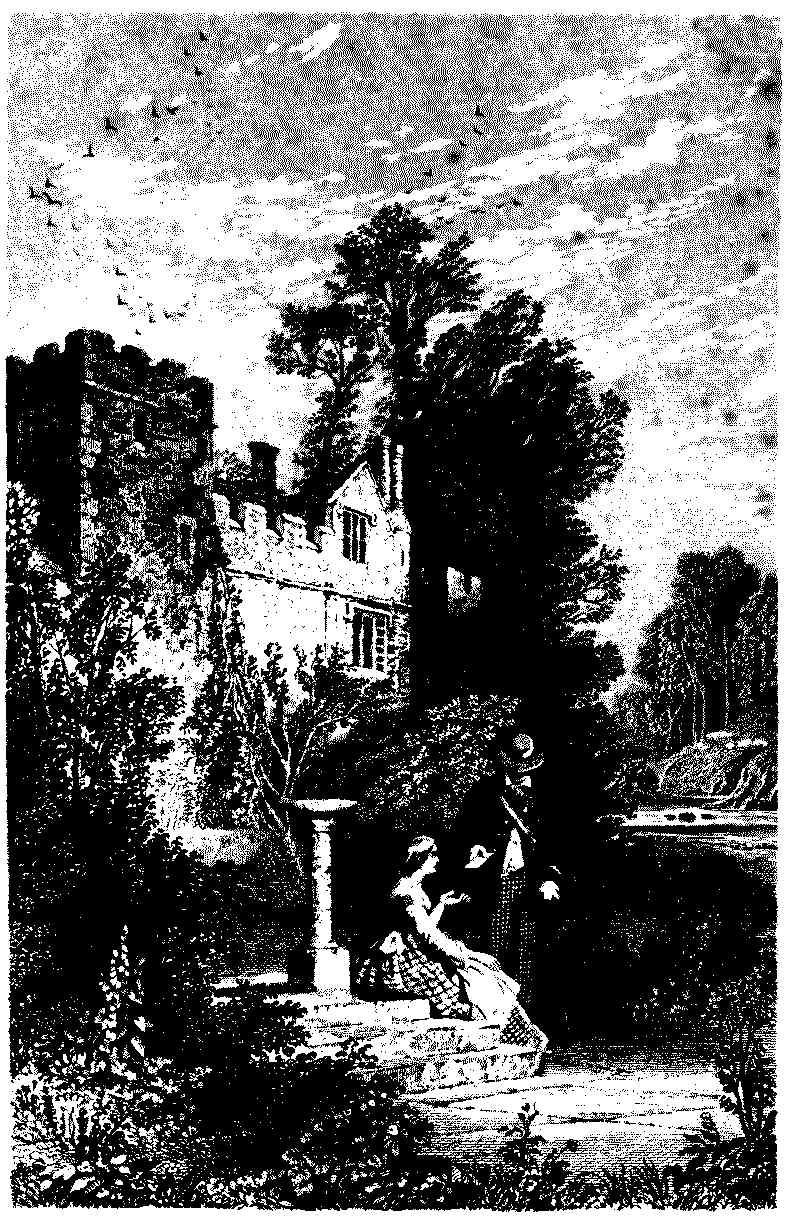
tower seemed so firmly rooted. A large garden descended from the most
modern front of the house to the water, where it was deeply fringed with
willows. The clipt, fantastic trees of a generation which admired such
clumsy gambols of art were scattered through it, and there was a
sun-dial, and many prim flower-beds; but the cherished lilies of
Mossgray were not in these stiffly-angled enclosures; their fresh green
leaves were beginning to shoot up in the freer borders—those borders on
which they gleamed in the dim summer evenings, like errant rays of the
moon.
Mrs Mense was a very old woman now, and invalided. She sat in a great
elbow-chair by the fireside, spinning feebly sometimes, and sometimes
giving counsel, by no means feebly, to her self-willed niece, the
housekeeper de facto. The establishment was a very limited one;
besides Janet, and the miscellaneous personage known as “Mossgray’s
man,” there was only one other servant in the house.
“Eh, Miss Hope, is this you?” said Mrs Mense, “and your mamma nae less,
minding the auld wife as she aye does. Effie, ye tawpie, get chairs to
the ladies—or are ye gaun ben, Mrs Oswald, to wait for Mossgray?”
“Mossgray is out, I see,” said Mrs Oswald. “No, Hope came to see you,
Mrs Mense; we will sit down beside you awhile. That will do, Effie.”
“And look till her how she’s grown!” exclaimed the old woman, “and stout
wi’t. Ye’re no gaun to let down our credit, Miss Hope. Ye’ll let the
Edinburgh folk see what guid bluid is in thir southland parts. Effie,
gar Janet gie ye the wee cheeny luggie fu’ o’ cream. Ye mind it, Miss
Hope? it belangs mair to you than to onybody about Mossgray.”
“But, Mrs Mense,” said Hope, “you did not call Crummie’s calf after me,
as you said you would.”
“My dear lamb! ye wadna have had me to ca’ the muckle langleggit haverel
of a beast after you, and you a winsome young lady? Na, I ken better
manners—and forbye Mossgray said it was nae compliment. But I’ll tell
ye what, Miss Hope, there’s a new powny—the bonniest creature!—and
ye’se get the naming o’t, gin ye like.”
“Where is it?—wait till I see it, mamma!” cried Hope, starting up. Hope
had, like most country girls, an especial liking for youthful animals.
“Ye maun hae your cream first,” said the housekeeper, as Effie
approached with the china luggie, in which, from time immemorial, Hope
had received a draught of rich cream on her every visit to Mossgray.
Hope hardly took time to taste it; she was too eager to see the “new
powny.”
“Did you see the laird, Mem?” said Mrs Mense, with some appearance of
anxiety, as Mrs Oswald waited for her daughter’s return.
“We saw him on the knowe,” said Mrs Oswald; “but did not disturb him, as
he seemed occupied. I fancy that is one of his favourite spots, Mrs
Mense.”
“Na—I’m meaning I dinna ken,” said the old woman; “but he’s gotten some
letter the day that’s troubled him—I canna bide to see him fashed, and
he’s just unco easy putten about. Janet, div ye hear the clock? it’s twa
chappit, and the dinner no to the fire!”
“I ken what I’m doing, auntie,” returned the impatient Janet.
“Ye dinna ken onything very wise then,” said the dethroned monarch of
the kitchen; “it’s a bonnie-like thing that the laird, honest man, maun
wait for his dinner, aboon a’ the rest o’ his troubles! I heard him
travelling up and down in his ain study-room in the tower, after thae
weary letters came in. What gars folk write when they’ve naething but
ill-tidings to tell about, I wad like to ken? and syne out to the
Waterside as he aye does when he’s troubled—I canna bide, as I was
saying, to see him fashed, for—”
“Oh, Mrs Mense!” exclaimed Hope, bounding in, “be sure and tell Mossgray
that he is not to call the pony anything till I come back again. Mamma,
come and see it; it’s like as if its coat was all sprinkled with snow—I
think I will call it Spunkie; but that’s not a bonnie name. Mind, Mrs
Mense, that nobody is to give it its name but me.”
Mrs Mense promised, and after some further lamentation about her
master’s supposed trouble, resumed so keenly the dinner controversy with
Janet, that her visitors withdrew. It was yet too early to visit Helen
Buchanan, so Hope, expatiating on the beauty of the pony, returned with
her mother, home.
Oh, youth! for years so many and sweet
’Tis known that thou and I were one;
I’ll think it but a fond deceit—
It cannot be that thou art gone;
Thy vesper-bell hath not yet tolled,
And thou wert aye a masquer bold;
What strange disguise hast now put on
To make believe that thou art gone?
I see these locks in silvery slips,
This drooping gait, this altered size;
But spring-tide blossoms on thy lips,
And tears take sunshine from thine eyes!
Life is but thought; so think I will
That youth and I are housemates still.—Coleridge.
The Laird of Mossgray stood alone beneath a high beech, whose silvery
trunk and delicate buds made it the most noticeable of all the
neighbouring trees. His figure was tall, thin, and stooping; his hair
the most delicate silvery gray; his face full of thoughtful fortitude
and wisdom in its gentlest guise; but his usual serenity was ruffled
to-day, the calm of his meditative age was broken.
Those dim lands of memory in whose gentle twilight he did so much love
to wander, among the fairy shadows, tender and pensive, of things which
once were stern and hard enough, had been suddenly illuminated by a
flash of the intense and present reality which once they had. The old
man’s quietness had suddenly been rent asunder, and floated away from
him like a mist, while the stormy blood of his more vehement days was
swelling in his veins again.
He held a letter in his hand; the fingers which traced its trembling
lines were now lying in a nameless grave. A worn-out, wearied woman,
prematurely old, and glad to lay down her head in that one place where
the weary are at rest, was the writer of those earnest, living words.
The Laird of Mossgray did not remember that she was old—the past years
were in this moment a fable and a dream to him. He thought of Lilias
only as he saw her last, enshrined in all the pure and gentle dignity of
his young fancies; for Lilias was dead.
And dying, she had revealed to the old man what she was. Not indeed the
lofty lady of his dreaming days, but a gentle, chastened, meek woman,
who knew now, and had long known, the worth of the generous heart she
threw away. In the bitterness of his soul he had believed her an
unsubstantial vision; but the faithful hand of death had brought back to
him the true Lilias, worthy of the place he had given her in his best
days.
“I do not ask you to forgive me,” wrote the dying Lilias, “because I
know that long ago you must have forgiven the witless girl’s heart that
did itself so much more wrong than you. I did not know myself, my own
slight, shallow, girlish self, and pardon me then, Adam Graeme, that I
did not know you. Since then I have learned—what have I not learned
that is bitter and sorrowful? Care, poverty, death, and miserable shames
and humiliations, such as never crossed your path, have been the
constant companions of mine: they are all ending now. I am going hence
to my Lord, and to the children whom He took from me one by one, till my
heart was well-nigh broken; but I cannot go till I make one prayer to
you, one last entreaty for the sake of our youth.
“I would not speak of the time when we last met; in pity to my bitter
lot, and to the dead whose faults we lay with them in the grave to be
forgotten, as I have laid Edward, and as stranger hands shall soon lay
me, do not think of that time. I have one last treasure remaining to me,
one last request to make, and there is no one in the world but you, whom
I have wronged, to whom I can address my prayer.
“Mossgray, I have a child; a friendless, unprotected, solitary girl,
who will soon be left utterly alone. If I shrink from subjecting her to
the cold charity of Walter’s wife, forgive me, because I am her mother.
I know that Lilias is not what I was. I know that our subdued and
clouded life has given to her youth a greater maturity than I had when I
was her mother. I have fancied often that Lilias is what you thought me
to be, and there has been a sad pleasure in the hope, that for her weak
mother’s sake, your heart would melt to my child.
“I cannot ask you. I feel that I cannot venture to beg of you this last
service; my heart fails me, when I remember how little I deserve any
grace at your hands. But you who have always been so kind and pitiful,
think of the misery of leaving her thus, alone in an evil world. If you
think I presume upon you, if you refuse to hear my prayer, I still must
plead it for her sake. Adam Graeme, will you protect my Lilias? Will you
forgive the sins we have done against you, and protect our child?”
There was more than this; there were the solemn farewells of the dying,
the pathetic earnestness of sorrowful repentance which bade God bless
him for ever. Except in his gray hairs, and in the strength which began
gently to fail and glide away, Adam Graeme was not old. The tide of his
strong and ardent feelings rushed back in that mighty revulsion, with
which the generous soul repents when it has blamed unjustly. He
remembered no injury Lilias had done him—he forgot the blight of his
youth, the solitude of his old age; he only felt that she was again, the
Lilias of his early dreams; and that the commands she laid upon him were
sacred and holy, a trust dearer than any other thing on earth.
And yet, a few brief days before, the old man had solemnly recorded his
resolution to shun their presence; to avoid all contact with Lilias and
her child, that the peace of his age might not be broken. Their very
name was pain to him; therefore he prayed that he might not cross their
path. He resolved to keep himself from any, the most distant intercourse
with them. In solemn earnest he formed this purpose, or rather he formed
it not: it was the instinctive necessity of his heart.
He remembered it now no more. It was not that he combatted his former
resolution; it was swept away before the resistless force of that
impulsive, generous heart, which in its solitary pain had built this
barrier about itself; and there was no inconsistency here. Had his ear
been dull to the voice of Lilias, had he hesitated to respond to her
appeal, then had Adam Graeme in his old age ceased to be consistent to
himself; for the same power which made him resolve to keep himself
separate and distant always from those whose very names had might enough
to move him still, asserted itself in the instant return of all the
ancient tenderness and honour, which painfully taken away from the
living Lilias, could flow forth unrestrained and unblamed upon the dead.
In the enclosure of the letter, a trembling hand had written the date of
the first Lilias’s death. It struck with a dull pang the heart to which
she was restored, yet only thus, he knew, could he have regained her.
That evening the Laird of Mossgray set out on a lonely journey. Before
his going, he warned his anxious housekeeper of the young guest he might
probably bring home with him. The intimation occasioned considerable
excitement in the little household.
The early twilight of the April night had fallen, when Adam Graeme left
the dim lights of Fendie behind him, and travelled away into the
darkness, shaping his course to the south. The faint indefinite sounds,
and musical “tingling silentness” of the night, came close about him,
like the touch of angels’ wings. The stars were shining here and there
through the soft clouds of spring, and the dim shadowy sky blended its
line yonder, in the distance, so gently with the darkened earth, that
you could not mark the place of their meeting. The moon herself had been
an intruder there; the subdued and pensive dimness which told of that
nightly weeping of the heavens from which the young spring draws its
freshness and its life, and the faint shining of yon solitary stars high
in the veiled firmament, harmonized most meetly with the lonely spirit
of the traveller, going forth to look upon the grave of his dead. The
sad, wistful, yearning melancholy which belongs to this hour “between
the night and the day,” who does not know—those faint hushed hopes,
those inarticulate aspirations, turning then, when there is dimness on
the earth, to the better something beyond—there are few who have not
felt the influence of “the holy time.”
A charmed sway it had borne at all times over the mind of Adam Graeme.
And now it travelled with him like a human friend: in the stillness of
his night journey there were gentle ministrations about him, influences
of the earth and of the sky.
Touch the chords gently—
Those strings are heart-strings, and the sounds they utter—
Be silent when you hear them—are the groanings
Of uttermost pain, the sighings of great sorrow,
Voices from out the depths.—Anon.
About twelve or thirteen years before the date of our last chapters, a
young man from Glasgow, with his wife and one child, came as lodgers to
a humble road-side cottage not far from the town of Fendie, and very
near the Waterside. Walter Buchanan was an invalid. A delicate,
sensitive man by nature, whose fine nervous organization was of that
kind which is akin to weakness and not to strength—for there are both
varieties—his health had been broken by the confinement and harassing
labour of his vocation as a clerk in a mercantile office. His wife had a
little portion, a very little one, which nevertheless to their
inexperienced eyes seemed able to last long and accomplish much; so on
the strength of it, and in obedience to the doctor’s peremptory order,
that he should have rest and country air, Walter gave up his situation,
and the young couple began to make the dangerous experiment of living
upon their little capital. The gentle poetic man had been charmed in his
early days, in some chance visit to the neighbourhood, by the stately
water and pretty town of Fendie, and the pleasant remembrance decided
their new habitation.
These rash, youthful folk were more fortunate than prudent people might
think they deserved. They excited the interest and kindly sympathy of
Mrs Oswald, the banker’s wife, and through her, of her sterner husband;
so that when the pleasant summer air had done its gentle spiriting on
the wan cheek of Walter Buchanan, and he felt himself able for work
again—which was happily before his wife’s little portion was altogether
exhausted—he was received into the bank as Mr Oswald’s clerk.
To be called “of the bank,” in a country town in Scotland, is a matter
of considerable dignity, and the salary, if small, was enough for their
limited expenses. The Oswalds were kind and neighbourly; other friends
gathered about the gentle couple; and as they stood in their own garden
beneath the heavy branches of their own fruit-trees, in those serene
autumnal evenings, watching the sun go down gloriously behind the dark
crest of yonder hill, they were wont to render quiet thanksgiving out of
full hearts.
This pleasant life continued through ten happy years, and in its placid
course the delicate man seemed strengthened in mind no less than in
body. His nervous melancholy glided away into graceful mists of pensive
thought. The nervous impatience and irritability, which it had once cost
him so much pains to subdue, were soothed and softened. He became,
mentally no less than physically, as it seemed, a more healthful and a
stronger man.
At the end of the ten years his position was changed. They had saved
enough to raise their little capital to a larger amount than the
original sum on which their inexperience had braved the evils of the
world. This was invested in the purchase of bank shares, and Walter
Buchanan, a clerk no longer, became Mr Oswald’s partner in the agency of
the bank.
An unhappy change. The one peculiar, distinguishing feature of the
Scottish banking system, over which our economists boast themselves,
became a source of constant torment to Walter Buchanan. The quick and
prompt decisions of Oswald, in which he could not join, made him feel
his own weaker will overborne and set aside. A hundred “peculiar cases,”
and “very peculiar cases,” in which the clear, acute mind of the banker
could see no peculiarity at all, troubled the midnight rest of his
nervous and tenderhearted partner. That this struggling man whose
security was dubious, or that hapless farmer wading knee-deep in
difficulties, whose cash account was already overdrawn, and who wanted
more, should be dealt with summarily, was clear to Oswald’s steady eye;
but was enveloped in painful mists of distress and perplexity to Walter
Buchanan, himself acquainted with all the restless shifts and expedients
of the struggling poor.
His feelings became morbid again under that exercise. He imagined
himself ill-used, despised, trampled upon, when the finer points of his
compassionate and impulsive benevolence came into collision with the
strong sense and energy of his partner, who in his turn grew impatient
of the sentiment which he thought sickly, and the tenderness which he
called weak. There was a rupture at last. A struggling man with dubious
security came to Buchanan when Oswald was absent from Fendie. The
sensitive man of feeling forgot prudence in compassion, and by his
ill-judged acceptance of the uncertain “cautioner,” brought serious loss
to the bank. Oswald returned; there were sharp and high words spoken by
both, which neither, in less excited mood, would have given utterance
to; and in a storm of bitter anger and wounded to the very heart, Walter
Buchanan threw up his situation, dissolved his partnership with Oswald,
and left the bank.
Very soon to leave the world; for, before the winter was over, his
course had ended. He could not bear such tempests of excitement, for
pain to him was agony, and anger madness. So in his weakness he died,
and left his gentle widow and his young daughter to fight with the world
alone.
Helen Buchanan was only sixteen. She had a fair proportion of what
people call accomplishments, and might almost have been a governess in a
boarding-school or a “gentleman’s family;” and beneath the
accomplishments there was a sound substratum of education, and a mind
matured too early for her own happiness. Fendie was abundantly supplied
with ladies’ schools; so Helen, in her flush of youthful pride and
independence, determined to offer her services to the humbler mothers,
and to receive as her pupils not the young ladies, but the little girls
of Fendie.
Mrs Buchanan reluctantly acquiesced. She was a gentle, hopeful woman,
accustomed to yield always to the quick impulses and keen feelings of
her husband, and now rendering a kindred submission to her daughter.
Helen was a very dutiful, very loving child, but her mother’s cheerful,
patient nature was made to be thus influenced, and unconsciously and
involuntarily the stronger spirit bore the mastery.
So when the first pangs of their grief were over, Mrs Buchanan
regretfully removed her substantial furniture from the dining-room of
which she had been once so proud, and with many sighs saw her little
maid-servant arrange in it the bare benches and large work-table which
befitted its new character of school-room; and the youthful teacher
began her labours.
These had gone on successfully for four or five years before the
pleasant April-tide on which Hope Oswald returned home; eventful years
to Helen. It is not well to leave the unconscious happiness of girlhood
too soon, even to enter upon the enchanted ground of youth. Toil,
poverty, and William Oswald; the three together were well nigh too many
for the youthful champion who had to struggle, single-handed, against
them all.
In the twilight of that April evening she sat in their little parlour
alone. The faint firelight gave a wavering flush to the shadowy air of
the holy time; and Helen sat in the recess of the window, wandering
through the mazes of such a reverie, as belongs especially to her
peculiar temperament and mind. For those delicate lines in her face,
those continually moving features, those slight starts now and then, and
altogether the elastic impulsive energy and life which you could
perceive in her figure even in its repose, testified her inheritance of
the constitution of her father. With one difference. His nervous,
sensitive temperament was akin to weakness; hers, with all its
expressive grace, its swift instinctive feelings, its constant life and
motion, was strong—strong to endure, although its pain was sorer a
thousand times than that of more passive natures—strong to
struggle—mighty to enjoy.
She had been out, watching the sun as he shed a golden mist over the
dark mass of yonder hill, where it stands out boldly into the Firth, a
strong sentinel, keeping watch upon the sea; gleaming in the mid-waters
of the estuary, gleaming in the wet sand and shining pools of the deep
bay, and throwing out the sunless hillock at the river’s mouth, with its
little tower and quiet houses, in bold relief against the far away
mountain, and its mantle of streaming gold. The wonderful sky in the
west, the broad bed of the Firth, the sunset and its noble scene—there
was an enjoyment in these to the delicate soul of Helen, which duller
natures have not in the greatest personal blessings of the world.
And now, with her pale cheek resting on her hand, and leaning forward on
the window-sill, Helen was lost in a reverie. What was it? only a mist
of fair thoughts indefinitely woven together; scenes starting up here
and there of the future and of the past, with fairy links of association
drawing their strangely-varied band together; old stories, old songs,
and breath of music floating through all in gentle caprice—the sweet
and pleasant gloaming of the mind.
Mrs Buchanan was out, doing some household business in Fendie, and Helen
did not hear the footstep of Hope Oswald as she entered by the garden
gate. These quiet houses are innocently insecure; when Hope’s summons
remained unanswered, she opened the door herself, and went in.
“Oh, Helen!” exclaimed Hope, as she precipitated herself upon her
friend, dispersing in that nervous start all the fair visions of the
evening dream. “How glad I am to be home again—how glad I am to see
you!—but I scarcely can see you either, because it’s quite dark; and,
Helen—you don’t know how I used to weary in Edinburgh just to hear you
speak again!”
“Thank you, Hope,” said Helen. “I am very glad to see you; or rather to
hear you speak, according to your own sensible distinction. Come, we
will get a light and look at each other.”
Mingling with the quick movement of surprise at first, there had been a
deep blush and a temporary shrinking from William Oswald’s sister; but
another moment restored Hope to her old privileged place of favourite,
and Helen rose, her young companion’s eager arms clinging about her
waist, to light the one candle on the little table.
The room was small and plainly furnished, though its substantial
mahogany chairs and sofa looked respectable in their declining years. On
the carpet here and there were various spots of darning artistically
done, which rather improved its appearance than otherwise. A large
work-basket stood upon the table containing many miscellaneous pieces of
sewing; shirts in every stage of progress, narrow strips of muslin,
bearing marks of the painful initiation of very little pupils into the
mysteries of the thoughtful craft, mingled here and there with scraps of
humble “fancy” work, samplers, and the like—all of which the young
school-mistress had to arrange and set to rights before the work of
to-morrow commenced. A book lay beside the basket—a well-thumbed book
from the library. Helen had been idling; for she sometimes did snatch
the brief relaxation of a novel, though Maxwell Dickson, the librarian,
had no great choice of literature.
“Oh, Helen,” exclaimed Hope again, when the feeble light of the candle
revealed to her the pale face of her friend, “I am so very glad to see
you again!”
“Thank you, Hope,” repeated Helen; “how you are growing—you will be
above us all by and by. When did you come home?”
“Only yesterday,” said Hope; “but are you sure you are quite well,
Helen?”
“Quite sure—why?”
“Only because you look pale—paler than you used to do; and, Helen, what
makes you sigh?”
“Did I sigh?” said Helen, her delicate wavering colour gradually
heightening beneath the girl’s steady affectionate look. “I did not know
of it, Hope—it must have been for nothing, you know, when I was not
aware of it.”
“Ah, but it was when you were sitting in the dark before you saw me,”
said Hope gravely, “and you must have been thinking of something.”
Helen’s colour heightened more and more, yet she smiled.
“Are you going to be an inquisitor, Hope? Do you know people sometimes
think very deeply, as you saw me to-night, about nothing? Ah, you shake
your head and are very grave and wise, and experienced, I see. Come, I
will show you what Cowper says about it.”
“Oh, I know,” said Hope. “I learned all that for Miss Swinton because
she likes Cowper; but, Helen, you are not so clever as one of our young
ladies; it’s Miss Mansfield, you know, that’s going to Calcutta, and
she’s old—she is near eighteen, I am sure—and she sighs; but when Miss
Swinton spoke to her about it, she said she was only drawing a long
breath. I think,” said Hope disconsolately, “that the people in Fendie
are very dull and sad now; for everybody draws long breaths.”
“Have you seen so many, Hope?” said Helen, with an uneasy flush upon her
face, and with some evident interest in the question; those constantly
moving features were sad telltales.
“I mean just the people I care about,” said Hope; “there is poor
William. I do not know what ails William—for he sat in the dark like
you, last night, and will always lean his head upon his hands, and
sigh—sigh—and my mother—I wish you would not all be so sad.”
Helen Buchanan turned round to examine the contents of her work-basket.
Her slender figure was very slightly drawn up; something almost
imperceptible like the faint touch of wind upon leaves passed over her;
you could not tell what it was, though you could read its swift
expression as clearly as written words. Pride—sympathy—a conciousness
that moved her heart and yet made it firmer; but Hope’s piece of
incidental information did not sadden the face of Helen.
Hope had a comprehension of—though she could by no means have explained
how she comprehended—the silent language of Helen Buchanan’s looks and
motions; and she arrived at a pretty accurate conclusion in her own
simple and shrewd reasonings on the subject. Mrs Buchanan came in so
soon that she could try no further experiments with Helen; but as she
past through the dim road, half-street, half-lane, in which their house
stood, and came into the quiet Main Street of Fendie, with its half-shut
shops and groups of wayside talkers, great schemes began to germinate
within the small head of Hope Oswald. If only that very unreasonable
opposition of her father’s could be overcome, Hope decided that William
would be condemned to draw long breaths in the dark no longer. “Miss
Swinton says I am sensible,” mused Hope within herself, “and my father
says I am clever. I don’t know—I think it will turn out the right way
some time, and we shall all be very happy, but just now—I will try!”
And immediately there flitted before the eyes of Hope, in the gentle
darkness of the April night, a fairy appearance, we do not venture to
say it was anything very ethereal. It was only a vision of a lilac satin
frock like that famous one which Miss Adelaide Fendie, of Mount Fendie,
wore at her sister’s marriage, and very fascinating was the gleam which
it shed about the young schemer as she lingered at her father’s door.
Hope Oswald was only fourteen.
We must at first endure
The simple woe of knowing they are dead—
A soul-sick woe in which no comfort is—
And wish we were beside them in the dust!
That anguish dire cannot sustain itself,
But settles down into a grief that loves,
And finds relief in unreproved tears.
Then cometh sorrow, like a Sabbath! Heaven
Sends resignation down and faith; and last
Of all there falls a kind oblivion
Over the going out of that sweet light
In which we had our being.—Professor Wilson.
In the waning afternoon of another dim spring day the Laird of Mossgray
entered the Cumberland valley, to which the letter of Lilias had
directed him.
He had traversed the fair country beyond Carlisle, with its sloping
glades, and belts of rich woodland, and now had reached a chiller and
more hilly region, whose bleak inhospitable fells, still scarcely
touched by the breath of spring, did yet reveal home-like glimpses, here
and there, of sheltered glens and quiet houses, dwelling alone among the
hills. He had to pass several of the pleasant towns of Cumberland before
he reached the sequestered hamlet in which the last days of Lilias had
been spent. It lay in a nook by itself, a scanty congregation of gray
roofs, with the church “a gracious lady,” as was the poet’s church among
the hills, serenely overlooking all, reigning over the living and the
dead. From the end of the little glen you commanded the long range of a
wider and more important valley, at the further end of which lay one of
the most picturesque of those northern towns, its gray limestone
buildings making a sheen in the distance, and a delicate cloud of smoke
hovering about the points of its white spires, like something spiritual,
marking where household hearths were gathered together in social amity.
Not far away lay the consecrated country of the lakes: and everywhere
around, bare, brown, scathed hill-tops stood out against the sky.
Mossgray proceeded to the churchyard first of all; all things beside
were strange to him in the unknown village, but here he had a friend.
After long search among the gray memorials of the forefathers of the
hamlet, he came upon a green mound marked by no name, where the soft,
green turf was faintly specked with the fragile blue of the
forget-me-not; in the village churchyard this alone and the daisy found
a place—occupants more fit than the garish flowers with which modern
taste has peopled the cities of the dead. The Laird of Mossgray turned
aside to ask the name of the occupant of this grave. It was a Scottish
widow—said the sexton—lately dead, whose name was Maxwell. The
inquirer returned again, and seating himself on a hillock, covered his
face with his hands. The old man never knew how long he lingered there.
He was not an old man then; the fervid affection of his youth—the
burning grief of his early trial, were in his heart passionate and
strong as when they thrilled it first; and it was not until the night
fell and the dew dropped gently on him, that the sacred sorrow which
belongs to the dead, came down to still the stronger throbs of his
solitary heart. When he looked up, the stars were shining again in the
dim and dewy sky—the hills stood up, like watching Titans, clothed in
the shadowy unformed garments of the early earth, and ghost-like in the
darkness rose ancient tombstones, gray with years, and the green mounds
of yesterday. The great, silent, conscious world, tingling with the
spiritual presence which over-brimmed its mighty precincts—and the
dead—the solemn sleepers who have lived, and do but wait to live again.
But there were the faint village lights close at hand, and the orphan to
be sought for there, who was committed to his care. So the old man
withdrew from the grave of Lilias, to seek her child.
The bearing of the Laird of Mossgray had in it so much of the graceful
olden courtesy of the gentleman born, that it never failed to bring
deference and attention. The very little inn which stood in the centre
of the hamlet was not much frequented by strangers. Wandering pedestrian
tourists of the student or artist class, to whom its humbleness was a
recommendation, did sometimes refresh themselves in its well-sanded
kitchen; but the ruddy landlady had scarcely ever welcomed such a guest
as Mossgray under her homely roof. So she ushered him into a little
boarded room, of dignity superior to the kitchen, though communicating
with it, and dusted a huge old-fashioned chair with her apron, and
stood curtseying before him, waiting for his orders, and secretly
cogitating whether there would be time to dress a fowl for supper, or if
the universal ham and eggs would do.
But Mossgray was by no means concerned about supper. He was silent for a
few moments, during which the comfortable hostess stood before him
marvelling, and when he did address her, it was to ask whether she knew
a young Scottish lady, a Miss Maxwell, who, he believed, lived in the
village.
The good landlady was a little shocked. What had the like of him to do
with young ladies? but his grave face reassured her.
“And that will be the poor young creature that lost her mother, a
fortnight come Friday, it’s like?”
“Yes,” said Mossgray, slowly, to steady his voice, “yes, she is an
orphan—her mother is dead.”
“Ay, sure; and I wouldn’t wonder a bit,” said the stout hostess,
smoothing down her ample skirts, “if she didn’t bide long behind her;
for a thin long slip of a thing she is, and no more red on her cheek
than the very snow, and I’ve heard say that such like troubles run in
the blood. There’s the Squire’s family down in the dale—you’ll know
them sure, better than the likes of me—they’ve all followed one
another, for all the world like a march of folk at a funeral going to
the grave.”
“And is Lilias—is the young lady affected with this disease?” exclaimed
Mossgray.
“The young lady did you say, Sir? Why, the poor girl had her bread to
work for, like the rest on us—and a weakly white thing she was if there
were ne’er another; but she thought herself a young lady sure enow, and
what mun she do but go and be a governess, as they ca’ it. Her mother
was a prideful body, to have nothing, and so was Miss; but I say, I’d
sooner have my girl a dairy-maid any day, if Susan needed to go out of
her father’s house for a living, which she doesn’t, thank Providence.”
“But, my good woman,” said Mossgray mildly, “Miss Maxwell has no
intention of being a governess, I trust, as she has no need. You will
oblige me if you can tell me where I shall find her.”
“Well, and that’s just more than I can tell you, Sir; for the Rector’s
gone from home, and they say Miss went with them;—but if it’s your
pleasure to stay—”
“I will stay this night, if you can accommodate me,” was the answer.
The landlady curtsied.
“I’ll send up Susan to the Rectory for Mary, and mayhap she can tell.”
In half an hour Susan was despatched, her mother in the mean time taking
upon herself to prepare the unbidden supper; and in about an hour and a
half after, Susan returned alone. The Rectory Mary had deserted her
post, and was now half a dozen miles away over the fell, visiting her
mother, and the girl left in charge had been fain to keep Susan for an
hour’s gossip to cheer her loneliness. She knew only that the Rector and
her mistress had gone to Scotland; but as Scotland, in the reckoning of
Susan of the inn and Sally at the Rectory was a word of quite indefinite
signification, meaning sometimes a village like their own, and sometimes
enlarging into the dimensions of a dale, or of a great town like the
picturesque one near them, which filled up to overbrimming their idea of
“the world,” the information thus obtained was anything but
satisfactory. So Mossgray endeavoured to ascertain something further
from the landlady.
“They came here eighteen months past, come Whitsuntide. I mind it
particular, because my Susan and more o’ the young folks were up at the
confirmation the Bishop had up yonder, in the town, the end of that
summer; and it would have done any one’s heart good to have seen my girl
in her white muslin, and her cap, and all of them trooping down the dale
in the fine morning. But the Scotch lady wouldn’t have her daughter go,
though the Rector took the trouble to talk to her himself. I donna
understand such things, but mayhap, Sir, the like of you do that are
learned, why the young Miss shouldn’t have gone with the rest, like any
other Christian. But they were quiet, peaceable folks, no one can say
again that; and except it were wandering about the dale, the old lady
leaning heavy on Miss, and looking as faint when she came back as if she
had done a day’s work, I know no pleasure they ever took, young or old
of them; and they cared about nought but books and the post. I have seen
them sit on the brow yonder in the summer time reading for hours; and in
the winter time I’ve looked in at the window passing by—not that I’m a
prying body, or care about my neighbour’s business, but only, there was
nought like their ways in the whole dale—and there they would be, with
a turf fire you could ’most have held in your two hands, one of them
doing fine work, and the other reading; and beautiful Miss can work,
Mary at the Rectory says, and it was all for some rich friends that sent
them money now and again—though sure it wasn’t much—but it’s like
you’ll know, Sir?”
A painful colour was on the face of Adam Graeme: “Poor, and in trouble,
and ye visited me not.” He felt every word an accusation, and could
scarcely answer “No.”
“And every month or two—I donna know but what it was every month—Miss
went by herself into the town to get letters: and I’ve heard say she’d
pay more for them than would have put a bit of something comfortable on
their table many a day. They were from some far away part, and they came
as regular as Sunday comes: but no one could tell who sent them, for she
had ne’er a brother, and her father was dead. The Rector’s lady took a
deal of notice of Miss and her mother; not that she is one of that kind
herself, for she’s just a good easy creature, that doesn’t trouble her
head about learning; but she came from Scotland herself you know. I’ve
heard Mary at the Rectory say that the old lady had been in such a many
places—never biding long in one, I reckon; and you know the old word,
Sir, about the rolling stone. Well, they had been in this way more than
a year—a good fourteen months it would be, for it was past
Midsummer—when the old lady fell ill; and she kept on getting better
and worse, better and worse, till a fortnight come next Friday when she
died—and a week past on Monday they buried her. At the burial, I know
for certain, Miss was like nought but a shadow, and just yesterday the
Rector and his lady went off to Scotland and took her with them. I’ve
heard Mary at the Rectory say she was gone to be governess to the
Rector’s lady’s sisters; but I donna know what’s their name, nor where
they live; and please, Sir, that’s all I can tell you.”
The talkative landlady recollected other scraps of gossip however,
before she suffered so good a listener to escape her. The subdued and
quiet life of the mother and daughter—the proud poverty that made no
sign—the privations which were guessed at—which perhaps were
magnified—the mysterious letters—the little incidental and unconscious
touches which revealed through a mist of verbiage something of the
second Lilias, in the fresh youth which knew no cares but those of
poverty, and in the first paralysis and stupor of her heavy grief. But
the other figure—the sad Naomi leaning on the girl’s arm, and sinking,
amid hardship and the chill pains of penury, into a stranger’s
grave—every new touch did but deepen the sad cold colours of the
picture, and this was the lofty Lily of the old man’s dream—the sunny
and joyous daughter of Greenshaw.
The next morning Mossgray left the Cumberland glen, resolving, if his
search did not prosper in Scotland, to return when the reverend ruler of
the little dale should have returned to his flock and his dominions. He
remembered however with annoyance, when he had reached Carlisle on his
way home, that he had not ascertained the Rector’s name. It had not been
mentioned by his primitive parishioners, to whom “the Rector” was the
title of titles; but Mossgray resolved to make immediate inquiry of Mrs
Fendie, whose eldest daughter had married an English clergyman somewhere
in this same district. He would write also to Walter Johnstone; he would
advertise if other means failed, calling on the second Lilias to honour
the bequest her mother had made to him. The trust was more sacred now
than ever; it was enough that one had gone down uncomforted to the
grave.
She was a sonsie mayden
Of substance eke, and weight,
Nae cares did vex her, nae thoughts perplex her,
And her name it was callit Kate.—Old Song.
On the following morning, a low pony carriage, very little above the
rank of a gig, and packed in its lower departments with sundry empty
baskets, drew up at the door of the Bank. It was the market-day in
Fendie, and the strong rustic driver of the little vehicle seemed
considerably more interested in the acquaintances whom he noticed in the
crowded Main Street than in the young ladies whom he assisted to alight.
The elder of them was about fifteen, a little older than Hope Oswald.
She was a large, clumsy, heavy girl, with soft fair features, and sleepy
blue eyes. The face was well enough, so far as mere form went, and had a
certain slumbrous, passive good-humour in it, not unprepossessing; but
speculation there was none under the heavy lids of those large eyes.
The soft face had its tolerable proportions of white and red, but was
informed by no inspiring light; for this was Hope Oswald’s stupid
schoolfellow—Miss Adelaide Fendie.
With her was a younger sister, a girl of ten, whose face only was less
stupid, because it had a spitefulness and shrewish expression perfectly
alien to the soft good-humour of Adelaide. They were both dressed after
that peculiar fashion which belongs to the caterpillar state (if we may
venture on such an expression) of young ladies—in unhandsome dresses of
faded colours, short enough to display quite too much of Adelaide’s
white trousers and considerable feet, and hanging wide and clumsily on
shoulders which needed no addition to their natural proportions.
The Fendies of Mount Fendie were an old family; but Mr George Oswald the
banker had also some pretensions to blood, and Mrs Oswald was a laird’s
daughter; so there was no great derogation in the intimacy with which
the youthful Misses of the more aristocratic house honoured the
sprightly Hope. Miss Victoria was the more condescending of the two. She
felt to the full the superiority of Mount Fendie, with its wide grounds
and sweeping avenues and lodges ornamented by the delicate taste of
“mamma,” and considerably despised the great stone building in the main
street of Fendie, with the mechanical inscription of “Bank” over its
stately portico.
Adelaide knew better; even in the dignified educational establishment in
Edinburgh there was some certain degree of republicanism, and Adelaide
had attained to a dull consciousness of Hope’s superiority, and a habit
of being guided by her will, much to the comfort of her slumbrous self,
whom Hope managed to carry through scrapes and difficulties in a manner
which even excited a faint degree of passive wonder in the slugglish
inert nature, which could not comprehend her quick intelligence. And
Adelaide liked Hope, and by good fortune did not envy her; and Hope had
a sort of affection of habit for Adelaide, whose dulness she laid siege
to with girlish impetuosity, understanding it as little as her companion
understood her; for Hope could not persuade herself that it was natural
to be stupid, and so assailed the impenetrable blank of Adelaide’s mind
with all manner of weapons, but always unsuccessfully.
John Brown, the trusty major-domo of Mount Fendie, was bound for the
market, and, not without some coaxing, had consented to bring the young
ladies with him. John touched his hat in gruff good-humour as Hope
Oswald’s bright face looked out from the open door, and after depositing
Miss Victoria safely on the pavement, drove off with a sigh of relief,
muttering,—
“That lassie’ll be twenty stane afore she’s dune growing. I wad as sune
lift the brockit quey. Gude day to ye, Tam,—hoo’s the wife? Gar the
laddie gie the beast a feed—I haena muckle time.”
With which prudent beginning John descended, and evinced his haste
practically, by entering into a lengthened controversy with Tam Dribble,
the master of a little inn which it pleased John to patronize. Tam was a
man very great in the “affairs of the state,” and the Provost of Fendie
was his especial scapegoat for the sins of those in authority; so there
was so much to be said for and against some recent act of this
dignitary—for John Brown was a constitutional man, and defended the
powers that be—that it was not until they had moistened their argument
with a dram or two, and suffered the pony to make a very leisurely and
substantial meal, that the factotum of Mount Fendie summed up with a
clap of his hands, which made the room ring.
“Man, Tam, ye’re a born gowk—and it’s a’ havers—and here am I wasting
guid daylicht listening to you. An it had been night, I might hae bidden
to gie ye your answer—but me, that’s a responsible man, and under
authority—hout awa’ wi’ ye!”
With which triumphant conclusion John Brown strode forth to the market.
“Oh, Hope! isn’t he a great bear, that John?” exclaimed Victoria Fendie.
“Adelaide asked mamma to let us come, and mamma never will do anything
at first that we want; but we coaxed her, and then when she said we
might go, we had to ask John Brown to take us—to ask John Brown,
indeed!—only think of ladies asking a servant! and mamma would not
order him to do it. I know what I will do—I’ll get some of Alick’s
powder and put it in the snuffers, and then I’ll ask John to come and
snuff the candles for me.”
“Very well, Victoria,” said Hope, “I’ll tell John to-day.”
“Oh, goodness, Adelaide, only listen—how ill-natured she is! I don’t
care—I’ll do something; it’s a great shame of mamma to make us ask John
Brown.”
“Hope,” said Adelaide, “the new governess is coming to-morrow, and mamma
says you’re to come up and see her.”
“Mamma only said she might come if she liked,” interposed Victoria.
Adelaide paused to deliberate upon an answer.
“If I did not like to come sometimes to see Adelaide, Adelaide would not
ask me,” said Hope.
“But, Hope,” said Adelaide, lifting her large dull blue eyes, “it’s the
new governess you’re to come to see.”
“Well, I know that; but I shall see you too, shall I not?”
“Yes,” repeated the obtuse Adelaide; “but you’re to come to see the new
governess, mamma says.”
Hope was seized with one of her fits of impatience. Why would Adelaide
be so stupid?
“Shan’t we tease her!” exclaimed Victoria, triumphantly. “Fred says he
won’t learn his lessons to a woman, and I won’t learn any lessons at
all, if I can help it, and mamma won’t let me if I have a head-ache. Do
you ever have any head-aches, Hope?”
“No,” said Hope, stoutly, “head-aches! Miss Mansfield used to have them
at school—you mind, Adelaide? but it’s a great shame, and Miss Swinton
says girls have no right to have head-aches.”
“Oh, Hope! ‘you mind.’ Mamma would whip me if I said ‘you mind.’”
“My mother would not,” said the resolute Hope, “and mind is a far
better word than remember or recollect. It’s only one syllable,
and—it’s our own tongue, and it’s a very good word.”
“I think so too,” said Adelaide, with an unwonted exertion, “because
when a word’s short it’s easier said.”
Adelaide’s sentence terminated abruptly in a peal of malicious laughter
from Victoria.
“Well,” said the elder sister, with some faint flush of anger, “I am
sure Miss Swinton used to say so—and you’ve no right to laugh,
Victoria—I’ll tell mamma.”
“I don’t care,” was the response; “mamma is not so well pleased when you
always talk about that stupid governess—you know that.”
“Stupid governess!” Hope’s eyes sparkled. “If you were not a child,
Victoria,” she said, with the dignity of a senior, “you would not speak
so. Miss Swinton is a lady—Miss Swinton is a gentlewoman! I don’t know
any one like Miss Swinton, except mamma, and—”
“Oh, come, tell us—tell us!” cried Victoria.
Hope drew herself up.
“Except mamma and Helen—Miss Buchanan—but you don’t know her.”
“Yes I do—she keeps a school; yes I do—a governess and a
schoolmistress—and Hope does not know any other ladies! I hope I shall
never be one of Hope’s ladies.”
“What are you doing now, Hope?” said Adelaide. “Mamma has made me begin
to work a cover for something; I don’t know what the shape of it will
be, but it’s all in bits like this, and mamma says it will be very
pretty—and Charlotte’s bringing such a load of music, and that
governess!—you might come up, Hope, and help me, for I’m sure you’re
not doing anything yourself.”
Hope acknowledged her idleness.
“No indeed, Adelaide; but I have only been two days at home; and—what’s
the use of working covers? I don’t know why people labour at such
things.”
“Because their mammas make them,” said Adelaide, gravely, and with a
sigh; “but I think I like it too, Hope, for it’s very pretty, you know.”
Hope shook her head. She had been visited several times of late by some
grave ruminations on this subject, and began to feel that working
covers, however pretty, was in reality a quite unsatisfactory mode of
life. But the cogitations were inarticulate; they had attained no shape,
except at present a decided disinclination to work at all.
“And, Hope,” added Adelaide, “how long do you practise every day?”
“I don’t practise at all,” answered Hope.
The sleepy lids of Adelaide’s eyes were elevated in wonder.
“Then what in all the world do you do?” exclaimed Victoria. “I should
like to be you, Hope—I should like to play all day; but Adelaide thinks
she is too old to play.”
“I don’t play all day,” said Hope, with some indignation. “Yesterday I
was at Friarsford with my mother, and at Mossgray—”
“Oh, Hope!” said Adelaide, “what makes you go to see that girl? she is
only a farmer’s daughter.”
“I don’t care for her now,” said Hope, with some sadness; “but it’s not
because she’s a farmer’s daughter—it’s because she is—I mean it’s
because she practises, and knits and works covers, and doesn’t care
for anybody—but never mind that. And then we went to Mossgray. We did
not see Mr Graeme; but there’s a beautiful pony—the prettiest one ever
you saw—and Mrs Mense says I am to give it its name. What should I call
it, Adelaide? come and help me.”
Adelaide slowly shook her head—this was a stretch of invention quite
beyond her.
“Call it Mischief,” suggested Victoria.
“Mischief,” deliberated Hope. “No, I don’t like that—I want a pretty
name—give me a pretty name, Adelaide.”
An idea gradually illuminated Adelaide’s stolid countenance.
“Call it Pretty, Hope—that would do very well.”
“Oh, no, no!” exclaimed Hope; “you might call a lap-dog that, but a fine
pony! so merry, and brisk, and lively—oh, no, no!”
“Call it after me,” said Victoria.
“Mischief?” said Hope.
“No, indeed, not Mischief, but Victoria, or Adelaide, or—I have got
it—I have got it!—call it Lillie, after our new governess.”
“Is her name Lillie?” asked Hope.
“It’s her first name—her Christian name,” said Adelaide, “and Charlotte
says she looks pretty, Hope; but she is so quiet and sad—you know she
lost her mamma just a fortnight ago.”
“And has she no home?” said Hope.
“No home? I am sure I don’t know; Charlotte does not say anything about
her home; only her mamma is dead, and she is very quiet, and looks
pretty.”
There was no more to be got out of Adelaide—she could only repeat her
text, and wonder at the questions that sprang out of it.
“And is she coming with Mrs Heavieliegh?” asked Hope.
“Yes—you know Mr Heavieliegh is the Rector of the place her mother died
in—but she came from Scotland at first, and Charlotte was very good to
her, and because mamma wanted a governess, Charlotte engaged her to come
to the Mount.”
“Will Mrs Heavieliegh stay long?” inquired Hope.
The conversation was getting low, Victoria being busily employed at the
other end of the room, endeavouring with all her might to destroy some
favourite plants of Mrs Oswald’s.
“Not just now—but do you know, Hope, Alick is coming next summer, from
India, where he was sent with his regiment, and mamma will give parties,
and perhaps a ball—a real ball, Hope!—and you must be there. Oh, we
shall be so happy!”
“Is he coming to stay?” asked Hope.
“I don’t know, mamma didn’t say; but she said there was to be a ball,
and that Alick would perhaps bring some officers with him. I only wish
the time were come—shall you not be glad, Hope?”
“If my mother will let me go, I shall like it very well,” said Hope;
“but about the new governess, Adelaide—is she to teach you?”
“Mamma says so,” said Adelaide; “but I think I don’t need any more
teaching—do you, Hope? after having had to learn such quantities of
things. I am sure I wish mamma would just try it herself.”
Hope was not quite inclined to acquiesce in this conclusion; but there
was no possibility of keeping up an argument with Adelaide, who had
nothing to add to her first sentence on any subject, but merely the
trouble of repeating it. So Hope wisely went to seek her mother, and to
suggest the preparation of some juvenile lunch for her friends, which
speedily made its appearance in the substantial form of bread and
butter, jam and fruit—healthful dainties which were plentifully
discussed by the visitors. John Brown arrived very shortly after, with
the pony carriage, the baskets in which were no longer empty, and having
with some difficulty hoisted the young ladies in, drove them away,
leaving Hope pledged for “the day after to-morrow to come and see the
new governess.”
Curls are on her brow, not clouds,
Smiles are in her eye,
Simple, brave, ’mong worldly crowds
Looks she to the sky.
Joy dwells with her every day,
Sorrows touch her as they pass,
Fearless goes she on her way
O’er the springing grass,
Daunting evil passengers
With those clear brave eyes of hers.—Ballad.
Mr George Oswald of Fendie was very proud of his daughter Hope; and
Hope, as we have already seen, was very fond of ponies. Young, large
animals of all kinds, indeed, were favourites with the favourite of the
banker. A great tawny fellow of a dog, with large, disjointed, youthful
limbs, whose uncouth gambols had as much fun and as little grace in them
as could be desired, was Hope’s especial playmate, counsellor, and
friend. She called him Merry—(gentle playfellow of mine, over whom I
could yet weep tears, so named I thee!) it was not a very musical name;
but there was nothing in the least æsthetic about the happy, clumsy,
kindly animal who bore it. This poor fellow fell under Mrs Oswald’s
displeasure sometimes, when it was discovered that Hope’s new gloves had
been in the great innocent mouth, or that the big paw had left its print
upon Hope’s garments too legibly; but the banker amply tolerated Merry.
On the morning of Hope’s intended visit to Mount Fendie, her father led
her proudly away to the vicinity of the stable where his own horses were
kept, and where, at its door, stood the red-headed Oswald Thomson, son
of a retainer of the family, holding by the bridle a handsome pony,
apparelled as became the steed of a lady, and arching its fine brown
neck in conscious pride, under the eye of its future mistress.
“Oh, father, is it for me?” exclaimed the delighted Hope; “is it to be
mine; is it to be all mine?”
And it was; and at that moment in Hope’s little chamber at home, her
mother, with some secret smiles over her husband’s unmeasured
indulgence, and some misgivings as to the youthful limbs which this new
mode of conveyance might expose to danger, was carefully spreading out a
new riding-habit, companion gift to the beautiful pony. Mr Oswald had
intended to bring his daughter quietly home with him, to assume the
appropriate garb before she began to be an equestrian; but that did by
no means suit Hope. So at dire risk to the bright muslin frock donned in
unspotted purity this morning, she sprang upon the new saddle and
arrived at the door radiant with laughter and exultation while her
father still panted in the rear, half running in spite of his years and
dignity.
Hope could not take her dog with her to Mount Fendie—it was her sole
regret as she cantered away happily alone, on the quiet familiar road.
One of Merry’s mighty paws would have extinguished Mrs Fendie’s lap-dog
for ever; the gambols of a young elephant could not have been more
detrimental to the trim gardens at the Mount. She was compelled to leave
her favourite behind.
But never did Hope salute passing acquaintances so joyously; and Hope’s
list of friends was as large as it was miscellaneous, extending from Mrs
Maxwell of Firthside, in her carriage, down to Robbie Carlyle, the
fisherman, with the creel on his shoulders full of flounders which he
had captured this morning, knee-deep in the waters of the Firth. Just
before the gate of Mount Fendie was a toll—a toll which Hope paid
triumphantly in presence of an admiring congregation of John Tasker’s
children. It was the crowning glory of her ride.
“Oh, Hope, when did you get your pony?” cried Victoria Fendie. “What a
pretty one!—but it’s not so pretty as Fred’s either—is it, Adelaide?”
“I don’t know what you call Fred’s,” said Adelaide, “for Fred is too
little to have a pony, but I am sure yours is very pretty, Hope. Were
you not afraid?”
Fred, a little spoiled, pale, ill-conditioned boy of eight stood on a
bench in the garden, plucking the blossoms off an apple-tree. He paused
to pull Adelaide’s hair—it was invitingly near him—and then resumed
his profitable occupation.
“I thought you would be afraid; but yours is a very pretty one, Hope,”
repeated the steady Adelaide, “and Fred is too little yet to have a
pony.”
Hope was so engrossed with the pony, its beauties and good qualities,
that she had almost forgotten the object of her visit. She recollected
herself at last.
“Adelaide, you have not told me, has the young lady come?”
“The young lady!—she means the governess,” said Victoria.
“Oh, yes—we’re all to go in now, to begin school, and you may come with
us, Hope. She came yesterday.”
“And do you like her?” said Hope, out of breath.
“I don’t know; we’re all to begin school to-day, and you’re to come with
us. But you’re always so quick, Hope Oswald!—how can people know in a
day?”
“I know,” said Victoria loudly, “I don’t like her at all. She is so
pale, and she speaks so low, and—I don’t like her.”
“Young ladies,” said a clear voice behind them, “your mother desires
that you will come in.”
Hope turned quickly round. A tall, pale girl stood behind, evidently
endeavouring to assume a firmness and authority which she did not
possess. Her deep mourning dress, and shadowy stooping figure, and
singular paleness touched the girlish romance which lay dormant in the
blythe spirit of Hope. Adelaide Fendie looked at the new governess
hazily out of her dull blue eyes, and did not speak. The dyspeptic
little tyrant Fred said “I won’t,” and the shrewish Victoria laughed.
Hope had learned the stranger’s name, and knew her own power over
Adelaide when she chose to exert it.
“If you please, Miss Maxwell,” said the prompt young lady, “I’m Hope
Oswald; and Adelaide was just coming in; and we’ll all go together.”
Whereupon Hope seized the arm of Adelaide, and brought her, docile and
obedient, into the rear of the new governess.
A very little matter was enough to overset the composure of the orphan
who held that unenviable place. Her eyes filled and her lip quivered;
she had fancied it impossible that children could be anything but
loveable, and in the early power and bitterness of her grief to have
these petty indignities put upon her, overwhelmed her inexperienced
spirit. So she went in with the elder girls, painfully repressing bitter
tears, and with the gasp of young woe convulsively swelling in her
breast, “to flee away, and be at rest.”
Mrs Fendie sat in her morning room, before a table covered with
embroideries and patterns for the same. She was a tall, thin, chill
woman of the genus clever, who had persevered so long in calling
herself an excellent manager, and a person of very intellectual tastes,
that public opinion had at length succumbed under the constant
iteration, and with only the emphatic protest of John Brown, who in his
own circle declared her “an evendown gowk wi’ a tongue like the happer
of a mill,” Mrs Fendie was pronounced a very clever woman. The
natural-born Fendies were all dull. The last head of the house had been
fretted and chafed out of his easy life by the fatal cleverness of his
yoke-fellow; and even she, their mother, had been quite unable to strike
any sort of fire from the leaden natures of his children.
Beside Mrs Fendie, stretched in an easy chair, with a worked footstool
supporting the worked slipper, with which her mother’s industry had
endowed her, reclined the Reverend Mrs Heavieliegh, Mrs Fendie’s eldest
daughter. She was like Adelaide in her soft, large, not uncomely
features, and in the passive good humour of their expression; but Mrs
Heavieliegh’s development of the family character was indolence,
comfortable, lazy, luxurious repose; and in her gay-coloured ample
draperies, and lounging attitude, and slumbrous face, she formed a good
foil to the keen, sharp, steel-like mother, who worked indefatigably by
her side. Mrs Heavieliegh had no admiration of work; she played with the
long ears of the lap-dog on her knee, and was perfectly comfortable.
“How do you do, Hope Oswald?” said Mrs Fendie; “how’s your mamma? Sit
down, children, I have something to say to you. Fred, don’t pull my
frame; Victoria, be quiet. Sit down, Miss Maxwell, I wish particularly
to address myself to you.”
Mrs Fendie arranged her work; she was copying a French lithograph like
Maggie Irving, but she was copying it with the needle and not with the
pencil, and cleared her voice oratorically. Lilias Maxwell with some
apparent timidity took the chair pointed to her, and sat down to listen,
the great tears gathering under her eyelids. Hope placed herself very
near the new governess, in instinctive sympathy. She was not so
“pretty-looking” as Adelaide had predicted. She was singularly pale, and
had very dark hair, and large deep-blue eyes—blue eyes so dark that
Hope, to whom blue eyes always suggested the slumbrous orbs of Adelaide
Fendie, gave Miss Maxwell’s credit for being black. The dark mass of
hair and the mourning dress made the young orphan look still more
ethereal and shadowy. She was not like Hope’s model, Helen Buchanan;
she was not nearly so life-like, and seemed to want altogether the
nervous impulsive strength of Helen. Sudden flushes indeed did sometimes
pass over her colourless cheek for a moment—flushes painfully deep and
vivid; but there was nothing on this face like the constantly varying
colour, which wavered on Helen’s cheek like the coming and going of
breath. Nevertheless, there was a similarity in the age, and perhaps in
the circumstances, which made Hope associate the stranger with her
friend.
“You will understand, Miss Maxwell,” said Mrs Fendie, “that I consider
it a very important charge which I, as a mother, give into your hands,
when I delegate to you the care of these children. Such wonderful
interests at stake! such extraordinary effects your humble teachings may
help to produce! When I look at that boy,” and Mrs Fendie cast a
sentimental glance at the dyspeptic Fred, “it quite overwhelms me. Oh,
Fred! you wicked child, what have you been doing!”
Mrs Fendie had chosen an unfavourable moment for her sentimental glance,
the young gentleman being busily employed opening the eyes of a
scriptural personage in one of the aforesaid patterns for embroidery, by
thrusting a pencil through them. On being thus pathetically appealed to
Master Fred threw down the paper, and exclaimed,—“It’s not me, it’s
Vic.”
Mrs Fendie restrained Victoria’s self-defence, by a majestic wave of her
hand, and resumed,—“In the first place, concerning Miss Fendie—hold up
your head, Adelaide.” Adelaide fixed her eyes upon the wall, awkwardly
conscious of being looked at, and blushed, a dull, gradual blush,—“you
will need rather to direct the young lady’s studies than to enter on the
drudgery of teaching—and I am sure to a well-regulated mind nothing
could be more delightful. I shall expect you to read with Miss Fendie,
to direct her to those subjects which most call for a lady’s attention;
to attend to her deportment and carriage, to superintend her work, to
see that her wardrobe is kept in proper order, and that she does not get
slovenly in her dress; besides—”
“Oh, mamma!” exclaimed Victoria, “yonder’s old Mr Graeme of Mossgray
riding along the avenue;—what will he want, I wonder? oh goodness,
mamma, isn’t it strange? let me go to see.”
“Old Mr Graeme of Mossgray!” exclaimed Mrs Fendie, rising; “be quiet,
Victoria, how dare you interrupt me? A very strange visitor
certainly:—you have not seen him since your marriage,
Charlotte:—perhaps he has heard you are here, and intends to be like
other people for once in his life.”
Mrs Heavieliegh lifted her eyelids with some apparent difficulty and
looked a little ashamed; to tell the truth, she had been dozing during
her mother’s preche, and did not at all know what this commotion was
about. Mrs Fendie’s address was broken short, but Hope perceived Lilias
Maxwell still trembling in her chair.
There was a deep bow-window in the end of the room; the new governess,
unnoticed in the little bustle of interest with which the Fendie family
awaited their unusual visitor, stole by degrees into its recess. Hope
Oswald followed her; it was scarcely quite delicate perhaps; but Hope
was anxious to express something of her sympathy.
Lilias leaned upon the window—she shook so much that she needed it—and
the sympathetic girl beside her saw how thin and transparent the long
white fingers were, which tremblingly supported her brow. “If you
please, Miss Maxwell,” said Hope compassionately, “I am afraid you are
not well; and I wish my mother were only here, for she would know—and,
Miss Maxwell, if you please, do not look so sad.”
The stranger could not bear this; she turned her head away, and shrank
further into the shadow of the curtains, and pressed her thin fingers
upon her eyes, but the tears would be restrained no longer, and Hope
hastily placed herself in front of the window, that no eyes but her own
might perceive the agony of silent weeping, which the unfriended,
solitary girl could not control. She had borne as she best could the
foolish levity and inconsiderate rudeness of the children, and half
bewildered with the long stretch of endurance, had silently suffered the
chill unpitying lectures of Mrs Fendie, but the first touch of kindness
made the full cup overflow. All the simple philosophies with which
Lilias had tried to subdue the natural strength of her feelings, could
not make her grief less green and recent; and Hope stood reverently by,
in silence, while the tears poured down like rain, and the shadowy
figure before her shook with suppressed sobs. The child Hope had become
the benefactor of the orphan, for there was healing in those tears.
Amang the fremd I had wandered lang,
Heavy was my heart, and sad my sang;
Ae green sod covered a’ my kin,
There were storms without, and nae hope within,
When through the mist a sun-glint came,
And I heard a voice, and it aye said hame—
Hame, oh hame! is there rest for me
But an’ aneath the green willow tree?—Ballad.
The Laird of Mossgray greeted Mrs Fendie and her daughter with his usual
old-fashioned, graceful politeness—there was something courtly in the
gentle bearing of the recluse old man—and said some kindly words of
recognition to all the younger personages present, except Hope, who, to
the great amazement of the little Fendies, continued steadily before the
bow-window, and did not turn round to receive the salutations of
Mossgray. Only a very few ordinary observations had been exchanged, when
the old man explained his errand.
“I have been seeking a young friend of mine in Cumberland,” said
Mossgray, in a voice whose tone of serene kindness thrilled on the ear
of Lilias Maxwell, like some familiar music, stilling her tears; “and I
have some idea, Mrs Fendie, that your kindness could assist me in my
search. I have just returned—”
Hope Oswald left her place by the window, and as Mossgray’s eye wandered
there, he suddenly stopped and started from his seat. Drawing back,
shivering and half afraid, Lilias looked at him, with tears trembling on
her long eyelash, and her white, transparent hand shading her eyes. She
was conscious of the presence of no other but himself for the moment,
and the strange contradiction of her look, which seemed half to appeal
to him for protection, and half to shrink from his scrutiny, confirmed
the old man in the sudden idea that this was his ward. Any resemblance
that she had to her mother was merely the indefinite and shadowy one,
which throws its strange link of kindred over faces which in form and
expression are not alike; but he could recognise the daughter of Lilias
Johnstone better in the pale, solitary orphan girl before him, than if
she had borne her mother’s blooming face, or seemed as full of elastic
youth and life as she did, when he saw her last. They stood looking at
each other for a moment, and then Mossgray advanced extending his hands.
“Lilias—Lilias Maxwell—that is your name?—and was it the dead, or was
it me, whom you distrusted, when you fled from the guardian your mother
committed you to?—This was ill-done, Lilias; but you have had weeping
and sorrow enough, my poor child, and now you must come home.”
Come home!—was there still such a word for the orphan?
She could not realize it; she sat down passively on the chair Hope
Oswald brought her, and spite of the large tears which fell silently now
and then, continued to fix her sorrowful eyes upon her mother’s friend.
The strange stupor she was in alarmed them all at last.
“Lilias—Lilias,”—repeated Mossgray, as he gently held her hand; but
Lilias did not speak. She had been denied the natural due and right of
grief; she had been hurried away from her mother’s grave, almost before
her desolate heart had been able to shed tears; and now the outraged
nature asserted itself:—the strained strength gave way.
At last the weeping came again in a flood, and Lilias awoke; awoke to
hear gentle tongues of women who had only cold words to say to her
before; and, gentlest of all, the old man’s voice, like some kind sound
which she had heard in dreams, and waking, yearned to hear again. And
the burden of its speech was ever home; it came upon her ear again and
again indistinct in every accent but that—what preceded and what
followed was lost to her bewildered sense, but the one word rang clearly
through the mist that enveloped her—she was to come home.
And so she did: Hope Oswald wrapped her humble shawl about her, and Mrs
Fendie, with her strangely changed voice, accompanied her to the door,
and there supported by Mossgray, she entered the carriage which had been
sent for, and was driven from the door, the old man sitting by her side.
Lilias could scarcely convince herself, until she had entered the room
at Mossgray called her own, that it was not all a dream.
The room had been prepared and ready for many days waiting for its
stranger guest. A little fire burned in the grate, and gave the look of
welcome, which the familiar living, kindly light does give at all
times; and through the small, clear panes of the window, the April sun
shone in, in the gentle joy of spring. The panelled walls were painted a
sombre quiet colour, but here and there were hung small pictures in
deep, rich, old-fashioned frames—pictures of such pure faces, saints
and angels, as seem now and then to have looked in upon the dreaming
sense of olden artists—not all gentle or serene, or at rest, but
speaking the common language of humanity; the constantly varying tongue,
in whose very weakness, of change and tremulous expression, lies its
might and charm.
Some books were arranged upon an old cabinet; books which are everywhere
familiar, the friends of all who are able for such fellowship; and some,
too, less universally appreciated, which were yet worthy of their place.
But Lilias did not then perceive these particulars of her guardian’s
delicate care for her. She sat down beside the window, and looked about
in a dream.
Before her lay the water, and its peaceful banks, with the charm of
youth upon them; beyond were scattered houses with the homelike wealth
of cultivated land around, the dwellings of those who, working with
honest hands, brought seed and bread out of the soil, as God did prosper
them. At her right hand the gray mass of the old warlike tower rose up
against the quiet sky, with the moss of peace upon its embattled walls.
Lilias had known all her life the fortunes of the poor—had wandered
hither and thither with her mother, following the devious track of the
weak father, who pursued without ceasing the fortune he had not firmness
to wait, or strength to work for; so that in many fair places where they
had been, the solitary woman and grave girl had longed to find a home
and abiding place, but had been able never. The hunted fortune fled
always further away, and the querulous, feeble nature, complaining with
fretful selfishness of his own ill-fate, seemed always constrained to
follow. Strangers and vagabonds they had been continually, and after the
brief repose of the widow and her child in the lonely Cumberland glen,
Lilias had felt, when she was hurried away in her earliest agony, that
thus it was to be for ever.
But now the atmosphere of home descended about her. Only the natural
successions of time, one generation going and another coming, had
changed the inmates of these walls. Steadily here upon its native
ground, the old house stood like a stately oak, which had shed its
acorns there, autumn after autumn, before human eye was near to see, and
should remain until the end. We do not think distinct thoughts at times
which form the crises of our life, and Lilias did not deliberately
reflect on this; but it struck strongly upon her through the mist of
sorrow and wonder she was in. This house, whose wealth was of the soil
below and the firmament above, whose inheritance was not of silver or of
gold, unproductive and barren, but of the fertile land, and the sunshine
and the rain of God; this was her home.
But sorrow had broken in her case the elastic nature of youth. Had she
remained among strangers, her stay must soon have had a not unusual end;
she would have endured for a while, and then have somewhere withdrawn
herself to die as her mother died, but bitterer to die alone. As it was,
Mossgray gained his ward only in time to save her; and all the summer
through Lilias had to be tended like a delicate flower. Vainly she
exerted herself and tried to be strong; vainly endeavoured to lessen the
anxious cares of her guardian; but it would not do. The springs of
youthful strength were stemmed in her worn-out heart. For a few days she
had been able convulsively to bind and keep her natural sorrow down; but
the reäction was vehement and long.
The lilies daily placed upon her table, the books of all pleasant kinds
which he constantly brought to her, the visitors whom, after a month or
two had elapsed, he tolerated, and indeed encouraged, for her sake—all
the gentle things the old man did, day by day, and hour by hour,
conspired to invigorate the broken mind of Lilias, and restore its tone
and power. She knew that he too grieved for the dead, and she felt that
it became her to render him some other return for his tenderness to
herself than those pale looks and tears; so conscientiously and
painfully she struggled to regain the cheerfulness becoming her years.
It was a hard task, for Lilias had not the elastic vitality which
springs up in renewed vigour from the prostration of grief—her nature
had much of pensive calm in it; but she struggled against her
overwhelming sorrow, and the very effort helped her to overcome.
Mrs Oswald visited her in kindly friendship, and Mrs Fendie came to
patronize, and suggest, and arrange. Mrs Fendie did not see how Miss
Maxwell could remain, unless Mr Graeme got some “experienced person,”
some presiding matron to make his house a proper residence for his
ward. Adam Graeme of Mossgray was sixty; he thought the countryside had
known him long enough and well enough to trust the daughter of Lilias
Johnstone in his hands, as confidently as though he had been her father;
and Mrs Oswald agreed with him.
And Lilias had at once secured the very warm friendship of Hope, who
already meditated making use of her in her grand scheme for the
elevation of Helen Buchanan, and the conversion of her father. To make
Miss Maxwell intimate with Helen, Hope decided in her very grave and
elaborate deliberations over the whole difficult question of her
father’s resolution and the means to overcome it, would be a great step
in advance, but it was decidedly impracticable at present; so Hope, like
a wise general, prepared the way with each by praising the other, and
suspended more practical operations.
Slowly the faint colour which was natural to her began to dawn upon the
white cheeks of Mossgray’s Lilias. The old man’s study in the tower was
almost deserted; the small projecting turret with its windowed roof and
wondrous telescope began to look forlorn and melancholy; the large low
room within lay whole days in gloomy silence; the famous chemic tools of
which the children of Fendie had heard thrilling whispers, were
gathering a gentle coat of dust. Their owner had experiments to make of
a kind more curious than those in which he used them. He was discovering
one by one the qualities of the human heart so strangely given in charge
to him—was discerning star after star rise upon her
firmament—patience, faith, hope—kindly human hope, which has somewhat
in this very world beside its riches in the world to come.
One autumn evening (for the summer was over before Lilias recovered her
strength) they went out together to the river-side. He was telling her
how it had been his fellow and companion all his days.
“There is something human in this running water,” said the old man. “So
we go on, Lilias, through our different stages, blind to what is to come
next, often unconscious of the pleasant places we travel through; but
though we chafe sometimes, and seem to pause and delay, how constantly
the stream runs on! I like it for its humanity—for all the light, and
all the darkness, and the winds that touch, and the rains that flood
it—for its beginning and for its end. It pleases me to give it life
and utterance, and think it human like myself.”
“You knew it when you were young, Mossgray,” said Lilias, “and it is
beside you still.”
She still felt this as something strangely gladdening; to dwell in one
place a lifetime; to appropriate it all; to have friendships with its
hills and its rivers; to feel that it was home.
“Yes,” said Mossgray, looking back at his old house as it lay in the
shade, from which the slanting light of the western sun had nearly
passed away, “yes, it is a happiness—it is a pleasant thread, this
river, on which to hang the memories of one’s life; there was no water,
Lilias, in your Cumberland glen?”
“Only a brook,” was the answer, “and we used to sit and watch it, for
its way was too steep to follow—and sometimes—”
Ah, that climbing sorrow! how it returned and returned again!
“But you have travelled,” said Mossgray, gently leading her from this
painful recollection; “you have scarcely gone so far as I have, but you
have seen many places:—let me hear of your wanderings, Lilias.”
“Have you been far away, Mossgray?”
“Very far,” said Mossgray, with a mournful smile, “and my furthest
journey was a very sad one; I went to seek a dear friend, and I found
him not—that was in India.”
“In India!” A flush of sudden light came over the face which turned to
him so earnestly.
“Yes. Are you interested in that great world, Lilias?”
“It must be a very great country indeed,” said Lilias, slowly, “where
the principal places are so far apart. Will you tell me where you were,
Mossgray?”
The old man smiled.
“I could have told you long since, had I known you cared for such a
subject. I was in Bombay, Lilias, and far into the interior beyond
Bombay.”
“In Bombay!” There was another flush of interest—the tall slight figure
had never looked so life-like, nor the form so animated.
“Yes, in Bombay—do you know anything of Bombay, Lilias?”
“No, no,” said Lilias, with a sudden blush, “I do not know—but I have
heard—we had a friend once who went there.”
She cast a sidelong, tremulous look upward to his face. He did not smile
as she feared he would. It pleased him to hear of the friend, and the
tone in which the friend was mentioned pleased him. He was glad there
was some one in the world, the name of whose habitation had power to
move the slumbering fountain of young life within her; he was glad that
in this present world she had some other tie than the new relationship
which bound her to himself, and in his delicate kindness he looked and
spoke gravely, to encourage her to confide in him.
“And you would like me to tell you about it. Would not reading do as
well?”
“No, no,” repeated Lilias; “the book does not live—you do not see the
eyes which saw those things you want to hear of, as I see yours,
Mossgray, and—the place is fine, is it not?”
“I think so,” was the answer; “yes, I remember that; but, Lilias, when I
was there, I was sick at heart—sick with anxiety at first—and sick
when I came away, with hope deferred—I should say with hope
extinguished. The calamity that maketh the heart sick, clouds a fair
landscape sadly, Lilias, and when I think of that beautiful eastern
country, I think of it as the grave of my friend.”
“Did he die?” asked Lilias, in the tremulous low voice, which for the
few preceding moments had been changed.
Mossgray paused. Thirty years had elapsed since colder men decided Hew
Murray’s fate, thirty years without a sign or token, the faintest that
hope could build on; and yet the old man hesitated to say he died.
“Lilias, I cannot tell. He was my dear friend; we were close brethren in
our youth; do you think he can have lived these thirty years, and given
no sign?”
“No, Mossgray,” said Lilias, “oh, no, no! I do not think it can be hard
to die; but to live while your dearest friends think you are dead—no,
no—it could not be!”
The old man sighed.
“Then he is dead,” he said.
There was a pause.
“And this friend of yours,” resumed Mossgray, at last, “he likes Bombay,
Lilias?”
The light came again more timidly.
“I think so—I mean, he does not like it—it is not home—but—”
“But he thinks he will prosper there, and he is young, and has good
cause for his toil?”
Lilias looked at her guardian shyly again; but there was no ghost of
raillery on the kind face of Mossgray; he would have her think cheerily
of the young hopes of the labourer over the sea.
And Lilias looked away far into the distant air, and answered with a
voice so full and rich in its low music, that Mossgray scarcely knew it
for hers,—
“And for his mother’s sake.”
“She is like that harp the winds do play upon; mark her well. She
shall tell you what she dreams unwittingly, for her face is no
mask—nothing but a veil, and under it you shall see her heart
beat.”—Old Play.
Helen Buchanan stood alone at the gate of her mother’s garden; there was
a nervous tremor about her as she leaned upon the hawthorn-hedge, with
her face towards the setting sun. These October nights were becoming
chill, and the shawl she drew round her was not a warm one; but her
trembling sprung from quite another cause. She was young and proud and
poor; and William Oswald, walking as if for a wager, and looking almost
as nervously firm as she did, had newly left the gate.
He had been telling her something which to him seemed perfectly
reasonable, something which certainly in the abstract did not look
unreasonable in any view: that he, a man, able to exercise judgment for
himself, and able honourably to earn his own bread, did not feel himself
bound by the decision of his father, did not feel by any means that his
father’s iron will should or could restrain him in those early, strong,
energetic years of his manhood; that honouring his father as a father
should be honoured, he yet felt some individual rights, which no man
could exercise for him. So far was well enough; the daughter of Walter
Buchanan drew up her elastic figure, and strengthening herself in
nervous stillness waited for what she knew would follow.
It came in a flood—bold, and grave, and decided as William Oswald
always was, when his reserve was broken through. The world was all
before them where to choose, and Helen felt that when he spoke of
independent labour for which he was strong and able, and of success to
be won by that, he spoke the truth, and for a moment the hereditary
pride ebbed, and her heart rose to the congenial struggle; but it could
not be. Before half the words of her answer were spoken, he had learned
it all from the unmistakeable language of her face. “Never, unless
received in honour and goodwill, with the respect and tenderness which
became a daughter. Never!”
They had parted—not in anger, but with some degree of excitement and
pain—each with a stronger resolution to overcome the other, each only
the more determined to persevere and win. The matter had become a
single-handed combat, the combatants were well matched, the issue
doubtful; time and the hour could alone decide.
And still, that nervous thrill passing over her like wind, Helen stood
at the gate looking towards the west. With one of those sudden changes
to which her temperament is liable, a flood of bitter thoughts had
suddenly stolen into her mind. It was not envious repining, it was
scarcely discontent; but she began to remember that there in her youth
she stood alone—that the very strength which she had to earn bread for
herself and her mother, by her own honourable labour, had cast her down
in the small society about them, to a lower and to a solitary
place—that those bright youthful days, to others so instinct with
joyous life, were to her days of gloomy labour, evenings of solitude.
And thronging in the rear of these, were hosts of indefinite, rapid,
inexpressible feelings; remembrances of petty slights and proud
swellings of the wounded heart, which in spite of its years of
independent working, was still but a girl’s. The deep melancholy and
depression peculiar to her nature—peculiar only in transient fits, soon
swept away by the inherent strength of life and hope within—lowered
over her like a cloud. There came to her eyes involuntary causeless
tears: her heart grew blank and dark within her, and wistfully she
looked upward to the sky—the wonderful western sky with its flushed
clouds of sunset—thinking in her sad, proud loneliness that only this
was left to her of the natural gladnesses of youth.
Just then an eager hand was thrust into hers, and the joyous voice of
Hope Oswald broke in upon her reverie.
“Helen, Helen, what makes you always stand here and look at the sun?”
The momentary distemper tinged even her speech.
“Because I like to see him sink, Hope. I like to watch him gliding away
yonder behind the hill, and see how blank and cold it all looks after he
is gone.”
“Ay! but, Helen, look how beautiful the clouds are,” said Hope, “you
would think the sun was hiding yonder. See, see! how grand it is!—and
him away all the time beyond the hill. You will not look, Helen: but I
think the clouds are as beautiful as the sun.”
“And in half an hour they will all have melted away,” said the young
moralizer, “and so does everything in the world that is beautiful, Hope.
The fair colours fade into that pale, blank grey, and the air grows
chill and mournful, and then comes the night.”
“But do you not like the night, Helen?” asked the wondering Hope.
“I was not thinking of the night, I was thinking of what comes upon us
in the world,” said Helen dreamily in her self-communion, “and how the
dull colourless sky droops over us, and the light passes away, and the
inexorable darkness comes.”
She paused—she was fairly afloat on this dark stream of thought,
becoming sadder and more downcast with every word she spoke. The
causeless tears hung upon her eyelashes, her lips quivered and faltered;
the deep cloud of characteristic melancholy had fallen like a veil upon
her heart.
“But Helen,” said Hope, in a low alarmed voice, as she pressed close to
her friend’s side. “Helen, is that true? People say it in books, and
ministers say it. It is in the Bible I heard one say, but I never saw
it in the Bible, Helen.”
“Saw what?”
“What the minister said—what you were saying, Helen—that the world is
very miserable, that everybody must be unhappy. Helen, you are old, you
know better than me; but I think it is not true.”
The electric touch was given; there needed no more; bravely upon the
rising tide the distempered thoughts went out, not to return again until
their time. The tears went back to their fountain—the face brightened
with its varying, fluttering colour—the dark mood was gone.
“Did I say so, Hope? did you think I said so? No, no, it is not true!”
said Helen, the words coming quick and low, in her rapid revulsion of
feeling; “there is sorrow and there is joy, as there are darkness and
light; but the night is good as well as the day, and it is blessed to
live—blessed to have all the changes God sends to us—good and
evil—the sweet and the bitter—blessed and not miserable, Hope.”
The clouds were hovering over the blank hill far away in golden masses,
rounded with the soft advancing gloom of night, and overhead was the
peaceful sky, pure and pale in the stillness of its rest.
“Sometimes we have storms, Hope,” said the repentant Helen, “and
sometimes it is dark—dark—you do not know how dark it grows sometimes;
but the sun rises every morning, and every night—look up yonder, how
quiet the sky is—do you think the world could be miserable, Hope, so
long as there is the sky and the sun?”
Hope looked up wistfully but did not speak, for she could not quite
understand yet, either the melancholy itself or the sudden change; but
she hung upon Helen’s arm in her affectionate girlish way, and they
stood together in silence watching how the colours faded one by one,
till the hill in the west grew only a great dark shadow, and parting
into long pale misty streaks, the clouds lay motionless upon the calm,
cold heaven. There is a long stretch of wet sand yonder where the broad
Firth ought to be, and something chill and disconsolate, speaking of
early winter, is in that gusty inconsistent breeze, which already
carries past them a yellow leaf or two, dead so soon; but Helen
Buchanan, wayward and inconsistent too, has bright life in her eyes, and
sees nothing sad in all she looks upon. Within herself has risen this
wilful, strong, capricious light proper to her nature—a nature
strangely formed, as God builds not as man does—with every delicate
line and shadowy curve, belonging separately to the gentle weak,
conspiring to perfect it as strong.
Mrs Buchanan was a cheerful, sanguine woman; she liked to have her
little parlour look bright after its homely fashion, though not with
tawdry embellishments, or those poor ornamental shifts of poverty with
which women dwelling at home are apt to solace their vacant hours, and
imitate the costly follies of their richer sisters. A little bright fire
burned in the grate, not without a certain aroma which whispered of the
fragrant peat, that helped to compose it; and the parlour with only
its one candle was full of cheerful light. The gentle, kindly mother was
jealous of the varying moods of her sole child, and was fain to use all
simple arts to throw the spell of quiet cheerfulness over the room in
which they spent these long evenings almost constantly alone.
“Mrs Buchanan,” said Hope, “Helen is sad—I want you to tell me why
everybody in Fendie is sad; they never used to be before—it is only
this year.”
Mrs Buchanan had already read her daughter’s face; but she saw that the
cloud, if there had been a cloud, was gone, and that it was not
expedient to speak of it.
“If you will tell me, Hope, my dear,” said Helen’s good mother, “who
everybody is, I shall answer your question; but I am very sure I saw a
great number of people in Fendie to-day, who had no sadness about them.”
“Oh, but who were they, Mrs Buchanan?” asked Hope.
Mrs Buchanan smiled.
“There was Robert Johnston, the grocer—he got another daughter last
night; and there was Maxwell Dickson at the library—his son Robbie got
a prize yesterday at the academy; and there was—”
Hope was disdainful; and even the face of her friend Helen glowed into
genial laughter, as she threw back her unruly hair and interrupted Mrs
Buchanan in great impatience.
“But I did not mean them! I was not thinking of them. Maxwell Dickson!
as if he knew what it was to be sad—and that great lout Robbie; but I
don’t care about them—it’s our own folk—it’s—”
“When do you go back to Edinburgh?” interrupted Helen.
“Oh, next month,” was the answer, “my mother says I may stay till
Hallowe’en; but, Helen, my mother is going to ask Miss Swinton to come
with me to Fendie next summer, at the vacation.”
“You seem to be very fond of Miss Swinton, Hope?” said Mrs Buchanan.
“Oh, yes, everybody is—you would like her too, Mrs Buchanan.”
“Should I? and why do you think that, Hope?”
“Oh, I know,” said Hope, in wise certainty, “because she likes Helen.”
The argument was irresistible, and Mrs Buchanan confessed it, by pulling
Hope’s exuberant hair.
“Likes me!” the varying colour heightened on Helen’s face. “She does not
know me, Hope.”
“Yes, but she does, Helen,” answered the sagacious Hope, “for I used to
tell her; and she knows you quite well, and she says you are brave.
Helen, if you only saw Miss Swinton! but you will when she comes.”
“She says I am brave;” Helen repeated the consolatory words under her
breath, and asked herself “why?”
“But I do not know, my dear,” said Mrs Buchanan, “how Helen is to see
this friend of yours, unless she calls on us—and we are strangers to
her, you know.”
Mrs Buchanan was a little proud—she had no idea of being condescended
to.
“Only wait till she comes,” said Hope, triumphantly, “I know she will
want to see Helen sooner than anybody else, because she says Helen is—”
Helen interposed. She fancied that Hope intended to repeat the same word
of commendation, and the quick spirit did not choose to hear it again.
She was mistaken—Hope intended to bestow upon her friend the highest
title in her vocabulary—that of gentlewoman—in name of Miss Swinton.
“When Miss Swinton speaks of me so kindly,” said Helen in haste, “let me
hear what she calls you, Hope.”
Hope hesitated—she liked very well to repeat the commendation to
herself, but had a little tremor in saying it aloud—if Helen laughed at
her!
“I don’t know—perhaps she did not mean it,” said Hope, slowly, “but
Miss Swinton says I am sensible, Helen.”
Mrs Buchanan shed the rebellious hair off Hope’s open candid forehead,
and Helen laughed in such kindly wise as could by no possibility mean
ridicule, as her mother said,—
“And so you are, Hope—and a good bairn besides. Miss Swinton is quite
right.”
Whereupon Hope launched forth into another panegyric upon Miss Swinton.
Helen did not very distinctly hear her. There was a good deal of the
suggestive in Hope’s conversation, and her friend had snatched from it
in her hasty fashion the germ of an important idea.
“Mother,” said Helen, breaking in abruptly upon Hope, “should you like
to live in Edinburgh?”
Mrs Buchanan’s mind was not so rapid as her daughter’s. She looked up
with a quiet unmoved smile.
“I do not doubt I should, Helen; most people like Edinburgh; but why do
you ask me?”
Mrs Buchanan laid down her work as she spoke, and waited for the
proposal which she knew was to follow. She had yet no glimmering of what
it was, but she had studied those kindling eyes too long not to know
that the sudden flush of some new purpose possessed them.
“Suppose we could go,” said Helen, rapidly; “suppose I could get a
situation, mother, with some one like Miss Swinton, with Miss Swinton
herself perhaps; should you like it? would you go to Edinburgh?”
Mrs Buchanan paused to think; the glowing moving face before her was not
of the kind which takes time to deliberate. Helen clasped her small
nervous fingers and looked into the vacant air, with her fixed
unconscious eyes, and saw no obstacle in the way; no lingering
tenderness to subdue; no sickness of heart to overcome; when they came
hereafter she would do battle against them bravely—now, she saw them
not.
“Oh, Helen!” exclaimed Hope, breathless with her first surprise and
delight; but Hope recollected herself; this would be a death-blow to all
her schemes, so she added,—“Helen, the teachers all live with Miss
Swinton. Mrs Buchanan, you would not like to be alone?”
Mrs Buchanan still said nothing. It was very true she would not like to
be alone, and very true it was also that she shrank from the unknown
evils of change, and was better pleased to remain with the quiet cares
she knew, than encounter those she did not know; but, unlike Hope, she
said nothing. She did not choose to throw down, by any sudden decision,
the dreams with which her daughter was already filling the air.
“Do you think I would not do for Miss Swinton, Hope?” asked Helen.
“Helen!” exclaimed Hope, indignantly.
“Well then, why do you say that?”
“Because,” and Hope tried to put wise meanings into her own girlish open
face, and to make it as eloquent as Helen’s; “because, Helen, I should
not like you to go away from Fendie. Oh! no, no, you must stay always
at home.”
And as Helen lifted her flushed face, the elaborate look of Hope and her
mother’s anxious glance fell upon her together. They only made the blood
rush more warmly about her heart. She started with a rapid nervous
impulse: “Mother, if you do not disapprove, let me write to Miss Swinton
to-morrow.”
Poor Hope Oswald! she had been too sensible—she had defeated her own
well-digested, painfully-constructed plan. Miss Swinton instead of a
powerful auxiliary threatened to become the most hopeless barrier in her
way, and Hope was almost in despair. She began immediately to belie
Edinburgh; to manufacture grievances; and to represent how very hard,
especially for the teachers, was the laborious life at school; but
Helen’s fixed dreamy, unconscious face warned her it was all lost, and
very disconsolately she said good-night.
“My father would be pleased enough if it was Miss Maxwell,” thought Hope
with some disdain, as she went home, “all because Mr Graeme will leave
her Mossgray. I wish somebody would give Helen a place like
Mossgray—but I don’t either—because Helen is better than we are,
though she is poor. Who’s that?”
Hope’s reverie concluded very abruptly—who was it?
Alas, it was the interesting, sentimental, young minister newly placed
in the church of Fendie, whom all the town delighted to honour. He did
not see her as he went steadily down the dim road, and the dismayed Hope
stood still to watch him, with prophetic terror. Yes, indeed, it is Mrs
Buchanan’s gate he stops at; and now the door is opened, and a flash of
warm light shines for a moment into the garden, and the Reverend Robert
Insches is admitted. Burning with suppressed anger, the jealous Hope
hurried home, eager to defy and defeat her father, and utterly to
destroy any presumptuous hopes which the Reverend Robert Insches might
entertain in regard to Helen Buchanan.
The morning rises dimly,
There are clouds and there is rain,
But always the sun is there—
So softly breaking, parting like the mists
About the hills, the dismayed sorrow looses
Her heavy veil and cloak of mourning from her,
And sometimes smiling, sometimes weeping, like
The skies in April, lifts her head again,
And looks upon the light.
“Miss Maxwell,” said Hope Oswald, as she sat on a low chair by the side
of Lilias on the morning of Hallowe’en, the last day she was to spend at
home: “you have never seen Helen Buchanan yet;—I should like so much to
let you see her before I go away.”
“And you are going away to-morrow, Hope?” said Lilias.
“Yes,” said Hope, disconsolately; “my father is to take me to-morrow. I
should be so glad, Miss Maxwell, if you only knew Helen.”
“Well, Hope,” said Lilias, “you must contrive to introduce us to each
other to-night. I see no other way of accomplishing it.”
“But, Miss Maxwell,” said Hope, with some confusion, “Helen will not be
at our house to-night,—she never comes to our house—she always stays
at home.”
“And why does she always stay at home?”
Hope’s face flushed indignantly.
“Because she has to keep a school—not a school for young ladies—and
because she is proud, and other people are foolish and do not know what
it is to be a gentlewoman;—and because my father—”
Hope paused, perceiving that it might not be necessary to publish the
faults of her father. At the same time Hope was very anxious to make
Lilias useful in her absence as a means of proclaiming the excellencies
of Helen; and there was yet another thing which Hope desired to make
Lilias understand,—that William was by no means an eligible parti,
whatever his father or Mossgray might say to the contrary. Hope had
never heard yet of the mysterious Indian letters, and did not know that
Lilias was as completely fortified against the attractions of William as
he was from hers.
“Because she keeps a school, and because she is proud,” repeated Lilias;
“but she has been here in Fendie all her life—and she must have
friends.”
“Oh, yes,” answered Hope, promptly, “she has plenty of friends; only you
know, Miss Maxwell, nobody she cares about—I don’t mean that either—I
mean there is nobody like herself—I never saw any one like Helen but
you.”
“And am I like Helen?”
Hope looked up at the calm, pensive face before her with its fair still
features, and faint colour, and thoughtful melancholy eyes—and
confessed to herself that it was not so.
“No—I don’t mean you are like in the face—only—” Hope paused and was
puzzled, “only you are Helen’s age—and you are alone—and—you are a
gentlewoman.”
Lilias smiled.
“Thank you, Hope, for your good opinion; but perhaps if Miss Buchanan is
so proud she would not like me to call on her.”
“Oh, would you go?” exclaimed Hope—“Oh, Miss Maxwell, if you would only
go! I did not mean that Helen was proud—only she does not care for
people who do not care for her.”
“Mossgray bids me go out,” said Lilias;—she had very soon adopted the
kindly territorial name which was at once respectful and familiar, and
by which her guardian liked to be called; “and the day is bright—will
you take me with you, Hope, and we shall go to see Miss Buchanan?”
Hope was full of delight and thanks.
“But if you come to Fendie now, mind you are not to go back till
night;—for you promised to be with us at Hallowe’en—mind, Miss
Maxwell.”
Miss Maxwell did mind, and gently promised she would remain, though the
mirth of the youthful party was scarcely very congenial to her subdued
spirits; and when she had equipped herself for her walk, and had
received the smiling permission which she asked from Mossgray, and with
Hope’s hand in hers, was walking down the water-side to Fendie, she
resumed the subject,—
“And so you think, Hope, that Miss Buchanan could not be induced to meet
us to-night?”
Hope looked up with some alarm.
“My mother has not asked her to come. Oh, Miss Maxwell, do you think my
father would not be angry if I did?”
Lilias shook her head;—she did not know.
“But to be sure Helen would not come,” said Hope, ruefully. “Do you
know, Miss Maxwell—”
“Do I know what, Hope?”
But Hope still hesitated.
“I mean, Miss Maxwell—if you like Helen—you are sure to like her—at
least I think you will—perhaps; if you do like Helen, will you tell my
father sometime how good she is—for my father does not know Helen.”
Lilias looked at Hope with a smile, and Hope returned the look with a
very sagacious, perplexed, deliberative expression upon her fresh,
candid face.
“You seem to be very fond of Miss Buchanan, Hope?”
“And so I am,” said Hope, blythely, “and so is everybody—only—my
father does not know Helen.”
This anxious affection of Hope’s, childish at once, and chivalrous, had
a great deal of interest for Lilias, and she was silent now, her
thoughts almost as much occupied about Helen as were those of Helen’s
youthful champion.
“Helen will like you, Miss Maxwell,” said Hope, suddenly. “I know she
will; for the people have been saying so much about you since you came.”
The colour rose gently on the cheek of Lilias.
“What have they said about me, Hope?”
“Oh, not very much—only that they were sorry you were ill, and thought
you would be so solitary at Mossgray. Helen saw you at church, Miss
Maxwell, and when the people speak about the strange young lady, she
calls you the lily of Mossgray; but I called you—”
“What did you call me, Hope?”
“You will not be angry?—It was only because your name is like the names
in the old ballads—I called you the Laird’s Lilias.”
“So my name reminded you of the Laird’s Jock, and the Laird’s Wat, did
it, Hope?” said Lilias, smiling; “but it is an excellent title you give
me, for I should have been a very solitary sad Lilias, but for the
Laird;—and was Miss Buchanan sorry for me because I was alone?”
“She never said that,” said Hope, honestly, “because Helen is always
alone herself—only she is with her mother.”
Lilias walked on silently and put her hand over her eyes: how great a
difference did that brief sentence make!
Helen Buchanan’s scholars were flocking out when Hope and Lilias reached
the house. There was a considerable number of them, from awkward hoydens
of Hope’s own years, whose shyness their graceful teacher had mellowed
into something not unhandsome, down to little sunburnt fairies of four
or five, who, spite of clogs and coarse dresses, had still the
unconscious charm of childhood upon them, and needed no mellowing. They
all knew Hope, and with her were much more friendly than deferential,
for Hope with her buoyant spirits and frank young life could not always
be kept within the bounds of the circle of Misses who were proper
acquaintances for the Banker’s daughter; and most of them had heard of
the young lady of Mossgray. Some, touched with reverence for the
paleness of Lilias’ face, saluted her with a shame-faced curtsey; the
rest hung back, crowding upon each other in little groups, and looked at
her with curiosity only softened by their shyness—for all were shy. The
young teacher, like the poet, had a sympathy for “sweet
shame-facednesse,” and thought it sat well upon children; so that she
rather cherished than found fault with the native bashfulness of her
pupils. People think otherwise in these precocious days; but the little
ones in Fendie are happily still shy.
Helen sat in her presiding chair in the school-room with thumbed books
and copies, and slates covered with armies of sprawling figures heaped
upon the table before her. She was leaning her head upon her hand and
looking somewhat wearied; the lessons were over for the day, for the
placid work of sewing—a most weary one to the young
practitioners—occupied the afternoon. There was a certain mist upon her
face, and she sighed. Her sky was rather wayward at this present time,
and had various passing shadows; and though her mother had already two
or three times called her to the parlour, Helen still lingered
alone—not that she was thinking deeply or painfully; her changeful
nature had times which did not think at all, and in the mist of an
unconscious reverie, slightly sad, but which a single touch could raise
into buoyant exhilaration or depress into melancholy, she sat by the
large work-table in the empty school-room leaning her head upon her
hand.
“Helen,” said Hope Oswald, “this is Miss Maxwell.” Hope intended to add
something pretty—to say that they were like each other, and should be
friends; but it would not do, for Hope too, after her own peculiar
fashion, was shy; so she withdrew abruptly and left her friends to
improve their acquaintance by themselves.
“I am very glad to see you, Miss Maxwell,” said Helen, earnestly; and
then she too stopped and became embarrassed, and looked at the door for
her mother—but her mother did not come: and Helen glanced up with
admiration and quick liking into the quiet pensive face whose steadiness
she could not but envy, and felt her own variable countenance burn as
she repeated,—“indeed I am very glad to see you.”
“You are very kind,” said the composed and gentle Lilias, who was less
swiftly moved than Helen. “Hope told me you had compassion on my
solitude, Miss Buchanan, and encouraged me to ask you to cheer it;—and
I had confidence in Hope.”
“But you must have no confidence in Hope as regards us,” said Helen,
recovering herself, “for Hope is my sworn knight, and has been my
mother’s favourite all her life:—will you come and see my mother?”
Mrs Buchanan was prepared for them by Hope’s kind warning, and had
little more than time to remove some small matters of preparation for
their simple mid-day meal from the fire, when the famed young lady of
Mossgray entered the parlour with Helen.
And then as Lilias, the motherless, received the cheerful kindly
greeting which people call motherly, Helen saw that the face of the
Lily of Mossgray was not an unexpressive one; that the large dark blue
eyes were cast down to hide unshed tears, and that even in the pleasure
which Mrs Buchanan’s welcome gave her, the anguish of the solitary and
desolate came over the orphan’s heart.
They were soon friends—friends so warmly and speedily that Hope Oswald
started in glad surprise when Mrs Buchanan invited Lilias to remain with
them, until it should be time for Mrs Oswald’s juvenile Hallowe’en
party, and Lilias consented with goodwill. Here was a master-stroke! To
have the Lily of Mossgray, at present the admired of all admirers, come
direct from the humble house of Helen Buchanan! Hope repeated to herself
as she went home the commendation of Miss Swinton, and ventured to
believe it true.
“What will my father think?” mused Hope; and she hurried to the office
to beg him, as an especial favour, himself to come with her to the
grocer’s to lay in a stock of nuts for the important transactions of the
evening.
“Wait till after dinner, Hope,” said the banker, graciously; and Hope
waited till after dinner; then, when the lights began to shine out one
after another in the main street of Fendie—the more dignified shops of
Fendie are resplendent in the glories of gas—and Hope was quite sure
that her friend Adelaide would be getting ready to start, and that she
herself would scarcely have time to assume the new silk frock which Mrs
Oswald feared could not fail to receive extensive damage this evening,
her father at last was ready to accompany her, and they proceeded to
make their important purchase.
There was a good deal of the mist of frost in the bracing, pleasant air;
but high above the haze was a cold, distinct, full moon. It did not cast
down a very clear light however through the veil which hung between the
earth and the sky, and the youngsters in the Main Street of Fendie
decidedly preferred the shop-windows.
Opposite the important shop of Mr Elliot Bell, the principal grocer of
Fendie, a group of little girls were enjoying themselves in the bright
spot illuminated by the lights within. They were performing one of those
childish dramas which look like relics of some early stage not without a
certain art in their construction. Who that has had the good fortune to
be born a girl in Scotland does not remember the monotonous expectancy
of the first act, and the quite startling nature of the last in that
famous play of “Janet Jo?” It made rather a pretty scene in the quiet
street of Fendie. A pile of packing-cases and empty boxes standing
securely in a street innocent of thieves because the premises of the
great drapers, Messrs Scott and Armstrong, had no room for them, formed
the back-ground; demurely arranged in the shelter of these stood a row
of little girls; while advancing and retiring before them was another
line of little figures, keeping time to their chant. The light shone
pleasantly upon the small, sparkling faces—every Jean and Mary, and
Maggie among them, had been already summoned by their respective
mothers, but the play was not played out, and the young performers
remained at their post. The banker stood at Mr Elliot Bell’s door with
his daughter, very graciously pleased and admiring. The other part of
the street lay in shadow; the soft, brown haze faintly lighted by the
moonbeams hung between them and the serene unclouded sky, and through
the mist, the spire of the church at the other end of the street shot
strangely up, making its sharp point visible against the clear, blue
arch above; and the sweet voices of the children, in their monotonous
chant, were in harmony with the time.
The banker was not easily moved by the æsthetics of common life; but the
society of his favourite melted his heart.
“Where have these children learned to move so gracefully, Hope?” asked
Mr Oswald, in the incautiousness of his gracious mood; “they might have
been with the French dancing-master, whom your friend Adelaide speaks so
much about.”
“The French dancing-master, papa!” exclaimed Hope; “he could not make
people graceful. Adelaide Fendie is not graceful; she only knows how to
put her feet—”
Mr Oswald laughed.
“Well then, Hope, what about these little girls?—it must be natural to
them.”
Hope began to tremble as she adventured her first direct experiment.
“I think I know what it is, father.”
“Well, Hope?”
“It’s because—because they have a gentlewoman to teach them,” said the
brave Hope, with a considerable tremor.
Mr Oswald looked grave and frowned; he had lost his interest in the
children; but his frown only provoked the bold spirit of his favourite
daughter, who knew her own power.
“They are only common people’s children,” continued Hope, with a good
deal of warmth; “but they have a gentlewoman to teach them, papa; and
Miss Swinton says that is the way to make people graceful. I am sure it
is too—for if you only saw the girls who are not with Helen
Buchanan!—because it’s not being rich that does any good;—people might
have all the money in the world, and only be common people; but Helen
Buchanan is a gentlewoman born!”
The banker wisely withdrew into the shop, and, busying himself about the
nuts, pretended not to have noticed the energetic speech which made
Hope’s cheek burn and her eyes glow in the delivery. Mr Oswald was
considerably afraid, for he saw that Hope was by no means an antagonist
to be despised, and did not well know how to meet her fiery charges.
Hope was indifferent about the nuts: she had begun her campaign, and
felt all the glow and excitement of her first declaration of war.
In the mean time, Lilias Maxwell had settled down quietly into her
corner of Mrs Buchanan’s parlour. The rapid sympathy of Helen had
already gathered up the loneliness, the wants and yearnings of the
orphan, and all that were in sorrow had an unfailing claim upon the pity
and tenderness of her mother. The calm face, so pensive and pale, and
thoughtful, and the unquiet face with its constant life and motion,
contrasted strangely, so near to each other; but their diverse currents
of life had yet many points of harmony. Each was the only child of her
mother: each had the self-knowledge which comes in solitude, and as they
talked together, each came to recognise thoughts like her own, in a
guise and form so different, that strange smiles almost mirthful
brightened even the face of Lilias as they grew familiar. The stranger
very soon ceased to be a stranger then, for even Mossgray was not so
like home.
The auld guidwife’s weelhoordet nits
Are round and round divided,
And monie lads and lasses’ fates
Are there that night decided.
Some kindle, couthy, side by side,
An’ burn thegither trimly,
Some start awa’ wi’ saucy pride
An’ jump out owre the chimlie,
Fu’ high that night.—Hallowe’en.
The juvenile party had assembled in Mrs Oswald’s drawing-room. The
Fendies of Mount Fendie, the Maxwells of Firthside, the son and daughter
of Dr Elliot, who rented Greenshaw, and several other scions of rural
magnates. Hope had a secret feeling that she would have liked an
auxiliary party of Helen Buchanan’s scholars in the kitchen, and should
have had much better fun with them than among the young ladies and the
young gentlemen, with their incipient flirtations and full dress.
The eldest Miss Maxwell of Firthside was eighteen; she sat apart and
dignified beside Mrs Oswald and Lilias on a sofa, thinking William
Oswald a great lout, and herself much too important a person to
countenance the follies of “the children.” Lilias did not think so; but
their gay laughter and active sport made her shrink now and then, and by
its very contrast recalled her grief.
The banker was very gracious to Lilias. He had some indefinite hope that
she might possibly withdraw William from his foolish fancy. He hoped her
walk from Mossgray had not wearied her.
“Oh no,” said Lilias, “I have had a long rest. Hope has done me the
favour to make a very important addition to my list of Fendie friends
to-day.”
Hope paused in the midst of the tumult of burning nuts to listen. Her
father glanced at her quickly with an eye which presaged a storm. Hope
drew herself up and defied it.
“I have been in Mrs Buchanan’s since the morning—do you know her, Mrs
Oswald?”
“Yes, I know her,” said Mrs Oswald, quietly, with secret satisfaction,
only less warm than Hope’s. “Mrs Buchanan is an old friend of mine. You
liked her, no doubt?”
“Perhaps one must be alone as I have been,” said Lilias, faltering
slightly, “before one can know what a pleasure it is—I mean, to be in
the atmosphere of a mother; but Hope’s Helen, Mrs Oswald—I wonder I
have been here so long, and have not heard of her before.”
“That will be the Miss Buchanan that keeps the school,” interrupted Miss
Maxwell of Firthside.
Lilias smiled.
“If you knew her you would not need that distinction, though it is a
very good one; but one runs no risk of losing her, Miss Maxwell, though
all the other Miss Buchanans in Scotland were congregated in Fendie.”
“Oh, is she so pretty?” asked the young lady, with some curiosity.
William Oswald stood at some distance, leaning upon the mantelpiece. At
his feet little Agnes Elliot looked up, vainly pleading that he would
put those two nuts, representing herself and Harry Stewart of Fairholm,
into some safe corner of the ruddy fire; but William had no ear for
little Agnes.
The banker sat in a great chair near his wife’s sofa, looking, as he
wished it to appear, towards the young merrymakers round the fire-place,
and pretending to be extremely indifferent to the conversation, but
listening with all his might.
“It is not that she is pretty,” said Lilias; “I cannot tell what the
charm is—but the charm is great, I know. Hope, you know Miss Buchanan
best—tell Miss Maxwell what it is.”
“But, Miss Maxwell, I am sure you know better than me,” said Hope,
dubiously, her triumph checked by fear, lest her own powers of
description should fail. “I don’t know what it is except it is just
because Helen is a gentlewoman.”
Miss Maxwell of Firthside elevated her good-looking small head, with its
nez retroussé, and looked contemptuous. Mr Oswald pushed back his
chair hastily.
“Hope is very right,” said Lilias; “but there are gentlewomen, many of
them, to whom nothing could give that singular refinement. It is not
conventional grace of manner at all, either; one cannot tell what it
is.”
“Is that Miss Buchanan? Oh, I know her—I know her!” cried one of the
Firthside boys. “She hit me once; but I think I like her for all that.”
“Miss Buchanan struck you?” said his sister. “What did she do that for?”
“Oh, I’ll tell you, Georgina!” said a smaller youth. “He was hitting
Robbie Carlyle’s cuddie with his switch—he’s a cuddie himself—he was
hitting me just before; and the young lady came up and took the switch
from him and loundered him. Oh, didn’t he deserve it!”
“She didna lounder me!” cried the first speaker, indignantly, forgetting
in his haste that his vernacular should not be spoken before ears
polite. “She only hit me once, and laughed, and asked me how I likit it.
She never hurt me; and we’re good friends now.”
“Is that a way to speak, Hector?” cried the young lady-sister, in
dismay. “What a vulgar boy you are!”
Hope with difficulty restrained a retort as to the superior elegance of
our kindly Scottish tongue, when little Agnes Elliot came running
forward with the nuts which William Oswald could not be induced to put
into the fire for her.
“This is Harry Stewart, and this is me,” said the innocent little Agnes,
too young yet to have any sort of bashfulness about her juvenile
sweetheart, “and if you please, Hope, will you put them in?”
Hope put them in as she was requested, and Hope also placed another
couple of nuts in the glowing heat of the fire, and stood watching them
with much anxiety. There were a great many eager gazers about the
hearth—a great many youthful fates were being determined; but Hope’s
nuts were still burning merrily when the destiny of all the others had
been sealed. “Who is it, Hope? who is it?” cried blythe voices on every
side; but Hope closed her lips firmly and shook her head, and would not
tell.
“Oh, I know!” said Hector Maxwell; “it’s Hope and me—Hope’s burning
herself and me!”
Hope’s indignant denial was lost in the general chorus—“Hope’s burning
herself and Hector Maxwell!” Hope was very much offended; she pushed the
joyous Hector away, and scolded little Agnes Elliot; it was too bad; but
she still stood perseveringly by the fire, watching the nuts: they were
at the most dangerous stage, and there was still the risk of one
starting from the side of the other.
The crisis past; lovingly they subsided together into white ashes.
“It’s William and Helen, Miss Maxwell,” whispered Hope, secretly
clapping her hands, and Lilias was prepared for the revelation, and
received it with becoming gravity.
All the young faces in the room were red and glowing; they were tired of
burning nuts, and Mrs Oswald’s old nurse, Tibbie, was brought in state
from the kitchen to superintend and interpret the mysterious process of
“dropping the egg.”
“Oh, goodness!” cried Victoria Fendie, “look—look! it’s a sword and a
grand cocked hat—isn’t it, Tibbie? and that’s for our Adelaide. I
wonder what it means.”
“A cocked hat!” said Hector Maxwell, indignantly, “it’s more like a
triangle—the thing the showfolk play tunes on; and a sword!—it’s the
bow of a fiddle.”
“Whiskt!” said Tibbie, “it’s just a sword; and what should it mean,
bairns; just that Miss Adie’s to get a grand sodger officer—see if I
dinna say true.”
Adelaide Fendie blushed her dull blush, and whispered,—
“Oh, Hope, do you think she knows?”
“She knows what it looks like,” said Hope.
But Adelaide was not satisfied.
“Do you not think she knows more than that? Oh, Hope, what if it was to
come true?”
Hope laughed; but it was her own turn now, to watch the mysterious
evolutions of the egg.
“It’s a ship! it’s a ship!” cried Hector Maxwell, in an ecstacy.
“Tibbie, I am sure you meant this for me.”
“Never you heed, Maister Hector,” said the oracular Tibbie; “it’s Miss
Hope’s; but you’re to get her, ye ken, so it’s a’ ane.”
Hope swept away in high disdain from Hector’s vicinity.
“Tibbie,” she whispered, “try one for a young lady; she is not here, but
I like her, and I’ll tell you after who she is.”
Tibbie obeyed.
“It’s like a book,” cried Victoria.
“It’s a letter,” said Hector.
“Oh, Tibbie, what does it mean?” inquired the perplexed Hope.
Tibbie was slightly puzzled too; the rules of her simple art gave her no
assistance.
“Well, bairns, I canna just tell—wait a minute. Ay, Miss Hope, that’s
it—the young lady will get her fortune out of a book.”
“Out of a book, Tibbie?”
“Deed, ay, Miss Hope; we’re no to ken hoo till the time comes—but see
if she disna get her fortune out of a book.”
Hope drew back to cogitate; she could make nothing of this mysterious
deliverance of Tibbie’s.
By and by, Adam Graeme’s old-fashioned, brown-hooded conveyance (all
classes of vehicles are called by the generic name, conveyance, in
Fendie), driven by “Mossgray’s man,” Saunders Delvie, arrived to take
Lilias home. Hope accompanied her to the door.
“If you please, Miss Maxwell,” said Hope, “will you see Helen sometimes
when I am away?”
“Yes, Hope,” answered Lilias.
“And, Miss Maxwell, will you just speak of her sometimes before my
father—I don’t mean to my father—but you know what I mean.”
“Yes, Hope,” repeated Lilias, “I shall do what I can; don’t be afraid,
and now good-bye.”
The carriage drove off, but Hope still lingered at the door, looking
down the dim, hazy, quiet street. There were very few passengers, but
as she stood looking out, she perceived a certain tall, plaided figure
rapidly advancing upon the opposite side, in shadow of the houses. Hope
turned and shut the door in sudden wrath. What could the Reverend Robert
Insches have to do at the “townend” on this Hallowe’en night? It looked
suspicious; he had been seeing Helen Buchanan!
The next morning early, Hope herself traversed the same road to bid
Helen good-bye. The coach started at eleven, and it was only a little
after eight when Hope looked in upon Mrs Buchanan’s breakfast-table.
Helen looked in excellent spirits; the ring of her pleasant laugh had
reached Hope’s ear before she opened the parlour-door.
“Do you like Miss Maxwell, Helen?” inquired Hope.
“Very much, Hope,” was the quick answer; “we shall be excellent
friends.”
“Because she likes you, Helen,” continued Hope. “If you had only heard
her last night, Mrs Buchanan.”
The blood flushed at once over Helen’s face. It was not disagreeable to
be praised—not even before the Oswalds; but it excited pride as well as
curiosity.
“Helen,” resumed Hope, “Mr Insches comes here very often, does he not?”
Hope looked immensely jealous.
Helen did not answer; there was some annoyance, and a good deal of mirth
upon her face.
“Yes, Hope,” said Mrs Buchanan, sedately, “Mr Insches is a good lad. He
visits far better than any minister that has been in Fendie since I
came.”
“Ah, but he does not visit everybody else as often as he visits you!”
exclaimed the jealous Hope. “Helen, do you like him?”
The merry ring of Helen’s laugh did not by any means please Hope this
morning.
“Surely,” she said; “why should I not like him, Hope?”
“Ah, I don’t mean that,” said Hope; “but—I am sure you don’t care for
him, Helen?”
Helen blushed again; but her answer was more satisfactory this time.
“No, indeed, Hope; not the very least in the world.”
“Mr Insches is a fine lad,” repeated Mrs Buchanan, significantly.
“Oh yes, so is everybody,” said Hope; “but do you know, Mrs Buchanan, I
think he thinks he is good-looking.”
“And so he is, Hope.”
“But he is a man, and a minister! what right has he to think about such
a thing?”
Mrs Buchanan shook her head, and did not refuse to smile; for men and
ministers too have their vanities.
“Helen,” said Hope, “I made our Tibbie try your fortune last night, and
what do you think it was? We could not make it out at first, but Tibbie
said it was a book; and you’re to get your fortune out of a book. Now,
mind, and we’ll just see what happens—and, Helen, I burnt you.”
The unquiet face grew suddenly grave, and flushed over cheek and brow
with the hot blush of pride; the tone changed in a moment.
“Did you, Hope? you were very cruel.”
“Oh, but you know that’s not what I mean!” said Hope; “and, Helen, you
need not be angry at me.”
“Who did you burn with Helen, Hope?” said Mrs Buchanan.
Hope dared not answer; and yet there was some curiosity in the kindled
indignation of that strangely moving face.
“It is time for me to go away,” said Hope, disconsolately. “Good-bye,
Mrs Buchanan; and, Helen, you need not be angry when I am just going
away.”
Helen rose and accompanied her favourite to the door.
“I am not angry, Hope; but you must never speak of me again at home;
mind—or I shall be very much offended.”
“Why?” said Hope, boldly.
But it was not quite so easy to answer why.
“Because I shall promise if you will tell me the reason,” said the
sensible Hope.
But Helen could give no reason; so she bit her lip and looked half
angry, and laughed.
“Do you know, Hope, I begin to think you are to be very clever,” she
said at last.
“Miss Swinton says I am sensible,” said Hope, steadily; “and when you
have no reason, why should you be angry?—but mind, you are to get your
fortune out of a book; and now I must go away.”
The farewell was said, and Hope gone; but Helen still stood leaning over
the garden-gate, looking after her with an embarrassed smile upon her
face. It was a sunny morning, though the haze of the beginning frost was
still in the air; the morning always brought new hopes and a buoyant
upspringing to the elastic nature of Helen Buchanan, and she felt more
than usually light-hearted to-day. As was her habit, she revealed this
in every unconscious movement. Mrs Buchanan knew by the very measure of
her step as she reëntered the house, that there was no mist in her sunny
atmosphere—no cloud upon her sky. A certain shy pleasure hovered upon
her face, prompting her to laugh at sundry times with embarrassed
uncertain gladness, and swaying about the colour in her cheek, as a mist
is swayed by the wind. It did not seem certainly that Hope Oswald had
much offended her.
But it was not that; neither was it the evident pleasure which the young
minister, who thought himself good-looking, found in Mrs Buchanan’s
humble parlour, nor yet the friendship of Lilias Maxwell. The bright
nature did indeed in its own warm alembic combine all these together,
and draw from them a certain exhilaration; but itself in the involuntary
elasticity which was its best inheritance was the source of its own
happiness. A rare and precious gift, chequered as it was with the
infinite variety of shadows, and all the depths of sudden depression
which calmer spirits could not know.
But it was very true that the Reverend Robert Insches had called very
many times of late on Mrs Buchanan, and that Helen talked to him as she
would have talked to any indifferent acquaintance, in her own varied
wayward fashion, and that the young minister seemed exceedingly glad to
respond; whereupon Mrs Buchanan, in spite of her great favour for
William Oswald, began to perceive more clearly the obstacles which stood
between Helen and him, and to grow more indignant at his father. His
father, the harsh, stern man whose rigid strength had done so much
injury to her gentle husband, and who now cast his severe shadow over
the lot of her daughter. And William had been long in possession of the
field; it pleased the good mother to see it entered by another
competitor, and if ordinary signs held good, a competitor the Reverend
Robert Insches was beginning to be.
All this was very true; but very true it was also that Helen was
supremely indifferent to the good looks of the youthful minister, and
that the Reverend Robert himself had by no means decided whether he had
or had not any “intentions” respecting the young schoolmistress of
Fendie. She was the schoolmistress; to call her by the more ornamental
name of teacher or governess would not do; and the Reverend Robert was
himself of somewhat plebeian origin, and knew how apt congregations are
to scrutinize the pedigree and breeding of a new minister’s wife. So he
was wise though he was fascinated, and Mrs Buchanan was a little
premature.
But Hope Oswald, on the journey to Edinburgh, contrived to let the
banker know how assiduously the minister visited her friend, and had the
consolation to perceive that her arrow did not miss its mark. It by no
means weakened the resolution which the obstinate man had formed in
respect to the daughter of his former friend; but acting upon the
suggestive praise of Lilias Maxwell, it gave him a little misgiving
about the wisdom of his unalterable decision. It was humiliating to make
a mistake, but the very possibility made him cling more closely to his
obstinate resolve. He would never receive Walter Buchanan’s
daughter—never! He had fulminated his sentence on the matter once, and
it was decided as the Medes and Persians decide—beyond the power of
change.
I would not have a speck rest on his fame
Not if it gave me kingdoms—
’Tis very true that I am poor and friendless,
But think you for that reason I would steal
Kinsman and lands from yet another orphan?
No, no—ah, no!
Lilias Maxwell sat in the old-fashioned window-seat of the Mossgray
drawing-room busy with some household sewing. It was an appropriate work
then, with its licence of unlimited thought, though it had often been
unwholesome enough for the solitary orphan. She was looking forward now,
in that freshness of feeling with which those look who, after a long
interregnum of pain, may again dare to turn their eyes to the future.
Her heart was convalescent, and the haze of subdued sadness which
remained about her present self made the prospect only the fairer. She
was thinking of her guardian’s delicate care of her, and of the one
living voice which should yet thank him for his tenderness.
The old man upstairs in his study was reading one of his philosophical
favourites with some restlessness, as a duty. He was slightly ashamed of
himself for so much preferring the society of his young charge to that
of his old, learned, constant friends. The dust that lay upon his
scientific tools, and the unusual order and solemn regularity with which
these folio and quarto inhabitants of his shelves were arranged, came
upon him like a reproof. His hand rested upon the fanciful records of
Bishop Berkeley’s mystic system. Open before him lay the steadier
disquisitions of a grave philosopher of Scotland. Upon the same table
were some of those strange, wild charts which reveal to us the dreamy
sea of German thought. The volumes round bore all on kindred
subjects—writings of men who had given consistence to the reveries of
the unformed world before their time, and of men who had but skill
enough to spin their spider’s thread about the obscure college or
unknown scholar’s cell in which they lived and died. Divine philosophy
in its strength and its weakness encircled the Laird of Mossgray.
But from the high window of the projecting turret the ruddy winter
sunshine stole in a line of dazzling light through the large low room.
It was a mild day, so mild that the turret window was open, and the low
hum of rural sounds ascended from beneath. Adam Graeme leant back in his
chair, and looked at the steady line of sunlight, and forgot the
philosophies of science. There rose in the gentle soul of the old man
philosophies of older date than these, born before ever the restless
mind of humanity had investigated its own formation or classified its
feelings.
“The same sound is in mine ears
Which in those days I heard.”
Wonderful sights and sounds of nature unchangeable in all their
varying—wonderful human heart which twines its memories about them, and
growing old, dwells in the past, by aid of the great earth and greater
sun!
By the fireside stood an old carved chair; the room was so much the
hermitage of its owner, that its furniture was very scanty; there was no
accommodation for any companionship; but when every other article in the
room was piled with books, this solitary chair remained always
unencumbered. For years it had stood in the same position, turned
towards the fire, its high carved back standing up, a kind of gloomy
screen against the light. This day its position had been slightly
altered, and the sunshine streaming in, threw its fantastic gilding over
the antique carving and faded old embroidery of the unused seat. The old
man started slightly as his eye fell upon it, and it was some time
before he recollected himself. Lilias had been in the study early this
morning, and she it was who had, unconsciously, made this alteration.
It was the chair of Charlie Graeme. This room, now the study of the
thoughtful, aged man, had been the favourite haunt of the schoolboy
cousins long ago. Rusty armour, and heavy swords and axes, borne by the
chiefs of Mossgray, when peace was unknown upon the Border, hung still
upon the low bare walls, and in one corner a pile of youthful
implements, fishing-rods and the like, still bore witness to the
different occupations once pursued under its roof; through all these
long intervening years, since the household traitor left for the last
time the house of the trustful friend, to whom his lost honour brought
so severe a pang, “Charlie’s chair” remained as he had left it,
unoccupied by the solitary fireside. Now for the first time the sunlight
slanted on this relic of the false man, and Mossgray sat with his eyes
fixed upon it, thinking of the dead.
That morning he had received a letter from the Reverend Matthew Monikie,
the pragmatical licentiate of the church, who kept the Aberdeenshire
school, where Charlie’s son had spent his youth. The letter was formally
written, as became the man’s profession, age, and character, with
deductions somewhat authoritative. Halbert Graeme was nearly one and
twenty; it was absolutely necessary, Mr Monikie represented, that some
provision should be made for his future life; that he should be placed
in some situation where he could maintain himself.
Mossgray had made a resolution, and was determined to keep it. The son
of Charlie Graeme should never be heir to the house in which his father
had meditated so much treachery; it was better than the line of the old
race should be utterly extinguished, than that it should spring anew
from a stock which displayed so much guile, and falsehood, and
dishonour. Mossgray resolved to continue the yearly allowance he had
given this youth, and to refuse him no specific aid or influence which
he asked; but, “Let him not enter my presence,” repeated the old man;
“let me not be brought into contact with one whose motives I cannot
trust, whose conduct may steel my heart both against himself and others.
I wish him well, but let him not come near me.”
It was unjust: it was almost the single conscious injustice with which
even his own conscience could tax Adam Graeme of Mossgray, and in
consequence he tried to banish it from his mind. As he sat thus musing,
a melting of the heart came upon him. He could almost fancy, as he saw
the sunbeams stealing over Charlie’s chair, that Charlie himself had
risen from it even now.
Very shortly afterwards he joined Lilias. She was still sitting in the
deep window-seat of the cheerful, old-fashioned drawing-room. The ruddy
sunbeams just touched her pale head with a shadowy glory; her fingers
were busily employed, her mind no less active. Not as Helen Buchanan
would have done in the vivid dreams which took possession of her less
serene spirit, but in the flush of a tranquil, gentle hope, weaving the
mystic thread of her imagined destiny over the unknown future which lay
before her.
“Lilias,” said her guardian, when they had been for some time engaged in
conversation less personal, “I am the last of my race, but I have a
fancy that I should like ill to be the last of my name. When I was as
young as you are, there seemed to me a peculiar charm and grace in the
name I would have you bear—you must be Lilias Graeme.”
“Gladly, if it pleases you, Mossgray,” answered Lilias.
“It pleases me,” said the old man, with his gentle smile; “it is strange
how sometimes, Lilias, we have our early fancies realized in a way
which, could we foresee it when we form them, we should think bitter
mockery. This name! well, but the years fall tranquilly, and do a good
work in the content they bring. I think they bring content—acquiescence
at least in what Providence sends us.”
“Is it always so?” said Lilias. She was thinking of her fretful,
repining father, whose discontent was not allayed by years.
“I think so,” said Mossgray: “we resist when we are strong, but when
this gentle hand of decay droops over us, we learn to think that what
has befallen us was, after all, the best; but I did not intend to
discuss melancholy matters with you, and youthful people, as I remember,
think all sad that relates to the end. When that comes, Lilias—when you
yourself are the lady of this old stronghold of the Graemes, remember
that you have promised to bear their name.”
Lilias laid down her work and looked steadily into her guardian’s face.
“You shall call me by what name you please, but you must not give me
Mossgray.”
The old man shook his head and smiled.
“No, no!” exclaimed Lilias, hastily; “you have given me a home in my
extremity—more than that, you have given me such kindness as perhaps no
other in the world could give. You have been my protector, my true
father, and I thank you with all my heart; but there is no gift you can
give me now half so precious as those I have received already. You have
made me your child; after this I will take no inferior gift, not though
it is all your land. I will be Lilias Graeme your daughter; but only
while Mossgray is your home must it be mine.”
Mossgray laid his hand gently on the young head which was inspired with
energy so unusual.
“I thank you, my good Lilias; but even on your own showing you must take
my inheritance; for I can have no heir so fitting as my own child.”
“Mossgray,” said Lilias, “you are not the last of your race.”
A slight colour passed over the old man’s face.
“You are right, Lilias,” he said, gravely, “there is yet one Graeme
remaining of the blood; but even you must not speak to me of him.”
Her face had been lifted to him full of eagerness: when he said that her
countenance fell—she was silent.
“Nay,” said her guardian, kindly, “I do not mean that there is anything,
Lilias, of which you may not speak to me with the utmost freedom; but
this youth, this Halbert—you do not and cannot know how strong my
reasons are for resolving never to see him, nor to suffer his presence
at Mossgray.”
“Is it for himself; has he displeased you himself, Mossgray?” asked
Lilias, with some timidity.
Adam Graeme sat down near her, and met her shy glance with his own
benign, unclouded smile.
“We will speak of him no more, Lilias, if you are afraid.”
“No, no, I am not afraid,” said Lilias, hurriedly; “but you must let me
be proud—for myself and for you.”
The old man smiled again.
“Surely, Lilias, if you will tell me how and why.”
“For myself,” said Lilias, with some tremor in her voice, “because I
would fain have you believe, Mossgray, that it is your own tenderness I
prize, and not any gift—not any inheritance.”
“I believe it already, Lilias—I need no proof.”
“And besides,” continued Lilias, “for everybody—all our
neighbours—‘the haill water,’ Mossgray. I must vindicate myself. I
cannot have these good people think ill of me. They know you have given
me everything I have; but they must not fancy that I grasp at all.”
“Hush, Lilias,” said the old man, “I cannot hear this. Well, I permit
your own pride: it becomes you well enough; and now for me.”
“And for you, Mossgray,” said Lilias. “I am jealous that any one should
have cause to say that once in your life you dealt unjustly—that you
alienated his inheritance from one of your own blood because your kind
heart had compassion on a stranger. I could not hear this said. For the
very name’s sake which you say I am to bear, I would shrink from such a
reproach as this.”
“It is unjust,” said the old man. “I almost believe you, Lilias; but
suppose that I knew, and were sure, that far greater dishonour would
come to the name, if Halbert Graeme inherited Mossgray, than could fall
upon me for disowning him—what then? Would you still advise me to
bestow all I have upon the son of a treacherous, false man?”
“I do not know him,” said Lilias; “if he does otherwise than well, I am
grieved for himself; but it has no effect upon me—it does not alter the
right and the wrong; and you, Mossgray, who have never done injustice!”
“How have you heard, Lilias, of Halbert Graeme?” said the old man. “Did
you ever meet him in your wanderings that you plead his cause so
warmly?”
“No—oh, no. I have only heard of him, principally here at home, where
they cannot forget that he is a son of the house,” said Lilias; “and
some one has brought them word that he is good and generous, and worthy
to be your successor. Will you not see with your own eyes whether it is
so?”
“You are a Quixote, Lilias,” said Mossgray, “you have the epidemic
generosity of youth upon you just now. When you are old, you will be
wiser, perhaps—who can tell?—than to throw away your own prospects for
the sake of a stranger whom you never saw.”
“I do not know that it is well to be so wise,” said Lilias; “and I shall
not learn from you, Mossgray.”
“In this point I cannot answer for myself,” said the old man. “I have
had an experience bitterer than usual; but let us not speak of that: we
have had enough of Halbert Graeme. Who are to be your guests, Lilias, in
our first essay at hospitality? have you determined?”
“I specially beg an invitation for only one,” said Lilias; “and perhaps
I do ill to ask that; but—I remember what it is to be poor and alone.”
“And who is your one guest?” said Mossgray.
“It is Helen Buchanan;—you have seen her, Mossgray; she is only a
humble teacher in Fendie: but she is—”
“I know her,” said the courteous Adam Graeme, to whom the word
gentlewoman was, as to Hope Oswald, the highest of feminine titles. “Why
should you hesitate to invite her, Lilias?”
“Because,” said Lilias, with a smile, “the young ladies, the young
landed ladies, Mossgray, may think her not good enough to meet them; but
I made a promise to Hope Oswald to do what I could to honour Helen in
the presence of Hope’s father.”
“So Hope begins to scheme,” said Mossgray, smiling; “and the cause,
Lilias?”
“I think it has some connection with Mr William Oswald; indeed, Mrs
Oswald almost told me that his father’s very stern resolution alone
prevents—”
“I understand,” said the old man, as Lilias hesitated and blushed with a
not unnatural sympathy. “His father’s resolution—pooh! his father will
break it.”
“Do you think so, Mossgray?”
“I begin to think, Lilias,” said Mossgray, turning to leave the room,
“that resolutions are made only to be broken. May it fare with Mr Oswald
as it has done with me; but remember,” and the old man looked back from
the door with some humour in his face, “I do not mean in the matter of
Halbert Graeme.”
He did not mean it—he was still resolved; and yet when he returned to
his study, it was to look long at the declining sunlight as it gilded
the ancient carvings of Charlie’s chair, and to think gently of the
dead. A certain poetic, half-superstitious feeling, which became him
well, hindered him from restoring to its original position the old seat
of Charlie Graeme. He suffered the sunshine to dwell upon it like a
reconciling smile.
Marry, he hath a proper person, a brain indifferent well garnished;
comes of a good lineage; hath a bold spirit; poor, I deny not; but
what doth your young gallant propose to himself, I pray you, but to
try a wrestle and a fall with Fortune?—Old Play.
On the same evening the Edinburgh coach, when it arrived at the door of
the George Inn, at Fendie, deposited there a young adventurer fresh from
the far North. He had been travelling on the outside of the coach, and
was benumbed with cold, though his face glowed from contact with the
wind. A small portmanteau was the extent of his luggage, and beyond that
his worldly possessions were of the smallest; good looks, good blood, an
honest heart, a happy temper, and five one-pound notes in the end of a
blue silken purse—he had nothing more.
It was no great amount of capital with which to begin the arduous
struggle of life; and upon his glowing healthful face there sat a little
anxiety, which was not by any means care. He had one special and
particular aim in this journey, but if it failed, how many means of
success yet offered themselves to the young, hopeful, ingenuous spirit,
with the world lying all before him, where to choose.
The stranger hastily entered the inn and ordered some very simple
refreshments. It was his first considerable journey, and the youth was
not without the natural shyness which attends those who have passed all
their lives in the quietness of one domestic circle. When he had
discussed the inexpensive meal placed before him, and thoroughly thawed
himself before the fire, and resolved one of his pound notes into
shillings by the payment of his bill, the young man, much to the
surprise of the waiter at the George, began to button his great-coat
once more.
“Do you know,” he inquired, “how far it is to Mossgray?—there is a
place called Mossgray in the neighbourhood, is there not?”
The waiter answered readily in the affirmative, with the addition that
it was “maybes, a mile,” and an inquiry if the gentleman would want a
conveyance.
The gentleman thought he should not—a mile was no great distance—and
requested his attendant to direct him how to go.
The waiter, encouraged by seeing the portmanteau left behind, graciously
complied. The youth’s appearance was frank and prepossessing, and the
waiter at the George was a good-humoured fellow, so he extended his
courtesy so far as to look out upon the idlers round the door—it was
the evening of the market-day—and ask,—
“Is there ony of you gaun the road to Mossgray?”
John Brown, Mrs Fendie’s factotum, was within hearing. He had been down
making purchases at the market, and now, with his light cart moderately
well filled, was about starting home. On hearing the question, he
responded briskly,—
“Ay, I’m gaun to the Mount—wha’s speiring?”
“Is’t you, John Brown?” said the waiter; “there’s a gentleman here, a
stranger, that disna ken the road. He’s gaun to Mossgray.”
“If he’s a decent lad,” said the authoritative John, “I’ll gie him a
hurl if he likes; and if he’s no a decent lad, or if he’s ower proud to
ride in a cart, if he can keep up wi’ the powny, I’ll let him see the
road.”
The stranger laughed, and having, as it seemed, no particular scruples
of pride, sprang lightly up on the front of John’s cart, and thanked him
for the promised “hurl.” It was a very frosty, chill night; John
somewhat gruffly threw one of the rough home-made plaids, of which he
had been making a cushion for himself, over the knees of the newcomer.
“Ye’ll ken the Laird?” said John, as they emerged out of the Main
Street.
“No—at least I have never seen him,” said the young man.
John uttered a discontented “humph,” and changed his tactics.
“It’s a mair inviting place noo than it used to be, for young folk.”
“Is it?” said the impracticable stranger. “I have never been at
Mossgray.”
“Ay,” said John, dryly, fancying he was now sure of a more satisfactory
answer; “but ye’ll ken the young lady it’s like?”
“The young lady!” exclaimed his companion in evident astonishment. “Is
there a young lady at Mossgray?”
John Brown was brought to a stand-still—he was half angry at his
failure.
“Ay, nae doubt there’s a young lady; ye maunna hae been living nearhand
here or ye would have heard of the young lady of Mossgray.”
“You don’t mean,” said the young man, hurriedly, “that Mr Graeme is
married?”
A long gruff laugh answered the question, to the considerable relief of
the inquirer, before John was able to say,—
“Man, ye may ken mony things, but ye dinna ken the Laird!”
“No, indeed I do not,” said the stranger, echoing John’s laugh; “but
pray tell me who the young lady is.”
“Ye see,” said John, “the Laird was to have been married langsyne—the
time’s past minding—it was lang or ever ye were born or heard tell o’;
but ye’ll no prevent the lass frae seeing somebody she likit
better,—and a shilpit chield he was, no fit to haud the candle to
Mossgray;—sae the short and the lang o’t is, that the twaesome ran
away, and the Laird was left without his bride, and took it sair to
heart, as I have heard. Aweel, there was nae mair word o’t till a young
lady came to the Mount—that’s where I am—to learn the young lasses the
kind of havers that’s guid enough for the like o’ them; and wha should
this be but the daughter of the Laird’s auld joe, and nae suner was’t
found out, than she behoved to gang hame to Mossgray, and as muckle wark
made about her as if she had been a crowned head, let alane a bit
peenging lassie: and there she’s been, ever since, mistress and mair.
The word gangs that she’ll get a’ the land; but I canna think that
Mossgray would pass ower his ain bluid for a stranger, and they say
there are some of the name to the fore yet.”
The young man made no answer, and just at this crisis John Brown pulled
up his horse opposite a lane which sloped down to the waterside.
“Ye see yon light? it’s in the Laird’s study, for he’s an awfu’
feelosophical man. Yon’s Mossgray; if ye hand straight down ye canna
miss’t.”
There was only the partial light of the moon to guide the stranger, as
he turned the sudden angle of one of the accumulated buildings, which
formed the house of Mossgray. Dimly seen, and in glimpses, as these
clouds flitted across the moon, the old house looked grand and imposing
to the inexperienced eyes eagerly gazing upon it. A thrill of family
pride, the first he had ever felt, made the young man draw himself up,
and hold his head higher, as he looked at the heavy bulk of the old
tower rising between him and the sky. In the projecting turret high up
yonder, and from the small deep windows in its rugged wall, gleams the
light which John Brown pointed out. The Laird’s study—the heart of the
adventurer beat high, as he tried to prepare himself to meet this stern
Laird, half dreaded, half defied.
Lower down in a more modern part of the house, from larger windows of
some household sitting room, warm light was shining, and close beside
the visitor as he stood surveying the dark mass of building, was the
cheerful kitchen fire and lamp. The young man did not perceive that at
the uncurtained kitchen window there were curious faces watching him. He
lingered with natural hesitation before presenting himself to the
unknown Mossgray, whose welcome was so dubious; but while he lingered,
another face appeared at the low window near him. The old housekeeper,
with excited curiosity, had come to see for herself who the intruder
was. A loud exclamation aroused him.
“God preserve us!—we never did ye ill. Have ye come to warn us of our
end, Charlie Graeme?”
He saw an aged face, strangely convulsed with terror, fall back upon the
shoulder of a strong middle-aged woman who stood behind, as the shrill
cry ceased; and hastily advancing, he discovered the kitchen door, and
knocked. For some time his summons was not attended to; at last a decent
gray-haired elderly man opened it, and looked out, not without
timidity. The young man asked for Mr Graeme, and was silently admitted.
In an old elbow-chair by the fire sat the housekeeper of Mossgray,
hysterically wringing her withered hands.
“I never did him ill! Oh guid send he be come for me, and no for the
innocent callant that he did enow mischief too, when he was in the
flesh; but ye saw it, Saunders Delvie—ye saw the Appearance as weel as
me.”
“I tell ye, Auntie,” said Janet, “it was nae Appearance; it was a mortal
lad, as life-like as either you or me.”
“Will you be so good as tell me,” said the stranger, “if Mr Graeme is at
home?”
The old woman sat stiffly erect, gazing at him with rigid terror.
“And where should the Laird be, I would like to ken,” said Janet,
testily, “but just in Mossgray?”
The young man smiled. The light of the fire fell full upon his ruddy,
animated face. Mrs Mense’s fears began to abate; he was no Appearance
after all.
“Wha are ye?” asked the old woman, with some solemnity. “Tell me that
you’re no Charlie Graeme?”
“My name is Halbert,” said the stranger. “It is my father you mean, and
I am like him, I hear.”
Mrs Mense rose, and advancing to the young representative of the
Graemes, looked earnestly into his face. The youth’s colour rose under
the scrutiny, but the blush was accompanied by a good-humoured smile:
the result was satisfactory.
“Guid grant that it prove what it looks—a true face,” said the old
woman as she turned away. “Take him up to the young lady—I’ll tell
Mossgray mysel; but no—bide a wee, Janet, I’ll show the gentleman the
road.”
The penalty which he paid for entering the house by the kitchen door was
the threading of various dark passages linked together by short flights
of stairs. The old woman panted and lost her breath as she toiled on
before him.
“These stairs must weary you,” said Halbert, kindly; “had you not better
direct me, and I will go on myself.”
“Your father would have cared little for trouble to the like of me,”
said Mrs Mense, emphatically; “and you’re a guid lad to mind; but I maun
tell Mossgray mysel.”
Lilias Maxwell sat alone, leaning upon a small table in the cheerful
drawing-room. A desk stood near her, covered with notes of invitation
which she had been writing for the great party which her guardian
insisted on giving in her honour. She had finished these, and was
sitting, thoughtfully looking at a book before her, which she did not
read. She was thinking of what she could do to help forward the cause of
Halbert Graeme.
Just then the door opened, and Lilias started in surprise as Mrs Mense
entered, followed by the young man, who, in his flutter of spirits,
looked as he was—a remarkably handsome and prepossessing youth.
“I’m gaun to tell Mossgray,” said the housekeeper; “and, Miss Lilias,
this is Mr Halbert Graeme.”
There was a little awkwardness at first, which the serene bearing and
temper of Lilias got through perhaps scarcely so well as Helen
Buchanan’s embarrassed frankness would have done; but they surmounted
it, and talked about Halbert’s journey, while Mrs Mense laboriously
panted up the old staircase of the tower, to the study of the Laird.
The Laird sat among his books not very attentive to them—his mind had
wandered to other things; and by the fire-place stood Charlie’s chair,
still turned towards the light—towards the faint pale moonbeams which,
dimmed, but not quenched, by the artificial light, stole in like
something spiritual across the dusky wall.
“Mr Adam,” said the old woman, advancing to the table in the strength of
her unwonted agitation, “I have seen this night a face I never thought
to see, under the rooftree of Mossgray, or with my old e’en again. I
have looked upon the face of your cousin, Charlie Graeme.”
Mossgray started nervously, and raised his head; that gray, pale, old
man’s head, which to his faithful servant looked still young.
“I thought it was an Appearance sent to warn us of our end,” said Mrs
Mense, solemnly, “and my heart failed me, Mossgray, because I kent, that
whate’er your better spirit may have done, I had ne’er forgiven him, no
when he was dead. But it was nae Appearance; the face is the face of a
living man, and if it’s like him, it has that in it, that in his bravest
days he never had. The lad’s face is a true face, Mr Adam. I have lived
near fourscore years, and I have learned to ken.”
“Who is it, Nancy?” said Mossgray.
“He says they ca’ him Halbert Graeme. I pat him in the big room beside
Miss Lilias; they’re a bonnie couple as e’e could look upon, and he’s Mr
Charlie’s son.”
There was a brief struggle; the old feeling of suspicion and distrust
came up for a moment over the warm heart of Adam Graeme; but, like all
unnatural things, it was shortlived, and he recovered himself.
“I will judge him by his own merits,” said the just Laird of Mossgray,
“for long ago, Charlie Graeme, long ago, when your treachery was
scarcely done, I forgave you.”
A footstep on the stair interrupted the conversation in the
drawing-room; it brought the colour almost painfully to Halbert’s cheek
as he sat in anxious expectation, and when Mossgray entered the room,
the youth rose and stood before him, hesitating and embarrassed. He
scarcely observed the stateliness of the old man’s demeanour; he did not
see how the face, which at first was only gravely courteous, softened
and melted as it looked upon his own. Lilias interposed, as they stood
silently looking at each other.
“Mossgray,” she said, her calm face and tone restoring them both to
self-possession, “this is Halbert Graeme.”
And then the old man bade him welcome to Mossgray.
It was not in his generous, gentle nature to suffer any guest to remain
uneasy under his roof; whatever his purpose might be towards the
stranger he could not have been otherwise than kindly courteous as
became an host; and Halbert was so ingenuous in his young, frank
manhood, so fresh and confident in his untried hopes—so bold of
venturing on the world which yet he did not know, that the heart of his
kinsman warmed towards him. It was a true face, honest, manful, and
guileless, with the boyish bloom upon it still, half bashful, half bold.
The old man could ill be stern at any time, but now the artificial
restraint gradually gave way; he resigned himself to the natural
guidance of his heart, and Halbert Graeme was installed that night a
member of Mossgray’s family—another child.
Simple, grave, sincere.—Cowper.
William Oswald, the banker’s son, inherited in some degree the
disposition of his father; but the bitterness of the original stock was
modified in the branch. A grave, decided, firm man, his character had
already developed itself; but he was not obstinate. His mind was open at
all points to truth, and strong and tenacious as was the grasp of his
opinion, he was still convinceable, and did not wilfully shut his eyes
against the light from what quarter soever it came. And William Oswald,
though a thoroughly natural and warm-hearted man, and with indeed a
singular degree of ardour under his gravity, was of the stuff which made
stoics in the old Roman times. He had a power of self-denial and
self-restraint, which is at all times a very considerable weapon, and
could hold steadily on, past all the temptations of pleasure—past even
the natural resting-place which wooed him to needed repose, on direct to
his end. He did not speak about it; he made no demonstration of his
ceaseless pursuit; but he fixed his dark glowing eyes clearly and
steadily upon his aim, and went on, swerving neither to the right hand
nor the left—able to give up pleasure, ease—able to endure toil and
solitude, and with a definite, clear end before him, to pursue his way
unfalteringly till it was gained.
He had been “bred a writer,” as the sons of respectable, wealthy,
middle-class men in Scotland frequently are, whether they be intended to
practise the law as a profession or no; and there had been some talk of
William succeeding Mr Shaw the writer in Fendie in his great business.
But William, it appeared, did not choose to enter into partnership with
young Mr Nichol Shaw, and in the mean time he was resting ingloriously
in the obscure labours of his father’s office.
And it greatly chafed the impatient spirit of Helen Buchanan that it
should be so. Like most imaginative, youthful women, Helen fancied the
freedom and licence of mankind one of the greatest possible gifts. There
was no glorious “might be” which did not seem to her ideal vision open
to the ambition of a man. The exceeding might of virtuous
influence—the empire of the generous, brave spirit over its
fellows—once on this free eminence of manhood, and the ardent mind knew
that these would be hers—they were possible to men—above all to the
one man upon whom the fair garments of the ideal began to fall.
And Helen chafed unconsciously that William Oswald should be content
with this inglorious life. The humble teacher of the little girls of
Fendie aspired to a higher intellectual firmament; there were ambitious
hopes and dreams and wishes stirring in the bare school-room, enough to
have startled the little town out of its propriety; wishes, and dreams,
and hopes of a more daring kind than ever young lady in Fendie had
entertained before; and Helen Buchanan scarcely ranked as a young lady.
She was noticed by none of the magnates, and courted in no society—she
was simply the school-mistress; the people of Fendie, young and old,
would have been overwhelmed with astonishment to hear of her ambition.
But William Oswald knew it, and his temper agreed as little as her own
with the ease of inactivity. He was not the man to prefer the temporary
pleasure of even her society, greatly as he prized it, to the necessary
work of life; and he too had the upward tendency. He could not be
content with the easy indolent satisfaction of competence, and already
believing that the strong and vigorous youth within him was destined for
something nobler than the businesses or amusements of the little
country-town, his energy was stimulated by hers. They stood at this time
almost upon terms of mutual defiance, yet each unconsciously
supplemented the strength and had a share in all the secret purposes of
the other. Their own individual combat was close and exciting, yet in
the very act of resisting they invigorated each other for their several
wrestles with the world without. They were neither of a very peaceable
nature; it suited them to manage their wooing so.
But William’s plans were laid. He had determined to return to Edinburgh
to practise his profession. When he had won an independent position and
name for himself—and to do that was of itself an end worth striving
for—he felt that he should be much more likely to overcome the
obstinate opposition of his father. The banker was proud of his family,
and William, a known man, occupying a standing ground honourably
acquired by his own exertions, might expect to be differently treated
from William the unknown who had no other position than that which
belonged to Mr Oswald’s son.
His mother assented with a sigh; she foresaw a different end to the
romance of her son’s youth. He also, the cold voice of experience
prophesied, would learn to approve those views of worldly wisdom, would
forget the generous impulses of young life—would acquiesce in the
prudent decisions of his father. Mrs Oswald too was prudent; but her
heart shrank from beholding the film of calculating foresight fall upon
the frank vision of her only son. She could almost have chosen the
imprudent marriage sooner than the chill wisdom which would make it
impossible.
The banker consented readily to William’s project; it was likely, he
thought, to accomplish a twofold good:—to establish the young man’s
fortunes steadily, on a basis of good work entered into with the
freshness of youth, and to detach him from his foolish liking to the
poor schoolmistress, who, gentlewoman as Hope asserted her to be, he was
resolved to receive into his family—never!
So, although on grounds so different, the father and mother consented,
and the grave, firm, undemonstrative son, the depths of whose nature
were too profound to be frozen over as his mother feared by the icy
prudence of the world, mapped out his own course, knowing better than
they did the tenacious constancy of his own mind. It was no boyish fancy
which moved him; the light emotions of youthful liking were very
different from this, and there was nothing from which the ardent, grave
spirit stood in so little peril as change.
On a dull evening, late in December, he sat by Mrs Buchanan’s fireside
waiting till Mrs Buchanan’s daughter should leave her school-room and
her pupils. William Oswald had been a favourite long ago with his
father’s sensitive partner, and was a favourite with Mrs Buchanan of so
long standing, that before the unfortunate hour in which he astonished
with unwonted eloquence the wondering ears of Helen, and raised the
questio vexata, which at present did so strangely unite and disunite
them, his prospects and purposes had been as confidentially discussed in
Mrs Buchanan’s parlour as at home; and still, though Helen’s mother
began to feel strongly interested in the prosperity of the Reverend
Robert Insches, it was impossible to break through the old familiar use
and wont which bound her to William Oswald almost like a mother to a
son. In his absence she could fancy the Reverend Robert very eligible,
but in his presence she felt almost unwillingly that it could be none
but he, the daily long-accustomed visitor—the son trained into all
their simple habitudes—the friend whom they knew so thoroughly, and who
so thoroughly knew them.
To this friendly, confidential footing he was very anxious to return
to-night. He wanted to discuss his plans with them, to make Helen aware
of the course which he projected for himself. Since he made the plunge,
and relinquished his place as friend to claim a nearer one, the attempt
had cost him much; not only the constraint which it had placed upon his
intercourse with his father, but the loss of Helen’s society which it
involved; so he resolved for this night to ignore their past struggle,
and to be only the old familiar friend, the son of the house.
Mrs Buchanan and her visitor sat together silently, both of them
somewhat sad. The sound of the children’s footsteps and subdued voices
broke the stillness, and almost immediately Helen entered the room. The
candle was not lighted, for Mrs Buchanan liked the twilight, and was
thrifty, besides economizing the daylight as she did other things. She
was seated before the fire, which only shed a ruddy glow upon her face,
and did not in any degree light the dusky room. Withdrawn in a corner of
the sofa, William Oswald sat unseen.
“Mother,” exclaimed Helen, as she entered, “I have been thinking all day
of my old plan of going to Edinburgh. You remember what Hope Oswald said
about Miss Swinton; and the letter I wrote to her has been lying in my
desk for a month. I wish you would consent, mother; I wish you would let
me send it.”
“But, Helen, my dear,” said the less hasty mother, “you must take no
such step without consideration.”
“What can we do here, mother?” said Helen, eager for the moment, in the
strength of impulse. “What can we do here?—always the same—no
possibility of changing this dull routine of labour—no chance of rising
higher. I shall not always be young,” and the sudden change from warm
hope to depression fell upon the variable face in an instant, “and so
long as I am, should we not provide?”
“Helen, my dear,” repeated the gentle Mrs Buchanan, “you distress me
when you say such things; besides, it is nonsense, you know.”
Helen did not answer; she sat down on the other side of the fire, and
leaned her head upon her hand. The dim cloud of melancholy hovered over
her—for the moment the young sunshine was gone. It was a dull
routine—a laborious life—cheered only by the special inheritance of
fair and gracious things which had been given her in her own spirit, and
sometimes the cloud overshadowed even these.
“Helen,” said the grave, firm voice whose power over her changeful moods
she strenuously resisted, and even to herself would not acknowledge.
“I am going to Edinburgh.”
She started—the quick thrill of her varying nature went over her,
carrying the cloud on its sudden breath. A flush of evanescent offence
sprang over her face, as she looked past her mother to the dark figure
which began to be dimly visible on the sofa. Her purpose had changed on
the moment, but she was half angry that she had been anticipated.
“Yes,” said Mrs Buchanan, rising hastily to light the solitary candle,
“William is not content to live quietly at home, Helen. The air of
Fendie is too still for him.”
There was a slight drawing up of the stooping figure—an almost
imperceptible expanding of the breast—a hurried, momentary glance at
William, in which only one who had long studied it could discriminate
the proud, shy pleasure, tinged as it was by a certain sadness, with
which Helen heard this news.
“He is quite right,” she said quickly.
“Do you think so?” asked William; “but what if I only lose myself yonder
in the crowd, and remain as unknown as I am now?”
“I know you will not,” said Helen. Then she recollected herself. “I
mean—yes, William Oswald, I mean you will not—you will do better than
that.”
He was still in the shadow, and while he could observe every change of
her features, she could scarcely see the dark glow of pleasure which
covered his face.
“But, Helen, you think of fame—and I will never win fame; hundreds fail
every year of acquiring the mere standing ground. Is it worth hazarding
quietness and peace, and giving up home as I shall do, think you, for
the chance of such distinction—only small distinction, Helen—as I can
ever reach?”
Her pulse began to beat more quickly—strong in those young warm veins
of hers ran the tide of her ambition.
“I do not mean distinction—that is,” said the truthful Helen, who felt
that in some degree she did mean it; “I mean things graver and nobler
before distinction. I think the old chivalry will never die out of the
world, William; to be a knight—to carry arms against all the powers of
evil—to win new lands to acknowledge our king—whatever we have to work
at for our bread, that remains the real work to live for, as it seems to
me, and I know nothing so precious but one might peril it—nothing so
dear but one would give it up for such a cause as that.”
Her voice shook a little with the excitement that made it strong—the
stooping head was quite erect—the eyes shining like stars.
Mrs Buchanan sat a little apart looking at them—observing with quiet,
smiling wonder how the grave face of the silent, uncommunicative William
began to speak and grow eloquent too, as it bent towards the other
countenance, whose thoughts were “legible i’ the eie.”
But he seemed more inclined to listen than to speak.
“I grant you that,” said William; “but suppose, Helen, a man should
distrust his own powers, and think it most expedient to keep himself
apart from all struggles—to withdraw far away from the evils he has not
strength to contend with—what then?”
“Then he does not fulfil his end,” said the rapid, eager voice—“which
is not to flee from natural temptations and difficulties, but bravely to
resist and do battle with the same. I know one feels one’s heart sink
often. It may not be so with you who are strong—but I feel that to
cease such work and warfare as one is called to do, does bring a
perilous sinking of the heart. It is not well—surely it is not well to
withdraw from the evils which are in us and about us; we are bound to do
battle with them, William—not to stand on our defence alone, but to
carry the war into the camp of the enemies. I think sometimes that the
state of war must be the only good state for those who have sin natural
to them as we have—and that if these words, resist and struggle, were
withdrawn from our language we should be no longer human; for when we
let our arms fall, our hearts fall, and weariness comes upon us, and
distrust and gloom; and out of the living, moving world we come into the
narrow chamber of ourselves—and the sun sets upon us, William.”
The sun had set in the changeful face upon which William Oswald looked,
and for the moment its waning colour and downcast eyes proclaimed the
unmistakeable sinking of the heart. She did not perceive the look that
dwelt upon her, nor its language—language unconsciously powerful. “And
this, Helen, is your philosophy.” The words fell dreamily upon her ear,
echoing through a long silence. The philosophy was not hers alone.
Kindred thoughts had risen in the young minds, as they grew together
into the early flush of maturity, and now she sent him forth—a knight.
Saucy fortune, did’st thou smile,
I perchance would little heed thee;
Think’st thou when thou frown’st, the while
For myself I dread thee?
Nay, not I—I only vow,
If one falls, it shall be thou.—Anon.
“I am a man now,” said Halbert Graeme, with something of the pride of
his years; “and, thanks to your goodness, Sir, I have education enough
for any ordinary profession. If only I could make a beginning—”
“You would certainly succeed,” said the Laird of Mossgray, with his
pleasant, kindly smile.
“I do not know,” said Halbert, modestly; “but I think that men who are
content to work hard and persevere, must surely have some measure of
success. I am not very ambitious—that is—”
“I shall not quarrel with you, Halbert, my man, for your ambition,” said
the gentle kinsman, whom Halbert had feared as stern.
“Well, Sir,” said the youth, with renewed confidence, “I should like to
rise, no doubt; but I am willing to work hard for it, and quite content
to begin as humbly as you think it proper I should. I have no right, I
know, to such help, where I have already received so much; but I have
the claim of blood on no one I have ever known, and I thought I might
ask advice from you.”
It was his second day at Mossgray, and Halbert remembered his last walk
up the Aberdeenshire glen, a week ago, with Menie Monikie, and his
declaration to her—
“I will tell him, I don’t come to ask anything from him, Menie—I know
he has been kind to me already—but he must know the world better than
we do. Your father says he has been in India—and if I could but begin
to maintain myself—then, Menie!”
And Halbert remembered what followed this then—the breaking of that
slender golden coin, one half of which hung by Menie’s blue ribbon, was
warm against his own strong youthful breast, and the following farewell,
with its tears and smiles, and visions of reünion; and Halbert’s honest
heart beat something loudly, and he grew bold and eager—if he only
could begin.
“Halbert,” said Mossgray, gently, “your father and I did not part
friends. I thought he had not dealt truly by one whom I cherished as a
sister, and it was in consequence of that, perhaps unwisely, that I
denied myself the satisfaction of seeing another Graeme grow a man in
this old house of Mossgray; but you say truly that it is time to decide
on your future profession. Are you very impatient for this beginning?”
The kindly eye of Mossgray could not see through the warm
double-breasted waistcoat, with which the care of Mrs Monikie had
provided Halbert for his journey. The Laird had no knowledge of the
mystic half of the broken coin, nor had ever heard the musical name of
Menie. He thought therefore that this beginning was not so very
momentous, and that it might be put off for a time without any
particular disadvantage; and Halbert stammered as he answered. His
kinsman thought it was but the natural shyness of youth.
“You must let us know you better,” he continued, “and I shall qualify
myself to advise; in the mean time, Halbert, remember that you are at
home. You have all the beauties of your ancestral district to see, and
I promise you they are not few. While you learn to know them and us, we
shall consult on this important matter. Are you content?”
Halbert could not be otherwise than content; the grace of the old man’s
kindness charmed the young fresh spirit, and it was no penance to remain
a member of that household of Mossgray, even though the fortune was not
yet begun to make, and Menie Monikie disconsolately wandered in the
Aberdeenshire glen alone. So Halbert took possession of his father’s
former room, and wrote pleasant letters to the North—letters, on
receipt of which the pragmatical licentiate took pinches of mighty snuff
in sign of satisfaction, and declared that “the lad, Halbert, was a lad
born to a good estate, and would do credit to them all.”
But Mossgray began to behold festivities within its quiet walls; and
great was the interest and expectation among the invited guests, from
Mrs Maxwell, of Firthside, painfully selecting from her Georgina’s
abundant wardrobe, the dress which would best become her, to Mrs
Buchanan, in her little palour, deliberating long and carefully over
that one black silk gown of Helen’s. It was so very unusual, that all
were curious about the long-suspended hospitalities of Mossgray.
In the little household itself there was some degree of excitement as
they assembled in the drawing-room to await their guests. Lilias, with
her mourning dress more studied than usual, looked almost as pale as
when she first came to Mossgray, and sat in her ordinary seat, so serene
and calm in appearance, even though her pulse did own a little
acceleration, that the young joyous Halbert compared her in his fancy to
one of those fair spirits of the air, nearer humanity than angels are,
whose eyes are yet so much clearer than ours, as to unseen woes and
perils, that men always paint them sad. Yet Lilias was not sad: the
stillness of grief grown tranquil did indeed still temper all her
feelings, but there were warm and pleasant hopes no less swelling in the
even current of her mind. Only with these hopes the strangers about to
be gathered round her had little sympathy and no concern, and
involuntarily, with that quick instinct which makes us feel most
solitary in a crowd, the thoughts of Lilias had travelled far away, and
were dwelling with one who laboured alone in a strange country over the
sea.
Very different were the feelings of the young betrothed of Menie
Monikie; but if Halbert was by no means intense, he was very honest. He
had written to Menie, proclaiming his anticipated enjoyment of this same
festivity, and promising a faithful record of it, and having thus done
all that was needful for the absent, he stood before the cheerful fire
in great spirits, listening for the first sound of wheels, and
exceedingly satisfied with his position.
The Laird of Mossgray sat at some little distance from the younger
members of his family, and seemed to be busied with a book. He was not
reading however; he was observing their different looks and feelings,
and thinking of the strange conclusion which their presence in his house
put to his solitary and recluse life. Both he had determined to keep at
a distance from him; both had been shut out, by his grave and deliberate
resolution, from his presence and his affection; and yet both were here.
Secretly the old man smiled at himself, and at the trustful nature which
now was too old to learn suspicion; secretly smiled at the vanity of
those brittle barriers called resolutions, with which men stem, or try
to stem, the tide of nature—resolutions made to be broken; and in his
kindly philosophy he shook his head at his yielding self, and smiled.
The expected company began to arrive. A faint colour rose on the calm
cheek of the youthful hostess as she received them, and the young
representative of the Mossgray Graemes felt the ingenuous blood glow in
his face as eye after eye fell upon him, and acquaintance after
acquaintance was made. He felt that there was great consideration paid
him, and that, however matters might eventually be decided, it was very
clear that these dignified landed people looked upon him, Halbert
Graeme, as the heir of Mossgray.
Helen Buchanan, feeling very shy and proud, and de trop, sat by
herself in a corner. Near enough for her to hear every word of their
conversation, were a group of ladies, old and young, whose glances fell
upon her often, but who took no further notice of the humble guest.
Girls were among them, gay and confident—mothers, kindly and
solicitous, but all looked at her with cold, criticising eyes, and no
one said a word of courtesy, or made the slightest attempt to admit her
within their circle. They knew her very well; some had been specially
introduced to her by her friend Lilias, who was at present occupied with
other guests, yet they all suffered her to sit alone and in silence like
a Pariah, while their cheerful, animated conversation went on so near.
The proud heart swelled bitterly as she listened; for Helen had
unconsciously attached importance to this invitation, and accepted it
with a flutter of the heart. The disappointment was very painful; it
brought the melancholy of her temperament upon her: had it not been for
the bulwark of her pride, Helen, out of those downcast, indignant,
gleaming eyes, could have shed bitter tears.
Her own shy frankness, which could not rest till it had established
terms of kindly intercourse with all who came near her, and the pain it
gave herself to see any one uneasy, made her feel the slight the more.
So well it would have become one of those comely mothers to spread the
shield of their protection over the stranger—so seemly it would have
been for the well-endowed and many-friended girls beside her to have
helped her with the frank friendship of youth. Helen drew back into her
corner, and felt the pain of being alone in all its bitterness. She did
not know that the gracious courtesy of which she thought, was a thing,
like genius, born and not made—a gift in which the ignoble have no
part.
The Reverend Robert Insches was there. He hovered about the group at
Helen’s side, but he did not come near herself. She felt his desertion
also a little. The Reverend Robert would have cheered her loneliness
with all his heart, but he saw no other person who condescended to seek
the society of the plebeian schoolmistress of Fendie; and the Reverend
Robert was also by origin plebeian, and trembled for his acquired
position. So he dared not draw all eyes upon himself, by volunteering
the attention which no one else seemed inclined to give.
Lilias was fully occupied with other strangers at the opposite end of
the room. Mrs Oswald, after she had saluted Helen with a kindness
peculiarly delicate and cordial, thought it most expedient to remain at
a distance from her; and William stood watching the changes of the sad,
indignant, solitary face until he could bear the pain of the averted
look no longer. There was a slight stir in the group of ladies, and
among the attendant masculine hangers-on, as William Oswald came quietly
to Helen’s side. The Reverend Robert became envious and jealous—the
ladies looked towards the corner with suppressed whispers and
tittering—the banker watched them with the dark hue of anger on his
brow; and with no kind face anywhere, except the one by her side, whose
look she would not meet, the bitterness swelled up almost to bursting
within the heart of Helen.
Just then the Laird of Mossgray began to see how it fared with the one
guest whose presence Lilias had desired, and in his graceful old-world
courtesy he drew near to relieve her. As he passed on to Helen’s corner,
his attention was claimed at every step; but Mossgray passed through the
happier groups, smilingly parrying the attacks made upon him.
“I have something to say to Miss Buchanan.”
William Oswald silently made room for him, and the face of Helen
lightened as she met the benign smile of the gracious old man. The group
of ladies turned their eyes towards her, now with no tittering—the
Reverend Robert insinuated his tall figure into the vacant space behind
her chair, and in the distance the banker vainly resisted, as she could
perceive, the strong curiosity which turned his eyes towards her. She
was a little interested, in spite of herself, in the looks and attitudes
of William’s father, and the new animation which lighted up her face had
some pique in it. The mercurial temperament sprang up elastic and
buoyant from the depths; and the bystanders who had so long ignored her
presence, began to listen now, and to draw closer. One only moved to a
greater distance than before, and the smile of proud pleasure on his
face told well enough what feeling it was which prompted him to stand
apart and only look on.
The banker was almost tempted to draw near himself, and ascertain
whether the conversation, in which there were now various interlocutors,
but the leaders of which were certainly the old man and the humble
plebeian Helen, corresponded at all with the singularly variable face,
to which his eyes were attracted against his will; but for very shame he
could not make any advance. Mrs Oswald and Lilias were quietly
conversing beside him. He could not quite hear what they said, but he
could distinguish the frequent name of Helen; the obstinate man grew
angrily inquisitive; they were all in a conspiracy against him.
He saw Mossgray change his position; he saw Helen rise, and with some
evident shyness take the old man’s offered arm. They came towards him;
the stern banker was conscious of some excitement. He changed his
position, cleared his throat, and twisted up in his hands a roll of
engravings which lay on a small table beside him, to their entire
destruction, and the secret delight of his watching wife.
“I have brought Miss Buchanan to see our picture,” said the old man.
“Mrs Oswald, has Lilias suffered you to see the portrait, for which I
must borrow my young friend’s pleasant name—have you seen the Lily of
Mossgray?”
The banker’s eyes were fascinated to the life-like nervous figure which
stood so near him. The swift, instantaneous movements—the look which
read the remainder of Mossgray’s words before his sentence was half
spoken—the moving of the lip, which seemed to repeat them as if in
unconscious impatience of their tardiness. She was not like her father;
he could see, even in this glance—and with something of “the stern joy
which foemen feel,” he perceived it—that the irritation which killed
poor Walter Buchanan would have been but a spur to this elastic nature;
and even Mr Oswald, strongly as he held by all the proprieties, could
not but smile to think of the common-place people round him, “looking
down” upon Helen.
“I have seen no Lily at Mossgray but one,” said Mrs Oswald, “and was
just venturing to reprove her for retaining her paleness so long.
Helen, I wish we could borrow some of your elasticity for Miss Maxwell.”
“That so Helen might withdraw from me the name she has given,” said
Lilias, smiling; “and Mossgray forget that I am like his favourite
flower; no, no, that will not do; but the picture—I did not think any
one would be interested in the picture: and Helen has seen it,
Mossgray?”
“Helen only saw it in its earliest sketch,” said the old man. “Come, I
must exhibit it.”
It was in a little room, which opened from the drawing-room, a very
small place, looking like a recess of the larger apartment. Mossgray led
his young companion in, followed by Mrs Oswald and Lilias. The banker
made a few steps after them, but suddenly discovering that William
watched him, he made a spasmodic halt at the door.
The little room was not brilliantly lighted, and the picture stood
leaning against the wall. Lilias had begged that it should not be hung
in its future place of honour, until after this evening. It was a very
good and truthful portrait, with a pale pure light in its colouring in
keeping with the subject. The scene was an antique turret-room in the
oldest quarter of the house of Mossgray, which had been a chamber of
dais when the old stock of the moss-trooping Graemes began to gather
riches and to desire peace. There were carvings of venerable oak about
it, and furniture of a very old date; the Laird had especially chosen
this room as the background for the portrait of Lilias.
And Lilias herself looked out from the brown tints of this still life,
with her serene looks and every-day apparel. The painter and his subject
had, both of them, too much taste to choose the vulgar, full dress,
sitting-for-a-portrait attitude. A certain visionary poetic grace and
fitness were in all the adjuncts. The contemplative, pensive look, the
serene pale face, the pure, calm, melancholy brow, were rendered with a
graceful hand; and the old man named the picture well when he called it
the Lily of Mossgray.
“But Hope would not have arranged it so,” said Helen, when she had
sufficiently admired the portrait. “Hope would have made a group instead
of that single spiritual face.”
“And drawn me with breast-plate and rusty spear,” said Lilias, “about to
set out on a foray; because my name, Mossgray, reminds Hope of the
Laird’s Jock, and his brethren of the ballad-days.”
“Nay,” said Helen, “Hope has caught the graceful spirit of the ballads
better than that; but she would have changed the scene to the old hall
of the tower, and put breast-plate and steel-jack on a brotherhood of
Graemes, and placed you, with your pensive look, in the midst, sending
them forth, sadly and bravely, not on a foray, but on a truer errand, if
it were to the Flodden that needed them. And I think almost that this
same face, with that breath of sadness about it, might have suited the
old hall well, and the armed men who were going forth, with a
peradventure that they would never return; and the Lily of Mossgray
would do honour to Hope’s fancy, if the painter had thought of her as
the Laird’s Lilias.”
As she ceased, she slightly turned her head. The banker was looking in
eagerly—looking at her. As their eyes met, both withdrew hastily; Helen
with a tingling thrill of shy pride, and Mr Oswald with a complication
of feelings difficult to describe. Strong determination not to yield,
strangely mingled with an absolute liking for the girl who praised his
Hope so kindly, and to whom Hope clung with such affection. It was a
very sudden feeling, but his eyes followed her unawares, almost with
pride. William too was looking proudly after the rapid figure in the
distance. Hope, at home, was thinking proudly, that no one in Fendie or
in Edinburgh was like Helen Buchanan; and the banker, in his secret
heart, acknowledged that they were right, while again he repeated his
resolution—never!
“He’s gentle—of all sorts beloved—and indeed much in the heart of
the world.”—As You like It.
Halbert Graeme was fully bent upon obeying the injunctions of his
kinsman, and had already, thanks to his youthful strength, high spirits,
and grey pony, made considerable acquaintance with his ancestral
country. There were various good neighbours too who showed all
willingness to aid him, and the race of young gentlemen who wrote
themselves “younger of” all the castles and towers, shaws, braes, and
holms of the district, opened their ranks with all imaginable pleasure
to admit Halbert, “younger of Mossgray.” Halbert was happy in a frank
temper, and no great share of ideality. His list of acquaintance grew
like Jonah’s gourd. The fame of him went up the water and down the
water; from the county-town some fifteen miles away, to the furthest
bounds of the Scottish border, the landed community of the fair Southern
shire had heard of the new heir of the Graemes. Nor was it alone the
landed community; Halbert, like Hope Oswald, extended his friendship
beyond his own exclusive class. Robbie Carlyle, the fisherman, grasped
his bonnet when he met “the young laird” with a fervent salutation only
accorded to his favourites, and John Brown, in the excitement of a busy
market-day in the thronged Main Street of Fendie, proclaimed him: “Nane
o’ your whilliewhaws—just a real, decent lad that kens a man o’ sense
when he sees him!”
There were one or two dissentients. On a January day, Halbert, escorting
Lilias on a walk longer than was usual to her, had the evil fortune to
pass a potato field—a field which had borne potatoes—where Robert
Paterson, the farmer of Whinnyside, was indolently superintending his
two ploughs. It was a small farm, and its tenant was no great
agriculturist. He “hadna just made up his mind what the crap was to be.
Some said there wasna muckle dependence to be putten on the taties,
where they had ance turned out bad—though his had been no that ill the
year—and some said the taties, noo, in thir times, paid better than the
corn—and some said naithing paid ava; for his pairt he didna ken; he
hadna made up his mind.”
Halbert was very active, and had a considerable share of the respectable
qualities called sense and prudence. So he suggested to the good man of
Whinnyside, that he was employing the most effectual means for securing
that “naething should pay ava,” a reproof which did exceedingly offend
and amaze the indignant Robert.
“He’s a bonnie ane, indeed!” said the angry farmer when Halbert had
passed on, “to gie advice to a man that might be his faither—forbye
being born on the land. I hae nae broo o’ thae keen Norlands. Ane would
think they were learnt to put this and that thegither afore they were
breekit—and the greed o’ them! considering and planning how to make the
maist o’ everything; as if there was nocht to be done in this world but
gather gear!”
But Robert Paterson was alone in his dissent—in all the district the
feeling was strong in favour of the Norland Halbert.
Halbert and Lilias were going by Mossgray’s favourite walk, up the
waterside. The two adopted children of Mossgray were very good friends;
so good friends, Mrs Mense thought, that they would quite naturally
settle down into the characters of laird and lady, and give Mossgray no
further trouble; but altogether irrespective of the broken golden coin
which hung from Halbert’s neck, and the solitary labourer in the East
who toiled for Lilias, there were other preventives of which Mrs Mense
was quite unaware. Lilias was a great deal older, graver, and more
experienced than her young squire; though there was not much difference
in positive age, but in that development and maturity of the mind which
will not be confined to years. Halbert unconsciously looked up to the
young Lilias as to his senior, and Lilias used terms of kindly
familiarity to Halbert as to an ingenuous, pleasant younger brother. It
was the best thing possible for their frank and friendly intercourse,
but entirely destructive to the hopes of Mrs Mense.
The road along the waterside was a pleasant one, though the trees were
bare, and though it ascended and descended steep braes now and then, and
there were places here and there, where the path was very nearly a
rustic stair, with interwoven roots for steps. The neighbourhood of
Fendie is the very stronghold of burns—you meet them running cheerily
through the country like hardy cottage children at every turn, and
multitudes of those fairy tributaries swell the noble dark-brown water
as it sweeps downward to the Firth. Yonder does one pour down foaming,
over the rugged bank of broken rock and gathered stones, high over which
that daring stripling birch waves its thin branches, half timorous, half
exultant; and here another, softly stealing under cover of the long
melancholy willows glides noiselessly, a gentle child, into the bosom of
the river. Another—and see how this kind alder kneels upon the mimic
headland, shadowing the little bay where its coy wavelets linger—and
yet another—with its wild headlong rush, defying those great stones,
and jostling the roots of the shrinking beech which somehow has fallen
here, and grows patiently and resigned, to its full height, a little
timid of its impetuous neighbour. But the name of these children of the
hills is legion; listen—you would fancy a school had newly “skailed,”
so full is the air of their ceaseless singing; and if you dwell among
them but a little time you will learn to know their individual voices,
and to name them by separate names as you name human children.
The water itself is broad and full, “from bank to brae,” and flows down
with a strong life in it, pleasant and hopeful to see; that ample, wide
stream, instinct with the easy unostentatious force of nature—you can
fancy, as it hastens on, that the bold current throbs, like the beating
of a strong man’s breast.
Winding yonder through the trees—here, sweeping round that soft
swelling grassy bank, and again a little further on over-arched by those
long bare, far-spreading boughs. Beyond itself there is little prospect,
for the trees on every side shut in the view, delicately revealing their
naked tracing against the sky, with heavy firs and pines keeping some
show of verdure in the skeleton wood.
But Halbert and Lilias were not thinking of views, except of those
eager, hopeful human ones, which rose so vividly before the youth’s
eyes; for Halbert was explaining his own wishes and intentions, and
craving the good counsel of the Lily of Mossgray.
“I should have very much preferred my father’s profession,” said the
young man, “and Mr Monikie told me Mossgray was willing that I should
study for the bar if I chose; but Mossgray has supported me all my life,
Lilias. I could not think of remaining a burden on him.”
“And was that your sole reason?” asked his grave and sagacious
counsellor.
The honest Halbert blushed, and smiled, and hesitated.
“Well, perhaps it would not be quite true if I said it was the sole
reason; but it certainly was an important one.”
“And the others?” inquired Lilias with a smile.
“The others? they were various; for instance, I am not by any means sure
that I have the necessary gifts—so few men can speak well in public;
and—it must always be a slow success, I fancy, the success of an
advocate; when one has a rank to maintain, and very little to maintain
it—”
Halbert looked very prudent and careful as he paused.
“And you want to succeed quickly, Halbert,” said Lilias, “and so will
choose some gainful business rather than the learned profession—is that
it?”
“To tell the truth,” said Halbert, hastily, “I am anxious to be settled
as soon as possible; to establish myself; to have a home; you understand
me, Lilias?”
Lilias looked at the youth’s glowing face and smiled.
“Did you never think you were too young, Halbert, to be the head of a
house?”
“Too young!” Halbert was half inclined to be angry. “Come, Lilias, that
is not fair; and then you know, I have no friends, no relations; I am
alone.”
Lilias became suddenly grave; but as she looked again at the young,
frank face beside her, in its flush of early manhood, another smile,
kindly and gentle, stole over her lip. To be alone—to have no
friends—the joyous Halbert with his light spirit, and honest
straightforward character, and lack of the ideal and sensitive, did by
no means understand what these words meant. He could find a Menie
Monikie everywhere, he could never be alone.
“You were not alone in Aberdeenshire,” said Lilias; “and I fancy you
will be bringing this pretty Menie to Mossgray by and by, Halbert. Is
that what being settled means?”
Halbert stammered a happy half denial, which was a confession, and
proceeded in very high spirits to ask Lilias what she thought he should
do.
“I think you should wait,” said his adviser, “till Mossgray gives you
the counsel you asked from him. You may remind him of it, Halbert, but I
think you should not press our good friend; we may have all confidence
in the kindness of Mossgray.”
Halbert fully assented. The old man had charmed all doubts from the mind
of the young one, and with a light heart and perfect content, he left
his anxieties in his kinsman’s hand.
Lilias had never ventured so far before, and now their course was
suddenly stayed by a deep cavernous burn, rumbling far down, under a
long avenue of very large saugh or willow trees. The foliage of these
was so exuberant in summer that the hoarse water below scarcely ever saw
the sun; and over it was an old dilapidated bridge—rude planks of wood,
fenced on each side by stiles, and so decayed as to seem unsafe. Halbert
parted the thick willow branches with his hand to look through; and
beyond they saw, half buried in a wilderness of trees, the roof and
gables of a house. Lilias had heard of this place so often that she knew
at once what it was.
“I am afraid this is scarcely safe for you,” said Halbert. “Shall we
have to return, Lilias? though I confess I should like to explore this
place. Does anybody live in that wilderness, I wonder.”
“I fancy it must be Murrayshaugh,” said Lilias. She spoke low; there was
something which excited her reverence in the melancholy decay and
loneliness of the old house, and the unknown fate of its owners. “Let us
go nearer, Halbert; the bridge must be safe enough.”
It was not very safe, yet it bore the light weight of Lilias, and
quivered beneath the springing bound of Halbert; they were within the
enclosure of Murrayshaugh.
The house was less irregular and less extensive than Mossgray. Its
former proprietors, in their prosperous time, had not chosen to
establish themselves on the bleak far-seeing mount, where the remains of
the ancient peel were now mouldering stone by stone: and this house,
decayed as it was, had some architectural pretensions. Its taper
spear-like turrets shot up through the bewildering maze of wood in which
it was enclosed, and the mossy terrace stretching along its front gave
some distinctness to its form below. A very narrow grass-grown path
wound past a rounded gable to some back entrance; and the former
flower-beds bordering the way bore now a scanty crop of
vegetables—except this all was perfectly neglected; but the few
cabbages and leeks, and a thin ascending breath of smoke, and a gentle
aroma of peats, told that somewhere about the solitary house there was
humanity, and its attendant spirit, the fire.
“Did you ever hear of this place, Halbert?” said Lilias, as they stood
beside the great window in the gable, looking into a large, faded,
melancholy room, which bore evident marks of care and order, solitary
and desolate though it was.
Halbert looked a little astonished.
“I have never before been at Mossgray,” he answered, “and at home—I
mean in the North—these border counties were very Antipodes to us.”
Lilias did not answer; she looked thoughtfully along the green,
melancholy terrace, thinking of Lucy Murray in her solitude, and of
Charlie Graeme the household traitor, whose honest, fresh, ingenuous son
had never heard of Murrayshaugh.
The faint sound of a lifted latch aroused her attention and she looked
round. A little old woman, with impatient, vivacious features and quick
pattering steps, came along the grass-grown path. She had heard voices
without, and had issued forth in evident wrath to avenge the intrusion
on her territory.
“Oh, mem, I beg your pardon!” she exclaimed, as she made a dead stop in
front of Lilias. “If I didna think it was Robbie Carlyle’s cuddie and
that tinkler of a callant, Peter, chasing him! but ye’ll be the young
lady of Mossgray?”
Lilias took the designation with a smile.
“This is Murrayshaugh, is it not?” she asked.
But the little woman’s eyes were so busy that she lost the question. She
was examining with singular curiosity the face of Halbert Graeme.
“This is Murrayshaugh?” repeated Lilias.
“Ay, it’s Murrayshaugh,” was the answer emphatically given, while the
speaker looked wrathfully at Halbert Graeme.
Halbert was considerably astonished; but the unconscious natural
prepossessing smile remained upon his truthful face. It was a very
honest straightforward countenance; what we call “aefauld,” in
Scotland—and the old woman gradually melted under the frank,
good-humoured smile.
“They ca’ me Eesabell Broun,” she said abruptly, “and I keep the house.
I’ve lived here a’ my days, and if ye would like to see it, I’ve nae
objections.”
“If we will not trouble you too much,” said Lilias, smiling at the
limited permission, “I shall be glad to see Murrayshaugh.”
Eesabell turned away at once, and went pattering round to a not very
elegant back door. Her visitors followed her.
“Na—na,” said the old woman, fretfully waving them back with her quick,
withered hand; “we may be puir, and puir eneugh, but there shall nae
gentle come this gate into Murrayshaugh; gae round to the ither side;
ye’ll get in by the richt door.”
It was a respectable irritation, and the two young explorers turned with
some amusement to obey. The great door of Murrayshaugh was somewhat
heavy on its rusted hinges; the opening of it taxed all the impatient
strength of Isabell Brown.
There was not much to see within; everything saleable had been removed
from those cold, dreary, uninhabited walls before the armed man, Want,
drove its last tenant from his father’s house. So much furniture as
remained was old and faded; the haughty, proud old man had studiously
displayed its poverty; he professed to disdain the mean art of making
shifts to hide it—it was the bitter art of unbending pride which left
its forlorn nakedness so visible to every eye.
But the little, quick, irascible custodier of the lonely house had been
so long used to the poverty of its scanty furniture that she was now
unconscious of it; and when she carefully dusted the high-backed chairs
of “Miss Lucy’s parlour,” and closed the shutters lest the sun should
spoil the colours of the decayed worn carpet, whose colours had been
jumbled in incoherent old age when she herself was but a child, Eesabell
Brown was perfectly sincere. She had a veneration for those solitary and
quiet inhabitants of the house in which she had lived all her days; they
were older dwellers than she; and when she thought of the “Miss Lucy”
who had been the pattern and glory of her younger days returning to
Murrayshaugh—and she did think of it constantly—it was still as Miss
Lucy—the fair, young lady whom in her own girlhood she thought chief
of women. This was the romance of the little old housekeeper of
Murrayshaugh. She had known few fluctuations of fortune since the great
era of their departure; somehow or other Isabell herself had grown old;
but unchangeable as the high-backed chairs and the faded carpets seemed
Murrayshaugh and Miss Lucy—and they would return.
“My mother was housekeeper when the Laird and Miss Lucy gaed to foreign
pairts,” she said to Lilias. “Ye’ll have heard o’ Miss Lucy?—ay, but I
question if ye ever saw the like o’ her. Wasna auld Greenshaw your
grandfather? I thocht that. Weel, Miss Lucy gaed herself, ance errant,
to see your mother, to please Mossgray.”
Isabell said this with great importance; but Lilias was not overawed,
though her face was very grave.
“There’s no a young lady atween this and her, wherever she be,”
continued the old woman with vehemence, “that it wadna be an honour to
even to Miss Lucy, though them that should have kent, didna ken.”
A quick indignant glance at the young man accompanied this speech; but
the glance of Isabell’s wrath was harmless lightning to the unconscious
Halbert.
“Me and my sister Jean were brought up here,” said Isabell, more calmly,
“and she was married upon a cousin o’ our ain:—maybe ye ken John Broun
that’s at the Mount—that’s Jean’s son.”
“He is my earliest acquaintance in Fendie,” said Halbert,
good-humouredly, “and an honest fellow he is; but why do they leave you
alone here?”
“My lane!” said Isabell; “am I no housekeeper? and us disna ken the day
that Murrayshaugh may come hame!”
Lilias checked Halbert with her lifted hand; the old woman’s delusion
was sacred.
They had entered “Miss Lucy’s parlour,” and were looking at some
pictures on the wall. Before the first of these, that of a young man in
an antique dress, evidently an old family portrait, Lilias paused with a
sudden start. There was a vivid colour and surprised animation on her
face, such as Halbert had never seen her have before, and the tone of
her voice struck him as she turned to ask about the picture—low, full,
and musical, as if the heart throbbed through it more warmly than was
its wont.
“It’s ane o’ the auld Murrays—I dinna mind his name,” said Isabell;
“but Miss Lucy had a conceit that it was like Mr Hew. They were a’ like
ither; the same face came down, like the name, frae faither to son. That
ane was a Hew too, I dinna doubt; it’s a guid name; they maun a’ have
been fond o’t.”
“Hew,” repeated Lilias, slowly, as if she too loved to linger on the
sound; “Hew—yes, it is a pleasant name.”
And she turned again with lingering looks and smiles of strange pleasure
to the picture as she left the room. Halbert smiled too in wonder. He
hardly could fancy an appropriate cause for such emotion in the wise,
grave Lilias; and there was no such magic in any picture there for him.
“He thinks well of himself, Sir—we all do it; and he thinks well
of his fortune—happy he who can! and if myself am well, and my
fortune is well, who shall resist me?”—Old Play.
The Manse of Fendie was a good-sized, substantial house, situated at the
rural end of the Main Street, with very tolerable grounds about it, and
a well-stocked, extensive garden behind. Within, there were three good
sitting-rooms—dining-room, drawing-room, and library, as the Reverend
Robert Insches was pleased to call them. His predecessor had been a man
of good family and small pretensions. In his time the library was only a
study, and the drawing-room a family parlour; but the Reverend Robert
had changed all that.
The furniture was all new, as it was natural that the furniture of a
young man’s house should be, but it had a brassy look not very agreeable
to the eye. The chairs stood so stiffly in their grim gentility, the
carpets were so spotless, the tables so bright, that you felt afraid to
disturb their solemn repose by presuming to make them serve the purposes
of ordinary life; but if a stranger feared them, tenfold was the dread
with which their dignified stillness impressed Miss Insches, the little,
fat, roundabout sister of the Reverend Robert. With awe and reverence,
she herself with her own plump hands dusted the sacred drawing-room;
with fear for her own presumption, gingerly sat on the extreme edge of
one of those wonderful rosewood chairs, when the drawing-room on solemn
occasions was used. The Reverend Robert angrily lectured her for this
foible; it was in vain. Miss Insches could not be otherwise than
reverential of “the grand furniture.”
The library was the smaller room of the three. You could not have
guessed it was a library, had not the minister’s sister been at pains to
inform you. There was a small bookcase in it, veiled with curtains
within the glass doors, and a study table; in the reign of the last
minister it had been overflowing in all its corners with books—at
present it was much too trimly arranged for that. The room had to do
double duty; it was parlour as well as study. There Miss Insches sat,
holding in her breath on the Fridays and Saturdays lest she should
disturb Robert at his preparations; and there in the earlier days of the
week, when Robert had no sermons to write, the elderly, worshipping
sister, and the young idol brother, were very comfortable together. The
young man was a genius in his way, and preached as no one had preached
in Fendie for long years before. Save for the one weakness of making a
hobby of his “position,” indeed he had good sense and good feeling as
well as talent, and promised to be noticeable in his generation. Only
the sudden change from the hard student life and cares of poverty, to
the good stipend and much-prized “station” of Fendie, had a little
dazzled the eyes of the Reverend Robert, and, like other young men, he
rode his hobby hard and furiously.
At the fireside in the “library” his sister and he sat together; there
was some consternation in the plump, good-humoured face of Miss Insches.
She was evidently bewildered—“a party!”
“You know, Janet, I don’t by any means intend a formal, large party,”
said the Reverend Robert, who had been for the last ten minutes vainly
endeavouring to convey a less magnificent idea of his intention to his
sister’s perplexed mind. “A few friends merely—a few of your own
friends—it is necessary, you know, that we should not show ourselves
unsocial.”
“My own friends?” Miss Insches was rather obtuse. “There’s the provost’s
wife, and there’s Miss Rechie Sinclair, and Mrs Irving of
Friarsford—is’t them you’re meaning, Robert?”
Robert was impatient.
“I am sure, Janet, you can have no pleasure in the company of a vulgar
person like Mrs Irving—and the provost’s wife—I don’t like her, you
know;—and Miss Rechie—well, she’s a good little woman—but she would
be quite out of place in my drawing-room, surely.”
Miss Insches looked awed and reverential. It was very true that these
plebeian personages would not at all suit the Reverend Robert’s
dignified drawing-room, of which she herself was only a tenant at will,
liable to be ejected whenever it should please its lord and master to
bring home a wife.
“And our Robert’s a fine-looking lad, as well as a clever,” said Miss
Insches under her breath; “he might marry onybody he likit.”
“Maybe it would be best to tell me, Robert,” she said aloud, humbly,
“what folk you were thinking to ask—and then I would ken.”
“Well, Janet,” said the minister graciously, “there’s Mr Halbert Graeme
and Miss Maxwell of Mossgray.”
Miss Insches lifted up her hands in the extremity of her astonishment.
“The young lady of Mossgray!”
“Why not?” exclaimed the Reverend Robert, indignantly impatient. “I am
astonished, Janet;—you forget my position—you forget—”
“No me, Robert—no me,” ejaculated his penitent sister.
“And I suppose we must have some of the brethren,” continued Robert,
after a pause. “There’s Mr Wright of the quoad sacra at Fairholm; but
then we could not ask him without his wife, and she—you know he made a
very foolish marriage.”
“Ay,” responded Miss Insches promptly; “he married Willie Tasker the
joiner’s daughter, at Todholes, a bonnie-like wife for a minister. Weel,
Robert, maybe I am not proud enough, but I would have you marry naebody
but a lady.”
The Reverend Robert blushed a little.
“Do you know, Janet, little Hope Oswald has a theory that ladies are not
made but born—not what you call well-born however; suppose we call on
Mrs Wright and see what sort of a person she is. Wright has been very
foolish, no doubt, but if we can consistently notice him, we should—”
Mr Insches drew himself up, and thought of Mossgray’s graceful courtesy
to the solitary Helen.
Miss Insches was decidedly repugnant—she had no toleration for the
mésalliances of ministers.
“And there is Paulus Whyte,” continued the Reverend Robert. “He is to
preach for me on the fast day, so we can have it the night before; and,
by the by, Janet, there is a young lady in Fendie, a great friend of
Miss Maxwell’s. What is her name again? Buchanan, yes, Buchanan—you
must ask her.”
“You’re no meaning the schoolmistress?” said Miss Insches.
The Reverend Robert faltered a little—only a little—he was reässured
by remembering the kindly attentions of Mossgray.
“Yes, I believe she does keep a school; but she is very intimate with
Miss Maxwell—you must ask her.”
“Weel,” said Miss Insches, with some astonishment, “I am sure I dinna
object; but to you to ask the schoolmistress among thae big folk,
Robert! and maybe she’ll no like to come—she’s but young, puir
thing—when the maister of the house is a young man.”
“Oh,” said the minister, with a hasty blush, “she will never think of
me. You must ask her to meet Miss Maxwell.”
Miss Insches looked somewhat suspicious; she did not understand this;
besides, she had heard her brother speak of Helen before, and now he
hesitated at her name as if he did not recollect it. “I dinna ken what
Robert means,” she muttered to herself as he left the room. “I am sure
he kens the lassie well enough; what for could he no mind her name?
Weel, to be sure, he’s the minister—but if he were ony ither man, I
would hae my ain thoughts about it.”
And her ain thoughts Miss Insches had, minister though her brother was;
but the will of Robert was not to be contested, so his suspicious sister
prepared herself for obedience.
A still further test of obedience he required from her that very
afternoon: but then, too, Robert conquered, and they set out together to
call on the new Mrs Wright of the Fairholm chapel of ease.
The Reverend Simon Wright was, like the Reverend Robert Insches, of
plebeian origin, but, unlike his younger, more graceful, and more
talented neighbour, he was by no means adapted for the profession of
gentleman. He too had a sort of sluggish, heavy ambition, though it had
not reached the altitude of Robert’s; but his marriage had sentenced him
hopelessly to his original standing. It was barely possible that he
might have struggled upward alone, but there was no elevating the dead
weight of his wife. For himself he had a ponderous unserviceable mind,
not without a certain power, and after his own fashion could preach good
sermons sometimes; but generally the man was an incapable man, slow to
perceive, and helpless to take advantage of his opportunities. Willie
Tasker, the joiner, had given him lodgings for a month or two, while his
staring, red, box-like manse was being built, and the result was that
Willie Tasker’s daughter became the minister’s wife.
To the immense indignation of his neighbours and people all and sundry,
who felt in the degradation of their minister a personal injury, and who
having expressed their disapprobation of the courtship by various very
decided demonstrations, were now keeping aloof, and refusing to notice
the new wife. Still more indignant were the wives of “the brethren” in
the vicinity, at this intruder into their ranks. They, all of them,
discovered suddenly that without a conveyance it was impossible to pay
visits; and “we do not keep a conveyance.” The inference was
unmistakeable; it was not in their power to call on Mrs Wright.
Miss Insches fully shared in the general indignation, but she was not
without curiosity; so with proper condescension, and as a duty, she
agreed to accompany her brother.
The best room of the Fairholm Manse had two windows; it stood rather
high, and was approached by a road which one of these windows commanded,
so as very conveniently to warn the inhabitants of the rare advent of
visitors. As they opened the gate, a sturdy maid servant stared at them
for a moment—answered Mr Insches in the affirmative, when he inquired
if her mistress was at home, and precipitately fled to the back door,
leaving the visitors to find the more dignified entrance at their
leisure. They had to pass the windows of the “best room;” within,
sitting as gingerly as ever Miss Insches sat, in a parlour by no means
so fine as the sacred drawing-room, they had a first glimpse of the
bride. She saw them looking for the door in some confusion, but she sat
bolt upright in her new dignity, with her hands crossed in her lap, and
her eyes fixed upon the opposite wall, and made no sign.
“The woman’s daft,” muttered Miss Insches, “could she no let folk in?
Mrs Whyte, that’s a lady born, is no ower grand to open the door.”
The Reverend Robert laughed, not without some secret shame; it was a
good lesson, and did him service. He began to see the vulgarity of this
assumption; his own natural taste had kept himself within bounds,
anxious as he was to maintain the decorums which he fancied necessary to
his “position;” but this was sufficiently ludicrous to make him ashamed
of the stiff gentility to which he had been endeavouring to train his
good-humoured sister. His heavy brother of Fairholm was labouring to
make his wife a lady—a very impossible process, as her appearance
showed.
She had a soft large face, a drooping head, a tall, gawky person—and
when the handsome Mr Insches and his cheerful sister seated themselves
beside her, she giggled. Miss Insches talked, and so did the Reverend
Robert: the bride answered by a hysteric titter. It was her sole
accomplishment. She had by no means a gift for conversation, but she
could giggle to perfection.
Mr Wright came to the rescue, in his own person, and by means of
ecclesiastical subjects a long half hour was spent; but Robert made no
mention of the intended party. He was by no means proud of having made
acquaintance with the bride.
“Robert,” said Miss Insches solemnly, as they left the house, “whatever
ye do, dinna gang and break our hearts with a gawky like yon. I’m no
caring for siller; but man, Robert, if ye canna get a lady, dinna take
up with a fule!”
The Reverend Robert smiled—pleasantly before his eyes glided the
graceful nervous figure, with its swift motions, and springing step, and
eloquent face. Secretly in his own mind he did at that moment elect the
poor schoolmistress to the honourable vacant seat at the head of his
dignified table. It was true she was poor, and had for years laboured to
earn her own bread; but Helen Buchanan was a gentlewoman born!
In the meantime Helen Buchanan remained perfectly unconscious of her
election. Mr Insches, his good qualities, and his indifferent ones, had
passed from her mind altogether. She was not even angry at his desertion
of her, during the earlier part of that Mossgray party, and met him the
next time she saw him after it with a quite unclouded face. If William
Oswald had been the offender, the offence would have ruffled in a very
different way the memory of Helen. It was a bad omen for the Reverend
Robert.
And William Oswald was gone. He had established himself now, a permanent
inhabitant of Edinburgh, practising his profession as it pleased the
public to give him opportunity; and the public was not unpropitious. His
father had many connections in other little towns like Fendie, and
Fendie itself was respectably litigious. William Oswald was pronounced
“a rising young man,” “a sagacious lad,” by voices of authority in the
sacred precincts of the Parliament House. His prospects were fair and
prosperous—the banker began to be proud of his thriving son.
And William began to be heard of in other spheres than the Parliament
House. In the Scottish capital as in the English, stout hearts were
banding themselves for a holy war, a new Crusade. Against the physical
evils which debase the poor, against giant sins which have their
absolute dominions mapped out in every city; for wise men began to see
how poverty and wretchedness, iniquity and pollution, press forward upon
the mere barrier of defence set up to oppose their progress, and
steadily make a way. So one here and there, stung to the heart with one
particular evil, and yearning over the masses of unregarded poor, had
snatched a flaming brand out of the slow consuming fire, and holding it
up above his head, in earnestness almost wild, had begged and prayed his
fellows to look upon the ghastly sight below. Little perishing outcast
children, trained, as one could fancy, by malignant spirits only, to
breathe in crime like daily air. Strong men sinking—sinking—into woe
and misery ineffable, binding themselves with those green withes of
customary sin, which by and by should harden into chains of iron. Women,
woe of woes, lost without hope. And good men had united themselves in an
aggressive war, to go forth against all the powers of darkness—not
simply to defend, but to invade and rout and conquer, holding no terms
or parley with the might of sin.
The fluttering flush came and went over Helen’s cheek, as she read
eagerly the doings of this new chivalry of Scotland. Her breast
swelled—her heart beat. William was among them, bearing arms like a
true man.
The Reverend Robert had no chance against this: the young man had
strayed further from the East than he need have done, and though
performing his ministerial work well and conscientiously, did by no
means project his very heart into it, or live for it as his chief end.
He also was a good man and a Christian; but from his life you would have
fancied that the ardent rejoicing might of labour, which insures success
in any other profession, was misplaced in his—that the work of all
others in which every moment is solemn and weighty, was the one work
which should be done in deliberate calmness—for he was not aggressive.
He lamented over existing evils, but he did not bravely and at once
attack them. He was content to be a matter-of-course minister—as good
as his neighbours, moving along in a sort of mechanical respectable way.
He was not yet roused to feel himself standing alone, with God his
master over him, and the whole world lying in wickedness—to be saved.
“I am bid forth to supper.”—Merchant of Venice.
It was the evening of Miss Insches’ party, and two of her guests were
already comfortably established in the sacred drawing-room. Next day was
the fast day in Fendie, and the Reverend Paulus Whyte was to preach. Mr
Insches was rather a favourite with Mrs Whyte. She had been persuaded to
accompany her husband, and was to remain all night at the Manse.
Mr Whyte was seated in an easy chair, talking in a low, gentle, pleasant
voice to the very attentive Miss Insches. He was a little man, with
courteous, graceful manners, and a very mild, engaging face. No tongue,
however slanderous, could find matter of accusation against Paulus
Whyte; friend and foe alike did unconscious homage to the pure,
unselfish spirit which dwelt among them in its peaceful mildness—a
visible citizen of heaven. He was one of those few men whose especial
gift seems holiness; you heard all classes, the religious and the
profane, do reverence to the distinguishing quality of the gentle
minister. He was a holy man.
He had one weakness—a failing incident to his guileless, benevolent
nature. He was a little too apt to write biographies of very good little
boys, who died at eight or nine in the odour of sanctity, and little
girls who, at a like age, were experienced in all the difficulties and
temptations of the spiritual life. On the counters of religious
booksellers you were continually picking up little books in coloured
covers, memorials of the last small pious Jane or William who had died
within the good minister’s ken. In the simplicity of his own gentle
nature, he received all the traits of childish goodness, which weeping
mothers and aunts told him when their first grief began to soften; and
rejoicing in “the holiness of youth,” recorded the little incidents of
those young lives for the edification of all. They were not always to
edification; but the good man fervently believed them so, and in his own
devout heart gave thanks joyfully for the youthful angels of whom he had
registered so many. There were some who smiled at the weakness, and some
who sneered at its fruits; but few men sneered at Paulus Whyte. His
garments were too spotless—his serene life too pure for any reproaches
of the adversary.
His wife was a vivacious, lively, cheerful person, pleasantly
patronizing to all youthful people. She liked young society, and she
liked to take such as suited her under her wing, and bring them forward,
and encourage them by all kindly means. She was chatting in her own
cheerful, sprightly way, with Robert Insches, who held a high place in
her favour. She was bent at present on providing him with that
indispensable equipment for all young ministers—a wife—and had plans
of her own on the subject, of which Robert had a considerable guess; but
Robert conquered himself, had full confidence in the fascination of
Helen, and felt sure of the ultimate approval of Mrs Whyte.
The first arrival was a sister of Mrs Whyte’s, a widow lady resident at
Fendie. She was a querulous person, constitutionally inclined to look at
the dark side of everything, a perfect contrast to the happier temper of
her sister, but withal not destitute of a kindred kindliness. Only the
youthful people patronized by Mrs Gray, were sedulously tutored into a
melancholy certainty of the inevitable miseries of the world. She tried,
good gloomy woman, to charge the natural atmosphere of hope with the
vapoury fears in which she herself found a certain sombre satisfaction,
and now and then she was temporarily successful.
The drawing-room was not very much crowded. Besides these, there were
only Lilias, Halbert, Helen, and the banker Oswald and his wife.
The last two were invited by Mr Insches for some unexplained reason.
They were certainly his very good friends, but that was not the cause;
he had many good friends in Fendie quite as eligible; but the Reverend
Robert had once or twice encountered William in the immediate vicinity
of Mrs Buchanan’s house, and had an idea that his rival, like himself,
was kept back by scruples of pride, or by consideration of what “the
world” would say. Consequently, William’s parents were invited to-night
to show them that the step was taken, that the dignified youthful
minister had made up his mind, and that Helen was about to be elevated
to the lofty position of Mistress of the Manse.
Helen herself, who had come with some reluctance, felt already
uncomfortably hampered by her host’s attentions; there was a slight
ostentation in them—a certain consciousness of derogation on his own
part, and fear for her, lest the exaltation should dazzle her. Helen
kept closely by the side of Lilias, amused, afraid, and suspecting some
design upon her.
Mrs Oswald seated herself beside the young friends. The banker kept
apart, struggling very vainly against the curiosity which turned his
eyes towards this group; he began to feel an interest in watching the
colour fluctuate and change on Helen’s cheek, and to understand the
half-suppressed, impatient motion and altered attitude, which testified
some annoyance under those elaborate courtesies of Robert Insches. Mr
Oswald was sadly inconsistent; he had a certain satisfaction in
perceiving that these courtesies did not seem particularly acceptable to
Helen.
“My dear,” said the plaintive Mrs Gray, addressing Lilias, “I am glad to
see you looking so much stronger: but perhaps you are flushed—just a
little flushed to-night; you must be very careful as you go home that
you don’t take cold.”
“I heard Mrs Mense making a great provision of cloaks for my
home-going,” said Lilias, smiling; “they are too careful of me, Mrs
Gray. I shall not take cold if my good friends can guard me from it.”
“Well,” said Mrs Gray, “this is a strange world; you will see trouble
coming often to those who are most carefully guarded, while others who
can use no precautions escape it altogether. Ay, Miss Insches, you may
well shake your head; I have seen such things myself.”
Miss Insches had indeed shaken her head sympathetically, because the
good-humoured little woman thought some assent was necessary; but on
being thus involved as an interlocutor, she looked very guilty and
confused, and was by no means sure whether she should have done it or
no.
“But why speak of it so drearily, Agnes?” said Mr Whyte, who, mild man
as he was, gave his sister-in-law’s doleful moods no quarter. “I can see
cause for nothing but thankfulness in that. That Providence specially
cares for those who cannot care for themselves; it is positive sunshine
to think of it.”
“Ay,” said Mrs Gray, mournfully, “the minister and I always take
different views; but you’ll allow, Paulus, what the Bible says its very
self of this weary world. A vale of tears—a shadow that fleeth
away—the valley of the shadow of death.”
“My dear Agnes,” said the vivacious Mrs Whyte, with some impatience, “I
wish you would quote the chapter and verse, for I really have no
recollection of the vale of tears in Scripture.”
“Elizabeth,” answered Mrs Gray, with solemnity, “the dark day has not
fallen upon you yet, and I hope it may be long deferred; but it is a
heavy life. The very best of it is just a succession of work and
fatigue, waking and sleeping, weariness and rest. I see you agree with
me, Mr Oswald. We are in a miserable world, and the sooner we are done
with it the better for ourselves.”
The banker, thus appealed to, looked as much amazed as Miss Insches; he
did by no means agree with Mrs Gray, but he was somewhat slow of speech,
and could not manage to express his sentiments. There was a certain
orthodoxy too in this view of the matter; so the honest man hesitated
and looked confused, and not knowing what to say, finally said nothing.
“And Miss Buchanan, my dear,” said Mrs Gray, with an affectionate
sadness, “I see I have you on my side.”
“Oh no, no, no,” said Helen eagerly, in the tremulous low voice which
she always spoke in, when she was greatly moved; a voice, more than half
reverie, broken now and then abruptly by a consciousness of being
listened to.
“No?”
“There is nothing miserable in it,” said Helen, forgetting herself, and
speaking rapidly, and so low that the banker needed to bend forward
before he could hear; “nothing but what we make; I think the words
should be noble and grand rather, in all its light and all its gloom. It
is very dark sometimes. I know there are eclipses and thunderclouds; but
not miserable—no, no. It does not become us—surely it does not become
us to make its changes matters of sadness; for the labour’s sake it is
good to rest, and the labour itself—I think sometimes that if we had no
other blessing, that would be great enough to rejoice in all our
days—to have work to do under the sunshine of heaven—work for the
Master—the King! I do not know; I think there is no grief that can
match the joy of this.”
The nervous small fingers were clasped together, the unquiet face
looking into the vacant air with shining, abstracted eyes, the head
erected in eager enthusiasm; and bending forward as if to a magnet, the
banker Oswald looked on.
Lilias Maxwell laid her hand gently on Helen’s clasped fingers. There
was an instantaneous change: the erect head fell into its ordinary
stoop, the eyes were cast down, the figure shrank back shy and
trembling, and Mr Oswald drew a long breath, and threw himself back in
his chair, as the Reverend Robert brought down the tone of the
conversation to the common-place and prosaic, by saying, with some
emphasis,—
“I perfectly agree with Miss Buchanan.”
Mrs Gray had been somewhat startled. Mr Insches set her right again. She
shook her head.
“Ah, young people, young people; it is quite natural, no doubt; but you
don’t know—you will find it out only too soon.”
Mr Whyte rose from his chair with some displeasure, and lifted his fine
hand in admonition.
“Rejoice in the Lord alway, and again I say unto you rejoice.”
The animation of his words lighted up his gentle face; not alone in the
sunshine and in the fair earth, but in the Lord with whom was the
wonderful “fellowship” of the holy man. It was meet that there should be
gladness in all his peaceful life, for this was its charm and spell.
Mrs Whyte changed her seat. She took the chair which Mrs Gray left
vacant beside Lilias and Helen, to the great contentment of the Reverend
Robert.
“I warn you, young ladies, against my sister,” said Mrs Whyte,
cheerfully. “Agnes has had a great deal of grief herself, and she thinks
it is the common lot, and is anxious to prepare others for all that
befell her. She means it very kindly, though I think she is mistaken;
but, Miss Maxwell, you must not adopt these melancholy views of hers—it
is quite soon enough to be sorrowful when sorrow comes.”
“You warn me, Mrs Whyte,” said Lilias, smiling. “Have you no fear for
Helen?”
“No, Miss Buchanan has quite reässured me,” said Mrs Whyte; “and I am
not sure that I should at any time have feared for her so much as for
you. Is not Mossgray very quiet—shall I say dull? We have an idea that
your guardian is a melancholy man, Miss Maxwell.”
“No, indeed, no,” said Lilias. “He likes to be alone, and is a
thoughtful man, but Mossgray is not melancholy—if melancholy means
anything like unhappiness. He may be pensive as the stars are—but not
sad—never gloomy. You think so, Helen?”
Helen assented in a single word, for she had been led into saying far
more than she intended before, and was considerably ashamed and
embarrassed now; especially as the Reverend Robert was drawing up his
stately figure close beside her, and Mrs Whyte looked interested and
curious.
“You must come to the Manse and see me, Miss Buchanan,” said Mrs Whyte,
“when the days are longer. I shall expect you often, mind, and we are
really rather attractive people; besides myself, you know, there is
Paulus, whom everybody has a kindness for, and two treasures of bairns.
You will like Paulus,” continued the minister’s wife, glancing at him
with a kindly smile, as he sat talking to Mrs Oswald: “and Paulus would
say, I think, that you were not likely to cast out with me, and of
course there can be but one opinion about the bairns. I shall expect
you, Miss Buchanan, and I shall expect Miss Maxwell. It is not a very
long walk, and you will do me a kindness if you come.”
The words were easily said, and it was very true that two such guests as
Lilias and Helen would most pleasantly relieve the quietness of the
Manse of Kirkmay; but they made the heart of the young schoolmistress
glad. The delicate perception which gave this special invitation to
her rather than to the well-friended Lilias—the true friendliness and
appreciation which could venture to praise to her its own especial
household. It is surely true that words will rise up hereafter in
judgment against us: so well and gracefully as we might heal and cheer
and encourage with these magic utterances; so often as we make them
poisoned arrows, to pierce, and kill, and wound.
“And I am sure,” said Miss Insches, who had been listening with great
edification, “it would be a real charity if you would call whiles on me.
I might maybe no presume on asking Miss Maxwell, because she’s a gey bit
from the town, besides being delicate; but as you’re so near hand, Miss
Buchanan, it wouldna be much trouble, and I would take it real kind. I’m
sure Robert never wearies speaking about you, and he would be as glad as
me: for ye see—Eh, is that you Robert? Was you wanting me?”
Robert had secretly, in vehement shame and anger, pulled his indiscreet
sister’s sleeve, and the result was, that the innocent Miss Insches
turned suddenly round upon him, and revealed the artifice he had used to
stay her disclosures. The Reverend Robert blushed to the very hair.
Helen shrank back, shyly conscious. Mrs Whyte cast wicked, intelligent
glances at the minister, and Miss Insches, seeing that something was
wrong, and that she had blundered, looked about her in bewildered
penitence.
“Eh, Robert,” she repeated under her breath, “is’t me?”
The Reverend Robert was too much annoyed to laugh, but Mrs Whyte did, as
she came to the rescue.
“I think when Paulus has his duty over to-morrow, that you and I must
make some calls, Mr Insches. Miss Buchanan, will you introduce me to
your mother; and may I venture, Miss Maxwell, to come as far as
Mossgray?”
Lilias answered for both. Miss Insches’ last master-stroke had entirely
silenced Helen.
Halbert all this time had been alone, or nearly so, and now Lilias
perceived him at the other end of the room, patiently listening to Mrs
Gray; so there was a general movement to rescue him. Halbert had felt
rather de trop this evening; he was almost inclined to chime in at
first with the lamentations of the mournful lady; and it was a relief to
all parties when Mr Insches changed places with the young heir of
Mossgray.
Through the earth there runs a sound
Music of green nooks and hills,
For Spring, soft-handed, frees the bound
Rivers and sweet rills;
Trickling, singing, from the fountains,
All day long they cheer the mountains.
So the warm streams of the heart
Sometimes ’neath the ice grow chill,
Till the Spring with kindly art
Wakes the sleeping rill,
And like the brooks, old loves, new flowing,
Stir all fair things to happier growing.
The spring sunshine began to dawn on the waiting world again. The gentle
days prolonged themselves, lingering out in long, soft, poetic
twilights. Lilias Maxwell had been nearly a year at Mossgray.
And Halbert Graeme began to feel himself in great want of some outlet
for his young activity. He said little now about the momentous matter
which had brought him to Mossgray, and though he did sometimes complain
in his letters to the North that the fortune which it was so very
necessary to make was as far in the distance as ever, and that there
seemed no prospect of being able to reach even the beginning, Halbert
was by no means discontented; this genial country life was natural to
him: he only wanted something to do; and after a considerable agitation
he attained to that. Mossgray graciously permitted himself to be made an
experimental farmer, and with great glee Halbert plunged into the
desired labour.
“Nae fears,” said the sagacious Saunders Delvie, Mossgray’s man, as Mrs
Mense expressed her fears to him, that the strength of “the young Laird”
might be taxed too greatly; “it’s naething but a maggot. I’ll just gie
him till he wearies; when he’s dune out, he can aye rest when he likes,
and that’s mair than ye can say for mony a hard-working man. Gie him the
length o’ his tether; he’ll tire sooner than anybody else.”
“Ay, but Mr Halbert’s an active lad,” said the housekeeper; “and so was
his father before him; if the tane had but been as innocent as the
tither; but ane canna mend what’s past.”
A frown came darkly over the face of Mossgray’s man.
“Ye say weel, neighbour; but an folk canna mend their ill deeds they
maun tak the penalty. If it’s but in this world it’s weel for themsels,
and if it’s in another pairt than this, it’s a’ the mair just and
righteous.”
“Oh, Saunders Delvie,” exclaimed Janet Mense, “ye’re a hard man!”
“Maister Charlie Graeme did sair ill to this house,” said Mrs Mense
emphatically, “and meant mair than he could do—but for a’ that, look at
the Laird, Saunders, and learn by him. Is he no making this lad like a
son o’ Mossgray? is he no doing a’ that the kindest father could do for
him? but no to speak o’ the Laird, Saunders, there’s mysel. I likit Miss
Lucy Murray weel, and there was never ane but likit Mr Adam; and baith
o’ them did that lad’s faither do his warst to bring to misery. I am a
lone woman, and have nae bairns o’ my ain; but the time my heart was
warmest and fullest, thae young folk—though they were gentles, and no
like me, were gaun and coming about the house, and I thought mair o’
them than ever I did o’ mysel. But for a’ the ill he did to
them—Saunders, I mind that we need mercy oursels every day, and I can
say, Charlie Graeme, I forgive ye.”
“Ay,” said Saunders Delvie sternly, “but he didna dishonour the honest
name that your forbears and you had laboured in puirtith and hard toil
to keep free of offence in the sight of God and man. He wasna that near
to you, that his shame should be yours to bear, the very time that your
ain misery for his sin was rugging at your heart; ye dinna ken—and I
seek nocht but to bear my ain burden out of the sicht of man.”
His bushy gray eyebrows twitched—his face was moved; this man too had a
history.
“Eh, but Saunders, man!” continued the good old housekeeper with some
timidity, “it’s no like you—I’m meaning it’s no like what we should do
to be so hard on the puir lad; mind how young he was; and for a’ that he
did ance ill, mind that he’s your ain.”
“I mind,” said Saunders emphatically, while a sudden yearning seemed to
contend on his harsh face with the stern condemnation of justice;
“woman, ye dinna ken! If he had been less to me—ay, if he was less to
me now, think ye I wad have done what I have done. It’s nae use
speaking; do I no see the tears in the wife’s auld e’en morning and
nicht? do I no ken wha she’s aye thinking o’ and yearning ower like a
weak woman as she is? but I say he shall never cross again the door of
the honest house he has brought shame upon—never!”
There was a stern fire in the old man’s eye, and he went hastily out to
his work as if he felt ashamed of having been drawn into this revelation
of his household grief. He was, naturally, a man with very strong and
passionate feelings, and one of those harsh and powerful minds, which at
any cost of misery to themselves will cling to their severe and abstract
conceptions of justice. His only child, a youth of some promise in their
humble sphere, had fallen a few years before into the brutalizing
practices of rural vice. He had formed discreditable connections,
involved himself in the worst company that Fendie could afford, and to
crown all his offences, had finally, in a moment of temptation, stolen
some trifling sum from his master. Saunders and his wife were in the
sober meridian of life when they married, and this lad Peter was the son
of their old age, the secret idol of the old man’s vehement heart. But
no one knew the might of love which the somewhat stern father lavished
upon the son; and when his criminal folly came to its climax, the
mother, the neighbours, the injured master himself, stood aside with awe
while Saunders repudiated and disowned the unhappy culprit. They
called him harsh and cruel; but the guilty youth himself, even while he
trembled under his father’s sentence, discovered for the first time the
strong love which in its agony banished him from its home and presence.
A kindred strength awoke in the son’s undisciplined spirit. Seeing how
bitterly the hopes set on his head had been disappointed, in bitter
repentance he turned from the closed door, eager to leave the place of
his early sins, and in some strange unknown country to conquer, by the
help of God, himself and his fate. For two long years now he had been
absent—where his father did not know, nor would inquire; and still in
the bitterness of the strong love which burned within him, the old man
repudiated the prodigal.
Mossgray and his ward were together in the garden: Saunders hastily
avoided them, and went to work alone, where no one could see the stern
swelling of his heart. It was the great fault of Saunders’ own class,
that they were obtuse to notice and slow to punish those sins of youth,
so fatal to all goodness, which the world is content to call follies.
Saunders himself was harshly pure and just; he thought it was something
of this moral blindness, so common among his humble neighbours, which
made Mossgray receive so kindly the son of Charlie Graeme.
Lilias was leaning on her guardian’s arm; they were going to the
water-side.
“Halbert will make us rich, Lilias,” said Mossgray; “I am glad the lad
likes work; but I fancy we must come to some decision about him; let me
hear what you advise.”
“You suffered me to speak of Halbert once before, Mossgray,” said
Lilias, “while he was as much a stranger to you as to me.”
“Yes, I remember I did,” said the old man, smiling, “and you were very
foolishly generous as youthful people are. Must I fall back on my memory
for the arguments you used then, Lilias? have you nothing new to
advance: are your opinions still the same?”
“I have nothing new to advance save the good qualities which now you
know, Mossgray,” said Lilias, returning the smile. “Halbert himself—so
frank and simple and manly; there could be no better representative of
the old Graemes.”
The old man shook his head.
“You are a special pleader, Lilias; you want to rouse what family pride
may be in me. Well, granting that Halbert is all you say—manly and
frank and simple—and he is so: I acknowledge that my old friend
Monikie, and the good healthful atmosphere of the North, have done
credit to themselves in their pupil—what then? does it follow that
Halbert must get my land; must be my heir—my heir—is he like my heir,
Lilias?”
“You could not have an heir like yourself, Mossgray,” said Lilias. “I
think you must be alone, and have no successor to rival you; for nature
does not seem to do it. Nature only makes one in a race here and there
who would take up orphans like Halbert and me, and set us in families,
under the shelter of his kindness—therefore you will have no heir,
Mossgray—none but humanity; and on some other spirit, in some other
country, your mantle will fall when you yourself use it no longer; for
you will have no heir.”
“Hush, Lilias,” said Mossgray; “shall I have to train you to more
philosophical modes of thinking? I did not think you were so heterodox.
We must bring Reid and Brown and Dugald Stewart down upon you. Halbert
himself has some metaphysics, dogmatical as their parent, Monikie. We
shall have a regular breaking of spears, Lilias; though I think your
friend Helen and you, on behalf of the poets, might rout the
philosophers if you looked well to your weapons. By the by, I like that
friend of yours—you suit each other well; and how does it fare with Mr
Oswald’s resolution? Has he learned to break it yet with a good grace?”
“I do not hear now, since Hope is not at home to keep me informed,” said
Lilias; “but I think he must be melting; only his son is absent, and
there is no visible progress. Mr Oswald is an obstinate man, and Helen
is proud; I see that there is an evident consciousness both on her side
and his; but, Mossgray, you have done William Oswald harm; you have
given him a rival.”
“I, Lilias?” said the old man; “is it Halbert? I should regret that.”
“No, it is not Halbert,” said Lilias; “I think Halbert is not eligible
at present to be any one’s rival at Fendie: it is Mr Insches, Mossgray.
I think your kindness to Helen when they were all with us has encouraged
Mr Insches to look over her low degree. It is your fault: if you had not
noticed her, he would have given up what incipient admiration he had of
poor Helen; but you gave him the countenance he needed.”
“You are severe, Lilias,” said Mossgray; “but I like the lad. He has a
young man’s natural weakness on some points, but there is good stuff in
him; and who is to be successful—our grave friend William, or his
handsome rival? I should think there was some danger. I fancy I must
come to the rescue myself, and explain to Mr Oswald, by my own
experience, that resolutions were made to be broken. Does that suit
Hope’s tactics and yours, Lilias, or are you working more artfully?”
“Hope is my captain; I must wait for further orders,” said Lilias,
smiling; “but, Mossgray, this has nothing to do with Halbert.”
“Very true,” said the old man. “I see you can hold to your original
premises, Lilias; well, then, what of Halbert?—let us return to our
disputation.”
“I think, Mossgray,” said Lilias, gravely, “since you suffer me to think
on the subject, that it would be far better for Halbert if you made your
decision soon.”
“It is very sensible,” said Mossgray, looking at her with his gracious
smile. “I acknowledge that if I did not suffer you to think on the
subject—which I fear would be difficult to do—I should lose a good
counsellor; but do you know, Lilias, Mrs Mense tells me that matters
might be so arranged as to make your inheritance and Halbert’s
one;—could that be accomplished, think you?”
It was very evident that Mossgray did not think it could, and the
supposition was too harmless to call more than a passing shadow of
colour over the pale cheek of his ward.
“No, indeed, Mossgray,” she said, simply; “did I not say that Halbert
was not free to be any one’s rival? I mean,” continued Lilias, with a
deeper blush as she observed the inference to be drawn from her words,
“that Halbert is very faithful to the northern Menie, and that I am
Halbert’s very grave and elderly adviser and friend, and must always
remain so, did we live under the same roof all our lives.”
Mossgray desired to have his ward’s confidence; he did not smile at her
inference nor at her blush; neither did he ask what they meant; the
delicate old man felt it was meet that Lilias should be shy of such
confidences, even to him.
“Well,” he said, “I will give up that; it would be very desirable no
doubt, Lilias, and would solve our problem beautifully. If Halbert and
you were good bairns I have no doubt you would adopt this solution for
my particular convenience; but if, as you say, Halbert is already in
bondage, and you are so wise and old as you tell me you are, there is no
more to be said on the subject, and we must think of some other plan.
Let me hear your proposal, Lilias.”
Lilias looked up in some surprise.
“Did you think I was Helen Buchanan, Mossgray? No, indeed, I do not make
plans. I only do what I am bidden when they please me, and dissent when
they do not; but I am no originator, Mossgray—you know I am not.”
Mossgray smiled again.
“Well, Lilias, we shall suppose that I myself form the plan, according
to your counsel, and that we make Halbert heir of Mossgray; and now
there comes a grave consideration: what am I to do with you, my good
Lilias? Will you be content with the little provision I can make for
you, independent of these lands? Nay, if you are not like your friend
Helen in making plans, I cannot have you resemble her in pride. I speak
to you, you know, as if you had been Lilias Graeme; and your
future—must I not provide for that?”
“No, Mossgray.” Her head was bent down, but the animated unusual light
played about her face like sunshine—her voice was very low, and
trembled as with some hidden music. She did not meet the kindly
inquiring look which her guardian turned upon her; she only
answered—“No, Mossgray.”
“The future is cared for then?” said the gentle old man, in his delicate
tenderness. “I must not ask how, Lilias, but I may believe and infer,
may I not?—and guess that there is some one labouring under warmer
skies for my good child, and hope that he is wise and generous, and
worthy of her. Tell him that I too will grow jealous for his honour and
good report, though I am not told his name, and that together, you and
I, who alone know him here, will bid God speed to his labour:—shall it
not be so?”
Lilias could not lift her eyes just then, for the tears’ sake that were
under their lids; but when she could, she looked up in simple confidence
into the face of her guardian. She did not speak, and they went slowly
on, for some time, in silence. Her mind was in a pleasant, grateful
tumult; she thought of the time when he to whose labour Mossgray bade
God speed should thank the old man for his generous care of the orphan;
and over the fair future she looked forth through the sunny haze of
hope—the indefinite golden mist which has in it a charm wanting to the
clearer landscape—the magic of the unknown.
But as they continued their walk, shy half-sentences fell on the ear of
Mossgray—conveying a confidence which he received gladly, though he did
not ask it. How the unsettled family, in one of their short sojournings
in a great, bustling, commercial town of England, had met this
unknown—how he came from an Orcadian island far off in the vexed
Northern seas, and in his youthful energy was bound for the golden
East—how he did so tenderly regard and honour the mother over whom
Lilias still wept tears, because he also had a mother in his solitary
home by the sea, and, except this one nearest friend, was alone in the
world; but Lilias did not tell Mossgray how her heart throbbed in glad
wonder at sight of the ancient portrait, and in sound of the pleasant
name in the old house at Murrayshaugh. It was but a fanciful
resemblance, and the name was not an unusual one. The pleasure she had
in this, she kept as one little secret gladness to herself. It was but a
girlish, affectionate fancy; for the son of the far Orcades could have
no connection with the old southern family, whose last representatives
were wandering on foreign soil, or laid in strange graves. She smiled at
herself for setting so great store by the shadowy resemblance of the
portrait; it was too small a thing to tell Mossgray.
END OF BOOK II.