FROM the consideration of these three works executed in the sixties we
pass on to a decade of more notable achievement. The public rejoicings
which had inaugurated the new reign were already dimmed to
recollection in the disquieting civil and national complications that
ensued, culminating in the disastrous battle of Nancy on 5th January
1477, in which the ducal troops were put to rout and Charles himself
lost his life. He was succeeded by his only daughter, Mary, who on
19th August of the same year by her marriage to Maximilian, son of the
Emperor Frederick IV., brought Flanders under the rule of the House of
Austria, and thus involved the Flemish burghers in that lamentable
struggle which, after many alternations of fortune, was one of the
chief causes that led to the downfall of Bruges. Memlinc, as a
newcomer without rooted interests or strong political bent, wholly
wrapt in his art, naturally steered clear of political entanglements,
though ready enough on occasion to take his share of the public burden
which the fortune of war imposed, as witness his contribution to the
loan raised to cover the expenses of the military operations against
France. But his placid disposition shrank from the heat and ferment of
public life, though his sympathies no doubt were all with the burghers
and guildmen with whom he associated, among whom he found the most
liberal supporters of his art to the exclusion of court patronage, and
from whose womankind he selected a helpmate. Memlinc married later in
life than was the custom of his day, when it was usual for craftsmen
to take unto themselves a wife at the expiration of their
journeymanship, after they had established their competence, paid the
indispensable guild fees, and taken the no less essential vows to bear
themselves honestly and to labour their work as in the sight of God;
for it was only at some date between 1470 and 1480, when already a man
of middle age, that he led Anne, daughter of Louis De Valkenaere, to
the altar. It is impossible to determine the year, but on the 10th of
December 1495 we find the guardians of the three children of the
marriage acting on their behalf in the local courts in the winding-up
of their father’s estate, which at any rate proves that the eldest at
that time must have been still a minor, or under the age of
five-and-twenty. Apart from his wife’s dowry, of which we have no
knowledge, Memlinc’s circumstances were then already much above the
ordinary, for in 1480 out of the 247 wealthiest citizens only 140 were
taxed at higher rates, and it is on record that in the same year he
purchased a large stone house and two smaller adjacent ones on the
east side of the main street that leads from the Flemish Bridge to the
ramparts, in a quarter of the town much affected by artists, and
within the Parish of Saint Giles, beneath the spreading trees of whose
peaceful God’s acre he was to find an abiding resting-place some
fourteen years later, by the side of his old friend the miniaturist
William Vrelant, who predeceased him by some thirteen years, to be
joined there in after years by many another eminent artist, such as
John Prévost, Lancelot Blondeel, Peter Pourbus, and Antony Claeissens.
That he was a busy man the record of works that have come down to us
from this decade alone amply testifies. The “Saint John the
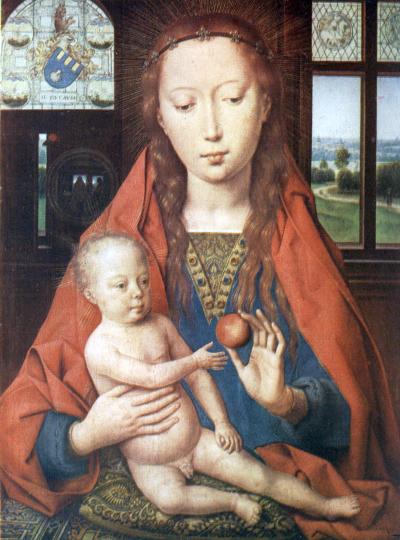
Baptist,” in the Royal Gallery at Munich (1470); the exquisite little
diptych “The Blessed Virgin and Child,” in the Louvre, painted (c.
1475) for John Du Celier, a member of the Guild of Merchant Grocers,
whose father was a member of the Council of Flanders; the panel in the
National Gallery, which we reproduce; the magnificent altarpiece in
the Royal Museum at Turin painted for William Vrelant (1478); the
famous triptych executed for the high altar of the church attached to
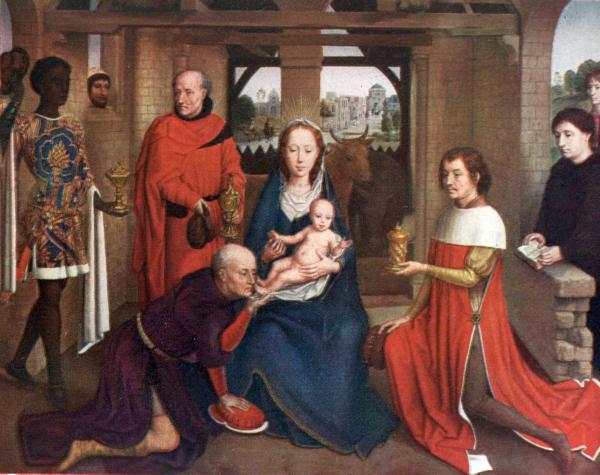
the Hospital of Saint John at Bruges (1479); and the triptych “The
Adoration of the Magi” presented to the Hospital by Brother John
Floreins (1479), all belong to this period: while with the year 1480
are associated the portraits of William Moreel and his wife, in the
Royal Gallery at Brussels; that of one of their daughters as the Sibyl
Sambetha, in Saint John’s Hospital; the marvellous composition in the
Royal Gallery at Munich, “Christ the Light of the World,” painted to
the order of Peter Bultinc, a wealthy citizen of Bruges and a member
of the Guild of Tanners; and the triptych “The Dead Christ mourned by
His Mother,” in Saint John’s Hospital—let alone the numerous other
works attributed to him but not authenticated or which have been lost.
The bare record, however, conveys but a feeble idea of the immensity
of the labour this output involved.
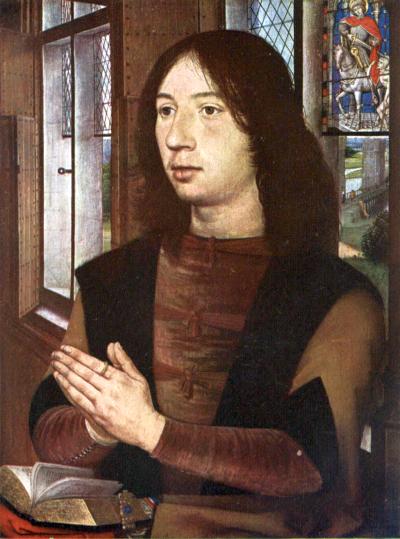
PLATE V.—MARTIN VAN NIEUWENHOVE.
The companion of the painting reproduced in Plate I., and is in the
Hospital of Saint John.
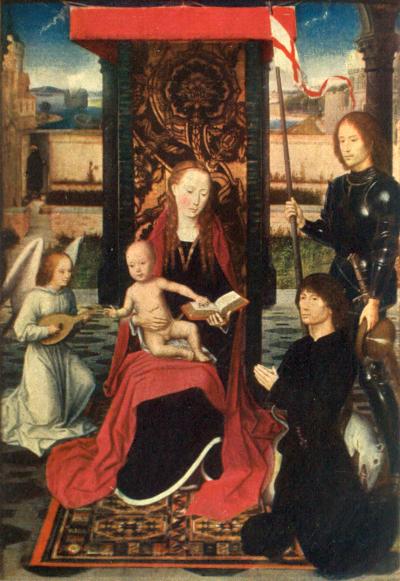
The panel in the National Gallery, which may be ascribed to 1475,
arrests our attention for the moment. It presents to us the Blessed
Virgin and Child in attitudes closely corresponding to those in the
earlier Donne triptych, but both are more pleasing figures in respect
of pose, the attitude of the Madonna in particular being less
constrained and the expression happier and more natural. The figure of
the angel too has gained in gracefulness. The donor under the
patronage of Saint George appeals to one as a living personality. Of
these two figures a lady critic complains that they are
“characteristic examples of Memlinc’s inability to depict a really
manly man”; and she endeavours to give greater point to this criticism
by contrasting the painter’s methods with those of John van Eyck,
wholly of course to the disadvantage of the former. In the present
case the identity of the donor remains a mystery: he may not have been
the really manly man the idealist would require, and also he may have
been the man of reverent and sweet disposition revealed to us in this
portrait. It is for the softening and idealisation of the face from
the reality, however, that fault is commonly found with Memlinc as a
portrait-painter. But, after all, what is this idealisation of the
subject but the highest aim and truest concept of art? It is no
difficult matter for the competent painter to produce a counterpart of
the outward flesh with all its peculiarities, even to the last wrinkle
and the least significant blemish, and be awarded the palm for “stern
realism”; but to conceive the inner soul of the man, to seize and fix
that conception on panel or canvas, surely that is the higher art? It
is true that in the men whom Memlinc portrayed there is a marked
similarity of expression, arising obviously from the fact that they
are usually pictured in an attitude of devotion, and that in the frame
of mind this attitude imposed they suffered some loss of workaday
individuality. But surely it is not to Memlinc’s discredit that his
clients were of the devotional order? Nor is the criticism of the
Saint George as mild and effeminate any more to the point; for when
the appeal is from Memlinc to Van Eyck one is forcibly reminded of the
votive picture of the Virgin and Child by that master in the Town
Gallery at Bruges, in which we have the donor under the patronage of a
Saint George whom for sheer inanity of expression and utter
awkwardness of demeanour it would be hard to beat. And yet in neither
instance, we may safely assume, was the figure the type the artist
would have created for the valiant knight of the legend. Apart from
this, a careful study of Memlinc’s many works will reveal to the most
exacting a sufficiency of evidence that his art was equal to any
demands that might have been made of it; of his preference for the
milder and more religious type of man, however, there can be no doubt.
It were idle to speculate as to the length of time Memlinc devoted to
the production of his pictures, seeing the meagreness of the data
afforded us for the purpose. His peculiar technique, however, which
avoided the accentuation of light and shade, and thereby simplified
the scheme of colouring, lent itself to rapid execution. Even so,
paintings like the altarpiece in the Royal Museum at Turin and that in
the Royal Gallery at Munich must have made heavy calls on his time
through a number of years. As examples of the powers and wealth of
resource of the artist these masterpieces stand almost alone. The
architectural setting of the former, a wholly imaginary Jerusalem, is
so contrived as to assist in the most natural manner the precession of
the Gospel story from the triumphal entry into the Holy City to the
Resurrection and the manifestation of Christ to Mary Magdalene. As
without conscious effort the eye is guided along the line of route
followed by the Redeemer, one treads in imagination in the Divine
footsteps through the hosannahing multitude in the extreme background
on the right, and turning to the left arrives at the Temple steps in
time to witness the casting out of the buyers and sellers; descending
thence and bearing gradually towards the right a turn of the street
leads one to the scene of the Last Supper, which Judas has already
left to confer with the priests under a neighbouring portico as to the
betrayal of his Master; and eventually one arrives at the Garden of
Olives, to be confronted in rapid succession with the Agony and the
picture of the sleeping disciples, the rush of armed men, Judas’
traitorous kiss and Peter in the act of striking at Malchus. Following
the multitude for some little distance one reaches the heart of the
city, where the successive incidents of the Passion are grouped each
under a separate portico showing on to a spacious courtyard in the
very centre of the panel—Christ before Pilate and his expostulating
wife, the Flagellation, the Crowning with thorns and mocking of Our
Lord, Christ before Herod and the Ecce Homo, with the preparations for
the Crucifixion going on the while in the open courtyard. These
completed, the mournful procession passes under a palace gateway into
the forefront of the picture, bears to the left and issues through the
city gate, where the Mother of Christ, the beloved disciple, and the
holy women have gathered together, into the open country, where at the
foot of the hilly way that skirts the city walls Simon of Cyrene comes
forward to relieve the fallen Saviour in the burden of the Cross;
presently the procession is lost to view at a bend of the road only to
reappear on the slopes of Calvary, which is triplicated here for the
purpose of re-enacting the three scenes associated with it—of the
Nailing to the Cross, of the Death of Our Lord, and of the Descent
from the Cross. Lower down on the left we assist at the Entombment and
at the Deliverance of the Just from Limbo, and further away we
witness the Resurrection and, in the far background, the manifestation
of Our Lord to Mary Magdalene. Viewed as a whole it is a marvel of
composition enhanced by a brilliancy of colouring, and every scene in
it a delicately finished miniature. Apart from the architectural
setting, the three Calvaries, and the duplication of the Holy
Sepulchre imposed by the necessity of representing both the Entombment
and the Resurrection, the most captious can discover nothing to abate
the enthusiastic admiration which this altarpiece excites, or one’s
wonder at the masterful manner in which Memlinc has succeeded in
developing the story of the Passion in some twenty scenes
necessitating the introduction of considerably over two hundred
figures, apart from the animal and bird life that supplements them,
within the narrow compass of a panel only fifty-five centimetres high
by ninety centimetres in breadth! The extreme corners of the
foreground are filled in with exquisite portraits of the donors, the
miniaturist William Vrelant and his wife, for whom one feels that
Memlinc has tried to excel himself in this masterwork.
Scarcely less surprising as a composition is the story in bright
luminous colours told in the Munich altarpiece, a work of considerably
larger dimensions (80 by 180 centimetres), commonly described as “The
Seven Joys of Mary,” but for which the more appropriate title has been
suggested of “Christ the Light of the World.” It is the story of the
manifestation of Our Lord to the Gentile world in the persons of the
Wise Men from the East, closely correspondent, as was Memlinc’s wont,
to the Gospel narrative and Christian tradition, except perhaps in
this one respect, that the artist’s innate love of moving water has
suggested to him the original conceit of depicting the departing Magi
as setting sail for their distant homes across the boundless waters.
This portion of the background and the greater wealth of surrounding
landscape greatly relieves the architectural setting, which is not so
overpowering as in the Turin altarpiece. The composition too, as
becomes the subject, is teeming with the joy of life in varying
aspects. Here we have the gay cavalcade with streaming banners
galloping along the road to Bethlehem, there the shepherds peacefully
tending their flocks on the grassy slope, their watch beguiled by the
strains of a bagpipe; here the scene at the Manger, all love and
devotion, and the running stream nigh by at which the horses are being
watered the while the Magi are making their act of adoration, there
the kings with their retinues triumphantly riding away over the rocky
heights; anon we have the sequence of miracles that attended the
Flight of the Holy Family into Egypt—the wheat that grew and ripened
in a day, the date-palm bending to offer its fruit to the Virgin
Mother resting beneath its shade while the unsaddled ass grazes as it
lists and Joseph fetches water from a neighbouring spring; elsewhere
the risen Christ appearing to the fishing apostles, and far beyond
across the waters in the background the setting of the sun in all its
glory. Every scene that lends itself to the treatment has its beauty
enhanced by the beauties of Nature. The one sorrowful incident in the
whole story, the Massacre of the Innocents, is a mere suggestion of
this cruel episode. Memlinc’s nature shrank from the interpretation of
evil, and in this particular instance has admirably succeeded in
commemorating the incident of the massacre without involving it in any
of its horror. A pleasing innovation may also be noticed in the
treatment of his portraits of donors, Peter Bultinc and his son being
introduced as devout spectators of the scene presented in the stable
at Bethlehem, which they humbly contemplate through an opening in the
wall. “The more one examines this picture, the greater one’s
astonishment at the amount of work which Memlinc has lavished on it,
at the exquisite beauty of the various scenes, the marvellous
ingenuity displayed in separating them one from another, and the skill
with which they balance and are brought into one harmonious whole.”
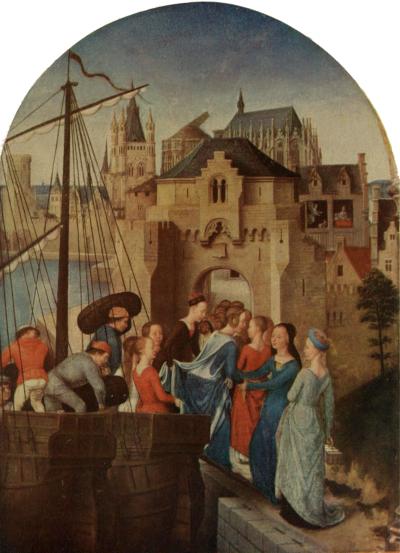
PLATE VI.—MARTYRDOM OF SAINT URSULA.
This forms the eighth panel of the famous shrine, completed in 1489
for the Hospital of Saint John at Bruges, where it may be seen. The
archer is a portrait of the celebrated Dschem, brother of the Sultan
Bajazet, taken prisoner at Rhodes in 1482, copied from a portrait in
the possession of Charles the Bold.
The Turin altarpiece was completed not later than 1478, in which year
William Vrelant gave it to the Guild of Saint Luke and Saint John
(Stationers); the Munich one at any rate some time before Easter 1480,
at which date the donor presented it to the Guild of Tanners. But
already then Memlinc had undertaken the triptych in the Hospital of
Saint John painted to the order of its spiritual master, Brother John
Floreins, acknowledged to be technically the most perfect work he
completed before the end of 1480; and also the larger triptych for the
high altar of the Hospital church.