MELLIFONT BECOMES THE HOME OF A NOBLE FAMILY—IS SOLD, AND IS DELIVERED UP
TO RUIN AND DECAY.
“Mute is the matin bell, whose early call
Warn’d the grey fathers from their humble beds;
No midnight taper gleams along the wall,
Or, round the sculptur’d saint its radiance sheds.”
(Keats.) |
 he long line of distinguished men being thus rudely and abruptly
terminated at Mellifont, with the suppression of the monastery, all
memorials of their history were lost, and no trace of them has been left.
Not a book, nor cross, nor chalice, register, nor chartulary remains. It
appears that Mellifont had its Annalist and its Annals like all the
other monasteries of the Order in Ireland; for Bishop Nicolson, who wrote
his “Irish National Library” in 1724, says: “The Annals of Ireland from
the foundation of this Abbey in 1142 to the year 1500, are, or were
lately, in the hands of some of the learned men of this kingdom.” He does
not tell us the name of the compiler, but only the fact that they had
been written at Mellifont. These are not cited by later writers, so they,
also, must have perished long since. At the suppression of monasteries,
the archives, chronicles, and registers were carefully sought by the
Commissioners, because they contained correct information on the value and
extent of the possessions of each house respectively; and the more
extensive these were, the more sedulously were the records sought for.
Hence it is that because the Cistercian Order had large possessions, the
manuscripts were all seized and handed over with the monasteries to the
grantees. The monks could not possibly take one away with them. So their
history is now derivable from other sources, which, at best, are very
meagre. Mellifont, which occupied so prominent and respected a position
during its career, would not be found inferior to other houses of the
Order in the number of its learned and remarkable men, were its ancient
documents now available; and, judging from the long roll of distinguished
men, who in every department of knowledge rendered the Order illustrious
in other countries, we may safely allot a respectable quota of the same to
Mellifont. De Visch compiled his Writers of the Cistercian Order in
1656, and Sartorius published a large tome in 1700, each containing
notices of the illustrious men of the Order. No less than sixty-three
large folio pages of this latter work are occupied with the names of the
learned men, and the dates at which they flourished. He places all in
distinct categories, and so we have St. Bernard heading the list, after
whom come the Grammarians, next follow the Poets, Orators, Historians,
Philosophers, Mathematicians, Astronomers, Musicians, then Doctors of
Canon and Civil Law, and Doctors of Theology; finally, Professors in
universities, and others, whose general attainments precluded
classification. As these works were written after the suppression of the
monasteries in these countries, the materials relating to the Irish and
English monasteries having passed into hostile hands or been destroyed,
were no longer accessible. Ireland was ever remarkable for the thirst for
learning displayed by her children, and for the singular proficiency
attained by them, when the opportunity for it was afforded; we may, then,
justly conclude that learning and the polite arts found a home at
Mellifont. For this latter branch, the beautiful buildings would, of
themselves, suffice as an argument in favour of an advanced state of
culture and refinement.
he long line of distinguished men being thus rudely and abruptly
terminated at Mellifont, with the suppression of the monastery, all
memorials of their history were lost, and no trace of them has been left.
Not a book, nor cross, nor chalice, register, nor chartulary remains. It
appears that Mellifont had its Annalist and its Annals like all the
other monasteries of the Order in Ireland; for Bishop Nicolson, who wrote
his “Irish National Library” in 1724, says: “The Annals of Ireland from
the foundation of this Abbey in 1142 to the year 1500, are, or were
lately, in the hands of some of the learned men of this kingdom.” He does
not tell us the name of the compiler, but only the fact that they had
been written at Mellifont. These are not cited by later writers, so they,
also, must have perished long since. At the suppression of monasteries,
the archives, chronicles, and registers were carefully sought by the
Commissioners, because they contained correct information on the value and
extent of the possessions of each house respectively; and the more
extensive these were, the more sedulously were the records sought for.
Hence it is that because the Cistercian Order had large possessions, the
manuscripts were all seized and handed over with the monasteries to the
grantees. The monks could not possibly take one away with them. So their
history is now derivable from other sources, which, at best, are very
meagre. Mellifont, which occupied so prominent and respected a position
during its career, would not be found inferior to other houses of the
Order in the number of its learned and remarkable men, were its ancient
documents now available; and, judging from the long roll of distinguished
men, who in every department of knowledge rendered the Order illustrious
in other countries, we may safely allot a respectable quota of the same to
Mellifont. De Visch compiled his Writers of the Cistercian Order in
1656, and Sartorius published a large tome in 1700, each containing
notices of the illustrious men of the Order. No less than sixty-three
large folio pages of this latter work are occupied with the names of the
learned men, and the dates at which they flourished. He places all in
distinct categories, and so we have St. Bernard heading the list, after
whom come the Grammarians, next follow the Poets, Orators, Historians,
Philosophers, Mathematicians, Astronomers, Musicians, then Doctors of
Canon and Civil Law, and Doctors of Theology; finally, Professors in
universities, and others, whose general attainments precluded
classification. As these works were written after the suppression of the
monasteries in these countries, the materials relating to the Irish and
English monasteries having passed into hostile hands or been destroyed,
were no longer accessible. Ireland was ever remarkable for the thirst for
learning displayed by her children, and for the singular proficiency
attained by them, when the opportunity for it was afforded; we may, then,
justly conclude that learning and the polite arts found a home at
Mellifont. For this latter branch, the beautiful buildings would, of
themselves, suffice as an argument in favour of an advanced state of
culture and refinement.
It is worthy of note, that neither the Irish people, nor the
representatives of the Government in this country, brought, much less
substantiated, any direct charges against the Irish monks, prior to the
suppression. Hence it is, that their maligners had to import, for use
against them, the staple arguments commonly used in England, and there
only by venal scribblers, and those who profited by the downfall of the
monks. To such the learned and impartial Protestant historian, the Rev.
Doctor Maitland, adverts, when after giving credit to the monks for their
having been benefactors to mankind, he writes in his preface to the Dark
Ages:—“In the meantime, let me thankfully believe that thousands of the
persons at whom Robertson, and Jortin, and other such very miserable
second-hand writers, have sneered, were men of enlarged minds, purified
affections, and holy lives, that they were justly reverenced by men, and,
above all, favourably accepted by God, and distinguished by the highest
honours which He vouchsafes to those whom He has called into existence,
that of being the channels of His love and mercy to their
fellow-creatures.” And in our own time, the Guardian, an English
Protestant newspaper, when reviewing the Rev. Doctor Gasquet’s, O.S.B.,
learned work, Henry VIII. and the English Monasteries, approvingly
cites, amongst others, the following paragraph:—“The voices raised
against the monks were those of Cromwell’s agents, of the cliques of the
new men and of his hireling scribes, who formed a crew of as truculent and
as filthy libellers as ever disgraced a revolutionary cause. The later
centuries have taken their tale in good faith, but time is showing that
the monasteries, up to the day of their fall, had not forfeited the
goodwill, the veneration, the affection of the English people.” Mr. Lecky,
too, with his usual candour and liberality, writes:—“Monastic
institutions were the only refuges of a pacific civilisation; the only
libraries, the only schools, the only centres of art, the only refuges for
gentle and intellectual natures; the chief barriers against violence and
rapine; the chief promoters of agriculture and of industry.” (The
Political Value of History, p. 14. London, 1892.)
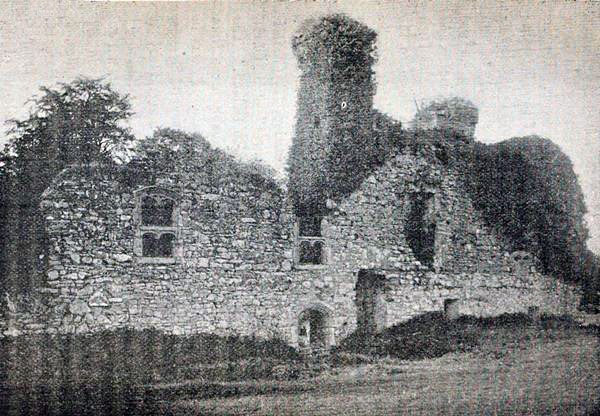
The monks being now expelled, Mellifont was delivered up to desecration
and ruin; the silence of the tomb reigned supreme, and the voice of prayer
was heard no more; no longer did the bells from the tower send forth their
cheering notes over the surrounding district to raise the hearts of the
toiler to Heaven. These sweet toned bells, the gift of some princely
benefactor, had been, with all the other moveable property, carried off by
the spoiler. The Abbey, with all its spiritual and temporal possessions,
was given, in 1541, to Laurence Townley, for 21 years. They passed by
reversionary lease to —— Brabazon, in 1546. In 1551, they were leased to
the same for 21 years more, and in 1566, they came by reversionary lease
to Edward Moore, the founder of the Drogheda family, who, at that time,
came into Ireland, as a soldier of fortune. (Appendix to the Report of
the Deputy-Keeper of the Rolls and Grants of Elizabeth.)
This Edward Moore, who was accompanied by his brother John, the founder of
the Charleville family (now extinct), was descended from an ancient
Kentish House. He fixed his residence at Mellifont, changing the church
into a dwelling, which he strongly fortified against the attacks of the
Ulster Irish. The statues of the Twelve Apostles, which once occupied
places in the church, he caused to be removed to the hall, clad in red
uniforms, with muskets on their shoulders, as a protest, no doubt, against
“Popish idolatry.” It is even said that he suffered the Founder’s tomb,
and those of others, or such portions of them as still were left, to
remain as part of his domestic arrangements, without his being disturbed
by such solemn surroundings. He was knighted by the Deputy, Sir Wm. Drury,
and dying soon after, was succeeded by his son, Sir Garret, to whom
Mellifont, with six other dissolved monasteries, and all their
spiritualities (that is, the revenues of them, right of patronage, etc.)
and temporalities, were granted in fee. By these means, was adhesion to
the Crown purchased and services to it rewarded—services, which bore no
equivocal meaning ever since the Invasion, as the Irish knew by long and
bitter experience.
At this time, the Church, as by Law Established, became part and parcel of
the State, and its most obsequious servant. Its ministers looked to the
civil power for patronage, and even hoped for promotion through the
officials of the Court; but only in a few instances were the livings worth
the asking, as the greater part of their temporalities were bestowed on
laymen, favourites of the Queen. We have a picture of the state of that
Church in Ireland, soon after the suppression of monasteries, drawn by the
Lord Deputy himself, in a letter to Queen Elizabeth. They who would fain
believe in the blessed advantages which flowed from the Dissolution of
Monasteries, and the introduction of the new religion, may take to heart
the lesson it teaches. Sir Henry Sydney wrote to the Queen in April, 1576,
on the condition of the diocese of Meath:—“There are within this
diocese,” he writes, “224 parish churches, of which number, 105 are
impropriated to sundry possessions; no parson or vicar resident on any of
them, and a very simple or sorry curate for the most part appointed to
serve them; among which number of curates, only eighteen were found to be
able to speak English, the rest being Irish ministers, or rather, Irish
rogues, having very little Latin and less learning and civility.... In
many places the very walls of the churches are thrown down, very few
chancels covered; windows and doors ruined and spoiled. There are 52
parish churches in the same diocese which have vicars endowed upon them,
better served and maintained than the others, yet badly. There are 52
parish churches here, residue of the first number of 224, which pertain to
divers particular lords; and these, though in better state than the others
commonly, are yet far from well.” He concludes by saying:—“But yet your
Majesty may believe it, that upon the face of the earth where Christ is
professed, there is not a church in so miserable a case.” Lord Grenville,
in his Past and Present Policy of England towards Ireland, when
commenting on Sydney’s letters, from one of which the above is an extract,
writes:—“Such was the condition of a church which was half a century
before rich and flourishing, an object of reverence and a source of
consolation to the people. It was now despoiled of its revenues; the
sacred edifices were in ruins, the clergy were either ignorant of the
language of their flocks, or illiterate and uncivilised intruders; and the
only ritual permitted by the laws was one of which the people neither
comprehended the language nor believed the doctrines; and this is called
establishing a reformation.” That this condition of affairs was not
confined to any particular diocese, but rather was the state in all, is
evident from the sketch given by Spenser in his View of the State of
Ireland. “They” (the ministers), he says, “neither read the Scriptures
nor preach to the people, nor administer the Communion ... only they take
the tithes and offerings, and gather what fruit else they may of their
livings.... It is a great wonder to see the zeal between the Popish
priests and the ministers of the Gospel; for they spare not to come out of
Spain, from Rome, and from Rheims, by long toil and dangerous travelling
thither, where they know peril of death awaiteth them, and no reward or
riches are to be found, only to draw people to the Church of Rome.” Such
were the immediate fruits of the Reformation as admitted and described by
Protestant contemporaries.
One of the first proprietary acts of Sir Edward Moore, on his acquiring
Mellifont, seems to have been to cut down and sell some of the magnificent
timber planted by the monks. The old wooden house, so long an object of
curiosity in Drogheda, and which was taken down in 1824, was chiefly
composed of oak obtained from Mellifont Park. It was situated at the angle
formed by the junction of Laurence Street and Shop Street, and was erected
by Nicholas Bathe, as an inscription in raised characters, each six inches
in length, testified. This inscription was on the Laurence Street side.
“Made. Bi. Nicholas. Bathe. in. the. ieare. of. our. Lord. God. 1570. Bi.
Hiu. Mor. Carpenter.”
In 1592, Red Hugh O’Donnell, fleeing from Dublin Castle, where he had been
detained a close prisoner, was received and kindly treated by Sir Edward
Moore, at Mellifont. His reception is thus related in the Life of Red
Hugh, edited with notes by the late Father Denis Murphy, S.J.:—“After
crossing the Boyne near Drogheda, Red Hugh and his companion mounted their
horses, and proceeded about two miles from the river, where they saw a
dense bushy grove in front of them on the road they came, and a large
rampart all around it, as if it was a kitchen-garden. There was a fine
mansion (called the great monastery), belonging to an illustrious youth of
the English, by the side of the wood. He was much attached to O’Neil....
He (O’Donnell) went into the house and was entertained; for he was well
known there especially more than in other places.”
In 1599, according to the family pedigree, Sir Garret Moore and Sir
Francis Stafford were the only English house-keepers in the County Louth;
all the lands being wasted by the Ulster rebels. The next important event
at Mellifont was the great O’Neil’s surrender there to the Deputy, Lord
Mountjoy, on the 24th March, 1602. The Lord Deputy sent Sir Garret Moore,
as an old acquaintance of O’Neil’s, with Sir Wm. Godolphin to parley with
him, and O’Neil returned with them to Mellifont, where (on his knees, it
is said by English writers,) he made his submission to the Deputy. Here,
again, we have further proof of what has been stated before, that it was
Irishmen who retained this country for the English Crown; for when Sir
George Carew sat down before Kinsale, where O’Neil was defeated, his army
consisted of three thousand men, of whom two thousand were Irish.[8]
Five years later, that is, in 1607, O’Neil was again at the “fair mansion
of Mellifont to bid good-bye for ever to his good friend, Sir Garret, the
fosterer of his son John.” He tarried two days with him, and then said
farewell. Having given his blessing, “according to the Irish fashion,” to
every member of his friend’s household, he and his suite took horse, and
rode rapidly by Dundalk on his way to Lough Swilly, where a ship awaited
him to bear him from his native land for ever.
By an Inquisition taken on the 14th June, 1612, the possessions of this
Abbey were found as follow:—“The site, a water-mill, a garden, an
orchard, a park called Legan Park, the old orchard containing two acres;
the silver meadow, nine acres; the wood meadow, ten acres; and the doves’
park; 80 acres of underwood; Killingwood, being great timber, containing
twelve acres; Ardagh, twenty acres, being the demesne lands; and the
grange and town of Tullyallen,” etc.
In 1615, July 20th, Sir Garret was created Baron Moore of Mellifont, by
King James I. In 1619, Baron Moore obtained a royal grant of St. Mary’s
Abbey, Dublin, from the same King; and in 1621, he was created a Viscount,
with the title of Viscount Moore of Drogheda. St. Mary’s Abbey, Dublin,
passed from the family some fifty years later.
As has been said, no trace of the expelled religious remains after the
suppression of Mellifont. It, however, may be assumed, that some few of
them lingered around the hallowed spot to which their affections clung,
and that they shared the labours and dangers incident to the Catholic
missionaries of the period, as is well known their brethren in other parts
of Ireland did after their expulsion. It cannot now be ascertained
whether, or not, an unbroken line of titular Abbots of Mellifont was
maintained after the dissolution of the Abbey; but, in 1623, an oratory
in Drogheda, belonging to the Cistercians, was served by five or six
Fathers of the Order under Patrick Barnewall, who had been appointed Abbot
of Mellifont by the Pope; and in 1625, he received the abbatial
benediction in the church of St. John, in Waterford, at the hands of the
Most Rev. Thomas Fleming, Archbishop of Dublin. This Patrick Barnewall
belonged to the Bremore branch (Co. Dublin) of the ancient and illustrious
family of that name. After having studied the Humanities, Philosophy,
Theology, and Canon Law in the Universities of Douay and Paris, he was
ordained priest, and discharged missionary duties in Drogheda. In a sketch
of his life given by a fellow-labourer, it is related, that one night as
he lay awake, St. Bernard appeared to him and told him he would be a monk
of his Order. Though he relished the idea, yet he did not immediately
correspond with his inclinations till he was grievously afflicted with a
severe sickness, when he remembered the vision, and being urged by his two
sisters, who had consecrated themselves to God, he entered the Novitiate
of the Order in Kilkenny, and was at once restored to health. Soon after
his profession he was appointed Abbot of Mellifont by Apostolic authority;
and he admitted novices into the Order at his “hiding-place” at Drogheda,
whom he sent to be educated at the Cistercian College, Louvain, and to
other Continental Colleges. He was a very learned man, particularly in
Canon Law, and was consulted as an authority on this subject. During the
siege of Drogheda, in 1641, his goods were seized and himself cast into
prison, but through the influence of some powerful relatives he was
liberated. He died in his father’s house in September, 1644, and was
buried in the church of Donore, which formerly belonged to Mellifont. John
Devereux, a native of the Co. Wexford, who had been educated at Louvain,
was appointed by the Pope, Abbot of Mellifont, in 1648. He, with Father
Luke Bergin and Father Patrick Grace, both natives of Co. Kilkenny, Father
Malachy O’Hartry, a native of Waterford, Father John Bryan, a native of
Drogheda, and Father Plunket, constituted the new community of Cistercian
monks under Abbot Patrick Barnewall, when he opened the oratory in
Drogheda, in 1623. Whether all or any of them perished in the general
massacre of Drogheda, under Cromwell, we cannot tell, but they disappeared
thenceforth, and John Devereux seems to have been the last titular Abbot
of Mellifont.
In the Rebellion of 1641, Mellifont and its owner, Lord Charles Moore, son
of Garret, the first Viscount, became involved. On the 21st November, just
a short time after the outbreak, the rebels under Sir Phelim O’Neil, when
on their way to besiege Drogheda, made a halt at Tullyallen, and “sent a
party of 1,300 foot down to Mellifont, the Lord Moore’s house, which their
design was suddenly to surprise; but, contrary to their expectation, they
found there twenty-four musketeers and fifteen horsemen, who very stoutly
defended the house as long as their powder lasted. The horsemen, when they
saw themselves beset so as they could no longer be serviceable to the
place, opened the gates, issued out and made their passage through the
midst of the rebels, and so, notwithstanding the opposition they made,
escaped safe to Drogheda. The foot having refused to accept of the quarter
at the first offered, resolved to make good the place to the last man;
they endured several assaults, slew one hundred-and-forty of the rebels,
before their powder failed them; and at last they gave up the place upon
promise of quarter, which was not kept, for some of them were killed in
cold blood, all were stripped, and two old decrepid men slain, the house
ransacked and all the goods carried away.”
The above is from Sir John Temple’s History of the Irish Rebellion, and
it has been quoted by Catholics and Protestants alike when alluding to
Mellifont; they each add, however, a little spice to suit the palates of
their respective readers. Of this attack on Mellifont we have no less than
four versions, two of which deserve but little credence, viz., that
already given, and that of Dean Bernard. The account given by the latter
is fuller, and enters more minutely into detail, so that some particulars
tax the capacity of the most credulous; as, for instance, when he tells us
that twenty-four musketeers killed one hundred-and-forty rebels though
they had only “six shots” of powder, “some only four,” and that they
rammed in six bullets together, and how each shot killed several. Verily,
every bullet had its billet there! That be sharp practice without doubt!
He also tells, how the loss on the part of the garrison was thirteen
killed, “whom a Friar was so forward for deed of charity as to procure
them burial in the church adjoining.” Thank goodness, he has the grace to
credit even a Friar with some remnant of humanity! He does not say that
the rebels stripped all. They could not have done so; for eleven escaped
to Drogheda. These godless Papists capped their iniquity in this holy
man’s estimation when they “threw a fair church Bible into the mill-pond.”
The last charge on the sheet is—“Their best language to them all was
‘English dogs,’ ‘rogues,’ etc.”
Before producing the other two versions, let us examine the characters of
both these witnesses as drawn by Protestant writers. Sir John Temple wrote
his History in 1656, from the “Depositions” preserved then in Dublin
Castle, but which are now in Trinity College. These “Depositions”
comprise the list of murders, burnings, etc., said to have been
perpetrated by the Irish on the English Protestants during the war, and
fill thirty-two volumes. He was some time Privy Councillor, but was
removed by Ormonde, and Carte tells how “two traitorous and scandalous
letters against his Majesty written by Temple were read in Committee.” And
Dr. Nalson, another Protestant writer, accuses him of having been in
league with the Parliamentarians, whom Ormonde describes as those who
became the “murderers of his (the King’s) royal person, the usurpers of
his rights, and destroyers of the Irish nation; by whom the nobility and
gentry of it were massacred at home, and led into slavery, or driven into
beggary abroad.” In 1674, Temple protested that the work was published
without his knowledge, as appears from State Papers, Dublin edition, p.
2.
Dean Bernard was Primate Ussher’s chaplain, and like his master, was a
Puritan. During the siege of Drogheda he watched over the Primate’s
library lest the rebels should attack the magnificent palace which had
been built with the fines from the recusants. He was afterwards
Cromwell’s chaplain and almoner, in either of which capacities, it would
be quite unreasonable to expect justice to the Irish from him.
As to the “Depositions” themselves, they are summarily dealt with by the
Rev. Dr. Warner, another English Protestant historian of that Rebellion.
“There is no credit to be given to anything that was said by these
Deponents which had not others’ evidence to confirm it.” And again, the
same Dr. Warner, who went through the drudgery of perusing and examining
these “Depositions,” says: “As a great stress has been laid upon this
collection in print and conversation, and as the whole evidence of the
massacres turns upon it, I spent a great deal of my time examining the
books; and I am sorry to say, that they have been made the foundation of
much more clamour and resentment than can be warranted by truth and
reason.” It was in them that Temple found the story of the ghosts of the
murdered Protestants, in the River Bann, at the Bridge of Portadown,
shrieking for revenge, and one in particular, who was seen there from the
29th December to the end of the following Lent!!! He sets down the number
of English and Protestants who were “murdered in cold blood, destroyed
some other way, or expelled out of their habitations in two years by the
Irish, as exceeding 300,000,” though, according to Petty, there were not
at the outbreak of the Rebellion 20,000 English Protestants in Ulster,
where nearly all the murders were said to have been committed. Dr. Warner
also tells how he saw in the Council books at Dublin, the letter which the
Commissioners of the Irish Parliament wrote to the English Parliament,
urging them to show no mercy to the Irish, but rather, to revenge the
murders and massacres committed by them. They tell them, “that besides
eight hundred-and-forty-eight families, there were killed, hanged, burned,
and drowned, six thousand and sixty-two.” Dr. Warner considers 2,000 about
the correct number. A prodigious number to be sure, but how far less than
Temple’s 300,000. Warner says, finally, at p. 296 of his work so often
cited: “It is easy enough to demonstrate the falsehood of every Protestant
historian of this Rebellion.”
The Rev. Mr. Carte, an English Protestant clergyman, who wrote the
celebrated Life of the Duke of Ormonde, tears all Temple’s assertions in
pieces, and demonstrates from indubitable authority the falsehoods of his
statements. Writing of these “Depositions” he says, at Vol. II., p. 263:
“Anyone who has ever read the examinations and depositions which were
generally given on hearsay, and contradicting one another, must think it
very hard upon the Irish, to have all those without distinction to be
admitted as evidence.” And in the Preface to the collection of Letters
affixed to the Life he alludes to the “uncertain, false, mistaken, and
contradictory accounts, which have been given of the Irish Rebellion, by
parties influenced by selfish views and party animosities, or unfurnished
with proper and authentic materials and memoirs.”
It is obvious from the first pages of Temple’s History what the scope of
the work is. It is a gross libel on the whole Irish nation from the
earliest times. In one page, he twice applies to them the epithet of a
beastly race, and, no doubt, worthy to be rooted out, to make room for
Royalists of his type, who worshipped the rising sun.
Carte, in his Life of Ormond, Vol. II., p. 135, gives an account of the
attack on Mellifont as follows:—“This detached body of the northern
rebels appeared on November 21st in sight of the town of Drogheda, within
four miles of it, presuming (as was imagined) upon some party within the
place. Sir H. Tichburne, Governor of Drogheda, had the week before sent a
party of fifteen horse and twenty-two foot to Mellifont (formerly an Abbey
of Bernardine monks, founded by Donagh O’Carroll, prince of Ergall, about
A.D. 1142, but then an house of the Lord Viscount Moore’s, three miles
from town), as well as to secure that place from the incursions of roving
parties, as to keep abroad continual sentinels and scouts, that might
inform him of the rebels’ motions. His orders were not well observed, nor
his party so vigilant as they ought to have been; for on the 21st, the
rebels on a sudden encompassed the house, and (after the soldiers’ powder
was spent) took it with a loss of some one hundred and twenty of their
own number (among which were Owen M’Mahon and another captain), and eleven
of the soldiers, with most of the arms. As the Irish were breaking into
the house on all sides, the troopers causing the great gate to be opened,
sallied out, and opening themselves a way through the body of the rebels,
got safe with the rest of the foot soldiers sore wounded to Drogheda.”
This may be accepted as a true, unvarnished account of this much magnified
attack; especially as Tichburne himself, who cannot be accused of
partiality towards the Irish, and who was Governor of Drogheda at the time
of its occurrence, seems to have been Carte’s authority for it, as appears
from a reference to a letter written by Tichburne to Ormond, but not given
in the collection of Letters mentioned above. There is no question here of
quarter given, or of faith broken; no cold-blooded murders, no gruesome
picture of gory corpses unburied, nor of fiendish glee on the part of
rebels dancing round their watch-fires in presence of their stark and
naked victims strewn around!!! Pity such absurdity should be believed or
repeated in our time, when it should have been relegated to the same
lumber-heap as the story of the ghosts of the Bann!
We have yet another account from a paper or Report published in London by
two parties who only give their initials, T. A. and P. G. It was “printed
by Edward Blackmore, at the Angel, in Paul’s Churchyard, in 1642,” and is
now to be found in the Contemporary History of Affairs in Ireland, so
ably edited by Sir John Gilbert, at Vol. I., Part II., p. 420. There is a
discrepancy in the dates, but that is immaterial, as only one attack is
said to have been made. It tells us, “That on the same day (April 30),
three or four hundred rebels came before Mellifont, three or four miles
from Drogheda, where Lord Moore had left on Tuesday before a garrison of
four-score foot and about thirty horse; the rebels plaid hotly upon them
until the horse were ready within; but as soon as the horse were ready,
they, with the foot, sallied out, and killed about thirty of the rebels.”
This cannot be far from the truth, as it seems to be free from the
exaggerations in which Tichburne dealt, when recounting the numerical
strength of his and the enemy’s forces, ascribing to the latter
poltroonery and cowardice in action, and crediting them with excessively
heavy losses.
The predisposing cause, why the Ulster Irish were ready for rebellion was
the misery the native inhabitants endured since the Plantation of the six
forfeited counties, some thirty odd years before. Even the remnants of the
estates allowed them by the Crown were filched from them by the greed and
cunning of unscrupulous Commissioners, who enriched themselves on the ruin
of the Irish. Prendergast (Cromwellian Settlement, pp. 49-50,) thus
describes the condition of the old Irish nobility and gentry
then:—“Little they (the Planters, who got the forfeited estates) thought
or cared how the ancient owner, dispossessed of his lands, must grieve as
he turned from the sight of the prosperous stranger to his pining family;
daughters, without prospect of preferment in marriage; sons, without fit
companions, walking up and down the country with their horses and
greyhounds, coshering on the Irish, drinking and gaming and ready for any
rebellion; most of his high-born friends wandering in poverty in France
and Spain, or enlisted in their armies.” The immediate cause of the
Rebellion is thus stated:—“A letter was intercepted coming from Scotland
to one Freeman of Antrim giving an account that a Covenanting army was
ready to come to Ireland under General Lesly, to extirpate the Roman
Catholics of Ulster, and leave the Scots in possession of that province;
that resolutions to that effect had been taken at their private meetings,
as well as to levy heavy fines on such as would not appear at their kirk
for the first and second Sunday, and on failure the third, to hang at
their own doors without mercy, such as remained obstinate” (Carte’s
Ormond, Vol. I., p. 160). This notion prevailed universally amongst the
rebels, and was chiefly insisted on by them as one of the principal
reasons of their taking up arms.
The Rebellion broke out, then, on the 23rd October, 1641, and the actors
in it were a “tumultuous rabble” as Ormond called them, intent chiefly on
plundering and driving off the English settlers, yet before the end of the
month the principal towns of the North were in their hands. Leland, a
Protestant historian, writes:—“That in the beginning of the insurrection,
it was determined by them that the enterprise should be conducted in every
quarter, with as little bloodshed as possible” (History of Ireland, Vol.
III., p. 101). At p. 131, the same historian writes:—“The Lords Justices
might have stamped out the insurrection at once had Ormond’s advice to
levy a large number of troops been attended to; for the Irish were then
formidable only in numbers, and not six hundred of them had proper arms.
But their purpose was rather to fan it, in order to gratify their personal
greed by extensive forfeitures.” Warner, who has been so often quoted
before, writes at p. 176 of his History:—“It is evident from the Lords
Justices’ letter to the Lord Lieutenant that they hoped for an
extermination, not of the mere Irish only, but of all the old English
families who were Roman Catholics.” They issued a most truculent order to
Ormond “to burn, kill, spoil, waste, destroy, the rebels, their relatives,
houses and property.” One of these Lords Justices is thus referred to by
Carte: “He was a man of mean extract, scarcely able to read and write ...
plodding, assiduous, and indefatigable, greedy of gain, and eager to raise
a fortune; which it is not difficult for a man of indifferent parts to do,
when he is not hampered with scruples about the ways of getting it”
(Ormond, Vol. I., p. 190). This same Lord Justice, with three members of
the Privy Council, was put under arrest for disobedience to his Majesty,
King Charles, and for complicity with his enemies, the Parliamentarians of
England. The Lord Justice was deposed and imprisoned, but he retained his
ill-gotten property.
As has been said, the rebels became masters of the principal towns in the
North without meeting any check, when they attacked Mellifont. Lord Moore
was then in Drogheda with Sir Henry Tichburne, the Governor, with whose
policy and methods he, both before and afterwards, identified himself;
and, as an active agent of the Lords Justices, he was specially odious to
the Irish. During the siege of Drogheda, he more than once, by his
alertness and personal bravery, saved the town from falling into the hands
of the besiegers. With the exception of Lord Moore and a few of the older
families, both the Lords Justices themselves (who governed the country in
the absence of the Lord Lieutenant), and their ruthless instruments were
men of no fortune; or, were such as became enriched by the plunder of the
Irish. Tichburne, in a letter to his lady, alludes to one of the
commissions entrusted to him for execution, in which fiendish work Lord
Moore was associated with him. After his return from the burning of
Dundalk,[9] which he left a smouldering heap of ruins, he describes the
results:—“There was neither man nor beast to be found in sixteen miles,
between the two towns of Drogheda and Dundalk; nor on the other side of
Dundalk, in the County of Monaghan, nearer than Carrickmacross, a strong
pile twelve miles distant” (Tichburne’s Siege of Drogheda, p. 320). And
in the same page he says, all this magnificent ruin and desolation were
inflicted on the peasantry “without one penny of charge to the State, and
that for the space of seven months, all under his command subsisted on the
spoils” taken from the unfortunate people in that district. “The country
and fields about Dundalk,” he says, “were abounding in corn, which I
allocated to the several companies, etc.” The ghosts of the Bann must have
been glutted with vengeance!!!
And now Lord Moore’s career is drawing to a close. After having been
engaged in many successful skirmishes, raids, and minor actions, he burned
with a desire for the honour of measuring swords with the great Owen Roe,
who had defeated all the forces hitherto sent against him, and, according
to O’Neil’s Diary, he affected to despise O’Neil. He was therefore
dispatched with a body of troops to dislodge that consummate strategist
from a position occupied by him at Portlester Mill, within five miles of
Trim. Borlase tells us that Lord Moore was killed in that engagement,
August 7th, 1643, “through the grazing of a cannon bullet which he
foresaw, yet took not warning enough to evade.” The Author of the
Aphorismical Discovery, who is commonly supposed to have been O’Neil’s
secretary, gives another account of his death. It is right to mention that
this author was by no means a monk, nor was he a clergyman at all, as is
evident from his apology in the Introduction, where he tells the reader
that he was by profession a “sworde carrier,” and that it was “alienat” to
that profession to aspire to literary avocations. “The General” (O’Neil),
he writes, “not well pleased with his gunner, for he perceaved he shooted
too high, and did little hurte, the peace was charged, the Generall tooke
a perspective glasse, and saw wheare my Lord Moore stoode. It being
charged, the Generall did levell the same against Moore, gave fire, his
aime was soe neare home, that he hitted him a little above his corpise,
wherupon all dismembred, presently fell dead, the trunke of his bodie
fallinge downe, and some of his members whisling in the aire to take
possession by flight in some other field, or make such speede to accompany
his soul to hell to be assured for winter quarter next springe.”
Lord Moore was succeeded by his son Henry, who, when Governor of Dundalk,
in 1645, was more than suspected of plotting with the Parliamentarians to
deliver up that town to Monroe. He was relieved of his charge by Ormond,
who was then Lord Lieutenant, and being a minor, was sent by him to
England (out of harm’s way), to the Court, where he was kindly received by
the King, who ordered livery to be granted him of his father’s lands
(Carte, Vol. IV., p. 154.) Lady Alice, his mother, was, it appears,
inveigled into a plot at the same time to deliver up Drogheda to the
Scots; for a wax impression of the keys of the gates having been given
her, she caused the gunsmith of the troop, which Lord Henry commanded, to
make false keys; but, being discovered, her ladyship, with others, was
sent to Dublin. There, on examination before the Council, they confessed
all. (Ibid.) Her Ladyship’s end was a tragic one, as we read in Lodge’s
Peerage. “Lady Alice, younger daughter of Sir Adam Loftus, Viscount
Elye, who broke her leg near the fort (Drogheda) by a fall from her horse
(occasioned by a sudden grief arising from the first sight of St. Peter’s
Church, Drogheda, where her dear lord lay buried), on Wednesday, 10th
June, 1649, and dying the 13th of a gangrene, was that night buried by him
in the family tomb.”
There is another entry at the same place in Lodge. “Lieutenant-Colonel
Francis Moore, sixth son of the first Viscount Mellifont, and brother to
Lord Charles who was killed at Portlester Mill, who was an officer in the
army for the reduction of Ireland, and in 1654, had a pension from the
then Government of 10/- a week, and five of his brother Charles’ children
had £3 17s. a week in 1665, out of the district of Trim” (Lodge’s Peerage
of Ireland, Vol. II., pp. 99-100). This Francis Moore had been an officer
in the King’s army, but soon after the arrival in Ireland of Jones, the
Parliamentarian General, he went over to him and took the Dundalk troops
with him. It was from Cromwell’s government he had his pension, but the
pensions granted to Lord Charles’ children were continued to them after
the Restoration, and Lord Henry mentioned above, was created Earl of
Drogheda, in 1661,—thus confirming the historic truism, that the
ungrateful Stuarts heaped favours on their enemies and treated their best
and most devoted adherents with cold indifference. As an illustration of
this we have the instance of one of the chief actors in those troublesome
times, Sir John Clotworthy, changing sides three times:—first, fighting
in the King’s name and commission against the Ulster Irish; next, siding
with the Parliamentarians, his Majesty’s deadliest enemies, and going over
to England as the spokesman of a deputation sent to the Parliament of
England to protest against the return of King Charles II., on rumour of
peace and terms being negotiated between them; again, on King Charles’
arrival in England, hieing over to tender his homages and
congratulations—and lo! the reward of his fidelity and loyalty (?)—he
was created Viscount Massereene. It is only one instance of several
hundreds that may be cited. The unfortunate rebels whose banner bore the
legend, “Vivat Carolus Rex”—“Long
live King Charles,” and who remained faithful to him to the last, were, by an irony of fate, robbed and
banished by the Cromwellians, who were put in possession of their estates
and confirmed in them by Charles II.!!!
In the foregoing pages, the authorities quoted are Protestants, and all,
without exception, hostile to the Irish. Their testimony, nevertheless, is
favourable to the rebels, save where the question of religion crops up,
then their prejudice blinds their judgment, and hurries them into most
glaring absurdities. One more fact about that saddest page of our history.
Before the outbreak of the Civil War in 1641, there were 1,200,000 Irish
Catholics in the country; at its close in 1652, the number had fallen to
700,000, and these were ordered under pain of death to transplant to
Connaught—the remnant of a broken and plundered race!!!
Henry, the first Earl of Drogheda, did not long enjoy his honours; nor did
his son and successor, Charles, who was succeeded by his brother Henry,
the third Earl, who, on the eve of the ever-memorable Battle of the Boyne,
entertained a party, amongst whom was one of King William’s highest
officers. On the morrow, July the 1st, the booming of King William’s fifty
pieces of “dread artillery” echoed along the hills and the valley of the
Boyne, and shook the old abbey walls to their very foundations; and on
that night, the oaken rafters of Mellifont rang to the cheers and toasts
of the “glorious, pious, and immortal memory” of the Prince of Orange, on
whose side Earl Henry commanded that day a regiment of foot. It may be
interesting to mention here, that on the morning of the battle, the Irish
Catholic soldiers wore scraps of white paper on their caps—emblematic of
the livery of France; the followers of the Prince of Orange wore green
boughs torn off the trees.
Charles, Lord Moore, son of Henry, the third Earl, married Jane, heiress
of Arthur, Viscount Ely, who received as her portion the suppressed Abbey
of Monasterevan, a Cistercian monastery founded by O’Dempsey, in the 12th
century. It was called Rosglas by the Irish, and the Valley of Roses, in
the list of monasteries of the Order in Ireland. When it came into Earl
Charles’ possession, he changed the name to Moore Abbey, and made it his
residence. The sons of this Lord Charles, Henry and Edward, became earls
successively, and Edward, the fifth earl, having settled down permanently
at Monasterevan, sold Mellifont and some of the property in its immediate
vicinity to Mr. Balfour of Townley Hall, in 1727.
The condition of Ireland at that time was truly deplorable. The Penal Laws
were in full force against the unfortunate Catholics, who were reduced to
a state little better than slavery. Dr. Johnson wrote of them some fifty
years later:—“The Irish are in a most unnatural state; for we see there
the minority prevailing over the majority. There is no such instance, even
in the ten persecutions, as that which the Protestants of Ireland have
exercised against the Catholics. Did we tell them we conquered, it would
be above board; to punish them by confiscations and other penalties was
monstrous injustice” (Boswell, at 1773).
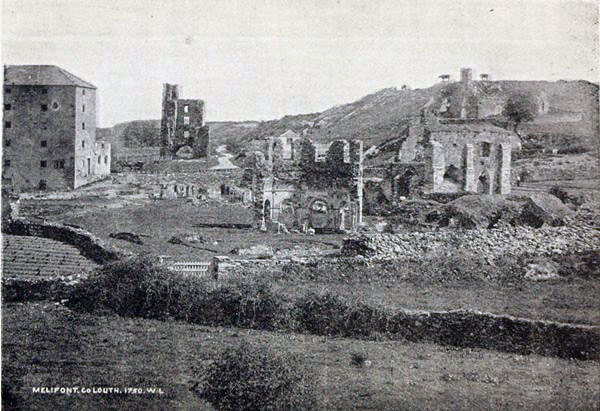
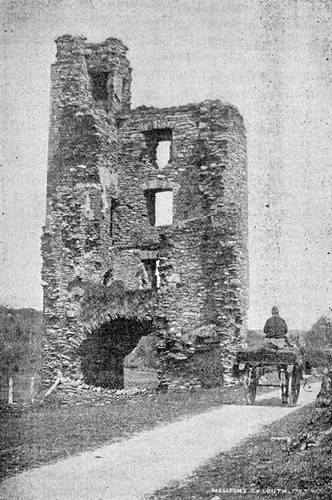
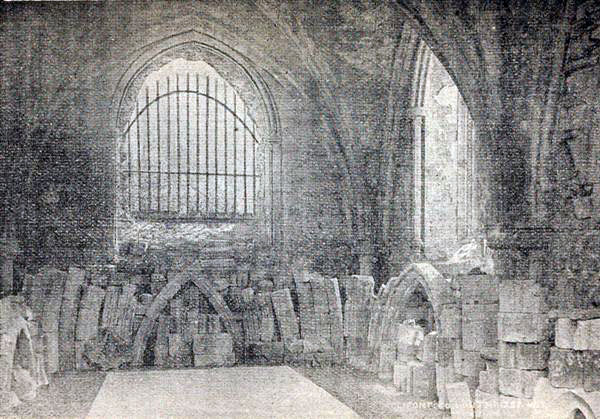
With the Moore family departed also the very shadow of Mellifont’s
diminished greatness, and “time’s effacing finger” almost completely
obliterated what was once a gorgeous national monument, which stood out
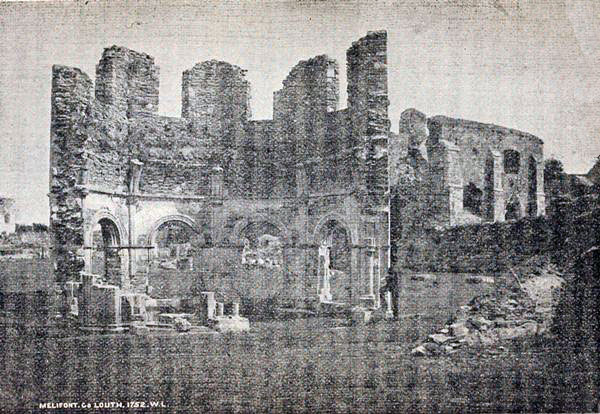
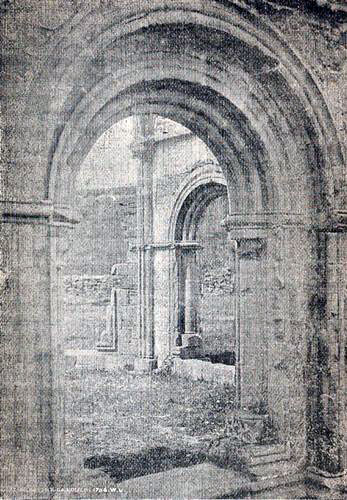
clearly as a finger-post on the ways of time. Gradually the fabric fell
into decay, the owl hooted on the landing of the grand stair-case, and the
daw and martin flitted unmolested through the deserted halls. The gardens
and walks and bowers disappeared beneath a crop of tangled brushwood, the
product of neglect. Soon the roof fell in, the walls became seamed with
many rents and toppled over with a crash; then Mellifont, the “Honey
Fountain,” the Monasthir Mor, or Great Abbey, as it was called, the
foundation of saints and kings, the abode of the pious and the learned,
the house pre-eminently of prayer, the asylum of the poor and friendless,
became a shapeless accumulation of rubbish. True, a mill was erected about
100 years ago close to the site of the church, and, no doubt, it was told
to strangers who then visited the ruins by people who professed to know
all about monks, that it had more activity and exhibited more of the
bustle of life than when the silent, slumbering monks dwelt there. But a
mill in that hallowed spot was a huge incongruity and a wanton disregard
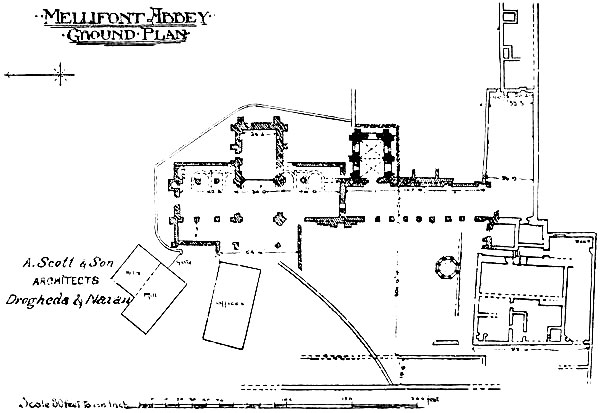
for all its honoured associations. In 1884, the few remaining ruins became
vested in the Board of Works, and the excavations which revealed the plan
of the church, as described in Chapter I., were carried out. It only
remains to be said that in Mr. Balfour of Townley Hall, the estimable
gentleman who now owns Mellifont and some of the property formerly
belonging to it, his tenants have found a liberal and generous benefactor,
who enjoys the merited esteem and respect of all who know him.
As one ascends the hill over Mellifont, and, pausing on its summit, gazes
on the lovely scenery around him, particularly along the valley of the
Boyne, which Young called one of the completest pictures he had ever seen,
then glances at the quiet valley beneath him, and remembers what prominent
parts those who once trod that favoured spot played in our country’s
chequered history, his soul is filled with solemn thoughts too big for
utterance. There, came the firm and gentle, yet dauntless, Malachy side
by side with Oriel’s proud Chief, and hand in hand, they knelt and prayed
and consecrated it to the living God for ever. Thereon, rose up the
magnificent temple on which neither cost nor labour was spared, that it
might be worthy of Him Who deigns to dwell in tabernacles made by man; and
generation succeeded generation of monks, who calmly dwelt in that
peaceful valley, which, by their skill and enterprise, they converted into
a garden of delights and a terrestrial paradise. The bishop and the king
found there a resting-place when life’s weary struggle was over, and their
end was sweetened by the cheering hopes of a glorious immortality. The
poor man and the homeless found there a welcome and a shelter, their wants
being liberally attended to; and the blessings of a free education and of
spiritual consolations were diffused on every side from that centre of
learning and piety. The knight and baron came, the belted man of war made
his home there, enjoyed his ephemeral honours, but he, too, is gone,
severing all connection with it both by name and title, leaving no trace
behind. The king and the knight have been brushed aside; and the old
chess-board, Mellifont, alone remains. Impressed with these reflections,
we take a glance beyond the grave, and there, we behold these actors pass
before the great, most just, and supreme Judge, to receive the requital of
their deeds, and to each is meted out reward or punishment according to
his deserts. We, too, the spectators, are hastening towards that same
goal; our future is indubitably in our own hands, according as we do or do
not now live up to our convictions, and the dictates of our consciences.
And, now, we cannot help asking ourselves, what shall Mellifont’s future
be? At present it is a blank; but, shall the lamp of piety and learning be
rekindled, and the light burst forth anew there as in the days of its
splendour? We know not; but we do know that, although God’s ways are
inscrutable, His wisdom and power are infinite. To Him be all glory for
ever and ever. Amen.