New original cover art included with this eBook is granted to the public domain.
MELINCOURT
Sir Oran Haut-ton.
BY
THOMAS LOVE PEACOCK
ILLUSTRATED BY F. H. TOWNSEND
WITH AN INTRODUCTION BY GEORGE SAINTSBURY
London
MACMILLAN AND CO., Ltd.
NEW YORK: MACMILLAN & CO.
1896
All rights reserved
INTRODUCTION
vii
Melincourt is usually considered the least interesting of
Peacock’s novels; and in the strictly comparative sense—that
is to say that it is the least interesting of a group, every
one of which has peculiar and exceptional interest—the
statement is no doubt true. The defects of the book are
very obvious, and exceedingly easy to account for. Headlong
Hall had been very popular; and it was only in the
course of nature that the author should repeat his successful
experiment. But Headlong Hall had been by no means
free from faults; and it certainly was not out of the course
of nature that they should reappear in the new venture.
In the very noteworthy introduction which the author wrote
nearly forty years later, and which contains the promise of
Gryll Grange as supplement to complete the satire, it is not
unimportant to observe that he pays no attention to anything
but the satirical purport. A man of seventy, satiated
with business and not specially hungering after popularity,
was not perhaps very likely to discuss his own novels in
detail, even to the extent to which Scott and other persons
of irreproachable taste have discussed theirs in separate or
collected editions. But it is not extravagant to take his
silence as a kind of indication of his point of view.
His practice, however, if not his expressed theory, testifies
to a consciousness that he had made a mistake in the scale
viiiof this novel. Nightmare Abbey, the next, is only just a
third of its length: no two of the next three, even if added
together, come up to it; and though Gryll Grange is not so
very much shorter, Gryll Grange contains the accumulated
irony of a lifetime, and is not open to any of the objections
to which Melincourt is exposed.
These objections, put briefly, come to this, that the
author has not yet acquired the knack of telling a story, and
that he has not discarded the habit of inapposite dissertation.
There is truth in this summary, sharp and blunt at once as
it is, and there is probably no reader who will not sometimes
put up a prayer for the excision, extinction, expulsion, and
general extermination of Mr. Fax. But political economy
had always been a favourite subject of Peacock’s French
masters; it had acquired, through Malthus (of whom Mr.
Fax has sometimes been thought to be a Peacockian
portrait), considerable vogue in England; and we have seen
it reappear in our own time as a loading or padding to
novels. Mr. Forester’s anti-saccharine fervour was a real
thing for many years after Melincourt was published—though
I have never heard whether the amiable anti-saccharists or
their descendants have founded any association to weep for
the ruin of the West India planters first, and the West
India Islands afterwards.
Two other kinds of purpose appear in the novel, both
of them distinctly political. In Headlong Hall the attack
on the Quarterly Review had been tolerably obvious, but it
had kept, if not entirely, yet mainly free of personalities.
The scenes at Cimmerian Lodge and Mainchance Villa,
with Mr. Feathernest’s sojourn at Melincourt, substitute
for this impersonality a directness of personal lampoon as
to the taste of which there cannot be very much question,
while as to the justice and accuracy of it there cannot be,
ixand among rational people of both sides never has been,
any but one opinion. Mr. Vamp (Gifford), Mr. Anyside
Antijack (Canning), and Mr. Killthedead (believed to be
Barrow, Secretary to the Admiralty, and a well-known writer
on naval subjects), were perhaps fair game, for the two last
were public men—in other words, public targets—and Gifford
had only himself to blame if, after playing all his life at the
roughest and most vicious of bowls, he got some rubbers.
But the animus, the injustice, and, above all, the ludicrous
inaccuracy of the attacks on Coleridge (Mr. Mystic), Southey
(Mr. Feathernest), and Wordsworth (Mr. Paperstamp), are
still almost inconceivable. That there was a certain superficial
justification for accusing them all, especially Coleridge
and Southey, of rather remarkable changes of opinion, that
Coleridge was apt to be a little transcendental, and so forth,
may be granted. But the attempt to carry the satire on to
their moral and personal conduct is not only unjustifiable in
itself, but displays a quite ludicrous ignorance and recklessness.
Coleridge, heaven knows, was open enough to satire;
and if Peacock had known anything whatever about him,
he might have made a rather terrible exposure. But ‘Mr.
Mystic,’ with his elaborate establishment at Cimmerian
Lodge, is so unlike the fugitive philosopher who seldom
had where to lay his head except in other men’s houses,
that even amusement is difficult. And when we remember
the style of living in which Wordsworth, even at his
wealthiest, indulged, and his tastes in all matters of art,
coarse and fine, the extensive dinner-party at Mainchance
Villa and its ‘mighty claret-shed’ become a very poor
jest. The ‘sooth bourd’ may be ‘nae bourd,’ but the bourd
which is altogether and glaringly opposite to the truth is a
good deal worse. Most inexcusable of the three attacks,
however, is that on Southey, which, I am sorry to say, is
xrenewed (as it were, sotto voce) by the allusions to ‘Mr.
Sackbut’ in Nightmare Abbey. That Southey gave some
provocation to the irregulars of the Whig party by his
slightly pharisaic airs of virtue, and some handle not merely
by his curious political history, but by his more voluminous
than impeccable poetical work, is undeniable. But to
represent him as a rascal, though it might be worthy of
Byron, was not worthy of Peacock; and to represent him
as selling his soul for the pittance of the laureateship was
unpardonable. Southey, as Shelley himself and many
others of Peacock’s friends could have told the author of
Melincourt, ‘feathered his nest’ with nothing but books,
worked like a navvy (only that the navvy works in bursts
and Southey worked unceasingly), at the least paying kinds
of literature, in order to procure that lining, and lived,
though not sordidly, with the utmost simplicity. It would
perhaps be less difficult to forgive this unfairness if the
result were more amusing, but as it is Peacock is condemned
by the laws of art no less than by those of ethics.
He was quite infinitely more fortunate in his other
political foray—the satire on rotten boroughs in the history
of the Onevote election. The rotten-borough system may
have had its advantages, but nobody ever denied that it
lent itself admirably to satire; and I am rather inclined to
fix on this as the first complete example of Peacock’s method
of sarcastic exposure. Indeed, ‘Mr. Sarcastic’ himself,
unless my imagination deceives me, comes nearer to Peacock’s
own character than almost any other of his personages.
And the whole thing, in a bravura style, is capital.
It is indeed sad to notice that the constant legislative
curtailments of the picturesque and pleasing in politics have
quite recently done away with the last shred of actuality in
the Onevote episode. For it was recorded, during the first
xiParish Council elections recently, that an actual Mr.
Christopher Corporate was practically disfranchised, because,
though he proposed his candidate, and might have voted
for him, he was not allowed as a seconder, and no other
existed.
The not sarcastic or not purely sarcastic scenes and
personages of the novel have considerable merit, which
would be more easily perceptible if they were not kept apart
from each other by so much of the Fax-and-Forester business.
Anthelia has excited interest and admiration as a
reminiscence of Peacock’s first love, and a first draft of the
more perfectly conceived Susannah Touchandgo in Crotchet
Castle. They both exhibit—with some modern touches,
chiefly in the latter of the pair—the sentimental but intelligent
heroine of the last century. Mrs. Pinmoney and her
daughter are slight, but good, and the former’s list of tastes
is a capital passage, while Sir Telegraph Paxarett is an
excellent personage, showing something of Thackeray’s
partiality for making a young man of fashion not quite a
coxcomb, such as the older novelists had been prone to
draw him. Mr. Derrydown, who is a sort of first sketch of
Mr. Chainmail in Crotchet Castle, is a very intelligent
mediaevalist; and the ‘supers,’ Mr. O’Scarum and the rest,
play their parts very well.
These compliments, however, will hardly extend to the
hero or the villains, though they apply with redoubled force
to Sir Oran Haut-ton. The quadrumanous baronet, indeed,
is such an excellent fellow, that one almost wishes he could
have been discovered to be no Orang at all, but a baby lost
early in the woods, could have recovered his speech, improved
his good looks, and married Anthelia. For his patron,
friend, rival, and almost namesake, Sylvan Forester, is a
terrible prig and bore. It is difficult to believe that Peacock
xiican have sympathised with him, and impossible not to
think that he simply followed the old theory of the good
young hero, as he did other old theories in the elopement
and recovery. But Mr. Forester is not much worse than
the villains. Grovelgrub indeed, though he is much worse
than Portpipe (who is not detestable), and is the sequel to
Gaster in Peacock’s curious warfare against the clergy, has
a touch of wit now and then. But Lord Anophel Achthar
(how with that title he came to be heir-apparent to a marquis
Peacock does not explain) is an exceeding poor creature,
not much more valorous than Bob Acres, without any of
Bob’s redeeming fun, and as dull a dog as need or need
not be.
One very curious feature in the book is the chess dance,
which has been sometimes carried out since in reality. It is
one of not the least interesting points in Peacock’s rather
enigmatic character that he seems to have had a liking for
pageants and shows, whether in themselves, or (in this
particular instance) because of the example in his beloved
Rabelais, or as fashions of old time—for there never was
such a lover of old time as this Liberal free-lance. His
grand-daughter tells us that he used to hold Lady-of-the-May
revels in his old age for the children at Halliford, and the
Aristophanic play in Gryll Grange partakes at least as much
of this fancy as of the direct liking for theatrical performance
proper which Peacock had, and which made him for some
years a regular theatrical and operatic critic.
The songs of Melincourt are, considering its length, not
numerous, and only one of them is, for Peacock, of the first
class. Anthelia’s first ballad, “The Tomb of Love,” is not
very much above the strains of the unhappy Della Crusca and
his mates, whose bodies in her time still, to speak figuratively,
lay scattered on the critic mountains cold, where
xiiithey had been left by Gifford’s tomahawk. Nor is her
second, “The Flower of Love,” much better. The terzetto,
which immediately follows this, is not very strong, though
“Hark o’er the Silent Waters Stealing” is tolerable, and
“The Morning of Love” is very fair imitation-Moore, and
the Antijacobin quintet very fair Hook. Of the two
remaining serious pieces “The Sun-Dial” is much better
than “The Magic Bark.” But the credit of the verse of
this novel must rest upon “The Ghosts.” It faces a page
in which Southey is represented as saying of himself,
“I knocked myself down to the highest bidder,” and interrupts
a discussion which, putting aside this childish
injustice, Mr. Hippy most properly describes as “dry,” so
that it must have been a considerable relief at the time.
The disputants, it is true, relapse; but probably few attended
to them originally, and now, through most of the rest
of the novel, the reader catches himself humming at intervals,
Let the Ocean be Port, and we’ll think it good sport
‘Melincourt’ was first published thirty-nine years ago.
Many changes have since occurred, social, mechanical, and
political. The boroughs of Onevote and Threevotes have
been extinguished: but there remain boroughs of Fewvotes,
in which Sir Oran Haut-ton might still find a free and
enlightened constituency. Beards disfigure the face, and
tobacco poisons the air, in a degree not then imagined. A
boy, with a cigar in his mouth, was a phenomenon yet unborn.
Multitudinous bubbles have been blown and have burst:
sometimes prostrating dupes and impostors together; sometimes
leaving a colossal jobber upright in his triumphal chariot,
which has crushed as many victims as the car of Juggernaut.
Political mountebanks have founded profitable investments on
public gullibility. British colonists have been compelled to
emancipate their slaves; and foreign slave labour, under the
2pretext of free trade, has been brought to bear against them
by the friends of liberty. The Court is more moral: therefore,
the public is more moral; more decorous, at least in external
semblance, wherever the homage, which Hypocrisy pays to
Virtue, can yield any profit to the professor: but always ready
for the same reaction, with which the profligacy of the Restoration
rolled, like a spring-tide, over the Puritanism of the
Commonwealth. The progress of intellect, with all deference
to those who believe in it, is not quite so obvious as the progress
of mechanics. The ‘reading public’ has increased its
capacity of swallow, in a proportion far exceeding that of its
digestion. Thirty-nine years ago, steamboats were just coming
into action, and the railway locomotive was not even
thought of. Now everybody goes everywhere: going for the
sake of going, and rejoicing in the rapidity with which they
accomplish nothing. On va, mais on ne voyage pas.
Strenuous idleness drives us on the wings of steam in boats
and trains, seeking the art of enjoying life, which, after all, is
in the regulation of the mind, and not in the whisking about of
the body.[3] Of the disputants whose opinions and public
characters (for I never trespassed on private life) were
shadowed in some of the persons of the story, almost all have
passed from the diurnal scene. Many of the questions, discussed
in the dialogues, have more of general than of temporary
application, and have still their advocates on both sides: and
new questions have arisen, which furnish abundant argument
for similar conversations, and of which I may yet, perhaps,
avail myself on some future occasion.
The Author of ‘Headlong Hall.’
March 1856.
4
Both Irishmen and clergymen.
CHAPTER I ANTHELIA
5
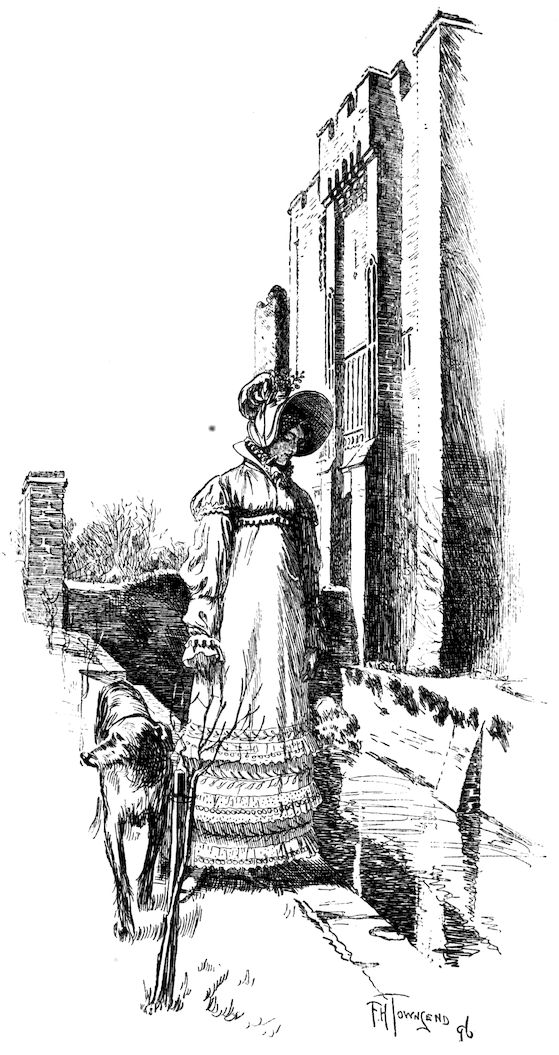
Anthelia Melincourt, at the age of twenty-one, was
mistress of herself and of ten thousand a year, and of a very
ancient and venerable castle in one of the wildest valleys in
Westmoreland. It follows of course, without reference to her
personal qualifications, that she had a very numerous list of
admirers, and equally of course that there were both Irishmen
and clergymen among them. The young lady nevertheless
possessed sufficient attractions to kindle the flames of disinterested
passion; and accordingly we shall venture to suppose
that there was at least one in the number of her sighing swains
with whom her rent-roll and her old castle were secondary
considerations; and if the candid reader should esteem this
supposition too violent for the probabilities of daily experience
in this calculating age, he will at least concede it to that degree
of poetical licence which is invariably accorded to a tale
founded on facts.
Melincourt Castle had been a place of considerable strength
in those golden days of feudal and royal prerogative, when no
man was safe in his own house unless he adopted every
possible precaution for shutting out all his neighbours. It is,
therefore, not surprising, that a rock, of which three sides were
perpendicular, and which was only accessible on the fourth by
a narrow ledge, forming a natural bridge over a tremendous
chasm, was considered a very enviable situation for a gentleman
to build on. An impetuous torrent boiled through the
depth of the chasm, and after eddying round the base of the
castle-rock, which it almost insulated, disappeared in the
obscurity of a woody glen, whose mysterious recesses, by
popular superstition formerly consecrated to the devil, are now
6fearlessly explored by the solitary angler, or laid open to view
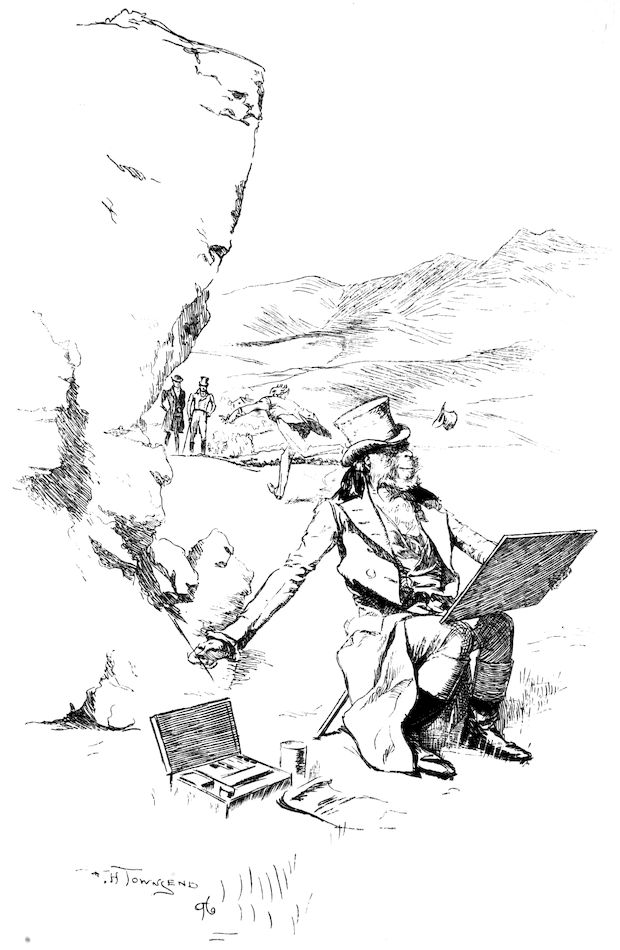
by the more profane hand of the picturesque tourist, who contrives,
by the magic of his pencil, to transport their romantic
terrors from the depths of mountain solitude to the gay and
crowded, though not very wholesome, atmosphere of a metropolitan
exhibition.
The narrow ledge, which formed the only natural access to
the castle-rock, had been guarded by every impediment which
the genius of fortification could oppose to the progress of the
hungry Scot, who might be disposed, in his neighbourly way,
to drop in without invitation and carouse at the expense of the
owner, rewarding him, as usual, for his extorted hospitality, by
cutting his throat and setting fire to his house. A drawbridge
over the chasm, backed by a double portcullis, presented the
only mode of admission. In this secure retreat thus strongly
guarded both by nature and art, and always plentifully victualled
for a siege, lived the lords of Melincourt in all the luxury
of rural seclusion, throwing open their gates on occasional
halcyon days to regale all the peasants and mountaineers of
the vicinity with roasted oxen and vats of October.
When these times of danger and turbulence had passed,
Melincourt Castle was not, as most of its brother edifices
were, utterly deserted. The drawbridge, indeed, became
gradually divorced from its chains; the double portcullis
disappeared; the turrets and battlements were abandoned to
the owl and the ivy; and a very spacious wing was left free
to the settlement of a colony of ghosts, which, according to the
report of the peasantry and the domestics, very soon took
possession, and retained it most pertinaciously, notwithstanding
the pious incantations of the neighbouring vicar, the Reverend
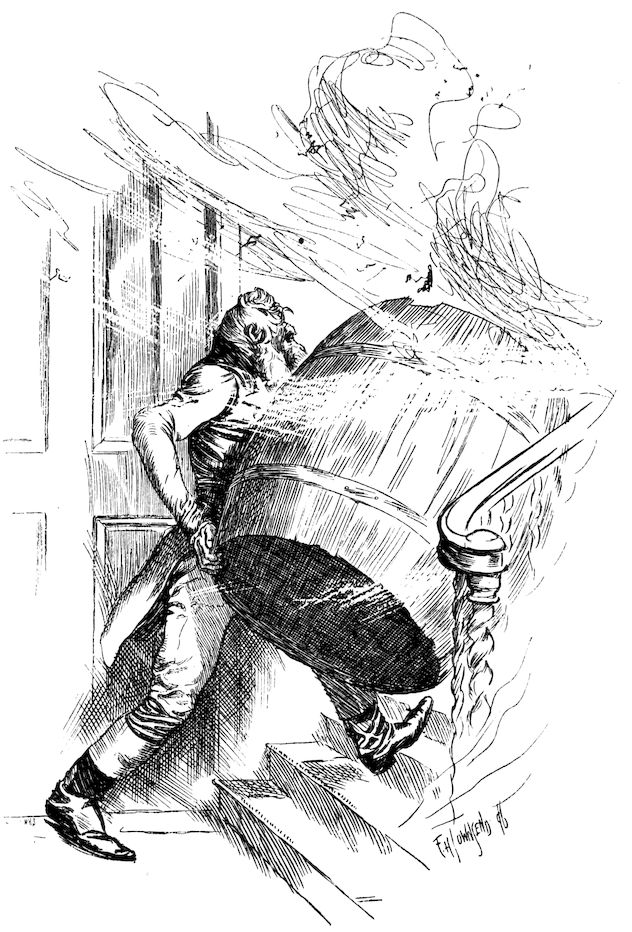
Mr. Portpipe, who often passed the night in one of the dreaded
apartments over a blazing fire with the same invariable exorcising
apparatus of a large venison pasty, a little Prayer-book,
and three bottles of Madeira: for the reverend gentleman
sagaciously observed, that as he had always found the latter
an infallible charm against blue devils, he had no doubt of its
proving equally efficacious against black, white, and gray.
In this opinion experience seemed to confirm him; for though
he always maintained a becoming silence as to the mysteries
of which he was a witness during his spectral vigils, yet a very
correct inference might be drawn from the fact that he was
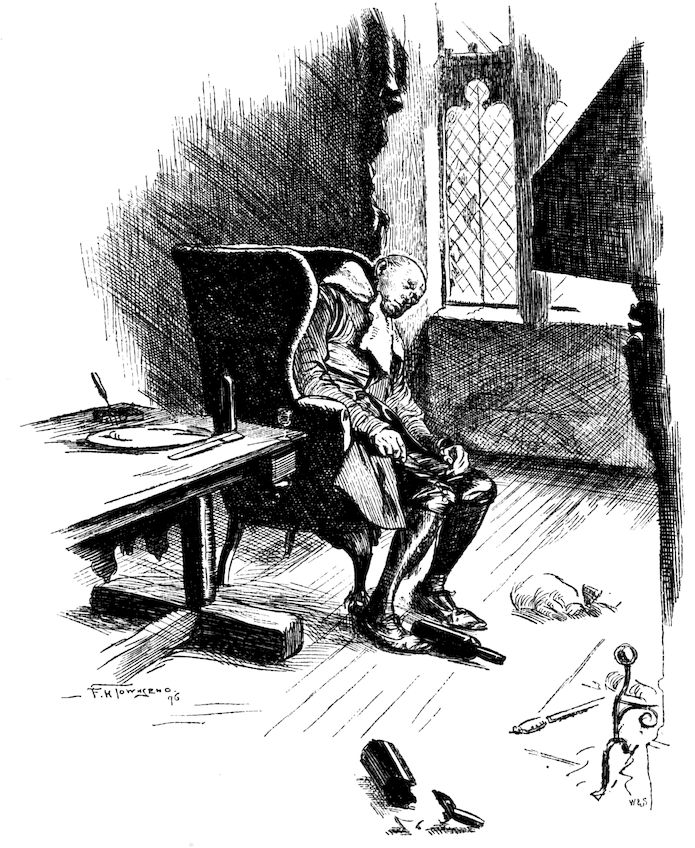
9always found in the morning comfortably asleep in his large
arm-chair, with the dish scraped clean, the three bottles empty,
and the Prayer-book clasped and folded precisely in the same
state and place in which it had lain the preceding night.
He was always found in the morning comfortably asleep.
But the larger and more commodious part of the castle
continued still to be inhabited; and while one half of the
edifice was fast improving into a picturesque ruin, the other
was as rapidly degenerating, in its interior at least, into a
comfortable modern dwelling.
In this romantic seclusion Anthelia was born. Her mother
died in giving her birth. Her father, Sir Henry Melincourt,
a man of great acquirements, and of a retired disposition,
devoted himself in solitude to the cultivation of his daughter’s
understanding; for he was one of those who maintained the
heretical notion that women are, or at least may be, rational
beings; though, from the great pains usually taken in what is
called education to make them otherwise, there are unfortunately
very few examples to warrant the truth of the theory.
The majestic forms and wild energies of Nature that
surrounded her from her infancy impressed their character on
her mind, communicating to it all their own wildness, and
more than their own beauty. Far removed from the pageantry
of courts and cities, her infant attention was awakened to
spectacles more interesting and more impressive: the misty
mountain-top, the ash-fringed precipice, the gleaming cataract,
the deep and shadowy glen, and the fantastic magnificence of
the mountain clouds. The murmur of the woods, the rush of
the winds, and the tumultuous dashing of the torrents, were
the first music of her childhood. A fearless wanderer among
these romantic solitudes, the spirit of mountain liberty diffused
itself through the whole tenor of her feelings, modelled the
symmetry of her form, and illumined the expressive but
feminine brilliancy of her features: and when she had attained
the age at which the mind expands itself to the fascinations of
poetry, the muses of Italy became the chosen companions of
her wanderings, and nourished a naturally susceptible imagination
by conjuring up the splendid visions of chivalry and
enchantment in scenes so congenial to their development.
It was seldom that the presence of a visitor dispelled the
solitude of Melincourt; and the few specimens of the living
world with whom its inmates held occasional intercourse were
10of the usual character of country acquaintance, not calculated
to leave behind them any very lively regret, except for the loss
of time during the period of their stay. One of these was the
Reverend Mr. Portpipe, whom we have already celebrated for
his proficiency in the art of exorcising goblins by dint of
venison and Madeira. His business in the ghost line had,
indeed, declined with the progress of the human understanding,
and no part of his vocation was in very high favour with Sir
Henry, who, though an unexceptionable moral character, was
unhappily not one of the children of grace, in the theological
sense of the word: but the vicar, adopting St. Paul’s precept
of being all things to all men, found it on this occasion his
interest to be liberal; and observing that no man could coerce
his opinions, repeated with great complacency the line of
Virgil:
Tros Tyriusve mihi nullo discrimine agetur;
though he took especial care that his heterodox concession
should not reach the ears of his bishop, who would infallibly
have unfrocked him for promulgating a doctrine so subversive
of the main pillar of all orthodox establishments.
When Anthelia had attained her sixteenth year, her father
deemed it necessary to introduce her to that human world of
which she had hitherto seen so little, and for this purpose took
a journey to London, where he was received by the surviving
portion of his old acquaintance as a ghost returned from
Acheron. The impression which the gay scenes of the
metropolis made on the mind of Anthelia—to what illustrious
characters she was introduced—‘and all she thought of all
she saw,’—it would be foreign to our present purpose to detail;
suffice it to say, that from this period Sir Henry regularly
passed the winter in London and the summer in Westmoreland,
till his daughter attained the age of twenty, about which period
he died.
Anthelia passed twelve months from this time in total
seclusion at Melincourt, notwithstanding many pressing invitations
from various match-making dowagers in London, who
were solicitous to dispose of her according to their views of her
advantage; in which how far their own was lost sight of it
may not be difficult to determine.
A journey to London.
Among the numerous lovers who had hitherto sighed at her
13shrine, not one had succeeded in making the slightest impression
on her heart; and during the twelve months of seclusion
which elapsed from the death of her father to the commencement
of this authentic history, they had all completely vanished
from the tablet of her memory. Her knowledge of love was
altogether theoretical; and her theory, being formed by the
study of Italian poetry in the bosom of mountain solitude,
naturally and necessarily pointed to a visionary model of
excellence which it was very little likely the modern world
could realise.
The dowagers, at length despairing of drawing her from her
retirement, respectively came to various resolutions for the
accomplishment of their ends; some resolving to go in person
to Melincourt, and exert all their powers of oratory to mould
her to their wishes, and others instigating their several protégés
to set boldly forward in search of fortune, and lay siege to the
castle and its mistress together.
CHAPTER II FASHIONABLE ARRIVALS
14
It was late in the afternoon of an autumnal day, when the
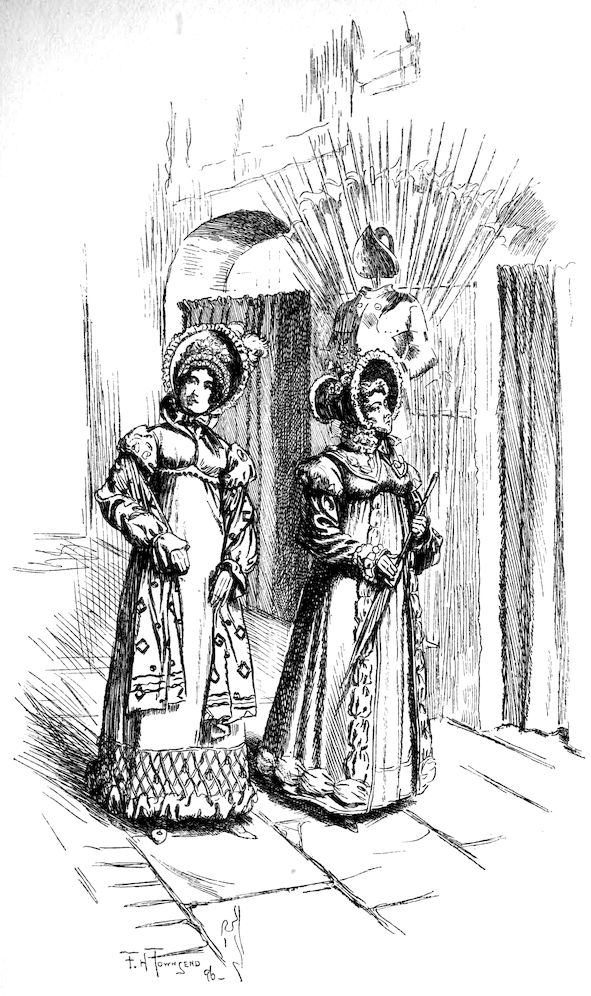
elegant post-chariot of the Honourable Mrs. Pinmoney, a lady
of high renown in the annals of match-making, turned the
corner of a stupendous precipice in the narrow pass which
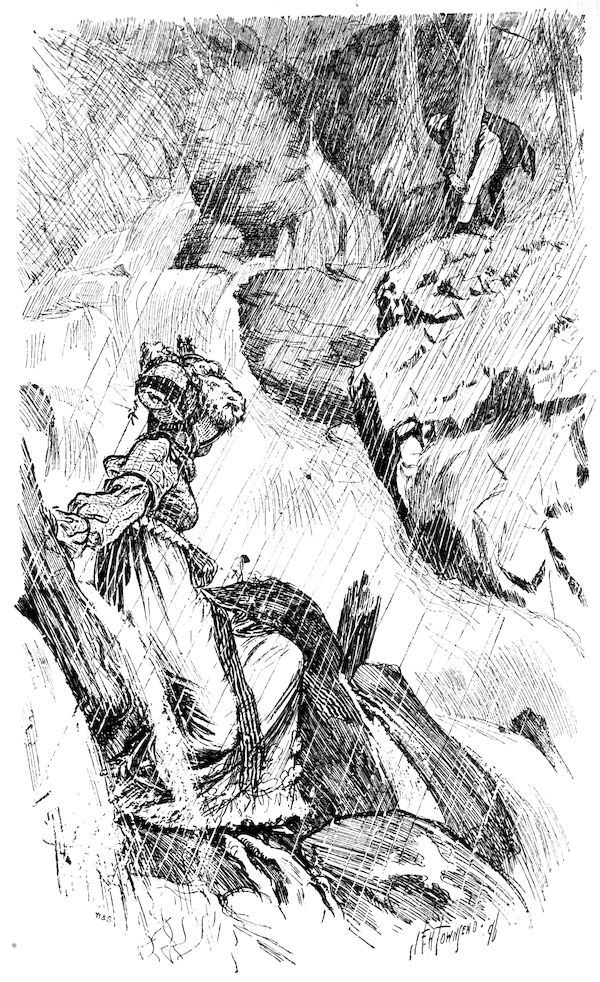
formed the only access to the valley of Melincourt. This
honourable lady was accompanied by her only daughter Miss
Danaretta Contantina; which names, by the bye, appear to be
female diminutives of the Italian words danaro contante,
signifying ready money, and genteelly hinting to all fashionable
Strephons, the only terms on which the commodity so
denominated would be disposed of, according to the universal
practice of this liberal and enlightened generation, in that most
commercial of all bargains, marriage.
Fashionable arrivals.
The ivied battlements and frowning towers of Melincourt
Castle, as they burst at once upon the sight, very much
astonished the elder and delighted the younger lady; for the
latter had cultivated a great deal of theoretical romance—in
taste, not in feeling—an important distinction—which enabled
her to be most liberally sentimental in words, without at all
influencing her actions; to talk of heroic affection and selfsacrificing
enthusiasm, without incurring the least danger of
forming a disinterested attachment, or of erring in any way
whatever on the score of practical generosity. Indeed, in all
respects of practice the young lady was the true counterpart of
her mother, though they sometimes differed a little in the forms
of sentiment: thus, for instance, when any of their dear
friends happened to go, as it is called, down hill in the world,
the old lady was generally very severe on their imprudence,
and the young lady very pathetic on their misfortune: but as
17to holding any further intercourse with, or rendering any
species of assistance to, any dear friend so circumstanced,
neither the one nor the other was ever suspected of conduct so
very unfashionable. In the main point, therefore, of both their
lives, that of making a good match for Miss Danaretta, their
views perfectly coincided; and though Miss Danaretta, in her
speculative conversations on this subject, among her female
acquaintance, talked as young ladies always talk, and laid down
very precisely the only kind of man she would ever think of
marrying, endowing him, of course, with all the virtues in our
good friend Hookman’s Library; yet it was very well understood,
as it usually is on similar occasions, that no other proof
of the possession of the aforesaid virtues would be required
from any individual who might present himself in the character
of Corydon sospiroso than a satisfactory certificate from the
old lady in Threadneedle Street, that the bearer was a good
man, and could be proved so in the Alley.
Such were the amiable specimens of worldly wisdom, and
affected romance, that prepared to invade the retirement of the
mountain-enthusiast, the really romantic unworldly Anthelia.
‘What a strange-looking old place!’ said Mrs. Pinmoney;
‘it seems like anything but the dwelling of a young heiress.
I am afraid the rascally postboys have joined in a plot against
us, and intend to deliver us to a gang of thieves!’
‘Banditti, you should say, mamma,’ said Miss Danaretta;
‘thieves is an odious word.’
‘Pooh, child!’ said Mrs. Pinmoney. ‘The reality is
odious enough, let the word be what it will. Is not a rogue
a rogue, call him by what name you may?’
‘Oh, certainly not,’ said Miss Danaretta; ‘for in that case
a poor rogue without a title, would not be more a rogue than a
rich rogue with one; but that he is so in a most infinite
proportion, the whole experience of the world demonstrates.’
‘True,’ said the old lady; ‘and as our reverend friend Dr.
Bosky observes, to maintain the contrary would be to sanction
a principle utterly subversive of all social order and aristocratical
privilege.’
The carriage now rolled over the narrow ledge which
connected the site of the castle with the neighbouring rocks.
A furious peal at the outer bell brought forth a venerable
porter, who opened the gates with becoming gravity, and the
18carriage entered a spacious court, of much more recent
architecture than the exterior of the castle, and built in a style
of modern Gothic, that seemed to form a happy medium
between the days of feudality, commonly called the dark ages,
and the nineteenth century, commonly called the enlightened
age: why I could never discover.
The inner gates were opened by another grave and
venerable domestic, who, with all the imperturbable decorum
and formality of the old school, assisted the ladies to alight, and
ushered them along an elegant colonnade into the library, which
we shall describe no further than by saying that the apartment
was Gothic, and the furniture Grecian: whether this be an
unpardonable incongruity calculated to disarrange all legitimate
associations, or a judicious combination of solemnity and
elegance, most happily adapted to the purposes of study, we
must leave to the decision, or rather discussion, of picturesque
and antiquarian disputants.
The windows, which were of stained glass, were partly open
to a shrubbery, which admitting the meditative mind into the
recesses of nature, and excluding all view of distant scenes,
heightened the deep seclusion and repose of the apartment. It
consisted principally of evergreens; but the parting beauty of
the last flowers of autumn, and the lighter and now fading tints
of a few deciduous shrubs, mingled with the imperishable
verdure of the cedar and the laurel.
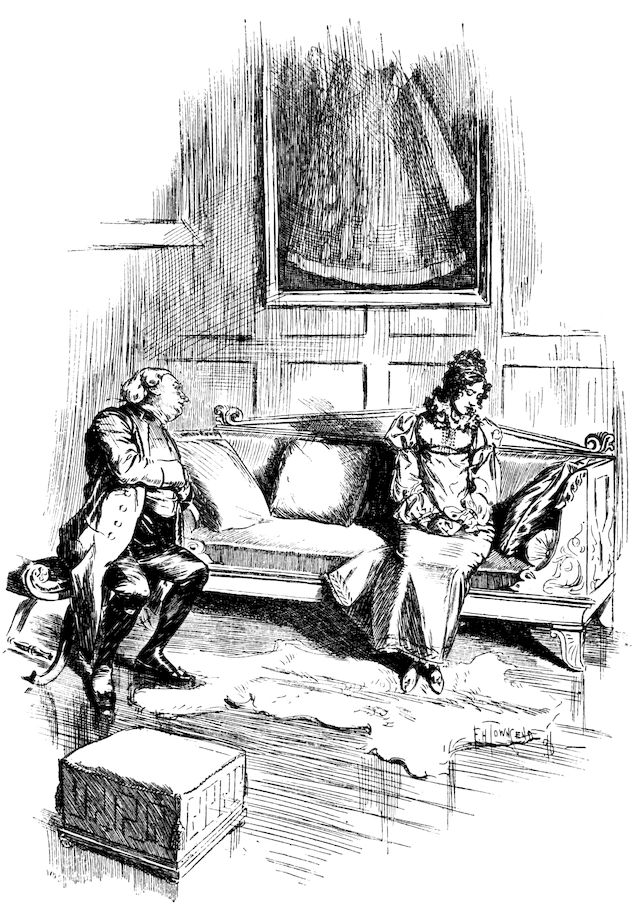
The old domestic went in search of his young mistress, and
the ladies threw themselves on a sofa in graceful attitudes.
They were shortly joined by Anthelia, who welcomed them to
Melincourt with all the politeness which the necessity of the
case imposed.
The change of dress, the dinner, the dessert, seasoned
with the newest news of the fashionable world, which the
visitors thought must be of all things the most delightful to the
mountain recluse, filled up a portion of the evening. When
they returned from the dining-room to the library, the windows
were closed, the curtains drawn, and the tea and coffee urns
bubbling on the table, and sending up their steamy columns:
an old fashion to be sure, and sufficiently rustic, for which we
apologise in due form to the reader, who prefers his tea and
coffee brought in cool by the butler in little cups on a silver
salver, and handed round to the simpering company till it is as
19cold as an Iceland spring. There is no disputing about taste,
and the taste of Melincourt Castle on this subject had been
always very poetically unfashionable; for the tea would have
satisfied Johnson, and the coffee enchanted Voltaire.
‘I must confess, my dear,’ said the Honourable Mrs.
Pinmoney, ‘there is a great deal of comfort in your way of
living, that is, there would be, in good company; but you are
so solitary——’
‘Here is the best of company,’ said Anthelia, smiling, and
pointing to the shelves of the library.
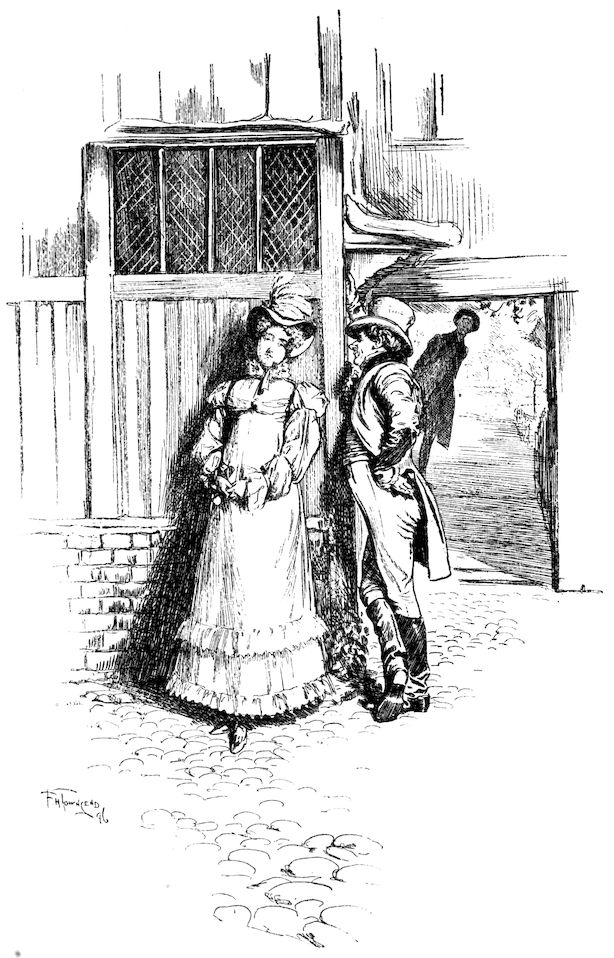
The Hon. Mrs. Pinmoney. Very true: books are very
good things in their way; but an hour or two at most is quite
enough of them for me; more can serve no purpose but to
muddle one’s head. If I were to live such a life for a week as
you have done for the last twelve months, I should have more
company than I like, in the shape of a whole legion of blue
devils.
Miss Danaretta. Nay, I think there is something delightfully
romantic in Anthelia’s mode of life; but I confess I should
like now and then, peeping through the ivy of the battlements,
to observe a preux chevalier exerting all his eloquence to
persuade the inflexible porter to open the castle gates, and
allow him one opportunity of throwing himself at the feet of
the divine lady of the castle, for whom he had been seven
years dying a lingering death.
The Hon. Mrs. Pinmoney. And growing fatter all the
while. Heaven defend me from such hypocritical fops!
Seven years indeed! It did not take as many weeks to bring
me and poor dear dead Mr. Pinmoney together.
Anthelia. I should have been afraid that so short an
acquaintance would scarcely have been sufficient to acquire
that mutual knowledge of each other’s tastes, feelings, and
character, which I should think the only sure basis of matrimonial
happiness.
The Hon. Mrs. Pinmoney. Tastes, feelings, and character!
Why, my love, you really do seem to believe yourself in the
age of chivalry, when those words certainly signified very
essential differences. But now the matter is, very happily,
simplified. Tastes,—they depend on the fashion. There is
always a fashionable taste: a taste for driving the mail—a
taste for acting Hamlet—a taste for philosophical lectures—a
20taste for the marvellous—a taste for the simple—a taste for
the brilliant—a taste for the sombre—a taste for the tender—a
taste for the grim—a taste for banditti—a taste for ghosts—a
taste for the devil—a taste for French dancers and Italian
singers, and German whiskers and tragedies—a taste for enjoying
the country in November, and wintering in London till the
end of the dog-days—a taste for making shoes—a taste for
picturesque tours—a taste for taste itself, or for essays on
taste;—but no gentleman would be so rash as have a taste of
his own, or his last winter’s taste, or any taste, my love, but
the fashionable taste. Poor dear Mr. Pinmoney was reckoned
a man of exquisite taste among all his acquaintance; for the
new taste, let it be what it would, always fitted him as well as
his new coat, and he was the very pink and mirror of fashion,
as much in the one as the other.—So much for tastes, my dear.
Anthelia. I am afraid I shall always be a very unfashionable
creature; for I do not think I should have sympathised
with any one of the tastes you have just enumerated.
The Hon. Mrs. Pinmoney. You are so contumacious, such
a romantic heretic from the orthodox supremacy of fashion.
Now, as for feelings, my dear, you know there are no such
things in the fashionable world; therefore that difficulty vanishes
even more easily than the first.
Anthelia. I am sorry for it.
The Hon. Mrs. Pinmoney. Sorry! Feelings are very
troublesome things, and always stand in the way of a person’s
own interests. Then, as to character, a gentleman’s character
is usually in the keeping of his banker, or his agent, or his
steward, or his solicitor; and if they can certify and demonstrate
that he has the means of keeping a handsome equipage,
and a town and country house, and of giving routs and dinners,
and of making a good settlement on the happy object of his
choice—what more of any gentleman’s character would you
desire to know?
Anthelia. A great deal more. I would require him to be
free in all his thoughts, true in all his words, generous in all
his actions—ardent in friendship, enthusiastic in love, disinterested
in both—prompt in the conception, and constant in
the execution, of benevolent enterprise—the friend of the
friendless, the champion of the feeble, the firm opponent of the
powerful oppressor—not to be enervated by luxury, nor corrupted
21by avarice, nor intimidated by tyranny, nor enthralled by
superstition—more desirous to distribute wealth than to possess
it, to disseminate liberty than to appropriate power, to cheer
the heart of sorrow than to dazzle the eyes of folly.
The Hon. Mrs. Pinmoney. And do you really expect to
find such a knight-errant? The age of chivalry is gone.
Anthelia. It is, but its spirit survives. Disinterested benevolence,
the mainspring of all that is really admirable in the
days of chivalry, will never perish for want of some minds
calculated to feel its influence, still less for want of a proper
field of exertion. To protect the feeble, to raise the fallen—to
liberate the captive—to be the persevering foe of tyrants
(whether the great tyrant of an overwhelming empire, the petty
tyrant of the fields, or the ‘little tyrant of a little corporation,’)[4]
it is not necessary to wind the bugle before enchanted castles,
or to seek adventures in the depths of mountain caverns and
forests of pine; there is no scene of human life but presents
sufficient scope to energetic generosity; the field of action,
though less splendid in its accompaniments, is not less useful
in its results, nor less attractive to a liberal spirit: and I
believe it is possible to find as true a knight-errant in a brown
coat in the nineteenth century, as in a suit of golden armour
in the days of Charlemagne.
The Hon. Mrs. Pinmoney. Well! well! my dear, when
you have seen a little more of the world, you will get rid of
some of your chivalrous whimsies; and I think you will then
agree with me that there is not, in the whole sphere of fashion,
a more elegant, fine-spirited, dashing, generous fellow than my
nephew Sir Telegraph Paxarett, who, by the bye, will be driving
his barouche this way shortly, and if you do not absolutely
forbid it, will call on me in his route.
These words seemed to portend that the Honourable Mrs.
Pinmoney’s visit would be a visitation, and at the same time
threw a clear light on its motive; but they gave birth in the
mind of Anthelia to a train of ideas which concluded in a
somewhat singular determination.
CHAPTER III HYPOCON HOUSE
22
Anthelia had received intimations from various quarters of
similar intentions on the part of various individuals, not less
valuable than Sir Telegraph Paxarett in the scale of moral
utility; and though there was not one among them for whom
she felt the slightest interest, she thought it would be too
uncourteous in a pupil of chivalry, and too inhospitable in the
mistress of an old English castle, to bar her gates against
them. At the same time she felt the want of a lord seneschal
to receive and entertain visitors so little congenial to her habits
and inclinations: and it immediately occurred to her that no
one would be more fit for this honourable office, if he could be
prevailed on to undertake it, than an old relation—a medium,
as it were, between cousin and great-uncle; who had occasionally
passed a week or a month with her father at Melincourt.
The name of this old gentleman was Hippy—Humphrey
Hippy, Esquire, of Hypocon House, in the county of Durham.
He was a bachelor, and his character exhibited a singular
compound of kind-heartedness, spleen, and melancholy, which
governed him by turns, and sometimes in such rapid succession
that they seemed almost co-existent. To him Anthelia determined
on sending an express, with a letter entreating him to
take on himself, for a short time, the superintendence of
Melincourt Castle, and giving as briefly as possible her reasons
for the request. In pursuance of this determination, old Peter
Gray, a favourite domestic of Sir Henry, and, I believe, a
distant relation of little Lucy,[5] was despatched the following
morning to Hypocon House, where the gate was opened to
him by old Harry Fell, a distant relation of little Alice, who,
25as the reader well knows, ‘belonged to Durham.’ Old Harry
had become, by long habit, a curious species of animated
mirror, and reflected all the humours of his master with
wonderful nicety. When Mr. Hippy was in a rage, old Harry
looked fierce; when Mr. Hippy was in a good humour, old
Harry was the picture of human kindness; when Mr. Hippy
was blue-devilled, old Harry was vapourish; when Mr. Hippy
was as melancholy as a gib-cat, old Harry was as dismal as a
screech-owl. The latter happened to be the case when old
Peter presented himself at the gate, and old Harry accordingly
opened it with a most rueful elongation of visage. Peter Gray
was ready with a warm salutation for his old acquaintance
Harry Fell; but the lamentable cast of expression in the
physiognomy of the latter froze it on his lips, and he contented
himself with asking in a hesitating tone, ‘Is Mr. Hippy at
home?’
Old Harry had become, by long habit, a curious species of animated mirror.
‘He is,’ slowly and sadly articulated Harry Fell, shaking
his head.
‘I have a letter for him,’ said Peter Gray.
‘Ah!’ said Harry Fell, taking the letter, and stalking off
with it as solemnly as if he had been following a funeral.
‘A pleasant reception,’ thought Peter Gray, ‘instead of the
old ale and cold sirloin I dreamed of.’
Old Harry tapped three times at the door of his master’s
chamber, observing the same interval between each tap as is
usual between the sounds of a muffled drum: then, after a due
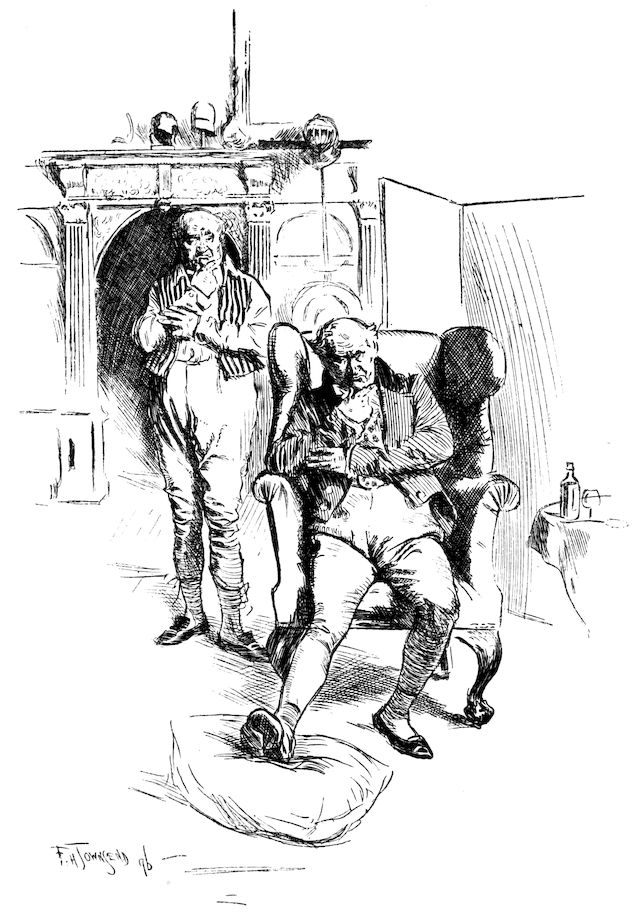
pause, he entered the apartment. Mr. Hippy was in his
night-gown and slippers, with one leg on a cushion, suffering
under an imaginary attack of the gout, and in the last stage of
despondency. Old Harry walked forward in the same slow
pace till he found himself at the proper distance from his
master’s chair. Then putting forth his hand as deliberately as
if it had been the hour-hand of the kitchen clock, he presented
the letter. Mr. Hippy took it in the same manner, sank back
in his chair as if exhausted with the effort, and cast his eyes
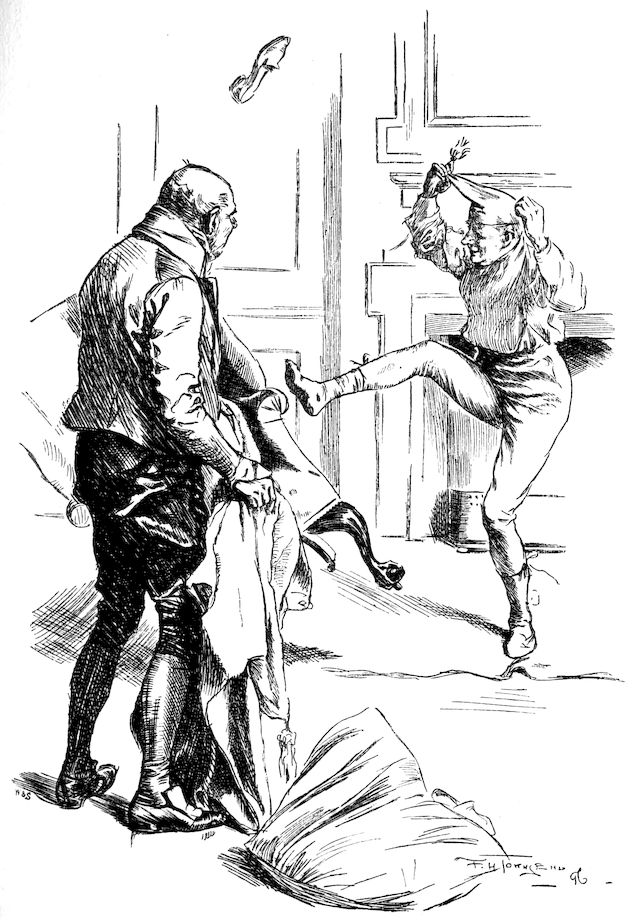
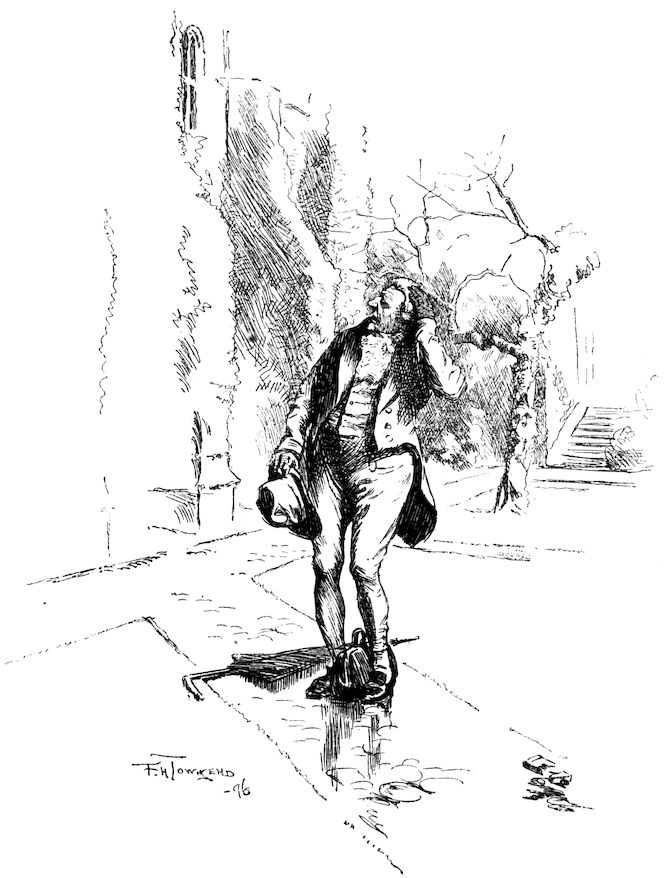
languidly on the seal. Immediately his eyes brightened, he
tore open the letter, read it in an instant, sprang up, flung his
night-gown one way, his night-cap another, kicked off his
slippers, kicked away his cushion, kicked over his chair, and
bounced downstairs, roaring for his coat and boots, and his
travelling chariot, with old Harry capering at his heels, and
26re-echoing all his requisitions. Harry Fell was now a new man.
Peter Gray was seized by the hand and dragged into the
buttery, where a cold goose and a flagon of ale were placed
before him, to which he immediately proceeded to do ample
justice; while old Harry rushed off with a cold fowl and ham
for the refection of Mr. Hippy, who had been too seriously indisposed
in the morning to touch a morsel of breakfast.
Having placed these and a bottle of Madeira in due form and
order before his master, he flew back to the buttery, to assist
old Peter in the demolition of the goose and ale, his own
appetite in the morning having sympathised with his master’s,
and being now equally disposed to make up for lost time.
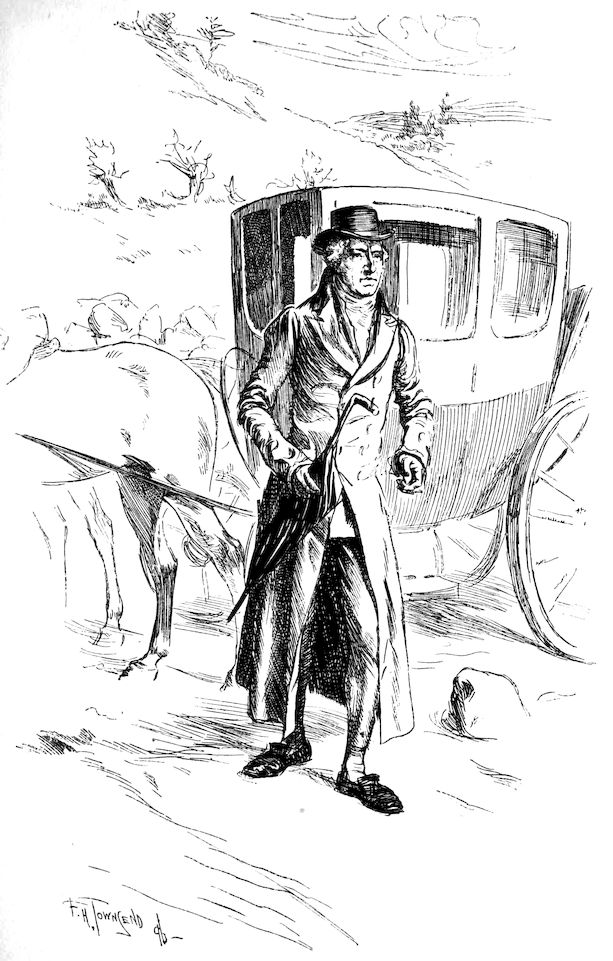
Mr. Hippy’s travelling chariot was rattled up to the door by
four high-mettled posters from the nearest inn. Mr. Hippy
sprang into the carriage, old Harry vaulted into the dicky, the
postilions cracked their whips, and away they went,
Over the hills and the plains,
Over the rivers and rocks,
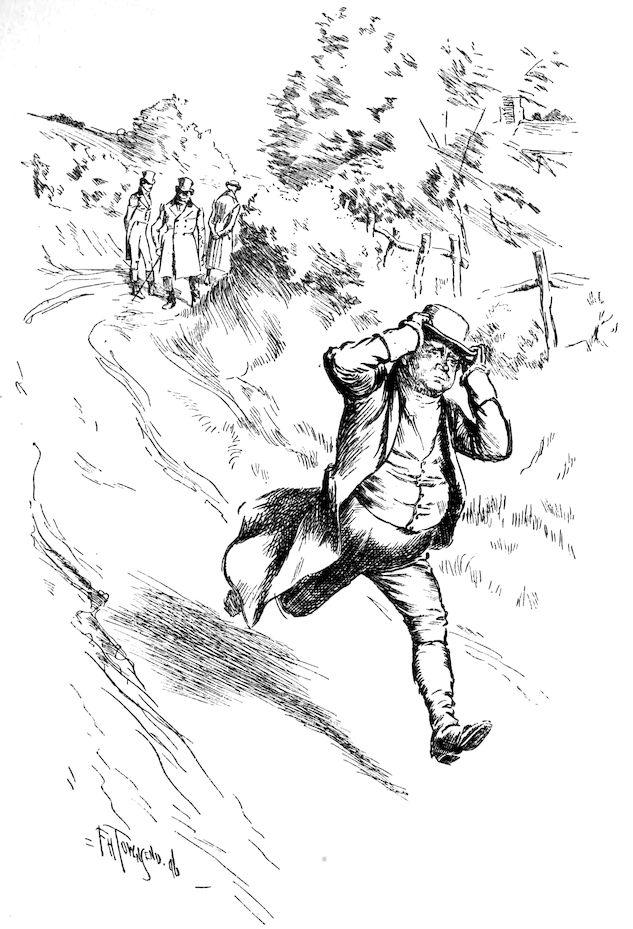
leaving old Peter gaping after them at the gate, in profound
astonishment at their sudden metamorphosis, and in utter
despair of being able, by any exertions of his own, to be their
forerunner and announcer at Melincourt. Considering, therefore,
that when the necessity of being too late is inevitable,
hurry is manifestly superfluous, he mounted his galloway with
great gravity and deliberation, and trotted slowly off towards
the mountains, philosophising all the way in the usual poetical
style of a Cumberland peasant. Our readers will of course
feel much obliged to us for not presenting them with his
meditations. But instead of jogging back with old Peter Gray,
or travelling post with Humphrey Hippy, Esquire, we shall
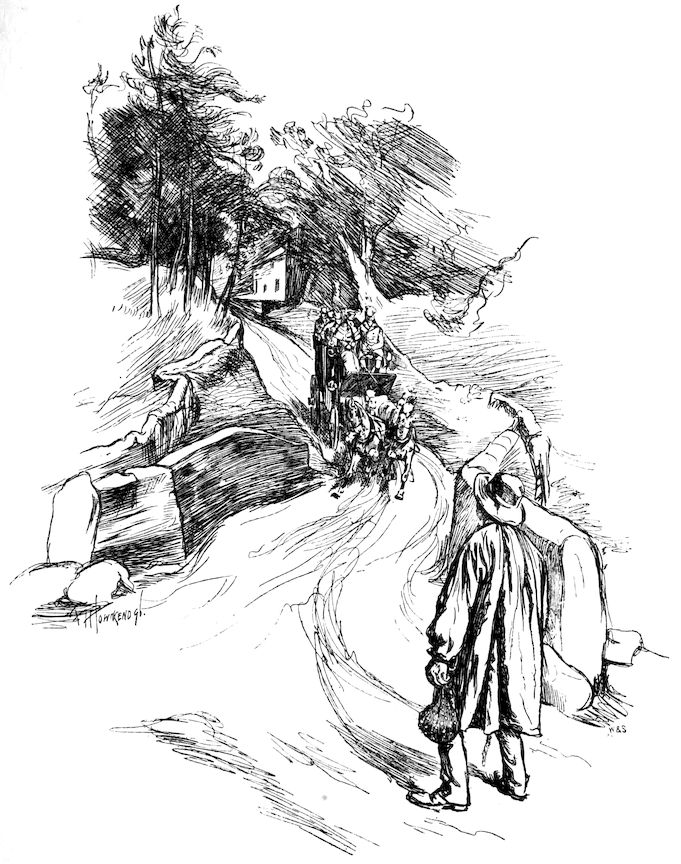
avail ourselves of the four-in-hand barouche which is just coming
in view, to take a seat on the box by the side of Sir Telegraph
Paxarett, and proceed in his company to Melincourt.
27
Sprang up, flung his night-gown one way, his night-cap another.
CHAPTER IV REDROSE ABBEY
29
Sir Telegraph Paxarett had entered the precincts of the
mountains of Westmoreland, and was bowling his barouche
along a romantic valley, looking out very anxiously for an inn,
as he had now driven his regular diurnal allowance of miles,
and was becoming very impatient for his equally regular
diurnal allowance of fish, fowl, and Madeira. A wreath of
smoke ascending from a thick tuft of trees at a distance, and
in a straight direction before him, cheered up his spirits, and
induced him to cheer up those of his horses with two or three
of those technical terms of the road, which we presume to
have formed part of the genuine language of the ancient
Houyhnhnms, since they seem not only much better adapted
to equine than human organs of sound, but are certainly much
more generally intelligible to four-footed than to two-footed
animals. Sir Telegraph was doomed to a temporary disappointment;
for when he had attained the desired point, the
smoke proved to issue from the chimneys of an ancient abbey
which appeared to have been recently converted from a pile of
ruins into the habitation of some variety of the human species,
with very singular veneration for the relics of antiquity, which,
in their exterior aspect, had suffered little from the alteration.
There was something so analogous between the state of this
building and what he had heard of Melincourt, that if it had
not been impossible to mistake an abbey for a castle, he might
almost have fancied himself arrived at the dwelling of the
divine Anthelia. Under a detached piece of ruins near the
road, which appeared to have been part of a chapel, several
workmen were busily breaking the ground with spade and
pickaxe: a gentleman was superintending their operations, and
30seemed very eager to arrive at the object of his search. Sir
Telegraph stopped his barouche to inquire the distance to the
nearest inn: the gentleman replied, ‘Six miles.’ ‘That is
just five miles and a half too far,’ said Sir Telegraph, and was
proceeding to drive on, when, on turning round to make his
parting bow to the stranger, he suddenly recognised him for
an old acquaintance and fellow-collegian.
‘Sylvan Forester!’ exclaimed Sir Telegraph; ‘who should
have dreamed of meeting you in this uncivilised part of the
world?’
‘I am afraid,’ said Mr. Forester, ‘this part of the world
does not deserve the compliment implied in the epithet you
have bestowed on it. Within no very great distance from this
spot are divers towns, villages, and hamlets, in any one of
which, if you have money, you may make pretty sure of being
cheated, and if you have none, quite sure of being starved—strong
evidences of a state of civilisation.’
‘Aha!’ said Sir Telegraph, ‘your old way, now I recollect—always
fond of railing at civilised life, and holding forth in
praise of savages and what you called original men. But
what, in truth, make you in Westmoreland?’
‘I have purchased this old abbey,’ said Mr. Forester
‘(anciently called the abbey of Rednose, which I have altered
to Redrose, as being more analogous to my notions of beauty,
whatever the reverend Fellows of our old college might have
thought of it), and have fitted it up for my habitation, with the
view of carrying on in peace and seclusion some peculiar
experiments on the nature and progress of man. Will you
dine with me, and pass the night here? and I will introduce
you to an original character.’
‘With all my heart,’ said Sir Telegraph; ‘I can assure
you, independently of the pleasure of meeting an old acquaintance,
it is a great comfort to dine in a gentleman’s house, after
living from inn to inn and being poisoned with bad wine for
a month.’
Sir Telegraph descended from his box, and directed one of
his grooms to open the carriage-door and emancipate the
coachman, who was fast asleep inside. Sir Telegraph gave him
the reins, and Mr. Forester sent one of his workmen to show
him the way to the stables.
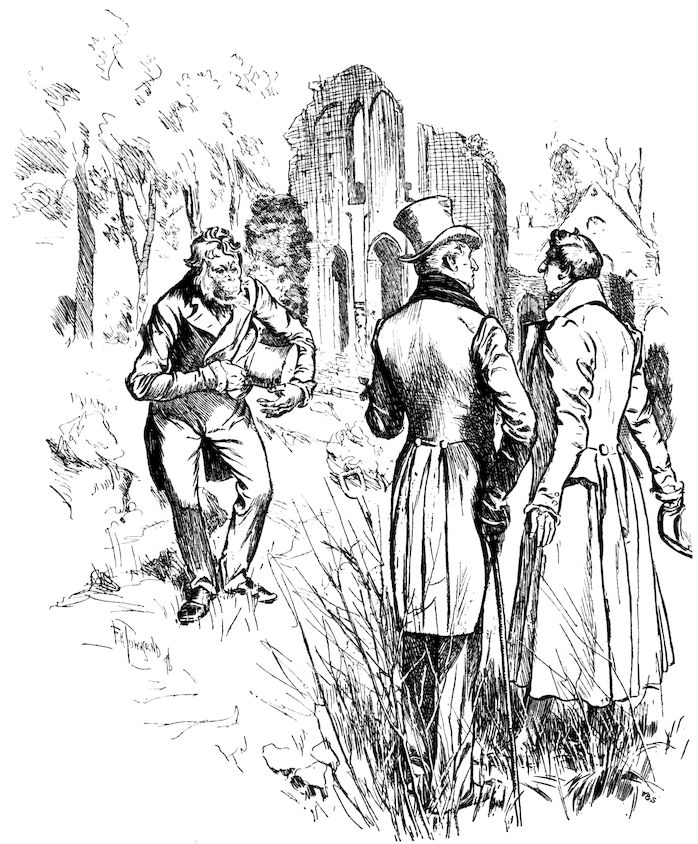
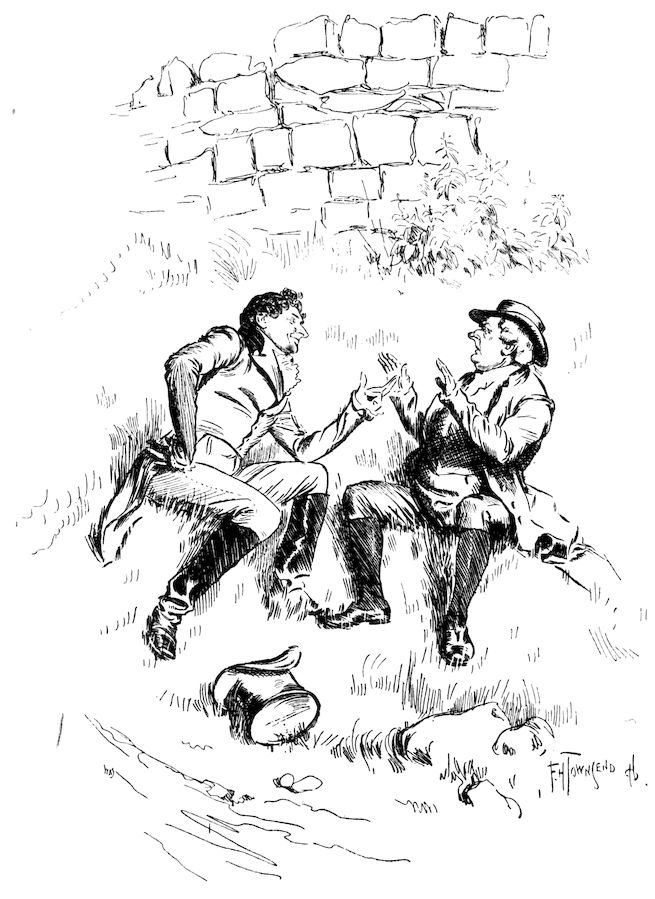
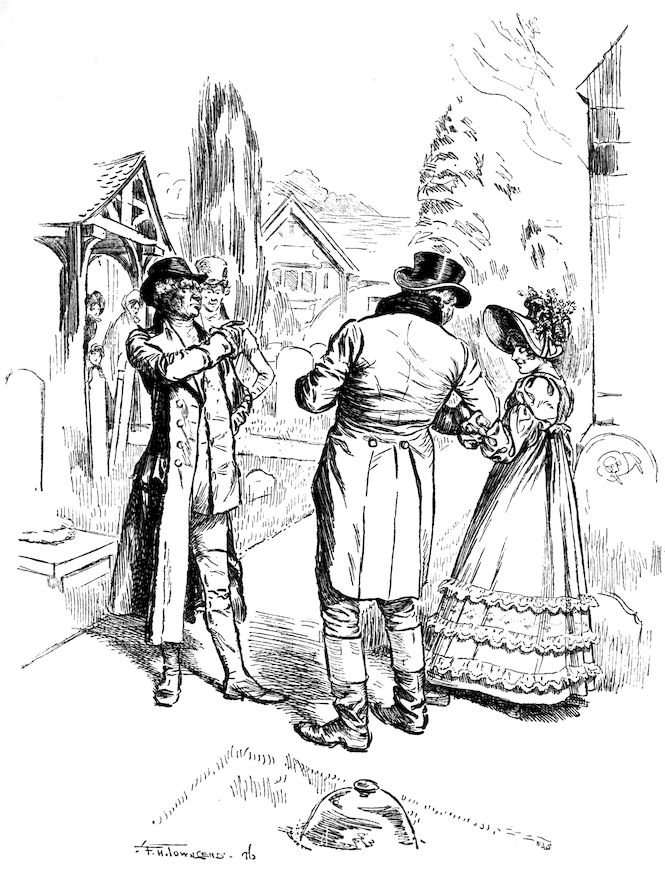
‘Possibly,’ thought Sir Telegraph, ‘possibly I may have seen an uglier fellow.’
‘And pray,’ said Sir Telegraph, as the barouche
33disappeared among the trees, ‘what may be the object of your
researches in this spot?’
‘You know,’ said Mr. Forester, ‘it is a part of my tenets
that the human species is gradually decreasing in size and
strength, and I am digging in the old cemetery for bones and
skulls to establish the truth of my theory.’
‘Have you found any?’ said Sir Telegraph.
‘Many,’ said Mr. Forester. ‘About three weeks ago we
dug up a very fine skeleton, no doubt of some venerable father,
who must have been, in more senses than one, a pillar of the
Church. I have had the skull polished and set in silver.
You shall drink your wine out of it, if you please, to-day.’
‘I thank you,’ said Sir Telegraph, ‘but I am not particular;
a glass will suit me as well as the best skull in Europe.
Besides, I am a moderate man: one bottle of Madeira and
another of claret are enough for me at any time; so that the
quantity of wine a reverend sconce can carry would be just
treble my usual allowance.’
They walked together towards the abbey. Sir Telegraph
earnestly requested, that, before they entered, he might be
favoured with a peep at the stable. Mr. Forester of course
complied. Sir Telegraph found this important part of the
buildings capacious and well adapted to its purpose, but did
not altogether approve its being totally masked by an old ivied
wall, which had served in former times to prevent the braw
and bonny Scot from making too free with the beeves of the
pious fraternity.
The new dwelling-house was so well planned, and fitted in
so well between the ancient walls, that very few vestiges of the
modern architect were discernible; and it was obvious that
the growth of the ivy, and of numerous trailing and twining
plants, would soon overrun all vestiges of the innovation, and
blend the whole exterior into one venerable character of
antiquity.
‘I do not think,’ said Mr. Forester, as they proceeded
through part of the grounds, ‘that the most determined zealot
of the picturesque would quarrel with me here. I found the
woods around the abbey matured by time and neglect into a
fine state of wildness and intricacy, and I think I have left
enough of them to gratify their most ardent admirer.’
‘Quite enough, in all conscience,’ said Sir Telegraph, who
34was in white jean trousers, with very thin silk stockings and
pumps. ‘I do not generally calculate on being, as an old
song I have somewhere heard expresses it,
Forced to scramble,
When I ramble,
Through a copse of furze and bramble;
which would be all very pleasant perhaps, if the fine effect of
picturesque roughness were not unfortunately, as Macbeth says
of his dagger, “sensible to feeling as to sight.” But who is
that gentleman, sitting under the great oak yonder in the
green coat and nankins? He seems very thoughtful.’
‘He is of a contemplative disposition,’ said Mr. Forester:
‘you must not be surprised if he should not speak a word
during the whole time you are here. The politeness of his
manner makes amends for his habitual taciturnity. I will
introduce you.’
The gentleman under the oak had by this time discovered
them, and came forward with great alacrity to meet Mr.
Forester, who cordially shook hands with him, and introduced
him to Sir Telegraph as Sir Oran Haut-ton, Baronet.
Sir Telegraph looked earnestly at the stranger, but was too
polite to laugh, though he could not help thinking there was
something very ludicrous in Sir Oran’s physiognomy, notwithstanding
the air of high fashion which characterised his whole
deportment, and which was heightened by a pair of enormous
whiskers, and the folds of a vast cravat. He therefore bowed
to Sir Oran with becoming gravity, and Sir Oran returned the
bow with very striking politeness.
‘Possibly,’ thought Sir Telegraph, ‘possibly I may have
seen an uglier fellow.’
The trio entered the abbey, and shortly after sat down to
dinner.
Mr. Forester and Sir Oran Haut-ton took the head and
foot of the table. Sir Telegraph sat between them. ‘Some
soup, Sir Telegraph?’ said Mr. Forester. ‘I rather think,’
said Sir Telegraph, ‘I shall trouble Sir Oran for a slice of
fish.’ Sir Oran helped him with great dexterity, and then
performed the same office for himself. ‘I think you will like
this Madeira?’ said Mr. Forester. ‘Capital!’ said Sir
Telegraph: ‘Sir Oran, shall I have the pleasure of taking
37wine with you?’ Sir Oran Haut-ton bowed gracefully to Sir
Telegraph Paxarett, and the glasses were tossed off with the
usual ceremonies. Sir Oran preserved an inflexible silence
during the whole duration of dinner, but showed great proficiency
in the dissection of game.
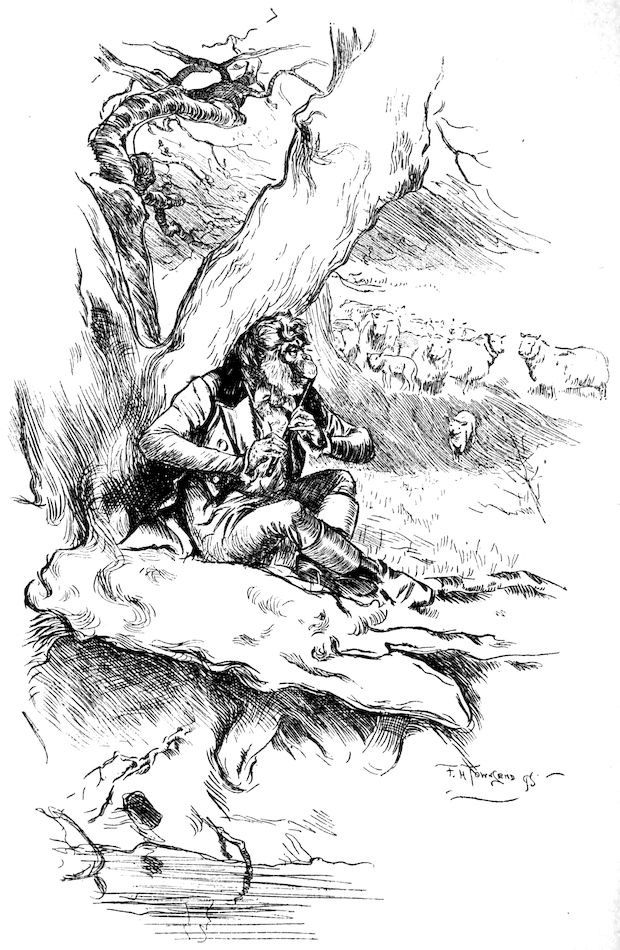
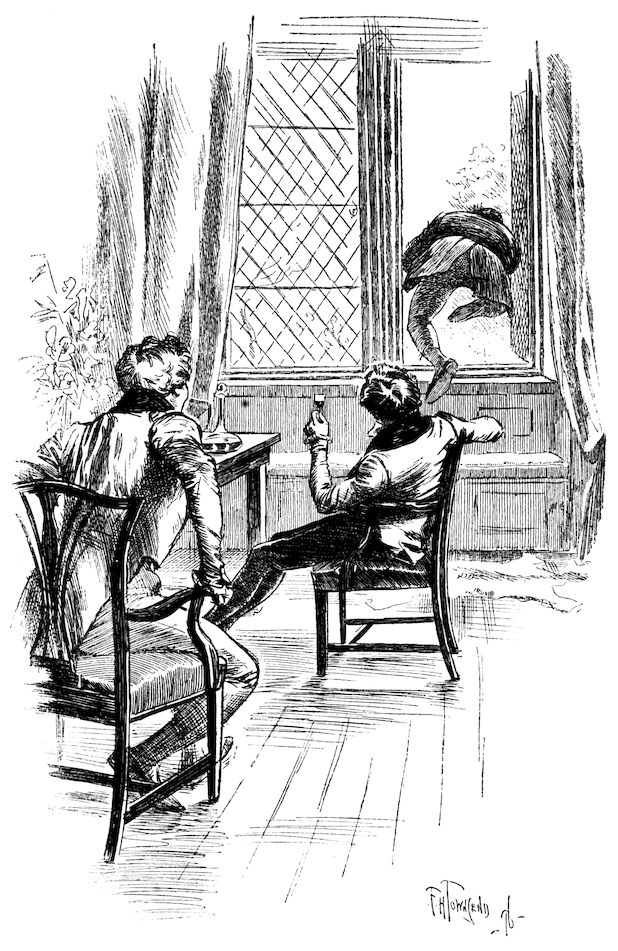
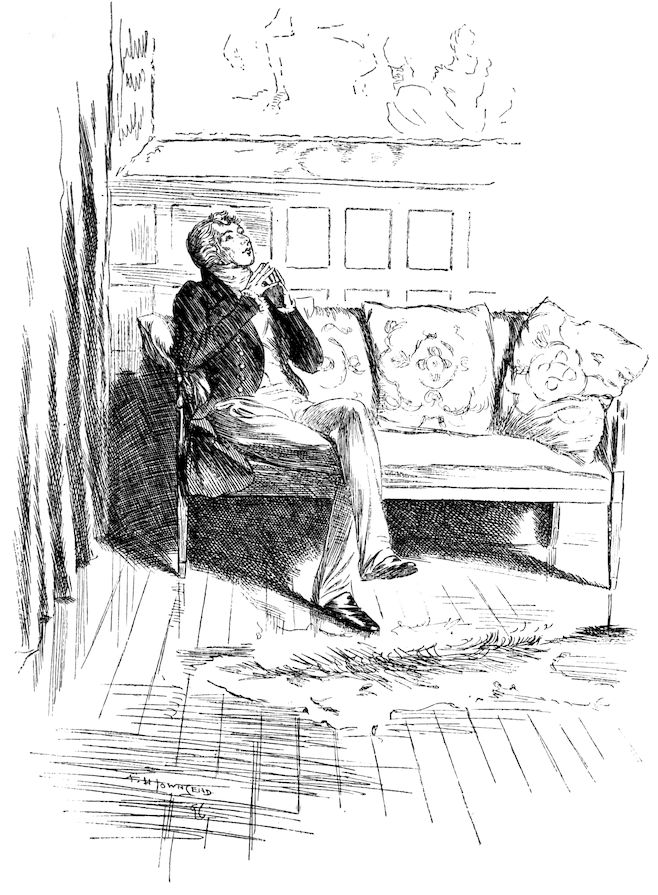
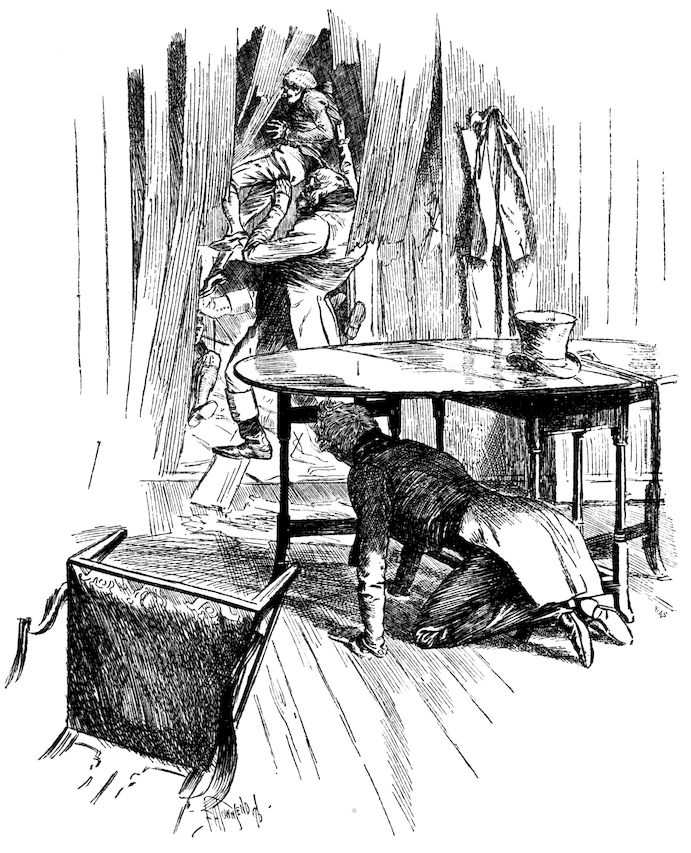
Sir Oran took a flying leap through the window.
When the cloth was removed, the wine circulated freely,
and Sir Telegraph, as usual, filled a numerous succession of
glasses. Mr. Forester, not as usual, did the same; for he was
generally very abstemious in this respect; but, on the present
occasion, he relaxed from his severity, quoting the Placari
genius festis impune diebus, and the Dulce est desipere in loco,
of Horace. Sir Oran likewise approved, by his practice, that
he thought the wine particularly excellent, and Beviamo tutti
tre appeared to be the motto of the party. Mr. Forester
inquired into the motives which had brought Sir Telegraph to
Westmoreland; and Sir Telegraph entered into a rapturous
encomium of the heiress of Melincourt which was suddenly cut
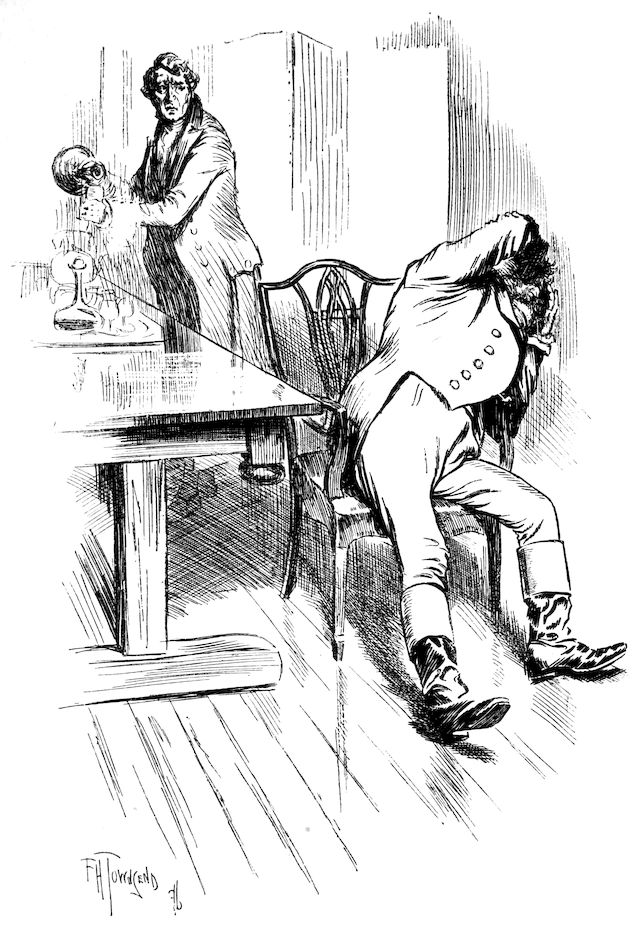
short by Sir Oran, who, having taken a glass too much, rose
suddenly from table, took a flying leap through the window,
and went dancing along the woods like a harlequin.
‘Upon my word,’ said Sir Telegraph, ‘a devilish lively,
pleasant fellow! Curse me if I know what to make of him.’
‘I will tell you his history,’ said Mr. Forester, ‘by and by.
In the meantime I must look after him, that he may neither
do nor receive mischief. Pray take care of yourself till I
return.’ Saying this, he sprang through the window after Sir
Oran, and disappeared by the same track among the trees.
‘Curious enough!’ soliloquised Sir Telegraph; ‘however,
not much to complain of, as the best part of the company is
left behind: videlicet, the bottle.’
CHAPTER V SUGAR
38
Sir Telegraph was tossing off the last heeltap of his regular
diurnal allowance of wine, when Mr. Forester and Sir Oran
Haut-ton reappeared, walking past the window arm in arm;
Sir Oran’s mode of progression being very vacillating, indirect,
and titubant; enough so, at least, to show that he had not completely
danced off the effects of the Madeira. Mr. Forester
shortly after entered; and Sir Telegraph inquiring concerning
Sir Oran, ‘I have persuaded him to go to bed,’ said Mr.
Forester, ‘and I doubt not he is already fast asleep.’ A
servant now entered with tea. Sir Telegraph proceeded to
help himself, when he perceived there was no sugar, and
reminded his host of the omission.
Mr. Forester. If I had anticipated the honour of your
company, Sir Telegraph, I would have provided myself with a
small quantity of that nefarious ingredient: but in this solitary
situation, these things are not to be had at a moment’s notice.
As it is, seeing little company, and regulating my domestic
arrangements on philosophical principles, I never suffer an
atom of West Indian produce to pass my threshold. I have
no wish to resemble those pseudo-philanthropists, those miserable
declaimers against slavery, who are very liberal of words
which cost them nothing, but are not capable of advancing the
object they profess to have at heart, by submitting to the
smallest personal privation. If I wish seriously to exterminate
an evil, I begin by examining how far I am myself, in any way
whatever, an accomplice in the extension of its baleful influence.
My reform commences at home. How can I unblushingly
declaim against thieves, while I am a receiver of stolen goods?
How can I seriously call myself an enemy to slavery, while I
39indulge in the luxuries that slavery acquires? How can the
consumer of sugar pretend to throw on the grower of it the
exclusive burden of their participated criminality? How can
he wash his hands, and say with Pilate, “I am innocent of
this blood, see ye to it”?
Sir Telegraph poured some cream into his unsweetened tea,
drank it, and said nothing. Mr. Forester proceeded:
If every individual in this kingdom, who is truly and
conscientiously an enemy to the slave-trade, would subject
himself to so very trivial a privation as abstinence from colonial
produce, I consider that a mortal blow would be immediately
struck at the roots of that iniquitous system.
Sir Telegraph Paxarett. If every individual enemy to the
slave-trade would follow your example, the object would no
doubt be much advanced; but the practice of one individual
more or less has little or no influence on general society:
most of us go on with the tide, and the dread of the single
word quiz has more influence in keeping the greater part of
us within the pale of custom, fashion, and precedent, than all
the moral reasonings and declamations in the world will ever
have in persuading us to break through it. As to the diffusion
of liberty, and the general happiness of mankind, which used
to be your favourite topics when we were at college together, I
should have thought your subsequent experience would have
shown you that there is not one person in ten thousand who
knows what liberty means, or cares a single straw for any
happiness but his own——
Mr. Forester. Which his own miserable selfishness must
estrange from him for ever. He whose heart has never glowed
with a generous resolution, who has never felt the conscious
triumph of a disinterested sacrifice, who has never sympathised
with human joys or sorrows, but when they have had a direct
and palpable reference to himself, can never be acquainted
with even the semblance of happiness. His utmost enjoyment
must be many degrees inferior to that of a pig, inasmuch as
the sordid mire of selfish and brutal stupidity is more defiling
to the soul, than any coacervation of mere material mud can
possibly be to the body. The latter may be cleared away
with two or three ablutions, but the former cleaves and
accumulates into a mass of impenetrable corruption, that bids
defiance to the united powers of Hercules and Alpheus.
40Sir Telegraph Paxarett. Be that as it may, every man
will continue to follow his own fancy. The world is bad
enough, I daresay; but it is not for you or me to mend it.
Mr. Forester. There is the keystone of the evil—mistrust
of the influence of individual example. ‘We are bad ourselves,
because we despair of the goodness of others.’[6]
Yet the history of the world abounds with sudden and extraordinary
revolutions in the opinions of mankind, which have
been effected by single enthusiasts.
Sir Telegraph Paxarett. Speculative opinions have been
sometimes changed by the efforts of roaring fanatics. Men
have been found very easily permutable into ites and onians,
avians, and arians, Wesleyites or Whitfieldites, Huntingdonians
or Muggletonians, Moravians, Trinitarians, Unitarians, Anythingarians:
but the metamorphosis only affects a few obscure
notions concerning types, symbols, and mysteries, which have
scarcely any effect on moral theory, and of course, a fortiori,
none whatever on moral practice: the latter is for the most
part governed by the general habits and manners of the society
we live in. One man may twang responses in concert with
the parish clerk; another may sit silent in a Quakers’ meeting,
waiting for the inspiration of the Spirit; a third may groan
and howl in a tabernacle; a fourth may breakfast, dine, and
sup in a Sandemanian chapel: but meet any of the four in the
common intercourse of society, you will scarcely know one
from another. The single adage, Charity begins at home, will
furnish a complete key to the souls of all four; for I have
found, as far as my observation has extended, that men carry
their religion[7] in other men’s heads, and their morality in their
own pockets.
41Mr. Forester. I think it will be found that individual
example has in many instances produced great moral effects
on the practice of society. Even if it were otherwise, is it not
better to be Abdiel among the fiends, than to be lost and confounded
in the legion of imps grovelling in the train of the
evil power?
Sir Telegraph Paxarett. There is something in that.
Mr. Forester. To borrow an allegory from Homer: I
would say society is composed of two urns, one of good, and
one of evil. I will suppose that every individual of the human
species receives from his natal genius a little phial, containing
one drop of a fluid, which shall be evil, if poured into the urn
of evil, and good if into that of good. If you were proceeding
to the station of the urns with ten thousand persons, every one
of them predetermined to empty his phial into the urn of evil,
which I fear is too true a picture of the practice of society,
should you consider their example, if you were hemmed in in the
centre of them, a sufficient excuse for not breaking from them,
and approaching the neglected urn? Would you say, “The
urn of good will derive little increase from my solitary drop,
and one more or less will make very little difference in the urn of
ill; I will spare myself trouble, do as the world does, and let
the urn of good take its chance, from those who can approach
it with less difficulty”? No: you would rather say, “That
neglected urn contains the hopes of the human species: little,
indeed, is the addition I can make to it, but it will be good as
far as it goes”; and if, on approaching the urn, you should
find it not so empty as you had anticipated, if the genius
appointed to guard it should say to you, “There is enough in
this urn already to allow a reasonable expectation that it will
one day be full, and yet it has only accumulated drop by drop
42through the efforts of individuals, who broke through the pale
and pressure of the multitude, and did not despair of human
virtue”; would you not feel ten thousand times repaid for the
difficulties you had overcome, and the scoffs of the fools and
slaves you had abandoned, by the single reflection that would
then rush upon your mind, I am one of these?
Sir Telegraph Paxarett. Gad, very likely: I never considered
the subject in that light. You have made no allowance
for the mixture of good and evil, which I think the fairest state
of the case. It seems to me, that the world always goes on
pretty much in one way. People eat, drink, and sleep, make
merry with their friends, get as much money as they can, marry
when they can afford it, take care of their children because
they are their own, are thought well of while they live in proportion
to the depth of their purse, and when they die, are
sure of as good a character on their tombstones as the bellman
and stonemason can afford for their money.
Mr. Forester. Such is the multitude; but there are noble
exceptions to this general littleness.
Sir Telegraph Paxarett. Now and then an original genius
strikes out of the common track; but there are two ways of
doing that—into a worse as well as a better.
Mr. Forester. There are some assuredly who strike into
a better, and these are the ornaments of their age, and the
lights of the world. You must admit too, that there are many,
who, though without energy or capacity to lead, have yet virtue
enough to follow an illustrious example.
Sir Telegraph Paxarett. One or two.
Mr. Forester. In every mode of human action there are
two ways to be pursued—a good and a bad one. It is the
duty of every man to ascertain the former, as clearly as his
capacity will admit, by an accurate examination of general
relations; and to act upon it rigidly, without regard to his own
previous habits, or the common practice of the world.
Sir Telegraph Paxarett. And you infer from all this that
it is my duty to drink my tea without sugar.
Mr. Forester. I infer that it is the duty of every one,
thoroughly penetrated with the iniquity of the slave-trade, to
abstain entirely from the use of colonial produce.
Sir Telegraph Paxarett. I may do that, without any great
effort of virtue. I find the difference, in this instance, more
43trivial than I could have supposed. In fact, I never thought
of it before.
Mr. Forester. I hope I shall before long have the pleasure
of enrolling you a member of the Anti-saccharine Society, which
I have had the happiness to organise, and which is daily
extending its numbers. Some of its principal members will
shortly pay a visit to Redrose Abbey; and I purpose giving a
festival, to which I shall invite all that is respectable and
intelligent in this part of the country, and in which I intend to
demonstrate practically, that a very elegant and luxurious
entertainment may be prepared without employing a single
particle of that abominable ingredient, and theoretically, that
the use of sugar is economically superfluous, physically
pernicious, morally atrocious, and politically abominable.
Sir Telegraph Paxarett. I shall be happy to join the party,
and I may possibly bring with me one or two inside passengers,
who will prove both ornamental and attractive to your festival.
But you promised me an account of Sir Oran.
CHAPTER VI SIR ORAN HAUT-TON
44
Mr. Forester. Sir Oran Haut-ton was caught very young
in the woods of Angola.
Sir Telegraph Paxarett. Caught!
Mr. Forester. Very young. He is a specimen of the
natural and original man—the wild man of the woods; called
in the language of the more civilised and sophisticated natives
of Angola, Pongo, and in that of the Indians of South America,
Oran Outang.
Sir Telegraph Paxarett. The devil he is!
Mr. Forester. Positively. Some presumptuous naturalists
have refused his species the honours of humanity; but the
most enlightened and illustrious philosophers agree in considering
him in his true light as the natural and original man.[8]45One French philosopher, indeed, has been guilty of an inaccuracy,
in considering him as a degenerated man;[9] degenerated
he cannot be; as his prodigious physical strength, his
uninterrupted health, and his amiable simplicity of manners
demonstrate. He is, as I have said, a specimen of the natural
and original man—a genuine facsimile of the philosophical
Adam.
He was caught by an intelligent negro very young, in the
woods of Angola; and his gentleness and sweet temper[10] winning
the hearts of the negro and negress, they brought him up
in their cottage as the playfellow of their little boys and girls,
where, with the exception of speech, he acquired the practice
of such of the simpler arts of life as the degree of civilisation
in that part of Africa admits. In this way he lived till he was
about seventeen years of age——
Sir Telegraph Paxarett. By his own reckoning?
Mr. Forester. By analogical computation. At this period,
my old friend Captain Hawltaught of the Tornado frigate,
being driven by stress of weather to the coast of Angola, was
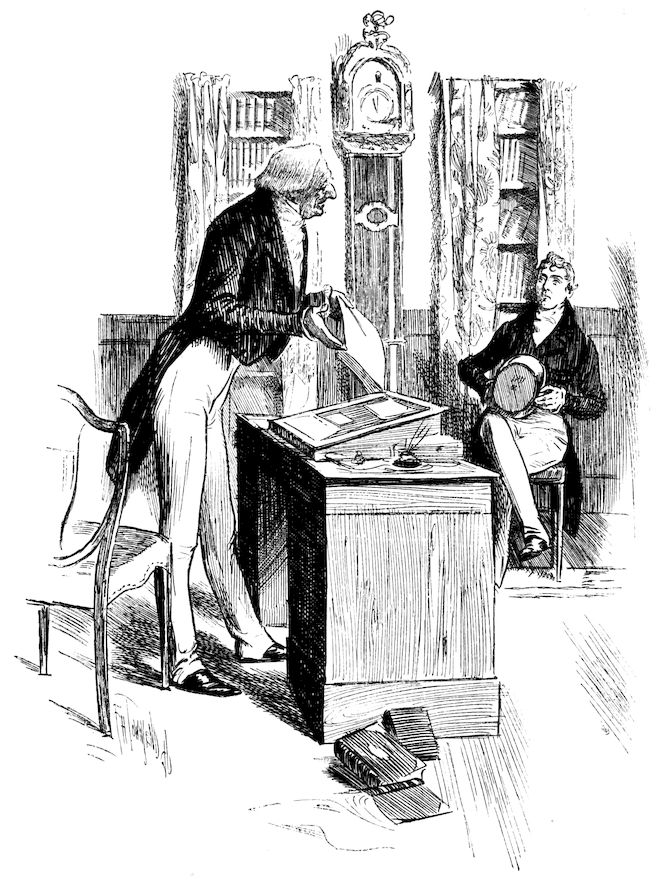
46so much struck with the contemplative cast of Sir Oran’s
countenance,[11] that he offered the negro an irresistible bribe
to surrender him to his possession. The negro brought him
on board, and took an opportunity to leave him slily, but with
infinite reluctance and sympathetic grief. When the ship
weighed anchor, and Sir Oran found himself separated from
the friends of his youth, and surrounded with strange faces, he
wept bitterly,[12] and fell into such deep grief that his life was
despaired of.[13] The surgeon of the ship did what he could for
him; and a much better doctor, Time, completed his cure.
By degrees a very warm friendship for my friend Captain
Hawltaught extinguished his recollection of his negro friends.
Three years they cruised together in the Tornado, when a
dangerous wound compelled the old captain to renounce his
darling element, and lay himself up in ordinary for the rest of
his days. He retired on his half-pay and the produce of his
prize-money to a little village in the West of England, where
he employed himself very assiduously in planting cabbages and
47watching the changes of the wind. Mr. Oran, as he was then
called, was his inseparable companion, and became a very
expert practical gardener. The old captain used to observe,
he could always say he had an honest man in his house, which
was more than could be said of many honourable houses where
there was much vapouring about honour.
Mr. Oran had long before shown a taste for music, and with
some little instruction from a marine officer in the Tornado,
had become a proficient on the flute and French horn.[14] He
could never be brought to understand the notes; but, from
hearing any simple tune played or sung two or three times, he
never failed to perform it with great exactness and brilliancy
of execution. I shall merely observe, en passant, that music
appears, from this and several similar circumstances, to be
more natural to man than speech. The old captain was fond
of his bottle of wine after dinner, and his glass of grog at night.
Mr. Oran was easily brought to sympathise in this taste;[15] and
they have many times sat up together half the night over a
flowing bowl, the old captain singing Rule Britannia, True
Courage, or Tom Tough, and Sir Oran accompanying him on
the French horn.
During a summer tour in Devonshire, I called on my old
48friend Captain Hawltaught, and was introduced to Mr. Oran.
You, who have not forgotten my old speculations on the origin
and progress of man, may judge of my delight at this happy
rencontre. I exerted all the eloquence I was master of to
persuade Captain Hawltaught to resign him to me, that I might
give him a philosophical education.[16] Finding this point
unattainable, I took a house in the neighbourhood, and the
intercourse which ensued was equally beneficial and agreeable
to all three.
Sir Telegraph Paxarett. And what part did you take in
their nocturnal concerts, with Tom Tough and the French
horn?
Mr. Forester. I was seldom present at them, and often
remonstrated, but ineffectually, with the captain, on his corrupting
the amiable simplicity of the natural man by this pernicious
celebration of vinous and spirituous orgies; but the only
answer I could ever get from him was a hearty damn against
all water-drinkers, accompanied with a reflection that he was
sure every enemy to wine and grog must have clapped down
the hatches of his conscience on some secret villainy, which he
feared good liquor would pipe ahoy; and he usually concluded
by striking up Nothing like Grog, Saturday Night, or Swing
the flowing Bowl, his friend Oran’s horn ringing in sympathetic
symphony.
The old captain used to say that grog was the elixir of life:
but it did not prove so to him; for one night he tossed off his
last bumper, sang his last stave, and heard the last flourish of
his Oran’s horn. I thought poor Oran would have broken his
heart; and, had he not been familiarised to me, and conceived
a very lively friendship for me before the death of his old friend,
I fear the consequences would have been fatal.
Considering that change of scene would divert his melancholy,
I took him with me to London. The theatres delighted
him, particularly the opera, which not only accorded admirably
with his taste for music, but where, as he looked round on the
ornaments of the fashionable world, he seemed to be particularly
comfortable, and to feel himself completely at home.
49There is, to a stranger, something ludicrous in a first view
of his countenance, which led me to introduce him only into
the best society, where politeness would act as a preventive to
the propensity to laugh; for he has so nice a sense of honour
(which I shall observe, by the way, is peculiar to man), that
if he were to be treated with any kind of contumely, he would
infallibly die of a broken heart, as has been seen in some of
his species.[17] With a view of ensuring him the respect of
society which always attends on rank and fortune, I have
purchased him a baronetcy, and made over to him an estate.
I have also purchased of the Duke of Rottenburgh one half of
the elective franchise vested in the body of Mr. Christopher
Corporate, the free, fat, and dependent burgess of the ancient
and honourable borough of Onevote, who returns two members
to Parliament, one of whom will shortly be Sir Oran. (Sir
Telegraph gave a long whistle.) But before taking this
important step, I am desirous that he should finish his education.
(Sir Telegraph whistled again.) I mean to say that I wish,
if possible, to put a few words into his mouth, which I have
hitherto found impracticable, though I do not entirely despair
of ultimate success. But this circumstance, for reasons which
I will give you by and by, does not at all militate against the
proofs of his being a man.
Sir Telegraph Paxarett. If he be but half a man, he will
be the fitter representative of half an elector; for as that ‘large
body corporate of one,’ the free, fat, and dependent burgess
of Onevote, returns two members to the honourable house, Sir
Oran can only be considered as the representative of half of
him. But, seriously, is not your principal object an irresistible
exposure of the universality and omnipotence of corruption by
purchasing for an oran outang one of those seats, the sale of
which is unblushingly acknowledged to be as notorious as the
sun at noonday? or do you really think him one of us?
Mr. Forester. I really think him a variety of the human
species; and this is a point which I have it much at heart to
establish in the acknowledgment of the civilised world.
Sir Telegraph Paxarett. Buffon, whom I dip into now and
then in the winter, ranks him, with Linnaeus, in the class of
Simiae.
Mr. Forester. Linnaeus has given him the curious
50denominations of Troglodytes, Homo nocturnus, and Homo
silvestris: but he evidently thought him a man; he describes
him as having a hissing speech, thinking, reasoning, believing
that the earth was made for him, and that he will one day be
its sovereign.[18]
Sir Telegraph Paxarett. God save King Oran! By the
bye, you put me very much in mind of Valentine and Orson.
This wild man of yours will turn out some day to be the son
of a king, lost in the woods, and suckled by a lioness:—‘No
waiter, but a knight templar’:—no Oran, but a true prince.
Mr. Forester. As to Buffon, it is astonishing how that
great naturalist could have placed him among the singes, when
the very words of his description give him all the characteristics
of human nature.[19] It is still more curious to think that modern
travellers should have made beasts, under the names of Pongos,
51Mandrills, and Oran Outangs, of the very same beings whom
the ancients worshipped as divinities under the names of Fauns
and Satyrs, Silenus and Pan.[20]
Sir Telegraph Paxarett. Your Oran rises rapidly in the
scale of being:—from a baronet and M.P. to a king of the
world, and now to a god of the woods.
Mr. Forester. When I was in London last winter, I became
acquainted with a learned mythologist, who has long laboured
to rebuild the fallen temple of Jupiter. I introduced him to
Sir Oran, for whom he immediately conceived a high veneration,
and would never call him by any name but Pan. His usual
salutation to him was in the following words:
52‘This,’ said he, ‘is part of the Orphic invocation of Pan. It
alludes to the happy existence of the dancing Pans, Fauns,
Orans, et id genus omne, whose dwellings are the caves of rocks
and the hollows of trees, such as undoubtedly was, or would
have been, the natural mode of life of our friend Pan among
the woods of Angola. It alludes, too, to their musical powers,
which in our friend Pan it gives me indescribable pleasure to
find so happily exemplified. The epithet Bacchic, our friend
Pan’s attachment to the bottle demonstrates to be very
appropriate; and the epithet κοσμοκρατωρ, king of the world,
points out a striking similarity between the Orphic Pan and
the Troglodyte of Linnaeus, who believes that the earth was
made for him, and that he will again be its sovereign.’ He laid
great stress on the word AGAIN, and observed, if he were to
develop all the ideas to which this word gave rise in his mind,
he should find ample matter for a volume. Then repeating
several times, Παν κοσμοκρατωρ, and iterum fore telluris
imperantem, he concluded by saying he had known many
profound philosophical and mythological systems founded on
much slighter analogies.
Sir Telegraph Paxarett. Your learned mythologist appears
to be non compos.
Mr. Forester. By no means. He has a system of his own,
which only appears in the present day more absurd than other
systems, because it has fewer followers. The manner in which
the spirit of system twists everything to its own views is truly
wonderful. I believe that in every nation of the earth the
system which has most followers will be found the most absurd
in the eye of an enlightened philosophy.
Sir Telegraph Paxarett. But if your Oran be a man, how
is it that his long intercourse with other varieties of the human
species has not taught him to speak?
Mr. Forester. Speech is a highly artificial faculty.
Civilised man is a highly artificial animal. The change from
the wild to the civilised state affects not only his moral, but
his physical nature, and this not rapidly and instantly, but in
a long process of generations. The same change is obvious
in domestic animals, and in cultivated plants. You know not
where to look for the origin of the common dog, or the
common fowl. The wild and tame hog, and the wild and
tame cat, are marked by more essential differences than the
53oran and the civilised man. The origin of corn is as much a
mystery to us as the source of the Nile was to the ancients.
Innumerable flowers have been so changed from their original
simplicity, that the art of horticulture may almost lay claim to
the magic of a new creation. Is it then wonderful that the
civilised man should have acquired some physical faculties
which the natural man has not? It is demonstrable that
speech is one. I do not, however, despair of seeing him make
some progress in this art. Comparative anatomy shows that
he has all the organs of articulation. Indeed he has, in every
essential particular, the human form, and the human anatomy.
Now I will only observe that if an animal who walks upright—is
of the human form, both outside and inside—uses a weapon
for defence and attack—associates with his kind—makes huts
to defend himself from the weather, better I believe than those of
the New Hollanders—is tame and gentle—and instead of
killing men and women, as he could easily do, takes them
prisoners and makes servants of them—who has, what I think
essential to the human kind, a sense of honour; which is shown
by breaking his heart, if laughed at, or made a show, or treated
with any kind of contumely—who, when he is brought into the
company of civilised men, behaves (as you have seen) with
dignity and composure, altogether unlike a monkey; from whom
he differs likewise in this material respect, that he is capable of
great attachment to particular persons, of which the monkey is
altogether incapable; and also in this respect, that a monkey
never can be so tamed that we may depend on his not doing
mischief when left alone, by breaking glasses or china within his
reach; whereas the oran outang is altogether harmless;—who
has so much of the docility of a man that he learns not only to
do the common offices of life, but also to play on the flute and
French horn; which shows that he must have an idea of melody
and concord of sounds, which no brute animal has;—and lastly,
if joined to all these qualities he has the organ of pronunciation,
and consequently the capacity of speech, though not the actual use
of it; if, I say, such an animal be not a man, I should desire to
know in what the essence of a man consists, and what it is that
distinguishes a natural man from the man of art.[22] That he
54understands many words, though he does not yet speak any,
I think you may have observed, when you asked him to take
wine, and applied to him for fish and partridge.[23]
Sir Telegraph Paxarett. The gestures, however slight,
that accompany the expression of the ordinary forms of intercourse,
may possibly explain that.
Mr. Forester. You will find that he understands many
things addressed to him on occasions of very unfrequent
occurrence. With regard to his moral character, he is undoubtedly
a man, and a much better man than many that are to be
found in civilised countries,[24] as, when you are better acquainted
with him, I feel very confident you will readily acknowledge.[25]
55Sir Telegraph Paxarett. I shall be very happy, when his
election comes on for Onevote, to drive him down in my
barouche to the honourable and ancient borough.
Mr. Forester promised to avail himself of this proposal;
when the iron tongue of midnight tolling twelve induced them
to separate for the night.
CHAPTER VII THE PRINCIPLE OF POPULATION
56
The next morning, while Sir Telegraph, Sir Oran, and Mr.
Forester were sitting down to their breakfast, a post-chaise
rattled up to the door; the glass was let down, and a tall,
thin, pale, grave-looking personage peeped from the aperture.
‘This is Mr. Fax,’ said Mr. Forester, ‘the champion of calm
reason, the indefatigable explorer of the cold clear springs of
knowledge, the bearer of the torch of dispassionate truth, that
gives more light than warmth. He looks on the human world,
the world of mind, the conflict of interests, the collision of
feelings, the infinitely diversified developments of energy and
intelligence, as a mathematician looks on his diagrams, or a
mechanist on his wheels and pulleys, as if they were foreign to
his own nature, and were nothing more than subjects of curious
speculation.’
Mr. Forester had not time to say more; for Mr. Fax
entered, and shook hands with him, was introduced in due
form to Sir Telegraph, and sat down to assist in the demolition
of the matériel of breakfast.
Mr. Fax. Your Redrose Abbey is a beautiful metamorphosis.—I
can scarcely believe that these are the mouldering
walls of the pious fraternity of Rednose, which I contemplated
two years ago.
Mr. Forester. The picturesque tourists will owe me no
goodwill for the metamorphosis, though I have endeavoured
to leave them as much mould, mildew, and weather-stain as
possible.
Mr. Fax. The exterior has suffered little; it still retains a
truly venerable monastic character.
Mr. Fax.
Sir Telegraph Paxarett. Something monastic in the
59interior too.—Very orthodox old wine in the cellar, I can tell
you. And the Reverend Father Abbot there, as determined a
bachelor as the Pope.
Mr. Forester. If I am so, it is because, like the Squire of
Dames, I seek and cannot find. I see in my mind’s eye the
woman I would choose, but I very much fear that is the only
mode of optics in which she will ever be visible.
Mr. Fax. No matter. Bachelors and spinsters I decidedly
venerate. The world is overstocked with featherless bipeds.
More men than corn is a fearful pre-eminence, the sole and
fruitful cause of penury, disease, and war, plague, pestilence,
and famine.
Sir Telegraph Paxarett. I hope you will not long have
cause to venerate me. What is life without love? A rosebush
in winter, all thorns, and no flowers.
Mr. Fax. And what is it with love? A double-blossomed
cherry, flowers without fruit; if the blossoms last a
month, it is as much as can be expected: they fall, and what
comes in their place? Vanity, and vexation of spirit.
Sir Telegraph Paxarett. Better vexation than stagnation:
marriage may often be a stormy lake, but celibacy is almost
always a muddy horsepond.
Mr. Fax. Rather a calm clear river——
Mr. Forester. Flowing through a desert, where it moves
in loneliness, and reflects no forms of beauty.
Mr. Fax. That is not the way to consider the case.
Feelings and poetical images are equally out of place in a calm
philosophical view of human society. Some must marry, that
the world may be peopled: many must abstain, that it may
not be overstocked. Little and good is very applicable in this
case. It is better that the world should have a smaller
number of peaceable and rational inhabitants, living in universal
harmony and social intercourse, than the disproportionate
mass of fools, slaves, coxcombs, thieves, rascals, liars, and cutthroats,
with which its surface is at present encumbered. It
is in vain to declaim about the preponderance of physical and
moral evil, and attribute it, with the Manicheans, to a mythological
principle, or, with some modern philosophers, to the
physical constitution of the globe. The cause of all the evils
of human society is single, obvious, reducible to the most exact
mathematical calculation; and of course susceptible not only
60of remedy but even of utter annihilation. The cause is the
tendency of population to increase beyond the means of subsistence.
The remedy is an universal social compact, binding
both sexes to equally rigid celibacy, till the prospect of maintaining
the average number of six children be as clear as the
arithmetic of futurity can make it.
Mr. Forester. The arithmetic of futurity has been found
in a more than equal number of instances to baffle human
skill. The rapid and sudden mutations of fortune are the
inexhaustible theme of history, poetry, and romance; and they
are found in forms as various and surprising, in the scenes of
daily life, as on the stage of Drury Lane.
Mr. Fax. That the best prospects are often overshadowed,
is most certainly true; but there are degrees and modes of
well-grounded reliance on futurity, sufficient to justify the
enterprises of prudence, and equally well-grounded prospiciences
of hopelessness and helplessness, that should check
the steps of rashness and passion, in their headlong progress
to perdition.
Mr. Forester. You have little cause to complain of the
present age. It is calculating enough to gratify the most
determined votary of moral and political arithmetic. This
certainly is not the time
When unrevenged stalks Cocker’s injured ghost.
What is friendship—except in some most rare and miraculous
instances—but the fictitious bond of interest, or the heartless
intercourse of idleness and vanity? What is love, but the
most venal of all venal commodities? What is marriage, but
the most sordid of bargains, the most cold and slavish of all
the forms of commerce? We want no philosophical ice-rock,
towed into the Dead Sea of modern society, to freeze that
which is too cold already. We want rather the torch of
Prometheus to revivify our frozen spirits. We are a degenerate
race, half-reasoning developments of the principle of infinite
littleness, ‘with hearts in our bodies no bigger than pins’
heads.’ We are in no danger of forgetting that two and two
make four. There is no fear that the warm impulses of feeling
will ever overpower, with us, the tangible eloquence of the
pocket.
Mr. Fax. With relation to the middle and higher classes,
61you are right in a great measure as to fact, but wrong, as I
think, in the asperity of your censure. But among the lower
orders the case is quite different. The baleful influence of the
poor laws has utterly destroyed the principle of calculation in
them. They marry by wholesale, without scruple or compunction,
and commit the future care of their family to Providence
and the overseer. They marry even in the workhouse,
and convert the intended asylum of age and infirmity into a
flourishing manufactory of young beggars and vagabonds.
Sir Telegraph’s barouche rolled up gracefully to the door.
Mr. Forester pressed him to stay another day, but Sir
Telegraph’s plea of urgency was not to be overcome. He
promised very shortly to revisit Redrose Abbey, shook hands
with Mr. Forester and Sir Oran, bowed politely to Mr. Fax,
mounted his box, and disappeared among the trees.
‘Those four horses,’ said Mr. Fax, as the carriage rolled
away, ‘consume the subsistence of eight human beings, for the
foolish amusement of one. As Solomon observes: “This is
vanity, and a great evil.”’
‘Sir Telegraph is thoughtless,’ said Mr. Forester, ‘but he
has a good heart and a good natural capacity. I have great
hopes of him. He had some learning, when he went to
college; but he was cured of it before he came away. Great,
indeed, must be the zeal for improvement which an academical
education cannot extinguish.’
CHAPTER VIII THE SPIRIT OF CHIVALRY
62
Sir Telegraph was welcomed to Melincourt in due form by
Mr. Hippy, and in a private interview with the Honourable
Mrs. Pinmoney, was exhorted to persevere in his suit to
Anthelia, though she could not flatter him with very strong
hopes of immediate success, the young lady’s notions being,
as she observed, extremely outré and fantastical, but such as
she had no doubt time and experience would cure. She informed
him at the same time, that he would shortly meet a
formidable rival, no less a personage than Lord Anophel
Achthar,[26] son and heir of the Marquis of Agaric[27] who was
somewhat in favour with Mr. Hippy, and seemed determined
at all hazards to carry his point; ‘and with any other girl
than Anthelia,’ said Mrs. Pinmoney, ‘considering his title and
fortune, I should pronounce his success infallible, unless a
duke were to make his appearance.’ She added, ‘The young
lord would be accompanied by his tutor, the Reverend Mr.
Grovelgrub, and by a celebrated poet, Mr. Feathernest, to
whom the Marquis had recently given a place in exchange for
his conscience. It was thought by Mr. Feathernest’s friends
that he had made a very good bargain. The poet had, in
consequence, burned his old Odes to Truth and Liberty, and
had published a volume of Panegyrical Addresses “to all the
crowned heads in Europe,” with the motto, “Whatever is at
court, is right.”’
The dinner-party that day at Melincourt Castle consisted of
63Mr. Hippy, in the character of lord of the mansion; Anthelia,
in that of his inmate; Mrs. and Miss Pinmoney, as her
visitors; and Sir Telegraph, as the visitor of Mrs. Pinmoney,
seconded by Mr. Hippy’s invitation to stay. Nothing very
luminous passed on this occasion.
The fame of Mr. Hippy, and his hospitable office, was
rapidly diffused by Dr. Killquick, the physician of the district;
who thought a draught or pill could not possibly be efficacious,
unless administered with an anecdote, and who was called in,
in a very few hours after Mr. Hippy’s arrival, to cure the
hypochondriacal old gentleman of an imaginary swelling in his
elbow. The learned doctor, who had studied with peculiar care
the symptoms, diagnostics, prognostics, sedatives, lenitives,
and sanatives of hypochondriasis, had arrived at the sagacious
conclusion that the most effectual method of curing an imaginary
disease was to give the patient a real one; and he accordingly
sent Mr. Hippy a pint bottle of mixture, to be taken by
a tablespoonful every two hours, which would have infallibly
accomplished the purpose, but that the bottle was cracked
over the head of Harry Fell, for treading on his master’s toe,
as he presented the composing potion, which would perhaps
have composed him in the Roman sense.
The fashionable attractions of Low-Wood and Keswick
afforded facilities to some of Anthelia’s lovers to effect a
logement in her neighbourhood, from whence occasionally
riding over to Melincourt Castle, they were hospitably received
by the lord seneschal, Humphrey Hippy, Esquire, who often
made them fixed stars in the circumference of that jovial
system, of which the bottle and glasses are the sun and
planets, till it was too late to dislodge for the night; by which
means they sometimes contrived to pass several days together
at the Castle.
The gentlemen in question were Lord Anophel Achthar,
with his two parasites, Mr. Feathernest and the Reverend Mr.
Grovelgrub; Harum O’Scarum, Esquire, the sole proprietor of
a vast tract of undrained bog in the county of Kerry; and Mr.
Derrydown, the only son of an old lady in London, who having
in vain solicited a visit from Anthelia, had sent off her hopeful
progeny to try his fortune in Westmoreland. Mr. Derrydown
had received a laborious education, and had consumed a great
quantity of midnight oil over ponderous tomes of ancient and
64modern learning, particularly of moral, political, and metaphysical
philosophy, ancient and modern. His lucubrations
in the latter branch of science having conducted him, as he
conceived, into the central opacity of utter darkness, he formed
a hasty conclusion ‘that all human learning is vanity’; and
one day, in a listless mood, taking down a volume of the
Reliques of Ancient Poetry, he found, or fancied he found,
in the plain language of the old English ballad, glimpses of
the truth of things, which he had vainly sought in the vast
volumes of philosophical disquisition. In consequence of this
luminous discovery, he locked up his library, purchased a
travelling chariot, with a shelf in the back, which he filled with
collections of ballads and popular songs; and passed the
greater part of every year in posting about the country, for
the purpose, as he expressed it, of studying together poetry and
the peasantry, unsophisticated nature and the truth of things.
Mr. Hippy introduced Lord Anophel, and his two learned
friends, to Sir Telegraph and Mrs. and Miss Pinmoney. Mr.
Feathernest whispered to the Reverend Mr. Grovelgrub, ‘This
Sir Telegraph Paxarett has some good livings in his gift’;
which bent the plump figure of the reverend gentleman into a
very orthodox right angle.
Anthelia, who felt no inclination to show particular favour
to any one of her Strephons, was not sorry to escape the evil
of a solitary persecutor, more especially as they so far resembled
the suitors of Penelope, as to eat and drink together with great
cordiality. She could have wished, when she left them to the
congenial society of Bacchus, to have retired to company more
congenial to her than that of Mrs. Pinmoney and Miss
Danaretta; but she submitted to the course of necessity with
the best possible grace.
She explicitly made known to all her suitors her ideas on
the subject of marriage. She had never perverted the simplicity
of her mind by indulging in the usual cant of young
ladies, that she should prefer a single life: but she assured
them that the spirit of the age of chivalry, manifested in the
forms of modern life, would constitute the only character on
which she could fix her affections.
Lord Anophel was puzzled, and applied for information to
his tutor. ‘Grovelgrub,’ said he, ‘what is the spirit of the
age of chivalry?’
65‘Really, my lord,’ said the Reverend Mr. Grovelgrub, ‘my
studies never lay that way.’
‘True,’ said Lord Anophel; ‘it was not necessary to your
degree.’
His lordship’s next recourse was to Mr. Feathernest.
‘Feathernest, what is the spirit of the age of chivalry?’
Mr. Feathernest was taken by surprise. Since his profitable
metamorphosis into an ami du prince, he had never dreamed
of such a question. It burst upon him like the spectre of his
youthful integrity, and he mumbled a half-intelligible reply
about truth and liberty—disinterested benevolence—self-oblivion—heroic
devotion to love and honour—protection of
the feeble, and subversion of tyranny.
‘All the ingredients of a rank Jacobin, Feathernest, ‘pon
honour!’ exclaimed his lordship.
There was something in the word Jacobin very grating to
the ears of Mr. Feathernest, and he feared he had thrown
himself between the horns of a dilemma; but from all such
predicament he was happily provided with an infallible means
of extrication. His friend Mr. Mystic, of Cimmerian Lodge,
had initiated him in some of the mysteries of the transcendental
philosophy, which on this, as all similar occasions, he called in
to his assistance; and overwhelmed his lordship with a volley
of ponderous jargon, which left him in profound astonishment
at the depth of Mr. Feathernest’s knowledge.
‘The spirit of the age of chivalry!’ soliloquised Mr.
O’Scarum; ‘I think I know what that is: I’ll shoot all my
rivals, one after another, as fast as I can find a decent pretext
for picking a quarrel. I’ll write to my friend Major O’Dogskin
to come to Low-Wood Inn, and hold himself in readiness. He
is the neatest hand in Ireland at delivering a challenge.’
‘The spirit of the age of chivalry!’ soliloquised Mr. Derrydown;
‘I think I am at home there. I will be a knight of
the round table. I will be Sir Lancelot, or Sir Gawaine, or
Sir Tristram. No: I will be a troubadour—a love-lorn minstrel.
I will write the most irresistible ballads in praise of the
beautiful Anthelia. She shall be my lady of the lake. We
will sail about Ulleswater in our pinnace, and sing duets about
Merlin, and King Arthur, and Fairyland. I will develop the
idea to her in a ballad; it cannot fail to fascinate her romantic
spirit.’ And he sat down to put his scheme in execution.
66Sir Telegraph’s head ran on tilts and tournaments, and
trials of skill and courage. How could they be resolved into
the forms of modern life? A four-in-hand race he thought
would be a pretty substitute; Anthelia to be arbitress of the
contest, and place the Olympic wreath on the head of the victor,
which he had no doubt would be himself, though Harum
O’Scarum, Esquire, would dash through neck or nothing, and
Lord Anophel Achthar was reckoned one of the best coachmen
in England.
CHAPTER IX THE PHILOSOPHY OF BALLADS
67
The very indifferent success of Lord Anophel did not escape
the eye of his abject slave, the Reverend Mr. Grovelgrub, whose
vanity led him to misinterpret Anthelia’s general sweetness of
manner into the manifestation of something like a predilection
for himself. Having made this notable discovery, he sat
down to calculate the probability of his chance of Miss Melincourt’s
fortune on the one hand, and the certainty of church-preferment,
through the patronage of the Marquis of Agaric,
on the other. The sagacious reflection, that a bird in the
hand was worth two in the bush, determined him not to risk
the loss of the Marquis’s favour for the open pursuit of a
doubtful success; but he resolved to carry on a secret attack
on the affections of Anthelia, and not to throw off the mask to
Lord Anophel till he could make sure of his prize.
It would have totally disconcerted the schemes of the
Honourable Mrs. Pinmoney, if Lord Anophel had made any
progress in the favour of Anthelia—not only because she had
made up her mind that her young friend should be her niece
and Lady Paxarett, but because, from the moment of Lord
Anophel’s appearance, she determined on drawing lines of
circumvallation round him, to compel him to surrender at
discretion to her dear Danaretta, who was very willing to second
her views. That Lord Anophel was both a fool and a coxcomb,
did not strike her at all as an objection; on the contrary, she
considered them as very favourable circumstances for the facilitation
of her design.
As Anthelia usually passed the morning in the seclusion of
her library Lord Anophel and the Reverend Mr. Grovelgrub
killed the time in shooting; Sir Telegraph, in driving Mrs. and
68Miss Pinmoney in his barouche, to astonish the natives of the
mountain-villages; Harum O’Scarum, Esquire, in riding full
gallop along the best roads, looking every now and then at his
watch, to see how time went; Mr. Derrydown, in composing
his troubadour ballad; Mr. Feathernest, in writing odes to all
the crowned heads in Europe; and Mr. Hippy, in getting very
ill after breakfast every day of a new disease, which came to
its climax at the intermediate point of time between breakfast
and dinner, showed symptoms of great amendment at the ringing
of the first dinner-bell, was very much alleviated at the
butler’s summons, vanished entirely at the sight of Anthelia,
and was consigned to utter oblivion after the ladies retired
from table, when the Reverend Mr. Grovelgrub lent his clerical
assistance to lay its ghost in the Red Sea of a copious libation
of claret.
Music and conversation consumed the evenings. Mr.
Feathernest and Mr. Derrydown were both zealous admirers
of old English literature; but the former was chiefly enraptured
with the ecclesiastical writers and the translation of the Bible;
the latter admired nothing but ballads, which he maintained
to be, whether ancient or modern, the only manifestations
of feeling and thought containing any vestige of truth and
nature.
‘Surely,’ said Mr. Feathernest one evening, ‘you will not
maintain that Chevy Chase is a finer poem than Paradise
Lost?’
Mr. Derrydown. I do not know what you mean by a fine
poem; but I will maintain that it gives a much deeper insight
into the truth of things.
Mr. Feathernest. I do not know what you mean by the
truth of things.
The Rev. Mr. Grovelgrub. Define, gentlemen, define; let
the one explain what he means by a fine poem, and the other
what he means by the truth of things.
Mr. Feathernest. A fine poem is a luminous development
of the complicated machinery of action and passion, exalted by
sublimity, softened by pathos, irradiated with scenes of magnificence,
figures of loveliness, and characters of energy, and
harmonised with infinite variety of melodious combination.
Lord Anophel Achthar. Admirable!
Miss Danaretta Contantina Pinmoney. Admirable, indeed,
69my lord! (With a sweet smile at his Lordship, which unluckily
missed fire.)
The Rev. Mr. Grovelgrub. Now, sir, for the truth of
things.
Mr. O’Scarum. Troth, sir, that is the last point about
which I should expect a gentleman of your cloth to be very
solicitous.
The Rev. Mr. Grovelgrub. I must say, sir, that is a very
uncalled-for and very illiberal observation.
Mr. O’Scarum. Your coat is your protection, sir.
The Rev. Mr. Grovelgrub. I will appeal to his lordship
if——
Mr. O’Scarum. I shall be glad to know his lordship’s
opinion.
Lord Anophel Achthar. Really, sir, I have no opinion on
the subject.
Mr. O’Scarum. I am sorry for it, my lord.
Mr. Derrydown. The truth of things is nothing more than
an exact view of the necessary relations between object and
subject, in all the modes of reflection and sentiment which
constitute the reciprocities of human association.
The Rev. Mr. Grovelgrub. I must confess I do not exactly
comprehend——
Mr. Derrydown. I will illustrate. You all know the ballad
of Old Robin Gray.
Young Jamie loved me well, and ask’d me for his bride;
But saving a crown, he had nothing else beside.
To make the crown a pound my Jamie went to sea,
And the crown and the pound they were both for me.
He had not been gone a twelvemonth and a day,
When my father broke his arm, and our cow was stolen away;
My mother she fell sick, and Jamie at the sea,
And old Robin Gray came a-courting to me.
In consequence whereof, as you all very well know, old Robin
being rich, the damsel married the aforesaid old Robin.
The Rev. Mr. Grovelgrub. In the heterodox kirk of the
north?
Mr. Derrydown. Precisely. Now, in this short space,
you have a more profound view than the deepest metaphysical
treatise or the most elaborate history can give you of the
70counteracting power of opposite affections, the conflict of duties
and inclinations, the omnipotence of interest, tried by the test
of extremity, and the supreme and irresistible dominion of
universal moral necessity.
Young Jamie loved me well, and ask’d me for his bride;
and would have had her, it is clear, though she does not explicitly
say so, if there had not been a necessary moral motive
counteracting what would have been otherwise the plain free
will of both. ‘Young Jamie loved me well.’ She does not
say that she loved young Jamie; and here is a striking illustration
of that female decorum which forbids young ladies to
speak as they think on any subject whatever: an admirable
political institution, which has been found by experience to be
most happily conducive to that ingenuousness of mind and
simplicity of manner which constitute so striking a charm in
the generality of the fair sex.
But saving a crown, he had nothing else beside.
Here is the quintessence of all that has been said and written
on the subject of love and prudence, a decisive refutation of
the stoical doctrine that poverty is no evil, a very clear and
deep insight into the nature of the preventive or prudential
check to population, and a particularly luminous view of the
respective conduct of the two sexes on similar occasions. The
poor love-stricken swain, it seems, is ready to sacrifice all for
love. He comes with a crown in his pocket, and asks for his
bride. The damsel is a better arithmetician. She is fully
impressed with the truth of the old proverb about poverty
coming in at the door, and immediately stops him short with
‘What can you settle on me, Master Jamie?’ or, as Captain
Bobadil would express it, ‘How much money ha’ you about
you, Master Matthew?’ Poor Jamie looks very foolish—fumbles
in his pocket—produces his crown-piece—and answers
like Master Matthew with a remarkable elongation of visage,
‘’Faith, I ha’n’t past a five shillings or so.’ ‘Then,’ says the
young lady, in the words of another very admirable ballad—where
you will observe it is also the damsel who asks the
question:
Will the love that you’re so rich in,
Make a fire in the kitchen?
72
Anthelia.
73On which the poor lover shakes his head, and the lady gives
him leave of absence. Hereupon Jamie falls into a train of
reflections.
Mr. O’Scarum. Never mind his reflections.
Mr. Derrydown. The result of which is, that he goes to
seek his fortune at sea; intending, with the most perfect and
disinterested affection, to give all he can get to his mistress,
who seems much pleased with the idea of having it. But
when he comes back, as you will see in the sequel, he finds
his mistress married to a rich old man. The detail of the
circumstances abounds with vast and luminous views of human
nature and society, and striking illustrations of the truth of
things.
Mr. Feathernest. I do not yet see that the illustration
throws any light on the definition, or that we are at all
advanced in the answer to the question concerning Chevy
Chase and Paradise Lost.
Mr. Derrydown. We will examine Chevy Chase, then,
with a view to the truth of things, instead of Old Robin Gray:
God prosper long our noble king,
Our lives and safeties all.
Mr. O’Scarum. God prosper us all, indeed! if you are
going through Chevy Chase at the same rate as you were
through Old Robin Gray, there is an end of us all for a month.
The truth of things, now!—is it that you’re looking for?
Ask Miss Melincourt to touch the harp. The harp is the
great key to the truth of things: and in the hand of Miss
Melincourt it will teach you the music of the spheres, the concord
of creation, and the harmony of the universe.
Anthelia. You are a libeller of our sex, Mr. Derrydown,
if you think the truth of things consists in showing it to be
more governed by the meanest species of self-interest than
yours. Few, indeed, are the individuals of either in whom the
spirit of the age of chivalry survives.
Mr. Derrydown. And yet, a man distinguished by that
spirit would not be in society what Miss Melincourt is—a
phoenix. Many knights can wield the sword of Orlando, but
only one nymph can wear the girdle of Florimel.
The Hon. Mrs. Pinmoney. That would be a very pretty
compliment, Mr. Derrydown, if there were no other ladies in
the room.
74Poor Mr. Derrydown looked a little disconcerted: he felt
conscious that he had on this occasion lost sight of his usual
politeness by too close an adherence to the truth of things.
Anthelia. Both sexes, I am afraid, are too much influenced
by the spirit of mercenary calculation. The desire of competence
is prudence; but the desire of more than competence
is avarice: it is against the latter only that moral censure
should be directed: but I fear that in ninety-nine cases out of
a hundred in which the course of true love is thwarted by considerations
of fortune, it will be found that avarice rather than
prudence is to be considered as the cause. Love in the age
of chivalry, and love in the age of commerce, are certainly two
very different deities; so much so, that the former may almost
be regarded as a departed power; and, perhaps, the little
ballad I am about to sing does not contain too severe an
allegory in placing the tomb of chivalric love among the ruins
of the castles of romance.
THE TOMB OF LOVE
By the mossy weed-flower’d column,
Where the setting moonbeam’s glance
Streams a radiance cold and solemn
On the haunts of old romance:
Know’st thou what those shafts betoken,
Scatter’d on that tablet lone,
Where the ivory bow lies broken
By the monumental stone!
When true knighthood’s shield, neglected,
Moulder’d in the empty hall;
When the charms that shield protected
Slept in death’s eternal thrall;
When chivalric glory perish’d
Like the pageant of a dream,
Love in vain its memory cherish’d,
Fired in vain the minstrel’s theme.
Falsehood to an elfish minion
Did the form of Love impart;
Cunning plumed its vampire pinion;
Avarice tipp’d its golden dart.
Love, the hideous phantom flying,
Hither came, no more to rove:
There his broken bow is lying
On that stone—the tomb of Love!
CHAPTER X THE TORRENT
75
Anthelia did not wish to condemn herself to celibacy, but in
none of her present suitors could she discover any trace of the
character she had drawn in her mind for the companion of her
life: yet she was aware of the rashness of precipitate judgments,
and willing to avail herself of this opportunity of studying
the kind of beings that constitute modern society. She
was happy in the long interval between breakfast and dinner,
to retire to the seclusion of her favourite apartment; whence
she sometimes wandered into the shades of her shrubbery:
sometimes passing onward through a little postern door, she
descended a flight of rugged steps, which had been cut in the
solid stone, into the gloomy glen of the torrent that dashed
round the base of the castle-rock; and following a lonely path
through the woods that fringed its sides, wandered into the
deepest recesses of mountain solitude. The sunshine of a
fine autumnal day, the solemn beauty of the fading woods, the
thin gray mist, that spread waveless over the mountains, the
silence of the air, the deep stillness of nature, broken only by
the sound of the eternal streams, tempted her on one occasion
beyond her usual limits.
Passing over the steep and wood-fringed hills of rock that
formed the boundary of the valley of Melincourt, she descended
through a grove of pines into a romantic chasm, where a foaming
stream was crossed by a rude and ancient bridge, consisting
of two distinct parts, each of which rested against a
columnar rock, that formed an island in the roaring waters.
An ash had fixed its roots in the fissures of the rock, and the
knotted base of its aged trunk offered to the passenger a
natural seat, over-canopied with its beautiful branches and
76leaves, now tinged with their autumnal yellow. Anthelia
rested awhile in this delightful solitude. There was no breath
of wind, no song of birds, no humming of insects, only the
dashing of the waters beneath. She felt the presence of the
genius of the scene. She sat absorbed in a train of contemplations,
dimly defined, but infinitely delightful: emotions
rather than thoughts, which attention would have utterly
dissipated, if it had paused to seize their images.
She was roused from her reverie by sounds of music, issuing
from the grove of pines through which she had just passed,
and which skirted the hollow. The notes were wild and
irregular, but their effect was singular and pleasing. They
ceased. Anthelia looked to the spot from whence they had
proceeded, and saw, or thought she saw, a face peeping at her
through the trees; but the glimpse was momentary. There
was in the expression of the countenance something so extraordinary,
that she almost felt convinced her imagination had
created it; yet her imagination was not in the habit of creating
such physiognomies. She could not, however, apprehend that
this remarkable vision portended any evil to her; for, if so,
alone and defenceless as she was, why should it be deferred?
She rose, therefore, to pursue her walk, and ascended, by a
narrow winding path, the brow of a lofty hill, which sank
precipitously on the other side, to the margin of a lake, that
seemed to slumber in the same eternal stillness as the rocks
that bordered it. The murmur of the torrent was inaudible at
that elevation. There was an almost oppressive silence in the
air. The motion and life of nature seemed suspended. The
gray mist that hung on the mountains, spreading its thin
transparent uniform veil over the whole surrounding scene,
gave a deeper impression to the mystery of loneliness, the
predominant feeling that pressed on the mind of Anthelia, to
seem the only thing that lived and moved in all that wide and
awful scene of beauty.
Proceeded very deliberately to pull up a pine.
Suddenly the gray mist fled before the rising wind, and a
deep black line of clouds appeared in the west, that, rising
rapidly, volume on volume, obscured in a few minutes the
whole face of the heavens. There was no interval of preparation,
no notice for retreat. The rain burst down in a sheeted
cataract, comparable only to the bursting of a waterspout.
The sides of the mountains gleamed at once with a thousand
79torrents. Every little hollow and rain-worn channel, which
but a few minutes before was dry, became instantaneously the
bed of a foaming stream. Every half-visible rivulet swelled to
a powerful and turbid river. Anthelia glided down the hill
like an Oread, but the wet and slippery footing of the steep
descent necessarily retarded her progress. When she regained
the bridge, the swollen torrent had filled the chasm beneath,
and was still rising like a rapid and impetuous tide, rushing
and roaring along with boiling tumult and inconceivable swiftness.
She had passed one half of the bridge—she had gained
the insular rock—a few steps would have placed her on the
other side of the chasm—when a large trunk of an oak, which
months, perhaps years, before had baffled the woodman’s skill,
and fallen into the dingle above, now disengaged by the flood,
and hurled onward with irresistible strength, with large and
projecting boughs towering high above the surface, struck the
arch she had yet to pass, which, shattered into instant ruin,
seemed to melt like snow into the torrent, leaving scarcely a
vestige of its place.
Anthelia followed the trunk with her eyes till it disappeared
among the rocks, and stood gazing on the torrent with feelings
of awful delight. The contemplation of the mighty energies
of nature, energies of liberty and power which nothing could
resist or impede, absorbed, for a time, all considerations of
the difficulty of regaining her home. The water continued to
rise, but still she stood riveted to the spot, watching with
breathless interest its tumultuous revolutions. She dreamed
not that its increasing pressure was mining the foundation of
the arch she had passed. She was roused from her reverie
only by the sound of its dissolution. She looked back, and
found herself on the solitary rock insulated by the swelling
flood.
Would the flood rise above the level of the rock? The ash
must in that case be her refuge. Could the force of the
torrent rend its massy roots from the rocky fissures which
grasped them with giant strength? Nothing could seem less
likely: yet it was not impossible. But she had always looked
with calmness on the course of necessity: she felt that she
was always in the order of nature. Though her life had been
a series of uniform prosperity, she had considered deeply the
changes of things, and the nearness of the paths of night and
80day[28] in every pursuit and circumstance of human life. She
sat on the stem of the ash. The torrent rolled almost at her
feet. Could this be the calm sweet scene of the morning, the
ivied bridges, the romantic chasm, the stream far below, bright
in its bed of rocks, chequered by the pale sunbeams through
the leaves of the ash?
She looked towards the pine-grove, through which she had
descended in the morning; she thought of the wild music she
had heard, and of the strange face that had appeared among
the trees. Suddenly it appeared again: and shortly after a
stranger issuing from the wood ran with surprising speed to
the edge of the chasm.
Anthelia had never seen so singular a physiognomy; but
there was nothing in it to cause alarm. The stranger seemed
interested for her situation, and made gestures expressive of a
design to assist her. He paused a moment, as if measuring
with his eyes the breadth of the chasm, and then, returning to
the grove, proceeded very deliberately to pull up a pine.[29]
Anthelia thought him mad; but infinite was her astonishment
to see the tree sway and bend beneath the efforts of his incredible
strength, till at length he tore it from the soil, and
bore it on his shoulders to the chasm: where placing one end
on a high point of the bank, and lowering the other on the
insulated rock, he ran like a flash of lightning along the stem,
caught Anthelia in his arms, and carried her safely over in an
instant: not that we should wish the reader to suppose our
heroine, a mountaineer from her infancy, could not have
crossed a pine-bridge without such assistance; but the stranger
gave her no time to try the experiment.
The remarkable physiognomy and unparalleled strength of
the stranger caused much of surprise, and something of
apprehension to mingle with Anthelia’s gratitude: but the air
of high fashion which characterised his whole deportment
83diminished her apprehension, while it increased her surprise at
the exploit he had performed.
Alighted on the doctor’s head as he was crossing the court.
Shouts were now heard in the wood, from which shortly
emerged Mr. Hippy, Lord Anophel Achthar, and the Reverend
Mr. Grovelgrub. Anthelia had been missed at Melincourt at
the commencement of the storm, and Mr. Hippy had been
half distracted on the occasion. The whole party had in consequence
dispersed in various directions in search of her, and
accident had directed these three gentlemen to the spot where
Anthelia was just set down by her polite deliverer, Sir Oran
Haut-ton, Baronet.
Mr. Hippy ran up with great alacrity to Anthelia, assuring
her that at the time when Miss Danaretta Contantina Pinmoney
informed him his dear niece was missing, he was suffering
under a complete paralysis of his right leg, and was on the
point of swallowing a potion sent to him by Dr. Killquick,
which, on receiving the alarming intelligence, he had thrown
out of the window, and he believed it had alighted on the
doctor’s head as he was crossing the court. Anthelia communicated
to him the particulars of the signal service she had
received from the stranger, whom Mr. Hippy stared at heartily,
and shook hands with cordially.
Lord Anophel now came up, and surveyed Sir Oran
through his quizzing-glass, who, making him a polite bow, took
his quizzing-glass from him, and examined him through it in the
same manner. Lord Anophel flew into a furious passion; but
receiving a gentle hint from Mr. Hippy, that the gentleman to
whom he was talking had just pulled up a pine, he deemed it
prudent to restrain his anger within due bounds.
The Reverend Mr. Grovelgrub now rolled up to the party,
muffled in a ponderous greatcoat, and surmounted with an
enormous umbrella, humbly soliciting Miss Melincourt to
take shelter. Anthelia assured him that she was so completely
wet through, as to render all shelter superfluous, till she could
change her clothes. On this, Mr. Hippy, who was wet through
himself, but had not till that moment been aware that he was
so, voted for returning to Melincourt with all possible expedition;
adding that he feared it would be necessary, immediately
on their arrival, to send off an express for Dr. Killquick, for
his dear Anthelia’s sake, as well as his own. Anthelia
disclaimed any intention or necessity on her part of calling in
84the services of the learned doctor, and, turning to Sir Oran,
requested the favour of his company to dinner at Melincourt.
This invitation was warmly seconded by Mr. Hippy, with
gestures as well as words. Sir Oran bowed acknowledgment,
but pointing in a direction different from that of Melincourt,
shook his head, and took a respectful farewell.
‘I wonder who he is,’ said Mr. Hippy, as they walked
rapidly homewards: ‘manifestly dumb, poor fellow! a man of
consequence, no doubt: no great beauty, by the bye; but as
strong as Hercules—quite an Orlando Furioso. He pulled up
a pine, my lord, as you would do a mushroom.’
‘Sir,’ said Lord Anophel, ‘I have nothing to do with
mushrooms; and as to this gentleman, whoever he is, I must
say, notwithstanding his fashionable air, his taking my quizzing-glass
was a piece of impertinence, for which I shall feel
necessitated to require gentlemanly satisfaction.’
A long, toilsome, and slippery walk brought the party to the
castle gate.
CHAPTER XI LOVE AND MARRIAGE
85
Sir Oran Haut-ton, as we conjecture, had taken a very long
ramble beyond the limits of Redrose Abbey, and had sat down
in the pine-grove to solace himself with his flute, when Anthelia,
bursting upon him like a beautiful vision, riveted him in silent
admiration to the spot whence she departed, about which he
lingered in hopes of her reappearance, till the accident which
occurred on her return enabled him to exert his extraordinary
physical strength in a manner so remarkably advantageous to
her. On parting from her and her companions, he ran back
all the way to the Abbey, a formidable distance, and relieved
the anxious apprehensions which his friend Mr. Forester entertained
respecting him.
A few mornings after this occurrence, as Mr. Forester, Mr.
Fax, and Sir Oran were sitting at breakfast, a letter was
brought in, addressed to Sir Oran Haut-ton, Baronet, Redrose
Abbey; a circumstance which very much surprised Mr.
Forester, as he could not imagine how Sir Oran had obtained
a correspondent, seeing that he could neither write nor read.
He accordingly took the liberty of opening the letter himself.
It proved to be from a limb of the law, signing himself
Richard Ratstail, and purporting to be a notice to Sir Oran to
defend himself in an action brought against him by the said
Richard Ratstail, solicitor, in behalf of his client, Lawrence
Litigate, Esquire, lord of the manor of Muckwormsby, for that
he, the said Oran Haut-ton, did, with force and arms, videlicet,
sword, pistols, daggers, bludgeons, and staves, break into the
manor of the said Lawrence Litigate, Esquire, and did then
and there, with malice aforethought, and against the peace of
our sovereign lord the King, his crown and dignity, cut down,
86root up, hew, hack, and cut in pieces, sundry and several pine-trees,
of various sizes and dimensions, to the utter ruin, havoc,
waste, and devastation of a large tract of pine-land; and that
he had wilfully, maliciously, and with intent to injure the
said Lawrence Litigate, Esquire, carried off with force and
arms, namely, swords, pistols, bludgeons, daggers, and staves,
fifty cartloads of trunks, fifty cartloads of bark, fifty cartloads
of loppings, and fifty cartloads of toppings.
This was a complete enigma to Mr. Forester; and his
surprise was increased when, on reading further, he found that
Miss Melincourt, of Melincourt Castle, was implicated in the
affair, as having aided and abetted Sir Oran in devastating the
pine-grove, and carrying it off by cartloads with force and arms.
It immediately occurred to him that the best mode he could
adopt of elucidating the mystery would be to call on Miss
Melincourt, whom, besides, Sir Telegraph’s enthusiastic description
had given him some curiosity to see; and the present
appeared a favourable opportunity to indulge it.
He therefore asked Mr. Fax if he were disposed for a very
long walk. Mr. Fax expressed a cordial assent to the proposal,
and no time was lost in preparation.
Mr. Forester, though he had built stables for the accommodation
of his occasional visitors, kept no horses himself, for
reasons which will appear hereafter.
They set forth accordingly, accompanied by Sir Oran, who
joined them without waiting for an invitation.
‘We shall see Sir Telegraph Paxarett,’ said Mr. Forester,
‘and, perhaps, his phoenix, Miss Melincourt.’
Mr. Fax. If a woman be the object, and a lover’s eyes
the medium, I should say there is nothing in nature so easily
found as a phoenix.
Mr. Forester. My eyes have no such magical property.
I am not a lover, it is true, but it is because I have never
found a phoenix.
Mr. Fax. But you have one in your mind, a beau ideal, I
doubt not.
Mr. Forester. Not too ideal to exclude the possible existence
of its material archetype, though I have never found it yet.
Mr. Fax. You will, however, find a female who has some
one at least of the qualities of your imaginary damsel, and that
one quality will serve as a peg on which your imagination will
87suspend all the others. This is the usual process of mental
hallucination. A little truth forms the basis, and the whole
superstructure is falsehood.
Mr. Forester. I shall guard carefully against such self-deception;
though, perhaps, a beautiful chimera is better than
either a hideous reality or a vast and formless void.
Mr. Fax. As an instrument of transitory pleasure,
probably; but very far from it as a means of permanent happiness,
which is only consistent with perfect mental tranquillity,
which again is only consistent with the calm and dispassionate
contemplation of truth.
Mr. Forester. What say you, then, to the sentiment of
Voltaire?—
Le raisonneur tristement s’accrédite:
On court, dit-on, après la vérité,
Ah! croyez-moi, l’erreur a son mérite.
Mr. Fax. You will scarcely coincide with such a sentiment,
when you consider how much this doctrine of happy errors,
and pleasing illusions, and salutary prejudices, has tended to
rivet the chains of superstition on the necks of the grovelling
multitude.
Mr. Forester. And yet, if you take the colouring of
imagination from the objects of our mental perception, and
pour the full blaze of daylight into all the dark recesses of
selfishness and cunning, I am afraid a refined and enthusiastic
benevolence will find little to interest or delight in the contemplation
of the human world.
Mr. Fax. That should rather be considered the consequence
of morbid feelings, and exaggerated expectations of
society and human nature. It is the false colouring in which
youthful enthusiasm depicts the scenes of futurity that throws
the gloom of disappointment so deeply on their actual presence.
You have formed to yourself, as you acknowledge, a visionary
model of female perfection, which has rendered you utterly
insensible to the real attractions of every woman you have
seen. This exaggerated imagination loses more than it gains.
It has not made a fair calculation of the mixture of good and
evil in every constituent portion of the world of reality. It
has utterly excluded the latter from the objects of its hope,
and has magnified the former into such gigantic proportions,
88that the real goodness and beauty, which would be visible and
delightful to simpler optics, vanish into imperceptibility in the
infinity of their diminution.
Mr. Forester. I desire no phantasm of abstract perfection—no
visionary creation of a romantic philosophy: I seek no
more than I know to have existed—than, I doubt not, does
exist, though in such lamentable rarity that the calculations of
probability make the search little better than desperate. I
would have a woman that can love and feel poetry, not only in
its harmony and decorations, which limit the admiration of
ordinary mortals, but in the deep sources of love, and liberty,
and truth, which are its only legitimate springs, and without
which, well-turned periods and glittering images are nothing
more nor less than the vilest and most mischievous tinsel. She
should be musical, but she should have music in her soul as
well as her fingers: her voice and her touch should have no one
point in common with that mechanical squalling and jingling
which are commonly dignified with the insulted name of
music: they should be modes of the harmony of her mind.
Mr. Fax. I do not very well understand that; but I think
I have a glimpse of your meaning. Pray proceed.
Mr. Forester. She should have charity—not penny
charity——
Mr. Fax. I hope not.
Mr. Forester. But a liberal discriminating practical
philanthropy, that can select with justice the objects of its
kindness, and give that kindness a form of permanence equally
delightful and useful to its object and to society, by increasing
the aggregate mass of intelligence and happiness.
Mr. Fax. Go on.
Mr. Forester. She should have no taste for what are called
public pleasures. Her pleasures should be bounded in the
circle of her family, and a few, a very few congenial friends, her
books, her music, her flowers—she should delight in flowers—the
uninterrupted cheerfulness of domestic concord, the
delightful effusions of unlimited confidence. The rocks, and
woods, and mountains, boundaries of the valley of her dwelling,
she should be content to look on as the boundaries of the
world.
Mr. Fax. Anything more?
Mr. Forester. She should have a clear perception of the
89beauty of truth. Every species of falsehood, even in
sportiveness, should be abhorrent to her. The simplicity of
her thoughts should shine through the ingenuousness of her
words. Her testimony should convey as irresistible conviction
as the voice of the personified nature of things. And this
ingenuousness should comprise, in its fullest extent, that perfect
conformity of feelings and opinions which ought to be the most
common, but is unfortunately the most rare, of the qualities
of the female mind.
Mr. Fax. You say nothing of beauty.
Mr. Forester. As to what is usually called beauty, mere
symmetry of form and features, it would be an object with me
in purchasing a statue, but none whatever in choosing a wife.
Let her countenance be the mirror of such qualities as I have
described, and she cannot be otherwise than beautiful. I think
with the Athenians, that beauty and goodness are inseparable.
I need not remind you of the perpetual καλος κἀγαθος.
Mr. Fax. You have said nothing of the principal, and,
indeed, almost the only usual consideration in marriage—fortune.
Mr. Forester. I am rich enough myself to dispense with
such considerations. Even were I not so, I doubt if worldly
wisdom would ever influence me to bend my knee with the
multitude at the shrine of the omnipotence of money. Nothing
is more uncertain, more transient, more perishable, than
riches. How many prudent marriages of interest and
convenience were broken to atoms by the French revolution!
Do you think there was one couple, among all those calculating
characters, that acted in those trying times like Louvet and his
Lodoiska?[30] But without looking to periods of public
convulsion, in no state of society is any individual secure
against the changes of fortune. What becomes of those
ill-assorted unions, which have no basis but money, when, as
is very often the case, the money departs, and the persons
remain? The qualities of the heart and of the mind are alone
out of the power of accident; and by these, and these only,
shall I be guided in the choice of the companion of my life.
Mr. Fax. Are there no other indispensable qualities that
you have omitted in your enumeration?
Mr. Forester. None, I think, but such as are implied in
90those I have mentioned, and must necessarily be co-existent
with them; an endearing sensibility, an agreeable cheerfulness,
and that serenity of temper which is truly the balm of being,
and the absence of which, in the intercourse of domestic life,
obliterates all the radiance of beauty, all the splendour of talent,
and all the dignity of virtue.
Mr. Fax. I presume, then, you seriously purpose to marry,
when you can find such a woman as this you have described?
Mr. Forester. Seriously I do.
Mr. Fax. And not till then?
Mr. Forester. Certainly not.
Mr. Fax. Then your present heir presumptive has nothing
to fear for his reversion.
CHAPTER XII LOVE AND POVERTY
91
‘We shall presently,’ said Mr. Fax, as they pursued their walk,
‘come in sight of a cottage, which I remarked two years ago:
a deplorable habitation! A picture of its exterior and interior
suspended in some public place, in every town in the kingdom,
with a brief commentary subjoined, would operate in terrorem in
favour of the best interests of political economy, by placing
before the eyes of the rising generation the lamentable
consequences of imprudent marriage, and the necessary result
of attachment, of which romance is the foundation and
marriage the superstructure, without the only cement which
will make it wind and water tight—money.’
Mr. Forester. Nothing but money! The resemblance
Fluellen found between Macedon and Monmouth, because both
began with an M, holds equally true of money and marriage:
but there seems to be a much stronger connection in the latter
case; for marriage is but a body, of which money is the soul.
Mr. Fax. It is so. It must be so. The constitution of
society imperiously commands it to be so. The world of
reality is not the world of romance. When a lover talks of
lips of coral, teeth of pearl, tresses of gold, and eyes of
diamonds, he knows all the while that he is lying by wholesale;
and that no baker in England would give him credit for a
penny roll on all this display of his Utopian treasury. All the
aerial castles that are founded in the contempt of worldly
prudence have not half the solidity of the cloud-built towers
that surround the setting of the autumnal sun.
Mr. Forester. I maintain, on the contrary, that, let all
possible calamities be accumulated on two affectionate and
congenial spirits, they will find more true happiness in weeping
92together than they would have found in all the riches of the
world, poisoned by the disunion of hearts.[31]
Mr. Fax. The disunion of hearts is an evil of another kind.
It is not a comparison of evils I wish to institute. That two
rich people fettered by the indissoluble bond of marriage, and
hating each other cordially, are two as miserable animals as
any on the face of the earth, is certain; but that two poor
ones, let them love each other ever so fondly, starving together
in a garret, are therefore in a less positively wretched condition,
is an inference which no logic, I think, can deduce. For the
picture you must draw in your mind’s eye is not that of a
neatly-dressed, young, healthy-looking couple, weeping in each
other’s arms in a clean, however homely cottage, in a fit of
tender sympathy; but you must surround them with all the
squalid accompaniments of poverty, rags, and famine, the
contempt of the world, the dereliction of friends, half a dozen
hungry squalling children, all clothed perhaps in the cutting
up of an old blanket, duns in presence, bailiffs in prospect, and
the long perspective of hopelessness closed by the workhouse or
the gaol.
Mr. Forester. You imagine an extreme case, which something
more than the original want of fortune seems requisite to
produce.
Mr. Fax. I have heard you declaim very bitterly against
those who maintain the necessary connection between misfortune
and imprudence.
Mr. Forester. Certainly. To assert that the unfortunate
must necessarily have been imprudent, is to furnish an excuse
to the cold-hearted and illiberal selfishness of a state of society,
which needs no motive superadded to its own miserable
narrow-mindedness, to produce the almost total extinction of
benevolence and sympathy. Good and evil fortune depend so
much on the combination of external circumstances, that the
utmost skill and industry cannot command success; neither is
the result of the most imprudent actions always fatal:
93Mr. Fax. Sometimes, no doubt; but not so often as to
equalise the probable results of indiscretion and prudence.
‘Where there is prudence,’ says Juvenal, ‘fortune is powerless’;
and this doctrine, though liable to exceptions, is replete with
general truth. We have a nice balance to adjust. To check
the benevolence of the rich, by persuading them that all misfortune
is the result of imprudence, is a great evil; but it would
be a much greater evil to persuade the poor that indiscretion
may have a happier result than prudence; for where this
appears to be true in one instance, it is manifestly false in a
thousand. It is certainly not enough to possess industry and
talent; there must be means for exerting them; and in a
redundant population these means are often wanting, even to
the most skilful and the most industrious: but though calamity
sometimes seizes those who use their best efforts to avoid her,
yet she seldom disappoints the intentions of those who leap
headlong into her arms.
Mr. Forester. It seems, nevertheless, peculiarly hard that
all the blessings of life should be confined to the rich. If you
banish the smiles of love from the cottage of poverty, what
remains to cheer its dreariness? The poor man has no friends,
no amusements, no means of exercising benevolence, nothing
to fill up the gloomy and desolate vacancy of his heart, if you
banish love from his dwelling. ‘There is one alone, and there
is not a second,’ says one of the greatest poets and philosophers
of antiquity: ‘there is one alone, and there is not a second:
yea, he hath neither child nor brother; yet is there no end of
all his labour: ... neither saith he, For whom do I labour
and bereave my soul of good?... Two are better than
one ... for if they fall, the one will lift up his fellow: but
woe to him that is alone when he falleth; for he hath not
another to help him up.’[33] Society in poverty is better than
94solitude in wealth: but solitude and poverty together it is
scarcely in human nature to tolerate.
Mr. Fax. This, if I remember rightly, is the cottage of
which I was speaking.
The cottage was ruined and uninhabited. The roof had
fallen in. The garden was choked with weeds. ‘What,’ said
Mr. Fax, ‘can have become of its unfortunate inhabitants?’
Mr. Forester. What were they?
Mr. Fax. A couple for whom nature had done much, and
fortune nothing. I took shelter in their cottage from a passing
storm. The picture which you called the imagination of an
extreme case falls short of the reality of what I witnessed here.
It was the utmost degree of misery and destitution compatible
with the preservation of life. A casual observer might have
passed them by, as the most abject of the human race. But
their physiognomy showed better things. It was with the
utmost difficulty I could extract a word from either of them:
but when I at last succeeded I was astonished, in garments so
mean and a dwelling so deplorable, to discover feelings so
generous and minds so enlightened. The semblance of human
sympathy seemed strange to them; little of it as you may
suppose could be discovered through my saturnine complexion,
and the habitual language of what you call my frosty philosophy.
By degrees I engaged their confidence, and he related to me
his history, which I will tell you, as nearly as I can remember,
in his own words.
CHAPTER XIII DESMOND
95
My name is Desmond. My father was a naval officer, who in
the prime of life was compelled by wounds to retire from the
service on his half-pay and a small additional pension. I was
his only son, and he submitted to the greatest personal privations
to procure me a liberal education, in the hope that by
these means he should live to see me making my way in the
world: but he always accompanied his wishes for this consummation
with a hope that I should consider money as a
means, and not as an end, and that I should remember the
only real treasures of human existence were truth, health, and
liberty. You will not wonder that, with such principles, the
father had been twenty years a lieutenant, and that the son
was looked on at College as a fellow that would come to
nothing.
I profited little at the University, as you will easily suppose.
The system of education pursued there appeared to me the
result of a deep-laid conspiracy against the human understanding,
a mighty effort of political and ecclesiastical machiavelism,
to turn the energies of inquiring minds into channels, where
they will either stagnate in disgust, or waste themselves in
nugatory labour. To discover or even to illustrate a single
moral truth, to shake the empire of a single prejudice, to apply
a single blow of the axe of philosophy to the wide-spreading
roots of superstition and political imposture, is to render a real
service to the best hopes of mankind; but all this is diametrically
opposed to the selfish interests of the hired misleaders of
society, the chosen few, as they are called, before whom the
wretched multitude grovel in the dust as before
96The children of a race,
Mightier than they, and wiser, and by heaven
Beloved and favoured more.
Moral science, therefore, moral improvement, the doctrines
of benevolence, the amelioration of the general condition of
mankind, will not only never form a part of any public institution
for the performance of that ridiculous and mischievous farce
called the Finishing of Education; but every art of clerical
chicanery and fraudulent misrepresentation will be practised, to
render odious the very names of philosophy and philanthropy,
and to extinguish, by ridicule and persecution, that enthusiastic
love of truth, which never fails to conduct its votaries to
conclusions very little compatible with the views of those who
have built, or intend to build, their own worldly prosperity on
the foundation of hypocrisy and servility in themselves, and
ignorance and credulity in others.
The study of morals and of mind occupied my exclusive
attention. I had little taste for the science of lines and numbers,
and still less for verbal criticism, the pinnacle of academical
glory.
I delighted in the poets of Greece and Rome, but I thought
that the igneus vigor et coelestis origo of their conceptions and
expressions was often utterly lost sight of in the microscopic
inspection of philological minutiae. I studied Greek, as the
means of understanding Homer and Aeschylus: I did not look
on them as mere secondary instruments to the attainment of
a knowledge of their language. I had no conception of the
taste that could prefer Lycophron to Sophocles because he had
the singular advantage of being obscure; and should have been
utterly at a loss to account for such a phenomenon, if I had not
seen that the whole system of public education was purposely
calculated to make inferior minds recoil in disgust and terror
from the vestibule of knowledge, and superior minds consume
their dangerous energies in the difficiles nugae and labor
ineptiarum of its adytum.
I did not finish, as it is called, my college education. My
father’s death compelled me to leave it before the expiration of
the usual period, at the end of which the same distinction is
conferred on all capacities, by the academical noometry, not of
merit but of time. I found myself almost destitute; but I felt
the consciousness of talents, that I doubted not would amply
99provide for me in that great centre of intellect and energy,
London. To London I accordingly went, and became a
boarder in the humble dwelling of a widow, who maintained
herself and an only daughter by the perilous and precarious
income derived from lodgers.
‘My dear sir, only take the trouble of sitting a few hours in my shop.’
My first application was to a bookseller in Bond Street, to
whom I offered the copyright of a treatise on the Elements of
Morals. ‘My dear sir,’ said he, with an air of supercilious
politeness, ‘only take the trouble of sitting a few hours in my
shop, and if you detect any one of my customers in the act of
pronouncing the word morals, I will give any price you please
to name for your copyright.’ But, glancing over the manuscript,
‘I perceive,’ said he, ‘there are some smart things here;
and though they are good for nothing where they are, they
would cut a pretty figure in a Review. My friend Mr. Vamp,
the editor, is in want of a hand for the moral department of
his Review: I will give you a note to him.’ I thanked him
for his kindness, and, furnished with the note, proceeded to
the lodgings of Mr. Vamp, whom I found in an elegant first
floor, lounging over a large quarto, which he was marking
with a pencil. A number of books and pamphlets, and fragments
of both curiously cut up, were scattered on the table
before him, together with a large pot of paste and an enormous
pair of scissors.
He received me with great hauteur, read the note, and said,
‘Mr. Foolscap has told you we are in want of a hand, and he
thinks you have a turn in the moral line: I shall not be sorry
if it prove so, for we have been very ill provided in that way a
long while; and though morals are not much in demand
among our patrons and customers, and will not do, by any
means, for a standing dish, they make, nevertheless, a very
pretty seasoning for our politics, in cases where they might
otherwise be rather unpalatable and hard of digestion. You
see this pile of pamphlets, these volumes of poetry, and this
rascally quarto: all these, though under very different titles,
and the productions of very different orders of mind, have,
either openly or covertly, only one object; and a most impertinent
one it is. This object is twofold: first, to prove
the existence, to an immense extent, of what these writers
think proper to denominate political corruption; secondly, to
convince the public that this corruption ought to be
100extinguished. Now, we are anxious to do away the effect of all
these incendiary clamours. As to the existence of corruption
(it is a villainous word, by the bye—we call it persuasion in a
tangible shape): as to the existence, then, of persuasion in a
tangible shape, we do not wish to deny it; on the contrary, we
have no hesitation in affirming that it is as notorious as the
sun at noonday: but as to the inference that it ought to be
extinguished—that is the point against which we direct the full
fire of our critical artillery; we maintain that it ought to exist;
and here is the leading article of our next number, in which
we confound in one mass all these obnoxious publications,
putting the weakest at the head of the list, that if any of our
readers should feel inclined to judge for themselves (I must do
them the credit to say I do not suspect many of them of such
a democratical propensity), they may be stopped in limine, by
finding very little temptation to proceed. The political composition
of this article is beautiful; it is the production of a
gentleman high in office, who is indebted to persuasion in a
tangible shape for his present income of several thousands per
annum; but it wants, as I have hinted, a little moral seasoning;
and there, as ill-luck will have it, we are all thrown out.
We have several reverend gentlemen in our corps, but morals
are unluckily quite out of their way. We have, on some
occasions, with their assistance, substituted theology for morals;
they manage this very cleverly, but I am sorry to say it only
takes among the old women; and though the latter are our
best and most numerous customers, yet we have some very
obstinate and hard-headed readers who will not, as I have
observed, swallow our politics without a little moral seasoning;
and, as I told Mr. Foolscap, if we did not contrive to pick up
a spice of morals somewhere or other, all the eloquence of
persuasion in a tangible shape would soon become of little
avail. Now, if you will undertake the seasoning of this article
in such a manner as to satisfy my employers, I will satisfy you:
you understand me.’
I observed that I hoped he would allow me the free
exercise of my own opinion; and that I should wish to season
his article in such a manner as to satisfy myself, which I
candidly told him would not be in such a manner as seemed
likely to satisfy him.
On this he flew into a rage, and vowed vengeance against
101Mr. Foolscap for having sent him a Jacobin. I strenuously
disclaimed this appellation; and being then quite a novice in
the world, I actually endeavoured to reason with him, as if the
conviction of general right and wrong could have any influence
upon him; but he stopped me short, by saying that till I
could reason him out of his pension I might spare myself the
trouble of interfering with his opinions; as the logic from
which they were deduced had presented itself to him in a
much more tangible shape than any abstract notions of truth
and liberty. He had thought, from Mr. Foolscap’s letter, that
I had a talent for moral theory, and that I was inclined to
turn it to account; as for moral practice, he had nothing to do
with it, desired to know nothing about it, and wished me a
good-morning.
I was not yet discouraged, and made similar applications
to the editors and proprietors of several daily, weekly, monthly,
and quarterly publications, but I found everywhere the same
indifference or aversion to general principles, the same partial
and perverted views: every one was the organ of some division
or subdivision of a faction; and had entrenched himself in a
narrow circle, within the pale of which all was honour, consistency,
integrity, generosity, and justice; while all without it
was villainy, hypocrisy, selfishness, corruption, and lies. Not
being inclined to imprison myself in any one of these magical
rings, I found all my interviews terminate like that with Mr.
Vamp.
By the advice and introduction of a college acquaintance, I
accepted the situation of tutor in the family of Mr. Dross, a
wealthy citizen, who had acquired a large fortune by contracts
with Government, in the execution of which he had not
forgotten to charge for his vote and interest. His conscience,
indeed, of all the commodities he dealt in, was that which he
had brought to the best market; though, among his more fair-dealing,
and consequently poorer neighbours, it was thought
he had made the ministry pay too dearly for so very rotten an
article. They seemed not to be aware that a corrupt administration
estimates conscience and Stilton cheese by the same
criterion, and that its rottenness was its recommendation.
Mr. Dross was a tun of man, with the soul of a hazel-nut:
his wife was a tun of woman, without any soul whatever. The
principle that animated her bulk was composed of three
102ingredients—arrogance, ignorance, and the pride of money.
They were, in every sense of the word, what the world calls
respectable people.
Mrs. Dross aspired to be somebody, aped the nobility, and
gave magnificent routs, which were attended by many noble
personages, and by all that portion of the fashionable world
that will go anywhere for a crowd and a supper.
Their idea of virtue consisted in having no debts, going
regularly to church, and feeding the parson; their idea of
charity, in paying the poor-rates, and putting down their
names to public subscriptions: and they had a profound contempt
for every species of learning, which they associated
indissolubly with rags and famine, and with that neglect of the
main chance, which they regarded as the most deadly of all
deadly sins. But as they had several hopeful children, and as
Mrs. Dross found it was fashionable to have a governess and
a tutorer, they had looked out for two pieces of human furniture
under these denominations, and my capricious destiny led me
to their splendid dwelling in the latter capacity.
I found the governess, Miss Pliant, very admirably adapted
to her situation. She did not presume to have a will of her
own. Suspended like Mahomet’s coffin between the mistress
and the housekeeper, despising the one, and despised by the
other, her mind seemed unconscious of its vacancy, and her
heart of its loneliness. She had neither feelings nor principles,
either of good or ill: perfectly selfish, perfectly cold-hearted,
and perfectly obsequious, she was contented with her situation,
because it seemed likely to lead to an advantageous establishment;
for if ever she thought of marriage, it was only in the
light of a system of bargain, in which youth and beauty were
very well disposed of when bartered for age and money. She
was highly accomplished: a very scientific musician, without
any soul in her performance; a most skilful copier of landscapes,
without the least taste for the beauties of nature; and a
proficient in French grammar, though she had read no book
in that language but Telemaque, and hated the names of
Rousseau and Voltaire, because she had heard them called
rascals by her father, who had taken his opinion on trust from
the Reverend Mr. Simony, who had never read a page of
either of them.
I very soon found that I was regarded as an upper
103servant—as a person of more pretension, but less utility, than the
footman. I was expected to be really more servile, in mind
especially. If I presumed to differ in opinion from Mr. or
Mrs. Dross, they looked at each other and at me with the
most profound astonishment, wondering at so much audacity
in one of their movables. I really envied the footman, living
as he did among his equals, where he might have his own
opinion, as far as he was capable of forming one, and express
it without reserve or fear; while all my thoughts were to be
those of a mirror, and my motions those of an automaton. I
soon saw that I had but the choice of alternatives: either to
mould myself into a slave, liar, and hypocrite, or to take my
leave of Mr. Dross. I therefore embraced the latter, and
determined from that moment never again to live under the
roof of a superior, if my own dwelling were to be the most
humble and abject of human habitations.
I returned to my old lodgings, and, after a short time,
procured some employment in the way of copying for a lawyer.
My labour was assiduous, and my remuneration scanty; but
my habits were simple, my evenings were free, and in the
daughter of the widow with whom I lodged I found a congenial
mind: a desire for knowledge, an ardent love of truth, and a
capacity that made my voluntary office of instruction at once
easy and delightful.
The widow died embarrassed: her creditors seized her
effects, and her daughter was left destitute. I was her only
friend: to every other human being, not only her welfare, but
even her existence, were matters of total indifference. The
course of necessity seemed to have thrown her on my protection,
and if I before loved her, I now regarded her as a
precious trust, confided to me by her evil fate. Call it what
you may—imprudence, madness, frenzy—we were married.
The lawyer who employed me had chosen his profession
very injudiciously, for he was an honest and benevolent man.
He interested himself for me, acquainted himself with my
circumstances, and without informing me of his motives,
increased my remuneration; though, as I afterwards found, he
could very ill afford to do so. By this means we lived twelve
months in comfort, I may say, considering the simplicity of
our habits, in prosperity. The birth of our first child was an
accession to our domestic happiness. We had no pleasures
104beyond the limits of our humble dwelling. Our circumstances
and situation were much below the ordinary level of those of
well-educated people: we had, therefore, no society, but we
were happy in each other: our evenings were consecrated to
our favourite authors; and the din of the streets, the tumult of
crowds and carriages thronging to parties of pleasure and
scenes of public amusement, came to us like the roar of a
stormy ocean on which we had neither wish nor power to
embark.
One evening we were surprised by an unexpected visitor;
it was the lawyer, my employer. ‘Desmond!’ said he, ‘I am
a ruined man. For having been too scrupulous to make
beggars of others, I have a fair prospect of becoming one
myself. You are shocked and astonished. Do not grieve on
my account. I have neither wife nor children. Very trivial
and very remediable is the evil that can happen to me.
“The valiant by himself, what can he suffer?” You will
think a lawyer has as little business with poetry as he has with
justice. Perhaps so. I have been too partial to both.’
I was glad to see him so cheerful, and expressed a hope
that his affairs would take a better turn than he seemed to
expect. ‘You shall know more,’ said he, ‘in a few days; in
the meantime, here are the arrears I owe you.’
When he came again, he said: ‘My creditors are neither
numerous nor cruel. I have made over to them all my
property, but they allow me to retain possession of a small
house in Westmoreland, with an annuity for my life, sufficient
to maintain me in competence. I could propose a wild
scheme to you if I thought you would not be offended.’
‘That,’ said I, ‘I certainly will not, propose what you may.’
‘Tell me,’ said he, ‘which do you think the most useful
and uncontaminating implement, the quill or the spade?’
‘The spade,’ said I, ‘generally speaking, unquestionably:
the quill in some most rare and solitary instances.’
‘In the hand of Homer and Plutarch, of Seneca and
Tacitus, of Shakespeare and Rousseau? I am not speaking
of them, or of those who, however humbly, reflect their excellencies.
But in the hands of the slaves of commerce, the
minions of law, the venal advocates of superstition, the
sycophants of corruption, the turnspits of literature, the
paragraph-mongers of prostituted journals, the hireling compounders
105of party-praise and censure, under the name of
periodical criticism, what say you to it?’
‘What can I say,’ said I, ‘but that it is the curse of society,
and the bane of the human mind?’
‘And yet,’ said he, ‘in some of these ways must you employ
it, if you wish to live by it. Literature is not the soil in which
truth and liberty can flourish, unless their cultivators be independent
of the world. Those who are not so, whatever be the
promise of their beginning, will end either in sycophants or
beggars. As mere mechanical instruments, in pursuits unconnected
with literature, what say you to the comparison?’
‘What Cincinnatus would have said,’ I answered.
‘I am glad,’ said he, ‘to hear it. You are not one of the
multitude, neither, I believe, am I. I embraced my profession,
I assure you, from very disinterested motives. I considered
that, the greater the powers of mischief with which that profession
is armed, and, I am sorry to add, the practice of
mischief in the generality of its professors, the greater might
be the scope of philanthropy, in protecting weakness and
counteracting oppression. Thus I have passed my life in an
attempt to reconcile philanthropy and law. I had property
sufficient to enable me to try the experiment. The natural
consequence is, my property has vanished. I do not regret it,
for I have done some good. But I can do no more. My
power is annulled. I must retire from the stage of life. If I
retire alone, I must have servants; I had much rather have
friends. If you will accompany me to Westmoreland, we will
organise a little republic of our own. Your wife shall be our
housekeeper. We will cultivate our garden. We shall want
little more, and that my annuity will amply supply. We will
select a few books, and we will pronounce eternal banishment
on pen and ink.’
I could not help smiling at the earnestness with which he
pronounced the last clause. The change of a lawyer into a
Roman republican appeared to me as miraculous as any
metamorphosis in Ovid. Not to weary you with details, we
carried this scheme into effect, and passed three years of
natural and healthy occupation, with perfect simplicity and
perfect content. They were the happiest of our lives. But
at the end of this period our old friend died. His annuity
died with him. He left me his heir, but his habitation and its
106furniture were all he had to leave. I procured a tenant for
the house, and we removed to this even yet more humble
dwelling. The difference of the rent, a very trifling sum indeed,
constituted our only income. The increase of our family, and
the consequent pressure of necessity, compelled us to sell the
house. From the same necessity we have become strict
Pythagoreans. I do not complain that we live hardly: it is
almost wonderful that we live at all. The produce of our little
garden preserves us from famine: but this is all it does. I
consider myself a mere rustic, and very willingly engage in
agricultural labour, when the neighbouring farmers think proper
to employ me: but they feel no deficiency of abler hands.
There are more labourers than means of labour. In the cities
it is the same. If all the modes of human occupation in this
kingdom, from the highest to the lowest, were to require at once
a double number of persons, there would not remain one of
them twelve hours unfilled.
With what views could I return to London? Of the throng
continually pressing onward, to spring into the vacancies of
employment, the foremost ranks are unfortunately composed
of the selfish, the servile, the intriguing; of those to whose
ideas general justice is a chimaera, liberty an empty name, and
truth at best a verbal veil for the sycophantic falsehood of a
mercenary spirit. To what end could a pupil of the ancient
Romans mingle with such a multitude? To cringe, to lie, to
flatter? To bow to the insolence of wealth, the superciliousness
of rank, the contumely of patronage, that, while it exacts the
most abject mental prostration, in return for promises never
meant to be performed, despises the servility it fosters, and
laughs at the credulity it betrays?
The wheel of fortune is like a water-wheel, and human
beings are like the waters it disturbs. Many are thrown into
the channels of action, many are thrown back to be lost for
ever in the stream. I am one of the latter: but I shall not
consider it disgraceful to me that I am so, till I see that
candour, simplicity, integrity, and intellectual power, directed
by benevolence and liberty, have a better claim to worldly
estimation, than either venal talent prostituted to the wages of
corruption, or ignorance, meanness, and imbecility, exalted by
influence and interest.
CHAPTER XIV THE COTTAGE
107
Mr. Fax (in continuation). ‘I cannot help thinking,’ said I,
when Desmond had done speaking, ‘that you have formed too
hasty an estimate of the world. Mr. Vamp and Mr. Dross
are bad specimens of human nature: but there are many good
specimens of it in both those classes of men. The world is,
indeed, full of prejudices and superstitions, which produce
ample profit to their venal advocates, who consequently want
neither the will nor the power to calumniate and persecute
the enlightened and the virtuous. The rich, too, are usually
arrogant and exacting, and those feelings will never perish for
want of sycophants to nourish them. An ardent love of truth
and liberty will, therefore, always prove an almost insuperable
barrier to any great degree of worldly advancement. A
celebrated divine, who turned his theological morality to very
excellent account, and died en bonne odeur, used to say, he
could not afford to have a conscience, for it was the most
expensive luxury a man could indulge in. So it certainly is:
but, though a conscientious man who has his own way to make
in the world, will very seldom flourish in the sunshine of
prosperity, it is not, therefore, necessary that he should sit
quietly down and starve.’ He said he would think of it, and
if he could find any loophole in the great feudal fortress of
society, at which poverty and honesty could creep in together,
he would try to effect an entrance. I made more particular
inquiry into their circumstances, and they at length communicated
to me, but with manifest reluctance, that they were
in imminent danger of being deprived of their miserable furniture,
and turned out of their wretched habitation, by Lawrence
108Litigate, Esquire, their landlord, for arrears of rent amounting
to five pounds.
Mr. Forester. Which, of course, you paid?
Mr. Fax. I did so; but I do not see that it is of course.
Mr. Forester, Mr. Fax, and Sir Oran were still leaning over
the gate of the cottage, when a peasant came whistling along
the road. ‘Pray, my honest friend,’ said Mr. Fax, ‘can you
inform me what has become of the family which inhabited this
cottage two years ago?’—‘Ye’ll voind them,’ said the peasant,
‘about a mile vurther an, just by the lake’s edge like, wi’ two
large elms by the door, and a vir tree.’ He resumed his tune
and his way.
The philosophical trio proceeded on their walk.
Mr. Forester. You have said little of his wife.
Mr. Fax. She was an interesting creature. With her the
feelings of misfortune had subsided into melancholy silence,
while with him they broke forth in misanthropical satire.
Mr. Forester. And their children?
Mr. Fax. They would have been fine children, if they had
been better clothed and fed.
Mr. Forester. Did they seem to repent their marriage?
Mr. Fax. Not for themselves. They appeared to have
no wish but to live and die together. For their children,
indeed, I could easily perceive they felt more grief than they
expressed.
Mr. Forester. You have scarcely made out your case.
Poverty had certainly come in at the door, but Love does not
seem to have flown out at the window. You would not have
prevailed on them to separate at the price of living in palaces.
The energy of intellect was not deadened; the independence
of spirit was not broken. The participation of love communicates
a luxury to sorrow, that all the splendour of selfishness
can never bestow. If, as has been said, a friend is more
valuable than the elements of fire and water, how much more
valuable must be the one only associate, the more than friend,
to him whom in affliction and in poverty all other friends have
abandoned! If the sun shines equally on the palace and the
cottage, why should not love, the sun of the intellectual world,
shine equally on both? More needful, indeed, is its genial
light to the latter, where there is no worldly splendour to
diminish or divide its radiance.
110
Sir Oran sat down in the artist’s seat.
111With a sudden turn of the road, a scene of magnificent
beauty burst upon their view: the still expanse of a lake,
bordered with dark precipices and fading woods, and mountains
rising above them, height on height, till the clouds rested on
their summits. A picturesque tourist had planted his travelling-chair
under the corner of a rock, and was intently occupied
in sketching the scene. The process attracted Sir Oran’s
curiosity; he walked up to the tourist, who was too deeply
engaged to notice his approach, and peeped over his shoulder.
Sir Oran, after looking at the picture, then at the landscape,
then at the picture, then at the landscape again, at length
suddenly expressed his delight in a very loud and very singular
shout, close in the painter’s ear, that re-echoed from rock to
rock. The tourist sprang up in violent alarm, and seeing the
extraordinary physiognomy of the personage at his elbow, drew
a sudden conclusion of evil intentions, and ran off with great
rapidity, leaving all his apparatus behind him. Sir Oran sat
down in the artist’s seat, took up the drawing utensils, placed
the unfinished drawing on his knee, and sat in an attitude of
deep contemplation, as if meditating on the means to be pursued
for doing the same thing himself.
The flying tourist encountered Messieurs Fax and Forester,
who had observed the transaction, and were laughing at it as
heartily as Democritus himself could have done. They tranquillised
his apprehensions, and led him back to the spot. Sir
Oran, on a hint from his friend Mr. Forester, rose, made the
tourist a polite bow, and restored to him his beloved portfolio.
They then wished him a good-morning, and left him in a state
of nervous trepidation, which made it very obvious that he
would draw no more that day.
Mr. Fax. Can Sir Oran draw?
Mr. Forester. No; but I think he would easily acquire the
art. It is very probable that in the nation of the Orans, which
I take to be a barbarous nation that has not yet learned the use
of speech,[34] drawing, as a means of communicating ideas, may
be in no contemptible state of forwardness.[35]
112Mr. Fax. He has, of course, seen many drawings since he
has been among civilised men; what so peculiarly delighted
and surprised him in this?
Mr. Forester. I suspect this is the first opportunity he has
had of comparing the natural original with the artificial copy;
and his delight was excited by seeing the vast scene before
him transferred so accurately into so small a compass, and
growing, as it were, into a distinct identity under the hand of
the artist.
They now arrived at the elms and the fir-tree, which the
peasant had pointed out as the landmarks of the dwelling of
Desmond. They were surprised to see a very pretty cottage,
standing in the midst of a luxuriant garden, one part of which
sloped down to the edge of the lake. Everything bore the air
of comfort and competence. They almost doubted if the
peasant had been correct in his information. Three rosy
children, plainly but neatly dressed, were sitting on the edge of
the shallow water, watching with intense delight and interest the
manœuvres of a paper flotilla, which they had committed to
the mercy of the waves.
Mr. Fax. What is the difference between these children
and Xerxes on the shores of Salamis?
Mr. Forester. None, but that where they have pure and
unmingled pleasure, his feelings began in selfish pride, and
ended in slavish fear; their amusement is natural and innocent;
his was unnatural, cruel, and destructive, and therefore
more unworthy of a rational being. Better is a poor and wise
child than a foolish king that will not be admonished.
113A female came from the cottage. Mr. Fax recognised Mrs.
Desmond. He was surprised at the change in her appearance.
Health and content animated her countenance. The simple
neatness of her dress derived an appearance of elegance from
its interesting wearer; contrary to the fashionable process, in
which dress neither neat nor simple, but a heterogeneous mixture
of all the fripperies of Europe, gives what the world calls
elegance, where less partial nature has denied it. There are,
in this respect, two classes of human beings: Nature makes
the first herself, for the beauty of her own creation; her
journeymen cut out the second for tailors and mantua-makers
to finish. The first, when apparelled, may be called dressed
people—the second, peopled dresses; the first bear the same
relation to their clothes as an oak bears to its foliage—the
second, the same as a wig-block bears to a wig; the first may
be compared to cocoa-nuts, in which the kernel is more valuable
than the shell—the second, to some varieties of the Testaceous
Mollusca, where a shell of infinite value covers a stupid
fish that is good for nothing.
Mrs. Desmond recognised Mr. Fax. ‘O sir!’ said she,
‘I rejoice to see you.’—‘And I rejoice,’ said Mr. Fax, ‘to see
you as you now are; Fortune has befriended you.’—‘You
rendered us great service, sir, in our wretched condition; but
the benefit, of course, was transient. With the next quarter-day
Mr. Litigate, our landlord, resumed his persecutions; and
we should have been turned out of our wretched dwelling to
perish in the roads, had not some happy incident made Miss
Melincourt acquainted with our situation. To know what it
was, and to make it what it is, were the same thing to her. So
suddenly, when the extremity of evil was impending over us,
to be placed in this little Paradise in competence—nay, to our
simple habits, in affluence, and in such a manner, as if we were
bestowing, not receiving favours——O sir, there cannot be
two Miss Melincourts! But will you not walk in and take some
refreshment?—we can offer you refreshment now. My husband
is absent at present, but he will very soon return.’
While she was speaking he arrived. Mr. Fax congratulated
him. At his earnest solicitation they entered the cottage, and
were delighted with the beautiful neatness that predominated
in every part of it. The three children ran in to see the
strangers. Mr. Forester took up the little girl, Mr. Fax a boy,
114and Sir Oran Haut-ton another. The latter took alarm at the
physiognomy of his new friend, and cried and kicked, and
struggled for release; but Sir Oran, producing a flute from his
pocket, struck up a lively air, which reconciled the child, who
then sat very quietly on his knee.
Some refreshment was placed before them, and Sir Oran
testified, by a copious draught, that he found much virtue in
home-brewed ale.
‘There is a farm attached to this cottage,’ said Mr. Desmond;
‘and Miss Melincourt, by having placed me in it,
enabled me to maintain my family in comfort and independence,
and to educate them in a free, healthy, and natural
occupation. I have ever thought agriculture the noblest of
human pursuits; to the theory and practice of it I now devote
my whole attention, and I am not without hopes that the
improvement of this part of my benefactress’s estate will justify
her generous confidence in a friendless stranger; but what can
repay her benevolence?’
‘I will answer for her,’ said Mr. Forester, ‘though she is
as yet personally unknown to me, that she loves benevolence
for its own sake, and is satisfied with its consummation.’
After a short conversation, and a promise soon to revisit the
now happy family, Mr. Forester, Mr. Fax, and Sir Oran Haut-ton
resumed their walk. Mr. Forester, at parting, put, unobserved,
into the hand of the little boy, a folded paper, telling
him to give it to his father. It was a leaf which he had torn
from his pocket-book; he had enclosed in it a bank-note, and
had written on it with a pencil, ‘Do not refuse to a stranger
the happiness of reflecting that he has, however tardily and
slightly, co-operated with Miss Melincourt in a work of justice.’
CHAPTER XV THE LIBRARY
115
Mr. Forester, Mr. Fax, and Sir Oran Haut-ton arrived at
Melincourt Castle. They were shown into a parlour, where
they were left alone a few minutes; when Mr. Hippy made
his appearance, and recognising Sir Oran, shook hands with
him very cordially. Mr. Forester produced the letter he had
received from Mr. Ratstail, which Mr. Hippy having read,
vented a string of invectives against the impudent rascal, and
explained the mystery of the adventure, though he seemed to
think it strange that Sir Oran could not have explained it
himself. Mr. Forester shook his head significantly; and Mr.
Hippy, affecting to understand the gesture, exclaimed, ‘Ah!
poor gentleman!’ He then invited them to stay to dinner.
‘I won’t be refused,’ said he; ‘I am lord and master of this
castle at present, and here you shall stay till to-morrow.
Anthy will be delighted to see her friend here’ (bowing to Sir
Oran, who returned it with great politeness), ‘and we will hold
a council of war, how to deal with this pair of puppies,
Lawrence Litigate, Esquire, and Richard Ratstail, Solicitor.
I have several visitors here already: lords, baronets, and
squires, all Corydons, sighing for Anthy; but it seems Love’s
Labour Lost with all of them. However, love and wine, you
know! Anthy won’t give them the first, so I drench them
with the second: there will be more bottles than hearts cracked
in the business, for all Anthy’s beauty. Men die and worms
eat them, as usual, but not for love.
Mr. Forester inquired for Sir Telegraph Paxarett. ‘An
excellent fellow after dinner!’ exclaimed Mr. Hippy. ‘I
never see him in the morning; nor any one else, but my
rascal, Harry Fell, and now and then Harry Killquick. The
116moment breakfast is over, one goes one way, and another
another. Anthy locks herself up in the library.’
‘Locks herself up in the library!’ said Mr. Fax: ‘a young
lady, a beauty, and an heiress, in the nineteenth century, think
of cultivating her understanding!’
‘Strange, but true,’ said Mr. Hippy; ‘and here am I, a
poor invalid, left alone all the morning to prowl about the
castle like a ghost; that is, when I am well enough to move,
which is not always the case. But the library is opened at
four, and the party assembles there before dinner; and as it
is now about the time, come with me, and I will introduce
you.’
They followed Mr. Hippy to the library, where they found
Anthelia alone.
‘Anthy,’ said Mr. Hippy, after the forms of introduction,
‘do you know you are accused of laying waste a pine-grove,
and carrying it off by cartloads, with force and arms?’
Anthelia read Mr. Ratstail’s letter. ‘This is a very strange
piece of folly,’ she said; ‘I hope it will not be a mischievous
one.’ She then renewed the expressions of her gratitude to
Sir Oran, and bade him welcome to Melincourt. Sir Oran
bowed in silence.
‘Folly and mischief,’ said Mr. Fax, ‘are very nearly allied;
and nowhere more conspicuously than in the forms of the law.’
Mr. Forester. You have an admirable library, Miss Melincourt:
and I judge from the great number of Italian books,
you are justly partial to the poets of that exquisite language.
The apartment itself seems singularly adapted to the genius
of their poetry, which combines the magnificent simplicity of
ancient Greece with the mysterious grandeur of the feudal
ages. Those windows of stained glass would recall to an
enthusiastic mind the attendant spirit of Tasso; and the waving
of the cedars beyond, when the wind makes music in their
boughs, with the birds singing in their shades and the softened
dash of the torrent from the dingle below, might with little aid
from fancy be modulated into that exquisite combination of
melody which flowed from the enchanted wood at the entrance
of Rinaldo, and which Tasso has painted with a degree of
harmony not less magical than the music he describes. Italian
poetry is all fairyland: I know not any description of literature
so congenial to the tenderness and delicacy of the female mind,
117which, however opposite may be the tendency of modern
education, Nature has most pre-eminently adapted to be ‘a
mansion for all lovely forms: a dwelling-place for all sweet
sounds and harmonies.’[36] Of these, Italian poetry is a most
inexhaustible fountain; and for that reason I could wish it to
be generally acknowledged a point of the very first importance
in female education.
Anthelia. You have a better opinion of the understandings
of women, sir, than the generality of your lordly sex seems
disposed to entertain.
Mr. Forester. The conduct of men, in this respect, is
much like that of a gardener who should plant a plot of ground
with merely ornamental flowers, and then pass sentence on the
soil for not bearing substantial fruit. If women are treated
only as pretty dolls, and dressed in all the fripperies of
irrational education; if the vanity of personal adornment and
superficial accomplishments be made from their very earliest
years to suppress all mental aspirations, and to supersede all
thoughts of intellectual beauty, is it to be inferred that they
are incapable of better things? But such is the usual logic of
tyranny, which first places its extinguisher on the flame, and
then argues that it cannot burn.
Mr. Fax. Your remark is not totally just: for though
custom, how justly I will not say, banishes women from the
fields of classical literature, yet the study of Italian poetry, of
which you think so highly, is very much encouraged among
them.
Mr. Forester. You should rather say it is not discouraged.
They are permitted to know it: but in very few instances is
the permission accompanied by any practical aid. The only
points practically enforced in female education are sound,
colour, and form,—music, dress, drawing, and dancing. The
mind is left to take care of itself.
Mr. Fax. And has as much chance of doing so as a horse
in a pound, circumscribed in the narrowest limits, and studiously
deprived of nourishment.
Anthelia. The simile is, I fear, too just. To think is one
of the most unpardonable errors a woman can commit in the
eyes of society. In our sex a taste for intellectual pleasures
is almost equivalent to taking the veil; and though not
118absolutely a vow of perpetual celibacy, it has almost always
the same practical tendency. In that universal system of
superficial education which so studiously depresses the mind
of women, a female who aspires to mental improvement will
scarcely find in her own sex a congenial associate; and the
other will regard her as an intruder on its prescriptive authority,
its legitimate and divine right over the dominion of thought
and reason: and the general consequence is, that she remains
insulated between both, in more than cloistered loneliness.
Even in its effect on herself, the ideal beauty which she studies
will make her fastidious, too fastidious, perhaps, to the world
of realities, and deprive her of the happiness that might be
her portion, by fixing her imagination on chimaeras of unattainable
excellence.
Mr. Forester. I can answer for men, Miss Melincourt,
that there are some, many I hope, who can appreciate justly
that most heavenly of earthly things, an enlightened female
mind; whatever may be thought by the pedantry that envies,
the foppery that fears, the folly that ridicules, or the wilful
blindness that will not see its loveliness. I am afraid your
last observation approaches most nearly to the truth, and that
it is owing more to their own fastidiousness than to the want
of friends and admirers, that intelligent women are so often
alone in the world. But were it otherwise, the objection will
not apply to Italian poetry, a field of luxuriant beauty, from
which women are not interdicted even by the most intolerant
prejudice of masculine usurpation.
Anthelia. They are not interdicted, certainly; but they
are seldom encouraged to enter it. Perhaps it is feared, that,
having gone thus far, they might be tempted to go farther:
that the friend of Tasso might aspire to the acquaintance of
Virgil, or even to an introduction to Homer and Sophocles.
Mr. Forester. And why should she not? Far from
desiring to suppress such a noble ambition, how delightful
should I think the task of conducting the lovely aspirant
through the treasures of Grecian genius!—to wander hand in hand
with such a companion among the valleys and fountains
of Ida, and by the banks of the eddying Scamander;[37] through
the island of Calypso, and the gardens of Alcinous;[38] to the
119rocks of the Scythian desert;[39] to the caverned shores of the
solitary Lemnos;[40] and to the fatal sands of Troezene[41] to
kindle in such scenes the enthusiasm of such a mind, and to
see the eyes of love and beauty beaming with their reflected
inspiration! Miserably perverted, indeed, must be the selfishness
of him who, having such happiness in his power, would,
Like the base Indian, throw a pearl away,
Richer than all his tribe.
Mr. Fax. My friend’s enthusiasm, Miss Melincourt,
usually runs away with him when any allusion is made to
ancient Greece.
Mr. Forester had spoken with ardour and animation; for
the scenes of which he spoke rose upon his mind and depicted
in the incomparable poetry to which he had alluded; the
figurative idea of wandering among them with a young and
beautiful female aspirant assumed for a moment a visionary
reality; and when he subsequently reflected on it it appeared
to him very singular that the female figure in the mental
picture had assumed the form and features of Anthelia Melincourt.
Anthelia, too, saw in the animated countenance of Sylvan
Forester traces of more than common feeling, generosity, and
intelligence: his imaginary wanderings through the classic
scenes of antiquity assumed in her congenial mind the
brightest colours of intellectual beauty; and she could not
help thinking that if he were what he appeared, such wanderings,
with such a guide, would not be the most unenviable of
earthly destinies.
The other guests dropped in by ones and twos. Sir
Telegraph was agreeably surprised to see Mr. Forester. ‘By
the bye,’ said he, ‘have you heard that a general election is to
take place immediately?’
‘I have,’ said Mr. Forester, ‘and was thinking of putting
you and your barouche in requisition very shortly.’
‘As soon as you please,’ said Sir Telegraph.
The Honourable Mrs. Pinmoney took Sir Telegraph aside,
to make inquiry concerning the new-comers.
120The Hon. Mrs. Pinmoney. Who is that very bright-eyed,
wild-looking young man?
Sir Telegraph Paxarett. That is my old acquaintance and
fellow-collegian, Sylvan Forester, now of Redrose Abbey, in
this county.
The Hon. Mrs. Pinmoney. Is he respectable?
Sir Telegraph Paxarett. He has a good estate, if you
mean that.
The Hon. Mrs. Pinmoney. To be sure I mean that. And
who is that tall thin saturnine personage?
Sir Telegraph Paxarett. I know nothing of him but that
his name is Fax, and that he is now on a visit to Mr. Forester
at Redrose Abbey.
The Hon. Mrs. Pinmoney. And who is that very tall and
remarkably ugly gentleman?
Sir Telegraph Paxarett. That is Sir Oran Haut-ton,
Baronet; to which designation you may shortly add M.P. for
the ancient and honourable borough of Onevote.
The Hon. Mrs. Pinmoney. A Baronet! and M.P.! Well,
now I look at him again, I certainly do not think him so very
plain: he has a very fashionable air. Haut-ton! French
extraction, no doubt. And now I think of it, there is something
very French in his physiognomy.
Dinner was announced, and the party adjourned to the
dining-room. Mr. Forester offered his hand to Anthelia; and
Sir Oran Haut-ton, following the example, presented his to the
Honourable Mrs. Pinmoney.[42]
CHAPTER XVI THE SYMPOSIUM
121
The dinner passed off with great harmony. The ladies withdrew.
The bottle revolved with celerity, under the presidency
of Mr. Hippy, and the vice-presidency of Sir Telegraph
Paxarett. The Reverend Mr. Portpipe, who was that day of
the party, pronounced an eulogium on the wine, which was
echoed by the Reverend Mr. Grovelgrub, Mr. O’Scarum,
Lord Anophel Achthar, Mr. Feathernest, and Mr. Derrydown.
Mr. Forester and Mr. Fax showed no disposition to destroy
the unanimity of opinion on this interesting subject. Sir Oran
Haut-ton maintained a grave and dignified silence, but demonstrated
by his practice that his taste was orthodox. Mr.
O’Scarum sat between Sir Oran and the Reverend Mr. Portpipe,
and kept a sharp look-out on both sides of him; but did
not, during the whole course of the sitting, detect either of his
supporters in the heinous fact of a heeltap.
Mr. Hippy. Dr. Killquick may say what he pleases
Of mithridate, cordials, and elixirs;
But from my youth this was my only physic.—
Here’s a colour! what lady’s cheek comes near it?
It sparkles, hangs out diamonds! O my sweet heart!
Mistress of merry hearts! they are not worth thy favours
Who number thy moist kisses in these crystals![43]
The Rev. Mr. Portpipe. An excellent text!—sound doctrine,
plain and practical. When I open the bottle, I shut the book
of Numbers. There are two reasons for drinking: one is,
when you are thirsty, to cure it; the other, when you are not
thirsty, to prevent it. The first is obvious, mechanical, and
122plebeian; the second is most refined, abstract, prospicient, and
canonical. I drink by anticipation of thirst that may be.
Prevention is better than cure. Wine is the elixir of life.
‘The soul,’ says St. Augustine, ‘cannot live in drought.’[44]
What is death? Dust and ashes. There is nothing so dry.
What is life? Spirit. What is Spirit? Wine.
Mr. O’Scarum. And whisky.
The Rev. Mr. Portpipe. Whisky is hepatic, phlogistic, and
exanthematous. Wine is the hierarchical and archiepiscopal
fluid. Bacchus is said to have conquered the East, and to
have returned loaded with its spoils. ‘Marry how? tropically.’
The conquests of Bacchus are the victories of imagination,
which, sublimated by wine, puts to rout care, fear, and poverty,
and revels in the treasures of Utopia.
Mr. Feathernest. The juice of the grape is the liquid
quintessence of concentrated sunbeams. Man is an exotic, in
this northern climate, and must be nourished like a hot-house
plant, by the perpetual adhibition of artificial heat.
Lord Anophel Achthar. You were not always so fond of
wine, Feathernest?
Mr. Feathernest. Oh, my lord! no allusion, I beseech
you, to my youthful errors. Demosthenes, being asked what
wine he liked best, answered, that which he drank at the
expense of others.
The Rev. Mr. Portpipe. Demosthenes was right. His
circumstance, or qualification, is an accompaniment of better
relish than a devilled biscuit or an anchovy toast.
Mr. Feathernest. In former days, my lord, I had no experience
that way; therefore I drank water against my will.
Lord Anophel Achthar. And wrote Odes upon it, to Truth
and Liberty.
Mr. Feathernest. ‘Ah, no more of that, an’ thou lovest
me.’ Now that I can get it for a song, I take my pipe of
wine a year: and what is the effect? Not cold phlegmatic
lamentations over the sufferings of the poor, but high-flown,
jovial, reeling dithyrambics ‘to all the crowned heads in
Europe.’ I had then a vague notion that all was wrong.
Persuasion has since appeared to me in a tangible shape, and
convinced me that all is right, especially at court. Then I
125saw darkly through a glass—of water. Now I see clearly
through a glass of wine.
Mr. Feathernest.
The Rev. Mr. Portpipe (looking through his glass at the
light). An infallible telescope!
Mr. Forester. I am unfortunately one of those, sir, who
very much admired your Odes to Truth and Liberty, and read
your royal lyrics with very different sensations.
Mr. Feathernest. I presume, sir, every man has a right to
change his opinions.
Mr. Forester. From disinterested conviction undoubtedly:
but when it is obviously from mercenary motives, the apostasy
of a public man is a public calamity. It is not his single loss
to the cause he supported, that is alone to be lamented: the
deep shade of mistrust which his conduct throws on that of all
others who embark in the same career tends to destroy all
sympathy with the enthusiasm of genius, all admiration for the
intrepidity of truth, all belief in the sincerity of zeal for public
liberty: if their advocates drop one by one into the vortex of
courtly patronage, every new one that arises will be more and
more regarded as a hollow-hearted hypocrite, a false and venal
angler for pension and place; for there is in these cases no
criterion by which the world can distinguish the baying of a
noble dog that will defend his trust till death, from the yelping
of a political cur, that only infests the heels of power to be
silenced with the offals of corruption.
Lord Anophel Achthar. Cursed severe, Feathernest, ‘pon
honour.
Mr. Fax.The gradual falling off of prudent men from
unprofitable virtues is perhaps too common an occurrence to
deserve much notice, or justify much reprobation.[45]
Mr. Forester. If it were not common, it would not need
reprobation. Vices of unfrequent occurrence stand sufficiently
self-exposed in the insulation of their own deformity. The
vices that call for the scourge of satire are those which
pervade the whole frame of society, and which, under some
specious pretence of private duty, or the sanction of custom
and precedent, are almost permitted to assume the semblance
of virtue, or at least to pass unstigmatised in the crowd of
congenial transgressions.
Mr. Feathernest. You may say what you please, sir. I
126am accustomed to this language, and am quite callous to it, I
assure you. I am in good odour at court, sir; and you know,
Non cuivis homini contingit adire Corinthum. While I was
out, sir, I made a great noise till I was let in. There was a
pack of us, sir, to keep up your canine metaphor: two or three
others got in at the same time: we knew very well that those
who were shut out would raise a hue and cry after us: it was
perfectly natural: we should have done the same in their
place: mere envy and malice, nothing more. Let them bark
on: when they are either wanted or troublesome, they will be
let in, in their turn. If there be any man who prefers a crust
and water to venison and sack, I am not of his mind. It is
pretty and politic to make a virtue of necessity: but when
there is an end of the necessity I am very willing that there
should be an end of the virtue. If you could live on roots, said
Diogenes to Aristippus, you would have nothing to do with
kings.—If you could live on kings, replied Aristippus, you
would have nothing to do with roots.—Every man for himself,
sir, and God for us all.
Mr. Derrydown. The truth of things on this subject is
contained in the following stave:
This world is a well-furnish’d table,
Where guests are promiscuously set:
We all fare as well as we’re able,
And scramble for what we can get.
Sir Telegraph Paxarett. Buz the bottle.
Mr. O’Scarum. Over, by Jupiter!
Sir Telegraph Paxarett. No.
Mr. O’Scarum. Yes.
The Rev. Mr. Portpipe. No. The baronet has a most
mathematical eye. Buzzed to a drop!
Mr. Forester. Fortunately, sir, for the hopes of mankind,
every man does not bring his honour and conscience to market,
though I admit the majority do: there are some who dare be
honest in the worst of times.
Mr. Feathernest. Perhaps, sir, you are one of those who
can afford to have a conscience, and are therefore under no
necessity of bringing it to market. If so, you should ‘give God
thanks, and make no boast of it.’ It is a great luxury certainly,
and well worth keeping, caeteris paribus. But it is neither
127meat, clothes, nor fire. It becomes a good coat well; but it
will never make one. Poets are verbal musicians, and, like
other musicians, they have a right to sing and play, where they
can be best paid for their music.
Mr. Forester. There could be no objection to that, if they
would be content to announce themselves as dealers and
chapmen: but the poetical character is too frequently a combination
of the most arrogant and exclusive assumption of
freedom and independence in theory, with the most abject and
unqualified venality, servility, and sycophancy in practice.
Mr. Feathernest. It is as notorious, sir, as the sun at noonday,
that theory and practice are never expected to coincide.
If a West Indian planter declaims against the Algerines, do
you expect him to lose any favourable opportunity of increasing
the number of his own slaves? If an invaded country cries
out against spoliation, do you suppose, if the tables were turned,
it would show its weaker neighbours the forbearance it required?
If an Opposition orator clamours for a reform in Parliament,
does any one dream that, if he gets into office, he will ever say
another word about it? If one of your reverend friends should
display his touching eloquence on the subject of temperance,
would you therefore have the barbarity to curtail him of one
drop of his three bottles? Truth and liberty, sir, are pretty
words, very pretty words—a few years ago they were the gods
of the day—they superseded in poetry the agency of mythology
and magic: they were the only passports into the poetical
market: I acted accordingly the part of a prudent man: I took
my station, became my own crier, and vociferated Truth and
Liberty, till the noise I made brought people about me, to bid
for me: and to the highest bidder I knocked myself down, at
less than I am worth certainly; but when an article is not
likely to keep, it is by no means prudent to postpone the sale.
What makes all doctrines plain and clear?
About two hundred pounds a year.—
And that which was proved true before,
Prove false again?—Two hundred more.
Mr. Hippy. A dry discussion! Pass the bottle, and
moisten it.
Mr. O’Scarum. Here’s half of us fast asleep. Let us
make a little noise to wake us. A glee now: I’ll be one:
who’ll join?
128Sir Telegraph Paxarett. I.
The Rev. Mr. Portpipe. And I.
Mr. Hippy. Strike up then. Silence!
Glee—THE GHOSTS
In life three ghostly friars were we,
And now three friarly ghosts we be.
Around our shadowy table placed,
The spectral bowl before us floats:
With wine that none but ghosts can taste
We wash our unsubstantial throats.
Three merry ghosts—three merry ghosts—three merry ghosts are we:
Let the ocean be Port, and we’ll think it good sport
To be laid in that Red Sea.
With songs that jovial spectres chaunt,
Our old refectory still we haunt.
The traveller hears our midnight mirth:
‘O list!’ he cries, ‘the haunted choir!
The merriest ghost that walks the earth
Is sure the ghost of a ghostly friar.’
Three merry ghosts—three merry ghosts—three merry ghosts are we:
Let the ocean be Port, and we’ll think it good sport
To be laid in that Red Sea.
Mr. Hippy. Bravo! I should like to have my house so
haunted. The deuce is in it, if three such ghosts would not
keep the blue devils at bay. Come, we’ll lay them in a bumper
of claret.
(Sir Oran Haut-ton took his flute from his pocket, and
played over the air of the glee. The company was at first
extremely surprised, and then joined in applauding his performance.
Sir Oran bowed acknowledgment, and returned his flute
to his pocket.)
Mr. Forester. It is, perhaps, happy for yourself, Mr.
Feathernest, that you can treat with so much levity a subject
that fills me with the deepest grief. Man under the influence
of civilisation has fearfully diminished in size and deteriorated
in strength. The intellectual are confessedly nourished at the
expense of the physical faculties. Air, the great source and
fountain of health and life, can scarcely find access to civilised
129man, muffled as he is in clothes, pent in houses, smoke-dried
in cities, half-roasted by artificial fire, and parboiled in the
hydrogen of crowded apartments. Diseases multiply upon him
in compound proportion. Even if the prosperous among us
enjoy some comforts unknown to the natural man, yet what is
the poverty of the savage, compared with that of the lowest
classes of civilised nations? The specious aspect of luxury and
abundance in one is counterbalanced by the abject penury and
circumscription of hundreds. Commercial prosperity is a golden
surface, but all beneath it is rags and wretchedness. It is not
in the splendid bustle of our principal streets—in the villas and
mansions that sprinkle our valleys—for those who enjoy these
things (even if they did enjoy them—even if they had health and
happiness—and the rich have seldom either) bear but a small proportion
to the whole population:—but it is in the mud hovel of
the labourer—in the cellar of the artisan—in our crowded prisons—our
swarming hospitals—our overcharged workhouses—in
those narrow districts of our overgrown cities which the affluent
never see—where thousands and thousands of families are compressed
within limits not sufficient for the pleasure-ground of a
simple squire,—that we must study the true mechanism of
political society. When the philosopher turns away in despair
from this dreadful accumulation of moral and physical evil, where
is he to look for consolation, if not in the progress of science, in
the enlargement of mind, in the diffusion of philosophical truth?
But if truth is a chimaera—if virtue is a name—if science is not
the handmaid of moral improvement, but the obsequious minister
of recondite luxury, the specious appendage of vanity and power—then
indeed, that man has fallen never to rise again,[46] is as
much the cry of nature as the dream of superstition.
The Rev. Mr. Portpipe. Man has fallen, certainly, by the
fruit of the tree of knowledge: which shows that human
learning is vanity and a great evil, and therefore very properly
discountenanced by all bishops, priests, and deacons.
Mr. Fax. The picture which you have drawn of poverty
is not very tempting; and you must acknowledge that it is
most galling to the most refined feelings. You must not,
therefore, wonder that it is peculiarly obnoxious to the practical
notions of poets. If the radiance of gold and silver gleam not
130through the foliage of the Pierian laurel, there is something to
be said in their excuse if they carry their chaplet to those who
will gild its leaves; and in that case they will find their best
customers and patrons among those who are ambitious of
acquiring panegyric by a more compendious method than the
troublesome practice of the virtues that deserve it.
Mr. Forester. You have quoted Juvenal, but you should
have completed the sentence: ‘If you see no glimpse of coin
in the Pierian shade, you will prefer the name and occupation
of a barber or an auctioneer.’[47] This is most just: if the
pursuits of literature, conscientiously conducted, condemn their
votary to famine, let him live by more humble, but at least by
honest, and therefore honourable occupations: he may still
devote his leisure to his favourite pursuits. If he produce but
a single volume consecrated to moral truth, its effect must be
good as far as it goes; but if he purchase leisure and luxury
by the prostitution of talent to the cause of superstition and
tyranny, every new exertion of his powers is a new outrage to
reason and virtue, and in precise proportion to those powers is
he a curse to his country and a traitor to mankind.
Mr. Feathernest. A barber, sir!—a man of genius turn
barber!
Mr. O’Scarum. Troth, sir, and I think it is better he should
be in the suds himself, than help to bring his country into that
situation.
Mr. Forester. I can perceive, sir, in your exclamation the
principle that has caused so enormous a superabundance in the
number of bad books over that of good ones. The objects of
the majority of men of talent seem to be exclusively two: the
first, to convince the world of their transcendent abilities; the
second, to convert that conviction into a source of the greatest
possible pecuniary benefit to themselves. But there is no
class of men more resolutely indifferent to the moral tendency
of the means by which their ends are accomplished. Yet this
is the most extensively pernicious of all modes of dishonesty;
for that of a private man can only injure the pockets of a few
individuals (a great evil, certainly, but light in comparison);
while that of a public writer, who has previously taught the
131multitude to respect his talents, perverts what is much more
valuable, the mental progress of thousands; misleading, on the
one hand, the shallow believers in his sincerity; and on the
other, stigmatising the whole literary character in the opinions
of all who see through the veil of his venality.
Mr. Feathernest. All this is no reason, sir, why a man of
genius should condescend to be a barber.
Mr. Forester. He condescends much more in being a
sycophant. The poorest barber in the poorest borough in
England, who will not sell his vote, is a much more honourable
character in the estimate of moral comparison than the most
self-satisfied dealer in courtly poetry, whose well-paid eulogiums
of licentiousness and corruption were ever re-echoed by the ‘most
sweet voices’ of hireling gazetteers and pensioned reviewers.
The summons to tea and coffee put a stop to the conversation.
CHAPTER XVII MUSIC AND DISCORD
132
The evenings were beginning to give symptoms of winter, and
a large fire was blazing in the library. Mr. Forester took the
opportunity of stigmatising the use of sugar, and had the
pleasure of observing that the practice of Anthelia in this
respect was the same as his own. He mentioned his intention
of giving an anti-saccharine festival at Redrose Abbey, and
invited all the party at Melincourt to attend it. He observed
that his aunt, Miss Evergreen, who would be there at the time,
would send an invitation in due form to the ladies, to remove
all scruples on the score of propriety; and added, that if he
could hope for the attendance of half as much moral feeling as
he was sure there would be of beauty and fashion, he should
be satisfied that a great step would be made towards accomplishing
the object of the Anti-saccharine Society.
The Reverend Mr. Grovelgrub felt extremely indignant at
Mr. Forester’s notion ‘of every real enemy to slavery being
bound by the strictest moral duty to practical abstinence from
the luxury which slavery acquires’; but when he found that
the notion was to be developed in the shape of a festival, he
determined to suspend his judgment till he had digested the
solid arguments that were to be brought forward on the
occasion.
Mr. O’Scarum was, as usual, very clamorous for music, and
was seconded by the unanimous wish of the company, with
which Anthelia readily complied, and sang as follows:
THE FLOWER OF LOVE
’Tis said the rose is Love’s own flower,
Its blush so bright, its thorns so many;
133And winter on its bloom has power,
But has not on its sweetness any.
For though young Love’s ethereal rose
Will droop on Age’s wintry bosom,
Yet still its faded leaves disclose
The fragrance of their earliest blossom.
But ah! the fragrance lingering there
Is like the sweets that mournful duty
Bestows with sadly-soothing care,
To deck the grave of bloom and beauty.
For when its leaves are shrunk and dry,
Its blush extinct, to kindle never,
That fragrance is but Memory’s sigh,
That breathes of pleasures past for ever.
Why did not Love the amaranth choose,
That bears no thorns, and cannot perish?
Alas! no sweets its flowers diffuse,
And only sweets Love’s life can cherish.
But be the rose and amaranth twined,
And Love, their mingled powers assuming,
Shall round his brows a chaplet bind,
For ever sweet, for ever blooming.
‘I am afraid,’ said Mr. Derrydown, ‘the flower of modern
love is neither the rose nor the amaranth, but the chrysanthemum,
or gold-flower. If Miss Danaretta and Mr. O’Scarum will
accompany me, we will sing a little harmonised ballad, something
in point, and rather more conformable to the truth of
things.’ Mr. O’Scarum and Miss Danaretta consented, and
they accordingly sang the following:—
Ballad Terzetto—THE LADY, THE KNIGHT, AND THE FRIAR
THE LADY
O cavalier! what dost thou here,
Thy tuneful vigils keeping;
While the northern star looks cold from far,
And half the world is sleeping?
THE KNIGHT
O lady! here, for seven long year,
Have I been nightly sighing,
134Without the hope of a single tear
To pity me were I dying.
THE LADY
Should I take thee to have and to hold,
Who hast nor lands nor money?
Alas! ’tis only in flowers of gold
That married bees find honey.
THE KNIGHT
O lady fair! to my constant prayer
Fate proves at last propitious:
And bags of gold in my hand I bear,
And parchment scrolls delicious.
THE LADY
My maid the door shall open throw,
For we too long have tarried:
The friar keeps watch in the cellar below,
And we will at once be married.
THE FRIAR
My children! great is Fortune’s power;
And plain this truth appears,
That gold thrives more in a single hour
Than love in seven long years.
During this terzetto the Reverend Mr. Portpipe fell asleep,
and accompanied the performance with rather a deeper bass
than was generally deemed harmonious.
Sir Telegraph Paxarett took Mr. Forester aside, to consult
him on the subject of the journey to Onevote.
‘I have asked,’ said he, ‘my aunt and cousin, Mrs. and
Miss Pinmoney, to join the party, and have requested them to
exert their influence with Miss Melincourt to induce her to
accompany them.’
‘That would make it a delightful expedition, indeed,’ said
Mr. Forester, ‘if Miss Melincourt could be prevailed on to
comply.’
‘Nil desperandum,’ said Sir Telegraph.
The Honourable Mrs. Pinmoney drew Anthelia into a
corner, and developed all her eloquence in enforcing the proposition.
Miss Danaretta joined in it with great earnestness;
135and they kept up the fire of their importunity till they extorted
from Anthelia a promise that she would consider of it.
Mr. Forester took down a splendid edition of Tasso, printed
by Bodoni at Parma, and found it ornamented with Anthelia’s
drawings. In the magic of her pencil the wild and wonderful
scenes of Tasso seemed to live under his eyes: he could not
forbear expressing to her the delight he experienced from these
new proofs of her sensibility and genius, and entered into a
conversation with her concerning her favourite poet, in which
the congeniality of their tastes and feelings became more and
more manifest to each other.
Mr. Feathernest and Mr. Derrydown got into a hot dispute
over Chapman’s Homer and Jeremy Taylor’s Holy Living:
Mr. Derrydown maintaining that the ballad metre which
Chapman had so judiciously chosen rendered his volume the
most divine poem in the world; Mr. Feathernest asserting
that Chapman’s verses were mere doggerel: which vile aspersion
Mr. Derrydown revenged by depreciating Mr. Feathernest’s
favourite Jeremy. Mr. Feathernest said he could
expect no better judgment from a man who was mad enough
to prefer Chevy Chase to Paradise Lost; and Mr. Derrydown
retorted, that it was idle to expect either taste or justice from
one who had thought fit to unite in himself two characters so
anomalous as those of a poet and a critic, in which duplex
capacity he had first deluged the world with torrents of
execrable verses, and then written anonymous criticisms to
prove them divine. ‘Do you think, sir,’ he continued, ‘that
it is possible for the same man to be both Homer and Aristotle?
No, sir; but it is very possible to be both Dennis and Colley
Cibber, as in the melancholy example before me.’
At this all the blood of the genus irritabile boiled in Mr.
Feathernest’s veins, and uplifting the ponderous folio, he
seemed inclined to bury his antagonist under Jeremy’s weight
of words, by applying them in a tangible shape; but wisely
recollecting that this was not the time and place
To prove his doctrine orthodox
By apostolic blows and knocks,
he contented himself with a point-blank denial of the charge
that he wrote critiques on his own works, protesting that all
the articles on his poems were written either by his friend Mr.
136Mystic, of Cimmerian Lodge, or by Mr. Vamp, the amiable
editor of the Legitimate Review. ‘Yes,’ said Mr. Derrydown,
‘on the “Tickle me, Mr. Hayley” principle; by which a
miserable cabal of doggerel rhymesters and worn-out paragraph-mongers
of bankrupt gazettes ring the eternal changes of
panegyric on each other, and on everything else that is either
rich enough to buy their praise, or vile enough to deserve it:
like a gang in a country steeple, paid for being a public
nuisance, and maintaining that noise is melody.’
Mr. Feathernest on this became perfectly outrageous; and
waving Jeremy Taylor in the air, exclaimed, ‘Oh that mine enemy
had written a book! Horrible should be the vengeance of the
Legitimate Review!’
Mr. Hippy now deemed it expedient to interpose for the
restoration of order, and entreated Anthelia to throw in a little
musical harmony as a sedative to the ebullitions of a poetical
discord. At the sound of the harp the antagonists turned
away, the one flourishing his Chapman and the other his
Jeremy with looks of lofty defiance.
138
He managed so skilfully that his Lordship became himself the proposer of the scheme.
CHAPTER XVIII THE STRATAGEM
139
The Reverend Mr. Grovelgrub, who had acquired a great
proficiency in the art of hearing without seeming to listen, had
overheard Mrs. Pinmoney’s request to Anthelia; and, notwithstanding
the young lady’s hesitation, he very much feared she
would ultimately comply. He had seen, much against his will,
a great congeniality in feelings and opinions between her and
Mr. Forester, and had noticed some unconscious external
manifestations of the interior mind on both sides, some outward
and visible signs of the inward and spiritual sentiment, which
convinced him that a more intimate acquaintance with each
other would lead them to a conclusion, which, for the reasons
we have given in the ninth chapter, he had no wish to see
established. After long and mature deliberation, he determined
to rouse Lord Anophel to a sense of his danger, and spirit him
up to an immediate coup-de-main. He calculated that, as the
young Lord was a spoiled child, immoderately vain, passably
foolish, and totally unused to contradiction, he should have
little difficulty in moulding him to his views. His plan was,
that Lord Anophel, with two or three confidential fellows,
should lie in ambush for Anthelia in one of her solitary rambles,
and convey her to a lonely castle of his Lordship’s on the seacoast,
with a view of keeping her in close custody, till fair
means or foul should induce her to regain her liberty in the
character of Lady Achthar. This was to be Lord Anophel’s
view of the subject; but the Reverend Mr. Grovelgrub had in
the inner cave of his perceptions a very promising image of a
different result. As he would have free access to Anthelia in
her confinement, he intended to worm himself into her favour,
under the cover of friendship and sympathy, with the most
140ardent professions of devotion to her cause and promises of
endeavours to effect her emancipation, involving the accomplishment
of this object in a multitude of imaginary difficulties,
which it should be his professed study to vanquish. He
deemed it very probable that, by a skilful adoperation of these
means, and by moulding Lord Anophel, at the same time,
into a system of conduct as disagreeable as possible to Anthelia,
he might himself become the lord and master of the lands and
castle of Melincourt, when he would edify the country with the
example of his truly orthodox life, faring sumptuously every
day, raising the rents of his tenants, turning out all who were
in arrear, and occasionally treating the rest with discourses on
temperance and charity.
With these ideas in his head, he went in search of Lord
Anophel, and proceeding pedetentim, and opening the subject
peirastically, he managed so skilfully that his Lordship became
himself the proposer of the scheme, with which the Reverend
Mr. Grovelgrub seemed unwillingly to acquiesce.
Mr. Forester, Mr. Fax, and Sir Oran Haut-ton took leave of
the party at Melincourt Castle; the former having arranged with
Sir Telegraph Paxarett that he was to call for them at Redrose
Abbey in the course of three days, and reiterated his earnest hopes
that Anthelia would be persuaded to accompany Mrs. Pinmoney
and her beautiful daughter in the expedition to Onevote.
Lord Anophel Achthar and the Reverend Mr. Grovelgrub
also took leave, as a matter of policy, that their disappearance
at the same time with Anthelia might not excite surprise. They
pretended a pressing temporary engagement in a distant part
of the country, and carried off with them Mr. Feathernest the
poet, whom, nevertheless, they did not deem it prudent to let
into the secret of their scheme.
She thought there was something peculiar in his look.
The next day Anthelia, still undecided on this subject,
wandered alone to the ruined bridge, to contemplate the scene
of her former misadventure. As she ascended the hill that
bounded the valley of Melincourt, a countryman crossed her
path, and touching his hat passed on. She thought there was
something peculiar in his look, but had quite forgotten him,
when, on looking back as she descended on the other side,
she observed him making signs, as if to some one at a distance:
she could not, however, consider that they had any relation to
her. The day was clear and sunny; and when she entered
143the pine-grove, the gloom of its tufted foliage, with the sunbeams
chequering the dark-red soil, formed a grateful contrast
to the naked rocks and heathy mountains that lay around it,
in the full blaze of daylight. In many parts of the grove was
a luxuriant laurel underwood, glittering like silver in the partial
sunbeams that penetrated the interstices of the pines. Few
scenes in nature have a more mysterious solemnity than such
a scene as this. Anthelia paused a moment. She thought
she heard a rustling in the laurels, but all was again still. She
proceeded; the rustling was renewed. She felt alarmed, yet
she knew not why, and reproached herself for such idle and
unaccustomed apprehensions. She paused again to listen; the
soft tones of a flute sounded from a distance: these gave her
confidence, and she again proceeded. She passed by the tuft
of laurels in which she had heard the rustling. Suddenly a
mantle was thrown over her. She was wrapped in darkness,
and felt that she was forcibly seized by several persons, who
carried her rapidly along. She screamed, but the mantle was
immediately pressed on her mouth, and she was hurried onward.
After a time the party stopped: a tumult ensued: she found
herself at liberty, and threw the mantle from her head. She
was on a road at the verge of the pine-grove: a chaise-and-four
was waiting. Two men were running away in the distance:
two others, muffled and masked, were rolling on the ground,
and roaring for mercy, while Sir Oran Haut-ton was standing
over them with a stick,[48] and treating them as if he were a
thresher and they were sheaves of corn. By her side was
Mr. Forester, who, taking her hand, assured her that she was
in safety, while at the same time he endeavoured to assuage
Sir Oran’s wrath, that he might raise and unmask the fallen
foes. Sir Oran, however, proceeded in his summary administration
of natural justice till he had dispensed what was to his
notion a quantum sufficit of the application: then throwing his
stick aside, he caught them both up, one under each arm, and
climbing with great dexterity a high and precipitous rock, left
them perched upon its summit, bringing away their masks in
his hand, and making them a profound bow at taking leave.[49]
144Mr. Forester was anxious to follow them to their aerial seat,
that he might ascertain who they were, which Sir Oran’s
precipitation had put it out of his power to do; but Anthelia
begged him to return with her immediately to the Castle,
assuring him that she thought them already sufficiently
punished, and had no apprehension that they would feel
tempted again to molest her.
Sir Oran now opened the chaise-door, and drew out the
postboys by the leg, who, at the beginning of the fray, had
concealed themselves from his fury under the seat. Mr.
Forester succeeded in rescuing them from Sir Oran, and
endeavoured to extract from them information as to their
employers: but the boys declared that they knew nothing of
them, the chaise having been ordered by a strange man to be
in waiting at that place, and the hire paid in advance.
Anthelia, as she walked homeward, leaning on Mr. Forester’s
arm, inquired to what happy accident she was indebted for the
timely intervention of himself and Sir Oran Haut-ton. Mr.
Forester informed her, that having a great wish to visit the
scene which had been the means of introducing him to her
acquaintance, he had made Sir Oran understand his desire,
and they had accordingly set out together, leaving Mr. Fax
at Redrose Abbey, deeply engaged in the solution of a problem
in political arithmetic.
145
He caught them both up, one under each arm.
CHAPTER XIX THE EXCURSION
147
Anthelia found, from what Mr. Forester had said, that she
had excited a much greater interest in his mind than she had
previously supposed; and she did not dissemble to herself that
the interest was reciprocal. The occurrence of the morning,
by taking the feeling of safety from her solitary walks, and
unhinging her long associations with the freedom and security
of her native mountains, gave her an inclination to depart for a
time at least from Melincourt Castle; and this inclination,
combining with the wish to see more of one who appeared to
possess so much intellectual superiority to the generality of
mankind, rendered her very flexible to Mrs. Pinmoney’s wishes,
when that honourable lady renewed her solicitations to her to
join the expedition to Onevote. Anthelia, however, desired
that Mr. Hippy might be of the party, and that her going in
Sir Telegraph’s carriage should not be construed in any
degree into a reception of his addresses. The Honourable
Mrs. Pinmoney, delighted to carry her point, readily complied
with the condition, trusting to the influence of time and
intimacy to promote her own wishes and the happiness of her
dear nephew.
Mr. Hippy was so overjoyed at the project, that, in the first
ebullitions of his transport, meeting Harry Fell on the landing-place,
with a packet of medicine from Dr. Killquick, he seized
him by the arm, and made him dance a pas de deux: the packet
fell to the earth, and Mr. Hippy, as he whirled old Harry
round to the tune of La Belle Laitière, danced over that
which, but for this timely demolition, might have given his
heir an opportunity of dancing over him.
It was accordingly arranged that Sir Telegraph Paxarett,
148with the ladies and Mr. Hippy, should call on the appointed
day at Redrose Abbey for Mr. Forester, Mr. Fax, and Sir
Oran Haut-ton.
Mr. Derrydown and Mr. O’Scarum were inconsolable on
the occasion, notwithstanding Mr. Hippy’s assurance that they
should very soon return, and that the hospitality of Melincourt
Castle should then be resumed under his supreme jurisdiction.
Mr. Derrydown determined to consume the interval at Keswick,
in the composition of dismal ballads; and Mr. O’Scarum to
proceed to Low-wood Inn, and drown his cares in claret with
Major O’Dogskin.
We shall pass over the interval till the arrival of the eventful
day on which Mr. Forester, from the windows of Redrose
Abbey, watched the approach of Sir Telegraph’s barouche.
The party from Melincourt arrived, as had been concerted, to
breakfast; after which, they surveyed the Abbey, and perambulated
the grounds. Mr. Forester produced the Abbot’s
skull,[50] and took occasion to expatiate very largely on the
diminution of the size of mankind; illustrating his theory by
quotations and anecdotes from Homer,[51] Herodotus[52] Arrian,
149Plutarch, Philostratus, Pausanias, and Solinus Polyhistor. He
asked if it were possible that men of such a stature as they
have dwindled to in the present age could have erected that
150stupendous monument of human strength, Stonehenge? in the
vicinity of which, he said, a body had been dug up, measuring
fourteen feet ten inches in length.[53]
151The barouche bowled off from the Abbey gates, carrying
four inside, and eight out; videlicet, the Honourable Mrs.
Pinmoney, Miss Danaretta, Mr. Hippy, and Anthelia, inside;
Sir Telegraph Paxarett and Sir Oran Haut-ton on the box, the
former with his whip, and the latter with his French horn, in
the characters of coachman and guard; Mr. Forester and Mr.
Fax in the front of the roof; and Sir Telegraph’s two grooms,
with Peter Gray and Harry Fell, behind. Sir Telegraph’s
coachman, as the inside of the carriage was occupied, had
been left at Melincourt.
In addition to Sir Telegraph’s travelling library—(which
consisted of a single quarto volume, magnificently bound:
videlicet, a Greek Pindar, which Sir Telegraph always carried
with him; not that he ever read a page of it, but that he
thought such a classical inside passenger would be a perpetual
vindication of his tethrippharmatelasipedioploctypophilous
152pursuits), Anthelia and Mr. Forester had taken with them a
few of their favourite authors; for, as the ancient and honourable
borough of Onevote was situated almost at the extremity
of the kingdom, and as Sir Telegraph’s diurnal stages were
necessarily limited, they had both conjectured that
the poet’s page, by one
Made vocal for the amusement of the rest,
might furnish an agreeable evening employment in the dearth
of conversation. Anthelia also, in compliance with the general
desire, had taken her lyre, by which the reader may understand,
if he pleases, the harp-lute-guitar; which, whatever be
its merit as an instrument, has so unfortunate an appellation,
that we cannot think of dislocating our pages with such a
cacophonous compound.
They made but a short stage from Redrose Abbey, and
stopped for the first evening at Low-wood Inn, to the great
joy of Mr. O’Scarum and Major O’Dogskin. Mr. O’Scarum
introduced the Major; and both offered their services to assist
Mr. Hippy and Sir Telegraph Paxarett in the council they
were holding with the landlady on the eventful subject of
dinner. This being arranged, and the hour and minute
punctually specified, it was proposed to employ the interval in
a little excursion on the lake. The party was distributed in
two boats: Sir Telegraph’s grooms rowing the one, and Peter
Gray and Harry Fell the other. They rowed to the middle of
the lake, and rested on their oars. The sun sank behind the
summits of the western mountains: the clouds that, like other
mountains, rested motionless above them, crested with the
towers and battlements of aerial castles, changed by degrees
from fleecy whiteness to the deepest hues of crimson. A
solitary cloud, resting on an eastern pinnacle, became tinged
with the reflected splendour of the west: the clouds overhead
spreading, like a uniform veil of network, through the interstices
of which the sky was visible, caught in their turn the radiance,
and reflected it on the lake, that lay in its calm expanse like a
mirror, imaging with such stillness and accuracy the forms and
colours of all around and above it, that it seemed as if the
waters were withdrawn by magic, and the boats floated in
crimson light between the mountains and the sky.
The whole party was silent, even the Honourable Mrs.
153Pinmoney, till Mr. O’Scarum entreated Anthelia to sing
‘something neat and characteristic; or a harmony now for
three voices, would be the killing thing; eh! Major?’—‘Indeed
and it would,’ said Major O’Dogskin; ‘there’s something
very soft and pathetic in a cool evening on the water, to
sit still doing nothing at all but listening to pretty words and
tender melodies.’ And lest the sincerity of his opinion should
be questioned, he accompanied it with an emphatical oath, to
show that he was in earnest; for which the Honourable Mrs.
Pinmoney called him to order.
Major O’Dogskin explained.
Anthelia, accompanied by Miss Danaretta and Mr.
O’Scarum, sang the following
TERZETTO
1. Hark! o’er the silent waters stealing,
The dash of oars sounds soft and clear:
Through night’s deep veil, all forms concealing,
Nearer it comes, and yet more near.
2. See! where the long reflection glistens,
In yon lone tower her watch-light burns:
3. To hear our distant oars she listens,
And, listening, strikes the harp by turns.
1. The stars are bright, the skies unclouded;
No moonbeam shines; no breezes wake.
Is it my love, in darkness shrouded,
Whose dashing oar disturbs the lake?
2. O haste, sweet maid, the cords unrolling;
1. The holy hermit chides our stay!
2. 3. Hark! from his lonely islet tolling,
His midnight bell shall guide our way.
Sir Oran Haut-ton now produced his flute, and treated the
company with a solo. Another pause succeeded. The contemplative
silence was broken by Major O’Dogskin, who began
to fidget about in the boat, and drawing his watch from his
fob held it up to Mr. Hippy, and asked him if he did not think
the partridges would be spoiled? ‘To be sure they will,’ said
Mr. Hippy, ‘unless we make the best of our way. Cold
154comfort this, after all: sharp air and water;—give me a roaring
fire and a six-bottle cooper of claret.’
The oars were dashed into the water, and the fairy reflections
of clouds, rocks, woods, and mountains were mingled in
the confusion of chaos. The reader will naturally expect that,
having two lovers on a lake, we shall not lose the opportunity
of throwing the lady into the water, and making the gentleman
fish her out; but whether that our Thalia is too veridicous to
permit this distortion of facts, or that we think it the more
original incident to return them to the shore as dry as they
left it, the reader must submit to the disappointment, and be
content to see the whole party comfortably seated, without let,
hindrance, or molestation, at a very excellent dinner, served up
under the judicious inspection of mine hostess of Low-wood.
The heroes and heroines of Homer used to eat and drink
all day till the setting sun;[54] and by dint of industry, contrived
to finish that important business by the usual period at
which modern beaux and belles begin it—who are, therefore,
necessitated, like Penelope, to sit up all night; not, indeed, to
destroy the works of the day, for how can nothing be annihilated?
This does not apply to all our party, and we hope not
to many of our readers.
CHAPTER XX THE SEA-SHORE
155
They stopped the next evening at a village on the sea-shore.
The wind rose in the night, but without rain. Mr. Forester
was up before the sun, and descending to the beach, found
Anthelia there before him, sitting on a rock, and listening to
the dash of the waves, like a Nereid to Triton’s shell.
Mr. Forester. You are an early riser, Miss Melincourt.
Anthelia. I always was so. The morning is the infancy
of the day, and, like the infancy of life, has health and bloom,
and cheerfulness and purity, in a degree unknown to the busy
noon, which is the season of care, or the languid evening,
which is the harbinger of repose. Perhaps the song of the
nightingale is not in itself less cheerful than that of the lark:
it is the season of her song that invests it with the character
of melancholy.[55] It is the same with the associations of
infancy: it is all cheerfulness, all hope: its path is on the
flowers of an untried world. The daisy has more beauty in
the eye of childhood than the rose in that of maturer life. The
spring is the infancy of the year: its flowers are the flowers of
promise and the darlings of poetry. The autumn, too, has its
flowers; but they are little loved, and little praised: for the
associations of autumn are not with ideas of cheerfulness, but
156with yellow leaves and hollow winds, heralds of winter and
emblems of dissolution.
Mr. Forester. These reflections have more in them of the
autumn than of the morning. But the mornings of autumn
participate in the character of the season.
Anthelia. They do so; yet even in mists and storms the
opening must be always more cheerful than the closing day.
Mr. Forester. But this morning is fine and clear, and the
wind blows over the sea. Yet this, to me at least, is not a
cheerful scene.
Anthelia. Nor to me. But our long habits of association
with the sound of the winds and the waters have given them
to us a voice of melancholy majesty: a voice not audible by
those little children who are playing yonder on the shore.
To them all scenes are cheerful. It is the morning of life: it
is infancy that makes them so.
Mr. Forester. Fresh air and liberty are all that is necessary
to the happiness of children. In that blissful age ‘when nature’s
self is new,’ the bloom of interest and beauty is found alike in
every object of perception—in the grass of the meadow, the
moss on the rock, and the seaweed on the sand. They find
gems and treasures in shells and pebbles; and the gardens
of fairyland in the simplest flowers. They have no melancholy
associations with autumn or with evening. The
falling leaves are their playthings; and the setting sun
only tells them that they must go to rest as he does, and
that he will light them to their sports in the morning. It is
this bloom of novelty, and the pure, unclouded, unvitiated
feelings with which it is contemplated, that throw such an
unearthly radiance on the scenes of our infancy, however
humble in themselves, and give a charm to their recollections
which not even Tempe can compensate. It is the force
of first impressions. The first meadow in which we gather
cowslips, the first stream on which we sail, the first home in
which we awake to the sense of human sympathy, have all a
peculiar and exclusive charm, which we shall never find again
in richer meadows, mightier rivers, and more magnificent
dwellings; nor even in themselves, when we revisit them after
the lapse of years, and the sad realities of noon have dissipated
the illusions of sunrise. It is the same, too, with first
love, whatever be the causes that render it unsuccessful: the
159second choice may have just preponderance in the balance of
moral estimation; but the object of first affection, of all the
perceptions of our being, will be most divested of the attributes
of mortality. The magical associations of infancy are revived
with double power in the feelings of first love; but when they
too have departed, then, indeed, the light of the morning is
gone.
Their conversation was interrupted by the appearance of Mr. Hippy.
Pensa che questo di mai non raggiorna!
Anthelia. If this be so, let me never be the object of a
second choice: let me never love, or love but once.
Mr. Forester. The object of a second choice you cannot be
with any one who will deserve your love; for to have loved any
other woman, would show a heart too lightly captivated to be
worthy of yours. The only mind that can deserve to love you
is one that would never have known love if it never had
known you.
Anthelia and Mr. Forester were both so unfashionably
sincere, that they would probably, in a very few minutes, have
confessed to each other more than they had till that morning,
perhaps, confessed to themselves, but that their conversation
was interrupted by the appearance of Mr. Hippy fuming for
his breakfast, accompanied by Sir Telegraph cracking his
whip, and Sir Oran blowing the réveillée on his French horn.
‘So ho!’ exclaimed Sir Telegraph; ‘Achilles and Thetis, I
protest, consulting on the sea-shore.’
Anthelia. Do you mean to say, Sir Telegraph, that I am
old enough to be Mr. Forester’s mother?
Sir Telegraph Paxarett. No, no; that is no part of the
comparison; but we are the ambassadors of Agamemnon
(videlicet, Mr. Fax, whom we left very busily arranging the
urns, not of lots by the bye, but of tea and coffee); here is old
Phoenix on one side of me, and Ajax on the other.
Mr. Forester. And you of course are the wise Ulysses.
Sir Telegraph Paxarett. There the simile fails again.
Comparatio non urgenda, as I think Heyne used to say, before
I was laughed out of reading at College.
Mr. Forester. You should have found me too, if you call
me Achilles, solacing my mind with music, φρενα τερπομενον
φορμιγγι λιγειῃ; but, to make amends for the deficiency, you
have brought me a musical Ajax.
160Sir Telegraph Paxarett. You have no reason to wish even
for the golden lyre of my old friend Pindar himself: you have
been listening to the music of the winds and the waters, and
to what is more than music, the voice of Miss Melincourt.
Mr. Hippy. And there is a very pretty concert waiting for
you at the inn—the tinkling of cups and spoons, and the divine
song of the tea-urn.
CHAPTER XXI THE CITY OF NOVOTE
161
On the evening of the tenth day the barouche rattled triumphantly
into the large and populous city of Novote, which
was situated at a short distance from the ancient and honourable
borough of Onevote. The city contained fifty thousand
inhabitants, and had no representative in the Honourable House,
the deficiency being virtually supplied by the two members for
Onevote; who, having no affairs to attend to for the borough,
or rather the burgess, that did return them, were supposed to
have more leisure for those of the city which did not; a system
somewhat analogous to that which the learned author of
Hermes calls a method of supply by negation.
Sir Oran signalised his own entrance by playing on his
French horn, See the conquering hero comes! Bells were ringing,
ale was flowing, mobs were huzzaing, and it seemed as if
the inhabitants of the large and populous city were satisfied of
the truth of the admirable doctrine, that the positive representation
of one individual is a virtual representation of fifty
thousand. They found afterwards that all this festivity had
been set in motion by Sir Oran’s brother candidate, Simon
Sarcastic, Esq., to whom we shall shortly introduce our
readers.
The barouche stopped at the door of a magnificent inn, and
the party was welcomed with some scores of bows from the
whole corps d’hôtel, with the fat landlady in the van, and Boots
in the rear. They were shown into a splendid apartment, a
glorious fire was kindled in a minute, and while Mr. Hippy
looked over the bill of fare, and followed mine hostess to
inspect the state of the larder, Sir Telegraph proceeded to peel,
162and emerged from his four benjamins, like a butterfly from its
chrysalis.
After dinner they formed, as usual, a semicircle round the
fire, with the table in front supported by Mr. Hippy and Sir
Telegraph Paxarett.
‘Now this,’ said Sir Telegraph, rubbing his hands, ‘is what
I call devilish comfortable after a cold day’s drive—an excellent
inn, a superb fire, charming company, and better wine
than has fallen to our lot since we left Melincourt Castle.’
The waiter had picked up from the conversation at dinner
that one of the destined members for Onevote was in the
company; and communicated this intelligence to Mr. Sarcastic,
who was taking his solitary bottle in another apartment. Mr.
Sarcastic sent his compliments to Sir Oran Haut-ton, and
hoped he would allow his future colleague the honour of being
admitted to join his party. Mr. Hippy, Mr. Forester, and Sir
Telegraph, undertook to answer for Sir Oran, who was silent
on the occasion: Mr. Sarcastic was introduced, and took his
seat in the semicircle.
Sir Telegraph Paxarett. Your future colleague, Mr. Sarcastic,
is a man of few words; but he will join in a bumper to
your better acquaintance. (The collision of glasses ensued
between Sir Oran and Mr. Sarcastic.)
Mr. Sarcastic. I am proud of the opportunity of this introduction.
The day after to-morrow is fixed for the election.
I have made some preparations to give a little éclat to the
affair, and have begun by intoxicating half the city of Novote,
so that we shall have a great crowd at the scene of election,
whom I intend to harangue from the hustings, on the great
benefits and blessings of virtual representation.
Mr. Forester. I shall, perhaps, take the opportunity of
addressing them also, but with a different view of the subject.
Mr. Sarcastic. Perhaps our views of the subject are not
radically different, and the variety is in the mode of treatment.
In my ordinary intercourse with the world I reduce practice
to theory; it is a habit, I believe, peculiar to myself, and a
source of inexhaustible amusement.
Sir Telegraph Paxarett. Fill and explain.
Mr. Sarcastic. Nothing, you well know, is so rare as the
coincidence of theory and practice. A man who ‘will go
through fire and water to serve a friend’ in words, will not
163give five guineas to save him from famine. A poet will write
Odes to Independence, and become the obsequious parasite
of any great man who will hire him. A burgess will hold up
one hand for purity of election, while the price of his own
vote is slily dropped into the other. I need not accumulate
instances.
Mr. Forester. You would find it difficult, I fear, to adduce
many to the contrary.
Mr. Sarcastic. This then is my system. I ascertain the
practice of those I talk to, and present it to them as from
myself, in the shape of theory; the consequence of which is,
that I am universally stigmatised as a promulgator of rascally
doctrines. Thus I said to Sir Oliver Oilcake, ‘When I get
into Parliament I intend to make the sale of my vote as
notorious as the sun at noonday. I will have no rule of right,
but my own pocket. I will support every measure of every
administration, even if they ruin half the nation for the purpose
of restoring the Great Lama, or of subjecting twenty millions
of people to be hanged, drawn, and quartered at the pleasure
of the man-milliner of Mahomet’s mother. I will have shiploads
of turtle and rivers of Madeira for myself, if I send the
whole swinish multitude to draff and husks.’ Sir Oliver flew
into a rage, and swore he would hold no further intercourse
with a man who maintained such infamous principles.
Mr. Hippy. Pleasant enough, to show a man his own
picture, and make him damn the ugly rascal.
Mr. Sarcastic. I said to Miss Pennylove, whom I knew to
be laying herself out for a good match, ‘When my daughter
becomes of marriageable age, I shall commission Christie to
put her up to auction, “the highest bidder to be the buyer; and
if any dispute arise between two or more bidders, the lot to be
put up again and resold.”’ Miss Pennylove professed herself
utterly amazed and indignant that any man, and a father
especially, should imagine a scheme so outrageous to the
dignity and delicacy of the female mind.
The Honourable Mrs. Pinmoney and Miss Danaretta. A
most horrid idea certainly.
Mr. Sarcastic. The fact, my dear ladies, the fact; how
stands the fact? Miss Pennylove afterwards married a man
old enough to be her grandfather, for no other reason but
because he was rich; and broke the heart of a very worthy
164friend of mine, to whom she had been previously engaged, who
had no fault but the folly of loving her, and was quite rich
enough for all purposes of matrimonial happiness. How the
dignity and delicacy of such a person could have been affected,
if the preliminary negotiation with her hobbling Strephon had
been conducted through the instrumentality of honest Christie’s
hammer, I cannot possibly imagine.
Mr. Hippy. Nor I, I must say. All the difference is in
the form, and not in the fact. It is a pity that form does not
come into fashion; it would save a world of trouble.
Mr. Sarcastic. I irreparably offended the Reverend Doctor
Vorax by telling him, that having a nephew, whom I wished
to shine in the church, I was on the look-out for a luminous
butler, and a cook of solid capacity, under whose joint tuition
he might graduate. ‘Who knows,’ said I, ‘but he may immortalise
himself at the University, by giving his name to a
pudding?’—I lost the acquaintance of Mrs. Cullender, by
saying to her, when she had told me a piece of gossip as a
very particular secret, that there was nothing so agreeable to
me as to be in possession of a secret, for I made a point of
telling it to all my acquaintance;
Mrs. Cullender left me in great wrath, protesting she would
never again throw away her confidence on so leaky a vessel.
Sir Telegraph Paxarett. Ha! ha! ha! Bravo! Come, a
bumper to Mrs. Cullender.
Mr. Sarcastic. With all my heart; and another if you
please to Mr. Christopher Corporate, the free, fat, and dependent
burgess of Onevote, of which ‘plural unit’ the Honourable
Baronet and myself are to be the joint representatives. (Sir
Oran Haut-ton bowed.)
Mr. Hippy. And a third, by all means, to his Grace the
Duke of Rottenburgh.
Mr. Sarcastic. And a fourth, to crown all, to the blessings
of virtual representation, which I shall endeavour to impress
on as many of the worthy citizens of Novote as shall think fit
165to be present, the day after to-morrow, at the proceedings of
the borough of Onevote.
Sir Telegraph Paxarett. And now for tea and coffee.
Touch the bell for the waiter.
The bottles and glasses vanished, and the beautiful array of
urns and cups succeeded. Sir Telegraph and Mr. Hippy
seceded from the table, and resigned their stations to Mrs.
and Miss Pinmoney.
Mr. Forester. Your system is sufficiently amusing, but I
much question its utility. The object of moral censure is
reformation, and its proper vehicle is plain and fearless
sincerity: Verba animi proferre, et vitam impendere
vero.
Mr. Sarcastic. I tried that in my youth, when I was
troubled with the passion for reforming the world;[57] of which
I have been long cured by the conviction of the inefficacy of
moral theory with respect to producing a practical change in
the mass of mankind. Custom is the pillar round which
opinion twines, and interest is the tie that binds it. It is not
by reason that practical change can be effected, but by making
a puncture to the quick in the feelings of personal hope and
personal fear. The Reformation in England is one of the
supposed triumphs of reason. But if the passions of Henry
the Eighth had not been interested in that measure, he would
as soon have built mosques as pulled down abbeys; and you
will observe that, in all cases, reformation never goes as far as
reason requires, but just as far as suits the personal interest of
those who conduct it. Place Temperance and Bacchus side
by side, in an assembly of jolly fellows, and endow the first
with the most powerful eloquence that mere reason can give,
with the absolute moral force of mathematical demonstration,
Bacchus need not take the trouble of refuting one of her
arguments; he will only have to say, ‘Come, my boys, here’s
Damn Temperance in a bumper,’ and you may rely on the
toast being drunk with an unanimous three times three.
(At the sound of the word bumper, with which Captain
Hawltaught had made him very familiar, Sir Oran Haut-ton
looked round for his glass, but, finding it vanished, comforted
himself with a dish of tea from the fair hand of Miss Danaretta,
which, as his friend Mr. Forester had interdicted him from the
166use of sugar, he sweetened as well as he could with a copious
infusion of cream.)[58]
Sir Telegraph Paxarett. As an Opposition orator in the
Honourable House will bring forward a long detail of unanswerable
arguments, without even expecting that they will
have the slightest influence on the vote of the majority.
Mr. Sarcastic. A reform of that honourable body, if ever
it should take place, will be one of the ‘triumphs of reason.’
But reason will have little to do with it. All that reason can
say on the subject has been said for years, by men of all
parties—while they were out; but the moment they were in,
the moment their own interest came in contact with their own
reason, the victory of interest was never for a moment doubtful.
While the great fountain of interest, rising in the caverns of
borough patronage and ministerial influence, flowed through
the whole body of the kingdom in channels of paper-money,
and loans, and contracts, and jobs, and places either found or
made for the useful dealers in secret services, so long the predominant
interests of corruption overpowered the true and
permanent interests of the country; but as those channels
become dry, and they are becoming so with fearful rapidity,
the crew of every boat that is left aground are convinced, not
by reason—that they had long heard and despised—but by
the unexpected pressure of personal suffering, that they had
been going on in the wrong way. Thus the reaction of
interest takes place; and when the concentrated interests of
thousands, combined by the same pressure of personal suffering,
shall have created an independent power, greater than the
power of the interest of corruption, then, and not till then, the
latter will give way, and this will be called the triumph of
reason; though, in truth, like all the changes in human society
that have ever taken place from the birthday of the world, it
will be only the triumph of one mode of interest over another;
but as the triumph in this case will be of the interest of the
many over that of the few, it is certainly a consummation
devoutly to be wished.
Mr. Forester. If I should admit that ‘the hope of personal
advantage, and the dread of personal punishment,’ are the
167only springs that set the mass of mankind in action, the
inefficacy of reason, and the inutility of moral theory, will by
no means follow from the admission. The progress of truth is
slow, but its ultimate triumph is secure; though its immediate
effects may be rendered almost imperceptible by the power of
habit and interest. If the philosopher cannot reform his own
times, he may lay the foundation of amendment in those that
follow. Give currency to reason, improve the moral code of
society, and the theory of one generation will be the practice
of the next. After a certain period of life, and that no very
advanced one, men in general become perfectly unpersuadable
to all practical purposes. Few philosophers, therefore, I
believe, expect to produce much change in the habits of their
contemporaries, as Plato proposed to banish from his republic
all above the age of ten, and give a good education to the rest.
Mr. Sarcastic. Or, as Heraclitus the Ephesian proposed
to his countrymen, that all above the age of fourteen should
hang themselves, before he would consent to give laws to the
remainder.
CHAPTER XXII THE BOROUGH OF ONEVOTE
168
The day of election arrived. Mr. Sarcastic’s rumoured preparations,
and the excellence of the ale which he had broached
in the city of Novote, had given a degree of éclat to the
election for the borough of Onevote, which it had never before
possessed; the representatives usually sliding into their
nomination with the same silence and decorum with which a
solitary spinster slides into her pew at Wednesday’s or Friday’s
prayers in a country church. The resemblance holds good
also in this respect, that, as the curate addresses the solitary
maiden with the appellation of dearly beloved brethren, so the
representatives always pluralised their solitary elector, by conferring
on him the appellation of a respectable body of constituents.
Mr. Sarcastic, however, being determined to amuse
himself at the expense of this most ‘venerable feature’ in our
old constitution, as Lord C. calls a rotten borough, had
brought Mr. Christopher Corporate into his views by the
adhibition of persuasion in a tangible shape. It was generally
known in Novote that something would be going forward at
Onevote, though nobody could tell precisely what, except that
a long train of brewer’s drays had left the city for the borough,
in grand procession, on the preceding day, under the escort of
a sworn band of special constables, who were to keep guard
over the ale all night. This detachment was soon followed by
another, under a similar escort, and with similar injunctions;
and it was understood that this second expedition of frothy
rhetoric was sent forth under the auspices of Sir Oran Haut-ton,
Baronet, the brother candidate of Simon Sarcastic,
Esquire, for the representation of the ancient and honourable
borough.
169The borough of Onevote stood in the middle of a heath,
and consisted of a solitary farm, of which the land was so
poor and untractable, that it would not have been worth the
while of any human being to cultivate it, had not the Duke of
Rottenburgh found it very well worth his to pay his tenant for
living there, to keep the honourable borough in existence.
Mr. Sarcastic left the city of Novote some hours before his
new acquaintance, to superintend his preparations, followed by
crowds of persons of all descriptions, pedestrians and equestrians;
old ladies in chariots, and young ladies on donkeys; the
farmer on his hunter, and the tailor on his hack; the grocer
and his family six in a chaise; the dancing-master in his
tilbury; the banker in his tandem; mantua-makers and
servant-maids twenty-four in the waggon, fitted up for the
occasion with a canopy of evergreens; pastry-cooks, men-milliners,
and journeymen tailors, by the stage, running for
that day only, six inside and fourteen out; the sallow artisan
emerging from the cellar or the furnace, to freshen himself
with the pure breezes of Onevote Heath; the bumpkin in his
laced boots and Sunday coat, trudging through the dust with
his cherry-cheeked lass on his elbow; the gentleman coachman
on his box, with his painted charmer by his side; the lean
curate on his half-starved Rosinante; the plump bishop setting
an example of Christian humility in his carriage and six; the
doctor on his white horse, like Death in the Revelation;
and the lawyer on his black one, like the devil in the Wild
Huntsmen.
Almost in the rear of this motley cavalcade went the
barouche of Sir Telegraph Paxarett, and rolled up to the scene
of action amidst the shouts of the multitude.
The heath had very much the appearance of a race-ground;
with booths and stalls, the voices of pie-men and apple-women,
the grinding of barrel organs, the scraping of fiddles, the
squeaking of ballad-singers, the chirping of corkscrews, the
vociferations of ale-drinkers, the cries of the ‘last dying
speeches of desperate malefactors,’ and of ‘The History and
Antiquities of the honourable Borough of Onevote, a full and
circumstantial account, all in half a sheet, for the price of one
halfpenny!’
The hustings were erected in proper form, and immediately
opposite to them was an enormous marquee with a small
170opening in front, in which was seated the important person of
Mr. Christopher Corporate, with a tankard of ale and a pipe.
The ladies remained in the barouche under the care of Sir
Telegraph and Mr. Hippy. Mr. Forester, Mr. Fax, and Sir
Oran Haut-ton joined Mr. Sarcastic on the hustings.
Mr. Sarcastic stepped forward amidst the shouts of the
assembled crowd, and addressed Mr. Christopher Corporate:
‘Free, fat, and dependent burgess of this ancient and
honourable borough! I stand forward an unworthy candidate,
to be the representative of so important a personage, who
comprises in himself a three-hundredth part of the whole
elective capacity of this extensive empire. For if the whole
population be estimated at eleven millions, with what awe and
veneration must I look on one who is, as it were, the abstract
and quintessence of thirty-three thousand six hundred and
sixty-six people! The voice of Stentor was like the voice of
fifty, and the voice of Harry Gill[59] was like the voice of three;
but what are these to the voice of Mr. Christopher Corporate,
which gives utterance in one breath to the concentrated power
of thirty-three thousand six hundred and sixty-six voices? Of
such an one it may indeed be said, that he is himself an host,
and that none but himself can be his parallel.
‘Most potent, grave, and reverend signor! it is usual on
these occasions to make a great vapouring about honour and
conscience; but as those words are now generally acknowledged
to be utterly destitute of meaning, I have too much
respect for your understanding to say anything about them.
The monied interest, Mr. Corporate, for which you are as
illustrious as the sun at noonday, is the great point of connection
and sympathy between us; and no circumstances can throw
a wet blanket on the ardour of our reciprocal esteem, while the
fundamental feature of our mutual interests presents itself to us
in so tangible a shape.[60] How high a value I set upon your
voice, you may judge by the price I have paid for half of it;
which, indeed, deeply lodged as my feelings are in my pocket,
I yet see no reason to regret, since you will thus confer on
mine a transmutable and marketable value which I trust by
proper management will leave me no loser by the bargain.’
172
‘We shall always be deeply attentive to your interests.’
173‘Huzza!’ said Mr. Corporate.
‘People of the city of Novote!’ proceeded Mr. Sarcastic,
‘some of you, I am informed, consider yourselves aggrieved,
that while your large and populous city has no share whatever
in the formation of the Honourable House, the plural unity
of Mr. Christopher Corporate should be invested with the
privilege of double representation. But, gentlemen, representation
is of two kinds, actual and virtual; an important distinction,
and of great political consequence.
‘The Honourable Baronet and myself, being the actual
representatives of the fat burgess of Onevote, shall be the
virtual representatives of the worthy citizens of Novote; and
you may rely on it, gentlemen (with his hand on his heart), we
shall always be deeply attentive to your interests, when they
happen, as no doubt they sometimes will, to be perfectly compatible
with our own.
‘A member of Parliament, gentlemen, to speak to you in
your own phrase, is a sort of staple commodity, manufactured
for home consumption. Much has been said of the improvement
of machinery in the present age, by which one man may
do the work of a dozen. If this be admirable, and admirable
it is acknowledged to be by all the civilised world, how much
more admirable is the improvement of political machinery, by
which one man does the work of thirty thousand! I am sure
I need not say another word to a great manufacturing population
like the inhabitants of the city of Novote, to convince
them of the beauty and utility of this most luminous arrangement.
‘The duty of a representative of the people, whether actual
or virtual, is simply to tax. Now this important branch of
public business is much more easily and expeditiously transacted
by the means of virtual, than it possibly could be by that
of actual representation. For when the minister draws up his
scheme of ways and means, he will do it with much more celerity
and confidence, when he knows that the propitious countenance
of virtual representation will never cease to smile upon him as
long as he continues in place, than if he had to encounter the
doubtful aspect of actual representation, which might, perhaps,
look black on some of his favourite projects, thereby greatly
impeding the distribution of secret service money at home,
and placing foreign legitimacy in a very awkward predicament.
174The carriage of the state would then be like a chariot in a
forest, turning to the left for a troublesome thorn, and to the
right for a sturdy oak; whereas it now rolls forward like the
car of Juggernaut over the plain crushing whatever offers to
impede its way.
‘The constitution says that no man shall be taxed but by
his own consent; a very plausible theory, gentlemen, but not
reducible to practice. Who will apply a lancet to his own
arm, and bleed himself? Very few, you acknowledge. Who
then, a fortiori, would apply a lancet to his own pocket, and
draw off what is dearer to him than his blood—his money?
Fewer still, of course; I humbly opine, none.—What then
remains but to appoint a royal college of state surgeons, who
may operate on the patient according to their views of his
case? Taxation is political phlebotomy: the Honourable
House is, figuratively speaking, a royal college of state
surgeons. A good surgeon must have firm nerves and a
steady hand; and, perhaps, the less feeling the better. Now,
it is manifest that, as all feeling is founded on sympathy, the
fewer constituents a representative has, the less must be his
sympathy with the public, and the less, of course as is desirable,
his feeling for his patient—the people:—who, therefore,
with so much sang froid, can phlebotomise the nation, as the
representative of half an elector?
‘Gentlemen, as long as a full Gazette is pleasant to the
quidnunc; as long as an empty purse is delightful to the
spendthrift; as long as the cry of Question is a satisfactory
answer to an argument, and to outvote reason is to refute it;
as long as the way to pay old debts is to incur new ones of
five times the amount; as long as the grand recipes of political
health and longevity are bleeding and hot water—so long must
you rejoice in the privileges of Mr. Christopher Corporate, so
long must you acknowledge from the very bottom of your
pockets the benefits and blessings of virtual representation.’
This harangue was received with great applause, acclamations
rent the air, and ale flowed in torrents. Mr. Forester
declined speaking, and the party on the hustings proceeded to
business. Sir Oran Haut-ton, Baronet, and Simon Sarcastic,
Esquire, were nominated in form. Mr. Christopher Corporate
held up both his hands, with his tankard in one, and his pipe
in the other; and neither poll nor scrutiny being demanded, the
177two candidates were pronounced duly elected as representatives
of the ancient and honourable borough of Onevote.
‘Hail, plural unit!’
The shouts were renewed; the ale flowed rapidly; the
pipe and tankard of Mr. Corporate were replenished. Sir
Oran Haut-ton, Baronet, M.P., bowed gracefully to the people
with his hand on his heart.
A cry was now raised of ‘Chair ’em! chair ’em!’ when
Mr. Sarcastic again stepped forward.
‘Gentlemen,’ said he, ‘a slight difficulty opposes itself to
the honour you would confer on us. The members should,
according to form, be chaired by their electors; and how can
one elector, great man as he is, chair two representatives?
But to obviate this dilemma as well as circumstances admit,
I move that the “large body corporate of one” whom the
Honourable Baronet and myself have the honour to represent,
do resolve himself into a committee.’
He had no sooner spoken, than the marquee opened, and
a number of bulky personages, all in dress, aspect, size, and
figure, very exact resemblances of Mr. Christopher Corporate,
each with his pipe and his tankard, emerged into daylight,
who, encircling their venerable prototype, lifted their tankards
high in air, and pronounced with Stentorian symphony, ‘Hail,
plural unit!’ Then, after a simultaneous draught, throwing
away their pipes and tankards, for which the mob immediately
scrambled, they raised on high two magnificent chairs, and
prepared to carry into effect the last ceremony of the election.
The party on the hustings descended. Mr. Sarcastic stepped
into his chair; and his part of the procession, headed by Mr.
Christopher Corporate, and surrounded by a multiform and
many-coloured crowd, moved slowly off towards the city of
Novote, amidst the undistinguishable clamour of multitudinous
voices.
Sir Oran Haut-ton watched the progress of his precursor,
as his chair rolled and swayed over the sea of heads, like a
boat with one mast on a stormy ocean; and the more he
watched the agitation of its movements, the more his countenance
gave indications of strong dislike to the process; so that
when his seat in the second chair was offered to him, he with
a very polite bow declined the honour. The party that was
to carry him, thinking that his repugnance arose entirely from
diffidence, proceeded with gentle force to overcome his scruples,
178when not precisely penetrating their motives, and indignant
at this attempt to violate the freedom of the natural man, he
seized a stick from a sturdy farmer at his elbow, and began to
lay about him with great vigour and effect. Those who
escaped being knocked down by the first sweep of his weapon
ran away with all their might, but were soon checked by the
pressure of the crowd, who, hearing the noise of conflict, and
impatient to ascertain the cause, bore down from all points
upon a common centre, and formed a circumferential pressure
that effectually prohibited the egress of those within; and
they, in their turn, in their eagerness to escape from Sir Oran
(who like Artegall’s Iron Man, or like Ajax among the Trojans,
or like Rodomonte in Paris, or like Orlando among the soldiers
of Agramant, kept clearing for himself an ample space in the
midst of the encircling crowd), waged desperate conflict with
those without; so that from the equal and opposite action of
the centripetal and centrifugal forces, resulted a stationary
combat, raging between the circumferences of two concentric
circles, with barbaric dissonance of deadly feud, and infinite
variety of oath and execration, till Sir Oran, charging desperately
along one of the radii, fought a free passage through all
opposition; and rushing to the barouche of Sir Telegraph
Paxarett, sprang to his old station on the box, from whence
he shook his sapling at the foe with looks of mortal defiance.
Mr. Forester, who had been forcibly parted from him at the
commencement of the strife, had been all anxiety on his
account, mounted with great alacrity to his station on the
roof; the rest of the party was already seated; the Honourable
Mrs. Pinmoney, half-fainting with terror, earnestly entreated
Sir Telegraph to fly: Sir Telegraph cracked his whip, the
horses sprang forward like racers, the wheels went round like
the wheels of a firework. The tumult of battle, lessening as
they receded, came wafted to them on the wings of the wind;
for the flame of discord having been once kindled, was not
extinguished by the departure of its first flambeau—Sir Oran;
but war raged wide and far, here in the thickest mass of
central fight, there in the light skirmishing of flying detachments.
The hustings were demolished, and the beams and
planks turned into offensive weapons: the booths were torn
to pieces, and the canvas converted into flags floating over
the heads of magnanimous heroes that rushed to revenge they
181knew not what, in deadly battle with they knew not whom.
The stalls and barrows were upset; and the pears, apples,
oranges, mutton-pies, and masses of gingerbread, flew like
missiles of fate in all directions. The sanctum sanctorum of
the ale was broken into, and the guardians of the Hesperian
liquor were put to ignominious rout. Hats and wigs were
hurled into the air, never to return to the heads from which
they had suffered violent divorce. The collision of sticks, the
ringing of empty ale-casks, the shrieks of women, and the
vociferations of combatants, mingled in one deepening and
indescribable tumult; till at length, everything else being
levelled with the heath, they turned the mingled torrent of
their wrath on the cottage of Mr. Corporate, to which they
triumphantly set fire, and danced round the blaze like a rabble
of village boys round the effigy of the immortal Guy. In a
few minutes the ancient and honourable borough of Onevote
was reduced to ashes; but we have the satisfaction to state
that it was rebuilt a few days afterwards, at the joint expense
of its two representatives, and His Grace the Duke of Rottenburgh.
Began to lay about him with great vigour and effect.
CHAPTER XXIII THE COUNCIL OF WAR
182
The compassionate reader will perhaps sympathise in our
anxiety to take one peep at Lord Anophel Achthar and the
Reverend Mr. Grovelgrub, whom we left perched on the
summit of the rock where Sir Oran had placed them, looking
at each other as ruefully as Hudibras and Ralpho in their
‘wooden bastile,’ and falling by degrees into as knotty an
argument, the quaeritur of which was, how to descend from
their elevation—an exploit which to them seemed replete with
danger and difficulty. Lord Anophel, having, for the first time
in his life, been made acquainted with the salutary effects of
manual discipline, sate boiling with wrath and revenge; while
the Rev. Mr. Grovelgrub, who in his youthful days had been
beaten black and blue in the capacity of fag (a practice which
reflects so much honour on our public seminaries), bore the
infliction with more humility.
Lord Anophel Achthar (rubbing his shoulder). This is all
your doing, Grovelgrub—all your fault, curse me!
The Rev. Mr. Grovelgrub. Oh, my Lord! my intention
was good, though the catastrophe is ill. The race is not
always to the swift, nor the battle to the strong.
Lord Anophel Achthar. But the battle was to the strong
in this instance, Grovelgrub, curse me! though from the speed
with which you began to run off on the first alarm, it was no
fault of yours that the race was not to the swift.
The Rev. Mr. Grovelgrub. I must do your Lordship the
justice to say, that you too started with a degree of celerity
highly creditable to your capacity of natural locomotion; and
if that ugly monster, the dumb Baronet, had not knocked us
both down in the incipiency of our progression——
183
Perched on the summit of the rock.
185Lord Anophel Achthar. We should have escaped as our two
rascals did, who shall bitterly rue their dereliction. But as to
the dumb Baronet, who has treated me with gross impertinence
on various occasions, I shall certainly call him out, to give me
the satisfaction of a gentleman.
The Rev. Mr. Grovelgrub. Oh, my Lord.
Though with pistols ’tis the fashion
To satisfy your passion;
Yet where’s the satisfaction,
If you perish in the action?
Lord Anophel Achthar. One of us must perish, Grovelgrub,
‘pon honour. Death or revenge! We’re blown, Grovelgrub.
He took off our masks; and though he can’t speak, he can
write, no doubt, and read too, as I shall try with a challenge.
The Rev. Mr. Grovelgrub. Can’t speak, my Lord, is by
no means clear. Won’t speak, perhaps; none are so dumb
as those who won’t speak. Don’t you think, my Lord, there
was a sort of melancholy about him—a kind of sullenness?
Crossed in love, I suspect. People crossed in love, Saint
Chrysostom says, lose their voice.
Lord Anophel Achthar. Then I wish you were crossed in
love, Grovelgrub, with all my heart.
The Rev. Mr. Grovelgrub. Nay, my Lord, what so sweet
in calamity as the voice of the spiritual comforter? All shall
be well yet, my Lord. I have an infallible project hatching
here; Miss Melincourt shall be ensconced in Alga Castle, and
then the day is our own.
Lord Anophel Achthar. Grovelgrub, you know the old
receipt for stewing a carp: ‘First, catch your carp.’
The Rev. Mr. Grovelgrub. Your Lordship is pleased to
be facetious; but if the carp be not caught, let me be devilled
like a biscuit after the second bottle, or a turkey’s leg at a
twelfth night supper. The carp shall be caught.
Lord Anophel Achthar. Well, Grovelgrub, only take notice
that I’ll not come again within ten miles of dummy.
The Rev. Mr. Grovelgrub. You may rely upon it, my Lord,
I shall always know my distance from the Honourable Baronet.
But my plot is a good plot, and cannot fail of success.
Lord Anophel Achthar. You are a very skilful contriver,
to be sure; this is your contrivance, our perch on the top of
186this rock. Now contrive, if you can, some way of getting to
the bottom of it.
The Rev. Mr. Grovelgrub. My Lord, there is a passage
in Aeschylus very applicable to our situation, where the chorus
wishes to be in precisely such a place.
Lord Anophel Achthar. Then I wish the chorus were here
instead of us, Grovelgrub, with all my soul.
The Rev. Mr. Grovelgrub. It is a very fine passage, my
Lord, and worth your attention: the rock is described as
That is, my Lord, a precipitous rock, inaccessible to the goat—not
to be pointed at (from having, as I take it, its head in
the clouds), where there is the loneliness of mind, and the
solitude of desolation, where the vulture has its nest, and the
precipice testifies a deep and headlong fall.
Lord Anophel Achthar. I’ll tell you what, Grovelgrub; if
ever I catch you quoting Aeschylus again, I’ll cashier you from
your tutorship—that’s positive.
The Rev. Mr. Grovelgrub. I am dumb, my Lord.
Lord Anophel Achthar. Think, I tell you, of some way of
getting down.
The Rev. Mr. Grovelgrub. Nothing more easy, my Lord.
Lord Anophel Achthar. Plummet fashion, I suppose?
The Rev. Mr. Grovelgrub. Why, as your Lordship seems
to hint, that certainly is the most expeditious method; but not,
I think, in all points of view, the most advisable. On this
side of the rock is a dumetum: we can descend, I think, by
the help of the roots and shoots. O dear! I shall be like
Virgil’s goat: I shall be seen from far to hang from the bushy
rock dumosa pendere procul de rupe videbor!
Lord Anophel Achthar.—Confound your Greek and Latin!
you know there is nothing I hate so much; and I thought you
did so too, or you have finished your education to no purpose
at college.
The Rev. Mr. Grovelgrub. I do, my Lord; I hate them
mortally, more than anything except philosophy and the dumb
Baronet.
187Lord Anophel Achthar proceeded to examine the side of the
rock to which the Reverend Mr. Grovelgrub had called his
attention; and as it seemed the most practicable mode of
descent, it was resolved to submit to necessity, and make a
valorous effort to regain the valley; Lord Anophel, however,
insisting on the Reverend Mr. Grovelgrub leading the way.
The reverend gentleman seized with one hand the stem of a
hazel, with the other the branch of an ash; set one foot on the
root of an oak, and deliberately lowered the other in search of
a resting-place; which having found on a projecting point of
stone, he cautiously disengaged one hand and the upper foot,
for which in turn he sought and found a firm appui; and thus
by little and little he vanished among the boughs from the
sight of Lord Anophel, who proceeded with great circumspection
to follow his example.
Lord Anophel had descended about one third of the elevation,
comforting his ear with the rustling of the boughs below,
that announced the safe progress of his reverend precursor;
when suddenly, as he was shifting his right hand, a treacherous
twig in his left gave way, and he fell with fearful lapse from
bush to bush, till, striking violently on a bough to which the
unfortunate divine was appended, it broke beneath the shock,
and down they went, crashing through the bushes together.
Lord Anophel was soon wedged into the middle of a large
holly, from which he heard the intermitted sound of the boughs
as they broke and were broken by the fall of his companion;
till at length they ceased, and fearful silence succeeded. He
then extricated himself from the holly as well as he could, at
the expense of a scratched face, and lowered himself down
without further accident. On reaching the bottom, he had
the pleasure to find the reverend gentleman in safety, sitting
on a fragment of stone, and rubbing his shin. ‘Come,
Grovelgrub,’ said Lord Anophel, ‘let us make the best of our
way to the nearest inn.’—‘And pour oil and wine into our
wounds,’ pursued the reverend gentleman, ‘and over our
Madeira and walnuts lay a more hopeful scheme for our next
campaign.’
CHAPTER XXIV THE BAROUCHE
188
The morning after the election Sir Oran Haut-ton and his
party took leave of Mr. Sarcastic, Mr. Forester having
previously obtained from him a promise to be present at the
anti-saccharine fête. The barouche left the city of Novote,
decorated with ribands; Sir Oran Haut-ton was loudly cheered
by the populace, and not least by those whom he had most
severely beaten; the secret of which was, that a double allowance
of ale had been distributed over-night, to wash away the
effects of his indiscretion; it having been ascertained by
political economists, that a practical appeal either to the palm
or the palate will induce the friends of things as they are
to submit to anything.
Autumn was now touching on the confines of winter, but
the day was mild and sunny. Sir Telegraph asked Mr.
Forester if he did not think the mode of locomotion very
agreeable.
Mr. Forester. That I never denied; all I question is, the
right of any individual to indulge himself in it.
Sir Telegraph Paxarett. Surely a man has a right to do
what he pleases with his own money.
Mr. Forester. A legal right, certainly, not a moral one.
The possession of power does not justify its abuse. The
quantity of money in a nation, the quantity of food, and the
number of animals that consume that food, maintain a triangular
harmony, of which, in all the fluctuations of time and circumstance,
the proportions are always the same. You must
consider, therefore, that for every horse you keep for pleasure,
you pass sentence of non-existence on two human beings.
Sir Telegraph Paxarett. Really, Forester, you are a very
189singular fellow. I should not much mind what you say, if you
had not such a strange habit of practising what you preach; a
thing quite unprecedented, and, egad, preposterous. I cannot
think where you got it: I am sure you did not learn it at
college.
Mr. Fax. In a political light, every object of perception
may be resolved into one of these three heads: the food consumed—the
consumers—and money. In this point of view all
convertible property that does not eat and drink is money.
Diamonds are money. When a man changes a bank-note for
a diamond, he merely changes one sort of money for another,
differing only in the facility of circulation and the stability of
value. None of the produce of the earth is wasted by the
permutation.
Mr. Forester. The most pernicious species of luxury,
therefore, is that which applies the fruits of the earth to any
other purposes than those of human subsistence. All luxury is
indeed pernicious, because its infallible tendency is to enervate
the few and enslave the many; but luxury, which, in addition
to this evil tendency, destroys the fruits of the earth in the
wantonness of idle ostentation, and thereby prevents the
existence of so many human beings as the quantity of food so
destroyed would maintain, is marked by criminality of a much
deeper dye.
Mr. Fax. At the same time you must consider that, in
respect of population, the great desideratum is not number, but
quality. If the whole surface of this country were divided into
gardens, and in every garden were a cottage, and in every
cottage a family living entirely on potatoes, the number of its
human inhabitants would be much greater than at present;
but where would be the spirit of commercial enterprise, the researches
of science, the exalted pursuits of philosophical leisure,
the communication with distant lands, and all that variety of
human life and intercourse, which is now so beautiful and
interesting? Above all, where would be the refuge of such a
population in times of the slightest defalcation? Now, the
waste of plenty is the resource of scarcity. The canal that
does not overflow in the season of rain will not be navigable in
the season of drought. The rich have been often ready, in
days of emergency, to lay their superfluities aside; but when
the fruits of the earth are applied in plentiful or even ordinary
190seasons, to the utmost possibility of human subsistence, the
days of deficiency in their produce must be days of inevitable
famine.
Mr. Forester. What then will you say of those who in
times of actual famine persevere in their old course, in the
wanton waste of luxury?
Mr. Fax. Truly I have nothing to say for them but that
they know not what they do.
Mr. Forester. If, in any form of human society, any one
human being dies of hunger, while another wastes or consumes
in the wantonness of vanity as much as would have preserved
his existence, I hold that second man guilty of the death of
the first.
Sir Telegraph Paxarett. Surely, Forester, you are not
serious.
Mr. Forester. Indeed I am. What would you think of a
family of four persons, two of whom should not be contented
with consuming their own share of diurnal provision but, having
adventitiously the pre-eminence of physical power, should
either throw the share of the two others into the fire, or stew it
down into a condiment for their own?
Sir Telegraph Paxarett. I should think it very abominable,
certainly.
Mr. Forester. Yet what is human society but one great
family? What is moral duty, but that precise line of conduct
which tends to promote the greatest degree of general happiness?
And is not this duty most flagrantly violated, when one
man appropriates to himself the subsistence of twelve; while,
perhaps in his immediate neighbourhood, eleven of his fellow-beings
are dying with hunger? I have seen such a man walk
with a demure face into church, as regularly as if the Sunday
bell had been a portion of his corporeal mechanism, to hear a
bloated and beneficed sensualist hold forth on the text of Do
as ye would be done by, or Inasmuch as ye have done it unto
the least of these my brethren, ye have done it unto me:
whereas, if he had wished his theory to coincide with his
practice he would have chosen for his text, Behold a man
gluttonous, and a wine-bibber, a friend of publicans and sinners:[62]
and when the duty of words was over, the auditor and his
ghostly adviser, issuing forth together, have committed poor
191Lazarus to the care of Providence, and proceeded to feast in
the lordly mansion, like Dives that lived in purple.[63]
Sir Telegraph Paxarett. Well, Forester, there I escape
your shaft; for I have ‘forgotten what the inside of a church
is made of,’ since they made me go to chapel twice a day at
college. But go on, and don’t spare me.
Mr. Fax. Let us suppose that ten thousand quarters of
wheat will maintain ten thousand persons during any given portion
of time: if the ten thousand quarters be reduced to five, or
if the ten thousand persons be increased to twenty, the consequence
will be immediate and general distress: yet if the
proportions be equally distributed, as in a ship on short allowance,
the general perception of necessity and justice will
preserve general patience and mutual goodwill; but let the
first supposition remain unaltered, let there be ten thousand
quarters of wheat, which shall be full allowance for ten thousand
people; then, if four thousand persons take to themselves the
portion of eight thousand, and leave to the remaining six
thousand the portion of two (and this I fear is even an inadequate
picture of the common practice of the world), these
latter will be in a much worse condition on the last than on
the first supposition; while the habit of selfish prodigality
deadening all good feelings and extinguishing all sympathy on
the one hand, and the habit of debasement and suffering
combining with the inevitable sense of oppression and injustice
on the other, will produce an action and reaction of open,
unblushing, cold-hearted pride, and servile, inefficient, ill-disguised
resentment, which no philanthropist can contemplate
without dismay.
Mr. Forester. What then will be the case if the same
192disproportionate division continues by regular gradations through
the remaining six thousand, till the lowest thousand receive
such a fractional pittance as will scarcely keep life together?
If any of these perish with hunger, what are they but the victims
of the first four thousand, who appropriated more to themselves
than either nature required or justice allowed? This, whatever
the temporisers with the world may say of it, I have no hesitation
in pronouncing to be wickedness of the most atrocious
kind; and this I make no doubt was the sense of the founder
of the Christian religion when he said, It is easier for a camel
to pass through the eye of a needle, than for a rich man to enter
the kingdom of heaven.
Mr. Fax. You must beware of the chimaera of an agrarian
law, the revolutionary doctrine of an equality of possession;
which can never be possible in practice, till the whole constitution
of human nature be changed.
Mr. Forester. I am no revolutionist. I am no advocate
for violent and arbitrary changes in the state of society. I
care not in what proportions property is divided (though I
think there are certain limits which it ought never to pass, and
approve the wisdom of the American laws in restricting the
fortune of a private citizen to twenty thousand a year), provided
the rich can be made to know that they are but the stewards
of the poor, that they are not to be the monopolisers of solitary
spoil, but the distributors of general possession; that they are
responsible for that distribution to every principle of general
justice, to every tie of moral obligation, to every feeling of
human sympathy; that they are bound to cultivate simple
habits in themselves, and to encourage most such arts of
industry and peace as are most compatible with the health and
liberty of others.
Mr. Fax. On this principle, then, any species of luxury
in the artificial adornment of persons and dwellings, which
condemns the artificer to a life of pain and sickness in the
alternations of the furnace and the cellar, is more baleful and
more criminal than even that which, consuming in idle prodigality
the fruits of the earth, destroys altogether, in the
proportion of its waste, so much of the possibility of human
existence: since it is better not to be than to be in misery.
Sir Telegraph Paxarett. That is some consolation for me,
as it shows me that there are others worse than myself; for I
193really thought you were going between you to prove me one
of the greatest rogues in England. But seriously, Forester,
you think the keeping of pleasure-horses, for the reasons you
have given, a selfish and criminal species of luxury?
Mr. Forester. I am so far persuaded of it, that I keep
none myself.
Sir Telegraph Paxarett. But are not these four very
beautiful creatures? Would you wish not to see them in
existence, living as they do a very happy and easy kind of
life?
Mr. Forester. That I am disposed to question, when I
compare the wild horse, in his native deserts, in the full enjoyment
of health and liberty, and all the energies of his nature,
with those docked, cropped, curtailed, mutilated animals, pent
more than half their lives in the close confinement of a stable,
never let out but to run in trammels, subject, like their tyrant
man, to an infinite variety of diseases, the produce of civilisation
and unnatural life, and tortured every now and then by
some villain of a farrier, who has no more feeling for them
than a West Indian planter has for his slaves; and when
you consider, too, the fate of the most cherished of the species,
racers and hunters, instruments and often victims of sports
equally foolish and cruel, you will acknowledge that the life of
the civilised horse is not an enviable destiny.
Mr. Fax. Horses are noble and useful animals; but as
they must necessarily exist in great numbers for almost every
purpose of human intercourse and business, it is desirable that
none should be kept for purposes of mere idleness and ostentation.
A pleasure-horse is a sort of four-footed sinecurist.
Sir Telegraph Paxarett. Not quite so mischievous as a
two-footed one.
Mr. Forester. Perhaps not: but the latter has always a
large retinue of the former, and therefore the evil is doubled.
Sir Telegraph Paxarett. Upon my word, Forester, you
will almost talk me out of my barouche, and then what will
become of me? What shall I do to kill time?
Mr. Forester. Read ancient books, the only source of
permanent happiness left in this degenerate world.
Sir Telegraph Paxarett. Read ancient books! That may
be very good advice to some people: but you forget that I
have been at college, and finished my education. By the bye I
194have one inside, a portable advocate for my proceedings, no
less a personage than old Pindar.
Mr. Forester. Pindar has written very fine odes on driving,
as Anacreon has done on drinking; but the first can no more
be adduced to prove the morality of the whip, than the second
to demonstrate the virtue of intemperance. Besides, as to the
mental tendency and emulative associations of the pursuit itself,
no comparison can be instituted between the charioteers of the
Olympic games and those of our turnpike roads; for the
former were the emulators of heroes and demigods, and the
latter of grooms and mail coachmen.
Sir Telegraph Paxarett. Well, Forester, as I recall to
mind the various subjects against which I have heard you
declaim, I will make you a promise. When ecclesiastical
dignitaries imitate the temperance and humility of the founder
of that religion by which they feed and flourish: when the
man in place acts on the principles which he professed while
he was out: when borough electors will not sell their suffrage,
nor their representatives their votes: when poets are not to be
hired for the maintenance of any opinion: when learned divines
can afford to have a conscience: when universities are not a
hundred years in knowledge behind all the rest of the world:
when young ladies speak as they think, and when those who
shudder at a tale of the horrors of slavery will deprive their
own palates of a sweet taste, for the purpose of contributing
all in their power to its extinction:—why then, Forester, I will
lay down my barouche.
CHAPTER XXV THE WALK
195
They were to pass, in their return, through an estate belonging
to Mr. Forester, for the purpose of taking up his aunt
Miss Evergreen, who was to accompany them to Redrose
Abbey. On arriving at an inn on the nearest point of the
great road, Mr. Forester told Sir Telegraph that, from the
arrangements he had made, it was impossible for any carriage
to enter his estate, as he had taken every precaution for preserving
the simplicity of his tenants from the contagious
exhibitions and examples of luxury. ‘This road,’ said he, ‘is
only accessible to pedestrians and equestrians: I have no wish
to exclude the visits of laudable curiosity, but there is nothing
I so much dread and deprecate as the intrusion of those
heartless fops, who take their fashionable autumnal tour, to
gape at rocks and waterfalls, for which they have neither eyes
nor ears, and to pervert the feelings and habits of the once
simple dwellers of the mountains.[64] Nature seems to have
196raised her mountain-barriers for the purpose of rescuing a few
favoured mortals from the vortex of that torrent of physical and
moral degeneracy which seems to threaten nothing less than
the extermination of the human species:[65] but in vain, while
the annual opening of its sluices lets out a side stream of the
worst specimens of what is called refined society, to inundate
the mountain valleys with the corruptions of metropolitan folly.
Thus innocence, and health, and simplicity of life and manners,
are banished from their last retirement, and nowhere more
lamentably so than in the romantic scenery of the northern
lakes, where every wonder of nature is made an article of trade,
where the cataracts are locked up, and the echoes are sold:
so that even the rustic character of that ill-fated region is
condemned to participate in the moral stigma which must dwell
indelibly on its poetical name.’
The party alighted, and a consultation being held, it was
resolved to walk to the village in a body, the Honourable Mrs.
Pinmoney lifting her hands and eyes in profound astonishment
at Mr. Forester’s old-fashioned notions.
197They followed a narrow winding path through rocky and
sylvan hills. They walked in straggling parties of ones, twos,
and threes. Mr. Forester and Anthelia went first. Sir Oran
Haut-ton followed alone, playing a pensive tune on his flute.
Sir Telegraph Paxarett walked between his aunt and cousin,
the Honourable Mrs. Pinmoney and Miss Danaretta. Mr.
Hippy, in a melancholy vein, brought up the rear with Mr.
Fax. A very beautiful child which had sat on the old gentleman’s
knee, at the inn where they breakfasted, had thrown him,
not for the first time on a similar occasion, into a fit of dismal
repentance that he had not one of his own: he stalked along
accordingly, with a most ruefully lengthened aspect, uttering
every now and then a deep-drawn sigh. Mr. Fax in philosophic
sympathy determined to console him, by pointing out to him
the true nature and tendency of the principle of population, and
the enormous evils resulting from the multiplication of the
human species: observing that the only true criterion of the
happiness of a nation was to be found in the number of its old
maids and bachelors, whom he venerated as the sources and
symbols of prosperity and peace. Poor Mr. Hippy walked on
sighing and groaning, deaf as the adder to the voice of the
charmer: for, in spite of all the eloquence of the antipopulationist,
the image of the beautiful child which he had danced
on his knee continued to haunt his imagination, and threatened
him with the blue devils for the rest of the day.
‘I see,’ said Sir Telegraph to Mrs. Pinmoney, ‘my hopes
are at an end. Forester is the happy man, though I am by no
means sure that he knows it himself.’
‘Impossible,’ said Mrs. Pinmoney; ‘Anthelia may be
amused a little while with his rhapsodies, but nothing more,
believe me. The man is out of his mind. Do you know, I
heard him say the other day, “that not a shilling of his
property was his own, that it was a portion of the general
possession of human society, of which the distribution had
devolved upon him: and that for the mode of that distribution
he was most rigidly responsible to the principles of immutable
justice.” If such a mode of talking——’
‘And acting too,’ said Sir Telegraph; ‘for I assure you
he quadrates his practice as nearly as he can to his theory.’
‘Monstrous!’ said Mrs. Pinmoney, ‘what would our
reverend friend, poor dear Doctor Bosky, say to him? But if
198such a way of talking and acting be the way to win a young
heiress, I shall think the whole world is turned topsy-turvy.’
‘Your remark would be just,’ said Sir Telegraph, ‘were that
young heiress any other than Anthelia Melincourt.’
‘Well,’ said Mrs. Pinmoney, ‘there are maidens in Scotland
more lovely by far——’
‘That I deny,’ said Sir Telegraph.
‘Who will gladly be bride to the young Lochinvar,’ proceeded
Mrs. Pinmoney.
‘That will not do,’ said Sir Telegraph: ‘I shall resign with
the best grace I can muster to a more favoured candidate, but
I shall never think of another choice.’
‘Twelve months hence,’ said Mrs. Pinmoney, ‘you will tell
another tale. In the meantime you will not die of despair as
long as there is a good turnpike road and a pipe of Madeira in
England.’
‘You will find,’ said Mr. Forester to Anthelia, ‘in the little
valley we are about to enter, a few specimens of that simple
and natural life which approaches as nearly as the present state
of things will admit to my ideas of the habits and manners
of the primaeval agriculturists, or the fathers of the Roman
republic. You will think perhaps of Fabricius under his oak,
of Curius in his cottage, of Regulus, when he solicited recall
from the command of an army, because the man whom he had
intrusted, in his absence, with the cultivation of his field and
garden had run away with his spade and rake, by which his
wife and children were left without support; and when the
senate decreed that the implements should be replaced, and a
man provided at the public expense to maintain the consul’s
family, by cultivating his fields in his absence. Then poverty
was as honourable as it is now disgraceful: then the same
public respect was given to him who could most simplify his
habits and manners that is now paid to those who can make
the most shameless parade of wanton and selfish prodigality.
Those days are past for ever: but it is something in the present
time to resuscitate their memory, to call up even the shadow
of the reflection of republican Rome—Rome the seat of glory
and of virtue, if ever they had one on earth.[66]
199‘You excite my curiosity very highly,’ said Anthelia, ‘for,
from the time when I read
——in those dear books that first
Woke in my heart the love of poesy,
How with the villagers Erminia dwelt,
And Calidore, for a fair shepherdess,
Forgot his guest to learn the shepherd’s lore;
how much have I regretted never to discover in the actual
inhabitants of the country the realisation of the pictures of
Spenser and Tasso!’
‘The palaces,’ said Mr. Forester, ‘that everywhere rise
around them to shame the meanness of their humble dwellings,
the great roads that everywhere intersect their valleys, and
bring them continually in contact with the overflowing corruption
of cities, the devastating monopoly of large farms, that
has almost swept the race of cottagers from the face of the
earth, sending the parents to the workhouse or the army, and
the children to perish like untimely blossoms in the blighting
imprisonment of manufactories, have combined to diminish the
numbers and deteriorate the character of the inhabitants of the
country; but whatever be the increasing ravages of the Triad
of Mammon, avarice, luxury, and disease, they will always be
the last involved in the vortex of progressive degeneracy,
realising the beautiful fiction of ancient poetry, that, when
primaeval Justice departed from the earth, her last steps were
among the cultivators of the fields.’[67]
CHAPTER XXVI THE COTTAGERS
200
The valley expanded into a spacious amphitheatre, with a
beautiful stream winding among pastoral meadows, which, as
well as the surrounding hills, were studded with cottages, each
with its own trees, its little garden, and its farm. Sir Telegraph
was astonished to find so many human dwellings in a space
that, on the modern tactics of rural economy, appeared only
sufficient for three or four moderate farms; and Mr. Fax looked
perfectly aghast to perceive the principle of population in such
a fearful state of activity. Mrs. and Miss Pinmoney expressed
their surprise at not seeing a single lordly mansion asserting
its regal pre-eminence over the dwellings of its miserable vassals;
while the voices of the children at play served only to condense
the vapours that obfuscated the imagination of poor Mr. Hippy.
Anthelia, as their path wound among the cottages, was more
and more delighted with the neatness and comfort of the
dwellings, the exquisite order of the gardens, the ingenuous air
of happiness and liberty that characterised the simple inhabitants,
and the health and beauty of the little rosy children
that were sporting in the fields. Mr. Forester had been
recognised from a distance. The cottagers ran out in all directions
to welcome him: the valley and the hills seemed starting
into life, as men, women, and children poured down, as with one
impulse, on the path of his approach, while some hastened to the
residence of Miss Evergreen, ambitious of being the first to
announce to her the arrival of her nephew. Miss Evergreen
came forward to meet the party, surrounded by a rustic crowd
of both sexes, and of every age, from the old man leaning on
his stick, to the little child that could just run alone, but had
201already learnt to attach something magical to the sound of the
name of Forester.
The first idea they entertained at the sight of his party was
that he was married, and had brought his bride to visit his
little colony; and Anthelia was somewhat disconcerted by the
benedictions that were poured upon her under this impression
of the warm-hearted rustics.
They entered Miss Evergreen’s cottage, which was small,
but in a style of beautiful simplicity. Anthelia was much
pleased with her countenance and manners; for Miss Evergreen
was an amiable and intelligent woman, and was single,
not from having wanted lovers, but from being of that order of
minds which can love but once.
Mr. Fax took occasion, during a temporary absence of
Miss Evergreen from the apartment in which they were taking
refreshment, to say he was happy to have seen so amiable a
specimen of that injured and calumniated class of human
beings commonly called old maids, who were often so from
possessing in too high a degree the qualities most conducive
to domestic happiness; for it might naturally be imagined
that the least refined and delicate minds would be the soonest
satisfied in the choice of a partner, and the most ready to
repair the loss of a first love by the substitution of a second.
This might have led to a discussion, but Miss Evergreen’s
re-entrance prevented it. They now strolled out among the
cottages in detached parties and in different directions. Mr.
Fax attached himself to Mr. Hippy and Miss Evergreen.
Anthelia and Mr. Forester went their own way. She was
above the little affectation of feeling her dignity offended, as
our female novel-writers express it, by the notions which the
peasants had formed respecting her. ‘You see,’ said Mr.
Forester, ‘I have endeavoured as much as possible to recall
the images of better times, when the country was well peopled,
from the farms being small, and cultivated chiefly by cottagers
who lived in what was in Scotland called a cottar town.[68] Now
you may go over vast tracts of country without seeing anything
like an old English Cottage, to say nothing of the fearful
difference which has been caused in the interior of the few that
remain by the pressure of exorbitant taxation, of which the
real, though not the nominal burden, always falls most heavily
202on the labouring classes, backed by that canker at the heart of
national prosperity, the imaginary riches of paper-credit, of
which the means are delusion, the progress monopoly, and the
ultimate effect the extinction of the best portion of national
population, a healthy and industrious peasantry. Large farms
bring more rent to the landlord, and therefore landlords in
general make no scruple to increase their rents by depopulating
their estates,[69] though Anthelia Melincourt will not comprehend
the mental principle in which such feelings originate.’
‘Is it possible,’ said Anthelia, ‘that you, so young as you
are, can have created such a scene as this?’
‘My father,’ said Mr. Forester, ‘began what I merely perpetuate.
He estimated his riches, not by the amount of rent
his estate produced, but the number of simple and happy beings
it maintained. He divided it into little farms of such a size as
were sufficient, even in indifferent seasons, to produce rather
more than the necessities of their cultivators required. So that all
these cottagers are rich, according to the definition of Socrates;[70]
for they have at all times a little more than they actually need,
a subsidium for age or sickness, or any accidental necessity.’
They entered several of the cottages, and found in them all
the same traces of comfort and content, and the same images
of the better days of England: the clean-tiled floor, the
polished beechen table, the tea-cups on the chimney, the
dresser with its glittering dishes, the old woman with her
spinning-wheel by the fire, and the old man with his little
grandson in the garden, giving him his first lessons in the use
of the spade, the good wife busy in her domestic arrangements,
and the pot boiling on the fire for the return of her husband
from his labour in the field.
‘My father,’ said Mr. Forester, ‘began what I merely perpetuate.’
‘Is it not astonishing,’ said Mr. Forester, ‘that there should
be any who think, as I know many do, the number of cottagers
on their land a grievance, and desire to be quit of them,[71] and
have no feeling of remorse in allotting to one solitary family as
much extent of cultivated land as was ploughed by the whole
Roman people in the days of Cincinnatus?[72] The three great
205points of every political system are the health, the morals, and
the number of the people. Without health and morals the
people cannot be happy; but without numbers they cannot
be a great and powerful nation, nor even exist for any considerable
time.[73] And by numbers I do not mean the inhabitants
of the cities, the sordid and sickly victims of commerce, and
the effeminate and enervated slaves of luxury; but in estimating
the power and the riches of a country, I take my only
criterion from its agricultural population.’
CHAPTER XXVII THE ANTI-SACCHARINE FÊTE
206
Miss Evergreen accompanied them in their return, to preside
at the anti-saccharine fête. Mr. Hippy was turned out to
make room for her in the barouche, and took his seat on the
roof with Messieurs Forester and Fax. Anthelia no longer
deemed it necessary to keep a guard over her heart: the
bud of mutual affection between herself and Mr. Forester,
both being, as they were, perfectly free and perfectly ingenuous,
was rapidly expanding into the full bloom of happiness: they
dreamed not that evil was near to check, if not to wither it.
The whole party was prevailed on by Miss Evergreen to be
her guests at Redrose Abbey till after the anti-saccharine fête,
which very shortly took place, and was attended by the
principal members of the Anti-saccharine Society, and by an
illustrious assemblage from near and from far: amongst the
rest by our old acquaintance, Mr. Derrydown, Mr. O’Scarum,
Major O’Dogskin, Mr. Sarcastic, the Reverend Mr. Portpipe,
and Mr. Feathernest the poet, who brought with him his friend
Mr. Vamp the reviewer. Lord Anophel Achthar and the
Reverend Mr. Grovelgrub deemed it not expedient to join the
party, but ensconced themselves in Alga Castle, studying
michin malicho, which means mischief.
The anti-saccharine fête commenced with a splendid dinner,
as Mr. Forester thought to make luxury on this occasion
subservient to morality, by showing what culinary art could
effect without the intervention of West Indian produce; and
the preparers of the feast, under the superintendence of Miss
Evergreen, had succeeded so well, that the company testified
very general satisfaction, except that a worthy Alderman and
Baronet from London (who had been studying the picturesque
at Low-wood Inn, and had given several manifestations of
207exquisite taste that had completely won the hearts of Mr.
O’Scarum and Major O’Dogskin) having just helped himself
to a slice of venison, fell back aghast against the back of his
chair, and dropped the knife and fork from his nerveless
hands, on finding that currant-jelly was prohibited: but being
recovered by an application of the Honourable Mrs. Pinmoney’s
vinaigrette, he proceeded to revenge himself on a
very fine pheasant, which he washed down with floods of
Madeira, being never at a loss for some one to take wine with
him, as he had the good fortune to sit opposite to the
Reverend Mr. Portpipe, who was toujours prêt on the occasion,
and a coup-d’œil between them arranged the whole preliminary
of the compotatory ceremonial.
After dinner Mr. Forester addressed the company. They
had seen, he said, that culinary luxury could be carried to a
great degree of refinement without the intervention of West
Indian produce: and though he himself deprecated luxury
altogether, yet he would waive that point for the present, and
concede a certain degree of it to those who fancied they
could not do without it, if they would only in return make so
very slight a concession to philanthropy, to justice, to liberty,
to every feeling of human sympathy, as to abstain from an
indulgence which was obtained by the most atrocious violation
of them all, an indulgence of which the foundations were tyranny,
robbery, and murder, and every form of evil, anguish, and oppression,
at which humanity shudders; all which were comprehended
in the single name of Slavery. ‘Sugar,’ said he, ‘is
economically superfluous, nay, worse than superfluous: in the
middling classes of life it is a formidable addition to the
expenses of a large family, and for no benefit, for no addition to
the stock of domestic comfort, which is often sacrificed in more
essential points to this frivolous and wanton indulgence. It is
physically pernicious, as its destruction of the teeth, and its
effects on the health of children much pampered with sweetmeats,
sufficiently demonstrate. It is morally atrocious, from
being the primary cause of the most complicated corporeal
suffering and the most abject mental degradation that ever
outraged the form and polluted the spirit of man. It is
politically abominable, for covering with every variety of
wretchedness some of the fairest portions of the earth, which,
if the inhabitants of free countries could be persuaded to
208abstain from sugar till it were sent to them by free men, might
soon become the abodes of happiness and liberty. Slaves
cannot breathe in the air of England: ‘They touch our
country and their fetters fall.’ Who is there among you that is
not proud of this distinction?—Yet this is not enough: the
produce of the labour of slavery should be banished from our
shores. Not anything, not an atom of anything, should enter
an Englishman’s dwelling, on which the Genius of Liberty had
not set his seal. What would become of slavery if there were
no consumers of its produce? Yet I have seen a party of
pretended philanthropists sitting round a tea-table, and while
they dropped the sugar into their cups repeat some tale of the
sufferings of a slave, and execrate the colonial planters, who
are but their caterers and stewards—the obsequious ministers
of their unfeeling sensuality! O my fair countrywomen! you
who have such tender hearts, such affectionate spirits, such
amiable and delicate feelings, do you consider the mass of
mischief and cruelty to which you contribute, nay, of which
you are among the primary causes, when you indulge yourselves
in so paltry, so contemptible a gratification as results
from the use of sugar? while to abstain from it entirely is a
privation so trivial, that it is most wonderful to think that
Justice and Charity should have such a boon to beg from Beauty
in the name of the blood and the tears of human beings. Be not
deterred by the idea that you will have few companions by the
better way: so much the rather should it be strictly followed by
amiable and benevolent minds.[74] Secure to yourselves at least
the delightful consciousness of reflecting that you are in no
way whatever accomplices in the cruelty and crime of slavery,
and accomplices in it you certainly are, nay, its very original
springs, as long as you are receivers and consumers of its
iniquitous acquisitions.’
‘I will answer you, Mr. Forester,’ said Mr. Sarcastic, ‘for
myself and the rest of the company. You shock our feelings
excessively by calling us the primary causes of slavery; and
there are very few among us who have not shuddered at
the tales of West Indian cruelty. I assure you we are very
liberal of theoretical sympathy; but as to practical abstinence
209from the use of sugar, do you consider what it is you require?
Do you consider how very agreeable to us is the sensation of
sweetness in our palates? Do you suppose we would give up
that sensation because human creatures of the same flesh and
blood as ourselves are oppressed and enslaved, and flogged
and tortured, to procure it for us? Do you consider that
Custom[75] is the great lord and master of our conduct? And
210do you suppose that any feeling of pity, and sympathy, and
charity, and benevolence, and justice, will overcome the power
of Custom, more especially where any pleasure of sense is
attached to his dominion? In appealing to our pockets,
indeed, you touched us to the quick: you aimed your eloquence
at our weak side—you hit us in the vulnerable point; but if it
should appear that in this particular we really might save our
money, yet being expended in a matter of personal and
sensual gratification, it is not to be supposed so completely
lost and wasted as it would be if it were given either to a
friend or a stranger in distress. I will admit, however, that you
have touched our feelings a little, but this disagreeable
impression will soon wear off: with some of us it will last as
long as pity for a starving beggar, and with others as long as
grief for the death of a friend; and I find, on a very accurate
average calculation, that the duration of the former may be
considered to be at least three minutes, and that of the latter
at most ten days.
‘Mr. Sarcastic,’ said Anthelia, ‘you do not render justice
to the feelings of the company; nor is human nature so selfish
and perverted as you seem to consider it. Though there are
undoubtedly many who sacrifice the general happiness of humankind
to their own selfish gratification, yet even these, I am
willing to believe, err not in cruelty but in ignorance, from
not seeing the consequences of their own actions; but it is not
by persuading them that all the world is as bad as themselves,
that you will give them clearer views and better feelings.
Many are the modes of evil—many the scenes of human
suffering; but if the general condition of man is ever to be
ameliorated, it can only be through the medium of BELIEF IN
HUMAN VIRTUE.’
‘Well, Forester,’ said Sir Telegraph, ‘if you wish to
increase the numbers of the Anti-saccharine Society, set me
down for one.’
‘Remember,’ said Mr. Forester, ‘by enrolling your name
among us you pledge yourself to perpetual abstinence from
West Indian produce.’
‘I am aware of it,’ said Sir Telegraph, ‘and you shall find
me zealous in the cause.’
The fat Alderman cried out about the ruin of commerce,
and Mr. Vamp was very hot on the subject of the revenue.
211The question was warmly canvassed, and many of the party
who had not been quite persuaded by what Mr. Forester had
said in behalf of the anti-saccharine system, were perfectly
convinced in its favour when they had heard what Mr. Vamp
and the fat Alderman had to say against it; and the consequence
was, that, in spite of Mr. Sarcastic’s opinion of
the general selfishness of mankind, the numbers of the Anti-saccharine
Society were very considerably augmented.
‘You see,’ said Mr. Fax to Mr. Sarcastic, ‘the efficacy of
associated sympathies. It is but to give an impulse of cooperation
to any good and generous feeling, and its progressive
accumulation, like that of an Alpine avalanche, though but a
snowball at the summit, becomes a mountain in the valley.’
CHAPTER XXVIII THE CHESS DANCE
212
The dinner was followed by a ball, for the opening of which
Sir Telegraph Paxarett, who officiated as master of the ceremonies,
had devised a fanciful scheme, and had procured for
the purpose a number of appropriate masquerade dresses. An
extensive area in the middle of the ballroom was chalked out
into sixty-four squares of alternate white and red, in lines of
eight squares each. Sir Telegraph, while the rest of the
company was sipping, not without many wry faces, their anti-saccharine
tea, called out into another apartment the gentlemen
whom he had fixed on to perform in his little ballet; and Miss
Evergreen at the same time withdrew with the intended female
performers. Sir Telegraph now invested Mr. Hippy with the
dignity of White King, Major O’Dogskin with that of Black
King, and the Reverend Mr. Portpipe with that of White
Bishop, which the latter hailed as a favourable omen, not
precisely comprehending what was going forward. As the
reverend gentleman was the only one of his cloth in the
company, Sir Telegraph was under the necessity of appointing
three lay Bishops, whom he fixed on in the persons of two
country squires, Mr. Hermitage and Mr. Heeltap, and of the
fat Alderman already mentioned, Sir Gregory Greenmould.
Sir Telegraph himself, Mr. O’Scarum, Mr. Derrydown, and
Mr. Sarcastic, were the Knights: and the Rooks were Mr.
Feathernest the poet; Mr. Paperstamp, another variety of the
same genus, chiefly remarkable for an affected infantine lisp in
his speech, and for always wearing waistcoats of a duffel gray;
Mr. Vamp the reviewer; and Mr. Killthedead, from Frogmarsh
Hall, a great compounder of narcotics, under the denomination
of Battles, for he never heard of a deadly field, especially if
215dotage and superstition, to which he was very partial, gained
the advantage over generosity and talent, both of which he
abhorred, but immediately seizing his goosequill and foolscap,
He fought the Battle o’er again,
And twice he slew the slain.
The company was sipping, not without many wry faces, their anti-saccharine tea.
Mr. Feathernest was a little nettled on being told that he
was to be the King’s Rook, but smoothed his wrinkled brow
on being assured that no mauvaise plaisanterie was intended.
The Kings were accordingly crowned, and attired in regal
robes. The Reverend Mr. Portpipe and his three brother
Bishops were arrayed in full canonicals. The Knights were
equipped in their white and black armour, with sword, and
dazzling helm, and nodding crest. The Rooks were enveloped
in a sort of mural robe, with a headpiece formed on the model
of that which occurs in the ancient figures of Cybele; and
thus attired they bore a very striking resemblance to the
walking wall in Pyramus and Thisbe.
The Kings now led the way to the ballroom, and the two
beautiful Queens, Miss Danaretta Contantina Pinmoney and
Miss Celandina Paperstamp, each with eight beautiful nymphs,
arrayed for the mimic field in light Amazonian dresses, white
and black, did such instant execution among the hearts of the
young gentlemen present, that they might be said to have
‘fought and conquered ere a sword was drawn.’
They now proceeded to their stations on their respective
squares: but before we describe their manœuvres we will
recapitulate the
TRIPUDII PERSONAE
WHITE
King
Mr. Hippy.
Queen
Miss Danaretta Contantina Pinmoney.
King’s Bishop
The Reverend Mr. Portpipe.
Queen’s Bishop
Sir Gregory Greenmould.
King’s Knight
Mr. O’Scarum.
Queen’s Knight
Sir Telegraph Paxarett.
King’s Rook
Mr. Feathernest.
Queen’s Rook
Mr. Paperstamp.
Eight Nymphs.
216
BLACK
King
Major O’Dogskin.
Queen
Miss Celandina Paperstamp.
King’s Bishop
Squire Hermitage.
Queen’s Bishop
Squire Heeltap.
King’s Knight
Mr. Sarcastic.
Queen’s Knight
Mr. Derrydown.
King’s Rook
Mr. Killthedead.
Queen’s Rook
Mr. Vamp.
Eight Nymphs.
Mr. Hippy took his station on a black square, near the
centre of one of the extreme lines, and Major O’Dogskin on
an opposite white square of the parallel extreme. The
Queens, who were to command in chief, stood on the left of
the Kings: the Bishops were posted to the right and left of
their respective sovereigns; the Knights next to the Bishops;
the corners were occupied by the Rooks. The two lines in
front of these principal personages were occupied by the
Nymphs;—a space of four lines of eight squares each being
left between the opposite parties for the field of action.
The array was now complete, with the exception of the
Reverend Mr. Portpipe, who being called by Miss Danaretta
to take his place at the right hand of Mr. Hippy, and perceiving
that he should be necessitated, in his character of Bishop,
to take a very active part in the diversion, began to exclaim
with great vehemence, Nolo episcopari! which is probably
the only occasion on which these words were ever used with
sincerity. But Mr. O’Scarum, in his capacity of White
Knight, pounced on the reluctant divine, and placing him
between himself and Mr. Hippy, stood by him with his sword
drawn, as if to prevent his escape; then clapping a sword into
the hand of the reverend gentleman, exhorted him to conduct
himself in a manner becoming an efficient member of the true
church militant.
Lots were then cast for the privilege of attack; and the
chance falling on Miss Danaretta, the music struck up the
tune of The Triumph, and the whole of the white party began
dancing, with their faces towards the King, performing at the
same time various manœuvres of the sword exercise, with
appropriate pantomimic gestures, expressive of their entire
217devotion to His Majesty’s service, and their desire to be immediately
sent forward on active duty. In vain did the
Reverend Mr. Portpipe remonstrate with Mr. O’Scarum that
his dancing days were over: the inexorable Knight compelled
him to caper and flourish his sword, ‘till the toil-drops fell
from his brows like rain.’ Sir Gregory Greenmould did his
best on the occasion, and danced like an elephant in black
drapery; but Miss Danaretta and her eight lovely Nymphs
rescued the exertions of the male performers from too critical
observation. King Hippy received the proffered service of his
army with truly royal condescension. Miss Danaretta waved
her sword with inimitable grace, and made a sign to the
damsel in front of the King to advance two squares. The
same manœuvres now took place on the black side; and Miss
Celandina sent forward the Nymph in front of Major O’Dogskin
to obstruct the further progress of the white damsel. The
dancing now recommenced on the white side, and Miss Danaretta
ordered out the Reverend Mr. Portpipe to occupy the
fourth square in front of Squire Heeltap. The reverend
gentleman rolled forward with great alacrity, in the secret
hope that he should very soon be taken prisoner, and put hors
de combat for the rest of the evening. Squire Hermitage was
detached by Miss Celandina on a similar service; and these
two episcopal heroes being thus brought together in the centre
of the field, entered, like Glaucus and Diomede, into a friendly
parle, in the course of which the words Claret and Burgundy
were repeatedly overheard. The music frequently varied as
in a pantomime, according to circumstances: the manœuvres
were always directed by the waving of the sword of the Queen,
and were always preceded by the dancing of the whole party,
in the manner we have mentioned, which continued ad libitum,
till she had decided on her movement. The Nymph in front
of Sir Gregory Greenmould advanced one square. Mr.
Sarcastic stepped forward to the third square of Squire
Hermitage. Miss Danaretta’s Nymph advanced two squares,
and being immediately taken prisoner by the Nymph of Major
O’Dogskin, conceded her place with a graceful bow, and retired
from the field. The Nymph in front of Sir Gregory Greenmould
avenged the fate of her companion; and Mr. Hippy’s
Nymph withdrew in a similar manner. Squire Hermitage
was compelled to cut short his conversation with Mr. Portpipe,
218and retire to the third square in front of Mr. Derrydown. Sir
Telegraph skipped into the place which Sir Gregory Greenmould’s
Nymph had last forsaken. Mr. Killthedead danced
into the deserted quarters of Squire Hermitage, and Major
O’Dogskin swept round him with a minuet step into those of
Mr. Sarcastic. To carry on the detail would require more
time than we can spare, and, perhaps, more patience than our
readers possess. The Reverend Mr. Portpipe saw his party
fall around him, one by one, and survived against his will to
the close of the contest. Miss Danaretta and Miss Celandina
moved like light over the squares, and Fortune alternately
smiled and frowned on their respective banners, till the heavy
mural artillery of Mr. Vamp being brought to bear on Mr.
Paperstamp, who fancied himself a tower of strength, the latter
was overthrown and carried off the field. Mr. Feathernest
avenged his fate on the embattled front of Mr. Killthedead,
and fell himself beneath the sword of Mr. Sarcastic. Squire
Heeltap was taken off by the Reverend Mr. Portpipe, who
begged his courteous prisoner to walk to the sideboard and
bring him a glass of Madeira; for Homer, he said, was very
orthodox in his opinion that wine was a great refresher in the
toils of war.[76]
The changeful scene concluded by Miss Danaretta, with
the aid of Sir Telegraph and the Reverend Mr. Portpipe,
hemming Major O’Dogskin into a corner, where he was
reduced to an incapacity of locomotion; on which the Major
bowed and made the best of his way to the sideboard, followed
by the reverend gentleman, who, after joining the Major in a
pacific libation, threw himself into an arm-chair, and slept very
comfortably till the annunciation of supper.
Waltzes, quadrilles, and country dances followed in succession,
and, with the exception of the interval of supper, in which
Miss Evergreen developed all the treasures of anti-saccharine
taste, were kept up with great spirit till the rising of the sun.
Anthelia, who of course did not join in the former, expressed
to Mr. Forester her astonishment to see waltzing in Redrose
Abbey. ‘I did not dream of such a thing,’ said Mr. Forester;
‘but I left the whole arrangement of the ball to Sir Telegraph,
and I suppose he deemed it incumbent on him to consult the
general taste of the young ladies. Even I, young as I am, can
219remember the time when there was no point of resemblance
between an English girl in a private ballroom and a French
figurante in a theatrical ballet; but waltzing and Parisian
drapery have levelled the distinction, and the only criterion of
the difference is the place of the exhibition. Thus every
succeeding year witnesses some new inroad on the simple
manners of our ancestors; some importation of continental
vice and folly; some unnatural fretwork of tinsel and frippery
on the old Doric column of the domestic virtues of England.
An Englishman in stays, and an Englishwoman waltzing in
treble-flounced short petticoats, are anomalies so monstrous,
that till they actually existed, they never entered the most
ominous visions of the speculators on progressive degeneracy.
What would our Alfred, what would our third Edward, what
would our Milton, and Hampden, and Sidney, what would the
barons of Runnymead have thought, if the voice of prophecy
had denounced to them a period, when the perfection of
accomplishment in the daughters of England would be found
in the dress, manner, and action of the dancing girls of Paris?’
The supper, of course, did not pass off without songs; and
among them Anthelia sang the following, which recalled to
Mr. Forester their conversation on the sea-shore.
THE MORNING OF LOVE
O the spring-time of life is the season of blooming,
And the morning of love is the season of joy;
Ere noontide and summer, with radiance consuming,
Look down on their beauty, to parch and destroy.
O faint are the blossoms life’s pathway adorning,
When the first magic glory of hope is withdrawn;
For the flowers of the spring, and the light of the morning,
Have no summer budding, and no second dawn.
Through meadows all sunshine, and verdure, and flowers,
The stream of the valley in purity flies;
But mix’d with the tides, where some proud city lowers,
O where is the sweetness that dwelt on its rise?
The rose withers fast on the breast it first graces;
Its beauty is fled ere the day be half done:—
And life is that stream which its progress defaces,
And love is that flower which can bloom but for one.
CHAPTER XXIX THE DISAPPEARANCE
220
The morning after the fête Anthelia and her party returned
to Melincourt. Before they departed she conversed a few
minutes alone with Mr. Forester in his library. What was
said on this occasion we cannot precisely report; but it seemed
to be generally suspected that Mr. Hippy’s authority would
soon be at an end, and that the services of the Reverend Mr.
Portpipe would be required in the old chapel of Melincourt
Castle, which, we are sorry to say, had fallen for some years
past very much into disuse, being never opened but on occasions
of birth, marriage, and death in the family; and these
occasions, as our readers are aware, had not of late been very
numerous.
The course of mutual love between Anthelia and Mr.
Forester was as smooth as the gliding of a skiff down a stream,
through the flowery meadows of June: and if matters were not
quite definitely settled between them, yet, as Mr. Forester was
shortly to be a visitor at the Castle, there was a very apparent
probability that their intercourse would terminate in that grand
climax and finale of all romantic adventure—marriage.
After the departure of the ladies, Mr. Forester observed
with concern that his friend Sir Oran’s natural melancholy
was visibly increased, and Mr. Fax was of opinion that he
was smitten with the tender passion: but whether for Miss
Melincourt, Mrs. Pinmoney, or Miss Danaretta, it was not so
easy to determine. But Sir Oran grew more and more fond
of solitude, and passed the greater part of the day in the
woods, though it was now the reign of the gloomy November,
which, however, accorded with the moody temper of his spirit;
and he often went without his breakfast, though he always
223came home to dinner. His perpetual companion was his flute,
with which he made sad response to the wintry wind.
Mr. Fax was of opinion that he was smitten.
Mr. Forester and Mr. Fax were one morning consulting
on the means to be adopted for diverting Sir Oran’s melancholy,
when Sir Telegraph Paxarett drove up furiously to the
door—sprang from the box—and rushed into the apartment
with the intelligence that Anthelia had disappeared. No one
had seen her since the hour of breakfast on the preceding
day. Mr. Hippy, Mr. Derrydown, Mr. O’Scarum, and Major
O’Dogskin were scouring the country in all directions in search
of her.
Mr. Forester determined not to rest night or day till he had
discovered Anthelia. Sir Telegraph drove him, with Mr. Fax
and Sir Oran, to the nearest inn, where leaving Sir Telegraph
to pursue another track, they took a chaise-and-four, and posted
over the country in all directions, day after day, without finding
any clue to her retreat. Mr. Forester had no doubt that this
adventure was connected with that which we have detailed in
the eighteenth chapter; but his ignorance of the actors on
that occasion prevented his deriving any light from the coincidence.
At length, having investigated in vain all the main
and cross roads for fifty miles round Melincourt, Mr. Fax was
of opinion that she could not have passed so far along any of
them, being conveyed, as no doubt she was, against her will,
without leaving some trace of her course, which their indefatigable
inquiries must have discovered. He therefore advised
that they should discontinue their system of posting, and take
a thorough pedestrian perlustration of all the most bye and
unfrequented paths of the whole mountain-district, in some
secluded part of which he had a strong presentiment she would
be found. This plan was adopted; but the season was unfavourable
to its expeditious accomplishment; and they could
sometimes make but little progress in a day, being often compelled
to turn aside from the wilder tracks, in search of a town
or village, for the purposes of refreshment or rest:—there
being this remarkable difference between the lovers of the
days of chivalry and those of modern times, that the former
could pass a week or two in a desert or a forest, without
meat, drink, or shelter—a very useful art for all travellers,
whether lovers or not, which these degenerate days have
unfortunately lost.
224They arrived in the evening of the first day of their
pedestrianism at a little inn among the mountains. They
were informed they could have no beds; and that the only
parlour was occupied by two gentlemen, who meant to sit up
all night, and would, perhaps, have no objection to their
joining the party. A message being sent in, an affirmative
answer was very politely returned; and on entering the apartment
they discovered Mr. O’Scarum and Major O’Dogskin
engaged in a deep discussion over a large jug of wine.
‘Troth, now,’ said Mr. O’Scarum, ‘and this is a merry
meeting, sure enough, though it’s on a dismal occasion, for
it’s Miss Melincourt you’re looking for, as we are too, though
you have most cause, Mr. Forester; for I understand you are
to be the happy man. Troth, and I did not know so much
when I came to your fête, or, perhaps, I should have been for
arguing the point of a prior claim (as far as my own consent
was concerned) over a bit of neat turf, twelve yards long; but
Major O’Dogskin tells me, that by getting muzzy, and so I
did, sure enough, on your old Madeira, and rare stuff it is, by
my conscience, when Miss Melincourt was in your house, I
have sanctioned the matter, and there’s an end of it: but, by
my soul, I did not mean to have been cut out quietly: and
the Major says, too, you’re too good a fellow to be kilt, and
that’s true enough: so I’ll keep my ammunition for other
friends; and here’s to you and Miss Melincourt, and a happy
meeting to you both, and the devil take him that parts you, says
Harum O’Scarum.’—‘And so says Dermot O’Dogskin,’ said
the Major. ‘And my friend O’Scarum and myself will ride
about till we get news of her, for we don’t mind a little hardship.—You
shall be wanting some dinner, joys, and there’s
nothing but fat bacon and potatoes; but we have made a shift
with it, and then here is the very creature itself, old sherry,
my jewels! troth, and how did we come home by it, think
you? I know what it is to pass a night in a little inn in the
hills, and you don’t find Major O’Dogskin turning out of the
main road, without giving his man a couple of kegs of wine
just to balance the back of his saddle. Sherry’s a good
traveller, and will stand a little shaking; and what would one
do without it in such a place as this, where it is water in the
desert, and manna in the wilderness?’
Mr. Forester thanked them very warmly for their good
225wishes and active exertions. The humble dinner of himself
and his party was soon despatched; after which, the Major
placed the two little kegs on the table and said, ‘They were
both filled to-day; so, you see, there is no lack of the good
creature to keep us all alive till morning, and then we shall
part again in search of Miss Melincourt, the jewel! for there
is not such another on the face of the earth. Och!’ continued
the Major, as he poured the wine from one of the kegs into a
brown jug; for the house could not afford them a decanter,
and some little ale tumblers supplied the place of wine-glasses,—‘Och!
the ould jug that never held anything better than sour
ale: how proud he must feel of being filled to the brim with
sparkling sherry, for the first and last time in the course of
his life!’
CHAPTER XXX THE PAPER-MILL
226
Taking leave of Mr. O’Scarum and Major O’Dogskin, they continued
their wandering as choice or chance directed: sometimes
penetrating into the most sequestered valleys; sometimes
returning into the principal roads, and investigating the most
populous districts. Passing through the town of Gullgudgeon,
they found an immense crowd assembled in a state of extreme
confusion, exhibiting every symptom of hurry, anxiety, astonishment,
and dismay. They stopped to inquire the cause of the
tumult, and found it to proceed from the sudden explosion of a
paper-mill, in other words, the stoppage of the country bank
of Messieurs Smokeshadow, Airbubble, Hopthetwig, and Company.
Farmers, bumpkins, artisans, mechanics, tradesmen of
all descriptions, the innkeeper, the lawyer, the doctor, and the
parson; soldiers from the adjoining barracks, and fishermen
from the neighbouring coast, with their shrill-voiced and
masculine wives, rolled in one mass, like a stormy wave,
around a little shop, of which the shutters were closed, with
the word BANK in golden letters over the door, and a large
board on the central shutter, notifying that ‘Messieurs Smokeshadow,
Airbubble, Hopthetwig, and Company had found
themselves under the disagreeable necessity of suspending
their payments’; in plain English, had found it expedient to
fly by night, leaving all the machinery of their mill, and all
the treasures of their mine, that is to say, several reams of
paper, half a dozen account-books, a desk, a joint-stool, and
inkstand, a bunch of quills, and a copper-plate, to satisfy the
claims of the distracted multitude, who were shoaling in from
all quarters, with promises to pay, of the said Smokeshadow,
227Airbubble, Hopthetwig, and Company, to the amount of a
hundred thousand pounds.
Mr. Fax addressed himself for an explanation of particulars
to a plump and portly divine, who was standing at a little
distance from the rest of the crowd, and whose countenance
exhibited no symptoms of the rage, grief, and despair which
were depicted on the physiognomies of his dearly beloved
brethren of the town of Gullgudgeon.
‘You seem, sir,’ said Mr. Fax, ‘to bear the general calamity
with Christian resignation.’
‘I do, sir,’ said the reverend gentleman, ‘and for a very
orthodox reason—I have none of their notes—not I. I was
obliged to take them now and then against my will, but I
always sent them off to town, and got cash for them directly.’
‘You mean to say,’ said Mr. Forester, ‘you got a Threadneedle
Street note for them.’
‘To be sure, sir,’ said the divine, ‘and that is the same
thing as cash. There is a Jacobin rascal in this town, who
says it is a bad sign when the children die before the parent,
and that a day of reckoning must come sooner or later for the
old lady as well as for her daughters; but myself and my
brother magistrates have taken measures for him, and shall
soon make the town of Gullgudgeon too hot to hold him, as
sure as my name is Peppertoast.’
‘You seriously think, sir,’ said Mr. Fax, ‘that his opinion
is false?’
‘Sir,’ said the reverend gentleman, somewhat nettled, ‘I
do not know what right any one can have to ask a man of my
cloth what he seriously thinks, when all that the world has to
do with is what he seriously says.’
‘Then you seriously say it, sir?’ said Mr. Fax.
‘I do, sir,’ said the divine; ‘and for this very orthodox
reason, that the system of paper-money is inseparably interwoven
with the present order of things, and the present order
of things I have made up my mind to stick by, precisely as
long as it lasts.’
‘And no longer?’ said Mr. Fax.
‘I am no fool, sir,’ said the divine.
‘But, sir,’ said Mr. Fax, ‘as you seem to have perceived
the instability of what is called (like lucus a non lucendo)
the firm of Smokeshadow, Airbubble, Hopthetwig, and Company,
228why did not you warn your flock of the impending
danger?’
‘Sir,’ said the reverend gentleman, ‘I dined every week
with one of the partners.’
Mr. Forester took notice of an elderly woman who was
sitting with a small handful of dirty paper, weeping bitterly on
the step of a door. ‘Forgive my intrusion,’ said he; ‘I need
not ask you why you weep; the cause is in your hand.’—‘Ah,
sir!’ said the poor woman, who could hardly speak for sobbing,
‘all the savings of twenty years taken from me in a moment;
and my poor boy, when he comes home from sea——’ She
could say no more: grief choked her utterance.
‘Good God!’ said Mr. Fax, ‘did you lay by your savings
in country paper?’
‘O sir!’ said the poor woman, ‘how was I to know that
one piece of paper was not as good as another? And everybody
said that the firm of Smokeshadow, Airbubble, Hopthetwig,
and Company was as good as the Bank of England.’ She
then unfolded one of the promises to pay, and fell to weeping
more bitterly than ever. Mr. Forester comforted her as well
as he could; but he found the purchasing of one or two of
her notes much more efficacious than all the lessons of his
philosophy.
‘This is all your fault,’ said a fisherman to his wife; ‘you
would be hoarding and hoarding, and stinting me of my drop
of comfort when I came in after a hard day’s work, tossed and
beaten, and wet through with salt water, and there’s what we’ve
got by it.’
‘It was all your fault,’ retorted the wife; ‘when we had
scraped together twenty as pretty golden guineas as ever laid
in a chest, you would sell ’em, so you would, for twenty-seven
pounds of Mr. Smokeshadow’s paper; and now you see the
difference.’
‘Here is an illustration,’ said Mr. Fax to Mr. Forester, ‘of
the old maxim of experience teaching wisdom, or, as Homer
expresses it, ῥεχθεν δε τε νηπιος ἐγνω.’
‘We ought now to be convinced, if not before,’ said Mr.
Forester, ‘that what Plato has said is strictly true, that there
will be no end of human misery till governors become philosophers
or philosophers governors; and that all the evils which
this country suffers, and, I fear, will suffer to a much greater
229extent, from the bursting of this fatal bubble of paper-money—this
chimerical symbol of imaginary riches—are owing to the
want of philosophy and true political wisdom in our rulers, by
which they might have seen things in their causes, not felt them
only in their effects, as even the most vulgar man does: and by
which foresight, all the mischiefs that are befalling us might have
been prevented.’[77]
‘Very hard,’ said an old soldier, ‘very, very hard:—a poor
five pounds, laid up for a rainy day,—hardly got, and closely
kept—very, very hard.’
‘Poor man!’ said Mr. Forester, who was interested in the
soldier’s physiognomy, ‘let me repair your loss. Here is
better paper for you; but get gold and silver for it as soon as
you can.’
‘God bless your honour,’ said the soldier, ‘and send as much
power as goodwill to all such generous souls. Many is the
worthy heart that this day’s work will break, and here is more
damage than one man can mend. God bless your honour.’
A respectable-looking female approached the crowd, and
addressing herself to Mr. Fax, who seemed most at leisure to
her, asked him what chance there seemed to be for the creditors
of Messieurs Smokeshadow, Airbubble, Hopthetwig, and
Company. ‘By what I can gather from the people around
me,’ said Mr. Fax, ‘none whatever.’ The lady was in great
distress at this intelligence, and said they were her bankers,
and it was the second misfortune of the kind that had happened
to her. Mr. Fax expressed his astonishment that she should
have been twice the victim of the system of paper-coinage,
which seemed to contradict the old adage about a burnt child;
and said it was for his part astonishing to him how any human
being could be so deluded after the perils of the system had
been so clearly pointed out, and amongst other things, in a
pamphlet of his own on the Insubstantiality of Smoke. ‘Indeed,’
she said, ‘she had something better to do than to trouble
herself about politics, and wondered he should insult her in her
distress by talking of such stuff to her.’
‘Was ever such infatuation?’ said Mr. Fax, as the lady
turned away. ‘This is one of those persons who choose to
walk blindfold on the edge of a precipice, because it is too
230much trouble to see, and quarrel with their best friends for
requesting them to make use of their eyes. There are many
such, who think they have no business with politics; but they
find to their cost that politics will have business with them.’
‘A curse light on all kite-flyers!’ vociferated a sturdy farmer.
‘Od rabbit me, here be a bundle o’ trash, measters! not worth
a voive-and-zixpenny dollar all together. This comes o’ peaper-mills.
“I promise to pay,” ecod! O the good old days o’
goulden guineas, when I used to ride whoame vrom market wi’
a great heavy bag in my pocket; and when I whopped it down
on the old oak teable, it used to make zuch a zound as did
one’s heart good to hear it. No promise to pay then. Now a
man may eat his whole vortin in a zandwich, or zet vire to it in
a vardin rushlight. Promise to pay!—the lying rascals, they
never meant to pay: they knew all the while they had no
effects to pay; but zuch a pretty, zmooth-spoken, palavering
zet o’ fellers! why, Lord bless you! they’d ha’ made you
believe black was white! and though you could never get
anything of ’em but one o’ their own dirty bits o’ peaper in
change vor another, they made it out as clear as daylight that
they were as rich as zo many Jews. Ecod! and we were all
vools enough to believe ’em, and now mark the end o’t.’
‘Yes, father,’ said a young fop at his elbow, ‘all blown,
curse me!’
‘Ees,’ said the farmer, ‘and thee beest blown, and thee mun
zell thy hunter, and turn to the plough-tail; and thy zisters
mun churn butter, and milk the cows, instead of jingling
penny-vorties, and dancing at race-balls wi’ squires. We mun
be old English varmers again, and none o’ your voine high-flying
promise-to-pay gentlevolks. There they be—spell ’em:
I promise to pay to Mr. Gregory Gas, or bearer, on demand,
the zum o’ voive pounds. Gullgudgeon Bank, April the virst.
Vor Zmokeshadow, Airbubble, Zelf, and Company, Henry
Hopthetwig. Entered, William Walkoff. And there be their
coat o’ arms: two blacksmiths blowing a vorge, wi’ the
chimney vor a crest, and a wreath o’ smoke coming out o’t;
and the motto, ‘You can’t catch a bowlful.’ Od rabbit
me! here be a whole handvul of ’em, and I’ll zell ’em all vor a
voive-and-zixpenny dollar.’
The ‘Jacobin rascal,’ of whom the reverend gentleman had
spoken, happened to be at the farmer’s elbow. ‘I told you
231how it would be,’ said he, ‘Master Sheepshead, many years
ago; and I remember you wanted to put me in the stocks for
my trouble.’
‘Why, I believe I did, Mr. Lookout,’ said the farmer, with
a very penitent face; ‘but if you’ll call on me zome day we’ll
drown old grudges in a jug o’ ale, and light our poipes wi’ the
promises o’ Measter Hopthetwig and his gang.’
‘Not with all of them I entreat you,’ said Mr. Lookout.
‘I hope you will have one of them framed and glazed, and
suspended over your chimney, as a warning to your children,
and your children’s children for ever, against “the blessed
comforts of paper-money.”’
‘Why, Lord love you, Measter Lookout,’ said the farmer,
‘we shall ha’ nothing but peaper-money still, you zee, only vrom
another mill like.’
‘As to that, Master Sheepshead,’ replied Mr. Lookout, ‘I
will only say to you in your own phrase, Mark the end o’t.’
‘Do you hear him?’ said the Rev. Mr. Peppertoast; ‘do
you hear the Jacobin rascal? Do you hear the libellous,
seditious, factious, levelling, revolutionary, republican, democratical,
atheistical villain?’
CHAPTER XXXI CIMMERIAN LODGE
232
After a walk of some miles from the town of Gullgudgeon,
where no information was to be obtained of Anthelia, their
path wound along the shores of a lonely lake, embosomed in
dark pine-groves and precipitous rocks. As they passed near
a small creek, they observed a gentleman just stepping into a
boat, who paused and looked up at the sound of their approximation;
and Mr. Fax immediately recognised the poeticopolitical,
rhapsodicoprosaical, deisidaemoniacoparadoxographical,
pseudolatreiological, transcendental meteorosophist, Moley
Mystic, Esquire, of Cimmerian Lodge. This gentleman’s
Christian name, according to his own account, was improperly
spelt with an e, and was in truth nothing more nor less than
That Moly,
Which Hermes erst to wise Ulysses gave;
and which was, in the mind of Homer, a pure anticipated
cognition of the system of Kantian metaphysics, or grand
transcendental science of the luminous obscure; for it had a
dark root,[78] which was mystery; and a white flower, which was
abstract truth: it was called Moly by the gods, who then
kept it to themselves; and was difficult to be dug up by mortal
men, having, in fact, lain perdu in subterranean darkness till
the immortal Kant dug for it under the stone of doubt, and produced
it to the astonished world as the root of human science.
Other persons, however, derived his first name differently;
and maintained that the e in it showed it very clearly to be a
233corruption of Mole-eye, it being the opinion of some naturalists
that the mole has eyes, which it can withdraw or project at
pleasure, implying a faculty of wilful blindness, most happily
characteristic of a transcendental metaphysician; since, according
to the old proverb, None are so blind as those who won’t
see. But be that as it may, Moley Mystic was his name, and
Cimmerian Lodge was his dwelling.
Mr. Mystic invited Mr. Fax and his friends to step with
him into the boat, and cross over his lake, which he called the
Ocean of Deceitful Form, to the Island of Pure Intelligence,
on which Cimmerian Lodge was situated: promising to give
them a great treat in looking over his grounds, which he had
laid out according to the topography of the human mind; and to
enlighten them, through the medium of ‘darkness visible,’ with
an opticothaumaturgical process of transcendentalising a cylindrical
mirror, which should teach them the difference between
objective and subjective reality.[79] Mr. Forester was unwilling to
remit his search, even for a few hours; but Mr. Fax observing
that great part of the day was gone, and that Cimmerian
Lodge was very remote from the human world; so that if they
did not avail themselves of Mr. Mystic’s hospitality, they should
probably be reduced to the necessity of passing the night
among the rocks, sub Jove frigido, which he did not think very
inviting, Mr. Forester complied; and with Mr. Fax and Sir
Oran Haut-ton stepped into the boat. The reader who is
deficient in taste for the bombast, and is no admirer of the
obscure, may as well wait on the shore till they return. But
we must not enter the regions of mystery without an Orphic
invocation.
Sits, cold and pale, by Truth’s extinguished lamp;
While Cowls and Crowns portentous orgies hold,
And tuneful Proteus seals his eyes with gold!
They had scarcely left the shore when they were involved
in a fog of unprecedented density, so that they could not see
one another; but they heard the dash of Mr. Mystic’s oars,
and were consoled by his assurances that he could not miss
his way in a state of the atmosphere so consentaneous to his
peculiar mode of vision; for that, though, in navigating his
little skiff on the Ocean of Deceitful Form, he had very often
wandered wide and far from the Island of Pure Intelligence,
yet this had always happened when he went with his eyes
open, in broad daylight; but that he had soon found the
means of obviating this little inconvenience, by always keeping
his eyes close shut whenever the sun had the impertinence to
shine upon him.
He immediately added that he would take the opportunity
of making a remark perfectly in point: ‘that Experience was
a Cyclops, with his eye in the back of his head’; and when
Mr. Fax remarked that he did not see the connection, Mr.
Mystic said he was very glad to hear it; for he should be
sorry if any one but himself could see the connection of his
ideas, as he arranged his thoughts on a new principle.
They went steadily on through the dense and heavy air,
over waters that slumbered like the Stygian pool; a chorus of
frogs, that seemed as much delighted with their own melody
as if they had been an oligarchy of poetical critics, regaling
235them all the way with the Aristophanic symphony of Brek-ek-ek-ex!
ko-ax! ko-ax![81] till the boat fixed its keel in the
Island of Pure Intelligence; and Mr. Mystic landed his party,
as Charon did Aeneas and the Sibyl, in a bed of weeds and
mud:[82] after floundering in which for some time, from losing
their guide in the fog, they were cheered by the sound of his
voice from above, and scrambling up the bank, found themselves
on a hard and barren rock; and, still following the sound of
Mr. Mystic’s voice, arrived at Cimmerian Lodge.
The fog had penetrated into all the apartments: there was
fog in the hall, fog in the parlour, fog on the staircases, fog in
the bedrooms;
The fog was here, the fog was there,
The fog was all around.
It was a little rarefied in the kitchen, by virtue of the enormous
fire; so far, at least, that the red face of the cook shone
through it, as they passed the kitchen door, like the disk of the
rising moon through the vapours of an autumnal river: but to
make amends for this, it was condensed almost into solidity in
the library, where the voice of their invisible guide bade them
welcome to the adytum of the LUMINOUS OBSCURE.
Mr. Mystic now produced what he called his synthetical
torch, and requested them to follow him, and look over his
grounds. Mr. Fax said it was perfectly useless to attempt it
in such a state of the atmosphere; but Mr. Mystic protested
that it was the only state of the atmosphere in which they
could be seen to advantage; as daylight and sunshine utterly
destroyed their beauty.
They followed the ‘darkness visible’ of the synthetical torch,
which, according to Mr. Mystic, shed around it the rays of
transcendental illumination; and he continued to march before
them, walking, and talking, and pointing out innumerable
images of singularly nubilous beauty, though Mr. Forester and
Mr. Fax both declared they could see nothing but the fog and
‘la pale lueur du magique flambeau‘: till Mr. Mystic observing
that they were now in a Spontaneity free from Time or Space,
and at the point of Absolute Limitation, Mr. Fax said he was
very glad to hear it; for in that case they could go no farther.
236Mr. Mystic observed that they must go farther; for they were
entangled in a maze, from which they would never be able to
extricate themselves without his assistance; and he must take
the liberty to tell them that the categories of modality were
connected into the idea of absolute necessity. As this was
spoken in a high tone, they took it to be meant for a reprimand;
which carried the more weight as it was the less
understood. At length, after floundering on another half-hour,
the fog still thicker and thicker, and the torch still dimmer and
dimmer, they found themselves once more in Cimmerian Lodge.
Mr. Mystic observed that they must go farther.
Mr. Mystic asked them how they liked his grounds, and
they both repeated they had seen nothing of them: on which
he flew into a rage and called them empirical psychologists,
and slaves of definition, induction, and analysis, which he intended
for terms of abuse, but which were not taken for such
by the persons to whom he addressed them.
Recovering his temper, he observed that it was nearly
the hour of dinner: and as they did not think it worth while
to be angry with him, they contented themselves with requesting
that they might dine in the kitchen, which seemed to be
the only spot on the Island of Pure Intelligence in which there
was a glimmer of light.
Mr. Mystic remarked that he thought this very bad taste,
but that he should have no objection if the cook would consent;
who, he observed, had paramount dominion over that important
division of the Island of Pure Intelligence. The cook, with
a little murmuring, consented for once to evacuate her citadel
237as soon as the dinner was on table; entering, however, a
protest, that this infringement on her privileges should not be
pleaded as a precedent.
Mr. Fax was afraid that Mr. Mystic would treat them as
Lord Peter treated his brothers; that he would put nothing
on the table, and regale them with a dissertation on the pure
idea of absolute substance; but in this he was agreeably disappointed;
for the anticipated cognition of a good dinner very
soon smoked before them, in the relation of determinate coexistence;
and the objective phenomenon of some superexcellent
Madeira quickly put the whole party in perfect good humour.
It appeared, indeed, to have a diffusive quality of occult and
mysterious virtue; for, with every glass they drank, the fog
grew thin, till by the time they had taken off four bottles
among them, it had totally disappeared.
Mr. Mystic now prevailed on them to follow him to the
library, where they found a blazing fire and a four-branched
gas-lamp, shedding a much brighter radiance than that of the
synthetical torch. He said he had been obliged to light this
lamp, as it seemed they could not see by the usual illumination
of Cimmerian Lodge. The brilliancy of the gas-lights he much
disapproved; but he thought it would be very unbecoming in a
transcendental philosopher to employ any other material for a
purpose to which smoke was applicable. Mr. Fax said he
should have thought, on the contrary, that ex fumo dare lucem
would have been, of all things, the most repugnant to his
principles; and Mr. Mystic replied that it had not struck him
so before, but that Mr. Fax’s view of the subject ‘was exquisitely
dusky and fuliginous’: this being his usual mode of expressing
approbation, instead of the common phraseology of bright
thoughts and luminous ideas, which were equally abhorrent to
him both in theory and practice. However, he said, there the
light was, for their benefit, and not for his: and as other
men’s light was his darkness, he should put on a pair of
spectacles of smoked glass, which no one could see through
but himself. Having put on his spectacles, he undrew a black
curtain, discovered a cylindrical mirror, and placed a sphere
before it with great solemnity. ‘This sphere,’ said he, ‘is an
oblong spheroid in the perception of the cylindrical mirror: as
long as the mirror thought that the object of his perception
was the real external oblong spheroid, he was a mere empirical
238philosopher; but he has grown wiser since he has been in my
library; and by reflecting very deeply on the degree in which
the manner of his construction might influence the forms of his
perception, has taken a very opaque and tenebricose view of
how much of the spheroidical perception belongs to the object,
which is the sphere, and how much to the subject, which is
himself, in his quality of cylindrical mirror. He has thus
discovered the difference between objective and subjective
reality: and this point of view is transcendentalism.’
‘A very dusky and fuliginous speculation, indeed,’ said Mr.
Fax, complimenting Mr. Mystic in his own phrase.
Tea and coffee were brought in. ‘I divide my day,’ said
Mr. Mystic, ‘on a new principle: I am always poetical at
breakfast, moral at luncheon, metaphysical at dinner, and
political at tea. Now you shall know my opinion of the hopes
of the world.—General discontent shall be the basis of public
resignation![83] The materials of political gloom will build the
steadfast frame of hope.[84] The main point is to get rid of
analytical reason, which is experimental and practical, and live
only by faith,[85] which is synthetical and oracular. The contradictory
interests of ten millions may neutralise each other.[86]
But the spirit of Antichrist is abroad:[87]—the people read!—nay,
they think!! The people read and think!!! The public,
the public in general, the swinish multitude, the many-headed
monster, actually reads and thinks!!!![88] Horrible in thought,
but in fact most horrible! Science classifies flowers. Can it
make them bloom where it has placed them in its classification![89]
No. Therefore flowers ought not to be classified. This is
transcendental logic. Ha! in that cylindrical mirror I see
three shadowy forms:—dimly I see them through the smoked
glass of my spectacles. Who art thou?—Mystery!—I hail
thee! Who art thou?—Jargon—I love thee! Who art
thou?—Superstition!—I worship thee! Hail, transcendental
TRIAD!’
Mr. Fax cut short the thread of his eloquence by saying he
would trouble him for the cream-jug.
240
Sir Oran Haut-ton ascending the stairs with the great rain-water tub.
241Mr. Mystic began again, and talked for three hours without
intermission, except that he paused a moment on the entrance
of sandwiches and Madeira. His visitors sipped his wine in
silence till he had fairly talked himself hoarse. Neither Mr.
Fax nor Mr. Forester replied to his paradoxes; for to what
end, they thought, should they attempt to answer what few
would hear and none would understand?
It was now time to retire, and Mr. Mystic showed his guests
to the doors of their respective apartments, in each of which
a gas-light was burning, and ascended another flight of stairs
to his own dormitory, with a little twinkling taper in his hand.
Mr. Forester and Mr. Fax stayed a few minutes on the landing-place,
to have a word of consultation before they parted for
the night. Mr. Mystic gained the door of his apartment—turned
the handle of the lock—and had just advanced one
step—when the whole interior of the chamber became suddenly
sheeted with fire: a tremendous explosion followed; and he
was precipitated to the foot of the stairs in the smallest conceivable
fraction of the infinite divisibility of time.
Mr. Forester picked him up, and found him not much hurt,
only a little singed, and very much frightened. But the whole
interior of the apartment continued to blaze. Mr. Forester
and Sir Oran Haut-ton ran for water: Mr. Fax rang the
nearest bell: Mr. Mystic vociferated ‘Fire!’ with singular
energy: the servants ran about half-undressed: pails, buckets,
and pitchers, were in active requisition; till Sir Oran Haut-ton
ascending the stairs with the great rain-water tub, containing
one hundred and eight gallons of water,[90] threw the whole
contents on the flames with one sweep of his powerful arm.
The fire being extinguished, it remained to ascertain its
cause. It appeared that the gas-tube in Mr. Mystic’s chamber
had been left unstopped, and the gas evolving without combustion
(the apartment being perfectly air-tight), had condensed
into a mass, which, on the approach of Mr. Mystic’s taper,
instantly ignited, blowing the transcendentalist downstairs,
and setting fire to his curtains and furniture.
Mr. Mystic, as soon as he recovered from his panic, began
to bewail the catastrophe: not so much, he said, for itself, as
242because such an event in Cimmerian Lodge was an infallible
omen of evil—a type and symbol of an approaching period of
public light—when the smoke of metaphysical mystery, and
the vapours of ancient superstition, which he had done all that
in him lay to consolidate in the spirit of man, would explode
at the touch of analytical reason, leaving nothing but the plain
common sense matter-of-fact of moral and political truth—a
day that he earnestly hoped he might never live to see.
‘Certainly,’ said Mr. Forester, ‘it is a very bad omen for
all who make it their study to darken the human understanding,
when one of the pillars of their party is blown up by his own
smoke; but the symbol, as you call it, may operate as a warning
to the apostles of superstitious chimaera and political fraud,
that it is very possible for smoke to be too thick; and that, in
condensing in the human mind the vapours of ignorance and
delusion, they are only compressing a body of inflammable gas,
of which the explosion will be fatal in precise proportion to
its density.’
CHAPTER XXXII THE DESERTED MANSION
243
They rose, as usual, before daylight, that they might pursue
their perlustration; and, on descending, found Mr. Mystic
awaiting them at a table covered with a sumptuous apparatus
of tea and coffee, a pyramid of hot rolls, and a variety of cold
provision. Cimmerian Lodge, he said, was famous for its
breed of tame geese, and he could recommend the cold one on
the table as one of his own training. The breakfast being
despatched, he rowed them over the Ocean of Deceitful Form
before the sun rose to disturb his navigation.
After walking some miles, a ruined mansion at the end of
an ancient avenue of elms attracted their attention. As they
made a point of leaving no place unexamined, they walked up
to it. There was an air of melancholy grandeur in its loneliness
and desolation which interested them to know its history.
The briers that choked the court, the weeds that grew from
the fissures of the walls and on the ledges of the windows, the
fractured glass, the half-fallen door, the silent and motionless
clock, the steps worn by the tread of other years, the total
silence of the scene of ancient hospitality, broken only by the
voices of the rooks whose nests were in the elms, all carried
back the mind to the years that were gone. There was a sun-dial
in the centre of the court: the sun shone on the brazen
plate, and the shadow of the index fell on the line of noon.
‘Nothing impresses me more,’ said Mr. Forester, ‘in a ruin of
this kind, than the contrast between the sun-dial and the clock,
which I have frequently observed. This contrast I once made
the basis of a little poem, which the similarity of circumstances
induces me to repeat to you though you are no votary of the
spirit of rhyme.’
244THE SUN-DIAL
The ivy o’er the mouldering wall
Spreads like a tree, the growth of years:
The wild wind through the doorless hall
A melancholy music rears,
A solitary voice, that sighs,
O’er man’s forgotten pageantries.
Above the central gate, the clock,
Through clustering ivy dimly seen,
Seems, like the ghost of Time, to mock
The wrecks of power that once has been.
The hands are rusted on its face;
Even where they ceased, in years gone by,
To keep the flying moments’ pace:
Fixing, in Fancy’s thoughtful eye,
A point of ages passed away,
A speck of time, that owns no tie
With aught that lives and breathes to-day.
But ‘mid the rank and towering grass,
Where breezes wave, in mournful sport,
The weeds that choke the ruined court,
The careless hours, that circling pass,
Still trace upon the dialled brass
The shade of their unvarying way:
And evermore, with every ray
That breaks the clouds and gilds the air,
Time’s stealthy steps are imaged there:
Even as the long-revolving years
In self-reflecting circles flow,
From the first bud the hedgerow bears,
To wintry nature’s robe of snow.
The changeful forms of mortal things
Decay and pass; and art and power
Oppose in vain the doom that flings
Oblivion on their closing hour;
While still, to every woodland vale,
New blooms, new fruits, the seasons bring,
For other eyes and lips to hail
With looks and sounds of welcoming:
As where some stream light-eddying roves
By sunny meads and shadowy groves,
Wave following wave departs for ever,
But still flows on the eternal river.
Mr. Forester made inquiries of him.
An old man approached them, in whom they observed that
look of healthy and cheerful antiquity which showed that time
247only, and neither pain nor sickness, had traced wrinkles on his
cheek. Mr. Forester made inquiries of him on the object he
had most at heart: but the old man could give no gleam of
light to guide his steps. Mr. Fax then asked some questions
concerning the mansion before them.
‘Ah, zur!’ said the old man, ‘this be the zeat o’ Squire
Openhand: but he doan’t live here now; the house be growed
too large vor’n, as one may zay. I remember un playing
about here on the grass-plot, when he was half as high as the
sun-dial poast, as if it was but yesterday. The days that I
ha’ zeed here! Rare doings there used to be wi’ the house
vull o’ gentlevolks zometimes to be zure: but what he loiked
best was, to zee a merry-making of all his tenants, round the
great oak that stands there in the large vield by himzelf. He
used to zay if there was anything he could not abide it was the
zight of a zorrowful feace; and he was always prying about to
voind one: and if he did voind one, Lord bless you! it was
not a zorrowful feace long, if it was anything that he could
mend. Zo he lived to the length of his line, as the zaying is;
and when times grew worse, it was a hard matter to draw in;
howsomdever he did; and when the tax-gatherers came every
year vor more and more, and the peaper-money flew about,
buying up everything in the neighbourhood; and every vifty
pounds he got in peaper wasn’t worth, as he toald me, vorty
pounds o’ real money, why there was every year fewer horses
in his steable, and less wine on his board: and every now and
then came a queer zort o’ chap dropped out o’ the sky like—a
vundholder he called un—and bought a bit of ground vor a
handvul o’ peaper, and built a cottage horny, as they call it—there
be one there on the hill-zide—and had nothing to do wi’
the country people, nor the country people wi’ he: nothing in
the world to do, as we could zee, but to eat and drink, and
make little bits o’ shrubberies, o’ quashies, and brutuses, and
zelies, and cubies, and filigrees, and ruddydunderums, instead
o’ the oak plantations the old landlords used to plant; and the
Squire could never abide the zight o’ one o’ they gimcrack
boxes; and all the while he was nailing up a window or two
every year, and his horses were going one way, and his dogs
another, and his old zervants were zent away, one by one, wi’
heavy hearts, poor souls, and at last it came that he could not
get half his rents, and zome o’ his tenants went to the workhouse,
248and others ran away, because o’ the poor-rates, and
everything went to zixes and zevens, and I used to meet the
Squire in his walks, and think to myzelf it was very hard that
he who could not bear to zee a zorrowful feace should have
zuch a zorrowful one of his own; and he used to zay to me
whenever I met un: “All this comes o’ peaper-money, Measter
Hawthorn.” Zo the upshot was, he could not afford any
longer to live in his own great house, where his vorevathers
had lived out o’ memory of man, and went to zome outlandish
place wi’ his vamily to live, as he said, in much zuch a box as
that gimcrack thing on the hill.’
‘You have told us a very melancholy story,’ said Mr.
Forester; ‘but at present, I fear, a very common one, and one
of which, if the present system continue, every succeeding year
will multiply examples.’
‘Ah, zur!’ said the old man, ‘there was them as vorezeed
it long ago, and voretold it too, up in the great house in
Lunnon, where they zettles the affairs o’ the nation: a pretty
of zettling it be, to my thinking, to vill the country wi’ tax-gatherers
and vundholders, and peaper-money men, that turns
all the old families out o’ the country, and zends their tenants
to the workhouse: but there was them as vorezeed and voretold
it too, but nobody minded ’em then: they begins to mind
’em now.’
‘But how do you manage in these times?’ said Mr.
Forester.
‘I lives, measter,’ said the old man, ‘and pretty well too,
vor myself. I had a little vreehold varm o’ my own, that has
been in my vamily zeven hundred year, and we woan’t part wi’
it, I promise you, vor all the tax-collectors and vundholders in
England. But my zon was never none o’ your gentleman
varmers, none a’ your reacing and hunting bucks, that it’s a
shame vor a honest varmer to be: he always zet his shoulder
to the wheel—alway a-vield by peep o’ day: zo now I be old,
I’ve given up the varm to him; and that I wouldn’t ha’ done
to the best man in all the county bezide: but he’s my son, and
I loves un. Zo I walks about the vields all day, and sits all
the evening in the chimney-corner wi’ an old neighbour or zo,
and a jug o’ ale, and talks over old times, when the Openhands,
and zuch as they, could afford to live in the homes o’ their
vorevathers. It be a bad state o’ things, my measters, and
249must come to a bad end, zooner or later; but it’ll last my
time.’
‘You are not in the last stage of a consumption, are you,
honest friend?’ said Mr. Fax.
‘Lord love you, no, measter,’ said the old farmer, rather
frightened; ‘do I look zo?’
‘No,’ said Mr. Fax; ‘but you talked so.’
‘Ah! thee beest a wag, I zee,’ said the farmer. ‘Things
be in a conzumption zure enough, but they’ll last my time vor
all that; and if they doan’t it’s no fault o’ mine; and I’se no
money in the vunds, nor no sinecure pleace, zo I eats my beefsteak
and drinks my ale, and lets the world slide.’
CHAPTER XXXIII THE PHANTASM
250
The course of their perambulations brought them into the
vicinity of Melincourt, and they stopped at the Castle to
inquire if any intelligence had been obtained of Anthelia.
The gate was opened to them by old Peter Gray, who informed
them that himself and the female domestics were at that time
the only inmates of the Castle, as the other male domestics
had gone off at the same time with Mr. Hippy in search of
their young mistress; and the Honourable Mrs. Pinmoney
and Miss Danaretta were gone to London, because of the
opera being open.
Mr. Forester inquired of the manner of Anthelia’s disappearance.
Old Peter informed him that she had gone into
her library as usual after breakfast, and when the hour of
dinner arrived she was missing. The central window was
open, as well as the little postern door of the shrubbery that
led into the dingle, the whole vicinity of which they had
examined, and had found the recent print of horses’ feet on a
narrow green road that skirted the other side of the glen;
these traces they had followed till they had totally lost them
in a place where the road became hard and rocky, and divided
into several branches: the pursuers had then separated into
parties of two and three, and each party had followed a different
branch of the road, but they had found no clue to guide
them, and had hitherto been unsuccessful. He should not
himself, he said, have remained inactive, but Mr. Hippy had
insisted on his staying to take care of the Castle. He then
observed that, as it was growing late, he should humbly advise
their continuing where they were till morning. To this they
assented, and he led the way to the library.
251Everything in the library remained precisely in the place in
which Anthelia left it. Her chair was near the table, and the
materials of drawing were before it. The gloom of the winter
evening, which was now closing in, was deepened through the
stained glass of the windows. The moment the door was
thrown open, Mr. Forester started, and threw himself forward
into the apartment towards Anthelia’s chair; but before he
reached it, he stopped, placed his hand before his eyes, and,
turning round, leaned for support on the arm of Mr. Fax. He
recovered himself in a few minutes, and sate down by the
table. Peter Gray, after kindling the fire, and lighting the
Argand lamp that hung from the centre of the apartment,
went to give directions on the subject of dinner.
Mr. Forester observed, from the appearance of the drawing
materials, that they had been hastily left, and he saw that the
last subject on which Anthelia had been employed was a
sketch of Redrose Abbey. He sate with his head leaning on
his hand, and his eyes fixed on the drawing in perfect silence.
Mr. Fax thought it best not to disturb his meditations, and
took up a volume that was lying open on the table, the last
that Anthelia had been reading. It was a posthumous work
of the virtuous and unfortunate Condorcet, in which that most
amiable and sublime enthusiast, contemplating human nature
in the light of his own exalted spirit, had delineated a beautiful
vision of the future destinies of mankind.[91]
Sir Oran Haut-ton kept his eyes fixed on the door with
looks of anxious impatience, and showed manifest and increasing
disappointment at every re-entrance of Old Peter, who at
length summoned them to dinner.
Mr. Fax was not surprised that Mr. Forester had no appetite,
but that Sir Oran had lost his appeared to him extremely
curious. The latter grew more and more uneasy, rose from
table, took a candle in his hand, and wandered from room to
room, searching every closet and corner in the Castle, to the
infinite amazement of Old Peter Gray, who followed him everywhere,
and became convinced that the poor gentleman was
crazed for love of his young mistress, who, he made no doubt,
was the object of his search; and the conviction was strengthened
by the perfect inattention of Sir Oran to all his assurances
that his dear young lady was not in any of those places which
252he searched so scrupulously. Sir Oran at length, having left
no corner of the habitable part of the Castle unexamined,
returned to the dining-room, and throwing himself into a chair
began to shed tears in great abundance.
Mr. Fax made his two disconsolate friends drink several
glasses of Madeira, by way of raising their spirits, and then
asked Mr. Forester what it was that had so affected him on
their first entering the library.
Mr. Forester. It was the form of Anthelia, in the place
where I first saw her, in that chair by the table. The vision
was momentary, but, while it lasted, had all the distinctness
of reality.
Mr. Fax. This is no uncommon effect of the association
of ideas when external objects present themselves to us after
an interval of absence, in their remembered arrangement, with
only one form wanting, and that the dearest among them, to
perfect the resemblance between the present sensation and the
recollected idea. A vivid imagination, more especially when
the nerves are weakened by anxiety and fatigue, will, under
such circumstances, complete the imperfect scene, by replacing
for a moment the one deficient form among those accustomed
objects which had long formed its accompaniments in the
contemplation of memory. This single mental principle will
explain the greater number of credible tales of apparitions,
and at the same time give a very satisfactory reason why
a particular spirit is usually found haunting a particular place.
Mr. Forester. Thus Petrarch’s beautiful pictures of the
Spirit of Laura on the banks of the Sorga are assuredly
something more than the mere fancies of the closet, and must
have originated in that system of mental connection, which,
under peculiar circumstances, gives ideas the force of sensations.
Anxiety and fatigue are certainly great promoters of
the state of mind most favourable to such impressions.
Sir Oran, throwing himself into a chair, began to shed tears in great abundance.
Mr. Fax. It was under the influence of such excitements
that Brutus saw the spirit of Caesar; and in similar states of
feeling the phantoms of poetry are usually supposed to be
visible: the ghost of Banquo, for example, and that of Patroclus.
But this only holds true of the poets who paint from nature;
for their artificial imitators, when they wish to call a spirit
from the vasty deep, are not always so attentive to the mental
circumstances of the persons to whom they present it. In the
255early periods of society, when apparitions form a portion of
the general creed; when the life of man is wandering, precarious,
and turbulent; when the uncultured wildness of the
heath and the forest harmonises with the chimaeras of superstition;
and when there is not, as in later times, a rooted
principle of reason and knowledge, to weaken such perceptions
in their origin, and destroy the seeming reality of their subsequent
recollection, impressions of this nature will be more
frequent, and will be as much invested with the character of
external existence, as the scenes to which they are attached
by the connecting power of the mind. They will always be
found with their own appropriate character of time, and place,
and circumstance. The ghost of the warrior will be seen on
the eve of battle by him who keeps his lonely watch near the
blaze of the nightly fire, and the spirit of the huntress maid
will appear to her lover when he pauses on the sunny heath,
or rests in the moonlit cave.
CHAPTER XXXIV THE CHURCHYARD
256
The next morning Mr. Forester determined on following the
mountain road on the other side of the dingle, of which Peter
Gray had spoken: but wishing first to make some inquiries of
the Reverend Mr. Portpipe, they walked to his vicarage, which
was in a village at some distance. Just as they reached it, the
reverend gentleman emerged in haste, and seeing Mr. Forester
and his friends, said he was very sorry that he could not
attend to them just then, as he had a great press of business
to dispose of; namely, a christening, a marriage, and a
funeral; but he would knock them off as fast as he could, after
which he should be perfectly at their service, hoped they would
wait in the vicarage till his return, and observed he had good
ale and a few bottles of London Particular. He then left them
to despatch his affairs in the church.
They preferred waiting in the churchyard. ‘A christening,
a marriage, and a funeral!’ said Mr. Forester. ‘With what
indifference he runs through the whole drama of human life,
raises the curtain on its commencement, superintends the most
important and eventful action of its progress, and drops the
curtain on its close!’
Mr. Fax. Custom has rendered them all alike indifferent
to him. In every human pursuit and profession the routine of
ordinary business renders the mind indifferent to all the forms
and objects of which that routine is composed. The sexton
‘sings at grave-making’; the undertaker walks with a solemn
face before the coffin, because a solemn face is part of his
trade; but his heart is as light as if there were no funeral at
his heels: he is quietly conning over the items of his bill, or
thinking of the party in which he is to pass his evening; and
259the reverend gentleman who concludes the process, and
consigns to its last receptacle the shell of extinguished intelligence,
has his thoughts on the wing of the sports of the field
or the jovial board of the Squire.
A great press of business to dispose of.
Mr. Forester. Your observation is just. It is this hardening
power of custom that gives steadiness to the hand of the
surgeon, firmness to the voice of the criminal judge, coolness
to the soldier ‘in the imminent deadly breach,’ self-possession
to the sailor in the rage of the equinoctial storm. It is under
this influence that the lawyer deals out writs and executions
as carelessly as he deals out cards at his evening whist; that
the gaoler turns the key with the same stern indifference on
unfortunate innocence as on hardened villainy; that the venal
senator votes away by piecemeal the liberties of his country;
and that the statesman sketches over the bottle his series of
deliberate schemes for the extinction of human freedom, the
enchaining of human reason, and the waste of human life.
Mr. Fax. Contemplate any of these men only in the sphere
of their routine, and you will think them utterly destitute of all
human sympathy. Make them change places with each other,
and you will see symptoms of natural feelings. Custom cannot
kill the better feelings of human nature: it merely lays them
asleep.
Mr. Forester. You must acknowledge, then, at least, that
their sleep is very sound.
Mr. Fax. In most cases certainly as sound as that of
Epimenides, or of the seven sleepers of Ephesus. But these
did wake at last, and, therefore, according to Aristotle, they
had always the capacity of waking.
Mr. Forester. You must allow me to wait for a similar
proof before I admit such a capacity in respect to the feelings
of some of the characters we have mentioned. Yet I am no
sceptic in human virtue.
Mr. Fax. You have no reason to be, with so much
evidence before your eyes of the excellence of the past generation,
and I do not suppose the present is much worse than its
predecessors. Read the epitaphs around you, and see what
models and mirrors of all the social virtues have left the
examples of their shining light to guide the steps of their
posterity.
Mr. Forester. I observe the usual profusion of dutiful
260sons, affectionate husbands, faithful friends, kind neighbours,
and honest men. These are the luxuriant harvest of every
churchyard. But is it not strange that even the fertility of
fiction should be so circumscribed in the variety of monumental
panegyric? Yet a few words comprehend the summary of all
the moral duties of ordinary life. Their degrees and diversities
are like the shades of colour, that shun for the most part the
power of language: at all events, the nice distinctions and
combinations that give individuality to historical character
scarcely come within the limits of sepulchral inscription, which
merely serves to testify the regret of the survivors for one
whose society was dear, and whose faults are forgotten. For
there is a feeling in the human mind, that, in looking back on
former scenes of intercourse with those who are passed for ever
beyond the limits of injury and resentment, gradually destroys
all the bitterness and heightens all the pleasures of the remembrance;
as, when we revert in fancy to the days of our childhood,
we scarcely find a vestige of their tears, pains, and
disappointments, and perceive only their fields, their flowers,
and their sunshine, and the smiles of our little associates.
Mr. Fax. The history of common life seems as circumscribed
as its moral attributes: for the most extensive information
I can collect from these gravestones is, that the parties
married, lived in trouble, and died of a conflict between a
disease and a physician. I observe a last request, which I
suppose was very speedily complied with—that of a tender
husband to his loving wife not to weep for him long. If it be
as you say, that the faults of the dead are soon forgotten, yet
the memory of their virtues is not much longer lived; and I
have often thought that these words of Rabelais would furnish
an appropriate inscription for ninety-nine gravestones out of
every hundred:—Sa mémoire expira avecque le son des cloches
qui carillonèrent à son enterrement.
CHAPTER XXXV THE RUSTIC WEDDING
261
The bride and bridegroom, with half a dozen of their friends,
now entered the churchyard. The bride, a strong, healthy-looking
country girl, was clinging to the arm of her lover, not
with the light and scarcely perceptible touch with which Miss
Simper complies with the request of Mr. Giggle, ‘that she will
do him the honour to take his arm,’ but with a cordial and
unsophisticated pressure that would have made such an arm as
Mr. Giggle’s black and blue. The bridegroom, with a pair of
chubby cheeks, which in colour precisely rivalled his new
scarlet waistcoat, and his mouth expanded into a broad grin
that exhibited the total range of his teeth, advanced in a sort
of step that was half a walk and half a dance, as if the preconceived
notion of the requisite solemnity of demeanour were
struggling with the natural impulses of the overflowing joy of
his heart.
Mr. Fax looked with great commiseration on this bridal
pair, and determined to ascertain if they had a clear notion of
the evils that awaited them in consequence of the rash step
they were about to take. He therefore accosted them with an
observation that the Reverend Mr. Portpipe was not at leisure,
but would be in a few minutes. ‘In the meantime,’ said he,
‘I stand here as the representative of general reason, to ask
if you have duly weighed the consequences of your present
proceeding.’
The Bridegroom. General Reason! I be’s no soger man,
and bean’t countable to no General whatzomecomedever. We
bean’t under martial law, be we? Voine times indeed if
General Reason be to interpose between a poor man and his
sweetheart.
262Mr. Fax. That is precisely the case which calls most
loudly for such an interposition.
The Bridegroom. If General Reason waits till I or Zukey
calls loudly vor’n, he’ll wait long enough. Woan’t he, Zukey?
The Bride. Ees, zure, Robin.
Mr. Fax. General reason, my friend, I assure you, has
nothing to do with martial law, nor with any other mode of
arbitrary power, but with authority that has truth for its
foundation, benevolence for its end, and the whole universe for
its sphere of action.
The Bridegroom (scratching his head). There be a mort
o’ voine words, but I zuppose you means to zay as how this
General Reason be a Methody preacher; but I be’s true
earthy-ducks church, and zo be Zukey: bean’t you, Zukey?
The Bride. Ees, zure, Robin.
The Bridegroom. And we has nothing to do wi’ General
Reason neither on us. Has we, Zukey?
The Bride. No, zure, Robin.
Mr. Fax. Well, my friend, be that as it may, you are
going to be married?
The Bridegroom. Why, I think zo, zur, wi’ General
Reason’s leave. Bean’t we, Zukey?
The Bride. Ees, zure, Robin.
Mr. Fax. And are you fully aware, my honest friend,
what marriage is?
The Bridegroom. Vor zartin I be: Zukey and I ha’ got it
by heart out o’ t’ Book o’ Common Prayer. Ha’n’t we,
Zukey? (This time Susan did not think proper to answer.)
It be ordained that zuch persons as hav’n’t the gift of——(Susan
gave him such a sudden and violent pinch on the arm,
that his speech ended in a roar). Od rabbit me! that wur a
twinger! I’ll have my revenge, howzomecomedever. (And he
imprinted a very emphatical kiss on the lips of his blushing
bride that greatly scandalised Mr. Fax.)
Mr. Fax. Do you know, that in all likelihood, in the
course of six years, you will have as many children?
The Bridegroom. The more the merrier, zur. Bean’t it,
Zukey? (Susan was mute again.)
Mr. Fax. I hope it may prove so, my friend; but I fear
you will find the more the sadder. What are your occupations?
The Bridegroom. Anan, zur?
263
‘Do you know, that in all likelihood, in the course of six years, you will have as many children?’
265Mr. Fax. What do you do to get your living?
The Bridegroom. Works vor Varmer Brownstout: zows
and reaps, threshes, and goes to market wi’ corn and cattle,
turns to plough-tail when hap chances, cleans and feeds horses,
hedges and ditches, fells timber, gathers in t’ orchard, brews
ale, and drinks it, and gets vourteen shill’n’s a week for my
trouble. And Zukey here ha’ laid up a mint o’ money: she
wur dairymaid at Varmer Cheesecurd’s, and ha’ gotten vour
pounds zeventeen shill’n’s and ninepence in t’ old chest wi’
three vlat locks and a padlock. Ha’n’t you, Zukey?
The Bride. Ees, zure, Robin.
Mr. Fax. It does not appear to me, my worthy friend,
that your fourteen shillings a week, even with Mrs. Susan’s
consolidated fund of four pounds seventeen shillings and ninepence,
will be altogether adequate to the maintenance of such a
family as you seem likely to have.
The Bridegroom. Why, sir, in t’ virst pleace I doan’t
know what be Zukey’s intentions in that respect——Od rabbit
it, Zukey! doan’t pinch zo——and in t’ next pleace, wi’ all due
submission to you and General Reason the Methody preacher,
I takes it to be our look-out, and none o’ nobody’s else.
Mr. Fax. But it is somebody’s else, for this reason; that
if you cannot maintain your own children, the parish must do
it for you.
The Bridegroom. Vor zartin—in a zort o’ way; and bad
enough at best. But I wants no more to do wi’ t’ parish than
parish wi’ me.
Mr. Fax. I dare say you do not, at present. But, my
good friend, when the cares of a family come upon you, your
independence of spirit will give way to necessity; and if, by
any accident, you are thrown out of work, as in the present
times many honest fellows are, what will you do then?
The Bridegroom. Do the best I can, measter, az I always
does, and nobody can’t do no better.
Mr. Fax. Do you suppose, then, you are doing the best
you can now, in marrying, with such a doubtful prospect
before you? How will you bring up your children?
The Bridegroom. Why, in the vear o’ the Lord, to be zure.
Mr. Fax. Of course: but how will you bring them up to
get their living?
The Bridegroom. That’s as thereafter may happen.
266They woan’t starve, I’se warrant ’em, if they teakes after
their veyther. But I zees now who General Reason be. He
be one o’ your sinecure vundholder peaper-money taxing men,
as isn’t satisfied wi’ takin’ t’ bread out o’ t’ poor man’s mouth,
and zending his chilern to army and navy, and vactories, and
suchlike, but wants to take away his wife into t’ bargain.
Mr. Fax. There, my honest friend, you have fallen into a
radical mistake, which I shall try to elucidate for your benefit.
It is owing to poor people having more children than they can
maintain, that those children are obliged to go to the army
and navy, and consequently that statesmen and conquerors
find so many ready instruments for the oppression and
destruction of the human species: it follows, therefore, that if
people would not marry till they could be certain of maintaining
all their children comfortably at home——
The Bridegroom. Lord love you, that be all mighty voine
rigmarole; but the short and the long be this: I can’t live
without Zukey, nor Zukey without I, can you, Zukey?
The Bride. No, zure, Robin.
The Bridegroom. Now there be a plain downright honest-hearted
old English girl; none o’ your quality madams, as
zays one thing and means another; and zo you may tell
General Reason he may teake away chair and teable, salt-box
and trencher, bed and bedding, pig and pig-stye, but neither
he nor all his peaper-men together shall take away his own
Zukey vrom Robin Ruddyfeace; if they shall I’m doomed.
‘What profane wretch,’ said the Reverend Mr. Portpipe,
emerging from the church, ‘what profane wretch is swearing
in the very gate of the temple?’ and seeing by the bridegroom’s
confusion that he was the culprit, he reprimanded
him severely, and declared he would not marry him that day.
The very thought of such a disappointment was too much for
poor Robin to bear, and, after one or two ineffectual efforts to
speak, he distorted his face into a most rueful expression, and
struck up such a roar of crying as completely electrified the
Rev. Mr. Portpipe, whose wrath, nevertheless, was not to be
mollified by Robin’s grief and contrition, but yielded at length
to the intercessions of Mr. Forester. Robin’s face cleared up
in an instant, and the natural broad grin of his ruddy countenance
shone forth through his tears like the sun through a shower.
‘You are such an honest and warm-hearted fellow,’ said Mr.
267Forester, putting a bank-note into Robin’s hand, ‘that you must
not refuse me the pleasure of making this little addition to
Mistress Susan’s consolidated fund.’—‘Od rabbit me!’ said the
bridegroom, overcome with joy and surprise, ‘I doan’t know who
thee beest, but thee beesn’t General Reason, that’s vor zartin.’
The rustic party then followed the Reverend Mr. Portpipe
into the church. Robin, when he reached the porch, looked
round over his shoulder to Mr. Fax, and said with a very arch
look, ‘My dutiful sarvice to General Reason.’ And looking
round a second time before he entered the door, added: ‘and
Zukey’s too.’
CHAPTER XXXVI THE VICARAGE
268
When the Rev. Mr. Portpipe had despatched his ‘press of
business,’ he set before his guests in the old oak parlour of the
vicarage a cold turkey and ham, a capacious jug of ‘incomparable
ale,’ and a bottle of his London Particular; all which,
on trial, were approved to be excellent, and a second bottle of
the latter was very soon required, and produced with great
alacrity. The reverend gentleman expressed much anxiety in
relation to the mysterious circumstance of the disappearance
of Anthelia, on whom he pronounced a very warm eulogium,
saying she was the flower of the mountains, the type of ideal
beauty, the daughter of music, the rosebud of sweetness, and
the handmaid of charity. He professed himself unable to
throw the least light on the transaction, but supposed she had
been spirited away for some nefarious purpose. He said that
the mountain road had been explored without success in all its
ramifications, not only by Mr. Hippy and the visitors and
domestics of Melincourt, but by all the peasants and mountaineers
of the vicinity—that it led through a most desolate and
inhospitable tract of country, and he would advise them, if
they persisted in their intention of following it themselves, to
partake of his poor hospitality till morning, and set forward
with the first dawn of daylight. Mr. Fax seconded this
proposal, and Mr. Forester complied.
They spent the evening in the old oak parlour, and conversed
on various subjects, during which a knotty point opposing
itself to the solution of an historical question, Mr. Forester
expressed a wish to be allowed access to the reverend gentleman’s
library. The reverend gentleman hummed awhile with
great gravity and deliberation: then slowly rising from his
269large arm-chair, he walked across the room to the farther
corner, where throwing open the door of a little closet, he said
with extreme complacency, ‘There is my library: Homer,
Virgil, and Horace, for old acquaintance sake, and the credit
of my cloth: Tillotson, Atterbury, and Jeremy Taylor, for
materials of exhortation and ingredients of sound doctrine:
and for my own private amusement in an occasional half-hour
between my dinner and my nap, a translation of Rabelais and
The Tale of a Tub.’
Mr. Fax. A well-chosen collection.
The Rev. Mr. Portpipe.—Multum in parvo. But there is
something that may amuse you: a little drawer of mineral
specimens that have been picked up in this vicinity, and a
fossil or two. Among the latter is a curious bone that was
found in a hill just by, invested with stalactite.
Mr. Forester. The bone of a human thumb, unquestionably.
The Rev. Mr. Portpipe. Very probably.
Mr. Forester. Which, by its comparative proportion,
must have belonged to an individual about eleven feet six or
seven inches in height: there are no such men now.
Mr. Fax. Except, perhaps, among the Patagonians,
whose existence is, however, disputed.
Mr. Forester. It is disputed on no tenable ground, but
that of the narrow and bigoted vanity of civilised men, who,
pent in the unhealthy limits of towns and cities, where they
dwindle from generation to generation in a fearful rapidity of
declension towards the abyss of the infinitely little, in which
they will finally vanish from the system of nature, will not
admit that there ever were, or are, or can be, better, stronger,
and healthier men than themselves. The Patagonians are a
vagrant nation, without house or home, and are, therefore, only
occasionally seen on the coast: but because some voyagers
have not seen them, I know not why we should impeach the
evidence of those who have. The testimony of a man of
honour, like Mr. Byron, would alone have been sufficient: but
all his officers and men gave the same account. And there
are other testimonies: that, for instance, of M. de Guyot, who
brought from the coast of Patagonia a skeleton of one of these
great men, which measured between twelve and thirteen feet.
This skeleton he was bringing to Europe, but happening to be
270caught in a great storm, and having on board a Spanish
Bishop (the Archbishop of Lima), who was of opinion that the
storm was caused by the bones of this Pagan which they had
on board; and having persuaded the crew that this was the
case, the captain was obliged to throw the skeleton overboard.
The Bishop died soon after, and was thrown overboard in his
turn. I could have wished that he had been thrown overboard
sooner, and then the bones of the Patagonian would
have arrived in Europe.[92]
The Rev. Mr. Portpipe. Your wish is orthodox, inasmuch
as the Bishop was himself a Pagan, and moreover an Inquisitor.
And your doctrine of large men is also orthodox, for the sons
of Anak and the family of Goliath did once exist, though now
their race is extinct.
Mr. Forester. The multiplication of diseases, the diminution
of strength, and the contraction of the term of existence,
keep pace with the diminution of the stature of men. The
mortality of a manufacturing town, compared with that of a
mountain village, is more than three to one, which clearly
shows the evil effects of the departure from natural life, and of
the coacervation of multitudes within the narrow precincts of
cities, where the breath of so many animals, and the exhalations
from the dead, the dying, and corrupted things of all
kinds, make the air little better than a slow poison, and so
offensive as to be perceptible to the sense of those who are not
accustomed to it; for the wandering Arabs will smell a town
at the distance of several leagues. And in this country the
cottagers who are driven by the avarice of landlords and great
tenants to seek a subsistence in towns, are very soon destroyed
by the change.[93] And this hiving of human beings is not the
only evil effect of commerce, which tends also to keep up a
constant circulation of the elements of destruction, and to
make the vices and diseases of one country the vices and
diseases of all.[94] Thus, with every extension of our intercourse
with distant lands, we bring home some new seed of death;
and how many we leave as vestiges of our visitation, let the
South Sea Islanders testify. Consider, too, the frightful consequences
of the consumption of spirituous liquors: a practice
so destructive, that if all the devils were again to be assembled
271in Pandemonium to contrive the ruin of the human species,
nothing so mischievous could be devised by them;[95] but which
it is considered politic to encourage, according to our method
of raising money on the vices of the people.[96] When these
and many other causes of destruction are considered, it would
be wonderful indeed if every new generation were not, as all
experience proves that it is, smaller, weaker, more diseased,
and more miserable than the preceding.
Mr. Fax. Do you find, in the progress of science and the
rapid diffusion of intellectual light, no counterpoise to this
mass of physical calamity, even admitting it to exist in the
extent you suppose?
Mr. Forester. Without such a counterpoise the condition
of human nature would be desperate indeed. The intellectual,
as I have often observed to you, are nourished at the expense
of the animal faculties.
Mr. Fax. You cannot, then, conceive the existence of
mens sana in corpore sano?
Mr. Forester. Scarcely in the present state of human
degeneracy: at best in a very limited sense.
Mr. Fax. Nevertheless you do, nay, you must acknowledge
that the intellectual, which is the better part of human
nature, is in a progress of rapid improvement, continually
enlarging its views and multiplying its acquisitions.
Mr. Forester. The collective stock of knowledge which is
the common property of scientific men necessarily increases,
and will increase from the circumstance of admitting the cooperation
of numbers: but collective knowledge is as distinct
from individual mental power as it is confessedly unconnected
with wisdom and moral virtue, and independent of political
liberty. A man of modern times, with machines of complicated
powers, will lift a heavier mass than that which Hector hurled
from his unassisted arm against the Grecian gates; but take
away his mechanism, and what comparison is there between
him and Hector? In the same way a modern man of science
knows more than Pythagoras knew: but consider them with
relation only to mental power, and what comparison remains
between them? No more than between a modern poet and
Homer—a comparison which the most strenuous partisan of
modern improvement will scarcely venture to institute.
272Mr. Fax. I will venture to oppose Shakespeare to him
nevertheless.
Mr. Forester. That is, however, going back two centuries,
to a state of society very peculiar, and very fertile in genius.
Shakespeare is the great phenomenon of the modern world, but
his men and women are beings like ourselves; whereas those
of Homer are of a nobler and mightier race; and his poetry is
worthy of his characters: it is the language of the gods.
Mr. Forester rose, and approached the little closet, with
the avowed intention of taking down Homer. ‘Take care
how you touch him,’ said the Reverend Mr. Portpipe: ‘he is
in a very dusty condition, for he has not been disturbed these
thirty years.’
CHAPTER XXXVI THE MOUNTAINS
273
They followed the mountain road till they arrived at the spot
where it divided into several branches, one of which they
selected on some principle of preference, which we are not
sagacious enough to penetrate. They now proceeded by a
gradual ascent of several miles along a rugged passage of the
hills, where the now flowerless heath was the only vestige of
vegetation; and the sound of the little streams that everywhere
gleamed beside their way, the only manifestation of the life and
motion of nature.
‘It is a subject worthy of consideration,’ said Mr. Fax,
‘how far scenes like these are connected with the genius of
liberty: how far the dweller of the mountains, who is certainly
surrounded by more sublime excitements, has more loftiness
of thought, and more freedom of spirit, than the cultivator of
the plains.’
Mr. Forester. A modern poet has observed, that the
voices of the sea and the mountains are the two voices of
liberty: the words mountain liberty have, indeed, become so
intimately associated, that I never yet found any one who even
thought of questioning their necessary and natural connection.
Mr. Fax. And yet I question it much; and in the present
state of human society I hold the universal inculcation of such
a sentiment, in poetry and romance, to be not only a most
gross delusion, but an error replete with the most pernicious
practical consequences. For I have often seen a young man
of high and aspiring genius, full of noble enthusiasm for the
diffusion of truth and the general happiness of mankind, withdrawn
from all intercourse with polished and intellectual
society, by the distempered idea that he would nowhere find
274fit aliment for his high cogitations, but among heaths, and
rocks, and torrents.
Mr. Forester. In a state of society so corrupted as that
in which we live, the best instructors and companions are
ancient books; and these are best studied in those congenial
solitudes, where the energies of nature are most pure and uncontrolled,
and the aspect of external things recalls in some
measure the departed glory of the world.
Mr. Fax. Holding, as I do, that no branch of knowledge
is valuable, but such as in its ultimate results has a plain and
practical tendency to the general diffusion of moral and
political truth, you must allow me to doubt the efficacy of
solitary intercourse with stocks and stones, however rugged
and fantastic in their shapes, towards the production of this
effect.
Mr. Forester. It is matter of historical testimony that
occasional retirement into the recesses of nature has produced
the most salutary effects of the very kind you require, in the
instance of some of the most illustrious minds that have
adorned the name of man.
Mr. Fax. That the health and purity of the country, its
verdure and its sunshine, have the most beneficial influence
on the mental and corporeal faculties, I am very far from being
inclined to deny: but this is a different consideration from that
of the connection between the scenery of the mountains and
the genius of liberty. Look into the records of the world.
What have the mountains done for freedom and mankind?
When have the mountains, to speak in the cant of the new
school of poetry, ‘sent forth a voice of power’ to awe the
oppressors of the world? Mountaineers are for the most part
a stupid and ignorant race: and where there are stupidity and
ignorance, there will be superstition; and where there is superstition,
there will be slavery.
Mr. Forester. To a certain extent I cannot but agree with
you. The names of Hampden and Milton are associated with
the level plains and flat pastures of Buckinghamshire; but I
cannot now remember what names of true greatness and unshaken
devotion to general liberty are associated with these
heathy rocks and cloud-capped mountains of Cumberland.
We have seen a little horde of poets, who brought hither from
the vales of the south the harps which they had consecrated
275to Truth and Liberty, to acquire new energy in the mountain
winds: and now those harps are attuned to the praise of
luxurious power, to the strains of courtly sycophancy, and to
the hymns of exploded superstition. But let not the innocent
mountains bear the burden of their transgressions.
Mr. Fax. All I mean to say is, that there is nothing in
the nature of mountain scenery either to make men free or to
keep them so. The only source of freedom is intellectual
light. The ignorant are always slaves, though they dwell
among the Andes. The wise are always free, though they
cultivate a savannah. Who is so stupid and so servile as a
Swiss, whom you find, like a piece of living furniture, the
human latch of every great man’s door?
Mr. Forester. Let us look back to former days, to the
mountains of the North:
Wild the Runic faith,
And wild the realms where Scandinavian chiefs
And Scalds arose, and hence the Scald’s strong verse
Partook the savage wildness. And methinks,
Amid such scenes as these the poet’s soul
Might best attain full growth.
Mr. Fax. As to the ‘Scald’s strong verse,’ I must say I
have never seen any specimens of it that I did not think mere
trash. It is little more than a rhapsody of rejoicing in carnage,
a ringing of changes on the biting sword and the flowing of
blood and the feast of the raven and the vulture, and fulsome
flattery of the chieftain, of whom the said Scald was the abject
slave, vassal, parasite, and laureate, interspersed with continual
hints that he ought to be well paid for his lying panegyrics.
Mr. Forester. There is some justice in your observations:
nevertheless, I must still contend that those who seek the
mountains in a proper frame of feeling will find in them
images of energy and liberty, harmonising most aptly with the
loftiness of an unprejudiced mind, and nerving the arm of
resistance to every variety of oppression and imposture that
winds the chains of power round the free-born spirit of man.
CHAPTER XXXVIII THE FRACAS
276
After a long ramble among heath and rock, and over moss
and moor, they began to fear the probability of being benighted
among those desolate wilds, when fortunately they found that
their track crossed one of the principal roads, which they
followed for a short time, and entered a small town, where
they stopped for the night at an inn. They were shown upstairs
into an apartment separated from another only by a
movable partition, which allowed the two rooms to be occasionally
laid into one. They were just sitting down to dinner
when they heard the voices of some newly-arrived company
in the adjoining apartment, and distinguished the tones of a
female voice indicative of alarm and anxiety, and the masculine
accents of one who seemed to be alternately comforting the
afflicted fair one, and swearing at the obsequious waiter, with
reiterated orders, as it appeared, for another chaise immediately.
Mr. Fax was not long in divining that the new-comers were
two runaway lovers in momentary apprehension of being overtaken;
and this conjecture was confirmed, when, after a furious
rattle of wheels in the yard, the door of the next apartment
was burst open, and a violent scream from the lady was
followed by a gruff shout of—‘So ho, miss, here you are.
Gretna, eh? Your journey’s marred for this time; and if you
get off again, say you have my consent—that’s all.’ Low soft
tones of supplication ensued, but in undistinguishable words,
and continued to be repeated in the intervals of the following
harangue: ‘Love indeed! don’t tell me. Aren’t you my
daughter? Answer me that. And haven’t I a right over
you till you are twenty-one? You may marry then; but not
a rap of the ready: my money’s my own all my life. Haven’t
277I chosen you a proper husband—a nice rich young fellow not
above forty-five?—Sixty, you minx! no such thing. Rolling
in riches: member for Threevotes: two places, three pensions,
and a sinecure: famous borough interest to make all your
children generals and archbishops. And here a miserable
vagabond with only five hundred a year in landed property.—Pish!
love indeed!—own age—congenial minds—pshaw! all
a farce. Money—money—money—that’s the matter: money
is the first thing—money is the second thing—money is the
third thing—money is the only thing—money is everything
and all things.’—‘Vagabond, sir,’ said a third voice: ‘I am
a gentleman, and have money sufficient to maintain your
daughter in comfort.’—‘Comfort!’ said the gruff voice again;
‘comfort with five hundred a year, ha! ha! ha! eh, Sir
Bonus?’—‘Hooh! hooh! hooh! very droll indeed,’ said a
fourth voice, in a sound that seemed a mixture of a cough
and a laugh.—‘Very well, sir,’ said the third voice; ‘I shall
not part with my treasure quietly, I assure you.’—‘Rebellion!
flat rebellion against parental authority,’ exclaimed the second.
‘But I’m too much for you, youngster. Where are all my
varlets and rascals?’
A violent trampling of feet, and various sounds of tumult
ensued, as if the old gentleman and his party were tearing the
lovers asunder by main force; and at length an agonising
scream from the young lady seemed to announce that their
purpose was accomplished. Mr. Forester started up with a
view of doing all in his power to assist the injured damsel;
and Sir Oran Haut-ton, who, as the reader has seen, had very
strong feelings of natural justice, and a most chivalrous
sympathy with females in distress, rushed with a desperate
impulse against the partition, and hurled a great portion of it,
with a violent crash, into the adjoining apartment. This unexpected
event had the effect of fixing the whole group within
for a few moments in motionless surprise in their respective
places.
The fat and portly father, who was no other than our old
acquaintance Sir Gregory Greenmould, and the old valetudinarian
he had chosen for his daughter, Sir Bonus Mac Scrip,
were directing the efforts of their myrmidons to separate the
youthful pair. The young lady was clinging to her lover with
the tenacity of the tendrils of a vine: the young gentleman’s
278right arm was at liberty, and he was keeping the assailants at
bay with the poker, which he had seized on the first irruption
of the foe, and which had left vestiges of its impression, to
speak in ancient phraseology, in various green wounds and
bloody coxcombs.
As Sir Oran was not habituated to allow any very long
process of syllogistic reasoning to interfere between his conception
and execution of the dictates of natural justice, he
commenced operations by throwing the assailants one by one
downstairs, who, as fast as they could rise from the ground,
ran or limped away into sundry holes and coverts. Sir Bonus
Mac Scrip retreated through the breach, and concealed himself
under the dining-table in Mr. Forester’s apartment. Mr.
Forester succeeded in preventing Sir Gregory from being
thrown after his myrmidons: but Sir Oran kept the fat baronet
a close prisoner in the corner of the room, while the lovers
slipped away into the inn-yard, where the chaise they had
ordered was in readiness; and the cracking of whips, the
trampling of horses, and the rattling of wheels announced the
final discomfiture of the schemes of Sir Gregory Greenmould
and the hopes of Sir Bonus Mac Scrip.
279
Sir Bonus Mac Scrip retreated through the breach, and concealed himself under the dining-table.
CHAPTER XXXIX MAINCHANCE VILLA
281
The next day they resumed their perquisitions, still without
any clue to guide them in their search. They had hitherto
had the advantage of those halcyon days which often make
the middle of winter a season of serenity and sunshine; but,
on this day, towards the evening, the sky grew black with
clouds, the snow fell rapidly in massy flakes, and the mountains
and valleys were covered with one uniform veil of whiteness.
All vestiges of roads and paths were obliterated. They
were winding round the side of a mountain, and their situation
began to wear a very unpromising aspect, when, on a sudden
turn of the road, the trees and chimneys of a villa burst upon
their view in the valley below. To this they bent their way,
and on ringing at the gate-bell, and making the requisite
inquiries, they found it to be Mainchance Villa, the new
residence of Peter Paypaul Paperstamp, Esquire, whom we
introduced to our readers in the twenty-eighth chapter. They
sent in their names, and received a polite invitation to walk in.
They were shown into a parlour, where they found their old
acquaintance Mr. Derrydown tête-à-tête at the piano with Miss
Celandina, with whom he was singing a duet. Miss Celandina
said, ‘her papa was just then engaged, but would soon have
the pleasure of waiting on them: in the meantime Mr. Derrydown
would do the honours of the house.’ Miss Celandina
left the room; and they learned in conversation with Mr.
Derrydown, that the latter, finding his case hopeless with
Anthelia, had discovered some good reasons in an old ballad
for placing his affections where they would be more welcome;
he had therefore thrown himself at the feet of Miss Celandina
Paperstamp; the young lady’s father, having inquired into
282Mr. Derrydown’s fortune, had concluded, from the answer he
received, that it would be a very good match for his daughter;
and the day was already definitely arranged on which Miss
Celandina Paperstamp was to be metamorphosed into Mrs.
Derrydown.
Mr. Derrydown informed them that they would not see
Mr. Paperstamp till dinner, as he was closeted in close conference
with Mr. Feathernest, Mr. Vamp, Mr. Killthedead,
and Mr. Anyside Antijack, a very important personage just
arrived from abroad on the occasion of a letter from Mr.
Mystic of Cimmerian Lodge, denouncing an approaching period
of public light, which had filled Messieurs Paperstamp, Feathernest,
Vamp, Killthedead, and Antijack with the deepest dismay;
and they were now holding a consultation on the best means
to be adopted for totally and finally extinguishing the light of
the human understanding. ‘I am excluded from the council,’
proceeded Mr. Derrydown, ‘and it is their intention to keep
me altogether in the dark on the subject; but I shall wait
very patiently for the operation of the second bottle, when the
wit will be out of the brain, and the cat will be out of the bag.’
‘Is that picture a family piece?’ said Mr. Fax.
‘I hardly know,’ said Mr. Derrydown, ‘whether there is
any relationship between Mr. Paperstamp and the persons
there represented; but there is at least a very intimate connection.
The old woman in the scarlet cloak is the illustrious
Mother Goose;—the two children playing at see-saw are
Margery Daw and Tommy with his Banbury cake;—the little
boy and girl, the one with a broken pitcher, and the other
with a broken head, are little Jack and Jill: the house, at the
door of which the whole party is grouped, is the famous house
that Jack built; you see the clock through the window and
the mouse running up it, as in that sublime strain of immortal
genius, entitled Dickery Dock: and the boy in the corner is
little Jack Horner eating his Christmas pie. The latter is one
of the most splendid examples on record of the admirable
practical doctrine of “taking care of number one,” and he is
therefore in double favour with Mr. Paperstamp, for his excellence
as a pattern of moral and political wisdom, and for the
beauty of the poetry in which his great achievement of extracting
a plum from the Christmas pie is celebrated. Mr. Paperstamp,
Mr. Feathernest, Mr. Vamp, Mr. Killthedead, and Mr.
283Anyside Antijack are unanimously agreed that the Christmas
pie in question is a type and symbol of the public purse; and
as that is a pie in which every one of them has a finger, they
look with great envy and admiration on little Jack Horner,
who extracted a plum from it, and who, I believe, haunts their
dreams with his pie and his plum, saying, “Go, and do thou
likewise!”’
The secret council broke up, and Mr. Paperstamp entering
with his four compeers, bade the new-comers welcome to
Mainchance Villa, and introduced to them Mr. Anyside Antijack.
Mr. Paperstamp did not much like Mr. Forester’s
modes of thinking; indeed he disliked them the more, from
their having once been his own; but a man of large landed
property was well worth a little civility, as there was no knowing
what turn affairs might take, what party might come into
place, and who might have the cutting up of the Christmas pie.
They now adjourned to dinner, during which, as usual,
little was said, and much was done. When the wine began to
circulate, Mr. Feathernest held forth for some time in praise
of himself; and by the assistance of a little smattering in Mr.
Mystic’s synthetical logic, proved himself to be a model of
taste, genius, consistency, and public virtue. This was too
good an example to be thrown away; and Mr. Paperstamp
followed it up with a very lofty encomium on his own virtues
and talents, declaring he did not believe so great a genius, or
so amiable a man as himself, Peter Paypaul Paperstamp,
Esquire, of Mainchance Villa, had appeared in the world since
the days of Jack the Giantkiller, whose coat of darkness he
hoped would become the costume of all the rising generation,
whenever adequate provision should be made for the whole
people to be taught and trained.
Mr. Vamp, Mr. Killthedead, and Mr. Anyside Antijack
were all very loud in their encomiums of the wine, which Mr.
Paperstamp observed had been tasted for him by his friend
Mr. Feathernest, who was a great connoisseur in ‘Sherris sack.’
Mr. Derrydown was very intent on keeping the bottle in
motion, in the hope of bringing the members of the critico-poetical
council into that state of blind self-love, when the
great vacuum of the head, in which brain was, like Mr. Harris’s
indefinite article, supplied by negation, would be inflated with
oenogen gas, or, in other words, with the fumes of wine, the
284effect of which, according to psychological chemistry, is, after
filling up every chink and crevice of the cranial void, to evolve
through the labial valve, bringing with it all the secrets both
of memory and anticipation which had been carefully laid up
in the said chinks and crevices. This state at length arrived;
and Mr. Derrydown, to quicken its operation, contrived to pick
a quarrel with Mr. Vamp, who being naturally very testy and
waspish, poured out upon him a torrent of invectives, to the
infinite amusement of Mr. Derrydown, who, however, affecting
to be angry, said to him in a tragical tone,
This produced a general cry of ‘Chair! chair!’ Mr. Paperstamp
called Mr. Derrydown to order. The latter apologised
with as much gravity as he could assume, and said, to make
amends for his warmth, he would give them a toast, and pronounced
accordingly: ‘Your scheme for extinguishing the
light of the human understanding: may it meet the success it
merits.’
Mr. Anyside Antijack. Nothing can be in a more hopeful
train. We must set the alarmists at work, as in the Antijacobin
war: when, to be sure, we had one or two honest men among
our opposers[98]—(Mr. Feathernest and Mr. Paperstamp smiled
and bowed)—though they were for the most part ill-read in
history, and ignorant of human nature.[99]
Mr. Feathernest and Mr. Paperstamp. How, sir?
Mr. Anyside Antijack. For the most part, observe me.
Of course I do not include my quondam antagonists, and now
very dear friends, Mr. Paperstamp and Mr. Feathernest, who
have altered their minds, as the sublime Burke altered his
mind,[100] from the most disinterested motives.
Mr. Forester. Yet there are some persons, and those not
the lowest in the scale of moral philosophy, who have called
the sublime Burke a pensioned apostate.
Mr. Vamp. Moral philosophy! Every man who talks of
285moral philosophy is a thief and a rascal, and will never make
any scruple of seducing his neighbour’s wife, or stealing his
neighbour’s property.[101]
Mr. Forester. You can prove that assertion of course.
Mr. Vamp. Prove it! The editor of the Legitimate
Review required to prove an assertion!
Mr. Anyside Antijack. The church is in danger!
Mr. Forester. I confess I do not see how the church is
endangered by a simple request to prove the asserted necessary
connection between the profession of moral philosophy and the
practice of robbery.
Mr. Anyside Antijack. For your satisfaction, sir, and from
my disposition to oblige you, as you are a gentleman of family
and fortune, I will prove it. Every moral philosopher discards
the creed and commandments:[102] the sixth commandment says,
Thou shalt not steal; therefore, every moral philosopher is a
thief.
Mr. Feathernest, Mr. Killthedead, and Mr. Paperstamp.
Nothing can be more logical. The church is in danger! The
church is in danger!
Mr. Vamp. Keep up that. It is an infallible tocsin for
rallying all the old women about us when everything else fails.
Mr. Vamp, Mr. Feathernest, Mr. Paperstamp, Mr. Killthedead,
and Mr. Anyside Antijack. The church is in danger!
the church is in danger!
Mr. Forester. I am very well aware that the time has
been when the voice of reason could be drowned by clamour,
and by rallying round the banners of corruption and delusion
a mass of blind and bigoted prejudices, that had no real
connection with the political question which it was the object
to cry down: but I see with pleasure that those days are gone.
The people read and think: their eyes are opened; they know
that all their grievances arise from the pressure of taxation far
beyond their means, from the fictitious circulation of paper-money,
and from the corrupt and venal state of popular
representation. These facts lie in a very small compass; and
till you can reason them out of this knowledge, you may
vociferate ‘The church is in danger’ for ever, without a single
unpaid voice to join in the outcry.
Mr. Feathernest. My friend Mr. Mystic holds that it is a
286very bad thing for the people to read: so it certainly is. Oh
for the happy ignorance of former ages! when the people were
dolts, and knew themselves to be so.[103] An ignorant man,
judging from instinct, judges much better than a man who
reads, and is consequently misinformed.[104]
Mr. Vamp. Unless he reads the Legitimate Review.
Mr. Paperstamp. Darkness! darkness! Jack the Giantkiller’s
coat of darkness! That is your only wear.
Mr. Anyside Antijack. There was a time when we could
lead the people any way, and make them join with all their
lungs in the yell of war: then they were people of sound
judgment, and of honest and honourable feelings:[105] but when
they pretend to feel the pressure of personal suffering, and to
read and think about its causes and remedies—such impudence
is intolerable.
Mr. Fax. Are they not the same people still? If they
were capable of judging then, are they not capable of judging
now?
Mr. Anyside Antijack. By no means: they are only
capable of judging when they see with our eyes; then they see
straight forward; when they pretend to use their own, they
squint.[106] They saw with our eyes in the beginning of the Antijacobin
war. They would have determined on that war, if it
had been decided by universal suffrage.[107]
Mr. Fax. Why was not the experiment tried?
Mr. Anyside Antijack. It was not convenient. But they
were in a most amiable ferment of intolerant loyalty.[108]
Mr. Forester. Of which the proof is to be found in the
immortal Gagging Bills, by which that intolerant loyalty was
coerced.
Mr. Anyside Antijack. The Gagging Bills? Hem! ha!
What shall we say to that? (To Mr. Vamp.)
Mr. Vamp. Say? The church is in danger!
Mr. Feathernest, Mr. Paperstamp, Mr. Killthedead, and
Mr. Anyside Antijack. The church is in danger! the church
is in danger!
Mr. Forester. Why was a war undertaken to prevent
revolution, if all the people of this country were so well fortified
287in loyalty? Did they go to war for the purpose of forcibly
preventing themselves from following a bad example against
their own will? For this is what your argument seems to
imply?
Mr. Fax. That the people were in a certain degree of
ferment is true: but it required a great deal of management
and delusion to turn that ferment into the channel of foreign
war.
Mr. Anyside Antijack. Well, sir, and there was no other
way to avoid domestic reform, which every man who desires is
a ruffian, a scoundrel, and an incendiary,[109] as much so as those
two rascals Rousseau and Voltaire, who were the trumpeters of
Hebert and Marat.[110] Reform, sir, is not to be thought of; we
have been at war twenty-five years to prevent it; and to have
it, after all, would be very hard. We have got the national
debt instead of it: in my opinion a very pretty substitute.
Mr. Derrydown sings—
And I’ll hang on thy neck, my love, my love,
And I’ll hang on thy neck for aye!
And closer and closer I’ll press thee, my love,
Until my dying day.
Mr. Anyside Antijack. I am happy to reflect that the silly
question of reform will have very few supporters in the
Honourable House: but few as they are, the number would be
lessened if all who come into Parliament by means which that
question attempts to stigmatise would abstain from voting upon
it. Undoubtedly such practices are scandalous, as being
legally, and therefore morally wrong: but it is false that any
evil to the legislature arises from them.[111]
Mr. Forester. Perhaps not, sir; but very great evil arises
through them from the legislature to the people. Your admission,
that they are legally, and therefore morally wrong,
implies a very curious method of deriving morality from law;
but I suspect there is much immorality that is perfectly legal,
and much legality that is supremely immoral. But these
practices, you admit, are both legally and morally wrong; yet
you call it a silly question to propose their cessation; and you
assert that all who wish to abolish them, all who wish to
288abolish illegal and immoral practices, are ruffians, scoundrels,
and incendiaries.
Mr. Killthedead. Yes, and madmen moreover, and villains.[112]
We are all upon gunpowder! The insane and the desperate
are scattering firebrands![113] We shall all be blown up in a
289body: sinecures, rotten boroughs, secret-service-men, and the
whole honourable band of gentlemen pensioners, will all be
blown up in a body! A stand! a stand! it is time to make
a stand against popular encroachment!
Mr. Vamp, Mr. Feathernest, and Mr. Paperstamp. The
church is in danger!
Mr. Anyside Antijack. Here is the great blunderbuss
that is to blow the whole nation to atoms! the Spencean
blunderbuss! (Saying these words he produced a popgun
from his pocket,[114]and shot off a paper pellet in the ear of Mr.
Paperstamp,
Who in a kind of study sate
Denominated brown;
which made the latter spring up in sudden fright, to the irremediable
perdition of a decanter of ‘Sherris sack,’ over which
Mr. Feathernest lamented bitterly.)
Mr. Forester. I do not see what connection the Spencean
theory, the impracticable chimaera of an obscure herd of fanatics,
has with the great national question of parliamentary reform.
Mr. Anyside Antijack. Sir, you may laugh at this popgun,
290but you will find it the mallet of Thor.[115] The Spenceans
are far more respectable than the parliamentary reformers, and
have a more distinct and intelligible system!!![116]
Mr. Vamp. Bravo! bravo! bravo! There is not another
man in our corps with brass enough to make such an assertion,
but Mr. Anyside Antijack. (Reiterated shouts of Bravo! from
Mr. Vamp, Mr. Feathernest, Mr. Paperstamp, and Mr. Killthedead.)
Mr. Killthedead. Make out that, and our job is done.
Mr. Anyside Antijack. Make it out! Nonsense! I shall
take it for granted: I shall set up the Spencean plan as a more
sensible plan than that of the parliamentary reformers: then
knock down the former, and argue against the latter, a fortiori.
(The shouts of Bravo! here became perfectly deafening, the
critico-poetical corps being by this time much more than half-seas-over.)
Mr. Killthedead.—The members for rotten boroughs are
the most independent members in the Honourable House, and
the representatives of most constituents least so.[117]
Mr. Fax. How will you prove that?
Mr. Killthedead. By calling the former gentlemen, and
the latter mob representatives.[118]
Mr. Vamp. Nothing can be more logical.
Mr. Fax. Do you call that logic?
Mr. Vamp. Excellent logic. At least it will pass for such
with our readers.
Mr. Anyside Antijack. We, and those who think with us,
are the only wise and good men.[119]
Mr. Forester. May I take the liberty to inquire what you
mean by a wise and a good man?
Mr. Anyside Antijack. A wise man is he who looks after
the one thing needful; and a good man is he who has it.
The acme of wisdom and goodness in conjunction consists in
appropriating as much as possible of the public money; and
saying to those from whose pockets it is taken, ‘I am perfectly
satisfied with things as they are. Let well alone!’
Mr. Paperstamp. We shall make out a very good case;
but you must not forget to call the present public distress an
291awful dispensation:[120] a little pious cant goes a great way
towards turning the thoughts of men from the dangerous and
jacobinical propensity of looking into moral and political causes
for moral and political effects.
Mr. Fax. But the moral and political causes are now too
obvious, and too universally known, to be obscured by any
such means. All the arts and eloquence of corruption may
be overthrown by the enumeration of these simple words:
boroughs, taxes, and paper-money.
Mr. Anyside Antijack. Paper-money! What, is the ghost
of bullion abroad?[121]
Mr. Forester. Yes! and till you can make the buried
substance burst the paper cerements of its sepulchre, its ghost
will continue to walk like the ghost of Caesar, saying to the
desolated nation: ‘I am thy evil spirit!’
Mr. Anyside Antijack. I must say, I am very sorry to find
a gentleman like you taking the part of the swinish multitude,
who are only fit for beasts of burden, to raise subsistence for
their betters, pay taxes for placemen, and recruit the army and
navy for the benefit of legitimacy, divine right, the Jesuits, the
Pope, the Inquisition, and the Virgin Mary’s petticoat.
Mr. Paperstamp. Hear! hear! hear! Hear the voice
which the stream of Tendency is uttering for elevation of our
thought!
Mr. Forester. It was once said by a poet, whose fallen
state none can more bitterly lament than I do:
We shall exult if they who rule the land
Be men who hold its many blessings dear,
Wise, upright, valiant; not a venal band,
Who are to judge of danger which they fear,
And honour which they do not understand.
Mr. Feathernest. Poets, sir, are not amenable to censure,
however frequently their political opinions may exhibit marks
of inconsistency.[122] The Muse, as a French author says, is a
mere étourdie, a folâtre who may play at her option on heath
or on turf, and transfer her song at pleasure from Hampden to
Ferdinand, and from Washington to Louis.
Mr. Forester. If a poet be contented to consider himself
292in the light of a merry-andrew, be it so. But if he assume
the garb of moral austerity, and pour forth against corruption
and oppression the language of moral indignation, there would
at least be some decency, if, when he changes sides, he would
let the world see that conversion and promotion have not gone
hand in hand.
Mr. Feathernest. What decency might be in that, I know
not: but of this I am very certain, that there would be no
wisdom in it.
Mr. Anyside Antijack. No! no! there would be no
wisdom in it.
Mr. Feathernest. Sir, I am a wise and a good man: mark
that, sir; ay, and an honourable man.
Mr. Vamp. ‘So are we all, all honourable men!’
Mr. Anyside Antijack. And we will stick by one another
with heart and hand——
Mr. Killthedead. To make a stand against popular
encroachment——
Mr. Feathernest. To bring back the glorious ignorance of
the feudal ages——
Mr. Paperstamp. To rebuild the mystic temples of venerable
superstition——
Mr. Vamp. To extinguish, totally and finally, the light of
the human understanding——
Mr. Anyside Antijack. And to get all we can for our
trouble!
Mr. Feathernest. So we will all say.
Mr. Paperstamp. And so we will all sing.
QUINTETTO
Mr. Feathernest, Mr. Vamp, Mr. Killthedead, Mr. Paperstamp, and Mr. Anyside Antijack
To the tune of ‘Turning, turning, turning, as the wheel goes round.’
RECITATIVE—MR. PAPERSTAMP
Jack Horner’s Christmas pie my learned nurse
Interpreted to mean the public purse.
From thence a plum he drew. O happy Horner!
Who would not be ensconced in thy snug corner?
293THE FIVE
While round the public board all eagerly we linger,
For what we can get we will try, try, try:
And we’ll all have a finger, a finger, a finger,
We’ll all have a finger in the Christmas pie.
MR. FEATHERNEST
By my own poetic laws, I’m a dealer in applause
For those who don’t deserve it, but will buy, buy, buy:
So round the court I linger, and thus I get a finger,
A finger, finger, finger in the Christmas pie.
THE FIVE
And we’ll all have a finger, a finger, a finger,
We’ll all have a finger in the Christmas pie.
MR. VAMP
My share of pie to win, I will dash through thick and thin,
And philosophy and liberty shall fly, fly, fly:
And truth and taste shall know, that their everlasting foe
Has a finger, finger, finger in the Christmas pie.
THE FIVE
And we’ll all have a finger, a finger, a finger,
We’ll all have a finger in the Christmas pie.
MR. KILLTHEDEAD
I’ll make my verses rattle with the din of war and battle,
For war doth increase sa-la-ry, ry, ry:
And I’ll shake the public ears with the triumph of Algiers,
And thus I’ll get a finger in the Christmas pie.
THE FIVE
And we’ll all have a finger, a finger, a finger,
We’ll all have a finger in the Christmas pie.
MR. PAPERSTAMP
And while you thrive by ranting, I’ll try my luck at canting,
And scribble verse and prose all so dry, dry, dry:
And Mystic’s patent smoke public intellect shall choke,
And we’ll all have a finger in the Christmas pie.
THE FIVE
We’ll all have a finger, a finger, a finger,
We’ll all have a finger in the Christmas pie.
294MR. ANYSIDE ANTIJACK
My tailor is so clever, that my coat will turn for ever
And take any colour you can dye, dye, dye:
For my earthly wishes are among the loaves and fishes,
And to have my little finger in the Christmas pie.
THE FIVE
And we’ll all have a finger, a finger, a finger,
We’ll all have a finger in the Christmas pie.
CHAPTER XL THE HOPES OF THE WORLD
295
The mountain-roads being now buried in snow, they were
compelled, on leaving Mainchance Villa, to follow the most
broad and beaten track, and they entered on a turnpike road
which led in the direction of the sea.
‘I no longer wonder,’ said Mr. Fax, ‘that men in general
are so much disposed as I have found them to look with
supreme contempt on the literary character, seeing the abject
servility and venality by which it is so commonly debased.’[123]
Mr. Forester. What then becomes of the hopes of the
world, which you have admitted to consist entirely in the
progress of the mind, allowing, as you must allow, the incontrovertible
fact of the physical deterioration of the human race?
Mr. Fax. When I speak of the mind, I do not allude
either to poetry or to periodical criticism, nor, in any great
296degree, to physical science; but I rest my hopes on the very
same basis with Mr. Mystic’s fear—the general diffusion of
moral and political truth.
Mr. Forester. For poetry, its best days are gone. Homer,
Shakspeare, and Milton will return no more.
Mr. Fax. Lucretius we yet may hope for.
Mr. Forester. Not till superstition and prejudice have been
shorn of a much larger portion of their power. If Lucretius
should arise among us in the present day, exile or imprisonment
would be his infallible portion. We have yet many steps
to make before we shall arrive at the liberality and toleration of
Tiberius![124] And as to physical science, though it does in some
measure weaken the dominion of mental error, yet I fear, where
it proves itself in one instance the friend of human liberty, it
will be found in ninety-nine the slave of corruption and luxury.
Mr. Fax. In many cases science is both morally and
politically neutral, and its speculations have no connection
whatever with the business of life.
Mr. Forester. It is true; and such speculations are often
called sublime: though the sublimity of uselessness passes my
comprehension. But the neutrality is only apparent: for it
has in these cases the real practical effect, and a most
pernicious one it is, of withdrawing some of the highest and
most valuable minds from the only path of real utility, which I
agree with you to be that of moral and political knowledge, to
pursuits of no more real importance than that of keeping a
dozen eggs at a time dancing one after another in the air.
Mr. Fax. If it be admitted, on the one hand, that the
progress of luxury has kept pace with that of physical science,
it must be acknowledged, on the other, that superstition has
decayed in at least an equal proportion; and I think it cannot
be denied that the world is a gainer by the exchange.
Mr. Forester. The decay of superstition is immeasurably
beneficial; but the growth of luxury is not, therefore, the less
pernicious. It is lamentable to reflect that there is most
indigence in the richest countries;[125] and that the increase of
superfluous enjoyment in the few is counterbalanced by the
297proportionate diminution of comfort in the many. Splendid
equipages and sumptuous dwellings are far from being
symbols of general prosperity. The palace of luxurious
indolence is much rather the symbol of a thousand hovels, by
the labours and privations of whose wretched inhabitants that
baleful splendour is maintained. Civilisation, vice, and folly
grow old together. Corruption begins among the higher
orders, and from them descends to the people; so that in
every nation the ancient nobility is the first to exhibit
symptoms of corporeal and mental degeneracy, and to show
themselves unfit both for council and war. If you recapitulate
the few titled names that will adorn the history of the present
times, you will find that almost all of them are new creations.
The corporeal decay of mankind I hold to be undeniable: the
increase of general knowledge I allow: but reason is of slow
growth; and if men in general only become more corrupt as
they become more learned, the progress of literature will oppose
no adequate counterpoise to that of avarice, luxury, and disease.
298Mr. Fax. Certainly, the progress of reason is slow, but
the ground which it has once gained it never abandons. The
interest of rulers, and the prejudices of the people, are equally
hostile to everything that comes in the shape of innovation;
but all that now wears the strongest sanction of antiquity was
once received with reluctance under the semblance of novelty:
and that reason, which in the present day can scarcely obtain
a footing from the want of precedents, will grow with the
growth of years, and become a precedent in its turn.[126]
Mr. Forester. Reason may be diffused in society, but it is
only in minds which have courage enough to despise prejudice
and virtue enough to love truth only for itself,[127] that its seeds will
germinate into wholesome and vigorous life. The love of
truth is the most noble quality of human intellect, the most
delightful in the interchange of private confidence, the most
important in the direction of those speculations which have
public happiness for their aim. Yet of all qualities this is the
most rare: it is the Phoenix of the intellectual world. In
private intercourse, how very very few are they whose assertions
carry conviction! How much petty deception, paltry
equivocation, hollow profession, smiling malevolence, and
polished hypocrisy combine to make a desert and a solitude
of what is called society! How much empty pretence and
simulated patriotism, and shameless venality, and unblushing
dereliction of principle, and clamorous recrimination, and
daring imposture, and secret cabal, and mutual undermining
of ‘Honourable Friends,’ render utterly loathsome and disgusting
the theatre of public life! How much timid deference to
vulgar prejudice, how much misrepresentation of the motives
of conscientious opponents, how many appeals to unreflecting
passion, how much assumption of groundless hypothesis, how
many attempts to darken the clearest light and entangle
the simplest clue, render not only nugatory, but pernicious,
the speculations of moral and political reason! Pernicious,
inasmuch as it is better for the benighted traveller to remain
stationary in darkness, than to follow an ignis fatuus through
the fen! Falsehood is the great vice of the age: falsehood
299of heart, falsehood of mind, falsehood of every form and
mode of intellect and intercourse: so that it is hardly
possible to find a man of worth and goodness of whom to make
a friend: but he who does find such an one will have more
enjoyment of friendship than in a better age; for he will be
doubly fond of him, and will love him as Hamlet does Horatio,
and with him retiring and getting, as it were, under the
shelter of a wall, will let the storm of life blow over him.[128]
Mr. Fax. But that retirement must be consecrated to
philosophical labour, or, however delightful to the individuals,
it will be treason to the public cause. Be the world as bad as
it may, it would necessarily be much worse if the votaries of
truth and the children of virtue were all to withdraw from its
vortex, and leave it to itself. If reason be progressive, however
slowly, the wise and good have sufficient encouragement
to persevere; and even if the doctrine of deterioration be true,
it is no less their duty to contribute all in their power to retard
its progress, by investigating its causes and remedies.
Mr. Forester. Undoubtedly. But the progress of theoretical
knowledge has a most fearful counterpoise in the
accelerated depravation of practical morality. The frantic
love of money, which seems to govern our contemporaries to a
degree unprecedented in the history of man, paralyses the
energy of independence, darkens the light of reason, and
blights the blossoms of love.
Mr. Fax. The amor sceleratus habendi is not peculiar
either to our times or to civilised life. Money you must have,
no matter from whence, is a sentence, if we may believe
Euripides, as old as the heroic age: and the monk Rubruquis
says of the Tartars, that, as parents keep all their daughters
till they can sell them, their maids are sometimes very stale
before they are married.[129]
Mr. Forester. In that respect, then, I must acknowledge
the Tartars and we are much on a par. It is a collateral
question well worth considering, how far the security of
property, which contributes so much to the diffusion of knowledge
and the permanence of happiness, is favourable to the
growth of individual virtue.
Mr. Fax. Security of property tranquillises the minds of
300men, and fits them to shine rather in speculation than in
action. In turbulent and insecure states of society, when the
fluctuations of power, or the incursions of predatory neighbours,
hang like the sword of Damocles over the most flourishing
possessions, friends are more dear to each other, mutual
services and sacrifices are more useful and more necessary, the
energies of heart and hand are continually called forth, and
shining examples of the self-oblivious virtues are produced in
the same proportion as mental speculation is unknown or disregarded:
but our admiration of these virtues must be tempered
by the remark, that they arise more from impulsive feeling
than from reflective principle; and that where life and fortune
hold by such a precarious tenure, the first may be risked, and
the second abandoned, with much less effort than would be
required for inferior sacrifices in more secure and tranquil
times.
Mr. Forester. Alas, my friend! I would willingly see
such virtues as do honour to human nature, without being very
solicitous as to the comparative quantities of impulse and
reflection in which they originate. If the security of property
and the diffusion of general knowledge were attended with a
corresponding increase of benevolence and individual mental
power, no philanthropist could look with despondency on the
prospects of the world: but I can discover no symptoms of
either the one or the other. Insatiable accumulators, overgrown
capitalists, fatteners on public spoil, I cannot but consider
as excrescences on the body politic, typical of disease
and prophetic of decay: yet it is to these and such as these
that the poet tunes his harp, and the man of science consecrates
his labours: it is for them that an enormous portion of the
population is condemned to unhealthy manufactories, not less
deadly but more lingering than the pestilence: it is for them
that the world rings with lamentations, if the most trivial
accident, the most transient sickness, the most frivolous disappointment
befall them: but when the prisons swarm, when
the workhouses overflow, when whole parishes declare themselves
bankrupt, when thousands perish by famine in the wintry
streets, where then is the poet, where is the man of science,
where is the elegant philosopher? The poet is singing hymns
to the great ones of the world, the man of science is making
discoveries for the adornment of their dwellings or the enhancement
301of their culinary luxuries, and the elegant philosopher is
much too refined a personage to allow such vulgar subjects as
the sufferings of the poor to interfere with his sublime speculations.
They are married and cannot come!
Mr. Fax. Ἐψαυσας ἀλγεινοτατας ἐμοι μεριμνας![130] Those
elegant philosophers are among the most fatal enemies to the
advancement of moral and political knowledge; laborious
triflers, profound investigators of nothing, everlasting talkers
about taste and beauty, who see in the starving beggar only
the picturesqueness of his rags, and in the ruined cottage only
the harmonising tints of moss, mildew, and stonecrop.
Mr. Forester. We talk of public feeling and national
sympathy. Our dictionaries may define those words and our
lips may echo them, but we must look for the realities among
less enlightened nations. The Canadian savages cannot
imagine the possibility of any individual in a community having
a full meal while another has but half an one:[131] still less could
they imagine that one should have too much, while another
had nothing. Theirs is that bond of brotherhood which nature
weaves and civilisation breaks, and from which the older
nations grow the farther they recede.
Mr. Fax. It cannot be otherwise. The state you have
described is adapted only to a small community, and to the
infancy of human society. I shall make a very liberal concession
to your views, if I admit it to be possible that the
middle stage of the progress of man is worse than either the
point from which he started or that at which he will arrive.
But it is my decided opinion that we have passed that middle
stage, and that every evil incident to the present condition of
human society will be removed by the diffusion of moral and
political knowledge, and the general increase of moral and
political liberty. I contemplate with great satisfaction the
rapid decay of many hoary absurdities, which a few transcendental
302hierophants of the venerable and the mysterious are
labouring in vain to revive. I look with well-grounded confidence
to a period when there will be neither slaves among
the northern, nor monks among the southern Americans. The
sun of freedom has risen over that great continent, with the
certain promise of a glorious day. I form the best hopes for
my own country, in the mental improvement of the people,
whenever she shall breathe from the pressure of that preposterous
system of finance which sooner or later must fall by its
own weight.
Mr. Forester. I apply to our system of finance a fiction
of the northern mythology. The ash of Yggdrasil overshadows
the world: Ratatosk, the squirrel, sports in the branches:
Nidhogger, the serpent, gnaws at the root.[132] The ash of
Yggdrasil is the tree of national prosperity: Ratatosk the
squirrel is the careless and unreflecting fundholder: Nidhogger
the serpent is POLITICAL CORRUPTION, which will in time
consume the root, and spread the branches on the dust.
What will then become of the squirrel?
Mr. Fax. Ratatosk must look to himself: Nidhogger
must be killed, and the ash of Yggdrasil will rise like a vegetable
Phoenix to flourish again for ages.
Thus conversing, they arrived on the sea-shore, where we
shall leave them to pursue their way, while we investigate the
fate of Anthelia.
304
She immediately ran through the shrubbery.
CHAPTER XLI ALGA CASTLE
305
Anthelia had not ventured to resume her solitary rambles
after her return from Onevote; more especially as she
anticipated the period when she should revisit her favourite
haunts in the society of one congenial companion whose
presence would heighten the magic of their interest, and restore
to them that feeling of security which her late adventure had
destroyed. But as she was sitting in her library on the morning
of her disappearance, she suddenly heard a faint and
mournful cry, like the voice of a child in distress. She rose,
opened the window, and listened. She heard the sounds more
distinctly. They seemed to ascend from that part of the dingle
immediately beneath the shrubbery that fringed her windows.
It was certainly the cry of a child. She immediately ran
through the shrubbery and descended the rocky steps into the
dingle, where she found a little boy tied to the stem of a tree,
crying and sobbing as if his heart would break. Anthelia
easily set him at liberty, and his grief passed away like an
April shower. She asked who had the barbarity to treat him
in such a manner. He said he could not tell—four strange
men on horseback had taken him up on the common where
his father lived, and brought him there and tied him to the
tree, he could not tell why. Anthelia took his hand and was
leading him from the dingle, intending to send him home by
Peter Gray, when the men who had made the little child their
unconscious decoy broke from their ambush, seized Anthelia,
and taking effectual precautions to stifle her cries, placed her
on one of their horses, and travelled with great rapidity along
narrow and unfrequented ways, till they arrived at a solitary
castle on the sea-shore, where they conveyed her to a splendid
306suite of apartments, and left her in solitude, locking, as they
retired, the door of the outer room.
She was utterly unable to comprehend the motive of so
extraordinary a proceeding, or to form any conjecture as to its
probable result. An old woman of a very unmeaning physiognomy
shortly after entered, to tender her services; but to
all Anthelia’s questions she only replied with a shake of the
head, and a smile which she meant to be very consolatory.
The old woman retired, and shortly after reappeared with
an elegant dinner, which Anthelia dismissed untouched.
‘There is no harm intended you, my sweet lady,’ said the old
woman; ‘so pray don’t starve yourself.’ Anthelia assured her
she had no such intention, but had no appetite at that time;
but she drank a glass of wine at the old woman’s earnest
entreaty.
In the evening the mystery was elucidated by a visit from
Lord Anophel Achthar; who, falling on his knees before her,
entreated her to allow the violence of his passion to plead his
pardon for a proceeding which nothing but the imminent peril
of seeing her in the arms of a rival could have induced him to
adopt. Anthelia replied that, if his object were to obtain her
affections, he had taken the most effectual method to frustrate
his own views; that if he thought by constraint and cruelty to
obtain her hand without her affections, he might be assured
that he would never succeed. Her heart, however, she
candidly told him, was no longer in her power to dispose of;
and she hoped, after this frank avowal, he would see the folly,
if not the wickedness, of protracting his persecution.
He now, still on his knees, broke out into a rhapsody about
love, and hope, and death, and despair, in which he developed
the whole treasury of his exuberant and overflowing folly. He
then expatiated on his expectations, and pointed out all the
advantages of wealth and consequence attached to the title of
Marchioness of Agaric, and concluded by saying that she
must be aware so important and decisive a measure had not
been taken without the most grave and profound deliberation,
and that he never could suffer her to make her exit from Alga
Castle in any other character than that of Lady Achthar. He
then left her to meditate on his heroic resolution.
He flattered himself that Anthelia would at length come to a determination.
The next day he repeated his visit—resumed his supplications—reiterated
his determination to persevere—and received
309from Anthelia the same reply. She endeavoured to reason
with him on the injustice and absurdity of his proceedings;
but he told her the Reverend Mr. Grovelgrub and Mr. Feathernest
the poet had taught him that all reasonings pretending to
point out absurdity and injustice were manifestly jacobinical,
which he, as one of the pillars of the state, was bound not to
listen to.
He renewed his visits every day for a week, becoming with
every new visit less humble and more menacing, and consequently
more disagreeable to Anthelia, as the Reverend Mr.
Grovelgrub, by whose instructions he acted, secretly foresaw
and designed. The latter now undertook to plead his Lordship’s
cause, and set in a clear point of view to Anthelia the
inflexibility of his Lordship’s resolutions, which, properly
expounded, could not fail to have due weight against the
alternatives of protracted solitude and hopeless resistance.
The reverend gentleman, however, had other views than
those he held out to Lord Anophel, and presented himself to
Anthelia with an aspect of great commiseration. He said he
was an unwilling witness of his Lordship’s unjust proceedings,
which he had done all in his power to prevent, and which had
been carried into effect against his will. It was his firm
intention to set her at liberty as soon as he could devise the
means of doing so; but all the outlets of Alga Castle were so
guarded that he had not yet been able to devise any feasible
scheme for her escape; but it should be his sole study night
and day to effect it.
Anthelia thanked him for his sympathy, and asked why he
could not give notice to her friends of her situation, which
would accomplish the purpose at once. He replied that Lord
Anophel already mistrusted him, and that if anything of the
kind were done, however secretly he might proceed, the
suspicion would certainly fall upon him, and that he should
then be a ruined man, as all his worldly hopes rested on the
Marquis of Agaric. Anthelia offered to make him the utmost
compensation for the loss of the Marquis of Agaric’s favour;
but he said that was impossible, unless she could make him a
bishop, as the Marquis of Agaric would do. His plan, he said,
must be to effect her liberation, without seeming to be himself
in any way whatever concerned in it; and though he would
willingly lose everything for her sake, yet he trusted she would
310not think ill of him for wishing to wait a few days, that he
might try to devise the means of serving her without ruining
himself.
He continued his daily visits of sympathy, sometimes
amusing her with a hopeful scheme, at others detailing with a
rueful face the formidable nature of some unexpected obstacle,
hinting continually at his readiness to sacrifice everything for
her sake, lamenting the necessity of delay, and assuring her
that in the meanwhile no evil should happen to her. He
flattered himself that Anthelia, wearied out with the irksomeness
of confinement, and the continual alternations of hope
and disappointment, and contrasting the respectful tenderness
of his manner with the disagreeable system of behaviour to
which he had fashioned Lord Anophel, would at length come
to a determination of removing all his difficulties by offering
him her hand and fortune as a compensation for his anticipated
bishopric. It was not, however, very long before Anthelia
penetrated his design; but as she did not deem it prudent to
come to a rupture with him at that time, she continued to listen
to his daily details of plans and impediments, and allowed him
to take to himself all the merit he seemed to assume for
supplying her with music and books; though he expressed
himself very much shocked at her asking him for Gibbon and
Rousseau, whose works, he said, ought to be burned in foro by
the hands of Carnifex.
The windows of her apartment were at an immense elevation
from the beach, as that part of the castle-wall formed a
continued line with the black and precipitous side of the rock
on which it stood. During the greater portion of the hours of
daylight she sate near the window with her harp, gazing on the
changeful aspects of the wintry sea, now slumbering like a
summer lake in the sunshine of a halcyon day—now raging
beneath the sway of the tempest, while the dancing snow-flakes
seemed to accumulate on the foam of the billows, and the
spray was hurled back like snow-dust from the rocks. The
feelings these scenes suggested she developed in the following
stanzas, to which she adapted a wild and impassioned air, and
they became the favourite song of her captivity.
311
Gazing on the changeful aspects of the wintry sea.
313THE MAGIC BARK
I
O Freedom! power of life and light!
Sole nurse of truth and glory!
Bright dweller on the rocky cliff!
Lone wanderer on the sea!
Where’er the sunbeam slumbers bright
On snow-clad mountains hoary;
Wherever flies the veering skiff,
O’er waves that breathe of thee!
Be thou the guide of all my thought—
The source of all my being—
The genius of my waking mind—
The spirit of my dreams!
To me thy magic spell be taught,
The captive spirit freeing,
To wander with the ocean-wind
Where’er thy beacon beams.
II
O sweet it were, in magic bark,
On one loved breast reclining,
To sail around the varied world,
To every blooming shore;
And oft the gathering storm to mark
Its lurid folds combining;
And safely ride, with sails unfurled,
Amid the tempest’s roar;
And see the mighty breakers rave
On cliff and sand and shingle,
And hear, with long re-echoing shock,
The caverned steeps reply;
And while the storm-cloud and the wave
In darkness seemed to mingle,
To skim beside the surf-swept rock,
And glide uninjured by.
III
And when the summer seas were calm,
And summer skies were smiling,
And evening came, with clouds of gold,
To gild the western wave;
And gentle airs and dews of balm,
The pensive mind beguiling,
314Should call the Ocean Swain to fold
His sea-flocks in the cave,
Unearthly music’s tenderest spell,
With gentlest breezes blending
And waters softly rippling near
The prow’s light course along,
Should flow from Triton’s winding shell,
Through ocean’s depths ascending
From where it charmed the Nereid’s ear,
Her coral bowers among.
IV
How sweet, where eastern Nature smiles,
With swift and mazy motion
Before the odour-breathing breeze
Of dewy morn to glide;
Or ‘mid the thousand emerald isles
That gem the southern ocean,
Where fruits and flowers, from loveliest trees,
O’erhang the slumbering tide:
Or up some western stream to sail,
To where its myriad fountains
Roll down their everlasting rills
From many a cloud-capped height,
Till mingling in some nameless vale,
‘Mid forest-cinctured mountains,
The river-cataract shakes the hills
With vast and volumed might.
V
The poison-trees their leaves should shed,
The yellow snake should perish,
The beasts of blood should crouch and cower,
Where’er that vessel past:
All plagues of fens and vapours bred,
That tropic fervours cherish,
Should fly before its healing power,
Like mists before the blast.
Where’er its keel the strand imprest
The young fruit’s ripening cluster,
The bird’s free song, its touch should greet
The opening flower’s perfume;
The streams along the green earth’s breast
Should roll in purer lustre,
And love should heighten every sweet,
And brighten every bloom.
315VI
And, Freedom! thy meridian blaze
Should chase the clouds that lower,
Wherever mental twilight dim
Obscures Truth’s vestal flame,
Wherever Fraud and Slavery raise
The throne of bloodstained Power,
Wherever Fear and Ignorance hymn
Some fabled daemon’s name!
The bard, where torrents thunder down
Beside thy burning altar,
Should kindle, as in days of old,
The mind’s ethereal fire;
Ere yet beneath a tyrant’s frown
The Muse’s voice could falter,
Or Flattery strung with chords of gold
The minstrel’s venal lyre.
CHAPTER XLII CONCLUSION
316
Lord Anophel one morning paid Anthelia his usual visit.
‘You must be aware, Miss Melincourt,’ said he, ‘that if your
friends could have found you out, they would have done it
before this; but they have searched the whole country far and
near, and have now gone home in despair.’
Anthelia. That, my Lord, I cannot believe; for there is
one, at least, who I am confident will never be weary of seeking
me, and who, I am equally confident, will not always seek
in vain.
Lord Anophel Achthar. If you mean the young lunatic of
Redrose Abbey, or his friend the dumb Baronet, they are both
gone to London to attend the opening of the Honourable
House; and if you doubt my word, I will show you their
names in the Morning Post, among the Fashionable Arrivals
at Wildman’s Hotel.
Anthelia. Your Lordship’s word is quite as good as the
authority you have quoted.
Lord Anophel Achthar. Well, then, Miss Melincourt, I
presume you perceive that you are completely in my power,
and that I have gone too far to recede. If, indeed, I had
supposed myself an object of such very great repugnance to
you, which I must say (looking at himself in a glass) is quite
unaccountable, I might not, perhaps, have laid this little
scheme, which I thought would be only settling the affair in a
compendious way; for that any woman in England would
consider it a very great hardship to be Lady Achthar, and
hereafter Marchioness of Agaric, and would feel any very
mortal resentment for means that tended to make her so, was
an idea, egad, that never entered my head. However, as
319I have already observed, you are completely in my power:
both our characters are compromised, and there is only one
way to mend the matter, which is to call in Grovelgrub, and
make him strike up ‘Dearly beloved.’
Preparing to administer natural justice by throwing him out at the window.
Anthelia. As to your character, Lord Anophel, that must
be your concern. Mine is in my own keeping; for, having
practised all my life a system of uniform sincerity, which gives
me a right to be believed by all who know me, and more
especially by all who love me, I am perfectly indifferent to
private malice or public misrepresentation.
Lord Anophel Achthar. There is such a thing, Miss
Melincourt, as tiring out a man’s patience; and, ‘pon honour,
if gentle means don’t succeed with you, I must have recourse
to rough ones, ‘pon honour.
Anthelia. My Lord!
Lord Anophel Achthar. I am serious, curse me. You will
be glad enough to hush all up, then, and we’ll go to court
together in due form.
Anthelia. What you mean by hushing up, Lord Anophel,
I know not: but of this be assured, that under no circumstances
will I ever be your wife; and that whatever
happens to me in any time or place, shall be known to all who
are interested in my welfare. I know too well the difference
between the true quality of a pure and simple mind and the
false affected modesty which goes by that name in the world,
to be intimidated by threats which can only be dictated by a
supposition that your wickedness would be my disgrace, and
that false shame would induce me to conceal what both truth
and justice would command me to make known.
We shall leave them to run ad libitum.
Lord Anophel stood aghast for a few minutes, at the
declaration of such unfashionable sentiments. At length
saying, ‘Ay, preaching is one thing, and practice another, as
Grovelgrub can testify,’ he seized her hand with violence, and
threw his arm round her waist. Anthelia screamed, and at
that very moment a violent noise of ascending steps was heard
on the stairs; the door was burst open, and Sir Oran Haut-ton
appeared in the aperture, with the Reverend Mr. Grovelgrub
in custody, whom he dragged into the apartment, followed by
Mr. Forester and Mr. Fax. Mr. Forester flew to Anthelia,
who threw herself into his arms, hid her face in his bosom, and
burst into tears: which when Sir Oran saw, his wrath grew
320boundless, and quitting his hold of the Rev. Mr. Grovelgrub
(who immediately ran downstairs, and out of the castle, as fast
as a pair of short thick legs could carry him), seized on Lord
Anophel Achthar, and was preparing to administer natural
justice by throwing him out at the window; but Mr. Fax
interposed, and calling Mr. Forester’s attention, which was
totally engaged with Anthelia, they succeeded in rescuing the
terrified sprig of nobility; who immediately, leaving the enemy
in free possession, flew downstairs after his reverend tutor;
whom, on issuing from the castle, he discovered at an immense
distance on the sands, still running with all his might. Lord
Anophel gave him chase, and after a long time came within
hail of him, and shouted to him to stop. But this only served
to quicken the reverend gentleman’s speed; who, hearing the
voice of pursuit, and too much terrified to look back, concluded
that the dumb Baronet had found his voice, and was then in
the very act of gaining on his flight. Therefore, the more
Lord Anophel shouted ‘Stop!’ the more nimbly the reverend
gentleman sped along the sands, running and roaring all the
way, like Falstaff on Gadshill; his Lordship still exerting all
his powers of speed in the rear, and gaining on his flying
323Mentor by very imperceptible gradations: where we shall leave
them to run ad libitum, while we account for the sudden
appearance of Mr. Forester and his friends.
‘He would confess all.’
We left them walking along the shore of the sea, which they
followed till they arrived in the vicinity of Alga Castle, from
which the Reverend Mr. Grovelgrub emerged in evil hour, to
take a meditative walk on the sands. The keen sight of the
natural man descried him from far. Sir Oran darted on his
prey; and though it is supposed that he could not have overtaken
the swift-footed Achilles,[133] he had very little difficulty in
overtaking the Reverend Mr. Grovelgrub, who had begun to run
for his life as soon as he was aware of the foe. Sir Oran
shook his stick over his head, and the reverend gentleman
dropping on his knees, put his hands together, and entreated
for mercy, saying ‘he would confess all.’ Mr. Forester and
Mr. Fax came up in time to hear the proposal: the former
restrained the rage of Sir Oran, who, however, still held his
prisoner fast by the arm; and the reluctant divine, with many
a heavy groan, conducted his unwelcome company to the door
of Anthelia’s apartments.
‘O Forester!’ said Anthelia, ‘you have realised all my
wishes. I have found you the friend of the poor, the enthusiast
of truth, the disinterested cultivator of the rural virtues, the
active promoter of the cause of human liberty. It only
remained that you should emancipate a captive damsel, who,
however, will but change the mode of her durance, and become
your captive for life.’
It was not long after this event, before the Reverend Mr.
Portpipe and the old chapel of Melincourt Castle were put
in requisition, to make a mystical unit of Anthelia and Mr.
Forester. The day was celebrated with great festivity throughout
their respective estates, and the Reverend Mr. Portpipe
324was voti compos, that is to say, he had taken a resolution on
the day of Anthelia’s christening, that he would on the day of
her marriage drink one bottle more than he had ever taken at
one sitting on any other occasion; which resolution he had
now the satisfaction of carrying into effect.
Sir Oran Haut-ton continued to reside with Mr. Forester
and Anthelia. They discovered in the progress of time that
he had formed for the latter the same kind of reverential
attachment as the Satyr in Fletcher forms for the Holy Shepherdess:[134]
and Anthelia might have said to him in the words
of Corin:
They wrong thee that do call thee rude:
Though thou be’st outward rough and tawny-hued,
Thy manners are as gentle and as fair
As his who boasts himself born only heir
To all humanity.
His greatest happiness was in listening to the music of her
harp and voice: in the absence of which he solaced himself,
as usual, with his flute and French horn. He became likewise
a proficient in drawing; but what progress he made in the art
of speech we have not been able to ascertain.
325Mr. Fax was a frequent visitor at Melincourt, and there
was always a cover at the table for the Reverend Mr. Portpipe.
Mr. Hippy felt half inclined to make proposals to Miss
Evergreen; but understanding from Mr. Forester that, from
the death of her lover in early youth, that lady had irrevocably
determined on a single life,[135] he comforted himself with passing
half his time at Melincourt Castle, and dancing the little
Foresters on his knee, whom he taught to call him ‘grandpapa
Hippy,’ and seemed extremely proud of the imaginary relationship.
Mr. Forester disposed of Redrose Abbey to Sir Telegraph
Paxarett, who, after wearing the willow twelve months, married,
left off driving, and became a very respectable specimen of an
English country gentleman.
We must not conclude without informing those among our
326tender-hearted readers who would be much grieved if Miss
Danaretta Contantina Pinmoney should have been disappointed
in her principal object of making a good match, that she had
at length the satisfaction, through the skilful management of
her mother, of making the happiest of men of Lord Anophel
Achthar.
THE END
Printed byR. & R. Clark, Limited, Edinburgh.
1. The following is the motto of the title-page of the first edition:—‘Nous
nous moquons des Paladins! quand ces maximes romanesques
commencèrent à devenir ridicules, ce changement fut moins l’ouvrage de
la raison que celui des mauvaises mœurs.’—Rousseau.
7. ‘There is not any burden that some would gladlier post off to another
than the charge and care of their religion. There be of Protestants and
professors who live and die in as arrant and implicit faith as any lay Papist
of Loretto. A wealthy man, addicted to his pleasure and to his profits,
finds religion to be a traffic so entangled and of so many peddling accounts,
that, of all mysteries, he cannot skill to keep a stock going upon that trade.
What should he do? Fain would he have the name to be religious: fain
would he bear up with his neighbours in that. What does he, therefore,
but resolves to give over toiling, and to find himself out some factor, to
whose care and credit he may commit the whole management of his
religious affairs; some divine of note and estimation that must be. To
him he adheres, resigns the whole warehouse of his religion, with all the
locks and keys, into his custody, and, indeed, makes the very person of
that man his religion, esteems his associating with him a sufficient evidence
and commendatory of his own piety. So that a man may say, his religion
is now no more within himself, but is become a dividual movable, and goes
and comes near him according as that good man frequents the house. He
entertains him, gives him gifts, feasts him, lodges him: his religion comes
home at night, prays, is liberally supped, and sumptuously laid to sleep,
rises, is saluted, and after the malmsey, or some well-spiced brewage, and
better breakfasted than he whose morning appetite would have gladly fed
on green figs between Bethany and Jerusalem, his religion walks abroad at
eight, and leaves his kind entertainer in the shop, trading all day without
his religion.’—Milton’s Speech for the Liberty of Unlicensed Printing.
8. ‘I think I have established his humanity by proof that ought to
satisfy every one who gives credit to human testimony.’—Ancient Metaphysics,
vol. iii. p. 40.
‘I have brought myself to a perfect conviction that the oran outang is
a human creature as much as any of us.’—Ibid.
‘Nihil humani ei deesse diceres praeter loquelam.’—Bontius.
‘The fact truly is, that the man is easily distinguishable in him; nor
are there any differences betwixt him and us, but what may be accounted
for in so satisfactory a manner that it would be extraordinary and unnatural
if they were not to be found. His body, which is of the same shape as
ours, is bigger and stronger than ours, ... according to that general law
of nature above observed (that all animals thrive best in their natural
state). His mind is such as that of a man must be, uncultivated by arts
and sciences, and living wild in the woods.... One thing, at least, is
certain: that if ever men were in that state which I call natural, it must
have been in such a country and climate as Africa, where they could live
without art upon the natural fruits of the earth. “Such countries,” Linnaeus
says, “are the native country of man; there he lives naturally; in other
countries, non nisi coacte, that is, by force of art.” If this be so, then the
short history of man is, that the race, having begun in those fine climates,
and having, as is natural, multiplied there so much that the spontaneous
productions of the earth could not support them, they migrated into other
countries, where they were obliged to invent arts for their subsistence; and
with such arts, language, in process of time, would necessarily come....
That my facts and arguments are so convincing as to leave no doubt of the
humanity of the oran outang, I will not take upon me to say; but thus
much I will venture to affirm, that I have said enough to make the
philosopher consider it as problematical, and a subject deserving to be
inquired into. For, as to the vulgar, I can never expect that they should
acknowledge any relation to those inhabitants of the woods of Angola; but
that they should continue, through a false pride, to think highly derogatory
from human nature what the philosopher, on the contrary, will think the
greatest praise of man, that from the savage state in which the oran outang
is, he should, by his own sagacity and industry, have arrived at the state
in which we now see him.’—Origin and Progress of Language, book ii.
chap. 5.
9. ‘L’Oran Outang, ou l’homme des bois, est un être particulier à la
zone torride de notre hémisphère: le Pline de la nation qui l’a rangé dans
la classe de singes ne me paroît pas conséquent; car il résulte des principaux
traits de sa description que c’est un homme dégénère.’—Philosophie
de la Nature.
10. ‘The dispositions and affections of his mind are mild, gentle, and
humane.’—Origin and Progress of Language, book ii. chap. 4.
‘The oran outang whom Buffon himself saw was of a sweet temper.’—Ibid.
11. ‘But though I hold the oran outang to be of our species, it must not
be supposed that I think the monkey or ape, with or without a tail, participates
of our nature: on the contrary, I maintain that, however much
his form may resemble man’s, yet he is, as Linnaeus says, of the Troglodyte,
nec nostri generis nec sanguinis. For as the mind, or internal principle, is
the chief part of every animal, it is by it principally that the ancients have
distinguished the several species. Now it is laid down by Mr. Buffon, and
I believe it to be a fact that cannot be contested, that neither monkey, ape,
nor baboon, have anything mild or gentle, tractable or docile, benevolent
or humane in their dispositions; but, on the contrary, are malicious and
untractable, to be governed only by force and fear, and without any gravity
or composure in their gait or behaviour, such as the oran outang has.’—Origin
and Progress of Language, book ii. chap. 4.
12. ‘He is capable of the greatest affection, not only to his brother oran
outangs, but to such among us as use him kindly. And it is a fact well
attested to me by a gentleman who was an eye-witness of it, that an oran
outang on board his ship conceived such an affection for the cook, that
when upon some occasion he left the ship to go ashore, the gentleman
saw the oran outang shed tears in great abundance.’—Ibid. book ii.
chap. 4.
13. ‘One of them was taken, and brought with some negro slaves to the
capital of the kingdom of Malemba. He was a young one, but six feet and
a half tall. Before he came to this city he had been kept some months in
company with the negro slaves, and during that time was tame and gentle,
and took his victuals very quietly; but when he was brought into the town,
such crowds of people came about him to gaze at him, that he could not
bear it, but grew sullen, abstained from food, and died in four or five days.’—Ibid.
book ii. chap. 4.
14. ‘He has the capacity of being a musician, and has actually learned
to play upon the pipe and harp: a fact attested, not by a common traveller,
but by a man of science, Mr. Peiresc, and who relates it, not as a hearsay,
but as a fact consisting with his own knowledge. And this is the more
to be attended to, as it shows that the oran outang has a perception of
numbers, measure, and melody, which has always been accounted peculiar
to our species. But the learning to speak, as well as the learning music,
must depend upon particular circumstances; and men living as the oran
outangs do, upon the natural fruits of the earth, with few or no arts, are
not in a situation that is proper for the invention of language. The oran
outangs who played upon the pipe had certainly not invented this art in
the woods, but they had learned it from the negroes or the Europeans;
and that they had not at the same time learned to speak, may be accounted
for in one or other of two ways: either the same pains had not been taken
to teach them articulation; or, secondly, music is more natural to man,
and more easily acquired than speech.’—Origin and Progress of Language,
book ii. chap. 5.
15. ‘Ces animaux,’ dit M. de la Brosse, ‘ont l’instinct de s’asseoir à
table comme les hommes; ils mangent de tout sans distinction; ils se
servent du couteau, de la cuillère, et de la fourchette, pour prendre et
couper ce qu’on sert sur l’assiette: ils boivent du vin et d’autres liqueurs:
nous les portâmes à bord; quand ils étoient à table ils se faisoient entendre
des mousses lorsqu’ils avoient besoin de quelque chose.’—Buffon.
16. ‘If I can believe the newspapers, there was an oran outang of the
great kind, that was some time ago shipped aboard a French East India
ship. I hope he has had a safe voyage to Europe, and that his education
will be taken care of.’—Ancient Metaphysics, vol. iii. p. 40.
17. Origin and Progress of Language, book ii. chap. 4.
18. ‘Homo nocturnus, Troglodytes, silvestris, orang outang Bontii.
Corpus album, incessu erectum.... Loquitur sibilo, cogitat, ratiocinatur,
credit sui causa factam tellurem, se aliquando iterum fore imperantem.’—Linnaeus.
19. ‘Il n’a point de queue: ses bras, ses mains, ses doigts, ses ongles,
sont pareils aux nôtres: il marche toujours debout: il a des traits
approchans de ceux de l’homme, des oreilles de la même forme, des
cheveux sur la tête, de la barbe au menton, et du poil ni plus ni moins que
l’homme en a dans l’état de nature. Aussi les habitans de son pays, les
Indiens policés, n’ont pas hésité de l’associer à l’espèce humaine, par le
nom d’oran outang, homme sauvage. Si l’on ne faisoit attention qu’à la
figure, on pourroit regarder l’oran outang comme le premier des singes ou
le dernier des hommes, parce qu’à l’exception de l’âme, il ne lui manque
rien de tout ce que nous avons, et parce qu’il diffère moins de l’homme
pour le corps qu’il ne diffère des autres animaux auxquels on a donné le
même nom de singe.—S’il y avoit un degré par lequel on pût descendre de
la nature humaine à celle des animaux, si l’essence de cette nature consistoit
en entier dans la forme du corps et dépendoit de son organisation, l’oran
outang se trouveroit plus près de l’homme que d’aucun animal: assis au
second rang des êtres, s’il ne pouvoit commander en premier, il feroit au
moins sentir aux autres sa supériorité, et s’efforceroit à ne pas obéir: si
l’imitation qui semble copier de si près la pensée en étoit le vrai signe ou
l’un des résultats, il se trouveroit encore à une plus grande distance des
animaux et plus voisin de l’homme.’—Buffon.
‘On est tout étonné, d’après tous ces aveux, que M. de Buffon ne fasse
de l’oran outang qu’une espèce de magot, essentiellement circonscrit dans
les bornes de l’animalité: il falloit, ou infirmer les rélations des voyageurs,
ou s’en tenir à leurs résultats.—Quand on lit dans ce naturaliste l’histoire
du Nègre blanc, on voit que ce bipède diffère de nous bien plus que l’oran
outang, soit par l’organisation, soit par l’intelligence, et cependant on ne
balance pas à le mettre dans la classe des hommes.’—Philosophie de la
Nature.
20. ‘Les jugemens précipités, et qui ne sont point le fruit d’une raison
éclairée, sont sujets à donner dans l’excès. Nos voyageurs font sans façon
des bêtes, sous les noms de pongos, de mandrills, d’oran outangs, de ces
mêmes êtres, dont, sous le nom de satyres, de faunes, de sylvains, les
anciens faisoient des divinités. Peut-être, après des recherches plus
exactes, trouvera-t-on que ce sont des hommes.’—Rousseau, Discours
sur l’Inégalité, note 8.
‘Il est presque démontré que les faunes, les satyres, les sylvains, les
ægipans, et toute cette foule de demi-dieux, difformes et libertins, à qui les
filles des Phocion et des Paul Émile s’avisèrent de rendre hommage, ne
furent dans l’origine que des oran outangs. Dans la suite, les poëtes
chargèrent le portrait de l’homme des bois, en lui donnant des pieds de
chèvre, une queue et des cornes; mais le type primordial resta, et le
philosophe l’apperçoit dans les monumens les plus défigurés par l’imagination
d’Ovide et le ciseau de Phidias. Les anciens, très embarrassés de
trouver la filiation de leurs sylvains, et de leurs satyres, se tirèrent d’affaire
en leur donnant des dieux pour pères: les dieux étoient d’un grand secours
aux philosophes des temps reculés, pour résoudre les problèmes d’histoire
naturelle; ils leur servoient comme les cycles et les épicycles dans le système
planétaire de Ptolomée: avec des cycles et des dieux on répond à tout,
quoiqu’on ne satisfasse personne.’—Philosophie de la Nature.
22. The words in italics are from the Ancient Metaphysics, vol. iii. pp. 41,
42. Lord Monboddo adds: ‘I hold it to be impossible to convince any
philosopher, or any man of common sense, who has bestowed any time
to consider the mechanism of speech, that such various actions and configurations
of the organs of speech as are necessary for articulation can be
natural to man. Whoever thinks this possible, should go and see, as I
have done, Mr. Braidwood of Edinburgh, or the Abbé de l’Epée in Paris,
teach the dumb to speak; and when he has observed all the different
actions of the organs, which those professors are obliged to mark distinctly
to their pupils with a great deal of pains and labour, so far from thinking
articulation natural to man, he will rather wonder how, by any teaching
or imitation, he should attain to the ready performance of such various and
complicated operations.’
‘Quoique l’organe de la parole soit naturel à l’homme, la parole elle-même
ne lui est pourtant pas naturelle.’—Rousseau, Discours sur
l’Inégalité, note 8.
‘The oran outang, so accurately dissected by Tyson, had exactly the
same organs of voice that a man has.’—Ancient Metaphysics, vol. iii. p. 44.
‘I have been told that the oran outang who is to be seen in Sir Ashton
Lever’s collection, had learned before he died to articulate some words.’—Ibid.
p. 40.
23. ‘I desire any philosopher to tell me the specific difference between
an oran outang sitting at table, and behaving as M. de la Brosse or M. Buffon
himself has described him, and one of our dumb persons; and in general I
believe it will be very difficult, or rather impossible, for a man who is
accustomed to divide things according to specific marks, not individual
differences, to draw the line betwixt the oran outang and the dumb persons
among us: they have both their organs of pronunciation, and both show
signs of intelligence by their actions.’—Origin and Progress of Language,
book ii. chap. 4.
25. ‘Toute la terre est couverte de nations, dont nous ne connoissons que
les noms, et nous nous mêlons de juger le genre humain! Supposons un
Montesquieu, un Buffon, un Diderot, un Duclos, un d’Alembert, un
Condillac, ou des hommes de cette trempe, voyageant pour instruire leurs
compatriotes, observant et décrivant comme ils sçavent faire, la Turquie,
l’Égypte, la Barbarie, l’Empire de Maroc, la Guinée, le pays des Caffres,
l’intérieur de l’Afrique et ses côtes orientales, les Malabares, le Mogol, les
rives du Gange, les royaumes de Siam, de Pégu et d’Ava, la Chine, la
Tartarie, et sur-tout le Japon; puis dans l’autre hémisphère le Méxique, le
Pérou, le Chili, les Terres Magellaniques, sans oublier les Patagons vrais
ou faux, le Tucuman, le Paraguai, s’il étoit possible, le Brésil, enfin les
Caraïbes, la Floride, et toutes les contrées sauvages, voyage le plus
important de tous, et celui qu’il faudroit faire avec le plus de soin;
supposons que ces nouveaux Hercules, de retour de ces courses mémorables,
fissent à loisir l’histoire naturelle, morale, et politique de ce qu’ils auroient
vus, nous verrions nous-mêmes sortir un monde nouveau de dessous leur
plume, et nous apprendrions ainsi à connoître le nôtre: je dis que quand
de pareils observateurs affirmeront d’un tel animal que c’est un homme, et
d’un autre que c’est une bête, il faudra les en croire: mais ce seroit une
grande simplicité de s’en rapporter là-dessus à des voyageurs grossiers, sur
lesquels on seroit quelquefois tenté de faire la même question qu’ils se
mêlent de résoudre sur d’autres animaux.’—Rousseau, Discours sur
l’Inégalité, note 8.
26. ΑΝΩΦΕΛον ΑΧΘος ΑΡουρας. Terrae pondus inutile.
27. Agaricus, in Botany, a genus of plants of the class Cryptogamia,
comprehending the mushroom, and a copious variety of toadstools.
29. ‘Ils sont si robustes, dit le traducteur de l’Histoire des Voyages, que
dix hommes ne suffiroient pas pour les arrêter.’—Rousseau.
‘The oran outang is prodigiously strong.’—Ancient Metaphysics, vol.
iv. p. 51; vol. v. p. 4.
‘I have heard the natives say, he can throw down a palm-tree, by his
amazing strength, to come at the wine.’—Letter of a Bristol Merchant in
a note to the Origin and Progress of Language, book ii. chap. 4.
32. ‘L’issue aucthorise souvent une tres-inepte conduitte. Nostre
entremise n’est quasy qu’une routine, et plus communement consideration
d’usage et d’exemple que de raison.... L’heur et le malheur sont à
mon gré deux souveraines puissances. C’est imprudence d’estimer que
l’humaine prudence puisse remplir le roolle de la fortune. Et vaine est
l’entreprinse de celuy qui presume d’embrasser et causes et consequences,
et meiner par la main le progrez de son faict.... Qu’on reguarde qui
sont les plus puissans aux villes, et qui font mieulx leurs besongnes, on
trouvera ordinairement que ce sont les moins habiles.... Nous
attribuons les effects de leur bonne fortune à leur prudence....
Parquoy je dy bien, en toutes façons, que les evenements sont maigres
tesmoings de nostre prix et capacité.’—Montaigne, liv. iii. chap. 8.
34. Origin and Progress of Language, book ii. chap. 4.
35. ‘I have endeavoured to support the ancient definition of man, and
to show that it belongs to the oran outang, though he have not the use of
speech. And indeed it appears surprising to me that any man, pretending
to be a philosopher, should not be satisfied with the expression of intelligence
in the most useful way for the purposes of life; I mean by actions;
but should require likewise the expression of them, by those signs of
arbitrary institution we call words, before they will allow an animal to
deserve the name of man. Suppose that, upon inquiry, it should be found
that the oran outangs have not only invented the art of building huts, and
of attacking and defending with sticks, but also have contrived a way of
communicating to the absent, and recording their ideas by the method of
painting or drawing, as is practised by many barbarous nations (and the
supposition is not at all impossible, or even improbable); and suppose
they should have contrived some form of government, and should elect
kings or rulers, which is possible, and, according to the information of the
Bristol merchant above mentioned, is reported to be actually the case, what
would Mr. Buffon then say? Must they still be accounted brutes, because
they have not yet fallen upon the method of communication by articulate
sounds?’—Origin and Progress of Language, book ii. chap. 4.
42. ‘Je l’ai vu présenter sa main pour reconduire les gens qui venoient le
visiter; se promener gravement avec eux et comme de compagnie, etc.’—Buffon.
H. N. de l’Oran Outang.
et vendas potius commissa quod auctio vendit, etc.—Juv.
48. ‘They use an artificial weapon for attack and defence, viz. a stick,
which no animal merely brute is known to do.’—Origin and Progress of
Language, book ii. chap. 4.
49. ‘There is a story of one of them, which seems to show they have a
sense of justice as well as honour. For a negro having shot a female of
this kind, that was feeding among his Indian corn, the male, whom our
author calls the husband of this female, pursued the negro into his house,
of which having forced open the door, he seized the negro and dragged
him out of the house to the place where his wife lay dead or wounded,
and the people of the neighbourhood could not rescue the negro, nor force
the oran to quit his hold of him, till they shot him likewise.’—Origin and
Progress of Language, book ii. chap. 4.
51. ‘Homer has said nothing, positively, of the size of any of his heroes,
but only comparatively, as I shall presently observe: nor is this to be
wondered at; for I know no historian, ancient or modern, that says
anything of the size of the men of his own nation, except comparatively
with that of other nations. But in that fine episode of his, called by the
ancient critics the Τειχοσκοπια or Prospect from the Walls, he has given us
a very accurate description of the persons of several of the Greek heroes;
which I am persuaded he had from very good information. In this
description he tells us that Ulysses was shorter than Agamemnon by the
head, shorter than Menelaus by the head and shoulders, and that Ajax
was taller than any of the Greeks by the head and shoulders; consequently,
Ulysses was shorter than Ajax by two heads and shoulders, which we
cannot reckon less than four feet. Now, if we suppose heroes to have
been no bigger than we, then Ajax must have been a man about six feet
and a half, or at most seven feet; and if so Ulysses must have been most
contemptibly short, not more than three feet, which is certainly not the
truth, but a most absurd and ridiculous fiction, such as we cannot suppose
in Homer: whereas, if we allow Ajax to have been twelve or thirteen feet
high, and, much more, if we suppose him to have been eleven cubits, as
Philostratus makes him, Ulysses, though four feet short of him, would
have been of a good size, and, with the extraordinary breadth which
Homer observes he had, may have been as strong a man as Ajax.’—Ancient
Metaphysics, vol. iii. p. 146.
52. ‘It was only in after-ages, when the size of men was greatly decreased,
that the bodies of those heroes, if they happened to be discovered, were, as
was natural, admired and exactly measured. Such a thing happened in
Laconia, where the body of Orestes was discovered, and found to be of
length seven cubits, that is, ten feet and a half. The story is most
pleasantly told by Herodotus, and is to this effect: The Lacedemonians
were engaged in a war with the Tegeatae, a people of Arcadia, in which
they were unsuccessful. They consulted the oracle at Delphi, what they
should do in order to be more successful. The oracle answered ‘That
they must bring to Sparta the bones of Orestes, the son of Agamemnon.’
But these bones they could not find, and therefore they sent again to the
oracle to inquire where Orestes lay buried. The god answered in hexameter
verse, but so obscurely and enigmatically that they could not
understand what he meant. They went about inquiring everywhere for
the bones of Orestes, till at last a wise man among them, called by
Herodotus Liches, found them out, partly by good fortune, and partly by
good understanding; for, happening to come one day to a smith’s shop in
the country of the Tegeatae, with whom at that time there was a truce and
intercourse betwixt the two nations, he looked at the operations of the
smith, and seemed to admire them very much; which the smith observing,
stopped his work, and, “Stranger,” says he, “you that seem to admire so
much the working of iron would have wondered much more if you had
seen what I saw lately; for, as I was digging for a well in this court here,
I fell upon a coffin that was seven cubits long; but believing that there
never were at any time bigger men than the present, I opened the coffin,
and found there a dead body as long as the coffin, which having measured
I again buried.” Hearing this, the Spartan conjectured that the words of
the oracle would apply to a smith’s shop, and to the operations there
performed; but taking care not to make this discovery to the smith, he
prevailed on him, with much difficulty, to give him a lease of the court;
which having obtained, he opened the coffin, and carried the bones to
Sparta. After which, says our author, the Spartans were upon every
occasion superior in fight to the Tegeatae.’—Ancient Metaphysics, vol. iii.
p. 146.
‘The most of our philosophers at present are, I believe, of the opinion
of the smith in Herodotus, who might be excused for having that opinion at
a time when perhaps no other heroic body had been discovered. But in
later times, I believe there was not the most vulgar man in Greece, who
did not believe that those heroes were very much superior, both in mind
and body, to the men of after-times. Indeed, they were not considered as
mere men, but as something betwixt gods and men, and had heroic
honours paid them, which were next to the divine. On the stage they
were represented as of extraordinary size, both as to length and breadth;
for the actor was not only raised upon very high shoes, which they called
cothurns, but he was put into a case that swelled his size prodigiously (and
I have somewhere read a very ridiculous story of one of them, who, coming
upon the stage, fell and broke his case, so that all the trash with which it
was stuffed, came out and was scattered upon the stage in the view of the
whole people). This accounts for the high style of ancient tragedy, in
which the heroes speak a language so uncommon, that, if I considered
them as men nowise superior to us, I should think it little better than
fustian, and should be apt to apply to it what Falstaff says to Pistol:
“Pr’ythee, Pistol, speak like a man of this world.” And I apply the same
observation to Homer’s poems. If I considered his heroes as no more
than men of this world, I should consider the things he relates of them as
quite ridiculous; but believing them to be men very much superior to us,
I read Homer with the highest admiration, not only as a poet, but as the
historian of the noblest race of men that ever existed. Thus, by having
right notions of the superiority of men in former times, we both improve
our philosophy of man and our taste in poetry.’—Ancient Metaphysics, vol.
iii. p. 150.
53. ‘But though we should give no credit to those ancient authors, there
are monuments still extant, one particularly to be seen in our own island,
which I think ought to convince every man that the men of ancient times
were much superior to us, at least in the powers of the body. The
monument I mean is well known by the name of Stonehenge, and there
are several of the same kind to be seen in Denmark and Germany. I
desire to know where are the arms now, that, with so little help of
machinery as they must have had, could have raised and set up on end
such a number of prodigious stones, and put others on the top of them,
likewise of very great size? Such works are said by the peasants in
Germany to be the works of giants, and I think they must have been
giants compared with us. And, indeed, the men who erected Stonehenge
could not, I imagine, be of size inferior to that man whose body was found
in a quarry near to Salisbury, within a mile of which Stonehenge stands.
The body of that man was fourteen feet ten inches. The fact is attested
by an eye-witness, one Elyote, who writes, I believe, the first English-Latin
Dictionary that ever was published. It is printed in London in
1542, in folio, and has, under the word Gigas, the following passage:
“About thirty years past and somewhat more, I myself beynge with my
father Syr Rycharde Elyote at a monastery of regular canons, called Juy
Churche, two myles from the citie of Sarisburye, beholde the bones of a
deade man founde deep in the grounde, where they dygged stone, which
being joined togyther, was in length xiiii feet and ten ynches, there beynge
mette; whereof one of the teethe my father hadde, whych was of the
quantytie of a great walnutte. This have I wrytten, because some menne
wylle believe nothynge that is out of the compasse of theyre owne knowledge,
and yet some of them presume to have knowledge, above any other,
contempnynge all men but themselfes or suche as they favour.” It is for
the reason mentioned by this author that I have given so many examples
of the greater size of men than is to be seen in our day, to which I could
add several others concerning bodies that have been found in this our
island, particularly one mentioned by Hector Boece in his Description of
Scotland, prefixed to his Scotch History, where he tells us that in a certain
church which he names in the shire of Murray, the bones of a man of
much the same size as those of the man mentioned by Elyote, viz. fourteen
feet, were preserved. One of these bones Boece himself saw, and has
particularly described.’—Ancient Metaphysics, vol. iii. p. 156.
‘But without having recourse to bones or monuments of any kind, if
a man has looked upon the world as long as I have done with any
observation he must be convinced that the size of man is diminishing. I
have seen such bodies of men as are not now to be seen: I have observed
in families, of which I have known three generations, a gradual decline in
that, and I am afraid in other respects. Others may think otherwise; but
for my part I have so great a veneration for our ancestors, that I have
much indulgence for that ancient superstition among the Etrurians, and
from them derived to the Romans, of worshipping the manes of their
ancestors under the names of Lares or domestic gods, which undoubtedly
proceeded upon the supposition that they were men superior to themselves,
and their departed souls such genii as Hesiod has described,
ἐσθλοι, ἀλεξικακοι, φυλακες θνητων ἀνθρωπων.
And if antiquity and the universal consent of nations can give a sanction
to any opinion, it is to this, that our forefathers were better men than we.
Even as far back as the Trojan war, the best age of men of which we
have any particular account, Homer has said that few men were better than
their fathers, and the greater part worse:
οἱ πλεονες κακιους, παυροι δε τε πατρος ἀρειους.
And this he puts into the mouth of the Goddess of Wisdom.... But
when I speak of the universal consent of nations, I ought to except the
men, and particularly the young men, of this age, who generally believe
themselves to be better men than their fathers, or than any of their
predecessors.’—Ancient Metaphysics, vol. iii. p. 161.
58. ‘Il buvoit du vin, mais le laissoit volontiers pour du lait, du thé, ou
d’autres liqueurs douces.’—Buffonof the Oran Outang, whom he saw
himself in Paris.
63. ‘He that will mould a modern bishop into a primitive, must yield
him to be elected by the popular voice, undiocesed, unrevenued, unlorded,
and leave him nothing but brotherly equality, matchless temperance,
frequent fasting, incessant prayer and preaching, continual watchings and
labours in his ministry, which, what a rich booty it would be, what a plump
endowment to the many-benefice-gaping mouth of a prelate, what a relish
it would give to his canary-sucking and swan-eating palate, let old bishop
Mountain judge for me.—They beseech us, that we would think them fit
to be our justices of peace, our lords, our highest officers of state, though
they come furnished with no more knowledge than they learnt between the
cook and the manciple, or more profoundly at the college audit, or the
regent house, or to come to their deepest insight, at their patron’s table.’—Milton:
Of Reformation in England.
64. ‘Much have those travellers to answer for, whose casual intercourse
with this innocent and simple people tends to corrupt them: disseminating
among them ideas of extravagance and dissipation—giving them a taste
for pleasures and gratifications of which they had no ideas—inspiring them
with discontent at home—and tainting their rough industrious manners
with idleness and a thirst after dishonest means.
‘If travellers would frequent this country with a view to examine its
grandeur and beauty, or to explore its varied and curious regions with the
eye of philosophy—if, in their passage through it, they could be content
with such fare as the country produces, or at least reconcile themselves to
it by manly exercise and fatigue (for there is a time when the stomach
and the plainest food will be found in perfect harmony)—if they could
thus, instead of corrupting the manners of an innocent people, learn to
amend their own, by seeing in how narrow a compass the wants of human
life may be compressed—a journey through these wild scenes might be
attended, perhaps, with more improvement than a journey to Rome or
Paris. Where manners are polished into vicious refinement, simplifying is
the best mode of improving; and the example of innocence is a more
instructive lesson than any that can be taught by artists and literati.
‘But these parts are too often the resort of gay company, who are
under no impressions of this kind—who have no ideas but of extending
the sphere of their amusements, or of varying a life of dissipation. The
grandeur of the country is not taken into the question, or at least it is not
otherwise considered than as affording some new mode of pleasurable
enjoyment. Thus, even the diversions of Newmarket are introduced—diversions,
one would imagine, more foreign to the nature of this country
than any other. A number of horses are carried into the middle of the
lake in a flat boat: a plug is drawn from the bottom: the boat sinks, and
the horses are left floating on the surface. In different directions they
make to land, and the horse which arrives soonest secures the prize.’—Gilpin’s
Picturesque Observations on Cumberland and Westmoreland,
vol. ii. p. 67.
65. ‘The necessary consequence of men living in so unnatural a way
with respect to houses, clothes, and diet, and continuing to live so for
many generations, each generation adding to the vices, diseases, and
weaknesses produced by the unnatural life of the preceding, is, that they
must gradually decline in strength, health, and longevity, till at length the
race dies out. To deny this would be to deny that the life allotted by
nature to man is the best life for the preservation of his health and
strength; for, if it be so, I think it is demonstration that the constant
deviation from it, going on for many centuries, must end in the extinction
of the race.’—Ancient Metaphysics, vol. v. p. 237.
66. ‘Rome, le siège de la gloire et de la vertu, si jamais elles en eurent
un sur la terre.’—Rousseau.
75. ‘If it were seriously asked (and it would be no untimely question),
who of all teachers and masters that have ever taught hath drawn the most
disciples after him, both in religion and in manners, it might be not untruly
answered, Custom. Though Virtue be commended for the most persuasive
in her theory, and Conscience in the plain demonstration of the spirit finds
most evincing; yet, whether it be the secret of divine will, or the original
blindness we are born in, so it happens for the most part that Custom
still is silently received for the best instructor. Except it be because her
method is so glib and easy, in some manner like to that vision of Ezekiel,
rolling up her sudden book of implicit knowledge, for him that will to take
and swallow down at pleasure; which proving but of bad nourishment in
the concoction, as it was heedless in the devouring, puffs up unhealthily a
certain big face of pretended learning, mistaken among credulous men for
the wholesome habit of soundness and good constitution, but is, indeed,
no other than that swoln visage of counterfeit knowledge and literature
which not only in private mars our education, but also in public is the
common climber into every chair where either religion is preached or law
reported, filling each estate of life and profession with abject and servile
principles, depressing the high and heaven-born spirit of man, far beneath
the condition wherein either God created him, or sin hath sunk him. To
pursue the allegory, Custom being but a mere face, as Echo is a mere
voice, rests not in her unaccomplishment, until by secret inclination she
accorporate herself with Error, who being a blind and serpentine body,
without a head, willingly accepts what he wants, and supplies what her incompleteness
went seeking: hence it is that Error supports Custom, Custom
countenances Error, and these two, between them, would persecute and chase
away all truth and solid wisdom out of human life, were it not that God,
rather than man, once in many ages calls together the prudent and religious
counsels of men deputed to repress the encroachments, and to work off
the inveterate blots and obscurities wrought upon our minds by the subtle
insinuating of Error and Custom, who, with the numerous and vulgar
train of their followers, make it their chief design to envy and cry down
the industry of free reasoning, under the terms of humour and innovation,
as if the womb of teeming Truth were to be closed up, if she presume to
bring forth aught that sorts not with their unchewed notions and suppositions;
against which notorious injury and abuse of man’s free soul, to
testify and oppose the utmost that study and true labour can attain,
heretofore the incitement of men reputed grave hath led me among others,
and now the duty and the right of an instructed Christian calls me through
the chance of good or evil report TO BE THE SOLE ADVOCATE OF A
DISCOUNTENANCED TRUTH.’—Milton: The Doctrine and Discipline of
Divorce.
79. The reader who is desirous of elucidating the mysteries of the words
and phrases marked in italics in this chapter may consult the German
works of Professor Kant, or Professor Born’s Latin translation of them,
or M. Villar’s Philosophie de Kant, ou Principes fondamentaux de la
Philosophie Transcendentale; or the first article of the second number of
the Edinburgh Review, or the article ‘Kant,’ in the Encyclopaedia Londinensis,
or Sir William Drummond’s Academical Questions, book ii. chap. 9.
80. Πρωτευς Ὀλβοδοτης, Proteus the giver of riches, certainly deserves a
place among the Lares of every poetical and political turncoat.
112. Quarterly Review, No. xxxi. p. 249. It is curious, that in the fourth
article of the same number from which I have borrowed so many exquisite
passages, the reviewers are very angry that certain ‘scandalous and
immoral practices’ in the island of Wahoo are not reformed: but certainly,
according to the logic of these reviewers, the Government of Wahoo is
entitled to look upon them in the light of ‘ruffians, scoundrels, incendiaries,
firebrands, madmen, and villains’; since all these hard names belong of
primary right to those who propose the reformation of ‘scandalous and
immoral practices’! The people of Wahoo, it appears, are very much
addicted to drunkenness and debauchery; and the reviewers, in the plenitude
of their wisdom, recommend that a few clergymen should be sent out to
them, by way of mending their morals. It does not appear, whether King
Tamaahmaah is a king by divine right; but we must take it for granted
that he is not; as, otherwise, the Quarterly Reviewers would either not
admit that there were any ‘scandalous and immoral practices’ under his
government, or, if they did admit them, they would not be such ‘incendiaries,
madmen, and villains,’ as to advocate their reformation. There
are some circumstances, however, which are conclusive against the legitimacy
of King Tamaahmaah, which are these: that he is a man of great ‘feeling,
energy, and steadiness of conduct’; that he ‘goes about among his people
to learn their wants’; and that he has ‘prevented the recurrence of those
horrid murders’ which disgraced the reigns of his predecessors: from which
it is obvious that he has neither put to death brave and generous men, who
surrendered themselves under the faith of treaties, nor re-established a fallen
Inquisition, nor sent those to whom he owed his crown to the dungeon and
the galleys.
In the tenth article of the same number the reviewers pour forth the
bitterness of their gall against Mr. Warden of the Northumberland, who
has detected them in promulgating much gross and foolish falsehood concerning
the captive Napoleon. They labour most assiduously to impeach
his veracity and to discredit his judgment. On the first point, it is sufficient
evidence of the truth of his statements, that the Quarterly Reviewers
contradict them: but on the second, they accuse him, among other misdemeanours,
of having called their Review ‘a respectable work‘! which
certainly discredits his judgment completely.
113. Quarterly Review, No. xxxi. p. 249. The reader will be reminded
of Croaker in the fourth act of the Good-natured Man: ‘Blood and gunpowder
in every line of it. Blown up! murderous dogs! all blown up!
(Reads.) “Our pockets are low, and money we must have.” Ay, there’s
the reason: they’ll blow us up because they have got low pockets....
Perhaps this moment I’m treading on lighted matches, blazing brimstone,
and barrels of gunpowder. They are preparing to blow me up into the
clouds. Murder!... Here, John, Nicodemus, search the house. Look
into the cellars, to see if there be any combustibles below, and above in the
apartments, that no matches be thrown in at the windows. Let all the fires
be put out, and let the engine be drawn out in the yard, to play upon the
house in case of necessity.’—Croaker was a deep politician. The engine
to play upon the house: mark that!
114. This illustration of the old fable of the mouse and the mountain falls
short of an exhibition in the Honourable House, on the 29th of January
1817; when Mr. Canning, amidst a tremendous denunciation of the
parliamentary reformers, and a rhetorical chaos of storms, whirlwinds,
rising suns, and twilight assassins, produced in proof of his charges—Spence’s
Plan! which was received with an éclat of laughter on one side,
and shrugs of surprise, disappointment, and disapprobation on the other.
I can find but one parallel for the Right Honourable Gentleman’s dismay:
So having said, awhile he stood, expecting
Their universal shout and high applause
To fill his ear; when contrary he hears
On all sides, from innumerable tongues,
A dismal universal hiss, the sound
Of public scorn.—Paradise Lost, x. 504.
This Spencean chimaera, which is the very foolishness of folly, and which
was till lately invisible to the naked eye of the political entomologist, has
since been subjected to a lens of extraordinary power, under which, like
an insect in a microscope, it has appeared a formidable and complicated
monster, all bristles, scales, and claws, with a ‘husk about it like a
chestnut’: horridus, in jaculis et pelle Libystidis ursae!
123. ‘To scatter praise or blame without regard to justice is to destroy the
distinction of good and evil. Many have no other test of actions than
general opinion; and all are so far influenced by a sense of reputation,
that they are often restrained by fear of reproach, and excited by hope of
honour, when other principles have lost their power; nor can any species
of prostitution promote general depravity more, than that which destroys
the force of praise by showing that it may be acquired without deserving
it, and which, by setting free the active and ambitious from the dread of
infamy, lets loose the rapacity of power, and weakens the only authority
by which greatness is controlled. What credit can he expect who professes
himself the hireling of vanity however profligate, and without shame or
scruple celebrates the worthless, dignifies the mean, and gives to the corrupt,
licentious, and oppressive, the ornaments which ought only to add grace
to truth, and loveliness to innocence? Every other kind of adulteration,
however shameful, however mischievous, is less detestable
than the crime of counterfeiting characters, and fixing the
stamp of literary sanction upon the dross and refuse of the
world.’—Rambler, No. 136.
124. Deorum injurias diis curae.—Tiberius apud Tacit. Ann. I. 73.
125. ‘Besides all these evils of modern times which I have mentioned,
there is in some countries of Europe, and particularly in England, another
evil peculiar to civilised countries, but quite unknown in barbarous nations.
The evil I mean is indigence, and the reader will be surprised when I tell
him that it is greatest in the richest countries; and, therefore, in England,
which I believe is the richest country in Europe, there is more indigence
than in any other; for the number of people that are there maintained on
public or private charity, and who may therefore be called beggars, is
prodigious. What proportion they may bear to the whole people, I have
never heard computed: but I am sure it must be very great. And I am
afraid in those countries they call rich, indigence is not confined to the
lower sort of people, but extends even to the better sort: for such is the
effect of wealth in a nation, that (however paradoxical it may appear) it
does at last make all men poor and indigent; the lower sort through
idleness and debauchery, the better sort through luxury, vanity, and
extravagant expense. Now, I would desire to know from the greatest
admirers of modern times, who maintain that the human race is not
degenerated, but rather improved, whether they know any other source of
human misery, besides vice, disease, and indigence, and whether these
three are not in the greatest abundance in the rich and flourishing country
of England? I would further ask these gentlemen, whether, in the cities
of the ancient world, there were poor’s houses, hospitals, infirmaries, and
those other receptacles of indigence and disease which we see in the
modern cities? And whether, in the streets of ancient Athens and Rome,
there were so many objects of disease, deformity, and misery to be seen as
in our streets, besides those which are concealed from public view in the
houses above mentioned? In later times, indeed, in those cities, when
the corruption of manners was almost as great as among us, some such
things might have been seen as we are sure they were to be seen in Constantinople,
under the later Greek Emperors.’—Ancient Metaphysics, vol.
iii. p. 194.
126. ‘Omnia, quae nunc vetustissima creduntur, nova fuere. Inveterascet
hoc quoque: et, quod hodie exemplis tuemur, inter exempla erit.’—Tacitus,
Ann. XI. 24.
127. Drummond’s Academical Questions.—Preface, p. 4.
131. ‘It is notorious, that towards one another the Indians are liberal in
the extreme, and for ever ready to supply the deficiencies of their neighbours
with any superfluities of their own. They have no idea of amassing wealth
for themselves individually; and they wonder that persons can be found in
any society so destitute of every generous sentiment as to enrich themselves
at the expense of others, and to live in ease and affluence regardless of the
misery and wretchedness of members of the same community to which they
themselves belong.’—Weld’s Travels in Canada; Letter XXXV.
133. ‘The civilised man will submit to the greatest pain and labour, in
order to excel in any exercise which is honourable; and this induces me to
believe that such a man as Achilles might have beat in running even an
oran outang, or the savage of the Pyrenees, whom nobody could lay hold
of, though that be the exercise in which savages excel the most, and
though I am persuaded that the oran outang of Angola is naturally stronger
and swifter of foot than Achilles was, or than even the heroes of the
preceding age, such as Hercules, and such as Theseus, Pirithous, and
others mentioned by Nestor.’—Ancient Metaphysics, vol. iii. p. 76.
134. See Fletcher’s Faithful Shepherdess. The following extracts from
the Satyr’s speeches to Corin will explain the allusion in the text.
But behold a fairer sight!
By that heavenly form of thine,
Brightest fair! thou art divine!
Sprung from great immortal race
Of the gods; for in thy face
Shines more awful majesty
Than dull weak mortality
Dare with misty eyes behold,
And live! Therefore on this mould
Lowly do I bend my knee,
In worship of thy deity.
Act I. Scene I.
Brightest! if there be remaining
Any service, without feigning
I will do it: were I set
To catch the nimble wind, or get
Shadows gliding on the green,
Or to steal from the great queen
Of the fairies all her beauty,
I would do it, so much duty
Do I owe those precious eyes.
Act IV. Scene II.
Thou divinest, fairest, brightest,
Thou most powerful maid, and whitest,
Thou most virtuous and most blessed,
Eyes of stars, and golden tressed
Like Apollo. Tell me, sweetest,
What new service now is meetest
For the Satyr? Shall I stray
In the middle air, and stay
The sailing rack? or nimbly take
Hold by the moon, and gently make
Suit to the pale queen of night
For a beam to give thee light?
Shall I dive into the sea,
And bring thee coral, making way
Through the rising waves that fall
In snowy fleeces? Dearest, shall
I catch thee wanton fauns, or flies
Whose woven wings the summer dyes
Of many colours? Get thee fruit?
Or steal from heaven old Orpheus’ lute?
All these I’ll venture for, and more,
To do her service all these woods adore.
Act V. Scene V.
135. ‘There are very few women who might not have married in some
way or other. The old maid, who has either never formed an attachment,
or who has been disappointed in the object of it, has, under the circumstances
in which she has been placed, conducted herself with the most
perfect propriety; and has acted a much more virtuous and honourable
part in society than those women who marry without a proper degree of
love, or at least of esteem, for their husbands; a species of immorality
which is not reprobated as it deserves.’—Malthus on Population, book iv.
MACMILLAN & CO.’S NEW NOVELS
Crown 8vo. 6s. each.
Second Edition now ready.
THE COURTSHIP OF MORRICE BUCKLER. By A. E. W.
Mason.
PUNCH.—“Readers will, unless gratitude be extinct, thank me for my strong
recommendation as to the excellent entertainment provided for them in The Courtship of
Morrice Buckler.”
GRAPHIC.—“A fine stirring narrative it is. Mr. Mason is a new recruit to the
growing school of historical romancers in which Mr. Stanley Weyman and Mr. Conan
Doyle are conspicuous figures, and he promises to make himself well worthy of his
company. The ‘Record of the Growth of an English Gentleman during the years
1685–1687 under strange and difficult circumstances’ is a gallant and chivalrous story, cast
in a period and among scenes of which I, at least, am never tired of reading.”
HIS HONOR AND A LADY. By Mrs. Everard Cotes (Sara
Jeannette Duncan). Illustrated by A. D. McCormick.
DAILY CHRONICLE.—“We are inclined to place it as the best book that Mrs.
Everard Cotes has yet written. The story is exceedingly well told, is everywhere witty.
It has that charm of atmosphere which India yields so readily for the canvas of a consummate
artist.”
PALL MALL GAZETTE.—“This is a fascinating story of Anglo-Indian life,
accurate in detail and true to nature. The authoress has not only maintained the high
standard of her Simple Adventures of a Mem-Sahib, but surpassed it. This is praise,
but true.”
ADAM JOHNSTONE’S SON. By F. Marion Crawford.
DAILY NEWS.—“Mr. Crawford has written stories richer in incident and more
powerful in intention, but we do not think that he has handled more deftly or shown a
more delicate insight into tendencies that go towards making some of the more spiritual
tragedies of life.”
SPEAKER.—“A book to be enjoyed by everybody.”
THE RELEASE, OR CAROLINE’S FRENCH KINDRED.
By Charlotte M. Yonge.
DENIS. A Study in Black and White. By Mrs. E. M. Field.
TOM GROGAN. By F. Hopkinson Smith. With Illustrations by
Charles S. Reinhart.
GLASGOW HERALD.—“A clever bit of character study.”
MACMILLAN AND CO., Ltd., LONDON.
MESSRS. MACMILLAN AND CO.’S PUBLICATIONS.
BY RUDYARD KIPLING.
THE SECOND JUNGLE BOOK. With Illustrations by J.
Lockwood Kipling. Twenty-first Thousand.
DAILY TELEGRAPH.—“The appearance of The Second Jungle Book is a literary
event of which no one will mistake the importance. Unlike most sequels, the various
stories comprised in the new volume are at least equal to their predecessors.”
THE JUNGLE BOOK. With Illustrations by J. L. Kipling, W. H.
Drake, and P. Frenzeny. Twenty-eighth Thousand. Crown 8vo. 6s.
ATHENÆUM.—“We tender our sincere thanks to Mr. Kipling for the hour of pure
and unadulterated enjoyment which he has given us, and many another reader, by this
inimitable Jungle Book.”
PUNCH.—“‘Æsop’s Fables and dear old Brer Fox and Co.,’ observes the Baron
sagely, ‘may have suggested to the fanciful genius of Rudyard Kipling the delightful
idea, carried out in the most fascinating style, of The Jungle Book.’”
WEE WILLIE WINKIE and other Stories. Crown 8vo. 6s.
SOLDIERS THREE and other Stories. Crown 8vo. 6s.
ST. JAMES’S GAZETTE.—“In these, as the faithful are aware, are contained
some of Mr. Kipling’s very finest work.”
GLOBE.—“Containing some of the best of his highly vivid work.”
PLAIN TALES FROM THE HILLS. Thirty-first Thousand.
Crown 8vo. 6s.
Saturday Review.—“Mr. Kipling knows and appreciates the English in
India, and is a born story-teller and a man of humour into the bargain.... It would be
hard to find better reading.”
GLASGOW HERALD.—“Character, situation, incident, humour, pathos, tragic
force, are all in abundance; words alone are at a minimum. Of course these are ‘plain’
tales—lightning-flash tales. A gleam, and there the whole tragedy or comedy is before
you—elaborate it for yourself afterwards.”
THE LIGHT THAT FAILED. Re-written and considerably enlarged.
Nineteenth Thousand. Crown 8vo. 6s.
ACADEMY.—“Whatever else be true of Mr. Kipling, it is the first truth about him
that he has power, real intrinsic power.... Mr. Kipling’s work has innumerable good
qualities.”
MANCHESTER COURIER.—“The story is a brilliant one and full of vivid interest.”
LIFE’S HANDICAP. Being Stories of Mine Own People. Twenty-third
Thousand. Crown 8vo. 6s.
BLACK AND WHITE.—“Life’s Handicap contains much of the best work hitherto
accomplished by the author, and, taken as a whole, is a complete advance upon its predecessors.”
OBSERVER.—“The stories are as good as ever, and are quite as well told....
Life’s Handicap is a volume that can be read with pleasure and interest under almost
any circumstances.”
MANY INVENTIONS. Twentieth Thousand. Crown 8vo. 6s.
PALL MALL GAZETTE.—“The completest book that Mr. Kipling has yet
given us in workmanship, the weightiest and most humane in breadth of view....
It can only be regarded as a fresh landmark in the progression of his genius.”
NATIONAL OBSERVER.—“The book is one for all Mr. Kipling’s admirers to
rejoice in—some for this, and some for that, and not a few for well-nigh everything it
contains.”
BY J. LOCKWOOD KIPLING.
BEAST AND MAN IN INDIA. A Popular Sketch of Indian
Animals in their Relations with the People. By John Lockwood Kipling, C.I.E.
With Illustrations by the Author. Extra crown 8vo. 7s. 6d.
MACMILLAN’S THREE-AND-SIXPENNY LIBRARY
OF
WORKS BY POPULAR AUTHORS.
In Crown 8vo. Cloth extra. Price 3s. 6d. each.
By ROLF BOLDREWOOD.
SATURDAY REVIEW.—“Mr. Boldrewood can tell what he knows with great
point and vigour, and there is no better reading than the adventurous parts of his
books.”
PALL MALL GAZETTE.—“The volumes are brimful of adventure, in which
gold, gold-diggers, prospectors, claim-holders, take an active part.”
Robbery under Arms.
The Squatter’s Dream.
A Colonial Reformer.
The Miner’s Right.
A Sydney-Side Saxon.
Nevermore.
A Modern Buccaneer.
By HUGH CONWAY.
MORNING POST.—“Life-like, and full of individuality.”
DAILY NEWS.—“Throughout written with spirit, good feeling, and ability,
and a certain dash of humour.”
Living or Dead?
A Family Affair.
By MRS. CRAIK.
(The Author of ‘John Halifax, Gentleman.’)
Olive. With Illustrations by G. Bowers.
The Ogilvies. With Illustrations.
Agatha’s Husband. With Illustrations.
Head of the Family. With Illustrations.
Two Marriages.
The Laurel Bush.
About Money, and other Things.
My Mother and I. With Illustrations.
Miss Tommy: A Mediæval Romance. Illustrated.
King Arthur: Not a Love Story.
Sermons out of Church.
Concerning Men, and other Papers.
By F. MARION CRAWFORD.
SPECTATOR.—“With the solitary exception of Mrs. Oliphant we have no living
novelist more distinguished for variety of theme and range of imaginative outlook
than Mr. Marion Crawford.”
Mr. Isaacs: A Tale of Modern India. Portrait of Author.
Dr. Claudius: a True Story.
A Roman Singer.
Zoroaster.
Marzio’s Crucifix.
A Tale of a Lonely Parish.
Paul Patoff.
With the Immortals.
Greifenstein.
Sant’ Ilario.
A Cigarette-Maker’s Romance.
Khaled.
The Three Fates.
The Witch of Prague.
Children of the King.
Marion Darche.
Pietro Ghisleri.
Katharine Lauderdale.
Don Orsino.
By Sir HENRY CUNNINGHAM, K.C.I.E.
ST. JAMES’S GAZETTE.—“Interesting as specimens of romance, the style
of writing is so excellent—scholarly and at the same time easy and natural—that the
volumes are worth reading on that account alone. But there is also masterly description
of persons, places, and things; skilful analysis of character; a constant play of
wit and humour; and a happy gift of instantaneous portraiture.”
The Cœruleans.
The Heriots.
Wheat and Tares.
Crown 8vo. 3s. 6d. each volume.
By CHARLES DICKENS.
The Pickwick Papers.
Oliver Twist.
Nicholas Nickleby.
Martin Chuzzlewit.
The Old Curiosity Shop.
Barnaby Rudge.
Dombey and Son.
Christmas Books.
Sketches by Boz.
David Copperfield.
American Notes and Pictures from Italy.
The Letters of Charles Dickens.
By MARY ANGELA DICKENS.
A Mere Cypher.
A Valiant Ignorance.
By BRET HARTE.
SPEAKER.—“The best work of Mr. Bret Harte stands entirely alone ...
marked on every page by distinction and quality.... Strength and delicacy, spirit
and tenderness, go together in his best work.”
Cressy.
The Heritage of Dedlow Marsh.
A First Family of Tasajara.
By THOMAS HUGHES.
Tom Brown’s Schooldays. With Illustrations by A. Hughes and S. P. Hall.
Tom Brown at Oxford. With Illustrations by S. P. Hall.
The Scouring of the White Horse, and The Ashen Faggot. With Illustrations by Richard Doyle.
By HENRY JAMES.
SATURDAY REVIEW.—“He has the power of seeing with the artistic perception
of the few, and of writing about what he has seen, so that the many can
understand and feel with him.”
WORLD.—“His touch is so light, and his humour, while shrewd and keen, so
free from bitterness.”
A London Life.
The Aspern Papers.
The Tragic Muse.
By ANNIE KEARY.
SPECTATOR.—“In our opinion there have not been many novels published
better worth reading. The literary workmanship is excellent, and all the windings
of the stories are worked with patient fulness and a skill not often found.”
Castle Daly.
A York and a Lancaster Rose.
Oldbury.
A Doubting Heart.
Janet’s Home.
Nations around Israel.
By W. CLARK RUSSELL.
TIMES.—“Mr. Clark Russell is one of those writers who have set themselves to
revive the British sea story in all its glorious excitement. Mr. Russell has made a
considerable reputation in this line. His plots are well conceived, and that of
‘Marooned’ is no exception to this rule.”
Marooned.
A Strange Elopement.
By ARCHDEACON FARRAR.
Seekers after God.
Eternal Hope.
The Fall of Man.
The Witness of History to Christ.
The Silence and Voices of God.
In the Days of thy Youth.
Saintly Workers.
Ephphatha.
Mercy and Judgment.
Sermons and Addresses in America.
MACMILLAN’S THREE-AND-SIXPENNY SERIES.
Crown 8v. 3s. 6d. each volume.
By CHARLES KINGSLEY.
Westward Ho!
Hypatia.
Yeast.
Alton Locke.
Two Years Ago.
Hereward the Wake.
Poems.
The Heroes.
The Water Babies.
Madam How and Lady Why.
At Last.
Prose Idylls.
Plays and Puritans, etc.
The Roman and the Teuton.
Sanitary and Social Lectures and Essays.
Historical Lectures and Essays.
Scientific Lectures and Essays.
Literary and General Lectures.
The Hermits.
Glaucus: or the Wonders of The Seashore. With Coloured Illustrations.
Village and Town and Country Sermons.
The Water of Life, and other Sermons.
Sermons on National Subjects, and the King of the Earth.
Sermons for the Times.
Good News of God.
The Gospel of the Pentateuch, and David.
Discipline, and other Sermons.
Westminster Sermons.
All Saints’ Day, and other Sermons.
By D. CHRISTIE MURRAY.
SPECTATOR.—“Mr. Christie Murray has more power and genius for the
delineation of English rustic life than any half-dozen of our surviving novelists put
together.”
SATURDAY REVIEW.—“Few modern novelists can tell a story of English
country life better than Mr. D. Christie Murray.”
Aunt Rachel.
John Vale’s Guardian.
Schwartz.
The Weaker Vessel.
He Fell among Thieves. D. C. Murray and H. Herman.
By Mrs. OLIPHANT.
ACADEMY.—“At her best she is, with one or two exceptions, the best of living
English novelists.”
SATURDAY REVIEW.—“Has the charm of style, the literary quality and
flavour that never fails to please.”
A Beleaguered City.
Joyce.
Neighbours on the Green.
Kirsteen.
Hester.
Sir Tom.
A Country Gentleman and his Family.
The Curate in Charge.
The Second Son.
He that Will Not when He May.
The Railway Man and his Children.
The Marriage of Elinor.
The Heir Presumptive and the Heir-Apparent.
A Son of the Soil.
The Wizard’s Son.
Young Musgrave.
Lady William.
By J. H. SHORTHOUSE.
ANTI-JACOBIN.—“Powerful, striking, and fascinating romances.”
John Inglesant.
Sir Percival.
The Little Schoolmaster Mark.
The Countess Eve.
A Teacher of the Violin.
Blanche, Lady Falaise.
By FREDERICK DENISON MAURICE.
Sermons Preached in Lincoln’s Inn Chapel. In 6 vols.
Christmas Day, and Other Sermons.
Theological Essays.
Prophets and Kings.
Patriarchs and Lawgivers.
The Gospel of the Kingdom of Heaven.
Gospel of St. John.
Epistles of St. John.
Lectures on the Apocalypse.
Friendship of Books.
Social Morality.
Prayer Book and Lord’s Prayer.
The Doctrine of Sacrifice.
Acts of the Apostles.
Crown 8vo. 3s. 6d. each volume.
By CHARLOTTE M. YONGE.
The Heir of Redclyffe.
Heartsease.
Hopes and Fears.
Dynevor Terrace.
The Daisy Chain.
The Trial: More Links of the Daisy Chain.
Pillars of the House. Vol. I.
Pillars of the House. Vol. II.
The Young Stepmother.
The Clever Woman of the Family.
The Three Brides.
My Young Alcides.
The Caged Lion.
The Dove in the Eagle’s Nest.
The Chaplet of Pearls.
Lady Hester, and the Davers Papers.
Magnum Bonum.
Love and Life.
Unknown to History.
Stray Pearls.
The Armourer’s ‘Prentices.
The Two Sides of the Shield.
Nuttie’s Father.
Scenes and Characters.
Chantry House.
A Modern Telemachus.
Bye-Words.
Beechcroft at Rockstone.
More Bywords.
A Reputed Changeling.
The Little Duke.
The Lances of Lynwood.
The Prince and the Page.
P’s and Q’s, and Little Lucy’s Wonderful Globe.
Two Penniless Princesses.
That Stick.
An Old Woman’s Outlook.
Grisly Grisell.
By VARIOUS WRITERS.
Sir S. W. BAKER.—True Tales for My Grandsons.
R. BLENNERHASSETT AND L. SLEEMAN.—Adventures in Mashonaland.
FRANCES HODGSON BURNETT.—Louisiana and That Lass O’ Lowrie’s.
Sir MORTIMER DURAND, K.C.I.E.—Helen Treveryan.
‘English Men of Letters’ Series. In 13 Monthly Volumes, each Volume containing three books.
LANOE FALCONER.—Cecilia de Noël.
ARCHIBALD FORBES.—Barracks, Bivouacs, and Battles.—Souvenirs of Some Continents.
W. FORBES-MITCHELL.—Reminiscences of the Great Mutiny, 1857–59.
W. W. FOWLER.—Tales of the Birds. Illustrated by Bryan Hook. A Year with the Birds. Illustrated by Bryan Hook.
Rev. J. GILMORE.—Storm Warriors.
P. KENNEDY.—Legendary Fictions of the Irish Celts.
HENRY KINGSLEY.—Tales of Old Travel.
MARGARET LEE.—Faithful and Unfaithful.
AMY LEVY.—Reuben Sachs.
S. R. LYSAGHT.—The Marplot.
LORD LYTTON.—The Ring of Amasis.
M. M’LENNAN.—Muckle Jock, and other Stories of Peasant Life.
LUCAS MALET.—Mrs. Lorimer.
GUSTAVE MASSON.—A French Dictionary.
A. B. MITFORD.—Tales of Old Japan.
Major G. PARRY.—The Story of Dick.
E. C. PRICE.—In the Lion’s Mouth.
W. C. RHOADES.—John Trevennick.
THE WORKS OF SHAKESPEARE. Vol. I. Comedies. Vol. II. Histories. Vol. III. Tragedies. 3 vols.
FLORA A. STEEL.—Miss Stuart’s Legacy.—The Flower of Forgiveness.
MARCHESA THEODOLI.—Under Pressure.
“TIMES” Summaries.—Biographies of Eminent Persons. In 4 vols.—Annual Summaries. In 2 vols.
Mrs. HUMPHRY WARD.—Miss Bretherton.
MONTAGU WILLIAMS, Q.C.—Leaves of a Life.—Later Leaves.—Round London: Down East, and Up West.
Hogan, M.P.—Tim.—The New Antigone.
MACMILLAN AND CO., LONDON.
TRANSCRIBER’S NOTES
Typos fixed; non-standard spelling and dialect retained.
Used numbers for footnotes, placing them all at the end of the last chapter.