He profited from it above all in being able to continue to paint. For
the fact remains that, from the time of his youngest efforts, such as
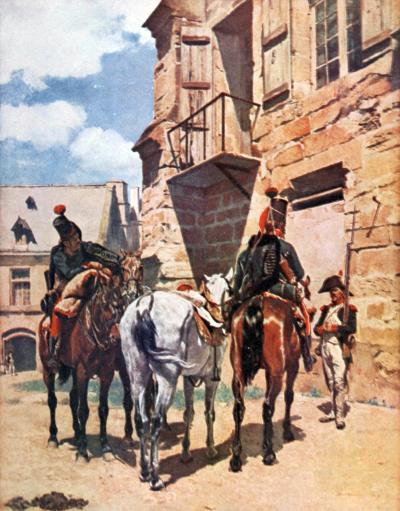
The Patrol Removing a Body from an Outpost, his earliest known work,
one of the collection that his father bought, to swell somewhat that
famous monthly income of fifteen francs, he never abandoned his
brushes.
We left him unsuccessfully exhibiting, at the Salon of 1834, a small
painting, dealing with a Flemish subject. Let us add, as a final word,
that this genre picture was accompanied by an aquarelle, entered in
the catalogue of that date as: Soldier to Whom in the Citizen’s
House, a Young Girl serves a Mug of Beer. This aquarelle was
purchased for one hundred francs by the Society of Friends of Art.
The following year he did not exhibit. This, unfortunately, was not
because he had nothing to offer; but the pictures that he sent,
consisting of The Chess Players and The Little Messenger, had not
been accepted by the jury. There was an excess of severity in this
refusal; and in spite of the fact that the candidate for admission
was still under the age of twenty, the two pictures offered possessed
certain genuine qualities that rendered the sentence of the jury
cruelly unjust.
Such was the opinion of the artist, who in 1836 offered the same
pictures over again; it was also the opinion of the jury of that year,
for it accepted them.
Two years later, Meissonier exhibited a Monk Consoling a Dying Man.
This canvas attracted the attention of the Duke of Orleans, who bought
it for five hundred francs. (Fourteen years later, at the sale
consequent upon the Duke’s death, this same Monk was resold for
4,000 francs.)
In 1839, Meissonier attracted the attention of the critics. For
example, you may find in a paper called L’Artiste, in a critique of
the Salon: “And I almost forgot an adorable little English Doctor,
by M. Meissonier, a charming miniature in oil, extraordinarily fine
and subtle.” These lines were signed by Jules Janin, who at that time
maintained over French criticism a sort of sacerdotal sovereignty,
comparable only to that which, so far as the national school of
painting was concerned, was afterwards held by the artist whom Janin
then heralded with an almost exaggerated cordiality.
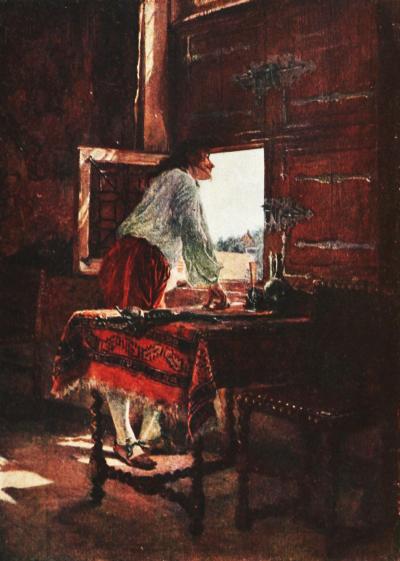
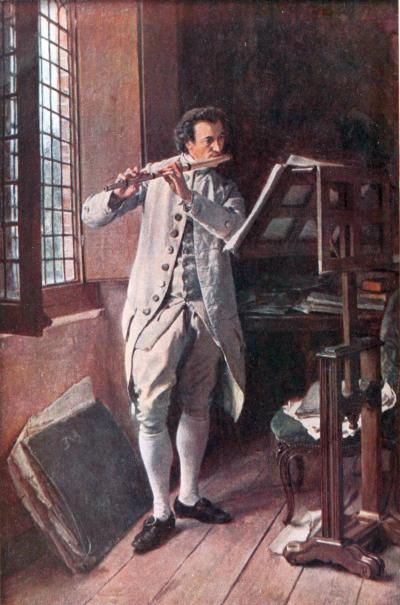
PLATE V.—AWAITING
(In the Musée du Louvre)
This painting, which is frequently confused with another by the same
artist, entitled The Man at the Window, is chiefly noteworthy for
its finished detail and prodigious ability of execution. Meissonier
herein reveals his profound understanding of the principles of
chiaroscuro.
But the small size of Meissonier’s pictures! That is the one thing
that, for the world at large, contemporaries and posterity alike, is
the keynote of his talent: “Meissonier has always painted on such a
small scale!” That is what one would begin by saying, if one wanted to
explain him, to reveal him to some one who did not know him. And what
endless things have been said in addition, by way of praise,
criticism, and discussion, regarding the scantiness of the canvases or
panels to which the artist applied himself!
Underlying this whole matter of smallness there is, without any
paradox, a rather big question. Beyond doubt, material dimensions in
works of art are not taken into consideration, so long as these
dimensions remain within moderation. It is equally certain that, short
of introducing revolutionary modifications into our aesthetic creed,
we would refuse to accept as a work of art anything that exceeded too
far these limits of moderation, or fell too far below them. Is it not
the same in life and in society, where exaggerated giants and
undersized dwarfs find that they are outcasts, each in his own way,
outside the common law, and regarded simply as curiosities?
Granted: but what is the limit? Does Meissonier surpass it, and are
his pictures too small?
Very well, let us answer categorically: no! No, they are not too
small, considering, first of all, their subject; secondly, their mode
of presentment, their composition, their treatment as to decoration;
and, lastly, the vividness and intensity of their details.
One may even go a step further and assert that they have the
dimensions that they ought to have, the dimensions that are best
calculated to enhance the artist’s magnificent gifts, and to make one
forget the qualities in which, perhaps, he was lacking. The scenes
which he kindles into life, to say nothing of single characters that
he portrays, are like stories told in an intimate sort of way; they
force one to draw closer.
They have not sufficient harmony and amplitude to attract attention
from a distance; but, seen from near by, they give their message with
exquisite precision. They offer a hundred subtle details for us to
seek out and approve; a painstaking grouping for us to admire; and,
best of all, expressive physiognomies for us to read. It seems as
though the dimensions had been calculated on exactly the right scale
to awaken all these impressions at once and blend them as completely
as possible. And all this would have been too scattered in an ampler
setting. It is because of this perfect proportion that it has been so
justly said that “Meissonier’s pictures never look small excepting
before you have really looked at them.”
But let us make no mistake in this regard. Painting on a small scale
would not of itself suffice to attain this maximum of intensity. It
needed, on the contrary, an enormous amount of talent to avoid an
effect of fussiness and preciosity.
Still other reasons have been given for the great value of this
artist’s works in spite of their smallness, or rather because of their
smallness. M. Gustave Larroumet has written on this very point a
brilliant and ingenious special plea, of which the following is the
principal passage:
“There is a certain class of subjects in which amplitude is an error
of judgment. If you wish to paint the coronation of Napoleon, the
bridge of Tailebourg, or the battle of the Cimbri, you have the right
to measure your canvas in proportion to the space which such scenes
occupy in reality; on the other hand you might conceive of your
subject in such fashion that it could be contained completely within a
square metre. But why give to an artistic reproduction more relative
importance than the originals have in reality? Supposing you wish to
show me a passer-by, on foot or on horseback. How do they interest me
in real life? Simply by the rapid impression that they leave upon my
eye and mind. I have seen them at a distance, reduced to a few
centimetres by perspective. I am satisfied if you show them to me in
the same proportion.”
The argument is specious. Perhaps it is more ingenious than it is well
founded, and lays itself open to discussion. But it will not do to
linger too long over abstract polemics, when we are in the presence of
a reality, a type of work, every least portion of which makes its
appeal and, by the very fact that it is so full of interest and of
life, practically answers the subtle problem that it has raised.
In 1840 more pictures were sent to the Salon: a Reader, a Saint
Paul, an Isaiah.
Was the painter beginning to change his manner? Those last two
pictures might give reason to fear so. They were life size, yet that
did not prevent them from being dull and commonplace in execution.
Doubtless, irritated by his critics, Meissonier had wished to prove
that he also, if he wanted to, could paint according to the schools.
Even the artists who are surest of themselves sometimes come to these
hasty and impatient determinations.
Fortunately for him, he made a bad showing, and a painter who had
great influence over him, Jules Chenavard, succeeded in recalling him
from the false path into which he was trying to force his talent.
On the other hand, the praises bestowed upon his genre painting,
The Reader, which was “genuine Meissonier,” could not fail to
encourage him to remain true to himself. The Revue des Deux Mondes,
in its critical review of the Salon, bestowed upon this picture an
enthusiastic tribute, couched in a style that may seem to us today
somewhat old-fashioned:
“A Flemish canvas, if there ever was one. Picture to yourself a good
old soul, retired from business, his skin as wrinkled as the parchment
of his books, ill clad, ill fed, and nevertheless the happiest man in
the world: he is a bibliophile, and he is in the midst of old books!
You could hardly believe how vividly this noble passion is expressed
in that little picture. But where in the world did M. Meissonier come
across all those delightful little rarities in books? You can almost
smell the adorable odour of old bindings!”
The young artist—he was at that time only twenty-five—was awarded a
third-class medal. The following year he obtained a second-class
medal, and his painting, The Game of Chess, won him a brilliant
triumph: it was purchased by M. Paul Périer. It was a material triumph
not to be despised: the picture brought two thousand francs, which at
that time was considerable. The moral triumph was even bigger, because
Paul Périer was an experienced collector, who acquired only such works
as were worthy to take their place in an assemblage where the biggest
names of the period were represented by masterpieces.
Henceforth, success after success followed regularly. Each picture
that he sent to the Salon won increasing distinction: A Smoker (they
are a goodly number, the smokers and the readers that came from
Meissonier’s brush!); A Young Man Playing the ’Cello; The Painter
in his Studio; The Guard-House; The Young Man Looking at
Sketches; The Game of Piquet; The Park at Saint-Cloud. This last
picture was done in collaboration; Meissonier painted only the
figures, the landscape was the work of Français.
This mounting success, which so quickly turned into glory, was
legitimate. The artist had by this time all his resources admirably at
command, and was fully imbued with his ideal.
He had learned to give to every face that profundity, to every scene
that intensity of action, that constitutes his individual bigness. The
arrangement of the milieu, the scrupulous devotion to realism that
we noted in the opening lines of this study, the prodigious anxiety to
give to every one of his personages such play of physiognomy, such
expression, glance, and gesture as would best reveal their character
and help us to know them better,—all these things combine and
harmonize to produce an effect of remarkable power.
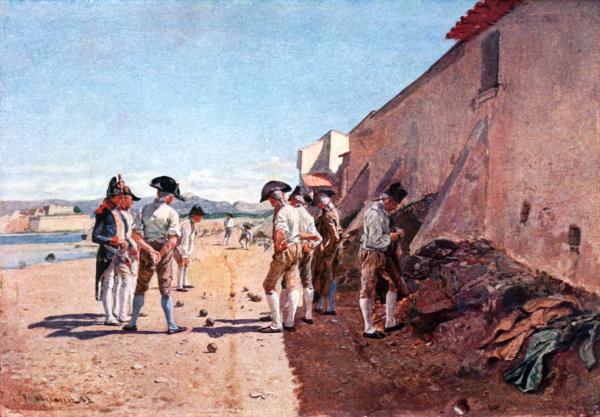
PLATE VI.—THE PLAYERS AT BOWLS
(In the Casa-Riera Collection)
This curious composition represents some Spanish soldiers playing
bowls outside the city wall. The painting, which is hardly larger than
the accompanying reproduction, is a little masterpiece of actuality,
and the people in it move in a thoroughly faithful landscape, lit by
the warm sunlight of Spain.
Those among Meissonier’s contemporaries who had assured taste and
artistic insight were impressed by the number of qualities revealed in
such limited space. Let us listen to Théophile Gautier:
“Meissonier,” he wrote in an article published in the Gazette des
Beaux-Arts, “composes his pictures with a science unknown to the
Flemish masters to whom he is compared. Take, for example, a Smoker!
The manner in which he is placed in the centre of the picture, one
elbow resting on the table, one leg crossed over the other, one hand
hanging idly by his side, his body sunk within his gaping waistcoat,
his head bowed forward in revery, or jovially thrown backward,—all
this forms a composition which, while not so apparent to the eye as
some dramatic scene, nevertheless works its effect upon the spectator.
The accessories cleverly play their part to throw more light upon the
character of the central figure. Here is a Smoker, for instance, who
is a worthy man, no doubt of it; clad in an ample coat of ancient cut,
and of a modest gray, with a well brushed cocked hat upon his head;
one foot swings free, encased in a good, stout shoe, with silver
buckle; and, with the tranquillity of an honest conscience, he draws
in a deep breath of tobacco smoke, which he allows to escape again in
little clouds, wishing, thrifty man that he is, to make the pleasure
last. Close at hand, upon a table with spiral legs, he has placed side
by side a flagon and a pewter-lidded tankard of beer. An intimate
satisfaction radiates from his face, which is furrowed by deep lines,
a face expressive of foresight, orderly habits, and rigid probity. One
could trust him with one’s cash-box and account books. Here is another
Smoker, clad in red; he also holds a pipe and performs apparently the
same action; but his disordered garments, violently rumpled, buttoned
askew, his three-cornered hat jammed down upon his eyebrows, his cuffs
and frilled shirt crumpled by nervous fingers, his whole attitude
expressive of feverish anxiety, his twitching lip straining around the
clay stem of his pipe, his hand thrust angrily into an empty
pocket,—all these details proclaim the adventurer or the gambler in
hard luck. He is evidently saying to himself: ‘Where the deuce could I
borrow a louis or even a crown?’ Even the background, if we consult
it, gives further enlightenment. In this case we no longer have neat
plastering of modest gray and substantial brown woodwork, but battered
and dirty walls stained with smoke and grease, reeking of tap-room
foulness and unclean lodgings. And that shows how far one smoker may
fall short of resembling another!”
It is precisely this difference between one human being and another,
in other words, this quality of individuality, that constitutes the
creative gift of the real artist and proves that the honour of this
title is really deserved by a painter whose pictures are animated
groups, among whom a spectator may wander, studying them with growing
interest, and then afterwards call to mind the various types,
episodes, scenes, dramas that he has actually seen.
One can never grow tired of quoting Gautier apropos of an artist whose
brush always had something in common with his pen. This masterly art
critic has described for us, sketched in words, so to speak, still
another picture: “A man standing before a window through which the
daylight streams flecking his face with silver; in his hand he holds a
book which absorbs his entire attention,—this is not a complicated
theme, but it grips us like life itself. We want to know the contents
of that volume, it seems as though we could almost conjecture it.
Plenty of other artists have painted marquises and marchionesses,
sleek abbés and shameless beauties of the Eighteenth Century, thanks
to the aid of powder and patches and paint, rosettes, paniers,
bespangled coats, silken stockings, red-heeled shoes, fans, screens,
cameos, crackled porcelain, bonbonnières and other futilities.
Meissonier rediscovered the decent folk of that period, which was not
made up exclusively of mighty lords and fallen women, and of which we
get, through Chardin, a glimpse on its honest, settled bourgeois side.
Meissonier introduces us into modest interiors, with woodwork of sober
gray, furniture without gilding, the homes of worthy folk, simple and
substantial, who read and smoke and work, look over prints and
etchings, or copy them, or chat sociably, with elbows on table,
separated only by a bottle brought out from behind the faggots.”
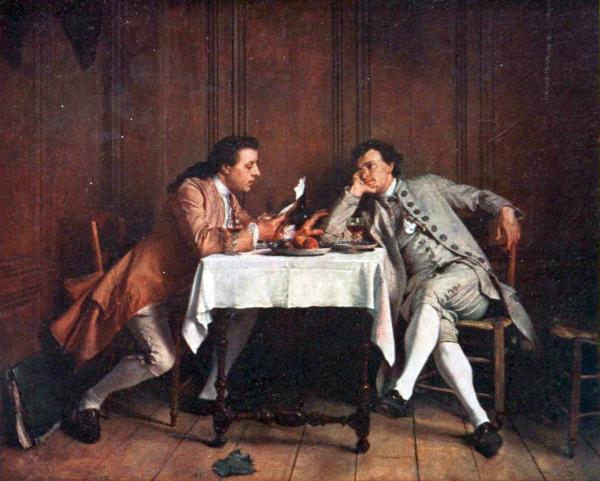
And who can ever forget, in The Confidence (the picture which passed
from the gallery of M. Chauchard to that of the Louvre), how tense and
attentive the face of the listener is, even in repose, while the
relaxation of the body is revealed by his posture, as he leans against
the wall with an elbow on the table,—and how naïve the face of his
friend—younger and better looking—as he reads the letter: naïve,
excited, even somewhat simple, with a nose slightly exceeding the
average length and a forehead just a trifle too low.
In the Game of Cards, a soldier and a civilian are seated opposite
each other, in the midst of a contest. The soldier has a dogged air
and he is losing. Apparently, he is not a strong adversary, for the
man of questionable age who faces him, his small, narrow, foxy head
surmounted by a three-cornered hat, his lean body lost in the depths
of a huge greatcoat, his thin ankle showing beneath the white
stocking, belongs to the race of weaklings who live at the expense of
the strong.
In The Etcher, just as in The Man at the Window—two of his most
celebrated pictures (the former brought 272,000 francs, even during
Meissonier’s lifetime)—the interest of the principal—and
only—figure is heightened and singularly beautified by a delicate
effect of light, forming an aureole, in the very centre of the
picture, respectively around the face of the worker and of the
dreamer.
Note, in A Song, the moist eye of the musketeer playing the guitar,
and in Pascuale the half stupid, half poetic air of the central
figure engaged in the same occupation; note also in The Alms-giving
the frowning brow of the horseman as he searches in his pocket; and in
The Visit to the Chateau—an ostentation of coaches and gentry—and
in The Inn—three cavaliers who have halted for the moment and are
grouped around the serving-maid, as they drink—the reconstruction of
an entire epoch with its pomps and its idylls, that justifies us in
calling these pictures veritable “stage settings taken from life.”
One might spend a long time in analyzing the various shades in the
gamut of expressions on the faces of the principal and secondary
figures in the Game of Piquet, who, scattered all nine of them
around the two sides of the tavern table, follow either amusedly or
critically or with feverish interest the changing fortunes of the
game. And in the Portrait of the Sergeant, what a magnificent
collection of different degrees of attention: that of the portrait
painter as he studies his model standing in front of him on the
pavement, in his finest uniform and his finest pose; that of the model
intent only upon doing nothing to disturb his ultra-martial bearing,
his gaze menacing, staring, fixed; that of the spectators, some of
them drawing near, fascinated, another who casts an amused glance at
the picture as he passes by, with some sarcastic remark on his lips;
another who no doubt has just been looking, and for the moment, with
pipe between his teeth, is thinking of something else as he sits on a
bench with his back to the wall and his legs extended in front of him.
The Quarrel, with all the feverish violence that drives the two
bravos at each other’s throats, has perhaps more amplitude and less
realism than any of the previously mentioned works. It is
Meissonier’s one romantic painting, and he professed a great
admiration for it, ranking it as one of his four best canvases. It is
recorded that the master said one day to a friend:
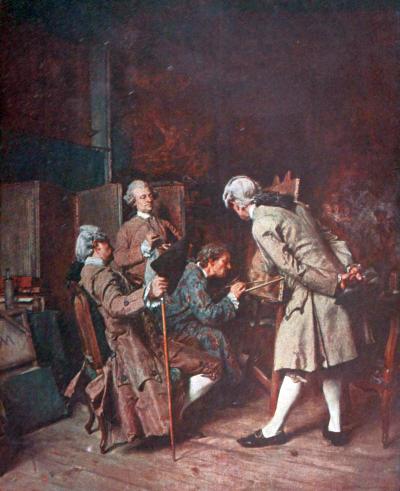
PLATE VII.—AMATEURS OF PAINTINGS
(In the Musée du Louvre)
This picture, which must not be confused with the Amateurs of
Paintings, in the Musée Cluny at Chantilly, is nevertheless a replica
of the latter. They are differentiated by a few insignificant details,
but they resemble each other in the harmony of the grouping and the
truth of the attitudes.
“I have seen my Quarrel at Secretan’s. I looked at it as though I
had never seen the picture before. Well, do you know, it is really a
fine thing!”