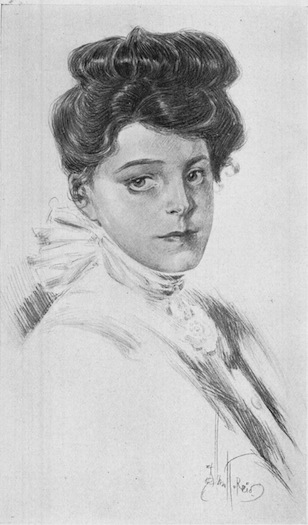
“Speak low if you speak love.”
Robert was walking, with no particular aim in view, when he saw a
familiar figure on the walk ahead of him, and hastening, he soon
overtook her.
Meg turned her head as his step accustomed itself to hers, and
smiled. “May I go with you, my pretty maid?” he asked lightly.
“Show me the girl who has been teaching you to say that kind of
thing,” she exclaimed with mock anger.
“Lend me your pocket mirror and I will.”
“Never!” she said emphatically.
“Never what?”
“Never carried a pocket mirror in my life. Never taught you to make
pretty speeches,” she said tartly. “Why, the first time I saw you,
you sat and twirled your thumbs like a ‘bound boy at a corn-husking,’
and never said anything but ‘Yes’m,’ and ‘No’m,’ and then only when
you were spoken to!”
“That proves what I affirm. That was the way I was when I met
you,—and look at me now!” with an air of conscious pride.
“Yes, look at you now!” she mocked scornfully, “with Mother Goose
platitudes tripping off your tongue like extracts from the Hebrew
Decalogue. Why don’t you stick to your last? You might say all the
nice things you wished in Latin, Greek, French, German or Spanish,
and I’d have to smirk and act as if I understood, and felt very much
flattered.”
“And all this because I asked to accompany her on her walk!” he
murmured as though to himself.
She gave him an upward look through her lashes that made him feel
very peculiar, as she said sweetly, “Well, you know I didn’t mean it.
I like to have nice things said to me.”
“By every one?” he queried idly, without looking at her.
“Well, no,” she admitted slowly.
There was nothing more said for a few minutes; then he remarked
carelessly, “You didn’t tell me where you were going.”
“I am going to see my cousin-in-law. I hate her, but I love her
husband.”
“That’s frankness that might be misunderstood.”
“I know it,” Meg replied earnestly, “but it’s true. You see, Ada has
always felt that she married beneath her, and she has convinced poor
Charlie that she did. But how she came to cherish such a notion I
don’t know, for he’s the salt of the earth!”
“Was it a question of family?”
“Yes. Her father was at one time pretty well off, and at the time she
married Charlie some people thought she might have done better.
Charlie’s one of those big-souled men who never accumulate anything,
and he is blunt and hearty in his manner. Now she thinks because she
crooks her little finger when she drinks a glass of water, that she
is more refined than he!”
Robert laughed boyishly at her quaint description, and said, “I think
I know them—not this particular couple, but their prototypes.”
“Are there others like Charlie, I wonder,” she said musingly. “He
stands out so in my mind because he’s the best, the very best man I
ever saw.”
After a short walk, she stopped in front of a modest two-story house,
and turning to her companion, said coaxingly, “Come in with me, and
meet Ada—then you’ll see for yourself.”
“You are sure it won’t be an intrusion?”
“Of course I’m sure,” was the response.
They were admitted by a tall, overgrown girl of thirteen, who beamed
with pleasure when she saw Meg. “Come into the sitting-room,” she
said; “Papa’s in there, and he will be so glad to see you.”
“Why, what’s he doing at home in the middle of the day?” Meg asked.
“He’s not feeling very well—just indigestion, he says,” answered the
child, leading the way.
The room they entered was forlorn in the extreme, and in it was
everywhere evidence of the taste of the wife, as well as of her
notably poor housekeeping. There was dirt in the corners of the room,
and dust on the few uncomfortable, cheap, but ornate chairs. There
was a rug with big bouquets of red roses upon the floor, and soiled,
sleazy, fringed silk drapes hung over the few highly colored, gaudily
framed pictures. The wall paper was as startling as the rug, and at
the windows were coarse, cheap lace curtains.
Charlie Walker was a huge, broad-shouldered blond, with kind blue
eyes, a roaring laugh which always made his refined wife shudder, and
a hand-clasp that was warm and cordial.
He looked so pleased when he saw Meg, that it was plain to see how
well he liked her. As for the child, who had inherited her father’s
size, blondness, and disposition, she evidently regarded her small,
grown-up cousin as a veritable princess in a fairy tale.
Meg noticed with concern that Charlie really looked ill, but it was a
habit with her to say but little about such things; so, instead of
questioning him fully, she looked around the untidy room and asked,
“Where’s Ada?”
“Gone to her card club,” replied Charlie.
The child, Gertie, had taken up the mending-basket and was painfully
trying to darn a large hole in one of her father’s socks. It was
evident that she had had no training, but was trying to teach
herself, that she might assume that part of the household tasks.
“Let me do that,” said Meg impulsively, and taking it from the girl,
began deftly putting in the stitches.
Charlie watched her a moment, and then remarked, answering the
unspoken accusation of her mind, “Ada had so much to do this week
that she couldn’t get around to it.”
Meg drew the thread viciously and made no reply.
“She has had to practice a good deal for that concert she is to take
part in,” he said.
Still Meg did not speak, and the set of her lips impelled him to add
anxiously, yet with a certain amount of dignity, “It is in accordance
with my wishes, that she keeps up her music.”
“Yes, of course it is,” answered Meg meekly, for, as she told Robert
afterwards in discussing it, “Big as that man is, I would no more
hurt him than I would a baby.”
After that, Charlie drew Robert into the conversation. Each man had
taken the measure of the other, and approved. They had talked
indifferently for awhile on matters pertaining to the town, when the
front door opened and a step was heard in the hall.
Robert, looking at Charlie Walker, saw a light leap into his eyes, as
he turned toward the door leading into the hall. “What manner of
woman is this?” he asked himself, “who can bring such a look to a
man’s face after so many years of married life?” All unconsciously
his eyes wandered to Meg.
Mrs. Walker was pretty, in rather a coquettish way; with soft brown
hair and eyes, a weak red mouth, and a complexion which still
retained its girlish fairness. Her hands were little, white, helpless
ones, and about her was an air of childish innocence and
irresponsibility. Her dress was in keeping with the furnishing of the
room, cheaply pretentious and ornate.
Robert felt instinctively that while such a woman could never possess
any attraction for him, she was the type some men would die
for,—notably, her husband.
The talk was desultory for a while, and then Meg asked her cousin to
play for them, “Which was generous of me,” she confided later, to
Robert, “for it showed her to the best advantage.”
Without demur she seated herself at the piano and at once began to
play with such sweetness and power that Robert was amazed. Glancing
toward her husband, whose face reflected his appreciation of the
music, as well as his adoration of the performer, Robert felt that he
held the key to the puzzle.
As they were walking home, Meg asked him suddenly, “What did you
think of my kin-folks?” As he paused, she continued, “Never mind the
house,—I know what you thought of that,—but tell me what you think of
Charlie?”
“He is a man I could love like a brother. I have never felt so drawn
to a stranger.”
“You dear boy!” cried Meg impulsively; “I always knew you were nice,
but I never dreamed you were that nice. You see, Cousin Charlie is
my hobby, for I think he is a grand character, and I want him to be
appreciated.”
“Is he not?”
“By everybody but his wife.”
“I thought that, but I didn’t want to judge her hastily,” commented
Robert.
“She does not appreciate him,” Meg vehemently exclaimed. “I wish I
could shake a little sense into her. He was too sick a man to be left
this afternoon, but she didn’t know it, or didn’t care if she did
know it. Why, if I had a husband like that, and he had nothing more
serious the matter with him than a boil, I would stay with him!”
“I believe you would.” She looked up suddenly, surprised by a new
note in Robert’s voice, and found him looking at her earnestly. The
interchange of glances embarrassed both of them, and to cover it, he
continued rather hastily, “I don’t understand how a woman of her
evident lack of feelings can have such a divine conception of music.”
“I can explain that,” said Meg confidentially. “It was a case of
mixed identity. That gift was meant for me, but got switched around
some way. I have the love of music, the capacity to suffer manifested
by her playing, while she,—she simply expresses what I feel.”
Robert smiled at her whimsical conceit, but made no reply. At her
gate she put her hand in his and said, “Good-bye,” simply and
quietly. All the defiance and willfulness which usually characterized
her were gone, and in their place was a gracious sweetness which
enveloped and engrossed him the rest of the evening.