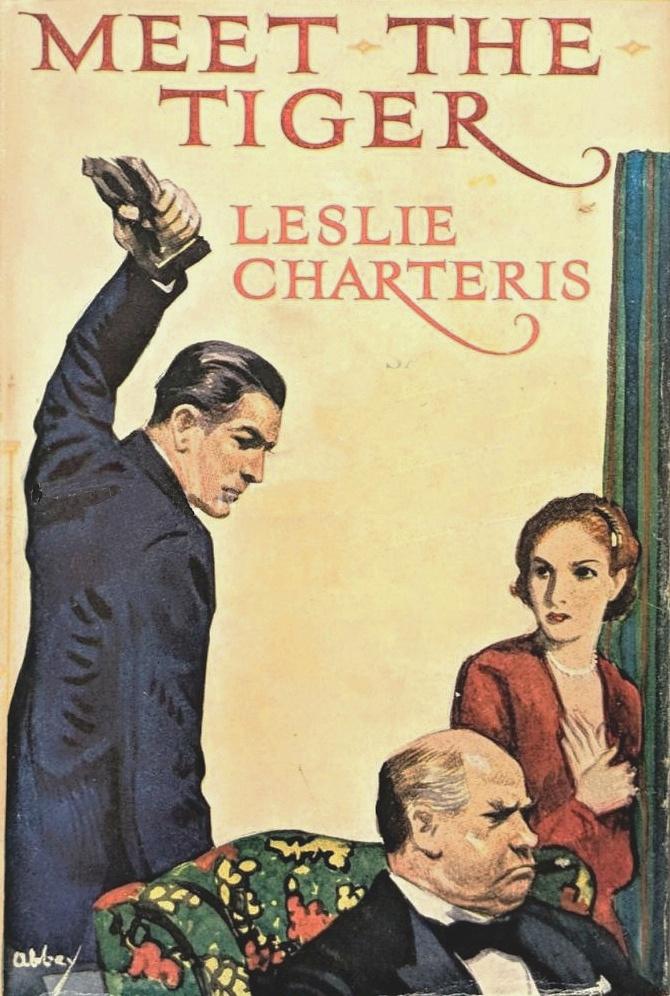
Precisely three minutes later, Simon Templar
and Orace were led into the saloon under an armed
guard.
“Good-evening, dear Bittlekins,” murmured the Saint
affably. “Fancy meeting you!—as the vicar said when he
saw one of the leading lights of the parish Mothers’ Union
dancing at the Forty-Three. Sit down and tell me all the
news.”
Bittle smiled.
“We all make slips,” he said, “but I scarcely imagined
you would overlook such an obvious factor as Miss
Holm.”
“I was just hoping that you yourself might overlook
it,” explained the Saint. “I honestly thought you were
slow enough on the uptake for that. Still, we all make
our mistakes, as the bishop said, even the very youngest
and most inexperienced of us—and very few mistakes are
irreparable.”
Bittle nodded slowly.
“Very few,” he agreed. “I made a bad one when I
presumed your death—but, as you see, that error has been
rectified. Even now, Templar, you are a dead man.”
The Saint let his gaze travel round the saloon.
“Quite comfortable,” he admitted, “but I really thought
Heaven would be a bit more luxurious. Besides”—he
surveyed the six tough customers who had ranged
themselves round him in a semi-circle that fairly bristled with
knives and revolvers—“These don’t look like angels; and
you don’t, either, my pet, if it comes to that. Do you
think I could have missed the bus and arrived in Hell by
mistake?”
His sodden trousers were shapeless, and the white of
his torn shirt was marked with grease, but still, by the
exercise of his inimitable gift, he was able to look debonair
and immaculate. And, for all the apparently overwhelming
odds against him, he retained his air of unshakable
confidence. But this time Bittle could see no loophole in the
trap in which he had the Saint, and he refused to be awed
by anything so intangible as the Saint’s assured bearing.
“Have they been searched?” he asked one of the
guard, but it was Simon who answered.
“I gave up my gun when I surrendered.”
“And kept your knife—I remember that trick,” said
Bittle.
He himself removed Anna, and by making a thorough
examination he found also her twin sister strapped to the
Saint’s leg. The discovery pleased him.
“I’m not making any more mistakes, Templar.”
“So glad!” drawled Simon. “May I have my cigarette-case
back, please? Anna and Belle aren’t any use to anyone
but myself, but the cigarette-case is really silver—I won it
in the Open Ludo Tournament at Bournemouth in ’13.”
Bittle examined the case, and, failing to find anything
suspicious about it, returned it to the Saint, who replaced
it in his hip pocket.
The Saint turned suddenly on his heel, and the guard
sprang back a pace and put up their weapons, and Simon
laughed.
“Your men aren’t very brave, are they?” he remarked.
“I’m unarmed, and each of them looks like a travelling
arsenal—but watch!”
He feinted at one of the tough-looking customers and
the man flinched away. The Saint tweaked his nose
ungently, and, wheeling round, tripped up another man
and sent him crashing to the floor. Bittle sprang up with
an oath, reaching for his revolver, but the Saint turned
back with a light chuckle and put up his hands.
“Merely a demonstration of moral superiority,” he
said airily. “Even now, you see, I can scare you!”
“I’ll soon stop that,” Bittle grated, furious at having
let himself be alarmed by the exhibition, and pointed to
one of the men. “Fetch a rope—we’ll see what he can do
when he’s trussed up.”
“Anything you like,” said the Saint boastfully. “Houdini
is my middle name, and knots mean nothing to me.”
The rope was brought, and Simon’s hands were tied
securely behind his back. The man knew his job, and,
since he was the gentleman whose nose the Saint had
taken liberties with, he did not consider the prisoner’s
comfort at all. The cords bit savagely into Simon’s wrists,
tightened up by a violent hand, but the Saint only smiled.
“Mind you don’t break the rope,” he said solicitously.
The man knelt down to bind the Saint’s ankles, but the
Saint, without any haste or heat, put his foot in the man’s
face and pushed him over.
“If there’s no objection,” he murmured, “I’ll sit down
first.”
He crossed the saloon nonchalantly and took one of the
swivel chairs. Then he let the seaman tie his ankles
together. The same brutal force was exerted there, and
when the operation was complete the man straightened
and deliberately struck Simon on the mouth. The Saint
did not move, and the man spat in his face.
“I congratulate you,” said the Saint in a low voice.
“You are the first man that has ever done that to me, and
I am pleased to think that before morning you will make
the thirteenth man I have killed.”
“That’ll do,” rapped Bittle, as the man raised his fist
again. “Tie up his servant.”
Orace clenched his hands and looked round belligerently.
“Cummernava try!” he challenged.
Orace was game enough, but there were men all round
him, and he could only knock two of them flying before the
rest were clinging to his arms and legs and bearing him,
still struggling and swearing sulphurously, to the floor.
He was trussed up even more comprehensively than the
Saint, perhaps because his cruder form of defiance was
more understandable to the inferior mentalities of the
guard; and then one of the men was sent to bring in the
girl, and Simon braced himself up for the meeting.
Patricia walked into the saloon with her head held high,
but her calm was not proof against the sight of the Saint’s
bruised face and the thin trickle of blood running down
his chin from the corner of his mouth.
“Simon!” she sobbed, and would have run to him, but
two of the guard clutched at her and dragged her back
against the wall.
“It’s all right, old darling,” said the Saint urgently.
“Don’t let the swine see you break down. . . . I’m not
hurt. Just been in a vulgar brawl, and it’s nothing to
what the blister who did it will look like when I’ve finished
with him. . . . Now, Pat, old thing, cast an eye over
that nasty object across the way. It’s old fat Bittle himself,
and he’s going to make a speech about his triumph—I can
see it written all over the boil he calls his face.”
Bittle nodded.
“You must confess,” he said, “that I have some cause
to be satisfied with the conclusion of our little rivalry.”
“Conclusion my sock-suspenders!” snorted the Saint.
“I haven’t started yet!”
“In that case, Templar, you would appear to have
sacrificed your chance for ever. . . . But your diagnosis,
in a way, was quite correct—I was about to outline to
you the programme which I propose to follow with regard
to your immediate future.”
“Careers for our Boys,” quoth Simon irreverently.
Bittle clasped his hands across his stomach.
“Before we proceed with that interesting exposition,
however,” he said, “I think there are two members of the
company who would like to be present.” He turned to
one of the guard. “Lambert, will you go and see if Mr.
Bloem and Mr. Maggs have recovered sufficiently to join
us?”
The man left the saloon, and there was silence for a
moment. Presently Bittle said:
“While we’re waiting, perhaps you’d care to tell me
how you managed to escape?”
The Saint grinned.
“Nothing is easier. When I was an infant, a celebrated
clairvoyant and cardsharper told me that I had been born
under the sign of the Zodiac known to astronomers as
Humpty Dumpty and to the lay public as the Egg. Taking
his words to heart, I early applied myself to the study of
the science of Levitation, in the hope of averting the
doom which had been prophesied for me. I succeeded so
well, by virtue of years of practice and self-denial and
hours of fasting and prayer, that I can now back myself
to bounce to almost unlimited heights. Consequently,
when I fell into your little trap, I was able to fall out
again, if you get the idea. I think that’s the whole
story—except that an aunt of mine once had an under-gardener
whose nephew knew a man whose father had once shaken
hands with a lady who remembered meeting a dentist in
Maida Vale whose second cousin twice removed was the
divorced wife of a Manchester stockbroker who once ate
a pint of whelks with a lawn-mower on Wigan Pier for
a bet. In fact,” went on Simon, warming to his subject,
“we are a very distinguished family. Another aunt of
mine had gout and a mother-in-law whose cook married
a gas-fitter who——”
“Spare us your humour,” pleaded Bittle wearily. “It
doesn’t amuse me.”
“But it amuses me!—as the actress said on an auspicious
occasion,” said the Saint, and would have continued in that
vein if Bloem and Maggs had not arrived at that moment.
Both looked much the worse for wear, and their heads
bore abundant tokens of the cold water which had been
liberally used in resuscitating them. In addition, Bloem’s
forehead was disfigured by a bruise which was rapidly
taking to itself all the brighter hues of the rainbow, and
the way he glared at the Saint was not friendly.
“The compliments of the season, Mynheer,” drawled
Simon. “And who’s the other little ray of sunshine, Mr.
Chairman?”
“Our captain, Mr. Maggs,” Bittle introduced that
injured warrior suavely. “You have not met him before,
Templar, but our dear friend Miss Holm knocked him out
an hour or two ago.”
“Delighted!” murmured the Saint. “She seems to
have made a good job of it, Maggie—or did you always
look like that?”
Mr. Maggs lowered.
“My name’s Maggs,” he blustered.
“But I shall call you Maggie,” insisted the Saint. “It’s
more matey, and it suits you better. And really I didn’t
mean to be rude about your face. You’ve got a nice kind
face, like a cow.”
Mr. Maggs turned away with a growl, and stalked over
to the girl. Then the Saint was afraid, and the veins stood
out purply on his forehead as he wrestled with his bonds.
Maggs took the girl’s chin in his thick fingers and tilted
up her face, leering down at her.
“You might’ve killed me,” he said—“hitting me like
that. But I’ll make you apologise later, and I like my
apologies sweet.”
“Sit down, Maggs,” snapped Bittle.
Maggs still persisted.
“Give us a kiss to be getting on with, like a good
girl.”
“Sit—down—Maggs!”
Bittle was on his feet, and there was death in his hand.
Grumbling, Mr. Maggs lurched into a chair and sat staring
at Patricia in his ugly way.
Bloem went round to the chair opposite Maggs, but
Bittle remained standing at one end of the table. The
Saint sat at the other end.
Bittle paused for a moment, and the men grouped round
the walls fidgeted into stillness. A macabre atmosphere of
fiendish cold-bloodedness began to fill the room. It came
from the hate-smouldering eyes of all those silent men,
and it clouded malevolently behind the stocky figure of
John Bittle. Bittle was posing at the end of the table,
waiting for the theatrical effect of the gathering to tense
up to a nerve-tearing pitch, and a sensitive man could have
felt the silence keying up to the point at which unreasoning
terror crowds in like a foul vapour. Seconds throbbed away
in that pulsating suspense. . . .
The Saint cleared his throat.
“Rising to address this general meeting at the close of
such a successful year,” he prompted, “I feel—— Go on,
Bittle. Declare the dividend, and make sure all your
braces buttons are safe before you bow to the applause.”
His gently mocking tones broke down some of the
tension. He looked across at the girl, and she smiled back.
“I’m not taking any notice,” she said in a clear voice.
“He’s only indulging his love for melodrama.”
“Melodrama,” replied Bittle, “is a thing for which I
have an instinctive loathing. Yet, in a situation such as
this, it is very hard to avoid overstepping the bounds of
banality. However, I will try to be as precise and to the
point as possible.” He fixed his malignant gaze on the
Saint. “This man, Templar, whom you see, has elected
to interfere in matters which do not concern him. By a
succession of miracles, he has so far managed to avoid the
various arrangements which we have made for disposing
of him; but now, on the open sea, I hardly think he can
escape. He has put us to great inconvenience, and I don’t
think anyone here has any cause to bear him any good
will. While he lives, no one here is safe. I believe I am
merely the spokesman of everyone present when I say that
he must die.”
He looked from face to face, and there was a mutter
of assent. He looked at the Saint again.
“I endorse that verdict,” he said.
“Blatherskite and brickdust!” said the Saint
disparagingly.
Bittle continued.
“Then there is this man—Orace. He is also a man
against whom some of you will bear a personal grudge. In
any case, he is in Templar’s confidence, and therefore I say
that he too must die.”
“Pure banana oil,” jeered the Saint.
“Finally,” said Bittle, “there is the girl. I propose to
marry her myself, and Maggs will conduct the service as
soon as the sentence has been carried out upon Templar
and Orace.” He picked up a revolver from the table and
waved it meaningly. “If there is anyone here—Maggs
included—who objects to that, he can speak now.”
Nobody moved.
“Scat!” remarked the Saint.
“Is that all the protest even our redoubtable Mr.
Templar can make?” Bittle sneered. “I’m disappointed—you’ve
talked so much about what you were going to do
to all of us that I was expecting something interesting.”
Simon yawned.
“Before I die,” he said, “may I tell you my celebrated
joke about a man called Carn? I wonder if you’ve heard
it before? There was once a physician called Carn, but
nobody cared worth a darn—if a man said ‘By Heck!
That bloke might be a ’tec!’ the others would simply say
‘Garn!’ And yet it happens to be true. Isn’t it odd?”
“Patricia”—Bittle rolled the name out with relish—“has
already told me that story. If it is any comfort to
you, I can assure you that it will only make me more
careful of her health. The same ultimatum which brought
you into my power will, I think, discourage Carn. It will
certainly be an awkward dilemma for him, but I imagine
that his humanity will triumph over his sense of duty.”
“If that is so,” said Simon slowly, “I think he will be
sure to give the order to fire—and blow this ship and
everyone on board to smithereens.”
Bittle shrugged, and signed to one of the men whom
Orace had floored.
“We will start with the servant,” he said.
“Yah!” gibed Orace. “Yer a lotter thunderin’ ’eroes,
you are! Undo me ’ands, and cummaht on the deck,
any sixeryer, an’ I’ll showyer wotter rough-’ouse feels
like!”
Beads of perspiration broke out on the man’s face as
he slowly raised the revolver.
“Sorlright, sir,” Orace ground out. “Don’ think I care
a damn fer wot ennyer these bleedin’ barstids do. . . .
Shoot, yer maggot! Wotcha skeered of? ’Fraid I’ll bite
yer? . . . Git on wiv it, an’ be blarsted to yer!”
“Wait!”
The Saint’s mildest voice scarcely masked the whiplash
crack of his command, and the man lowered his gun. Bittle
turned to him.
“Have you, after all, something to say before the sentence
is carried out?” he inquired ironically. “Perhaps you
would like to go down on your knees and beg me to spare
you? Your prayers will not move me, but the spectacle of
Mr. Templar grovelling at my feet would entertain me
vastly. . . .”
“Not this journey,” said the Saint.
Already he had worked the cigarette-case from his
pocket and cut through the cords which had bound his
hands, though it had been a long and difficult feat. Now
he had slid forward in the chair and tucked his legs well
back, and he was patiently sawing away at the ropes which
pinioned his ankles.
“You see,” said the Saint, in the same leisured tone,
“we are all, as you recently observed, liable to make our
mistakes, and you have made three very big ones. You
must understand, my seraph, that your own loathing for
melodrama is only equalled by my love for it, and I think
I can say that I staged this little conversazione simply for
my own diversion. It seemed to me that this adventure
ought to finish off in a worthily dramatic manner, and if
all goes well you’ll have to bear the agony of watching
enough melodrama concentrated into the next few minutes
to fill a book. Things, from approximately now onwards,
will go with a kick strong enough to set the Lyceum gasping.
How does that appeal to you, beloved?”
“I’ll tell you when I hear,” said Bittle brusquely, but
the Saint declined to be hurried.
“The speechifying,” he remarked, “will now come from
the principal shareholder, so please don’t fluster me. Sit
down and listen—you’ve had your turn. . . . Well,
here we all are, just like a happy family, and exactly where
I wanted you all. I grant you I took a big risk, but I had
to do it to get the scene nicely set and the audience all
worked up and palpitating in their pews. Also, it happened
to be necessary to pass a little time before the moment was
ripe for trotting out the big thrill. Now, if you’re ready,
I’ll send up the first balloon.” The Saint paused, and
smiled from Bloem to Bittle. “Where is Harry the
Duke?”
If he had detonated a charge of thermite under their
feet he could not have produced a greater sensation. The
men looked from one to another, suspicion and rage and
fear chasing over their faces deliriously. For a space there
was an electric silence, while the Saint leaned back in his
chair, smiling beatifically, and felt the last strand of rope
break away from his ankles.
Then the storm broke loose. Bittle reached forward and
pawed at Bloem’s shoulder frenziedly.
“What’s happened to Harry?” he snarled.
Bloem jumped to his feet and struck down Bittle’s
hand.
“Leave me alone!” Bloem’s nerves were raw and jagged.
“It isn’t my fault—you never asked me, and you’ve
been too busy talking yourself for me to tell you.” He
glared round at the Saint. “That meddling puppy got
me—I was just taking Harry some food—the door was
open, and he got me. I knew he’d found Harry!”
Bittle sprang at the Boer like a wild beast, his face
contorted with demoniac fury, and Bloem reeled back from
a vicious blow. In an instant Bittle had grabbed a couple
of revolvers, and was holding them threateningly in his
quivering hands, and Bloem cowered sullenly back from
the flaming passion that blazed in Bittle’s eyes. Bittle,
in that towering paroxysm, would have murdered the
other where he stood, given the slightest provocation, and
the Boer knew it.
“Search the ship!” Bittle shrilled. “You—all of you!
Get out and search the ship!”
“Why bother?” asked the Saint in his silkiest manner.
“If you want to find Harry the Duke, my little ones, you’ll
have to go all the way back to Baycombe!”
Bittle swung round.
“Meaning?” he prompted dangerously.
“Meaning that when I’d dented old Bloem’s cranium,
I went into the cabin and found Harry the Duke, alias
Agatha Girton,” said Simon. “We had quite a long chat.
He told me how Agatha died years and years ago, at Hyères,
and Harry took her place. The Tiger found him out—and
that was another bad bloomer. You’d have thought any
sane man would have been satisfied with a cool million;
but no, the Tiger was so greedy he had to blackmail Harry
for Miss Holm’s money, and that made Harry sore. Harry’s
a dangerous man when he’s sore, and he tried to kill the
Tiger. Then the Tiger saw what a mug he’d been, and
decided to take Harry off on the cruise and dump him
over the side with a couple of firebars spliced to his feet,
which is a very effective way of killing a man and has
the advantage that it leaves no incriminating corpses
about. Harry was able to tell me quite a lot of interesting
things about Tigers and Tiger Cubs. Then I told him a
few things he didn’t know, and after that we shook
hands—he was really a sportsman, because he did try to put
the kibosh on your hanky-panky with Miss Holm, whom
he was rather fond of—and I let him slip over the side
and swim back to Baycombe on condition he wrote an
anonymous letter to Carn telling him all those things about
Tigers and Tiger Cubs which we’d discussed.” The Saint
looked almost apologetic. “And, therefore, one and
only—thank God—Bittle, I can assure you that the police
will come aboard with the pilot if you so much as show
the tip of your bowsprit outside Cape Town harbour, and
the Mounted will be camped all round T. T. Deeps in case
you manage to sneak in by the back way. Rather upsetting,
isn’t it?”
“You at least, will not laugh much longer,” said Bittle,
and put the muzzle of one of his revolvers in the Saint’s
face.
“Half a sec!” Simon’s voice ripped out like a gunshot,
and Bittle hesitated with his finger tightening on the
trigger. “While I’m being so communicative, you might
as well hear the rest of the yarn—it may help you, though
I doubt it. Let me tell you your second mistake. I’ve
got another stiff one ready to shoot at you! This is mostly
Orace’s story, but he won’t mind my cribbing it. Orace,
you know, hasn’t been wasting his time. Orace went
below and laid out your engineer and put on his clothes.
You spoke to him yourself, and never guessed—I’ll bet
that makes you hop! Then I arrived, and also mistook
Orace for the genuine article, and I’d nearly killed him
before I found out my error. Orace and I knew enough
about motors to obey the telegraph, and it was us what
took this here bateau out for you. After we’d finished I
made Orace take off the overalls, so that you wouldn’t
suspect anything; but the real engineer is still locked up
below, and he must be pretty cramped and peevish by
this time! But that’s not the whole yarn—not by a
mile!”
Bittle had lowered his gun as the Saint talked on, for
it was dawning upon Bittle that the Saint had an even
bigger trump card yet to play. Prince of bluffers though
the Saint might be, Bittle could not believe that he could
bluff for his life in such a casual manner. The Saint smiled
all the time, and he was smiling in such a way as almost
to invite the others to doubt his word, yet every now and
then he handed them out one perfect gem of verifiable
fact to shatter their illusions and force them back to
credulity. He used his facts as pegs on which to hang
the decorations with which his egotism compelled him
to embellish the tale, but for all that those facts stuck
out as stark and uncontrovertible as a forest of spears.
And all the time Bittle could sense that the Saint, in his
mild and lingering way, was working up to an even more
devastating bombshell. What that bombshell was going
to be Bittle could not divine, but the conviction was
borne in upon him that a mine of some sort was going to
be exploded somewhere in his vicinity. And therefore he
waited for the Saint to have his say, for he was hoping to
minimise his danger by letting the Saint forearm him
against it.
Simon was gazing through a porthole at the dark
horizon, and something that he saw there seemed to please
him. His smile trembled on the verge of laughter, as at
some secret jest, and when he went on there was a trace
of excitement creeping into his voice.
“Orace and I,” said the Saint, “have brains, and Orace
used to be a Sergeant of Marines, so he was able to provide
the raw material for our ingenuity to work on. Before
we started the picnic, we put your bilge-pump out of
action and opened up one of the scuttles in the keel. My
nautical knowledge is very scanty, and I’m not sure if
that’s the way a sailor would describe the gadgets, but I
expect Maggie will tell you what I mean. Anyway, a lot
of water started pouring in, and we legged it out of the
way without waiting to see what happened next. Still, I
notice that we seem to have lost a lot of speed, and unless
my eyes are failing I should say that we had developed
what I understand is called a list to starboard, so I suppose
the old tub really is going down. Check me up if I’m
wrong. . . .”
Maggs started up, and the others looked wildly about
them. The Saint had spoken the truth. The list had
developed very slowly at first, so that no one had noticed
it in their absorption in more tempestuous things, but
now that the Saint had called their attention to it the fact
was indisputable.
Suddenly there was a stampede for the door.
Bittle leapt forward, raving like a maniac, and quelled
the panic. He fought in between the terrified mob and
the door, and held them off at revolver point. Then he
himself opened the door and looked out.
The ship had lost way considerably, and was now heeling
over so much that it was difficult to walk on the sloping
decks.
Bloem was swaying drunkenly towards the door.
“The gold!” he blubbered. “The gold! . . . It’ll
sink! . . . Bittle, make them get the gold into the boats!”
“You’re a fool!”
Bittle pushed the man back—he was easily the calmest
of them all. His rage had simmered down, now, out of
visibility, but it gleamed behind his small pale blue eyes
like the molten lava which oozes down the sides of a
volcano when the eruption has died down. Both his guns
went up.
“You beat me in the end, Templar!” he shouted. “But
I can see that you never enjoy it.” Like one possessed, he
kicked aside a man who stood in his line of fire. “Laugh
now, Templar!” he babbled. “It’s your last laugh!”
And the Saint chuckled, throwing back his head joyously,
for he had seen the final shock which he had allowed for
dovetail in according to schedule.
“Put up your hands, Bittle!”
The voice cracked into the room like a bared sabre.
Bittle turned and saw the man who had appeared in
the doorway, and his revolvers thudded to the carpet
from his nerveless fingers.
He shrank away into the farthest corner, and his face
had gone grey and horrible.
Algy took a step into the room, a heavy automatic in
each hand, and the men retreated before him. He swept
them with hard, merciless eyes.
“I think you all know me,” said Mr. Lomas-Coper, in
the same metallic voice.
He looked at the girl, and read bewilderment in her
face.
“I am the Tiger,” said Algy.