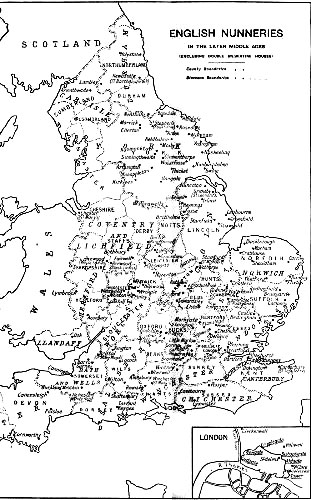
LIST OF ENGLISH NUNNERIES. c. 1275-1535
[In this list Ab. = Abbey, Pr. = Priory; A. = Austin, B. = Benedictine, C.
= Cistercian, Cl. = Cluniac, Dom. = Dominican, Fr. = Franciscan, Brig. =
Brigittine. P. = Premonstratensian. Gilbertine houses are not included.]
| |
House |
|
Dedication |
|
Order |
|
County |
|
Diocese |
|
Founder and date |
| 1. |
Aconbury |
|
Holy Cross |
|
A.Pr. |
|
Her. |
|
Her. |
|
Margery, wife of Walter de Lacy, temp. John |
| 2. |
Amesbury |
|
St Mary and St
Meilor |
|
B.Pr. |
|
Wilts. |
|
Salis. |
|
Saxon Abbey: refounded as a priory for nuns
of Fontevrault by King John, 1199 |
| 3. |
Ankerwyke |
|
St Mary Magd. |
|
B.Pr. |
|
Bucks. |
|
Linc. |
|
Gilbert de Muntfichet, c. 1160 |
| 4. |
Arden |
|
St Andrew |
|
B.Pr. |
|
York., N.R. |
|
York |
|
Peter de Hoton, temp. Henry II |
| 5. |
Armathwaite |
|
St Mary |
|
B.Pr. |
|
Cumb. |
|
Carl. |
|
Unknown, before 1200 |
| 6. |
Arthington |
|
St Mary |
|
Cl.Pr. |
|
York., W.R. |
|
York |
|
Peter, son of Serlo de Arthington, middle of
twelfth century |
| 7. |
Barking |
|
St Mary and St
Ethelburga |
|
B.Ab. |
|
Essex |
|
Lon. |
|
St Earconwald, Bishop of London, 675-93,
probably in 666 |
| 8. |
Barrow Gurney
(Minchin
Barrow) |
|
St Mary and St
Edward |
|
B.Pr. |
|
Som. |
|
B. and W. |
|
Unknown: probably a Gurney, before 1212 |
| 9. |
Basedale |
|
St Mary |
|
C.Pr. |
|
York., N.R. |
|
York |
|
Guy de Bovincurt, c. 1190 (see V.C.H. Yorks.
III, 158) |
| 10. |
Blackborough |
|
St Mary and St
Katherine |
|
B.Pr. |
|
Norf. |
|
Norw. |
|
Roger de Scales and Muriel his wife, c. 1150 |
| 11. |
Blithbury |
|
St Giles |
|
B.Pr. |
|
Staffs. |
|
C.L. |
|
Hugh Malveysin, after 1129 |
| 12. |
Brewood
(Black Ladies) |
|
St Mary |
|
B.Pr. |
|
Staffs. |
|
C.L. |
|
Unknown, twelfth century |
| 13. |
Brewood
(White Ladies) |
|
St Leonard |
|
C.Pr. |
|
Salop |
|
C.L. |
|
Unknown, twelfth century |
| 14. |
Bristol |
|
St Mary Magd. |
|
A.Pr. |
|
Glouces. |
|
Worc. |
|
Eva, widow of Robert Fitzhardinge, c. 1173 |
| 15. |
Brodholme |
|
St Mary |
|
P.Pr. |
|
Notts. |
|
York |
|
Agnes de Camville, wife of Peter de Gousla,
temp. Stephen |
| 16. |
Bromhale |
|
St Margaret |
|
B.Pr. |
|
Berks. |
|
Salis. |
|
Unknown, before 1200 |
| 17. |
Bruisyard |
|
Ann. of St Mary |
|
Fr.Ab. |
|
Suff. |
|
Norw. |
|
Edward III, 1366, at instigation of Lionel,
Duke of Clarence |
| 18. |
Buckland
(Minchin) |
|
St John Bapt. |
|
A.Pr.
(nuns of St
John of
Jerusalem) |
|
Som. |
|
B. and W. |
|
Henry II, c. 1186 (instead of House of Austin
canons founded 1166 by William de Erlegh) |
| 19. |
Bungay |
|
St Mary and
Holy Cross |
|
B.Pr. |
|
Suff. |
|
Norw. |
|
Roger de Glanville and Gundred his wife, c.
1160 |
| 20. |
Burnham |
|
St Mary |
|
A.Ab. |
|
Bucks. |
|
Linc. |
|
Richard, King of the Romans, 1266 |
| 21. |
Cambridge |
|
St Radegund |
|
B.Pr. |
|
Cambs. |
|
Ely |
|
c. 1133-8, temp. Nigel, Bishop of Ely |
| 22. |
Campsey |
|
St Mary |
|
A.Pr. |
|
Suff. |
|
Norw. |
|
Theobald de Valognes, c. 1195 |
| 23. |
Cannington |
|
St Mary |
|
B.Pr. |
|
Som. |
|
B. and W. |
|
Robert de Courcy, c. 1138 |
| 24. |
Canonsleigh |
|
St Mary, St John
Evangelist and
St Audrey |
|
A.Ab. |
|
Devon |
|
Ex. |
|
Maud de Clare, Countess of Gloucester and
Hertford, temp. Edward I (previously a
house of canons) |
| 25. |
Canterbury |
|
St Sepulchre |
|
B.Pr. |
|
Kent |
|
Cant. |
|
St Anselm, 1100 |
| 26. |
Carrow |
|
St Mary and St
John |
|
B.Pr. |
|
Norf. |
|
Norw. |
|
King Stephen, 1146 |
| 27. |
Catesby |
|
St Mary, St
Edmund and
St Thomas
the Martyr |
|
C.Pr. |
|
Northants. |
|
Linc. |
|
Robert de Esseby, c. 1175 |
| 28. |
Chatteris |
|
St Mary |
|
B.Ab. |
|
Cambs. |
|
Ely |
|
Eadnoth, Abbot of Ramsey, c. 1010 |
| 29. |
Cheshunt |
|
St Mary |
|
B.Pr. |
|
Herts. |
|
Lon. |
|
Unknown, twelfth century |
| 30. |
Chester |
|
St Mary |
|
B.Pr. |
|
Chester |
|
C.L. |
|
Ranulf, Earl of Chester, c. 1140 |
| 31. |
Clementhorpe |
|
St Clement |
|
B.Pr. |
|
York., W.R. |
|
York. |
|
Thurstan, Archbishop of York, c. 1130 |
| 32. |
Clerkenwell |
|
Assumption
of St Mary |
|
B.Pr. |
|
Midd. |
|
Lon. |
|
Jordan Brisett, c. 1100 |
| 33. |
Cokehill |
|
—— |
|
C.Pr. |
|
Worc. |
|
Worc. |
|
Isabel, Countess of Warwick, end of twelfth
century |
| 34. |
Cornworthy |
|
St Mary |
|
A.Pr. |
|
Devon |
|
Ex. |
|
Uncertain, fourteenth century |
| 35. |
Crabhouse |
|
St Mary Magd.
St John Evang.
St Thomas
and St Peter |
|
A.Pr. |
|
Norf. |
|
Norw. |
|
Roger, prior, and canons of Rainham, c. 1181 |
| 36. |
Dartford |
|
St Mary and St
Margaret |
|
A.Pr.
(according
to rule and
in charge
of Dom.
friars) |
|
Kent |
|
Roch. |
|
Edward III, 1355 |
| 37. |
Davington |
|
St Mary Magd. |
|
B.Pr. |
|
Kent |
|
Cant. |
|
Fulk de Newenham, 1153 |
| 38. |
Delapré
(de Pratis) |
|
St Mary |
|
Cl.Ab. |
|
Northants. |
|
Linc. |
|
Simon of Saint-Liz, Earl of Northampton,
temp. Stephen (first at Fotheringay) |
| 39. |
Delapré
(de Prato) |
|
St Mary |
|
B.Pr. |
|
Herts. |
|
Linc. |
|
Under abbey of St Albans |
| 40. |
Denny |
|
St James and
St Leonard |
|
Fr.Ab. |
|
Cambs. |
|
Ely |
|
Mary de Valence, Countess of Pembroke,
1342 |
| 41. |
Derby
(Kingsmead or
de Pratis) |
|
St Mary |
|
B.Pr. |
|
Derby |
|
C.L. |
|
Aubin, Abbot of Darley, c. 1160 |
| 42. |
Easebourne |
|
Nativity of
B.V.M. |
|
B.Pr. |
|
Suss. |
|
Chich. |
|
... de Bohun, before 1248 |
| 43. |
Ellerton
(in Swaledale) |
|
St Mary |
|
C.Pr. |
|
York., N.R. |
|
York |
|
Uncertain, before 1227 |
| 44. |
Elstow |
|
St Mary and
St Helen |
|
B.Ab. |
|
Beds. |
|
Linc. |
|
Judith, Countess of Huntingdon, late
eleventh century |
| 45. |
Esholt |
|
St Mary, St
Leonard and
St James |
|
C.Pr. |
|
York., W.R. |
|
York |
|
Uncertain, twelfth century |
| 46. |
Fairwell |
|
St Mary |
|
B.Pr. |
|
Staffs. |
|
C.L. |
|
Roger, Bishop of Coventry and Lichfield,
c. 1140 |
| 47. |
Flamstead |
|
St Giles |
|
B.Pr. |
|
Herts. |
|
Linc. |
|
Roger de Tony, temp. Stephen |
| 48. |
Flixton |
|
St Mary and
St Katherine |
|
A.Pr. |
|
Suff. |
|
Norw. |
|
Margery, widow of Geoffrey de Hanes and
daughter of Bartholomew de Crek, 1258 |
| 49. |
Fosse |
|
St Nicholas |
|
C.Pr. |
|
Linc. |
|
Linc. |
|
The men of Torksey, before the reign of John |
| 50. |
Godstow |
|
St Mary and
St John Baptist |
|
B.Ab. |
|
Oxon |
|
Linc. |
|
Edith, widow of Sir William Launcelene, c.
1133 |
| 51. |
Gokewell |
|
St Mary |
|
C.Pr. |
|
Linc. |
|
Linc. |
|
William Dawtrey, before 1148 or 1185 |
| 52. |
Goring |
|
St Mary |
|
A.Pr. |
|
Oxon |
|
Linc. |
|
Thomas de Druval, temp. Henry I |
| 53. |
Gracedieu |
|
Holy Trinity and
St Mary |
|
A.Pr. |
|
Leices. |
|
Linc. |
|
Rohese de Verdon, c. 1239 |
| 54. |
Greenfield |
|
St Mary |
|
C.Pr. |
|
Linc. |
|
Linc. |
|
Eudes of Grainsby and Ralph his son, before
1153 |
| 55. |
Grimsby |
|
St Leonard |
|
A.Pr. |
|
Linc. |
|
Linc. |
|
Before 1184 |
| 56. |
Haliwell
(Shoreditch) |
|
St John Baptist |
|
B.Pr. |
|
Midd. |
|
Lon. |
|
Roger son of Gelren, before 1127 |
| 57. |
Hampole |
|
St Mary |
|
C.Pr. |
|
York., W.R. |
|
York |
|
William de Clarefai and Avice de Tany his wife,
c. 1170 |
| 58. |
Handale
(or Grendale) |
|
St Mary |
|
C.Pr. |
|
York., N.R. |
|
York |
|
William Percy of Dunsley, 1133 |
| 59. |
Harrold |
|
St Peter |
|
A.Pr. |
|
Beds. |
|
Linc. |
|
Sampson le Fort, before 1148 (as Arroasian
house). Nunnery, 1181 |
| 60. |
Hedingham,
Castle |
|
Holy Cross, St
Mary and
St James |
|
B.Pr. |
|
Ess. |
|
Lon. |
|
Aubrey de Vere, Earl of Oxford, and Lucy his
wife, before 1191 |
| 61. |
Henwood |
|
St Margaret |
|
B.Pr. |
|
Warw. |
|
Worc. |
|
Ketelbern de Langdon, between 1149 and
1161 |
| 62. |
Heynings |
|
St Mary |
|
C.Pr. |
|
Linc. |
|
Linc. |
|
Reyner d’Evermue, temp. Stephen |
| 63. |
Hinchinbrooke |
|
St James |
|
B.Pr. |
|
Hunts. |
|
Linc. |
|
Removed from Eltisley, Cambs., temp. William I |
| 64. |
Holystone |
|
—— |
|
B.Pr. |
|
Northumb. |
|
Dur. |
|
... Umfraville of Harbottle, before 1235 |
| 65. |
Ickleton |
|
St Mary Magd. |
|
B.Pr. |
|
Cambs. |
|
Ely |
|
Uncertain, c. 1190 |
| 66. |
Ilchester
(White Hall) |
|
Holy Trinity |
|
A.Pr. |
|
Som. |
|
B. and W. |
|
William Dennis, c. 1220 (as a hospital). A
nunnery before 1281 |
| 67. |
Irford |
|
St Mary |
|
P.Pr. |
|
Linc. |
|
Linc. |
|
Probably Ralph d’Albini, temp. Henry II |
| 68. |
Ivinghoe |
|
St Margaret |
|
B.Pr. |
|
Bucks. |
|
Linc. |
|
[William Giffard?], Bishop of Winchester,
twelfth century |
| 69. |
Keldholme |
|
St Mary |
|
C.Pr. |
|
York.,N.R. |
|
York |
|
Robert de Stuteville, temp. Henry I |
| 70. |
Kilburn |
|
St Mary and
St John Baptist |
|
B.Pr. |
|
Midd. |
|
Lon. |
|
Herbert, Abbot of Westminster, 1139 |
| 71. |
Kington
St Michael |
|
St Mary |
|
B.Pr. |
|
Wilts. |
|
Salis. |
|
Before 1155 |
| 72. |
Kirklees |
|
St Mary and St
James |
|
C.Pr. |
|
York., W.R. |
|
York |
|
Reiner le Fleming, temp. Henry II |
| 73. |
Lacock |
|
St Mary and St
Bernard |
|
A.Ab. |
|
Wilts. |
|
Salis. |
|
Ela, Countess of Salisbury, 1232 |
| 74. |
Lambley |
|
St Patrick |
|
B.Pr. |
|
Northumb. |
|
Durh. |
|
Adam de Tynedale, temp. John |
| 75. |
Langley |
|
St Mary |
|
B.Pr. |
|
Leic. |
|
Linc. |
|
William Pantulf and Burga his wife, temp.
Henry II |
| 76. |
Legbourne |
|
St Mary |
|
C.Pr. |
|
Linc. |
|
Linc. |
|
Robert, son of Gilbert of Tathwell, after 1150
(removed from earlier site) |
| 77. |
Lillechurch
(Higham) |
|
St Mary |
|
B.Pr. |
|
Kent |
|
Roch. |
|
King Stephen, before 1151 |
| 78. |
Littlemore |
|
St Mary, St
Nicholas and
St Edmund |
|
B.Pr. |
|
Oxon |
|
Linc. |
|
Robert de Sandford, temp. Stephen |
| 79. |
London
(Bishopsgate) |
|
St Helen and
Holy Cross |
|
B.Pr. |
|
Midd. |
|
Lon. |
|
William, son of William, the goldsmith, before
1216 |
| 80. |
London |
|
St Mary and
St Francis |
|
Fr.Ab. |
|
Midd. |
|
Lon. |
|
Edmund, Earl of Lancaster, 1293 |
| 81. |
Lymbrook |
|
St Mary |
|
A.Pr. |
|
Her. |
|
Her. |
|
Uncertain |
| 82. |
Lyminster |
|
St Mary |
|
B.Pr. |
|
Suss. |
|
Chich. |
|
Roger de Montgomery, c. 1082 (as cell of
Almenèches) |
| 83. |
Malling |
|
St Mary and St
Andrew |
|
B.Ab. |
|
Kent |
|
Roch. |
|
Gundulf, Bishop of Rochester, 1090 |
| 84. |
Marham |
|
St Mary, St
Barbara and
St Edmund |
|
C.Ab. |
|
Norf. |
|
Norw. |
|
Isabel, widow of Hugh de Albini, Earl of
Arundel, 1249 |
| 85. |
Markyate |
|
Holy Trinity |
|
B.Pr. |
|
Beds. |
|
Linc. |
|
1145, under influence of Geoffrey, Abbot of
St Albans |
| 86. |
Marlow,
Little |
|
St Mary |
|
B.Pr. |
|
Bucks. |
|
Linc. |
|
Uncertain, twelfth century |
| 87. |
Marrick |
|
St Andrew and
St Mary |
|
B.Pr. |
|
York., N.R. |
|
York |
|
Roger de Aske, temp. Henry II |
| 88. |
Moxby |
|
St John
Evangelist |
|
A.Pr. |
|
York., N.R. |
|
York |
|
Henry II, before 1167 (removed from double
house at Marton) |
| 89. |
Neasham |
|
St Mary |
|
B.Pr. |
|
Durh. |
|
Durh. |
|
Probably the Lord of Greystoke, before 1157 |
| 90. |
Newcastle-
upon-Tyne |
|
St Bartholomew |
|
B.Pr. |
|
Northumb. |
|
Durh. |
|
Uncertain, twelfth century |
| 91. |
Nunappleton |
|
St Mary and St
John Evangelist |
|
C.Pr. |
|
York., W.R. |
|
York |
|
Eustace de Merch and Alice St Quintin his
wife, c. 1150 |
| 92. |
Nunburnholme |
|
—— |
|
B.Pr. |
|
York., E.R. |
|
York |
|
Ancestors of Roger de Merlay, Lord of
Morpeth, twelfth century |
| 93. |
Nuncoton |
|
St Mary |
|
C.Pr. |
|
Linc. |
|
Linc. |
|
Alan de Mounceaux, before 1129 |
| 94. |
Nuneaton |
|
St Mary |
|
B.Pr. |
|
Warw. |
|
Worc. |
|
Robert, Earl of Leicester, c. 1155, for nuns
of Fontevrault |
| 95. |
Nunkeeling |
|
St Mary and St
Helen |
|
B.Pr. |
|
York., E.R. |
|
York |
|
Agnes de Arches, widow of Herbert St
Quintin, 1152 |
| 96. |
Nunmonkton |
|
St Mary |
|
B.Pr. |
|
York., W.R. |
|
York |
|
William de Arches and Ivetta his wife, temp.
Stephen |
| 97. |
Pinley |
|
St Mary |
|
C.Pr. |
|
Warw. |
|
Worc. |
|
Robert de Pillarton, temp. Henry I |
| 98. |
Polesworth |
|
St Edith |
|
B.Ab. |
|
Warw. |
|
C.L. |
|
Saxon foundation. Refounded by Robert
Marmion, temp. Stephen |
| 99. |
Polsloe |
|
St Katherine |
|
B.Pr. |
|
Devon |
|
Ex. |
|
Traditional founder, William Bruere, before
1169 |
| 100. |
Redlingfield |
|
St Andrew and
St Mary |
|
B.Pr. |
|
Suff. |
|
Norw. |
|
Manasses, Count of Guisnes, and Emma de
Arras his wife, 1120 |
| 101. |
Romsey |
|
St Mary and St
Elfrida |
|
B.Ab. |
|
Hants. |
|
Win. |
|
Edward the Elder, c. 907: refounded by King
Edgar, 967 |
| 102. |
Rosedale |
|
St Mary and St
Lawrence |
|
C.Pr. |
|
York., N.R. |
|
York |
|
Robert, son of Nicholas de Stuteville, temp.
Richard I |
| 103. |
Rothwell |
|
St John Baptist |
|
A.Pr. |
|
Northants. |
|
Linc. |
|
... de Clare, thirteenth century |
| 104. |
Rowney |
|
St John Baptist |
|
B.Pr. |
|
Herts. |
|
Linc. |
|
Conan, Duke of Britanny and Earl of Richmond,
temp. Henry II, suppressed 1459 |
| 105. |
Rusper |
|
St Mary Magd. |
|
B.Pr. |
|
Suss. |
|
Chich. |
|
Twelfth century, probably by one of the Braose
family |
| 106. |
St Stephen’s
(Foukeholme) |
|
St Stephen |
|
B.Pr. |
|
York, N.R. |
|
York |
|
Uncertain. Disappeared after 1349 |
| 107. |
Seton
(Lekeley) |
|
St Mary |
|
B.Pr. |
|
Cumb. |
|
York |
|
Henry son of Arthur son of Godard, Lord of
Millom, twelfth century |
| 108. |
Sewardsley |
|
St Mary Magd. |
|
C.Pr. |
|
Northants. |
|
Linc. |
|
Richard de Lestre, temp. Henry II |
| 109. |
Shaftesbury |
|
St Mary and St
Edward |
|
B.Ab. |
|
Dorset |
|
Salis. |
|
King Alfred, c. 888 |
| 110. |
Sheppey
(Minster) |
|
St Mary and St
Sexburga |
|
B.Pr. |
|
Kent |
|
Cant. |
|
St Sexburga, 675 |
| 111. |
Sinningthwaite |
|
St Mary |
|
C.Pr. |
|
York, W.R. |
|
York |
|
Bertram Haget, c. 1160 |
| 112. |
Sopwell |
|
St Mary |
|
B.Pr. |
|
Herts. |
|
Linc. |
|
Under abbey of St Albans |
| 113. |
Stainfield |
|
St Mary |
|
B.Pr. |
|
Linc. |
|
Linc. |
|
William or Henry de Percy, temp. or before
Henry II |
| 114. |
Stamford |
|
St Mary and St
Michael |
|
B.Pr. |
|
Northants. |
|
Linc. |
|
William Waterville, Abbot of Peterborough,
c. 1155 |
| 115. |
Stixwould |
|
St Mary |
|
C.Pr. |
|
Linc. |
|
Linc. |
|
Lucy, Countess of Perche, temp. Stephen |
| 116. |
Stratford-by-
Bow |
|
St Leonard |
|
B.Pr. |
|
Midd. |
|
Lon. |
|
William, Bishop of London, temp. Henry I |
| 117. |
Studley |
|
St Mary |
|
B.Pr. |
|
Oxon |
|
Linc. |
|
Probably Bernard of St Valery, before 1176 |
| 118. |
Swaffham
Bulbeck |
|
—— |
|
B.Pr. |
|
Cambs. |
|
Ely |
|
Uncertain, before temp. John |
| 119. |
Swine |
|
St Mary |
|
C.Pr. |
|
York., E.R. |
|
York |
|
Robert de Verli, temp. Stephen |
| 120. |
Syon |
|
St Saviour, St
Mary and St
Bridget |
|
Brig.Ab. |
|
Midd. |
|
Lon. |
|
King Henry V, 1414 |
| 121. |
Tarrant
Keynes |
|
St Mary and
All Saints |
|
C.Ab. |
|
Dorset |
|
Salis. |
|
Ralph de Keynes, before 1235 |
| 122. |
Thetford |
|
St George and
St Gregory |
|
B.Pr. |
|
Norf. |
|
Norw. |
|
Hugh, Abbot of Bury St Edmunds, c. 1160
(removed from Ling) |
| 123. |
Thicket |
|
St Mary |
|
B.Pr. |
|
York., E.R. |
|
York |
|
Roger FitzRoger, temp. Richard I |
| 124. |
Usk |
|
—— |
|
B.Pr. |
|
Monm. |
|
Llan. |
|
Sir Richard de Clare, before 1236 |
| 125. |
Wallingwells |
|
St Mary |
|
B.Pr. |
|
Notts. |
|
York |
|
Ralph de Chevrecourt, temp. Stephen |
| 126. |
Waterbeach |
|
St Mary of
Pity and
St Clare |
|
Fr.Pr. |
|
Cambs. |
|
Ely |
|
Denise de Mountchesney, 1294. Removed
to Denny, 1348 |
| 127. |
Westwood |
|
St Mary |
|
B.Pr. |
|
Worc. |
|
Worc. |
|
Osbert son of Hugh and Eustacia de Saye,
his mother, temp. Henry II (for nuns of
Fontevrault) |
| 128. |
Wherwell |
|
Holy Cross
and St Peter |
|
B.Ab. |
|
Hants. |
|
Win. |
|
Queen Elfrida, c. 986 |
| 129. |
Whiston |
|
St Mary Magd. |
|
C.Pr. |
|
Worc. |
|
Worc. |
|
Walter de Cantilupe, Bishop of Worcester,
before 1255 |
| 130. |
Wilberfoss |
|
St Mary |
|
B.Pr. |
|
York.,E.R. |
|
York |
|
Uncertain, temp. Stephen |
| 131. |
Wilton |
|
St Mary, St
Barthlomew
and St Edith |
|
B.Ab. |
|
Wilts. |
|
Salis. |
|
St Alburga, c. 800: refounded by King
Alfred, c. 871 |
| 132. |
Winchester |
|
St Mary and St
Edburga |
|
B.Ab. |
|
Hants. |
|
Win. |
|
King Alfred and Queen Ealhswith, c. 900.
Refounded by St Ethelwold, 963 |
| 133. |
Wintney |
|
St Mary, St
Mary Magd.
and St John
Baptist |
|
C.Pr. |
|
Hants. |
|
Win. |
|
Richard Holte and Christine his wife,
daughter of Thomas Cobreth, twelfth
century |
| 134. |
Wix |
|
St Mary |
|
B.Pr. |
|
Ess. |
|
Lon. |
|
Walter Mascherell, Alexander and Edith,
children of Walter the Deacon, temp.
Henry I |
| 135. |
Wothorpe |
|
St Mary |
|
B.Pr. |
|
Northants. |
|
Linc. |
|
Uncertain: united to St Michael’s,
Stamford, 1354 |
| 136. |
Wroxall |
|
St Leonard |
|
B.Pr. |
|
Warw. |
|
Worc. |
|
Hugh, Lord of Hatton and Wroxall, temp.
Henry I |
| 137. |
Wykeham |
|
St Mary and St
Michael |
|
C.Pr. |
|
York., N.R. |
|
York |
|
Pain FitzOsbert, c. 1153 |
| 138. |
Yedingham |
|
St Mary |
|
B.Pr. |
|
York., E.R. |
|
York |
|
Helewise de Clere, before 1163 |
BIBLIOGRAPHY
A. MANUSCRIPT SOURCES
I. Episcopal Registers
(a) Lincoln Episcopal Registers
Register of Memoranda, Sutton (1280-99).
Register of Memoranda, Dalderby (1300-20).
Register of Memoranda, Gynewell (1347-62).
Register of Memoranda, Bokyngham (1363-98).
Register of Visitations, Alnwick[2158] (1436-49).
Register of Visitations, Atwater (1514-21).
Register of Visitations, Longland (1521-47).
(b) Lambeth Palace Registers
Register of Langham (1366-8).
Register of Courtenay (1381-96).
(c) New College Oxford
Register of William of Wykeham Bishop of Winchester, for 1386-7, ff.
84d-89d (Injunctions to Romsey and Wherwell)[2159].
II. Documents in the Public Record Office
(a) Account Rolls
Ministers Accounts, 867/21-6, 30, 33-6. (Delapré, St Albans. Between
16 Edw. III and 2 Ric. III.)
Ib. 1257/1 (Catesby, 11-14 Hen. VI).
Ib. 1257/2 (Denny, 14 Hen. IV-1 Hen. V).
Ib. 1257/10 (Gracedieu, 1-5 Hen. V).
Ib. 1260 (St Michael’s, Stamford, 24 rolls between 32 Edw. I and 20
Hen. VI).
Ib. 1261/4 (Syon, Cellaress’ Account, 21-2 Edw. IV).
Ib. 1307/22 (Syon, Cellaress’ Account, 36 Hen. VI).
(b) Petitions
Early Chancery Proceedings, 181/4 (Petition from Elizabeth Webley,
late Prioress of Sopwell, concerning her deposition and imprisonment
by John Rothbury, Archdeacon of St Albans Abbey).
Ib. 4/196 (Petition from Richard English and Margery his wife
concerning a corrody withheld from them by the Abbess of Malling).
Ib. 7/70 (Petition from Richard Haldenby and Agnes his wife
concerning the daughters of Agnes by a former marriage, one of whom
has been made to take the veil by an uncle, for the sake of her
inheritance).
Ib. 44/227 (Petition from Thomasyn Dynham, Prioress of Cornworthy,
concerning two children at school in her house, whose fees have not
been paid for five years).
Ancient Petitions 302/15063 (Petition from the Prioress and nuns of
Rowney for leave to have a proctor to beg alms for them, as their
buildings are ruinous).
Ancient Correspondence, 36/201 (Petition to Queen Isabel from the
Prioress and Convent of Clerkenwell, asking her to obtain the King’s
leave for them to receive certain lands, by reason of their poverty).
Chancery Warrants, Series 1/1759, 1762, 1764, 1769 (Petitions for the
arrest of apostate nuns, nine in all).
B. PRINTED SOURCES
I. Archiepiscopal and Episcopal Registers
(a) Bath and Wells
Registers of Walter Giffard (1265-6) and of Henry Bowet (1401-7), ed.
T. S. Holmes. (Somerset Record Soc. 1899.)
Register of John of Drokensford (1309-29), ed. E. Hobhouse. (Somerset
Record Soc. 1887.)
Register of Ralph of Shrewsbury (1329-63), ed. T. S. Holmes. (Somerset
Record Soc. 1896.) 2 vols.
(b) Canterbury
Registrum Epistolarum Fratris Johannis Peckham Archiepiscopi
Cantuariensis (1279-92), ed. C. Trice Martin. (Rolls Series, 1882-5.)
3 vols.
Visitations of Archbishop Warham in 1511, ed. Mary Bateson. (English
Historical Review, VI, 1891, pp. 28 ff.) (Full abstracts.)
See also The British Magazine, vols. XXIX-XXXII, passim (abstracts).
(c) Chichester
Episcopal Register of Robert Rede, Bishop of Chichester (1397-1415),
ed. Cecil Deedes. (Sussex Rec. Soc. 1908.)
Blaauw, W. Episcopal Visitations of the Priory of Easebourne
(1442-1527). (Sussex Archaeol. Collections, IX, 1857, pp. 1-32.)
Way, A. Notices of the Benedictine Priory of St Mary Magdalen at
Rusper (1442-1527). (Sussex Archaeol. Collections, V, 1852, pp.
244-62.)
(d) Durham, York, Carlisle
Historical Papers and Letters from the Northern Registers, ed. James
Raine. (Rolls Series, 1873.)
(e) Durham
Registrum Palatinum Dunelmense. Register of Richard de Kellawe, Lord
Palatine and Bishop of Durham, 1311-16, ed. Sir T. Duffus Hardy.
(Rolls Series, 1873-8.) 4 vols.
(f) Exeter
Register of Walter de Stapeldon, Bishop of Exeter, 1308-26, ed. F. C.
Hingeston-Randolph (1892).
Register of John de Grandisson, Bishop of Exeter, 1327-69, ed. F. C.
Hingeston-Randolph (1894-9).
Register of Thomas de Brantyngham, Bishop of Exeter, Part I; 1370-94,
ed. F. C. Hingeston-Randolph (1901).
Register of Edmund Stafford, Bishop of Exeter, 1395-1419, ed. F. C.
Hingeston-Randolph (1886).
(g) Hereford
Registrum Thome de Cantilupo, Episcopi Herefordensis, 1275-82,
transcribed by R. C. Griffiths, with an introduction by W. W. Capes.
(Canterbury and York Soc. and Cantilupe Soc. 1907.)
Registrum Ricardi de Swinfield, Episcopi Herefordensis, 1283-1317, ed.
W. W. Capes. (Canterbury and York Soc. and Cantilupe Soc. 1909.)
Registrum Adae de Orleton, Episcopi Herefordensis, 1317-27, ed. A. T.
Bannister. (Canterbury and York Soc. and Cantilupe Soc. 1908.)
Registrum Roberti Mascall, Episcopi Herefordensis, 1404-16,
transcribed by J. H. Parry with introductory note by Charles Johnson.
(Canterbury and York Soc. and Cantilupe Soc. 1917.)
Registrum Thome Spofford, Episcopi Herefordensis, 1422-48, ed. A. T.
Bannister. (Canterbury and York Soc. and Cantilupe Soc. 1919.)
Registrum Thome Myllyng, Episcopi Herefordensis, 1472-92, ed. A. T.
Bannister (1920).
(h) Coventry and Lichfield
Register of Roger de Norbury, Bishop of Coventry and Lichfield,
1322-59, ed. Edmund Hobhouse. (William Salt Archaeol. Soc.
Collections, I, 1881.) (Table of contents only.)
The Second Register of Bishop Robert de Stretton, 1360-85, abstracted
into English by R. A. Wilson. (William Salt Archaeol. Soc. Coll., New
Series, vol. VIII, 1905.) (Brief calendar.)
(i) Lincoln
Visitations of Religious Houses in the Diocese of Lincoln, ed. A.
Hamilton Thompson. Vol. I. Injunctions and other Documents from the
Registers of Richard Flemyng and William Gray, 1420-36. (Lincoln
Record Soc. and Canterbury and York Soc. 1915.)
Visitations of Religious Houses in the Diocese of Lincoln, ed. A.
Hamilton Thompson. Vol. II. Alnwick’s Visitations (1436-49). (Lincoln
Record Soc. and Canterbury and York Soc.)
Injunctions of John Longland, Bishop of Lincoln, to certain
Monasteries in his Diocese, 1531, ed. E. Peacock. (Archaeologia,
XLVII, pp. 49-64, 1883.)
(j) London
Registrum Radulphi Baldock, Gilberti Segrave, Ricardi Newport et
Stephani Gravesend, Episcoporum Londoniensium, 1306-38, ed. R. C.
Fowler. (Canterbury and York Soc. 1911.)
(k) Norwich
Visitations of the Diocese of Norwich, 1492-1532, ed. A. Jessopp.
(Camden Soc. 1888.)
(l) Rochester
Registrum Hamonis Hethe Episcopi Roffensis (1319-52). (Canterbury and
York Soc. 1914 ff., in course of publication.)
(m) Salisbury
Registrum Simonis de Gandavo Episcopi Saresbiriensis (1297-1315), ed.
C. T. Flower. (Canterbury and York Soc. 1914, in course of
publication.)
(n) Winchester
Registrum Johannis de Pontissara (1282-1304), ed. C. Deedes.
(Canterbury and York Soc. 1913-15.)
Registers of John de Sandale and Rigaud de Asserio, Bishops of
Winchester, 1316-23, ed. F. J. Baigent. (Hants. Rec. Soc. 1897.)
Wykeham’s Register, 1367-1404, ed. T. F. Kirby. (Hants Rec. Soc.
1896-9.) 2 vols.
(o) Worcester
Register of Godfrey Giffard, 1268-1302, ed. J. W. Willis-Bund.
(Worcester Hist. Soc. 1898-1902.) 2 vols.
Register of the Diocese of Worcester during the vacancy of the see,
usually called Registrum Sede Vacante, 1301-1435, ed. J. W.
Willis-Bund. (Worcester Hist. Soc. 1893-7.)
(p) York
Register of Walter Gray, Archbishop of York, 1216-55, ed. J. Raine.
(Surtees Soc. 1872.)
Register of Walter Giffard, Archbishop of York, 1266-79, ed. W. Brown.
(Surtees Soc. 1904.)
Register of William Wickwane, Archbishop of York, 1279-85, ed. W.
Brown. (Surtees Soc. 1907.)
Register of John le Romeyn, Archbishop of York, 1286-96, ed. W. Brown.
Vol. I. (Surtees Soc. 1913.)
Registers of John le Romeyn Archbishop of York, 1286-96, Part II, and
of Henry of Newark, Archbishop of York, 1298-99, ed. W. Brown. Vol.
II. (Surtees Soc. 1917.)
Visitations in the Diocese of York, holden by Archbishop Edward Lee
(1531-44), ed. W. Brown. (Yorks. Archaeol. Journal, XVI, 1901, pp.
319-68.)
(q) Foreign Visitations
Des Augustinerpropstes Iohannes Busch Chronicon Windeshemense und
Liber de Reformatione Monasteriorum, bearbeitet von Dr Karl Grube.
(Halle, 1886.)
Regestrum Visitationum Archiepiscopi Rothomagensis, Journal des
Visites Pastorales d’Eude Rigaud Archevêque de Rouen, 1248-69, pub.
par Th. Bonnin. (Rouen, 1852.)
II. Account Rolls
(a) Catesby (2-3 Hen. V)
Baker, History of Northampton (1822-30), vol. I, p. 278.
(b) Romsey (1412-13, summary)
Liveing, H. G. D., Records of Romsey Abbey (1906), p. 194.
(c) St Helen’s, Bishopsgate (sixteenth century, extracts)
Victoria County History: London, I, p. 460.
(d) St Radegund’s, Cambridge (1449-51, 1481-2)
Gray, A., The Priory of St Radegund, Cambridge (1898), pp. 145-179.
(e) St Mary de Pré, St Albans (1487-9)
Dugdale, Monasticon, III, p. 358.
(f) Swaffham Bulbeck (1483-4)
Dugdale, Monasticon, IV, p. 458.
(g) Syon (Cellaress’ and Chambress’ Accounts, 1536-7)
Myroure of Oure Ladye, ed. J. H. Blunt. (E.E.T.S. 1873.) Introduction,
pp. xxvi-xxxi.
(h) Miscellaneous (Extracts)
C. T. Flower, Obedientiars’ Accounts of Glastonbury and other
Religious Houses. Trans. St Paul’s Ecclesiological Soc. vol. VII, Pt. II (1912), pp. 50-62.
III. Inventories
(a) Brewood (1536)
Dugdale, Monasticon, IV, p. 500.
(b) Cheshunt (1536)
Cussans, History of Hertfordshire, Hertford Hundred, App. II, pp.
267-71.
(c) Easebourne (1450)
Sussex Archaeol. Coll. IX, pp. 10-13.
(d) Gracedieu (1536)
Nichols, History and Antiquities of the County of Leicester (1804),
III, pp. 653-4.
(e) Hedingham, Castle (1536)
Trans. Essex Archaeological Soc. IX, pp. 289-92.
(f) Kilburn (1536)
Dugdale, Monasticon, IV, p. 424.
(g) Langley (1485)
Walcott, Mackenzie E. C., Inventory of St Mary’s Benedictine Nunnery
at Langley, Co. Leicester, 1485. (Leicestershire Architec. Soc. 1872.)
(h) Lillechurch (1525)
R. F. Scott, Notes from the Records of St John’s College, Cambridge,
3rd series (privately printed, 1906-13), pp. 403-8.
(i) Sheppey (1536)
Walcott, Mackenzie E. C., Inventories of St Mary’s Hospital, Dover, St
Martin New-Work, Dover, and the Benedictine Priory of SS. Mary and
Sexburga in the Island of Shepey for Nuns. (Reprinted from
Archaeologia Cantiana, 1868, pp. 18-35.)
(j) Wherwell (Sacristy, c. 1340)
Victoria County History, Hants. II, pp. 134-5.
(k) Wintney (Frater, 1420)
Victoria County History, Hants. II, pp. 150-1.
(l) Miscellaneous Fragments
Fowler, R. C., Inventories of Essex Monasteries in 1536. (Trans. Essex
Archaeol. Soc. vol. IX, Pt. IV.)
Walcott, Mackenzie E. C., Inventories and Valuations of Religious
Houses at the Time of the Dissolution. (Archaeologia, XLIII, 1871.)
IV. Cartularies
(a) Buckland
A Cartulary of Buckland Priory in the County of Somerset, ed. F. W.
Weaver. (Somerset Rec. Soc. 1909.)
(b) Crabhouse
The Register of Crabhouse Nunnery, ed. Mary Bateson. (Norfolk and
Norwich Arch. Soc. Norfolk Archaeology, XI, 1892.)
(c) Godstow
The English Register of Godstow Nunnery, ed. Andrew Clark. (Early Eng.
Text Soc. 1905-11.)
V. Wills
Calendar of Wills proved and enrolled in the Court of Husting, London, ed.
R. R. Sharpe (1889).
Early Lincoln Wills, ed. A. Gibbons (1888).
The Fifty Earliest English Wills in the Court of Probate, London, ed. F.
J. Furnivall. (Early Eng. Text Soc. 1882.)
Lincoln Diocese Documents, ed. A. Clark. (Early Eng. Text Soc. 1914.)
Lincoln Wills, ed. C. W. Foster. Vol. I. (Lincoln Record Soc. 1914.)
Testamenta Eboracensia, a Selection of Wills from the Registry at York,
ed. James Raine. 6 vols. (Surtees Soc. 1836-1902.)
Somerset Medieval Wills (1383-1558), ed. F. W. Weaver. 3 vols. (Somerset
Record Soc. 1901-5.)
VI. Miscellaneous Records and Letters
Calendar of Close Rolls.
Calendar of Patent Rolls.
Calendar of Papal Letters.
Calendar of Papal Petitions.
Dugdale. Monasticon Anglicanum, ed. J. Caley, H. Ellis and B. Bandinel. 6
vols. in 8 (1817-30).
Ellis, H. Original Letters illustrative of English History, 1st series,
vol. II (1824).
Fowler, J. T. Cistercian Statutes, A.D. 1256-7, with supplementary
statutes of the order, 1257-8. (Reprinted from Yorks. Archaeol. Journal,
vols. IX-XI, 1885-90.)
Gasquet, F. A. Collectanea Anglo-Premonstratensia, 3 vols. (Camden Soc.
1906.)
Gibbons, A. Ely Episcopal Records (1891).
Lyndwood. Provinciale (1679).
Madox. Formulare Anglicanum (1702).
Paston Letters, ed. J. Gairdner. 4 vols. (1900).
Rotuli Parliamentorum. (Record Com. 6 vols. n.d. Index, 1832.)
Valor Ecclesiasticus. (Record Com. 1810-34).
Wharton. Anglia Sacra, 2 vols. (1691).
Wilkins. Concilia Magnae Britanniae et Hiberniae, 4 vols. (1737).
Wood, M. A. E. Letters of Royal and Illustrious Ladies of Great Britain. 3
vols. (1846).
VII. Contemporary Literature[2160]
An Alphabet of Tales, An English 15th Century Translation of the
Alphabetum Narrationum once attributed to Etienne de Besançon, ed. M. M.
Banks. (Early Eng. Text Soc. 1904-5.)
Amundesham. Annales Monasterii S. Albani (Rolls Series, 1870), I.
Ancren Riwle, ed. and trans. James Morton (Camden Soc. 1853). Also trans.
(by Morton) with introd. by F. A. Gasquet in The King’s Classics, 1907.
Caesarius of Heisterbach. Dialogus Miraculorum, ed. Joseph Strange, 2
vols. (Cologne, 1851.)
Chaucer, Complete Works, ed. Skeat (1906).
Chronicle of Lanercost, translated by Sir Herbert Maxwell (1913).
Clene Maydenhod, ed. F. J. Furnivall. (Early Eng. Text Soc. 1867.)
Court of Love, The, printed in Chaucer’s Complete Works, ed. R. Morris
(1891), vol. IV.
Early English Lives of Saints, ed. F. J. Furnivall. (Trans. of the
Philological Soc. 1858.) For The Land of Cokayne and Why I can’t be a
Nun.
Etienne de Bourbon. Anecdotes Historiques, etc., ed. Lecoy de la Marche.
(Soc. de l’Hist. de France, 1877.)
Fifteenth Century Cookery Book, A, ed. R. W. Chambers, and Two Fifteenth
Century Franciscan Rules, ed. W. W. Seton. (Early Eng. Text Soc. 1914.)
Gower. Vox Clamantis, ed. G. Macaulay (1902).
Hali Meidenhad, ed. O. Cockayne. (Early Eng. Text Soc. 1866.)
Jacobi Vitriacensis Exempla e Sermonibus Vulgaribus, ed. T. F. Crane.
(Folk Lore Soc. 1890.)
Langland. Vision of William Concerning Piers the Plowman, ed. Skeat, 2
vols. (1886).
Medieval Garner, A, selected, translated and annotated by G. G. Coulton
(1910).
Myroure of Oure Ladye, The, ed. J. J. Blunt. (Early Eng. Text Soc. 1873.)
Rule of St Benedict, ed. Gasquet. (King’s Classics, 1909.)
Tale of Beryn, The, ed. Furnivall and Stone. (Chaucer Soc. 1887.)
Three Middle English Versions of the Rule of St Benet, ed. E. A. Kock.
(Early Eng. Text Soc. 1902.)
Walsingham. Gesta Abbatum Monasterii Sancti Albani, ed. H. T. Riley (Rolls
Series, 1867-9), 3 vols.
—— Historia Anglicana, ed. H. T. Riley (Rolls Series, 1863), vol. I.
VIII. Plans
Burnham Abbey, by H. Brakspear, in Archaeol. Journal, LX (1903). (See
Bucks. Archit. and Archaeol. Soc. Records, XXXI.)
Carrow Priory, by R. M. Phipson, in Norf. and Norw. Arch. Soc. Trans. IX,
and Rye, Carrow Abbey (1889).
Kirklees Priory, by J. Bilson, in Yorks. Archaeol. Journ. XX (1908).
Lacock Abbey, by H. Brakspear, in Archaeologia, LVII (1900). (See also
Wilts. Archaeol. Journ. XXXI.)
Marlow, Little, by C. R. Peers, in Archaeol. Journ. LIX (1902).
Marrick Priory, facsimile of plan taken at time of Dissolution in Coll.
Topog. et Gen. V (1838).
St Radegund, Cambridge (now Jesus College) in Gray, The Priory of St
Radegund, Cambridge (1898).
C. MODERN WORKS
I. On Particular Nunneries (including charters, etc.)
Aldgate (Minoresses). Fly, H. Some account of an Abbey of Nuns,
formerly situated in the street now called the Minories. Archaeologia, XV
(1803).
Barrow Gurney. Hugo, T. Medieval Nunneries of the County of Somerset
(1867).
Brodholme. Cole, R. E. G. The Priory of St Mary of Brodholme. (Linc.
Archit. and Archaeol. Soc.) in Assoc. Archit. Socs. Reports and Papers,
XXVIII (1905-6).
Bromhale. Scott, R. F. Notes from the Records of St John’s College,
Cambridge (reprinted from The Eagle, 1890-1903, passim), Series I and
III. (Documents from Bromhale and Lillechurch.)
Buckland. Hugo, T. History of Minchin Buckland Priory and Preceptory in
Somerset (1861).
Cannington. See Barrow Gurney.
Carrow. Beecheno, F. R. Notes on Carrow Priory (1886).
Rye, W. Carrow Abbey (1889).
Rye and Tillett in Norfolk Antiq. Misc. II.
Crabhouse. Jessopp, A. Frivola (1896). For ‘Ups and Downs of an Old
Nunnery’ (Crabhouse).
Dartford. C. F. Palmer. Hist. of the Priory of Dartford in Kent.
Archaeol. Journ. XXXVI (1879).
Notes on the Priory of Dartford in Kent. Ib. XXXIX (1882).
Delapré, Northampton. Serjeantson, R. M. A History of Delapré Abbey,
Northampton (Northampton, 1909).
Delapré, St Albans. Page, W. History of the Monastery of St Mary de Pré.
St Albans and Herts. Archit. and Archaeol. Soc. Trans., New Ser. X.
Easebourne. Hope, Sir W. H. St John. Cowdray and Easebourne Priory in
the county of Sussex (1920).
Elstow. Wigram, S. R. Chronicle of Elstow Abbey (1909).
Fosse. Cole, R. E. G. The Royal Borough of Torksey, its Churches,
Monasteries and Castle. Linc. Archit. and Archaeol. Soc. In Assoc. Archit.
Soc. Reports and Papers, XXVIII (1905-6).
Ickleton. Goddard, A. R. Ickleton Church and Priory. Cambridge Antiq.
Soc. Proc. and Commun. XLV (1905).
Ilchester, White Hall. See Barrow Gurney.
Kirklees. Armytage, Sir G. Kirklees Priory. Yorks. Archaeol. Journ. XX
(1908).
Chadwick, S. J. Kirklees Priory. Yorks. Archaeol. Journ. XVI (1901), XVII
(1902), XX (1908).
Lacock. Bowles, W. L. and Nichols, J. C. Annals of Lacock Abbey (1835).
Clark-Maxwell, W. G. Outfit for the Profession of an Austin Canoness at
Lacock, etc. Archaeol. Journ. LXIX (1912).
Lillechurch. See Bromhale.
Marlow. Peers, C. R. The Benedictine Nunnery of Little Marlow. Archaeol.
Journ. LIX (1902).
Nunburnholme. Morris, M. C. K. Nunburnholme and its Antiquities (1907).
Romsey. Liveing, H. G. D. Records of Romsey Abbey (1906).
St Helen’s, Bishopsgate. Hugo, T. The Last Ten Years of the Priory of St
Helen, Bishopsgate (1865).
St Radegund, Cambridge. Gray, A. The Priory of St Radegund, Cambridge
(1898).
Syon. Aungier, G. J. History and Antiquities of Syon (1840).
Swine. Duckett, Sir G. Charters of the Priory of Swine in Holderness.
Yorks. Archaeol. Journ. VI (1881).
Thompson, T. History of the Church and Priory of Swine in Holderness
(1824).
II. General
Butler, C. Benedictine Monachism (1919).
Clay, R. M. Hermits and Anchorites of England (1914).
Coulton, G. G. The Interpretation of Visitation Documents. (Eng. Hist.
Review, 1914.)
—— Medieval Studies. (First Series, 1915.)
—— Monastic Schools in the Middle Ages. (Medieval Studies, No. 10,
1913.)
Deanesly, M. The Lollard Bible (1920).
Eckenstein, L. Woman under Monasticism (1896).
Fosbroke, T. D. British Monachism (1802).
Fowler, R. C. Episcopal Registers of England and Wales. (S.P.C.K. 1918.)
Gasquet, F. A. English Monastic Life (1904).
Graham, R. An Essay on English Monasteries. (Hist. Assoc. 1913.)
—— St Gilbert of Sempringham and the Gilbertines (1901).
Green, M. A. Everett. Lives of the Princesses of England. Vol. II (1849).
Jacka, H. T. The Dissolution of the English Nunneries. Thesis submitted
for the degree of M.A. in the University of London. (Unpublished;
deposited at the University.)
Jarrett, B. The English Dominicans (1921).
Journal of Education, 1909 and 1910. (Articles and Correspondence by J. E.
G. de Montmorency, G. G. Coulton and A. F. Leach on “The Medieval
Education of Women in England.”)
Mode, P. G. The Influence of the Black Death on the English Monasteries.
(A Dissertation for the Degree of Ph.D.) (Privately printed, Univ. of
Chicago Libraries, 1916.)
Savine, A. English Monasteries on the Eve of the Dissolution, in Oxford
Studies in Social and Legal History, ed. P. Vinogradoff (1909), I.
Thiers, J. B. Traité de la Clôture des Religieuses. (Paris, 1681.)
Thompson, A. Hamilton. English Monasteries (1913).
—— Double Monasteries and the Male Element in Nunneries. (In The
Ministry of Women, A Report by a Committee appointed by his Grace the
Archbishop of Canterbury (1919), App. VIII.)
—— The Monasteries of Leicestershire in the Fifteenth Century.
(Leicester. Archit. and Archaeol. Soc. Trans. 1913-14.)
—— Registers of John Gynewell, Bishop of Lincoln, for the years 1347-50.
(Archaeol. Journ. vol. LXVIII (2nd Ser. vol. XXI), 1914.)
—— Visitations of Religious Houses by William Alnwick, Bishop of
Lincoln, 1436-49. (Proceedings of the Soc. of Antiquaries, 2nd ser. XXVI,
1914.)
Victoria County Histories. Articles on Religious Houses, passim. (Cited
as V.C.H.)
Walcott, Mackenzie E. C. English Minsters (1879), 2 vols. Vol. II. The
English Student’s Monasticon.
Workman, H. B. The Evolution of the Monastic Ideal (1913).
INDEX
Ff. after an entry implies that there are references to the same subject
on at least two immediately succeeding pages.
Abbess, autocratic power of, 64ff., 149
—— chaplain of (nun), 62ff., 112, 129, 250
—— entertainment of guests by, 59ff., 69, 118;
nuns by, 61
—— executrix or supervisor of wills, 73, 73n. 2
—— lodging and household of, 59, 135, 151, 167, 316, 317
—— of Fools, 311
Abbey of the Holy Ghost, 533
Abbot of Fools, 311
Aberford, Rector of, 220n. 5
Accidia, 293ff., 302, 437
Accounts, 96ff., 118ff., 245, 333ff., 639ff.;
annual statement of, 221;
audit of, 220, 221
—— presentation of, by head of house, 219, 220;
by obedientiaries, etc., 219, 224;
see also Status domus
Aconbury Priory, 23n. 1, 339
—— Churches appropriated to, 113n.
Adeburn, Alicia de, 21
Adeleshey, Joan, 443
Aelred, Abbot of Rievaulx, 271
Alcock, John, Bishop of Ely, 398, 533, 602
Aldelesse, Juliana, 399
Aldgate, St Clare outside, 171n. 2
Alesbury, Agnes of, 39, 40
Alfrâd, the donkey of, 383, 588ff.
Alice, Prioress of Wintney, 87
Alienation of goods, 225
Allesley, Agnes, 272, 409
Almenèches, St Sauveur, 636;
moral state of, 666, 667
Almoness of nunnery, 132
Almsgiving by nuns, 118, 120, 121, 132, 649
Alnwick, William, Bishop of Lincoln, 22, 23, 26, 32, 33, 62, 66ff., 71, 77, 79, 80, 82, 83, 154, 161, 162, 164, 165, 199, 204, 207, 210, 215, 221, 225, 226, 234, 245, 249, 250, 263, 264, 272, 273, 277, 278, 283, 304, 317, 320, 331, 332, 334, 336, 340, 357, 358, 361n. 1, 363, 367, 377n. 2, 380, 382, 397, 399n. 1, 400, 402n. 3, 405n. 2, 408, 412, 414, 416, 437, 449, 457, 461, 463, 481, 483, 486, 488, 490, 491, 500
Alphabet of Tales, An, 511n., 516n. 2, 519n. 1
Alsace, 239
Alsop, Robert of, 234
Amesbury Priory, 2, 3, 242n. 8, 268n., 350, 360n. 2, 454, 455, 470, 482, 497
Anchoresses, 271, 528ff.
Ancren Riwle, 156, 258, 271, 305, 383, 500, 525, 527ff., 557, 592, 650, 655
Ankerwyke Priory, 26, 81, 82, 111n. 3, 146, 166, 218, 333, 405n. 2, 441n., 460, 461, 487n., 491n. 2
—— financial mismanagement of, 205, 225n. 2;
illiteracy of inmates at, 250;
inventory of goods of, 222n. 3;
poverty of, 153, 154, 162, 167, 177, 234, 235;
Prioress of, 32, 62, 66, 163n. 1, 210, 304n. 2, 340, 414, 493;
and see Kirkby, Margery; Medforde, Clarence;
status domus of, 221, 222;
teacher for young nuns appointed, 260;
visitors at, 490
Anlaby, Josiana de, 53
Apelgarth, Sabina de, 469
Appropriation of benefices, 113, 135, 144, 224
Arden, Henry, 85
—— Priory, 16, 153n. 3, 184, 213, 242, 382n. 1, 494n. 1, 601
—— accounts of, 220;
boarders at, 579;
corrody granted by, 206;
custos of, 230n. 8;
dilapidations at, 170, 175;
mismanagement of, 85, 86;
poverty of, 184n. 4;
Prioress of, 83;
and see Eleanor of Arden;
relics at, 116
Arderne, Katherine de, 189
Armathwaite Priory, 428, 429
Armstrong, Jane, 326
Arnecliffe, Hugh de, 234
Arthington, 213, 217, 291n. 2, 356n. 4, 400n. 1
—— accounts of, 220;
bequests to, 326;
children at, 579;
coadjutress appointed at, 224;
custos of, 231;
dilapidations at, 170;
dorter of, 170;
frater of, 170;
moral state of, 598, 599;
private property at, 336, 337;
prioresses of, 180, 217;
and see Berghby, Isabella de; Popeley, Elizabeth; Screvyn, Agnes de;
relics at, 117
Arundell, Elizabeth, 442
—— Sir John, 73, 74, 429ff.
—— Thomas, Bishop of Ely, 176
Aschby, William, 399n. 3
Aske, Robert, 282ff.
Asserio, Rigaud de, Bishop of Winchester, 188, 369
Asshe, John de, 198
Assize of bread and ale, 104
Astley, Lora, 30
Astom, Matilda, 453
Atwater, William, Bishop of Lincoln, 222n. 3, 273, 292, 382n. 3, 441n., 491, 596
Aubrey, John, 274, 381
Aucassin and Nicolete, 513, 514, 541
Auditor of nunnery accounts, 99, 100
Audley, Lady, 306, 412
—— Sir Hugh, 419
Aunselle, Alice, 337
Avernay, novice of, 500, 507
Avice of Beverley, 365n. 3
Aylesbury, Margaret, 318
Ayscough, Bishop, 182
Ayton, John of, 354, 391, 435
Babyngton, Katherine, 243
Backwell, Rector of, 233
Bacton, Margaret, 168
Badlesmere, Bartholomew de, 203
Bailiff of nunnery, 99ff., 109, 129, 138, 143, 147, 148, 219, 227, 228, 257
Bakewell, Mr, 124, 140
Baldock, Ralph, Bishop of London, 34n. 2
Ball, John, 138
Barber, Isabel, 268
Bardi, the, 91
Bardney, Abbot of, 364
Barking Abbey, 2, 13, 19, 42, 64n. 6, 142, 156n. 7, 162, 176, 186, 188, 258n. 4, 320n., 326, 347n. 2, 366n. 3, 404n. 5, 406n. 3, 407, 635
—— Abbess of, 60, 61, 105, 117, 185, 198, 420;
and see Pole, Katherine de la
—— Cellaress of, 131n., 133, 257, 563;
accounts of, 136, 139n. 5;
Charthe of, 562ff.
—— children at, 571, 572;
church appropriated to, 113n. 1;
claustration at, 348, 349;
Clemence of, 239;
corrodies at, 190, 197, 198;
library of, 242n. 8;
pensions demanded from, 195, 196;
pittances at, 143n., 323, 324;
Puerilia solemnia at, 312;
resident chaplains at, 144;
sanctuary at, 420, 421
Barnehous, John, 269
Barnwell, Prior of, 125, 142n. 3, 202n. 3
Barrow Priory, 233, 385n. 4, 360n. 1;
custos of, 233;
Prioress of, 233;
and see Gurney, Joanna
Barsinghausen, 674
Barton, Elizabeth, 419n. 2
Bartone, Isabel, 399n. 1
—— Joan, 413
Basedale Priory, 445;
custos of, 230n. 8, 231;
moral state of, 597, 598;
prioresses of, 205, 284n., 360n. 2;
and see Davell, Elizabeth; Fletcher, Joan; Percy, Joan de
Basilia de Cotum, 361n. 2
Basle, Synod of, 314
Bassett, Christian, 69, 97, 102n., 105, 106, 201;
accounts of, 118n., 313, 334
Batayle, Margaret de la, 26
Bateman, Bishop of Norwich, 268
Bath and Wells, Bishops of, 37, 38, 71;
and see Drokensford, John de
Bauceyn, Juliana, 185
Beatrice, story of, 512ff.
Beauchamp, Agnes de, 192
—— Katherine de, 25, 26, 330n. 3
—— Sir Guy de, 25, 330n. 3
—— Thomas, Earl of Warwick, 330
Beaumont, Lady, 257
—— Lord, 268
Beauvais, John, Bishop of, 418
Becon, Thomas, 282
Bedford, Jacquetta, Duchess of, 419
Bedford, Sheriff of, 195
Belers, Margaret, 367, 382
Bel-Eyse, L’Ordre de, 537, 537n. 2, 542
Belgrave, Bridget, 137;
and see Syon Abbey, chambress of
Belle Doette, 555, 556
Benedict, Rule of St, 23, 50, 61, 66, 136, 150, 245, 278, 285ff., 300, 315, 322, 341ff., 356, 408n. 4
—— translations of, 251, 252, 341n. 1
Benet, Isabel, 80, 83, 278, 283, 292, 310, 378, 389, 449, 460, 486, 489, 493
Bengeworth, John, 449
Berghby, Isabella de, 224, 469, 598, 599
Berkeley, Lady Elizabeth, 410, 411
—— Lord, 74
Bernard, Eleanor, 360n. 2
Berners, Juliana, 240, 308
Bernier, 433ff.
Berre, Alice, 206, 207
—— William, 206
Berthold of Regensburg, 518n. 1
Berwick, North, Priory of, 418
Berwick-on-Tweed, Gild at, 11
Berzé, Seigneur de, 542
Betsone, Thomas, 287
Bever, John, 86
Beverley, St Nicholas’ Hospital, 365
Bible, reading of, by nuns, 254, 255
Bicester, Prior of, 234
—— Priory, 210n. 2
Birlaunde, Henry of, 233
Bischofsheim, Abbess of, 237
Bishopsgate, St Helen’s, 2, 13, 55, 56, 58n., 109n., 292n. 3, 309, 311, 395, 402n. 4, 405, 408, 441n.;
children at, 265, 273, 576, 577;
corrodies granted by, 209;
Prioress of, 55, 56, 265, 307
Bival Abbey, 636, 647;
Abbess of, 645;
financial state of, 637, 638
Bixley, John, 208
Blackborough Priory, 32, 170, 371, 412;
fair of, 106n. 2;
poverty of, 184n. 4;
Prioress of, 64, 65, 220
Black Death, the, 164, 177ff., 215, 457
Blacklow Hill, 419
Blankney, Vicar of, 232
Bleden, Joan, 5
Bleeding of nuns, 257ff., 259n. 2, 316, 324, 646;
of monks, 258, 259
Blois, Robert de, 8
Blund, Ann le, 6
—— Sir John le, 6
Boarders in nunnery, 112, 113, 158
Boccaccio, 516n. 4, 522
Bodenham, Cecily, 72
Boleyn, Anne, 54, 55
—— Thomas, 77
Bondeville Priory, 636, 646;
accounts of, 640;
custos of, 640;
financial state of, 255n. 2, 637, 638;
inventory of, 641, 645;
Prioress of, 644, 645
Bonevyll, Sir William, 329
Boniface VIII, 201n. 2, 344, 350, 351, 353, 354
—— IX, 117, 175, 345
Booth, Archbishop William, 175
Bossall, Vicar of, 231
Boteler, Margaret la, 365
Botere, Walter, 33
Botulphe, Joan, 312
Bourbon, Etienne de, 309, 372, 516n. 1
Bourbon, Marie de, 558
Bowes, Agnes, 457
Bowet, Henry, Archbishop of York, 83n., 339, 477
Bowlis, Alice, 48ff.
Boy Bishop, the, 311ff.
Boyfield, Alice, 46
—— Elizabeth, 46ff.
Bradford-on-Avon, Church of, 176
Braies au Prestre, Les, 541
Brakle, Agnes, 88
Brampton Church, 463
Brantyngham, Thomas de, Bishop of Exeter, 353, 403n. 5, 417
Brasyer, Stephen, 103
Brentford, Chapel of the Angels, 99
Brenyntone, Alicia, 33
Bret, Isabel, 27, 32, 191, 192
—— Robert, 191n. 2, 192
Brewood (Staffs.), 98, 147n. 4, 308, 443n. 2
—— Prioress of, 183n. 6
Brid, Aleyn, 207
Bridlington, 427
Bristol, St Bartholomew’s Hospital, 442n. 2
—— St Mary Magdalen, 183, 184n. 4
Brittany, Duke John of, 429
Brodholme Priory, 229n. 1, 244, 449;
custos of, 230;
Prioress of, 423
Broke, Elizabeth, 88n., 149, 169, 389, 469
Bromele, Thomas, 267
Bromhale Priory, 73, 81, 87, 360n. 2, 377;
dissolution of, 603;
prioresses of, see Juliana of Bromhale
Brompton, John, 326
—— Rector of, see Playce, Robert de
Bromyard, John, 516n. 2
Broughton (Northants.), Rector of, 352
Browne, Agnes, 20
Bruce, Robert, 427
Brugge, Joan, 424n. 2
—— Peter, 424n. 2
Brun, Alicia, 21
Brunne, Robert of, 521
Brus, Elizabeth de, 420
—— Robert de, 420
Bruys, Joan, 441n.
Bryce, Master, 149, 170
Buckingham, Archidiaconate of, 174
—— John, Bishop of Lincoln, 22, 24, 220, 223, 226, 249, 273, 322n., 337, 386, 390n. 5
Buckland Priory, 1, 2, 37, 330;
poverty of, 165;
Prioress of, 37, 38
Bugga, Abbess, 237
Bungay, 33, 442n. 2
Buonvisi, Lucrezia, 474
Burghersh, Bishop, 450n. 2, 582
Burgo, Elizabeth de, 420
Burn, John, 242
Burnham Abbey, 146, 188, 191, 301, 326, 351, 442n. 2, 457;
education of children at, 263, 272, 569;
poverty of, 184n. 4
Burton, Abbot of, 4
—— Margaret of, 443n. 2
Burtscheid, Abbey of, 28
Bury St Edmunds, 48, 370
Busch, Johann, 271, 296, 345, 473, 670ff.
Bustard, John, 231
Butler, Agnes, 449
Bycombe, Isolda, 410
—— John, 410
Byland Abbey, 427
Caen, Abbaye-aux-Dames, 305, 636, 646;
accounts of, 639;
financial state of, 637
Caesarius of Heisterbach’s Dialogus Miraculorum, 27, 27n. 1, 28, 108, 274n., 277n. 1, 296, 297, 450n. 3, 511n., 516n. 3, 520, 531, 627ff., 656
Caldwell Priory, 308n. 1, 386;
Prior of, 46
Calle, Richard, 411, 412
Caluerley, Richard, 399
Calwell, Thomas, 120
Camberwell, 71
Cambridge, Elizabeth de, 398
—— Friars Minor of, 122
—— Jesus College, 270, 602
—— Mayor of, 122
—— St John’s College, 603
—— St Radegund’s Priory, 60n., 106n. 1, 122, 137ff., 148, 151ff., 157, 158, 175, 292n. 2, 356n. 2, 398, 571;
accounts of, 98, 102n. 2, 103, 119, 123, 127, 128n. 1, 142, 152, 327, 571;
alms given by, 121, 122;
bailiff of, see Key, Thomas;
chaplains of, 153;
church of, 125;
churches appropriated to, 135n. 5;
confessor of, 152;
clothes of nuns at, 323;
dissolution of, 602;
fire at, 172;
Garlick Fair of, 106n. 1;
gifts to, 175, 176;
hospitality of, 119, 120;
liveries of servants at, 137;
poverty of, 184n. 4;
prioresses of, 147n. 5, 152, 169, 177, 366n. 2;
and see Lancaster, Joan;
repairs at, 123ff., 169;
servants of, 137, 152;
visitation of, 494n. 1
Camoys, Margaret de, 73
Campsey Priory, 2, 39, 64n. 6, 167, 168, 243, 336;
hospitality at, 417, 418;
mismanagement by Prioress of, 168, 417
Canard Blanc, Le, 617
Cannington Priory, 188, 194, 410, 452;
boarders at, 453, 578;
coadjutresses appointed at, 225;
corrodies, unauthorised sale of, at, 224;
Prioress of, 21, 224, 225, 410, 453;
simoniacal admission of nuns at, 224
Canons Ashby Priory, 231;
Prior of, 231
Canonsleigh Abbey, 2, 113n. 1, 183n. 4, 248, 353, 376, 406n. 1, 411, 416n. 1, 417;
Abbess of, 71n. 4, 224;
coadjutress appointed at, 224;
claustration relaxed at, 354, 355, 355n. 2;
presentation of accounts at, 219
Canterbury, Archbishops of, 87, 347n. 2, 482n. 1
—— Holy Sepulchre, 41, 156n. 7, 224, 348, 350, 356n. 2, 359n. 2, 387, 399, 403n. 5, 413n. 2, 449, 487, 494n. 1, 581;
alms given by, 120;
custos of, 230n. 8, 232, 234, 487;
poverty of, 234
—— Hospital of St James, 82n. 4, 184n. 5, 390n. 5, 494n. 1
—— pilgrimage to, 95, 145
—— Priory, 210n. 2;
Prior of, 461, 482n. 1
Cantilupe, Thomas de, Bishop of Hereford, 248, 324, 347n. 2, 367n. 2, 369
Capron, John, 454
Carey, Eleanor, 54, 55
—— John, 54
Carinthia, Monastery of, 592
Carmaynton, David, 36, 37
Carrow Priory, 6, 12, 113n. 1, 148n. 1, 268, 292, 305, 366, 587;
boarders at, 411, 577;
children at, 267, 268;
churches appropriated to, 113n. 2;
complaints of bad food, etc., at, 168n. 2;
enforced reception of nuns into, 212;
lawsuit of, 202n. 2;
pestilence at, 181;
Philip Sparrow at, 590ff.;
Prioress of, 72, 105n. 3;
and see Wilton, Edith;
revels at, 312;
sanctuary at, 422;
titles granted to, 116n. 1
Cassian, 294
Castile, Constance of, 421n. 1
Castle Hedingham Priory, 188, 192;
Prioress of, 360n. 2
Catesby, Joan, 84
—— Priory, 78, 82, 83, 87, 106, 107n. 1, 110, 146, 186, 188, 225, 228, 292, 304, 335, 358n. 2, 378, 388, 395, 402n. 3, 408n. 2, 447, 477, 486, 489, 583;
accounts of, 98, 102n. 2, 105n. 3, 115n. 1, 118n., 127, 220;
children at, 265, 272, 409, 577;
dilapidations at, 171n. 2;
home farm of, 109, 127;
households of nuns at, 320;
jewels pawned, 211;
master of, 231;
peculium for clothes, 323, 333;
pilgrimages to, 117;
poverty of, 175, 184n. 4, 205;
Prioress of, 66, 107, 109, 121, 180, 192, 210, 211, 255, 272, 283, 320, 323, 333, 395, 452, 463, 477, 488, 493;
and see Rich, Margaret; Wavere, Margaret
Catherine, nun of Bungay, 33
Catley, 18
Catton, Rector of, 30
Caxton, 241
Caynes, Sir Robert de, 192
Cellaress of nunnery, 117, 119, 132ff., 141, 143, 367, 368;
duties of, 133, 138;
accounts of, 119, 131n., 135
Chambress of nunnery, 119, 132, 134, 137, 368;
accounts of, 119, 131n., 135
Champnys, Alice, 243
Chansons de Nonnes, 502ff., 604ff.
Chantimpré, Thomas of, 584
Chantress of nunnery, 131, 132
Chaplains, 143ff., 148n. 3, 151;
residences of, 144
Chapter house, 249, 252, 475ff., 648ff., 672
Chark, John, 156
Charles V of France, 429
Charter, foundation, exhibition of, 221, 251
Charterys, Elizabeth, 152
Chatok, Elizabeth, 403
Chatteris Abbey, 19, 184n. 4, 306;
Abbess of, 65
Chaucer, Geoffrey, 19, 62, 74, 77, 94, 95, 371, 561, 588
Chaucy, Elizabeth, 19
Checker, 319
Chelles, nuns of, 345
Cheshunt Priory, 172, 313;
poverty of, 173, 174, 184n. 4
—— priest’s chamber at, 145
Chester, 185
—— St Mary’s, 146;
poverty of, 172
Chicksand Priory, 420
Children, education of, 261ff., 568ff.;
costs of, 269, 270
Chilterne, Alice de, 88n., 233
Chivynton, Johanna, 399
Chondut, Agnes, 17
Chondut, Katherine, 17, 18
—— Ralph, 17
Chygwell, William de, 197
Chyld, Margery, 399
Cîteaux, Abbot of, 375n. 1
Clay, Richard del, 52
Clef d’Amors, La, 8
Clemence of Barking, 239
Clementhorpe Priory, 326, 360n. 2, 365n. 3, 384n. 1, 600, 601
Clene Maydenhod, 16, 525
Clerkenwell Priory, 2, 13, 179, 259n. 3
Cleveland, Archdeacon of, 51, 52
Clinton, Isabel, Lady, 7, 39
Clouvill, Isabel, 441
Coadjutress, 223, 224
Cobham, Thomas de, Bishop of Worcester, 39, 223
—— Eleanor de, 418, 419n. 2
—— Henry de, 421
Cokaygne, The Land of, 534ff., 542
Cokehill Priory, 165, 232n. 5, 385, 481, 482;
chaplain of, 232n. 5;
Prioress of, 185n. 6
Cokke, John, 124, 152
Colchester, 420
Coldingham, nuns of, 303n. 2, 365, 471
Coleworthe, Joan, 84
Cologne, Provincial Council of, 360n. 1
Colte, Anne, 447n. 6
Common Pleas, Court of, 70
Condé, Jean de, 539, 541, 542
Congé d’élire, 43n. 2, 44ff.
Conyers, Alice, 328n. 2
—— Cecily, 31
Cook, Alice, 395
—— William, 395
Copeland, John, 197
Cornhill, 41, 192
Cornwallis, Katherine, 50
Cornworthy Priory, 267, 413n. 4, 444, 445, 571;
boarders at, 269, 279;
Prioress of, 269;
and see Dynham, and Wortham
Corp, Isabella, 328
—— Thomas, 328
Corrodians, 188, 190, 197, 206ff., 409ff.
Corrodies, 151, 155, 190ff., 197, 206ff., 225, 226
Cotnall, William, 454
Coton Priory, see Nuncoton
Cotton, Ellen, 459
Courtenay, Joan, 242
—— Lady Elizabeth, 417
—— Sir Hugh de, 417
—— William, Archbishop of Canterbury, 176, 226, 383, 459, 468
Court of Love, 509, 511
Couvel, Isabella, 224, 337
Coventry, 256
Cox, Agnes, 261n. 2
Crabhouse Priory, 30, 42, 90ff., 169, 378n. 3, 461, 468, 477n. 1;
dilapidations at, 170;
fire at, 171, 172;
Prioress of, 65;
and see Wiggenhall;
Register of, 134, 135, 207;
repairs at, 92ff., 169
Cranmer, 270
Crayke, Cecilia, 57
Crécy, 10
Cressy, Sir Hugh de, 214
—— Jonetta, 214
Crioll, Margery de, 330
Crofton, John, 370
—— Juliana de, 329
Cromwell, Gregory, 263, 267
—— Thomas, 30n. 5, 32, 51n., 55, 57, 72, 146, 263
Crosse, Margaret, 363, 364
Croxton, 231
Cumberworth, Sir Thomas, 72, 166, 330, 370
Cunyers, Alice, 328
Custos of nunnery, 229ff.
Dalderby, John, Bishop of Lincoln, 78, 173, 174, 231, 351ff., 366, 423, 443ff.
Damory, Roger, 420
Danby, Margaret, 360n. 2
Danne, Roger, 198
Dante, quoted, 294, 295
Darcy, Lord, 146
—— Margaret, 7, 322n.
Dartford Abbey, 2, 3, 98, 247n. 2;
alms given by, 120;
boarders at, 573
Daubeney, Henry Lord, 146
Daubriggecourt, Sir John, 6
—— Margery, 6
Davell, Elizabeth, 360n. 2
Daventry Priory, 58
—— Roger de, 230n. 1
Davington Priory, 165, 184, 366, 604;
custos of, 232;
financial mismanagement at, 203;
Prioress of, 183n. 4
Davy, Alice, 360n. 2
Davye, Agnes, 20, 319
Decun, Alice, 496
Delapré Priory (Herts.), 142, 244, 245, 313, 456, 479, 481;
accounts of, 97, 102n., 118n., 121, 131n., 139n. 5, 163n. 4, 309, 335, 479n. 4;
dissolution of, 604;
grades of inmates at, 244, 245;
huntsman of, 308;
illiterate inmates at, 244, 245;
litigation by, 201;
master of, 231;
merrymaking at, 309;
pittances at, 324;
Prioress of, 206, 370, 479n. 4;
see Bassett, Christian; Wafer, Alice
Delapré Abbey (Northants.), 249, 321n. 2, 425, 457;
Abbess of, 360n. 2;
claustration at, 351ff.;
nuns of, excommunicated, 441, 442;
pensions demanded from, 195;
poverty of, 175
Delft, Franciscan tertiaries of, 240n. 2
Dene, William de, 203, 204
Denesson, Henry, 123ff.
Denny Abbey, 3, 13, 378n. 3;
Abbess of, 122
Depeden, Margaret, 326
—— Sir John, 325
Derby, Earl of, 146
Dereham, William de, 195
Derneburg, 673, 680
Deschamps, Eustache, 500, 507
Despenser, Hugh, 30, 420
—— Juliana, 198, 199
Diolog concerning the Monarché, 251
Dives and Pauper, 366n. 4
Dorset, Marquess of, 146
Dorter, 155, 169ff., 272, 273, 283, 313, 319, 409
Draycote, Cecilia de, 224
Dreffield, Maud de, 214
Drokensford, John de, Bishop of Bath and Wells, 71, 233, 358n. 4, 410
Du Bois, Pierre, 56
Dudley, Sir John, 279
Dunkirk, 258
Dunstable Priory, 308n. 1
Dunwyche, Alice, 484
Durant, Geoffrey, 40
—— Molde, 40
Durham, Bishops of, 31, 309n. 6, 427;
see Hatfield, Thomas; Skirlaw, Walter
—— Priory, 210n. 2
—— Sherburn Hospital, 361n. 2
Dychere, Agnes, 167
Dymmok, Elizabeth, 413, 417
Dynham, Thomasyn, 269, 571
Eadburg, Abbess of Thanet, 237
Easebourne Priory, 4, 33, 63, 79, 188, 209, 255, 292n. 2, 330, 331, 340, 448n. 1, 452, 494n. 1, 582;
boarders at, 415;
churches appropriated to, 113n. 1, 182;
dilapidations at, 170, 171n. 2;
disorder at, 453, 454, 462;
inventory of goods of, 222n. 3;
library of, 241;
poverty of, 177;
prioresses of, 76ff., 83n., 205, 255, 454;
see Montfort, Isabel de; Sackfelde, Margaret; Tawke, Agnes
Edmund, Earl of Cornwall, 191
Edward I, 455, 462
Edward II, 197, 204, 247, 427, 419
—— III, 9, 12, 198, 234
Edyndon, William of, Bishop of Winchester, 173, 213n. 1, 416
Egglestone Abbey, 428n. 3
Eleanor, Prioress of Arden, 83, 85, 87, 94, 211, 218, 382n. 1
Eleanor, wife of Henry III, 455
Elizabeth, Countess of Hereford, 196
—— of York, 19
Ellerton Priory, 31, 428
Elstow Abbey, 2, 22, 24, 51n., 64n. 6, 186, 217, 226, 291n. 2, 333, 335, 351, 369, 383, 387, 390, 401n. 1, 402n. 4, 404, 405, 407n. 1, 454, 459ff., 463ff., 477, 581, 583;
Abbesses of, 19, 61, 64, 171, 195, 196, 217, 318, 464, 477;
and see Boyfield, Eliz., and Gascoigne, Agnes;
accounts, 131n., 335n.;
bailiffs of, 227, 228, 249;
boarders at, 411, 415;
dilapidations at, 171;
education of children at, 262, 263, 272ff., 569;
election of Abbess at, 46ff.;
fair of, 106n. 2;
fashions at, 304, 586;
hospitality at, 358n. 5;
households of nuns at, 318, 320n., 321n. 1;
learning of novices, 244;
livings held by, 114;
number of nuns at, 216;
pensions demanded from, 195;
Precentress of, 261n. 2;
sacrist’s accounts at, 136;
treasuress to be appointed at, 223;
visitations of, 497
Ely, Archdeacon of, 175
—— Bishops of, 423;
see Alcock, John; Arundell, Thomas; Fordham, John of; Grey, William
—— fair, 138
Embroidery by nuns, 255ff., 287
Emma of Stapelton, 52, 53
—— of York, 51ff.
Ensfrid of Cologne, 54
Erasmus, 139, 376;
Colloquies, 549ff.
Erfurt, St Cyriac, 674
—— St Martin, 676
Erle, Peter, 327
Erlham, John de, 268
Escherde, 681, 682
Escoufle, L’, 560n.
Esholt Priory, 52, 170n. 3, 177, 213, 251n. 2, 390, 402, 405, 467n. 3, 601;
bequest to, 326;
children at, 263, 269, 284, 579;
indulgence for contributors to repairs at, 175;
immorality at, 284;
Prioress of, 31, 57n. 2
Estates, management of, 71, 99, 100
Estrées, Angélique d’, 451n. 5, 474
Eton, Robert de, 448
Etton, Alice, 31
Euphemia, Abbess of Wherwell, 29, 89, 90, 94, 169, 243, 501
Everesdon, John, 152
Everingham, Margaret, 449
Everyngham, Alice de, 442n. 2
Evesham Chronicle, 489n. 1
Evreux, St Sauveur, 636ff., 646
Ewer, Margaret, 370
Excommunication of nuns, 183
Exeter, Bishops of, 444, 445;
and see Stapeldon, Grandisson, etc.
Eynsham Abbey, 449;
Abbot of, 234
Fairfax family, 7, 15, 18n. 4, 19, 20
—— Elizabeth, 328
—— John, 327
—— Margaret, 76, 77, 303n. 1, 327, 329, 399n. 3, 468n. 4, 500, 587
Fairs, 105, 106, 133, 138;
and see Stourbridge Fair
Fairwell Priory, 217n., 220n. 1, 248, 320n., 356n. 3, 384, 416n. 1;
children at, 272, 273, 578;
dissolution of, 604
Falowfeld, Isabel, 362
“Farms,” 101, 102, 209, 335
Favences, Antoinette de, 258
Faversham, Vicar of, 232
Feast of Fools, 312ff.
Felawe, William, 328
Felton, Mary de, 442n. 2
Feriby, Benedict de,
see Broughton, Rector of
Ferrar, Agnes, 185
Ferry Woman, The, 616
Ffychmere, Joan, 202
Fisher, Jane, 247n. 2
FitzAleyn, John, 267
—— Katherine, 368
Fitzjames, Richard, Bishop of London, 385
FitzRichard, Elizabeth, 326
—— John, 326
Fitzwilliam, Lady Isabel, 329
Flagge, Alice de la, 43, 45, 173
Flamstead, Matilda de, 57
—— Priory, 59n. 2, 351, 458, 461;
children at, 573;
churches appropriated to, 113n. 1, 181;
custos of, 230n. 8;
poverty of, 174, 177
Flemyng, Richard, Bishop of Lincoln, 22, 24, 217, 223, 226, 249, 263, 308n. 1, 384n. 1, 386, 407n. 1, 415, 459, 477
Fletcher, Joan, 88n., 467n. 3
Flixborough, Rector of, 235
Flixthorpe, Agnes de, 353, 443ff., 457, 467n. 3
Flixton Priory, 59n. 1, 63, 79, 168, 292n. 2, 340, 489n. 2;
cloister and frater defective at, 170;
poverty of, 181;
Prioress of, 63, 65, 66, 307;
and see Pilly, Katherine
Folgeham, Cecily, 22
Fonten, Margaret de, 446
Fontrevrault, Abbess of, 305n. 6, 360n. 2;
cells of, 455;
nuns of, 3, 343;
rule of, 400n. 2
Fordham, John of, Bishop of Ely, 176, 177
Fosse Priory, 333;
Master of, 231;
poverty of, 165, 175, 184n. 4;
Prioress of, 180, 250
Foster, Alice, 49
—— Thomas, 208
Foukeholm, St Stephen’s, 180, 448n. 1
Fountains, Abbot of, 375n. 1
Fox, Richard, Bishop of Winchester, 149, 252, 392
—— John, 449
—— William, 449
Franke, Beatrice, 365, 366
Frater, 315ff., 328, 648, 649;
children in, 273;
repair of, 125
Fratress of nunnery, 131, 132
Fraunceys, John, 207
Free Warren, Grants of, 105
Fréjus, Council of, 373
French, knowledge of, in 14th century, 246, 247
Froissart, 240, 428, 431, 435
Frost, Ellen, 22
Fulham, Nicholas de, 259n. 3
Furmage, Joan, 187, 338, 362
Fychet, John, 410
Gandersheim Abbey, 238;
Roswitha’s history of, 238
Gascoigne, Agnes, 46
—— Thomas, 253, 254, 447n. 6, 531
Gaveston, Piers, 419
Geoffrey de Saint Belin, 345
George, Christopher, 149
Germyn, Helen, 480
Gertrud the Great, of Helfta, 239, 500
Gesta Romanorum, 516n. 2, 541
Ghent, Simon of, Bishop of Salisbury, 195, 201, 350, 528
Gibbs, Elizabeth, 243
Giffard, Agatha, 463, 464
—— Alice, 462
—— Godfrey, Bishop of Worcester, 350, 463, 464
—— Juliana, 463, 462
—— Mabel, 463
—— Sir Osbert, 463ff.
—— Walter, Archbishop of York, 21, 166, 214, 229, 232, 247, 302, 355n. 1, 399n. 3, 463, 472n. 1, 482, 494n. 1, 635
Glastonbury, Abbot of, 162;
and see Whiting, Richard
Gloucester, Duke of, 26
—— Eleanor, Duchess of, 328n. 5
—— Richard, Earl of, 161
—— Thomas of, 418
Godstow Abbey, 2, 121, 162, 248, 249, 291n. 2, 292n. 2, 325, 347n. 2, 348, 351, 353, 384n. 1, 395ff., 401, 402, 405n. 1, 407n. 1, 440, 448n. 1, 449, 460, 582, 586, 635;
Abbess of, 180, 270;
and see Henley, Alice;
bailiff of, 148;
boarders forbidden at, 414, 416, 578;
books of, 253, 254, 277;
claustration at, 348, 356n. 5, 357, 358n. 1;
debts of, 164, 234;
disorder at, 456;
education of children at, 263, 273, 283, 319, 456;
households of nuns at, 318ff.;
Prior of, 230ff.;
Puerilia solemnia at, 312;
Register of, 17, 40, 206n. 3, 253;
steward of, 205;
visitors at, 408, 414
Gokewell Priory, 111n. 3, 332;
children at, 576;
households of nuns at, 318;
poverty of, 163, 235;
Prioress of, 23, 250;
steward of, 235, 236n. 2
Goldesburgh, Joan, 469, 470
Goldwell, James, Bishop of Norwich, 461n. 1, 494n. 1
Goring Priory, 53n. 2, 301, 304, 351, 353, 358, 395, 457;
custos of, 230n. 8;
dilapidations at, 171;
poverty owing to lawsuits of, 202;
violence at, 423, 424, 435
Gorsyn, Alice, 301
Gosden, William, 454
Gower, John, 447, 499, 509, 544, 545
Gower’s Temple of Glas, The, 509, 510;
Vox Clamantis, 499, 544, 545
Gowring, Jane, 32
Gracedieu Priory, 97, 110n., 111n. 3, 127, 149n., 154, 155, 205, 210, 358, 363, 364, 367, 382, 400n. 1;
bailiff of, 257;
boarders at, 418, 573ff.;
cellaress of, 146, 272, 409;
chaplain of, 145, 146;
children at, 268, 272, 283, 409;
debts of, 163;
embroidery made at, 257;
households of nuns at, 318, 320n.;
jewels, etc., pawned by, 210;
mismanagement at, 225n. 2;
peculium for clothes given at, 323;
Prioress of, 57, 61, 66, 80, 162, 180, 318, 413, 478, 484, 490;
relics at, 116n. 3;
treasuress of, 163, 323
Granary, repair of, 125, 157
Grandisson, John de, Bishop of Exeter, 183n. 4, 192, 193, 353
Grangyer, Joan, 152
Gravesend, Richard de, Bishop of Lincoln, 175
—— Stephen, Bishop of London, 188, 481
Gray, Barbara, 48
—— Richard, 465, 466
—— William, Bishop of Lincoln, 24, 83, 216, 244, 249, 253, 272, 308n. 1, 319, 321, 325, 365, 396, 402, 405n. 1, 457, 488, 491
Great Billing, Rector of, 46
Green, Nicholas, 441n.
Greenfield, Margaret, 455
—— Priory, 180, 241, 330;
corrodies, etc., granted by, 214n. 4;
Prioress of, 61, 78, 180, 214;
solitary confinement at, 30;
titles remitted, 184n. 2
—— William, Archbishop of York, 16, 26, 51ff., 214, 220, 222, 257n. 2, 264, 273, 302n. 1, 337, 339, 357, 362, 478, 491
Gregory X, 212
Grey, William, Bishop of Ely, 176
Grimeley, William de, 45
Grimsby, St Leonard’s Priory, 111n. 3, 174, 177, 457;
fire at, 172;
Master of, 231, 232n. 1
Grome, Katherine, 168
Grosseteste, Robert, Bishop of Lincoln, 309, 471
Guest-house, 118, 119, 125, 157;
accounts of, 120
Guiot de Provins, 542
Gurney, Joanna, 233
Gynewell, John, Bishop of Lincoln, 7, 200n. 4, 249, 262, 272, 273, 322n., 356n. 5, 357, 358, 374n. 1, 386, 400, 401, 415, 441n.
Gyney, Joan, 189
Hainault, Bailiwick of, 105
—— John of, 435
Hales, Thomas of, 513n. 1, 525
Halewey, Agnes, 83
Hali Meidenhad, 16, 40, 441, 525ff.
Haliwell Priory, 2, 13, 34n. 2, 422n. 2, 442;
alms given by, 120;
Prioress of, 71, 442
Hallam, Bishop, 385
Halle, St George (Marienkammer), 673, 681
—— St Maurice, 674
Hampole Priory, 113n. 3, 146, 213, 214, 320n., 326, 329, 339, 365n. 3, 401n. 1, 427, 428, 466n. 1, 477, 579, 601;
and Richard Rolle, 532n. 2;
bad administration at, 203;
boarders at, 413n. 4, 414;
children at, 272;
custos of, 230n. 8;
Prioress of, 26, 83n., 205, 329n. 5, 339, 477
Hampole, Richard, 254
Hampton, Alice de, 189
Hanam, Elianora, 361n. 1
Handale Priory, 52, 57n. 2, 146, 175, 220n. 5, 361n. 2;
custos of, 230n. 8, 231
Harcourt, Catherine d’, 558
Harmer, Margaret, 168
Harold, Henry, 105, 422
—— Isabel, 105
Harreyes, John, 449
Harrold Priory, 154, 226, 457, 465;
children at, 272, 569;
custos of, 230n. 8;
debts of, 162;
financial mismanagement at, 205;
Prioress of, 66, 205, 210
Harvesting, 128
Hatfield, Thomas, Bishop of Durham, 234
Haukeforth, Elizabeth, 33
Haunsard, John, 457
Hauteyn, Alice, 41
—— Walter, 40, 41
Haverholme Priory, 35, 442n. 2
Head of house, conduct of, 80, 86, 87, 94, 643ff.;
disciplinary powers of, 300, 302;
dress, etc., of, 76, 77, 94;
favouritism by, 66ff.;
financial mismanagement by, 81ff., 203ff., 217ff.;
hospitality of, 78, 79;
journeys of, 69, 70ff.;
luxurious living of, 74ff., 94, 211;
and see Abbess
Hede, Dr, 282, 461, 482
Hedington, Sir Nicholas, 121
Hedsor, Margery, 457
Heidenheim, 237
Helewell, Ada de, 444
—— Peter, 444, 445
—— William, 444
Helfta, Convent of, 89, 239, 500
Helmsley, 242
Helmstedt, 682ff.
Helswindis, Abbess, 28
Henley, Alice, 252, 253
Henry II, 308
—— III, 346
—— IV, 247
—— VIII, 46, 78, 216, 313
Henwood Priory, 180;
Prioress of, 180
Herars, John, 397
Hereford, Countess of, 196
Herminal, John de, 233
Hermyte, Isabel, Prioress, 88, 94
Herrad, Abbess, 239
Herryson, John, 152
Herward, Elene, 138
Hexham Priory, 426
—— schools of, 426
Heyden, John, 325
Heynings Priory, 7, 22ff., 111n. 3, 155, 220, 226ff., 249, 291n. 2, 292n. 2, 322n., 337, 374n. 1, 400, 402n. 4, 459ff., 489, 581;
accounts not kept at, 205;
appropriation by, 209;
children at, 263, 272, 273, 575, 576;
claustration at, 357n. 1, 358n. 1;
corrodies at, granted by, 209;
custos at, 231;
hospitality at, 200;
poverty of, 162, 177, 184, 209;
Prioress of, 66, 67, 205, 210;
restriction of numbers at, 215;
seculars at, 409, 415, 416;
treasuress of, 223
Heyroun, Margaret, 328, 330
—— William, 328
Higham Ferrers College, 380n. 4
Hildesheim, St Mary Magdalen, 672, 675, 677, 680, 682
Hilton, Sir Robert de, 399n. 3
Hinchinbrooke Priory, 361n. 1;
Prioress of, 180
Hodesak, Beatrice de, 365
Hohenburg, 239
Holewaye, Elizabeth, 442n. 2
Holland, Robert de, 36
Holm, Mary de, 52, 53
Holystone Priory, 427
Home Farm of Nunnery, 125ff., 133, 135, 137, 150, 151;
harvesting on, 128, 129
Horde, Dr, 492
Hortus Deliciarum, 239
Hosey, Agnes, 33
Hours, Canonical, 286, 291ff.;
irreverence at, 292, 293
Hubbart, Alicia, 441n.
Humberstone Abbey, 377n. 2
Hunter, Matilda, 442n. 2
Huntingdon, Archidiaconate of, 175
—— Priory, 308n. 1, 360n. 1
—— St James’ outside, 175
Hutton, Joan, 467n. 3
Hyde Abbey, 369;
Abbot of, see Bromele, Thos.
Hylyarde, Elynor, 326
Hythe, Hamo of, Bishop of Rochester, 204, 218
Ickleton Priory, 184n. 4, 306, 400n. 1
Ilchester, St John’s, Rector of, 233
—— White Hall Priory, 386, 447;
coadjutresses appointed at, 224;
condition of, 233;
custodes of, 233;
poverty of, 172;
Prioress of, 88n., 172, 224, 233;
and see Chilterne; Draycote
Imitatio Christi, 243
Indulgences, 174, 175
Infirmaress, 134
Infirmary, 316, 322, 649
Ingham, Katherine de, 39
Inglewood Forest, 429
Ingoldesby, Margaret, 412
Ingoldesthorpe, Sir John, 90
Innocent III, 363
Irford Priory, 244, 330
“Issues of the Manor,” 109ff.
Ivinghoe Priory, 175, 184n. 4, 357n. 1;
Prioress of, 363, 364
Jafford, William de, 220
James I of Scotland, 510
James I’s King’s Quair, 510
James V of Scotland, 552
Jeanne de France, 342n. 1, 345
Jecke, Philippa, 66
Jerves, John, 265, 269
Joan de Barton, 88n.
—— Princess of Wales, 418
Jocelin of Brakelond, 45ff., 496
John of Gaunt, 19, 370n. 5, 418, 421n. 1
Johnson, Margaret, 326
—— William, 399
Jordan, Isabel, 54, 55, 392
Joseph, Stephen, 37
Josiana de Anelagby, 362
Julian of Norwich, 366, 502n. 1
Juliana of Bromhale, 87, 211
Jumièges, Abbot of, 310n. 2
Jurdane, Isabel, 67
Keldholme Priory, 51ff., 111n. 3, 306, 360n. 2, 443n. 2, 448n. 1, 467, 477;
moral state of, 598;
Prioress of, see Emma of Stapelton; Emma of York; Pykering, Joan de
Kemp, John, Archbishop of York, 86, 175, 374
Kempe, Alice, 489
Kempis, Thomas à, 243
Kent, Holy Maid of, see Barton, Elizabeth
—— Isabella de, 423, 424
Kentwood, Dean, 209, 261n. 2, 273, 307, 309, 405, 408
Kessingland, Rectory of, 114
Key, Thomas, 138, 147, 152
Kilburn Priory, 13, 18n. 4, 528;
chaplain’s chamber at, 144;
library of, 241
King, Philippa, 453, 454
King’s Mead Priory, 4, 262, 361n. 1;
children at, 571;
custodes of, 234;
hospitality of, 200;
poverty of, 180, 234;
Prior of, 230;
relics at, 116n. 3
King’s Quair, The, 510
Kington, St Michael, 255, 350, 360n. 2
Kippax, Rector of, 231
Kirkby, Margery, 81, 82, 167
Kirk Deighton, Rector of, 231
Kirklees Priory, 320n. 1, 325, 448n. 1;
custos of, 220n. 5, 230n. 8, 235, 236;
moral state of, 599, 600;
Prioress of, 180, 258, 620, 621
Kitcheness of nunnery, 131ff.
Knaresborough, St Robert’s, 231
Knight, Laurens, 267, 269
—— Richard, 198
Knyghte, Elizabeth, 269, 279
—— Jane, 269, 279
Koc, Margaret, 422
—— William, 422
Kyme, 249n. 7
Kyrkeby, Margery, 405n. 2
Lacock Abbey, 2, 19n. 3, 268n., 497;
alms given by, 121;
claustration at, 350;
visitors at, 238
Lacy, Henry de, 420
Lambley Priory, 426, 429
Lamentations de Matheolus, Les, 542, 543
Lampet, Julian, 366n. 3
Lancaster, Isabella de, 240, 455
—— Joan, 138, 147n. 5, 327
—— Margaret de, 417, 418
—— Thomas of, 419
Lanercost Chronicle, 426
Langeland, Thomas, 88
Langeloft, Isabella de, 52
Langendorf Nunnery, 305n. 4
Langland, William, 30, 178, 202, 263, 297ff., 301, 308n. 1, 309, 310, 373, 390, 544
Langley Priory, 22, 23, 32, 111n. 3, 210, 306, 313n. 5, 333, 336, 402n. 3, 408, 412, 587;
children at, 409, 575;
corrody sold by, 207;
embroidery at, 256, 257;
households of nuns at, 318;
illiteracy at, 250;
poverty of, 162, 163, 205, 211;
Prioress of, 207, 210, 250, 252
Langton, Thomas, 149
Lateran Council, Fourth, 21
Latin, knowledge of, by nuns, 246, 247
Latymer, Matilda, 330
Lawrence, Robert, 399
Lay-brothers, 288
Lee, Edward, Archbishop of York, 61n. 2, 154, 211, 220, 251n. 2, 284n. 1, 356n. 5, 390, 402, 405
Legbourne Priory, 23, 68, 78, 111n. 3, 153, 228, 330, 332, 356n. 5, 409, 412, 413;
bailiff of, 148, 149, 205;
boarders at, 576;
corrody in, 205;
custodes of, 231, 236n. 2;
dilapidated condition of property of, 170n. 1, 181;
households of nuns at, 318;
poverty of, 164, 205;
Prioress of, 67, 71, 163, 170n., 205, 221;
status domus of, 221
Legenda aurea, 241
Legh, Margaret, 261n. 2
Leicester, Countess of, 257
Lelle, Avice de, 448n. 1
Leominster Priory, Sub-prior of, 449
Leycroft, Thomas
Leygrave, Alice de, 196
—— Ellen de, 196
—— Juliana de, 196
Leyva, Virginia de, 474
Libaud, Sibyl, 421n. 1
—— Thomas, 421n. 1
Libel of English Policie, 112
Liber Poenitentialis of Theodore, 450n. 3
Lillechurch Priory, 143n., 603
Lilleshall, 265
Limburg Chronicle, 604
Limington, Rector of, 233
Lincoln, Archdeacon of, 90
—— Bishops of, 44, 47, 120, 123;
and see Alnwick; Buckingham; Flemyng; Gravesend; Longland; Sutton
—— Cathedral, 465, 466
Lindesay, Sir David, 251, 510, 511, 549, 552ff.
Lindesay’s Ane Satyre of the Thrie Estaits, 510, 549, 552ff.
Lingiston, Thomas de, 449
Lioba, see Bischofsheim, Abbess of
Liseway, Roger, 198
Lisieux, St Désir, 636;
financial state of, 637
Lisle, Honor, Viscountess, 258, 279
—— Sibil de, 365
Little Chester, Simon of, 234
Little Coates, Vicar of, 232n. 1
Littlemore, Agnes de, 366
—— Priory, 26, 60n., 265, 267, 269, 301, 448n. 1, 452, 578, 604;
dilapidations at, 169;
ill-fame of, 397, 491, 492, 582;
moral state of, 595, 596;
Prioress of, 180, 469, 477;
and see Wells, Katherine
Llewelyn, 30, 185
Lokton, Anabilla de, 52
Londesborough, Rector of, 220, 231
London, 68, 70, 105, 191, 233
—— Council of, 1200, 21, 585
—— nunneries of, 99
Longland, John, Bishop of Lincoln, 23, 79, 153, 170, 208, 211, 273, 304, 312, 321, 356n. 5, 369, 374, 380, 387, 399, 404
Longspey, Alice, 397, 398, 449, 456, 460
Loughborough, 146
Loveday, Anne, 19
Loweliche, Denise, 64n. 5, 88n., 458, 460, 469, 486n. 2, 493
Ludlow, Gild of Palmers, 11
Luitgard of Tongres, 500, 525
Luue Ron, A, 16, 513n. 1, 525, 527
Lylis, John, 77
Lymbrook Priory, 113n. 1, 183, 248, 263, 309ff., 347n. 2, 356n. 5, 359n. 3, 367n. 2, 369, 377, 384, 403n. 5, 408n. 2, 449, 586;
children at, 573;
Prioress of, 361n. 1;
private property at, 324, 325, 339n. 2
Lyminster, 478, 635
Lynn, King’s, 43, 138, 147
Maiden Bradley, Prior of, 451
Malling Abbey, 2, 13, 56, 58n., 146;
Abbess of, 20n., 57, 155n. 1, 180, 203, 204, 218;
and see Retlyng, Lora de;
corrody granted in, 208n. 2;
fair of, 106n. 2;
financial mismanagement at, 203, 204;
falling mill of, 107n. 1;
poverty of, 184n. 4;
prebends of, 144;
seal of, 218
Malnouë, nuns of, 345
Malory, Sir Thomas, 514
Malory’s Morte Darthur, 556, 557
Manorial courts, 103ff.
Marcens, 433ff.
Marcham, Agnes, 26, 397
Mare, Thomas de la, 244, 479
Margaret, Countess of Ulster, 39
Marham, Abbess of, 105, 380n. 4;
chartulary of, 107
Marie de Bretagne, 305n. 6
—— de France, 558
Marienberg, 682
Mariensee, 678ff.
Markyate Priory, 154, 156, 351, 358, 408, 423, 450n. 2, 452, 457, 460;
custos of, 230n. 8;
debts of, 162, 210;
disorder at, 457, 458, 488, 491, 492;
domestic economy of, 332;
illiteracy at, 250;
Prioress of, 64, 180, 250, 352;
and see Loweliche, Denise;
visitation at, 351, 352, 354
Marlow, Little, Priory to, 174, 351, 366;
children at, 570;
poverty of, 184n. 4;
prioresses of, 17n. 2;
and see Bernard, Eleanor; Vernon, Margaret
Marmyll, Cecily, 455
Marrick Priory, 111n. 3, 201, 213, 214, 230n. 8, 326, 328, 356n. 5, 401n. 1, 428, 579;
Prioress of, 148n. 3, 214
Marshall, Richard, 243
Marshalsea, the, 201
Martin IV, Pope, 209
Mason, Barbara, 380n. 4
Matheolus, Les Lamentations de, 542, 543
Matrimony, The Christen State of, 378
Matthew Paris, 240
Maundy Thursday, 142, 142n. 3, 143n.
Mautravers, Sir John, 194
Maxstoke Priory, 210n. 2
Meaux Abbey, 449
Mechthild of Hackeborn, 239, 500
—— of Magdeburg, 500, 525, 533
Medforde, Clemence, 73, 76, 77, 81, 82, 166, 167, 218, 221, 234, 330, 361n. 1, 377, 405n. 2, 490
Melton, William de, Archbishop of York, 199, 235, 248n. 7, 264, 301, 329, 356n. 4, 365, 373, 427, 467, 468n. 1, 469, 477
Menagier de Paris, 563
Messe des oisiaus, etc., 539
Mestowe, Hundred of, 105, 422, 422n. 2
Metham, Margaret, 138
Middle class, rise of, 9ff.
Middleton, manor-house at, 90
Minchin Barrow Priory, 4, 188, 358n. 4;
custos of, 153;
poverty of, 184n. 4;
Prioress of, 71
Minories, the, 2, 3, 12, 13, 26, 39, 100, 114, 146, 176n. 3, 328n. 5
Minster Priory, 20
Misericord, 316
Mistress of novices, 134
Mitford, Katherine, 33
Molynes, Lord, 423
Montagu, Katherine, 442n. 2
Montfort, Isabel de, 73
—— Peter de, 30
—— Simon de, 346
Montivilliers Abbey, 560n., 636, 641, 647;
Abbess of, 644, 650;
financial state of, 637
Montmartre, nuns of, 345
More, Avice de la, 58, 59
Mori, Gui de, 532
Mortimer, daughters of, 420, 450, 451
—— Roger, 420
Mortival, Bishop, 213
Morton, John, Archbishop of Canterbury, 219, 230n. 6, 480, 482n. 1
Mortuaries, 107ff.
Mounceaux, Ella de, 457
Mowbray, Katherine, 598
Moxby, 58n., 122, 199, 217n., 325, 385, 402n. 4, 429, 447, 580;
bakehouse and brewhouse of, dilapidated, 170;
debts of, 200, 220n. 4;
destroyed by Scots, 427;
masters of, 231;
moral state of, 599;
prioresses of, 148n. 3, 427;
and see Apelgarth, Sabina de, and Bartone, Joan;
Whenby Church appropriated to, 113n. 1
Muisis, Gilles li, 305, 542, 543, 661
—— “Register” of, 543, 544
Munkton, John, 77, 303n. 1, 399n. 3
Musgrave, Agnes, 365
Mydelsburg, Thomas, 220n. 5
Myroure of Oure Ladye, 253, 254, 293, 531, 532
Myssenden, James, 326
Neasham, St Mary’s, 31, 170n. 3, 402n. 4;
Prioress of, 360n. 2
Needlework in nunneries, 255, 256
Nether Sutton, 184
Nevers, nuns of, 305, 593;
and see Vert-Vert
Neville’s Cross, Battle of, 428
Newark, Henry of, Archbishop, 248, 338n. 3
—— Ermentrude, 441
Newburgh Priory, 232;
Prior of, 184
Newcastle, St Bartholomew’s Priory, 362n. 3;
appropriations to, 172;
custos of, 234;
fire at, 172;
poverty of, 234;
Prioress of, 360n. 2
Newemerche, Elizabeth de, 329
Newhouse Abbey, 230, 387, 399n. 3
Newington, Prioress of, 305
Newman, Nicholas, 149
Newmarch, Jane, 18
Newton, Matilda, 366n. 3
Nicke, Richard, Bishop of Norwich, 63, 65, 183, 388, 461, 484n. 1
Nicolson, Margaret, 48
Nonnes, Chansons de, 437
Norbery, Lady Anne, 267
Norbury, Roger de, Bishop of Lichfield, 21, 190n., 248
Noreton, Roger de, 165
Norfolk, Thomas, family of, 35
Northallerton, St Stephen’s nunnery, 428n. 3
Northampton, Archdeacon of, 174, 175, 353, 441
—— Battle of, 45
—— Friary at, 388
—— St James, Abbot of, 220
Northeleye, Rector of, see Joseph, Stephen
Northlode, Alice de, 194, 452
—— John de, 194
Norwich, Bishops of, 57, 63, 65, 175, 309n. 6, 411;
and see Goldwell and Nicke
—— Isabel, 168, 336
—— Priory, 210n. 2, 388
—— Tombland in, 91
Nottingham, Archdeacon of, 444
Novellae Definitiones of Cistercians, 362
Novice, the, 1ff., 352, 260, 261;
mistress of, 134, 261n. 2;
teacher of, 260
Noyon, Robert de, 263
Nun who Loved the World, The, 511
Nun, Why I can’t be a, 545ff.
Nunappleton Priory, 16, 52, 61n. 2, 87, 154n. 1, 200, 213, 251n. 2, 248n., 322n., 326, 338n. 3, 339, 373, 374, 389, 400, 402n. 4, 406, 410, 445, 601;
accounts of, audited, 220;
boarders at, 417, 580;
custos of, 230n. 8;
gifts to, 326ff.;
poverty of, 184n. 4, 200;
Prioress of, 326;
visitations of, 497, 635
Nunburnholme Priory, 53n. 2, 213, 365n. 3, 400n. 1, 428, 478;
boarders at, 580;
custos of, 220, 230n. 8;
Prioress of, 478
Nuncoton Priory, 22, 23, 33, 111n. 3, 153, 211, 215, 217n., 263, 291, 292, 301, 330, 332, 337, 358, 371, 374, 380, 381n. 2, 382, 387, 399, 402n. 4, 408n. 4, 457;
boarders of, 413, 576;
bondmen of, alienated, 205;
corrodies sold at, 205, 207, 208;
debts of, 225n. 4;
frater at, 317n. 1;
households of nuns at, 318;
invalids at, 259n. 1;
jewels, etc., pawned, 211;
master of, 231;
Prioress of, 79, 153, 205, 211, 408;
revels at, 312, 313;
seculars at, 409
Nuneaton Priory, 2, 3, 14, 34n. 1, 146, 186, 421n. 1, 441n.;
alms given by, 120;
numbers of nuns at, 215
Nunkeeling Priory, 6, 52, 58, 184n. 4, 212, 257, 291n. 2, 357n. 5, 427, 448n. 1, 477, 598;
boarders at, 580;
bursars of, 223;
cellaress of, 469;
enforced reception of nuns at, 212;
Prioress of, see More, Avice de la; St Quintin, Isabella de
Nunmonkton Priory, 7, 15, 18n. 4, 111n. 3, 399n. 3, 427, 469, 494n. 1, 580, 587, 601;
Prioress of, 19, 242;
see Fairfax, Margaret
Nunneries, amusements in, 303, 304ff., 662;
animals in, 662, 663;
aristocratic members of, 3ff., 12ff., 73, 74, 194, 212, 255, 324, 503;
books of, 239ff.;
children in, 264ff., 496, 568ff., 655ff.;
episcopal disapproval of, 270ff., 568ff., 655ff.;
custodes of, 228ff.;
discipline in, 300ff.;
disputes in, 300ff.;
education of girls in, 260ff., 568ff.;
and see children in;
election of superior in, 43ff.;
expenses of, 117ff., 134, 183, 211, 636ff.;
farm labourers of, 150, 151;
financial difficulties of, 161ff., 180ff., 217ff., 655;
mismanagement of, 166ff., 179n. 3, 203ff., 235;
food supplies of, 138ff., 332ff., 334ff., 640ff.;
girls forced into, 33ff.;
home farms of, 109ff.;
hospitality at, 200, 201, 401ff., 417ff., 649;
household staff of, 150, 151;
illiteracy in, 250ff.;
income of, 2, 3, 100ff., 134, 161, 183, 223, 270, 641;
earmarked, 135;
Latin, study of, in, 246, 247, 249, 250, 276, 286, 288;
middle-class members of, 10ff., 26;
moral state of, 436ff., 597ff., 665ff., 675;
numerical size of, 2, 3, 161, 213, 215, 215n. 4;
overcrowding of, 212ff., 225;
payments for reception into, 17ff., 658;
pensions demanded from, 194ff.;
private rooms in, 318ff., 328, 336, 654;
quarrels in, 663ff.;
reasons for entering, 25ff., 290;
repairs to, 123ff., 135;
right of nominating to, 189ff., 244n. 1;
routine in, 285ff., 475ff.;
ruinous condition of, 168ff.;
satirists on, 533ff.;
seculars in, 401ff., 446, 470, 660ff.;
separate households (familiae) in, 272ff., 316ff., 332, 335, 336, 338, 654, 655;
servants of, 129, 143ff., 651;
status domus of, 221, 484;
weak-minded in, 33, 34;
widows in, 38ff.
Nuns, almsgiving by, 118, 120, 121, 132, 649;
annuities for, 324, 325;
beer allowance of, 141, 141n., 167, 168n. 1;
bread allowance of, 141n., 167, 168n. 2;
Bible reading by, 254, 255;
claustration of, 7, 71, 72, 78, 173, 201n. 2, 228, 259, 303, 341ff., 543, 660ff.;
clothes of, 119, 135, 136, 211, 235, 255, 302n. 1, 303ff., 315, 329ff., 585ff., 663, 674, 675;
dowries of, 17ff., 191n. 1, 214, 224, 268;
education, etc., of, 237ff.;
food allowances for, 334, 564ff., 648, 649;
journeys out of cloister by, 354ff.;
legacies to, 325ff.;
linguistic learning of, 246, 247, 276, 288;
love and, in medieval popular literature, 622ff.;
money allowance of, 141, 338ff.;
penances of, 466ff.;
personal property of, 19, 20, 272, 273, 315ff., 322ff., 337ff., 651ff., 672ff.;
pets of, 302, 303, 305ff.;
pilgrimages of, 371ff.;
pocket money (peculium) of, 322, 323, 331, 334, 336ff.;
occupations of, 251ff., 285ff.;
recreation of, 259;
songs about, 502ff.
Nuremberg, library of Dominicans at, 240n. 2
—— St Clare, 239
Obedientiaries, 131, 132, 150, 219, 319, 322, 367;
and see Cellaress, Treasuress, etc.
Odiham, John de, 198
Oignies, Mary of, 525
Okeley, Katherine, 397, 398
Oldyngton, Henry de, 197
Olifaunt, Elizabeth, 420
—— William, 420
Olyfard, Hugh, 420, 421
Origny, nunnery of, 432ff.
Orwell, 188
Oseney, Abbot of, 396
Ottobon, Constitutions of, 338, 346, 354, 367, 369
Oundyl, Henry, 203
Overton, William, 242
Oxborow, Parson of, see Wiggenhall, John
Oxford, Council of, 1222, 21, 165, 310, 323, 337, 338, 415
—— St Frideswide, 308n. 1
—— scholars of, 325, 395, 396, 398, 456, 460
Page, Robert, 152
Palmer, Robert, 152
Panham, Countess of, 257
Pantolfe, Sir William, 251
Pape, Thomas, 399n. 3
Papelwyk, Sibil, 67, 68
Paris, Faculty of Theology at, 314
Paston, Edmond, 10
—— John, 10n., 72, 423
—— Margaret, 267n. 1, 302
—— Margery, 411, 412
Patent, Joan, 322n.
Pateshull, Sir John, 411
Patryk, Alice, 327
Pavy, Joan, 412
Paynel, Cecilia, 370
Peasants’ Revolt, 114
Peckham, John, Archbishop of Canterbury, 27, 60, 62, 64, 149, 156n. 7, 167, 188, 191, 217, 223, 224, 230n. 8, 232, 248, 258n. 4, 306, 307, 312, 313, 346ff., 353, 358, 385n. 2, 387, 390n. 5, 407, 416, 456, 464, 487, 581, 586
Pecok, Reginald, Bishop of Chichester, 447n. 6
Peke, William, 18
Pelayo, Alvar, 545n. 1
Pelham, Maud, 452
Pembroke, Countess of, 330
Percy, Joan de, 597, 598
—— Lady Margaret, 411
—— Sir W., 146
Peresson, John, 152
Pergolotti, Francesco, 111
Periculoso, 343n. 3, 344ff., 350, 353, 354, 360, 367, 376, 440
Persones Tale, Chaucer’s, 295, 296
Peruzzi, the, 9
Perys, Edmund, 43, 91, 92
Peterborough Abbey, 200, 291
—— Abbots of, 44, 45, 115, 230, 444, 481
Philippa, Queen, 198
—— Duchess of York, 418
Pilgrimage of Grace, 282
Pilgrimages, 371ff.
Pilly, Katherine, 57, 58
Pinley, 30
Pirckheimer, Charitas, 239, 500
—— Wilibald, 501
Pisan, Christine de, Livre du dit de Poisy, 558ff.
Pittancer, 143
Pittances, 112, 118, 120, 135, 142, 143, 147, 155, 221, 223, 323, 328n. 2, 334, 336, 370, 522, 567, 568
Plagues, medieval, 178ff.;
and see Black Death
Plantagenet, Bridget, 276, 279ff.
—— Elizabeth, 279
Playce, Robert de, 18
Pocket money (peculium), 322, 323
Poer, Maude, 410
Poisy, Livre du dit de, 558ff.
Poisy, Priory of, 558ff.
—— Prioress of, see Bourbon, Marie de
Poitiers, Holy Cross, 345
Pole, Katherine de la, 42, 263, 270, 571
Polesworth Abbey, 160, 366, 416n. 1;
Abbess of, 42n. 1, 217n. 1;
alms given by, 120;
children at, 265, 267, 282, 579;
servants of, 159
Poleter, Robert le, 198
Polsloe Priory, 171n. 2, 190, 242, 248, 259n. 1, 286, 353, 386, 403n. 5, 408n. 2, 416n. 1;
claustration relaxed at, 354, 355;
meals at, 317;
poverty of, 192, 193;
presentation of accounts at, 219
Poncher, Étienne, 345
Pontefract, 419
Pontoise, John of, Bishop of Winchester, 156, 183, 195, 218ff., 244n., 259n. 1, 336, 350, 387
Poore, Richard, Bishop of Salisbury, 527
Popeley, Elizabeth, 88n.
Porter, Alice, 67
—— James, 198
—— Richard, 152
Portsmouth, Joan, 453
Potton, Rectory of, 114
Poutrelle, Agnes, 67
Powes, Emma, 361n. 1
Pratica della Mercatura, 111
Pratt, Ralph, 462
Praty, Richard, Bishop of Chichester, 340
Preaux, St Leger, 636;
Abbess of, 643;
financial state of, 637
Precentrix of nunnery, see Chantress
Prémontré, nuns of, 343
Prestewych, Margaret de, 35, 36
Preston, Anne, 46, 49
—— Margery, 49
Prioress, see Head of house
Proctors for begging, 173, 174
Punchardon, Margaret de, 365
Punder, Margaret, 63
Pyghtesley, Richard, 103
Pykering, Joan de, 51ff.
—— Margaret de, 328n. 1
Pykkell, Robert, 152
Rading, Philippa de, 198
Radyngton, Joan de, 224
Raoul de Cambrai, 432ff., 560n.
Rasponi, Felice, 474, 501
Ratclyff, Margaret, 44, 102
Raulyn, 202
Rayn, John, 46, 47
Raynevill, Thomas de, 466n. 1
Reading, Abbot of, 279
Receiver of nunnery, 99, 100, 147, 151, 219
Redlingfield Priory, 64n. 6, 249, 263, 319n. 3, 452, 468, 578
—— Prioresses of, 64, 65, 467;
see Hermyte, Isabel
Redynges, Margaret, 202
Relics, 116, 117
Rennes, Cloth of, 76, 77
“Rents of Assize,” 101, 102
Rents from lands and houses, 100, 101, 118, 119
Retlyng, Lora de, 204
Reymound, Thomas, 242
Reynolds, Walter, Archbishop of Canterbury, 36, 37, 179
Rich, Margaret, 117
Richemond, Elianore, 152
Ridel, Mary, 198, 199
Rievaulx, Abbot of, see Aelred
Rigaud, Eudes, Archbishop of Rouen, 163n. 4, 255n. 2, 258, 271, 305n. 3, 308n. 2, 310n. 2, 312, 324, 337n. 2, 338n. 3, 380n. 4, 450n. 3, 473, 491, 587, 635ff.
Ripon Minster, 377n. 2
Roche, Abbot of, 214
—— Joan de la, 189
Rochester, Bishops of, 208n. 2;
and see Hythe, Hamo of
Roger atte Bedde, 197
Rolf, Katherine, 157
Rolle, Richard, of Hampole, 532n. 2, 533
Rolls of Parliament, quoted, 196
Romayn, Alice, 442n. 2
Romeyn, John de, Archbishop of York, 26, 53, 184, 231, 361n. 1, 411
Romsey, Abbess of, 60ff., 118, 167, 170n. 2, 185, 195, 216, 217, 224, 248, 252, 306, 308, 350, 410, 461;
and see Broke, Elizabeth; Rowse, Joyce; Walerand, Agnes;
accounts of, 101n., 118, 219;
animals at, 307;
coadjutress appointed to, 224;
children at, 572, 573;
corrodies at, 190, 198, 199;
dilapidations at, 169, 170;
disorder at, 461, 462;
magister noviciarum at, 261;
Manor courts of, 104n. 2;
mills of, 118;
mismanagement at, 167, 218;
numbers at, 215n. 4, 216;
obedientiaries of, 132;
pensioners at, 195;
pittances at, 259n., 324;
poverty of, 173, 181, 210;
prebendary canons of, 144, 229;
private property at, 337, 339n. 5;
pupils at, 273;
servants of, 156;
taxation of, 185;
too many nuns at, 212, 213;
visitations of, 496;
visitors at, 238, 407, 408, 416
Romsey Abbey, 2ff., 7, 21, 26, 58n., 88n., 111n. 2, 113n. 1, 132, 149, 162, 186ff., 210, 213n. 1, 217n., 218, 220, 259, 263, 291n. 2, 292n. 2, 301, 304n. 1, 320n., 322n., 348ff., 353, 358n. 3, 361n. 1, 367n. 2, 369, 380, 384n., 386, 389, 395, 400n. 1, 402n. 4, 404, 416, 424, 448n. 1, 454, 482, 558, 583, 584, 586, 587
Roos, Eleanor, 242
—— Joan, 328
—— Sir Robert de, 242, 328
Rosedale Priory, 53, 111n. 3, 205, 306, 339, 360, 400n. 1, 467n. 3, 580, 584, 601;
dilapidations at, 170;
destruction of, by Scots, 427;
process of, 222;
relics at, 117;
status domus of, 222
Roselis, Joan de, 52
Roswitha, 238, 239
Rotherham, Thomas, Archbishop of York, 177, 374, 389, 406, 417
Rothwell Church, 463
Rothwell Priory, 98, 161, 171n. 2, 304n. 1;
begging license granted to, 174;
boarders at, 424;
debts of, 162, 173, 211;
Desborough church appropriated, 113n. 1;
Prioress of, 180, 250, 445;
violent scene at, 424
Rouen, St Amand, 636;
Abbess of, 644;
accounts of, 639;
financial state of, 637, 638
Rouen, St Paul by, 636, 641, 646
Rowney Priory, 171n. 2, 176n. 3, 423, 443;
alms-collector appointed for, 173;
master of, 231;
Prioress of, 584
Rowse, Joyce, 149, 493
Rudd, Agnes, 326
Rummynge, Elynour, 389
Rusper Priory, 4, 79, 91n., 144, 245, 399n. 3, 462, 494n. 1, 583;
poverty of, 153;
Prioress of, 79, 221n. 1, 462
Russel, Alice, 464
Rutebeuf, 375
Sackfelde, Margaret, 209
Sacrist of nunnery, 131, 132, 134;
accounts of, 136
Sadler, Hugh, 397
St Agnes of Bohemia, 500
St Albans Abbey, 70, 230, 245, 335, 456n. 4, 479, 482
—— Abbots of, 56n. 2, 259n. 1, 335, 361n. 2, 476, 480;
see Mare, Thomas de la
St Albans, The Boke of, 239
St Albans Chronicle, 429ff.
St Aldhelm, 303
St Andrews, Bishop of, 418
St Aubin’s Priory, 636, 646;
financial state of, 637, 638;
moral state of, 667, 668
St Bernardino of Siena, 518n. 1
St Boniface, 237
St Caesarius of Arles, 343
St Catherine, Life of, 239
St Christina of Stommeln, 501
St Clare, 500
—— Order of, 417, 418
St Douceline, 501
St Elizabeth of Schönau, 239
St Francis of Paula, 345
St Francis de Sales, 363, 392
St Hildegard of Bingen, 239
St Hugh, Bishop of Lincoln, 262, 263
St John Baptist, Fair of, 138, 139
St Katherine of Alexandria, Life of, Capgrave’s, 243
St Lydwine of Schiedam, 501
St Mary Graces, Abbot of, 375n. 1
St Paul, John de, 195
St Quintin, Anne, 327
—— Isabella de, 469
St Saens Priory, 636, 641, 646;
financial state of, 637ff.;
inventory of, 641;
moral state of, 668, 669
St Sepulchre’s, Canterbury, see Canterbury, Holy Sepulchre
St Theresa, 501
Salimbene, 27, 634
Salisbury, Bishops of, 189, 190
Saltmershe, Maud, 22
Salwayn, Sir Roger, 260
Sanctuary, 420ff.
Satyre of the Thrie Estaits, Ane, 510, 549, 552ff.
Sauvage, William, 420
Savernake, Forest of, 105, 172
Saxony, 239
Saxton, Roger de, 235
Scorue, Isabella de, 487
Screvyn, Agnes de, 336, 337
Scrope, Eleanor Lady, 39
Scroupe, Jane, 278
Seal, Common, of nunnery, 218, 225, 248n. 7
Seckworth, William de, 40
Sele, William, 399
Sempringham Priory, 35, 228, 326, 328, 420;
fire at, 171n. 3
—— Chronicle of, 419
—— Order of, 537
Senoke, Sir John, 415
Sens, Council of, 369
Sermons, medieval, 249, 518ff., 518n. 1
Seton Priory, 36, 478, 479
Sevekworth, John de, 447
Sewardby, Elizabeth, 19, 166n. 4
—— William, 19
Sewardsley Priory, 34n. 1, 174, 351, 353, 419, 457ff., 461;
appropriation of church to, 181;
begging license granted to, 174;
church appropriated to, 113n. 1;
disorder at, 458, 459;
fair of, 106n. 2;
master of, 231
Shaftesbury, Abbess of, 78n. 5, 162, 185, 188, 190, 195;
see Bauceyn, Juliana; Ferrar, Agnes; Furmage, Joan; Giffard, Mabel
—— Abbey, 2, 30, 101n., 146, 181, 186, 188, 189, 243, 268n., 300n. 1, 338, 339, 385n. 2, 421n. 1, 464, 482, 558;
appropriations to, 113n. 1, 176, 182;
bread allowance at, 141n.;
claustration at, 350;
corrodies at, 198, 199;
financial difficulties of, 162, 177, 182, 187;
hospitality at, 238;
license to crenellate, 424;
number of nuns at, 213, 215n. 4;
pensions demanded from, 195;
prebendary canons of, 144, 228n. 5;
Prioress of, 328;
Register of, 141n.;
resident chaplains at, 144;
steward of, 146
Sheen, Agnes of, 440
Sheldon, Matilda, 46, 48
Shelley, Elizabeth, 279ff.
Sheperd, Richard, 107
Sheppey Priory, 13, 20, 147, 154n. 1, 156, 158, 159, 221n. 1, 300n. 2, 313, 325n. 1, 330n. 6, 336, 403, 494n. 1;
cattle owned by, 126, 127;
“confessor’s chamber” at, 145, 147n. 1;
dorter at, 319;
library at, 241;
numbers at, 216;
servants of, 159;
“steward’s chamber” at, 147n. 1
Sherburn, Bishop, 170, 462
Shouldham Priory, 7, 25, 26, 330n. 3, 420;
Prior of, 91, 420
Shrewsbury, George, Earl of, 146
—— Ralph of, Bishop of Bath and Wells, 21, 188, 194, 224, 410, 452
Sinclere, Elizabeth, 49
Sinningthwaite Priory, 214, 217, 249n. 7, 251n. 2, 284n., 291n. 2, 302n. 1, 320n., 381n. 2, 402, 428, 446;
children at, 273, 580;
claustration relaxed at, 356n. 5;
custos of, 231;
jewels pledged, 211;
poverty of, 154, 165, 211;
Prioress of, 31, 217, 273, 302n. 1;
relics at, 116;
visitation of, resisted, 482
Skelton, quoted, 139, 278, 590ff., 603
Skerning, Roger de, Bishop of Norwich, 175
Skirlaw, Joan, 327, 328
—— Walter, Bishop of Durham, 73, 327, 328
Skotte, Alice, 22
Slibre, John, 152
Slo, Katherine, 328
Smith, John, 453, 454
—— Margaret, 167
Snawe, Helen, 46ff.
Snowe, William, 399n. 3
Sompnour, Richard, 452
Sonnenburg, Abbess of, 377n. 4
Sopwell Priory, 13, 245, 259n. 1, 265, 370, 378n. 3, 402n. 4, 456n. 4, 476, 479, 481, 581;
accounts of, 267;
custos of, 230;
children at, 263, 573;
Prioress of, 245, 370, 480;
and see Berners, Juliana; Flamstead, Matilda de; Germyn, Helen; Webbe, Elizabeth;
seculars at, 406;
warden of, 480
Southwark, St Thomas the Martyr, 442n. 2
Spalding, Robert de, 231
Sparrow, Philip, 305, 412, 590ff.
Sperri, Reyner, 26
Sperry, Joan, 365n. 3
Spina, Juliana de, 244n. 1
Spinning by nuns, 255
Spiritualities, 100, 113ff.
Spofford, Thomas, Bishop of Hereford, 23n. 1, 339, 356n. 5, 377, 384
Stafford, John, Archbishop of Canterbury, 447n. 6
Stainfield Churchyard, 390n. 5
—— Priory, 38, 111n. 3, 199, 292, 365, 381n. 2, 409;
church appropriated to, 113n. 1;
Prioress of, 61
Stamford, St Michael’s, 23, 44, 49n., 70, 117, 122, 123, 128, 129, 135n. 3, 142, 164, 180, 200n., 236, 310, 332, 334, 350, 358, 368, 402n. 3, 408, 443ff., 449, 450, 457, 460, 465, 480, 481, 584;
accounts of, 70, 97, 98, 115, 117n. 4, 118n., 120, 128, 136, 143n., 163, 202, 221, 323, 370;
alms given by, 121;
begging license granted to, 174;
boarders at, 414, 415, 577, 578;
chambress of, 136, 323;
children at, 265, 272, 283, 459;
churches appropriated to, 115, 128, 135n. 4, 143n.;
debts of, 221;
disorder at, 491, 492;
financial mismanagement at, 204, 225n. 2;
guests at, 120;
households of nuns at, 318;
litigation by, 201;
peculium for clothes at, 323;
pension paid by, 199, 200;
pittances at, 143n., 324, 334;
Prior of, 230, 233;
Prioress of, 57, 62, 66, 80, 162, 199, 204, 221, 233, 235, 250, 310, 318, 323, 368n. 4, 452, 460;
treasuresses of, 111, 128, 185n. 6, 202, 205, 235, 368n. 4;
warden, special, appointed, 233
Stanley, Agnes, 442n. 2
—— Isabel, Prioress, 4
—— Sir John, 263
Stapeldon, Walter de, Bishop of Exeter, 219, 224, 248, 259n. 1, 286, 354, 357, 376, 406n. 1
Stapelton, Emma of, 52, 53
Starkey, Cecilia, 46, 47, 49
Status domus, 221
Staunton, Richard de, 229
Steinfeld Monastery, 108
Stevyn, Joan, 454
Steward of nunnery, 99, 100, 103, 112, 143, 146, 147, 149, 221, 250, 267
Stil, Clarice, 35ff., 500
—— Robert, 36, 37
—— William, 37
Stixwould Priory, 111n. 3, 228ff.;
boarders at, 413, 417, 576;
children at, 265, 409;
debts of, 162, 184n. 4;
domestic economy of, 332;
frater at, 317n. 1;
households of nuns at, 318, 320n.;
master of, 230;
Prioress of, 66, 78
Stok, William de, 230n. 5
Stokesley, John, Bishop of London, 447n. 6
Stommeln, Christina von, 27n. 2
Stonore, John, 17n. 2
Stories, medieval, 515ff.
Story, Edward, Bishop of Chichester, 453
Stourbridge Fair, 125, 138
Stow, William, 241
Strasburg, 239
Stratford, Abbot of, 375n. 1, 481
—— John de, Bishop of Winchester, 7, 189, 212
—— Priory, 13, 27, 32, 51n., 191, 577;
poverty of, 191, 192;
Prioress of, 191, 192
Stretford, Jonette de, 189
Stretton, Robert de, Bishop of Coventry and Lichfield, 36, 248, 272, 384
Studley, Isabella de, 301n.
—— Priory, 26, 153n. 3, 156, 168n. 1, 208, 268n., 304n. 1, 351, 380, 397, 398, 399n. 1, 408n. 2, 587;
claustration relaxed at, 356n. 5, 358;
custos of, 230n. 8;
debts of, 211;
Prioress of, 66, 208, 209, 358, 447
Sturges, Dorothy, 32, 33
Style, N., 453
Suffewyk, William, 445
Suffield, Walter de, Bishop of Norwich, 175
Surlingham Church, 113
Suthwell, John de, 85
Sutton, Oliver, Bishop of Lincoln, 176n. 3, 231, 232, 440, 447
—— Richard, 441n.
—— William de, 233
Sutton-on-Derwent, Rector of, 231
Swaffham, Agnes, 327
Swaffham Bulbeck Priory, 263;
accounts of, 98, 102n. 1, 279;
children at, 265, 268, 279, 570, 571;
mill of, 107n. 1;
Prioress of, see Ratclyff, Margaret
Swine Priory, 15, 21, 52, 53, 111n. 3, 146, 213, 214, 228, 229, 248, 291n. 2, 320n., 337n. 3, 355n. 1, 399n. 3, 427, 449, 472n. 1, 580, 581, 586;
books left to, 242n. 5;
custos of, 229ff., 230n. 8;
dilapidations at, 170;
disobedience at, 302;
gifts to, 326;
mismanagement at, 166, 223;
papal exemption from tithes, 184n. 2;
prioresses of, 73, 166, 169, 223, 302, 329;
and see Anlaby, Josiana de; Skirlaw, Joan;
visitation of, 449n. 1, 635
Swine, Vicar of, 242
Swinfield, Richard de, Bishop of Hereford, 183
Swynford, Elizabeth, 110, 333
Symon, Katherine, 168
Syon Abbey, 2, 3, 67, 98, 136, 140, 141n. 1, 146, 253, 256, 268n., 586;
Abbesses of, 104, 105, 366n. 3;
and see Gibbs, Eliz.;
building accounts of, 92n.;
cellaress of, 98, 111n. 1, 122, 131n., 136, 139, 368;
accounts of, 136, 333;
chambress of, 131n., 136, 137, 368;
dumb signs at, 287;
library of, 240n. 2, 242;
Myroure of Oure Ladye written for, 531, 532;
privileges of, 103, 104;
Rule of, 132ff., 141, 286, 287, 584, 585;
Sacrist’s accounts of, 131n., 136
Syward, John, 11
—— Dionisia, 11
Talbot, Thomasine, 167
Talke, Anne, 467n. 3
Tanfield, Amicia, 403
Tang, Margaret de, 467n. 3
Tarrant Keynes Abbey, 2, 101n., 350, 424;
Abbess of, 71;
and Ancren Riwle, 527, 528;
debts of, 164;
Fair of, 106n. 2
Tates, Joan, 88
Tawke, Agnes, 4, 88n., 211
Taylour, William, 82, 84, 463
Temporalities, 100ff., 182, 186, 187, 204, 205, 228, 235
Terbock, 149
Terrington, Maud of, 443n. 2, 467
Thanet, Abbess of, see Eadburg
Thélème, Abbey of, 32, 539
Thetford Priory, 33, 210n. 2, 260, 267, 269, 361n. 1, 577;
corrody granted by, 208;
poverty of, 182;
Prioress of, 32
Thicket Priory, 111n. 3, 146, 177, 213, 291n. 2, 428, 601;
bequests to, 325;
dilapidations at, 170;
Prioress of, 61
Thirkleby, Vicar of, 231
Thomson, Johann, 326
Thormondby, Agnes de, 445
Thornton, Abbot, 365
—— Robert, 396
Thornton-upon-Humber, 387
Thornyf, Katherine, 374, 375
Thorpe, William, 241, 372n. 2
Timber, sale of, by nuns, 210, 217, 225, 226
Titchmarsh, Maud, 441
Tithes, 107, 113, 114, 128, 184
Titles, farming out of, 114, 115;
granted to nunneries, 116
Tittivillus, 293, 646
Traherne, William, 413
Translations for nuns, 251ff.
Treasuress of nunnery, 109, 110, 117, 118, 132, 134, 136, 219, 223ff.;
accounts of, 118, 127, 137
Trent, Council of, 345
Treverbyn, Lady Margery, 411
Trimelet, Joan, 453, 467n. 3
Tuddenham, Sir Thomas, 30
Tudor, Edmund, 270
—— Jasper, 270
Tudowe, Agnes, 31
Tufton, Manor-house at, 90
Tunstede, Hugh de, 30
Turberville, Agnes, 189, 192n. 5
—— Johanete de, 192, 193
Turvey, Rector of, 46
Tusser, Thomas, quoted, 128, 129, 131
Tychenor, William, 399n. 3, 462, 583
Tydeswell, William de, 195
Tylney, Grace de, 418
—— Margery de, 413, 417, 418
Tyrelton, Simon de, 196
Tyttesbury, Katherine, 458
Ufford, Robert de, Earl of Suffolk, 330n. 3
Ulrich of Steinfeld, 108
Upton, Vicar of, 232
Urban IV, 181, 342n. 1, 344
Usk Priory, 223, 224, 348, 350;
custos of, 230n. 8, 232
Valor Ecclesiasticus, 96ff., 114ff., 120, 146, 161
Ver, J. de, 224
Vergi, Châtelaine of, 303
Vernon, Margaret, 55, 56, 263, 267, 570
Vert-Vert, 413, 593ff.
Vienne, Council of, 1311, 306n. 3
Villarceaux Abbey, 636, 645ff.;
accounts of, 639, 640;
financial state of, 637, 638;
live stock of, 640, 641;
moral state of, 665;
Prioress of, 643
Virgin, Cult of the, 513ff.
Virgin averse to Matrimony, The, 549ff.
Virgin, The Penitent, 549, 551ff.
Visitations, injunctions after, 494ff.;
regularity of, 492;
routine of, 483ff.
Vitry, Jacques de, 372n. 1, 516n. 1, 519n. 1
Vox Clamantis, 499, 545
Vylers, Agnes de, 198
Wace, Humphrey, 195
Wachesam, Sir Robert de, 268
Wafer, Alice, 201
Wake, Anne, 46ff.
—— Thomas, 419
Waldegrave, Rose, 273
Walerand, Agnes, 149
Waleys, Joan, 326
Wallingford, Richard de, 361n. 2, 479
Wallingwells Priory, 35, 52;
Prioress of, 180
Walsheman, John, 103
Ward, Joan, 31
Warde, John, 399
—— Robert, 205
Wardon, Robert de, 231
Warenne, John de, 455
Warham, William, Archbishop of Canterbury, 216, 221n. 1, 390n. 5, 494n. 1
Warland, Ingelram, 267
Warwick, Countess of, 18
Wason, Joan, 410
Waterville, William of, 480, 481
Watlington, Parson of, see Perys, Edmund
Watre, Johanna atte, 442n. 2
Watson, Edward, 46
Watton Priory, 326, 412n. 2;
gifts to, 326;
pittances at, 326
Wavere, Margaret, 81, 82, 84ff., 94, 220, 299, 388, 460, 489, 583, 584
Webbe, Elizabeth, 480
Webster, John, 103
Weinhausen, 675
Welan, Thomas, 268
Wellingborough Church, 465
Wellisham, Sir Roger, 267
Wellow Abbey, 231, 232n. 1, 249n. 7
Wells, Katherine, 88n., 211, 299, 493, 584, 595, 596
Wennigsen, 677
Wester, Richard, 152
Westirdale, Isabella, 87
Westminster, Abbot of, 263
—— Council of, 1175, 21
Westmoreland, Joan, Countess of, 418
Weston, Matilda de, 191
Westwood Priory, 114, 184
Wherwell Abbey, 2, 3, 29, 156n. 1, 167n. 2, 186, 188, 195, 263, 320n., 329, 353, 461, 635;
Abbesses of, 60, 61, 104, 105, 224, 252, 324n. 1, 410, 422;
and see Colte, Anne; Euphemia of Wherwell;
building at, 169;
burning of, 425, 433;
claustration at, 350, 351, 402n. 4, 404;
children at, 573;
coadjutress appointed at, 224;
hospitality at, 401, 402;
jocalia at, 330n. 3;
library of, 242n. 8, 243n. 3;
prebendary canons at, 144, 228n. 5;
prosperous condition of, 89, 90;
sacrist of, 330n. 3;
sanctuary at, 422
Whiston Priory, 43, 45;
poverty of, 173, 186;
Prioress of, see Flagge, Alice de la
Whitby, 471
Whiting, Richard, 265
Whitstable, Rector of, 234
Whittell, Roger, 121
Whytford, Richard, 254
Wickham, Vicar of, 232, 487
Wickwane, William, Archbishop of York, 6, 212, 338n. 3, 339
Wiggenhall, Joan, 42, 43, 90ff., 169, 170, 172, 502
—— John, 43, 92
—— St Peter’s, 91, 134
Wilberfoss Priory, 6, 30, 175, 212, 213, 325, 401n. 1, 416n. 1, 587, 601;
custos of, 231;
Prioress of, 58n.
William of Stanton, 75
Willoughby, Sir Thomas, 57
Willynge, Hugh, 452
Wilton Abbey, 2, 3, 146, 186, 188, 189, 242n. 8, 392, 421n. 1;
Abbess of, 54, 105, 172, 185, 188, 350;
and see Bodenham, Cecily; Giffard, Juliana; and Jordan, Isabel;
fire at, 172, 425;
pensions from, 195, 198;
prebendary canons at, 144, 228n. 5;
resident chaplains at, 144
Wilton, Alice, 470n. 3
—— Edith, 422
Wimborne nunnery, 237
Winchelsea, Robert, Archbishop of Canterbury, 33, 300n. 2, 325n. 1
Winchester, Bishop of, 118, 179, 252, 309n. 6;
and see Asserio, Rigaud de; Pontoise, John of; Wykeham, William of, etc.
—— St Swithun’s Priory, 369, 387;
Compotus Rolls of, 131n., 313;
register of, 310n. 2;
revels at, 313
—— St Mary’s Abbey, 2, 3, 34n. 1, 151, 153, 159, 160, 171n. 2, 186, 188, 189, 195, 210, 279, 369, 387, 451, 454, 461;
Abbess of, 5, 60, 185, 195, 252, 265, 276, 300, 451;
and see Shelley, Elizabeth;
appropriation to, 181, 187;
boarders at, 151, 153;
chaplains of, 151, 153;
children at, 265ff., 279ff., 572;
corrodies at, 190, 196, 197;
debts of, 164, 173, 185, 187;
disobedience at, 300;
fire at, 425;
hospitality at, 185, 200n. 3;
library of, 241n. 4, 242n. 8;
mistress of novices at, 201n. 2;
obedientiaries at, 132;
prebendal canons of, 144, 228n. 5
Windesheim, monastery of, 670;
and see Busch, Johann
Windsor, Lord, 99, 100, 146
—— Sir Anthony, 281
Wing, Manor-court at, 105
Wingate, Katherine, 47
Winterton Church, 365
Wintney Priory, 87, 153, 179, 448n. 1, 461;
bad management at, 203;
embroidery made by, 257;
poverty of, 183, 184n. 4;
Prioress of, 252, 452;
and see Alice of Wintney
Winton, William de, 449
Wireker, Nigel, 593
Wittlesey, Archbishop, 494n. 1
Wix, Priory of, 88, 308, 361n. 1, 374, 385, 467, 587;
poverty of, 209, 210;
Prioress of, 360n. 2
Wodhouse, John de, 328
Wolfe, Juliane, 489
Wolsey, Cardinal, 30, 54, 55, 392, 602ff.
Womersley, Church of, 209
Wonnenstein, 240n. 2
Wood, grants of, 105, 172;
unauthorised selling of, 205
Wood, Walter, 269
Woodlock, Henry, Bishop of Winchester, 156, 218ff., 248, 259n. 1, 319n. 3, 336, 416
Wool, sale of, by nunneries, 110, 111, 127, 217
Worcester, Priors of, 184, 186
Wortham, Margaret, 269
Wothorpe Priory, 115, 135n. 4, 171n. 2, 176n. 3, 180, 200n. 3, 353, 457, 584;
Prioress of, 180;
and see Bowes, Agnes
Write, John, 149
Wroxall, 7, 39, 217n. 1, 223, 356n. 1, 359n. 3, 385, 402n. 4, 581;
Prioress of, 58n., 78;
and see Alesbury, Agnes of
Wülfinghausen, 675
Wyatt, Sir Thomas, 146
Wykeham Priory, 18, 53n. 2, 111n. 3, 257, 291n. 2, 374, 428;
dilapidations at, 170;
fire at, 172;
Prioress of; see Westirdale, Isabella
Wykeham, William of, Bishop of Winchester, 5, 21, 63, 156, 167, 170, 216, 218, 219, 249, 261n. 2, 273, 300, 306, 324n., 337, 353, 358n. 2, 367n. 2, 369, 380, 401, 410, 451
Wyllyamesson, John, 152
Wylughby, Elizabeth, 465
Wynkyn de Worde, 254, 533
Wyteryng, Alice de, 204
Yedingham Priory, 18, 58n., 111n. 3, 170n. 3, 206n. 3, 257, 291n. 2, 325, 362, 532n. 2;
custos of, 230n. 8;
repairs at, 175
Yong, Juliana, 423n. 4
York, Abbot of, 200n. 1
—— Archbishops of, 58, 59, 165;
and see Giffard, Walter; Greenfield, William; Romeyn, John de
—— Cathedral, Chaplain of, see Burn, John
—— council of, 1195, 373
—— Emma of, 51ff.
—— friars of, 122, 199
—— St Clement’s, 53n. 2, 111n. 3, 122, 165, 175, 199, 301n. 1, 414n. 2;
boarders at, 580;
churches appropriated to, 113n. 1;
relics at, 117
—— St Mary’s, 199
Yorkshire, moral state of nunneries in, 597ff.
Ypres, William of, 433
Zouche, Elizabeth la, 443n. 2
PRINTED IN ENGLAND BY J. B. PEACE, M.A., AT THE CAMBRIDGE UNIVERSITY PRESS
Cambridge Studies in Medieval Life and Thought
ERRATA FOR THE PASTONS AND THEIR ENGLAND
Add to List of Authorities:
Berkeley Extracts. Abstracts and extracts of Smyth’s Lives of the
Berkeleys. Fosbroke, T. D. London. 1821.
Libraries. Old English Libraries. Savage, E. A. London. 1911.
p. 9, l. 6. For “in the cathedral” read “at the door of the
cathedral,” and so on pp. 174, 184, and 221 n.
p. 53, ll. 14 ff. I have somewhat exaggerated the amount of spinning and
weaving done at home for purely domestic use in the fifteenth century. The
industry in East Anglia was by then highly organised under capitalist
clothiers, who employed workers to perform the various processes of the
industry in their own homes, providing the raw materials and taking away
the finished cloth. Spinning was thus essentially a bye industry as well
as a purely domestic occupation. The Bury citizen was probably a clothier
“putting out” work and following the quite common practice of having a
number of webbers or websters under his eye in his own house. See The
Paycockes of Coggeshall, Power, Eileen, pp. 45-8.
p. 113, ll. 11 ff. For “de Regimine Principium of Hoccleve” read
“de Regimine Principum of Lydgate” and so on p. 261.
p. 154, l. 23. For “Brabraham” read “Babraham.”
p. 168, l. 1. For “Paston’s” read “Pastons’.”
p. 193, l. 31. For “S. Peter’s Hungate” read “S. Peter, Hungate,” and
so on p. 285.
p. 198, l. 32. For “herse” read “hearse.”
p. 208, n. 2. For “Oddy” read “Addy.”
p. 219, n. 1. For “Prothero” read “Ernle (Lord).”
p. 240, n. 5. For “Jessop, J. J.” read “Jessopp, A.”
p. 280, Index, sub Cambridge, corporal punishment at. For 88 read 82.
p. 284, Index, sub Margaret of Anjou. For “(Queen of Edward IV)” read
“(Queen of Henry VI).”
p. 286, Index, sub Paston, Sir John II. For “make knight” read “made
knight.”
p. 288, Index. For “Straton Richard,” read “Stratton, Richard.”
ERRATA FOR SOCIAL LIFE IN THE DAYS OF PIERS PLOWMAN
The main errata are on matters of coinage (pp. 69-70).
(a) There were no “copper” coins in England in the 14th (or 15th)
centuries.
(b) The designs of “noble” and “groat” were not so exactly similar as
the text might imply. The noble bears a king with sword and shield on a
ship; the groat has a king’s head crowned.
(c) “Groats” were first struck in the reign of Ed. III; it is therefore
questionable whether they had become the “commonest” silver coins.
(d) “Pence” and “farthings” were of silver.
(e) There was no coined “shilling” until Henry VII’s reign; until then,
the “shilling” was only money of account.
p. 103. For “signing” of charters read “sealing.” No signing was
necessary until the Statute of Frauds. See B. II. 112, “this dede I
assele.”
p. 100. A reviewer in The Manchester Guardian has expressed strong
disagreement with these generalizations on the medieval woman; and we are
loth to neglect such criticisms from a serious source, even when they
cannot be called corrections of fact. Both author and editor, on careful
reconsideration, are still convinced that these words represent the actual
documentary evidence; but their epigrammatic conciseness, necessitated by
the whole plan of the book, may well have misled some readers. They would
prefer now, therefore, to write thus:
“There was a very general tendency, in ecclesiastical circles, to a
painful depreciation of women. Marriage (in spite of frequent protests
that no such blame was intended) was often regarded by the clergy as a
practical confession of failure, since the titles of ‘virgin’ and ‘martyr’
were most desirable. It will be remembered that Chaucer is even more
explicit than Langland on the subject of clerical anti-feminism; and if
Chaucer, like Dante, gives us fine types of women, these owe far more to
the troubadour tradition than to any ecclesiastical source.”
Footnotes:
[1] Based on Professor Savine’s analysis of the returns in the Valor
Ecclesiasticus (Oxford Studies in Social and Legal History), I, 269-288.
[2] I have based this estimate partly on a list compiled by M. E. C.
Walcott, English Minsters, vol. II (“The English Student’s Monasticon”),
partly on one compiled by Miss H. T. Jacka in an unpublished thesis on
The Dissolution of the English Nunneries; the figures, if not always
exactly correct, are approximately correct as far as the classification
into groups, according to size, is concerned. It must be remembered,
however, that there were more nuns at the beginning than at the end of the
period 1270-1536; the convents tended to diminish in size, especially
those which were poor and small to begin with.
[3] These are discussed in Liveing, Records of Romsey Abbey, pp. 112
sqq.
[4] V.C.H. Sussex, II, p. 84.
[5] Ib. II, p. 63.
[6] Hugo, Medieval Nunneries of the County of Somerset, Minchin Barrow,
p. 108.
[7] Well-known names occur, for instance, among the prioresses of the poor
convents of Ivinghoe, Ankerwyke and Little Marlow in Bucks. V.C.H.
Bucks, I, p. 355.
[8] Lysons, Magna Britannia, V, p. 113. Compare the remark of a nun of
Wenningsen, near Hanover, who considered herself insulted when the great
reformer Busch addressed her not as “Klosterfrau” but as “Sister.” “You
are not my brother, wherefore then call me sister? My brother is clad in
steel and you in a linen frock” (1455). Quoted in Coulton, Medieval
Garner, p. 653.
[9] Wykeham’s Register (Hants. Rec. Soc.), II, p. 462. Cf. ib. II, p.
61.
[10] E.g. Reg. ... of Rigaud de Asserio (Hants. Rec. Soc.), p. 394;
Reg. ... Stephani Gravesend (Cant. and York. Soc.), p. 200; Wykeham’s
Register, loc. cit.
[11] Bishop Cobham of Worcester at Wroxall in 1323 (V.C.H. Warwick, II,
p. 71). Cf. the case of Usk in Monmouthshire, “in quo monasterio solum
virgines de nobili prosapia procreate recipi consueverunt et solent”
(Chron. of Adam of Usk, ed. E. M. Thompson, p. 93).
[12] Gibbons, Early Lincoln Wills, p. 117.
[13] Sharpe, Cal. of Wills enrolled in the Court of Husting, I, p. 236.
Cf. ib. I, p. 350 and Testamenta Eboracensia (Surtees Soc.), I, pp.
170, 354.
[14] Dugdale, Mon. IV, p. 71.
[15] Reg. of Archbishop William Wickwane (Surtees Soc.), p. 113.
[16] Liveing, Records of Romsey Abbey, p. 98.
[17] William de Beauchamp, Earl of Warwick, mentions two daughters, nuns
at Shouldham, in his will (1296). Sir Guy de Beauchamp mentions his little
daughter Katherine, a nun there (1359) and his father Thomas de Beauchamp,
Earl of Warwick, mentions the same Katherine and his own daughter
Margaret, nuns there (1369). Katherine was still alive in 1400, when she
is mentioned in the next Earl’s will. Testamenta Vetusta, I, pp. 52, 63,
79, 153.
[18] See below, p. 15.
[19] See below, pp. 39-40.
[20] “Et pur certayn cause nous auens enioynt a dame Margaret Darcy,
vostre soer, qel ne passe les lieus de cloistre, cest assauoir de quoer,
de cloistre, de ffraitour, dormitorie ou fermerie, tantque nous en aueroms
autre ordeigne, et qele ne parle od nul estraunge gentz, et soit darreyn
enstalle, et en chescun lieu qele ne porte anele, et qele die chescun iour
un sautier et june la quarte et la sexte ferie a payn et eu. Ensement
voilloms qe la dit dame Margaret se puisse confesser au confessour de
vostre couent quant ele auera mester.” Linc. Epis. Reg. Memo. Gynewell,
f. 34d. It looks like the penance for immorality.
[21] “Item quod nulla monialis ibidem cameram teneat priuatam, sed quod
omnes moniales sane in dormitorio et infirme in infirmaria iaceant atque
cubant, preter dominam Margaretam Darcy, monialem prioratus antedicti, cui
ob nobilitatem sui generis de camera sua quam tenet in privata, absque
tamen alia liberata panis et ceruisie, extra casum infirmitatis manifeste,
volumus ad tempus tollerare.” Linc. Epis. Reg. Memo. Buckingham, f.
397d.
[22] Canterbury Tales (ed. Skeat), Prologue, ll. 127 ff. It is
interesting to notice that the Roman de la Rose, of which Chaucer
translated a fragment, contains some remarks upon this subject which are
almost paraphrased in his description of Madame Eglentyne.
[23] La Clef d’Amors ..., ed. Doutrepont (1890), V, 3227 ff.
[24] Le Chastiement des Dames (Barbazon and Méon, Fabliaux et Contes,
II, p. 200).
[25] See Mrs Green, Town Life in the Fifteenth Century, II, pp. 77-80.
[26] Langland, Vision of Piers the Plowman, ed. Skeat, passus A, VIII,
l. 31.
[27] English Gilds, ed. L. T. Smith (E.E.T.S.), p. 194.
[28] Ibid. p. 340.
[29] Sharpe, op. cit. I, p. 589.
[30] Sharpe, op. cit. II, p. 299. The Fishmongers, who, up to 1536, were
divided into the two companies of salt-fishmongers and stock-fishmongers,
were a powerful and important body, as the annals of the City of London in
the fourteenth century show, “these fishmongers” in the words of Stow
“having been jolly citizens and six mayors of their company in the space
of twenty-four years.” Stow’s Survey of London (ed. Kingsford), I, p.
214.
[31] Sharpe, op. cit. II, p. 606.
[32] Sharpe, op. cit. I, p. 594.
[33] Rye, Carrow Abbey, App. IX, pp. xvi, xvii, xviii.
[34] See Archaeologia, XV (1806), pp. 100-101; ib. XXXV (1853), p.
464.
[35] V.C.H. London, I, p. 518.
[36] Ib. pp. 518-9.
[37] Sharpe, op. cit. II, p. 267. Two years previously (1396) John de
Nevill had left legacies to his sister Eleanor and to his daughter
Elizabeth, minoresses of St Clare; Durham Wills and Inventories (Surtees
Soc.), p. 39.
[38] Sharpe, op. cit. II, p. 589.
[39] Ib. II, p. 331.
[40] Ib. II, p. 577.
[41] Not counting legacies left to various nunneries, without specific
reference to a relative professed there.
[42] Sharpe, op. cit. I, pp. 107, 300, 313, 324, 408, 501, 585, 701.
Philip le Taillour had three daughters here in 1292 (I, p. 107), and
William de Leyre had three daughters here in 1325 (I, p. 300).
[43] Ib. I, pp. 222, 303, 569, 638, 688; II, pp. 20, 76, 115.
[44] Ib. I, pp. 229,
303, 342, 400, 435; II, pp. 47, 170. Ten nuns in all.
[45] Ib. II, pp. 119, 267, 331, 577, 589.
[46] Ib. I, pp. 26, 126, 238, 349, 628. Ralph le Blund’s three daughters
and his sister-in-law were all nuns here in 1295 (I, p. 126) and Thomas
Romayn, alderman and pepperer, left bequests to two daughters and to their
aunt in 1313 (ib. I, p. 288).
[47] Ib. I, pp. 34, 111, 611; II, p. 119.
[48] Ib. II, pp. 167, 271, 274.
[49] Ib. II, pp. 474, 564.
[50] Ib. I, pp. 510, 638.
[51] Ib. I, p. 119; II, p. 306.
[52] There are two exceptions, Greenfield (Lincs.) (ib. II, p. 327), and
Amesbury (Wilts.) (ib. II, p. 326), but the testators in these cases are
not burgesses, but a knight and a clerk.
[53] The corresponding fines for girls were merchet if they married off
the manor and leyrwite if they dispensed with that ceremony. The
medieval lord, concerned above all with keeping up the supply of labour
upon his manor, naturally held the narrow view of the functions of women,
which has been expressed in our day by Kipling: “Now the reserve of a boy
is tenfold deeper than the reserve of a maid, she having been made for one
end only by blind Nature, but man for several” (Stalky and Co. p. 212).
[54] Henry de Causton, mercator of London, left a bequest to Johanna, a
“sister” at Ankerwyke, formerly servant to his father (1350). Sharpe, op.
cit. I, p. 638.
[55] Register of Bishop Godfrey Giffard (Worc. Hist. Soc.), II, pp.
288-9.
[56] Testamenta Eboracensia (Surtees Soc.), I, p. 6.
[57] Test. Ebor. I, p. 9, dated 1345. Cf. will of Roger de Moreton
“civis et mercerus Ebor.” 1390; two of four daughters nuns at St
Clement’s, York (ib. I, p. 133).
[58] Sharpe, op. cit. I, p. 400, dated 1335.
[59] Ib. I, p. 501, dated 1349.
[60] Ib. I, p. 503, dated 1348.
[61] Testamenta Vetusta, I, p. 286.
[62] See above, p. 7. There were two Welbys, two Lekes and two Paynelles
at Stixwould; Alnwick’s Visit. MS. f. 76. Other references might be
multiplied.
[63] Cf. also Sharpe, op. cit. I, p. 238; and Reg. of Bishop
Ginsborough (Worc. Hist. Soc.), p. 51.
[64] Testamenta Eboracensia (Surtees Soc.) I, pp. 187 ff. (will of Sir
John Fayrfax, rector of Prescot, 1393).
[65] See below, p. 302.
[66] V.C.H. Yorks. III, p. 172.
[67] On this subject see Coulton, Monastic Schools in the Middle Ages
(Medieval Studies), pp. 34-5.
[68] Hali Meidenhad, ed. Cockayne (E.E.T.S.), p. 8.
[69] Old English Miscellany, ed. Morris (E.E.T.S., 1872), p. 96.
[70] Clene Maydenhod, ed. Furnivall (E.E.T.S.), pp. 5-6.
[71] V.C.H. Yorks. III, p. 113.
[72] The English Register of Godstow Nunnery (E.E.T.S.), introduction,
pp. xxv-xxvi. Cf. Cartulary of Buckland Priory (Somerset Rec. Soc.),
introd. pp. xxii-xxiii.
[73] Reg. of Godstow, u.s. no. 76, pp. 78-9. See also an exceedingly
interesting action of quare impedit brought by John Stonor (probably the
Lord Chief Justice) against the Prioress of Marlow in 1339, probably
merely to secure a record. He had bought the advowsons of the two moieties
of the church of Little Marlow and an acre of land with each and conveyed
the whole to the Prioress, subject to the provision “that out of it the
said Prioress and nuns shall find Joan and Cecily, sisters of the
aforesaid John, and Katherine, daughter of the aforesaid John, nuns of the
aforesaid place, 40s. a year each during their lives, and also for the
sustenance of all the nuns towards their kitchen half a mark of silver
each year and for the vesture of the twenty nuns serving God there each
year 10s. of silver, to be divided equally between them.” After the
deaths of the Stonor ladies all the money is to go to the common funds of
the house, with certain provisions. Year Books of Edward III, years XII
and XIII, ed. L. O. Pike (Rolls Series, 1885), pp. cxi-cxvii, 260-2. For
the appropriation of these money dowries to the use of the individual
nuns, see below, Ch. VIII, passim.
[74] Nicolas, Testamenta Vetusta, I, p. 118.
[75] Gibbons, Early Lincoln Wills, p. 113.
[76] Testamenta Eboracensia, I, p. 11.
[77] See above, p. 6. See also the interesting deed (1429-30) in which
Richard Fairfax “scwyer,” made arrangements for the entrance of his
daughter “Elan,” to Nunmonkton, always patronised by the Fairfaxes. He
left an annual rent of five marks in trust for her “yat my doghtir Elan be
made nun in ye house of Nun Monkton, and yat my saydes feffis graunt a
nanuel rent of fourty schilyngs ... terme of ye lyffe of ye sayd Elan to
ye tym be at sche be a nun.” His feoffees were to pay nineteen marks “for
ye makyng ye sayd Elan nun.” And “if sche will be no nun” his wife and
feoffees were to marry her at their discretion. V.C.H. Yorks. III, p.
123. Cf. an interesting case in which Matilda Toky, the orphan of a
citizen of London, is allowed by the mayor and aldermen to become a nun of
Kilburn in 1393, taking with her her share (£38. 5s. 4½d.) of her
father’s estate, after which the prioress of the house comes in person to
receive the money from the chamberlain of the city. Riley, Memorials of
London, p. 535. The father’s will is in Sharpe, op. cit. II, pp. 288-9;
he had three sons and a daughter besides Matilda.
[78] V.C.H Essex, II, p. 117.
[79] Quoted in V.C.H. Beds. I, p. 254.
[80] Testamenta Eboracensia, III, p. 168. The sum left for entrance of
Ellen Fairfax to Nunmonkton was about the same, £10. 13s. 4d. (16
marks). Above, p. 18, note 4. There is an interesting note of the outfit
provided for an Austin nun of Lacock on her profession in 1395, attached
to a page of the cartulary of that house. “Memorandum concerning the
expenses of the veiling of Joan, daughter of Nicholas Samborne, at Lacock,
viz. in the 19th year of the reign of King Richard the second after the
conquest. First paid to the abbess for her fee 20s. then to the convent
40s., to each nun 2s. Item paid to John Bartelot for veils and linen
cloth 102s.” (this large sum may include a supply for the whole house).
“Item to a certain woman for one veil 40d. Item for one mantle 10s.
Item for one fur of shankes (a cheap fur made from the underpart of rabbit
skin) for another mantle, 16s. Item for white cloth to line the first
mantle, 16s. Item for white cloth for a tunic 10s. Item one fur for
the aforesaid pilch 20s. Item for a maser (cup) 10s. Item for a silver
spoon 2s. 6d. Item for blankets 6s. 8d. Item in canvas for a bed
2s. Item for the purchase of another mantle of worsted 20s. Item paid
at the time of profession at one time 20s. Item for a new bed 20s.
Item for other necessaries 20s. ... Item paid to the said Joan by the
order of the abbess.” The total (excluding the last item) is £17. 6s.
2d. Archaeol. Journ. 1912, LXIX, p. 117.
[81] Mackenzie E. C. Walcott, Inventories of ... the Benedictine Priory
of St Mary and Sexburga in the Island of Shepey for Nuns (1869)
(reprinted from Archaeologia Cantiana, VII, pp. 272-306). Compare the
letter to Cromwell from Sir Thomas Willoughby, who asks that Elizabeth
Rede, his sister-in-law, who had resigned the office of Abbess of Malling,
may have suitable lodging within the monastery, “not only that but such
plate as my father-in-law did deliver her to occupy in her chamber, that
she may have it again.” Wood, Letters of Royal and Illustrious Ladies,
II, p. 153.
[82] “Nullus praelatus in recipiendo monacho, vel canonico, vel
sanctimoniali pretium sumere vel exigere ab hiis, qui ad conversionem
veniunt, aliqua pacti occasione praesumat. Si quis autem hoc fecerit
anathema sit.” Wilkins, Concilia, I, p. 477.
[83] “Monachi etiam sub pretio non recipiantur in monasterio.... Si quis
autem exactus pro sua receptione aliquid dederit, ad canonicos ordines non
accedat.” Ib. p. 508.
[84] “Praeterea statuimus, praesenti concilio approbante, ut nullus de
cetero pro receptione alicujus in religionis domum pecuniam vel quicquam
aliud extorquere praesumat; adeo ut si pro paupertate domus ingrediens
debeat vestire seipsum praetextu vestimentorum ultra justum pretium eorum
ab eo nihil penitus recipiatur.” Ib. p. 591.
[85] Reg. of Walter Giffard (Surtees Soc.), p. 147.
[86] Reg. of Roger de Norbury (Will. Salt Archaeol. Soc. Collections,
I), p. 259.
[87] Reg. of Ralph of Shrewsbury (Somerset Rec. Soc.), p. 684.
[88] MS. Register at New College, f. 87d.
[89] Linc. Epis. Reg. Memo. Bokyngham, f. 397d.
[90] Linc. Visit. I, p. 49.
[91] See Linc. Visit. II, and Alnwick’s Visit. MS., passim.
[92] Linc. Visit. II, pp. 133, 134. See also the very sternly worded
prohibition sent by Bishop Spofford of Hereford to Aconbury in 1438. Reg. Thome Spofford (Cantilupe Soc.), pp. 223-4.
[93] Archaeologia, XLVII, p. 57.
[94] Linc. Visit. II, p. 117.
[95] Linc. Visit. I, p. 49.
[96] Reg. Johannis Peckham (Rolls Series), I, p. 189.
[97] Ib. I, pp. 40-1, 356.
[98] Wykeham’s Reg. II, pp. 60-61. Cf. ib. p. 462.
[99] Reg. Johannis de Pontissara, pp. 240, 252.
[100] Linc. Epis. Reg. Memo. Bokyngham, f. 397d.
[101] Linc. Visit. I, p. 53. Cf. Flemyng’s injunction in 1422, ib.
[102] Testamenta Vetusta, I, pp. 63-4.
[103] See above, p. 7, note 2.
[104] V.C.H. London, I, p. 518.
[105] Linc. Visit. II, p. 5.
[106] Alnwick’s Visit. MS. f. 26d.
[107] Linc. Visit. II, p. 217.
[108] Liveing, Records of Romsey Abbey, p. 248.
[109] V.C.H. Yorks, III, p. 163. In 1312 the prioress of Hampole was
rebuked for receiving a little girl (puellulam), not on account of her
youth, but because she had omitted to obtain the archbishop’s licence.
Ib.
[110] Reg. of Archbishop John le Romeyn (Surtees Soc.), I, p. 66.
[111] Reg. Epis. Johannis Peckham (Rolls Series), I, p. 356. Compare
Caesarius of Heisterbach: “In the diocese of Trèves is a certain convent
of nuns named Lutzerath, wherein by ancient custom no girl is received but
at the age of seven years or less; which constitution hath grown up for
the preservation of that simplicity of mind which maketh the whole body to
shine” (Dial. Mirac. I, p. 389, quoted in Coulton, Medieval Garner, p.
255). The thirteenth century visitations of the diocese of Rouen by Eudes
Rigaud make it clear that novices there were often very young, e.g. at
St-Saëns in 1266 “una earum erat novicia et minima” (Reg. Visit.
Archiepiscopi Rothomagensis, ed. Bonnin, p. 566). The Archbishop ordered
novices to be professed at the age of fourteen and not before (ib. pp.
51, 121, 207).
[112] For example the béguine Christina von Stommeln, who said of herself,
“So far back as my memory can reach, from the earliest dawn of my
childhood, whensoever I heard the lives and manners, the passion and the
death of saints and especially of our Lord Christ and His glorious Mother,
then in such hearing I was delighted to the very marrow” (quoted in
Coulton, op. cit. p. 403). At the age of ten she contracted a mystic
marriage with Christ, and at the age of thirteen she joined the béguines
at Cologne. Cf. St Catherine of Siena.
[113] Caesarius of Heisterbach, Dialogus Miraculorum, ed. Joseph
Strange, I, pp. 53-4.
[114] This was Helswindis von Gimmenich, first abbess of Burtscheid after
the transference thither of the nuns of St Saviour of Aachen c. 1220-1222.
See Quix, Gesch. der ehemaligen Reichs-Abtei Burtscheid (Aachen 1834).
[115] Caesarius, op. cit. I, pp. 54-5. For another case of children in
this convent see the charming story of Gertrude’s purgatory, ib. pp.
344-5. There are fifteenth century English translations in the Myroure of
Oure Ladye (E.E.T.S.), pp. 46-7 and in An Alphabet of Tales (E.E.T.S.),
p. 249. A little girl of nine years old had died, and, after death,
appeared in broad daylight in her own place in the choir, next to a child
of her own age. The latter was so terrified that she was noticed and on
being questioned told the vision to the Abbess (from whom Caesarius
professes to have had the story). The Abbess says to the child “Sister
Margaret, ... if Sister Gertrude come to thee again, say to her:
Benedicite, and if she reply to thee, Dominus, ask her whence she
comes and what she seeks.” On the following day (continues Caesarius) “she
came again and since she replied Dominus when she was saluted, the
maiden added: ‘Good Sister Gertrude, why come you at such a time and what
seek you with us?’ Then she replied: ‘I come here to make satisfaction.
Because I willingly whispered with thee in the choir, speaking in half
tones, therefore am I ordered to make satisfaction in that place where it
befell me to sin. And unless thou beware of the same vice, dying thou
shalt suffer the same penance.’ And when she had four times made
satisfaction in the same way (by prostrating herself) she said to her
sister: ‘Now have I completed my satisfaction; henceforth thou shalt see
me no more.’ And thus it was done. For in the sight of her friend she
proceeded towards the cemetery, passing over the wall by a miracle. Behold
such was the purgatory of this virgin.” It is a tender little tale, and
kinder to childish sins than medieval moralists sometimes were; Saint
Douceline beat a little girl of seven (one of her béguines) “so shrewdly
that the blood ran down her ribs, saying meanwhile that she would
sacrifice her to God” simply because she had looked at some men who were
at work in the house (see Coulton, op. cit. p. 321).
[116] V.C.H. Lincs. II, p. 184. But the usual custom was to place such
women as lay boarders in the custody of a nunnery. See below, pp. 419 ff.
[117] “Processus et sententia divortii inter Thomam Tudenham militem et
Aliciam filiam quondam Johannis Woodhous armigeri, racione quia est
monialis professa in prioratu de Crabhous et nunquam carnaliter cognita
per maritum suum predictum durante matrimonio predicto, licet matrimonium
predictum duravit et ut vir et uxor cohabitaverunt per spacium viij
annorum. Durante matrimonio unicus filius ab eadem suscitatus, non tamen
per dictum Thomam maritum suum, sed per Ricardum Stapleton servientem
patris ipsius Aliciae” (1437). Her husband’s sister Margaret Bedingfield
left her a legacy of 10 marks in 1474. Norfolk Archaeology (Norf. and
Norwich Arch. Soc.), XIII, pp. 351-2.
[118] Testamenta Vetusta, I, p. 74.
[119] Testamenta Eboracensia, I, p. 18.
[120] See the letter from John Clusey to Cromwell in her favour: “Rygthe
honorable, after most humyll comendacyons, I lykewyce besuche you that the
Contents of this my symple Letter may be secret; and that for as myche as
I have grete cause to goo home I besuche your good Mastershipe to comand
Mr Herytag to give attendans opon your Mastershipe for the knowlege off
youre plesure in the seyd secrete mater, whiche ys this, My Lord Cardinall
causyd me to put a yong gentyll homan to the Monystery and Nunry off
Shafftysbyry, and there to be provessyd, and wold hur to be namyd my
doythter; and the troythe ys shew was his dowythter; and now by your
Visitacyon she haythe commawynment to departe, and knowythe not whether
Wherefore I humely besuche youre Mastershipe to dyrect your Letter to the
Abbas there, that she may there contynu at hur full age to be professed.
Withoute dowyte she ys other xxiiij yere full, or shalbe at shuche tyme of
the here as she was boren, which was abowyte Mydelmas. In this your doyng
your Mastershipe shall do a very charitable ded, and also bynd her and me
to do you such servyce as lyzthe in owre lytell powers; as knowythe owre
Lord God, whome I humely besuche prosperyusly and longe to preserve you.
Your orator John Clusey.” Ellis, Original Letters, Series I, II, pp.
92-3. An injunction had been made that profession made under twenty-four
years was invalid, and that novices or girls professed at an earlier age
were to be dismissed.
[121] V.C.H. Yorks. III, p. 161.
[122] Test. Ebor. III, p. 289, note. She was one of the Conyers of
Hornby (Richmondshire) and is mentioned in the will of her brother
Christopher Conyers, rector of Rudby in 1483.
[123] V.C.H. Yorks. III, p. 177.
[124] V.C.H. Durham, II, p. 107. For another instance of dispensation
and installation on the same day see Reg. of Bishop Bronescombe of
Exeter, ed. Hingeston-Randolph, p. 163. For other dispensations super
defectu natalium, see Cal. of Papal Letters, III, p. 470 (cf. Cal. of
Petit. I, p. 367), V, p. 549 and Reg. Johannis de Trillek Episcopi
Herefordensis (Cantilupe Soc.), p. 404.
[125] Rabelais, Gargantua, ch. LII.
[126] Reg. Epis. Johannis Peckham (Rolls Ser.), I, p. 367.
Cf. pp. 191 ff. below.
[127] Linc. Visit. II, p. 4. She was also charged with the introduction
of unsuitable persons as lay boarders, etc. “Item priorissa introducit in
prioratum diuersos extraneos et ignotos, tam mares quam feminas et eos
sustentat communibus expensis domus et aliquas quasi ideotas et alias
inhabiles fecit moniales. Negat articulum.” But ideota probably simply
means unlearned here, and in the case of Agnes Hosey, below p. 33. Compare
the case at Bival in Normandy 1251. “Ibi est quedam filia burgensis de
Vallibus que stulta est.” Reg. Visit. Archiep. Rothomag., ed. Bonnin, p. 111.
[128] Visitations of the Diocese of Norwich (Camden Soc.), pp. 91, 311.
[129] Gasquet, Henry VIII and the English Monasteries (pop. ed. 1899),
p. 293.
[130] Gairdner, Letters and Papers, etc., IX, no. 1075.
[131] Alnwick’s Visit. MS. f. 71d.
[132] Visitations of the Diocese of Norwich, p. 91.
[133] Sussex Archaeol. Coll. IX, p. 26.
[134] Wilkins, Concilia, II, p. 487.
[135] Alnwick’s Visit. MS. f. 77.
[136] Hence the certificates sometimes required from bishops to testify
whether or not a girl had actually been professed. Such a certificate
occurs in Wykeham’s Register (II, p. 192), announcing that Joan,
daughter of Stephen Asshewy, deceased, was not yet professed at St Mary’s
Winchester or at any other house. The case of Isabel, daughter of Sir
Philip de Coverle, is also interesting; she left the wretchedly poor house
of Sewardsley to claim her share of her mother’s inheritance, therewith to
provide fit maintenance for herself among the nuns; but she was excluded
from inheriting with her sisters on account of her religious profession
(V.C.H. Northants. II, pp. 125-6). Compare also the case of Joan, wife
of Nicholas de Grene (1357-8); on a question of inheritance the King’s
court issued a writ of inquiry as to whether she had been professed at
Nuneaton. Reg. of Bishop Roger de Norbury (William Salt Archaeol. Soc.
Collections, I), pp. 285-7.
[137] See e.g. the commission for the release of a novice preserved in the
register of Ralph Baldock, Bishop of London (1310). “We have lately
received the supplication of our beloved daughter in Christ, Cristina de
Burgh, daughter of the noble Sir Robert Fitzwalter, to the effect that
whereas she was delivered by her parents, while not yet of a marriageable
age, into the order of St Augustine in the monastery of Haliwell of our
diocese, and for some time wore the habit of a novice therein and still
wears it, nevertheless there is no canonical reason why she should not
freely return to the world at her own free will; and whereas we do
condescend to licence her to return to the world, having diligently made
inquiries in the aforesaid monastery for our information as to the truth
of the aforesaid matters, etc. etc.”; the Bishop having no time to finish
the inquiry himself commissions his official to carry it on and to release
Cristina if the result is satisfactory. Reg. Radulphi Baldock (Cant. and
York Soc.), p. 129. But note that this girl is only a novice.
[138] See below, pp. 502-9, and Note H.
[139] V.C.H. Bucks. I, p. 355.
[140] Cal. of Papal Letters, I, p. 17.
[141] P.R.O. Early Chanc. Proc. 7/70.
[142] Reg. of Bishop Robert de Stretton (Will. Salt Archaeol. Soc.
Collections, N.S. VIII), pp. 149-50. With her case compare that of Jane
Wadham, which came up after the Dissolution in 1541. She “after arriving
at years of discretion was forced by the threats and machinations of
malevolent persons to become a regular nun in the house of nuns at Romsey,
but having both in public and in private always protested against this
seclusion, she conceived herself free from regular observance and in that
persuasion joined herself in matrimony with one John Foster, per verba de
presenti, intending to have the marriage solemnised as soon as she was
free from her religion.” For the further vicissitudes of her married life,
see Liveing, Records of Romsey Abbey, p. 255. Compare also the case of
Margery of Hedsor who left Burnham in 1311. V.C.H. Bucks. I, p. 383.
[143] Year Book of 12 Richard II, ed. G. F. Deiser (Ames Foundation,
1914), pp. 71-7. Cf. pp. 150-3. It may be noticed that Marvell, in his
poem “Upon Appleton House” (dedicated to the great Lord Fairfax),
preserves the tradition of another of these cases. In the time of Anna
Langton, the last Prioress of Nunappleton, a certain Isabella Thwaites,
who had been placed in her charge, fell in love with William Fairfax. The
Prioress, who wished her to become a nun, shut her up, but eventually
Fairfax, having got the law upon his side, broke his way into the nunnery
and released her and she married him in 1518. It was her sons who obtained
the house on its dissolution (see Markham, Life of the great Lord
Fairfax, pp. 3, 4).
For a somewhat similar case to that of Clarice Stil, see Gentleman’s
Magazine, vol. 102, p. 615. A widow Joan de Swainton married a widower
Hugh de Tuthill. She had four daughters by her first husband, and of these
Hugh married two to his own two sons by his first wife, and placed the
other two (they being under twelve years of age) in the nunnery of
Kirklees, in order that his two sons might obtain through their wives the
whole inheritance of the co-heiresses. But the wardship of the girls
belonged to a certain William de Notton, who prepared to dispute the
arrangement, but was dissuaded by one of the young nuns.
[144] It was probably more common for widows to take a simple vow of
chastity and to remain in the world. But the will of Thomas de Kent,
fishmonger, seems to show that it would be considered quite natural for a
widow to take the veil, even in the burgess class, which possibly
remarried more frequently than the nobles. He left his wife a tenement for
life, adding that should she wish to enter any religious house the same
was to be sold and half the proceeds given for her maintenance (Sharpe,
op. cit. I, p. 124).
[145] V.C.H. Suffolk, II, p. 113. Cf.
Testamenta Eboracensia, I, p. 117.
[146] V.C.H. London, I, p. 519. Cf. Sybil de Felton, widow of Sir Thomas
Morley, who became Abbess of Barking in 1393, at the age of thirty-four.
V.C.H. Essex, II, p. 121.
[147] V.C.H. Warwick, II, p. 71.
[148] English Register of Godstow Nunnery (E.E.T.S.), p. 43.
[149] Ib. p. 383. Confirmation of this deed of grant by Peter Durant,
about 1200. Ib. p. 384.
[150] Sharpe, op. cit. I, p. 108.
[151] V.C.H. Essex, II, pp. 120-2. Margaret Botetourt became Abbess of
Polesworth in 1362, by episcopal dispensation, when under the age of
twenty. “This early promotion was not the only mark of favour which this
prioress obtained. In 1390 the Pope granted her exemption from the
jurisdiction of the Archbishop or Bishop of Lichfield.” V.C.H. Warwick,
II, p. 63.
[152] “I take it that Prioress Joan was an heiress, and, in fact, the last
representative of the elder line of her family, and the nuns knew
perfectly well what they were about when they chose a lady of birth and
wealth, and highly connected to boot, to rule over them. They certainly
were not disappointed in any expectations they may have formed. The new
prioress set to work in earnest to make the nunnery into quite a new and
imposing place and her friends and kinsfolk rallied round her nobly.”
Jessopp, Ups and Downs of an Old Nunnery in Frivola, pp. 59-60.
[153] Reg. of Crabhouse Nunnery, ed. Mary Bateson (Norf. Archaeology,
XI), pp. 57-62 passim.
[154] They are as follows: (1) congé d’élire by the Bishop-Elect as
patron, (2) notification by the subprioress and nuns of the date appointed
for the election, (3) formal warning by the subprioress that all who ought
not to be present should leave the chapter house, (4) notification of the
election of Alice de la Flagge, (5) declaration of Alice’s assent, (6)
letter from subprioress and convent to the Bishop-Elect praying him to
confirm the election, (7) letter from the Prior of Worcester to the same
effect, to the Bishop-Elect, (8) the same to the commissary general, (9)
commission from the Bishop-Elect to the Prior and to the
commissary-general, empowering them to receive, examine and confirm the
election, (10) instrument by the subprioress and convent appointing
Richard de Bereburn, chaplain, their proctor to present the elect to the
Bishop-Elect, (11) another appointing two of the nuns as proctors “to
instruct and do things concerning the business of the election,” (12)
decree by the subprioress and convent, describing the method and result of
the election and addressed to the Bishop-Elect, (13) acts concerning the
election made before the Bishop’s commissaries by Richard de Bereburn,
proctor, by the subprioress and by the two nuns, instructrices, examined
on oath, (14) certificate by the Dean of the Christianity of Worcester that
he had proclaimed the election, (15) confirmation of the election by the
commissaries, (16) final declaration by the Prior of this confirmation and
of the installation and benediction of the new prioress and of the
injunction of obedience upon the nuns, and (17) a certificate by the
commissaries of the Bishop-Elect that the business was completed. Reg.
Sede Vacante (Worc. Hist. Soc.), pp. 111-4; the text in Nash, Hist. and
Antiquities of Worcestershire (1781), I, pp. 212-6, which also contains
many documents relating to the election of other prioresses of this house.
There are frequent notices of elections in episcopal registers; for other
very detailed accounts, see Reg. of Bishop Grandisson of Exeter, ed.
Hingeston-Randolph, pt III, pp. 999-1002 (Canonsleigh) and Reg. of Ralph
of Shrewsbury (Somerset Rec. Soc.) pp. 284-7 (Cannington). See also
Eckenstein, Woman under Monasticism, pp. 367-8.
[155] See e.g. V.C.H. Glouc. II, p. 93; Reg. of Bishop Grandisson, pt
II, p. 742; V.C.H. Yorks. III, pp. 114-5, 120, 124; Dugdale, Mon. IV,
p. 636; ib. V, p. 207; V.C.H. Durham, II, p. 107.
[156] Dugdale, Mon. IV, p. 458.
[157] Evidently this was the usual payment here, for, in the roll for
1392-3, there is an item “Paye al officiale pour stalling de prioris
xs.” P.R.O. Mins. Accts. 1260/4.
[158] P.R.O. Mins. Accts. 1260.
[159] The Cistercians fixed the age at 30. Later the Council of Trent
fixed it at 40 including 8 years of profession.
[160] An election by acclamation was said to be conducted via Spiritus
sancti or per inspirationem. For this and the methods of election via
scrutinii and via compromissi, see J. Wickham Legg, On the Three Ways
of Canonical Election (Trans. St Paul’s Eccles. Soc. III, 299-312).
[161] Reg. Sede Vacante (Worc. Hist. Soc.), p. 114, and Nash, op. cit.
I, p. 214.
[162] From a document preserved at the Exchequer Gate, Lincoln.
[163] For the following account, see Linc. Epis. Reg. Visit. Longland,
ff. 22-25.
[164] Compare the complaint of one of the nuns at St Michael’s Stamford in
1445, “Dicit quod priorissa est sibi nimis rigorosa in correccionibus, nam
pro leuibus punit eam rigorose.” Alnwick’s Visit. MS. f. 96.
[165] Dugdale, Mon. III, p. 415. For another instance of disturbances in
a convent caused by the appointment of a Prioress (here the head of the
house) by the Bishop contrary to the will of the nuns, see two letters
written by the nuns of Stratford to Cromwell, about the same time that
Longland was having such trouble at Elstow. In one they ask his help “for
the removing of our supposed prioress,” explaining “Sir, since the time
that we put up our supplication unto the king, we have been worse
entreated than ever we were before, for meat, drink and threatening words;
and as soon as we speak to have anything remedied she biddeth us to go to
Cromwell and let him help us; and that the old lady, who is prioress in
right, is like to die for lack of sustenance and good keeping, for she can
get neither meat, drink nor money to help herself.” In another letter they
report “that the chancellor of my lord of London (the Bishop) hath been
with us yesterday and that he sayeth the prioress shall continue and be
prioress still, in spite of our teeth, and of their teeths that say nay to
it, and that he commanded her to assault us and to punish us, that other
may beware by us.” Wood, Letters of Royal and Illustrious Ladies, I,
nos. xxx and xxxi, pp. 68-70.
[166] V.C.H. Yorks. III, pp. 167-9.
[167] Ib. III, p. 180 and Reg. of John le Romeyn (Surtees Soc.), I,
pp. 213-4. Whether any nuns were sent to Rosedale does not appear, but
shortly afterwards two nuns, Elizabeth de Rue and Helewis Darains, were
sent to Nunburnholme and to Wykeham respectively; these punishments may
not have been connected with the election trouble. Reg. Romeyn, I, pp.
177, 214 note, 225; compare p. 216. Josiana appears to have been twice
Prioress; she was confirmed in 1290 and finally resigned because of old
age in 1320, but Joan de Moubray is mentioned as Prioress in 1308 and she
resigned in 1309. V.C.H. Yorks. III, p. 181. There was discord over an
election at St Clement’s, York, in 1316, one party in the convent electing
Agnes de Methelay, and the other Beatrice de Brandesby. Sede vacante,
the Dean and Chapter appointed the former. V.C.H. Yorks. III, p. 129.
See also a case at Goring. V.C.H. Oxon. II, p. 103.
[168] Translated from Caesarius of Heisterbach’s Dialogus Miraculorum in
Coulton, A Medieval Garner, pp. 251-2.
[169] Dugdale, Mon. II, p. 318.
[170] See Brewer, Reign of Henry VIII, II, pp. 281-3.
[171] See Wood, op. cit. II, nos. xxi, xxii, pp. 52-6. (See nos. xxiii,
xxiv, xxv, lxxiii and lxxiv for further letters from Margaret Vernon.)
[172] See, for example, the account in the St Albans Chronicles (Rolls
Series) of the great costs incurred by the Abbots of St Albans in seeking
confirmation here. A detailed account of expenses incurred at Rome for the
confirmation of Abbot John IV in 1302 has been translated in Coulton,
Medieval Garner, p. 517; the total was 2561 marks sterling, i.e. about
£34,000 in modern money. See also Froude’s essay entitled “Annals of an
English Abbey” in his Short Studies on Great Subjects, 3rd ser. pp. 1 sqq.
[173] Pierre Du Bois, De Recuperatione Terre Sancte, ed. Ch.-V. Langlois
(Paris, 1891), p. 83.
[174] Dugdale, Mon. III, p. 363.
[175] At the time of the suppression Joan Scott “late prioress” is placed
second in the list of nuns at Handale and is described as “aet. 90 and
blynd.” V.C.H. Yorks. III, p. 166. At Esholt the ex-prioress was over 70
and is described as “decrepita et non abilis ad equitandum, neque eundum.”
Ib. p. 162.
[176] Wood, op. cit. II, p. 153. See A. H. Thompson, English
Monasteries, p. 123.
[177] V.C.H. Suffolk, II, p. 116. See also the provision made for Joyce
Brome, ex-prioress of Wroxall. Dugdale, Mon. IV, p. 89 note. For the
case of Isabel Spynys, prioress of Wilberfoss (1348), see V.C.H. Yorks.
III, p. 126; and for an example of such an arrangement at a priory of
monks see the very detailed ordinance for the living of John Assheby,
ex-prior of Daventry, by Bishop Flemyng of Lincoln in 1420. Linc. Visit.
I, pp. 39-42. It was not unusual to make provision in the form of
corrodies such as these for other nuns, who were prevented by age and
infirmity from taking part in the communal life of the convent. Isabel
Warde of Moxby, “impotens et surda,” held such a grant for life at the
time of the dissolution (V.C.H. Yorks. III, p. 239) and Margaret de
Shyrburn of Yedingham, who was ill of dropsy, had a secular girl to wait
on her in 1314. Ib. p. 127 note. Compare the amusing case of Joan
Heyronne of St Helen’s, Bishopsgate (1385), who was ill of gout and not
sympathised with by her sisters (V.C.H. London, I, p. 458), and see also
cases at Romsey (1507), Liveing, op. cit. p. 230; Malling (1400), Cal.
of Pap. Letters, V, p. 355; and St Mary’s, Neasham, V.C.H. Durham, II,
p. 107.
[178] V.C.H. Yorks. III, pp. 120-1. Compare an amusing and very similar
disturbance at Flixton between 1514 and 1532. Visit. of Dioc. Norwich,
ed. Jessopp (Camden Soc.), pp. 142-4, 185, 190, 261, 318.
[179] The abbess’s or prioress’s chamber is constantly mentioned in the
surveys of nunneries made at the time of the Dissolution, e.g. at
Arthington, Wykeham, Basedale and Kirklees (Yorks. Archaeol. Journ. IX,
pp. 212, 326, 327, 332); at Cheshunt (Cussans, Hist. of Herts., Hertford
Hundred, II, p. 270), Sheppey (Mackenzie E. C. Walcott, Inventories of
St Mary’s Hospital, Dover, etc. p. 28), Kilburn (Dugdale, Mon. III, p.
424). See also the inventory of the goods of Langley in 1485 (Walcott,
Inventory of St Mary’s Benedictine Nunnery at Langley [Leic. Architec.
Soc. 1872], p. 4). The last three contain interesting inventories of the
furniture of the prioress’s chamber. At Sheppey it was hung with green
“saye” and contained “a trussyng bed of waynscot with testar, sylar and
cortens of red and yelow sarcenet”; at Kilburn it was hung with “four
peces of sey redde and grene, with a bordure of story,” and contained “a
standinge bedd with four posts of weynscott, a trundle bedd under the same
... a syller of yelowe and redde bokerame and three curteyns of the same
work.” At Langley also there were two beds in the prioress’s chamber “hur
owne bed” and “ye secunde bed in hur chambur.” Clearly the prioress nearly
always had a nun to sleep with her, and the evidence of visitations bears
this out; see e.g. cases at Redlingfield, 1427 (V.C.H. Suffolk, II, p.
83), Littlemore, 1445 (Linc. Visit. II, p. 217, “iacet de nocte in eodem
lecto cum priorissa”), Flamstead, 1530 (V.C.H. Herts. IV, p. 433). For
the position of the prioress’s chamber see plan of the nunnery buildings
of St Radegund’s, Cambridge (now Jesus College) (Gray, Priory of St
Radegund, Cambridge, p. 53).
[180] Dugdale, Mon. II, p. 458.
[181] Ib. I, pp. 443, 445.
[182] Reg. Epis. Johannis Peckham (Rolls Series), I, p. 84.
[183] Reg. Epis. Johannis Peckham, II, pp. 651-2.
[184] Ib. II, pp. 659-60, 662-3. For another instance of a prioress
faring better than her nuns, see Archbishop Lee’s injunctions to
Nunappleton in 1534: “That their be no difference betwene the breade and
ale prepared for the prioresse and the bredde and ale provided for the
covent, but that she and they eatt of oon breade, and drinke of oon drinke
and of oon ale.” Yorks. Archaeol. Journ. XVI. pp. 443-4.
[185] V.C.H. Yorks. III, p. 214.
[186] Linc. Visit. I, p. 50.
[187] Ib. II, p. 124.
[188] V.C.H. Lincs. II, pp. 155, 131-2.
[189] Sometimes, however, bishops licenced the head of a house to hear the
service separately, e.g. in 1401 Wykeham licenced dame Lucy Everard,
abbess of Romsey, to hear divine service in her oratory during one year,
in the presence of one of her sisters and of her servants (familia).
Wykeham’s Reg. (Hants. Rec. Soc.), II, p. 538. Cf. similar licence to
the prioress of Polsloe in 1388. Reg. of Bishop Brantyngham of Exeter,
pt. II, p. 675.
[190] Linc. Visit. II, p. 8. The same injunction was sent to Stixwould.
Alnwick’s Visit. MS. f. 75d.
[191] Ib. f. 83d. The next year when Alnwick came again this prioress
announced that she did not lie in the dorter, nor keep frater, cloister
and church on account of bodily weakness; she alleged that he had
dispensed her from these observances, which he denied. Ib. f. 39d.
Compare injunctions to Godstow, Gracedieu and Langley, Linc. Visit. II,
pp. 115, 125, 177. For other injunctions on these points, see Alnwick’s
Visit. MS. f. 78 (Nuncoton, 1440); V.C.H. Yorks. III, pp. 119
(Nunburnholme, 1318), 120 (Nunkeeling, 1314), 124 (Thicket, 1309), 188
(Arthington, 1318), 239 (Moxby, 1318).
[192] Reg. Epis. Johannis Peckham (Rolls Series), II, p. 662. Compare
V.C.H. Yorks. III, pp. 113, 239 and Alnwick’s Visit. MS. f. 6.
[193] Before it was realised that this office was often held by a woman in
nunneries, scholars were much exercised to explain this passage in
Chaucer’s Prologue, though a search through Dugdale would have provided
them with several instances. The office is still held in modern convents,
and Dr Furnivall printed an interesting letter from a Benedictine nun,
describing the duties attached to it. “It is in fact the nun who has
special charge of attending on the Abbess and giving assistance when she
needs it, either in writing when she (the Abbess) is busy, or in attending
when sick, etc., but that which comes most often to claim her services is,
on the twelve or fourteen great festivals,” when the chaplain attends the
Abbess in the choir and holds her crosier, while she reads the hymns,
lesson, etc. Anglia, IV, pp. 238-9. In the middle ages the chief stress
was laid on the constant presence of a witness to the superior’s mode of
life, that it might be beyond suspicion. Miss Eckenstein has pointed out
that in the allegory of the “Ghostly Abbey,” by the béguine Mechthild of
Magdeburg, in which the nuns are personified Virtues, Charity is Abbess
and Meekness her Chaplain; and in the English version of the poem printed
by Wynkyn de Worde (1500), Charity was Abbess and Mercy and Truth were to
be her “chapeleyns” and to go about with her wherever she went. The
Prioress (Wisdom) and the Sub-Prioress (Meekness) were also to have
chaplains (Righteousness and Peace) because they were “most of worship.”
Eckenstein, Woman under Monasticism, pp. 339, 377.
[194] New College MS., f. 88d.
[195] Sussex Archaeol. Coll. IX, p. 15.
[196] Visit. of Dioc. of Norwich (Camden Soc.), p. 190.
[197] Ib. p. 108.
[198] Ib. p. 138.
[199] Linc. Visit. I, p. 50. For other references to the abbess’s
nun-chaplain at Elstow, see Archaeologia, XLVII, p. 52 and Dugdale,
Mon. III, p. 415.
[200] Alnwick’s Visit. MS. f. 6. The Prioress was Denise Loweliche (see
p. 458 below) and at the visitation Dame Margaret Loweliche “cappellana
priorisse” (evidently a relative) said that she had held the office for
the last eight years. Another nun said “that the Prioress ever holds and
has held for seven years, one and the same nun as chaplain, without ever
replacing her by another, and when she goes out she always has this young
nun with her.”
[201] E.g. at Campsey (1532) and Redlingfield (1526 and 1532). Visit. of
Dioc. of Norwich, pp. 224, 291, 297. At Elstow (1539). Dugdale, Mon.
III, p. 415. At Barking (still in receipt of pension in 1553). Ib. I, p.
438 note.
[202] Litt. Johannis Peckham (Rolls Series), II, pp. 658-9. Compare
injunctions to the Abbess of Chatteris in 1345. Dugdale, Mon. II, p.
619.
[203] Visit. of Dioc. of Norwich (Camden Soc.), pp. 108, 109, 138-9,
143, 185, 190-1.
[204] See Linc. Visit. II, pp. 3, 48, 120, 130, 133; and Alnwick’s
Visit. MS. ff. 83, 75d, 26d.
[205] Linc. Visit. II, p. 49.
[206] Visit. of Dioc. of Norwich, p. 108.
[207] Ib. pp. 143, 191.
[208] See below, p. 216 ff.
[209] Among “greuous defautes” enumerated in the “additions to the rules”
of Syon Abbey (fifteenth century) is the following: “If any lye in a
wayte, or in a spye, or els besyly and curyously serche what other sustres
or brethren speke betwene themselfe, that they afterwardes may revele or
schewe the saynge of the spekers to ther grete hurte”; others are, “if any
sowe dyscorde amonge the sustres and brethren,” and “if any be founde a
preuy rowner or bakbyter.” Aungier, Hist. and Antiquities of Syon
Monastery, p. 257.
[210] Linc. Visit. II, pp. 121, 123.
[211] Linc. Visit. II, pp. 123, 185, 133.
[212] See e.g. Visit. of Dioc. of Norwich (Camden Soc.), pp. 143, 290.
[213] Linc. Visit. II, p. 186. Compare ib. pp. 124, 135 (Gracedieu and
Heynings); Linc. Epis. Reg. Memo. Gynewell, ff. 139-40 (Elstow, 1359);
Linc. Epis. Reg. Memo. Bokyngham, ff. 343 (Elstow, 1387), 397 (Heynings,
1392); V.C.H. Yorks. III, pp. 117 (Moxby, 1252), 164 (Hampole, 1314).
[214] Dugdale, Mon. III, pp. 359-60. There are various other references
to “Wynge” (i.e. Wing in Buckinghamshire) in the account, e.g. “Item
receyvid of Richard Saie for the ferme of the personage of Wynge for a
yere and a half within the tyme of this accompte xlviijli. Item. rec. of
the same Richard Saie as in party of payment of the same ferme for a
quarter of a yere xs,” “item, paid to the bisshop of Lincolns officers
for the licens of Wynge for ij yere xxijs viijd. Item paid to the
ffermour of Wynge for his goune for ij yere xiijs iiijd.” For the
London lawsuit see below, p. 202.
[215] See P.R.O. Mins. Accts. 1260, passim. The London references are
in 1260/7 and 1260/17 respectively.
[216] Constitutions of the legate Ottobon in 1268. Wilkins, Concilia,
II, p. 18.
[217] Hugo, Medieval Nunneries of the County of Somerset, Minchin
Barrow, p. 81.
[218] Linc. Visit. II, p. 187.
[219] Wykeham’s Reg. (Hants Rec. Soc.), p. 500.
[220] V.C.H. Dorset, II, p. 89. In 1374 the Abbess of Canonsleigh had
licence to have divine service celebrated in her presence in the chapel of
St Theobald in the parish of Burlescombe “dicto monasterio contigua,” but
her nuns were not to leave the claustral precincts on this pretext. Reg.
of Bishop Brantyngham, ed. Hingeston-Randolph, pt I, p. 335.
[221] Wood, op. cit. II, pp. 156-7. Even Ap Rice seems to have
considered Dr Legh’s enforcement of enclosure as overstrict “for as many
of these houses stand by husbandry they must fall to decay if the heads
are not allowed to go out.” Gairdner, Letters and Papers, etc. IX, no.
139; cf. preface, p. 20.
[222] Rye, Carrow Abbey, p. 8.
[223] Linc. Dioc. Documents, ed. A. Clark (E.E.T.S.), pp. 50, 53.
[224] Test. Ebor. I, p. 314.
[225] For instance Margaret Fairfax of Nunmonkton was one of the
supervisores testamenti of John Fairfax, rector of Prescot, in 1393 and
of Thomas Fairfax of Walton in 1394. Ib. I, pp. 190, 204. The abbess of
Syon was one of the three overseers of the will of Sir Richard Sutton,
steward of her house in 1524. Aungier, Hist. and Antiquities of Syon
Mon. p. 532. Emmota Farethorpe, Prioress of Wilberfoss, was executrix of
John Appilby of Wilberfoss in 1438. V.C.H. Yorks. III, p. 126 note.
Margaret Delaryver, Prioress of St Clement’s York, was executrix of
Elizabeth Medlay (probably a boarder there). Ib. III, p. 130. Joan Kay
in 1525 left most of her property to her daughter the Prioress of
Stixwould to found an obit there and made her executrix. Linc. Wills,
ed. C. W. Foster (Linc. Rec. Soc.), I, p. 155. Sir John Beke, vicar of
Aby, who left the greater part of his property to Greenfield for the same
purpose, made the Prioress Isabel Smith executrix. Ib. I, p. 162. These
offices were sometimes filled by nuns other than heads of houses, e.g. the
will of John Suthwell, rector of St Mary’s South Kelsey, Lincs., was
witnessed by his sister Margaret, a nun, in 1390. Gibbons, Early Linc.
Wills, p. 76. Alice Conyers of Nunappleton was made coadjutress of the
executors of Master John de Woodhouse in 1345. Test. Ebor. I, p. 15. For
Carrow nuns (usually the prioress) as executors, supervisors and
witnesses, see Rye, Carrow Abbey, pp. xv, xvi, xxii, xxiii, xxix.
[226] Linc. Visit. II, p. 2.
[227] V.C.H. Sussex, II, p. 84.
See Rot. Parl. I, p. 147.
[228] An Alphabet of Tales, ed. M. M. Banks (E.E.T.S., 1904), no. XV,
pp. 13-14. I have modernised spelling. This fifteenth century English
version is ultimately derived from an exemplum by Jacques de Vitry, of
which it is a close translation. Exempla e sermonibus vulgaribus J.
Vitriacensis, ed. T. F. Crane, no. LIX, pp. 23-4.
[229] “Item Priorissa raro venit ad matutinas aut missas. Domina Katerina
Hoghe dicit quod quedam moniales sunt quodammodo sompnolentes, tarde
veniendo ad matutinas et alias horas canonicas.” Linc. Visit. II, p. 133.
[230] J. P. Krapp, The Legend of St Patrick’s Purgatory; its later
Literary History (1899), pp. 75-6.
[231] Linc. Visit. II, pp. 3, 4, 5, 8. The Prioress of Brewood White
Ladies in Shropshire was severely rebuked in the first part of the
fourteenth century for expensae voluptuariae, dress and laxity of rule.
Reg. of Roger de Norbury (Will. Salt Archaeol. Soc. Collections, I), p. 261.
[232] Dugdale, Mon. IV, p. 194.
[233] Sussex Archaeol. Coll. IX, pp. 7-9.
[234] Compare the anecdote related by Caesarius of Heisterbach about
Ensfrid of Cologne. “One day he met the abbess of the holy Eleven Thousand
Virgins; before her went her clerks, wrapped in mantles of grey fur like
the nuns; behind her went her ladies and maidservants, filling the air
with the sound of their unprofitable words; while the Dean was followed by
his poor folk who besought him for alms. Wherefore this righteous man,
burning with the zeal of discipline, cried aloud in the hearing of all:
‘Oh, lady Abbess, it would better adorn your religion, that ye, like me,
should be followed, not by buffoons, but by poor folk!’ Whereat she was
much ashamed, not presuming to answer so worthy a man.” Translated in
Coulton, A Medieval Garner, p. 251.
[235] V.C.H. Lincs. II, p. 148.
[236] V.C.H. Warwick, II, p. 71.
[237] V.C.H. Lincs. II, p. 155. Sometimes however, the heads of houses
received episcopal dispensations to reside for a period outside their
monasteries, for the sake of health. Joan Formage, Abbess of Shaftesbury,
received one in 1368, allowing her to leave her abbey for a year and to
reside in her manors for air and recreation. V.C.H. Dorset, II, p. 78.
Josiana de Anlaby (the Prioress of Swine about whose election there had
been so much trouble) had licence in 1303 to absent herself on account of
ill-health. Dugdale, Mon. V, p. 493.
[238] Dugdale, Mon. IV, p. 638.
[239] Linc. Visit. II, p. 187.
[240] Dugdale, Mon. II, p. 619.
[241] Sussex Archaeol. Coll. IX, pp. 18-19.
[242] Ib. V, p. 256.
[243] V.C.H. Oxon. II, p. 78.
[244] Archaeologia, XLVIII, pp. 56, 58.
[245] Alnwick’s Visit. MS. ff. 83 and d, 39d, 96.
[246] Linc. Visit. II, pp. 120, 121.
[247] Linc. Visit. II, pp. 2-4, 6.
[248] Cal. of Pat. Rolls (1441-6), p. 141.
[249] Linc. Visit. II, pp. 46-52.
[250] Compare the complaint of the sisters of the hospital of St James
outside Canterbury in 1511, that the Prioress was a diffamatrix of the
sisters and used to say publicly in the neighbourhood that they were
incontinent et publice meretrices, to the great scandal of the house.
The ages of the sisters were 84, 80, 50 and 36 respectively and the
Prioress herself was 74. Eng. Hist. Rev. VI, p. 23.
[251] Compare Archbishop Bowet’s injunction to the Prioress of Hampole in
1411 that “Alice Lye, her nun who held the office of hostilaria, or
anyone who succeeded her in office, should henceforth be free from
entering the rooms of guests to lay beds, but that the porter should
receive the bedclothes from the hostilaria at the lower gate, and when
the guests had departed, should give them back to her at the same place.”
V.C.H. Yorks. III, p. 165. For the charge that the Prioress made the
nuns work, compare the case of Eleanor Prioress of Arden in 1396 (pp. 85-6
below) and the case of the Prioress of Easebourne in 1441: “Also the
Prioress compels her sisters to work continually like hired workwomen (ad
modum mulieres conducticiarum) and they receive nothing whatever for
their own use from their work, but the prioress takes the whole profit
(totum percipit).” Sussex Archaeol. Coll. IX, p. 7.
[252] Compare the case of Denise Loweliche, p. 458 below.
[253] Test. Ebor. I, pp.
283-5 (summary in V.C.H. Yorks. III, pp. 114-5).
[254] An analysis of receipts and expenditure by the Prioress during her
term of office, given at the end of the comperta, stands thus:
| In the first year: |
Receipts £22. 7s. 6d. |
|
Expenses £27. 6s. 8d. |
| In the second year: |
Receipts £25. 3s. 0d. |
|
Expenses £40. |
| In the third year: |
Receipts £26. 9s. 6d. |
|
Expenses £27. 3s. 0d. |
[255] The nuns of Swine made the same complaint in 1268. “Binis, tamen,
diebus in ebdomada aqua pro cervisia eisdem subministratur.” Reg. of
Walter Giffard (Surtees Soc.), p. 148.
[256] Dugdale, Mon. IV, p. 506 note.
[257] Cal. of Papal Letters, VI, p. 55.
[258] V.C.H. Suffolk, II, pp. 83-4. The other cases may be noted more
briefly. For the story of Denise Loweliche, Prioress of Markyate (Beds.),
see Linc. Visit. I, pp. 82-6, and below, pp. 458-9. Alice de Chilterne,
Prioress of White Hall, Ilchester, was deprived for incontinence with the
chaplain and for wasting the goods of the house to such an extent that the
nuns were reduced to begging their bread (1323). Hugo, Med. Nunneries of
Somerset, Whitehall in Ilchester, pp. 78-9 and Reg. John of Drokensford
(Somerset Rec. Soc.), pp. 227, 245, 259. In 1325 Joan de Barton, Prioress
of Moxby, was deprived super lapsu carnis with the chaplain. V.C.H.
Yorks. III, p. 240. In 1495 Elizabeth Popeley was deprived, two years
after her confirmation as Prioress of Arthington, for having given birth
to a child and for wasting the goods of the house. Ib. p. 189. The case
of Katherine Wells, Prioress of Littlemore, who put her nuns in the stocks
and took the goods of the house to provide a dowry for her illegitimate
daughter is noted below, Note F. See also the stories of Elizabeth Broke,
Abbess of Romsey, and Agnes Tawke, Prioress of Easebourne. Liveing, Rec.
Romsey Abbey, pp. 211-222 and Sussex Archaeol. Coll. IX, pp. 14-19.
Joan Fletcher, Prioress of Basedale, resigned from fear of deposition in
1527 and then cast aside her habit and left the house. Yorks. Archaeol.
Journ. XVI, pp. 431-2.
[259] It was translated by the Rev. Dr Cox in V.C.H. Hants. II, pp.
132-3, from a chartulary of Wherwell Abbey compiled in the fourteenth
century (Brit. Mus. Egerton MS. 2104) and quoted by Gasquet, English
Monastic Life, pp. 155-8.
[260] See the account in the Reg. of Crabhouse Nunnery, ed. Mary Bateson
(Norfolk Archaeology, XI, pp. 59-63). Also a charming account of
Crabhouse (founded largely on this register) in Jessopp, Ups and Downs of
an Old Nunnery (Frivola, 1896, pp. 28 ff.). The English portion of the
register was written some time after 1470.
[261] Reliquiae Antiquae, I, p. 314. See also a little further on in the
Crabhouse Register: “And xx mark we hadde of the gifte of Edmunde Peris
persoun of Watlington before seyde sekatoure to the same Roger wiche was
nought payed tyl xvj yere aftyr his day.” Compare the complaint at Rusper
in 1478: “Item dicit quod Johannes Wood erat executor domini Ricardi
Hormer ... qui fuit a retro in solucione pensionis vs. per xxx annos
priorisse et conventui de Rushper.” But this may mean that the late
Richard (a rector) had failed to pay. Sussex Archaeol. Coll. V, p. 255.
[262] With this account of the building of Crabhouse church it is
interesting to compare the costs incurred in building the “newe chirch” of
Syon Abbey in 1479-80. Two small schedules of accounts dealing with this
work are preserved in the Public Record Office. The first is particularly
interesting for its list of workmen employed: “Summa of the wages of
Werkmen wirchyng as well opon and wyane the newe chirch of the monastery
of Syun, as opon parte of the newe byldyng of the Brether Cloyster,
chapitirhous and library, that is to sey fr. the xth day of October in the
xixth yere of the reigne of kyng E. the iiijth vnto the vijth day of
October in the xxth yere of the reigne of the same kyng, as it is declared
partelly in ij jurnalles of work thereof examyned. It. ffremasons ccxlv
li. xij s. xj d. It. harde-hewers xxx li. xj s. vij d. ob. It. Brekeleyers
xvj li. xvj s. ij d. It. chalk-hewers xlj s. iij d. It. Carpenters and
joynours xlvj s. ix d. It. Tawyers ix li. xvj s. iiij d. It. Smythes
xliiij li. xix s. x d. It. Laborers xxxvj li. xix s. vij d. It. Paied to
James Powle Brekeman for makyng of breks lxxvj li. viij s. iiij d. Summa
tol, cccclxvij li. viij s. iij d. ob.” (P.R.O. Mins. Accts. 1261/2).
The other schedule gives further details: “Expenses vpon our newe churche.
The makyng of the rof wt tymber and cariage and workmanship ixclxv li.
xviij s. iij d. qa, lede castyng, jynyng, leyyng sawdir with diuers cariage
vcxxxv li. x s. x d. Iron bought with cariage, weyng and whirvage lxxiij
li. xvi s. x d. Ragstone, assheler ffreston with cariage, masons and
labourers for the vantyng and ffurryng of the pilers and purvyaunes vnto
the xxvij of maii mlmlvcxlix li. xj s. j d. ob. Summa total for the
church mlmlmlmlcxxxiiij li. xvij s. ob. qa. Expenses of the
cloystor and dortour vnto the xxvij day of maii vjciiijxxxviij li. ix
s. x d. Summa tol. mlmlmlmlviijcxxxiij li. vj s. x d. ob.
qa.” (Ib. 1261/3.)
[263] Mr Coulton suggests the reading ‘a mason hewande,’ i.e. a hard-hewer
or rough hewer, as opposed to the better freemason.
[264] The Valor Ecclesiasticus was published in six volumes by the
Record Commission (1810-34). It is the subject of a detailed study by
Professor Alexander Savine, “English Monasteries on the Eve of the
Suppression,” in Oxford Studies in Social and Legal History, ed.
Vinogradoff, vol. I (1909). For this reason, and also because of their
greater interest, I have preferred to base my study of nunnery finance on
the account rolls of the nuns. The Valor as it affects nunneries has
been largely drawn upon in an unpublished thesis by Miss H. T. Jacka, The
Dissolution of the English Nunneries, Thesis submitted for the Degree of
M.A. in the University of London (Dec. 1917). It is a pity that this
useful little work is not published. I have been able to consult it and
have made use (as will be seen from footnotes to this chapter) of the
admirable chapter II on “The Property of the Nunneries”; for my quotations
from the Valor I have invariably used her analysis. Anyone wishing for
an intensive study of the Dissolution from the point of view of monastic
houses for women cannot do better than consult this thesis, which is far
more detailed, exact and judicial in tone than any other modern account.
[265] P.R.O. Mins. Accts. 1260.
[266] The wardens’ accounts are in P.R.O. Mins. Accts. 867/21-6 and the
prioress’s accounts, ib. 867/30, 32, 33-36. and Hen. VII, no. 274.
They are briefly described in V.C.H. Herts. IV, pp. 430-1 (notes 30, 31,
39). An excellent prioress’s account for 2-4 Hen. VII is printed by
Dugdale, Mon. III, pp. 358-61, the prioress being Christian Bassett.
[267] P.R.O. Mins. Accts. 1257/10. See Gasquet, Eng. Monastic Life,
pp. 158-176.
[268] A. Gray, Priory of St Radegund’s, Cambridge, pp. 145-85.
[269] Baker, Hist. and Antiq. of Northants. I, pp. 278-83. Compare
P.R.O. Mins. Accts. 1257/1 for a Catesby account roll for 11-14 Hen. IV.
[270] Dugdale, Mon. IV, pp. 458-60. See also P.R.O. 1257/2 for Denney,
14 Hen. IV-1 Hen. V.
[271] See Ch. IV, passim.
[272] Valor Eccles. IV, p. 302.
[273] Ib. III, p. 103.
[274] Ib. I, p. 119.
[275] Ib. I, p. 397.
[276] Ib. I, p. 424.
[277] Jacka, op. cit. f. 44.
[278] Jacka, op. cit. ff. 27, 29-30. The information about Syon and the
Minoresses is taken from Valor Eccles. I, p. 424 and I, p. 397
respectively.
[279] See Jacka, op. cit. f. 25.
[280] If the demesne land were let out in farm the customary ploughing and
other services of the villeins would no longer be needed and if only a
portion of it were so farmed the number of villein services required would
be proportionately less. This, as well as the increasing employment of
hired labour on the demesne during the fourteenth and fifteenth centuries,
accounts for the item “Sale of Works” which appears in the Romsey account
for 1412. Liveing, Records of Romsey Abbey, p. 194. From another point
of view the number of rent-payers was increased by the fact that both free
and unfree tenants could rent pieces of the demesne. As to the farming of
the demesne, note however the conclusion to which Miss Jacka comes from a
study of the Valor and the Dissolution Surveys now in the Augmentation
Office: “The question ‘to what extent did the nuns in 1535 farm their
demesnes?’ cannot be confidently answered on the evidence of any of the
records before us. Apart from the fact that in many cases there is no
statement at all, the word ‘firma’ or ‘farm’ is used so ambiguously that
even where it occurs it is impossible to be certain that a lease
existed.... There are, of course, unmistakeable cases in which the
demesnes were farmed: Tarrant Keynes kept in hand the demesnes of 3 manors
and farmed that of 7; Shaftesbury occupied the demesne of one manor and
farmed that of 18 (Valor Eccles. I, pp. 265, 276). But in none of the
few cases in which the whole of the demesne is described as yielding a
‘firma,’ should we be justified, in view of the several uses of the word,
in asserting that it had the definite character of a lease. That is to
say, whatever may be our suspicions, the evidence before us does not
warrant the assertion that in a single case did the nuns farm the whole of
their demesnes; and this conclusion is an unexpected and remarkable one,
for we might well expect them to be among the first land holders who
seized this method of simplifying their manorial economy.” Jacka, op.
cit. f. 47.
[281] In the account roll of Dame Christian Bassett, Prioress of Delapré
(St Albans) for 2-4 Hen. VII, the “rente fermys” range between £7 from
Robert Pegge for the farm of the whole manor of Pray, to 2s. received
from Richard Franklin “for the ferme of vj acres of londe in Bacheworth”;
one John Shon pays 6s. 8d. “for the ferme of certeyne londs in
Bacheworth and ij tenements in Seint Mighell strete with a lyme kylne”;
Richard Ordeway pays 10s. for rent farm of “an hous wtin the Pray” and
Robert Pegge 8s. for rent farm of “an hous and a stable wtin
Praygate.” Dugdale, Mon. III, pp. 358-9. In this account her assize
rents amount to £2. 11s. 2d. within the town of St Albans and her
rents farm to £4. 13s. 2d.; while outside the town the rents of assize
amount to £2. 5s. 0d. and the rents farm to £11. 19s. 8d., while
four items amounting to £1. 19s. 11d. are doubtful, but probably
represent farms. That is to say very nearly three quarters of the lands
and houses belonging to Delapré were farmed out, and if we except payments
from the town of St Albans, which were probably house-rents, over
four-fifths of its possessions were in farm. Similarly in the account roll
of Margaret Ratclyff, Prioress of Swaffham, for 22 Ed. IV. the rents are
classified as Redditus Assise (£6. 0s. 4d. in all), Firma Terrae
(£13. 0s. 3½d. in all) and Firma Molendini, the farm of a mill
(£3. 14s. 4d.). Ib. IV, p. 459.
[282] References to money paid in fees to rent-collectors, or in
gratuities to men who had brought rents up to the house often occur in
account rolls, e.g. in the Catesby roll for 1414-15, “Also in expenses of
collecting rents wheresoever to be collected ... xixs. Also paid to
divers receivers of rent for the time viijs. viijd.” Baker, Hist. of
Northants. I, p. 280. In the Delapré account of 2-4 Hen. IV, “Item paid
to a man that brought money from Cambryg for a rewarde viijd. Item for
dyvers men yt brought in their rent at dyvers tymes xxs. ijd.”
Dugdale, Mon. III, p. 359. In the St Radegund’s Cambridge account of
1449-51, “In the expenses of Thomas Key (xvijd. ob.) at Abyngton,
Litlyngton, Whaddon, Crawden, Bumpsted and Cambridge for the business of
the lady (prioress) and for levying rent ... and in the stipend of Thomas
Key collecting rents in Cambridge and the district this year xiiis.
iiijd.” Gray, Priory of St Radegund, Cambridge, pp. 173-4.
[283] Gray, op. cit. pp. 148, 164.
[284] See for a translation of the whole charter, Aungier, Hist. of
Syon, pp. 60-67. The original is given ib. pp. 411-8.
[285] See the valuation of Syon Monastery, A.D. 1534, translated from the
Valor Ecclesiasticus, ib. pp. 439-450. At Romsey in 1412 the
perquisites of courts brought in a total of £14 out of an annual income of
£404. 6s. 0½d., made up of the rents and farms, sale of works, sale
of farm produce and perquisites of courts on six manors. Liveing, Records
of Romsey Abbey, p. 194.
[286] V.C.H. Hants. II, p. 135.
[287] V.C.H. Norfolk, II, p. 370. So apparently had the Prioress of
Carrow. Rye, Carrow Abbey, p. 21.
[288] See p. 70 above. Compare the Catesby roll for 1414-15. “And in the
expenses of the steward at the court this year and at other times vis.
viiid.” Baker, Hist. and Antiq. of Northants. I, p. 280.
[289] V.C.H. Essex, II, p. 118.
[290] Cal. of Close Rolls, 1272-9, p. 392.
[291] Cal. of Close Rolls, 1296-1302, p. 238.
[292] In the account of the Prioress of Delapré already quoted occurs the
item “Receyvid for ij standyngs at Prayffayre at ij tymes vs.” Dugdale,
Mon. III, p. 359. The fair time was the feast of the Nativity of the
B.V.M. (Sept. 8th) and the account for another year shows that over £1 was
spent on the convent and visitors at this time. The accounts for 1490-3
include payments for making trestles and forms in connection with the
fair. V.C.H. Herts. IV, p. 430 (note 31) and p. 439 (note 39). The nuns
of St Radegund’s, Cambridge, were granted by Stephen a fair, which was
afterwards known as Garlick fair, and was held in their churchyard for two
days on August 14th and 15th. They did not receive much from it; in 1449
the tolls amounted only to 5s. 2d.; moreover they had to give the toll
collectors 6d. for a wage and they evidently made the occasion one for
entertainment, for they hired an extra cook for 3d. “to help in the
kitchin at the fair time.” Gray, Priory of St Radegund, Cambridge, pp.
49-50.
[293] The Valor Eccles. occasionally notes income derived from fairs.
Tarrant Keynes had £2 from the fair at Woodburyhill, Shaftesbury had £2.
4s. 6d. from Shaftesbury fair, Malling received £3. 6s. 8d. from
Malling market and fair and £3 from a market “cum terris et tenementis” at
Newheth, Blackborough had £1 from Blackborough fair and Elstow had £7.
12s. 0d. from Elstow fair. Valor Eccles. I, pp. 265, 276, 106; II,
p. 205; III, p. 395; IV, p. 188.
[294] The mill belonging to the home farm would be in the charge of a
miller, who was one of the hired servants of the house and was paid a
regular stipend. Other mills would probably be farmed out. The nuns of
Catesby had two mills, which brought them in 12s. and 22s. a year
respectively; one, a wind-mill, was probably farmed, but the water-mill
was in charge of Thomas Milner, at a wage of 20s. and his servant, who
was paid 2s. 6d. The nuns also received tolls of grain in kind from
the mill; a certain proportion of which was handed over to the miller for
his household. The mill does not seem to have paid very well, for a heavy
list of “Costs of the Mill,” amounting to 31s. 6d. appears in the
account; it includes the wages of the miller and his boy and payments to a
carpenter for making the mill-wheel for seventeen days and in damming the
mill-tail and buying shoes with nails for the mill horses. Baker, op.
cit. I, pp. 279, 281. At Swaffham Bulbeck the “Firma Molendini” brought
in £3. 14s. 4d. Dugdale, Mon. IV, p. 457. Malling Abbey had a
fulling-mill. Valor Eccles. I, p. 276.
[295] For instance in Hone, The Manor and Manorial Records (1906).
[296] Coulton, Med. Garn. p. 591.
[297] Baker, op. cit. I, pp. 279, 282.
[298] V.C.H. Norfolk, II, p. 370.
[299] For examples of mortuary law-suits, receipts and results, see
Coulton, Med. Garn., pp. 561-6. On the whole subject of mortuaries and
the unpopularity which they entailed upon the church, see Coulton,
Medieval Studies, no. 8 (“Priests and People before the Reformation,”
pp. 3-7).
[300] Translated in Coulton, Med. Garn. p. 323. Compare another of
Caesarius’ tales of the usurer who was taken by the devil through various
places of torment: “There also he saw a certain honest knight lately dead,
Elias von Rheineck, castellan of Horst, seated on a mad cow with his face
towards her tail and his back to her horns; the beast rushed to and fro,
goring his back every moment so that the blood rushed forth. To whom the
usurer said, ‘Lord, why suffer ye this pain?’ ‘This cow,’ replied the
knight, ‘I tore mercilessly from a certain widow; wherefore I must now
endure this merciless punishment from the same beast.’” Ib. p. 214.
Certainly the medieval imagination had a genius for making the punishment
fit the crime.
[301] A nunnery in a large town would be far more dependent on buying
food. Thus an account of the household expenses of St Helen’s Bishopsgate,
in the sixteenth century shows that the nuns had to pay £22 for buying
corn and £60. 13s. 4d. for meat and other foodstuffs. They were
heavily in debt, and their creditors included a brewer, a “cornman,” two
fishmongers and a butcher. V.C.H. London, I, p. 460.
[302] Baker, op. cit. I, pp. 281-3.
[303] The convent bought 4½ qrs. of salt for 25s. for the operation
this year. Baker, op. cit. I, p. 280. Compare, for the operation at
Gracedieu, Gasquet, Eng. Mon. Life, p. 174.
[304] The account of the cellaress of Syon for the year 1536-7 gives very
full details of the income derived from the sale of hides and fells. John
Lyrer, tanner, buys from her fifty-five ox-hides at 3s. 6d. each, and
three cow-hides, two steer-hides, one bull-hide, and one murrain ox-hide
at 2s. 4d. each, making a total of £10. 8s. 10d. The same John
Lyrer buys 230 calf-skins for £3. 16s. 8d. John Cockes, fellmonger,
buys 287 “shorling felles,” at 3s. the dozen, 190 “skynnes of wynter
felles” at 6s. the dozen, 77 “skynnes somerfelles” at 8s. the dozen,
for a total for £10. 18s. 1d. The different qualities of wool were
always carefully distinguished and priced. Myroure of Oure Ladye, ed.
Blunt, p. xxix.
[305] A few examples taken at random will suffice: “By the sale of wool 4
marks 11s. 8d. From Gilbert of Chesterton for the wool del aan ke est
aveni 100s.” (32-3 Edw. I). P.R.O. Mins. Accts. 1260/1. “From the
sale of 14 stone of wool, price per stone 7s., 4l. 18s.” (48-9 Edw.
III). Ib. 1260/4. “Received for one sack of 20 stone of wool sold last
year, at 4s. per stone, 13 marks, 10s. 8d. Received for one sack of
this years wool, at 4s. 6d. per stone, 5l. 17s. 0d.” (either
46-7 or 47-8 Edw. III). Ib. 1260/21. “From John of the Pantry for 11½
stone of wool at 6s. the stone, 69s.” (1-2 Rich. II). Ib. 1260/7. In
1412 Romsey Abbey derived £60 out of a total income of £404. 6s.
4½d. from the sale of wool. Liveing, op. cit. p. 194.
[306] See, for this very interesting document, Cunningham, Growth of
English Industry and Commerce (1905 ed.), I, App. D, pp. 628-41. The
nunneries mentioned, with the amount of wool obtainable from each
annually, are Stainfield (from 12 sacks), Stixwould (from 15 sacks),
Nuncoton (from 10 sacks), Hampole (from 6 sacks), St Leonard’s Grimsby
(from 2 sacks), Heynings (from 2 sacks), Gokewell (from 4 sacks), Langley
(from 5 sacks), Arden (from 10 sacks), Keldholme (from 12 sacks), Rosedale
(from 10 sacks), St Clement’s York (from 3 sacks), Swine (from 8 sacks),
Marrick (from 8 sacks), Wykeham (from 4 sacks), Ankerwyke (from 4 sacks),
Thicket (from 4 sacks), Nunmonkton (number missing), Yedingham (do.),
Legbourne (from 3 sacks). A similar Flemish list mentions Hampole,
Nuncoton, Stainfield and Gracedieu (33 lbs.). Varenbergh, Hist. des
Relations Diplomatiques entre le Comté de Flandre et l’Angleterre au Moyen
Âge (Brussels, 1874), pp. 214-7.
[307] “The Libel of English Policie,” in Hakluyt’s Voyages (Everyman’s
Lib. edit.), I, p. 186.
[308] See, for instance, a petition from the nuns of Carrow asking to be
allowed to appropriate the church of Surlingham, of which they had the
advowson, “qar, tres dute seignour, lauoesoun ne les fait bien eynz de les
mettre en daunger de presentement en chescune voedaunce”; P.R.O. Anct.
Petit. 232/11587. It appears that the prioress had letters patent to
appropriate the church, probably in answer to this petition in 22 Edw. II;
Rye, Carrow Abbey, App. p. xxxvi. It may be useful to give a few out of
very many references to the appropriation of a church to a nunnery on
account of poverty: Clifton to Lingbrook (Reg. R. de Swinfield, p. 134),
Wolferlow and Bridge Sollers to Aconbury (Reg. A. de Orleton, pp. 176,
200), Rockbeare to Canonsleigh (Reg. Grandisson, II, p. 698), Compton
and Upmardon to Easebourne (Bp. Rede’s Reg. p. 137), Itchen Stoke to
Romsey (Reg. Sandale, p. 269), Whenby to Moxby (Reg. Wickwane, p.
290), Horton to St Clement’s York (Reg. Gray, p. 107), Bishopthorpe to
the same (Reg. Giffard, p. 59), Dallington to Flamstead (Dugdale, Mon.
IV, p. 301), Quadring to Stainfield (V.C.H. Lincs. II, p. 131), Easton
Neston to Sewardsley and Desborough to Rothwell (V.C.H. Northants. II,
p. 137), Lidlington to Barking (V.C.H. Essex, II, p. 119), Bradford,
Tisbury and Gillingham to Shaftesbury (V.C.H. Dorset, II, p. 77).
[309] An analysis of the possessions of Carrow gives some good examples of
this. The churches of Earlham, Stow Bardolph, Surlingham, Swardeston, East
Winch and Wroxham were all appropriated soon after their advowsons had
been granted to the priory, which also possessed the advowsons of four
churches in Norwich, the moiety of another advowson, the moiety of a
rectory and various tithes or portions of tithes in different manors and
parishes. Rye, Carrow Abbey, App. X.
[310] Gasquet, Eng. Mon. Life, p. 194.
[311] For the abuses of appropriation, see Coulton, Medieval Studies,
no. 8, pp. 6-8. For the part played by the lower clergy in the Peasants’
Revolt, see Petit-Dutaillis, Studies Supplementary to Stubbs’ Constit.
Hist. II, pp. 270-1, and Kriehn, Studies in the Sources of the Social
Revolt in 1381 (Amer. Hist. Review, 1901), VI, pp. 480-4.
[312] Valor Eccles. IV, p. 188.
[313] Ib. III, p. 276.
[314] Ib. I, p. 897.
[315] Jacka, op. cit. f. 35. See the list of “Farms and Pensions” in the
prioress of Catesby’s accounts for 1414-5. Baker, Hist. and Antiqs. of
Northants. I, p. 279.
[316] V.C.H. Northants. II, p. 98.
[317] Dugdale, Mon. IV, p. 268.
[318] This appears from the regular entry of the amount brought in by the
farms of the two churches in the account rolls. In 1458 the nuns received
formal permission from the bishop to lease out and dispose of the fruits
and revenues of any of the appropriated churches. Madox, Form. Anglic.
dxc.
[319] P.R.O. Mins. Accts. 1260/7.
[320] See for instance Norris’ note (quoted by Rye) on the grant to Carrow
Priory of the tithes of all wheat growing in the parishes of Bergh and
Apton, which tithes “occasioned many disputes between the Rector and the
Convent, till at length about the year 1237 it was agreed by the Prioress
and Convent and Thomas, the then Rector, ... that the Rector should pay to
the Convent 14 quarters of wheat in lieu of all their tithes there, which
was constantly paid, with some little allowance for defect of measure,
until 29 Edw. III, when there was a suit between Prioress and Rector about
them. What was the event of it I find not, but they soon after returned to
the old payment of 14 qrs., which continued until 21 Hen. VI, when the
dispute was revived and in a litigious way they continued above ten years,
but I find they afterwards returned again to the old agreement and kept to
it, I believe, to the dissolution of the Priory.” Rye mentions a suit
between the Rector and Prioress in 1321. Similarly the nuns were involved
in a tedious suit (10 Edw. I) about the tithes of the demesne of the manor
of Barshall in Riston, with the Rector of Riston. Rye, Carrow Abbey,
App. pp. xxx, xxxv.
[321] See below, p. 199, for the other side of the matter.
[322] Similarly the nuns of Kingsmead, Derby, had part of the shirt of St
Thomas of Canterbury, and the nuns of Gracedieu had the girdle and part of
the tunic of St Francis, both of which were good for the same purpose.
V.C.H. Derby, II, p. 43; Nichols, Hist. of Leic. III, p. 652.
[323] V.C.H. Yorks. III, pp. 115, 119, 130, 159, 178, 189.
[324] V.C.H. Northants. II, p. 122.
[325] V.C.H. Essex, II, p. 118.
[326] See for instance the receipts of the nuns of St Michael’s Stamford
from Almes, Almoignes et Auenture entered in their roll for 45-6 Edw.
III. “From Sir John Weston for a soul, 13s. 4d. For the soul of Simon
the Taverner, 1s. For the soul of Sir Robert de Thorp, £20. 6s. 7d.
For the soul of William Apethorp, 3s. 4d. For the soul of Alice atte
Halle, 3s. 4d. In alms from William Ouneby, 6s. 8d. In alms from
Emma of Okham £5. Received from the pardon at the church 6s. 8d. For
the pardon from Lady Idayne and from Emma Okham £1.” P.R.O. Mins. Accts.
1260/3. But this was an unusually good year.
[327] The account rolls of St Michael’s Stamford usually arrange expenses
under the following headings: (1) rents, (2) petty expenses, (3) convent
expenses, (4) cost of carts and ploughs, (5) repair of houses, (6)
purchase of stock, (7) weeding corn and mowing hay, (8) threshing and
winnowing, (9) harvest expenses, (10) hire of servants, (11) chaplains’
fees. See P.R.O. Mins. Accts. 1260/passim. The active prioress of St
Mary de Pré, Christian Bassett, classifies her payments as for (1)
“comyns, pytances and partycions,” (2) “yerely charges,” (3) “wagys and
ffees,” (4) “reparacions,” (5) “divers expensis.” Dugdale, Mon. III, pp.
358-61. The prioress of Catesby (1414-5) classifies (1) rents, (2) petty
expenses, (3) expenses of the houses (i.e. repairs), (4) household
expenses, (5) necessary expenses (miscellaneous), (6) expenses of carts,
(7) purchase of livestock, (8) customary payments (to nuns, pittancers,
farmers, cottagers, etc. in clothing; details not given); (9) purchase of
corn, (10) rewards (various small tips to nuns and servants), (11) tedding
and making hay, harvest expenses, stubble, thrashing and winnowing corn,
(12) costs of the mill, (13) servants’ wages. Baker, Hist. and Antiq. of
Northants. I, pp. 278-83.
[328] Liveing, Records of Romsey Abbey, pp. 194-5.
[329] See below, p. 323.
[330] See below, pp. 157-8.
[331] Gray, Priory of St Radegund, Cambridge, p. 156.
[332] P.R.O. Mins. Accts. 1260/10.
[333] Valor Eccles. I, p. 84.
[334] Ib. I, p. 119.
[335] Ib. I, p. 394.
[336] Ib. III, p. 76.
[337] Ib. III, p. 77.
[338] Archaeol. Journ. LXIX (1912), pp. 120-1.
[339] Gray, op. cit. p. 172.
[340] Dugdale, Mon. III, p. 359. The heading under which this item comes
is Yerely Charges.
[341] Baker, Hist. and Antiq. of Northants. I, p. 281.
[342] A. G. Little, Studies in English Franciscan History (1917), pp.
25, 43.
[343] See below, p. 199.
[344] Gray, op. cit. pp. 156, 172.
[345] Myroure of Oure Ladye, ed. Blunt, introd. p. xxxi.
[346] See below, p. 202.
[347] See e.g. above, p. 70.
[348] Gray, op. cit. pp. 153-5.
[349] Mackenzie Walcott, Inventories of ... Shepey, pp. 32-3.
[350] Maurice Hewlett, The Song of the Plow (1916), pp. 9-10.
[351] Baker, Hist. and Antiq. of Northants. I, p. 283. Compare the St
Radegund’s Cambridge accounts: “Et in butumine empto cum pycche hoc anno
pro bidentibus signandis et ungendis, ij s j d. Et in clatis emptis ad
faldam, iij s iij d. Et solutum pro remocione falde per diversas vices,
iij d. ... Et in bidentibus hoc anno lavandis et tondendis ij s iij d.”
Gray, op. cit. pp. 155, 171.
[352] They are a regular item in the St Michael’s, Stamford, accounts and
compare the accounts of St Radegund’s, Cambridge: “And in viij pairs of
gloves bought for divers hired men at harvest as was needful xij d.” Gray,
op. cit. pp. 157, 172.
[353] Tusser, Fiue Hundred Pointes of Good Husbandrie, ed. W. Payne and
S. J. Herrtage (Eng. Dialect. Soc. 1878), pp. 129-30.
[354] Tusser, op. cit. p. 132.
[355] Ib. p. 181.
[356] C. T. Flower, Obedientiars’ Accounts of Glastonbury and other
Religious Houses (St Paul’s Ecclesiological Soc. vol. VII, pt II (1912)),
pp. 50-62. The nunnery accounts described include accounts of the Abbess
of Elstow (22 Hen. VII), the Prioress of Delapré (4 and 9 Hen. VII), the
Cellaress of Barking, the Cellaress of Syon, the Sacrist of Syon and the
Chambress of Syon. On obedientiaries and their accounts in general, see
the introduction to Compotus Rolls of the Obedientiaries of St Swithun’s
Priory, Winchester, ed. G. W. Kitchin (Hants. Rec. Soc. 1892).
[357] Liveing, Records of Romsey Abbey, p. 236. At St Mary’s Winchester
at the same date the 14 nuns included the abbess, prioress, subprioress,
infirmaress, precentrix and three sub-chantresses, scrutatrix,
dogmatista and librarian. V.C.H. Hants. II, p. 124.
[358] Aungier, Hist. of Syon Mon. p. 392.
[359] Myroure of Oure Ladye, ed. Blunt (E.E.T.S.), introd. p. xxviii.
[360] Aungier, op. cit. pp. 392-3.
[361] See below, Note A.
[362] Aungier, op. cit. p. 395.
[363] I have been unable to discover what is meant by feri and asser.
[364] Tabite was a sort of moiré silk. Probably carpets or tablecloths
here.
[365] Register of Crabhouse Nunnery, ed. M. Bateson (Norfolk
Archaeology, XI, 1892), pp. 38-9.
[366] See, for instance, the Godstow Register; charters nos. 105, 139, 556
and 644 concern grants appropriated to clothing and nos. 52, 250, 536, 619
and 630 to the infirmary. No. 862 is a grant of five cartloads of
alderwood yearly “to be take xv dayes after myghelmasse to drye their
heryng.” Eng. Reg. of Godstow Nunnery, ed. A. Clark (E.E.T.S. 1905-11),
pp. 102, etc. In the Crabhouse Register it is noted that a certain meadow
is set aside so that “all the produce of the said meadow be forever
granted for the vesture of the ten ladies who are oldest in religion of
the whole house, so that each of the ten ladies receive yearly from the
aforesaid meadow four shillings at the feast of St Margaret.” Op. cit.
p. 37. When Wothorpe was merged in St Michael’s, Stamford, the diocesan
stipulated that the proceeds of the priory and rectory of Wothorpe should
be applied to the support of the infirmary and kitchen of St Michael’s.
Dugdale, Mon. IV, p. 268.
[367] See, for instance, the payment of a yearly pension of five marks
from the appropriated church of St Clement’s for the clothing of the nuns
of St Radegund’s, Cambridge, and similar assignations of the income from
appropriated churches at Studley, St Michael’s Stamford, and Marrick.
Gray, Priory of St Radegund, Cambridge, p. 27.
[368] See C. T. Flower, loc. cit., for an account of the Syon, Barking
and Elstow accounts; also Blunt, Myroure of Oure Ladye, introd. pp.
xxvi-xxxi, for Syon chambresses’ and cellaresses’ accounts (1536-7) and
P.R.O. Mins. Accts. 1261/4 for a Syon cellaress’s account (1481-2). See
P.R.O. Mins. Accts. 1260/14 for a St Michael’s Stamford chambress’s
account (1408-9).
[369] See below, Ch. VIII.
[370] Blunt, op. cit. pp. xxvi-xxviii.
[371] Gray, op. cit. pp. 149, 165, 167.
[372] A barrel contained ten great hundreds of six score each.
[373] A cade contained six great hundreds of six score each.
[374] A warp was a parcel of four dried fish.
[375] Gray, op. cit. See the accounts, pp. 145-79 passim.
[376] Ib. pp. 10-11.
[377] Catholicon Anglicum, ed. S. J. Herrtage (E.E.T.S. 1881), p. 365.
[378] Blunt, op. cit. p. xxx. In 1481-2 their Lenten store included
“saltfysshe,” “stokfyssh,” “white heryng,” “rede haryng,” “muddefissh,”
“lyng,” “aburden,” “Scarburgh fysshe,” “salt samon,” “salt elys,” “oyle
olyue” (34¾ gallons), a barrel of honey and figs. At other times this
year the cellaress purchased beans (1 qr. 4 bushels), green peas (7
bushels), “grey” (i.e. dried) peas (4 bushels), “harreos” (3 bushels),
oatmeal (2 qrs. 7 bushels), bread, wheat, malt, various animals for meat
and to stock the farm, a kilderkin of good ale, 15 lbs. of almonds, 39
Essex cheeses, 111½ gallons of butter, white salt and bay salt, also
firewood and coals. P.R.O. Mins. Accts. 1261/4.
[379] Poems of John Skelton, ed. W. H. Williams, pp. 107-8 (from “Colyn
Cloute,” ll. 210-13). For the curious custom of eating dried peas on the
fifth Sunday in Lent, called Passion or Care Sunday, see Brand,
Observations On Popular Antiquities (1877 ed.), pp. 57 ff. In the north
of England peas boiled on Care Sunday were called carlings. Compare the
St Mary de Pré (St Albans) accounts (2-4 Hen. VII) “Item paid for ij
busshell of pesyn departyd amongs the susters in Lente xvj d.” Dugdale,
Mon. III, p. 359, and the Barking cellaress’ Charthe, below, Note A.
[380] See below, p. 568.
[381] Blunt, op. cit. pp. xxx-xxxi.
[382] Shakespeare, Winter’s Tale, IV, ii, 38 sqq.
[383] For sowce, see below, p. 565.
[384] The weekly allowance of beer to each member was supposed to be seven
gallons, four of the better sort and three weaker, but the amount varied
from house to house. See Linc. Visit. II, p. 89 (note). The Syon nuns
had water on certain days, but doubtless as a mortification of the flesh,
for it was sometimes complained of as a hardship when nuns had to drink
water. (“Item they say that they do not get their corrody (i.e. weekly
allowance of bread and beer) at the due times, but it is sometimes omitted
for a fortnight and sometimes for a month, so that the nuns, by reason of
the non-payment of the corrody, drink water.” Test. Ebor. I, p. 284.)
The weekly allowance of bread was seven loaves. A note in the Register of
Shaftesbury Abbey (15th century) which then numbered about 50 nuns and a
large household, says: “Hit is to wytyng that me baketh and breweth by the
wike in the Abbey of Shaftesbury atte leste weye xxxvj quarters whete and
malt. And other while me baketh and breweth xlj quarters and ij bz. whete
and malte.” Dugdale, Mon. II, p. 473.
[385] Aungier, op. cit. pp. 393-4.
[386] See below, p. 568.
[387] They are diversely defined as pancakes, cheese cakes or custards,
but they differed from our pancakes in being made in crusts. See the
recipe in Liber Cure Cocorum for flawns made with cheese:
Take new chese and grynde hyt fayre,
In morter with egges, without dysware;
Put powder therto of sugur, I say,
Coloure hit with safrone ful wele thou may;
Put hit in cofyns that ben fayre,
And bake hit forthe, I the pray.
Liber Cure Cocorum, ed. Morris (Phil. Soc. 1862), p. 39. A fifteenth
century cookery book gives this recipe for Flathouns in lente: “Take and
draw a thrifty Milke of Almandes; temper with Sugre Water; than take
hardid cofyns [pie-crusts] and pore thin comad [mixture] theron; blaunch
Almaundis hol and caste theron Pouder Gyngere, Canelle, Sugre, Salt and
Safroun; bake hem and serue forth.” Two Fifteenth Century Cookery Books,
ed. T. Austen (E.E.T.S. 1888), p. 56.
[388] For Maundy Thursday, see Brand, op. cit. pp. 75-9. For the Barking
Maundy see below, p. 568, for the St Mary de Pré Maundy see Dugdale,
Mon. III, p. 359, and for the St Michael’s, Stamford, Maundy, see
P.R.O. Mins. Accts. 1260 passim. The nuns of St Radegund’s owned
certain lands in Madingley which were held by the Prior of Barnwell on
payment of a rent of 2s. 3d., called “Maundy silver.” Gray, op. cit.
p. 146. Maundy money is still distributed at Magdalen College, Oxford.
[389] See below, p. 566, for the Barking pittances. The following extracts
from one of the St Michael’s, Stamford, accounts is typical of the rest:
“Item paid for wassail 4d. ... paid to the convent on the Feast of St
Michael and the dedication of the church 6s. Item paid for ... on All
Saints Day and St Martin’s Day 3s. Item paid for a pittance of pork on
two occasions 6s. Item paid for fowls at Christmas for the convent 5s.
6d. Item paid for herrings on St Michael’s Day for the poor 1s. 8d.
Item paid for beer for the convent on Maundy Thursday (Jour de Cene)
10d. Item paid for bread and wafers on the same day 6d. Item paid for
spices on the same day 3s. Item paid for herrings for the poor on the
same day 1s. 8d. Item given to the poor on the same day 1s. 9d.
Item for holy bread on Good Friday 2d. Item paid for fflaunes 2d.
Item paid for herrings on St Laurence’s Day 9d.” P.R.O. Mins. Accts.
1260/11. At this convent “holy bread” was always brought for Good Friday,
“flaunes” (or sometimes eggs, saffron and spices to make them) for
Rogationtide, beer and spices on Maundy Thursday, herrings on St
Lawrence’s Day, and various money pittances were paid to the nuns from
time to time for the misericord of Corby and sometimes of Thurlby, the
appropriated churches. On one occasion there is an entry “Paid to the
convent for the misericord of Thurlby, to wit 28 fowls, 12 gallons of beer
and mustard and a gift to the prioress 9s., paid to the convent for the
misericord of Corby 9s., paid to the pittancer for a pittance from
Thurlby throughout the year 14s. 4d.” Ib. 1260/3. See an interesting
list of pittances payable on forty different feasts throughout the year to
the nuns of Lillechurch or Higham: they are either extra portions of food
or special sorts of food, e.g. “crepis” on the Sunday before Ash
Wednesday, “flauns” on Easter Day and 12d. on St Radegund’s Day. R. F.
Scott, Notes from the Records of St John’s Coll. Cambridge, 1st series
(from The Eagle, 1893, vol. XVII, no. 101, pp. 5-7).
[390] For these prebendal canonries see Mr Hamilton Thompson’s article on
“Double Monasteries and the Male Element in Nunneries,” in The Ministry
of Women, A Report by a Committee appointed by his Grace the Lord
Archbishop of Canterbury, app. VIII, pp. 150 sqq.
[391] Dugdale, Mon. III, p. 424.
[392] Walcott, M. E. C. Inventories of ... the Priory of Minster in
Shepey (Arch. Cant. 1869), p. 30. This house paid stipends to three
chaplains, one being “curat of the Paryshe churche”; a “Vycar’s chamber”
is described among what are obviously outlying buildings. At Cheshunt the
“Prestes Chamber” contained a feather bed, with sheets and coverlet and a
“celer of blewe cloth,” valued at 4s. 10d. Cussans, Hist. of Herts.
Hertford Hundred, II, p. 70.
[393] Chaucer, Cant. Tales, Prologue of the Nonne Prestes Tale, ll. 3998
ff.
[394] Linc. Visit. II, pp. 120-1, 123.
[395] Valor. Eccles. I, p. 397, IV, p. 220.
[396] Ib. I, p. 276.
[397] Ib. II, p. 109.
[398] Ib. III, p. 76.
[399] Ib. I, p. 106.
[400] Ib. V, pp. 43, 87, 94.
[401] Ib. I, p. 114.
[402] Ib. V, p. 206.
[403] Ib. I, p. 424, IV, p. 339.
[404] E.g. in the Sheppey inventory, after “the chamber over the Gate
Howse called the Confessor’s Chamber,” comes “the Chamber next to that,”
“the Steward’s chamber” (well furnished), “the next chamber to the
same,” “the chamber under the same,” and “the Portar’s Lodge,” all
evidently outside the cloister. Walcott, M. E. C. op. cit. p. 31.
[405] Gray, op. cit. pp. 163, 167, 173. Cf. pp. 156, 157, 158.
[406] Walcott, M. E. C. op. cit. pp. 30, 33.
[407] E.g. Brewood (Black Ladies). See Dugdale, Mon. IV, p. 500.
[408] A Joan Key or Kay votes at the election of Joan Lancaster as
prioress of St Radegund’s in 1457 and is receiver-general, keeping the
account in 1481-2. Gray, op. cit. pp. 38, 176.
[409] See, for instance, an item in the accounts of St Radegund’s
Cambridge: “Paid in a pittance for the convent ... at the month’s mind of
John Brown, lately bailiff there ... in accordance with his last will.”
Gray, op. cit. p. 151.
[410] The Ministry of Women, loc. cit. pp. 162-3. So in 1492 it is
complained at Carrow “quod mali servientes Priorissae fecerunt magnum
dampnum in bonis prioratus.” Jessopp, Visit. of Dioc. of Norwich, p. 16.
[411] Chaucer, Cant. Tales, Prologue, ll. 597 ff.
[412] See, for instance, the Prioress of Marrick v. Simon Wayt, to give
an account for the time when he was her bailiff in Fletham (1332); the
Prioress of Molseby (Moxby) v. Lawrence de Dysceford, chaplain, to give
an account of the time when he was bailiff of Joan de Barton, late
Prioress of Molseby at Molseby (1330)—an interesting case of a chaplain
acting as bailiff for a small and poor house; Idonia, Prioress of Appleton
v. John Boston of Leven for an account as bailiff and receiver in Holme
(1413). Notes on Relig. and Secular Houses of York, ed. W. P. Baildon
(Yorks. Arch. Soc. 1895), I, pp. 127, 139, 161. Visitation injunctions
sometimes regulate the presentation of accounts by bailiffs and receivers,
e.g. Exeter Reg. Stapeldon, p. 318, V.C.H. Beds. I, p. 356.
[413] Linc. Visit. I, p. 67.
[414] Linc. Visit. II, p. 185. An illustration may be found in the
Gracedieu rolls where on one occasion the nuns paid wages to the bailiff
John de Northton, to his wife Joan, to his daughter Joan, to Philip de
Northton (doubtless his son) and to Philip’s wife Constance. P.R.O. Mins.
Accts. 1257/10, ff. 203-5.
[415] V.C.H. Suffolk, II, p. 84.
[416] Reg. Epis. J. Peckham (Rolls Ser.), II, pp. 658-9. Compare p. 662.
The injunction that the head of the house should not appoint stewards,
bailiffs or receivers without the consent of the major part of the convent
was a common one; cf. ib. II, p. 652; Dugdale, Mon. II, p. 619.
[417] Liveing, Records of Romsey Abbey, pp. 218-22 passim.
[418] Liveing, op. cit. pp. 229-30, 232.
[419] Essays on Chaucer, 2nd Series, VII (Chaucer Soc.), pp. 191-4; also
in Dugdale, Mon. II, 456-7.
[420] Gray, op. cit. p. 158; cf. p. 174.
[421] V.C.H. Hants. II, 151.
[422] Alnwick’s Visit. MS. f. 71d. The Bishop forbade them to keep
more than the necessary servants and made the same injunction at
Legbourne. Linc. Visit. II, p. 187.
[423] Archaeologia, XLVII, pp. 57-8. Compare his injunction to Studley,
ib. pp. 54-5. In 1306 every useless servant who was a burden to the
impoverished house of Arden was to be removed within a week. V.C.H.
Yorks. III, p. 113. In 1326 the custos of Minchin Barrow was told to
remove the onerosa familia. Reg. John of Drokensford (Somerset Rec.
Soc.), p. 242.
[424] P.R.O. Suppression Papers, 833/39.
[425] Linc. Visit. II, pp. 4, 121, 131; Alnwick’s Visit. MS. f. 6. At
Ankerwyke Alnwick enjoined “that ye hafe an honeste woman seruaund in your
kychyne, brewhowse and bakehowse, deyhowse and selere wythe an honeste
damyselle wythe hire to saruf yowe and your sustres in thise saide
offices, so that your saide sustres for occupacyone in any of the saide
offices be ne letted fro diuine seruice.” Compare the complaint of the
nuns of Sheppey that they had no “covent servante” to wash their clothes
and tend them when they were ill, unless they hired a woman from the
village out of their own pockets. E.H.R. VI, pp. 33-4. The provision of
a laundress was ordered at Nunappleton in 1534. Yorks. Arch. Journ. XVI,
p. 444.
[426] Yorks. Arch. Journ. XVI, p. 443.
[427] “Also she says that secular servingwomen do lie among the sisters in
the dorter, and especially one who did buy a corrody there” (Heynings,
1440). Linc. Visit. II, p. 133. The Abbess of Malling in 1324 was
forbidden to give a corrody to her maid. Wharton, Anglia Sacra, I, p.
364.
[428] Linc. Visit. II, p. 133.
[429] See below, pp. 395, 396.
[430] Linc. Visit. II, p. 121. Alnwick notes “Amoueatur quedam
francigena manens in prioratu propter vite inhonestatem, nam omnes
admittit vniformiter ad concubitus suos”; and see his general injunction,
ib. pp. 122, 125.
[431] Ancren Riwle, introd. Gasquet (King’s Classics), p 287.
[432] Alnwick’s Visit. MS. f. 7.
[433] Ib. f. 26d.
[434] E.H.R. VI, p. 33.
[435] Liveing, op. cit. p. 101.
[436] Ib. p. 104. Compare Peckham’s injunctions to Wherwell in 1284 “Et
si quis inveniatur, serviens masculus aut femina, qui amaris
responsionibus consueverit monialem aliquam vel aliquas molestare, nisi se
monitione praemissa sufficienter corrigat in futurum, illico expellatur.”
Reg. Epist. J. Peckham, II, p. 654; also his injunctions to Barking and
Holy Sepulchre, Canterbury, ib. I, p. 85; II, p. 707. Also Thomas of
Cantilupe’s injunctions to Lingbrook, c. 1277. Reg. Thome de Cantilupo, p. 202.
[437] New Coll. MS. f. 87d.
[438] Gray, op. cit. passim.
[439] “Names of the Servants now in Wages by the yere. Mr Oglestone,
taking wages by the yere. Mr White, taking 26 s 8 d by the yere and
lyvere. John Coks, butler, lyvere, xxvi s viij d, whereof to pay 1 quarter
and lyvere. Alyn Sowthe bayly, taking by yere for closure and hys servant
6 l 13 s 4 d and two lyveryes. Jhon Mustarde 20 s a kowes pasture and a
lyvere. William Rowet, carpentar, 40 s and lyvere. Richard Gyllys 26 s 8 d
and lyvere. The carter 33 s 4 d and no lyvere. Thomas Thressher by yere 33
s 4 d and no lyvere. Robert Dawton by yere 33 s 4 d and no lyvere. The
kowherd for kepyng of the kene and hoggys by yere 30 s and no lyvere. Jhon
Hartnar by yere 28 s and no lyvere. Robard Welshe, brewer, by yere 20 s
and no lyvere. A thatcher 33 s 4 d, a hose cloth and no lyvere. William
Nycolls 20 s and no lyvere. Jhon Andrew 22 s 4 d and no lyverye. Jhon
Putsawe 13 s 4 d and a shyrt redy made. George Myllar 21 s 8 d and no
lyverye. Robert Rychard, horse keper, 20 s and no liverye. Jhon Harryes,
Frencheman, 13 s 4 d, a shyrt and no lyverye. Jhon Gyles the shepherd, 14
s, a payre of hoses, a payre of shoys and no lyverye. Richard Gladwyn for
to make malte, 26 s 8 d by yere, he hath ben here 8 wekes, and no lyverye.
Dorothe Sowthe, the baylyffe wyfe, owing for a yere’s wages at 40 s by
yere and no liverye. Ales Barkar 13 s 4 d and lyvere. Also Sykkers 13 s 4
d and lyverye. Gladwyn’s wyfe 13 s 4 d and lyverye. Ellyn at my ladyes
lyndyng. Emme Cawket 12 s and lyvere. Rose Salmon 12 s, she hath been here
a month. Marget Lambard 13 s 4 d and lyvere. Sir Jhon Lorymer, curat of
the Parysche churche, 3 l 16 s 8 d and no lyvere. Sir Jhon Ingram,
chaplen, 3 l 3 s 3 d and no lyvere. Jhon Gayton shepard 53 s 4 d and no
lyvere. Jhon Pelland 20 s and no lyverye. Jhon Marchant 13 s 4 d and
pasture for 40 shepe and no lyverye. Jhon Helman 16 s and 10 shepes
pasture and no lyverye. Jhon Cannyng shepard by yere 20 s and no lyverye.”
Walcott, E. C. M. op. cit. pp. 33-4.
[440] Letters relating to the Suppression of the Monasteries, ed. Thomas
Wright (Camden Soc. 1843), p. 140.
[441] Essays on Chaucer, 2nd Series (Chaucer Soc.), p. 189.
[442] Savine, English Monasteries on the Eve of the Dissolution (Oxford
Hist. Studies, ed. Vinogradoff, I, pp. 221-2). See also above, Ch. I, pp.
2-3.
[443] Cal. of Papal Letters, IV, p. 436. In 1442 its numbers (which
should have been fourteen) had sunk to seven and it was six marks in debt
(Alnwick’s Visit. MS. f. 38). The clear annual value of the house in the
Valor Ecclesiasticus was only £5. 19s. 8½d. Compare the case of
Heynings, whose founder, Sir John Darcy, had also died without completing
its endowment. Cal. of Papal Letters, V, p. 347.
[444] Fuller, Church History, III, p. 332. Its net income at the
Dissolution was £1329. 1s. 3d. Compare The Italian Relation of
England (Camden Soc.), pp. 40-1.
[445] Linc. Visit. II, pp. 1, 49, 117, 119, 130, 133, 175, 184;
Alnwick’s Visit. MS. ff. 6d, 38, 83.
[446] Cal. of Papal Letters, V, p. 347.
[447] The Prioress of Ankerwyke also claimed to have reduced the debt from
300 marks to £40, but one of the nuns said that it had been only £30 on
her installation and that it had not been paid by the Prioress but from
other sources. Linc. Visit. II, pp. 1, 3.
[448] P.R.O. Mins. Accts. 1260 passim.
[449] P.R.O. Mins. Accts. 1260/1. It should, however, be noted that some
of the items which go to make up the total of the debts are sums of money
owing to members of the convent (e.g. the Prioress and Subprioress) by the
treasuresses, though the sums owing to outsiders are larger.
[450] P.R.O. Mins. Accts. 1257/10 ff. 34 and 34d, 39d. Similarly the
Prioress’s account of Delapré for 4 Henry VIII contains a long list of
debts. St Paul’s Ecclesiological Soc. VII (1912), p. 52. An analysis of
Archbishop Eudes Rigaud’s visitations of nunneries in the Diocese of Rouen
gives even more startling information on this point; all but four of the
fourteen houses show a list of debts growing heavier year by year and this
was in the thirteenth century (1249-69). See Reg. Visit. Archiep.
Rothomag. ed. Bonnin passim.
[451] V.C.H. Dorset, II, p. 88.
[452] V.C.H. Oxon. II, p. 73.
[453] Cal. of Papal Petit. I, pp. 56, 122, 230.
[454] For other cases of debt, in different centuries, see V.C.H. Yorks.
III, pp. 124, 161, 163-4, 188, 239, 240; Reg. Walter Giffard (Surtees
Soc.), p. 148; V.C.H. Oxon. II, pp. 78, 104; V.C.H. Essex, p. 122;
V.C.H. Derby, II, p. 43; V.C.H. Norfolk, II, p. 351; V.C.H. Hants.
II, p. 150; V.C.H. Bucks. I, p. 355; Visit. of Diocese of Norwich
(Camden Soc.), pp. 108, 109; Test. Ebor. I, pp. 284-5; Cal. of Papal
Letters, VI, p. 25; Sussex Archaeol. Coll. IX, p. 7.
[455] Linc. Visit. II, p. 186.
[456] V.C.H. Lincs. II, p. 157.
[457] Linc. Visit. II, p. 92.
[458] The Knights Hospitallers in England (Camden Soc.), p. 20.
[459] V.C.H. Worcs. II, pp. 157-8.
[460] Dugdale, Mon. IV, p. 285.
[461] See below, p. 340.
[462] V.C.H. Yorks. III, p. 177.
[463] Test. Ebor. I, p. 133. The account book of Gracedieu (1414-8)
contains entries of money paid by William Roby “for the clothes of his
relation Dame Agnes Roby” and at another time by Margaret Roby for the
same purpose (6s. 8d.). Gasquet, English Monastic Life, p. 170.
[464] Lincoln Diocese Documents (E.E.T.S.), p. 57.
[465] It is amusing to notice the indignation of the nuns when their beer
was not strong enough. See e.g. Alnwick’s Visit. MS. ff. 71d, 72;
Visit. of Dioc. of Norwich (Camden Soc.), p. 209; Yorks. Archaeol.
Journal, XVI, p. 443.
[466] Dugdale, Mon. V, pp. 493-4.
[467] When little Elizabeth Sewardby was boarding in Nunmonkton she had
ten pairs in eighteen months! Test. Ebor. III, p. 168.
[468] Reg. of Walter Giffard (Surtees Soc.), pp. 147-8.
[469] V.C.H. Yorks. III, p. 181.
[470] Linc. Visit. II, pp. 4, 5. This lack of bedclothes for the younger
nuns was partly due to the fact that the Prioress did not want them to
sleep in the dorter, for Thomasine adds “and when my lord had commanded
this deponent to lie in the dorter and this deponent asked bedclothes of
the Prioress, she said chidingly to her ‘Let him who gave you leave to lie
in the dorter supply you with raiment.’” Mr Hamilton Thompson thinks that
“probably sister Thomasine had previously been lodged separately with the
other younger nuns and the Prioress and elders objected to the crowding of
the dorter.” But poverty was the main cause, for at a later visitation the
Prioress stated that she was unable to supply the sisters with sufficient
raiment for their habits “because of the poverty and insufficiency of the
resources of the house.” Ib. p. 7.
[471] The same injunction was sent to Wherwell. Reg. Epist. Johannis
Peckham (Rolls Ser.), II, pp. 651, 659-60.
[472] Liveing, Records of Romsey Abbey, p. 103.
[473] New Coll. MS. f. 86d.
[474] Visit. of the Diocese of Norwich (Camden Soc.), pp. 290-2. Cf. the
complaint of the nuns of Studley in 1530: “They be oftentymes served with
beffe and no moton upon Thursday at nyght and Sondays at nyght and be
served oftentymes with new ale and not hulsome.” V.C.H. Oxon. II, p. 78.
[475] Other houses in the diocese of Norwich which complained of bad food
were Flixton (1520) and Carrow (1492, 1514, 1526). Carrow was one of the
most famous nunneries in England, but in 1492 one of the Bishop’s
comperta ran: “That the present sisters are restricted to eight loaves,
and this is very little for ten sisters, for the whole day. Item there is
often a lack of bread in the house, contrary to the good repute of the
place.” See Visit. of the Diocese of Norwich, pp. 16-17, 145, 185-6,
209.
[476] Reliquiae Antiquae, I, p. 291. Translated in Coulton, A Medieval
Garner, p. 597.
[477] V.C.H. Hants. II, p. 135. The belfry of St Radegund’s, Cambridge,
fell down and injured the church in 1277. Gray, Hist. of the Priory of St
Radegund, Cambridge, pp. 37-8; cf. p. 79. That of Esholt fell in 1445.
V.C.H. Yorks. III, p. 161.
[478] Reg. of Crabhouse Nunnery (Norfolk Archaeology, XI, 1892), pp.
61, 62.
[479] V.C.H. Yorks. III, p. 181.
[480] Gray, op. cit. p. 32.
[481] Linc. Visit. II, p. 217.
[482] V.C.H. Hants. II, pp. 129-31 passim. For another complaint that
tenements and leasehold houses belonging to a priory were ruinous and like
to fall down, through the negligence of the prioress and bailiff, see the
case of Legbourne in 1440. Linc. Visit. II, p. 185.
[483] New Coll. MS. ff. 87d-88. He ordered the Abbess to repair
defects at once out of the common goods of the house. Better still, he
would seem to have assisted them from his own pocket to carry out the
injunction, for by his will (1402) he remitted to them a debt of £40, for
the repair of their church and cloister. Nicolas, Testamenta Vetusta,
II, p. 708.
[484] V.C.H. Yorks. III, pp. 113, 124, 168, 174, 181, 183, 188, 240;
Yedingham and Esholt (ib. pp. 128, 161) and St Mary, Neasham (V.C.H.
Durham, II, p. 107) needed repair in the middle of the fifteenth century.
[485] Sussex Arch. Coll. IX, p. 23; V, pp. 256, 258.
[486] Visitations of the Diocese of Norwich (Camden Soc.), pp. 107-8,
109, 261, 311.
[487] Archaeologia, XLVII, pp. 52, 54, 59.
[488] V.C.H. Lincs. II, p. 104. A few out of many other references to
ruinous buildings may be given here. Easebourne (1411). Bishop Rede’s
Reg. p. 137. Polsloe (1319). Reg. of Bishop Stapeldon of Exeter, p.
318. Delapré (Northampton) (1303), Wothorpe (1292), Rothwell (fourteenth
century), Catesby (1301, 1312). V.C.H. Northants. II, pp. 101, 114, 138,
123. Rowney (1431). V.C.H. Herts. IV, pp. 435-6. St Radegund’s
Cambridge. Gray, op. cit. pp. 36-8, 79. St Clare without Aldgate (1290).
Ely Epis. Records, ed. Gibbons, p. 415. St Mary’s Winchester (1343-52).
Cal. of Pap. Pet. I, pp. 56, 122, 230.
[489] Perhaps in the same way that a fire broke out at Sempringham in the
lifetime of St Gilbert. “A nun, bearing a light through the kitchen by
night, fixed a part of a burnt candle to another she was going to burn, so
that both were alight at once. But when the part fixed on to the other was
almost consumed, it fell on the floor, on which much straw was collected,
ready for a fire. The nun did not heed it, and believing that the fire
would go out by itself, she went away and shut the door. But the flame,
finding food, first devoured the straw lying close by, then the whole
house with the adjacent offices and their contents, whence a great loss
happened to the church.” Quoted from MS. Cott. Cleop. B. I, f. 77 by R.
Graham, St Gilbert of Sempringham and the Gilbertines, p. 135. It will
be remembered that the author of the thirteenth century treatise, called
“Seneschaucie,” is most careful to declare that ploughmen, waggoners and
cowherds must not carry fire into the byres, stables and cowhouse, either
for light or to warm themselves, “unless the candle be in a lantern and
this for great need and then it must be carried and watched by another
than himself.” Walter of Henley’s Husbandry, ed. E. Lamond (1890), p.
113.
[490] Reg. of Crabhouse Nunnery u.s. p. 61.
[491] Dugdale, Mon. IV, p. 328.
See also V.C.H. Herts. IV, p. 426.
[492] V.C.H. Herts. loc. cit.
[493] Cal. of Close Rolls, 1296-1302, p. 238.
[494] V.C.H. Yorks. III, p. 183.
[495] Gray, op. cit. p. 79.
[496] V.C.H. Lincs. II, p. 179.
[497] Dugdale, Mon. IV, p. 485.
[498] Wood, Letters of Royal and Illustrious Ladies, I, p. 35.
[499] Reg. of John of Drokensford (Somerset Rec. Soc.), p. 227. Text in
Hugo, Medieval Nunneries of Somerset: Whitehall in Ilchester, p. 78. But
seven years before they had been begging, according to the Bishop, by the
compulsion of this expelled prioress, whose case was sub judice. Reg. p.
115 and Hugo, loc. cit.
[500] Reg. Sede Vacante (Worc. Rec. Soc.), pp. 112-3.
[501] Liveing, Records of Romsey Abbey, p. 145.
[502] V.C.H. Herts. IV, p. 427.
[503] V.C.H. Northants. II, p. 137.
[504] V.C.H. Herts. IV, pp. 434-5. The text of their petition is as
follows: “A tres reverend pier en dieu, mon treshonure seigneur le
chaunceller dengleterre, suppliant voz pouers oratrices la prioresse et
les noneyns de Rowney en le countee de ... qe come lour esglise et autres
mesons sont en poynt de cheyer a terre pur defaute de reparacion et ils
nount dont lez reparailler, si noun dalmoigne de bones gens, qe plese a
vostre treshonure seignurie de vostre grace eux granter vn patent pur vn
lour procuratour, de aler en la paiis a coiller almoigns de bones gentz
pur la sustenance et releuacioun du dit pouere mesoun et en noun de
charite.” P.R.O. Ancient Petitions, 302/15063.
[505] V.C.H. Bucks. I, p. 358.
[506] V.C.H. Lincs. II, p. 179. Another licence in 1459.
[507] V.C.H. Northants. II, p. 137.
[508] Ib. pp. 100, 126.
[509] Linc. Epis. Reg. Memo. Dalderby, f. 374. (Pro monialibus de
Rowell.) It is surprising, however, that Peckham, in his constitution
forbidding nuns to be absent from their convents for longer than three, or
at the most six, days, adds: “We do not extend this ordinance to those
nuns who are forced to beg their necessities outside, while they are
begging.” Wilkins, Concilia, II, p. 59. It is certain that the nuns did
beg in their own persons. When Archbishop Eudes Rigaud visited St-Aubin in
1261 he ordered that the younger nuns should not be sent out to beg (pro
questu); and in 1263 two of them were absent in France, seeking alms.
Reg. Visit. Archiepiscopi Rothomagensis, ed. Bonnin, pp. 412, 471.
[510] On this subject see an interesting article by C. Wordsworth, “On
some Pardons or Indulgences preserved in Yorkshire 1412-1527” (Yorks.
Arch. Journ. XVI, pp. 369 ff.).
[511] V.C.H. Herts. IV, pp. 426, 432.
[512] V.C.H. Northants. II, pp. 114, 123, 116.
[513] V.C.H. Bucks. I, p. 353.
[514] V.C.H. Lincs. II, p. 157.
[515] Linc. Epis. Reg. Memo. Dalderby, ff. 96d, 244d.
[516] V.C.H. Yorks. III, pp. 115, 128, 161.
[517] Cal. of Papal Letters, IV, p. 393; V, p. 373.
[518] Except where otherwise stated the following references all occur in
Gray, op. cit. p. 79 and are printed in full in R. Willis,
Architectural Hist. of the Univ. of Cambridge, ed. J. Willis Clark
(1886), II, pp. 183-6.
[519] Linc. Epis. Reg. Memo. Dalderby, f. 96d.
[520] Gray, op. cit. p. 36.
[521] Ib. pp. 37-8.
[522] A few other references may be given: Bishop Fordham of Ely for
Rowney (1408) and Bishop Alcock of Ely for the Minories (1490). Gibbons,
Ely Epis. Records, pp. 406, 414. Bishop Sutton of Lincoln to Wothorpe
(1292). V.C.H. Northants. II, p. 114.
[523] V.C.H. Wilts. II, p. 77.
[524] V.C.H. Essex, II, p. 119. References to this occur in 1380, 1382,
1384, 1392, 1402 and 1409.
[525] Gibbons, Ely Epis. Records, p. 399.
[526] V.C.H. Lincs. II,
p. 179. Cf. Thetford. V.C.H. Norfolk, II, p. 355.
[527] V.C.H. Yorks. III, p. 161.
[528] Ib. p. 124.
[529] V.C.H. Wilts. II, p. 77. The reference is perhaps to the famous
storm of St Maur’s Day, 1362, which, together with the Black Death, is
commemorated in a graffito in the church of Ashwell (Herts.) and in a
distich quoted by Adam Murimuth
C ter erant mille, decies sex unus et ille.
Luce tua Maure, vehemens fuit impetus aurae.
Ecce flat hoc anno, Maurus in orbe tonans.
[530] Gray, op. cit. p. 79.
[531] Bishop Rede’s Reg. (Sussex Rec. Soc.), p. 137.
[532] Cal. of Papal Letters, V, p. 347.
[533] Dugdale, Mon. IV, p. 301.
[534] The following account of medieval plagues and famines is taken
mainly from Creighton, Hist. of Epidemics in Britain, I, pp. 202-7,
215-223. See also Denton, England in the Fifteenth Century, pp. 91-105.
[535] Creighton, op. cit. I, p. 19.
[536] Denton, op. cit. p. 93.
[537] Ib. p. 93 sqq.
[538] V.C.H. Hants. II, p. 150. He attributed their condition to
negligence and bad administration.
[539] P.R.O. Ancient Correspondence, XXXVI, no. 201.
[540] V.C.H. Derby, II, p. 43. See below, p. 200.
[541] See P. G. Mode, The Influence of the Black Death on the English
Monasteries (Univ. of Chicago, 1916), passim.
[542] Dugdale. Mon. IV, p. 268.
[543] A. Hamilton Thompson, Registers of John Gynewell, Bishop of Lincoln
for the years 1347-1350 (reprinted from Archaeol. Journ. LXVIII, pp.
301-360, 1912), p. 328.
[544] Ib. pp. 359-60.
[545] A. Hamilton Thompson, The Pestilences of the Fourteenth Century in
the Diocese of York (reprinted from Archaeol. Journ. LXXI, pp. 97-154,
1914), pp. 121-2.
[546] Wharton, Anglia Sacra, I, pp. 364, 375.
[547] V.C.H. Warwick. II, p. 65.
[548] V.C.H. Suffolk, II, p. 116.
[549] Liveing, op. cit. p. 146.
[550] Cal. of Papal Petitions, I, p. 230.
[551] Cal. Pat. Rolls, 1364, pp. 21, 485.
[552] Rye, Carrow Abbey, p. 37.
[553] V.C.H. Northants. II, p. 126.
[554] Dugdale, Mon. IV, p. 301. Their petition had been presented in
1380. V.C.H. Herts. IV, p. 433.
[555] Cal. of Papal Letters, IV, p. 521.
[556] Bishop Rede’s Reg. p. 137.
[557] V.C.H. Norfolk, II, p. 335.
[558] Rot. Parl. III, p.
129 and Dugdale, Mon. II, p. 485.
[559] V.C.H. Dorset, II, p. 77.
[560] Visit. of Diocese of Norwich (Camden Soc.), p. 155.
[561] V.C.H. Glouc. II, p. 93.
[562] On other occasions, however, they were careful to take all their
due. Vide the great Bishop Grandisson’s letter to the abbess and convent
of Canonsleigh, announcing his forthcoming visitation and “mandantes quod
in illum eventum de procuracione ea occasione nobis debita providere
curetis in pecunia numerata.” Reg. of Bishop Grandisson, ed.
Hingeston-Randolph, pt II, p. 767. At Davington in 1511 the Prioress
deposed that “the house has to pay 20s. to the Archbishop for board at
the time of his visitation.” E.H.R. VI, p. 28.
[563] Reg. Johannis de Pontissara (Cant. and York. Soc.), I, p. 299.
[564] Reg. Rich. de Swinfield (Cantilupe Soc.), p. 366. Other cases of
excommunication are sometimes to be found in Bishops’ Registers, e.g. in
1335 the Prioresses of Cokehill and Brewood were excommunicated for
failure to pay the tenth; one owed 9½d. and the other 1s.
8¼d.—paltry sums for which to damn a poor nun’s soul! Reg. Thomas
de Charlton (Cantilupe Soc.), p. 57.
[565] Reg. John le Romeyn (Surtees Soc.), I, p. 159.
[566] Reg. Sede Vacante (Worc. Hist. Soc.), p. 62. Cf. remission of
tithes by Bishop Dalderby to Greenfield, because of its poverty. V.C.H.
Lincs. II, p. 155. Some Cistercian houses held papal bulls exempting them
from the payment of tithes, e.g. Sinningthwaite and Swine. Dugdale, Mon.
V, pp. 463, 494.
[567] Dugdale, Mon. IV, p. 288.
[568] For a few out of many instances of remission of payment on account
of poverty see Ivinghoe, Little Marlow, Burnham (V.C.H. Bucks. I, pp.
353, 358, 382); Cheshunt (V.C.H. Herts. IV, pp. 426-7); Stixwould,
Heynings, Greenfield, Fosse, St Leonard’s Grimsby (V.C.H. Lincs. II, pp.
122, 147, 149, 155, 157, 179); Catesby (V.C.H. Northants. II, p. 122);
Ickleton, Swaffham, Chatteris, St Radegund’s Cambridge (Dugdale, Mon.
IV, p. 439); Malling (Ib. III, p. 382); St Mary Magdalen’s Bristol
(V.C.H. Glouc. II, p. 93); Minchin Barrow (Hugo, op. cit. p. 108);
Blackborough (V.C.H. Norfolk, II, p. 351); Arden (V.C.H. Yorks. III,
p. 113); Nunkeeling and Nunappleton (Reg. John le Romeyn, I, pp. 140,
234); Wintney (V.C.H. Hants. II, p. 150).
[569] Cal. of Papal Letters, V, p. 347. Compare the case of the hospital
of St James of Canterbury which “grievoussement ad estez chargez pur
diverse contribucions faitz au Roy entre les laiz, ou les biens ... ne
sufficent mye ala sustinaunce de la Priouresse et les seoures.” Hist.
MSS. Comm. Report, IX, p. 87.
[570] Cal. of Pat. Rolls, 1467-77, pp. 138, 587.
[571] Dugdale, Mon. II, p. 472. Cf. p. 328.
[572] Ib. p. 473. Cf. Parl. Writs (Rec. Comm.), II, div. 3, 1424.
[573] Cal. of Close Rolls, 1339-41, pp. 215, 217.
[574] On this subject see Rose Graham, St Gilbert of Sempringham and the
Gilbertines, pp. 90-2.
[575] Cal. of Close Rolls, 1307-13, p. 50. Compare the entry in the
treasuresses’ account of St Michael’s, Stamford, for 1392-3. “Item done en
curtasy a le Balyf de Roy quant nostre carre fuist areste al seruice del
roy viijd.” P.R.O. Ministers’ Accounts, 1260/10.
[576] Cal. of Close Rolls, 1307-13, pp. 262-6, passim.
[577] For instance in 1275 the King granted the custody of Barking Abbey,
void and in his hands, to his mother, Queen Eleanor. Cal. of Close
Rolls, 1272-9, p. 210.
[578] Reg. Sede Vacante (Worc. Rec. Soc.), pp. 112-3. Compare the
petition of St Mary’s Chester to Queen Eleanor, p. 172 above.
[579] See above, p. 182.
[580] Dugdale, Mon. II, p. 485
and Rot. Parl. III, p. 129. The
petition was granted, but the nuns seem to have shown themselves unworthy
of the royal clemency, for, after the death of Abbess Joan Furmage in
1394, the King was forced to abrogate the grant, because by fraudulent
means an election had been obtained of an unfit person, who, with the
object of securing confirmation, had repaired with an excessive number of
men to places remote, to the waste and desolation of the convent. Cal. of
Pat. Rolls, 1391-6, p. 511.
[581] Cal. of Papal Petitions, I, pp. 56-7.
[582] Cal. of Close Rolls (1313-8), p. 189 and ib. (1333-7), pp. 70-1;
cf. ib. (1307-13), p. 1 and ib. (1323-7), p. 252 and ib. (1349-54),
p. 29.
[583] Cal. of Close Rolls (1339-41), p. 377.
[584] Ib. (1343-6), pp. 407-8. Cf. p. 418.
[585] Ib. (1343-6), p. 599. The profits during vacancy were similarly
remitted to Godstow in 1385 “because of its poverty and misfortunes”
(V.C.H. Oxon. II, p. 73).
[586] Reg. Epist. Johannis Peckham (Rolls Ser.), I, pp. 40-1, 56-7,
189-90, 356-7, 366-7, 577.
[587] Reg. of ... Rigaud de Asserio (Hants. Rec. Soc.), pp. 387, 388,
394-5. Compare nominations of John de Pontoise. Reg. Johannis de
Pontissara (Cant. and York. Soc.), I, pp. 240, 241, 252 and of William of
Wykeham, Wykeham’s Reg. (Hants. Rec. Soc.), II, pp. 60, 61.
[588] Reg. of Ralph of Shrewsbury (Somerset Rec. Soc.), pp. 26, 39, 146.
[589] Reg. ... Stephani de Gravesend (Cant. and York. Soc.), p. 200.
[590] Dugdale, Mon. II, p.
473 and V.C.H. Dorset, II, p. 75.
[591] Liveing, op. cit. pp. 97-8 and Wykeham’s Reg. II, pp. 461-2.
[592] Liveing, op. cit. p. 98.
[593] Cal. of Close Rolls (1307-8), pp. 48, 53, 134.
[594] V.C.H. Essex, II, p. 117.
[595] V.C.H. Dorset, II, pp. 76-7.
[596] Cal. of Close Rolls (1318-23), p. 517. She was still unadmitted in
1327, when the order was repeated. Ib. (1327-30), p. 204.
[597] Ib. (1333-7), p. 175.
[598] Ib. (1343-6), p. 604.
[599] Liveing, op. cit. p. 99, and in the Register of Bishop Norbury of
Lichfield there is a certificate (dated 1358) of “having admitted, twenty
years ago, thirty nuns at Nuneaton at the request of the patron, the E.
of Lancaster,” Will Salt Arch. Soc. Coll. I, p. 286. Perhaps there is a
clerical error.
[600] Reg. Epist. Johannis Peckham (Rolls Ser.), I, pp. 189-90.
[601] Ib. I, pp. 356-7. The reference to “distinguished friends and
benefactors” is interesting, because she was the daughter of Robert Bret,
“civis London.”
[602] Op. cit. I, pp. 366-7. The assertion that the convent was required
to receive Isabel “without burden to themselves by the provision of the
parents of the said little maid” is interesting, partly because it
suggests that the royal and episcopal nominees were not always received at
a loss, partly because it looks suspiciously like a condonation of the
dowry system by an otherwise strict disciplinarian.
[603] Sharpe, Cal. of Wills, I, p. 111.
[604] Op. cit. I, pp. 56-7.
[605] Ib. II, p. 704.
[606] An Agnes Turberville was sent by the King to Shaftesbury in 1345.
Cal. of Close Rolls, 1343-6, p. 604.
[607] Reg. of Bishop Grandisson, ed. Hingeston-Randolph, I, pp. 213-4.
[608] Op. cit. I, pp. 222-3. Does the Bishop mean that he will help to
provide a dowry for Johanete out of his private purse, in another
religious house?
[609] See below, p. 452.
[610] Cal. of Close Rolls (1313-8), p. 210. A few months later, however,
Richard de Ayreminn was sent on the same pretext (p. 312).
[611] Op. cit. (1333-7), p. 175.
[612] Op. cit. (1349-54), p. 82.
[613] Op. cit. (1339-41), p. 466.
[614] Op. cit. (1337-9), p. 286.
[615] Op. cit. (1343-6), p. 652.
[616] Op. cit. (1318-23), p. 517; (1343-6), p. 475.
[617] Op. cit. (1327-30), p. 366.
[618] Op. cit. (1313-8), p. 611; (1327-30), p. 564; (1341-3), p. 133.
[619] See below. For the prebendal stalls in the churches of five of these
abbeys (Romsey, Wherwell, St Mary’s Winchester, Shaftesbury and Wilton), see above, p. 144.
[620] Reg. Johannis de Pontissara (Cant. and York. Soc.), I, pp. 243-4,
300-1, 315-6.
[621] Reg. Simonis de Gandavo (Cant. and York. Soc.), pp. 2-3.
[622] Hist. MSS. Comm. Report, IV, p. 329.
[623] Rot. Parl. I, p. 381. John de Houton, clerk, had been sent to
Elstow in 1318 (Cal. of Close Rolls (1318-23), p. 119).
[624] Cal. of Close Rolls (1313-8), p. 611.
[625] Op. cit. (1307-13), pp. 581-2.
[626] Cal. of Close Rolls (1313-8), p. 437. The avenere was an officer
of the household who had the charge of supplying provisions for the
horses. See Promptorium Parvulorum (Camden Soc.), I, p. 19, n. 2.
[627] Cal. of Close Rolls (1327-30), p. 393.
[628] Ib. p. 523.
[629] Ib. pp. 396, 534.
[630] Rot. Parl. II, pp. 381-2. Letters patent were duly sent to Barking
bidding them admit Agnes, on Nov. 6th, 1331. Cal. of Patent Rolls
(1330-3), p. 407.
[631] V.C.H. Essex, II, p. 117.
[632] Cal. of Close Rolls (1307-13), p. 267.
[633] Op. cit. (1318-23), p. 117.
[634] Op. cit. (1307-13), p. 328. She was the niece of John de London,
late the King’s escheator south of Trent.
[635] Loc. cit.
[636] V.C.H. Yorks. III, p. 129.
[637] Ib. p. 237.
[638] Alnwick’s Visit. MS. f. 83. The Taxation of Pope Nicholas mentions
a pension due to the Abbot of York of £3 for the church of Corby, which
was appropriated to the nuns, and for other tithes elsewhere. The sum of
£3 is occasionally mentioned in the account rolls of St Michael’s,
Stamford, as having been paid to “our Lady of York,” or as being still
due.
[639] Dugdale, Mon. IV, pp. 256 ff. Payments to the abbot and to other
officiaries of Peterborough also occur very frequently in the conventual
accounts.
[640] See above, p. 180. Compare the case of St Mary’s, Winchester, where
the nuns complained in 1468 that they were so burdened, that they could
not fulfil the obligations of their order as to hospitality. V.C.H.
Hants. II, pp. 123-4. The difficulty of keeping up the accustomed
hospitality was one of the reasons for annexing Wothorpe to St Michael’s,
Stamford, after the Black Death. Dugdale, Mon. IV, p. 268.
[641] Cal. of Papal Letters, V, p. 347. Compare Gynewell’s injunction in
1351: “E vous, Prioresse, chastiez les soers qils ne acuillent mie trop
souent lour amys en la Priorie, a costage e damage de dit mesoun.” Linc.
Epis. Reg. Memo. Gynewell, f. 34d.
[642] V.C.H. Yorks. III, pp. 117, 171, 172, 239. On the subject of abuse
of monastic hospitality, see Jusserand, English Wayfaring Life, p. 121.
Edward I forbade anyone to eat or lodge in a religious house, unless the
superior had invited him or that he were its founder, and even then his
consumption was to be moderate.
[643] Pope Boniface VIII’s edict for the stricter enclosure of nuns
contained a clause warning secular lords against summoning nuns to attend
in person at the law courts; they were to act through their proctors (see
version promulgated by Simon of Ghent, Bishop of Salisbury in 1299. Reg.
Simonis de Gandavo [Cant. and York Soc.], p. 11). The heads of the larger
houses often did act through proctors, but less wealthy convents usually
sent the head or one of the other nuns in person. See Eckenstein, Woman
under Monasticism, pp. 362-3.
[644] Dugdale, Mon. III, p. 360.
[645] V.C.H. Oxon. II, p. 104. Compare a long lawsuit waged by Carrow
Priory. Rye, Carrow Abbey, App. p. xxi.
[646] P.R.O. Mins. Accts. 1260/4. Compare the amusing account of how the
Prior of Barnwell secured a favourable judgment from the itinerant
justices. “Ipsis eciam justiciariis dedit herbagium alicui tres acras et
alicui quatuor, et exennia panis, ceruisie et vini frequenter, in tantum
quod in recessu suo omnes tam justiciarii quam clerici, seruientes et
precones, gracias uberes referebant, et ipsi Priori (et) canonicis se et
sua obligabant.” Liber Memorandorum Ecclesie de Bernewelle, ed. J.
Willis Clark (1907), p. 171.
[647] V.C.H. Hants. II, p. 150.
[648] V.C.H. Yorks. III, p. 164. The “misrule of past presidents” is
mentioned as a contributory cause of distress at Lilleshall (1351), St
Mary’s Winchester (1364) and Tarrant (1366). Cal. Pat. Rolls, 1351, p.
177; 1364, p. 485; 1366, p. 239.
[649] E.H.R. VI, p. 28.
[650] Wharton, Anglia Sacra, I, p. 362.
[651] Ib. I, p. 364.
[652] Ib. I, p. 377.
[653] Gasquet, however, mistakenly attributes its state entirely to the
plague. The Great Pestilence, p. 106.
[654] Alnwick’s Visit. MS. ff. 39d, 83, 96.
[655] Linc. Visit. II, p. 185.
[656] Ib. II, p. 114.
[657] Ib. II, p. 133.
[658] Alnwick’s Visit. MS. f. 72.
[659] Linc. Visit. II, pp. 130, 131.
[660] Ib. II, p. 175.
[661] V.C.H. Yorks. III, p. 159.
[662] Ib. p. 174.
[663] Ib. p. 164.
[664] Sussex Archaeol. Coll. IX, p. 7.
[665] Dugdale, Mon. III, p. 353.
[666] It must be understood that the judicious sale of corrodies was not
necessarily harmful to a house. Sometimes it might lead to the acquisition
of land or rents at comparatively little expense to the convent, as a
glance at some of the charters in the English Register of Godstow Abbey
will show. See Eng. Reg. of Godstow Abbey (E.E.T.S.), pp. xxvii-xxviii.
The convent probably drove a good bargain when in 1230 the harassed
Stephen, son of Waryn the miller of Oxford, conveyed all his Oxford
property to Godstow “and for this graunte, & cetera, the forsaid mynchons
yaf to them to ther grete nede, that is to sey, to aquyte hym of the jewry
and otherwise where he was endited, X markes of siluer in warison. And
furthermore they graunted to hym and to hys wyf molde, with ther seruant
to serve them while they lived, two corrodies of ij mynchons and a
corrodye of one seruant to their systeynynge” (op. cit. p. 392). Nor was
there much harm in grants for a term of years, such as the grant of board
and lodging made by the convent of Nunappleton in 1301 to Richard de
Fauconberg, in return for certain lands bringing in an annual rent of two
marks of silver, both the corrody and the tenure of these lands being for
a term of twelve years. Dugdale, Mon. V, p. 653. Sometimes, again,
corrodies were granted in return for specified services; in 1270 Richard
Grene of Cassington surrendered 5½ acres of arable and 2 roods of
meadow land to Godstow in return for “the seruyce under the porter for
ever at the yate of Godestowe and j half mark in the name of his wagis
yerely.” Eng. Reg. of Godstow, p. 305. At Yedingham in 1352 an
interesting grant of a corrodium moniale was made to one Emma Hart, who,
in return for a sum of money, was given the position of deye or dairy
woman; she was to have the same food-allowance as a nun and a share in all
their small pittances, and a building called “le chesehouse” with a solar
and cellar to inhabit and was allowed to keep ten sheep and ten ewes at
the convent’s charge. In return she was to do the dairy-work and when too
old to work any longer the convent engaged to grant her a place in “le
sisterhouse.” V.C.H. Yorks. III, p. 128. Sometimes also corrodies were
granted by way of pensioning off old servants, as when, in 1529, the nuns
of Arden granted one to their chaplain “for the gud and diligent seruice
yt oure wellbeloued sir Thomas parkynson, preste, hav done to vs in tyme
paste.” V.C.H. Yorks. III, p. 115. To corrodies such as these there was
little objection (though the last might lead to financial loss). The
danger came from life-grants in return for an inadequate sum of ready
money.
[667] V.C.H. Yorks. III, p. 115.
[668] She received 68s. 4d. in part payment for the commutation of the
corrody.
[669] Jessopp, Frivola, pp. 55-6.
[670] Linc. Visit. II, p. 175.
[671] Alnwick’s Visit. MS. f. 71d.
[672] Visit. of the Diocese of Norwich (Camden Soc.), pp. 243, 303-4.
There is in the Record Office a petition to the Chancellor from Richard
Englyssh and Marjorie his wife, setting out that the Bishop of Rochester
had granted Marjorie for life a corrody in Malling Abbey of seven loaves
and four gallons of convent ale and three pence for cooked food weekly,
which corrody she and her husband had held for some time, but that now the
abbess and convent withheld it. Evidently it was a burden to the house,
but it is not clear whether the bishop had forced a corrodian on the nuns,
or had merely confirmed a grant by them. P.R.O. Early Chanc. Proc.
4/196.
[673] Archaeologia, XLVII, p. 58.
[674] Dugdale, Mon. IV, p. 554. He had once before ordered the holders
of corrodies there to display their grants, that it might be known whether
they had fulfilled the services due from them. V.C.H. London, I, p. 459.
[675] The appropriation was confirmed by the Pope in 1401. Cal. of Papal
Letters, V, p. 347. In 1440 Bishop Alnwick made an injunction at Heynings
against the granting of corrodies. Linc. Visit. II, p. 135.
[676] See below, pp. 225-6.
[677] Sussex Archaeol. Coll. IX, p. 25.
[678] Dugdale, Mon. IV, p. 516.
[679] See below, pp. 225-6.
[680] Dugdale, Mon. IV, p. 194.
[681] Linc. Visit. II, p. 175.
[682] Alnwick’s Visit. MS. f. 6.
[683] Liveing, op. cit. p. 146; Cal. of Papal Petitions, I, p. 122. At
Studley in 1530 it was found that the woods of the priory had been much
diminished by the late prioress and by “Thomas Cardinal of York for the
construction of his college in the university of Oxford.” V.C.H. Oxon.
II, p. 78.
[684] Linc. Visit. II, p. 120.
[685] Linc. Visit. II, p. 147.
[686] Archaeologia, XLVII, pp. 58-9.
[687] V.C.H. Durham, II, p. 107.
[688] V.C.H. Yorks. III, p. 177.
[689] Test. Ebor. I, pp. 283-4.
[690] Dugdale, Mon. IV, p. 506, note b.
[691] Sussex Arch. Coll. IX, p. 19.
[692] V.C.H. Oxon. II, p. 76.
[693] See above, p. 153.
[694] See Ch. IV.
[695] Dugdale, Mon. IV, p. 71.
[696] Reg. of Archbishop William Wickwane (Surtees Soc.), p. 113.
[697] Liveing, Records of Romsey Abbey, p. 98. Similarly Bishop Edyndon
wrote in 1346 and again in 1363 to St Mary’s Winchester, Wherwell and
Romsey, forbidding them to take a greater number of nuns than was
anciently accustomed or than could be sustained by them without penury.
Ib. p. 165.
[698] V.C.H. Dorset, II, p. 77. Nevertheless at Romsey and at
Shaftesbury the King and the Bishop himself continued to “dump” nuns, in
accordance with their prerogative right, throughout the career of both
houses. In the six years following this prohibition of 1326 Bishop
Stratford not only gave permission for a novice to be received at the
nuns’ own request, but deposited no less than three there himself. The
words and the actions of bishops sometimes tallied ill.
[699] See V.C.H. Yorks. III, pp. 113, 117, 119, 120, 124, 161, 163,
171-2, 188; Reg. of Archbishop Giffard (Surtees Soc.), p. 148; Reg. of
Archbishop Wickwane (Surtees Soc.), pp. 112, 113, 140-1.
[700] Reg. Giffard, loc. cit.
[701] V.C.H. Yorks. III, p. 117.
[702] Ib. III, p. 163. The house was heavily in debt at the time and
though the Bishop had forbidden the granting of corrodies and liveries
without leave, the Prioress was also charged with having “sold or granted
corrodies very burdensome to the house.”
[703] Heynings, Ankerwyke, Legbourne, Nuncoton, St Michael’s Stamford,
Gracedieu, Langley.
[704] Linc. Visit. II, p. 134.
[705] Alnwick’s Visit. MS. ff. 71d, 77d.
[706] It would be interesting to collect statistics as to the relative
size of different nunneries at different periods. It is here possible to
give only a few examples of the decline in the number of inmates. The
numbers at Nuneaton varied as follows: 93 (1234), 80 (1328), 46 (1370), 40
(1459), 23 (1539). (V.C.H. Warwick. II, pp. 66-9.) At Romsey (where the
statutory number was supposed to be 100) as follows: 91 (1333) and 26
(from 1478 to the Dissolution). (Liveing, Records of Romsey Abbey,
passim.) At Shaftesbury as follows: forbidden to receive more than 100
in 1218 and in 1322; number fixed at 120 in 1326; between 50-57 (from 1441
to the Dissolution). V.C.H. Dorset, II, p. 77.
[707] New Coll. MS. f. 55d.
[708] Linc. Visit. I, p. 53.
[709] Archaeologia, XLVII, p. 55.
[710] E.H.R. VI, pp. 33-4. From the fact that the Prioress was ordered
to make up the number again to fourteen, as soon as she conveniently
could, it appears that the ten nuns who gave evidence before the
Archbishop represented the full strength of the house.
[711] A few out of many specific instances may be given: Wroxall 1323
(V.C.H. Warwick. II, p. 71); Polesworth 1456 (ib. p. 63); Fairwell
1367 (Reg. of Bishop Stretton, p. 119); Romsey 1302 (Reg. Johannis de
Pontissara Cant. and York. Soc. p. 127); Moxby 1318 (V.C.H. Yorks.
III, p. 239); Nuncoton 1531 (Arch. XLVII, p. 58); Sinningthwaite 1534
(Yorks. Arch. Journ. XVI, p. 441).
[712] See above, pp. 64-5.
[713] Linc. Visit. I, p. 50.
[714] V.C.H. Yorks. III, p. 188.
[715] Ib. III, p. 177.
[716] E.g. Clemence Medforde at Ankerwyke in 1441 and Eleanor of Arden in
1396. See above, pp. 81, 85.
[717] Liveing, op. cit. pp. 100-101.
[718] New Coll. MS. f. 88d.
[719] See above, p. 204.
[720] Reg. of Bishop Stapeldon, ed. Hingeston-Randolph, p. 318.
[721] Liveing, Records of Romsey Abbey, pp. 99-100.
[722] Ib. pp. 102-3.
[723] New Coll. MS. f. 87. In 1492, at the visitation by Archbishop
Morton’s commissioners, a nun prays that injunctions be made to the
sisters and abbess that they choose no one as auditor without consulting
the Archbishop of Canterbury. Liveing, op. cit. pp. 218-9.
[724] For other mentions of the rendering of accounts by bailiffs,
officiaries, etc. see Arden 1306 and Arthington 1315 (V.C.H. Yorks. III,
pp. 113, 188), Fairwell 1367 (Reg. of Robert de Stretton, p. 119),
Elstow 1422 (Linc. Visit. I, p. 50).
[725] Writing to Sinningthwaite in 1534. Yorks. Archaeol. Journ. XVI,
pp. 442-3.
[726] Visit. of the Dioc. of Norwich (Camden Soc.), p. 108.
[727] V.C.H. Yorks. III, p. 119.
[728] Sometimes specific mention is made of this duty, e.g. in 1318 Thomas
de Mydelsburg, rector of Loftus, was ordered to administer the temporal
goods of the Cistercian house of Handale, to receive the accounts of the
servants and to substitute more capable ones for those who were useless.
Ib. III, p. 166. Cf. the commission to the rector of Aberford to be
custos of Kirklees about the same time. Yorks. Archaeol. Journ. XVI, p.
362.
[729] V.C.H. Yorks. III, p. 171.
[730] Linc. Visit. II, pp. 52-3.
[731] In 1442, for instance, the Prioress of Rusper was ordered to render
accounts yearly before the Bishop of Chichester and the nuns of the house
(Sussex Arch. Coll. V, p. 255), and at Sheppey in 1511, two nuns having
complained that the Prioress did not account, she was ordered to render
accounts, with an inventory to the convent and to Archbishop Warham
(E.H.R. VI, p. 34).
[732] Alnwick Visit. MS. f. 83.
[733] Linc. Visit. II, p. 184.
[734] Linc. Visit. II, p. 1.
[735] V.C.H. Yorks. III, p. 174.
[736] An inventory of the goods of Easebourne Priory, drawn up for the
Bishop of Chichester on May 27th, 1450, has survived. It is very complete
and comprises all departments of the house, together with a list of land,
chapels and appropriated churches and a note that the house can expend in
all £22. 3s. on repairs and other expenses and that the debts “for
repairs and other necessary expenses this year” amount to £66. 6s. 8d.
Sussex Arch. Coll. IX, pp. 10-13. It may be of interest to quote the
briefer inventory of the poor house of Ankerwyke, as presented to Bishop
Atwater at his visitation in 1519 and copied by his clerk into the
register. There were at the time five nuns in the house and one in
apostasy. “Redditus ibidem extendunt prima facie ad xxxiij li. x s. Inde
resoluunt pro libris (sic) redditibus v li. x s. Et sic habent clare ad
reparacionem & alia onera sustinenda ultra xl marcas. Jocalia in
Ecclesia: Habent ibidem vestimenta sacerdotalia ad minus serica xiij.
Habent eciam vnicam capam de serica & auro. j calicem de argento deaurato.
j par Turribulorum. j pixidem de argento pro sacramento. ij libros
missales impressos. j magnum par candelabrorum ante summum altare. j
paruum par candelabrorum super summum altare. ij urciolos argenteos. j
paxbread de argento, una parua campana argentea. Catalla: Habent vaccas
duas, ij equas, boues senes iij, unus bouiculus (sic), j vaccam anne
(sic) (blank), iij equas pro aratro. Vtensilia vj plumalia, x paria
linthiaminum, iiij superpellectilia, iiij paria de le blanketts, ij le
white Testers. Habent Redditus Annuales preter terras ipsarum dominicalium
(sic) in earundem manibus occupatas xlvj li. xj s. x d.” Linc. Epis.
Reg. Visit. Atwater, f. 42. A fair number of inventories of convent
property made for this or for other purposes is extant; notably those
drawn up, for purposes of spoliation instead of preservation, at the
Dissolution. See Bibliography.
[737] Reg. of Walter Giffard (Surtees Soc.), p. 147.
[738] V.C.H. Yorks. III, p. 120.
[739] V.C.H. Warwick, II, p. 71.
[740] See below, p. 226.
[741] Reg. Epis. Johannis Peckham (Rolls Ser.), III, pp. 805-6.
[742] See below, pp. 337-8.
[743] See Reg. Epis. Johannis Peckham (Rolls. Ser.), II, pp. 654-5, 659,
708.
[744] V.C.H. Yorks. II, pp. 187-8.
[745] Reg. of Bishop Stapeldon, ed. Hingeston-Randolph, p. 96.
[746] Reg. of Ralph of Shrewsbury (Somerset Rec. Soc.), pp. 240-1, 684.
[747] At Ankerwyke, Catesby, Gracedieu and St Michael’s Stamford. Linc.
Visit. II, pp. 6, 9, 52, 125; Alnwick’s Visit. MS. f. 39d.
[748] To this reception of boarders was sometimes added, but with a
different purpose, viz. to protect the nuns from contact with the world.
[749] At Moxby in 1318 no fresh debts, especially large ones, were to be
incurred without the convent’s consent and the Archbishop’s special
licence. V.C.H. Yorks. III, p. 239. At Nuncoton in 1440 “ne that ye
aleyne or selle any bondman” was added to the usual prohibition.
Alnwick’s Visit. MS. f. 77d.
[750] Linc. Visit. II, p. 131. A few other instances of these
injunctions may be given: Arden (1306), Marrick (1252), Nunburnholme
(1318), Nunkeeling (1314), Thicket (1309), Yedingham (1314), Esholt
(1318), Hampole (1308, 1312), Nunappleton (1489), Rosedale (1315),
Sinningthwaite (1315), Arthington (1318), Moxby (1314, 1318, 1328),
V.C.H. Yorks. III, pp. 113, 117, 119, 124, 128, 161, 163, 172, 174, 177,
188, 239-40; Sinningthwaite (1534), Yorks. Arch. Journ. XVI, p. 441;
Arthington (1286), Reg. John le Romeyn (Surtees Soc. I, p. 55);
Ankerwyke, Godstow, Gracedieu, Heynings, Langley, Legbourne, Markyate,
Nuncoton, Stixwould, St Michael’s Stamford (all 1440-5), Linc. Visit.
II, pp. 8, 115, 124, 134, 186 and Alnwick’s Visit. MS. ff. 6d, 77d,
81d, 75d; Elstow (1359), Linc. Epis. Reg. Memo. Gynewell, f. 139d;
Elstow (1421), Burnham (1434), Linc. Visit. I, pp. 24, 49; Studley,
Nuncoton (1531), Arch. XLVII, pp. 54, 58; Polsloe and Canonsleigh
(1319), Reg. Stapeldon of Exeter, p. 317; Romsey (1302), Reg. J. de
Pontissara, p. 127.
[751] Linc. Epis. Reg. Memo. Bokyngham, f. 343.
[752] Lambeth Reg. Courtenay I, f. 336.
[753] Linc. Visit. II, pp. 49-50.
[754] Linc. Epis. Reg. Memo. Bokyngham, ff. 397-397d. These
injunctions are scattered among the others, but have been placed together
here for the sake of reference.
[755] Linc. Epis. Reg. Memo. Bokyngham, f. 343. Compare Flemyng’s
injunctions in 1422. Linc. Visit. I, p. 49.
[756] Linc. Visit. I, p. 151.
[757] V.C.H. Lincs. II, pp. 148, 150, 154 (note 1).
[758] V.C.H. Northants. II, p. 121.
[759] V.C.H. Yorks. III, pp. 178-9, and Reg. of Archbishop Giffard
(Surtees Soc.), pp. 147-8. The canons at these houses must be
distinguished from the canons who held prebendal stalls in the Abbeys of
Romsey, St Mary’s, Winchester, Wherwell, Wilton and Shaftesbury; these
were often bad pluralists and could have been of little use to the abbeys,
as chaplains or as custodes. See V.C.H. Hants. II, pp. 122-3 and p.
144 above, note 1.
[760] Loc. cit. Compare the complaint of the nuns of Brodholme in
1321-2. “A nostre Seyngnur le Roy e a son Counsaill monstrent le Prioresse
el Covente de Brodholme, qe lour Gardayns de la dit meson par lour defaute
sount lour Rentes abatez, e lour meson a poy ennente e le dit Gardayns ne
vollent nulle entent mettre ne despender pur les ayder kaunt eles sount
empleydie, mes come eles meymes defendent a graunt meschef. Pur qoi eles
prient pur l’amour de Dieu, trescher Seygnour, pur l’alme vostre Pier, e
ouir de charite, qe Vous vollez graunter vostre Charter qe l’avantdit
Prioresse el covent pouissent avoir lour rentes e lour enproumens, de
ordiner a lour voluntes, e al profist de la dit meson, si pleiser Vous
soit, Kare autrement ne poivent eles viver.” The reply was “Injusta est
peticio, ideo non potest fieri.” Rot. Parl. I, pp. 393-4. Brodholme was
one of the only two convents of Premonstratensian nuns in England; the
guardians were probably the canons of the Premonstratensian Abbey of
Newhouse; for an ordinance (1354, confirmed 1409) regulating the relations
between the two houses, see Cal. of Papal Letters, VI, pp. 159-60.
[761] V.C.H. Lincs. II, p. 148 (from Pat. 2 Edw. II, pt ii, m. 22d.).
[762] Linc. Epis. Reg. Memo. Dalderby, f. 330. Roger de Dauentry, canon
of Catesby, had been made master in 1297. Reg. Memo. Sutton. f. 175.
[763] Reg. Epis. Johannis Peckham, III, pp. 850-1.
[764] V.C.H. Northants. II, p. 98.
[765] V.C.H. Derby. II, p. 43.
[766] Loc. cit. see also Linc. Epis. Reg. Institution Roll
(Northampton) of Sutton for the presentation of William de Stok, monk of
Peterborough as Prior of St Michael’s Stamford, by the Abbot, and the
Bishop’s ratification.
[767] Walsingham, Gesta Abbatum (Rolls Ser.), II, p. 519, and V.C.H.
Herts. IV, p. 429. On their misdeeds see Archbishop Morton’s famous
letter in 1490. Wilkins, Concilia, III, p. 632.
[768] See Cal. of Papal Letters, VI, pp. 159-160.
[769] Mention of custodes occurs at the following houses, in addition to
those mentioned in the text: Studley (1290), Goring (1309), V.C.H. Oxon.
II, pp. 78, 104; Markyate (1323), Harrold (late thirteenth century),
V.C.H. Beds. I, pp. 359, 388; Flamstead (1337), Rowney (1302, 1328),
V.C.H. Herts. IV, pp. 432, 434; Arden (1302, 1324), Marrick (1252),
Nunburnholme (1314), Yedingham (1280), Basedale (1304), Hampole (1268,
1280, 1308), Handale (1318), Nunappleton (1306), Swine (1267, 1291, 1298),
V.C.H. Yorks. III, pp. 113, 117, 119, 127, 159, 163, 166, 171, 180; all
in Lincoln or York. For mention of custodes in other dioceses, see
Cookhill (1285), Reg. of Godfrey Giffard (Worc. Hist. Soc.), II, p. 267;
St Sepulchre’s Canterbury, Davington, Usk, Whitehall (Ilchester), Minchin
Barrow, Easebourne, St Bartholomew’s Newcastle, King’s Mead, Derby, below,
pp. 231-5 passim. The frequency with which custodes occur in houses in
the diocese of Lincoln and York and their rarity in other dioceses would
seem to support the theory of Gilbertine influence. Of the cases quoted
from other dioceses all are either custodes appointed as a deliberate
policy by Archbishop Peckham, or custodes appointed to meet some special
moral or financial crisis, not regular officials. King’s Mead, Derby,
seems to be the only nunnery outside the two dioceses of York and Lincoln
(with the exception of those in direct dependence on a house of monks)
which started its career under the joint government of a custos and a
Prioress. V.C.H. Derby, II, p. 43.
[770] Reg. of John le Romeyn (Surtees Soc.), I, pp. xii, xiii, 86, 125,
157, 180.
[771] Linc. Epis. Reg. Memo. Dalderby, ff. 23d, 37, 44, 60d, 79d,
118d, 328d, 366, 373, 378, 382, 388. (These comprise two appointments
to Rowney, Godstow and Nuncoton; the dates are between 1301 and 1318.)
[772] Reg. of John le Romeyn, I, pp. 203-4, 209, 211, 217.
[773] Linc. Epis. Reg. Memo. Sutton, ff. 82d-83.
[774] V.C.H. Lincs. II, p. 179. But in 1318 Dalderby appointed the vicar
of Little Coates, loc. cit. f. 373. Originally St Leonard’s Grimsby, had
been placed under the protection of the canons of Wellow.
[775] Reg. of Archbishop Giffard (Surtees Soc.), p. 54.
[776] V.C.H. Yorks. III, p. 113.
[777] Linc. Epis. Reg. Memo. Sutton, ff. 25, 92d.
[778] Sometimes the chaplain of the house must have acted as an unofficial
custos and sometimes he held the position by special mandate, e.g. in
1285 Bishop Giffard ordered the nuns of Cookhill that “for the better
conduct of temporal business and for the increase of divine praise,”
Thomas their chaplain was to have full charge of their temporal affairs.
Reg. of Godfrey Giffard (Worc. Hist. Soc.), II, p. 267.
[779] Reg. Epis. Johannis Peckham (Rolls Ser.), I,
pp. 72-3; II, pp. 708-9, III, p. 806.
[780] V.C.H. Northants. II, p. 99.
[781] V.C.H. Somerset, II, p. 157. Text in Hugo, Medieval Nunneries of
the County of Somerset: Whitehall in Ilchester, App. VII, pp. 78-9.
[782] Reg. of Ralph of Shrewsbury (Somerset Rec. Soc.), p. 177.
[783] Hugo, op. cit. Minchin Barrow Priory, App. II, pp. 81-3. With
these cases compare the appointment of custodes to the worldly Prioress
of Easebourne in 1441. See above, p. 77.
[784] Dugdale, Mon. IV, p. 413.
[785] Ib. IV, p. 485.
[786] V.C.H. Oxon. II, p. 73.
[787] V.C.H. Derby, II, pp. 43-4 (from Ancient Petitions, No. 11730);
cf. Cal. Pat. Rolls, 1327-30, p. 139. See above, p. 180.
[788] Linc. Visit. II, p. 7.
[789] Alnwick’s Visit. MS. f. 39d.
[790] Linc. Visit. II, p. 117.
[791] See e.g. V.C.H. Yorks. III, pp. 113, 117, 119.
[792] Yorks. Arch. Journal, XVI, p. 362.
[793] It will be noticed that all the references to custodes given on p.
230, note 8, belong to the thirteenth and early fourteenth centuries;
appointments at a later date are generally made to meet some regular
crisis. There are no references to the Prior of St Michael’s Stamford in
the later account rolls of that house, though one or two rolls belonging
to the beginning of the century mention him. One of the few references to
the regular appointment of a master in a Cistercian house after the first
quarter of the fourteenth century is at Legbourne, where “later Lincoln
regulations record the appointment of several masters from 1294-1343 and
in 1366 the same official is apparently called an yconomus of Legbourne”
(V.C.H. Lincs. II, p. 154, note 1). The will of Adam, vicar of
Hallington, “custos sive magister domus monialium de Legbourne,” dated
1345, has been preserved. Gibbons, Early Lincoln Wills, p. 17. The
yconomus of Gokewell in 1440 is a very late instance. (Compare
Bokyngham’s advice to the Abbess of Elstow in 1387, above, p. 228.) Much
the same function as that of the custos, was, however, probably
performed by the steward (senescallus), an official often mentioned
during the fourteenth and fifteenth centuries.
[794] See account in L. Eckenstein, Woman under Monasticism, ch. IV.
[795] L. Eckenstein, Woman under Monasticism, ch. IV, pp. 160 ff.
[796] Ib. pp. 238 ff.
[797] Ib. pp. 256 ff.
[798] Ib. pp. 328 ff.
[799] Ib. pp. 416, 419, 428, 458 ff.
[800] See Romania XIII (1884), pp. 400-3.
“Je ke la vie ai translatee
Par nun sui Climence numee,
De Berekinge sui nunain;
Par s’amur pris ceste oevre en main.”
[801] Devon, Issues of the Exchequer, p. 144.
[802] There does exist a catalogue of Syon library, but unluckily it is
that of the brothers’ library and the catalogue of the sisters’ library is
missing; it was probably a good one since we have notice of several books
written for them. See M. Bateson, Cat. of the Lib. of Syon Mon. (1898).
Only three continental library catalogues survive, of which two are
printed and accessible; one is of the library of the Dominican nuns of
Nuremberg, made between 1456-69 and containing 350 books, the other
belonged to the Franciscan tertiaries of Delft in the second half of the
fifteenth century and contained 109 books; the third comes from the
women’s cloister at Wonnenstein in 1498. See M. Deanesly, The Lollard
Bible, pp. 110-5.
[803] Sussex Arch. Coll. IX, p. 12.
[804] Mackenzie, Walcott, Inventories of ... the Ben. Priory ... of
Shepey for Nuns, pp. 21, 23, 28.
[805] Dugdale, Mon. III, p. 424.
[806] At a visitation of St Mary’s Winchester by Dr Hede in 1501, “Elia
Pitte, librarian, was also well satisfied with that which was in her
charge.” V.C.H. Hants. II, p. 124.
[807] Test. Ebor. I, p. 179.
[808] Sharpe, Cal. of Wills, II, p. 327.
[809] Test. Ebor. II, p. 13.
[810] Ib. III, p. 262.
[811] Ib. III, p. 199. See an interesting list of books left by Peter,
vicar of Swine, to Swine Priory some time after 1380. King’s Descrip.
Cat. MS. 18.
[812] Reg. Stafford of Exeter, p. 419.
[813] Test. Ebor. II, p. 66.
[814] For Barking books (including a book of English religious treatises)
see M. Deanesly, The Lollard Bible, pp. 337-9. Besides the books
mentioned in the text there are fine psalters written for nuns at St
Mary’s Winchester, Amesbury and Wilton in the libraries of Trinity
College, Cambridge, All Souls College, Oxford, and the Royal College of
Physicians respectively. There is an interesting book in the Fitzwilliam
Museum, Cambridge (McClean MS. 123), which belonged to Nuneaton; it
contains (1) the metrical Bestiary of William the Norman, (2) the
Chasteau d’Amours of Robert Grosseteste, (3) exposition of the
Paternoster, (4) the Gospel of Nicodemus, (5) Apocalypse with pictures,
(6) Poema Morale, etc.
[815] Wright and Halliwell, Reliquiae Antiquae, II, p. 117.
[816] Capgrave, Life of St Katharine of Alexandria, ed. Horstmann
(E.E.T.S. 1893), Introd. p. xxix.
[817] St John’s Coll. MS. 68. Other psalters from the aristocratic house
of Wherwell are MS. add. 27866 at the British Museum and MS. McClean
45 at the Fitzwilliam Museum, Cambridge.
[818] MS. 136 (T. 6. 18). See J. Young and P. Henderson Aitkin, Cat. of
MSS. in the Lib. of the Hunterian Museum in the Univ. of Glasgow (1908),
p. 124. In the introduction the book is conjectured to have belonged to
the Carthusian monastery at Sheen, where it obviously was written; but the
reference to “sorores et ffratres” and the name of Elizabeth Gibbs (see
Blunt, Myroure of Oure Ladye (E.E.T.S.), p. xxiii), show clearly that it
belonged to Syon.
[819] So John of Pontoise sends Juliana de Spina to Romsey on the occasion
of his consecration (1282), with the recommendation “Ejusdem Juliane
competenter ad hujusmodi officii debitum litterate laudabile propositum
speciali gracia prosequentes, etc.” Reg. J. de Pontissara (Cant. and
York Soc.), I, p. 240. Cp. ib. p. 252.
[820] Collectanea Anglo-Praemonstratensia, II, p. 267.
[821] Linc. Visit. I, p. 53.
[822] Gesta Abbatum (Rolls Ser. 1867), II, pp. 410-2. But professions
were often written by others, and the postulant only put his or her cross.
So also with the vote.
[823] Ib. II, p. 213. This was a not uncommon method of voting. It is
clear, too, from prohibitions of letter-writing in various injunctions
that nuns could sometimes write.
[824] Sussex Archaeol. Coll. V, p. 256. Compare the editor’s note on the
education of Christina von Stommeln: “Simul cum psalterio videtur tantum
didicisse linguae latinae, quantum satis erat non solum illi legendo, sed
etiam epistolis ad se Latine scriptis pro parte intelligendis, ac vicissim
dictandis: nam scribendi ignoram fuisse habeo.” Acta SS. Junii, t. IV,
p. 279.
[825] Jusserand, A Literary History of the English People, I, pp.
239-40.
[826] Jusserand, op. cit. I, p. 236.
[827] It is interesting to find the Master-General of the Dominicans in
1431 giving Jane Fisher, a nun of Dartford, leave to have a master to
instruct her in grammar and the Latin tongue. Jarrett, The English
Dominicans, p. 11.
[828] Reg. Walter Giffard (Surtees Soc.), pp. 147-8.
[829] Reg. John le Romeyn, etc. (Surtees Soc.), II, pp. 222-4.
[830] Reg. Epis. J. Peckham (Rolls Ser.), III, pp. 845-52.
[831] Reg. Thome de Cantilupo (Cant. and York Soc. and Cantilupe Soc.),
p. 202.
[832] Reg. R. de Norbury (Wm. Salt Archaeol. Soc. Coll. I), p. 257.
[833] Reg. R. de Stretton (ib. New Series, VIII), p. 119.
[834] Reg. W. de Stapeldon, p. 316. See below, p. 286. In the same year
Archbishop Melton writes to the nuns of Sinningthwaite that in all
writings under the common seal a faithful clerk is to be employed and the
deed is to be sealed in the presence of the whole convent, the clerk
reading the deed plainly in the mother tongue and explaining it. V.C.H.
Yorks. III, p. 177.
[835] Liveing, Records of Romsey Abbey, p. 105.
[836] New Coll. MS. f. 84.
[837] Linc. Epis. Reg. Memo. Gynewell, ff. 34. 139d, 100d.
[838] Ib. Reg. Memo. Bokyngham, ff. 343 (Elstow), 397 (Heynings).
[839] V.C.H. Suffolk, II, p. 83.
[840] Linc. Visit. I, p. 52.
[841] Ib. I, p. 45. At Kyme and Wellow, houses of canons, however, the
injunctions are also to be expounded in the mother tongue.
[842] Linc. Visit. II, p. 1.
[843] Alnwick’s Visit. MS. f. 6.
[844] Linc. Visit. II, p. 91; Alnwick’s Visit. MS. ff. 83, 38.
[845] Linc. Visit. II, p. 117.
[846] Linc. Visit. II, p. 174.
[847] Archbishop Lee’s visitations of the York diocese on the eve of the
Dissolution (1534-5) are typical. The injunctions sent to the nunneries of
Sinningthwaite, Nunappleton and Esholt (Yorks. Archaeol. Journ. XVI, pp.
440, 443, 451) are in English, but those sent to the houses of monks and
canons are all in Latin.
[848] Sir David Lyndesay’s Poems, ed. Small, Hall and Murray (E.E.T.S.
2nd ed. 1883), p. 21.
[849] Three Middle Eng. Versions of the Rule of St Benet (E.E.T.S.
1902), p. 48.
On the other hand the Caxton abstract at the end of the century is
translated “for men and wymmen, of the habyte therof, the whiche
vnderstande lytyll laten or none.” Ib. p. 119.
[850] The preface is quoted in The Register of Richard Fox while Bishop
of Bath and Wells, with a Life of Bishop Fox, ed. E. C. Batten (1889),
pp. 102-4.
[851] Eng. Reg. of Godstow Nunnery (E.E.T.S.), pp. 25-6.
[852] The Myroure of Oure Ladye (E.E.T.S.), pp. 2-3.
[853] Ib. pp. 63 ff.
[854] Ib. pp. xliv-xlvi; Eckenstein, op. cit. p. 395. Wynkyn de
Worde’s edition was reprinted for the Henry Bradshaw Society in 1893.
[855] Deanesly, The Lollard Bible, pp. 320, 336-7. It may be noted as of
some interest that when in 1528 a wealthy London merchant was imprisoned
for distributing Tyndale’s books and for similar practices, he pleaded
that the abbess of Denney, Elizabeth Throgmorton, had wished to borrow
Tyndale’s Enchiridion and that he had lent it to her. Dugdale, Mon.
VI, p. 1549.
[856] Sussex Arch. Coll. IX, p. 7.
[857] Linc. Visit. II, p. 49. At Bondeville in 1251 Archbishop Eudes
Rigaud has to forbid the nuns to sell their thread and their spindles to
raise money, “quod moniales non vendant nec distrahant filum et lor
fusees,” Reg. Visit. Archiepiscopi Roth. ed. Bonnin (1852), p. 111.
[858] “Nuns with their needles wrote histories also,” as Fuller prettily
says, “that of Christ his passion for their altar clothes, as other
Scripture (and moe legend) Stories to adorn their houses.” Fuller, Church
Hist. (ed. 1837), II, p. 190.
[859] J. H. Middleton, Illuminated MSS. (1892), p. 112. On nunnery
embroidery at different periods see ib. pp. 224-30; but the book must be
read with great caution.
[860] Mackenzie Walcott, Inventory of St Mary’s Ben. Nunnery at Langley,
Co. Leic. 1485 (Leic. Architec. Soc. 1872), pp. 3, 4.
[861] V.C.H. Yorks. III, 120, 127, 183. Greenfield may have so enjoined
other houses; the injunctions are not always fully summarised. As to nuns’
embroidery there is an interesting passage in the thirteenth century
German poem Helmbrecht by Wernher “the Gardener”: “Old farmer Helmbrecht
had a son. Young Helmbrecht’s yellow locks fell down to his shoulders. He
tucked them into a handsome silken cap, embroidered with doves and parrots
and many a picture. This cap had been embroidered by a nun who had run
away from her convent through a love adventure, as happens to so many.
From her Helmbrecht’s sister Gotelind had learned to embroider and to sew.
The girl and her mother had well earned that from the nun, for they gave
her in pay a calf, and many cheeses and eggs.” J. Harvey Robinson,
Readings in Eur. Hist. I, pp. 418-9, translated from Freytag, Bilder
aus der deutschen Vergangenheit (1876, II, pp. 52 ff.).
[862] Manners and Household Expenses (Roxburghe Club 1841), p. 18.
[863] Gasquet, Engl. Monastic Life, p. 170.
[864] Trans. St Paul’s Eccles. Soc. VII, pt II (1912), p. 54.
[865] Ancren Riwle, ed. Gasquet, p. 318.
[866] See below, p. 655.
[867] Wood, Letters of Royal and Illustrious Ladies, II, pp. 229-31.
[868] Peckham, forbidding the nuns of Barking (1279) to eat or sleep in
private rooms or to receive mass there, makes an exception for those who
are seriously ill, “in which case we permit the confessor and the doctor,
also the father or brother, to have access to them.” Reg. Epis. Johannis
Peckham, I, p. 84. Cf. ib. II, pp. 652, 663. For nuns and medicine see
S. Luce, La Jeunesse de Bertrand de Guesclin (1882), p. 10.
[869] At Romsey Abbey a pittance of sixpence was due to each nun “when
blood is let” (see Bishop John de Pontoise’s injunctions in 1302 and those
of Bishop Woodlock in 1311, both of which refer to the payments not having
been made). Bishop Woodlock enjoined that “Nuns who have been bled shall
be allowed to enter the cloister if they wish.” Liveing, Records of
Romsey Abbey, pp. 100, 103, 104. In 1338 Abbot Michael of St Albans
orders all the nuns of Sopwell to attend the service of prime, “horspris
les malades et les seynes.” Dugdale, Mon. III, p. 366. At Nuncoton in
1440 the sub-prioress deposed that “the infirm, the weakminded and they
that are in their seynies ... do eat in the convent cellar.” Alnwick’s
Visit. MS. f. 71d. Bishop Stapeldon forbids the nuns of Polsloe in 1319
to enter convent offices outside the cloistral precincts “pour estre
seigne ou pur autre encheson feynte.” Reg. Stapeldon, ed.
Hingeston-Randolph, p. 317.
[870] On the custom of periodical bleeding in monasteries see J. W. Clark,
The Observances ... at Barnwell, Introd. pp. lxi, ff. It is interesting
to note that medieval treatises on the diseases of women occasionally
refer specifically to nuns, e.g. in a fourteenth century English MS. a
certain “worschipfull sirop” for use in cases of anaemia is said to be
“for ladyes & for nunnes and other also þat ben delicate.” Brit. Mus. MS.
Sloane 2463, f. 198 vº.
[871] E.g. Nicholaa de Fulham dates her will in 1327 from Clerkenwell and
leaves certain rents for life to Joan her sister, a nun there. Sharpe,
Cal. of Wills enrolled in Court of Husting, I, p. 324. The will of
Elizabeth Medlay “of the house of St Clement’s in Clementthorpe” directs
her body to be buried in the conventual church, bequeathes legacies to the
high altar, the Prioress and each nun there and appoints dame Margaret
Delaryver, prioress, as executor (1470). V.C.H. Yorks. III, p. 130.
[872] New Coll. MS. ff. 88, 88dº.
[873] The Fifty Earliest Wills in the Court of Probate, ed. F. J.
Furnivall (E.E.T.S.), p. 54. But she may have been a sister from a
hospital.
[874] Linc. Visit. II, pp. 4, 5, 6.
[875] Visit. of Dioc. Norwich (Camden Soc.), p. 243.
[876] Liveing, Records of Romsey Abbey, pp. 226, 236. William of Wykeham
in 1387 ordered that three or four at least of the more discreet nuns of
this large abbey, “in regula sancti benedicti et obseruanciis regularibus
sufficienter erudite” should be chosen to instruct the younger nuns in
these matters. New Coll. MS. f. 86. At St Mary’s, Winchester, in 1501,
besides Margaret Legh, mistress of the novices, there was Agnes Cox,
senior teacher (dogmatista). V.C.H. Hants. II, p. 124. At Elstow in
1421-2 the bishop ordered “That a more suitable nun be deputed and
ordained to be precentress; and that elder nuns, if they shall be capable
and fit for such offices, be preferred to younger.” Linc. Visit. I, p.
50. Dean Kentwode’s injunction to St Helen’s Bishopsgate in 1432 runs:
“That ye ordeyne and chese on of yowre sustres, honest, abille and cunnyng
of discretyone, the whiche can, may and schall have the charge of techyng
and informacyone of yowre sustres that be uncunnyng, for to teche hem here
service and the rule of here religione.” Dugdale, Mon. IV, p. 554.
[877] The controversy was roused by an article by Mr J. E. G. de
Montmorency entitled “The Medieval Education of Women in England” in the
Journal of Education (June, 1909) pp. 427-31. This was challenged by Mr
Coulton, loc. cit. (July, 1910), pp. 456-7; see the correspondence
passim, especially the two articles by Mr A. F. Leach, loc. cit. (Oct.
and Dec. 1910), pp. 667-9, 838-41. The subject was afterwards treated with
great erudition by Mr Coulton in a paper read before the International
Congress of Historical Studies in 1913, reprinted with notes as Monastic
Schools in the Middle Ages (Medieval Studies, X, 1913).
[878] For the rest of this chapter I shall not give full references in
footnotes, because they can easily be traced in Note B, p. 568 below.
[879] Cistercian Statutes, 1256-7, ed. J. T. Fowler (reprinted from
Yorks. Archaeol. Journ.), p. 105.
[880] Probably, however, after the dissolution of her house.
[881] Tanner, Notitia Monastica (1744 edit.), p. xxxii (basing his
opinion on three secondary authorities and on a misunderstanding of two
medieval entries, one of which refers to lay sisters and the other to an
adult boarder).
[882] N. Sanderus, de Schismate Anglicana, ed. 1586, p. 176. The
statement is not in the original Sanders. A well-known passage in the
Paston Letters illustrates the practice as regards girls; Margaret
Paston writes to her son in 1469 “Also I would ye should purvey for your
sister to be with my Lady of Oxford, or with my Lady of Bedford, or in
some other worshipful place whereas ye think best, for we be either of us
weary of other.” It is probable that this method of educating girls was
more common than nunnery education.
[883] Quoted by Mr Leach, Journ. of Educ. (1910), p. 668.
[884] Possibly, as Mr Coulton points out (Med. Studies, X, p. 26), this
may account for the fact that evidence of girl pupils is wanting for some
of the wealthier and more important nunneries; he instances Shaftesbury,
Amesbury, Syon, Studley and Lacock. For the life of the nuns at Lacock and
Amesbury we have very little information of any kind, but our information
is fairly full for Shaftesbury, and very full for Syon and for Studley.
[885] For a discussion of these charges and of other prices and payments,
with which they may be compared, see J. E. G. de Montmorency in Journ. of
Educ. (1909), pp. 429-30 and Coulton, op. cit. app. iv. (School
Children in Nunnery Accounts), pp. 38-40.
[886] Quoted in S. H. Burke, The Monastic Houses of England, their
Accusers and Defenders (1869), p. 32. Compare the words of a Venetian
traveller, Paolo Casenigo: “The English nuns gave instructions to the
poorer virgins as to their duties when they became wives; to be obedient
to their husbands and to give good example,” a curious note. Ib. p. 31.
[887] Quoted in Fosbroke, British Monachism (1802), II, p. 35.
[888] Ancren Riwle, ed. Gasquet, p. 319.
[889] Notice the recognition of the financial reasons for taking
schoolchildren. So also in 1489 the nuns of Nunappleton are to take no
boarders “but if they be childern or ellis old persons by which availe by
likelihod may grow to your place”—fees or legacies, in fact. Dugdale,
Mon. IV, p. 654.
[890] Caesarius of Heisterbach gives a picture of a less disturbing child
in quire (though she was more probably a little girl who was intended for
a nun). This is the English fifteenth century translation: “Caesarius
tellis how that in Essex” (really in Saxony, but the translator was
anxious to introduce local colour for the sake of his audience), “in a
monasterye of nonnys, ther was a litle damysell, and on a grete solempne
nyght hur maistres lete hur com with hur to matyns. So the damysell was
bod a wayke thyng, and hur maistres was ferd at sho sulde take colde, and
she commaundid hur befor Te Deum to go vnto the dortur to her bed agayn.
And at hur commandment sho went furth of the where, thuff all it war with
ill wyll, and abade withoute the where and thoght to here the residue of
matyns”; whereat she saw a vision of the nuns caught up to heaven praising
God among the angels, at the Te Deum. An Alphabet of Tales (E.E.T.S.
1905), II, p. 406.
[891] Fuller, Church Hist. See p. 255 above, note 3.
[892] Quoted in Gasquet, Eng. Monastic Life, p. 177.
[893] Hugo, Medieval Nunneries of Somerset (Minchin Buckland), p. 107.
[894] G. Hill, Women in Eng. Life (1896), p. 79.
[895] Times Educational Supplement (Sept. 4, 1919). This seems to be
taken from Fosbroke, Brit. Monachism, II, pp. 6-7, who takes it from Sir
H. Chauncey’s Hist. and Antiqs. of Hertfordshire, p. 423; it is the
first appearance of dancing; as Fosbroke sapiently argued, “The dancing of
nuns will be hereafter spoken of and if they dance they must somewhere
learn how.”
[896] Journ. of Education, 1910, p. 841. Mr Hamilton Thompson sends me
this note: “Probably, so far as any systematic teaching went, they were
taught ‘grammar’ and song, which would vary in quality according to the
teacher. These are the only two elements of which we regularly hear in the
ordinary schools of the day. I do not see any reason to suppose that they
were taught more or less. Song (i.e. church song) takes such a very
prominent part in medieval education that I think it would not have been
neglected; it was also one of the things which nuns ought to have been
able to teach from their daily experience in quire. Bridget Plantagenet’s
book of matins (see below) would be an appropriate lesson book for both
grammar and song, as nuns would understand them.”
[897] An Alphabet of Tales (E.E.T.S. 1905), p. 272, from Caesarius of
Heisterbach, Dialog. Mirac. ed. Strange, I, p. 196.
[898] See e.g. the Knight of La Tour Landry, p. 178, “Et pour ce que
aucuns gens dient que ilz ne voudroient pas que leurs femmes ne leurs
filles sceussent rien de clergie ne d’escripture, je dy ainsi que, quant
d’escryre, n’y a force que femme en saiche riens; mais quant a lire, tout
femme en vault mieulx de le scavoir et cognoist mieulx la foy et les
perils de l’ame et son saulvement, et n’en est pas de cent une qui n’en
vaille mieulx; car c’est chose esprouvee.” Quoted in A. A. Hentsch, De la
littérature didactique du moyen âge s’addressant spécialement aux femmes
(Cahors, 1903), p. 133. So Philippe de Novare († 1270) refuses to
allow women to learn reading or writing, because they expose her to evil,
and Francesco da Barberino († 1348) refuses to allow reading and
writing except to girls of the highest rank (not including the daughters
of esquires, judges and gentlefolk of their class); both, however, make
exception for nuns. Ib. pp. 84, 106-7.
[899] See below, p. 388.
[900] Archaeologia, XLIII (1871), p. 245 (Redlingfield and Bruisyard).
[901] See below, p. 309.
[902] Wood, Letters of Royal and Illustrious Ladies, II, pp. 213-7.
[903] Quoted Gasquet, Hen. VIII and the Eng. Monasteries (1899), p. 227.
[904] The Catechism of Thomas Bacon, S.T.P., ed. John Ayre (Parker Soc.
1894), p. 377.
[905] See above, p. 82.
[906] Yorks. Archaeol. Journ. XVI, pp. 452-3. Unluckily among Archbishop
Lee’s injunctions there remain only three sets addressed to nunneries;
there are also two letters concerning an immoral and apostate ex-Prioress
of Basedale. At the other two nunneries addressed, Nunappleton and
Sinningthwaite, no specific accusations are made, but the Archbishop
enjoins that the nuns shall “observe chastity” (§ IX, p. 440) and avoid
the suspicious company of men (§ V, p. 441).
[907] Aungier, Hist. of Syon Mon. p. 385. Compare also the regulations
for behaviour in choir, “There also none shal use to spytte ouer the
stalles, nor in any other place wher any suster is wonte to pray, but yf
it anone be done oute, for defoylyng of ther clothes.” Ib. p. 320.
[908] The hours seem to have varied in length according to the season; see
Butler, Benedictine Monachism, ch. XVII.
[909] Reg. W. de Stapeldon, p. 316.
[910] Aungier, op. cit. pp. 405-9. It is unlikely, however, that Betsone
actually invented any of the signs, for similar lists are to be found in
the early consuetudinaries of Cluniac houses and other sources. The signs
were probably to a great extent “common form.”
[911] Ib. p. 298.
[912] Bernold, Chron. (1083) in Mon. Germ. Hist. V, p. 439, quoted in
Workman, The Evolution of the Monastic Ideal, p. 157.
[913] E.g. a nun asks that sufficient clothes and food be ministered to
her “ut fortis sit ad subeundum pondus religionis et diuini seruicii.”
Linc. Visit. II, p. 5. A bishop orders no nun to be admitted unless she
be “talem que onera chori ... ceteris religionem concernentibus poterit
supportare.” Ib. I, p. 53.
[914] Vattasso, Studi Medievali (1904), I, p. 124. Quoted in Mod.
Philology (1908), V, pp. 10-11. I have ventured to combine parts of two
verses.
[915] Alnwick’s Visit. MS. f. 1d; but some of these would be absent
from the monastery.
[916] Ib. ff. 71d, 72. For other injunctions against “cutting”
services, see Heynings, 1351 and 1392 (Linc. Epis. Reg. Memo. Gynewell,
f. 34d, and Bokyngham, f. 397), Elstow 1387 and 1421 (ib. Bokyngham,
f. 343 and Linc. Visit. I, p. 51), Godstow 1279 and 1434 (Reg. J.
Peckham, III, p. 846, Linc. Visit. I, p. 66), Romsey 1387 (New Coll.
MS. f. 84), Cannington 1351 (Reg. R. of Shrewsbury, p. 684), Nunkeeling
1314, Thicket 1309, Yedingham 1314, Swine 1318, Wykeham 1314, Arthington
1318 (V.C.H. Yorks. III, pp. 120, 124, 127, 181, 183, 188),
Sinningthwaite 1534 (Yorks. Arch. Journ. XVI, p. 443), etc.
[917] See e.g. Linc. Visit. II, pp. 1, 8, 67, 131, 133, 134-5, Linc.
Epis. Reg. Memo. Gynewell, f. 34d, Sede Vacante Reg. (Worc. Hist.
Soc.), p. 276, Reg. Epis. J. Peckham, II, pp. 651-2, etc.
[918] V.C.H. Lincs. II, p. 131. For other instances of lateness at
matins, see Heynings 1442 (Linc. Visit. II, p. 133), Godstow 1432
(Linc. Visit. I, p. 66), Flixton 1514 (Jessopp, Visit. of Dioc. of
Norwich, p. 143), Romsey 1302 (Liveing, Records of Romsey Abbey, p.
100), Easebourne 1478, 1524 (Sussex Arch. Coll. IX, pp. 17, 26-7), St
Radegund’s, Cambridge (Gray, Prior of St Radegund, Cambridge, p. 36).
[919] Linc. Visit. II, p. 48; Jessopp, Visit. of Dioc. of Norwich, p.
209; Arch. XLVII, p. 55; compare Romsey 1387, 1507 (New Coll. MS. f.
84; Liveing, op. cit. p. 231), St Helen’s Bishopsgate, c. 1432 (Hist.
MS. Com. Rep. IX, App. p. 57).
[920] “These are they who wickedly corrupt the holy psalms: the dangler,
the gasper, the leaper, the galloper, the dragger, the mumbler, the
foreskipper, the forerunner and the over leaper: Tittivillus collecteth
the fragments of these men’s words.” G. G. Coulton, Med. Garn. p. 423.
He also collected the gossip of women in church. On Tittivillus see my
article in the Cambridge Magazine, 1917, pp. 158-60.
[921] Myroure of Oure Ladye, ed. Blunt (E.E.T.S.), p. 54.
[922] Greek ἀκηδία; whence acedia or accidia in Latin;
English accidie. It is a pity that the word has fallen out of use. The
disease has not.
[923] An interesting modern study of this moral disease is to be found in
a book of sermons by the late Bishop of Oxford, Dr Paget, The Spirit of
Discipline (1891), which contains an introductory essay “concerning
Accidie,” in which the subject is treated historically, with
illustrations from the writings of Cassian, St John of the Ladder, Dante
and St Thomas Aquinas, in the middle ages, Marchantius and Francis
Neumayer in the seventeenth century, and Wordsworth, Keble, Trench,
Matthew Arnold, Tennyson and Stevenson in the nineteenth century. See also
Dr Paget’s first sermon “The Sorrow of the World,” which deals with the
same subject. He diagnoses the main elements of Accidia very ably: “As
one compares the various estimates of the sin one can mark three main
elements which help to make it what it is—elements which can be
distinguished, though in experience, I think, they almost always tend to
meet and mingle, they are gloom and sloth and irritation.” Op.
cit. p. 54. On Accidia, see also H. B. Workman, The Evolution of the
Monastic Ideal (1913), pp. 326-31. During the great war the disease of
accidie was prevalent in prison camps, as any account of Ruhleben shows
very clearly. For a short psychological study of this manifestation of it,
see Vischer, A. L., Barbed Wire Disease (1919).
[924] See book X of Cassian’s De Coenobiorum Institutis, which is
entitled “De Spiritu Acediae” (Wace and Schaff, Select Library of Nicene
and Post-Nicene Fathers of the Christian Church, 2nd ser., vol. XI,
Sulpitius Severus, Vincent of Lerins and John Cassian, pp. 266 ff.;
chapters I and II are paraphrased by Dr Paget, op. cit. pp. 8-10); Book
IX, on the kindred sin of Tristitia is also worthy of study; the two are
always closely connected, as is shown by the anecdotes quoted below.
[925] Dante, Inferno, VII, l. 121 ff. Translation by J. A. Carlyle.
[926] Chaucer, The Persones Tale, §§ 53-9.
[927] See the translation of the episode (from Busch, Chronicon
Windeshemense, ed. K. Grube, p. 395) in Coulton, Med. Garner, pp.
641-4. On the subject of medieval doubt and despair see Coulton in the
Hibbert Journal, XIV (1916), pp. 598-9 and From St Francis to Dante, pp.
313-4.
[928] Caes. of Heist. Dial. Mirac. ed. Strange, I, pp. 209-10.
[929] Ib. I. pp. 210-11. For a case of doubt in an anchoress, which,
however ended well, see ib. I, pp. 206-8.
[930] Langland, Piers Plowman, ed. Skeat, B, passus X, 300-5.
[931] Langland, Piers Plowman, ed. Skeat, B, passus V, ll. 153-65. The C
text has a variant for the last four lines:
Thus thei sitte the sustres · somtyme, and disputen,
Til “thow lixt” and “thow lixt” · be lady over hem alle;
And then awake ich, Wratthe · and wold be auenged.
Thanne ich crie and cracche · with my kene nailes,
Bothe byte and bete · and brynge forthe suche thewes,
That alle ladies me lothen · that louen eny worschep.
It is strange that the same hand which wrote these lines should have
written the beautiful description of convent life quoted on p. 297.
[932] See above, p. 82 and below, Note F.
[933] From “Why can’t I be a nun,” Trans. of Philol. Soc. 1858, Pt II,
p. 268.
[934] Wykeham’s Reg. II, pp. 361-2 (1384). Compare case at Shaftesbury
(1298) where the nuns had incurred excommunication. Reg. Sim. de
Gandavo, p. 14.
[935] Linc. Visit. II, p. 8. Compare Winchelsey’s injunctions to Sheppey
in 1296. Reg. Roberti Winchelsey, pp. 99-100.
[936] Liveing, op. cit. pp. 245-6. The “bad language” may be scolding or
defamation rather than swearing. It is rare to find a nun accused of using
oaths. But see the list of faults drawn up for the nuns of Syon Abbey;
among “greuous defautes” is “if any ... be take withe ... any foule worde,
or else brekethe her sylence, or swerethe horribly be Criste, or be any
parte of hys blyssed body, or unreuerently speketh of God, or of any
saynte, and namely of our blessyd lady”; among “more greuous defautes” is
“yf they swere be the sacramente, or be the body of Cryste, or be hys
passion, or be hys crosse, or be any boke, or be any other thynge lyke”;
and among “most greuous defautes” is “yf any in her madness or drunkenesse
blaspheme horrybly God, or our Lady, or any of hys sayntes” (Aungier,
Hist. of Syon Mon. pp. 256, 259, 262). In 1331, on readmitting Isabella
de Studley (who had been guilty of incontinence and apostasy) to St
Clement’s York, Archbishop Melton announced that if she were disobedient
to the Prioress or quarrelsome with her sisters or indulged in blasphemy
he would transfer her to another house. V.C.H. Yorks. III, p. 130.
[937] V.C.H. Bucks. I,
p. 383 and V.C.H. Lincs. II, p. 155.
[938] In 1311 Archbishop Greenfield issued a general order that nuns only
and not sisters were to use the black veil; sisters wore a white veil
(V.C.H. Yorks. III, p. 188 note, and Journ. of Education, 1910, p.
841). This order was repeated at various houses, which shows that there
must have been a widespread attempt to usurp the black veil (V.C.H.
Yorks. III, pp. 124, 127, 175, 177, 188). At Sinningthwaite the Prioress
was also ordered not to place the sisters above the nuns. A common
punishment in this district was to remove the black veil from a nun and
this was reserved for the more serious misdeeds.
[939] York Reg. Giffard, pp. 147-8. For further instances, see Note C
below.
[940] Injunctions against dicing and other games of chance are common in
the case of monks (see e.g. Linc. Visit. I, pp. 30, 46, 77, 89). I have
found none in nunneries, but a more stately game of skill, the fashionable
tables, was played by Margaret Fairfax with John Munkton. Above, p. 77.
[941] Quoted from St Aldhelm’s De Laudibus Virginitatis in Eckenstein,
Woman under Mon. p. 115. Compare Bede’s account of the nuns of
Coldingham some years before: “The virgins who are vowed to God, laying
aside all respect for their profession, whenever they have leisure spend
all their time in weaving fine garments with which they adorn themselves
like brides, to the detriment of their condition and to secure the
friendship of men outside.” Ib. pp. 102-3.
[942] For detailed examples, see Note D below.
[943] Linc. Visit. II, p. 118. Similar detecta and injunctions at
Catesby, Rothwell and Studley (ib. pp. 47, 52; Alnwick’s Visit. MS.
ff. 38, 26d) and at Ankerwyke (quoted above, p. 76). Also at Studley
(1531), Archaeol. XLVII, p. 55, and Romsey (1523), Liveing, op. cit.
p. 244.
[944] Archaeol. XLVII, p. 52. For an equally detailed account see the
case of the Prioress of Ankerwyke, quoted above p. 76.
[945] See below, p. 543.
[946] See below, pp. 325-30.
[947] For nunnery pets as a literary theme, see Note E and for pet animals
in the nunneries of Eudes Rigaud’s diocese see below, p. 662.
[948] “Ye shall not possess any beasts, my dear sisters, except only a
cat.” Ancren Riwle, p. 316. At the nunnery of Langendorf in Saxony,
however, a set of reformed rules drawn up in the early fifteenth century
contains the proviso “Cats, dogs and other animals are not to be kept by
the nuns, as they detract from seriousness.” Eckenstein, op. cit. p.
415.
[949] “Mem. quod apud manerium de Newenton fuerunt quedam moniales.... Et
postea contingit [sic] quod priorissa eiusdem manerii strangulata fuit
de cato suo in lecto suo noctu et postea tractata ad puteum quod vocatur
Nunnepet.” Quoted from Sprott’s Chronicle in The Black Book of St
Augustine’s Abbey, Canterbury (British Acad. 1915), I, p. 283. In Thorn’s
Chronicle, however, the crime is attributed to the prioress’ cook. See
Dugdale, Mon. VI, p. 1620. The nuns were afterwards removed to Sheppey.
[950] There really seems to have been a parrot at Fontevrault in 1477, to
judge from an item in the inventory of goods left on her death by the
Abbess Marie de Bretagne, “Item xviij serviecttes en une aultre piece,
led. linge estant en ung coffre de cuir boully, en la chambre ou est la
papegault (perroquet).” Alfred Jubien, L’Abbesse Marie de Bretagne
(Angers and Paris 1872), p. 156. It is interesting to note that J. B.
Thiers, writing on enclosure in 1681, mentions “de belles volieres à
petits oiseaux” as one of those unnecessary works for which artisans may
not be introduced into the cloister. Thiers, De la Clôture, p. 412.
[951] Reg. Epis. Peckham (R.S.), II, p. 660.
[952] Dugdale, Mon. II, p. 619 (Chatteris) and Camb. Antiq. Soc. Proc.
XLV (1905), p. 190 (Ickleton).
[953] A decree of the Council of Vienne (1311) complains that many church
ministers come into choir “bringing hawks with them or causing them to be
brought and leading hunting dogs.” Coulton, Med. Garn. p. 588. Similarly
Geiler on the eve of the Reformation complains, in his Navicula
Fatuorum, that “some men, when they are about to enter a church, equip
themselves like hunters, bearing hawks and bells on their wrists and
followed by a pack of baying hounds, that trouble God’s service. Here the
bells jangle, there the barking of dogs echoes in our ears, to the
hindrance of preachers and hearers.” He goes on to say that the habit is
particularly reprehensible in clergy. The privilege of behaving thus was
an adjunct of noble birth and in the cathedrals of Auxerre and Nevers the
treasurers had the legal right of coming to service with hawk on wrist,
because these canonries were hereditary in noble families. Ib. pp.
684-5. Medieval writers on hawking actually advise that hawks should be
taken into church to accustom them to crowds. “Mais en cest endroit
d’espreveterie, le convient plus que devant tenir sur le poing et le
porter aux plais et entre les gens aux églises et ès autres assamblées, et
emmy les rues, et le tenir jour et nuit le plus continuelment que l’en
pourra, et aucune fois le perchier emmi les rues pour veoir gens,
chevaulx, charettes, chiens, et toutes choses congnoistre.” Gaces de la
Bugne gives the same advice. Le Ménagier de Paris (Paris, 1846), II, p.
296.
[954] Below, p. 412.
[955] V.C.H. Yorks. III, pp. 168, 175.
[956] New Coll. MS. ff. 88-88d, translated in Coulton, Soc. Life in
Britain from the Conquest to the Reformation, p. 397.
[957] Hist. MSS. Com. Rep. IX, app. pt. I, p. 57.
[958] Jessopp, Visit. of Dioc. of Norwich, p. 191.
[959] Chaucer’s description of the monk is well known:
Therfore he was a pricasour aright;
Grehoundes he hadde, as swifte as fowel in flight;
Of priking and of hunting for the hare
Was al his lust, for no cost wolde he spare.
Compare Langland’s picture of the monk, riding out on his palfrey from
manor to manor, “an hepe of houndes at hus ers as he a lord were” (Piers
Plowman, C Text VI, ll. 157-61). Visitation documents amply bear out
these accounts; in a single set of visitations (those by Bishops Flemyng
and Gray of Lincoln during the years 1420-36) we have “Furthermore we
enjoin and command you all and several ... that no canon apply himself in
any wise to hunting, hawking or other lawless wanderings abroad”
(Dunstable Priory 1432); “further we enjoin upon you, the prior and all
and several the canons of the convent aforesaid ... that you utterly
remove and drive away all hounds for hunting from the said priory and its
limits; and that neither you nor any one of you keep, rear, or maintain
such hounds by himself or by another’s means, directly or indirectly, in
the priory or without the priory, under colour of any pretext whatsoever”
(Huntingdon Priory 1432); “also that hounds for hunting be not nourished
within the precinct of your monastery” (St Frideswide’s Oxford, 1422-3)
and a similar injunction to Caldwell Priory. Linc. Visit. I, pp. 27, 47,
78, 97.
[960] Wm. Salt Arch. Soc. Coll. I, p. 261. Compare also the provision in
one of Charlemagne’s capitularies: “Ut episcopi et abbates et abbatissae
cupplas canum non habeant nec falcones nec accipitres,” Baretius, Capit.
Reg. Franc. (1853), p. 64. Some of the birds at Romsey may have been
hawks, though it is more likely that they were larks and other small pets,
such as Eudes Rigaud found in his nunneries.
[961] V.C.H. Essex, II, p. 123, and see above, p. 105.
[962] The nuns of St Mary de Pré, St Albans, kept a huntsman. V.C.H.
Herts. IV, p. 430 (note).
[963] V.C.H. Herts. IV, p. 431
(note); Dugdale, Mon. III, pp. 359-60.
[964] Hereford Reg. Thome Spofford, p. 82. (This was combined with an
injunction against going to “comyn wakes and festes, spectacles and other
worldly vanytees” outside the convent. Below, p. 377.).
[965] Dugdale, Mon. IV, p. 554.
[966] Quoted in Coulton, Med. Garn. p. 304.
[967] See Chambers, op. cit. I, pp. 38-41.
[968] Ib. I, p. 56 (note). “The bishops of Durham in 1355, Norwich in
1362, and Winchester in 1374, 1422, and 1481 had ‘minstrels of honour’
like any secular noble.”
[969] Ib. I, pp. 39, 56 (notes).
[970] Langland, Piers the Plowman, C, Text VIII, l. 97.
[971] “Payments for performances are frequent in the accounts of the
Augustinian priories at Canterbury, Bicester and Maxstoke and the great
Benedictine houses of Durham, Norwich, Thetford and St Swithin’s,
Winchester, and doubtless in those of many another cloistered retreat. The
Minorite chroniclers relate how, at the coming of the friars in 1224, two
of them were mistaken for minstrels by the porter of a Benedictine grange
near Abingdon, received by the brethren with unbecoming glee, and when the
error was discovered, turned out with contumely,” Chambers, op. cit. I,
pp. 56-7. In the Register of St Swithun’s it is recorded under the year
1374 that “on the feast of Bishop Alwyn ... six minstrels with four
harpers performed their minstrelsies. And after dinner in the great arched
chamber of the lord Prior, they sang the same geste.... And the said
jongleurs came from the household of the bishop,” ib. I, p. 56 (note).
See extracts from the account books of Durham, Finchale, Maxstoke and
Thetford Priories relating to the visits of minstrels, ib. II, pp.
240-6. At Finchale there was even a room called “le Playerchambre,” ib.
II, p. 244. In 1258 Eudes Rigaud had to order the Abbot of Jumièges “that
he should send strolling players away from his premises.” Reg. Visit.
Arch. Roth. p. 607. At a later date, in 1549, a council at Cologne
directed a canon against comedians who were in the habit of visiting the
German nunneries and by their profane plays and amatory acting excited to
unholy desires the virgins dedicated to God. Lea, Hist. of Sacerdotal
Celibacy, II, p. 189.
[972] “Histrionibus potest dari cibus, quia pauperes sunt, non quia
histriones; et eorum ludi non videantur, vel audiantur vel permittantur
fieri coram abbate vel monachis.” Annales de Burton (Ann. Monast. R.
S. I, p. 485), quoted Chambers, op. cit. I, p. 39 (note).
[973] Alnwick’s Visit. f. 83.
[974] Aucassin and Nicolete, ed. Bourdillon (1897), p. 22.
[975] See the well-known story of “Le Tombeor de Notre Dame” (Romania,
II, p. 315), and “Du Cierge qui descendi sus la viele au vieleeux devant
l’ymage Nostre Dame,” Gautier de Coincy, Miracles de Nostre Dame, ed.
Poquet (1859), p. 310. Both are translated in Of The Tumbler of Our Lady
and Other Miracles by A. Kemp-Welch (King’s Classics 1909).
[976] For the following account, see A. F. Leach’s article on “The
Schoolboy’s Feast,” Fortnightly Review, N.S. LIX (1896), p. 128, and
Chambers, op. cit. I, ch. XV.
[977] See below, p. 662.
[978] Reg. Epis. J. Peckham, I, pp. 82-3. For a similar injunction to
Godstow, see ib. III, p. 846. At Romsey the Archbishop forbade the
festivities altogether: “Superstitionem vero quae in Natali Domini et
Ascensione Ejusdem fieri consuevit, perpetuo condemnamus,” ib. II, p.
664. The superstition was probably the election of the youngest nun as
abbess.
[979] Norwich Visit. pp. 209-10.
[980] Archaeol. XLVII, p. 56. On the Lord of Misrule, see Chambers op.
cit. I, ch. XVII. There is a vivid account (from the Puritan point of
view) in Philip Stubbes, The Anatomie of Abuses (1583) quoted in Life
in Shakespeare’s England, ed. J. D. Wilson (1915), pp. 25-7.
[981] Chambers, op. cit. I, p. 361 (note 1).
[982] Dugdale, Mon. III, p. 360.
[983] Cussans, Hist. of Herts., Hertford Hundred, app. II, p. 268.
[984] Walcott, Inventory of Shepey, p. 23. There is perhaps another
reference in the inventory of Langley in 1485: “iij quesyns (cushions) of
olde red saye, ij smale quechyns embrodred and ij qwechyns namyde Seynt
Nicolas qwechyns,” Walcott, Inventory of Langley, p. 6.
[985] E.g. (besides the well-known case of Dr Rock in The Church of Our
Fathers), Gayley, Plays of our Forefathers, pp. 67-8.
[986] Leach, op. cit. p. 137.
[987] Ib. p. 131.
[988] Leach, op. cit. p. 137 (from Martène, III, p. 39). I have
slightly altered the translation.
[989] On Benedictine poverty, see Dom Butler, Benedictine Monachism, ch.
X.
[990] The alteration was made even by the Cistercians in 1335. See Linc.
Visit. I, p. 238 (under Misericord). Among Black Monks it began much
earlier.
[991] Linc. Visit. I, p. 238. Alnwick’s visitations sometimes mention
this division of the frater. “Also she prays that frater may be kept every
day, since there is one upper frater wherein they feed on fish and food
made with milk, and another downstairs, wherein they feed of grace on
flesh” (Nuncoton 1440). “Also she says that they feed on fish and milk
foods in the upper frater and on flesh in the lower” (Stixwould 1440).
Alnwick’s Visit. MS. ff. 71d, 76.
[992] “Et qe nule Dame de Religion ne mange hors du Refreytour en chambre
severale si ceo ne soit en compaignie la Priouresse, ou par maladie ou
autre renable encheson.... Item, purceo qe ascune foitz ascunes Dames de
vostre Religion orent lur damoiseles severales por faire severalement lur
viaunde, si ordinoms, voloms et establioms qe totes celles damoiseles
soyent de tut oste de la cusine, et qe un keu covenable, qi eit un page
desoutz lui soit mys per servir a tut le Covent” (1319). Exeter Reg.
Stapeldon, pp. 317-8. Compare V.C.H. Yorks. III, p. 165 (Hampole 1411).
[993] For the following references, see Linc. Visit. II, pp. 46, 89,
114, 117, 119, 121, 175; Alnwick’s Visit. MS. ff. 71d, 76, 77, 83.
[994] Pupils or boarders may account for these discrepancies.
[995] Linc. Visit. I, p.
67 (and note 3); compare V.C.H. Yorks. III, p. 181.
[996] Walcott, M. E. C., Inventories of ... the Ben. Priory of ... Shepey
for Nuns (Arch. Cant. 1869), pp. 23 ff.
[997] E.g. at Gracedieu “The dorter, item ther three nunnes selles
whyche as sould for 30s.” Nichols, Hist. and Antiq. of Leic. (1804),
III, p. 653; at Catesby where the “sells in the dorter were sold at 6s.
8d. apiece,” Archaeologia, XLIII, p. 241. In theory the nuns were
supposed to get up and lie down in full view of each other and curtains
were forbidden by Woodlock at Romsey in 1311. Liveing, op. cit. p. 104.
On the other hand at Redlingfield in 1514 a nun complained that “sorores
non habent curricula inter cubilia, sed una potest aliam videre quando
surgit vel aliquid aliud facit” and the Bishop ordered the Prioress to
provide curtains between the cubicles in the dorter. Jessopp, Visit. of
Dioc. of Norwich (Camden Soc.), pp. 139-40. Dom Butler thus traces the
transition from the open dorter to private cells: open dorter; side
partitions between the beds; curtains in front; a latticed door in front,
making a cubicle; a solid door with a large window; the window grew
smaller and smaller until it became a peephole; the dorter became a
gallery of private rooms. Downside Review (1899), pp. 119-21.
[998] Linc. Visit. II, pp. 51-2. See also among many other injunctions
and references to the custom the following: Gracedieu (1440-1), ib. II,
p. 125; Godstow (1432), ib. I, pp. 67-8; Barking (1279); Wherwell
(1284), Reg. Epis. Johannis Peckham, I, p. 84, II, p. 653; Hampole
(1311), V.C.H. Yorks. III, p. 181; Swine (1318), ib. p. 163;
Nunappleton (1346 and 1489), ib. pp. 171-2; Fairwell (1367), Reg.
Stretton of Lichfield, p. 119; Romsey (1387 and 1492), New Coll. MS.
ff. 85, 85d, 86, Liveing, Records of Romsey Abbey, p. 218; Aconbury
(1438), Reg. Spofford of Hereford, p. 224; Stixwould (1519), V.C.H.
Lincs. II, p. 148; Sinningthwaite (1534), Yorks. Arch. Journ. XVI, p.
441. Sometimes the system can be traced in one house over a long period of
years. At Elstow, for instance, in 1387, Linc. Epis. Reg. Memo.
Bokyngham, f. 343; in 1421-2, Linc. Visit. I, pp. 50, 51; in 1432,
ib. I, p. 53; in 1442-3, ib. II, p. 89; and in 1531, Archaeologia,
XLVII, p. 51. For an admonition to a nun by name see “Moneatis insuper
dominam Johannam de Wakefelde commonialem quod illam cameram quam modo
inhabitat contra debitam honestatem religionis predicte solitarie
commorando omnino dimittat et sequatur conventum assidue tam in choro,
claustro, refectorio et dormitorio quam in ceteris locis et temporibus
opportunis, prout religionis convenit honestati” (Kirklees 1315), Yorks.
Arch. Journ. XVI, p. 359.
[999] See, for instance, Longland’s careful injunction to Elstow in 1531:
“Foras moche as the very ordre off sainct benedicte his rules ar nott ther
obserued in keping the ffratrye att meale tymes ... butt customably they
resorte to certayn places within the monasterye called the housholdes,
where moche insolency is use contrarye to the good rules of the said
religion, by reason of resorte of seculars both men women and children and
many other inconvenyents hath thereby ensewed ... we inioyne ... that ye
lady abbesse and your successours see that noo suche householdes be then
kepte frome hensforth, butt oonly oon place which shalbe called the
mysericorde, where shalbe oon sadde lady of the eldest sorte oversear and
maistres to all the residue that thidre shall resorte, whiche in nombre
shall nott passe fyve att the uttermoost, besides ther saide ladye
oversear or maistres and those fyve wekely to chaunge and soo ... all the
covent have kepte the same, and they agen to begynne and the said
gouernour and oversear of them contynally to contynue in thatt roome by
the space of oon quarter of a yere, and soo quarterly to chaunge att the
nominacon and plesure of the ladye abbesse for the tyme being. Over this
it is ordered undre the said payne and Iniunction that the ladye abbesse
haue no moo susters from hensforth in hir householde butt oonly foure with
hir chapleyne and likewise wekely to chaunge till they have goon by course
thrugh the hole nomber off susters, and soo aȝen to begynne and
contynue.” Archaeologia, XLVII, p. 51.
[1000] Wilkins, Conc. II, p. 16. See also “Et fetez qe lez deuz parties
du covent a meyns mangent checun jour en le refreytour” (Wroxall 1338);
Sede Vacante Reg. (Worc.), p. 276; cf. Elstow (c. 1432), Linc. Visit.
I, p. 53. It is often accepted that the nuns shall keep frater only on the
three fish days, but see Gray’s injunction to Delapré Abbey (c. 1432-3)
enjoining its observance on the three accustomed days (Sunday, Wednesday
and Friday) and on Monday as well. Linc. Visit. I, p. 45.
[1001] Ib. I, p. 68.
[1002] See, for instance, Bokyngham’s injunction to Heynings in 1392:
“Item that no nun there shall keep a private chamber, but that all the
nuns, who are in good health, shall lie and sleep in the dorter and those
who are ill in the infirmary, saving dame Margaret Darcy, nun of the
aforesaid house, to whom on account of her noble birth we wish for the
time being to allow that room which she now occupies, but without any
service of bread and beer, save in case of manifest illness,” Linc. Epis.
Reg. Memo. Bokyngham, f. 397d. But see Gynewell’s injunctions to the
convent in 1351. Linc. Epis. Reg. Memo. Gynewell, f. 34d. For the use
of separate rooms allowed to ill nuns, see Nunappleton (1489), V.C.H.
Yorks. III, p. 172. At Romsey in 1507 the nuns, under the eye of the
visitor, “concluded and provided that Joan Patent, nun, who had hurt her
leg, by her consent shall in future have meals in her own chamber and
shall daily have in her chamber the right of one nun.” Liveing, Records
of Romsey Abbey, p. 230. But usually the use of the common infirmary is
enjoined. Separate lodgings were also allowed to ex-superiors after
resignation. See above, p. 57.
[1003] P.R.O. Mins. Accts. 1257/10, ff. 46, 119, 170, 214.
[1004] P.R.O. Mins. Accts. 1260/14.
[1005] Gray, Priory of St Radegund, Cambridge, pp. 27, 147, 155, 163,
171.
[1006] Baker, Hist. of Northants. I, p. 280.
[1007] Reg. J. de Pontissara, I, p. 126. William of Wykeham writes to
Wherwell in 1387 concerning the abbess’ illicit detention of “certain
distributions and pittances as well in money as in spices,” which divers
benefactors had endowed. New Coll. MS. f. 89 vº.
[1008] See below, p. 653.
[1009] Reg. Thome de Cantilupo, p. 202. Compare Archbishop Winchelsey’s
injunction to Sheppey (1296) “ne qua monialis pecuniam vel aliam rem sibi
donatam aut aliqualiter adquisitam sibi retineat sine expressa licencia
priorisse” (a loophole). Reg. Roberti Winchelsey, p. 100.
[1010] W. Rye, Carrow Abbey, app. IX, p. xix.
[1011] Linc. Visit. I, p. 68.
[1012] See above, pp. 15, 17, 18.
[1013] Test. Ebor. I, pp. 296-7.
[1014] Ib. II, p. 97.
[1015] Lincolnshire Wills, ed. A. R. Maddison (1880), pp. 4, 6.
[1016] See, for example, Test. Ebor. I, pp. 6, 9, 11, 12, 14, 15, 16,
18, 19, 31, 43, 54, 62, 90, 98, 109, 143, 166, 179, 216, 292, 337, 345,
349, 363, 376, 382 (chiefly wills of clergy and country gentry); Nicolas,
Test. Vetusta, I, pp. 52, 70, 76, 79, 85, 115, 116, 120, 121, 123, 137,
155, 170, 196, 300, 377 (chiefly wills of the aristocracy); Gibbons,
Early Lincoln Wills, pp. 18, 21, 25, 26, 40, 41, 56, 60, 67, 71, 76, 80,
87, 97, 125, 138, 139, 150, 160 (chiefly wills of clergy and country
gentry). The wills of the citizens of London preserved in the court of
Husting contain many legacies to nuns, chiefly annual rents.
[1017] Gray, Priory of St Radegund, Cambridge, p. 156.
[1018] Test. Ebor. I, pp. 317, 322, 324. The items occur in the
inventory of the Bishop’s goods and against each is written “Detur
Priorissae de Swyna sorori meae.”
[1019] Ib. I, p. 332.
[1020] Test. Ebor. I, pp. 187-9. He also left the Prioress 13s. 4d.
and each nun 6s. 8d. and each sister 3s. 4d. To certain nuns he
left special bequests, to Margaret de Pykering, “one piece of silver, with
the head of a stag in the bottom and 2s.,” to Elizabeth Fairfax 26s.
8d. and to Margaret de Cotam 13s. 4d.; also to the Prioress and
convent “my white vestment with the gold stars and all the appurtenances
thereof and my cross with Mary and John in silver and one gilt chalice.”
Nor were his legacies confined to Nunmonkton; he left his two sisters at
Sempringham 100s. and two nuns of Nunappleton and Marrick respectively,
a cow each.
[1021] Ib. I, pp. 14-15. He also leaves 40s. to the Prioress and
convent “for a pittance,” 20s. to another nun there and 6s. 8d. to a
nun of Watton. He evidently had great confidence in Alice Conyers, for the
injunctions of his will are to be carried out “according to the counsel
and help of the said Alice Conyers and of my executors.” For other gifts
of plate to individuals, see Test. Ebor. I, p. 216, Somerset Med.
Wills, I, pp. 18, 144, Reg. Stafford of Exeter, pp. 392, 415, 416,
Testamenta Leodiensia (Thoresby Soc. Pub. II, 1890), p. 108.
[1022] Sharpe, Cal. of Wills ... in the Court of Husting, I, p. 688. She
also leaves Margaret and two other nuns a piece of blanket to be divided
between them.
[1023] Test. Ebor. I, p. 179. He also leaves her 40s. and a silver
cup.
[1024] Somerset Medieval Wills, I, p. 47. Eleanor, Duchess of
Gloucester, left a bed among other things to her daughter, a nun of the
house of Minoresses without Aldgate (1399). Nicolas, Test. Vetusta, I,
p. 148.
[1025] Test. Ebor. I, p. 382.
[1026] Dugdale, Mon. IV, p. 194.
[1027] Test. Ebor. I, p. 51.
[1028] Reg. Stafford of Exeter, p. 392. For other gifts of clothes see
Rye, Carrow Abbey, app. p. xix (a habit cloth), Lincoln Wills, ed.
Foster, p. 84 (“a fyne mantyll of ix yerds off narow cloth”), Test.
Ebor. I, p. 59 (my two robes with mantles), ib. II, p. 255 (my best
harnassed belt).
[1029] At Hampole in 1320 he warned the prioress to correct those nuns who
used new-fangled clothes, contrary to the accustomed use of the order,
“whatever might be their condition or state of dignity,” V.C.H. Yorks.
III, p. 164 (where the date is wrongly given as 1314).
[1030] See e.g. Wilkins, Conc. I, p. 591;
V.C.H. Bucks. I, p. 383;
Linc. Visit. I, p. 52; ib. II, pp. 3, 8.
[1031] See above, p. 76.
[1032] See above, p. 328. For other bequests of rings, see the wills of
Sir Guy de Beauchamp, 1359 (his fourth best gold ring to his daughter
Katherine at Shouldham), Robert de Ufford, Earl of Suffolk, 1368 (“to the
Lady of Ulster, a Minoress ... a ring of gold, which was the duke’s, her
brother’s”), Thomas Beauchamp, Earl of Warwick, 1369 (rings to his
daughter and granddaughter at Shouldham). Nicolas, Test. Vetusta, I, pp.
63, 74, 79. But rings might be put to pious uses. The inventory of
jocalia in the custody of the sacrist of Wherwell (c. 1333-40) contains
the item, “a small silver croun, with eleven gold rings fixed in it, for
the high altar; another better croun of silver, with nineteen gold
rings.” V.C.H. Hants. II, p. 135.
[1033] Linc. Dioc. Doc. ed. A. Clark (E.E.T.S.), p. 50.
[1034] Reg. Stafford of Exeter, p. 415.
[1035] Gibbons, Early Linc. Wills, p. 5. In the Prioress’ room at
Sheppey at the Dissolution were found “iiij payre of corall beds,
contaynyng in all lviij past gawdy (ed.).” Walcott, Invent. of ...
Shepey, p. 29.
[1036] Sussex Arch. Coll. IX, p. 8.
[1037] See pp. 272-3.
[1038] Another nun says that she has nothing at all for raiment and
another deposes, “seeing that the revenues of the house are not above
forty pounds and the nuns are thirteen in number with one novice, so many
out of rents so slender cannot have sufficient food and clothing, unless
some help be given them from other sources by their secular friends.”
Linc. Visit. II, pp. 184, 186.
[1039] For these references, see Linc. Visit. II, pp. 7, 47, 92, 117,
184, 186; Alnwick’s Visit. MS. ff. 6, 71d, 76, 83. Also injunctions as
to food at Elstow ib. II, p. 39 (and note).
[1040] Baker, Hist. and Antiq. of Northants. I, pp. 280, 282-3.
[1041] Dugdale, Mon. III, p. 359.
[1042] Temp. Henry VII the Abbess of Elstow’s account records the payment
of double commons of 1s. a week to the Prioress and 6d. a week single
commons to each of the nuns. Pittances (double to the prioress) are paid
on days of profession and on the greater feast. The nuns also had dress
allowances in money. C. T. Flower, Obedientiars’ Accounts of Glastonbury
and other Relig. Houses (St Paul’s Ecclesiol. Soc. VII, pt II, 1912), pp.
52, 55.
[1043] Visit. of Dioc. of Norwich, ed. Jessopp, p. 290.
[1044] Eng. Hist. Rev. VI, p. 34.
[1045] Linc. Visit. II, pp. 176, 177.
[1046] Reg. J. de Pontissara, I, p. 125.
[1047] Liveing, Records of Romsey Abbey, p. 103.
[1048] V.C.H. Yorks. III, p. 164.
[1049] Linc. Epis. Reg. Memo. Bokyngham, f. 397d. Compare Eudes
Rigaud’s difficulties with the hens at Saint-Aubin, below, p. 653.
[1050] E.g. in the will of Agnes de Denton, 1356 (Item to dame Cecilie de
Hmythwayt two cows), Testamenta Karleolensia, p. 12; Sir John Fairfax,
1393 (Item I bequeath to dame Katherine de Barlay, nun of Appleton, one
cow. Item to dame Custance Colvyll, nun of Marrick, one cow); Sir William
Dronsfeld, 1406 (Item I bequeath to dame Alice de Totehill, nun, one cow.
Item I bequeath to dame Margaret de Barneby, one cow); Sir Thomas Rednes
1407 (Item to Alice Redness nun [of Hampole] one cow and one fat pig).
Test. Ebor. I, pp. 189, 345, 349.
[1051] Alnwick’s Visit. MS. f. 72.
[1052] Wilkins, Conc. I, p. 593.
[1053] New Coll. MS. ff. 85d, 86. The sin of proprietas seems to
have been serious in this house, for the Bishop couples his prohibition of
wills with a prohibition of private rooms and pupils, and later (f. 86d)
makes a general injunction against private property.
[1054] V.C.H. Dorset, II, p. 78.
[1055] Wilkins, Conc. I, p. 592.
[1056] In connection with this, see Wickwane’s injunction to Nunappleton
in 1281, “We also forbid locked boxes and chests, save if the prioress
shall have ordained some seemly arrangement of the kind and shall often
see and inspect the contents.” Reg. Wickwane (Surtees Soc.), p. 141.
Also Newark’s injunction to Swine in 1298 that “the Prioress and two
senior nuns should cause the boxes of any nuns of whom suspicion [of
property] should arise to be opened in her presence and the contents seen.
And if anyone will not open her box ... then let the prioress break it
open.” Reg. of John le Romayn and Hen. of Newark (Surtees Soc.), II, p.
223; compare Eudes Rigaud’s struggle against locked boxes, below, p. 652.
[1057] Wilkins, Conc. II, p. 16.
[1058] “Where the lawe and the professyon of yche religyouse person that
thei have shuld have one fraitoure and house to ete in in commyn and not
in private chaumbers, and so to lygg and slepe in one house, in youre said
covent sustren reteynen money and proveis thame selfe privatly ayensthe
ordir of religion, etc.” The injunction is coupled with a strong
injunction against dowries. Hereford Reg. T. Spofford, p. 224. Compare
the injunction to Lymbrook, p. 324 above.
[1059] V.C.H. Dorset, II, p. 77.
[1060] For other references to the peculium for clothing, see Visit. of
Dioc. of Norwich, ed. Jessopp, p. 274; Sussex Arch. Coll. IX, p. 23;
Liveing, Records of Romsey Abbey, p. 130.
[1061] Thus William of Wykeham, in the course of his severe injunction
against proprietas at Romsey (1387), thus defines it: “Vt autem quid sit
proprium vobis plenius innotescat, nos sancti Benedicti regulam imitantes,
id totum proprium siue proprietatem fore dicimus et eciam declaramus,
quicquid videlicet dederitis vel receperitis sine iussu vestre Abbatisse
aut retinueritis sine permissione illius.” New Coll. MS. f. 86d.
[1062] Reg. Wickwane (Surtees Soc.), p. 140.
[1063] V.C.H. Yorks. III, p. 174.
[1064] Ib. III, p. 164.
[1065] Jessopp, Visit. of Dioc. of Norwich, p. 143.
[1066] Linc. Visit. II, p. 8.
[1067] “The monastery, however, itself ought if possible to be so
constructed as to contain within it all necessaries, that is, water, mill,
garden and [places for] the various crafts which are exercised within a
monastery, so that there be no occasion for monks to wander abroad, since
this is in no wise expedient for their souls.” Rule of St Benedict, tr.
Gasquet, pp. 117-8.
[1068] Chap. L, ib. p. 88.
[1069] Chap. LI, ib. p. 89.
[1070] Chap. LXVII, ib. p. 118. This, however, is clearly exceptional;
the regulation comes in a later chapter and not in the first edition of
the rule. The translations of the rule made at a later date for nuns,
sometimes specify visits “to fadir or moder or oþer frend” not mentioned
in the original.
[1071] In some reformed orders founded at a later date the formula of
profession actually contained a vow of perpetual enclosure, e.g. the Poor
Clares, whose vow, under the second rule given to them by Urban IV in
1263, comprised obedience, poverty, chastity and enclosure. Thiers, De la
Clôture (1681), pp. 41-2. Compare the formula given in the rule of the
Order of the Annunciation, founded at the close of the fifteenth century
by Jeanne de France, daughter of Louis XI. Ib. p. 55. The nuns of the
older orders did not make any specific vow of enclosure, and it was
enforced upon them only as an indispensable condition for the fulfilment
of their other vows, which accounts for the obstinacy of their opposition;
some jurisconsults, indeed, were of the opinion that the Pope could not
oblige a nun to be enclosed against her will. Ib. p. 50.
[1072] The passage is quoted in the preface to Thiers, op. cit. For the
Church’s view of virginity, see especially St Jerome’s famous Epistola
(22) ad Eustochium.
[1073] Thiers, op. cit. p. 245. Quoting the jurisconsult Philippus
Probus. For a good example of the mixture of ideas, see Mr Coulton’s
account of the arguments used by the monk Idung of St Emmeram in favour of
enclosure: “He begins with the usual medieval emphasis on feminine
frailty, of which (as he points out) the Church reminds us in her collect
for every Virgin Martyr’s feast ‘Victory ... even in the weaker sex.’ Then
comes the usual quotation from St Jerome, with its reference to Dinah,
which Idung is bold enough to clinch by a detailed allusion to Danae.
This, of course, is little more than the usual clerkly ungallantry; but it
is followed by a passage of more cruel courtesy. The monk must needs go
abroad sometimes on business, as for instance, to buy and sell in markets;
‘but such occupations as these would be most indecent for even an earthly
queen, and far below the dignity of a bride of the King of Heaven.’”
Coulton, Med. Studies, No. 10, “Monastic Schools in Middle Ages” (1913),
pp. 21-2.
[1074] Words which Menander puts in the mouth of one of his characters.
Compare the famous Periclean definition of womanly virtue, which is “not
to be talked about for good or for evil among men.”
[1075] Coulton, Chaucer and his England, p. 111.
[1076] The following references will be found conveniently collected in
Part I chs. 1-16 of a very interesting little book, the Traité de la
Clôture des Religieuses, published in Paris in 1681 by Jean-Baptiste
Thiers, “Prestre, Bachelier en Theologie de la Faculté de Paris et Curé de
Chambrond.” The treatise is divided into two parts, one of which shows
“that it is not permitted to nuns to leave their enclosure without
necessity,” the other “that it is not permitted to strangers to enter the
enclosure of nuns without necessity.” The author contends that enclosure
was the immemorial practice of the Church, though the first general decree
on the subject was the Bull Periculoso; but what he proves is really
that the demand grew up gradually and naturally out of the effort to
reform the growing abuses in conventual life, which sprang from too free
an intercourse with the world.
[1077] Sext. Decret. lib. III, tit. XVI. Quoted in Reg. Simonis de
Gandavo, pp. 10 ff.; from which I quote. See also Thiers, op. cit. pp.
45-9.
[1078] See Thiers, op. cit. pp. 53-60 for these, except the reforms of
Busch, for which see below, App. III. Three papal bulls were published in
the sixteenth century reinforcing Periculoso, viz. the Bull Circa
pastoralis (1566) and Decori et honestati (1570) of Pius V and the Bull
Deo sacris of Gregory XIII (1572).
[1079] “Cependant il n’y a gueres aujourd’hui de point de Discipline
Ecclesiastique qui soit ou plus negligé, ou plus ignoré que celui de la
clôture des Religieuses; et quoique les Conciles, les Saints Docteurs et
les Pères des Monasteres, ayent en divers temps et en divers rencontres,
employé leur zèle et leur authorité pour en établir la pratique; nous ne
laissons pas neanmoins de voir souvent avec douleur qu’on le viole
empunément, sans scrupule, sans réflexion et sans necessité. L’Eglise
gemit tous les jours en veuë de ce desordre qui la deshonore notablement;
et c’est pour compatir en quelque façon à ses gemissemens, que
j’entreprens de le combattre dans ce Traité.” Op. cit. Preface.
[1080] Wilkins, Concilia, II., p. 18.
[1081] See, however, the injunctions of Thomas of Cantilupe, Bishop of
Hereford, to Lymbrook in 1277, which are in part a recital of Ottobon’s
Constitutions. Reg. Thome de Cantilupo, p. 201. Peckham, in the
injunctions which he sent to Barking and Godstow in 1279, states that they
are based respectively upon those issued by John de Chishull, Bishop of
London, and by Robert de Kilwardby, his predecessor as Archbishop of
Canterbury, and it is probable that both of these prelates had attempted
to enforce Ottobon’s Constitutions. Reg. Epis. J. Peckham, I, p. 81; II,
p. 846.
[1082] He visited Wherwell in the same year, but his injunctions to that
house dealt with the entrance of seculars into the nunnery, not with the
exit of nuns.
[1083] Reg. Epis. J. Peckham, II, p. 247.
[1084] Ib. I, pp. 85-6.
[1085] Reg. Epis. J. Peckham, I, pp. 265-6, and in Wilkins, op. cit.
II, p. 61.
[1086] Wilkins, op. cit. II, pp. 53-9. Thiers’ remarks on the practice
of begging by nuns are interesting in this connection. He contends that
only sheer famine justifies the breach of enclosure and adds: “C’est
pourquoy je ne comprends pas d’où vient que nous voyons à Paris et
ailleurs, tant de Religieuses, quelquefois assez jeunes et assez bien
faites qui sous pretexte que leurs Monasteres sont dans le besoin,
demandent l’aumône aux portes des Eglises, qui courent par les maisons des
seculiers et qui demeurent un temps considerable hors de leurs Monasteres,
le plus souvent sans sçavoir ne la vie ni les moeurs des personnes qui
exercent l’hospitalité envers elles. On rendroit, ce me semble, un grand
service à l’Eglise si on les reduisoit aux termes de la Bulle de Gregoire
XIII. Deo sacris, qui leur procure les moyens de subsister honnestement
dans leurs Monasteres, sans rompre leur clôture. Car ainsi les gens de
bien ne seroient point scandalisez de leurs sorties ne de leurs courses,
et elles feroient incomparablement mieux leur salut dans leurs Convents
que dans le Monde, où je n’estime pas qu’elles puissent rester en seureté
de conscience.” He quotes an ordinance of the General of the Franciscan
Order in 1609, forbidding even the sisters of the Tertiary Order to beg.
Thiers, op. cit. pp. 167-9.
[1087] Reg. Epis. J. Peckham, II, pp. 659, 664-5.
[1088] Ib. II, pp. 707, 806.
[1089] Reg. Simonis de Gandavo, pp. 10 ff., 109.
[1090] Reg. Godfrey Giffard, II, pp. 515, 517.
[1091] Reg. J. de Pontissara, p. 546.
[1092] Linc. Epis. Reg. Memo. Dalderby, f. 9.
[1093] Ib. ff. 9d, 10d, 11, 12d, 15d.
[1094] Linc. Epis. Reg. Memo. Dalderby, f. 10d.
[1095] Linc. Epis. Reg. Memo. Dalderby, f. 35d.
[1096] Ib. f. 16. See below, p. 441.
[1097] Ib.
[1098] Agnes Flixthorpe. See below, p. 443.
[1099] Ib. f. 152.
[1100] Linc. Epis. Reg. Memo. Sutton, ff. 5d, 32d, 154. For these
and other cases of apostasy see Chap. XI, passim.
[1101] Lyndwood, Provinciale (1679), Pt II, p. 155. Quoted by Mr Coulton
in Med. Studies, No. 10, “Monastic Schools in the Middle Ages,” p. 21.
[1102] Apparently friends and relatives in the world outside sometimes
intervened, by threats or prayers, to save a nun from punishment. A
compertum of Archbishop Giffard’s visitation of Swine in 1267-8 runs:
“Item compertum est that the Prioress is a suspicious woman and far too
credulous, and easily breaks out into correction, and often punishes some
unequally for equal faults, and follows with long dislike those whom she
dislikes until occasion arise to punish them; hence it is that the nuns,
when they suspect that they are going to be troubled with excessive
correction, procure the mitigation of her severity by means of the threats
of their kinsfolk.” Reg. Walter Giffard, p. 147.
[1103] Reg. Walter de Stapeldon, p. 317. Cf. p. 95. When the London mob
had beheaded Stapeldon in Cheapside, his place was filled (after the short
rule of Berkeley) by an even greater bishop, John Grandisson, who, in the
year of his consecration, directed a mandate to the nuns of Canonsleigh in
which he attempted to carry out more closely than his predecessor, though
still not exactly, the terms of Periculoso. He forbade the abbess to
allow any nuns to leave the precincts before his visitation “that is to
such a distance that it is not possible for them to return the same day.”
This was on June 23rd 1329; a month later he was obliged to compromise,
for on July 18th he sent a licence to Canonsleigh, recapitulating his
former mandate but adding a special indulgence, permitting (“for certain
legitimate reasons”) the nuns to absent themselves from the monastery
“with honest and senior ladies to visit near relatives and friends of
themselves and of the house, who are free from all suspicion,” and fixing
the limit of their visit at fifteen days, an improvement on Stapeldon’s
month, but still far removed from the spirit of Boniface VIII’s bull.
Reg. John de Grandisson, I, pp. 508, 511.
[1104] See e.g. Wroxall 1338, “Et vous emouvums [? enioiniums], dame
prioresse, qe vous ne seyez mes si legere de doner licence a vos soers de
isser de le encloystre et nomement la priourie cume vous avez este en ces
houres saunz verreye et resonable enchesun et cause.” Worc. Reg. Sede
Vacante, p. 276; and St Radegund’s, Cambridge, 1373: “Item, the Prioress
is too easily induced to give permission to the nuns to go outside the
cloister.” Gray, Priory of St Radegund’s, Cambridge, p. 36.
[1105] See e.g. Fairwell, 1367. Reg. Robert de Stretton, p. 118. The
necessity for an injunction against favouritism is shown by the comperta
of Archbishop Langham’s visitation of St Sepulchre, Canterbury, in 1367-8.
“Prioressa non permittit moniales ire in villam ad visitandum amicos suos
nisi Margeriam Child et Julianam Aldelesse que illuc vadunt quociens eis
placet.” Lambeth Reg. Langham, f. 76d. She was also charged with
allowing them to receive suspected visitors. See below, p. 399.
[1106] An example of such a licence for a particular nun to leave her
house is printed in Fosbroke, British Monachism (1817), p. 361 (note g)
and also in Taunton, Engl. Black Monks of St Benedict, I, p. 108, note
2. It is said to be granted on the prayer of “Lady J. wife of Sir W.
knight, of our diocese,” whom the nun is to be allowed to visit, with a
companion from the same priory and to go thither on horseback
“notwithstanding your customs to the contrary.”
[1107] But Archbishop Melton said twice a year at Arthington in 1315.
V.C.H. Yorks. III, p. 188.
[1108] See e.g. Bishop Spofford’s regulation at Lymbrook in 1437: “nor to
be absent lyggyng oute by nyght out of their monastery, but with fader and
moder, excepte causes of necessytee.” Hereford Epis. Reg. Spofford, I,
f. 77; and Archbishop Lee’s injunction to Sinningthwaite in 1534: “that
she from henceforth licence none of her susters to go fourth of the
housse, onles it be for the profitt of the house, or visite their fathers
and modres, or odre nere kynsfolkes, if the prioresse shall think it
conuenient.” Yorks. Arch. Journ. XVI, p. 442. Compare Bishop Gynewell’s
injunction to Godstow (1358), “par necessarie et resonable cause ouesque
lour parents, honestement au profit de vostre mesoun.” Linc. Epis. Reg.
Memo. Gynewell, f. 100d. Sometimes, however, friends were mentioned,
e.g. at Nunkeeling (1314) none was to go out “except on the business of
the house or to visit friends and relations.” V.C.H. Yorks. III, p. 120.
Sometimes the sickness of friends was specified. At Marrick (1252) none
was to go out unless “the sickness of friends or some other worthy reason”
demanded it, ib. p. 117; and at Studley in 1530-1 Bishop Longland
ordained “that ye lycence not eny of your ladyes to passe out of the
precincte of our monastery to visite their kynsfolks or frendes, onles it
be for ther comforte in tyme of ther sikenes, and yett not than onles it
shall seme to you, ladye priores, to be behouefull and necessarye, seing
that undre suche pretence moche insolency have been used in religion,”
Archaeologia, XLVII, p. 54. One of the nuns of Legbourne in 1440
complained bitterly that “the Prioress will not suffer this deponent to
visit her parent who is sick [even] when it was thought that he would
die.” Linc. Visit. II, p. 186.
[1109] As, needless to say, she sometimes did. In 1351 Bishop Gynewell was
obliged to write to Heynings rebuking such disobedience: “encement si
auoms entenduz que les dames de dit mesoun sount acustumez demurrer od
lour amys outre le terme par vous, Prioresse, assigne, nous commandoms a
vous, Prioress auant dit, qe taunt soulement une foith en 1 an donez conge
a les dames de visiter lour amys, et certeyn terme resonable pur reuenir,
outre qeule terme sils facent demoer, saunz cause resonable par vous
accepte, les chastes pur le trespasse solonc les obseruances de vostres
ordre saunz delay.” Linc. Epis. Reg. Memo. Gynewell, f. 34d. At
Ivinghoe in 1530 it was discovered that one of the nuns had gone on a
visit to her friends without permission and had stayed away from the Feast
of St Michael to Passion Sunday in the following year (i.e. over six
months), which came perilously near to apostasy, V.C.H. Bucks. I, p.
355. In the Vitae Patrum, XC, 206, however, there is a tale of a nun who
was lent by her Abbess to a certain religious matron and lived with her
for a year. See the version in Exempla e sermonibus, etc. ed. T. F.
Crane, pp. 26-7.
[1110] V.C.H. Yorks. III, pp. 120, 128, 175, 177, 178.
[1111] Linc. Epis. Reg. Memo. Gynewell, f. 100d.
[1112] Linc. Visit. II, pp. 118, 122, ff. 6-7, 25, 72, 83, 109. At
Godstow the prioress said “that the nuns have often access to Oxford under
colour of visiting their friends,” p. 114; and at Heynings a discontented
nun said “that sisters Ellen Bryg and Agnes Bokke have often recourse to
Lincoln and there make long tarrying.” They denied the charge, but a note
in the register states, “The nuns have access too often to the house of
the treasurer of Lincoln, abiding there sometimes for a week.” The Bishop
forbade “accesse suspecte to Lincolne,” pp. 132, 133, 135.
[1113] Ff. 28d, 77d, 95d. To Catesby, op. cit. p. 51. Compare
injunctions to Godstow, Gracedieu, Nuncoton and St Michael’s, Stamford,
pp. 116, 125.
[1114] Above, p. 348. And compare William of Wykeham’s injunction to
Romsey, which repeats Peckham’s constitution on this point word for word.
New Coll. MS. f. 85.
[1115] See e.g. Drokensford’s injunction to Minchin Barrow [i.e. Barrow
Gurney] in 1315: “quod tunc bene incedant et in habitu moniali et non ad
alia loca quam se extendit licencia se diuertant quoque modo, et ultra
tempus licencie sue se voluntarie non absentent.” Hugo, Med. Nunneries of
Somerset, Barrow, App. II, p. 81.
[1116] See e.g. the synodal Constitutions of c. 1237, Wilkins, Concilia,
I, p. 650. Archbishop Courtenay in 1389 sent an interesting injunction to
Elstow Abbey, which had evidently been remiss in offering hospitality to
travelling nuns: “Inasmuch as it has happened that nuns coming to the
monastery on their return from a visit to their friends, have been refused
necessities for themselves and for their horses, inhumanly and contrary to
the good repute of religion, which we wish to remedy, we order that for
each nun thus tarrying provision be made according to the resources of the
house, for four horses at least if by day for a whole day, and if [she
come] by night or after the hour of nones for the rest of the day and for
the night following.” Lambeth Reg. Courtenay, I, f. 336. Injunction
repeated by Bishop Flemyng of Lincoln in 1421-2. Visit. of Relig. Houses
in Dioc. Linc. I, pp. 50-1.
[1117] See e.g. Peckham’s injunctions to Barking and Godstow. Above, p.
348. Religious houses of men were sometimes specially ordered not to
receive them, e.g. Bridlington in 1287. Reg. John le Romeyn, I, p. 200.
The necessity for such an order appears below, pp. 446 ff.
[1118] E.g. Peckham to St Sepulchre, Canterbury (1284): “Nullum quoque
potum aut cibum ibidem sumat, moram non protrahat, sed statim expedita
causa accessus hujusmodi redeat indilate.” Reg. Epis. J. Peckham, II, p.
707; and Bokyngham to Elstow (1387): “Cum vero recreacionis causa, obtenta
superioris licencia, moniales antedicte egrediuntur monasterii sui septa,
incedant cum familiarium honesta comitiua et sufficiente, ad idem
monasterium, redeuntes de eodem citra solis occasum.” Linc. Epis. Reg.
Memo. Bokyngham, f. 343.
[1119] At Wroxall in 1338 it was specially ordered “qe deux jeunes ne
issent poynt ensemble pur male suspecioun qe de ceo purra legerement
sourdre, ke Dieuz defent.” Worc. Reg. Sede Vacante, p. 276. At Lymbrook
in 1437 Bishop Spofford ordered that no nun was to go out without a
companion, and “in case they lygge owte be nyght, two sustres to lye
togeder in on bed,” a practice which (according to the usual custom) he
forbids in the dorter. Hereford Epis. Reg. Spofford, f. 77.
[1120] See Thiers, op. cit. Pt I, chs.
XVIII, XXII, XXIII,
XXIV, XXXI.
He quotes the stories of the nuns of Arles in the fifth century and of
Marcigny in the eleventh century, who refused to break their enclosures
even for fire and were miraculously preserved, pp. 12-13, 32-5.
[1121] The rhymed Northern Rule of St Benedict for nuns (l. 2094) says
that when they go away into the country they should wear “more honest”
clothes. “In habitu moniali” is one of the conditions imposed on the nuns
of Barrow Gurney in 1315. See above, p. 358, note 4. The necessity for
such a regulation appears in the decree made by Henry Archbishop of
Cologne, executing an enactment of the Provincial Council of Cologne
(1310), promulgating Periculoso. “Nevertheless we often see that having
come out of their monasteries they [the nuns] wander about the roads and
public places and frequent the houses of secular persons. And, what is
more deplorable, having put off their religious habit, they appear in
secular dress and bear themselves in public with so much vanity that their
conduct may justly be considered suspicious, although their conscience be
really pure and without sin. And although hitherto they have been menaced
with divers penalties, nevertheless the more strictly they are forbidden
to live after this fashion, the more eagerly they disobey, so strongly do
they hanker after forbidden things.” The whole injunction is worthy of
study. Thiers, op. cit. pp. 491-3. Discipline was laxer in German
convents than in those of England. In England, however, there are
sometimes complaints that male religious leave their convents in secular
attire; see a case at Huntingdon Priory in 1439, Linc. Visit. II, pp.
154-5.
[1122] See ib. XXV,
XXVI, XXVII. A few examples may be given of nuns
leaving their houses to become superiors elsewhere: Basedale got
prioresses from Rosedale in 1524 and 1527 (Yorks. Arch. Soc. XVI, p. 431
note); Rosedale from Clementhorpe in 1525 (Dugdale, Mon. IV, pp. 317,
385); Kington from Bromhale in 1326 (ib. IV, p. 398) and Ankerwyke from
Bromhale in 1421 (Visit. of Relig. Houses in Dioc. Linc. I, p. 156).
Sometimes the prioress of one house left it to rule another, e.g.
Elizabeth Davell, Prioress of Basedale, became Prioress of Keldholme in
1467 (V.C.H. Yorks. III, p. 169). Alice Davy, who occurs as Prioress of
Castle Hedingham in 1472 and was afterwards Prioress of Wix (V.C.H.
Essex, II, p. 123), and Eleanor Bernard, Prioress of Little Marlow (c.
1516) became Abbess of Delapré (Dugdale, Mon. IV, p. 149). For a form of
licence from a prioress, permitting a nun to accept the office of prioress
elsewhere, see MS. Harl. 862, f. 94 (“Literae Priorissae de Bromhale
quibus licenciam impertit Clementiae Medforde ejusdem Domus, consorori et
communiali, ut Prioratui de Ankerwyke sicut Priorissa praeesse valeat”);
and compare the reply of the Prioress of St Bartholomew’s, Newcastle, to
the Bishop of Durham about the election of Dame Margaret Danby, a nun of
her house, to be Prioress of St Mary’s, Neasham, “Whilk Postulacion I
graunt fully with assent of my chapiter atte Reverence of God and in
plesing of yor gracious lordship; not wythstondyng yat she is ful
necessarye and profitable to us both in spirituall governance and
temporall” (1428). (V.C.H. Durham, II, p. 107.) Sometimes a mother house
from over the sea tried to assert its right to nominate the head of one of
its daughter houses, but Cluniacs, Cistercians, Premonstratensians and
houses affiliated to Fontevrault were all extremely jealous of French
interference. See the letter written by Mary, daughter of Edward I, a nun
of Amesbury, to her brother the King in 1316 protesting against the action
of the Abbess of Fontevrault, who was reputed to be sending “a prioress
from beyond the sea,” instead of acceding to the convent’s request that
one of their own number might succeed to the office. Wood, Letters of
Royal and Illustrious Ladies, I, pp. 60-63. It was always held desirable
if possible to take a superior from among the nuns of the house in which
the vacancy occurred, but sometimes no suitable person could be found.
[1123] See Thiers, I, ch. XXII,
who mentions the corollary that the superior of another house may be called in to correct rebellious nuns if
their own head is unable to do so. See below, p. 466. In 1501 Emma Powes,
then at Romsey, is said to have been professed at King’s Mead near Derby
“and from that place had been removed to another priory in the Hereford
diocese, where she had been prioress, and thence had come to this house.”
A charge of incontinence was made against her, and we know from another
source that she had been prioress of Lymbrook (she was deprived on or
about 24 Nov. 1488, Hereford Reg. Myllyng, p. 112). It is interesting
that in 1492 one of the nuns had asked that “a nun who has been brought
in, be restored to the place to which she is professed.” Liveing, Records
of Romsey Abbey, pp. 219, 225. One of Alnwick’s injunctions to Clemence
Medforde, Prioress of Ankerwyke in 1441, was “that henceforth she should
not admit that nun of Hinchinbrooke either into the house or to dwell
among them, and also that she should not deliver to her that bond which
she has from the house of Hinchinbrooke, or any other goods which she has
of the same house.” Linc. Visit. II, p. 6. In a list of the nuns of
Thetford in 1526 occurs the name of “Domina Elianora Hanam, professa in
Wyke (Wix).” Jessopp, Visit. in Dioc. Norwich, p. 243.
[1124] Such, for instance, as leprosy. In 1287 Archbishop John le Romeyn
sent a request to the master of Sherburn Hospital, Durham, to receive
Basilia de Cotum, a nun of Handale, “quia, ... lepre deformitate aspersa,
propter suspectam morbi contagionem, morari non poterit inter sanos,
devocionem vestram rogamus quatinus ipsam in hospitali vestro velitis
recipere et seorsum in necessariis exhibere, ita, tamen, quod sub
religioso habitu quem gerit Deo serviat dum subsistit.” Reg. John le
Romeyn, I, p. 163. Richard de Wallingford, the great abbot of St Albans,
was a leper, but remained in his house.
[1125] Dugdale, Mon. V, p. 493. Dugdale remarks that “a little scandal
also appears to have been attached to her character.” She finally resigned
on account of old age in 1320, and perhaps the leave of absence referred
to accounts for the appearance of another Prioress in 1308 who resigned in
1309. V.C.H. Yorks. III, pp. 180-1.
[1126] V.C.H. Yorks. III, p. 127, note 13.
[1127] V.C.H. Dorset, II, p. 78. In 1427 the papal licence was granted
to one Isabel Falowfeld, nun of St Bartholomew’s, Newcastle on Tyne, to
transfer herself to another monastery of the same order, on account of her
weak constitution and the inclemency of the air near St Bartholomew’s.
Cal. of Papal Letters, VII, p. 516. See Thiers on the subject, op.
cit. pp. 140-2, 213-5. He quotes the decision of the University of
Salamanca on the question as to whether the General or any minor official
of the Minorites had the power to give permission to a nun of the order
who was dangerously ill, to leave her house and enter another of the same
order, so as to recover her health. “Exactissima discussione facta circa
praesentem difficultatem, omnes unanimiter atque uno ore responderunt
atque dixerunt, non posse id fieri stando in jure communi, quod et multis
juribus atque rationibus comprobarunt” (p. 214). He also quotes the case
of a nun of the Annunciation of Agen, of whom the doctors said that if she
stayed in her house she would infallibly die, but if she went out for a
change of air and medicinal baths she would infallibly be cured. To which
alternative the General of the Order, on being asked to give her a
dispensation to go out, replied in one word “Moriatur” (p. 217). But
these were both strictly enclosed orders.
[1128] “Si quae vero moniales ad balnea qualitercumque processerint extra
monasteria, irremissibiliter priventur habitu regulari; et licentiantes
easdem ut praedicta petant balnea, sententiam excommunicationis
incurrant.” Nomasticon Cisterciense, p. 533, also in Thiers op. cit.
p. 220; cf. pp. 216 ff. But the public baths were of notoriously bad
reputation.
[1129] See Thiers, op. cit. Pt I,
ch. XLII-XLVII. From the fact that he
thinks it necessary to devote five chapters to the subject and from the
evidence which he adduces and the language which he uses, it is clear that
the practice was very prevalent.
[1130] Decret. III,
tit. XXXI, c. 18. See Thiers, op. cit. pp. 161-2.
Licences to migrate to a convent professing a stricter rule are sometimes
found in episcopal registers. See e.g. Hereford Reg. Caroli Bothe, p. 241.
[1131] See his letter to a superior, quoted by Thiers: “Je suis
tout-à-fait d’avis que l’on n’ouvre point la porte au changement des
Maisons pour le souhait des filles: car ce changement est tout-à-fait
contraire au bien des Monasteres qui ont la clôture perpetuelle pour
article essentiel. Les filles comme foibles, sont sujettes aux ennuis et
les ennuis leur font trouver des expediens et importuns et indiscrets. Que
les changemens doncques procedent des jugemens des superieurs et non du
désir des filles, qui ne sçauroient mieux declarer qu’elles ne doivent
point estre gratifiées, que quand elles se laissent emporter a des desirs
si peu justes. Il faut donc demeurer là, et laisser chaque rossignol dans
son nid; car autrement le moindre deplaisir qui arriveroit à une fille,
seroit capable de l’inquieter et luy faire prendre le change: Et au lieu
de se changer elle-même, elle penseroit d’avoir suffisament remedié à son
mal, quand elle changeroit de Monastere.” Thiers, op. cit. pp. 160-1.
[1132] Plainly she regarded the things as her own private property and was
thus guilty of the sin of proprietas as well. Compare the evidence of
the Abbot of Bardney concerning one of his monks in 1439-40. “Also he
deposes that brother John Hale sent out privily all his private goods,
with the mind and intent, as it appeared, to leave the house in apostasy
and especially a silver spoon and a mazer garnished with silver; and yet
he has not yet gone, nor will he disclose to the abbot where such goods
are.” Linc. Visit. II, p. 26.
[1133] Linc. Visit. II, pp. 127-9.
[1134] The three anchoresses of The Ancren Riwle and their maids will be
remembered.
[1135] Raine, Letters from Northern Registers (Rolls Ser.), pp. 196-8.
See also Rotha Clay, Hermits and Anchorites of England, pp. 93-4.
[1136] V.C.H. Yorks. III, p.
113 (cf. Test. Ebor. II, p. 98). Two
other Yorkshire nuns are found as anchoresses in the first part of the
fourteenth century. Joan Sperry, nun of Clementhorpe, was anchoress at
Beeston near Leeds in 1322, and in 1348 Margaret la Boteler, nun of
Hampole, was anchoress at the chapel of East Layton, Yorks. Clay, op.
cit. pp. 254-5, 256. See also the curious case of Avice of Beverley, a
nun of Nunburnholme, concerning whom “the Prioress and nuns say that Avice
of Beverley, sometime professed nun of Nunburnholme, thrice left the house
to the intent that she might lead a stricter life elsewhere. They say that
fourteen years at least have passed since she last went away; howbeit they
believe her to have lived in chastity. They say that she was disobedient
every year and very often while she was with them. They say that she dwelt
with them for thirty years before she left the monastery for the first
time.” The inquiry which elicited this information was made because she
wanted to return (1280). Reg. Wm. Wickwane, p. 92. She had probably
tried being an anchoress.
[1137] Visit. of Relig. Houses in Dioc. Linc. I, pp. 113-15. The
prioress’ licence addressed to Beatrice is also printed. It may be well
here to repeat the editor’s warning that “acts of this description
probably form the foundation for the ridiculous superstition, made famous
by a striking passage of Scott’s Marmion, that nuns and others who had
broken the laws of the church were commonly walled up and left to perish.”
Another and perhaps more probable explanation of the superstition is that
Scott probably, and certainly others after him, misinterpreted the words
immuratio, emmurer, which are constantly used of strict imprisonment
by inquisition officials and others. See on the subject, H. Thurston,
S.J., The Immuring of Nuns (Catholic Truth Soc. Historical Papers, No.
V).
[1138] Celestria (? Celestina), nun, and Adilda, nun, are mentioned as
anchoresses there. Clay, op. cit. pp. 222-3.
[1139] Ib. p. 184. An “ancress” was found at this house at the time of
the Dissolution.
[1140] For her works see Revelations of Divine Love, recorded by Julian,
Anchoress at Norwich, ed. Grace Warrack (1901). She is apparently not to
be confused with another famous anchoress, Julian Lampet, bequests to whom
are often recorded in Norwich wills between 1426 and 1478. The priory
seems to have had a succession of two or even three anchoresses named
Julian. See Rye, Carrow Abbey, pp. 7-8 and App. IX, passim. For
anchoresses enclosed at conventual houses of men, see Clay, op. cit. pp.
77-8; anchoresses are sometimes described as “nun,” ib. pp. 224, 232,
238, 244. Matilda Newton, a nun of Barking, who had been appointed to rule
the new Abbey of Syon, but for some reason did not become abbess, returned
to her own house as a recluse in 1417. Ib. p. 144.
[1141] Linc. Epis. Reg. Memo. Dalderby, f. 10 (date 1300). The author of
Dives and Pauper declares that such secessions were rare among women:
“We se that whanne men take thē to be ankeris and reclusys withinne
fewe yerys comonly eyther they falle in reūsys or eresyes or they breke
out for womās loue or for inkyede of ther lufe or by some gile of þe
fend. But of wimē ancres so inclusid is seldome herde any of these
defautys, but holely they begīne and holely they ende.” Dives and
Pauper, com. VI, ch. B.
[1142] See above, pp. 69-71.
[1143] Wilkins, Concilia, II, p. 18. Compare William of Wykeham’s
injunctions to Romsey in 1387: “Constitutiones bone memorie domini
Othoboni quondam sedis apostolice in Anglia legati in hoc casu editas ut
conuenit imitantes, vobis sub penis infrascriptis districcius inhibemus,
ne ad officinas aliquas aut alias cameras quascumque forinsecas extra
septa claustri, vel ad alia loca in villam vel alibi extra vestrum
monasterium, illis quibus hoc ex officio competit dumtaxat exceptis ...
exeatis.” New Coll. MS. f. 84. Compare also the injunctions (likewise
modelled on Ottobon’s constitution) sent by Thomas of Cantilupe, Bishop of
Hereford, to Lymbrook about 1277. Reg. Thome de Cantilupo, p. 201.
[1144] Linc. Visit. II, pp. 122, 125.
[1145] Cistercian Stat. A.D. 1257-88, ed. J. T. Fowler, 1890, p. 106.
[1146] Blunt, Myroure of Oure Ladye (E.E.T.S.), Introd. pp. xxviii,
xxxii.
[1147] P.R.O. Mins. Accts. 1260/3.
[1148] “Paid for the hire of three horses for six days going to London for
our tithes ..., paid for the hire of a serving-man and for his expenses
going with the said horses 2/3, item sent to Dame Katherine Fitzaleyn at
the same time 6/8” (Prioress’ Account), ib. 1260/4. The treasuress’
account for the same year throws further light upon her movements. “Paid
for the expenses of Dame Katherine Fitzaleyn and Dame Ida going to London
and for the hire of their horses going and returning, for our tithes £2.
11. 0. ... In the expenses of the sub-Prioress and Dame Katherine Fitzaleyn
and two men and three horses going to Fleet for rent and for salt 3/8. In
the expenses of Dame Katherine Fitzaleyn and dame Joan Fishmere [the
treasuress] for hire of horses 8d.” Ib. 1260/5. Dame Katherine also
went to the Bishop to get a certificate and in 1377-8 she went with the
treasuress Dame Margaret Redinges to Corby and to Sempringham (perhaps to
visit the Gilbertine nuns there) and Dames Margaret Redinges and Joan
Fishmere went with Robert Clark to Clapton. Ib. 1260/7
[1149] Reg. of John de Sandale and Rigaud de Asserio, p. 418. Similar
letter to Prior and Convent of the Cathedral Church, p. 576.
[1150] Wilkins, Concilia, II, p. 18.
[1151] Reg. Thome de Cantilupo, p. 201.
[1152] New Coll. MS. f. 85d.
[1153] Quoted in Thiers, op. cit. p. 133, who considers the question in
his ch. XIX.
[1154] Archaeologia, XLVII, pp. 52-3.
[1155] See illustration of Henry VI being received as a Confrater at Bury
St Edmunds, reproduced in Gasquet, Engl. Mon. Life, facing p. 126, from
Harl. MS. 2278, f. 6.
[1156] Amundesham, Annales (Rolls Ser.), I, pp. 65-9, passim.
[1157] V.C.H. Herts. IV, p. 424.
[1158] “I will that Ilke prior and priores that comes to my beryall at
yt day hafe iii s iiij d and Ilke chanon and Nune xij d ... and Ilke
prior and priores that comes to the xxx day [i.e. the so-called
“month’s-mind”] hafe vj s viij d and Ilke chanon or none that comes to the
said xxx day haf xx d.” Lincoln Diocese Documents, ed. A. Clark
(E.E.T.S.), pp. 50, 53.
[1159] P.R.O. Mins. Accts. 1260/20. This was probably Constance of
Castile, second wife of John of Gaunt, Duke of Lancaster, who died on
March 24, 1394, and was buried with great magnificence at The Newarke,
Leicester. S. Armitage Smith, John of Gaunt (1904), pp. 357-8. The date
of the account roll is unfortunately illegible, but from this internal
evidence it should probably be dated 1393-4. There is another entry “paye
a couent pur lalme le Duk de Lancastre vij s iij d,” in which “Duk” is
possibly a slip for “Duchesse.”
[1160] There were over seventy places of pilgrimage in Norfolk alone.
Cutts, Scenes and Characters of the Middle Ages (3rd ed. 1911), p. 162.
[1161] Jacques de Vitry does not mince his words: “I have seen many
pilgrims who, weary of wayfaring, used to drink themselves tipsy.... You
will find many harlots and evil women in the inns, who lie in wait for the
incautious and reward their guests with evil, even as a mouse in a wallet,
a serpent in the bosom.” Etienne de Bourbon has the same tale to tell: “A
pilgrimage should be sober, lest the pilgrims be despoiled and slain and
turned to scorn, both materially and spiritually. For I have seen a person
who had laboured greatly making a pilgrimage overseas lose both his virtue
and his money, when drunk and lying with a chambermaid in an inn.”
Anecdotes Historiques etc., d’Etienne de Bourbon, ed. Lecoy de la Marche
(1877), pp. 167-8. Mine Host’s words to the drunken cook (Manciple’s
Prol. II, pp. 15-19) are significant in the light of these quotations. So
also are the adventures of “that loose fish the Pardoner” with the tapster
Kit at the Chequer Inn. Tale of Beryn, ed. Furnivall and Stone (Chaucer
Soc. 1887). See also An Alphabet of Tales (E.E.T.S.), p. 258, No.
CCCLXXVI.
[1162] Compare the words of the Lollard William Thorpe in 1407: “Such fond
people waste blamefullie Gods goodes in their vaine pilgrimages, spending
their goods upon vitious hostelars, which are oft uncleane women of their
bodies.... Also, sir, I knowe well that when divers men and women will goe
thus after their oun willes and finding, out on pilgrimage, they will
ordaine with them before to have with them some men and women that can
well sing wanton songes; and some other pilgrimages will have them with
bagge-pipes,” etc. This and other information about pilgrimages may be
found in Coulton, Chaucer and his England, pp. 138-43. See also The
Book of the Knight of La Tour-Landry (E.E.T.S.), pp. 47 ff.
[1163]
The wyff of bath was so wery, she had no will to walk;
She toke the Priores by the hond; “madam, wol ye stalk
Pryuely in-to þe garden, to se the herbis growe?
And aftir, with our hostis wyff, in hir parlour rowe,
I wol gyve ȝewe the wine, and yee shull me also:
ffor tyll wee go to soper, wee have nauȝt ellis to do.”
The Priores, as womman tauȝt of gentil blood and hend,
Assentid to hir counsell; and forthe (tho) gon they wend
Passyng forth (ful) softly in-to the herbery:
ffor many a herbe grewe, for sewe and surgery;
And al the Aleyis fair I-parid, I-ralid and I-makid:
The sauge and the Isope, I-frethid and I-stakid.
Tale of Beryn, p. 10. Cf. p. 6 for the scene with the holy water
sprinkler.
[1164] Langland, Piers Plowman, B Text, Passus XII, 36-38.
[1165] “Let it never be permitted to any abbess or any other nun,
whosoever she may be, to undertake the journey to Rome or to any other
holy places; for it is the Devil, taking the form of an angel of light,
who inspires such pilgrimages under a false pretext of piety: and there is
no one so foolish and so devoid of reason as not to know how irreligious
and blameworthy a thing it is for Virgins vowed to God to hold converse
with men, through the necessity of a journey. If after the prohibition of
this venerable Council, there be found anyone so bold as to disobey this
ordinance, which has been promulgated by unanimous consent, let him be
punished according to the rigour of the canons, to wit let him be
excommunicated.” Thiers, op. cit. p. 135.
[1166] Wilkins, Concilia, I, p. 502.
[1167] V.C.H. Yorks. III, p. 172. Compare Bishop Gynewell’s injunction
to Heynings in 1351: “Item pur ceo que ascun de les dames de dit mesoun
sount trop acustumez de faire auowes de pilgrimage et dautres abstinences,
saunz conge de lour souerayn, par quar ils ount souent occasion de les
retrer de lour religion; si vous comandoms sur peyn descomengement que nul
de vous face tiel maner auowe en destourbance de vostre religion, saunz
especial conge de vostre souereyn. Et que nul tiel auowe soit fait par
ascun de vous, pur faire paregrinage ou autre abstinence a quel il nest
pas tenuz par sa religion, nous lui relessoms tut maner de tel auowe,
issint qil se poet doner entirement a sa religion parfaire.” Linc. Epis.
Reg. Memo. Gynewell, f. 34d.
[1168] V.C.H. Yorks. III,
p. 172, and Dugdale, Mon. V, p. 654.
[1169] V.C.H. Essex, II, p. 124.
[1170] Archaeologia, XLVII, pp. 56-7.
[1171] V.C.H. Yorks. III, p. 183. This episode is a striking
illustration of the complaint made about those Jubilee pilgrimages by the
abbots of Fountains, St Mary Graces and Stratford, who had been appointed
by the Abbot and Chapter-General of Cîteaux to report on the condition of
English monasteries of that order. Writing to the Abbot of Cîteaux in
1500, they beg that several bulls of Jubilee indulgence should be sent to
England, adding, “for many lesser religious of the order, under pretext of
obtaining the grace of this indulgence, led by a spirit less of devotion
than of levity and curiosity, are begging their superiors for licence to
go to the Roman curia, and we have besought them to remain at home in the
hope of obtaining this jubilee [indulgence]. For we rarely see, in this
country of ours, any good and devout secular or religious man visiting the
Mother City (most justly though it be accounted holy), who returns home
again in better holiness and devotion.” Mélanges d’Histoire offerts à M.
Charles Bémont (Paris, 1913), p. 429.
[1172] Quoted in Gregorovius, Hist. of Rome in the Middle Ages, III, p.
78 note. See the fifteenth century Florentine carnival song, quoted below, pp. 617-8.
[1173]
Les blanches et les grises et les noires nonains
Sont sovent pelerines aus saintes et aus sainz;
Les Diex lor en set gre, je n’en suis pas certains,
S’eles fussent bien sages eles alassent mains.
Quant ces nonains s’en vont par le pays esbatre
Les unes a Paris, les autres a Montmartre,
Tels foiz enmaine deus qu’on en ramaine quatre,
Quar s’on en perdroit une il les covenroit batre.
From “De la vie dou Monde,” Rustebeufs Gedichte hg. v. Adolf Krefaner
(1885), p. 185.
[1174] And of such specific decrees as that of the Council of Oxford
(1222) which forbade them to go merely to visit relatives or for
recreation except (there was always a saving clause under which nuns and
bishops alike could shelter) in such case as might arouse no suspicion.
Wilkins, Concilia, I, p. 592.
[1175] Reg. Walter de Stapeldon, p. 95. Cf. injunctions to Polsloe,
above, p. 355.
[1176] All the Familiar Colloquies of Erasmus, ed. N. Bailey, 2nd ed.
1733, p. 379.
[1177] Hereford Epis. Reg. Spofford, p. 81. Compare the charge made
against the clergy of Ripon Minster in 1312: “Vicarii capellani, et
caeteri ministri ... spectaculis publicis, ludibriis et coreis, immo
teatricalibus ludis inter laicos frequentius se immiscent.” J. T. Fowler,
Memorials of Ripon Minster (Surtees Soc.), II, p. 68. Also one of the
comperta at Alnwick’s visitation of Humberstone Abbey in 1440, “He says
that Wrauby answered the abbot saucily and rebelliously when [the abbot]
took him to task for climbing up a gate to behold the pipe-players and
dancers in the churchyard of the parish church.” Linc. Visit. II, p.
140.
[1178] Manners and Meals in Olden Time, ed. Furnivall (E.E.T.S.), p. 40.
[1179] See above, p. 81, and compare the injunctions sent by Cardinal
Nicholas of Cues to the Abbess of Sonnenburg, c. 1454, forbidding her to
go on pilgrimages or to visit health resorts or to attend weddings.
Eckenstein, Woman under Monasticism, p. 425.
[1180] Quoted in Brand’s Observations on Popular Antiquities (ed. 1877),
pp. 382, 394. Compare the almost precisely similar account given by
Erasmus in his Guide to Christian Matrimony (1526), quoted in Coulton,
Social Life in Britain from the Conquest to the Reformation, pp. 439-40.
[1181] See above, p. 309 and below, p. 388.
[1182] Coulton, Chaucer and his England, pp. 108-9. Weddings were,
however, occasionally celebrated in convent churches, e.g. on Jan. 3rd,
1465-6 the Bishop of Ely addressed a licence to Thomas Trumpington,
“President of religion of the Minoresses of the convent of Denny,”
authorising him to celebrate matrimony in the convent church between
William Ketterich junior and Marion Hall, domestic servants in the
monastery, the bans to be put up in the parish church of Waterbeach. Ely
Epis. Records, ed. Gibbons, p. 145. Compare case at Crabhouse in 1476,
V.C.H. Norfolk, II, p. 409. Dugdale notes that Henry VIII is said to
have married one of his wives in the Chapel at Sopwell. Dugdale, Mon.
III, p. 364. Such weddings would necessarily have taken place in convent
churches where the nave was also used as a parish church, but this was not
so at Denny. Wriothesley’s Chronicle contains an account of a triple
wedding held at Haliwell in 1536. “This yeare, the 3 daye of July, beinge
Mondaye, was a greate solempnytie of marriage kept at the nonnerye of
Halywell, besyde London, in the Erle of Ruttlandes place, where the Erle
of Oxfordes sonne and heyer, called Lord Bulbeke maryed the Erle of
Westmorelandes eldest daughter named Ladye Dorytye and the Erle of
Westmorelandes sonne and heyre, called Lord Nevell, maryed the Erle of
Ruttlandes eldyste daughter, named Ladye Anne, and the Erle of Rutlandes
sonne and heire called Lord Roosse maryed the Erle of Westmorelandes
daughter, named Ladye Margaret; and all these three lordes were maryed at
one masse, goinge to churche all 3 together on by another and the laydes,
there wyfes, followinge, one after another, everye one of the younge
ladyes havinge 2 younge lordes goinge one everye syde of them when they
went to church and a younge ladye bearinge up everye of their gowne
traynes; at wh. maryage was present all the greate estates of the realme,
both lordes and ladyes.” Afterwards they all went home and had a great
feast, followed by a dance, to which the King came dressed as a Turk.
Wriothesley’s Chronicle, ed. W. D. Hamilton (Camden Soc. 1875), I, pp.
50-1. A reference may also be made to No. XLVI of Les Cent Nouvelles
Nouvelles, ed. Th. Wright, t. I, p. 284: “Or advint toutesfoiz ung jour
que une des niepces de madame l’abbesse se marioit et faisoit sa feste en
l’abbaye; et y avoit grosse assemblée des gens du païs; et estoit madame
l’abbesse fort empeschée de festoyer les gens de bien qui estoyent venuz à
la feste faire honneur à sa niepce.”
[1183] From “Proofs of Age, temp. Henry IV,” quoted in Trans. R. Hist.
Soc. N.S. XVI (1902), p. 163.
[1184] “Or viennent commeres de toutes pars; or convient que le pauvre
homme [i.e. the husband] face tant que elles soient bien aises. La dame et
les commeres parlent et raudent, et dient de bonnes chouses et se tiennent
bien aises, quiconques ait la peine de le querir, quelque temps qu’il face
... et tousjours boyvent comme bottes.... Lors les commeres entrent, elles
desjunent, elles disnent, elles menjent a raassie, maintenant boivent au
lit de la commere, maintenant à la cuve, et confondent des biens et du vin
plus qu’il n’en entreroit en une bote; et à l’aventure il vient à barrilz
ou n’en y a que une pipe. Et le pauvre homme, qui a tout le soussy de la
despense, va souvent veoir comment le vin se porte, quant il voit
terriblement boire.... Briefment tout se despend; les commeres s’en vont
bien coiffées, parlant et janglant, et ne se esmoient point dont il
vient.” Les Quinzes Joyes de Mariage (Bib. Elzevirienne, 1855), pp.
27-8, 30, 37-8.
[1185] G. G. Coulton, French Monasticism in 1503 (Medieval Studies No.
XI. 1915), p. 22 note 2.
[1186] New Coll. MS. f. 87. On the other hand such connections with rich
families might be a source of wealth to a house. Mr Coulton draws
attention to “the letter of an abbot at Bordeaux in Father Denifle’s
Désolation des Eglises, etc. I, p. 583 (A.D. 1419). The abbey had been
so impoverished by war that the Abbot begged for a papal indult permitting
him to stand godfather to forty children of noble or wealthy families.”
Coulton, loc. cit.
[1187] Alnwick’s Visit. MS. f. 77d.
[1188] “That frome hensforthe ye give noo more licence ne suffre eny of
your susters to be godmother to eny child, nither at the christening
nother at the confirmacon, and undre like payne chardge you nott to be
godmother to eny child in christening nor confirmacon.” Archaeologia,
XLVII, p. 54. Compare similar prohibitions by Eudes Rigaud, Archbishop of
Rouen, addressed to the nuns of Montivilliers in 1257 and 1265. Reg.
Visit. Archiepis. Rothomag. ed. Bonnin (1852), pp. 293, 517. The
prohibition was frequently broken by monks as well as by nuns. See e.g.
the comperta at Alnwick’s visitation of Higham Ferrers College in 1442:
“Also Sir William Calverstone haunts suspect places and especially the
house of Margery Chaumberleyn, for whose son he stood sponsor at his
confirmation, and, though warned by the master, he does not desist. The
same does also haunt the house of one Plays, for whose son he likewise
stood sponsor.” Linc. Visit. II, p. 138. Also the complaint of Guy
Jouenneaux, Abbot of St Sulpice de Bourges in his Defence of Monastic
Reform (1503): “Sometimes they eat in the houses of their gossips, though
the law forbids them such relationships, or again among citizens, at whose
houses they are as frequent guests, or more frequent, than even
worldly-minded folk.” Coulton, loc. cit. It is interesting that Barbara
Mason, ex-Prioress of Marham, who died shortly after the dissolution in
1538, mentions two god-daughters. “I wyll Barbara Barcom my goddowter and
seruant, shall haue my wosted kyrtyll and clothe kyrtell and my frok in
Hayll. Itm. I bequeth to Elyn Mason’s chyld, my goddowter xij d.” Bury
Wills and Inventories, ed. S. Tymms (Camden Soc.), p. 134. Henry VIII’s
visitors gave her a bad character.
[1189] For her life see M. A. E. Green, Lives of the Princesses of
England, II, pp. 404-42.
[1190] Their gardens are often mentioned, e.g. at Nuncoton in 1440 it was
complained that the nuns had private gardens and that some of them did not
come to Compline, but wandered about in the gardens, gathering herbs.
Alnwick’s Visit. f. 72. At Stainfield in 1519 a similar complaint was
made that on feast days they did not stay in the church and occupy
themselves in devotion, between the Hours of Our Lady and High Mass, but
came out and walked about the garden and cloisters. V.C.H. Lincs. II, p.
131. The nuns of Sinningthwaite (1319) were ordered to provide themselves
with a competent gardener for their curtilage, so that they might always
have an abundance of vegetables. V.C.H. Yorks. III, p. 177. Christine de
Pisan’s description of the great gardens of the convent of Poissy is most
attractive. See below, p. 560.
[1191] Quoted in Gasquet, English Monastic Life, p. 177.
[1192] One of the charges against Eleanor Prioress of Arden in 1396 was
that “she compelled three young nuns to go out haymaking very early in the
morning and they did not come back before nightfall and so divine service
was not yet said.” Test. Ebor. (Surtees Soc.), p. 283.
[1193] Alnwick’s Visit. f. 71d.
[1194] Ib. pp. 120, 121, 123, 125. At Bishop Atwater’s visitation of
Legbourne in 1519 it was stated that the nuns often worked at haymaking,
but only in the presence of the Prioress. V.C.H. Lincs. II, p. 154.
[1195] See below, p. 653.
[1196] See below, p. 589.
[1197] See Thiers on the subject: “Si les Religieuses estoient aussi
soigneuses de leur honneur et de leur reputation comme elles devroient, si
elles vouloient asseurer la grace de leur vocation et de leur election ...
elles ne nourriroient point de vaches dans leur clôture, estant indecent
que les Religieuses s’occupent à les mener paistre, à les retirer des
pasturages, et à faire tout ce qui est necessaire pour en recevoir quelque
profit. Je dis la même choses des asnesses, qu’elles y retiennient pour en
prendre le lait dans leurs infirmitez. Car elles peuvent les avoir au
dehors et en tirer à peu près les mêmes avantages, que si elles les
renoient au dedans. Aussi est-il dit dans les Statuts du Couvent de Saint
Estienne de Reims, de l’ordre des Chanoinesses regulieres de Saint
Augustin: Il ne sera loisible de recevoir dans le Monastere aucun gros
bestail: ce qui est parfaitement conforme à cette défense du 1. Concile
Provincial de Milan en 1565. Moniales ne intus in septis Monasterii
boves, equos et jumenta cujusvis generis alant.” Op. cit. p. 415.
[1198] Ancren Riwle (King’s Classics), pp. 316-7.
[1199] Lambeth Reg. Courtenay, I, f. 336. The injunction was repeated by
Bishop Flemyng in 1421-2. Visit. of Relig. Houses in Dioc. Lincoln, I,
p. 52. At Godstow Peckham made the following order concerning the
conversations of nuns with seculars: “Cum insuper talia sunt colloquia
terminata, inhibemus decetero ne moniales hujusmodi pro colloquentium
conductu, locutorii januam exeant ullo modo, nec etiam stent exterius in
atrio, ubi saecularium est concursus, sed interius tantum in hortis et
pomeriis quatenus requirit necessitas et honestas patitur, si non desit
omnimoda securitas, consolentur.” Reg. Epis. J. Peckham, III, p. 848. At
Romsey in 1311 Bishop Woodlock ordered that “there shall be an entrance
into the garden by a gate or postern for the sick in loco non suspecto
for their recreation and solace.” Liveing, Records of Romsey Abbey, p.
104. At Clementhorpe in 1310 a nun confined to the cloister for penance
might “for recreation and solace go into the orchard and gardens of the
nunnery accompanied by nuns.” V.C.H. Yorks. III, p. 129.
[1200] Hereford Epis. Reg. Spofford, p. 82.
[1201] William Salt Archaeol. Soc. Coll. New Series, VIII, pp. 118-9.
[1202] Coulton, Chaucer and his England, p. 109. He quotes one such rule
from the “Ménagier de Paris.” “When thou goest into town or to church,
walk with thine head high, thine eyelids lowered and fixed on the ground
at four fathoms distance straight in front of thee, without looking or
glancing sideways at either man or woman to the right hand or the left,
nor looking upward.”
[1203] V.C.H. Essex, II, p. 124.
[1204] Cf. Coulton, Medieval Studies (first series, 2nd ed., p. 61) and
Bishop Hallam’s admonition to Shaftesbury in 1410. V.C.H. Dorset, II, p.
78. Also Peckham’s Constitution in 1281. Wilkins, Concilia, II, p. 58.
[1205] V.C.H. Yorks. III, p. 239.
[1206] Reg. Godfrey Giffard, p. 267.
[1207] Reg. Sede Vacante (Worc. Hist. Soc.), p. 276.
[1208] Reg. Ralph of Shrewsbury, p. 241.
[1209] Reg. Walter de Stapeldon, p. 317.
[1210] A Boke of Precedence, ed. F. J. Furnivall (E.E.T.S. Extra Ser.
VIII), p. 39.
[1211] The Wife of Bath’s Prologue, ll. 545-7.
[1212] Reg. Epis. Peckham (Rolls Ser.), II, p. 664.
[1213] Linc. Visit. II, p. 114. Cf. Gray’s injunction in 1432. Visit.
of Relig. Houses in Dioc. of Linc. I, p. 67.
[1214] Linc. Epis. Reg. Memo. Gynewell, f. 139d.
[1215] Linc. Epis. Reg. Memo. Bokyngham, f. 343.
[1216] Visit. of Relig. Houses in Dioc. Linc. I, pp. 25, 51.
[1217] Archaeologia, XLVII, p. 57.
[1218] Reg. Johannis de Pontissara, pp. 251-2.
[1219] Reg. Epis. Peckham (Rolls Ser.), II, p. 707.
[1220] Linc. Visit. II, p. 50. With this account of the entertainment
provided by the Friars of Northampton for their visitors, compare the
evidence given at Bishop Nykke’s visitation of the Cathedral priory of
Norwich in 1514. “Item, the Brethren are wont to dance in the
guesten-house, by favour of the guest-master, by night (and) up to noon.”
Visit. of the Dioc. of Norwich (Camden Soc.), p. 75. One of the Bishop’s
comperta was that suspicious women had access to the house of the
guest-master, which throws further light on the Catesby case. Incidentally
the latter bears out Chaucer’s description of the Friar, who was so fond
of harping.
[1221] Exempla e sermonibus vulgaribus Jacobi Vitriacensis, ed. T. F.
Crane, p. 131.
[1222] Anecdotes Historiques, etc. d’Etienne de Bourbon, ed. Lecoy de La
Marche, p. 229.
[1223] See below, p. 460.
[1224] See also below, pp. 448-50.
[1225] Dugdale, Mon. V, p. 654.
[1226] Liveing, Records of Romsey Abbey, p. 218.
[1227] Poetical Works of John Skelton, ed. Dyce, I, p. 95.
[1228] Langland, Piers Plowman, ed. Skeat, Text B, Passus V, ll. 304 ff.
[1229] See above, p. 373.
[1230] Songs and Carols, ed. Th. Wright (Percy Soc.), pp. 91-5.
[1231] Gower, Mirour de l’Omne, ed. G. C. Macaulay, p. 289. Translated
in Coulton, Med. Garn. pp. 577-8.
[1232] At Esholt in 1535 Archbishop Lee even had to enjoin “that the
prioress suffer no ale house to be kept within the precinct of the gates
of the saide monasterie.” Yorks. Arch. Journ. XVI, p. 452. An
explanation of this may be found by comparing the evidence at Archbishop
Warham’s visitation of the Hospital of St James outside Canterbury in
1511. “The Prioress complains that Richard Welles stays and talks in the
precincts of the house and his wife sells beer in the precincts. They are
very quarrelsome people, brawlers and sowers of discord. There is always a
crowd of people at the house of Richard.” E.H.R. VI, p. 22. At both these
houses the nuns probably employed a secular alewife to make their beer and
she sold also to other customers within their precincts. Compare Peckham’s
injunction to Wherwell in 1284: “Iterum ob Dei reverentiam et ecclesiae
honestatem perpetuo inhibemus ne mercatores sedere in ecclesia cum suis
mercibus permittantur.” Reg. Epis. Johannis Peckham (Rolls Ser.), II, p.
654. Also Bishop Bokyngham’s letter forbidding merchants to sell their
wares in the conventual church or churchyard of Stainfield under pain of
excommunication (1392). V.C.H. Lincs. II, p. 131. Medieval churches were
put to strange uses. They served sometimes as a market-place, sometimes as
a granary, sometimes as a playground, sometimes as a stage.
[1233] Wood, Letters of Royal and Illustrious Ladies, II, p. 35, note
b.
[1234] Wood, op. cit. pp. 35-6.
[1235] Wood, op. cit. pp. 36-37 (No. XV).
[1236] On this subject see Part II of Thiers’ treatise De la Clôture,
pp. 265-497.
[1237] Ancren Riwle (King’s Classics), p. 67.
[1238] Linc. Visit. II, pp. 46-7. The Benedictine rule runs: “It is by
no means lawful, without the abbot’s permission, for any monk to receive
or give letters, presents and gifts of any kind to anyone, whether parent
or other.” Cap. LIV.
[1239] V.C.H. Oxon. II, p. 104.
[1240] Liveing, op. cit. p. 232.
[1241] Hist. MSS. Com. Report, IX, App. p. 57 (early fifteenth century).
[1242] Reg. Epis. J. Peckham, III, p. 847. From a letter which he wrote
to the Abbess on Nov. 12, 1284, it appears that the Prioress had been
defamed of incontinence, for, while professing his belief in her
innocence, he repeated his prohibition of casual conversation between nuns
and seculars, adding “Oveke ceo nous defendons de part Deu ke nule nonein
ne parle a escoler de Oxeneford, se il nest sun parent prechein, e ovekes
ceo saunz le conge la abbesse especial. E ceo meismes entendons nous de
touȝ prestres foreins, le queus font mout de maus en mout de lus, e
aussi de touȝ religieus ki ne venent pur precher u pur confesser oue
lautorite le apostoile e le eveske de Nichole.” Ib. III, p. 851. Compare
an injunction to Nunmonkton in 1397: “Item non permittatis clericos
prioratum vestrum frequentare absque causa rationabili.” Dugdale, Mon.
IV, p. 194.
[1243] Linc. Visit. I, pp. 67-8.
[1244] Ib. p. 65.
[1245] See below, p. 449.
[1246] Linc. Visit. II, p. 114. Alnwick made a very strong injunction:
“For as mykelle as your saide monastery and diuerse singulere persones
ther of are greuously noysed and sclaundred for the grete and contynuelle
accesse and recourse of seculere and regulere persones, and in specyalle
of scolers of Oxenford to your said monastery and seculere persones ther
of, that fro hense forthe ye suffre no seculere persones scolers no othere
... to hafe any accesse or recourse to your said monastery ne to any
singulere persone ther of, ne there to abyde nyght ne daye, etc.” Ib.
pp. 115-6.
[1247] Ib. II, p. 218.
[1248] See V.C.H. Oxon. II, pp. 76-7.
[1249] Op. cit. f. 26d.
[1250] Gray, Priory of St Radegund, Cambridge, p. 35.
[1251] Dugdale, Mon. IV, p. 190. See below p. 602.
[1252] Lambeth Reg. Langham, f. 76d. Compare the note in Alnwick’s
visitation of Studley (1445): “Sister Isabel Bartone. It is said that
there is great recourse of seculare guests to the aforesaid Isabel and to
her chamber.” Alnwick’s Visit. MS. f. 26d.
[1253] Archaeologia, XLVII, p. 57.
[1254] A few more examples may be quoted. At Swine one of the comperta
of Giffard’s visitation in 1267-8 runs: “The household of Sir Robert de
Hilton, knight, wanders about far too freely (nimis dissolute) in the
cloister and parlour, and often holds very suspicious conversations with
the nuns and sisters, whence it is feared that harm may come. And this
same Robert is very injurious and dangerous to them, wherefore, for fear
of his oppression, the canons of the house lately, without the consent of
the convent, gave him a barn full of corn, with which the convent should
have been maintained.” Reg. Walter Giffard, p. 148. At Nunmonkton in
1397 the Prioress, Margaret Fairfax, was ordered to see that John Munkton
(the same who scandalised the convent by feasting and playing tables with
her in her room), Sir William Aschby, chaplain, William Snowe and Thomas
Pape held no conversation nor kept company with her, nor with any nun of
her house, except in the presence of two of the elder nuns, and she was
warned not to allow clerks to frequent the priory without reasonable
cause. Dugdale, Mon. IV, p. 194. At Rusper in 1524 “a certain William
Tychenor has frequent access to the said priory and there sows discord
between the prioress and sisters and others living there.” Sussex Arch.
Coll. V, p. 257. It will be noticed how often these suspected visitors
are clerics; the prefix “sir” in the Nuncoton extract quoted in the text
almost certainly denotes a churchman and the persons mentioned are
probably secular clergy or canons from neighbouring houses such as
Newhouse, probably chantry-priests and parish chaplains. See below, p. 416.
[1255] The following examples are typical of a host of others. At
Nunappleton (1281) external visitors come into frater and cloister. Reg.
William Wickwane, p. 141. At Rosedale (1306) the infirmary is to be kept
from the passing to and fro of seculars; at Arthington (1318) they are not
to frequent cloister, infirmary or other private places; at Nunburnholme
(1318) there is scandal from the frequent access and gossiping of seculars
with certain of the nuns. V.C.H. Yorks. III, pp. 119, 174. At Ickleton
(1345) the precincts are not to be made the resort of any secular woman,
nor is any such person to come into the choir during the hours of service.
Goddard, Ickleton Church and Priory (Cambridge Antiq. Soc. Proc. XLV,
p. 190). At Gracedieu (1440-1) seculars and nuns eat together commixtim
in the Prioress’ hall. Linc. Visit. II, p. 122. At Heynings (1440) the
infirmary was occupied by secular folk, “to the great disturbance of the
sisters.” Ib. p. 133. At Romsey (1492) people stand about chatting in
the middle of the choir. Liveing, op. cit. p. 220.
[1256] On the right of the patron or founder of a monastery, or of persons
of noble birth, to enter the cloistral precincts, see Thiers, op. cit.
pp. 296-309. He quotes the rule of Fontevrault (cap. VII): “If the most
Christian King, the Queen, the Dauphin and other princes of the
blood-royal, the founders and foundresses, being instantly besought,
refuse nevertheless to desist from entering the precincts, let them enter
with as small a suite of attendants as you can arrange, in long and decent
garments and not otherwise; but let them not seek to pass the night on
pain of excommunication.” Ib. p. 297. It was never possible in practice
to keep out great lords and ladies.
[1257] Linc. Epis. Reg. Memo. Gynewell, f. 34d.
[1258] Linc. Visit. II, pp. 133-5, passim. Compare the injunctions to
some Yorkshire houses: at Marrick (1252) the nuns were forbidden to sit
with guests or anyone else outside the cloister after curfew, or for a
long time unless the guests arrived so late that it was impossible to
serve them sooner, nor was a nun to remain alone with a guest. At Hampole
(1302) no nun except the hostillaria was to eat or drink in the
guest-house, save with worthy people, and at Wilberfoss (1302) they were
forbidden to linger in the guest-house or elsewhere, for amusement with
seculars. V.C.H. Yorks. III, pp. 117, 126, 163. At Elstow in 1432,
however, Bishop Gray enjoined “that when parents or friends or kinsfolk of
nuns, or other persons of note and honesty, shall journey to the same
monastery to visit any nuns of the said monastery, the same nuns be nowise
bound for that day to observance of frater, but be excused to this end by
grace of the abbess or president.” Visit. of Relig. Houses in Dioc.
Linc. I, p. 54.
[1259] Reg. Epis. J. Peckham, III, pp. 851-2.
[1260] Linc. Epis. Reg. Memo. Gynewell, f. 100d.
[1261] Wykeham’s Reg. II, pp. 73-4. The special prohibition of friars is
significant, for their reputation was growing worse and worse throughout
the fourteenth and fifteenth centuries. See also V.C.H. Yorks. III, pp.
164, 171, 181 and Arch. XLVII, p. 57. On the other hand it should be
noted that “during the later thirteenth and earlier fourteenth centuries
the bishops in many dioceses made a point of insisting that the confessors
to the nuns should be chosen, not from the secular clergy, but from the
Mendicant Orders, especially from the Minorites.” A. G. Little, Studies
in English Franciscan Hist. (1917), p. 119 (and the references which he
gives).
[1262] Visit. of Relig. Houses in Dioc. Linc. I, p. 66.
[1263] Yorks. Arch. Journ. XVI, p. 441. Compare Alnwick’s injunctions to
Catesby (1442), Langley (1440-1) and St Michael’s, Stamford (1440). Linc.
Visit. II, pp. 51, 117, Alnwick’s MS. f. 83d.
[1264] Yorks. Arch. Journ. XVI, p. 452 (cf. p. 440). These injunctions
were very common, for the rule was often broken. Peckham’s regulation for
Wherwell (1284) was that no man was to enter after sunset at night, or
before the end of chapter (which followed directly after Prime) in the
morning. Reg. Epis. J. Peckham, II, p. 653. For other examples see
Romsey (1302-11), Liveing, op. cit. pp. 102, 103; Moxby (1318), V.C.H.
Yorks. III, p. 239; Sopwell (1338), Dugdale, Mon. III, p. 366; Wroxall
(1338), Worc. Reg. Sede Vacante, p. 275; Heynings (1351), Linc. Epis.
Reg. Memo. Gynewell, f. 34d; Elstow (1387), ib., Reg. Memo.
Bokyngham, f. 343: St Mary’s Neasham (1436), V.C.H. Durham, II, p. 107;
St Helen’s, Bishopsgate (1439), Dugdale, Mon. IV, p. 552; Nunappleton
(1489), V.C.H. Yorks. III, p. 172; Studley (1530-1), Archaeologia,
XLVII, p. 59; Nuncoton (1531), ib. pp. 56, 59.
[1265] This certainly seems very strict, for (as appears from the
injunctions quoted) it was customary to order the doors to be shut when
the bell rang for Compline, the last office of the day. Vespers was the
service immediately before supper.
[1266] Cantarista usually means a chantry-priest. The more usual word is
Precentrix.
[1267] Chaucer, Boke of the Duchesse, ll. 300-4.
[1268] E.H.R. VI, pp. 33-4.
[1269] This was reiterated in Ottobon’s Constitutions and in the Bull
Periculoso. See also Thomas of Cantilupe’s letter to Lymbrook in 1277
(Reg. Thome de Cantilupo, p. 201) and Archbishop Peckham’s injunction to
Godstow, both based upon Ottobon. Reg. Epis. J. Peckham, III, p. 848.
Also Bishop Brantyngham’s commission concerning the nuns of Polsloe in
1376, which is based upon Periculoso. Reg. of Bishop Brantyngham, pt.
II, pp. 152-3.
[1270] Reg. Epis. Johannis Peckham, II, pp. 652-3. Compare injunctions
to Barking, ib. I, p. 84, and to St Sepulchre’s, Canterbury, ib. II,
p. 706.
[1271] Ib. II, p. 663 “volentes ibi moniales curiose respicere vel cum
eis garrulas attemptare.”
[1272] Archaeologia, XLVII, p. 52. Compare Bishop Gray’s injunction to
Godstow in 1432-4. “Also that all the doors of the nuns’ lodgings towards
the outer court, through which it is possible to enter into the cloister
precinct, even if the other doors of the cloister be shut for the time
being, be altogether blocked up, or that such means of barring or shutting
be placed upon them that approach or entrance through the same doors may
not be given to secular folk.” Linc. Visit. I, p. 68. Compare also Dean
Kentwode’s injunction to St Helen’s, Bishopsgate, in 1432: “Also we injoyn
yow, Prioresse, that there may be a doore at the Nonnes quere, that noo
straungers may loke on them, nor they on the straungers, wanne thei bene
at dyvyne service. Also we ordene and injoyne yow, prioresse, that there
be made a hache of conabyll heythe, crestyd with pykys of herne to fore
the entre of yowre kechyne, that noo straunge pepille may entre with
certeyne cleketts avysed be yow and be yowre steward to suche personys as
yow and hem thynk onest and conabell. Also we injoyne yew, prioresse, that
non nonnes have noo keyes of the posterne doore that gothe owte of the
cloystere into the churche yerd but the prioresse, for there is moche
comyng in and owte unlefulle tymys.” Dugdale, Mon. IV, p. 554.
[1273] Loc. cit. With this compare Alnwick’s visitation of Ankerwyke in
1441, at which one of Margery Kyrkeby’s charges against the Prioress
Clemence Medeforde was: “Also she has ... blocked up the view Thamesward,
which was a great diversion to the nuns. She confesses blocking up the
view, because she saw that men stood in the narrow space close to the
window and talked with the nuns.” Linc. Visit. II, p. 3.
[1274] Yorks. Arch. Journ. XVI, pp. 452-3. Compare Bishop Stapeldon’s
injunction to Canonsleigh in 1320: “Et pur ceo que nous avoms oyi et
entendu par ascune gent qe par my deus us dedenȝ vostre abbeye ileoqes
plusours mals esclandres et deshonestetes sunt avenues avant cest hure, et
purront ensement avenir apres, si remedie ne soit mys, ceo est asavoir, un
us qe est en lencloistre au celer desouz la Sale la Abbesse devers la
court voloms, ordinoms et comaundoms qe meisme ceux deus us soyent bien
estupees par mur de pere, entre cy et la Paske procheyn avenir.” Reg. W.
de Stapeldon, p. 96.
[1275] V.C.H. Yorks. III, p. 172. He also said that “No man loge undir
the dortir nor oon the baksede, but if hit be such sad persones by whome
your house may be holpyne and socured wtout slaundir or suspicion.”
[1276] Dugdale, Mon. III, p. 366. But at Barking Peckham ordered in
1279: “In officiis, autem, quae per foeminas fieri nequeunt, operariorum
cum eisdem cautelis introitus admittatur.” Reg. Epis. J. Peckham, I, p.
84. On the entrance of carpenters, masons and other workmen into convents
see Thiers, op. cit. II, ch. xxvi. He insists that the work must be a
necessity and something which could not be done by the nuns themselves.
“Ainsi les artisans sont coupables du violement de la clôture, lorsqu’ils
entrent pour des ouvrages de bienseance ou de commodite, pour des
decorations ou des embelissemens; en un mot, pour des ouvrages dont les
Religieuses se peuvent passer; et je ne vois pas en quelle seurete de
conscience les abbesses, les Prieures et les autres superieures des
Religieuses, les y laissent entrer, soit pour polir des grilles, pour
tendre et pour detendre des chambres et des lits, pour faire et pour
peindre des plat-fonds et des alcoves, pour boiser des chambres, des
galleries et des cabinets, pour faire de beaux vitrages, de belle volieres
à petits oiseaux et d’autres choses semblables. Car outre que tout cela
est directement opposé à la modestie et à la pauvreté, dont elles font
profession, quel pretexte peuvent-elles alleguer pour se mettre à couvert
de l’excommunication que les Conciles, les Papes et les Eveques ont
fulminée contre les Religieuses, qui laissent entrer les personnes
étrangeres dans leur clôture sans necessité.” Op. cit. pp. 412-3. He is
particularly urgent that nuns should cultivate their own gardens and
should have their vegetable gardens outside the precincts: “par ce moyen
elles ne seroient point obligées d’ouvrer et fermer si souvent les portes
de leur clôture, à des jardiniers qui ne sont pas toûjours exempts de
scandale” (ib. p. 414), which recalls a famous story of Boccaccio’s.
Decameron, 3rd day, novel I.
[1277] Loc. cit. and compare his injunction to Wherwell, ib. p. 268.
Bishop Flemyng’s introduction to Elstow is rather contradictory: “Also
that no nun admit secretly to her chamber any seculars or other men of
religion and that if they be admitted she do not keep them there too
long.” Visit. of Relig. Houses in Dioc. Lincoln, I, p. 51. At Godstow
(1432) the injunction ran: “Also that the beds in the nuns’ lodgings be
altogether removed from their chambers, save those for small children and
that no nun receive any secular people for any recreation in the nuns’
chambers under pain of excommunication.” Ib. I, p. 67.
[1278] As at Godstow in 1432, Linc. Visit. I, p. 67, or Romsey in 1523,
Liveing, Records of Romsey Abbey, p. 244.
[1279] Reg. Epis. J. Peckham, II, p. 664. Cf. his injunctions to other
nunneries.
[1280] Linc. Visit. II, p. 116. Compare injunctions to Catesby, Langley,
Markyate and St Michael’s, Stamford. Ib. pp. 51, 177, and Alnwick’s
Visit. MS. ff. 6, 83d. For other examples see Lymbrook (1277), Reg.
Thome de Cantilupo, p. 201; Polsloe (1319), Reg. W. de Stapeldon, p.
317; Studley (1530), Archaeologia, XLVII, p. 54.
[1281] Alnwick’s Visit. MS. f. 83d, cf. f. 6, and Linc. Visit. II,
p. 177.
[1282] Dugdale, Mon. IV, p. 554. Compare Romsey (1387), New Coll. MS.
f. 86; Nuncoton (1531), Archaeologia, XLVII, p. 60. St Benedict’s Rule
forbids all letters (cap. LIV).
[1283] Linc. Visit. II, pp. 46, 177; Alnwick’s Visit. MS. ff. 39d,
76, 95d.
[1284] Ib. p. 119.
[1285] Linc. Visit. II, p. 185.
[1286] Ib. p. 133.
[1287] Ib. pp. 113, MS. ff. 71d, 72, 77.
[1288] For other examples see Romsey (1311), Liveing, op. cit. p. 104;
Clementhorpe (1317), Hampole (1308, 1314), Nunappleton (1346), Rosedale
(1315), Arthington (1315, 1318); V.C.H. Yorks. III, pp. 129, 163-4, 172,
174, 188. Sopwell (1338), Dugdale, Mon. III, p. 366; Heynings (1392),
Linc. Epis. Reg. Memo. Bokyngham, f. 397d; Lymbrook (1437), Hereford
Epis. Reg. Spofford, p. 81; Burnham (1432-6), Visit. of Relig. Houses in
Dioc. Lincoln, I, p. 24; Redlingfield (1514), Visit. of Dioc. of
Norwich, pp. 139-40; Flamstead (1530), V.C.H. Herts. IV, p. 433;
Nuncoton (1531), Archaeologia, XLVII, p. 58; Sinningthwaite (1534),
Yorks. Arch. Journ. XVI, pp. 440-1. The injunction to St Helen’s,
Bishopsgate, in 1432 has an odd variation: “withowte specialle graunte
hadde in the chapetter house, among yow alle.” Dugdale, Mon. IV, pp.
553-4.
[1289] Reg. of John of Drokensford, p. 81. The Isabel Fychet mentioned
in 1336 was probably one of these ladies.
[1290] Wykeham’s Reg. II, pp. 162-3. On this couple, see Smyth, Lives
of the Berkeleys, pp. 364 ff.
[1291] Reg. Ralph of Shrewsbury, pp. 277, 278, 744-5. A few out of many
other examples may be quoted: Alice, wife of John D’Aumarle, domicellus,
may stay at Cornworthy from January till September (1333), Reg. of J. de
Grandisson, pt. II, p. 724; Beatrix Paynell, sister of Sir John Foxley,
may stay at Whitney from December to the Feast of St John the Baptist
(1367), Wykeham’s Reg. II, p. 7; Avice de Lyncolnia, niece of William de
Jafford, may stay for four years in Nunappleton (1309); he was the
Archbishop’s receiver. V.C.H. Yorks. III, 171; Alice, wife of Alan of
Ayste, may spend two years in Godstow (1363), V.C.H. Oxon. II, p. 73. It
will be noted that nearly all these are great folk, who cannot lightly be
refused.
[1292] Reg. J. de Grandisson, pt. I, p. 190.
[1293] V.C.H. Beds. I, p. 355.
[1294] Reg. John le Romeyn, I, p. 114.
[1295] See the list in Rye, Carrow Abbey, pp. 48-52, passim. Some of
the men also brought servants or chaplains with them, e.g. William Wryght
and servants, William Wade and William his chaplain, John Bernard and John
his chaplain. The men must have been lodged outside the cloister
precincts.
[1296] Paston Letters, ed. Gairdner (1900 ed.), II, p. 390 (no. 633).
See also no. 617 and Introd. pp. ccxc-ccxcii.
[1297] Linc. Visit. II, p. 175 (at this house there were also three
women boarding with the Prioress and one with the Subprioress). Compare
the case of Agnes de Vescy at Watton in 1272. The King wrote to the
sheriff of Yorkshire that “Agnes de Vescy has been to the house of Watton
with a great number of women and dogs and other things, which have
interfered with the devotions of the nuns and sisters.” Graham, St
Gilbert of Sempringham and the Gilbertines, p. 83. The fact was that no
one had any real control over these great ladies, least of all their
hostesses.
[1298] Linc. Visit. II, p. 185.
[1299] Alnwick’s Visit. MS. f. 76. Compare a compertum at St
Sepulchre, Canterbury, in 1367-8. “Perhendinantes male fame steterunt cum
priorissa, ad quas habebatur eciam accessus nimium suspectus,” Lambeth
Reg. Langham, f. 76d.
[1300] Linc. Visit. II, pp. 120, 122.
[1301] Alnwick’s Visit. MS. ff. 71d, 72. Compare the state of affairs
at Hampole in 1411, when the Archbishop ordered the removal of “secular
servants and corrodiarii who attracted to themselves other secular
persons from the country, by whom the house was burdened.” V.C.H. Yorks.
III, p. 165. When Bishop Grandisson of Exeter licensed the reception of
Alice D’Aumarle at Cornworthy (1333) he added “proviso quod ad vos, per
moram hujusmodi, secularium personarum non pateat suspectis horis liberior
frequencia vel accessus.” Reg. Grandisson, pt. II, p. 724.
[1302] Visit. of Relig. Houses in Dioc. of Lincoln, I, p. 87.
[1303] Note for instance the Archbishop of York’s injunction when
mitigating a severe penance on a nun of St Clement’s, York, which is
clearly for immorality: “That twice a year if necessary she might receive
friends ... but she was to have nothing to do with Lady de Walleys and if
Lady de Walleys was then in their house, she was to be sent away before
Pentecost (1310),” V.C.H. Yorks. III, p. 129.
[1304] V.C.H. Yorks. II, p. 165.
[1305] Alnwick’s Visit. MS. f. 39d.
[1306] Possibly a priest.
[1307] Sussex Arch. Coll. IX, p. 18.
[1308] Wilkins, Concilia, I, p. 592.
[1309] Visit. of Relig. Houses in Dioc. Lincoln, I, pp. 48-9. Compare
Gray’s injunction, laying more stress on married boarders. Ib. p. 53.
[1310] Linc. Epis. Reg. Memo. Gynewell, f. 34d.
[1311] Visit. Linc. II, p. 135. For other injunctions against boarders
see Godstow, Gracedieu, Harrold, Langley, Nuncoton, Stixwould, ib. pp.
115, 124-5, 131, 177, Alnwick’s Visit. MS. ff. 77d, 75d; Wherwell,
Romsey (1284), Sheppey (1286), Reg. Epis. Peckham, II, pp. 653-4, III,
p. 924; Wilberfoss, Nunkeeling and Nunappleton (1281-2), Reg. William
Wickwane, pp. 112-3, 140-1; Polsloe (1319), Reg. W. de Stapeldon, p.
317; Canonsleigh (1391), Reg. of Brantyngham, pt. II, p. 724; Farwell
(1367), Reg. R. de Stretton, p. 119; Polesworth (1352, 1456), V.C.H.
Warwick, II, p. 63. These are only a few examples taken at random; the
registers of the Archbishops of York and of the Bishops of Lincoln alone
record many more. (See the V.C.H. for the counties in these dioceses,
passim.)
[1312] Reg. Epis. J. Peckham, II, p. 664; Liveing, op. cit. pp. 102,
165.
[1313] Linc. Epis. Reg. Memo. Gynewell, f. 100d; Linc. Visit. I, p.
67; II, p. 115.
[1314] Gynewell, f. 139d, V.C.H. Beds.
I, p. 355; Linc. Visit. I,
pp. 48-9, 53.
[1315] “That ye receyve ne holde no suiournauntes, men, women ne
childerne, wyth ynne your place, and thoe that nowe are there, ye voyde
thaym wythe yn a quartere of a yere after the receyvyng of thise our
lettres, but if ye here yn hafe specyalle licence of hus or our
successours, bysshops of Lincolne, except our wele belufede doghters, dame
Elizabeth Dymmok and dame Margaret Tylney, by whose abydyng, as we truste,
no greve but rathere avayle is procured to your place.” Alnwick’s Visit.
MS. f. 75d.
[1316] Reg. of Brantyngham, pt. II, p. 724.
[1317] V.C.H. Yorks. III, p. 173.
[1318] See examples above, p. 410.
[1319] See Ch. VI, passim.
[1320] Visit. of Dioc. of Norwich (Camden Soc.), p. 290.
[1321] Cal. of Papal Letters, IV, pp. 37-8.
[1322] Ib. IV, p. 212.
[1323] Ib. IV, p. 167.
[1324] Ib. IV, p. 182.
[1325] Ib. IV, p. 394.
[1326] For example, ib. I,
pp. 522, 526; IV, p. 38; VII, pp. 70, 440,
617. Sometimes, too, they were ordered to pay their own expenses, e.g.
ib. VI, p. 293.
[1327] Ib. VI, p. 132.
[1328] Ib. VII, p. 220.
[1329] Ib. V, p. 91.
[1330] I.e. Jean de Dormans, bishop of Beauvais 1360-8, cardinal 1368, d.
1373.
[1331] Cal. of Papal Letters, IV, p. 170.
[1332] V.C.H. Northants. II, p. 126. Sewardsley was near Grafton Regis,
where Jacquetta, then widow of Richard Wydville, earl Rivers, lived. This
recalls the more famous case of Eleanor de Cobham, Duchess of Gloucester.
It is worth noticing also that on the eve of the Reformation the famous
Elizabeth Barton, called “the Holy Maid of Kent,” found refuge for a part
of her short career in the nunnery of St Sepulchre’s, Canterbury.
Archbishop Warham secured her admission there in 1526, and she became a
nun and remained there for seven years, until the fame of her outspoken
condemnations of the royal divorce finally brought about her execution in
1533. See Gasquet, Hen. VIII and the English Monasteries (Pop. Edit.
1899), ch. III, passim.
[1333] Le Livere de Engletere (Rolls Series), p. 344.
[1334] Cal. of Close Rolls (1318-23), p. 428.
[1335] Ib. (1323-7), pp. 88-9; cf. Le Livere de Engletere, p. 350.
[1336] V.C.H. Lincs. II, p. 184.
[1337] Cal. of Close Rolls (1307-13), p. 114.
[1338] Ib. (1302-7), p. 419.
[1339] Cal. of Close Rolls (1313-18), p. 43. Sometimes the King sent his
friends as well as his enemies to board in a convent and occasionally he
endeavoured to do so without paying for them. In 1339 he sent first to
Wilton and then to Shaftesbury “Sibyl Libaud of Scotland who lately came
to England to the king’s faith and besought that he would provide for her
maintenance, requesting them to provide her and her son Thomas, who is of
tender age, with maintenance from that house, in food and clothing, until
Whitsuntide next, knowing that what they do at this request shall not be
to the prejudice of their house in the future.” Cal. of Close Rolls
(1339-41), pp. 261, 335. John of Gaunt made use of the convent of Nuneaton
to provide a home for five Spanish ladies, who had doubtless come to
England with his duchess Constance of Castile; early in 1373 he wrote to
his receiver at Leicester bidding him pay the prioress for their expenses
13s. 4d. each week; but evidently they found the convent too dull for
their tastes, for in August one of them was “demourrant a Leycestre
ovesque Johan Elmeshalle,” and in December the Duke wrote to his receiver
again to say that he had heard “que noz damoisels d’Espaigne demurrantz a
Nouneton ne voullont pas illoeques pluis longement demurrer”; so it was
“Farewell and adieu to you, Spanish ladies” at Nuneaton. It is probable
that these “damoisels” were quite young girls, and had been placed at the
convent to learn “nortelry.” John of Gaunt’s Reg. (R. Hist. Soc.), II,
pp. 128, 231, 276-7. See, for more about these ladies, pp. 320-1, 328,
338.
[1340] Browning, Fra Lippo Lippi.
[1341] V.C.H. Norfolk, II, p. 352. This case is particularly
interesting, because it would seem to show that “benefit of clergy” was
not claimed by nuns. On this point see Pollock and Maitland, Hist. of
Engl. Law, 2nd ed. I, p. 445. “There seems no reason for doubting that
nuns were entitled to the same privilege, though, to their credit be it
said, we have in our period, found no cases which prove this.” Maitland
cites Hale, Pleas of the Crown, II, p. 328, as saying: “Nuns had the
exemption from temporal jurisdiction but the privilege of clergy was never
granted them by our law”; but elsewhere (Pleas of the Crown, II, p.
371): “Anciently nuns professed were admitted to privilege of clergy”; he
cites a case from 1348 (Fitzherbert’s Abridgment Corone, pl. 461) which
speaks of a woman, not expressly called a nun, being claimed by and
delivered to the ordinary. Stephen, Hist. of Crim. Law of England, II,
p. 461, thinks that “all women (except, till the Reformation, professed
nuns) were for centuries excluded from benefit of clergy, because they
were incapable of being ordained.”
[1342] Mr Hamilton Thompson thinks that “Mestowe” is probably the hundred
of Meon-Stoke (Hants.), in a distant part of the county; it is difficult
to see why the Abbess made a general claim there and in any case Wherwell,
where Henry Harold lived, is in Wherwell Hundred.
[1343] V.C.H. Hants. II, p. 135.
[1344] Dugdale, Mon. III, p. 369.
[1345] Gibbons, Ely Epis. Records, p. 406.
[1346] Cal. of Pat. Rolls (1381-5), p. 355.
[1347] On the other hand for a case of spoliation in which Juliana Yong, a
nun, was involved as one of the aggressors see Cal. of Pap. Petit. I,
pp. 333-4.
[1348] Linc. Reg. Dalderby, f. 16.
[1349] Linc. Visit. I, pp. 108-9. Compare a case in 1375 at Romsey when
certain persons broke into the houses of the Abbess within the Abbey and
carried off Joan, late the wife of Peter Brugge, and her property,
consisting of her gold rings, gold brooches or bracelets with precious
stones, linen and woollen clothes and furs; her chaplain aiding. Liveing,
op. cit. p. 166.
[1350] Cal. of Pat. Rolls (1340-3), p. 127.
[1351] Ib. (1367-70), p. 10. The Abbess was the worldly Joan Formage.
Licences for crenellating monasteries are rather unusual; but cathedral
closes were very generally crenellated at the end of the thirteenth and
beginning of the fourteenth centuries, e.g. Lincoln, York, Lichfield,
Wells and Exeter. There is a good example of a crenellated monastery at
the Benedictine Priory of Ewenny near Bridgend, Glamorgan, a cell of
Gloucester. This is near the south coast of Wales, where, as along the
Welsh border, towers either crenellated or with certain defensive features
are common. Cf. the numerous fortified churches in the south of France,
e.g. Albi Cathedral (Tarn) and Les Saintes-Maries (Bouches-du-Rhône), the
latter close to the shore of the Mediterranean. (For this note I am
indebted to Mr A. Hamilton Thompson.)
[1352] Froissart, tr. Berners, I, ch. xxxviii. For the sufferings of other
monasteries on the south coast see P. G. Mode, The Influence of the Black
Death on the English Monasteries, p. 31.
[1353] See Denifle, La Désolation des Eglises ... pendant la Guerre de
Cent Ans (1899). In t. I is a long list of monasteries which had been
ruined during the fourteenth century. The following (no. 176) is typical:
“Monasterium monialium B. Mariae de Bricourt O.S.B. Trecen. dioec.,
causantibus a 40 annis guerris desolatum et destructum, libris aliisque
destitutum et ab omnibus monialibus derelictum 1442” (pp. 55-6).
[1354] Dugdale, Mon. II, pp. 316, 452, 636.
[1355] Serjeantson, Delapré Abbey (1909), pp. 21-3.
[1356] Graham, Essay on Engl. Monasteries (Hist. Ass. 1913), p. 29. The
text of the assessment is given in the notes to the Taxatio Ecclesiastica
Pape Nicholai (Record Com. 1802).
[1357] The Chronicle of Lanercost, translated by Sir Herbert Maxwell
[1913], p. 136.
[1358] Reg. Palat. Dunelm. I, p. 353. In 1291 the number of nuns was
twenty-seven, together with four lay brothers, three chaplains and a
master. Dugdale, Mon. IV, p. 197.
[1359] Hist. Letters from the Northern Reg. ed. Raine, pp. 319-23.
[1360] V.C.H. Yorks. III, pp. 175, 240.
[1361] Froissart, tr. Berners, I, ch. cxxxvii. The English army on its way
to Neville’s Cross was also a sore burden to the religious houses of the
neighbourhood. See the very interesting document about Egglestone Abbey
quoted from Archbishop Zouche’s Register (under the date 1348) by A.
Hamilton Thompson, The Pestilences of the Fourteenth Century in the
Diocese of York (Archaeol. Journ. vol. LXXI, New Series, vol. XXI, p.
120, n. 4). It is probable that this campaign, together with the Black
Death, which followed hard upon it, brought about the final ruin of the
little nunnery of St Stephen’s near Northallerton, which is not heard of
after 1350. See ib. p. 121, n. 12, and V.C.H. Yorks. III, p. 116.
[1362] V.C.H. Yorks. III, p. 160, cp. the case of Armathwaite below. The
muniments of Carrow were burnt during the Peasants’ Revolt of 1381. Hoare,
C. M., Hist. of an East Anglian Soke (Bedford 1918), p. 112. “The
destruction of charters, privileges and muniments was a severe loss;
evidence for the holding of each strip of land and in support of every
custom was of the utmost importance.” Graham, St Gilb. of Semp. and the
Gilbertines, p. 138.
[1363] V.C.H. Cumberland, II,
p. 190, and Dugdale, Mon. III, pp. 271-2.
[1364] Aug. Off. Misc. Books, 281, f. 11 [P.R.O.]. For the sufferings
of Northern monasteries from the Scots 1330-50 see references collected
from the patent rolls in P. G. Mode, op. cit. p. 32.
[1365] Chronicon Angliae, ed. E. M. Thompson (R.S. 1874), pp. 247-53.
[1366] It is extremely difficult to identify the nunnery spoken of in the
story. According to Froissart the expedition sailed from Southampton
(Froissart, Chron. I, ch. ccclvi); according to another account the port
of departure was Plymouth (see J. H. Ramsay, The Genesis of Lancaster,
II, p. 131). If Southampton be correct, Romsey Abbey would be the nearest
nunnery answering to the description in the text, though it stands some
miles from the coast. If Sir John sailed from Plymouth the only nunnery in
the vicinity would be the little priory of Cornworthy, which certainly
never contained a large number of nuns and boarders (though as to this the
chronicler may be exaggerating). It is strange that no record of the crime
appears to have survived in episcopal registers or in any official
document; but it seems unlikely that the story is pure invention, since we
know from other sources that the troops were notorious for general
depredations along the coast. A petition presented to the King in
Parliament (1379/80) runs: “Item, beseech the commons and the good folk
who dwell near the coasts of the sea, to wit, of Norfolk, Suffolk, Kent,
Surrey, Hampshire, Dorset and Cornwall: That whereas they and their
chattels have oftentimes been robbed, and are destroyed and spoiled by
men-at-arms, archers and others coming and going by the said ports to the
service of our Lord the king at the war and by their long sojourn; and
chiefly the people of Hampshire during the last expedition which was ruled
and ordered, for by the sojourn and destruction made by men ordered upon
the said expedition, the goods and chattels of the good people of
Hampshire are destroyed, spoiled and annihilated, to the very great
abashment and destruction of all the Commons of those parts, as well folk
of Holy Church as others; and they will lodge themselves of their own
authority, having no regard to the billets (herbegage) assigned to them by
our lord [the king], to the destruction of the common people, if it be not
remedied as soon as may be.” (Rot. Parl. III, p. 80.) The other
nunneries in Hampshire were St Mary’s Winchester, Wherwell, and Whitney.
[1367] Dugdale, Mon. II, pp. 452, 636.
[1368] To show how a twelfth century baron might speak to a cloistered
nun, the mother of one of his knights, his words deserve quotation:
Voir, dist R. vos estes losengiere.
Je ne sai rien de putain, chanberiere,
Qi est este corsaus ne maaillere,
A toute gent communax garsoniere.
Au conte Y. vos vi je soldoiere,
La vostre chars ne fu onques trop chiere;
Se nus en vost, par le baron S. Piere!
Por poi d’avoir en fustes traite ariere.
Raoul de Cambrai, ll. 1328-1335.
[1369] Raoul de Cambrai, pub. P. Meyer et A. Longnon, Soc. des Anc.
Textes Fr. 1882, stanzas LXIII-LXXI, passim (pp. 42-50).
[1370] “Incontynent it was taken by assaut and robbed and an abbey of
ladyes vyolated and the town brent.” Froissart, Chronicles, tr. Berners.
[1371] See M. K. Brady, Psycho-Analysis and its Place in Life [1919], p.
117; H. O. Taylor, The Medieval Mind [2nd ed., 1914], I, ch. XX.
[1372] See above, p. 29. For the effects of this at a later period in
Italy see J. A. Symonds, The Renaissance in Italy. VI. The Catholic
Reaction, pt. I (1886), pp. 339 ff.
[1373] See below, p. 502.
[1374] See above, pp. 422 ff.
[1375] Linc. Epis. Reg. Memo. Sutton, ff. 5d, 32d.
[1376] The unions were sometimes referred to as “marriages” and a priest
unaware of the facts of the case may have been got to celebrate them. For
instance Bishop Gynewell recites how Joan Bruys, nun of Nuneaton, was
abducted by Nicholas Green of Isham and “postmodum se in nostram diocesim
divertentes matrimonium de facto in eadem nostra diocesi scienter inuicem
contraxerunt et incestum ibidem commiserunt et in ea cohabitant indies vir
et vxor.” Linc. Epis. Reg. Memo. Gynewell, f. 102. Marriage is also
referred to in the case of Joyce, an apostate from St Helen’s,
Bishopsgate, in 1388. Hist. MSS. Com. Rep. IX, App. pt. I, p. 28. At
Atwater’s visitation of Ankerwyke in 1519 it was stated “Domina Alicia
Hubbart stetit ibidem in habitu per quatuor annos et tunc in apostasiam
recessit et cuidam ... Sutton consanguineo Magistri Ricardi Sutton
Senescalli de Syon fuit nupta et cum eo in patria ipsius Sutton remanet in
adulterio.” Linc. Epis. Reg. Visit. Atwater, f. 42.
[1377] Linc. Epis. Reg. Memo. Dalderby, f. 16. Translated in R. M.
Serjeantson, Hist. of Delapré Abbey, Northampton, pp. 7-8.
[1378] P.R.O. Chancery Warrants, Series I, File 1759; Cal. of Patent
Rolls (1381-5), p. 235. This file of Chancery Warrants contains a large
number of petitions for the arrest of vagabond monks and nuns. These
petitions usually emanate from the head of the apostate’s house, but
occasionally from the Bishop of the diocese, as in another warrant in the
same file in which the Bishop of Norwich petitions for the arrest of
Katherine Montagu, Benedictine nun of Bungay (1376). Other petitions
besides those quoted in the text concern Alice Romayn, Austin nun of
Haliwell (1314, ib.), Matilda Hunter, Austin nun of Burnham (1392),
(File 1762); Alice de Everyngham, Gilbertine nun of Haverholm (1366),
(File 1764); and the following sisters of Hospitals, Agnes Stanley of St
Bartholomew’s, Bristol (1389), Johanna atte Watre of St Thomas the Martyr
at Southwark (1324) and Elizabeth Holewaye of the same house (File 1769,
nos. 1, 15, 18). On receipt of these petitions the writ De apostata
capiendo would be issued and the royal commissions for the arrest of the
delinquents are sometimes found enrolled on the patent rolls, as in the
cases quoted in the text. Alice Everyngham was excommunicated by the
master of Sempringham; but on her case being brought to the papal court
and committed by the Pope to the dean and two canons of Lincoln, she was
absolved by them. The master appealed to the Pope against her absolution,
and the case was committed for trial to the Archbishop of York. Cal. of
Papal Letters, IV, pp. 69-70. For a royal commission to arrest Mary de
Felton of the House of Minoresses at Aldgate, see Cal. Pat. Rolls,
1385-9, p. 86.
[1379] P.R.O. Chancery Warrants, Series I, File 1759; Cal. of Pat.
Rolls, 1401-5, pp. 418, 472.
[1380] There are several references to this ceremony: “Dictam igitur
commonialem vestram, iniuncta ei penitencia seculari pro suis reatibus
atque culpis, ad vos et domum vestram, a qua exiit, remittimus absolutam;
deuocionem vestram firmiter in Domino exhortantes quatinus ... dictam
penitentem ... si in humilitatis spiritu, reclinato corpore more
penitencium, pulset ad portam, misericordiam deuote postulans et
implorans, si suum confiteatur reatum, si signa contricionis ac
correccionis appareant in eadem, secundum disciplinam vestri ordinis,
filiali promptitudine admittatis” (Maud of Terrington at Keldholme, 1321),
Yorks. Arch. Journ. XVI, pp. 456-7. Compare ib. XVI, p. 363 (Margaret
of Burton at Kirklees, 1337); Wm. Salt Archaeol. Soc. Coll. I, p. 256
(case against Elizabeth la Zouche who, with another nun, had escaped from
Brewood in 1326; she was not recovered until 1331).
[1381] V.C.H. Lincs. II, pp. 99-100.
[1382] V.C.H. Yorks. III, p. 159.
[1383] V.C.H. Lincs. II, p. 138. The surname “Suffewyk” should probably
read Luffewyk, i.e. Lowick.
[1384] V.C.H. Yorks. III, p. 171.
[1385] Ib. III, p. 177.
[1386] See for Renaissance Italy, J. A. Symonds, The Renaissance in
Italy (1886), VI, p. 340; A. Gagnière, Les Confessions d’une Abbesse du
xvie siècle (Paris, 1888), pp. 128 ff. (Felice Rasponi); G. Marcotti,
Donne e Monache (Firenze, 1884); but ecclesiastics were found among
these monachini. In France the same pursuit became fashionable under the
League. For a later date the Memoirs of Casanova provide the most
striking illustrations.
[1387] Alnwick’s Visit. MS. f. 39d.
[1388] Linc. Visit. I, p. 84.
[1389] V.C.H. Yorks. III, p. 113.
[1390] Alnwick’s Visit. MS. ff. 83, 83d.
[1391] V.C.H. Yorks. III, p. 181.
[1392] “En visitaunt vostre mesun por plusure fiez truuames nus ke Johan
de Seuekwurth, clerk, se auoit si mauuesement porte en demurant en la
mesun ke il esteit atteint de folie de cors od vne de vos nuneins e vne
autre esteit de ly atteinte, par defaute de purgaciun ke ele ne se poeit
de li purger. Par quei nus defendimes a vus ke vus no le suffrissez en
vostre mesun demurer, e a li ke la euene demurast.” Linc. Epis. Reg.
Memo. Sutton, f. 129d.
[1393] V.C.H. Somerset, II, p. 157.
[1394] V.C.H. Yorks. III, p. 240.
[1395] Linc. Visit. II, p. 47.
[1396] See below, p. 545.
[1397] Gascoigne accuses John Stafford, Archbishop of Canterbury, of
having had sons and daughters by a nun at a time when he was Bishop of
Bath and Wells. “In diebus meis, anno Domini 1443, electus fuit, vel
verius intrusus, unus archiepiscopus qui fuit genitus ex manifesto
adulterio, et existens genuit filios et filias ex una moniali, in
episcopali gradu existens antequam fuit archiepiscopus.” Loci e Libro
Veritatum, ed. J. E. Thorold Rogers (1881), p. 231. Gascoigne was a
learned Doctor of Theology and Chancellor of the University of Oxford. His
theological dictionary gives an extraordinarily vivid and gloomy picture
of the corruptions of the church in his day. It must be noted however that
Stafford’s support of the heretical Bishop Reginald Pecok (author of the
Repressor of Overmuch Blaming of the Clergy) made Gascoigne his
implacable enemy, while there is no foundation for his statement that
Stafford was of illegitimate birth. His charge is therefore unworthy of
belief. The scandal which later connected the name of John Stokesley,
Bishop of London, with Anne Colte, Abbess of Wherwell, seems likely to be
equally devoid of foundation, though she was several times summoned before
the Council in 1534; the King and Cromwell evidently resented her refusal
to give a farm to one of their protégés. L. and P. Hen. VIII, VI, 1361,
VII, 527-9, 907; V.C.H. Hants. II, p. 136.
[1398] See, besides the references given above, cases in which a priest or
chaplain was implicated at St Stephen’s Foukeholm (abduction of Cecilia by
William, Chaplain of Yarm, 1293), V.C.H. Yorks. III, p. 113; Nunkeeling
(Avice de Lelle had confessed to incontinence; ordered not to talk to
Robert de Eton, chaplain, or any other person, 1318), ib. p. 121;
Keldholme, 1318 (Mary de Holm and Sir William Lely, chaplain, 1318), ib.
p. 169; Kirklees (Joan de Heton and Sir Michael, called the Scot, priest,
1315), Yorks. Arch. Journ. XVI, p. 361; Godstow (Sir Hugh Sadylere of
Oxford, chaplain, and Alice Longspee, 1445), Linc. Visit. II, p. 114;
Littlemore (Prioress Katherine Wells and Richard Hewes, priest of Kent,
1517), V.C.H. Oxon. II, p. 76; Wintney (Prioress and Thomas Ferring, a
secular priest, 1405), Cal. Papal Letters, VI, p. 55; Romsey (charge
against Emma Powes and the vicar of the parish church, 1502), V.C.H.
Hants. II, p. 130; Easebourne (Sir John Smyth, chaplain, concerned in
abduction of two nuns, 1478), Sussex Arch. Coll. IX, p. 17; and various
other instances of suspicious behaviour or of chaplains and priests warned
off the premises. Some of these cases are described in detail below,
passim.
[1399] E.g. “Fatebatur se carnaliter cognitam a D.B. apud S. in domo
habitacionis sue ibidem situata,” Linc. Visit. I, p. 71. “Item dicit
quod priorissa consueuit sola accedere ad villam de Catesby ad gardinas
cum vno solo presbytero.” Ib. II, p. 47.
[1400] E.g. “Domina Agnes Smyth inquisita dicit quod Simon Prentes
cognovit eam et suscitavit prolem ex ea infra prioratum, extra tamen
claustrum.” Jessopp, Visit. of Dioc. Norwich, p. 109. There are many
references to and injunctions against suspicious confabulations with men
in the nave and other parts of the priory church.
[1401] See above, pp. 386-9, 401.
[1402] Reg. Epis. J. Peckham, II, p. 708.
[1403] Reg. Thome de Cantilupo, Epis. Herefordensis (Canterbury and York
Society), p. 265.
[1404] V.C.H. Yorks. III, p. 181.
[1405] Alnwick’s Visit. MS. f. 83. See above, p. 310.
[1406] Linc. Visit. II, pp. 91, 116.
[1407] R. E. G. Cole, The Priory of Brodholme (Assoc. Architec. Soc.
Reports and Papers, XXVIII), p. 66.
[1408] At Markyate in 1336 “an apostate nun was received back again and
absolved by Bishop Burghersh and three others sought absolution at the
same time for having aided and abetted her in her escape.” V.C.H. Beds.
I, p. 360.
[1409] It must be conceded that the Church gave the nuns every inducement
to take measures to prevent such disasters; for instance in the Liber
Poenitentialis of Theodore the Anglo-Saxon nun guilty of immorality is
given eight years of penance and ten if there be a child; a married layman
and a nun who are lovers have six years of penance and seven if there be a
child. Here, as ever, the Church went on the principle that sin was bad
but scandal worse; si non caste tamen caute. Of the practice of abortion
I find no record in English pre-Reformation documents, though Henry VIII’s
disreputable commissioner, Dr Layton, accused the Yorkshire nuns of taking
potations “ad prolem conceptum opprimendum.” Letters Relating to the
Suppression of the Monasteries (Camden Soc. 1843), p. 97. There is a
proved case of it in Eudes Rigaud’s visitation of St-Aubin (1256), and a
suspicion at St Saëns (1264), Reg. Visit. Rigaud, ed. Bonnin, pp. 255,
491. See below, p. 668. One of Caesarius of Heisterbach’s exempla hangs
upon it. Caes. Heist. Dial. Mirac. ed. Strange, II, p. 331. In
seventeenth and eighteenth century Italy the practice seems to have been
common, witness Casanova.
[1410] Alnwick’s Visit. MS. f. 96.
[1411] Wykeham’s Reg. II, pp. 114-5.
[1412] “Et proles obiit immediate post.” Jessopp, op. cit. p. 109.
[1413] See e.g. faculty given “to dispense twenty persons of illegitimate
birth of the realms of France and England, whether sons of priests or
married persons, or monks, or nuns, to be ordained and to hold two
benefices apiece.” Cal. of Papal Letters, IV, p. 170.
[1414] M. E. Lowndes, The Nuns of Port Royal (1909), p. 13. The Abbess
in question was Angélique d’Estrées, sister of Gabrielle, Henry IV’s
mistress, and famous for her scandalous life and her struggle with her
successor, the famous Mère Angélique (Jacqueline Arnauld) of Port Royal.
[1415] Letters Relating to the Suppression of the Monasteries (Camden
Soc. 1843), p. 58. But it must be remembered that we cannot believe
uncorroborated a single word that Layton says.
[1416] See below, Note F.
[1417] Reg. Ralph of Shrewsbury (Som. Rec. Soc.), pp. 683-4; the charge
is not given in full in this edition of the Register and must be eked out
from the extract in Dugdale, Mon. IV, p. 416 (note).
[1418] Reg. John of Drokensford, pp. 60, 126, 167, 287.
[1419] Sussex Arch. Coll. IX, pp. 17-19.
[1420] Gesta Regis Henrici Secundi Benedicti Abbatis, ed. Stubbs, Rolls
Ser., I, pp. 135-6.
[1421] Dugdale, Mon. II, p. 334.
[1422] Cal. of Pap. Letters, III, p. 169. She was born 11 March 1278 and
took the veil at the age of seven years. Some annalists put the date of
her profession at 1285 and some at 1289; in any case the Warenne charge
was not made until 1345. See above, p. 381, note 1.
[1423] Cal. of Papal Letters, V, p. 161.
[1424] Ib. VII, p. 373.
[1425] Reg. Epis. J. Peckham, III, p. 851.
[1426] See Note G, p. 597, below.
[1427] In general an apostate may be said to mean a lover, but there must
also have been cases of nuns apostatising out of general discontent with
the convent or Prioress.
[1428] Two of these, St Mary de Pré (St Albans) and Sopwell ought not,
however, to be counted, being entirely under the control of the Abbey of
St Albans and exempt from episcopal visitation. It was concerning St Mary
de Pré that Archbishop Morton made the charges against St Albans, rendered
famous by Froude.
[1429] Above, p. 440.
[1430] V.C.H. Northants. II, p. 101 (note), from Linc. Epis. Reg. Memo.
Sutton, f. 154.
[1431] V.C.H. Beds. I, p. 389.
[1432] V.C.H. Northants. II, p. 126.
[1433] V.C.H. Oxon. II, p. 103.
[1434] V.C.H. Beds. I, p. 360.
[1435] V.C.H. Lincs. II, p. 179.
[1436] V.C.H. Bucks. I, p. 383.
[1437] V.C.H. Northants. II, p. 114.
[1438] V.C.H. Northants. II, p. 101.
[1439] See A. H. Thompson, “Registers of John Gynewell, Bishop of Lincoln,
for the Years 1347-1350.” Archaeol. Journ. 2nd ser., vol. XVIII, p. 331.
[1440] Linc. Visit. I, pp. 81-2.
[1441] Linc. Visit. I, pp. 82-6.
[1442] Ib. pp. 111-2. It should be noted that the word “incest” is used
in its religious sense; it was properly used of intercourse between
persons who were both under ecclesiastical vows and thus in the relation
of spiritual father and daughter, or brother and sister, but it soon came
to be used loosely to denote a breach of chastity in which one party was
professed.
[1443] Lambeth, Reg. Courtenay, I, f. 336.
[1444] Linc. Visit. I, p. 50. Flemyng adds “or manifestly suspect.”
[1445] Ib. p. 54.
[1446] Ib. p. 65.
[1447] Ib. pp. 69-71.
[1448] Alnwick’s Visit. MS. f. 6.
[1449] See above, p. 449.
[1450] See above, pp. 82-4, 388.
[1451] See above, pp. 80, 310, 449.
[1452] Linc. Visit. II, p. 3. The form of her admission is curious:
“Fatetur totidem moniales recessisse, absque tamen sciencia sua.”
[1453] Jessopp, Visit. of Dioc. Norwich (Camden Soc.) gives also Bishop
Goldwell’s visitations some ten years before, which brought to light no
cases of immorality among nuns.
[1454] Ib. p. 109.
[1455] See V.C.H. Hants. II, pp. 129-31 (Romsey, where the date is
wrongly given as 1312 by a slip), 124, 135, 151. Unfortunately all but the
Romsey visitation are given in the barest summary.
[1456] V.C.H. Hants. II, p. 130.
[1457] Above, pp. 453-4.
[1458] Sussex Arch. Coll. IX, pp. 25-6.
[1459] Linc. Visit. II, p. 48.
[1460] In Archbishop Walter Giffard’s York Register occurs the following
entry of payments for Agatha: “Item A. Giffard xxs. Item Thomae de
Habinton ad Expensas versus Elnestowe” (1271), Reg. W. Giffard (Surtees
Soc.), p. 115. This seems sufficient reason for identifying the Elstow
sister as Agatha, though the editor identifies her with Mabel “afterwards
abbess of Shaftesbury,” ib. p. 164.
[1461] Reg. W. Giffard (Surtees Soc.) p. 164 and Hist. Letters and
Papers from the Northern Regs. ed. J. Raine (Rolls Ser.), pp. 33-4.
[1462] V.C.H. Dorset, II, p. 78.
[1463] She was in trouble in 1287 for refusing to pay certain moneys left
for an obit and had to be threatened with excommunication; see Worc. Reg.
Godfrey Giffard, Introd. pp. cxxxvi-vii.
[1464] Worc. Reg. Godfrey Giffard, II, pp. 278-80. It is followed by a
letter enjoining the Abbess and convent of Wilton to receive back the two
nuns.
[1465] For another version of the penance see Reg. Epis. J. Peckham,
III, pp. 916-7. This forbids him to enter any nunnery or speak with any
nuns without special licence from their metropolitan.
[1466] V.C.H. Beds. I, p. 389.
[1467] Alnwick’s Visit. MS. f. 39d. Compare the case of Thomas de
Raynevill who in 1324 was ordered, as penance for seducing a nun of
Hampole, to stand on a Sunday, while high mass was being celebrated, in
the conventual church of Hampole, bareheaded, wearing only his tunic and
holding a lighted taper of one pound weight of wax in his hand, which he
was to offer, after the offertory had been said, to the celebrant, who was
to explain to the congregation the cause of the oblation. Also on feast
days he was to be beaten round the parish church of Campsall. But two
years later the Archbishop was still repeating directions for the
performance of the penance. V.C.H. Yorks. III, p. 164.
[1468] From Nunkeeling to Yedingham (1444); from Arthington to Yedingham
(1310); from St Clement’s, York, to Yedingham (1331); from Basedale to
Sinningthwaite (1308); from Hampole to Swine (1313); four disobedient nuns
of Keldholme to Handale, Swine, Nunappleton and Wallingwells respectively
(1308); and two others to Esholt and Nunkeeling (1309); from Nunappleton
to Basedale (1308); from Rosedale to Handale (1321); from Swine to Wykeham
(1291); from Wykeham to Nunappleton (1444); from Arthington to Nunkeeling
(1219). V.C.H. Yorks. III, pp. 121, 127, 130, 159, 163-4, 168, 171, 175,
180, 183, 189. Also from Kirklees to Hampole (1323) and from Basedale to
Rosedale (1534). Yorks. Arch. Journ. XVI, pp. 362, 431-3.
[1469] V.C.H. Suffolk, II, p. 84.
[1470] See for instance the insistence on costs and charges in Archbishop
Lee’s letter transferring Joan Fletcher, ex-Prioress of Basedale, from
Rosedale where she was doing (or not doing) her penance, back to Basedale
again. Loc. cit. pp. 431-3.
[1471] Joan Trimelet of Cannington was to be shut up for a year, fasting
thrice a week on bread and water, suos calores macerans juveniles.
Dugdale, Mon. IV, p. 416. Margaret de Tang of Arthington was “if need be
to be bound by the foot with a shackle, but without hurting her limbs or
body.” V.C.H. Yorks. III, p. 189. The runaway Agnes de Flixthorpe was
similarly to be bound, see above, p. 444; Anne Talke was imprisoned for a
month. Liveing, Records of Romsey Abbey, p. 244. Joan Hutton of Esholt,
who had had a child (1535), for two years unless the Archbishop relaxed
her penance. Yorks. Arch. Journ. XVI. p. 453.
[1472] Yorks. Arch. Journ. XVI, pp. 456-7. The recorded penances given
by Archbishop Melton are all very severe, though it must be admitted that
the state of the nunneries in his diocese gave him cause for severity and
that the penitents were all hardened sinners. Compare penances given by
him in V.C.H. Yorks. III, pp. 175, 189. There is an extremely severe
penance imposed by Archbishop Zouche on a nun who had several times run
away from Thicket, ib. p. 124, and another by Archbishop Lee in 1535
cited in the last note.
[1473] Jessopp, Visit. in Dioc. Norwich, p. 110.
[1474] V.C.H. Suffolk, II, p. 84.
[1475] “Expresse inhibentes, ne infuturum aliqua monialis de crimine
incontinencie conuicta vel publice diffamata, antequam de innocencia sic
diffamate constiterit, ad aliquod officium domus predicte et precipue ad
ostiorum custodiam admittatur.” Lambeth, Reg. Courtenay, I, f. 336.
Injunction to Elstow in 1390 and repeated by Bishop Flemyng in 1421. See
above, p. 396. Compare the charge against Margaret Fairfax, Prioress of
Nunmonkton, in 1397: “Item, moniales quae lapsae fuerint in fornicatione
faciliter restituit.” Dugdale, Mon. IV, p. 194.
[1476] V.C.H. Yorks. III, p. 239.
[1477] Ib. p. 183.
[1478] Ib. p. 120. For those Yorkshire cases see below, Note G,
passim.
[1479] Liveing, op. cit. pp. 213-6.
[1480] See below, Note F.
[1481] Cal. of Papal Letters, X, p. 471. The dispensation mentions that
she “has secretly lost her virginity and has not yet been publicly
defamed.”
[1482] Ib. V, p. 161 and VII, p. 373.
[1483] The Pope writes to Mitford, Bishop of Salisbury, desiring him to
restore Alice Wilton, nun of Shaftesbury, to the position which she had
forfeited by the sin of incontinence. The Bishop reinstates the nun and
declares her eligible for all offices except that of Abbess. V.C.H.
Dorset, II, p. 78, note 93.
[1484] See Chs. IX,
X, above.
[1485] See below, p. 491.
[1486] Bede, Eccles. Hist. Book IV, ch. 25.
[1487] Benedict of Peterborough, Gesta Regis Henrici Secundi, ed. Stubbs
(Rolls Series, 1867), I, pp. 135-6. Ralph Niger describes the transaction
thus: “Juratus se tria monasteria constructurum, duos ordines transvertit,
personas de loco ad locum transferens, meretrices alias aliis,
cenomannicas Anglicis substituens.” Ib. II, p. XXX.
[1488] “Et quod indignum scribi, ad domos religiosarum veniens, fecit
exprimi mammillas earundem, ut sic physice si esset inter eas corruptela
experiretur” [1251]. Matt. Paris, Chron. Majora, ed. H. R. Luard (Rolls
Series, 1880), V, p. 227. In 1248 he had deposed an abbess of Godstow,
Flandrina de Bowes, and Adam Marsh writes to him: “Plurimum credo fore
salutiferam visitationem quam in domo Godestowe fieri fecistis.
Paternitatis vestrae sollicitudinem largitio divina remuneret.” Monumenta
Franciscana, ed. J. S. Brewer (Rolls Series, 1858), p. 117. If Matthew
Paris’ account of his procedure be true it would seem almost to rival the
behaviour of Layton and Legh, however different the character and motive
which inspired it.
[1489] The earliest list of comperta which we possess is the result of
Archbishop Walter Giffard’s visitation of Swine in 1268. Though there is
no charge of actual immorality the house was in a thoroughly
unsatisfactory state. The Archbishop’s two sisters, the one Prioress of
Elstow and the other Abbess of Shaftesbury, were both in serious trouble
in 1270 and 1298 respectively, their nuns being also involved, and in 1296
there occurred the famous Giffard abduction from Wilton. Peckham’s
injunctions to nunneries show widespread breach of enclosure and some
suspicious conduct during the ’80s, a nun of Lymbrook is guilty with a
monk of Leominster in 1282, and besides Matthew Paris’ account of
Grosseteste’s proceedings in the diocese of Lincoln in 1251, we have
notice of apostates there in 1295, 1296 and 1298 and in the York diocese
in 1286, 1287, 1293 and 1299. See this chapter and notes, passim.
[1490] For the disappearance or suppression of eight small nunneries prior
to 1535 see Note H below.
[1491] At Chicksand, for instance, Layton “fownde two of the nunnes not
baron,” and at Harrold “one of them hade two faire chyldren, another one
and no mo”; but is this so much worse than what Alnwick found at Catesby
and St Michael’s, Stamford, in the same diocese a century before? Or take
Layton’s description of the Prior of Maiden Bradley, quoted above; is it
not much less serious than the description of Alexander Black of Selby in
one of Archbishop Giffard’s visitation detecta in 1275? “Alexander
Niger, monachus, tenet Cristinam Bouere et Agnetem filiam Stephani, de qua
suscitavit prolem, et quamdam mulierem nomine Anekous, de qua suscitavit
vivam prolem apud Crol, et aliam apud Sneyth quae vocatur Nalle, et alias
infinitas apud Eboracum et Akastre et alibi, et quasi in qualibet villa
unam; et fetidissimus est, et recte modo captus fuit cum quadam muliere in
campis, sicut audivit.” Reg. Walter Giffard, p. 326. Or than what
Alnwick discovered at the New Collegiate Church at Leicester in 1440?
Layton’s general charges against the monks and nuns of Yorkshire are pure
gossip or invention; but we should not have been deeply surprised to find
them in a York archiepiscopal register of the early fourteenth century.
[1492] Of some of the Anglo-Saxon kings it was said, and said with horror,
that they most willingly chose their mistresses from convents. See a
letter from St Boniface to Ethelbald King of Mercia on this point,
instancing the similar habits and evil fates of Ceolred of Mercia and
Osred of Northumbria (Bon. Epis. XIX).
[1493] For these ladies, see references in p. 451,
note 5, and below, p. 501, note 3.
[1494] Mémoires de J. Casanova de Seingalt (edition Garnier, 1910), tt.
II, III, IV.
[1495] Dugdale, Mon. III, pp. 365-6. Compare a detectum at Crabhouse
(1514): “Item, the younger nuns are disobedient and when the seniors
charge them with their faults the prioress punishes alike the reformers
and the sinners.” Visit. of Dioc. of Norwich, ed. Jessopp, p. 109.
[1496] Linc. Visit. I, p. 50. Compare Reg. Walter Giffard, p. 249;
Visit. of Dioc. of Norwich, ed. Jessopp (“Item Dna. A. D. et Dna. G. S.
... revelant secreta religionis et correctionis factae in conventu”)
Linc. Epis. Reg. Memo. Bokyngham, ff. 397, 397d (“Et quod nullum
decetero capitulum in domo capitulari in presencia secularis seu extranee
persone quoquomodo teneatur sub pena iniunccionis nostre infrascripta”).
[1497] V.C.H. Yorks. III, 120, 167-8.
[1498] See below, Note F.
[1499] V.C.H. Yorks. III, p. 164.
[1500] Linc. Visit. II, pp. 47, 120.
[1501] V.C.H. Yorks. III, p. 118.
[1502] For an account of the house, see V.C.H. Herts. IV, pp. 428-32.
The regulations made by Abbot Richard de Wallingford (1328-36) are given
in Gesta Abbat. II, pp. 213-4 and those by Abbot Michael or his
successor Thomas de la Mare in Cott. MS. Nero D. i. ff. 173-4d;
regulations by Thomas de la Mare (1349-96) occur in Gesta Abbat. II, p.
402. See also W. Page, “Hist. of the Monastery of St Mary de Pré” (St
Albans and Herts. Arch. Soc. Trans. (New Series) I).
[1503] For an account of the house, see V.C.H. Herts. IV, pp. 422-6.
[1504] The accounts of the warden of St Mary de Pré for 1341-57 are
preserved in the Public Record Office (Mins. Accts., bundle 867, Nos.
21-6) and are described in V.C.H. Herts. IV, p. 430 (notes). In the
second half of the fifteenth century the accounts seem to have been kept
by the Prioress; those for 1461-93 have survived. Ib. p. 431 (note).
[1505] See Gesta Abbat. II, p. 212.
[1506] Quoted from P.R.O. Early Chancery Proceedings, 181/4 in V.C.H.
Herts. IV, pp. 424-5.
[1507] Wilkins, Concilia, III, p. 632.
[1508] V.C.H. Herts. IV, p. 425.
[1509] Printed in Dugdale, Mon. III, pp. 365-6 and Gesta Abbat. ed.
Riley, II, App. D. pp. 511-19.
[1510] Gesta Abbat. III, p. 519.
[1511] See V.C.H. Northants. II, pp. 98-101.
[1512] E.H.R. 1914, p. 38 (note 60).
[1513] The religious houses were also subject to metropolitan visitation
by the Archbishop. Among important records of visitations of nunneries by
the Archbishop of Canterbury or by his commissioners are Peckham’s
visitations (Reg. Epis. Johannis Peckham, passim) in the last quarter of
the thirteenth century, Courtenay’s visitations in the last quarter of the
fourteenth century (see Lambeth, Reg. Courtenay, I, f. 335d, for his
injunctions to Elstow in 1389, used by Flemyng as a model for his own
injunctions in 1421-2, Linc. Visit. I, p. 48) and Archbishop Morton’s
visitations in the last quarter of the fifteenth century (see Liveing,
Records of Romsey Abbey, pp. 217-22 for the visitation of Romsey in
1492). The visitations of the Winchester diocese by Dr Hede, commissary of
the Prior of Canterbury, during the vacancy of the sees of Canterbury and
Winchester in 1501-2 were made in the same right (see V.C.H. Hants. II,
pp. 124, 129, 135, 151).
[1514] V.C.H. Yorks. III,
p. 176 (quoting Dugdale, Mon. V, pp. 464-5
and Reg. Giffard (Surtees Soc.), p. 295).
[1515] See Linc. Visit. II, passim, and also the Editor’s admirable
introduction to Linc. Visit. I, pp. ix-xiii.
[1516] See above, p. 250.
[1517] Linc. Visit. II, pp. 119. 126-7.
[1518] Sometimes the bishop’s clerk summarises the information given as to
the financial state of the house, which would seem to indicate that the
prioress gave and the bishop accepted merely a verbal account. See
Alnwick’s Visit. MS. f. 38. In Linc. Epis. Reg. Atwater, f. 42, is a
brief account of a visitation of Ankerwyke in 1519, to which is added the
status domus as submitted by the nuns, comprising an inventory.
[1519] Linc. Visit. II, pp. 49-50.
[1520] See e.g. the case of Denise Loweliche at Markyate in 1433, Linc.
Visit. I, pp. 83-5.
[1521] Reg. Epis. Johannis Peckham, II, pp. 706-8 (injunctions), 708-9
(mandate to commissary). Compare the proceedings at Ankerwyke six months
after Alnwick’s visitation. Linc. Visit. II, p. 7.
[1522] Linc. Visit. I, pp. 82-3.
[1523] G. G. Coulton in Eng. Hist. Review (1914), p. 37. “The locus
classicus here is the Evesham Chronicle, in which one of the most
admirable abbots of the thirteenth century tells us how solemnly he and
his brethren had promised to conceal all their former abbot’s blackest
crimes from the visiting bishop; and how they would never have complained
even to the legate (whose jurisdiction they did recognize) if only the
sinner had kept his pact with them in money matters.”
[1524] Linc. Visit. II, pp. 47, 48, 49, 52. At Heynings (where nothing
seriously amiss transpired) one nun said that “the prioress reproaches her
sisters, saying that if they say aught to the bishop, she will lay on them
such penalties that they shall not easily bear them.” Ib. p. 133. The
wicked Prioress of Littlemore was found in 1517 to have ordered her nuns
on virtue of their obedience to reveal nothing to the commissioners and in
1518 it was stated that she had punished them for speaking the truth at
the visitation. V.C.H. Lincs. II, p. 75. At Flixton in 1514 it was said:
“The sisters scarce dare to depose the truth on account of the fierceness
of the prioress.” Visit. of the Dioc. of Norwich, ed. Jessopp (Camden
Soc.), p. 143. For episcopal injunctions against revealing or quarrelling
over detecta made at the visitation, see Linc. Visit. II, pp. 51, 124,
etc., Yorks. Arch. Journ. XVI, p. 442, Reg. Epis. Johannis Peckham,
II, p. 661.
[1525] Linc. Visit. II, pp. 184-5.
[1526] Ib. p. 4.
[1527] Ib. pp. 120, 122, 123-4.
[1528] V.C.H. Lincs. II, p. 76.
[1529] Alnwick’s Visit. MS. ff. 83, 39d, 96. Similarly at Ankerwyke,
where there was great discord between Prioress and nuns, he prorogued his
visitation for six months and then sent down commissioners to expound his
injunctions, inquire how they were followed and deal with further
grievances. Linc. Visit. II, pp. 6-8.
[1530] V.C.H. Lincs. II, pp. 76-7.
[1531] Alnwick’s Visit. MS. f. 39d.
[1532] See above, pp. 388-9, 460.
[1533] See above, p. 469.
[1534] Liveing, Records of Romsey Abbey, p. 220.
[1535] Linc. Visit. II, p. 5.
[1536] As full reports containing detecta or comperta are specially
valuable, it may be useful to indicate those concerning nunneries, which
have been published: (1) The earliest comperta extant are those of
Archbishop Giffard’s visitation of Swine in Yorkshire in 1267-8; the
individual detecta are absent, but there is a fine set of injunctions,
issued two months later, the earliest English nunnery injunctions which we
possess, Reg. Walter Giffard (Surtees Soc.), pp. 147-8, 248-9. (2) The
comperta of Archbishop Wittlesey’s metropolitan visitation of St
Radegund’s, Cambridge (including only interim injunctions) have been
published in Gray, Priory of St Radegund, Cambridge, pp. 35-6. (3) The
Sede Vacante visitation of Arden in 1396 includes detecta but no
injunctions, Test. Ebor. I, pp. 283-5 (note) and that of Nunmonkton in
the same year includes comperta and injunctions, Dugdale, Mon. IV, p.
194; both of these are concerned almost entirely with charges against the
respective prioresses. (4) The finest collection in existence is Alnwick’s
book of Lincoln visitations, which is in the course of publication, Linc.
Visit. II and III (in the press). (5) Records of visitations of Rusper
and Easebourne from the Chichester registers of the fifteenth and
sixteenth centuries contain detecta and some injunctions, Sussex Arch.
Coll. V and IX, passim. (6) Records of the visitations of monastic
houses in the diocese of Norwich by Bishops Goldwell (1492-3) and Nykke
(1514-32) include detecta and injunctions (sometimes only interim),
Visit. of Dioc. of Norwich, ed. Jessopp, passim. (7) Dr Hede’s Sede
Vacante visitations of the four houses in the diocese of Winchester in
1501-2, summarised in V.C.H. Hants. II, passim, include detecta, but
not injunctions. (8) Archbishop Warham’s visitations of houses in the
diocese of Canterbury (Holy Sepulchre, Canterbury, the hospital of St
James, Canterbury, Sheppey and Davinton) in 1511 include detecta and
sometimes injunctions, Eng. Hist. Review, VI. When more registers are
published other detecta and comperta will doubtless appear; there are
some valuable sets, still in manuscript in Linc. Epis. Reg. Visit.
Atwater and ib. Reg. Visit. Longland.
[1537] Linc. Visit. II, p. xlviii; for an admirable and detailed
discussion of the whole question, in the light of Alnwick’s records, Mr
Hamilton Thompson’s introduction to this volume (especially pp. xliv-li)
should be studied. See also the learned article by Mr Coulton on “The
Interpretation of Visitation Documents,” E.H.R. 1914, pp. 16-40.
[1538] Liveing, op. cit., pp. 99, etc.
[1539] Revelationes Gertrudianae ac Mechthildianae, ed. Oudin (Paris,
1875). See also Preger, Geschichte der deutschen Mystik im Mittelalter
(1874), I, pp. 70-132; Eckenstein, Woman under Mon. pp. 328-53; Taylor,
The Medieval Mind, I, pp. 481-6; A. M. F. Robinson (Mme Darmesteter),
The End of the Middle Ages (1889), pp. 45-72 (the Convent of Helfta); A.
Kemp-Welch, Of Six Medieval Women (1913), pp. 57-82 (Mechthild of
Magdeburg); G. Ledos, Ste Gertrude (Paris, 1901). The name of the Abbess
Gertrude of Hackeborn, who ruled the house during the greater part of the
time that these three mystics lived there, deserves to be added to theirs.
For her life see Revelationes, etc., I, pp. 497 ff.
[1540] See her life by Thomas of Chantimpré, Acta SS. Jun., t. III, pp.
234 ff. See also Taylor, op. cit. I, pp. 479-81.
[1541] See E. Gilliat Smith, St Clare of Assisi, her Life and
Legislation (1914); Mrs Balfour, Life and Legend of the Lady St Clare,
with introd. by Father Cuthbert (1910); Fr. Marianus Fiege, The Princess
of Poverty (Evansville, Ind. 1900) which contains a translation of Thomas
of Celano’s Life of St Clare (Acta SS. Aug. t. II, pp. 754-67),
Paschal Robinson, Life of St Clare (1910), Locatelli, Ste Claire
d’Assise (Rome, 1899-1900). Also La Vie et Légende de Madame Sainte
Claire par Frère Françoys de Puis, 1563, ed. Arnauld Goffin (Paris,
1907).
[1542] Acta SS. Mar. t. I, pp. 501-31. See also Jentsch, Die Selige
Agnes von Böhmen. She is always regarded as a saint but was never
officially canonised.
[1543] Pirckheimer, B. Opera, ed. Goldast (1610). See also, T. Binder,
Charitas Pirkheimer (1878), and Eckenstein, op. cit. pp. 458-76.
[1544] The Life of St Theresa of Jesus, written by Herself, tr. D.
Lewis, ed. Zimmerman (1904). The Letters of St Theresa, tr. J. Dalton
(1902). See also G. Cunningham Grahame, Santa Teresa, 2 vols. (1894).
[1545] See A. Gagnière, Les Confessions d’une Abbesse du xvie siècle
(Paris, 1888), based on a manuscript at Ravenna (“Vita della Madre Donna
Felice Rasponi, Badessa di S. Andrea, scritta da una Monaca”) which the
author considers to be an autobiography. Some interesting details as to
the scandalous condition of Italian convents at the end of the century are
to be found in J. A. Symonds’ Renaissance in Italy: The Catholic
Reaction, pt. I (1886), pp. 341-70, dealing with the careers of Virginia
Maria de Leyva, in the convent of S. Margherita at Monza and Lucrezia
Buonvisi (sister Umilia) in the convent of S. Chiara at Lucca.
[1546] La Vie de Ste. Douceline, fondatrice des béguines de Marseille,
ed. J. H. Albanès (Marseille, 1879). See also A. Macdonell, Saint
Douceline (1905).
[1547] Acta SS. Aprilis, t. II, pp. 266-365. See also Huysmans, Ste.
Lydwine de Schiedam (3rd ed. Paris, 1901).
[1548] Acta SS. Jun. t. IV, pp. 270 ff. See also Th. Wollersheim, Das
Leben der ekstatischen Jungfrau Christina von Stommeln (Cologne, 1859);
and Renan, Nouvelles Études d’Histoire Religieuse (1884) (Une Idylle
Monacale au xiiie siècle: Christine de Stommeln), pp. 353-96. Extracts
from Christina’s correspondence and life by Peter of Sweden are translated
in Coulton, Med. Garn. pp. 402-21.
[1549] On these saintly and learned women see Eckenstein, op. cit. cc.
III and IV, and Montalembert, The Monks of the West (introd. Gasquet),
vol. IV, Book XV. The great fourteenth century mystic Julian of Norwich
(1343-c. 1413) was, it is true, connected with Carrow Priory, but she was
an anchoress and never a nun there; see above, p. 366.
[1550] On these songs see A. Jeanroy, Les Origines de la Poésie Lyrique
en France au moyen âge (2nd ed. 1904), pp. 189-92; and P. S. Allen in
Modern Philology, V (1908), pp. 432-5. The songs themselves have to be
collected from various sources; see below, Note I.
[1551] Langland, Piers Plowman, ed. Skeat. C text, Passus X, 72-5.
[1552] There was (as usual) however, more chance for a man than for a
woman of villein status to enter a monastery and even to rise to the
highest ecclesiastical dignities. A villein who could save enough to pay a
fine to his lord might put his son to school and might buy that son’s
enfranchisement, so that he would be eligible for a place in a monastery.
And though it was forbidden by canon and by temporal law to ordain a serf,
once ordained he was free. Pollock and Maitland, Hist. of Engl. Law
(1911), I, p. 429; the lower ranks of the clergy probably contained many
men of low or villein birth (see e.g. Chaucer’s Poor Parson, whose brother
was a ploughman and the complaint in “Pierce the Plouman’s Crede” that
beggars’ brats become bishops). Sometimes, though very rarely, a villein
rose high, for once he was a churchman, it was la carrière ouverte aux
talents: Bishop Grosseteste was of very humble, probably of servile,
origin; and Sancho Panza’s motto will be remembered: “I am a man and I may
be Pope.” For a woman, however, the Church offered no such chance of
advancement through the religious orders; the nunneries were essentially
upper and middle class institutions.
[1553] From a charming round, sung in Saintonge, Aunis and Bas-Poitou.
“Dans l’jardin de ma tante
Plantons le romarin!
Y’a-t-un oiseau qui chante,
Plantons le romarin,
Ma mie,
Au milieu du jardin, etc.”
Bujeaud, J., Chants et chansons populaires des provinces de l’ouest
(1866), I, pp. 136-7.
[1554] M. Vattasso, Studi Medievali, I (1904), p. 124. A long poem of
seven verses, much mutilated in parts.
[1555] Uhland, Alte hoch- und niederdeutsche Volkslieder (1844-5), t.
II, p. 854 (No. 328). A slightly modernised version. Also printed in Des
Knaben Wunderhorn, ed. von Arnim and Brentano (Reclam ed.), p. 25, and in
Deutsches Leben im Volkslied um 1530, ed. Liliencron (1884), p. 226.
Translation by Bithell, The Minnesingers, I (1909), p. 200, except the
last two lines, which are by Mr Coulton; there is another in Coulton,
Med. Garn. p. 476.
[1556] Ferrari, Canzone per andare in maschera per carnesciale, pp.
31-2. Referred to in Jeanroy, op. cit. I have been unable to consult the
book.
[1557] Bartsch, Altfranzösische Romanzen und Pastourellen (1870), pp.
28-9 (No. 33).
[1558] Bartsch, op. cit. pp. 29-30 (No. 34).
[1559] Oeuvres Complètes d’Eustache Deschamps (Soc. des Anc. Textes
Fr.), IV, pp. 235-6. (Virelay, DCCLII, sur une novice d’Avernay.)
[1560] Bladé, J. F. Poésies populaires de la Gascogne (1882), III, pp.
372-4. Also in Lénac-Moncaut, Littérature populaire de la Gascogne
(1868), pp. 291-2.
[1561] Damase Arbaud, Chants Populaires de la Provence (1862-4), II, pp.
118-22.
[1562] See below, p. 611.
[1563] The Court of Love in Chaucer’s Poetical Works, ed. R. Morris
(1891), IV, pp. 38-40.
[1564] Lydgate’s Temple of Glas, ed. J. Schick (E.E.T.S. 1891), p. 8.
[1565] The Kingis Quair in Medieval Scottish Poetry, ed. G. Eyre-Todd
(1892), p. 47.
[1566] Ane Satyre of the Thrie Estaits, by Sir David Lyndesay, ed.
Small, Hall and Murray (E.E.T.S., 2nd ed., 1883), p. 514.
“And seis thou now yone multitude, on rawe
Standing behynd yon trauerse of delyte?
Sum bene of thayme that haldin were full lawe
And take by frendis, nothing thay to wyte,
In youth from bye into the cloistre quite;
And for that cause are cummyn, recounsilit,
On thame to pleyne that so thame had begilit.”
[1567] An Alphabet of Tales, ed. M. M. Banks (E.E.T.S.). No. CCCCLXVIII,
pp. 319-20. (In this and the following quotations from this work in this
chapter I have modernised the spelling.) This version is translated from
Caesarius of Heisterbach. Dial. Mirac., ed. Strange, II, pp. 42-3, which
is the original version of all the widespread legends on this theme. From
Caesarius it found its way into many other collections of miracles, in
prose and in verse, in Latin, French, Spanish, German, Icelandic, Dutch
and English. Perhaps the most beautiful is the Dutch poem (c. 1320)
published by W. J. A. Jenckbloet, Beatriij (Amsterdam, 1846-59) and
re-edited with a grammatical introduction and notes in English by A. J.
Barnouw (Pub. of Philol. Soc. III, 1914). An edition with illustrations
by Ch. Doudelet accompanied by a translation into French by H. de Marez
was published in Antwerp (1901) and was also issued with an English
translation by A. W. Sanders vaz Loo. The best English translations are
those in prose by L. Simons and L. Housman in The Pageant, ed. C. H.
Shannon and J. W. Gleeson White (1896) pp. 95-116 and in verse by H. de
Wolf Fuller (Harvard Coop. Soc., Cambridge, U.S.A. 1910). Modern writers
have retold the tale almost as often as their medieval forebears; see for
example Maeterlinck’s play, Sœur Béatrice, John Davidson’s poem, The
Ballad of a Nun, one of Villier de l’Isle-Adam’s Contes Cruels
(Sœur Natalia), one of Charles Nodier’s Contes de la Veillée (La
Légende de Sœur Béatrice), and one of Gottfried Keller’s Sieben
Legenden (Die Jungfrau und die Nonne). For a study of the Beatrice
story see Heinrich Watenphul, Die Geschichte der Marienlegende von
Beatrix der Küsterin (Neuwied, 1904); also P. Toldo, Die Sakristanin
(with bibliography by J. Bolte) in Zeitschrift des Vereins für
Volkskunde (1905), J. van der Elst, Bijdrage tot de Geschiedenis der
Legende van Beatrijs in Tijdschrift voor Nederlandsche Taal- en
Letterkunde, XXXII, pp. 51 ff., and Mussafia, Studien zu den
Mittelalterlichen Marienlegenden (Vienna, 1887), I, p. 73. See also A.
Cotarelo y Valledor, Una Cantiga celebre del Rey Sabio, fuentes y
desarollo de la leyenda de sor Beatriz, principalmente en la literatura
española (1914). For other variants of the Nonne Enlevée see below, Note J.
[1568] Chambers and Sidgwick, Early English Lyrics (1907), No. XC, p.
163. But perhaps the most beautiful of medieval English poems which
moralise on this theme is the Luue Ron which Thomas of Hales wrote in
the thirteenth century for a nun:
“Hwer is Paris and Heleyne
That weren so bryght and feyre on bleo?
Amadas, Tristram and Dideyne,
Yseude and alle theo,
Ector with his scharpe meyne,
And Cesar riche of worldes feo?
Heo beoth iglyden ut of the reyne,
So the scheft is of the cleo,”
—they have passed away as a shaft from the bowstring. It is as if they
had never lived. All their heat is turned to cold. (An Old English
Miscellany, ed. R. Morris (E.E.T.S. 1872), p. 95.) This catalogue of the
lovely dead was a favourite device, immortalised later by “ung povre petit
escollier, qui fust nommé Francoys Villon” (who certainly was not a
moralist) in his Ballade des Dames du Temps jadis.
[1569] For an entertaining and stimulating account of the popular cult of
the Virgin see Henry Adams, Mont St Michel and Chartres (1913),
especially chs. VI and XIII.
[1570] Modern poets who have written upon the same theme have drawn this
moral more overtly than the medieval authors. Maeterlinck’s Virgin in
Sœur Béatrice sings:
Il n’est péché qui vive
Quand l’amour a prié;
Il n’est âme qui meure
Quand l’amour a pleuré....
Davidson’s sacristan (in A Ballad of a Nun) cries:
“I care not for my broken vow;
Though God should come in thunder soon,
I am sister to the mountains now
And sister to the sun and moon,”
and the Virgin, welcoming her back on her return, tells her:
“You are sister to the mountains now,
And sister to the day and night;
Sister to God.” And on her brow
She kissed her thrice, and left her sight.
[1571] “Cum in hyemis intemperie post cenam noctu familia divitis ad
focum, ut potentibus moris est, recensendis antiquis gestis operam daret.”
Gesta Romanorum, ed. Oesterley (1872), ch. CLV. Quoted in Jusserand,
Lit. Hist. of the Eng. People, I, p. 182.
[1572] One particular kind of story, the fabliau (defined by Bédier as
“un conte à rire en vers”) was brought to great perfection by French
jongleurs. See Montaiglon and Raynaud, Recueil général et complet des
Fabliaux (Paris, 1872-90), 6 vols.; and Bédier, Les Fabliaux (Paris,
1873).
[1573] See Dante, Paradiso,
XXIX, 11, for a violent attack on the
practice. Compare the decree of the Council of Paris in 1528: “Quodsi
secus fecerint, aut si populum more scurrarum vilissimorum, dum ridiculas
et aniles fabulas recitant, ad risus cachinnationesque excitaverint, ...
nos volumus tales tam ineptos et perniciosos concionatores ab officio
praedicationis suspendi,” etc., quoted in Exempla of Jacques de Vitry,
ed. T. F. Crane (1890), Introd. p. lxix. The great preacher Jacques de
Vitry himself, while advocating the use of exempla, adds “infructuosas
enim fabulas et curiosa poetarum carmina a sermonis nostris debemus
relegare ... scurrilia tamen aut obscena verba vel turpis sermo ex ore
predicatoris non procedant.” Ib. Introd., pp. xlii, xliii.
[1574] For instance exempla were much used by Jacques de Vitry (see op.
cit.). Etienne de Bourbon (see Anecdotes Historiques, etc., d’Etienne de
Bourbon, ed. A. Lecoy de la Marche (Soc. de l’Hist. de France)), and John
Herolt. On the whole subject of exempla see the Introduction to T. F.
Crane’s edition of the Exempla of Jacques de Vitry, and the references
given there.
[1575] The most famous is the Gesta Romanorum. Gesta Romanorum, ed.
Oesterley (Berlin, 1872); and see The Early English Version of the Gesta
Romanorum, ed. S. J. H. Herrtage (E.E.T.S. 1879). The largest is the
Summa Praedicantium of John Bromyard, a fourteenth century English
Dominican. See also an interesting fifteenth century English translation
of a similar collection, the Alphabetum Narrationum (which used to be
attributed to Etienne de Besançon), An Alphabet of Tales, ed. M. M.
Banks (E.E.T.S. 1904-5); many of the exempla in this come from Caesarius
of Heisterbach. Specimens of exempla from these and other sources are
collected in Wright’s Latin Stories (Percy Soc. 1842), and many tales
from Caesarius of Heisterbach, Jacques de Vitry, Etienne de Bourbon,
Thomas of Chantimpré, etc., are translated in Coulton, Med. Garn.
[1576] For instance Caesarius of Heisterbach, Dialogus Miraculorum, ed.
Strange (1851); Thomas of Chantimpré (Cantimpratanus), Bonum Universale
de Apibus (Douay, 1597); and the knight of la Tour Landry, who wrote a
book of deportment for his daughters, copiously illustrated with stories.
The Book of the Knight of la Tour Landry, ed. T. Wright (E.E.T.S.
revised ed. 1906). For some account of Caesarius of Heisterbach’s stories,
other than those quoted in the text, see below Note K.
[1577] Collections of stories, such as those of the Decameron, the Cent
Nouvelles Nouvelles, the Il Pecorone of Ser Giovanni, the Novelle of
Bandello, the Heptameron of Margaret of Navarre, became very popular.
But individual stories have also given plots to many great writers from
the middle ages to the present day; it is only necessary to mention
Chaucer, Shakespeare, Molière and La Fontaine, to illustrate the use which
has been made of them.
[1578] For examples of medieval mission sermons, with their
colloquialisms, interruptions from the audience and strings of stories,
the reader cannot do better than turn to the sermons of Berthold of
Regensburg (1220-72) and of St Bernardino of Siena (1380-1444). Specimens
of these are translated in Coulton, Med. Garn. pp. 348-64, 604-19. See
also for Berthold, Coulton, Medieval Studies, 1st series. No. II (“A
Revivalist of Six Centuries Ago”) and for St Bernardino, Paul
Thureau-Dangin, St Bernardine of Siena, trans. Baroness von Hügel (1906),
and A. G. Ferrers Howell, St Bernardino of Siena (1913).
[1579] Chaucer, Cant. Tales, Wife of Bath’s Prol. ll. 556-8.
[1580] Translated from Jacques de Vitry (Exempla ..., ed. T. F. Crane, p.
22) in An Alphabet of Tales (E.E.T.S.), p. 95 (No. CXXXVI). The story is
a very old one, first found in the Vitae Patrum, X, cap. 60. It is
sometimes attributed to St Bridget of Ireland, but Etienne de Bourbon, who
repeats the story twice, tells it of Richard King of England and “a
certain nun” (Anec. Hist., etc., d’Etienne de Bourbon, ed. Lecoy de la
Marche, Nos. 248 and 500); and other medieval versions make the
persecuting lover “a king of England.” (See T. F. Crane, op. cit. p.
158.)
[1581] Exempla of Jacques de Vitry, No. LVIII, pp. 22-3. For other
versions of this story, see ib. p. 159.
[1582] Caesarius of Heisterbach, Dial. Mirac. ed. Strange, I, p. 389. I
have used the translation by Mr Coulton, Med. Garn. p. 124. The story is
a variant of the theme of “the novice and the geese,” one of the most
popular of medieval stories (see Coulton, ib. p. 426); for analogues,
see A. C. Lee, The Decameron, its Sources and Analogues, pp. 110-16.
[1583] Robert of Brunne’s Handlyng Synne, ed. F. J. Furnivall (Roxburghe
Club, 1862), pp. 50-52. (This is an amplified translation of William of
Wadington’s Le Manuel des Pechiez.) See also Exempla of Jacques de
Vitry, No. CCLXXII, p. 113, which is translated in An Alphabet of Tales
(E.E.T.S.), p. 303.
[1584] Exempla of Jacques de Vitry, No. CXXX, p. 59. For other versions,
see ib. p. 189. There is an English version in An Alphabet of Tales
(E.E.T.S.), p. 78 (No. CVIII).
[1585] Caesarius of Heisterbach, II. pp. 160-1. Compare the tale of Abbess
Sophia whose small beer was miraculously turned into wine. Ib. p. 229.
[1586] Boccaccio, Decameron, 9th day, novel 2. But the story is older
than Boccaccio, who constantly uses old tales. There is a French version
by Jean de Condé: “Le Dit de la Nonnete” (Montaiglon et Raynaud, op.
cit. t. VI, pp. 263-9). It was often afterwards copied in various forms
in French, German and Italian jest- and story-books and there is an
extremely gross dramatic version entitled “Farce Nouvelle a cinq
personnages, c’est a sçavoir l’Abesse, sœur de Bon Cœur, seur
Esplourée, seur Safrete et seur Fesne” in a collection of sixteenth
century French farces (Rec. de farces, moralités et sermons joyeux, ed.
Le Roux de Lincy et Francisque Michel, Paris, 1837, vol. II). It is also
referred to in Albion’s England:
It was at midnight when a Nonne, in trauell of a childe,
Was checked of her fellow Nonnes, for being so defilde;
The Lady Prioresse heard a stirre, and starting out of bed,
Did taunt the Nouasse bitterly, who, lifting up her head,
Said “Madame, mend your hood” (for why, so hastely she rose,
That on her head, mistooke for hood, she donde a Channon’s hose).
For these and references to other analogues see A. C. Lee, The Decameron,
its Sources and Analogues (1909), pp. 274-7. See also a curious folk-song
version, below, p. 611. La Fontaine founded his fable of Le Psautier on
Boccaccio’s version.
[1587] Boccaccio, Decameron (3rd day, novel 1). For analogues and
imitations, see A. C. Lee, op. cit. pp. 59-62. The story is the source
of La Fontaine’s Mazet de Lamporechio. For other ribald stories about
nuns see Note J, below, p. 624.
[1588] I have made no attempt to describe the many treatises in praise of
virginity composed by the fathers of the church. These include works by
Evagrius Ponticus, St Athanasius, Sulpicius Severus, St Jerome, St
Augustine, St Caesarius of Arles and others. Among the most interesting is
one of English origin, the De Laudibus Virginitatis of Aldhelm (†
709). For short analyses of these works, see A. A. Hentsch, De la
Littérature Didactique du Moyen Age, s’adressant spécialement aux Femmes
(Cahors, 1903), passim. From the eleventh century onwards several
imitations of these treatises occur. A few of the more interesting will be
noted later.
[1589] Uhland, Alte hoch und niederdeutsche Volkslieder (1845), II, pp.
857-62 (No. 331). The first verse may be quoted to give the style:
Es war ein jungfrau edel
Si war gar wol getan,
in ainen schonen paungarten
wolt si spacieren gan,
in ainen schonen paungarten
durnach stuont ir gedank,
nach pluomen mangerlaie,
nach vogelein suessem gesank.
[1590] Uhland, op. cit. II, p. 852 (No. 326). See also Nos. 332 and 334.
[1591] An Old English Miscellany, ed. R. Morris [E.E.T.S. 1872], pp.
93-99.
[1592] Printed in The Stacions of Rome, etc., ed. F. J. Furnivall
(E.E.T.S. 1867), and again in Minor Poems of the Vernon MS., Part II,
ed. F. J. Furnivall (E.E.T.S. 1901), No. XLII, pp. 464-8.
[1593] Hali Meidenhad, ed. O. Cockayne (E.E.T.S. 1866).
[1594] See on this point Taylor, The Medieval Mind (2nd ed. 1914), I,
pp. 475 ff.
[1595] Hali Meidenhad, ed. O. Cockayne (E.E.T.S. 1866), p. 20.
[1596] Hali Meidenhad, ed. O. Cockayne (E.E.T.S. 1866), p. 22.
[1597] Ib. pp. 8, 30.
[1598] Ib. p. 36.
[1599] See e.g. p. 28. “Under a man’s protection thou shalt be sore vexed
for his and the world’s love, which are both deceptive and must lie awake
in many a care not only for thyself as God’s spouse must, but for many
others and often as well for the detested as the dear; and be more worried
than any drudge in the house, or any hired hind and take thine own share
often with misery and bitterly purchase it. Little do blessed spouses of
God know of thee here, that in so sweet ease without such trouble in
spiritual grace and in rest of heart love the true love and in his only
service lead their life.”
[1600] The Ancren Riwle was translated and edited by J. Morton for the
Camden Soc. (1853). I quote from the cheap and convenient reprint of the
translation, with introduction by Gasquet, in The King’s Classics, 1907.
For the most recent research as to the different versions, authorship,
etc., see article by G. C. Macaulay, “The Ancren Riwle” in Modern
Language Review, IX (1914), pp. 63-78, 145-60, 324-31, 464-74, Father
MacNabb’s article ib. XI (1916), and Miss Hope Emily Allen’s thesis,
The Origin of the Ancren Riwle (Publications of the Mod. Lang. Assoc. of
Amer. XXXIII, 3, Sept. 1918); see also her note in Mod. Lang. Review
(April 1919), XIV, pp. 209-10, and Mr Coulton’s review of her thesis,
ib. (Jan. 1920), XV, p. 99; also Father MacNabb’s attack on her theory,
ib. (Oct. 1920) XV and her reply, ib. Research is gradually pushing
the date of the first English translation (if indeed it be not after all
the original) further and further back.
[1601] Ancren Riwle (King’s Classics), p. 12.
[1602] Ancren Riwle, p. 259.
[1603] Pp. 164-5.
[1604] Pp. 294-6.
[1605] Pp. 313-4.
[1606] Pp. 317-8.
[1607] P. 68.
[1608] Pp. 319-20.
[1609] Pp. 316-19, passim.
[1610] P. 325-6.
[1611] The Myroure of Oure Ladye, ed. J. H. Blunt (E.E.T.S. 1873, 1898).
[1612] Op. cit. pp. 65-9, passim.
[1613] As for instance the various other books written or translated for
the nuns of Syon (on which see Eckenstein, op. cit. pp. 394-5) and the
mystical treatise “Ego dormio et cor meum vigilat,” which was written by
Richard Rolle of Hampole for a nun of Yedingham. Rolle was kindly
cherished by the nuns of Hampole, where he settled; they often sought his
advice during his lifetime and after his death they tried to obtain his
canonisation; an office for his festival was composed and a collection of
his miracles made. (See Cambridge Hist. of Engl. Lit. II, pp. 45, 48.)
For similar treatises of foreign origin, see the Opusculum of Hermann
der Lahme (1013-54), Francesco da Barbarino’s Del Reggimento e Costumi di
Donne (which contains a section dealing with nuns), (c. 1307-15),
Francisco Ximenes’ Libre de les dones († 1409) and John Gerson’s
(† 1429) letter to his sister. See Hentsch, op. cit. pp. 39, 114,
151, 152.
[1614] Printed from the Thornton MS. in Religious Pieces in Prose and
Verse, ed. G. G. Perry (E.E.T.S. 1867, 1914), No. III, pp. 51-62. Compare
Brit. Mus. MS. Add. 39843 (La Sainte Abbaye), some pictures from which
are reproduced in this book.
[1615] Mechthild von Magdeburg, Offenbarungen, oder Das fliessende Licht
der Gottheit, ed. Gall Morel (1869), pp. 249 ff.; see Eckenstein, op.
cit. p. 339. The same idea is found in a little German Volkslied:
Wir wellen uns pawen ein heuselein
Und unser sel ain klosterlein,
Jesus Crist sol der maister sein,
Maria jungfraw die schaffnerein.
Götliche Forcht die pfortnerein,
Götliche Lieb die kelnerein,
Diemuetikait wont wol do pei
Weisheit besleust daz laid all ein.
—Uhland, Alte hoch- und niederdeutsche Volkslieder, II, pp. 864-5.
[1616] English text in Furnivall, Early English Poems (Berlin, 1862),
printed in Trans. of Philological Soc. 1858, pt. II, pp. 156-61; and in
Goldbeck and Mätzner, Altenglische Sprachproben (Berlin, 1867). pt. I,
p. 147; W. Heuser, Die Kildare-Gedichte (Bonn, 1904), p. 145; and in a
slightly modernised form in Ellis, Specimens of Early English Poets,
1801, I, pp. 83 ff., who took it from Hickes’ Thesaurus, pt. I, p. 231.
I have here used the modernised version for the sake of convenience. An
attempt has been made to identify the religious houses mentioned in the
poem with real monasteries in Kildare; the poem is certainly of
Anglo-Irish origin and occurs in the famous “Kildare Manuscript” (MS.
Harl. 913). See W. Heuser, op. cit. pp. 141-5. There is a French version
in Barbazon et Méon, Fabliaux III, p. 175.
[1617] “It is not until French wit flashes across English seriousness that
we travel to the Land of Cokaygne,” G. Hadow, Chaucer and His Times, p.
35. Stories of a food country are, however, common in medieval literature,
being sometimes legends of a vanished golden age, as in the Irish “Vision
of MacConglinne” (late twelfth century), and sometimes ideal pictures of a
life of lazy luxury, as in the French and English Lands of Cokaygne and
the German Schlaraffenland. On the whole subject, see Fr. Joh. Poeschel,
Das Märchen von Schlaraffenland (Halle, 1878), and the introduction by
W. Wollner to The Vision of MacConglinne, ed. Kuno Meyer (1892).
[1618] Polit. Songs of England, ed. T. Wright (Camden Soc. 1839), pp.
137-48.
[1619] The idea of the Ordre de Bel-Eyse is probably taken from the
twelfth century Anglo-Latin poem by Nigel Wireker entitled Speculum
Stultorum, which tells the story of the ass Burnellus, who goes out into
the world to seek his fortune. At one point Burnellus decides to retire to
a convent and passes the different orders under review, to see which will
suit him. This gives the author an opportunity for some pointed satire,
including a reference to nuns; “they never quarrel save for due cause, in
due place, nor do they come to blows save for grave reasons”; their morals
are very questionable, “Harum sunt quaedam steriles et quaedam
parturientes, virgineoque tamen nomine cuncta tegunt. Quae pastoralis
baculi dotatur honore, illa quidem melius fertiliusque parit. Vix etiam
quaevis sterilis reperitur in illis, donec eis aetas talia posse negat.”
Finally Burnellus decides to found a new order; from the Templars he will
borrow their smoothly pacing horses, from the Cluniacs and the black
Canons their custom of eating meat, from the order of Grandmont their
gossip, from the Carthusians the habit of saying mass only once a month,
from the Premonstratensians their warm and comfortable clothes, from the
nuns their custom of going ungirdled; and in this order every brother
shall have a female companion, as in the first order which was instituted
in Paradise. Anglo-Latin Satirical Poets of the Twelfth Century, ed. T.
Wright (Rolls Series, 1872), I, pp. 94-6.
[1620] With these two highly successful jeux d’esprit at the expense of
monastic luxury may be compared a passage in the curious thirteenth
century poem entitled “A Disputison bytwene a cristene mon and a Jew,” in
which an incidental shaft is perhaps aimed at nunneries, which affected
the habits of Cokaygne and Fair Ease. The Minor Poems of the Vernon MS.,
pt. II, ed. F. J. Furnivall (E.E.T.S. 1901), No. XLVI, p. 490.
[1621] See e.g. Rabelais, Gargantua, cap. LII (Comment Gargantua fit
bastir pour le moine l’abbaye de Theleme).
[1622] Text in Dits et Contes de Badouin de Condé et de son fils Jean de
Condé, pub. par Aug. Scheler, Ac. Roy. de Belgique, Brussels, 1866-7,
III, No. XXXVII, pp. 1-48. The portion of the poem containing the lawsuit
is translated in part into modern French by Le Grand d’Aussy, in Fabliaux
et Contes, ed. Le Grand d’Aussy et Renouard, 1829, I, pp. 326-36.
[1623] A convenient collection of these is summarised in an excellent
little book by Ch.-V. Langlois, entitled La Vie en France au Moyen Age
d’après quelques Moralistes du Temps (2me éd. 1911).
[1624] The text of both La Bible Guiot and La Bible au Seigneur de
Berzé is printed in Fabliaux et Contes, ed. Barbazon-Méon, t. II
(Paris, 1808), and both are fully analysed, with extracts in Langlois,
op. cit. pp. 30-88. The text of La Bible Guiot is also printed in San
Marte, Parcival Studien (Halle, 1861), with a translation into German
verse.
[1625] Les Lamentations de Matheolus, pub. A. G. Van Hamel (Bib. de
l’Ecole des Chartes, 1892, t. I, pp. 89-90). See also the analysis in
Langlois, op. cit. pp. 223-75, especially p. 248.
[1626] Langlois, op. cit. pp. 248-9, Note 2.
[1627] Poésies de Gilles li Muisis, pub. Kervyn de Lettenhove (Louvain,
1882), t. I, pp. 209-36. The whole register is analysed in Langlois, op.
cit. pp. 305-53.
[1628] See above, p. 298.
[1629] See Vox Clamantis, Lib. IV, ll. 578-676 in The Complete Works of
John Gower, ed. G. C. Macaulay, Latin Works (1902), pp. 181-5. The same
subject is treated more shortly by Gower in his Mirour de l’Omne, ll.
9157-68. (Ib. French Works, p. 106.)
[1630] Compare the priestly logic of Alvar Pelayo who enumerates the abuse
of the confessional among the habitual sins of women! De Planctu
Ecclesiae, Lib. II, Art. 45, n. 84. (See Lea, Hist. of Sacerdotal
Celibacy, I, 435-6 for this and other medieval complaints of the
corruption of nuns by their confessors.)
[1631] Text in Furnivall, Early Engl. Poems (Berlin, 1862), printed in
Trans. of Philological Soc. 1858, pt. II, pp. 138-48 (from Cotton MS.
Vesp. D. IX, f. 179).
[1632] All the Familiar Colloquies of Desiderius Erasmus of Rotterdam,
trans. N. Bailey (2nd ed. 1733), pp. 147-55.
[1633] “Nec omnes virgines sunt, mihi crede, quae velum habent.... Nisi
fortasse elogium, quod nos hactenus judicavimus esse Virgini matri
proprium, ad plures transiit, ut dicantur et a partu virgines ... quin
insuper, nec alioqui inter illas virgines sunt omnia virginea ... quia
plures inveniuntur, quae mores aemulentur Sapphus, quam quae referant
ingenium.” Erasmus, Colloquia, accur. Corn. Schrevelio (Amsterdam,
1693), p. 196.
[1634] Op. cit. pp. 155-7.
[1635] This account of Katherine’s experiences, whether they were due (as
the translator suggests) to “the crafty tricks of the monks, who terrify
and frighten unexperienced minds into their cloysters by feigned
apparitions and visions,” or (as was more probably Erasmus’ meaning) to
the mere power of suggestion upon a hysterical girl, should be compared
with the numerous accounts of such apparitions seen by novices or
intending novices, which are to be found in lives of saints and in
edifying exempla. See the examples quoted from Caesarius of Heisterbach,
below, pp. 628 sqq.
[1636] For the expenses incidental to taking the veil,
see above, pp. 19-20.
[1637] Ane Satyre of the Thrie Estaits, in Sir David Lyndesay’s Poems,
ed. Small, Hall and Murray (E.E.T.S. 2nd ed., 1883), pp. 421-3.
[1638] Ane Satyre of the Thrie Estaits, in Sir David Lyndesay’s Poems,
ed. Small, Hall and Murray (E.E.T.S. 2nd ed., 1883), p. 506.
[1639] Ib. p. 514.
[1640] Ib. p. 521.
[1641] Quoted from the ballad by Charles Kirkpatrick Sharpe (“The Murder
of Caerlaverock”) in McDowall, W., Chronicles of Lincluden, p. 28.
[1642] Constans, Chrestomathie de l’Ancien Français (1890), pp. 178-9.
[1643] Malory, Morte Darthur, ed. Strachey (Globe ed., 1893), pp. 481-5.
[1644] See above, p. 529.
[1645] See Le Livre du Dit de Poissy, ll. 220-698, passim, in Oeuvres
Poétiques de Christine de Pisan, ed. Maurice Roy (Soc. des Anc. Textes
Fr. 1891), t. II, pp. 160-80. With this may be compared another, but much
slighter “courtly” description of a nunnery, contained in the roman
d’aventure, L’Escoufle, written at the close of the twelfth century. At
the beginning of the poem the author describes the service of the mass in
the Abbey of Montivilliers (see below, p. 637), on the occasion of the
departure of the Count of Montivilliers on a crusade; the Archbishop of
Rouen and the Bishop of Lisieux took part in the service and a large
concourse of lords and ladies was present. The author describes the
singing of the service,
Li couvens avoit ja la messe
Commencie et l’abbesse
Commanda a ij damoiseles
Des mix cantans et des plus beles
Les cuer a tenir, por mix plaire
Et por la feste grignor faire.
He describes the rich offerings made at the altar by the Count and the
rest of the congregation; and the stately visit of farewell paid by them
afterwards to the nuns in the chapter house, when the Count asked for
their prayers and in return gave them an annual rent of 20 or 30 silver
marks. L’Escoufle, ed. H. Michelant and P. Meyer (Soc. des Anc. Textes
Fr. 1894), pp. 7-9, passim. The other notable twelfth century
description of a nunnery (in Raoul de Cambrai) is very different. See
above. pp. 433-5.
[1646] Chaucer, Prologue to The Canterbury Tales, ed. Skeat. ll. 118-64.
[1647] See Dugdale, Mon. I, pp. 442-5.
[1648] ‘Pudding’ was a sausage.
[1649] Tyre was a favourite sweet wine in the middle ages; “if not of
Syrian growth [it] was probably a Calabrian or Sicilian wine, manufactured
from the species of grape called tirio.” Early Eng. Meals and Manners,
ed. Furnivall (E.E.T.S. 1868), p. 90.
[1650] Sowce (Lat. salsagium, verjuice) was a sort of pickle for hog’s
flesh. Promptorium Parvulorum, ed. A. L. Mayhew (E.E.T.S. 1908), notes,
p. 701. See the rather ominous verse in Tusser:
Thy measeled bacon, hog, sow, or thy bore,
Shut up for to heale, for infecting thy store:
Or kill it for bacon, or sowce it to sell,
For Flemming, that loues it so deintily well.
Tusser, Five Hundred Pointes of Good Husbandrie (Eng. Dialect Soc.
1878), p. 52. The word is still in use in the north of England for a
concoction of mincemeat, vegetables, cloves and vinegar and in ‘soused
herrings’ i.e. herrings cooked in vinegar.
[1651] I.e. St Ethelburga, for whom the Abbey was founded by her brother
Erconwald, Bishop of London, in 666.
[1652] Probably gris, i.e. a little pig. Compare Piers Plowman, Prol.
l. 226:
Cokes and here knaues crieden, ‘hote pies, hote!
Gode gris and gees gowe dyne, gowe!’
[1653] “White worts,” was a kind of potage (“potage is not so moche used
in all Chrystendome as it is used in Englande. Potage is made of the
licour in the whiche flesshe is sod in, with puttynge to, chopped herbes
and Otmell and salte,” Early Eng. Meals and Manners, p. 97). This is a
recipe for White Worts, written down, c. 1420: “Take of the erbys as
thou dede for jouutes and sethe hem in water tyl they ben neyshe; thanne
take hem up, an bryse hem fayre on a potte an ley hem with flowre of Rys;
take mylke of almaundys and cast therto and hony, nowt to moche, that it
be nowt to swete, an safron and salt; an serve it forth ynne, rygth for a
good potage.” The herbs used for jouutes are “borage, violet, mallows,
parsley, young worts, beet, avens, buglos and orach”; and it is
recommended to use two or three marrow bones in making the broth. Two
Fifteenth Century Cookery Books, ed. T. Austen (E.E.T.S. 1888), pp. 5, 6.
[1654] Frumenty or Furmety (Lat. frumentum, wheat) is wheat husked and
boiled soft in water, then boiled in milk, sweetened and spiced. Here is a
recipe for it from the same book as that for white worts: “Take whete and
pyke it clene and do it in a morter, an caste a lytel water theron; an
stampe with a pestel tyl it hole [hull, lose husks]; than fan owt the
holys [hulls, husks], an put it in a potte, an let sethe tyl it breke;
than set yt douun, an sone after set it ouer the fyre an stere it wyl; an
whan thow hast sothyn it wyl, put therinne swete mylke, an sethe it yfere,
an stere it wyl; and whan it is ynow, coloure it wyth safron, an salt it
euene, and dresse it forth.” Op. cit. pp. 6-7. See the rhymed recipe in
the Liber cure cocorum (c. 1460), ed. Morris (Phil. Soc. 1862), p. 7.
[1655] Crisps (Mod. Fr. crêpe) were fritters. Here is a recipe for them
in a cookery book written c. 1450: “Take white of eyren [eggs], Milke, and
fyne flowre, and bete hit togidre and drawe hit thorgh a streynour, so
that hit be rennyng, and noght to stiff; and caste thereto sugar and salt.
And then take a chaffur ful of fressh grece boyling; and then put thi
honde in the batur and lete the bater ren thorgh thi fingers into the
chaffur; And whan it is ren togidre in the chaffre, and is ynowe, take a
skymour and take hit oute of the chaffur, and putte oute al the grece, And
lete ren; and putte hit in a faire dissh and cast sugur thereon ynow and
serue it forth.” Op. cit. p. 93.
[1656] Buns. Compare the instructions to the cellaress of Syon: “On water
days [i.e. days when the sisters drank water instead of beer] sche schal
ordeyne for bonnes or newe brede.” Aungier, Hist. and Antiq. of Syon
Mon. p. 393.
[1657] Here is a recipe: “Risshewes. Take figges and grinde hem all rawe
in a morter and cast a litull fraied oyle there-to; and then take hem vppe
yn a versell, and caste thereto pynes, reysyns of corance, myced dates,
sugur, Saffron, pouder ginger, and salt: And then make Cakes of floure,
Sugur, salt and rolle the stuff in thi honde and couche it in the cakes,
and folde hem togidur as risshewes, and fry hem in oyle, and serue hem
forth.” Op. cit. p. 93. There are other recipes, ib. pp. 43, 45, 97.
The word survives in rissole.
[1658] Reg. Epis. Peckham, II, p. 706.
[1659] Worc. Sede Vac. Reg. p. 276.
[1660] Dugdale, Mon. III, p. 366.
[1661] Linc. MS. Reg. Bokyngham Mem. f. 397d.
[1662] Linc. Visit. II, pp. 120-1.
[1663] Ib. I, p. 51.
[1664] V.C.H. Northants. II, p. 101.
[1665] See above, p. 397.
[1666] Linc. Visit. II, p. 115.
[1667] Ib. p. 115.
[1668] Sussex Arch. Soc. Coll. IX, pp. 25-7.
[1669] Sussex Arch. Soc. Coll. V, p. 257.
[1670] Reg. J. de Pontissara, I, p. 125.
[1671] Linc. Visit. II, p. 51.
[1672] Linc. Reg. Memo. Bokyngham, f. 343. Compare Buckingham’s similar
injunction to Heynings, ib. f. 397, Gynewell’s injunction to Elstow in
1359, ib. Reg. Gynewell, ff. 139d-140, Pontoise’s injunction to
Wherwell in 1302, Reg. J. de Pontissara, I, p. 125, and Peckham’s
injunction to the Holy Sepulchre, Canterbury, in 1284, Reg. Ep. Peckham.
II, p. 706.
[1673] Liveing, op. cit. p. 104.
[1674] V.C.H. Yorks. III, p. 174.
[1675] V.C.H. Northants. II, p. 99.
[1676] Liveing, op. cit. p. 168.
[1677] V.C.H. Herts. IV, p. 434.
[1678] Translated from his Bonum Universale de Apibus, Lib. II, c. 30,
written about 1260, in Coulton, Med. Garn. pp. 372-3.
[1679] Aungier, Hist. and Antiq. of Syon Mon. pp. 256, 257, 259, 261-2.
For further instances of quarrels in the province of Rouen, see below, pp. 664-6.
[1680] Wilkins, Conc. I, p. 508.
[1681] Ib. pp. 590-1. Compare a decree of the contemporary Council of
Trier (1227) for German nuns, Harzheim, Conc. Germ. III, p. 534.
[1682]
And, whan he rood, men might his brydel here
Ginglen in a whistling wind as clere,
And eke as loude as dooth the chapel-belle
Ther as this lord was keper of the celle.
[1683] Wilkins, Conc. I, p. 660.
[1684] New Coll. MS. f. 86.
[1685] Aungier, op. cit. p. 392.
[1686] Reg. Ep. Peckham, III, p. 849.
[1687] Ful semely hir wimpel pinched was!
[1688] Gresset, Vert Vert, ll. 142-6. See below, p. 593.
[1689]
I seigh his sleves purfiled at the hond
With grys, and that the fyneste of a lond.
Chaucer, Prologue, ll. 193-4.
[1690] Linc. Reg. Memo. Bokyngham, f. 343d.
[1691] Hereford Reg. Spofford, I, f. 77d.
[1692] V.C.H. Yorks. III, p. 181.
[1693] Ib. p. 126.
[1694] Dugdale, Mon. IV, p. 194.
[1695] V.C.H. Yorks. III, pp. 119, 120, 127, 164, 168, 174-5, 181, 183,
240.
[1696] Linc. Visit. II, p. 176; Alnwick’s Visit. MS. ff. 26d, 38.
[1697] V.C.H. Essex, II, 124.
[1698] Norwich Visit. p. 274.
[1699] V.C.H. Hants. II, p. 130, where the date is wrongly given as
1512.
[1700] See below, p. 663.
[1701] Prologue, ll. 146-9. Chaucer was certainly a dog-lover: a passage
in the Book of the Duchess (ll. 387 ff.) puts it beyond doubt:
I was go walked fro my tree,
And as I wente ther cam by me
A whelp, that fauned me as I stood
That hadde y-folowed, and coude no good.
Hit com and creep to me as lowe,
Right as hit badde me y-knowe,
Hild doun his heed and joyned his eres,
And leyde al smothe doun his heres.
I wolde han caught hit, and anoon
Hit fledde, and was fro me goon.
[1702] The Book of the Knight of La Tour-Landry, ed. T. Wright (E.E.T.S.
revised ed. 1906), pp. 28-9.
[1703] Printed in The Cambridge Songs, ed. Karl Breul (1915), No. 29, p.
62; and in Denkmäler, ed. Müllenhoff und Scherer, Deutscher Poesie und
Prosa aus dem VIII-XII Jahrhundert (Berlin, 1892), I, pp. 51-3 (No.
XXIV). I have ventured to attempt a translation.
[1704] Skelton, Selected Poems, ed. W. H. Williams (1902). pp. 57 ff.
[1705] Translation by Robin Flower in The Poem Book of the Gael, ed.
Eleanor Hull (1913), p. 132. The poem has also been translated by Kuno
Meyer and by Alfred Perceval Graves.
[1706] Quoted in Fosbroke, Brit. Monachism, II, p. 34.
[1707] Oeuvres Choisies de Gresset (Coll. Bibliothèque Nationale), pp. 3
ff. There is an eighteenth century English translation (1759) by J. G.
Cooper in Chalmers, English Poets, XV, pp. 528-36.
[1708] Summarised in V.C.H. Oxon. II, pp. 76-7.
[1709] When the nuns exhorted her to abstain from his company, she replied
“quod ipsum amavit et amare volet.” Linc. Epis. Reg. Visit. Atwater, f.
87.
[1710] See above, p. 58.
[1711] So also was Nunkeeling, where there was a particularly violent
election struggle, but no mention of immorality.
[1712] V.C.H. Yorks. III, p. 159.
[1713] Ib. pp. 167-9.
[1714] Yorks. Arch. Journ. XVI, pp. 456-7.
[1715] V.C.H. Yorks. III, pp. 187-9. A Prioress was deposed here for
incontinence in 1494.
[1716] V.C.H. Yorks. III, pp. 239-40.
[1717] Yorks. Arch. Journ. XVI, pp. 457-8. Queen Isabella, wife of
Edward II, is referred to.
[1718] See above, p. 427.
[1719] Cal. of Papal Letters, III, p. 1345.
[1720] Yorks. Arch. Journ. XVI, pp. 355, 358-62. Another nun apostatised
and lived a dissolute life for some time in the world, returning in 1337.
Ib. p. 363.
[1721] V.C.H. Yorks. III, pp. 179-81. The house was in an unsatisfactory
condition as early as 1268. Reg. Walter Giffard, pp. 147-8.
[1722] V.C.H. Yorks. III, pp. 129-30.
[1723] Ib. III, p. 113. The house seems to have been in much the same
condition later. A nun had run away in 1372 and the misdeeds of the bad
prioress Eleanor came to light in 1396. Ib. 114-5.
[1724] Ib. p. 124.
[1725] Ib. p. 126.
[1726] Ib. p. 161. In 1535 Archbishop Lee found that a nun here, Joan
Hutton, “hath lyved incontinentlie and unchast and hath broght forth a
child of her bodie begotten.” Yorks. Arch. Journ. XVI, p. 453.
[1727] V.C.H. Yorks. III, p. 164.
[1728] Ib. p. 164.
[1729] Ib. p. 116 and Yorks. Arch. Journ. IX, p. 334.
[1730] Ib. pp. 176-7.
[1731] Ib. p. 175.
[1732] Dugdale, Mon. IV,
p. 194; see also Cal. of Pap. Letters, X, p. 471.
[1733] Ib. p. 183.
[1734] It may be noted that five nunneries had already disappeared between
1300 and 1500, viz. Waterbeach (transferred to Denny, 1348), Wothorpe
(annexed to St Michael’s, Stamford, 1354) and St Stephen’s, Foukeholme,
all of which owed their end to the Black Death; Lyminster (dissolved as an
alien priory, 1414); and Rowney (suppressed on account of poverty, 1459).
[1735] Gray, Priory of St Radegund, pp. 44-5. For evidence of the decay
of the nunnery during the last half of the fifteenth century, see ib. pp. 39-44.
[1736] Eckenstein, Woman under Mon. p. 436.
[1737] Dugdale, Mon. IV. p. 378.
[1738] Selected Poems of John Skelton, ed. W. H. Williams (1902), p.
113. There is an interesting compertum at Dr Rayne’s visitation of
Studley in 1530 to the effect that “the woods of the priory had been much
diminished by the late prioress and also by Thomas Cardinal of York for
the construction of his College in the University of Oxford.” V.C.H.
Oxon. II, p. 78.
[1739] See above, Note F.
[1740] See above, p. 480.
[1741] Dugdale, Mon. IV, p. 288.
[1742] Uhland, Alte hoch- und niederdeutsche Volkslieder (1844-5), II,
p. 854 (No. 329); also in R. v. Liliencron, Deutsches Leben im Volkslied
um 1530 (1884), p. 226, and (in a slightly different and modernised
version) in L. A. v. Arnim and Clemens Brentano, Des Knaben Wunderhorn
(Reclam edit.), p. 24.
[1743] Translated in Bithell, The Minnesingers (Halle, 1909), I, p. 200.
I have been unable to trace the original. I have slightly altered the
wording of the translation.
[1744] Karl Bartsch, Deutsche Liederdichter des zwölften bis vierzehnten
Jahrhunderts (4th ed. Berlin, 1901), p. 379 (No. XCVIII, ll. 581-616).
Slightly modernised version in Uhland, op. cit. II, p. 853 (No. 327).
[1745] Zeitschrift für romanische Philologie, V (1881), p. 545 (No. 28).
A slightly different version in Moriz Haupt, Französische Volkslieder
(Leipzig, 1877), p. 152.
[1746] In a round the last two lines of each verse are repeated as the
first two lines of the following verse, and the refrain is repeated at the
end of each verse. The songs lose much of their charm by being quoted in
compressed form, for the cumulative effect of the repetition is
exceedingly graceful and spirited.
[1747] Haupt, op. cit. p. 40.
[1748] Weckerlin, L’Ancienne Chanson Populaire en France (1887), p. 354.
[1749] Ib. p. 319.
[1750] Bujeaud, J., Chants et Chansons populaires des Provinces de
l’ouest (1866), I, p. 137.
[1751] Ib. I, p. 132.
[1752] Romania, X, p. 391.
[1753] Ib. X, p. 395 (No. XLVIII).
[1754] Ib. VII, p. 72 (No. XX). Another version in De Puymaigre, Chants
Populaires recueillis dans le Pays Messin (1865), p. 39 (No. X).
[1755] Ib. VII,
p. 73 (No. XXI). Other versions in Jean Fleury,
Littérature Orale de la Basse-Normandie (Paris, 1883), p. 311, and De
Puymaigre, op. cit. p. 35 (No. IX), and note on p. 37. Compare
Schiller’s ballad Der Ritter von Toggenburg.
[1756] Fleury, op. cit. p. 313.
[1757] Nigra, Canti Popolari del Piemonte (1888), No. 80, pp. 409-14.
[1758] T. Casini, Studi di Poesia antica (1913). There is a very racy
French song called Le Comte Orry which deserves notice here: see H. C.
Delloye, Chants et Chansons Populaires de la France (1re série), 1843.
[1759] Hagen, Carmina Medii Aevi (Berne, 1877), pp. 206-7. There is an
exceedingly long and tedious sixteenth century French version, evidently
founded on the Latin poem, in Montaiglon, Rec. de Poésies Françoises des
XVIe et XVIIe siècles, t. VIII, pp. 170-5.
[1760] The Cambridge Songs, ed. Karl Breul (1915), No. 35, p. 16. See
also Koegel, Geschichte der Deutschen Litteratur (1867), I, pp. 136-9.
[1761] Zeitschrift für romanische Philologie, V (1881), p. 544, No. 27.
Also in Weckerlin, op. cit. p. 405 (under date 1614).
[1762] Rolland, Rec. de Chansons Populaires, II, p. 81.
[1763] Ib. I, pp. 226-7.
[1764] Weckerlin, op. cit. p. 355.
[1765] Haupt, Französische Volkslieder (1877), p. 84. A slightly
different version in Weckerlin, op. cit. p. 297.
[1766] Haupt, op. cit. p. 63.
[1767] Weckerlin, op. cit. p. 262; also in E. Rolland, Rec. de Chansons
Populaires (1883-90), t. II, p. 36.
[1768] “A gentle gallant went hunting in the wood and there he met a nun.
She was so lovely, so fresh and so fair. Said the gentle gallant to her:
‘Come, sit with me in the shade and never more shalt thou be a little
nun.’ ‘Gentle gallant, wait here for me; I will go and put off my habit
and then I will come back to you in the shade.’ He waited for her three
days and three nights and never came the fair one. The gentle gallant goes
to the monastery and knocks at the great door; out comes the mother
abbess: ‘What are you looking for, gentle gallant?’ ‘I am looking for a
little nun, who promised to come into the shade.’ ‘You once had the quail
at your feet and you let it fly away. Even so has flown the pretty nun.’”
Nigra, Canti Populari del Piemonte (1888), No. 72, p. 381. With these
two songs should be compared the English poem in Percy’s Reliques,
called The Baffled Knight or Lady’s Policy, and the Somerset folksong,
Blow away the morning dew, with its dénouement:
But when they came to her father’s gate
So nimble she popped in,
And said “There is a fool without
And here’s the maid within.
We have a flower in our garden
We call it marygold—
And if you will not when you may
You shall not when you wolde.”
Folk Songs from Somerset (1st Series, 1910), ed. Cecil Sharp and Charles
Marson, No. VIII, pp. 16-17.
[1769] Fleury, op. cit. p. 308. Other versions in De Puymaigre, op.
cit. pp. 145-8 (Nos. XLV-XLVI).
[1770] Rolland, op. cit. IV, p. 31. Cf. versions on pp. 30, 32, 33. The
theme recalls a pretty poem by Leigh Hunt:
If you become a nun, dear,
A friar I will be;
In any cell you run, dear,
Pray look behind for me.
The roses all turn pale, too;
The doves all take the veil, too;
The blind will see the show.
What! you become a nun, my dear?
I’ll not believe it, no!
If you become a nun, dear,
The bishop Love will be;
The Cupids every one, dear,
Will chant “We trust in thee.”
The incense will go sighing,
The candles fall a-dying,
The water turn to wine;
What! you go take the vows, my dear?
You may—but they’ll be mine!
[1771] Rolland, op. cit. I, p. 253, cf. pp. 249-54.
[1772] Chants de Carnaval Florentins (Canti Carnascialeschi) de l’époque
de Laurent le Magnifique. Pub. par P. M. Masson (Paris, 1913). For a copy
of the song and for the suggestion that it refers to English nuns I am
indebted to Mr E. J. Dent of King’s College, Cambridge. But the mention of
Low Germany sounds more like German nuns.
[1773] Countess Martinengo-Cesaresco, Essays in the Study of Folksongs
(Everyman’s Lib. Ed.), pp. 191-2.
[1774] L. A. v. Arnim and Clemens Brentano, Des Knaben Wunderhorn
(Reclam ed.), p. 50.
[1775] The Oxford Book of Ballads, ed. Quiller-Couch (1910), p. 635 (No.
125). In the long collection of ballads narrating Robin Hood’s career
known as A Little Geste of Robin Hood and his Meiny (which was in print
early in the sixteenth century) the Prioress is said to have conspired
with her lover, one Sir Roger of Doncaster, to slay Robin. Ib. p. 574.
In the version in Bishop Percy’s famous folio MS. “Red Roger” is described
as stabbing the weakened outlaw, but losing his own life in the act.
Bishop Percy’s Folio MS. ed. Hales and Furnivall (1867), I, pp. 50-58.
“In ‘Le Morte de Robin Hode,’ a quite modern piece printed in Hone’s
Every-day Book from an old collection of MS. songs in the Editor’s
possession, the prioress is represented as the outlaw’s sister and as
poisoning him.” Ib. p. 53.
[1776] Miracles de Nostre Dame par Personnages, pub. G. Paris and U.
Robert (Soc. des Anc. Textes Français, 1876), t. I, pp. 311-51.
[1777] Translated in Evelyn Underhill, The Miracles of Our Lady Saint
Mary (1905), pp. 195-200.
[1778] Caesarius of Heisterbach, II, pp. 41-2. “Although the buffet was
hard,” says Caesarius, conscious perhaps that the Virgin had acted with
less than her wonted gentleness, “she was utterly delivered from
temptation by it. A grievous ill requires a grievous remedy.”
[1779] Gautier de Coincy, Miracles de N.D., ed. Poquet, p. 474.
[1780] Exempla of Jacques de Vitry, ed. Crane, p. 24. See variant in An
Alphabet of Tales (E.E.T.S.), p. 321.
[1781] Caesarius of Heisterbach, Dial. Mirac. ed. Strange, I, pp. 222-3.
[1782] Wright, Latin Stories, p. 96.
[1783] Etienne de Bourbon, Anecdotes Historiques, ed. Lecoy de la
Marche, p. 83 (translated in Taylor, The Medieval Mind, I, pp. 508-9).
[1784] I have used the version in An Alphabet of Tales (E.E.T.S.), pp.
11-12. For other versions, see Miracles de Nostre Dame (Soc. des Anc.
Textes) I, pp. 59-100. For other versions, see Etienne de Bourbon, op.
cit. p. 114, Wright, op. cit., p. 114, Barbazon et Méon, Nouveau
Recueil de Fabliaux, II, p. 314, Dodici conti morali d’anonimo Senese:
Teste inedite de sec. XIII (Bologna, 1862), No. 8; Small, Eng. Metrical
Homilies, p. 164. There is a very interesting Ethiopian version (told of
Sophia the abbess of Mount Carmel) in Miracles of the B.V.M. (Lady Meux
MSS.), ed. E. A. Wallis Budge (1900), pp. 68-71. Most versions preserve
the interesting detail that the nuns dislike their abbess and are anxious
to betray her on account of her strictness and particularly because she
will not give them easy licence to see their friends. In the French
dramatic version Sister Isabel stays away from a sermon and gives as her
excuse that a cousin came to see her, with some cloth to make a veil and a
“surplis,” whereupon she is scolded and then pardoned by the Abbess.
[1785] Le Cento Novelle Antiche, ed. Gualteruzzi (Milan, 1825), No. 62.
I quote the translation by A. C. Lee, The Decameron, its Sources and
Analogues, p. 60.
[1786] Francesco da Barberino, Del Reggimento e Costumi di Donne, ed.
Carlo Baudi di Vesme (Bologna, 1875), p. 273. See A. C. Lee, loc. cit.
[1787] A. C. Lee, op. cit. p. 125. The story is of Eastern origin and
for its many analogues see ib. pp. 123-35.
[1788] Les Cent Nouvelles Nouvelles, ed. Th. Wright (Bib. Elzévirienne,
1858), t. I, pp. 81-4, 114-20, 283-7.
[1789] Montaiglon et Raynaud, Rec. Gén. des Fabliaux, III, pp. 137-44.
[1790] Ib. IV, pp. 128-32.
[1791] Barbazon et Méon, Nouv. Rec. de Fabliaux, IV, p. 250.
[1792] Erzählungen und Schwänke, hrsg. von Hans Lambel (Leipzig, 1888),
No. VIII, pp. 309-22.
[1793] Koeppel, Studien zur Geschichte der italienischen Novelle in der
englischen Litteratur des XVI Jahrhunderts (1892), p. 183.
[1794] King John by William Shakespeare together with the Troublesome
Reign of King John, ed. F. G. Fleay, (1878), pp. 158-62.
[1795] Printed in A Selection from the Minor Poems of Dan John Lydgate,
ed. J. O. Halliwell (Percy Soc. 1840), pp. 107-17. Professor MacCracken
denies the authorship to Lydgate, see The Minor Poems of John Lydgate,
ed. H. N. MacCracken (E.E.T.S. 1911), I, p. xlii (note).
[1796] The edition used is that of Joseph Strange in two volumes (Cologne,
Bonn and Brussels, 1851). For a study of the life and times of Caesarius,
see A. Kaufmann, Caesarius von Heisterbach, Ein Beitrag zur
Kulturgeschichte des zwölften und dreizehnten Jahrhunderts (Cologne,
1850). For anecdotes from this source already quoted in the text, see pp.
27-9, 296-7, 511, 520 ff., etc.
[1797] Op. cit. I, pp. 1-2.
[1798] I.e. “Ave Maria, gratia plena.” The Virgin Mary was always the
most potent help against the devil, as may be seen from any collection of
her miracles (e.g. that made by Gautier de Coincy in French verse in the
thirteenth century and edited by the Abbé Poquet).
[1799] Ib. I, pp. 125-7. For an abbreviated version of this story, taken
from Caesarius, see An Alphabet of Tales (E.E.T.S.), pp. 178-9 (No.
CCLV).
[1800] Used in the common medieval sense of entering a religious order.
[1801] Ib. I, pp. 328-30. At the end of this story the novice asks: “Why
is it that the good Lord allows maidens so tender and so pure to be thus
cruelly tormented by rough and foul spirits?” And the monk replies: “Thou
hast experienced how if a bitter drink be first swallowed a sweet one
tastes the sweeter, and how if black be placed beneath it, white is all
the more dazzling. Read the Visions of Witinus, Godescalcus and others, to
whom it was permitted to see the pains of the damned and the glory of the
elect, and almost always it was the vision of punishment which came first.
The Lord, wishing to show his bride his secret joys, permitteth well that
she should first be tempted by some dreadful visions, that afterwards she
may the better deserve to be made glad, and may know the distance between
sweet and bitter, light and darkness.”
[1802] Ib. I, pp. 330-31.
[1803] Ib. II, pp. 68-9. “As I infer from this vision,” says the Novice,
“an indiscreet fervour in prayers is not pleasing to the blessed Virgin,
neither an undisciplined movement in genuflections.” On the other hand she
did not like her devotees to hurry over their prayers, for Gautier de
Coincy has a tale of a nun, Eulalie, who was accustomed to say at each
office of the Virgin the full rosary of a hundred and fifty Aves; but
she had much work to do and often hurried over her prayers, till one night
she saw a vision of the mother of God, who promised her salvation and told
her that the Ave Maria was a prayer which gave herself much joy;
therefore she bade Eulalie not to hurry over it, but of her bounty
permitted her to say a chaplet of fifty Aves, instead of the long
rosary. See Gautier de Coincy, Les Miracles de la Sainte Vierge, ed.
Poquet (Paris, 1857).
[1804] Ib. II, p. 100.
[1805] Ib. II, pp. 121-2.
[1806] Ib. II, pp. 122-3. For a variant in which the place of the two
nuns is taken by two doctors of divinity, see An Alphabet of Tales
(E.E.T.S.), pp. 274-5.
[1807] Ib. II, pp. 343-4. With these holy rivalries should be compared
Caesarius’ tales of the drawing of apostles by lot. “It is a very common
custom among the matrons of our province to choose an Apostle for their
very own by the following lottery: the names of the twelve Apostles are
written each on twelve tapers, which are blessed by the priest and laid on
the altar at the same moment. Then the woman comes and draws a taper and
whatsoever name that taper shall chance to bear, to that Apostle she
renders special honour and service. A certain matron, having thus drawn St
Andrew, and being displeased to have drawn him, laid the taper back on the
altar and would have drawn another; but the same came to her hand again.
Why should I make a long story? At length she drew one that pleased her,
to whom she paid faithful devotion all the days of her life; nevertheless
when she came to her last end and was at the point of death, she saw not
him but the Blessed Andrew standing at her bedside. ‘Lo,’ he said, ‘I am
that despised Andrew!’ from which we can gather that sometimes saints
thrust themselves even of their own accord into men’s devotions.” Another
matron was so much annoyed at drawing St Jude the Obscure instead of a
more famous Apostle that she threw him behind the altar chest; whereupon
the outraged Apostle visited her in a dream and not only rated her soundly
but afflicted her with a palsy. See ib. II, pp. 129, 133, translated in
Coulton, A Medieval Garner, pp. 259-60.
[1808] Several of the stories have, however, been translated by Mr
Coulton, op. cit. Nos. 102-32.
[1809] Translated in Coulton, From St Francis to Dante (1907), p. 290;
see ib. pp. 289-91, for a short account of Eudes Rigaud, also references
on p. 395 (n. 17).
[1810] Regestrum Visitationum Archiepiscopi Rothamagensis, ed. Bonnin
(1852). See analysis by L. Delisle in the Bibliothèque de l’École des
Chartes, 1846.
[1811] There is however a copy of the Bishop’s letter of injunctions, sent
on later, appended to his report of the state of Villarceaux in 1249
(Reg. pp. 44-5).
[1812] Walcott, M. E. C., English Minsters, II (The English Student’s
Monasticon), pp. 210 and V.C.H. Dorset, II, p. 48.
[1813] V.C.H. Sussex, II,
p. 121 and Dugdale, Mon. VI, pp. 1032-3. The
later history of this cell can be traced from occasional references. It
was a very small house and contained only a prioress and two nuns in 1380.
Dugdale says that after the French wars Richard Earl of Arundel treated
with the Abbess of Almenèches for the purchase of some lands belonging to
Lyminster and in 1404 a papal brief enumerated the possessions of
Almenèches in England and elsewhere, with a threat of penalties against
all who should disturb them. Dugdale, Mon. VI, pp. 1032-3. Five years
later a memorandum in the Register of Bishop Rede of Chichester notes the
admission of a new Prioress, Nichola de Hereez, on the presentation of the
Abbess and Convent of Almenèches, in place of Georgete la Cloutiere,
deceased. Reg. Robert Rede (Sussex Rec. Soc. 1908), pp. 38-9. Clearly
French women were ruling over the house, though the nuns may possibly have
been English. Shortly afterwards Henry V finally dissolved the alien
priories in England and the lands belonging to Lyminster were settled by
Henry VI upon Eton College.
[1814] Reg. p. 236.
[1815] Walcott, op. cit. p. 141 and V.C.H. Norfolk, II, p. 463, and
Dugdale, op. cit. p. 1057.
[1816] Walcott, op. cit. p. 173.
[1817] Reg. p. 94.
[1818] Ib. p. 261. In 1314-5 the Abbess of the Holy Trinity petitioned
the King of England, complaining that she had been distrained in aid of
the marriage of his eldest daughter, whereas she held all her lands in
frank almoin. Rot. Parl. I, p. 331.
[1819] Irrespective of double houses such as the Magdalen of Rouen.
[1820] Reg. p. 202.
[1821] p. 73.
[1822] p. 471.
[1823] E.g. pp. 43, 207, 323, 361.
[1824] pp. 235, 374.
[1825] pp. 451, 490.
[1826] p. 194.
[1827] p. 299.
[1828] p. 194.
[1829] pp. 636-7.
[1830] p. 298.
[1831] p. 572.
[1832] p. 419.
[1833] p. 298.
[1834] p. 298.
[1835] p. 268.
[1836] pp. 456, 486, 512.
[1837] pp. 419, 451, 491, 598, 634.
[1838] p. 94.
[1839] p. 323.
[1840] p. 338.
[1841] p. 456.
[1842] pp. 16, 121, 201, 326, 512, 588.
[1843] pp. 166, 194.
[1844] E.g. at St Désir de Lisieux (1249), at Bondeville (1259), and at St
Saëns (1262). At Bival (1257 and 1259) such a roll was kept. See pp. 62,
299, 339, 348, 451.
[1845] pp. 16, 60, 62, 73, 121, 197, 199, 201, 220, 266, 339, 348, 431,
512.
[1846] pp. 43, 44, 220, 305, 326.
[1847] pp. 43, 44, 326, 431, 588, 602.
[1848] p. 348.
[1849] p. 410.
[1850] See e.g. pp. 100, 274, 299, 339, 361, 402, 407, 410, 451, 468, 471,
523, 602, 619.
[1851] p. 468.
[1852] p. 100.
[1853] p. 361.
[1854] pp. 487, 598, 615.
[1855] pp. 100, 572, 592.
[1856] The exact definition of these measures is a thorny subject, but
probably the modius was roughly a quarter and the mina a little more.
[1857] The list of rents in kind is an interesting illustration of the
monastic economy; such rents were probably retained, where estates
belonged to large communities, for some time after they were commuted for
money on secular lands.
[1858] The same which they sold in 1261.
[1859] pp. 273-4. Compare the inventory of Bondeville, ib. p. 299.
[1860] p. 299.
[1861] p. 457.
[1862] p. 384.
[1863] p. 316.
[1864] p. 16.
[1865] pp. 401, 456, 471, 512.
[1866] pp. 187, 273, 310, 338.
[1867] p. 380.
[1868] p. 419.
[1869] p. 491.
[1870] p. 522.
[1871] p. 522: he probably means vicar.
[1872] p. 111.
[1873] p. 217.
[1874] pp. 610, 636.
[1875] pp. 197, 295.
[1876] p. 166.
[1877] p. 285.
[1878] For other references to the fondness of nuns for ginger see the
Life of Christina von Stommeln: “Item per annum cum dimidio non comedit
aliud quam gingiber” (Acta SS. t. IV, p. 454 A). Also the Ancren
Riwle, p. 316: “Of a man whom ye distrust receive ye neither less nor
more—not so much as a race of ginger.” Cf. ib. p. 279.
[1879] pp. 384, 431, 472, 517, 564.
[1880] See pp. 793-4 for the inquisition. The name of the house is not
given and the editor places the list in the appendix, but the date is 1257
and from internal evidence it is quite clear that it refers to the
resignation of Marie, prioress of Bondeville.
[1881] p. 793.
[1882] pp. 111, 133, 217, 298, 410.
[1883] p. 6.
[1884] p. 610.
[1885] pp. 44, 115, 166, 255, 273, 338, 419, 451, 457, 491, 500, 522, 550.
[1886] p. 522, compare p. 550.
[1887] pp. 166, 194.
[1888] p. 500.
[1889] p. 273.
[1890] p. 457.
[1891] p. 115.
[1892] p. 15.
[1893] pp. 384, 431, 472.
[1894] p. 44.
[1895] p. 575.
[1896] p. 486.
[1897] p. 487.
[1898] pp. 283, 319, 361.
[1899] p. 457.
[1900] p. 305.
[1901] pp. 281, 402.
[1902] pp. 384, 431, 817.
[1903] pp. 268, 299, 339. On one occasion the number is given as 12. p.
207.
[1904] pp. 43, 534. However in 1268 Rigaud noted that they ought to do so
monthly. p. 602.
[1905] p. 412.
[1906] p. 62, but in 1267 Rigaud noted that they were obliged to do so
seven times a year. p. 600.
[1907] pp. 293, 517, 564.
[1908] pp. 298, 487. In 1255 he noted that they did so seven times a year
and ordered fortnightly confessions and communions instead (p. 217), but
from the later visitations it appears that the seven times rule referred
only to lay brothers and sisters.
[1909] p. 410.
[1910] (St Amand), pp. 121, 202, 326, 456; (St Désir de Lisieux), p. 199;
(St Sauveur d’Evreux), pp. 220, 305.
[1911] p. 82.
[1912] p. 374.
[1913] p. 419.
[1914] p. 522.
[1915] p. 245.
[1916] p. 517 (Montivilliers).
[1917] pp. 43, 44 (Villarceaux); 117, 146 (Bival); 170, 310 (St Saëns);
261 (Caen); 285, 486 (St Amand); 305 (St Sauveur); 348 (Bondeville).
[1918] pp. 15 (St Amand); 60 (St Léger de Préaux).
[1919] p. 43.
[1920] pp. 15, 121 (St Amand); 207 (St Aubin).
[1921] p. 207 (Bival).
[1922] p. 207 (St Aubin).
[1923] pp. 197, 295, 591 (St Léger-de-Préaux); 201 (St Amand); 261 (Caen).
[1924] p. 170 (St Saëns).
[1925] pp. 16 (St Amand): 62, 199 (St Désir de Lisieux); 60 (St Léger de
Préaux); 170, 187 (St Saëns).
[1926] pp. 62 (St Désir de Lisieux); 884 (Montivilliers).
[1927] p. 16.
[1928] p. 121.
[1929] p. 512.
[1930] p. 338.
[1931] p. 384.
[1932] pp. 44, 468.
[1933] pp. 431, 451, 472, 517, 564, 600, 624. Cf. also p. 652, below.
[1934] pp. 384, 431, 472, 517, 600. Cf. St Saëns, p. 451.
[1935] p. 638.
[1936] p. 431.
[1937] pp. 111, 285, 486, 625.
[1938] pp. 111, 166, 170, 194.
[1939] p. 94. Cf. p. 261: “Una non clamat aliam” (1256).
[1940] p. 201.
[1941] p. 293.
[1942] Ancren Riwle, tr. Gasquet, pp. 151, 192.
[1943] p. 518. An amusing example of convent amenities on these occasions
and particularly of the way in which the younger nuns seized a chance of
“getting even” with their elders is to be found in Johann Busch’s account
of his visitation of Dorstadt (in the Liber de Reformatione
Monasteriorum described below, App. III). At this house it was the custom
for the chapter disciplines to be administered to the whole convent by two
of the youngest nuns, who then received discipline themselves. “And,” says
Busch, “they had somewhat large rods and beat each other somewhat
severely, because the younger nuns were ordained to give disciplines for
this reason, that they were stronger than the others. I asked one of them
after confession whether she ever gave one more or sharper blows than
another. She answered, ‘Truly I do. I hit more sharply and as much as I
can her who in my judgment deserves more.’ This girl was about eight or
ten years old. I asked one elderly sister, who was prioress in another
monastery of her order, but because she was unwilling to reform was
expelled from it, whether she received severe disciplines from them. She
replied, ‘I have counted ten or eight strokes, which she has often given
me as hard as she could, within the space in which “Misereatur tui” is
read.’ Then I said to her, ‘You ought to make her a sign, that she may
understand that you have had enough.’ She answered, ‘When I do that, she
hits me all the more. And I dare not say anything to her on account of the
prioress’s presence, but I think to myself: I must bear these on account
of my sins, because the prioress and all the seniors receive from them as
much as they like to give, without contradiction.’ And she added, ‘before
her profession I used to teach her and often beat her with a rod: now she
pays me back as she likes.’” Busch, Chron. Wind. et Liber de Ref. Mon.,
ed. Grube, pp. 644-5.
[1944] p. 235.
[1945] p. 591.
[1946] pp. 624-5.
[1947] pp. 512, 588.
[1948] p. 550.
[1949] p. 348. Perhaps one of these is referred to in 1251 when Rigaud
noted “Ibi est quedam filia cuiusdam burgensis de Vallibus que stulta est”
(p. 111). It may however refer to a boarder.
[1950] p. 111.
[1951] pp 348, 615.
[1952] p. 187.
[1953] p. 268.
[1954] p. 412.
[1955] p. 293.
[1956] p. 431.
[1957] pp. 472, 517, 564.
[1958] pp. 170, 187, 522 (St Saëns); 201, 326, 401, 512 (St Amand); 298,
348, 455 (Bondeville); 73, 220, 305 (St Sauveur); 117, 146 (Bival); 199,
296 (St Désir de Lisieux); 295-6, 592 (St Léger de Préaux); 402
(Villarceaux); 412 (St Aubin).
[1959] See Rule of St Benedict, tr. Gasquet, pp. 95-6: “When receiving
new clothes the monks shall always give back the old ones at the same
time, to be put away in the clothes room for the poor. For it is
sufficient that a monk have two cowls, as well for night wear as for the
convenience of washing. Anything else is superfluous and must be cut off.”
[1960] pp. 384, 517, 564 (Montivilliers); 295 (St Léger de Préaux); 62 (St
Désir de Lisieux); 220, 305 (St Sauveur).
[1961] p. 512.
[1962] p. 305.
[1963] pp. 44-5.
[1964] “Abbatissa dat cuilibet moniali per annum xii solidos pro vestibus
tantummodo, et singule earum provident sibi de residuo.” p. 339; cf. p.
299. Cf. also Almenèches in 1250, p. 82.
[1965] p. 384.
[1966] p. 207.
[1967] p. 82.
[1968] p. 550.
[1969] p. 587.
[1970] p. 615.
[1971] pp. 62, 199, 296.
[1972] p. 100.
[1973] pp. 115, 273, 285. Cf. injunctions to Villarceaux in 1249, quoted
above.
[1974] p. 82.
[1975] Cf. the case of Johanna Martel at St Saëns, p, 338, quoted below,
p. 668.
[1976] p. 235
[1977] p. 374.
[1978] pp. 384, 431, 472, 517, 564. In 1260 the injunction was: “Item quod
omnes sane insimul comederent; item inhibuimus ne in refectorio per
conventicula et colligationes comederent sed sederent in mensis
indifferenter et escis communibus vescerentur” (p. 384).
[1979] pp. 170, 380, 522.
[1980] pp. 60, 197, 295.
[1981] p. 146.
[1982] p. 572.
[1983] p. 220.
[1984] pp. 111, 217, 571. The oven room of St Amand was looked after by a
lay brother, p. 588.
[1985] p. 73.
[1986] p. 82.
[1987] p. 111. “Quod moniales non vendant nec distrahant filum et lor
fusees.”
[1988] pp. 202, 283, 326, 401, 456, 486, 512, 588 (St Amand); 73, 624 (St
Sauveur); 518 (Montivilliers); 451 (St Saëns); 534 (Villarceaux).
[1989] Ancren Riwle, tr. Gasquet, p. 318.
[1990] The custom of depositing valuables in a monastery for safety was
very general. Caesarius of Heisterbach has an entertaining anecdote on the
point: “A certain usurer committed a large sum of his money to a certain
cellarer of our order to be kept for him. The monk sealed it up and put it
in a safe place together with the money belonging to the monastery.
Afterwards the usurer came to ask for his deposit, but when the cellarer
opened the chest, he found neither that nor his own money. And when he
beheld that the locks of the chest were intact and the seals of the bags
unbroken and that there was no suspicion of theft, he understood that the
money of the usurer had eaten up the money of the monastery.” Caes. of
Heist., Dial. Mirac. ed. Strange (1851), I, p. 108. For another example
of goods being deposited for safety in a nunnery see V.C.H. Herts. IV,
p. 431 (note 40). A certain Joan Sturmyn entrusted goods to the value of
£50 to the keeping of Alice Wafer, Prioress of St Mary de Pré (near St
Albans), which afterwards gave rise to a case in chancery, 1480-5.
[1991] Coulton, Monastic Schools in the Middle Ages (Medieval Studies,
No. 10) quoting from Martène, Thesaurus, IV, col. 175, § IV.
[1992] See references to convent schools by Gerson and by Erasmus quoted
in Coulton, op. cit. pp. 22-3, note 17.
[1993] Or grandnieces (nepotulas).
[1994] p. 217.
[1995] p. 298.
[1996] p. 410.
[1997] p. 571.
[1998] p. 615.
[1999] Coulton, op. cit. p. 5.
[2000] p. 282.
[2001] p. 324.
[2002] p. 572.
[2003] p. 602.
[2004] p. 380.
[2005] p. 419.
[2006] p. 412: “Item ne pueros admitterent ad nutriendum.”
[2007] p. 146.
[2008] p. 486.
[2009] p. 60.
[2010] p. 220.
[2011] p. 305.
[2012] pp. 610, 636.
[2013] pp. 43, 44.
[2014] pp. 115, 207, 255, 283, 319.
[2015] p. 361.
[2016] pp. 412, 471, 550, 587.
[2017] p. 310.
[2018] p. 338.
[2019] p. 380.
[2020] p. 419.
[2021] pp. 451, 491.
[2022] pp. 201, 285.
[2023] p. 486.
[2024] p. 512.
[2025] p. 588.
[2026] p. 281.
[2027] p. 323.
[2028] p. 571.
[2029] pp. 44, 572.
[2030] p. 207.
[2031] p. 564.
[2032] pp. 43, 82, 146, 348.
[2033] pp. 348, 410.
[2034] p. 117.
[2035] p. 146.
[2036] pp. 146, 207, 220, 235, 255, 283, 305, 319, 348, 419, 624, 636.
[2037] pp. 43, 207, 255, 283, 305.
[2038] pp. 43, 326.
[2039] p. 117.
[2040] p. 348.
[2041] p. 220.
[2042] pp. 43, 117, 220, 235, 268, 486, 491, 534, 550.
[2043] p. 587.
[2044] p. 44.
[2045] p. 285.
[2046] pp. 43, 197, 296, 338, 348, 374, 380, 419, 451, 455, 486, 491, 534,
591, 624.
[2047] p. 187 (1254); in 1259 it is again complained that the nuns stay
for a long time when they have licence to go outside and on three other
occasions it is noted that the nuns go out alone; in 1262 a penance was
enjoined on the Prioress for allowing one nun to do so. See pp. 338, 380,
419, 451, 491.
[2048] p. 197.
[2049] p. 295.
[2050] p. 591.
[2051] p. 298; cf. p. 455.
[2052] p. 281; cf. pp. 146, 486, 588.
[2053] pp. 293, 517.
[2054] p. 587.
[2055] p. 412.
[2056] p. 471.
[2057] See above, pp. 542 ff.
[2058] p. 44.
[2059] p. 166.
[2060] p. 197.
[2061] p. 261.
[2062] p. 384.
[2063] pp. 431, 517.
[2064] p. 486.
[2065] See above p. 311 and E. K.
Chambers, The Medieval Stage, I, ch. XV, passim.
[2066] p. 73.
[2067] pp. 305, 624.
[2068] p. 295.
[2069] p. 95.
[2070] p. 201.
[2071] p. 602; compare a similar case at Legbourne, above, p. 412.
[2072] p. 43.
[2073] pp. 518, 564.
[2074] p. 16.
[2075] pp. 73, 207, 220, 305, 624.
[2076] Montaiglon, Recueil de Poésies Françoises des XVIe et XVIIe
siècles, t. VIII, pp. 171, 173.
[2077] pp. 43-4.
[2078] But a better example of his wit is shown in his repartee to
another’s pun, quoted in Coulton, A Medieval Garner, p. 289. “A clerical
buffoon once ventured to ask him across the table, ‘What is the
difference, my lord, betwixt Rigaud and Ribaud [rascal]?’ ‘Only this
board’s breadth,’ replied the Archbishop.” The jest is however widespread,
mutatis mutandis, in the east as well as in the west. It is told of one
John Scot, ‘What difference is there between sot and scot?’ ‘Just the
breadth of the table.’ Calendar of Jests, Epigrams, Epitaphs etc.
(Edinburgh 1753); it also occurs in Gladwin’s Persian Moonshee and in
several Indian collections of facetiae. W. A. Clouston, Popular Tales
and Fictions (1887) I, p. 51.
[2079] p. 207.
[2080] p. 146.
[2081] p. 207.
[2082] p. 338.
[2083] p. 522.
[2084] p. 82.
[2085] p. 326.
[2086] p. 456.
[2087] p. 638.
[2088] See pp. 645-6, above.
[2089] Reg. p. 348.
[2090] p. 199.
[2091] p. 575. Cf. the case of the Priory of Couz, when it was visited in
1283 by Simon of Beaulieu, Archbishop of Bourges. Baluze, Miscellanea,
I, 281.
[2092] pp. 43-4. Notice the disjointed character of the report and the
repetition of charges, e.g. against Johanna of Alto Villari (who is
probably the same as Johanna of Aululari) the cellaress and the
Prioress. This probably indicates that it is a verbatim report of evidence
taken down from the lips of the nuns, as they came before the Archbishop.
[2093] pp. 44-5.
[2094] p. 117.
[2095] p. 82.
[2096] p. 6.
[2097] p. 207.
[2098] p. 268.
[2099] p. 207.
[2100] A similar charge was made at the convent of St Saëns in 1264 where
scandal imputed to Nicholaa, a notoriously immoral nun, “quod ipsa nondum
erat mensis elapsus fecerat abortivum”; but the Archbishop apparently
disbelieved the charge. p. 491. See p. 669, below.
[2101] p. 255.
[2102] p. 283.
[2103] p. 412.
[2104] p. 471.
[2105] p. 500.
[2106] It is noticeable how often in these visitations the nuns are
reported to have been led astray by priests; but when one considers the
character borne by many of the parochial and other clergy of the diocese,
as it is recorded in the Register, this is hardly surprising.
[2107] pp. 550, 587.
[2108] p. 587.
[2109] p. 619.
[2110] p. 187.
[2111] p. 338.
[2112] See above, p. 667, note 6.
[2113] p. 491.
[2114] p. 522.
[2115] p. 566.
[2116] p. 598.
[2117] Or rather on loose sheets, which were not intended for official
preservation and have survived only by accident.
[2118] I.e. abbot. These German Augustinians never used the term abbas,
but used praepositus instead.
[2119] Des Augustinerpropstes Iohannes Busch Chronicon Windeshemense und
Liber de Reformatione Monasteriorum ... bearbeitet v. Dr Karl Grube
(Hist. Com. der Provinz. Sachsen. Halle, 1886).
[2120] The nunneries dealt with by Busch are the following (A. = Austin,
B. = Benedictine, C. = Cistercian, M.M. = penitentiary order of St Mary
Magdalen, following the Cistercian rule): (1) Wennigsen (S. of Hanover,
dioc. Minden, A.); (2) Mariensee (N. of Hanover, dioc. Minden, C.); (3)
Barsinghausen (S. of Hanover, dioc. Minden, A.); (4) Marienwerder (N. of
Hanover, dioc. Minden, A.); (5) St George, or Marienkammer (in Glaucha, a
suburb of Halle, dioc. Magdeburg, C.); (6) Magdalenenkloster, Hildesheim
(dioc. Hildesheim, M.M.); (7) Derneburg (W. of Hildesheim, dioc.
Hildesheim, A.); (8) Escherde (S.W. of Hildesheim, B.); (9) Heiningen (in
Hanover, between Wolfenbüttel and Goslar, dioc. Hildesheim, A.); (10)
Stederburg (near Brunswick, dioc. Hildesheim, A.); (11) Frankenburg (in
Goslar, dioc. Hildesheim, M.M.); (12) Kloster zum hl. Kreuze (Holy Cross)
or Neuwerk, Erfurt (dioc. Mainz, A.); (13) St Cyriac’s in Erfurt (dioc.
Mainz, B.); (14) Weissfrauenkloster (White Ladies) in Erfurt (dioc. Mainz,
M.M.); (15) St Martin’s in Erfurt (dioc. Mainz, C.); (16) Marienberg (near
Helmstedt, dioc. Halberstadt, A.); (17) Marienborn (near Helmstedt, dioc.
Halberstadt, A.); (18) Weinhausen (near Lüneburg, dioc. Hildesheim, C.);
(19) Weissfrauenkloster (White Ladies) in Magdeburg (dioc. Magdeburg,
M.M.); (20) Wülfinghausen (near Wittenberg, dioc. Hildesheim, A.); (21)
Fischbeck (near Rinteln on the Weser, in Hessen-Nassau, dioc. Minden, A.);
(22) Dorstadt (near Wolfenbüttel, dioc. Hildesheim, A.); (23) Stendal (in
the mark of Brandenburg, A.). Also (24) Bewerwijk in N. Holland
(Franciscan tertiaries), and (25) Segeberchhus in Lübeck, both houses of
lay sisters.
[2121] But see Liber, pp. 600, 637, 640.
[2122] Liber, p. 580.
[2123] Liber, p. 591.
[2124] Ib. p. 610. For interesting lists of money and goods put into
common stock by Busch see also pp. 614, 616, 617, 633.
[2125] Ib. pp. 633-4.
[2126] Ib. p. 633.
[2127] Ib. pp. 571-2.
[2128] See ib. pp. 572, 591.
[2129] Liber, pp. 573-4. Compare the exertions of Berthold, Prior of
Sülte, to provide the poor nuns of Heiningen with sufficient stores of
food and to pay off their debts, ib. pp. 601-2; see also, p. 599.
[2130] Ib. p. 614.
[2131] Ib. p. 582.
[2132] Ib. p. 643.
[2133] Ib. p. 614.
[2134] Ib. p. 567.
[2135] Liber, pp. 582-3; compare pp. 603, 638.
[2136] Ib. p. 639.
[2137] Ib. p. 633.
[2138] Liber, p. 587.
[2139] Ib. p. 599.
[2140] Ib. p. 617. Compare Marienwerder, ib. pp. 567-8.
[2141] Ib. pp. 630-2.
[2142] Ib. p. 642.
[2143] Liber, p. 581.
[2144] Ib. pp. 615, 652-3. But the praepositus of Erfurt, when he saw
the result of the reforms, was delighted and thanked Busch.
[2145] Liber, pp. 555-62.
[2146] Liber, pp. 562-5.
[2147] See ib. pp. 591-7.
[2148] Liber, pp. 575-6.
[2149] Ib. p. 589.
[2150] Liber, pp. 597-8.
[2151] Ib. pp. 580, 607, 612, 619, 628, 631, 635, 642, 649, 651.
[2152] Ib. pp. 618-22.
[2153] Liber, pp. 622-7.
[2154] Liber, pp. 624-5.
[2155] Ib. p. 625. For the learning of reformed nuns, see pp. 576, 607,
642.
[2156] See e.g. ib. pp. 585-6, 636, 640.
[2157] Ib. p. 596.
[2158] In course of publication, edited by Mr A. Hamilton Thompson. The
printed portion is cited in the text as Linc. Visit. II, and the
unprinted portion as Alnwick’s Visit. MS.
[2159] Bishop Lowth says: “This MS. belonged to Wykeham himself, for the
injunctions are the original drafts corrected. It came afterwards into the
hands of Robert Shirborn, Master of St Cross Hospital, afterwards Bishop
of Chichester.” It contains a long series of documents relating to a
controversy between the Bishop and the masters of St Cross Hospital and
injunctions sent to the Cathedral Church of Winchester, the monasteries of
Hyde, Merton, Romsey and Wherwell, and the Hospital of St Thomas the
Martyr, Southwark, covering the years 1386 and 1387. It is of the highest
interest and should certainly be published. My thanks are due to Dr Moyle,
Bursar of New College, for permission to transcribe the injunctions sent
to the two nunneries.
[2160] Foreign books mentioned only in ch. XIII are not included here.