PREFACE.
In this essay I have treated, as the title indicates,
of medical symbolism in connection with studies, essentially
historical, in the arts of healing and hygiene.
Some parts of it bear only indirectly on the main
subject; but they serve to render the whole more complete
and interesting. Doubtless the reader will not
be inclined to find much fault with any of the apparent
digressions.
In the score of chapters into which the essay is
divided, attention is invited to numerous more or less
remarkable matters pertaining to medicine, most of
them of very ancient date, and some of practical importance.
Medical mythology is treated of very fully;
and, on this, as indeed on all points, the results of the
most recent archæological and other investigations are
given. All I have said is deserving, I believe, of the
consideration of educated physicians.[1] “The wise man
will seek out the wisdom of all the ancients,” says the
author of “Ecclesiasticus,”[2] one who had the tastes of
a cultivated medical man.
Although the essay is mainly on old things, I venture
to hold that it contains much which a fairly well-read
physician will find fresh. The ground gone over
has been little trodden before. It may be said, as Pliny
did, by way of suggestion of difficulties to be overcome,
when he sat down to write his sketch of the history of
the art of medicine, “that no one has hitherto treated
of this subject.”[3] But just as Pliny overlooked what
Celsus had done, and done well, so in this case, some
worthy author may have been overlooked; still, this is
improbable. What is here presented, and in part coherently,
is gathered from manifold sources. I have
limited my references as much as possible to works in
the English language, or translations. The statements
of authors are given in their own words; but quotations
of wearisome length have been avoided.
The possibility of research in respect to the themes
treated of, and allied ones, not being limited, the essay
cannot be expected to be either perfect or complete.
Whatever its merits or shortcomings may be, however,
it is an outcome of congenial studies pursued
for their own sake. I believe it contains a fund of information
which deserves to be widely known. The
perusal of it may, at least, serve to excite an interest
in the ample literature and long and remarkable history
of the benevolent and learned profession of medicine.
T. S. S.
BIOGRAPHICAL SKETCH OF THOMAS S. SOZINSKEY, M.D., Ph.D.
Thomas S. Sozinskey, M.D., Ph.D., the author of
this interesting little volume, was born in County Derry,
Ireland, and died in the city of Philadelphia, April 18,
1889, in the thirty-seventh year of his age. He came to
this country when seventeen years of age, and settled in
Philadelphia. Entering the University of Pennsylvania
some years later, he graduated from that institution, and
afterward began the study of medicine, receiving the
degree of Doctor of Medicine in the year 1872. He
also received the degree of Doctor of Philosophy from
the same faculty.
Dr. Sozinskey immediately entered upon his career
as medical practitioner in Philadelphia, where he remained
until his marriage to Miss Abby W. Johnson, a
daughter of Luke Johnson, who was a descendant of
one of the founders of Germantown.
Shortly after his marriage Dr. Sozinskey decided to
visit Kansas City, partly with the idea of locating there;
but after a sojourn of about one year in the West he
returned to Philadelphia, and began again the practice
of his chosen profession, succeeding in a few years in
building up a very extensive and lucrative practice in the
northwestern section of the city.
Dr. Sozinskey was a man highly intellectual, studious,
and scholarly. He was a frequent contributor to a
number of leading medical journals, as well as the author
of several well-known works, among which may be mentioned
“The Care and Culture of Children.” Also, a
little volume entitled “Personal Appearance and the
Culture of Beauty.”
His last literary effort, “Medical Symbolism,” which
is a work showing a vast amount of research, was completed
just before his death. He was induced to undertake
“Medical Symbolism” after the appearance of an
article bearing this title in the Medical and Surgical
Reporter, which attracted considerable attention, both
in this country and in Europe.
He received so many letters from men prominent in
the medical profession, suggesting that a book be written
upon this subject, that the task was undertaken.
By his untimely death three small children became
orphans, the mother having died one year earlier, after
a short illness.
His readiness to attend the sick, regardless of compensation,
greatly endeared him to a large number of
the poor.
Containing, as it does, so much that is unique, and
in a field not often touched by previous writers, “Medical
Symbolism” is sure to find appreciative readers, not
only among the fraternity to which Dr. Sozinskey belonged,
but among the scientific and literary generally;
and, from the encouragement already received, the publishers
feel confident of a large and wide-spread demand
for this little volume.
E. S. P.
Philadelphia, October 27, 1890.
MEDICAL SYMBOLISM. — CHAPTER I. REMARKS ON THE MEANING OF SYMBOLS.
A symbol is an illustration of a thing which, to
use a poetic phrase, is “not what it seems.” When a
familiar object, or figure of any kind, from some cause
or other, has attached to it a meaning different from the
obvious and ordinary one, it is symbolic. Thus, if one
take a poppy-head to convey the idea of sleep, it is a
symbol; one may regard it as symbolic of sleep, or, if
he choose, of Hypnos (Somnus), the god of sleep. The
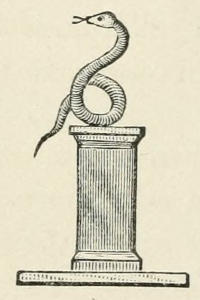
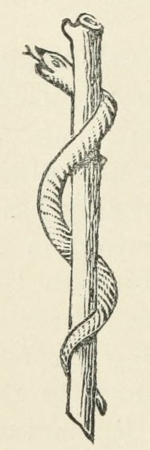
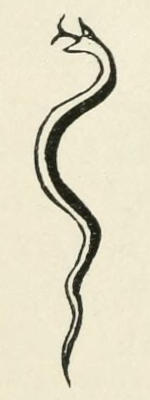
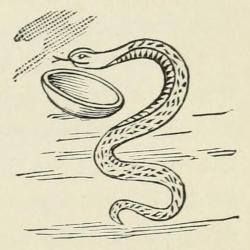
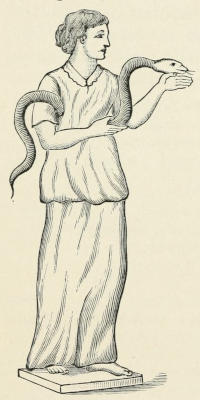
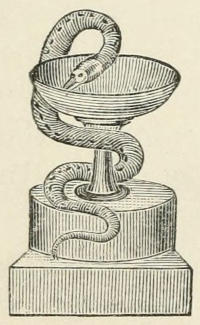
illustration on the next page will afford a still more apt
example. To the eye, it appears to be simply a partly
coiled serpent resting on a pedestal. That is, in truth,
what it is. But, regarded from the stand-point of the
student of medical symbolism, it has another and very
different signification. Before such a figure many a
human being, diseased and suffering, has bowed in
reverence and piously offered to it petitions for relief;
to many a noble Greek and haughty Roman, indeed, to
generations of such, it was a god, the great god of “the
divine art,” as medicine was often beautifully called in
ancient times. The serpent is the most important of
medical symbols.
In any composite figure the elements of it are spoken
of as attributes; and of these some are essential and
some conventional. The essential ones only are, strictly
speaking, symbols. Thus, in a representation of the
Goddess of Liberty, the cap is not a symbol; it is a
conventional attribute. Says the learned and distinguished
historian of ancient art, C. O. Müller, “The
essence of the symbol consists in the supposed real
connections of the sign with the thing signified.”[4] In
some authoritative works, as, for instance, that of Fairholt,[5]
the serpent in medical art is said not to be a
symbol; but this is not true if it be taken to represent
the god of medicine, which, as I have already stated,
was done by both Greeks and Romans. Evidently, if
taken as of this narrow meaning, there are not many
comprehensive medical symbols. But I will take it in
a wider sense; I will take it to mean
any mystic figure or any kind of attribute.
In doing so I do no more
than Fairholt holds should be done.
Referring to the words symbol, image,
and allegorical figure as well as attribute,
he says, “Their shades of
difference are so slight that it would
be most convenient to regard them
all under the general term symbol.”[6]
I may add these remarks of Tiele: “A symbol is a simple
or complex thought clothed in a sensuous form. A myth
is a phenomenon of nature represented as the act of a
person. Usually symbols originate in myths, and in
every case mythology is antecedent to symbolism.”[7]
There are many symbols, however, which never had
anything to do with myths, as will become evident
later.
In the wide sense in which I propose to use it,
symbol is almost or quite synonymous with emblem, as
popularly used. Mackenzie[8] and other authorities,
however, state that the word emblem is properly applicable
only to a mystic object or figure of two or more
parts. Thus, it is more correct to speak of “a skull and
cross-bones” as emblematic than symbolic of a poison
or of death. Again, while a serpent might properly be
called a symbol, one in connection with a staff is an
emblem. In this restricted sense, emblem is closely
allied in meaning to allegory. But in an allegorical
representation most of the elements of it are apt to be
symbolic, and beauty of the whole is a consideration.
The great Epidaurian representation of Æsculapius is
an example. A simple image or statue is essentially a
symbol.
I need hardly say that any figure may or may not be
a symbol; but a mere figure is simply a representation
of any object regarded as void of any other than its
ordinary meaning. A conventional representation of
any idea may be nothing more than a figure. In this
sense, it is sometimes called an ideograph.
CHAPTER II. THE SERPENTINE GOD OF MEDICINE AT ROME.
As I have already intimated, the god of medicine—that
is, Æsculapius[9]—was not only on familiar terms, so
to speak, with the serpent, but at times given a serpentine
form. Pausanias expressly informs us that he often
appeared in such singular shape.[10] The visitor to
imperial Rome about two thousand years ago saw this
divinity in reptilian guise an object of high regard and
worship. It is worth while to enter into a short study
of the matter.
Now, at the outset, I may observe that it is a noteworthy
fact that in their regard for medical men the
early Greeks and others contrasted remarkably with the
Romans. The Greeks would seem to have duly prized
the class. One has but to turn to Homer to find evidence
of the fact. A passage suggested by Machaon’s
splendid exercise of his beneficent art, spoken by Idomeneus
when the “offspring of the healing god” was
wounded by a dart fired by “the spouse of Helen”
(Paris), and “trembling Greece for her physician fear’d,”
runs:—
“A wise physician skill’d our wounds to heal,
Is more than armies to the public weal.”
[11]
Cowper translates this interesting couplet more
literally than Pope:—
“One so skill’d in medicine and to free
The inherent barb is worth a multitude.”
This is a very noble tribute to the physician; in
fact, I know of but few as good, among them being the
one in “Ecclesiasticus” which reads: “The skill of the
physician shall lift up his head and in the sight of great
men he shall be praised.”[12] The latter is Hebræo-Egyptian
in origin, and its date is about two hundred years
before our era. The early Romans did not look on
doctors with any such favor.[13]
It is a well-known fact that the art of medicine was
never very enthusiastically or successfully cultivated by
the Romans. It was not until a comparatively late date
that medical practitioners existed among them at all.
Pliny has left us some interesting notes on the matter.
After the statement that many nations have gotten along
without physicians, he says: “Such, for instance, was
the Roman people for a period of more than six hundred
years; a people, too, which has never shown itself
slow to adopt all useful arts, and which even welcomed
the medical art with avidity until, after a fair experience
of it, there was found good reason to condemn it.”[14] He
himself was not a great friend of it.
Cato, who died in the year of the city of Rome 605,
said, authoritatively: “They (the Greeks) have conspired
among themselves to murder all barbarians with
their medicine, a profession which they exercise for
lucre, in order that they may win our confidence and despatch
us all the more easily. I forbid you to have anything
to do with physicians.”[15] Notwithstanding this,
the imperious old Roman had not a personal dislike to
taking medicine; “far from it, by Hercules,” says Pliny,
“for he subjoins an account of the medical prescriptions
by the aid of which he had ensured to himself and his
wife a ripe old age.”[16]
It appears that the first physician who exercised his
profession at Rome was “Archagathus, the son of Lysanias,
who came over from Peloponnessus in the year
of the city 335.” He was kindly welcomed, and, from
his special line of practice, was called “Vulnerarius;”
but, from cruelty displayed “in cutting and searing his
patients, he brought the art and physicians into disrepute.”[17]
It is this experience to which Pliny refers in
the foregoing quotation.
There is reason to believe that the Romans never regarded
medicine as an art appreciatively. They have
transmitted to posterity little that is original and valuable.
Besides what is found in Pliny’s work, the production
of Celsus[18] is about all that calls for special
mention, and it is possible that the latter, as well as the
former, was only a compiler. Pliny significantly says:
“The art of medicine at the present time even teaches
us in numerous instances to have recourse to the oracles
for aid.”[19] He lived from 23 to 79 A.D.
The Roman people had no special god of medicine
until the year 292 B.C. In the preceding year, the
prevalence of a pestilence caused much consternation.
This led to a consultation of the Delphian Oracle, or,
according to Livy (see page 9), the Sibylline Books,
as to what should be done, and the command of “the
Delphic Oracle, or of the Sibylline Books,” to use the
language of an authoritative work,[20] was given, to send
an embassy to procure the aid of the Grecian god of
healing, Æsculapius.
The story of the bringing of Æsculapius to Rome,
like that of the bringing of Cybele from Pessinus in
Galatia, is an interesting one, and must be known if
one would fully appreciate the fact of the god being
given the serpentine form, the serpent being generally
regarded as only an attribute of him at his chief seat,
the great Epidaurian Asclepion, or Temple of Health.
It is graphically told by Ovid.
Ovid begins his poem[21] with an invocation to the
“melodious maids of Pindus;” and, addressing them,
continues:—
“Say, whence the isle which Tiber flows around,
Its altars with a heavenly stranger grac’d,
And in our shrines the God of Physic plac’d?”
We are then told that—
“A wasting plague infected Latium’s skies.
...
In vain were human remedies apply’d.
Weary’d with death, they seek celestial aid,
And visit Phœbus in his Delphic shade.”
The reply of the Oracle is this:—
“Relief must be implor’d and succour won
Not from Apollo, but Apollo’s son.
My son to Latium borne shall bring redress;
Go with good omens, and expect success.”
The Senate appointed an embassy to carry out the
order:—
“Who sail to Epidaurus’ neighbouring land.”
To it the god (Æsculapius) is represented as
saying:—
“I come and leave my shrine.
This serpent view, that with ambitious play
My staff encircles, mark him every way;
His form, though larger, nobler, I’ll assume,
And, changed as gods should be, bring aid to Rome.”
In due time “the salutary serpent,[22] the god, reached
the Island of the Tiber and assumed again his form
divine”:—
“And now no more the drooping city mourns;
Joy is again restor’d and health returns.”
There is little or no reason to doubt that there was
really a formal bringing of Æsculapius to Rome, a cosmopolitan
city which, indeed, as Gibbon states without
much exaggeration, bestowed its freedom “on all the
gods of mankind.”[23] Livy, the historian, speaks of the
matter as follows:—
“The many prosperous events of the year (459)
were scarcely sufficient to afford consolation for one
calamity, a pestilence, which afflicted both the city and
country and caused a prodigious mortality. To discover
what end or what remedy was appointed by the
gods for that calamity, the Books were consulted, and
there it was found that Æsculapius must be brought to
Rome from Epidaurus. However, as the Consuls had
full employment in the wars, no farther steps were taken
in that business during this year, except the performing
of a supplication to Æsculapius of one day’s continence.”[24]
Elsewhere[25] he says that the god was brought
the following year,—that is, A.U.C. 460, or 292 B.C.
The Island of the Tiber (Insula Tiberina, now Isola
Tiberina), the “inter duos pontes” of the early centuries
of our era, where Æsculapius was worshipped, and which
was sometimes called by his name (Insula Æsculapii),
is within the limits of the city of Rome. According to
tradition, it originated from alluvial accumulations within
the period of Roman history.[26] It is rather remarkable
that, excepting the one at the mouth (Insula Sacra,
now Isola Sacra), there is no other along the whole
course of the famous river. It is ship-shaped, and quite
small in size, being only about a quarter of a mile in
length,[27] and has been called “San Bartolomeo,” from the
church which has long occupied the site of the ancient
Temple of Health.[28] Mr. Davies speaks of it at length
in his interesting book. After an account of the origin
of the worship of Æsculapius on it, he says:—
“It was in commemoration of this event that the
island was fashioned in the form of a ship. Huge blocks
of travertine and peperino still remain about the prow
(pointing down the stream), imitating on a grand scale
the forms of the planks, upon which are chiseled the
figure of a serpent twined around a rod, and, farther
down, the head of an ox. A temple was raised to
Æsculapius, in which his statue was placed, which probably
stood in the fore part of the simulated vessel,
hospitals for the sick occupying the sides, a tall column
or obelisk rising in the midst to represent a mast.
Temples were also dedicated to Jupiter and Faunus.[29]
To these were added a prison in the days of Tiberius.”[30]
Whether the establishment of the worship of the healing
divinity on the island at Rome was brought about
by chance, or deliberately, is not very clear. Pliny
would seem to think that it was elsewhere at first when
he says, “The Temple of Æsculapius, even after he was
received as a divinity, was built without the city and
afterward on an island.”[31] The abhorrence of the people
for physicians is given as the reason for isolating the
institution. The noble Romans had no love for a class
that made a trade of curing the sick, enriching themselves
off the misfortunes of their fellow-men; they were
shocked, says Pliny, “more particularly that man should
pay so dear for the enjoyment of life.”[32] There may have
been other and better reasons. The Greeks themselves
placed their asclepia in rural and often insular places.
Thus, the great Epidaurian Asclepion was in a secluded
vale, and two very celebrated ones, those of Cos and
Rhodes, were, as the names indicate, on islands. It is
needless to say that there are excellent sanitary reasons
for placing sanatory institutions in the country, and
especially on insular sites. It will be a long step in
the right direction when we somewhat unwise moderns
cease to have our medical institutions within the built-up
parts of our cities and towns, and treat the sick,
especially those affected with contagious diseases, at a
distance from the well.
Devotion to the serpentine healer appears to have
lingered long in sunny Italy.[33] A bronze serpent in the
basilica of St. Ambrose was worshipped as late as the
year 1001, but the precise import of it is not known.
Referring to it, De Gubernatis says: “Some say that it
was the serpent of Æsculapius, others that of Moses,
others that it was an image of Christ. For us it is enough
to remark here that it was a mythical serpent before
which Milanese mothers brought their children when
they suffered from worms in order to relieve them, as
we learn from the depositions of the visit of San Carlo
Borromeo to this basilica.”[34] San Carlo suppressed the
superstitious practice.[35]
CHAPTER III. THE ÆSCULAPIAN SERPENT.
It is not to be presumed that many in our day
would seriously believe that Æsculapius assumed the
form of a large serpent, in the famous legendary voyage
to Rome; but it is hardly to be doubted, as I have
already remarked, that there was actually a serpent
brought from Epidaurus on the occasion. It is very
probable that the Roman embassy deliberately brought
one with them; still, the coming of the reptile on board
the ship may have been accidental.[36] The latter was the
case, according to one tradition. At any rate, there was
sufficient ground on which a superstitious people could
easily construct a mythical superstructure to please
their fancy.
The assumption of the form of a serpent by the god
of medicine was not an extraordinary thing, according
to ancient beliefs. Plenty of instances might be cited.
I may give one. Alexander the Great was believed by
many to have been not the son of Philip, but of Jupiter
Ammon, who appeared to Olympias in reptilian shape.
Plutarch tells the story. It is amusingly related of
Philip that “he lost one of his eyes as he applied it to
the chink of the door, when he saw the god, in the form
of a serpent, in his wife’s embraces.”[37] The ability to
take on at pleasure any animal or other form was regarded
as one of the distinguishing prerogatives of
divinity.
Taking it for granted, then, that there was really a
serpent transferred from Epidaurus to Rome, which
was regarded as Æsculapius, the interesting question
arises, of what species was it? A very conclusive
answer may be given.
It is known that at the Epidaurian Asclepion a
species of serpent existed in considerable numbers by
permission. After stating that all serpents, “but particularly
those of a more yellow color, are considered as
sacred to Æsculapius, and are gentle and harmless
toward men,” Pausanias says: “They are alone nourished
in the land of the Epidaurians; and I find that
the same circumstance takes place in other regions.”[38]
Here, then, is proof that
there was a species of serpent
which deserved to be
characterized as Æsculapian.
It being reasonably certain
that only one kind of
serpent “was nourished in the land of the Epidaurians,”
and regarded as sacred to Æsculapius, the following
passage from Pliny is interesting: “The Æsculapian
snake was first brought to Rome from Epidaurus, but
at the present day it is very commonly reared, in our
houses even; so much so, indeed, that, if the breed were
not kept down by the frequent conflagrations, it would
be impossible to make head against the rapid increase
of them.”[39] It is evident from this statement that the
serpent in question was not venomous, that its presence
was prized, and that people would not wilfully kill it.
Now, a pretty species of oviparous, non-venomous
serpent, still common in Italy, is believed to be the
“Æsculapian snake” of Pliny, called Paroas by Greek
writers.[40] I have examined a number of specimens.
Several are to be seen in the museum of the Academy
of Natural Sciences, Philadelphia. It has been described
by Shaw under the name of Coluber Æsculapii,
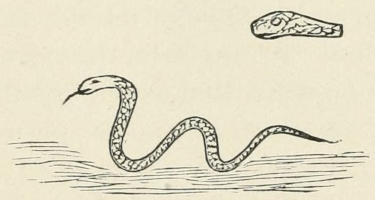
but it is now often called Elaphis Æsculapii. A cut of it
is given in Brehm’s great popular work,[41] which is very
good, except that it gives one the impression that the animal
is decidedly large. The Æsculapian serpent is comparatively
small, being from three to four and one-half feet
in length, and about as thick as a stout walking-cane.
It is orange-brown above, or, as Shaw puts it, “rufous
colour on the upper parts, more or less deep in different individuals.”[42]
Beneath it is of a straw color. The scales of
the back are oval and carinated, and those of the sides are
smooth. The tapering tail measures about nine inches.
Movement takes place through vertical waves or swellings.
It is very active and can climb trees with facility.
When attacked it will defend itself; but it is by nature
gentle and is easily tamed.
In his brief description of it, Cuvier follows Shaw.
He adds: “It is that which the ancients have represented
in their statues of Æsculapius; and it is probable
that the serpent of Epidaurus was of this species. (The
Coluber Æsculapii of Linnæus[43] is of a totally different
species, and belongs to America.)”[44]
The Æsculapian serpent is closely related to the
ringed snake (Natrix torquata), the only British member
of the family; and the common black snake (Coluber constrictor)
of America is of the same genus; but it should
not be classed, as was done by Linnæus, with the decidedly
venomous viperine serpent, the Viper communis,
or Pelias berus, of which Figuier says: “It is not improbable
that it is the echis (εχις) of Aristotle and the vipera
of Virgil, as it is the manasso of the Italians, the adder
of the country-people of England and Scotland, and the
vipère of France. It is found in all these countries and
in Europe generally.”[45]
In an article contributed to a medical journal[46] I have
said, in reference to the Æsculapian serpent, that it is
the one “which should always be shown in medical
symbolism.” This would hardly be questioned by
many; yet I am disposed to think that the restriction
is too exclusive. Another species of coluber, the
uræus, or asp, has played a significant rôle, as a symbol
of life and healing, especially in Egypt, as will be seen
later. Our medical traditions, however, being mainly
derived from the Greeks, it would therefore seem but
right that we should confine ourselves very exclusively
to the symbolism in use by them.
CHAPTER IV. THE EPIDAURIAN ORACLE.
In speaking of the god of medicine at Rome, mention
was made of Epidaurus, the original great seat of
worship of Æsculapius. In the Peloponnesian place of
that name, in the district of Argolis, on the western
shore of the Saronic Gulf, I will now pause a while; for
here is a spot of earth of special interest, dearer than
Salerno, or even Cos, to every lover of the annals, historical
and legendary, of the healing art.
Very different is Epidaurus now from what it was in
other days; there has been a change, and for the worse.
Here was once the scene of teeming life; the home of a
people of culture and renown. It is not so at present.
As with many other parts of Greece, time has dealt
harshly with Epidaurus. But for the ruins and the
imperishable records we have of them, one could find
very little there worthy of much attention.
It is chiefly in the work of Pausanias, before mentioned,
that the great medical institution of Epidaurus,
the Æsculapian Temple, with its auxiliaries, survives.
This observing and inquisitive old Greek traveler has left
an interesting account of it. He lived in the second century
of our era.
The ruins have been carefully studied and described
by Mr. Leake.[47]
Under a commission from the Archæological Society
of Athens, Mr. P. Kavvadias, in 1881 and forward to
the present time (1885), has been making exploratory
excavations, for full accounts of which the “Proceedings
of the Society” must be consulted.[48]
Although the Asclepion was not within the town of
Epidaurus, it was generally spoken of as part and parcel
of the latter. Thus, Strabo says: “Epidaurus was a
distinguished city, remarkable particularly on account
of the fame of Æsculapius, who was supposed to cure
every kind of disease, and whose temple is crowded constantly
with sick persons, and its walls covered with
votive tablets, which are hung thereon and contain
accounts of the cures in the same manner as is practiced
at Cos and at Tricca.”[49] In the time of the Romans,
the town was regarded as “little more than the harbor”[50]
of the Æsculapian Oracle. Still, at one time it was of
considerable importance. Pausanias speaks favorably
of it. In it there were statues of Æsculapius and his
reputed wife, Epione, and of Diana, Venus, and others.
There were public accommodations for persons dying
and lying-in women. This was necessary, because births
and deaths were not allowed to occur within the Sacred
Grove. The exclusion was, according to Pausanias,
“agreeable to a law which is established in the island
of Delos.”[51]
Epidaurus was open to intercourse with the Phœnicians
and other peoples. Its citizens were enterprising.
It is interesting to note that they colonized the island
of Cos.
Under the name of Pidhavro the ancient town remains
in existence; but it is a mere hamlet of a few
dozen families, most of which are engaged in raising
vegetables for the Athenian market.
Proceeding in a southwesterly direction from the site
of Epidaurus, one comes, after a journey of about five
Roman miles, to the location of the famous Epidaurian
Oracle of Æsculapius. It is a little vale, bordered
almost all around with shrubbery-clad hills, notable
among which are Mounts Titthium, Cynortium, and
Coryphæus, the first and second to the north, and the
third to the southeast. At a little distance down it,
flowing westerly and emptying into the river of Lessa,
is a rivulet formed by two main branches, one of which
springs from about Mount Coryphæus and traverses
the sacred Ἀλσος, or Grove.
To the Sacred Grove, the name of Hierum, or, rather,
Sto Hieron,[52] a synonym, is applied. It is less than a
mile in circumference. Within it are found remains of
most of the structures which it formerly contained. In
the centre stood the Temple, or Sanctuary, of Æsculapius;
in the southeast, at the foot of Mount Coryphæus, the
theatre,[53] which afforded accommodation for twelve thousand
people, and which is one of the finest ruins of ancient
Grecian buildings; and southwest of the temple was the
place devoted to athletic games, the Stadium, to the north
of which were the Cistrum and the Tholus, or circular
cell, about thirty feet in circumference, which contained
paintings and other works of art, and probably served
as a place of reunion of the officials of the sanctuary,
and for certain sacrifices and ceremonies. Water-pipes
have been unearthed; and there are remnants of
the peribolus, or enclosure, which, according to Leake,
however, was present only on two sides, the steep hills
answering the purpose on the others. The somewhat
remarkable state of preservation of these ruins is largely
due to the seclusion of the place.
Of course, the most notable building within the
sacred grounds was the Temple.[54] This was the abode
of the god; here was his oracle. His statue was of
great splendor and highly renowned. It was formed of
ivory and gold—chryselephantine—and was by Thrasymedes,
of Parus. Æsculapius was represented as a
man somewhat advanced in life, but of attractive presence,
seated on a throne. His hair and beard were
given long, perhaps too long for an ideal physician.[55] In
his left hand he held a staff, and the other he held over
the head of a serpent. At his feet was the figure of a
dog. On the throne were wrought illustrations of the
works of the Argive heroes. Bellerophon was shown
in the act of slaying the Chimæra, and Perseus cutting
off the head of Medusa.
Besides the temple, the theatre, gymnasium, and
other buildings mentioned above, there were still others
to meet the manifold needs of the numerous visitors.
As those who came to consult the oracle remained a night
or longer, there must have been an extensive dormitory.
It is referred to by Pausanias.[56] Those, however, who
approached the god, always, I believe, passed the night
in the sanctuary.
When at the height of its glory the Hierum was
surely a place full of life. Being the most famous sanatory
retreat, multitudes flocked to it from all parts of
Greece and beyond. Many who came were, doubtless,
invalids, but likely far more could not be classed as
such. In fact, this Æsculapian Grove, although mainly
a medical institution, a sort of hospital, might reasonably
be taken as a prototype of modern popular health
resorts.
The glory of the Epidaurian Oracle was not short-lived.
In the year 292 B.C., the time when the Roman
embassy paid the historic visit, it was very great; and
five centuries later—that is, in the time of Pausanias—it
had not passed away; the worship of the serpentine
divinity had not then ceased.
With years the oracle accumulated riches, so that it
became noted for its treasures. When, in the year 167
B.C., it was visited by L. Æmilius Paulus, after his conquest
of Macedonia, it was rich in gifts presented by
those who had obtained relief there from their afflictions.
A century and a half later many of the valuable
offerings had disappeared.
The visitors to the great oracle in search of health
placed themselves under the care of the asclepiades, or
disciples of the god. A special course of regimen
(treatment) was followed. It is said that it was directed
by Æsculapius, through dreams,—not necessarily a
truth. The plan pursued was more or less scientific
and free from superstition. Mr. Leake rather ungraciously
remarks that the advisors, being “equally dexterous
as priests and physicians, provided themselves
with resources in either capacity, which they could turn
to the benefit of their patients’ infirmities and their own
profit.”[57] The rules were decidedly strict. Records of
patients were preserved, and the tablets on which they
were placed were hung up in the temple and elsewhere.
Some of those surviving from the stelæ, mentioned by
Pausanias,[58] have been unearthed recently by Mr. Kavvadias.
They are mostly statements of miraculous
cures.[59]
Famous and immensely popular as the Epidaurian
Oracle was, it cannot be said to have had notable natural
advantages in its favor. The site was not one of the
best, being low and hill-bounded,—conditions closely related
to unhealthy states of humidity and heat of the
atmosphere. The supply of water was not good, dependence
having to be placed at times on cisterns. The
locations of many other, but less noted, asclepia, were
certainly far more sanatory. At Cos there was pure,
mild sea-air; and, of those in the mountains or by
fountains, each had one or more special natural attractions.
Indeed, there could seemingly be few much
worse sites than this close little Epidaurian valley, without
even a mineral spring, or, in fact, a good spring of
ordinary water to recommend it. But, greater than any
one, or all climatic or other influences in power to attract
the multitude, was the belief that at his birthplace
and primary seat and oracle the influence of the god of
medicine could be most effectively brought to bear to
remove disease and restore health. As in this case, a
pleasing superstition may work wonders.
CHAPTER V. ASCLEPIA AND THE ASCLEPIADES.
Many asclepia, or temples of health, were in time
established throughout Greece and her colonies and elsewhere.
A recent writer states that at least three hundred
and twenty are known “to have existed in antiquity;
so that every town of importance must have had
its sanctuary.”[60] In success and length of existence they,
of course, varied greatly. The one at Epidaurus has
been spoken of, and others of great celebrity were those
of Tricca, Cnidus, and Cos, to say nothing of some only
a little less deserving of mention, such as those at
Rhodes, Pergamus, Carthage, Athens,[61] and Rome.
The asclepion at Tricca, in Thessaly, was probably
started by the sons of Æsculapius, Machaon and Podalirius.
At any rate, according to Homer, they were
attendants there. This was enough to bring it into repute,
but its situation in the mountains was much in its
favor as a popular sanatory resort.
The Coan and Cnidian asclepia were favorably
located; the former on the island of the name, which
Pliny speaks of as “flourishing and powerful in the
highest degree and consecrated to Æsculapius,”[62] and
the latter not far distant, on a site decidedly maritime,
in Asia Minor. These temples were both very distinguished,
and a degree of rivalry prevailed between them.
In them there was undoubtedly much highly creditable
medical knowledge in exercise. The same was probably
the case in most, or perhaps all, others, especially
in later times; but it is in respect to those only that we
have indubitable evidence of the fact. Of the two
schools, the adherents of the Cnidian paid special attention
to the symptoms of individual cases, and avoided,
as much as possible, powerful cathartics, bleeding, and
other active means of cure.
Whatever may have been the success of the various
asclepia, institutions which were finally blotted out in
the early part of the fourth century by Constantine, the
first Christian emperor,[63] that of Cos was destined to
make the greatest impress on the medicine of the future.
It was the good fortune of this institution to have in
connection with it, at the acme of its career, a great
author as well as physician. Hippocrates, a native of
the island, rendered the fame of the Coan school imperishable,
and gave to his fellow-men throughout the
world, in all time to come, a legacy of incalculable
value. Through this early and great medical writer his
alma mater has been made, in a manner, that of the
medical man of all ages. From Cos sprang forth at the
touch of a humble man, afterward called appreciatively
“the divine old man,” a mass of medical knowledge,
wonderfully pure and good, which constitutes the main
body of the real medical science of our own day.
An asclepion[64] consisted essentially of a building
with a more or less hygienical site, usually in the country
and near a fountain,[65] sometimes a mineral one, in which
the arts of healing were practiced by priests or disciples
of Æsculapius, called asclepiades. In all, the influence
of the god was generally believed to be an essential
factor; and hence in each an image of him was to be
found. But the fully-equipped institution had many
appliances, as has been shown in the account given of
the one at Epidaurus. Arrangements for exercises,
baths, and other means which were brought to bear to
restore people to health were duly provided and were
in many instances elaborate.
The asclepiades claimed that they were descended
directly from the god of whom they were the disciples.
They were not, at any time, mere priests; that is, ministers
of religion. Indeed, it has been asserted that
“there is no sign in the Homeric poems of the subordination
of medicine to religion.”[66]
The asclepiades constituted a special class, and
they were oath-bound to preserve the mysteries of the
art from the uninitiated. The oath is preserved in the
Hippocratic Collection,[67] and is usually called by his
name. It begins thus: “I swear by Apollo, the physician,
and Æsculapius, and Health, and All-Heal,[68] and
all the gods and goddesses that, according to my
ability and judgment, I will keep this oath and this
stipulation.” In it occurs this passage: “I will follow
that system of regimen[69] which, according to my ability
and judgment, I consider for the benefit of my patients,
and abstain from whatever is deleterious and mischievous.”
Here is another: “With purity and with holiness
I will pass my life and practice my art.” Cutting
for the stone is left to those who make a special business
of it. What is learned about patients, in the exercise
of the art, which should be kept secret is not to be
divulged. Mr. Adams well says that it is most honorable
to the profession that so ancient a document pertaining
to it as this, “instead of displaying narrow-minded
and exclusive selfishness, inculcates a generous
line of conduct, and enjoins an observance of the rules
of propriety and of the laws of domestic morality.”[70]
It has been said, in a learned article[71] on ancient
medicine, that “the asclepiadæ of Greece were the true
originators” of scientific medicine. This claim might
be questioned, but it is, doubtless, in the main just.
Certainly all physicians were not connected with
asclepia; and in later times the asclepiades proper
were avoided by the more intelligent and rational.
Unfortunately, the records of the practice of the
asclepiades have been almost entirely lost. This is to
be regretted, and more especially because what is preserved
is of a decidedly high order of merit.[72] However,
it is probable that at least the crême of the whole
has been handed down to us by Hippocrates.
It seems certain that in the first “Prorrhetics” and
the “Prænotiones Coacae,” which are transmitted to us
in the Hippocratic Collection, we have fragments and
excerpts from the histories of diseases and cures which
were formerly found on the votive tablets of the Coan
Temple. From these records Hippocrates drew largely
in composing his highly valuable “Book of Prognostics.”
In reference to the matter Adams says: “It
is as clear as the light of day that Hippocrates composed
this work from them.”[73]
It is more than probable that, except for a short
time at first, the system of treatment pursued by the
asclepiades varied within wide limits; and it is equally
certain that the superstitious element lessened as time
passed. Between the principles of practice of Æsculapius
and those of Hippocrates[74] there is a very wide
difference. Those of the former will be given later; but
of those of the latter I may say here that they were
essentially scientific.[75] To Hippocrates every disease
had a natural cause, and was to be cured by natural
means. He was wont “to consult Nature herself about
Nature,” as Bacon has somewhere wisely advised.
He did not attribute any morbid condition to any
spiritual power, good or bad, and hence in his practice
did not resort to conjuration or any related means of
cure. Even of epilepsy, the so-called “sacred disease,”
he said: “It is thus with regard to the disease called
sacred: It appears to me to be nowise more divine nor
more sacred than other diseases, but has a natural cause
from which it originates like other affections.” And
again: “Men regard its nature and cause as divine,
from ignorance and wonder.”[76] As regards holding
disease to be divinely inflicted, he very properly
remarks: “I do not count it a worthy opinion to hold
that the body of man is polluted by God.”[77]
Not only in the principles of medicine, but in its
practice, Hippocrates was wonderfully sound, even when
judged from the stand-point of the art in our day. In
truth, for extent and profundity of medical knowledge
and philosophy, between him and what modern would
one think of instituting a comparison? Sydenham has
been likened to him; but, although I am an admirer of
the English physician, I do not hesitate to say that he
was neither in breadth nor depth any such man as the
Coan. As a writer on the prevention and cure of disease,
Hippocrates remains facile princeps.
Let it not be hastily supposed that my admiration
for Hippocrates is unreasonably great. His works are
truly a surprise to even the well-read modern. Very
many of the so-called discoveries of recent times may be
learned by turning to them. I speak advisedly. I will
cite instances:—
Thus, of the treatment of open sores, he says: “In
these cases no part is to be exposed to the air.” Dressings
of “wine and oil” and “pitched cerate[78]” are
directed to be used.
Again, in treating fractures, in connection with certain
splints, he advises that “a soft, consistent, and clean
cerate should be rubbed into the folds of the bandage;”[79]
and he says, “If you see that the bones are properly
adjusted by the first dressing, and that there is no
troublesome pruritus in the part, nor any reason to
suspect ulceration, you may allow the arm to remain
bandaged in the splints until after the lapse of more
than twenty days.”[80]
Still again, in regard to the reduction of a dislocation
at the hip-joint, he says, “In some the thigh is reduced
with no preparation, with slight extension, directed by
the hands, and with slight movement; and in some the
reduction is effected by bending the limb at the joint
and making rotation.”[81]
In the three preceding paragraphs we have the practical
side of the germ theory of disease, the permanent
dressing of fractures, and the reduction of dislocations
by manipulation.
I might go on and recount numerous other matters
alleged to be new, and of which we hear much; but it
is not necessary. I may add, however, a few items of
interest:—
“Bleed,” says the old Greek, “in the acute affections,
if the disease appears strong, and if the patients be in
the vigor of life, and if they have strength.” Has any
modern spoken more wisely on the subject?[82]
Here is a statement worthy of the attention of unbalanced
theorists of our day: In fevers and pneumonia,
heat “is not the sole cause of mischief.”[83]
He gives directions for the use of effusions with
“water of various temperatures” in “cases of pneumonia,”
of “ardent fevers,” and of other diseases. This
treatment, he thinks, “suits better with cases of pneumonia
than in ardent fevers.”[84]
In that inimitable book, his “Aphorisms,” it is said:
“In general, diseases are cured by their contraries.”
There is no exclusive allopathy or homœopathy, or
dogma of any kind, in that statement; it is the sentiment
of a scientific physician.
Medicine was evidently far advanced in the days of
Hippocrates;[85] and he was certainly a learned and sensible
practitioner of it, even the “Prince of Physicians,”
as Galen, I think, somewhere characterizes him, as well
as one who did much to make it what he pronounced it
himself to be, namely, “of all arts the most noble.”[86]
CHAPTER VI. THE GRECIAN GOD OF MEDICINE.
During most of the earlier part of their history it
is safe to say the Greeks regarded Apollo as their main
god of medicine. Being possessed of the eminent
qualities of a sun-god, replacing Helios as such, and
both mighty and popular, this was to be expected.
Nothing could be more natural than to accord to a
deification of the orb of day a direct concern with
matters pertaining to life and death.[87] Who so blind
and stupid as not to see and know that all vital activity
is intimately connected with the presence and movements
(apparent) of this great light- and heat-producing
heavenly body!
In an old Chaldean hymn the power of the sun over
health and disease is recognized. He is petitioned to
relieve a patient. The petitioner, after saying that “the
great lord, Hea, had sent him,” continues:—
“Thou at thy coming, cure the race of man;
Cause a ray of health to shine upon him;
However, the reader of Homer is well aware that
medical affairs were regarded by the Greeks as subject to
the will of Phœbus. The epidemic which affected the
Grecian forces, spoken of in the beginning of his great
work, was held to be caused by the god. Being moved
to anger by the words of his daughter-robbed priest—
“Latona’s son a dire contagion spread
And heap’d the camp with mountains of the dead.”
[89]
Chryses, having received the maiden[90] back from her
kingly abductor,[91] then addressed Apollo again, saying,
among other things:—
“If fir’d to vengeance at thy priest’s request,
Thy direful darts inflict the raging pest,
Once more attend! Avert the wasteful woe
And smile propitious and unbend thy bow.”
[92]
The prayer was heard and answered as desired.
Surgical as well as purely medical aid was sought
and received from Apollo. Thus, when the Lycian
chief, Sarpedon, was killed, Glaucus, himself sorely
wounded and unable to protect his friend’s remains,
petitioned the “god of health,” the “god of every healing
art,” and
“Apollo heard; and suppliant as he stood,
His heavenly hand restrain’d the flux of blood;
He drew the dolours from the wounded part,
And breath’d a spirit in his rising heart.”
[93]
One of the names often applied to Apollo,[94] and
subsequently to his son,[95] was distinctly medical, viz.,
Pæon, or Paieon.[96] Homer always uses it in referring
to the physician of the Olympian gods, as where he
speaks of the Pharian race as “from Pæon sprung.”[97]
“Pæonian herbs”[98] is the phrase used by Virgil in his
account of the restoration to life of Hippolytus. And
this leads me to say that Apollo was believed to have a
special knowledge of medicinal plants. By Ovid he is
represented as saying:—
“What herbs and simples grow
In fields, in forests, all their power I know.”
[99]
It may be further said that Apollo always continued
to have healing powers accorded him. No more proof
of this is wanting than the first clause of the Hippocratic
oath—“I swear by Apollo, the physician.”
It would seem to have been about the time of the
Trojan war that the special god of medicine began to
be viewed as such by the Greeks. Strong reason for
so believing is found in the fact that Homer refers to
Æsculapius as simply “a blameless doctor,”[100]—a mortal,
the adjective used never being applied to a god. A
well-informed writer remarks that “the kernel out of
which the whole myth has grown is, perhaps, the account
we read in Homer.”[101] This opinion is open to question.
Even the title of Archegetes, or Primeval Divinity, was
sometimes given to Æsculapius, and, indeed, under that
title he was worshipped by the Phocians in a temple situated
eighty stadia[102] from Tithorea. This name was also
given, it must be said, to Apollo, from whom probably
it was received by the son. I may add here the suggestion
of the Abbé Banier, that likely a distinguished
physician, called Æsculapius,[103] of the age of Hercules
and Jason, being highly honored, was in time confounded
with the old Phœnician and Egyptian god, Esmun; “so
that in process of time the worship of the latter came
to be quite forgotten, and the new god substituted
altogether in his room.”[104]
Galen expresses doubt whether the divinity of
Æsculapius was the result of a gradual development
from a human basis; but Pausanias says: “That
Æsculapius was from the first considered as a god, and
that his fame was not owing to length of time, I find
confirmed by various arguments, and even by the authority
of Homer, in the following verses, in which
Agamemnon thus speaks of Machaon:—
‘Talthibius, hither swift, Machaon bring,
Who from the blameless Æsculapius sprung;’
[105]
which is just as much as if he had said, ‘Call a man who
is a son of a god.’”[106]
In the indulgence of their myth-forming fancies it
was very reasonable, very wise, on the part of the Greeks
to make Æsculapius the offspring of Apollo. If the
god of medicine be viewed as a personification of the
healing powers of nature, what more rational, as has
been observed, than to take him to be “the son, the
effects of Helios, Apollo, or the sun.”[107]
The mythological history of the Grecian god of
medicine is strange and interesting. One must know
it, or he will remain in the dark about many things
bearing on the symbolism and other features of the
physician’s art.
Æsculapius was the result, so the story runs, of a
criminal liaison between Apollo and a young virgin,
named Coronis, a native of Thessaly—something which
the myth-makers apparently did not regard as discreditable.
The morals of many of the gods were exceedingly
bad. “Our manners have been corrupted by communication
with the saints,”[108] is a candid remark of Thoreau. It
would appear that the ancients were corrupted by communication
with the gods.
It is recorded of Coronis that she was, like too many
of the sex, fickle, and did not prove faithful to her
divine paramour; she stealthily cultivated a criminal
intimacy with an Arcadian youth, named Ischys. The
fact of her infidelity becoming known to Apollo, either
through a message of a raven,[109] or his own divine powers,
he, naturally enough, was greatly displeased. And the
wrath of the divinity was followed by a series of remarkable
events.
At this point it may be well to state that the parentage
of Æsculapius was a question which early excited
attention. A belief existed that “he was the offspring
of Arsinoë” and “a citizen of the Messenians,” as Pausanias
informs us. Apollophanes, an Arcadian,[110] being
interested in the matter, went to Delos, and, putting the
question of its truth to the Pythian deity, received this
reply:—
“O Æsculapius! source of mighty joy
To mortal natures; whom Coronis fair,
Daughter of Phlegyas, once with me conjoin’d,
In Epidauria’s barren region bore.”
[111]
According to this dictum, he was, indeed, born in
Epidaurus. Pausanias, by way of proof of the truth of
it, says: “I find that the most illustrious rites of
Æsculapius were derived from Epidaurus.”[112] From
that point the worship seems to have spread. It is said,
however, by Strabo,[113] that his birthplace was Tricca, in
Thessaly.[114]
However, to return to our story: the time of the
delivery of Coronis was not far off, when the news of
her perfidy reached Apollo. Notwithstanding this, he,
being seemingly under the influence of the “green-eyed
monster” to an ungodly degree, cruelly resolved on
having revenge at once. Artemis,[115] the goddess of
chastity, was directed to slay the unfaithful maid with
a thunderbolt, and the order was duly executed. On
coins of Pergamus the unfortunate Thessalian appears
entirely veiled.
After the fatal thunderbolt had descended on the
enceinte Coronis, and her body was being consumed in
the merciless pyre, Apollo’s paternal feelings became
stirred, and saying, as Pindar tells us,
“I may not bear to slay my child
With his sad mother, sin-defiled,”
[116]
proceeded forthwith to save his unborn offspring.
To what manner of operation did he resort? I leave
it to some all-knowing specialist to find out; but, at any
rate, by some method or other, the child was rescued.[117]
Another version of the affair, preserved by Pausanias,
robs the god of any possible skill as a gynæcologist—surgical,
I mean. According to it, when Coronis was
undergoing cremation, after being slain by Artemis, “the
boy is said to have been snatched by Hermes from the
flames.”[118] And of this I may observe that it was not
inappropriate to have Hermes, the Grecian metamorphosis
of the thrice-great god of wisdom and knowledge
of the Egyptians, present at the unnatural accouchement,
and in such close relation to Æsculapius at the
very beginning of his wonderful career.
It was, then, the unhappy fate of Æsculapius to be
an orphan from his birth, if birth he had, to speak correctly;
and it is possible that his advent was decidedly
premature—in a medical sense. Apollo was puzzled to
know what to do with his tender son; nor did he do for
him all that could be expected, for baby Æsculapius
was heartlessly exposed on Mount Titthium. Here the
little unfortunate fell into the keeping of a friendly goat
and dog. The goat gave the precious enfant trouvé
nourishment,[119] as Amalthea had done Zeus, and the dog
kept guard over him.[120] Splendid services, indeed, on the
part of two humble animals, in the interest of medicine
and humanity!
On Epidaurian coins, the infantile god of medicine
is appropriately represented under a she-goat on Mount
Titthium, with Aresthanas approaching. This person
was the shepherd of whom Pausanias says that, coming
to the rescue, “he beheld a splendor beaming from the
infant, and, thinking that it was something divine, as
indeed it was, departed from the place. But a report,”
he continues, “was immediately spread through every
land and sea that such as were afflicted with any kind of
disease were healed by the boy, and that even the dead
were raised to life.”[121] The reader need hardly be informed
that accounts parallel to this are common enough
in ancient records.
How it happened that the child of Coronis, a Thessalian,
first saw the light in Epidauria, a country which
became particularly sacred to him, is a question which
should be answered. It appears that Coronis came there
with her warlike father, Phlegyas, who gave, as a reason
for his visit, a desire to see the country, but, “in reality,”
Pausanias says, “that he might inspect the multitude of
the inhabitants, and learn whether there was a great
quantity of fighting men.”[122]
Pindar states that Apollo, on rescuing his child, bore
him at once to Chiron—
“To learn of human woes the healing lore,”
[123]
which does away with the fabled discreditable exposure
of him; but whether this be so or not, in progress of time,
he did put him under the care and instruction of “the
beneficent leech,”[124] Cheiron (to use the archaic expression
of the historian, Grote[125]), the Thessalian Centaur, or fabulous
monster, whose figure from the waist down was like
the body of a horse.[126] Under the direction of this
strangely-formed creature, Æsculapius proceeded to
study the medical virtues of plants; for Chiron was a
great herbalist, being called by Homer, in the words of
Pope, “the sire of pharmacy.”[127] In time the pupil exceeded
the teacher in his knowledge of drugs.
Chiron was regarded, Pindar tells us,[128] as the son of
Saturn and the sea-nymph Philyra; and hence was a
brother of Zeus. Saturn changed himself into a horse
to conceal his amour with the nymph from his wife, Rhea.
This would account for the form of the Centaur.
Chiron lived in a cave on Mount Pelion, in Thessaly.
It will be remembered that it was from there that he got
the ashen spear[129] for Peleus, which the son brought into
use, a ponderous spear, which—
“Stern Achilles only wields,
The death of heroes and the dread of fields.”
[130]
According to Homer,[131] Hercules received instruction
in medicine from Chiron; and it is stated, by Pindar,[132]
that Jason was another pupil of his. With these Æsculapius
went, as physician, on the celebrated Argonautic
expedition.
At the end of his career, the Centaur became, it is
said, the sign of the zodiac, Sagittarius.[133]
In treating the sick, Æsculapius soon proved himself
a master. His patients did not die, and it appears
that he recalled a few from “the shades below.” But,
sad to relate, the great success he had in curing the sick,
and especially his recalling some from the other world,
led to his destruction. Pluto, the god of the nether regions,
not wishing a sparse population,[134] became displeased
with him and complained to Zeus, who, probably
believing that he was becoming too powerful, so much so
as to make man undying,[135] cut short his career with
a thunderbolt,—a tragedy which caused his father,
Apollo, to wander away to the land of the Hyperboreans
and to shed tears of gold. At the request of
Apollo he was placed among the stars.[136] The eighth
day of the Eleusinian Mysteries was devoted to sacrifices
to him, and was called Epidauria.
From what Virgil says, it would seem that it was
not because of the direct exercise of his power to restore
life that Æsculapius was destroyed, but because
of the degree of perfection to which he had brought the
medical art. The event, “the fable,”[137] as Pliny designates
it, is connected with the restoration of Hippolytus
or Virbius, and is thus referred to by the Roman poet:—
“But chaste Diana who his death deplor’d
With Æsculapian herbs his life restor’d;
Then Jove, who saw from high with just disdain
The dead inspired with vital breath again,
Struck to the centre with his flaming dart
The unhappy founder of the god-like art.”
[138]
The plan of treatment pursued by Æsculapius was
variable. After speaking of the sick, “a host forlorn”
that flocked to him, Pindar says:—
“Some spells brought back to life;
These drank the potion plan’d; for these he bound
With drugs the aching wound;
Some leaped to strength beneath the helpful knife.”
[139]
The lines just given certainly serve to disprove the
statement of Pliny, that in Homeric times “the healing
art confined itself solely to the treatment of wounds.”[140]
It is doubtless true, however, that nothing is said in
Homer’s works about particular diseases.
It has been held that Æsculapius, like More’s Utopians,
did not think it wise to bring to bear the art of
healing in the case of any one who might not be restored
to health and to usefulness to himself and others.
Says Plato: “He thought medical treatment ill bestowed
upon one who could not live in his regular round of duties,
and so was of no use either to himself or to the
State.”[141] The great philosopher accordingly regarded
him as “a profound politician.” For, in his ideal state,
this celebrated theorizer would have physicians “bestow
their services on those only of the citizens whose bodily
and mental constitutions are sound and good, leaving
those that are otherwise, as to the state of their body,
to die, and actually putting to death those who are
naturally corrupt and incurable in soul.”[142] Some excellent
reasons might be advanced in favor of such a
harsh policy, but, while human love of life and human
sympathy remain as now, it will never be brought into
play.[143] As an ideal physician, Æsculapius could hardly
have been an advocate of it.[144]
I may say a word about the charge of Pindar, that
the efforts of Æsculapius to recall the dead to life were
inspired by temptation with gold. The poet says:—
“Alas! that filthy gain can blind the wise!
The glittering gold betrayed the noble leech,
From the dark prison-house to bid arrive
A captive thrall of death!
But Jove with wrathful hand refused to each
The hallowed breath.
Down came the bolt of fire.”
[145]
Making such an ugly charge is probably unjust to
the great healer. The historian, Grote, thinks so, and
expresses the opinion that Pindar was disposed “to extenuate
the cruelty of Zeus by imputing guilty and sordid
views to Æsculapius.”[146] Long ago the accusation
was met by Plato. Says he: “While they[147] assert that
Æsculapius was the son of Apollo, they declare that he
was induced by a bribe of gold to raise to life a rich
man who was dead, which was the cause of his being
smitten with a thunderbolt. But we, with our principles,
cannot believe both these statements of theirs. We
shall maintain that, if he was the son of a god, he was
not covetous; if he was covetous, he was not the son of
Apollo.”[148] He was the son of Apollo.
To conclude this imperfect sketch of the life of
Æsculapius, I may add that he was married, as every
wise as well as respectable physician should be,[149] and,
as was desirable in an exemplar, the father of at least
six children,—two sons and four daughters. The two
sons, Machaon and Podalirius, taught by their “parent
god,” as Homer informs us, became “famed surgeons,”
“divine professors of the healing art,”[150] and were also
distinguished warriors under Agamemnon. Of the
daughters, Hygeia, Panacea, Jaso, and Ægle, the first
became the goddess of health, of whom more anon.
CHAPTER VII. THE IMAGE OF ÆSCULAPIUS.
A simple image of a god may be regarded as a
symbol. When the image has connected with it one or
more figures to indicate the qualities or functions of the
divinity, we have then, strictly speaking, an allegorical
representation. Æsculapius was sometimes shown in
the one way and sometimes in the other. Thus, he was
occasionally to be seen at Rome, and elsewhere, in the
form of a serpent; and, at the Epidaurian Grove, for
example, as a man having in connection with him a
serpent, a dog, and other things.
As is implied in what I have just said, there was no
set, invariable mode of portrayal of Æsculapius. This
fact should be clearly understood. But let it not be
supposed that it is by any means singular. It will
occur to the well-informed reader that the same holds
true in regard to Zeus, Apollo, Venus, and, indeed, all
other divinities. Says Müller: “The so-called ideals of
the Grecian gods are not types; they do not preclude
the freedom of the artist; they rather contain the
strongest impulse to new, genial creations.”[151] It is,
perhaps, self-evident that a statue of a god must necessarily
be quite ideal; and, of course, an ideal is without
absolute permanency. Still, it remains true that in
the case of Æsculapius, as well as that of every other
deity, there was a more or less definite conventional
way of representing him. This, however, was largely
dependent on the presence of attributes. Thus, it
would be not only inconsistent with custom, but almost
futile, to attempt to delineate him without the presence
of a serpent.
The most magnificent representation of Æsculapius
was the one at Epidaurus. A description of it has
already been given. This fine work of art disappeared
at an early day. The vandals could not be expected to
spare it; the gold in its composition was fatal to its
permanency. It was borne on coins of Epidaurus.
According to Strabo,[152] a copy of it was taken to the
Galatian town, Pessinus, not Rome, as is often said.
Several other places were similarly favored.
There was a very celebrated statue of Æsculapius at
the renowned Asclepion of Pergamus, the production of
the artist Pyromachus, as well as one similar to that of
Epidaurus. It became the prevailing type in art. In it
the god was represented as a mature man of benevolent
expression, with his rather long hair bound with a fillet,
and in his right hand he held a staff enwreathed with a
serpent. He wore a himation[153] drawn tight over the left
arm and breast. The whole right side from the waist
up was uncovered. His attitude was that of a person
ready to render assistance. “We can recognize,” says
Müller, “the figure with tolerable certainty as the most
usual representation of the god on numerous coins of
Pergamus.”[154]
The well-known statue of Æsculapius at Berlin
resembles that at Pergamus; and the same is true of
one at Florence, and others. That of Berlin has the
serpent-wreathed staff, or support, placed on the left
side. This appears to have been frequently done. An
instance of it I have observed in a gem bearing Æsculapius
and Hygeia, taken from a tomb at Thron,—a piece
of work of the Roman period. It is shown in General
Di Cesnola’s interesting work.[155]
While Æsculapius was made to appear aged in some
instances, as in the Epidaurian representation, he was
sometimes presented in youthful form, and beardless,
like his father, Apollo. And this reminds me of the
story told of Dyonysius, King of Sicily, that, on conquering
the Morea, he ordered the beard to be taken off
the Epidaurian statue of the god, for the reason that it
was unbecoming and unjust for the son to have a beard
when the father had none. Possibly if it had not been
a golden one it would not have been molested.
I may venture to say that both aged and youthful
representations of Æsculapius are open to criticism. An
ideal physician should be, as in the statue at Pergamus,
a man in his prime, or, in other words, mature, but
neither young nor old. The immature man is apt to be
defective in judgment, and the superannuated one is
nearly always of excessively routine practice and ignorant
of recent advances in his profession.
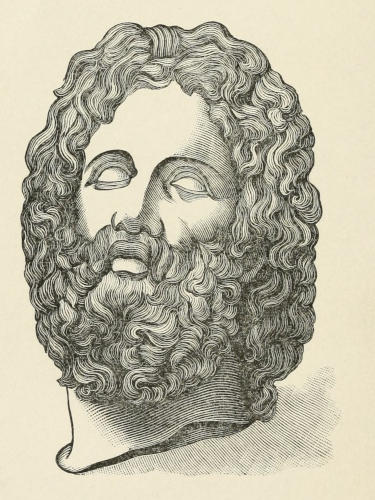
By way of conclusion, I will say a few words
about the famous colossal head of Æsculapius, originally
colored and decorated with a bronze wreath,
now in the British Museum, where it has been since
1866. It represents, with marked freedom and breadth
of execution, a finely-developed man of middle age, with
a cast of countenance similar to that of the Phidian
Zeus. The beard is of moderate length and is waved
like the somewhat long hair. This is really one of the
noblest remnants of Grecian art. Nichols, in whose
work[156] an engraving of it is given as a frontispiece, just
as it is in this one, regards it “as scarcely less remarkable”
than the celebrated “Venus of Milo” in the
Louvre, both of which were found, the former in 1828,
on the island of Melos. It is considered to be the work
of an artist of the Macedonian period, about B.C. 300,—a
time when the Greek sculptor had attained perfect
mastery of his art.
CHAPTER VIII. THE ÆSCULAPIAN STAFF AND SERPENT.
The staff[157] and serpent of Æsculapius being of special
emblematic significance, I deem it proper to speak of it
at some length. The confusion of ideas which appears
to prevail extensively in regard to it implies that a definite,
explicit account of it is much needed.
Although, as will be remembered, Ovid makes Æsculapius
refer to his serpent-enwreathed staff when addressing
the commission which came from Rome to
Epidaurus, in the famous representation of him given
there, none was present. The poet may possibly have
been misled by what had become familiar to him at
home; for one was to be seen in connection with the
statue of the god at Rome. It is probable, however,
that it was a common occurrence for a living serpent,
one of the species kept and viewed as sacred in the
Hierum, to climb the staff in the hand of the Epidaurian
statue.
It is very likely that the staff bearing a serpent became
a characteristic emblem of the god of medicine
through the great work of the sculptor, Pyromachus, at
the Asclepion of Pergamus, which I have already described.
The appropriateness of it was widely recognized,
but it was not always adopted, as is attested by
the remains of ancient art.
Apart from the serpent, the import of which will be
fully treated of in the succeeding chapter, the staff as
an attribute of Æsculapius merits study. Like many
other apparently simple things in art, it may stand for a
great deal more than one would suppose on first view.
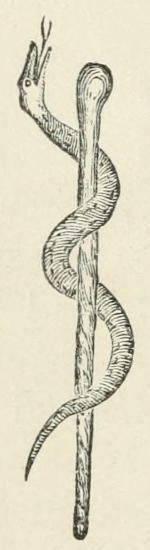
The object encircled by a serpent held in the hand
of the Æsculapian statue by Pyromachus, at Pergamus,
is evidently a walking-stick. The Epidaurian
statue has a similar object in one of the hands, and the
same is the case in many others. Hence, as the representations
of the gods of the ancients had rarely or
never anything but significant attributes attached to
them, it is pertinent to ask an explanation
of its presence. Was there an historical
basis for it? In other words, was
Æsculapius notoriously in the habit of
carrying a staff? If so, it is possible
that this was why Pyromachus, Thrasymedes,
and other artists connected one
with figures of him. But there is no
special reason for believing that such
was the case.[158]
Then, did the artists place a staff in
the hand of Æsculapius of their own
accord to indicate the perambulatory
character of the physician’s calling?
Such an attribute was doubtless deemed
appropriate by them; but, before one could believe that
they gave it on the score of apparent appropriateness, it
would have to be shown that it was in the power of
artists to design gods at pleasure,—something which
could not be done. They evolved it, I may venture to
say, from something allied in form.
There is little or no ground for believing that the
staff of Æsculapius was a wonder-working object. I
am not aware that such a thing was placed intentionally
in his hand by any artist. Hence, the references often
made to the mystic wand of the god spring from misapprehension,
a walking-staff being something very
different.
One can obtain, I believe, from an examination of
the Berlin statue and others,—in which Æsculapius is
represented leaning on, or standing by, a post of variable
thickness and more or less regular in shape,—a clue
to an explanation of the origin of the staff. Between
the two objects the difference is not great, certainly not
radical; and as attributes they might be expressive of
the same thing. The club shown in the picture (Fig. 3),
from Maffei, might be viewed as intermediate.
Of course, I do not say that the prototype of the
staff was the post present in some representations of
Æsculapius, although the idea would not be entirely
unreasonable. There is more ground for the opinion
that both were, so to speak, the offspring of something
else.
Any one familiar with the antique representations of
Æsculapius, and who has also seen different ones of
Apollo, might well be inclined to believe that both gods
have essentially the same thing by their side, namely, a
post with a clinging serpent. And when it is recalled
that Æsculapius was the son of Apollo, the opinion
might be advanced with some degree of reasonableness,
that the emblem of the former was, in reality, that of
the latter, somewhat modified.
Tracing thus the origin of the staff of Æsculapius
to the related symbol possessed by his father, Apollo, it
would not be satisfactory to rest here; one naturally
wants to know something about the latter. A few words,
however, on the subject must suffice.
Although it was not an uncommon thing for artists
to give posts by the side of statues, the one bearing the
serpent in, say, the Apollo Belvedere, was, it is thought,
meant to represent the Omphalos, to which the Grecians
attached much significance.
The Omphalos,[159] in the form of a conical stone, was
kept, and was present within historical times, as Strabo
explicitly states, at Delphi, a place which, he says, “was
supposed to be the centre of the habitable earth, and
was called the navel of the earth.”[160] Plato refers to
Apollo as “the god whose seat is the middle point of
the earth, its very navel.”[161] According to a legend,[162]
Delphi was esteemed the centre of the earth, because two
eagles sent out by Zeus, one from the east and the
other from the west, met at that point. Says Strabo:
“In the temple is seen a sort of navel, wrapped in bands
and surmounted by figures representing the birds of the
fable.”[163]
The etymology of the word Omphalos casts light on
its meaning. Olympos, the mount of the gods, is a corruption
of it. Omphi-el[164] is the oracle of the sun-god.
Al-omphi was used to designate hills, or mountains.
Holwell says that the word came from Egypt, and was
originally Ompha-el, and related to the oracle of Ham,
or the sun.[165] The idea of a sacred mount or elevation
is thus the original meaning of the word. And here I
may say that in Hindu mythology considerable is said
of a mountain encircled by a great serpent.[166]
Let it not be supposed that the reasons in favor of
the idea that the Omphalos became the staff of Æsculapius
are entirely insubstantial. Remains of ancient
art furnish excellent proof of it. Müller says: “In a
Pompeian picture, Æsculapius has beside him the
Omphalos, which is entwisted with the well-known net,
composed of στέμµατα. We see from this that this
symbol of Apollo was also transferred to his son. On
the coins of the gens Rubria, likewise, it is not an egg, as
is usually asserted, but the Omphalos placed on a circular
altar that is encircled by the Æsculapian serpent.”[167]
To one versed in the history of Phœnicia and other
Oriental countries, the Omphalos is very certain to be
viewed in another light than as a symbol of a “high
place,” or mount[168] of worship. In the great Tyrian
Temple of Baal Melkarth, which Herodotus went to see
and admired much, and of which that of Solomon,
or, rather, of Jehovah on Mount Moriah was almost a
copy, even to the two pillars in front,—symbols of the
sun-god,—were certain similar stones, carefully preserved
and duly reverenced. These, it is well known, were of
procreative import; they were phallic in character.[169]
Was the Omphalos of similar significance? There is
little reason to doubt that it was often regarded in that
light. “In the earliest times,” says Müller, “a conical
pillar, placed in the street and called Apollo Agyicus,
sufficed to keep in remembrance the protecting and
health-bringing power of the god.”[170]
The staff, then, in the hand of Æsculapius may have
had its prototype in the Phallus,—truly both an expressive
and sublime symbol, when contemplated by pure,
enlightened minds.
But, notwithstanding what I have said, one might
present some arguments in favor of the view that
the staff of Æsculapius had its true prototype in a
magic wand or symbol of office. As will be pointed
out later, the Accadio-sumerian, Silik-mulu-khi, the
beneficent son of Hea, subsequently Marodach or Marduk
of the Babylonians and Assyrians, a healing
divinity, from whom the conception of Æsculapius may
have partly sprung, carried a reed when attending to
his duties.
I may say, too, that some hold the staff in the hand
of the Egyptian Thoth to have been the original of the
one accorded Æsculapius. Thus, in an excellent and
finely illustrated essay, W. R. Cooper says: “When
once the uræus had been associated with the idea of
divinity, the Theban priests, rightly desiring to ascribe
the gift of life and the power of healing to the Deity
alone, significantly enough twined the serpent around
the trident of Jupiter Ammon and the staff of Thoth or
Hermes Trismegistus, the author of medicine, to imply
the source from which that subordinate demigod’s virtues
were derived. From this, in the later periods of
her history, Egypt remitted to Greece, along with the
so-called forty-six hermetic treatises, the traditional
caduceus or serpent-sceptre of Cyllenius[171] and Æsculapius,
and, by subsequent transformation of the same
deities into a feminine form, the snake and bowl of
Hygeia, the goddess of health.”[172] The “serpent-sceptre”
which Egypt “remitted” to Cyllenius and to
Æsculapius must have changed greatly in the passage,
for it is anything but alike as seen in the hands of the
two, and in neither case is it very similar to the asserted
original. As well or better to take the staff and serpent
to be the serpent-bearing tree,—the tree of life in
miniature.
However, the fact remains, as already stated, that
Æsculapius had no wand; that is, a rod of magic power.
The very different personage, Hermes, as also Iris, the
female messenger of the goddesses, had a wand or,
rather, caduceus, which, strange to say, is taken by many
to be a symbol of medicine; that is, the caduceus of
Hermes, which is not of medical import at all, is
accorded to Æsculapius, who really had none. I repeat:
there is no such thing as an Æsculapian wand, if wand
be taken to mean a rod possessed of wonder-working
power. But, of course, the serpent-bearing staff of
Æsculapius is an expressive medical emblem.[173] I give
an example after one in a plate in De Wilde’s rare old
book.[174] One might take the serpent to be a symbol of
the god and the staff as symbolic of the moving of the
physician from house to house in the exercise of his
profession. Regarding the knots as expressive of difficulties
in the art and practice of medicine
is very fanciful, but not infrequently
done. It is proper to observe, however,
that the physician’s staff in modern
times is smooth, as will be pointed out
later.
I deem it not amiss to give a cut of
the caduceus of Hermes, in the hope of
better removing misapprehension in regard
to it. I give it as shown on the
seal of the United States Marine-Hospital
Service. It is an appropriate trade
symbol, Hermes being the god of commerce[175]
as well as the messenger of the
gods; but it is more especially a symbol of peace, the
god being the great peace-maker. (See Fig. 5.)
Traditional history relates that, in his rambles one
day, Hermes saw two snakes fighting, and, laying his
wand—which was originally an olive-branch received
from Apollo—between them, was delighted to discover
that it had the power of putting an end to the encounter,
and of turning the two into friends. Hence the presence
of the two serpents on the wand, the virga of the
Romans. The tradition was likely in the nature of an
after-thought. If the two serpents be taken to represent
two contending persons, or nations, the mission of
the ambassador with his wand or mace, the symbol of
authority, is well indicated.
The two serpents on the caduceus have been taken
to be male and female, and in an amatory mood.[176] Thus,
says Aubrey, “The caduceus of Mercurie is adorned
with two serpents in the posture of generation.”[177] Pliny
expressed an opinion similar to that of Aubrey.[178] This
view was adopted by the London
medical publishers, the Churchills, as
will be seen on looking at the title-page
of their books issued until recently.
For instance, on the title-page
of Pettigrew’s “Superstitions Connected
with Medicine and Surgery,”
issued in 1844, between two concentric
circles surrounding the caduceus, are
the words, Irrupta tenet copula, with
Literis medicina on the serpents. Later, the first phrase
was dropped and the other put in its place. For some
years caduceus and all have very properly been left out.
Hermes was accorded some functions by the Greeks
which may well cause the physician to feel that it is
not very complimentary to associate either him or the
caduceus with his art, even if he be one who regards it
chiefly as a trade. Thus, Hermes, being an adept thief,
was classed as the god of rogues. And this brings to
mind the remark of some one, that, if medicine be a
trade, it is the trade of all others the most exactly cut
out for a rogue. Again, it was the function of Hermes,
very like that of the archangel Michael, “to draw the
souls from hollow graves,” and “drive them down the
Stygian waves,” with his caduceus, as we are told by
Virgil.[179] It is hardly a part of the physician’s function,
I submit, to drive souls “down the Stygian waves;”
certainly, no one professes to do it.
CHAPTER IX. ÆSCULAPIUS AND THE SERPENT.
The serpent is undoubtedly the most significant of
all medical symbols. Even Æsculapius assumed such a
form, and was sometimes so represented by sculptors.
It was to him the most sacred of all animals. Down
through the ages this remarkable fact has been kept in
view, and to-day it is almost as patent as ever.
Now, what is the explanation of the serpent as a
symbol in medicine? How many medical men can say?
Several explanations have currency; but I may candidly
state that none of these are quite satisfactory; and I
could not refer to an acceptable one in all the volumes
in which such information might be expected to be
found, with which I am familiar. Here, then, is a highly
interesting and obvious fact to physicians, which few or
none completely understand. Can I cast any light on
it? Some, certainly; but just how much I must leave
to the intelligent reader to judge, after perusing this
brief but comprehensive chapter.
The serpent in medicine is meant to symbolize prudence,
something very requisite in the physician. This
opinion is one often expressed. It is not necessarily
baseless. To be “as wise as a serpent,” and to have
“the subtlety of the serpent,” are every-day phrases.
The reptile has been accorded such qualities from a
very early date. De Gubernatis remarks that in India
it is still “revered as a symbol of every species of
learning.”[180]
It is often said that the serpent in medicine is meant
to symbolize the power of the art to produce renovation
or rejuvenescence. This is not an absurd notion. The
basis of it is believed to be the periodical renewal of
the skin of the animal. This has long attracted attention.
In a precious extant fragment of the very ancient
Phœnician book of Sanchoniathon it is said of the serpent,
“It is very long lived, and has the quality not
only of putting off its age and assuming a second youth,
but it receives a greater increase. And when it has fulfilled
the appointed measure of its existence it consumes
itself.”[181] Referring to its reputed longevity, one
intelligent writer says: “This quality was no doubt the
cause why this animal entwined round a staff was the
symbol of health and the distinctive attribute of the
classical Æsculapius and Hygeia.”[182] At any rate, to
restore people to health and renew their age would be
worthy employment for any one.
Another prevalent idea is, that the serpent in medicine
is meant to symbolize convalescence. The remarkable
change from a state of lethargy to one of active life,
which the reptile undergoes every spring, affords some
ground for it. It is taken advantage of in the device of
the Rinovati Academy, as will be seen by turning to
Mrs. Pelliser’s interesting book.[183] Three serpents are
represented on a bank gathering vigor in the sunshine,
in the strengthening rays of Apollo. The educational
interpretation is evidently quite as reasonable as the
medical.
Of the three foregoing explanations of the symbolic
import of the serpent in medicine, it must be said that
there is good reason to hold that they are largely, or
entirely, mere after-thoughts. Any one of ingenious
mind could suggest several others just as worthy of acceptance.
But, of course, such a mode of interpretation
is decidedly illegitimate.
The idea has been advanced that the commonest
of the species of serpent, Elaphis Æsculapii, described
above, at Epidaurus, where the myth of the Grecian god
of medicine first took definite shape, affords an adequate
explanation of the association of the reptile with medicine.
This may have had a little to do with it. I cannot
admit, however, that it did more than, perhaps,
emphasize somewhat the association. If such were its
origin, the association could not be viewed otherwise
than as incidental, and hence the serpent might be
without any special meaning.
After referring to some strange curative virtue
attributed to serpents, Pliny says: “Hence it is that
the snake is consecrated to Æsculapius.”[184] Here is a
specimen of them given by the rather credulous old Roman:
“It is a well-known fact that for all injuries inflicted
by serpents, and those even of an otherwise
incurable nature, it is an excellent remedy to apply the
entrails of the serpent itself to the wound.”[185] The
principle is obviously the same as that illustrated in the
old custom of applying a hair of the dog to cure the
wound caused by the bite of the animal. In many parts
of the world, the serpent has been accorded great virtue
as a medicine, and in China and elsewhere such is the
case even to this day. In fact, apart from the preposterous
and numerous uses to which it is put by homœopathic
doctors, is not the venom of the most deadly
species declared by leading members of the profession
to be a capital cure for various serious ills? However,
Dr. D. G. Brinton quotes the rather striking observation
of Agassiz, that “the Maues Indians, who live between
the Upper Tapajos and Madeira Rivers in Brazil, whenever
they assign a form to any ‘remedio,’ give it that of
a serpent.”[186] But, in spite of the wide belief in the
virtue of the serpent as a medicine, I cannot accept the
opinion of Pliny, that it affords a sufficient explanation
of the matter in question. Its actual healing properties
were assuredly too equivocal to merit such distinction.
With all its virtues, soma itself received little or no
more.
The fabled power of the serpent to discover herbs of
curative virtues has been suggested as an explanation
of the association of it with medicine. This is based
on a traditional episode in the history of Æsculapius,
which reminds one of the German story of the Snake
Leaves, told by Grimm.[187] As regards the Æsculapian
fable, it seems that on one occasion, while thinking
what treatment to resort to in the case of a patient of
his, Glaucus, a serpent appeared and twined itself
around his staff; he killed it, whereupon another came
bearing in its mouth an herb with which it restored the
dead one to life. The god used the same herb with similar
effect on the human subject.[188] The extremely miraculous
feature of this explanation is an obstacle in the way
of its acceptance.
It may be safely held that one must go back to a
time long anterior to that of Æsculapius of the Greeks
to acquire the true medical import of the serpent, which
has been so closely associated with him. There is excellent
reason for believing that we have in it a remnant of
that ancient and wonderfully wide-spread cultus, serpent-worship,
which is still kept up by the Nagas[189] of India
and others. Epidaurus was favorably situated for communication
with Egypt, a country in which the serpent
played a great religious rôle “from the very earliest
period,” as shown by both “written and monumental
evidence,” to use the words of Cooper,[190] as well as in
later times, even within the Christian era, when the
special sect of Gnostics, who called themselves Ophitæ,
were in their glory. But, in truth, serpent-worship in
Greece did not begin in the time of Æsculapius. Bryant
maintains that it was brought into Greece by Cadmus,
who, under the name of Taautus, or Thoth, took it also
to both Egypt and Phœnicia from Babylonia.[191]
One can advance sufficient evidence to indicate with
considerable conclusiveness that the Egyptians were in
the habit of looking to a serpentine divinity for the cure
of disease. In his interesting little book,[192] Sharpe gives
a figure of a serpent wearing the double crown of Upper
and Lower Egypt, on a pole or standard, a cut of which is
reproduced (Fig. 6), which was carried in the periodical
airing processions of the Egyptian divinities. Now, it
is quite certain that Moses, and his people, too, were
very familiar with this figure and its import; but, at any
rate, we find him making an imitation of it, in his journey
with the Israelites in the Wilderness; and for what
purpose? The story is told in the Bible, and runs thus:
“And Moses made a serpent of brass and put it upon a
pole; and it came to pass that if a serpent had bitten
any man, when he beheld the serpent of brass he lived.”[193]
Verily, there is the Healer in essentially the same
form in which he was sometimes embodied by the Greeks
and Romans. Hence, it is sure that the serpent, as a
medical symbol, took shape before the time of Æsculapius;
long before, for Moses lived
nearly four hundred years earlier
than he, and, as we have just seen,
it was likely far from new, far from
being unfamiliar in his day. Fergusson
has this to say of it: “It is the
first record we have of actual worship
being performed to the serpent;
and it is also remarkable, as the
cause of this adoration is said to
have been its healing powers.”[194]
The opinion has been widely
entertained that the prototype of
the brazen serpent of Moses, simply
“Nehushtan”[195] in later times, was
the bonus dæmon, the Agathodæmon[196]
of the Greeks, Egyptians, and
others. This “good genius” was
regarded with great favor, and
doubtless many were in the habit of according it power
over disease. In the grove of Epidaurus, as in Indian
temples and elsewhere among early peoples, the serpent
was the genius loci, and hence the Agathodæmon, the
bringer of health and good fortune, the teacher of wisdom,
the oracle of future events. One was kept in the
Erechtheum, close to the sacred olive-tree, and in each
of many other temples. One was to be found, according
to Ebers, “in every temple”[197] in Egypt.
Evidence has recently been brought forward which
goes to show that the serpent called the “good genius”
in Egypt, in general, was in the part familiar to the
Israelites, in the district of Suket, called also the dwelling-place
of Ankh, “the Living One,” whose chief city
was Piton,[198] regarded as the simulacrum of the sun-god
Ra, or, rather, Atum, Tum, or Tom, the sun as he sets.[199]
Brugsch, who has studied the matter carefully, says:
“The god Tom represents solely the Egyptian type, corresponding
to the divinity of Piton, who is called by
the name of Ankh, and surnamed ‘the great god.’...
A serpent to which the Egyptian texts give the epithet
of ‘the Magnificent,’ ‘the Splendid,’ was regarded as
the living symbol of the god of Piton. It bore the
name of Kereh; that is, ‘the Smooth.’ And this serpent
again transports us into the camp of the Children of
Israel in the Wilderness; it recalls to us the brazen
serpent of Moses, to which the Hebrews offered the perfumes
of incense, until the time when King Hezekiah[200]
decreed the abolition of this ancient serpent-worship.”[201]
He further says: “I will not venture to decide the question
whether the god, ‘He who lives,’ of the Egyptian
text is identical with the Jehovah of the Hebrews, but,
at all events, everything tends to this belief when we
remember that the name of Jehovah[202] contains the same
meaning as the Egyptian word Ankh, ‘He who lives.’”[203]
These are highly interesting statements of this learned
Egyptologist.
Bearing in mind what has just been said, it is interesting
to turn to what Solomon (?) says about the
“brazen serpent,” and the cures wrought by it. In the
“Book of Wisdom,” it is spoken of as a symbol, “a
sign of salvation;”[204] and, it is said: “For it was neither
herb nor molifying plaster that healed them, but thy
word, O Lord, which healeth all things.”[205] And to this
it is added: “For it was thou, O Lord, that hath power
of life and death and leadest down to the gates of death
and bringest back again.”[206]
Christian writers have generally explained the brazen
serpent to be a symbol of God, or the Savior. The
writer of the article on medicine, in Smith’s “Dictionary
of the Bible,” says that even in the Talmud it is acknowledged
“that the healing power lay not in the
brazen serpent itself, but as soon as they feared the
Most High and uplifted their hearts to the heavenly
father they were healed, and in default of this they
were brought to nought.” Thus the brazen serpent was
symbolical only. A serpent clinging to a cross was
formerly much used as an emblem of Christ. In fact,
a sort of Christian serpent-worship was for a long period
greatly in vogue among many besides the professed
Ophitæ.
In this connection it is well to say, that the naja
haje, naia, or asp, the serpent shown in the cut of the
brazen serpent, was the species always, or nearly always,
taken to represent the spirit pervading nature, the Agathodæmon,
or Cnuphis, whom the Egyptians were wont
to adore as the creator of the world. It was the Uræus
or Basiliskos of the Pharaohs. It is from three to five
feet in length. It is extremely venomous. In appearance,
it resembles the Indian cobra de capello,[207] but has
no spectacle-marking on its head. In hieroglyphics it
signifies “goddess.”
As to “the serpent of the burning bite which destroyed
the Children of Israel,” I may say, in the words
of an authoritative work, “Either the cerastes or the
naja haje or any other venomous species frequenting
Arabia may denote it.”[208] The Vipera cerastes is small,
horned, burrows in sand, and is very venomous. Herodotus
was led to believe that it was “perfectly harmless,”[209]—a
great mistake. It was used to represent the
letter f. Says Sir Gardner Wilkinson: “As Herodotus
does not notice the asp, it is possible that he may have
attributed to the cerastes the honor that really belonged
to that sacred snake.”[210] This mistake is still frequently
made.
But the association of the serpent with Æsculapius,
as a remnant of serpent-worship, can be explained without
going to the Egyptian Tum, or any other foreign
sun-god. One has but to turn to Apollo, to whom, as
in the case of, perhaps, all sun-gods, the reptile was
sacred.[211]
The question now is, then, what was the reason for
the association of the serpent with Apollo? The usual
reply is: the destruction by him of the Python, which
is essentially the same as the Aub or Ob, or, as it is
often given, Typhon, of the Egyptians, an evil monster
which was probably taken primarily to represent harm
resulting from the periodical overflow of the Nile.
Homer says:—
“With his shining shaft Apollo slew
That ugly dragon, hideous to the view,
Which grew, long nourished in its slimy den,
A monster horrible, the dread of men.”
[212]
Admitting, however, that Apollo overcame a mythical
serpent, like many related divinities, from the Vedic
sun-god, Indra, the destroyer of Ahis down, does not
afford a satisfactory solution of the matter under discussion.
The Agathodæmon is infinitely preferable to
Typhon as the prototype of the serpent of Æsculapius.
It, indeed, was the reptile sacred to Apollo as well as
Tum.
A study of the origin of the association of the good
serpent with Apollo and Ra-Tum and other sun-gods
is interesting. In the search for it one may get a clue
to it in comparative mythology. The close resemblance
to one another of Apollo, Ra, Baal-Samen of the Phœnicians,
Shamas of the Assyrians, and other sun-gods,
would lead one to think that there was an archetypal
one; and to find this original one the intelligent mind
would naturally look to the East, to the region about
the lower waters of the Tigris and Euphrates, and with
a reasonable expectation of discovering it there.[213] For
among the Turanians, in that locality, the worship of
the heavenly bodies undoubtedly first acquired prominence;
and in the same locality, too, among the same
people, the worship of serpents, according to Bryant,[214]
who has written learnedly on the subject, began, and, as
Fergusson says, not only originated but “spread thence,
as from a centre, to every country or land of the old
world in which a Turanian people settled,”[215] becoming
adopted to some extent also by Semites and Aryans.
From Hea, one of the three great gods (Ana, Hea, and
Bel) of the Accadio-Sumerians, and, later, of the people
of Babylonia, doubtless sprang some features of the
Apollo myth, and possibly in part through Horus of the
Egyptians. To Baal-Samen, the baal of the heavens,
of the Phœnicians, Apollo had many points of resemblance.
It has been maintained, however, that
Apollo was “a pure growth of the Greek mind.”[216] He
was so in part.
Speaking of Hea, Lenormant says that it was he “that
animated matter and rendered it fertile, that penetrated
the universe and directed and inspired it with life.”[217] As
water was believed to be the vehicle of all life and the
source of generation, he sprung from the ocean and was
regarded as amphibious. Oannes[218] was the name by
which he was known by the Greeks. Like Dagon, of
the Philistines, whose prototype he was,
it was usual to give him the combined form
of a fish and a man. One of the symbols
of him, according to Rawlinson,[219] was a
serpent, an illustration of which is reproduced
here. He was the god of life, and,
significantly enough, the literal meaning
of his name is serpent as well as life.
Here, then, we have the serpent signifying
life. This is a very noteworthy
fact. In an interesting paper read in
1872 before the Anthropological Institute of Great
Britain, by Mr. C. S. Wake, it is very properly said:
“It is probable that the association with the serpent of
the idea of healing arose from the still earlier recognition
of that animal as a symbol of life.”[220]
It is not amiss to remark, in this connection, that it
is curious fact that the American Indians associated a
serpent with the great sun-god, or, rather, the god of
light, Manabozho,[221] a healing divinity, the one that instituted
the sacred Medicine-Feast. It is observed by
Miss Emerson that “Apollo, as a god of medicine, was
originally worshipped under the form of a serpent,[222] and
men worshipped him as a helper; and we trace a similar
idea among the Indians relative to Manabozho. And a
further association of ideas suggests the mystic god,
Unk-ta-he, the god of waters, pictured as a serpent, who
was believed to have power over
diseases.”[223] To this I may add
that Hea sprang from the Persian
Gulf, and was regarded as the god
of waters as well as of life.
A great deal has been written
on serpent-worship, “the first variation,”
says Bryant, “from the
purer Sabaism;”[224] and the number
of suggested explanations of the
curious cultus is almost legion. I
hesitate about touching on the subject; but some statements
on it are called for, to render the treatment of
the matter on hand reasonably complete.
In a recent able work, Mr. C. F. Keary, of the British
Museum, presents some interesting facts and inferences
on the origin of the worship. He maintains that the
tree, mountain, and river were the three great primitive
fetich-gods, and forcibly argues that a serpent was the
symbol of the last, which, it may be noted, is nearly
always a life-giving power, an early and substantial type
of the fontaine de jouvence. Without pretending to account
for their original worship, he “takes it for certain
that, at a very early time, rivers became through symbolism
confounded with serpents.”[225]
Remnants of the three fetich-gods of Mr. Keary are
preserved in later and more abstract cults, and may be
largely found in Indo-European mythologies. The Greeks
and Romans appear to have regarded rivers and mountains
with particular favor, while the Celts and Teutons
were more especially devoted to trees. The wells of
knowledge and of magic and the fountains of youth
which are met with in myth and legend are simply the
narrowing to particular instances of the magic, the sacredness,
and the healing gifts which were once universally
attributed to streams. The monstrous python which
Apollo encountered and destroyed at Delphi was, according
to Mr. Keary, a river, and a harmful one,—the river
of death. “The reptile was, we know,” says he, “before
all things, sacred to Æsculapius, and was kept in his
house, as, for example, in the great temple at Epidaurus.
It would seem that the sun-god has the special mission
of overcoming and absorbing unto himself this form of
fetich. This is why Apollo slays the python, and why
the snake is sacred to Æsculapius.”[226]
Mr. Keary was by no means the first, I may say, to
emphasize the association of serpents with rivers. The
fact has been dwelt on by Dr. Brinton. Says this distinguished
student of American archæology: “The
sinuous course of the serpent is like nothing so much as
that of a winding river; which, therefore, we often call
serpentine. So did the Indians. Kennebec, a stream in
Maine, in the Algonkin, means snake, and Antietam, the
creek in Maryland of tragic celebrity, in an Iroquois
dialect, has the same significance. How easily could
savages, construing the figure literally, make the serpent
a river- or water-god.”[227]
I believe, however, that it would be a mistake to hold
that the serpent was at any time exclusively a symbol of
the river. Both Mr. Keary and Dr. Brinton say as much.
In the old world, as well as in the new, it was widely
recognized as a symbol of lightning, and believed to
have power over wind and rain.
Some have turned to the heavens for an explanation
of serpent-worship. Thus, Mr. Arthur Lillie, in an interesting
little work, says: “Like all old religious ideas,
the serpent-symbol was, probably, in the first instance,
astronomical.[228] Two thousand eight hundred and thirty-six
years before Christ, a large star was within one degree
of the celestial pole. This was the A of Draco.”[229] Much
interest was taken in this star of Draco, formerly, as Mr.
Proctor says, “the polar constellation”[230] in different
countries,[231] as, for instance, in Egypt. In their studies
of the great pyramid Jizeh, both Proctor and Piazzi
Smyth[232] dwell on the subject at length.[233] The passage
from the north, which slants downward at an angle of
26° 17´ into the immense structure, would seem to have
been constructed so that A of Draco shone down it.
When this was the case, the star was 3° 42´ from the
pole, which was its position both about 2170 and 3350 B.C.
“We conclude,” says Proctor, “with considerable confidence,
that it was about one of the two dates, 3350 and
2170 B.C., that the erection of the great pyramid began,
and from the researches of Egyptologists it has become
all but certain that the earlier of these dates is very near
the correct epoch.”[234] Smyth takes 2170 B.C. as the correct
date, but his unscientific method of study renders
him an unreliable authority. The question is highly
interesting and important.
However, the constellation of Draco was represented
in ancient astronomy by a tortuous serpent, either alone
or in connection with a tree. Those familiar with the
description of the shield of Hercules,[235] attributed to
Hesiod, and which, it is believed, was suggested by a
Zodiac temple[236] of the Chaldeans, imitations of which
were to be found in Egypt and elsewhere, will recall the
reference to Draco,[237] as follows:—
“The scaly terror of a dragon coil’d
Full in the central field; unspeakable;
With eyes oblique, retorted, that aslant
Shot gleaming flame; his hollow jaw was fill’d
Dispersedly with jagged fangs of white,
Grim, unapproachable.”
[238]
It is hardly to be inferred from this description, I
may remark, that the worship of Draco would be one of
love. Yet, Rawlinson says: “The stellar name of Hea
was Kimmut; and it is suspected that in this aspect he
was identified with the constellation Draco, which is perhaps
the Kimmah[239] of Scripture.”[240] This is an interesting
statement when taken in connection with what has been
already said about Hea. To the Accadians and others
the north was a favorable point, being the source of cool,
vivifying breezes.
But, whether from fear or not, Draco inspired wide-spread
attention and worship. Lillie remarks that the
serpent of the “three precious
gems” of the Buddhist, the serpent,
sun, and tree, the A. U. M., is Draco
at the pole. The Tria Ratna, or
three precious symbols of the faith,
have, in the representation given,
their earliest emblem, except, perhaps,
the swastika,[241] or cross, which
was doubtless formed at one time
of two serpents.[242]
In the illustration, the serpent
represents the male and the staff the female or negative
principle. It has been asserted that we have in it the
prototype of the caduceus of Hermes.
The assumption of the serpent as a totem,[243] or symbol,
of a family or tribe has been held—as, for example,
by Mr. McLennan[244] and Sir John Lubbock[245]—to afford an
explanation of the origin and practice of serpent-worship.
This honor was no doubt accorded the reptile at a very
early period and in different parts of the world; and it
is still done by the Nagas of India and others. In speaking
of Parium, a city of the Troad, Strabo says: “It is
here the story is related that the Ophiogeneis have some
affinity with the serpent tribe.... According to
fable the founder of the race of Ophiogeneis, a hero, was
transformed from a serpent into a man. He was, perhaps,
one of the African Psylli.” The power of curing by
touch persons bitten by serpents[246] was claimed by this
tribe. David would seem to have belonged to the serpent
family, as appears from the name of his ancestor,
Naasson; and it has been suggested that the brazen
serpent found by Hezekiah, in the Temple of Solomon,
was a symbol of it. The friendliness of David to the
king of Ammon is thus explained.[247] Speaking of rattlesnakes,
it is said, in Miss Emerson’s work, “These creatures
were so highly esteemed that to have a serpent
as his totem elevated an Indian chief above his
brothers.”[248]
The fact of the same word meaning both serpent and
life has been believed to cast light on the origin of the
worship of serpents. After stating that the reptile was
always a symbol of life and health in Egypt and other
countries, the Abbé Pluche gives as the reason, “because
among most of the Eastern nations, as the Phœnicians,
Hebrews, Arabians, and others, with the language of
which that of Egypt had an affinity, the word heve or
hava equally signifies the life and the serpent. The
name of Him who is, the great name of God, Jov or
Jehova, thence draws its etymology. Heve, or the name
of the common mother of mankind, comes likewise from
the same word. Life could not be painted, but it might
be marked out by the figure of the animal which bears
its name.”[249] According to Lenormant,[250] one of the
generic names in the Assyrian-Semitic tongue is havon,
like the Arabian hiyah, both derived from the root
hâvah, to live. From the same root came the Latin
ave, a wish of good health, and also ævum, the life.
The asp still bears the name of naja haje.
It is interesting to observe that the American
Indians, as well as Eastern peoples, made use of the
serpent as a symbol of life. The belief that the animal
had power over the fertilizing summer showers was
probably at the bottom of it, as well as its title to god
of fruitfulness. Says Dr. Brinton: “Because the rattlesnake,
the lightning symbol, is thus connected with the
food of man, and itself seems never to die, but annually
to renew its youth, the Algonkins called it ‘grandfather,’
and king of snakes. They feared to injure it.
They believed it could grant prosperous breezes or
raise disastrous tempests. Crowned with the lunar
crescent, it was the constant symbol of life in their
picture-writing.”[251] In the language of the Algonkins
and of the Dakotas, the words manito and waken, which
express divinity in its widest sense, also signify serpent.
Mr. Wake entertains the opinion that the mainspring
of serpent-worship was a belief that the animal was
really the embodiment of a deceased human being; or,
in other words, that the worship was ancestral in
character. He says: “The serpent has been viewed
with awe or veneration from primeval times and almost
universally as a re-embodiment of a deceased human
being; and as such there were ascribed to it the attributes
of life and wisdom and the power of healing.”[252]
But little, however, in what has been said throws
much light on the main point at issue, namely, why the
serpent should be yielded worship. The cause must be
sought for, to some extent, in peculiarities of the animal
itself. And it has peculiarities enough. Remarkable
in form and in mode of locomotion, and in some species
possessed of deadly venom, one might well regard it
with admiration and awe. Then, its longevity and
apparent power of renewing its age serve to make it a
very extraordinary creature. The opinion has been
expressed[253] that its power to glide along without limbs,
like the heavenly bodies, was the reason why it was
held to be sacred. No doubt its remarkable power of
motion in the absence of limbs forcibly impressed the
ancients.[254] Solomon himself said that one of the four
things he could not understand was “the way of a
serpent upon a rock.”[255]
Herbert Spencer maintains that the first step toward
the worship of serpents and other animals was the
naming or, rather, nicknaming of men after creatures to
which they bore some points of resemblance. Thus,
from having apparently, like Holmes’s Elsie Venner,
some of the qualities of a snake, one might be compared
with the animal, and so named after it. Then the
descendants, out of regard for their ancestor,[256] might
take the name, or, in other words, accept the snake as
their totem.
Although the Æsculapian serpent was innocent, it
was mostly a harmful species which received worship.
The asp of the Egyptians and the cobra of the East
Indians are decidedly venomous. Under the name of
uræus the asp was a symbol of royalty in ancient Egypt.
Ebers makes Rameses say: “My predecessors chose
the poisonous uræus as the emblem of their authority,
for we can cause death as quickly and as certainly as
the venomous snake.”[257] The American Indians were
devoted to the rattlesnake, which is extremely venomous.
Thus, says Dr. Brinton: “The rattlesnake was the
species almost exclusively honored by the red race. It
is slow to attack, but venomous in the extreme, and
possesses the power of the basilisk to attract within its
spring small birds and squirrels.”[258] Evidently the
worship of such reptiles must have been inspired, in a
measure at least, by fear. Still, it appears certain, as
the author just quoted believes, that, as employed to
express the divine element in atmospheric and other
natural phenomena, it far more frequently typified what
was favorable and agreeable than the reverse. Ebers
gives it as his opinion that “mythological figures of
snakes have quite as often a benevolent as a malevolent
signification.”[259]
A word must be said about the phallic explanation
of the origin of serpent-worship. Mr. Cox, an excellent
writer on mythology, is friendly to this theory. After
speaking of the phallus as a symbol, he says: “When
we add that from its physical characteristics the Ashêrah,
which the Greeks called the phallus, suggested the
emblem of the serpent, we have the key to the tree- and
serpent-worship.”[260] Beyond question, a phallus-serpent
comes frequently into view in studying mythology, but
it would be very hard to prove that every serpent met
with had its prototype in the phallus. It is to be regarded
as beneficent, a life-giving power. The Agathodæmon
is frequently so represented.
Probably the possibility of charming serpents has had
something to do with the remarkable uses to which these
animals have been put. A person who could handle
without danger a venomous reptile, and control its
actions at pleasure, might easily lead many to believe
him to be possessed of some miraculous power. Aaron
resorted to this artifice when he appeared before Pharaoh
with his cataleptic serpent, in the form of a rod.[261]
The reason just given seems better than the one
Plutarch gives for the association of the serpent with
certain great men, when he says, in his “Life of Cleomanes,”
that it was from a belief that after death
evaporation of “the marrow”[262] produces serpents;[263] that
the ancients appropriated the serpent, rather than any
other animal, to heroes.
I believe it is vain to attempt to trace the origin of
serpent-worship to one and the same source. This
appears plain when it is remembered that some serpents
represented good, while others stood for the opposite,
evil. The Bible furnishes a marked instance of contrasts:
in one place a serpent was used, as has been pointed out,
as a symbol of God, or Christ, while elsewhere one
represents cunning, envy, lying, and even “the devil and
Satan, which deceiveth the whole world.”[264] In the nature
of things, one would expect the same species of reptile
to produce a very similar impression on primitive peoples
everywhere. This, probably, accounts largely for the
resemblance to one another of most serpent-legends.
The different impressions produced by different species
would, to some extent, explain the unlike significance of
serpent-symbols among different peoples. The signification,
however, was often of very fanciful origin, as,
for example, where a serpent in the form of a circle
symbolized eternity, or, rather, endless life.
CHAPTER X. VARIOUS ATTRIBUTES OF ÆSCULAPIUS.
In this chapter I will speak briefly of various attributes,
more or less generally accorded to Æsculapius.
Some of them are decidedly significant, but none so
much so as the staff and serpent of which I have fully
treated.
In many, indeed most, of the representations of
Æsculapius, he is crowned with a wreath of laurel.
This mark of merit, like rays of light which were given
in some instances, has been commonly held to have been
accorded him because he was the son of Apollo, to
whom the tree was sacred. According to this view,
one has in it a remnant of the oracular laurel at Delphi.
Another way of accounting for it is, to use the words
of Tooke, “because that tree is powerful in curing many
diseases,”[265] an exaggerated claim. The ancients regarded
it as effective against evil spirits.[266]
A bunch of herbs was at times represented in one
of the hands of the god. This was very appropriate.
The district of Greece[267] in which, according to the
legend, he studied under Chiron, was famous for its
medicinal plants.
A bowl was occasionally shown in connection with
figures of Æsculapius. It was indicative of the administration
by him of medicinal potions.
A scroll was an attribute of some Æsculapian
figures. It is an admirable one for an ideal physician.
In modern times it should certainly be regarded as an
indispensable one. Medicine has been evolved from
recorded experience, and its progress is dependent on
the same.
An unpublished discovery of any kind is, in a
manner, none at all. Curiously enough the name of
the Egyptian god of medicine, Imhotep, means, “I
bring the offering,” the ideograph for hotep, or offering,
being a papyrus roll.
I will now say a few words about a remarkable attribute
of some representations of the god
of medicine. I refer to Telesphorus,
Euemerion, or Acesius,[268] a small figure, a
boy, but not a son, as is sometimes stated.
As will be seen in the cut of him given,
and which is copied from one given by
Tooke,[269] as seen in a statue in the Louvre,
he is wrapped in a mantle and is barefooted.
Figures of him, however, vary
considerably in appearance. In him we
have, according to some, a sort of dæmon
or familiar spirit, such as that which
Socrates is said to have had. It is better, I think, to regard
him as a genius,[270] meant to symbolize the hidden
sustaining vital force, the vis medicatrix naturæ, or
anima medica, upon which greatly depends the recovery
of the sick. It has been suggested that the careful
wrapping may be intended to indicate the need of such
protection during convalescence.
The dog was prominent in connection with the Epidaurian
and other statues of Æsculapius. The fidelity
and watchfulness of this friendly animal render it a very
fit attribute of the god. The part played with the goat,
according to the legend, has been taken by some to
afford an explanation of the connection. Another is
furnished by the name, which, as will be pointed out in
the next chapter, apparently means man-dog.
The Parsis believed that dogs with four eyes could
drive away the death-fiend; but such not being procurable,
one “with two spots above the eyes” was used
for the purpose. In their great sacred book,[271] the
animal is represented to be the special one of Ormazd.
Herodotus states that the Magi do not hesitate to kill
all animals, “excepting dogs and men.”[272]
The Oriental Mardux, in whom was assimilated the
more ancient Silik-mulu-khi, a healing divinity, was
attended by dogs, as was Nimrod, the hunter, with
whom he may have been identical.[273]
The cock, as well as the dog, was a prominent attribute
in many representations of Æsculapius. This
alert bird, a bird watchful of the returning light, was
very properly associated with a sun-god. It was a common
object of sacrifice to the god, by patients who were
grateful for relief or cure. Socrates has, through Plato,
made this memorable. Said the dying sage, as he felt
his limbs growing cold: “When the poison reaches the
heart, that will be the end.” Feeling his body gradually
losing its vital heat, and realizing that relief from his
troubles was at hand, he said, as he passed away, “Crito, I
owe a cock to Æsculapius; will you remember to pay the
debt?” “The debt shall be paid,” responded his friend.[274]
The practice of sacrificing[275] a cock for the restoration
of health was not exclusively practiced by the
votaries of Æsculapius. In his “Life of Pyrrhus, King
of Epirus,” Plutarch says that “a white cock” was
sacrificed generally by each of the patients he touched
“for swelling of the spleen.” The full quotation will
be given in a succeeding chapter. The bird is still
sacrificed in some parts of Scotland and other countries,
for the removal of at least one disease,—epilepsy. Dr.
Mitchell, of Edinburgh, states that the practice is very
familiar to him. In the northern part of his native
country, “on the spot,” says he, “where the epileptic
first falls, a black cock is buried alive, along with a lock
of the patient’s hair and some parings of his nails.”[276]
There is yet another animal associated with the god
of medicine,—the goat. It was especially by the
Cyrenians that the connection was much emphasized.
Pausanias remarks that “the Cyrenians sacrifice goats,
although this rite was not delivered by the Epidaurians.”[277]
Still, as already pointed out, on Epidaurian coins,
Æsculapius was represented sucking a goat,—an illustration
of the legend.
Why the goat was connected in sacrifice with the
god is explained by Tooke thus: “A goat is always in
a fever, and, therefore, a goat’s constitution is very contrary
to health.”[278] Shakespeare, in “King Lear,” uses
the phrase “goatish disposition” in reference to a
“whoremaster man.” The fabled satyrs were in part
goats in form. I am not aware that there was anything
of the Biblical scape-goat principle[279] about the sacrifice,
a superstition similar to the one which prevailed “all
over Egypt,” as we are told by Herodotus,[280] of praying
that evils impending over the people might fall on the
head of the sacrificial victim, and then casting it into
the Nile, if there was no Greek at hand to whom it could
be sold.
The great prominence of the goat in the Æsculapian
rites in Cyrene may have been due, to some extent at
least, to the proximity of Egypt, a country in which the
animal played a prominent part. In the goat of Mendes,[281]
the incarnation of Khem or Min, was personified, says
Lenormant, “in the most brutish manner the reproductive
power.”[282] Both the goat and the cock were often
associated with the Egyptian Hermes.
I may add that the cause of the association of the
goat with Æsculapius has been referred to the name.
The Abbé Banier states the case thus: “Es or ex, which
begins the name of the god, signifies a goat in the
language of the Phœnicians,[283] and, with a little variation,
the same thing in Greek;[284] and this had given rise
to the fable of Æsculapius being nursed by that
animal.”[285]
CHAPTER XI. GODS ANALOGOUS TO ÆSCULAPIUS.
The great eminence acquired by the Æsculapian
myth among the Grecians might reasonably lead to the
belief that it was one entirely special to that imaginative
people. Like many other gods, however, of both high
and low degree, this one was only in part “to the manor
born.” There is good ground for believing that there
was what might justly be called a prototype of the
divinity of much repute in both Phœnicia and Egypt.
Dr. Mayo does not hesitate to say that “Æsculapius
was actually known in the Oriental countries before he
was in Greece, whither his worship was brought from
Phœnicia by the colony of Cadmus and from Egypt by
that of Danaus.”[286] It is not improbable that the main
conception of the healing god did really long antedate
not only the Grecian but both the Phœnician and
Egyptian embodiments of it. Evidence of this will be
found later in the chapter.
The Esmun “the Eighth” of the Phœnicians,
especially worshipped at Berytus,[287] has been regarded[288]
as essentially the same as the Grecian Æsculapius. He
was probably that and something more. Little definite
is known of this personage, of whom the serpent was a
symbol, save what we are told of him in the fragment
of an historical work by Sanchoniathon, preserved by
Eusebius, an early Christian writer. “To Sydyk, called
the Just,” it is said, “one of the Titanides[289] bore
Esmun.”[290] He is represented to have been the eighth
and chief of those spared by the deluge, and also of the
Cabiri, or Cabeiri,[291] “the seven sons of Sydyk,”[292] the
mighty ones, named, it has been said,[293] after mountains
in Phrygia, and divinities widely, but in general secretly,
adored, in Phœnicia, Carthage,[294] Egypt,[295] and elsewhere.
The belief has been expressed that Noah and his
family and the Cabiri were originally the same.[296] Mr.
Faber entertained this view, and it is fully set forth by
him in an interesting work,—one, by the way, in which
is ably presented the so-called Arkite symbolism,[297] which
has excited considerable attention, but which Mr. Tylor,
as well as many others, declares to be “arrant nonsense.”[298]
In reference to Æsculapius he says: “This
deity connects the first and second tables of the Phœnician
genealogies, his father, Sydyk, occupying a
conspicuous place in the one, while his mother, Titanis,
is enumerated among the daughters of Cronus, in the
other. I am much inclined to think that the imaginary
god of health is in reality the very same person as his
reputed father, Sydyk, both of them being equally the
patriarch, Noah, worshipped in connection with the sun.
Macrobius, accordingly, informs us that Æsculapius
was one of the many names of the solar deity, and that
he was usually adored along with Salus, or the Moon.[299]
Salus, however, was no less a personification of the ark
than of the moon, those two objects of idolatrous veneration
being allied to each other in consequence of the
union of the Arkite and Sabian superstitions. Thus,
while Noah was revered as the god of health and as one
of the eight Cabiri, the vessel in which he was preserved
was honored with the title of Salus, or Safety.”[300]
Lenormant regards the Cabiri as the seven planets
of the ancients; that is, the Sun, Moon, Jupiter, Saturn,
Mars, Venus, and Mercury. “Esmun,” says he, “invisible
to mortal eyes, was supposed to be the connecting
link of the seven others and the one approaching nearest
to the primordial Baal.[301] He presided over the whole
sideral system, and was supposed to preside over the
laws and harmonies of the universe, and in this respect
was the same as Taaut.”[302]
Although secret, the worship of the Cabiri was participated
in by persons of either sex and of all ages.
In Lemnos and other places the fires were put out,
sacrifices to the dead were made, and fire was brought
from Delos in a sacred vessel and given to the people,
who, with it, began a new and regenerated existence.
Phallic rites formed an inseparable part of the worship,
which was indulged in at stated periods.
As showing that Æsculapius was of Phœnician
origin, Mr. Faber lays emphasis on the fact that in the
edition of Virgil by Servius the line telling of the
destruction of the god makes him a Phœnician:—
“
Fulmine Pœnigenam Stygias detrusit ad undas.”
[303]
The usual and, doubtless, the right reading makes
Pœnigenam, Phœbigenam.
The opinion that Æsculapius was essentially the
same as Anubis among the early Egyptians has been
advanced. Both were viewed as simply divine personifications
of Sirius, or Sothis, the dog-star.[304] This view
is well presented by M. Pluche.
A study of the name[305] Æsculapius may or may not
afford evidence in favor of the idea that there was
originally a connection between the god and the dog-star.
Although decidedly a Grecian god, Asklepios
does not appear to be a Greek word. Keightly goes so
far as to say, “Of his name no satisfactory derivation
has as yet been offered.”[306] He ventures, however, to
suggest that it may be from the root σχάλλω, the original
meaning of which may have been to cut, whence the
Latin scalpo and our own word scalpel. Mr. Keightly
forgot that the name was not necessarily Greek; for
that, like nearly all others, was largely a derivative language.
In the Greek as well as the Latin form, it may
be Hebrew, or, what was essentially the same, Phœnician.
Taking it to be compounded of esh, aish, isch,
or ish,[307] a man, and caleb,[308] caleph, or culap, a dog, the
literal meaning of it is vir-canis, or man-dog. But, as
some remarks already made indicate, it may be interpreted
to mean goat-dog.[309]
Anubis, Anup, or Anupu, who in very early times
was possibly the same as Thoth, was regarded as symbolic
of that brightest of the fixed stars, Sirius, “the
burning,” whose first appearance in the morning was
the signal of the advent of the warm season, and the
Etesian or periodic wind from the north, as well as the
beginning of the year.[310] The rising of this notable star
heliacally—that is, with the sun[311]—told the Egyptians
to prepare at once for the overflow of the waters of the
Nile. By many it was believed to be the cause of the
flood. The watch-dog was evidently a very appropriate
symbol for this star of warning. Then, from the fact that
Sirius gave warning of danger, and thus saved the lives
of the people, to the symbols of it the serpent, the life-symbol,
was often and very properly attached. “On
this account it was,” says Pluche, “that Anubis and
Æsculapius passed for the inventors of physic and the
preservers of life.”[312]
Others besides the Egyptians regarded Sirius with
favor;[313] as, for example, the Parsis, to whom it was
“Tystria, the bright and glorious star.”[314] In Greece,
however, it was not regarded as propitious. To it were
attributed certain diseases. Thus, Homer, who calls it
Orion’s dog, says:—
“His burning breath
Taints the red air with fevers, plagues, and death.”
[315]
Remembering the medical history of Sirius, it is
worth while recalling that the “dog-days,” those extending
from about the 22d of July to the 23d of
August, are often spoken of as the physician’s holiday.
One very often hears that Thoth was to the Egyptians
the god of medicine, just as Æsculapius
was to the Greeks and Romans. Even
the late Dr. Aitken Meigs, a scholarly
physician, accepted this idea. In an address,
to be referred to later, he says:
“Æsculapius is, doubtless, the Egyptian
Thoth, or Hermes Trismegistus, whose
symbols, the staff and twining serpent,
surmounted with the mystic hawk of
Horus-Ra and the solar uræus,[316] appear in the ancient
temple Pselcis, near Dakkeh, in Nubia.” The Doctor is
about as wide of the mark as Forbes Winslow, when he
says that the Grecian “Apollo and Minerva answered
to the Isis and Osiris of the Egyptians; and Orpheus,
the priest, poet, and physician, usurped the place of
Thoth.”[317]
Hermes, Thoth, or Thot, the Tet or Taautes of
the Phœnicians, was not the god of medicine among the
Egyptians, any more than he was the god of any other
special branch of knowledge. He was the patron god
of all kinds of learning.
Says Ebers: “The discovery of nearly every science
is attributed to the ibis-headed god, Thoth, the writer
or clerk of heaven, whom the Greeks compared to their
god, Hermes.”[318]
It is no doubt true, however, that Hermes was credited
with taking considerable interest in medical matters.
He was said to have been the author of six books on the
healing art, in which anatomy, pathology, and therapeutics
were treated of, together with diseases of the
eye,—a part of the body which has always suffered much
in Egypt. Ebers remarks that “the book on the use of
medicine has been preserved to the present day in the
‘Papyrus-Ebers.’”[319]
Having referred to the “Papyrus-Ebers,” it may be
well to say a few words about it. It was discovered a
few years ago by the learned and versatile Egyptologist,
Herr Ebers, and is the best preserved of all the ancient
Egyptian manuscripts extant. It was written at Sais
during the eighteenth dynasty; that is, in the sixteenth
century before our era. It consists of 110 pages. In
it we have the hermetic medical work of the ancient
Egyptians, with the contents of which the Alexandrian
Greeks were familiar. The god Thoth is called in it
“the Guide” of physicians, and the composition of it is
attributed to him. This venerable document treats of
many internal and external diseases of most parts of the
body. Special attention is given to the visual organs.
Drugs belonging to all the kingdoms of nature are used,
and with those prescribed are numbers according to
which they are weighed with weights and measured with
hollow vessels. Accompanying the prescriptions are
noted the pious axioms to be repeated by the physician
while compounding and giving them to the patient. The
German government has published the work in fac-simile,
a copy of which I have examined. There is a copy of
it, I think, in the Astor Library, New York.
Medicine certainly consisted of more than charms
and the like, at a very early period, in Egypt. Indeed,
in the remains of Manetho’s history of the country, it is
said of the successor of Menes, the first king of the
first dynasty, which dates back to about 4000 years
before our era: “Athothis, his son, reigned 57 years;
he built the palaces at Memphis, and left the anatomical
books, for he was a physician.”[320] The custom of embalming
the dead necessarily led to at least a rough knowledge
of the anatomy of the body.
Sesostris, or Sesortosis, the second king of the third
dynasty, sometimes gets credit for being “the actual
founder of medicine.”[321] Manetho says of him: “He is
called Asclepius by the Egyptians, for his medical
knowledge.”[322]
According to Herodotus and Diodorus, medical practice
was carried on in a highly rational way at an early
period in Egypt. Mr. Sayce ventures to say that in the
period of the eighteenth dynasty medicine was “in almost
as advanced a state as in the age of Galen; the various
diseases known were carefully distinguished from one
another, and their symptoms were minutely described,
as well as their treatment. The prescriptions recommended
in each case are made out in precisely the same
way as the prescriptions of a modern doctor.”[323] Mr.
Sayce bases these statements on the “Papyrus-Ebers.”
However, we are informed by Herodotus that specialists
were common when he visited the country, which was
about 450 years before our era; but this must not be
accepted as proof that medicine was necessarily in a
very advanced state. Here is what the Grecian historian
says: “Medicine is practiced among them on a plan of
separation; each physician treats a single disorder, and
no more. Thus, the country swarms with medical practitioners,
some undertaking to cure diseases of the
eye; others, of the head; others, again, of the teeth;
others, of the intestines; and some, those which are
not local.”[324] As to their philosophy of morbid conditions,
he says: “They have a persuasion that every disease
to which men are liable is occasioned by substances
whereon they feed.” This doctrine led them “to purge
the body by means of emetics and clysters” for “three
successive days in each month.”[325]
In respect to medical specialism in Egypt, I may
further say that, according to Ebers,[326] as early as 1500
before our era, any one requiring a physician sent for him,
not to his house, but to the temple. There a statement was
obtained from the messenger concerning the complaint
from which the sick person was suffering; and then it
was left to the principal of the medical staff of the
sanctuary to select that master of the healing art whose
special knowledge and experience qualified him to be
best suited for the treatment of the case. No honorarium
was expected from the patient. The fee was paid by the
State.
According to Canon Rawlinson, it is an open question
whether, as is often said, the physicians of ancient
Egypt formed a special division of the sacerdotal order;
“though, no doubt, some of the priests were required to
study medicine.”[327] It is interesting to connect with this
the following statement from an authoritative work:
“There is no sign in the Homeric poems of the subordination
of medicine to religion, which is seen in ancient
Egypt and India.”[328]
It has been asserted that “medicine in Egypt was a
mere art, or profession.”[329] That this assertion is ridiculously
untrue any one knows who is competent to form
an opinion on medical subjects, and who has read the
Pentateuch. Moses, whose learning was Egyptian, had a
wonderful knowledge of hygiene,—the most important
part of medicine. The manner of dealing with contagious
diseases described in the thirteenth and fourteenth chapters
of Leviticus is far in advance of our practice to-day.
So intent were the Egyptians on knowing the nature of
diseases that post-mortem examinations were, it is said
by Pliny, resorted to for the purpose. Unlike the religion
of the Hebrews, theirs did not teach them to dread
touching the dead. But one has the authority of Celsus
for saying that the latter physicians, those of the Alexandrian
school, were not satisfied with the dissection of
the dead; they went so far as to make ante-mortem examinations
of criminals. In truth, Mr. Sayce properly
observes that it was “in medicine that Egypt attained
any real scientific eminence.”[330]
Jeremiah, speaking of “the daughter of Egypt,”
says: “In vain shalt thou use many medicines; for thou
shalt not be cured.”[331] This remark indicates that the
skillful use of medicines by the Egyptians was widely
noised abroad over five centuries before our era. Both
Cyrus and Darius sent to Egypt for physicians.[332] Hippocrates,
however, who lived nearly two centuries later
than the prophet, gives no prominence to Egyptian
medicine. But much earlier, indeed, than this time, it
is evident from the works of Homer that it was in repute
among the Greeks. Thus, to remove the grief and rage
caused by the death of brave Antilochus, we are told
that the famous Helen of Sparta, who takes on the
occasion the rôle of une femme médecin,—
“Mix’d a mirth-inspiring bowl,
Temper’d with drugs of sovereign power t’ assuage
The boiling bosom of tumultuous rage.
...
These drugs so friendly to the joys of life
Bright Helen learn’d from Thone’s imperial wife,
[333]Who sway’d the sceptre, where prolific Nile
With various simples clothes the fatten’d soil.”
[334]
Again, it is said of the Pharian or Egyptian race:—
“From Pæon sprung, their patron god imparts
To all the Pharian race his healing arts.”
[335]
Such statements as those just made would seem to
render it more than probable that not a little of Grecian
medicine was of Egyptian origin. Pliny, indeed, says
that it was claimed that the study of medicine was
begun in Egypt.[336] Blakie, however, ventures to affirm
that “the knowledge of medicine came to the Greeks
originally from Thessaly, one of the earliest seats of
Hellenic civilization, as is evident from the pedigree of
Coronis.”[337] At any rate, it is certain that, for some time
before and after the beginning of the Christian era,
Alexandria was a great medical centre. There it was
that Herophilus and Erasistratus lived and imperishably
distinguished themselves two centuries or so B.C.
But I must return to Hermes, from whom I have
been wandering, perhaps, too far and too long. Although
I am not disposed to give the medical position
to him that some have questionably done, I deem it wise
to say a few words especially about him. Lenormant
believes that he was originally the angel of Baal,
Malâk-Baal, who, like him, assimilated with the Agathodæmon.[338]
It is generally believed that he came to
Egypt from Phœnicia.[339] He was usually represented[340]
with the head of, not a hawk, but an ibis, a heart-shaped
bird with the plumage white, except the pinions and
tail, which are black, and with long legs and beak, the
latter crooked. This bird was the symbol of him
made use of in writing. Both it[341] and a species[342] black
in color are well described by Herodotus. Mummified
specimens of it are to be seen in an excellent state of
preservation in museums, as, for instance, in that of the
Academy of Natural Sciences of Philadelphia.
I may observe in this connection that an Ibis Society
would be the same as a Hermes Society. Neither title
is very suitable for a medical one. I have heard of an
Ibex Society; but, of course, the ibis and the ibex are
entirely different creatures.
Horus himself, whose “face is in the shape of the
divine hawk,”[343] and who, in some respects, resembles
Apollo, was believed to possess medical
power.[344] Murray even says, “Horus
was reputed to have been deeply versed
in the practice of medicine, and, accordingly,
was compared with Æsculapius.”[345]
Chonsu, or Chonsu-nefer-hotep,[346]
the son of Amun and Mut, the third
of the great Theban triad, was regarded
as a healing divinity. Says
Tiele: “He was resorted to for the
cure of all diseases, or for the exorcism
of all the evil spirits who inflict
them.”[347] He resembled Thoth somewhat.
From the third century before our era forward
Serapis was highly esteemed for his healing power.[348]
He was in part a Grecian conception, being first prominent
in Pontus, and his worship became popular in
many sections of Greece and Rome; but Alexandria
was his chief seat, and his serapeum there was of great
magnificence and renown.[349] He was represented in
various ways, often as a man encircled by a serpent.
The special personage corresponding to Æsculapius,
among the Egyptians, would seem to have been Imhotep,
Eimopth, Imothph, Eimothph, or Emeph, a god whose
shrine was first discovered by Salt,[350] the Egyptologist,
at Philæ. A Greek inscription on the shrine reads:
“Æsculapius, who is Imuthes, son of Vulcan.” In
accordance with the inscription, Sir Erasmus Wilson
says: “Imhotep, the Imuthes of the Greeks, corresponded
with their Æsculapius.”[351] Ebers, probably the
best of authorities on the subject, says of Imhotep:
“He was the son of Ptah, and named Asklepios by the
Greeks. Memphis[352] was the chief city of his worship.
He is usually represented with a cap on his head and a
book on his knee. There are fine statues of him at
Berlin, the Louvre, and other museums.”[353] It is said
by Tiele that “he is a personification of the sacrificial
fire,” that “the texts designate him as the first of the
Cher-hib,” a class of priests who were at the same time
choristers and physicians, for the sacred hymns were
believed to have a magical power as remedies, and that
his worship, although of ancient date, “does not seem
ever to have taken a prominent place.”[354]
Of Imhotep I may further say, in the way of biography,
that he was the son of Ptah and Sekhet, and was
possibly a king of the sixth dynasty. In the Egyptian
system of mythology, Ptah, “he who forms,” the god
of fire, was regarded as the father of the gods and the
great artificer of the world. He bore a resemblance to
Hephæstus,[355] a god, indeed, who had the gift of healing.
After all, it is necessary to say that there is but little
evidence to establish the claim of Imhotep to the title
of god of medicine. As Kenrick says, “He has no attribute
which specially refers to the art of healing, and
it may be an arbitrary interpretation of the Greeks
which gave him the name of Æsculapius, as some applied
the same to Serapis.”[356] Whether he was a medical
worthy or not, it appears from quotations from his
teachings given in a song, recently translated from a
papyrus in the British Museum, that he was of decidedly
epicurean views. “Fulfill,” says he, “thy desire whilst
thou livest;” and again: “Feast in tranquility, seeing
that there is no one who carries away his good things
with him.”[357]
However, as a matter of interest, I will give the
name of the god in the Egyptian characters.[358] The
double reed stands for a long i, or ei, the owl for m, and
the other three figures—the table, semicircle, and
square—for h t p. As will be observed, the o and e of
the ideographic combination, hotep,[359] are not given. The
reason of this is, that in writing, the Egyptians, like the
Hebrews and others, commonly omitted the vowels, except
at the beginning and end of words. The meaning
of the name is rendered by Bunsen, “I come with the
offering.”[360]
An early Aryan divinity has been stated to be an
analogue or even the prototype of Æsculapius. Mr.
Faber refers to Captain Wilford as holding that the
classical health and life restorer “is the Hindoo Aswiculapa,
or the chief of the race of the horse, and he
further intimates that Aswiculapa was very nearly related
to the two hero-gods who are evidently the same
as Castor and Pollux. These were believed to be the
children of the sun and the goddess Devi, the sun at the
time of their intercourse having assumed the form of
a horse and Devi that of a mare.”[361]
He hardly presents the real opinion
expressed by the Captain, but, at
any rate, what he has to say is not
extremely important.[362]
The Aswi, Asvi, or Asvins were two, and were possibly
the prototypes of the Dioscuri,[363] Castor and Pollux.
They were connected with the sun as horses. Taking
them to be forms of the Dioscuri, they might be related
to the two sons of Æsculapius, Machaon and Podalirius,
for these have been regarded as such,—“nothing
more than a specific form of the Dioscuri,” to use the
words of De Gubernatis.[364] The conception of Chiron
may have been in part derived from the Asvins.
The Asvins were worshipped from an early period by
the Hindus, reference to them being made in the oldest
hymns. Cox says of them, “As ushering in the healthful
light[365] of the sun, they are like Asclepios and his
children, healers and physicians; and their power of
restoring the aged to youth re-appears in Medeia, the
daughter of the sun.”[366] In the “Rig-Veda” they are
characterized as “givers of happiness,”[367] and are said
“to be most ready to come to the aid of the destitute.”[368]
They were believed to be conversant with all medicaments.
Thrita of the Parsis, the Trita of the Hindus, is a
remarkable healing, semi-divine personage, of whom a
great deal is said in the “Zend Avesta” and other sacred
books of Aryan peoples of the east. According to the
“Zend Avesta,” which is from a common source with
the “Vedas,” he is the curer of the diseases caused by
the great evil spirit, Ahriman. In the “Vedas” he is
said to extinguish illness in men as the gods extinguished
it in him, and he can grant long life. He drinks
Sôma, as did Indra, to acquire strength to kill the demon
Vritra.
In the Parsi system of religion, Thrita received from
the supreme god, Ahura-Mazda,[369] ten thousand healing-plants,
which had been growing around the tree of life,
the white Hôm,[370] the Sôma of the Hindus.
Thrita appears to have been one of the first priests
of the personified source of life and health,—“the
enlivening, healing, fair, lordly, golden-eyed Hâoma.”[371]
The destruction of a great serpent, Azi Dahâka, the
most dreadful Drug,[372] created by Angra-Mainyu, himself
a serpent, to which diseases were attributed, was one of
his fabled feats.
There is much that is interesting to the physician in
the “Zend Avesta,” but I cannot present it here. One
interesting passage I may quote. Ahura-Mazda is addressed
thus: “O Maker of the material world, thou
Holy One! If a worshipper of Mazda want to practice
the art of healing, on whom shall he first prove his skill?
On the worshippers of Mazda, or on the worshippers of
the Dævas?”[373] The reply is: “On the worshippers of
the Dævas he shall first prove himself.” If on these the
surgeon use the knife three times with success, “then is
he fit to practice the art of healing for ever and ever.”[374]
Silik-mulu-khi, the son of Hea, was a remarkable
divinity, of whom I feel it desirable to speak. In him
we have one kindly disposed toward man, a special
friend of humanity, largely medical in character. What
he was has been unveiled, mainly of late, through the
decipherment of cuneiform inscriptions. The Babylonians
prized him highly.[376] He became assimilated with
Mardux,[377] or Marodach, of the Babylono-Assyrians, and
Bel, of later times.[378] Space forbids me to give a long
account of him. Much can be learned about him passim
in the admirable works of M. François Lenormant,[379] and
in the “Records of the Past.”[380]
Silik-mulu-khi—that is, “He who distributes good
among men”[381]—was, as already stated, the son of Hea, to
whom he remained subject. He overcame the dragon of
the deep, and is spoken of as the Redeemer of mankind,
the Restorer of life, and the Raiser from the dead. He
took shape among the Accadio-Sumerians.
Hea, or Ea,[382] “the master of the eternal secrets,” “the
god who presides over theurgical action,” revealed to
Silik-mulu-khi “the mysterious rite, the formula, or the
all-powerful hidden name which shall thwart the efforts
of the most formidable powers of the Abyss.”[383] Like
Apollo, he had special medical functions; indeed, Mr.
Sayce observes that “he was emphatically the god of
healing, who had revealed medicine to mankind.”[384]
As the symbol of his office, Silik-mulu-khi carried a
reed, which took the place of both the royal sceptre and
magic wand, and which was transmitted to the Assyrian
Mardux.[385] In a hymn it is said:—
“Golden reed, great reed, tall reed of the marshes, sacred bed of the gods,
...
I am the messenger of Silik-mulu-khi, who causes all to grow young again.”
[386]
Although Silik-mulu-khi’s functions were largely
medical, it is not to be supposed that he resorted much
to the use of medicaments. For it has not yet been
made very apparent that medicine, properly so called,
was much esteemed by the early Babylono-Assyrian
peoples. Not long ago Mr. H. F. Talbot, in an interesting
article on Assyrian talismans and exorcisms,
said: “Diseases were attributed to the influence of
spirits. Exorcisms were used to drive away those tormentors;
and this seems to have been the sole remedy
employed, for I believe that no mention has yet been
found of medicine.”[387] This statement does not hold
good now, as will be shown later.[388]
In the cure of diseases the Babylono-Assyrian practitioners
first duly guarded the entrance to the patient’s
chamber. Images or guardian statues of Hea and
Silik-mulu-khi were placed one to the right and the
other to the left. Texts were put on the threshold and
on the statues, after the manner spoken of in Deuteronomy.[389]
These were also placed on the brow of the
patient and about the room. In bad cases recourse was
had to the “mamit,” something which the evil spirits
could not resist. Talbot gives the following prescription
from an Accadian tablet:—
“Take a white cloth. In it place the mamit in the sick man’s right hand;
And take a black cloth and wrap it round his left hand.
Then all the evil spirits, and the sins which he has committed,
Shall quit their hold of him and shall never return.”
[390]
M. Lenormant gives a translation of an interesting
magic tablet. Here is a passage from it which the conjurer,
the Shaman, is supposed to speak, ending with
the usual adjuration:—
“Disease of the bowels, the disease of the heart,
The palpitation of the heart,
Disease of the vision, disease of the head,
Malignant dysentery
The humor which swells,
Ulceration of the veins, the micturition which wastes,
[391]Cruel agony which never ceases,
Nightmare,—
Spirit of the Heavens,
[392] conjure it;
What follows is part of an incantation against “the
diseases of the head”:—
“The diseases of the head, like doves to their dove-cots, like grasshoppers into the sky,
Like birds into space,—
May they fly away!
May the invalid be replaced in the protecting hands of his god.”
[395]
Here is the remedy for “diseases of the head,” as
given by Hea to Silik-mulu-khi:—
“Come my son, Silik-mulu-khi,
Take a sieve: draw some water from the surface of the river,
Place thy sublime lip upon the water;
Make it shine with purity from thy sublime breath, ...
Help the man, son of his god....
Let the disease of his head depart;
May the disease of his head be dispersed like a nocturnal dew.”
[396]
I have already stated that Silik-mulu-khi became in
time assimilated with the god possessing beauty or
splendor, Mardux.[397] Here are extracts from a hymn
addressed to him after the change:—
“Merciful one among the gods,
Generator who brought back the dead to life,
Silik-mulu-khi, king of heaven and of earth.
...
To thee is the lip of life!
To thee are death and life!
I have invoked thy name, I have invoked thy sublimity.
...
May the invalid be delivered from his disease;
Cure the plague, the fever, the ulcer.”
[398]
CHAPTER XII. THE PINE-CONE AS AN ATTRIBUTE OF ÆSCULAPIUS.
The fruitful results of studies in oriental history, industriously
and intelligently pursued by able and learned
men in recent times, are making more and more apparent
the borrowed character of many features of the civilization
of Greece and other western nations. Greek,
Latin, German, Irish, and other languages of the Indo-European
races, have been shown to be largely derived
from Sanskrit, or a source similar to it, and the various
mythologies have also been proved to be more or less
evolutions.
Of late, the Assyrians, Babylonians, and Accadio-Sumerians,
but especially the last, who were, as is said
in the Bible, both “a mighty” and “an ancient nation,”[399]
have been accorded a greater influence than
formerly on other peoples. There is little or no ground
for doubt that the first forms of belief, as well as art,
came from the East. It is certain that in the fertile
region, about the lower waters of the Euphrates and
Tigris, there was, at very early period, a remarkable
unfoldment of intellectual, social, and other elements
of progress, from the savage state. The ideas brought
with them three thousand years or more before our era,
to the rich plains southward of Mesopotamia, and gathered
there by the early inhabitants of the hills of Elam
and their kin, the earlier inhabitants of Sumer,[400] have
been potent everywhere to the westward.
These Turanians, a dark-complexioned people, were
conquered by the Semites settled in parts to the west
of Babylonia, by whom their culture and civilization
were appropriated.[401]
The Accadio-Sumerians undoubtedly gave direction
and shape to the religions of Babylonia, Assyria, Phœnicia,
and other countries, including Egypt. This means
a great deal, for in the earlier stages of civilization the
religion, such as it may be, is a matter of the greatest
possible significance, both in itself and its influence on
everything else. The language of the Accadio-Sumerians
long served as the sacred one in Babylonia and
Assyria,[402] and has been characterized by Mr. Sayce as
“the Sanskrit of the Turanian family.”[403] In it are the
important early cuneiform inscriptions, all the originals
of which were written eighteen hundred years or so
before our era.
The medical ideas of the Accadio-Sumerian were
closely related to his religion; to him the cause and
cure of disease were, to a great extent, in fact essentially,
supernatural affairs. And thus, indeed, it has
been among all early peoples. Nor is it probable that
it will ever be entirely otherwise anywhere. The same
feelings which prompted the dweller in Elam, or in the
plains to the westward, to formulate his religion and
philosophy are still experienced by humanity. Even the
myth-formers are not all dead. The spirit of all the
mythologies is yet alive. There are gods of fancy to-day,
as there were when Ana and Hea and Bel were in
the ascendant. And they are not very different. The
nomen, the name, may vary much, but the numen, the
thing, for the most part, does not.
The science of the nineteenth century has not cleared
away from the minds of a large majority, in even the
most highly civilized nations, the belief that health and
sickness are largely subject to mysterious spiritual
powers. They are matters of which the populace are
still apt to entertain preposterous notions. Cullen well
remarks somewhere that he had found even men with
trained logical faculties, such as lawyers, satisfied with
reasons of any kind, advanced to explain medical phenomena.
And in truth the physician deals with matters
not readily understood. In the very first paragraph of
his book of books, has not Hippocrates himself said:
“Experience is fallacious and judgment difficult”?
However, it is not to be denied that there are many
who sincerely and firmly believe that both health and
disease are entirely dependent on the will of spiritual
powers. Doubtless every physician has seen instances
of perfect resignation, on the death of even a near
relative, brought about by the notion that the bereavement
was “the will of God.” An innocent child,
cut off by diphtheria, or scarlet fever, or some other
pestilential disease, which exists only by tolerance, with
a tearless mother bending over it, calm and full of the
idea that it was the will of the Almighty to destroy it
in the bud, as it were, is not an uncommon sight, and
one which cannot fail to impress both deeply and sadly
the intelligent observer. Impious and erroneous doctrine,
to be sure; but, nevertheless, part and parcel of
many, nay, most of the creeds of the day.
My statements are not rashly made and baseless. I
might almost ask in vain for a creed in which an absolute
declaration of the life and death of mortals being
entirely in the hands of supra-mundane powers is not
made. For example, in the chapter of the “Book of
Common Prayer,” on “the order for the visitation of
the sick,” it is said: “Dearly beloved, know this, that
Almighty God is the Lord of life and death, and of all
things to them pertaining, as youth, strength, health, age,
weakness, and sickness. Wherefore, whatsoever your
sickness be, know you certainly that it is God’s visitation.”
For relief, the means is indicated in this petition:
“O Lord! look down from heaven, behold, visit, and
relieve this thy servant.” There is no doubt about the
meaning of these passages; and it is certain that the
ideas contained in them are essentially those which were
current among various peoples of remote antiquity. Of
course, to one who sincerely entertains such ideas there
can be no such thing as a science and art of medicine.
But we know that they rarely or never stand in the
way of a due resort to rational medical treatment.
Truly, the human mind is, in many instances, “many-sided.”
What has just been said will indicate that it is very
improbable that the so-called religious literature of early
times fairly represents the state of medical practice.
Assuredly, one could form no idea of the state of
the healing art at present from the perusal of a manual
of orthodox religious literature.
However, as I have intimated above, the prevalence
of an ostensible belief in the cause and cure of diseases
by supernatural powers does not stand in the way of the
existence and practice of a more or less rational art of
healing.
The Chaldean[404] looked to the gods for the removal
of the evils which afflicted him; and he had his set
earthly ways by which to bring about the result desired.
Supplication, sacrifice, and the like were practiced,
but material means were not entirely neglected. In
the sacred book of the Parsis it is said: “If several
healers offer themselves together, namely, one who heals
with the knife, one who heals with herbs, and one who
heals with the Holy Word, it is this one who will best
drive away sickness from the body of the faithful.”[405] In
another place the “Holy Word” is pronounced “the
best healing of all remedies.”[406] Evidently, one might
resort to other means, if he chose. And here I may
remark, that in the practices of Æsculapius there was
precisely the same threefold means of cure, as will be
seen by referring to the chapter on the god.
It may be affirmed with confidence that no people in
either ancient or modern times has relied exclusively on
the good offices of supernatural powers for the cure of
diseases. According to Catlin, the Indian doctors first
prescribed “roots and herbs, of which they have a
great variety of species; and when these have all failed,
their last resort is to medicine.”[407] A reverse plan was
the more common. In that interesting book, “Ecclesiasticus,”
written by one well informed, and even at a
time when medicine was far advanced, the sick man is
curiously advised to pray and sacrifice to God first, and
then to give place to the physician.[408] The old Hebrew
conveys the idea that, when nothing else could be done,
resort should be had to medical men. He thoughtfully
remarks that “there is a time when thou must fall into
their hands.”[409]
Now, as was to be expected, the Grecian god of
medicine was viewed by some through a veil of superstition
brought from the East. In connection with
statues of him were things the meaning of which would
be entirely unintelligible without a previous knowledge
of ideas entertained in Assyria and other countries.
One of these, the special theme of this chapter, is very
interesting because of its historical connections. A
study of it brings to light much exceedingly interesting
information.
The pine- or cedar-cone, or, as some have spoken of
it, the pine-apple, was figured in the hand of the cryselephantine
statue of Æsculapius, made by Calamis for
the temple at Sicyon, in Arcadia, as in representations
of Mardux. What was the meaning of this peculiar
object? Some have taken it to have been a phallic symbol.
The presence of it on the thyrsus of Dionysus,[410]
brought by him from the East, would seem to support
that view. It has also been regarded as a flame.[411]
Whether the cedar-cone of the Sicyonian statue of
Æsculapius was representative of the reproductive organ
or of fire or not, it is certain that it was largely in use
by the Babylonians, Assyrians, and others, to restore
health as well as to overcome witchcraft and the like.
One sees it in the hand of the winged, eagle-headed
figure from Nimroud, now in the British Museum, and
a cut of the same is given here. Two similar genii or
figures, very like the gryphon of Greek mythology connected
with Apollo, are represented watching, like the
cherubim at the gate of Eden, over the priests who attend
about the sacred tree of life,—that apple-, fig-, palm-,
or somo-tree, serpent-guarded, which yields fruit or
ambrosia, in which, as De Gubernatis says, “the life, the
fortune, the glory, the strength, and the riches of the
hero have their beginning,”[412] and which is so prominent
in the sculptures and records of
Oriental peoples. The object is
often seen extended under the
king’s nose, apparently that he
may inhale the vitalizing emanations
from it, after the manner of
the ancients’ notion of the mode
of reception of the “breath of
life.”[413] It even appears on the
tree of life in some of its conventional
forms. Thus, Layard says:
“The flowers at the end of the
branches are frequently replaced
in later Assyrian monuments and
on cylinders by the fir- or pine-cone, and sometimes by
a fruit or ornament resembling the pomegranate.”[414]
In connection with what he has to say about the
cones on the tree of life, George Smith expresses the
opinion that “the Accadians brought the tradition of
the fir-cones with them from their original seat in the
colder, mountainous land of Media, where the fir[415] was
plentiful.”
The use of the fir-cone in the cure of disease has
been made evident by recent translations of cuneiform
inscriptions.[416] It is said by Lenormant that in a magic
fragment as yet inedited the god Hea, the averruncus
par excellence, the vivifier and preserver of the human
race which he has created, prescribes to his son Marduk,
the mediator, a mysterious rite which will cure a
man whose malady is caused by an attack of demons.
“Take,” says he, “to him the fruit of the cedar, and
hold it in front of the sick person;
the cedar is the tree which gives the
pure charm and repels the inimical
demons, who lay snares.”[417]
In the cedar-cone, then, in the
hand of the figure of Æsculapius we
have the symbol and instrument of
“the life charm,” of which the god
Hea was the master and the son the
dispenser; and I may add (as Lenormant has suggested)
that when fruits of this nature adorn the sacred plant
they characterize it more emphatically than ever as the
tree of life.
CHAPTER XIII. DIBBARA, [418] A GOD OF PESTILENCE.
There does not appear to be an exception to the
rule, that every people has, to a greater or less extent,
referred the causation of epidemic and other diseases to
supernatural powers.[419] In Oriental countries evil spirits
were believed to be accountable for it; and, indeed, in
the West, the Red Indians entertained the same notion,
as the reader of Mr. Dorman’s interesting book[420] is well
aware. The uncultured mind cannot, it would seem,
grasp the idea that things which the senses cannot
readily perceive may, nevertheless, be entirely natural.
The Babylono-Assyrians, like the American Indians,
believed in the existence of innumerable bad as well as
good spirits; in fact, to them every object and force in
nature was believed to have a zi, or spirit, more or less
subject to control.[421] The bad ones, of whom there were
seven emphatically such, delighted in injuring man and
afflicting him with diseases, often taking possession of
him. Evidently this doctrine, when fully developed,—that
is, when the bad spirits were almost or quite as free
to act as the good ones, as among the Parsis,—afforded a
simple and very satisfactory explanation of the existence
of apparent good and evil in the world. The practice
of medicine, based on such views, could, at best, be little
better than mere Shamanism.
I may here observe that the Chaldeans and others
regarded imprecations as effective in causing diseases, as
well as other evils. In a quotation from a tablet, given
by Lenormant, it is said:—
“The malevolent imprecation acts on man like a wicked demon;
The voice which curses has power over him.”
[422]
I need hardly say that a very similar belief is still
all but universal. It appears to be instructive. At any
rate, it is practiced enormously. From the “damn you”
of the street-urchin to the formal and solemn “anathema”
of the Pope of Rome, we are familiar with all grades
of it.
There has always and everywhere been a tendency to
accord great divinities power to dispense both evil and
good. Men have made their chief gods like themselves,
anthropomorphic, variable in their feelings and actions.
Apollo could cause disease and he could remove it.[423] Of
the Hebrews’ God the same is true. Offense at the “sins”
of men in both cases inspires the infliction of pestilential
and other diseases. The numbering of the people by
David, although forbidden, leads to the occurrence of a
destructive epidemic.[424] In “Ecclesiasticus” it is explicitly
said, “He that sinneth in the sight of his Maker
shall fall into the hands of the physician.”[425]
Among those who clothed one evil spirit with imperial
power, so to speak, that spirit has been mainly held
accountable for the occurrence of disease. The Iranian,
Angra-Mainyu, furnishes an example. And since the
notion of the “devil” (our devil) began,[426] he has been
often charged with the offense. Thus, we are told in the
Bible that it was he that “smote Job with sores, from
the sole of his foot unto his crown.”[427] Still, in this case
he was subject to orders, so to speak.
Now, it would be strange if, among the evil spirits
the exuberant fancy of uncultured man has called into
existence, there were not a leading one with the special
function of causing, at least, pestilential diseases. Such
a one is not met with in the mythology of the Romans,
Greeks, or even the Egyptians;[428] but a remarkable one
is found in the Accadio-Sumerian, Dibbara, the leader
of the plague-demons.[429] He was subject to the orders
of Ana and Hea. In the Izdhubar legend of the flood it is
said: “Let Dibbara appear, and let men be mown down.”
Our knowledge of Dibbara, or Lubara, is largely of
modern date. Until the recent translations of cuneiform
inscriptions were made, the records of him had almost
faded out of sight. On his exploits there is an interesting
chapter in George Smith’s “Chaldean Account of Genesis.”[430]
His history promises to throw considerable light
on passages in the Bible and elsewhere. Thus, his title
of “the darkening one” appears to have suggested to the
Psalmist the phrase, “The pestilence that walketh in
darkness.”[431] He was, probably, the prototype of the
destroying “angel” spoken of in the Bible.[432]
Dibbara, like many other personifications of evil,
partook of the serpentine form. Not unlikely he was
originally, to a great degree, similar to, if not identical
with, the fabulous dragon combated by Marduk. This
was an embodiment of the chaos of the deep, the principle
of chaos and darkness. He was the serpent of the
night, and may have been primarily the darkness overcome
by the sun.
CHAPTER XIV. HYGEIA, THE GODDESS OF HEALTH.
The need of a special divinity to preserve people in
a state of health was widely felt, even in very early
times. In Egypt, Assyria, Greece, and elsewhere, this
need found pronounced expression. Isis and Istar[433]
and Athene were each, in one way or another, accorded
great power over bodily or mental
health. But the Greeks, in their
Hygeia, markedly emphasized and
entirely specialized the conception.
Here we have an exclusively health
divinity, who had more or less of
a counterpart in the Salus of the
Romans,—a goddess highly esteemed,
worshipped on set days,
and to whom a fine temple was devoted at the Eternal
City, situated near the gate called from it Porta Salutaris.
From the preceding statements, the reader will
observe that the divinities who were specially interested
in the preservation of health were all females. This is
an exceedingly interesting fact. It is not an incongruous
one, either. The ancients were keenly alive to the
sense of fitness in things; and hence it is hardly likely
that they made a mistake in Hygeia, the health goddess.
From the exercise of the great function of nurturing and
caring for the young of the species, woman has sufficient
claim to the distinction of being, par excellence, the
guardian of health. Why the goddess should be a maid
rather than a matron is not extremely clear. Likely
the idea was to present in her a woman just mature and
free from blemish, in a typically perfect state.
However, we have in Hygeia, “daughter of Pæon,
queen of every joy,” to use the appropriate words with
which Armstrong starts off in the invocation to her, at
the beginning of his fine poem,[435] a very interesting and
beautiful conception. It is easy to understand why this
divinity became very popular. O Goddess! if—
“But for thee,
Nature would sicken, nature soon would die,”
as the author just quoted declares, thy worship might
well have become universal, for without health life
is burdensome, a gift of doubtful value! Health and
long life are things mortals have always craved and
always prized. In that interesting Hebræo-Chaldean
history, “Tobias,” Sara, with her husband, gives utterance
to a truly human prayer: “Have mercy on us, O
Lord, have mercy on us, and let us grow old both
together in health.”[436] “At heart,” says Dr. Brinton,
“all prayers are for preservation; the burden of all
litanies is a begging for life.”[437]
The symbolic representation of the myth of Hygeia
afforded a fine subject for the sculptors and other artists.
Extremely attractive figures of her were produced. One
of them, at least, is doubtless familiar to the reader. I
have reference to the one in which she is represented as
a blooming girl with a serpent twined around her left
arm[438] and feeding out of a patera or chalice held in her
right hand. With this ideal in his mind, the late Dr.
Aitken Meigs, in a remarkable address[439] delivered in 1879,
pronounces “the high-born maid” to be “of beauty’s
types, the highest, best idea,” and continues:—
“Nor fragile she, nor pale, but ruddy, strong,
And gladsome as a tuneful, joyous song;
Her comely form, in swelling curves designed,
Is perfect grace, with glowing strength combined;
Crimson and white in her fair face contend,
Upon her cheeks in sweet confusion blend;
Her rosy lips excel the coral’s brightness,
Brow, nose, and chin are fleecy ways of whiteness;
Loose, flowing, falls her hair, a golden spray;
Forth from her lustrous eyes she scatters day.
...
In one small hand a cup she deftly holds,
Whilst round her soft, white arm, in many folds
A serpent twines and from the chalice drinks.
Low crouches sometimes, at her feet, a sphinx.
From these strange emblems learn her character:
How very cunning she, and how exact her
Knowledge and profound; how with wondrous skill
Her youth renews, and is discreet and still.”
As will be observed, Dr. Meigs gives an explanation
of the symbols usually connected with figures of Hygeia,
whom he regarded as to the physician what the chosen
maid was to the knight of old,—the patron saint. The
view taken of the serpent is not satisfactory, although
better than that held by Cuvier, namely, that it is “to
show that temperance is the source of lengthened life.”[440]
And if one take the reptile to be symbolic of the art of
healing, why it should be connected with the goddess
of health is not clear. In this
connection its presence might
imply that it is only through
medicine that health can be
preserved. Taking it as symbolic
of life, one has little
difficulty in understanding its
appropriateness. Closely attached
to her, and drawing
nourishment from a chalice held
in her hand, the meaning might
be, that health and life are intimately
related to each other,
the former sustaining the latter.
Regarding it, however, as
simply a bonus genius is not out
of the way. The mode of representing
it at Rome and elsewhere
strongly supports this
view, namely, encircling the
altar of the goddess, with the head extending over it.[441]
In Teutonic mythology, “the white lady with the snake”
was associated with medicinal springs.
According to the mythological record, Hygeia[442] was
the daughter of the god of medicine, Æsculapius. Of
her personal history one might almost say that it is a
blank.
Numerous representations of Hygeia were to be
found in Greece, and later in Rome. One was usually
placed by the side of each of Æsculapius.
The worship of Hygeia began soon after that of
Æsculapius and became wide-spread and popular. The
Romans were quite as devoted in their attentions to her
as the Greeks.
I have said sufficient already to indicate that there
was no divinity precisely similar to Hygeia in Egypt,
or any eastern country. Some of the great goddesses
were believed to exercise functions akin to hers.[443] Indeed,
many of the prominent divinities, from the spouse
of Hea down, had accorded to them more or less control
over affairs of health and life. Dr. Meigs conveys a
wrong impression when he says:—
“Hygeia, daughter of Asclepios,
Descended from Apollo Delios,
Adored as Maut
[444] beside the mystic Nile,
With Amen-Ra in Theban peristyle.”
[445]
There is about as much reason to say that Athene
was Hygeia, as that Maut was, or Isis, although, as
Ebers says, she was the divinity “to be called on to
destroy the germs of disease.”[446] Arguments could be
advanced in favor of the idea that Hygeia sprang into
existence as a personification of the great serpent-accompanied
virgin, river-mist, or cloud-goddess, Pallas
Athene, in her capacity of health-preserver. The claim
in regard to Isis is little or no better; and, in fact, one
form of Isis, called Neith, or Neit, the great mother of
the sun-god, Ra, and the titular goddess of Sais, has
always[447] been believed to correspond closely with Athene.
The former was not only usually accompanied by a
serpent, like the latter, but was often represented by
one; still, the same might be said of, perhaps, all the
Egyptian goddesses.
CHAPTER XV. MEDICAL TALISMANS.
It is well at the start to form a definite conception
of what a talisman means. It is a species of charm; it
differs from an amulet. Both are of the character of
fetiches; that is, objects in nature, or of art, believed to
possess magical power. If the object be ascribed consciousness
and other mental attributes, it is, properly
speaking, an idol. Unlike the amulet, the talisman, to
be effective, need not be kept about the person. But
the main characteristic feature of the talisman is astronomical,
or, rather, astrological; it is accorded virtue
principally because made when two planets are in conjunction,
or when a star has reached its culminating
point. As one would expect, it has been customary to
have something about the talisman to indicate that it is
such; but many engravings found on them have no
astronomical import at all.
The talisman[448] has a long history. To know when it
came into use one must go back to the time when the
study of the stars and their influence, real or supposed,
on mundane affairs began. Although it has been asserted[449]
that Adam acquired a knowledge of astrology
through inspiration, it is safe to hold that the Accadian[450]
star-gazers, inhabitants of the hills of Elam, first gave
shape to this, in great part, pseudo-philosophy of nature,
which was widely believed in by many peoples, and still
has numerous sincere adherents everywhere. Mr. Proctor
ventures to declare that “the idea that the stars in
their course rule the fate of men and nations”[451] is a predominant
one of the race.[452] In Babylonia, Assyria,
Phœnicia, Egypt, and elsewhere, it received much
attention; indeed, it was part and parcel of the prevailing
religions, most of the Oriental systems being largely
astronomical in origin. And the Chaldean or, rather,
Accadian astrologer’s work is obvious enough to this
day;[453] it is seen in the division of time into the week of
seven days, with the seventh one of rest, the Sabbath,[454]
and the mode of regulation of religious times and
seasons,[455] to say nothing of the signs of the zodiac, and
so on.
It is stated by Vitruvius[456] that astrology[457] was
brought from the East to Greece[458] by the Chaldeans, of
whom Berosus, the historian, “the first of them,”
settled at Cos and opened a school there. However
this may be, it is stated in Ptolemy’s remarkable book[459]
that medical astrology originated in Egypt.
Hippocrates, who lived a century or so before Berosus,
had certainly a knowledge of astrology. Galen
wrote a book on it, and, like Hippocrates, gives special
prominence to the influence of the moon, dwelling particularly
on its production of critical changes in diseases.
Many another physician thought it necessary to
master it,[460] including Chaucer’s “Doctor of Physick,”
who was “grounded in astronomie.”[461]
From the fact that astrology and religion were closely
connected, it almost necessarily followed that medical
talismans possessed more or less of a religious significance.
Among the talismanic gems pictured in De Wilde’s
book[462] is one which has on one side the Greek letters
ΙΑΩ, signifying the Creator of the world, or Jehovah;
and on the other a representation of an extremely erotic
and rather misshapen lion rampant. This, worn in a
ring, was said to prevent renal and other diseases. De
Wilde observes, in accordance with a belief of ancient
date, that in this figure one has health symbolized. Says
he: “Leo erectus verum signum sanitatis protendit.”
What has just been said leads me to remark that the
phallus, which was a common form of the genius loci, or
Agathodæmon, was widely believed to have great power
to protect against harm. In it was a sovereign preventive
of malign fascination, or the influence of the evil
eye. The Roman god, Fascinus,[463] had it as his chief
symbol. It is well known that this charm was sometimes
placed on houses[464] in Pompeii, with the inscription, hic
habitat felicitas. Aubrey says: “In the digging of the
ruins and foundations of London, after the great conflagration,
there were found several little Priapusses of
copper, about an inch long, wᶜʰ the Romans did weare
about their necks.”[465]
In regard to the ΙΑΩ, JΑΩ, or JAO, a variation of
JAH,[466] the name of the Deity, the demiurge, the Sabaoth
of the Phœnicians and others, I may say that it was
regarded as possessing in itself irresistible talismanic
power. Fort remarks that “as a talisman of medical
properties it was carried about the person in tubes, or,
more generally, on parchment.”[467] Let me add that the
Tetragrammaton—that is, J H V H, or, as it is commonly
rendered, Jehovah—was the same thing as the ΙΑΩ.
Much could be said about it, as those familiar with
Masonic legends and occult literature are aware. Lenormant
states, of the wide belief in the power of the hidden
“name of the Lord,” that “we now see clearly that it
came from Chaldea.”[468] Elsewhere, reference is made to
the potent word which Hea bore in his heart.
In this connection I may say a word on the “triliteral
monosyllable” of the Brahmin and Buddhist,
AUM, to which still, as in the past, great potency is
attached. Being a symbol of the Supreme, it is characterized
as “that which passes not away.” Dr. Birdwood
remarks that it is “the identical formula of every Hindu
god. The letter A is the vija-mantra of the male
Buddha, the generative power; U, the ditto of the female
dharma (law), the type of productive power; and M,
the sanga (congregation) or union of the essences of
both.”[469]
The symbol placed at the head of medical prescriptions,
and which is usually believed to stand for recipe,
may be regarded as a sort of obsolete talisman. The
original form of it appears to have been a figure like a
Z, with the lower horizontal part crossed with a sceptre-shaped
line. This, or a modification of it, has been from
time immemorial the symbol of the planet Jupiter.
Hence the reason, it has been asserted, for placing it at
the head of prescriptions; for the great planet, the
bearer of the name of the father of life, was believed in
other days to have a favorable influence over diseases.
And here I may observe that in another chapter I have
spoken of the interesting fact that Marduk[470] of the
Babylono-Assyrians stood for Jupiter, and that in him
was assimilated the benignant mediator and healer of
the Accadio-Sumerians, Silik-mulu-khi.
The symbol is generally described as being simply
the initial letter of Zeus, the Greek name of Jupiter.
But this leaves part of it out of account, a part which
might be taken to be a sceptre, an object which, accompanied
by a serpent, as the symbol of life, was prominent
in representations of Jupiter. But one might with some
reason regard it as made up of the initial and terminal
letters of Zadykiel, or Zadakiel, the angel and the spirit
of the great planet, according to astrologers and others.
And again, by taking it to be composed of an R and an
l, one might hold it to be derived from the name of
Raphael, the angel of the sun. But, as already stated,
it is probable that the body of the original figure was
not an R. I may add that Mr. Taylor says that this
ideogram “resolves itself into an arm grasping a thunderbolt.”
If the prescription-mark be a thing of astrological
origin, it is a remnant of an extensive body of facts and
theories, long highly prized. Shakspere makes King
Lear, in an interesting passage, characterize the reference
of man’s destiny “to the sun, the moon, and the
stars,” as “the excellent foppery of the world;”[471] but no
doubt innumerable hosts of believers in the system were
thoroughly sincere. From the days when the Accadians
became distinguished for their observations of the
heavens, down to very recent times, medical astrology
occupied a position in popular thought and esteem which
almost exceeds the power of credence of the modern
scientific physician. Not only in administering medicines,
but in gathering medicinal herbs, the position of
the planets had to be considered; for it was believed
that the herbs got their virtues from them. Without the
benign influence of the “host of heaven,” no good could
be expected from the physician, or his remedies.
The belief in the power of the different constellations
of the zodiac over special parts of the body and their
diseases is still indicated by the curious figure often
seen in almanacs.
Abraxas-stones are largely medical in character—medical
talismans.[472] Much might be said of them. Fort
remarks: “These gems, endowed with omnipotent curative
and talismanic power, quickly acquired a celebrity
undiminished for ages, and whose possible interpretation
even yet attracts erudite attention.”[473]
Each of these remarkable objects consisted of a piece
of glass, paste, or other mineral substance, occasionally
a metallic one, on which was usually some figure, often a
serpent, or inscription, together with the word “abraxas,”
which constituted their distinctive feature.
The Greek letters of the mystical word, “abraxas,”
equaled in numerical value 365,[474] the number of days in
the year. After speaking of the serpent of evil on one,
Sharpe says: “Underneath it is written the magical
word Abrasa, hurt me not, an Egyptian word, which the
Greeks made use of, as believing that the evil spirits
were better acquainted with the Egyptian language than
with the Greek.”[475] Not a few, however, believe that the
word is not such at all.
The abraxas-stones are believed to have originated
with the Basilidian Gnostics, a sect which Basilides, a
Syrian by birth, who lived under Trajan and his successor,
in the latter half of the first century, was instrumental
in originating. Whether they were intended at
first to be simply a means of recognition is an undecided
question. Those given to magic adopted them largely.
The opinion has been expressed that doubtless the
greater part of the stones were made in the middle ages.[476]
CHAPTER XVI. MEDICAL AMULETS.
Any object believed to be possessed of a mysterious
power of warding off or removing evil of any kind may
be regarded as an amulet. A medical amulet is one
capable of warding off or of removing a disease or
diseases. The prevention of disease, or, what is much
the same thing, the preservation of health, is the use to
which it has been chiefly put. This is quite as true of
its use to-day as formerly.
In speaking of medical amulets one has no reason
to use only the past tense. They are still much used,
as the reader of Brande, or of the publications of the
Folk-Lore Society, or of Notes and Queries, well knows.
Nor are the patrons of them of the illiterate class only.
Every physician has, doubtless, met with instances of
their use by persons of intelligence. Here is a clergyman
who carries a chestnut in his pocket to keep off
rheumatism; and there is an attorney-at-law who keeps
a stolen potato about him for the same purpose. In
ancient times, however, their use was extremely common,
all but universal.
Of the practical value of amulets I may say, without
hesitancy, that it is very great. Of course it would
be irrational to hold that they act, to any extent, otherwise
than through impressions made by them on the
mind. Such impressions may undoubtedly be powerful
for good. That this is the case few competent to form
an opinion on the subject will question. The intelligent
reader of history, as well as the scientific psychologist
and physician, has abundant reason to know that it is
true. I repeat what I have deliberately said elsewhere:
“Amulets do serve, in a measure, to prevent disease.
Anything which inspires confidence and hope is sanative
in its effects. Faith is a powerful healer.”[477]
A gem with a symbol of one kind or another engraved
on it was, from an early period, an ordinary
medical amulet. A common symbol was a figure of
Hygeia; and one of Serapis was long quite as common.
The name of Raphael (literally healer of God), the
patron angel of the early Christians, was often shown
on both amulets and talismans. This angel had a
reputation as a healer,[478] as the reader familiar with
“Tobias” is aware. In that historical book, it is said
that when Tobias and Sara were afflicted “the holy
angel of the Lord, Raphael, was sent to heal them
both.”[479] Tobias was told by him that if he put a little
piece of a fish’s heart upon coals the smoke thereof
would drive away all kinds of devils, either from man
or woman, and that they would not return.[480]
A serpent was a very familiar object on gems used
as amulets. The later Egyptians, who were great
believers in such things, were very partial to it. Among
the objects found by General Di Cesnola, in Cypress,
was a scarabæoid of banded agate, on which are engraved
two asps with a cartouche between, inscribed
with the word εχις. In reference to this word he says:
“It can be no other than έχις, the old form of εχιδνα,
and may possibly be a proper name after the analogy of
Draco, not uncommon in Greece; and Echidna, whose
amour with Hercules Herodotus relates. Or, if taken
in its primary sense the word may constitute an amulet
against the asps, still so plentiful in Cyprus, and to be
of the nature of those prophylactic rings against snake-bites
alluded to by Aristophanes.[481] Arab amulets, at the
present day, bear the figure of the thing against which
they exert their virtue, and all Oriental practices in this
line come down from immemorial antiquity.”[482]
I may remark that the use of images of things feared
to save from them has, indeed, been extensively practiced.
The cause and the effect, in many afflictions,
might be so used. The golden emerods and mice,
spoken of in the Bible, are instances.[483] The same idea
may have had something to do with the use of the
brazen serpent of Moses. The Chaldeans, in resorting
to this peculiar plan of dealing with their evil spirits,
represented them, says Lenormant, “under such hideous
forms that they believed that it was sufficient for them
to be shown their own image to cause them to flee
away alarmed.”[484] And this leads me to say that great
medical virtues have been held to spring from things
repulsive. Thus, water drank from the skull of a
suicide has received credit for the cure of many a case
of epilepsy. Tasting the blood of a murderer has been
resorted to successfully in cases of the same disease.
A word in this connection about adder-stones may
not be amiss. These objects have long been regarded
by many as charms or amulets of great power. They
are simply the whorls or rude fly-wheels put on spindles
of spinning-wheels. Dr. A. Mitchell discusses them at
length in his interesting archæological work.[485]
Under the head of medical amulets are to be classed
many things, such as blessed objects and relics of
various kinds. The extent to which these were used,
century after century, down even to our own day, is
surprising. The interested reader may advantageously
turn to Fort’s learned work.[486] The sprinkling of “holy
water”[487] over patients by pious Catholics is familiar to
every physician. I have seen a few drops of water from
Lourdes given by a priest to his mother, sinking from
lung disease. A few weeks ago I saw a cup of water in
which a little earth from Knock, in the south of
Ireland, was mixed, given with great confidence in its
power for good, in a case of difficult labor. In the
“Zend Avesta” wonderful virtue is ascribed to gomez;[488]
and the same thing is equally lauded in the sacred books
of the Hindus. What strange beliefs mortals may
have!
Certain numerals have had remarkable properties
accorded them by philosophical and other speculators.
Seven has occupied a prominent position. The primitive
Chaldeans, in their study of the heavens, became
acquainted with seven planets, including the sun and
moon, and their week consisted of seven days. With the
Egyptians and others the same was the case. Pythagoras
saw in this number the three of the triangle and
the four of the square,—the two perfect figures. It was
considered sacred to Helios and also Apollo. The
Hebrew sheba means seven, and was the symbol of a
deity[489] before it came to signify an oath. As a charm or
amulet, the number was believed to be possessed of
great potency. Health was assured by carrying it
about the person on a gem or the like. Ebers illustrates
this superstition in one of his splendid historical novels;
he makes Boges, in giving a ring to Crœsus, speak
thus:—
“Take this ring. It has never left my finger since
I quitted Egypt, and it has a significance far beyond its
outward worth. Pythagoras, the noblest of the Greeks,
gave it to my mother when he was tarrying in Egypt to
learn the wisdom of our priests, and it was her parting
gift to me. The number seven is engraved upon the
simple stone. This indivisible number represents perfect
health, both to soul and body, for health is likewise
one and indivisible. The sickness of one member is the
sickness of all; one evil thought allowed to take up its
abode within our heart destroys the entire harmony of
the soul. When you see this seven, therefore, let it
recall my heart’s wish that you may ever enjoy undisturbed
bodily health and long retain that loving gentleness
which has made you the most virtuous and,
therefore, the healthiest of men.”[490]
As already intimated, the Chaldeans attributed
special virtues to certain numbers, of which seven would
seem to have been the most highly esteemed. Unfortunately,
none of their numerical formulæ have as yet been
discovered. The “mamit” or “number” has been
referred to before. Lenormant remarks: “More powerful
than the incantations were conjurations wrought by the
power of numbers. In this way the supreme secret
which Hea taught to his son, Silik-mulu-khi, when he
consulted him in his distress, was always called ‘the
number.’”[491]
A remnant of the old belief in the relation of seven
to health is the wide-spread superstitious notion that the
seventh son of the seventh son is possessed of special
healing powers. Curiously enough, I had a visit from
such a person, just before writing this; and he as firmly
believes that he can cure “the evil” and other ills with
certainty as any king that ever exercised the royal gift.
The color red has long served the purpose of an
amulet. To this day a red string is occasionally seen
around the necks of children to protect them against
scarlet fever and other pestilential diseases; and the
belief in the special virtue of red flannel is almost universal.
Says Aubrey: “Johannes Medicus, who lived
and wrote in the time of Edward II, and was Physition to
that king, gives an account of his curing the prince of
ye small-pox, a disease but then lately known in England,
by ordering his bed, his room, and his attendants to be
all in scarlet, and imputes ye cure in great measure to
the virtue of ye colour.”[492] The same was done in the
case of the Emperor Francis I, in 1765.
Of red it is certainly true that it is a warm color;
and the impression of it on the mind is stimulating.
Experiments have shown that different colors exert
various influences over living forms, including man.
But, although medical virtues have been ascribed to
red, it has been looked on as anything but good. Says
Ebers: “In the ‘Papyrus-Ebers’ all injurious and evil
things are called red.”[493] The scorching sands of the
desert, likely, gave the Egyptian his dislike to the color.
In the Hindu book of the law,[494] a man is forbidden to
marry a girl with reddish hair, but why is not stated.
Satan is usually given a suit of fiery hue.
The Ankh was a symbol of the Egyptians signifying
life. It received the Latin name of crux ansata, or
handled cross, from its shape. Sometimes it is spoken
of as the key of life. Each of the great divinities carries
one. “We do not know,” says Kenrick, “the reason why
life was represented by the crux ansata.”[495] It seems,
however, that the object was at first simply a crossed
pole, used to measure the degree of rise in the waters of
the Nile during the period of flood, an annual occurrence
of vital importance to the inhabitants
of the historic region. From this originated,
according to Pluche and others,
the meaning of life attached to it. In
the hand of Thoth, a serpent was sometimes
twined around it. From it has
sprung, according to Gerald Massey,
many modern symbols and words. “It
is extant,” says he, “in the great seals
of England, in a reversed position, as the token of
power and authority;”[496] and he ventures to affirm that
“to be anxious is to be very much alive.”[497]
Regarded as a Tau or T[498] with a link attached, it was
often interpreted as Typhon chained. As such it was
customary to suspend it as an amulet from the necks of
children and sick people; and it was connected with the
wrappings of mummies. M. Pluche, who has gone at
length into this interesting subject, says: “This custom
of bridling the powers of the enemy, and of hanging a
captive Typhon about the necks of children, of sick
persons, and of the dead, appeared so beneficial and so
important that it was adopted by other nations. The
children and the sick most commonly wore a ticket,
whereon was a T, which they looked upon as a powerful
preventive. In process of time, other characters were
substituted in the room of the letter T, which was at first
engraved on this ticket, but of which the other nations
understood neither the meaning nor intention. They
often put a serpent on it, an Harpocrates, or the object
of the devotions in vogue; nay, sometimes ridiculous
figures, or even some that were of
the utmost indecency. But the name
of amulet that was given to the
ticket, and which signifies the removal
of evil, most naturally represents
the intention of the Egyptians, from whom this
practice came.”[499]
A sceptre (Tem), which, alone, may signify strong,
in connection with the ankh stands for strong life, or
health. This combination is seen on one of the faces
of the obelisk now in London.
Touch-pieces, or golden eagles, were special coins
first issued by King Henry VII to persons “touched
for the evil.” One side of the piece bore an angel
standing on a dragon, with the inscription, Soli Deo
gloria, and the other a ship in full sail. Some had other
designs. A hand extending from above was often given,—an
old symbol of healing, being in use in Egypt, and
generally having in connection with it a serpent, or a
figure of Serapis.[500] The hand of the Lord so frequently
spoken of in the Bible may have suggested it. Specimens
of those issued by Charles II and James II are to
be seen in the collection of coins now in the Pennsylvania
Museum and School of Industrial Art, Memorial
Hall, Fairmount Park, Philadelphia. There are cuts of
several in Pettigrew’s work.[501]
The touch-pieces were carefully preserved and used
as amulets.
The practice of touching for the evil by English
sovereigns, from Edward the Conqueror down to Queen
Anne, did not originate with them. Tacitus[502] gives an
interesting account of the cure of a case of blindness
and of one of paralysis, in the same way, by Vespasian.
Every Bible-reader knows that it was resorted to in
Palestine. But it was in vogue in Greece three centuries
before our era. In his “Life of Pyrrhus,” Plutarch
says: “It was believed that he cured the swelling of
the spleen by sacrificing a white cock, and with his right
foot gently pressing the part affected, the patients lying
upon their backs for the purpose. There was no person,
however poor or mean, to whom this relief, if requested,
was refused. He received no reward except the cock
for sacrifice, and this present was very agreeable to
him.”
The medicine-bag of the North American Indians
has been almost universally regarded by that race as of
wonderful virtue in warding off harmful influences of
all kinds. It has served them as a preventive, and also,
like Prince Ahmed’s apple, as a cure for every disease.
Catlin says he found that “every [male] Indian, in his
primitive state, carries his medicine-bag in some form or
other, to which he pays the greatest homage and to
which he looks for safety and protection through life.”[503]
The same writer, who, I may remark, had a very wide
acquaintance among Indians, pronounces it to be “the
key to Indian life and Indian character.”[504]
The contents of this mysterious bag, this “bag of
wonders,” are preserved a secret, one which none wishes
to discover. These consist of a medicinal herb, or the
like, with some packing-material, such
as dried grass or moss.
The medicine-bag is formed from the
skin of a human being or some reptile,
bird, or other creature. The suggestion
of the substance to be used was left to
a dream, inspired by the “great spirit,”
and experienced during the fast indulged
in about puberty, the time when the
Indian “makes his medicine;” that is,
learns what animal is to be his guardian,
as it were. Various ornaments are
attached to it.
The medicine-bag is attached to the
belt or carried in the hand. No other
possession could be compared with it in
value, and money could not buy one. It is buried with
its owner.
As already hinted, the medicine-bag is not considered
of medical import only; it is believed to have a power
over all injurious influences. By “medicine” the Indian
has reference to everything he cannot understand.
Catlin and others are doubtless right in their opinion
that it came from the French word for doctor, médecin.
It is the manito or manitou of the Algonkin, the oki of
the Iroquois, and the teotl of the Aztec. And, curious
to observe, these words also mean serpent.
I may also explain here that the “medicine-man” is
not alone the physician; he deals with the mysterious
generally. There were three kinds: the Jossakeeds, or
seers or prophets; the Medas, or medical practitioners;
and the Wabenos, a class that indulged in night orgies.
In Miss Emerson’s book it is said that “the dress
of the Medas of the celebrated Mandan Indians, whose
tribe is now extinct, was a medley of the animal and
vegetable kingdom. All anomalies in nature were used
as of great medical effect in the construction of this
professional guard. The skin of the yellow bear usually
formed the most important feature of the dress, and
to this was sometimes attached the skins of snakes and
the hoofs of deer, goats, and antelopes.”[505] The appearance
of such a “doctor” was surely sufficient to frighten
away most of the evil spirits which were the source of
human ills.
CHAPTER XVII. PHARMACISTS’ SYMBOLS.
The art of the pharmacist is old; it is assuredly of
prehistoric origin. The reader of Dioscorides or of
Pliny is astonished at the number of herbs and other
things used as medicines and the complexness of many
popular prescriptions. Referring to the pharmacist, it
is curiously observed, in “Ecclesiasticus,” that “of his
works there shall be no end.”[506] In other days than ours
there was evidently a morbid taste for the multiplication
of remedies of doubtful worth,—a deplorable infirmity
of many physicians.
It is stated by Ebers, in his “Egyptian Princess,”
that each of the Egyptian temples had its laboratory
and apothecary. There is a list of two hundred drugs
which were kept in the temple of Edfu. But just when
the preparation and sale of medicines became a special
business cannot be stated. In early times it was customary
for the physician to compound his own prescriptions,
as is done in rural places yet. Mr. Fort remarks
that “toward the conclusion of the third century the
first indications present themselves of the existence of
a class of [Roman] citizens to whose vigilant care was
confided the preparation of medicaments ordered by
attendant physicians.”[507] The same writer says: “The
storage of medicinal supplies seems to have approximated
the pharmacy in the twelfth century, although
even earlier the word apothecary appears to have been
interchangeable with the booth where assorted wares
were offered at public sale.”[508] At the end of the twelfth
century the Bishop of London was named apothecarius,
or pharmacist, to King Henry,—a fact which proves that
the art of Bolus was then, at least, highly esteemed.
Now, although the establishment of the pharmacist
has mysteries in abundance connected with it, the special
symbols pertaining to the business are but few. The
chief and most characteristic one is the mortar and
pestle. In Larwood and Hotten’s interesting book it
is said: “One of the signs originally used exclusively
by apothecaries was the mortar and pestle, their well-known
implements for pounding drugs.”[509] In an attractive
form and generally gilded, it is to
be seen at nearly all pharmacies in this
country. Only occasionally is it pictured.
I know an instance in Philadelphia
where Cupid is represented in
connection with it; but this is as absurd
an addition as the negro youth who is
using the pestle in another. An eagle—the national
bird—is sometimes represented hovering over it. The
pestle used for grinding corn was deified by the Romans
under the name of Pilumnus. In connection with the
mortar it is highly spoken of in the sacred books of the
Hindus.
The skull and cross-bones has come to be of pharmaceutical
significance. Placed on the label of a vial, it
implies that the contents are poisonous, and should be
used with intelligence and care. It has been in use from
an early date as an emblem of death. Formerly, it was
often placed on tombstones.
Bottles or vases, colored or containing colored
liquids, are of pharmaceutic import. The question of
the origin of their use as signs is often asked. It cannot
be definitely answered. But, as to how the custom
originated one may confidently say that it arose from
the common-sense desire of the dealer in medicinal
wares to make the fact obvious to the passer-by. The
confectioner does essentially the same thing, and so,
indeed, do the grocer and many others.
By turning to Larwood and Hotten’s book it will
be seen that a golden bottle has been used as a banker’s
and a goldsmith’s sign; also, that bottles of various
kinds have in other days, as now, decorated many a
tavern-front.
Hence, a bottle or vase can hardly be regarded as a
symbol, and much less the exclusive symbol of a dealer
in medicines. If it were similar in every instance, and
had something special in its form or color, or both, it
might be so regarded.
As it is, one cannot very well regard it in any other
light than as a part of the dealer’s ordinary stock.
Still, it must be said that there is something decidedly
distinct and special about it, as seen in the pharmacist’s
window.
In this country, at least, the shape of the vase or
vases (for there are generally three or four) and their
color are not subject to any rule; and, in fact, there are
a few stores in Philadelphia in which there are none.
The favorite colors seem to be light green, claret, light
blue, and amber.
It is very probable that the presence of special
colored liquids in show-bottles does not date back much
farther than, if as far as, 1617,—the time when the
apothecaries became a distinct class from grocers, in
England. Certainly, some of the beautiful shades of
color are very modern.
Exhibiting bottles containing actual medicines is
doubtless a much more ancient practice than that of
exhibiting them for the sake of their own showiness or
that of the solutions placed therein. That has, in all
probability, been customary from the time when dealing
in drugs began. When was that?
It is known that the art of the pharmacist and trading
in drugs were practiced at an early period in Egypt.
Thus, in the “Papyrus-Ebers,” which was written 1600
years before our era, we learn that for most diseases
remedies were prescribed, drawn from all three kingdoms
of nature, and in some instances were brought
from distant lands. The prescriptions, I may add, were
compounded according to exact weights and measures.
Two recipes for pills are given: one with honey for
women, and one without it for men. One for the preparation
of a hair-dye, ascribed to the mother-in-law[510] of
the first king of Egypt is given, which Ebers states[511] to
be the earliest of all recipes preserved to us, the date of
its origin being about 4000 B.C.
I could give many Egyptian and other ancient references
to fancy vessels of glass and other materials used
in the pursuit of ministering to the sick. One extremely
interesting direct reference to the use of medicinal vases
at a very early date has recently been brought to the
attention of the public. I refer to a translation of an
Assyrian fragment made by Mr. J. Halevy, given in
“The Records of the Past.”[512] It is so interesting from
several points of view that I will give it here in its
entirety:—
“For the eruptions and humors which afflict the body:
Fill a vase which has held drugs with water from an inexhaustible well;
Put in it a shoot of ⸺ a ⸺ reed, some date-sugar, some urine, some bitter hydromel
Add to it some ⸺;
Saturate it with pure water [and]
Pour upon it the water of the [sick] man.
Cut reeds in an elevated meadow;
Beat some pure date-sugar with some pure honey;
Add some sweet oil which comes from the mountain;
Mix them together.
Rub [with this ointment] the body of the [sick man].”
The reference to the “art of the apothecary” made
in the Bible[513] has been regarded as “the first recorded
notice upon the subject of medicine and pharmacy,”—as,
for example, by the late professor, Dr. George B.
Wood;[514] but here we have explicit evidence that farther
back, say 1000 years before the time of Moses, people
were in the habit of having medicines stored in vases
of a set kind, and that the Babylonians had considerable
pharmaceutical knowledge, as well as that their medical
practice was not exclusively magical; or, as Mr. Halevy
puts it, “it proves that the Babylonians were in the
possession of a rational medicine as well as a magical
one.”[515] He further remarks that it is “the only known
specimen of an Assyro-Babylonian prescription.”
CHAPTER XVIII. MISCELLANEOUS MEDICAL SYMBOLS.
The Barber’s and Surgeon’s Pole.—The peculiar
pole made use of by barbers as a sign seems to have
been medical in origin. For a long time the barber performed
all the duties of the surgeon. It was in the year
1461 that, on petition, King Edward IV granted “the
freemen of the Mystery of Barbers of the city of London,
using the mystery or faculty of surgery,” “the mystery,”
which constituted the beginning of the present Royal
College of Surgeons of England.[516] It was not, however,
until the middle of the eighteenth century (1745) that
each began to limit his functions.
The sign is generally explained thus: The pole
represents a stick, usually held in his hand by the patient
while getting bled, and the red and white spiral stripes,
blood and a bandage, respectively. The colors, it may
be observed, are not always arranged in spiral parallel
stripes; nor are the colors limited to red and white. The
use of blue with, or even without, red is partly allowable,
on account of venous blood being somewhat bluish
in hue. Mr. Jeaffreson, indeed, says that “the chirurgical
pole, properly tricked out, ought to have a line of
blue paint, another of red, and a third of white,”[517] spirally
arranged.
On the top of the pole there is usually placed, in
Great Britain, France, and other European countries, a
brass basin, with a semicircular gap in one side. This
vessel is used by the barber to keep the clothes of his
patrons from being soiled. With a gallipot, instead of
the basin, one has the real pole of the surgeon, which has
been extensively used as a sign. Without either, it is in
use by the barbers in this country. Lord Thurlow, a
member of the House of Commons, delivered a speech
on the 17th of July, 1797, in opposition to the Surgeons’
Incorporation Bill, in which he said: “By a statute, still
in force, the barbers and surgeons were each to use a
pole. The barbers were to have theirs blue and white
striped, with no appendage; but the surgeons’, which
was the same in other respects, was likewise to have a
gallipot and a red flag, to denote the particular nature
of their vocation.”
The Color Yellow.—It is a well-known fact that
yellow is a characteristically medical color. A flag of
this color is in use at lazarettos, and it is often placed
at plague-stricken spots, as a warning to the observer to
keep away. How is the medical import of the color to
be accounted for? In Christian symbolism it signifies
faith, but one must turn, I believe, to astrology to learn
the reason of its medical significance. To the astrologer,
yellow was the color of the sun; and it was to this
planet, anciently so regarded, that the possession of
greatest influence over disease was accorded.
The Physician’s Conveyance.—It is said that Asclepiades,
the ancient quack, perambulated the world on a
cow’s back, living on her milk as he went along. We
have no reason to believe that such a mode of moving
from point to point ever became a professional custom;
but physicians in recent times have always had, in most
places, characteristic methods of travel, in their rounds
among their patients.
It appears that, previous to the reign of Charles II,
it was customary for the English doctors to visit on
horseback, “sitting,” as Jeaffreson says, “sideways on
foot-cloths, like women.”[518] At any rate, Aubrey says
that Harvey “rode on horseback with a foot-cloth, his
men following on foot, as the fashion then was, which
was very decent, now quite discontinued.”[519] Later, carriages
of various kinds, some very showy, came into
vogue.
For many years the physicians of Philadelphia, as
of other prominent American cities, have been known,
as they have gone about their duties, by their use of a
special form of phaeton. It is a four-wheeled conveyance,
with a fixed top, and is drawn by one horse. Riding
in it is pleasant, and its generous top protects well in
bad weather. Several years ago a two-wheeled modification
of it was introduced, but it did not become popular,
and of late has been disappearing. By a few of the
more well-to-do in the profession, two-horse carriages of
various styles are used; but there is nothing characteristic
about them.
The Physician’s Gold-Headed Cane.—Much might
be written about the gold-headed cane of the physician.
Although it has had its day, it was long considered an
important part of a medical outfit. Jeaffreson ventures
to affirm that formerly “no doctor would have presumed
to pay a professional visit, or even to be seen in public,
without this mystic wand.”[520] What was its history?
Did it come down to our time as a representative of the
one placed in the hand of the god of medicine by the
artists? Jeaffreson expresses the opinion that it is “a
relic of the conjuring paraphernalia with which the
healer in ignorant and superstitious times always worked
upon the imagination of the credulous,” and that “it
descended to him from Hermes and Mercurius.” “It was
a relic,” he adds, “of old jugglery, and of yet older
religion.”[521] As the reader is aware, these statements are
open to criticism. But, whatever its origin may have
been, it was almost universally used by physicians until
recently.
The physician’s cane was generally smooth, of moderate
weight, and with a gold head in the form of a knob.
A gold head! What was the meaning of that? Was it
used because of the bearer’s reputed love of the precious
metal? Chaucer says, and with charming casuistry, in
the famous description of his doctor:—
“For gould in physike is a cordial;
Therefore, he lovede gould in special.”
[522]
It may, then, have been its medicinal virtues, virtues
still occasionally lauded by therapeutic prospectors,
which suggested the use of it in the cane. But, after all,
the desire to make a good appearance may have been the
reason for its use.
The head of the cane was not always solid; on the
contrary, it was often, like many a one’s, doubtless, who
carried it, hollow. In the cavity, it was customary to
keep something medicinal, such as ammonia. About
this there was much mystery in the minds of the populace.
Jeaffreson, who may very properly be regarded
as of this class, says that the doctor “always held it
to his nose, when he approached a sick person, so that
its fumes might protect him from the noxious exhalations
of his patient.”[523] Something of the kind is still
supposed by many to be done. The idea was entertained
by more than a few, that within the head of the cane existed,
in some cases at least, a familiar spirit which gave
the owner extraordinary power. Paracelsus was reputed
to have within the pummel of his long sword,
which he used instead of a cane, a genius, in the form of
a bird, which enabled him to perform wonders. Butler
speaks of it thus:—
“Bombastus kept a devil’s bird,
Shut up in the pummel of his sword,
That taught him all the cunning pranks
Of past and future mountebanks.”
[524]
Alchemists said that it was the philosopher’s stone,
but it has been with better reason conjectured[525] that
it was laudanum,—an agent which the bold, talented
quack was in the habit of using much with striking
results.
There is preserved, in the College of Physicians of
London, a cane which was carried successively by Drs.
Radcliffe, Mead, Askew, Pitcairn, and Baillie. On it
are coats-of-arms used by the distinguished carriers of
it. The gold head of it is in the form of a crooked
cross-bar, and not a knob,—the orthodox one. A book
has been written with it for the title, treating of its
several owners.[526]
The Physician’s Dress.—At the present time there
is nothing about the dress of the physician symbolic
of his calling. Formerly the case was different. Until
less than a century ago, the dress of the members of the
medical profession was both decidedly typical and remarkable.
It was worn last, it is said, by Dr. Henry
Revell Reynolds, one of the physicians of George
III. The items of it were: a well-powdered three-tailed
wig, a silk coat, breeches, stockings, buckled shoes, and
lace ruffles. Says Jeaffreson: “Next to his cane, the
physician’s wig was the most important of his accoutrements.
It gave profound learning and wise thought to
lads just out of their teens.”[527] If this were the case it
should be coaxed into use again.
The Physician’s Ring.—Among the ancients, rings
were held in high esteem. The signet of Solomon,
which had considerable to do with the building of the
great temple, and the ring of Gyges, the shepherd of the
king of Lydia, through which he could become invisible
and see people at pleasure, are examples of the surprising
powers often accorded to them. One was, until
a period not far distant, an important item of the insignia
of the medical man. It is spoken of in one of the
spurious Hippocratic works. The seal variety was the
orthodox one. Different stones were used, and on these
were engraved various designs. As indicative of his
position, a learned writer says that the doctor wore the
ring “on the third finger of the right hand.”[528]
The physician’s ring was viewed generally in the
light of an amulet, or talisman. The engraving it bore
had much to do with its supposed virtues; and the stone
also gave it special value. Aubrey thus refers to a
sapphire ring: “They say it preserves from infection
and pestilential diseases. See Albertus Magnus de hoc.
I warrant he has recited virtues enough of it.”[529] Red
carnelian was believed to be curative of hæmorrhage,
and coral of nervous affections.
CHAPTER XIX. MEDICAL SYMBOLISM IN PRACTICE.
It is hardly necessary to say to the reader who has
followed me this far that the scope of medical symbolism
is not very restricted. In extent it is obviously not
limited; nor is it without variety and the means of variety
enough. Yet how little use does one see made of it!
How seldom do publishers take any advantage whatever
of it, on the covers of their books or anywhere else!
And what little is here and there attempted is apt to be
a trifle preposterous, on a par with the misuse of the
serpent by the quack-medicine man, who confounds the
most obvious religious (Christian) significance of it with
the medical.
Examples without limit of questionable medical symbols
might be given. Here is a publisher who makes
use of the caduceus of Hermes; there is one who displays
the club of Hercules, with a rather venomous-looking
serpent crawling down it from aloft; and yonder
one who exhibits a skull on a closed book, suggestive
of a hopeless meditation on death,—the reverse of what
the physician should indulge in. But, at a time when
the absence of symbols is almost the rule, perhaps one
should try to be a little blind to the faults of those which
are met with.
Of a collection of medical symbols on hand, few are
notably good. I may instance a fair specimen. On the
title-page of a journal edited by the late Dr. Dunglison,
a learned and sensible man, The American Medical
Intelligencer, which had a brief existence in the latter
half of the fourth decade of this century, appears the
figure a copy of which is here given (Fig. 26). The idea
is better than its execution.
Ideas for symbolic designs of medical import are not
scarce. The instruments and drugs used by the disciples
of Æsculapius afford a host, if one does not wish
to turn to mythology or anything allied. But, although
the scientific physician might properly hesitate about
using, say, an emblem of St. Luke, the patron saint of
physicians, there are mythological and related conceptions,
many of which might be utilized to good purpose.
Thus, if it be desired to give an Egyptian design on the
cover of a book, say, on obstetrics, the
main part of an admirable one may be
found ready at hand on the wall of the
great temple at Luxor.[530] It is the scene—and
a sufficiently chaste one, too—of
the maiden mother giving birth to the
future king, Amunotoph III, for whom
the temple or palace was erected about
1400 B.C. She is seated on the midwife’s
stool, as described in the Bible,[531] while
two nurses have her by the hands, doing what they
can to ease the pains of labor. Or, a representation
of Pasht, Bubastis, or Sekhet, the sister of Horus and
mother of Imhotep,—who generally appeared cat-headed
because the cat, a most sacred animal, was consecrated
to her,—would not be inappropriate; for, to use the
words of Ebers, “she seems to have been honored as the
deity who conferred the blessing of children and watched
over their birth.”[532]
But, for a design of obstetrical import, there could
probably be few better than one in which prominence
were given to the good housewifery symbols,—the pestle,
hatchet, and broom; those, respectively, of Pilumnus,
a god of children; Intercidona, the goddess who
first taught the art of cutting firewood; and Deverra,
the goddess who invented the broom, that great instrument
of cleanness and enemy of the Typhon, or, I may
say, Hydra, of many modern doctors,—the disease-germ:
the deities that saved the pregnant woman from
harm from her special enemies, the unclean sylvan gods.
The broom! Wise old Romans! Wiser than the unsteady
enthusiasts of our time, with bottles of carbolic
acid in their hands yesterday and of corrosive sublimate
to-day. And with these symbols, especially if the design
were for a work by a female author, there might be
given a figure of Juno Lucina, the special friend of
women in labor, the type of the Eileithyiai, the handmaids
of Hera, of the Greeks.
And here I may observe that, according to ancient
custom, the goddess Juno Lucina should be represented
with one hand empty and, as it were, ready to receive
the coming infant, and with the other holding a lighted
torch, a symbol of life. The torch should be erect, for
when the flame is turned downward it signifies death.
In the seal of the American Gynæcological Society, a
woman, possibly meant for Juno, is represented with a
torch in her right hand and in the other a sprig of evergreen,
with a baby resting on the arm. This is of obstetric
import. The members of the society, however,
consider themselves something else than midwives.
Judging from their title, they might be petits maîtres.
CHAPTER XX. THE PENTACLE.
By way of conclusion, and at the risk of running too
deep into occult learning, I will give some account of a
remarkable magic figure, of interest to the physician,
about which little appears to be generally known, but
which is often referred to in certain out-of-the-way lines
of study. I refer to the pentacle, or triple triangle, the
pentalpha of Pythagoras, the formulator of a celebrated
system of philosophy, the basal idea of which is that all
things sprang from numbers. A
representation of it in its simple
form is given herewith. On inspection,
it will be observed that
the figure has five arms, or points,
five double triangles, with five
acute angles within and five obtuse
ones without; so that, if five—a number made up
of the first even (2) and the first[533] odd one (3)—be
possessed of the virtue which the occult philosophers
have asserted, the pentacle must have much. It is, in
fact, the famous legendary key of Solomon, which has
played a remarkable rôle in history. Tennyson, one of
the few well-known authors by whom reference to it is
made, speaks of it when he makes one of his characters
(Katie) thoughtlessly draw (it can be done through one
stroke)—
“With her slender-pointed foot,
Some figure like a wizard’s pentagram,
I have said that little is generally known about the
pentacle. Here is some evidence: Ruskin defines it to
be “a five-pointed star, or a double-triangle ornament,
the symbol of the trinity”[535]—a wrong definition, but not
quite as bad as that given in Mollett’s handsome work,
to wit: “A figure formed of two triangles, intersected
so as to form a six-pointed star.”[536] The opinion is expressed
by Bayard Taylor that the magical powers
attributed to it could be explained by the fact that, being
made up of three triangles, it was a “triple symbol of the
trinity.”[537] This may be true, but it was regarded as
possessing mysterious powers long before Christianity
originated.
A common mistake—the one evidently made by
Mollett—of even learned writers (as, for example, Oliver[538]
and Fairholt[539]) is to confound the pentacle with the seal
of Solomon (called also the shield of David), which consists
of two equilateral triangles so arranged as to form
a six-pointed star.
By the German writers on magic and kindred subjects,
the pentacle is often called Drudenfuss,—that is,
wizard’s foot,—a term which Mackey[540] takes to be a
corruption of the word for Druid’s foot, by which people
it was in use, being often worn, as a symbol of deity, on
their sandals. As Bayard Taylor, however, says: “Drud,
from the same root as Druid, was the old German word
for wizard.” In Mr. Blake’s interesting book,[541] a representation
of a very old coin is given, on which the mystic
figure appears.
The pentacle has been observed on a figure of Anubis,
in Egypt. It is stated[542] that it was used on coins of
Antiochus Epiphanes, and also[543] of Lysimachus. I have
seen it stated somewhere that it is one of the old sect
marks of the Hindus; but this is an error, I believe.
By referring to Coleman’s[544] or Birdwood’s[545] work, it
will be found that it is Solomon’s seal which has been
so used. It was one of the totems of the American
Indians. Dawson[546] gives a picture of it as seen sculptured
on the Roches Percées, a remarkable solitary mass
of sandstone on the plains west of Manitoba.
I have said that the pentacle has been observed on
a figure of Anubis. It would appear to have been well
known and highly prized by the early Egyptians, or
rather, perhaps, I should say Egypto-Chaldeans, if a
recent writer, Mr. Robert Ballard, is to be believed. He
declares that “it is the geometric emblem of extreme
and mean ratio, and the symbol of the Egyptian
pyramid, Cheops.”[547] Let a pentacle be formed within a
circle. Around the interior pentagon of it describe a
circle. Around this circle form a square. “Then will
the square represent the base of Cheops.” Again, draw
two diameters to the outer circle, intersecting at right
angles, and each parallel to a side of the square. “Then
will the parts of those diameters, between the square
and the outer circle, represent the four apothems of the
four slant-sides of the pyramid.” Still again, connect
by lines the angles of the square with the outer circle
at the four points indicated by the ends of the
diameters. Then “the star of the pyramid is formed,
which, when closed as a solid, will be a correct model
of Cheops.”
Mr. Ballard, it is to be feared, like Mr. Piazzi Smyth,
has not the power to perceive coincidences and after-thoughts.
His book, however, is decidedly original and
interesting.
I may observe that if the plan of the great pyramid
was fashioned after the pentacle, and Mr. Proctor be
right in saying that it is identical with “the ordinary
square scheme of nativity,”[548] the figure of the astrologers
used in casting horoscopes, it follows that the pentacle
furnishes also a key to the latter. Then, if it be a fact
that the pyramid was designed by and constructed under
the superintendence of early Chaldeans, one has reason
to infer that the pentacle was of Oriental origin. Probably
it was at first a symbol of the sun,—a purpose for
which it has been used by different bodies of mystics,
and others.
It is interesting to notice that the figure was one of
the symbols of the great hero-myth, Quetzalcoatl, a
light-god according to some, but really, according to
Reville,[549] a god of the wind, who was generally represented
in the form of a feathered serpent. Thus Dr.
Brinton says: “In one of the earliest myths he is called
Yahualli ehecatl, meaning ‘the wheel of the winds,’ the
winds being portrayed in the picture-writing as a circle
or wheel, with a figure with five angles inscribed upon
it, the sacred pentagram. His image carried in the left
hand this wheel, and in the right a sceptre with the end
recurved.”[550]
The pentacle has been accorded great potency, and
used extensively to keep off witches and all sorts of evil
influences, including the devil himself, and hence it has
served purposes very similar to those to which the
horseshoe has often been put. Aubrey says that it was
formerly used by the Greek Christians, as the sign of
the cross is now, “at the beginning of letters or books
for good luck’s sake,”[551]—something which old John
Evelyn was wont to do in his works, and as Southey
placed the puzzling monogram,[552] meant, perhaps, to
have similar significance on the title-page of his book,
“The Doctor.” One is found in the western window
of the south aisle of Westminster Abbey, which, doubtless,
the black monks, as they chanted in the choir, often
looked on with superstitious emotion. It may be seen
on many a cradle and threshold at the present day in
the Fatherland.
The readers of Goethe’s great work will remember
that Dr. Faust had one on his threshold, and that, when
he began to perceive that there was something decidedly
suspicious about the character of the “poodle,” he remarked
that
“Für solche halbe Höllenbrut
Ist Salomonis Schlüssel gut.”
How Mephistopheles himself got in was afterward
explained by his showing that one of the angles of the
“Drudenfuss” was left open.
Disciples of the Samian sage, cabalistic[553] Jews and
Arabians, and others, especially Gnostics, long viewed
the pentacle as a symbol of health, and made use of it as
an amulet, calling it Hygeia, the name of the goddess
of health. It was so called, and to some extent, likely
for a similar reason, regarded as a sacred symbol of
health, because it could be resolved, it was believed, into
the Greek letters which form the word Hygeia; and
these were placed one on each point of the figure.[554] It
was accepted, in fact, as a sort of rebus of the name of
the celebrated daughter of Æsculapius. The scholarly
and ingenious reader may be able to trace, more or less
definitely, this reputed similarity. It is an interesting
feature of what is certainly a very remarkable figure.
FOOTNOTES
CATALOGUE OF THE PUBLICATIONS
OF
F. A. DAVIS,
Medical Publisher and Bookseller,
1231 FILBERT STREET, PHILADELPHIA.
BRANCH OFFICES:
|
NEW YORK CITY:
117 W. Forty-second Street.
CHICAGO:
24 Lakeside Building, 214-220
S. Clark St.
|
ATLANTA:
25 Old Capitol.
LONDON, ENG.:
40 Berners Street, Oxford
Street, W.
|
ORDER FROM NEAREST OFFICE.
FOR SALE BY ALL BOOKSELLERS.
Prices of books, as given in our catalogue or circulars,
include full prepayment of postage, freight, or
express charges. Customers in Canada and Mexico
must pay the cost of duty, in addition, at point of
destination.
N. B.—Remittances should be made by Express Money-Order,
Post-Office Money-Order, Registered Letter, or Draft on New York
City, Philadelphia, Boston, or Chicago.
We do not hold ourselves responsible for books sent
by mail; to insure safe arrival of books sent to distant
parts, the package should be registered. Charges for
registering (at purchaser’s expense), 10 cents for every
four pounds or less.
BASHORE—Improved Clinical Chart. For the Separate
Plotting of Temperature, Pulse, and Respiration.
But one color of ink necessary. Designed for the Convenient,
Accurate, and Permanent Daily Recording of Cases in Hospital and
Private Practice. By Harvey B. Bashore, M.D. Fifty Charts, in
Tablet Form. Size, 8 × 12 inches.
Price, in United States and Canada, post-paid, 50 cents, net;
Great Britain, 3s. 6d.; France, 3 fr. 60.
BOWEN—Hand-Book of Materia Medica, Pharmacy,
and Therapeutics.
By Cuthbert Bowen, M.D., B.A., Editor of “Notes on
Practice.” One 12mo volume of 370 pages. Handsomely Bound in
Dark-Blue Cloth. No. 2 in the Physicians’ and Students’ Ready-Reference
Series.
Price, in United States and Canada, post-paid, $1.40, net;
Great Britain, 8s. 6d.; France, 9 fr. 25.
BURET—Syphilis: To-Day and in Antiquity.
By Dr. F. Buret (Paris). Translated from the French, with the
author’s permission, by A. H. Ohmann-Dumesnil, A.M., M.D., Professor
of Dermatology and Syphilology in the St. Louis College of
Physicians and Surgeons. To be completed in three 12mo. volumes.
Volume 1, Syphilis in Antiquity. In Press.
CAPP—The Daughter. Her Health, Education, and
Wedlock. Homely Suggestions to Mothers and
Daughters.
By William M. Capp, M.D., Philadelphia. This is just such a
book as a family physician would advise his lady patients to obtain
and read. It answers many questions which every busy practitioner
of medicine has put to him in the sick-room at a time when it is
neither expedient nor wise to impart the information sought.
It will not mar the most proper womanly modesty or refined
feelings, and may wisely be put into the hands of any woman or girl;
is a book for the family; will bear repeated readings, and will be useful
to refer to in emergencies. In one beautifully printed (large, clear
type) 12mo volume of 150 pages. Attractively bound in Extra Cloth.
Price, in United States and Canada, post-paid, $1.00, net;
Great Britain, 5s. 6d.; France, 6 fr. 20.
CATHELL—Book on the Physician Himself, and Things
that Concern His Reputation and Success.
By D. W. Cathell, M.D., Baltimore, Md. Being the Ninth
Edition (enlarged and thoroughly revised) of “The Physician Himself,
and What He Should Add to His Scientific Acquirements in Order
to Secure Success.” In one handsome Octavo volume of 298 pages,
bound in Extra Cloth.
Price, in United States and Canada, post-paid, $2.00, net;
Great Britain, 11s. 6d.; France, 12 fr. 40.
This remarkable book has passed through eight (8) editions in
less than five years, has met with the unanimous and hearty approval
of the profession, and is practically indispensable to every young
graduate who aims at success in his chosen profession. It has just
undergone a thorough revision by the author, who has added much
new matter, covering many points and elucidating many excellent
ideas not included in former editions.
CLEVENGER—Spinal Concussion. Surgically Considered
as a Cause of Spinal Injury, and Neurologically
Restricted to a Certain Symptom Group, for
which is Suggested the Designation “Erichsen’s
Disease,” as One Form of the Traumatic Neuroses.
By S. V. Clevenger, M.D., Consulting Physician, Reese and
Alexian Hospitals; Late Pathologist, County Insane Asylum, Chicago;
Member of numerous American Scientific and Medical Societies; Collaborator
American Naturalist, Alienist, and Neurologist, Journal of
Neurology and Psychiatry, Journal of Nervous and Mental Diseases;
Author of “Comparative Physiology and Psychology,” etc.
For more than twenty years this subject has occasioned bitter contention
in law courts between physicians as well as attorneys, and in that
time no work has appeared that reviewed the entire field judicially
until Dr. Clevenger’s book was written. It is the outcome of five
years’ special study and experience in legal circles, clinics, hospital
and private practice, in addition to twenty years’ labor as a scientific
student, writer, and teacher. Every Physician and Lawyer should own
this work. In one handsome Royal Octavo volume of nearly 400 pages,
with 30 Wood-Engravings.
Price, in United States and Canada, post-paid, $2.50, net;
Great Britain, 14s.; France, 15 fr.
DAVIS—Consumption: How to Prevent it, and How to
Live with it. Its Nature, Causes, Prevention, and
the Mode of Life, Climate, Exercise, Food and
Clothing Necessary for its Cure.
By N. S. Davis, Jr., A.M., M.D., Professor of Principles and
Practice of Medicine in Chicago Medical College; Physician to Mercy
Hospital; Member of the American Medical Association, Illinois
State Medical Society, etc., etc. 12mo. In Press.
DAVIS—Diseases of the Heart, Lungs, and Kidneys.
By N. S. Davis, Jr., A.M., M.D., Professor of Principles and
Practice of Medicine in the Chicago Medical College, Chicago, Ill.,
etc. In one neat 12mo volume. No. ⸺ in the Physicians’ and Students’
Ready-Reference Series. In Preparation.
DEMARQUAY—Essay on Medical Pneumatology and
Aerotherapy. A Practical Investigation of the Clinical
and Therapeutic Value of the Gases in Medical
and Surgical Practice, with Especial Reference to
the Value and Availability of Oxygen, Nitrogen,
Hydrogen, and Nitrogen Monoxide.
By J. N. Demarquay, Surgeon to the Municipal Hospital, Paris,
and of the Council of State; Member of the Imperial Society of Surgery;
Correspondent of the Academies of Belgium, Turin, Munich,
etc.; Officer of the Legion of Honor; Chevalier of the Orders of Isabella-the-Catholic
and of the Conception, of Portugal, etc. Translated,
with notes, additions, and omissions, by Samuel S. Wallian, A.M.,
M.D., Member of the American Medical Association; Ex-President of
the Medical Association of Northern New York; Member of the New
York County Medical Society, etc. In one handsome Octavo volume
of 316 pages, printed on fine paper, in the Best Style of the Printer’s
Art, and Illustrated with 21 Wood-Cuts.
Price, in United States and Canada, post-paid, Cloth, $2.00,
net; Half-Russia, $3.00, net. Great Britain, Cloth, 11s.
6d.; Half-Russia, 17s. France, Cloth, 12 fr. 40; Half-Russia,
18 fr. 60.
EDINGER—Twelve Lectures on the Structure of the
Central Nervous System. For Physicians and
Students.
By Dr. Ludwig Edinger, Frankfort-on-the-Main. Second Revised
Edition. With 133 illustrations. Translated by Willis Hall
Vittum, M.D., St. Paul, Minn. Edited by C. Eugene Riggs, A.M.,
M.D., Professor of Mental and Nervous Diseases, University of Minnesota;
Member of the American Neurological Association. The illustrations
are exactly the same as those used in the latest German
edition (with the German names translated into English), and are
very satisfactory to the Physician and Student using the book. The
work is complete in one Royal Octavo volume of about 250 pages,
bound in Extra Cloth.
Price, in United States and Canada, post-paid, $1.75, net;
Great Britain, 10s.; France, 12 fr. 20.
EISENBERG—Bacteriological Diagnosis. Tabular Aids
for Use in Practical Work.
By James Eisenberg, Ph.D., M.D., Vienna. Translated and
augmented, with the permission of the author, from the latest German
Edition, by Norval H. Pierce, M.D., Surgeon to the Out-Door
Department of Michael Reese Hospital; Assistant to Surgical Clinic,
College of Physicians and Surgeons, Chicago, Ill. In one Octavo
volume, handsomely bound in Cloth. In Press.
GOODELL—Lessons in Gynæcology.
By William Goodell, A.M., M.D., etc., Professor of Clinical
Gynæcology in the University of Pennsylvania. With 112 illustrations.
Third Edition, thoroughly revised and greatly enlarged. One
volume, large Octavo, 578 pages.
Price, in United States and Canada, Cloth, $5.00; Full
Sheep, $6.00, Discount, 20 per cent., making it, net,
Cloth, $4.00; Sheep, $4.80. Postage, 27 cents extra.
Great Britain, Cloth, 22s. 6d.; Sheep, 28s. France, 30
fr. 80.
This exceedingly valuable work, from one of the most eminent
specialists and teachers in gynæcology in the United States, is now
offered to the profession in a much more complete condition than
either of the previous editions. It embraces all the more important
diseases and the principal operations in the field of gynæcology, and
brings to bear upon them all the extensive practical experience and
wide reading of the author. It is an indispensable guide to every
practitioner who has to do with the diseases peculiar to women.
GUERNSEY—Plain Talks on Avoided Subjects.
By Henry N. Guernsey, M.D., formerly Professor of Materia
Medica and Institutes in the Hahnemann Medical College of Philadelphia;
Author of Guernsey’s “Obstetrics,” including the Disorders
Peculiar to Women and Young Children; Lectures on Materia Medica,
etc. The following Table of Contents shows the scope of the book:—
Contents.—Chapter I. Introductory. II. The Infant. III.
Childhood. IV. Adolescence of the Male. V. Adolescence of the
Female. VI. Marriage: The Husband. VII. The Wife. VIII. Husband
and Wife. IX. To the Unfortunate. X. Origin of the Sex. In
one neat 16mo volume, bound in Extra Cloth.
Price, in United States and Canada, post-paid, $1.00; Great
Britain, 6s. 6d.; France, 6 fr. 20.
HARE—Epilepsy: its Pathology and Treatment. Being
an Essay to which was Awarded a Prize of Four
Thousand Francs by the Académie Royal de Médecine
de Belgique, December 31, 1889.
By Hobart Amory Hare, M.D. (University of Pennsylvania),
B.Sc., Clinical Professor of the Diseases of Children, and
Demonstrator of Therapeutics in the University of Pennsylvania;
Laureate of the Royal Academy of Medicine in Belgium, of the
Medical Society of London, etc. 12mo. 228 pages. Neatly bound in
Dark-blue Cloth. No. 7 in the Physicians’ and Students’ Ready-Reference
Series.
Price, in United States and Canada, post-paid, $1.25, net;
Great Britain, 6s. 6d.; France, 7 fr. 75.
“This little work is an admirably condensed
statement of the clearest authenticated
facts on this subject known. The
author is evidently a master in the art
of clear, condensed statements of what
is known, and he could do a great service
to science by ‘boiling down’ some
of the thousand-page volumes that are
coming from the press. This work is
of great value to all physicians who
wish to have the facts concerning epilepsy
in the most available form,”—Quarterly
Journal of Inebriety.
“It is representative of the most advanced
views of the profession, and the
subject is pruned of the vast amount of
superstition and nonsense that generally
obtains in connection with epilepsy.”—Medical
Age.
HARE—Fever: its Pathology and Treatment. Being
the Boylston Prize Essay of Harvard University
for 1890; containing Directions and the Latest
Information Concerning the Use of the So-Called
Antipyretics in Fever and Pain.
By Hobart Amory Hare, M.D. (University of Pennsylvania),
B.Sc., Clinical Professor of the Diseases of Children and
Demonstrator of Therapeutics in the University of Pennsylvania;
Physician to St. Agnes’ Hospital and to the Children’s Dispensary of
the Children’s Hospital; Laureate of the Royal Academy of Medicine
in Belgium, of the Medical Society of London; Member of the Association
of American Physicians, etc. Illustrated with more than 25
new plates of tracings of various fever cases, showing beautifully and
accurately the action of the antipyretics. The work also contains
35 carefully-prepared statistical tables of 249 cases, showing the untoward
effects of the antipyretics. 12mo. Neatly bound in Dark-Blue
Cloth. No. 10 in the Physicians’ and Students’ Ready-Reference
Series.
Price, in United States and Canada, post-paid, $1.25, net;
Great Britain, 6s. 6d.; France, 7 fr. 75.
JAMES—American Resorts, with Notes upon Their
Climate.
By Bushrod W. James, A.M., M.D., Member of the American
Association for the Advancement of Science, the American Public
Health Association, the Pennsylvania Historical Society, the Franklin
Institute, and the Academy of Natural Sciences, Philadelphia; the
Society of Alaskan Natural History and Ethnology, Sitka, Alaska,
etc. With a translation from the German, by Mr. S. Kauffmann,
of those chapters of “Die Klimate der Erde,” written by Dr. A. Woeikof,
of St. Petersburg, Russia, that relate to North and South America,
and the islands and oceans contiguous thereto. In one Octavo
volume, handsomely bound in Cloth. Nearly 300 pages.
Price, in United States and Canada, post-paid, $2.00, net;
Great Britain, 11s. 6.; France, 12 fr. 40.
KEATING—Record-Book of Medical Examinations for
Life-Insurance.
Designed by John M. Keating, M.D. This record-book is small,
neat, and complete, and embraces all the principal points that are
required by the different companies. It is made in two sizes, viz.:
No. 1, covering one hundred (100) examinations, and No. 2, covering
two hundred (200) examinations. The size of the book is 7 × 3¾
inches, and can be conveniently carried in the pocket.
Prices, post-paid: No. 1, for 100 Examinations, bound in
Cloth, United States and Canada, 50 Cents, net; Great
Britain, 3s. 6d.; France, 3 fr. 60. No. 2, for 200 Examinations,
bound in Full Leather, with Side-Flap,
United States and Canada, $1.00, net; Great Britain,
6s. 6d.; France, 6 fr. 20.
KEATING AND EDWARDS—Diseases of the Heart
and Circulation in Infancy and Adolescence. With
an Appendix entitled “Clinical Studies on the
Pulse in Childhood.”
By John M. Keating, M.D., Obstetrician to the Philadelphia
Hospital and Lecturer on Diseases of Women and Children; Surgeon
to the Maternity Hospital; Physician to St. Joseph’s Hospital; Fellow
of the College of Physicians of Philadelphia, etc.: and William A.
Edwards, M.D., formerly Instructor in Clinical Medicine and Physician
to the Medical Dispensary in the University of Pennsylvania;
Physician to St. Joseph’s Hospital; Fellow of the College of Physicians;
formerly Assistant Pathologist to the Philadelphia Hospital, etc.
Illustrated by Photographs and Wood-Engravings. About 225 pages.
8vo. Bound in Cloth.
Price, in United States and Canada, post-paid, $1.50, net;
Great Britain, 8s. 6d.; France, 9 fr. 35.
KELLER—Perpetual Clinical Index to Materia Medica,
Chemistry, and Pharmacy Charts.
By A. H. Keller, Ph.G., M.D., consisting of (1) the “Perpetual
Clinical Index,” an oblong volume, 9 × 6 inches, neatly bound in Extra
Cloth; (2) a Chart of “Materia Medica,” 32 × 44 inches, mounted on
muslin, with rollers; (5) a Chart of “Chemistry and Pharmacy,”
32 × 44 inches, mounted on muslin, with rollers.
Price for the Complete Work, United States, $5.00 net; Canada
(duty paid) $5.50, net; Great Britain, 28s.; France, 30 fr. 30.
LIEBIG and ROHÉ—Practical Electricity in Medicine
and Surgery.
By G. A. Liebig, Jr., Ph.D., Assistant in Electricity, Johns Hopkins
University; Lecturer on Medical Electricity, College of Physicians
and Surgeons, Baltimore; Member of the American Institute
of Electrical Engineers, etc.; and George H. Rohé, M.D., Professor
of Obstetrics and Hygiene, College of Physicians and Surgeons, Baltimore;
Visiting Physician to Bay View and City Hospitals; Director
of the Maryland Maternité; Associate Editor “Annual of the Universal
Medical Sciences,” etc. Profusely Illustrated by Wood-Engravings
and Original Diagrams, and published in one handsome Royal
Octavo volume of 383 pages, bound in Extra Cloth.
Price, in United States and Canada, post-paid, $2.00, net;
Great Britain, 11s. 6d.; France, 12 fr. 40.
The constantly increasing demand for this work attests its thorough
reliability and its popularity with the profession, and points to the
fact that it is already the standard work on this very important subject.
The part on Physical Electricity, written by Dr. Liebig, one of
the recognized authorities on the science in the United States, treats
fully such topics of interest as Storage Batteries, Dynamos, the Electric
Light, and the Principles and Practice of Electrical Measurement
in their Relations to Medical Practice. Professor Rohé, who writes on
Electro-Therapeutics, discusses at length the recent developments of
Electricity in the treatment of stricture, enlarged prostate, uterine
fibroids, pelvic cellulitis, and other diseases of the male and female
genito-urinary organs, etc., etc.
MANTON—Childbed; its Management; Diseases and
their Treatment.
By Walter P. Manton, M.D., Visiting Physician to the Detroit
Woman’s Hospital; Consulting Gynæcologist to the Eastern
Michigan Asylum; President of the Detroit Gynæcological Society;
Fellow of the American Society of Obstetricians and Gynæcologists,
and of the British Gynæcological Society; Member of Michigan State
Medical Society, etc. In one neat 12mo volume. No. ⸺ in the Physicians’
and Students’ Ready-Reference Series. In Preparation.
MASSEY—Electricity in the Diseases of Women. With
Special Reference to the Application of Strong
Currents.
By G. Betton Massey, M.D., Physician to the Gynæcological
Department of the Howard Hospital; Late Electro-Therapeutist to the
Philadelphia Orthopædic Hospital and Infirmary for Nervous Diseases;
Member of the American Neurological Association, of the Philadelphia
Neurological Society, of the Franklin Institute, etc. Second
Edition. Revised and enlarged. With New and Original Wood-Engravings.
Handsomely bound in Dark-Blue Cloth. 240 pages.
12mo. No. 5 in the Physicians’ and Students’ Ready-Reference Series.
Price, in United States and Canada, post-paid, $1.50, net;
Great Britain, 8s. 6d.; France, 9 fr. 35.
“A new edition of this practical
manual attests the utility of its existence
and the recognition of its merit.
The directions are simple, easy to follow
and to put into practice, the ground
is well covered, and nothing is assumed,
the entire book being the record of experience.”—Journal
of Nervous and
Mental Diseases.
“It is only a few months since we
noticed the first edition of this little
book; and it is only necessary to add
now that we consider it the best treatise
on this subject we have seen, and that
the improvements introduced into this
edition make it more valuable still.”—Boston
Medical and Surgical Journ.
“The style is clear, but condensed.
Useless details are omitted, the reports
of cases being pruned of all irrelevant
material. The book is an exceedingly
valuable one, and represents an amount
of study and experience which is only
appreciated after a careful reading.”—Medical
Record.
MEARS—Practical Surgery.
By J. Ewing Mears, M.D., Lecturer on Practical Surgery and
Demonstrator of Surgery in Jefferson Medical College; Professor of
Anatomy and Clinical Surgery in the Pennsylvania College of Dental
Surgery, etc. Third Edition. Revised and Enlarged. In Preparation.
Medical Bulletin Visiting List, or Physicians’ Call
Record. Arranged upon an Original and Convenient
Monthly and Weekly Plan for the Daily
Recording of Professional Visits.
This is, beyond question, the best and most convenient time- and
labor-saving physicians’ pocket record-book ever published. Physicians
of many years’ standing and with large practices pronounce
this the best list they have ever seen. It is handsomely bound in fine,
strong leather, with flap, including a pocket for loose memoranda, etc.,
and is furnished with a Dixon lead-pencil of excellent quality and
finish. It is compact and convenient for carrying in the pocket. Size,
4 × 6⅞ inches. In three styles. Send for Descriptive Circular.
Net Price, post-paid; No. 1, Regular Size, for 70 patients
daily each month for one year, United States and Canada,
$1.25; France, 7 fr. 75. No. 2, Large Size, for 105
patients daily each month for one year, United States and
Canada, $1.50; France, 9 fr. 35. No. 3, in which “The
Blanks for Recording Visits in” are in six (6) removable
sections, United States and Canada, $1.75; France, 12
fr. 20.
Special Edition for Great Britain only, 4s. 6d.
MICHENER—Hand-Book of Eclampsia; or, Notes and
Cases of Puerperal Convulsions.
By E. Michener, M.D.; J. H. Stubbs, M.D.; R. B. Ewing,
M.D.; B. Thompson, M.D.; S. Stebbins, M.D. 16mo. Cloth.
Price, 60 cents, net; Great Britain, 4s. 6d.; France, 4 fr. 20.
NISSEN—A Manual of Instruction for Giving Swedish
Movement and Massage Treatment.
By Prof. Hartvig Nissen, Director of the Swedish Health Institute,
Washington, D.C.; late Instructor in Physical Culture and
Gymnastics at the Johns Hopkins University, Baltimore, Md.; Author
of “Health by Exercise without Apparatus.” Illustrated with 29
Original Wood-Engravings. In one 12mo volume of 128 pages. Neatly
bound in Cloth.
Price, in United States and Canada, post-paid, $1.00, net;
Great Britain, 6s.; France, 6 fr. 20.
Physicians’ All-Requisite Time- and Labor-Saving
Account-Book. Being a Ledger and Account-Book
for Physicians’ Use, Meeting all the Requirements
of the Law and Courts.
Designed by William A. Seibert, M.D. of Easton, Pa. There
is no exaggeration in stating that this Account-Book and Ledger reduces
the labor of keeping your accounts more than one-half, and at
the same time secures the greatest degree of accuracy.
To all physicians desiring a quick, accurate, and comprehensive
method of keeping their accounts, we can safely say that no book as
suitable as this one has ever been devised.
Prices, Shipping Expenses Prepaid: No. 1, 300 Pages, for
900 Accounts per Year, Size 10 × 12, Bound in ¾-Russia,
Raised Back-Bands, Cloth Sides, in United States, $5.00;
Canada (duty paid), $5.50, net; Great Britain, 28s.;
France, 30 fr. 30. No. 2, 600 Pages, for 1800 Accounts
per Year, Size 10 × 12, Bound in ¾-Russia, Raised Back-Bands,
Cloth Sides, in United States, $8.00; Canada (duty
paid), $8.80, net; Great Britain, 42s.; France, 49 fr. 40.
A circular showing the plan of the book will be sent free to any
address on application.
Physicians’ Interpreter: In Four Languages (English,
French, German, and Italian).
Specially arranged for diagnosis by M. von V. The object of this
little work is to meet a need often keenly felt by the busy physician,
namely, the need of some quick and reliable method of communicating
intelligibly with patients of those nationalities and languages unfamiliar
to the practitioner. The plan of the book is a systematic
arrangement of questions upon the various branches of Practical
Medicine, and each question is so worded that the only answer required
of the patient is merely Yes or No. The questions are all
numbered, and a complete Index renders them always available for
quick reference. The book is written by one who is well versed in
English, French, German, and Italian, being an excellent teacher in
those languages, and who has also had considerable hospital experience.
Bound in full Russia Leather, for carrying in the pocket. Size, 5 × 2⅔
inches. 206 pages.
Price, in United States and Canada, post-paid, $1.00, net;
Great Britain, 6s.; France, 6 fr. 20.
PRICE AND EAGLETON—Three Charts of the Nervo-Vascular
System. Part I.—The Nerves. Part II.—The
Arteries. Part III.—The Veins.
A New edition, Revised and Perfected. Arranged by W. Henry
Price, M.D., and S. Potts Eagleton, M.D. Endorsed by leading
Anatomists. “The Nervo-Vascular System of Charts” far excels
every other system in their completeness, compactness, and accuracy.
Clearly and beautifully printed upon extra-durable paper. Each chart
measures 19 × 24 inches.
Price, in the United States and Canada, post-paid, 50 cents, net,
Complete; Great Britain, 3s. 6d.; France, 3 fr. 60.
PURDY—Diabetes: its Cause, Symptoms, and Treatment.
By Chas. W. Purdy, M.D. (Queen’s University), Honorary
Fellow of the Royal College of Physicians and Surgeons of Kingston;
Member of the College of Physicians and Surgeons of Ontario; Author
of “Bright’s Disease and Allied Affections of the Kidneys;” Member
of the Association of American Physicians; Member of the American
Medical Association; Member of the Chicago Academy of Sciences,
etc., etc. With Clinical Illustrations. In one neat 12mo volume.
Handsomely bound in Dark-Blue Cloth. No. 8 in the Physicians’ and
Students’ Ready-Reference series.
Price, United States and Canada, $1.25, net; Great Britain,
6s. 6d.; France, 7 fr. 75; post-paid.
REMONDINO—Circumcision: its History, Modes of
Operation, etc. From the Earliest Times to the
Present; with a History of Eunuchism, Hermaphrodism,
etc., as Observed Among All Races and Nations;
also a Description of the Different Operative Methods
of Modern Surgery Practiced upon the Prepuce.
By P. C. Remondino, M.D. (Jefferson); Member of the American
Medical Association; Member of the American Public Health
Association; Member of the State Medical Society of California, and
of the Southern California Medical Society. In Press. Nearly
Ready. No. 11 in the Physicians’ and Students’ Ready-Reference Series.
ROHÉ—Text-Book of Hygiene. A Comprehensive
Treatise on the Principles and Practice of Preventive
Medicine from an American Stand-point.
By George H. Rohé, M.D., Professor of Obstetrics and Hygiene
in the College of Physicians and Surgeons, Baltimore; Member of the
American Public Health Association, etc.
Second Edition, thoroughly revised and largely rewritten, with
many illustrations and valuable tables. In one handsome Royal
Octavo volume of over 400 pages, bound in Extra Cloth.
Price, United States, post-paid, $2.50, net; Canada (duty paid)
$2.75, net; Great Britain, 14s.; France, 16 fr. 20.
Every Sanitarian should have Rohé’s “Text-Book of Hygiene” as
a work of reference. Of this new (second) edition, one of the best
qualified judges, namely, Albert L. Gihon, M.D., Medical Director of
U.S. Navy, in charge of U.S. Naval Hospital, Brooklyn, N. Y., and
ex-President of the American Public Health Association, writes: “It
is the most admirable, concise résumé of the facts of Hygiene with
which I am acquainted. Professor Rohé’s attractive style makes the
book so readable that no better presentation of the important place of
Preventive Medicine, among their studies, can be desired for the
younger members, especially, of our profession.”
SAJOUS—Hay Fever and its Successful Treatment by
Superficial Organic Alteration of the Nasal Mucous
Membrane.
By Charles E. Sajous, M.D., formerly Lecturer on Rhinology
and Laryngology in Jefferson Medical College; Vice-President of the
American Laryngological Association; Officer of the Academy of
France and of Public Instruction of Venezuela; Corresponding Member
of the Royal Society of Belgium, of the Medical Society of Warsaw
(Poland), and of the Society of Hygiene of France; Member of the
American Philosophical Society, etc., etc. With 13 Engravings on
Wood. 12mo. Bound in Cloth. Beveled edges.
Price, in United States and Canada, $1.00, net; Great
Britain, 6s.; France, 6 fr. 20.
SANNE—Diphtheria, Croup: Tracheotomy and Intubation.
From the French of A. Sanne. Translated and enlarged by
Henry Z. Gill, M.D., LL.D. Diphtheria having become such a
prevalent, wide-spread, and fatal disease, no general practitioner can
afford to be without this work. It will aid in preventive measures,
stimulate promptness in the application of and efficiency in treatment,
and moderate the extravagant views which have been entertained regarding
certain specifics in the disease diphtheria.
A full Index accompanies the enlarged volume, also a list of
authors, making, altogether, a very handsome Illustrated volume
of over 680 pages.
Price, United States, post-paid, Cloth, $4.00, Leather, $5.00.
Canada (duty paid), Cloth, $4.40; Leather, $5.50, net.
Great Britain, Cloth, 22s. 6d.; Leather, 28s. France,
Cloth, 24 fr. 60; Leather, 30 fr. 30.
SENN—Principles of Surgery.
By N. Senn, M.D., Ph.D., Professor of Principles of Surgery and
Surgical Pathology in Rush Medical College, Chicago. Ill.; Professor
of Surgery in the Chicago Polyclinic; Attending Surgeon to the Milwaukee
Hospital; Consulting Surgeon to the Milwaukee County Hospital
and to the Milwaukee County Insane Asylum.
In one handsome Royal Octavo volume, with 109 fine Wood-Engravings
and 624 pages.
Price, in United States, Cloth, $4.50; Sheep or Half-Russia,
$5.50, net. Canada (duty paid), Cloth, $5.00; Sheep or
Half-Russia, $6.10, net; Great Britain, Cloth, 24s. 6d.;
Sheep or Half-Russia, 30s. France, Cloth, 27 fr. 20;
Sheep or Half-Russia, 33 fr. 10.
This work, by one of America’s greatest surgeons, is thoroughly
complete; its clearness and brevity of statement are among its conspicuous
merits. The author’s long, able, and conscientious researches
in every direction in this important field are a guarantee of unusual
trustworthiness, that every branch of the subject is treated authoritatively
and in such a manner as to bring the greatest gain in knowledge
to the Practitioner and Student. Physicians and Surgeons alike should
not deprive themselves of this very important work.
A critical examination of the Wood-Engravings (109 in number) will
reveal the fact that they are thoroughly accurate and produced by the best
artistic ability.
Stephen Smith, M.D., Professor of
Clinical Surgery in Medical Department
of University of the City of New York,
writes: “I have examined the work
with great satisfaction, and regard it as
a most valuable addition to American
Surgical literature. There has long
been great need of a work on the principles
of Surgery which would fully
illustrate the present advanced state of
knowledge of the various subjects embraced
in this volume. The work seems
to me to meet this want admirably.”
“The achievements of Modern Surgery
are akin to the marvelous, and Dr.
Senn has set forth the principles of the
science with a completeness that seems
to leave nothing further to be said until
new discoveries are made. The work
is systematic and compact, without a
fact omitted or a sentence too much,
and it not only makes instructive but
fascinating reading. A conspicuous
merit of Senn’s work is his method, his
persistent and tireless search through
original investigations for additions to
knowledge, and the practical character
of his discoveries. This combination
of the discoverer and the practical man
gives a special value to all his work,
and is one of the secrets of his fame.
No physician, in any line of practice,
can afford to be without Senn’s ‘Principles
of Surgery.’”—The Review of
Insanity and Nervous Diseases.
SHOEMAKER—Heredity, Health, and Personal Beauty.
Including the Selection of the Best Cosmetics for
the Skin, Hair, Nails, and All Parts Relating to the
Body.
By John V. Shoemaker, A.M., M.D., Professor of Materia
Medica, Pharmacology, Therapeutics, and Clinical Medicine, and
Clinical Professor of Diseases of the Skin in the Medico-Chirurgical
College of Philadelphia; Physician to the Medico-Chirurgical Hospital,
etc., etc. This is just the book to place on the waiting-room table
of every physician, and a work that will prove useful in the hands of your
patients.
The health of the skin and hair, and how to promote them, are
discussed; the treatment of the nails; the subjects of ventilation,
food, clothing, warmth, bathing; the circulation of the blood, digestion,
ventilation; in fact, all that in daily life conduces to the well-being
of the body and refinement is duly enlarged upon. To these
stores of popular information is added a list of the best medicated
soaps and toilet soaps, and a whole chapter of the work is devoted to
household remedies.
The work is largely suggestive, and gives wise and timely advice
as to when a physician should be consulted.
Complete in one handsome Royal Octavo volume of 425 pages,
beautifully and clearly printed, and bound in Extra Cloth, Beveled
Edges, with side and back gilt stamps and Half-Morocco Gilt Top.
Price, in United States, post-paid, Cloth, $2.50; Half-Morocco,
$3.50 net. Canada (duty paid), Cloth, $2.75;
Half-Morocco, $3.90, net. Great Britain, Cloth, 14s.;
Half-Morocco, 19s. 6d. France, Cloth, 15 fr.; Half-Morocco,
22 fr.
SHOEMAKER—Materia Medica and Therapeutics. With
Especial Reference to the Clinical Application of
Drugs.
Being the second and last volume of a treatise on Materia Medica,
Pharmacology, and Therapeutics, and an independent volume upon
drugs.
By John V. Shoemaker, A.M., M.D., Professor of Materia
Medica, Pharmacology, Therapeutics, and Clinical Medicine, and
Clinical Professor of Diseases of the Skin in the Medico-Chirurgical
College of Philadelphia; Physician to the Medico-Chirurgical Hospital,
etc., etc.
This is the long-looked-for second volume of Shoemaker’s Materia
Medica, Pharmacology, and Therapeutics. It is wholly taken up with
the consideration of drugs, each remedy being studied from three
points of view, viz.: the Preparations, or Materia Medica; the
Physiology and Toxicology, or Pharmacology; and, lastly, its Therapy.
Dr. Shoemaker has finally brought the work to completion, and now
this second volume is ready for delivery. It is thoroughly abreast of
the progress of Therapeutic Science, and is really an indispensable
book to every student and practitioner of medicine. Royal Octavo,
about 675 pages. Thoroughly and carefully indexed.
Price, in United States, post-paid, Cloth, $3.50; Sheep, $4.50,
net. Canada (duty paid), Cloth, $4.00; Sheep, $5.00,
net. Great Britain, Cloth, 20s.; Sheep, 26s. France,
Cloth, 22 fr. 40; Sheep, 28 fr. 60.
The first volume of this work is devoted to Pharmacy, General
Pharmacology, and Therapeutics, and remedial agents not properly
classed with drugs. Royal Octavo, 353 pages. Price of Volume I,
post-paid, in United States, Cloth, $2.50, net; Sheep, $3.25, net.
Canada, duty paid, Cloth, $2.75, net; Sheep, $3.60, net. Great Britain,
Cloth, 14s., Sheep, 18s. France, Cloth, 16 fr. 20; Sheep, 20 fr. 20.
The volumes are sold separately.
SHOEMAKER—Ointments and Oleates, Especially in
Diseases of the Skin.
By John V. Shoemaker, A.M., M.D., Professor of Materia
Medica, Pharmacology, Therapeutics, and Clinical Medicine, and
Clinical Professor of Diseases of the Skin in the Medico-Chirurgical
College of Philadelphia, etc., etc. Second Edition, revised and enlarged.
298 pages. 12mo. Neatly bound in Dark-Blue Cloth. No. 6
in the Physicians’ and Students’ Ready-Reference Series.
Price, in United States and Canada, post-paid, $1.50, net;
Great Britain, 8s. 6d.; France, 9 fr. 35.
The author concisely concludes his preface as follows: “The
reader may thus obtain a conspectus of the whole subject of inunction
as it exists to-day in the civilized world. In all cases the mode of
preparation is given, and the therapeutical application described
seriatim, in so far as may be done without needless repetition.”
It is invaluable as a ready reference
when ointments or oleates are to be
used, and is serviceable to both druggist
and physician.—Canada Medical Record.
To the physician who feels uncertain
as to the best form in which to prescribe
medicines by way of the skin the book
will prove valuable, owing to the many
prescriptions and formulæ which dot
its pages, while the copious index at the
back materially aids in making the book
a useful one.—Medical News.
SMITH—The Physiology of the Domestic Animals. A
Text-Book for Veterinary and Medical Students
and Practitioners.
By Robert Meade Smith, A.M., M.D., Professor of Comparative
Physiology in University of Pennsylvania; Fellow of the College of
Physicians and Academy of the Natural Sciences, Philadelphia; of the
American Physiological Society; of the American Society of Naturalists;
Associé Étranger de la Société Française d’Hygiène, etc. In one
handsome Royal Octavo volume of over 950 pages. Profusely illustrated
with more than 400 fine Wood-Engravings and many Colored
Plates.
Price, in United States, Cloth, $5.00; Sheep, $6.00, net.
Canada (duty paid), Cloth, $5.50; Sheep, $6.60, net.
Great Britain, Cloth, 28s.; Sheep, 32s. France, Cloth,
30 fr. 30; Sheep, 36 fr. 20.
This new and important work is the most thoroughly complete in
the English language on the subject. In it the physiology of the
domestic animals is treated in a most comprehensive manner, especial
prominence being given to the subject of foods and fodders, and the
character of the diet for the herbivora under different conditions, with
a full consideration of their digestive peculiarities. Without being
overburdened with details, it forms a complete text-book of physiology,
adapted to the use of students and practitioners of both veterinary and
human medicine. This work has already been adopted as the Text-Book
on Physiology in the Veterinary Colleges of the United States,
Great Britain, and Canada.
SOZINSKEY—Medical Symbolism. Historical Studies
in the Arts of Healing and Hygiene.
By Thomas S. Sozinskey, M.D., Ph.D., Author of “The
Culture of Beauty,” “The Care and Culture of Children,” etc.
12mo, Nearly 200 pages. Neatly bound in Dark-Blue Cloth. Appropriately
illustrated with upward of thirty (30) new Wood-Engravings.
No. 9 in the Physicians’ and Students’ Ready-Reference Series.
Price, in United States and Canada, post-paid, $1.00, net;
Great Britain, 6s.; France, 6 fr. 20.
STEWART—Obstetric Synopsis.
By John S. Stewart, M.D., Demonstrator of Obstetrics and
Chief Assistant in the Gynæcological Clinic of the Medico-Chirurgical
College of Philadelphia; with an introductory note by William S.
Stewart, A.M., M.D., Professor of Obstetrics and Gynæcology in the
Medico-Chirurgical College of Philadelphia. 42 Illustrations. 202
pages. 12mo. Handsomely bound in Dark-Blue Cloth. No. 1 in the
Physicians’ and Students’ Ready-Reference Series.
Price, in United States and Canada, post-paid, $1.00 net;
Great Britain, 6s. 6d.; France, 6 fr. 20.
ULTZMANN—The Neuroses of the Genito-Urinary System
in the Male. With Sterility and Impotence.
By Dr. R. Ultzmann, Professor of Genito-Urinary Diseases in
the University of Vienna. Translated, with the author’s permission,
by Gardner W. Allen, M.D., Surgeon in the Genito-Urinary Department,
Boston Dispensary. Illustrated. 12mo. Handsomely bound
in Dark-Blue Cloth. No. 4 in the Physicians’ and Students’ Ready-Reference
Series.
Price, in United States and Canada, post-paid, $1.00, net;
Great Britain, 6s.;. France, 6 fr. 20.
Synopsis of Contents.—First Part—I. Chemical Changes in
the Urine in Cases of Neuroses. II. Neuroses of the Urinary and of
the Sexual Organs, classified as: (1) Sensory Neuroses; (2) Motor Neuroses;
(3) Secretory Neuroses. Second Part—Sterility and Impotence.
The treatment in all cases is described clearly and minutely.
WHEELER—Abstracts of Pharmacology.
By H. A. Wheeler, M.D. (Registered Pharmacist, No. 3468,
Iowa). Prepared for the use of Physicians and Pharmacists, and
especially for the use of Students of Medicine and Pharmacy, who
are preparing for Examination in Colleges and before State Boards of
Examiners.
This book does not contain questions and answers, but solid pages
of abstract information. It will bean almost indispensable companion
to the practicing Pharmacist and a very useful reference-book to the
Physician. It contains a brief but thorough explanation of all terms
and processes used in practical pharmacy, an abstract of all that is
essential to be known of each officinal drug, its preparations and
therapeutic action, with doses: in Chemistry and Botany, much that
is useful to the Physician and Pharmacist; a general working formula
for each class and an abstract formula for each officinal preparation,
and many of the more popular unofficinal ones, together with their
doses; also many symbolic formulas; a list of abbreviations used in
prescription writing; rules governing incompatibilities; a list of
Solvents; tests for the more common drugs; the habitat and best time
for gathering plants to secure their medical properties.
The book contains 180 pages, 5½ × 8 inches, closely printed and
on the best paper, nicely and durably bound, containing a greater
amount of information on the above topics than any other work for the
money.
Price, in United States and Canada, post-paid, $1.50, net;
Great Britain, 8s. 6d.; France, 9 fr. 35.
WITHERSTINE—International Pocket Medical Formulary.
Arranged Therapeutically.
By C. Sumner Witherstine, M.S., M.D., Associate Editor of the
“Annual of the Universal Medical Sciences;” Visiting Physician of the
Home for the Aged, Germantown, Philadelphia; late House-Surgeon to
Charity Hospital, New York. Including more than 1800 formulæ from
several hundred well-known authorities. With an Appendix containing
a Posological Table, the newer remedies included; Important Incompatibles;
Tables on Dentition and the Pulse; Table of Drops in a
Fluidrachm and Doses of Laudanum graduated for age; Formulæ and
Doses of Hypodermatic Medication, including the newer remedies; Uses
of the Hypodermatic Syringe; Formulæ and Doses for Inhalations, Nasal
Douches, Gargles, and Eye-washes; Formulæ for Suppositories; Use of
the Thermometer in Disease; Poisons, Antidotes, and Treatment; Directions
for Post-Mortem and Medico-Legal Examinations; Treatment of
Asphyxia, Sun-stroke, etc.; Anti-emetic Remedies and Disinfectants;
Obstetrical Table; Directions for Ligation of Arteries; Urinary Analysis;
Table of Eruptive Fevers; Motor Points for Electrical Treatment,
etc. This work, the best and most complete of its kind, contains about
275 printed pages, besides extra blank leaves. Elegantly printed, with
red lines, edges, and borders; with illustrations. Bound in leather,
with Side-Flap.
Price, in United States and Canada, post-paid, $2.00, net;
Great Britain, 11s. 6d.; France, 12 fr. 40.
YOUNG—Synopsis of Human Anatomy. Being a Complete
Compend of Anatomy, including the Anatomy
of the Viscera, and Numerous Tables.
By James K. Young, M.D., Instructor in Orthopædic Surgery
and Assistant Demonstrator of Surgery, University of Pennsylvania;
Attending Orthopædic Surgeon, Out-Patient Department, University
Hospital, etc. Illustrated with 76 Wood-Engravings. 390 pages. 12mo.
No. 8 in the Physicians’ and Students’ Ready-Reference Series.
Price, in United States and Canada, post-paid, $1.40, net;
Great Britain, 8s. 6d.; France, 9 fr. 25.
While the author has prepared this work especially for students,
sufficient descriptive matter has been added to render it extremely
valuable to the busy practitioner, particularly the sections on the
Viscera, Special Senses, and Surgical Anatomy.
The work includes a complete account of Osteology, Articulations
and Ligaments, Muscles, Fascias, Vascular and Nervous Systems,
Alimentary, Vocal, and Respiratory and Genito-Urinary Apparatus,
the Organs of Special Sense, and Surgical Anatomy.
In addition to a most carefully and accurately prepared text,
wherever possible, the value of the work has been enhanced by tables
to facilitate and minimize the labor of students in acquiring a thorough
knowledge of this important subject. The section on the teeth has
also been especially prepared to meet the requirements of students
of dentistry.
In its preparation, Gray’s “Anatomy” (last edition), edited by
Keen, being the anatomical work most used, has been taken as the
standard.
The following Publications sold only by Subscription,
or Sent Direct on Receipt of Price, Shipping
Expenses Prepaid.
Annual of the Universal Medical Sciences. A Yearly
Report of the Process of the General Sanitary
Sciences Throughout the World.
Edited by Charles E. Sajous, M.D., formerly Lecturer on Laryngology
and Rhinology in Jefferson Medical College, Philadelphia, etc.,
and Seventy Associate Editors, assisted by over Two hundred Corresponding
Editors and Collaborators. In Five Royal Octavo Volumes of
about 500 pages each, bound in Cloth and Half-Russia, Magnificently
Illustrated with Chromo-Lithographs, Engravings, Maps, Charts, and
Diagrams. Being intended to enable any physician to possess, at a
moderate cost, a complete Contemporary History of Universal Medicine,
edited by many of America’s ablest teachers, and superior in
every detail of print, paper, binding, etc., a befitting continuation of
such great works as “Pepper’s System of Medicine,” “Ashhurst’s International
Encyclopædia of Surgery,” “Buck’s Reference Hand-Book
of the Medical Sciences.”
SUBSCRIPTION PRICE Per Year (Including the “SATELLITE”
for one year): in United States, Cloth, 5 Vols.,
Royal Octavo, $15.00, Half-Russia, 5 Vols., Royal Octavo,
$20.00. Canada (duty paid), Cloth, $16.50; Half-Russia,
$22.00. Great Britain, Cloth, £4 7s; Half-Russia,
£5 15s. France, Cloth, 93 fr. 95; Half-Russia, 124
fr. 35.
The Satellite of the “Annual of the Universal Medical
Sciences.” A Monthly Review of the most important articles upon
the practical branches of Medicine appearing in the medical press at
large, edited by the Chief Editor of the Annual and an able staff.
Published in connection with the Annual, and for its Subscribers Only.
Lectures on Nervous Diseases. From the Stand-point of
Cerebral and Spinal Localization, and the Later
Methods Employed in the Diagnosis and Treatment
of these Affections.
By Ambrose L. Ranney, A.M., M.D., Professor of the Anatomy
and Physiology of the Nervous System in the New York Post-Graduate
Medical School and Hospital; Professor of Nervous and Mental
Diseases in the Medical Department of the University of Vermont, etc.;
Author of “The Applied Anatomy of the Nervous System,” “Practical
Medical Anatomy,” etc., etc. Profusely Illustrated with Original
Diagrams and Sketches in Color by the author, carefully selected
Wood-Engravings, and Reproduced Photographs of Typical Cases.
One handsome Royal Octavo volume of 780 pages.
Price, in United States, Cloth, $5.50; Sheep, $6.50; Half-Russia,
$7.00. Canada (duty paid), Cloth, $6.05; Sheep,
$7.15; Half-Russia, $7.70. Great Britain, Cloth, 32s.;
Sheep, 37s. 6d.; Half-Russia, 40s. France, Cloth, 34
fr. 70; Sheep, 40 fr. 45; Half-Russia, 43 fr. 30.
Lectures on the Diseases of the Nose and Throat. Delivered
at the Jefferson Medical College, Philadelphia.
By Charles E. Sajous, M.D., formerly Lecturer on Rhinology
and Laryngology in Jefferson Medical College; Vice-President of the
American Laryngological Association; Officer of the Academy of
France and of Public Instruction of Venezuela; Corresponding Member
of the Royal Society of Belgium, of the Medical Society of Warsaw
(Poland), and of the Society of Hygiene of France; Member of
the American Philosophical Society, etc., etc. Illustrated with 100
Chromo-Lithographs, from Oil-Paintings by the author, and 93 Engravings
on Wood. One handsome Royal Octavo volume.
Price, in United States, Cloth, Royal Octavo, $4.00; Half-Russia,
Royal Octavo, $5.00. Canada (duty paid), Cloth,
$4.40; Half-Russia, $5.50. Great Britain, Cloth, 22s. 6d.;
Sheep or Half-Russia, 28s. France, Cloth, 24 fr. 60;
Half-Russia, 30 fr. 30.
Stanton’s Practical and Scientific Physiognomy; or How
to Read Faces.
By Mary Olmsted Stanton. Copiously Illustrated. Two large
Octavo volumes.
The author, Mrs. Mary O. Stanton, has given over twenty years
to the preparation of this work. Her style is easy, and, by her happy
method of illustration of every point, the book reads like a novel and
memorizes itself. To physicians the diagnostic information conveyed
is invaluable. To the general reader each page opens a new train of
ideas. (This book has no reference whatever to Phrenology.)
Price, in United States, Cloth, $9.00; Sheep, $11.00; Half-Russia,
$13.00. Canada (duty paid), Cloth, $10.00;
Sheep, $12.10; Half-Russia, $14.30. Great Britain,
Cloth, 56s.; Sheep, 68s.; Half-Russia, 80s. France,
Cloth, 30 fr. 30; Sheep, 36 fr. 40; Half-Russia, 43 fr. 30.
Sold only by Subscription, or sent direct on receipt of price, shipping
expenses prepaid.
Journal of Laryngology and Rhinology.
Issued on the First of Each Month. Edited by Dr. Norris
Wolfenden, of London, and Dr. John Macintyre, of Glasgow, with
the active aid and co-operation of Drs. Dundas Grant, Barclay J.
Baron, Hunter Mackenzie, and Sir Morell Mackenzie. Besides
those specialists in Europe and America who have so ably assisted in
the collaboration of the Journal, a number of new correspondents
have undertaken to assist the Editors in keeping the Journal up to
date, and furnishing it with matters of interest. Amongst these are:
Drs. Sajous, of Philadelphia; Middlemass Hunt, of Liverpool;
Mellow, of Rio Janeiro; Sedziak, of Warsaw; Draispul, of St.
Petersburg, etc. Drs. Michael, Joal, Holger Mygind, Prof.
Massei, and Dr. Valerius Idelson will still collaborate the literature
of their respective countries.
Price, 13s. or $3.00 per annum (inclusive of Postage).
For single copies, however, a charge of 1s. 3d. (30
Cents) will be made. Sample Copy, 25 Cents.
The Medical Bulletin.
Edited by John V. Shoemaker, A.M., M.D. Monthly; $1.00 a
year. Bright, Original, and Readable. Articles by the best practical
writers procurable. Every article as brief as is consistent with the
preservation of its scientific value. Therapeutic notes by the leaders
of the medical profession throughout the world. These and many
other unique features help to keep The Medical Bulletin in its
present position as the leading low-priced Medical Monthly of the
world. Subscribe now!
TERMS, $1.00 A YEAR IN ADVANCE
In United States, Canada, and Mexico.
Foreign Subscription Terms.
- ENGLAND, 5 Shillings.
- AUSTRALIA, 5 Shillings.
- FRANCE, 6 Francs.
|
- JAPAN, 1 Yen.
- GERMANY, 5 Marks.
- HOLLAND, 3 Florins.
|