A COMPREHENSIVE SURVEY.
What are the Historical Limits of “Mediæval London?”—Derivation of
“London”—The Roman City—Outlying Districts—Decay of Ancient
London—Renewal after the English Conquest was Complete—London
Christianised—King Alfred’s London—Its Gradual Rise to
Supremacy—St. Paul’s Cathedral—William the Conqueror’s
London—London in the days of the Plantagenets.—Foundation of
Westminster Abbey—Rebuilt by Henry III.—St. Clement Danes—Watling
Street—The Folkmote Ground—Cheapside and its Surroundings—The
Pageants—The Arches Court—London Wall, the Gates and Towers—City
Trees—The Religious Houses—Monasteries—Priories—Colleges—Hospitals—Episcopal
Residences—London Outskirts—Notes of Remarkable Events under the
Successive Dynasties—Aggas’s Map of London, temp. Queen Elizabeth.
Mediæval London—it is a perfectly distinct and real subject, though it
might be difficult to give exact dates of beginning and end. Historical
periods glide in, and run their course, and fade away or take fresh shape.
Yet we may venture to approximate, and to say with some confidence that
Ancient London changed into Mediæval in the days of King Alfred, and
passed into Modern with the accession of the Stuarts. The Great Fire of
1666 made vast changes not only in the city itself, but in the
surroundings thereof, but modern London had begun nearly a century before
that.
London is not mentioned in Cæsar’s account of Britain, but we know from
Tacitus that it existed and was a place of importance. In a lecture of
Dean Stanley delivered in Exeter Hall, entitled “The Study of Modern
History in London,” he follows the etymology accepted in his time, and
interprets the name “The City of Ships.” That derivation was disproved by
Dr. Guest, and the meaning now, so far as I know, universally held by
scholars is “The Fortress by the Lake.” The “lake,” so called, was the
river spread out in a wide marsh on the Surrey side, and the “fortress”
was a palisaded ground round the neighbourhood of the present Cannon
Street Station. When the Romans took possession in the first half of the
first century, they fortified it with a tower and a wall. Parts of the
Roman wall are still standing; most of it remained in the days of Mediæval
London. Substantial fragments of the later wall taken from around
Bishopsgate are preserved in the Guildhall Museum. They include portions
of handsome Roman buildings and sculptured ornaments. Evidently some,
having fallen into decay, were in the course of ages used by mediæval
Londoners for the repairs of their walls. And there are further remains of
elaborate furniture, and other proofs of high civilised life in London.
But the written history of the city during the Roman occupation is a
blank. It was certainly the largest port in the country, but of written
records there are none. Traditions there are of visits of Apostles and
other Christian missionaries, and one church in the city has a brass plate
stating that it stands on the site of the mother church of London, the
foundation of King Lucius. But this is a sheer myth, King Lucius and all.
That during those years of Roman dominion there were Christian
congregations we may feel confident, but there are no proofs. Beyond the
city were swamps and marshes on all sides. A dreary tract covered with
reeds and thorns, and formed into an island by a river which came down
from the hills and enclosed it by forking off into the Thames, is now
occupied by the fair City of Westminster. I myself can remember when a
large part of Belgravia still consisted of fields. A somewhat eccentric
Hertfordshire baronet, who seconded the Reform Bill of 1832, once brought
up a bag fox and a pack of hounds, and hunted him through those fields.
The swamp continued all the way to Fulham on the west, and over Finsbury
on the north. Beyond the marshes all round rose a region of thick,
well-nigh impenetrable forest.
The departure of the Romans was followed after a brief interval by the
English Conquest, and London decayed—we may even say fell into utter
desolation. For her greatness had been entirely commercial; she had had
large trade with the Continent, which was now broken to pieces. She had
received her food from ships which came both up and down the Thames, but
the poor Britons who were fighting for existence had no more to send her.
The rich traders and merchants had no longer any occupation, and left
their luxurious homes to find it elsewhere. And so the once flourishing
London became deserted.
But when the English Conquest was accomplished, and peace for a while
followed warfare, a population also reappeared in London, consisting of
traders who saw the great advantages of its situation. Prosperity began to
return. London became once more a city of merchants. It was again
flourishing when the heathen English were converted to Christianity by
Augustine, so much so that in 604 one of his companions, Mellitus, became
its first bishop, Sebert being then king. Sir Walter Besant sees in the
identity of the Cockney dialect (“lydy” for lady, &c.) with that of Essex,
a proof that the new population were chiefly from the East Saxons.
At first the Christianising of London seemed to be a failure. Mellitus
built a cathedral, but had to flee before the heathenism into which the
king’s sons relapsed. The failure, however, was but temporary, and the
Church became altogether triumphant. The intense sense of nationality,
which has always characterised the English people, comes out in the names
given to the London churches. The greater number of them were dedicated to
English saints, and the names continue to this day. One of these
saints—Botolph—who had endeared himself immensely to the Londoners, went
forth to N.E. England and established a great mission there, and there he
died. The noble tower of Boston (== Botolph’s town) preserves his memory
in Lincolnshire. But the Londoners, in love and veneration to his memory,
built churches bearing his name at all the four gates which led towards
his burial-place; three of them still remain, and the name of the fourth
survives in Botolph’s Lane, by Billingsgate.
When King Alfred had delivered the country from the Danish invaders and
restored peace, he put forth his energies to strengthen London and enlarge
its prosperity. It had been growing almost uninterruptedly, while it had
been subject, now to one of the kingdoms of the Heptarchy, now to another.
Alfred made it really the chief city of his dominion. Winchester in some
respects was held to be the royal city, but London became in fact the
capital of England. It was the richest and the most influential city.
Under the Danes, on their second invasion, it retained its influence, and
added at least two churches with Danish names, Olaf and Magnus.
Mediæval London had thus begun, but still the recorded details of its
history for a while are scanty; and there are few remains of Saxon London
either. The first cathedral of Mellitus, probably of wood, was burned in
961; so was its successor in a great fire of 1084. There are here and
there a few Saxon churches remaining in England, such as Bradford-on-Avon
in Wilts, and Corhampton in Hants. It is not to be wondered at that there
is not one in London, though there were then many. Maurice, whom William
the Conqueror made Bishop of London, began a new cathedral in 1086, of
course in the usual Norman style, with round arches and heavy pillars,
such as may still be seen in the transepts of Winchester. But two hundred
years passed before it was completed, and as it was always the custom in
the Middle Ages to carry on building, or to make repairs and restorations,
in the style of architecture in vogue at the moment, St. Paul’s became,
like nearly all our English cathedrals, a composite building, exhibiting
not only Norman, but Early English and Early Decorated. This cathedral was
enclosed by a wall in which were six gates. The names of two of these are
preserved in the names of “Paul’s Chain” and “St. Paul’s Alley.”
London’s importance became more and more fully established. She had
struggled successfully for her rights against the Danish King, Cnut.
London from the first stood high in favour with the Conqueror. It had not
resisted him, and he remembered that, and lost no opportunity of showing
his gratitude. The city had hitherto struggled between adversity and
prosperity, but the Norman brought her halcyon days, and from his time her
greatness was assured. In the Guildhall Charter-room is a manuscript
beautifully written, six inches by one inch, and this is what it
contains:—
Charter of William I. to the City of London.
“Will’m kyng gret Will’m bisceop and Gosfregð portirefan, and ealle þa
burhwaru binnan Londone, Frencisce and Englisce freondlice. and ic
kyde eow þat ic wylle þat get beon eallra þœra laga weorðe þe gyt
wæran on Eadwerdes dæge kynges. and ic wylle þæt ælc cyld beo his
fæder yrfnume. æfter his fæderdæge. and ic nelle geþolian þæt ænig man
eow ænig wrang beode. God eow gehealde.”
Of which document the following is the translation:—
“William the king greeteth William the bishop and Godfrey the portreeve,
and all the burgesses within London, French and English, friendly. And I
acquaint you, that I will that ye be all those laws worthy, that ye were
in King Edward’s day. And I will that every child be his father’s heir,
after his father’s day. And I will not suffer that any man do you any
wrong. God preserve you.”
It is a very intelligible piece of worldly wisdom to have to note, that he
followed this charter up by building “the White Tower,” the chief feature
in our imposing fortress, the Tower of London. In the year 1100, his son,
Henry I., gave the city a fresh charter, distinctly enumerating the
privileges of the citizens, which had been hitherto merely prescriptive;
and he granted to the Corporation the perpetual Sheriff-wick of Middlesex.
But the greatest instance of the influence which London displayed, and
which she has ever since exerted on the national history, was the fact
that in the fierce contest for the crown, between Stephen of Blois and
Matilda, it was the citizens of London who decided the question in favour
of the former. By that time the population of the city had received a very
large foreign element. Not only Danes, but Normans and Gascons had been
welcomed with readiness and admitted to full citizenship. Of course the
Norman Conquest had done this. The rich merchants of Rouen and Caen were a
strong acquisition to London commerce. It was the Norman element which
turned the scale in the contest for the crown, and there were two causes
which operated on the Normans. Matilda had married Geoffry, count of
Anjou, and there was a traditional jealousy between the Normans and
Angevins. But further, the Londoners were now under the spell of a strong
religious movement to which I shall have presently to refer, and the
Angevin princes already bore, and continued to bear, the character of
blasphemers of God and His Church.
Mr. J. R. Green vividly points out how, on the vacancy of the throne, the
Londoners, in the absence of noble and bishop, now claimed for themselves
the right of election. “Undismayed by the want of the hereditary
counsellors of the Crown, their aldermen and crier-folk gathered together
the folk-mote, and these providing at their own will for the good of the
realm, unanimously agreed to choose a king. The very arguments of the
citizens are preserved to us as they stood massed doubtless in the usual
place for the folk-mote at the east end of Paul’s, while the bell of the
commune rang out its iron summons from the detached campanile beside.
‘Every kingdom,’ urged alderman and prudhomme, ‘was open to mishap, where
the presence of all rule and head of justice was lacking! It was no time
for waiting; delay was in fact impossible in the election of a king,
needed as he was at once to restore justice of the law.’ But quick on
these considerations followed the bolder assertion of a constitutional
right of pre-election, possessed by London alone. ‘Their right and
special privilege it was, that on their king’s death his successor should
be provided by them;’ and if any, then Stephen, brought as it were by
Providence into the midst of them, already on the spot. Bold as the claim
was, none contradicted it; the solemn deliberation ended in the choice of
Stephen, and amidst the applause of all, the aldermen appointed him king.”
It will be convenient to pause at this point to look at the great change
which had taken place westwards. The stately Abbey of Westminster had
arisen on what was once a thorny waste. Originally founded by Sebert, the
first Christian King of the East Saxons, it had been rebuilt by King
Edward the Confessor in the Norman style, of which he was the real
introducer into England. It was consecrated only a week before his death,
January, 1066, and the ill-fated Harold was crowned in it immediately
after, as was William the Conqueror before the year had ended. From that
day to this Westminster Abbey has been the scene of the Coronation of all
the English monarchs. Later on, Edward the Confessor was canonised, and
his remains were removed from their original resting-place, and laid in a
stately shrine prepared by Henry II., who was present, along with his
Chancellor and Archbishop Becket, at the “translation.” This was on the
13th of October, 1163. It was in consequence of the honour thus conferred
upon it that the Abbey was declared by the Pope exempt from the
jurisdiction of the Bishop of London, and subject only to the authority of
the Pope and the King of England. Its Abbot was “mitred,” i.e., he was
privileged to wear the Episcopal habit, and to claim a seat on the
Episcopal bench in the House of Lords.
The thirteenth century saw a yet further honour for the Abbey. Henry III.,
who always held the memory of Edward the Confessor in “prodigious value”
(which he showed by naming his eldest son after him), resolved on
rebuilding the Abbey in the beautiful style which we commonly call “Early
English,” though he had seen it in France, and at once became, not
unreasonably, enamoured of it. The present beautiful church is, in large
measure, his work, though later abbots continued it: the material
additions since have been the Lady Chapel, commonly known as Henry the
Seventh’s, he being the founder, and the western towers, by Sir
Christopher Wren, at a date outside our limits. It is hard to realise,
until one has seen similar buildings on the Continent, that there was a
partition wall entirely dividing the choir, which belonged to the monks,
and the nave, to which the general congregation was admitted. This wall
was removed in the time of Henry VII.
The road between London and Westminster passed amidst detached houses and
farms. The monks of Westminster cultivated their produce in the Convent
Garden—the name lives on, though the “n” in the first word is gone. After
the peaceable settlement of the Danes, a portion of territory was set
apart for them to dwell in between London and Westminster. As they were
seafarers, they naturally took the sailor’s saint for their patron, and
the church which they built for themselves is known to us as St. Clement
Danes.
But it is time to return to our City. We have seen that the Cathedral of
St. Paul’s was now a noble building, worthy of the capital of the kingdom.
The Bishop lived on the north side of the Cathedral, his palace and
gardens extended back to Paternoster Row; the chapter house, and the
cloisters round it, lay on the south side of the nave; fragments of it may
be seen to this day. Adjoining the S.W. wall of the nave was the church of
St. Gregory-by-St. Paul. The parish still exists. In that church the body
of St. Edmund, King and Martyr, lay for some years before it was buried at
the town which bears his name. On the east side of the churchyard was a
large grass-grown space, just such a spot as we still see so constantly on
the borders of country towns and villages—the “village green,” in fact.
Across it came the great Roman road, which started from London Stone,
passed along what we now call Newgate Street, and went away to Cheshire,
following, as we may say, the course of the N.W. Railway. This, after
Roman times, received the name of Watling Street, i.e., “Atheling
Street” (== High Street). It does not, indeed, so far as the city is
concerned, answer to the present Watling Street, for after leaving what we
call Budge Row, which was part of it, it went straight on over ground
which is now covered with the streets south of Cheapside. It became
necessary, later on, to change its course, owing to difficulties connected
with the enlargement of St. Paul’s Churchyard, and the new Watling Street
is the substitute. But to return to the “Green” by St. Paul’s. This, after
Norman times, was the site of the Folkmote, of which the present “Common
Council” are the elected representatives. The citizens met on this green
in the open air, seats being plentifully dispersed about, and here the
public business of the city was carried on. Nor must we omit mention of
“Paul’s Cross,” at the east corner of the north transept of the Cathedral,
the site of which was discovered by Mr. Penrose, and is now marked by an
inscription on the ground. At the east end of the green there was a short,
narrow street, passing through which you came (just where is the fine
plane-tree) into Cheapside. But it will tax the imagination of the reader
considerably to realise how different was this locality from that which
bears the same name to-day. “Side” means “place,” or “part.” Cheapside
means, therefore, “Market-place.” It was as much the London market-place
as that of any provincial town of to-day. It was a large square, reaching
back as far as the present Honey Lane, and other streets in a straight
line with it, and with booth-decked streets branching away as far as the
Guildhall and Basing Hall.
Here, then, we have the two centre places of Old London: the Cathedral,
with its ecclesiastical surroundings (a large, populous, and important
district in itself), and the Chepe, into which, north and south, ran
streets, the names of which indicated the nature of the commerce carried
on there. Thus there was Bread Street, where the bakers congregated, and
to which were brought the supplies of corn landed from the river close by,
having been conveyed thither chiefly from the great cornfields which
covered the whole Isle of Thanet. The name of St. Mildred’s Church in this
street is a relic of the respect paid to her as being the tutelary saint
of that bread-growing island. Ironmonger Lane, Wood Street, Milk Street,
and the Poultry tell their own story. Budge Row was so called because here
were sold robes of Budge, a kind of fur, for Aldermen and other public
officers. Milton talks of the “budge doctors.” Friday Street, in close
contiguity with St. Paul’s and some of the other great religious houses,
was so called because it was devoted to the sale of fish for fast-days,
&c. At a later time it became necessary to have an additional
market-square, and it was found in the East Cheap.
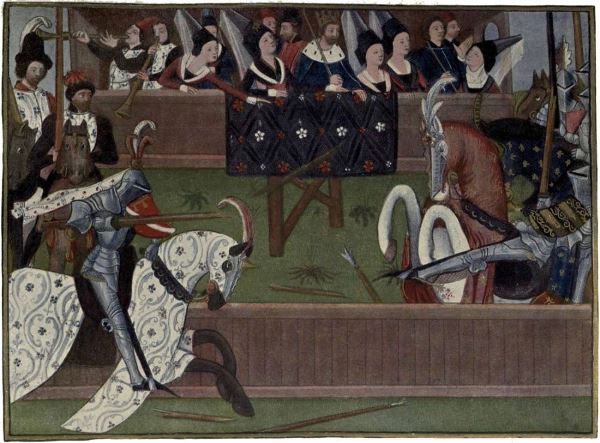
All through the Plantagenet times, the “golden age of chivalry,” the great
square of “the Chepe” was the scene of tournaments and martial pageants.
Adjoining the church of St. Mary-le-Bow was a scaffold projecting into the
street, which it was the privilege of Royalty and the courtiers to occupy
on such occasions. Once, in the reign of Edward III., a sad accident
occurred by the falling in of this scaffold, whereby some not only of the
occupants, but of the spectators in the street beneath, were killed. It is
said that the King, with true Plantagenet violence, ordered the head
carpenter to be hanged, and was turned from his purpose, as at Calais, by
the intercession of the Queen. It led to an alteration. The Royal gallery
was firmly fixed to the wall of the church, and so remained. Years later,
after the Great Fire, when Wren rebuilt the church, and surmounted it with
its present beautiful spire, there was a stipulation that there should be
a “Royal gallery.” And there it is still, the passer-by can see it from
the street. I doubt whether Royalty in our time has ever mounted into it,
but it is an historical relic of the ancient pageants of Cheapside.[1] Nor
is this the only relic of the past in that church. In ancient times there
was a great chamber, resting on arches, in the tower, and the church was
called the Church of Sancta Maria de Arcubus; hence its present name of
“St. Mary-le-Bow.” That chamber was the rightful possession of the
Archbishop of Canterbury, who held it as his court for the trial of
ecclesiastical causes brought before him as Metropolitan. Hence came the
title of “Court of Arches,” the Spiritual Court of the Metropolitan.
Strangely altered as the office has become in the course of years, it
still exists; the judge of ecclesiastical cases is still known as “the
Dean of Arches.” And when this St. Mary’s Church was rebuilt after the
Fire of 1666, Wren placed its magnificent spire on an arched base—a
memorial of the ancient ecclesiastical dignity.
We are now in a position to look back, and take a comprehensive survey of
our great city in the Middle Ages.
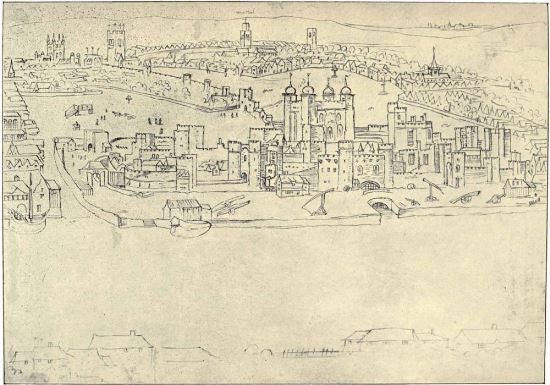
First. We have the Tower on the east side, guarding the approach from
the sea, and the high and spacious wall surrounding the whole city.
Fitzstephen, a monk of Canterbury, gives an interesting picture of the
times of Henry II. He describes London as bounded on the land side by a
high and spacious wall, furnished with turrets and double gates. These
were Aldgate, Bishopsgate, Cripplegate, Aldersgate, Newgate, Ludgate, and
probably Bridgegate. But see Stow’s comment (Ed. Thoms, 1842, page 11).
There was also a postern near the Tower. The latter he calls “the Tower
Palatine,” and also names “two castles well fortified” in the west,
Baynard and Montfichet. The former stood at the western extremity of the
city wall on the site of the present Castle Baynard Wharf, and adjoining
Carron Wharf. The name survives also in the name of “Castle Baynard Ward.”
It was built by Baynard, a follower of William the Conqueror, and though
it was burnt more than once, it was duly restored, and lasted till the
Great Fire. It became a Royal palace, and in it Edward IV. assumed the
title of King. Henry VIII. made it one of his residences. So did Edward
VI., on whose death Queen Mary was here proclaimed Queen. Montfichet Tower
was between the site of Ludgate Hill Station and Printing House Square. A
bastion of the London Wall still remains in the churchyard of St. Giles’,
Cripplegate.
Secondly. The great market-place—the Cheap—with the principal streets
all leading into it, represents the commercial magnitude of the city. The
residences of the merchants and traders had, for the most part, each its
garden, large or small. It is a commonplace saying that there is not a
street in London from some part of which you cannot see a tree. This was
more true a few years ago than it is to-day. Thus, there was a beautiful
plane-tree in front of Grocers’ Hall, in Princes Street, but exigencies of
building-space led to its destruction but lately. Cheapside still rejoices
in its fine tree at the corner of Wood Street, which has found a great
poet to write pleasantly about it. Down in secluded streets the London
saunterer comes on more of these trees, relics of old citizens’ gardens
and resorts, as well as those in closed churchyards. The parish of St.
Martin Pomeroy preserves in its second name the memory of the ancient
orchard which once gladdened the Londoner’s eyes.
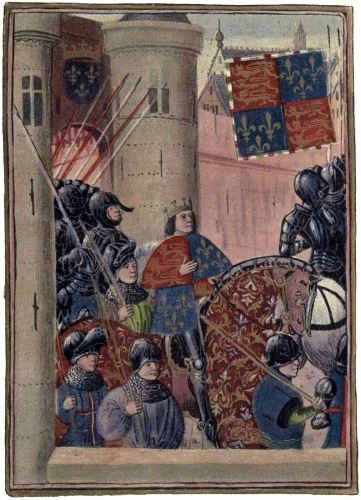
A Tournament.
From a MS. of the Romance of Sire Jehan de Saintre. British Museum, Nero D. ix.
Then, thirdly, there were the Religious Houses. Fitzstephen says that in
his day (temp. Henry II.) there were thirteen conventual churches and
126 parochial. Some were of pre-Norman times, like the Collegiate Church
of St. Martin’s-le-Grand, founded by one Ingelric in 1056, and confirmed
by a charter of William the Conqueror in 1068. Though this stood in the
heart of the city it was independent of civic control; the Mayor and
Corporation often endeavoured in vain to exercise authority over it.
Criminals on their way to execution now and then managed to slip within
its boundaries, in which case they were safe in sanctuary. It was from
this church that the Curfew Bell for London tolled out each evening, a
signal for closing the city gates, as well as the taverns.
An event of vast importance in the religious life of this nation was the
great Cistercian movement in the beginning of the twelfth century. This is
not the place to tell the history of the origin of it, the mighty
endeavour to reform the decadent Benedictine order made by Robert of
Molesme, who settled himself in the hamlet of Citeaux (Cistercium), near
Dijon, and set up the first reformed monastery. The movement soon found
its way to England, the first Abbey being founded at Waverley, near
Farnham; and before long it had its devotees in London, the most
noteworthy of whom was Gilbert Becket, a wealthy trader in Cheapside. It
was the excitement of this which was upon the Londoners when, as we have
already had to note, they chose Stephen for king against the supposed
irreligion of the House of Anjou. Under the influence of this religious
revival a new impulse seemed to come upon the Church, which bound it
closer than it had ever been before in the affections of the people.
Gilbert Becket’s son, Thomas, became known to the Archbishop of
Canterbury, Theobald, for his intense religious earnestness, became his
right hand in administration, guided him unfalteringly through the
troubles which came out of the dreadful civil war between Stephen and
Matilda, and finally gave peace to distracted England. How the eager young
Londoner himself became Archbishop, and how he came for many a year to be
regarded as the very chief of English saints, we need not tell here. And
this new religious impulse told in the city to the extent of changing its
very aspect. The Cathedral which Bishop Maurice had begun seemed for a
while to be languishing. Now barges came up the river with stone from
Caen for the great arches which excited the popular wonder. Rahere, the
king’s minstrel, raised his noble Priory of St. Bartholomew in Smithfield,
of which enough still remains to make it the finest Norman building in
London. Alfune, in 1090, built St. Giles’s, Cripplegate. The dissolution
of the Cnichten Guild (a body of thirteen knights as old as King Edgar,
which continued to hold land on fanciful tenures down to 1115) was
followed by the bestowal of their property on the Priory of the Holy
Trinity in Aldgate, and out of this arises an interesting episode. The
first prior, Norman, built his cloister and church, and bought books and
vestments on so liberal a scale that there was nothing left to buy food.
The citizens, visiting the place on Sundays according to custom, saw that
the poor canons were famished with hunger. “Hic est pulcher apparatus, sed
panis unde veniet?” exclaimed somebody. “It is a fine show to be sure; but
where is the bread to come from?” The women present, Becket’s mother among
them, vowed to send a loaf every Sunday, and soon there was enough and to
spare. Very pretty is the story of the early life of the future martyr,
how his mother, Rohese, used to weigh him on each birthday, and send
money, clothes, and provisions, according to his weight.
The Cistercian is the first of the great religious movements which have
wrought an enduring effect upon our national life. The Crusades, which
have also left their mark in London, made a second; and within the period
we are considering we have also to place the preaching of the Friars, the
Lollardism of Wyclif, and the Reformation. Later on, past mediæval times,
came the Puritan Rebellion, the preaching of the Wesleys, the Oxford Tract
Movement, and the work of F. D. Maurice and the “Broad Church.”
But it will be well to set down in order the principal religious
establishments which grew up with the years. Here is a list of them as
they existed at the time of the Reformation:—
Friaries and Abbeys.—The Black Friars (Dominicans) between Ludgate Hill
and the Thames, extending from St. Andrew’s Hill to the Fleet River. Their
house was founded by Hubert de Burgh, earl of Kent, in 1221. It had a
church and precinct with four gates. In this church Archbishop Courtenay
was condemning the writings of Wyclif, when “a great earthquake shook the
city.” Here Charles V. lodged when he was visiting Henry VIII. The latter
king held a Parliament here, but transferred it to the house of the Black
Monks of Westminster, hence it was called “the Black Parliament.” At the
Dissolution the church was given to the parishioners (St. Anne’s,
Blackfriars). The Grey Friars (Franciscans) had a noble house on the
site of what is at this moment, though it will soon cease to be, Christ’s
Hospital. Parts of the old buildings remained as late as 1820 (see
Gentleman’s Magazine, May, 1820), indeed, there is a small portion even
now. The noble church of the Augustinian (Austin) Friars (founded in
1253) still exists off Broad Street, the nave being used by the Dutch
Protestant Church. The White Friars (Carmelites) had their church east
of the Temple, founded 1241. It was pulled down at the Dissolution, and
houses were built on the site, but it still preserved the right of
sanctuary, and was consequently a haunt of thieves and fraudulent debtors.
The privilege was not abolished till 1697. The Crutched (== crossed)
Friars, so called because they wore a cross on their backs, had their
church on the site of St. Olave’s, Hart Street; the Carthusians, on that
of the Charterhouse; the Cistercians’ New Abbey was in East Smithfield;
and the Brethren de Sacca, or “Bonhommes,” were a small community under
Augustinian rules in Old Jewry.
Then there were the Priories, religious houses subject to greater abbeys
or religious bodies. That of St. John of Jerusalem, at Clerkenwell, was
founded in 1100 by Jordan Briset and his wife Muriel, and was endowed in
1324 with the revenues of the dissolved English Knights Templars. Its
ancient gateway remains, the only one left of all the old London monastic
houses. In the Wat Tyler rebellion (1381) the prior was beheaded in the
great courtyard, now St. John’s Square. Of the Priory of Holy Trinity,
Aldgate, we have already spoken, as we have also of St. Bartholomew’s,
Smithfield, the noble chancel of which priory is still one of the finest
buildings in London. Across the river the beautiful church of the
Augustinian Priory of St. Mary Overy was built by Giffard, bishop of
Winchester, in 1106, at the expense of two Norman knights. At the
Dissolution, Henry VIII. gave it to the parishioners of Southwark for
their parish church, and the name was changed to that of St. Saviour. How
part of it tumbled down; how it was rebuilt in Brummagem Gothic; how this
also, happily, went to pieces, and has been replaced within the last few
years by a handsome restoration, we all know.
Of Nunneries, we note St. Helen’s, Bishopsgate, the church of the Priory
of the Nuns of St. Helen, founded in 1212 by “William the son of William
the Goldsmith.” The church formerly had a partition dividing the nuns’
portion from that of the parishioners. It was taken down at the
Dissolution, but plenty of remains of the old arrangement are still
evident in the church, which is in many features one of the most
interesting in London. Until the year 1799 the old Hall of the nunnery was
standing, having been bought by the Leathersellers’ Company at the
Dissolution for their Hall. Holywell, Shoreditch, was so called from a
sweet well there, which was spoiled as the population came to increase in
that part. There was here a Benedictine Nunnery, dedicated to St. John
Baptist, founded in 1318 by Gravesend, bishop of London. In later days the
famous Curtain Theatre was built on the site, which again has given place
to St. James’s Church, Curtain Road. Edmond, earl of Leicester, brother of
King Edward III., founded an Abbey of nuns of the Order of St. Clare,
commonly called the Minorites, in 1293, in a street between Aldgate and
the Tower. On the Dissolution, Henry VIII. gave the chapel to the people
for a parish church (Holy Trinity, Minories); the rest of the site was
built over. The Benedictine Nunnery of St. Mary, Clerkenwell, was
contiguous to the Hospital or Priory of St. John. The name Clerkenwell
(Fons Clericorum) was derived from a well, at which once a year the
Parish Clerks of London assembled and performed a religious play. It was
at the S.E. corner of Ray Street. A pump marked the site until less than
fifty years ago, when the water was found to be so polluted that it was
removed. When the “Black Nunnery” was dissolved, the site was given to the
Earl of Aylesbury, hence the present Aylesbury Street, Clerkenwell.
Of Colleges, i.e., communities of religious men, were (1) St.
Martin’s-le-Grand (already mentioned); (2) St. Thomas of Acon (alias
Acre), a military sanctuary founded by Agnes, the sister of St. Thomas
Becket, over her brother’s birthplace. It was on the site of the present
Mercers’ Hall, and was much regarded by the Corporation of London in the
Middle Ages. Richard Whittington, Mercer, thrice Lord Mayor (last time,
1419), founded the College of “Saint Esprit and Mary,” in the Vintry Ward,
and the Almshouse for Mercers. The site still bears the name of College
Hill. Mercers’ School was removed from hence to Barnard’s Inn, Holborn, a
few years since. The College of St. Michael, Crooked Lane, was founded by
Sir William Walworth, who was buried within the church. This church was
removed to make room for the approach to new London Bridge, in 1831.
Of Hospitals, note St. Giles’s-in-the-Fields for Lepers, founded by
Matilda, queen of Henry I.; St. James’s Hospital “for leprous maidens,”
now St. James’s Palace; St. Mary of Rounceval, a priory of the Abbey of
Roncevalles in Navarre. It stood on the site of Northumberland Avenue at
Charing Cross. Elsing Spital, by Cripplegate, was founded by Wm. Elsing
in 1329, for the sustentation of a hundred blind men. The site was
afterwards occupied by Sion College; but when that was moved to the Thames
Embankment the ground was built over. Sir John Pountney founded and
endowed a College in his own house in Candlewick Street, calling it
Corpus Christi, to maintain a master and twelve mission priests. Their
chapel was attached to the Church of St. Lawrence Pountney, which was
burnt in the Great Fire and not rebuilt. The Papey, a house for worn-out
priests, was in Bevis Marks. St. Bartholomew the Less is now the Chapel
of St. Bartholomew’s Hospital precinct. The Lock Spital was for the
reception of lepers, the derivation being loques, rags. The old Hospital
of St. Katharine’s by the Tower was removed, in 1828, to make room for
St. Katharine’s Docks, and set up anew by the Regent’s Park.
Episcopal Residences were those of the Archbishops of Canterbury and
York, at Lambeth and Whitehall respectively; of the Bishop of Durham
(Durham House, Strand); of those of Bath, Chester, Lichfield, Llandaff,
Worcester, Exeter, Carlisle, all in the Strand; of Hereford, on Fish
Street Hill. The Bishop of Ely dwelt in Ely Place, Holborn: the chapel
still exists, in the possession of the Roman Catholics. Readers of
Shakespeare will remember how the bishop grew strawberries in his garden.
The Bishop of Salisbury’s house was in Salisbury Square; of St. David’s,
near Bridewell; of Winchester and Rochester, in Southwark. Parts of
Winchester House still exist there.
As the Thames on the south side of the city did noble service as the
principal highway for its commerce and its corn supply, so the fields on
the north furnished large pasture-land for its cattle. Across these fields
a road led away to the village of Islington. In the Moor Fields were the
Artillery Butts, whither young London resorted to be trained in the use of
the bow. Readers may remember the description of them in the opening
portion of Lord Lytton’s novel, The Last of the Barons. Within the walls
adjacent to this part the manufacturers of bows and arrows were settled.
Very strange and curious have been the various associations of the name
“Grub Street.” Grobes were feathers for arrows, and originally Grub Street
was that in which arrows were finished. That manufacture died out, and the
street, being in a Puritan neighbourhood, in the days of Elizabeth became
the publishing place for violent attacks upon the bishops. “Martin
Marprelate,” the well-known series of that class of publication, was
issued from this street. Then, by a natural transition, scurrilous
lampoons in general, and not merely theological, came to be called “Grub
Street tracts,” because the phrase had become current; and the name stuck,
and was applied to literary rubbish of any kind, Pope having endorsed the
title in his satire. The name has, unfortunately, disappeared from the
street within the last decade. The authorities, because the name had
become obnoxious to fastidious ears, have changed it to Milton Street, the
poet having been borne down it from Bunhill Fields, where he died, to be
buried in St. Giles’s Church.
Partly on the site of Liverpool Street Station, and partly across the road
as far as the Underground Railway, stood, in mediæval times, the “Hospital
of St. Mary of Bethlehem.” From early times, certainly in 1402, this
religious foundation was devoted to the care of the insane, and at the
Dissolution it became one of the Royal Hospitals, with lunatics
exclusively for its inmates. It was the Great Fire of 1666 which
permanently changed all this neighbourhood. Up to that time the greater
part had been fields, but now the poor burned-out citizens came and
(literally) pitched their tents here, and stowed within them the goods
which they had been able to save. Here they carried on their business, and
gradually substituted rough houses for these tents; and thus, by the time
the City was rebuilt, a new suburb had arisen, and a well-inhabited
suburb from that time it remained. Bethlehem Hospital was removed to
London Wall in 1675-6, as the monastic buildings had decayed, and the
increasing number of patients required larger room. It found its present
home in St. George’s Fields in 1812-15. And here we may note that
“Finsbury Fields,” i.e., Finsbury Circus and the land round it, formed
the favourite summer lounge of the London citizens up to the beginning of
the eighteenth century. It was laid out in formal style, with paths and
bordering trees. Merchants and tradesmen came hither at eventide, as the
fashionable world of to-day goes to Hyde Park. Poets and pamphleteers met
publishers, and playwrights made appointments with managers. A large body
of spectators frequently gathered here to see a thief whipped at the
cart’s tail.
And now we will simply name the most prominent events in the history of
the city during our period.
In Pre-Norman times, after Alfred had restored the lost prosperity of
London, his grandson Athelstan (925-940) established a royal palace and a
royal mint, and gave an impulse to the commerce of the city by promising
patents of gentility to every merchant who should make three voyages to
the Mediterranean in his own ship. His “redeless” grandson Ethelred
abandoned London to the Danes, and Cnut levied an impost of 11,000l.
upon it, a proof of the great wealth which it had now acquired. It was a
seventh part of that of the whole kingdom.
Norman Times.—As already mentioned, London is not in Domesday book. It is
probable that there was a separate survey, the records of which are now
lost. Domesday incidentally mentions ten acres of land near Bishopsgate,
Norton Folgate, as belonging to the Dean and Chapter of St. Paul’s, and a
vineyard in Holborn, the property of the Crown.
The founding of the many religious houses during this period we have
already mentioned. The building of the first stone bridge by Peter of
Colechurch, which also belongs to this period, finds its place in another
page.
We note the orders of Henry Fitzailwin, the first Mayor, for the
prevention of fires. All houses were to be of brick or stone, with party
walls of the same, and to be covered with slates or tiles. The building of
houses round the Walbrook, Oldbourne, and Langbourn had diminished the
supply of water, so they sought a fresh supply from Tyburn, and supplied a
conduit in Cheapside with water from thence, which they brought in leaden
pipes (A.D. 1255). The chronicles of Evesham say that in 1258, 20,000
persons died of hunger through a scarcity of corn, and ghastly stories are
told of another famine in 1270. But on the whole London increased and
prospered under Norman rule. In 1264 there was a massacre of the Jews on
some trivial pretext. They were expelled the kingdom in 1291.
Plantagenet Times.—The division of the city into wards dates from the
beginning of this period or earlier. In 1348 came the terrible Black
Death. “In London it was so outrageously cruel that every day at least
twenty, sometimes forty or sixty, or more, dead corpses were thrown
together into one pit, and the churchyard not sufficing for the dead, they
were fain to set apart certain fields for additional places of burial....
But especially, between Candlemas and Easter in 1349, there were buried
200 corpses per diem” (Barnes’s Hist. of Edward III.). It is chronicled
that more than 50,000 persons were buried, during this pestilence, within
the precincts of the Charterhouse alone. The trial of Wyclif in St. Paul’s
was a memorable event, when John of Gaunt stood forth as his champion.
In 1380 came the Wat Tyler rebellion, and the death of the leader from the
dagger-stroke of Sir William Walworth. Hence the long-exploded but
hard-dying theory of the “dagger” in the City Arms. The charge in question
is the sword of St. Paul, London’s patron saint, and it was borne on the
City shield before the deed of Walworth. Smithfield, where the event took
place, was then “a great plain field, without the gates,” where on every
Friday was “a great market for horses, whither earls, barons, knights, and
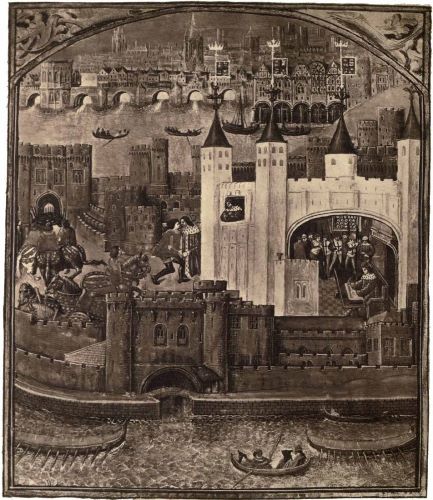
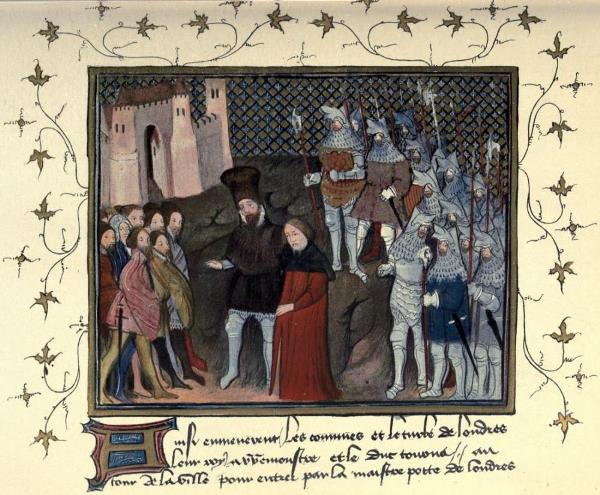
citizens repair, to see and to purchase.” Our quaint illustration depicts
King Richard II. going forth on his ill-fated expedition against Ireland.
Lancaster and York.—The first recorded illumination of the City was at
the Coronation of Henry IV. Ten years later, the Mayor, Sir Henry Barton,
ordered that the streets should be lit with lanterns every night.
Jack Cade’s rebellion in 1450 seemed at first successful, so far as the
city was concerned. He took possession of it, and for a while
maintained order among his followers. But they broke out into outrages,
slew Lord-Treasurer Saye, and other persons of consequence, and the
citizens, with the assistance of the Governor of the Tower, rose up and
expelled him. Soon afterwards he was killed. As a rule the citizens
inclined to the House of York, and in consequence Edward IV, steadily
favoured the Londoners. The setting up of Caxton’s printing-press in his
reign was a great epoch in the history of the world.
Richard II. riding out of London to the War in Ireland.
From a MS. of Froissart’s Chronicles. British Museum, Harl. 4380.
Tudor Period.—Two Lord Mayors and six Aldermen died of the sweating
sickness in the first year of Henry the Seventh’s reign. The citizens, as
we have already noted, had been accustomed to practise archery north of
the city. A regular field was enclosed for them in 1498 in Finsbury, which
was the origin of the present Artillery ground. The river Fleet was made
navigable as far as Holborn Bridge, and Houndsditch was arched over. Henry
VIII. built the royal palaces of St. James’s and Bridewell. Stricter rules
were made for the preservation of order, nuisances were removed, and the
streets were widened and paved. The first Act for the pavement and
improvement of London describes the streets as “very foul and full of pits
and sloughs, very perilous and noyous, as well for all the King’s subjects
on horseback as well as on foot and with carriages.”
We should note the sumptuary law passed by the Mayor and Common Council in
1543 by which the Mayor was ordered to confine himself to seven dishes at
dinner or supper; the Aldermen and Sheriffs to six; and the Sword-bearer
to four.
In the reign of Edward VI. the hospitals of St. Thomas, St. Bartholomew,
and Christ were founded, and the palace of Bridewell was also converted
into a hospital. The borough of Southwark was constituted a ward of the
city.
Passing over the terrible martyr-fires of Smithfield in the days of Mary,
we come to the reign of Elizabeth, a very prosperous one as far as London
was concerned. The refugees from Alva’s cruelties in the Netherlands found
a home in London, and did wonders for the improvement of its manufactures.
There were, as elsewhere, extravagances in the way of spectacles and
tournaments, and much opportunity was seized to flatter Gloriana, who was
nowise averse thereto. It was apparently looked upon as always the correct
thing, to flatter sovereigns. The Preface to the Authorised Version of
the Bible and Bacon’s Dedication of his Advancement of Learning will be
sufficient illustrations of this. Here is the inscription to a monument to
Queen Elizabeth, which was put up in the Church of All Hallows the Great
in Dowgate:—
“Spain’s rod, Rome’s ruin, Netherlands’ relief,
Heaven’s gem, Earth’s joy, World’s wonder, Nature’s chief.
Britain’s blessing, England’s splendour,
Religion’s nurse, and Faith’s defender.”
In the neighbouring Church of St. Michael, Crooked Lane, the same year,
was set up the following inscription. The contrast is refreshing:—
“Here lieth, wrapt in clay,
The body of William Ray.
I have no more to say.”
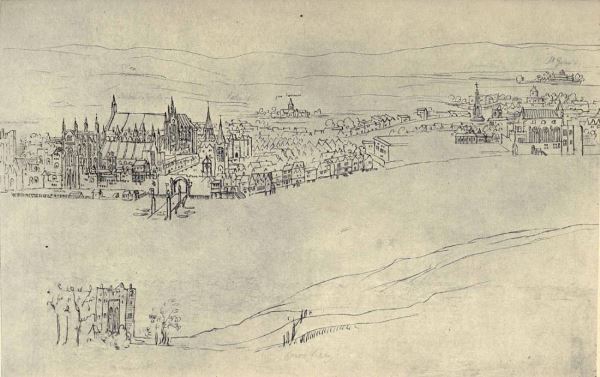
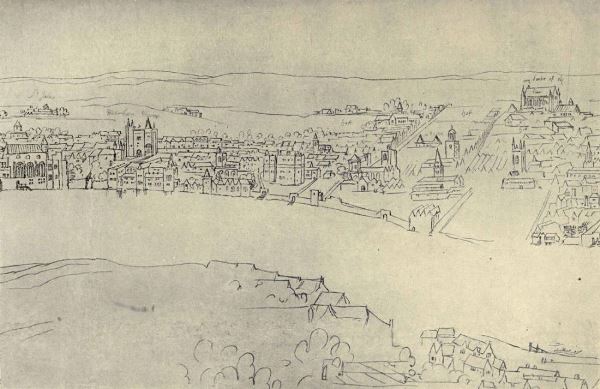
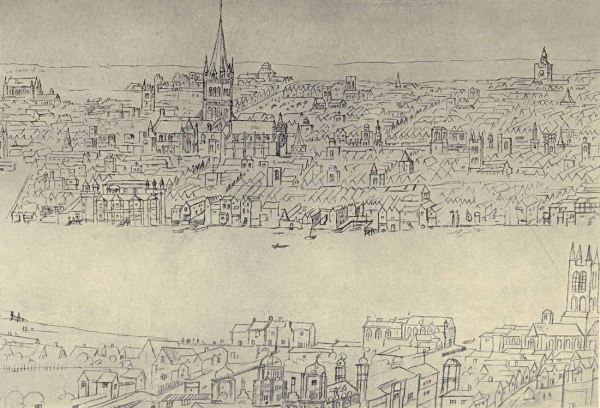
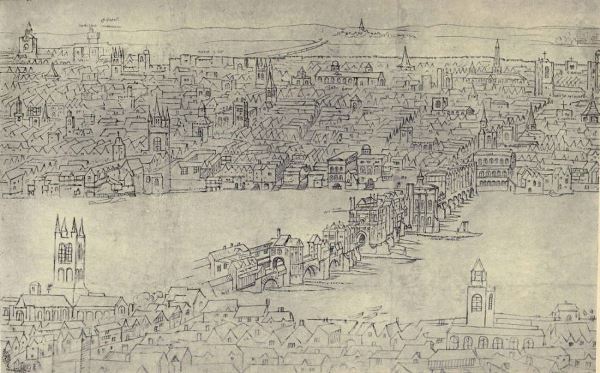
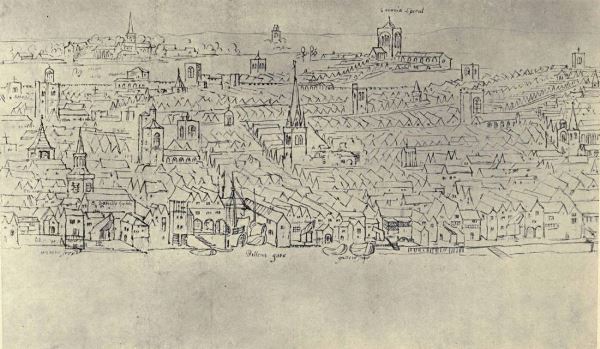
Soon after the accession of Elizabeth, Ralph Aggas published a very
curious plan and view of London, with the title Civitas Londinensis. It
reveals how much of field and garden there was then in the very heart of
the city. The most crowded part was from Newgate Street, Cheapside, and
Cornhill to the river. With the exception of Coleman Street, and a few
scattered buildings from Lothbury to Billingsgate and from Bishopsgate to
the Tower, all (N. and E.) was open or garden ground. Whitechapel was a
small village; Houndsditch, a single row of houses opposite the city
walls, opened behind into the fields; Spitalfields, from the back of the
church, lay entirely open; Goswell Street was known as the road to St.
Albans; St. Giles’s was a small cluster of houses, known then, as indeed
it is still, as “St. Giles’s in the Fields.” Beyond, all was country, both
N. and W., Oxford Street having trees and hedges on both sides. As late as
1778 a German writer on London speaks of Tyburn, the place of execution,
as being “two miles from London.” From Oxford Street round to Piccadilly
there was a road, called the Way from Reading, proceeding through Hedge
Lane and the Haymarket—which avenues were entirely destitute of
houses—to St. James’s Hospital, afterwards the Palace; and a few small
buildings on the site of Carlton House were all that existed of the
present Pall Mall. Leicester Square was open fields; St. Martin’s Lane had
only a few buildings above the church toward the Convent Garden, which
extended to Drury Lane. The Strand was a street with houses; those on the
South side had gardens right down to the river, and were the property of
nobles, as mentioned in another chapter; the present Treasury occupies-the
site of the Cockpit and Tilt Yard; opposite to it stood the Palace of
Whitehall, which since the days of Henry VIII. was occupying the former
residence of the Archbishop of York. From King Street, which has this year
disappeared, to the Abbey the buildings were close and connected, as also
from Whitehall to Palace Yard. The noblemen who lived in the Strand used
to proceed to the Court at Whitehall in their own barges from their River
‘stairs,’ and retained a number of watermen, whom their livery protected
from impressment. On the Surrey side there were but six or seven houses
between Lambeth Palace and the shore opposite Whitefriars. There a line of
houses with gardens began which was continued to the Bishop of
Winchester’s Palace, where now is Barclay and Perkins’s Brewery. Opposite
Queenhithe was a great circular building for bull and bear-baiting. It was
largely patronised, by Queen Elizabeth among others. Southwark extended
but a little way down High Street. London Bridge was crowded with
buildings. Along Tooley Street to Horsley Down there were many buildings.
Such was London towards the end of what we have defined as the Mediæval
period. But it was, thanks to the enterprise of the time, on the rapid
move. The citizens were able to send sixteen ships fully equipped, and
armed with 10,000 men, against the Spanish Armada. In 1594 the Thames
water was first raised for the supply of the city. In 1613 Sir Hugh
Myddleton completed the New River. In 1616 the paving of the streets with
flagstones was first introduced. Many years, however, were to elapse
before sanitary science could be called in for the public health. In 1603
the plague destroyed 30,578 lives.