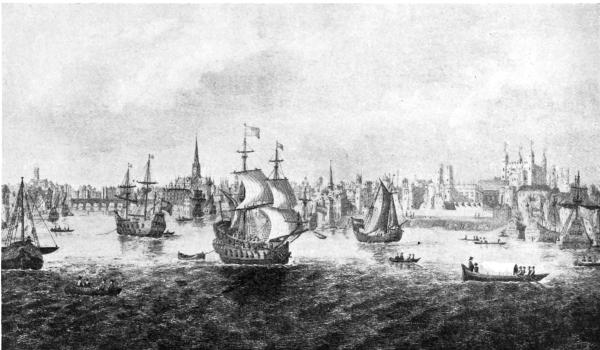
The limits of the Port of London, never defined until the reign of Charles II.,
seem to have been always understood as reaching from the North Foreland to
London Bridge. Queenhithe, which, early in the thirteenth century, employed
thirty-eight men as carriers, was the oldest landing-place and port. Its present
appearance is, save for the warehouses round it, nearly the same as it has always
been, substituting the small vessels then in use for the barges and lighters which
now lie in that muddy port. Billingsgate was another landing-place at which the
King’s Customs were collected. As trade increased it was found necessary to
provide increased accommodation, and the following places were appointed, but
long afterwards, for the general lading and discharging places for all kinds of
goods to be landed and shipped between sunrise and sunset. (Strype.)
- Brewers’ Quay.
- Chesters’ Quay.
- Galley Quay.
- Wool Dock.
- Custom House Quay.
- Porter’s Quay.
- Wiggon’s Quay.
- Young’s Quay.
- Ralph’s Quay.
- Dice Quay.
- Smart’s Quay.
- Somer’s Quay.
- Buttolph Wharf.
- Hammon’s Quay.
- Gaunt’s Quay.
- Cock’s Quay.
- Fresh Wharf.
- Lyon Quay.
- Sab’s Dock.
- Bear Quay.
Billingsgate was appointed only for fish, corn, salt, stones, victuals, and fruit.
The Bridge House for corn and other provisions. The Steel Yard for merchant
strangers of that Guild.
“By far the most important results of the Norman Conquest, as far as English
Industry and Commerce were concerned, lay in the new communications which
were opened up with other parts of the Continent.” (W. Cunningham, Growth of
English Industry.) These words strike a keynote. It was necessary for the
growth and development of the national spirit that the insular isolation of Britain
should be swept away. No doubt the close connection of the country with the
richest provinces of France for four hundred years brought with it many serious
evils, but the stimulus it gave to trade proved of incalculable advantage. And
the isolation of England was swept away just at the right moment, when everywhere
in western Europe there were springing into wealth and power and independence
cities, which had been the private property of barons, or the mere ruins of what
had once been busy and populous places. The first essential to trade is some
kind of security that an agreement will be kept and a debt will be paid. This
security was then impossible unless in a fair, regularly and lawfully held, with its
own court; or in a town when the municipality defended the foreign merchant.
The opening of Europe to England had its other side in the opening of
England to Europe. A large number of merchants from Rouen and Caen came
over both before and after the Norman Conquest to carry on their trade in
London. Flemish weavers came over and sought protection from the Queen,
a Flemish Princess. Builders in stone came over in great numbers; most of the
Churches throughout the country which were of wood were rebuilt in stone.
And in addition to these, there were the foreigners who did not wish to settle,
but came and went, bringing their wares with them, carrying away the exports,
and while they were in Port, living according to their own rules in their own houses.
Of what kind was the Shipping of London, its growth, and its extent? What
were the most important lines of trade? These questions are difficult to answer
completely. First, we must remember that a merchant ship was also a man o’ war.
The great Flanders Fleet of Venice was provided with a company of thirty-six
archers for every galley, and the sailors were all fighting men. Next, the shipping
of London meant its foreign trade, and this was continually rising and falling.
Attempts were made by King Alfred to create a navy; and Sir John Philpot,
when he set off to encounter the pirate, was able to lay his hand upon ships
enough to carry a thousand men. When the Bastard of Falconbridge attacked
the City there were no ships in the Port able to meet him; this, however, was at
the close of a long Civil War which greatly damaged the trade of London.
The sailor has always been a creature distinct from his fellow-man. It
would seem, from such scanty notice as we can get, that the London craftsman
had never any great love for the sea; the sailor came from Dover, Sandwich,
Hythe, Dartmouth, and other places, but not from London. In later years a
riverside population grew up from the Tower as far as the Isle of Dogs, and
eventually these people were connected with shipping. Among them was a whole
multitude of sailors, together with those who lived by working among and for
the ships in the Pool. There are glimpses of this invisible population within the
walls of the City, especially below the Bridge and near the Tower. To this day
the courts and lanes in which they lived remain. They are narrow, dark, and
noisome. Only the lowest craftsmen could live in such courts; they contained
drinking places for the sailors, native and foreign, sleeping dens for them, fighting
places for them, but not decent living houses. In such a narrow street, where
the houses were built of wood and closely packed with people, broke out the
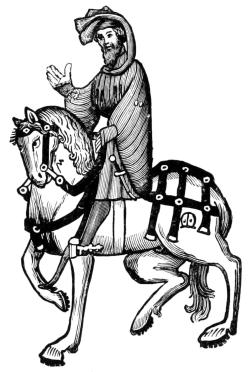
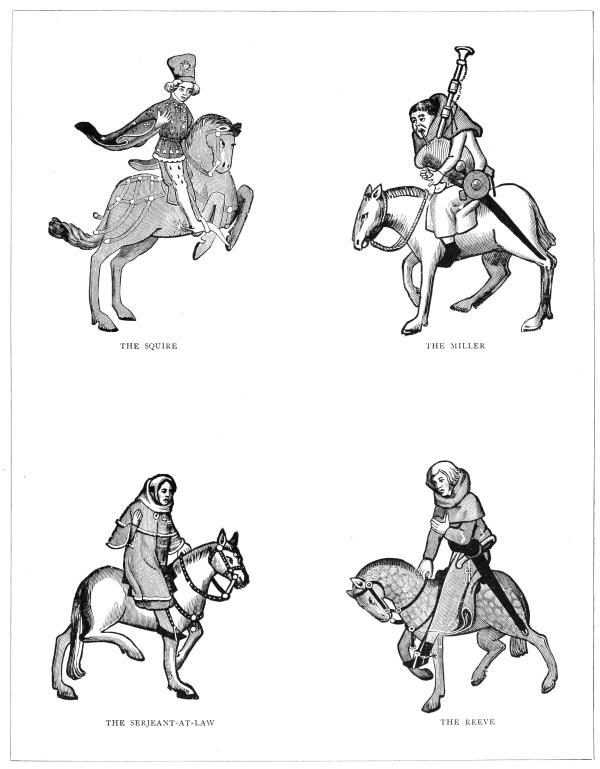
Great Fire of London. Chaucer’s sailor was a Dartmouth man. There were
plenty like him standing about on the quay and drinking in the taverns. Your
true seafaring man never does anything while he is on shore except stand about
on the quays, lean against a post, or carouse in a tavern. Many a fight took place
along these quays and in these narrow courts: fights between Genoese and
Venetian; between Englishman and Frenchman; between Englishman and Fleming;
fights with knife and dagger; fights which began with a duello and ended in a
mêlée, all begun, carried on, and ended in a few minutes, leaving a man dying and
half a dozen wounded; fights between a man of Dover and a man of Yarmouth;
fights over the reckoning at the tavern; fights over Doll and Moll and Poll.
Always the riverside of London has been a place remarkable for its life, and
vividness, its riot and noise, the cheerful cry of battle, the inspiriting song of the
tippler, and the dulcet voice of love.
Every sailor was a fighting man. Until the reign of Henry IV. it was
easy to turn a merchant ship into a man o’ war by placing in her the little
“castles” from which the bowmen could work. Henry IV. seems to have begun
the practice of building ships exclusively for fighting; his son had three very
large ships called the Trinity, the Grace de Dieu, and The Holy Ghost; his navy
consisted in all of three great vessels, six “nefs,” six “barges,” ten “balingers.”
It is not easy to distinguish between the different kinds of ships. The “nef” was
a ship of the largest size until the construction of the three great vessels; the
“barge” was a large vessel, as is known by the fact that the City possessed one
called the Paul of London, for river defence. You may, if you please, learn how
the City barge was equipped and rigged and fitted out for sea from the pages of
Riley’s Memorials. The terms used, the nautical terms of the time, are translated
in footnotes, moreover they are mostly unintelligible. The list is perhaps too
technical for these pages. There were also the “balingers,” the “craiez,” the
“cogge,” the “katte,” the “galley,” and others.
As soon as riverside land became valuable and ships grew in size the building
of ships was carried on, of necessity, outside the walls. When the Shipwrights’
Company was incorporated, in the reign of James I., they built their Hall
at Ratcliffe Cross, in the centre of their industry. Shipbuilding yards were
placed all along the north bank of the Thames as far east as Northfleet. Until
thirty or forty years ago the industry was one of the most important of those
belonging to London. There might be occasionally, though its continuance could
not be relied upon, peace on land, but there was never peace at sea. From the
time when the Count of the Saxon Shore set up his forts from Porchester to
Bradwell, and sent out his fleets to sweep the narrow seas, the pirates continued
without cessation; they came out of the Low Country ports, from Calais, from
Dieppe, from St. Malo; they came down from Scotland; they even came out
of English ports to destroy the English trade. They were attacked and dispersed,
but they collected again. If France and England were at open war, as was very
often the case, the pirates pretended to be in the service of the King most convenient
for the moment. They were called the Rovers of the Sea; there was
the instance of that Scottish pirate Mercer, who, as we have seen, was attacked
and killed by Philpot, most gallant of Lord Mayors; there was Eustace the Monk,
whose life and exploits have been written by Thomas Wright; there was William
de Marish, who from the safe retreat of Lundy carried on piracy for a time with
impunity; there was Savery de Maloleone, the French pirate; there was John of
Newport, who murdered the crews of the ships which he took—he held possession
of the Isle of Wight; there were pirates of Lynn, Wells, Yarmouth, and Dartmouth.
The Cinque Ports were nests of pirates; the mouth of the Rhine, the harbour of
Calais, and that of St. Malo were filled with pirates. The English coasts were
ravaged by them; Portsmouth, Rye, Southampton, Sandwich, the Isle of Wight,
Scarborough, the coast of Norfolk suffered from descents, from sieges, and from
capture, by these Rovers. Letters of license were granted. Henry III. granted
license to Adam Robertwolt and William le Sauvage to attack and to pillage the
King’s enemies where they could, on condition of giving him half the plunder.
In the following reign a merchant, having been plundered, received from the King
license to carry on reprisals up to the amount which he had lost, but no more;
and there is one instance in which English ships despatched north for the defence
of Berwick plundered the coast of England on their way! In the twelfth century
the same danger attended men who sailed abroad as in the ninth. But in the ninth
century every merchant who voyaged three times over the wide seas in his own
ship was “of thane right-worthy.” This distinction the master mariner and
merchant lost in later years. Yet this kind of reward was still remembered very
unexpectedly, when, in the year 1780, James Cook, who had voyaged three times
across the wide seas, received after his death the coat of arms which made his
family “of thane right-worthy.” During the later Saxon reigns there was a large
merchant navy, together with a regular royal navy. This navy was called out
once a year for training. Unfortunately for Harold this annual training was over,
and the men had gone home when William sailed. Harold’s son seized the ships
and sailed for Ireland, whence he carried on depredations for some years on the
west coast. England was for a while without a navy, so the pirates began again,
and the merchant service suffered.
The history of the next four hundred years, as regards the shipping and the
foreign trade of London, is one either of a weak police, or a strong police in the
Channel. The merchants of London never ceased to struggle in order to get the
foreign trade into their own hands, but, during all this time, with only partial success:
we have seen that the men of Rouen, the men of the Emperor, the Venetians, the
Genoese, the Florentines, the Lombards, the people of the Hanseatic League, and
the Flemings all came to London and carried on their trade themselves. Perhaps
the worst time for the London merchant service was the fourteenth century. Yet
England still boasted the sovereignty of the sea, and the device of Edward III.’ s
gold noble still proudly claimed that supremacy—
“For four things our Noble showeth unto me
King, ship, and sword, and Power of the Sea.”
“Our enemies,” said Capgrave, “laugh at us. They say,‘Take the ship off your
gold noble and impress a sheep instead.’” The origin of England’s claim to the
sovereignty of the sea, which was constantly advanced even in times of national
degradation, was, I believe, a survival from the time when the Roman Fleet,
which was maintained for the police of the narrow seas, made and sustained an
Emperor, first Carausius, and then Allectus—this fleet had its headquarters sometimes
at Southampton, sometimes at Dover, and sometimes at Boulogne, and was
undoubtedly sovereign of the sea. The Fleet which King John—under whom the
Channel was safe—placed upon the sea was the successor and the heir of the Fleet of
Admiral Carausius. The first merchant ship whose name is preserved is the Little
Edward. She was lying off Margate in the year 1315, when she was attacked and
carried off by the French. Her owner and commander was one John Brand: she
was bound for Antwerp: her cargo of wool belonged to three merchants of the
Hanse. The ship—probably not a very large vessel—was valued at £40 and the
cargo at £120. In the same year a great galley or dromond of Genoa, laden with
corn and other provisions for London, was attacked and taken by French pirates.
She was estimated to be worth—cargo and ship—£5716: 12s., or about £100,000
of our money. The incorporation of the Merchant Adventurer gave a stimulus to
foreign trade in English vessels. London Merchants established themselves on the
shores of the Baltic, in Sweden, in the Netherlands, and in the Levant. In the
north they encountered the hostility of the Hansard: there was fighting continually:
on one occasion all the English merchants at Bergen were massacred. In the
Channel, during this century, piracy revived, and became again a great and pressing
evil. But that the English ships were not deterred by the dangers innumerable
which threatened them is proved by the fact that, in 1438, all the Genoese
merchants in London were arrested in a body, put into prison and fined 6000
marks, because the ship belonging to one Sturmyer, a merchant of Bristol, had been
seized in the Levant on an alleged charge of breaking the regulations of trade. If
a Bristol merchant traded so far, the London merchants, one may be quite certain,
penetrated to the same waters. There were also pilgrimages over the seas, and
especially during the fifteenth century, to the shrine of St. Iago de Compostella,
the tomb of the Apostle James himself. In the year 1434 two vessels sailed
from London carrying eighty and sixty pilgrims respectively. And in the reign
of Edward IV. no English merchants were allowed to ship goods in foreign
ships unless there were no English ships ready for them. At the same time the
tonnage of ships had so greatly increased that Canynges of Bristol owned a great
ship of 900 tons.
The ships, lying off the quays of Billingsgate and Queenhithe, were the great
galleys of Gascony laden with casks of wine, the woad ships of Picardy, the scuts
of Flanders, the whelk-boats of Essex, the great vessels of Almaine and Norway,
the fleets that came every year sweeping over the seas from Genoa to Southampton
and London, the ships which carried on the trade of the Hanse merchants, the
fishing-boats and trawlers, the sea-coal boats called “kattes,” the barges and lighters
which carried their cargoes up and down the river, the coasting boats which brought
stores for building, and which, when not lying off the quays, were moored in the
river below London Bridge. And always, all day long, there was the uproar of the
sailors and of those who loaded and unloaded; and the din of the markets; and
everywhere the serjeants’ men went in and out among the throng, seeing that trade
regulations were complied with, that every sack lay open, that foreigners dealt not
in retail, that foreigners cleared their goods in a certain time, that there was no
underselling. And high above the uproar arose, from every ship of every country
as she reached the Port and dropped her anchor, the sailors’ Hymn of Praise to the
Virgin that their voyage was safely concluded. This Hymn was the same for all
the countries of Western Europe. It adds to the picturesque aspect of the
Mediæval Port that when the ships came up the river, when they rounded the point
of Deptford and Rotherhithe, the Genoese or Venetian galley, galliot, galleasse—sweeping
up against the tide with their banks of oars, the heavy Bordeaux ship
laden with wine, sailing up with wind and tide, the craft whose names convey no
meaning to us, from each as it arrived in the Pool was heard the same hymn sung
by all the ship’s company together, in the midst of the noise of loading and
unloading, the dropping or the weighing of anchor, or the casting off of other ships,
with the sailors’ chanteys in their own language. It was by special permission that
the sailors in Greek ships were allowed to sing their “Kyriele” instead of the
Hymn to the Virgin, when the ship dropped anchor below the Bridge.
The Rules of Trade, as set forth in the Liber Albus, are many and stringent. I append the more
important. The Ordinances bear date 13 Ed. I.
1. Corn Dealers. Corn brought to London by land is to be taken in bulk to the Market within
Newgate before the Friars Minors or at Gras chirche (Gracechurch Street). That “none” of it is to be
sold before the hour of Prime, i.e. 6 A.M. to 7 A.M. And that corn brought by water shall be offered to
the common people by retail during a whole day.
2. On Forestalling. It is forbidden to meet dealers coming with their wares by land or water before
they have put up their wares for sale.
3. No one to sell anything dutiable until he has paid the duty.
4. No freeman of the City to enter into partnership with a stranger (i.e. one who is not a freeman).
5. Bakers are to make loaves of two sizes, viz. two for a penny, and four for a penny. Bread shall
be sold in the market only. Every baker to have his own stamp by which his bread may be known. The
baker of brown bread not to make white bread and the converse. A baker shall not buy corn to sell it
again. A baker shall not sell his flour to cooks for making pastry. Once a month every baker’s bread
shall be examined.
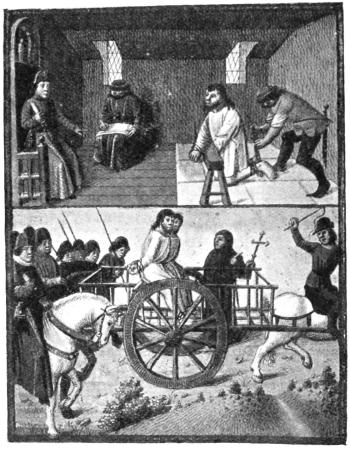
If a baker be found to be selling bread under weight he is to be placed on a hurdle with the faulty
loaf hanging from his neck and dragged through the “great streets where there may be most people
assembled and through the great streets which are the most dirty.” For a second offence he is to be
dragged in like manner and set in pillory. For a third offence he is to be dragged, set in pillory, his oven
pulled down and himself forbidden to carry on that trade any longer.
A baker is not allowed to give the regratess (i.e. the woman who retails bread from house to house)
the “handsel money” of sixpence on Monday or the “curtesy-money” of threepence on Friday: but,
instead, he is to give her thirteen loaves as twelve.
6. Of Brewers and Taverners. No measures to be used except the gallon, pottle, and quart. These
are to be stamped by the Alderman. The tun of the brewster (brewing was conducted principally by
women) to contain 150 gallons. And since the measures (which were made of wood) do sometimes shrink
from dryness, they are to be examined four times a year.
7. No stranger to sell by retail in the City unless he has been received into the freedom and enrolled
at Guildhall.
No stranger to keep an Inn or to let lodgings in the City.
If a stranger, however, obtain the freedom of the City he may keep an Inn in any part of the City
except the river-side.
8. All citizens to be in scot and lot. Scot is the payment of contributions and taxes, Lot, the
assessment of it in due proportions.
9. No pigs to be allowed in the streets and lanes. If any man find a pig in the street he may kill
it and keep it.
10. Markets to be held only in places assigned. Retailers of provisions not to buy before Prime.
11. None but freemen to receive apprentices. No time of apprenticeship to be less than seven
years. And an apprentice who has served his time must take up his freedom and be enrolled before he
carries on his trade.
12. The Mayor, Sheriffs, Aldermen, or their serjeants, clerks, and bedels, shall not keep a baker’s
oven, or a tavern, or any trade of low repute.
13. Carts carrying firewood, timber, or charcoal, not to stand in the City except on Cornhill.
14. No one to go into Southwark for the purchase of corn, beasts, or other merchandise whereby a
market might be established.
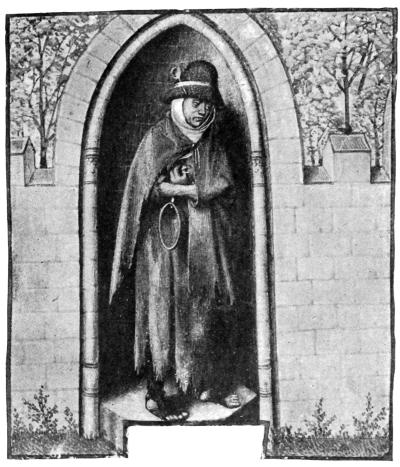
15. Lepers not to go about the streets or to sleep in the City. They are to have their common
“attorney” or procter who shall go round the Churches on Sunday morning to collect alms for them.
16. Sellers of fish not to throw their water into the streets but to carry it to the Thames.
17. Schools for fencing and buckler play not to be kept within the City.
18. Foreign butchers (i.e. butchers who have not the freedom of the City) to bring into the City
the hides and pelts of the oxen and sheep: to be allowed to sell their meat until high noon (Riley
interprets this to mean from one to three o’clock).
19. All the lanes leading from Thames Street to the river to be kept clear so that persons on horseback
may ride up and down.
20. No tavern to be kept open after curfew.
21. Boatmen to have their boats moored by sunset.
22. Woolfels to be sold in open market.
23. Regulations as to the making of furs.
24. Merchants bringing goods to the City to be allowed to proceed without molestation.
25. Labourers, i.e. carpenters, masons, plasterers, tilers, etc., are to be paid according to the orders
of the Mayor and Aldermen.
26. Fishmongers not to buy fish before the hour of Prime.
No market was to be held on London Bridge, especially by Fripperers, or
dealers in old clothes. No market was to be made in Southwark.
Barbers were not to expose blood in their windows, but were ordered to throw
it into the river. They were also forbidden to carry on their trade on Sundays.
Bowyers were forbidden to send bows for sale to Cornhill or to any other place in
the City. What does this mean?
Goldsmiths were to have a private mark on every piece. Smiths were to have
their private mark on every sword or knife. Hostelers were those who lodged and
fed the servants and horses of their guests. Herbergeours gave them lodging only.
Strangers were not lodged in taverns. Strangers and foreigners were not, as a rule,
permitted to let lodgings. A stranger could only be admitted for a day and a night.
After that, the hosteler had to be responsible for any offences a guest might commit.
Hostelers were forbidden to sell food and drink to any but their guests. They were
not allowed to brew or to make bread.
The “articles” of the ward motes overlapped in some particulars the Trade
Regulations. I take a few clauses. Strangers could only be received for a night
and a day unless the host became responsible for them. No open fireplace was to
be placed near partitions, or boards, or in any upper room. All persons were to
give their assistance to the Officers of the Ward in arresting disorderly or rebellious
persons. Residents in great houses to keep a ladder or two for the use of their
neighbours. From Whit Sunday to St. Bartholomew’s a barrel full of water to be
kept before every house. The roof of every house to be of tile, stone, or lead.
Crooks and cords to be provided to pull down houses in case of fire. No refuse to
be thrown into the street. No pigs or cows allowed within the houses. Stalls not
to be more than 2½ feet in width before the house. Pent-houses to be so high that
persons can ride and walk below them.
Before every Ward Mote there is to be an Inquisition into the observance of
these ordinances and a few other points.
Viz.: If there is any huckster in the Ward.
If any swine or cows are reared within the Ward.
If any leper is resident within the Ward.
If any purprestures (i.e. encroachments) have been made in the streets.
If any baker of “tourte,” or “trete” bread (i.e. the coarse brown bread) make
fine bread.
If an officer of the Ward has extorted money on any pretence.
If any bargain of usury has been made in the Ward since the last Ward Mote.
The rule about pigs was constantly repeated and as often disregarded. At one
time in the thirteenth century four men were appointed to find and kill all pigs
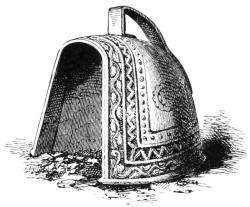
wandering about the streets. St. Anthony’s Hospital was an exception. This
House was privileged to let its pigs go free in the City provided that they had bells
hanging from their necks and that they were pigs bestowed upon the Hospital out
of charity. (See vol. ii. pt. iii. ch. viii.) Later on, however, it was forbidden to
keep pigs, cows, or oxen in the City at all.
The fuel used in the houses largely consisted of charcoal, which was brought
into the City from the forests in the north and south of London in carts. It was
ordered, temp. Richard II., that both charcoal and firewood should be sold at
10d. a quarter between Michaelmas and Easter, and at 8d. between Easter and
Michaelmas. This price seems very high in comparison with that of other
commodities. It is not known when coals began to be used. The name of Sea
Coal Lane, near the Fleet River, was so called from coal being there stored in
the reign of Henry III., if not much earlier. Coal paid custom at Billingsgate.
The market for wood was not Wood Street (? Woad Street) but at Smithfield and
at Cornhill. The carters sold “talwood, fagot, and busche”—words which explain
themselves. Fern, reeds and stubble were also used as fuel.
The sense in which a London craftsman was a “freeman” was, happily for the
growth of real freedom, extremely restricted. He must be apprenticed, and during
his term of seven years he was the servant, or perhaps the adopted son of the man
to whom he was bound; he must belong to a Guild; he must obey the laws of that
Guild; these were minute and careful: they made a man work during stated hours
and no longer; they regulated the price of his work; they would not allow him
to work on Church festivals; they would not let him go to law with another of the
same Guild; they sent him to church regularly; if he disgraced his moral character
in any way they turned him out of his trade and sent him out of the City. In other
words, he could not exercise his freedom in living idly or mischievously. The
system was admirable on paper, and in fact seems to have worked well. Above
all, it taught the lesson which we have since forgotten, that a workman does not
belong to himself alone, but to the community. That was the meaning of fixed
hours, fixed prices, fixed holidays.
“As regards wages, carpenters and that class of workman mostly received, between Michaelmas and
Martimas (11th Nov.) 4d. per day, or else 1½d. ‘and their table,’ at the option of the employer; between
Martimas and the Purification (2nd Feb.), 3d., or 1d. and their table; between the Purification and Easter,
4d., or 1½d. and their table; and between Easter and Michaelmas, 5d., or 2d. and their table. Saturdays
and Vigils were to be paid for as whole days, the men only working till the evening, and on Sundays and
Feast-days they were ‘to take nothing,’ the meaning being, no doubt, that on those days they did not work
at all. Their servants, or under-workmen, and the makers of clay walls, were to receive, between
Michaelmas and Easter, 2d., and between Easter and Michaelmas, 3d., for all demands. Should any
person pay a workman beyond these rates, he was to pay to the City a fine of 40s., and the workman to be
subjected to forty days’ imprisonment. About seventy years later, the wages of certain of these artisans
had apparently increased, Masons, Carpenters, Plasterers, and Sawyers receiving sixpence during the long
days, and fivepence in winter, but without being permitted to charge for the repair of their implements.
The wages of Tilers, however, had not made so great an advance, being at the rate of 5½d. and 4½d.
according to the length of the days, and the wages of their boys (garsons) 3½d. and 3d. ‘Master Daubers’
also were to be content with fivepence and fourpence, according to the length of the days, their boys receiving
at the same rate as those of Tilers.”—Riley, Liber Albus, pp. xxxvi.-xxxvii.
London made within its own walls almost everything that it wanted (see
p. 195). The subdivision of trade in a hundred branches was inevitable as the
town grew larger and its demands more imperious. For instance, in the branch of
arms and armour, there were wanted the bowyer who made bows, the fletcher who
made arrows, the bokelsmyth who made buckles, the bracers who made armour for
the arms, the gorgoaricer who made gorgets, the tabourer who made drums, the
heaulmere who made helmets, the maker of haketons—a quilted jacket worn under
armour and sometimes used for armour—of gambesons—another lighter kind of
jacket—of pikes, swords, spears, and cross-bow bolts. Again, in the matter of clothing,
each kind of garment had its own maker. The wympler made wymples, or
those handkerchiefs for the neck worn by nuns and elderly ladies; the capletmonger
made and sold caps; the callere made cowls or coifs; the chaloner made chalons or
corselets; the bureller worked in coarse cloth; the white tawyer in white leather;
the names of the quilter, the pinner, and the plumer, explain their branches. Many
of the trades were extremely offensive to the neighbours, and complaints were made
from time to time. Not even a mediæval Londoner, for instance, could enjoy the
neighbourhood of tallow-melting or of soap-making; nor could the people at any
time endure the sight and stink of the blood and offal from the Shambles pouring
down the narrow lanes into the river. Therefore order was taken on these subjects.
It must, however, be remembered that the City of London, now a warehouse and a
distributing centre, was formerly a great hive of industries. Wherever one walked
there arose the busy hum and mingled sounds of work: the melodious anvil rang out
from a court; the cry of the prentices sounded in Chepe; the song of those who
retailed wares was heard about the street; the women who sold fish cried aloud; the
man who carried water also cried his wares; and so did the baker who took round
the loaves. In the broad streets, Chepe and Cornhill and Bishopsgate Street,
the knights and men-at-arms rode slowly along; perhaps a great noble entered the
City with five hundred followers all wearing his livery; broad-wheeled waggons
heavily rumbled; the Queen was carried along in her cumbrous but richly decorated
carriage or her horse litter; the Mayor rode down the street accompanied by the
Sheriffs and the Aldermen on the way to a City Function; a trumpeter, a drummer,
and a piper preceded a little procession in which the principal figure was a man
tied on a hurdle with a whetstone round his neck to show that he was a liar and a
cheat; thus was the attention of the people called to the culprit, and they were invited
to assist at his pillory, and were admonished of the punishment meted out to offenders.
And all the time from every shop and stall and seld the voice of the prentice was
uplifted crying, “Buy! buy! buy! What d’ye lack? what d’ye lack?” Above all, and
all day long, was heard the ringing of the bells in the hundred and fifty churches and
chapels of the City. They sounded all together for early mass, and all together for
angelus; at other times for the various services in the Religious Houses: even at
midnight they sounded, when the monks were summoned from their warm beds to
Matins. It was a noisy, bustling city full of life and animation; the people were
always ready to fight, always dreading fire, famine, and plague, yet always hopeful;
and the City was always young as befits a city continually at work.
The Trade of London covers the exports and the imports, the industries and
the productions, the wants and the luxuries, the superfluities and the extravagances,
of the City. There was no great change in these respects during the whole period
from the Norman Conquest to the accession of the Tudors. That is to say, the
Court of Edward IV. was in all essentials the same as the court of Richard II.
A dignitary of the Church in the year 1480 was more magnificent than, but not
otherwise different from, one in the year 1280. The rank and state of a Mayor
of the later period were much like those of a Mayor in the former period. There
had been some development in art; there had been some changes in arms, armour,
and warfare: we will try to enumerate the callings, trades, and industries of Mediæval
London. It will be matter of surprise to learn how many there were; how many
have disappeared; and how many have been merged in other trades. It was not
machinery alone that turned man into a machine and made him spend his whole life
on one little piece of work, always beginning, always ending, always repeated. In
the Appendix will be found a categorical list of trades. I do not advance the list as
complete, but it contains nearly all the trades mentioned in the authorities for the time.
This list shows, what I have already stated, that nearly everything wanted for
the daily use of the people was made within the walls of the City; here wool was
made fit for use, flax was spun, cloth was woven, weapons were hammered out and
shaped, bow and arrow, lance, pike, and sword; armour was made, became breastplate
and cuirasses; skins were converted into leather, leather into saddles; tiles and
bricks were made; the skins and furs were made fit for use; the gold and silver
cups, mazers and chalices were made in the City; the people of London made
blankets of shalloon, they also made the quilts and pillows; beautiful things with silk,
glass vessels, and dainty things for women; in fine—everything that could be made
in the City was made. This fact not only limits the imports from foreign and
native markets, but shows how self-sufficient a mediæval city could be. This self-sufficiency
is further illustrated by the law (3 Ed. IV. c. 4), which prohibited the
importation—a measure of Protection—of a great number of goods on the ground
that the English artificers cannot compete against foreign-made wares.
Here is a list of things made:—
“Woollen Caps, Woollen Cloth, Laces, Corses, Ribbands, Fringes of Silk and
Thread, Laces of Thread, Silk twined, Silk in any wise embroidered, Laces of Gold,
Tyres of silk or gold, Saddles, Stirrups, or any Harness pertaining to Saddlery,
Spurs, Bosses of Bridles, Aundirons, Gridirons, any Manner of Locks, Pinsons, Fire-tongs,
Dripping Pans, Dice, Tennis Balls, Points, Purses, Gloves, Girdles, Harness
for Girdles of Iron, Latten Steel, Tin or of Alkemine, anything wrought of any
Tawed Leather, any Tawed Furrs, Buscans, Shoes, Galoches, or Corks, Knives,
Daggers, Wood-knives, Bodkins, Sheers for Taylors, Scissors, Razors, Sheaths,
Playing Cards, Pins, Pattens, Pack Needles, or any Painted Ware, Forcers, Caskets,
Rings of Copper or of Latten Gilt, or Chaffing Dishes, Hanging Candlesticks,
Chaffing Balls, Sacring Bells, Rings for Curtains, Ladles, Scimmers, Counterfeit
Basons, Ewers, Hats, Brushes, Cards for Wool, Blanch Iron Thread commonly
called White Wire.” (W. Cunningham, Growth of English Industry.) (See also
Appendix II.)
The following notes on the regulations of trade are by Riley:—
“The business of the Winedrawers (Wyndrawers) seems to have been limited to the loading, carriage,
and unloading, of tuns and pipes of wine from the Quay cellars to other parts of the City. Their charges
were restricted by enactment to certain prices, according to the distance; ten pence being the largest sum
allowed for the carriage of a tun of wine to any part within the walls, and eight pence for a pipe.”
“The business of a Brewer was acknowledgedly one held in low estimation; indeed ‘Breweress’ rather
should be the term, as, in the times now under consideration, the business was almost wholly in the hands
of females, and so continued to be till the close of the fifteenth century, if not later; at which period Fleet
Street was tenanted almost wholly by breweresses or alewives, and makers of felt caps. The brewers of ale
generally, if not always, sold it also by retail to the public, as well as wholesale, to such dealers as were not
brewers themselves, but privileged to sell it. Indeed, at some periods, as already noticed, we meet with
prohibitory enactments, forbidding any person but brewers and hostelers to be sellers of ale.
The ale-tavern or ale-house seems to have been a distinct establishment from the wine-tavern; the
keeper of which, though the fact does not appear [Liber Albus], was probably prohibited from selling ale.
For the present, it is proposed to call the reader’s attention exclusively to the brewing and sale of ale.
Immediately a brewing was finished, it was the duty of the brewer or breweress to send for the Ale-conner
of the Ward in order to taste the ale. Upon so doing, the Ale-conner, in case he did not find the
ale equal to the Assize, or, in other words, not so good as it ought to be, with the assent of his Alderman
set a lower price upon it, which, upon sale thereof, was not to be exceeded. Fine, imprisonment, and even
punishment by pillory, were the result of reiterated breaches of the Assize. The gallon, pottle, and quart
of the brewer and taverner were to be duly impressed with the seal of the Alderman of the Ward; the tun
also, or vat, of the brewery (containing 150 gallons) was similarly sealed. The pottles and quarts, there is
reason to believe, were sometimes made of wood, as we find them spoken of as being made when green,
and as shrinking from dryness on getting cold. Consumers, private probably as well as taverners, sent
their vessel to the brewery; and, by public enactment, there it was to stand the rest of the day and through
the night, for the purpose of giving the ale time to work, another proof of its newness when consumed.
The next morning on being taken away by the customer, the vessel was to be ‘full of good and clear ale.’
No brewer or breweress, or regrator or regratress of ale, was to keep his or her doors open after
Curfew rung, under heavy penalties. Brewers, as well as hostelers, were ordered to retail their ale by full
and lawful measure, and not to sell it by the hanap, or metal drinking-mug of the establishment.”
“The best ale, which was no better than sweet-wort, was probably so thin that it might be drunk in
‘potations pottle deep’ without disturbing the equilibrium of the drinker. Fermented liquors were drunk
too in these days as new as possible; and there can be little doubt that the ale was used the moment it
was made. This, combined with its possible thinness and its lusciousness, would additionally tend to
prevent it from producing inebriety; and it is doubtful whether the Londoners then deserved the character
for drunkenness which FitzStephen had seemed inclined to give them little better than a century before.
The fact, however, that the smallest ale-measure here noticed is a quart would certainly seem, it must be
admitted, to militate somewhat against a belief in their comparative sobriety. The extensive consumption,
too, of wine, which, at one period, was little more than twice as dear as ale, may have exercised some
influence in this respect. Wine at this low price would be no better than, if indeed as good as, the vin
ordinaire of the present day; and consequently, though largely drunk, there would be but little chance of
its causing inebriety.”
“Pastelers were a class of tradesmen who made pies, and probably other kinds of pastry as well. By
one enactment we find them ordered to make pies for one halfpenny; the materials probably being found
by those who employed them. Pie-bakers (pybakeres), there seems reason to believe, united the trade of
baking pies for their customers with the keeping of tables for guests on their own account; as already
noticed, like their brethren, the cooks, they are occasionally spoken of as retailing ale. In one instance,
we find an order made that no cook shall charge more than one penny for putting a capon or a rabbit in a
crust; the materials for the pastry, with the exception perhaps of the flour, being evidently found by the
customer employing him.
The wholesale markets for corn, malt, and salt, brought to London by water, were at Billingsgate, and
Queen Hythe. Sometimes in the reign of Edward III. and Richard II., we find it enacted, that the
commodities brought to these quays shall remain three days on sale to the public, before the dealers shall
be allowed to buy; at other times, the period is limited to a single day. Corn coming to Queen Hythe,
temp. Edward II., the property of a stranger, or non-freeman, was not to be put up for sale before prime
rung at St. Paul’s, six in the morning. Temp. Richard II., certain bells seem to have been rung to
announce to the dealers when the sale of corn at Queen Hythe, Graschirche, and Billingsgate was about to
commence. Corn and malt were also sold at Smithfield in the times, apparently, of Edward I., and his
successor. In the two following reigns, however, we find it frequently enacted, that persons bringing corn
and malt for sale in carts or on horses from the Eastern parts, namely, from the counties of Cambridge,
Bedford, Huntingdon, and from Ware, shall take their stand on the Pavement at Graschirche; and those
coming from the West, ‘as from Barnet,’ shall expose their wares for sale on the Pavement before the
Friars Minors, at Newgate. As they were not allowed to sell by sample, these extensive pavements would
be particularly convenient for the deposit and exposure of their sacks. Besides supplying the City to a
considerable extent with bread, Stratford, in Essex, was evidently a great repository for corn and flour:
which, temp. Edward III., was brought to the City by carts, several times in the week probably, as they paid
3d. per week for Pavage.
Sellers and buyers of corn seem to have been watched at all times with the greatest jealousy and
suspicion; out of numerous regulations made at various periods in reference to them, the following may
deserve notice:—Vendors of corn were forbidden to sell it by sample, or to put it in any place out of public
view. No monger or regrator of corn, fish, or poultry, was to make purchase thereof, before the hour of
prime. Good corn was not to be mixed with bad, ‘in deceit of the people,’ under pain of forfeiture. No
one was to buy corn, malt, or salt, and leave it in the hands of the original seller for the purpose of selling it
as his agent at a profit. No freeman of the City, a regrator of corn, was to stand on the Pavements of
Graschirche and Newgate between the foreign sellers, but each class of dealers was to have its separate
stand. No retailer was to buy corn or malt for resale except on market days.”
“Fishmongers, selling fish in large quantities to their customers, were to sell by the basket; such
basket to be capable of containing one bushel of oats, and, if found deficient, to be burnt in open market.
Each basket was also to contain only one kind of sea-fish; and the fishmongers were warned not to colour
(douber) their baskets; or, in other words, not to put good fish on the top and inferior beneath. Fish
arriving by water at night was not to be moved from the boat till sunrise; but in case the night was rainy,
it might be landed on the Quay, under charge of the ‘Serjeant of the Street,’ till the proper time for sale.
Herrings, mackerel, and other fish brought by cart, were not to be bought for resale before the hour
of noon. Fish brought by land in baskets, when purchased by the keeper of a shop, was not to be
taken into the shop, but to be exposed publicly for sale in front of it; the case of a freeman excepted,
who might warehouse it for the night, on condition of selling it, without subtraction, in open market
next day.
Though, as already stated, fish was occasionally sold at places lower down the river, dealers in the
City were at times forbidden to forestall sea-fish or freshwater fish, ‘for the purpose of sending it to any
great lord or to a house of religion, or of regrating it,’ until the purveyors for the King had made their
purchases for their master’s use. At another period, a regulation was made that no fishmonger should buy
fish brought to the City ‘before the good people have bought what they need.’ Very similar, too, in
spirit were the following enactments, belonging to various periods in the century under notice:—No fish
was to be bought till the vessel was moored. Citizens of London might buy at the boat at the same price as
the dealers. Fishmongers were not to buy fresh fish till after mass sung (probably at sunrise) at the Chapel
on London Bridge, or at the Church of St. Martin; and not to buy salt fish till after prime; though, by a
regulation, temp. Edward I., this last article applied only to salt fish in which strangers had a share, that
belonging to citizens being allowed to be sold at sunrise, like the fresh. Freemen of the City, too, were
permitted to stand with the fishmongers at their stalls, and to be partners with them in the sale of their
wares. No apprentice was to enter a vessel for the purpose of buying fish; and no porter, unless he was
called.
We find it also enacted, that no one shall sell fish upon the Quay by retail; and that no one shall
carry about cooked whelks for sale, under pain of being amerced and losing his whelks. Fish coming by
land, and arriving after dinner, was allowed to be warehoused, whether belonging to a freeman or not, and
sold in the market on the morrow. No seller of stockfish was allowed to enter a vessel for the purchase of
fish: his trade was wholly distinct from that of the ordinary fishmonger.”
“The great cattle-market, of course, was Smithfield (Smooth field), which is mentioned as a ‘campus,’
a plain, or open space; and ordinances are met with, of an early date, for keeping it clean. Among other
animals sold at Smithfield, lean swine are mentioned, probably for fattening in town or in its close vicinity.
From the frequent mention of pigs, it would seem probable that pork was more extensively consumed than
any other kind of butchers’ meat. Temp. Edward III., lambs are mentioned as being brought by boat to
St. Botolph’s Wharf, near the Tower. The great meat-markets were held at the Flesh-Shambles of St.
Nicholas, near Newgate, and at the stalls under the covered place or market-house (domus) known as ‘Le
Stokkes,’ afterwards Stocks Market. At some periods, if not constantly, the meat-markets were open on
Sundays. Temp. Richard II., a regulation was made that all butchers, keeping shops, should close them at
dark, and not sell their meat by candle-light; a rule which seems, at times, to have applied to all other
trades as well. On the same occasion, too, it was ordered that no one should go out of the City for the
purchase of lambs, and that no lambs should be sold at a higher price than six pence.
In the reign of Edward III., orders were issued that the offals of St. Nicholas Flesh-Shambles should
be buried in spots appointed for the purpose; and at a later period, in the same reign, we find proclamation
made that the butchers of St. Nicholas shall no longer carry the offals and filth of the market down to
the Thames; a mandate also being issued that large cattle shall in future be slaughtered without the City.
In the early part of the reign of Edward I., it was ordered that strange or foreign butchers should sell
till none (our noon) by retail, and, after that, by wholesale, until Vespers rung at St. Paul’s; at which time
they must have finished the sale of their meat, without carrying anything away to salt or store, under
penalty of forfeiting the same. In the reign of Edward III., the time for the foreign butchers closing
market had been prolonged to Curfew at St Martin’s le Grand. Foreign butchers were also strictly
forbidden to bring any carcase to market without the hide or woolfel belonging thereto. Among other
ordinances, which seem to have applied equally to free butchers and foreign, it was provided that they
should not sell hides or woolfels till after prime, or six in the morning; that they should not sell a woolfel
while the animal was alive; and an injunction is to be met with more than once, that butchers, neither
themselves nor by their wives, should sell suet, tallow, or lard, for the purpose of being taken beyond sea.
Candles were made in these days of tallow or wax, as now.”
“The persons whose business it was to receive guests for profit, appear to have been divided into
two classes, ‘Hostelers’ and the ‘Herbergeours.’ The line of distinction between these two classes is not
very evident, but it seems not improbable that it consisted in the fact that the former lodged and fed the
servants and horses of their guests, while the latter did not. At all events, hostelers are mentioned as
supplying hay and corn for horses, but herbergeours never.”
“Temp. Edward I., Barbers were forbidden to expose blood in their windows, but were ordered to carry
it privily to the Thames,—one of the comparatively few ordinances of these times to the detriment of that
now much ill-used stream. Temp. Henry IV., an enactment is found, to the effect that Barbers shall not
follow their calling, or keep their shops open on Sundays. At the close of Edward the Third’s reign,
Bowyers were forbidden to send bows to Cornhill, or to any other place within the City, for sale. In the
early part of the same reign, Spurriers were ordered to sell spurs at the rate of 6d. and 8d. the pair, the
very best not to exceed 12d. In the same reign, it was also enacted that every Goldsmith should put his
mark on plate of his manufacture; all Smiths, too, who made swords, and knives, were to have their private
mark. Temp. Edward I., the prices to be charged and materials were regulated on the following terms:
for putting on a common horse-shoe with six nails, 1½d.; with eight nails, 2d.; and for removing the same,
1/2d.; for putting a shoe on a courser, 2½d.; for putting a shoe on a charger, 3d.; and for removing a shoe
from either, 1d.
Carriage or cartage might at any time be seized by the serjeants and grooms (garsons) of the City
dignitaries and officials from the ‘Traventers,’ or persons who kept carts and horses for hire. The carts,
however, that carried away the filth of the City are mentioned as being especially exempted; an enactment
that has very much the semblance of making a virtue of necessity. The serjeants and grooms were especially
directed, not to molest the carts and horses of the poor persons who brought victuals and other wares to
the City for sale, and not ‘for their own private gain,’ to spare those of persons who kept them for hire,—a
rather strong hint as to the prevalence of bribery, which in all probability was anything but uncalled for.
Carts used in the City for the carriage of sand, gravel, or potter’s clay, contained one full quarter and no
more.” (Riley, Introduction to Liber Albus.)
To these trade regulations should be appended a most formidable document
(38 Ed. III.) issued against usurers. The preamble will sufficiently expose the
view held of usury at that time.
“Whereas heretofore the City of London has sustained great mischiefs,
scandals, and damages, and in time to come might sustain the same, by reason
of certain persons who, neither for fear of God nor for shame of the world, cease,
but rather do daily exert themselves, to maintain the false and abominable contract
of usury, under cover and colour of good and lawful trading; which kind of
contract, the more subtly to deceive the people, they call ‘exchange’ or ‘chevisance’;
whereas it might more truly be called ‘wickedness,’ seeing that it ruins the
honour and the soul of the agent, and sweeps away the goods and property of
him who appears to be accommodated, and destroys all manner of right and
lawful traffic, whereby, as well throughout all the land as the said City, they
ought principally to be upheld and maintained. Wherefore, etc.”
Mints were anciently established in every important town, the work of
coinage being entrusted to private persons named moneyers.
In the reign of Edward I. there were mints in London, Canterbury, Kingston-on-Hull,
Newcastle-on-Tyne, Bristol, and Exeter, a system which produced endless
disorders and complaints as to light weight and bad money. It was not until
the reign of Elizabeth that all the mints were reduced to one, and that in the
Tower of London. Gold coins were introduced by Henry III., but they were
not liked, and, as it was optional to take them, they were not in common
use until the reign of Edward III., who originated the noble, the half noble, and
the quarter noble.
When the King or Queen communicated, and on Twelfth Day, an offering
was made of a coin called a Besant, which was afterwards redeemed by the King’s
Chamberlain. The Besant was a circular piece of hammered gold engraved on
one side with the Trinity and on the other with the Virgin Mary. Those worked
for James I. were different. The representation of the King showed him kneeling
before an altar, with four crowns before him, and the legend Quid retribuam Domino
pro omnibus quæ tribuit mihi? On the other side was a lamb lying beside a cross
with the words Cor contritum et humiliatum non despiciet Deus.
On all occasions of state, such as a Coronation, a marriage, a baptism, a
funeral, or the installation of a Knight of the Garter, it was customary for the
King to offer a Besant. The custom is said to have fallen into disuse when a
certain Dean of Windsor refused to allow the Besant to be redeemed with money.
The moneyer to whom was entrusted the engraving of the Besant was named
after the coin. Thus we find in the reign of Henry II. that the moneyers,
as officers especially dependent on the King, were assessed separately. The
Moneyers of London paid a tallage ad filiam maritandam. They were five in
number, Achard, who paid six shillings, Lefwine Besant, who paid five marks,
Aylwin Finch, who paid two marks, and two others.
Let us next ask what were the goods which London merchants had to offer
for exchange and for exportation?
Henry of Huntingdon, writing in the reign of Henry II., says that England
possessed mines of copper, iron, lead, and silver, the last metal in very small
quantities. “Silver, however, is received from the neighbouring ports of Germany,
with which an extensive commerce is carried on by the Rhine in the abundant
product of fish and meat, as well as of fine wool and fat cattle which Britain
supplies.... Britain also furnishes large quantities of very excellent jet of a black
and brilliant hue.” One observes that he does not include slaves among the
exports. That trade had therefore disappeared. The statement of this Chronicle
stands good for four hundred years. The staple exports of England continued
to be wool, hides, iron, and tin. Sometimes grain was also exported. England,
for many centuries, was the greatest wool-producing country of Europe. The
chief reason appears to have been the comparative peace enjoyed by the island
at a time when the rest of Western Europe was continually devastated by wars
of all kinds, namely, civil wars, foreign wars, wars between barons, wars between
towns. The Englishman was the only farmer who could keep his sheep. Therefore
it happened that the German Ocean was always covered with light ships
sailing to and fro laden with wool. Flanders was the manufacturing country
which received the wool; when there was a break in the friendly relations of
England and Flanders half the Flemish people were thrown out of work. England
sent abroad money by means of wool: the tribute to the Pope was paid in sacks
of wool sent to Bruges and there sold. In the year 1343 the Deans of York,
Lichfield, and Salisbury, and the Archdeacon of Canterbury, who were all non-resident
Italians, received their stipends in wool. Even the taxes were calculated
by sacks of wool.
Many efforts were made to make England a manufacturing country, but for
a long time in vain. Henry I. established the cloth fair at St. Bartholomew’s.
Edward III. brought weavers from Flanders and settled them at Norwich. One
has only to stand before the Guildhalls of Bruges and Ghent, or in the splendid
Hall of the Drapiers of Ypres, to understand how great an industry was this of
the cloth manufacture, which the English people were so slow in learning.
Up to the fifteenth century the English ships went up to Bruges by canal.
When in the sixteenth century Maximilian dammed the canal at Sluys, the English
vessels then went to Antwerp.
The chief town of the wool trade was called the Staple. It was changed from
time to time: Bruges, St. Omer, Calais, Antwerp, were all in succession Staples.
When Antwerp was sacked in 1567 and 1585, London took its place.
The imports may be classified under the division of the countries whence they
came. Thus, from Spain the port of London received figs, raisins, bastard wine,
dates, liquorice, Seville oil, grain, Castile soap, wax, iron, wool, wadmoles, skins
of goats and kids, saffron, and quicksilver. But these goods were not received
from Spain direct, but through Bruges, the great Flemish emporium, where the
English bought the Spanish merchandise. Portugal exported wine, wax, grain,
figs, raisins, honey, cordovan, dates, salt, hides. Prussia exported beer, bacon,
wax, osmunds, copper, steel, bowstaves, peltry, pitch, tar, boards, flax, Cologne
thread, fustian, canvas, cards, buckram, etc. The Genoese brought over cloth
of gold, silk, pepper, woad, oil, woodashes, cotton, alum, and gold. The Venetians
brought all kinds of spices and groceries, sweet wines, apes, and other foreign
articles, and many articles of luxury.
“The grete galleys of Venees and Fflorence
Be wel ladene with thynges of complacence:
Alle spicerye and of grocers ware.
With swete wynes, alle manere of chaffare
Apes and japes and marmasettes taylede
Trifles, trifles that littelle have availidde
And thynges with which they fetely blere oure eye
With thynges not enduring that we bye
Ffor moche of thys chaffare that is wastable
Might be fore borne for diere and dissevable.”
(Libelle of English Polycie.)
From Brabant and Zealand came madder, woad, garlick, onions, and salt fish.
In the markets of Brabant were exposed for sale the wares of France, Burgundy,
and Hainault, brought overland in carts.
From Ireland came wool, hides, salt fish, such as salmon, haddock, herring;
limes, skins of martens, otters, rabbits, kids, etc. Scotland exported direct, without
passing through London, wool and hides.
From Brittany came wine, what wine? It must have been wine of the Loire
country shipped from St. Malo; salt and canvas. Iceland sent stockfish and took
corn, cloth, ale, and wine.
Thorold Rogers has compiled a list of English towns which produced and
exported. London is not in that list. London made nothing except for its own
use; it imported all the things which we have enumerated above, but it made
nothing for export. This is a remarkable fact. It proves that the City was quite
early regarded as a centre of distribution.
It will be observed in this list that in matters of necessity London could do
without foreign assistance altogether. The houses were built of English oak and
English stone; bread, butter, cheese, meat, game, fish, ale, cider, perry, mead,
salt, honey, could be made or obtained; cloth, woollen stuffs of all kinds, linen,
fur, fuel, all these necessary things were provided at home. Even wine—of a
kind—was made of English grapes. The poorer classes had nothing to do with
foreign imports. Except for woad—and some of this was grown at home—the
manufactures and industries of the country could get along very well without
foreign help. The swords of Toledo and Damascus were very beautiful, but an
English cutlass made out of Sussex iron by an English artificer was more serviceable
in battle. The imports were either luxuries for the wealthy classes, such as
wine, preserved fruit, cloth of gold, buckram, fur, etc., or they were things wanted
to supplement and make cheaper home products, as wax, honey, leather, salt fish,
onions, garlic, etc. For this reason the imports were not as a rule equal to the
exports, and the balance of trade was in favour of London. Compare the craftsman
of Edward III. with him of Victoria. The former drank brews of various
kinds but all home made, the latter drinks tea, coffee, cocoa, sometimes German
beer, whisky, brandy, rum, geneva, and perhaps wine, all imported. The former ate
bread, bacon, mutton, beef, cheese, eggs, fish, which were all produced at home.
Half of the food stuffs of the latter come from abroad. The former made
everything that was wanted for the house; the latter imports everything, doors,
window-frames, coffins, matches, in fact everything that can be got cheaper from
abroad than at home. Cheapness has its dangers; we no longer value what it
costs no effort to procure; fine wheaten bread lies unheeded in our gutters; the
sense of conquest and possession is lost; the struggle is no longer for the simple
needs of life but for the luxuries.
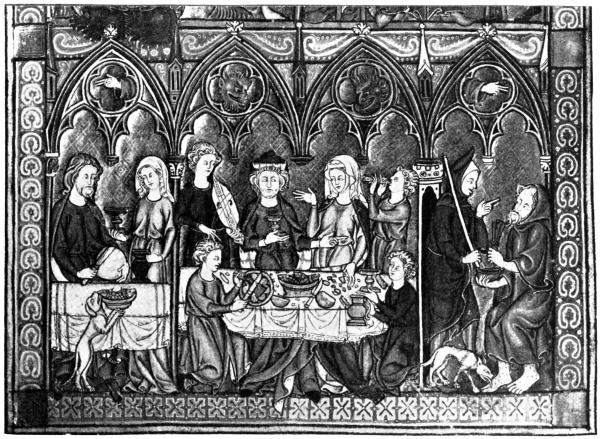
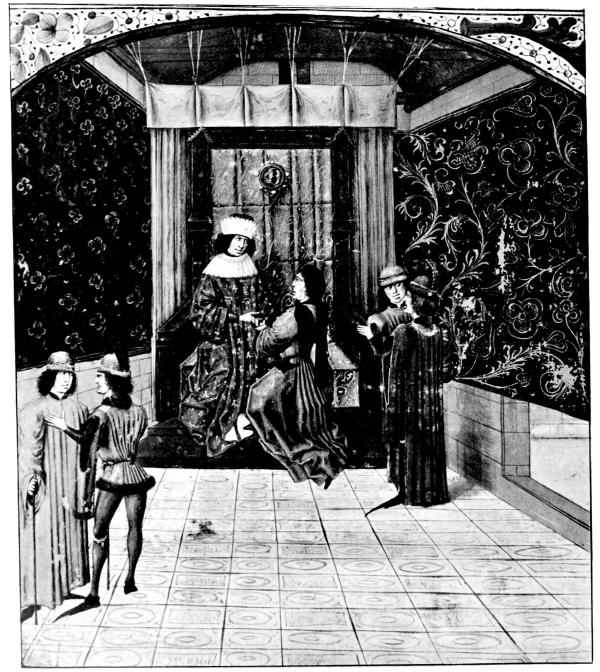
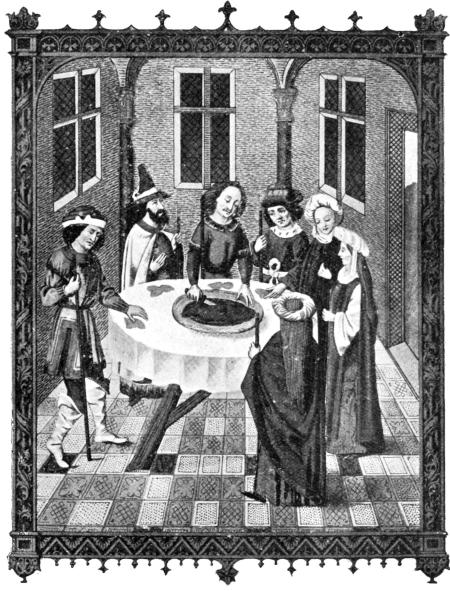
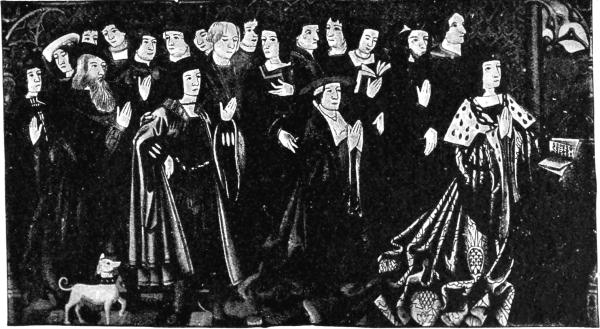
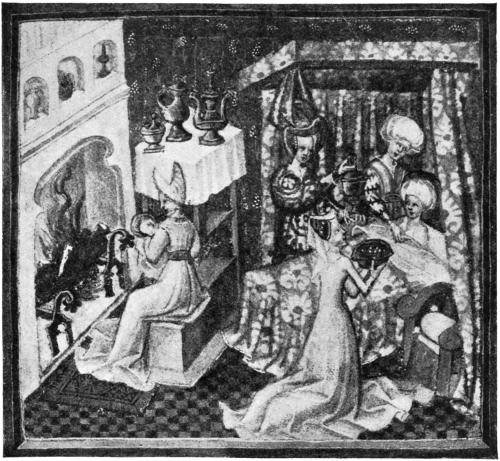
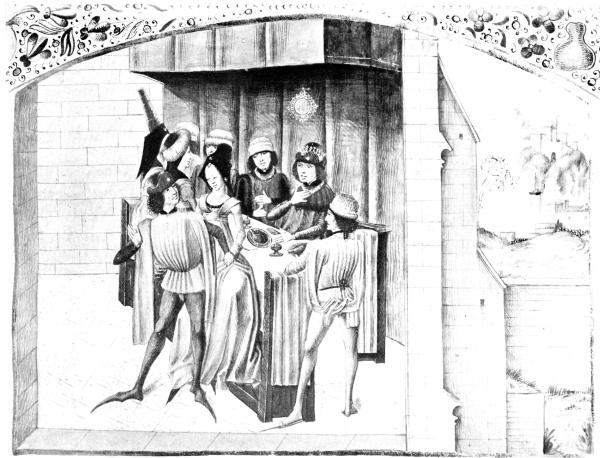
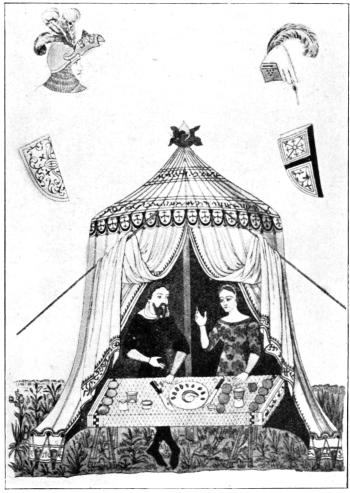
A HOUSEHOLD DINING
From MS. 28162 in British Museum.
Mention has been frequently made of Fairs. There is nothing now in existence
which in the least resembles one of the great Fairs of this time. The shops, which
were sheds or stalls or booths covered with canvas, were ranged side by side in
streets, called after the kind of goods sold in them. Thus, there was the “Spicery,”
the “Portery,” the “Drapery.” The Fair lasted for two or three weeks. It was
a fair for exchange as well as for sale; the wholesale merchants frequented the
Fair, exchanging silks for wool or skins; and the retailers spread out their wares
to catch the people. Everything was offered for sale, while the Fair, which always
contained a certain element of feasting, was amply provided with taverns, eating
and drinking shops, musicians, dancers, tumblers, and jugglers. When the necessity
for the Fair gradually ceased, the entertainments remained. Yet down to the
’ fifties, in the nineteenth century, among the booths there were always some which
kept up the semblance of serious trade; between the toy-stalls and the gingerbread
were booths of cheap books and booths of hosiery and clothing.
Let us go on to consider the conduct of the trade of London Port. And, first,
as regards the English merchants. When trade begins, all the regulations of trade
for its security, such as the enforcement of debts, the due carrying out of contracts
and agreements, must begin at the same time. Hence there was created in every
trading town an organised Chamber of Commerce, anciently called the Merchant
Gild. Of this organisation I will speak in another place (see vol. ii. pt. i. ch. ix.).
This Chamber or association of traders assumed, as possessed by Royal Charter,
executive powers, it passed laws, regulated trade in every branch, ordered prices,
received foreign merchants and cargoes from abroad, appointed the time of market,
and punished offenders. The Gild may have exercised all these functions not only
in a prehistoric but also in a non-historic manner. For in London we have no
Merchant Gild ever spoken of.
Among the foreign traders are mentioned in the Liber Albus the Cologne
merchants, the Hanse merchants, and merchants of Lorraine, Bavaria, Lemberg,
Flanders, Antwerp, Bruges, Louvain, Perugia, Lucca, Lombardy, Tuscany, Spain,
Portugal, Catalonia, Navarre, Provence, Aquitaine, Quercy, Gascony, Bordeaux,
Genoa, and the Italian Societies of Frescobaldi and Morori. Liberties are also
mentioned as being granted to the Merchants of Douay, Malines, and St. Omer;
also to numerous cities and corporations in England; and allocations were granted
to the citizens of Dublin and Cork.
All these merchants occupied their own houses, in which they were expected to
live by themselves, not associating more than was necessary with the citizens, who,
as far down as the nineteenth century, were wont to hustle and abuse any foreigner
who ventured unprotected into the streets. The men of Germany had the Domus
Teutonicorum, the Steelyard, where is now Cannon Street Terminus: the men of
Bordeaux had the “Vintry”: the Flemings their own house near the Vintry. The
history of the trade of London for five hundred years is largely composed of the
jealousies and quarrels between the foreign merchants and the merchants of
London.
In the year 1000, strangers from France, Normandy, Rome, Flanders, Liège,
and the Emperor’s men, were permitted to trade at Billingsgate. In the twelfth
century a fleet, carrying wine as its principal cargo from Germany, arrived at London
once a year. It lay off the bank two ebbs and one flood. This means that the
vessels came up the river with the flood, and lay off during the following ebb and
one tide afterwards. During this time the men were not permitted to land, nor to
sell their cargo. The King’s officers came on board and purchased what was
wanted for the King’s use—gems, plate, tapestry, as well as wine. After this the
traders were allowed to sell to merchants, but not to go to the open market nor
to sell by retail. When they carried their wares on shore the Sheriff examined them,
and they had to pay scavage, i.e. “showage.” They could sell for the space of
forty days, after which they had to go away. But one suspects that the law was not
administered with great strictness. Some things they were forbidden to buy, as
lamb skins: and they were not to buy more than three live pigs!
In 1217, a convention was made between the merchants of London, Amiens,
and other towns. Those of the convention were permitted to load and to unload, to
warehouse in the City, and to sell to citizens, not to foreigners. In return they were
to pay fifty marks a year to the Sheriffs. One of them might keep a hostel for a
year, but not longer. They were not to take provisions out of the City. These
foreigners contributed £100 towards the construction of a conduit from Tyburn
into the City. Before this time, in 1194, Richard I. had granted to Cologne
merchants the right to attend all Fairs “saving the franchise of the City of
London.”
The expansion of trade and the creation of industries in England owed a great
deal to the spirit of enterprise made possible, or even engendered, by the new
municipal life of the towns. All over the country the towns asked for and obtained
charters after the fashion of London. There are everywhere, up to the end of the
thirteenth century, signs of activity and of prosperity: churches were rebuilt; bridges
were thrown over rivers; walls were repaired; gates, wharves, aqueducts were
constructed; new trading-ports arose such as Lynn, Sandwich, Southampton,
for instance; new manufactures were started at Norwich, Worcester, Coventry,
Leicester, Nottingham, Reading, and elsewhere; there are no complaints of poverty
and misery; there is no Piers Plowman for London; the merchants are seen to be
buying country estates; and whereas in the twelfth century England exported little
besides her wool, in the fifteenth century there are entries of industry and
manufactures everywhere. And for all these, London was the recipient and the
distributor.
The Hanseatic League was in existence as far back as the eighth century.
The members began to trade with London apparently very soon after that date, and
were esteemed as merchants who introduced wares very useful and otherwise
difficult to procure. In the reign of Ethelred, A.D. 979, the “men of the Emperor”
were accounted worthy of “good laws.” They settled by the river-side, where they
obtained a house near Dowgate. Either before or after their settlement the “men
of Cologne” settled next to them. After disputes between the two Houses they
were amalgamated and formed the Gildhalla Teutonicorum. Their merchandise
consisted mainly of wheat, rye and other grain, cables, masts, pitch, tar, flax, hemp,
linen cloth, wainscots, wax, steel, and other “profitable merchandize.” (Stow).
Not only the citizens of London but the country people looked on the aliens
with hate. No royal proclamation was of avail to protect them against this hatred.
Partly, no doubt, they were hated because they were foreigners; but mainly, it is
certain, because they were monopolists and could charge what they pleased. Thus
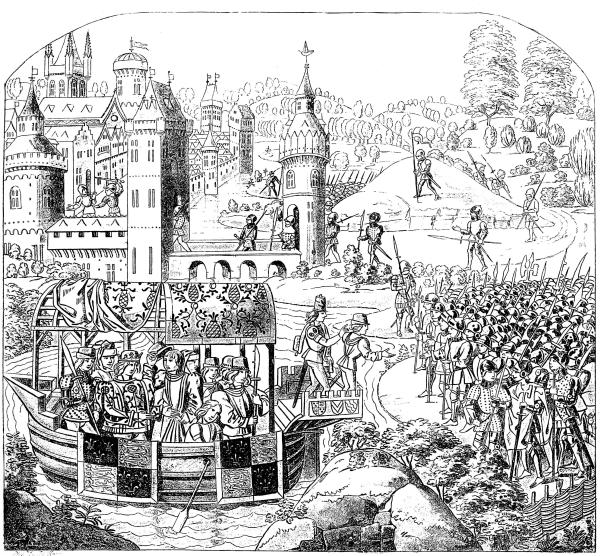
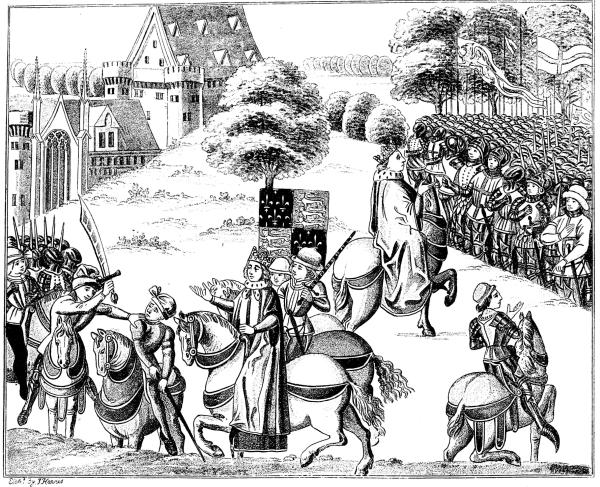
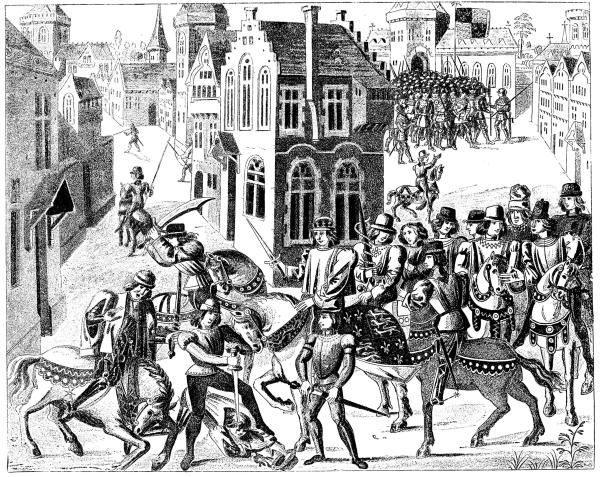
when Wat Tyler and his merry men held possession of the City they murdered all
the foreign merchants, especially the Flemings, dragging them even from the altars.
Chaucer says (Nonnes Prestes Tale):—
“Certes, he Jacke Strawe and his meynee
Ne made never shoutes half so shrille,
When that they wolden any Fleming kille,
As thilke day was made upon the fox.”
The Hanseatic League was most powerful: to it belonged all the important towns
of North Germany, it had ships numbering hundreds, and controlled the whole trade
of the Baltic, that is to say, of Scandinavia, Russia, Poland, and Germany, and
exercised in England for its own purposes the influence which everywhere belongs
to the purse. The members advanced money to the King on large interest; they
got him out of his difficulties, for a consideration. Thus Edward III., in return for
money advanced, let the Black Prince’s tin mines in Cornwall to the Germans;
and, for the same consideration, he gave them a number of farms for a thousand years.
One need not here follow the Gildhalla Teutonicorum and its various charters and
privileges. It is sufficient to note that the continual wars of the English—civil wars,
as in the reign of Stephen, Henry III., Edward II., Richard II., Henry VI., Edward
IV. and Richard III.; foreign wars with Scotland and France; the repression of
rebellion as in Ireland and in Wales—checked the growth of commercial enterprise
and made it impossible for the English merchant to contend against the League.
Yet when the Merchant Adventurers began, early in the fifteenth century, they
attacked the Hanseatic trade in Norway and in Denmark and in Flanders. There
was fierce resistance; in Bergen the English merchants were murdered; on the
open sea the “Rovers” or pirates attacked and destroyed the English ships; the
Hanseatics pillaged the English coasts. The English power at sea was unable to
put down these acts of piracy or war. The King was obliged to invite the
arbitration of Charles, Duke of Burgundy, who accorded to the English merchants
the substantial benefit of trading in the Baltic, but restored to the League all their
former privileges and more. This arbitration was called the Treaty of Utrecht.
It remained in force till the final expulsion of the League a hundred years later.
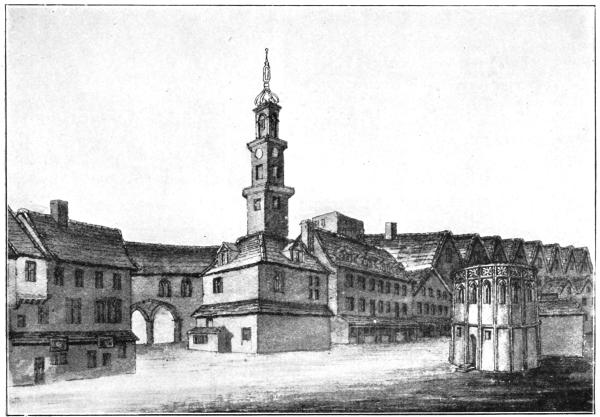
The Gildhalla Teutonicorum or Steelyard covered a large area in the most
crowded part of London. Its river front extended from Cousin Lane—a narrow
lane close to Dowgate Dock on the west—to Allhallows Lane on the east; and from
the river to Thames Street. This area contained about 110,000 square feet. It
was surrounded by a strong wall; the chief building was a large hall called the
Guildhall in which the merchants and their clerks took common meals; the north
front looking on Thames Street possessed three arched gates, of which for greater
security the two side gates were walled up. Above the three gates were the
following inscriptions:—
(1) “Haec domus est laeta semper bonitate reputa:
Hic pax, hic requies, hic gaudia semper honesta.”
(2) “Aurum blanditiae frater est natusque doloris:
Qui caret hoc moeret, qui tenet hoc metuit.”
(3) “Qui bonis parere recusat, quasi vilato fumo in flammas cecidit.”
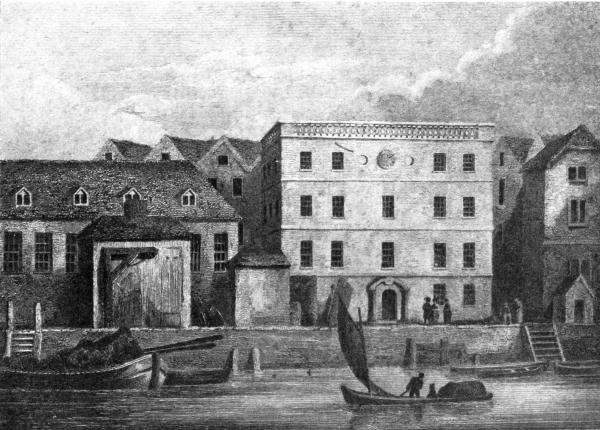
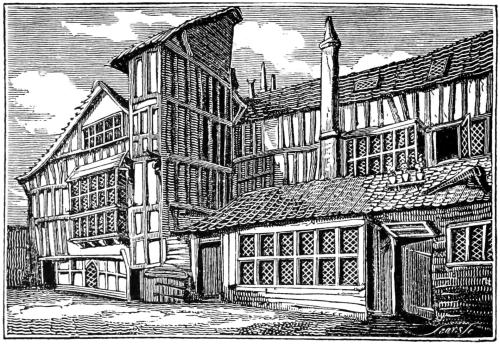
Grove and Boulton
THE STEELYARD, THAMES STREET
Another strong building was the residence of the Master overlooking the river.
Between the two houses was the garden planted with fruit-trees and vines.
Here later the merchants sold Rhenish wine. The quay, which extended along the
river front, was provided with a large crane, and all the goods were landed on this
quay. The life led by the residents was monastic in its character. They were
unmarried; no women were allowed within the walls; cleanliness was strictly
enforced; every man was bound to have a complete suit of armour; they were not
allowed to fence or to play tennis with Englishmen, in order to avoid any occasion
for a brawl; and at a certain hour the gates were closed. Disputes arose between
the company of Merchant Adventurers and the Hanseatic merchants. In 1552,
in the reign of Edward VI., the monopoly of the Hanseatic League was taken
from them. The following is the entry made by King Edward VI. in the resolution
of the Privy Council:—
“Feb. 23. A decree was made by the board, that, upon knowledge and
information of their charters (those of the Stiliard), they had found: First, that
they were no sufficient corporation; Secondarily, that, when they had forfeited
their liberties, King Edward IV. did restore them on this condition, that they
should colour no strangers’ goods (i.e. that they should pass no goods of other
foreigners through the Customs as if they were their own), which (yet) they had
done. Also, that, whereas in the beginning they shipped not past eighty cloths,
after 100, after 1,000, after that 6,000, now in their names was shipped 14,000 cloths
in one year, and but 1,100 of all other strangers. For these considerations sentence
was given that they had forfeited their liberties, and were in like case with other
strangers.”
They continued to trade like other foreign merchants until the year 1599, when
Elizabeth ordered them to depart; yet many remained and became merged in the
general population of London. At the time of the Great Fire the buildings were
entirely destroyed; but the site still belonged to the merchants, who obtained a
charter from Charles II. “granting permission to erect a church for themselves
on a spot where one had formerly stood.” What was that church? It was not
Allhallows the Great, which was rebuilt out of the coal dues. Nor Allhallows the
Less, which was never rebuilt. Perhaps there was a chapel within their walls which
these pious merchants desired to restore; but they never carried out that laudable
intention. It was resolved in 1599 that the House should be taken from them and
converted into an office for the Queen’s Navy. Yet in 1666 we find that the site
still belongs to them. The two statements are difficult to reconcile.
But there were other foreign merchants besides the Hansards. The men of
Genoa had privileges. Bordeaux sent fleets containing wine; Rochelle sent wine;
Lorraine sent also an annual fleet containing wine; there were ships from Genoa and
Venice. Whatever they brought, they carried away wool. England paid her Peter’s
Pence in wool; she paid for everything that she bought of these merchants in
wool.
As regards the trading fleets, consider the “Flanders Fleet” of Venice. This
splendidly organised merchant service consisted of a large number of galleys, each
manned by 180 oarsmen not apparently slaves, but Sclavonians who had their own
fraternity at Southampton: each ship had also on board thirty archers well equipped
for purposes of defence. This fleet, which was first sent out in 1307, “visited Syracuse,
Majorca, the coasts of Spain and Portugal, and proceeded thence to England and to
the low countries.” They did not always call at London, but always at Southampton,
which was their chief port in England. There still remains at the church of North
Stoneham a stone marking the burial-place of certain Sclavonian oarsmen who died
while at Southampton. “Sepultura de la Schola de Sclavoni” (Cunningham).
Arrived at the Downs the fleet broke up and repaired to London, Rye, Winchelsea,
Sandwich, and other places.
The Italian Quarter in London was near the Tower. These Italians, men
of Pisa, Lucca, Genoa, and Venice, were called “Galleys men” because they came
up the river in galleys, and the quay where they landed their wines and other
merchandise was Galley Quay. Stow says:—
“In this lane of old time dwelt divers strangers, born of Genoa and those parts; these were
commonly called galley men, as men that came up in the galleys brought up wines and other merchandise,
which they landed in Thames St. at a place called Galley key: they had a certain coin of silver amongst
themselves, which were halfpence of Genoa and were called Galley halfpence: these halfpence were
forbidden in the 13th of Henry IV., and again by Parliament in the 4th of Henry V. It was, that if any
person bring into this realm halfpence, suskinges, or dodkins, he should be punished as a thief: and he that
taketh or payeth such money shall lose a hundred shillings, whereof the king shall have the one half,
and he that will sue the other half. Notwithstanding in my youth, I have seen them pass current, but
with some difficulty, for that the English halfpence were then, though not so broad, somewhat thicker and
stronger.” (Survey, Book II.)
In the year 1353 Edward III. sent a Royal Injunction to the Mayor
and Sheriffs concerning two Genoese, named Francisco of Genoa, and Panimo
Guilliemi servant of Francisco de Spinola of Genoa. These foreigners had opened
a wine-shop consisting of two cellars, in one of which was stored red and white
wine, and in the other sweet wine (of Sicily, Crete, Cyprus, Gaza, etc.). The City
officers, fearing that these foreigners would mix the wine, which was supposed
to be extremely prejudicial to health, made them shut their shop, and the Mayor
took the oath of the two men that they would not mix the sweet and the white
wine, before he suffered them to continue in their trade.
The Flemings were always in closer commercial relation with London than
any other nation. They were the greatest buyers of wool; they came over here
to settle first when William the Conqueror’s Queen protected them; next, on the
invitation of Edward III. The Weald of Kent was full of wealthy Flemings
in the fifteenth century; it is probable that Caxton in his boyhood spoke Flemish
as well as English, because he was born in the Weald; and though these men
remained among us for many generations they did not become English. They
were considered hard in their money dealings; it was against their honour and
good name that the famous “Stews” were peopled with Flemish women; and
when Jack Straw’s rebels held the City, one of the first things they did was to
murder the Flemings.
There is another point of view from which we may consider the foreign
element of London, that of the so-called Caursini. The origin of the name is
generally assumed to be the town of Cahors. But why the Italians of London
should be called natives of Cahors is not easy to understand. When merchants
of Cahors are mentioned it is never in connection with the great financial operations
conducted by the Italians, nor have the Caursini, mentioned in contemporary
documents, any connection at all with the city of Cahors. Another, and perhaps
a more likely derivation, is from an Italian family called Caursini. It should be
noted also that Matthew Paris in the curious specimen of a deed or agreement
between these merchants and a certain Religious House calls them “of the City
of ...” not mentioning Cahors. In another place he distinctly calls them Transalpines.
The Italians came to London in the reign of King John, not as traders,
but as agents for the collection of the Papal revenue, especially that part of it
which was contributed, very much against their will, by the Religious Houses.
They came chiefly from Sienna, Lucca, and Florence. They were members of
trading companies, apparently of the joint stock kind, of which all the substantial
citizens of the flourishing towns of Lombardy were members and shareholders,
or fellow adventurers.
Their work as Papal agents was very soon supplemented by financial operations
on their own account. They became in communication with the monasteries, not
only on account of the Pope’s exactions, but also in connection with the sale of
wool, which constituted the chief wealth of the Religious. They were able to
give a higher price than could be obtained from other merchants. They could
advance money for the building which was continually going on in the monasteries.
When a House had to send representatives to Rome the Caursini gave them
letters of credit which enabled them to bribe the officers of the Papal courts.
But—a fact of far greater importance—their resources, which seemed practically
inexhaustible, enabled them to supply money to the English Kings for nearly two
hundred years.
They lent money at high rates of interest; but, as usury was forbidden by
the Church, and a thing hateful and in bad repute, they disguised the real nature
of their transactions. The actual money advanced was repaid without any interest;
but the lender was paid by various arrangements called by different names, but all
meaning the same thing, though of course there was no affectation of not understanding
the true nature of the transaction. The Italians were regarded, especially
by ecclesiastics, with detestation. Matthew Paris says of them:—
“In these days prevailed the horrible nuisance of the Caursines, to such a
degree that there was hardly any one in all England, especially among the bishops,
who was not caught in their net. Even the King himself was held indebted to
them in an incalculable sum of money. For they circumvented the needy in their
necessities, cloaking their usury under the show of trade, and pretending not to
know that whatever is added to the principal is usury, under whatever name it
may be called. For it is manifest that their loans lie not in the path of charity,
inasmuch as they do not hold out a helping hand to the poor to relieve them, but
to deceive them; not to aid others in their starvation, but to gratify their own
covetousness.” (Giles’s translation.)
He gives also a specimen of their ordinary form of agreement:—
“To all who shall see the present writings—the Prior and Convent of ....
Health in the Lord.... Be it known to you that we have received on loan, at
London, for the purpose of usefully settling matters concerning us and our church,
from such an one, and such an one, for themselves and their partners, citizens and
merchants of the city of ..., 104 marks of good and lawful money sterling, each
mark being computed at 13 shillings and 4 pence sterling. For which 104 marks,
we, in our own name and in the name of our church, do declare that we are quit,
and do protest that we are fully paid, altogether renouncing any exception of the
money not being reckoned, and paid, and handed over to us, and also the exception
that the said money has not been converted to our own uses and to the uses of
our church. And the aforesaid one hundred and four marks sterling, in the manner
and to the number aforesaid, to be reckoned to the said merchants, or to one of
them, or to their certain emissary, who shall bring with him these present letters,
on the feast of St. Peter ad Vincula, namely, the first day of the month of August,
at the New Temple, London, in the year of our Lord’s incarnation one thousand
two hundred and thirty-five, we promise by lawful covenant, and bind ourselves,
in our own name and in that of our church, that we will pay and discharge in full.
Adding moreover this condition, that if the aforesaid money shall not be paid and
discharged at the place and term aforesaid, as has been said, we promise from that
time, at the term always before completed, and bind ourselves by the same covenant,
to give and render to the aforesaid merchants, or their certain emissary, every two
months, for every ten marks, one mark of the said money, in recompense for losses,
which losses and expenses these merchants might incur or receive therefrom, so
that the losses and expenses and principal may effectually be claimed, as they have
been stated above, and the expenses of one merchant, with one horse and one
servant, wherever the merchant shall be, until the full payment of all the aforesaid.
And the expenses incurred and to be incurred, for recovering the same money,
we will render and restore to the same merchants, or one of them, or their certain
emissary. Which recompense for losses, interest, and expenses, we promise the
said merchants in no wise shall be reckoned towards the principal of the said debt;
and not to keep back the said debt under pretence of the above-mentioned
recompense, against the will of the aforesaid merchants, beyond the term aforesaid.
For all which articles aforesaid, firmly and wholly to be fulfilled, and inviolably to
be observed, we bind ourselves and our church, and our successors, and all our
goods and those of our church, movable and immovable, ecclesiastical and
temporal, in possession and hereafter to be in possession, wherever they shall be
found, to the said merchants and their heirs, until the full payment of all the
aforesaid; which goods we hereby recognise that we possess from them by a
precarious tenure. And we consent on all the aforesaid to be convened in all
places, and before any tribunal, and do renounce, for all the aforesaid for ourselves and
our successors, all the aid of law, both canon and civil, the privilege both of clerkship
and of court, the letter of Saint Adrian, every custom and statute, all letters,
indulgences, and privileges obtained, or to be hereafter obtained from the Apostolic
See for the King of England and all the people of his kingdom, the constitution
De duabus dietis, the benefit of full repayment, the benefit of appeal and of recusation,
the inhibitory letters of the King of England, and all other exception, real and
personal, which might be objected against this instrument or deed. All these things
we promise faithfully shall be observed. In testimony of which matter we have
thought it right to affix our seals to this present writing. Done on the fifth day
of Elphege, in the year of grace MCCXXXV.”—(Matthew Paris, Giles’s translation,
pp. 2-4.)
The rate of interest, it will be seen, was 60 per cent per annum.
In that same year—1235—the Bishop of London “perceiving that the
Caursines openly multiplied their usury without shame and led a most filthy life,
harassing the Religious with various injuries and amassing heaps of riches from the
numbers who were forced to submit to their yoke,” arose and admonished them to
desist from their practices and to do penance for their misdeeds. But what is a
Bishop of London compared with the Pope of Rome? The Caursini laughed at the
Bishop; they appealed to Rome; they procured an order that the Bishop, then
old and ill, should repair to Rome with his complaints. The Bishop, therefore,
said no more.
In the year 1251, proceedings were taken against some of them. They have
the air of being a concession to popular prejudice, and also as a means of raising
money for the King.
Again, to quote Matthew Paris:—
“The Transalpine usurers whom we call Caursins were so multiplied and
became so rich that they built noble palaces for themselves at London, and
determined to take up a permanent abode there, like the native-born citizens;
and the prelates did not dare to murmur, as they, the Caursins, asserted that
they were the agents of the Pope; nor did the citizens dare to express their
discontent, as these men were protected by the favour of certain nobles, whose
money, as was reported, they put out to amass interest after the fashion of
the Roman Court. However, about this time, by the wish and instrumentality
of the King, heavy accusations were made against them in the civil
courts, and were brought to trial before a judge, and whilst some one in London sat
as judge on the part of the King, who accused them, they were charged with being
schismatics, heretics, and guilty of treason against the King, because, although they
professed themselves Christians, they had most evidently polluted the kingdom of
England with their base trade of usury; at which the most Christian King
complained that he was deeply wounded in conscience,
as he had sworn to preserve uninjured the
holy institutes of the Church. As the Caursins
could not deny the charge, some of them were
seized and committed to prison, and others concealed
themselves in out-of-the-way places. At
this proceeding the Jews were rejoiced, as they
had now participators in their state of slavery.
At length, however, by the payment of a large
sum of money, these Caursins, the rivals of the
Jews, were allowed to be at peace for a time.
One of them had told me, the writer of this
work, of these matters, and declared on his oath,
that if they had not built these costly houses at London, scarcely one of them
would have remained in England.”
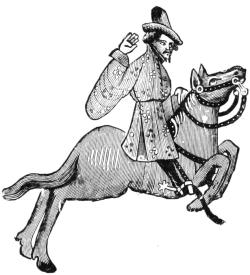
THE MERCHANT
From the Ellesmere MS. of Chaucer’s Canterbury Tales.
The methods of repayment by the King were various. The creditors received
a bill upon the Exchequer or the Keeper of the Wardrobe; an assignment of a
branch of the revenue—thus 27 Ed. I., the whole revenues of Ireland were assigned
to the Frescobaldi of Florence in payment of a loan of £11,000; or the proceeds of
a subsidy were given—thus 8 Ed. I., the proceeds of a fifteenth were assigned to the
Italian merchants; or they took over the customs; or they received an addition to
the principal large communal privileges; or they received offices of dignity and
profit: they collected the customs; they took charge of the Mint; they were
ambassadors. In the year 1294 there were twelve Florentines holding the title of
ambassadors from throne states of Europe.
Among the companies which lent money to English kings in the thirteenth and
fourteenth centuries were the Muzzi of Florence, the Company of Jacopo Brabazen of
Sienna, the Bardi of Florence, the Ammanati of Pistoia, the Circuli Nerci and the
Circuli Bianche of Florence, the Company of the Sons of Beccori of Lucca, the Palci
of Florence, the Riccardi of Lucca, the Spini of Florence, the Company of Bestre
of Lucca, the Scali of Florence and the Peruzzi of Florence, besides the Frescobaldi
of Florence already mentioned. (See Appendix III.)
Enormous sums were advanced by these companies and repaid, during these
two centuries. In 1254 Henry III. was called upon by the Pope to pay the sum of
130,541 marks sterling for expenses connected with the business of Sicily. Between
the years 1295 and 1309 the Frescobaldi received of Edward I. and Edward II. the
sum of £100,000. On the accession of Edward II. he had to pay, on account of his
father’s debts, the sum of £118,000 and on his own account £28,000.
If, however, the Italians made immense profits out of the English kings
retribution fell upon them, because the English King caused their ruin. Giovanni
Villani tells the story:—
“At the period of the war between the kings of France and England, the
companies of the Bardi and Peruzzi, of Florence, were the King of England’s
merchants. All his revenues and wools came into their hands, and they furnished
from them all his expenses. But the expenses so much exceeded the revenues
that the King of England, when he returned home from the war, found himself
indebted for principal, assignments, and rewards, to the Bardi more than 100,000
marks sterling, and to the Peruzzi more than 135,000 marks. Of these sums a
considerable portion consisted in assignments which the King had made to them
in times passed: but they were rash enough, whether from covet of gain or led on
by the hope of recovering the entire debt, to give them up, and entrust all their own
property and that of others in their keeping, to this one prince. And observe, that
a large part of the money they had lent was not their own capital, but had been
borrowed by them or received on trust from fellow-citizens and strangers. And
great danger thence accrued both to them and to the city of Florence. For not
being able to answer the calls of their creditors in England and Florence, and
elsewhere, where they trafficked, they lost their credit on all sides, and became
bankrupts; and especially the Peruzzi. Yet they avoided complete ruin by their
possessions in the city and territory of Florence, and by the great power and rank
which they held in the republic. This failure, and the expenses of the state in
Lombardy, greatly reduced the wealth and condition of the merchants and traders of
Florence, and of the whole community. For the Bardi and Peruzzi had held so
large a share of the commerce of Christendom, that upon their fall every other
merchant was suspected and distrusted. Our city of Florence, in consequence,
received a shock, such as had not been experienced before for many years. But, to
add to the reverses of these companies, the King of France caused them and other
Florentines throughout his dominions to be pillaged of all their merchandise and property,
both on account of the bankruptcy and because we had been obliged to borrow
money of his subjects, to expend on our affairs in Lombardy and Lucca: and this
caused the ruin of many other smaller companies of Florence, as we shall afterwards
make mention.” (Archæologia, XXVII.-XXVIII. pp. 259-260.)
The power of the Caursini thus received a check from which it never recovered.
Italian merchants, however, continued to reside in London, and to trade there. A
curious story is told by Thomas of Walsingham, and repeated by Stow, of a
Genoese merchant resident in the City. He is said to have proposed that if the
King would erect a castle at Southampton, he would make that place the principal
Port in the Kingdom, and the resort of foreign merchants from all parts. Some of
the merchants of London, however, apprehensive of their own interests, caused the
unfortunate Genoese to be murdered—for which crime one of them, John Kirby,
was executed.
One more story, of a later period, illustrates the still lingering hatred of the
Italians. I give the story in the words of Stow:—
“In the moneth of Maye, an Italians servaunte walkyng throughe Cheape of London, wyth a dagger
hangyng at hys gyrdle, a Merchauntes servaunt that before tyme had bin in Italy and there blamed for
wearing of the like weapon, chalenged the straunger, howe hee durst be so bolde to beare weapon,
consydering he was out of hys Countrey, knowyng that in hys Countrey no straunger was suffered to wear
the like. To the which question such answere was made by the straunger, that the Mercer toke from him
hys dagger and brake it upon his heade, whereupon the stranger complayned to the Maior, who on the
morrow sent for the yong man to the Guilde Hall: wherfore after his aunswere made unto the complaynt,
by agreemente of a full Courte of Aldermen, he was sent to ward, and after the Court was finished, the
Maior and Sherifes walking homewarde thoroughe Cheape, were there mette by suche a number of
Mercers servauntes and other, that they mighte not passe, for ought they coulde speake or doe, till they
hadde delivered the young manne that before was by them sente to prison. And the same daye in the
afternoone sodainely was assembled a multitude of lewde and pore people of the City, which without heade
or guide ranne unto certaine Italians houses, and especially to the Florentines, Lukesses and Venetians,
and there toke and spoyled what they found, and dyd great hurt in sundry places, but moste in foure
houses standing in Breadstreete warde, whereof three stoode in Saint Bartholmewes Parishe the little, and
one in the Parish of Saint Benits Finke. The Maior, Aldermen and worshipful Commoners of the Citie,
with all theyr diligence resisted them what they coulde, and sente diverse of them to Newegate: and
fynallye, not without shedding of bloude and mayming of diverse Citizens, the rumour was appeased.
The yong manne beginner of all thys businesse, tooke Sanctuarie at Westminster, and not long after the
Duke of Buckingham with other noble menne were sente from the kyng into the Cytie, who there charged
the Maior by Vertue of a Commission, that inquirie shoulde bee made of thys ryot, and so called an Dyer
determyner at the Guilde Hall, where satte for Judges the Maior, as the kyngs Lieuetenaunte, the Duke
of Buckingham on hys ryghte hande, the chiefe Justice on the lefte hande, and manye other men of name,
where whyle they were enpanelyng theyr inquestes, the other Commons of the Citie manye of them
secretly putte them in armour, and ment to have roong the common bell, so to have raysed the whole
force of the Citie, and to so have delivered such persons as before for the robberie were committed to
ward. But this matter was discretely handled by the counsel and labour of some discrete Commoners,
which appeased their neighbours in such wise, that all this furie was quenched: but when worde was
brought to the Duke of Buckingham, that the commonaltie were in harnesse, he with the other Lordes
tooke leaue of the Maior and departed, and so ceased the inquirie for that day. Upon the morrow the
Maior commaunded the common Counsell with the Wardens of fellowships to appeare at the Guild Hall,
where by the Recorder in the King’s name and the Maior’s, was commaunded every Warden, that in the
afternoone eyther of them should assemble his whole fellowship at their common Halles, and there to give
straight commaundement, that every man see the king’s peace kept within the Citie. After which time the
Citizens were brought to such quietnesse, that after that day, the enquirie was duly perused, and iij persons
for the said ryot put in execution and hanged at Tyborne, whereof ij were Sanctuarie men of Saint
Martins le graunde, the other a shipman, for robbing of Anthony Mowricine and other Lumbardes.”
(Stow’s Chronicle.)