WISE MEN—AND OTHERS
THE ALCHEMISTS
 he cyclic tendency so obvious in Nature is not least notable in the
domain of knowledge. The discovery of one era is lost in the next, only to
reappear at a later day, welcomed as a triumph of modern ingenuity or
science. In maps of three centuries ago the Nile is shown rising from
great lakes, but in the atlases that our fathers used the lakes have
vanished and a range of imaginary mountains lies like a little woolly
caterpillar in the heart of Africa as the source of the Nile, only to be
replaced once more in our own days by the great lakes. Dragons, after
being commonplaces of ancient time, fell into undeserved contempt, their
very existence denied by a sceptical generation, and have only been
rescued and rehabilitated in recent years by men of science, who, ashamed
to admit that they have found the fabulous monsters of faery, have
disguised them in polysyllabic nomenclature of ‘saurus.’ The ‘travellers’
tales’ of old Herodotus, scoffed at by the superior minds of the
unimaginative Victorian era, are daily gaining acceptance; King
Chedorlaomer and other worthies, who, after centuries of blameless
biblical existence, were conclusively demolished by the High German
Critics, have reappeared on contemporary tablets of imperishable clay
unkindly disinterred by archæological explorers; and, in more mundane
matters, the very latest developments of sanitary science prove to have
been anticipated by a trifle of sixty centuries in the palaces of Crete.
he cyclic tendency so obvious in Nature is not least notable in the
domain of knowledge. The discovery of one era is lost in the next, only to
reappear at a later day, welcomed as a triumph of modern ingenuity or
science. In maps of three centuries ago the Nile is shown rising from
great lakes, but in the atlases that our fathers used the lakes have
vanished and a range of imaginary mountains lies like a little woolly
caterpillar in the heart of Africa as the source of the Nile, only to be
replaced once more in our own days by the great lakes. Dragons, after
being commonplaces of ancient time, fell into undeserved contempt, their
very existence denied by a sceptical generation, and have only been
rescued and rehabilitated in recent years by men of science, who, ashamed
to admit that they have found the fabulous monsters of faery, have
disguised them in polysyllabic nomenclature of ‘saurus.’ The ‘travellers’
tales’ of old Herodotus, scoffed at by the superior minds of the
unimaginative Victorian era, are daily gaining acceptance; King
Chedorlaomer and other worthies, who, after centuries of blameless
biblical existence, were conclusively demolished by the High German
Critics, have reappeared on contemporary tablets of imperishable clay
unkindly disinterred by archæological explorers; and, in more mundane
matters, the very latest developments of sanitary science prove to have
been anticipated by a trifle of sixty centuries in the palaces of Crete.
So with Alchemy. The transmutation of the base into the noble, above all
of the baser metals into gold, was accepted as feasible from the earliest
historic times until the seventeenth century. Then the spread of printing
enabled so many votaries of the science to publish their ideas and
theories that all belief in Alchemy was swept away by the flood of
mystical nonsense, but now science is back on the threshold of the
knowledge of transmutation. The old alchemists seem to have based their
theories on the belief that all metals, and indeed all matter, contained
one common element, of which the purest and most perfect form on this
earth was gold. This theory was knocked on the head when scientists
discovered the Atomic Theory. Proof positive was adduced that certain
substances, such as gold and silver, were elements, and that elements
consisted simply and solely of agglomerations of indivisible atoms, each
of which possessed the characteristics of its particular element. In other
words, Gold was Gold and Silver was Silver, and there was an end to it.
But now the indivisible atoms are beginning to fly in pieces before the
skilful and remorseless attack of modern scientists, and it will be no
surprising thing if we live to see the ‘elements’ of our schooldays
reduced to combinations of two or three Primary Elements, even if the
Primordial Element, the great First Cause, is not weighed, measured, and
photographed. If, then, gold and silver can be split into the same
constituents it might well be possible to recombine those constituents in
such manner that the silver should become gold and the gold silver. To the
scientific mind the two transmutations would be of equal value, but to the
philosopher aiming ever at perfection, and to the sordid speculator,
aiming ever at profit, the production of gold from the baser metal has
always been the goal.
We naturally hear little of mediæval alchemists in the legal records.
Their proceedings were inoffensive and little calculated to bring them
within the jurisdiction of any court, except possibly that of bankruptcy.
One of the scarce exceptions of this rule of silence occurred in 1463,
when Edward IV. granted to Sir Henry Grey of Codnor in Derbyshire,
authority to labour by the cunning of philosophy for the transmutation of
metals, with all things requisite to the same, at his own cost, provided
he answer to the King if any profit grow therefrom. The terms of the grant
can scarcely be called liberal. Two years later the King decided that Sir
Henry had had sufficient time for his experiments and called upon him to
render an account of his gains. The philosopher, who had probably very
little to account for, did not appear and his case was postponed from term
to term for five years. At last a date was fixed for him to appear in
court in the middle of October 1470, ‘but before that date the Lord King,
certain necessary and urgent causes moving him, made a journey from his
realm of England to foreign parts, leaving no regent or guardian in the
same realm, wherefore the Barons of the Exchequer did not come to hear
pleas.’ Reading the courtly sentence it is hard to realise that on the
3rd of October King Edward had, in the words of Speed, ‘fled from his host
besides Nottingham, passing the Washes towards Lynne, with greater
difficulties than was befitting a Prince to adventure, and thus without
any order taken for his Realme, in two Hulkes of Holland and one English
ship, destitute of all necessary provisions, set sail towards Burgundy,
and in the way was encountered by the Easterlings, England’s great
enemies, having much adoe to clear himself of their surprize.’ The politer
version of the legal roll has been written over an entry which, although
completely erased, we may be sure set out how Henry VI. had recovered the
realm from Edward, ‘king in fact but not in right.’ The alchemy of the
pen, by which the roseate Lancastrian version faded to the colourless
statement of the Yorkists, was more successful, we may well believe, than
was ever the alchemy of Sir Henry Grey.
But in spite of the ill-success of Sir Henry Grey the King in 1476
licensed David Beaupee and John Merchaunt to practise for four years ‘the
natural science of the generation of gold and silver from mercury.’
Alchemy, indeed, was clearly flourishing in the fifteenth century. In 1468
Richard Carter received authority to practise the art, while under Henry
VI. several such licences were granted. Thus in 1444 Edward Cobbe was
authorised ‘to transmute the imperfect metals from their own kind by the
art of Philosophy and to transubstantiate them into gold or silver’; two
years later Sir Edmund Trafford and Sir Thomas Ashton were empowered to
transmute metals, and in 1446 John Fauceby, John Kirkeby, and John Rayny
received the royal permission to search for the philosopher’s stone or the
elixir of life and to transmute metals. Presumably the need for royal
licence in all these cases was based on the royal claim to all mines, and
therefore to all other sources, of precious metals. Covetous eyes had been
cast upon Alchemy as a possible source of revenue at least as early as
1330, when Thomas Cary was ordered to bring before King Edward III. John
le Rous and Master William de Dalby, who were said to be able to make
silver by alchemy, with the instruments and other things needful to their
craft. But of all these scientists and philosophers no more is heard, and,
although I have not searched the accounts of bullion purchased for the
Mint, it may safely be asserted that the revenue profited little by all
their science and philosophy.
Alchemy, like so many other branches of knowledge, found a home in the
monasteries, and there is a story of an abbot in one of the Western
Counties who, at the time of the Dissolution, hid his books and
manuscripts of the hermetic art in a wall, and returning thither to fetch
them found them not, and for grief at his loss lost also his wits. Thomas
Ellis, again, prior of Leighs in Essex, took more loss than gain from
dabbling in the art. Rumours of his skill in manipulating metals caused
him to be suspected of coining, and he had to give an account of himself.
His interest in the theory of Alchemy, which he had derived from reading
books, had been stimulated by ‘commynyng with Crawthorne, a goldsmyth in
Lumbardstrete, that sayd ther was a prest callyd Sir George that made
himselfe cunning in suche matters.’ This priest in turn introduced the
prior to one Thomas Peter, a clothworker of London, ‘that sayd he had the
syens of alkemy as well as eny man in Yngland.’ The prior took him at his
own valuation and promised to pay him £20 for lessons in the art, and gave
him 20 nobles in advance. Master Peter then gave his pupil some silver and
quicksilver with instructions how to treat them. These metals Prior Ellis
sealed hermetically in a glass vessel, which he then placed in an earthen
pot full of water, and this he kept hot for some ten weeks or more,
employing a young novice of the priory, Edmund Freke, a boy of twelve, to
keep up a continual fire. Master Peter came from time to time to see how
matters were progressing, and no doubt reported favourably, but after a
while the prior ‘perceyved yt was but a falce crafte,’ broke the glass
vessel, sold the silver for what it would fetch and refused to pay his
instructor the remaining 20 marks. Peter, however, who was better skilled
in making money out of men than gold out of silver, threatened an action
for debt, and as it chanced that an offer of 20 marks was made at this
time to the prior for the lease of a rectory he handed the money over to
Master Peter. ‘And thus I never medelyd with hym syne, nor with the crafte
nor never wyll, God wyllyng.’
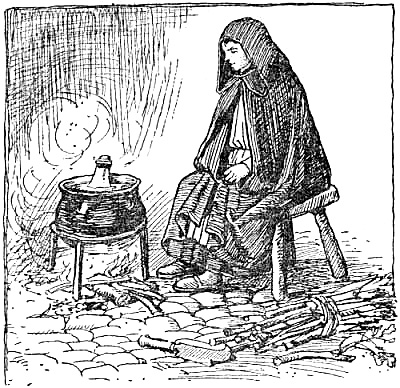
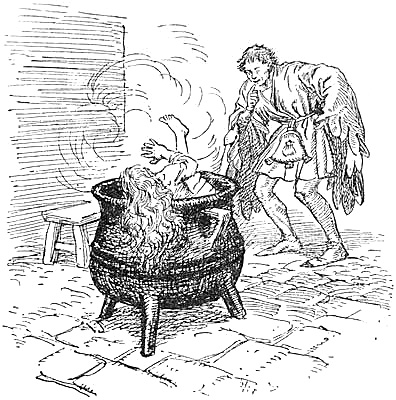
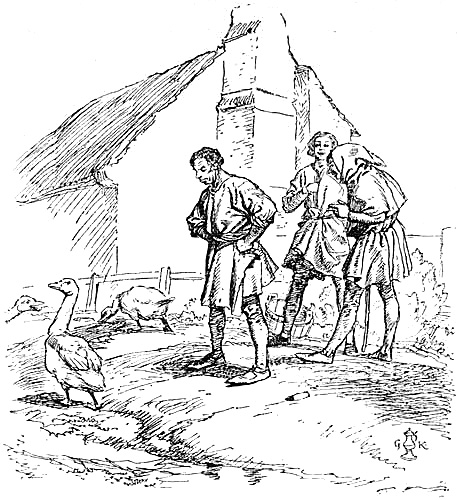
‘A young novice of the priory.’
WHITE MAGIC
Before the days of Sherlock Holmes and the scientific pursuit of clues the
ways of tracing lost or stolen property were devious and varied. In recent
times the aid of St. Anthony of Padua has often been invoked. Why that
good Saint should have taken up this branch of detective work I know not;
possibly he was confused with his namesake the hermit, whose pig might
well have been trained to search for lost articles as less holy pigs to
hunt for truffles, or possibly, as was said of the man who married five
wives, ‘it was his hobby.’ However this may be, I have known excellent
results obtained by the promise of a candle or the repetition of a
paternoster in honour of St. Anthony; the prayer is the more popular
offering, being cheaper for the petitioner and more certain for the
saint—the candle is apt to be withheld when the property has been
recovered, and candles have even been known to go astray and blaze before
the altar of the other St. Anthony, who was probably too busy in
pre-Reformation days looking after the cattle of his devotees to trouble
about lost property. The man, therefore, who would have supernatural
assistance in the recovery of his strayed goods had perforce to seek the
aid of sorcerers and their familiar but often incompetent spirits.
Unfortunately for the modern inquirer no unsolicited testimonials bearing
witness to the efficacy of these magicians appear to have survived, and it
is only their failures that brought them into unpleasant and enduring
prominence.
London was naturally a great centre of these occult detectives, and they
seem to have been well patronised. In 1390 when two silver dishes were
stolen from the Duke of York’s house, application was made to one John
Berkyng, a renegade Jew, who performed certain incantations, and as a
result accused one of the Duke’s servants, William Shadewater. In the
same way, when Lady Despenser’s fur-lined scarlet mantle was stolen, about
the same time, Berkyng had no hesitation in denouncing Robert Trysdene and
John Geyte. His repute was no doubt considerable, but these two cases
proved disastrous; the parties accused had him arrested, and he was found
guilty of deceit and defamation, stood in the pillory for an hour, and was
then banished from the city.
In this case nothing is said as to the means of divination employed, but
in two cases that occurred in London in 1382 particulars are given. When
Simon Gardiner lost his mazer bowl he employed a German, Henry Pot by
name, to trace it. He made thirty-two balls of white clay, and after
appropriate incantations named Nicholas Freman and Cristine, his wife, as
the thieves. Here again the mistake brought the magician to the pillory,
and the same fate befell Robert Berewold. In this case also it was a
mazer that had been stolen; Maud of Eye was its owner, but a friend of
hers, one Alan, a water carrier, who had evidently a high opinion of
Robert’s power, called him in. Robert then took a loaf and fixed in the
top of it a round peg of wood and four knives at the four sides of the
same, in the shape of a cross; his further proceedings are vaguely
described as ‘art magic,’ and resulted first in the accusation of Joan
Wolsey and eventually in the appearance of Robert Berewold in the pillory
with the loaf hanging round his neck.
The connection between mazers and magic is not obvious, but in 1501 when
John Richardson, a parish clerk, lost a mazer worth 26s. he at once
sought the assistance of Nicholas Hanwode, ‘bringing with him divers young
children for to behold in a looking-glass.’ The record is damaged, but is
sufficiently legible to show that the victim was arrested and imprisoned
by the mayor and could only invoke the intervention of the Court of
Chancery against his accusers. In this last case we have clearly an
instance of divination by the glass, crystal, or similar medium—a pool of
ink was used, if I remember right, by the Indians in The Moonstone. The
loaf and knives seem vaguely familiar to me as instruments of divination,
though I should be puzzled to give the correct ceremonial, but the
thirty-two clay balls are more difficult to place, unless possibly they
were used for the construction of some kind of geomantic figure.
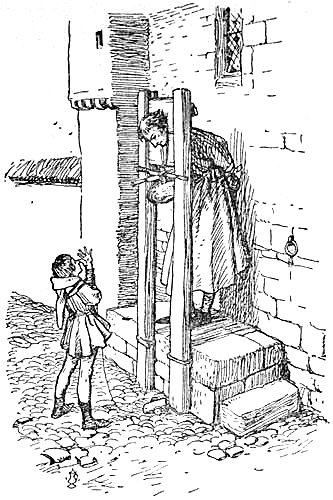
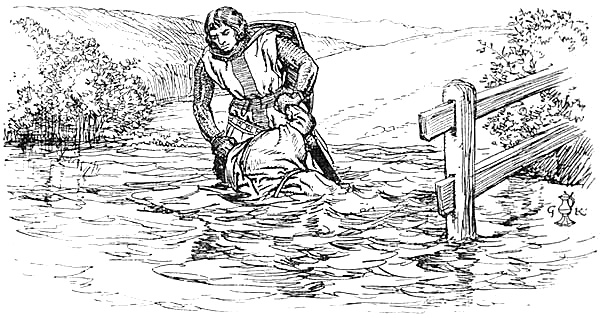
Robert Berewold in the pillory.
So far we have been dealing with genuine, if inaccurate, magicians, but a
case that occurred in London in 1382 shows that there were impostors even
in that learned profession. Mistress Alice Trig having lost her Paris
kerchief suspected Alice Byntham of having stolen it, and apparently not
without good reason. The two women seem to have been fairly intimate, and
Alice Byntham went to a cobbler, William Northamptone, and gave him
information of certain very private matters concerning the other Alice.
William then went round to Mistress Trig and posed as a wise man, which he
may have been, skilled in magic, which he was not, and revealed to her his
knowledge of her private affairs. She, being duly impressed, asked him who
had stolen her kerchief, to which he replied, whoever it was it certainly
was not Alice Byntham, and launching out rashly into prophecy told his
questioner that she would be drowned within a month. The dismal prospect
almost terrified her into an early grave, but in the end she survived to
see William standing in the pillory.
A case that is recorded in Lincolnshire in the sixteenth century is
interesting as showing the more than local reputation enjoyed by some of
these cunning men. The church of Holbeach having been robbed, the
parishioners consulted their fellow-townsman John Lamkyn, a man known to
have ‘resonable knowledg in the sciens of gramer,’ which he taught to the
children of the neighbourhood, and said to have a knowledge not so
reasonable of such arts as enchantment, witchcraft, and sorcery. He, at
the request of the churchwardens, went off to consult Edmund Nash, a
wheeler, famed as ‘an expert man in the knowleg of thynges stolen,’ who
lived at ‘Cicestre,’ which may have been either Chichester or
Cirencester, as it is called in one place ‘Chechestre’ and in another
‘Circetter,’ but was in any case a very long way off. Lamkyn took with him
a pair of leather gloves found in the vestry after the robbery, and Nash
made certain deductions therefrom, which caused suspicion to fall upon
John Partridge, who complained that he had lost friends and reputation and
been ‘brought into infamy and slander and owte of credenz.’ Lamkyn’s
version of the story made out Nash to be merely a private detective
following up clues without recourse to magic, and also hinted that
Partridge’s reputation was no great loss. There is as little reason to
believe one as the other.
Probably the most popular method of ascertaining the whereabouts of lost
property and the identity of the thief was by the use of astrology. Some
years ago, when I was in one of those bookshops in which at that time I
spent much of my spare time and all of my spare money, I was offered a
manuscript volume, formerly the property of William Lilly, in which that
famous but shifty astrologer had recorded some scores of investigations
made by him for clients and mostly concerned with the recovery of stolen
goods. The figures were neatly drawn up, and the interpretation written
below, but, if my memory serves me, there was nothing to show in how many
cases the investigations led to any practical result. There are, I
believe, two similar volumes in the Bodleian, but what became of this
particular copy I do not know; whether it was due to the unfair incidence
of taxation under the budget of that year or to more permanent causes, my
funds did not permit of its acquisition, and I left it sorrowfully in
company with a much-desired Augsburg Missal and Pine’s edition of
Horace—the rare edition of the ‘post est’ blunder. I did, however,
secure Fludd’s Macrocosm, by aid of which I might myself, if time and my
mastery of the movements of the whirling spheres permitted, open a branch
of the heavenly Scotland Yard.
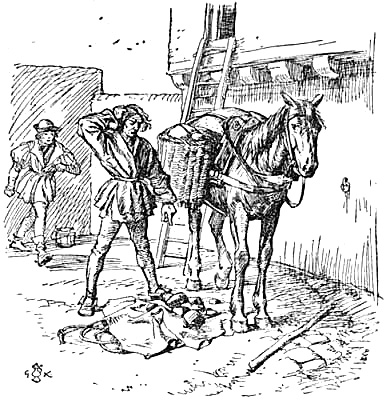
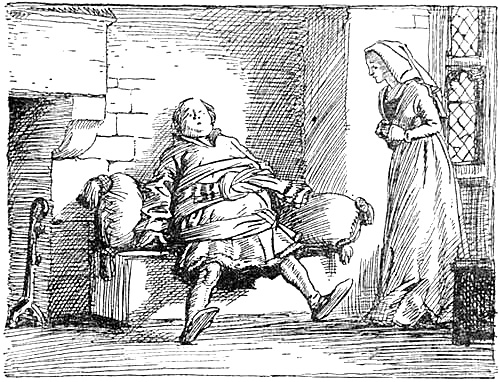
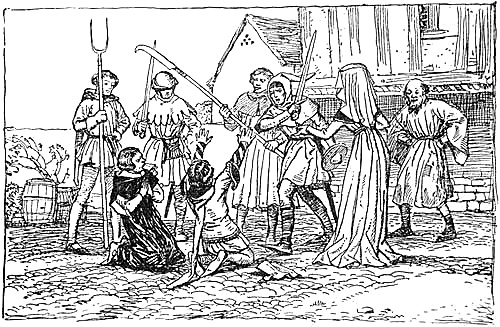
‘... sware “gret othes” and took himself by the hair.’
The early astrologers, thanks to the cautious vagueness of their
statements, seem to have avoided the clutches of the law, into which other
magicians fell. The stars reveal no names, recording only, by an
anticipation of the Bertillon procedure, the measurements and physical
peculiarities of the thieves. If from these particulars the querent jumps
to a false conclusion and accuses the wrong man, so much the worse for
him—the stars and their interpreters are not to blame. No one said hard
words of the London astrologers whom Robert Cooke consulted. Cooke was a
carrier from Kendale who came south in 1528 with £30 in money, much of it
belonging to other men, in a ‘bogett,’ and put up at John Balenger’s house
in St. Ives. During the course of the day he opened his packs, bought and
sold and drank with his customers, allowing a number of people in quite a
casual way to feel the weight of his ‘bogett,’ but not opening it. It was
late that night before they got to bed at John Balenger’s, for ‘it was
ten of the clok or they went to soper, for as much as every man pakked up
his wares or they sooped,’ and when they went up to their rooms the house
was apparently pretty full, as Cooke shared a bed with John Foster, a
draper, and there were others in the same chamber. Next morning, as they
were putting their packs on their horses, Cooke suddenly noticed that one
of his packs was fastened with a different kind of knot from that which he
used. Thereupon he suddenly exclaimed, ‘My pak is wrong knyt, by the
passhion of God, sith yesternight,’ and opening it took out the precious
‘bogett’ and found it full of stones. So he sware ‘gret othes’ and took
himself by the hair and altogether carried on mightily, and finally ‘made
his advow that he would never ete fisshe ne fleissh until he had been at
Saint Rynyons in Scotland if he might here of his goodes.’ Then, with his
bed-companion of the previous night, he rode over to Cambridge ‘to make
calculacion for the said goodes,’ but at that seat of learning ‘they coude
find noo clerk or other person that wold take on hand to calcle for the
said money.’ However, when Robert Cooke got to London he had no difficulty
in finding astrologers, who expressed the utmost confidence in their
ability to ‘calcle,’ and told him that ‘he shulde by the crafte of
astronomye, if he wold, have hys eye or arme or other joynte of hys body
thatt hadd robbed hym, att hys pleasure.’ This ferocious promise, it may
be pointed out, merely meant that the astronomer could give a description
of any particular physical traits necessary to indentify the robber. In
this particular instance the description was that of a fair man with large
eyes, hair neither curly nor straight, and a large nose, of medium height,
good looking, with a bright expression, and having one or more black
teeth. This elaborate account the astronomer, with becoming modesty, had
submitted to the judgment of others more learned and experienced than
himself, and they guaranteed its accuracy. It was found to correspond with
the appearance of John Balenger the younger, son of Cooke’s host, except
that the latter ‘hath no blak toth in his hed as yt apperith iff ony lust
to serch therfor,’ and in order to prove this ‘the said John Balenger was
caused to sytte down and in large wyse to gape and open his jowes to be
duely seen ... and after due serch therin made yt appeared that the said
John had alle his teth whyte and in good maner proporconed.’ Adding to
this the fact that he was ‘callid a good young man and wele ruled, not
slaundered neither with dicyng, carding ne other misrule,’ and the rather
suspicious circumstance that the biggest stone found in Cooke’s ‘bogett’
after the supposed robbery was a piece of ironstone of a kind not found
within forty miles of St. Ives but very plentiful in Kendale, it is not
surprising that the magistrates should have dismissed the case against the
younger John Balenger. After all, a black tooth is like a finger-tip
print—damning evidence if present but powerful for acquittal if absent,
and who is a Justice of the Peace that he should contradict Jupiter?
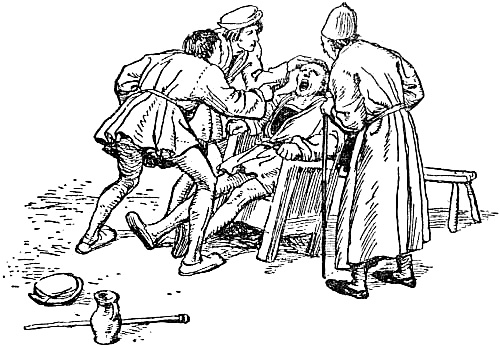
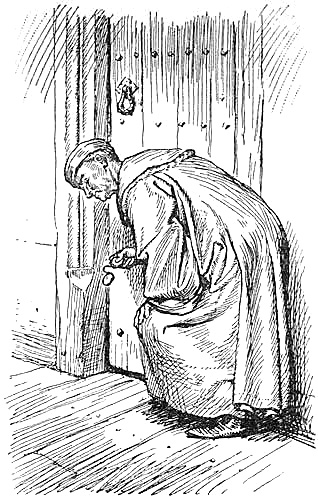
‘... caused to sytte down and in large wyse to gape.’
BLACK MAGIC
Considering how large a part magic and the supernatural played in the life
of the people in the Middle Ages it is curious that there should be so few
references thereto in the English judicial records prior to the
Reformation. The ancient chroniclers and historians enlivened many a dull
page with the most astonishing tales of sin and mystery, vouched for on
the testimony of their own eyes or of unimpeachable witnesses, but the
chains of legal evidence are as powerless to bind these legendary
sorcerers as were the triple chains of iron to bind the famous Witch of
Berkeley. With the exception of general vague accusations of witchcraft
levelled against the Lollards and kindred heretics, references to magic
are casual and rare in the records of our courts.
With the reign of Elizabeth this ceases to be true, and from the middle of
the sixteenth century to the end of the seventeenth the Black Arts
attracted their full share of judicial and magisterial attention. Probably
twenty instances of legal proceedings taken in connection with these
‘ungodly practices’ could be produced after the Reformation for every one
prior to that date, and while this is in part due to the fact that local
records of the later periods have survived in far greater number than
their predecessors, there is a possibility that post hoc is in the case
also propter hoc. It is arguable that the Reformation having abolished,
for all practical purposes, belief in the miracles of God and His saints,
the natural craving of the unscientific man for a supernatural explanation
of the abnormal could only be satisfied by a belief in the miracles of the
Devil and his sinners. Be that as it may, the fact remains that after the
Reformation witches and warlocks became as common as holy nuns and
anchorities had once been—the marvels reported of the one class are about
as unsatisfactory from a scientific point of view as those of the other.
It is, however, with a few chance references of earlier date that I am
concerned.
Suitably enough it is from the land of ‘Cunning Murrell’ that my earliest
instance comes. The Sheriff of Essex in 1169 made a note of having
expended 5s. 3d. on ‘a woman accused of sorcery.’ The record is brief
and unsatisfactory, telling neither the details of the offence, the method
of trial, nor the result. These two last items we get in another case
which occurred in Norfolk in 1208, when Agnes, wife of Odo the merchant,
appealed a certain Galiena for sorcery, and Galiena successfully cleared
herself by the ordeal of the hot iron. For a century after this any
magical offenders who may have been brought to trial have eluded my
search. Then in 1308 began the proceedings against the Knights Templars,
based very largely on accusations of practising Black Magic. In England,
however, nothing of the kind was even held to have been proved against the
knights, although not only ‘what the sailor said’ was considered to be
evidence, but also what the clerk thought the priest said the soldier
heard the sailor say.
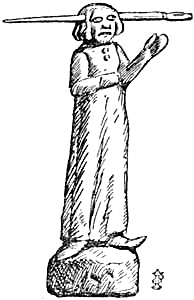
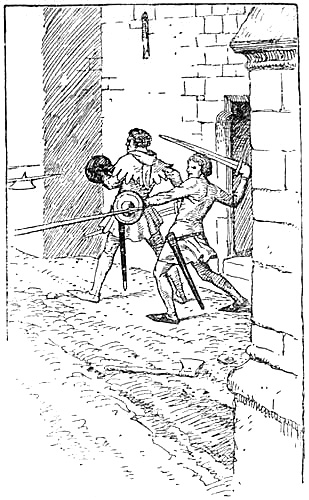
‘... thrust a leaden bodkin into
the head of that image.’
It is rather remarkable that the year 1324, in which the great Irish trial
of the Lady Alice Kyteler took place, was the date of the fullest and in
many ways the most interesting of the early English trials for sorcery. In
that year Robert Marshall of Leicester, under arrest for a variety of
offences, endeavoured to save his own neck by turning King’s evidence and
accusing his former master, John Notingham, and a number of Coventry
citizens of conspiring to kill the King, the two Despensers, and the Prior
and two other officials of Coventry by magical arts. Marshall’s tale was
to the effect that the accused citizens came to John Notingham, as a man
skilled in ‘nigromancy,’ and bargained with him for the death of the
persons named, paying a certain sum down and giving him seven pounds of
wax. With the wax Notingham and Marshall made six images of the proposed
victims and a seventh of Richard de Sowe, the corpus vile selected for
experimental purposes. The work was done in secret in an old deserted
house not far from Coventry, and when the images were ready the magician
bade his assistant thrust a leaden bodkin into the head of that image
which represented Richard de Sowe, and next day sent him to the house of
the said Richard, whom he found raving mad. Master John then removed the
bodkin from the head of the image and thrust it into the heart, and within
three days Richard died. And at that point Robert Marshall’s story comes
to a lame and impotent conclusion. Not a word of explanation does he give
as to why, when the preliminary experiment had proved so successful, they
did not go on with their fell design. The unfortunate ‘nigromancer’ died
in prison before the case had been thrashed out and reported upon by a
jury, and the case against the citizens was allowed to fall through. Even
if the trial had followed its normal course it is not probable that we
should have had more than a plain and enlightening verdict of ‘not
guilty,’ for Robert Marshall was a liar of inventive genius. He accused
two men of assisting him in the robbery and murder of a merchant from
Chester ‘in Erlestrete, Coventry, near the white cellar,’ with a profusion
of ‘corroborative detail, intended to give artistic verisimilitude to an
otherwise bald and unconvincing narrative,’ which proved, as he afterwards
admitted, utterly false. One or two other wild accusations also came to
nothing, and Robert was duly hanged. But while we cannot say that the
procedure he described was actually used in this case, we know it was
quite in accord with the orthodox methods of magicians. That the story was
believed at the time we may conclude, as the younger Despenser wrote this
year to the Pope complaining that he was threatened by magical and secret
dealings. The Pope, with much good sense, recommended him to turn to God
with his whole heart and to make a good confession and such satisfaction
as should be enjoined upon him; adding that no other remedies were
needful.
Passing again over a century we find in 1426 William, Lord Botreaux,
complaining that Sir Ralph Botreaux, William Langkelly, and others,
‘unmindful of the salvation of their souls and not having God before their
eyes,’ had procured John Alwode of Trottokeshull, Hugh Bower of
Kilmington, chaplain, and John Newport, who were said to practise
soothsaying, necromancy, and art magic, ‘to weaken, subtly consume, and
destroy by the said arts,’ the complainant’s body. Commissioners were
appointed to inquire into the matter, but any further proceedings that
there may have been have vanished, or at best are lying hid in some
unsuspected corner of the Record Office.
Another instance of the use of magical ceremonies with evil intent is
alluded to fifty years later, when John Knight, chaplain, complained that
he had been arrested and committed to the Marshalsea for going with the
servants of ‘the Lord Straunge’ to search the house of Alice, wife of John
Huntley, ‘which of long tyme hath used and exercised the feetes of
wychecraft and sorcery,’ in Southwark. They went into ‘an house called the
lasour loke in Suthwerk in Kenstrete’ (a hospital founded originally for
lepers, but by this time used more as an almshouse or infirmary) ‘and
there found dyvers mamettes for wychecraft and enchauntements with other
stuff beryed and deeply hydd under the erthe.’ The circumstances are very
similar to those related in the case of an old woman turned out of the
almshouses at Rye in 1560 for using magical ceremonies, including the
burial of pieces of raw beef, to the intent that as the beef decayed away
so might the bodies of her enemies, though it is possible that in the case
of Alice Huntley the objects had only been buried for secrecy.
Five-and-twenty years later, in 1502, a still clearer case of the use of
‘mamettes’ or images occurred in Wales. The bishop of St. Davids, having
vainly remonstrated with Thomas Wyriott and Tanglost William for living
‘in advoutre,’ imprisoned the woman Tanglost and afterwards banished her
from the diocese. She went to Bristol, and hired one Margaret Hackett,
‘which was practized in wychecraft,’ to destroy the bishop. Tanglost and
Margaret then went back to Wyriott’s house, and in a room called, most
unsuitably, Paradise Chamber, made two images of wax, and then, possibly
thinking that a bishop would take more bewitchment than an ordinary
mortal, sent for another woman, ‘which they thought cowde and hadde more
cunning and experiens than they,’ and she made a third image. The bishop
was not a penny the worse for this ‘inordinat delying,’ but ordered the
arrest of Tanglost for heresy; Wyriott intervened by getting her
imprisoned through a trumped-up action for debt, in order to keep her out
of the bishop’s clutches, and the bishop had to invoke the assistance of
the Court of Chancery.
Three cases of magic occurred in 1432. On May 7 of that year an order was
issued for the arrest of Thomas Northfelde, D.D., a Dominican friar of
Worcester, and the seizure of all his books treating of sorcery or
wickedness, and two days later Brother John Ashwell of the Crutched
Friars, London, John Virley, priest, and Margery Jourdemain, who had been
imprisoned at Windsor for sorcery, were released. In these cases it is
very likely that the sorcery consisted in an uncanny and suspicious
addiction to unusual branches of learning, combined possibly with
experiments in chemistry or heretical tendencies, both alike dangerous in
the eyes of the orthodox, but the third case was clearly a matter of
bewitchment—in the opinion of the victim. The facts are quite simple.
John Duram of York had a field with a pond in it, and having in some way
incurred the enmity of Thomas Mell, a farmer, the latter, ‘per divers
artes erroneous et countre la foy catholice cest assavoir sorcery,’
withdrew the water from John’s pond, to the great injury of his cattle,
besides certain other unnamed injuries wrought by his ‘malveys ymaginacion
et sotell labour.’ Mell being under the patronage of men of influence
because of his magical abilities, Duran did not dare to bring an action
against him in the ordinary court, and therefore sought the intervention
of the Court of Chancery, with what success I do not know.
So far my magicians, it must be admitted, have been rather commonplace
people, proceeding on the usual lines of their craft and displaying little
originality, but my final instance is, so far as I know, unique. In an
eighteenth-century manuscript in my possession, formerly in the Phillipps
collection, amongst a mass of extracts from all kinds of records is an
entry said to be taken from the court rolls of the manor of Hatfield in
Yorkshire. According to this, at a court held in 1336 Robert of Rotheram
brought an action against John de Ithen for breach of contract, alleging
that on a certain day, at Thorne, John agreed to sell him for
threepence-halfpenny ‘the Devil bound with a certain bond’ (Diabolum
ligatum in quodam ligamine), and Robert thereupon gave him ‘arles-penny,’
or earnest-money (quoddam obolum earles), ‘by which possession of the
said Devil remained with the said Robert, to receive delivery of the said
Devil within four days,’ but when he came to John the latter refused to
hand over the Devil, wherefore Robert claimed 60s. damages. John
appeared in court and did not deny the contract, but the steward, holding
that ‘such a plea does not lie between Christians,’ ‘adjourned the parties
to Hell for the hearing of the case,’ and amerced both parties.
The first question is, is this a genuine extract from the rolls? The
critic who is inclined to think that he smells a rat may be confuted by
Camden, according to whom no rats have ever been known in the town of
Hatfield. The extremely solid nature of all the other extracts in my
volume is almost a guarantee of good faith so far as the eighteenth
century copyist is concerned, and the probability that he took it from the
original is strengthened by his having in one place misread unde as
vide and subsequently corrected the error. But allowing that it occurred
on the rolls, was it a genuine transaction or was it a facetious invention
of the manor clerk? I incline to believe that it was genuine. A man who
invented such a case to fill up a blank space on the roll would have been
almost certain to have elaborated it further, while, on the other hand,
having noted the adjournment of the case to ‘another place,’ to use
parliamentary language, he would not have been likely to add that both
parties were fined. Granting that the action was actually brought, we are
left in doubt whether Robert was a simple gull with whom John had been
amusing himself, or whether the defendant really believed that he could
fulfil his contract. Again, what was that contract? Latin, though
admirably clear in many respects, suffers from the absence of the definite
article, and it is difficult to be certain whether it was a question of
‘the Devil’ or ‘a devil’; judging by the price, the latter seems more
probable, as threepence-halfpenny for the Prince of Darkness seems
absurdly little, and I believe that Diabolus ligatus was sometimes
applied to a divining spirit imprisoned by magic arts in a bottle or
crystal. However that may be, it is not probable that a law court has ever
before or since been asked to decide the question of proprietary rights in
the devil or his imps.
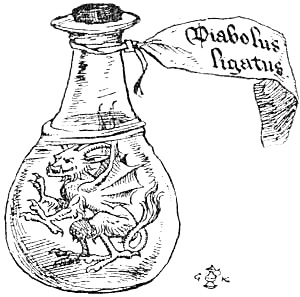
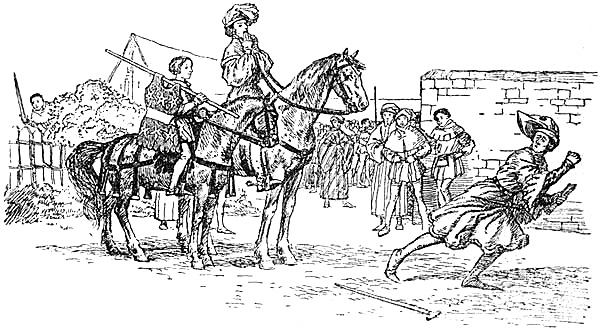
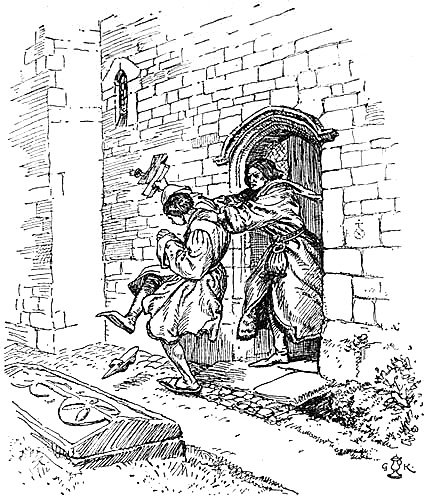
‘Diabolus ligatus.’