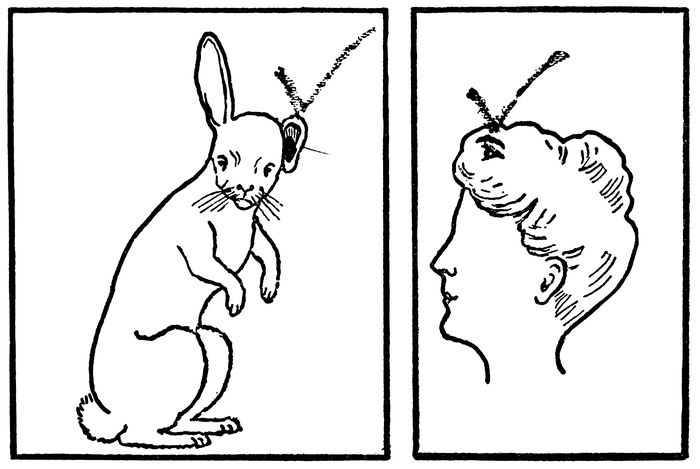
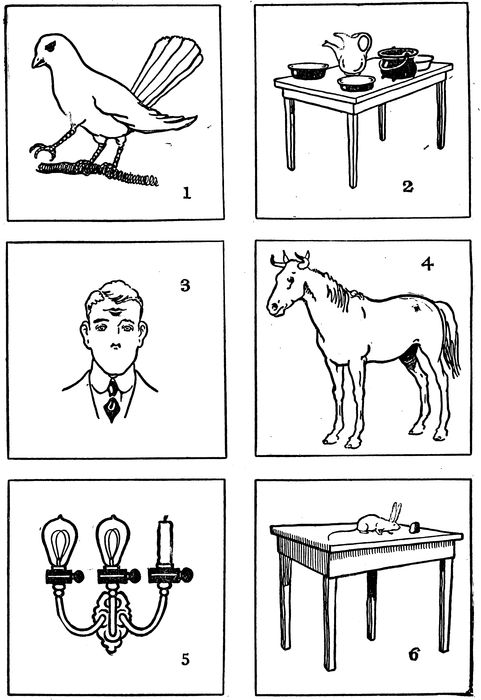
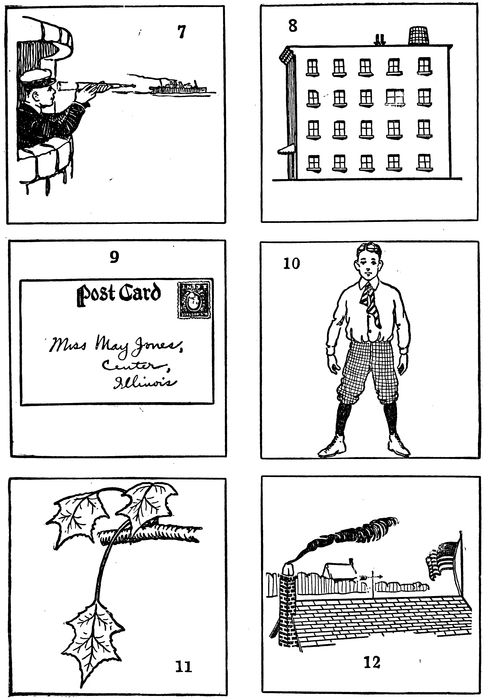
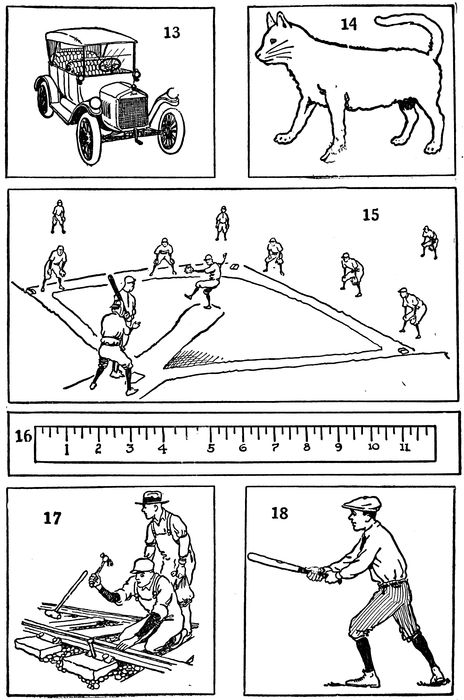
MEASURE YOUR MIND The Mentimeter and How to Use It
Transcriber’s Note:
The cover image was created by the transcriber and is placed in the public domain.
BY
M. R. TRABUE, Ph. D.
AND
FRANK PARKER STOCKBRIDGE
WITH ILLUSTRATIONS
IN TEXT
GARDEN CITY, NEW YORK, TORONTO
DOUBLEDAY, PAGE & COMPANY
1922
COPYRIGHT, 1920, BY
DOUBLEDAY, PAGE & COMPANY
ALL RIGHTS RESERVED, INCLUDING THAT OF
TRANSLATION INTO FOREIGN LANGUAGES,
INCLUDING THE SCANDINAVIAN
PRINTED IN THE UNITED STATES
AT
THE COUNTRY LIFE PRESS, GARDEN CITY, N. Y.
PREFACE
v
The publishers offer this book primarily as a popular treatise
on the measurement of intelligence by scientific methods.
Every effort has been made to conform to the soundest scientific
principles, both in the preparation of the Mentimeter tests,
around which the volume is largely written, and in the introductory
and explanatory chapters, in which the principles of
applied psychology, as they bear upon mental tests, are stated
in popular language.
The Mentimeters are based upon Doctor Trabue’s experience
(1) as Assistant in Educational Psychology at Teachers College,
Columbia University, (2) as psychological investigator of the
intellectual status of inmates of charitable institutions and of
pupils in the public schools, (3) as author of various intellectual
and educational scales, widely used by psychologists and
educators, (4) as Chief Psychological Examiner in two of the
largest Army camps, directing the intellectual examination of
more than a hundred thousand soldiers, (5) as Captain in the
Adjutant General’s Department, U. S. Army, measuring the
intellectual abilities of men in the Aviation Service, and (6)
as Assistant Professor in Columbia University, giving instruction
in the theory and practice of intellectual measurements
and directing the application of such measurements to tens of
thousands of school pupils.
Frank Parker Stockbridge, Doctor Trabue’s collaborator, is an
author and journalist of a high order. As managing editor of
Popular Mechanics and contributor to the World’s Work,
Harper’s, Popular Science Monthly, etc., he has been thrown
into contact with important affairs in the world of science so
vithat he is especially equipped to work with Doctor Trabue in
presenting this interesting subject. As director of the publicity
campaign of the American Library Association War Fund his
contact with the Army and the results of the biggest experiment
in the way of psychological tests that the world has ever seen
was invaluable to him in this work. The publishers feel that the
collaboration is a particularly happy one.
The success of the scientific method of testing intelligence
among both officers and men in the Army has directed widespread
attention to the general subject. The Mentimeter is
the first comprehensive system of tests, applicable to the whole
range of educational and industrial requirements, to be offered
for general use.
To employers and those in charge of the selection, grading,
and promotion of workers of every class, in factories, offices, and
stores; to teachers of all grades, from kindergarten to university;
to parents who are interested in ascertaining, and watching the
growth of their children’s mental development and to young
men and young women striving for self-improvement and advancement
and desirous of learning something of their own
mental capacities and limitations as a guide to the intelligent
choice of vocations or professions, the publishers offer this book
in the confident belief that it will be found of real service.
There are two ways, and only two, in which we can find out
what a machine is capable of doing. One of these is to try it
out, to “put it through its paces” by using it for every sort of
work which it is expected to perform and observing whether or
not it does what we want it to do. The other way is to measure
it (or to take the measurements of it as supplied by its responsible
manufacturer) and compare these with the measurements
of the essential parts of machines with the performance of which
we are already familiar.
Unless it is a brand-new type of machine, designed to do something
that has never before been done by machinery, or to do it
by a different mechanical method, there is obviously a great
saving of time and money in buying a machine from specifications
that insure the correct performance of its expected duty
over the other plan of first buying the machine and then trying
it out in practice to see whether it will do what we want done.
The manufacturer or business man who would purchase machinery
of any sort without first making certain that its dimensions,
speeds, weight, power-consumption, controls, and the
materials used in its construction were such as to adapt it precisely
to the work he expected to do with it would speedily
bankrupt his business. It takes but a moment’s thought for
the reader to prove this to himself.
On the other hand, however, we find business men constantly
employing men and women to perform specific duties without
4applying any tests or measurements, other than the most rudimentary
ones, to determine in advance whether the person so
employed is fitted for the work he or she is expected to do. And
as every employer knows, one of the most costly wastes in almost
every business or manufacturing establishment is the expense
of constantly “breaking in” new employees to take the
places of those who have left or have been dismissed because
they were found, after trial, not to be fitted for the duties to be
done.
Because the installation of machinery of any kind involves
an initial outlay of money, it long ago became apparent to
everybody that the “trial and error” method of buying
machines or other commodities was wasteful and ruinous. It
was not until recent years, however, that the closer study of
operating costs disclosed the fact that the expense of “labour
turnover,” that is to say the proportion of employees in any
given business whose places have to be filled annually, is one of
the heaviest avoidable drains on income. This was long overlooked
because no capital investment is involved in the initial
employment of labour. The cost of training new employees
is much larger, it is now learned, in most businesses, than is
generally understood, not only in the direct outlay in salary or
wages before the new employee has mastered the duties of the
new position as well as he or she is able, but in loss through
spoiled materials, reduced individual output, and often in the
slowing down of an entire chain of manufacturing operations
through the inability of the inexperienced worker to maintain
the pace of the rest of the links in the chain.
If, then, as so often happens, it is found after experiment that
the new employee is not capable of performing the work efficiently,
the whole process must be repeated. The employee
who has failed leaves, is dismissed, or is transferred to another
department, and a new and equally inexperienced worker employed
to fill the vacancy, with the whole cost of training to
be incurred over again. Even though the new worker may be
5experienced in the particular class of work to be done, there is
an appreciable loss due to the unavoidable frictions and hesitations
that occur whenever a worker is being fitted into a new
environment.
There is, moreover, no guarantee that even an experienced
person in a special sort of work is fitted to do that particular
work as well as it can be done or should be done. He or she
may have got into that sort of work by accident. That is
usually the way in which a boy or girl begins a business or
industrial career. He or she may have continued in it merely
because the experience gained in the first job enables its possessor
to pass the superficial scrutiny of foremen, managers, or
others who employ “help” in the first instance. But just as all
the experience and training in the world will not make a Paderewski
out of a person who was not born with the precise combination
of sensory and nervous qualities that the master musician
possesses, though almost any one with ten fingers and an ear for
harmony can be taught to play the piano after a fashion, so it
is true that while in the all-important business of earning a living
almost anybody can be trained to do most of the ordinary manufacturing
and business operations, after a fashion, it is only
those who were born with certain combinations of nerve endings
and sensory apparatus who can be trained into first-rate salesmen,
or expert tool-makers. And this holds true all the way
down the line, to the simplest and most automatic operations
necessary in business industry.
Individuals themselves are seldom aware of their own capacities;
even less generally of their own limitations. Occasionally,
by accident, a man or a woman finds at the right time the opportunity
to do precisely the things he or she is best fitted to do.
Often the individual’s strong personal instincts or inclinations
lead him or her to seek opportunity to do certain kinds of work
without any clear understanding why that sort of work appeals
while other kinds do not. Few human beings analyze their
inclinations closely. Yet it may be and frequently is the case
6that the work one most strongly desires to undertake is not that
in which he or she is best fitted to succeed. The inclination
may be counterbalanced by inhibitions of which neither the
possessor nor his or her employer becomes aware until repeated
failure has demonstrated the lack of adaptability, sometimes
after it is, or seems to be, too late to take up another occupation.
Then the worker usually drifts into the ranks of “casuals,”
constantly moving from job to job, chronically “out of work”;
the ready dupe of agitators and the prophets of social unrest
and revolution; disheartened, anti-social, and perennially unhappy;
the most expensive sort of an employee in any position,
no matter how small the wage—yet a human being, and, as such,
entitled to liberty and the pursuit of happiness!
That is an extreme picture. Yet if such tragedies occur (as
every reader knows from his own observation and experience
they do occur too often) among those who have voluntarily
chosen their own lines of work, how much more frequently
must they occur among those whose daily occupations have
been determined for them, not through any voluntary choice
or intelligent guidance but solely through the accident of having
been “thrown into” certain jobs when they were young?
That is the way in which the vast majority of individuals
have their careers shaped for them. The world of business
and industry and of the professions is full of blacksmiths who
ought to be carpenters, indifferent lawyers who would have
made good dentists, teachers who are failures because they
should have been trained as stenographers, good cooks who have
been spoiled to make mediocre shop attendants, and so on
through the list of possible occupations. Within every business
organization, moreover, there are grades and degrees of requirements
and responsibilities into which some employees may fit
perfectly, others less perfectly and others not at all, though all
be drawn from the same group or from those performing the
same general class of service. Here, as in the matter of original
employment, the general custom of dealing with the human
7element in industry is the wasteful “hire-and-fire” system,
analogous to the purchasing of machinery or equipment without
first ascertaining whether it will do the work, and scrapping it
when it fails.
We found out long ago that we couldn’t afford to do that sort
of thing with machinery. We are just beginning to find out
that it is even more expensive to do it with the human element
in industry.
It would perhaps be going too far to claim that the whole
problem of the “labour turnover” arises from the effort to fit
square pegs into round holes, but it is certain that a very large
share of all human troubles, industrial unrest, discontent, inefficiency
and unhappiness is traceable to the lack of proper
adjustment between the man and the job, and this in turn is
due in large part to the failure to determine in advance the fitness
of the particular individual for the particular task.
What is needed, obviously, is a measure of human capacities,
just as we have means of measuring every phase of the machine’s
capacities.
Just as we measure a machine by the most precise gauges
and tests available, why not measure the human individual
by the most precise means we are able to apply?
The word “measure” in the preceding paragraph does not
mean, either in the case of the machine or of the man, the gross
dimensions of length, breadth, and thickness; these are equally
immaterial, in most cases, whether the subject of measurement
be a man or a machine. One measures a machine to determine
its capacity for certain work, and is little concerned about its
characteristics that have no bearing upon those qualities that
fit it for those particular duties. So the measurements of a
human being whose capacity for certain duties is to be determined
must be of those qualities which enable him or her to perform
according to a certain pre-determined requirement.
These qualities, in man, woman, or child, can be measured;
not with the precision with which an engineer measures the
8parts of a machine that must fit within a thousandth of an inch,
but with sufficient accuracy to determine quickly, inexpensively,
and simply whether a given individual has the capacity to learn
and perform any given task or class of work.
To explain how these tests can be made, how science can be
and is being substituted for guesswork in the selection of human
beings for jobs and of jobs for human beings, just as science
has displaced guesswork in the selection of material commodities,
is the purpose of this book.
Let us first point out clearly the difference between science
and guesswork. The vast majority of jobs are filled by guesswork.
The farmer who hires a field hand, the housewife who
employs a cook, the foreman who takes on a new “hand” in
the factory, and even employers hiring persons for more responsible
positions, all do it, to a greater degree than they imagine,
by guesswork. They may make inquiries, more or less thorough
depending upon the compensation and responsibility involved,
of persons who are reputed to know by observation something
of the candidate’s qualifications. Unless the individual under
consideration be flagrantly and patently unfit the reports thus
obtained are almost always favourable. In many cases no
effort is made even to obtain such reports.
Many persons who regard themselves as intelligent employ
men and women for all sorts of delicate operations and confidential
and responsible relations as a result of observation alone;
yet observation alone will tell no more about a man or a woman
than it will about an automobile—the shape and the
colouring.
When you observe a human being you can determine certain
physical characteristics, such as size, complexion, colour of eyes
and hair, soundness of teeth, shape of body and head, contour
of face, features, and expression. You make up your mind
that you like the person or you do not. But as for determining
by means of anything your unaided observation discloses
whether or not the person under examination is qualified either
to perform or to learn how to perform efficiently a given task
9or set of tasks, you might as well expect to discover the hillclimbing
power of an automobile by merely looking at it.
Yet that is precisely the way in which, in the vast majority
of cases, the supremely important work of fitting individuals and
jobs together is done in the world of business and industry.
True, the prospective employer usually asks a few questions,
but the applicant’s manner and tone of voice have usually as
much to do with the final decision as the actual replies.
Men and women are usually hired, in short, on their looks
and on the impressions made at a single short interview. That
it is too much to expect persons so selected to fit into even the
simplest sort of a business or industrial organization should be
obvious to every intelligent person; that sometimes they do fit
should be no less obviously recognized as largely accidental.
We do not recognize the absurdity of this method of selecting
persons for particular positions, partly because this is the only
way most of us have ever known and partly because there is in
almost every human being a secret or subconscious belief in his
own peculiar powers of judging others by means of surface indications.
The fallacy of the belief that one may arrive at accurate
conclusions as to individual capacity and characteristics by
merely looking at the individuals concerned has been well set
forth by Prof. L. M. Terman of Stanford University. Much
of the popular belief in the efficacy of this method, Doctor Terman
believes, is due to the fact that the public does not know
that the pretensions of the pseudo-science of “phrenology” were
long ago shown to be unwarranted. According to phrenology,
definite and constant relations are believed to exist between
certain mental traits and the contour of the head. Phrenologists
teach, for example, that one’s endowment in such traits
as intelligence, combativeness, sympathy, tenderness, honesty,
religious fervour, and courage may be judged by the prominence
of various parts of the skull. While the sincerity of Gall, the
French physiologist of a century ago who invented the so-called
10science, and of his followers, is not to be questioned, the pretensions
of phrenology itself have been thoroughly exploded. It
has been demonstrated that traits like those above mentioned
do not have separate and well-defined seats in the brain and
that skull contour is not a reliable index of the brain development
beneath.
“In the underworld of pseudo-science, however,” says Professor
Terman, “phrenology and kindred fakes survive. Hundreds
of men and women still earn their living by ‘feeling bumps
on the head,’ reading character from the lines of the hand, etc.
“But if the rating of men by pseudo-science is misleading,
perhaps science is still unnecessary. It may be argued that
mental traits can be rated accurately enough for all practical
purposes on the basis of ordinary observation of one’s behaviour,
speech, and appearance. We are constantly judging people by
this offhand method, because we are compelled to do so. Consequently
we all acquire a certain facility in handling the
method. For ordinary purposes it is infinitely better than
nothing. A skilful observer can estimate roughly the height
of an airplane; but if we would know its real height we must use
the methods of science and perform a mathematical computation.
“The trouble with the observational method is its lack of a
universal standard of judgment. One observer may use a high,
another a low standard of comparison. A four-story building
in the midst of New York’s ‘sky-scrapers’ looks very low;
placed in the midst of a wide expanse of one-story structures it
would look very tall.
“Moreover, we are easily misled by appearances. The writer
knows a young man who looks so foolish that he is often mistaken
by casual acquaintances for a mental defective. In
reality he is one of the half dozen brightest students in a large
university. Another man who in reality has the mentality
of a ten-year-old child is so intelligent looking that he was able
to secure employment as a city policeman.
11“Language is a great deceiver. The fluent talker is likely to
be overrated, the person of stumbling or monosyllabic speech
to be underrated. Similar errors are made in judging the intelligence
of the sprightly and the stolid, the aggressive and the
timid, etc. Our tendency is also to overestimate the intellectual
quality of our friends and to underestimate that of persons we
do not like.
“If the method of offhand judgment were reliable, different
judges would agree in their ratings of the same individual.
When the judges disagree it is evident that not all can be correct.
When intelligence is rated in this way wide differences of
opinion invariably appear. Twenty-five members of a university
class who had worked together intimately for a year were
asked to rate the individuals of the class from 1 to 25 in order
of intelligence. The result was surprising. Almost every
member of the class was rated among the brightest by someone,
and almost every member of the class among the dullest
by someone. Doubtless the judges were misled by all sorts of
irrelevant matters, such as personal appearance, fluency of
speech, positiveness of manner, personal likes and dislikes, etc.
“The method of personal estimate is much better than the
method of external signs (phrenology), but to be reliable it
must be supplemented by a method which is objective, that is,
a method which is not influenced by the personal bias of the
judge or by such irrelevant factors as the appearance, speech, or
bearing of the one to be rated. Such is the method of intelligence
tests.”
It would, of course, as Professor Terman points out, be
absurd to contend that it is impossible to arrive at a rough estimate
of an individual’s capacities and character by observation,
as it is absurd to pretend that accurate measurements of an
individual’s capacities can be made by the same method. There
are men who have by long experience learned to judge on very
brief contacts the possibilities of applicants for positions.
Actually, what such employers do is to apply, though crudely
12and unscientifically, a limited number of tests which might
fairly be classed as psychological. Out of a long experience
they have accumulated an accurate knowledge of the work to
be done and of the general type of individual who has been found
best qualified to perform that work. This sort of ability, however,
is acquired solely through long experience, and even then
it can only be acquired by men or women who themselves
possess certain mental qualities, which might easily be gauged
and classified, the possession of which enables them to accumulate
and utilize experience in this manner.
This sort of ability can by no means be transferred from one
individual to another by description or by mere training. It is
precisely like the ability which an experienced automobile repair
man possesses, that enables him to tell by a quick inspection
and after only a few minutes of observation what are the
principal things the matter with a car and what service it is
probably able to perform. But a repair man cannot tell anybody
else how to size up an automobile at a glance, because the
only way any one can learn to do it is by going through the same
process of taking automobiles apart and putting them together
again for a period of years. And as everyone who has ever had
occasion to deal with automobile repairs is aware, the most experienced
repair men are seldom positive that they know just
what is wrong and all that is wrong without applying precise
measurements and painstaking tests.
It is easy enough to determine that a delicate, small-boned,
slender person is not the best type to employ for digging coal,
loading freight cars, or other arduous manual labour. There
are, of course, many classes of occupations the fitness or unfitness
for which of a particular individual must be determined in
the first place by that individual’s physical characteristics. So
far the observation method suffices. But the very fact that
every industry and business is full of misfits and that it is a
matter of common knowledge that the most difficult problem
the employer has to face is that of finding the right person for
13each particular job that calls for anything more than mere
physical strength, is the best evidence that even the most experienced
and accurate observers are far from infallible in their
judgments of individual capacities.
For that matter, there is no infallible test. No true scientist
claims infallibility. The possibility of error is always present
wherever the human element is involved. It is a safe assumption
that any method or estimate that purports to be infallible
is fraudulent. There is in almost every human mind a lurking,
subconscious belief in the possibility of perfection. It is this
which makes humanity credulous when claims of infallibility
are plausibly presented.
It is extremely difficult to satisfy by logic and reason the type
of mind that is strongly influenced by glittering generalities
and emphatic, though unsupported, assertions. It is equally
difficult to convince the skeptic whose mind is closed to the introduction
of new thoughts and who, in his self-satisfaction
with his own mental limitations, rejects every fact that does not
tally with his preconceived ideas.
This book is written neither for the super-skeptical nor the
ultra-credulous. It makes no pretension to infallibility, nor
does any scientifically trained psychologist pretend that there
has yet been evolved a method of measuring every dimension
and capacity of the human mind beyond the possibility of error.
The methods described in this book are the fruit of years of experiment,
research, and practical application of the results of
experiment and research, and are designed to reflect the development
of the science of psychology in its application to mental
measurements as closely as it is possible to do so within the limits
of a single volume written primarily for the reader who has
no special scientific training along psychological lines.
The reader who is not prepared and willing to examine facts
and at least to take all the ascertainable facts into consideration
before forming his conclusions is not likely to be interested. The
scientific method of character analysis or mental measurement
14is based upon the comparison of the largest possible collection of
ascertained facts. Guess work has no place in it. Psychology
has small dealings with intuition and instinct nor is it in any
way derived from magic or concerned with the occult. There
are no unfathomable mysteries. There is no fact about the
operation of the human mind which cannot be subjected to scientific
investigation and measurement by any intelligent person.
The scientific method requires that every conclusion must square
with the results obtained by the experimental application of all
related facts or be discredited as worthless. Theories have no
place in science, except as something to be disproved if possible,
and a single fact which does not square with any theory disproves
the theory.
The scientific method of mental measurement has passed the
theoretical stage. It has squared with the facts wherever it
has been intelligently applied. It has been demonstrated in a
wide range of business and industrial applications, in education
and in its use in determining the qualities and fitness of officers
and men in the Army and Navy. What it offers is the shortest,
simplest, and most accurate means available of determining
human capacities and qualities.
Professor Terman has admirably summarized the advantages
of the scientific method of testing intelligence, as follows:
“1. It gives us a universal standard of comparison. The result
is absolutely uninfluenced by the general intellectual level
of the group with which the subject to be rated happens to be
associated. It is like measuring the height of a house instead
of estimating it by comparison with the height of surrounding
buildings.
“2. It multiplies enormously the significance of mental
performance. It does this by making fine distinctions which
would be overlooked by the method of offhand judgment. It
is like placing a smeared glass under a microscope and discovering
that the smear is a complicated network of organic matter.
“3. The test method is objective; that is, free from the influence
15of personal bias. It gives approximately the same verdict
to-day, next week, or next year. It does not change its
opinion. More important still, the verdict will be approximately
the same whoever makes the test, whether a relative, a stranger,
a friend, or an enemy, provided only that the rules of procedure
be rigidly followed.
“4. The test result is little influenced by the subject’s educational
advantages. In this it differs greatly from offhand judgment,
which so easily mistakes the results of schooling for real
intelligence. The test method probes beneath the veneer of
education and gives an index of raw ‘brain power.’ For example,
a young woman who had been stolen in early childhood by
gypsies and had spent her life with them was given the Binet-Simon
intelligence test. She had never attended school a day
in her life and had only learned to read by bribing a little school
girl to teach her the alphabet; yet she made a higher score than
the average found for two hundred high school pupils who were
given the same test.
“No wonder,” Professor Terman concludes, “mentality
tests have acquired such a wide vogue in the ten years since
Binet gave to the world the first successful intelligence scale.
In that time they have demonstrated their usefulness in the
study of the feeble-minded, in the grading of school children,
in determining the mental responsibility of offenders, and in the
selection of employees. Their largest and most useful applications
have been in the mental classification of men in the United
States Army.”
CHAPTER II THE APPLICATIONS OF PSYCHOLOGICAL TESTS
16
The intelligent reader has by this time begun to see for himself
some of the possibilities opened up by the use of scientific
mental tests, and to perceive their applicability in a wide diversity
of fields. In later chapters specific examples of such applications
are given in detail, and suggestions offered for still other
uses of the tests which are contained in this book.
The usefulness of all mental tests, whether those which are
offered in this volume under the general title of “The Mentimeter,”
or others that may be set up with equal scientific precision,
depends upon, or at least is greatly enhanced by, the most
complete understanding of the underlying principles on the part
of the person who undertakes to apply them. The purpose of
this and the next three succeeding chapters is to make these
principles so plain that by the time the reader has reached the
tests themselves he will have a perfectly clear understanding,
not only of what the Mentimeter tests are but of why they have
been put into the form in which he finds them, and of how
their use will enable him to gauge human intelligence and capacity
with a greater degree of accuracy than he has found
possible by other means. If, perchance, psychologists find in
this volume much that is to them elementary, it should be kept
in mind that it is only through the widest possible spread of
sound understanding of psychological principles that the wider
application of them in the ordinary walks of life can be brought
about. That, the authors take it, is the great end toward
which scientific psychologists are aiming, and that is the aim of
this book.
17The general purpose of psychological tests is to determine
how individuals compare with one another in mental capacity,
or with standards based upon the capacities of individuals known
to possess certain qualities. Thus, it may be desirable, as it
frequently is, to determine the relative abilities of the individuals
of a certain group, like a school or college class, clerks employed
in a similar form of work, a number of applicants for a
certain position for which only the most capable among the
candidates is desired, or the soldiers of a particular company or
regiment. What is required here is a method of grading these
individuals with reference to one another, by means of tests
which need not necessarily have any relation to any external
standard of mental perfection.
The process here is as if one were to be told to pick out of all
the automobiles in a garage the best one, the next best, and so
on, classifying these particular cars and no others with relation
to one another and not with respect to any standards of automobile
perfection introduced from outside. None of the cars
might be perfect; perhaps the best one of the lot has leaky piston-rings
and none of them will climb a 10 per cent. grade on high
gear. It is a comparatively easy matter, however, to devise
a few simple tests that will grade a dozen or fifty automobiles
in regard to their relative ability to climb hills, carry loads, and
perform the other services expected of an automobile. The
one that will climb hills the best may not also be the one that
will carry the heaviest load or travel the most miles on a gallon
of gasolene, but out of such a series of group tests any one interested
can readily determine which of all the automobiles in the
group is the best general purpose car, which the poorest, and
about where the others grade with reference to these two extremes.
That is about the process that a man engaged in the automobile
trucking business would use in determining which one of
the cars he has available is best adapted for a particular piece
of hauling that is to be done. He wants to know which of his
18cars he can rely upon for any one of many different sorts of
service, but he particularly wants to know all the time which of
them are worth spending money on for repairs and improvements
and general overhauling and which are either so poorly
constructed in the first place or so hopelessly out of repair that
it is cheaper to scrap them than to spend any more money on
trying to make them fit for service.
In other words, the automobile owner needs to know which of his
cars, however poor its present ability, has such inherent qualities
as to justify the belief that it can be made more efficient by proper
attention and reasonable expenditure of money.
Now, that is precisely what the employer of workers, the commander
of soldiers, the teacher of a class or any one else charged
with responsibility for the performance of any sort of tasks by
any group of human beings, wants to know about the individuals
under his direction. He should know or be able to determine
readily not alone what each of the individuals can actually do
and which ones can do particular tasks better than the others,
but it is important for him to know the relative capacities of the
entire group, so that he can determine, as in the case of the
automobiles which have been used as an illustration, which of
them are most worth spending time and effort upon in the expectation
that they will learn to do even more difficult tasks,
and which of them are so hopelessly incapable that nothing is
to be expected of them except the simplest routine performances.
Now, the man who operates a fleet of automobile trucks does
not stop when he has made a comparison of the vehicles in his
garage with one another, but is constantly comparing the performance
of each with standards established by other cars,
machines of different makes, and with new machines. There
exists, and he is constantly conscious of its existence, an ideal
standard of performance for automobiles to which his cars must
conform as nearly as possible if their service is to be satisfactory.
So, in measuring human capacity, it is not enough to compare
19the individuals of a group with one another, though this is essential
and for some purposes temporarily sufficient; there are
available standards based upon the actual achievements of individuals
of known capacity by which the mental powers of
any and all individuals may be gauged. It will readily be
seen that the employer of a number of persons—engaged, let us
say, in some specific mechanical or clerical operation—needs to
know not only whether some of these are capable of being
trained to do better work and some so incapable of further
training that it would be cheaper to discharge them and fill
their places with more intelligent persons, but also to know how
any particular group of employees compares in average intelligence
and how each one of the group compares in individual
intelligence with the average or higher-than-average capacity
of those outside of his own particular business establishment
who are engaged in similar work.
This is a matter of dollars and cents to the employer. If he
can obtain a standard that is universal or nearly so, that tells
him, in fact, what all of the employers in his line of business have
found to be the average or the limits of mental capacity possessed
by workers of a particular class, then he is in a position to determine
whether he is getting equally good service for the wages
which he pays as is obtained by other employers requiring similar
service.
To illustrate concretely: in an office employing twenty stenographers
on correspondence, it is not only necessary for the
employer to know which of these stenographers is the most
competent and which the least and whether the less competent
are incapable merely because they are beginners or because they
lack the necessary mental capacity ever to become competent.
He should also be able to measure the mental capacity of the
entire group by some standard based upon the performance of
thousands and tens of thousands of stenographers of known degrees
of ability. He may discover that the most competent
of his entire staff is only as capable as the average of good stenographers
20everywhere. Obviously, his business is handicapped
by having a stenographic force which is inferior in capacity and,
consequently, in accuracy, speed, and other essential requirements,
to the average of stenographic office staffs in business
generally. Once this has been determined, the intelligent
employer will proceed to replace the stenographers who are
incapable of improvement, as indicated by the tests applied,
with stenographers who respond to the standard tests with a
score well above the average.
So, too, with the teacher. It is comparatively easy for the
teacher to classify his or her pupils into bright, stupid, and
mediocre, through observation alone. What is more important,
however, is to determine several things about each pupil which
observation alone does not tell. Are the stupid ones really
stupid or merely inattentive? Have they the necessary mental
capacity to perform the assigned work of the class or are they
simply lazy? Few teachers can answer this question; none
with any degree of accuracy without the application of scientific
tests of mental capacity. Are the bright children really bright
by comparison with other children of the same age and school
grade or do they merely shine by contrast with the dull members
of the class? This question can by no means be answered accurately
except by the application of mental capacity tests.
In another chapter some of the concrete applications of mental
tests in education are described at length. The point to be emphasized
here is that the measurement of the mental capacities
of any group should be based upon standards that will not only
determine the relative capacities of the members of the group
but will, at the same time, compare them all with standards
that reflect the known average and maximum capacities of all
others of similar age and environment.
The purpose of these tests might be summed up somewhat as
follows:
To measure, by comparison with the group average or with very
carefully determined standards, some of the infinite number of
21qualities and abilities, the possession of which by the individual
renders him more or less susceptible to education and training or
more or less capable of successfully performing certain actions requiring
conscious direction from the mind.
It requires no special argument to point out how a general
application of tests that disclose actual mental capacities might
profoundly affect our judgment of men of all classes and walks
of life. Were it possible to ticket and catalogue the whole
human race in accordance with the capacity of each individual
as disclosed under properly devised psychological tests, we would
no longer permit the superficial absence of polish and taste to
blind us to the inherent powers and capacities of the self-made
man, nor, on the other hand, would we be so ready to assume
that the well-dressed, fluent talker, no matter how prepossessing
in appearance and manner, was necessarily able and worthy of
confidence. Likewise, once such a classification became universal,
it is conceivable that many business men and others who
are prone to criticize the universities and their products would be
more tolerant of the recent graduate, whose mental capacity is
in no wise reflected by the particular variety of contents with
which his mind has been filled in college.
Besides the application of scientific mental tests as already
indicated, in business and industry and in education, by the
employer or the teacher, there is another and important use to
which standardized tests, based upon determined capacities of
groups and individuals of known ability, may be put. This is
the use of such tests by the individual upon himself for the purpose
of determining his own mental capacity in a particular
direction or of a particular kind as compared with the mental
capacity of others. The man or woman bent on self-improvement
or advancement may thus, within certain limits, assess
by the application of standardized tests his or her own mental
quality and capacity.
Again it is unnecessary to point out the advantage to the
young man or young woman endeavouring to decide upon a
22career or to determine what particular course of study to pursue
or line of business to enter, in being enabled to obtain an
accurate gauge of his or her own qualities, powers, and limitations.
Taste and inclination are no safe guides to life unless
there is coupled with them inherent capacity for the competent
exercise of the faculties which make the gratification of one’s individual
tastes and inclinations possible. Thus it may be that
the individual’s inclinations and tastes run strongly toward
music, toward art in any of its various forms, but that physical
and mental inhibitions, the presence or absence of which may
be readily determined, make it impossible for the possessor of
such tastes to hope to be able to perform creditably the acts
which a successful artist or musician must perform.
Properly devised and applied psychological tests may conceivably
disclose the existence of mental powers and capacities
unsuspected or neglected because overshadowed by strong
inclinations in other directions; early knowledge of the possession
of such capacities may easily direct their possessors into
fields in which they can thrive and prosper and achieve far
greater happiness and contentment than would ever be possible
through a lifetime of striving to do that for which they are not
fitted by inheritance.
CHAPTER III WHAT THESE TESTS MEASURE
23
The most natural question and one that is frequently asked
is:
“What, precisely, do psychological tests measure?”
It is a question that is easier to ask than to answer.
It is simple enough to say that mental tests are designed to
measure the natural or inherent mental capacity of the individual,
but in order to approach a clear understanding of just
what this means we must first define what is meant by the term
“mental capacity.”
As a matter of scientific fact, the term “mental capacity” can
hardly be regarded as accurate, although it is the best term we
have to describe the qualities which determine the individual’s
ability to perform acts requiring conscious thought. Psychological
and biological science no longer regard the human mind
as something different from or in any way apart from the human
body. The idea that there is such an entity as a mind that
operates even in the slightest degree without reference to and
independent of the physical body must be dismissed, if we are
to grasp clearly the principles and methods of mental tests.
To the psychologist the mind is merely a specialized organ
of the physical body. The intangible something, which is
what is usually meant when persons speak of the human mind,
is merely the sum of all the sensations, feelings, and judgments
resulting from the delicate adjustment of an almost infinite
number of nerve fibres which in themselves are a part of the
physical body. One may have at birth a plentiful supply or a
poor supply of potential nerve endings which are ready to be
24organized and coördinated by experience and training, but unless
one has the opportunity to learn from study and experience,
the desirable connections may never be developed.
The maximum capacity of the mind in any particular field is,
therefore, practically determined by physical inheritance of an
abundant supply of nerve endings. Thus, it may be that one
individual is born with two or three times as many nerve terminals
connecting at the point at the back of the eyeball where
the optic nerve—which is simply a bundle or rope of nerve
fibres—is attached to the mechanical apparatus upon which the
reflection of objects passing before the field of vision is registered.
Such an individual’s powers of observation are normally greater
than those of the person of less fortunate heredity in this respect,
whose lesser number of terminals of the optic nerve fibres limit
his powers of optical perception and observation. Thus, one
person may see at a glance a hundred details, all of which register
sharply upon his consciousness, while another sees only the
gross outlines and shadows, and in between is the average person
who sees some details but not all.
It is well known to psychologists and biologists, although
not generally understood by those who have not made a special
study of these sciences, that mental capacity does not change
or increase materially after the individual has reached maturity.
It may be diminished through accident or disease, but the chief
increase in adult life is in the volume and variety of stored-up
impressions. The average girl of eighteen or boy of twenty has
reached the approximate limit of his or her mental capacity.
The mental tank will never grow much larger. It may be half
empty or almost entirely vacant, but unless at the average age
of university sophomores scientific mental tests prove the individual
to be possessed of average or better than average mental
capacity, it is futile to expect any great intellectual development
to take place in later life.
But while the maximum capacity of the mind depends upon
physical inheritance, the actual ability which is necessarily
25reflected in the scores made by a person subjected to mental
tests is determined by the number and variety of nerve connections
that have actually been made by environment or
training. Inheritance sets the maximum limit, but as a matter
of practice this maximum is never reached, or at least is so
seldom reached by any individual that it can hardly be said of
any human being that he has developed his mind in any direction
to the utmost limit of its capacity. What we actually
measure in scientific mental tests is a complex of natural or
inherent abilities plus the results of education and training;
because, while it is possible to a considerable extent to eliminate
by properly devised tests a record of the individual’s acquired
knowledge, it is practically impossible to distinguish between
acquired and inherent mental ability.
Note carefully the distinction between mental ability and
mental capacity. Mental ability in any individual is always
less than his mental capacity. If, therefore, the mental ability
as determined by scientific tests reaches the highest point on the
scale of measurement, whatever that may be, it follows that the
mental capacity of the individual making a perfect score is even
greater than the scale is designed to measure, and how much
greater can only be determined by setting up new tests based
upon higher standards.
The result of any scientific test simply indicates the wealth of
nerve connections that are ready to be made when the stimulus
necessary to their establishment is applied. It must be understood
that no one having a sound claim to the possession of
scientific knowledge can contend that there are tests in existence
that actually measure with complete precision the inherited as
distinguished from the acquired mental characteristics. It is
not conceded, however, that such precise measurements cannot
be made if at any time it becomes necessary or desirable to do so.
For all practical present-day purposes it is sufficient that psychological
tests shall measure mental qualities which are manifested
by the individual’s ability to express them by action or speech.
26The classification of individuals relative to one another and with
reference to the possession of a particular mental ability or group
of abilities is, therefore, necessarily based upon their relative
ability to express in some intelligible and unmistakable fashion
their mental power and qualities.
Back of this power of expression may lie hidden and undreamed-of
capacities of which the individual himself may be
vaguely conscious but of which he can give no outward manifestation.
It may be, for example, that an individual is gifted
with unusual powers of perception through the eyes, ears, and
the senses of touch, smell, and taste but that he is deficient in
nerve fibres and connections controlling the voluntary muscles
by which human beings translate sensations into action and
speech. This is hardly likely, as a physiological fact, to occur;
the individual born with rich nerve endings in one part of the
physical body is more likely to have a proportionate supply of
nerve endings in all other parts of the body than to be deficient
in one part and amply supplied in another. As rare exceptions,
however, there are individuals who in infancy have, through
accident or disease, lost certain groups of nerve connections
while retaining unusually rich groups in other parts of the body.
There is, of course, the most famous case in modern history, that
of Helen Keller, whose auditory and optical nerve connections
were lost through disease in early infancy, but whose unusual
inherent mental capacity has been able to demonstrate itself
through other and extraordinary means as a result of training
and education.
But in ordinary life, if a man or a woman has some mental
quality which does not express itself in an action which other
persons can see or hear and know about, then it is not socially
important. It is of consequence only to the individual and it is
of little social service to undertake to measure these obscure and
unexpressed and inexpressible capacities, as they can never,
until they find means of expression, affect the individual’s ability
or efficiency in any occupation. It is not that these things cannot
27be measured. The case of Helen Keller is one demonstration
that they can be measured. Anything whatever that
makes a difference in the way different individuals act is conceivably
measurable, although it may not at the present time
be capable of exact calculation because it has not been worth
anybody’s time and effort to undertake to measure it.
To repeat, and possibly to make the preceding paragraphs
more clear, let us recapitulate the different mental qualities to
which reference has been made.
First, mental capacity. This is what the individual has inherited.
It is the size of the tank into which sensations, perceptions,
all that makes up the sum of knowledge, are poured
throughout his life, by his education and his experience. While
this capacity in the case of any individual can doubtless be
measured, it is not necessary to measure it precisely but merely
to determine whether it is large enough for the purposes in view.
Second, mental ability. This is the sum of experience and
education within the limits of the individual’s mental capacity.
It is represented by the individual’s ability to express himself
in speech or action in the performance of any one of a number
of specific acts. This mental ability can be quite definitely
measured, and the possession of a certain degree of mental
ability demonstrates the possession of a mental capacity greater
than the ability which the individual has already reached.
Third, acquired knowledge. It is not the purpose of tests of
mental capacity to measure acquired knowledge, although for
many purposes it is desirable to measure the individual’s acquired
knowledge in addition to his inherent ability, and in a
still larger number of instances the most practical way of arriving
at a fairly accurate estimate of an individual’s ability
involves, among other tests, an examination into the extent of
the knowledge which he has acquired through observation or
training along lines definitely related to his particular occupation
or pursuit in life.
The ordinary and standardized school and university examinations,
28civil-service examinations, etc., which have long been
the accepted test of the individual’s ability, do not, and do not
purport to, measure anything more than this last item, that of
acquired knowledge. But while certain gross dimensions of
individual capacity may be roughly estimated from the results
of a written or an oral examination based entirely upon the subject’s
stored-up knowledge, it is a matter of common knowledge,
and almost every reader will be able to furnish examples out of
his own experience, that such tests are frequently totally misleading.
Professor Terman has reported on a comparison of
the results of civil-service examinations for policemen and firemen
in a California city with scientific tests applied to the individuals
who successfully passed the civil-service examinations.
The results were in many instances astounding. Men of such
low mental capacity that they might almost be classed as feeble-minded
were found to have passed with a fair degree of satisfaction
the simple knowledge and physical tests set up by the city
and to have obtained appointments to these responsible posts
as guardians of the city’s property and lives.
While it is, therefore, the object of scientific mental tests to
exclude as far as possible the acquired abilities resulting from
education and environment and the knowledge that has been
stored up through observation and training, it is found in practice
that for all ordinary purposes it is sufficient to measure a
complex of native and acquired abilities. The purpose of these
tests is, in short, to discover what the individual is actually able
to do, regardless of the source of that ability, provided, however,
that the test of ability is so devised as to make a clear distinction
between mere feats of memory and the actual exercise of
original thought.
Now, it must be obvious that for the measurement of anything
so complex and multi-dimensioned as the human mind,
no single test or scale can be established. One cannot measure
the power of visual perception, for example, by the same scale
that is used to measure attentiveness or initiative. As a matter
29of fact, psychologists no longer attempt to classify human abilities
as narrowly as was once the popular practice. It is almost
impossible for even an expert psychologist to be sure he knows
just what qualities and all the qualities any particular test measures.
This is because modern psychologists no longer group
reactions into general functions such as memory, attention, reason,
etc., but simply describe accurately the stimulus given and
the conditions under which it was given and then describe just
as accurately what the reaction is. The test may be built up,
for example, to measure ability to recognize and classify words,
but it will also depend upon ability to read the directions, ability
to attend closely to horizontal and vertical lines and upon many
other correlated abilities. Any test may measure primarily a
particular mental dimension or ability but it is quite certain
that the resulting score will be influenced by numberless other
factors than the one that the examiner is most interested in
measuring.
But since one of the very best tests of intelligence is, of course,
the degree to which one is able to profit by social contacts and
the breadth and variety of the individual’s stored-up impressions,
these extraneous or collateral qualities, which every test
also more or less successfully measures in addition to the particular
quality or mental dimension under direct examination,
furnish useful data in arriving at a conclusion which is, after all,
the main purpose sought, as to the individual’s actual abilities
and potential powers.
In order, however, to get at a really useful record of the mental
capacity of an individual, we must apply a variety of tests and
out of the sum total of the results of these tests we are able much
more accurately to gauge the degree of possession of the qualities
for which we are seeking than could possibly be done by any
single test, no matter how skilfully constructed. Here again
science confronts the popular human demand for a panacea.
But just as in medicine only the quack offers a cure-all, so, in
other fields, science has no single standard to offer by which all
30results in a given field may be accomplished, and psychology
cannot now or at any time in the future pretend that by a single
method or a single measurement mental capacity can be gauged.
To come back to an analogy used in a previous chapter, you
cannot measure all the qualities of an automobile with a ten-foot
rod. Your ten-foot rod will tell you whether the wheel base is
120 inches or more or less than that. It will not tell you how
much above or below 120 inches. If it be necessary for you to
know that, you must provide yourself with a longer or more
minutely graded measuring implement; but because the ten-foot
rod does not at a glance disclose to you all that you wish to
know about a particular automobile, you do not, therefore, either
discredit the ten-foot rod as a measuring implement or declare
that the automobile cannot be measured except by the unaided
human eye.
The limitations of the ten-foot rod are perfectly obvious to
you; and so, too, are the complexities of the automobile, which
require a variety of instruments and tests for their proper gauging
and measurement. So before you undertake to form a
judgment as to the ability of a particular automobile, you either
measure it yourself or, as a matter of practice, you have it measured
for you by a competent engineer. You do not necessarily
inquire, if you have confidence in the engineer, as to precisely
what dimensions and what materials he found in every part of
the car, but you respect his conclusions, knowing that they are
based upon the most precise and accurate measurements possible
with the aid of such instruments as science has been able to
devise, and you are satisfied that the conclusions form an accurate
estimate of the machine’s qualities.
The engineer who sets out to measure an automobile in all of
its capacities and powers must provide himself with tachometers
for measuring the engine’s revolutions, dynamometers for testing
its tractive force, micrometer calipers for gauging the bore and
the stroke, thermometers for measuring its temperature, galvanometers
for testing its magneto and battery, and hundreds of
31other instruments, the readings of which must be assembled
and studied by means of complex, comparative mathematical
formulas before he can tell you what a particular automobile will
do.
The human mind, it must be apparent to every reader, is not
less complex than the automobile. On the contrary, it is infinitely
more complex and subject to an infinitely wider range
of variations. As has been pointed out above, it is not necessary
for practical, every-day purposes to measure every possible
variation and every one of the infinite number of dimensions of
any human mind in order to ascertain the individual’s ability
to succeed in the ordinary pursuits of life. But even in our
ordinary, every-day affairs and contacts, in the simplest forms
of employment, there are called into play such a number of
different sorts of ability and mental power that there must be
applied, if one is really to know of what a particular individual
is capable, a large variety of tests of different kinds for measuring
different powers. And for the mental measurement of individuals
whose work calls for the highest development and capacity,
a still larger variety of tests must be applied.
It is not always possible—in fact, it is extremely difficult—to
devise tests that do not to some degree measure the mental
content resulting from education and experience, in the effort to
measure the mental capacity which limits and controls one’s
education and experience. The qualities that determine capacity
are inherent in the individual. One is born with them or is
not born with them. In their whole infinite variety they are not
all possessed by any one individual, and the particular grouping
of mental qualities which any one person inherits is probably not
possessed by any other person living or who has ever lived. Yet
while individuals differ so completely that it can truthfully be
said that Nature never cast two persons in the same mold, yet
there are qualities possessed by all intelligent persons, the simpler
and more elemental expressions of which are absolutely
essential to intelligent life and existence, and these can be so
32grouped, classified, measured, and standardized as to provide
a scale whereby the inherent capacity with respect to these
important and essential qualities may be determined equally
in the case of the totally illiterate, untrained labourer or artisan
and the highly trained, educated product of a university postgraduate
course.
As a matter of practical, every-day common sense, one does
not expect to find, nor does one find, except as a rare exception, an
individual engaged in menial or purely physical labour who is
endowed with inherent mental capacity comparable to that
of the university graduate. A person possessing such capacities
moves out from the ranks of labour in spite of educational
handicaps; the history of American business and industry is full
of the romantic stories of men who have achieved success as
organizers and administrators, though in many cases absolutely
illiterate. Properly applied psychological tests would pass over
all or nearly all of the acquired knowledge of such individuals
about their particular business and related matters, and neglect
also, the bulk, at least, of the acquired knowledge of the university
man, and so compare merely what might be called two naked
brains, the native intelligence of each being the only thing to be
measured. As has been pointed out, it is difficult or almost
impossible to devise tests that entirely strip the layers of acquired
knowledge from the raw mental powers beneath them,
but for the practical purposes of the application of psychology
and psychological tests in the affairs of every-day life, this can
be done within a reasonable percentage of error.
CHAPTER IV STANDARDS FOR MENTAL TESTS
33
To test or measure mental capacity or any of the dimensions
and powers of the human mind, two preliminary steps are necessary.
First, it must be determined what particular powers or qualities
of the mind it is desired to measure.
Second, there must be prepared a standard or scale that is,
primarily at least, adapted to the measurement of those particular
qualities.
While it is, in practice, as has been heretofore pointed out,
impossible entirely to segregate a particular mental quality or
power from all the other abilities and capacities possessed by a
particular individual, it is possible to select certain characteristics
or abilities which, by the degree of their presence or absence,
give a fair index of certain mental dimensions or capacities,
and to devise tests that, when taken together, will measure
these “key-abilities” and so reflect the general ability and capacity
of the subject. The standards by which the results of
such tests are gauged must necessarily, therefore, be such as have
been shown, by experiment and experience, to give the closest
possible measurement of the individual’s ability in these particular
directions, by enabling the examiner to compare each subject’s
performance under the test, or series of tests, with the records
made under precisely similar tests by individuals and
groups of known ability.
Mental capacity tests may be devised that will measure certain
mental qualities of an infant who has not yet learned to
talk, and by thus providing a comparison between this particular
34child’s capacities and the average of children of the same
age, enable parents and physicians to determine in what direction
efforts looking toward its mental development may most
helpfully be undertaken. Thus we may test the infant’s power
of observation and perception of shapes, of colours, of sounds
and familiar objects before it is able to talk, measuring these by
standards derived from experience with similar tests applied
to a large number of healthy, normal infants, and by this means
determining whether the subject is above or below the normal
average for its age and if so in what respects.
At the other end of the scale of mental development, let us
assume, is the possessor of the degree of Doctor of Philosophy
from any of the great universities, since this is the principal degree
the possession of which tends to show the possession of unusual
mental powers, if not necessarily of wisdom. By applying
to a large number of Ph.D.’s tests which are designed to
require for their successful performance the utmost use of all
their inherent mental abilities, and arriving at an average of
performance by tabulating and comparing the degrees or percentages
of perfection achieved by all of the individuals so
tested, a standard is set up by which to measure the mental
capacity of any individual or group of individuals of superior,
or presumably superior, intelligence. By such a standard there
may be measured also the mental capacity of men and women
who have never seen the inside of a university, but whose education
has been acquired in the course of their business and professional
activities. This is so because what is measured is not
acquired knowledge, but the ability to acquire knowledge, which is
quite a different thing.
The simplest way to measure the capacity of a circular tank
is to pump it full of water and then measure the water as it is
drawn off. But it would be absurd to contend that because
there has never been any water pumped into the tank it is therefore
impossible to determine how much water it would hold.
And what the Doctor of Philosophy has got out of his university
35course is comparable to the water in the tank. The university
may have assisted, and if its faculty were competent
undoubtedly did assist him, in discovering earlier in life than he
otherwise would have discovered the actual capacity of his
mental tank. But there are probably as many men of equal
mental capacity whose mental tanks have never been filled with
the particular kind of intellectual fluid that the Ph.D. carries
about with him, whose capacity there is no other means of measuring
than by the application of mental tests based upon the
known capacities of Doctors of Philosophy.
The process of measuring the human mind is, indeed, precisely
like the process of measuring an automobile by an engineer, as
was pointed out in the preceding chapter. Back of the tests
that are applied to the automobile to determine its abilities and
capacities there must lie a mass of very definite, exact knowledge
of all automobiles or all types of automobiles already in existence
and whose capacities and limitations are already definitely
known. It is of no service to ascertain that the engine cylinders
are of four-inch bore and that the piston has a six-inch stroke,
unless it is well known what the possession of a given number of
cylinders of that particular bore and stroke signifies as to the
ability or capacity of an automobile engine. That knowledge
has been acquired by the observation and measurement over a
period of years of the performance of many automobiles of varying
cylinder sizes and number of cylinders, and the comparison
of each size and type with all the others.
Similarly, it is of no service to apply a test of any kind to a
human being unless we have, in the first place, determined just
what particular abilities or capacities we want to measure, and,
in the second place, possessed ourselves of knowledge as to the
significance of these capacities, after they have been measured.
Here, again, the reader should keep constantly in mind the
warnings set forth in the preceding chapter and try to think of
mental abilities and qualities not as detached, separate, sharply
defined parts of a mental whole (as the engine, transmission and
36bearings of the wheels of an automobile are detachable, separate
entities) but rather as qualities so intermingled and connected
by an infinite number of attachments to all the other mental
qualities and abilities that no one particular ability can be
measured separately or even positively delimited by any sort of
test. Even if this could be done in the case of one individual,
the process would have to be repeated in each separate, individual
case, as in no two human beings is there found exactly the
same combination and correlation of the manifold manifestations
of conscious sensation and thought that together make up the
human intelligence.
But having determined just what qualities and abilities it is
desired to measure, we must set up a standard of measurement
by which to compare the indicated ability of each individual
examined, or we shall have nothing as a result of our test but a
mass of information, of the significance of which we cannot
possibly be aware. This standard, for some purposes, may be
merely a composite record of the performances of a particular
group or class examined simultaneously and under the same conditions.
That is to say, if all that is required is to determine
which individual of a group has the greatest ability in certain
directions (and by inference the greatest capacity for further
development along similar lines) then all that is necessary is
to apply a test that will give a comparative measurement of the
intelligence of this particular group. But if the purpose is to
ascertain how a particular individual, or the average of a group
of individuals, compares in particular kinds of capacity with
the average or the most highly developed persons of the same
status, education, occupation, or age, then the standard by which
the subject must be measured must be one derived from the
observation and measurement of the mental capacities of as
large a number as possible of individuals engaged in all sorts
of occupations and of all degrees and grades of educational attainment.
And even where the purpose is merely to determine
the relative qualifications and capacities of a particular limited
37group, it is as a matter of practice desirable, it might almost be
said necessary, to compare the performance of each individual
of the group with a standard previously fixed and determined as
a result of a much broader series of observations and experiments
than can be made within the limits of any group to which
it is practicable to apply any given set of tests as a whole.
This is true for two reasons. First, without such an outside
standard of comparison all that is determined by the application
of even the most carefully devised tests to any group is that certain
individuals are more and certain others are less able in
particular ways than the average of the group. The net result
is of service, but of nowhere near the service of a record of the
same individuals’ performances graded in accordance with their
approach to conformity with a universal standard. For example,
one might take two, three, or a dozen automobiles on a speedway
and quite readily determine which was the fastest and which
the slowest, but unless one were possessed of certain standards
of measurements that in themselves have no relation whatever to
automobiles, the net result would be of little consequence and
of no value whatever in comparing any one of these cars with
another automobile that had not taken part in the particular
test. In this case, two standards are requisite, namely, distance
and time. The length of the course must be definitely ascertained.
The time required for each automobile under test to
cover the course must be accurately recorded.
Now we have a record of performance that compares at all
times with universal standards. If we add another automobile
to the group we do not need again to run all the cars, including
the new one, along the speedway to determine where the added
member of the group ranks with reference to the others; we can
apply to it alone a test based upon the universal standards of
time and distance with which we have already compared the
others, and the new one falls instantly into its proper rank among
its fellows. So, too, we are enabled by this means to compare
any member of the group with any automobile anywhere in the
38world, the performance of which has been gauged by these same
universal standards of time and space, and we are thus able to
tell, not only how each particular car ranks with reference to
the limited group of cars, but how it ranks with reference to all
cars of all kinds or of a particular type so far as these have been
tested by the universal standard.
So in testing groups of individuals as to their intelligence or
mental capacity, the use of universal standards of comparison
makes the relative grading of the members of the group with
reference to each other just as easy and simple as though the only
standard were that of the group’s collective performance, and at
the same time furnishes a record of the performance of each
individual member of the group by which he or she may be
readily compared with the members of any new group to which
he or she may be at some subsequent time attached, and at all
times with the general run of men or women of the same or differing
social, economic, vocational, or educational status.
It is in the determination of these universal standards and the
preparation of tests, the results of which indicate the individual’s
relative approximation to these standards, that the scientific
training of the psychologist comes principally into play.
Rough standards for testing the more obvious mental capacities
might be set up by any intelligent person who would take the
pains to collect the essential data. These standards would not,
however, be universal unless they were based upon research and
experimentation covering as broad a field as that in which the
psychologists have been working for many years. Nor would
they, except by accident, be as simple and as accurate as the
universal standards compiled by scientifically trained persons.
For just as the average untrained individual cannot form an
accurate or even an approximately accurate estimate of another
person’s character and abilities by observation alone, so persons
untrained in the study of the human mind are prone to be
misled by the obvious and to lay undue emphasis upon external
indications which do not, as a matter of scientific fact, actually
39signify what they are popularly believed to indicate. The
scientific psychologist’s training enables him to eliminate to a
large extent the non-essentials and to include, in the establishment
of standards of mental measurement and the preparation
of tests or methods of applying these standards, many facts
which, to the untrained mind, do not at once present themselves
as important elements.
Even in the simplest of mechanical operations every workman
knows that it is not safe to trust to the accuracy of homemade
measuring implements. In the absence of a try-square made by
a responsible manufacturer in conformity with the universal
standard right angle, even the most expert carpenter will refuse
to run the risk of error until he has either obtained a new standard
from the hardware store or by the application of geometrical
science and the exercise of careful and painstaking technical
skill constructed for himself a new try-square that conforms,
without the variation of a hair’s-breadth, to the universal standard
to which he must work. Still less would a good machinist
undertake to gauge the close tolerances of an automobile bearing
with a homemade micrometer. He knows it is not sufficient
merely to have a perfect fit of this particular bearing, which
might be worked out by rule of thumb, but that it is essential
that the dimensions of the bearing, down to within a thousandth
of an inch, must conform to the universal standards for automobile
bearings, and that the best implement with which to test
the degree of conformity to the universal standard is the standardized
micrometer, prepared by specialized methods and produced
only by the exercise of highly trained technical skill.
Once given such implements of precision, any good workman
can readily apply all the scientific intelligence that went into the
devising of the standards and the preparation of the methods of
applying them.
So, once there are at hand scientifically devised standards
with which the mental qualities of any individual may be
gauged and compared, and tests have been prepared for the
40scientific measurement of these qualities with reference to the
established standards, the application of these tests to individuals
may be made by anybody sufficiently intelligent to grasp
their purport and follow directions exactly. It is not necessary,
in other words, even for the testing of the most complex and
highly developed mental powers, that the actual application of
the test be made by the scientific psychologist. It is possible,
and it has been the purpose in the preparation of the tests which
are presented in this book, to devise mental tests which, if
applied precisely as indicated in the instructions accompanying
them, will yield the same results in the hands of the wholly untrained
examiner as though the actual administration of the
tests had been made by the scientist who devised them.
It must not be thought that the result of any test is always
100 per cent. accurate. Even good workmen sometimes
make errors in the use of the most precise scientific instruments.
Even though constructed with the most painstaking
care, according to the truest scientific formulas and by men of
the highest technical training and skill, the mechanical instruments
of precision are occasionally found to be inaccurate.
If this is the case with material implements and dimensions which
are finite, concrete, and tangible, how much greater is the liability
to error in dealing with the intangible, infinite, and more
or less abstract qualities of the human mind. The scientific
psychologist is, after all, merely another human being, and as
such equally liable with all other human beings to human error.
Of no man or woman can it be said that he or she is infallible,
and as every one who applies a psychological test is human, and
so liable to error either in its application or the reading of its
result, conclusions drawn from the results of any particular test
should be accepted as accurate only when they have been
checked by the results of other tests applied to the same subject,
and substantial conformity of the results of one to those of the
others has been obtained. For this reason, among others, no
single test can be expected to yield definite and complete information
41as to any particular individual’s mental capacity or
ability, whether gauged by the universal standard or by group
comparison. It has, therefore, been necessary to establish, as
preliminary to the preparation of the Mentimeter tests, a variety
of standards, and to prepare a considerable number of tests
under each of these standards, all or most of which must be used
in each instance if anything approaching scientific accuracy is
to be reflected in the resulting scores.
As has previously been pointed out, however, the scientific
method is incomparably freer from the liability to error than
any method of determining human ability and capacity that
depends upon unaided personal observation. How completely
this has been demonstrated in practice in a wide range of fields
is set forth in subsequent chapters. To yield results of maximum
accuracy, however, scientific mental tests must be used
only with reference to the standards on which they are based.
Lest it has not been made clear already to the reader how the
method of establishing mental standards of comparison operates,
let us again briefly try to point out just what is meant by a
universal standard of mental capacity.
It is a comparatively simple matter, involving merely a considerable
amount of painstaking search and the expenditure of
a good deal of time to find, let us say, a thousand engineers, each
of whom has demonstrated in the course of his professional practice
that he possesses unusual ability to project and design
bridges and viaducts. Let us suppose that we wish to take the
average capacity of these thousand engineers as the standard
by which to measure every budding engineer in the technical
schools with reference to the capacity of each to become a
planner and designer of bridges and viaducts.
The scientific psychologist must first familiarize himself with
the essentials of that combination of artistic, technical, and
mathematical skill which makes a great engineer. This is not
a simple or easy task to begin with, and to accomplish it calls
for the exercise of highly trained mental powers on the part of the
42investigator as well as a thorough understanding of the operation
of the various processes of the human mind. Then there
must be devised methods by which, as simply and yet as precisely
as possible, each of these thousand engineers of known
capacity may be tested as to the degree in which he possesses
the various abilities, the sum total of which is the measure of his
capacity as an engineer. It may be necessary to make these
tests over a period of years, and the tests themselves may and
probably will require frequent revision and amendment as it is
found in the course of their application that some of them are
unnecessary and others inadequate. If it is found that any of
the tests so applied is readily fulfilled by every subject examined,
the effort is made to increase the difficulty of the test, until it
has reached a stage where the perfect performance of all its
requirements is barely within the reach of the ablest and most
competent of all the engineers under examination. Indeed,
some of the tests may be so difficult that none of those examined
may conform precisely to the set requirements. In respect of
some classes of tests this is, in fact, desirable, as what is being
sought is an average of group capacity, and if any considerable
percentage exhibit a capacity greater than can be measured by
the tests set there arises an element of doubt as to the accuracy
of the average combined score, since some of those contributing
to it have obviously greater mental ability than can be measured
by the particular scale used.
Once, however, tests have been applied to the supposititious
thousand expert engineers, and the performance of each of
them in each test has been given its proper place in the scale,
and an average struck, there has come into existence a preliminary
standard; which, however, before being offered for general
use in the testing of engineering students and others, must
first be tried out by experimental application on as many individuals
and groups as are available, and their performance
with reference to the standard checked up by all other means
available. It may be, and quite frequently is, the case that this
43preliminary try-out of a standard results in the elimination of
some of its elements, the modification of others, and the necessary
preparation of a new series of tests based upon the altered
standards. But in this fashion, in the course of time and as the
result of the combined effort of many trained minds, there is at
last set up a standard which is substantially universal in its
application, and by which it may readily be determined whether
or not any particular individual possesses the mental capacity
and particular abilities that have been found to be necessary if
he is to develop into a competent engineer.
As psychological tests are more and more widely applied
and there is consequently accumulated an increasing volume
of data which can be collected, classified, and compared, standards
become either more firmly established as a result of experience
or subject to modification in the light of the wider range of
knowledge. In science nothing is final. What psychology
offers to-day is a method of mental tests, the soundness of which
in principle is unchallenged, though the application in detail
of these principles is subject to constant improvement and refinement.
CHAPTER V DIFFERENT TYPES OF MENTAL TESTS
44
The character of any mental test or series of tests is determined
primarily, of course, by the purpose for which the test
is applied, and, secondarily, by the known or obvious mental
limitations of the individual under examination.
Mental tests thus classify themselves, in the first instance,
into as many different classes as there are specific purposes to be
served by their use, particular kinds or classes of mental ability
and capacity to be ascertained, or degrees of previously known
mental limitations. Each one of these classifications cuts across
all other classifications at some point, so that it is, as a matter of
practice, impossible to tabulate or catalogue mental tests in
such a way as to separate them into sharply defined or permanently
detached groups or classes.
Broadly, all mental tests subdivide at first into tests devised
for use with persons of normal mental capacity and development
and tests for intelligences that are not fully developed.
This is, perhaps, the chief permanent and fixed classification
of intelligence tests that can be made, for in a group of tests for
the sub-normal mind would be included the entire series of
tests adapted for the examination of the mental powers of children
of all ages, from earliest infancy to maturity. In fact, the
standard method of rating or grading adults of undeveloped or
sub-normal intelligence is to classify them by their mental age
as compared with the performance of normal children of the
same age.
Thus, a man or woman of twenty-five who is able to make a
high score in tests which are passed successfully by normal children
45of eight, but who fails when subjected to tests which a normal
child of ten should pass easily, is rated approximately as
of mental age nine.
Cutting across this classification is the arbitrary classification
of tests adopted in the psychological work of the United States
Army, in which every officer and enlisted man is classified as
to his relative intelligence by means of scientific mental tests.
The Army tests are of three principal kinds. There is a series
of tests, known as the Alpha, designed to measure the intelligence
of individuals who can read and write the English language.
For those who are either illiterate or whose ability to read
or write is confined to some language other than English, there
is the Beta series of tests. These may register as high a degree
of intelligence as the Alpha tests; the results are merely not expressed
in terms of the English language. The third classification
in the Army is the individual tests, applied to those who fail
to make a satisfactory score under either the Alpha or the Beta
tests. This is, in its Army application, a system of tests for
the sub-normal adult intelligence. Thus the broad classification
first set forth above, in substance actually holds in the classification
of the Army tests.
Under each of these two broad classifications, and particularly
under the first (since in general, every-day practice it is of
little service to undertake to analyze minutely the capacities
and limitations of the sub-normal mind except in the application
of these tests to growing children) there are many possible subdivisions
of mental tests, based upon the particular mental
qualities which it is desired to measure.
First and most useful generally are general intelligence tests,
which must usually be subdivided into a series of related tests.
Then, for varying purposes, such as the examination of candidates
for particular classes of employment requiring special
ability or capacity, there may be applied speed tests, accuracy
tests, perception tests, coördination tests, memory tests, mathematical
tests, and a wide variety of others. These are tests which
46primarily measure the subject’s ability to perform certain
specific acts under pre-determined conditions, the determination
of capacity in excess of that actually demonstrated under test
depending upon the facility and accuracy with which the subject
responds to the conditions of these tests. Of course,
every scientific mental test is based upon the performance of
certain acts, since it is only through action of some sort, whether
by speech, writing, or the performance of a manual operation,
that any one is able to express his mental ability at any
time.
But while it is relatively a simple matter to devise tests that
satisfactorily indicate the subject’s possession of the more
obvious mental powers indicated by such tests as those last
listed above, there is another class of mental tests, designed
primarily to indicate or determine the possession of the more
abstract qualities, the manifestation of which through the
individual’s simple and ordinary actions is less obvious to the
untrained observer. This is the class of tests that are designed
to measure the degree in which an individual possesses such
qualities as moral sense, form perception, the power to reason
from cause to effect, poetic discrimination, ability to understand
complicated instructions, judgment, sense of the right
relationship of things and ideas. It is as important, if one is to
arrive at a true measure of any individual’s mental capacity,
that he be tested as to his possession of these more or less
abstract qualities, as it is to determine his possession of concrete
abilities. In other words, the normal mind of an intelligent
adult is capable of dealing intelligently with ideas and abstractions.
The mentality that does not respond with a certain
degree of readiness to ideal conceptions is to that extent sub-normal.
The only possible way of determining the possession
of unusual or super-normal mental capacity is by means of the
demonstration that its possessor grasps readily and responds
unhesitatingly to the presentation of abstract concepts.
The demonstration itself must, of course, be concrete. Unless
47the individual possessing extraordinary mental power is
able, as Kipling phrases it, to
. . . . press the logic of a fact
To its ultimate conclusion in unmitigated act.
it is of no social consequence whatever that he may possess the
mental catholicity of a Shakespeare. There is no place in the
modern world for “mute, inglorious Miltons.”
Indeed, it may be questioned whether a “mute, inglorious
Milton” ever existed. The world is full of people who regard
themselves as “unappreciated.” Everyone is familiar with the
unfortunate type that is forever seeking sympathy, constantly
on the lookout for friendly shoulders on which to sob out the
sad tale of the world’s harshness. Under psychological tests
the preponderant majority of this type of individual is clearly
demonstrated to be mentally deficient or sub-normal in some
important respect. The occasional individual of normal mental
capacity who fails to demonstrate that capacity by the performance
of specific acts is merely mentally lazy. In other
words, it may be set forth as a sound conclusion, capable of
scientific proof, that mental capacity in the healthy, normal individual
always finds means of expressing itself in concrete and
socially useful ways, whenever its possessor actually desires
so to utilize his mental powers.
In the devising and preparation of tests intended to measure
the less obvious of the mental powers, a considerable degree of
ingenuity and the greatest amount of scientific care and technical
skill is required. To the person untrained in psychology
tests designed to measure the possession of the more abstract
powers frequently look childish, if not positively silly. Since
it is essential, in the case of Army officers and men, to determine
as nearly as it may be done by simple and easily applied
tests their possession of a wide variety of mental qualities, some
of the elements of the Army Alpha test appear to the concrete
48type of mind to be futile, if not absurd. But any comprehensive
system of mental tests must include, as there have been
included in the Mentimeter tests presented in this volume, a
considerable proportion which do not on their face appear to
be directed toward the disclosure of the ordinary and useful
mental capacities. It is of vital importance, if the results of any
given series are to give an adequate picture of the actual abilities
and possibilities of the subject examined, that tests of this character
be included among them.
Each of the possible classes of mental tests may be set to any
one of an infinite number of standards. General intelligence
tests, for example, may be set to the standard of the average
university graduate, so that the result when applied to any
individual gives a fair estimate of the subject’s intelligence as
compared with that of those who have demonstrated the possession
of mental capacity sufficient to complete satisfactorily
a university course. Or the standard may be that of the average
lawyer, the average high school pupil, the average normal
child of any age or school grade, the average skilled mechanic,
the average labourer, or the average child below the age of
speech. And, in practice, what is measured is, after all, general
intelligence.
Intelligence, as has been frequently pointed out, while it
does not depend upon the individual’s ability to read and write,
is so generally accompanied by the definite and intimate knowledge
of the symbols which we call letters, words, and figures, and
of their meaning, that in the great majority of cases in which it is
desired to apply the test of intelligence this can best be done, or
at least most readily be done, by the use of these familiar symbols;
in other words, by tests which involve only the acts of
reading and writing. If intelligence may be defined as the
intellectual power of adaptation to environment, a complete
test of intelligence determines the individual’s ability to recognize
the situation in which he finds himself, perceive his own relation
to the situation, analyze it, and arrive at a conclusion as
49to what he should do next; then put that conclusion into effect
by means of a concrete act. Thus one may learn a great deal
about an individual’s mental capacity by observing his conduct
when he misses a train. But since it is not practicable to apply
this method of inquiry in every case, the next best thing is to
ask the question, “What would you do if you missed your
train?” To ask this question of a subject is next best to seeing
him in such a situation. He must exercise his sense of reality
upon it, size it up and plan his reaction.
Since all life is made up of situations in which the individual
places or finds himself and from which he must extricate himself,
and since the broader the mental capacity, the more easily
will the individual meet situations as they arise, the ideal mental
test is one that presents a situation such as does or might occur
in real life, and requires the subject to extricate himself, or at
least to indicate his first and immediate impulse toward action
should such a situation arise.
Since the purpose of mental tests is primarily to determine
intelligence rather than the possession of physical qualities,
it is conceivable that, in many situations, properly devised questions
may give a fairer view of the subject’s mental capacity
than would observation of the same individual in action in a
real situation. Thus a person of the highest intelligence and
mental capacity might be deficient in physical courage, so that
if we could observe him in action on unexpectedly meeting a
highway robber armed with a revolver we might be able to
deduce from his actions absolutely no criteria upon which to
form a sound judgment as to his mental powers; the same subject,
asked the question, “What would you do if held up by a
footpad?” might exhibit in his answer unusual ability to perceive
quickly and reason soundly to an intelligent conclusion—in
other words, to demonstrate his possession of considerable
mental capacity.
All properly constructed mental tests are, therefore, in effect,
attempts to reproduce or project upon a laboratory scale situations
50such as the subject is or may be called upon to meet in
actual life. It is obvious that ability to analyze quickly and
propound immediately the correct course of action when the
situation presented is unusual and outside the range of every-day
experience indicates clearly the possession of mental ability
greater than is required to meet only ordinary and familiar
situations. The theory of the mental test as a reproduction in
miniature of actual situations is thus commented on by Daniel
W. La Rue:
“It is useless to ask a savage what he would do if he missed
his train, or an old bachelor what he would do when the baby
cried, or a green soldier how he will behave when a shell bursts
near him. Further, just which of many millions of situations
are so important, or so typical, or so closely correlated with a
web of others, similar or dissimilar, that they should be admitted
among the select few that form a test? The answer is coming
as a slow deposit from the stream of experience and experiment.”
Doctor La Rue, pursuing the same theme, points out with
sound philosophy the necessity for grading mental tests to fit
the apparent or previously known mental level of the subject.
“We must beware how we use a high-level test to measure
low-level intelligence. If our scales are set to weigh nothing
less than a hundred pounds or upward, we cannot tell accurately
the weight of an eighty-pound man. In particular, since
devisers of tests are usually expert in the use of literary symbols,
and since ordinary test conditions limit seriously the possible
variety of responses open to the subject, we slide easily into the
belief that a dextrous manipulation of symbols is the prime
display of intelligence. No doubt it is true that in an ideally
developed brain the language centres (tracts) are well webbed
up with every other trait-tract. Ideally, to experience anything
is to be able to utter it. But the stammering lover is
matched by the stammering thinker, and there certainly may be
intelligent action without the power to put it adequately into
51words. Probably Cæsar is the only great general who could describe
a battle as finely as he could plan it or fight it. Words
without deeds, deeds without words: we must be prepared for
both. Our old test question, ‘Why should we judge a person
by what he does rather than by what he says?’ applies to the test
itself.”
Because of the fact that there is a percentage of persons who,
either through unfamiliarity with the English language or lack
of skill in expressing themselves through word and number
symbols, do not respond to tests based on the use of words,
any comprehensive scheme of mental tests must contain a proportion
of tests the response to which may be made without the
use of written, printed, or spoken words. Of such a nature were
the Army Beta tests, already referred to, and there will be found
in the Mentimeter tests presented in this volume a considerable
number of forms that fall into this class of tests. To the person
accustomed to dealing chiefly with words and ideas, it is not
always readily apparent that proof of a high degree of intelligence
can be obtained by means of tests which do not employ
these familiar symbols. As a matter of practical fact, however,
results which check up very closely with every other
means of determining the subject’s intelligence were quite
uniformly obtained through the use of the Beta tests in the
Army, and similar success has been achieved through the application
of tests of the same general character in industry and
education.
There is another general class of tests to which only passing
reference need be made here. This is the class of trade tests, in
which by a combination of oral examination and specific performance
the precise ability or degree of skill of the subject
in a given occupation or trade is determined. Although frequently
confused with psychological tests, this class of tests does
not properly come within the scope of mental tests in the sense
of being chiefly measurements of intelligence. It has been
found, however, in practice that the individual’s native intelligence
52or inherent mental capacity has, in most occupations, a
very decided bearing upon the degree of skill which he or she
can attain, even in the simpler mechanical operations. Because
of this fact, as well as because the value of trade tests in industry
is of increasing importance, some of the principles underlying
the construction of trade tests and their application are discussed
briefly in a later chapter.
CHAPTER VI MENTAL TESTS IN THE ARMY
53
The United States of America entered the World War under
conditions of emergency which demanded the maximum of
efficiency in the work of military preparation, with the minimum
of effort. France was virtually broken; England was tired;
Russia was demoralized and disrupted, and Italy was doing
very little more than holding her own. The mere drilling and
conditioning of the nearly three millions of men which the Nation
had called to arms were not sufficient to meet the requirements
of the task assumed. America was expected to develop,
almost overnight, a fighting force capable of meeting and defeating
a Teutonic military machine which had come to be known
as the most powerful and skillful in the world.
The gravity of the situation forbade experiments with hit-or-miss
methods. It was imperative that no round pegs be
placed in square holes. Each one of those nearly three million
American soldiers had to be placed where he would be of greatest
service. Some simple, quick method of distribution was
needed. It was perfectly obvious that these men could not be
equally good material for soldiers or officers. Out of so great a
number it was reasonably certain that men could be found especially
qualified to perform each one of the particular tasks
which the infinitely complex scheme of organization of a modern
army requires.
It was in accordance with the law of probabilities that there
would be contained in this mass of soldier material men highly
skilled in every one of the more than seven hundred distinct
and specific trades and handicrafts in which artisans were needed
54for the successful maintenance of the fighting forces in the field.
The drag-net of the selective service system was certain to gather
in its meshes men who were natural leaders and many more men
who could only follow. From every city block, every crossroads
hamlet, every village street would come those who could
teach and those who could only learn. It was inevitable,
moreover, that in this huge aggregation of human beings there
would be a percentage of the wholly unteachable, the mentally
stunted, fit only to be hewers of wood and drawers of water and
sure to be a detriment and handicap to any military organization
whatsoever.
In a lesser degree the same generalizations applied to the
human raw material admitted to the various officers’ training
courses; even though a fairly high minimum of educational attainment
was required of all candidates, there was bound to be a
wide range of military value between the best and the poorest
of this officer material.
Psychology, the science that deals with the human mind,
offered the only possible short-cut to the ultimate goal of the
placement of every individual in the Army at the point where
his efficiency would be greatest. The processes of the selective
draft had weeded out the larger portion of the physically unfit.
The draft questionnaire, as finally revised, provided for a rough
preliminary classification of men according to their own estimates
of themselves. But something more was needed—some
system for passing the entire Army, officers and men, through a
series of graduated sieves, as it were, so cunningly devised, and
operated with such scientific precision as to tag, label, and index
each and every one so exactly that as little as possible would be
left for experience to disclose as to his qualifications for his
particular part of the Army’s job.
On April 6, 1917, the United States Congress declared the
existence of a state of war with Germany. On that same date
there was being held in Boston a meeting of a group of psychologists
known as the “Experimentalists,” among whom was
55Dr. Robert M. Yerkes, president of the American Psychological
Association. On receipt of news that America was at last at
war, all regular business of the meeting was suspended and those
present resolved themselves into an informal committee to
consider ways and means by which the psychologists of America
could best serve their country.
On the evening of that day, as the result of many conferences,
the president of the association asked the council to
authorize him to appoint committees on various phases of applied
psychology for the purpose: first, of enlisting the coöperation
of every trained psychologist in America, including the entire
membership of the American Psychological Association; and,
second, of determining precisely what service the psychologists
could best perform. The proposal met with an immediate
response and Doctor Yerkes and his committee went to work.
The Army General Staff was skeptical at first, but Doctor
Yerkes and his associates overcame this skepticism and by
midsummer of 1917 the Division of Psychology of the Medical
Department of the United States Army, with Doctor Yerkes
at its head with the rank of major, was actively functioning,
and the Committee on Classification of Personnel in the Army
had been established and was demonstrating, to the surprise of
the General Staff and the War Department, the possibility of
determining by scientific means the relative military value and
proper military assignment of the officers and men of the Army.
By the end of 1917 psychology, as applied to war, had so far
justified itself that the Surgeon General reported complete success
in achieving the desired results, which he stated, concisely,
to be: (a) to aid in segregating the mentally incompetent, (b)
to classify men according to their mental ability, and (c) to
assist in selecting competent men for responsible positions.
The programme of the Division of Psychology of the Medical
Department included mental tests for all recruits during a two-weeks
detention period. These intelligence ratings, as they were
officially termed, aimed to aid:
56(1) In the discovery of men whose superior intelligence suggested
their consideration for advancement;
(2) In the prompt selection and assignment to development
battalions of men who were so inferior mentally that they were
suited only for special assignments;
(3) In forming organizations of uniform mental strength
where such uniformity was desired;
(4) In forming organizations of superior mental strength
where such superiority was demanded by the nature of the work
to be performed;
(5) In selecting suitable men for various army duties or for
special training in colleges or technical schools;
(6) In the early formation of training groups within a company
in order that each man might receive instruction and drill
according to his ability to profit thereby;
(7) In the early recognition of slow-thinking minds which
might otherwise be mistaken for stubborn or disobedient characters;
(8) In eliminating from the army those men whose low-grade
intelligence rendered them either a burden or a menace to the
service.
In three systems of tests in use between May 1 and October
1, 1918, in the United States Army, approximately one million
three hundred thousand men were tested.
The test first applied to all, men and officers, who could read
English, was known as the “Alpha.” This was a group test.
It required only fifty minutes and could be given to groups as
large as 500. The test material was so arranged that each of
its 212 questions might be answered without writing, merely
by underlining, crossing out or checking. The papers later were
scored by means of stencils, so that nothing was left to the
personal judgment of those who did the scoring. The mental
rating which resulted therefore was wholly objective.
The “Beta” test was used for foreigners and illiterates. It
could be given to groups of from 75 to 200 and required approximately
57fifty minutes. Success in the Beta test did not depend
upon knowledge of English, as the instructions were given entirely
by pantomime and demonstration. It measured general
intelligence through the use of concrete or picture material
instead of the printed language. It also was scored by stencils
and yielded an objective rating.
Both the Alpha and the Beta tests were known as Group
tests because of the large number of men to whom they could
be given simultaneously. Those men who failed in the Group
tests were given Individual tests in which the instructions were
given by a trained psychologist working with one soldier at a
time in a quiet private office. These Individual tests were of
two sorts: one for men who understood English, and the other
for men without education and frequently without knowledge
of the English language. The Individual tests served as a
check upon the Group tests which had preceded them. No man
was recommended for discharge or for labour battalions until
after he had been individually examined by a psychologist
who spent from a half hour to an hour and a half with him,
attempting to determine whether or not the results of the
Group tests could be relied upon.
To determine the relative intelligence of five hundred men
in fifty minutes by a method so completely objective that
no part of the resulting classification is based on the individual
judgment or opinion of either the examiner or any of the men
themselves is certainly a practical application of psychological
science. Simple as the Alpha test was, its practical working
out and reduction to an exact scientific formula was the work
of hundreds of highly trained minds for many months. In its
concrete application it looks like a children’s game, but the
results are so reliable as to be almost uncanny in the precision
with which they tally with the conclusions reached in the same
cases as a result of long and intimate observation.
(For full details of the Alpha test the reader is referred to
Appendix B to this volume.)
58The highest score a man could make in the Alpha test was 212.
This is an absolutely perfect score, a correct answer or response
to every one of the 212 questions or examples; but any man who
made a score above 135 was given the highest possible rating,
Grade A, in the mental schedule. There were seven ratings in
all: A, above 135; B, which included those making 104 to 135;
C, plus, which took in those down to a score of 75; C, for those
scoring from 45 to 74; C, minus, for those with scores of 25 to
44; D, for the ones who gave from 15 to 24 correct answers; and
D, minus, for those who were unable to answer correctly more
than 14 out of the 212 questions.
Now for the proof! Here is an official report of one of many
comparisons made between the results of the psychological tests
and the actual observations and personal knowledge of men by
their officers.
The commanding officers of ten different organizations, representing
various arms of service in one camp, were asked to
designate (a) the most efficient men in their organizations, (b)
the men of average value and (c) the men so inferior that they
were barely able to perform their duties. The officers had been
with these men from six to twelve months and knew them exceptionally
well. The total number of men rated was 965, about
equally divided between the three classifications.
After the officers’ ratings had been made, the men were given
the Alpha test, and the comparison of results showed that the
average score recorded in this test by those men the officers had
graded as “best” was approximately twice as high as those the
officers termed their poorest men. Of men scoring C, minus,
in the Alpha test, 70 per cent. were those classed by the officers
as their poorest men and only 4.4 per cent. of those ranked with
the ones whom the officers regarded as best. Of all the men
whose scores were above C, plus, 55.5 per cent. had been graded
by their officers as their best men and only 15 per cent. as
among their poorest soldiers.
In another camp 765 men of a regular infantry regiment, who
59had been with their officers for several months, were graded by
their officers in five classes, according to their practical military
value. Seventy-six of these men were rated either A or B by
the Alpha test; all but nine of these had been graded “one” and
“two” by their officers, and none of them had been placed in
the lowest grade.
Out of 238 of these soldiers who scored D or D, minus, in the
psychological test, all but eight had been placed in the three
lowest grades by their officers. The psychological ratings and
the ratings of the company commanders were identical in 49.5
per cent. of all cases. In 88.4 per cent. of the cases the agreement
was within one step, and in only seven tenths of 1 per
cent. was there a disagreement between the psychological test
results and the officers’ ratings of more than two steps.
Here is another comparison. Sixty company commanders
each named his ten best and ten poorest privates. Without
any knowledge on the part of the psychological examiners in
this or in any other of the comparative tests as to the ratings the
officers had given the men, the Alpha gave the grade of D or
D, minus, to 57.5 per cent. of those picked as the poorest and
placed all but a fractional percentage of 1,118 men in the same
classes in which they had been placed by their officers on the
basis of observation and experience.
Those who failed in the Group tests were given individual
attention by the clinical psychologist. The examination here
was frequently by the Stanford Revision of the Binet test or
by the Yerkes-Bridges Point Scale. For men who could not
understand the instructions and the language necessary for
taking these two tests a series of specially devised performance
tests, consisting chiefly of picture puzzles, cubes, squares, crescents,
and other forms cut from wood, were provided. The
assumption was that a man who has not intelligence enough to
place a triangular block in a perfectly obvious triangular hole,
or to piece together the six or seven parts which, when properly
assembled, make up the figure of a man or a ship is so hopelessly
60deficient mentally as to be not only of no value, but a positive
detriment to the Army. In many instances fully grown men
with the mentality of children seven or eight years old were thus
weeded out from among the recruits who had successfully passed
the physical tests and been inducted into the service. Men making
the D, minus, or E score in either the Alpha or the Beta tests
were graded as of very inferior intelligence; D, minus, men were
held to be fit for regular service but the E men were recommended
for service in the development battalions or for discharge.
About 15 per cent. of all the soldiers examined were scored
in the D class. They were ranked as of inferior intelligence,
likely to be fairly good soldiers but slow in learning, short on
initiative, requiring more than the usual amount of supervision,
and unable to rise above the grade of private. Most D, minus,
and E men were below the mental age of ten years; few men
making a psychological score of D had the intelligence of the
average normal fourteen-year-old boy. About 20 per cent.
of the 1,500,000 soldiers examined by the psychological method
made the score of C, minus, which indicated low average intelligence.
These men were good soldiers, however, and did
satisfactory work in routine matters. The C men, those of
average intelligence, included about 25 per cent. of the drafted
men and furnished a fair proportion of non-commissioned material.
Those in the C, plus, rating, which indicated high average
intelligence, included from about 15 to 18 per cent. of all the
soldiers examined. This group provided not only a large
amount of non-commissioned officer material, but an occasional
soldier whose qualities of leadership and power to command
fitted him for a commission.
A man who made a score of B in the Alpha test was graded
as of superior intelligence. Between 8 and 10 per cent. of all
soldiers examined made the B score. This group included a large
proportion of men of the commissioned officer type and a very
61large proportion of men fit for the higher non-commissioned
officers’ details.
Only 4 to 5 per cent. of the men in the Army made the
score of A in the Alpha test, which means that they were able
to answer in the given time, correctly, more than 135 of the 212
questions in the test. These were men of very superior intelligence—indeed,
of marked intellectuality. Men of this mental
type who had any leadership ability whatsoever made the
various grades of commissioned officers.
The practical application of the psychological tests covered
a very wide range. The highest intelligence among enlisted
men was required in the Field Artillery, Machine-Gun Battalions,
and Signal Corps. Men of the lowest grade of intelligence
served as labourers, teamsters, and in other non-combatant service,
while men only slightly below the average performed the
duties of an infantryman satisfactorily.
By the application of the mental tests it was found possible
to bring up the average of particular companies, regiments, and
detachments, by exchanging men of high mentality from one
regiment for an equal number of men of the lower mental grade
from another regiment in which the average of ability was low.
A great saving of time and energy was made possible by being
able to determine that a particular soldier, on the strength
of his psychological score, was qualified to become a good
artilleryman, machine gunner, or signal-corps man, or what
not. If only in preventing the loading up of combatant
divisions with men qualified only for the service of supply,
the work of the psychologists made possible the elimination
of incalculable delay in getting our overseas contingent ready
to fight.
The intelligence tests used in the Army were admittedly
imperfect at many points. They were especially designed for
and adapted to the testing of a very much larger group than is
ever likely again to be subjected to any single test or series of
tests, and so, for most civilian purposes, these Alpha and Beta
62tests cannot be taken as a fair or complete system of ascertaining
all the facts which mental tests ought to disclose. But
at the time and for their particular purpose they functioned
admirably, as all persons familiar with the result obtained will
concede.
CHAPTER VII PSYCHOLOGICAL TESTS IN EDUCATION
63
Just as intelligence tests in the Army have developed a new
appreciation of the significance of analyses of intelligence as a
means of selecting the right man for the right place in the military
machine, so have scientifically devised mental tests emphasized
the possibilities of more rapid and satisfactory progress
in our educational activities.
The application of psychology to the measurement of teaching
methods in institutions of learning is of comparatively recent
origin. Up to ten years ago we had been able to make very
little use of tests for the measurement of intelligence in schools,
colleges, and universities. We were fighting blindly, as it were,
to overcome the problems which faced us at every turn. We
had no concrete guide, for instance, in our efforts to select
proper courses of study for children and adults of various mental
capacities, nor could we decide upon uniform efforts toward the
disposal of such questions as vocational guidance, schoolroom
procedure, juvenile delinquency, promotional schemes, retardation
of children, and the proper treatment of sub-normal and
gifted pupils.
The retardation problem, for example, has become serious.
Statistics indicate that from one third to one half of the children
in the public schools of the United States fail to advance with
the speed expected of them. Ten to 15 per cent. are retarded
two years or more. Five to 8 per cent. do not come
within three years of the state of development set as a standard.
More than 10 per cent. of the $500,000,000 spent every year
in this country for school instruction purposes is used for reteaching
64children what they already have been “taught” but
have failed to learn.
Many efforts toward reform have been fruitful but disappointing.
The supposition that evils in existing systems could be
completely cured by adopting new methods of instruction, altering
promotion methods, giving increased attention to children’s
health, and adoption of other innovations, was less effective,
experiments have shown, than was generally anticipated
by educators who put these theories into operation. These
reforms were less successful than their authors expected they
would be, for the reason that the reformers fell into the error of
assuming that, under the right conditions, all children would
be equally, or almost equally capable of making satisfactory
progress. They failed to take into account the fact that there
are more than two classes of school children and that they cannot
be graded merely as “feeble-minded” and “normal.” There
are all degrees of intelligence, ranging from idiocy on the one
hand to genius on the other, and any efforts toward improvement
of conditions must be applied with full recognition of such
differences.
There are wide differences among normal human beings in
mental inheritance and these differences affect to a marked
degree the capacity of men, women, and children to profit from
instruction. Just as the Army had to allow for differences in
mental capacity, so must the schools differentiate courses of study
in such a way that each pupil will be allowed to study in a manner
that is easy for him, whether that manner be rapid or slow.
Dr. Lewis M. Terman, Professor of Education at Stanford
University, in California, who writes with more authority than
any other author on the application of psychological tests in
schools, emphasizes the fact that little progress can be made toward
the correction of present evils until we acquire a more
scientific knowledge of the material with which we deal. This
phase of the problem perhaps suggests the only practical way toward
solution.
65Intelligence tests in schools and higher institutions have been
given a wide range of application, but in virtually every instance
the results have justified the claim of superiority for these tests
over other methods of classifying students. In some instances
positively startling developments have been noted.
Of particular interest, from the viewpoint of educators who
already are convinced of the value of intelligence rating in
educational institutions, is the report of experiments at Public
School No. 64, New York City. The object was to select,
group, and train a number of children of very superior intelligence,
in an attempt toward the solution of the grading problem.
The experiment was suggested by a survey made several
years ago by a psychologist employed by the Public Education
Association. Among a number of so-called average children
was W. H., a boy. W. H.’s mental age measured about two
years ahead of his age in years. His physical development was
superior to the average child of his grade, consequently he became
an interesting subject to study. He was promoted as
soon as he acquired the essential features of the work in each
grade, and, without any conscious effort on his part, he accomplished
the work of nine grades in two years. W. H. was
especially fond of athletics and outdoor sports. He took his
school work as a matter of course and showed no indication of
special interest in books or study. By the time he had reached
the fifth-grade several other boys of approximately the same
ability had been discovered.
One day the psychologist, the principal, and one of the assistants
discussed the possibility of forming a class composed of
children similarly gifted. Special classes for defective children,
with a course of study adapted to their needs, had been
in existence for some time. Why not organize special classes
for children at the other end of the scale, composed of those
showing the highest grade of intelligence? Surely these children,
society’s greatest assets, were entitled to progress at the
66speed that was desirable and normal to them. If defective
children of ungraded classes were worthy of a course of study
peculiarly adapted to their limitations, certainly an enriched
curriculum must be provided to meet the needs of children
whose capabilities extended to the highest degree of attainment.
The initial selection of children was made from the 5A class
of W. H.’s associates, from other fifth- and sixth-grade classes
in the school, and from similar grades of Public School No. 15,
a neighbouring school for girls. The aim was to choose an
equal number of boys and girls from four or five grades. The
selection was limited to grades 4B through 6B. The basis of
selection was determined by the following factors:
1—The age-grade standard was considered. Those children
were selected who were below the normal age for the grade and
whose school records showed a standing of general excellence
for successive terms.
2—The evidence of superior ability as displayed in oral recitation
during visits made by the psychologist and the assistant to
the principal.
3—An analytical inspection of school record cards.
4—Two boys, H. R. and R. P., had received prizes in Wanamaker’s
drawing competitions. Both of these boys passed the
required intelligence tests.
5—A few interesting incidents were the means of discovering
some other eligible candidates.
One Sunday evening, while the teacher who later became the
instructor of this new special class was visiting the Christodora
House, a neighbouring settlement, the leader of the evening hour
asked the children the difference between God and guard.
A boy, E. R., defined the words in such concise and perfect
English that the attention of the visitors became centred on
him. Later he was promoted from a school he was attending
to Public School No. 64 and was admitted to the class of children
of superior intelligence.
E. R. was a fatalist. He told an interested visitor, who
67questioned him as to how he came to be admitted to the class,
that it was fate that he was chosen. He said he had been indifferent
about attending the “Children’s Hour” at which his
ability had been noticed, but that his brother had urged him to
go. “You see,” said E. R., “if I hadn’t gone I might never
have been chosen for this class.”
A bright, aggressive-looking boy entered the principal’s office
one afternoon and asked the principal if he had room in his class
for a “bright 6A boy.” He said he lived in the district of School
No. 64 and had heard there were classes for children of excellent
record. His report card showed an A-A record and he was
admitted. The final issue was determined by the showing of
the pupils in intelligence tests devised by Dr. Lewis M. Terman,
and by their social traits. Two children who had the necessary
qualifications otherwise were not considered because of several
unfavourable traits of character.
The foregoing instances are cited to indicate some of the ways
in which children were selected for the class. The next factor
considered was the choice of a teacher. It was necessary that
she show high intelligence or she would not be able to attack the
problems which such a class would present. The principal had
no standardized test by which to measure her ability but he was
guided by many of the principles of general excellence that
marked the selection of the pupils.
From a group of eighty-four he tried to select a teacher who
showed initiative, ability to meet new situations, both intellectually
and socially, one who sympathized with and understood
the orthodox training of these children, and who would lead them
to follow high standards of American ideals and customs, and
whose scholarship was superior, especially in language. All
these virtues, in addition to a zest and zeal for the experiment,
were embodied in Miss G.
The next important step was to devise a curriculum for the
class, which became known as the Terman Class, because the
tests used in selecting it had been suggested by Doctor Terman.
68The grades that represented the first term were 4B through
6B; the second term 6A through 7B; and the third term, 7A
through 8B. Formal grammar and arithmetic were assigned
sequentially as outlined in the city syllabus. The class in general
studied contemporary history, based upon the World War,
from newspapers and periodicals, and, whenever possible, these
events were related to or associated with past history. Geography
was studied in relation to history and then extended
until the world geography as outlined in the course of study was
acquired.
An extended amount of reading was assigned. The supplementary
lists issued by Professors Baker and Abbott, of Teachers
College, Columbia University; the reading list of the Ethical
Culture School; and the list issued by Doctor Leland, Director
of Libraries, were used as guides.
Music, drawing, and physical training were taken by the class
as general exercises. These covered the grade requirements.
The composition of plays, songs, and dances for special programmes
also was undertaken. The privilege of observing plants
and live animals, their care, habits, and manner of reproduction,
was provided in the nature-study room of the school. Some of
the boys were given manual training in the shops of the prevocational
school after the regular session of the academic department.
The class attended the senior assemblies of the school
at least once a week and as many more times as the educational
activities of the school permitted. The privileges enjoyed outside
the classroom educated these children socially in ways that
few pupils of large and congested schools may experience.
One period a week was spent in the reading and study of
assigned subjects in the Tompkins Square Public Library. Children
were made acquainted with all departments of the library
and its facilities. Reference books, magazines, and newspapers
were at their service. The children were permitted to use a
club room in the Christodora House once a week for musical and
social exercises. A gymnasium was at their disposal in this
69institution two periods a week, and one of the Christodora
House’s workers was assigned to teach the cooking club of the
class. Another social worker taught a quartette of the class
how to play the violin. Two boys who showed aptitude in
art were given additional instruction after school at the “Boys’
Club,” a neighbouring institution. The class was taken on
excursions to the Metropolitan Museum of Art, the New York
Public Library, the Jumel Mansion, and Dyckman House—to
study colonial furnishings and historical material—the Museum
of Natural History, a sight-seeing yacht trip around Manhattan
Island, theatre parties, campfire parties, and flower shows.
During the first term of six months the progress ranged from
one to four grades. No pressure of any kind was brought to
bear. The children were allowed to advance as soon as they
acquired the work of each grade. The younger children reaped
the advantage of the experience of associating with those a
trifle older. This privilege perhaps accounted for the greater
rate of progress by the younger pupils. During the first
term the average progress was two and two thirds grades and
during the subsequent terms two grades were accomplished each
term.
The suggestion, of course, is obvious, that the general application
of psychological tests of intelligence to school children
everywhere would reveal similar exceptional mentalities in many
schools and classes, and that we have at last, in tests of this
character, an accurate method of distinguishing between mere
parrot-like ability to memorize and repeat lessons and actual
mental capacity. That there must result, from the wider application
of the scientific method of mental measurement, a
general regrading of school pupils, if not indeed a general reorganization
of existing schemes and systems of education, goes
almost without saying.
The use of intelligence tests for college entrance has shown satisfactory
results in several institutions. In one in particular,
the Carnegie Institute of Technology of Pittsburgh, a group of
70the freshman girls in the Margaret Morrison Carnegie School
for Girls, was experimented on with such success that the results
have been widely discussed.
All of the 114 freshmen were high school graduates. The
first-year course, on which the instructors based their estimates
of the students, contains the following subjects; physics, sewing,
history, English, drawing and colour, hygiene, chemistry, foods,
accounting, and social ethics.
Six mental tests were used, designed to answer the following
questions:
(1) Can we demonstrate that we can reduce the number of
students who are dropped for poor scholarship or placed on probation
for poor scholarship by the use of our mental tests for
admission?
(2) How do our mental test ratings of all the students compare
with the faculty opinion about the general ability of the
students?
The first criterion referred only to those who were pronounced
as failures and dropped from college for inability to do college
work, or placed on probation as doubtful students with two
thirds of the regular programme. The second criterion had reference
to the whole class, including the good students. A letter
was sent to all members of the faculty asking them to indicate
the student’s general ability as compared to the general ability
of the class. A list of names, with ten numbered spaces after
each name, was appended. The tests which agreed fairly well
with the pooled judgment of the faculty were retained. The
tests which failed in this regard were either improved or cancelled.
When the returns were complete the instructor’s estimate
was determined for each student and was used as a criterion
for the tests.
The tests were analyzed both by correlation methods referring
to the group as a whole, and by inspection of scatter diagrams
referring to individual students. By devising a critical score it
was possible to arrive at a mental-test rating. The results of
71this system of rating indicated, according to Prof. L. L. Thurstone,
of the Carnegie Institute, that:
(a) Seven out of eleven failures could have been eliminated
at the beginning of the year.
(b) Eight out of seventeen students placed on probation for
poor scholarship should have been eliminated at the beginning of
the year.
(c) Not one of the students who were below the critical mental-test
rating was acceptable as a student. All of them should
have been spared the discouragement which comes from failure
and should have been advised to take up some other work.
(d) None of the acceptable students scored below the lower
critical mental-test rating.
(e) All of the freshmen rated high by the faculty were above
the average in the mental-test rating.
(f) Mental tests have been demonstrated to constitute a useful
criterion for admission to college.
In October, 1918, first-year men in Brown University were
given two series of psychological tests, an interval of several
days separating the administration of Series I and II. Emphasis
was placed upon thought and accuracy, rather than upon speed.
Two hundred and ten students of the same University took the
Alpha test of the Army in January, 1919. Of these men, 103
also had taken the Brown University tests, Series I and II.
This made a comparison possible.
Two hundred and twelve men took Series I. Both the
average and median were 66 on the basis of 100 as a maximum
score. One hundred and seventy-eight men, all of whom had
taken Series I, took Series II. It was administered after the students
had begun military training of a rigorous nature and when
they were far from fresh. The composite score of Series I and
Series II, made from the records of one hundred and seventy-eight
men who had taken both tests, showed that the Brown
University Series proved as good as a measure of scholastic
standing as did the Army test for military fitness.
72Prof. Stephen S. Colvin, of Brown University, writing on
these psychological tests, says that in addition to the evidence
obtained by correlating the test results and the students’ academic
marks, as to the relation between the scores of the psychological
tests and academic standing, there is further indication
that the psychological tests proved of considerable value in
showing the probable success of a student in his academic work.
During the first half of the year, eighty students were reported
as doing unsatisfactory work. Of these eighty students, thirteen
had received a score of “good” or “very good” in the
psychological tests; fourteen had received an average score:
while in the cases of fifty-three the score was either “poor,” or
“very poor.” During the second term, thirty-four men were
reported as doing considerably above average grade. Of those
thus reported, five ranked “superior” in their psychological
tests; nineteen “very good”; seven “good”; two “average”;
and one “poor.”
Interesting results were noted in intelligence tests at the
University of Illinois on March 6, 1919, when nearly 3,500
students, who were distributed in twenty-four different halls,
were examined simultaneously. The Army test (Alpha) was
used. Various members of the faculty, including deans, volunteered
for special preparatory training to act as examiners and
alternate examiners. It was an interesting spectacle to witness
eminent men voluntarily in the rôle of students and being
“tested.”
In a summary of the results of the tests, Dr. David Spence
Hill says:
“The smallness of difference between median scores of classes
within each college of the large groups of students is insignificant.
As between freshmen, sophomores, juniors, and seniors
the extreme difference was less than 2 per cent. in the college
of literature, arts and sciences; less than 4 per cent.
in the colleges of engineering, and of agriculture; about 5 per
cent. in the colleges of commerce, and less than 3 per cent. in
73the three years of the graduate school. Differences as small as
these are safely to be accounted for by chance or by variations
of one kind and another.”
The report of the value as a whole of the intelligence test,
signed by members of the University staff, says, in part:
“On the whole, the experiment performed by the energetic
coöperation of nearly four thousand university people may be
regarded as remarkably successful for the purposes intended.
If for no other reasons, it has been worth while as a study of a
device used already upon nearly two millions of men engaged
as soldiers in the great historic undertaking—the World War. It
has been a means of self-revelation to many persons on the
campus. When the statistics are all worked out in careful
detail we shall obtain new insight into some educational problems.”
At Hamline University, St. Paul, Minn., the Alpha test was
given to 74 men and 145 women, but reports on the results of the
test are confined to 61 men and 145 women. The median for
the men tested was 129 and 133 for women. The higher level
for women was accounted for by the fact that there were more
seniors and juniors among the women than among the men. The
medians for these two classes of women were 138 and 150 respectively,
but for the men in the same classes, 132 and 130
respectively. A somewhat higher standing for women was evident
when the entire series of tests were considered, although
the mathematical problems in the tests were harder for the
women.
In questions of practical judgment, disarranged sentences and
analogies, all of which involved nimbleness of wit, the women
showed superiority to the men. In questions of general information,
however, the men established a lead over the women,
but of only 2.5 per cent.
Prof. Gregory D. Walcott, who reports the tests at Hamline,
is not convinced that the Alpha tests, designed for military
purposes, are the best for determining the fitness of students
74for college work. He says, however, that the degree of correlation
obtained in the Hamline tests indicates that the Alpha
tests are of tremendous value.
Intelligence tests are being used at regular intervals at the
University of Rochester. The method of application is described
as follows by Louis A. Pechstein, Professor of Psychology
at the University.
“We call our freshmen to the campus a week early. The
introductory week is given largely to lectures on college ethics
and problems of study. During the first day of the week I give
all the entrants both the Alpha and the Otis Group Intelligence
tests. The marks and groupings are turned into the office and,
so far as possible, we shall make up several representative classes
of men supposedly of the same general mental make-up.
“During the first term we shall test the entire student body
and then begin to correlate with teachers’ opinions and grade
records. In no sense are we committed, but we shall try to
influence our programme making and section determination by
the testing results. Then I shall issue a report to each student
regarding his standing, apparent strong and weak processes,
and try to help him in his development.”
Other reports from schools, colleges, and universities indicate
the widespread adoption of intelligence tests in determining the
probable measure of success which a student will attain in his
studies, or whether he is fitted, mentally, for the career he contemplates.
The group tests of intelligence have demonstrated their value
in educational work to such an extent that, following the lead
of Columbia University, a large number of prominent American
universities and colleges are employing tests of intellectual
ability as at least partial substitutes for the time-honoured
college entrance examinations. Instead of requiring each prospective
student to take an examination in which he would be
required to demonstrate that he remembered the facts learned
in high school, the present scheme is to examine the men who
75desire to enter college by means of the psychological tests designed
to measure general fitness and intelligence. The theory
behind this movement is that men should be allowed to enter
college provided their intelligence and mental capacity is such
as would enable them to profit by the instruction, regardless of
whether such men could recall the required percentage of the
facts taught them by their high school teachers.
This same philosophy will undoubtedly spread very widely
through the high schools and elementary schools as well as
through the colleges. A child should be allowed to undertake
that work for which he is fitted by nature and intellectual capacity,
regardless of what his past academic training may have
been. It is unreasonable to require young men who, because of
some accident, left school early in life and have continued their
education through their own efforts, to go back and begin with
younger pupils a course of study, which will have very little
practical value to them, before they are allowed to undertake the
professional courses they desire and are capable of undertaking
at once. The group-examination method, which is employed
by the majority of the Mentimeter tests, has been the greatest
possible stimulus to the employment of intelligence examinations,
because of the great saving of time which it affects over
the method of individual examinations.
CHAPTER VIII MENTAL TESTS IN INDUSTRY
76
The case for scientific mental tests as a prerequisite to the
employment of beginners in business and industry has been well
put by Dr. Henry C. Link. In addressing a convention of
California railroad men, Doctor Link said:
“Would you, gentlemen, enter into a contract to buy material
from a concern, the excellence of whose product you had grave
reason to doubt? Would you place orders to the extent of three
and one half millions of dollars a year, waive inspection of material,
accept whatever was offered you, and make no effort to
get your money’s worth? You would not—not if you expected
to hold your job. And yet, that is what you are doing with
respect to the public education system of California. In 1916
the railroads of this state paid in operative taxes $7,151,583. Of
this sum 51 per cent., or $3,647,300, was used for purposes of
public education.
“The boys and girls sent you from the public schools you take
into your service, sometimes after a perfunctory mental examination,
generally with none; in other words, you waive inspection,
and then complain of the character of material after it has
reached you and been paid for.”
It is, of course, in the case of the untried beginner in business
or industrial life, the boy or girl fresh from school who has as
yet had no opportunity to discover or to demonstrate his or her
ability or capacity, that the application of scientific mental tests
is most essential.
The skilled worker of long experience, master of his craft or of
one or another of the specialized mechanical operations that
77enter so largely into modern industrial processes, has already
found a definite place in the scheme of things and a simple
trade or performance test is all that is required to indicate where
that place is. For the present, at least, we are concerned with
the worker of this class only long enough to point out, in passing,
that a generally adopted scheme of intelligence measurement
might have disclosed the possession by any individual of
this group of abilities that would have given him a broader field
and a happier and more useful existence, had he and those responsible
for giving him a start in life been made aware of them
early enough. Even to-day, when he has been engaged in his
narrowly limited field of work for the better part of his active
working life, he may have latent or undeveloped mental capacity
such as would qualify him for more important, better-paid employment
were some means provided for disclosing its existence.
There is, in fact, no degree or kind of employment for which
a more intelligent and satisfactory selection of employees cannot
be made by means of properly devised mental tests, accurately
applied, than by any other method now in use. Under the direction
of Dr. Walter Dill Scott the Carnegie School of Scientific
Salesmanship of Pittsburgh has demonstrated the usefulness of
the scientific method when applied not only in the selection and
training of salesmen but for the choosing of men qualified for the
most important executive positions in large industrial and business
establishments. A large number, possibly as many as a
hundred, of the largest industrial corporations of America have
already (1919) adopted in whole or in part some system of scientific
mental tests for the classification and grading of present
employees, the selection of new employees, and the filling of
vacancies by promotion. It is the unanimous testimony, whenever
a properly devised system of tests has been applied in accordance
with scientific methods and without prejudice, that the
actual saving in time and expense as well as in the disorganization
resulting from a heavy “labour turnover” has in every
78case been highly profitable from the employer’s viewpoint, while
it almost goes without saying that the benefit to the employee
in being accurately placed in the position in which he is best
fitted by his natural mental endowment and capacity to function
makes for individual contentment and satisfaction and for
steadier and presumably higher earning power than the old hit-or-miss
method could possibly do.
Next to the beginner in industry or business, the boy or girl
starting his or her vocational career, the class to which the
application of scientific mental tests is of the greatest benefit to
employer and worker alike is the large group of unskilled, untrained
workers, men and women of no particular trade, the
“floaters” and seasonal workers, who turn their hands to whatever
employment opportunity offers without developing especial
skill at any one recognized trade or occupation.
In our modern industrial system, a very considerable part of
the personnel of our factories, shops, and stores consists of this
class of untrained workers. They try their hands at many
things and fail in most. They constitute the majority of those
who respond to “Help Wanted” advertisements and are willing
to try any sort of work; their chief occupation in life is hunting
for jobs.
This need not remain forever true. Because there is not in
general use any intelligent or accurate method of determining
whether or not any one of these unskilled, untrained workers
possesses the elementary mental capacities requisite for a particular
sort of employment, it is not surprising that most of them
fail to make good in the jobs into which they are indiscriminately
shovelled. Yet the great majority of them do possess mental
capacity of a nature and degree which, once it is ascertained,
indicates their definite fitness for some particular sort of work
no less than it does their definite unfitness for many other kinds
of work which they are prone to undertake.
Just as war conditions brought into the Army an enormous
mass of young men whose capacity and special abilities had to be
79determined by scientific tests before they could be assigned to
the places where they could most usefully serve in the military
scheme of things, so the same exigency of war brought into the
industries of the country, largely centred upon the production
of munitions of war, millions of women without industrial experience
or vocational training but upon whose efforts the nation
had mainly to rely for the output of weapons, ammunition,
military equipment and accessories without which the Army and
Navy could not have functioned. In a large class of plants
engaged in munition production the chief demand was for
sufficient muscular strength, with a slight modicum of intelligence,
for the operation of automatic machinery. But in the
vitally important work of inspecting, testing, and sorting the
finished product of even the most highly perfected automatic
machines and in many of the more delicate operations of assembling
and adjusting devices and apparatus made up of a
number of more or less complicated parts, intelligence and
mental capacity of several different kinds and ranging up to
fairly high degrees were called for.
In a number of the larger munitions establishments scientific
mental tests were adopted for the selection and assignment to
particular tasks of the women workers. Wherever this was
done it was found that the output was increased, a higher average
of quality maintained, and the labour turnover greatly reduced.
In one of the largest groups of munitions plants at Bridgeport,
Conn., there was worked out, under the direction of Dr. Henry
C. Link, a system of scientific mental tests which checked up so
closely with the actual results obtained by the most skilful workers
that their adoption for the examination of all applicants for
these positions resulted in very definite time and money savings
and increase in plant efficiency.
Two types of work, conducted side by side in the same
room, were settled upon as the most fruitful fields for the
first experiment. The work chosen was that of inspecting
80shells before they had been loaded, and of gauging them for
head-thickness. This work was being done by 330 girls, two
thirds of whom were engaged in inspection and one third in
gauging.
The work of inspecting shells was done at a table constructed
like an upturned, shallow box. Upon this table was dumped a
large box of brass shells, not yet loaded, and all of exactly the
same kind. The work of each girl was to inspect these shells
and throw out those that were defective. A girl would first
gather up a handful of shells, being careful to have them all
pointing in the same direction. Then she would put both hands
around the shells and turn them up so as to expose their insides.
She would then look down into every shell for dents, scratches,
stains, and other very minute defects. When any such defect
was discovered the shell was extracted from the pile and thrown
into one of three or four “scrap” boxes. The entire handful
was then turned over and the head of every shell examined for
various defects. The shells were then held in a horizontal position
on the left hand and allowed to roll from the pile into the
right hand. Each shell, in rolling, exposed its lateral surface
and was closely scrutinized for scratches, dents, oil stains, and
other defects. The good ones were taken in the right hand and
dropped into a pocket at the right side of the table, through
which they fell into a box below.
This operation required good eyesight (in order to distinguish
defects, which frequently were so minute as to be indistinguishable
to all but the best of eyes); keen visual discrimination (the
ability to determine, with a few glances, which shells were
defective); quick reaction (ability to extract, as quickly as
seen, the defective shell and toss it into the appropriate box);
accuracy of movement (ability to pick out the right shell
from a closely held handful); steadiness of attention (ability
to prevent bad shells from slipping by or unduly lengthening
the operation).
A set of eight tests was selected for the body of the experiment.
81The first was a simple eyesight test. The second was a card sorting
test. The subject was given a pack of 49 cards, upon
the face of each one of which from 7 to 12 letters were distributed
promiscuously. Twenty of the cards contained the letter “O”
and the rest did not. The subject was asked to sort these into
two piles, those which had “O” on them and those which had
not. The time required for this performance was taken and
the number of errors recorded. The object of the test was to
bring out the subject’s ability to pick out the essential element
from a more or less heterogeneous collection of elements, and also,
in some measure, to bring out the deftness of the subject in handling
cards.
The third test was a cancellation test. The subject was requested
to cross out, with a pencil, every 7. The fourth was
a simple “Easy Directions” test. The fifth was a number-checking
test, in which the subject was asked to place a check opposite
every group which contained both a 7 and a 1. The
sixth test was a tapping test, in which the subject was required
to push down, as rapidly as possible, a telegraph key to which
was attached a counter. The number of recorded thrusts over
a period of one minute constituted a record for that performance.
The seventh test was an accuracy test. This was given with
the aid of a brass plate with nine holes, graduated in size from
½ inch to ⅛ inch in diameter. The subject was asked to take a
brass-pointed pencil and insert it into each hole, beginning with
the largest and continuing through the smaller ones, until the
pointer touched the brass side of one of them. The brass-pointed
pencil was wired in circuit with the brass plate containing
the holes so that, whenever the brass point touched the side
of the hole or any part of the brass plate, an electric contact
was made which produced a click in a telephone receiver which
the subject held to her ear. At the start of the test, the subject
was instructed to put the brass pencil into each hole in succession
until she heard a click in her ear, when she was to start all
over again. The speed of the subject’s movements was controlled
82by a metronome, so as to allow thirty trials per minute.
This test occupied from two to three minutes.
The eighth test was a steadiness test. This consisted of two
brass bars about twelve inches long, set so as to form a long, horizontal
V. The subject was asked to take the brass pointer and
pass it along between these two bars. The farther she went,
the narrower became the space between the bars. As soon
as the brass pointer touched one of the bars it produced a click
in the telephone receiver. The point at which this brass pointer
touched was then read on a scale on the lower bar. Each subject
was given fifteen trials and the last ten were averaged and
constituted the subject’s average.
These eight tests were given to seventy-three girls, fifty-two
of whom were inspectors and twenty-one gaugers. The scores
in the tests were compared with the average daily work of the
girls. This average was obtained by recording the number
of pounds of shells inspected by the girls and the number of
hours required for the work. It was found that the inspectors
who inspected the largest number of shells in a given time attained
the largest scores in the tests, thereby indicating the value
of the tests in determining whether an applicant for work as an
inspector had the mental capacity for the work.
The same tests were given to the twenty-one girls engaged
in gauging the head-thickness of shells. This work does not
require the use of the eyes. The operator simply picks up a
handful of shells and, with or without looking, tries the head of
each shell on a gauge. The gauge is a piece of steel with two
notches or openings. The shells which are too small pass
through the first opening and fall into a box of rejects below.
Those that do not fall through are tried on the second opening
and, if they pass through, they are of the right size. If they
fail to pass through they are too large and are thrown aside.
The operator sits in front of her gauge and tries each shell at
one opening and then another, just as rapidly as she can move
her hands up and down.
83The tests showed, in this instance, an entirely different set
of correlations. The comparative correlation scores follow:
TESTS
INSPECTORS
GAUGERS
Card Sorting
.55
.05
Tapping
.14
.52
Cancellation
.63
.17
General Intelligence
.14
.18
Number Group Checking
.72
—.19
Perfect agreement between average daily work and score in
the test would be indicated by a correlation score of 1.00, while
lack of relationship would be indicated by a correlation of 0 or
nearly 0.
The score of the gaugers in the tapping test (.52) showed that
they were speedier and had greater endurance. This seems reasonable
since, in the operation of gauging, speed of movement
and endurance are the chief factors. In the visual discrimination
tests, such as card sorting, cancellation, and number
group checking, the scores of the inspectors were higher. This
quality, however, was not necessary to successful operation in
gauging.
In other operations the results of these tests proved their value
as a factor in eliminating blunders in the employment office.
Girls who seemed, from observation, to possess the very qualities
necessary for one or another operation, frequently puzzled
their superiors by their failure to perform some highly important
operation of their work. The eight tests would have demonstrated
this particular inability and would have saved thousands
of dollars lost through delay and mistakes. Similar results were
obtained in experiments with men workers.
In almost every industrial enterprise, clerical work of some
kind or another is necessary, and a problem of universal interest
has developed around the selection of clerks. The time required
to “break in” new employees runs from two weeks to two
months, according to the nature of the routine, and this process
84invariably is very expensive. By means of standardized mental
tests the whole process may be greatly simplified.
In an experiment recently reported tests were given to fifty-two
men and women engaged in clerical and near-clerical work.
An aggregate number of 440 tests was given. The manager
of the department had made a study of these people and had
attempted to rate them as to their actual ability.
The tests were classified under the head of tests for technique
and tests for intelligence. By technique is meant the speed and
accuracy shown by clerks in sorting tickets and papers, posting
and adding columns of figures, indexing and filing, and in other
routine clerical operations. The term intelligence is interpreted
to designate the facility and success with which a clerk could
master new tasks and follow directions about new work assigned
from time to time. The clerk’s technique was indicated by steadiness,
arithmetic, card sorting, and substitution-of-letters tests.
The intelligence tests included a “hard-directions” test and an
“abstract-relations” test, similar to those given in the Mentimeter
in this volume.
When all the tests had been given the results were computed
and tabulated so as to bring out the following points: (1) the
rank of each individual with reference to all the rest; (2) the
relation of each of four groups to each other; (3) the relation
between technique and intelligence. The results were then
submitted to the office head, who compared them with his
records and with his own opinion of the relative merits of the
various individuals. This comparison showed a very marked
agreement between the testimony of the tests and the rankings
of the office manager.
The results of these tests so impressed the office manager that
he decided to give them to all incoming clerks. One of the first
candidates to be examined was a young woman who had recently
been interviewed by one of the office heads. The candidate
was so unprepossessing in appearance that in spite of signs
testifying to her intelligence, the office head was in doubt as to
85the advisability of hiring her. The psychological tests were
applied. When this was done the young woman did remarkably
well in every test. She was then hired, and proved herself so
ready and capable that it was decided to train her for the work
of an office assistant. In six weeks she had mastered the
routine of four different kinds of work. This was a striking
instance in which the testimony of the tests belied the testimony
of observation.
Although there were certain inadequacies in the tests applied,
as well as in the judgments obtained from office heads, the value
of the results became more and more clear with each passing
month. For example, 188 clerks recommended on the basis of
the tests and followed up at intervals of one month for a period
of three months were estimated as follows:
Percentage of those called good by their superiors
At the end of one month
75%
At the end of two months
89%
At the end of three months
92%
Another series of interesting experiments to determine the
mental capacity of workers in industry was directed at stenographers,
typists, and comptometrists. The work of these kinds of
workers has been specialized by the use of a standard machine,
and in applying tests to this kind of work it was necessary,
therefore, to take into consideration two important factors:
first, the skill already acquired by the workers at a certain
machine; second, the aptitude which the worker possessed for
improvement in the use of the machine.
Relevant tests were given to two senior classes of more than
three hundred girls and boys in a commercial high school, to
seventy-six pupils in two business schools, to a group of twenty-two
office typists, to another group of nineteen stenographers,
to over four hundred candidates for positions as typists and
stenographers, to three groups of more than one hundred and
forty comptometrists; and finally, to more than one hundred
and twenty candidates for comptometry. More than one
86thousand persons were tested and more than five thousand tests
were given.
Tests for typists included copying, spelling, substitution, and
the Trabue Completion test. In the copying and spelling tests,
office forms were used. A number of words, purposely misspelled
in characteristic fashion, were mingled with words
correctly spelled, and the applicant was asked to check off those
incorrectly spelled. It was discovered, in the substitution test,
that if an applicant without much previous experience in typing
does very well in the test, the indication is that she has the
necessary aptitude or potential ability to become a good typist
with practice. The success of the applicant in the Trabue
Completion test indicated his or her ability to complete sentences
parts of which are missing. The ability to do this is a great
advantage to the typist and one which will increase her
capacity.
The Trabue Completion test also proved valuable in determining
the ability of stenographers. The most important test
probably, for a stenographer, is of her ability to take and transcribe
dictation. Tests were given as nearly as possible at the
speed which was best adapted to the applicant’s ability. The
results were then graded on the basis of the total time consumed
and the amount of work done correctly.
In experiments for determining the ability of computing-machine
operators various tests were used. One of the most
important was a mental-arithmetic test. This was designed to
determine the applicant’s fundamental knowledge of arithmetic.
Another was a numerical substitution test. In each of the
tests conducted the scores of the applicants were compared with
the rankings made previously by department heads, and in most
instances there was an agreement of sufficient approximation to
indicate the value of the tests.
Although still in its infancy, as it were, so far as its practical
application in industry goes, the scientific method of mental
measurement, wherever and whenever applied in accordance
87with true psychological principles and by standards and methods
devised by trained psychologists, has so completely demonstrated
its economic value and social usefulness that its general
adoption, as these facts become more generally known, seems
inevitable.
CHAPTER IX HOW TO USE THE MENTIMETER TESTS
88
The Mentimeter tests differ from the Alpha tests, or from
the Beta test of the United States Army, from the Otis test,
or from any other system of tests now available, chiefly in their
flexibility. Rather than present to the public a certain fixed
and invariable group of eight or ten tests which are to be used
wherever a measure of general intelligence is to be employed,
as has been done in other cases, the present authors have chosen
to present a wide variety of tests from which each reader
may select those for his use which actually give the best
results.
It is not probable that exactly the same tests would select men
of high intelligence in the graduate work of a university as would
be needed to select the intelligent men in a logging camp in
the wilds of Canada or our own Northwest. The present authors
do not profess to know just how much of each mental
trait is required to make up a perfect superior intelligence, and
for that reason they have not attempted to propose any single
group of tests as the best measure of intelligence. The reader
is asked to “try out” such tests in the Mentimeter series as seem
to him to offer greatest promise of usefulness, and then to make
up his own “team of tests” in such manner as will best reveal
the kind of intelligence in which he is interested.
For the benefit of those who wish some suggestions as to the
tests which would probably be most useful in the main lines of
work to which intelligence tests may be applied, the authors
here propose certain tentative or suggestive lists which would
seem to them to offer great promise of successful use. For the
89classification of clerical workers in business and industry, the
following tests should at least be given thorough trial:
MENTIMETER NO.
TITLE
6.
Completion of Form Series
7.
Checking Identity of Numbers
8.
Digit-Symbol Substitution
9.
Completion of Number Relation Series
16.
Naming Opposites
23.
Completion of Sentences
24.
Analogies
28.
Arithmetic Reasoning
It is possible, of course, that some employer who makes the
trial will find a half dozen other tests that show more accurate
results in classifying clerical workers than will be shown by any
test in the above list, but such a thing will probably not happen,
for the type of test which has been useful in similar situations
will probably prove useful again. If such a thing did happen,
however, the employer would be foolish and unscientific to
retain the list suggested above when he knew of a better
list.
In the classification of the intelligence of labourers, the authors
would suggest that the following tests be given fair trial:
MENTIMETER NO.
TITLE
2.
Pictorial Absurdities
3.
Maze Threading
5.
Dividing Geometric Figures
6.
Completion of Form Series
9.
Completion of Number Relation Series
18.
Range of Information
28.
Arithmetic Reasoning
29.
Practical Judgment
For classifying public school pupils according to their general
intellectual power and ability to learn, the authors propose that
the following tests be employed until a different selection has
been proved to be superior:
MENTIMETER NO.
TITLE
2.
Pictorial Absurdities
3.
Maze Threading
8.
Digit-Symbol Substitution
16.
Naming Opposites
20.
Reading Directions
23.
Completion of Sentences
28.
Arithmetic Reasoning
29.
Practical Judgment
90As being more strictly education tests rather than tests of
intelligence the reader’s attention is invited to the following list:
MENTIMETER NO.
TITLE
10.
Addition
17.
Spelling
19.
Reading: Vocabulary
21.
Reading: Interpretation
25.
Handwriting
26.
English Composition
27.
Poetic Discrimination
28.
Arithmetic Reasoning
The most profitable list from the point of view of social entertainment
would seem to be the following:
MENTIMETER NO.
TITLE
2.
Pictorial Absurdities
3.
Maze Threading
5.
Geometrical Figures
6.
Completion of Form Series
18.
Range of Information
20.
Reading Directions
22.
Disarranged Sentences
23.
Sentence Completion
24.
Analogies
27.
Poetic Discrimination
29.
Practical Judgment
30.
Logical Conclusions
Whatever the purpose for which the tests are to be used, the
best results can be obtained only by securing from the original
publishers the carefully printed forms prepared by the authors of
the tests. Mimeographed copies of test blanks or privately
printed blanks are certain to differ so much from the true form
that the results obtained therewith cannot be directly compared
with the official results.
Long experience has likewise demonstrated, fairly clearly,
that the best results will be obtained in any industrial organization
or educational staff by making one person chiefly responsible
for the proper administration of the intellectual and educational
measurements. If a personnel director is at hand who can
study his tests just as scientifically as he studies his men, progress
and improvement in the methods and results are inevitable.
Measurements of intelligence are by no means the only or final
criteria by which the successful personnel manager wins success
91in his work and saves money for his employers. He makes
use of every piece of information about his men that it is possible
for him to pick up anywhere. The trade tests particularly
offer a wide field in which measurements of intelligence may be
supplemented and made more useful. Of two men who are
to-day working in the same trade, receiving the same wages and
making the same score on their trade tests, that one is more promising
who has the higher intelligence score. On the other hand,
of two equally intelligent men, as measured by the intelligence
tests, that one who has attained within a given time the higher
proficiency in his trade is superior.
The chief value of the group intelligence tests will probably
always be in the classification of large groups of persons into
smaller, well-defined groups, the members of which groups may
then be studied more carefully and by more exact methods in
the hands of a trained psychologist, if necessary. Until the
group method of examination was developed, making it possible
to test the intellectual ability of every employee without tremendous
expense in time and money, it would have been most
foolish to talk about maintaining a continuous inventory of the
mental strength of an organization, and yet such an inventory is
now possible—just as possible as the record of the condition
and capacity of each machine owned by the company.
Prospective users of the Mentimeters need to bear in mind
that mental powers are far less constant in their amounts than
are the dimensions and measurements of a piece of steel or
lumber. Even the length of a steel rail varies between winter
and summer, but the variation that occurs in the strength of
mental connections from day to day or from hour to hour is very
much greater than the variations of the steel rail. Except by
chance one would not obtain exactly the same score a second
time in taking a Mentimeter test, or any other test of mental
ability. Being for the most part constructed on the “increasing
difficulty” plan, however, the Mentimeters will prove much
less influenced by recency of drill and nearness to the lunch hour
92than will most other tests, especially less than those speed tests
which measure how many simple tasks one can do within a given
time limit. The Mentimeter ideal is to test power rather than
speed.
No single set of tests should be used as final and conclusive
in the public schools with regard to the kind of work which a
given boy or girl should undertake. The Mentimeter tests
may be used as a first “drag-net,” but those caught in this net
should then be carefully studied by the most refined methods
known to psychologists before being recommended for particular
types of special instruction or sent to special schools. One of
the most hopeful signs in the entire educational field is the number
of cities that are employing psychologists to follow up the
results of group examinations in the schools. Many of the
state universities have established bureaus to serve the local
communities[1] in such matters. The very finest measurements
are of no avail unless something is done about the results disclosed.
1. There has recently been established in Teachers College, Columbia University, New York City,
a Bureau of Educational Service, the Director of which would be glad to answer questions or advise
with any one interested in measuring intelligence or educational results, regardless of the state or
community in which one may live.
For each of the Mentimeter tests, the authors have classified
the possible scores into five general groups: Superior, High
Average, Average, Low Average, and Inferior. This classification
is very rough and should not be wrongly interpreted. An
individual who is tested with three or four or more of the Mentimeter
tests should not be expected to receive the same classification
in each test. In the Handwriting test, for example, a
person might well be expected to make a rating of “Superior”
in quality of writing while making only “Low Average” in
speed of writing. The same person might well make a score
on the test of Poetic Discrimination which would classify him
as “Inferior.” Although there is a tendency for people who
are superior in one line to have high abilities in other lines, it
93is only a general tendency, which will not hold good in all cases
and with regard to all varieties of ability.
For the most accurate scientific work the reader will probably
disregard entirely the fivefold classification of scores mentioned
above. The finer distinctions made by the numerical scores
will be studied, and interpretations will be made for the specific
purposes of the examiner. It is probable, for example, that
comparatively few children at the age of eight years would be
classified as being better than “Inferior,” if these rough general
classifications were to be the only record kept of performance
on these tests. On the other hand, very few clerical workers
of proved ability and success would make a classification as low
as “Average,” except possibly in a few specialized-ability tests.
The important point to be considered by the teacher of a second-grade
class, or by an employer of clerical workers, or by any
other person who wishes to make serious use of these tests, is
the relation of the scores in the test to the relative abilities of the
persons in the special group tested. The tentative classification
of scores made at the end of each section of the chapter which
follows this is for human beings in general and will not fit well
any specialized group of persons.
In order to assist readers who have no statistical training in
the evaluation for their special purposes of any particular Mentimeter
test, a few pages will be devoted to an elementary statement
of how to try out scientifically the relationship between
a test, on the one hand, and demonstrated ability in any special
line of endeavour, on the other. It may be stated here again
that not all traits of mind are important in every task that must
be done in life. Some positions require only a little intellectual
ability while others require a great deal, and some tasks require
very great development of a few traits which may be very little
called for in other equally important tasks. The authors have
used their best judgment as to which tests will probably select
the type of persons needed in a certain type of position, but the
judgments of other equally experienced men would be just as
94good. The final proof of reliability in a test can come only by
actual trial of that test upon men of various degrees of demonstrated
ability in the trade or profession concerned. What
follows is a statement of how to measure this correspondence
between demonstrated degree of success and score in a test, or
between the scores of the same persons in two or more different
tests.
No measure of relationship between success in life and success
in a test can be any more accurate than the original measures
of success from which the calculation is made. If the measures
of success in life are unreliable, then the measure of their relationship
to success in a test will be even more unreliable. The
more definite and certain one can be of his measures of success,
the more reliable will his measure of relationship be.
In productive labour, especially where payment is based upon
the number of standard articles produced in a day, or upon the
number of standard operations performed in a given time, the
records of actual performance are probably the best measures
of success available as a standard against which to judge the
reliability of a test. The record for one day or for one week
would be less reliable usually than the record for a month or a
longer period.
In many business organizations and industries there is no
such satisfactory standard of success as individual production
records, and in such cases it is necessary to make use of the
judgments of foremen, supervisors, or superintendents. These
are far less satisfactory records of efficiency and are subject
to gross errors and prejudices, but they are the only available
measures of many workers. If the rating as to ability is the
consensus of the judgments of two or more supervisors, each
making his rating without any reference to that made by any
other person, the result is much more reliable than the rating
of any single supervisor would be.
Very grave errors creep into a rating of efficiency where the
ratings are made by different supervisors, each supervisor rating
95only a few men. Even where a detailed schedule of qualities is
listed, each to be given a definite weight or importance in making
up the total rating, as in the Army Rating Scale, the degree of
ability which one man’s experience leads him to call “Average”
will call forth a rating of “Superior” from another equally able
supervisor whose experience has been with slightly different
people. If individuals A, B, and C are rated by the first supervisor
and individuals D, E, and F by the second, it is not at all
safe to assume that C is rated fairly in relation to D. Only
when two individuals are rated by the same supervisors upon the
same scale and under the same conditions is it legitimate or safe
to assume that their relative abilities are well indicated by the
ratings.
Assuming that the reader has obtained a reliable order of
merit for the individuals he is using as a check upon the value of
the Mentimeter tests, no test should be considered useful which
does not result in approximately this same order of merit. The
tests are, of course, so short and so crude that it is not to be
expected that any test will, except by chance, show exactly the
same order of ability as the production records or supervisor’s
ratings furnish, but some tests will show much closer correspondence
than others. Those tests which correspond most
closely should be employed, while those tests which do not
correspond at all should not be employed, regardless of any
statement of the authors or any preconceived ideas of the
reader as to what tests ought to foretell ability in any particular
line of work. The proof of a test or of any method of prognostication
lies in the degree to which it actually arranges people in
the order of their relative efficiency in the tasks for which one
seeks to foretell success.
A mere glance at a record such as that shown below for
twenty-eight sixth-grade pupils would show that there was a
real relationship between the scholarship marks, the teacher’s
estimate of intelligence, and the results of educational measurements
taken by an outsider.
96
SCORES AND RATINGS OF SIXTH-GRADE CLASS
NAME OF PUPIL
EDUCATIONAL MEASUREMENTS SCORE (NO. OF ERRORS)
TEACHER’S RANKING OF INTELLIGENCE (1 IS BRIGHTEST)
SUMMARY OF TEACHER’S MARKS IN SCHOLARSHIP
Adelaide
36.
19
85
Ruth
16.5
15
90
Alexander
25.5
7
93
LaMonte
46.5
6
93
Earl
76.5
18
77
Joseph
20.5
20
85
Amadeo
75.
14
85
Leo
48.
3
93
William
53.5
9
82
Isabel
25.
21
76
Ida
36.5
4
94
Hazel
15.
10
90
Frederick
65.
26
86
Charles
58.5
13
85
Edward
30.
1
95
Benjamin
62.5
24
76
Bruce
56.
22
87
Alden
55.
12
87
George
60.5
17
87
Alice
29.
11
88
Almira
15.5
5
96
Helen
16.5
2
90
Elizabeth
65.5
23
75
Amelia
24.5
8
92
Edwin
19.
16
89
Robert
67.
28
71
Edna
47.
27
78
Samuel
72.
25
80
The things which are not so evident at a glance are the degrees
of relationship between these three types of measures.
Is the relation of educational measurements to the teacher’s
estimates greater than the relation of the measurements to the
marks in scholarship given by the teacher? In order to measure
precisely the relative degrees of correspondence between various
measures and estimates of the abilities of individuals, it is quite
evident that something more accurate and exact than mere inspection
is necessary.
For an explanation of the method by which the exact relationship
may be worked out mathematically between the results of a
test and the true abilities of the individuals tested, the reader is
97referred to pages 326–331 in the appendix. The discussion
which will be found there of the method of calculating a coefficient
of coördination will not be difficult to understand nor
will the method be difficult of application for any one who wishes
to measure the exact reliability of any of the Mentimeter tests or
of any other test. For many purposes such a record as is shown
on the preceding page, giving the score of the individual in each
test used, will reveal the essential facts regarding the correspondence
between test results and demonstrated ability. The reader
should be cautious, however, about accepting a conclusion drawn
from casual observation of such a table as that shown on the
preceding page without checking up the accuracy of this conclusion
by actually working out the coefficient of coördination according
to the method shown in the appendix.
When the reader has tried out, upon a fairly large group of
persons of known ability, the Mentimeter tests which seem to
him to promise greatest usefulness, and when he has made his
calculations and discovered which tests actually do classify his
people most accurately, it will then be possible for him to make
an intelligent scientific selection of tests for practical use. Let
us suppose, for example, that an employer wishes to have a set of
tests whereby he may select intelligent sales-girls. By giving
the ten or twelve tests which seem most hopeful for the purpose
to fifty or sixty saleswomen, who have been in his employ long
enough to demonstrate their relative degrees of ability and
intelligence, the five or six tests may be chosen whose results
show the closest relation to their demonstrated ability for intelligent
salesmanship.
The results obtained by the separate tests chosen should also
be compared, for two tests may measure practically the same
mental trait and have a very high coördination with each other.
In such a case, it would seem almost a useless waste to retain in
the group two tests which measured the same phase of ability.
The one of the pair which showed the less close relationship to
the true ranking might be dropped from the list without much
98loss to the total effectiveness of the group of tests. A group of
tests thus carefully selected would prove very helpful and
effective in the selection of untrained material for training or
in the classification of experienced employees according to their
intellectual qualifications for the type of position held by
the people on whom the validity of the tests had been
proved.
The advantage of such a well-selected “team” of tests is not
so much that it selects various grades of ability more accurately
than supervisors could select it after many months of experience
in trying to train the new material, but that the tests make a
satisfactory classification immediately, which saves the salaries
and time of those applicants who would certainly fail in the
training period. Even with the very best coefficients of coördination
between the tests and actual demonstrated ability in
the trade or position, the tests will not be infallible. On the
other hand, no supervisor’s judgment would be infallible, either.
And the supervisor would be much more likely to make errors through
personal likes and dislikes than the impersonal tests could
possibly be.
The tests are an invaluable aid, when they are themselves
chosen with the scientific care outlined above, although it would
be a short-sighted policy for any firm to trust entirely to the
results of intelligence tests in the employment of its personnel.
Appearance, voice, education, manners, physical size, and many
other qualities are sometimes quite as important as the degree
of intelligence, and the intelligence tests do not measure other
elements of personality than the mental qualities.
Warning should also be given against using a particular set of
intelligence tests, selected because they show high correspondence
with ability in salesmanship, for example, as a measure of
the intellectual qualities of candidates for some other position.
Sets of tests, selected because they have been found accurate in
classifying soldiers or school children for instruction, may not
be of maximum usefulness in classifying machinists or business
99managers. The Mentimeter tests offer a wide variety, from
which it is proposed that only those shall be used which have
actually proved useful in classifying candidates for the particular
task concerned. There is no reason to believe that exactly
the same type of intelligence is required in all positions.
Having chosen certain promising tests for experiment, having
proved the validity of these tests by checking up the relation of
their results to the true abilities of a group of old employees or
persons whose relative capacities are known perfectly, and
having selected those tests whose results relate most directly to
intellectual ability and least directly to one another, one may
begin to employ the tests thus selected for the sorting and
classification of new recruits or applicants. The question
which will at once confront the reader who is not experienced in
the employment of statistics of this sort is “How shall the test
results be recorded and interpreted?”
The answer to the question regarding test records is that the
exact score of each person should be kept for each test to which
that person is “exposed.” One difficulty with the records kept
of certain other group intelligence tests is that only the final
total score is retained, while all the wealth of detail furnished by
the different tests included in the series is lost. The total score
on a series of six or eight intelligence tests is worth keeping, but
the separate scores on each of the six or eight may prove to be
even more illuminating than the total score. Two candidates
may make the same total score on a series of tests but the one
may make his points chiefly in memory tests with little help
from the tests calling for complex thought, while the other may
do very poorly in the memory work and very well in the thought
tests. If only the total score on the series were retained, the
usefulness of the series would be practically destroyed for many
purposes.
For the interpretation of the result recorded on any test, one
will need to use some short but intelligible scheme for stating
the true relation of the score of any individual to the scores of
100the remainder of his group or to the scores of the other group of
old employees used as a standard in selecting the tests to be
regularly employed. It is not always safe to say merely that
Mr. K—— is below the average of his group. As an extreme case
of how unjust this might be, let us suppose that in one of the
Mentimeter tests, A made a score of 0; B made a score of 2; C, a
score of 1; D, 2; E, 3; F, 0; G, 10; H, 2; I, 3; J, 9; and K, 3. The
average score of this small group, obtained by adding the eleven
scores and dividing by 11, is 3.18. Mr. K—— therefore obtained
a score which was below the average of the group, even though
fewer than 20 per cent. of his group made better scores than he.
The average score is too much influenced by extremely low or
extremely high scores.
To arrive at a proper perspective for interpreting the score
of any individual, it is necessary first of all to have a distribution
of the scores made by all the persons in the group with which
the individual is to be compared. Such a distribution should
show how frequently each possible score was made. The table
on the left illustrates the idea of a distribution, using as material
the scores quoted above for eleven individuals tested by a
Mentimeter test. This table shows that one person had a score
of 10, that one other had a score of 9, and
that 3 was the next highest score made.
The mode, or most common score, in
this distribution is a 2 or a 3, which
fact makes K’s score of 3 appear as
quite typical of his group. The modal
or most frequent score is a really useful
score with which to compare the record
of any individual, although it is not as
safe a measure of the central tendency
of a distribution as is the median score.
DISTRIBUTION
SIZE OF SCORE
FREQUENCY
10
1
9
1
8
0
7
0
6
0
5
0
4
0
3
3
2
3
1
1
0
2
Total
11
The median score of a distribution is the middle score, than
which there are just as many larger as smaller. The median
score is found by beginning at one end of a distribution and
101counting through half of the frequencies. To count through
half of the eleven frequencies in the above distribution would
bring us into the midst of the three who had scores of 2, and
therefore 2 is the median score with which K’s score, or the score
of any other individual, should be compared.
The reader who is mathematically inclined may wish to find
the median point in the distribution, the point which bisects
the distribution. To find this, one needs to study his facts
carefully and make such assumptions as seem most probable for
the facts which are not perfectly apparent. For example, of the
three persons who scored 2 points, one individual may have had
the third problem thought out and have been in the very act
of writing the correct answer to it when the time was up, while
another may have just finished problem two without having
begun to read the third problem, and the third person may have
been right in the middle of his thought about problem three.
Not knowing what the exact truth is, we may assume that of
the three who had a score of 2, one’s true score was between 2
and 2.33, another’s was between 2.33 and 2.66 and that the
third’s was between 2.67 and 3.00.
If we count out the five who scored 3 or higher, we shall still
require half of the distance represented by the next highest individual
in order to have counted out 5.5 (half of 11). If our
assumption is true, then, we shall need to count half way down
from 3.00 to 2.67 in order to find the median point, 2.83. The
calculation of the median point is not necessary, however, unless
there is a very large number of cases in the distribution and
unless very accurate comparisons must be made. In passing it
may be said that the calculation of the median point at 2.83 is
just as sensible and just as accurate as the calculation of the
average point at 3.18, and that the median point is a much more
useful measure of the distribution than the more commonly
used average.
The user of the Mentimeter tests will not, under ordinary circumstances,
be satisfied with interpreting an individual’s score
102merely by indicating its direction from the median, mode or
average of a group. It will not usually be sufficient to say “He
made the modal or most popular score,” or “His score was lower
than the average,” or even “His score was higher than the
median.” Some indication will be desired as to how much better
or poorer a given score is than the median, or just what
percentage of the standard group made better scores. An
illustration of the method to be employed in such calculations
and a review of the method of finding the median is given below
in connection with a distribution of scores on one of the Mentimeter
tests. (See Mentimeter No. 24, page 234.)
I
II
III
IV
SIZE OF SCORE ANALOGIES TEST
FREQUENCY: NO. OF COLLEGE GRADUATES
TOTAL NO. FROM LOWEST SCORES
TOTAL % FROM LOWEST SCORES
30
2
129
100
29
4
127
98.5
28
10
123
95.3
27
22
113
87.6
26
32
91
70.6
25
20
59
45.8
24
18
39
30.3
23
8
21
16.3
22
4
13
10.1
21
2
9
7.0
20
1
7
5.4
19
2
6
4.7
18
1
4
3.1
17
1
3
2.3
16
...
...
.....
15
1
2
1.6
14
...
...
.....
13
...
...
.....
12
1
1
.8
11
...
...
.....
Total
129
Having distributed the scores obtained by a group of college
graduates on the Analogies test, the next important step toward
their interpretation is the totaling of the frequencies up to and
including those of each possible size, as shown in the third
column of the accompanying table. The fourth column is
then prepared showing the corresponding percentages of the total
103number (129) of persons tested, for each of the total frequencies
shown in column III. The table as a whole is then to be read
from left to right. As an example, one may begin at 20 in the
first column and read as follows: “1 college graduate made a
score of exactly 20 points, making in all 7 individuals who obtained
a score of 20 points or less, which (7) is 5.4 per cent. of
the 129 individuals tested.” Dropping the eye to the next
percentage below this line in column IV, one can interpret the
score of the individual who made a score of 20 as follows: “This
is a poor showing for a college graduate, for of 129 college
graduates tested only 4.7 per cent. made a lower score.”
A very popular method of interpreting a score is to tell in
what quarter or, as the statisticians would say, in what “quartile”
of the distribution a given score is found. The upper or
first quartile of a distribution is the range of scores below which
75 per cent. of those tested have fallen. The second quartile
is the range of scores below which 50 per cent. are found but
above which 25 per cent. of those tested are found. The third
quartile is the range below which only 25 per cent. are found and
above which 50 per cent. are found, and the fourth or lowest
quartile is the range of scores in which are found the lowest 25
per cent. of the scores made. The first and second quartiles
are above the median, while the third and fourth quartiles are
below the median. Obviously the individual who scored 20
points in the Analogies test, and is included in the lowest 5.4 per
cent. is also in the lowest quartile of the college graduate scores.
The point dividing the first and second quartiles is called the
75 percentile, while the point dividing the third and fourth
quartiles is called the 25 percentile. As was stated above, the
median or 50 percentile divides the second and third quartiles.
Columns III and IV in the foregoing table assist one quite materially
in calculating the median and the other percentile points.
To find the median, one will need to count half way through the
distribution, in this case to count out 64.5 scores (129 2 = 64.5).
The 20 persons who scored on 25, in the above distribution, are
104shown by column III to be included in the lowest 59 scores and
by column IV to be in the lowest 45.8 per cent. To include
64.5 (or 50 per cent.) of the scores, 5.5 of the 32 individuals
who scored on 26 will need to be taken (64.5 − 59 = 5.5); 5.5 is
.17 of 32, so it will be necessary to take .17 of the distance (26.0
up to 27.0) represented by a score of 26. This places the 50
percentile or median point at 26.17, if we assume that the 32
individuals obtaining a score of 26 were evenly distributed in
their exact values between 26.0 and 27.0, which is the safest
assumption one can make about these scores.
The 25 percentile is found by counting out one fourth of the
frequencies, beginning with the low-score end of the distribution.
In the case of the college graduates’ distribution on the Analogies
test, the 25 percentile is 24.63. The 75 percentile, which is
found by counting out three fourths of the frequencies from the
low-score end or one fourth from the high-score end of the distribution,
is 27.26 in the case of the analogies distribution shown
above. The “middle 50 per cent.” of the distribution, or the
second and third quartiles, lie between 24.6 and 27.3 according
to these calculations. One may therefore assert that the typical
college graduate, meaning one who is within the two middle
quartiles of the college graduate distribution, should be expected
to make a score of 24, 25, 26, or 27 on the Analogies test
in the Mentimeter series.
Occasionally intellectual measurements are reported by
tenths, the first tenth being the tenth of the distribution having
the highest scores, just as the first quartile is the quarter containing
the highest scores. For practical purposes with the
Mentimeter tests, however, it is recommended (1) that the score
made on each test be recorded, (2) that the median score of the
standard group, with which each individual’s score is to be compared,
be calculated, and (3) that the percentage of the standard
group making lower scores than that individual’s score be
used as an interpretation. For these simple interpretations, a
table, such as that shown on page 102 for college graduates in the
105Analogies tests, practically completes the necessary calculations,[2]
except for the calculation of the median score. It will
be fairly intelligible to describe Henry Smith’s score as follows:
“Smith has a score of 24 points as compared with the median
score of 26.2 points for his group. Only 16.3 per cent. of the
college graduates make a poorer score than Smith, but 69.7 per
cent. make a better score.”
2. For the purpose of assisting the reader in keeping and interpreting records of the Mentimeter
tests, the authors have prepared a record booklet which may be used with the tests to excellent
advantage. It will be found economical to use this booklet because of the guide lines, headings,
and practical suggestions which it contains, reducing copying and memory work in the calculations
to a minimum. It is recommended also that calculating tables or a slide rule be used to calculate
the percentages called for in the final column of the distribution tables. Such aids are very desirable
because of their contribution to the accuracy of results and to economy of time.
Assuming now that the reader has a fairly clear idea of how
to administer and record the results of the Mentimeter tests,
the next question to be answered is: “What shall be done about
these test records?” Measurement in any field does not change
to any appreciable degree the material which has been measured.
The surveyor, for example, who measures the area of a field
makes very little impression upon the soil over which he passes.
A physician who measures the weight of an infant does not
thereby increase that weight or diminish it. In the same way
the psychologist who applies a Mentimeter test to a filing clerk,
does not by that act increase the efficiency of that clerk. Measurements,
of themselves, are of no value. Something must be
done about the result which is obtained or all of the expense in
time and money is of no avail.
The real purpose of a measurement is to tell facts about a
situation more exactly and with greater objectiveness than they
could be told in a description. A child may seem, on first appearance,
to be under weight, but in order to know definitely
whether or not that is true it is necessary to measure his age in
terms of years, months, and days, to measure his weight in terms
of pounds and ounces, and to measure his height in terms of feet
and inches. All of these measurements taken together, however,
will not hinder the child’s growth or make him develop
106more rapidly; they merely indicate what his present condition
is, without reference to what it may have been in the past or
what it may become in the future.
As a sample of the great benefit which may be obtained from
knowing mental facts exactly, we may consider the traditions
and present status of our public school systems. Education has
in the past been pointed, from the very beginning in the kindergarten
toward the high school and the college and ultimately the
professional school in which lawyers, physicians, ministers, and
teachers were to be prepared. The child who by nature was not
inclined toward the consideration of abstract ideas and theories
soon found that the schools were not well adapted to his interests.
The percentage of persons in our population who cannot
successfully think and work with abstract symbols and verbal
ideas is very much greater than most of us have been inclined to
believe. We have stated or implied that any boy who would
stay in school long enough might fit himself to become a United
States Senator or possibly a great newspaper editor, or lawyer.
Those pupils who found it impossible to assimilate the type of
thing that was offered by the public schools have been eliminated
and sent out into the industrial world to find materials which
would correspond to their interests.
Educators have still further made the error of saying or implying
that it was the inferior people who were thus forced out of
school. The authors of the present book wish to assert their
belief that the mind of a man whose interests lie in handling
people and concrete objects is not at all inferior on that account
to the mind of the man who handles ideas and abstract conceptions.
Measures of intelligence have in the past been chiefly those
which would be favourable to the abstract thinker. The Alpha
test, used in the Army, proved conclusively to those who
studied the results most carefully, that fully half of our population
can never succeed, even moderately, in the manipulation of
107abstract ideas. The large proportion of our boys and girls
who come to school are absolutely doomed to be unsuccessful
and to become discouraged in their attempts to progress in the
courses which are commonly given, and yet the public supports
these schools, and the administrators of these schools try to claim
that they offer “equal opportunity to all.” Actually the kind of
opportunity offered can be used effectively by only a small percentage
of the pupils. Unless the child has the ability to interpret
symbols and juggle ideas he is declared to be inferior and is
forced out to learn for himself how to earn a living and to secure
his rights.
The Mentimeter tests and other measures of intellectual
abilities provide the means whereby pupils may be classified, at
the very beginning of their education, according to the degree
to which the formal academic training will be assimilated.
These tests make it possible to select those who do not think
abstractly but who require concrete objects or persons as the
material for their mental activity. Unless the public recognizes
that it owes an appropriate education to these people just
as surely as it does to the academic few, it will not be long until
this great group, in which our present schools develop the habit
of failure and discontent, will arise to overthrow the injustices
which our past aristocratic organization of society has handed
on to them.
It is not proposed that certain individuals be selected by
the Mentimeter tests and trained psychologists and then condemned
to training of a less respectable order than that which
is now offered. What is proposed is that by the use of intelligence
tests students in schools be classified and placed in classes
where they can learn things which it is within their mental power
and interests to grasp and which will be of practical value and
of social significance in the development of good citizens;
rather than to continue, as we have in the past, condemning
this large majority of our population to failure in school and
elimination from the benefits of public taxation for education.
108It is no disgrace for a blind man to be unable to paint beautiful
pictures, nor is it considered a great social injustice for a man
of ordinary size to be denied the opportunity of serving as a
giant in a side show. It should not be considered by any one
that being a good valet or mule driver or boot black or street
cleaner is a less respectable calling for a man whose mind demands
concrete objects for its exercise than the expounding of
the gospel or explanation of legal technicalities is to the man
whose mind is inclined toward abstract ideas and relationships.
If we are to have an effective social organization each person
must do the type of thing for which his brain and his physical
body fit him, without feeling that he is thereby either inferior or
superior to any other person. We must help one another, each
supplying that service for which he is best fitted. To continue
as we have in the past, encouraging every child to look for a
“white-collar job” at the end of his educational career is to
foster the monster of discontent and unrest which threatens to
destroy the very foundations of modern society.
If the Mentimeter tests which follow can do no more than
point out for employers and educators the limits to which those
who are dependent upon them can go in the understanding and
use of abstract ideas, they will thereby have contributed materially
to the happiness and contentment of a weary world. Along
with the results of the tests there must, however, be this feeling
of responsibility for one another and the recognition of the need
for “pulling together” for the common good, each man contributing
that for which his inheritance has fitted him, else we
shall continue to force men to learn failure and discontent in our
schools and thereby destroy the social structure we have been so
long in building.
CHAPTER X THE MENTIMETER TESTS — THE MENTIMETER TESTS — Mentimeter No. 1 TYPICAL PERFORMANCES OF YOUNG CHILDREN — Character of the Test. — List of Typical Performances. — Directions for Giving the Test. — Directions for Scoring the Test. — Mentimeter No. 2 PICTORIAL ABSURDITIES — Nature of the Test. — Directions for Giving the Test. — Direction for Scoring the Test. — Mentimeter No. 3 MAZE THREADING — Nature of the Test. — Directions for Giving the Test. — Directions for Scoring the Test. — Mentimeter No. 4 DOT PATTERN CORRECTION — Nature of the Test. — Directions for Giving the Test. — Directions for Scoring the Test. — Mentimeter No. 5 DIVIDING GEOMETRICAL FIGURES — Character of the Test. — Directions for Giving the Test. — Directions for Scoring the Test. — Mentimeter No. 6 COMPLETION OF FORM SERIES — Character of the Test. — Directions for Giving the Test. — Directions for Scoring the Test. — Mentimeter No. 7 CHECKING IDENTITY OF NUMBERS — Character of the Test. — Directions for Giving the Test. — Directions for Scoring the Test. — Mentimeter No. 8 DIGIT-SYMBOL SUBSTITUTION — Character of the Test. — Directions for Giving the Test. — Directions for Scoring the Test. — Mentimeter No. 9 COMPLETION OF NUMBER RELATION SERIES — Character of the Test. — Directions for Giving the Test. — Directions for Scoring the Test. — Mentimeter No. 10 ADDITION TESTS — Character of the Tests. — Directions for Giving Mentimeter 10a. — Directions for Scoring Mentimeter 10a. — Directions for Giving Mentimeter 10b. — Directions for Scoring Mentimeter 10b. — Differences between Mentimeters 10a and 10b. — Mentimeter No. 11 MEMORY FOR NUMBERS — Character of the Test. — Directions for Giving the Test. — Directions for Scoring the Test. — Mentimeter No. 12 REPEATING NUMBERS BACKWARD — Character of the Test. — Directions for Giving the Test. — Directions for Scoring the Test. — Mentimeter No. 13 MEMORY FOR SENTENCES — Character of the Test. — Directions for Giving the Test. — Directions for Scoring the Test. — Mentimeter No. 14 SPEAKING-VOCABULARY TEST — Character of the Test. — Directions for Giving the Test. — Speaking-Vocabulary Test. — Directions for Scoring the Test. — Mentimeter No. 15 WORD DISCRIMINATION — Character of the Test. — Directions for Giving the Test. — What is the difference between — Directions for Scoring the Test. — Mentimeter No. 16 NAMING OPPOSITES — Character of the Test. — Directions for Giving the Test. — Directions for Scoring the Test. — Mentimeter No. 17 SPELLING TEST — Character of the Test. — Directions for Giving the Test. — Directions for Scoring the Test. — Mentimeter No. 18 RANGE OF INFORMATION — Character of the Test. — Directions for Giving the Test. — Directions for Scoring the Test. — Mentimeter No. 19 READING VOCABULARY — Character of the Test. — Directions for Giving the Test. — Directions for Scoring the Test. — Mentimeter No. 20 READING: DIRECTIONS — Character of the Test. — Directions for Giving the Test. — Do what it says. — Directions for Scoring the Test. — Mentimeter No. 21 READING: INTERPRETATION — Character of the Test. — Directions for Giving the Test. — Directions for Scoring the Test. — Mentimeter No. 22 DISARRANGED SENTENCES — Character of the Test. — Directions for Giving the Test. — Mentimeter No. 23 COMPLETION OF SENTENCES — Character of the Test. — Directions for Giving the Test. — Directions for Scoring the Test. — Mentimeter No. 24 ANALOGIES OR MIXED RELATIONS TEST — Character of the Test. — Directions for Giving the Test. — Scoring the Test. — Mentimeter No. 25 HANDWRITING — Character of the Test. — Directions for Giving the Test. — Directions for Scoring the Test. — Mentimeter No. 26 ENGLISH COMPOSITION — Character of the Test. — Directions for Giving the Test. — Directions for Scoring the Test. — Mentimeter No. 27 POETIC DISCRIMINATION TEST — Character of the Test. — Directions for Giving the Test. — Directions for Scoring the Test. — Mentimeter No. 28 ARITHMETIC REASONING — Character of the Test. — Directions for Giving the Test. — Directions for Scoring the Test. — Mentimeter No. 29 PRACTICAL JUDGMENT TEST — Character of the Test. — Directions for Giving the Test. — Directions for Scoring the Test. — Mentimeter No. 30 LOGICAL CONCLUSIONS TEST — Character of the Test. — Directions for Giving the Test. — Directions for Scoring the Test.
109
Tests of the abilities of human beings may be classified upon
a great many different bases. It is possible, first of all, to
classify them according to the qualities of mind and body which
they measure. The reason it is difficult so to classify tests of
mental ability is that the mind refuses to be cut up into different
parts, each one responsible for a specific characteristic. No
test can be solved by the use of one and only one group of intellectual
faculties. The results obtained in any mental examination
are the complex effects of an immense number of
different characteristics. No attempt has therefore been made
in the classification of the Mentimeters to say that one measures
imagination, another measures attention, and another some other
quality. Almost every quality enters to some degree in each test.
It is possible to classify tests according to the subject matter
which they contain. The Mentimeter tests are so arranged,
where it is possible, as to cover a very wide range of subject
matter.
It is possible to classify examinations according to the activity
required of the candidate being examined. A number of
the Mentimeter tests call for completing a series of objects or
ideas, while a number of others call for memory of a certain sort,
and still others require discrimination between certain differing
elements. These differences in the activity of the candidate
examined, are not, however, the chief distinctions to be made between
the tests.
It is possible to classify measurements according to the
number of candidates that may be examined at the same time.
110Some tests cannot be given readily to more than one person at a
time, while other tests can be given to several at the same sitting.
In so far as possible, the Mentimeter tests are so arranged that
they can be given to large numbers at the same sitting. This
makes for economy of time and of effort on the part of the examiner.
It is possible to classify tests according to physical characteristics
of the candidate examined, such as tests for infants, tests
for children, and tests for adults, or tests for the blind and
tests for the deaf. The first test in the Mentimeter series is
for infants while the remainder of the tests are intended to
measure older people.
Tests may further be classified according to the language
capacity of the candidates who are examined. Certain of the
Mentimeter tests are for non-English-speaking persons primarily,
while others are primarily for those who speak English, and still
others for those who read English.
The Mentimeter series of examinations which follows consists
of thirty different tests, the majority of which are modifications
of tests which have been used previously elsewhere. The first
test in the series is to be used as an individual test of very young
children. The blank provided furnishes brief suggestions, at
each point, of what the procedure should be, and also furnishes
a place for the examiner to record the result of his questions and
observations.
Each examination booklet in the Mentimeter series has on
its title page blanks as follows:
NAME______________________________________
AGE AT LAST BIRTHDAY_______LOCATION_______
111The space headed “Location” is to be used to indicate the
business or industrial organization or the department of the candidate
being examined; or the grade, class, and school of a school
pupil. These blanks should always be filled out before the
examination begins.
At the middle of the page directions are frequently given with
examples to serve in explaining concretely just what the nature
of the test is going to be. In the lower right-hand corner of the
title page there appears a blank, preceded by the words “Total
Score.” This is to be filled out by the examiner after the candidate
has marked his paper and after the examiner has scored
the results.
Tests numbered from 2 to 10 are classified as tests for non-English-speaking
persons. They were designed originally, and
can best be used, as group tests, although the directions given
on the following pages for these members of the Mentimeter
family are usually in terms of an individual examination. If it
had been possible to prepare and furnish with this book large
charts on which the explanatory samples could be exhibited and
the pantomime instructions clearly demonstrated for a group of
people at the same time, the instructions would have been
printed as for a group examination. Within the confines of a
title page of a test booklet only small examples can be presented,
and therefore the instructions are for measuring one
individual at a time. Any employer, teacher, or supervisor who
plans to make use of these tests for non-English-speaking persons
would do well to prepare the demonstration material in enlarged
form in order to use it in giving the tests to groups of individuals
at the same time.
In giving a group test it is practically always necessary to
obtain the identifying information called for on the title page
before the booklets are opened or turned over. There is a
distinct tendency for candidates to try to glance at the pages
which follow unless specific directions are given as the papers are
distributed that this must not occur.
112The procedure in giving Mentimeters 2 to 10 to people who
can understand and even read English is very little different
from the procedure to be used with the foreign-language-speaking
groups.
Mentimeters 11 to 15 cannot be given as group tests because
of the great amount of writing which this would entail. Group
tests are most efficient when candidates are required to do nothing
other than check the correct answers without having to
write anything.
Mentimeters 16 to 30 may be given as individual examinations,
although they are planned as group examinations and the
results obtained from their use as group examinations will be
superior to the results obtained from their use as individual
examinations.
In giving all of these tests it is very important that the printed
forms prepared by the publishers be employed and that the
directions which follow be carefully observed. The stencils
furnished with the printed test booklets make it possible for a
clerk of average mental capacity to mark and score the results
of these examinations with great rapidity and with just as much
accuracy as could be obtained by specialists working without
such stencils. These stencils and the group method make
psychological examinations economical of administration.
The list of Mentimeter tests is as follows:
Test for Infants
1.
Typical Performance
Tests for Non-English-Speaking Persons
2.
Pictorial Absurdities
3.
Maze Threading
4.
Dot Pattern Correction
5.
Dividing Geometric Figures
113
6.
Completion of Form Series
7.
Checking Identity of Numbers
8.
Digit-Symbol Substitution
9.
Completion of Number Relation Series
10.
Addition Tests
Individual Tests for English-Speaking Persons
11.
Memory for Numbers
12.
Repeating Numbers Backward
13.
Memory for Sentences
14.
Speaking Vocabulary
15.
Word Discrimination
Group Tests for Persons Who Read English
16.
Naming Opposites
17.
Spelling Tests
18.
Range of Information
19.
Reading: Vocabulary
20.
Reading: Directions
21.
Reading: Interpretation
22.
Disarranged Sentences
23.
Completion of Sentences
24.
Analogies or Mixed Relations
25.
Handwriting Tests
26.
English Composition
27.
Poetic Discrimination
28.
Arithmetic Reasoning
29.
Practical Judgment
30.
Logical Conclusions.
The mental capacity of adult persons is indicated rather
accurately by the number and variety of things they have
114learned from the school of life, omitting from the count so far as
possible those things directly taught by the formal schools.
The intellectual capacity of an infant is likewise indicated
roughly by the changes which his brief experience in life has
brought about in his ability to control himself and his immediate
surroundings. At birth the child is practically without control
of his own body, except for certain sucking reflexes, certain
crying reflexes, and the reflex which causes it to grasp with its
fingers or toes the finger or pencil which is brought into contact
with them. These reflexes can hardly be said to be a part of
the child’s control of his own body, for the child could not avoid
obeying them if he so desired. The new-born infant is practically
helpless even so far as his own body is concerned. Any
degree of control he may later develop over his body or over
other things outside is attained because he has a system of
nerve and brain cells capable of forming connections and being
modified by these connections and their results.
The degree to which the child’s nervous system is organized
and supplied with potential connections by inheritance is reflected
very early in life by the quickness with which it learns to
control itself and its immediate environment. The most ready
method of testing this inherited capacity is therefore to determine
at any particular age just how complex and adequate a
system of control has been developed. The tests for measuring
infants and young children consist, then, in those performances
under specified standard conditions, which are typical for children
at various ages.
The Mentimeter for young children is based directly upon the
findings of Prof. Lewis M. Terman and his students in their
investigations of children from three to twenty years of age.
This investigation was so carefully devised and executed that to
improve on the product, the Stanford Revision of the Binet
tests, would be almost impossible. The tests for children
three and four years of age presented in the following pages are
therefore not claimed to be new or original with the present
115authors, who hereby express to Doctor Terman their admiration
for his excellent contributions in the field of psychological measurements.
The tests here suggested for children under three years
of age are modifications of those suggested by Doctor Kuhlmann.
All investigators in this field are, of course, indebted to the
pioneers, the French psychologists, Binet and Simon.
The method of this test series consists in putting the child into
a well-defined situation and observing how he acts. The
situation may consist partly in words or other noises impressing
themselves upon his ears, or it may consist largely in visual
sensations, or even in sensations of physical well-being in his
own body. Under a given situation a normal child of a given
age or older will act in a certain standard way. The measurement
then is in terms of the age for which a given child’s reactions
are typical.
The test can best be given by one who is fairly familiar with
the infant to be tested, although interest in having the child
make a good showing should never be allowed to change one’s
judgment of the facts as to the child’s performance. Another
danger of too great familiarity is that the examiner may, without
intention to do so, drill the child upon those things which are
later to be required in the test. In so far as the parent knows
what performances are to be included in the tests there is real
danger that the child will be “coached up” on these things, even
at as early an age as six months.
Three Months (3 tests, credit 1 month each)
1.
Control of eyes (Both eyes look in same direction. Follows with eyes the movement of
bright objects).
2.
Hearing (Reacts with sudden start or scream to loud noises, such as slamming of door,
hand clapping. Turns eyes or head in direction of less startling noises, such as opening
of door, footsteps).
116
3.
Muscular Control (Moves hand or toy directly to mouth without striking other parts of
body and face. Grasps or curls fingers about rattle or pencil placed in hands).
Six Months (3 tests, credit 1 month each)
1.
Muscular Control (Balances head without support. Sits ten minutes or more when supported).
2.
Self-Direction (Attempts to catch self when beginning to fall from sitting posture.
Reaches out for toys and near-by objects. Attempts to pull self to sitting posture if
given a hand to grasp).
3.
Enjoyment (Plays longer and more persistently with one toy than with another. Laughs
aloud when bounced on bed or when familiars indulge in strenuous exercise).
One Year (6 tests, credit 1 month each)
1.
Imitation of Movements (Can learn in half dozen trials to “wave bye-bye,” put hands above
head, or hide face in hands).
2.
Locomotion (Creeps toward desired objects, or stands beside a chair without other
assistance).
3.
Understanding (Looks at frequently observed objects when names are mentioned: dog, ball,
mama, flowers).
4.
Obedience (Understands and usually obeys simple commands: “Lie down! No, No! Spit it
out!”).
5.
Speech (Repeats simple syllables: “go, go; da, da; ma, ma; bye-bye”).
6.
Calls attention (Shouts exclamations, looks or even points to objects of special
interest: dogs, cats, train, carts, etc).
Two Years (6 tests, credit 2 months each)
1.
Speech (Names articles of food desired: milk, cracker, rice, etc).
2.
Pictures (Points out familiar objects: boy, dog, cat, cow, man).
117
3.
Obedience (Put ball in basket. Close the door. Bring the ball).
4.
Imitation (Imitates actions of other children at play).
5.
Discernment (Removes wrapping from candy; opens sack to get cookies).
6.
Self-Direction (Walks directly to desired locations; rides “kiddie-kar” forward).
Three Years (6 tests, credit 2 months each)
1.
Parts of Body (Points to nose, eyes, mouth, hair).
Pictures (Enumerates objects in pictures: Dutch Home, Canoe, and Post Office).
4.
Able to tell own sex.
5.
Gives last name.
6.
Repeats sentences of 6 or 7 syllables.
Four Years (6 tests, credit 2 months each)
1.
Discriminates between circles, squares, and triangles.
2.
Counts four pennies.
3.
Copies a square.
4.
Comprehension of described situation.
5.
Repeats four numbers in order: 4739 2854 7261
6.
Repeats sentences of 12 or 13 syllables.
A very large part of this test must be given informally. It will
be necessary to spend considerable time with each child examined
in order to make certain that the reactions observed are not
merely random movements which are not typical. For the tests
of children three years of age and above the reader should very
carefully study the detailed directions given by Professor Terman
in his book, “The Measurement of Intelligence,” published
by Houghton Mifflin Company, if scientific accuracy of results
is necessary. The materials called for may be secured from
118C. H. Stoelting and Company, 3037 Carroll Ave., Chicago. The
directions given below are intended to be elementary and to
indicate what is typical of children at each age rather than to
serve as a perfect guide for the most scientific examinations.
Three Months
At the age of three months an infant should be able to coördinate
his eyes; that is, to direct both eyes in the same direction
and to move them simultaneously. When bright objects are
brought into his field of vision and moved slowly from one side to
the other, he should be able to follow with his eyes. As a
matter of fact, many infants have attained this degree of control
within the first week of their lives, but lack of control to this
extent at the end of three months is an indication that special
medical attention should be sought.
For several days after birth the infant does not ordinarily hear
any of the sounds or noises which occur in his vicinity. By the
time he has become three months old, it should be apparent,
from the sudden start or scream of the child when a door is
slammed or someone in his neighbourhood suddenly claps his
hands, that the child actually hears these noises. The average
child at three months has become so familiar with life and its
evidences that he will be able to turn his eyes in the direction of
such noises as the opening of a door or the sound of footsteps
near his bed.
The first evidences of the child’s recognition of sounds or
sights are very difficult to interpret because they consist almost
entirely in awkward, random moving of the hands and feet.
Gradually the child develops some control over these movements
and by the age of three months should be able to move his hand,
or a toy in his hand, directly to his mouth without striking other
parts of his body or face in the process. The early tendency of
the infant to curl his fingers about a pencil or rattle which is
placed in contact with them seems almost to disappear during
the first month, but by the age of three months the child is again
119able to grasp such objects sufficiently to hold them for periods
ranging from thirty seconds upward.
Six Months
The control of his body has so improved by the time he has
reached the age of six months that the average child can balance
his head without support for several minutes. It is usually
possible also for the child to sit in a chair or on the bed with the
support of pillows and bed clothing for as much as ten minutes.
Occasionally, of course, the child will be able to sit alone as early
as six months, but it is not wise to encourage this practice. The
lack of ability to sit when supported at the age of six months is
not necessarily an indication of lack of intellectual power but
may be due entirely to physical weakness.
Not only has the child at six months arrived at the stage
where he can balance his head and sit quietly when supported,
but he has usually begun to try to assist himself in various ways.
Very frequently this attempt at self-help will be evidenced by
pulling movements intended to bring him to a sitting posture
when a hand is offered to him. There is no hesitation in the
ordinary child at six months in his reaching out for toys or for a
hand which is held toward him. Very frequently it will be
observed that such a child puts out its hand to catch itself if it is
beginning to fall from a sitting posture.
The child has usually begun to show signs of pleasure and
displeasure long before he has reached six months. This phase
of development may be indicated by his playing longer and more
persistently with one toy than with any other. It may be
shown by much more animated activity when certain familiar
individuals are present than would be evidenced in the presence
of others equally well known. Very frequently children at this
age indulge in amused laughing aloud when bounced on the bed,
or when some well-known individual indulges in strenuous
exercises accompanied by vociferous exclamations while the
baby is watching.
120
One Year
By the time a child has become twelve months old it will be
possible to teach it many little tricks and movements of a simple
nature. The child seems to imitate almost spontaneously the
actions which are often repeated by its parents or nurse. Six to
twelve trials should be sufficient to teach the average infant of
one year how to “wave bye-bye” when told to do so, or how to
hold its hands above its head when asked “How big are you?” or
to hide its face behind its hands or behind one of its covers when
someone exclaims “Peek-a-boo.”
Some children never learn to creep before learning to walk.
As a matter of fact, it seems fairly certain that the child who
creeps rapidly may thereby postpone learning to walk. At the
age of one year a child should be able to stand beside a chair
without other assistance than the support given by the chair, or
it should be able to creep very rapidly toward its toys or any
other desired objects. Frequently, of course, children have
learned to walk fairly well by the time they have attained
twelve months, but this is rather unusual and is not particularly
an indication of the degree of mental capacity.
The child of one year understands many common words
applying to frequently observed objects which have been repeatedly
called to his attention. When asked “Where is the
dog?—where is the ball?—where are the flowers?” and such
questions the average infant will turn its head and look toward
the object mentioned, sometimes pointing, although this is
somewhat unusual.
Simple commands such as “Lie down! No-no! Spit it out!”
and the like, can be understood and are usually obeyed by
children of this age.
The speech of a child at this age is of course very simple,
consisting of one syllable words, usually repeated. Such expressions
as “ma-ma,” “bye-bye,” “da-da,” “go-go,” may be
expected in the average child. It is unusual for an infant to
121combine two such expressions into a crude sentence at this
age.
The child at one year quite frequently has begun to attempt
manipulation of his environment as well as of his own body.
Very frequently this will be observed in shouts or exclamations
accompanied by looking or even pointing to objects which his
familiars have previously pointed out to him, such as dogs, cats,
trains, carts, etc. These objects will ordinarily not be named by
the child, although peculiar sounds fitting each one may frequently
be distinguished. Another manifestation of this same
attempt at altering his environment will be the crying in which
the child will indulge when he desires to change his resting place
or to have something to eat.
Two Years
By the time a child has become two years of age its speech
has developed to such an extent that it will be able to name,
although frequently not with clearness and distinct pronunciation,
many of its toys and articles of food. “Milk,” “rice,” and
“cookie,” are examples of the most frequently named objects.
Many children have by this age also progressed to the point
where two or three or more words may be joined together to
form a crude sentence. There are on record children who by two
years of age were able to frame fairly good sentences and even
to read from simple books, but such records are very unusual.
At this time the child should be able to distinguish pictures of
familiar objects, such as dogs, cats, horses, men and boys. This
will be manifest not only in the child’s being able to name the
objects to which other people point in the picture, but when
asked, “Where is the dog?” the infant should be able to point
to it if the picture is at all clear.
Simple commands should be thoroughly understood and the
well-trained infant will be able to obey without much delay such
directions as “Put the ball in the basket,” “Close the door,”
“Bring me the doll,” and “Show me the book.”
122The average child at two years of age has become distinctly
aware of other children as persons more nearly related to itself
than are the adults with whom it is ordinarily associated. This
reveals itself in imitation of the actions of other children, such
as waving the arms when other children do so, hiding the face
against the wall when other children are playing hide and seek,
and stepping rhythmically when other children dance.
By the age of two years the average child can distinguish
accurately between that which is food and that which is not fit
for eating. The wrapping from candy or cookies or other well-liked
food will be removed or torn away before an attempt is
made to eat the food. Frequently this will result in great
annoyance when the child opens sacks and packages to which he
is not entitled.
The child at this age has usually learned to walk quite erectly
without hesitation to any desired location. If the child is
placed upon a “kiddie-kar” his first reaction is to run it backward,
but by the age of two years he should be able to guide it
well in going forward. Some attempts will be made at running
and a great many attempts at climbing by the time the child has
reached this age.
Three Years
At three years of age a child when asked to point out different
parts of its body (nose, eyes, mouth, and hair) can do so without
hesitation. Familiar objects, such as a key, a penny, a pocketknife
(closed), a watch, and a pencil (common wooden) will be
named at once if held out to the child with the question, “What
is this?”
The pictures used in the Stanford Revision of the Binet test
may be shown to the child with the direction “Tell me what you
see in this picture,” or “Look at the picture and tell me everything
you can see in it.” In response to such questions the
child should be able to enumerate different objects, such as the
little girl, the window, the chair, and the woman in the picture
123of the Dutch Home; or the men, the basket, and the newspaper
in the picture of the Post office.
At this age the child has had enough experience to be able to
repeat its last name and to know whether people call it a “girl”
or a “boy.” The question should be asked in the following
fashion: “What is your name?” If the answer is in terms of
the given name only, then the question should be amplified as
follows: “Yes, but what is your other name? Walter what?”
If the surname is still not given, a fictitious one may be framed
and the question asked in some such fashion as follows: “Is
your name Walter Smith?” If the child is still unable to reply
then it is probable that he does not know the family name or is
too frightened to give it. In finding whether the child knows
his sex the formula for a boy should be: “Are you a little boy or a
little girl?” For a girl the question should be: “Are you a little
girl or a little boy?”
At the age of three years a child should be able to repeat
sentences containing six or seven syllables. Those used by
Terman are: (1) “I have a little dog.” (2) “In summer the
sun is hot.” (3) “The dog runs after the cat.” In leading
up to these repetitions it is well to ask the child first to say
single words, such as “school.” “Can you say school?”
“Now say, ‘I go to school.’” Then ask the child to say “I
have a little dog.”
Four Years
By this time the child should be able to distinguish between
circles, squares, triangles, and other geometric forms. Ten
drawings of circles, squares, and triangles should be presented to
the child and he should be able to find one or two others just
like the one to which the examiner points.
The child should by this time be able to count pennies or
buttons, at least up to four, without any error. The child
should be able to handle a pencil well enough so that a square
one inch each way could be copied fairly well. The child’s
124memory has developed to such an extent that if four numbers
are repeated to him at the rate of one per second he should be
able to repeat them in correct order at once. Three trials
should be allowed and at least one of the three should be right.
By this time, also, a sentence of twelve or thirteen syllables
should be remembered correctly. The sentences used by
Terman are: (1) “When the train passes you will hear the
whistle blow.” (2) “We are going to have a good time in the
country.” (3) “The boy’s name is John. He is a very good
boy.” The method of getting the child’s attention and leading
up to these longer sentences is the same as was described under
Year Three.
The child’s judgment has developed by this time through experience
and precept to the point where an inquiry from the
examiner as to “What must you do when you are sleepy?”
will bring forth a response indicating that one should go to
bed and sleep. The question of “What must you do when you
are cold?” should bring forth some such reply as, “Put on a
coat,” “Build a fire,” or “Stand next to the radiator.” The
question, “What must you do when you are hungry?” should
bring forth such answers as “Buy some lunch,” “Drink some
milk,” or “Eat something.”
The method of scoring is briefly indicated in the list of
typical performances printed on pages 115–117. The three
tests at age three months are each to be given one month credit.
The three tests at six months are likewise to be given one month
credit for each successful performance, as are the six tests at one
year. The six tests at two years, the six at three years, and the
six at four years, are in each case to be given a credit of two
months each. The child who did everything in the entire test
correctly would then have demonstrated the mental ability of
the average child of four years or older. The child who completes
all of the tests at three months and one of the tests at six
125months would then be rated as having mental ability typical
of a four-months-old-child. If the child were to fail on only one
of the tests at one year but to pass all those previous to one
year, his mental age score would be eleven months, according to
this system of assigning credits. It will frequently be found
that a child does not pass all of the one-year tests before
being able to do one or two of the two-year tests and so on.
This should not make it more difficult to score the test, for
each particular performance has its value indicated in the
list which was given above.
It cannot be claimed that these tests, especially those below
the three-year-old level, have been fully standardized. They
are, however, very much better than the average parent or relative
would be able to prepare for him or herself. The mental
age score which will result from the use of these tests is not as
reliable as will result from the use of the Stanford Revision of the
Binet tests with older children, but its reliability is sufficient to
point out cases of retardation in intelligence or of distinct brilliance
of mind.
Three Months
Control of Eyes. Both of the eyes should look in the same
direction and the child should be able to follow with its eyes the
movements of bright objects in order to obtain credit in this
test.
Hearing. It will not be necessary for the child to react with a
start or scream to loud noises and also to react by turning the
eyes in the direction of less startling noises in order to obtain
credit for hearing. Either evidence, if clear, will be sufficient
to warrant giving credit.
Muscular Control. The grasping of a pencil or rattle should
not be taken as sufficient evidence of muscular control. The
ability of the child, however, to move his hand directly to his
mouth as described above will be in itself abundant evidence
that the child merits a credit in this test.
126
Six Months
Muscular Control. Either balancing the head or sitting with
some support for as much as ten minutes should be accepted as
worthy of credit.
Self-direction. The attempt to pull himself to a sitting
posture should not be taken by itself as evidence of credit in this
test. Only when it is accompanied by one of the other two
evidences should it be credited.
Enjoyment. Any two of the evidences of pleasure or displeasure
listed may be taken together as indication of credit
being deserved.
One Year
Imitation of Movement. Any one of the movements described,
which the child learns within a short time by imitation, should
give credit in this test.
Locomotion. Either of the two methods of demonstration
will be sufficient.
Understanding. At least three familiar objects should be
used in this test with success before credit is allowed.
Obedience. At least two simple commands should be understood
and obeyed before allowing credit.
Speech. Not less than three different syllables should be
used before credit is allowed.
Calling Attention. No credit should be given at this point
unless the child very evidently attempts to excite interest and
attention in two or three different objects.
Two Years
Speech. Any four distinct articles mentioned by the child
when it desires them should be sufficient evidence to give credit
here.
Pictures. At least four different objects should be recognized
and pointed out before credit is allowed.
127Obedience. Two simple commands of the type mentioned
should be sufficient to bring credit at this point.
Imitation. Only after repeated evidences of imitation of
other children should credit be given here.
Discernment. Repeated evidences should be required before
credit is allowed for this test.
Self-direction. Any one of the evidences described is sufficient.
Three Years
Parts of the Body. Three out of four parts mentioned should
be pointed out before allowing credit.
Familiar Objects. Three out of five of the objects mentioned
must be named in order to obtain credit here.
Pictures. The child should name at least three objects in
one of the three pictures in order to obtain credit.
Sex and Name. Accuracy is necessary here.
Repeating Syllables. One of the three sentences should be
repeated absolutely without error.
Four Years
Forms. Out of ten trials, at least seven should be correct in
order to obtain credit.
Counting. No error should be allowed.
Copying. Out of three attempts, at least one should be fairly
regular and distinctly recognizable as a square.
Comprehension. Success must be attained in two of the three
questions in order to receive credit.
Repeating Numbers. One out of three trials should be absolutely
correct.
Repeating Syllables. One of the three trials should be without
error or two of the three trials with not more than one slight
error in each.
128The matter of nourishment and physical well-being may retard
a child to such an extent that his intellectual development
is delayed. Great care should, therefore, be taken not to interpret
a low score on this test too seriously. It should also be
noted that familiarity with the test is quite certain to cause
parents to put forth special effort to instruct the child along the
lines required by the test. The test itself is thereby invalidated.
Only when no special instruction has been given at any point
covered by the test can one be satisfied that he is obtaining a fair
measure of the child’s ability.
The test booklet supplied for this test is not for the use of the
candidate being examined but for the examiner to use as a guide
and record of the examination. One such booklet should be
used for each individual examined, in order to be certain that
no test is omitted or wrongly scored and in order to have a record
for comparison with future tests of the same individual or of
other individuals.
129
One of the most popular tests in the Army Beta series was
the mutilated pictures test, in which the soldiers were to draw
into each picture what had been omitted. One great difficulty
with this test was the tendency of intelligent men to spend far
too much time trying to draw artistically the missing parts.
The present test is a modification of that test, so arranged that
instead of the candidate being required to draw a missing part
he is only asked to make a check mark at the point where there
is something that does not fit the remainder of the picture.
The test booklet is arranged with two samples on the title
page to show clearly what is to be done when the candidate
opens his booklet. By having these samples painted on the
wall or blackboard, it would be possible to give the test to large
groups of persons at once, although the directions given below
are for testing one individual only at a time. Although listed
as a test for non-English-speaking persons, some oral direction
should accompany the motions by which the test is to be given,
and English-speaking persons may be examined by this test as
readily as those who speak a foreign language.
The graduation of the pictures according to their approximate
difficulty makes the score in this test a real measure of the degree
of absurdity which an individual can detect. The pictures
themselves were chosen from as wide a field as possible in order
to avoid undue advantage to persons of one type of experience
rather than another. Only intelligent persons of fairly wide
general experience will be able to make a perfect score in the
time allowed.
130
The examiner and the candidate to be examined should be
comfortably seated at a table with the examination booklet between
them. If it is discovered that the candidate is left-handed,
the examiner should sit on the left, although under
ordinary circumstances the examiner should sit on the right.
The blanks on the title page of the booklet should be filled out
by the examiner from any records he may have of the name and
age of the candidate (if persons who read and understand
English are being examined, several may be tested at once and
each may be asked to fill out the blanks for himself). For
persons who do not understand the English language the words
which are used in the following explanations will be more suggestive
than informing. The chief part of the demonstration
will be the motions through which the examiner goes, and therefore
great care should be taken that these be as suggestive of
what is wanted as the examiner can make them. To secure
uniformity of procedure the routine outline below should be
carefully followed.
The booklet should be opened by the examiner and the pictures
exhibited for not more than twenty seconds to the candidate,
the examiner pointing from one to another of the first
half dozen pictures. He should then close the book and call the
attention of the candidate to the picture of the rabbit on the
title page. He should point to the rabbit’s ear and then point to
the inappropriate ear and shake his head. This pointing to the
two ears and shaking the head when pointing to the wrong type
of ear may be repeated as many as three times in order to impress
on the candidate that one of the ears is inappropriate. He
should then take his pencil and make a check mark above the
ear which is incorrect.
131Mark (✓) the thing that is wrong
The examiner should then point to the second picture on the
title page and look questioningly at the candidate. He may
then point to the chin of the face represented and nod his head,
“yes.” He may next point to the nose and nod his head, “yes,”
but when he points to the place where the eye should be he should
shake his head, “no,” and pretend to look for the missing eye.
When found, he should make a check a mark over the misplaced
eye and smile at his achievement. If special emphasis seems
necessary he may point again to the eye in its inappropriate
position, and shake his head, repeating the check mark above it.
If the candidate understands but does not read English the
examiner may trace with his finger while reading aloud the directions
printed above the test pictures. “Mark (✓) the thing
that is wrong.” Exactly three minutes (180 seconds) should
be allowed from the time the examiner opens the book and furnishes
the candidate with a pencil.
132Mark (✓) the thing that is wrong
133
134
135
136At the end of the three minutes the paper should be removed
and scored according to the following directions.
The score in this test is the number of pictures in which
the absurd element has been identified and checked. The
stencil furnished with the test booklets shows exactly where
each check mark should be made thereby saving some time for
the person who marks the test. Where the proper element has
been checked and the check mark later removed, no credit should
be given. Credit should only be given where the final judgment
as expressed by the check mark corresponds to the key furnished
with the booklets.
A score from 0 to 6 indicates Inferior Ability
A score from 7 to 10 indicates Low Average Ability
A score from 11 to 17 indicates Average Ability
A score from 18 to 20 indicates High Average Ability
A score from 21 to 24 indicates Superior Ability
137
A great many experiments have been made upon different
types of animals to determine how long it would take them to
learn to secure their food by going through an unusual “stunt”
or travelling over a circuitous route. Mice have been taught,
for example, to travel a long distance and through complicated
mazes to secure their food, which is in such cases usually placed
at the centre of the maze. The effectiveness of learning to
thread a maze as a test of the intellectual capacity of the lower
animals is probably not superior to the effectiveness of the same
sort of learning as a measure of the intelligence of human beings.
It is not possible, however, to include in a book the long passageways
and blind alleys which would necessarily have to be built
out of pretty substantial material in order to keep men from
breaking over its sides, but the idea has so far as possible been
carried out in the tests which follow. It is quite certain that
the ability to trace through a printed maze with a pencil is not
equal to the ability to walk through a specially constructed
maze of steel, but it is as near the same problem as can be arranged
on paper and printed in quantity.
The arrangement of mazes in this member of the Mentimeter
family is such that the number of mazes successfully threaded is
a distinct indication of the complexity of maze which the individual
can successfully negotiate. The test is intended to measure
the ability of any individual whether he can read or understand
the English language or not. If the two examples shown on the
title page are presented on a blackboard, or other large surface,
the test may very easily be given as a group test by a skilful
examiner, although the directions which follow are prepared for
the examination of one individual at a time.
138
The examiner should be seated at a table at the right side
of the candidate to be examined. He should first of all secure
the information regarding the candidate’s name, age, and other
important items, and should then exhibit the mazes which appear
inside the booklet, pointing from one to the other in the
first half dozen. Not more than thirty seconds should be allowed
for this part of the instruction. Turning back to the title
page the examiner should point to the first example, pointing
first at the entrance and then to the exit. By a motion at each
of these two cardinal points, made in the direction in which
the arrow points, he should make it clear that the idea is to move
in the direction indicated by the arrows. He should then trace
his way fairly slowly from the entrance to the exit.
Show by a line how you would pass through the drawings below without touching any line
Pointing to the second maze, first to the entrance and then
to the exit, the examiner should again signify that motion is to
occur at these two points. With his pencil as before he should
trace his way from the starting point to the finish, making not
more than one error, which he should correct by returning over
the same route to the point where it was made without lifting
the pencil from the paper.
If the candidate can understand the English language the
examiner should then read the directions above the examples.
“Show by a line how you would pass through the drawings
below without touching any line.”
139Show by a line how you would pass through the drawings below without touching any line
140
141
142
143The examiner should then open the booklet and give it to the
candidate with the instruction to begin at number 1 and trace
his way from the starting arrow to the finish. No demonstration
should be made on the mazes which appear inside the booklet.
Exactly four minutes after starting the test the examiner
should stop the candidate and remove the pencil.
The total score in this test is the number of mazes correctly
threaded without error. Where a line has been crossed through
accident or unsteady holding of the pencil no penalty should
be taken, but if a line has been crossed and not recrossed to
correct the defect, no credit should be given for that particular
maze. Full credit should be given for the maze as being complete
if the line stops at a point somewhat before reaching the
finish arrow, provided there is a straight path from the end of
the line drawn to some part of this sign of the exit.
Scores from 0 to 5 indicate Inferior Ability
Scores from 6 to 10 indicate Low Average Ability
Scores from 11 to 16 indicate Average Ability
Scores from 17 to 18 indicate High Average Ability
Scores from 19 to 20 indicate Superior Ability
144
The ability to recognize small elements of discord in an otherwise
symmetrical pattern is the feature which this test is planned
to measure. The test is very simple, even the most difficult
elements in it being very easy of solution. A pattern composed
of dots is presented, one dot being included which does not fit
the remainder of the pattern. The candidate is required to
locate this extra dot in each pattern and to draw a circle around
it, indicating that it should be removed. Although an attempt
has been made in this test to arrange the elements in the order
of their difficulty, the last one in the series is so simple that almost
any one can locate the defect in a short time. For this
reason the test will not have wide usefulness except as a means of
diversion. The method for this test is borrowed directly from
the work of Doctor Pressey of Indiana University.
The directions herewith presented are intended to be used by
the examiner in testing one foreign-speaking individual at a
time. It would be easily possible to paint on the wall the examples
given on the title page or to put them on a blackboard
in such a manner as to enable the examiner to test quite a large
number of persons at the same time.
Draw a ring around the extra dot
145The examiner should demonstrate to the candidate first of all
the nature of the contents of the booklet and then should take
up the two examples appearing on the front page. He should
trace the direction of the different lines in the pattern with his
pencil (without touching the point of the pencil to the paper)
and should finally draw a small circle about the extra dot. After
this circle has been drawn it would be suggestive to the candidate
to trace out again the pattern of the example. When the
candidate seems to get the idea, or when both examples have
been demonstrated, he should be given a pencil and the opened
blank with directions to go ahead. Only two minutes should be
allowed for this work, at the end of which time the blanks should
be taken from the candidate and scored according to the following
directions.
The score in this test is the total number of patterns in which
the extra dot has been correctly pointed out. In many cases
the extra dot is located in the centre of the pattern so that there
is no really unsymmetrical element in the test, but this should
not interfere with the scoring. The stencil provided with the
test booklets makes it somewhat simpler to score than it would
otherwise be.
Scores from 0 to 8 indicate Inferior Ability
Scores from 9 to 14 indicate Low Average Ability
Scores from 15 to 20 indicate Average Ability
Scores of 21 or more indicate High Average or Superior Ability
146Draw a ring around the extra dot
147
148
This test is very easily used as a group test with people who
can understand spoken English. The test is also capable of
being given to groups of illiterate or foreign-speaking individuals,
if the examples used in the explanation are painted on a
large blackboard to be placed in the front of the room in full
view of all those taking the examination. In the absence of
such a special blackboard, the test may be used as an individual
test with illiterate or foreign-speaking persons.
Fifteen geometrical figures, such as squares, circles, triangles,
and the like, are presented on three pages of the examination
booklet. To the left of each figure are two or more small figures
which, when properly arranged, form the large figure on the
right. The problem of the candidate is to draw a line or several
lines in the large figure on the right to indicate how it might be
divided to make up the small pieces shown on the left. The
first figures are quite simple and may be very readily done by
drawing one or two lines. The problems on the third page
require from three to five lines to be drawn and are distinctly
more difficult than the problems appearing on the previous
pages.
It is very difficult to say exactly what functions of the mind
are measured by this test. The greatest difficulty with the
test is that a rather high minimum of intelligence is required in
order to understand what is necessary or desired. The two
examples appearing on the title page of the test booklet are not
sufficient to demonstrate clearly to the dull person just what
he is to do. It is probable that dull people will succeed very
much better in this test if it is given as a test for foreigners,
using the special blackboard. The examiner could, in that case,
draw a line with chalk to show what is expected. The printed
149directions on the test blank have been made as simple as possible,
but they are not wholly satisfactory for the lower ranges
of intelligence.
The scoring of this test is somewhat more difficult than for
the majority of the other Mentimeter tests. It is intended that
one point of credit shall be given for each large figure properly
divided. The difficulty comes in being sure that the candidate
has intended to draw his lines at exactly the proper place. Inaccuracy
may be the result of not knowing where the lines should
be placed, or it may be the result of careless execution. If a
line is misplaced through careless execution, when it is perfectly
clear that the right idea was present in the candidate’s mind,
full credit should be given for that element of the test. If it is
not certain that the candidate understood where the line should
be drawn, no credit should be given for that particular figure.
The stencils, which are supplied with each package of test
booklets, should be placed to the left of the five geometrical
figures and comparison should be made between the dotted
lines of the stencil and the marks made by the candidate in the
corresponding figure on the examination sheet. In the first
square, for example, full credit should be given whether the line
is drawn horizontally or vertically through the figure. The
important thing is that two equal rectangles should be created
by drawing a single line. Similarly, for each other figure, the
important point to be considered is whether or not the lines
drawn do form the geometrical figures shown on the left. A
little practice will make it possible for the clerk who scores
these tests to lay aside the key itself and to carry it in memory.
Various forms of this test have been used by psychologists
for a number of years, although its most extensive use was in the
Beta series of the United States Army. The same test in modified
form was used by Prof. E. L. Thorndike in his tests of
mental alertness in the air service. Many individuals were
found who could do this test fairly well without being able to
succeed with some of the others which were supposedly equally
150as good for general purposes. On the other hand, many individuals
of good general ability were found who seemed lacking
in the particular type of ability necessary properly to divide
these geometrical figures. On the whole, however, the more
intelligent men made higher scores than the less intelligent men.
Such low relationship between this particular test and other
tests of intelligence makes it particularly useful as one of a series
to be used for measuring the intelligence of men entering certain
mechanical trades where the recognition of the size and
shape of objects is of prime importance. Draftsmen, architects,
supply clerks, and candidates for similar positions would probably
be rated more accurately by this test than would writers,
musicians, and academic students.
In the public schools such a test might give some indication
of the ability of children to succeed in mechanical or mathematical
courses of study. In social gatherings, a great deal of
amusement might be found by giving prizes to the individuals
completing the entire fifteen figures correctly and in the shortest
time. It would seem desirable, however, to omit the time
limit when it is used for pure entertainment and to measure with
a stop-watch the exact amount of time required for the individual.
When all had finished the fifteen elements of the test, the
papers could be checked up for accuracy and the prize could be
given to the one who had finished correctly in the shortest length
of time. This will add an element of interest for it is quite certain
that some of those who finished first will have made errors,
probably through careless execution, and that someone who
finished later in the game will have drawn each line correctly.
a. As an individual test.
The individual to be tested should be seated at the left side
of the examiner at a convenient table. The examiner should
show the inside of the test blank to the candidate and should
151then point to the similar figures in the explanation on the title
page of the booklet. He should then point to the large figure
in the first example, possibly tracing its outline with his pencil.
Then the attention of the candidate should be called to the
parts appearing on the left-hand side. (Their outlines may be
traced if it seems desirable.) Next, a movement should be made
with the hand as though one were placing the parts upon the
larger figure. This may be repeated two or three times, pointing
first to the various parts in order and then to the large figure
with a rather broad sweep of the hand. After such a study of
the situation, the examiner should draw the proper line and
exhibit a smile of pleasure at having successfully done the thing.
He should point then to the parts of the large figure which are
thus created and by jumping his pencil from one of the parts
to the corresponding part on the left, he may fairly clearly demonstrate
that he has constructed, by his line, elements which
are similar to the elements appearing at the left.
Similar pantomime may be used for the second example, possibly
152introducing a variation by getting a line incorrectly drawn
at the first trial, erasing it as soon as it is apparent that the parts
do not correspond exactly with the parts appearing in the problem,
and redrawing the line so that the correspondence will be
exact. The pencil should then be handed to the candidate and
the pamphlet opened up for him to begin work. The candidate
should be allowed to work for four minutes with occasional
signals to “Go ahead,” “Work fast” or “Hurry up.”
b. As a group test for illiterate candidates.
A blackboard containing the two examples should be placed
in full view of all the candidates in the room. The test blanks
should be passed to the candidates, with well-sharpened pencils
or pens and ink. The examiner should then hold up in full view
of the group a test blank showing the three pages of figures on
which they are to work. He should then get the attention of
everyone to the work by saying “Look” or “Watch.” With a
piece of chalk, he should then go through the pantomime described
above for giving the examination to an individual. Care
should be taken that none of the brighter candidates begins work
before the signal for everyone to work. When the two examples
have been thoroughly demonstrated on the blackboard,
the examiner may turn to the group, open up his test blank, and
point to the first page of work to be done and say, “Begin here,”
“Go ahead,” “Work fast.” At the end of four minutes, he
should call “Stop,” should collect all papers, making certain as
he does so that some identification mark is present on the paper
to show to which candidate it belongs. No special explanation
should be given and no person in the group should be allowed
to sit idle while the examination is going on. If it is clear that
the individual has not understood, the examiner may say, “Do
what I did,” pointing to the board and then to the paper. Individuals
may be told during the course of the examination, if
they seem to be doing nothing, to “Make your marks.”
c. As a group test for candidates who can read English.
153Place each candidate at a table or chair with a writing surface,
supply him with a test blank and pencil or other writing
instrument. While the candidates are being supplied, the examiner
should make the following statement: “Do not open
this booklet until you are told to do so. I shall make explanations
as soon as everybody is supplied.”
When all are ready, the examiner should hold up a copy of the
test and speak as follows: “There are three pages of work to be
done. The page before you shows two samples of the kind of
thing you are to do. You will notice at the right a large figure
and at the left several small figures. When properly placed together,
these small figures will make one of the large figures at
the right. You are to draw a line, or several lines, through the
large figure at the right in such a way as to make of it the small
figures at the left.
“Now look at the examples before you. Is there any one who
does not see what line ought to be drawn in order to make the
large figure show the pieces which appear at its left? You
will have four minutes in which to do the work on the three
pages. Work quickly, but be sure to draw your lines correctly.
If you complete the fifteen figures before I call ‘Stop,’ look back
over your work to see that you have made no mistakes.”
If any candidate signifies that he does not understand, the
examiner might draw an imaginary line with his hand to show
the direction in which the line should be drawn in order to divide
the figure properly. As soon as it is certain that everyone
understands how to divide the sample figure, the examiner
should say: “Now work rapidly and draw your lines on the next
three pages.” The time limit of four minutes should be followed
exactly.
154Make the small figures by drawing lines in the large one
155
156
157
The examination score, if each figure of the series is correctly
divided, will be fifteen points. The stencils give but one solution
to each problem although solutions are possible in practically every case by drawing the same lines in a different
direction. The angle or direction is unimportant and there is
no need that the lines drawn by the candidate correspond exactly
in this respect with the lines on the stencil. The important
thing is to see that the proper lines are drawn to make the
necessary parts. The final score obtained by counting the
number of figures in which lines are properly drawn should be
entered at the lower right-hand corner of the title page of the
booklet.
Scores from 0 to 2 indicate Inferior Ability
Scores from 3 to 5 indicate Low Average Ability
Scores from 6 to 10 indicate Average Ability
Scores from 11 to 13 indicate High Average Ability
Scores from 14 to 15 indicate Superior Ability
In interpreting these results, it should be recalled that
inferior ability in this line of work may be found in individuals
who have average ability in some other intellectual fields. This
test should not be used extensively until it has been proven to
have a high degree of relationship with the characteristics required
in the group for which it is used as a selecting agency.
The Completion test is always very satisfactory because it
shows in itself just what should be done and does not require a
great deal of special explanation. The Form Series Completion
test is particularly valuable in that it does not depend
upon the English language either in its content or in the explanations
to be made of it.
As with the majority of the other tests for non-English-speaking
persons this test is here described as a test of one individual
158at a time, although it will be found very simple and easy to test
a large group at the same time if the examples which appear on
the title page of the test booklet can be painted on the wall or
reproduced on a blackboard in such a way that the examiner
can demonstrate to everyone at once just what is to be done.
It is very desirable to examine large groups at the same time
if the provision for such demonstration can be made.
Previous Form Series Completion tests have required the
candidate to fill in the last characters of each line, everything
being printed in order up to within a few sections of the end.
The present form, in which the elisions are distributed through
the series rather than being grouped at the end, has the advantage
that it may be made more difficult by far than the
previous forms. Although this test probably measures a rather
specialized type of intellectual ability, it is nevertheless sufficiently
well graduated in difficulty so that the result obtained by
it will show a close relationship to the result obtained in other
more general tests.
The problem of the candidate who is given this test is chiefly
that of solving, from the rather meagre data presented, just
what the serial order of the different forms may be. This undoubtedly
calls for a complex variety of special mental qualities,
including imagination and abstract reasoning ability. Nevertheless,
it is hardly possible for the authors to make any sort
of estimate of just where this test will be most valuable or just
what it measures. It will certainly be interesting and entertaining
whether it works out to have any particular usefulness or
not.
The candidate should be seated at the left of the examiner in
order that he may conveniently work upon the test booklet
which should be placed on a table between them. After filling
out for the candidate the information blanks giving name, age,
and the like, the examiner should show for fifteen or twenty
159seconds (not more than 20 seconds) the inside of the booklet.
He should then turn back to the title page and demonstrate the
nature of the test by means of the examples printed there.
Probably the best and most effective method of demonstration
is that of “jumping” the pencil rhythmically from one block
to the next corresponding one to show the rhythmic sequence of
the same symbols. When a block is reached in which the
symbol has been omitted (but in which the samples have been
crudely marked with a fine pen), the examiner should make an
appropriate heavy mark such as is used in the printed sections
of each series. After any symbol has been written on the explanation
samples it would be very much worth while to skip
rhythmically along the line making certain that the sequence is
correctly followed. When it seems fairly certain that the
candidate has grasped the rhythmic nature of the forms, the examiner
should open the booklet, give him a pencil, and say
“Put them in.” “Fix it up.” “Go ahead.”
Allow exactly five minutes for this work. At the end of this
time the examiner should take the paper and score it as directed
below.
The score in this test is determined by the number of lines in
which the candidate has entered the correct forms to complete
the line perfectly. No credit should be given if any one of the
sections remain unfilled or be filled incorrectly. The stencil
which is furnished with the test booklets makes the task of
marking the errors very much simpler than it is without such aid.
The total score obtained should be entered in the lower right-hand
corner of the title page of the booklet.
160Fill in the missing forms
Scores from 0 to 2 indicate Inferior Ability
Scores from 3 to 5 indicate Low Average Ability
Scores from 6 to 12 indicate Average Ability
Scores from 13 to 15 indicate High Average Ability
Scores from 16 to 20 indicate Superior Ability
161
Bank tellers and other clerical workers find it necessary very
frequently to compare signatures or numerical figures as to
identity. A test might be arranged in which it was necessary
for an individual to compare several sets of numbers all of the
same length and general appearance. Such a test would, however,
resolve itself very largely into a test of speed. The present
form attempts to eliminate some of the speed element and to
take to itself as much as possible of the quality of measuring the
complexity which is necessary to cause an error in the recognition
of identity. There are thirty numbers to be compared with
another list of thirty in a parallel column. The first numbers
have only two digits but the number of digits is increased fairly
regularly until in the last pairs eleven digits in one column
must be compared with the eleven digits in another.
This test is probably as useful a measure of ability to notice
small details as it is necessary to make. The chief objection to
it will come from individuals who are not gifted by nature with the
ability to think in terms of numbers. This objection is not serious
and will not be as valid even in their own cases as those who make
it are inclined to believe. The test may be given as a group test
if some means be provided for demonstrating before the entire
group at one time just what type of activity is wanted. The directions
given below are for giving the test as an individual examination,
but with slight modifications the same directions will serve
quite well for group examination. It is not necessary, of course,
for the candidates to understand the English language if the
examiner is thoroughly effective in his pantomimic instructions.
As soon as the proper record has been made of the age, the
name, and location of the individual being examined, the examiner
162may turn the test leaflet and exhibit the two columns of
numbers which appear on the other side. This exhibition
should not be made formally and should last not more than
twenty seconds. The pamphlet should then again be placed
title page up in front of the candidate.
1ST COLUMN
2ND COLUMN
SAME
DIFFERENT
356
356
☐
☐
A
738
758
☐
☐
B
The examiner should then compare the identity of the numbers
in the first example. The best way to do this would be to
point first at the 3 in the first column then at the corresponding
3 in the second column, nodding his head, “Yes.” The same
pointing from one column to the other should be done for 5 and
for 6, the second column part of the pointing to be accompanied
in each case by nodding the head, “Yes.” As a summary of this
first example, the examiner may place his hand over the entire
three digits of the first column and then transfer it to the entire
three digits of the second column and nod his head, “Yes,” making
merely a check mark (✓) on that horizontal line under the
word, “same.” With the second example the same sort of pantomime
may be used until 5 in the second column has been
compared with 3 in the first column, which should be accompanied
by a shaking of the head and the verbal exclamation,
“No, no!” The summary by means of placing the hand over
738 and then over 758, with another, “No, no,” may be omitted
if it is quite clear that the candidate has grasped the idea. In
either case the examiner should make the check mark under the
word “different.” The sheet may then be turned and the pencil
handed to the candidate with the direction “Go ahead. Mark
them all.” Exactly two minutes should be allowed after saying,
“Go ahead.” At the end of two minutes the paper should be taken
by the examiner and scored according to the following directions.
163If the numbers in the second column correspond exactly with
those on the same line in the first column, make a check mark
in the square on that line under the word “Same.” If the second
set on any line differs in any way from the first, check that
line under the word “Different.”
1st COLUMN
2nd COLUMN
SAME
DIFFERENT
LINE NO.
96
96
☐
☐
1
83
88
☐
☐
2
77
71
☐
☐
3
33
35
☐
☐
4
82
82
☐
☐
5
641
644
☐
☐
6
956
956
☐
☐
7
507
507
☐
☐
8
9572
9752
☐
☐
9
1832
1832
☐
☐
10
19560
19360
☐
☐
11
94083
94083
☐
☐
12
940817
940847
☐
☐
13
329506
326506
☐
☐
14
654938
654938
☐
☐
15
6998701
6997801
☐
☐
16
7105923
7105623
☐
☐
17
2501036
2500136
☐
☐
18
3674462
3674462
☐
☐
19
61558543
61585543
☐
☐
20
38910066
39810066
☐
☐
21
17198591
17198591
☐
☐
22
685342017
685342017
☐
☐
23
317762849
317762849
☐
☐
24
102435867
102435867
☐
☐
25
3484657120
3484657210
☐
☐
26
4686726631
4686726631
☐
☐
27
6571018034
6571018034
☐
☐
28
38797625147
38797652147
☐
☐
29
26557239164
26557239164
☐
☐
30
164
The score in this test is the total number of pairs the identity
of which has been correctly checked, minus the total number of
pairs in which an error has been made in checking the identity.
For example, if the last line checked was the twenty-fifth line
while two lines had been omitted and errors had been made in
checking three other lines, then only twenty lines had been
checked correctly, and three lines had been checked incorrectly;
so the resulting score would be seventeen points. The maximum
score obtainable is of course thirty points and will be
obtained only in case every pair has been checked without error.
It is possible with this method of scoring to obtain a score
less than zero; for example, if a person had checked correctly
ten of the identities and had made errors in checking fifteen
others, the number of “rights” minus the number of “wrongs”
would be minus five. In such cases the score to be entered on
the lower right-hand corner of the candidate’s title page is
zero.
The stencil furnished with the test leaflets makes it possible
to mark this test with great rapidity and without mental fatigue.
The point at which care needs to be taken is in making
certain that the total score, computed by subtracting the
number wrong from the number right, is correct. For this
reason the reader is advised to cross out the “line number” of
any pair incorrectly checked and to draw a circle around the
“line number” of any pair not attempted by the candidate. If
this is done consecutively down the page, there will be little
difficulty in calculating the total score.
Scores from 0 to 8 indicate Inferior Ability
Scores from 9 to 12 indicate Low Average Ability
Scores from 13 to 22 indicate Average Ability
Scores from 23 to 26 indicate High Average Ability
Scores from 27 to 30 indicate Superior Ability
165
Ability to master a language is usually very closely related to
general intellectual ability along academic or abstract lines.
The relationship between the age at which a child begins to talk
and the length of time required later by the same child to learn
to use a foreign language would probably be found fairly close.
The Digit-Symbol test has been used rather extensively and
for many years as a form of measuring the ability of an individual
to learn a new method of expressing himself. Many experimenters
have used a Letter-Symbol test rather than the
Digit-Symbol, but there seems to be little difference in the
character of the results obtained.
The Mentimeter form of the test follows quite closely the
corresponding test in the Beta series used in the Army. At the
top of the page there appears a key showing just what symbol
should be used to indicate each number or digit. The test itself
consists of 100 digits with empty squares appearing below them
in which one is to write, beneath each digit, its corresponding
symbol as shown by the key on pages 166 and 167. An intelligent
person usually begins with the first digit and supplies the
proper symbol for it at each place it occurs in the test; then
begins with the second digit and goes through the entire test
writing the symbol for it, and so on. Those of average intelligence
more frequently try to supply the proper symbol for
each different digit in order as they appear in the test without
going through the entire test with each symbol separately. The
method of the candidate in doing the work should not, however,
be allowed to influence the rating obtained on the test, except as
one method may produce a higher score than another.
Investigations which have been made seem to show that although
the symbols used are quite distinctly more difficult to
166write than the digits themselves would be, it is nevertheless a
better test to measure the number of symbols the candidate can
write under the digits than to measure the number of digits one
could write correctly under their corresponding symbols. The
relationship between ability in this test and general ability to
handle ideas and abstract notions is rather remarkably close. It
is probable, however, that if the test were lengthened so as to
require five or ten minutes rather than two and one half minutes
the correspondence with intellectual ability would be increased.
This test will be very useful to employers seeking high-grade
clerical service and probably in selecting administrative or
supervisory officers. In the public schools it will be useful in
some instances in classifying pupils for instruction. As a
diversion in the home or social group it will have slight value.
This test has ordinarily been given as a test of several individuals
at the same time. It is probable that it will not be as
useful when given to one individual at a time as when used as a
group test. The instructions are given here, however, as with
the remainder of the tests for non-English-speaking persons,
with the needs of examining foreigners individually uppermost
in mind. By reproducing on the blackboard or on a wall chart
the introductory examples one may adapt with almost no change
the method of administration here described so that it will work
equally well with a group. It is advisable to prepare such introductory
charts and to give the tests as group tests rather than
as individual tests, not only with the Digit-Symbol Substitution
test but also with the other Mentimeters numbered from 2 to 10.
Key: This shows the mark for each number
Make under each number the mark which should be there
167Key: This shows the mark for each number
Make under each number the mark which should be there
The individual to be tested should be shown the page on which
168he is to work, for not more than twenty seconds, and should
then be shown the two examples appearing on the title page
under the printed instructions, “Make under each number the
mark which should be there.” The examiner should then
compare his key and the digits appearing in the sample series and
should write in the proper spaces the appropriate symbols. The
idea of getting the symbol from a key will be emphasized and
made clear if the examiner at each point moves his finger or
pencil from the digit in the example to the digit in the key, then
to the symbol in the key and back to the empty space beneath
the digit in the example. When all the spaces of the example
have been filled (this should be done very slowly at first and then
more rapidly toward the end of the example), the examiner
should open the booklet, supply a pencil, and say, “Now! Go
ahead! Put them in! Hurry up!”
Exactly two and one half minutes (150 seconds) should be
allowed from the time the examiner says, “Go ahead,” to the
time he calls, “Stop!” All papers should be closed immediately
and handed to the examiner.
The score in this test is the number of symbols correctly
supplied. Marking the errors is very much simplified by the
use of the stencils furnished with each package of test booklets.
The number of symbols correctly written should be recorded at
the end of each line in the test and the total for all lines should be
entered in the lower right-hand corner of the title page of the
booklet.
Scores from 0 to 20 indicate Inferior Ability
Scores from 21 to 35 indicate Low Average Ability
Scores from 36 to 65 indicate Average Ability
Scores from 66 to 75 indicate High Average Ability
Scores from 76 to 100 indicate Superior Ability
169
This test may be given to any individuals or groups of persons
who can read and understand the arabic numerals. The directions
furnished herewith are for the measurement of a group
rather than of an individual, although with very slight modifications
in instructions the test leaflet may be employed in an
individual psychological examination. The title page of the
leaflet contains fairly complete directions and three samples of
the number series to be completed. Persons who read English
readily will have a distinct advantage over those who must
depend upon oral instructions, but experience has shown that,
even with individuals who do not understand the English
language, it is possible to demonstrate on a blackboard, using
the sample exercises, with sufficient clearness to enable foreign language-speaking
candidates to grasp the idea of the work to be
done. No comparisons should be made, however, between
results obtained by oral demonstration and results obtained
through the use of the instructions printed below, without
making allowances for the differences in method of administration.
The Number Relation Series test is so difficult to understand
that it is hardly worth while to employ this test with children
below ten years of age or with adults whose mental capacity is
not equal to or better than that of the ten-year-old school child.
The method of marking the test is quite simple when one is supplied
with the stencil which is furnished with each package of
test blanks. The present form of the test is somewhat different
from those used elsewhere and it is difficult to say just what
phases of intellectual or mathematical ability are measured by
it. The Army intelligence tests included a number relation
series test, so arranged that the last two numbers in each series
170must always be supplied by the person tested. Dr. Agnes
Rogers, in her study of the prognostication of mathematical
ability, employed a test which is very closely related to the
one given here. Her results seem to show that this form of
test is a splendid measure of mathematical capacity in high
school pupils.
It is probable that this test will have very little usefulness
in the selection of employees in general, but that it may be
found valuable in discovering within an organization persons
whose mathematical aptitude would make them very useful
in positions where the handling of figures is an important part
of the employee’s duty. In schools the chief value of the test
will probably be in assisting in the diagnosis of special mathematical
ability or lack of ability among pupils entering high
school. As a game for social amusement, it is not probable that
this test will be highly popular, except among those who are
mathematically inclined.
Having supplied each candidate with writing materials the
examiner should announce as follows:
“I am going to distribute to you copies of a test which is intended
to measure certain special mental capacities. I shall
pass it to you with that side up which contains the directions.
Do not turn it over or examine the 20 problems which are to be
solved. Write your name where it says ‘Name’ and fill in
the other blanks on the title page.”
The blanks should be distributed, taking care that each candidate
receives the blank right side up and that no candidate turns
it over before the command is given to begin work. When
names, ages, and other identifying pieces of information have
been entered the examiner should ask the candidates to look at
the directions carefully while he reads them aloud.
“The other side of this sheet has 20 series of figures, one or
more of the figures from each series being left out. You are to
171look carefully at each series, to study out what kind of a series
it is and then to write on the dotted lines those numbers which
have been omitted. Look at the following samples.
Write on each blank the number omitted
2
4
6
8
10
..
14
16
18
20
Sample A
16
11
7
..
2
1
1
2
4
7
Sample B
2
..
..
2
2
3
2
4
2
5
Sample C
“In Sample A each number is obtained from the previous
number by adding 2 to it; therefore, 12 should be the number between
10 and 14. In Sample B, each number is obtained from
the next previous number by subtracting 1 less than was subtracted
from the number before it—that is, 5 is subtracted from
16 to obtain 11, 4 is subtracted from 11 to obtain 7, 3 should
then be subtracted from 7 to obtain a 4 which is to be entered
on the blank. In Sample C, every other number is a 2 and therefore
the second blank space should contain a 2. Between the
2’s appear numbers, each one of which is one more than the one
which preceded it. On the first blank in Sample C there should
be a 1 in order to carry out this scheme.”
“You will be allowed four minutes in which to complete the
16 series. Begin with the first and complete as many as you
possibly can. Ready! Go!” At the end of four minutes
after saying “Go” the examiner should call “Stop! Time up!
Give me your papers.” All papers should be collected at once.
Unusual care will need to be taken in giving this test to avoid
variations in the directions used with the different groups examined.
In order to maintain absolutely comparable test
conditions, no variations from the language and routine given
above should be allowed.
172
Write on each blank the number omitted
1
2
3
4
5
..
7
8
9
10
Series
1.
10
12
..
16
18
..
22
24
26
28
Series
2.
12
11
10
..
8
7
..
..
4
3
Series
3.
1
3
..
7
9
11
13
15
17
..
Series
4.
..
39
37
35
33
31
29
..
25
23
Series
5.
4
5
7
..
14
19
25
32
40
..
Series
6.
1 64
1 32
1 16
..
¼
½
..
2
..
8
Series
7.
8
15
..
29
36
43
..
57
64
71
Series
8.
10
..
15
16
20
21
..
26
30
31
Series
9.
2
..
8
10
..
10
20
10
26
..
Series
10.
7
..
10
11
13
14
..
..
..
20
Series
11.
..
4
9
16
25
..
..
64
81
100
Series
12.
..
4
7
14
17
..
..
..
77
154
Series
13.
32
..
..
..
28
29
26
27
..
25
Series
14.
6
10
13
..
..
..
15
13
10
..
Series
15.
60
55
..
..
46
45
..
46
48
..
Series
16.
The score in this test is the number of series correctly completed
regardless of the number of blanks in the series. The
maximum score obtainable will therefore be 16 points. The
stencil furnished with each set of test leaflets will make it very
simple to count the number of series correctly completed. A
convenient way of indicating that a series is not correctly completed
is to cross out the serial number of that series. To indicate
that the series was not attempted one might draw a circle
around the serial number of that series. The final score should
173be entered on the title page of the leaflet in the lower right-hand
corner.
Scores from 0 to 1 indicate Inferior Ability
Scores from 2 to 4 indicate Low Average Ability
Scores from 5 to 8 indicate Average Ability
Scores from 9 to 11 indicate High Average Ability
Scores from 12 to 16 indicate Superior Ability
It should be borne in mind that the type of ability measured
by the above scores is not necessarily a true indication of the
general efficiency of the possessor.
This Mentimeter is composed of two parts, one of them
measuring the difficulty of the addition problems which a candidate
can solve, and being therefore a fairly good test of intelligence,
the other measuring the speed at which one can add
fairly easy problems and therefore having less relations to intellectual
ability.
Teachers in school furnish the children with certain information
and knowledge or guide their pupils to the sources from
which this information and knowledge may be obtained. In
Addition, this information takes the form of “2 and 2 make
4,” “9 and 5 make 14” and such sums. The instruction also
involves such things as how to carry in addition, how to add
when a decimal point enters into the calculation, and all such
problems. The teacher also undertakes a somewhat different
task, which is the review and drilling of the pupils in order to
make the combinations which have been explained automatic
in the minds of the children. It is not sufficient for John to
know that “3 and 5 are 8,” but he must be able to write or say
174“8” without any hesitation whatever when 3 and 5 are to be
added.
In order to test the extent to which teachers have explained
addition, one would measure the pupils with a test which increased
in difficulty from the first problems to the last, undertaking
to determine how difficult a problem can be solved. In
order to test the rapidity with which the pupils have learned
in their drill exercises to make the different combinations, one
would measure the speed with which they can make the simple
combinations. The first addition test which is given on page 175
measures the extent of the information which the candidate has
gained, while the second measures the speed which the candidate
has developed by drilling upon addition problems.
Teachers in the public schools will undoubtedly wish to
measure both the speed with which their pupils do simple problems
as a result of drill, and the difficulty of the problems which
the child can solve correctly as a result of instruction. Of
course the test for difficulty of problems solved is not absolutely
independent of the effect of drill, although it is relatively
much less dependent upon drill than is the other test.
In industrial organizations the first test given will probably
be found most useful, while in social groups the greatest
amount of entertainment will probably be obtained from the
second test. The reliability of the results from the first test is
very much higher than the reliability of the results from the
second test, for in the second case a difference of one second in
time allowed may make as much as one or two points difference
in the score obtained.
As with all of the other tests listed in this series of “Tests for
Non-English-Speaking Persons,” the Addition tests will bring
more satisfactory results, with much greater economy of time,
if they are administered as group tests. They are here described,
however, as tests for individual candidates in order that they
may be given to foreign language-speaking candidates without
any other apparatus than that furnished by the test booklets
175themselves. Any teacher or employer who has a number of
persons to be examined should prepare a blackboard or wall
chart on which to exhibit an enlarged copy of the examples used
in the introduction. By placing this at the front of the room
in full view of all candidates, the pantomimic instructions here
described may be used for non-English-speaking candidates,
or simple verbal explanations may supplement them for English-speaking
persons.
The examiner, after securing from the candidate his name,
address, age, and other pertinent information, should turn the
examination leaflet and exhibit, for ten or fifteen seconds, the
addition tests which are to be solved. The leaflet should then
be turned over to the title page again and attention should be
called to the examples appearing on the middle of this page under
the heading “Add.” The examiner should point to the first
example
2
2
and placing his pencil on the lower 2 and then upon
the upper 2 should seem to hesitate for an instant and then write
4 underneath the line. Looking at the second example
15
3
he should place his pencil on the 3 and then on the 5 and, with
only an instant’s hesitation, should write 18. Similarly, looking
at the third example,
23
25
16,
he should place his pencil first on the 6,
then on the 5, then on the 3, and write a 4 underneath the line;
then place his pencil on the 1 and then upon the two 2’s in order
and write 6 at the left of the 4. With this explanation the examination
booklet should be opened and a pencil supplied to the
candidate with the instructions “Go ahead! Add them all!”
176
Mentimeter No. 10a.
Add:
(1)
(2)
(3)
(4)
(5)
(6)
(7)
3
2
14
45
13
23
14
2
5
3
34
21
35
45
1
22
30
83
(8)
(9)
(10)
(11)
(12)
34
197
374
796
7065375
67
225
49
867
8688256
95
659
623
745
2315553
52
316
5
933
1947272
548
542
3583419
65
213
5224362
564
6869021
235
8518488
676
3493625
2657176
Four minutes’ time should be allowed for this test. At the
end of the four minutes the examiner should call “Time up”
and take the paper.
The score in this test is the number of problems correctly
solved. No credit should be given for any problem unless each
digit in the answer is present, correct, and in its right place.
Scores from 0 to 5 indicate Inferior Ability
Scores from 6 to 8 indicate Low Average Ability
Scores from 9 to 11 indicate Average Ability
A score of 12 indicates High Average or Superior Ability.
The examiner should open the booklet and demonstrate to
the candidate, for ten seconds, with just what nature of test he
177is to be confronted. Then, after securing the necessary identifying
information, the examiner should point to the problems
on the title page under the word “Add.” Pointing to the 1 in
the first example and then to the 2, he should write 3 under the
line. Pointing to the 4 and then to the 5, in the second example,
he should write 9 under the line. Pointing to the 4 and then to
the 7 in the third example he should write 11 under the line, and
should then pass his pencil and the opened booklet to the candidate
with the instruction, “Go ahead! Add them up!”
The most important point in this test is to make absolutely
certain that exactly thirty seconds (no more and no less) is
allowed from the time the examiner supplies the candidate with
a pencil until the time he calls “Stop!” Unless this time is kept
absolutely uniform the results of the test will be hardly worth
considering. Whether the candidate begins work or not, the
time should be calculated from the instant he receives his pencil
and the opened booklet.
The score in this test is the number of correct answers obtained
in thirty seconds. Unless an answer is absolutely correct,
it should have no credit. If an answer is only partially
finished when time is called, it should not be credited as being
the correct answer unless it is sufficiently complete in both digits
to prove that the right answer had been obtained.
Scores from 0 to 9 indicate Inferior Ability
Scores from 10 to 21 indicate Low Average Ability
Scores from 22 to 32 indicate Average Ability
Scores from 33 to 44 indicate High Average Ability
Scores from 45 to 60 indicate Superior Ability
178
Mentimeter No. 10b
Add:
(1)
(2)
(3)
(4)
(5)
2
8
5
7
1
4
9
1
4
5
(6)
(7)
(8)
(9)
(10)
8
3
4
6
2
3
0
5
9
8
(11)
(12)
(13)
(14)
(15)
6
4
4
0
1
7
3
6
7
2
(16)
(17)
(18)
(19)
(20)
3
7
2
9
6
2
9
2
3
5
(21)
(22)
(23)
(24)
(25)
7
5
7
9
6
6
2
1
4
8
(26)
(27)
(28)
(29)
(30)
3
7
6
4
5
3
4
2
8
8
179(31)
(32)
(33)
(34)
(35)
9
9
0
7
5
6
9
5
6
8
(36)
(37)
(38)
(39)
(40)
6
3
8
9
7
8
7
7
6
5
(41)
(42)
(43)
(44)
(45)
8
5
5
7
8
3
9
6
4
8
(46)
(47)
(48)
(49)
(50)
6
7
9
2
7
5
8
3
7
7
(51)
(52)
(53)
(54)
(55)
3
2
0
8
4
1
7
5
9
7
(56)
(57)
(58)
(59)
(60)
1
2
8
7
7
6
5
1
6
5
180
In connection with these tests of ability in addition, a few
additional words should be said to make somewhat clearer the
differences between educational tests and tests of intelligence.
There is, of course, no sharp line to be drawn between these two
types of tests. Mentimeter No. 10b may be classified very certainly
as an educational test because it involves primarily the
element of speed in simple additions which is not an accurate
index of intellectual capacity but depends almost altogether
upon specific drill. Improvement in ability to make a score
in Mentimeter No. 10a will come much more slowly than in the
case of the speed test in addition. Before a child can make
progress sufficient to carry him from problem 5 to problem 6 in
Mentimeter 10a, he must be instructed in the mysteries of adding
zero to the sum of two other numbers. Before he can make
progress from problem 6 to problem 7 he must learn to put down
the 2 under the right-hand column of figures and carry the 1
to the next column and add it with the digits printed there.
Each additional problem that he solves involves some new elements
of arithmetic knowledge which can be learned only by
careful study and one at a time.
In the speed test a larger score does not indicate ability to do
anything more difficult or to understand anything more complicated,
but merely more rapid doing of the things which are
already fully understood. In the other test, however, a larger
score indicates greater comprehension of more difficult situations
and therefore an intellectual capacity which is of greater
magnitude.
The primary purpose of the Mentimeter tests is to measure
intellectual capacity rather than school training. For this
reason very few tests which may be classified as primarily educational
have been included. Where they have been inserted,
they have been arranged to measure the ability of the person to
do more difficult tasks rather than his ability to do simple tasks
more rapidly.
181
This test is planned as an individual examination to be given
to any candidate who understands the English language. The
test is borrowed directly from the Binet series and was used
as a group test in the first form of the Alpha examination in the
United States Army.
The usefulness of this test is probably limited to the selection
of candidates for very simple mechanical operations and to the
classification of pupils in the schoolroom. It might be employed
as one of a series of tests in the selection of telephone
operators, but its use in such a case is probably more obvious
than practical.
The candidate should be seated comfortably in a quiet place
and should be instructed to listen carefully. The examiner
should fill out the blanks at the top of the title page, recording
only such facts as seem to be necessary. The examiner should
then repeat the following formula:
“I am going to read to you sixteen series of numbers. The
first series will be very short and the last series will be quite
long. When I have read a series I want you to repeat all of the
numbers it contained. I shall read them slowly so that you can
be sure to get them. Listen very carefully and try not to forget
any number. Do not repeat any number until I have finished
the whole series and stopped speaking.”
The examiner should announce each time just how many
numbers will appear in the series. The digits should be read
at the rate of one per second, taking care to avoid any rhythmic
grouping of the numbers. The examiner should look up expectantly
as soon as he has finished reading a series. No intimation
182should be given a candidate as to whether or not he is
being successful. The first series should be read as follows:
“The First Series contains two numbers which are, 5, 6.” As
soon as the candidate has repeated these numbers the examiner
should say:
“The Second Series contains two numbers which are, 2, 7.”
First
Series
5
6
Second
〃
2
7
Third
〃
9
3
5
Fourth
〃
4
1
6
Fifth
〃
7
4
9
3
Sixth
〃
4
8
5
7
Seventh
〃
9
5
7
3
8
Eighth
〃
6
8
1
2
4
Ninth
Series
2
6
8
3
5
9
Tenth
〃
6
3
5
9
2
7
Eleventh
〃
9
5
8
3
6
2
4
Twelfth
〃
8
1
9
5
2
6
3
Thirteenth
〃
3
5
2
6
8
3
4
9
Fourteenth
〃
2
8
5
9
3
6
1
4
Fifteenth
〃
6
3
9
4
8
1
7
2
5
Sixteenth
〃
7
1
4
9
6
3
5
2
8
The examiner should keep on the test leaflet, out of the sight
of the candidate, a notation of exactly which series cause failure.
Misplacement of any digit in the series should count as an error
and bring no credit for that series. The total score obtained
by counting the number of series in which each number was
correctly repeated in its right order should be written in the lower
right-hand corner of the title page of the leaflet.
183Scores from 0 to 7 indicate Inferior Ability
Scores from 8 to 9 indicate Low Average Ability
Scores from 10 to 12 indicate Average Ability
Scores from 13 to 14 indicate High Average Ability
Scores from 15 to 16 indicate Superior Ability
This test can only be given as an individual examination and
to people who understand spoken English. The presence of
other people in the room where the test is being given is frequently
the cause of low scores.
This test is borrowed bodily from the Binet series, in which it
has won a distinct place for itself as a useful measure of the ability
to think about symbols and abstract ideas.
This test will be of little value as an entertainment feature but
will be useful to the public school teacher, or to the employer
who wishes to have a brief but fairly accurate test to apply to
individual people whom he may be considering for positions of
responsibility. The reliability of the test is unusually high for
an examination taking no more time than is required for this.
The examiner should read the following instructions clearly:
“I have twelve lists of numbers to read to you. I want you
to listen carefully as I read each list, and when I say ‘Now’ you
are to repeat the same numbers backward, that is, in the reverse
order. For example, if I should read the numbers, 3, 4, 5,
when I said ‘Now’ you should repeat them 5, 4, 3. If I read
9, 8, 7, you should say 7, 8, 9. You are to say the same numbers
I read, but you are to say them just backward from the
way I read them.”
The examiner should read each series very distinctly and at
184the rate of one digit per second. About five seconds before the
reading of each series the examiner should call the candidate’s attention
by saying, “Now listen to this set.” Allow two seconds
after reading the last digit of each series before saying “Now,”
or, “Now say them backward.” If the candidate has not begun
to repeat the digits within thirty seconds the examiner should
say “Now try this set” and should read the next list to him.
First
Series
5
8
Second
〃
6
4
Third
〃
3
5
2
Fourth
〃
8
4
9
Fifth
〃
7
3
9
4
Sixth
〃
5
2
6
8
Seventh
〃
1
9
2
5
3
Eighth
〃
4
2
8
9
6
Ninth
〃
8
3
6
2
5
7
Tenth
〃
1
5
9
6
4
7
Eleventh
〃
2
6
3
7
5
8
4
Twelfth
〃
3
8
2
6
4
7
5
The score in this test is the number of series repeated backward
without error. Any misplacement in the order of the
digits should be considered an error and no credit should be
given for that series. The examiner will need to keep a record
of just which series were correctly repeated, and will need to keep
this record from the view of the candidate being examined, at
least until after the examination is complete.
Scores from 0 to 4 indicate Inferior Ability
Scores from 5 to 6 indicate Low Average Ability
Scores from 7 to 8 indicate Average Ability
Scores from 9 to 10 indicate High Average Ability
Scores from 11 to 12 indicate Superior Ability
185
At the age of two years and frequently before, the vocabulary
of the ordinary child has developed to such an extent that it
contains two or three hundred individual words which can be
used rather effectively. By the time the child is four years of
age he has increased his vocabulary very extensively and can
repeat entire sentences, if they are not too long, without error.
The Mentimeter here provided is intended to measure the
complexity and length of a sentence which an individual can
repeat correctly after having heard it only once. The reliability
of this test is not very well determined and its field of usefulness
is almost as indefinite. It will be interesting in social groups as
a recreation and will be useful to the teacher in comparing her
pupils, but it is doubtful if it can be employed in industrial work
with any large group of employees. It would seem that it
might, however, be found valuable as a test of telegraphers,
stenographers, and dictaphone operators. The fact that it is to
be given as an individual test still further limits its usefulness.
The examiner, after recording or having the candidate record
on his leaflet the identifying information required, should repeat
the following explanation:
“I have ten sentences which I shall read to you slowly, one
sentence at a time. You are to listen very carefully while I read
and then after I have finished reading a sentence you are to
repeat it to me exactly as it was read.”
Each sentence should be read only once. The reading should
be done slowly and distinctly with sufficient emphasis to make
clear the meaning of the sentence as well as the words spoken.
The candidate should be encouraged to try each sentence and
186should not be informed as to whether or not his attempts are
successful. The sentences to be read are as follows:
1.
It snows in the winter.
2.
Men usually have more dignity than boys.
3.
There is no excuse for being thoughtless about the rights of other people.
4.
The price of peace may sometimes be much greater than a nation can afford to pay.
5.
It is unfortunate that war should ever be necessary among civilized nations.
6.
Their harbour is a shallow body of water connected with, but protected from, the open sea.
7.
Conscience asserting itself as the voice divine within the human soul is then a real
actuality.
8.
Each state appoints a number of electors equal to the whole number of senators and
representatives.
9.
These discoveries—gunpowder, printing-press, compass, and telescope—were the weapons
before which the old science trembled.
10.
The use of italic type is indicated in the author’s manuscript by underscoring the
letters, words, phrases, or sentences that are to be italicized.
The candidate is to be scored as successful on each sentence
repeated correctly, or repeated with the omission of not more
than one unimportant word such as “the” or “a.” The omission
of more than one word or of a word which changes or limits
the meaning of the sentence should be considered as a failure to
remember what was said.
The examiner should keep on the test leaflet a note of just
which sentences were correctly repeated and which were not.
The candidate should not be allowed to see or know his record.
187The total score is the number of sentences on which the candidate
was successful.
Scores from 0 to 2 indicate Inferior Ability
Scores from 3 to 4 indicate Low Average Ability
Scores from 5 to 6 indicate Average Ability
Scores from 7 to 8 indicate High Average Ability
Scores from 9 to 10 indicate Superior Ability
One of the best measures of the intellectual capacity of a
community or of a race of people is the complexity of the language
which they find it necessary to use in their life and social
intercourse. The speaking vocabulary of a tribe or of an individual
is therefore an unusually accurate index of mental
capacity. The present test of speaking vocabulary is designed
to be used as an individual test for measuring the vocabulary of
English-speaking persons. With some alterations in the directions
which are given below the test might be used as a group
test, but the results from such a group test would be quite
different and practically not comparable with the results to be
obtained when the test is given according to directions.
The individual to be examined need not be able to read English
but must be able to understand ordinary conversational
words and sentences. The examiner pronounces very distinctly
the word which appears on his list and asks the candidate to
explain the meaning of the word. The list used by the examiner
contains fifty words, which are roughly graded, from the
most common and well-known words used in every-day life up
to very unusual and little-known words that would be found
very rarely in newspaper or magazine articles. Any definition
is accepted which shows that the candidate really understands
the nature and use of the thing mentioned.
188This test is modelled directly upon the Vocabulary test included
in the Stanford Revision of the Binet tests. It has been
shown by careful scientific investigations that a test of this type
is very reliable as a measure of general intellectual capacity.
The excuse for having, at the end of the series, words which are
little known and of no great practical value is that without such
words it would be impossible to obtain a real measure of the
vocabulary of writers, well-trained lawyers, and other specialists
in the use of the English language. The good scientific test of
intelligence always begins with elements which are so simple
that the dullest mind will master them and progresses steadily to
elements which are so complex and difficult that even the
keenest minds have difficulty in reaching satisfactory solutions.
A test of this sort measuring general vocabulary will be very
useful to employers in the selection of stenographers and other
clerical workers. In the public schoolroom teachers will find it
very helpful in the classification of new pupils coming to their
room for the first time or in the comparison of pupils who have
been observed for a long period. The disadvantage of the
test is that it must be given to one individual at a time. Such
procedure makes it possible, however, for the teacher or the
psychologist to study the more or less intangible attitudes and
reactions of the pupil which cannot be observed in group examinations.
These peculiarities of the pupil are of tremendous value
to the trained psychologist or to the psychiatrist in making a
careful diagnosis of special mental defects.
This test should not be given in the presence of outsiders.
The examiner should take the individual to as quiet a place as
possible, should seat the candidate in a comfortable chair, and
converse with him until he is thoroughly at ease and ready to
answer any sort of question. The examiner may write on his
list the response which is made by the candidate to each word in
the vocabulary. The formula which should be used by the
189examiner should be as nearly as possible that of ordinary conversation,
although care must be used to avoid suggesting by
the form of the question any clue to the proper response. Beginning
with the first word, after introducing the general idea by
some such phrase as “Now, I am going to ask you the meanings
of a list of words,” the examiner should say, “The first word is
coat. What is a coat?”
If the candidate does not seem to understand, the question
may be repeated or it may be presented as follows: “You
know what a coat is, do you not? Well, what is a coat?”
Similarly, with the second word one could say, “What does
the word buy, b-u-y, mean? What is the meaning of buy?”
If the candidate does not understand, the question may be
restated as follows: “Did you ever buy anything? What does
the word buy mean?” Special care should be taken at all points
to avoid suggesting the answer, giving special hints, discouraging
the candidate or telling him whether or not he is being successful.
He may be told at any time that he is doing well but he
should not be informed whether his answer is correct or incorrect.
Not more than forty-five seconds should be allowed to the
candidate for thinking about any one word. At the end of the
forty-five seconds the examiner should repeat the question. If
at the end of thirty seconds after the question is first repeated
the candidate has still said nothing, the examiner should pass on
to the next word with this introduction, “Well, here is another
word. What does the word ‘book’ mean?” Under no circumstances
should the candidate being examined be allowed to
take or to see the word list.
1.
coat
2.
buy
3.
book
4.
store
5.
piano
6.
rent
7.
beef
9.
disease
190
10.
doubt
11.
judge
12.
fortunate
13.
secretary
14.
royal
15.
canal
16.
greed
17.
blond
18.
wealth
19.
permit
20.
wisdom
21.
govern
22.
license
23.
compete
24.
Jupiter
25.
modesty
26.
policy
27.
measure
28.
enthusiasm
29.
percentage
30.
league
31.
socialism
32.
logic
33.
revere
34.
sarcasm
35.
taunt
36.
opaque
37.
débutante
38.
reparation
39.
decimate
40.
rheostat
41.
omniscient
42.
beshrew
43.
cheetah
44.
behemoth
45.
oriel
46.
megalith
47.
myelin
48.
paleography
49.
prosthetics
50.
salep
The score of this test is the number of words which the candidate
demonstrates clearly that he understands and can use. A
list is provided in the appendix showing the chief meanings
and uses which are likely to be mentioned by the candidate.
A repetition of a word by the candidate should not be counted
as evidence that he understands. For example, the candidate
who replies that “doubt” means “when you doubt something”
or that “greed” means “when you are greedy” has not fully
proved by such a reply that these words are familiar to him. In
such cases as those just mentioned the examiner may well ask,
“Does it mean anything more to you?”
The best method of keeping record is to write on the test
blank a notation of what reply was received, although it will
191be sufficient to make a check mark after each word satisfactorily
explained and to cross out each word that is unknown if from
his reply there is no doubt about the ability of the candidate
to use the word. The maximum score obtainable in this test
is fifty words. The score actually received should be entered
on the title page of the test blank for purposes of record.
Scores from 0 to 10 indicate Inferior Ability
Scores from 11 to 20 indicate Low Average Ability
Scores from 21 to 30 indicate Average Ability
Scores from 31 to 40 indicate High Average Ability
Scores from 41 to 50 indicate Superior Ability
Intellectual ability has usually been attributed in the greatest
degree to those people who were best able to use their native
language. This test is calculated to measure the ability of
individual candidates to discriminate between the meanings of
different words. Insofar as ability to draw distinctions between
similar words can be taken as a measure of intellectual capacity,
this test will be found useful.
It is quite certain to be entertaining as a social diversion and
distinctly useful as a measure of the general familiarity of any
child in the public schools with the English language. Industrial
and commercial establishments may very well find that
it has a distinct relationship to the kind of intelligence it would
pay them to employ in certain parts of their organization.
There is no simple way of converting this test into a group
test because of the added complexity of the problem which is
presented when candidates are asked to write their answers. It
is very much simpler to explain the difference between two words
192than to write out the explanation. It is recommended that this
test be given in a quiet place where no persons other than the
examiner and the candidate are present. This rule, of course,
will not apply when the test is used as a parlour game.
The examiner should use the regular printed leaflet which
contains the list of words to be explained. On the title page,
he should enter such facts about the candidate as will identify
him and satisfy the purposes of the investigation. The word list
should not be shown to the candidate at all. The examiner
should make a notation on his word list showing just what difference
was mentioned by the candidate for each pair of words.
When the examiner has put the candidate at his ease and is
ready to begin the test, he should read the following directions:
“I have a list of twenty-four pairs of words. I shall read one
pair at a time, and I wish you to tell me what differences you
know between the two things mentioned. First, what is the
difference between a bird and a fish?” If no answer is given
within half a minute, the examiner may say: “You know what
a bird is, do you not? You know what a fish is, don’t you? Well,
what is the difference between a bird and a fish?” No additional
help of any sort may be given and not more than thirty
seconds should be allowed after the second asking of the question.
The only formula to be used is: “What is the difference
between —— and ——?”
193
1.
A bird and a fish?
2.
A snake and a fly?
3.
A pen and a pencil?
4.
An eagle and a chicken?
5.
A book and a magazine?
6.
An orange and a lemon?
7.
A teacher and a preacher?
8.
Luck and pluck?
9.
Stone and china?
10.
A balloon and an airplane?
11.
To plod and to plot?
12.
To wither and to shrivel?
13.
To surprise and to astonish?
14.
Rash and reckless?
15.
Lonely and solitary?
16.
Sorrow and sadness?
17.
Plutocrat and autocrat?
18.
A rascal and a rogue?
19.
To plunder and to devastate?
20.
To relinquish and to resign?
21.
Shrewd and sagacious?
22.
Dormant and quiescent?
23.
Reconstruction and rehabilitation?
24.
Reparation and indemnity?
194
The score in this test is the number of pairs of words between
which the candidate gives at least one real difference. The
differences which appear in Appendix D are suggestive of the type
of differences which may be mentioned by the candidate, but the
list there furnished is not complete. One should not assume
that the candidate knows the difference between the two things
for which the words stand until the candidate has described one
real difference pretty clearly. Such answers as, “Oh, they are
different, entirely different,” or “One is one thing and the other is
something else” should not be considered as correct in any
respect. The idea that the person knows a difference without
being able to explain it should not influence in any way the judgment
of the examiner. The difference must not only be known,
but must be clearly expressed before credit is given for any pair.
The total score possible in this test is twenty-four points. The
total score actually made by any candidate should be entered in
the lower right-hand corner of the title page of the leaflet.
Scores from 0 to 4 indicate Inferior Ability
Scores from 5 to 9 indicate Low Average Ability
Scores from 10 to 16 indicate Average Ability
Scores from 17 to 20 indicate High Average Ability
Scores from 21 to 24 indicate Superior Ability.
The Opposites test in one form or another has been used for
a long while with remarkable accuracy as a measure of one’s
familiarity with language and his general intellectual competence.
The Mentimeter form is superior to the ordinary form
of the Opposites test in that it is fairly well graded in its difficulty,
from simple problems to very difficult problems, thus
195securing an added value as an intelligence test. It differs from
the Alpha form used in the Army in that it is necessary in the
Mentimeter test to write the word which is the opposite of the
key word given, while in the Army two words were given which
might be opposites or synonyms and the soldier was asked to
check whether the words meant the “same” or the “opposite.”
One difficulty with the military form was that if a man knew
nothing at all about the words used, he would, nevertheless, by
chance have half of his answers correct. In the present Mentimeter
form, a man must not only use his judgment to decide
between two words but he must have fairly rich associations
between the key word and its opposites and be able to select
from all of these associations the one which is most appropriate.
This test may be given as an individual examination, but
it is planned as a group examination for as many candidates as
can be conveniently seated in the room provided for the examination.
Only persons who can read and write the English language
should be tested with this Mentimeter.
As soon as the blanks on the title page of the booklet have been
correctly filled in, under the direction of the examiner, the candidates
should be asked to read silently the directions printed below
these blanks while he reads them aloud: “When you open
your booklets, you will find on the inside forty words each followed
by a dotted line on which you are to write a corresponding
list of forty words. You are to write after each word the word
which in your mind means just the opposite to the word that
is printed. Notice the three samples printed below:
On the line after each word, write the word which
means just the opposite of the printed word.
(Samples)
A. bad good
B. girl boy
C. down up
196“The opposite of bad is ‘good’ and therefore ‘good’ has been
written after the word ‘bad’; the opposite of ‘girl’ is ‘boy’ and
therefore the word ‘boy’ has been written after the word ‘girl’;
the opposite of the word ‘down’ is ‘up’ and therefore ‘up’ has
been written after the word ‘down’.
“You will be allowed exactly four minutes in which to write
the opposites of as many words as you know in the list. Begin
with the first word. Ready! Open your books! Go to work!”
Exactly four minutes after saying “Go!”, the examiner should
call, “Stop! Close your books and hand them to me!” The
papers should be collected immediately.
On the line after each word, write the word which
means just the opposite of the printed word.
1.
good
2.
rich
3.
little
4.
new
5.
hard
6.
dark
7.
dirty
8.
sick
9.
north
10.
empty
11.
push
12.
wrong
13.
beginning
14.
narrow
15.
morning
16.
nowhere
17.
stale
18.
busy
19.
to float
20.
smooth
21.
wild
22.
strength
23.
innocent
24.
wisdom
25.
positive
26.
inferior
27.
ancient
28.
result
29.
stingy
30.
abstract
31.
partiality
32.
diligent
33.
frugal
34.
spurious
35.
elation
36.
expedite
37.
diffident
38.
homogeneous
39.
intrepid
40.
sycophantic
197
The score in this test is the total number of words for which
the exact opposite has been written. Some considerable time
will be saved by using the stencil provided with each package
of test booklets. The total score as finally obtained should be
written in the lower right-hand corner of the title page of the
booklet.
Scores from 0 to 7 indicate Inferior Ability
Scores from 8 to 12 indicate Low Average Ability
Scores from 13 to 25 indicate Average Ability
Scores from 26 to 32 indicate High Average Ability
Scores from 33 to 40 indicate Superior Ability.
All of the investigations which have been made into the subject
of spelling in relation to general intelligence seem to indicate
that good spellers are “born and not made.” Of course intelligent
people also are “born and not made.” Strange to say,
a person may be very intelligent without being an expert
speller or a person may be a fairly able speller without being
keen intellectually. This Mentimeter is therefore not to be
considered as reliable an index of intelligence as most of the
others.
There are two methods by which one might determine the
ability of any average individual in spelling. One might measure
how difficult a word was necessary in order to cause failure
or one might take words all of the same difficulty and measure
what percentage of them were misspelled by the candidate.
List A in the series which follows is of the first sort, measuring
how difficult a word must be before it causes trouble and List
198B is of the second sort, measuring how many words of the same
difficulty can be spelled correctly by the individual tested.
These words are selected from the Ayers Measuring Scale for
Ability in Spelling. Mentimeter List A consists of two
words from each degree of difficulty from B to Z in the
Ayers list. Mentimeter List B is chosen from List R of the
Ayers Scale.
Whether the examination is to be with List A or with List B
the candidates should be supplied with the Mentimeter leaflet
and should be asked first of all to write their names, ages and
other necessary information on the title page. When this information
has been obtained the examiner should read the
following directions:
“I shall pronounce to you a list of fifty words. You are to
listen carefully and then to write on the blank provided for it
the word which I pronounce. Be very careful to form your
letters distinctly in order that I may know whether or not you
know how to spell these words. Do not ask any questions, for
I shall not answer them. Each word will be pronounced only
twice, so listen carefully in order not to make it necessary to
ask for a further repetition.”
The examiner should pronounce each word very distinctly.
He should, before pronouncing the word, give the serial number
of the word in order that it may be recorded on the proper blank
by the candidate. The formula to be used should be as follows:
“The first word is ‘go,’—go.” After waiting for ten or
not more than fifteen seconds, the next word should be pronounced
as follows: “The second word is ‘at,’—at.”
It is the intention that each individual shall have ample opportunity
to understand the word to be spelled and to write his
spelling of it, but that the conditions shall remain uniform for
all.
199
List A
1.
go
2.
at
3.
can
4.
run
5.
ten
6.
bed
7.
good
8.
little
9.
like
10.
book
11.
make
12.
hand
13.
tell
14.
five
15.
spring
16.
plant
17.
game
18.
hard
19.
week
20.
mile
21.
summer
22.
express
23.
railroad
24.
ticket
25.
death
26.
learn
27.
district
28.
pleasure
29.
prison
30.
family
31.
factory
32.
president
33.
illustrate
34.
education
35.
century
36.
difference
37.
organize
38.
estimate
39.
foreign
40.
difficulty
41.
reference
42.
secretary
43.
athletic
44.
February
45.
preliminary
46.
annual
47.
decision
48.
principle
49.
judgment
50.
recommend
200
List B
1.
Christmas
2.
interest
3.
popular
4.
treasure
5.
search
6.
complete
7.
against
8.
consider
9.
tomorrow
10.
general
11.
distribute
12.
injure
13.
service
14.
article
15.
feature
16.
manner
17.
increase
18.
convention
19.
together
20.
diamond
21.
common
22.
purpose
23.
director
24.
attention
25.
already
26.
according
27.
provision
28.
object
29.
different
30.
prefer
31.
busy
32.
vessel
33.
prepare
34.
wreck
35.
promise
36.
illustrate
37.
secure
38.
adopt
39.
success
40.
toward
41.
machine
42.
publication
43.
visitor
44.
salary
45.
entertain
46.
wear
47.
education
48.
avenue
49.
combination
50.
forenoon
No word should be given credit unless it is spelled correctly.
If a word is so illegible that the examiner cannot easily tell
whether or not it is correctly spelled it should be counted as
wrong. The total number of words correctly spelled should be
entered in the lower right-hand corner of the title page of the
201test leaflet, and should be followed by a notation of the list
used.
In List A
Scores from 0 to 20 indicate Inferior Ability
Scores from 21 to 35 indicate Low Average Ability
Scores from 36 to 45 indicate Average Ability
Scores from 46 to 50 indicate High Average or Superior Ability
In List B
Scores from 0 to 10 indicate Inferior Ability
Scores from 11 to 24 indicate Low Average Ability
Scores from 25 to 40 indicate Average Ability
Scores from 41 to 46 indicate High Average Ability
Scores from 47 to 50 indicate Superior Ability
It is not to be expected that an individual’s score will be the
same exactly in List A as in List B or that his classification
based on this score will be just the same. The two lists are not
perfectly adjusted in this matter and if they were it would still
be possible for a person of “Average Ability” in List A to obtain
“Low Average” scores in List B.
In public school work teachers will probably find List A more
instructive than List B, although List B will be almost as useful
in classifying pupils, especially when used in connection with
the following table of average results.
The average Second Grade pupil should spell 6 words in List B
The average Third Grade pupil should spell 14 words in List B
The average Fourth Grade pupil should spell 25 words in List B
The average Fifth Grade pupil should spell 33 words in List B
The average Sixth Grade pupil should spell 40 words in List B
The average Seventh Grade pupil should spell 44 words in List B
The average Eighth Grade pupil should spell 47 words in List B
202
This test is a very entertaining and useful task for any group to
work upon. It is based upon the assumption that general
intelligence will result in the extension of one’s general knowledge
and information about affairs in many fields. The test
requires, for its perfect solution, knowledge of all sorts of facts in
a great variety of fields.
The General Information test used in the Army Alpha series
was very frequently subject to criticism from officers and men
because not a sufficient number of questions was asked about
matters which pertained to their own field of work. The
physicians, for example, expressed regret that there were so few
questions referring to medicine or anatomy, while the engineers
were just as much inclined to believe that the test would have
been improved had it included a larger number of questions
applying directly to their field. Of course the purpose of the
test is to avoid specializing in any particular field and to cover
just as wide a range as possible of general information.
An effort has been made to graduate the difficulty of the
questions asked in the Mentimeter form of this test, in order to
obtain as much additional merit as possible in the measurement
of intellectual capacity. This test will be useful in almost any
educational or industrial organization. It is probable, however,
that its usefulness in school will not be as great as in life outside
of the schools. As little of the material has been drawn from
educational experiences as seemed possible. A great deal of
amusement can be obtained in a social group by reading aloud
the answers checked by members of the group.
203
When the candidates are comfortably seated and provided
with pencils, the examiner should distribute the booklets
to them with the request that they be not opened until directions
are given. When the information blanks on the title page have
been filled out satisfactorily, the examiner should ask the candidates
to read silently the directions printed on the title page
while he reads them aloud.
“On the inside of this booklet, when you are told to open it,
you will find 40 different sentences, at the end of each one of
which there is a list of words from which you are to choose the
proper one to be the last word. When you are told to turn the
page, begin with the first sentence and make a check mark (✓)
in the little square in front of the best word to use as an ending.
Choose the word which will make the truest sentence. Choose
only one word for each ending. If you are not absolutely certain
which is the most truthful, make a guess and try the next
sentences. Ready! Go!”
An EQUILATERAL TRIANGLE is also ☐ RIGHT ☐ ISOSCELES ☐ SCALENE ☐ ACUTE
33.
The BATTLE OF HASTINGS was in ☐ 1066 ☐ 1215 ☐ 1453 ☐ 1607
34.
The AORTA originates in the ☐ HEAD ☐ FEET ☐ ALPS ☐ HEART
35.
ENDIVE is a kind of ☐ STONE ☐ TOOL ☐ PLANT ☐ ANIMAL
36.
SEOUL is in ☐ PERSIA ☐ KOREA ☐ INDIA ☐ SYRIA
37.
JOSEPH PRIESTLEY discovered ☐ PONGEE ☐ AUSTRALIA ☐ OXYGEN ☐ PRINTING
38.
The OBOE is used in ☐ MUSIC ☐ MEDICINE ☐ GEOLOGY ☐ RELIGION
39.
CHALLIS is a kind of ☐ DISH ☐ DRINK ☐ DANCE ☐ CLOTH
40.
A RHESUS is a kind of ☐ FISH ☐ BIRD ☐ ANIMAL ☐ REPTILE
208At the end of four minutes the examiner should call “Stop!
The time is up!” He should use care to see that no answers are
checked after the signal to stop has been given.
The score in this test is the number of sentences in which the
right conclusion has been checked. Credit should not be given
for checking any other word than the correct one. The use of
the stencil, which is provided with each package of test booklets,
will save a great deal of eye strain, mental fatigue, and time in
marking these tests. This stencil makes it possible for an
ordinary clerk to score the 40 sentences accurately in a fraction
of a minute.
The total score in the test should be entered at the lower right-hand
corner of the title page of the test booklet.
Scores from 0 to 3 indicate Inferior Ability
Scores from 4 to 10 indicate Low Average Ability
Scores from 11 to 23 indicate Average Ability
Scores from 24 to 30 indicate High Average Ability
Scores from 31 to 40 indicate Superior Ability
One of the most valuable measures of any individual or group
of individuals is the extent of the vocabulary found necessary
for communication and social activities. The Vocabulary test
which is used in connection with the Stanford Revision of the
Binet test, and which is quite similar to Mentimeter No. 14,
has been shown to be unusually reliable as a measure of general
intelligence. The Reading-Vocabulary test is probably not so
widely usable as the Speaking-Vocabulary test, but it can be
209applied as a group test and is therefore probably destined to
much more extensive usefulness than the individual test.
The Reading-Vocabulary test cannot, of course, be given to
individuals whose ability in reading is less than that ordinarily
possessed by third-grade public school children. The candidate
must not only be able to recognize the words that appear in the
test and to know their meanings, but he must also be able to
classify them as belonging to a particular group of objects. The
method of the test requires the child to make a check mark under
the family name which would include the particular word appearing
on the vocabulary list. The instructions will not be
understood except by fairly intelligent persons, but for those
who can understand the instructions and who do their best on
the test, a very useful measure will be the result.
Although this test would seem at first glance to be particularly
well adapted to the selection of clerical workers, past experience
has convinced the writers that it is also useful in the selection
of organizers and directors of men as well as of organizers and
directors of thought. The relationship between the score in this
test and the general efficiency of an employee is unusually high.
Teachers will find the Reading Vocabulary a splendid index
of the advancement attained by new pupils coming into their
rooms for the first time or of the pupils who have been with them
for some time. It is useless to try to have pupils explain the
meaning of magazine articles or of selections from their geographies
when they do not even understand the words used in
these discussions. It would be very much worth while for a
teacher, when she has employed this test, to compare the difficulty
of the words which cause the majority of her class to stumble
and fail with the difficulty of the words used in the ordinary
text-books of the school.
In any social group the classification of the forty words in
this list would be found rather interesting particularly when the
errors made by different members of the group were read aloud
for the amusement of the entire group. It should not be suggested,
210when the test is to be used in this way, that there is any
distinct relationship between achievement in the test and
achievement in life, else some of the group will be very much
disappointed in their scores.
Every effort should be made to have such a group feel that
this was simply a new type of puzzle. The results obtained
under such conditions should not be compared with the results
obtained under the standard conditions outlined below.
The candidates to be examined should be comfortably seated
and provided with well-sharpened pencils. The examiner
should then announce that the booklets which he would distribute
were not to be opened until instructions to that effect
were issued. Booklets should be distributed unopened, one to
each individual. Further directions should be issued as soon
as each candidate is supplied with the booklet, authorizing each
individual to write his name, his age, and such other information
as is desirable on the title page of the booklet. When these
preliminaries have been finished the examiner should say:
“When I ask you to open your booklet, you will find on the
inside a list of forty different words. The test is to determine
how many of these words you can read and identify. At the
top of the page you will find the words, Animal, Body, Bird,
Colour, Clothes, Fish, Time, Tool, and War. Each of the
forty words to be identified is connected with or is a kind of
Animal, Body, Bird, Colour, or other kind of thing mentioned
at the top of the page. The page is ruled both ways. You are
to look at each word in the column on the left and to make a
check mark at the right of it, under the general word showing
whether the word you are marking is an Animal, a Body, a
Bird, or something else. You will be allowed exactly four
minutes in which to check the words. Mark as many of the
words as you possibly can but be sure to check them correctly.
Ready! Go!”
211
Indicate the meaning of each of the forty words in the column on the left by making a mark (✓) under the proper word.
CONNECTED WITH, OR A KIND OF
ANIMAL
BODY
BIRD
COLOUR
CLOTHES
FISH
TIME
TOOL
WAR
arm
1
cow
2
stocking
3
yellow
4
sparrow
5
shirt
6
calf
7
hammer
8
shin
9
saw
10
wren
11
tan
12
cod
13
troops
14
year
15
conquer
16
stag
17
minnow
18
month
19
kimono
20
rampart
21
thigh
22
carmine
23
partridge
24
sturgeon
25
ratchet
26
interim
27
peccary
28
mauve
29
citadel
30
ephemeral
31
tartan
32
peritoneum
33
petrel
34
tench
35
vomer
36
burgonet
37
burin
38
desman
39
tinamou
40
212At the end of exactly four minutes the examiner should call
“Stop! Time up! Close your papers and hand them to me.”
All papers should be collected at once.
The total score in this test is the number of words correctly
checked. The work of checking the accuracy of marks made
by the candidates is very much simplified by the stencil which
accompanies each package of examination booklets. This
stencil indicates exactly where a check should be made in each
case.
The total number of words correctly checked should be entered
in the lower right-hand corner of the title page of the
examination booklet.
Scores from 0 to 8 indicate Inferior Ability
Scores from 9 to 14 indicate Low Average Ability
Scores from 15 to 24 indicate Average Ability
Scores from 25 to 29 indicate High Average Ability
Scores from 30 to 40 indicate Superior Ability
In the United States Army an officer frequently calls one of
his orderlies to his desk and issues orders somewhat as follows:
“Present my compliments to Lieutenant Smith and ask him
to report at my office to-morrow afternoon at 3.15 for his orders
regarding the disposition of garbage from the kitchen of Company
E. Tell Corporal Jones in Barracks 17 to take a detail of four
men and report at 5.00 o’clock this evening to Sergeant Katz
at the Second Battalion Officers’ Mess. Deliver this package
to the Adjutant of the Base Hospital and ask him to let me
213know at once what should be done with the S. C. D. papers
brought to me this morning by Lieutenant Johnson.” The
orderly must be able to carry out these orders without their
repetition or explanation. He should reply, “Yes, sir,” by way
of making it clear that he has understood and will obey the
directions, but should say nothing more.
The first test in the Alpha series used in the Army was intended
to measure how complicated a series of directions could
be grasped by the soldier and executed without errors. The
Mentimeter test differs from its military counterpart in that
the directions are to be printed rather than spoken, and in that
the increasing difficulty arises from the increasing complexity
and obscurity of the words employed rather than from the
length of the directions to be held in mind. Whether these
changes will increase or decrease the value of the test cannot
be stated in advance of actual trials.
As soon as the candidates have been provided with pencils,
writing surfaces, and comfortable seats, the examiner should
distribute the examination leaflets with the instruction that the
blanks at the top of the title page be filled out at once and that
no one should turn the leaflet until the direction to do so be
given.
The test should be introduced by the request from the examiner
that everyone look at the directions on the title page
while they are being read aloud, “When you are told to turn
your leaflet and go to work, you will find on the other side very
full directions as to what you are to do. This is a test to find
out how well you can understand directions, so read them carefully
and do exactly what they tell you to do. Ready! Turn
your leaflets and go to work.”
Exactly three minutes should be allowed for this work. At
the end of three minutes the examiner should call “Stop! The
214time is up! Turn over your leaflet and hand it to me.” The
test sheets should be collected at once.
1. Write your name on this line. ..........
2. Make a cross in the square. □
3. Make a cross in the circle and a dot in the square.
□ ○ ▭
4. Make a figure 1 under the letter M and a figure 2 under
the letter W.
A N W V H M Z U Y
5. If Decoration Day comes in the winter, write the word
“No.” If not, write the word “Yes.” ..........
6. Cross out the shortest word in this sentence and draw two
lines around the ninth word.
7. Look at the three blanks printed below. On the first
blank write the number of days in a week, on the second
the number of months in a year, and on the third the
number of years in a century.
__________ ___________ __________
8. Write in the square on the left the right answer to the question:
“How many dimes make a dollar?” In the second
square make a small circle, and in the third triangle
write the letter “C.”
□ △ □ △ □ △
9. If a peck is a greater magnitude than a bushel, cross out
the word “pint” unless a pint holds a smaller quantity
215than a quart, in which case draw a line under the first
word after bushel.
QUART BUSHEL PECK PINT
10. If a centimeter is more than half as long as an inch,
write in the square the number of inches in a yard.
If a meter is more than three feet, then write in
the circle the number of meters in a kilometer.
○□
11. If the oscillations of a pendulum were not facilitated by any
other force than gravity, what would be the effect upon
their amplitude? Check the best reply:
It would gradually be
☐ augmented.
☐ flagellated.
☐ diminished.
☐ swaged.
12. If ontogeny invariably ingeminates phylogeny, circumscribe
the word giving the location of the OURCQ; if not,
underscore the word that locates the MANDIBLE.
England Foot Utah Face Peru France Arm India
The score is the number of directions which were perfectly
obeyed without error. A failure to do any part of the thing
directed or the performance of extra things not asked should
act to withhold credit for an element. The total number of
credits should be entered in the lower right-hand corner of the
title page of the test leaflet.
Scores from 0 to 2 indicate Inferior Ability
Scores from 3 to 5 indicate Low Average Ability
Scores from 6 to 8 indicate Average Ability
Scores from 9 to 10 indicate High Average Ability
Scores from 11 to 12 indicate Superior Ability
216
This test is a specially devised method of determining the
ability of an individual to secure from the printed page the ideas
which are expressed in sentences and paragraphs. It is probable
that no single test of reading can be devised which would
measure all phases of the subject equally well. This particular
test attempts to measure the special ability to interpret the
meanings of sentences and paragraphs, although it assumes
that the words of which these larger units are composed are
recognized and understood by the reader.
The test is arranged with very simple sentences at the beginning
followed by more and more difficult sentences until at the
last there are statements the meaning of which very intellectual
people might fail to grasp at first sight. The questions which
are asked regarding the paragraphs likewise increase in difficulty
so that the ultimate score obtained by the candidate indicates
rather distinctly how difficult are the sentences or paragraphs
he is able to understand and answer questions about.
It is not probable that a great field of usefulness will be found
for this test in industrial life, although it might very well be
used in any establishment where the question of the degree of
literacy in the employee was of any importance. Tests fashioned
on this order would be tremendously valuable as a basis
for classifying according to degree of literacy the immigrants
entering this country. Some such objective measure as this
is very much needed in the taking of the census. Where at
present almost any man or woman who can barely write his or
her name is entered on the census records as being able to read
and write, the crude examination for literacy which was employed
by the psychologists in the U. S. Army illustrates conclusively
that about three times as many people are unable to
make any practical use of reading and writing as the census
217figures would lead one to believe. It seems certain from the
facts obtained in the Army that at least one half of the population
of the United States would be unable to answer more than
eight of the sixteen questions included in this Mentimeter.
It is particularly desirable that the room in which the test is
given should be well lighted and comfortable. Before distributing
the tests the usual caution, “Do not open this booklet until
you are told to do so,” should be given. One test booklet should
then be given to each candidate. As soon as all have received
their blanks the examiner should give the directions for filling
out the information blanks on the title page of the booklet. If
very young children or very dull adults are being examined it
will be necessary to give specific directions about these blanks.
As soon as the blanks are filled the examiner should ask the
group to read silently the directions as he reads them aloud.
“When you are told to turn the page you will find on the
inside three paragraphs of printed matter. You are to read
these paragraphs very carefully and then, turning the page once
more, you will find sixteen questions about the three paragraphs
you have just read. You are to write the answers to the questions
on the blank lines provided for the purpose. You may
turn back to the printed matter and look for the answers as
often as you need to, but you will only have ten minutes in
which to do your reading and the answering of the questions,
so be sure to answer all the questions you can. The first questions
are easier than those which follow, so answer them in the
order in which they come.
“Remember that when I say ‘Go’ you are to begin reading
and to read as fast as you can, then to answer as many questions
as you can on the next page. Ready, Go.”
Exactly ten minutes after saying “Go” the examiner should
call “Stop! The time is up! Close your papers and hand
them to me.” All papers should be collected at once.
218FIND THE ANSWERS TO THE QUESTIONS BY READING WHAT IT SAYS BELOW
Boys like to run and play in the street. Girls like to stay in the house
and play with their dolls. As the girls grow older some of them learn
to cook and to help their mothers in the home, while others learn to
work in shops, mills, and offices. Some boys learn as they grow up to
work on the farms, while others obtain positions in stores, mines, and
factories. Even before they grow to be men and women, people differ
in the things they enjoy and in the things they are able to do.
It is fortunate that people are so different, for the world has all sorts
of work that must be done. Wheat, corn, and cattle must be raised to
supply the world with food. Cotton and wool must be made into
clothing to keep us warm, while wood and stone must be made into
houses to protect us from the rain and the snow. The work of the
world requires that some people be farmers, others manufacturers,
others merchants, others doctors, and so on. If we were all exactly
alike in our tastes and abilities, much of the world’s work would have
to be done by persons whose inclinations and capacities were in fields
of endeavour entirely different from those in which they would be required
to labour. The fact that people are so different makes possible
an adjustment whereby the ability and interest of the labourer may be
in proportion to the difficulty of the undertaking to which he is assigned.
Perhaps nothing makes a larger contribution to the happiness and
contentment of the world than this adjustment of the individual to his
vocation, and yet the problem of securing such an adjustment is complicated
by an enormous number of practical difficulties. One of the
most annoying elements in this problem of adjustment has been the
impossibility of making expeditiously an effectual classification of
candidates according to native capacity and endowment. Psychologists
and statisticians have, however, during the past decade evolved
methods of intellectual measurement which demonstrate the feasibility
and economic utility of the procedure and adumbrate to some extent
the social satisfactions that will ensue when the science of personnel
engineering has been consummated.
219WRITE THE ANSWERS TO THESE QUESTIONS
1.
Who like to play in the street?
2.
Where do little girls like to play?
3.
Who learn to help their mothers?
4.
Where do older boys find jobs?
5.
In what two ways are people said to differ early in life?
6.
What kinds of food are mentioned?
7.
For what purpose do people work with wool and cotton?
8.
What reason is given for building houses?
9.
What is the topic of the first paragraph?
10.
Why are differences between people spoken of in the second paragraph as a wise provision
of nature?
11.
Check the right answer to this question: What does the second paragraph suggest as the
probable result upon the world’s work if all people were just alike?
☐ It would not be done.
☐ Some of it would be improved.
☐ It would be well done.
☐ Much of it would be poorly done.
12.
What characteristic of a task needs to correspond to the ability of the worker?
13.
What is suggested in the third paragraph as the probable result of failing to place men
in positions suited to their abilities?
14.
It is quite common to determine a man’s ability by trying him out in the job. What
objection to this plan does any word in the third paragraph suggest?
15.
What procedure is said to be a practical means of saving time and money in the selection
of men for positions?
16.
What is stated as a probable cause for general gratification at some future time?
220
The score in this test is the number of questions correctly
answered. A stencil is provided with each set of test booklets
by the aid of which it is fairly simple to mark an answer as
right or wrong. An answer should be considered wrong if it
does not prove in itself that the candidate had read the paragraph
and obtained his information from it. Any answer which
is true in general life but which is not suggested by the reading
material on the previous page, should not be accepted.
Scores from 0 to 3 indicate Inferior Ability
Scores from 4 to 7 indicate Low Average Ability
Scores from 8 to 12 indicate Average Ability
Scores from 13 to 14 indicate High Average Ability
Scores from 15 to 16 indicate Superior Ability
Publishers and editors have for many years insisted upon
having intelligent compositors and type-setters. The printer’s
pi is probably as comprehensive a test of intelligence as any
in the Mentimeter series. In the Binet tests, one of the most
interesting parts of the examination is where children are asked
to take certain words and rearrange them to make a sentence.
This is not exactly the same problem that the type-setter faces
with pi, but it is related to it. A disarranged sentence test
was used in the military examinations, but in order to make the
scoring simple and to include elements of intellectual capacity
other than ability to rearrange words, the soldiers were asked to
check the resulting sentence as “true” or “false.” Here again,
without being able to read a single word of the sentences which
had been disarranged, the soldiers would be able to make check
221marks in the correct place by mere chance in half the cases.
The method of scoring used in the Army was calculated to
overcome this difficulty, but even then the results were not as
reliable as they should be in the case of the Mentimeter form
presented below.
This test contains twenty-five sentences in each one of which
the words have been mixed up and disarranged so that a real
amount of imagination is necessary in order to guess what the
sentence was in the first place. The first sentence contains
only three words and is very easily arranged, while the later
sentences are quite complicated and difficult. In order to indicate
what the true arrangement of the original sentence was,
each candidate is asked to place a period at the end of the word
which would be last if the sentence were properly arranged.
The resulting score may be taken as a fairly reliable index of
ability to “unscramble” words in sentences.
This test is very closely related to several of the other tests
which appear in the Mentimeter series in that it involves the
ability to think about words and the things for which words
stand and the relationships between these words and these
things. The type of ability necessary for this test is the sort
which makes for success in education and the learned professions,
provided social and personal qualities are equal to the intellectual
attainments.
This test is also very entertaining as a parlour game and
may be used without offense to any one, if no mention is made
of the relationship of the results to mental ability.
When the candidates have been seated and supplied with
pencils, the examiner should distribute copies of the test booklets
with the direction that none be opened until the instruction
to do so is given. After having the identifying information
called for on the blanks of the title page filled out by the candidates,
the examiner should ask that all candidates look carefully
222at their papers and read silently the directions while he
reads them aloud: “A sentence is a list of words which says
something that we can understand. When you open the papers,
you will find on the inside twenty-five sets of words which are
not good sentences as they stand, but which would make good
sentences and would sound sensible if they were changed around
and put in a different order. Look at the samples given below:
Sample A: KILL MICE CATS
Sample B: HAS BOOK IT PICTURES THE IN
“Sample A would make a good sentence if it were arranged in
the order ‘CATS KILL MICE’ and therefore there should be
a period after the word ‘mice’ to show the end of the sentence.
In Sample B, we should have a good sentence if the words were
changed around to read: ‘THE BOOK HAS PICTURES IN
IT.’ The end of the sentence is ‘it,’ and therefore there should
be in sample B a period after the word ‘it.’
“When you turn the page, begin with the first set of words
and study out what the sentence would be, then put a period
after the word which would come last. Work right down the
page until time is called. You will have two minutes in which
to put in the periods of as many sentences as possible. Ready!
Open your books! Go to work.”
Exactly two minutes after saying the word, “work,” the
examiner should call “Stop! Close your books! Give them to
me.” The papers should be collected at once.
223
Put a period at the end of the word which would come last if the words on each line were arranged in a sentence.
1.
IS WHITE SNOW
1
2.
THE IS BIRD A ROBIN
2
3.
WATER IN FISH SWIM
3
4.
WHITE IN LIVE HOUSES PEOPLE
4
5.
WITH TO ARE HEAR EARS OUR
5
6.
THE IN SETS WEST SUN THE
6
7.
GOOD FIGHT COUNTRY SOLDIERS THEIR FOR
7
8.
WINTER THE COLDEST THE ARE MONTHS
8
9.
IS A MILK AND FOOD HEALTHFUL GOOD
9
10.
FROM EARTH DIAMONDS THE MINED ARE
10
11.
FOOD VALUABLE POTATOES AS ARE A
11
12.
AND ON GROW ORANGES TREES APPLES
12
13.
FOUGHT FRANCE GERMANY AND AGAINST ENGLAND
13
14.
ALWAYS DEEDS SHOULD BAD PUNISHED BE
14
15.
SEVERAL OCEAN THE TAKES DAYS CROSS TO IT
15
16.
FEW MAKING A IMPOSSIBLE AVOID IT TO IS MISTAKES
16
17.
CAN NIGHTS ON BE MANY NOT THE SEEN MOON
17
18.
CLOTHING USEFUL ARE FOR AND MAKING WOOL SILK
18
19.
BY COMMONLY IS DEBATERS VERY METHOD IRONY A USED
19
20.
EXTREMELY POISONOUS WARFARE MANY THE OF ARE IN USED GASES
20
22421.
UNFORTUNATE IT MANUAL CONSIDERED IS THAT SOMETIMES LABOUR DEGRADING
21
22.
CERTAIN THE ARE OF AND CRIMES NAMES BIGAMY LEGAL PERJURY
22
23.
THE BETWEEN BY AND ARE DIFFERENCES STUDIED REASONING PSYCHOLOGISTS HABIT BEING
23
24.
MORE TRAITS DESIRABLE CHARACTER STEALING TIMIDITY OF AND ARE MEEKNESS THAN
24
25.
FACT CAN OBSERVED MAY KIND METHODS TO APPLIED EVERY STATISTICAL THAT BE OF
25
Directions for Scoring the Test.
The score in this test is the number of sentences in which the
period has been correctly placed. If a mark appears to be
accidental, it should not be held against the credit of the candidate.
The stencil provided with the test leaflets simplifies
very greatly the marking of this test.
The total number of points credit should be entered in the
lower right-hand corner of the title page of the test leaflet.
Scores of 0 to 3 indicate Inferior Ability
Scores of 4 to 7 indicate Low Average Ability
Scores of 8 to 16 indicate Average Ability
Scores of 17 to 20 indicate High Average Ability
Scores of 21 to 25 indicate Superior Ability
225
This is one of the most satisfactory group tests available for
persons with a reading knowledge of the English language. The
test consists of a series of sentences in each of which certain
words have been omitted. Dotted lines appear at those places
where words are missing. The persons being examined are
asked to write on the dotted lines the words which have been
left out. The blanks left in the sentences are all of the same
length in order not to suggest the word to be used. The Mentimeter
form of the test contains 20 sentences, graduated in
difficulty, from very simple sentences which the average
second-grade public school pupil can complete easily, to very
difficult sentences which the average college student will be
unable to complete satisfactorily within the time limit.
The ease with which one can understand what is to be done in
this test makes it particularly useful with children in the elementary
schools, and with adults of little education, as a measure
of language ability and general intellectual capacity in the
manipulation of ideas and words. Although it has been used
by many teachers and supervisors as a test of reading ability,
it should probably be classified rather as an intelligence test
than as an educational measuring instrument. Teachers do
not and should not give direct instruction in the art of writing
missing words, for almost no situation will arise in practical life
where this sort of skill would be necessary.
It is very difficult to determine just what mental powers are
tested by the sentence completion test. Quite certainly the
result obtained is a complex effect. The person who is successful
in this test must first of all be able to read and understand
the words which are actually present in any sentence; he
must have certain habits of associating other words not present
226with those which do appear; from all of the words which come to
his mind as associates of the printed words, he must choose those
which fit most aptly the thought expressed; and from those
words which would fit into the thought of the sentence he must
use good judgment in selecting and writing the one which makes
the smoothest and best sentence. Lack of mental ability or of
familiarity with the English language will result in a poor showing
at almost any step of the process and in a low score in the
test as a whole.
This test will probably be found most useful in selecting those
commercial and industrial workers who in the course of their
work will be called upon to make extensive use of language and
printed symbols, although it has been used successfully in many
parts of the country in the selection of salesmen, shop foremen,
firemen, policemen, and other non-clerical workers. The relationship
between success in this test and general success in life
is extraordinarily close.
In the public schools this test is particularly valuable as a first
means of identifying pupils of unusual ability. Any child who
makes five or more points above the average for his grade should
be further tested with the Number Series Completion (Mentimeter
No. 9) and the Analogies tests (Mentimeter No. 24). If
his scores in these tests are distinctly above the average, he should
be sent to the psychologist for special examination, and if the
psychologist’s findings agree with the findings of these tests,
as they usually will, then the child should be given special opportunities
for rapid progress and more varied activities in
school. Similarly, if a pupil obtains a score which is five or
more points below the average for his grade, he should be examined
with the Completion of Form Series test (Mentimeter
No. 6) and the Pictorial Absurdities test (Mentimeter No. 2), and
if his scores in these tests are also below the average, he should
be referred to the psychologist for special examination and recommendations
as to type of instruction best suited to his
mental abilities.
227
When all candidates have been seated and provided with
convenient writing materials, one copy of the examination booklet
should be given to each candidate. A general announcement
should be given either before distributing the booklets or
while they are being distributed, to the effect that no one is
to open the booklet or turn it over until directed to do so. The
candidates may be instructed to fill out the blanks on the title
page if they are intelligent enough to understand what is wanted
on these blanks. If young children are being examined, the examiner
should state very clearly just what is to be done. For
example: “Write your name on the dotted line after the word
‘Name.’ Write your age at your last birthday on the dotted
line which follows the words ‘Age at Last Birthday’.” Care
should be taken that no child gets an unfair advantage by
opening his book and beginning work before the following
directions have been read aloud by the examiner while the children
read them silently from their booklets.
“When you open your booklets you will find on the inside
twenty sentences, from each of which one or more words have
been left out. You are to guess what words were left out and
to write them on the dotted lines which show where these words
should be. Be very careful to write the best word you can think
of on each blank. Write only one word on each of the blanks.
Make each sentence sound just as sensible as you can. You
will have ten minutes in which to write. Work rapidly and
carefully. Ready! Go!”
Exactly ten minutes after saying, “Go!” the examiner should
call “Stop! Time up! Give me your papers!” All papers
should be collected at once.
228
Write only one word on each blank.
1.
The dog’s name .......... Jack.
2.
Little children go .......... bed early.
3.
The boy .......... two dollars to the Red Cross.
4.
The little .......... likes .......... play with her dolls.
5.
Puppies .......... kittens grow to be .......... and cats.
6.
The best children .......... the most friends.
7.
One should .......... be rude to his ..........
8.
The poor .......... was hurt when he slipped and ..........on the street.
9.
It .......... amusing .......... watch men chasing their hats on a..........day.
10.
Almost any man .......... if he really tries.
11.
The elephant is a favourite .......... with children because of .......... .......... and
shape.
12.
The .......... who .......... a club and .......... a uniform was a policeman.
13.
.......... a hot day nothing .......... thirst so well as a .......... of ..........
water.
14.
.......... is more than merely .......... a flag and cheering when the soldiers
.......... .......... home.
15.
Anything .......... is not .......... doing .......... is hardly worth .......... at all.
16.
One .......... not .......... money to .......... worthy charity.
17.
.......... learning a new operation it is sometimes .......... not to ..........
.......... all than to practise the .......... way of .......... it.
18.
Those things .......... .......... no fear .......... sometimes .......... harmful.
19.
.......... drink .......... one is .......... is a .......... pleasure.
20.
.......... one .......... their presence .......... not, .......... does ..........,
.......... a rule, .......... one’s guests.
229
The score in this test is the number of sentences completed
perfectly within the time limit. No credit should be given for
any sentences in which the language is not smooth and meaningful,
although errors in spelling should not be counted against
the person tested. This test is intended to measure ability to
complete sentences rather than ability to spell words. No
credit should be allowed unless every blank in a sentence has
been properly filled. One error in any one of the blanks will
leave the sentence imperfectly done and therefore without
credit.
The stencil for scoring this test is less convenient than those
furnished with the majority of the Mentimeter tests. The reason
for this is the very great possibility of new variations appearing,
even after long experience in scoring the test. When
more than one blank appears in a single sentence the question
as to whether or not a certain word is proper for one of the later
blanks depends entirely upon what choice was made in the first
blank. It should be held in mind by those who score this test
that the stencil does not give all of the possibilities, but only
suggests the type of completion which should be considered
correct. Anything that is as good as the completions appearing
in the stencil should be given full credit, while anything
which is not as perfect should be considered incorrect.
The final score obtained by counting the number of sentences
perfectly completed should be entered in the lower right-hand
corner of the title page of the booklet.
Scores from 0 to 5 indicate Inferior Ability
Scores from 6 to 9 indicate Low Average Ability
Scores from 10 to 16 indicate Average Ability
Scores from 17 to 18 indicate High Average Ability
Scores from 19 to 20 indicate Superior Ability
230
The Analogies test lends itself easily to wholesale or group
administration. It cannot be used with illiterate candidates
but requires at least three years of educational background in
order to give a satisfactory index of mental capacity. The test
blank presents the tasks to be done in a manner so easily understood
that little explanation needs to be given orally by the
examiner. It is also simple in its method of scoring and yields
a very reliable measure of an individual’s clearness of thought
about the relations of words and the things for which the words
stand.
Psychologists have used various forms of this test for many
years and have found it unusually accurate and reliable. It is
considered particularly valuable as a test of ability to adapt
one’s self quickly and accurately to new situations, which is undoubtedly
one of the most important elements in what is called
“general intelligence.”
The method of the Analogies test is known as the “controlled-association
method.” Two words are presented having a very
definite relation to each other. A third word is then presented,
followed by a blank space upon which the candidate is to write
a fourth word which will have the same relation to the third word
as the second word has to the first. The relation between the
first two or key words in each element of the test differs from
the relation between the key words of the previous element,
resulting in a constant change in the problem to be solved, which
requires quick readjustments in the candidate’s thought processes.
The candidate must be intellectually alert to discover
the true relation between the key words, his mind must be well
supplied by experience with words and ideas associated with the
third word, and then he must use good judgment and discrimination
231in the selection of that word which has the proper relation to
the third word. A slip at any of these points will mean failure.
The value of the present series as a test of intelligence is greatly
increased by the fact that there is a progressive increase in the
difficulty of the elements presented, so that the number of elements
correctly supplied has a very definite relation to the
difficulty of the tasks the candidate can do.
Because of its relation to intelligence, the Analogies test will
be found very useful in the classification of candidates for clerical
and administrative positions in industry. Any group of tests
selected for classifying such employees should contain a list of
graded analogies such as that here supplied. Unless a candidate
makes a record of at least fifteen correct responses out of a
possible thirty in the three minutes’ time allowed in the test,
he should be studied very carefully before being entrusted with
a task where ideas and symbols must be handled quickly. Such
a man might be able to work with things and people, but he
will probably be found slow in his grasp of abstract principles
and ideas.
In the schoolroom, the Analogies test may be used with some
confidence in classifying pupils for instruction. If it is found
that a pupil is far below his grade in ability in this test, and if he
is also found below his grade in the Completion of Sentences and
Number series, it may be assumed that the pupil will probably
not succeed in the abstract work of the school. Such pupils
should be sent to the clinical psychologist for special study, and
a special type of training should be prescribed upon the basis
of the psychologist’s diagnosis. In the same manner, pupils
unusually brilliant in the handling of abstractions may be
located through the use of this and other tests of this
nature.
The Analogies test is also a very entertaining type of parlour
amusement, especially when some of the absurd answers are
read aloud for the amusement of the group. When it is so used,
however, no suggestion should be made of the relation between
232ability in this test and general intellectual quickness, lest someone
should take offence. If the test is given without the exact
and formal directions, and if the spirit of fun is introduced by
the examiner, certain clever persons are quite certain to write
words which have very amusing associations with the words
which serve to set the problems in the various lines.
All candidates should be furnished with pencils and writing
surfaces—either tables, chair-arms, or writing boards. One
test booklet should be supplied to each candidate, the blank
being presented unopened and with the title page up. The
examiner should announce clearly as the papers are distributed
that, “The booklets are not to be turned over or opened up until
the signal is given to do so.” Candidates should also be directed
to sign their names, ages, group numbers, and locations on the
blank spaces provided on the cover of the booklet for this information.
When each candidate has properly filled out the
information blanks on the outside of the test booklet the examiner
should speak as follows:
“This test is to find out how carefully and how rapidly you
can think about the relations of words and of the things for
which these words stand. Now look at your papers and read
silently the directions, while I read them aloud.
“When you are told to open your booklets, you will find on the
inside thirty lines of words—three words and a blank space being
printed on each line. In each of these lines, the first two
words are related to each other in a certain way which you are
to study out. You are then to write, in the blank space at the
end, a fourth word which has the same relation to the third
word as the second word has to the first.
“Look, for example, at the first sample, in which the second
word is the plural of the first. Boxes means more than one
Box, so the fourth word should be Cats, meaning more than
one Cat.
233
Write a fourth word which fits the third in the same way the second word fits the first.
1st Sample:
BOX
Boxes
CAT
........
2nd Sample:
DOWN
Up
IN
........
3rd Sample:
EYES
See
EARS
........
“In the second sample, the fourth word should be Out, because
Up is the opposite of Down, and Out is the opposite of In.
“In the third sample, the fourth word should be Hear, for
See tells what Eyes are used for, and Hear tells for what Ears are
used.
“You will have three minutes in which to write the fourth
word in the thirty lines on the next pages. Work as rapidly
as you can without making mistakes. Be sure to stop as soon
as I call ‘Time up.’ Now turn your papers and begin.”
Allow exactly three minutes (180 seconds) after saying “Begin,”
and then say “Stop! Time up! Turn your papers over.”
All papers should be collected at once to avoid corrections
with resulting unfairness.
234
Write a fourth word which fits the third in the same way the second word fits the first.
FIRST
SECOND
THIRD
FOURTH
1.
CAR
Cars
DOG
........
1
2.
FRONT
Back
NEAR
........
2
3.
HAT
Head
SHOE
........
3
4.
BOY
Boy’s
CAT
........
4
5.
ICE
Cold
FIRE
........
5
6.
BIRD
Flies
FISH
........
6
7.
MEN’S
Man
HENS’
........
7
8.
BREAD
Eat
WATER
........
8
9.
ACTOR
Theater
TEACHER
........
9
10.
HE
Him
SHE
........
10
11.
PRIEST
Religion
ATTORNEY
........
11
12.
CAT
Kitten
HORSE
........
12
13.
DO
Did
BUY
........
13
14.
SCULPTOR
Statue
PAINTER
........
14
15.
BOY
Man
LAMB
........
15
16.
TOP
Bottom
CEILING
........
16
17.
WATER
Fish
AIR
........
17
18.
TRAIN
Engineer
AUTOMOBILE
........
18
19.
STAND
Stood
BE
........
19
20.
CATTLE
Herd
FISH
........
20
21.
WORK
Day
SLEEP
........
21
22.
THREW
Thrown
ROSE
........
22
23.
GOOSE
Gander
DUCK
........
23
24.
BANTAM
Fowl
MERINO
........
24
25.
GIRL
Girls’
WOMAN
........
25
26.
WRONG
Right
STEAL
........
26
27.
FOOT
Feet
AVIATRIX
........
27
28.
HOUSES
House
CRITERIA
........
28
29.
QUEEN
Queens’
JONES
........
29
30.
PESSIMIST
Optimist
EXOTERIC
........
30
235
The Analogies test is scored according to the number of lines
in which the candidate has written the proper fourth word.
With each package of test blanks a stencil is furnished by means
of which any one may score the results very quickly. The stencil
is to be placed along the page next to the written column of
words, and where the written word on the page corresponds
to the word or words printed on the stencil at that level the
written word stands as correct. Where there is disagreement between
the written word and the words printed at that level on
the stencil, a diagonal line (/) should be drawn through the
number at the end of the written word to indicate that an error
has been made. Where no word has been written on the
blank, the number at the end of the blank may be circled to
indicate the omission.
The final score should be written in the lower right-hand
corner of the front cover of the test booklet. This final score is
found by adding all the correct responses (the numbers not
crossed out or circled). Since there are thirty lines, the maximum
score possible is 30.
Scores from 0 to 5 indicate Inferior Ability
Scores from 6 to 12 indicate Low Average Ability
Scores from 13 to 23 indicate Average Ability
Scores from 24 to 26 indicate High Average Ability
Scores from 27 to 30 indicate Superior Ability
About 30 per cent. of a group of college graduates should be
expected to secure Superior ratings, about 50 per cent. High
Average, and the remainder only Average ratings.
236
Many pseudo-scientists have claimed the ability to interpret
character and intelligence, and the past and the future, by
means of an individual’s handwriting. The present test has no
relation to such misguided efforts. This test is designed to
measure accurately the speed at which one can write, and to
indicate the general quality of the product produced at that
speed.
Large groups of individuals may be examined at the same
time by this test, although it may be used as a test of an individual
if necessary. It is quite certain that an individual who
works at such a task as that set by this test in the company of
other people will succeed better than if he works at it alone.
The results obtained when an individual is tested alone are not
exactly comparable, therefore, to the results which would be
attained if he were tested in a group.
The general quality of one’s handwriting has very little relation
to his general intellectual ability. Some of our most intelligent
men write a hand which is hardly legible, and the
authors have seen some beautiful handwriting produced by
feeble-minded children. It is, nevertheless, worth while for
many employers to have in their records of the qualifications of
employees an exact record of the speed and quality of each
employee’s handwriting. This record may never be of any use,
but, on the other hand, it may at some time be of very great
value unexpectedly.
In the public schools, measurements of handwriting quality
may be crudely done with the present Mentimeter or more
accurately done with the scales of Thorndike, Ayres, or Starch.
It seems probable that by the time children have attained the
“Average” quality contained in the Mentimeter and are
237writing at “High Average” speed it would be worth while for
the teacher to excuse them from further drill as long as they
maintain that standard in their every-day work. It will
hardly be found necessary in practical life outside the school to
write a better quality than “Average” except in a very few
specialized occupations.
Candidates should be supplied with pen and ink and seated at
a convenient table or desk. The test leaflet should then be
passed out and explanations given of how to fill out the blanks
on the title page. When all of the identifying information has
been entered on the title page, the examiner should direct as
follows: “This test is intended to discover how rapidly and
how well you can write with pen and ink. Turn your papers
over and notice at the top of the page the two printed lines:
“Mary had a little lamb
Its fleece was white as snow.
“When you are told to begin you are to copy these two lines
over and over again just as many times as you possibly can before
I call ‘Stop.’ Try to use your very best handwriting
every time you copy. I shall allow you two minutes in which to
write. As soon as I say ‘Stop,’ I want you to hold your pen up
so that I can see you have obeyed the command. Remember
that when I say ‘Write,’ you are to copy the two lines over and
over again as rapidly and as well as you can. Ready, Write.”
Exactly two minutes (120 seconds) after saying “Write” the
examiner should call “Stop! Hold up your pens! Now lay
them down on the table. Blot your paper and hand it to
me.” All papers should be collected at once to avoid unfair
work.
238
Each handwriting leaflet is to receive two scores, one for
quality of handwriting and one for speed. The score in speed
should be obtained by counting the number of letters written
and dividing the result by two, this will be simplified somewhat
by remembering that the sentence, “Mary had a little lamb”
contains 18 letters and that the sentence, “Its fleece was
white as snow” contains 23 letters, which makes 41 letters for
each time the two sentences are repeated. The score in speed
thus obtained by taking half of the total number of letters
written should be entered on the proper blank at the lower right-hand
corner of the title page.
Speed score from 0 to 30 indicates Inferior Ability
Speed score from 31 to 50 indicates Low Average Ability
Speed score from 51 to 75 indicates Average Ability
Speed score from 76 to 90 indicates High Average Ability
Speed score from 91 and upward indicates Superior Ability
The score in quality of handwriting is to be determined by
comparing the candidate’s handwriting with samples on the
Mentimeter for Handwriting Quality:[3] a grade of “A,” indicating
superior quality, should be assigned if the candidate’s
handwriting is as smooth, beautiful and legible as the sample
marked “A,” or if the quality more nearly approaches the
quality of sample “A” than the quality of sample “B.” The
sample should be given a rating as quality “C” if its general
beauty and quality be nearer to the printed sample “C” than to
printed samples “B” or “D.” Give to any sample that
grade which indicates the printed quality that most
nearly equals it in beauty, legibility, and general merit.
3. The samples in the Mentimeter are selected from the Thorndike list and have the following
values on the Thorndike Scale E, “Inferior” equals 8.0; D, “Low Average” equals 10.5; C,
“Average” equals 12.2; B, “High Average” equals 13.4; A, “Superior” equals 16.
In making a record of any candidate’s performance in the
handwriting test both quality and speed should be recorded.
239“C–71” would mean that in the Mentimeter test this individual
had written quality “C” at a speed of 71 letters per
minute. The speed and quality together are necessary in order
to know the entire truth about one’s handwriting, for many
people produce a beautiful handwriting by taking great pains
and wasting much time.
Mentimeter for Handwriting Quality
240
Only persons who have had the benefit of a fairly complete
elementary school education will succeed very emphatically in
this test of ability to write a composition in the English language.
The test may be given to large numbers of people at the same
time just as readily as to a single individual. The result of the
test is, however, a very good index of the general intellectual
capacity of the individual, unless he is handicapped by lack of
familiarity with the language.
The most common use which most of us have for ability at
composing in English is in writing letters to our friends or to
those with whom our business brings us into contact. For this
reason, the test consists in the statement of a condition under
which any one of us might find ourselves and in asking the
candidates to write an appropriate letter. The result is graded
into one of five groups, according to its general quality.
The problem presented to the candidate is fairly complex.
First of all, he must be able to understand the situation described
by the examiner and to appreciate what type of letter would be
most appropriate under these circumstances. He must also be
able to write the words which would express his feelings in the described
situation, and in order to make his feelings clearly understood
he should be able to punctuate and organize his sentences
effectively. The result is a useful index of the general efficiency
and maturity of any candidate who has been taught to write in
English.
In industrial life there are many types of positions for which
persons whose ability to compose written English need not
be better than “Inferior,” although there are other positions
which would require “High Average” quality of English composition.
The advantage of the following Mentimeter lies in
the possibility it gives of identifying more exactly just what
241quality is meant when one speaks of “High Average” composing
ability.
In the public schools the Mentimeter will serve as a crude
basis for classifying the general quality of the compositions
written, but for highly scientific work it would be desirable to
secure some form of the “Hillegas Scale” which is much more
exact and well standardized. A very entertaining evening could
be enjoyed by giving this test to a group of people gathered together
for social purposes, especially with a group which had
tired of the ordinary means of entertainment. Reading the
products written should in such a case be entrusted to some one
or two individuals of good reading ability and wise judgment.
Frequently the results would contain very amusing paragraphs.
Each candidate should be comfortably seated and provided
with writing material before any instructions are given. It
will usually be well to furnish paper on which there are lines,
as many people find the lack of ruling a distinct hindrance to the
flow of their thoughts. When everyone is ready, the examiner
should direct that each individual write his or her name, age,
address, and any other information which seems desirable. The
following directions should then be given:
“This test is planned to discover how well you can use the
English language in expressing your thoughts and feelings.
Imagine yourself employed in a large business house in the city.
While you are waiting to find out whether or not you are going
to be one of those fortunate people who will be granted a vacation,
imagine that you receive a letter from a friend in the
country asking you to spend your vacation on the farm. Since
you do not know that you will have a vacation, it is impossible
for you to accept the invitation at once, but it is necessary for
you to acknowledge the fact that you have received the invitation.
Write a letter to this friend in the country saying that the
invitation has been received and that you appreciate it. You
242need not make the letter long, but write it just as well as you
can.” At least twenty minutes should be allowed for the writing
of this letter. At the end of twenty minutes all papers should be
collected, whether the letters are complete or not—enough will
have been written to demonstrate the quality of letter each can
write.
MENTIMETER FOR QUALITY OF ENGLISH COMPOSITIONS
Quality: Superior, A.
My Dear Jean:—
Your letter made me peculiarly happy this morning. The
joys of last Summer so wrapt themselves about me that, instead
of hurrying down Broadway to business, I was sitting on the
veranda with you and little Bobby at sunset watching the Hudson
creep slowly in and out among the hills. One by one the
little villages dropt out of sight as the fog came down from the
Catskills, crept across the river, up through the woods and finally
nestled among the neighbour’s fir trees. Black crows cawed as
they flew lazily over the house, and the little birds came up
close to the edge of the woods to sleep in the barberry bushes.
Bobby said they came up close so we would hear if anything got
them. The little dear! Tell him I have saved a number of
stories for him—two new ones about light-houses.
I am rather doubtful as to whether I will be granted a vacation
this year. Business conditions are so far from normal, and
we are very short of help. However, I may be lucky, and if I am
nothing would make me so happy as to spend every day of it
with you and little Bobby. I expect to know definitely by the
end of next week concerning my vacation and shall write to you
immediately.
I thank you more than I can say, Jean. Your invitation has
made me very happy.
Sincerely,
243
Quality: High Average, B.
My Dear Mr. Smith:
I appreciate your invitation expressing the desire to entertain
me again at your farm during my Summer vacation. I
should enjoy coming back this Summer, although I have occasionally
been afraid that I was something of a hindrance to your
work. It is such a change for me to get to the country that I
shall certainly come if possible.
I shall let you know just as soon as I find out whether or not I
am to have a vacation this Summer. Thanking you for your
kind invitation, I remain,
Sincerely yours,
Quality: Average, C.
My Dear Friend:
Your letter of June 10th has been received, and in reply I
would say that I am not sure that I will get my vacation this
summer. The boss hasn’t said anything about vacations yet.
I would like to come just as much as you would like to have me,
but I can’t promise until the old man lets us know. I’ll write
to you just as soon as I learn what to expect. Thanks for your
invitation.
Yours,
Quality: Low Average, D.
Dear Friend
I got your letter alright, but it don’t look like I was going to
get any vacation this summer. We have all been tryin to hint
to the boss about how tired we all was but he has to be knocked
down to take a hint I guess.
I sure do hope he lets me off. You know how I’d like to come
and I want you to keep plenty of green truck growin in the
gardin for me to eat.
Yours truly
244
Quality: Inferior, E.
Der Frend
id lik to cum out to yer farm ef the flise ant tou bad but i got to
wate the boss hant told us we can tak ar vakashins yit hous the
frut & burys this yere il cum ef i can
Each composition should be compared with the five contained
on the Mentimeter for English Composition quality. Give the
written composition a mark as “Average,” “Superior,” or “Low
Average” according to its quality. If a composition seems to be
better than the one on the Mentimeter which is called “Average”
but poorer than the one called “High Average,” try to decide
which it is nearer in general quality. “Average,” therefore,
will mean that a composition is nearer in its quality to the sample
printed as “Average” than it is to the sample printed as “High
Average,” or to the sample printed as “Low Average.” Any
composition which is distinctly better than “Superior” should
be rated as “Superior,” and any composition which seems
poorer than the one printed as “Inferior” should be rated as
“Inferior.”
Differences in the intellectual abilities of people manifest
themselves in three fairly distinct ways: first, in ability to accomplish
results; second, in ability to think clearly about the
situations in which they find themselves; and third, in the feelings
which these situations arouse. Practically all of the tests
now available for measuring educational achievements or intellectual
ability are concerned primarily with the ability to do or to
think about situations. This member of the Mentimeter family
245is concerned chiefly with the way in which one feels about different
types and qualities of poetic expression. The test cannot
be given to illiterate or foreign language speaking persons. It
is planned as a group test of persons who read and understand
English readily.
The test consists of six short stanzas selected from recognized
English poets.[4] Two false versions of each stanza have been
prepared and appear on the same page with the original. The
group being examined are asked to read each version, trying
to think how it would sound if read aloud, and to choose the one
which they like “best” and the one which they consider the
“poorest” poetry. The differences between the false versions
and the true in the first set are smaller than the differences
found in the succeeding ones. The score obtained by any individual
therefore depends upon how small a difference he can
notice.
4. The Best Version in each set is selected from the writings of recognized poets:
Set I
William Wordsworth in “She Dwelt Among.”
Set II
Agnes Millay in “My Tavern.”
Set III
Percy Bysshe Shelley in “To——”
Set IV
Algernon Charles Swinburne in “Étude Réaliste.”
Set V
Edward Coote Pinkney in “Health.”
Set VI
James Thompson in “Sunday Up the River.”
Mr. Earl Hudelson contributed the Middle and Poorest Versions for Set II. One of the present
authors is responsible for the mutilated forms of the other selections. A much more scientific
and accurate instrument for measuring poetic discrimination is being developed by Prof. Allan
Abbott and one of the present authors.
Although this test is very interesting and entertaining its
reliability is not determined and its usefulness is as yet questionable.
It certainly would have no great value in industrial life
and only small importance in public school work; its chief service
will be entertainment in the home and at social gatherings.
It is surprising how poor the judgment of many people is regarding
the quality of poetic products. It would be interesting at
social affairs at which this test is used to make a tabulation of
just how many of those present have selected each different
version.
246
The examiner should distribute the examination booklets
and writing materials with the following instruction:
“Do not open this booklet until I tell you to do so. Notice
on the title page a number of blanks for your name, your age,
and the like. Fill out these blanks at once but do not look inside
the booklet.”
As soon as the blanks on the title page have been filled the
examiner should ask the candidates to read carefully the directions
while he reads them aloud.
“When you open your book you will find six different sets
of poetic stanzas. Each set appears in three different versions.
You are to read each version carefully, trying to think how it
would sound if read aloud, and then to record on the blank space
provided for it which version you think is ‘best,’ which version
you think is ‘poorest’ and which version you think is
of ‘middle’ value. If you decide that version Y is best then
write ‘Y’ after the word Best. If Z is the worst, then write
‘Z’ after the word Poorest, and ‘X’ after the word Middle.
“Think carefully about each set and choose the one which
you really think is the best poetry. You will be allowed fifteen
minutes in which to read and decide about the six sets. Begin
with set No. I and take them in order. Ready! Open your
papers and begin work.”
Exactly fifteen minutes after saying “Begin” the examiner
should call, “Stop! The time is up. Let me have your papers.”
All papers should be taken up at once.
247
SET I
Read each version carefully and try to think how it
would sound if it were read aloud.
Which version is the poorest poetry, and which is the
best poetry?
Best ........
Middle ........
Poorest ........
Version X
Once there was a violet,
Growing near a stone;
It reminded me of a star
All alone in the sky.
Version Y
A violet grew by a mossy stone,
Where it was hard to see;
It looked like a star, for it shone
As pretty as could be.
Version Z
A violet by a mossy stone
Half hidden from the eye!
—Fair as a star, when only one
Is shining in the sky.
248
SET II
Read each version carefully and try to think how it
would sound if it were read aloud.
Which version is the poorest poetry, and which is the
best poetry?
I’ll keep a little tavern
Below the high hill’s crest,
Wherein all gray-eyed people
May set them down and rest.
Best ........
Middle ........
Poorest ........
Version X
There shall be plates a-plenty,
And mugs to melt the chill
Of all the gray-eyed people
Who happen up the hill.
Ay, ’tis a curious fancy—
But all the good I know
Was taught me out of two gray eyes
A long time ago.
Version Y
There shall be dishes a-plenty,
And something to take off the chill
Of as many gray-eyed people
As are willing to climb the hill.
’Tis truly an odd fancy,
But everything good that I know
I learned out of two gray eyes
Many years ago.
Version Z
And when those gray-eyed people
Have entered in the gate,
We’ll pass the cheering mug around,
And also pass the plate.
It may sound rather funny,
But I was helped a lot
By someone who had gray eyes
When I was a little tot.
249
SET III
Read each version carefully and try to think how it
would sound if it were read aloud.
Which version is the poorest poetry, and which is the
best poetry?
Best ....
Middle ....
Poorest ....
Version X
Music, when faint voices cease,
Continues in the memory—
Odours, when the violets fade,
Linger where their smell was made.
Version Y
Music lives in the memory,
Though the songster’s voice is done.
Sweet odours haunt the nose,
Though the violets that waked them are gone.
Version Z
Music, when soft voices die,
Vibrates in the memory—
Odours, when sweet violets sicken,
Live within the sense they quicken.
250
SET IV
Read each version carefully and try to think how it
would sound if it were read aloud.
Which version is the poorest poetry, and which is the
best poetry?
Best ....
Middle ....
Poorest ....
Version X
No rosebud yet has e’er been seen,
Or flower in tropic lands,
To equal these, more beauteous e’en—
A baby’s hands.
Version Y
No rosebuds yet by dawn impearled
Match, even in loveliest lands,
The sweetest flowers in all the world—
A baby’s hands.
Version Z
No flower that grows,
In this or any other lands,
Compares with these, of daintiest rose—
A baby’s hands.
251
SET V
Read each version carefully and try to think how it
would sound if it were read aloud.
Which version is the poorest poetry, and which is the
best poetry?
Best ....
Middle ....
Poorest ....
Version X
She speaks in tones of silver
With the voice of morning birds,
And every word that’s spoken of her
Echoes the music of her words.
Version Y
Her every tone is music’s own,
Like those of morning birds,
And something more than melody
Dwells ever in her words.
Version Z
Her tones are pure as silver chimes,
Her notes of birdlike beauty;
The words she speaks are at all times
Replete with life and beauty.
252
SET VI
Read each version carefully and try to think how it
would sound if it were read aloud.
Which version is the poorest poetry, and which is the
best poetry?
Best ....
Middle ....
Poorest ....
Version X
A pipe and a book,
By the side of the brook,
With the world and her troubles forgot;
Just to read and to smoke,
Man forgets that he’s broke,—
And he finds, after all, that he’s not.
Version Y
Give a man a pipe he can smoke,
Give a man a book he can read;
And his home is bright with a calm delight,
Though the room be poor indeed.
Version Z
Let a man smoke,
And let a man read;
A pipe and a book in any old nook,
Lend peace which is wealth indeed.
253
The score in this test is determined in a somewhat more complicated
manner than is the case of any other of the Mentimeter
series. Two points are allowed each candidate for selecting
as “Best” the original version in any set and one point of credit
is allowed for selecting the poorest version as “Poorest.” It
will be observed that the maximum score on any set will be three
points if the candidate arranges the versions in the correct order,
two points for selecting the best and one point for selecting the
worst. This makes the total maximum score, for six sets, eighteen
points.
The correct order of merit for each set of selections has been
determined by the judgment of approximately one hundred
competent judges. It is as follows:
SET
I
II
III
IV
V
VI
Best
Z
X
Z
Y
Y
Y
Middle
Y
Y
X
X
Z
Z
Poorest
X
Z
Y
Z
X
X
Write the final score obtained on the total of the six sets in
the lower right-hand corner of the title page of the examination
booklet.
Scores from 0 to 3 indicate Very Inferior Ability
Scores from 4 to 7 indicate Inferior Ability
Scores from 8 to 11 indicate Average Ability
Scores from 12 to 14 indicate Superior Ability
Scores from 15 to 18 indicate Very Superior Ability
254
Teachers in schools have for a long while based a large part
of their judgment about any individual’s intellectual ability
almost exclusively upon the facility with which he solved arithmetic
problems. Although the ability to solve arithmetic problems
has not been so frequently recognized by investigators as an
index of intellectual ability as has ability in English, the teachers
have found it much easier to estimate intellectual ability upon
the basis of showing in arithmetic, because it is easier to judge
of success in arithmetic than to judge of success in English
or other fields. A child can either solve the problem or else he
cannot. This objective nature of the subject of arithmetic has
made it a very important subject for the teacher in deciding upon
promotions.
In practical life, arithmetic has been recognized as being of
value because the training in arithmetic was supposed to enable
a student to keep other people from cheating him in financial
transactions. The writers have known employers, on a small
scale, who used certain tricky arithmetic problems as the basis
upon which to judge the intellectual ability of prospective employees.
Arithmetic problems have had and will continue
to have a distinctive place in the measurement of intellectual
capacity. It is probable that this place is well deserved.
As soon as the candidates are seated, they should be supplied
with pencils, and the examination leaflet should be distributed
with the instruction that it is not to be turned over until special
instructions are given to that effect. In order to keep the
candidates busy, the examiner should ask them to fill out the
255blanks on the title page, giving name, age, etc. When this
information has been obtained, the examiner should ask the
candidates to read the directions silently while he reads them
aloud.
“On the other side of your papers you will find fourteen
problems in arithmetic. The first problems are simple and easy
and the last ones are more difficult. Begin with the first problem
and solve as many as you can in the four minutes after I
say ‘Go!’ Write your answer at the right-hand side of the questions
on the dotted lines provided for the answers. You may
figure on the left-hand side or on the back of the blank, if you
wish. Solve as many problems as you can but be sure to get the
answer right. Ready! Go!”
Allowing exactly four minutes after saying the world “Go!”
the examiner should call “Stop! Turn your papers over. Give
them to me.” All papers should be collected immediately.
Write the answers to these problems on the blanks
Use the other side of the sheet to figure on
ANSWERS
1.
How many are 5 men and 3 men?
..........
2.
If you earn 2 dollars each day, how much do you earn in 6 days?
..........
3.
If you have 10 nickels and lose 3 of them, how many would you have after you found 2 of those that were lost?
..........
4.
How many benches will be needed in order to seat 20 people at a picnic, if 4 people sit on each bench?
..........
5.
If James sold 3 Sunday papers for 5 cents each and then bought an apple for 3 cents and an orange for 4 cents, how much money had he left?
..........
2566.
How much change should you get from a dollar bill after buying 39 cents’ worth of potatoes, 12 cents’ worth of celery, and 26 cents’ worth of butter?
..........
7.
If the price of lemons is 2 for 5 cents, how many can you buy for 40 cents?
..........
8.
If 29 merchants each bought 34 quarts of canned peas at a wholesale house which had previously sold 2,387 quarts of the same brand, what was the total number of quarts of this brand sold?
..........
9.
If a wholesale merchant sold for $50 sugar which he had purchased for $45 and thereby gained 1 cent per pound, how many pounds of sugar were there?
..........
10.
If four and a half pounds of fancy onions cost 27 cents, how much will eight and a half pounds cost?
..........
11.
Half of the people in a certain city block were born of American parents, one eighth have American fathers and foreign-born mothers, one eighth have American mothers and foreign-born fathers, and both parents of the rest are foreign-born. Of the 1,200 people living in this block, how many have American fathers?
..........
12.
A factory used 1,288 tons of coal in 23 days. During the first ten days after a new addition to the factory was opened, the average daily coal consumption was 78 tons. How many more tons were burned per day than previously?
..........
25713.
A man spent for cigars and tobacco one sixteenth of his wages for one day. He spent five times as much for food, and half of what remained for repairs on his watch, which left him a dollar and a half. How much did he receive per day?
..........
14.
At the middle of the month a merchant had $1,200 in the bank. He deposited $30 each day for six days and on Monday morning wrote checks for two thirds as much as his deposits for the week. Tuesday afternoon he deposited a check one fourth as large as his balance in the bank. What was his balance on Tuesday night?
..........
The score in this test is the number of problems with absolutely
correct answers. No credit should be given for partially
correct answers. The total score of the test should be entered
on the blank at the lower right-hand corner of the title page.
Scores from 0 to 3 indicate Inferior Ability
Scores from 4 to 7 indicate Low Average Ability
Scores from 8 to 10 indicate Average Ability
Scores of 11 and 12 indicate High Average Ability
Scores of 13 and 14 indicate Superior Ability
258
This test is applicable to all persons who can read English as
readily as the average third-grade public school pupil. For
persons of less ability to read but of good ability to understand
English, the questions may be asked orally in an individual
examination. The results obtained when the questions are
asked orally should not be compared with the results obtained
when the printed test booklets are employed in a group examination.
It is very strongly recommended that the test be
used primarily as a group test, according to the instructions
given here, in order that direct comparisons may be readily
made between the results obtained in various places by different
examiners.
The present form of the test is a lengthening of the form used
in the Army Alpha series. Twenty-four elements are contained
in the Mentimeter form, while only sixteen elements
were used in the Army form. Another advantage of the
present form over the military edition is the more definite attempt
at arrangement of the elements in the test according to
their difficulty. Having the series graduated in difficulty,
from easy to hard, is a distinct advantage, particularly with
young or dull persons, who quickly stop trying unless their
first efforts are successful.
The use of questions, in the answering of which thoughtful
judgment about every-day affairs would be required, has always
been a favourite method of discovering the degree of intelligence
possessed by a child or by an adult. Binet, the French psychologist
who developed the mental age scale for testing feeble-minded
subjects, included in his series a number of test questions
of this type. The Stanford Revision of the Binet tests includes
three such questions in the Eight-Year-Old series, and three
other more difficult questions in the Ten-Year-Old list.
259The chief modification of the method in adapting it for group
testing was the supplying of three or four answers from which
the subject should select the correct reply. This change makes
the markings of the results quite simple, but it takes from the
test itself some of its virtue as a measure of the richness of ideas
possessed by the person tested. Instead of having to think out
an appropriate answer, one needs only to read the answers
printed and to use good judgment in selecting the one to be
checked as “best.”
The Mentimeter form of the test, although superior in its
length and arrangement to the military version, is nevertheless
not yet ideal as an intelligence test. The simplest questions
and answers that can be printed are too difficult for first- and
second-grade school pupils to read and understand, while the
most difficult questions and answers one could devise would not
be general enough in their subject matter to be included in a
“general intelligence” test. In other words, the range of
ability that this test will measure is not so wide as that measured
by some other Mentimeter tests, with the result that the speed
of reading and of making judgments plays a larger part in
determining the final score than it would in a perfect intelligence
test. In spite of the large part played by speed, the test is a
useful index of ability to learn in certain lines of work where rapid
decisions on practical problems are necessary.
It is probable that the Practical Judgment test will be found
more useful in the measurement of intelligence among school
children and clerical workers than in the classification of general
employees, although the reader may find unexpected relationships
between this test and certain routine occupations. Reliance
should be placed upon it only after it has demonstrated in
actual trials that it has a close relationship to the special ability
desired.
Its use in social gatherings as a form of entertainment will be
greatest where each person marks the papers of some other
member of the group and reports the judgments found incorrect.
260Most persons are surprised, when they come to look over their
booklets carefully, to find how many foolish errors have crept
into their records while working at high speed. In order to
increase the number of imperfect records and thereby add
somewhat to the amusement of the group, the examiner may
announce and use two minutes as the time limit, and urge
everyone to try to work all of the 24 questions in that time.
The general confusion will be increased if the examiner signals
the end of the first minute and the end of a minute and a half.
Under such conditions, of course, no serious use can be made of
the results obtained. The score on the test is not to be used
seriously except where the instructions and procedure are exactly
as specified below.
Candidates should be comfortably seated at a table or
supplied with a convenient writing board. A well-sharpened
pencil (or pen with ink) should be in the hands of each candidate
before any blanks are passed out. The test booklets
should then be distributed, the announcement being clearly
made beforehand that “no one will be allowed to open the booklet
or turn it over until the signal is given to do so.”
When each candidate has been supplied with a test booklet,
title page up, the examiner should say: “Now, write your name
on the blank following the word Name.” After a pause
long enough to allow this direction to be carried out, the examiner
should continue with a similar instruction for each
of the other pieces of information required by the title page
blanks. “Age at last birthday” should be insisted upon, if
there is any question of reporting age in any other way. Group
numbers and locations may be left blank where only small numbers
of persons are being tested and where there is no probability
of getting the papers from one place mixed with those from some
other place. The name of the school, factory, or city will
usually be sufficient for the blank headed “Location.”
261After the necessary identifying information has been entered
at the top of the title page, the examiner should ask the
candidates to read silently the directions while he reads them
aloud. He should then read slowly and distinctly:
“The following pages contain 24 questions and 4 answers
to each question. You are to vote for the best answer to
each question by making a check mark (✓) in the square that
stands before it. The questions are not hard, and you will
be allowed 3 minutes to check the best answers, but be sure
to work carefully and rapidly. Vote only for the one best
answer to each question. Turn the page! Go!”
At the end of exactly 3 minutes after saying “Go!” the
examiner should call “Stop! Close your booklets and pass
them to me.” All papers should be collected at once in order
to avoid unfairness and cheating.
MARK (✓) THE SQUARE IN FRONT OF THE BEST ANSWER TO EACH QUESTION
1.
What should one do when he is thirsty?
☐ Cry until someone gives him a drink.
☐ Eat a piece of salt pork.
☐ Get a drink of water.
☐ Read a Coca Cola advertisement.
2.
Why do children like to eat candy?
☐ It makes them fat.
☐ It tastes good.
☐ It is good for them.
☐ It is a cheap food.
262
3.
What should one do if it is raining when he starts to work?
☐ Put on lighter clothing.
☐ Wear a raincoat.
☐ Call up the office.
☐ Stay at home all day.
4.
What is the thing to do when your house catches fire?
☐ Try to find out how it started.
☐ Ring the alarm and try to put out the fire.
☐ Run in the other direction.
☐ Watch it burn and calculate your insurance.
5.
What should one do if he accidently steps on someone else’s toes?
☐ Call for help.
☐ Run for the doctor.
☐ Ask the person’s pardon.
☐ Take his own part.
6.
Why do the leaves fall off the trees in the autumn?
☐ The frost has killed them.
☐ To protect the flowers from freezing.
☐ To enrich the ground.
☐ So that one can see farther.
7.
Why do people wear heavier clothing in January than in June?
☐ To protect them from the colder weather.
☐ Because it looks better with furs.
☐ Everybody else does it, especially in January.
☐ It makes a good impression on other people.
263
8.
Where might one expect to find the largest number of expert swimmers?
☐ At the circus.
☐ At the beach of a summer resort.
☐ At a Sunday School picnic.
☐ At a moving picture show.
9.
What should a person do when he is late getting started to work in the morning?
☐ Wait until the next day.
☐ Think up some excuse to make.
☐ Try to make time by hurrying.
☐ Blame it on the street cars.
10.
Why do school houses usually have flag-poles?
☐ For the boys to exercise on.
☐ To show where to have a flag drill.
☐ To display the flag and inspire patriotism.
☐ To decorate the school yard.
11.
Why does water freeze in winter?
☐ It is warm in summer and we need ice.
☐ So the children can skate.
☐ Water always becomes solid at low temperatures.
☐ So it can be put in refrigerators.
12.
What is the best way to stop up a hole by which mice enter the kitchen?
☐ Stuff it with paper.
☐ Place a pile of rags in front of it.
☐ Put a corn cob in it.
☐ Nail a piece of tin over it.
264
13.
Why is milk a good thing to feed young children?
☐ It comes from cows that eat fresh grass.
☐ It is an easily digested and wholesome food.
☐ It is so pure and white to look at.
☐ It can be bought in pint or quart bottles.
14.
What kind of light is best for a reading table?
☐ A tallow candle.
☐ A mercury vapour lamp.
☐ A coal oil lantern.
☐ An incandescent electric bulb.
15.
What is the purpose of advertising food products?
☐ To make people hungry.
☐ To decorate street cars and magazines.
☐ To make people think about eating.
☐ To create a demand for special brands.
16.
Why is harness put on horses?
☐ So that their strength may be utilized.
☐ So that their beauty will be recognized.
☐ To match the colour of the carriage.
☐ To keep them warm.
17.
Why do people put food in refrigerators?
☐ To get it out of the way.
☐ The low temperature keeps it fresh.
☐ To help ice men make a living.
☐ Because the law requires it.
265
18.
Why are fire escapes more frequently put on tall buildings than on one-story buildings?
☐ A tall building is more likely to burn down.
☐ They would spoil the looks of a low building.
☐ Low buildings have fire extinguishers.
☐ One could jump from one-story buildings.
19.
What should one do with a baby when it cries?
☐ Discover and remove the cause of its crying.
☐ Spank it and put it to bed.
☐ Get it a drink of water and rock its cradle.
☐ Give it a bottle of milk or sing to it.
20.
Why is country air considered more healthful than city air?
☐ It has fewer impurities in it.
☐ Trees and grass grow in the country.
☐ More people die in the city.
☐ The wind is stronger in the country.
21.
Why do railroads use electric engines in some cities?
☐ They run faster than steam engines.
☐ They look better than steam engines.
☐ To avoid making the city smoky.
☐ In order to make less noise.
22.
What is the main purpose of lightning rods?
☐ To decorate the roof of the house.
☐ To make the lightning strike somewhere else.
☐ To show which way the wind blows.
☐ To remove the electricity from the air.
266
23.
What is the safest altitude and speed for flying in an airplane?
☐ Low and slowly.
☐ Low and rapidly.
☐ High and rapidly.
☐ High and slowly.
24.
What is the chief purpose of newspaper headlines?
☐ To make the paper attractive.
☐ To show what actually happened.
☐ To help one decide where to read.
☐ To guide public opinion wisely.
The score in this test is the number of questions correctly
answered. A stencil is furnished with each package of tests,
which makes it possible to check up at a very rapid rate the accuracy
of the votes cast, without ever reading a single word of
the answers. The stencil is merely to be adjusted to the page,
according to directions given on its face, and where the check
mark made by the candidate corresponds to the printed mark
on the stencil the question has been correctly answered, while
if there is not agreement between stencil and candidate’s check
no credit is to be allowed on the question. Any fairly careful
clerical worker can learn in two minutes to score such a test
with a stencil as rapidly and accurately as a thoroughly trained
psychologist could do it.
The final score should be entered in the lower right-hand
corner of the front or title page, where it will be easily associated
with the name and other information about the candidate.
Scores from 0 to 3 indicate Inferior Ability
Scores from 4 to 8 indicate Low Average Ability
Scores from 9 to 14 indicate Average Ability
Scores from 15 to 19 indicate High Average Ability
Scores from 20 to 24 indicate Superior Ability
267
This test is to be given to large groups of individuals at the
same time, although it may be given as a part of an individual
examination. It will not be found worth while to give this test
to individuals who have not had at least the equivalent of an
elementary school education. The solution of the problems
contained is so difficult that not more than half of the pupils of
the sixth or seventh grade of the elementary school would be
able to answer correctly more than five or six of the problems.
The method of the test is to present a short hypothesis, introduced
by the word “if” and followed by four different conclusions
introduced by the word “then.” The individual being
examined should read carefully the first part of the statement
and understand exactly what it means, and should then put a
check mark before the conclusion which would logically follow
the hypothesis. There are twelve of these problems, beginning
with one which is quite simple and elementary, and progressing
to more difficult and more complex statements of a similar nature.
The explanations by which this test is introduced are
illustrated by an example and are not difficult to understand.
The difficulty of the test lies in keeping clearly in mind just what
are the implications of the introductory statement or hypothesis.
The present test is almost entirely new, both in its form and in
its content. The nearest approach to this particular test was
made by Dr. Agnes L. Rogers at the suggestion of Professor
Thorndike, when she prepared a list of six problems of which
the following is a good sample: “P is larger than Q, R is smaller
than Q, therefore P is ........ R.” The blank is to be filled
in. It will be observed that the present Mentimeter differs
from Doctor Rogers’s test in that names of familiar persons or
objects are used in place of the capital letters and that four
268conclusions are stated from which the subject is to select the
proper one, rather than leaving to the subject the formulation
of his own conclusion.
Because of its newness, it will be impossible to state here just
what is measured by this test, but certainly the ability to read
and understand the words is one factor, and the ability to think
clearly about the logical implications of these words is another
very important element making for success. The ability to see
the relations between the words is probably as near to what may
be called “logical ability” or “reasoning” as to any other popularly
recognized “mental qualification.” Although Doctor
Rogers found a coefficient of correlation of .65 between her form
of the logical reasoning test and a composite measure of mathematical
ability, the present Mentimeter is so different that its
true value can only be indicated by the comparisons which its
users will be able to make between their results and the most
accurate measures obtainable of special ability.
This test will probably have very little usefulness in commercial
or industrial fields, although it may be very helpful for
a professional group such as lawyers, educators, etc., in the selection
of clerical or professional assistants. In the public schools,
it is quite certain that it should not be used below the high school
grades. Even in the high school, it is probable that only
those with very great ability in handling abstract ideas and
symbols of ideas will be able to make a high score.
The subject matter of those statements which appear in the
test is such as would not be found in ordinary life and has very
little value in itself. As an entertainment feature, this test will
not be successful except among a very specially selected group
of people who believe themselves to be extraordinarily keen intellectually.
It might be held in reserve as a special “stunt”
for any persons who seem to think that they have demonstrated
their “high-brow” qualities by making high scores in other tests.
Shortening the time limit from five minutes to three minutes
would further add to the consternation of such persons.
269
The examiner should distribute one test booklet to each candidate,
announcing at the beginning of the distribution that the
booklets should not be opened or turned over until an order to that
effect is given. Since the blanks on the front cover of the booklet
will be self-explanatory to any person capable of taking the
test, the examiner may direct that each candidate fill out the
blanks on the title page of his booklet as soon as he receives it.
When the information blanks have been filled satisfactorily
the examiner should ask the candidates to read the directions
silently while he reads them aloud. This reading should be at a
very deliberate rate and in good, clear tones:
“The following pages contain twelve sentences, each sentence
being printed with four different endings. Only one of these
endings can be true if the first part of the sentence is true. You
are to decide which ending or conclusion is truest or agrees best
with the first part, and to make a mark in the square standing in
front of that best ending. Notice the example:
“If roses cost more than violets, then violets
☐ cost more than roses
☐ cost as much as roses
☐ do not cost as much as roses
☐ do not cost less than roses
“The only one of the four endings which can be true, if the
first part of the sentence is true, is the third, ‘violets do not cost
as much as roses,’ so the square in front of this third conclusion
should be check-marked.
“You will have five minutes in which to read and mark the
twelve sentences. Think carefully and get all of your marks
correctly placed. Ready! Go!”
At the end of five minutes exactly, call “Stop! Time up!
Give me your papers.” All papers should be collected at once.
270MARK (✓) THE SQUARE IN FRONT OF THE TRUEST ENDING TO EACH SENTENCE
1.
If John is older than James, then John is
☐ younger than James
☐ older than James
☐ not as old as James
☐ not older than James
2.
If Mary is younger than Will, then Will is
☐ younger than Mary
☐ not older than Mary
☐ not as old as Mary
☐ older than Mary
3.
If Dot is taller than Pet, then Pet is
☐ as tall as Dot
☐ shorter than Dot
☐ not shorter than Dot
☐ taller than Dot
4.
If May is heavier than Jean, then Jean is
☐ not lighter than May
☐ as heavy as May
☐ not heavier than May
☐ heavier than May
271
5.
If Walter runs faster than William, and William runs faster than David, then David runs
☐ faster than Walter
☐ as fast as William
☐ as fast as Walter
☐ slower than William
6.
If Edna is smarter than Bertha, and Bertha is not as smart as Mabel, then Mabel is
☐ not as smart as Edna
☐ not as smart as Bertha
☐ smarter than Edna
☐ smarter than Bertha
7.
If Mr. Jones is wealthier than Mr. Smith, and Mr. Smith is poorer than Mr. Brown, then
Mr. Smith is
☐ not as poor as Mr. Jones
☐ richer than Mr. Jones
☐ not as rich as Mr. Jones
☐ not poorer than Mr. Jones
8.
If Robert is noisier than Harold and Harold is as noisy as George, then George is
☐ not noisier than Robert
☐ noisier than Robert
☐ noisier than Harold
☐ not as quiet as Robert
272
9.
If Henry drives faster than Joseph, and Joseph drives no more slowly than Peter, and
Peter drives more rapidly than Edgar, then Edgar drives
☐ as rapidly as Henry
☐ no more slowly than Joseph
☐ as swiftly as Peter
☐ less rapidly than Henry
10.
If Monday was cooler than Wednesday, and Tuesday was cooler than Monday, and Thursday was
hotter than Wednesday, then Monday was
☐ not hotter than Tuesday
☐ not cooler than Thursday
☐ not warmer than Thursday
☐ cooler than Tuesday
11.
If Mrs. Brown is exactly as extravagant as Mrs. Smith, and Mrs. Smith is less extravagant
than Mrs. Jones, then Mrs. Jones is
☐ more frugal than Mrs. Brown
☐ not as frugal as Mrs. Brown
☐ less extravagant than Mrs. Smith
☐ not more extravagant than Mrs. Smith
12.
If there were four parades in a month, and the first was larger than the fourth, and the
third was smaller than the second, and the second was not smaller than the first, then
the fourth was
☐ larger than the second
☐ equal to the second
☐ not smaller than the second
☐ not larger than the second
273
The score in this test is the number of sentences for which the
correct conclusion is checked. The stencil furnished with the
test booklets makes this process of counting the number correct
so simple that a child can do it almost at a glance. The degree
of intellectual capacity is indicated roughly by the score as
follows:
Scores 0 to 1 indicate Low Average or Inferior Ability
Scores 2 to 5 indicate Average Ability
Scores 6 to 8 indicate High Average Ability
Scores 9 to 12 indicate Superior Ability
Attention should be invited here again to the fact that this is a
new test and that its reliability and implications will need to be
carefully tested and measured before one can be sure what it
measures or how accurate it is.
CHAPTER XI TRADE TESTS OR TESTS OF SKILL
274
While the determination of individual skill in the performance
of a given operation is not, strictly speaking, a test of
intelligence or of mental capacity, it has been established that
the most accurate and speedy method of discovering the precise
degree of skill possessed by any artisan is closely analogous to
the scientific method of mental measurement. It has been
found, moreover, that there is quite a close relation between an
individual workman’s skill at his trade and the degree of mental
capacity disclosed by the Mentimeter or similar scientific tests;
the more intelligent the worker, the greater his skill if he has any
natural aptitude for his trade.
Many persons view with skepticism the idea that a workman’s
degree of skill at his trade can be determined by tests that require
but a few minutes. A month, they argue, is little enough
for an expert foreman to classify justly the men under him, after
observing their skill with his own eyes. When it is proposed that
those who apply the tests for any trade need not themselves be
skilled in it and may, in fact, know nothing about it, it is no
wonder that they doubt the practicality of a method so foreign
to previous conceptions and practice.
Psychologists have long realized that the same methods by
which mental qualities, abilities, and capacities are determined,
analyzed, and measured, could be applied to the measurement of
manual dexterity or the combination of manual dexterity, judgment,
perception, adaptability, and patience that, taken together,
make the skilled workman. For, as the reader who has perused
this book thus far will long since have recognized, there is included
275in the foregoing list of qualities a predominance of those
which come quite definitely under the classification of mental
abilities or capacities. As has been previously pointed out, it
is impossible to separate mental and physical powers, and
psychologists do not regard the mind as a separate entity, but
merely as a convenient term for the definition of certain of the
higher physical powers and their manifestations. And just as a
certain type of nervous (physical) organism manifests itself in
the development of abilities which we are accustomed to term
“intellectual” or “mental,” so the abilities which we call
“physical” or “manual” are merely other manifestations of a
different type of nervous organism.
The principal distinction, scientifically, between a trade test
and an intelligence test, is in the purpose to be served by the
test. In the intelligence test the aim is to ascertain the subject’s
general capacity; in the trade test, to discover his present
ability or degree of skill in some special direction. Capacity, as
has been previously pointed out, is only to be measured in terms
of demonstrable ability, so that in the application of trade tests,
although limited in their scope to a single class or kind of ability,
there is also obtainable as a by-product a partial measure of the
subject’s mental capacity.
While trade tests devised by psychologists had been demonstrated,
in a number of industries, to be superior to any other
method, both in picking the most skilful workers from among
all applicants for positions, and in transferring workers from
one department to another in large industries, it was in the classification
and placement of the personnel of the Army during
the war that the first really large-scale demonstration of the
precision and effectiveness of scientifically devised trade tests
was made. While one group of psychologists, working under
the direction of the Surgeon-General’s Office, was engaged in
classifying the Army personnel by means of intelligence tests
the Personnel Branch of the Operations Division of the General
Staff, organized and officered by trained psychologists, was
276undertaking the task of determining the special technical and
vocational ability of the millions of men drawn into the Army
through the medium of the selective draft.
This personnel organization had a multiplex duty to perform.
First, it had to ascertain with precision what particular kinds
of work had to be done in the preparation of an army for battle
and in its transport and maintenance. This involved not only
finding out just what needed to be done but translating this
need into terms of trades and occupations.
For example, the Army might report that it needed a number
of men capable of making all sorts of repairs to electric generators
and motors. The Personnel Division proceeded to analyze
the special qualifications required of electricians to enable them
to meet this demand. These were listed, along with the qualifications
required for every other army occupation, in a thick
book entitled Trade Specifications Index. There were 239
pages in this book and in it were set forth in specific detail the
exact qualifications needed by 565 different kinds of trade and
technical experts. Chauffeurs, for instance, were classed as
auto drivers, auto drivers with pigeon experience, motorcycle
drivers with pigeon experience, plain motorcyclists, heavy auto-truck
drivers, motor truck drivers, and plain chauffeurs. There
were sixteen different classes of electricians, each of which required
a man with special experience and knowledge. Nine
different kinds of chemists were used in the Army.
It was a big job, in the first place, to determine exactly how
men should be classified. After the classification had been decided
upon, it then became necessary to devise simple, rapid,
and accurate methods of placing every enlisted man in the
Army in his proper classification, and then of so indexing three
or four millions of men that any particular demand could be
met. For example, one camp might ask for three farriers, nine
sanitary engineers, two car carpenters, six boilermakers, and a
pipe fitter. It was necessary that some system be perfected
to permit of the filling of this order instantly by taking the men
277qualified to perform these duties out of the camps where they
were undergoing military training.
The whole system had as its basis a card for each soldier, on
which, by a simple system of marginal numbers, punch holes,
and coloured index tags the record of each man’s precise ability
was kept. Every man, as he was inducted into the service,
was required first to make a preliminary, rough classification of
himself—that is to say, he recorded himself as a tailor, a blacksmith,
or a milk wagon driver. But the Trade Specifications
Index was as precise in its detail as a dictionary. It was, in
fact, a collection of definitions of what was meant by occupational
titles which had vague or various meanings in different parts
of the country. Thus, a man might have classified himself as a
tailor who, if called upon to make a uniform, would have been
unable to do so. Tailoring had to be subdivided, from simple
pressing and repairing up to expert fitting. One might be a
good coat maker while another had never worked on anything
but trousers.
So there was devised a system of trade and occupational tests
to which every man claiming skill at a trade was subjected, and
which determined, as nearly as it is humanly possible to do,
exactly the degree and kind of vocational skill possessed by every
man in the Army.
When the problem of formulating tests was analyzed, it was
seen that certain requirements were fundamental. Trade tests
to be absolutely satisfactory,
1. Must differentiate between the various grades of skill;
2. Must produce uniform results in various places and in the
hands of individuals of widely different characteristics;
3. Must consume the least amount of time and energy consistent
with the best results.
Now it must be recognized that trades useful in the Army are
of many kinds and of widely differing requirements. Trade
ability in any one of them, however, means about the same thing.
It means that the workman is not simply the possessor of a
278single item of information, nor simply able to execute one particular
movement required by the trade, but that he has many
items of information more or less systematized together with
the ability to execute various movements not only singly but in
combinations.
While there are all degrees of trade ability among the members
of any trade, it is convenient to classify them in a few main
groups. Ordinarily the terms Novice, Apprentice, Journeyman,
and Journeyman Expert (or Expert) are employed. The
Novice is a man who has no trade ability whatever, or at least
none that could not be paralleled by practically any intelligent
man. The Apprentice has acquired some of the elements of
the trade but is not sufficiently skilled to be entrusted with an
important task. The Journeyman is qualified to perform almost
any work done by members of the trade. The Expert can
perform quickly and with superior skill any work done by men
in the trade.
It is sometimes desirable that the Trade test should differentiate
between the skill of different members of the same group,
for instance, of the journeyman group. It is essential that it
should differentiate between the journeyman and the apprentice
and the apprentice and the novice. Trade tests devised to make
this classification are of three kinds: oral, picture, and performance.
The oral tests are most generally used because they are of
low cost and they may be applied to a large number of men in a
comparatively short time and without much equipment. They
are satisfactory in determining the presence or absence of trade
ability and in many instances determine the degree of ability
with such accuracy that no other tests are required.
As a preliminary to the preparation of a trade test, there is
required a thorough inquiry into the conditions of the trade.
This inquiry has a threefold purpose:
1. To determine the feasibility of a test in this field. Does
the trade actually exist as a recognized trade? It was found,
279for example, that the trade of gunsmith was not a recognized
trade, though there were gun repairers.
2. To determine the elements which require and permit of
testing. In other words, can men be graded in it according to
degrees of skill? In some trades it was found that the trade
required simply the performance of a single set of operations
and there were no gradations among the members of the trade.
3. To determine the kinds of tests that can be used. Some
trades, such as truck driving and typewriting, are mainly matters
of skill, and for them performance tests are better than oral
tests. Other trades, such as interior wiring and power-plant
operation, are mainly matters of knowledge. For these trades
oral and picture tests are best.
After having discovered by inquiry that the trade is a recognized
trade and can be tested, information is collected from all
available sources. In the Army’s preparation of trade tests
experts in the trade, trade union officials, the literature of the
trade, trade school authorities, employers, and the like were consulted.
In this way it was discovered what are the elements of
the trade and what constitutes proficiency in it.
As a result of this collection of information it was possible to
compile a number of questions, usually from forty to sixty, each
of which called for an answer that showed knowledge of the trade.
Experience in the formulation of such questions has shown
that a good question meets the following requirements:
1. It must be in the language of the trade.
2. It must be a unit, complete in itself and requiring no
further explanation.
3. It must not be a chance question that could be answered
by a good guess. The extreme example would be a question
calling for the answer “yes” or “no.”
4. It must be as short as possible and must be capable of being
answered by a very short answer.
5. It must not be ambiguous; the meaning must be unmistakable.
280After the large number of questions originally formulated has
been sifted down by application of the requirements stated above
and others of less importance they are used in a preliminary
sampling on a number of artisans engaged in the trade, usually
from nine to twelve, whose answers indicate the merits of the
different questions and their grades, from easy to difficult. In
this sampling, tradesmen from different shops or plants are
tried in order to guard against specialized methods or modes of
expression confined to a single locality. At least two examiners
worked on each set of questions at this stage, in the Army’s
work, to get the benefit of more than one point of view for
revision.
This preliminary sampling affords a means of checking on the
following points:
1. Is the test applicable to trade conditions?
2. Does the test represent good trade practice?
3. In what way can parts be profitably modified, supplemented,
or eliminated?
4. Does the test represent the whole range of the trade, from
the novice to the expert?
5. Is it a representative sampling of the whole range of trade
processes?
In the light of the answers to these questions, the test is revised
during this sampling process and is then ready to be formulated.
This formulation consists of limiting the questions
to a small enough number to be handled in a short space of time
and to a wide enough range to represent every possible degree
of trade skill. The questions are tabulated and are then ready
to be used in the final sampling process.
Final sampling is made by testing twenty men who are known
to be typical representatives of each group (novice, apprentice,
journeyman, expert). Among the novices tested are some
highly intelligent and mature men of good general knowledge
but no trade ability. Three testing stations were used in the
Army’s work: one in Cleveland, one in Newark, and one in
281Pittsburgh, in order to get the benefit of wide geographical
distribution. Examinations were given to men whose record
in the trade was already known and who were tested as nearly
as possible in the same manner as men in the camps.
The results of this final sampling are turned over to experts
who make a careful study of the results and of the answers to
each question. This enables them to determine the relative
value of each individual question and the selection that makes
a proper balance.
If a trade test is good, a known expert, when tested, is able
to answer all, or nearly all, the questions correctly; a journeyman
is able to answer the majority; an apprentice a smaller
part, and a novice practically none. This does not mean that
each question should be answered correctly by all the experts,
a majority of the journeymen, some apprentices but no novices.
There are a few questions which show this general result. A
graphic curve when plotted for such a question is almost a
straight line.
Other types of questions, however, are more common. Some
show a distinct line of cleavage between the novice and the
apprentice. Novices fail, but apprentices, journeymen, and experts
alike answer correctly. There are likewise questions that
are answered correctly by nearly all journeymen and experts
but only a few apprentices, and questions that only an expert
can answer correctly.
Each type of question has its value in a good test. The main
requirement is that the tendency of the curve should be upward;
a question which is answered correctly by more journeymen
than experts or more apprentices than journeymen is undesirable
and is at once discarded. A proper balance is made of
the others.
One task still remains; namely, that of calibrating the test.
As each question is allowed four points, it becomes necessary to
determine how many points should indicate an expert, how many
a journeyman, etc. Obviously the way to do this is to note how
282many points were scored by the known experts and the known
journeymen when they were tested. Ordinarily the expert
scores higher than the journeyman and the journeyman higher
than the apprentice. It frequently happens that a few journeymen
score as high as the lowest of the experts and a few apprentices
as high as the lowest of the journeymen. There are
consequently certain overlappings between the classes. In
calibrating, the object is to draw the dividing line between
classes so that the overlapping shall be as small as possible.
When these dividing lines, or critical scores as they are usually
called, are established, the test is ready for editing, printing, and
distribution to camps.
Picture tests are made in practically the same way as oral
tests. The peculiar characteristic of picture tests is that the
questions making up the tests relate to illustrations of trade
tools and appliances.
The performance tests are now being used in many trades for
those who make a satisfactory showing in the oral or picture
tests. These performance tests are devised by conference
with experts in the trade. They consist of some apparently
simple tasks that can be performed quickly and with a small
amount of apparatus but that nevertheless indicate clearly the
degree of skill of the performer. As a result of experience the
following have been drawn up as the requirements for a good
performance test:
1. It should require the smallest possible quantity of tools
and materials and these should be capable of standardization;
2. A journeyman should not require more than 45 minutes to
perform it;
3. It should be typical of the work required;
4. The operations should be exact so that a correct standard
form of product is always obtainable. Performance tests
undergo much the same processes of sampling as do the oral
and picture tests and they are calibrated in the same way. The
principle followed here, as elsewhere, is that the value of a test
283lies not in its theoretical exactness but in its proved ability to
pick out and classify correctly men of all degrees of skill within
the trade. If the test does classify men in the groups in which
they are known to belong, then it can be relied upon to classify
correctly men about whom nothing is known in advance.
The method which the Army pursued is adaptable for any
private enterprise. The work done under the direction of the
Army General Staff in analyzing the essentials of nearly seven
hundred trades and subdivisions of trades and in preparing
tests for a large proportion of these was pioneer work, the results
of which, in the shape of the tests themselves, while not
issued for general distribution, are available as a time-saving
guide to those who are interested in the building and application
of trade tests.
APPENDICES
285
APPENDIX A Intelligence Ratings in the Army
287
Reprinted from The Personnel Manual
(Vol. II of The Personnel System of the United States Army)
Purpose of the Intelligence Tests.—Under the direction of the Division of Psychology,
Medical Department, and in accordance with provisions of General
Order No. 74, mental tests are given all recruits during the two-weeks detention
period. These tests provide an immediate and reasonably dependable classification
of the men according to general intelligence. Their specific purposes are
to aid:—
(1) In the discovery of men whose superior intelligence suggests their consideration
for advancement;
(2) In the prompt selection and assignment to Development Battalions of
men who are so inferior mentally that they are suited only for selected assignments;
(3) In forming organizations of uniform mental strength where such uniformity
is desired;
(4) In forming organizations of superior mental strength where such superiority
is demanded by the nature of the work to be performed;
(5) In selecting suitable men for various army duties or for special training
in colleges or technical schools;
(6) In the early formation of training groups within a company in order that
each man may receive instruction and drill according to his ability to profit
thereby;
(7) In the early recognition of slow-thinking minds which might otherwise be
mistaken for stubborn or disobedient characters;
(8) In eliminating from the army those men whose low-grade intelligence
renders them either a burden or a menace to the service.
Nature of the Tests.—The tests were prepared by a special committee of the
American Psychological Association. Before being ordered into general use
they were thoroughly tried out in four National Army Cantonments, and from
time to time have undergone revision to increase their practical usefulness.
288Between May 1 and October 1, 1918, approximately one million three hundred
thousand men were tested.
Three systems of test are now in use:—
(1) Alpha. This is a group test for men who read and write English. It
requires only fifty minutes, and can be given to groups as large as 500. The
test material is so arranged that each of its 212 questions may be answered without
writing, merely by underlining, crossing out, or checking. The papers are
later scored by means of stencils, so that nothing is left to the personal judgment
of those who do the scoring. The mental rating which results is therefore wholly
objective.
(2) Beta. This is a group test for foreigners and illiterates. It may be given
to groups of from 75 to 300 and requires approximately fifty minutes. Success
in Beta does not depend upon knowledge of English, as the instructions are
given entirely by pantomime and demonstration. Like Alpha, it measures
general intelligence, but does so through the use of concrete or picture material
instead of by the use of printed language. It is also scored by stencils and yields
an objective rating.
(3) Individual Tests. Three forms of individual tests are used: The Yerkes-Bridges
Point Scale, the Stanford-Binet Scale, and the Performance Scale. An
individual test requires from fifteen to thirty minutes. The instructions for the
Performance Scale are given by means of gestures and demonstration, and a high
score may be earned in it by an intelligent recruit who does not know a word of
English.
All enlisted men are given either Alpha or Beta according to their degree of
literacy. Those who fail in Alpha are given Beta, and those who fail to pass
Test Beta are given an individual test.
As a result of the tests, each man is rated as A, B, C+, C, C−, D, D− or E.
The letter ratings are reported to the Interviewing Section of the Personnel
Office, and are there copied on the Qualification Cards (in the square marked
Intelligence). The Psychological Report, after the grades have been copied
on the Qualification Cards, is forwarded from the Interviewing Section to the
Mustering Section of the Personnel Office, where each soldier’s letter rating
is copied on the second page of his Service Record. A copy of the Psychological
Report is also sent by the Psychological Examiner to the Company Commander,
who uses it in the organization of his company. In some camps the entering
of Intelligence Grades on Service Records has been left to company
commanders, but accuracy and uniformity is secured by having these grades
entered in the Mustering Section of the Personnel Office when the Service Records
are being started.
The psychological staff in a camp is ordinarily able to test 2,000 men per day
and to report the ratings to the Personnel Office within 24 hours. Personnel
Adjutants will coöperate in arranging the schedule of psychological examinations
289so as to secure from them maximum value (See Chapter IV for the proper
coördination of the work of the Psychological Examiner with the work of other
officers in a camp.)
Explanation of letter ratings.—The rating a man earns furnishes a fairly reliable
index of his ability to learn, to think quickly and accurately, to analyze a situation,
to maintain a state of mental alertness, and to comprehend and follow instructions.
The score is little influenced by schooling. Some of the highest records have
been made by men who had never completed the eighth grade. The meaning
of the letter ratings is as follows:
A. Very Superior Intelligence. This grade is earned by only four or five
soldiers out of a hundred. The “A” group is composed of men of marked intellectuality.
“A” men are of high officer type when they are also endowed with
leadership and other necessary qualities.
B. Superior Intelligence. “B” intelligence is superior, but less exceptional
than that represented by “A.” The rating “B” is obtained by eight to ten
soldiers out of a hundred. The group contains a good many men of the commissioned
officer type and a large amount of non-commissioned officer material.
C+. High Average Intelligence. This group includes about fifteen to eighteen
per cent. of all soldiers and contains a large amount of non-commissioned officer
material with occasionally a man whose leadership and power to command fit
him for commissioned rank.
C. Average Intelligence. Includes about twenty-five per cent. of soldiers.
Excellent private type with a certain amount of fair non-commissioned officer
material.
C−. Low Average Intelligence. Includes about twenty per cent. While below
average in intelligence, “C−” men are usually good privates and satisfactory
in work of routine nature.
D. Inferior Intelligence. Includes about fifteen per cent. of soldiers. “D”
men are likely to be fair soldiers, but are usually slow in learning and rarely go
above the rank of private. They are short on initiative and so require more
than the usual amount of supervision. Many of them are illiterate or foreign.
D− and E. Very Inferior Intelligence. This group is divided into two
classes (1) “D−” men, who are very inferior in intelligence but are considered
fit for regular service; and (2) “E” men, those whose mental inferiority justifies
their recommendation for Development Battalion, Special Service Organization,
rejection, or discharge. The majority of “D−” and “E” men are below ten
years in “mental age.”
The immense contrast between “A” and “D−” intelligence is shown by the
fact that men of “A” intelligence have the ability to make a superior record in college
or university, while “D−” men are of such inferior mentality that they are
290rarely able to go beyond the third or fourth grade of the elementary school, however
long they attend. In fact, most “D−” and “E” men are below the “mental
age” of ten years and at best are on the border-line of mental deficiency. Most
of them are of the “moron” grade of feeble-mindedness. “B” intelligence is capable
of making an average record in college, “C+” intelligence cannot do so
well, while mentality of the “C” grade is rarely equal to high school graduation.
Evidence that the Tests Measure Military Value.—It has been thoroughly
demonstrated that the intelligence ratings are very useful in indicating practical
military value. The following investigations are typical:
1. Commanding officers of ten different organizations representing various
arms in a camp were asked to designate:
(a) The most efficient men in the organization;
(b) Men of average value;
(c) Men so inferior that they were “barely able” to perform their duties.
The officers of these organizations had been with their men from six to twelve
months and knew them exceptionally well. The total number of men rated was
965, about equally divided among “best,” “average,” and “poorest.” After
the officers’ ratings had been made, the men were given the usual psychological
test. Comparison of test results with officers’ ratings showed:
(a)
That the average score of the “best” group was approximately twice as high as the average
score of the “poorest” group.
(b)
That of men testing below “C−” 70 per cent. were classed as “poorest” and only 4.4 per
cent. as “best.”
(c)
That of men testing above “C+,” 15 per cent. were classed as “poorest” and 55.5 per cent.
as “best.”
(d)
That the man who tests above “C+” is about fourteen times as likely to be classed “best”
as the man who tests below “C−.”
(e)
That the per cent. classed as “best” in the various letter groups increased steadily from
0 per cent. in “D−” to 57.7 per cent. in “A,” while the per cent. classed as “poorest”
decreased steadily from 80 per cent. in “D−” to 11.5 per cent. in “A.” The following
table shows the per cents. for each letter group:
D−
D
C−
C
C+
B
A
Total number
29
60
121
231
229
191
104
Classed with “best”
0.0%
6.7%
19.0%
26.0%
39.3%
53.4%
57.7%
Classed with “poorest”
79.3%
66.0%
57.9%
31.2%
24.9%
16.7%
11.5%
Considering that low military value may be caused by many things besides
inferior intelligence, the above findings are very significant.
2. In an infantry regiment of another camp were 765 men (Regulars) who had
291been with their officers for several months. The company commanders were
asked to rate these men as 1, 2, 3, 4, or 5 according to “practical soldier value,”
“1” being highest, and “5” lowest. The men were then tested, with the following
results:
(a)
Of 76 men who earned the grade A or B, none was rated “5” and only 9 were rated “3” or
“4.”
(b)
Of 238 “D” and “D−” men, only one received the rating “1” and only 7 received a rating of
“2.”
(c)
Psychological ratings and ratings by company commanders were identical in 49.5 per cent.
of all cases. There was agreement within one step in 88.4 per cent. of cases, and
disagreement of more than two steps in only 7 10 of 1 per cent. of cases.
3. In another camp the company officers of a regiment were asked to designate
the ten “best” and ten “poorest” privates in each company. The officers had
been with their men long enough to know them thoroughly. Comparison of
the officers’ estimates with the results of intelligence tests brought out the following
facts:
(a)
Of 156 men classed with the ten “best” in their respective companies, only 9 tested below
C−.
(b)
Of 133 men classed with the “poorest” ten in their respective companies, only 4 tested
above C+.
(c)
Men above C+ are 7.3 times as likely as men below C− to be classed with the ten “best.”
(d)
Men below C− are 10.8 times as likely as men above C+ to be classed with the ten
“poorest.”
(e)
An “A” man is 11.7 times as likely as a man below C− to be rated “best”; but a man below
C− is 13.5 times as likely as an “A” to be rated “poorest.”
4. The same experiment was made in still another camp. Officers of 36 different
companies picked the ten “best” and the ten “poorest” men in each company.
Of the “poorest,” 62.22 per cent. tested below C− and only 3.06 per cent.
above C+. Of the “best,” 38 per cent. tested above C+ and only 9.72 per cent.
below C−. According to this investigation, a man below C− is 6.4 times as
likely to be “poorest” as to be “best.” A man above C+ is 12.5 times as
likely to be “best” as to be “poorest.” A man rating A is 62 times as likely to
be “best” as to be “poorest.” A man rating D− is 29.3 times as likely to be
“poorest” as to be “best.”
5. Where commissioned officers are selected on the basis of trying out and
“survival of the fittest” it is ordinarily found that about 80 per cent. are of
the A or B grade, and only about 5 per cent. below the C+ grade. Of non-commissioned
officers chosen by this method, about 75 per cent. are found to
292grade A, B, or C+, and only 5 per cent. below C. Moreover, there is a gradual
rise in average score as we go from privates up through the ranks of privates
first class, corporals, sergeants first class, O. T. S. candidates, and commissioned
officers. This is seen in the following table:
PER CENT. EARNING EACH LETTER RATING
Various Groups (Whites)
D− or E
D
C−
C
C+
B
A
A and B
8,819 Commissioned Officers
0.0
0.01
.25
2.92
13.8
34.6
48.4
83.
9,240 O.T.S. Candidates
0.0
0.14
.98
6.16
19.5
36.4
36.8
73.2
3,393 Sergeants
0.0
1.05
4.05
14.2
27.3
32.5
20.9
53.4
4,023 Corporals
0.0
1.33
7.33
20.33
31.3
26.
13.7
39.7
81,114 Literate Privates
0.22
10.24
21.48
28.79
20.48
12.38
6.37
18.75
10,803 Illiterate Privates
7.8
41.16
29.11
14.67
4.43
1.95
.52
2.47
6. Experience shows that “D” candidates admitted to Officers’ Training
Schools almost never make good, and that the per cent. of elimination among the
“C−” and “C” students is several times as high as among “A” students.
For example, in one of the Fourth Officers’ Training Schools 100 per cent. of the
“D” men were eliminated as unsatisfactory, 55 per cent. of the “C−” men,
14.8 per cent. of the “B” men, but only 2.7 per cent. of the “A” men. In another
Fourth Officers’ Training School 76.2 per cent. of the men rating below
C were eliminated in the first six weeks, 51.5 per cent. of the “C” men, and
none at all of the “A” or “B” men. These findings are typical.
The psychological ratings are valuable not so much because they make a
better classification than would come about in the course of time through natural
selection, but chiefly because they greatly abbreviate this process by indicating
immediately the groups in which suitable officer material will be found, and at
the same time those men whose mental inferiority warrants their elimination
from regular units in order to prevent the retardation of training. Speed counts
in a war that costs fifty million dollars per day and requires the minimum period
of training.
Directions for the Use of Intelligence Ratings.—In using the intelligence ratings
the following points should be borne in mind:
1. The mental tests are not intended to replace other methods of judging a
man’s value to the service. It would be a mistake to assume that they tell us
infallibly what kind of soldier a man will make. They merely help to do this
by measuring one important element in a soldier’s equipment, namely, intelligence.
They do not measure loyalty, bravery, power to command, or the emotional
traits that make a man “carry on.” However, in the long run these
qualities are far more likely to be found in men of superior intelligence than in
men who are intellectually inferior. Intelligence is perhaps the most important
single factor in soldier efficiency apart from physical fitness.
2932. Commissioned officer material is found chiefly in the A and B groups, although
of course not all high-score men have the other qualifications necessary
for officers. Men below C+ should not be accepted as students in Officers’
Training Schools unless the score on the Officers’ Rating Scale indicates exceptional
power of leadership and ability to command.
3. Since more than one fourth of enlisted men rate as high as C+, there is
rarely justification for going below this grade in choosing non-commissioned
officers. This is especially the case in view of the likelihood of promotion from
non-commissioned rank. Even apart from considerations of promotion, it is
desirable to avoid the appointment of mentally inferior men (below C) as non-commissioned
officers. Several careful studies have shown that “C−” and
“D” sergeants and corporals are extremely likely to be found unsatisfactory.
The fact that a few make good does not justify the risk taken in their appointment.
4. Men below C+ are rarely equal to complicated paper work.
5. In selecting men for tasks of special responsibility the preference should be
given to those of highest intelligence rating who also have the other necessary
qualifications. If they make good they should be kept on the work or promoted;
if they fail they should be replaced by men next on the list.
To aid in selecting men for occupational assignment, extensive data have been
gathered on the range of intelligence scores found in various occupations. This
material has been placed in the hands of the Personnel Officers for use in making
assignments. It is suggested that those men who have an intelligence rating
above the average in an occupation should be the first to be assigned to meet
requirements in that occupation, and after that men with lower ratings should
be considered.
6. In making assignments from the Depot Brigade to permanent organizations
it is important to give each unit its proportion of superior, average, and
inferior men. If this matter is left to chance there will inevitably be “weak
links” in the army chain.
Exceptions to this rule should be made in favour of certain arms of the service
which require more than the ordinary number of mentally superior men; e. g.,
Signal Corps, Machine Gun, Field Artillery and Engineers. These organizations
ordinarily have about twice the usual proportion of “A” and “B” men
and very much less than the usual proportion of “D” and “D−” men.
The first two columns in the following table illustrate the distribution of intelligence
grades typical of infantry regiments and also the extreme differences
in the mental strength of organizations which are built up without regard to
294intelligence ratings. The last column to the right shows a balanced distribution
of intellectual strength which might have been made to each of these two regiments.
Intelligence Rating
Interpretation
Actual Distribution
Balanced Distribution
1st Regiment
2nd Regiment
A
Very Superior
1.0%
6.0%
3.5%
B
Superior
3.0
12.0
7.5
C+
High Average
7.0
20.0
13.5
C
Average
15.0
28.0
21.5
C−
Low Average
25.0
19.0
22.0
D
Inferior
31.0
13.0
22.0
D−
Very Inferior
18.0
2.0
10.0
Unless intelligence is wisely distributed certain regiments and companies will
take training much more slowly than others and thus delay the programme of the
whole organization.
7. “D” and “D−” men are rarely suited for tasks which require special skill,
resourcefulness, or sustained alertness. It is also unsafe to expect “D,” “D−”
or “E” men to read or understand written directions.
8. Only high-score men should be selected for tasks that require quick learning
or rapid adjustments.
9. It should not be supposed that men who receive the same mental rating
are necessarily of equal military worth. A man’s value to the service should not
be judged by his intelligence alone.
10. The intelligence rating is one of the most important aids to the Personnel
Office in the rapid sorting of the masses of men in the Depot Brigade. In no
previous war has so much depended on the prompt and complete utilization of the
mental ability of the individual soldier. It is expected, therefore, that the psychological
ratings will be regularly used as an aid in the selection, assignment,
and classification of men.
APPENDIX B The Army “Alpha” and “Beta” Tests — Instructions for giving Alpha Test 1. (To be read aloud by Examiner.) — Instructions for Giving Alpha Test 2. — Instructions for Giving Alpha Test 3. — Instructions for Giving Alpha Test 4. — Instructions for Giving Alpha Test 5. — Instructions for Giving Alpha Test 6. — Instructions for Giving Alpha Test 7. — Instructions for Giving Alpha Test 8. — Directions for Scoring in Alpha Test. — General Rules — Total Score and Rating — Method of Giving the Army Beta Tests. — Procedure. — Test 1—Maze — Test 2—Cube Analysis — Test 3—X-O Series — Test 4—Digit—Symbol — Test 5—Number Checking — Test 6—Pictorial Completion — Test 7—Geometrical Construction — Scoring the Beta Tests. — Test 1. — Test 2. — Test 3. — Test 4. — Test 5. — Test 6. — Test 7. — 4. Total Score and Rating
295
With Instructions and Method of Scoring
Test 1, Form 8.
1. “Attention! ‘Attention’ always means ‘Pencils up.’ Look at the circles
at 1. When I say ‘go,’ but not before, make a figure 2 in the second circle and
also a cross in the third circle.—Go!” (Allow not over 5 seconds.)
2. “Attention! Look at 2, where the circles have numbers in them. When
I say ‘go’ draw a line from Circle 1 to Circle 4 that will pass below Circle 2 and
above Circle 3.—Go!” (Allow not over 5 seconds.)
3. “Attention! Look at the square and triangle at 3. When I say ‘go’ make
a figure 1 in the space which is in the square but not in the triangle, and also make
a cross in the space which is in the triangle and in the square.—Go!” (Allow
not over 10 seconds.)
4. “Attention! Look at 4. When I say ‘go’ make a figure 2 in the space
which is in the circle but not in the triangle or square, and also make a figure 3
in the space which is in the triangle and circle, but not in the square.—Go!”
(Allow not over 10 seconds.)
N. B. Examiner.—In reading 5, don’t pause at the word “circle” as if ending
a sentence.
5. “Attention! Look at 5. If ‘taps’ sounds in the evening, then (when I say
‘go’) put a cross in the first circle; if not, draw a line under the word No.—Go!”
(Allow not over ten seconds.)
6. “Attention! Look at 6. When I say ‘go’ put in the first circle the
right answer to the question: ‘How many months has a year?’ In the second
circle do nothing, but in the fifth circle put any number that is wrong answer to
the question that you just answered correctly—Go!” (Allow not over 10
seconds.)
2967. “Attention! Look at 7. When I say ‘go’ cross out the letter just after F
and also draw a line under the second letter after I.—Go!” (Allow not over 10
seconds.)
8. “Attention! Look at 8. Notice the three circles and the three words.
When I say ‘go’ make in the first circle the last letter of first word; in the second
circle the middle letter of the second word, and in the third circle the first letter
of the third word.—Go!” (Allow not over 10 seconds.)
9. “Attention! Look at 9. When I say ‘go’ cross out each number that is
more than 50 but less than 60.—Go!” (Allow not over 15 seconds.)
10. “Attention! Look at 10. Notice that the drawing is divided into five
parts. When I say ‘go’ put a 4 or a 5 in each of the two largest parts and any
number between 6 and 9 in the part next in size to the smallest part.—Go!”
(Allow not over 15 seconds.)
11. “Attention! Look at 11. When I say ‘go’ draw a line through every
odd number that is not in a square, and also through every odd number that is
in a square with a letter.—Go!” (Allow not over 25 seconds.)
12. “Attention! Look at 12. If 4 is more than 2, then (when I say ‘go’)
cross out the number 3 unless 3 is more than 5, in which case draw a line under
the number 4.—Go!” (Allow not over 10 seconds.)
“During the rest of this examination don’t turn any page forward or backward
unless you are told to. Now turn over the page to Test 2.”
297FORM 8 GROUP EXAMINATION ALPHA GROUP NO. ____
Name _______________________________________ Rank ________ Age ____
Company ____________ Regiment ___________ Arm ________ Division ____
In what country or state born? ______ Years in U. S.? ____ Race ____
Division of Psychology, Medical Department U. S. A. Authorized by the Surgeon General, Feb. 8, 1918. Edition, May 20, 1918. 100,000
Test 2.—Arithmetical Problems
“Attention! Look at the directions at the top of the page while I read them.
Get the answers to these examples as quickly as you can. Use the side of this
page to figure on if you need to. I will say stop at the end of five minutes.
You may not be able to finish all of them, but do as many as you can in the time
allowed. The two samples are already answered correctly.—Ready—Go!”
After 5 minutes, say “Stop! Turn over the page to Test 3.”
298TEST 2
Get the answers to these examples as quickly as you can.
Use the side of this page to figure on if you need to.
SAMPLES
1
How many are 5 men and 10 men?
Answer ( 15)
2
If you walk 4 miles an hour for 3 hours, how far do you walk?
Answer ( 12)
1
How many are 60 guns and 5 guns?
Answer ( )
2
If you save $9 a month for 3 months, how much will you save?
Answer ( )
3
If 48 men are divided into squads of 8, how many squads will there be?
Answer ( )
4
Mike had 11 cigars. He bought 2 more and then smoked 7. How many cigars did he have left?
Answer ( )
5
A company advanced 8 miles and retreated 2 miles. How far was it then from its first position?
Answer ( )
6
How many hours will it take a truck to go 42 miles at the rate of 3 miles an hour?
Answer ( )
7
How many pencils can you buy for 60 cents at the rate of 2 for 5 cents?
Answer ( )
8
A regiment marched 40 miles in five days. The first day they marched 9 miles, the second day 6 miles, the third 10 miles, the fourth 6 miles. How many miles did they march the last day?
Answer ( )
9
If you buy 2 packages of tobacco at 8 cents each and a pipe for 65 cents, how much change should you get from a two-dollar bill?
Answer ( )
10
If it takes 4 men 3 days to dig a 120–foot drain, how many men are needed to dig it in half a day?
Answer ( )
11
A dealer bought some mules for $2,000. He sold them for $2,400, making $50 on each mule. How many mules were there?
Answer ( )
12
A rectangular bin holds 200 cubic feet of lime. If the bin is 10 feet long and 5 feet wide, how deep is it?
Answer ( )
13
A recruit spent one-eighth of his spare change for post cards and twice as much for a box of letter paper, and then had $1.00 left. How much money did he have at first?
Answer ( )
14
If 3½ tons of clover cost $14, what will 6½ tons cost?
Answer ( )
15
A ship has provisions to last her crew of 700 men 2 months. How long would it last 400 men?
Answer ( )
16
If an aeroplane goes 250 yards in 10 seconds, how many feet does it go in a fifth of a second?
Answer ( )
17
A U-boat makes 8 miles an hour under water and 20 miles on the surface. How long will it take to cross a 100–mile channel, if it has to go two-fifths of the way under water?
Answer ( )
18
If 134 squads of men are to dig 3,618 yards of trench, how many yards must be dug by each squad?
Answer ( )
19
A certain division contains 5,000 artillery, 15,000 infantry, and 1,000 cavalry. If each branch is expanded proportionately until there are in all 23,100 men, how many will be added to the artillery?
Answer ( )
20
A commission house which had already supplied 1,897 barrels of apples to a cantonment delivered the remainder of its stock to 37 mess halls. Of this remainder each mess hall received 54 barrels. What was the total number of barrels supplied?
Answer ( )
Test 3.—Practical Judgment
“Attention! Look at the directions at the top of the page while I read them.
‘This is a test of common sense. Below are sixteen questions. Three answers
are given to each question. You are to look at the answers carefully; then make
a cross in the square before the best answer to each question, as in the sample:
“‘Why do we use stoves? Because
☐ they look well
☒ they keep us warm
☐ they are black
“‘Here the second answer is the best one and is marked with a cross.
“‘Begin with No. 1 and keep on until time is called.’—Ready—Go!” After
1½ minutes, say “Stop! Turn over the page to Test 4.”
299TEST 3
This is a test of common sense. Below are sixteen questions. Three answers are given to each
question. You are to look at the answers carefully; then make a cross in the square before the best
answer to each question, as in the sample:
SAMPLE
Why do we use stoves? Because
☐ they look well
☒ they keep us warm
☐ they are black
Here the second answer is the best one and is marked with a cross. Begin with No. 1 and keep
on until time is called.
1
It is wiser to put some money aside and not spend it all, so that you may
☐ prepare for old age or sickness
☐ collect all the different kinds of money
☐ gamble when you wish
2
Shoes are made of leather, because
☐ it is tanned
☐ it is tough, pliable and warm
☐ it can be blackened
3
Why do soldiers wear wrist watches rather than pocket watches? Because
☐ they keep better time
☐ they are harder to break
☐ they are handier
4
The main reason why stone is used for building purposes is because
☐ it makes a good appearance
☐ it is strong and lasting
☐ it is heavy
5
Why is beef better food than cabbage? Because
☐ it tastes better
☐ it is more nourishing
☐ it is harder to obtain
6
If some one does you a favor, what should you do?
☐ try to forget it
☐ steal for him if he asks you to
☐ return the favor
7
If you do not get a letter from home which you know was written, it may be because
☐ it was lost in the mails
☐ you forgot to tell your people to write
☐ the postal service has been discontinued
8
The main thing the farmers do is to
☐ supply luxuries
☐ make work for the unemployed
☐ feed the nation
9
If a man who can’t swim should fall into a river, he should
☐ yell for help and try to scramble out
☐ dive to the bottom and crawl out
☐ lie on his back and float
10
Glass insulators are used to fasten telegraph wires because
☐ the glass keeps the pole from being burned
☐ the glass keeps the current from escaping
☐ the glass is cheap and attractive
11
If your load of coal gets stuck in the mud, what should you do?
☐ leave it there
☐ get more horses or men to pull it out
☐ throw off the load
12
Why are criminals locked up?
☐ to protect society
☐ to get even with them
☐ to make them work
13
Why should a married man have his life insured? Because
☐ death may come at any time
☐ insurance companies are usually honest
☐ his family will not then suffer if he dies
14
In Leap Year February has 29 days because
☐ February is a short month
☐ some people are born on February 29th
☐ otherwise the calendar would not come out right
15
If you are held up and robbed in a strange city, you should
☐ apply to the police for help
☐ ask the first man you meet for money to get home
☐ borrow some money at a bank
16
Why should we have Congressmen? Because
☐ the people must be ruled
☐ it insures truly representative government
☐ the people are too many to meet and make their laws
300
Test 4.—Synonym—Antonym
“Attention! Look at the directions at the top of the page while I read them.”
(Examiner.—Read slowly.)
“‘If the two words of a pair mean the same or nearly the same draw a line
under “same.” If they mean the opposite or nearly the opposite, draw a line under
“opposite.” If you cannot be sure, guess. The two samples are already marked
as they should be.’—Ready—Go!”
After 1½ minutes, say “Stop! Turn over the page to Test 5.” (Pause.)
“Now you have to turn your books around this way.” (Examiner illustrates
the necessary rotation.)
301TEST 4
If the two words of a pair mean the same or nearly the same, draw a
line under same. If they mean the opposite or nearly the opposite, draw a
line under opposite. If you cannot be sure, guess. The two samples are
already marked as they should be
SAMPLES
good—bad
same—opposite
little—small
same—opposite
1
no—yes
same—opposite
1
2
day—night
same—opposite
2
3
go—leave
same—opposite
3
4
begin—commence
same—opposite
4
5
bitter—sweet
same—opposite
5
6
assume—suppose
same—opposite
6
7
command—obey
same—opposite
7
8
tease—plague
same—opposite
8
9
diligent—industrious
same—opposite
9
10
corrupt—honest
same—opposite
10
11
toward—from
same—opposite
11
12
masculine—feminine
same—opposite
12
13
complex—simple
same—opposite
13
14
sacred—hallowed
same—opposite
14
15
often—seldom
same—opposite
15
16
ancient—modern
same—opposite
16
17
enormous—gigantic
same—opposite
17
18
confer—grant
same—opposite
18
19
acquire—lose
same—opposite
19
20
compute—calculate
same—opposite
20
21
defile—purify
same—opposite
21
22
apprehensive—fearful
same—opposite
22
23
sterile—fertile
same—opposite
23
24
chasm—abyss
same—opposite
24
25
somber—gloomy
same—opposite
25
26
vestige—trace
same—opposite
26
27
vilify—praise
same—opposite
27
28
finite—limited
same—opposite
28
29
contradict—corroborate
same—opposite
29
30
immune—susceptible
same—opposite
30
31
credit—debit
same—opposite
31
32
assiduous—diligent
same—opposite
32
33
transient—permanent
same—opposite
33
34
palliate—mitigate
same—opposite
34
35
execrate—revile
same—opposite
35
36
extinct—extant
same—opposite
36
37
pertinent—relevant
same—opposite
37
38
synchronous—simultaneous
same—opposite
38
39
supercilious—disdainful
same—opposite
39
40
abstruse—recondite
same—opposite
40
302
Test 5.—Disarranged Sentences
“Attention! Look at the directions at the top of the page while I read
them.” (Examiner.—Read slowly.)
“The words a eats cow grass in that order are mixed up and don’t make a
sentence; but they would make a sentence if put in the right order: a cow eats
grass, and this statement is true.
“Again, the words horses feathers have all would make a sentence if put in the
order all horses have feathers, but this statement is false.
“Below are 24 mixed-up sentences. Some of them are true and some are
false. When I say ‘go,’ take these sentences one at a time. Think what each
would say if the words were straightened out, but don’t write them yourself.
Then, if what it would say is true draw a line under the word ‘true’; if what it
would say is false, draw a line under the word ‘false.’ If you cannot be sure,
guess. The two samples are already marked as they should be. Begin with
No. 1 and work right down the page until time is called. ‘Ready—Go!’”
After 2 minutes, say “Stop! Turn over the page to Test 6.”
TEST 5
The words A EATS COW GRASS in that order are mixed up and
don’t make a sentence; but they would make a sentence if put in the
right order: A COW EATS GRASS, and this statement is true.
Again, the words HORSES FEATHERS HAVE ALL would make
a sentence if put in the order: ALL HORSES HAVE FEATHERS,
but this statement is false.
Below are twenty-four mixed-up sentences. Some of them are true
and some are false. When I say “go,” take these sentences one at a
time. Think what each would say if the words were straightened out,
but don’t write them yourself. Then, if what it would say is true, draw
a line under the word “true”; if what it would say is false, draw a line
under the word “false.” If you can not be sure, guess. The two
samples are already marked as they should be. Begin with No. 1
and work right down the page until time is called.
SAMPLES
a eats cow grass
true
false
horses feathers have all
true
false
1
oranges yellow are
true
false
1
2
hear are with to ears
true
false
2
3
noise cannon never make a
true
false
3
4
trees in nests build birds
true
false
4
5
oil water not and will mix
true
false
5
6
bad are shots soldiers all
true
false
6
7
fuel wood are coal and for used
true
false
7
8
moon earth the only from feet twenty the is
true
false
8
9
to life water is necessary
true
false
9
10
are clothes all made cotton of
true
false
10
11
horses automobile an are than slower
true
false
11
12
tropics is in the produced rubber
true
false
12
13
leaves the trees in lose their fall
true
false
13
14
place pole is north comfortable a the
true
false
14
15
sand of made bread powder and is
true
false
15
16
sails is steamboat usually by propelled a
true
false
16
17
is the salty in water all lakes
true
false
17
18
usually judge can we actions man his by a
true
false
18
19
men misfortune have good never
true
false
19
20
tools valuable is for sharp making steel
true
false
20
21
due sometimes calamities are accident to
true
false
21
22
forget trifling friends grievances never
true
false
22
23
feeling is of painful exaltation the
true
false
23
24
begin a and apple acorn ant words with the
true
false
24
303
Test 6.—Number Series Completion
(N. B. Examiner.—Give these instructions very slowly).
“Attention! Look at the first sample row of figures at the top of the page—2,
4, 6, 8, 10, 12, the two numbers that should come next are, of course, 14, 16.
“Look at the second sample—9, 8, 7, 6, 5, 4; the two numbers that should
come next are 3, 2.
“Look at the third sample—2, 2, 3, 3, 4, 4; the two numbers that should
come next are 5, 5.
“Now look at the fourth sample—1, 7, 2, 7, 3, 7; the next two numbers would,
of course, be 4, 7.
“Look at each row of numbers below and on the two dotted lines write the two
numbers that should come next.—Ready—Go!”
After 3 minutes, say “Stop! Turn over the page to Test 7.”
304TEST 6
SAMPLES
2
4
6
8
10
12
14
16
9
8
7
6
5
4
3
2
2
2
3
3
4
4
5
5
1
7
2
7
3
7
4
7
Look at each row of numbers below, and on the two dotted lines
write the two numbers that should come next.
3
4
5
6
7
8
.....
.....
8
7
6
5
4
3
.....
.....
10
15
20
25
30
35
.....
.....
9
9
7
7
5
5
.....
.....
3
6
9
12
15
18
.....
.....
8
1
6
1
4
1
.....
.....
5
9
13
17
21
25
.....
.....
8
9
12
13
16
17
.....
.....
27
27
23
23
19
19
.....
.....
1
2
4
8
16
32
.....
.....
19
16
14
11
9
6
.....
.....
11
13
12
14
13
15
.....
.....
2
3
5
8
12
17
.....
.....
18
14
17
13
16
12
.....
.....
29
28
26
23
19
14
.....
.....
20
17
15
14
11
9
.....
.....
81
27
9
3
1
⅓
.....
.....
1
4
9
16
25
36
.....
.....
16
17
15
18
14
19
.....
.....
3
6
8
16
18
36
.....
.....
305
Test 7.—Analogies
“Attention! Look at the first sample at the top of the page: Sky—blue ∷
grass—table, green, warm, big.
“Notice the four words in heavy type. One of them—green—is underlined.
Grass is green just as the sky is blue.
“Look at the second sample: Fish—swims ∷ man—paper, time, walks, girl.
“Here the word walks is underlined. A man walks and a fish swims.
“Look at the third sample: Day—night ∷ white—red, black, clear, pure.
“Here the word black is underlined because black is the opposite of white just
as night is the opposite of day.
“In each of the lines below the first two words are related to each other in some
way. What you are to do in each line is to see what the relation is between the
first two words and underline the word in heavy type that is related in the same
way to the third word. Begin with No. 1 and mark as many sets as you can
before time is called.—Ready—Go!”
After 3 minutes, say “Stop! Turn over the page to Test 8.”
TEST 7
SAMPLES
sky—blue ∷ grass— table green warm big
fish—swims ∷ man— paper time walks girl
day—night ∷ white— red black clear pure
In each of the lines below, the first two words are related to each other in some way. What
you are to do in each line is to see what the relation is between the first two words, and underline
the word in heavy type that is related in the same way to the third word. Begin with
No. 1 and mark as many sets as you can before time is called.
1
shoe—foot ∷ hat— kitten head knife penny
1
2
pup—dog ∷ lamb— red door sheep book
2
3
spring—summer ∷ autumn— winter warm harvest rise
3
4
devil—angel ∷ bad— mean disobedient defamed good
4
5
finger—hand ∷ toe— body foot skin nail
5
6
legs—frog ∷ wings— eat swim bird nest
6
7
chew—teeth ∷ smell— sweet stink odor nose
7
8
lion—roar ∷ dog— drive pony bark harness
8
9
cat—tiger ∷ dog— wolf bark bite snap
9
10
good—bad ∷ long— tall big snake short
10
11
giant—large ∷ dwarf— jungle small beard ugly
11
12
winter—season ∷ January— February day month Christmas
book—writer ∷ statue— sculptor liberty picture state
39
40
wound—pain ∷ health— sickness disease exhilaration doctor
40
306
Test 8.—Information
“Attention! Look at the directions at the top of the page while I read them.”
(Examiner.—Read slowly.)
“Notice the sample sentences: People hear with the—eyes—ears—nose—mouth.
The correct word is ears, because it makes the truest sentence. In each
sentences below you have four choices for the last word. Only one of
them is correct. In each sentence draw a line under the one of these four words
which makes the truest sentence. If you cannot be sure, guess. The two
samples are already marked as they should be—Ready—Go!”
After 4 minutes, say “Stop! Turn over the page to Test 1 again. In the
upper right-hand corner, where it says ‘Group No. —,’ put the number 101”
(or 102, 103, etc., according to the number of this group in the examiner’s series
of groups).
TEST 8
Notice the sample sentence:
People hear with the eyes ears nose mouth
The correct word is ears, because it makes the truest sentence.
In each of the sentences below you have four choices for the last word. Only one of them is correct.
In each sentence draw a line under the one of these four words which makes the truest sentence.
If you can not be sure, guess. The two samples are already marked as they should be.
SAMPLES
People hear with the eyes ears nose mouth
France is in Europe Asia Africa Australia
1
The apple grows on a shrub vine bush tree
1
2
Five hundred is played with rackets pins cards dice
2
3
The Percheron is a kind of goat horse cow sheep
3
4
The most prominent industry of Gloucester is fishing packing brewing automobiles
4
5
Sapphires are usually blue red green yellow
5
6
The Rhode Island Red is a kind of horse granite cattle fowl
6
7
Christie Mathewson is famous as a writer artist baseball player comedian
7
8
Revolvers are made by Swift & Co. Smith & Wesson W. L. Douglas B. T. Babbitt
8
9
Carrie Nation is known as a singer temperance agitator suffragist nurse
9
10
“There’s a reason” is an “ad” for a drink revolver flour cleanser
10
11
Artichoke is a kind of hay corn vegetable fodder
11
12
Chard is a fish lizard vegetable snake.
12
13
Cornell University is at Ithaca Cambridge Annapolis New Haven
13
14
Buenos Ayres is a city of Spain Brazil Portugal Argentina
14
15
Ivory is obtained from elephants mines oysters reefs
15
16
Alfred Noyes is famous as a painter poet musician sculptor
16
17
The armadillo is a kind of ornamental shrub animal musical instrument dagger
17
18
The tendon of Achilles is in the heel head shoulder abdomen
18
19
Crisco is a patent medicine disinfectant tooth-paste food product
19
20
An aspen is a machine fabric tree drink
20
21
The sabre is a kind of musket sword cannon pistol
21
22
The mimeograph is a kind of typewriter copying machine phonograph pencil
22
23
Maroon is a food fabric drink colour
23
24
The clarionet is used in music stenography book-binding lithography
24
25
Denim is a dance food fabric drink 25
26
The author of “Huckleberry Finn” is Poe Mark Twain Stevenson Hawthorne
26
27
Faraday was most famous in literature war religion science
27
28
Air and gasolene are mixed in the accelerator carburetor gear case differential
28
29
The Brooklyn Nationals are called the Giants Orioles Superbas Indians
29
30
Pasteur is most famous in politics literature war science
30
31
Becky Sharp appears in Vanity Fair Romola The Christmas Carol Henry IV
31
32
The number of a Kaffir’s legs is two four six eight
32
33
Habeas corpus is a term used in medicine law theology pedagogy
33
34
Ensilage is a term used in fishing athletics farming hunting
34
35
The forward pass is used in tennis hockey football golf
35
36
General Lee surrendered at Appomattox in 1812 1865 1886 1832
36
37
The watt is used in measuring wind power rainfall water power electricity
37
38
The Pierce Arrow car is made in Buffalo Detroit Toledo Flint
38
39
Napoleon defeated the Austrians at Friedland Wagram Waterloo Leipzig
39
40
An irregular four-sided figure is called a scholium triangle trapezium pentagon
40
307
1. Each item is scored either right or wrong. No part credits are given.
2. In general, items evidently corrected stand as corrected.
3. In tests where the score is “Number Right,” only wrong items need be
checked in scoring. In Tests 4 and 5, where the score is “Right minus Wrong,”
wrong and omitted items must be separately checked.
4. Indicate the last item attempted by drawing a long line under that item and
out into the margin.
5. Enter the score for each test in lower right-hand corner of the test page and
encircle it. When the test has been rescored, a check mark may be made
beside the circle.
6. Red or blue pencil increases accuracy of scoring.
Test 1.
(Score is number right.)
1. No credit is given for any item in which more is done than the instructions
require.
2. In an item where something is to be written “in” a given space, give credit
if a mark crosses a line from haste or awkwardness: give no credit if the position
is really ambiguous.
3. Where something is to be underlined or crossed out, give credit if two or
three underlinings are made in the required place, and give credit for any method
of crossing out.
4. Item 2.—The pencil line must begin and end either on the circumference or
within the circles indicated. It may touch the intermediate circles, but must
not cut through them.
5. Item 6.—In the circle marked “not 12” there must be some number which
is not 12, such as 5, 0, 27.
6. Item 9.—The proper numbers must be crossed out to receive credit.
7. Item 10.—In Form 5, “2” alone and “3” alone, but not “2 or 3,” in each
308of the two largest parts; “5” alone and “6” alone, but not “5 or 6,” in the next
to the smallest part, are correct. Similarly for other forms.
8. Item 11.—The lines must cross, or at least touch, the proper numbers;
they may or may not cut the accompanying letters. Mere indication of the
square, triangle, etc., is not sufficient.
9. Item 12.—Underlining in place of crossing out is wrong.
Test 2.
(Score is number right.)
1. Answer may be written on dotted line or elsewhere near its problem.
2. If two answers are given to any problem count as wrong.
3. If it seems clear that, by a slip, one answer has been put in the wrong
bracket, and the next answers are all thus misplaced, give credit for the answers
that are right even if misplaced.
4. Omission of dollar sign is permissible.
5. Omission of decimal point is permissible in items, 2, 9, 13, and 14. Fraction
may be expressed as decimal in item 15.
Test 3.
(Score is number right.)
1. Any clear method of indicating answer is given full credit—underlining,
checking, etc.
2. If two answers are marked, count as wrong unless one is clearly indicated
as final.
Test 4.
(Score is number right minus number wrong.)
1. Any clear method of indicating answer is given credit.
2. When both “Same” and “Opposite” are underlined, counts as omitted,
not as wrong.
3. If only “Same” is underlined right down the column, score for the test is
zero. Similarly if “Opposite” is underlined right down the column.
Test 5.
(Score is number right minus number wrong.)
Same rules as for Test 4.
Test 6.
(Score is number right.)
1. If only one number is written, give no credit.
2. If only one of the numbers is right, give no credit.
3093. If four numbers are written, as frequently happens with certain items
(i. e., 33, 11 instead of 3, 3), give full credit.
Test 7
(Score is number right.)
1. Any clear indication other than underlining receives full credit.
2. Underlining of any of the first three words of an item does not remove
credit.
3. If two or more of the last four words are marked, give no credit.
Test 8.
(Score is number right.)
Same rules as for Test 7.
The result of examination Alpha is expressed in a total score which is the sum
of the raw scores of the several tests. The raw scores are obtained as follows:
TEST
METHOD OF SCORING
MAXIMUM RAW SCORE
1
R
12
2
R
20
3
R
16
4
R − W
40
5
R − W
24
6
R
20
7
R
40
8
R
40
Total
212
Letter ratings are assigned on examination Alpha as follows:
All ratings above “D−” are entered and reported at once. Men whose scores
are below “D” are recalled for examination Beta. Ratings of “D−” may not be
given in Alpha, unless recall of the men for Beta is impossible.
310
In practice the Beta tests, reproduced in facsimile on pages 313 to 322
following, are given with the assistance of a blackboard chart on which the different
tests are painted in white, so that the examiner can show them to the entire
group before they see them on their examination papers. There are also required
for giving the Beta tests a set of cardboard cubes for the examiner’s use
in explaining Test 2, and a set of cardboard pieces cut to the shapes of the figures
in Test 7, though of much larger size. The assistance of a demonstrator is also
required.
It is most important that examination Beta be given in a genial manner. The
subjects who take this examination sometimes sulk and refuse to work. E.
and his assistants will find it necessary to fill out most of the headings for the
men before the examination begins. The time required for this preparatory
work may be used to advantage in making the men feel at ease. As the demonstration
preparatory to each test requires some time, the “pencils up” command
is omitted in examination Beta. The examiner’s platform should be so high
that he can readily see whether or not the subjects are working. Great care
should be taken to prevent the overanxious from beginning work before the
command “Go.”
Seating conditions should be such that subjects cannot copy from one another
and the rule that copying shall not be allowed should be enforced strictly.
The blackboard should at all times be kept clean so that the visual conditions
may be excellent and constant. The blackboard figures for Test 1 should be
exposed when the subjects enter the examining room. As soon as a test has
been demonstrated and the men have been told to go ahead, the blackboard should
be covered and kept covered until time is called. It should not be turned to the
next test until the men have been ordered to stop work on a given test. Care
should be taken to have the physical conditions of examination reasonably
uniform.
With the exception of the brief introductory statements and a few orders,
instructions are to be given throughout by means of gestures instead of words.
These gestures accompany the samples and demonstrations and should be
animated and emphatic.
It is absolutely necessary that directions be followed closely and procedure
kept uniform and definite. Variations of procedure are more likely to occur
in Beta than in Alpha, and there is serious risk that if allowed they will lessen
the value of results. E. should especially guard against using more or fewer
gestures or words for one group than for another. Oral languages should be
rigidly limited to the words and phrases given in the procedure for the different
tests.
Whether the men get the idea of the test and enter into it with the proper
spirit will depend chiefly on the skill with which the examiner, the demonstrator,
311and the orderlies carry out their respective parts. Examiner and demonstrator
especially should be selected with the greatest care. An examiner who
succeeds admirably in giving Alpha may prove to be entirely unadapted for
Beta. Both examiner and demonstrator must be adept in the use of gesture
language. In the selection of a demonstrator the Personnel Office should be
consulted. One camp has had great success with a “window seller” as demonstrator.
Actors should also be considered for the work. The orderlies
should be able to keep the subjects at work without antagonizing them and to
keep them encouraged without actually helping them.
The demonstrator should have the single task of doing before the group just what
the group is later to do with the examination blanks. The blackboard is his Beta
blank. Before examination Beta can be given satisfactorily the demonstrator
must be letter perfect in his part. Both E. and demonstrator must be
very careful to stand at the side of the blackboard in order not to hide the
drawings.
As soon as the men of a group have been properly seated, pencils should be
distributed and also examination blanks with Test 8 up. While this is being
done E. should say “Here are some papers. You must not open them or turn
them over until you are told to.” Holding up Beta blank, E. continues:
“In the place where it says name, write your name; print it if you can.
(Pause.) Fill out the rest of the blank about your age, schooling, etc., as well
as you can. If you have any trouble we will help you.” The instructions
given under segregation may be used for filling out the Beta blank. E. should
announce the group number and see that it as well as the other necessary information
is supplied. Before the examination proceeds each paper should be
inspected in order to make sure that it is satisfactorily completed.
After the initial information has been obtained, E. makes the following introductory
remarks:
“Attention! Watch this man (pointing to demonstrator). He (pointing to
demonstrator again) is going to do here (tapping blackboard with pointer) what
you (pointing to different members of group) are to do on your papers (here E.
points to several papers that lie before men in the group, picks up one, holds
it next to the blackboard, returns the paper, points to demonstrator and the
blackboard in succession, then to the men and their papers). Ask no questions.
Wait till I say ‘Go ahead!’”
In general, when instructing the group to turn from test to test, E. holds up
a Beta blank before group and follows his own instructions as he gives them.
As soon as he has turned to desired test or page he says, “This is test X here;
look!” (Pointing to the page.)
To suggest to the group the necessity of working rapidly the demonstrator,
after proceeding very deliberately with the early samples of each test, hurries
as soon as he has worked out the last sample problem.
312(1) to record his response as fast as he can,
(2) then to catch E.’s eyes for approval and
(3) finally, to slip away from blackboard, drawing curtain as he does so.
After the personal data called for on page 1 of blank have been gathered and
recorded, the orderlies’ vocabulary in Beta is rigidly restricted to the following
words, or their literal equivalents in Italian, Russian, etc.: Yes, No, Sure, Good,
Quick, How many?Same, Fix it. Under no circumstances may substitutional
explanations or directions be given.
“Now turn your papers over. This is Test 1 here (pointing to page of record
blank). Look.” After all have found the page, E. continues, “Don’t make
any marks till I say ‘Go ahead.’ Now watch.” After touching both arrows
E. traces through first maze with pointer and then motions the demonstrator
to go ahead. Demonstrator traces path through first maze with crayon, slowly
and hesitatingly. E. then traces second maze and motions to demonstrator
to go ahead. Demonstrator makes one mistake by going into the blind alley
at upper left-hand corner of maze. E. apparently does not notice what demonstrator
is doing until he crosses line at end of alley; then E. shakes his head
vigorously, says “No—no,” takes demonstrator’s hand and traces back to
the place where he may start right again. Demonstrator traces rest of maze
so as to indicate an attempt at haste, hesitating only at ambiguous points. E.
says “Good.” Then, holding up blank, “Look here,” and draws an imaginary
line across the page from left to right for every maze on the page. Then, “All
right. Go ahead. Do it (pointing to men and then to books). Hurry up.”
The idea of working fast must be impressed on the men during the maze test.
E. and orderlies walk around the room, motioning to men who are not working,
and saying, “Do it, do it, hurry up, quick.”
At the end of 2 minutes E. says, “Stop! Turn over the page to Test 2.”
313Test 1
“This is Test 2 here. Look.” After everyone has found the page—“Now
watch.” The order of procedure is as follows:
(1) E. points to the three-cube model on the blackboard, making a rotary
movement of the pointer to embrace the entire picture.
(2) With similar motions he points to the three-cube model on shelf.
(3) E. points next to picture on blackboard and asks, “How many?”
(4) E. turns to cube model and counts aloud, putting up his fingers while so
doing, and encouraging the men to count with him.
(5) E. taps each cube on the blackboard and motions to demonstrator, asking
him “How many?”
314Test 2
315(6) Demonstrator (pointing) counts cubes on blackboard silently and writes
the figure 3 in proper place.
In the second sample of this test, when E. counts cubes of model he
(1) counts the three exposed cubes;
(2) touches the unexposed cube with pointer; and
(3) without removing pointer turns model, so that hidden cube comes into view
of group. In other respects procedure with second and third samples is the same
as with first.
In counting the 12–cube model, E. (1) counts the top row of cubes in the model
(left to right), (2) counts the exposed bottom row (right to left), (3) taps with
pointer the end cube of hidden row, (4) turns the entire model around and completes
his counting. E. then holds model in same place as drawing and counts
(in the same order as above) the cubes on blackboard, counting lines between
front and top row as representing the hidden row. He then asks demonstrator
“How many?” Demonstrator counts the cubes on blackboard (pointing but
not speaking) and writes the response.
Throughout the demonstration the counting is done deliberately, not more
rapidly than one cube per second.
At end of demonstration E. points to page and says, “All right. Go ahead.”
At the end of 2½ minutes he says, “Stop! Look at me and don’t turn the page.”
“This is Test 3 here. Look.” After everyone has found the page—“Now
watch.” E. first points to the blank rectangles at the end, then traces each
“O” in chart, then traces outline of “O’s” in remaining spaces. Demonstrator,
at a gesture, draws them in. E. then traces first “X” in next sample, moves
to next “X” by tracing the arc of an imaginary semicircle joining the two, and
in the same manner traces each “X,” moving over an arc to the next. He then
traces outlines of “X’s” in the proper blank spaces, moving over the imaginary
arc in each case, and motions to demonstrator to draw them in. Demonstrator,
at a gesture, fills in remaining problems very slowly, standing well to the right
of the blackboard and writing with his left hand. E. points to page and says,
“All right! Go ahead. Hurry up!” At end of 1¾ minutes he says, “Stop!
Turn over the page to Test 4.”
316Test 3
“This is Test 4 here. Look.” After everyone has found the page—“Now
watch.” E. points to first digit of key on blackboard and then points to the
symbol under it. Same for all nine digits in key. E. then (1) points to first
digit of sample, (2) to the empty space below digit, (3) points to corresponding
digit of key, (4) points to proper symbol under digit in key, and (5) traces the
outline of the proper symbol in the blank space under the digit in the sample.
Same for first five samples. Demonstrator, at a gesture, fills in all the samples,
working as follows: (1) Touches the number in first sample with index finger
of right hand; (2) holding finger there, finds with index finger of left hand the
corresponding number in key; (3) drops index finger of left hand to symbol for
number found; (4) holding left hand in this position writes appropriate symbol
in the lower half of sample.
317Test 4
318Similarly with the other samples. While working, demonstrator should stand
as far as possible to the left, doing all the samples from this side.
At the end of demonstration E. says, “Look here” and points to key on page,
repeating the gestures used in pointing on the blackboard at the beginning of the
demonstration. Then, “All right. Go ahead. Hurry up!” Orderlies point
out key to men who are at a loss to find it. At the end of 2 minutes, E. says:
“Stop! But don’t turn the page.”
“This is Test 5 here.” After everyone has found the page, “Now watch.”
In this demonstration E. must try to get “Yes” or “No” responses from the
group. If the wrong response is volunteered by group, E. points to digits again
and gives right response, “Yes” or “No” as the case may be. E. points to first
digit of first number in left column, then to first digit first number in right
column, then to second digit first number in left column and second digit first
number in right column; nods head, says “Yes” and makes an imaginary cross
at end of number in right column. Motions to demonstrator, who makes an
“X” there. E. does the same for second line of figures, but here he indicates
clearly by shaking head and saying “no” that certain digits are not identical.
E. repeats for three more sets and after each, looks at group, says “Yes?” in
questioning tone and waits for them to say “Yes” or “No.” He repeats correct
reply with satisfaction. Demonstrator checks each after group has responded,
or at signal from E. if group does not respond. Demonstrator then works out
remaining items, pointing from column to column and working deliberately. E.
summarizes demonstrator’s work by pointing to the whole numbers in each set
and saying “Yes” (indicating X) or “No”; if “No,” he shows again where the
numbers are unlike. E. then points to page and says “All right. Go ahead.
Hurry up!” At the end of 3 minutes E. says “Stop! Turn over the page to
Test 6.”
319Test 5
650
650
041
044
2579
2579
3281
3281
55190
55102
39190
39190
658049
650849
3295017
3290517
63015991
63019991
39007106
39007106
69931087
69931087
251004818
251004418
299056013
299056013
36015992
360155992
3910066482
391006482
8510273301
8510273301
263136996
263136996
451152903
451152903
3259016275
3295016725
582039144
582039144
61558529
61588529
211915883
219915883
670413822
670143822
17198591
17198591
10243586
10243586
659012534
659021354
388172902
381872902
631027594
631027594
2499901354
2499901534
2261059310
2261659310
2911038227
2911038227
313377752
313377752
1012938567
1012938567
7166220988
7162220988
3177628449
3177682449
468672663
468672663
9104529003
9194529003
348465120
3484657210
8588172556
8581722556
3120166671
3120166671
7611348879
76111345879
26557239164
26557239164
8819002341
8819002341
6571018034
6571018034
38779762514
38779765214
39008126557
39008126657
75658100398
75658100398
41181900726
41181900726
6543920817
6543920871
6543920817
6543920871
320
“This is Test 6 here. Look. A lot of pictures.” After everyone has found
the page, “Now watch.” E. points to hand and says to demonstrator: “Fix
it.” Demonstrator does nothing, but looks puzzled. E. points to the picture
of the hand, then to the place where finger is missing and says to demonstrator:
“Fix it. Fix it.” Demonstrator then draws in finger. E. says, “That’s right.”
E. then points to fish and place for eye and says, “Fix it.” After demonstrator
has drawn missing eye, E. points to each of the four remaining drawings and says,
“Fix them all.” Demonstrator works samples out slowly and with apparent
effort. When the samples are finished E. says, “All right. Go ahead. Hurry
up!” During the course of this test the orderlies walk around the room and
locate individuals who are doing nothing, point to their pages, and say “Fix it.
Fix them,” trying to set everyone working. At end of 3 minutes E. says,
“Stop! But don’t turn over the page.”
Test 6
321
“This is Test 7 here. Look.” After everyone has found the page, “Now
watch.” Examiner points to the first figure on blackboard. He then takes
the two pieces of cardboard, fits them on to the similar drawings on blackboard
to show that they correspond and puts them together in the square on blackboard
to show that they fill it. Then, after running his finger over the line of
intersection of the parts, E. removes the pieces and signals demonstrator, who
draws solution in the square on blackboard. The same procedure is repeated
for the second and third sample. Demonstrator works out fourth sample, after
much study, pointing from the square to the forms.
Demonstrator first draws the two small squares in the upper half of the large
square, then the two triangles in the remaining rectangle. Each small figure
is drawn in by tracing its entire circumference, not merely the necessary dividing
lines. While drawing each small figure in the large square, demonstrator
points with index finger of left hand to the corresponding small figure at left of
square, taking care not to obstruct the view. At end of demonstration E.
holds up blank, points to each square on the page and says, “All right. Go
ahead. Hurry up!” At end of 2½ minutes, “Stop! Turn over the page.”
Papers are then collected immediately.
General Rules
1. In general, items evidently corrected stand as corrected. The only exception
to this rule is in the maze test.
2. In tests where the score is number right, only wrong items need be checked
in scoring. In Test 5, where the score is right minus wrong, wrong and omitted
items must be separately checked.
3. Enter the score for each test in lower right-hand corner of the test page and
encircle it. When the test has been rescored a check may be made beside the
circle.
322Test 7
3234. Red or blue pencil increases accuracy of scoring.
1. One half point for each correctly completed half of maze. A half maze is
correct if drawn line does not cross any line of maze (except through awkwardness)
nor an imaginary straight line across the opening of a wrong passage.
2. Allow much leeway in the cutting of corners.
3. Spur running into any blind passage counts wrong for that half-item, even
though erased.
4. When two lines are drawn, one straight across the page, the other correct,
full credit is given.
Score is number right.
1. Score is number right.
2. Any incomplete item receives no credit.
3. Count any item correct if intended plan is carried out. Disregard additional
unnecessary marks, such as circles between the crosses of items 2 and 4
in first part of line, etc.
1. Score is one third of number of correct symbols.
2. Use leniency in judging form of symbol.
3. Credit symbol for 2 even though reversed.
1. Score is right minus wrong (number of items checked that should be
checked minus number of items checked that should not be checked).
2. If other clear indication is used instead of crosses, give credit.
3. If numbers which should not be checked are marked by some other sign
than is used to check similar pairs, count as though not marked.
4. If all items are checked, the score for the test is zero.
1. Score is number right.
2. Allow much awkwardness in drawing. Writing in name of missing part
or any way of indicating it receives credit, if idea is clear.
3243. Additional parts do not make item wrong, if proper missing part is also
inserted.
4. Rules for individual items:
Item 4.—Any spoon at any angle in right hand receives credit. Left hand, or
unattached spoon, no credit.
Item 5.—Chimney must be in right place. No credit for smoke.
Item 6.—Another ear on same side as first receives no credit.
Item 8.—Plain square, cross, etc., in proper location for stamp, receives credit.
Item 10.—Missing part is the rivet. Line of “ear” may be omitted.
Item 13.—Missing part is leg.
Item 15.—Ball should be drawn in hand of man. If represented in hand of
woman, or in motion, no credit.
Item 16.—Single line indicating net receives credit.
Item 18.—Any representation intended for horn, pointing in any direction,
receives credit.
Item 19.—Hand and powder puff must be put on proper side.
Item 20.—Diamond is the missing part. Failure to complete hilt on sword
is not an error.
1. Score is number right.
2. Allow considerable awkwardness in drawing.
3. Extra subdivisions, if not erased, make item wrong.
4. Rules for individual items:
Item 1.—Line of division may be slightly distant from true centre, and need
not be straight.
Item 3.—Lines of semi-circumference must start from or near corners of square.
Item 4.—Line must not start from corner.
The result of examination Beta is expressed as a “total score,” which is the
sum of the raw scores of the several tests. The raw scores are obtained as
follows:
TEST
METHOD OF SCORING
MAXIMUM SCORE
1
Half point for each half maze
5
2
Number right
16
3
Number right
12
4
One third of number right
30
5
Right minus wrong
25
6
Number right
20
7
Number right
10
Total
118
325Letter ratings are assigned on examination Beta as follows:
A simple method of determining precisely the degree to which the mental test
of 28 school children reflects or is related to their scholarship records and the
teacher’s estimate, as shown in the table on Page 96, is to plot the relationship
graphically, which has been done in the accompanying diagrams.
In each diagram a heavy diagonal line shows approximately where the plotted
points would fall if the relationship were perfect between the numbers of errors
in the educational measurements and the other measure of ability. It is clear
that the relationship shown in each diagram is far from perfect, but it is not
clear from the diagrams which rating of the teacher is most nearly approximated
by the educational measurement scores. To discover this relative degree of
relationship, a mathematical calculation must be made. For the purposes
of testing the correspondence between the scores in the various Mentimeter
tests and the production records or supervisor’s ratings of the group of persons
tested, it is sufficient to calculate what is best called “a coefficient of coördination.”[7]
7. Calculated by a somewhat more complex formula, approximately the same measure of relationship
might be found, called by the more familiar name “coefficient of correlation.”
The first step in the calculation of a coefficient of coördination is the transformation
of the original scores into figures indicating order of merit. In the
case of the sixth-grade class here referred to, the teacher’s ratings of intelligence
need not be changed, for they are exactly the kind of ratings necessary: 1 indicating
the brightest and 28 the dullest pupil, so far as the teacher was able to
judge her pupils at the end of a year’s work. Since the educational measurements
scores reported are the number of errors made by each child, the rank of
the child making the smallest numbers of errors will be 1, while the rank of the
pupil making the largest number of errors will be 28. On the other hand, the
scholarship marks are the summaries of the teacher’s percentage marks for a
half year, hence the best pupil is the one making the highest percentage. In
scholarship, then, the highest percentage should get the rank of 1 and the
lowest percentage a rank of 28.
327Graphic picture of relation between test results and intelligence ratings given by teacher
328Graphic picture of relation between test results and scholarship marks given by teacher
329The first three columns of the following table give ranks in the place of the
original figures which indicated numbers of errors in measurements and percentage
in scholarship. Where two or more individuals are entitled to the same rank,
the figure used is the middle value of the ranks. Thus in the case of the educational
measurements scores, two girls made 16.5 errors. There are but two
pupils making better showings, and therefore Ruth and Helen would normally
rank third and fourth, but since we have no evidence as to which should rank
third and which fourth, each is given a rank of 3.5. Similarly it will be observed
that Alexander, LaMonte, and Leo each obtained a percentage of 93 in scholarship,
therefore the three boys named share equally the fourth, fifth, and sixth
rank, each being given 5 as a rank; and the next highest pupil, Amelia with a
percentage of 92, is given 7 as a rank.
RANKING OF SIXTH-GRADE PUPILS
DIFFERENCES IN RANKINGS
Name of Pupil
A Educational Measurements
B Teacher’s Ranking
C Scholarship Marks
A to B
A to C
B to C
d
d2
d
d2
d
d2
Adelaide
12
19
18.5
7
49
6.5
42.25
0.5
0.2
Ruth
3.5
15
9
11.5
132.25
5.5
30.25
6
36
Alexander
9
7
5
–2
4
–4
16
2
4
LaMonte
14
6
5
–8
64
–9
81
1
1
Earl
28
18
24
–10
100
–4
16
–6
36
Joseph
6
20
18.5
14
196
12.5
156.25
1.5
2.2
Amedeo
27
14
18.5
–13
169
8.5
72.25
4.5
20.2
Leo
16
3
5
–13
169
–11
121
–2
4
William
17
9
21
–8
64
4
16
–12
144
Isabel
8
21
25
13
169
17
289
–4
16
Ida
13
4
3
–9
81
–10
100
1
1
Hazel
1
10
9
9
81
8
64
1
1
Frederick
23
26
16
3
9
–7
49
10
100
Charles
20
13
18.5
–7
49
–1.5
2.25
5.5
30.2
Edward
11
1
2
–10
100
–9
81
–1
1
Benjamin
22
24
26
2
4
4
16
–2
4
Bruce
19
22
14
3
9
–5
25
8
64
Alden
18
12
14
–6
36
–4
16
–2
4
George
21
17
14
–4
16
7
49
3
9
Alice
10
11
12
1
1
2
4
–1
1
Almira
2
5
1
3
9
–1
1
4
16
Helen
3.5
2
9
–1.5
2.25
5.5
30.25
–7
49
Elizabeth
24
23
27
–1
1
3
9
–4
16
Amelia
7
8
7
1
1
0
0
1
1
Edwin
5
16
11
11
121
6
36
5
25
Robert
25
28
28
3
9
3
9
0
0
Edna
15
27
23
12
144
8
64
4
16
Samuel
26
25
22
–1
1
–4
16
3
9
Σd2 = 1790.5
1411.5
611.0
330The coefficient of coördination, being an index number to show the closeness
with which two rankings correspond, is dependent upon the differences between
the rankings of the various individuals in the two measures being compared.
The formula used is ρ = (6Σd2)/n(n2 − 1), where ρ stands for the coefficient of coordination,
d stands for the difference between an individual’s rank in the two
measures, and n stands for the number of individuals ranked in the two traits.
The capital sigma, Σ, stands for the sum of whatever follows it, in this case the
squares of the differences between the two rankings.
We may now employ the formula to find the coefficient of coördination between
rank in educational measurements and rank in the teacher’s judgment
as to intelligence. The difference between the ranks in column A and column B
of the above table is given in the fourth column. Adelaide had a 12 in column
A and a 19 in column B, so the difference (7) appears in the fourth column and
its square (49) in the fifth column. Similarly the difference between Ruth’s 3.5
and her 15 is 11.5, the square of which is 132.25. Finding the squares of all the
differences between rank in A and rank in B, and adding these squares together
at the bottom of the table gives 1790.5, which may now be substituted in the
formula for Σd2. n, the number of pupils is in this case 28, and therefore
n(n2 − 1) is 28 (28 squared less 1) = 28 (784 − 1) = 28 × 783 = 21924. The
substitution in the formula then goes as follows;
ρ = 1 −
6Σd2
= 1 −
6 × 1790.5
= 1 −
10743.
= 1 − .490 = .510
n(n2 − 1)
28 × 783
21924.
The coefficient of coordination between rank in the educational measurements
and rank in the teacher’s estimate of intelligence for the sixth grade class is .51,
which suggests the question of how to interpret a coefficient after it is found.
A coefficient of 1.00 would mean perfect coördination and would only be found
when there were no differences whatever between the two rankings considered.
Such a perfect relationship will probably never be found, except by some freak
of chance, for even when a group of persons is retested with the same test there
is almost certain to be some change in their relative standings. A coefficient
of 0.00 would indicate no relation whatever between the two rankings, while a
coefficient of –1.00 would mean perfect correlation of a negative sort, the person
getting highest in one measure getting lowest in the other, the person scoring
next to the highest in one scoring next to the lowest in the other, and so on.
Perfect negative correlation is as infrequent as perfect positive correlation.
The coefficient found between the teacher’s estimates of intelligence and the
results of educational measurements, .51, indicates a really useful degree of coördination.
Unless a Mentimeter test shows a coefficient of coordination of .25
or more with the production records (or other reliable measure of true ability),
it may be considered as having little value in helping to select and differentiate
men for that particular line of work. If the coefficient is above .5, the test is
331quite useful, and the nearer the coefficient approaches 1.00 the more confidence
one may place in the test as a means of selecting and classifying men in that particular
field.
The sixth column of the table on page 329 gives the difference between the test
results rankings and the scholarship marks rankings, and the seventh column
gives the squares of these differences, the sum of these squares being given at
the bottom of the seventh column as 1411.5. By substituting in the formula,
ρ = 1 −
6Σd2
= 1 −
6 × 1411.5
= 1 −
8469.
= 1 − .386 = .614,
n(n2 − 1)
28 × 783
21924.
it appears that the tests more closely correspond with the average of the scholarship
marks given by the teacher than with the teacher’s estimate of intelligence.
This is partly to be explained by the fact that the tests given were measurements
of ability in school subjects rather than tests of intelligence, and still more by
the fact that the teacher gave scholarship marks on the basis of relatively objective
examinations while her estimates of intelligence are always wholly subjective.
The eighth and ninth columns on page 8 give the differences between the ranks
in the teacher’s estimates of intelligence and the ranks in the scholarship marks
given during a half year. The coefficient of coördination worked out from these differences is
.833
(
ρ = 1 −
6 × 611
= 1 −
3666
= 1 − .167 = .833
)
28 × 783
21924
which would seem to indicate that the teacher drew very heavily on her knowledge
of the relative scholarship of her pupils in making her estimates of their intellectual
capacities.
The three coefficients worked out above for 28 pupils in a sixth grade are
typical of the mathematical relationships the reader will wish to work out between
known degrees of ability in a certain type of work and the results of the
Mentimeter tests. The coefficients of coördination for the sixth-grade pupils
studied above are, between
Educational Measurements and Estimated Intelligence
= .51
Educational Measurements and Scholarship Averages
= .61
Estimated Intelligence and Scholarship Averages
= .83
No method of forecasting degree of success in one line of work from quality of
performance in another task (or in a test) will give a perfect coefficient of coordination
of 1.00, but the nearer the coefficient approaches 1.00 the more
reliance one may put in the test which furnishes such a ranking of the individuals.
The advantages of a carefully standardized test over an ordinary examination
which any one might prepare for his own use are chiefly the characteristics
implied in the word “standard.” A standard test is one which has been carefully
prepared after extensive experience with similar tests; one which is made
exact and objective by the most minute specifications as to how it shall be applied,
marked, scored, and interpreted; and one on which many persons of varying
degrees of proved ability have been tested and reported, for comparison with
the results to be obtained later from testing other persons of undetermined degrees
of ability. The purpose of this section of the appendix is to make definite
and unmistakable the answers to the questions asked in the Mentimeter tests,
in order that each reader may mark and interpret the results of these tests in
exactly the same way, that is, in the “standard” way.
As was stated in the body of the discussion, each package of test booklets sold
is accompanied by a “stencil” which fits over the pages of the printed test in
such a manner as to bring the correct answer directly alongside the answer
checked or written by the candidate examined, with the result that there is small
opportunity for errors in the judgment of the persons marking the answers. If
the word checked or written corresponds with the word or words printed on the
stencil at that point, the question has been answered correctly, while if the word
checked or written by the candidate is less applicable than the one appearing on
the stencil, the response is to be marked incorrect. With the aid of the stencils
the Mentimeter tests may be marked correctly by inexpensive clerical assistants
in from one third to one tenth of the time that would be required for the
same work by the most intelligent men working without the stencils.
No attempt has been made to print here an exhaustive list of correct answers
to each question. The answers printed as correct are merely typical in
most cases of the quality of replies that should be accepted. Anything as appropriate
as or more appropriate than the printed answer may be given full credit,
while anything less satisfactory is to be given no credit at all. To print here all
of the correct answers to each question would take more pages than can be
allowed for this section of the Appendix and would in many cases cause more
confusion than clearness of thought. It is suggested that any question of right
or wrong answers which is difficult to decide should be settled arbitrarily by the
333reader and that a note be kept of just how the matter was decided, in order that
any later investigator may have the benefit of his judgment. In some of the
tests new solutions will continually be appearing, even after it seems certain
that all of the correct answers have been found and catalogued.
Success in this test is measured by performances in response to situations
created by the examiner to a much greater degree than by answers to questions
asked by the examiner. The directions themselves give the answers in most
cases, and in the other cases the correct answers depend upon such facts as the
name or sex of the individual being tested. No set of answers is printed here
for these tests, therefore, since to do so would be to reprint exactly the directions
appearing on pages 115 to 128, which the reader should consult carefully and
even commit to memory before undertaking to apply the tests to any infants or
young children.
In order to receive credit the check mark on each picture should be placed
in such a way as to indicate unmistakably the part of the picture which is incorrect—in
such a way as to leave no doubt whatever as to the candidate’s
having found and identified the incongruous element. The following are the
elements that should be checked in each picture:
1.
The front leg or foot.
2.
The lower spout on the water pitcher.
3.
The mouth on the forehead.
4.
The horns (either one may be checked) on the horse’s head.
5.
The candle on the right arm of the electric fixture.
6.
The rat’s ears.
7.
Either end of the spy-glass.
8.
The next window to the rear on the third floor.
9.
The postage stamp.
10.
The sock used as a necktie.
11.
The long stem of the lowest leaf.
12.
The flag (flying in the opposite direction from the smoke and weather vane).
13.
Either of the lights on the Ford.
14.
The left front foot.
15.
The man between first and second base (third man from the right).
16.
The space between 4 and 5.
17.
The claw hammer with which the man is driving the spike.
18.
Either of the five fingers of the right hand.
19.
The driver (facing the tail).
334
20.
The ball being played by the man at the right.
21.
The incandescent electric bulb.
22.
Either of the roller skates.
23.
The knife in the man’s right hand.
24.
Either of the counterbalance weights on the drivewheels.
No list of correct answers can be printed for this test. The stencil provided
with the test blanks shows exactly what the correct and most economical threading
of each maze is, but the reader can find this solution for himself if he will take
the time and make the effort. No credit should be given for any maze not
completely traced or for any maze in which a printed line has been crossed. A
candidate who has gotten into a “blind alley” but has retraced his way and
ultimately been successful in getting through the maze should have full credit
for that particular maze.
Here again, the only way of giving the correct solution of each problem is by
means of the transparent stencil furnished with each package of test blanks.
That dot which can be “cut out” and still leave a perfectly symmetrical figure
is the one which should be circled in each pattern. This is frequently at the
very centre of the pattern, although the centre is not the correct one if by removing
it the pattern is left unsymmetrical.
Only a transparent stencil can give a clear impression of the correct solution
of each figure. In dividing a circle into two equal parts it makes no difference in
what direction the diameter is run—in other words, any correct solution should
be accepted and given full credit.
Only the stencil supplied with the test blanks can represent adequately the
correct completion of each series. No credit is given in a series unless each blank
is correctly filled.
1.
Same
2.
Different
3.
Different
4.
Different
5.
Same
6.
Different
7.
Same
8.
Same
9.
Different
10.
Same
335
11.
Different
12.
Same
13.
Different
14.
Different
15.
Same
16.
Different
17.
Different
18.
Different
19.
Same
20.
Different
21.
Different
22.
Same
23.
Same
24.
Same
25.
Same
26.
Different
27.
Same
28.
Same
29.
Different
30.
Same
The reader may, by reference to the Key printed at the top of the test sheet,
determine for himself the correctness of any symbol written by a candidate. The
stencil furnished with the Test Blanks makes it possible for one to score this test
very accurately with a very small expenditure of time and effort. In scoring
this test with the stencil the correctness of the entire list of 100 characters
can be checked in less than a minute by an ordinary clerk.
No credit is to be given on any line unless all of the missing numbers are correctly
supplied. The score is the number of lines completed correctly in every
detail.
6
Series
1
14
20
Series
2
9
6
5
Series
3
5
19
Series
4
41
27
Series
5
10
49
Series
6
⅛
1
4
Series
7
22
50
Series
8
11
25
Series
9
10
14
10
Series
10
8
16
17
19
Series
11
1
36
49
Series
12
2
34
37
74
Series
13
33
30
31
24
Series
14
15
16
16
6
Series
15
51
48
45
51
Series
16
336
1.
5
2.
8
3.
17
4.
79
5.
56
6.
88
7.
142
8.
248
9.
1397
10.
1664
11.
5571
12.
50362547
1.
6
2.
17
3.
6
4.
11
5.
6
6.
11
7.
3
8.
9
9.
15
10.
10
11.
13
12.
7
13.
10
14.
7
15.
3
16.
5
17.
16
18.
4
19.
12
20.
11
21.
13
22.
7
23.
8
24.
13
25.
14
26.
6
27.
11
28.
8
29.
12
30.
13
31.
15
32.
18
33.
5
34.
13
35.
13
36.
14
37.
10
38.
15
39.
15
40.
12
41.
11
42.
14
43.
11
44.
11
45.
16
46.
11
47.
15
48.
12
49.
9
50.
14
51.
4
52.
9
53.
5
54.
17
55.
11
56.
7
57.
7
58.
9
59.
13
60.
12
1.
56
2.
27
3.
935
4.
416
5.
7493
6.
4857
7.
95738
8.
68124
9.
268359
10.
635927
11.
9583624
12.
8195263
13.
35268349
14.
28593614
15.
639481725
16.
714963528
337
1.
85
2.
46
3.
253
4.
948
5.
4937
6.
8625
7.
35291
8.
69824
9.
752638
10.
746951
11.
4857362
12.
5746283
1.
It snows in the winter.
2.
Men usually have more dignity than boys.
3.
There is no excuse for being thoughtless about the rights of other people.
4.
The price of peace may sometimes be much greater than a nation can afford to pay.
5.
It is unfortunate that war should ever be necessary among civilized nations.
6.
Their harbour is a shallow body of water, connected with, but protected from, the open
sea.
7.
Conscience asserting itself as the voice divine within the human soul is nothing less
than a real actuality.
8.
Each state appoints a number of electors equal to the whole number of senators and
representatives.
9.
These discoveries—gunpowder, printing-press, compass, and telescope—were the weapons
before which the old science trembled.
10.
The use of italic type is indicated in the author’s manuscript by underscoring the
letters, words, phrases, or sentences that are to be italicized.
Any explanation, which demonstrates conclusively that the candidate knows the
nature and use of the word or object mentioned by the examiner, should be accepted
and given credit, regardless of the logical or grammatical form of the statements.
The explanatory words and phrases given below are not intended to serve as
logical definitions or as exhaustive explanations, but merely to indicate the
various types of thing that a given word might signify. In examining very
intelligent adults, meanings not listed below but nevertheless correct and appropriate
may be encountered. If any standard dictionary lists as authentic the
meaning given by a candidate, it should be accepted without challenge. Repetitions
by the candidate of the word to be explained should not be accepted as an
explanation. For example, “buy” is not explained by “Buy is when you buy
338something.” An explanation, to be satisfactory, should be in terms entirely
different from the thing to be explained, although explanations otherwise quite
simple are acceptable here.
1.
An article of clothing, a covering or something to wear.
2.
Obtaining possession or rights in an object in exchange for a price or other
consideration.
3.
Written or printed matter, usually bound in covers for convenience in reading.
4.
A supply of goods or a place where such goods are kept. To lay away or deposit such
supplies.
5.
A musical instrument or term.
6.
To have or gain temporary possession or rights, in return for some price or favour. The
price paid for such rights. An opening or torn place, especially in cloth.
7.
The flesh of cattle, especially when used as food.
8.
A custom or rule established by a legislature or governing authority, or by the nature of
the facts concerned.
9.
A malady, illness, or infirmity, frequently accompanied by pain or weakness.
10.
Uncertainty or hesitation in belief; dread, fear, distrust, or suspicion.
11.
An officer who decides disputes or acts as umpire. To decide, pass judgment, or compare
the relative merits of ideas, opinions, or objects.
12.
The coming or occurrence of something considered desirable but not foreseen as certain.
Lucky.
13.
One who attends to letters, papers, or business matters for another individual or group
of individuals. A writing desk.
14.
Kingly or magnificent. Characteristic of or related to a king or ruler.
15.
A watercourse or channel, usually artificial. A tube or duct.
16.
An eager desire or longing, usually of a selfish nature.
17.
A person of fair hair, skin, and eyes. Light coloured.
18.
Property or possessions having money value. Riches. Goods.
19.
To allow, let, authorize, or give consent. A license or permission.
20.
Sagacity, knowledge, discretion. Ability to judge or discern, especially in matters of
conduct.
21.
To direct or control action. To manage, supervise, or exercise authority.
22.
Authority or permission to do or act. Excess of freedom or abuse of liberty. To authorize
or grant permission.
23.
To strive for the same prize or object. To contend in rivalry.
24.
The largest of the planets. A Roman god.
25.
Humility, self-control, diffidence. Proper delicacy and propriety about self and actions.
26.
A scheme or plan to be followed. Procedure based on material interest 339rather
than on higher principles. A certificate of insurance or of money due under certain
conditions.
27.
The act or instrument used in determining the exact degree or quantity of a thing. The
unit of amount. A division or part of a tune or other object. To determine degree or
quantity.
28.
Inspiration, ecstasy, emotion, eagerness, or the object of such manifestations.
29.
Rate of interest, commission, or discount. Number of parts concerned in a hundred.
30.
A measure of distance or area. An agreement between two parties for accomplishing a
common task. To combine for mutual support.
31.
A theory or system of social reorganization. Social reform through political agencies. A
theoretically ideal society or state.
32.
The science of exact reasoning. The laws or method of abstract thought. A treatise on
thinking or reasoning.
33.
To regard with reverence, respect, or veneration. To adore.
Sarcastic reproach, invective. To deride, revile, or reproach with insulting words.
36.
Not transparent, dark, impervious to rays of light. Unintelligible, stupid.
37.
One making a first appearance in society or before the public.
38.
Act of repairing or restoring. Giving satisfaction or compensation for a wrong or injury.
39.
To take the tenth part of or to destroy a considerable proportion of a group.
40.
An instrument used to regulate an electric current.
41.
Knowing all things. Infinitely wise. One who is possessed of universal knowledge.
42.
To curse or treat basely. Used in imprecations, frequently with little meaning.
43.
A cat-like animal resembling the leopard found in India, Persia, and Africa.
44.
A very large and strong animal—especially one mentioned in the Bible.
45.
A bay window, particularly one which projects from the face of a wall.
46.
One of the great stones or boulders used in prehistoric monuments.
47.
A soft, white substance that forms a protecting sheath about the centre of medullated
nerve fiber.
48.
An ancient manner of writing. Ancient writings, or the study of such writings.
49.
The branch of surgery that treats of adding artificial parts to the body to replace
natural parts which are wanting.
50.
The dried tubers of various orchids, used for food, like tapioca.
340
Any real difference named by the candidate between the two words to be
compared should be given credit whether it appears in the following list or not.
The list merely points out some of the outstanding differences between the
words of each pair, but does not attempt to list all of the possible differences.
Any difference mentioned by the candidate which is confirmed by any standard
dictionary should be sufficient to give full credit.
1.
A bird lives in the air
:
A fish lives in the water
flies
swims
has feathers
has scales
2.
A snake is long
:
A fly is short
is a reptile
is an insect
crawls
flies
has no wings or legs
has wings and legs
3.
A pen writes only when it has ink
:
A pencil writes without ink
is made of steel or hard metal
is made of lead or soft material
does not have to be sharpened
has to be sharpened
4.
An eagle flies very high and long distances
:
A chicken flies very low and but a short distance
is wild
is domestic
is not good for food
is good for food
5.
A book usually has a hard cover
:
A magazine has a paper cover
is usually one story, by one author
is several stories, by different people
is published once
is published periodically
6.
An orange has a reddish yellow colour
:
A lemon has a bright yellow colour
is spherical in shape
is oblong in shape
is usually larger than a lemon
is usually smaller than an orange
is usually sweet
is usually sour
7.
A teacher works in a school
:
A preacher works in a church
usually teaches children
usually addresses grown-ups
deals primarily with academic subjects
deals primarily with religious subjects
8.
Luck comes to a person by chance
:
Pluck is part of a person’s character
is a temporary advantage
is a permanent advantage
comes to everyone
is characteristic of a few
3419.
Stone is a natural product, made of mineral matter
:
China is made artificially of fine earth or clay
is used for buildings
is used for dishes
is thick and coarse
is thin and fragile
10.
A balloon depends on the wind for motion
:
An airplane is run by a motor
has a large gas bag
has no gas bag
moves slowly
moves rapidly
11.
To plod is to work or travel slowly but steadily
:
To plot is to scheme or plan, usually for evil to someone else
is to toil, to drudge
is to conspire, to intrigue
12.
To wither is to fade, to lose freshness
:
To shrivel is to dry up, to draw into wrinkles
is to languish
is to shrink
flowers wither
vegetables shrivel
13.
To surprise is to come upon one unawares, or unexpectedly
:
To astonish is to strike one with sudden wonder or amazement
14.
Rash means overhasty in counsel or action
:
Reckless means careless, utterly heedless of consequences
means undertaking a matter without sufficient reflection
means indifferent or thoughtless
15.
Lonely is to be without desired companions
:
Solitary is to be absolutely alone remote from society
16.
Sorrow is pain of mind from loss or disappointment
:
Sadness is being downcast or unhappy
is deep seated, lasting
may be transient, passing
17.
Plutocrat is one whose wealth gives him power or influence
:
Autocrat is an absolute sovereign, having usually inherited authority
18.
A rascal is a mean, tricky person
:
A rogue is an idle, mischievous person
19.
To plunder is to take goods by force, to pillage
:
To devastate is to lay waste, to desolate, to ravage
20.
To relinquish is to abandon the thing which has been possessed, or the object of pursuit
:
To resign is to formally return or give up an office, to submit, to acquiesce, to abdicate
21.
Shrewd means artful, malicious, cunning, of less dignity than sagacious
:
Sagacious means one of keen penetration and judgment, one with a comprehensive as well a penetrating mind
22.
Dormant means sleeping, not in action
:
Quiescent means resting, in a state of repose
34223.
Reconstruction means to form anew
:
Rehabilitation means to invest again with some right or dignity
means to build over again
deals more largely with material things
deals largely with mental and spiritual things
24.
Reparation means restoration, renewing, repairing damage done
:
Indemnity means immunity from loss or damage
remuneration for injury
has more of the idea of replacing things destroyed
has more of the idea of paying for things destroyed
Except in special cases indicated below, no credit should be allowed for adding
“not” or “un” or any other negative prefix to the printed word. An entirely
different word should be used as the opposite of the printed word. Those
words printed in parentheses in the following list should not be given credit as
being satisfactory opposites. Words not printed below but as satisfactory opposites
as those printed should be given full credit, while words as unsatisfactory
as those printed in parentheses should not be given credit.
1.
bad, poor (not good)
2.
poor, needy, indigent
3.
big, large, great (tall)
4.
old, ancient
5.
easy, soft
6.
light (white)
7.
clean, pure
8.
well, healthy
9.
south
10.
full, filled
11.
pull
12.
right, correct
13.
end, ending
14.
wide
15.
evening, afternoon (night)
16.
somewhere, everywhere
17.
fresh
18.
idle
19.
to sink (to swim)
20.
rough, ragged
21.
tame, domestic
22.
weakness
23.
guilty
24.
ignorance, stupidity
25.
negative, uncertain
26.
superior
27.
modern, new
28.
cause
29.
generous, liberal
30.
concrete, specific
343
31.
justice, impartiality
32.
dilatory, sluggish
33.
extravagant, wasteful, uneconomical
34.
genuine, real
35.
depression, melancholy
36.
delay, impede, hamper
37.
confident, bold, immodest
38.
heterogeneous
39.
cowardly, irresolute, fearful
40.
slanderous, scurrilous, vilifying
The word lists themselves furnish the correct answers and therefore no further
set of answers is needed here. See pages 199–200 for the lists.
1.
COW
2.
CLUBS
3.
CIGARETTE
4.
CARPENTER
5.
GREEN
6.
AUTOMOBILES
7.
DOG
8.
ACTRESS
9.
HUYLER
10.
1861
11.
COUNTY
12.
PAINTER
13.
MOTORCYCLE
14.
NOVELIST
15.
FILING-CASE
16.
DISTANCE
17.
LEG
18.
REEFS
19.
WATER
20.
STOWE
21.
STATESMAN
22.
POUGHKEEPSIE
23.
LAW
24.
TWO
25.
DICKENS
26.
ENGLAND
27.
BIRD
28.
ATHLETICS
29.
DRINK
30.
INK
31.
FRUIT
32.
ISOSCELES
33.
1066
34.
HEART
35.
PLANT
36.
KOREA
37.
OXYGEN
38.
MUSIC
39.
CLOTH
40.
ANIMAL
1.
BODY, TOOL
2.
ANIMAL
3.
CLOTHES
4.
COLOUR
5.
BIRD
6.
CLOTHES
7.
ANIMAL, BODY
8.
TOOL, FISH
9.
BODY
10.
TOOL
344
11.
BIRD
12.
COLOUR
13.
FISH
14.
WAR
15.
TIME
16.
WAR
17.
ANIMAL
18.
FISH
19.
TIME
20.
CLOTHES
21.
WAR
22.
BODY
23.
COLOR
24.
BIRD
25.
FISH
26.
TOOL
27.
TIME
28.
ANIMAL
29.
COLOUR
30.
WAR
31.
TIME
32.
CLOTHES
33.
BODY
34.
BIRD
35.
FISH
36.
BODY
37.
WAR
38.
TOOL
39.
ANIMAL
40.
BIRD
1.
The name should be written on the line.
2.
There should be a cross or an x in the square.
3.
There should be a cross or an x in the circle and a dot or period in the square.
4.
There should be a 1 under the letter M and a 2 under the letter W, in the list of capital
letters beginning A, N, etc.
5.
The word “Yes” should be written on the dotted line.
6.
The word “in” should be crossed out and the word “and” should have two lines or circles
around it.
7.
The word “seven” or the figure 7 should be written on the blank at the left, “twelve” or
12 on the middle blank, and “one hundred” or 100 on the blank at the right.
8.
“Ten” or 10 should be written in the square on the left, a small circle should be written
in the second square, and the letter “C” in the triangle at the right.
9.
There should be a line drawn under the word “Peck.”
10.
The word “thousand” or 1000 should be written in the circle.
11.
The square in front of the word “diminished” should have a check mark or cross on it.
12.
There should be a line under the word “Face.”
Answers must show conclusively that the questions and the sentences answering
them were read and understood by the candidate.
1.
Boys.
2.
In the house.
345
3.
Girls.
4.
On farms, in stores, mines, and factories.
5.
In the things they enjoy and in the things they are able to do.
6.
Wheat, corn, and cattle.
7.
To make clothing to keep us warm.
8.
To protect us from rain and snow.
9.
Differences between people.
10.
Because the world has all sorts of work that must be done, or it makes possible the
adjustment of people to the different tasks to be done.
11.
Much of it would be poorly done.
12.
The difficulty of the task.
13.
Discontentment and unhappiness.
14.
“Expeditiously” suggests a lack of economy in time and money.
15.
Intellectual measurements.
16.
The consummation of the science of personnel engineering.
The most frequent arrangement of the words in each sentence is indicated
below by the last word. Any other arrangement of these words which produces
a perfectly logical and grammatical sentence may be accepted. Very few
sentences will be found that are not already provided for in the concluding words
listed below.
1.
WHITE.
2.
ROBIN. BIRD.
3.
WATER.
4.
HOUSES.
5.
WITH.
6.
WEST.
7.
COUNTRY.
8.
COLDEST.
9.
FOOD.
10.
EARTH.
11.
FOOD. VALUABLE.
12.
TREES.
13.
GERMANY. ENGLAND. FRANCE.
14.
PUNISHED.
15.
OCEAN.
16.
MISTAKES.
17.
NIGHTS. SEEN.
18.
CLOTHING. USEFUL.
19.
DEBATERS.
20.
WARFARE. POISONOUS.
21.
DEGRADING. UNFORTUNATE.
22.
CRIMES. BIGAMY. PERJURY.
23.
PSYCHOLOGISTS.
24.
STEALING.
25.
FACT. OBSERVED. APPLIED.
346
It is impossible for any one to make out a complete list of all the possible completions
of any group of twenty sentences such as those included in this test.
The list of completions given below is therefore merely suggestive of the perfect
sentences which may be made and is not intended in any way to be exhaustive.
Anything which is as good as the completion listed below should be given full
credit. Anything which is not so satisfactory should not be given credit.
1.
Is or was.
2.
To.
3.
Gave, or gives.
4.
Girl or child in the first blank, and to in the second blank.
5.
And in the first blank, with dogs in the second blank.
6.
Have, make or gain.
7.
Not or never in the first blank, with parents, friends, or
sister in the second blank.
8.
Boy, man or child in the first blank, with fell in the second
blank.
9.
Is or was in the first blank, with to in the second blank, and
windy in the third blank.
10.
Succeeds or can.
11.
Animal in the first blank, his or its in the second blank, and
size in the third blank.
12.
Man in the first blank, with carried or carries in the second blank,
and wore or wears in the third blank.
13.
On in the first blank, quenches in the second blank, drink in the
third blank, and cold or pure in the fourth blank.
14.
Patriotism in the first blank, waving or carrying in the second
blank, come or go in the third blank, and marching in the fourth
blank.
15.
That or which in the first blank, worth in the second blank,
well in the third blank, doing in the fourth blank.
16.
Does or can in the first blank, give in the second blank,
every in the third blank.
17.
When in the first blank, better in the second blank, practice in the
third blank, at in the fourth blank, wrong in the fifth blank, doing
in the sixth blank.
18.
Which or that in the first blank, cause in the second blank,
are in the third blank, and very or most in the fifth blank.
19.
To in the first blank, when in the second blank, thirsty in the
third blank, and great or real in the fourth blank.
20.
Whether in the first blank, likes, desires or welcomes in the
second blank, or in the third blank, one in the fourth blank, not in
the fifth blank, as in the sixth blank, insult in the seventh blank.
347
As with several of the other lists of answers, no attempt is made here to give
an exhaustive list of the correct solutions. The words which appear below are
standard. Anything as good as this standard list should be accepted while
anything inferior to the printed solutions should not be given credit.
1.
Dogs
2.
Far, distant
3.
Foot
4.
Cat’s
5.
Hot, warm, heat
6.
Swims, swim
7.
Hen
8.
Drink
9.
School, classroom
10.
Her
11.
Law
12.
Colt, foal
13.
Bought
14.
Painting, picture, portrait
15.
Sheep, ram
16.
Floor
17.
Bird, birds, fowl
18.
Chauffeur
19.
Was, were, been
20.
School, shoal
21.
Night
22.
Risen
23.
Drake
24.
Sheep, animal, beast
25.
Women’s
26.
Give, donate, buy, return
27.
Aviatrices
28.
Criterion
29.
Joneses’
30.
Esoteric
The reader will be able to count the number of letters written per minute
and thereby obtain the score in this test without any key. For the quality of
the results of such a test the reader will compare the handwriting of each candidate
with the samples printed on page 239.
This test, like the test for handwriting quality, is a test of the quality of products
produced by the candidates rather than of the difficulty of problems solved.
Therefore, no set of correct answers is necessary. The quality of the candidate’s
composition should be compared directly with the quality of the printed samples
appearing on pages 242 to 244.
348
The correct order as determined by the judgments of scores of capable judges
of English Poetry is as follows:
Best
Middle
Poorest
In Set No. 1
Z
Y
X
In Set No. 2
X
Y
Z
In Set No. 3
Z
X
Y
In Set No. 4
Y
X
Z
In Set No. 5
Y
Z
X
In Set No. 6
Y
Z
X
In giving the correct answers below each figure has attached to it the word
indicating the commodity concerned. No answer should be considered incorrect,
however, because it omits the words “dollars,” “lemons” or “men.”