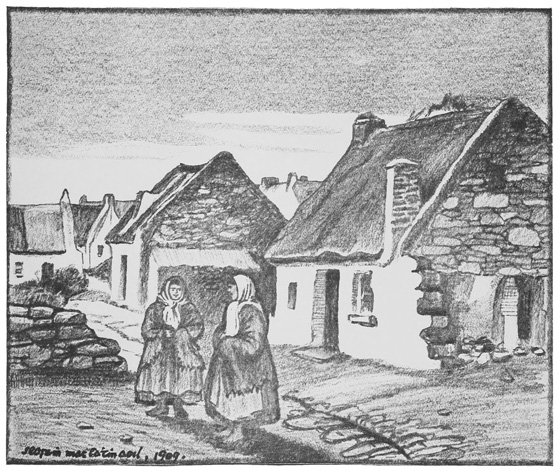
Bearing south by the Owenwee river
from Maghery, we strike up through
Maum gorge. Outside Maghery we
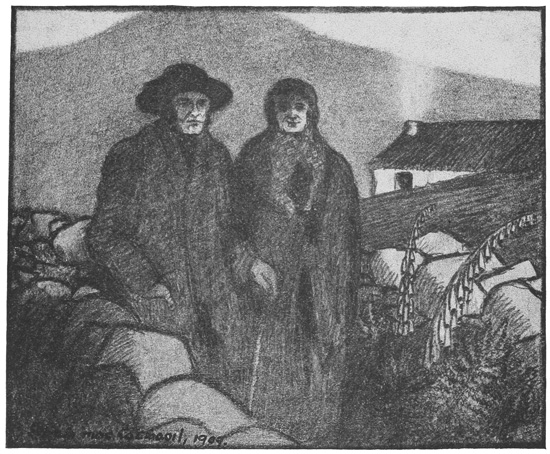
come on two men—one of them a thin, wizened old
fellow with no teeth; the other a youngish man, very
raggedly dressed, with dark hair and features like an
Italian. The old man tells us in Irish (which we don’t
follow very clearly) to keep up by the river-bed, and we
can’t possibly lose our direction. A quarter of a mile
further on we meet another man. He bids us the time
of day in passably good English. I answer in Irish,
telling him that we are on the road for Glen-Columcille,
and asking him the easiest way over the hills. He repeats
what the old man told us, viz., to keep to the river-bottom,
and to cut up then by the fall at the head of
Maum to Laguna, a cluster of poor houses in the mountain
under Crockuna. “When you get there,” he says,
“you cannot lose your road.” He comes a bit of the
way with us, and then we leave him at a point where the
track ends in the heather, and where a squad of navvies
is engaged laying down a foundation of brushwood and
stones to carry it further into the hills. It gives us a
shock, in a way, to come on this squad of wild-looking
men in so lonely and desolate a place.
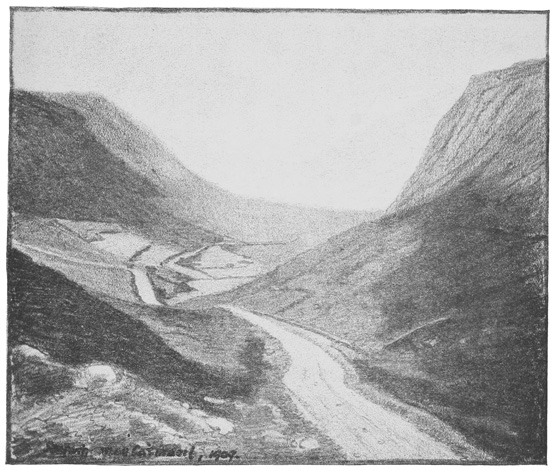
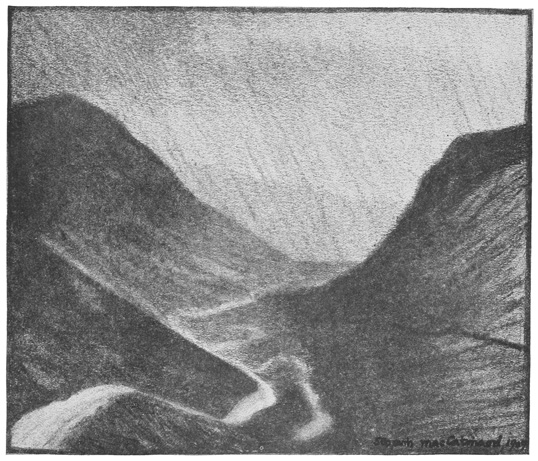
We are now well into the gorge, and a wild place
it is! Half-way up we come on a house—if one could
call it such—with a reek of blue smoke threading out
of a hole in the thatch. No other sign of life is
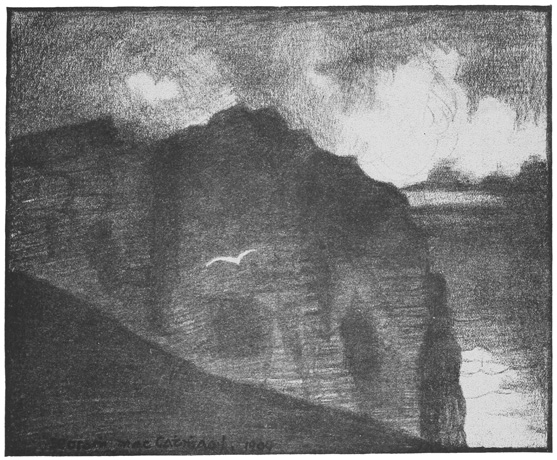
visible. The walls of the gorge close in darkly on
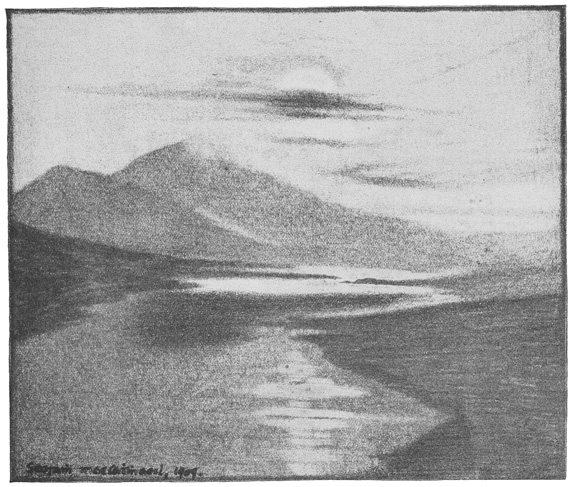
every side except the north. On that side is the sea,
white on Maghery strand, and stretching away, a dull
copper-green colour, into the sailless horizon beyond.
Hearing the voices, a young man comes out from
between two boulders serving as a sort of gateway to
the house. His face is tanned with sun and exposure,
and he is in his bare feet. We greet him in Irish and
he answers—a little surprised, no doubt, at hearing the
language from strangers. Then another man comes
forward—a brother, if his looks don’t belie him. He
is in his bare feet also, and hatless, with a great glibbe
of black hair falling over his eyes. “You have the Irish?”
he says. “It’s newance to hear it from townsfolk.” We
talk for a while, enquiring further as to our direction over
the hill, and then we push on. Near the head of the
gorge we sit down to have a rest, sitting on a rock
over the stream, and bathing our hands and faces in the
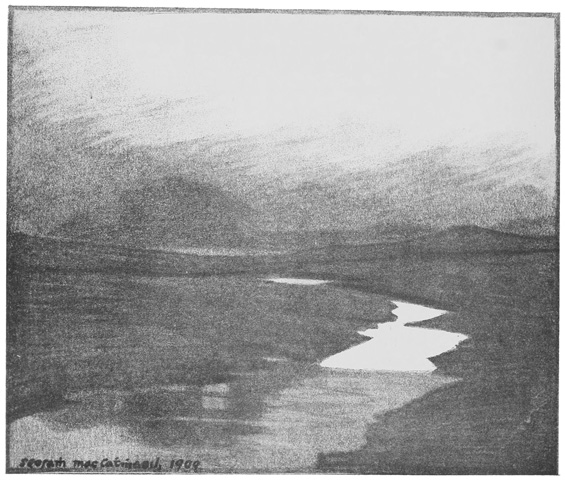
brown, flooded water. All the rivers of Donegal are
brownish in colour, and the Owenwee (recte Abhainnbhuidhe,
“yellow river”) is no exception. The water
stains everything it touches, and I have no doubt but
that the dark colour of the people’s skin is due, partly,
to their washing themselves in it. Coming through one’s
boots, even, it will stain the soles of the feet.
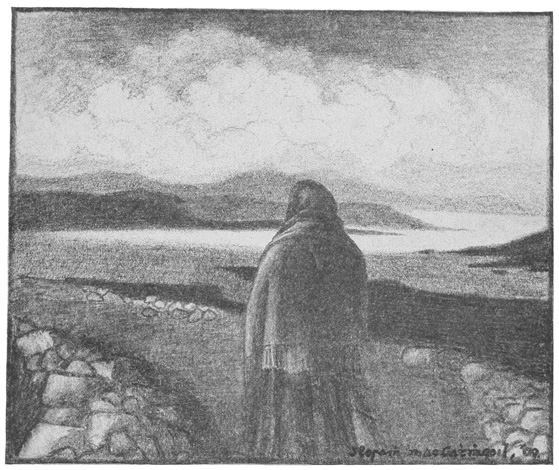
ON THE ROAD TO DOON WELL.
We resume our journey, and after some rough and steep
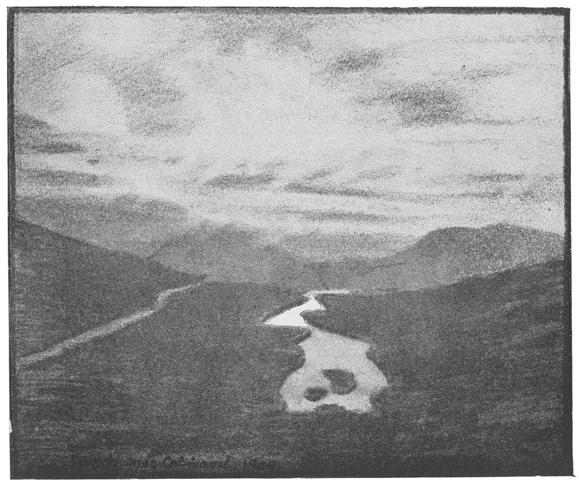
climbing reach the plateau head. Loch Nalughraman, a
deep pool of mountain water, lies to the east of us, shimmering
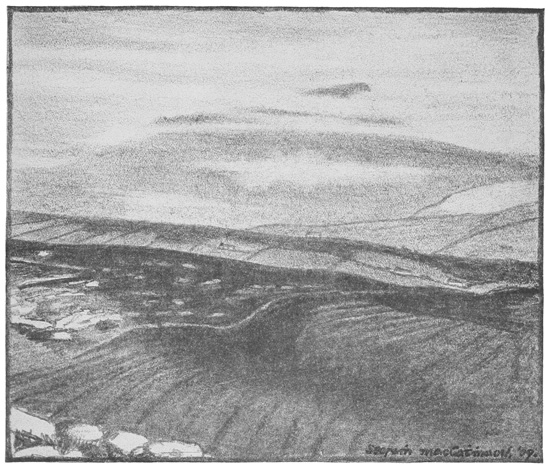
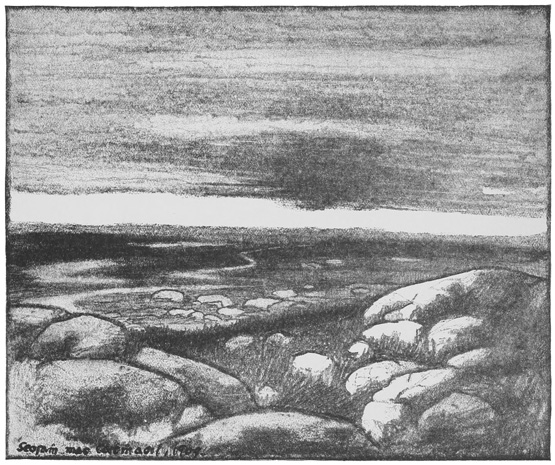
in the grey morning light. All around is bogland,
of a dull red colour, and soaking with rain. We make
through this, jumping from tuft to tuft, and from hummock
to hummock, as best we can, going over the
shoe-mouth occasionally in slush. In an hour or so
we come on a bridle-path of white limestones, set on
their flat in the spongy turf. We follow this for a
while, and in time reach the poor village of Laguna.
Entering into one of the houses I greet the bean-a’-tighe
in Irish. She rises quickly from her seat by
the hearth where she has been spinning—a crowd of
very young children clinging to her skirts. She is a dark
woman, with mellow breasts, and fine eyes and teeth.
She is barefooted, as usual, and wears the coloured head-dress
of her kind, curtseying to me modestly as I
approach. She answers me in Irish—the only language
she knows—and bids me come in. “Beir isteach,” she
says. A young man of five-and-twenty or thereabouts is
weaving in the room beyond. (I recognised the heavy
click-clack, click-clack, click-clack of the loom as I
entered.) Hearing my enquiry he rises up from his seat,
drops his setting-stick, and offers to guide us as far as
the southern edge of the hill. “You will see the Glen
road below you,” he says, coming out in his bare feet into
the open, and speaking volubly, like one used to good
speech. “Look at it beyond,” he says, “winding from
the Carrick side. Keep south, and you will strike it after
two miles of a descent.” The woman brings a bowl of
goat’s milk to my sister. She drinks it readily, for she
is thirsty after her climb. Then, thanking the poor people
for their hospitality, we say, “Slán agaibh,” and press
forward on our journey to Glen-Columcille.
We reach the high-road in about half-an-hour, near a
school-house, shining white in the sun, and busy with the
hum of children singing over their lessons. Things look
more familiar now. We pass many houses, with fleeces
of dyed wool—green and blue and madder—drying on
bushes outside the doors, and men busy stacking turf and
thatching. Here and there on the road flocks of geese
lie sunning themselves, head-under-wing. As we draw
near they get up and face us with protruding necks,
hissing viciously. Dogs bark at us occasionally, but not
often. (I had heard ill accounts of the Donegal dogs
from travellers, but on the whole, my experience of them
has not been quite so bad as I had been led to expect.)
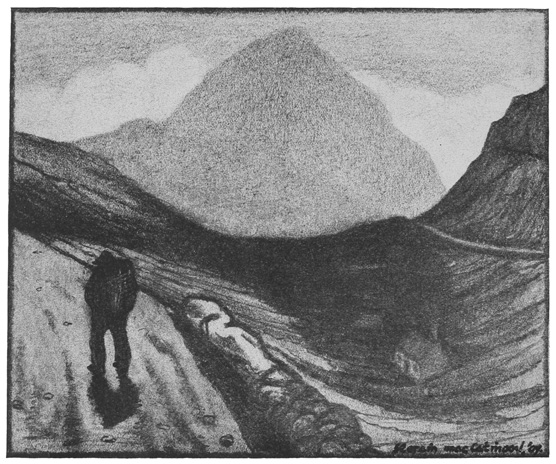
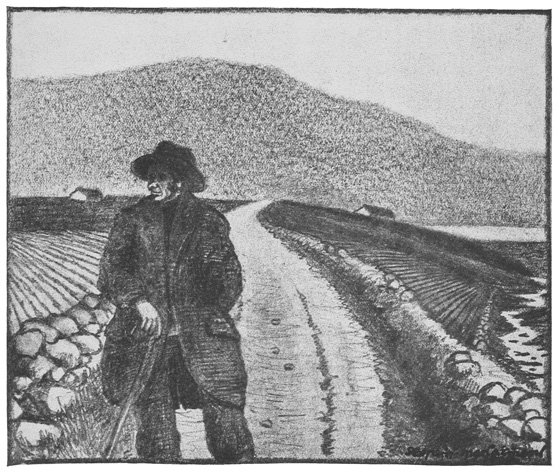
Slieve League rises on our left, a dark, shadowy bulk of
mountain, shutting off the view to the south. All around
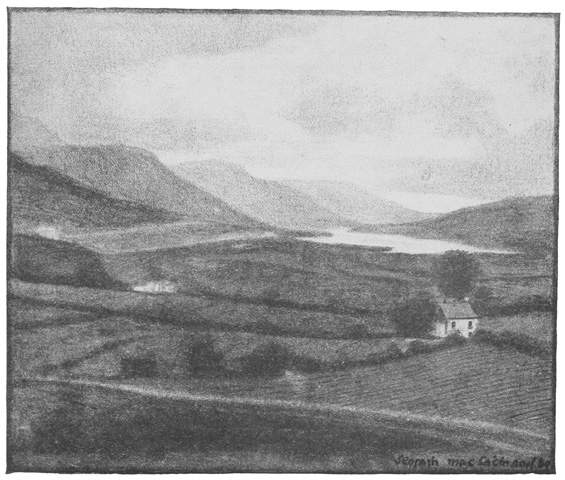
is moorland, with a stream in spate foaming through a
depression in it, and little patches of tilled land here and
there, and the inevitable brown-thatched cabin and the
peat-reek over it. After some miles’ travelling we come
on a little folk-shop by the road—a shop where one might
buy anything from a clay-pipe or a lemon to Napoleon’s
Book of Fate. The window looks tempting, so we go in.
The shopkeeper is a quiet-mannered little man, not very
old, I would think, but with greyish hair, and eyes that
look as if they were bound round with red tape—burnt
out of his head with snuff and peat-smoke. We ask
him has he any buttermilk to sell. He hasn’t any,
unfortunately—he is just run out of it—so we content
ourselves with Derry biscuits, made up in penny cartons,
and half a dozen hen-eggs to suck on the way. Some
people may shiver at the idea of it, but raw eggs are as
sustaining a thing as one could take on a journey! We
pay our score, and get under way again. At a bridge
where the road forks we sit down and eat our simple
repast. A bridge has always a peculiar fascination for
me—especially in an open country like this where one’s
horizon is not limited by trees and hedges—and I could
spend hours dawdling over it, watching the play of sun
and shadow on the water as it foams away under the
arches. Here there is a delightful sense of space and
quietness. The heather-ale is in our hearts, the water
sings and the wind blows, and one ceases to trouble about
time and the multitude of petty vexations that worry the
townsman out of happiness. Did I say one ceases to
trouble about time? Even here it comes, starting one
like a guilty thing. We reach Meenacross Post-office at
four-thirty, and an hour later see the Atlantic tumbling
through rain on the age-worn strand of Glen-Columcille.