Mayfair is at the present time the most fashionable part of London, so
much so that the name has come to be a synonym for wealth or pride of
birth. Yet it was not always so, as he who runs may read, for the
derivation is simple enough, and differs from most cases in that the
obvious meaning is the right one. In James II.'s reign a permission was
given for a fair to be held on the north side of Piccadilly, to begin on
the first day of May, and to last for fifteen days. This fair, we are
told, was "not for trade and merchandise, but for musick, showes,
drinking, gaming, raffling, lotteries, stageplays and drolls." It was
immensely popular, and was frequented by "all the nobility of the town,"
wherein, perhaps, we see the germs of the Mayfair we know. It must be
remembered that Grosvenor and Berkeley Squares, with their diverging
streets, were not then begun, and that all this land now covered by a
network of houses lay in fields on the outskirts of London, while Hyde
Park Corner was still the end of the world so far as Londoners were
concerned. It was about the end of the seventeenth century that the
above-mentioned squares were built, and at once became fashionable, and
as the May fair continued to flourish until 1708, it must have seen the
growth of the district to which it was to give its name. Though
suppressed, doubtless on account of disorders, it revived again, with
booths for jugglers, prize-fighting contests, boxing matches, and the
baiting of bears and bulls, and was not finally abolished until the end
of the eighteenth century.
But Mayfair is not the only district to be noticed; we have also its
rival—Belgravia—lying south of Hyde Park Corner, which is equally
included in the electoral district of St. George's, Hanover Square. This
electoral district takes in the three most fashionable churches in the
Metropolis, including the mother church, St. Paul's, Wilton Place, and
St. Peter's, Eaton Square, besides many others, whose marriage registers
cannot compete either in quantity or quality of names with these three.
The district can also show streets as poor as some are rich; it includes
not only Park Lane and Piccadilly, but also Pimlico and the dreary part
to the south of Buckingham Palace Road. It is a long, narrow district,
stretching from the river to Oxford Street. As a parish, St. George's
was separated from St. Martin's in 1724, and it is now included in the
city of Westminster, with which it has been associated from its earliest
history. In the charter given by King Edgar to the monks at Westminster,
their possessions were defined as reaching to the highroad we now call
Oxford Street on the north, and to Tyburn Lane, or Park Lane, on the
west. But of this the parishes of St. Margaret and St. John at
Westminster were the City, and the rest lay in the "Liberties."
The larger portion of the district is included in the ancient estate of
Eia, 890 acres in extent, reaching from the Bayswater Road to the
Thames, which was given by William the Conqueror to Geoffrey de
Mandeville, who at his death bequeathed it to the Abbey of Westminster.
In Domesday Book it is divided into three manors of Hyde, Ebury, and
Neyte. Of these the first occupies the site of Hyde Park; Ebury, from
Knightsbridge to Buckingham Palace Road; Neyte, nearer the river, was
the favourite residence of the Abbots. Here John of Gaunt lived, and
here, in 1448, John, son of Richard, Duke of York, was born. The monks
remained in possession until dispossessed by Henry VIII. in 1536. Hyde
then became a royal hunting-ground. Neyte, or Neat, and Ebury remained
as farms, which in 1676 came into the possession of the Grosvenor family
by the marriage of Mary, daughter and heiress of Alexander Davies of
Ebury, with Sir Thomas Grosvenor, Bart. With her came also the
Grosvenor Square property, extending from Oxford Street to Berkeley
Square and Dorchester House, and from Park Lane to South Molton Lane and
Avery Row. Other large landholders in the district are the Crown—Hyde
Park, and Buckingham Palace; Lord Fitzhardinge, the Berkeley estate; the
City of London, New Bond Street and parts of Conduit Street and Brook
Street; Earl Howe, Curzon Street; Sir Richard Sutton, Piccadilly; the
Dean and Chapter of Westminster, Knightsbridge; and the Lowndes family,
Lowndes Street and Chesham Place.
More than a quarter of the district is covered by Hyde Park, 394 acres
in extent. Long before its acquisition by the Crown in 1536 it had been
a favourite royal hunting-ground, and it so continued until Charles I.'s
accession, when it was opened to the public. During this reign, and
until 1736, the world of fashion centred round the Ring, a circular
drive planted with trees, some of which are still carefully preserved on
the high ground near the Ranger's house, though all trace of the roadway
has long been obliterated. The Park was sold by auction during the
Commonwealth, but resumed by the Crown at the Restoration, and in 1670
was enclosed with a brick wall and restocked with deer, who have left
their traces in the name of Buck Hill Walk and Gate, close to the east
bank of the Serpentine. This prettily-laid-out area, formerly known as
Buckden Hill or the Deer Paddock, is now tenanted only by peacocks,
ducks and rabbits.
The Serpentine, a noble stretch of water of 50 acres, has already been
described in "Kensington."
Hyde Park has always been noted for its springs. In 1725 the Chelsea
Waterworks Company obtained a license to supply the surrounding
districts, and built a reservoir and engine-house near Grosvenor Gate,
which existed until 1835, when, on the recall of the license, the
engine-house was demolished and the basin laid out with flower-beds and
a fountain. The present reservoir stands in the centre of the Park,
while opposite Stanhope Place on the north side is a Gothic drinking
fountain, the gift of the Maharajah of Vizianagram. The oldest of the
present roads in Hyde Park is Rotten Row, made by William III.; it is
now reserved for riding only, while under the trees on either side rank
and fashion have lounged and gossiped since the days of the Ring. The
popular derivation of the name is from Route du Roi, since it was known
first as the King's or Lamp Road; but possibly it has its origin in the
soft soil of which the ride since 1734 has been composed. The south
road, now the fashionable drive, was made by George II. about 1732, as a
short way to Kensington Park. The road from Alexandra Gate to Victoria
Gate crosses the Serpentine by a stone bridge built by Rennie in 1826,
and is the only one open to hired vehicles, which were first forbidden
the use of the Park in 1695. From the Serpentine a soft ride runs
parallel to the roadway as far as the Marble Arch; from this point Hyde
Park Corner is reached by a broad drive bordered with flower-beds and
trees, which replace the famous double avenue of walnuts cut down in
1811. It is much patronized by society, who congregate opposite Hyde
Park Corner, near the Achilles statue, by Sir R. Westmacott, R.A., cast
from captured French cannon, and erected at a cost of £10,000 by the
women of England in 1820, "in honour of the Duke of Wellington and his
brave companions in arms." It is copied from a Roman antique, but the
name is a misnomer. The road along the north side of the Serpentine is
now thronged every day with bicyclists, to whom the Park has been lately
thrown open. Here also are held the annual meets of the Four-in-Hand and
Coaching Club during the season. This road was widened in 1852. Of past
and present buildings in Hyde Park the following may be noted: When the
Serpentine was made, an old lodge was demolished which may have been the
tavern known in the reign of James I. as the "Grave Maurice's Head," and
which later became Price's Lodge. Up to 1836, on the bank of the
Serpentine stood an old house called the Cake House, and close to it was
the old receiving house of the Royal Humane Society, which was replaced
in 1834 by the present building, designed by Decimus Burton. Among the
trees behind it is an old farmhouse (Hyde Park Lodge), the residence of
Major-General Bateson, Deputy Ranger, adjoining which are the old
barracks, now a police-station and guard-room, the head-gardener's
house, built in 1877, and the old magazine. The new magazine stands
close to the Serpentine Bridge, and contains over 1,000,000 rounds of
ammunition. Near Grosvenor Gate stood the Duke of Gloucester's
riding-house, built in 1724, which, after serving as the headquarters of
the Westminster Volunteer Cavalry, was demolished in 1824. The old
Ranger's Lodge at Hyde Park Corner was pulled down when Apsley House was
built.
The principal entrance to Hyde Park is at Hyde Park Corner, and consists
of a triple archway combined with a fluted Ionic screen, by Decimus
Burton, completed in 1828. The iron gates are by Bramah. Cumberland
Gate, the next in importance, was opened in 1744, with wooden gates.
Here in 1643 was posted a court of guard to watch the Oxford Road, where
the Court was residing, and here also military executions took place.
The Marble Arch, an imitation by Nash of the Arch of Constantine at
Rome, erected originally as an entrance to Buckingham Palace, was moved
to this site in 1851. Albert Gate was made in 1841, on the site of the
Cannon Brewery. The iron gates were set up in 1845, and the stone stags
on either side were brought from the old Lodge in the Green Park.
The remaining gates are Alexandra Gate and Prince of Wales's Gate,
erected since 1851; Victoria Gate, Grosvenor Gate, made in 1724 by
subscription of the neighbouring inhabitants; and Stanhope Gate, opened
about 1760. There are also numerous entrances for foot passengers.
The present Park railing was put up after the Reform Riots in 1866 to
replace the one demolished by the mob, which had stood since 1825.
In duelling days Hyde Park was a favourite battle-ground. Of many
encounters the following may be recorded:
1685. The Duke of Grafton and the Hon. John Talbot, the latter being
killed.
1712. The Duke of Hamilton and Lord Mohun, which took place near Price's
Lodge. Both died on the ground, and Lord Mohun's second, General
Macartney, was afterwards tried, on the accusation of Colonel Hamilton,
for stabbing the Duke when on the ground; he was, however, acquitted.
1763. John Wilkes was wounded by Mr. Samuel Martin, M.P.
1770. Lord Thurlow and Mr. Andrew Stewart.
1777. Charles James Fox and Mr. William Adam, M.P.
1780. Colonel Fullarton, M.P., wounded the Earl of Shelburne.
After 1803 the practice of duelling fell gradually into disuse.
In troublous times military camps occupied the open ground, notably in
1649 under Lord Essex, in 1665 during the Plague, and in 1715 and 1722
to guard against Jacobite rebellion.
Reviews have been held at intervals from 1569 until 1876, but are now of
very rare occurrence.
Hyde Park has also been the scene of some serious riots, notably those
in 1821 on the occasion of the removal of Queen Caroline's body; in 1885
against the Sunday Trading Bill; and in 1862 the Garibaldi disturbances.
The most important riot, however, broke out in 1866, when the Reform
Leaguers forcibly entered the Park by pulling down the railing. From the
Reform League the Reformer's tree near the reservoir took its name;
though the original one has been felled, the name is still applied to a
neighbouring tree, and political demonstrations, which have been
declared legal since 1866, are still held on the open space in the
vicinity.
Oxford Street, which forms the northern boundary of the district, has
already been described in the book on "Marylebone," with which district
it is closely identified. It is only necessary here to mention some of
the notable houses on the south side which fall within our compass.
The first is Camelford House (Lord Hillingdon), an unpretentious
building in a courtyard, once the property of the Pitts, Earls of
Camelford. George Grenville occupied it in 1805, and subsequently H.R.H.
Princess Charlotte and her husband, afterwards Leopold I. of Belgium.
Adjoining it is Hereford Gardens, a row of handsome private houses built
in 1870 on the site of Hereford Street (1780).
At the corner of Lumley Street (south side) is the Royal Association in
Aid of the Deaf and Dumb. The building, erected in 1870 from designs by
Sir A. Blomfield, of red brick, contains a reading-room, lecture-hall,
and on the upper floor St. Saviour's Church, in early Pointed style.
From Dering Street, on the south side of Oxford Street, the garden of
Lord Carnarvon's house in Tenterden Street extended nearly to Harewood
Place. On the site are a noticeable stone-fronted house, now a carriage
warehouse, and the Royal Orthopædic Hospital, founded 1838 and removed
here from Bloomsbury Square in 1856.
Park Lane, up to 1769 called Tyburn Lane, was in the reign of Queen Anne
a desolate by-road, but is now a favourite place of residence for the
fashionable persons in the Metropolis. It is open to Hyde Park as far as
Hamilton Place, whence it reaches Piccadilly by a narrow street. At its
junction with the former stands an ornamental fountain by Thorneycroft,
erected in 1875 at a cost of £5,000, the property of a lady who died
intestate and without heirs. At the base are the muses of Tragedy,
Comedy, and History in bronze, above Chaucer, Shakespeare and Milton in
marble, the whole being surmounted by a bronze statue of Fame. The
principal mansions in Park Lane are: Brook House, at the north corner of
Upper Brook Street, designed by T. H. Wyatt, and the residence of the
Earl of Tweedmouth, and next to it Dudley House. Dorchester House
(Captain Holford) was built by Vulliamy in 1852 on the site of the town
house of the Damers, Earls of Dorchester. The building, which stands in
its own grounds, is rectangular, and constructed of Portland stone in
Italian Renaissance style. On the narrow front is a carriage portico.
The reception rooms and marble staircase have few rivals in London; they
contain two libraries and a collection of pictures by old and modern
masters. Here died in 1842 the Marquis of Hertford. Londonderry House,
No. 18 (Marquis of Londonderry), was built in 1850 by S. and J. Wyatt on
the site of the residence of the D'Arcys, Earls of Holdernesse. It
contains a fine gallery of pictures and sculpture. Other inhabitants:
the Duke of Somerset, in a house adjoining Camelford House, No. 35; Sir
Moses Montefiore, d. 1885; Park Lane Chambers, Earl Sondes, Lord
Monkbretton.
At the corner of Upper Grosvenor Street (then No. 1, Grosvenor Gate)
Benjamin Disraeli lived 1839-73. No. 24, Lord Brassey. No. 21, for many
years the Marquis of Breadalbane, and afterwards Lady Palmerston, when
left a widow in 1850; Earl of Scarborough. Sir Edward Bulwer Lytton at a
house then numbered 1. In 23, Richard Sharp, 1822-24; Mrs. Fitzherbert,
1785; Warren Hastings, 1790-97; Marquis Wellesley, 1796.
Grosvenor Square and the surrounding streets have always been the centre
of the aristocratic world; the Square, which includes about six acres,
was built in 1695. The garden was laid out by Kent, and in the centre
stood formerly an equestrian statue of George I., by Van Nost, placed
there in 1726. On the site, in 1642, was erected a fort named Oliver's
Mount, which stood as one of the defences against the Royalists until
1647. Owing to the prejudices of the inhabitants, Grosvenor Square was
not lit by gas until 1842.
Inhabitants: Duchess of Kendal, d. 1743; Earl of Chesterfield, 1733-50;
Bishop Warburton, 1757; Lord Chancellor Hardwicke, 1758-64; Lord
Rockingham, d. 1782; Henry Thrale, d. 1781; Lord North, d. 1792; Thomas
Raikes, 1832; Sir Thomas Stamford Raffles; 10, Lord Canning and Lord
Granville, 1841; 22, William Beckford, 1800; 23, the Earl of Derby here
married Miss Farren, actress, in 1797; his successors resided here until
1832; Lord Stratford de Redclyffe, d. 1880; 24, the Earl of Shaftesbury;
29, Sir John Beaumont; 30, John Wilkes, d. 1797; 39 (now 44), the Earl
of Harrowby, 1820 (here the Cato Street conspirators proposed to murder
the Ministry); 44, Countess of Pembroke. The houses have since been
renumbered. To give a list of the present inhabitants of note would be
impossible; it would be like copying a page out of the Red Book. Suffice
to say there are living in the Square two Dukes, one Marquess, three
Earls, six Barons, and five Baronets, beside many other persons of
distinction.
At the corner end of Park Street, and in South Street and Aldford
Street, the old houses have been pulled down and have been replaced by
large, red-brick, ornamented structures, such as have also been erected
in Mount Street, Grosvenor Street, and North and South Audley Street.
The spaces behind the houses are occupied by mews. Great improvements
have also been effected since 1887 in the housing of the working
classes, particularly in the neighbourhood of Oxford Street, and in
Bourdon Street and Mount Row, by the erection of blocks of industrial
dwellings by the St. George's and Improved Industrial Dwellings
Companies, under the auspices of the Duke of Westminster.
In Park Street, formerly called Hyde Park Street, lived Miss Nelly
O'Brien, 1768; 7, Sir William Stirling Maxwell, M.P.; 26, Sir Humphry
Davy, 1825, till his death; 113, Miss Lydia White, d. 1827; 123, Richard
Ford, author of "The Handbook for Spain." In North Audley Street,
opposite Green Street, is St. Mark's Church, built from designs by J. P.
Deering in 1825-28, and reconstructed in Romanesque style in 1878.
Adjoining is the Vicarage, built in 1887, and at the back the St. Mark's
Institute, containing a church-room, mission-room, gymnasium, and a
working men's club. Attached to the institute are the parish schools,
built soon after 1830, and enlarged and repaired in 1894.
Near the church lived the Countess of Suffolk, mistress of George II.;
at 1, Maria Edgeworth; 26, the Misses Berry.
South Audley Street takes its name from Hugh Audley (d. 1662), the owner
of some land in the neighbourhood. It has several interesting houses.
No. 8, Alington House (Lord Alington), was, in 1826, Cambridge House,
the residence of the Duke of York, and afterwards, until 1876, belonged
to the Curzons, Earls Howe. In 73, Bute House, lived, in 1769, the great
Earl of Bute, and near him his friend Home, author of "Douglas."
Chesterfield House, a large mansion standing in a courtyard at the
corner of Curzon Street, was built by Ware in 1749 for the fourth Earl
of Chesterfield, d. 1773, who wrote the "Letters" in the library. The
portico and marble staircase, with bronze balustrade, were brought from
Canons, the seat of the Duke of Chandos. In 1869 the house was sold to
Mr. Magniac for £175,000, and he built over the gardens. It is now the
town house of Lord Burton.
Opposite Aldford Street is Grosvenor Chapel, erected in 1730; an ugly
building, with sittings for 1,200. It is now a chapel of ease to St.
George's. Here were buried Lord Chesterfield, 1773; Ambrose Phillips,
poet, 1749; Lady Mary Wortley Montagu, 1762; David Mallet, poet, 1765;
William Whitehead, poet, 1785; John Wilkes, 1797; Elizabeth Carter,
1806. The churchyard at the back was, in 1889, converted into a public
garden. Just outside the gate is the Public Free Library, erected in
1894 under the Free Libraries Act.
Other inhabitants: General Paoli; Holcroft, dramatist, 1761; Sir William
Jones; Lord John Russell; Lord Sydenham, 1841; 8, Archbishop Markham, d.
1807; 14, Sir R. Westmacott, sculptor, d. 1856; 15, Baron Bunsen, 1841;
72, Charles X., when in exile, and in 1816 the Duchesse d'Angoulême;
Louis XVIII., in 1814, also lived in this street; 74, the Portuguese
Embassy early in the eighteenth century; 77, Sir Matthew Wood; here
Queen Caroline resided in 1820. In the enlargement of the street called
Audley Square Spencer Perceval was born. North Row has no interest. In
Green Street lived Sydney Smith, d. 1845; Lord Cochrane, d. 1814; 61 is
Hampden House, residence of the Duke of Abercorn. At the corner of Park
Street stood St. Mary's Church, pulled down in 1880.
In Norfolk Street lived Lord William Russell, murdered by his valet in
1840; at 27 the Earl of Dunraven, 1895. In Upper Brook Street lived Lord
George Gordon, b. 1750, and George Grenville; 3, Sir Lucas Pepys and the
Countess of Rothes; 18, Hon. Mrs. Damer, sculptor, d. 1828; 27, "Single
Speech" Hamilton, d. 1796; 18, Sir William Farrer, F.R.G.S.; 32, Marquis
of Ormonde.
Upper Grosvenor Street contains Grosvenor House, the residence of the
Duke of Westminster, a handsome building standing in a courtyard, with a
garden at the back, skirting Park Lane as far as Mount Street. On its
purchase in 1761 by the Duke of Gloucester, brother of George III., it
was known as Gloucester House. The present screen and metal gates by
Cundy were erected in 1842. The house contains a very fine collection of
pictures.
In this street lived: No. 2, Lord Erskine; 11, Mr. Francis Hale Rigby,
1817; 16, the first Sir Robert Peel; 18, Lord Crewe, 1809.
Among present inhabitants are:
The Dowager Duchess of Northumberland; Dowager Countesses of Galloway
and Wilton; Lord Templemore; Major-General Hon. H. F. Eaton; Prince
Alexis Dolgorouki; Sir E. Chandos Leigh.
Balfour Place has been lately rebuilt, and was so named in 1892 instead
of Portugal Street.
Mount Street (1740), called from the Fort of Oliver's Mount, was rebuilt
with ornamental red-brick houses; it contains the Vestry Hall—now the
Register Office for the district—built by Bolton in 1887, at a cost of
£15,200, on the site of the old workhouse, now removed to the Fulham
Road.
Inhabitants: Lady Mary Coke, 1810; Martin Van Butchell, d. 1810; Sir
Henry Holland, 1816; No. 102, Madame d'Arblay, 1832; 111, on the site of
an old manor-house, was in 1891 occupied by a college of Jesuit priests;
2, Sir Charles Hall, Q.C., M.P., d. 1900; 49, Earl of Selborne; 54, Lord
Windsor; 105, Winston Churchill, M.P.; 113, Right Hon. Akers Douglas,
M.P. In Carlos Place, so renamed in 1892 instead of Charles Street
(1727), lives: No. 1, Sir George Chetwynd, Bt., 1896. Its prolongation,
Duke Street, rebuilt in 1889 in red brick, dates from about 1770, and
was named probably after the Duke of Cumberland. In that year a lying-in
hospital stood in the street; opposite a small square is the King's
Weigh House Congregational Chapel, a large building erected in 1891.
Blocks of artisans' dwellings occupy the small streets round about.
In Gilbert Street are St George's, Hanover Square, District Schools,
which replaced the old schools in South Molton Street. The building was
erected in 1888 by Caroe on a site given by the Duke of Westminster, and
cost £5,000. These schools were incorporated in 1818 with General
Stewart's schools in South Street.
Davies Street is very narrow at its northern end, where it forms a
prolongation of South Molton Lane, an old street known in 1708 as Shug
Lane. It takes its name either from Miss Mary Davies, who is said to
have lived in an old house still standing at the corner of Bourdon
Street, or from Sir Thomas Davies, to whom Hugh Audley left his
property. Here is the new church of St Anselm, built in Byzantine style,
from designs by Balfour and Turner, at a cost of £20,000, and opened in
February, 1896, to replace Hanover Chapel, Regent Street. At No. 8 are
the Westminster Public Baths and Washhouses.
In Bourdon Street is St. Mary's Church, a chapel of ease to St.
George's, built for £12,000 by the Duke of Westminster in 1881 to
replace St. Mary's Church in Park Street. The building, from designs by
Blomfield, is in medieval style. Adjoining is St. George's Workmen's
Dwellings Association.
In Grosvenor Street (1726) lived: Countess of Hertford, 1740; Lord
North, 1740; Sir Paul Methuen, 1740; Miss Vane, mistress of Frederick,
Prince of Wales; Lord Crewe, 1784; Marquis Cornwallis, 1793-98; No. 13,
William Sotheby; William Huskisson; at 16 was formerly the Royal
Institution of British Architects; 17, Samuel Whitbread, 1800; 28, Sir
Humphry Davy, 1818; 48, Earl St. Vincent, d. 1823; 72, Dr. Matthew
Baillie, d. 1823; 6, Sir E. Ashmead Bartlett, M.P., d. 1902; 25, William
Allingham, surgeon; 50, Earl Carrington; 59, Right Hon. James Lowther,
M.P.; 72, Sir James Reid; and many others.
Brook Street was first called Little Brook Street, and afterwards Lower
Brook Street. It takes its name from the Tyburn, which flowed down the
course of South Molton Lane and Avery Row, by Bruton Mews to the bottom
of Hay Hill, and through the gardens of Lansdowne House to Shepherd's
Market. It then crossed Piccadilly at Engine Street, and flowed through
the Green Park to Buckingham Palace.
In Brook Street is Claridge's (formerly Mivart's) Hotel. Here lived: No.
25 (now 72), Edmund Burke; Sir Henry Holland, 1820-73; 63, Sir William
Jenner; 74, Sir William Gull; 57 (now 25), Handel, the composer; Lord
Lake, d. 1808; Welbore Ellis, Lord Mendip, d. 1802; Mrs. Delany; 20,
Gerald Vandergucht, engraver, and his son Benjamin Vandergucht, painter;
Thomas Barker, painter; 25, Rev. Sydney Smith; 30, Sir Charles Bell, d.
1832; 34, Sir Thomas Troubridge, 1809; 63, Sir John Williams, physician;
66, Sir B. Savory, Bart.; 74, Lord Balcarres; 84, Sir William Broadbent,
physician; 86, Lord Davey, P.C., F.R.S.
In South Molton Street, on the wall of No. 36, is an inscription: "This
is South Molton Street, 1721." At No. 17 lived William Blake, poet and
painter, in 1807. The St. George's Schools, at No. 53, were removed in
1889 to Gilbert Street, and the building sold for £2,500.
In Woodstock Street lived: Dr. Johnson, 1737; Prince Talleyrand, 1793;
Dr. Parr, 1814. Running out of it are Sedley Place, so named in 1873
instead of Hanover Place, and Blenheim Street, up to 1760 called Pedley
Street.
East of New Bond Street, Hanover Square, four acres in extent, was built
as a fashionable place of residence in 1716-20. It was to have been
called Oxford Square, but the name was changed in honour of the house
of Hanover. A few of the old houses still remain, notably Nos. 17 and
23, but most of them have been rebuilt at various times, and are not in
any way remarkable. The centre is enclosed and planted with trees, and
at the southern end stands a bronze statue of Pitt by Chantrey, erected
in 1831 at the cost of £7,000. The principal houses are: No. 3, the
offices of the Zoological Society, established in 1826, and removed here
in 1846; those of the Anthropological Society; 4, a large handsome
building erected in 1774 by Sir George Gallini, and opened by him as the
Hanover Square Concert and Ball Rooms. Here J. C. Bach, son of Sebastian
Bach, gave concerts from 1785-93. The concerts of Ancient Music and
those of the Philharmonic Society also took place here. In 1862 the
rooms were redecorated and styled the Queen's Concert Rooms, but were in
1875 disposed of to the Hanover Square Club, established in that year.
No. 10 was formerly the Brunswick Hotel, but has been rebuilt as
chambers.
No. 12, formerly the offices of the Royal Agricultural Society, now
those of the Shire Horse Society and Kindred Associations.
No. 13, Harewood House, was built by W. Adam for the Duke of Roxburghe,
and purchased in 1795 by Lord Harewood, in whose family it remained
until 1894, when it was sold to the Royal Agricultural Society,
established in 1838 for the improvement of agriculture.
No. 15 now forms part of the Orthopædic Hospital in Oxford Street.
No. 16 in 1845 was occupied by the Royal College of Chemistry,
established in that year, and afterwards removed first to Oxford Street,
and in 1835 to the School of Mines, Jermyn Street.
In No. 17 Mrs. Jordan is said to have lived under the protection of the
Duke of Clarence, afterwards William IV. In 1864 it became the home of
the Arts Club, established in that year for persons interested in art,
literature, or science. The house contains a fine painted ceiling by
Angelica Kaufmann, and some marble mantelpieces of Italian workmanship,
but is soon to be demolished.
No. 18 is the Oriental Club, founded in 1824 by Sir John Malcolm for
persons who have resided or travelled in the East. The present house, on
the site of one occupied by Lord Le Despenser 1771-81, was built in 1827
by the Wyatts, and contains some good portraits of Lord Clive and other
distinguished Anglo-Indians.
No. 20 is the offices of the Royal Medical, Pathological, and Clinical
Societies, established 1867.
No. 21 was the site of Downshire House from 1793. It was before that
date the property of the Earl of Hillsborough. Here, in 1835, lived
Talleyrand, then French Ambassador; after him, Earl Grey. It has been
rebuilt, and is now a bank, above which is the New County Club, located
here in 1894.
No. 32 was the home of the Naval and Military Club from 1863-65.
At No. 23 lived Lord Palmerston, father of the Premier, in 1806, and the
Duchess of Brunswick, daughter of Frederick, Prince of Wales, d. 1813.
Other inhabitants: the present No. 20, Field-Marshal Viscount Cobham,
1736-48; George Granville, Lord Lansdowne, d. 1735; Ambrose Phillips,
poet, d. 1749. At the present No. 10: Admiral Lord Rodney, 1792-96;
Admiral Lord Anson, 1762; "Single Speech" Hamilton, 1765; Percival Pott,
surgeon, 1777-88; Thomas Campbell, poet; Sir James Clark, physician,
1841.
The streets round Hanover Square are mainly broad, well built, and lined
with shops. Hanover Street and Princes Street were built about 1736. In
the latter Sir John Malcolm died in 1833. Swallow Place and Passage
recall Swallow Street, which was cleared away to make Regent Street in
1820.
In Regent Street stood, until recently, Hanover Chapel, with two towers,
designed by C. R. Cockerell, and built in 1824 at a cost of £16,180.
The Ionic portico was imitated from that of Minerva Polias at Priene. In
the interior was a painting of "Christ's Agony in the Garden," by
Northcote, presented 1828 by the British Institution.
Harewood Place was closed at its northern end by gates until 1893, when
all gates and private bars were removed throughout the district. In
Tenterden Street, No. 4 in 1776 became the residence of the Herberts,
Earls of Carnarvon, who still own the property. It, with Nos. 5 and 6,
is now occupied by the Royal Academy of music, founded in 1822 by the
Earl of Westmoreland. Among eminent pupils have been Sterndale Bennett,
Sir G. A. Macfarren, Sir J. Barnby, Mackenzie, Sir A. Sullivan, and
Goring Thomas. At the end of Tenterden Street is Dering Street, so
called in 1886 instead of Union Street.
At the southern end of the Square George Street was built about 1719,
and at first named Great George Street, in honour of George I. It is
wide at the Square end, but grows narrower till Maddox Street is
reached. Its chief feature is the Parish Church of St. George, designed
by John James, begun in 1713 and consecrated in 1724, one of Queen
Anne's fifty churches. The style is Classical, the body plain, but
having a Corinthian portico of good proportions, and a clock-tower 100
feet high. The interior contains a good Jesse window put in in 1841. In
1895 the building was redecorated, repaired, and reseated, and the old
organ by Snitzler, put up in 1761, was replaced by a Hope Jones electric
instrument. This church has been long celebrated for fashionable
marriages. Among those in the register are:
1769. The Duke of Kingston to Miss Chudleigh, she being already married
to Mr. Harvey, afterwards Earl of Bristol. She was afterwards tried and
convicted of bigamy.
1771. Richard Cosway, R.A., to Maria Hatfield.
1793. H.R.H. the Duke of Sussex to Lady Augusta Murray. The marriage was
declared void under the Royal Marriage Act.
1791. Sir William Hamilton to Emma Harte (Nelson's Lady Hamilton).
1797. The Earl of Derby to Miss Farren. The ceremony took place in
Grosvenor Square.
1849. Mr. Heath to Lola Montes.
1880. Mr. J. W. Cross to George Eliot.
Among the Rectors of St. George's were Charles Moss, D.D., 1759-74,
afterwards Bishop of Bath and Wells; and Henry Courtenay, 1774-1803,
made Bishop of Exeter in 1795.
At the bottom of George Street is Limmer's Hotel, formerly a noted
resort of sporting men, rebuilt and enlarged in 1876. No. 25 is a
handsome stone-fronted mansion, built in 1864 for Earl Temple. In 1895
it was in possession of the Duchess of Buckinghamshire. In a house on
the same site lived John Copley, the painter, and his son, Lord
Lyndhurst, d. 1863.
Other inhabitants: No. 3, Madame de Staël; 7, Admiral Sir Edward Hawke;
8, David Mallet, poet, 1758-63; Sir William Beechey, R.A.; Sir Thomas
Phillips, R.A., d. 1845; 9, Richard Brinsley Sheridan, 1803; 13, Lord
Chancellor Cowper, 1723; 15, Sir George Wombwell, afterwards for a short
time the Junior Travellers' Club; Earl of Albemarle, 1726; Lord Stair,
1726; Lady Mary Wortley Montagu, d. 1762; Sir Thomas Clarges, 1726;
Colonel Francis Charteris, 1729; Lord Shelburne, 1748.
Maddox Street was built by the Earl of Burlington in 1721, and named
after Sir Benjamin Maddox, the ground landlord (d. 1670). It contains a
museum of building appliances established in 1866 in connection with the
Institute of British Architects. Mill Street is so called from a mill
which stood near the corner of Hanover Square; near it is Pollen Street;
both are unimportant. Conduit Street, completed about 1713, is so called
from the city conduit which carried water from the Tyburn to Cheapside.
It was built for private residences, which have now been transformed
into shops. On the south side, where is now a tailor's, stood, until
1877, Trinity Chapel, a plain, red-brick building built by Archbishop
Tenison, in 1716, to replace the old wooden chapel which James II. had
originally set up on Hounslow Heath, but which was brought to, and left
at the top of, Old Bond Street about 1691. Four-fifths of the income
derived from the three houses on this site are devoted to the
maintenance of the district churches in the parish, the remainder going
to the parish of St. Martin's. The share of St. George's parish now
amounts to a capital sum of £5,075, and an income of £1,600.
At No. 9, once the town house of the Earls of Macclesfield, are the
offices of the Royal Institute of British Architects, established 1835,
and other kindred societies.
At the Princess of Wales' Tavern, now demolished, David Williams started
the Royal Literary Fund in 1772.
In this street lived: Duke of Wharton, 1725; Charles James Fox, b. here
1749; Boswell, 1772; Wilberforce, 1786; Delmé Radcliffe, d. 1832; Balfe,
composer; No. 36, Sir William Farquhar, physician to William Pitt; 37,
George Canning, 1802-03, after him Dr. Elliotson (the house has since
been rebuilt); 39, Sir Astley Cooper, surgeon, d. 1841.
Old and New Bond Street form a continuous thoroughfare, in which are
situated some of the most fashionable shops in London. Though somewhat
narrow, and architecturally uninteresting, it has always been a
favourite society promenade, and when first built was "inhabited by the
nobility and gentry" (Hatton). New Bond Street dates from about 1716,
and occupies part of the site of Conduit Mead (twenty-seven acres), the
property of the City of London. Of the houses the following are
interesting:
No. 135, the Grosvenor Gallery, the chief of the many picture-galleries
in Bond Street. The house was erected in 1877 for Sir Coutts Lindsey,
Bart., and contains a lending library and until recently the Grosvenor
Club (proprietary, social and non-political). The doorway, by Palladio,
was brought from Venice, and the front is by Soames.
Nos. 15 and 16 are Long's Hotel, much frequented by Sir Walter Scott; it
was rebuilt and enlarged in 1888.
At No. 18, now a jeweller's, was Steven's Hotel, fashionable during the
Regency, and afterwards a haunt of Lord Byron's.
At No. 169, on the west side, was the Clarendon Hotel, formerly the town
house of the Dukes of Grafton, and afterwards the residence, about 1741,
of the elder Pitt. The hotel was closed in 1877, and replaced by a row
of shops.
Inhabitants: Swift, 1727; Mrs. Delany, 1731; Lords Craven, Abergavenny,
and Coventry, 1732; George Selwyn, 1751; Dr. Johnson, 1767; Thomson,
the poet; No. 141, Lord Nelson, 1797; 146, Sir Thomas Picton, 1797-1800;
147, Mrs. and Miss Gunning, 1792; 148, Lord Camelford, 1803-04; 150,
Lady Hamilton, 1813.
Old Bond Street, and the adjoining Stafford Street, Albemarle and Dover
Streets, occupy the site of old Clarendon House, the grounds of which
covered nearly 30 acres, granted to Hyde, Earl of Clarendon, by Charles
II. The house, described by Evelyn as a noble pile, was erected in 1664,
and after being leased, in 1670, to the Duke of Ormonde, was sold in
1675 to the second Duke of Albemarle, who parted with it to Sir Thomas
Bond for £20,000. The latter, in 1686, built Bond Street, the west side
of which was first called Albemarle Buildings. Residents: 1708, Lords
Coningsby, Abingdon, and Anglesea; 1725, the Duke of St. Albans,
Countess of Gainsborough; 1741, Duke of Kingston; 1753, Countess of
Macclesfield; at the present No. 41, in 1768, died Laurence Sterne;
Pascal Paoli, 1761; Boswell, 1769; No. 24, 1791, Sir Thomas Lawrence,
R.A., afterwards the offices of the Artists' Benevolent Institution,
founded 1814, the Artists' Orphan Fund, and the Arundel Society for
promoting the knowledge of Art, established 1848. These have now been
removed.
Halfway down on the west side is the Royal Arcade, a short passage
leading to Albemarle Street, containing shops, with a handsome entrance
at each end. It was opened in 1883.
In 1820, on the east side, stood another arcade, communicating with the
Burlington Arcade, and named the Western Exchange. It failed, and was
closed.
In Stafford Street a stone let into the wall of a public-house had the
inscription: "This is Stafford Street, 1686." At the corner of Albemarle
Street, in 1852, was the Stafford Street Club, formed by Roman
Catholics.
Albemarle Street, Grafton Street, and Dover Street contain handsome
houses, the residences still of many of the aristocracy. The former was
built in 1684-1708 by Sir Thomas Bond, and named after the Duke of
Albemarle. Its chief houses are: No. 21, the Royal Institution,
established by Count Rumford in 1799, for "diffusing the Knowledge and
facilitating the general introduction of useful mechanical inventions
and improvements," etc.; has a stone front, with a row of half engaged
Corinthian columns, designed by Louis Vulliamy, and erected in 1837. It
contains a lecture-theatre, reading-room, and library of 50,000 volumes.
Members are elected by ballot, and courses of lectures are delivered on
science, philosophy, literature and art. Eminent men connected with the
Institution: Faraday, 1830; Murchison, Lyell, Sedgewick, Whewell,
Tyndall, Huxley, Lord Rayleigh, Professor Dewar. The President of the
Society is the Duke of Northumberland.
Opposite is St. George's (proprietary) Chapel, a plain building,
celebrated for its musical services.
No. 7 is the Royal Thames Yacht Club, instituted in 1823 for the
encouragement of yacht building and sailing on the river Thames. It was
formerly Grillion's Hotel. Here Louis XVIII. lodged in 1814, and
Grillion's Club, formed 1813, had its meetings. The Roxburghe Club
dinners also took place here.
No. 13 is the Albemarle Club, established in 1875, admits both sexes as
members. Messrs. R. and J. Adam lived here in 1792, and the house was
afterwards the Pulteney Hotel.
No. 22 is the office of the Royal Asiatic Society, founded in 1823, the
British Association for the Advancement of Science (1831), the London
Mathematical Society (1865), etc.
No. 23 was in 1808 the Alfred Club, which was succeeded by the
Westminster Club, which shortly failed.
No. 41, the Amphitryon Club, was established 1870; it was celebrated for
the excellence of its cuisine, and the high scale of its charges.
No. 43, the Junior Conservative Club, was established in 1889.
No. 50, the publishing house of John Murray, was removed here in 1812.
His private house next door was, between 1812 and 1824, the resort of
Byron and other literary celebrities.
The noted opposition club, the Coterie, formed in 1763, also met in this
street.
Other inhabitants: Lords Portmore, Poulet, and Orkney, 1708; Duke of
Rutland, Viscount St. John, 1725-41; Marquis of Granby, 1760; Lord Bute,
1764; Zoffany, artist, 1780; C. J. Fox; Richard Glover, 1785; Byron,
1807; No. 26, Sir James Mackintosh, 1811; 41, Hon. Hedworth Lambton;
41a, Earl of Sandwich.
Grafton Street was named after the Duke of Grafton, who, with Lord
Grantham, bought the site in 1735. It was first called Ducking Pond Row,
and in 1767 Evans Row.
No. 4, the New Club (proprietary), social and non-political, was
established with a view to providing a club conducted with economy in
administration. Here lived Lord Brougham (1849) till his death. The Turf
Club afterwards occupied it until 1877.
No. 7 is the Grafton Galleries, where periodical exhibitions of pictures
are held.
No. 10 is the Green Park Club for ladies, established in 1894, and
removed here in 1896.
Other inhabitants: C. J. Fox, 1783; No. 24, Mrs. FitzHerbert, 1796; 11,
Admiral Earl Howe, d. 1799; his daughter, the Marchioness of Sligo, and
her husband; Lord Stowell, after 1813; 16, Lord Stowell up to 1813;
Marquis Cornwallis, 1801; 20, Right Hon. George Tierney, 1809; 11, Sir
Dyce Duckworth; 24, Viscount Cranborne, C.B., M.P.; 23, Oswald
Partington, M.P.
Dover Street, built in 1686, was called after Henry Jermyn, Earl of
Dover, who died here 1708.
At the top of Hay Hill was Ashburnham House (Earl of Ashburnham), a
plain square building in a courtyard. It was occupied by the Russian
Embassy in 1851. Now Nos. 28 and 29 are the premises of the Sesame Club
for ladies.
No. 37, a stone-fronted house, is the town house of the Bishops of Ely,
built in 1772, and granted by Government in exchange for Ely Place.
No. 34, the Bath Club, opened 1895, contains swimming and other baths
for both sexes, gymnasium, etc. It has also an entrance in Berkeley
Street.
No. 35, the Empress Club for ladies, is on a scale of great
magnificence.
No. 36 was the Hogarth Club for gentlemen associated with the arts,
founded as the Artists' Club at the Turk's Head, Gerrard Street; removed
here from Henrietta Street, Cavendish Square, in 1888.
The Literary Club met in 1785 at Le Telier's in this street.
Other inhabitants: John Evelyn, 1699-1706; Marquis of Wharton; Harley,
Earl of Oxford; Dr. Arbuthnot, 1714-21; Pope, 1729; Bolingbroke, 1730;
Sir William Wyndham, 1731; Archdeacon Coxe, b. 1741; No. 23, Lady Byron,
1841; 29, John Nash, Architect; 35, Samuel Whitbread, M.P., d. 1815; 33,
Earl of Mexborough, 1895.
The steep descent of Hay Hill was so called from a farm in the
neighbourhood, which, perhaps, took its name from Tyburn (the "Ayburn,"
the "Eia Burn"), which flowed at the foot. Here in 1554 Sir Thomas
Wyatt's head was exposed, and three of his companions hung in chains. In
1617 Hay Hill was granted to Hector Johnstone for services to the
Elector Palatine. By Queen Anne it was granted to the Speaker of the
House of Commons, who sold it for £200 and gave the proceeds to the
poor. It afterwards came into the hands of the Pomfret family, and was
sold prior to 1759 for £20,300.
Berkeley Square was built about 1698 on the site of the gardens of
Berkeley House, the residence of Sir John Berkeley, afterwards Lord
Berkeley, of Stratton, to whose descendant, Earl Fitzhardinge, the
property still belongs. It slopes somewhat steeply to the south, and has
a well-wooded garden in the centre, planted about the end of the
eighteenth century. The equestrian statue of George III., by Beaupré
and Wilton, erected by Princess Amelia in 1766, was removed in 1827, and
the pedestal is vacant, but a drinking-fountain, the gift of the Marquis
of Lansdowne, stands at the south end. In 1805 the north side was
occupied by small tradesmen's shops, which have been replaced; but some
of the other houses are old, and still have the iron link extinguishers
before the door, which may be seen at many houses in this district. No.
25 is Thomas's Hotel, which dates from 1809. Charles James Fox lived
here in 1803. No. 40 is noteworthy for the style of its architecture,
but the finest house in the Square is Lansdowne House (Marquis of
Lansdowne), standing in its own garden on the south side. It was built
by Robert Adam for the Earl of Bute in 1765, and sold while still
unfinished to the Earl of Shelburne, afterwards Marquis of Lansdowne,
for £22,500. It contains a sculpture gallery commenced in 1778, with a
collection of statuary by Gavin Hamilton. The pictures were collected by
the third Marquis (1807-50), and comprise specimens by Raphael, Murillo,
Velasquez, Hogarth, Reynolds, Landseer, and others. The library was
added in 1790. Priestley was librarian when, in 1774, he discovered
oxygen.
No. 44, designed by Kent for Lady Isabella Finch, has a fine staircase
and drawing-room.
Other inhabitants: Corner of Bruton Street, No. 20, Colley Cibber,
1753; 45, the residence of the Earl of Powis, has a name-plate on the
door (here, in 1774, Lord Clive committed suicide); 10, Lord Clyde,
1863; 11, Horace Walpole, 1774-97, Lady Waldegrave, 1800; 6, second Earl
of Chatham; 13, Marquis of Hertford, Earl of Carnarvon; 17, Lord Rowton;
18, Sir S. B. Bancroft, actor; 21, Lady Anne Barnard, authoress of "Auld
Robin Gray," d. 1825; Lord Brougham and Vaux, 1842; 28, Earl Grey, Lord
Brougham, 1830-34, Sidney Smirke, R.A., architect, 1842; 38, here, in
1804, the Earl of Jersey married Lady Sophia Fane, daughter of the Earl
of Westmoreland, d. 1867, Lord Londesborough, 1891. It has now been
rebuilt in red brick by Lord Rosebery; 48, Lord Brougham, 1849; 52,
Field-marshal Lord Strathnairn, d. 1894.
Berkeley Street was built on the grounds of Berkeley House in 1684 by
Lady Berkeley, under the direction of John Evelyn. It skirts the garden
wall of Devonshire House, and is now chiefly occupied by stabling.
Here lived: Richard Cosway, R.A., 1770-80; No. 4, Shackleton, painter;
9, Pope's Martha Blount, 1731-63; General Bulkeley, d. 1815; Mrs.
Howard, mistress of Louis Napoleon.
Bruton Street, built circa 1727, was named after Lord Berkeley's
Dorsetshire estate. It contains large private houses, the most
noticeable being No. 17, now Lord Stratheden and Campbell. At No. 22
(now Earl Bathurst) was the Pioneer Club for ladies.
Other inhabitants: The Duke of Argyle, d. 1743; Horace Walpole, 1749;
William Pitt, 1760; General Lawrence, d. 1775; R. Brinsley Sheridan,
1786; Mrs. Jamieson, 1851-54; General Sir G. Macdonald, d. 1850; 15,
Right Hon. Lord Hobhouse, P.C.; 16, Lord Granville, d. 1846; Lord
Chancellor Cottenham, 1847; 23, Sir W. H. Humphery, Bart.; 23a, Marquis
of Granby, M.P., 1895; 24, George Canning, 1809; Countess of Longford;
26, Sir Matthew Tierney, physician, 1841; 33, William Owen, R.A., d.
1825; 36, Earl of Orford.
The district west of Berkeley Square, bounded by Piccadilly and Park
Lane, has already been mentioned; though the streets are narrow and
cramped, and many of the houses small, it has always been a fashionable
locality.
In Hill Street (1743) lived: Lord Lyttelton, 1755-73; Admiral Byng,
1756; Smollett's Lady Vane, d. 1788; Mrs. Montagu, 1795; Lord Chief
Justice Camden, d. 1794; Earl of Carlisle, b. 1802; Sir J. F. Leicester,
1829; No. 5, Mr. Henry Brougham (Lord Brougham), 1824, Lord
Londesborough, 1835; 6 (a new house), Marquis of Tweeddale, 1895; 9,
Admiral Sir Philip Durham, 1841; 8, The Mackintosh of Mackintosh; 20,
Lord Barrymore; 21, William Grant, Earl of Malmesbury, d. 1820, Countess
Darnley; 26, Lord Revelstoke; 27, Countess of Roden, 1895; 30, Lord
Westbury; 33, Lord Hindlip; 34, Sir Charles G. Earle-Welby, Bart.; 41,
Sir Evelyn Ruggles-Brise, Bart.
In Farm Street (circa 1750), named from a neighbouring farm, and now a
mews, is the Jesuit Church of the Immaculate Conception, a handsome and
lofty Gothic structure in Decorated style, designed by Scoles, and built
in 1849. The front is a miniature reproduction of the cathedral at
Beauvais. The high altar, designed by Pugin, was a gift by Miss Tempest,
and cost £1,000. The church is lit by a clerestory.
In South Street (circa 1737), up to 1845, stood a Roman Catholic
chapel, attached to the Portuguese Embassy. Here is a school endowed by
General Stewart in 1726, and carried on in conjunction with the Hanover
Branch Schools.
Inhabitants: No. 10, Miss Florence Nightingale, 1895; 22, Beau Brummell;
33, Lord Holland; 36, Mlle. d'Este, daughter of the Duke of Sussex,
1835; 39, Lord Melbourne, 1837.
Aldford Street (circa 1734) was named Chapel Street (from Grosvenor
Chapel) until 1886. Part of the north side has been lately pulled down,
and with it No. 13, where Beau Brummell lived in 1816 and Sir Thomas
Rivers Wilson in 1841.
Other inhabitants: No. 23, Shelley, 1813; 5, Earl of Kilmorey.
Deanery Street was built circa 1737, and was first called Dean and
Chapel Street, from the Chapter of Westminster, the ground landlords. In
Tilney Street (circa 1750) lived Soame Jenyns, d. 1787; No. 2,
Viscount Esher; 5, Lord Brampton; 6, Mrs. Fitzherbert, wife of George
IV.
Great Stanhope Street, built circa 1750 by Lord Chesterfield, is
broad, and contained fifteen spacious houses, of which No. 7 was
demolished to build a mansion in Park Lane for a millionaire.
Inhabitants: No. 1, Lord Southampton, 1796, Duke of Bedford, 1810, Earl
Bathurst, 1822, Duke of Manchester, 1890; No. 1, Viscount Clifden; 4,
Earl of Mansfield, 1823, Marquis of Exeter, 1829, Lord Brougham, 1834;
5, Lord Raglan, 1853; 6, Lord Reay; 9, Lord Palmerston, 1814-1843; 10,
Bamber Gascoyne, grandfather of the present Marquis of Salisbury; 12,
Colonel Barré, d. 1802; Sir Robert Peel, 1820-25; 15, Viscount Hardinge,
d. 1856.
Waverton Street was renamed in 1886, instead of Union Street, built
circa 1750. Charles Street is so called after Charles, Earl of
Falmouth, brother of Lord Berkeley. At the corner of Hayes Street a
public-house bears the sign of a running footman in the dress of the
last century, with the inscription, "I am the only running footman."
Inhabitants of Charles Street: No. 22, H.R.H. the Duke of Clarence
(William IV.); Admiral Sir G. Osborn, d. 1792; Sir G. Bulwer Lytton; the
Earl of Ellenborough, Viceroy of India; J. H. Scott, of Abbotsford;
Thomas Baring, M.P.; Lady Grenville, widow of the Premier, 1806-07; 33,
Admiral Sherard Osborn, 1795; Lady Margaret Fitzgerald, d. 1815; Sydney
Smith, 1835; 37, Earl of Dartmouth; 39, Earl of Camperdown; 40, Earl of
Cork and Orrery; 48, Lord Burghclere; 49, Lord Romilly.
In John Street (circa 1730) is Berkeley Chapel, the property of Lord
Fitzhardinge, which dates from about 1750. It is a plain building both
within and without. The interior was redecorated in 1874, and the east
end and chancel in 1895, when a window was put up to the memory of the
late Duke of Clarence. Sydney Smith and Rev. H. F. Cary (1812) are the
best known among the incumbents.
In Queen Street (circa 1753) lived: No. 13, Dr. Merriman, 1796-1810;
20, Thomas Duncombe, M.P., 1824; 22, Sir Robert Adair, d. 1855; 21, Duke
of Hamilton, d. 1895; 25, R. Brinsley Sheridan, 1810.
In Chesterfield Street lived George Selwyn, 1776; No. 3, Sir Ian
Hamilton; 4, Beau Brummell till 1810; 1, Sir W. H. Bennett.
Chesterfield Gardens contain fine red-brick houses built by Mr. Magniac
on the site of the gardens of Chesterfield House.
Inhabitants: No. 2, Lord Hothfield; 6, Duke of Grafton; 9, Lord
Leconfield.
Some fine houses with an outlet by steps to Pitt's Head Mews form
Seamore Place (circa 1761).
Inhabitants: No. 8, Lady Blessington, 1832-36; 1, Alfred de Rothschild;
2, Lord Blythswood; 7, Sir James Lyle Mackay; 9, Hon. A. de Tatton
Egerton.
Curzon Street was named after Curzon, Earl Howe, d. 1758, to whose
family the property still belongs. It was known before that time as
Mayfair Row.
On the south side is Curzon or Mayfair Chapel, an ugly building, first
erected in 1730, but since rebuilt. The Rev. Alex Keith was the first
incumbent. Here he performed marriages without banns or license until
his excommunication in 1742. He then established a chapel close by,
where clandestine marriages were continued until the Marriage Act put an
end to them in 1754. The most celebrated of these were: the Duke of
Chandos and Mrs. Anne Jeffrey, 1744; Lord Strange and Mrs. Lucy Smith,
1746; Lord Kensington and Rachel Hill, 1749; Sewellis Shirley and
Margaret Rolle, widow of the second Earl of Oxford, 1751; Duke of
Hamilton and Miss Gunning, 1752; Lord George Bentinck and Mary Davies,
1753.
Opposite the chapel is Wharncliffe House, a plain building with
courtyard and garden. Here lived in 1708 Edward Shepherd, the builder of
Shepherd's Market. It was sold for £500 in 1750 to Lord Carhampton, who
rebuilt it. From 1776-92 it was occupied by Lady Fane, and by Lady Reade
from 1793 to 1813. In 1818 it was bought by Mr. J. Stuart Wortley, M.P.,
for £12,000, and is now in possession of the Earl of Wharncliffe.
Other inhabitants: No. 1 (pulled down in 1849), Madame Vestris; 8, the
Misses Berry, d. 1852; Baron Bunsen, 1841; 14, Richard Stonehewer, 1782,
Earl of Crewe; 16, Sir Henry Halford, d. 1844; 19, Earl of Beaconsfield,
d. 1882; 20, Viscount Curzon; 21, Earl Howe; 24, Sir Francis Chantrey
when a young man; 30, Lord Macartney, d. 1806; 37, Sir C. M. Palmer,
Bart.; 41, Prince Soltykoff; 64, Earl Percy.
At the end of Curzon Street is Bolton Row (1728), until 1786 called
Blicks Row.
Inhabitants: Martha Blount, 1731-37; Horace Walpole, 1748; Angelo, the
fencing master, 1800.
A passage leads between the gardens of Lansdowne and Downshire Houses to
Berkeley Street. The bars at each entrance were set up after the escape
of a highwayman, who galloped through.
Bolton Street was built in 1699, and was then the western limit of
London. Here lived: Earl of Peterborough, 1710-24; George Grenville, d.
1770; Madame d'Arblay, 1818; Lord Melbourne; Hon. Mrs. Norton, 1841.
The Young Pretender is said to have lodged here secretly when in London.
Clarges Street was built 1716-18 on the site of Clarges House, the
residence of Sir Walter Clarges, nephew of Anne Clarges, wife of Monk,
Duke of Albemarle. Hatton in 1708 described it as a stately new
building, inhabited by the Venetian Ambassador.
Here lived: Admiral Earl St. Vincent, 1717; Earl Ferrers, 1717; Lord
Archibald Hamilton, 1717; Lord Forester, 1717; Sir John Cope, 1746; Miss
O'Neil, actress; Mrs. Delany, 1742-44; Mrs. Vesey, 1780; No. 2, W. T.
Brandes, chemist, 1822-23; 3, Macaulay, 1838-40; 9, Daniel O'Connell,
1835; 10, Sir Nicholas Wraxall, 1792; 11, Lady Hamilton, 1804-06,
Countess Stanhope, 1807-29; 12, Edmund Kean, 1816-24; 14, William
Mitford, 1810-22; 43, Charles James Fox, 1803; 47, at the corner of
Piccadilly, a dull, ugly building, was formerly the residence of the
Dukes of Grafton. In 1876 the Turf Club, established 1866, moved here
from Grafton Street. Formerly the Arlington Club, it is now a great
whist centre, and one of the most select clubs in London.
Half-Moon Street, so called from a public-house at the corner of
Piccadilly, was built in 1730.
Here lived: Boswell, 1768; Shelley, 1813; No. 5, Mrs. Pope, actress, d.
1797; 26, Dr. Merriman; 27, Lola Montes, 1849; 29, John Galt, 1830; 40,
William Hazlitt, 1827-29; 45, the widow of Charles James Fox, 1809.
On either side of Mayfair Chapel are East and West Chapel Streets, built
circa 1785. In the latter, at No. 7, lived Chantrey in 1804. They lead
to Shepherd's Market, a congeries of small streets, which occupy the
site of Brook Field, so called from Tyburn, which flowed through it.
Here was held the May Fair, from which the district derives its name.
First held in 1688, it lasted with many vicissitudes till the reign of
George III., when the Earl of Coventry, d. 1809, procured its abolition.
The ground in 1722 was an irregular open space, but in 1735 Shepherd's
Market was built by Edward Shepherd, the lower story consisting of
butchers' shops, and the upper containing a theatre where plays were
given during the fair time. The block was built in 1860, and now
consists of small provision shops.
Whitehorse Street, built about 1738, is so called from a public-house.
In Carrington Street (1738) was the residence of Kitty Fisher and of
Samuel Carte, the antiquary. Here also was the Dog and Duck tavern,
behind which was a pond 200 feet square, where the sport of duck-hunting
was pursued in the eighteenth century. The site is now marked by Ducking
Pond Mews. In Carrington Mews are the Curzon Schools in connection with
Christ Church, Down Street; they were built about 1826, and provide
tuition for 85 boys, 90 girls, and 110 infants. In Derby Street, No. 5
is the parish mission-house, used also for parochial meetings. Little
Stanhope Street was built about 1761, and leads to Hertford Street
(1764), now chiefly inhabited by doctors.
Here lived: Lord Charlemont, 1766; Lord Goderich, 1782; Earl of
Mornington, 1788-97; No. 10, General Burgoyne, d. 1792; R. Brinsley
Sheridan, 1796-1800; Mr. Dent, d. 1819; 11, Earl of Sandwich, d. 1792;
12, George Tierney, 1796-99; 14, Earl Grey, 1799, Sir W. Jenner; 23,
Robert Dundas, 1810, Charles Bathurst, 1822; 26, Earl of Liverpool, d.
1818; 36, Lord Langdale, 1829, Lord Lytton, 1831-34; 37, Granville Penn,
1822-24.
In this street also the Duke of Cumberland, brother of George III.,
married Miss Horton, the actress. On the site of Down Street (1730)
stood Mr. Deane's school, where Pope was educated. The north end was
called Carrington Place (1774) until 1867. On the west side is Christ
Church, a building of great beauty erected in 1863, with a one-sided
transept. The east window was presented by the Hope family. The street
has been lately rebuilt with red-brick flats and chambers.
Inhabitants: William Hazlitt, 1823-27; No. 8, Rev. H. F. Cary,
translator of Dante; 22, Sir W. G. Nicholson.
Brick Street at its southern end was until 1878 called Engine Street,
from a water-wheel by the Tyburn, which here crossed Piccadilly.
Piccadilly enters our district at the end of Bond Street, and forms its
boundary as far as Hyde Park Corner. The origin of the name is obscure;
the street is first so called in Gerard's "Herbal," 1633, but as early
as 1623 (and up to 1685) a gaming-house named Piccadilly Hall stood near
Coventry Street. In 1617, and for some years afterwards, the name
"Piccadill" was given to a fashionable collar, according to Gifford,
derived from picca, a spearhead, owing to the spiky nature of the
folds. Hence it may have been applied as a nickname to the hall and
street, but there are numerous other conjectural derivations. The name
was originally given to the part extending from the Haymarket to
Sackville Street. From that point to Brick Street was styled Portugal
Row, from Catharine of Braganza, wife of Charles II. The stone bridge
over Tyburn gave its name to the short distance between Brick Street and
Down Street; west of that was Hyde Park Road. As the houses were built
the name Piccadilly spread westwards, until, soon after 1770, the whole
street was so called. From the Park to Berkeley Street was also
popularly known as Hyde Park Corner, now confined to the actual vicinity
of the Park. In the sixteenth century Piccadilly was a lonely country
road known as the "Way to Redinge." In 1700 the western portion was
occupied by statuary yards, which soon after 1757 gave way to houses.
The remainder contains many large private houses, and in recent years
has been further changed by the erection of numerous handsome
club-houses. In 1844 it was widened between Bolton Street and Park Lane
by taking in a strip of the Green Park with a row of trees, near the
entrance to Constitution Hill, and throwing it into the roadway; and
again in 1902 by cutting off a part of the Park. The following are the
principal buildings:
At the corner of Albemarle Street the Albemarle Hotel. Hatchett's
restaurant, formerly called the New White Horse Cellar. After the
resuscitation of stage-coaching in 1886, Hatchett's was a favourite
starting-place, but is now little patronized. The new White Horse Cellar
was named after the White Horse Cellar (No. 55) on the south side, so
called from the crest of the House of Hanover, which existed in 1720,
and was widely renowned as a coaching centre. It is now closed.
Adjoining Hatchett's is the Hotel Avondale, named after the Duke of
Clarence and Avondale. The house was opened as a dining club, the
"Cercle de Luxe," in 1892, after the failure of which it was reopened as
an hotel in 1895.
No. 75 is the site of the Three Kings' Inn, where stood up to 1864 two
pillars taken from Clarendon House.
At the corner of Berkeley Street is the Berkeley Hotel and Restaurant,
formerly the St. James's Hotel, which stands on the site of the
Gloucester coffee-house.
Opposite, at the corner of the Green Park, is Walsingham House, an
enormous block built by Lord Walsingham in 1887, and on which he is said
to have spent £300,000. It has been used as an hotel, and is shortly to
be pulled down and rebuilt. Part of it was occupied by the Isthmian
Club, established in 1882 for gentlemen interested in cricket, rowing,
and other sports, which removed here from Grafton Street in 1887.
Opposite Berkeley Street stood the toll-gate, removed to Hyde Park
Corner in 1725. No. 78, adjoining it, is Devonshire House, the residence
of the Dukes of Devonshire, which stands in a courtyard concealed from
the street by a high brick wall, in which are handsome iron gates. It is
an unpretending brick building built by Kent in 1735, with a large
garden at the back. The interior is handsome, and contains a gallery of
pictures by old masters, a large collection of prints, and the famous
Devonshire collection of gems. On this site stood Berkeley House, built
about 1655 by Sir John Berkeley on a property called Hay Hill Farm, the
grounds then covering the present Lansdowne House and Berkeley Square,
as well as Berkeley and Stratton Street. It came into the possession of
the Cavendish family before 1697, but was destroyed by fire in 1733.
Queen Anne, when Princess of Denmark, lived here from 1692 to 1695.
Stratton Street, a cul-de-sac, was built about 1693 by Lady Stratton. At
No. 1 lived Mrs. Coutts (Miss Mellon), afterwards Duchess of St. Albans,
d. 1837. It now belongs to her heir, the Baroness Burdett-Coutts.
Other inhabitants: Lord Willoughby, of Brook, 1698; Hon. George
Berkeley, 1735; No. 2, Thomas Campbell, 1802; 7, William Gifford, 1797,
Right Hon. Arnold Morley; 11, Roger Wilbraham, 1822-29, Lord Welby; 12,
General Lord Lynedoch, d. 1803; 17, Earl of Clonmell.
At No. 80, Piccadilly, Sir Francis Burdett was arrested for treason in
1810, when he was imprisoned in the Tower. He was succeeded by the Duke
of St. Albans. In 1849 Lady Guilford occupied the house.
At No. 81 in 1807 was established Watier's Gambling Club, which lasted
until 1819; it was named after the Prince Regent's cook, the manager. It
afterwards became a public gaming-house, and is now a private residence.
No. 82, Bath House, at the corner of Bolton Street, was built for
Pulteney, Earl of Bath, who died 1764. The gardens then extended nearly
to Curzon Street. It was rebuilt in 1821 for Lord Ashburton.
At No. 89, the east corner of Half-Moon Street, lived Madame d'Arblay.
At No. 94, Cambridge House (Naval and Military Club), standing in a
courtyard, occupies the site of Carpenter's Statue Yard, which was
succeeded by an inn. It was built in 1760 for the Earl of Egremont. The
Marquis of Cholmondeley lived here 1809-29, after which the Duke of
Cambridge was the owner until 1850. Lord Palmerston occupied it from
1855 till his death in 1865, when it was purchased by the Naval and
Military Club, established 1862, for officers of the army and navy, who
made extensive alterations in 1878. This was the first club located in
Piccadilly.
No. 97, at the corner of Whitehorse Street, is a square white building;
the New Travellers' Club (social and non-political) was established
here. It now houses the Junior Naval and Military Club.
No. 100 is the Badminton Club (proprietary), built on the site of a
mews, and established in 1876 for gentlemen interested in coaching and
field sports. Next door is the palatial house of the Junior
Constitutional Club for members professing Conservative principles. On
the site stood the town house of the Earls of Mexborough.
No. 105, on the site of Jan Van Nost's figure-yard, the Earl of
Barrymore built a house in 1870, which remained unfinished at his death.
After being partially burned down, it was completed and opened as the
Old Pulteney Hotel. Here the Emperor of Russia and his sister, the Grand
Duchess of Oldenburg, stayed in 1814. In 1823 the house came into the
possession of the Marquis of Hertford, who partially rebuilt it in 1861.
His son, Sir Richard Wallace, sold it to Sir Julian Goldsmid, M.P., who
died 1896. It is now the Isthmian Club. Near here stood the Queen's
Meadhouse.
No. 106, at the corner of Brick Street, stands on the site of the
Greyhound Inn, which was purchased by Sir Henry Hunlocke in 1761. He was
succeeded in 1764 by the Earl of Coventry, who built the present house,
which became in 1829 the Coventry House Club. In 1854 it became the
home of the St. James's Club, established in that year as a centre for
the members of the British and foreign diplomatic bodies. Next door is
the Savile Club, until 1836 the residence of Nathan Meyer Rothschild,
the head of the banking firm.
No. 116, Hope House, at the corner of Down Street, a handsome structure,
was built by Mr. Hope in 1849 at a cost of £30,600, and was sold by his
widow to the members of the Junior Athenæum Club (social and
non-political), established in 1866, which is now located there. The
house was enlarged in 1887.
The private houses west of Down Street were built about 1873.
Two handsome houses, Nos. 127 and 128, were built about 1887. The first
is the Cavalry Club, established in 1890 for officers of the cavalry and
Yeomanry, and the second the Hyde Park Club.
No. 137, Gloucester House, stands on the site of Dickinson's Statue
Yard. It belonged to the Earl of Elgin in 1808, from whom it was
purchased in 1811 by the Duke of Gloucester on his marriage with
Princess Mary. He was succeeded by the present owner, the Duke of
Cambridge.
Other inhabitants of Piccadilly were: No. 96 (No. 15 Piccadilly west),
Mr. Dumergue, with whom Sir Walter Scott resided in 1800; 99 (then 23),
Sir William Hamilton, d. 1803; next door, Sir Thomas Lawrence; 114,
Lord Palmerston, before 1855; 133, Kitty Frederick, mistress of the Duke
of Queensberry, who built the house 1779; 139 (13, Piccadilly Terrace),
Lord Byron, 1815; 138 and 139, the Duke of Queensberry, 1778-1810.
Hamilton Place is a short but broad street, lined on the west with large
and fashionable houses. The ground, then part of Hyde Park, was granted
to Hamilton, Ranger of Hyde Park, 1660-84, who built a street of small
houses, named Hamilton Street, a cul-de-sac. This was replaced in 1809
by a street built by the Adams. In 1871, to relieve the congestion of
the traffic, the roadway was carried through the Park Lane.
Inhabitants: No. 1, Lord Montgomery, 1810 (Lord Chancellor Eldon built
the present house); 2, Duke of Bedford, 1810-19, Earl Gower (Duke of
Sutherland), Right Hon. Thomas Grenville, 1840-46, Duke of Argyle,
1847-51; 3, Earl of Cork, 1810-50, Earl of Dalkeith, 1870; 4, Earl of
Lucan, 1810, Duke of Wellington, 1814, Lord Grenville, 1822, Messrs.
Labouchere, 1823-29, Henry Bevan, 1840-48, Earl of Northbrook, 1895; 5,
Earl of Buckinghamshire, 1810-25, Marquis of Conyngham, 1870, Baron
Leopold de Rothschild, 1895; 6, Right Hon. John Sullivan, 1810, Earl of
Belmore, Lord Montagu, 1829, Earl of Home, 1843, Lord Southampton, 1847,
W. Munro, 1848, Hon. B. J. Munro, 1870; 7, Earl of Shannon, 1810-22,
William Miles, M.P., 1840-50. Nos. 7 and 8 are now the premises of the
Bachelors' Club, established 1881, one of the most fashionable young
men's clubs in London.
The space between Hamilton Place and Apsley House is now occupied by six
large houses.
It was up to the middle of last century a row of mean buildings, many of
them public-houses. Next to Apsley House stood, up to 1797, a noted inn,
the Pillars of Hercules. In 1787 M. de Calonne built a mansion on the
site now occupied by Nos. 146 and 147.
Inhabitants: No. 142, Miss Alice de Rothschild, heiress of the late
Baron Ferdinand de Rothschild; 145 was formerly Northampton House; 148,
Nathaniel Meyer, first Baron Rothschild, G.C.V.O., P.C.
Apsley House was built in 1778 by Lord Chancellor Apsley, Earl Bathurst,
to whom the site was granted by George III. The ground was formerly
occupied by the old Ranger's Lodge, and adjoining it was a tenement
granted by George II. to Allen, a veteran of Dettingen, for a permanent
apple-stall. In 1808 the house came into the possession of the Marquis
Wellesley, and in 1816 into that of his brother, the Duke of Wellington,
and it is now held by the fourth Duke.
It was faced with stone, and enlarged by the Wyatts in 1828, and in 1830
the Crown sold its interest in the building for £9,530. Further
alterations were made in 1853. In the west gallery was held annually the
Waterloo Banquet during the great Duke's life, and his study is still
preserved intact. The house contains a good collection of pictures and
many relics of the Napoleonic era.
Hyde Park Corner was the entrance to London until 1825, when the
turnpike was removed. Cottages existed here in 1655. It is now an open
triangular space, much enlarged when a portion of Green Park was thrown
into the roadway in 1888. In the centre, about 1828, was erected a
triumphal arch, an imitation of the arch of Titus at Rome. This, in
1846, was surmounted by a colossal equestrian statue of the Duke of
Wellington by Matthew Wyatt, which, in 1888, was removed to Aldershot,
and the arch shifted to the top of Constitution Hill. The vacant space
is now occupied by an equestrian statue of Wellington by Boehm.
In 1642 one of the forts for the defence of London against the Royalists
was erected on the ground opposite the present Apsley House.
The prolongation of Piccadilly to the westward is known generally as
Knightsbridge, as far as the stone bridge which spanned the Westbourne
at the present Albert Gate. Edward the Confessor granted the land to
the Abbey of Westminster, and it was disafforested in 1218. After the
Reformation Knightsbridge was preserved to the Abbey, and still belongs
to the Dean and Chapter of Westminster. In 1725 the name was applied to
the fields as far south as the King's Road (Eaton Square), but after the
building of Belgravia it was restricted to the street fronting Hyde
Park. Facing Hyde Park Corner is St. George's Hospital, established in
1733; the residence of the Earls of Lanesborough previously occupied the
site. The present building was erected from designs by William Wilkins,
R.A., in 1828, and enlarged in 1831, 1859, and 1868. In the latter year
the south-west wing was added. The question of the removal of the
hospital is exciting much attention at present. In connection with the
hospital is Atkinson Morley's Convalescent Hospital at Wimbledon. The
following celebrated doctors have been attached to this hospital:
Matthew Baillie, 1787-1800; John Hunter, 1768-93; Sir Benjamin Brodie,
1808-40; Sir Prescott Hewett, 1848-91.
Facing Hyde Park a row of well-built private houses now forms St.
George's Place (1839), which, until lately, consisted of low brick
buildings. One of these is now being pulled down to make way for the
station of the new Piccadilly and Brompton Electric Railway. Close by is
the Alexandra Hotel, built soon after the marriage of the present Queen,
after whom it was named. Behind is Old Barrack Yard, which adjoined the
old Guards Barracks, established about 1758. After being discontinued
for troops, it was used as a depot until 1836, when the lease was sold
and the building let out as tenements. The site is now occupied by St.
Paul's Schools in Wilton Place. The houses beyond Wilton Place are being
rebuilt further back to widen the roadway, which has hitherto been very
narrow, and which during the afternoon in the season is often blocked by
the traffic.
Inhabitants: Dr. Parr; No. 14, Liston, actor, d. 1846.
Park Side, the north side of Knightsbridge, is freehold of the Dean and
Chapter, and rented by the descendants of Mr. Gamble of Trinity Chapel.
Shops were erected here about 1810. At the east end stood the stocks in
1805, and in 1835, close by, a watch-house and pound. The Queen's Head,
an old inn dating from 1576, was pulled down in 1843. Trinity Chapel
belonged to an ancient lazar-house or hospital, held by the family of
Glassington under the Abbey of Westminster in 1595. The chapel was
rebuilt in 1629 and 1699, and repaired in 1789. It was entirely
restored and remodelled in 1861 at a cost of £3,300. A charity school,
instituted about 1785, adjoined it until 1844, when it was removed and
attached to St. Paul's. In Knightsbridge Chapel marriages were performed
without banns or license in a manner similar to those at Mayfair Chapel.
The most celebrated of these are: Sir Robert Walpole to Katherine
Shorter, 1700; Henry Graham to the Countess of Derwentwater, daughter of
Charles II., 1705.
West of the chapel on the site of the hospital stood the Cannon Brewery,
erected in 1804, and demolished in 1841 to make Albert Gate. The French
Embassy, east of the gate, was built by Cubitt in 1852 for Hudson, the
Railway King, and has lately been enlarged. The stone bridge was
removed, and the stream arched over in 1841.
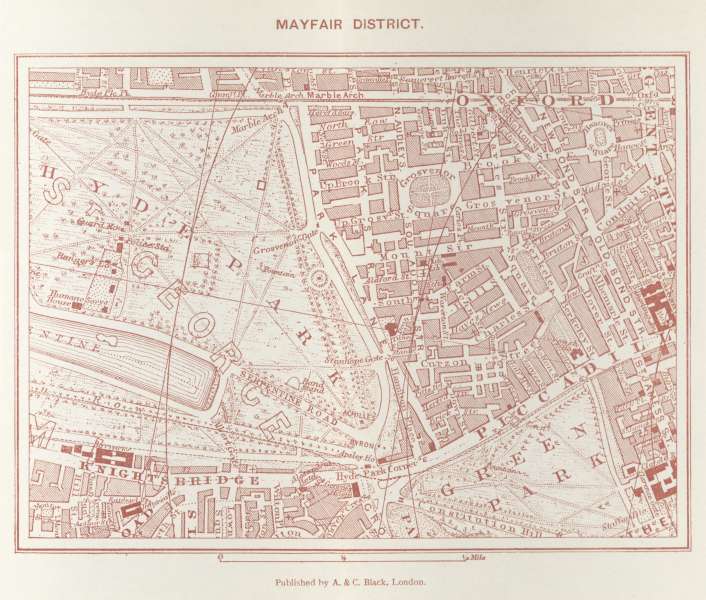 MAYFAIR DISTRICT.
Published by A. & C. Black, London.
In 1765 George II. attempted to buy the fields adjoining Buckingham
Palace to the west, but as Granville refused to sanction the expenditure
of £20,000 for the purpose, the property was bought by Lord Grosvenor
for £30,000, and Grosvenor Place was built in 1767-70, overlooking the
Palace gardens. It has always been a fashionable place of residence. The
houses below St. George's Hospital were formerly small and plain. The
best-known inhabitants were: No. 1, Dr. Lewes' School of Anatomy and
Medicine; 4, Lord Egremont (the third); north corner of Halkin Street,
the Earl of Carlisle, Byron's guardian.
These houses were replaced in 1873-76 by five palatial stone houses
built for the Duke of Grafton, Duke of Northumberland, Sir Anthony
Rothschild, and Earl Stanhope.
They are occupied now by: No. 1, the Wellington Club (proprietary),
social and non-political; 2, Duke of Northumberland; 4 and 5, Lord
Iveagh.
At the south corner of Chapel Street stood the Lock Hospital,
established in 1747, attached to which was a chapel, built 1764, and an
asylum for penitent females, founded by the Rev. Thomas Scott in 1787.
The chapel was celebrated for its preachers, which included Martin
Madan, Thomas Scott, C. E. de Cöetlogon, Dr. Dodd, Rowland Hill, etc.
The buildings, of red brick, and very plain, were pulled down in 1846,
and the institution removed to Harrow Road. On the site were built
Grosvenor Place Houses, renamed 18, 19, 20, Grosvenor Place in 1875. At
No. 20 now lives Earl Stanhope.
In Grosvenor Row, at the south end of Grosvenor Place, stood a court
named Osnaburgh Row (1769), after the Duke of York, who was also Bishop
of Osnaburgh. It was cleared away about 1843. Near it stood the Duke's
Hospital for Invalid Guards, closed in 1846 and removed 1851. Adjoining
it was an old inn, the Feathers.
Other inhabitants: No. 6, Sir H. Campbell Bannerman; 15, Duke of Atholl,
1773; 44, Hanoverian Embassy, 1859 (the King of Hanover stayed here in
1853); 24, Bishop of Worcester, 1859; 46, Sir James Graham, 1868; 19,
Sir Anthony Rothschild, 1859; 20, Earl Stanhope; 31, Earl Cathcart.
The district bounded by Knightsbridge and Grosvenor Place, as far as
Sloane Street and Ebury Street, is known as Belgravia, after Belgrave
Square, which occupies the centre. Up to 1825 it was named the Five
Fields, and was bare, swampy ground on which were a few market gardens.
Only one road, the King's Road (Eaton Square), crossed it, though there
were numerous footpaths, rendered insecure by the highwaymen and
footpads who infested them. It was also a favourite duelling-ground. In
1826 a special Act of Parliament empowered the owner, Lord Grosvenor, to
drain the site, raise the level, etc., and in the course of the next few
years Messrs. Cubitt and Seth Smith built the streets and squares which
now rank as a fashionable centre with the neighbourhood of Grosvenor
Square. The houses are mainly uniform in type—square, substantial,
plaster-fronted structures, which give an aspect of monotony to the
whole district.
Belgrave Square, 10 acres in extent, is 684 feet long by 637 feet wide,
and was designed by Basevi and built by Cubitt in 1825-28. The detached
houses in the corners are by Philip Hardwick, R.A., and H. E. Kendall
(west side). An enclosed garden occupies the centre.
Inhabitants: No. 5, General Sir George Murray, d. 1846, Earl of
Shaftesbury, d. 1886; 15, Duke of Bedford; 16, Sir Roderick Murchison,
geologist, d. 1871; 12 (western corner house), the late Earl Brownlow,
Earl of Ancaster; 18, Austro-Hungarian Embassy; 23, Viscountess
Hambledon, widow of Right Hon. W. H. Smith; 32, Admiral Earl of
Clanwilliam.
The south corner house was built for Mr. Kemp of Kemptown. No. 24
General Lord Hill occupied in 1837. After his death, Lord Ducie occupied
it till 1853; 36, H.R.H. Duchess of Kent, 1840; 37, Earl of Sefton,
1896; 45, Duchess of Montrose, d. 1895; 48, Viscount Combermere, d.
1891; 49 was built in 1850 for Mr. Sidney Herbert, Duke of Richmond and
Gordon; Earl of March.
The principal approach to Belgrave Square is by Grosvenor Crescent, a
broad and handsome street commenced in 1837, but not completed until
about 1860. Where is now the south-west wing of St. George's Hospital
stood Tattersall's famous auction mart for horses, etc., and
betting-rooms. The establishment was started by Richard Tattersall,
trainer to the last Duke of Kingston, about 1774, and was long popularly
known as "the Corner." It was pulled down in 1866, and removed to
Knightsbridge Green.
Inhabitants: No. 5, Lord Ashbourne; 8, Right Hon. Sir George Trevelyan,
Bart., M.P.; 11, Duke of Leeds; 14, C. Bulkeley Barrington, M.P.; 15,
Grosvenor Crescent Club for Ladies. Behind the north-west side of the
Square is Wilton Crescent, with a garden in the centre, and Wilton
Place, both built by Seth Smith between 1824 and 1828.
Inhabitants, Wilton Crescent: No. 16, Right Hon. James Lowther, M.P.;
24, Henry Hallam, d. 1859; 20, Sir George Wombwell, Bart.; 26, Lord
Lamington; 28, Lord De Ros; 30, Lord John Russell; 37, Lord Chewton, who
was killed at the Battle of the Alma; 39, Rev. W. J. Bennett, 1850.
Wilton Place stands on the site of a cow-yard, and is a broad street
with fine houses on the east side. Here is St. Paul's Church, celebrated
for the ritualistic tendencies of its successive vicars. It was built in
1843 by subscription on the drill ground of the old barracks, and cost
£11,000, the site being given by the Marquis of Westminster. The
building by Cundy is handsome, in Early Perpendicular style, and has
sittings for 1,800. It was enlarged and altered in 1889 and 1892, when
a side-chapel, by Blomfield, was added. Adjoining is the Vicarage, and
opposite are St. Paul's National Schools.
Here lived: No. 4, Miss Reynolds, actress; 13, Hon. Thomas Stapleton,
antiquary; 15, Sir James Macdonald, the defender of Hougoumont, d. 1857;
21, Mr. Westmacott.
In the adjoining Kinnerton Street (1826), so called from one of the
Grosvenor estates, stood the dissecting school and anatomical museum of
St. George's Hospital, removed to the new wing in 1868. At No. 75 is an
institute for providing and promoting humane treatment of animals,
founded by Lady Frances Trevanion circa 1890. It is supported by
voluntary contributions.
Motcomb Street was built in 1828, and named after the property of the
Dowager Marchioness of Westminster in Dorset.
On the north side is the Pantechnicon, built circa 1834 as a bazaar
for the sale of carriages, furniture, etc.; it had also a wine and toy
department. It was burnt down in 1874, but has been rebuilt, and is now
used for storing furniture, etc.
West Halkin Street and Halkin Place on the west side, and Halkin Street
on the east side of the Square, are named after Halkin Castle, the Duke
of Westminster's seat in Flintshire. The first contains a chapel of
singular shape, the northern end being wider than the southern. It was
built by Seth Smith as an Episcopal church, but is now Presbyterian.
Halkin Street was commenced about 1807, but until 1826 it, as well as
the other streets leading out of Grosvenor Place, terminated in a
mud-bank, on the other side of which were the Five Fields. On the north
side is Mortimer House, a plain brick building standing in a courtyard.
It was the residence of the late Earl Fitzwilliam, but is now Lord
Penrhyn's. Next to it is Belgrave Chapel (St. John's), a proprietary
church in Grecian style, built in 1812, with accommodation for 800. The
remaining houses are small and unpretending, as are those in Chapel
Street, built 1775-1811, and so called from the Lock Hospital Chapel,
which stood at the corner of Grosvenor Place. Here lived Mr. Richard
Jones (Gentleman Jones). No. 24, General Sir W. K. Grant, d. 1825.
On the other side of Belgrave Square, Chesham Place (1831) leads to a
triangular space, with a small garden in the centre. Here lived: Madame
Vestris, 1837; No. 37, Lord John Russell; 35, Sir Charles Wood, 1851;
29, the Russian Embassy.
The name is taken from the seat of the Lowndes family, the ground
landlords. In Lowndes Street lived: No. 33, Colonel Gurwood, editor of
"Wellington's Despatches"; 40, Mrs. Gore, novelist.
In Chesham Street, at No. 7, lived Henry Parish, diplomatist.
The feature of Lyall Street (1841) is Chesham House, at the corner, in
which is the Russian Embassy, noted under Chesham Place. On the other
side of Lyall Street is Lowndes Place, built about 1835. Eaton Place is
a dull but broad and fashionable street.
Inhabitants: General Caulfield; Sir Robert Gardiner, Sir H. Duncan, d.
1836; Sir Thomas Troubridge, d. 1852; No. 5, Mr. Heywood, 1859; 14, Sir
George Grey, 1859; 15, Lord Kelvin; 18, Dr. Lushington, 1859; 26, Sir
Erskine Perry, 1859; 38, Mr. Justice Wightman, 1859; 80, Kossuth, 1851;
84, Duke of Atholl; 87, Sir William Molesworth, d. 1853; 93, General Sir
Archibald Alison, Bart.; and many others.
Off Eaton Place is West Eaton Place, where lived General Sir Peregrine
Maitland, d. 1852.
Belgrave Place, so named in 1879 instead of Upper Eccleston Street; and
Upper Belgrave Street, built circa 1827, have the same general
characteristics.
Inhabitants: No. 2, Mrs. Gore; 3, Lord Charles Wellesley; 13, Earl of
Munster, son of William IV., who shot himself in 1842. It is now Lord
Harewood's residence.
In Chester Street, commenced 1805, lived: No. 5, Right Hon. Sir
Frederick Shaw, d. 1876; 7, Dr. Pettigrew, d. 1860; 12, Sir Douglas
Galton, d. 1899; 13, Dr. Broughton, d. 1837; 27, Colonel Sibthorpe, d.
1855.
Wilton Street was begun in 1817. Here lived Mr. Spencer Perceval, son of
the Minister.
Grosvenor Place, Lower Grosvenor Place, Hobart Place, Eaton Square, and
Clieveden Place occupy the site of the King's private road, which had
existed before as a footpath, but was made a coach-road by Charles II.
as a short-cut to Hampton Court. It ran along the north garden of Eaton
Square, and crossed the Westbourne at Bloody Bridge, a name which dates
as far back as 1590. On the north side, where is now Eaton Terrace, was
a coppice which provided wood for the Abbey. Houses were first built on
it about 1785, and in 1725 a turnpike existed at its junction with
Grosvenor Place. Admission to the road was by ticket, but in 1830 it was
thrown open to the public under the name of the King's Road. Part of
Lower Grosvenor Place, however, was named Arabella Row in 1789, but
became known by its present name in 1789. Here in a shabby house lived
Lord Erskine after resigning the Lord Chancellorship in 1806.
Hobart Place was first so called in 1836, but part of it was called
Grosvenor Street West until 1869. It leads to Eaton Square, built by
Cubitt in 1827-53. This is 1,637 feet long by 371 feet wide, 15 acres in
extent, and contains six enclosed gardens. The houses are of the usual
type. At the west end is St. Peter's Church, built in 1826 in Ionic
style from designs by Hakewell at a cost of £21,515. An altar-piece by
Hilton, R.A., was presented by the British Institution in 1828, but was
removed in 1877, and is now in the South Kensington Museum. After being
nearly burnt down in 1837, it was rebuilt by Gerrard, and in 1872 a
chancel and transepts in Byzantine style, by Sir A. Blomfield, were
added. The nave was remodelled in 1874, and further alterations have
been made in the last ten years at a cost of £5,000. Here are buried
Admiral Sir E. Codrington, d. 1851, and General Lord Robert Somerset,
G.C.B. The Right Rev. G. H. Wilkinson, Bishop of St. Andrew's, was vicar
from 1870-83.
Inhabitants: No. 8, Sir R. T. Reid, K.C., M.P.; 16, Mr. Justice Willes,
1859; 43, Lord Cottesloe; 60, Lord Sandhurst; 66a, Lord Walsingham,
F.R.S.; 71, in 1809 the official residence of the Speaker; 74, Cardwell,
1859; 75, Ralph Bernal, M.P., d. 1853, Mr. George Peabody, d. 1869,
Viscount Knutsford; 76, Viscount Falkland; 83, Lord Chancellor Truro, d.
1855; Lord Aberdare; 85, Sir Edward Malet, G.C.B., P.C.; 92, Admiral Sir
Edward Codrington, d. 1851; 110, General Sir A. Codrington, 1859; 114,
Lady Baden-Powell; 115, Earl of Ellenborough, 1859, Marquis of Hertford;
Colonel Sibthorpe, d. 1855; Jacob Omnium (Mr. J. Higgins).
Clieveden Place, first built over in 1826, was so named in 1890 from the
Duke of Westminster's late estate near Cookham, instead of its original
name, Westbourne Place.
Between Clieveden Place and Pimlico Road the streets are narrow and
unimportant. In Westbourne Street (1826), so called from the
neighbouring Westbourne River, stood the York Hospital for invalid
soldiers, removed to Chatham in 1819. On the east side is a Baptist
chapel, a plain building, erected in 1825. Skinner Street (1842) and
Whittaker Street (1836) lead to Holbein Place, built over the
Westbourne, and called in 1877 "the Ditch." Leading from Whittaker
Street are Passmore Street (1837) and Union Street, containing
industrial dwellings.
Inhabitants—Chester Place: Right Hon. Charles Buller, d. 1848. Chester
Square: No. 19, Mantell, the geologist, d. 1852; 24, the poet Shelley's
widow, d. 1851.
The houses in Chester Square and the neighbourhood are not so
pretentious as those in Belgravia, but it is still a fashionable place
of residence. In South Eaton Place, near the south end, stood the Star
and Garter Tavern, well known about 1760. The end of this street was
called Burton Street (1826) until 1877. In Elizabeth Street, first
called Eliza Street in 1820, and until 1866 divided into Upper Elizabeth
Street, Elizabeth Street, and Elizabeth Street South, stood the Dwarf
Tavern, noted about 1760. At the south end, near St. Philip's Parochial
Hall and Parsonage, is St. Michael's Mission House, built in 1893.
Gerald Road, 1834 until 1885 named Cottage Road, contains the station of
the R Division of Police.
Eccleston Street, with which in 1866 was incorporated Eccleston Street
South, was so called from Ecclestone in Cheshire, where the Duke of
Westminster has property. A house on the west side inhabited by Sir
Frances Chantrey was pulled down during the construction of the
underground railway. On the same side is the Royal Pimlico Dispensary,
established in 1831. Part of the east side has been rebuilt. In
Eccleston Place is the station of the Westminster Electric Supply
Company, which supplies this district with electric light. In Lower
Belgrave Street (1810), the lower end of which was till 1867 named
Belgrave Street South, are St. Peter's National Schools, a large
red-brick building with a playground, in connection with St. Peter's,
Eaton Square.
At the end of Grosvenor Place great improvements were made in 1868 by
the building of Grosvenor Gardens, when Grosvenor Street West, and
Upper and Lower Eaton Street were swept away.
At No. 27, Upper Eaton Street, lived George Frederick Cooke, 1870; 25,
Thomas Campbell, 1803; 19, Lower Eaton Street, Mrs. Abington, actress,
1807, Mr. Pinkerton, 1802. The present houses are very large and
handsome.
Inhabitants: No. 1, Spanish Embassy; 46, Lord Herschell.
On the west side, at the corner of Buckingham Palace Road, are Belgrave
Mansions, built from designs by Cundy in 1868, a large block in French
Renaissance style, with a frontage of nearly 300 feet. The ground-floor
is occupied by shops, and above are five floors of flats. The centre of
the open space is occupied by two triangular enclosed gardens, and is
crossed by Ebury Street, once an open lane leading over the fields to
Chelsea. Houses were built on it after 1750, and in 1779 the
north-eastern end was named Upper Ranelagh Street and Ranelagh Street.
The south-western end was Upper Ebury Street, but the whole was renamed
Ebury Street in 1867. It is an uninteresting street of unpretending
houses and shops. In Upper Ebury Street lived: Rodwell the composer;
William Skelton, engraver, d. 1848; No. 174 is the Boys' School
belonging to the parish of St. Barnabas.
At the north-east end of Ebury Street is Victoria Square, a small square
of plain houses built about 1837, out of which Albert Street leads to
Grosvenor Place. In the square lived, at No. 8, Thomas Campbell,
1841-43; 5, Earl of Mount Edgcumbe.
At the other end, near Ebury Bridge, is Ebury Square, built about 1820
on the site of Ebury Farm. This ancient property, which derives its name
from the Saxon ey, water, and burgh, a fortified place, is mentioned
in 1307, when permission was granted by Edward I. to John de Benstede to
fortify it. In Queen Elizabeth's time it consisted of a farm of 430
acres, let on lease for £21 per annum. In 1676 it came into the
possession of the Grosvenor family, and in 1725 embraced a long narrow
area, reaching from Buckingham House to the Thames between the
Westbourne and the present Westmoreland Street.
The square was partially destroyed in 1868, but the old houses remain on
the north-west and south sides. In the centre is a garden, and the
ground between it and Buckingham Palace Road is occupied by St.
Michael's National Schools, opened in 1870, a spacious building,
accommodating about a thousand scholars; there is a large playground.
The site had been previously occupied by the Pimlico Literary
Institution, built in 1830 from designs by J. P. Deering.
On the remaining side a handsome block of industrial dwellings (Ebury
Buildings) was built in 1872, when the old Flask Lane (1785) was swept
away. The approaches on the north-west are Semley Place (1785), late
Flask Row, and Little Ebury Street (1823). At the end of Avery Farm Row
(probably a corruption of Ebury), opposite Ebury Bridge, is a
drinking-fountain, erected in memory of the second Marquis of
Westminster, d. 1869, by his widow.
Buckingham Palace, which falls partly within St. George's district and
partly within St. Margaret's, Westminster, has already been described in
the volume on Westminster.
The Royal Mews, the entrance to which is in Buckingham Palace Road,
contains a large riding-school, a room for the state harness, stabling
for the state and other horses, and houses for forty carriages. Here
also are kept the old and new state coaches, the former of which was
built in 1762 of English oak, with paintings by Cipriani, and cost
£7,660.
Buckingham Palace Road, now a broad street with large houses and shops,
was in 1725 an open country road, known as the coach-road to Chelsea.
The houses in it are rated under the name of Pimlico as late as 1786,
but rows of houses under various names had been built earlier—Stafford
Row in 1752, Queen's Row in 1766. These, with Victoria Road (1838),
Stockbridge Terrace (1836), King's Road, Lower and Upper Belgrave Place
and Belgrave Terrace (1826), were united under the name of Buckingham
Palace Road in 1867, and in 1894 Union Place, Holden Terrace, and South
Place were incorporated with it. The portion facing the Palace is named
Buckingham Gate, and consists of seven large private houses. On this
site, facing the Park, stood Tart Hall, the residence of Viscount
Stafford (see "Westminster").
Facing Grosvenor Gardens is the Grosvenor Hotel, opened in 1862 in
connection with Victoria Station. The building, designed by Knowles, is
272 feet long, 75 feet deep, and 150 feet high, and cost £100,000.
Beyond, on the north side, a row of large red-brick houses has been
built since 1883, containing Buckingham Palace Mansions (flats), the
National Training School of Cookery, and the City of Westminster Public
Baths. Here also is St. Peter's Institute, in connection with St.
Peter's, Eaton Square, which cost £15,000. It consists of a club for 600
men and 600 boys, with gymnasium, class-rooms, reading-room,
concert-hall, etc.
Buckingham Palace Gardens, also on the north side, is a row of large,
ornamental, red-brick houses, newly erected, adjoining the Free Library
built by Bolton and opened in 1894. On the first floor is a natural
history collection presented by a parishioner. St. Philip's Church,
built 1887-90, is a plain but spacious red-brick building, in Early
English style by Brierley and Demaine, with seats (free) for 850.
Adjoining is the Grosvenor Club and Grosvenor Hall, used for social
entertainments, etc. Nearly the whole of the south side of the road has
recently been demolished in view of the extension of Victoria Station.
Inhabitants—Stafford Row: W. Ryland, engineer, executed for forgery
1767; Mrs. Radcliffe, authoress of the "Mysteries of Udolpho"; Richard
Yates, d. 1796. Lower Belgrave Place: No. 3, George Grote, historian
(later 102, Buckingham Palace Road); 29 and 30, Sir Francis Chantrey,
1814-41 (later 98, Buckingham Palace Road); 27, Allan Cunningham, poet,
1824-42; 96, Henry Weekes, R.A. Buckingham Palace Road: E. B. Stephen,
R.A., 1882.
From the end of Buckingham Palace Road Chelsea was reached by the
present Pimlico Road, so called in 1871, when the old names of Jews'
Row, Grosvenor Row (1785), and Queen Street (1774) were abolished. The
origin of the name Pimlico is uncertain. There was one also at Hoxton,
where a certain Ben Pimlico kept a noted hostelry in Queen Elizabeth's
time. It is now officially used to denote the whole district south of
Knightsbridge, but is popularly confined to the part between Chester
Square and the Thames. It began to be sparsely inhabited in 1680, after
which date it is mentioned occasionally in the rate-books, and regularly
after 1739.
On the north side, near the east end, are two narrow streets—Clifford's
Row (1785), and King Street (1785). At the corner of Ebury Street stood
an old inn, the Goat and Compasses, now replaced by the Three Compasses
public-house. Further on is the Chapel of St. John the Baptist, built
about 1850 as a chapel of ease to St. Barnabas. Adjoining is the site of
the Chelsea Bun House, in its best days kept by Richard Hand, "who has
the honour to serve the Royal Family." It was celebrated by Swift in
1711, and was taken down in 1839. Opposite stood Strombelo or Stromboli
House, a minor place of amusement, at its height in 1788. Near here Nell
Gwynne is said to have lived, and her name is kept up by the Nell Gwynne
Tavern and a passage called Nell Gwynne Cottages.
Between the Pimlico and Commercial Roads are several small streets. In
Bloomfield Place stood St. John's School for girls, established in 1859
under the auspices of the Sisterhood of St. John; adjoining, under the
same management, St. Barnabas' Mission House and St. Barnabas'
Orphanage, established in 1860. In Bloomfield Terrace lived at No. 1
Captain Warner, inventor of the "long range," d. 1853.
In Church Street (1846) stands the college of St. Barnabas, founded by
Rev. W. J. Bennett. The buildings are of Kentish ragstone, were designed
by Cundy, and contain a church, clergy house, and school-house with
teacher's residence. The church, originally built as a chapel of ease to
St. Paul's, Knightsbridge, is in Early Pointed style, and has a tower
and spire of Caen stone 170 feet high, with ten bells. The edifice cost
£15,000, and was at the opening signalized by ritualistic disturbances.
The schools built on the site of the Orange Tavern and tea-gardens in
the Pimlico Road were designed for 200 boys, 200 girls, and 200 infants,
but a separate boys' school has been since built in Ebury Street.
Ranelagh Grove occupies the site of The Avenue, which led from Ebury
Bridge to old Ranelagh House, but now ends in the blank wall of Chelsea
Barracks.
In Ranelagh Terrace (now abolished), near Ebury Bridge, d. at No. 2 the
Rev. T. Pennington, son of Elizabeth Carter, in 1852.
Commercial Road (1842) is occupied by works and industrial dwellings
(Gatcliff Buildings, 1867, and Wellington Buildings). On the west side
is the wall of Chelsea Barracks.
It leads by the Chelsea Bridge Road to the embankment at Victoria
Bridge, a light and graceful suspension bridge designed by Page and
opened in 1858. The structure, which cost £88,000, is built of iron, and
rests on piers of English elm and concrete enclosed in iron casings. The
piers are each nearly 90 feet in length by 20 feet in width, with curved
cutwaters. The whole bridge is 915 feet long, 715 feet between
abutments, the centre span 347 feet, side-spans each 185 feet, and there
is a clear water-way of 21 feet above high-water mark. The roadway is
made by two wrought-iron longitudinal girders extending the whole length
of the bridge, suspended by rods from the chains. Toll-houses stand at
each end, but it was purchased in 1879 for £75,000 as a free bridge.
Near the end of the bridge stood the White House, a lonely habitation
much used by anglers; opposite, on the Surrey side, was a similar
building, the Red House. A short way to the east stood the Chelsea
Waterworks, incorporated as a company in 1724, though waterworks seem to
have existed here before that date. They extended, with the Grosvenor
Canal and basin (now occupied by Victoria Station), over 89 acres, and
supplied water to Chelsea, Knightsbridge, Belgravia, Pimlico, and part
of Westminster. The company has now removed to Kingston, and the site is
occupied by the western pumping-station of the main drainage system of
London, built 1873-75 at a cost of £183,000.
Graham Street (1827) incorporated with which in 1894 were Graham Street
West and Gregory Street (1833), contains the Church of St. Mary the
Virgin, a chapel of ease to St. Paul's, Knightsbridge, a red-brick
building with a spire, built in 1872. Caroline Street (1834) is of no
interest. Eaton Terrace (1826) was until 1884 named Coleshill Street. At
the corner of Clieveden Place is an old proprietary chapel, Eaton
Chapel, in Grecian style, built about 1800, with sittings for 1,200. A
chapel existed here, however, before that date, known as the Five Fields
Chapel.
Chester Terrace was in 1878 amalgamated with Minera Street (1830), and
in 1887 with Newland Street (1836).
Chester Square is very long and narrow; it is five acres in extent, and
was commenced about 1834. It has three enclosed gardens. At the west end
is the handsome church of St. Michael, erected 1844-46 in the Decorated
style from designs by Cundy. The tower has a lofty spire. The chancel
was extended in 1874, and the building has on several occasions been
enlarged and restored.
Chester Place, at the east end of the square, was incorporated with it
in 1874.
The portion of our district lying between the Buckingham Palace Road
and Grosvenor Canal and the eastern boundary forms an acute-angled
triangle with the apex at Buckingham Palace. The streets north of
Victoria Street, which lead into Buckingham Palace Road from the east,
are narrow and unimportant. Here is Palace Street (1767), until 1881
called Charlotte Street, after Queen Charlotte, the first royal occupant
of the Palace. In it is St. Peter's Church, a plain building with seats
for 200, which existed as Charlotte Chapel in 1770. Its most famous
incumbent was Dr. Dodd, who was executed for forgery in 1777.
Subsequently it was held by Dr. Dillon, who was suspended in 1840. It
was then a proprietary chapel, but is now a chapel of ease to St.
Peter's, Eaton Square; also St. Peter and St. Edward's Catholic Chapel.
In Palace Place (until 1881 Little Charlotte Street) is St. Peter's
Chapel School, established in 1830.
The St. George's Union Workhouse, a large red-brick building, built in
1884, stands in Wallis's Yard, off Princes Row (1767). Buckingham Palace
(1840), Brewer Street (1811), and Allingham Street (1826) have no
interest. The latter leads to Victoria Street, a broad thoroughfare
opened in 1851, only the western end of which falls within the district.
On the south side is the Victoria Station of the Metropolitan District
Railway, commenced in 1863 and opened in 1868. The line runs in a curve
underground from Sloane Square, crossing Ebury Street at Eaton Terrace,
and Buckingham Palace Road at Grosvenor Gardens. From the Underground
Station a subterranean passage leads to the Victoria terminus, the
starting-point of the London, Brighton, and South Coast and London,
Chatham, and Dover Railway Companies. The present station, which has no
pretension to architectural beauty, is being greatly enlarged and partly
rebuilt. It was built at a cost of £105,000, provided by the Victoria
Station and Pimlico Railway Company, which, having acquired 91 acres of
land, had built a temporary station and opened the line for the two
companies' traffic in 1860. The bridge over the Thames was built about
the same time by Fowler, and on it is the Grosvenor Road
ticket-collecting station. The land occupied by the railways is freehold
of the Victoria Company, and leased by the two lines. In 1863 the lines
of the London, Chatham, and Dover Railway were widened to enable their
trains to come into the station independently. The lines of the London,
Brighton, and South Coast Railway are now being extended. The station of
the latter is a West End branch, the headquarters being at London
Bridge; but the London, Chatham, and Dover Railway have here their
principal starting-point. The ground between Victoria Station and the
river occupies the site of the old manor of Neyte, which belonged to the
Abbey of Westminster until confiscated by Henry VIII. in 1536. It was a
favourite residence of the Abbots, and here also lived John of Gaunt,
and here John, son of Richard, Duke of York, was born in 1448. In 1592
the manor became a farm and passed with the Ebury Estate into the
possession of the Grosvenor family. The manor-house stood where is now
St. George's Row, and in Pepys' time was a popular pleasure-garden.
Between the Willow Walk (Warwick Street) and the river were the Neat
House Gardens, which supplied a large part of London with vegetables.
The name lingered until the present century among the houses on the
river-bank, and is still commemorated by Neat House Buildings in
Ranelagh Road. The whole area was low-lying and swampy, and the
neighbourhood of Eccleston Square was occupied by a vast osier bed. In
1827, however, Cubitt raised the level of the district by depositing the
earth excavated from St. Katharine's Docks, and the present houses and
squares were gradually completed. The whole district is singularly
uninteresting, the streets of good breadth, and the houses faced with
plaster of the type we have seen in Belgravia. North of Belgrave Road
the streets are occupied by the poorer classes, but the squares and
principal streets in this neighbourhood are tenanted by the wealthy. The
southern portion is dully respectable, and most of the houses are let in
lodgings. The eastern end of Warwick Street and Lupus Street contain the
only shops, and those of no great size or importance. The streets, with
their principal buildings, are as follows:
The Vauxhall Bridge Road, commenced after 1816, but first mentioned
under that name in 1827. The following terraces were incorporated with
it in 1865: Bedford Place (1826), Trellick Place (1826), York Place
(1839), Pembroke Place, Gloucester Place, Windsor Terrace, Shaftesbury
Crescent (1826), Howick Place and Howick Terrace (1826).
Wilton Road (1833), with which, in 1890, was incorporated Wilton
Terrace, skirts the east side of Victoria Station. In it stands the
Church of St. John the Evangelist, a chapel of ease to St. Peter's,
Eaton Square. It is a handsome red-brick edifice, built by Blomfield in
1875, and it accommodates about 900. Behind, in Hudson's Place, are St.
Peter's Mission House and parish room.
Gillingham Street (1826), Hindon Street (1826), Berwick Street (1830),
and St. Leonard's Street (1830) are mean and uninteresting.
Warwick Street occupies the site of the ancient Willow Walk, a low-lying
footpath between the cuts of the Chelsea Waterworks, where lived the
notorious Aberfield (Slender Billy) and the highwaymen Jerry Abershaw
and Maclean. It is first mentioned in the rate-books in 1723.
Belgrave Road (1830) is a broad, well-built street, with large houses.
In 1865 Eccleston Terrace, North and South Warwick Terrace, Upper
Eccleston Place, and Grosvenor Terrace, were incorporated with it.
Nearly opposite Eccleston Square is Eccleston Square Chapel
(Congregational), in Classical style, with seats for 1,100. The railway
is crossed by Eccleston Bridge. Eccleston Square is 4 acres in extent,
and is long and narrow, with an enclosed garden, built in 1835.
Warwick Square, of 3 acres, is very similar, and was built in 1843. At
the end stands St. Gabriel's Church, built by Cundy in Early English
style, and consecrated in 1853.
St. George's Road is a broad street joined to Buckingham Palace Road by
Elizabeth Bridge.
In Gloucester Street is the Belgrave Hospital for Children, founded in
1866 by the late Rev. Brymer Belcher, Vicar of St. Gabriel's, 1853-85.
The objects of this charitable institution are:
1. The medical and surgical treatment of the children of the poor.
2. The promotion of the study of children's diseases.
3. The training of pupil nurses.
Clarendon Street (1858) absorbed Warwick Place in 1870. Stanley Street
(1851) was renamed Alderney Street in 1879, Winchester Street 1852,
Cumberland Street 1852.
Ebury Bridge is the oldest of the bridges over the railway and canal. It
was known in early days as Chelsea, and afterwards as Waterworks Bridge,
a wooden structure. A turnpike existed here until 1825. At the south end
stood Jenny's Whim, a celebrated tavern and pleasure-garden, perhaps
named from the name of the proprietress and the fantastic way it was
laid out. It was in the height of its popularity about 1750, and came to
an end circa 1804. When the railway was widened in 1863 all vestiges
of it were swept away.
St. George's Row was built as Monster Row circa 1785, and renamed in
1833. Here was the site of the manor-house of Neyte. The Monster
public-house commemorates the old Monster tavern and garden, the name
being probably a corruption of monastery.
At the corner of Warwick Street are the Pimlico Rooms, containing a hall
for entertainments, etc., and occupied by the Ebury Mission and Pimlico
day-school for boys, girls, and infants. Adjoining the railway is a
double row of industrial dwellings, built by the trustees of the Peabody
fund under the name of Peabody's Buildings.
Westmoreland Street (1852) contains the Pimlico chapel for United Free
Methodists.
Lupus Street (1842) is named after Hugh Lupus, Earl of Chester, an
ancestor of the Duke of Westminster. It contains a hospital for women
and children.
At the eastern end is St. George's Square (1850), a long narrow space
reaching to the river with an enclosed garden in the centre. The houses
are large. At No. 9 Sir J. Barnby d. 1896.
At the north end is St. Saviour's Church, built in 1864 from designs by
Cundy in a Decorated Gothic style. It has sittings for 1,834, and was
restored in 1882. To the east are Pulford Street (1848) and Aylesford
Street, in which is St. Saviour's Mission House, built by the Duke of
Westminster at a cost of £4,000. It serves also for parochial meetings.
Here also are the works of the Equitable Gas Company, established 1830.
In Claverton Street (1852) is a Methodist Wesleyan chapel, in Classical
style, with seats for 1,000.
In Glasgow Terrace (1851), formerly Caledonia Street, are St. Saviour's
and St. Gabriel's National Schools. This neighbourhood contains many
works and offices, the largest of which is Taylor's repository for
storing property. Along the river runs the Grosvenor Road, part of the
Thames Embankment. The houses built on and near it were generally known
in the last century as the Neat Houses. Terraces with various
names—Albion Terrace, Pier Terrace, Erin Place (1826), Thames Parade
(1827), Thames Bank (1828)—were incorporated with the road in recent
years. Facing the river is All Saints' Church, a chapel of ease to St.
Gabriel's, by Cundy, built circa 1870 to replace a mission church;
opposite it is the Pimlico Pier for river steamboats. Adjoining St.
George's Square is the Army Clothing Factory, established in 1857 in the
Vauxhall Bridge Road as an experiment to provide labour for women. The
present establishment was opened in 1859, and has since been largely
increased, occupying a space of about 7 acres. The east block is the
Government store, the west the factory, the centre of which is occupied
by a glass-roofed hall, three stories high, surrounded by spacious
galleries.
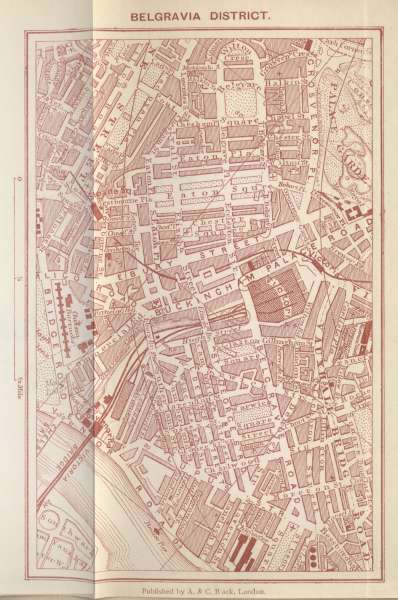 BELGRAVIA DISTRICT.
Published by A. & C. Black, London.

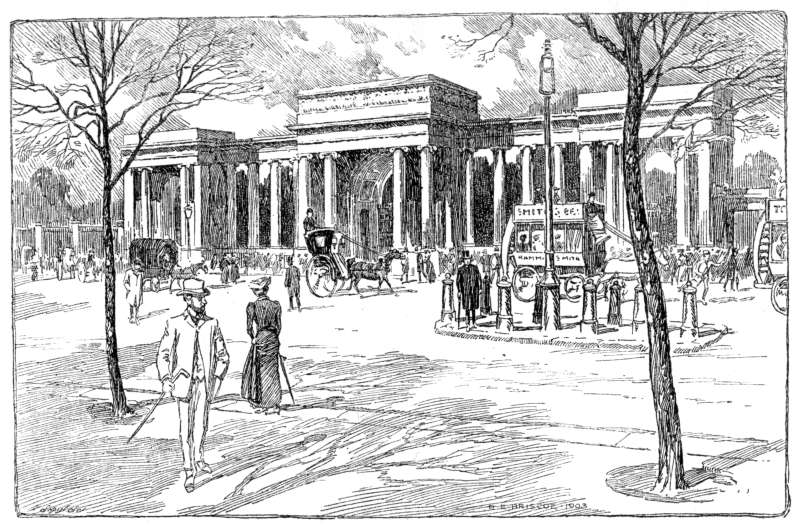 HYDE PARK CORNER