The stage director rose and rolled up his copy
of the play, pushing toward me with his disengaged
hand the half-dozen round white peppermints
which, arranged on a chalk-lined blue blotter,
had been chastely representing my most important
characters in their most vital scene. His smooth,
round face was pale with fatigue; the glow of his
brown eyes had been dimmed by sleepless nights;
he had the weary air of a patient man who has listened
to too much talk—but not for one moment
had he lost his control of the situation or of us.
"That might have made a better picture," he
conceded, graciously. "But we can't make any
more changes till after the dress rehearsal to-night;
and if that goes well we won't want to make any.
Don't you worry, Miss Iverson. We've got a winner!"
This, coming from Herbert Elman at the close of
our last official conference, was as merciful rain to
a parched field, but I was too weary to respond to
it, except by a tired smile. Under its stimulation,
however, our star, who had been drooping forward
in her chair surveying the peppermints much as
Lady Macbeth must have gazed upon the stain
on her hand, blossomed in eager acknowledgment.
"Bertie, you are a trump!" she exclaimed, gratefully.
"It's simply wonderful how you keep up
your enthusiasm after three weeks of work. It was
criminal of Miss Iverson and me to drag you here
this afternoon. I suppose we had lost our nerve,
but that doesn't excuse us."
Elman had started for the door on the cue of his
valedictory. At her words he turned and came back
to the desk where we sat together, his face stamped
with a sudden look of purpose; and upon my little
study, in which for the past three hours we had
wrangled over a dozen unimportant details, a hush
fell, as if now, at last, something had entered which
was real and vital. For an instant he stood before
us, looking down at us with eyes that held an unaccustomed
sternness. Then he spoke.
"I had a few words to say to you two when I
came here," he began, "but you were both so edgy
that I changed my mind. However, if you're talking
about losing your nerve you need them, and
I'm going to get them off my chest."
Miss Merrick interrupted him, her blue eyes
widening like those of a hurt baby.
"Oh, Bertie," she begged, "p-please don't say
anything disagreeable. Here we've been rehearsing
for weeks, and we three still speak. We're al-most
friendly. And now, at the eleventh hour, you're
going to spoil everything!"
Her words came out in a little wail. She dropped
her head in her hands with a gesture of utter fatigue.
"You are," she ended. "You know you are, and
I'm so-o tired!"
Elman laughed. No one ever took Stella Merrick
seriously, except during her hours on the stage when
she ceased to be Stella Merrick at all and entered
the soul of the character she was impersonating.
"Nonsense," he said, brusquely. "I'm going to
show my friendship by giving you a pointer, that's
all."
Miss Merrick drew a deep breath and twisted
the corner of her mouth toward me—a trick I had
learned from Nestor Hurd five years ago and had
unconsciously taught her in the past three weeks.
"Oh, if that's all!" she murmured, in obvious relief.
"You should have been in your beds the entire
day," continued Elman, severely, "both of you,
like the rest of the company. We'll rehearse all
night, and you know it; and I'll tell you right now,"
he added, pregnantly, "that you're going to be up
against it."
He waited a moment to give his words the benefit
of their cumulative effect, and then added, slowly:
"Just before I came here this afternoon T. B.
told me that to-night he intends to rehearse the company
himself."
I heard Stella Merrick gasp. The little sound
seemed to come from a long distance, for the surprise
of Elman's announcement had made me dizzy.
"T. B." was our manager, better known as "The
Governor" and "The Master." He had more
friends, more enemies, more successes, more insight,
more failures, more blindness, more mannerisms,
more brutality, and more critics than any other
man in the theatrical world. His specialty was the
avoidance of details. He let others attend to these,
and then, strolling in casually at the eleventh hour,
frequently undid the labor to which they had given
weeks.
Though his money was producing my play, I had
met him only once; and this, I had been frequently
assured by the company, had been the one redeeming
feature of an unusually strenuous theatrical experience.
"T. B." never attended any but dress rehearsals,
leaving everything to his stage directors
until the black hours when he arrived to consider
the results they had accomplished. It was not an
infrequent thing for him on these occasions to disband
the company and drop the play; that he should
change part of the cast and most of the "business"
seemed almost inevitable. For days I had been
striving to accustom myself to the thought that
during our dress rehearsal "T. B." would be sitting
gloomily down in the orchestra, his eyes on the
back drop, his chin on his breast, a victim to that
profound depression which seized him when one of
his new companies was rehearsing one of his new
plays. At such times he was said to bear, at the best,
a look of utter desolation; at the worst, that of a
lost and suffering soul.
At long intervals, when Fate perversely chose to
give her screw the final turn for an unhappy playwright,
"T. B." himself conducted the last rehearsal,
and for several months after one of these tragedies
theatrical people meeting on Broadway took each
other into quiet corners and discussed what had
happened in awed whispers and with fearsome
glances behind them. It had not occurred to any
of us that "T. B." would be moved to conduct our
last rehearsal. This was his busiest season, and
Elman was his most trusted lieutenant. Now, however,
Elman's quiet voice was giving us the details
of "T. B.'s" intention, and as she listened Stella
Merrick's face, paling slowly under the touch of
rouge on the cheeks, took on something of the exaltation
of one who dies gloriously for a Cause. She
might not survive the experience, it seemed to say,
but surely even death under the critical observation
of "T. B." would take on some new dignity. If
she died in "T. B.'s" presence, "T. B." would see
that at least she did it "differently"!
"But, Bertie, that's great!" she exclaimed. "He
must have a lot of faith in the play. He must have
heard something. He hadn't any idea of conducting
when I spoke to him yesterday."
"Oh yes, he had!" Elman's words fell on her
enthusiasm as frost falls on a tree in bloom. "He
didn't want to rattle you by saying so, that's all.
And he isn't doing this work to-night because he's
got faith in the play. It's more because he hasn't.
He hasn't faith in anything just now. Three of
his new plays have gone to the store-house this
month, and he's in a beastly humor. You'll have the
devil of a time with him."
Miss Merrick sprang to her feet and began to
pace the study with restless steps.
"What are you trying to do?" she threw back
at him over her shoulder. "Take what little courage
we have left?"
Elman shook his dark head.
"I'm warning you," he said, quietly. "I want
you both to brace up. You'll need all the nerve
you've got, and then some, to get through what's
before us. He'll probably have an entirely new idea
of your part, Stella; and I don't doubt he'll want
Miss Iverson to rewrite most of her play. But
you'll both get through all right. You're not quitters,
you know."
His brown eyes, passing in turn from my face to
hers, warmed at what he saw in them. When he
began to speak we had been relaxed, depressed, almost
discouraged. Lack of sleep, nervous strain,
endless rehearsals had broken down our confidence
and sapped our energy; but now, in the sudden
lift of Stella Merrick's head, the quick straightening
of her shoulders, I caught a reflection of the change
that was taking place in me. At the first prospect
of battle we were both as ready for action as Highland
regiments when the bagpipes begin to snarl.
Looking at us, Elman's pale face lit up with one of
his rare and brilliant smiles.
"That's right," he said, heartily. "A word to
the wise. And now I'm really off."
Almost before the door had closed behind him
Miss Merrick had seized her hat and was driving
her hat-pins through it with quick, determined
fingers.
"I'm going home and to bed," she said. "We
can both get in three hours' sleep before the rehearsal—and
believe me, Miss Iverson, we'll need
it! Do you remember what General Sherman said
about war? He should have saved his words for a
description of 'T. B.'"
I followed her out into the hall and to the elevator
door. I felt oddly exhilarated, almost as if I had
been given some powerfully stimulating drug.
"He doesn't exactly kill, burn, or pillage, does
he?" I asked, gaily.
With one foot in the elevator, our star stopped a
second and looked back at me. There was a world
of meaning in her blue eyes.
"If he did nothing but that, my lamb!" she
breathed, and dropped from sight.
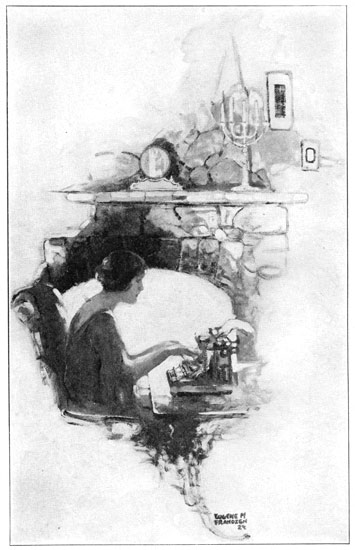
I returned to my desk. I had no idea of going to
bed. I was no Napoleon, to slumber soundly on the
eve of a decisive battle, but there was nothing else
I could do except to sweep the peppermint drops
out of sight and tuck the diagrammed blotter behind
a radiator. While I was engaged in these homely
tasks the bell of my telephone rang.
"Hello, Miss Iverson," I heard when I took down
the receiver. "Are you going to be at home to-night?"
My heart leaped at the familiar greeting of Billy
Gibson, star reporter of the Searchlight, and one
of my stanch friends ever since the days, five long
years ago, when he had given me my first lesson
in practical reporting. Almost before I could reply
to him I noticed something unnatural in the quality
of his voice. It was a little too easy, too casual,
too carefully controlled.
"Heard any late news about Morris?" asked Gibson.
"News?" I echoed. "What news? What do you
mean?"
"Oh, then you don't know."
Gibson's voice was still ostentatiously cheerful,
but it dropped a little on his next words.
"Why, he's sick," he said. "Pretty sick. Has
pneumonia."
"I didn't know," I said, slowly. It had been
difficult to bring out the words. It was for some
reason impossible to say more, but Gibson went
on without waiting, thus giving me time to think.
"Haven't lost all interest in us, have you, now
that you've been away from us a year and are writing
plays?" he asked, cheerfully.
"Oh, Billy, what about him?" At last I was
able to bring out the words. "Is it serious?" I
asked.
"No one at the office realized it was until to-day,"
said Gibson. "This morning Colonel Cartwell
stopped at the Morris house on his way down-town
and happened to meet one of the consulting physicians.
Godfrey's pretty low," he added, gently.
"The crisis is expected to-night."
For what seemed a long time I sat staring blankly
at the telephone. Once or twice I tried to speak,
but no speech came. The forgotten receiver shook
in my hand. Every thought but one was wiped out
of my mind. Godfrey Morris was ill—very ill. He
had been ill for days—perhaps for weeks—and I
had not known it because I had been absorbed in
my petty interests, which until this moment had
seemed so big.
"If you care to have me," went on Gibson, hesitatingly,
"I'll telephone you later. I'm to be at
the Morris house most of the night and keep the
office posted from there. I can call you up once or
twice if—it won't disturb you."
I found my voice, but it sounded strange in my
own ears. For an instant I had seen myself sitting
in my study the long night through, getting messages
from the sick-room, but now I remembered my
work and the others who were concerned in it.
"Billy," I said, "we're having the dress rehearsal
of my play to-night. I may have to be at the Berwyck
Theater until three or four in the morning.
Can you send me word there—several times?"
Gibson's answer was prompt.
"You bet I can," he said. "I'll bring it. The
Morris house is only a few blocks from the Berwyck,
and I'll be glad of something to do besides receiving
and sending bulletins. Tell your door-man to let
me pass, and I'll drop in two or three times during
the night." His voice changed. "I thought," he
added, almost diffidently, "you'd want to know."
"Yes," I said, slowly, "I want to know. Thank
you."
I hung up the receiver, which slipped in my stiff
fingers. The exhilaration of a few minutes before
lay dead within me. I felt cold and numb. From
the living-room off my study the light of my open
fire winked at me as if in cheery reassurance. I
crossed the room and crouched down before it,
stretching out shaking hands to the blaze. I seemed
to be moving in a nightmare, but with every sense
horribly acute. I remembered previous dreams in
which I had seemed to see, as I saw now, the familiar
objects of my home around me. I heard the beating
of my heart, the hammering of the blood in my head,
the sound of the quick breath I drew—almost the
murmur of Godfrey's voice as he babbled in delirium
in his distant sick-room.
"The crisis is expected to-night." Gibson's words
came back to me. What was it we had arranged?
Oh yes—that he was to drop into the Berwyck
several times and give me the latest bulletins. But
that would be hours from now, and suddenly I
realized that I could not wait. With a rush I was
back at the telephone asking for the Morris home.
I had neglected Grace Morris during the past few
months, as I had neglected all my other friends in
the work which had absorbed me. I dared not ask
for her now, when the English accents of the Morris
butler met my ear.
"Is that you, Crumley?" I asked. "This is Miss
Iverson. I've just heard that Mr. Morris is very
ill. Can you tell me how he is?"
Crumley's reply showed the impassiveness of the
well-trained servant.
"He's very low, Miss," he replied, evenly. "Very
low indeed. Two of the doctors are here now. They
don't hope for any change till toward morning."
I found words for one more question.
"Is he suffering?" I asked, almost in a whisper.
"Suffering, Miss?" echoed Crumley. "No, Miss, I
think not. He's very quiet indeed—in a stupor-like."
I hung up the receiver with a steadier hand and sat
down, staring straight before me. As I had rallied
to Elman's words half an hour ago, so now I tried
to meet this new demand upon me. There was
nothing I could do for Godfrey; but a few hours
later there might be much to do for the manager
and the company who were giving my work to the
public. I must stand by them and it—that was the
one clear fact in a reeling world. I must be very cool,
very clear-headed, very alert. I must have, Elman
had told me, all my nerve, "and then some." All
this, as I repeated it to myself, was quite plain, yet
it meant nothing vital to me. It was as if one side
of me had lashed with these reminders of duty another
side which remained unmoved. The only
thing of which I was vividly conscious was a scene
which I suddenly visualized—a sick-room, large
and cool and dim, a silent figure in a big bed, doctors
and nurses bending over it. At the foot of the bed
sat a figure I recognized, Godfrey's mother. Of
course she would be there. I saw the gleam of her
white hair, the look in the gray eyes which were so
like her son's.
"The crisis is expected to-night." The old clock in my
hall seemed to be ticking off the words, over and over.
The hammering blood in my brain was making them
into a refrain which I found myself dully repeating.
With a start I pulled myself together. I was on
my feet again, walking back and forth, back and
forth, across my study. It was growing late. Through
my dark windows the lights of surrounding buildings
glowed in at me like evil eyes. I must get
ready for my work. Resolutely I held my thoughts
to that point for an instant, then they swung away.
"The crisis is expected to-night. The—crisis—is—expected—to-night.
Time—to—get—to—work. The crisis
is expected to-night."
I found that I was dressing. Well, let "T. B."
do his worst. He could tear me and my play to
tatters, he could disband the company and disrupt
the universe, if only for a few blessed hours he could
keep me from seeing that shadowy room, that still,
helpless figure. But he couldn't. "The—crisis—is—expected—to-night.
The—crisis—is—expected—to-night."
And when it came, while the great battle
was waged that I now knew meant life to me, too,
I would be in an up-town theater, listening to petty
human beings recite the petty lines of a petty play,
to which in my incredible blindness I had given my
time for months, shutting myself away from my
friends, shutting myself away from Godfrey. How
many times had he telephoned and written? Half
a dozen at least. He had urged me to go to a concert
or two, to a play or two, but I had been "too
busy." It was monstrous, it was unbelievable, but
it was true. "The—crisis—is—expected—to-night."
I was at the theater now. How I had reached it
was not quite clear. The members of the company
were there before me, scattered about in the wings
and on the big empty stage, lit by a single "bunch"
light. The information that "T. B." himself was
to conduct had fallen upon them like a pall. Under
its sable influence they whispered together in stricken
groups of three or four. Near the right first entrance
Elman and Miss Merrick sat, their heads close, the
star talking softly but rapidly, Elman listening
with his tired, courteous air. They nodded across
the stage at me when I appeared, but I did not join
them. Instead I slipped down into the dark auditorium
and took my place in an orchestra seat, where
I could be alone. The whole thing was a nightmare,
of course. I could not possibly be sitting there
when only a few blocks away that sick-room held its
watching group, its silent, helpless patient. "The—crisis—is—expected—to-night."
There was a sudden stir on the stage, a quick
straightening of every figure there, a business-like
bustle, and much scurrying to and fro. "T. B."
had entered the theater by the front door and was
striding down the middle aisle. I saw a huge bulk
that loomed grotesque for an instant as it leaned toward
the dark footlights for a word with Mr. Elman,
and dropped with a grunt into a chair in the third
row. Other figures—I did not know how many—had
entered the dark theater and taken their places
around me. From where I sat, half a dozen rows
behind him, I had a view of "T. B.'s" hair under
the slouch hat he kept on his head, the bulge of his
jaw as he turned his profile toward me, the sharp
upward angle of the huge cigar in his mouth. The
company were in their places in the wings and on
the stage. I heard Elman's quick word, "Curtain."
The rehearsal had begun. The familiar words of
the opening scene rolled over the footlights as cold
and vague as a fog that rolls in from the sea. "The—crisis—is—expected—to-night."
No, that was not
what the office boy on the stage had just said. It
was what Gibson had said that afternoon, a thousand
years ago, when he had called me on the telephone.
Things were going badly up there on the stage.
Like a patient coming out of ether during an operation,
and vaguely conscious of what was passing
around her, I had moments of realizing this. Boyce
did not know his lines; he was garbling them frightfully,
and, by failing to give his associates their
cues, was adding to the panic into which "T. B.'s"
presence had already thrown them. There! He
had ruined Miss Merrick's opening scene, which
was flattening out, going to pieces. It seemed as
if some one should do something. Yet, what could
be done? "The—crisis—is—expected—to-night."
What difference did it make what happened on
that stage? The conscious interval was over.
The babble that came over the footlights meant
nothing.
From his orchestra seat, into which he seemed to
be sinking deeper as the moments passed, "T. B."
sent forth a sardonic croak. It was a horrible noise—nerve-racking.
It reached down to where I was
submerged, caught me, drew me up to the surface
again. I saw the company cringe under it, heard
Elman's reprimand of Boyce, and his sharp command
to begin the scene again. Confusion, confusion,
so much confusion over such little things,
when only a few blocks away was that shadowy
sick-room in which the great battle between life
and death was being fought with hardly a sound.
It was midnight. "T. B." was conducting the
rehearsal. For three hours he had poured upon the
company the vitriol of his merciless tongue. For
three hours he had raced up and down the aisles
of the theater, alternately yelping commands and
taking flying leaps across the footlights to the stage
to go through a scene himself. He had laughed, he
had wept, he had pleaded, he had sworn, he had
cooed, he had roared. He had been strangely gentle
with the white-haired old man of the company, and
wholly brutal to a young girl who was doing
beautiful work. He had reduced every woman to
tears and every man to smothered and stuttering
profanity. And all the time, sitting in my seat in
the auditorium, I had watched him as dispassionately
and with almost as detached an interest as if he
were a manikin pulled by invisible wires and given
speech by some ventriloquist. It was all a bad
dream. He did not exist. We were not really there.
The things he said to the company swept by my
ears like the wail of a winter wind, leaving an occasional
chill behind them. The remarks he addressed
directly to me touched some cell of my
brain which mechanically but clearly responded. I
struck out lines and gave him new speeches, scrawling
them with a pencil on a pad upon my knee; I
"rebuilt" the curtain speech of the second act according
to his sudden notion and to his momentary
content; I transferred scenes and furnished new cues
while he waited for the copy with impatiently extended
hand. All the time the hush of the sick-room
lay around me; I saw the still figure in the
great four-poster bed.
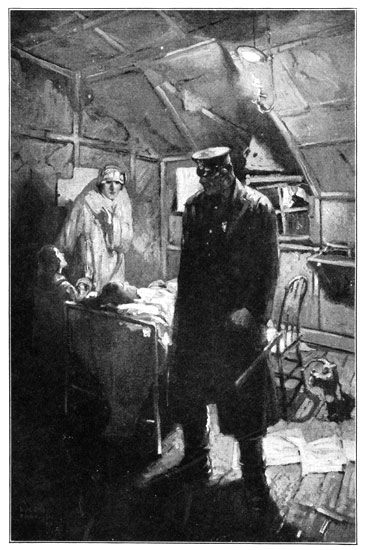
I had never seen Godfrey Morris's bedroom,
though his sister had shown me his study. But now
it was clear in every detail—the polished, uncarpeted
floor, the carved pineapple tops of the four-poster,
the great windows, open at top and bottom, the
logs on the brass andirons in the grate, the brass-bound
wood-box near it, the soft glow of the night
lamps, the portrait of his mother which Sargent had
painted ten years ago and which Godfrey had hung
in his own room at the front of his bed. Yes, I remembered
now, he had told me about the portrait.
That was why I saw it so plainly, facing him as he
lay unconscious. He had told me about the four-poster,
too, and the high-boys in the room, and some
chests of drawers he had picked up. He was interested
in old mahogany. No, he was not interested
now in anything. He was "in a stupor-like,"
Crumley had said. "The—crisis—is—expected—to-night."
"Great Scott, Miss Merrick!" shouted "T. B."
"Don't you realize that the woman would have
hysterics at this point? First she'd whimper, then
she'd cry, then she'd shriek and find she couldn't
stop. Like this—"
The theater filled with strange sounds—the wail
of a banshee, the yelps of a suffering dog, a series
of shrieks like the danger-blasts of a locomotive
whistle. Something in me lent an ear to them and
wondered what they meant. Surely they could not
mean that my heroine was to have an attack of
hysteria at that moment in my play. That was
all wrong—wholly outside of the character and the
scene; enough, indeed, to kill the comedy, to turn
it into farce.
"That's the idea," I heard "T. B." say. "Now
you try it. Here, we'll do it together."
Something flamed within me, instinctive, intense.
I half rose, then sank numbly back into my chair.
What did it matter? The only thing that disturbed
me was the noise. The uproar beat against my eardrums
in waves of sound that threatened to burst
them. My nightmare was growing worse. Was it
taking me to Bedlam? Was I shrieking, too? I
must not shriek in the big, quiet room where the
silent figure lay "in a stupor-like."
The chair beside me creaked. Gibson had dropped
into it. "T. B." and Miss Merrick were on the top
notes of their hysteria, but suddenly I ceased to hear
them. Every sense I had hung on the new-comer's
words. "No change," said Gibson, briefly. "None
expected till three or four o'clock. Thought I'd
drop in, anyway. Say"—a wraith of his wide and
boyish grin appeared—"what's going on? Is this
your rehearsal?"
The question meant nothing to me.
"Did you see any of the family?" I whispered.
Gibson nodded.
"Miss Morris came in for a minute at midnight,"
he told me, "while I was having supper. I opened
the door of Godfrey's room an inch, too, and saw
him through the crack."
"See here!" "T. B." was bellowing to a frightened
boy on the stage. "You're not giving an imitation
of Corbett entering the ring; you're supposed
to be a gentleman coming into a drawing-room.
See? Hook in your spine an' try it. And now
you're not havin' a hair-cut. You're greeting a
lady. And you're not makin' a face at her, either.
You're smiling at her. Smile, smile—my God, man,
smile! Try it. T-r-y-y it!"
His voice broke. He seemed about to burst into
tears. I caught Gibson's arm.
"Oh, Billy," I gulped, "how did he look?"
Gibson patted my hand glancing away from me
as he answered.
"Very quiet," he said. "He's unconscious. The
nurse said he was 'resting comfortably.' That's
their pet formula, you know. Occasionally he mutters
something—a few disconnected words. By
Jove, what is that fellow doing now?"
I followed the direction of his eyes. "T. B." had
taken one of his flying leaps over the footlights,
assisted midway by a chair in the aisle which served
the purpose of a spring-board in this acrobatic feat.
Now he was at the right first entrance, swaggering
through the open door, his hands deep in his pockets,
every tooth in his head revealed in a fixed and
awful grin. Yet, strangely, through the swagger,
under the grin, one detected for an instant something
resembling a well-bred college boy entering
a drawing-room—something, too, of radiant youth,
irresponsible and charming.
"Jove," breathed Gibson, "he gets it, somehow,
doesn't he? One sees exactly what he's driving at."
But the little scene had faded as I looked at it,
like a negative dimming in the light. The door that
opened was the door of the sick-room, and the man
who had entered was one of the specialists who
watched over Godfrey to-night. I saw him approach
the bed and lean over the patient, looking at him
in silence for a moment, his finger on the pulse of
the thin hand that lay so still. Somewhere near a
woman was sobbing. Was it Mrs. Morris, or the
young girl in the wings? I did not know. "T. B.'s"
voice was cutting its way to me like the blast of a
steam siren through a fog.
"Miss Iverson," he yelled. "Cut out that kid's
love scene. He can't do it, and no one wants it
there, anyway. You've got some drama here now,
and, by Heaven, it's about time you had! Don't
throw it away. Keep to it." His voice broke on
the last words. Again he seemed to be on the verge
of tears. "Keep—to—it," he almost sobbed.
I carried my manuscript to a point in the wings
where, vaguely aided by one electric light hanging
far above me, I could make the changes for which
"T. B." had asked. They meant new cues for several
characters and a number of verbal alterations
in their lines. Far down within me something
sighed over the loss of that love scene—sighed, and
then moaned over the loss of something else. "T. B.,"
his chin on his chest, his eyes on the floor, brooded
somberly in an orchestra seat until we were ready
to go over the revised scene. As I finished, Stella
Merrick leaned over me, her hand clutching my left
shoulder in a grip that hurt. Her teeth were chattering
with nervousness.
"How can you be so calm?" she gasped. "I've
never seen him as devilish as he is to-night. If you
hadn't kept your nerve we'd all have gone to smash.
As it is, I have a temperature of a hundred and four!"
I wondered what Godfrey's temperature was.
Gibson had not told me. There must be a fever-chart
in the sick-room. It seemed almost as if I
could read it. Certainly I could see the jagged
peaks of it, the last point running off in a long wavering
line of weakness. Perhaps Gibson knew what
the temperature was. But when I returned to my
seat in the orchestra Gibson was no longer there.
"Open some of those windows," ordered "T. B.,"
irritably. "It's like a furnace in here."
Was that an ice-cap on Godfrey's head? Of
course. The nurse was changing it for a fresh one.
For a moment, the first in that endless night, I
seemed to see his face, waxen, the sensitive nostrils
pinched, the gray eyes open now and staring unseeingly
into space.
"No change," said Gibson's voice.
Another period of time had dragged its way past
me like a sluggish snake.
"What o'clock?" I heard myself ask.
Gibson looked at his watch.
"Quarter of two," he told me, snapping the case
shut. "I saw Dr. Weymarth just before I left."
"What did he say?"
Gibson's eyes shifted from mine, which vainly
tried to hold them.
"No change," he repeated.
"Was that all?"
Gibson's eyes returned to mine for an instant
and shifted again.
"Tell me," I insisted.
"He's disappointed in the heart. It's been holding
its own, though the temperature has been terrific
from the first. But since midnight—"
"Yes, since midnight—"
"It's not quite so strong."
Gibson's words came slowly, as if against his will.
There was a strange silence over the theater.
Through it the voice of "T. B." ripped its way
to us.
"Now we'll run through that scene again. And
if the author and the ladies and gentlemen of the
company will kindly remember that this is a rehearsal,
and not an afternoon tea, perhaps we'll get somewhere."
"Billy," I whispered, "I can't bear it."
"I know." Gibson patted my hand. "Sit tight,"
he murmured. "I'm off again. I'll be back in an
hour or so. By then they ought to know."
I watched him slip like a shadow through the dark
house, along the wall, and back toward the stage-door.
The voice of Stella Merrick was filling the
theater. I heard my name.
"Miss Iverson doesn't agree with me," she was
saying, "but I think that in this scene, when we
are reconciled and I say to my husband, 'My boy,'
he ought to answer, 'My mumsey!'"
"T. B.'s" reply sounded like a pistol-shot.
"What for?" he exploded. "Want to turn this
play into a farce?"
"Certainly not!"
"Then follow the lines."
It was the settlement for all time of an argument
which Miss Merrick and I had waged for weeks.
One scene at least, the final, vital scene, would be
spared to me. I felt a throb of gratitude, followed
by a sudden sick, indescribable sinking of the heart.
Had I for one instant forgotten? I remembered again.
Nothing mattered. Nothing would ever matter.
Some one sat down beside me, smiled at me, then
stared frankly. "Good Heaven, Miss Iverson, did
I frighten you?" cried Elman. "You look like a
ghost!"
Before I could answer, "T. B." approached us
both. Leaning over Elman, he nodded toward the
youth who was still vainly trying to act like a gentleman.
"Get rid of him."
"But we open in Atlantic City to-morrow night—"
began Elman.
"Get rid of him." "T. B.'s" tones permitted
no argument. "Get rid of Haskins, too, and of
Miss Arnold."
"But, great Scott, Governor—"
Elman's voice, usually so controlled, was almost
a wail. "T. B." strolled away. To "open" the next
night with three new members in the company
seemed impossible. Probably we wouldn't open at
all. By to-morrow night I would know. Godfrey
would be out of danger, or Godfrey would be—Why
didn't Gibson come? Elman murmured something
to me about "not taking it so hard," but I
caught only a few words. He said it could be done—that
he had the right people at hand. He would
see them the first thing in the morning, and go over
the lines with them and have them word-perfect
by night.
My eyes were strained in the direction of the stage-door.
My ears were awaiting the sound of Gibson's
quick footsteps. For now, I knew, in the sick-room,
where my mind and heart had been all night, the
crisis was near. Through the open windows the
blue-gray dawn was visible. The shaded lights were
taking on a spectral pallor. Nurse and doctors were
close to the bed, watching, listening for the change
that meant life or death.
"Good—mighty good!" whispered Elman.
On the stage Miss Merrick and Peyton, the leading
man, were going through their final scene. The
familiar words, over which I had labored for months,
came to me as if out of a life I had lived on some
other planet ages back.
"You seem so far away," said the man. "I feel
as if I'd have to call across the world to make you
hear me. But I love you. Oh, Harriet, can't you
hear that?"
The voice of his wife, who was forgiving him and
taking him back, replied with the little break in
its beautiful notes which Stella Merrick always
gave to her answer.
"Yes, dear; I guess I'd hear that anywhere."
And then, as she drew his head to her breast, "My
boy!"
Within me something alive, suffering and struggling,
cried out in sick revolt. What did these puppets
know about love? What had I known about
it when I wrote so arrogantly? But I knew now.
Oh yes, I knew now. Love and suspense and
agony—I knew them all.
On the dim stage the leading man and woman
melted into the embrace that accompanied the slow
fall of the curtain. In the wings, but well in view,
the members of the company clustered, watching
the final scene and wiping their wet eyes. They
invariably cried over that scene, partly because the
leading man and woman set the example, but more
because they were temperamental and tired. Even
the brilliant eyes of Elman, who still sat beside me,
took on a sudden softness. He smiled at "T. B.,"
who had dropped into a seat near us.
"No change there, I guess," he hazarded.
"T. B." looked at his watch.
"Quarter of four," he said, with surprise. Then
he yawned, and, rising, reached for his light overcoat
which lay on the back of a chair.
"That's all," he called, as he struggled into it.
"Boyce, study your lines to-morrow, or you're going
to have trouble. Peyton, you and Miss Mason better
go over that scene in the second act in the morning.
So-long, Miss Merrick."
He started to go, then stopped at my seat.
"Good night, Miss Iverson," he said, kindly.
"You've got the right nerve for this business. Of
course we can't make predictions, but I shouldn't
wonder if we're giving the public what they want
in this play."
He nodded and was gone. I had barely caught
his words. Over his big shoulders I saw Gibson approaching,
his face one wide, expansive grin. Never
before had anything seemed so beautiful to me as
that familiar Gibson smile. Never had I dreamed
I could be so rapturously happy in seeing it.
"Good news," he said, as soon as he came within
speaking-distance; and he added when he reached
me, "He's better. The doctors say they'll pull him
through."
At the first glimpse of him I had risen to my feet
with some vague impulse to take, standing, whatever
was coming. For a moment I stood quite still.
Then the thing of horror that had ridden me through
the night loosened its grip slowly, reluctantly, and
I drew a deep, deep breath. I wanted to throw myself
in Gibson's arms. I wanted to laugh, to cry,
to shout. But I did none of these things. I merely
stood and looked at him till he took my hand and
drew it through his arm.
"Rehearsal's over, I see," he said. "I'm going
to hunt up a taxi and take you home."
Together we went out into the gray morning
light, and I stood on the curb, full-lunged, ecstatic,
until Gibson and the taxi-cab appeared. He helped
me into the cab and took the seat beside me.
"You ought to go home," I murmured, with
sudden compunction. "You must be horribly
tired."
They were my first words. I had made no comment
on the message he brought, and it was clear
that he had expected none. Now he smiled at me—the
wide, kind, understanding smile that had
warmed the five years of our friendship.
"Let me do this much for you, May," he said.
"You see, it's all I can do."
Our eyes met, and suddenly I understood. An
irrepressible cry broke from me.
"Oh, Billy," I said. "Not you! Not me!"
He smiled again.
"Yes," he replied. "Just that. Just you and me.
But it's all right. I'd rather be your friend than
the husband of any other woman in the world."
The taxi-cab hummed on its way. The east reddened,
then sent up a flaming banner of light. I
should have been tired; I should have been hungry;
I should, perhaps, have been excited over "T. B.'s"
final words. I was none of those things. I was
merely in a state of supreme content. Nothing mattered
but the one thing in life which mattered supremely.
Godfrey was better; Godfrey would live!