Six months previous to the events of the last chapter, four men were
awaiting the opening of the afternoon session of the police court, in an
office whose glass front displayed to the travel of Tenth Street the
legend,
Hyman Groll & Alonzo Bofinger
Counselors-at-Law.
Opposite, the Jefferson Market Court loomed from the triangular island
which is formed by the junction of Sixth and Greenwich Avenues, whose
muddy torrents descend, roaring, to shake it from its foundation.
The court is one of seven similar mouths, down which one may look
aghast, into the cauldron at the depths of society. Vice nowhere has a
more horrid aspect, for nowhere is it more mean and repulsive with the
inequalities of suffering. Journalism, to strip the novice of all his
illusions, sends him to this rude school, where he shortly learns not
only that evil as well as good is inevitable and eternal, but that
justice, in common with eternity, must be accepted in faith, for to
explore its depths is to recoil in horror. To him, who knows the misery
which bears the weight of the social superstructure, justice has the
aspect of a seal over a living tomb, and the present building is a
mockery. Where there should stand a waste of gray is a meaningless mass
of red brick. In place of a stern, ponderous block of granite,
unsoftened by ledge or cornice, crude with the crudity of man's justice
to man, there rises in architectural legerdemain a jumble of turret and
tower, as though variety and gaiety could be sought in this saddest and
dreariest of the manifestations of society.
Confronting the barred windows of the prison annex, from Sixth to
Seventh Avenues, runs a short row of clingy, undersized houses, given
over to the lawyers of the army of "Shysters," who, much as a ragpicker
rakes a garbage heap, scrape from the petty crimes of the court a
miserable income. The lawyer who succeeds has his runners whipping up
the gutters and the alleys, his alliances suspected or open with the
criminal and the police, while the miserable fee which results from this
elaborate system must often be divided into three parts.
The city, which does nothing in character and wantonly mingles
loveliness and evil, the ridiculous and the tragic, has not marked the
spot for avoidance but has forced the lawyers to dispute their foothold
with half a dozen small shops. The marketers, who come to the grocery,
basket on arm, share the sidewalk with the prostitute and the
dive-keeper. At four o'clock each afternoon the street is momentarily
flushed by the influx of children from a neighboring school, who also
witness the reluctant entrances into these mysterious offices, where
despair dominates beyond what the court itself can inflict.
In this row, the offices of Groll & Bofinger were the most pretentious
and immaculate. The glass front sparkled. The gilt announcement arrested
the eye afar, while a green shade, raised half-way from the bottom,
effectually screened the occupants and suggested a little of the mystery
of the pawn-shop, which offers obscurity to the despair of its clients.
An office boy, prematurely gone into long trousers, lolled in the
doorway, finishing by means of a hat pin the butt of a cigar and
searching the passers-by with something of the restlessness of the
pointer, alert to flush a new client.
Within the office the dwarfed ceiling and the frown of the opposite
prison left a dim area by the window and sunk the rest into shadow. In
the rear two dull glass doors threw a foggy interruption which filled
with foreboding the imagination of the client who entered these
confidential cabinets. Otherwise, the office was matter-of-fact and
characterless; where one expected dust, confusion, and slouch,
everything was clean, ordered and new, seeking an atmosphere of
respectable mediocrity. This decent surface, nevertheless, after the
first introduction never failed to impress the initiated with the
treachery of an ambuscade.
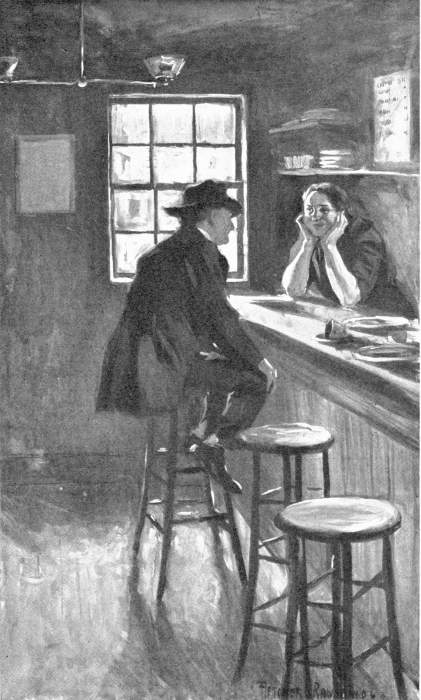
By the window Bofinger, with a leg over the table, was chatting with a
reporter, Joseph LeBeau, who from nervousness was perched on the back of
a chair, feet on the seat, gulping down frankfurter sandwiches from a
paper bag. On the bench near by his comrade Ganzler, from a news agency,
was stretched on his fat back, a law book under his shaved head, hat
over his eyes, pretending to snatch the sleep he had squandered during
the night. In the rear the figure of Groll, withdrawn from the
conversation, presented nothing but an indistinct bulk.
Ganzler was one of those rats of journalism which are as necessary to
the press as the criminal confederate to the police, a bohemian to whom
reporting was a destiny rather than a profession. He touched all men on
the worst side, knew blackmailer and sharper by name, enjoyed their
company and fell into their ways, did them favors when they turned up in
the Police Court, was their intermediary with the force and, in return,
ran without fear streets where a detective would not venture alone. He
knew each subtle channel of graft about the court and won the confidence
of all by dipping into the same ugly mess. He was coarse, acute, with a
memory which never let slip a fact, made of iron, tricky, but too
immersed in the life he reported to lend to the bare facts that
inspiration which needs a far perspective. He was rated sure and
indispensable. In journalism that is at once a guarantee and an epitaph.
Joseph LeBeau had not been in the service long enough to disguise either
his curiosity or his horror. He was a blonde young man remarkable for
that height of forehead which the image of Walter Scott has impressed
upon the memory, and which, while invariably betokening great
imagination and intellectuality, appears alike in poets and casuists. In
the brown eyes were perception and wit fed by an untiring curiosity of
life. At twenty-five, unless dissipation has scarred it, the face of a
man is a record yet to be written and the first marks are significant.
From the nostrils to the corners of the mouth two furrows had already
set, which when he smiled recalled that statue of Voltaire which, above
the fret of the Boulevard St. Germain, mocks those who cannot see life
is but a jest.
Though rich, he dressed carelessly. The felt hat askew on his head was
weather-worn. The blue tie straggled from its knot. The trousers
sustained by a belt bagged from the hips to the boots which showed the
white seam of a crack.
Nevertheless, beside him, Bofinger in his immaculate trousers, stiff
white vest, and planked shirt had the air of a countryman who dresses
once a year for a wedding or a funeral, while there was about LeBeau an
atmosphere of aristocratic certainty which gave the impression that his
bohemianism was a mood into which, as into all things, he had ventured
to sample the sensation.
He had been listening vacantly to Bofinger, intent more on pursuing some
train of thought of his own. At length he crumpled up the bag and asked
with that impertinence which reporters use to arrive more directly to
their ends:
"Alonzo, did you ever in the course of your distinguished services
happen to defend an honest man?"
Bofinger feigned an air of reflection, then with a superior smile
answered:
"How many do you know?"
The paper bag hurled at the waste basket fell back, spilling its crumbs.
LeBeau without attention to the accident drew out a cigar, crossed his
legs and began gravely:
"How many do I know? You don't believe in the animal then? That phrase,
my poor Bo, condemns you to mediocrity. Man, honesty is not a fixed
virtue! Any one may become honest, at times, and for a variety of
reasons."
"Joseph, you alarm me," said Ganzler, stirring under his hat. "Alarm me
and disturb my slumbers."
"Honesty as a variety is an absolute necessity to man," continued
LeBeau, half in raillery, half in conviction. "It stimulates our
imagination and resuscitates our powers for sinning. We reserve it as a
sort of moral bath; when we feel ourselves getting too black, why, we
seek out an honest action and cleanse ourselves. It is a moral bath and
a very slight application removes the stains. Blessed be our human
nature!"
"Joe, your view of human nature is horrible," interjected Ganzler. "Say,
can't we trust any man to remain dishonest?"
"Not even you, you old grafter," LeBeau said with a complimentary oath.
"I pass that. But Bo?" continued Ganzler. Then answering his own
question he added: "Bo, though, isn't to be relied on, he's not a
steady character. Say Groll then—now go slow, you ain't going to tell
us Groll's in any danger? I'd hate to think that."
The impudence of journalists is unbounded. All is permitted them if only
they say it with an air of insincerity. On their side they abuse their
prerogative, as women avail themselves of banter to leave the sting of
truth. As LeBeau remained silent and thoughtful, Bofinger rose and
examined the street, while Ganzler turning to the wall grunted:
"That was a poser."
"If I am right," LeBeau said with deliberation. "Of the four of us,
Groll is the surest to end honest and respectable." He added: "He's a
conservative—the present is but a ladder."
Ganzler and Bofinger, who saw in his gravity an exquisite irony, went
off into riotous laughter, but LeBeau had the satisfaction of seeing, in
the shadow, Groll abruptly raise his head.
"A man is neither good nor bad, honest or dishonest," he continued,
"but a sensitive organism that under different conditions responds to
different impulses."
"Hello, here's Flora," said Ganzler.
A woman entered, young and with a memory of good looks. Bofinger rose
and the two disappeared through one of the glass doors.
"The man who succeeds," said LeBeau, speaking to Groll, "is he who
studies the conditions that may turn an honest man to dishonesty, and
those that bring a rascal to repentance. The important thing is not to
fix the price of each man. Not at all. The thing is to use rogues not as
rogues, but as rogues in whom is the fatal impulse to honesty."
"Hello, that's an idea," said Ganzler.
The door of the cabinet creaked and Bofinger, sticking out his head,
said with an oath:
"Same story—she wants more time!"
Groll without a word let fall his fist; Bofinger, interpreting the
refusal, disappeared. A cry was heard. The door shut, LeBeau resumed.
"That's what Bofinger doesn't see, and yet it is the obstacle he ought
always to be dreading. Nothing more dangerous than honesty. Why, it is
often nothing but an obstinate revulsion of pride in a man who for a
whim or a moment resents being counted on as a rascal. That is
temperamental honesty, liable at any moment to trip up a case. Then, a
man can become honest by terror, or anger, or superstition, or sheer
caprice. The truth is, in these days, you can count on no man's
dishonesty. So confident am I of this beautiful truth that I prophesy Bo
will end a shyster lawyer in a shyster court."
The woman reappeared, trailed by Bofinger, who shrugged his shoulders at
her sullen departure.
"No use, Flora," broke in Ganzler, impudently, "you dress too well for
that game. Pay and be protected. The system is better than another one
we know."
The girl stopped for a furious retort, in one of those passions which
shake the existence of the outcast and bring a hundred times into their
lives the lust of murder. Then compressing her lips she wheeled and
bolted out.
Ganzler laughed uneasily; LeBeau, forgetting his theme, watched her
retreat. From behind, she showed a pleasing figure and the movements of
a young girl.
"Take the other side," Bofinger said, returning to his perch. "Every man
is more or less dishonest. Admit that proposition."
"It is debatable," said LeBeau, whose eyes still followed the woman.
"We graft or allow grafting—and what's the difference?" Bofinger
pursued contemptuously. "A man who touches society the way we do has got
no illusions I can tell you. Do you know how I could live if I wanted
to—without its costing me a cent? Talk to me of your honesty! For
lodging I could put up at a dozen hotels who want protection. For meals
there are restaurants by the hundred who don't want to be looked into
too closely. Stand in with the force and anything is yours."
"You said clothes?" inquired Ganzler with particular interest.
"Well, it ain't so hard to find a sweat shop that's breaking the law, is
it?" Bofinger replied with a smile. "Liquor and tobacco are too easy.
Theaters that break the rule of the fire department will keep you
amused. Pawnshops on the queer will give you a fine assortment of
jewelry, and you can get a hack when you want it from any night hawk who
expects to get into court."
"Correct," said Ganzler, with an approving nod, "and convincing."
"Fact is, there is pretty nearly nothing you couldn't get served up to
you," Bofinger ended, with too much pride for either to misunderstand
it. "Nothing—because you can always find some one who is grafting in a
large or small way. Hell, how absurd justice is! Take this case just
now. If adultery is a crime, why don't they prosecute a woman of the
world in a divorce scandal instead of some miserable brute who lives by
selling herself for a few little dollars!"
Ganzler admired the fine flush of indignation and nodded wisely. LeBeau,
remembering the scene with Flora, smiled ironically.
"A poor man calls in a lawyer to defend him," continued Bofinger, whom
the thought of injustice aroused. "A rich man's lawyer plans for him how
to escape arrest. What's the difference? A million, that's all! With a
million anything is respectable."
"It is," took up LeBeau, in haste to air his opinions on that topic.
"Why? With a million direct responsibility ceases. You no longer need to
steal in person, you break laws by proxy. Justice does not yet recognize
indirect responsibility. A million—there's our standard! Make it
anyway. So long as the track is masked society will judge you only by
the way you use it. At the bottom of all is this," he summed up, pulling
out his watch: "The world abhors petty sinning. Take a ten-dollar
bribe, you are despicable. Distribute on election day one hundred
thousand dollars for bribery and you are a leader of men. Take one
life—murder! Sacrifice a thousand lives for a commercial advantage, you
are a captain of industry! Crime is in the motive and the scale. When a
man steals from hunger or kills for revenge the motive is evident and
the guilt apparent. But for ambition, for fame, for supremacy—the
motive is human and grandiose. The grand scale precludes the crime! You
are right, Bo, you are right there. The million's everything!"
"Yes," Bofinger said pensively, whistling on his fingers, "but to get
that first essential million you've got to run some risks."
"Otherwise life would be too easy," LeBeau said with a smile. "The only
difficulty to-day is, as you say, to get the first million."
"It is all luck," Bofinger said moodily, and he remained silent, his
gaze plunged into the street.
LeBeau scrutinized him, smiling at the appetite he had awakened, seeing
the man in the bare, and wondering if there were any crime before which
such a nature would retreat, were it once a question of the opportunity
he coveted. He woke his companion, who jumped up rubbing his eyes,
asking:
"Well, are you through with your honest man?"
"True, we had forgotten him," LeBeau said, glancing at Bofinger.
"Bo, good news!" Ganzler cried, looking through the window. "I see a
client."
Across the street a little man, clad in black from a shovel hat to a
cloak which he carried slung over his shoulder, was examining
undecidedly the row of lawyers' offices. The shoulders, which were
unusually broad, so diminished his size that they gave him the look of a
dwarf. It was an odd figure, incongruous in the street, with an air of
belonging to the traditions of the stage. The two reporters, amusing
themselves at his expense, decided successively that he was a bandit, a
barber, an actor, a magician, a poet, and an engraver of tombstones.
"There he goes," cried Ganzler. "He's frightened off. He's guilty!"
"Maybe it was the honest man after all," said LeBeau, laughing. "Only
honesty looks guilty nowadays. Too bad, that was your chance. Beware the
honest man, though!"
The two reporters departed for the court after helping themselves to
cigars. Immediately from the back of the room a voice cried
peremptorily:
"Alonzo, you talk too damn much!"
"What of it?" Bofinger said, wincing under his chief's reproof. "I only
told them what they knew."
"Say nothing and you risk nothing."
Extricating himself from his seat Groll moved into the light,
discovering the shoulders of a hunchback, a massive bust on legs which
were weak, ill-matched, and pitiful.
The heavy head fell from the high cheekbones and the yellowish eyes,
which bulged like marbles, along the bold and fleshy nose to a
lengthened jaw where the folded lips adhered to each other as though to
repress all indiscreet speech. It was an unusual face, vacuous and
immobile, that seemed to contain instead of blood some fishy fluid,
which left it incapable of emotion.
On settling into his seat his arms sprawled over the desk, bracing the
weight of the head and shoulders on the elbows, while from the mass the
eyes, vacant and magnetic, conveyed to Bofinger for the thousandth time
the impression of an immense spider in the center of its web.
Physical deformity has an extreme effect on human nature. Either it
produces an heroic and resigned optimism, or it forms, by divesting them
of the passions which shackle men, characters of implacable selfishness,
who are strong because they were born weak and know no pity because
nature has shown them none.
Calculating and self-absorbed, Groll was yet not of those gamblers who,
staking all at each leap, infrequently arrive through desire and
infatuated confidence to heights seemingly beyond their force. He moved
slowly to his end, with that unhuman oriental patience which, allied to
the imagination of the American, forms in its rare conjunction
characters that death alone can thwart. He knew how to bide his time
without, as commonly occurs, the waiting consuming him. At thirty-eight,
age when the American reckons his life a success or a failure, he had
not lost a whit of his complacency. He had never known youth, he had not
therefore been disturbed by its pangs for instant preeminence.
With all that he was approaching forty a shyster lawyer, living on the
blackmail he shared with the police. The future did not seem to hold
anything further. Nevertheless, he had forced a career even out of this
slough of petty misery. He had begun by examining carefully the problem
of vice and the law, asking himself anxiously if the system of
blackmail was transitory. He soon became convinced that so long as
public sentiment would not admit that vice exists and legalize it, vice
must exist through corruption. He then conceived an audacious plan,
which was no less than to unite under one system, with himself as the
head, all the traffic in blackmail which then filtered through a
thousand intersecting channels. The man who could achieve such an
organization, he saw would dominate the city so long as he was content
to remain obscure. Towards this end he had moved irresistibly, picking
his associates and his agents, biding only the moment when his fortune
would permit him to launch the system on a grand scale. So well had he
locked up in his own breast the secret of this gigantic plan that
Bofinger himself did not suspect it.
In character he was frugal, temperate, and peaceful, without vices or
distractions, qualities which in another man would have been virtues, so
strangely does the controlling motive determine betwixt virtue and vice.
Born three centuries ago he might have been a bigot, pursuing religion
with the same fanaticism which he brought to the conquest of his present
design.
Bofinger continuing to defend himself, Groll interrupted decisively:
"One is never strong enough to be confident. Only a fool feels secure.
Talk to Ganzler who is one of us—but not to LeBeau, who for a sensation
might write us up and bring everything tumbling about our ears! Also
don't show your hand! Play close to your chest." He stopped, considered
his associate, and perceiving the reproof was felt, added: "Now for
business. What did they say at that new joint in Eighteenth Street?"
Bofinger, who had taken his scolding like a guilty schoolboy, hastened
gratefully to the opening, saying:
"They won't give up a cent."
"Did you make clear our pull?"
"Yes."
"What, do they think they can operate in this district for nothing?"
"That seems to be it."
"We'll have it raided to-night," Groll said thoughtfully but without
irritation. "We must make an example. It will have a good effect.
Besides Flaherty tells me he's got to pull off something quick."
He drummed on the desk, while Bofinger, seeing he had something in mind,
waited.
"Alonzo, we've been working on a wrong principle," he said suddenly.
"This idea of being lenient with the women will bring us in trouble. We
must be paid promptly and cut out the excuses. That's what gets them
excited, and when they get worked up they are liable to do anything.
When they understand they must pay up they'll take it as a matter of
course. Putting it off gets them to brooding over their wrongs. After
this, no more putting off. Otherwise run them in the next day and send
them up to the Island. Two or three examples will straighten things out.
Make it easier for us and easier for them."
"Shall I warn them?" Bofinger asked.
"No," he said after a moment. "The example will be better if you don't.
Send a couple up."
For a few minutes he gave directions in the same mild, unvarying voice,
and then departed, each step paid by an effort.
Bofinger with a remainder of his irritation threw himself into a chair.
The discussion with LeBeau had touched him too closely to be soon
dismissed. The reporter had not been mistaken in his estimate. Bofinger
was a man constantly in revolt against his condition, ready to risk
anything for the opportunity to rise. But he wanted fortune, as the
gambler seeks it, in a day, on some marvelous cast. This conversation
with LeBeau, who had all he coveted and seemed to disdain it, left him
in a fury. He recapitulated in his mind a dozen schemes of blackmail and
sharp practise, rejecting each as inadequate and petty.
"It's all luck," he said almost aloud. "I'd like to be a woman. It's
only a woman can jump from anywhere. If I only had their chance!"
In the midst of this reverie, the door was suddenly thrown open without
the ceremony of a knock, and a curt voice demanded:
"Be this Mr. Groll?"
The lawyer, shocked out of his dreaming, looked up and recognized the
singular figure of the little man in the shovel hat.