A PASSIONATE ACT
AFTER Julius Dakin had left the studio, Enid sat for awhile doing
nothing. It was not like her thus to sit in idleness; but she was in a
mood which was altogether strange to her. She was excited—so excited
that she would have found it impossible to wield a brush or so to
control either hand or mind as to produce her best work.
Of course she believed that it was Adela's coming, and the painful
nature of her visit that had unsettled her so; yet had she carefully
analysed her feelings, she could not have said that they were entirely
sad. And in truth as she sat absorbed, not knowing how the minutes
passed; it was less of Adela than of Julius Dakin that she was
thinking. She was recalling all she had told him about Adela, and how
he had listened to her words, and what he had said, with everything
that had followed. Not words alone repeated themselves to her inner
consciousness, but looks and tones.
Somehow that brief interview had left her with much to think over.
With a strange thrill she thought of the words she had dared to say to
him, not regretting them but wondering that she had found courage to
say what she had, wondering too at the gentleness with which he had
received her admonition, which surely many young men would have been
inclined to resent.
Perhaps Enid became conscious at last of the dangerous course her
thoughts were pursuing. Certainly she started up as the time-piece
struck four, with a sudden sense of the absurdity of spending a fine
afternoon, at Rome of all places, in doing absolutely nothing, and in a
room lighted from above with no view of the outer world.
In a few minutes, she had donned her hat and jacket, and was on her way
to the Pincio.
On this bright afternoon there was the usual crowd on the terrace
facing the band-stand. Carriages were drawn up in rows in the centre of
the open space, most of them empty, their possessors preferring to walk
about as they listened to the music. The scene was one of which Enid
felt that she would never weary. It was a delight to her to gaze over
the widespread view of Rome, a delight which had only increased as each
object which met her view became familiar, till she could name every
dome and roof on which her eyes rested. Nor was languid her interest in
the various human elements of which the crowd about her was composed.
The foreign visitors, representing so many nationalities, and who might
be classified as the fashionable, the pretty, and the picturesque,
afforded Enid entertainment; and as she passed to and fro in the
sunshine, her face showed that her thoughts were as bright as the day.
For if she thought of Adela now, the girl's unhappy lot cast no heavy
shadow on Enid's heart. Indeed, she was half disposed to reproach
herself with hard-heartedness, so much did the excitement of her mood
tend to gladness. A new and exquisite happiness seemed to be welling up
within her, the secret source of which she herself did not know.
Then of a sudden, all was changed. It was curious that the sight of
Julius Dakin coming round a bend of the road should set Enid's heart
beating with painful rapidity; still more curious that she should be
conscious only of a desire to avoid him. She hurried towards the side
of the terrace whence a flight of steps descended to the lower road.
As she stepped down, she looked back. He had passed on without seeing
her; he was advancing towards an open carriage, in which sat two young
ladies. It was perhaps the smartest equipage, and its occupants the two
most charming girls, to be seen on the Pincio that day.
With a sensation wholly new to her, Enid watched him greeting with
his courtliest air and most fascinating smile Blanche Amory and Maud
Marian. As she went quickly down the steps, the words she had overheard
at Mrs. Dakin's reception came vividly to her mind—"Julius Dakin knows
how to make himself agreeable to ladies," and she remembered too how in
the same conversation the names of both these girls had been coupled
with his. Enid descended the winding path with her head held high and
her lips firmly compressed.
"I am glad I said what I did to him this afternoon," she thought,
"though I do not suppose it will make any difference. I hate the idea
of a man living just to please himself, taking everything the world can
give him and paying nothing back. But that is Julius Dakin's way—he
never thinks of any debt he owes to others; he has no desire to serve
the world. And I—I despise a man like that!"
And there was a strangely stern expression on Enid's fresh young face
as she crossed the Piazza del Popolo and took her way home by the Via
del Babuino. But ere she reached the house, sternness had given way
to sadness. A feeling of weariness and home-sickness swept over her
which was hard to bear. She felt a great yearning for her mother's
presence, her gentle, helpful sympathy. And the last letter from
home had given her such an account of her mother's health as caused
her uneasiness. Enid was not naturally inclined either to anxiety or
melancholy; but now every dark suggestion, every sad thought she had
before experienced, came back to her mind with renewed force. She was
depressed both in mind and body when she gained her room, and it was a
relief to know that Maud was out, and she might indulge her mood for a
while without fear of interruption.
But not for long did Enid give way to melancholy. The next day she
was herself again. Her little picture was finished and sent away to
be framed, in readiness for the exhibition. That very day she began a
painting of a bunch of violets in a little earthenware jar—a simple
enough subject, but by no means easy to treat successfully. Working
away at it, however, in her careful, painstaking way, Enid achieved
a very fair result. Meanwhile, Maud was engaged every morning with a
model, a handsome, dark-eyed girl, who wore one of the picturesque
costumes of the Campagna. It must be confessed that the girl's beauty
suffered at Maud's hands. The face which looked forth from her canvas
had a hardness of colouring and a boldness of glance of which the
original was not guilty. But defects of this kind did not disturb
Maud's complacency. She had a curious way of anticipating and disarming
criticism.
"I know my model's hair was not like that," she would say; "but really
I prefer the hair I have given her. She ought to have had hair of that
shade, don't you see?"
Or—"No, her eyes had not that expression; they had a melancholy look;
but I do not approve of melancholy subjects, so I was glad to give her
a cheerful air. You see, I must paint in my own way, or not at all."
"Undoubtedly," said a gentleman to whom Maud made this remark on one
of the afternoons when she was "At home" to her friends; "that is the
prerogative of genius. Art should give us more than a mere copy of
Nature; it should improve upon Nature."
To Enid's surprise, her cousin accepted this response with complacency,
and seemed unconscious of the satire which doubtless lurked in it.
Miss Marian was "At home" each Wednesday afternoon, and between four
and six o'clock on that day the Studio Mariano presented a lively
scene. Whatever might be thought of her powers as an artist, her studio
was undoubtedly an attractive place, and she had a knack of making
people enjoy the time they spent there. Men found her both pretty
and clever, and were struck with the grace of her manner; whilst
women, though they might object to the colour of her hair, criticise
unfavourably her features, and resent the airs she gave herself, were
nevertheless won by her good-nature.
Enid generally found plenty of entertainment on her cousin's reception
afternoon. It devolved on her to look after the prosaic details
connected with the making and serving of the tea; but these did not
prevent her from having a good time. She liked to see the people who
came, and to listen to the lively talk that went on. Perhaps she
enjoyed it all the more because she had only a secondary part to play,
and her duties kept her much in the background. Many of Maud's visitors
were of opinion that her cousin was a quiet, rather dull girl. They
would have been surprised had they known how keenly the "dull" girl
had observed them, and how clearly she had detected their various
weaknesses and vanities. For it must be confessed that Enid was rather
a "quiz."
Enid was disturbed to see Miss Amory, attended by Julius Dakin, enter
the studio on the following Wednesday afternoon. She had not spoken to
him since he found her alone there four days earlier. She was nervously
conscious of the words that had passed between them on that occasion.
She tried to occupy herself with the other visitors, and to avoid
saying more to him than was absolutely necessary.
But it did not please him to be thus ignored. He watched his
opportunity, and presently, when several persons rose to depart, and
there was a general break in the conversation, Enid found him by her
side.
"What are you painting now, Miss Mildmay, if I may ask?"
"You may ask, certainly," said Enid, smiling.
"You do not mean that you will refuse to tell me? Oh, please let me see
it. This is your easel, is it not?"
Enid, forseeing endless entreaties, thought she might as well yield at
once, and uncovered her painting.
"Ah, this is something new!" he exclaimed. "Did you finish the orange
spray?"
"Yes, and it is gone to the framer's."
"Ah, that is right. And you really mean to send it to the exhibition?"
"I think so."
"I am glad. It will win a medal, I am sure."
"Oh, I do not expect that," said Enid, smiling. "But now, how do you
think this promises?"
"I think it very good—so good that—Shall I tell you what I wish?"
"Certainly."
"I wish you would paint it for me. I mean, I wish you would be so good
as to allow me to purchase it."
"Oh, Mr. Dakin!" exclaimed Enid, colouring hotly in her surprise. "I
could not do such a thing."
"Why not? Are you too proud to sell your pictures?"
"No, not that," said Enid, with considerable hesitation; "but I do not
like the idea of selling one to you."
"You think me incapable of appreciating it?"
"You know it is not that," said Enid, forced to smile. "But—well—that
one in the exhibition will be for sale; you can buy that if you like."
"Thank you, but I do not desire that. I want to have something you have
painted throughout for me."
"If I painted anything for you," said Enid slowly, "I would not sell it
to you."
"No, really!" There was a strange, surprised, glad look in his eyes as
he bent towards her. His glance met and arrested hers.
With a strange thrill she awaited the words he was about to utter; but
they remained unsaid, for at that moment the high thin voice of Miss
Amory made itself heard from the other side of the room.
"Julius, where on earth are you? Do come and look at this lovely thing
of Miss Marian's. It is real elegant."
Julius cast a comical glance at Enid as he turned to obey the summons.
An inspection of Maud's pictures followed, and Enid observed that
Julius found something commendatory to say of each. Miss Amory made
remarks on them with her usual freedom.
"It is a treat to see some new pictures," she observed. "I am so tired
of those dim old things in front of which you have to keep moving
about for a month till you find a spot where you can see them. I like
something you can see straight away. But don't you think that girl
looks a bit sick? Her eyes are not right, anyhow; but you've given her
an awful cunning gown."
Enid was thankful that Miss Amory's attention was not drawn to any of
her work. She hastily covered up her own little painting, and nothing
more was said about it. A few minutes later Miss Amory and her escort
took their departure.
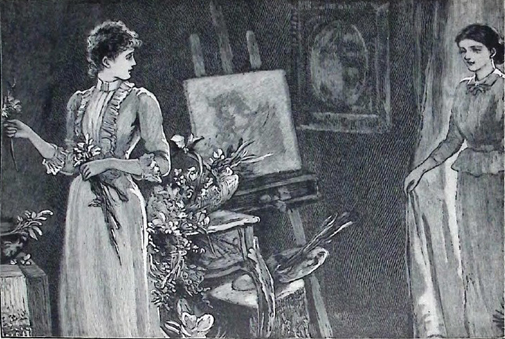
Enid went on painting her violets with a new pleasure in her work. She
was tremulously anxious to succeed, and far from satisfied with her
performance, yet it was good. The thought of Julius Dakin was with
her as she worked. She had resolved that she would receive no money
from him for the little picture. Yet in truth, though dreamily, scarce
consciously, she was painting it for him. She meant that he should
have it, though she had no clear idea of how it would be possible for
her to give it to him. She had almost finished the work. It lacked but
those finishing touches which the eye of a connoisseur alone could have
detected to be wanting.
"Why do you keep touching that thing?" Maud said to her impatiently one
day; "those trifling details can make no real difference."
"I wish Herr Schmitz could hear you say that," returned Enid; "he would
certainly repeat for your benefit his favourite story."
"What is that?" asked Maud.
"Oh, it relates to his hero, Michael Angelo. A friend once visited the
sculptor, and found him engaged upon a statue. Some weeks later the
visit was repeated.
"'You have been idle since I was here,' remarked the friend, looking at
Michael Angelo's work, in which he discerned no progress.
"'By no means,' said the sculptor. 'I have softened this feature and
brought out that muscle. I have given expression to that lip, and more
energy to that limb.'
"'Well, but these are mere trifles,' said his friend.
"'It may be so,' replied Michael Angelo, 'but remember, trifles make
perfection, and perfection is no trifle.'"
"I can quite imagine Herr Schmitz telling that story," said Maud
disdainfully; "but I must say I do not admire that sort of perfection.
I believe in the artist who can produce a great effect with a few
strokes. Things laboriously wrought are often failures. You may work
away at a picture till you spoil it utterly."
"That is true, as I have learned by experience," said Enid. "Still, it
is well to strive one's hardest; and perfection is perfection, however
attained. Yet, I doubt if Michael Angelo ever thought his work perfect."
Enid took the warning which her cousin's words suggested. She would
not work upon her violets till she spoiled them. She resolved to lay
the painting aside for a day or two that she might return to it with
fresher vision, and be better able to judge of its merits. So she gave
herself a holiday on the following day, and spent its hours in visiting
some of the many interesting spots in old Rome.
Returning to the studio late in the afternoon, she found Maud putting
away her work and obviously not in the best of humours.
"Julius Dakin has been here," she said, after a few minutes. "He stayed
ever so long, and hindered me dreadfully."
"Did he?" said Enid, wondering that her cousin should speak as if his
visit were a cause of annoyance.
"Yes, and he looked at that painting of yours, Enid. He would look at
it, although I told him you did not like your work meddled with."
"That was very rude of him," said Enid; but she did not speak in an
offended tone. "What did he think of it?"
"Oh, he professes to think most highly of it," replied Maud; "he wants
to buy it of you."
"I know he does," said Enid smiling; "but I do not mean to sell it to
him."
"Why not? What nonsense, Enid, when you know you would be glad of the
money! I am sure he means it very kindly."
"Very kindly!" repeated Enid, in a tone of surprise.
"Yes, I am sure he does it out of kindness."
"Does what out of kindness?" demanded Enid. "What do you mean, Maud?"
Her cousin gave a constrained little laugh. "Are you so vain, Enid, as
to suppose that he is really anxious to possess that painting of yours?
You must know that I told him some time ago that you would be glad to
make a little money by selling some of your things. It is just a piece
of his good-nature. He wants to be kind to you—that is all."
A burning flush mounted in Enid's face as she heard her cousin's
words. She stood motionless, gazing at her little painting, which was
still exposed upon the easel, with a revulsion of feeling that was
unendurable. She could not have told why Maud's words had such power to
sting her; she did not understand the meaning of the passionate anger
and the sense of outraged pride which possessed her; she only knew that
it was intolerable, and demanded some vent.
Maud repented of her words as soon as they were uttered. She was
dismayed as she marked their effect—dismayed and conscience-stricken,
for she knew they had been insincerely uttered; and she was a girl who
prided herself on her truthfulness.
"Why do you look like that? Surely you need not mind," she began.
But the next moment her voice rose high in consternation. "Don't, Enid!
What are you thinking of?"
But she could not arrest her cousin's action. Enid seized her painting,
tore it passionately into several pieces, and threw them within the
open door of the stove. A flame sprang from the glowing coal and
consumed in a moment the work of many days.
"How could you, Enid?" cried Maud, in great distress. "You must be mad!"
"Perhaps I am," said Enid, in a voice strangely unlike her own; "but
you see now how anxious I am to make money by selling my pictures, and
also how grateful I am for such kindness as that of Mr. Julius Dakin."
With these words on her lips, she walked out of the studio, and Maud
was left to her own reflections, which were by no means of an agreeable
nature.
Running blindly down the stairs, with no purpose save a desire to
get away from Maud, Enid came upon Miss Strutt slowly ascending the
staircase with several small parcels in her hand. The girl would have
passed without a word had not Miss Strutt caught her by the arm.
"Enid, what has happened? Where are you going?"
"Nothing! At least, nothing that I can tell you," said Enid, making an
effort to conquer her agitation.
"Then do not tell me," said Miss Strutt, kindly; "only—whither are you
going in such haste?"
"I am going nowhere in particular," said Enid, looking down in shame.
"I suppose I was going to the 'pension.'"
"Come to my room instead," said Miss Strutt soothingly. "I am just
going to make myself a cup of tea, and I should be glad of your
company."
Enid hesitated. "I had better not come now," she said; "I am not in a
mood to be good company for anyone."
"Then come and be bad company," said Miss Strutt smiling. "My dear, I
see you are in trouble, and I will not worry you. I will give you a
cup of good tea—they say tea is a comfort to women in every sort of
trouble—and you need not say a word unless you like."
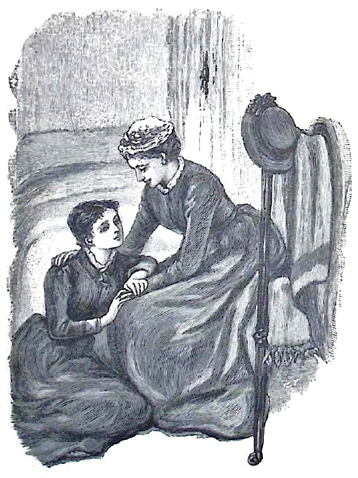
So Enid followed her. By this time her passion was spent, and she was
beginning to be thoroughly ashamed of the way in which it had moved her.
Miss Strutt placed the girl in a comfortable chair by the stove, and
then left her alone whilst she busied herself in emptying the small
grocery packets she had been purchasing. She had many preparations to
make ere the tea was ready. Maud would have been moved to contemptuous
pity, could she have watched the precise, particular way in which the
old maid arranged everything, and she would certainly have laughed at
the odd figure Miss Strutt presented as she moved about in a short
full-flounced skirt, of a style that for many years had ceased to be
the mode.
But Enid was too absorbed in her own sorrowful thoughts to pay any heed
to Miss Strutt. That lady, however, was quietly observing Enid, and she
presently saw her turn her head aside, and knew that she was shedding
tears. But still Miss Strutt kept silence. At last, when the tea was
made, she drew a little table to Enid's side, and placed on it a cup of
tea and some biscuits.
"There, my dear," she said kindly, "take your tea, and you will feel
better afterwards."
Enid looked up at her with eyes full of tears.
"Miss Strutt," she said, "you have no idea what a dreadful temper I
have."
"Have you?" said Miss Strutt smiling. "Well, certainly I had no such
idea."
"Well, I wish I could take things quietly," continued Enid; "but when
anything vexes me, I fire up, and speak so angrily, and do things for
which I am sorry afterwards. Maud has far more self-control than I
have."
"It is a good thing to have self-control," said Miss Strutt. "Some
persons are naturally cool and self-possessed; but for one of your
temperament, self-restraint is never easy. You can only learn to
control yourself by constant effort and much watchfulness."
"That is what mother has often told me," said Enid, with a sigh; "and I
thought I had learned to conquer my temper; but I suppose it was only
that I found it easy to be good-tempered when I was at home. So many
things have happened to put me out since I came to Rome. And I thought
I was going to be so happy here!"
Enid's tears began to gather anew.
"You have been happy," said Miss Strutt. "Don't magnify your troubles,
child. I am sure it has often gladdened my heart to see your bright
face, for I like to feel that some lives are full of sunshine, though
mine is lived in the shade. You have had much enjoyment since you came
to Rome."
"Indeed I have—you are right," said Enid, smiling in spite of herself.
"But I do not think I can enjoy anything more. I would go home
to-morrow if I could."
"Oh, nonsense! This will pass," said Miss Strutt briskly. "You young
things always fancy that your troubles are going to last for ever. In
a week's time, you will be as eager to remain in Rome as you were at
first. And what would Herr Schmitz say if you ran away? You forget your
work. How are you getting on with your violets, by-the-bye?"
"I tore the painting up this afternoon," said Enid, colouring deeply.
"My dear, you do not mean that!" exclaimed Miss Strutt quickly. "What
could make you do so? You seemed to me to be succeeding so well. If you
got your colours into a muddle, you should have come to me before doing
anything so desperate."
"It was not that," said Enid, with deepening confusion; "it was not
because I was disgusted with my work. I did it in a fit of temper."
Miss Strutt looked amazed.
"It was very foolish of me," faltered Enid. "I am sorry for it now—but
it is too late."
"Such regrets are generally too late," said Miss Strutt gravely. "Well,
it is a good thing you only destroyed your picture. Greater things are
often destroyed in a fit of temper—friendships, loves—that are very
precious. Ah, it is terrible to think what one may be led to do or say
under the influence of passion."
Enid felt the solemnity of her tone. "Oh, Miss Strutt," she said, "I am
frightened at myself sometimes! It is so hard to be right."
"Yes, life is not easy," said the elder woman; "at least, a true life
never is. We must strive and struggle if we would follow the path of
perfection. 'If any man will come after Me, let him deny himself, and
take up his, cross and follow Me.' But the end is worth the struggle."
She laid down her cup, rose, and crossed the room to where a bureau
stood against the wall. Enid did not watch her movements. She was
thinking of what Miss Strutt had said. There was silence for some
minutes.
Miss Strutt was bending over a small picture which she had taken from a
drawer. She looked at it long, and hesitated. At last, placing it on an
easel, she said, turning to the girl—
"Enid, look here! This is something I have never shown you."
Enid looked up. On the easel was a portrait, executed in water-colour,
of a young man.
"Did you do that?" she asked, in surprise. "I did not know that you
painted portraits."
"I do not as a rule. That was painted from memory, with the aid of a
photograph."
Something in Miss Strutt's manner restrained Enid from asking
questions. She looked at the portrait. It was that of a young man about
five-and-twenty years of age. It was a good, even a handsome face.
The broad, finely-arched brow, the strongly-moulded features, the
thoughtful expression, seemed to betoken intellectual power. He could
hardly be said to resemble Miss Strutt, and yet there was that in the
face which subtly suggested hers.
"That is the portrait of my brother," said Miss Strutt, when the
silence had lasted some minutes.
"Your brother!" said Enid, in surprise. She could not remember having
heard Miss Strutt speak before of this or any relative.
"Is he living?" she added, after a moment.
"Yes, he lives," said Miss Strutt, and her voice sounded strange to
Enid's ears. She looked at her, and saw that the little woman was
greatly agitated.
"He is my only brother," said Miss Strutt presently. "That is what
he looked like long ago, for he is older than I. We were so fond and
proud of him, my mother and I; perhaps, we had a right to be, for he
had great gifts. We were always poor, for my father died when I was
a little child. My mother made great sacrifices to give her children
a good education. I early began to earn money by teaching, whilst at
the same time, I practised drawing constantly, for I always hoped to
be an artist. Every penny my mother and I could save we put aside that
Hugh might go to college. He was so clever, we felt sure that he would
distinguish himself. We thought he had a great future before him."
Miss Strutt paused for a moment, then went on in tremulous tones,
"Well, he went to college and he won distinction. The men of his
college were proud of him; great things were prophesied. There was a
scholarship for which my brother was competing. No one doubted that
he would win it. But he had a rival—a rival who was also an enemy.
Circumstances had occurred to create between them the bitterest
feeling. On the day of the examination, my brother discovered that this
man had taken an unfair advantage of him. He charged him with it. There
were angry words. My brother was always hot-tempered. In their quarrel,
he suddenly struck his opponent. The blow would not have been serious,
but the man chanced to be standing at the head of a flight of stone
steps. The shock sent him staggering back, and he fell to the bottom of
the flight. When they raised him, his neck was broken."
"Oh, how dreadful!" exclaimed Enid. "How could your brother bear it?"
"He could not bear it," said Miss Strutt slowly. "He was out of health;
for weeks he had been over-working, studying both day and night in
pursuit of his object. His nervous system had been strained beyond
endurance; this shock was more than his brain could support. Ah, how
can I tell it! His reason gave way. He has lived on; he is living
still—if it can be called life—that awful existence of the insane!"
Enid grew pale as she listened. She could say nothing in response.
Words seemed empty and vapid beside the revelation of so great a
sorrow. Her own troubles seemed to melt into nothingness in comparison
with the sorrow and disappointment of this sister's heart. Perhaps Miss
Strutt felt that hers was the silence of sympathy, for she went on
presently—
"You will not wonder that the grief broke my mother's heart. She lived
little more than a year afterwards—then I was left alone in the world.
People perhaps wonder why I live as I do; why I work so hard and spend
so little. You will understand. I have but one thing to live for—the
duty of seeing that my poor brother is well cared for in his sad
situation. I have a friend, a medical man, in Scotland, who visits him
from time to time, and sends me news of his condition. If there were
any improvement, any possibility of his knowing me, I should go to him
at once; but the news is always the same. It is a hopeless case."
Enid took Miss Strutt's hand and kissed it reverently.
"Oh, what sorrows you have known!" she said. "It makes me ashamed to
think that I have been pitying myself, fancying myself unhappy, when I
really do not know what trouble is."
"If it has made you feel so, I am not sorry that I have told you," said
Miss Strutt.
"No, do not be sorry; I am glad you told me. Only I feel so sorry for
you. How you have borne it, I cannot tell."
"I have been helped to bear it," said Miss Strutt quietly. "Have you
seen Guido Reni's Crucifixion in the church of San Lorenzo in Lucina?
No! Then you must go and look at it some day, and perhaps the picture
will give its message to your heart. Many a time when my heart has been
oppressed by the mournful mystery of life, and ready to rebel beneath
its heavy load, the sight of Guido's picture has given me calmness
and strength. That sublime sorrow of the Highest One, that cross so
patiently borne for the sake of others, gives us the only solution of
life's perplexities, for it shows us that all the pain of the world,
and our own individual share of the same, is meant to be for good, and
not for evil. Do not look so grieved for me, child! This sorrow of mine
has shared my life for so many years that it has grown to be like part
of myself, and I have long ceased to fret under it."
Enid quitted Miss Strutt's room in a humbler frame of mind. She had had
her lesson, and it was one which she never forgot.
She went upstairs prepared to confess to Maud how she regretted her
hasty action and angry words. Maud received the confession lightly
enough, and dismissed the matter as of slight consequence. Enid's heart
was sore as she thought of the violets she had painted so lovingly. She
felt a strong reluctance to begin anything fresh, and for some days
could only work in a very desultory fashion.
Maud meanwhile was projecting a great work. The weather now was sunny
and warm—as February days often are in Rome—and Maud made her pretty
model pose for her in the garden beside an old moss-grown fountain with
a background of orange trees laden with ripening fruit. It was a good
idea, but unfortunately Miss Marian's ambition was in advance of her
skill.
Maud was painting in the garden one afternoon and Enid was drawing in
the studio, when Julius Dakin made his appearance there.
Enid, who felt some embarrassment on seeing him, at once explained
where her cousin might be found; but he seemed in no hurry to seek Miss
Marian.
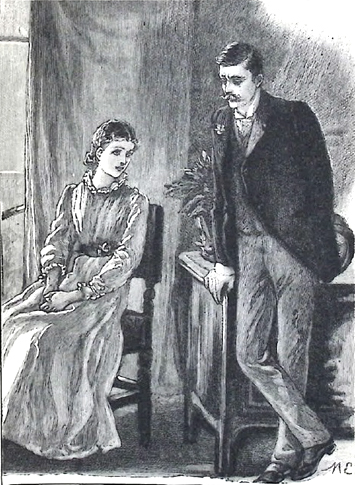
"Where are the violets? Are they finished?" he asked, as he glanced
over her shoulder, and saw that she was drawing from a plaster cast.
"They are finished as much as they ever will be," said Enid, colouring
vividly. "I have done for them."
"What do you mean?"
"Simply that the violets are no more. In other words, I tore the
painting up."
"What! Do I hear aright? You tore up my beautiful violets—the painting
that I had come to look on as my own! What could make you do such a
thing?"
Enid said nothing.
"It was too bad of you," he continued reproachfully. "You were doing
them exquisitely. You excel in painting flowers—Herr Schmitz was saying
so the other day; I wish you could have heard how he spoke of your
work."
"It is well I did not," said Enid; "I am conceited enough already, and
Herr Schmitz knows that too well to give me much praise."
"Indeed, you are mistaken. I only wish I could inspire you with a
little conceit. If you had a quarter of your cousin's self-confidence,
you would do."
"Allow me to remind you, Mr. Dakin, that comparisons are odious," said
Enid.
Julius laughed, but said determinedly, "Now I really must understand
this matter. What induced you to tear up that painting?"
Enid was silent.
"Were you disgusted with your work? Did you conceive of it as a
failure?"
"No, it was not that."
"Was it anything your cousin said that induced you to do it? Did she
disparage your work?"
"Really, Mr. Dakin, I must beg you to spare me these questions," said
Enid. "What does it matter why I did it? The thing is done, and cannot
be undone."
"That is the worst of it, unhappily. I assure you I do not feel
inclined to take my loss philosophically. I can never forgive Miss
Marian if her words have put you out of humour with your work. It is
absurd her presuming to criticise you, who have fifty times her talent.
You must see yourself how faulty her work is. She cannot even draw. You
must be conscious of your own superior power. You have real talent; but
Miss Marian! It is ridiculous for her to call herself an artist!"
"Mr. Dakin, I wish you would not speak so," said Enid uneasily. "You
forget that Maud is my cousin."
"No, I do not; but forgive me if I have said anything to pain you. You
know I promised that I would always tell you exactly what I thought.
I have a great respect for Miss Marian; she is a charming young lady;
but—" he shrugged his shoulders impressively—"as an artist she is a
joke."
"I shall be seriously offended with you, Mr. Dakin, if you talk in that
way," said Enid.
"Excuse me; I did not mean to annoy you, though really I think you
deserve a punishment for tearing up my painting. Now tell me honestly,
did you not paint those violets for me?"
"I should never have sold them to you," said Enid.
"Then you would have given them to me," he said, in a low, insinuating
tone.
Enid coloured, but said nothing.
"That would have made me only too happy," said he. "And now the picture
is destroyed, do you wonder I am vexed? I suppose I may not ask you to
paint something else for me?"
"You may ask me if you like," said Enid, "but I shall certainly refuse
to make any promise. I feel as if I should never paint flowers again.
But now let us go and find Maud."
"Yes," said Julius laughingly; "we will go and see the great artist of
the future."
Enid gave him a reproachful glance.
But when they reached the garden, Maud was no longer there. Her easel
and painting materials were still beneath the trees; but model and
artist had both departed.
Julius Dakin excused himself from staying longer, and Enid went back
alone to the studio.
Attached to the studio was a tiny room communicating with it, and
having also a door into the passage. The girls used it as a sort of
dressing-room, and also as a place of consignment for various useful
but inelegant articles belonging to their studio.
As she re-entered the studio, Enid heard a sound which seemed to her
like a sob, proceeding from this little room. Hastily drawing aside the
curtain which screened it, she saw that the door was open, and Maud
stood within. Undoubtedly too the sob had come from Maud, for her eyes
were wet with tears as she started and faced her cousin angrily.
"Why, Maud," exclaimed Enid, startled, "what is the matter! Have you
been here long?"
"Oh no, not long," said Maud, in a tone of indescribable bitterness;
"only since Julius Dakin arrived. I saw him pass when I was in the
garden, and I came in. I thought he might want to see me; but I need
not have troubled, since it was evidently you he came to see."
Enid was dismayed. If Maud had been in the ante-room with the door
open during Julius Dakin's visit, she had heard all he said, and his
unflattering comments on her as an artist must have stung her sorely.
"Oh, Maud, I am so sorry!" she exclaimed in her distress. "You should
not have stayed here."
"Indeed, it was well I did so," said Maud proudly. "I had an
opportunity of testing the sincerity of those who profess to be my
friends. Don't speak to me, Enid," she added with sudden passion, as
Enid tried to say a word; "don't make any excuses for him. I shall hate
you if you do! I do not want to hate you, but you will drive me to it
if you do not take care!"