Nearly midway between Elliott's and Hartley's points, both of which are
remarkable for the low and sandy nature of the soil, the land, raising gradually
towards the centre, assumes a more healthy and arable aspect; and, on
its highest elevation, stood a snug, well cultivated property, called Girty's
farm. From this height, crowned on its extreme summit by a neat and commodious
farm-house, the far reaching sands, forming the points above-named,
are distinctly visible. Immediately in the rear, and commencing beyond the
orchard which surrounded the house, stretched forestward, and to a considerable
distance, a tract of rich and cultivated soil, separated into strips by zig-zag
enclosures, and offering to the eye of the traveller, in appropriate season,
the several species of American produce, such as Indian corn, buck wheat, &c.,
with here and there a few patches of indifferent tobacco. Thus far of the property,
a more minute description of which is unimportant. The proprietors
of this neat little place were a father and son, to the latter of whom was consigned,
for reasons which will appear presently, the sole management of the
farm. Of him we will merely say that, at the period of which we treat, he
was a fine, strapping, dark curley-haired, white-teethed, red-lipped, broad-shouldered,
and altogether comely and gentle tempered youth, of about
twenty, who had, although unconsciously, monopolized the affections of almost
every well favored maiden of his class, for miles around him—advantages
of nature from which had resulted a union with one of the prettiest of the fair
competitors for connubial happiness.
The father we may not dismiss so hastily. He was—but, before attempting
the portraiture of his character, we will, in the best of our ability, sketch
his person.
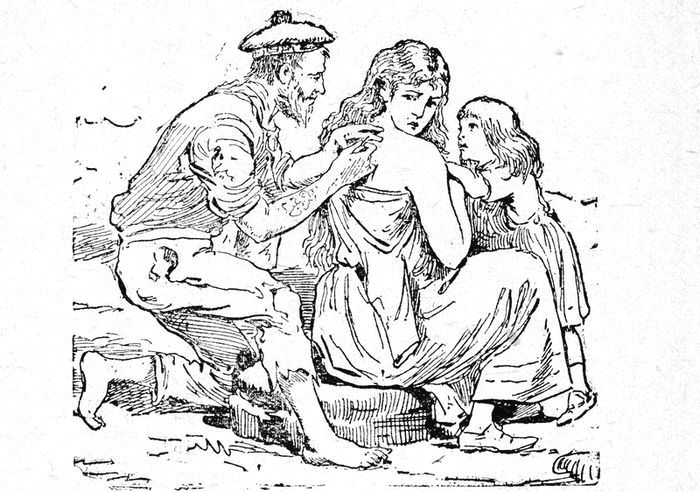
Let the reader fancy an old man of about sixty, possessed of that comfortable
amptitude of person which is the result rather of a mind at peace with
itself, and undisturbed by worldly care, than of any marked indulgence in indolent
habits. Let him next invest this comfortable person in a sort of Oxford
grey, coarse capote, or frock, of capacious size, tied closely round the waist
with one of those-parti-colored worsted sashes, we have, on a former occasion
described as peculiar to the bourgeois settlers of the country. Next, suffering
the eye to descend on and admire the rotund and fleshy thigh, let it drop gradually
to the stout and muscular legs, which he must invest in a pair of
closely fitting leathern trowsers, the wide-seamed edges of which are slit into
innumerable small strips, much after the fashion of the American Indian.
When he has completed the survey of the lower extremities, to which he must
not fail to subjoin a foot of proportionate dimensions, tightly moccasined, and,
moreover, furnished with a pair of old English hunting spurs, the reader must
then examine the head with which this heavy piece of animated machinery is
surmounted. From beneath a coarse felt hat, garnished with an inch-wide
band or ribbon, let him imagine he sees the yet vigorous grey hair, descending
over a forehead not altogether wanting in a certain dignity of expression, and
terminating in a beetling brow, silvered also with the frost of years, and
shadowing a sharp, grey, intelligent eye, the vivacity of whose expression denotes
its possessor to be far in advance, in spirit, even of his still active and
powerful frame. With these must be connected a snub nose—a double chin,
adorned with grizzly honors, which are borne, like the fleece of the lamb,
only occasionally to the shears of the shearer—and a small, and not unhandsome,
mouth, at certain periods pursed into an expression of irresistible
humor, but more frequently expressing a sense of lofty independence. The
grisly neck, little more or less bared, as the season may demand—a kerchief
loosely tied around the collar of a checkered shirt—and a knotted cudgel in
his hand—and we think our sketch of Simon Girty is complete.
Nor must the reader picture to himself this combination of animal properties,
either standing, or lying, or walking, or sitting; but in a measure glued,
Centaur-like, to the back of a noble stallion, vigorous, active, and of a dark
chestnut color, with silver mane and tail. In the course of many years that
Simon had resided in the neighborhood, no one could remember to have seen
him stand, or lie, or walk, or sit, while away from his home, unless absolutely
compelled. Both horse and rider seemed as though they could not exist while
separated, and yet Silvertail (thus was the stallion named) was not more remarkable
in sleekness of coat, soundness of carcase, and fleetness of pace, than
his rider was in the characteristics of corpulency and joviality.
Simon Girty had passed the greater part of his younger days in America.
He had borne arms in the revolution, and was one of those faithful loyalists,
who preferring rather to abandon a soil which, after all, was one of adoption,
than the flag under which they had been nurtured, had, at the termination
of that contest, passed over into Canada. Having served in one of those irregular
corps, several of which had been employed with the Indians, during the
revolutionary contest, he had acquired much of the language of these latter,
and to this knowledge was indebted for the situation of interpreter which he
had for years enjoyed. Unhappily for himself, however, the salary attached
to the office was sufficient to keep him in independence, and, to the idleness
consequent on this, (for the duties of an interpreter were only occasional,)
might have been attributed the rapid growth of a vice—an addiction to liquor—which
unchecked indulgence had now ripened into positive disease.
Great was the terror that Simon was wont to excite in the good people of
Amherstburg. With Silvertail at his speed he would gallop into the town,
brandishing his cudgel, and reeling from side to side, exhibiting at one moment
the joyous character of a Silenus, at another, as we have already shown—that
of an inebriated Centaur. Occasionally he would make his appearance,
holding his sides convulsed with laughter, as he reeled and tottered in every
direction, but without ever losing his equilibrium. At other times he would
utter a loud shout, and, brandishing his cudgel, dart at full speed along the
streets, as if he purposed singly to carry the town by (what Middlemore often
facetiously called) a coup de main. At these moments were to be seen
mothers rushing into the street to look for, and hurry away, their loitering
offspring, while even adults were glad to hasten their movements, in order to
escape collision with the formidable Simon; not that either apprehended the
slightest act of personal violence from the old man, for he was harmless of
evil as a child, but because they feared the polished hoofs of Silvertail, which
shone amid the clouds of dust they raised as he passed, like rings of burnished
silver. Even the very Indians, with whom the streets were at this period
habitually crowded, were glad to hug the sides of the houses, while Simon
passed; and they who, on other occasions, would have deemed it in the highest
degree derogatory to their dignity to have stepped aside at the approach
of danger, or to have relaxed a muscle of their stern countenance, would then
open a passage with a rapidity which in them was remarkable, and burst into
loud laughter as they fled from side to side to make way for Simon. Sometimes,
on these occasions, the latter would suddenly check Silvertail, while in
full career, and, in a voice that could be heard from almost every quarter of
the little town, harangue them for half an hour together in their own language,
and with an air of authority that was ludicrous to those who witnessed
it—and must have been witnessed to be conceived. Occasionally a guttural
"ugh" would be responded in mock approval of the speech, but more frequently
a laugh, on the part of the more youthful of his red auditors, was the
only notice taken. His lecture concluded, Simon would again brandish his
cudgel, and vociferate another shout; then betaking himself to the nearest
store, he would urge Silvertail upon the footway, and with a tap of his rude
cudgel against the door, summon whoever was within, to appear with a glass
of his favorite beverage. And this would he repeat, until he had drained what
he called his stirrup cup, at every shop in the place where the poisonous
liquor was vended.
Were such a character to make his appearance in the Mother Country, endangering,
to all perception, the lives of the Sovereign's liege subjects, he
would, if in London, be hunted to death like a wild beast, by at least one half
of the Metropolitan police; and, if in a provincial town, would be beset by a
posse of constables. No one, however—not even the solitary constable of
Amherstburgh, ever ventured to interfere with Simon Girty, who was in some
degree a privileged character. Nay, strange as it may appear, notwithstanding
his confirmed habit of inebriety, the old man stood high in the neighborhood,
not only with simple but with gentle, for there were seasons when he
evinced himself "a rational being," and there was a dignity of manner about
him, which, added to his then quietude of demeanor, insensibly interested in
his favor, those even who were most forward to condemn the vice to which he
was unfortunately addicted. Not, be it understood, that in naming seasons of
rationality, we mean seasons of positive abstemiousness; nor can this well be,
seeing that Simon never passed a day of strict sobriety during the last twenty
years of his life. But, it might be said, that his three divisions of day—morning,
noon and night—were characterised by three corresponding divisions of
drunkenness—namely, drunk, drunker, and most drunk. It was, therefore,
in the first stage of his graduated scale, that Simon appeared in his most amiable
and winning, because his least uproarious, mood. His libations commenced
at early morn, and his inebriety became progressive to the close of the
day. To one who could ride home at night, as he invariably did, after some
twelve hours of hard and continued drinking, without rolling from his horse,
it would not be difficult to enact the sober man in its earlier stages. As his
intoxication was relative to himself, so was his sobriety in regard to others—and
although, at mid-day, he might have swallowed sufficient to have caused
another man to bite the dust, he looked and spoke, and acted, as if he had
been a model of temperance. If he passed a lady in the street, or saw her at
her window Simon Girty's hat was instantly removed from his venerable
head, and his body inclined forward over his saddle-bow, with all the easy
grace of a well-born gentleman, and one accustomed from infancy to pay deference
to woman; nay, this at an hour when he had imbibed enough of his
favorite liquor to have rendered most men insensible even to their presence.
These habits of courtesy, extended moreover to the officers of the garrison,
and such others among the civilians as Simon felt to be worthy of his notice.
His tones of salutation, at these moments, were soft, his manner respectful,
even graceful; and while there was nothing of the abashedness of the inferior,
there was also no offensive familiarity, in the occasional conversations held by
him with the different individuals, or groups, who surrounded and accosted
him.
Such was Simon Girty, in the first stage of his inebriety, no outward sign
of which was visible. In the second, his perception became more obscured, his
voice less distinct, his tones less gentle and insinuating, and occasionally the
cudgel would rise in rapid flourish, while now and then a loud halloo would
burst from lungs, which the oceans of whiskey they had imbibed had not yet,
apparently, much affected. These were infallible indices of the more feverish
stage, of which the gallopings of Silvertail—the vociferations of his master—the
increasing flourishing of the cudgel—the supposed danger of children—and
the consequent alarm of mothers, together with the harangues to the Indian
auditory, were the almost daily results.
There was one individual, however, in the town of Amherstburgh, of whom,
despite his natural wilfulness of character, Simon Girty stood much in awe,
and that to such a degree, that if he chanced to encounter him in his mad progress,
his presence had the effect of immediately quieting him. This gentleman
was the father of the Granthams, who, although then filling a civil situation,
had formerly been a field officer in the corps in which Simon had served; and
who had carried with him into private life those qualities of stern excellence
for which he had been remarkable as a soldier—qualities which had won to
him the respect and affection, not only of the little community over which, in
the capacity of its chief magistrate, he had presided, but also of the inhabitants
of the country generally for many miles around. Temperate to an extreme
himself, Major Grantham held the vice of drunkenness in deserved abhorrence,
and so far from sharing the general toleration extended to the old man,
whose originality (harmless as he ever was in his intoxication,) often proved a
motive for encouragement; he never failed, on encountering him, to bestow
his censure in a manner that had an immediate and obvious effect on the
culprit. If Simon, from one end of the street, beheld Major Grantham
approaching at the other, he was wont to turn abruptly away; but if perchance
the magistrate came so unexpectedly upon him as to preclude the
possibility of retreat, he appeared as one suddenly sobered, and would rein in
his horse, fully prepared for the stern lecture which he was well aware would
ensue.
It afforded no slight amusement to the townspeople, and particularly the
young urchins, who usually looked up to Simon with awe, to be witnesses of
one of those rencontres. In a moment, the shouting—galloping—rampaging
cudgel-wielder was to be seen changed, as if by some magic power, into a being
of almost child-like obedience, while he listened attentively and deferentially
to the lecture of Major Grantham, whom he both loved and feared. On these
occasions, he would hang his head upon his chest—confess his error—and
promise solemnly to amend his course of life, although it must be needless to
add that never was that promise heeded. Not unfrequently, after these lectures,
when Major Grantham had left him, Simon would turn his horse, and,
with his arms still folded across his chest, suffer Silvertail to pursue his homeward
course, while he himself, silent and thoughtful, and looking like a culprit
taken in the fact, sat steadily in his saddle, without however venturing to turn
his eye either to the right or to the left, as he passed through the crowd, who,
with faces strongly expressive of mirth, marked their sense of the change
which had been produced in the old interpreter. Those who had seen him
thus for the first time, might have supposed that a reformation in one so apparently
touched would have ensued; but long experience had taught that,
although a twinge of conscience, or more probably fear of, and respect for, the
magistrate, might induce a momentary humiliation, all traces of cause and
effect would have vanished with the coming dawn.
To the sterling public virtues he boasted, Simon Girty united that of
loyalty in no common degree. A more staunch adherent to the British crown
existed nowhere in the sovereign's dominions; and such was his devotedness
to "King George," that, albeit he could not in all possibility have made the
sacrifice of his love for whiskey, he would willingly have suffered his left arm
to be severed from his body, had such proof of his attachment to the throne
been required. Proportioned to his love for everything British, arose, as a
natural consequence, his dislike for everything anti-British; and especially for
those who under the guise of allegiance, had conducted themselves in a way
to become objects of suspicion to the authorities. A near neighbor of Desborough,
he had watched him as narrowly as his long indulged habits of
intoxication would permit, and he had been the means of conveying to Major
Grantham much of the information which had induced that uncompromising
magistrate to seek the expulsion of the dangerous settler—an object which,
however, had been defeated by the perjury of the unprincipled individual, in
taking the customary oaths of allegiance. Since the death of Major Grantham,
for whom, notwithstanding his numerous lectures, he had ever entertained
that reverential esteem which is the result of the ascendancy of
the powerful and virtuous mind over the weak, and not absolutely vicious—and
for whose sons he felt almost a fatherly affection—old Girty had but
indifferently troubled himself about Desborough, who was fully aware of what
he had previously done to detect and expose him, and consequently repaid
with usury—an hostility of feeling which, however, had never been brought
to any practical issue.
As a matter of course, Simon was of the number of anxious persons collected
on the bank of the river, on the morning of the capture of the American
gun-boat; but, as he was only then emerging from his first stage of intoxication
(which we have already shown to be tantamount to perfect sobriety
in any other person), there had been no time for a display of those uproarious
qualities which characterized the last, and which, once let loose,
scarcely even the presence of the General could have restrained. With an
acuteness, however, which is often to be remarked in habitual drunkards at
moments when their intellect is unclouded by the confusedness to which they
are more commonly subject, the hawk's eye of the old man had detected several
particulars which had escaped the general attention, and of which he had,
at a later period of the day, retained sufficient recollection to connect with an
accidental, yet important discovery.
At the moment when the prisoners were landed, he had remarked Desborough,
who had uttered the hasty exclamation already recorded, stealing
cautiously through the surrounding crowd, and apparently endeavoring to
arrest the attention of the younger of the American officers. An occasional
pressing of the spur into the flank of Silvertail, enabled him to turn as the
settler turned, and thus to keep him constantly in view; until, at length, as
the latter approached the group of which General Brock and Commodore
Barclay formed the centre, he observed him distinctly to make a sign of intelligence
to the Militia Officer, whose eye he at length attracted, and who now
bestowed upon him a glance of hasty and furtive recognition. Curiosity induced
Simon to move Silvertail a little more in advance, in order to be enabled
to obtain a better view of the prisoners; but the latter turning away
his head at the moment, although apparently without design, baffled his penetration.
Still he had a confused and indistinct idea that the person was not
wholly unknown to him.
When the prisoners had been disposed of, and the crowd dispersed, Simon
continued to linger near the council-house, exchanging greetings with the newly
arrived chiefs, and drinking from whatever whiskey bottle was offered to him
until he at length gave rapid indication of arriving at his third or grand climacteric.
Then were to be heard the loud shoutings of his voice, and the
clattering of Silvertail's hoofs; as horse and rider flew like lightning past the
fort into the town, where a more than usual quantity of the favorite liquid
was quaffed at the several stores, in commemoration, as he said, of the victory
of his noble boy, Gerald Grantham, and to the success of the British arms
generally throughout the war.
Among the faults of Simon Girty, was certainly not that of neglecting the
noble animal to whom long habit had deeply attached him. Silvertail was
equally a favorite with the son, who had more than once ridden him in the
occasional races that took place upon the hard sands of the lake shore, and in
which he had borne everything away. As Simon was ever conscious and
collected about this hour, care was duly taken by him that his horse should
be fed, without the trouble to himself of dismounting. Even as Girty sat in
his saddle, Silvertail was in the daily practice of munching his corn out of a
small trough that stood in the yard of the inn where he usually stopped, while
his rider conversed with whoever chanced to be near him—the head of his
cudgel resting on his ample thigh, and a glass of his favorite whiskey in his
other and unoccupied hand.
Now it chanced that, on this particular day, Simon neglected to pay his
customary visit to the inn, an omission which was owing rather to the hurry
and excitement occasioned by the stirring events of the morning, than to any
wilful neglect of his steed. Nor was it until some hours after dark that,
seized with a sudden fit of caressing Silvertail, whose glossy neck he patted,
until the tears of warm affection started to his eyes, he bethought him of the
omission of which he had been guilty. Scarcely was the thought conceived,
before Silvertail was again at full career, and on his way to the inn. The gate
stood open, and, as Simon entered, he saw two individuals retire, as if to
escape observation, within a shed adjoining the stable. Drunk as he was, a
vague consciousness of the truth, connected as it was with his earlier observation,
flashed across the old man's mind; and when, in answer to his loud
hallooing, a factotum, on whom devolved all the numerous officers of the inn,
from waiter down to ostler, made his appearance, Simon added to his loudly
expressed demand for Silvertail's corn, a whispered injunction to return with
a light. During the absence of the man, he commenced trolling a verse of
"Old King Cole," a favorite ballad with him, and with the indifference of one
who believes himself to be alone. Presently the light appeared, and, as the
bearer approached, its rays fell on the forms of two men, retired into the furthest
extremity of the shed and crouching to the earth as if in concealment,
whom Simon recognised at a glance. He however took no notice of the circumstance
to the ostler, or even gave the slightest indication, by look or movement,
of what he had seen.
When the man had watered Silvertail and put his corn in the trough, he
returned to the house, and Simon, with his arms folded across his chest, as
his horse crunched his food, listened attentively to catch whatever conversation
might ensue between the loiterers. Not a word however was uttered,
and soon after he saw them emerge from their concealment—step cautiously
behind him—cross the yard towards the gate by which he had entered—and
then disappear altogether. During this movement the old man had kept himself
perfectly still, so that there could be no suspicion that he had in any way
observed them. Nay, he even spoke once or twice coaxingly to Silvertail, as
if conscious only of the presence of that animal, and, in short, conducted himself
in a manner well worthy of the cunning of a drunken man. The reflections
to which this incident gave rise, had the effect of calling up a desperate
fit of loyalty, which he only awaited the termination of Silvertail's hasty
meal to put into immediate activity. Another shout to the ostler, a second
glass swallowed, the reckoning paid, Silvertail bitted, and away went Simon
once more at his speed through the now deserted town, the road out of which
to his own place, skirted partly the banks of the river, and partly those of
the lake.
After galloping about a mile, the old man found the feet of Silvertail burying
themselves momentarily deeper in the sands which form the road near
Elliot's Point. Unwilling to distress him, he pulled him up to a walk, and,
throwing the reins upon his neck, folded his arms as usual, rolling from side
to side at every moment, and audibly musing, in the thick, husky voice that
was common to him in inebriety.
"Yes, by Jove, I am as true and loyal a subject as any in the service of
King George, God bless him (here he bowed his head involuntarily and with
respect), and though, as that poor dear old Grantham used to say, I do drink
a little (hiccup), still there's no great harm in that. It keeps a man alive. I
am the boy, at all events, to scent a rogue. That was Desborough and his
son I saw just now, and the rascals, he! he! he!—the rascals thought, I suppose,
I was too drunk (hiccup), too drunk to twig them. We shall tell them
another tale before the night is over. D—n such skulking scoundrels, I say.
Whoa! Silvertail, whoa!—what do you see there, my boy, eh?"
Silvertail only replied by the sharp pricking of his ears, and a side movement,
which seemed to indicate a desire to keep as much aloof as possible from
a cluster of walnut trees, which, interspersed with wild grape vines, may be
seen to this hour, resting in gloomy relief on the white deep sands that
extend considerably in that direction.
"Never mind, my boy, we shall be at home presently," pursued Simon,
patting the neck of his unquiet companion. "But, no—I had forgotten; we
must give chase to these (hiccup) to these rascals. Now there's that son Bill
of mine fast asleep, I suppose, in the arms of his little wife. They do nothing
but lie in bed, while their poor old father is obliged to be up at all hours,
devising plans for the good of the King's service, God bless him! But I shall
soon (hiccup)—Whoa, Silvertail! whoa, I say! D—n you, you brute, do
you mean to throw me?"
The restlessness of Silvertail, despite of his rider's caresses, had been visibly
increasing as they approached the dark cluster of walnuts. Arrived opposite
to this, his ears and tail erect, he had evinced even more than restlessness—alarm:
and something, that did not meet the eye of his rider, caused him to
take a sideward spring of several feet. It was this action that, nearly unseating
Simon, had drawn from him the impatient exclamation just recorded.
At length the thicket was passed, and Silvertail, recovered from his alarm,
moved forward once more on the bound, in obedience to the well known whistle
of his master.
"Good speed have they made," again mused Simon, as he approached his
home: "if indeed, as I suspect, it be them who are hiding in yonder thicket.
Silvertail could not have been more than ten minutes finishing his (hiccup)
his corn, and the sands had but little time to warm beneath his boots when he
did start. These Yankees are swift footed fellows, as I have had good (hiccup)
good experience in the old war, when I could run a little myself like the best
of them. But here we are at last. Whoa, Silvertail, whoa! and now to turn
out Bill from his little wife. Bill, I say, hilloa! hilloa! Bill, hilloa!"
Long habit, which had taught the old man's truly excellent and exemplary
son the utter hopelessness of his disease, had also familiarized him with these
nightly interruptions to his slumbers. A light was speedily seen to flash
across the chamber in which he slept, and presently the principal door of the
lower building was unbarred, and unmurmuring and uncomplaining, the half-dressed
young man stood in the presence of his father. Placing the light on
the threshold, he prepared to assist him as usual to dismount, but Simon, contrary
to custom, rejected for a time every offer of the kind. His rapid gallop
through the night air, added to the more than ordinary quantity of whiskey
he had that day swallowed, was now producing its effect, and, while every
feature of his countenance manifested the extreme of animal stupidity, his
apprehension wandered and his voice became almost inarticulate. Without
the power to acquaint his son with the purpose he had in view, and of which
he himself now entertained but a very indistinct recollection, he yet strove,
impelled as he was by his confusedness of intention, to retain his seat, but was
eventually unhorsed and handed over to the care of his pretty daughter-in-law,
whose office it was to dispose of him for the night, while her husband
rubbed down, fed, and otherwise attended to Silvertail.
A few hours of sound sleep restored Simon to his voice and his recollection,
when his desire to follow the two individuals he had seen in the
yard of the inn the preceding night, and whom he felt persuaded he must
have passed on the road, was more than ever powerfully revived. And yet,
was it not highly probable that the favorable opportunity had been lost, and
that, taking advantage of the night, they were already departed from the
country, if such (and he doubted it not) was their intention. "What a cursed
fool," he muttered to himself, "to let a thimbleful of liquor upset me on such
an occasion, but, at all events, here goes for another trial." With the
impatient, over-indulged Simon, to determine on a course of action, was to
carry it into effect.
"Hilloa, Bill! I say, Bill my boy!" he shouted from the chamber next to
that in which his son slept. "Hilloa! Bill, come here directly."
Bill answered not, but sounds were heard in his room as of one stepping out
of bed, and presently the noise of flint and steel announced that a light was
being struck. In a few minutes the rather jaded-looking youth appeared at
the bedstead of his parent.
"Bill, my dear boy," said Simon, in a more subdued voice, "did you see
anybody pass last night after I came home? Try and recollect yourself; did
you see two men on the road?"
"I did, father; just as I had locked the stable door, and was coming in for
the night, I saw two men passing down the road. But why do you ask?"
"Did you speak to them—could you recognise them?" asked Simon, without
stating his motive for the question.
"I wished them good night; and one of them gruffly bade me good night
too; but I could not make out who they were, though one did for a moment
strike me to be Desborough, and both were tallish sort of men."
"You're a lad of penetration, Bill; now saddle me Silvertail as fast as you
can."
"Saddle Silvertail! Surely, father, you are not going out yet; it's not daylight."
"Saddle Silvertail, Bill," repeated the old man, with the air of one whose
mandate was not to be questioned. "But where the devil are you going, sir?"
he added, impatiently.
"Why to saddle Silvertail, to be sure," said the youth, who was just closing
the door for that purpose.
"What, and leave me, a miserable old man, to get up without a light? Oh
fie, Bill. I thought you loved your poor old father better than to neglect him
so—there, that will do. Now send in Lucy to dress me."
The light was kindled, Bill went in and spoke to his wife, then descended
to the stable. A gentle tap at the door of the old interpreter, and Lucy
entered in her pretty night dress, and, half asleep, half awake, but without a
shadow of discontent in her look, proceeded to assist him in drawing on his
stockings, &c. Simon's toilet was soon completed, and Silvertail being
announced as "all ready," he, without communicating a word of his purpose,
issued forth from his home just as the day was beginning to dawn.
Although the reflective powers of Girtie had been in some measure restored
by sleep, it is by no means to be assumed he was yet thoroughly sober. Uncertain
in regard to the movements of those who had so strongly excited his
loyal hostility, (and, mayhap, at the moment his curiosity,) it occurred to him
that if Desborough had not already baffled his pursuit, a knowledge of the
movements and intentions of that individual might be better obtained from an
observation of what was passing on the beach in front of his hut. The object
of this reconnaissance was, therefore, only to see if the canoe of the settler
was still on the shore, and with this object he suffered Silvertail to take the
road along the sands, while he himself, with his arms folded and his head sunk
on his chest, fell into a reverie with which was connected the manner and the
means of securing the disloyal Desborough, should it happen that he had not
yet departed. The accidental discharge of Middlemore's pistol, at the very
moment when Silvertail had doubled a point that kept the scene of contention
from his view, caused him to raise his eyes, and then the whole truth flashed
suddenly upon him. We have already seen how gallantly he advanced to
them, and how madly, and in a manner peculiarly his own, he sought to arrest
the traitor Desborough in his flight.
"Sorry I couldn't force the scoundrel back, gentlemen," said Simon, as he
now approached the discomfited officers. "Not much hurt, I hope," pointing
with his own maimed and bleeding hand to the leg of Middlemore, which that
officer, seated on the sand, was preparing to bind with a silk handkerchief.
"Ah, a mere flesh wound, I see. Henry, Henry Grantham, my poor dear
boy, what still alive after the desperate clutching of that fellow at your throat?
But now that we have routed the enemy—must be off—drenched to the skin.
No liquor on the stomach to keep out the cold, and if I once get an ague fit,
its all over with poor old Simon. Must gallop home, and, while his little
wife wraps a bandage round my hand, shall send down Bill with a litter.
Good morning, Mr. Middlemore, good bye, Henry, my boy." And then,
without giving time to either to reply, the old man applied his spurs once
more to the flanks of Silvertail, who, with drooping mane and tail, resembled
a half drowned rat; and again hallooing defiance to Desborough, who lay to
at a distance, apparently watching the movements of his enemies, he retraced
his way along the sands at full gallop, and was speedily out of sight.
Scarcely had Girty disappeared, when two other individuals, evidently officers,
and cloaked precisely like the party he had just quitted, issued from the
wood near the hut upon the clearing, and thence upon the sands—their countenances
naturally expressing all the surprise that might be supposed to arise
from the picture now offered to their view.
"What in the name of Heaven is the meaning of all this?" asked one of
the new comers, as both now rapidly advanced to the spot where Middlemore
was yet employed in coolly binding up his leg, while Henry Grantham, who
had just risen, was gasping with almost ludicrous efforts to regain his respiration.
"You must ask the meaning of our friend here," answered Middlemore, with
the low chuckling good-natured laugh that was habitual to him, while he proceeded
with his bandaging. "All I know is, that I came out as a second, and
here have I been made a first—a principal, which, by the way, is contrary to
all my principle."
"Do be serious for once, Middlemore. How did you get wounded, and who
are those scoundrels who have just quitted you?" anxiously inquired Captain
Molineux, for it was he, and Lieutenant Villiers, who, (the party already
stated to have been expected), had at length arrived.
"Two desperate fellows in their way, I can assure you," replied Middlemore,
more amused than annoyed at the adventure. "Ensign Paul, Emilius,
Theophilus, Arnoldi, is, I calculate, a pretty considerable strong actyve sort
of fellow; and, to judge by Henry Grantham's half strangled look, his companion
lacks not the same qualities. Why, in the name of all that is precious
would you persist in poking your nose into the rascal's skins, Grantham?
The ruffians had nearly made dried skins of ours."
"Ha! is that the scoundrel who calls himself Arnoldi," asked Captain
Molineux? "I have heard," and he glanced at Henry Grantham as he spoke,
"a long story of his villainy from his captor within this very hour."
"Which is your apology, I suppose," said Middlemore, "for having so far
exceeded your appointment, gentlemen."
"It certainly is," said Lieutenant Villiers, "but the fault was not ours.
We chanced to fall in with Gerald Grantham, on our way here, and that he
detained us, should be a matter of congratulation to us all."
"Congratulation!" exclaimed Middlemore, dropping his bandage, and lifting
his eyes with an expression of indescribable humor. "Am I then to think it
matter of congratulation that, as an innocent second, I should have had a
cursed piece of lead stuck in my flesh to spoil my next winter's dancing.
And Grantham is to think it matter of congratulation that, instead of putting
a bullet through you, Molineux, (as I intend he shall when I have finished
dressing this confounded leg, if his nerves are not too much shaken), he should
have felt the gripe of that monster Desborough around his throat, until his
eyes seem ready to start from their sockets, and all this because you did not
choose to be in time. Upon my word, I do not know that it is quite meet that
we should meet you. What say you, Grantham?"
"I hope," said Captain Molineux with a smile, "your principal will think
as you do, for should he decline the meeting, nothing will afford more satisfaction
to myself."
Both Grantham and Middlemore looked their utter surprise at the language
thus used by Captain Molineux, but neither of them spoke.
"If an apology the most ample for my observation of yesterday," continued
that officer, "an apology founded on my perfect conviction of error, (that conviction
produced by certain recent explanations with your brother), can satisfy
you, Mr. Grantham, most sincerely do I make it. If, however, you hold me
to my pledge, here am I of course to redeem it. I may as well observe to you
in the presence of our friends, (and Villiers can corroborate my statement),
that my original intention on leaving your brother, was to receive your fire
and then tender my apology, but, under the circumstances in which both you
and Middlemore are placed at this moment, the idea would be altogether
absurd. Again I tender my apology, which it will be a satisfaction to me to
repeat this day at the mess table, where I yesterday refused to drink your
brother's health. All I can add is that when you have heard the motives for
my conduct, and learnt to what extent I have been deceived, you will readily
admit that I acted not altogether from caprice."
"Your apology I accept, Captain Molineux," said Grantham, coming forward
and unhesitatingly offering his hand. "If you have seen my brother, I
am satisfied. Let there be no further question on the subject."
"So then I am to be the only bulleted man on this occasion," interrupted
Middlemore, with ludicrous pathos—"the only poor devil who is to be made
to remember Hartley's point for ever. But no matter. I am not the first instance
of a second being shot, through the awkward bungling of his principal,
and certainly Grantham you were in every sense the principal in this affair,
for had you taken my advice you would have let the fellows go to the devil
their own way."
"What! knowing, as I did, that the traitor Desborough had concealed in
his canoe a prisoner on parole—nay, worse, a deserter from our service—with
a view of conveying him out of the country."
"How did you know it."
"Because I at once recognised him, through the disguise in which he left
the hut, for what he was. That discovery made, there remained but one
course to pursue."
"Ah! and coarse work you made of it, with a vengeance," said Middlemore,
"first started him up like a fox from his cover, got the mark of his teeth, and
then suffered him to escape."
"Is there no chance of following—no means of overtaking them?" said
Captain Molineux—"No, by Heaven," as he glanced his eye from right to left,
"not a single canoe to be seen anywhere along the shore."
"Following!" echoed Middlemore; "faith the scoundrels would desire nothing
better: if two of us had such indifferent play with them on terra firma,
you may rely upon it that double the number would have no better chance
in one of these rickety canoes. See there how the rascals lie to within half
musket shot, apparently hailing us."
Middlemore was right. Desborough had risen in the stern of the canoe,
and now, stretched to his full height, called leisurely, through his closed
hands, on the name of Henry Grantham. When he observed the attention
of that officer had, in common with that of his companions, been arrested, he
proceeded at the full extent of his lungs.
"I reckon, young man, as how I shall pay you out for this, and drot my
skin, if I once twists my fingers round your neck again, if anything on this
side hell shall make me quit it, afore you squeaks your last squeak. You've
druv me from my home, and I'll have your curst blood for it yet. I'll sarve
you as I sarved your old father. You got my small bore, I expect, and if its
any good to you to know that one of its nineties to the pound sent the old
rascal to the devil—why then you have it from Jeremiah Desborough's own
lips, and be d——d to you."
And, with this horrible admission, the settler again seated himself in the
stern of his canoe, and making good use of his paddle soon scudded away until
his little vessel appeared but as a speck on the lake.
Henry Grantham was petrified with astonishment and dismay at a declaration,
the full elucidation of which we must reserve for a future opportunity.
The daring confession rang in his ears long after the voice had ceased, and it
was not until a light vehicle had been brought for Middlemore from Simon's
farm, that he could be induced to quit the shore, where he still lingered, as if
in expectation of the return of the avowed murderer of his Father.