I shall be very pleased if this letter will be any help
to you. Personally I am quite in sympathy with the
new Maternity Scheme. I do feel I cannot express my
feelings enough by letter to say what a great help it
would have been to me, for no one but a mother knows
the struggle and hardships we working women have to
go through. I do hope I shall never see the young
women of to-day have to go through what I did. I
am a mother of eleven children—six girls and five boys.
I was only nineteen years old when my first baby was
born. My husband was one of the best and a good
father. His earnings was £1 a week; every penny was
given to me, and after paying house rent, firing, and
light, and clubs, that left me 11s. to keep the house going
on; and as my little ones began to come, they wanted
providing for and saving up to pay a nurse, and instead
of getting nourishment for myself which we need at
those times, I was obliged to go without. So I had no
strength to stand against it, and instead of being able
to rest in bed afterwards, I was glad to get up and get
about again before I was able, because I could not afford
to pay a woman to look after me. I kept on like that
till the sixth little one was expected, and then I had all
the other little ones to see after. The oldest one was
only ten years old, so you see they all wanted a mother’s
care. About two months before my confinement the two
youngest fell ill with measles, so I was obliged to nurse
them, and the strain on my nerves brought on brain-fever.
All that the doctor could do for me was to place ice-bags on
my head. Oh, the misery I endured! My poor old mother
did what she could for me, and she was seventy years
old, and I could not afford to pay a woman to see after
my home and little ones; but the Lord spared me to get
over my trouble, but I was ill for weeks and was obliged
to work before I was able. Then in another eighteen
months I was expecting another. After that confinement,
being so weak, I took a chill, and was laid up
for six months, and neighbours came in and done what
they could for me. Then there was my home and little
ones and husband to look after, as he was obliged to
work. It was the worry that kept me from getting
better; if I could have had someone to look after me I
should not have been so ill. After this I had a miscarriage
and another babe in one year and four months. I got
on fairly well with the next one, and then the next one,
which was the eighth, I had two down with measles,
one two years old with his collar-bone out, and a little
girl thirteen with her arm broke. That was at the
same time as I was expecting my eighth little one, and
my dear husband worried out of life, as you see with
all this trouble I was only having the £1 a week and
everything to get out of it. What a blessing it would
have been if this Maternity Scheme was in go then! It
would have saved me a lot of illness and worry, for my
life was a complete misery. For twenty years I was
nursing or expecting babies. No doubt there are others
fixed the same way as I have been. This is only a
short account of how I suffered; I could fill sheets of
paper with what I have gone through at confinements
and before, and there are others, no doubt, have felt the
pinch as well as myself. If there is anything else you
would like to know and I could tell you, I should be glad,
for the benefit of my sisters.
Wages 17s. to 25s.; eleven children, two miscarriages.
I received your paper on Maternity Scheme, and I can
assure you it brought back to me many painful hours of
what I have passed through in twenty-one years of
married life. For one thing, I have had a delicate husband
for fifteen years, and I have had nine children,
seven born in nine years. I have only one now; some
of the others have died from weakness from birth. I
only had a small wage, as my husband was then a railway
porter. His earnings were 18s. one week and
16s. the next, and I can say truthfully my children have
died from my worrying how to make two ends meet
and also insufficient food. For many of my children I
have not been able to pay a nurse to look after me, and
I have got out of bed on the third day to make my own
gruel and fainted away. My little girl which is just
fourteen years old, from the first month of pregnancy
until my nine months were up I attended the hospital
and had a hospital nurse in to confine me.... A woman
with little wage has to go without a great deal at those
times, as we must give our husbands sufficient food or
we should have them home and not able to work; therefore
we have to go without to make ends meet. Before
my confinements and after I have always suffered a great
deal with bearing down, and doctors have told me it is
weakness, not having enough good food to keep my health
during such times. My little girl I have was under the
doctor for seven months, being a weak child born, and I
for one think that if I had a little help from someone I
should have had my children by my side to-day. It has
only been through weakness they have passed away. It
is with great pleasure I write this letter to you. I could
say a deal more on sufferings of women if I saw you.
Wages 16s. to 18s.; nine children, one still-birth, one miscarriage.
A neighbour of mine called in the doctor, who after
examining her said she must be got into a Lying-In
Hospital at once, as she was in such a critical condition.
She needed to be under medical care all the time; the
doctor expects when the birth takes place there will
be twins. The woman was taken by cab several miles,
and after being there two days was sent home, as the
birth was not expected till March, and this was about the
middle of February; but she was to be taken back by
February 27, as she is in such a state that the children
will have to be removed before they attain their full
size. A few days after she was home, she was so ill
that her doctor got a cab and sent her to another hospital,
as he said if anything occurred when he was not
able to get to her, her life would be lost. She must be
where there were doctors in constant attendance.
After putting her through an examination and bullying
her for going there, she was informed they had no
maternity ward, and sent her home again, and all the
time she was in the greatest of pain and vomiting blood;
she is now at home, and will have to be taken to the first
hospital at the end of the week, if nothing happens
before.
Now for her circumstances. Her husband has worked
for his present employer for thirteen years, and earns
the magnificent sum of 23s. per week. The conveying
of her to hospitals and back the two times has cost 25s.,
and the husband had to lose a day and a half. When
the foreman asked the master to allow the man to have
his pay for the lost time owing to the expense he had had,
he replied: “He will get 30s. when the job comes off;
let him pay it out of that.” This man is a Church
warden and a prominent Church worker and Christian!
The husband’s fellow-workers who earn no more than
him, and some of them less, have had what they call a
whip round, and have managed to raise 19s. for him.
Our District Nurse goes in each morning and does
what she can for her, and one morning she asked how
she had got ruptured; and she said she was not sure, but
she thought it was when she was at the factory. And it
transpired that her eldest boy is very bright, and he
managed to win a scholarship, but his mother said she
could not manage to get the clothes for him that he
ought to have at such a school, and so she got work at
the factory to try and clothe him better. She was only
there two months when she was taken ill and had to
leave. (What mothers put up with for their children!)
She has been paying 3d. a week into a Sick Loan, and
Dividing Society, in connection with a Church, but she
can have no help from it, as her illness is through pregnancy.
In answer to your letter, in my opinion the cause of
women suffering from misplacements and various other
inward complaints, is having to work during pregnancy,
and I am the mother of three children. When the
youngest was coming my husband was out of employment,
so I had to go out to work myself, standing all day
washing and ironing. This caused me much suffering
from varicose veins, also caused the child to wedge in
some way, which nearly cost both our lives. The doctor
said it was the standing and the weight of the child.
I have not been able to carry a child the full time since
then, and my periods stopped altogether at thirty-four.
Then I have a niece of twenty-five, who is at present in
hospital undergoing a serious operation through getting
up too soon after her confinement. Once we can make
men and women understand that a woman requires
rest when bearing children, we shall not have so many
of our sisters suffering and dying through operations,
or, on the other hand, dragging out a miserable existence.
My husband’s wages was 19s. 10d. He was compelled
to lose time in wet or frosty weather, and I was very
lucky to get my share, 18s., four weeks in succession.
Wages 19s. 10d.; three children, one miscarriage.
My experience during and after my second pregnancy
is only one example of what thousands of married working
women have to endure. My husband has always
been a very delicate man, and was ill most of the time
I carried both my children. He had been out of employment
eight months out of the nine I carried my first
child.... As a last resource was glad to go to work on
the railway for the magnificent wage of 17s. a week, and
had to walk nearly six miles night and morning or pay
5d. a day for train fare. Our rent was 7s. 6d. a week
and clubs to be paid. By the time my second child was
born my husband’s wages had increased to £1 1s. a
week for seventy-two hours. By that time hard work
and worry and insufficient food had told on my once
robust constitution, with the result that I nearly lost
my life through want of nourishment, and did after
nine months of suffering lose my child. No one but
mothers who have gone through the ordeal of pregnancy
half starved, to finally bring a child into the world to
live a living death for nine months, can understand what
it means.... It was the Women’s Co-operative Guild
which saved me from despair.
The first confinement I managed to get through very
well, having some money left from what I had saved
before marriage. But how I managed to get through
my second confinement I cannot tell anyone. I had to
work at laundry work from morning to night, nurse a
sick husband, and take care of my child three and a half
years old. In addition I had to provide for my coming
confinement, which meant that I had to do without
common necessaries to provide doctor’s fees, which so
undermined my health that when my baby was born I
nearly lost my life, the doctor said through want of
nourishment. I had suffered intensely with neuralgia,
and when I inquired among my neighbours if there was
anything I could take to relieve the pain, I was told
that whatever I took would do no good; it was quite
usual for people to suffer from neuralgia, and I should
not get rid of it till my baby was born.
I had to depend on my neighbours for what help they
could give during labour and the lying-in period. They
did their best, but from the second day I had to have
my other child with me, undress him and see to all his
wants, and was often left six hours without a bite of
food, the fire out and no light, the time January, and
snow had lain on the ground two weeks.
When I got up after ten days my life was a perfect
burden to me. I lost my milk and ultimately lost my
baby. My interest in life seemed lost. I was nervous
and hysterical; when I walked along the streets I felt
that the houses were falling on me, so I took to staying
at home, which of course added to the trouble.
Now, is it possible under such circumstances for women
to take care of themselves, during pregnancy, confinement,
and after? Can we any longer wonder why so
many married working women are in the lunatic asylums
to-day? Can we wonder that so many women take
drugs, hoping to get rid of the expected child, when
they know so little regarding their own bodies, and
have to work so hard to keep or help to keep the children
they have already got? If only the State would do
something that would give all working mothers the
assurance that during pregnancy, where needed, means
would be provided whereby they could get an all-important
rest before confinement, and that proper attention
should be provided during and after so long as
necessary. It would make all the difference between a
safe and speedy confinement, a better offspring, therefore
a better asset of the State, and a broken-down
motherhood, and a race of future parents who start in
life very often with a constitution enfeebled through
the mother having to undergo privation, as well as the
mental and physical strain that childbirth entails.
Wages 17s. to £1 1s.; two children.
During pregnancy I always looked to my diet, and
as my husband never got more than 24s. 6d. per week,
I had not much to throw away on luxuries. I had
plain food, such as oatmeal and bacon, and meat, plenty
of bread and good butter. I may say that during
pregnancy and during suckling my appetite was always
better, and I ate more and enjoyed my food better than
at any other time. I always did my own housework
and my own washing, and I never had a doctor all the
time I was having children. I have had six, one dead.
During my labour I was never bad more than about
three or four hours. I felt I could get out of bed the first
day, and I never had the doctor, only an old midwife.
And though I say it myself, nobody had bonnier or
healthier children than I had, with fair skins and red
cheeks.
I must say that I am a staunch teetotaller, and have
been all my life. I think that drink has a lot to do
with some women’s sufferings.
I had one child born without a midwife at all, before
we had time to fetch her, and I did as well as at any
other time.
We lived under the colliery, and our rent was only
3s. 6d. a week. We got our coal at a lower price, about
1s. a week. During part of the time we had a lodger,
who paid us 11s., which helped up a bit. But you must
know we had to be very careful. But, taking all into
consideration, we were very comfortably off. We had
not many doctors’ bills, as our children were all very
healthy, and I don’t think I have spent a pound on
doctoring for myself since I was a baby, for which I am very
thankful.
Wages 18s. to 24s. 6d.; six children.
I have a sister-in-law who has five children, and from
the first month of pregnancy she is real ill, the sickness
(as she herself puts it) strains her all to pieces,
after which she is in a state of collapse. It is painful
to be with her, the faintness and sickness continue,
right up till the eighth month. It is not safe for her
to go any distance by herself, as it comes on at any time,
and her legs are blue-black until after her baby is born.
All her children are living; her confinements are normal.
She is a very plucky woman. Of course, she has to do
everything herself; she could not afford to have anyone
in to help her, and in that state she has to do all her own
washing, cleaning, etc. She has been to the doctor
during these bad times, but he does not seem able to
relieve her, only tells her to rest her legs all she can,
which of course is one of the things with a family around
you the mother cannot do. Her husband was only
getting 15s. at the time she was having her first three
children. Now he is getting £1 per week. He works
for the Rural District Council.
Wages 15s.; five children.
My own experience in child-bearing was rather abnormal
because I had them late in life. Consequently,
I suffered more than usual because the bones were set
and do not easily adapt themselves to changed conditions.
Extreme sickness from first to last, and during
last months much pain and much discomfort. My two
first were lost from malnutrition because I could not
retain my food. In loss of strength the miscarriage
cost me most, and because of the falling of the womb—a
trouble which was not cured till I had a living child.
I was not ignorant, and took every care, so that I can
conceive any mother’s life being a dreadful thing if she
was neglected under such circumstances.
My husband’s wages was very unsettled, never exceeded
30s., and was often below the sum. I earned
a little all the time by sewing. Did all housework,
washing, baking, and made all our clothes. But no
amount of State help can help the suffering of mothers
until men are taught many things in regard to the right
use of the organs of reproduction, and until he realises
that the wife’s body belongs to herself, and until the
marriage relations takes a higher sense of morality and
bare justice. And what I imply not only exists in the
lower strata of society, but is just as prevalent in the
higher. So it’s men who need to be educated most.
The sacred office of parenthood has not yet dawned on
the majority. Very much injury and suffering comes
to the mother and child through the father’s ignorance
and interference. Pain of body and mind, which leaves
its mark in many ways on the child. No animal will
submit to this: why should the woman? Why, simply
because of the Marriage Laws of the woman belonging
to the man, to have and to own, etc.
Wages 30s.; three children, two miscarriages.
I shall only be too glad to assist you in giving my
experience. In the first place, I have had eight children;
seven is now living. I was twenty-three when I was
married. My first pregnancy I suffered with my leg
swollen and veins ready to burst. At my confinement
the baby was hung with navel cord twice round the
neck and once round the shoulder, owing to lifting and
reaching, which caused me hours of suffering, and it
caused my womb to come down, and I have had to
wear something to hold it up until these late years.
I am now fifty-eight; my husband has been dead
seven years. I was left to fight life’s battles alone. As
my family increased I had to have my legs bandaged.
I never felt a woman during pregnancy; as I got nearer
I felt worse. At my confinements the greatest trouble
was the flooding after the baby was born, and the afterbirth
grown to my side. When that was taken away
the body had to be syringed to stop mortification. I
have had the doctor’s arm in my body, and felt his
fingers tearing the afterbirth from my side. While I am
writing, I almost fancy I am talking to you. I hope
I have not tired you with my letter.
Wages £1 to £2; eight children, two miscarriages.
I have been a martyr to suffering through having
children, owing to the fact that I could not retain my
food. I was always sick, troubled with nausea and
vomiting, which kept me very weak; my constitution
was brought that low, that after having three children
born living I was unable to go the full length of pregnancy.
The last still-born child I had, during pregnancy
I was dropsical all the time I was carrying, and I had to
have two doctors to chloroform me before the child could
be born. It had taken all the water from me; it was impossible
for it to be born until they had lanced the child
to let the water out of it. I had to be fed every hour day
and night. Besides two still-born children, I have had
two miscarriages. The last miscarriage I had I lost that
much blood it completely drained me. I was three whole
months and was unable to sleep; I could not even sleep
one half-hour. I had lost my sleep completely; my hair
come off and left bald patches about my head. The
doctor told me if I had not had the presence of mind to
lay me flat on my bed when the miscarriage took place
I should have bled to death. Having all this to go
through, it brought on falling of the womb, and now
that I am able to do for my family and attend to my
household duties, I have to wear a body-belt, a kind
that is worn after appendicitis. I am a ruined woman
through having children. All the times that I was
pregnant I could not bear my husband to smoke one
pipe of tobacco. I have sent you the main ailments
I have had to endure, but there are a hundred and one
little items that have crept in between through being
brought so weak. I have been subject to other ailments
besides, such as influenza, and rheumatic fever,
and catarrh of the bowels.
When I was married, my husband was a weaver; at
that time his highest wages were £1 per week. We
paid 2s. 6d. rent, so that did not leave much for food,
fire, and clothing. My first-born was one year all but
two days when the second was born. When the last-named
was three months old, my husband went on
strike for more wages; he was out eleven weeks, and not
a penny coming in. At the end of that period, there
being both men and women at the same job, the masters
were so obstinate they had to go in at the women’s price.
After the strike there was a turn of bad trade, and he
was on short time for seven years; his average wages
during that period was 14s. per week. If I had not
been a good needlewoman and a capable manager it
would have been worse.
Wages £1 to 14s.; three children, two still-births, two miscarriages.
My first girl was born before I attained my twentieth
year, and I had a stepmother who had had no children
of her own, so I was not able to get any knowledge from
her; and even if she had known anything I don’t suppose
she would have dreamt of telling me about these things
which were supposed to exist, but must not be talked
about. About a month before the baby was born I
remember asking my aunt where the baby would come
from. She was astounded, and did not make me much
wiser. I don’t know whether my ignorance had anything
to do with the struggle I had to bring the baby into the
world, but the doctor said that my youth had, for I was
not properly developed. Instruments had to be used,
and I heard the doctor say he could not tell whether
my life could be saved or not, for he said there is not
room here for a bird to pass. All the time I thought
that this was the way all babies were born.
At the commencement of all my pregnancies I suffered
terribly from toothache, and for this reason I think
all married child-bearing women should have their teeth
attended to, for days and nights of suffering of this
kind must have a bad effect on both the mother and
child. I also at times suffered torments from cramp
in the legs and vomiting, particularly during the first
three months. I hardly think the cramp can be avoided,
but if prospective mothers would consult their doctors
about the inability to retain food, I fancy that might be
remedied. At the commencement of my second pregnancy
I was very ill indeed. I could retain no food, not
even water, and I was constipated for thirteen days,
and I suffered from jaundice. This had its effect on
the baby, for he was quite yellow at birth, and the
midwife having lodgers to attend to, left him unwashed
for an hour after birth. She never troubled to get his
lungs inflated, and he was two days without crying.
I had no doctor. I was awfully poor, so that I had to
wash the baby’s clothes in my bedroom at the fortnight’s
end; but had I had any knowledge like I possess
now, I should have insisted at the very least on the
woman seeing my child’s lungs were properly filled.
When we are poor, though, we cannot say what must
be done; we have to suffer and keep quiet. The boy
was always weakly, and could not walk when my third
baby was born. He had fits from twelve to fourteen,
but except for a rather “loose” frame, seems otherwise
quite healthy now.
My third child, a girl, was born in a two-roomed
“nearly underground” dwelling. We had two beds in
the living-room, and the little scullery was very damp.
Had it not been for my neighbours, I should have had
no attendance after the confinement, and no fire often,
for it was during one of the coal strikes. My fourth
child, a boy, was born under better housing conditions,
but not much better as regards money; and during the
carrying of all my children, except the first, I have had
insufficient food and too much work. This is just an
outline. Did I give it all, it would fill a book, as the
saying goes.
In spite of all, I don’t really believe that the children
(with the exception of the oldest boy) have suffered
much, only they might have been so much stronger,
bigger, and better if I had been able to have better food
and more rest.
Cleanliness has made rapid strides since my confinements;
for never once can I remember having anything
but face, neck, and hands washed until I could do things
myself, and it was thought certain death to change the
underclothes under a week.
For a whole week we were obliged to lie on clothes
stiff and stained, and the stench under the clothes was
abominable, and added to this we were commanded to
keep the babies under the clothes.
I often wonder how the poor little mites managed to
live, and perhaps they never would have done but for
our adoration, because this constant admiration of our
treasures did give them whiffs of fresh air very often.
My husband’s lowest wage was 10s., the highest
about £1 only, which was reached by overtime. His
mother and my own parents generally provided me
with clothing, most of which was cast-offs.
Wages 10s. to £1; four children.
It is lack of knowledge that often brings unnecessary
suffering. I know it from experience. In my early
motherhood I took for granted that women had to suffer
at these times, and it was best to be brave and not make
a fuss. Once when things were not brisk in the labour
world, I would do my house-cleaning all myself, for
naturally at these times you like to feel everything is
in order everywhere when the strange woman comes in
to take charge. I was in a very weak state through
worry and the difficulty of meeting the demands. I
had not seen a doctor, for I was thinking of having a
midwife I had heard of. I dragged about in misery
and in great pain. A friend called in one morning after
I had got the children off to school, and I suppose I looked
very ill. She said: “Have you engaged a doctor?” I
said: “No, there is plenty of time; I was only six months,
and surely I shall have a change soon.” I could not
lay, sit, or stand in ease, and my legs were so bad. However,
she went away, saying nothing to me, and brought
her doctor. He was amazed at my condition, ordered
me to bed, said my confinement was near, and the child
was in a critical condition. He sent for a midwife, and
they were with me from eleven o’clock till three o’clock.
He said the child was dead, and in such an awkward
position that it nearly cost my life to bring it. I had
a very long illness follow on (it would have been a lovely
child full time). The child had been killed through
shock, and already showed signs of mortification. I
was in a poor state of health, and struggled against my
strength, looking after the children’s welfare and neglecting
myself. In trying to lift the washing-tub it slipped,
and that was the shock; and instead of resting and
having advice (which I felt I could not afford), I persevered,
and that was the result. Now, if there had been
such a thing as a Maternity Centre where I could have
sent for someone, or could have attended without that
feeling of expense, I could have been relieved of all that
suffering.
Another experience I had some nine years after the
previous. I was pregnant, work had been very scarce,
and I was in a very weak state. My husband had been
at work three weeks when he happened an accident.
He had fallen from a high scaffold. The Clerk of
the Works came to tell me they had taken him to
the hospital, and I had better go at once and take
someone with me. Of course, I thought the worst had
happened. (He did not know my condition.) I was
between three and four months, and this shock caused
a miscarriage. I had a midwife, who, no doubt, was
all right when things were straightforward. I got
about again, but was very weak and ill. He was in
hospital six weeks. I took in needlework. I got very
weak yet very stout. I thought it was through sitting
so much at the machine. I worked and starved myself
to make sick pay, 12s. per week, go as far as possible.
I got so weak, and fainted several times after heavy
days at the machine. I was taken very ill one night,
and my daughter went for the doctor. He said: “We
must have her in bed,” and sent for a neighbour. It
was a confinement of a seven-months babe. When he
told me it was childbirth, I said it was impossible, for I
had miscarried about four months previous. However,
it was true. I had been carrying twins—a most peculiar
case—during that four months. My system was being
drained, and the worry and anxiety had effect on the
child. It was weak and did not move much. I had a
bad time, but the child lived for nine months, but a
very delicate child. Now, if I had been able to have a
qualified midwife when I had the miscarriage, we should
have known there was another child, and if I could have
been medically treated, all that suffering could have been
prevented, and I might have had a strong child.
But apart from all that, I do not know which is the
worst—child-bearing with anxiety and strain of mind
and body to make ends meet, with the thought of
another one to share the already small allowance, or
getting through the confinement fairly well, and getting
about household duties too soon, and bringing on other
ailments which make life and everything a burden. I
could forgive a woman in such a state giving herself and
the children a drug which would end everything. I
was an invalid for six years through getting about too
soon and causing womb displacement.
Wages £2 2s.; eight children, one still-born, four miscarriages.
I think I have been very fortunate. I have had two
children, both girls; one will be sixteen in April, the
other will be ten in August, so you see there is six years
and four months (and not even a miscarriage) between
them. I have always had the best of health, never had
a doctor until my second baby was born.... When
I was married I was three months short of twenty-one....
Trade was very bad at the time. I
worked in the mill up to six weeks from the event; we
had a home to make—that is why, as I thought every
bit would help. Sometimes we did not make 10s. between
us. I had a midwife, and I went on very well;
in fact, I asked what I had to stay in bed for. The
second day I got up, the fifth day I went out, the seventh
baby got on all right, and I went back to work at eight
weeks’ end. I gave her the breast till she was twelve
months old. When weaning her, I put plasters on my
breasts, which irritated the skin so much that they
brought on inflammation. I suffered awful, as I did
not like to tell anybody. It went almost round my
body. Then I told mother. When she saw the state
I was in she went nearly frantic; she made me go to the
doctor, and one box of salve put me right. That is
about the worst I suffered with her. I did not even
have morning sickness, which I have often heard women
speak about during pregnancy, with either of my children.
When I was pregnant the second time, I heard that the
midwife I had the first time had started drinking, so I
was afraid to have her. I had a doctor, and it was well
I had, as I did not go on as well as I did the first time.
I was in bed a fortnight. I was well looked after, for
I have one of the best of husbands and a good mother.
I might say I have wanted for nothing. I have two fine
girls.
Wages 7s. to 26s.; two children.
When my boy was coming, for three months I could
not dress myself properly; I could not get a pair of
gloves or boots on, as I was so swollen—I suppose with
water. I did not get any advice, as I thought I must
just put up with it. After he was born, I could not
pass my water for a week—it had to be taken from me.
Then I had inflammation of the bladder, and finally
inflammation of the kidneys, besides other complications.
My doctor, who was an old man, had to leave
me in charge of his son for a few days, and once, while
talking about my illness, he said it was a blessing I had had
the inflammation of the kidneys, as it had disclosed the
fact that there was albumen in the water of some standing.
I told him how I had been held during pregnancy,
and he said I ought to have been to his father at that
time, and he would have been able to do me some good,
but, like the majority of women, I thought it was one
of the ills I had to bear.
The next case is of a young married woman with her
first baby. She took ill at the eight months, and had a
very bad time, falling out of one fit into another, and
at last, after her baby was born, she lay two days quite
unconscious—in fact, they never expected she would
recover. She had two doctors, and they gave her every
attention, and then when she was getting better her
own particular doctor told her that if she had only consulted
him beforehand he could have saved her a lot of
pain, which she had to put up with. He said it was
some kidney trouble which had been the reason of all
she had suffered. In both her case and mine we could
have had advice, as far as the expense was concerned,
but it was sheer ignorance, and the idea that we must put
up with it till the nine months were over.
Wages £2; two children.
From the time I married till just previous to the
birth of my third child, my husband earned 28s. per
week; then followed two years’ shortness of work. When
my fourth was born, we had no food or anything to eat,
until my husband went to a storekeeper and told him
how we were placed, and he trusted us, and said we ought
to have asked him before. And we all had dinner off
oatmeal gruel made with tinned milk. The past struggle
left its mark on the physique of my children. One has
since died of heart disease, aged ten years; another of
phthisis, sixteen years; my youngest has swollen glands,
and not at all robust, though not born in poverty, aged
fifteen years....
I have not been the worst-placed woman by a long
way, my husband generally having 30s. per week, but
I could not afford help during pregnancy, and I suffer
from valvular disease of the heart, which (doctors say)
was caused of extreme attacks of hæmorrhage and shortness
of breath, leaving me a complete wreck at those
times. My home was very dirty, the children got
ragged, meals worse than usual, and each doctor I
consulted said I was not fit to do my work, and I had
not to bother. I was told not to worry at all, or I
should be worse than I was. No one who has not been
placed in a similar position can realise how horrible it
is to be so placed. I have resorted to drugs, trying to
prevent or bring about a slip. I believe I and others
have caused bad health to ourselves and our children.
But what has one to do?
I hope this communication will not offend in any way.
But after the birth of my first baby I suffered from
falling womb, and the torture of that was especially
cruel when at closet, in more than I can describe; and
quite by accident I learnt that other mothers I met
were not suffering the same. My baby was ten months
old when I told the doctor, who said I ought to have
told him before, and he soon put me right. But doctors
who attended me never told me anything concerning
my babies or myself. My husband was easeful about
attention to himself, and always willing to help, even
after working from 6 a.m. in the morning. I often
pitied him; he was never impatient. I have seen women
similarly placed, and their husbands throw their dinner
in the fire. I have been told I ought to do as well as
his mother, and I wish I could have done. Oh, the
horrors we suffer when men and women are ignorant!
Some have severe attacks of hæmorrhage caused by
sexual intercourse soon after birth....
Wages 30s.; eight children, two still-born, three miscarriages.
The first feeling of a young mother (to be) (unless
she has been very intelligently trained or is very ignorant)
is one of fear for herself when she finds out her condition.
As time goes on she will probably lose this fear in the
feeling she is to have something all her very own, but
in some instances the dread grows, and in a sense fills
her whole being. This must of necessity weaken her
bodily and mentally, and, of course, makes her time of
trial harder to bear.
I remember over my first baby, although I felt delighted
to think I was to be a mother, I had a very
nervous fear that my baby would prove weakly because
I had suffered for so many years from chronic bronchitis.
I believe this dread had a very bad effect on my nervous
system, with the result that when I got within a fortnight
of full term my baby was born very weakly, and
I had a severe labour lasting two nights and two days.
(This was twenty-three years ago.) No effort was
made to obtain help for me, although my mother at
that time was starting to practise as a midwife, and had
all a mother’s fears for her daughter in her first labour.
At that time it was much more usual to trust to Providence,
and if a woman died it only proved her weakness
and unfitness for motherhood. My baby only lived seven
months. In spite of all this trouble, I was very glad
when a year later I found I was to become a mother again.
I was still weak, and this baby was born at eight months,
very tiny but not weakly. I again had a slow time,
lasting two days and one night, but not so severe as the
first. I had what is known as “white-leg” during the
lying-in period. This is usually due to a septic condition,
and may be induced by uncleanliness or careless
handling during the first stage of labour; again, a chill
will produce this state, and this was the cause in my case,
owing to getting out of bed on the second day rather
than call mother upstairs when I needed her. My last
baby was born at a time when we were really badly off.
My husband was out of work during the greater part of
the time, and I was not only obliged to work myself,
but often went short of food and warm clothing when I
was most in need of it. The effect on my health was, of
course, bad, but the baby was a fine healthy boy weighing
over 12 pounds. Bad as was the effect on my bodily
health, the mental effect was worse. I nearly lost hope
and faith in everyone. I felt that even the baby could
not make up for the terrible strain I had undergone,
and at that time I could fully enter into the feelings of
those women who take drugs to prevent birth. I know
I ought to have been more strong-minded, but anyway,
I got through all right after all, and, strange to say, I got
up feeling better and more hopeful than I had felt for
years. During this pregnancy I never dared to allow
myself to think of the time when the baby would be born;
first, because I knew the pain would be so bad, and then
because I realised that I would not be able to work when
I got near the end and for some time afterwards. I left
off a month before and did not start again for four months
after the birth. I don’t know now how I got through,
and it is a nightmare to me yet. (I may say here that
although we were so poor we stuck to the Store all
through, and this was a great help.) I believe if I had
felt quite comfortable as to the position of my other
children during the time when I would be laid up, my
sufferings would not have been so great, or my dread of
the labour.
Wages 25s.; three children.
I think a great deal of suffering is caused to the mother
and child during pregnancy by lack of nourishment and
rest, combined with bad housing arrangements. The
majority of working women before marriage have been
used to standing a great deal at their work, bringing
about much suffering which does not tell seriously
until after marriage, particularly during pregnancy. A
very common complaint is falling of the womb. If
women could be taught to sit down more when they
were doing little jobs, that they very often stand to do
now, I believe it would be a great help to them physically.
The majority of working women do not get
sufficient nourishment during pregnancy. If there is
other children the mother generally takes what is left.
I believe this tells very greatly at the time of confinement.
I well remember the prostrate condition I have
been in on several occasions owing to lack of nourishment
and attention at the time. I found I could not
get anybody to come into my house and do the work
unless I could pay them 10s. per week; in consequence
I had to take pot-luck. My last confinement I was
nearly twelve months before I was able to do my duties
in the home, which meant a great deal of suffering to
my children, as they were not kept clean. This caused
me a great deal of trouble and anxiety. I believe all
this tells on the mother’s health and also the baby’s
which she is nursing. I have known women, who have
had the opportunity and good sense, to get all the
nourishment and rest during pregnancy, even at the
expense of something going short in the home; at time
of confinement they have got over it quite easily, and
made very little difference to them a few hours afterwards.
I believe the bad housing arrangements have a very
depressing effect on mothers during pregnancy. I know
of streets of houses where there are large factories built,
taking the whole of the daylight away from the kitchen,
where the woman spends the best part of her life. On
top of this you get the continual grinding of machinery
all day. Knowing that it is mostly women and girls
who are working in these factories gives you the feeling
that their bodies are going round with the machinery.
The mother wonders what she has to live for; if there
is another baby coming she hopes it will be dead when
it is born. The result is she begins to take drugs. I
need hardly tell you the pain and suffering she goes
through if the baby survives, or the shock it is to the
mother when she is told there is something wrong with
the baby. She feels she is to blame if she has done
this without her husband knowing, and she is living in
dread of him. All this tells on the woman physically and
mentally; can you wonder at women turning to drink?
If the child lives to grow up, you find it hysterical and
with very irritable, nasty ways when in the company
of other children. When you see all this it is like a
sting at your heart when you know the cause of it all
and no remedy.
Wages 28s.; six children.
Although I have had eight children and one miscarriage,
I am afraid my experiences would not help
you in the least, as I am supposed to be one of those
women who can stand anything. During my pregnancy
I have always been able to do my own work.
With the boys labour has only lasted twenty minutes,
girls a little longer. I have never needed a doctor’s
help, and it has always been over before he came. I
have never had an after-pain in my life, so the doctors
don’t know what I am made of. I always had to get up
and do my own work at three weeks’ end. I work all day
long at housework until six or seven, and I then take
up all voluntary work I can for the sake of the Labour
Cause. I am sorry and yet glad that my lot has not
been so bad as others. My idea is that everything
depends on how a woman lives, and how healthy she
was born. No corsets and plenty of fruit, also a boy’s
healthy sports when she is young. I had the advantage
of never having to work before I was married, and
never have wanted for money, so when the struggle
came I had a strong constitution to battle with it all.
Wages 30s. to 35s., and upwards; eight children, one miscarriage.
I was a very strong woman before my baby was born.
I was a weaver. I worked up to five weeks before the
baby was born. I had a good appetite all the nine
months and did not ail anything. But when baby was
born he was a miserable little thing. Now that I am
older I can see things different, and I say that if I had
not have worked so hard during the nine months, my
baby would have been better. When a baby is born
delicate they are a great care for a good many years.
I may say here that I did not want any more. I
never knew what it was to ail anything all my life before,
but I could not say that after. I lost 2 stone in weight
in a very short time after. Of course, I can see now
I was a good bit to blame, because I thought I was
only like other women would be, and kept all to myself.
I was so strong before he was born, that I was ashamed
to own up to it that I felt so weak. It was more weakness
than anything else that I suffered from. They
used to tell me that I would perhaps be better if I had
another, but I said I never would go through it again
to feel as bad again. I may say in conclusion, if ever
my son takes a wife, I will do all in my power to help
her not to suffer as I did.
Wages 20s.; one child.
I was married at twenty-eight in utter ignorance of
the things that most vitally affect a wife and mother.
My mother, a dear, pious soul, thought ignorance was
innocence, and the only thing I remember her saying on
the subject of childbirth was, “God never sends a babe
without bread to feed it.” Dame Experience long ago
knocked the bottom out of that argument for me. My
husband was a man earning 32s. a week—a conscientious,
good man, but utterly undomesticated. A year after
our marriage the first baby was born, naturally and with
little pain or trouble. I had every care, and motherhood
stirred the depths of my nature. The rapture of a babe
in arms drawing nourishment from me crowned me with
glory and sanctity and honour. Alas! the doctor who
attended me suffered from eczema of a very bad type
in his hands. The disease attacked me, and in twenty-four
hours I was covered from head to foot ... finally
leaving me partially and sometimes totally crippled in
my hands. Fifteen months later a second baby came—a
dear little girl, and again I was in a fairly good condition
physically and financially, but had incurred heavy
doctor’s bills and attendance bills, due to my incapacity
for work owing to eczema. Both the children were
delicate, and dietary expenses ran high. Believing that
true thrift is wise expenditure, we spent our all trying
to build up for them sound, healthy bodies, and was ill-prepared
financially and physically to meet the birth
of a third baby sixteen months later. Motherhood
ceased to be a crown of glory, and became a fearsome
thing to be shunned and feared. The only way to meet
our increased expenditure was by dropping an endowment
policy, and losing all our little, hard-earned savings. I
confess without shame that when well-meaning friends
said: “You cannot afford another baby; take this drug,”
I took their strong concoctions to purge me of the little
life that might be mine. They failed, as such things
generally do, and the third baby came. Many a time
I have sat in daddy’s big chair, a baby two and a half
years old at my back, one sixteen months and one one
month on my knees, and cried for very weariness and
hopelessness. I fed them all as long as I could, but I
was too harassed, domestic duties too heavy, and the
income too limited to furnish me with a rich nourishing
milk.... Nine months later I was again pregnant,
and the second child fell ill. “She cannot live,” the
doctors said, but I loved.... She is still delicate, but
bright and intelligent. I watched by her couch three
weeks, snatching her sleeping moments to fulfil the
household task. The strain was fearful, and one night
I felt I must sleep or die—I didn’t much care which;
and I lay down by her side, and slept, and slept, and slept,
forgetful of temperatures, nourishment or anything else....
A miscarriage followed in consequence of the strain,
and doctor’s bills grew like mushrooms. The physical
pain from the eczema, and working with raw and bleeding
hands, threatened me with madness. I dare not
tell a soul. I dare not even face it for some time, and
then I knew I must fight this battle or go under. Care
and rest would have cured me, but I was too proud for
charity, and no other help was available. You may say
mine is an isolated case. It is not. The sympathy born
of suffering brings many mothers to me, just that they
may find a listening ear. I find this mental state is common,
and the root cause is lack of rest and economic
strain—economic strain being the greatest factor for ill
of the two.
Working-class women have grown more refined; they
desire better homes, better clothes for themselves and
their children, and are far more self-respecting and less
humble than their predecessors. But the strain to
keep up to anything like a decent standard of housing,
clothing, diet, and general appearance, is enough to upset
the mental balance of a Chancellor of the Exchequer.
How much more so a struggling pregnant mother!
Preventives are largely used. Race suicide, if you will,
is the policy of the mothers of the future. Who shall
blame us?
Two years later a fourth baby came. Varicose veins
developed. I thought they were a necessary complement
to childbirth. He was a giant of a boy and heavy
to carry, and I just dragged about the housework, washing
and cleaning until the time of his birth; but I looked
forward to that nine days in bed longingly; to be still
and rest was a luxury of luxuries. Economics became
a greater strain than ever now that I had four children
to care for. Dimly conscious of the evils of sweating,
instead of buying cheap ready-made clothes, I fashioned
all their little garments and became a sweated worker
myself. The utter monotony of life, the lack of tone
and culture, the drudgery and gradual lowering of the
standard of living consequent upon the rising cost of
living, and increased responsibilities, was converting
me into a soulless drudge and nagging scold. I felt
the comradeship between myself and husband was
breaking up. He could not enter into my domestic, I
would not enter into his intellectual pursuits, and again
I had to fight or go under. I could give no time to
mental culture or reading and I bought Stead’s penny
editions of literary masters, and used to put them on a
shelf in front of me washing-day, fastened back their
pages with a clothes-peg, and learned pages of Whittier,
Lowell, and Longfellow, as I mechanically rubbed the
dirty clothes, and thus wrought my education. This
served a useful purpose; my children used to be sent off
to sleep by reciting what I had learnt during the day.
My mental outlook was widened, and once again I stood
a comrade and helpmeet by my husband’s side, and my
children all have a love for good literature.
Three years later a fifth baby came. I was ill and
tired, but my husband fell ill a month prior to his birth,
and I was up day and night. Our doctor was, and is,
one of the kindest men I have ever met. I said:
“Doctor, I cannot afford you for myself, but will you
come if I need?” “I hope you won’t need me, but I’ll
come.” I dare not let my husband in his precarious
condition hear a cry of pain from me, and travail pain
cannot always be stifled; and here again the doctor helped
me by giving me a sleeping draught to administer him
as soon as I felt the pangs of childbirth. Hence he slept
in one room while I travailed in the other, and brought
forth the loveliest boy that ever gladdened a mother’s
heart. So here I am a woman of forty-one years, blessed
with a lovely family of healthy children, faced with a
big deficit, varicose veins, and an occasional loss of the
use of my hands. I want nice things, but I must pay
that debt I owe. I would like nice clothes (I’ve had
three new dresses in fourteen years), but I must not have
them yet. I’d like to develop mentally, but I must
stifle that part of my nature until I have made good the
ills of the past, and I am doing it slowly and surely, and
my heart grows lighter, and will grow lighter still when
I know that the burden is lifted from the mothers of our
race.
Wages 32s. to 40s.; five children, one miscarriage.
I cannot tell you all my sufferings during the time
of motherhood. I thought, like hundreds of women do
to-day, that it was only natural, and you had to bear it.
I was left an orphan, and having no mother to tell me
anything, I was quite unprepared for marriage and what
was expected of me.
My husband being some years my senior, I found he
had not a bit of control over his passions, and expected
me to do what he had been in the habit of paying
women to do.
I had three children and one miscarriage within three
years. This left me very weak and suffering from very
bad legs. I had to work very hard all the time I was
pregnant.
My next child only lived a few hours. After the confinement
I was very ill, and under the care of a doctor
for some time. I had inflammation in the varicose
veins; the doctor told me I should always lay with my
legs above my head. He told my husband I must not
do any work for some time. I had either to wear a
bandage or an elastic stocking to keep my legs so that
I might get about at all. I am still suffering from the
varicose veins now, although my youngest child is
fourteen; at times I am obliged to keep my legs bandaged
up. With each child I had they seemed to get
worse, and me having them so quickly never allowed
my legs to get into their normal condition before I was
pregnant again. I do wish there could be some limit
to the time when a woman is expected to have a child.
I often think women are really worse off than beasts.
During the time of pregnancy, the male beast keeps
entirely from the female: not so with the woman; she
is at the prey of a man just the same as though she
was not pregnant. Practically within a few days of the
birth, and as soon as the birth is over, she is tortured
again. If the woman does not feel well she must not
say so, as a man has such a lot of ways of punishing a
woman if she does not give in to him....
Wages 30s. average; seven children, two miscarriages.
I have only had one child and one miscarriage, but I
can assure you I had such good nursing that I got on
splendidly. Of course, I was not allowed to get up
before the tenth day, and I do not think that anyone
ought to do so, even if they can. I think if everyone
at those times had great care and good nursing for a
month, there is no reason why they should not get on
as well as I did.
One child, one miscarriage.
I must be one of the fortunate ones. I have always
had fairly good health during pregnancy, and good
times at confinements and getting up. I had never
had anything to do with children before marriage, and
I owe my good health to being well nourished and
looked after by my mother when I was a growing girl.
I think if the young girls of to-day are properly cared
for, it will make all the difference to the mothers of the
future, and save much suffering during pregnancy and
after.
Wages 26s. to 30s.; three children, two miscarriages.
Sometimes we think that our own life does not seem
to be of any importance, and our troubles are what
should be, specially before the Maternity Benefit. When
I was married, I had to leave my own town to go out
into the world, as it were, and when I had to have my
first baby, I knew absolutely nothing, not even how
they were born. I had many a time thought how cruel
(not wilfully, perhaps) my mother was not to tell me all
about the subject when I left home. Although I was
twenty-five years of age when married, I had never been
where a baby was born. When my baby was born I
had been in my labour for thirty-six hours, and did not
know what was the matter with me, and when it was
born it was as black as a coal and took the doctor a long
while to get life into it. It was only a seven-months
baby, and I feel quite sure if I had been told anything
about pregnancy it would not have happened. I carried
a heavy piece of oilcloth, which brought on my labour.
Anyway, the boy lived, but it cannot be expected that
he can be as robust as if he had been a nine months
baby, but he is healthy, but not extra strong.
When he was six years old, I had my fifth baby, and
had also a miscarriage, and then I went on strike. My
life was not worth living at this rate, as my husband
was only a working man, out of work when wet or bad
weather, and also in times of depression. I had all my
own household work to do, washing, mending, making
clothes, baking, cooking, and everything else.
In those six years I never knew what it was to have
a proper night’s sleep, for if I had not a baby on the
breast I was pregnant, and how could you expect
children to be healthy, as I always seemed to be tired.
If I sat down, I very often fell asleep through the day.
I knew very little about feeding children; when they
cried, I gave them the breast. If I had known then what
I know now, perhaps my children would have been living.
I was ignorant, and had to suffer severely for it, for it
nearly cost me my life, and also those of my children.
I very often ponder over this part of my life. I must
not say anything about my mother now, because she is
dead, but I cannot help thinking what might have been
if she had told me.
Five children, one miscarriage.
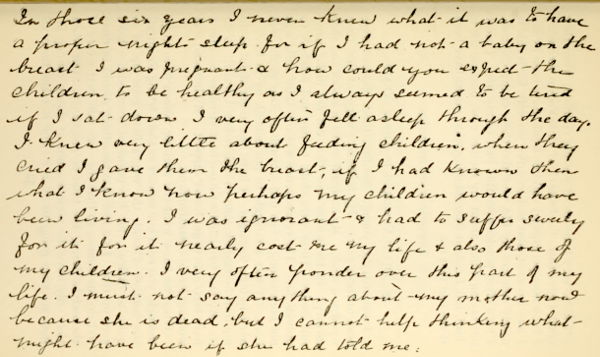
Facsimile of Extract from Letter 24.
I was married young. My first three children were
born in three years. My husband’s wages at that time
was 27s. a week. My husband works in a boot and shoe
factory. In the winter-time they did not make many
full weeks. There were clubs to pay and holidays to
provide for. The consequence was my third child was
not born strong. She had a cough as soon as she was
born. It was a struggle to put enough by to have a
nurse in for a fortnight. I have had to get about to do
my own housework long enough before I was fit to do
it. My last two children have been stronger because I
have been able to get better support. My husband was
working for Co-operative firms.
When we know what the working women have to go
through, you need not wonder at them trying to curtail
the family. Though the wages have gone up, it is
quite as difficult, for the prices of commodities have
gone up too. I do feel that something should be done
to help our women, so that they can take better care of
themselves during the time of pregnancy. But when
they only have the same amount of money coming in,
how are they going to do it? For it takes them all
their time to keep going on. A mother never thinks
of herself. She is always trying to make her family
comfortable. A good many of them get about too
quick after confinement, and it is making invalids of a
good many. I am very sorry I am not in active service
for the Guild. I cannot tell you how much I love the
work.
Wages 16s. to 27s.; six children, one miscarriage.
One of the difficulties I experienced during pregnancy
was saving the doctor’s fee out of the small wage, which
was only just enough each week for ordinary expenses.
Thanks to the Maternity Benefit, a woman now knows
she is provided for at the time.
I have had six children, all living, and what a terrible
time it is, to be sure, especially during the last two
months—only just enough to live on and another coming.
The mental strain in addition to bodily labour must
surely affect the child. I think a woman in that
state should have all the rest that is possible. I did
fairly well for a working man’s wife, but the recollection
is anything but pleasant. Fancy bending over a washing-tub,
doing the family washing perhaps an hour or
two before baby is born. I think a woman in that condition
should be considered unable to do heavy work
for quite six weeks previous to the birth of her child.
Like other wage-paid workers, my husband’s wages
fluctuated. The unsteadiness of the wages of a labourer
is a matter of concern, and working a full week he would
scarcely receive a real living wage. During the time
of bringing my children up, the highest wage I received
in any one week was 30s., and the lowest—well, I had
so many that I really do not know how I got through.
A week’s holiday[A] meant no wage at the week-end. And
if the machinery broke down, or there were strikes or
lock-outs, it stopped for six clear days, the sum of 10s.,
and 1s. for each child, would be paid. The same rate
would be paid for out of work. My husband was seldom
out of work, but, as I have stated, his wage was subject
to fluctuation. I think the lowest (not to mention
holidays of a week duration, when perhaps I had
saved the Dividend to tide the week over) was 4s. 6d.
I shall have to tell you of a case near my home. The
woman, I believe, is in her last month. I met her on
her way home carrying a baby of two years (her second).
She had been out to wash, as she said every copper
helped (her husband is a labourer). She said: “I have
to go out as long as I am able to help, to clean or wash;
you see, they will not let me work in the factory.” When
questioned about the baby she was carrying, her answer
was that she took him with her, and he just sits on a
chair until she has done. The child in question is
rickety. He cannot stand yet. Such is the life of
poor women. I have known many such.
I will just give you a little of my confinements. I
had been married eighteen months when I had my first
baby, when I had a trying time, being only an eight-months
baby. My water broke five weeks before, and
caused what the doctor calls “dry labour.” He only
lived twelve hours. The second came three years and
nine months afterwards. I had a straight labour, but I
flooded afterwards, and if the doctor had not been there
I should have lost my life; it caused me three months’
doctoring afterwards. The third one, which came two
years and one month after, I had a fairly good labour.
Over this one my sufferings were mostly before it came.
I had varicose veins in the right leg right away in the
abdomen, and the irritation was most distressing; I
used to walk the bedroom most nights during the last
month. The fourth came two years and three months
after the third, and the doctor put me an elastic band
on my leg, and of course I did not suffer so much over
that one. I could have told at the meeting, where
Mrs. D. was talking, about babies’ eyes, for this one’s
eyes after a few days began as if they had got cold in
them, and the doctor told me then many people took
it for cold, but if neglected it was most serious. I am
pleased to say I have had no trouble, for he is a fine
young fellow now.
Between the fourth and fifth I was four years and
eleven months, and then the sixth I went five years and
eleven months, and was forty-two when I had him. Of
course, I think I am suffering now for some of it, as I
have always had to do my own work up to the last, and
have had a lot of sickness with my husband and my
second boy; till he was eleven years old I scarce ever
had the doctor out of the house. I must say that I
have had a good husband to help me through, but I
do hope we get the £7 10s., and then there will be a
many who will not suffer as many poor women have done
in the past. At the time I had my children, and weighing
all things together, I don’t think my husband’s
wages averaged no more than 28s. a week, lowest 12s.
and 15s. I should like to tell you, besides children we
had my husband’s mother to keep, and allowed her
2s. 6d. a week besides keeping her. He has never been
a strong man either, and many a time had him at home
six or seven weeks at a time. I feel that when I go
to conferences and meetings that I wish I had been a
co-operator years ago, for since I have been a Guild
worker I feel the years have been wasted, but I am
trying to do my best now in my little way. Wishing
you every success in the campaign we are fighting.
Wages average 28s.; six children, one miscarriage.
My experiences as a young woman were very difficult,
for I was the first child, and had never been brought
up with young babies, or afterwards been where they
were. My mother dying when I was three years old,
I had no one to turn to for advice. I had spent all my
youth in the country, and came as a stranger into a
strange place, knowing no one but the man I married.
My first child was a very delicate child, but I have often
thought since that perhaps I had not done all things
that were wise, but that would be for want of knowledge.
I think a mother is a peculiarity during pregnancy, for
I myself never seemed to want anything I had cooked
myself, and if I went to any other house I could have
eaten the poorest of foods. Then one must not go and
buy what we may fancy, as that is an extra expense to
the home; and knowing there is an additional expense
coming, we have to be very careful. I have not had the
Maternity Benefit yet, but that is only a trifle to the
large expense that is incurred, when you have paid
£1 1s. for your doctor, your nurse 10s. per week, a
washerwoman 2s. per day (you cannot get a nurse here
under, and if she does the washing she will charge 12s.
per week). Then, you never find anyone that makes the
money go as far as you do yourself, so that when you
get up, instead of having the best of support, and very
little to do, you have to begin to get pulled round again,
and start and do the household work before you are
strong enough, with an extra one added. Naturally the
child either cannot be nursed by the mother at all, or
only partly. The child suffers as well as the mother.
If it could be made possible, I really think mothers
should have practically nothing to do with heavy work
three months before childbirth and three months after—that
is, if life is to be made worth living. But at present
we have to clean down thoroughly ready for the event,
till I have found myself wondering if death would not be
a release. What with worry and feeling bad, I am never
surprised at hearing of an expectant mother committing
suicide. If she has two or three tiny children, she never
has a minute’s rest, if she is an energetic housewife.
I think I won’t write any more, or you will be thinking
I am rather a depressing character, but I shall be glad
if anything I have said is any use to others as a benefit
in future time.
Wages 20s. to 45s.; five children.
Through my married life I have had a good, kind
partner, which means so much to the wife, and who
always provided me with a doctor and a good nurse
for my confinements, which goes without saying that
the mother and child have a much better chance than
other neglected ones. The first five were born with
fifteen months between; then there was a wait of eight
years for the sixth, and three years for the seventh. I
have always worked hard both before and after childbirth.
Give a woman a quiet home and an easy conscience
and good plain food, and I see no reason why
both mother and child should not do well. Personally,
I don’t know what I should have done if it had not been
for my good old nurse, my dear mother having passed
away some years before; but by the grace of God and
plenty of common sense, I have brought all my children
through so far. I was married in 1884, and knew practically
nothing about a child’s entry into the world. I
do think there should be somewhere where intending
brides could get information that would in some way
prepare them for what may take place—those who have
no mothers, I mean. But so much depends on the
woman herself, whether she is going to make the best
of things. Personally, I found it was no good worrying,
although I found it much harder than most. I never
knew what it was to have a day at the seaside for twenty
years. I am not grumbling, only now I am nearly used
up. If only the Maternity Benefit had been given when
I and many others needed it, I cannot help thinking I
could have done much better. My husband is a bricklayer,
and you may guess it was a bit of a struggle with
my little family.
Seven children.
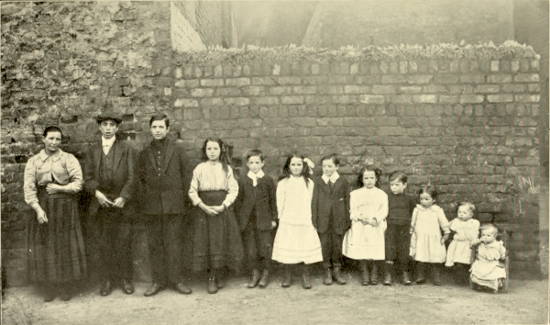
ELEVEN CHILDREN BORN, ALL LIVING. FATHER A FISH-HAWKER.
This family is not connected with the Women’s Co-operative Guild.
(Reproduced by kind permission of the Medical Officer of Health for Liverpool.)
When we were first married my husband’s wages was
£1 a week. I have had seven children; one died at
birth, one at one year old, and five are living. Each
was about two years and three months old when the
other was born. I had one miscarriage, which left me
very ill for a long time. I found that the money was so
little to do on that I must work as well to pay my way
and clothe my children. My husband neither drank or
smoked, but when rent, coals, gas, and food is taken out,
what was left for other things? I had boarders, and
was standing on my legs so much that after the birth of
my last child a marble leg set in. I went under an
operation, but my leg is still very bad. A mother wants
good food before the birth as well as after, but how can
it be done out of so little money? If father takes his
food it must be as good as can be got; then the children
come next and mother last.
Wages 20s.; seven children.
Why is it these things have never been thought of
before? Is it ignorance, or is it that people are got
used to the idea that we have to expect all sorts of
illnesses when a woman gets pregnant, and we have
just to put up with it and do the best we can? Personally,
I have very little to tell of my own experiences,
although I have four children—two boys and two girls,
the eldest fifteen years and the youngest six years.
Compared with some working mothers, I have gone
through those trying periods fairly well. Also my confinements
have on the whole been good. My husband’s
occupation is a carpenter and joiner, and he gets the
trade union rate of wages of the district.
Wages, trade union rate; four children.
I feel that I must write and explain why I advocate
educating women to the idea that they should not bring
children into the world without the means to provide
for them. I know it is a most delicate subject, and very
great care must be used in introducing it, but still, a
word spoken sometimes does good. Someone has said
that most of the trouble with delicate children were
caused by women trying to destroy life in the early days
of pregnancy. I do not, of course, recommend that sort
of thing. It is absolutely wrong. But it is terrible to
see how women suffer, even those that are in better conditions
of life. I will quote one or two personal experiences.
My grandmother had over twenty children;
only eight lived to about fourteen years, only two to a
good old age. A cousin (a beautiful girl) had seven
children in about seven years; the first five died in
birth, the sixth lived, and the seventh died and the
mother also. What a wasted life! Another had seven
children; dreadful confinements, two or three miscarriages,
an operation for trouble in connection with
same. Three children died and the mother also quite
young. There are cases all round us much worse.
You find in the majority of cases that in large families
a certain number die and the others have less strength.
Of course, there are exceptions. The trouble is that it
takes so very long in England for things to be changed,
and you are told to mind your own business and let
people do as they like; but I am pleased to see that
many men and women are getting wiser, to the benefit
of the wives and families for whom the poor husband
has to provide.
I was married at the age of twenty-two (barely twenty-two
years), and by the time I had reached my thirty-second
birthday was the mother of seven children, and
I am sure you will pardon me if I take the credit for
bringing up such a family without the loss of even one,
seeing that it entailed such a great amount of suffering
to myself on account of having to nurse them through
all illness, and in addition (after sitting up many nights
in succession) being compelled to do all household
duties.
During pregnancy I suffered much. When at the
end of ten years I was almost a mental and physical
wreck, I determined that this state of things should not
go on any longer, and if there was no natural means of
prevention, then, of course, artificial means must be
employed, which were successful, and am happy to say
that from that time I have been able to take pretty good
care of myself, but often shudder to think what might
have been the result if things had been allowed to go on
as they were. Two days after childbirth I invariably
sat up in bed knitting stockings and doing general repairs
for my family. My husband at that time was earning
30s. per week, and out of that amount claimed 6s. 6d. as
pocket-money, and when I tell you that through all my
difficulties there were no debts contracted on my part,
you will be able to form some idea of what women are, in
some cases, called upon to endure.
Wages 26s. to 30s.; seven children.
I had my three children in two years and five months,
and all the time I carried I had violent sickness, night
and day, under a doctor practically the whole time, who,
of course, were unable to prevent my suffering. The
result was my babies were delicate; the last one suffered
with gastritis the whole of its short life—four years and
ten months—which ended in peritonitis and abdominal
tuberculosis. I have the eldest one still, but he is very
delicate and unable to attend school.
Wages 21s. to 27s.; three children.
I can speak from experience. For fifteen years I was
in a very poor state of health owing to continual pregnancy.
As soon as I was over one trouble, it was all
started over again. In one instance, I was unable to
go further than the top of the street the whole time
owing to bladder trouble, constant flow of water. With
one, my leg was so terribly bad I had constantly to sit
down in the road when out, and stand with my leg on
a chair to do my washing. I have had four children
and ten miscarriages, three before the first child, each
of them between three and four months. No cause but
weakness, and, I’m afraid, ignorance and neglect. I
was in a very critical state for years; my sufferings were
very great from acute weakness. I now see a great
deal of this agony ought never to have been, with proper
attention. It is good to see some of our women waking
up to this fact. It is help and attention during pregnancy
that is wanted, and I hope my own dear daughter,
if she ever marries, will be one to benefit with others,
by our experience. I do hope this letter is something
of what you are wishing for, hoping for good results of
our Guild work in this matter.
Wages 25s.; four children, ten miscarriages.
My experience during wifehood has been that so long
as husband and children could have necessities the
mother could manage somehow.
It is my silver-wedding day to-morrow, and you will
see something of what it has meant to me. I was
married young; my husband is five years older. I had
my first three children before I was twenty-four, nursing
them all. Then I had three miscarriages in the next
eight years. I had two more children later, in one and
a half years. Since then, eleven years ago, I have had a
misplaced womb, and have had two more miscarriages
since, one being of twins five months, and one three
months.
I believe it was having children too fast that weakened
my inside and brought on miscarriages.
When I heard Mrs. H. say at our Conference she
always had £5 provided for confinement, I felt that she
had indeed been a lucky woman. I have never yet
been in that position, and it is because a woman has not
enough money to pay for things being done for her until
she is strong enough to do them for herself, that causes
so much suffering.
My husband’s wages was 30s. a week when he made
a full week, but unfortunately his trade was very uncertain.
In ten years we had moved four different
times—twice to A, back again to B, and then to C
which accounts a great deal for us being short, as we had
to pay our own expenses each time, and of course you
will understand what it means to a mother when she is
left behind. The husband must be found his board-money
and pocket-money, even if she goes short of
necessaries.
Wages 30s.; five children, five miscarriages.
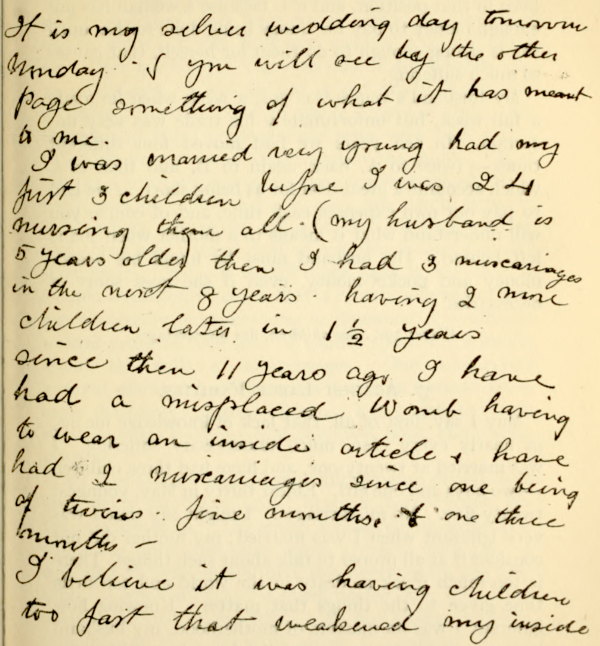
Facsimile of Extract from Letter 36.
May I say, first of all, that lack of knowledge means,
in nearly every case, much unnecessary suffering. I
was married at twenty-one, and have had three children—two
boys and one girl. Eldest thirty in May, youngest
twenty-five. No miscarriages. I might say that I was
very ignorant when I was married; my mother did not
consider it at all proper to talk about such things. There
is too much mock modesty in the world and too little
time given to the things that matter. Knowing how
ignorant I was on matters of motherhood, my husband
bought a book for me called “Advice to a Wife,” by
Dr. Henry Pye Chavasse. It is a beautifully written
book and would be a gift of untold value to any girl
about to marry. There is also a sequel entitled “Advice
to a Mother”—it has saved me pounds of expense—price
2s. 6d., by the same author. Yet, on the other
hand, with all this knowledge, I had a very dreadful
time with my first child—in fact, I nearly lost my life
and reason too, and have never really enjoyed good
health since. I was fully six months before I could
look after my baby. This was one of my greatest disappointments.
I was obliged to put my little one out
to nurse, although I had an ample supply of milk. My
second and third confinements were very bad, but I
was able to get about at the end of the month. It is
always a mystery how some poor mothers get about so
soon, but of course some women are much stronger
than others. Here let me add that through getting
about too soon a great deal of suffering is stored up for
later years. My old doctor once said to me that if
women would only realise that a certain amount of rest
was absolutely necessary after confinement, it would add
several years to their life. I cannot speak too strongly
about the evils of miscarriages. One miscarriage
brought about unlawfully ruins a woman’s constitution
more than half a dozen children. I have suffered from
varicose veins since my first child was born, and during
pregnancy.
My husband’s wages during child-bearing period have
been never more than 24s.; being a piece-worker, has
been as low as 9s. The wages I received when my last
child was born (the same week, I mean) were 11s. I
was glad to avail myself of a free doctor from the hospital.
I may say I had a black doctor, and was never
better attended in my life. I do not believe in large
families. It does not give either the mother or the
children a chance. Here again, I think, much education
is needed. Fathers ought to control their bodies
for the sake of the mother and child. I could quote
several instances where a mother’s life has become
intolerable through the husband’s lack of control. I
do trust that the new Maternity Scheme will soon be
a fact. I feel that, when put into working order,
thousands of poor mothers will be saved unnecessary
suffering.
Wages 9s. to 24s.; three children.
I think the earlier stages of pregnancy are the worst,
but a woman needs most attention when she gets up.
I have had to nurse my other children with measles
when my baby was only four days old. I could never
employ a proper nurse. I had six children when my
husband was getting £1 a week. I am so glad to see
the improvements in the lot of women to-day, but in
some ways it is worse now to bring up a family. I am
so glad to see anything being done to help the mother.
Wages £1 and upwards; eight children.
I am afraid I have not much to tell from my experience.
I have always been able to look after myself,
with the help of a good husband. I have had nine
children; eight are living.
When I tell you my husband is a member of the Hearts
of Oak Benefit Society, you will know I have benefited
by it.[B]
Nine children.
I might say that I have had two children. The first
one was still-born, but it was owing to the doctor not
paying proper attention to me, as, when he came, he said
he would not be needed until the morning after. However,
I got to be worse, and he was fetched again, but
refused to come, so we had to get a midwife, and she
said if I had had proper attention the child would have
been born then. Consequently, the child was suffocated
in the birth. When all was over, my husband went to
tell him, and he said he was very glad, as he wanted
his rest. Then when I was going to have my second, I
ordered another doctor, and when he was wanted, he
was drinking, and sent another midwife; so you see I
have not had it all straightforward. But when I was
carrying them, I can say that I was very well during the
time of pregnancy, only for sickness in the morning and
after food, until about seven months gone, when I was
all right.
Wages 21s. to 23s.; two children.
My feelings during pregnancy were just like those of
Mary in Hall Caine (“The Woman Thou Gavest Me”).
My mind was full of love and my time of preparation for
the coming life within me. I worked very hard during
the time of six children, knitting stockings and making
clothes for those I already had, so my little one could
be well nursed. Three are suffering from consumption,
and one from curvature. When I had had six I never
murmured, never once said I had enough, and did not
want more, but after the birth of my last one I changed,
because I could not nurse it and never carried it about. I
do not blame my husband for this birth. He had waited
patiently for ten months because I was ill, and thinking
the time was safe, I submitted as a duty, knowing there
is much unfaithfulness on the part of the husband where
families are limited.
What is necessary for mothers is State aid for every
child she gives birth to. If this is necessary for the aged,
it is more so for the mother with the children.
It is quite time this question of maternity was taken up,
and we must let the men know we are human beings with
ideals, and aspire to something higher than to be mere
objects on which they can satisfy themselves. Near
my home are two sisters with ten months and eight days
between their ages. Two doors from my own are four
sisters, all living, and they all came in two years and
fifteen days—the second born eleven months after
the first, and thirteen months after twins came, and since
then three more have been added to their number. None
of them are old enough to work, and you will understand
the position of the parents, who are good, deserving, well-meaning
people, when the father, being out of work
through the war (painter), has had to go labouring.
Wages 30s.; seven children, two miscarriages.
I take a strong personal interest in the matter, and
will state a case that came under my notice, where a poor
but respectable mother was practically ill the whole
time of pregnancy, gave birth to a healthy baby, herself
left very weak, and a month later taken to hospital, as
a last resource, from no particular disease whatever.
The doctors themselves could not give it a name. I
myself should say that all her strength and vitality went
to the nourishment of the baby, and she herself was left
with scarce enough to live at all. I did all I could.
She had another little one, one year and ten months old,
at the time. I had him most of the time before her last
illness, and entirely during the time she was in hospital
(about three months, I think). This happened last year.
The baby is now thirteen months old, and a fine, healthy
child. The mother is still weak and ailing at times,
certainly not fit to attend properly to her home duties
and two small children. She had, previously to the
two living, two other children, both still-born. In fact,
I think both were dead some days previous to birth.
This was before I knew her. I am confident, if more
help had been forthcoming before and after confinement,
she would and could have been saved much suffering.
My own personal experience is small, having had only
three and a half years of married life. My one confinement
and its results was enough almost for a lifetime.
I was not well for many days together the whole time
of pregnancy, suffering from sickness, faints, and severe
headaches the whole time. A long and severe confinement
followed, and a tedious recovery, and I can honestly
say that, though it is over two years ago, I can feel the
effects of it still, though up till marriage I did not know
what illness was. My age was twenty-eight when baby
was born. Had I been a poor mother, struggling along
on a bare living wage as many are, I do not think I
should have been alive now. But constant care and a
good, kind husband, and help with the heavy housework
when necessary (though I did practically all the work
from day to day myself), gave me a far better chance of
life and recovery than many, many of our poorer, though
equally respectable members have. For they have
neither time nor the means, many of them, to take the
necessary care of themselves that they should do.
One child.
When I was married, I left my home and went to a
distant town, out of reach of my mother and all my
friends, and in due time I became pregnant, and as time
rolled on, I began to feel the symptom which I thought
was right to feel and bear.
Now, in a strange town, and no particular friends, and,
shall I say, mock modest, I was almost afraid to go to
a doctor for advice, in case he would think I was a
coward, and did not try to bear what I thought was
right. At last, I ordered the doctor and midwife, then
I awaited the arrival of the baby. The time came. I
was in labour thirty-six hours, and after all that suffering
had to be delivered by instruments, and was ruptured
too badly to have anything done to help me. I
am suffering from the ill-effects to-day. This is thirty-one
years ago.
I had two children after that, but all the time I was
carrying them I was quite unable to get about. When
the last baby was about to arrive, the last month I was
not able to go upstairs, unless I got up backwards, and
to come down I had to slip from step to step. Going
back to the first birth, I was unable to sit down for three
months. If I wanted to rest, I had to lie down.
Now, after that experience, my feeling is that if it
were possible to get Maternity Centres or schools for
expectant mothers, it would be a godsend to many a
woman; and also to get some little help in nourishing
the body, such as a small quantity of fresh milk. I
hope I have enlightened you in some little way; if I
have, it is worth the time I have spent in writing.
Wages 26s. to 28s.; three children.
My health during pregnancy was very good. I took
no intoxicants, good, simple food, and through adverse
circumstances worked hard in my own home.
I was married in 1887. My husband had just left the
Army; he got work as a porter in a bedding warehouse.
This firm failed, and he and the book-keeper joined
forces and began in the bedding trade in a small way,
and we were married. I went every day except Saturday
to the shop to cut out and sew. My husband’s
wages were £1 per week; we did our own housework at
night, and I baked and ironed on Saturday morning.
When my boy was born, twelve months after marriage,
my husband’s wages were 25s.; of course, I could earn
nothing. In another twelve months my second baby
(a girl) was born. We removed to ——, where rents
were cheap, and I was a stranger. I took in plain
sewing and washing, and cut up my clothes for my
babies. I had a good stock of clothes, I may say.
About this time we were involved in a lawsuit which
was quite unnecessary, and our income was reduced to
19s. 6d. per week. I still took what work I could get,
minded a child whose mother worked in the mill, etc.
I had no assistance from my own family, as I was too
proud to let them know. This lasted three years,
when we had a change for the better. The cost of this
lawsuit I mentioned was, to us, £55 12s. 4d. I then
had another daughter, and three years later another
girl. I could then obtain one dozen pounds of sugar
for 1s. 9d., now it is 4s., and this applies to many things.
When my last baby was born my housekeeping money
was £2 10s.
The first six years of my married life was one perpetual
struggle, often wanting necessaries, but God’s
hand has been over it all, and I thank Him to-day for
the faith and perseverance with which I was enabled to
go through this struggle.
Our circumstances are improved, and my three
daughters are all teachers—one certificated, and one
college-trained, the youngest a student teacher, entering
College in September next. Two of my girls are
accomplished musicians, and can do anything menial
or otherwise in a home. I think if the mothers of to-day
were not so idle it would be better for them; also, if they
would make their own food, and not buy ready-made
food, we should have a better class of children and
healthy mothers. I am fifty-three next month, do my
own washing, baking, and cleaning with a little help
from my girls. My house has nine rooms and three
cellars. I still make time to do my secretarial duties,
and take a great interest therein. I was an extremely
delicate girl, and suffered from heart disease as a child,
but my doctor says I have a most indomitable will.
Lest you should think I am of a boasting nature, I beg
to submit that God has been very merciful and kind
to me.
Wages £1 to over £2 10s.; four children.
I had no mother to talk to me, or for me to ask
questions, and both my husband and myself being of a
reserved nature, I suffered, perhaps, more than I need
have done. I needed chloroform and instruments in
each case, and after the birth of my second child, I was
a cripple for nearly twelve months, but having a good
husband, I tried to bear patiently. I cannot say much
else, except that now I can call it mock modesty on my
part.
Wages 28s. to 36s.; three children, one still-born.
I myself have had five children, all living. I had the
five in seven years and two months, so you see for yourself
I had them all very little, and no Maternity benefit
to help me, and only a small wage coming in—say 25s. a
week—so I had to go back to the mill when fit for work,
to help to keep home right, which I don’t think did me
or the children any harm, for I have not paid 10s. to a
doctor in all the bringing up of the five children, nor for
myself. No still-born nor any miscarriages.
Wages 25s.; five children.
Oh, for the time when the Maternity Scheme becomes
law, and the Divorce Reform. No one will welcome it
more than I, for the sake of those who have not got true
companionship in life. I am afraid I cannot tell you
much about myself during pregnancy, as I have only
had one child and no miscarriage. Perhaps my husband
and myself have taken a different view from most
people. You see, we both belong to a large family of
brothers and sisters, and both had a drunken father,
who did not care for their wife and offspring as much
as the beast of the field.
My mother, whom I loved with all my heart, brought
fifteen little lives into the world; twelve are still living.
I remember many a time she has gone without food
before and after confinement, and without fire in winter.
I have gone round the house many a time to try and
find a few rags to sell for food. I have seen my father
strike my mother just before confinement, and known
her be up again at four days’ end to look after us. You
see, my mother had no education, and had been brought
up to obey her husband. But, poor dear, she left the
cares of this world some years ago now, at the age of
fifty-nine. My father has always been in business for
himself, and used to have plenty of money, but spent
it on himself, and is still living at the age of seventy-four.
When I got married to the man I loved, and
who loves me, he said I should never suffer as our dear
mothers had done, and that we would only have what
little lives we could make happy, and give a chance in
life. My son will be eighteen years of age in June, and
is still at Technical College, for which he won a scholarship.
I get no grant-in-aid, and my husband is only a
working man, so I go out to work for two hours every
morning to help to keep him, as he is a good lad.
Please excuse my ramble, as I only wish I was better
educated. I think a lot, but cannot express it, as I
had to leave school at the age of ten years, to go into
farm service. I have found the Guild a great help.
Wages 26s.; one child.
My two last babies came to me in troublous times,
the boy, four years since, when my husband (through
being too prosperous and false friends) gave way to
drink, although he never tried to strike me, or any of the
outward cruelty that I know many wives have to contend
with; but it was so different to what I had been
used to, and three months before the baby came, I was
practically an invalid. Up till dinner I could manage
to get about, but after dinner I had to lie or sit as best I
could. I could not get on nine in men’s shoes, my feet
swelled up so, and every night my hands were in agonies;
the only relief I got was when I used to hammer them on
the wall, to try and take the awful dumb pain out of
them. Then when I started in labour, I was in it from
eleven o’clock on the night of Thursday, the 17th of February
till Saturday, the 19th, at 10 a.m. The waters
broke at eleven o’clock on Thursday night, and baby came
at ten o’clock on Saturday. The doctor had to put it
back, as it was not coming naturally. Of course, I had
chloroform; indeed, I had it with all my seven children,
except two, as I have always such long and terrible
labours, although I am a big woman—5 feet 8 inches, and
I weigh over 13½ stone. I flooded with two. By the
way, I am never able to get up under three weeks
after confinement, as I always start to flood directly
I make any movement, and I have to keep my nurse
from five to seven weeks after. I always have terribly
sore breasts, although the doctor treats them three months
beforehand, but it makes no difference. My last confinement
was worst, as I found, five months before baby
was born, that my husband was having an immoral
going-on. The shock was so great, I could not speak
when first I heard it. A cold shiver went over me, and
my body seemed to go together in a hard lump. I was
never right after, till she came. Indeed, I was never
right till my operation last October. I always had a
weary bearing-down pain in my body all the time I was
carrying babies, and suffer a great deal in my back. I
never had morning sickness with any of them, and not
one varicose vein, I am so thankful to say. And yet I
know many women who can go right up to a few hours
before, and then tell me they think nothing about it,
while to me it is like a time of horror from beginning to
end. I suppose we are differently made, somehow.
My husband earned 6d. an hour, and some of the
summer months he worked overtime at the same rate of
wages. What he earned overtime we always put in the
Post Office, and what else we could spare towards the
long winter months, as many times we started short
time in August, which did not bring in very much. Then
we were very lucky if we were getting 10s. a week at
Christmas-time, but it used to be oftener nothing for
weeks before Christmas. But we never went into debt.
What we could not pay for we did without, and I can
assure you I have told my husband many times that I
had had my dinner before he came in, so as there should
be plenty to go round for the children and himself, but
he found me out somehow, and so that was stopped,
although I had been many times only half filled, and I
am glad to say during the worst of the pinch time I was
not pregnant.
Seven children and three miscarriages.
I seem to have had a very hard time all through.
Well, my first baby was born twenty-three years last
February, and my husband was working just about
one or two days in a week at 3s. 4d. a day. My second
baby was born sixteen months after, being still-born.
My husband was out of work for three months then. I
did nothing but cry. I could not get what I ought to
have. The doctor wanted to know if I had been in
any trouble. My mother told him how long we had been
out of work, and I had cried a good deal. The doctor
said that would be the cause of my baby being dead.
When I got better, I went to work (and to tell you the
truth, I have worked hard ever since). Twelve months
after that I had another baby. I was very ill. When
I got better, I took in plain sewing; then two years
after I had another baby, but my husband was in
better employment, earning 18s. per week, and I thought
I was a lady. But it was not for long. My husband’s
work finished, and we moved to ——, where I had fresh
troubles, my next baby being dead born, and my next
only lived five months. When I was laid up again we
were very hard up. I had to let the young person who
looked after me go before her time was up. After I paid
her and my rent and coals we had no dinner the Sunday,
simply because we could not afford any. I always tried
to get on and keep us all respectable, but it was hard work.
I also managed to get the doctor paid before I wanted
him again. Two and a half years after I had another
baby, and she has taken more to rear her than all the
rest; she cannot go to school. She takes such a lot of
fits, both night and day. My next baby was born about
eighteen months after, and when she was five I had the
misfortune to go to bed again; I had a very bad time,
although it was my tenth child. I was chloroformed,
and the baby lived half an hour. I am sure you will be
tired reading all my troubles, but I assure you I had to
work hard in my home and out of it to keep us all together.
I used to buy extra every week, it did not
matter how small, so that I could be better able to pay
for someone to look after me. I have a good husband,
and he helps me all he can. Three of my daughters is
under the doctor now, and I am of the candid opinion
it is through me working so hard and not getting plenty
of food and attention during that period. I hope I have
not wearied you. I many a time feel I could write a
book of my troubles; I seem to have had so many.
When we look back, we wonder however we have got
along, but every cloud has a silver lining, and I am looking
forward to see my children better provided than I
have been. With all good wishes for a brighter future.
Wages 18s. to 22s.; eight children, two still-births.
I have had four children; the oldest is now twenty-three,
the next twenty-two, the next twenty-one, and
the youngest fourteen. I might say that at the time
my three eldest were born, my husband was working
on a farm, and earning 18s. a week. When the last was
born he had moved into rather better work, and earned
25s. a week. You may be sure after I had paid 3s. for
a small cottage of two rooms and scullery, I had not
much to spare, and of course doctors had to be paid.
As for nursing, well, I did not get much of it, and I feel
very deeply always the need of good nursing at these
times. For years I suffered from what I feel was the
want of proper nursing and nourishment. In fact I
wonder sometimes even now if I have ever really got
over it. When I think of it I feel I would do anything
to support any measure that would help to secure that
our daughters now shall not suffer as their mothers did
before them.
Wages 18s. to 25s.; four children.
As you will see (from my having lost six children in
succession before I reared one), I was very unfortunate
in my early married life, and at one time thought I was
not going to rear any children. Congenital weakness
may have had something to do with the failure to rear,
through falling down a flight of stairs as a girl and dislocating
my neck. This fall would have cost me my
life but for the presence of mind of a young woman who
picked me up. Using her hands and knees, she pulled
my neck in, and undoubtedly saved my life. The doctor
said I would suffer as a woman, for every organ internally
was put out of place. My first set of children were
weakly, and being unable to nurse them, I resorted to
patent foods, which I am now firmly convinced did harm
and not good, and in my opinion contributed to the convulsions.
I found later that weakened milk, afterwards
strengthened as the baby got older, was the best and
safest food for infants brought up by hand. Undoubtedly
the remaining ones progressed all right, and
are sound and healthy. The fact that one girl put ten
and a half years’ perfect attendance in at an elementary
school speaks well for the change. The one I lost at
seven weeks was easily accounted for, from the fact
that at the time of birth I was suffering from the bloody
flux, a very severe form of dysentery. In fact, the
doctor said that if I had had Asiatic cholera I could
not have been worse. You will readily see that that
child had a very poor start in life, and waned away from
birth. As a result of my experience, my advice is that
mothers unable to suckle their children should shun all
patent foods, rusks, etc., as they would shun the devil
himself, for an infant will have to be born with a digestion
like a horse if it is to digest solid food in the early
stages. Thousands of infants are killed with mistaken
kindness, and I am convinced that milk and milk only—human,
if possible, and animal, if human fails—in a
diluted state, is the only safe food for infants. I sincerely
hope you will sound a note of warning against
patent foods that cake to a solid lump in the infant’s
stomach, the result being convulsions and death. This
is my sincere belief resulting from bitter experience.
Wages 24s. to 30s.; ten children.
I am the mother of a large family, but I am glad to
say they are fast growing up, as their ages range from
twenty-eight down to five years, so that I feel I can speak
from experience, if anyone can. I must say that although
it is a time that women suffer terribly, yet it is
a time when they get very little pity, as it is looked upon
as quite a natural state of things. I have myself got up
in the morning, unable to partake of any breakfast,
and tried to get about my work, and had to sit down in
every chair I have got to with my brush in my hand.
Then after confinement, as soon as I could sit up in bed,
having such a large family, I have had to sit with my
needle in my hand. But all this does no good, but only
tends to keep a woman’s health down. When I had my
first miscarriage—it happened in October—and I crawled
about all the winter, and well on into the next summer,
like a person in consumption; in fact, it was generally
thought that I was. And, of course, all those months we
were obliged to have a woman in, as I could do nothing.
So I think if anything could be done to lessen the sufferings
of the coming generations, I for one should be in
great favour of it, as of course, if it is too late for me to
benefit by it, I have daughters growing up, and sons’
wives to think of. Suffering as I have done, it is really
a time when extra funds are needed, so that one could
pay a little to have anything done, instead of having to
do it themselves.
Wages 17s. 8d.; nine children, six miscarriages.
When I have been pregnant I have suffered very
much with bad legs. You see, I had to go to work in
the mill, and so I had not the chance to give them the
rest they needed. I think it is a great hardship for a
woman to have to do so. However, when I have got
over the confinement, I seemed to pull up after my
first baby. But after my second one was born I was
in bed nearly a month, and my husband (who, thank
God, is one of the best) had to lift me in and out of bed,
and put my legs on a level with my body while he made
my bed. After the third I was something the same,
only not quite so bad.
My babies have been very strong and healthy, though
they have not always had the best of health since. But
I have tried to do my duty to them as well as I could.
I might say that I think ignorance has more to do
with suffering than anything, and I think if our Guilds
would get the doctors to lecture to them on this subject
it might help our members, and also other people, to
take more care of themselves.
Three children.
I have not had children as fast as some, for which I am
thankful, not because I do not love them, but because if I
had more I do not think I could have done my duty to
them under the circumstances. I may say I have had a
very good partner in life, and that has made it better
for me. But seeing my husband is only a weaver, I
have not had a lot of money to go on with. I have
been compelled to go out to work. I have worked
when I have been pregnant, but I have always given
up when I have been about six months, and then I have
done all my own work up to the very last, and I can tell
you it has been very hard work. Then when it has been
over I have had to begin to do my housework at the
fortnight end, and I think that is too soon, but what can
women do when they have not the means to do it with?
Of course, I am not half so bad as some. I have never
carried a baby out to nurse. I have always managed
to stop at home one year and get them walking. But
I think if we as women had our right, we should not
have to work at all during pregnancy, because I think
that both the mother and baby would be better. I
never knew so many bottle-fed babies as there is now.
Nearly all the young married women cannot give breast.
How is it? Now, I think because they work so hard
before, do not get enough rest, therefore have no milk.
And, then, some will not begin with their own milk, because
they know they have to go out to work. Hence
the baby has to suffer. Mother’s milk is the best food
for baby. I heard a young mother with her first baby
say the other day her husband’s mother had told her
not to bother with her breasts, it made a young woman
look old giving her baby breast. What a mother! I
think it is one of the grandest sights to see. So you see
we have a lot of educating to do yet when we hear such
things as these.
Wages 16s. to 30s.; four children.
I have three girls. Over my first child the only ailments
I had were sickness during the first five months,
and at childbirth I had a very good time. And over
the second a much similar time, with the exception of
colds in my face. Over my third baby I had a much
harder time, as during the whole of the nine months I
was unable to do anything, as I had such terrible pains
in my back and legs—could not bear to be on my feet for
more than a few minutes at a time.
During all this illness of mine I had my husband at
home ill sixteen weeks, which of course made it worse
for me, as the extra worry went against me; and then at
the same time I had an abscess in my breast, which I can
assure you was most painful, as I can tell you I had my
hands pretty well full at that time.
Wages 14s. to £2; three children.
I have had a large family (twelve) and a miscarriage.
I had a hard struggle at the beginning, my husband not
being in very good work. But for the last five children
I was able to pay for someone to wash, and that made a
lot of difference.
But as far as the confinement went, I always had
pretty fair times, and got up fairly well.
I have had two bad attacks of the heart since I had
the last child, which is six years old, and the doctor told
me it was with having so many children, and so quick.
But I am getting better. And the doctor said I should
get better if nothing else happened.
Wages £1; twelve children, one miscarriage.
In my case all my pregnancy times have been rather
bad. Had I been less fortunate in finding a good husband,
and one who was able to keep at home, one thinks,
I should never have been living to-day. I have cost
pounds and pounds besides the care and anxiety in
bringing my two into the world. My first was a miscarriage
owing to a fall while hanging a picture. Was
in bed over a fortnight, and almost drained bloodless.
My second, a fine bouncing girl—unfortunately too fine.
I had to be stitched twice, the first at confinement, the
second three weeks later, caused by the agony of a
gathered breast. I was eight weeks ill at that time.
My third, I could scarcely walk about for six weeks
before confinement owing to strain on weak parts, and
only short of eighteen months of previous confinement.
I had to be stitched again, but managed to ward off the
breast trouble to a great extent; incapable for five weeks.
My last was the worst; we had removed away to a strange
place, and I happened to get a woman who did not know
her work. I was very ill at the time, but everything
was favourable until the third day I developed childbed
fever. I went blind, sometimes unconscious, my breasts
in slings, so large I could not see over the top, inflammation
of the bowels, and blood-poisoning; I was almost
beyond hope, and was seriously ill three weeks. Then
took a turn for the better. We had to get a thoroughly
efficient person in, the cost of which was £1 per week
for seven weeks, and, God bless her, she deserved every
farthing she got, although it was hard. We had to pay
again for other housework to be done. I feel I owe
much of my recovery to her. My husband was seriously
reduced in means, but he would have sold anything to
do good. When I got sufficiently well I had to go to
hospital; was a patient there a month, was fetched home,
carried to bed, and stayed there six weeks, owing to
abscesses from the stitching being delayed so long and
bad condition of my system. I am not a strong person
now, but I am now in my forty-sixth year, and seem
to be improving in a good many respects.
The highest wage my husband earned was 45s., the
lowest, and at the worst time, being £1—just the amount
the nurse required, besides all else—washing, cooking
food, and everything a home needs.
Wages 20s. to 45s.; three children, one miscarriage.
My first baby was born fifteen months after marriage.
During the first four or five months I suffered very
much from sickness, not morning sickness only, but
many times during the whole day, and nearly all the
way through severe toothache.... As a result of inattention
by the doctor attending me I was badly torn
during the birth, and after three days my husband dismissed
him and called in another doctor, who said
though this could not always be avoided it might have
been in my case. I ought to have been stitched at the
time, instead of which it was done four days after.
It was four years and six months later when my
second baby came. I was much better during pregnancy—occasional
morning sickness. There was the
fear all through of the tear reopening, but with having
a good period between the births the parts were strong
enough to resist, and all went well. Six years afterwards,
I had a miscarriage about three months. Don’t
know how to account for it, excepting that there is so
little rest in the married working woman’s life. From
early morning until late at night she is on her feet. I
was more fortunately placed than most women; I was
able to go to bed and be attended to, and to stay there
until I was better.
Four years after my third baby was born (still-born).
This was the worst time I had, the sickness being most
distressing, so bad that could not describe it, and one
was always afraid of a miscarriage owing to everything
being forced down through straining. At these times
it was impossible to hold one’s water. At seven months,
as a result of this bearing-down, I had a flooding bout,
and was in bed several days. I had no labour pains,
though weak and poorly, and so did not send for the
doctor. I know now that I ought to have done so at
once, as my life was in danger. However, I got up
again and did my ordinary duties until the day of the
birth, which was harder than usual, as a live baby helps
in its own way. The baby had gradually died after
the flooding, and had been dead more than a week at
birth. I was in a very low condition for the first three
days, the doctor being uncertain how things would go.
There is always the danger of blood-poisoning, and it
takes one much longer to get their health back in cases
of this kind. Where there is a large family or a thoughtless
husband the woman pays with her life.
Wages 25s. to £2; two children, one still-birth, one miscarriage.
I may say that during pregnancy I suffered considerably
the whole time from sickness and severe pains.
This was not due to any traceable cause, as I took every
precaution to see that I did not exert myself and do
harm. I did all my own work all the while. I had little
appetite, and was not able to sleep well. During confinement
I had a very hard time, and was a long time
in recovering, and have always, since my first child,
suffered from falling of the womb, although I had a
doctor and midwife in the house three weeks. It is
owing to working women having to take on household
duties too soon after confinement that is responsible for
the greatest part of the sufferings which we are subject
to. What is really wanted is a supply of real good midwives
who could be got for a month to see to all requirements
of the patient and the home while the woman has
a fair chance of recovering. It is the system of midwives
attending too many cases at the same time that is
responsible for a lot of the trouble, as the woman gets
neglected and are forced to get about before they are fit.
Wages 30s. to 35s.; three children, one still-born.
After my first little one I went out too soon, with the
result that I got cold in the ovaries, which caused me the
most acute pain, and for quite a month every few steps
I walked I would sit down. I have had several miscarriages—one
caused through carelessness in jumping up
to take some clothes off the line when it commenced to
rain, instead of getting a chair to stand on, another
through taking some pills which were delivered as
samples at the door, and a third through a fright by a
cow whilst on holidays. So you will see I realise to the
full the care and thought a woman requires. I may say
that to me the after-effects of the miscarriages have been
worse than confinements, for it takes months to get over
the weakness.
Wages 26s. to 30s.; two children, three miscarriages.
The man and woman I know, who are very steady
people, have six children. The three elder ones are quite
normal. After the birth of the third the father had a
very serious illness—double pneumonia followed by
typhoid fever—and for weeks he lay at death’s door.
The expense of all this so reduced them that they had
to sell the best of their furniture to pay doctor’s bills,
over £20, and to keep going until he could start work
again. Then the doctor said he must not go back to
his work as a mason, and he had to take a job at labouring
work. This and short time brought his income
down to 14s. per week, and to make ends meet the wife
had to go out cleaning. She had been parlourmaid.
She continued to do so until near the birth of her fourth
child, who was very delicate and suffered from abscesses.
The mother told me she did not know how to get sufficient
food for them. When her fifth child was born she
had a bad time and the child appeared very backward,
but it was not until it was two years old that they knew
its brain was affected. He is in his sixth year, and can
only say a few words, and has never come downstairs,
always had to be carried, and at times is violent; if
thwarted in what he wants to do will go into violent
tempers and throw anything he may have in his hand.
He will also put a rope round the neck of the younger
child to play horses, and has no control over bowels. A
sad case indeed. The youngest child is in his fourth
year, and can only walk two or three yards without help.
He cannot say a word yet. I am beginning to be afraid
he may be dumb. Both his hands are deformed, and
he has no control over bowels, and has been ruptured
from birth. Doctors say they cannot perform any
operation until he is stronger. When the mother asked
the doctor how it was her children were so delicate, he
turned to her and said in the kindest possible manner,
“Ask the mother,” showing that it was due, in his
opinion, to the weak state she was in previous to their
birth. I do not think the two youngest will ever be
able to work for themselves. The mother looks almost
distracted at times. I have known her from girlhood,
and pity her most sincerely.
Six children.
My husband is a non-smoker and total abstainer, so
you will know no money was spent in waste. But I
feel sure my first baby was still-born through hard work
and lifting. The money brought in not being sufficient
to keep us all, I went out to work, and looked after my
husband and step-children as well.
I feel sure it is not so much lack of knowledge as lack
of means that entails so much suffering. I endured
agonies when carrying my second child, through bad
varicose veins in legs and body, but of course still had
to plod on and look after the rest. I had knowledge of
what to eat to produce milk, etc., but could only confine
myself to cocoa and oatmeal, which I often felt sick at
the sight of, but could afford nothing else, as I made these
things for the rest of the family also. I at the second
confinement produced a fine boy, 9½ pounds in weight.
He is now eight, and is still a very fine boy. The
medical officer, when examining him, passed a very
pointed remark, saying: “He is, of course, an only
child,” and I often feel thankful he is. We live in quite
a poor house, 7s. 6d. weekly rent, but to do justice to
my grown-up step-children, so that they may live up
to standard required of by their work, I cannot afford to
have any more children, also I cannot face the awful
agonies a woman has to go through in looking after a
family (there are five of us in the home now) whilst
child-bearing. When I had my boy I had to do the
family washing in the third week after confinement.
As to taking care, no working woman can do that unless
absolutely obliged to. The best thing that could happen
would be a system of State Maternity Homes, where
working women could go for a reasonable fee and be
confined, and stay for convalescence (not a workhouse
system). There is no peace for the wife at home. She
is still the head and chancellor of the exchequer. If
she were confined on Friday, she would still have to plan
and lay out the Saturday money, and if it did not stretch
far enough, she would be the one to go short or do the
worrying. I am sure if we, as a Guild, could bring this
about, a lot of women’s worry would be over. At the
same time it would be a recognition of the importance of
our women as race-bearers, and lift her to a higher plane
than at present.
My husband’s highest wages during the time you ask
were 36s., lowest 24s., but in his trade wet weather and
frosty weather means no work, and in addition no pay
during slack times.
There is one thing—as to mechanical prevention of
family. I know it is a delicate subject, but it is an
urgent one, as it is due to low-paid wages and the unearthly
struggle to live respectably. All the beautiful
in motherhood is very nice if one has plenty to bring up
a family on, but what real mother is going to bring a
life into the world to be pushed into the drudgery of the
world at the earliest possible moment because of the
strain on the family exchequer.
I was much struck with the remarks of “Kitchener’s”
boys who have been billeted on me, about my boy. He
is only nine, and they said he was as big as the general
run of lads in the North when they are thirteen—“But
then, ma, you’ve only one to keep which is different to
seven or eight.”
There is nothing that is done can ever be too much
if we are to have going a race in the future worthy of
England, but it will not be until the nation wakes up to
the needs of the mothers of that future race.
Wages 24s. to 36s.; one child, one still-birth, one miscarriage.
I am really not a delicate woman, but having a large
family, and so fast, pulled me down very much. I used
to suffer very much with bad legs; and my husband
was laid out of work most winters, so I had a great deal
of poverty to deal with.
Nearly all my children were delicate, and being badly
off, very often I could not get or do what I would like
to for them. I lost four out of the ten, and had a very
great difficulty in rearing some of the others. They
were nearly all two years before they ran; my eldest
girl was three years before she ran; I never thought she
could live, but, thank God, she has lived, and is nearly
twenty-two. If something could be done for poor
women with large families, I think it would be a good
thing; for a woman’s life is not much when she is in
poverty and got sickly children, and never knows what
an hour’s liberty is. It is keep on work with no rest
days, and not much nights very often. Of course,
during pregnancy one never feels well, what with one
thing and the other. That was my experience; and
after confinement I used to be so weak, and by the time
I began to regain my strength a little I was in trouble
again. So you can’t wonder poor delicate women break
down and very often die. It would be good if something
could be done for them, so as to give them a change
and a little rest. And when you have got an unkind
husband it is a terrible life. I very often think that
is why my poor children have to suffer so much now
they are grown up, as they are not any of them strong,
and very often ailing with one thing or the other. You
may depend on it there is a good many women got unkind
husbands that make it a great deal worse for women.
My husband used to lose his work through drink. I
couldn’t tell you exactly what my wages were, but I feel
almost sure, to take the years through, they never
amounted to £1 a week. I was in hopes, as soon as my
boys started work, I should have got on better, but the
more I got off my boys the less I got off my husband,
for mine has been a miserable experience.
For a good many years I kept account of what he
gave me, and to take the year through it used to amount
to about 15s. a week.
Wages unknown, wife’s allowance 15s. to £1; ten children, two miscarriages.
I have been most fortunate, and have had very good
times, so they tell me, but the best of times are bad
enough. I have had four healthy children, and had
them all before I was twenty-seven years of age.
Wages 26s.; four children.
During the whole time I was pregnant I had every
care and attention, and a good doctor and nurse at my
confinement.
Wages 25s.; one child.
I am by nature very active, and during pregnancy
had very good health, and was able to look after my
home and family up to the time of confinement. My
confinements have not been what would be called bad
times.
Wages 30s. to 36s.; four children.
Having fairly good health, my experiences were only
the perfectly natural ones, though at the time I thought
it was hard to bear. I was fortunate enough to have
a steady and regular income, and consequently put
myself in my doctor’s hands at the earliest possible
moment, and had all the care and nursing that is every
woman’s right to have.
Two children.
I am not, nor have ever been, a very robust woman,
so naturally felt the strain of pregnancy perhaps more
than some women feel it, but coming away from home
as I did, over two hundred miles, when I was married,
when I found out my condition, I put myself in the
hands of a good doctor, and that helped me a good
deal.
With neither of my children was I troubled with sickness,
but was troubled a great deal with inflammation
and heartburn, with which I had to be very careful,
and it prevented me getting about much, especially the
last three months. I had splendid times at confinement,
but have not been able to nurse either of my
children. I tried for four months with the last one,
but the baby did not get on, and myself came down
very low. I was obliged to resort to artificial feeding,
and the baby never looked back after. I do not think
any of my troubles came at these times through ignorance.
I am one that has always taken great interest
in these subjects, and read and studied all I could about
them, and naturally took great care of myself at these
times. But having at all times weak digestive organs,
the extra strain on them during pregnancy brought
forth the troubles I had to fight with both before and
after confinement.
I do not think any women expect to go through these
times without some small amount of—shall I say?—trouble,
for which she is fully recompensed when she
can take her dear child in her arms.
Wages 45s. to 47s.; two children.
I was married before I was twenty, and eleven months
afterwards my first baby was born. During pregnancy
I suffered dreadfully from nervousness, very bad legs,
occasional neuralgia, and the usual miserable sickness.
Indeed, before baby came I felt very bad indeed.
I had a stiff but quite straightforward confinement.
My husband worked on the water, and only came home
once a week, or how I could have shown a cheerful face
every day, and got through my work, I don’t know.
For some months after baby was born I was weak
and ill. I nursed her myself, and when she was a year
old, I weaned her. When she was a year and nine
months old, my second baby was born. I had been
through the usual sickness, bad legs, neuralgia, etc., but
I had a good confinement. I hoped to get up well;
but I can assure you I had the most miserable six months
of my life. No physical pain, but extreme weakness,
frightened of my own shadow, faintings, feelings that I
would die. Indeed, I was almost tired of life. I had
continually to go to bed, my head felt a tremendous
size, and I felt as though I were floating away.
When this baby was two years and three months old,
my first boy was born; I had had a miserable nine
months, legs worse than ever, bad cough, sickness, etc.,
but a good time.
After this, I said to a friend one day, “If only I could
feel that this was my last, I would be quite happy.”
“Well,” she said, “why don’t you make it your last?”
and she gave me advice.
As a result of this knowledge, I had no more babies
for four and a half years. In carrying this one, I certainly
had the bad legs, which I am likely to keep, but
my general health and nerves were much better. My
health improved, and people said I looked years younger,
and I found life a happy place. I sometimes think that
the Great Almighty has heard the poor woman in travail,
and shows her a way of rest. I had a fight with my
conscience before using a preventative. But I have no
qualms now. I feel I have better health to serve my
husband and children, and more advantages to give
them; while if another comes along, we will hail it with
pleasure, as we did our last, instead of looking on it as
a burden.
I do think that a great deal of misery is caused by
taking drugs. The poor woman feels she will do anything
to keep herself “all right.” If only she and her
husband also could be taught how to prevent, much good
might be done.
I had never resorted to drugs; I was just a simple girl,
and my young husband was as simple as myself.
I often feel, too, how hard it is that when a woman
is carrying and needs extra nourishment and rest she
has to stint herself, to provide for the expensive time
coming, or try and add to her household linen by taking
in work, or taking lodgers or boarders.
Wages 30s. to 35s.; four children.
I am in fairly comfortable circumstances for a working-class
woman, and have a good, considerate husband.
I have had six children. You will see by the enclosed
particulars that there is not much difference between
the ages of my first three children—as a matter of fact,
not nearly enough—and this through ignorance. At
the birth of my second child “flooding” occurred,
leaving me very anæmic as a consequence. I could not
nurse the child, and was an out-patient at the hospital
for five months.
Then I became pregnant with third child, and at the
seventh month a miscarriage was threatened, but was
averted for a few weeks, when the baby was born an
eight-months child. It was a delicate child, and required
a great deal of care and attention; although
ailing myself for months, I managed to rear him to a
fairly healthy child, but, oh, it was such a strain!
I am so glad the Guild is taking up the question of
Maternity, and also “Moral Hygiene,” as I feel sure if
only young people were advised, both before and after
marriage—a great deal of suffering caused to mother
and child might be avoided.
My husband and I are quite determined not to allow
any of our children to marry without first explaining
to them the great responsibilities of creating a new life
that is to be pure and healthy.
Wages 30s.; six children.
I am sending you my experiences as near as I can.
I was married at twenty-one years. I am now forty-five.
I have had no children this last eight years. I can
safely say I am suffering now for my ignorance in my
young days, during pregnancy and confinement. It
was after my second baby was born; I was living a piece
away from my mother. I could not afford to pay someone
to look after the house and me, and pay a midwife
too, so my mother came and did what she could for me in
the morning, and then left me till my husband came from
work. Of course, I got up sooner than I should have
done. It was in January, and snow was about. I
went in the back place, and started to put things right,
when I had a cold shake, and I was put to bed. It
stopped all the courses, and I was many weeks before
I was right. Since then I have suffered with varicose
veins in my legs before and after confinement.
I have been in bed four and five weeks, the longest
nine weeks, with my legs, after baby was born. At the
present time of writing I am in bed now, and have been
nearly three weeks with the same thing. Now the
change has come. It is three years since I had an attack.
I think I was getting about 26s. off my husband.
Thank God, my husband has been very good in all
my sickness. If he had not, I could not have lived
through it. I feel sure I should not be suffering now, if
I could have had money to pay to be looked after then.
Of course, I am better off now, but it is too late.
Wife’s allowance 26s.; nine children and one miscarriage.
I was married at the age of nineteen years. My boy
was born when I was twenty-one years. Although
during pregnancy I realised I was to become a mother, I
had never been taught what I should do or should not
do during that time. One of my sufferings during
pregnancy was due to over-sensitiveness. I have
thought, especially since hearing Mrs. ——’s address on
“Moral Hygiene,” what a comfort and help it would
have been to me, had the above subject been taught
when we were young by school-teachers, or had our
mothers realised the need of explaining nature as a
necessary form of education. I do hope that the community
will soon realise how necessary it is for boys
and girls to have knowledge of this important subject.
When I was confined, the doctor and monthly nurse
were both with me. A few hours after the birth of my
boy, when the nurse brought me some gruel, I sat up
in bed to eat, but was soon told to lie down again. I
do not know whether it was due to that act of ignorance,
but I suffered with my back for a long time. My boy
when born was a big and lovely baby; he is now eleven
years old, a picture of health, standing 5 feet and ½ inch
in his stockings.
I felt very well while lying in bed after my boy was
born. It was when I got up and dressed the tenth day
I realised my weakness. I was glad to lie on my back
in less than an hour after.
My husband had been out of work for six weeks during
the time of pregnancy, and again another six weeks
when baby was four and a half months old. I have
mentioned the above fact, for I am sure it was partly
due to that that I did not regain my strength for years
after. I fed the baby on the breast for thirteen months.
By that time I felt so low that it was an effort to walk
upstairs, and was glad to sit on the top stair to pull myself
together; so I went on until I got really ill. I was
under the doctor’s care for three months. Meanwhile
I had had several attacks of inflammation inwardly,
but the last attack was so severe I myself was frightened.
The doctor then told me it would be some time before
I regained my strength. I certainly gained strength
after that illness; part of it, I feel, was due to rest.
Wages 21s. to 31s. 6d.; one child.
During the early stages of pregnancy, with first baby,
I was very much subject to a fainting condition, which
I was informed was a perfectly natural condition during
such a period, and could not be avoided. Whether
such be the case or not, I cannot say. Otherwise my
health generally was very good, being at that particular
time blessed with an excellent robust constitution. My
first baby was one year and eleven months old when
the second one arrived. During the first four months
of pregnancy with second child, except suffering violently
from morning sickness (another thing I am told
cannot be dispensed with), I maintained my usual state
of health. After four months had elapsed a pain
developed in my right side (I can compare it only to a
gnawing toothache), which caused me a great deal of
annoyance through the day, and most restless nights.
This continued until my baby was born. I recovered
splendidly from my confinement, but owing to circumstances
had to be about performing household duties
much earlier than I ought to have been. My third baby
was born two years and eight months after second one.
Whilst carrying this baby, from very early stage, I
was distracted with an almost unbearable itching in
the exterior part of the abdomen. In fact, I thought I
should have gone mad with it, and had I then had the
means at my disposal to consult my medical adviser (but
2s. 6d. was a great consideration to me at that time, for
one visit, out of a small income), I could have been spared
a great amount of agony.... During pregnancy with
my third and fourth babies, I had to contend with the
pain in my side, as with the second one. I attribute
this pain to having to carry one child about so much
whilst in a state of pregnancy with another, and not
being able to employ anyone to assist me in the more
laborious duties, such as washing, scrubbing, etc., to
give me the necessary rest which my condition demanded.
When my third baby arrived, I regret to say
it was disfigured with a hare-lip, from which cause it
could not take its food properly, which caused it to cry
almost incessantly, and after a trying period of eleven
weeks, she, poor little mite, succumbed. Owing to the
worry connected with this misfortune, also having to be
up again too soon after confinement, and for want of
rest, I felt my health giving way, and being in a weak
condition, I became an easy prey to sexual intercourse,
and thus once more I became a mother in fourteen
months. My health was very moderate whilst in pregnancy
with my fourth and last baby, now seven years
of age, which I attribute solely to having children too
quickly in succession, and in not procuring, as I said
before, the necessary rest and nourishment which is
essential to a mother at these periods.
Since the birth of my last child I have suffered from
a falling womb, which my doctor informs me has been
caused by getting out of bed too soon after confinements,
which was due entirely to not having the wherewithal
to provide for adequate attention.
I feel very keen concerning this problem, and do hope
something will be done in the very near future to
alleviate the unnecessary suffering of working mothers.
During the time I was having my children, my husband’s
average weekly earnings were 25s. When working overtime
he may have earned 30s. or even 32s., but on the
other hand, when on short time or holidays (which are
equivalent to short time—no work, no pay), I have
known him to receive as low as 15s. or 12s. To give you
an instance. Christmas week of last year his wages
amounted to 12s., and New Year week this year, 10s.
My husband, along with myself, considered his wages
were not adequate to maintain a family, provide proper
attention, etc., during confinement, and solely for this
reason we do not feel justified in having any more
children if it can possibly be avoided. I love children
dearly, another reason why I do not wish to create them
to be badly fed, clothed badly, uneducated, etc., on a
mere pittance. I could say much more, but my sincere
desire is that a better time is dawning for working-class
mothers and their babies.
Wages 15s. to 32s.; four children.
I think a great deal of suffering might be spared
especially over the first child, if the mother could only
have had a little more knowledge how to go on, re the
suffering. I have been prostrated for days with violent
sickness and pain in the head. The case of miscarriage
was a very bad one, resulting in having to attend the
hospital nearly two years. The doctor says the miscarriage
was caused by heavy wash-days, one of the
things I think the expectant mother ought not to have
to do; but it is one of the most important things in the
home. I think if the mother could only be allowed to
take care of herself the first three months of the time,
many both deformed and deficient children might be
avoided. I do not mean for a mother to lead an idle
life for three months, because exercise is most necessary
in a proper way; but such work as washing, paper-hanging,
whitewashing, and hanging clothes up to dry,
is the work that has serious results with the mother.
My results after confinement can, I think, be traced to
the lack of good nursing and good support—in such
cases when one neighbour will nurse another one, having
had no experience herself.
Wages 28s. 3d. to 37s. 6d.; five children, one miscarriage.
I think your Maternity Scheme just splendid. You
will see by accompanying form I have lost two of my
four babies, and had a miscarriage. If I had taken
more care before birth, I quite believe those children
would have lived.
I have always had good health, and quite able to do
my work up to the last, but I think now it is quite wrong
for the mother to try to do hard work a month or six
weeks before or after. That means she wants three
months real care.
In my case before those two were born, I had to work
harder than usual, and the consequences were they were
born delicate.
My two children that I have reared are strong and
healthy, and I had no troubles or worries or hard work
before they were born. I could also take things easy
until they were six weeks old.
There is one other point; the mother who works and
worries generally loses the milk which is so necessary
for the baby. If only mothers could take it easy during
that time, I am certain we could rear a much better race.
I often feel I shall be able to help my own daughter,
should she need it, for the mothers of the past were
ignorant.
Wages 26s. to 32s.; four children, one miscarriage.
I think many of us have suffered (and do so now)
through lack of care during pregnancy, especially over
a first child. If something could be done to help the
expectant mother to understand how best to care for
herself, then much suffering would be saved afterwards.
I went to live many miles away from my home and
friends when I married, amongst strangers, and was too
shy to ask anyone what I should or should not do (when
I knew I should become a mother), and was so ill, tired,
and depressed that I felt I did not want to do anything.
A dear old woman, one of the neighbours, came to me
one day, and asked me if I had been to a doctor; I said
“No; I was going to speak to one nearer the time.”
She said, “My dear girl, go to him now. Tell him how
you are. I am sure he will be able to give you something
to ease that excessive sickness, etc., and advise
you how best to take care of yourself.”
I did not go to him for some time, but eventually did
so, and felt much better for his advice and care during
that trying time.
I had rather hard times at the birth of my little ones,
and can quite realise that it is most necessary that a
woman should have the greatest care and attention
possible. Still, I feel that if more could be done to
teach them how to care for their own health before the
birth of the little ones we should have healthier and
stronger children. How it can be done without hurting
the mothers’ feelings is a very difficult problem, but
I suffered so much before my first baby was born
that perhaps I feel most strongly on the need of
our sisters knowing how best to care for themselves.
I am so glad the Maternity Scheme is being taken up
so much more by Health Committees now since the
Guild have worked for it.
Wages 25s. to 30s.; three children, one still-birth, one miscarriage.
I am afraid the information I can give you about
myself is not much, as I have been able to have the care
and attention not attainable for many working-women.
My first baby was still-born. This was really brought
about by ignorance during pregnancy in trying to open
a very stiff window, causing a strain, and also causing
the cord to become twisted round the baby’s neck.
Fortunately, I was able at once to receive medical attention,
and when the child was born I had to have two
doctors and nurse, chloroform, etc. Doctors both say I
should have lost my life also if I had not had the attention
I was able to have. The other two children were
born under quite normal conditions—the symptoms of
sickness, cholic pains, etc.—but I am glad to say I have
never suffered from varicose veins, perhaps due to the
fact that I have always been able to take rest during
pregnancy.
My mother had thirteen children, and, as far as I can
gather, suffered terribly at these times, because when
a woman brings up ten children to full age she has not
much time to rest. I may say one of hers was still-born,
the other two dying, one at the age of nine months
from vaccination, the other at three years and a half
from concussion of the brain.
Mother died at the age of fifty-two years from Bright’s
disease, brought on, I believe, from excessive child-bearing,
and the doctor said every organ in her body
was completely worn out. My mother had, perhaps,
the care most women would not get, as my father was
always in a good position earning a good salary—I may
say £150 a year at that time. But with all those advantages,
she could not have the care she ought, or the
rest, and, of course, no trained nurses, as we have at
the present time.
I often wonder when I read of the deaths of women,
at from forty years of age upward, if, when they should
be having the best of their lives, that their early deaths
are due to lack of care and rest during the times they
are having their babies.
I suffered very much in pregnancy, was violently sick
quite a dozen times a day every day for the first six
months, with occasional fainting attacks. I was better
towards the end, but had bad nights, so had to rest a lot
in the day. The baby was born all right, and I got on
well, but was weak. When she was twelve months old (I
nursed her myself) I had a goitre in my neck, which
lasted two years. At one time I was very ill in hospital
seven weeks, and away in country six. The doctor
said it was weakness following pregnancy that caused it.
I was not able to do my home duties, and if I had been a
woman who had to go out to work—well, I could not have
done so for nearly all the three years. My husband did
not want any more children, as I suffered so much with
the first. He is eleven years now, and I am very well.
Wages 30s.; one child.
During pregnancy I was fairly well in health, but
during my confinements I was very ill. I never had a
natural birth.... I think what caused my miscarriages
was with having children so quickly, and having to work
rather hard at the same time.
Wife’s allowance 24s.; five children and three miscarriages.
During pregnancy with my first child, after about
three months, I started with inflammation of the
bladder. I happened to be with my mother at the
time, but had it been otherwise I could not have got
anyone to look after me, as my husband was only working
two and three days a week. Of course, my friends
would have looked after me, but everyone is not so
fortunate as that. I would have freely died, the pain
was so severe. And whatever maternity benefit a wife
and mother receives, she gets nothing more than she
deserves, and I believe they will get the money as easy
as they get the old age pensions, and they will have less
to waste.
Wages 17s. 6d. to £2; three children.
I very nearly lost my life over my first confinement,
through being ignorant of how to take care of myself
beforehand. I had lived about eighty miles away from
home for some years, and was away from my mother at
the time, also too shy and reticent to ever mention my
condition to neighbours. I had always been strong and
healthy, and never took medicine or aperients in any
shape or form, in fact, never thought about it, and acted
just the same when pregnant, although dreadfully constipated
all the time. I thought it was a result of my
condition. At confinement, after twenty-four hours’
pain and suffering I was seized with convulsions just as
the baby was at the point of being born, and knew no
more for about twelve hours. Another doctor was
fetched, and the child was got away somehow, also my
friends telegraphed for, as they expected me to die.
However, that did not happen. But the doctors said
it was the only case of convulsions at confinement that
they had ever heard of the patient living after, and they
blamed it to the clogged condition of the bowels. I
was quite normal over the second confinement. There
may perhaps not be much in this, except, perhaps, if I
had known a bit more about such things, it would have
been a lot better for me. My girl is nineteen now.
It seems almost incredible that I was so ignorant,
but I had lived quietly a long time with a strictly particular
widow lady, and had hardly ever heard such
things discussed.
Wages 10s. to 30s.; two children.
I have eight children and one miscarriage from
ptomaine poisoning. And never can I say I have not
had every care on every occasion. My husband from
the first saw that I had the necessary requirements.
During the pregnancy of the last four I suffered from
varicose veins, and there were days when I could not
get about so well, but on the whole I am pleased to say
I have always been able to do ordinary housework, with,
of course, rests between.
After confinement, I always had the month out
before commencing my house work, but I took the
management of my baby as soon as possible, say from
two weeks old.
I have all my children, never buried any.
Wages £2 to £3; eight children, one miscarriage.
I myself had some very hard times, as I had to go out
to work in the mill. I was a weaver, and we had a lot
of lifting to do. My first baby was born before its time,
from me lifting my piece off the loom on to my shoulder,
as two of us had them to lift, and then carry them from
the shed across the yard to be weighed. If I had been
able to take care of myself I should not have had to
suffer as I did for seven weeks before that baby was
born and for three months after; and then there was the
baby suffering as well, as he was a weak little thing for
a long time, and cost pounds that could have been saved
had I been able to stay at home and look after myself.
But I could not do so, as my husband was short of
work; and when I had my second baby I had to work
all through again, as my husband was short of work
and ill at the time. So there was another poorly baby.
While I was carrying this one he only worked three
months out of the nine. I could not get any support
at all then. I had to go out to work again at the month-end,
and put the baby out to nurse. I had to get up
by four in the morning, and get my baby out of bed,
wash and dress it, and then leave home by five, as I
had half an hour walk to take my baby to my mother’s,
and then go to my work and stand all day till half-past
five at night, and then the walk home again with my
baby. I had to do this with three of them. I think
you will understand I have had my share; and all
my children have had to be brought with instruments.
I have had six living children and one miscarriage. I
lost two from injury at birth; and when I had the last,
the doctor told me he did not know how I had kept one,
the times that I had had, and the way they had to use
the baby before birth. And now I am suffering myself,
all from not being able to take care of myself during
pregnancy. My baby that I lost died from hæmorrhage
when he was eight days old; then the second, when she
was four months old, died from an injury to the spine,
both done at birth. I think it would have been a good
thing for me if all these reforms had been in force, as I
should have both been better in health and saved a lot
of suffering to myself and my children.
It was from no fault of my husband that I had to
suffer: it was from shortness of work. I know I should
have had the best of everything if he had been able to
get it for me. He had 28s. a week and all holidays off.
Then there was out of work, many a time playing for
six weeks at a time.
Wages 28s.; six children, one miscarriage.
I have had seven children, and three have died. I
certainly have had very hard, long labours, but I don’t
know that it could have been avoided; the doctor always
said it was in my favour—I am not very strong. But I
think what I suffered during my pregnancy most women
have to suffer. Although my husband and myself were
very ignorant on such matters when we were married,
or some of it might have been avoided. That is why I
am so pleased it is being made a public question, so that
the people will be more enlightened on the subject.
You will see I had my first two children under the
year, all due to ignorance. It nearly sent me in a
decline. My husband and myself were very young, and
no one had ever talked to me. I am pleased it is different
nowadays. I had a daughter married a year last
Christmas; her husband and her is as pure yet as the
day they married. She is twenty-seven, and her husband
thirty years old. They are as happy as two children.
They are both well read, and understand things
better than I did when I married. They are passionately
fond of children, and will go in for one presently.
It is my three last babies I have buried. The doctor
says I must not have any more; it will be fatal to me
if I do.
Wages 22s. to 26s.; seven children.
Having suffered with rheumatic fever at the age of
five, through going to live in a new damp house, perhaps
explains the reason I suffered more than most women
during pregnancy and confinement, as I was left with
a weak heart all my life. I may also say I have had the
same fever three times altogether. I married most
happily, and my first miscarriage occurred when I had
been married two years, through lack of strength, as I
was anæmic. Two years afterwards my little girl was
born, strong and healthy, although for nine months I
was unable to walk or do my housework, and she has
thrived up to the present age of six years. I never
recovered my usual health, as I could not afford to rest
after my confinement, as I had to work to help pay the
debt incurred through my long illness. After one year
I was again pregnant, and as I had overworked myself
I was again too weak to carry; and thus occurred the
second miscarriage, due entirely to having no rest. I
suffered two months with hæmorrhage that threatened
to end my life, but I revived and continued in a weakly
state for three years, being just able to do my housework,
when my little son was born, strong and healthy,
weighing at birth 12 pounds, and has remained healthy
up to two years, the present time; and I have fed both
children by breast up to two years each, without the aid
of stout or intoxicants, milk being my chief diet. Thus
you will see that I have had two miscarriages and two
lovely babies. If you can understand this jumble of
events, you will notice that while I was worried by circumstances
I could not bear children, while during both
times when I was obliged to rest I was successful, showing
that homes of rest for women in pregnancy and
confinement would result in a great saving of life, and
also result in children being healthy born. Also, the
grant advocated would relieve the mother of the necessity
to overwork herself.
In reference to my husband’s earnings, during the time
they varied from 16s. 6d. to 25s. per week. But of
course I never received more than the small amount in
the winter, and the largest amount in the summer, for
housekeeping, as my husband had to lose short time in
winter.
Wages 16s. 6d. to 25s.; two children, two miscarriages.
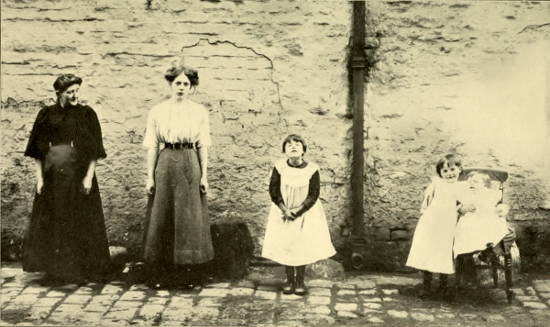
FIFTEEN CHILDREN, FOUR LIVING. FATHER AN IRON MOULDER.
The family is not connected with the Women’s Co-operative Guild.
(Reproduced by kind permission of the Medical Officer of Health for Liverpool.)
I am afraid I cannot tell you very much, because I
worked too hard to think about how we lived. When
my second baby came, I did not know how I was going
to keep it. When the last one came, I had to do my
own washing and baking before the week-end. Before
three weeks I had to go out working, washing, and
cleaning, and so lost my milk and began with the bottle.
Twice I worked to within two or three days of my confinement.
I was a particularly strong woman when I
married. There is not much strength left. But, thanks
be to God, I have not lost one. I have two girls and
three boys, every one strong and healthy.
The firm my husband worked for failed; then for the
most times he did not work; but I can truly say that
for the most part of twenty-five years 17s. per week was
the most I received from him.
Wife’s allowance 17s.; five children.
I dare say I could write a book on my early struggles
with my seven children, and a miner’s home to contend
with; and many a week my husband has not had a
penny of wage to bring home, besides the experience of
three big strikes and many small ones.
I may say we were married nineteen years before we
lost one, and then I lost my baby first, a grand little girl
of two. Then, a year and a half after, I lost a fine lad
of fourteen in the fever hospital, of scarlet fever and
diphtheria. Two years after that we lost a girl of twelve
from tubercular disease of the kidneys from cow’s milk.
The doctor was treating her for eight years for Bright’s
disease of the kidneys. I brought them up breast-fed,
so she must have contracted it after she was weaned.
Such a clever child she was. So you will see we have
had our troubles.
I may say I had very good times at confinements,
except the first and the last. The youngest was born
feet first, which was an awful experience, and her heart
was nearly stopped beating; so I think that left her
heart weak, and she cut her teeth with bronchitis. I
used to get up always by the ninth day until the last.
I was between forty-one and forty-two when she was
born, so had to rest a bit longer, but had to see to
household duties as soon as possible.
I am firmly of opinion that if the State wants strong,
healthy, useful citizens, they should provide the mothers
in the homes with sufficient wages where the husband’s
wage is inadequate. Nor should married women be
allowed to work outside the homes for some stated
period before and after childbirth. The men should
demand a decent living wage to provide for them at
home.
Seven children, one miscarriage.
I can safely say that had there been a centre to which
I could have gone before my first boy was born I should
have been saved the terrible torture I suffered both before
and after confinement. I was very ignorant before
marriage, and went away among strangers; and when I
became pregnant I did not like to say anything to a
strange doctor, and I had no lady friends whom I felt
I could confide in. So I went about with an ulcerated
stomach, sick after every attempt to take food; and
when my baby came, I nearly lost my life. He was
also very delicate for five years after birth, wholly due,
I am convinced, to the state I was in whilst pregnant.
With the other two boys, I have always had to get
about too soon. The month I have always had to have
a woman in the house, during which time I have been
absolutely helpless, being a terrific expense.
The doctor has ordered me to lie down for two hours
each day, but that is absolutely impossible for a working
man’s wife when she has two or three children around
her, meals to provide, and the washing and cleaning, etc.,
to do in the home.
I speak from my own experience, and I know that
there are thousands of women who are a million times
worse off than I am, for I have the best husband in the
world; but his nor any other working man’s wages won’t
pay for help in the home at a cost of at least 12s. a week
and food. On the very day my first baby was born my
husband was thrown out of work. This was kept from
my knowledge for five weeks, and I am sure you will
guess all the scheming he used to keep me in ignorance.
He had his club money for the period he was out of
employment, which amounted to 9s. a week.
Wages 25s. to 30s.; three children.
I have just heard of the following case: A poor woman,
only twenty-eight years of age, was confined last Wednesday
with her seventh child, all living. She has been
allowed to live until this affair is over in a deplorable
cottage that is condemned. She has been living quite
near for about four months, but I and my neighbours
have never seen her nor the two youngest children, aged
two and a half years and fifteen months, and we are
now told they have no clothes to come out in. These
two children were born in the workhouse infirmary.
We hear that the father, a hay-carter, only did six
weeks’ work in a twelvemonth. He must be a most
brutal man. He was fighting the poor wife only a fortnight
ago, as if she were another man. The poor thing
lies there with only an old sheet and quilt for covering,
and a poor woman who is attending to the other children
has taken the blanket from her own baby to lend her.
The very night the baby was born the midwife had to
send for a policeman, the husband was carrying on in
such a dreadful manner, and was worse afterwards,
because they would not let him have the Insurance
paper that had just been filled in by the midwife for
the Insurance.
Judging from my own experience, a fair amount of
knowledge at the commencement of pregnancy would
do a lot of good. One may have a good mother who
would be willing to give needed information, but to
people like myself your mother is the last person you
would talk to about yourself or your state. Although
mother nursed me with my first child, I never said one
word to her about it coming, except the bare date I
expected. I felt I couldn’t, and outside people only tell
you what garments you need, and just the barest information.
I have learned the most useful things since
my children have grown up. The youngest is nine.
The idea that you impress the child all through the time
with your own habits and ways, or that its health is to
a great extent hindered or helped by your own well-being,
was quite unknown to me.
At the time I fell with my second child we were in
very bad circumstances, and feeding my first with a
bottle, I stinted myself all I could to give him plenty;
and having moved from one house to another two
months before the second one was born, I overdid myself,
with the result that I was bad for a week before he was
born; and then, the birth being such a long time about,
a clot of blood got down into my ankle, and before I
got far over the confinement I was laid up with a bad
leg, which the doctor said was due to the child being so
long coming into the world. I should say I had a midwife
this time, as I could not afford the doctor’s fee.
Had the midwife called in the doctor, as she should have
done, I might have been saved a lot, for my back has
never been right since. Whenever I get very tired or
not very well, I always feel it in the place where he
seemed fixed. So I feel that if young mothers knew
more of the need for care of themselves, and what should
be done for them at the time of childbirth, much suffering
could be saved.
Wages 18s. to 32s.; three children, one miscarriage.
I have only had the three children, and have been
married thirty-two years. In the first place, I was only
twenty years old when I had my first baby, and must
confess that I suffered a great deal through ignorance,
but am pleased to say that I always had all that was really
necessary, as regards doctors and nursing. I may say
that my husband and myself were quite agreed on the
point of restricting our family to our means. If we
had not done so, I could not possibly have reared my
eldest girl. I was able to have good medical advice
and give her plenty of attention day and night.
I may say that I have disgusted some of our Guild
members by advocating restrictions. I think that it is
better to have a small family and give them good food
and everything hygienic than to let them take “pot-luck.”
Wages £2 to £3; three children.
I feel very keenly myself on the ignorance of young
girls getting married and having babies, because I am
quite sure some of my sufferings and the death of my
babies need not have been.
When my first baby was brought into the world,
within a few days of my twenty-first birthday, after
three days’ labour and agony, the baby was nearly dead.
I can hear now the slaps from that doctor on the child
to bring life into him, and my own cry of “Let it die;
do not beat it so.” He lived, a lovely boy but a cripple,
for nine and a half months, admitted by the doctor to
be through the long hours of labour.
A strong point has always been mine that doctors do
not give sufficient advice to young mothers. I had to
go through the same suffering with my second child,
born an epileptic, living three months. My next three
girls are alive to-day, spared, I honestly believe, through
my own experience, and the fact of having more humane
doctors with instruments. My last baby was literally
torn from me. The doctor told my husband he could
not save both. They dare not chloroform me, and so
I had to bear it. The doctor said I must never have
another child. I never have, but why should I have
suffered? My first doctor could have said that I was
not fitted. I had a good husband, a fairly good income,
but when I think of poor women with probably indifferent
or bad husbands, how do they live? If our scheme
could be brought forward, what a help to know that a
woman after a bad time could have a longer rest! Oh,
the feeling of knowing that the nurse has gone, and you
must wash and dress your own baby! Whereas if the
mother could be helped—and the money could do this—how
nice she would feel, as she could rest with her little
one, after having made it comfortable, by having some
help with the housework!
We want all our mothers to teach their daughters,
not to keep everything from them, as it was kept from
me. If we can only get expecting mothers to attend
maternity homes—to see they get a good nurse, not a
tippler: they should be banished from the profession....
I thank God that a band of good women are working on
the maternity scheme for women.
Wages 32s.; five children.
I had a very natural confinement with both, and a
short, sharp time of labour with the first, rather more
lingering with the second. My first was what they call
a dry labour, and a very sick one—the worst the doctor
had had—and it was very exhausting to me. The best
times are bad enough, but I was told by the nurse that
mine were good times. With the first she stayed a
month, and the second three weeks, being called to
another case. I think I was very fortunate in having
a good mother, who always taught us from childhood
how to live to be healthy, and both my sister and I had
natural confinements through following her advice when
young; that is what makes me so keen on “Moral
Hygiene.” Young women do not take care or have
proper exercise enough. Ordinary work does not do
the harm. I did all my housework and the washing
right up to the time of confinement both times, but I
did not whitewash or do papering, as I know some do,
and then wonder why they miscarry. Another one I
know of insisted on the doctor giving chloroform, as she
was sure she would never get through it without. Of
course, I am very active, while some are indolent, and
that has a great deal to do with it; and I made a practice
of getting outdoor exercise every day, if not too far
towards the end of the time, and at great inconvenience,
as with the boy I had piles very bad, and often had to
stop a moment or two before I could go on, but of course
it was at night when I went out. I also had heartburn
with both a short time, and a bad attack of indigestion,
which I never suffer from at other times, but which the
doctor soon relieved.
Two children.
There is a great deal of unnecessary suffering entailed
on the woman during pregnancy by lack of not knowing
what to do, or how to do it, such as having all her
own washing and work to do, especially in the latter
stages. When a man is only bringing home about £1
a week, and has two or three children, it is impossible
for the mother to get proper help or even food. I think
it would be a very good thing if something could be
done to lighten that burden. I am not speaking as one
that does not know. I have had it to do myself, in my
early married life, but, thank God, my lot is changed
now. I have had eleven children, two still-born, and
one miscarriage, so have gone through it. I also think
we should try and do something for the mothers after
childbed, as many have to be about so soon after, and
no doubt that tends to weakening the mother, so that
she cannot give her child proper support, and cannot
recover her own strength. I do not think any woman
ought to attempt anything like hard work until she has
had at least a month’s good nursing and support after
confinement, but it is impossible to do it on a man’s
pay at £1 or 25s. per week. I have always felt if I could
only have another week or so of rest I should feel a
different woman, and I am sure most of my poor sisters
feel the same. I also think that if children were naturally
fed it would be all the better for them. When I
was pregnant I would have given anything to have had
a good sleep during the day. I used to think it was
idleness, and try to shake it off, but I do not think so
now, and would give every poor woman all the rest she
really needed.
Wages about £1; nine children, two still-born, one miscarriage.
I was brought up in the country with a cat and a dog
for playmates, so when I went among other young
people, I was very shy, and never made girl friends.
That may account for my ignorance in the things that
mattered at the time of my marriage, at the age of
twenty-one and a half. My husband was just as ignorant,
and we had to pay very dearly for our ignorance.
I was married about eight weeks when I became ill; I
went to the doctor and took a lot of physic, but was no
better, then I would not have any more from the doctor,
and tried to doctor myself, but I was very ill the whole
of the seven and a half months that I was pregnant.
The birth was a forced one. I was taken very ill, and
knowing baby should not come for six weeks longer, I
was bearing the pain as well as I could, just cheering
myself that it would be less to go through when the time
came, when my husband came in and would insist on
getting a doctor. We tried a new one this time, who
lived quite near. He had just left the infirmary, and
we had heard he was very clever in maternity. When
he saw me and questioned me, he sent for the nurse.
The rest of that night is too terrible to go through even
now after twenty-eight years. Suffice it to say that
next morning there was a poor little baby boy with a
very large swollen head dreadfully cut, and a young
mother dreadfully cut also. One would have thought
the trouble was over now—anyhow, we thought so, but
we found it had only begun. A week or two after the
pains began. I thought it was all right, that I had not
got quite well. At last I had to go to the doctor again.
He told me I was going on all right. At the end of six
weeks the nurse called. I told her just how I felt, and
that the doctor said it was through the bad confinement
I had gone through. She told me to tell him to
come and examine me thoroughly, that there was something
growing there. He came, and when my husband
saw him afterwards, he said, “Oh, there is really nothing.
There is a little hardness there, that is all. Your wife
is very nervous.” My husband told him that I was anything
except nervous. However, I went on for eighteen
months, never knowing what moment those terrible
pains were going to take me. Many times it was in the
street. I was in bed about eight months out of the
eighteen. Then came a very terrible time, and my
husband called another doctor in, and I was ordered into
the B. Infirmary at once. I got better. I was home three
months, when I was carried in again. They said it was
ovarian trouble. They wanted to operate. My husband
asked them how long I might live as I was. They said
I might live for years, but I would always be subject to
these attacks. He told them he would rather keep me
as I was than risk an operation. On inquiring the cause
of the trouble, I was told by the nurse it was confinement.
I went on in much the same way until my boy
was ten years old. Then I had to be operated on. It
was a case of life or death then. But if I went into the
Infirmary I could not choose my doctor, so Dr. ——
offered to do the operation free, but I would have
to go into a private hospital, which meant a good deal
to us, who hardly knew which way to turn for an extra
shilling then. However, my husband insisted that
Dr. —— was to do the operation, and by letting everything
else go he managed to get the money together
by the time I came out, which was three weeks at
£3 3s. per week and £1 7s. 6d. for the second nurse.
The trouble was a multiple tumour; it had grown round
about the intestines. They had to tear the one from
the other. After leaving the hospital I was in bed for
three months, but it was a complete cure, though no
one except my husband expected me to get over it.
Dr. —— told me I could not have gone through a more
serious operation unless I had had my head taken off,
and then there was no hope at all.
Now I maintain that if we had understood things relating
to married life, all this could have been saved. I would
not have starved myself and child before birth for one
thing, and I would have been more careful on washing
days not to lift tubs or jump to reach lines, neither would
I have cleaned windows and a hundred and one other
things that a pregnant woman should not do, and, above
all, we would not have had an inexperienced doctor.
I must just tell you that my husband has always
been husband, nurse, and mother. The pain was never
quite so bad when he was near, and no one ever made
my bed like him.
Our income, until baby was six months old, was
£1 6s. per week. Then my husband got out of employment—was
out four months. He took up an agency,
and did a very little with it, but with that little and
about £2 12s. 6d. we had managed to save, and pawning,
we got through without going into debt until he got
another job. This lasted about eighteen months, averaging
about 30s. per week. Then for about twenty months
he averaged about 10s. per week. Our home went then a
thing at a time, but we got through at the expense of
our insides and outsides, without help or debt, except
doctor’s bills. Then we came to this town on £1 7s.;
after a few years £1 9s. The rise came just two
years before I underwent the operation. We had our
home to get out of that, and had to get it on the hire
system (or borrow from friends, and we both objected
to borrowing). Some people say drink is the cause of
poverty, but I think you will agree with me when I say
we had not enough to drink. Our rent would work out
at about 6s. per week. I think this is what you want.
Of course, things are very much better with us now,
and have been for the last twelve years, both in health
and finance. I just want to add that although the first
half of my married life was so hard and painful, I would
not have missed one bit of it, because it has all helped
to make me understand things that matter from a
practical point of view. If there is anything more I
can help in I shall be pleased to do so.
Wages 26s. to 30s.; one child.
I rather shrink from talking about myself on the
subject, but if my remarks would help any young
mother, I don’t so much mind. My husband’s average
wage was about 24s. a week.... I helped in the work,
as his earnings were not nearly enough as the children
came. I had four children at intervals of about two
years, whom I was able to nurse, but although I had no
illness during pregnancy, with my fifth baby I had a
very long illness through the doctor hurrying the birth,
instead of giving nature a chance, and he was rough in
handling me. Now, the result was a three months’ illness,
and my baby had to be brought up by bottle.
What was still more serious, I was so injured that for
nearly ten years I was an invalid. During that period
I had two premature confinements, and several slight
miscarriages. Then I got a little stronger, and finally
my sixth baby was born without the help of a doctor,
because I was so afraid of a repetition of what I had
suffered. I am glad to say I gradually recovered, although
all my friends thought I would never get well.
I think every expectant mother should have a duly
qualified nurse to attend her. I had several miscarriages.
There is a better chance now than when I was
having my family. Good nursing is necessary. I
rejoice to know that the Guild is pressing forward on
this matter.
Wages about 24s.; six children, one still-born, several miscarriages.
I have had four children, and all were born one year
and a half after each other. My two eldest died in one
week from whooping-cough, age five and three. Two
of my children were still-born. I was very young at
the time, and only wish this Maternity Scheme had
come out years ago. I have a good husband, but we
are childless, I am sorry to say. I am on many committees,
and take a great interest where children are
concerned.
Wages 18s. to 27s.; two children, two still-births, one miscarriage.
I have had two children. I never was so well in my
life as I was during pregnancy over my first. A bearing-down
caused hæmorrhoids. However, I was not troubled
greatly with them then. My second child was born one
year and seven months afterwards. Now all the time
during pregnancy over him I was thoroughly ill. My
work was a trouble, and altogether I was ill. But as
pregnancy is never thought a sufficient cause for even
having a holiday, I simply struggled on for fear of being
held up to ridicule. You see, I was only twenty-two
years old then, and thought that the only way to do
was to show a brave front, even though I felt almost
too ill to do anything. Well, I had to have chloroform,
and again I had to have instruments; and my children
would never be born naturally, for my womb is in the
wrong place, the doctor says. I had also a trained nurse
who despaired again of my life.
I was in bed one month for maternity and was unable
to do my work even when I did get up. I could not
mother either of my children, for I never had any milk.
That was a grief to me. I had hæmorrhoids again through
bearing down, brought on through pregnancy, and from
these I suffered for three years and doctored for them.
Then I had an operation and had them removed. I
have not had more children, neither do I want them,
as the doctor fears my life will pay the forfeit. I had a
serious operation for tumour in the womb four years ago,
and have been much better in health ever since.
Two children.
My first child was born ten months after my marriage.
My husband’s age at marriage was twenty-eight years,
and my own age twenty-five years, and we are both
Londoners, residing all our life in the city of London,
until my first-born attained the age of eleven months.
My children have been born quite healthy, and the
doctors have said fine babies. But I am pleased to say
I am a mother who has had no terrible sufferings to
relate as to the sufferings of a long period of labour.
Two hours and a half has been the time from the very
first stage of labour, until the appearance into this world
of each of my children. And I would say, personally,
women were never created to suffer as many a one does.
I made this remark to my first nurse, and she said,
“You are right.” I had been told such experiences by
women who had had families. It is nature, and nature
does or should do its own work, she said. Take, for
instance, the apple. When it is fully ripe, it falls from
the tree. So the child, when the time has arrived for its
appearance, I say it should come as naturally, not to
look upon the little creature distorted and bruised
through having to be brought into the world.
My strong conviction is, as soon as a woman feels the
slightest pain she should have immediate attention.
You are strong at the commencement, and able to give
the help in bringing your baby, but if allowed to go on
for hours your strength is exhausted, you have lost
that power and vitality which you require, that
after hours of suffering artificial means have to be
resorted to.
My second child was born at N——. The doctor did
his own work and the nurse’s too, arriving and leaving
the house in half an hour, my mother just taking the
baby until the nurse had time to get in the room.
Now, by my third child I will try to show where I
think much is at fault by not having immediate attention.
My little daughter was born in D——. My
husband had at four o’clock to fetch the doctor and
nurse (a qualified midwife) nearly two miles away; no
other reliable nearer.
They resided a stone’s-throw from each other. But
on bringing the nurse and explaining while she dressed
she was to call the doctor, she would not hear of it, and
fairly repudiated the idea of such a quick confinement,
sarcastically saying, never in her experience. Well,
the doctor was not informed. Previously on engaging
them I made it quite clear how my boys had been born—so
quickly. In D——, I may say in passing, indiarubber
gloves are worn by the nurse on receiving the child,
and like all rubber things in these cases have to be boiled
before using. Nurse arrived. Every single thing was
ready for her. There was a bright fire, and every
possible article to lay her hands on, baby’s clothes on
the horse airing and warming.
She looked at me in my agony, and said: “Oh, not
likely to come off yet, ma” (to my mother), and sent the
old soul out for a saucepan to boil the new gloves in.
Well, it went on for a time, until I felt my pains were
leaving me, and I would not trouble any longer; I was
tired. But I thought, no. Why should I suffer?
I called to my husband, and he came to the bedroom
door, and I said: “Fetch the doctor, I want attention.”
He went. The nurse said: “Well, I know you have the
whole day to go by the look of things. Doctor will be
very cross. He is very busy, and does not like being
brought out of bed. He knows everything is right when
I am on the case.” I felt another little pain, and I made
another effort, my breath almost gone. I called to
her, boiling her gloves: “If you do not leave those
blessed things, the child will be here.” She flew to me,
laughing at an unnecessary fuss, but my child was entering
the world, two minutes after my husband had left
the house, but, being certified, she did the doctor’s work.
But she could not get the afterbirth, and pushed and
fairly punched my stomach most unmercifully to get it,
and I said: “Well, nurse, I really cannot stand this any
longer. My two previous doctors had said, never be in
a hurry for this. Let nature have its course; it will
come in time. The doctor will be here soon, and he will
soon get it.” The doctor had heard and come in, and
told the nurse to see to the baby, who was bitterly cold,
and he would see to me. In a very few minutes I was
quite comfortable.
The doctor was very cross at not having been notified
by the nurse that she was on her way to me, knowing
the statement I had given when engaging them.
If there is truth in it or not, I was told later that if
all was over and done with before the arrival of the
doctor, the nurse was given something out of the fee.
I might say, having my mother with me, I only required
the nurse night and morning, and this nurse only
went out like that, because she had so many cases she
preferred them so. But it happened I did not see her
one evening during the time, and on the third day she
did not put in an appearance at all, and on the Sunday,
two o’clock; other days the times ranged from twelve
till three o’clock when she came.
My confinements have been splendid ones, but for all
that I feel it is almost, if not quite, three months before
a mother feels her strength the same as before. What
women feel like who have to turn out shortly after to
work hard, I would not like to imagine.
I personally have always felt, besides not having the
usual amount of strength, I have been very forgetful;
for instance, I would go to the cupboard and quite forget
what I had gone for, and have to stand and think for a
little time, and then very likely not know. During
pregnancy, my health was always very good, and I was
able to do all household duties and washing right up to
the time of my confinement. But towards evening I
would be tired all over, and be thankful to go to bed.
But I usually took a glass of hot milk at bedtime. I
found it not only soothed the nerves, but induced sleep.
I took a dose of castor oil once a fortnight.
I have nursed all my children for ten months, not
allowing a particle of any kind to pass their lips in the
way of foods but my own milk until nine months old,
and then gradually weaned them off.
I have stated above feelings to show what a woman
feels who does not endure great sufferings in childbirth.
My strong conviction is that unless there is anything
wrong internally, and a woman takes a bit of care as to
what she eats and drinks during pregnancy, and has, as
I say, immediate attention, much suffering would be
alleviated.
I am the average working man’s wife, who spends most
of her time looking to the needs of an old mother, husband,
children, and home, cutting and contriving to
make the weekly income go as far as one possibly can,
attending the Guild as quite a change, and seeking to
obtain as much knowledge of the Women’s Movement
on to Progress; and where, here and there, I may be
able to pass an opinion, I do; and try to live, that when
I have passed away the world will be none the worse
for my being in it.
Wages £1 15s. to £2 5s.; three children.
I had seven children and one miscarriage in ten years
and three months. This left me at the age of thirty a
complete wreck. My great difficulty was during pregnancy,
suffering very severely from sickness, so much
so, indeed, that on two occasions I was under the doctor
the whole of the time. The doctor gave me his services
free.
I tremble even now to think what my life would have
been but for his kindness to me. I could not have paid
for a doctor, as wages were only £36 a year, and I had
to pay £10 a year rent out of that. When I look back
upon those days I wonder how we did live.
My last child was born a delicate, weak child, who
suffered from malnutrition until she was eleven months
old, and at her birth the doctor told me I should never
have another strong and healthy baby, and that women
should only have a child every three years, and rest at
least a month after confinement. He knew I could not
give myself the rest I needed, for I could not afford to
pay anyone to look after my home and children. I
had to rely upon some child of thirteen who was able
to leave school, and whose parents were glad of the
2s. 6d. a week I could ill afford to pay. I have been
forced on many occasions to do things no woman lying-in
should have done. I have left my bed on the tenth
day, and have had to do the family washing as early as
a fortnight.
I do feel most strongly that women should be able
to get advice and help during pregnancy. Our children
are a valuable asset to the nation, and the health of the
woman who is doing her duty in rearing the future race
should have a claim upon the national purse. Ample
provision should be made so that she could give of her
best.
Wages 10s. to 14s. and husband’s food; seven children and one
miscarriage.
I have only had two children. I was married at the
age of twenty-three. My husband was twenty-five. I
had been married just eleven months when my first
baby was born. Now, as soon as ever I knew I was
pregnant, I set about (with the help of a considerate
and helpful husband) taking the greatest care of myself
for the sake of the babe unborn, in such things as diet,
exercise, fresh air, etc. I did no very heavy work. My
husband and I did the washing in the evening, he did
all the dollying and wringing, and helped me in many
ways. The result was I had a fine and healthy baby, and
during pregnancy I was so well myself, and I had everything
a working man’s wife could have to make things
as easy as possible. I had no worry of any kind, and
that I consider a great comfort to a woman.
At my confinement I had a doctor and a nurse, and
if I had not had what I believe is called a dry labour, I
should have had the easiest of times (and they are bad
enough), but the water broke at 6 a.m., and my baby
was not born till 4.30 p.m.
My baby was never the slightest trouble. I had been
in the nursery before I was married, both as nurse and
nursery governess, so my baby had all the care and
attention I had been taught to bestow on babies. I
was sorry to find, when my baby was a year old, that I
was again pregnant. I had breast-fed my baby up till
then, for she had cut no teeth till she was eleven months
old, although she was strong and well and running about
at nine months old; of course, I weaned her at once.
We were very disappointed to find I was going to have
another baby so soon after the first. We had not
intended this to happen. However, I made the best
of it, and had a son when the daughter was eighteen
months old. I was not so well carrying the second
baby, and he was as great a handful when a baby as
my first baby was no trouble, and by the time he was
six months old I was very weak and ill. I think having
the two children so quickly, and nursing my first baby
so long, had been a great strain. The second child was
not so strong a baby as the first. He suffered from teething
eczema, and I lost a great deal of rest. My second
confinement was fairly good, although I had thought the
baby was coming two or three times before he came,
labour pains came on and went away; and when my boy
was born the doctor said if he had been another half-hour
in the birth, he would have been dead. I should
have sent for a doctor a week previously, but not knowing
the exact time to expect my baby, I did not want
to send for the doctor until it was really necessary.
I never had any more children. I was ill and weak
for a long time while having to nurse my second baby,
and having them so quickly. How women, and poor
women, can have children year after year, is a marvel
to me. I know of cases here close to where I live,
where a consumptive mother is having babies nearly
every year. To me it seems terrible, bringing such
children into the world, a burden to their parents, to
themselves, and to the nation, for they are only wrecks,
and fill our hospitals, mental deficiency schools, and
prisons. But the cases are so common. Where they
are poorest, where they have not enough to live on and
keep their present family decently, they still have more
children.
I am sure there is great need for thought and care
being given to the mother previous to childbirth and
afterwards, and I do feel that a scheme as is suggested
is a good one, and that the public health authority
should deal with all maternity cases. It would mean
untold happiness to the coming generations. It will be
grand to get a maternity benefit such as you suggest,
and it is most necessary. We have some women in the
Guild who feel we should be more independent than
take such sums as maternity benefit. They do not
realise that we pay rates and taxes just as property
owners do, though indirectly.
How some of our poorest women exist year after
year, bearing all, I cannot understand. For, if having
two children, as I did, in eighteen months wrecked my
health, which it did for a long time—and only through
having one of the best of husbands was I helped to pull
through—I wonder what so many other less fortunate
women suffer. It is just slavery and drudgery.
Wages 28s.; two children.
For what I can see of others, I came off fairly well;
but, in the first instance, my first child was a girl. I
was very well during pregnancy, but being such a strong
child the doctor told me to give it the bottle; but, on
the other hand, the nurse persuaded me to keep it to
the breast. The result was as soon as I got about, by
keeping the child to the breast, I had two gathered
breasts. I had the two breasts in slings till they broke.
The next two being boys—two years between—I was
right well during pregnancy. But as soon as a mother is
able to get up and have to work, that is the time her
health fails her, for she finds she has to feed the rest of
her little family, and goes without her own food, and
then, through lack of nourishment, often mothers have
to go to their bed again.
In the first place, when we were married my husband
was a fireman. We ran along smoothly, and up to the
time my first and second child was born his standing
wage was 30s. a week and overtime. The time went on,
and in two years the second was born. Now, just before
it came it was my husband’s turn to go to pass for
engine driver. The result was he failed to pass the eyesight
test. It was a great shock to us both, more so
to my husband. It was then the dots they had to count
at a distance. They then reduced him to 21s. a week
to work in the shed, so we thought it was cruel to run
the risk of more family on such a wage. To keep my home
up and keep the children respectable I had to take in
two young men lodgers, which we have done till I
started the children to business. Of course, I take it
you don’t want to know the ups and downs of life between
these times. I must say I have had the best of
husbands, or else I should not have been alive now.
If there could be such a thing as a Maternity Club
started it would be a benefit to all married women,
because the majority of us have to screw and save for
confinement, where we ought to be able to have good
food and more nourishing food while we are carrying
the child, but often have to go with less.
Wages 21s. to 30s.; three children, one miscarriage.
Your letter to hand reminding me of my promise to
let you have a few details of my neighbour’s life. At
first she hesitated about telling anything, as she said it
was all past and done with, and at times felt ashamed at
having had thirteen children, especially to a man like
her husband (who is a drunkard). She looks back on
her past life at the age of forty-eight with different feelings
to what she had at thirty. Then she thought it
was her “lot,” as she terms it, to have so many children,
and so many sickly ones, but now she feels she has been
to blame for many things—for instance, for the number
of children she has had; for the dulness and lack of
energy in two of them; for the feeble-mindedness in a
third; deafness and sore eyes in a fourth. She blames
the conditions under which she bore those children
during pregnancy. She was married at nineteen, and
a mother before she was twenty, with no knowledge
whatever of the duties of motherhood. Her first five
children came in rapid succession. While she was
pregnant of her sixth child her husband fell out of
work, and was out of work six months. During this
time they had 10s. a week to live on (from the husband’s
trade union). She went out washing and cleaning-up
to the last week of her confinement. While cleaning
windows at one of the houses she slipped and fell, hurting
her side. Three days later the child was born,
apparently all right, but as time went on the mother
noticed there was something wrong, but nobody seemed
to know what. This child did not cut its teeth till two
years old, nor walk without help till it was seven, and
now, at the age of eighteen, you can hardly make out a
word he says. He is not exactly an imbecile, but he is
feeble-minded, and all this could have been avoided
could the mother have had proper nourishment during
pregnancy, and less work. The mother had to work
hard all day, and got little rest at night, as the fifth
child was weakly and ailing, and the neighbour who
looked after the child during the day used to put gin
in its milk to stop its crying, which it did till the effects
of the gin had passed off. The poor mother, not knowing
that gin was given to the child, would often, after a
hard day’s work, spend most of the night pacing the
bedroom floor, trying to soothe the fretful child, and
often had to go downstairs because the crying disturbed
her husband. It was not until her sixth child came,
the feeble-minded one, that the neighbour admitted
giving it gin. Consequently the lad has grown up dull,
never made any headway at school. He is a labourer,
and twenty years of age, and will never be anything
else but a labourer, because, as his mother says, he
has no “head-piece,” and cannot do a simple sum in
arithmetic to save his life. The mother firmly believes
her children would have been as bright as anybody’s
could she have had proper nourishment during pregnancy,
and herself cared for them after they were born.
Her girl of sixteen is deaf in one ear, and has weak eyes,
the after-effects of measles when a child. The mother
nursed this child a fortnight, then was obliged to leave
her with a neighbour while she went out to work. The
neighbour neglected the child in letting her run out too
soon, etc., and as there were no school clinics when her
children went to school, some of them are suffering
to-day from diseases which might have been cured,
could they have had attention at the proper time. Now
that they are grown up they seem fairly healthy, though
undersized, but when one considers their childhood, the
want of sufficient food, lack of fresh air (the younger
ones always slept four in bed, two at the top and two
at the bottom), one wonders they are as healthy as they
appear to be. They seem to be fairly good workers,
but not one good scholar among them. And to add to
the above discomforts, they had a drunken, brutal
father. He was never a real father, a surly, gloomy
man, never a kind word for his children, and not one
of them remembers a caress from him. I can quite
understand the woman being ashamed of bearing
thirteen children to a man like him, and having to rear
them in surroundings and conditions which she has
reared hers. It takes it out of the mother mentally
and physically.
Wages 16s. to 30s.; thirteen children.
I am perfectly well aware of the urgent necessity of
both mother and child receiving proper nourishment
and attention. With regard to myself, the one great
drawback to me was the fact that I was not able to
suckle any of my children, owing to my breasts not being
properly developed, so that the child could not draw the
nipple. In consequence of this my children had to be
fed by the bottle, although I am pleased to say they
have thriven and are quite healthy children. Also,
prior to confinement, I suffered very much with varicose
veins, and felt the need of not being able to have rest,
as I had got to be about my work. Also, after confinement,
I have been about again in a fortnight, which I
should not advise young mothers now to do. I may
say that I do think that getting up so soon is the cause
of all the misplacements that we hear so much about.
However, I am pleased to tell you that I am fortunate
in having a considerate husband, which of course
is something to be thankful for. My heart aches when
I think of women who have brutes to contend with. In
my opinion, women should have every kindness shown
to them during pregnancy; also means to obtain advice
and everything to insure that the unborn child shall have
a good start from birth.
Wages 28s. to 40s.; three children.
I am a very busy body, and have not been blessed
with a great deal of this world’s goods, having had an
ailing husband, whom I lost when the youngest was
not two years old. But at those times mentioned in
your circular I always enjoyed good health. No sickness,
as so many women have; of course, days when not
feeling quite well. But I do think many women do
not give themselves a chance. They seem to give way
too much to feelings, and lie about instead of interesting
themselves in their work and always keeping hands and
minds employed. I had heavy labour times, but did
not keep to my bed any longer than I could help, generally
feeling able to be up after the fourth day for a little
while; then each day a little longer. I often think
lying in bed weakens very much, and if able to rise, it
is much better to do so, both for baby and self. Of
course, not to work as though you had not been through
a trying time, and needed to be careful, but at the end
of ten days I was always able to do my own work all right,
at the same time being able to take good plain food, and
making an abundance of milk for the baby. They were
such well fed, fat, healthy, happy, contented children,
and I never lost a moment’s sleep in my life with them.
I never used myself to take stout and beer to make milk,
as many of the mothers in the North believe in. In
the North here, the working class mothers have to work
very hard, and they all seem (or in a general way) not to
make a trouble of child-bearing. They do not coddle
themselves, but just work a not-up-to-the-mark feeling
off, which is certainly by far the best way. And about
the care of baby, cleanliness is the first care. Then
mother’s milk if possible, and with perseverance, most
mothers could manage to diet themselves to make plenty
of milk, but the bottle is the laziest way. Then, of
course, baby can be left in another’s care, whereas if on
the breast, you must take baby with you. I have never
had an afterpain after any of them, and soon pulled up
again. Once the instruments were used after a weary
wait, but I think the women who work have the easiest
time. With my last baby I had what made me think
of labour pains, every night for a fortnight, and when
she came I had only about three pains, and she was born
before I could rap for help, and no pain whatever. Do
you not think I have been one of the lucky ones? But
really many in this condition are like children. They
do not want overmuch sympathy or they reckon themselves
martyrs straight away, instead of bracing themselves
to go through a time of weariness. I have not
come across in my experience any who have suffered so
acutely, unless in one case, where two of her babies grew
to her womb, and had to be brought away by force.
Another woman had a big, broad-shouldered husband,
and was herself a very small woman, and it was a case
of force every time, and she has had fourteen children,
and the same to go through every time, but was able to
be up soon, as she soon mended and regained her strength.
Two children.
I have been a very healthy woman, and pregnancy
never upset me very much, but I think if the Maternity
Scheme had been in force when I was having children
it would have been a great benefit to me. Being very
poor, I had to get up on the third day, three or four
times, not being able to pay for someone to look after
me. My first baby I was locked up in a morning at
half-past four, food put so that I could reach it until
my husband came home at four in the afternoon, to
help myself with everything with regard to the baby.
My second was just the same. After that we removed
a bit nearer the works, and I did better. We were a
very comfortable lot of neighbours, and we always did
for one another. I don’t say that it was not very hard,
because it was, and a little money help would have been
a great boon to some of us more than others. With
regard to wages, it is rather a sore point. My husband
has earned a very good wage nearly all our married life,
but he is a born gambler. I never had £1 a week, and
a great many times I had nothing, so that when my
children began to work, it took years to pay for what they
had to have to be brought up. I have had ten children;
nine alive at the present time; six married; three
have received the Maternity Benefit and have found
it a great help, and feel that it is a credit to everyone
who helped to bring so great a scheme about for the
benefit of the working man’s wife.
Wife’s allowance less than £1; ten children, one still-birth.
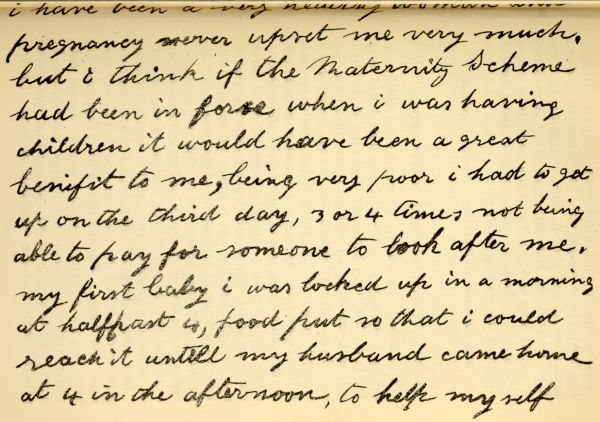
Facsimile of Extract from Letter 106.
I have had two children. I might say I felt better
during pregnancy with the first one than I had ever
felt in my life, but I had a very bad time at the birth
with instruments, and after three years, when I had the
second one, I never felt well, and did not seem to have
strength enough to drag through day after day. But
I, like a good many more, could not afford to go to the
doctor; and with the second baby I had to have instruments
again to bring the baby into the world, after
which for about eight months I never seemed to regain
my strength, and life was a weary existence. Also,
I am sorry to say, I had not one of the most careful of
husbands, and have always had to make my own provision
for the time on £1 a week, and very often nothing,
as at that time he would think nothing of staying out
all night, and gambling away all his week’s earnings.
I have always struggled and managed to keep his club
paid, so that I had the 30s. from the club to pay the
nurse and doctor. For the rest, I have happened to
have two good sisters near to me, who always did
whatever they could for me, but as to nourishment, I
have never been able to get much of that, and have
always thought that was what kept me back. I have
fortunately been very handy with my needle, and have
been able to earn a good bit at times by taking in needlework,
or I don’t know whatever I should have done.
But I am pleased to say, that since I had a breakdown
last year, about this time, and was sent away for one
month through our Guild Convalescent Fund, my husband
has been very much better. I think he had time
to find he missed me. Of one thing I am quite sure.
I have had as big a struggle as a good many of my
womenfolk, but where some have no friends and no
talent for earning, I have been more fortunate in being
able to do so. I may tell you that when I joined the
Guild, nearly five years ago, I had very nearly lost all
my spirit, and felt like giving in altogether, but the
Guild has done a lot for me in that sense, as I have felt
that I must go on doing my duty, and fighting for the
right, although sometimes it is very hard. Still, I have
always the Guild to look forward to, and have found
amongst our members some real good friends, and I
shall never forget the great benefit I have felt from the
thorough rest and change of the month at the Rest
Home. I feel a different woman. Although I am not
over-strong, still, I have regained my strength, and a
little more energy. I had one miscarriage five years
ago, at ten weeks, and my husband was out of work, so I
did not have any doctor, but had to keep about and do the
best I could, taking just whatever rest I could get. I
was months and months getting strong again.
Wages 24s. to 26s.; two children, one miscarriage.
As regards myself during pregnancy, I have always
been extra well, which I daresay is due to the fact of
having been in a position to be able to have all that is
required—rest and help in the home, and good nourishing
food. Others who are not in the same position have
my heartfelt sympathy.
Four children, one miscarriage.
I am very pleased to say that, having one of the best
of husbands, I suffered nothing during pregnancy, only
ailments of my own caused through my mother having
to work in the brickyard during her pregnancy with me.
That, I am sorry to say, is the cause of my own and
sister’s illness—working hard, knocked about, and poorly
fed, a good mother, but a rogue of a father; and that
thing will go on until women give up hard work during
pregnancy.
During the first three months of pregnancy with my
first baby I suffered fearfully with my head. Then, as
time went on, I gradually got better, and able to do my
work, and felt quite strong until about the sixth month.
Then water began to trouble me; my feet and legs were
very much swollen, so much that I could not get any
boots on, and had to remain indoors the rest of the time.
On the day of the birth I commenced with pains at
six o’clock in the morning, and I went on all day, until
a quarter to seven at night, and I was getting so weak
that the doctor asked me if he might use the instruments.
I was glad to have them, but they gave me a fine putting
up. The doctor said that my baby could not have been
born without them. No doubt it relieved me at the
time, but I suffered afterwards, as I was all torn with
the instruments, and had to be stitched. I was so weak
afterwards that I could not get up on to my elbows,
and it took me a considerable time to get my strength
up again. At the same time my husband was in bed
with an attack of typhoid fever. We had no hospital
in our district then. My doctor was very much afraid
that I would contract the disease, but I am thankful to
say that I escaped. With my second boy I was in good
health all the time, and had a quick birth, and without
instruments. That was two years and two months
after. About four years after the birth of my second
boy I had a miscarriage, which I reckon are worse than
having a baby, as they nearly drain your system and
you suffer severe pain, and it makes you very weak. I
always blamed the miscarriage for an attack of nervous
debility I had. I first commenced to lose flesh, then
my nerves were affected, and I got so weak that I used
to faint away several times in the day. My doctor
ordered me away for a change, and to get into company,
as I was getting so low, but it took me a long time to
pick up. About nine years after the birth of my second
boy I had a girl, which I am pleased to say put new
life into me; it seemed to renew my whole system. She
is now eleven years old, and quite strong and healthy.
Wages 27s. 6d. to 42s.; three children, one miscarriage.
I have been one of the more fortunate women; being
fairly strong, my sufferings have not been so heavy as a
lot of poor women. At the same time, I was often so
poorly that if I had had means to get a little help at times
it would have been a blessing. My husband has never
earned more than from 23s. to 25s. a week, and many a
time I have had to go without many a thing that would
have done me good. When I was expecting my last
baby, I think it was with going such a long time, and
the others, some of them at work, and coming in to
meals. I know I used to get the dinner cooked and
struggle through the serving, then I was done, and was
obliged to lie down a bit, often without my dinner, as I
was too exhausted to eat, and the pleasure of the rest
was partly spoiled by the thought of the dinner-table
still laid. A bit of help then would have been a boon.
But having a good husband smoothed many things over.
But this shows that many a woman is unable to do her
work, and if the husband is a thoughtless man, or even
a bad one, her lot is a hard one indeed. Then, after
confinement, women should not be obliged to work, in
my opinion, for three weeks, but most working women
have to do. I never could possibly keep a woman more
than a fortnight—and the struggle during pregnancy of
saving up 30s., which was the sum we always aimed for,
and it was a big job. Some weeks I have had to be
content with putting 3d. away, with the hope of 9d.
next week to make it into a shilling. To my mind, this
is one of the hardest tasks a working woman has.
Wages 18s. to 25s.; seven children.
I am afraid many mothers, like myself, will find it
almost impossible to explain our sufferings. During
pregnancy we do not all suffer alike, but to me it was
nine months of misery. But I had to work all the time.
My husband’s wages were only £1 a week, and he had
to lose all wet weather. With my fourth child he was
out of work twelve weeks in the bitter winter. I worked
as dressmaker with a machine nearly night and day,
and when the baby was brought into the world with
instruments, I nearly lost my life, and could not be
moved for nearly a fortnight. My ninth son, I was
working at a lady’s house when near my confinement,
and in putting down a carpet I hurt myself very much,
and was very ill until my baby was born, and then he
was born a cripple—would have always walked on
his ankles, with the soles of his feet together. But I
used to take him to the hospital for a long time, and he
is able to get his own living now. So you will see it
takes all energy and hope and joy out of a woman’s life,
when they have to work the whole time through no
fault of their own or their husbands, but just to keep
the home together.
Wages £1; twelve children, one still-birth, four miscarriages.
I have only had one child, a daughter, who is now
six years. I had been married eight years when she
was born, but have had no miscarriages. I was very
well when I was pregnant. The mothers in the Guild
were most kind in advising me during pregnancy, at
the time and after. I weaned her at nine months, and
she is one of the bonniest girls one can see.
My husband, when in work, earns a good wage. It
has been his experience to be out of work many times,
for varying lengths of time—once for fourteen weeks—that
soon after our child was born.
In an agricultural district, large families and small
wages predominate. I am the second child of a family
of twelve, and as my father’s earnings were very small
it always meant my mother working too—hop-tying,
gathering fruit, harvesting, and even picking stones off
fields. As soon as each of us was old enough we had to
work very hard; at ten and eleven years of age I worked
in the fields, and did shaving poles, etc. My mother
had to pay 9d. and 11d. per week school money, out of
her little, for us, and I am thankful to her for educating
us as she did, never keeping us away to mind babies, as
a great many did in those days. I am nearly thirty-nine
now, and free education had not come in then.
Wages 24s. to 40s.; one child.
I remember it was a very big struggle to get all that
was quite necessary for ourselves and the expected baby.
Although my experience was far before thousands of
others—should I say, women, when I was only just
turned eighteen?
In the first place, I felt a doctor would be too expensive,
so only had a midwife. Things were not just
right with baby, so I had to call in a doctor and pay
£1 5s. My nurse I only engaged for a fortnight,
then thought I could manage, but I took cold, and had
a most awful gathered breast, and had to go back to
bed again for another week or two. When my baby
was five months old I began to turn against my food;
was nursing baby at the time, so did not think for one
moment I could be pregnant again, but it was so. When
the second one came, the first was unable to walk, I can
assure you. You need not wonder at women doing all
they can to prevent having big families, for there is
certainly no rest for mothers night or day.
I can tell you I saw but very little pleasure the first
part of my married life. I married in 1884. I had two
children, lost one, and lost my husband by consumption
in June, 1887. He needed the best of everything. It
used to cost nearly 5s. per week for one sort of medicine
he felt did him good, so you see there was very little to
do with. I was only twenty-two when he died. I
believe now, when I think about it, my baby could have
been spared had I had more experience; although I did
my best and was a good mother, as far as lay in my
power, but there was no one to advise me. So you can
imagine ours was one continual struggle from beginning
to end, and then not so bad as many others. When I
look back on that time I feel very sad. I believe my
husband was in receipt of £1 5s. per week, but I am
not quite sure; he was a policeman, so it was regular,
and of course not many clothes to buy. Living in a
village, our rent was small. This will, I am afraid, be
little to assist you, but it is all I can tell you. It would
not be possible to tell you all one feels with one baby
and the expected one, and all work to do. No one
could imagine who has never been through it.
Wages 25s.; two children.
With regard to myself, fortunately I have always had
the proper care, with the result that I had normal times.
My first child (a boy) died when he was eight months
old. My health broke down, and he had to be taken
from the breast, no food agreed with him, convulsions
set in, and my loved one died. I was three years, then
had another (a girl). Two years and nine months after
that I had another girl. Both these are now fine young
women. The proposed scheme to “link up the State
with the home and the municipality under one authority”
is just what is wanted in all towns and cities.
Much suffering would be saved and many lives spared.
From the advice that mothers have been able to get
at the “Baby Welcome” here, many babies’ lives have
been saved. But this is voluntary, and a fortnight ago
a week was set apart to go from house to house for subscriptions
in every district, as the work could not go on
without funds.
Wages 27s. 6d. to 35s.; three children.
I have not had any children to bring up, but I have
had the misfortune to have had eight miscarriages, the
last one as far back as 1898, when I had to go to the
infirmary for an operation, and I have not had any
since. But you must understand they have not been
brought on by neglect or ill use, but by my having a
severe attack of influenza in 1891 before I was married,
which left me with weakness of the womb. I had to be
attended by the doctor every time.
No child, eight miscarriages.
I have had two average children—one a boy aged
nine years, the other a girl aged four years. As regards
pregnancy, I had general good health—though I felt
rather faint at times in the first and second month—up
to the seventh month, and then I used to feel rather
bad some days—cramp in my legs, etc. I have been
able to keep my house going up to the time of confinement
(my husband being a mechanic, I had to do the
housework and washing and cooking). I must tell
you I am a teetotaler, and during pregnancy I used every
morning to take fine groats with plenty of milk. I
still took them every morning and evening after my
babies were born, and I had sufficient milk for them
until I weaned them, starting from ten months and
finishing them altogether at one year. Neither of them
had any fits or convulsions, my boy’s first illness being
at the age of five and half years, and my little girl
has not had an illness yet. At the present time they are
both well in health. I think I should dearly like to see
State maternity nurses, for this way there is the greatest
difficulty in securing a nurse. I know from one or
two of my friends and from my own experience we were
all greatly worried at not being able to secure good
nurses. As you are aware, many of them drink, and
others don’t care to come when there are other children
to look after. I had a doctor, and had to pay 14s. a
week for a nurse. I think expectant mothers should
not be allowed to work in factories, etc., when they are
pregnant, for you want as much fresh air as possible.
Taking an average year, with all holidays, I think
my husband’s wages would amount to 35s. weekly.
He is in the black line and a Socialist, and we both cannot
think how working people, especially Co-operators,
can be otherwise.
Wages 35s.; two children, one miscarriage.
As you will see on the attached form, I am not able,
as a mother, to give my experience of suffering during
pregnancy or after childbirth. I was able to have
good attention both before and after the birth of my
boy, so that any special information other than the
ordinary childbirth pains I cannot give.
I suppose my experience will go to prove that proper attention
to health, such as you wish expectant mothers to
have, would do away with a good deal of the suffering and
pain connected with maternity. The opinion of myself
and my husband is that none but skilled doctors and
nurses should attend at childbirth. I have known
many cases in our district where the ordinary midwife
has had mothers in pain for hours, only to send for a
doctor in the end.
One child.
Nothing unnatural or unusual seemed to happen in
my case.
Wages 35s. to £2 5s.; three children.
I will give you the following concerning my married
life. First let me tell you I was in the place I was
married from just five years as children’s maid. I was
twenty-five, my husband twenty-six the day we married.
Many, including my relatives, thought I ought to have
married better. I had been engaged previously, but
he turned out to be not the God-fearing man I thought.
Then our married gardener asked me to tea, and I met
my husband that is now, a true follower of Christ. And
I must tell you, the two years we courted we only missed
Church twice. I soon saw he had won my heart, but
his wages was then poor, but I remembered my dear
mother’s words—money does not bring happiness;
and so we were married against the wishes of my friends,
and took two rooms and furnished them. But, oh! I
soon found out how hard it was to keep our little home
on 24s. a week, 7s. for our two rooms. Then I got a
night now and again waiting at table with the lady I
had lived with and her friends. How I pleaded to be
kept all right, as I could not see our way clear to have a
baby in the home, and I would not, could not, let any
of our friends know the hard struggle I had. I have a
dear, loving husband, who agreed we would like a baby,
but had no means of providing for it. I must tell you
I had bad health (bloodlessness) before I was married,
which cost me a lot of money. Then when we had been
married two years I found I was in a certain condition.
I hid my condition, and went still waiting at table, until
after a big dinner I fainted, and had to own I was so.
Then came the shortage of money. I began to stint
myself in order to provide for my little one. Many a
time I have had bread and dripping for my dinner before
my husband came home, and said I had my dinner, as I
would not wait. Then I was ill, and had to have the
doctor. He said I was run down, and away went some
of the little store I had been able to get together. I
would not let my friends know how we stood, remembering
what they said before I was married. Then
came headache after headache, as I worried to know
wherever was all the money to come from to provide
the funds for doctor and nurse. My sister, who was
very proud, and unmarried, engaged me a nurse at
14s. a week for three weeks. She thought she was helping
me by seeing that I had a good nurse, but this only
added to my worry. Then my husband, thinking to
help me get the money, had a knitting machine on the
hire system, and made socks and stockings. I had to sew
up the toes and press them into shape. I could not get
them right for a long time, and this added another worry,
as we had to pay each month for the machine, which
was a failure. I worked hard at them right up to the
time my boy was born. Oh, my poor head, how it
ached, as I tried and tried to do them right; and we only
got 2d. a pair for making them, and my husband used
to walk to the city to the shop with them. (They found
the wool.) I had a very bad confinement, and the baby
was almost gone when it came into the world. I had no
strength to go through. The doctor would not allow
me to see anyone for nine days. This was twelve years
ago. My boy, although fat, suffers so much with his
head. He had a brain and nerve breakdown two years
ago, and was ill eleven months. One day the doctor
said: “How were you when you carried this child?”
Painful though it was, I told him all. “Ah,” he said,
“now we know the cause of all this trouble.” I have
suffered with my head ever since. His heart also is
slightly affected. If only I could have gone to someone
who would have understood, not my relatives, and
got some nourishment. All this that he now suffers,
I am sure, is the result of my having to work and worry
so much while I was carrying. I might say the nurse
was very extravagant, and the second week I lay so ill
I missed a photo machine my husband had, and learnt—oh,
it is almost too painful to write—that he had
pawned it for 7s. 6d. to help get me nourishment. He
said: “Never again will you go through this. You are
too dear to me.” Well, six years ago, my boy being six
years old, my husband had got on, and his wages increased.
We had a little girl, which we had always
longed for, only to lose it as soon as it came into the
world, for I have no strength in my inside (the doctor
said) to bring a child into the world. All this weakness,
you see, the result of the first confinement. Of course,
now, the doctor says it would not be safe for me to have
another child. I have a dear loving husband who does
all in his power to keep me right. But it is hard to
think if I had another it would go or be delicate. Now
is there not great need for a place where a young mother
could go and get advice and, if necessary, nourishment?
I was one who thought I could do a lot on a little a week,
and when I found out my mistake would do anything
rather than let my friends know their words had come
true. I remember when carrying my baby to have to
wait for a loaf of bread until my husband came home
at five with his money, as I always paid down for all we
had. I must tell you we have been married fifteen years
and are very, very happy.
Wages 24s.; one child, one still-birth.
During these times I have been well looked after, and
had quite natural times.
Wages 23s. to 45s.; three children.
I was married one year and five months before my
first boy was born. I nearly lost my life. I was in
labour from 1 o’clock in the morning until 7.5 at night.
Then the doctor used instruments. He stated I had
worked too hard, and not rested sufficiently, but I could
not afford a girl. My husband then was only getting
£1 1s. per week, and 5s. rent had to be paid out of it.
The second baby came fifteen months after.... I had
no milk for either. I was in labour with the second
from Monday dinner-time until Tuesday night. Then
the doctor gave me an injection of warm water; as I
was torn so badly before, he did not want to use the
instruments. Two years after I had a miscarriage....
I then had to lie in bed for a whole month. I kept a
small girl, and I used to do my own ironing and knead
my bread in bed unknown to the doctor. I had a bed
put down in the small parlour to save the girl and
children running upstairs. I feel sure that if I had had
a maternity benefit then to help me, I should not be
suffering now inwardly. No mother can stay in bed
very comfortably knowing things are going on anyhow
while she is in bed. Then, again, during the time she is
carrying the child, her mind is troubled, and she becomes
fretful, hence a fretful, delicate child. The mother, when
funds are low, goes without much food, pleading headache,
etc., so as to try and blind her husband. I think
an expectant mother should rest at least half an hour
every day, and especially towards the last should have
no heavy work to do, such as washing and ironing. The
extra weight she is carrying naturally throws the
humours into her legs, the veins standing out like thick
cords, and at night she cannot sleep for cramps and
aches. The child is the asset of the nation, and the
mother the backbone. Therefore, I think the nation
should help to feed and keep that mother, and so help
to strengthen the nation by her giving birth to strong
boys and girls. She does not require weaklings, and
insufficient food and overwork and worry is the root
of this weakness, both in the case of mother and child.
I only hope that sick visitors should see that it is the
mothers that are getting the benefit of the maternity
benefit, and not the husband, and often the landlord.
Wages 20s. to 23s.; two children.
My experience of child-bearing has been very painful,
owing to an inward growth. Each confinement was a
very critical time—in fact, with the last one I nearly
lost my life, and was told by my doctor never to run
the risk again. Fortunately for us all, I have a thoughtful
husband, or, of course, it would have made the home
very unhappy. During the time of pregnancy I used to
put a little away every week, perhaps one week tea,
another sugar, and so on, as my husband’s wages were
small, and I could not go out to work, not being strong.
I am sure the 30s. the mothers get now would have been
a great boon in my case. It would have saved a lot of
worry as to ways and means. No one knows what it
means to a mother at such times, what contrivances she
has to make things eke out. I think myself half the
suffering in after-life is brought about by worrying to
make ends meet at such times. In my own case, how
much I have to be thankful for with a good, steady
husband! I honestly think no woman should have less
than £1 per week for housekeeping purposes, and how
many thousands have far less! I should like to see all
workers receiving a living wage, as then I think most
of the trouble would be met.
Wages 20s. to 30s.; three children.
I have only had four children, but I am pleased to
say I have had what we call comfortable times. But I
must tell you, since I had my second one, my husband
has only earned 16s. a week. I have had a very hard
struggle to get through, but, thank the Lord, I have done
it. If the Maternity Benefit had been in force, then
it would have made it much better. I think the scheme
is a beautiful thing, and I think the women should have
it. But we have not all got the same kind of husbands.
Mine is a very good husband. I was very queer after
my last was born, but what could you wonder at—that
money to keep six of us? But we are getting over the
hardest place, I hope. My eldest is thirteen.
Wages 16s. to 22s.; four children.
I have been married seventeen years, and have had
four children. My first, a boy, was born two years after
marriage. The second was twin boys, born two years
and six months after the first. One of these was still-born.
During the whole time of second pregnancy
I was very ill and unable either to work or walk about
without great pain, the result of trying to do just the
necessary housework. At my confinement, the after-birth
came first, then the still-birth, and the living child
came last. This was very dangerous to me, and I was
unable to leave my bed for three weeks, and I was at
least three months before I was in my usual health.
My third child was born nine years after second (a girl)
the after-birth again coming first, the baby being born
nine hours after. She lived six hours, and was convulsed
from birth. The doctor’s opinion was that I had
worked too hard as a girl lifting heavy weights, therefore
weakening the whole system. It is high time that
something was done by the Government to lessen the
sufferings of mothers, which has always been hidden as
something not to be talked about.
Wages 36s.; three children, one still-birth.
I have not a word to say against any of my child-bearing
or pregnancy times, as I have been a strong
woman, and have a very good husband. But I always
provide for such times. I always had a doctor and midwife,
and someone to look after my home, and always
stop in bed a long time. I have not had any use for
instruments or chloroform. But one thing, I am a life
abstainer, and my mother before me, and my husband
is also, and I think this has a great deal to do with the
difficulties of pregnancy. I have always been able to
do my home duties, with the exception of washing, and
I have not always done that. I was twenty-two years
when my first baby was born. My youngest is now
eleven years, and I am in my fifty-second year, and am
enjoying splendid health, and am a busy woman.
Wages 24s. to 40s.; seven children.
I have not had or gone through so much pain and
suffering as many poor mothers have to go through.
It was during pregnancy I did suffer through my own
ignorance. I had a most devoted mother, and was carefully
brought up, but on this subject she failed. I was
the youngest of three girls, and not even my sisters,
who were both married before me, did I ever hear any
mention of this.... I was in my twenty-fourth year,
so I was not too young to be instructed. It would
have been very much better for my health if I had
received some knowledge of this. I feel so glad you
have given me this opportunity to just say something
on the subject. I have recently visited one of our
prisons, and find that the greatest number of women
and girls who have fallen through drink have commenced
to form this habit with it being given to them
when young girls, and again when they become mothers.
Of course, we know it is a weakness, but when a mother,
nurse, or doctor could just as well give them many
things which would do far more good for them, and
save them from this. If we could only rise up in a
body, we Guildwomen, and close the wine lodges, we
could save our young women! It is there where the
White Slave traffic often starts, and these women will
tell you. I could give you several accounts of these
poor downcast creatures, but I am afraid I would be
going away from the subject you are anxious to gain all
information. I was in Mrs. R.’s Home for Infants
yesterday, and I saw there quite enough to know what
kind of mothers and fathers those babies must belong
to. They do not get enough food or rest before these
mites come into the world. If we could have afternoon
classes for our young married women, and give them
good instruction and knowledge for them to be able to
be quite prepared to carry out when the time comes!
We have had in our Guild this session some splendid
evening lectures from doctors and nurses; but when I
call round before we have these lectures and ask the
young mothers to come to the meetings, they are busy
with the home duties or children, so I think afternoon
classes for a short time would do a great amount of
good.
Wages 45s. 6d. to 60s.; one child.
It is so long ago since I had all these babies, that I
almost forget, but I was married young, and was always
delicate on the chest, as I am still. I had children very
fast, seven one after another, not more than a year and
nine months between them, and in one case only one
year and two months. Then I lost a sweet little girl,
aged four years and eight months. She was ill a fortnight,
and I nursed her night and day. I was so done
up with attending her and the grief, that I had a dreadful
miscarriage which nearly cost me my life. I had to
work very hard to do everything for my little family,
and after that I never had any more children to live.
I either miscarried, or they were still-born. I have had
two miscarriages in a year, one in January and one in
August. My husband’s standing wage was 28s., but
he made a little overtime sometimes, which I always
tried to put by for doctor and nurse. The doctor’s
fee was £1 1s., and I had no nurse under 1s. a day—viz.,
7s. or 8s. per week, and their food, etc. I looked after
my husband and children well, but I often went short
of food myself, although my husband did not know it.
He used to think my appetite was bad, and that I could
not eat. I never worried him. He was steady, and
gave me all he could. You may guess I was always
scheming and planning to make ends meet, which was
not good for me or the unborn baby. But I always
tried to keep a bright face, and made the best of things,
and all my doctors have called me plucky. I wish I
had had the 30s. the mothers have now; it would have
taken a load off anyhow....
Wages 28s.; seven children, three still-births, four miscarriages.
I was married twenty-five years ago. My husband
is an agricultural labourer, and was then earning 10s.
per week, an extra shilling because he was the milkman,
and went twice on Sundays. Could you afford
more children on that? NO. His wages are now 15s.
per week, but we are now forty-seven years old. I
wish I could have had 30s. In my case it was one
year’s illness, nine months before and three months
after. With my last I had dropsy, and was quite unable
to walk for three months before baby was born.
There was no money coming in, only barely enough to
get bread and a small piece of butter or dripping for the
four of us. You will perhaps understand we did not
want any more family. We could not afford it. We
love children, both of us, and often say we wish we had
a larger grown-up family now we are getting into years.
Our silver wedding is next Christmas.
I am by trade a leather-glove maker, my earnings
helped to keep the home. The labourer of to-day is
not so well off as we were, although they now get 16s.,
as food is so much dearer.
With all good wishes for our nation’s welfare.
Wages 10s. to 15s.; three children.
After my first-born, everything went on all right, but
after my second, I was very ill with my breasts, but, of
course, I put that down to my husband’s lack of work.
He was thrown out for twelve weeks just as baby was
born, and, of course, it was a dreadful worry to me.
Fancy 10s. coming in for twelve weeks, 5s. 9d. for rent
out of it, and a new baby. I am not the only one, but
I felt I could never have any more, as much as I love
children, and now, after eleven years, the thought of it
makes me feel ill. During the time of pregnancy I
suffered dreadfully, and my heart goes out to all my poorer
sisters, and if there is anything I can do to help in any
way, I am at your service. Of course, I am far from
strong, but as long as I can, I am quite willing to help.
Wages 34s. to 38s.; two children.
I have been married thirteen years and have no children.
I have had seven miscarriages, all under six
months. My own opinion is that the first was brought
on by an unqualified midwife that I had to call in to
see me at a moment’s notice, for instead of letting me
lie quiet, she acted with me as though it was a full-time
child. And all the other miscarriages have followed
as the result of the first. My mother is a qualified
midwife, but was too far away at the time. I have
suffered untold agonies through these miscarriages.
My health is all undermined. The doctor has told me
that I would probably give birth to a full-time child,
but I should have to stay in bed for the first six months.
I am glad our Guild is taking up these things, for the
woman’s sake, for there is many a childless woman to-day
through neglect. I have consoled myself by adopting
an orphan boy, who is the sunshine of my life.
Wages 23s. to 28s.; no child, seven miscarriages.
The first part of my life I spent in a screw factory from
six in the morning till five at night; and after tea used
to do my washing and cleaning. I only left two weeks
and three weeks before my first children were born.
After that I took in lodgers and washing, and always
worked up till an hour or so before baby was born. The
results are that three of my girls suffer with their insides.
None are able to have a baby. One dear boy was born
ruptured on account of my previous hard work. Two
of my lads, one married is a chronic sufferer, and has
three children; another, the one that was ruptured, has
outgrown that, but he is far from a robust lad. I can
only look back now on the terrible suffering I endured,
that tells a tale now upon my health. I could never
afford a nurse, and so was a day or two after my confinements
obliged to sit up and wash and dress the
others.
My husband’s wages varied owing to either hot
weather or some of the other men not working. I have
known him come home with £3 or £4, and I have seen
him come home with nothing; and when earning good
money, as much as 30s. has been paid away in drink.
I had three little ones in two years and five months,
and he was out of work two years, and during that time
I took in washing and sewing, and have not been near
a bed for night after night. I was either at my sewing-machine
or ironing after the little ones had gone to
bed. After being confined five days I have had to do all
for my little ones. I worked sometimes up till a few
moments before they were born. I do hope I have
not done wrong in relating so much of my past, and
that it may be of some use in the furthering of our
scheme.
Wages £3 or £4 to nothing; ten children, two miscarriages.
I was married when nineteen years of age, and my
first baby was born just nine months after, and that
was before I was twenty. My second was born two
years afterwards, and, owing to ignorance, I got up too
soon after confinement, and it has left me with a weakness
that I suffer from now. I think that a woman is
anxious to get about too soon, but now that the Maternity
Benefit provides for proper nursing, women should be
made to understand that the money is intended for
themselves. It is more knowledge and help that women
need.
I hope that you will get a great amount of information
on this important subject.
Wages 20s. and house; two children.
First child, very sick early period, and when labour
set in kept it to myself; baby born before doctor arrived.
Got on well.
Second, through reaching high shelf, child had to be
turned, causing good deal of suffering. Child died at
three months, undergoing operation for nerves. Doctor
said caused by rick or strain at birth. Miscarriage
caused by fright. Did not understand it; got up next
day, went about usual duties.
Third child, usual symptoms. Fourth ditto. Second
miscarriage, hard work and lifting bath of water, being
very weak. Doctor said would have been twins. Fifth
child born on stairs, no ill-effects. Third miscarriage,
very ill. Sixth child very ill, caused by lifting out of
bed sick child. The bladder obstructing the way, and
child could not be born only by replacing it. Labour
lasting from Thursday morn until Saturday noon.
Seventh and eighth child quite natural.
When we were married, thirty-one years ago, my
husband was a framework knitter. Having learnt his
trade thoroughly, he was capable of earning from £2 to
£3 weekly, but we had only been married a fortnight
when, through the introduction of machinery, he was
out of work. In less than two years his earnings was
11s. to 16s. weekly. Our rent was 5s. 3d., but I let the
two front rooms. The third year he was out twelve
weeks, only earning 2s. 6d. the whole time. No one
would employ him; he looked pale, and his hands, owing
to using silk and cotton, were soft and clean. One man
told him he was not the sort of man for field-work.
However, he got a job as rural postman, earning 15s.
a week, leaving home 5 a.m., returning 7 p.m. In order
to supplement his earnings, he hired a room and mended
boots, but some people did not pay him, and he had to
give it up. Then a manufacturer found he could still
do with a little hand-work, but alas! things were no
better; some weeks he earned 20s., some weeks less.
There were five of us to keep, so I got some work from
the factory, and if I worked hard I could sometimes
earn 8s. I would rise at 6 a.m., get my housework done
by 10 a.m., sending the two little ones to school, and,
except for meals or attending to my little ones, worked
till 12 p.m. I was then within a few weeks’ birth of my
little one, but—oh, how can I tell you!—one night on
looking up from my work, my husband was looking
ghastly. But that looking up saved my life; he told me
after he was anticipating taking my life and my little
ones’ and his own. But he feared his courage would fail
him before he finished. I reached my Bible from the
shelf (it was my custom to read every night) and went
to bed. But think of it!—a kinder, better man it would
be difficult to find.
When I could not get shirt-finishing, I used to seam
hose—2¾d. for twelve pairs—and when my baby was
born I had 5s.; I gave it to the midwife. My husband
had influenza, and we were both in bed ill. He had
earned 8s., and I gave that to nurse and dismissed her.
The ninth day I was downstairs doing some washing—sitting,
of course—and I sent for some work, but could
not do much, my eyes were so weak. I never thought
to appeal to our friends to help us, but I wrote and told
of the birth and said work was very bad.
A builder wanted a handyman, and sent for my
husband, and gave him work—20s. a week. My
husband was so handy he kept him on as carpenter,
and he attended continuation classes with our elder son,
and from that he went to the Technical Institute, and
about eight years after we came to ——, he had learned
the second trade of carpenter, and gets the rate because
he is trade unionist, and has been ever since he started
as carpenter. It was he who tried to instil co-operative
principles into me, but I think it was the “divi” had
the greatest influence, and the rest I learnt in the Guild
room; and I say, God speed co-operation, the greatest
blessing possible for the people. We seldom ever refer
to our dark days, we are so happy now with our children.
The baby No. 8—it was all right. I could draw a £2 divi—the
most I ever had for confinement.
Wages 11s. to £1; eight children, three miscarriages.
Her husband was a bricklayer’s labourer, and the
woman did rag-sorting to help with the living, and used
to wheel sacks full of rags on a sack-barrow to the warehouse.
The wonder to me was that the babies were
born alive, though it was never stated that it was through
this that the children died soon after. My own impression
was that it had something to do with it. As a
mother myself I would not have dared to have attempted
to do what that poor woman had to do, and I am thankful
to know that something is being done to try and
alleviate these poor women. As a Bible woman who
visits in and out of the homes of the poor, my heart
aches as I see how some of these poor women have to
work during pregnancy, and how little comfort they
have at the time, and how soon they have to begin work
again, before they are fit, and I believe many poor women
suffer for life through having to get about too soon.
Wages 23s.
I do not know that my experience of child-bearing
has differed much from the women of my class. I was
a factory girl, and an only child. I was married at
twenty, and the mother of three children by the time I
was twenty-three. I was totally ignorant of the needs
of my children or how to look after myself as I should do,
and now I look back, I wonder how I muddled through,
for that is really what it was, a muddle all the time, and
it was more by fortune than wit that I have reared my
first two children to maturity.
When I look back to that first three years of my married
life, I wonder how I lived through it. I was weak
and ill, could not suckle my second baby. And then
a third baby coming along made my life a continual
drudgery, and to crown my misfortune my husband fell
out of work, and I had to do shirt work at home in order
to keep a roof over our heads. My third baby was
very tiny and thin when born. I put this down to the
worry and the shortness of food which I had to put up
with, and though he lived till he was three years old
and died from diphtheria. It was a happy release to
me, as he was an epileptic, and I thanked God, much as I
loved him, that he was taken from this life, where even
sound people have a difficulty to exist.
I do not think I was very different in my pregnancies
to others. I always prepared myself to die, and I think
this awful depression is common to most at this time.
And when bothered by several other children, and
not knowing how to make ends meet, death in some
cases would be welcome if it were not the dread of the
children. “How would they get on without their
mother?”
My husband was fortunate enough, just after the loss
of my third child, to get regular work, and I never bore
another child under such awful conditions. But I
believe that I felt the effects of it in all my other pregnancies.
After the first three living children, I had three still-born
children. I was six months advanced when I fell
downstairs over a stair-rod, which killed the child, which
was born after forty-eight hours’ labour, and perhaps
it seems wicked to you, but I was glad, because it left
my hands free for a time to look after the other two,
for I was fearfully weak and ill. After a lapse of two
years I had another seven-months baby born dead, and
again, after another two years, a five-months still-born
child, all three still-born children being boys. I had a
miscarriage after this of two months, and when I was
thirty-five years old had my last baby, who is now living,
nine years old.
I do hope you will not feel that this letter is morbid,
and that I delight in writing horrors, for I do not, and
had you not asked for information I should never have
written this all down. It is strictly true, and when I
look back to my early married life I could cry for the
girl who endured so much for life that was wasted. I
am fairly healthy now myself and have much to thank
God for—a loving helpmeet and dutiful children—so
please do not think I am miserable, for I am not, for I
believe—in fact, I know—that there is a brighter day
dawning for the mother and child of the future.
Wages 21s. to 30s.; four children, three still-births, one
miscarriage.
Mine is rather an exceptional case. Through being
left without a mother when a baby—father was a very
large farmer and girls were expected to do men’s work—I,
at the age of sixteen, lifted weights that deformed
the pelvis bones, therefore making confinement a very
difficult case. I have five fine healthy girls, but the boys
have all had to have the skull-bones taken away to get
them past the pelvis. Always a case for two or three
doctors, so you will know I have suffered something.
I wish more could be done to train young girls to be more
careful. Over my first baby I was eleven months before I
could walk again. A woman ought, in my opinion, to be
treated more or less as an invalid during pregnancy. I
suffered most with sickness and swollen legs, terrible
bad carryings. You cannot follow up with work as you
ought to do. I suffered with a terrible bearing-down
pain all through carrying. I often wonder how some
poor women do that have such very fast confinements
every twelve months and no care at all bestowed
on them.
Wages 20s. to 22s. 6d.; five children and five still-births.
My first baby was born before I was twenty. I was
a weaver, and worked hard until after the eighth month.
I had a very hard labour, and cannot tell you very
much, as I was unconscious before the baby was born.
The first thing I knew was my mother standing over
me trying to keep me awake. The doctor said I was
not to go to sleep for two hours, or I should not waken
again. The child was a big boy, and was crushed with
being born and obstruction. Then inflammation took
place, and he only lived four days. I was soon downstairs
again and at work. I was seven years before I
had another—a girl; then I had another boy. The two
are now grown up, and I have said good-bye to weaving.
I hope my two children will have a better time than I
have had.
Wages 19s. to 23s.; three children.
I know personally of many mothers who have had very
dreadful times of sickness all through the time, and
others who have not been able to have the necessary
food to strengthen them—some through having bad or
careless husbands, others through shortness of work;
and, I am sorry to say, those who have felt they would
not carry children, some because of bad husbands, others
because they felt they could not properly feed and clothe
those they had. There are three who lost their lives,
and another who has already had seven. These all
took some kind of drug, and of course did the work they
wanted it to do. The doctor felt sorry for this woman
and could not blame her. She has had difficulty in
rearing these seven. When she was able to get out, I
saw her and talked seriously to her, but she said:
“Mrs. ——, I will not have any more by him, and I should
not have cared if I had died.” She loved her children,
and has had months of sleepless nights with each of
the seven. It seems to me, had Government awakened
to its duty years ago, seeing to it that the mothers and
children should have what was necessary, mothers would
not have minded having the children, had they known
each little one would be provided for. We should now
have a stronger and healthier race of men and women.
One does not wonder at the sickly boys and girls one
meets in the streets, especially when one knows under
what circumstances they were born, and how and what
their mothers had to bear before they came.
I feel that we women ought to discuss this question,
because working women often suffer terribly at these
times with having to get up soon after confinement: I
myself being a great sufferer with bad legs through
getting up on the fifth day, although I had a doctor and
midwife to attend me. But I lived in a place where
the women and girls went to work in the mills, and
could not get a woman to stay in the home, and I was
often left without for many hours. When the midwife
came, she advised me to have a bottle of stout and
biscuits beside the bed; but I refused, because I had
never taken stout, and I thought no food better than
that. And I have trouble to this day with my legs.
Although well cared for during the last two confinements,
it has never remedied the unfortunate position
of the first confinement.
Wages 30s.; three children.
I have had a very large family (fifteen). Out of all
these confinements I have only had my husband in work
at the time twice. Several times he was sick, and other
times it was hard winters, and as he was in the building
trade, he could not work if very frosty or very wet, so
you will see that I have known what it was to be often
very short. With this result, that when my sixth child
was born, my health failed, which would not have been
the case if I had not had to go short. I also had so
much worry, and was unable at the time of carrying
the child to have any help, however poorly I felt. For
a number of years I was in a very weak state of health,
which the doctor said was the result of not being properly
looked after.
Wages 24s. and upwards; fifteen children.
I had my children several years apart. I must say
that I was much better in health during pregnancy, and
up to the time of the birth of the child was able to do
most of my work. Kneeling, I found, was the worst
thing, which I was careful to avoid, but a certain amount
of exercise did me good. But it was after confinement
that I had to be very careful. I could never sit up in
bed for a fortnight, and it was a month or five weeks
before I could come downstairs. That was the time I
wanted all the nourishment I could get. Of course,
there is a difference amongst women, as I know of some
that suffer for months before with dropsy and various
other things, then as a rule they are much better afterwards.
Much depends on what kind of a husband the
wife has. Worry must be a great drawback to a woman
in that state. I am thankful to say my experience
has not been a bad one, as all my children were
healthy and strong. A woman cannot possibly get
on if she has a bad, worrying husband. I think that
makes a lot of difference.
Wages 36s.; four children.
I am bound to say that I have never had bad times,
neither before nor after birth. Of course, I have tried
to obey the laws of Nature, taking plenty of exercise,
good plain food, avoiding constipation—all three very
essential things in such cases. Also, I have had home
comforts, a husband who has studied me in every respect
during the time. Some women are dreadfully sick all
the way through, which is much against both the child
and herself. I am never sick from beginning to end.
The most difficult thing at the time is securing a woman
who is able and willing to do housework, and look after
the woman at the same time; that to me is one of the
greatest problems in the Maternity Scheme to-day. If
something could be done to organise such women, then
it would mean much. A midwife simply goes and
washes the baby and sees to the mother once a day for
a week, but when the mother gets up, she often has more
loss, and therefore feels her weakness.
Wife’s allowance 18s. to 30s.; six children, one still-born.
P.S.—I could give you many very wretched cases, as
I am on the Guild of Help Committee, also the N.S.P.C.C.,
so come across a lot of sad cases—in fact, I have a case
on my list just now where the woman has had thirteen
children under fourteen years. Twelve are living, the
last two being born this week. I visited her before the
children were born, to see if she was having sufficient
food for herself and family, as her husband was unable
to work, suffering from nystagmus. She said she had
only been able to eat dry toast for weeks, her throat
and chest were so bad. The woman at this time is very
ill, and has two babies to consider. Her husband has
done nothing for ten weeks. These are the cases we
want to fight for.
I have had three children. There was one year
between the first and second, two years between the
second and third. I have had no miscarriage, and no
still-births. But I have been very ill at times ever
since my children were born. I can assure you that
some doctors are very neglectful at these times. This
you will see when I tell you about myself at these times.
My first child was a boy, and I nearly lost my life because
the doctor did not bring his bag containing the necessary
instruments for use at these times, and his home was
five miles away. So I can assure you I was nearly gone
when the child was born. Then, when I had the second
one—which was a girl—the very same doctor (there
was only one doctor within miles then) came nearly
drunk, and I had a frightful time. What is called the
after-birth had grown to my side, and he never got it
all away. I had milk fever first, and then childbed
fever. I lost all reason, never knew a soul for just
three months. Then I had to go under an operation
to have the substance got away, which left me in a very
bad way, the child being eight months old when I was
able to get up. And, still worse, I had nearly the same
thing to go through over the third, through not being
able to get a doctor, and had a midwife who was not
very experienced. I had to be taken to the hospital,
and the doctors told me there I should never have any
more children through the way I had been treated at
the last childbirth, and I was very pleased to hear it, I
can assure you, after what I had gone through. My
youngest child is just twenty years old, and I have
never had any since, but I love children, and I think
they are a blessing to every good mother. I know I
shall have to suffer while I live through being neglected
at childbirth. The Maternity Benefit would have been
a godsend to me while I was having children.
Wages 14s. to 20s.; three children.
I have only had one child, a girl, and I had a most
fearful time, which nearly cost me my life. I got up
and tried to get about, as I had only engaged my nurse
for three weeks, and I thought I must try, as time was
going on, and I was in agonies all the time. The doctor
had left me, and the nurse I had assured me it would
pass off as I got stronger, and instead I grew worse and
worse, until my husband would call in the doctor again.
I had a fearful time. The womb had got twisted, and
was lying on the back passage, and inflammation set in.
It was worse than a confinement. What I went through!
I was in bed ten weeks, and it was more than three
months before I could even lift my baby or do anything.
I had to be sat with day and night, and have nourishment
every fifteen minutes. The woman I had to nurse
me, who was recommended to me by the doctor, swarmed
me with vermin, and there I was helpless. Only my
husband and a neighbour to attend to my head, until
the doctor sent the district nurse, and she saved my life.
She was so good, and kind, and clever, one of Queen
Alexandra’s Nurses she was. I am so glad the Certificated
Midwives are doing such grand work. We have
one here in the town, and I may say she has all the cases
now, and is always very busy, and is so good, and clean,
and careful in the home. What we working women
want to-day is a friend in the time of need, not a
nuisance, the same as I had. It cost me nearly £20, my
illness. Had it not been for our little nest-egg invested
in our Co-operative Society, where should I have been?
What a blessing this Maternity Benefit is! I trust I
shall never require it.
Wages 27s.; one child.
My case was rather an extraordinary one, and emphasises
that the National Care of Maternity ought to
be brought into force at once. Through no fault of my
own, I suffered from St. Vitus’s dance, caused through
pregnancy, and was under three local doctors, and also
engaged a trained nurse, but at the last moment they
decided I must go into hospital, as my case was so bad.
The physician said that in a case like mine local doctors
were not worth six a penny, and if I had gone to hospital
at the commencement, I would never have got to the
state in which I unfortunately was. The local doctors
told me I could not be cured until the child was born,
but the physician in hospital said it was ridiculous. If
I had gone four months earlier, I could have been cured,
and come home for the child to be born. I had no
mother to give me advice, and the same makes me very
strongly in favour of Moral Hygiene being taught in
schools, so as not to leave girls ignorant of the functions
of pregnancy and motherhood. Cases like mine should
be brought to light in order that some poor souls in the
future will be saved from going through the same as
I did.
Wages 27s. 6d.; one child.
I really did not suffer much during that time, and
always had good confinements. I am one of the few
working men’s wives who have a small private income,
so I am thankful to say I have never felt the pinch.
I wish to give you a little on the sufferings of mothers
in pregnancy. I myself might say it is a matter of nine
months misery for me while I am in that condition. I
might say I was married twelve months when I had my
first—a little girl—and four years after we got a little
boy, a fine child, born. But I had contracted a severe
chill, and it was all on my chest; and having baby on
the breast, it drew the cold from me, and with that took
ill of catarrh of the stomach, and died at four months.
Being in a weak state myself, I again found myself
pregnant; but at the eight months the child was born
dead, it being the second boy. Two years after I had
another girl, but it was when work was slack, and my
husband could get very little work, and it became so
bad that we had to sell part of our home to keep ourselves,
and the time I should have had extras and somebody
in to look after me this was out of the question.
Now, two years after, again I had another girl (my last,
I hope). I might say that, although sick and ill all the
time I was pregnant, I soon got over it when the time
was up. I have known some poor souls go days and
weeks in their labour, and then have to have instruments
and chloroform, and after nearly coming to
death’s door have had to be stitched and syringed and
doctored for months.
Wages 20s. to 22s. 6d.; five children, one still-born.
I have been in the fortunate position of being able
to have every help at those times, added to which my
youngest child is turned twenty-six years, and time has
obliterated much that I suffered at those times. My
husband was earning 9d. an hour. We afterwards
started in business for ourselves.
Two children, one miscarriage.
I have not got one healthy child among my five, not
because I did not get well looked after, but they are
suffering through the past generation. My first child is
now a man of twenty-seven, married, but has had a
paralysed arm from two years old (a milder form of
which was a family trouble). The second one died.
My third, a daughter, is almost an invalid, through
nerves, and has developed a state of “catalepsy” whenever
she is overdone. She was trained to be a shorthand
typist, but is unable to follow out same, as it
excites her nerves. She is now a waitress, half time,
and teaches music, to enable her to keep herself. The
fourth suffers from congenital heart, and is always
ailing more or less. She is a dressmaker. The fifth is
now nine years old, and suffers from malnutrition, and
is always ailing, but a clever child for her years. We
have always been able to provide everything required
to keep them in good health. But in the light of the
knowledge I have got since I was able to grasp what
things are, I have often said I was one of the women
who should never have had children, as from a girl I
was always ill, right through my married life till now.
I have done child-bearing, and am now in better health
than I can remember. I was married when I was
twenty.
Wages 35s. to 45s.; five children.
I am glad you are trying to emphasise the need for
knowledge on the part of the mother, as my own experience
has proved that, given knowledge as to health
and the care of the body generally before childbirth,
much of the evil which now accompanies this perfectly
natural thing might be avoided. In my own case,
having always suffered considerably at every monthly
period, and not being of a particularly robust type, I
made up my mind to go into training before bringing
children into the world, in order not to have to pass
out at the same time, and leave them to the tender
mercies of others. Accordingly, I adopted a vigorous
system in order to harden the body, and soften the hip
and abdomen muscles, etc. This consisted of cold
sponge baths, followed by certain exercises while lying
flat on a mattress. Then a rubbing of the body in
sweet oil. The whole was done in ten or fifteen minutes
every morning. Vegetarian diet was strictly adhered
to, as this produces a cleaner, healthier child. My
nurse, who laughed at all my “fads,” remarked on the
fact that the child had not the grease, etc., on it at
birth which most babies have. A month before the
time of birth, I left off all bone-making food such as
bread, so that the birth should be easier, through the
absence of very hard bones in the child. As I did not
do my own housework, for exercise I walked twelve
miles every day in rain, snow, etc. The baby was born
in January, and the day before I took a ten-mile walk,
had my cold bath, etc., and that day fortnight was out
walking again, testifying plainly to the fact that a little
care and attention and knowledge will work wonders,
and the birth was a perfectly natural one.
Women make a great mistake in feeding overmuch
at this time, and bringing fat big babies into the world.
Mine were designedly small, but they made up for it
after birth, and will compare favourably with any now.
From the first month after birth they had cold baths,
sun baths, wore one garment, only wear two coverings
even in winter, sleep winter and summer in the open,
never wear hats or stockings. Shoes are only worn
occasionally, as they are barefooted in house and school.
The eldest is in her tenth year, and neither have had
anything but whooping-cough and measles when there
was an epidemic of these, and they had them lightly.
Women should be taught to give up corsets, which,
besides all the other evils laid to their charge, damage
the nipples. I nursed both my children, and my doctor
remarked on the splendid nipples I had for the purpose.
This was due to the absence of corsets, and to washing
them every morning in cold water, and then rubbing
the breasts with oil. I have seen women with scarcely
any nipples trying to feed babies, and have pitied both.
Wages of husband and wife £3 10s. to £4; two children.
My husband’s wages have been as high as £5 a week
and as low as 7s. in the winter, as they cannot work
either in the rain, frost, or snow. So it means saving
in summer to tide over winter. My hardest time of
child-bearing was when my last one was born, it being
the sixth child, all living. My husband had been out
of work for eighteen weeks when there was such depression.
I had to go out to clean and paper when I was
six months pregnant, and I am suffering with varicose
veins to-day as the result.
In reference to myself during pregnancy and confinements,
I suffered mostly with morning sickness, swollen,
aching legs, and a dragging at the left side, which has
always resulted in the after-birth growing to my side,
and has brought on a flooding before it could be removed,
but in all my confinements I have had a qualified doctor,
or I am afraid my life would have been lost.
Wages 7s. to £5; six children.
When I was married some forty to forty-five years ago,
there was no consideration as to the future conditions
of wifehood and motherhood.
In business myself, after the death of my dear father,
I married a business man, widower with four children.
I told him when I married I would not come into the
business; however, he gave me no rest until I came back.
I had to care for an invalid mother, that was why I longed
for a home again. I soon found out what a mistake
I had made. I had my children fast. One year and
five months between, and one year and seven months,
and much about the same with five children. My
husband was exacting as regards his children, but careless
of me. I had a very happy childhood; my father
was a good man, my mother a gentle creature. I lost
her, and then nervous debility set in through overstrain
and persecution. I lost a little girl from consumption
of the bowels. I was then a wreck. I began to recover
for my children’s sake, but I separated from my husband,
and took my four children with me, and began
to make a living for myself. He provided 5s. a week
for each child whilst he remained in England. He
went abroad, made money, left me to struggle, and
when he died, left me nothing; the money was willed
to each of his and my children. By that time there were
only two of mine left out of five, and four of his who
received their full share. I have had a troublesome
life.
In business; five children.
(a) Husband, labourer, but when at work spends most
of his earnings in drink. Now four children under six
years. The last one born died, aged five months, of
consumption. Mother consumptive. I should say all
the children are consumptive. Mother is, and I should
say always has been, in a starved condition. A woman
that would give the food to the children and starve
herself, having always practically two babies in arms,
and unable to go out to work, if she could obtain it, to
bring a little money in the home. It would also be
wrong to give her work, even her home duties being too
much for her strength. No help wanted for the man
in this case. He’s too artful to starve, but wicked
enough to live to continue a cause for anxiety. Nothing
but food or death of husband or wife will alter this case.
A sad case; a hard problem to solve.
(b) Husband, builder’s labourer. Wife employed at
laundry. Five children under eleven years of age.
Husband out of work ten weeks previous to wife’s confinement.
During the time the home depending solely
upon the wife’s earnings. Wife, owing to lack of
nourishment, in a very low, weak condition, and suffering
much from varicose veins. Fourteen days prior to
birth of child, being practically unable to stand, gave up
her duties at laundry. The following day a vein burst;
a very serious case. None of the previous children
are very strong; but what about the last one, with the
mother practically starved prior to its birth?
(c) A very similar case. Husband a labourer; work
uncertain. All money he earned goes into the home.
Eight children under eleven years. Woman always
much underfed, owing to insufficient money coming into
the home. She is never well.
I may say that I have been fortunate in being able to
have good care and a good doctor. Had I not been
able to have it, I should have certainly lost my life when
my still-born child was born. I was very ill for six
weeks after, and I know what an expensive time it was.
When I tell you that I am aunt to forty-seven nieces
and nephews, all of the poor working class, you will
understand that I have seen something of the struggle
with poverty at such times, some having to get out and
attend to the home before the child was eight days old.
Knowing all this, I am out to help do all I can to hasten
the day when every man, woman, and child shall have
all the good things of life which is theirs by right.
Wages average £1; three children, one still-born.
I think there is a good deal of room for improving a
mother’s condition during pregnancy and after childbirth.
I myself have had nothing to complain of, only
ignorance in things which made me suffer more than
I had any need to while I was carrying my children,
being young and away from all my friends; and my
mother, being one of the “old school,” thought it wrong
to talk to her girls of such things, and it always made
us feel shy of asking her anything. But my youngest
is now in his twelfth year. But I must say I have got
a good husband, and we made that condition years
ago, that as the boy grew up he would enlighten him,
and I was to do the same by our girl, who is now fourteen
years old. And one thing I think should be imposed
on mothers is to have a doctor at confinements, and not
to trust to midwives. I have seen a lot of neglect here
with different people I have been with at those times.
Certainly the midwife washes the mother after the birth
of the child, but not again is the mother washed until
she can do it herself. I think, myself, if there could be
a law to make every mother have a doctor, and to stay
in bed for at least ten days, and to be treated as an
invalid for another fourteen days, it would save a lot of
suffering. The women would get stronger, and not so
liable to have children so quickly. A case in point only
two doors away from me; the mother was confined on
the 21st; on the 26th she was getting about her work
as usual. Would a doctor have allowed that? The
person is only about twenty-three years of age, and her
last baby is only thirteen months old. Another case I
was called in to some years ago. I did not know the
person, only by sight. Her husband came and called
me in the middle of the night. When I got there the
child was born. No preparation had been made for
either mother or child. From what I gathered, both
parents had gone to bed drunk overnight. Isn’t it
awful, a woman getting in that state, knowing at any
time she might give birth to an innocent little baby?
It was not poverty that had brought them to that state,
as the man’s earnings were £2 a week, but all the man
and woman had thought of was drink.
Wages 36s. to £1; two children.
I must say I have been more fortunate than some of
our dear sisters. My husband always saw that I was
attended to and did not want for anything. I had very
bad times before and after, and was obliged to have
help in for several months, and after each turn it left
me with something or other. Once I lost the use of one
of my hands, and the doctor said it would never get
better, but however, I went to another doctor, and he
cured me in a few weeks. He said it was the nerves.
Our savings in the Stores have been a blessing to us,
and helped us over the stile more than once. I often
wondered how women could go out to work at those
times, when I could not do my own. I firmly believe
that if we could get better medical advice beforehand,
there would not be so much suffering, and no doubt if
I could have got better advice, it would have been better
for me. But, of course, I thought we must put up with
it, and they would only laugh at me. But however,
times have altered, but too late for me.
Wages 20s. and upwards; seven children, one miscarriage.
I have had nine children. I was two years between
my first three babies. I suffered least from these
three, but for about six weeks before birth, and six
after, I could scarcely get about—pains all over, with a
very bad back, and very much swollen legs and feet.
Being a little, light-made woman, my confinements
were very severe.
My fourth baby died when six weeks old—a cross-birth.
Was much torn in consequence, so had to be
stitched a good deal; was bad, and could scarcely get
about at two months after. Neither before for weeks,
nor after, could I have offered to have washed, baked,
or done any work of any moment. Every confinement
after this I got worse and worse. The same thing happened.
Very sick for three or four months before
confinement, pains all over, very bad back, legs and
feet very much swollen; could not lie in bed long at a
time, could get very little rest or sleep; impossible to
wash, bake, or do much housework. But had a very
good husband, who helped me all he could, and some
sisters who came in turn and did as much as they could
in my home for me. My husband’s wages were very
small at times, sometimes only 18s. a week, other
times £1 a week, and up to 30s. In my husband’s
trade wages is very much up and down. Then we had
a strike of eleven weeks, then short time for five months,
then out of work fifteen weeks; and when one of my
children was born three weeks, then over two years
working four days per week. So you see there was not
much money to get nourishment with. That all happened
during the time I was having my children, so of
course I was pretty put to sometimes. I could not
have afforded to get anyone in the house if I had had
to pay them all the time that I needed them, but had
to prepare for a nurse each time, as I had to have one
for a month at least, and after that month my sisters
help. We had to do the best we could.
My last two confinements I was not able to come
downstairs for about three and four months—no strength
to walk, no appetite, and with being so much torn had
then to come downstairs for a long time on my hips
(slide down, as it were). When able to get about, could
scarcely walk owing to my condition.
Wages 18s. to 30s.; nine children.
I have been one of those fortunate individuals who,
during pregnancy, have very good health. My greatest
suffering was caused by varicose veins, which, of course,
are very painful at such times.
I was blessed with a good mother, who gave me
good advice on the necessity of taking care of myself
during this period, and having also the best of attention
at confinement, and plenty of rest and good food,
neither of these being lacking. I can only imagine a
woman’s feelings under different conditions.
My confinements (five) were, however, hard, bad
times, brought about by some obstruction. This I
have always put down to the fact that at the age of
thirteen I began to learn dressmaking, which entailed
sitting long hours at a stretch, at a time when the bones
were in rather a soft state. A midwife whom I had
engaged as nurse during my last confinement quite
agreed that this was most likely. I could not say
whether this is common among dressmakers or not.
After confinement always seemed to me to be one’s
weak time, and especially with nursing mothers with
fine, healthy babies. I nursed four, the last being still-born,
and always found that about three months after
their birth my strength failed, and doctor’s advice had
to be sought, when with tonics he managed to bring me
right.
You see my experience will not be of much use to
you, but this is exactly how I have felt during these
times; in fact, during pregnancy it was much harder
for me to be still than to work hard physical work.
Wages just under £2; four children, one still-born.
In the first place, being short of money is one cause of
suffering. I am the mother of five children, three girls
and two boys. I have not had a doctor to any of my
confinements, but nearly lost my life and child’s through
the first one. The midwife was a qualified woman, but
addicted to drink (which I found out afterwards). I
was confined on a Thursday at 2.30 p.m., after many
hours of suffering, and she never came near me again
until late on Saturday night. Fancy me! Oh, the
horror of it makes me shiver when I think about it.
We were almost strangers where we were living. I
had my mother staying with me, but the night before
baby was born, she chopped the end of her finger right
off, which made her feel very bad. She was in pain herself,
and I was ignorant of the danger I was in, not being
properly attended to. Mother was afraid of blood-poisoning.
My husband was working nights at the
time. We, like many more, had not got a very good
start. He fell out of work about two months after we
were married, and was out for a long time. I had to go
to my home and he his, for from the first months of
pregnancy I suffered greatly. When he started and
worked again, I had to part with my machine (which I
had paid for before I was married) to pay for rent; it was
hard lines. Then he got work back, so we had to move
back again—another expense. So you will see we had our
trouble when baby was born. I had hardly got enough
of anything, let alone doctor’s money. I paid the nurse
7s. 6d. I had only been confined barely three weeks
when my husband was out of work again. The first
Saturday night I went out shopping after baby was
born, I had 1s. 7½d. to get meat, grocery, and all else
to live on till some kind friend came along, which was
my mother, her home being near. She brought me a
little rent, and a few shillings to carry us on for a week
or two. I was afraid to spend any till my husband got
work, which was after many tramps from place to place.
I managed to get some work to do, but caught a cold
and chill, which caused me to have a gathered breast,
which nearly killed me. I did not know my own for
days. They took me over from —— to ——, and
thought I should die on the way there. My father
soon had a doctor to see me. He told them it would be
a struggle to pull me through, but after a time I gained
strength to go back to ——, and as my husband had
got work again, he needed me at home. Then after a
year and ten months, my baby girl was born. I should
tell you I was twenty-eight years old when I was married,
and I had been married eleven months when my first
baby was born, and I can truthfully say I was ignorant
of anything concerning married life or motherhood when
I was married. In fact, when the midwife came to me
when I was in such pain, I had not the slightest idea
where or how the child would come into the world.
And another thing, I was not even told what to expect
when I was leaving girlhood—I mean the monthly
courses. I often wonder I got along as well as I have.
I will say here that I do not intend my daughters to be
so innocent of natural courses. I feel it is unkind of
parents to leave girls to find these things out. It causes
unnecessary suffering. I often wonder, when I hear some
of our women grumbling about the trouble and bother
of signing and getting the papers filled in for the 30s.,
how they would have been in my place, and how thankful
I should have been for it.
When my girlie was eighteen months, I had a baby boy.
I did think I had a handful; they seemed three babies.
A friend of mine had the little girl till I got up again,
which was generally ten days. Oh, what rest is there
for a woman when money is so scarce? They say,
“Don’t worry.” Well, what can you do? Well, I got
over No. 3 fairly well, as I had a young woman to
look after me for one week. I forgot to tell you, the
day after No. 2 was born, my husband was sent away
to work, so I did not see him again till she was ten days
old, and I had to borrow money to get along with till
he did come back. When No. 4 was born, I had a trying
time. Six weeks before she was born, my three
children were down with scarlet fever; two had it very
badly, but the one only very slightly; they came downstairs
on the Sunday for the first time. Then my baby
was born the following Tuesday. The children were
not allowed to see me, but the father had to look after
them a good deal, as I had his young sister to look after
me. I got up on the tenth day, and then my husband
had the fever. We were both ill in bed together. Then
I had another gathered breast. The doctor lanced it,
and it ran for fourteen weeks after. Then I had a
whitlow on my right thumb. During the time my husband
was ill, my young sister, though she was married,
came to help to look after us all. I only had 11s. 3d. a
week to keep eight of us on; can you wonder a woman’s
strength gives way? I must also say my husband was
not in a doctor’s club, so we had a bill to pay for him.
I and the children are in a friendly sisters’ club, but the
doctor does not attend confinements; that is a separate
item. So you see I have known a bit of trouble. When
No. 5 was born my oldest girl and boy had to look
after me. The other two were sent away, one to ——,
the other to ——. I had 26s. a week to keep and
clothe, pay rent, fire and light, and clubs for seven of
us, till my oldest started work.
I think if I had been able to have a doctor at the
first I might not have suffered as I have, and do at
present, as I had occasion to be examined once, and my
doctor told me I had been neglected at my confinement.
Oh, I do feel sometimes, if I could only tell
some of the young girls things they ought to know,
how much better some might be; but we have got such
a class to deal with. The young girls who have babies,
they only laugh at us if we say anything. I do feel one
cannot be too careful about one’s thoughts and actions
during pregnancy; therefore, if one has not enough to
live on, and get necessary life comforts, it naturally
tells on the child and mother’s life, as child-bearing is
such a strain, especially when they come so close to
one another. What can a woman do but worry, when
she knows there is so little to live on. I hope you do
not think ill of my husband through me complaining.
He has given me all the money he earned, and I have
done my best—at least, I think so. I have had to fare
hard and work hard; I don’t know what the reward
will be. —— is not like a town. There is nothing
here but the pits for the boys, and the girls have to go
away from home to earn a living.
I think if it had not been for the Women’s Guild I
should have been in the asylum. It has helped me along.
I was the first member made after the Committee was
formed. I was secretary for over four years. Home
duties were the cause of my resigning, but I never
miss a meeting. I have only missed four times since I
joined. I would not miss my Guild for anything but
illness. I am pleased we are to have Moral Hygiene
Classes. We are having a speaker on the subject a
fortnight to-morrow.
I hope I have not taken too much of your valuable
time in reading this. I am suffering to-day through
my first being not properly attended to—at least, I
think so; but that was because I had no means of
paying a doctor, as they expect their fee, whether
anything else is paid or not. I thank Lloyd George
for maternity benefit, but I do wish the wife and mother
could have been insured. Who works harder than us
mothers? I often say we work twenty out of twenty-four
hours very often. Some days I don’t sit down
hardly to snatch a mouthful of food. There seems no
time for women, but the men make time. If we did,
we should have to be a day behind, and we don’t get
much Sunday rest. I am forty-eight now, so I hope
I’ll have no more.
Wages 17s. to 25s.; five children.
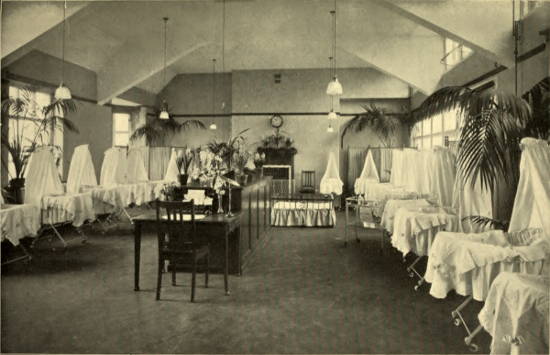
BRADFORD MUNICIPAL INFANT HOSPITAL.
(Reproduced by kind permission of the Bradford Health Committee.)