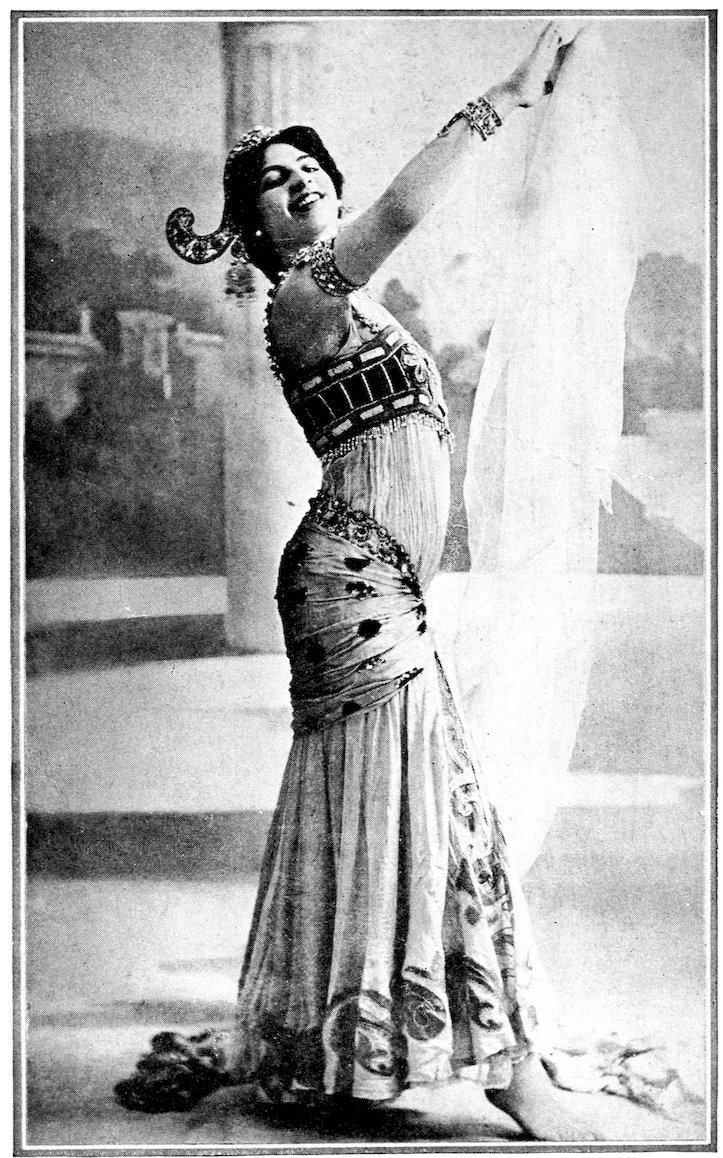
New original cover art included with this eBook is granted to the public domain.
By
MAJOR THOMAS COULSON, O.B.E.
HARPER & BROTHERS PUBLISHERS
New York and London
1930
MATA HARI
Copyright, 1930, by Harper & Brothers
Printed in the U. S. A.
SEVENTH PRINTING
EIGHTH PRINTING
G-E
Illustrations are from the collection of
W. Adolphe Roberts
To
MITSOU
Preface
vii
The romantic adventures of Mata Hari
stirred a certain section of public opinion
to a sympathy rarely accorded to spies. The men
and women of that profession are usually the object
of general execration from their enemies and
a somewhat furtive admiration from others who
extract pleasure or consolation from the pursuit
of danger, where the degree and not the motive
is the standard. Why, then, should this vaudeville
“star” have excited a contrary emotion? Why
should she have as defenders: princes, statesmen,
savants, and artists, as well as genial boulevardiers
who, if lacking in a supersensitive morality, are
without doubt loyal citizens of the nation to which
Mata Hari did incalculable harm?
In the first place, Mata Hari was a woman of
unusual beauty, moving within a veil of sensual
mysticism; in the second place, her chosen forum
was Paris. The attention she had drawn as an artist
and her subtle personality account for much of the
interest she aroused. The fact that a Frenchman is
never too fat, too old, or too ugly to be interested
in a pretty (and frail) woman supplies the remainder
viiiof the answer to the problem. The average
woman spy, outside of the popular romances,
is not a lovable creature. But, endowed with a
romantic nature, a rich imagination, a flair for the
sensational, the sentimental, and the poetic, preaching
a gospel of love which had to be communicated
in whispered confidences, has this woman
not all the characteristics of an ideal heroine for a
successful novel?
Since the life and death of Mata Hari have become
the common property of writers for the
stage and more particularly for the screen, her fascinating
history as a super-spy, dancer, courtesan,
and high-priestess of a lascivious love cult with its
wealth of drama, romance, and bitter tragedy, has
been submerged beneath a torrent of highly imaginative
literature which almost completely obscures
the truth. No spy story is too absurd to be associated
with her name; no deep-rooted intrigue too
treacherous but that it becomes the more sinister
by being made to revolve about her person. For
the most part these flights of the artistic imagination
bear too unmistakably the stamp of their
manufacture to be worth exposing, but others,
more subtly constructed, have passed into the current
coin of espionage legend without any better
ixclaim to authenticity. The life of Mata Hari is
romantic enough to require no embellishment, so
that in the following narrative imagination plays
no part in the drama it unfolds. No effort has been
made to invent situations or conversations to promote
the easy flow of the story.
Certain phases of Mata Hari’s life are inexplicable
to those unaccustomed to the methods and
practices of the secret services, and for this reason
I have tried to illustrate the story with examples
of other spies’ experiences. This knowledge of the
German espionage work was collected while a
regimental intelligence officer in Ireland, England,
and France. The quoted examples of other
spies are stories told me, for the most part, by men
who were actually engaged in the work of counter-espionage
which revealed their activities. It has
been suggested that the narrative would be more
convincing if the names of certain actors in
the sensational story had appeared in the text. This
could only have been done if the great game had
terminated with the other hostilities on November
11, 1918. Unfortunately, that is not so. The
scenes change, the task varies, but the work goes
on. Reticence on certain points became not merely
a matter of discretion, but of life and death to some
xof the men still engaged in the work of counter-espionage.
For instance, allusion is made in the text to a
Russian courier who carried a draft treaty in the
barrel of his fountain pen. I have been asked who
was the courier and what treaty did he carry. To
reveal these details would most certainly lead to
the imprisonment, possibly the death, of a man
who is still actively engaged in this dangerous
work. It might be urged that the mere mention of
the extraordinary hiding-place is evidence enough
to betray the main characters. Happily it is not.
But danger lies in the explanation. For purely
diplomatic reasons other details may not yet be
revealed, as will be understood from a reading of
the text; too many trusted and influential people
are involved. It is a great gulf that separates the
foyers of the elegant Champs-Élysées from the
bivouac fires; the vicious luxury of the demi-monde,
sipping its cocktail with nice enjoyment,
from the beer-swigging soldiers in the canteens;
the lascivious dances of the worship of Siva from
the grim Dance of Death on the crumbling parapets,
where riven bodies were a commonplace. Yet
over this yawning gulf between selfish lust and
heroic self-sacrifice went the fluttering feet of the
xiRed Dancer and her partner, Death, and the injury
she did was tragic enough without adding to
it by exposing people who, through accident or
indiscretion, became involved.
T. C.
Mata Hari
COURTESAN AND SPY
Chapter One
1
The first time I heard the name of Mata
Hari was in the fall of 1916. The association
of her name with the inexplicable leakage of
highly confidential information will best reveal
how the woman’s sinister activities reacted upon
men far removed from her physical existence. It
will help to show why a spy incurs such deadly
hatred among men not disinclined to face death
when the danger may be boldly grasped, but who
shudder with apprehension when some nameless
and invisible enemy tries to encompass their
destruction under the veil of assumed friendship
which promotes an attitude of indifference among
those whose duty it is to guard against such concealed
activity.
Picture, then, a group of English soldiers straining
their eyes into the abyss of night, waiting for
the firing of a Verey light which will illumine a
phenomenon just come within their knowledge. A
patrol has just returned with the information that
something mysterious has appeared in No Man’s
Land that demands investigation. Scarcity of numbers
in this sector had made increased watchfulness
2imperative and there was not a man among
them who did not know No Man’s Land as intimately
as he knew the details of his own back
yard. But night plays fantastic tricks with the
imagination and the eyes, so that when this newly
returned patrol made its report there was no little
uneasiness about the mysterious object set before
their trench. Complete investigation, however,
proved that this was no more than a crude notice-board
bearing the scrawled enquiry, “Why wait
for the 29th?”
Thus it came about that the bursting indiscretion
of a mischievous Saxon soldier undid the work
of a cunning spy. But we, who were the victims of
the joke, were completely bewildered by this
singular message which had come out of the night.
Nor could our staff offer any enlightenment when
we applied to them for an explanation. They were
too busy with statistical computations of the consumption
of plum and apple jam to gratify the
misplaced curiosity of an enemy whose sense of
humour usually had a more macabre touch. The
incident would have been overlooked among more
pressing anxieties and a tragedy would have resulted
but for a chance visit the following day to
some men who were training in the strictest seclusion
for a special minor offensive.
3These men were of my own company and at my
suggestion were being trained for a night raid in
full daylight. Night training is usually rendered
farcical by the impossibility of adequate supervision,
but with darkness simulated by the use of
dark glasses we hoped to achieve a greater degree
of efficiency. The work of these men was conducted
in the utmost secrecy. No one other than about six
officers had any idea of either the purpose, the
locale, or the time of the raid. Living in such isolation,
the raiders were always delighted to receive
their rare visitors and listened with delight to the
most trifling details of our battalion activities. As
most people whose lives are anything but a joke
are usually entertained by the feeblest jests, I was
tempted to tell them of the enemy’s enigmatic
enquiry, “Why wait for the 29th?”
The recital of this incident caused as much consternation
as would have arisen in paradise had the
devil dropped in for a social visit. Except, of
course, for the blasphemy; that was supplemental,
presumably. It appeared that the 29th was the date
chosen for the secret raid and that our sector was
to be the scene of the outburst. It was then the
26th. In spite of this unexpected betrayal after
such elaborate precautions to maintain secrecy, the
raid was carried out according to program in all
4its details except for the date. On the night of the
27th these men crept quietly out of the trenches,
over No Man’s Land, and fell on an enemy taken
completely by surprise. It would have been an unqualified
success but for the unfortunate death of
the young officer in command. On the return from
the raid he was shot in the thigh and I was carrying
him back to our trenches, when a bullet
whipped through the night, penetrated his throat,
and embedded itself in my shoulder. Just at the
moment this happened he was about to tell me
some secret of his last leave in Paris and his lips
had just framed the words, “If we could only find
that damned dancer ...” when they were closed
by the great silence and his eyes turned to that
dawn which knows no eventide.
During a convalescence spent in France, I investigated
the circumstances of young Hogg’s last
leave and its association with a dancer, never for
one moment imagining that it would lead to a
definite result, since dancers are as numerous as
thieves in the City of Light. What I did discover
had no meaning at the time, but its significance
was too great to be forgotten.
In order to obtain the dark glasses which I had
recommended for the training of his men, Hogg
and a companion had gone to Paris as being the
5only place within reach likely to furnish this extraordinary
need. The pair of youngsters had little
or no knowledge of the city and their ignorance
of the language made the simplest purchase as
laborious as a complicated commercial transaction.
They, therefore, addressed themselves to any
chance acquaintance for information concerning
spectacle-makers, but, thanks to the direction of
their enquiries, their request was received as something
of a pleasantry by everyone whom they encountered.
Their mission was soon being passed
from one malicious little tongue to another along
café terraces until their appearance was hailed
with delight in the more popular rendezvous. At
last when they were becoming desperate, and
therefore more amusing, one amiable lady volunteered
her assistance. After a brief interview Hogg
consented to accompany her on the quest for dark
glasses. There were, I found, certain hectic celebrations
attending the successful execution of the
commission on which neither of the young officers
retained clear recollections—when the stomach is
full the head is empty. They returned to their posts
satisfied that the amiable and kind lady would collect
and forward the required glasses as soon as
they were ready.
6It was possible, at a later date, and with more
evidence available, to ascertain how the terrible
Mata Hari did her work. In order to learn where
and when this raid was to take place she had to
delay the dispatch of the dark glasses until after
the two young officers had finished their short
leave, and to accept the responsibility of forwarding
them when they were delivered by the optician
who had undertaken to secure them. For this reason
she was furnished with the correct address of
the unit to which they were to be sent, and the
enemy was thus able to identify the locale of the
raid. The correct date she ascertained by feigning
a great interest in the exploit and a desire to read
of its successful accomplishment in the communiqué
issued the following day. Those of us who
were amazed at her ability to obtain such confidential
information ceased to wonder at Mata Hari’s
skill in this case when we became familiar with
her major activities exercised against more capable
protagonists than two young subalterns.
The words spoken in the presentiment of death
are often prophetic. Months later, when Mata
Hari was under trial for espionage, the writer
heard her spoken of as the “Red Dancer,” and the
mystery of “Why wait for the 29th?” became a
7fragment of an infinitely greater quest which led
to the revelation of the entire life of the woman
who was registered in the German secret service
as H21 and who sent thousands like this young
colleague to their death.
Chapter Two
8
This is the Reverse of the Medal. What of
its obverse? The story of the spy H21 is
incomprehensible without a knowledge of the
“Red Dancer.” Unless one understands the extraordinary
power of fascination she exercised it is
not possible to believe that she could reduce the
Second Bureau, the nerve centre of the French
army, to temporary impotence; could correspond
with her espionage chief on paper that bore the
heading of the Ministry of Foreign Affairs; could
have conducted an intimate intrigue with the head
of the War Department; and when an outraged
army finally brought her to trial and condemnation,
could yet invoke the aid of princes, ambassadors,
and scholars. It is only by a knowledge of
what she called her artistic life that one can realize
the nature and extent of her fatal sorcery. It explains,
too, why a band of enthusiastic pseudo-intellectuals
are still endeavouring to invest her
with an aureole of martyrdom, for she claimed the
attributes of a high-priestess of an ancient but little-known
religion, and her adorers are willing to
9place her in that office within their own degenerate
cult.
Not all her believers are to be classed in this
coterie. There still lingers a select band of irreconcilables
who steadfastly maintain that Mata
Hari’s claims to be a bayadère were perfectly
genuine. One still meets in the Parisian haunts of
the pseudo-intellectuals an occasional visitor who
whispers that on a recent visit to a remote schloss
in a secluded part of Austria he was privileged to
attend a repetition of one of these religious ceremonies
dedicated to the god Siva and presided
over by Mata Hari. His words fall on believing
ears and there are murmurs of regret that France
should have been the chosen instrument for inflicting
punishment upon this faithful disciple.
In order to realize how she accomplished these
astonishing feats one has to have a picture of her
in one of her favourite séances, not a vaudeville appearance
this time (for her public appearances
were only gestures to the mob of unbelievers), but
the type of occasion from which she extracted most
enjoyment and most wealth, and which was the
foundation of her amazing power over men of
position and influence. It is such a scene as might
be witnessed in the intimacy of the elegant palaces
of, say, the Prince Drago, the Princess Murat, or
10the Duchess of Eckmühl. In the voluptuous
abandon of the semi-privacy, before a group of
selected guests, reclining in luxurious ease after
copious sacramental libations and surrounded by
her worshippers, Mata Hari invokes the image of
her youth.
“I was born,” she says in a soft, languorous tone
which the listeners immediately associated with
the mysterious East, “in the south of India on the
coast of Malabar, in the holy city of Jaffnapatam,
the child of a family within the sacred caste of
Brahma. By reason of his piety and pureness of
heart my father was called Assirvadam, which
means ‘The Blessing of God.’ My mother was a
glorious bayadère[1] in the temple of Kanda Swany.
She died when she was fourteen, on the same day
I was born. The priests of the temple, having cremated
my mother, adopted me under the baptismal
name of Mata Hari, which means ‘Eye of
the Dawn.’ From the time when I took my first
uncertain steps I was shut up in the great subterranean
hall of the pagoda of Siva, where I was to
be trained to follow in my mother’s footsteps
11through the holy rites of the dance. Of these early
years my mind retains only vague recollections of
a monotonous existence in which, during the long
morning hours, I was taught to imitate automatically
the movements of the bayadères, and in
the afternoons was allowed to walk in the gardens
while weaving garlands of jasmine for decorating
the altars. When I reached the threshold of
womanhood my foster-mother saw in me a predestined
soul and resolved to dedicate me to Siva
and to reveal to me the mystery of love and faith
on the night of Sakty-pudja, in the coming
spring....”
1. The bayadères must not be confused with the nautch
dancers. The former are ministrants in the temples and enjoy
the respect of the worshippers. Nautch dancers, on the other
hand, are merely professional dancers engaged to furnish entertainment.
The soft, caressing voice trails off into silence,
and at the recollection of this blissful moment a
tremor of religious ecstasy passes over the exquisitely
moulded, amber-tinted body, daringly
revealed for these nocturnal invocations of her
sacred youth. Then suddenly she awakens from
her reverie to ask:
“Have any of you an idea of the Sakty-pudja of
the Kanda Swany?”
The hypnotized audience, which on occasion included
well-known Orientalists, are compelled to
reply that they possess no intimate knowledge of
this festivity of license and religious revelry, so
she proceeds to enlighten them.
12“It was on the purple granite altar of the Kanda
Swany that, at the age of thirteen, I danced for the
first time, completely nude.”
Then, in the midst of the superb luxury of her
wealthy patron’s home, inspired by the rich food,
by the wines, by the seductive lights, by the sensuous
perfumes (all prearranged) she begins to
explain the mysteries of the Supreme Night on
which the holy men of the temple savour in life
the cruel but divine ecstasies of Siva’s paradise,
that terrible god Siva who is the god of all sin, of
all misunderstanding, of all cruelty. This recital is
illustrated by poses and gestures more provocative
than plain speech. The earlier stages of this fantastic
orgy which she describes are devoted to meditation
in an atmosphere of subtle drugs and
Oriental languors. As the awaited moment approaches,
when the wise men will announce the
appearance in the heavens of the sign of the Three
Goddesses, the melodious notes of a concealed orchestra
begin to breathe haunting, dreamy harmonies.
From the dark recesses of the waving
jungle a soft voice warns of the awakening of the
sacred serpents, who, tempted by the seductive
murmur of the instruments, writhe their long slow
length to the temple where Siva awaits their homage.
And there they dance! Among them whirl the
13curving, undulating bodies of the dainty little
bayadères, as clammily chill and as naked as the
serpents. The remainder of this festivity is indescribable;
it eclipses the bacchanalian fêtes of decadent
Rome.
This is the beginning of the legend which has
grown up about the modern high-priestess of the
dance as a religious rite. In conversation with her
many admirers she outlines her life as she would
have wished it to be. Having no hand in its origin,
the next best thing is to prepare the origin which is
best adapted to the rôle she has assumed. The rest
followed naturally in a romantic sequence which
satisfied her love of the dramatic. Mata Hari told
how she followed her profession in the temple until
one day a handsome English officer saw her performance
and, struck by the sadness of her eyes,
ventured to violate the sacred rules of her caste by
speaking to her. In accordance with the requirements
of romance, they fell in love with each other
and the adventurous officer by a display of cunning,
courage, and resource rescued the little Mata
Hari from the prospect of a life devoted to the
adoration of the god Siva, and married her.
Shortly after their marriage a son, Norman, was
born, and by her own account the young mother’s
cup of happiness was filled to the brim with this
14new rapture. However, she said, the child did not
live long, for a typically Oriental act of poisoning
resulted in his death. During a visit to America
Mata Hari described in some detail how this
tragedy so infuriated her that the savage within
her nature rose in revolt, so that with her own
hands she strangled the unfaithful servant who had
given the child the poisoned cup.
Thus her own account gives to her life a current
of vibrant, barbaric adventure, heavily coloured
by the mystery and romance of the unknown
East, which was rendered all the more plausible
by nature’s gifts. For this Dutch girl, born in Holland
of homely parents, was endowed with a
strangely Oriental cast of countenance and an amber-tinted
body which she inherited, not from her
Hindu parents, but from Jewish progenitors.
Chapter Three
15
“On the purple granite altar of the Kanda
Swany, at the age of thirteen I was initiated....
When I danced before the rajahs on the
banks of the sacred Ganges....”
These and similar phrases were continually on
the lips of Mata Hari as she sought to bind her
audiences, or even individuals, for anything with
ears to hear was sufficient audience for her, by the
fascination of her intimate and secret knowledge
of art, beauty, and love. However, there are two
counterweights to her highly imaginative narrative
which enable us to obtain a much truer picture
of her earlier life and actions. One is her own
Life and the other the brief, frigidly cold, official
biography collected by the French police. With
the aid of these and the accounts of friends and
witnesses it is possible to construct a fairly comprehensive
story of her life, the life of Mata Hari,
Red Dancer and H21 of the German secret
service.
The Life is a well-printed volume which enjoys
the scarcity of some rare incunabula. It was published
in 1906 and the title page reads, in translation:
16“Mata Hari: Mrs. M. G. Zelle MacLeod.
History of my daughter’s life and my charges
against her former husband, with portraits, documents,
facsimiles, and supplements, by A. Zelle,
czm—C. L. G. Velat, Amsterdam.” But in spite
of the clear attribution of authorship to the mother,
a naïve prefatory note declares that “the earlier
chapters of this book have been entirely written
by my daughter. As for the later ones, since she
lacked the time to finish them herself, they were
sent to me from America for completion.” The
story is too obviously directed against the errant
husband to carry much weight as a serious autobiography,
and it has only been used by the present
writer to corroborate other testimony or to illustrate
her thoughts. While we must follow the
creation of the legend of Mata Hari, the time has
come when she should be stripped of all her improvised
art and her specially invented sacred
origins and to judge her as a woman. If she is
guilty of the crimes attributed to her, if her deeds
brought death and maiming to men, tears and
mourning to their innocent relatives, then no artistry,
no amorous frailty, no pseudo-sacred origin,
no peculiar mental viewpoint can condone or mitigate
her sin.
The real Mata Hari was born in the little Dutch
17town of Leeuwarden on August 7, 1876, and was
given the baptismal names of Margaret Gertrude.
Her nearest approach to Oriental ancestry was a
strain of Jewish blood through her father’s descent.
Adam Zelle was a prosperous business man, but
the mother, a good-looking woman of the typical
Dutch type, came from the better-class family of
Van der Meulen. Margaret’s early life seems to
have been no more distinguished by incident than
that of the blond children who accompanied her
to the Cammingha-State school, and who scampered
through a happy innocent childhood on the
banks of a grey canal. The girl whose dusky beauty
was to enslave so many men in high places can recall
no incident of these commonplace days other
than a preference for one golden-haired little
playmate. Doubtless it was the good Vrouw Zelle’s
intention to have her daughter educated in a superior
manner, more in keeping with the Van der
Meulen pretensions, which urged her to send
Margaret to a school where the girl would be
taught to conduct herself becomingly. She was admitted
to a Catholic convent at the age of fourteen,
precisely the time when, from her own romantic
tale, she was being rescued from the Kanda
Swany. Thus, instead of being torn from the grasp
of fanatical devotees of an unknown mystic cult,
18she was, in reality, entering the cloistered security
of a religious house where young ladies are protected
with zealous care.
There she remained until she had reached the
age of eighteen and went to spend a vacation at
The Hague, the Dutch capital. In this town,
where life flows with the turgid tranquillity of its
own canal waters, the romantic girl was noticed by
a handsome officer whose elegance was turning the
heads of the simple Dutch maidens home from
school. Captain Campbell MacLeod was no longer
a young man, but, said Margaret Gertrude, enthusiastically,
“His age renders him still more
adorable.” Margaret admitted later that she had
always suffered from a weakness for officers.
“Anyone who is not an officer,” she said to a
group of these men, “does not interest me. The
officer is a being apart, a kind of artist breathing
the grand air in the brilliant profession of arms,
in a uniform that is always seductive. Yes, I have
had a number of lovers, but they were always good
soldiers, brave, ready for battle, and while waiting
for it amiable and courteous. To me the officer is
a separate race. I have loved only the officer and
have never been concerned to know whether the
man was German, Italian, or French.”
This quaint conceit might have been adopted to
19flatter the men to whom it was addressed, but its
spontaneity would have been sufficient proof of its
sincerity if her life had not substantiated her
words. What gives this statement a curious tinge
of cynicism was the fact that the man who married
her in no way fits the standard she had adopted for
her officer. MacLeod was of good, even distinguished,
Scottish descent and held a commission
in the Dutch Colonial Army. At twenty-one he
was a vicious young satyr; at forty he was a satiated
libertine who continued to flout all decency
from acquired habit rather than from active desire.
A handsome man of dandified appearance
who caressed a tender growth of down on his lip
with jewelled fingers, while he cast stealthy
glances of admiration upon the shapely young convent-bred
girl enjoying her holiday in a town that
is not remarkable for its festal life. The inappeasable
sex-hunger of the unhappy man could be read
in his eyes, and it was this which called to the sensuous
Margaret.
They were married and spent a joyous honeymoon
among the sedate villas of Wiesbaden, where
those drinking the vile waters (or pretending to)
could, on occasion, inject no little gaiety into their
cure. Walking in the pleasant and orderly public
gardens or taking her aperitive at the Kurhaus she
20must have seen the resplendent type of creature
whom she idealized as the officer, the aloof, dignified,
and powerful officers of the garrison, so
great a contrast to the man whom she had married.
Who knows what promising glances she gave the
uniformed gods beneath the sportive baskets of
rosebuds which decorate the Hotel Rosenblume?
After an unsuccessful attempt at conjugal felicity
in the house of MacLeod’s sister, where Margaret
proved once again that if man is not made
to live alone, women are not intended to live together,
the newly married couple took a house in
the more modern part of Amsterdam. Here their
ill-fated son, Norman, was born shortly after their
marriage. One of the events which left an ineffaceable
impression on the luxury-loving bride dates
from this same year. MacLeod had the privilege,
as an army officer, of presenting his wife at court.
Possibly it was on this occasion when she made her
first bow before royalty that she conceived the idea
of having kings and princes pay her homage.
Indeed, she now begins to cultivate a new pride.
It appears that her husband was not as wealthy as
he was supposed to be and his extravagant habits
led to trouble. Margaret felt that she was being
neglected, and in her loneliness found she was no
more than a housekeeper for her gay husband.
21“My grandmother was the Baroness Winjbergen,”
she reminds MacLeod when she revolts
against this treatment.
But worse is to come. The accomplished libertine
whose name she bore would not break off his
acquired habits; he rarely was to be found at home.
He preferred the companionship of fair but frail
ladies, of good fellows with whom he could gamble
with all he possessed and a little more. In
a short time he had reached a stage of threatened
ruin from which nothing but an act of repulsive
dishonour saved him. The young wife was instructed
to employ her coy glances, her strange
Oriental beauty, and her nascent powers of fascination
upon a certain wealthy man whose indiscretions
made him a suitable object for blackmail.
Margaret was not averse to making the attempt.
“But this man was a great admirer of my eyes,”
she explains in recording this interview in her Life,
“and I was able to collect several thousands of
guilders without having to be unfaithful.”
The final qualification, if true, would not have
been added, even as an afterthought, a short while
later.
After this incident there is a gap in Margaret’s
life, until we find her husband commanding a battalion
of the Colonial Army Reserve in Java,
22where he is living with his wife and two children.
The second child, a daughter called Jeanne Louise,
had been born a short while before they left Holland.
But, by the time their track has been picked
up in this jungle clearing, their domestic relations
are the scandal of the Dutch colony.
“It was at Benjoe-Biroe that I got my first
whipping,” Margaret says, reminiscently.
Shortly after this Margaret began to bombard
her father for assistance to secure a legal separation,
and the prosperous burgher laid a formal
complaint against the husband with the local authorities.
At the same time he admonished his
daughter to control herself with patience and to
have a witness at the next whipping, as this would
facilitate a divorce. In this humid atmosphere the
flowers of evil germinate quickly and burst into
abundant blossoms. Before long the half-demented
officer was threatening his wife with a loaded revolver.
“He was in love with another woman,” Margaret
writes, “and was willing to pay the price of
murder for his liberty. He admitted it and warned
me that unless we were divorced very quickly he
would kill me.”
This consummation of folly was rendered unnecessary
by the termination of MacLeod’s active
23service. When he was transferred to the reserve of
officers the ill-assorted pair returned to Amsterdam
and a petition for divorce was promptly instituted.
But as if to show her desire for originality
the petitioner continued to live with her husband
in his sister’s home until his incessant drunken
revelry led the good lady, or her respectable lawyer
husband, to eject them. The MacLeod ménage
then sought a refuge in a modest dwelling which
was not at all in keeping with Margaret’s high ambitions.
From here the husband went out one night
on the familiar pretext of mailing a letter and took
their sick child with him so that she might benefit
from the air. He did not return. Or, rather, he
only returned when Margaret had recovered the
custody of the little Jeanne through the aid of the
courts, pending a decision of her petition for divorce.
When MacLeod did return to the Van
Breestrat home he promptly installed a new mistress.
He then proceeded to settle accounts with
Margaret in a manner characteristic of a man who
fails to give his wife any financial assistance. He
caused a notice to be inserted in the newspapers
that he would no longer be responsible for his
wife’s debts.
This pious act of repudiation roused Margaret
to a pitch of fury, for she declared that it was instrumental
24in closing the doors of all her friends,
even that of her noble and virtuous aunt, Baroness
Landes, where she had found a temporary refuge.
But Dutch doors are not so puritanical that they
close automatically upon those whose sole error is
to have contemplated divorce from a savage,
drunken husband. Dutch hospitality has a warmer
reputation. Be that as it may, Margaret MacLeod
found herself on the street with a sick child, without
clothes, and for riches the sum of three and a
half florins.
At this point we leave the old Margaret. Her
apprenticeship among the cherubim of hell now
begins. The Red Dancer begins to take form
among the mists that blow in from the North Sea.
It may be added, in passing, that the Dutch courts,
having refused her the divorce for which she applied,
granted it shortly after to her husband, to
the profound indignation of her posthumous
admirers.
Chapter Four
25
The Paris début of Mata Hari had a
ludicrous termination. Light upon this stage
of her life has been wanting, so that these few
scant details will be interesting since they are new.
Finding all havens closed to her in Amsterdam,
Margaret decided to admit failure and returned
to the parental home in The Hague. But the prosperous
and highly respected burgher-father killed
no fatted calf for the wanderer. Instead, he was
ready enough to provide the means of removing
his daughter from the neighbourhood. Furnished
with the necessary funds, Margaret made for Paris,
determined to make her début as a dancer. But
since she had no professional training and had to
find a means of livelihood until her act was ready,
she did what so many other young stage people
do—she posed as a model for painters.
“On the purple granite altar of the Kanda
Swany....”
But between the coasts of Malabar and La Rotonde
many waters flow. Margaret was twenty-seven
when she knocked one morning at a studio
door in the Montparnasse district.
26“I am seeking employment as a model,” she explained
to the artist.
“Very good,” he replied. “Let me see your
figure.”
“Oh no! I want to pose only for the head,” was
her horrified response. “I am the widow of a colonel
who died in the Indies and left me with two
sons. I am trying to educate them but have no resources.”
“In that case your beauty ought to secure you
some sittings for the head, but you will be paid
much less than if you will pose for the full figure,
for, from what I can gather, you must have a
pretty figure. At any rate, I don’t insist.”
Margaret lamented the immolation of her modesty,
the outrage to her distinguished family, and,
generally, made use of the familiar arguments, but
when the painter told her abruptly that she could
do just whatever she pleased she began to undress.
To this man and to other artists we owe the explosion
of another portion of the bubble of her
legendary life. Artists who saw her have all borne
testimony to the beauty of Mata Hari’s figure, several
declaring that they had never seen such lovely
shaped arms. But for the employment as a model
she had one grave defect—her bust was pendulous
and ugly. During her dances she never bared her
27breasts, although this was the only part of her body
which was covered. Invariably she wore a jewelled
covering for her bosom. The Red Dancer had her
own explanation to offer for this and it reflected
more to the type of credit she coveted.
“My husband,” she used to say, “often threatened
to disfigure me so that no other man would
desire me.”
She claimed that in one of his fits of erotic dementia
the man had attacked her in such a ferocious
fashion that she was mutilated. “That is
why,” she would conclude the story, “I have not
cared to exhibit my complete torso.”
However, to return to her application for employment.
The disappointment of the artist that
such a promising model was not satisfactory for
his purpose caused him to remark that, after all,
she had better pose for the head alone. Either she
felt her modesty was outraged by this, or, what is
more likely, her vanity was shocked, but the innocent
statement produced what the French call a
crise de nerfs, in which the artist had to call for his
wife’s assistance and, to soothe Margaret’s injured
modesty (or vanity), the painter did make use of
her in a poster which occupied him at the time.
She was in the grimly appropriate character of
Messalina! Thus the poster of the Gaîté’s production
28of Isador de Lara’s “Messalina” was posed by
Mata Hari, and no one has yet commented on the
grim symbolism of the combination.
In 1903 she made her début as a dancer, less
than a year after the inhospitable doors of her
virtuous relations had closed upon her. What success
she had or might have reaped from this initial
appearance is only a matter of speculation, because
the outraged Scottish husband clamoured for protection
against anyone bearing the honoured name
of his puritanical ancestors consecrating herself to
the art of the dance in the modern Babylon. In the
first flush of his outraged pride he wrote an indignant
letter to his wife, threatening to have her
enclosed in a convent if she did not conduct herself
with more modesty and dignity.
This unexpected document afflicted Margaret
with a mingling of tears, fear, and revolt. She demanded
telegraphic counsel of her relatives, and
as a result of their replies she voluntarily returned
to Holland and went into seclusion amid the austere
rusticity of Nimegue, in order to escape the
mediæval vengeance of her irate husband. To the
enthusiastic admirers of Mata Hari this period of
her life has been likened to the Agony in the Garden.
The crazy, muddled drug addicts whose
celestial system centres round the more obscure
29night haunts of Paris and extends only to the other
bank of the Seine, picture life in this little Dutch
town as refined torture for the soul that sought the
unbounded liberty of the stars, the unmeasured
spaces of love, and the unplumbed depths of Siva’s
paradise. But they are a little in advance of time.
The constellation of the Three Goddesses was not
yet reported to have appeared in the firmament.
None the less, Margaret hated the place.
“Am I to remain here for the rest of my days?”
she wails in January of 1904. Truly one who has
known the joys of Parisian life will understand
that the innocent festivities of Nimegue are a poor
substitute. It was doubtless the repression of this
period which caused her to fly to the other extreme
when she escaped. In place of the glaring footlights
which she coveted was the pale reflection of
the sun in the copper dishes on the walls; the only
audience were the curious housewives who peered
from behind discreetly drawn curtains as the
woman of the dance-halls flitted down the silent
street; and for music, the joyous music her heart
loved, there was only the metallic clank of the
municipal belfry when the bell-ringers practised
their ingenuous hobby. The grey little town which
dwells in the almost perpetual shadow of sea mists
must have seemed as remote from the delights of
30the City of Light as was Benjoe-Biroe in the
Javanese jungle.
“I shall triumph sooner or later,” she cries defiantly
from the enveloping fog.
And then one day she summons her courage and
descends upon the gay Paris like a thunderclap.
Margaret Gertrude Zelle is no more, the curtain
rises definitely on the Red Dancer.
Chapter Five
31
Mata Hari established her reputation in
Paris; she achieved the highest flights of
her fame in that city, and her other conquests, in
Berlin, Rome, Vienna, London, were but reflections
of her Parisian success. Her first efforts were
in public, on the vaudeville stage, where she
speedily gained a sympathetic reception by the
novelty of her dancing. But it was not as a dancer
that she coveted a reputation. Of one thing about
her dancing we may be certain: as an art such as
Isadora Duncan conceived it or as Loie Fuller
imagined it, Mata Hari had no conception. Dancing
to her was nothing more than a means of attracting
attention, of displaying the splendour of
her beauty, with the ultimate object of captivating
her lovers. Like many another artist who has imagined
herself greater than her art, Mata loved the
adulation offered to a popular favourite, but better
than a large audience in a theatre she loved the
intimacy afforded by private engagements in some
luxurious apartment where, before a select audience
of refined profligates, and brilliant, wealthy,
dilettantes she could explain with greater freedom
32the sensuous rites of the fantastic cult to which
she had promoted herself the high-priestess.
Her ideal was to become a famous—the most
famous—courtesan, and to achieve it she invented
her sacred origin and improvised an art. The opportunity
she sought was to exhibit her lovely amber
body among gold and precious stones, to pose
rhythmically among sumptuous transparencies.
The rest was only decoration to conceal, justify,
and stimulate the underlying sensual debauch.
“When in my infancy I danced before rajahs
on the shores of the sacred Ganges....”
In point of fact, Mata Hari’s knowledge of the
orgies practised in Brahmanist temples and sanctuaries
was derived exclusively from books. The
most she had ever seen were the dances of the tiny
Javanese bayas in those villages she had visited
while her husband was with the Dutch colonial
forces. Between these diminutive little creatures
(more like automatic toys than flesh and blood)
and the apsaras of the Brahman temples there is
a huge gulf. One is the incarnation of some abstract
ancestral rite grown ghostly by its tenuous
prolongation through the ages; the other is the
realization of a morbid drug-distorted vision of
bestiality, thinly veiled behind a religious significance.
33There may have been moments when she took
her charlatanry seriously, but that Mata Hari’s
dances had any religious meaning is the fantasy of
minds not less distorted than her own. As the
shadows closed around her in the prison of Saint-Lazare
she gratefully accepted the ministrations
of two Catholic nuns, and on the morning of her
execution actually received the rite of baptism
from the hands of an Anabaptist pastor. Two days
after her sentence she begged the prison doctor to
obtain for her some books to beguile the weary
hours. Doubtful about her tastes, the doctor begged
for some guidance in the selection, suggesting the
works of such popular writers as Marcel Prévost,
Bourget, and Rosny. She rejected these suggestions
with scorn.
“Stories about the middle classes never interested
me,” she declared. “To you I can confess
that I have never been able to read through one of
those works which are called comedies of manners.
What I do like is poetry which has mystery, religion,
legend, and magic. I firmly believe that
the only means of living in beauty consists in avoiding
the thousand and one daily annoyances which
interfere with an existence in the full ideal. That
is why I cannot tolerate European things, not even
the religion.” At which declaration she shook an
34admonitory finger at the doctor and continued,
“Now do not go and tell that to the poor religious
who are trying so hard to convert me. Those unhappy
people do not understand what the word religion
means on my lips and they would certainly
cross themselves piously if they knew that I mingled
dances and caresses in my liturgy.... For
I am a Hindu, although born in Holland. Hindu?
Yes, certainly. You who are an intelligent man
will say that there must be something European
in me. No, there is not. I am absolutely Oriental.
“Further, the Orient alone interests me deeply.
When one speaks of motherlands my soul turns to
a distant country where a golden pagoda is mirrored
in a winding stream. I do not know exactly
what I am or where I am from. From Benares,
from Golconda, from Gwalior, from Madura,
what does it matter? There is a secret in my
origin, in my blood. It will be known sometime
later, but, for my own part, I have barely penetrated
the fringe of the secret.”
The doctor said that at this point of the invocation
of her illusory cradle a look of great sadness
came over her eyes. This man, who knew little of
her imaginary birth and life, declares that he was
baffled by the complexity of her nature. He maintains
that she possessed nothing of the nature, type,
35character, culture, mind, or appearance of the
women of Europe; there was something of the
primitive savage and at the same time something
sacerdotal and refined about her. Concerning the
fuller development of her studies she continued:
“Formerly, my favourite reading was that which
informed me how to love life and savour voluptuous
delights with a passionate, Sybaritical enjoyment.
In the Prem Sagar there are chapters
which make the senses reel as though one was intoxicated
with sensuous drugs. And the works of
Kalidasa and his disciples, with their tenderness
and picturesque subtlety, have furnished me with
entire days of ecstasy. I smile when I hear people
say that scenic art reaches its apogee in Paris.
Yonder, in India, each passion has its perfume and
colour. Thus, love is blue, pleasure white, tenderness
rose, and heroism red. As a new sentiment is
about to dominate a drama the decoration changes
tints and the atmosphere changes its aroma....
The lovers really love, actually engage in the love
embrace on the stage in full view of the audience.
They hate just as truly. The pursuit and attack is
real. I have seen blood on the hands of some of the
actors. Ah, those legends of chivalry! those stories
of Rajput warriors who, with a saffron tunic over
their coat of mail, went forth seeking marvellous
36adventures.... And the romances of proud
Brahmanist daughters enamoured of their pages,
imprisoned in a citadel for years because of their
love, without renouncing the hope of escape which
would enable them to flee some day and join the
faithful lovers who awaited them at the door of
the pagoda.
“Nothing is more poetic, nobler, or greater than
what remains to us of ancient India.”
Instead of the Imitation of Christ, which appears
to be the favoured study of condemned prisoners,
Mata Hari chose the Lotus of Faith, a
Buddhist book of instruction which teaches a contempt
for everything in life. Even under the
shadow of the broad wings of hovering death this
extraordinary woman could command her imagination
to furnish the ecstasies she had formerly
been able to realize through the flesh. It is needless
to say that in these confidences her recollections
were mere flights of fancy and not efforts of
memory. That artistic touch of the actors with
blood-reeking hands was sheer imagination—the
poetic licence of the story-teller, like so much else
in her autobiography. For Mata Hari’s heart
found sustenance in two things—imagination and
love of the carnal kind.
So much, then, for her religion—it was art and
37love. Yet, to those who suffered from her deception,
she insisted upon the religious significance of
her art. To one admirer she wrote: “As you know,
every true temple dance (not those of the street
and the public places) is a theological treatise and
should explain in pose and gesture the rules of
the Vedas, the sacred books.”
Since these sacred books contain the most complete
description of the joys of sensual love, of the
arts to be practised by the courtesan who desires
to become successful, and the captivating graces to
be employed in retaining the affections of a lover,
they were appropriately chosen to form the basis
of her art. That they were religious treatises was
an accident. Not only in her public appearances,
but in the intimacy of her boudoir she tried to invoke
the vision of the divine Brahma in the halflights
of an ancient sanctuary; of mysterious
flowers, exotic, luscious, stupefying; of the undulating
coils of the writhing serpent interlaced
with rich foliage. The beautiful amber-tinted body
glides with infinite grace among the illusive disorder
of diaphanous, floating veils, and the intoxication
of subtly penetrating perfumes.
For her “Sacred Flower Dance,” a favourite
with her, based upon the legend of the goddess
with the power of embodying herself within the
38petals of a flower, she writes in several letters to
one of her associates, ordering the musical accompaniment
just as a banker’s wife orders a gown for
a special occasion.
The music of “The Flowing Waters” will serve as
an overture to convey the impression that the temple
is in a forest with a murmuring cascade within hearing.
A prince comes to plead before the goddess, seated
like a bronze statue on her altar. He enters the temple
bearing exquisite orchids, the incarnation of the divinity,
whose place on the altar has been taken for this
rite by a priestess. As the prince makes intercession to
the goddess before her altar he burns the blossoms in
sacrifice. To him the priestess makes this terrible prediction:
“You will die as everything must die. Make
your life a succession of delicious and glorious moments.
Better that you pass on this earth through
moments of intense sensation and then depart, than
drag your body through an old age that is without
beauty and satisfaction.”
As the ecstatic fumes from the burning flowers intoxicate
the prince, the priestess (which shall be me)
rises and dances, explaining in pose and gesture the
rules of the Veda, the holy books of the Brahma. The
music must express the pose of the incarnation, the
apparition of the flower, its unfolding into blossom,
the closing of its petals, all typifying the powers of
Brahma, Vishnu, and Siva—that is to say, creation,
fruitfulness, decay. The whole fades into obscurity;
prince, goddess, and high-priestess disappear.
39This, then, is the rôle she has chosen. She adds
a point of exclamation in one of her letters in
which she says that Siva is the god of sin; he “must
have a power of destruction which equals, if it
does not surpass, the good of Brahma.” Siva was
her favourite god; she became the symbol of his
cult and she recruited many worshippers.
No such weird fantasy could ever have become
an accepted doctrine if preached from the stage
of a vaudeville theatre, and well Mata Hari knew
it. In the sepulchral solitude of Nimegue the idea
was developed until in 1905, when she returned to
Paris, Mata Hari did not seek engagements immediately
on the stage. Her campaign was more
subtle once the opportunity had suggested itself,
and the suggestion came from a most unexpected
source. She proposed to give a performance of
Javanese dances in the Guimet Museum, which is
devoted to the collection of Oriental curiosities.
Here, beneath the enigmatic smile of a great
golden Buddha, she danced in the discreet costume
of saffron-coloured veils before a specially invited
audience, never suspecting the possibilities
of the display until a grave and learned scholar
gave her the clue. All Orientalists are distinguished
for their gravity. A bearded scholar of
Eastern lore rose and explained to the awed audience
40the meaning of the rhythmic ceremony they
were about to witness. Having completed his discourse,
Mata Hari was called on to appear in her
saffron veilings and, with her face glowing from
the excitement of the scholar’s suggestions, she
danced her “Black Pearl” dance.
Needless to say that at this stage of her career
(1905–06) Mata Hari was almost wholly ignorant
of the Brahman religion and its ceremonial dances.
All she proposed to do was to give a romantic version
of the stiff and mechanical movements of the
little Javanese dancers. But the grave old Oriental
scholar had put an idea into her receptive brain
and she nourished it with care. Next morning the
Paris newspapers were filled with the novelty of
this extraordinary performance in a museum of
serious studies, and she decided to reap the full
benefit of her sudden fame.
“On the purple granite altar of the Kanda
Swany I danced for the first time....”
In reality, then, the first step on the ladder was
not on the coasts of Malabar, but on the Paris
boulevards. From the museum of Oriental art to
the salon of the Chilean minister was the next step,
but this was not a resting-place; it was no more
than a breathing space on the rapid rise to ascendency.
Besides, she had not yet reached the
41stage of complete nudity which she was to favour.
That only came when the Princess Murat invited
her to perform before an exclusive assembly in her
city palace. Later the Prince del Drago placed her
on the topmost pinnacle of notoriety when he gave
a celebration which was designed to revolve
around the central figure of a bayadère—Mata
Hari. It was these evenings among the socially
elect which gave her most delight, not the public
performances at the Olympia or in the chill scholastic
atmosphere of the Guimet Museum. Besides,
they were infinitely more profitable in the outcome.
High though her earnings as a dancer were,
much more money was required to indulge her extravagant
tastes and the indiscriminate charity
which she dispensed. The effect of these displays
can best be understood with the aid of a spectator’s
recollections.
“You can scarcely credit the mystic frenzy produced
by her lascivious attitudes,” he said. “Her
nervous tremors, her violent contortions, were terribly
impressive. There was in the performance
something of the solemnity of an idol, something
of the loathsome horror of a writhing reptile.
From her great sombre eyes, half closed in sensuous
ecstasy, there gleamed an uncanny light, like
phosphorescent flames. She seemed to embrace an
42invisible being in her long shapely arms. Her
braceleted legs were glossy and well moulded,
they so quivered through excessive effort that it
seemed the tendons must burst through the enveloping
skin. To witness the spectacle was to receive
the impression that one had actually been present
at the metamorphosis of a serpent taking a
woman’s form.”
A serpent, always a serpent!
Chapter Six
43
But she prospered exceedingly. From 1905,
when she first developed the idea of becoming
a civilized bayadère, her love affairs followed her
like an unending procession. From her admirers
she received such substantial homage that before
long she was established in a sumptuous apartment
near the Champs-Élysées, she had her private
carriage and a collar of pearls. This may not
exactly be the apogee of her existence (that was
reserved for her German career), but it certainly
represents the highest peak of her artistic
life. A man who knew her well without having
succumbed to her fatal charm, but who had many
opportunities of studying her at this time, gives a
description of Mata Hari which denies her claim
to beauty.
“She was not,” he maintained, “really pretty.
Her features lacked refinement. There was something
bestial about the lips, cheeks, and jaw. Her
brown skin always had the appearance of having
been anointed with oil or was exuding perspiration.
Her bust was flat and drooping and always
concealed from view. Only her eyes and arms were
44absolute in their beauty. Those who said she had
the most beautiful arms in the world did not exaggerate.
And her eyes! Eyes that were magnetic
and enigmatic, ever changing, yet ever of velvety
softness, commanding and pleading, melancholy
and mean, those terrible eyes in whose depths so
many souls were drowned, actually merited the
adoration awarded them.”
Paul Namur painted two portraits of her at this
time, one in street costume, which seems to have
disappeared, and the other a dance pose in the
nude which shows her wearing an Indian diadem
and a collar of emeralds and topaz. Mata made
several sittings for them, and the artist had the opportunity
to exercise his trained observation on
her. His recollections are interesting.
“The most striking thing about her,” he says,
“was the astonishing fact that this spoiled darling,
upon whom destiny had showered gifts, grace,
talent, fame, rarely lost the expression of inmost
sadness. Frequently she would recline in an armchair,
dreaming of secret things for perhaps an
hour. I cannot recall that I ever saw Mata Hari
smile.”
Another time he said:
“She was as superstitious as a Hindu. Once,
45while disrobing, a jade bracelet slipped from her
wrist. She turned quite pale and cried:
“‘That will bring me bad luck. You will see. It
is a presentiment of misfortune. Keep it, that horrid
bracelet. I never want to see it again.’”
The Paris of her day was the most fertile
ground for cultivating love as a subtle and very
complicated science. She never practised the
simpler arts of coquetry so familiar to the chic
Parisienne, and it was this original development
as a science rather than as an art which carried her
to the position from which she could exercise such
a malign influence when Paris became an entrenched
camp. Unfortunately, Paris, which is the
pleasure ground of the entire world as well as the
capital of France, is as capricious in its loves as
are most other things where pleasure is the main
motive. There is nothing so completely satiating
as the same delight repeated without variation.
Mata’s position began to slip. She had imitators
who roused her fury because she felt they were
stealing her thunder. After a short disappearance
from the stage to devote herself exclusively to a
new and exigent adorer she writes to a friend:
I want to begin work afresh, to expose myself to
all the cares to which glory (!) exposes us, but I want
46to have the credit for what I do. I no longer want to
see others working on my ideas.
This becomes the theme of several of her existing
letters. And then, there was a waning popularity
when she appeared in public. The inevitable
was taking place. Art was the chosen expression
for advertising her ministry at the altar of love;
she desired to have the reputation of an Isadora
Duncan without that artist’s varied and extensive
repertoire, her talent, and her broader conception
of art. Isadora Duncan was primarily an artist
living for her art, sacrificing herself to its demands.
Mata Hari was first of all a courtesan; if
she appealed to art it was only as a subterfuge.
There were fits of unbridled rage when she was
denied this right to which she pretended. The
capricious Parisians began to tire of her public
appearances, and with the decrease in their adulation
she felt her position slipping from her. The
press which had greeted her favourably grew lukewarm,
and then chilling. The Paris audiences refused
to regard her as anything but what she pretended
to be, an artist, and Mata Hari had her
moments of pride. She would be content with
nothing but the position of a goddess whose character
she was always ready to assume. She did not
47wish to be everything to any one man, but to be all
things to all men.
This excessive vanity was her downfall. Casting
about for a locale where her artistic pretensions
would be taken at their proper value and her true
character recognized, she thought of her former
reception in Berlin. What the French gave so niggardly
would be yielded generously by the Germans,
who adored her. Therefore, she accepted
another engagement in Berlin in 1907.
“There are times when I almost believe in the
caprices of fate,” she once wrote to an admirer.
“But a moment’s thought convinces me that destiny
is what we make it.”
If this is true, then it was in Berlin that Mata
Hari shaped the destiny which conducted her to
the rifle-range at Vincennes. Of her residence in
Berlin little is known, partly because the German
secret service (or that of any other nation) does
not seek publicity for the work of its agents, and
partly because association with men of very high
social standing ensured a conspiracy of silence on
her actions. We know very little of her life other
than that she was speedily welcomed by the male
aristocracy of the nation. She accompanied the
Crown Prince to the army manœuvres in Silesia,
appeared in Berlin night life as the companion of
48the young Duke of Brunswick, had other admirers
of less exalted station, and, consciously or unconsciously,
became a spy.
It is not possible to understand how a woman
like Mata Hari could become a spy without having
an elementary knowledge of the methods
adopted by the German secret police in recruiting
their agents, and without knowing why other
women were persuaded to accept this highly dangerous
employment. It is the practice of most
countries to avoid using a woman for this work if
a man is available; in England it is an almost invariable
rule never to employ women, and the
English have good reasons for their action. Of the
most conspicuous spies of recent years who have
paid the penalty for their labors, women like Marguerite
Francillard, “Eva,” the old ogre Tichelly,
Yvonne Schadeck, and Anne Garnier, all of them
with the one exception of Tichelly (who had a
warped sense of morality in general) were dragged
into the business because they had fallen in love
with men who were already in the secret service.
Coudoyannis, the Greek, a very active and highly
paid spy, found that a little friend was essential in
his character as a man about town, but no sooner
had he secured one than his chief writes to offer
him the alternative of dismissing her or of luring
49her into the service. The idea of making use of
their mistresses was part of the doctrine taught by
certain instructors. Indeed, it is known that the
notorious Frau Henrichsen (known to the French
also as “Mlle. Doktor”), who was head of the
Antwerp branch of the organization, was recruited
in exactly the same way from the Berlin demi-monde.
Marussia Destrelles, Mata Hari’s friend,
certainly was enrolled by that means.
There is no more perplexing problem in Mata
Hari’s life than this: why should she become a
spy? There can be little doubt that it was not for
love of money, for, contrary to popular belief, a
spy’s salary is miserably inadequate to the potential
danger incurred. Of the actual payment to
spies we have abundant evidence. Even during the
war it was no more than a mere pittance, certainly
not enough to tempt anyone who had other resources.
Captain Estève, recruited in Barcelona,
was furnished with 300 francs (about $60) in addition
to his railway fare and sent to seek information
in France. Sydnet, who toured an American
vaudeville circuit as a gymnast, received 500
pesetas (about $100) to blow up Les Invalides!
Spies in England occasionally received as much
as $2,000 at a time, but this was considered high
remuneration and had to satisfy them for some
50time. Such wretched payment, then, could be no
temptation to Mata Hari, who could earn much
more in the safety of vaudeville contracts and who
had no lack of enthusiastic admirers ready and
willing to compete for her favours and to provide
her with every conceivable luxury. Her extravagance
was colossal; she was accustomed to throw
money out of the window, as the French say, and
the only time she is known to have demanded
money from German official sources was when
she was stranded in Madrid.
Major Massard, of the French staff, was of
opinion that pride had caused Mata Hari to accept
this dangerous employment. True, she loved
to assert her power over men of influence, and we
shall presently see that she had many opportunities
to exercise this power over men in very high
places. A high official in Spain who knew her
well, and is among her stoutest defenders, thinks
vanity could have seduced her if anything could
have done so. She never was proof against her own
vanity—happy the woman who is, and rare. Still
another, and this man speaks with authority, since
he watched her closely through several years as a
counter-espionage agent, told the writer:
“She was probably inspired by a woman’s natural
instinct to play with fire, a form of amusement
51which will endure so long as women are
denied the means of letting off steam which men
enjoy.” Then elaborating this opinion he went on:
“Look at her life! It is one debauch after another
and one debauch is much the same as another.
There is nothing so completely satiating as a surfeit
of unvarying pleasure, and the more intense
it is the more quickly is satiety reached. All it does
is to create a lust for fresh sensations, and once the
palate has ceased to savour the delight of one form
of pleasure, another must be found which will
stimulate the jaded appetite. It requires a violent
stimulant to gratify anyone who has drunk to the
dregs from the cup of physical passion. Mata Hari
found consolation in the thrills of dangerous intrigue
when she began to lose interest in the older
and more familiar pleasures. That is all.”
Some or all of these emotions—love of power,
the lust of an insatiable vanity, the quest of new
physical thrills—might have had their part in
impelling Mata Hari to undertake the work, but
the simple truth is that she was a spy before she
knew it, and, once begun, it was impossible to
withdraw. In accepting employment with Abteilung
III, the German intelligence service, a spy
had the most exacting task-master, for once the
agent became restive or his reports ceased to be
52useful from inaccuracy or inadequacy, the disciplinary
action was severe and inevitable.
The usual method was to send the delinquent
some message in an indiscreet manner, so that it
would fall into the enemy’s hands and so expose
his activities to the authorities of the nation against
whom he was working or against whom he refused
to work. There are many known examples of this
hateful practice; one, that of the beautiful Marussia
Destrelles, a friend of Mata Hari’s, we shall
give at some length in its proper place. A betterknown
instance is that of Karl Graves, since it
led to some discussion in the British House of
Commons, although the replies then given to
anxious patriots may not be taken too seriously, as
will presently be seen.
Dr. Karl Graves had performed some prodigies
of secret-service work for the authorities of the
Wilhelmstrasse. His most sensational feat in this
direction was at Port Arthur, where he secured
the information of Japanese movements which
would have been of incalculable value to the Russian
authorities had he not sent it directly to Berlin.
He was also active in the Balkans during the
first Balkan War. But for some reason the officials
of Abteilung III became displeased with him and
he was sent to England (or Scotland, to be exact),
53where an undisguised communication of a confidential
nature addressed to him through the mail
led to his arrest. It was frank betrayal and the
English authorities knew it. So did Graves. Nevertheless,
he was tried and sentenced to a sharp term
of imprisonment. To those sensitive moralists who
desire to know that retribution always overtakes
the sinner it may be interesting to say that Karl
Graves never served this sentence. The British Intelligence
secured the release of this highly embittered
man and provided him with employment—as
a spy against his former employers! The British
had extraordinary success in utilizing former enemy
agents of outstanding merit in this way.
It has been asserted by some of her admirers
that Mata Hari only succumbed to a sudden temptation
to undertake spying during the excitement
of the war, when her employment as a vaudeville
artist was restricted, but this can easily be disproved.
To begin with, the system of numbering
spies betrayed her pre-war enrollment. No spy is
known, even to the higher officials, by name. They
are invariably addressed and known by a number.
Mata Hari was H21. The enlargement of the service
during the war made necessary an alteration in
the system of numbering, so that the headquarters
of the spy and the nation against whom he was
54operating would be easily recognized by those who
had to collate reports. Spies recruited during the
war received a symbol composed of two letters
and a number. The first letter was the initial of the
town where their headquarters was situated, and
the second letter was the initial of the name of
the country in which they worked. Had Mata Hari
been enrolled during the war she would have received
the symbol AF, followed by a number, representing
the initials of the words Antwerp and
France (Andversen and Frankreich in German).
The second piece of material evidence of her
earlier employment as a spy is the simple fact that
the British authorities were well aware of her activities
long before the outbreak of war. In fact,
the French did not “discover” her. They only began
to take her under surveillance when she was
signalled to them by the British service. So well
was she watched by the men from London that
Mata Hari was under no illusion about their recognition
of her labours. No sooner did she betray
any interest in an English officer than he was
warned of his danger or was transferred quickly
to some spot remote from her wiles and baleful
influence.
Before proceeding to describe how Mata Hari
became entangled in the toils of secret intrigues
55let us pause in her story long enough to see how
the German authorities secured their recruits in
times of peace. Mention has been made of a Greek,
Constantine Coudoyannis, who was known in the
London and Paris demi-monde as Count Costa de
Smyrnos. Before his self-elevation to the nobility
Count Costa was a pedlar who tramped through
France, Belgium, and Germany as far as the Prussian
capital. When the Count reviewed his past he
surveyed as fine a standing crop of wild oats as
the limited means of a pedlar would permit him
to cultivate. Visiting the Prussian capital, he decided
to take a day off from peddling in order to
view the haut-monde, and was enjoying a casual
stroll down the Unter den Linden when, in his own
parlance, he was “pinched” by the police for some
inexplicable reason. His elastic conscience was under
no strain, for his last delinquency could not
have attracted the attention of the awe-inspiring
police of the capital. To the pedlar’s amazement
he was not conducted to a police station, but to an
imposing apartment in the official quarter. There,
to his consternation, he was confronted with a very
minute account of his petty larcenies and rascalities
committed in various other countries.
The dignified police official who interviewed
him on the subject was a worthy man who was
56roused to a pitch of fury by the mere recital of
these misdemeanours; he stormed and thundered
at the terrified pedlar in the name of outraged law
and order, informing him that the French and Belgian
authorities (this was before the war) demanded
his extradition in order to provide condign
punishment for his long list of misdeeds. Having
succeeded in reducing the pedlar to a state of terror
at the prospect of spending his near future in
a foreign prison, the burly uniformed officer began
to coo as mildly as a dove. He informed the
scared pedlar that the might of the German Empire
might be enlisted to aid an accomplished
linguist in return for certain services to be rendered
at the expense of the two countries which
sought to punish him. He was to become a German
secret agent: the pedlar’s pack was to be abandoned
and Constantine would become a man of
means and leisure. The unhappy Greek left that
house on the highroad to a self-chosen patent of
nobility and, later, a firing-squad. As a pedlar he
was gifted. He spoke several languages fluently
and had a spy’s sacred respect for papers that were
absolutely correct, in order that embarrassing
questions might be avoided. It was his affection for
papers of identity which had enabled the German
police to track him over half of Europe, through
57most of his life’s history, and to concoct the story
against him which induced the terrified man to
undertake work that eventually led to his death.
In considering the course of Mata Hari’s life
in Berlin and the reasons which induced her to
engage in the most desperate sport in the world,
one should have in mind the declaration of von
Kroon, one of the heads of German espionage in
Spain, who, with admirable but tactless candour,
said that they made use of Mata Hari because she
was the only woman they knew who had the ability
to cultivate intimacy and to secure the confidence
of certain highly placed officials whose
weakness made them excellent prospects for an
intelligent secret agent. This is probably true. The
methods they adopted in Mata Hari’s case will remain
for all time the secret of the Berlin authorities,
but their effects may be noted. The situation
was this: Of ordinary spies they had an abundance
and could recruit as many more as they required,
but in the selection of the higher type of spies,
those who could move with freedom among men
in the highest official circles, their choice was severely
restricted. Mata Hari’s well-known reputation
as a courtesan showed that she had the means
of entry to these circles; she was, therefore, admirably
designed for the work. All that remained
58was to lure her into it. Her profession was to become
her surest defence against suspicion at a
later time; now it was the easiest means of attack.
Mata Hari told her judges frankly how she
came to make the acquaintance of Herr von Jagow,
the chief of the Berlin police.
“I met him at the music-hall where I was playing,”
she said. “In Germany the police have the
right to censor the costumes worn by the artistes
and some one had thought that I was insufficiently
clad. So the chief of police came to inspect my
costume.”
Now anyone who had experience of the German
police during the heyday of the Empire will
recall the position of dominating authority held
by that official who commanded the police in the
capital. He was an official of such unapproachable
dignity and importance that the inspection of a
dancer’s costume would positively have been the
duty of his fourth or fifth assistant unless, of course,
there was an excellent reason why the chief himself
should undertake the task. In this case the
dancer had a place in their wide schemes which
made her the suitable subject for a personal visit.
She proved a willing victim. In a short time she
was recognized as an intimate friend of the police
chief, so intimate that he had made himself responsible
59for providing her with an imposing
apartment in Berlin. But the very nature of the
gift betrays its significance. Again let us pause to
glance at the German methods; it will furnish a
clearer understanding of Mata Hari’s mission.
Mata Hari played a part in the compilation of
one of the most amazing Who’s Who ever revealed
to the eyes of the public. It was not intended
for publication, far from it, but a clever
agent employed by the British got possession of the
only known copy from under the nose of the German
secret service and the London authorities permitted
the publication of extracts as a solemn warning
against the cultivation of friendships with
foreigners who might not scruple to abuse confidences.
This book was the accumulation of all the
gossip, scandal, sins, personal weaknesses, delinquencies,
and domestic infelicities of influential
people, collected by spies, amateur and professional,
which Germany employed against England.
The preparation of the book lasted over many
years, but it seems never to have served the purpose
for which it was intended. It was the intention
of the Berlin authorities to use this knowledge
of a man’s hidden past in order to blackmail the
victim into furnishing aid or information not
otherwise obtainable. The numerous agents who
60collected the information for the volume must have
been singularly credulous, for most of the biographies
were pure fiction and would not have been
of the slightest value in a time of need. The extracts
published so distorted the truth that they
were received with derision.
These, however, applied to well-known people
whose lives were more or less public property.
Some of the matter included was not quite so
ridiculous, especially in the lives of the younger
and less known officials who had occasion to visit
Berlin and fall into the acquaintance of Mata
Hari and her kind. The method of obtaining this
information is interesting. The luxurious apartment
furnished for her occupation in the exclusive
neighbourhood of the Wilhelmstrasse was an expensive
residence even for one of Mata Hari’s
reputation. This famous “Green House” was one
of Stieber’s legacies to the German police. It had
played its part in Bismarckian days in entangling
many unwilling victims in the web of the Iron
Chancellor’s policies. The cost of its maintenance
came from the funds allocated for secret service,
and the servants were all, or nearly all, police
agents. Skilfully engineered introductions to the
right people enabled Mata Hari to entertain the
victims of the police curiosity, and since their chief
61was a man of magnanimous parts he permitted
these same victims to share the favours of his mistress.
Having introduced the victim into her web,
Mata Hari would stage one of those sensual orgies
for which she was famous, and the police agents
were granted unlimited opportunity to secure substantial
blackmail evidence to be filed away pending
the time when it would be required for their
schemes. French, Italian, and Russian officers were
treated by this Delilah with fine impartiality. It
is remarked that Mata Hari had little luck with
the English.
This is not altogether evidence of the sobriety or
chastity of the English officials, because they had
the somewhat unfair advantage over the lady of
having one of their agents employed in the house.
For many years, whenever Mata Hari tried to approach
an English agent she was rudely repulsed,
yet it never seems to have dawned upon her employers
that there might be an excellent reason
why she should invariably fail with the men of
this nation.
Nor were all her activities restricted to Berlin.
One of the tragedies of the war was that of a jolly
Dutchman called Hoegnagel, who was recommended
by Mata Hari as a suitable recruit for the
German service when they desired one. Hoegnagel
62was known to Mata from the time of her residence
in The Hague; he was the type which interested
her. He was the perfect example of henpecked
husband whose pockets were cleaned out every
night by a thrifty Dutch housewife, a practice
which prevented him largely from indulging in
the pleasures of the city which were his dearest
joy. This weakness of his for pleasure with the
handicap of an inquisitive and thrifty wife standing
like a mounted policeman watching over his
efforts to amuse himself had been reported to the
German consul in The Hague by Mata Hari.
While he remained in this city, Hoegnagel was no
use to the German authorities, but when he announced
to his friends in the Marine Club that he
was compelled to make an extended visit to Paris
on legitimate business, the unhappy man’s possibilities
immediately presented themselves to the
watchful consul, who offered him the amazing opportunity
of enjoying the pleasures of the French
capital without the careful Vrouw Hoegnagel
being any the wiser or poorer.
The Germans have frequently been reproached
for their lack of ability to read psychology. They
stumbled here when it seemed that they had judged
remarkably well. Hoegnagel accepted the consul’s
offer after a little hesitation. He was a neutral and
63did not readily agree to serve a belligerent country
against another which had not merited his
hatred. But the temptation was too strong. He did
want to have a good time in Paris without his wife
knowing about it. Where the psychology went
astray was that the Germans had completely overlooked
the effect of the astounding phenomenon
of a Dutchman dispensing money with a liberality
foreign to his race and habits. It immediately
aroused the suspicion of the French police, who
were not long in uncovering his activities.
Incidentally, this man Hoegnagel has a special
interest for American readers. Once his so-called
journalistic activities were found to be directed toward
informing the German authorities in Holland
of the situation in Paris, a counter-espionage
agent was deftly introduced into his little circle of
intimate acquaintances. The agent talked confidentially
of the influential people whom he knew
and impressed Hoegnagel as a well-informed man.
To him the Dutchman appealed for authentic information
on a matter which was gravely exercising
the Germans. Would America take an active
part in the war? Would American soldiers be sent
across the Atlantic to fight? The agent was doubtful,
but, being anxious to help his friend, the pair
went off to the Ministry of Foreign Affairs, where
64Hoegnagel was informed that President Wilson had
informed his French friend, President Poincaré,
that no American troops were to be expected in
Europe, that the country was against such action.
The unhappy Hoegnagel was shot at Vincennes
in January, 1918. When he was awakened on the
last morning of his life he said:
“It is true, then? You are really going to shoot
me? I have been a good father to my family and
what has happened is only an unfortunate incident
of travel.”
“An unfortunate incident!” Is life itself not an
unfortunate incident unduly prolonged? Even into
the placid lives of jolly Dutchmen the evil genius
of Mata Hari brought disaster and grief. Yet another
of her victims was the officer of the Russian
Guard, Michaelovitch, who was a former student
of the Dresden Polytechnic and who succumbed
to this blackmail of the Berlin police through the
instrumentality of Mata Hari. Later, he was shot
for selling photographs of airplanes in the Hanriot
plant to a Spaniard called Estrada, an agent of
Major von Bulow, who controlled an espionage
service from the chancellery in Berne.
Not all her entertainments were for the relatively
innocuous purpose of collecting blackmailing
evidence, which, by the way, proved so ineffective.
65There were other occasions when men, entrusted
with highly confidential missions, were received
by Mata Hari and during the course of the entertainment
she contrived to extract from their lips
not only wine-scented kisses, but secrets which sent
them into obscure German fortresses, from which
they departed in complete ignorance of their betrayer.
One of the cleverest officers of the French
army staff, visiting Germany on an unofficial secret
mission, was among the Red Dancer’s victims.
During a night of foolish indiscretion he confided
his secret to her. The Berlin secret police had suspected
the object of his visit and had deliberately
turned him over to their invaluable tool, who successfully
executed the work entrusted to her. The
unhappy officer went insane during his imprisonment
when he realized the extent of his folly.
The great majority of the highly-coloured adventures
attributed to Mata Hari in this house of
secret panels, revolving mirrors, and tapped telephone
wires have no semblance of truth, but one
incident is worth recalling, since it illustrates the
extraordinary workings of these secret police. For
obvious reasons names are withheld.
The incident happened during the negotiations
between France and Russia before the war. At that
time the combined secret police of those countries
66maintained a headquarters in Germany, which, in
addition to gathering information, had to protect
the couriers bearing important messages and documents.
On this occasion a Russian courier bearing
the draft of a secret treaty was announced to pass
through Berlin on his way to Paris, via Brussels,
and the agents were warned to give him every protection,
since it was imperative that the treaty
should not prematurely be divulged.
On arrival in Berlin the courier went directly to
the Embassy and deposited his diplomatic pouch
in a special safe in the Embassy. Now, it was
known to the Russian officials that this safe had a
leak in it somewhere through which information
of its contents filtered. The secret watchers, therefore,
had a double problem to face which perplexed
them. Either their government, knowing
how insecure the hiding-place was, wished, for
their own purpose, to allow the German authorities
to know what was in the pouch, or it was the
duty of the watchers to guard the safe rigorously
in order to prevent the individual who made illicit
use of it from inspecting the highly confidential
document deposited in it. Either line of argument
led away from the courier, who retained the draft
treaty in his possession, secreted on his person.
As it was desired to allow this officer to proceed
67without attracting attention to his movements, he
had been instructed to travel leisurely, and it was
his intention to spend a few days in Berlin, where
he had many acquaintances among the officers of
the garrison. He made directly for the Adlon Hotel,
a noted hostelry for officers of all nations who
chanced to be in the Prussian capital. His German
acquaintances were glad to have the opportunity
of entertaining their rare visitor, and he was assured
that they would make his visit memorable.
Mata Hari was sent for to make up the party, and
they proceeded to enjoy what the capital had to
offer in the way of amusement.
At Mata Hari’s suggestion they all adjourned
to her apartment, where she promised to furnish
entertainment such as no cabaret could supply, and
which, being private, would allow them to act
with greater freedom and incur less subsequent
gossip. Before the time for dinner had arrived the
courier had sent to the railroad station for his baggage
and had it brought to Mata Hari’s apartment.
He was assigned as valet one of the police
agents who brought his baggage from the station.
As soon as the courier went to his room to dress
for dinner the valet begged for a pen to enter some
details on a baggage receipt which he produced.
68The courier hesitated for a moment but after some
little difficulty in withdrawing it from his pocket
lent the fountain pen he carried to the man. As the
servant was writing at the dressing-table he saw
in the mirror that the courier kept him covered
with a pistol concealed under his jacket. The
courier at this stage was fully awake to his danger.
Now, the valet returned a pen, not the pen he
had borrowed from the Russian, but the movement
was made so innocently that the latter merely
glanced at the pen to be sure it was his before restoring
it to his pocket. Without question he also
pocketed the receipt. When he awakened next
morning his room was in wild disorder, but since
he felt as if a hive of bees and the combined bands
of the Guards Division had taken up residence inside
his head, the condition of his discarded clothing
was not surprising. He only retained vague
recollections of the earlier stages of the previous
night’s debauch, while its termination was a complete
blank. The one thing which most concerned
him was the safety of his fountain pen. It was still
intact. But the unwise guest had a sudden access of
virtue and the recollection of his duty which determined
him to leave Berlin without delay. Meanwhile,
the wildly perplexed German secret police
69were frantically scouring the city for the draft of
the secret treaty which they had been informed by
friends in St. Petersburg was carried by this courier.
They had photographs of all his other papers,
but none bore the slightest resemblance to the
missing document.
The still blissful Russian was kept under constant
surveillance as far as Aix-la-Chapelle, where
the German agents finally gave up their job in the
belief that this man was not the messenger they
sought. Once across the Belgian border, the courier
heaved a sigh of relief; the hunt must be reduced
to one or two men now; but, he reflected, if that
night of unconsciousness had exposed him to the
utmost risk without his secret being betrayed, these
few men who continued to watch him could be
circumvented by his more discreet behaviour. He
avoided all the pitfalls of the delightful Belgian
capital and spent the time in bourgeoise simplicity.
On the second night he was returning from the
Théâtre de la Monnaie when the valet who had attended
him in Berlin suddenly stepped out of the
darkness with his hand extended.
“Monsieur, it has been a long chase, but at last
I have succeeded in overtaking you. When I borrowed
your pen the other night I had the misfortune
70to confuse it with my own, and I now beg you
to make an exchange which will restore the pens
to their rightful owners.”
He offered a fountain pen of identically the
same make as that which the courier drew from
his pocket. The language the horrified man used
was appropriate to the occasion.
“It is useless to argue, monsieur. This is your
pen. If you will take the trouble to examine the
bottom you will find your draft treaty intact and I
can give you the positive assurance that its terms
are unknown to the German authorities.”
“But ... but you are, then, one of their secret
police?” stammered the astonished Russian.
“I was, monsieur, until this morning. I have resigned
without taking the trouble to send my resignation
through the usual channels. Probably it will
not be necessary now.”
Careful examination of the pen proved it to be
the original containing the treaty, written on thin
rice paper and cunningly concealed in the tube.
If the terms of the treaty were unknown to the
German officials they must have been acceptable to
still another power, for no protest ever came from
the nation whose secret agent had protected the
draft during the Russian’s drunken sleep and who
had been able to photograph it for the benefit of
71his own employers while making a pretence of
searching for it for the Berlin authorities.
It is not often that any country succeeds in placing
its agents in the secret police of another, but
they had been able to do so in this case.
Chapter Seven
72
Useful as her activities in Berlin were,
Mata Hari was only serving her novitiate for
the more important work she was to undertake
abroad. The main object of her Berlin employment
was to get her so deeply involved in the intricate
web of Machiavellian intrigue that withdrawal
was impossible without the risk of being denounced
to those countries whose agents had been the victims
of her fatal power of fascination. Once engaged
in this dangerous pastime there is very little
opportunity to withdraw should the agent’s services
still be useful. Denunciation was a favourite trick
of punishment for recalcitrant spies. The case of
Karl Graves has already been mentioned in this
respect, and the French assert that they have conclusive
proof that no less than fourteen of “Mlle.
Doktor’s” agents were exposed to them by that
lady herself, either because they had ceased to be
useful to her or because they required disciplining.
Having caught her wings in the web of police
intrigue, Mata Hari was sent, sometime about
1910, to Lorrach, in Bavaria, where the authorities
conducted a regular spies’ “academy.” Here
73she received a finishing course in the delicate art.
During the war much of the spy’s training had to
be of a hasty and improvised character, but before
the war the German spy schools enjoyed a sinister
reputation because of their thoroughness in instruction,
the exacting discipline, and the harsh
punishments inflicted on the graduates who blundered.
In the latter case officers who made mistakes
were sent for a period of imprisonment in
the grim fortresses of Königsberg and Spandau.
During the war no effort was made to inflict minor
punishments. Unsatisfactory spies were simply
sent on an unimportant errand and then betrayed
by intentional indiscretion to the enemy and left
to stew in their own juice.
The training in these schools was mostly restricted
to the Intelligence departments of the
army and navy; the men of the Personal Corps
(under the control of the Foreign Office) rarely
sent their men to them except for special training.
Until the war made the necessity of employing
neutrals desirable the students at the spy academy
were usually recruited from selected groups of
army and navy reservists possessing the necessary
personal qualifications for the work. If one wishes
to understand how so many of the hastily recruited
war spies proved unequal to the tasks imposed
74upon them, one needs to know only what qualifications
were sought in the men who were to be
trained technically for espionage. It is a formidable
array. The recruit had to possess the natural
qualifications of discretion, tact, courage, patience,
quick wit, keen intellect, resource, imagination,
industry, intuition, and—an easy conscience. When
these qualities were found in a man, he was then
instructed in the requisite specialized knowledge.
That espionage was considered an honourable
calling is shown by the high rank of some of the
men who engaged in it. The hall porter at the
popular Hôtel des Indes at The Hague, during
war-time, was the brother of the Baron von Wangenheim,
ambassador to Turkey; the chief spy in
Vienna in 1914 was Prince Kraft zu Hohenlohe
Ingelfingen, and a famous resident spy in Paris
was the son of Prince Ratibor, ambassador to
Spain. None the less, the heads of the German
secret service repeatedly employed international
crooks to secure information which could not
otherwise be obtained.
At Lorrach the pupils were given instruction in
such essential details as the use of codes and
ciphers, methods of passing on information, etc.
Added to this was certain highly technical knowledge,
such as the measuring of heights and distances,
75the calculation of angles, and the description
of topographical features. In 1914, just before
the war, a German agent operating in England,
working without instruments (which would have
attracted attention), but simply by pacing distances
and calculating heights, got a very accurate picture
of the dimensions of a new bridge of considerable
strategic importance. His account of this bridge,
its capacity, strength, use, and resistance to explosives
was surprisingly complete. Such knowledge
is often of primary importance, as, for instance,
in America during the early stages of the
war, when confidential information was of less
value than the destruction of material which was
intended for Allied use.
Then there were the subtle mannerisms and national
traits which the spy had to study. These
formed a very difficult part of the curriculum, because
usually the idiosyncrasies which lead to betrayal
are of such trifling nature that they are difficult
to detect. During the war one very skilled
Allied agent was trapped through an amazingly
small detail. He was travelling as a duly accredited
representative of an established Berlin commercial
house. Lunching one day in Munich, he
casually murmured, “Thank you,” each time the
waitress served him with a fresh dish. This trifling
76courtesy made the waitress suspicious that he was
not what he pretended to be, because German salesmen
do not usually bestow such courtesy upon
unprepossessing waitresses. She reported her suspicions
to the police, and their investigations justified
them in arresting the agent. To this day
French agents are cautioned against displaying
their national politeness while operating in certain
countries.
It was in these details that the war-time instruction
failed woefully. Some of the spies betrayed
themselves by sheer stupidity in their guile. There
was the ingenious gentleman (or was it a lady?)
who had been accustomed to send secret information
from behind the Allied lines in Flanders by
means of pigeons. Discovering that orders had
been issued that all pigeons were to be shot, this
imaginative spy was nonplussed until he hit upon
the happy idea of disguising a pigeon as a parrot
in order to make it inconspicuous. An inconspicuous
parrot in Flanders!
The French records show that no less than three
spies were betrayed by their inability to pronounce
the “v” in vingt. Such a deficiency would have
been remedied in peace-time training.
Mata Hari was by no means the only woman
trained at Lorrach. When she went there, a training
77method had already been devised for women.
Unlike other nations who rarely employ women
when men are available, Germany has a predilection
for women spies. One woman (who incidentally
was director of spy-training at one time) has
become a figure of fable in spy annals, and as she
was director of the Zone of Interior, and thus
Mata Hari’s chief during the war, her picture is
worth studying.
This woman’s identity has been enshrouded in
mystery even to her own colleagues. Known to the
British as Frau von Heinrichsen and to the French
as Mlle. Doktor, she inspired respect as a terribly
dangerous opponent in her enemies and a terrible
fear in her subordinates. Of all the women who
were employed in the dangerous game during the
war, none rose to such spectacular heights as the
blond demon who directed the Zone of Interior
from Antwerp. The dashing Mata Hari may have
surrounded herself with a more resplendent aura
of romance; Louise de Bettignies, the sweet-faced
aristocrat who peddled laces while organizing the
British secret service in Belgium and died of typhus
in a German prison, may be better entitled to
the title of martyr for her country; the pretty Marussia
Destrelles may excite more pity; but the
woman whom Colonel Nicholai (head of German
78espionage) called the “mistress of spies” holds undisputed
rank among the mightiest and most
powerful.
Before being engulfed in the anonymity which
obscures the secret-service agent she was Maria
Ann Lesser, daughter of a prosperous fine-art
dealer in Berlin whose reputation extended beyond
the limits of his own country. His was a well-known
figure at Christie’s and the Hôtel Drouot.
At school Maria showed that she was possessed of
a superior intelligence, with a decided flair for
languages, which her father decided to develope
by taking the girl with him on his trips abroad, so
that she might perfect her accent. One of these
business trips took Herr Lesser to St. Petersburg,
where he was negotiating for the sale of pictures.
The outcome of this journey had a more lasting
effect upon secret-service technique than it had
upon the fine arts, for it led to Maria’s introduction
to the art of spying.
Maria Lesser’s claims to beauty have been disputed.
Many people have firmly advanced the
claim that she was possessed of great physical attractions,
but the only time I ever saw her she was
little better than a besotted drab without any attractiveness
and nothing noteworthy except a pair
of uncommonly keen eyes which were not altogether
79pleasant. A German officer, who had served
under her and showed no other spark of kindliness
for his former chief, described her to me as having
that special type of blond beauty which appeals to
the Teuton mind—blond, with regular features,
rich red lips, a pink-and-white complexion, and
dark eyes. At the time of her first visit to St. Petersburg,
when she was only seventeen, it is conceded
that Maria was a very attractive girl. This seems
to be proved by her popularity and her subsequent
success over two sophisticated men.
One of these was the military attaché, a dashing
Prussian cavalryman, who completely turned
Maria’s head, and when Herr Lesser returned to
Berlin, Maria remained behind with her soldier
lover. In the little apartment which they occupied,
the proud and happy girl so gained the admiration
of her lover that he confided to her some
of his official worries. The Russian artillery were
being issued a new gun, and the German authorities
were clamouring for a description of the
weapon, but the Russians had shown a disinclination
to be obliging (a new trait in that easy-going
and corrupt bureaucracy, accustomed to supplying,
for a price, anything the Germans wanted).
In order to satisfy the demands of the home authorities
Maria’s lover displayed a fine magnanimity.
80He loaned Maria to a Russian officer who
was willing to pay for the girl’s favours by indiscreetly
revealing all that her lover wished to know
about the new gun.
This action of betraying a girl and then luring
her into the secret service has become a familiar
part of the technique of so many German spies.
The story of espionage is full of similar cases. In
the case of Maria Ann Lesser her lover saw that
she had the making of a superior secret agent, so
he sent her to Abteilung III with the recommendation
that she be trained for Intelligence
work. There may have been a private clause in the
recommendation, for the officer to whom it was
addressed took the girl under his own protection.
Together they visited the Italian manœuvres,
where Maria Lesser probably first met Mata Hari,
who also was attending this military exercise under
royal protection.
Maria Lesser was trained at Lorrach and then
entrusted with independent missions which were
accomplished with the touch of a master hand. She
was then recalled to the training-school, where she
instructed the students. Drawing upon her own experience,
Maria taught her women pupils that,
while spying was a game in which they would get
no credit if they were successful and no mercy if
81they failed, it had its own recompense. She warned
them that it demanded every sacrifice, even to
death; that it was a rough-and-tumble game in
which virtue was a bagatelle of value only as a
stake to gain their end.
“If you are not over-scrupulous,” she said, “if
you love adventure, a spy’s life is filled with
interest.”
When war was declared Maria Lesser had to
receive recognition for her brilliant qualities. She
was made director of espionage over the areas behind
the forward zones, with headquarters at Antwerp.
Her territory included England and that
part of France not occupied by the advanced
troops. In this work her energy was unbelievable.
She had to overcome the natural repugnance of
officers, even high officers, receiving orders and instructions
from a woman, and to acquire their respect
she made use of ruthless measures. Twice her
agents sent reports of the tanks while they were
still a closely guarded secret. Maria Lesser sent
these reports to an ordnance expert who regarded
them as fantastic and absurd, the kind of bogey a
silly woman would conjure up to annoy busy men.
But when the time came that the tanks became an
unpleasant reality Maria had her reply ready. She
sent copies of her reports, with the expert’s contemptuous
82comments on the margins, and an automatic
pistol to the unhappy man who had ignored
her warnings. He took the hint and blew out his
brains rather than endure a woman’s contempt.
There was also the case of Joseph Marks. This
poor fellow was arrested several times on trumped-up
charges of treachery which he always managed
to disprove. But at last Maria Lesser told him
that if he wished to prove his loyalty he must undertake
a mission to England to ascertain some
naval information required by her department.
Poor Marks was too scared to refuse and too scared
to act. He even failed to pass the first barrier, and
when arrested expressed his profound gratitude
to the English police for sending him to prison,
where he was at least safe from “that terrible
woman.”
Most tragic of all was the case of a daring young
Belgian belonging to that amazing organization of
Belgian patriots who maintained an efficient system
of counter-espionage throughout the entire
war. This man succeeded in obtaining Maria
Lesser’s confidence and eventually became her intimate
assistant. He was thus able to confound
much of Maria’s scheming until his zeal and devotion
proved his undoing. A very highly trusted spy
was dispatched to France on a more than usually
83delicate mission, entailing much careful preparation.
He was arrested instantly on arrival. Two
days later Maria received news that her trusted
agent had been seized. She sent for her Belgian
subordinate and informed him that there were
only two persons in the world who had known the
man was a spy—she and her assistant. The spy had
been betrayed and one of them had done it, one of
those two must suffer. She calmly drew an automatic
out of the drawer of her desk and killed her
subordinate.
In Antwerp she was established in a sumptuous
suite of rooms, where she interviewed her agents
when they were ready to undertake the missions
to which she allotted them. In Major Massard’s
Espionnes de Paris there is an account of such an
interview which merits quotation because of the
side-light it throws on her character. Arrived in
her office, the agent was subjected to a careful scrutiny
and then to a long and searching examination
as to his qualifications. Finally Maria addressed
him:
“You are a resourceful young man, qualified to
give a good account of yourself in an emergency.
You have a superior education and can speak several
languages. That is very good so far as it goes,
but it is not enough. You must be alert, adaptable,
84obedient, brave, and audacious. Do you possess
those qualities? I am a student of physiognomy and
I believe you do. You will experience many difficulties
in this profession, but before long you will
find it absorbing. If you are not one who pays too
much attention to unnecessary scruples and who
likes adventure you will find the life highly interesting.
It is so with me. I would not surrender
my position to fill a throne, because it furnishes
me with all the mental satisfaction I could wish
for; it enables me to deal on equal footing with
men of the highest rank.
“I have one essential recommendation to make
concerning your conduct. Be sober, chaste, and
keep good hours. It is in the early hours of morning
and the late hours of night that one’s movements
are most easily observed. Go to places of
pleasure if you wish, but avoid entangling alliances,
because, remember, every country employs
counter-spies, and the most dangerous of all are
the women one meets in those places. Let me remind
you of your instructions. Be most circumspect
in your schemes. Organize every step in your
journeys with the greatest care for detail. Miss
nothing in your study of the character and resources
of the people you encounter, and everywhere
you go print in your memory a picture of
85the place. As you have been advised, train your
memory so that you do not have to take notes, put
as little as possible into writing, and in all your
messages use only the code we have given you.
Finally, destroy everything you receive from us
as soon as you have read it.”
At the conclusion of the war the German authorities
had no further use for Maria’s services.
Her former colleagues and chiefs were superseded
in power. The Socialists who had seized power in
the country had too often been under her baleful
supervision to have any affection for her. But spying
was in her blood, she could not surrender its
hold, and she was terribly embittered by her treatment.
For Maria had deserved well of her country.
Twice during the hardest times of war she
penetrated the British counter-espionage barriers
and visited London, walking repeatedly along
Pall Mall, past the service clubs where her enemies
took their ease, when they had any. Therefore,
she had to remain a spy, although she had
now inherited a comfortable fortune through the
death of her father.
But what was probably the deciding factor in
Maria’s latest service was her weakness for drugs.
By the time the war was over she had become the
slave of narcotics. One of her former enemies offered
86to ensure a supply of her favourite drug if
she would undertake espionage work for him, and
that is how I came to see Maria Ann Lesser sinking
into a drugged sleep in the headquarters of one
of the armies of occupation on the Rhine. Since
then she has ceased to be of value to any power.
If she still lives it is in an asylum in Switzerland
where drug addicts dream their last.
Maria Ann Lesser was Mata Hari’s chief; not
her immediate chief—that was Major Specht in
Amsterdam. The pair worked together until the
French counter-espionage service broke up the alliance
between the two most terrible women spies
of history, and Mata Hari owed much of her
training to the other woman.
After her graduation from Lorrach, Mata Hari
had to be restored to her position as a vaudeville
“star” and equipped to resume her position as a
courtesan, so that she might exercise her newly
developed talent. With official assistance she embarked
on what was to be the existence of a super-spy,
probably the most accomplished and dangerous
spy of the century. Those who met her at this
time were surprised to find that she was doing her
utmost to obliterate all traces of her Paris associations
in the cultivation of Teutonic airs and manners.
A visitor to Naples remarked at the time,
87after having talked with her in that city during
1907 (before her enrollment in the secret service),
that she was threatening to renounce the cult of
her favourite god, Siva, and to become a good Berlinoise,
speaking German with an exaggerated accent.
But she could never altogether renounce
Paris: she returns to it again and again, and as the
years go by she comes back to it as a spy. But now
her relations with the high aristocracy of Germany
have made her ambitious of social rank; she
begins to sign her letters “Lady MacLeod.” Any
of her noble admirers might have informed her
that this form of signature betrayed her lack of
title to it. It was a confession of ignorance. Her
posthumous admirers have tried to establish her
right to the title by marriage, but Campbell MacLeod
neither inherited nor acquired a title.
She continued to travel from one city to another.
She became a familiar figure at army manœuvres,
where she was invariably the cherished
companion of some highly-placed officer, her purpose
unsuspected because of her notoriety. Scarcely
any capital of Europe escaped her poisonous presence.
Like her favourite reptile, the serpent, the
slime of her writhing body coiled from one city
to another, leaving its track of debauchery and
treacherous betrayal. One of her romantic biographers
88has placed on her lips a terrible commentary
on her success.
At the moment I am a queen with my courtiers....
Ginoceli, with his hyena’s snout and his swindler’s
mien, will never miss seeing me for a day, even if I
was in hell. And Crevard, the millionaire, who sets a
price on everything, would sell his God if he could
find a buyer.... And Baron Clavenmoor, as puritanical
outside as he is licentious within.... Bah,
their jewels and their flowers weary me. Beauty carries
with it a curse. Men are vile! They who adore me
would devour each other for my smiles. The Grand
Duke Basil is transformed into a Nero when he is
drunk—disgusting. And the Kaiser’s friend, General
von Zwanzig, former general of the Guard, one has
but to see him eat to know what manner of man he is.[2]
2. La chèvre aux pieds d’or, by Chas. H. Hirsch. Paris.
It is not a pretty picture, but it is Mata Hari.
And it pleases this excellent writer to place her in
the position of complaining that flattery sickened
her, that the hot caresses of these monsters froze
her, as part of the character she was playing. Yet
Mata Hari never tried to avoid them. She hunted
them, pursued them without ceasing, and there
were few men whom she chose to make her victims
who tried to resist the modern Circe.
Some of those who knew Mata Hari most intimately
have declared that from the beginning of
her career she had the presentiment that her life
89was to be a tissue of magic and unpredictable
events. At the apogee of her career, when she had
at her feet men of power, influence, and wealth
from all parts of Europe, it would seem that her
dream of being the idol on some strange altar had
been realized. Her progress from one engagement
to another was a triumphal procession over a
flower-carpeted path, her state was very nearly
regal, for princes met in her rooms, and ambassadors
forgot their cares when she offered them consolation
in forgetfulness. And yet there was an
occult warning of destiny which menaced her with
black anguish, a vague fear of obscure events
which overcast the future. To her most cherished
friend of the period she wrote: “Protect me from
so many things which may do me evil and which
tempt me from a desire to work.”
Of her first steps in the practice of espionage
very little is known, since their exponent is dead
and the German authorities have good and sufficient
reason to be and to remain reticent. We must
pass over some years while the twinkling feet of
the Red Dancer carry the lovely body toward
Paris on her final phase, Nach Paris. These two
words have become synonymous with German
Nemesis.
The first of her known spy activities show that
90she was employed upon the extensive scheme in
which high finance and low morality each had
their part, one of Germany’s most expensive failures.
It is now a well-known fact that the Berlin
authorities made a vigorous effort to control and
direct a substantial current of public opinion in
France through the daily press. The familiar story
has been exposed in the prosecution of Caillaux,
Humbert, Almeyreda, Bolo, and Malvy, charged
with complicity in the effort to purchase influential
journals with German capital for the purpose
of spreading Germanophile ideas. Mata Hari
played an inconspicuous part in the intrigue from
its inception. In 1912, when she was on one of
her visits to Paris, Mata Hari made strenuous efforts
to learn something of the inner workings of
Parisian journalism, what journals were in need
of financing, where pressure could be applied
to obtain financial control, and to ascertain what
were the Berlin sources of information. In this
rôle she was completely overshadowed by her colleague,
Almeyreda, for, while he succeeded in
reaching the font of policy, Mata Hari lingered
with the journalists themselves. This was the more
flattering to her vanity, since the cultivation of
journalistic friendships produced favourable notices
in the press, but it was not particularly useful
91to her employers because the editorial-writers do
not frame policies and have nothing to do with the
control of the journals which they help to produce.
In one respect alone was she really successful.
She did learn the names of the Berlin correspondents
whom it was hoped to influence at times of
international storm and stress so that German ideas
would be favourably exposed before the French
public. Unprejudiced comment was not welcomed
in the tortuous policies which Germany employed
in the anxious years which preceded the war. If
the Berlin correspondents failed to respond to the
official overtures, the blame cannot be laid on
Mata Hari, who had done her duty in revealing
the men who should have been influenced.
An interesting reminiscence of her methods at
the time is given by a French journalist, one of the
men whom she invited, unsuccessfully in this case,
to furnish her with information. He recalls being
invited in the year 1913 to her villa at Neuilly,
which was surrounded by a high wall to prevent
prying eyes from witnessing the dances without
costume in the moonlight, which the dancer informed
him she used to perform for the benefit of
her guests. This portion of her story was verified;
the rest was not. She explained that she was waiting
for a divorce from her husband. One day she
92appeared at the rooms of the journalist with tears
running down her cheeks. She told a pitiful story
of having been beaten by her husband, and to
prove her words exhibited bare flesh on which
were several horrible bruises. The writer advised
her to see a lawyer friend of his who would be
able to provide her with professional advice, but
he positively refused to have anything to do with
her attempt to cultivate pity as a means of being
admitted to the secrets of the press. He was suspicious
of her motives, knew that she had not been
in communication with her former husband, and,
besides, could see that the bruises on her body
were the result of art and not brutality. It was no
surprise to him when he learned that she made no
effort to see the lawyer.
So little did the Germans trust their spies that
each one was placed under the unseen supervision
of a more trusted agent, who in turn had his supervisor.
In this way the slightest deviation from
the strict path of duty was followed by denunciation
to the authorities against whom they were operating.
One cannot take risks with a spy inclined
to treachery. Mata Hari was placed under the
willing charge of a German nobleman, who, while
ostensibly her “protector,” provided her with an
expensive villa in Neuilly, the fashionable suburb
93of Paris, where she soon began to collect her
friends. At first there was no effort to conceal the
relations between the baron and his friend, but
when his purpose was served and Mata Hari had
established more advantageous relations with
French officials, the German nobleman moved out
of the picture; it was emphatically not part of his
duties to monopolize the favours of the spy.
Again let us glance at the methods of the German
secret service to appreciate why Mata Hari
was encouraged to practise her profession as a
courtesan. At first thought it would appear that a
spy’s duty is to be as inconspicuous as possible and
to avoid any entanglement which would attract
suspicion, rather than to court the full glare of
publicity. This is the argument of the unsophisticated.
Most of the successful spies, the super-spies,
have all occupied positions which brought them
much before the public. Witness the example of
Trebitsch Lincoln, who served as a member of the
British Parliament while in the pay of the German
secret service.
Contrary to belief, a spy’s main difficulty is not
in finding out things, but in forwarding the information
he has collected. Anyone who has the average
five senses can exercise them in obtaining the
required information with very little attendant
94danger; the risk of exposure comes in transmitting
it. Should the spy, however, make a false move and
arouse suspicion, it is imperative to have a well-grounded
and perfectly-rehearsed alibi. And it
must not be too innocent. The prearranged excuse
should have a convincing reason for furtive movements
and suspicious efforts to avoid surveillance.
The majority of the lesser spies sent out by Germany
during the war were furnished in advance
with the most singular excuses, rehearsed so that
when produced to meet the occasion they would
divert suspicion from the graver charge of espionage.
Usually they were furnished with some
article of German or Austrian manufacture or
origin which was contraband. Narcotics were a
favourite camouflage. If a spy carrying cocaine,
heroin, or morphine were arrested on suspicion of
spying he had an excellent excuse ready for his
desire to avoid the authorities.
“I am a smuggler, not a spy.”
That expression became so familiar to the counter-espionage
agent during the war that smuggling
became almost synonymous with spying. But it was
an infinitely better protection than the idiotic occupation
assumed by some of the spies who operated
in England. There, they insisted upon being
cigar salesmen in a country where a cigar is a luxury
95and where an order on Amsterdam demanding
20,000 Coronas to be forwarded to Dover, where
not more than 2,000 are smoked in one year, was
a certain signal for an exodus of Scotland Yard
men on the track of this super-salesman. The war
years were the boom years for the cigar trade in
England, but very few orders were executed. They
were similarly the years when more drugs were imported
into France than ever were consumed.
At first the narcotic pedlars in France managed
to slip past the vigilance of the Second Bureau, for
the simple reason that they were pounced upon by
the civil police and sent to serve prison terms before
the secret service even knew of their existence.
The usual parcel carried by the spy was a kilo (two
pounds) of drug, which made their capture a cause
for congratulations by the police. Alas! one of the
spies went into his adopted trade too seriously and,
having disposed of his genuine drug before capture,
had to substitute some ground rice-flour for
it. When the drug, which was his excuse for avoiding
the police regulations, came to be examined
and was found to lack pharmaceutical properties,
the fat was in the fire. A man did not have to apologize
for carrying and trying to sell rice-flour.
This digression will explain why Mata Hari
continued to follow her public profession as a
96courtesan in order to fulfil the requirements as a
spy. The Amsterdam authorities stoutly maintained
the cigar-selling myth, although it immediately
betrayed the pseudo-salesmen. In Mata Hari’s
case, however, it served a much better purpose to
have an illicit occupation, since it brought her into
direct relations with public men in a way which
made investigation a matter of great delicacy.
Even when she did come under suspicion, her
rôle enabled her to escape detection time after
time, to the intense annoyance of the Second Bureau,
who were convinced of her guilt long before
they could secure the material evidence which
made a conviction reasonably certain.
Chapter Eight
97
On the day when war was declared between
Germany and France Mata Hari was
in Berlin. She lunched at the famous Adlon with
her friend, the chief of the secret police, and since
the hotel was the favourite resort of high officials,
who now became popular idols in the enthusiasm
of war, Mata basked in the reflected glory of her illustrious
protector. The excited throng, hungering
for a sight of their national heroes, surged about
the famous restaurant to catch a glimpse of the
leaders who happened to be eating there that day.
Every minute saw the waiting crowd increase in
size and the cheering swell in volume. When the
time came for Mata Hari to emerge the crowd was
in its best humour and gave Herr von Jagow, the
prominent police officer, a rousing reception as he
departed with the lady on his arm. But not all the
population of the capital crowded into the street
before the Adlon. Other, not less enthusiastic,
groups paraded the streets singing songs of war.
For once the active restraint of the Berlin police
was relaxed, they took holiday. So did their chief.
In an official car he made a tour of the excited city
98for the amusement of his companion, whom he
proudly exposed to the populace, and, incidentally,
to the foreign agents, who did not miss this indiscretion.
Shortly after this occurrence Abteilung III began
to have an uneasy suspicion that all was not
well with their organization in Britain. For years
the English people had grumbled in impotent anger
against an indifferent police who permitted
German agents to work unmolested in that country.
Responsible officials received complaints of audacious
spies with an airy disregard which
amounted to a cynical indifference for the safety
of the realm, much to the indignation of certain
well-meaning people who missed no opportunity to
draw attention to the alarming danger accompanying
this apparent neglect. It was notorious that
there was a considerable body of active spies operating
with impunity in England. Yet as the first
anxious days went by the Berlin authorities became
aware of a paralyzing lethargy which had descended
upon their agents. There was an absence
of information relating to the mobilization of
British troops and their departure for France. It
had been taken for granted that the invasion of
Belgium would cause these troops to be landed at
one of the northern channel ports and would be
99attended with considerable risk if the right wing
of the invading army moved expeditiously enough.
The places of the anticipated landing were
watched carefully without any sign of the expected
enemy. As he approached these ports von
Kluck threw out a cavalry corps to check any advance
from that direction, but no sooner had his
cavalry got into movement than the main German
advance came up against a surprising enemy—British
troops.
The Germans had guessed wrong.
Modern miracles in military strategy are frequently
no more than the logical deductions from
fragments of information furnished by spies, filtered
through the special knowledge of the Intelligence
officers and supplied to the high command
for guidance. In this case the German Intelligence
service did not have any secret source of supply
to assist in the performance of miracles. Their
long-established source had, in fact, miraculously
dried up through the totally unexpected intervention
of the notoriously complacent London police.
During the night which succeeded Sir Edward
Grey’s announcement of Britain’s intention to support
her engagements to the extent of going to
war, Scotland Yard had been fingering over its
files, furbishing up its memories, and visiting its
100German acquaintances. Some time previously,
when the Emperor William had last visited Buckingham
Palace, he was accompanied by certain
high officials, one of whom left the Palace to visit
a barber in an obscure district. The mere fact that
an important German official should make this
strange visit puzzled the police because there is
little in common between Buckingham Palace and
the Caledonian Road. The statesman’s host proved
to be a barber called Ernst, technically an Englishman
by birth, but German by parentage. The police
watched the barber very carefully for some
time and found that he was the German Foreign
Office’s “letter-box.” That is to say, he received
from Berlin a bundle of letters with English
stamps already affixed, which he distributed
among various post offices in the city. These letters
were instructions to spies.
Incidentally, Ernst was paid £1 (or $5) a
month for his services.
Through this discovery the British authorities
were able to ascertain all the spies employed by
the Foreign Office, work out the cipher used, and
read all the instructions. When the time for action
arrived all the British police had to do was to visit
the addresses of these agents and put them under
lock and key. One, and one only, escaped. The entire
101system of German espionage in England was
in eclipse.
Suppose a similar coup had been achieved in
France!
Nothing but the most fortuitous circumstances
prevented the German spy system in France from
failing as completely as did their British system.
Only a stroke of fortune which they had no right
to expect saved them. The Second Bureau of the
War Department, which is the nerve centre of the
army and responsible for counter-espionage in
France, followed the example of their Allies and
drew up a list of undesirable aliens, which was
presented to the civil police for action. The Minister
of the Interior, who was head of the civil police,
refused to have these potential and actual
spies arrested.
It has been asserted repeatedly that this Minister
(M. Malvy) was one of Mata Hari’s victims.
He has been charged with criminal co-operation
in her defence and was actually exiled because of
his neglect of the most elementary precautions at
a moment of national crisis. Let us hasten to say
that we do not attribute any treacherous intention
to the Minister. He shared with another Minister
(Messimy, at the War Department) the extraordinary
distinction of possessing a name which began
102with M and ended with Y, and it has been said
that letters bearing the signature of MY which
were found in Mata Hari’s apartment formed part
of the evidence wrongfully attributed to prove his
guilt. This is wrong. At Mata Hari’s trial some
letters were read which left no doubt about the
writer; it was Messimy, and the mention of his
unpopular name was received with unconcealed
glee among the younger officers who had little
cause to like him. It may further be added that
these letters contained nothing which could have
condemned anyone except, probably, in a breach-of-promise
action. Having exculpated M. Malvy
of any criminal relation with the spy, we cannot,
however, entirely discharge him of all responsibility
for aiding her.
If Mata Hari never was the accepted mistress
of M. Malvy, there was a very well-founded suspicion
that Mlle. Nery Beryll was, and the two
women were intimate friends. It was through this
intimacy that Mata Hari was able to secure privileges
which secured for her the reputation of the
most dangerous spy discovered during the war.
But she must not be charged with having prevented
the arrest of the undesirables at the beginning of
the war. Credit for that accomplishment belongs to
Almeyreda. Had M. Malvy ever taken the trouble
103to arrange the names on this sinister list in alphabetical
order, he would have found that of his
friend Almeyreda at the head. Yet this man
actually persuaded the Minister that it would be
bad policy to arrest these foreigners because it
would cause a panic in France. It was a piece of
superb effrontery and saved the entire German spy
system operating in France. It was a piece of good
fortune which must have created exquisite delight
in Berlin, but for the unhappy Second Bureau it
was only a foretaste of the intense difficulties under
which they had to work until the entire Ministry
of obstruction was cleared out.
The position of these spies appeared to be
founded upon such an intricate web of intrigue,
involving men of the highest position, that, after
this good opening, to expose one or two agents
would mean the almost inconceivable participation
of public functionaries in an anti-national conspiracy.
It is not suggested that all those who subsequently
suffered prosecution—men like Caillaux,
Humbert, and Malvy—were actually in the pay of
the German authorities or were actually aware that
they were tools of the Berliners. But if their acts
were not criminal in the accepted sense of the word,
their ready acceptance of friendship with less innocent
people like Almeyreda and Bolo, their
104indifference to treacherous intrigue, and their rejection
of advice from the secret police, rendered
them not unworthy of the active hatred of those
who placed power in their hands. When it is recalled
that, forty years before, Germany had
placed the Prussian Baroness von Kaula in a position
where she gained the confidence of the War
Minister in Paris, the least that might have been
expected of contemporary French statesmen was
to guard against a repetition of the betrayal.
Even with their agents so well placed that an
exposure would have resulted in a revelation of
political shallowness and corruption which would
have shaken the French nation to its very foundations,
the German secret service had not entirely
covered the field of their activities. There was an
urgent need for current military information to
supplement the work of the terrorists and defeatists,
and Mata Hari was the spy best qualified to
obtain it.
It never was an easy matter for neutrals to pass
from one belligerent country to another during
the war. Harassed police agents at the frontiers
and ports of entry suspected everyone, demanding
absolute proof from all travellers that their
journey was of a wholly innocent nature. To elude
the vigilance of these officials the German secret
105service had organized a highly efficient forgery
department whose duty it was to produce at short
notice all the necessary proofs of identity required
to enable a neutral to circulate freely among the
nations at war. In Mata Hari’s case no forged
papers were necessary. She was a neutral, a distinguished
dancer of established reputation with
many influential friends who were able to smooth
over many difficulties which beset the less fortunate
traveller. But even so a very good reason had
to be furnished for her desire to visit Paris, so to
the French representatives in Holland she offered
the plausible excuse that she wished to dispose of
her property at Neuilly. This satisfied them when
the application was supported by the head of the
Dutch Cabinet and by powerful French officials,
and Mata Hari was granted the papers necessary
for her journey to Paris.
The head of the German secret service provided
her with 30,000 marks (at that time $7,500) for
her expenses. Unfortunately, this financial transaction
was made known to the English Intelligence
Department, who passed on their information to
the Second Bureau in Paris as soon as it was known
that the French capital was her destination. At a
later date Mata Hari had an uneasy moment when
she was taxed with receiving this payment and
106asked for an explanation. She treated her questioner
with disdain and the question with a lack of
gravity which only equalled her want of modesty.
“It is true that I received 30,000 marks from my
friend who is head of the espionage department
but it was not the salary of a spy. It was the price
of my favours, for I was his mistress.”
“Yes, we know of your intimate relations with
the officer,” was the unfeeling retort, “but he must
have been unusually generous to treat you so
liberally.”
“Thirty thousand marks generous! That was my
usual price. My lovers never offered me less.”
Decidedly Mata Hari had her moments of
pride, but there was a time when she had to admit
that the same officer paid for the same services
with only half the amount.
As we have said, no sooner did Mata Hari arrive
in London en route for Paris than the English
warned their French allies of the spy’s journey.
It might be asked why they did not arrest her,
knowing that she was a highly dangerous spy going
into a friendly country to practise her treacherous
calling.
The explanation is simple. A spy enjoys the customary
privilege of being innocent until there is
material proof of guilt. No one accused of spying
107can be punished by a court of law without the
production of conclusive orthodox evidence, because,
in the case of a foreigner, or more particularly
of a neutral, the national representatives
make energetic efforts to release them, so that in
principle the freedom of movement of their nationals
will not be restricted. Circumstantial evidence
is worthless.
Substantial evidence was made more than ever
necessary during the war, when German spies
adopted the ruse of pleading guilty to secondary
offences, such as smuggling, in order to avoid the
major charge of spying, which might involve a
death sentence. In the case of Mata Hari there
was no direct evidence. She was known as a police
“stool pigeon,” not as an active agent either collecting
or transmitting information, and for that
reason the special branch of Scotland Yard was
powerless to prevent her from proceeding on her
journey. They could only hope that her liberty
might induce her to make some false move which
would betray either the mission she had been sent
on or some of her fellow spies with whom she
would come in contact. Their hopes were not
realized, but for the moment she was courteously
treated in order to prevent arousing any presentiment
of the danger she was running, or any suggestion
108that the English authorities knew of her
work.
Immediately she was installed in Paris, Mata
Hari began to extend her circle of friends.
There was still the faithful band of old followers
to whom she had awarded her favours in the
past and could be of use to her yet on occasion.
Among these were the permanent head of the
Ministry of Foreign Affairs, who had been her
first lover in Paris and who retained an ardent
passion for her to the bitter end, and General Messimy,
the amiable if not too brilliant old soldier
who held the important post of War Minister.
These men and the sycophants who invariably
hover about the presence of persons of influence
would serve to provide her with a rich field from
which to extract information as well as personal
gain.
It was her liaison with the first mentioned of
these officials that permitted Mata Hari to perform
a feat which would enhance the joy and
gratification of the most successful secret agent.
Some of her reports to the espionage chiefs in
Holland were written on the official notepaper of
the Minister of Foreign Affairs, sure proof of her
successful penetration into these exclusive official
circles. But if these, and other, leaders of opinion
109were never judged to have been rather more than
usually indiscreet, if no actual guilt was proved
against them, surely Mata Hari’s close intimacy
with these men enabled her to benefit from the
confidence of their subordinates, who, human nature
being what it is, must have occasionally been
coaxed or persuaded to reveal confidential knowledge
to a woman who could predispose their chiefs
in their favour.
When the London authorities obligingly “signalled”
the approaching arrival of Mata Hari in
Paris, she was taken under the closest surveillance
of the Second Bureau; but the strictest scrutiny of
her actions and correspondence failed to reveal
any material evidence of her complicity in espionage.
Certainly she was known to have friends
among some of the women who also were known
to act as carriers for their lovers employed in the
German secret service in Spain and Switzerland,
but it was found on most reliable authority that
she was completely ignorant of this employment.
It was only a similarity of social tastes which
brought them together. Not only did Mata Hari
resume her former standards of depraved morality
which she called her pleasures, but she sank to
lower depths of degradation than ever before.
Paris was throughout the war the Mecca of
110many a sorry pilgrimage for those who had faced
the inferno of the advanced posts with its horror
of death and mutilation, its filth and abomination,
its monastic deprivations from the soft and endearing
charms of gentle companions. It is futile to
blame these men, whose eyes still carried the reflection
of death, for their excesses. To be deprived
of their womenfolk was one of the severest strains
to which they were exposed; the loss of their
charming restraints caused many a decent and
healthy-minded man to seek gratification for the
feeling of unbounded relief which Paris leave afforded
in the smiles and enchantments of that
mocking, laughing cherubim of hell. Who shall
blame them? Did not St. Anthony try to solve the
problem in his own way? And no one credits him
with achieving any great happiness through his
solution.
Mata Hari knew that in the dens of iniquity to
which these foreign officers, and French officers,
too, released from rigorous discipline and nervous
strain, sought a temporary oblivion from their restraints,
much valuable information could be obtained
if one shared in the task of brightening the
few days of leave and profited by the moments of
intoxicated relaxation. The author of the standard
work on the prostitution in Paris during the war
111mentions having encountered Mata Hari in several
popular brothels frequented by soldiers on leave.
In their efforts to purify her character some ardent
admirers have protested against unguarded use of
this statement because the medical man who makes
it omits to mention whether she visited the establishments
as a client or as an employee. Although
we fail to appreciate the fine difference between
the status of the two characters, let us say at once
that we believe she went in the more dignified (if
that is the word) character of client, frequenting
the places for the express purpose of extracting
from drunken soldiers information they would
have sacrificed their tongues to have retained.
However, it is fairly certain that her visits were
not without personal recompense and that she carried
her worship of the god Siva into these hells,
because the official investigator received several
jealous complaints from other habitués of these
houses that Mata Hari got more than her share of
their trade. “The Hindu is a perfect devil,” they
angrily declared. At this time she was making
other, more severe calls upon the assistance of Siva,
the god of evil.
The information of Allied military affairs she
gleaned did not all come from this tainted source.
In point of fact, much of the material so gathered
112was inclined to be very deceiving unless substantiated,
because the wild rumours which circulated
where large groups of people were congregated
only confused the issue, and in matters of military
policy the officers who came down from the front
line were the worst possible judges. But the circles
round her Ministerial friends furnished the correctives.
It can be acknowledged that whatever
material Mata Hari collected, trustworthy or not,
and dispatched to her chiefs in Holland, remained
her own and their secret for many a month. The
exasperating feature of her activities, from a
counter-espionage point of view, was that they defied
detection. The Second Bureau had cleverly
introduced some of its ablest agents into the intimacy
of her private life without being able to
surprise her secret. They were convinced of her
guilt, yet unable to expose it. And Heaven alone
knows she was not idle.
Having obtained admission to France under the
pretext of selling her Neuilly property, she could
not afford to neglect this duty without arousing
suspicion of her real mission. An amusing story
arises from this task of selling her possessions,
which shows that she still enjoyed making people’s
flesh creep with stories of her savage nature.
Among her most cherished possessions in the villa
113was a valuable collection of Dresden china which
had been accumulated through the efforts of various
lovers to emulate each other in their generosity.
As a collection it was of considerable interest, but
as a readily realizable asset it was comparatively
worthless, since no one was wishful to acquire such
fragile property when Fokkers were destroying
cathedrals of more substantial construction. Again
her official friends came to her aid. There were the
national collections with funds for the acquisition
of such treasures.
Accordingly, Mata Hari was given an appointment
with the curator of one of these institutions,
a scholarly, cultured gentleman whose thoughts
were remote from deeds of destruction. She explained
the urgent need for disposing of her possessions
so that she might return to Holland, and
regretfully told how she had been compelled to
part with things which were a part of her life. She
had even been compelled to sell her stable, and this
is a very significant fact, since ownership of a private
carriage in those days was as much the hallmark
of success as possession of a Rolls-Royce or
a Hispano is to the light lady of today.
“However,” she added with a sigh of regret, “I
could not think of my dear pony Vichna falling
114into strange hands. This morning I killed him myself,
thrusting a golden stiletto into his heart.”
Still, the times were trying for a lady with such
expensive tastes. So many former friends had been
compelled to leave Paris to serve with their regiments,
others no longer gave the voluptuous entertainments
which were out of place in a society
which was stricken with grief over personal losses
and national danger. The very rooms where she
had previously lounged in indolent languor were
filled with the groans of wounded men. The cost
of living was rising, too, so there remained no alternative
but a new and wealthy companion who
would be responsible for maintaining her in the
style she desired. There was always the old friend
in the Ministry of Foreign Affairs and, through
him, a considerable number of minor diplomatists
who might be depended on for discreet entertainment.
But a wealthy protector had to be found
somewhere.
Major Massard tells of one candidate who had
acquired great wealth in profits arising from trading
in war materials. He aspired to a reputation
as a boulevardier, but had not achieved his ambition,
through lack of a mistress sufficiently notorious
and beautiful to match his great possessions.
This man cast admiring glances in Mata Hari’s
115direction because she had the reputation of being
the most extravagant woman in Paris and therefore
designed to do him credit as a man of position and
riches. As her own glance was ever charged with
warm promises, the affair progressed so favourably
that the infatuated man gave a splendid dinner in
one of the most delightful and correspondingly expensive
restaurants in the Bois, which had all the
air of a wedding feast. The festivity was marked
by all the luxury and ostentatious display of a
wealthy man proudly displaying his conquest before
his and her friends, and all went happily until
the maître d’hôtel offered a box of expensive cigars
to the host. With a gesture of disdain he waved
them aside as worthy of the more delicate palates
of his refined guests.
“I am provided with some excellent cigars,” he
said, drawing a case of five-cent Bocks from his
pocket, “and they do not cost so much.”
Mata Hari’s disapproval was unconcealed. She
was heard to remark to her other neighbour at the
table:
“That crack smells of herring. The stingy old
devil! I could never enter into relations with a
creature like that.”
The man was the gainer, however, for the abrupt
rupture of their friendship spared him from suspicion
116of complicity in her intrigues which fell
upon all her acquaintances of this time. The incident
is characteristic of the luxury-saturated existence
she loved and further supports her frequent
assertions that she hated mean people and stingy
actions. This was her excuse for the profligacy she
habitually practised and for the showers of gold
(provided by her generous male companions)
which flowed from her. A freedom of giving, however
ill-calculated it might be, passed with her for
generosity and earned for her the affection of domestics,
who benefited from her liberal bounty,
and fulsome flattery from among her numerous
worshippers.
At last the weary business of selling her property
was satisfactorily completed and there was no
further reason why she should not return to Holland,
but she found a reason to prolong her stay
that increased the alarm of the Second Bureau,
which would gladly have seen her depart. Mata
Hari announced that she had enrolled in the Red
Cross and was instructed to report for duty at the
hospital in Vittel, a town in the zone of the Chemin
des Dames. There were excellent reasons why a
suspected person should not be permitted to go
there and the Second Bureau were resolved to do
117their utmost to prevent the journey. A glance at
the military situation will explain this.
After the offensive in Artois in May and June of
1915 in which the advance had been faster than
was planned, it was decided to profit by the lessons
learned and to plan an extensive allied offensive
in Champagne with a simultaneous attack in
Artois. In order that the preparation for this great
offensive might be masked French activity was
transferred during the summer to the Vosges and
the Argonne with the hope that the enemy might
not learn where the actual attack was to be
delivered.
It was considered that the French defensive system
had been so perfected that the garrisons of
quieter sectors could be reduced to a minimum,
with a corresponding increase in the available reserves.
New divisions had been formed and the
troops intended for the attack were given methodical
training. The situation looked favourable for
the attainment of great objectives, which were to
relieve the pressure on the eastern front and to effect
a complete rupture of the German line so as to
outflank it on the left, to the north of Rheims. The
more optimistic officers of Joffre’s staff believed
that the powerful reinforcements and the increase
118in heavy artillery would furnish the French with
the means of disengaging the entire western front,
an object that was not unattainable at that stage of
the war. With such optimism prevailing at army
headquarters it was not surprising that the darkening
of the national spirit should be lightened by
a gleam of hope which peered wanly through the
surrounding gloom. The attack was to be launched
toward the end of September.
One of the three zones for the attack was in
front of Vittel, so that all the bustling activity of
preparation must go surging eastward through the
small town which was the location of several stationary
units such as hospitals and air squadrons.
The little town would be bursting with the portents
of an offensive. There is no element in military
strategy so conducive to success as surprise. The
Lord may be on the side of the big battalions, but
if the weaker opponent is warned of his enemy’s
intentions the advantages of numbers are offset by
the state of preparedness he will encounter.
Before air-photography of positions had become
a science with recognized symbols for the concentration
of troops and material, a military commander
had to depend upon one small gift—the
secret of entry into another man’s mind to discover
119what was passing there. The greatest general the
world has ever known owed his success to this
power of guessing correctly what the enemy was
going to do. Many can guess, but few guess right,
and in a military sense it has been observed that the
best guessers, including Napoleon, were those who
had the best Intelligence service to furnish them
with the inspiration for their guess. In the case of
Mata Hari’s visit to Vittel, the men of the Second
Bureau were convinced that she was seeking information
concerning the approaching offensive,
because, since Joffre had contrived to keep much
of his preparation from the Parisian gossip, there
was no alternative but to investigate it on the spot.
Yet the utmost vigilance failed to reveal any act
which could support their conviction. Further,
general opinion was all against them.
Mata Hari made no secret of her intention to
visit Vittel. She had met an old acquaintance in
Paris, a Russian nobleman who is today a well-known
resident in the city, and he had informed
her that a mutual friend had received wounds
which had resulted in the loss of his sight. This
unfortunate victim of war was a Captain Marov,
an officer of the Russian contingent serving on the
western front; he was at the time a patient in hospital
at Vittel. Without any hesitation Mata Hari
120announced her intention of going to the stricken
man’s side to console and comfort him with her
ministrations.
Had she quietly made use of the influence of her
Ministerial friends to slip unostentatiously away
from Paris, it is possible that she could have eluded
the vigilance of the Second Bureau for some time,
but, woman-like, she had to make a ceremony of
her renunciation of the flesh-pots of the modern
Babylon and celebrate it in a series of merry farewell
parties. In spite of all their researches the
counter-espionage agents were compelled to admit
that her story of acquaintance with Captain Marov
was correct and that it had been of such an intimate
character that her desire to devote herself to the
consolation of the unfortunate officer was plausible.
The only flaw in the story was her statement
that she was proceeding as an official nurse, for enquiry
revealed that the Red Cross had not even
been approached with the offer of her services.
Nevertheless, the hazard of having an agent of
the enemy in the forward area during preparations
for an offensive was prodigious, and the Second
Bureau felt justified in trying to prevent the
journey.
Authorization for a visit to the district of Vittel
could only be obtained from the offices of the Interior
121and Foreign Affairs. But how could the
counter-espionage agents tell the two men who
were prepared to facilitate Mata Hari’s journey
that their friend was a dangerous spy, when there
was no shred of evidence to support the contention?
M. Malvy and the head of the Foreign Office
might be willing to concede that she was quite
capable of committing any folly in broad daylight,
but they would reject the suggestion that she was
capable of even a petty villainy in the shadow. But,
argued the Second Bureau officials, our own nationals
who reside in the army zone are denied the
privilege of leaving their homes without written
consent from the local police, who are qualified
from knowledge of their affairs to judge whether
the journey is justifiable. No visitor is admitted to
these closed areas without an official pass, which
is issued only after the most careful investigation.
Why, then, award to neutrals, even friendly neutrals,
a privilege which is denied citizens whose
patriotism is above all suspicion? In substance
Mata Hari’s Ministerial friends replied:
“The restriction of personal liberty within the
army zone is a measure which we can enforce
upon our own nationals because of their common
interest in the safety of their country, but, from
the point of view of general policy, we do not feel
122justified in recommending a similar course against
neutrals whose friendship we desire to promote
and thus establish good relations abroad. Further,
a general rule closing the forward areas to neutrals
would inflict great hardships in individual
cases, and that we desire to avoid. Such a ruling,
for example, would prevent the charming and
spiritual Mata Hari, the prominent young Dutch
artiste, from undertaking the highly meritorious
mission she proposes to perform for the benefit of
one of our wounded heroes.”
Thus, if Mata Hari’s Ministerial friends committed
no overt act of treachery, it is obvious that
their generosity could be applied to dangerous
abuse by an unscrupulous woman.
Confronted by such a policy, there appeared
little that the officers of the Second Bureau could
do but sit on the quays and spit misanthropically
into the Seine while waiting for the worst to happen.
They could not deny that the supposed spy
was making considerable self-sacrifice (a virtue of
which she had never been accused) in forfeiting
her elegant surroundings in order to live under
macabre conditions that were a fit scene for a Dantean
inferno. Besides, there was her love, and while
philosophy can explain many things, there are
123some beyond her pitch, one of which is a woman’s
love and the way of it.
Mata Hari had innumerable casual love-affairs,
but did she ever achieve the ideal bond, that human
weakness that ennobles its victims? Her
friends contend that she did and point triumphantly
to this incident at Vittel as convincing
proof. Mata Hari later told her judges:
“While staying at Vittel I devoted myself to a
poor Russian officer who had lost his sight. It was
my intention to abandon my life of debauchery
and to consecrate myself to the care of this unhappy
man whom I loved sincerely. He was the
only man whom I ever sincerely loved.”
Her friends point to the sacrifice she was making,
a sacrifice which inspired an extraordinary
sympathy among those who had imagined that her
selfish soul was swallowed up in frivolity and debauchery.
Her life had given no suggestion that
she was capable of such devotion. Hers was not
the beauty that bloomed for one man, but for the
multitude; she fed not on the love of an individual,
but on the adulation of many until Marov reappeared
in her life. The Second Bureau officers
were the only people who placed an uncharitable
interpretation upon her action. They said that the
124woman who wishes to be all things to all men cannot
be everything to one.
As for Captain Marov’s views on the matter, we
have been told by those who pretend to know his
thoughts that he is a brother in a Spanish monastery
where he remembers in his daily office to pray
for the soul of Mata Hari and gives thanks for the
sacrificial love of the wronged woman who gave
up her gay and voluptuous life in Paris to brighten
his dark days. To Marov she was a fellow creature
touched with divinity through the possession of
angelic qualities. A man who has suffered as he
has done is entitled to cherish all his visions of
former happiness; only the churlish would dispute
his right to that solace for the enlightenment of a
life that must be spent in physical darkness. There
has been no suggestion that this innocent victim of
the war was aware of his companion’s employment.
There is no more gratifying sight to the moralist
than a penitent renouncing wrong. Let us make the
best of it. Mata Hari had been the recipient of
every luxury her wealthy lovers could devise in
emulation as the price of her favours. Marov was
not a wealthy man and, therefore, could offer no
inducement which appealed to her luxurious
senses; he could not even maintain his lover in
average comfort had it been available in Vittel.
125His impoverishment is advanced in palliation of
Mata Hari’s subsequent conduct when she found
it necessary to provide herself with funds in order
to maintain herself and furnish delicacies to the
patient who looked to her for comfort.
Her method was characteristic. Marov’s situation
was such that she could not spend her entire
day at his side, and the resources of bomb-riven
Vittel were poor in the extreme for a woman of
her tastes. No one who has not endured it can
picture the drab misery, the pitiless discomfort,
the utter stagnation of life in those overcrowded
villages just behind the lines. Social intercourse,
already hampered by regulations, was swamped
beneath military requirements. For entertainment
during her leisure, then, Mata Hari turned to the
officers who were stationed in the neighbourhood
and to those, still more numerous, who were passing
through the town. The military activity was
such that the French army appeared to have
begun an involved game of general post, so that
there were new faces in the town each day. For
all and sundry, Mata Hari had a ready welcome
that was characterized by an entire absence
of modest reticences; she accepted as lovers any
officers whom her fickle fancy chanced to alight
126on. In extenuation of this prostitution it is urged
that she was forced to sell her body in order to
procure funds to supplement Captain Marov’s
meagre hospital fare.
The stage was admirably set for an orgy of
riotous licentiousness. Incoming troops, aware of
the significance of their movement, recognized
that tomorrow would find them in the line, exposed
to the abomination of trench life in winter,
while here a charming hostess was spreading out
for their delight such pleasures as might be their
last earthly revel. The lust of these men who were
turning their backs on all that was natural, refreshing,
and pleasant in their lives to face unmitigated
misery, was only equalled by the trench-weary
veterans whom they relieved. These men
grasped greedily at the first opportunity to savour
joys after weeks of deprivation in the front lines.
Most favoured of all her companions were the
airmen from neighbouring squadrons, those young
heroes who sported with death in many forms and
who enjoyed a species of dark exaltation in the
mortuary horror of their tasks; these were singled
out for special favour, and as a class airmen have
never been distinguished for restraint. Many of
the young pilots were permitted to share her intimacy
and cheer her loneliness with their stories,
127for which she rewarded them with wine-scented
kisses and the bliss of intoxication.
The ever-watchful agents of the counter-espionage
service missed none of this. Her voluminous
correspondence was carefully examined without
revealing anything but the most innocent communications
between friends who tried to beguile
her self-imposed exile. The monotonous regularity
of her life was only interrupted by an occasional
visit to Paris in the interest of her patient. So unprofitable
were the watches of these patient officers
that they were forced to wonder whether they were
not labouring under a misapprehension in endeavouring
to convict this woman of intelligence
with the enemy. Spying in the forward area was an
entirely different matter to doing the same kind of
work under concealment of life in a crowded city
where the indifferent civilians had not the same
motives of self-preservation in watching for and
suspecting any possible betrayers.
So passed the months of July and August to an
increasing crescendo of bustle and excitement as
the troops prepared for the approach of zero day
for the great offensive. All might go well if only
the increased activity in the Vosges and the Argonne
had succeeded in concealing from the enemy
the time and the locale of the real assault. It was
128the duty of the counter-espionage agents to ensure
that no tidings of the forthcoming attack were communicated
to the expectant enemy and they relaxed
nothing of their effort. Finally all was ready.
Shortly after mid-day on September 25th the
infantry attack in Artois was launched. The surprise
was as complete as could be expected after
such elaborate preparation. The German barrage
was laid down too late and the subsequent confusion
prevented the artillery from supporting the
infantry. The German reserves for the defence of
Vimy Ridge were not available. Nothing but the
mud held back the impetuous French. For three
days the surprised German command experienced
acute anxiety.
Further south the attack experienced greater
difficulty. The resistance was greater than had
been anticipated because, when the attack was
planned the defensive force consisted of 90 battalions;
when it was launched this force has been increased
to 192 battalions. But the heavy artillery
preparation ensured a certain amount of success
in several localities. Ground was gained in the advanced
positions but the results were far from the
high hopes raised by the optimistic staff who had
forged this powerful weapon which was to open
the way to the enemy’s rear positions.
129In several places the German front line still held
its ground in spite of the overwhelming force directed
against it and a week later the entire second
position remained intact. When a general order
closed the operations the French had lost 80,000
killed and 100,000 wounded.
Heavy as were these losses and inconsiderable
the gain nothing but the paralysis of the German
high command was responsible for omitting to
furnish the means of making the former heavier
and the latter less. As early as August 15th the
place and time of attack was known to the lower
commands, as was shown by an order of General
von Ditfurth. The means taken to encounter it
have been described by one German authority,
General Feyler, as a “hotch potch” in which units
were split up and sent to different localities, thus
losing their esprit de corps.
The main objects were far from being accomplished.
The eastern front had not been relieved
of pressure and Vouziers, the local objective, was
still far distant. To admit that the army had been
betrayed was too damaging a confession to make
after raising such high hopes. But that it had been
betrayed was now a known fact. Yet the betrayer
was inviolate.
Chapter Nine
130
We have already said that a spy’s main
difficulty is not in obtaining information,
but in transmitting it safely to the desired point.
There is nothing which so completely tries the resourcefulness
of the secret agent as the methods he
employs in the conveyance of material to his superiors,
and without some knowledge of the extraordinary
artifices employed by the spies one
cannot appreciate the bewildering difficulties that
confronted the Second Bureau in their endeavours
to intercept incriminating correspondence.
If Mata Hari was engaged in spying, she had
the choice of many cunning subterfuges, but a
woman living in the full blaze of publicity that attends
a vaudeville artiste who courts notoriety,
knowing she was under suspicion of the English,
but ignorant of the extent of their knowledge,
could not hope to keep secret a treasonable correspondence
without precautions of an extraordinary
nature. The ordinary channels of communication
adopted by secret agents were too dangerous to be
employed in her case, because the German authorities
knew from their own experience that the best
131of codes can be deciphered by specialists, while
chains of agents through whom the information is
passed are terribly dangerous, since each link in
the chain progressively increases the danger of the
betrayal, as was proved in the German coup preceding
the Verdun offensive to be mentioned later.
Therefore some more than usually safe method
had to be devised for communication with Amsterdam
and Antwerp.
It was obviously impossible to rely upon the
time-honoured methods which were familiar to all
secret services alike. Simple invisible inks made
from onion or lemon juices were often employed
to introduce information into an innocent-looking
missive, a simple device which would have spared
Nathan Hale’s life had he known of it. One only
had to heat the paper to make the writing visible.
This old method was very early abandoned in
favour of more scientific devices that defied the
recognized methods of detection. Since it was
necessary to avoid creating any suspicion of the
materials used, it became necessary to import them
from the agent’s headquarters and it was this form
of smuggling which most often revealed a new
chemical agent employed for the purpose. Soaps
and toilet waters containing ferrate of potassium
and lead acetate for the manufacture of invisible
132inks became part of a spy’s equipment, while
handy methods, such as the dipping of a pocket
handkerchief saturated with this chemical in a
glass of water provided the agent with a means of
producing the ink at will.
The writer well recalls the perplexity of a group
of counter-espionage agents over a trunk containing
nothing but soiled underclothes which had
been sent from Amsterdam to a man who had not
been in that city for many months. It was the mere
fact that all the clothes were soiled that caused the
examiners to subject them to a careful scrutiny.
Only when a chemical test was applied to every
article was it found that one pair of socks was
heavily saturated with the material for making
enough invisible ink to have supplied a battalion
of spies. The remainder of the clothes were unexceptional.
The most amazing craftsman in the use of invisible
inks was an Argentine called Dei Pasi, who
reported to Gruber in Geneva. Dei Pasi was the
typical swarthy spy of the stage romances, with a
natural catlike tread and that quick sidelong glance
of a man who is instinctively on his guard against
the weight of a hand clapped suddenly on his
shoulder. His equipment of invisible inks was
amazing in its variety and completeness, and yet
133he was detected only when he sent information
concerning the cruiser Kleber through the ordinary
mail to Switzerland, written in ordinary ink,
and in plain ordinary writing instead of cipher.
It is believed that it was this romantic son of the
warm south who tried, unsuccessfully, to send a
message through a channel which almost deserved
a better fate for its originality. He sent the designs
of an artillery improvement drawn in the delicate
folds of a ballet-dancer’s skirt, but, alas! misfortune
too often wears a skirt; it was discovered.
Another favourite means of communicating with
superiors in a distant country was by means of
small advertisements in the newspapers, but this
practice became too dangerous in France, where
all such notices had to be submitted to the police
before publication, while in England the newspaper
staffs developed an extraordinary scent for
the suspicious advertisement and voluntarily co-operated
with the police in preventing their publication.
One spy made use of the “For Sale”
column to insert cleverly concealed information
relating to the movements of British naval vessels.
But if this method had the advantage that when a
director of espionage wished to secure secret information
all he had to do was to read the enemy
newspapers, it had the drawback that intentionally
134inaccurate information sometimes continued to appear
in the usual way long after a spy had withdrawn
from the world at large to become the inmate
of a prison. The Scotland Yard officials have
only recently discarded a motor-car which was
purchased from funds received for information
supplied in this way. The police had seized the
spy Müller and were fortunate enough to have acquired
his code book and instructions at the same
time. Armed with these documents, the English
Intelligence Department continued to furnish the
German officials carefully “doctored” information,
which so pleased the latter that they increased
their spy’s salary. It should be explained on behalf
of the London police that they showed their gratitude
for this unexpected windfall by purchasing a
car and calling it “Müller,” after its unintentional
donor.
At the risk of further digression we must here
relate an instance of supplying false information
to the enemy which is too good to omit. In England,
as in Germany, the Intelligence services of
the army and the navy are separate departments,
only, whereas in Germany the two services fought
each other with the dogged perseverance of the
proverbial Kilkenny cats, their opposite numbers
in London contrived to work with commendable
135co-operation except in this one case. Sir Reginald
Hall, the exceedingly astute head of the Admiralty
Intelligence service, once ran across an enemy
agent who seemed a likely fellow to snatch greedily
at any morsel of confidential information. At this
time Sir Reginald wanted very badly to have the
enemy misconstrue the meaning of a naval concentration
which was in contemplation, so he allowed
the watchful spy to receive, in strict confidence,
the knowledge that the ships were collecting in
order to cover a landing of troops somewhere between
the Ems and the Weser.
This threatened violation of their territory came
to the ears of the Dutch statesmen, who had to be
gently pacified. It also arrived at the Imperial
headquarters, where it created genuine alarm. Several
reserve divisions were immediately detached
from their formations and were moved to meet the
menace. Sure enough, this movement of troops was
observed and reported upon by the zealous British
agents, only in this case the reports went to the
War Office and not to the Admiralty.
British military strategists submitted the problem
to careful examination and decided that it
indicated an intention on the part of the Germans
to undertake an invasion of the south coast. They
speedily drew up a plan of defence and invited the
136co-operation of the Admiralty in opposing this
threat to the safety of the realm. Enquiries on the
matter were naturally addressed to Hall by his
superiors and he had to admit that his little plot
to deceive the enemy had also succeeded in confusing
his friends at the War Office.
Enough has been written to give some idea of
the variety of methods at Mata Hari’s disposal if
she was contemplating sending information to
Amsterdam and to show the manner in which the
counter-espionage services were meeting the ever-changing
subtlety of the spies. The Second Bureau
explored the entire complicated field in order to
grasp some incriminating fact. Her influential
friends made it positively necessary to have some
concrete evidence of her guilt before they could
take any steps to even demand the withdrawal of
her permission to remain in France, apart from
obtaining a conviction before a court-martial,
where the evidence submitted would have to be
conclusive. If any of her actions were of a suspicious
character they could always be explained
by the nature of her profession as a light-of-love.
But, even admitting that she was spying, how was
it possible to continue to send messages to her
chiefs when the French agents watched every
movement with meticulous care and found nothing
137damaging? It is notorious that reports were sometimes
passed by word of mouth, but the careful
scrutiny of all her acquaintances failed to reveal
anyone who could be supposed to be receiving and
transmitting her messages. It is known that a man
called Wecsler was the principal collector of spy’s
reports in Paris, but Mata Hari was never known
to approach him. In fact, there is good reason to
suppose that they did not know of each other’s
existence.
In order to appreciate the Second Bureau’s
alarm that men of responsible posts should continue
to associate with a woman of Mata Hari’s
reputation and to follow the logical course of the
investigation against her, it is necessary to introduce
two more spies, not an unpleasant pair of underworld
characters, but two certified scions of
noble families. These were Ricardo and Dorlac,
father-in-law and son-in-law, who were found to
be related to eminent Spanish families; indeed, the
older man claimed, we cannot say with what truth,
to be closely related to the king of Spain. This
precious pair of rascals were enrolled in the German
secret service operating from Barcelona.
In Paris they occupied a handsome suite in one
of those imposing hotels on the Boulevard Haussmann
and frequented the select diplomatic circles,
138where they were generally recognized as men
of standing because of their family associations
and because they were travelling on diplomatic
passports, acquisitions which afford the bearers
many privileges and a freedom from the irritating
annoyances which a malevolent bureaucracy invents
to distract ordinary travellers. One of the
privileges which a diplomatic passport affords its
bearer is immunity from, or at least a greatly relaxed
severity of, customs inspection.
The elder of the two Spaniards stayed in Paris,
collecting materials which would inform his employers
on the morale of the people, the movement
of troops behind the line, and a variety of matters,
while the son-in-law bore the dispatches to Geneva
and Barcelona. The pair might have gone on with
their work indefinitely had not Dorlac, in returning
one time to France, somewhat ostentatiously
offered his baggage for inspection by the customs
officials. There ensued a slight discussion over the
ownership of a box of cigars which Dorlac confidently
assured the inspectors did not belong to
him. This was not only cowardice, but colossal
folly. The box had a false bottom in which was
concealed a cipher message of instructions, and
rather than run the risk of being found with it in
139his possession Dorlac allowed it to fall undisputed
into the hands of the French.
When he arrived in Paris Dorlac roundly abused
his father-in-law for exposing him to danger of
arrest with such a childish contraption as a cigar-box
with a double bottom for the conveyance of
secret documents; it was bound to arouse suspicion,
he contended. The angry Dorlac further complained
that as he ran the graver risks of the two
he was entitled to the larger share of the recompense.
As this money matter was the main cause
of the argument, it was, naturally, conducted in
loud tones, and it was not altogether by chance
that a waiter overheard the angry discussion
through the thickness of the door, nor was it
chance which made him a Spanish-speaking
waiter. Ricardo pacified his son-in-law with a
promise that he would receive adequate recompense
when the next payment was received, and
went so far as to recommend the handle of a shaving
brush as a good hiding-place for their reports
if he was going to submit to customs inspections.
This pair of spies can be dismissed with the comment
that they had a quick trial and were executed
in February of 1917.
The significance of Ricardo and Dorlac in Mata
Hari’s case lay in their diplomatic credentials. It
140gave the first indication that diplomatic privileges
might be abused, and it became necessary to
“place” men in certain Embassies that were
thought to be careless in the manner in which they
extended their privileges. As all ordinary mail for
foreign countries was delayed for four days and
was very closely inspected to see that it carried
nothing injurious, ambassadors were not infrequently
requested to secure quick delivery or special
immunity for important private letters that
had no right to the privilege of exemption. A man
might wish to expedite an important business letter,
or a mother might wish to convey sage counsel
to a distant daughter, and occasionally an ambassador
would condescend, provided the business
man was of sufficient substance or the lady gracious
and beautiful enough, to extend his diplomatic
protection to the conveyance of his or her mail.
One of the French agents placed in an Embassy
was so amazingly successful in his penetration to a
position of trust that he got access to the diplomatic
mail-pouch. It naturally took some considerable
time to reach such a confidential position,
but the results obtained proved conclusively that
it would have been advantageous to have made the
attempt long ago. Nevertheless, as a piece of
counter-espionage work, this was an achievement
141of first magnitude, for, while there have been numerous
instances of a spy gaining access to a single
diplomatic mail-pouch, this ability to keep an Embassy
mail under constant supervision is probably
unique in the annals of espionage. It had an astounding
outcome.
A few days before the offensive was launched
against the Chemin des Dames, Mata Hari quitted
Vittel and abandoned the rôle of a penitent to resume
her unregenerate life in the capital. One of
the first visits she paid after her return to Paris
was to the Embassy of the Netherlands, where the
French agent was submitting the mail to expert
supervision. After a brief interview in an inner
sanctum a high official graciously condescended to
forward a letter to Mata Hari’s daughter, Jeanne
Louise, in Holland; it had been done before and
it was done again. Some of these Ministers of foreign
powers were willing enough to violate their
diplomatic privileges in order to gain the approval
of a woman for whose favours they had to compete
so keenly. Probably the courteous ambassador imagined
that he was morally bound to aid in the
transmission to her innocent daughter of wise
counsel from a woman who knew the world so
well. At least a charitable construction may be
142placed on the action, for the ambassador was no
enemy of France.
But the enterprising agent knew Mata Hari’s
reputation at the Second Bureau and he decided
to open this letter, have the contents copied, and
let the cipher experts work upon its problems. The
letter showed how thoroughly Mata Hari had
played the part of Delilah in the garments of
Magdalene. It carried information of primary importance
on a matter of espionage arrangements by
which the French were trying to repair the damage
caused by a formidable coup delivered by their
enemies.
Toward the end of 1915 a wretched traitor had
denounced Miss Edith Cavell and some thirty
others for conspiring to convey lost Allied soldiers
safely over the Dutch border. Among the group
arrested were some women agents of the French
spy service who had engaged in this other work
as they did in anything designed to outwit the
German authority. One of the defects in the hastily
constructed espionage service in occupied territory
was its organization into such a closely welded
body where the members were known to one another.
It was a fatal defect, although possibly not
without its advantages by reason of the opportunities
it afforded of mutual aid in the occupied
143territory. One of the women charged with aiding
the concealment of Allied soldiers (they were not
tried for spying), through either indiscretion or
fear, for the German methods were not distinguished
for gentleness, inadvertently betrayed the
employment of a number of French agents. At the
time the Verdun offensive was in contemplation,
and to arrest these betrayed spies at once would
doubtless have removed one source of danger, but
it would give the French time to learn that their
service was paralyzed and set about its repair soon
enough to gather information which might destroy
the surprise effect of the forthcoming attack. Consequently,
the German service held its hand until
the particulars of the necessary preparations had
to be furnished to the lesser formations, at which
time the risk of leakage really began. Then they
arrested sixty-six French agents.
It will be recalled that Miss Cavell and her colleagues
were executed with a great deal of secrecy.
The American and Spanish ambassadors, who
were greatly interested in an effort to prevent the
commission of the horror, only learned that the
death penalty was to be carried out on the eve of
its execution, too late to take effective steps at prevention.
The reason for this unseemly haste lies in
the panic which seized the Germans when they
144realized that the French service in their territory
was so extensive, and the frenzy of fear that urged
them to destroy innocent people in the erroneous
belief that they were leaders of espionage who
might, if allowed to live, convey through those
authorized to visit them in gaol a warning that
their work was discovered. It proves their lack of
actual knowledge of the situation.
The French espionage department was, therefore,
deprived of the major part of their service in
occupied territory and, while laboriously reconstructing
the complex organization, had to depend
almost exclusively upon information furnished by
the British agents, whose service was unimpaired.
Before long it became obvious to the German service
that their army zone was being invaded by
French agents, but how they arrived and where
they came from remained a complete mystery until
the day came when one of those strokes of fortune
which pass for miracles of police wisdom furnished
the solution.
The military governor of Brussels, von Bissing,
had fallen victim to a pair of bright eyes that were
physically beautiful but morally terrible. Their
owner, best known in Brussels as Angèle, was generally
supposed to have set too rapid a pace for her
elderly admirer to maintain, so that he died of an
145overdose of ambition to be youthful and to indulge
in the follies of youth. His death made the girl’s
situation somewhat precarious, for she had lived
under von Bissing’s protection in more ways than
one. Finding that her growing popularity thrust
her into a good deal of notoriety, which angered
the patriotic civilians who declined to lighten the
life of the invaders, she decided to confide her past
to her new friends, the Germans, as a means of securing
her future safety from malicious gossip or
actual denunciation. The girl told how she had
originally fled from Brussels at the approach of
the German invasion, but had been induced to
return to it in order to act as an English spy. The
perplexed German officers who heard this confession
wanted to know how she had penetrated their
lines. She explained that she had been dropped
from an airplane. This revelation released a flood
of light upon the obscure problem which was puzzling
the Intelligence department as to how the
Allies were introducing spies behind their lines.
It will be readily understood that if the French
or British could find anyone courageous enough to
make the hazardous leap from an airplane into the
abyss of night, it was comparatively easy for that
person to find many willing protectors among the
loyal civilian population of the occupied territory
146who could furnish concealment and assistance. It
was surprising how many gallant French and Belgian
men (and women, too,) were willing to make
this perilous drop into the bowl of night and
through an “Archie” barrage in order to serve
their country. And let it be said to their eternal
honour that none could have been tempted by the
pecuniary reward, for the mere pittance they received
for the task was a trifle compared to the
financial magnates’ salary paid the men who make
spectacular parachute jumps for the benefit of the
curious at the present day.
The practice of landing spies from airplanes is,
I believe, an American invention, having been
introduced by Lieutenant Bert Hall, an American
aviator employed by the Turks in the first Balkan
War. At the time of the formation of the Lafayette
Escadrille, of which he was one of the original
members, this remarkable soldier of fortune (he is
now said to be a general in the Chinese army) was
already experienced in the dangerous science. Dark
nights, the darker the better, were the chosen times
for these daring exploits. The locale selected for
a landing-place was some isolated spot where a
resident spy was already stationed. If the coast was
clear the resident agent showed a light up his
chimney and the pilot would then land his passenger.
147After the lapse of an agreed time, say two
weeks, the pilot would return to the neighbourhood
and, if the arranged-for light was showing,
would make a descent, pick up his spy, and carry
him back.
This method had the great advantage that the
spy’s absence was of such short duration that there
was no necessity for the always dangerous written
communications by which a spy is so frequently
exposed. In this case he had simply to memorize
his information so that in case of seizure there
were no incriminating documents to conceal.
But when the Germans found that the occupied
territory was being sown with enemy agents, they
were not long in inventing a means of locating
their landing-places. They placed sound-ranging
sets tuned to pick up the vibration of motors near
likely spots and, after a landing had been effected,
there was a comparison of results which revealed
the exact spot where the descent had taken place
and a careful watch was then kept for the pilot’s
return. This compelled the adoption of parachutes
for landings, which were thereafter accomplished
without sound.
The task required a steady nerve at that stage of
airplane experimentation and when parachutes
were usually associated with the genial lunatic who
148leaped from a stationary balloon to thrill the
loutish spectators at a country fair. Yet there were
one or two hardy souls who not only made the
perilous leap, but who made their way back to repeat
the performance. There were not a few whose
experience could not be passed on for the benefit of
their followers, for they were engulfed in that
great silence which enclosed the fate of the “missing.”
To find these courageous guests from the midnight
air, once they had landed, was a task beyond
the ability of the distracted German Intelligence
service. Their only hope was to learn where the
pilots dropped their passengers for the aerie
descent, and to concentrate vigilance upon that
locality. But, if they ever took any living survivor
of these exploits, none was persuaded to impart
this much-needed information to his captors,
who, therefore, had to devise some other expedient
to obtain the knowledge. The evil grew to such dimensions
that, finally, the phenomenal success of
Mata Hari in Paris induced her superiors to allot
to her the delicate task of ascertaining from the
pilots themselves what routes they took and at
what spots they took leave of, and picked up, their
passengers. It was a job after her own heart.
This explains her fondness, apart from her already
149expressed preference for men of the officer
class, for the airmen who came to Paris on leave
and for the same class of men whom she lured into
intoxication and intimacy during her alleged mission
of mercy in Vittel. From their unguarded lips
she learned the babbled truth which cost many of
the tellers their lives before the routes could be
changed for this risky work.
Before the astonished Second Bureau had recovered
from the shock of their discovery that Mata
Hari had adopted this unique channel of communication
for her treacherous correspondence and
had resolved upon a course of action, the offensive
had been launched against the Chemin des Dames,
only to be received with a devastating fire that
showed only too well that the intention had been
conveyed to the enemy, who was expecting it, but
as yet there was nothing to suggest that they could
do more than accuse Mata Hari in their minds.
Then like a bolt from the blue came the terrible
truth. Within a few days of the unveiling of her
betrayal of the pilots and agents a letter was received
at the Embassy for Mata Hari.
This was not a reply from her innocent young
daughter, but a request to pursue a matter previously
mentioned and an expression of thanks for
the information about the attack on the Chemin
150des Dames, for which she would receive payment
as soon as its reliability had been proved.
“While at Vittel ... I intended to abandon my
life of debauchery and to consecrate myself to the
devoted care of this man ... the only man I ever
really loved.”
All the melting softness of her nature must have
run into Mata Hari’s tender glance as she spoke
those words, for the rest of her being was as hard
as flint, particularly her heart.
How many of the 80,000 dead, 100,000 wounded,
and 20,000 missing had tasted the bitter sweet of
her Delilah kisses will never be known, but that
they were many will be recalled by the survivors
who have not yet forgotten how generously she
dispensed hospitality and how liberally she loved.
It would now appear that the spy had run her
course, that the Second Bureau, implacable in its
hate for this detestable business, would immediately
proceed with her prosecution as a spy. But
here Mata Hari had them utterly defeated. With
all their knowledge of her treachery, the French
authorities were absolutely powerless to lay a finger
upon her.
Chapter Ten
151
There are few measures of policy on which
any general measure of agreement may be
expected of the corps of ambassadors in any national
capital, but there is one which instantly
draws them together into an articulate unanimity,
and that is any threat against their common diplomatic
privileges. These privileges are guarded so
jealously that any breach is regarded almost as
gravely as a violation of territory. Consequently,
when it was found that one amiable but indiscreet
diplomat had suffered his diplomatic mail-pouch
to be used as the means of conveying a treasonable
correspondence against the security of the nation
to whom he was credited there was much impotent
indignation among the French officials. But they
had to proceed with the greatest delicacy. It would
never do to expose the indiscreet diplomat, because
that would alienate the sympathy of others
who might feel that they were being submitted to
the same undignified suspicion and were having
their correspondence examined by spies. While all
were not so treated, some were.
Again, these were dark days in France. A Ministerial
152crisis was imminent upon the question of
national security; mutiny had broken out in a portion
of the army; as a result of the venomous campaign
of enemy agents working upon a war-weary
and discouraged populace, revolution was threatening
to raise its grisly features in the streets of
French cities; and, quick to sense this state of internal
weakness, some neutral countries whose
friendship for the Allies had never been very
demonstrative were ready to provoke a quarrel in
order to range themselves on the side of the apparently
victorious Central Powers, and were only
restrained by the wisdom of a few men armed with
the power to hold in check those of their countrymen
who listened for inspiration to the indefatigable
German agents. To precipitate a hostile
declaration or even to embitter relations with one
of these neutral states might be the turning-point
in the war against the Allies. A revival of confidence
in the leaders of French opinion and a successful
military campaign were alike necessary
before the French could openly proclaim the application
of a high-handed policy over the abuse
of diplomatic privileges.
Therefore, Mata Hari was allowed to retain her
freedom and to continue her treacherous activity,
secure from molestation by the French authorities
153until she committed some blunder. The only consolation
was that, with a little luck, they could
continue to learn what military secrets she unearthed
by maintaining the supervision of her
correspondence.
With her work at Vittel accomplished, Mata
Hari was free to enjoy the more congenial atmosphere
of the capital, having renounced her intention
of surrendering what she admitted was a life
of debauchery in order to consecrate herself to the
care of her one true lover. It would seem that she
was incapable of denying herself any sensual pleasure.
Being in Paris with the gratifying feeling of
having accomplished safely a piece of difficult and
dangerous espionage, she plunged whole-heartedly
into the old life with a gusto stimulated by denial.
Whatever luxuries could be provided in the capital
were procured to replace the substitutes she had
been forced to endure in half-starved Vittel. She
reappeared on the stage, to the admiration of the
officers on leave and the Parisians who sought distraction
from the accumulation of troubles that
threatened their entire happiness; in a few houses,
wealthy old bachelors whose selfish profligacy
overcame their fears for the national safety, continued
to dispense a furtive hospitality which was
incomplete without the central figure of the entrancing
154bayadère, with or without her veils. Vittel
must have seemed very remote and poor Captain
Marov completely forgotten in the mad whirl of
pleasure which so soon engulfed her.
However, her stay in the French capital was of
short duration. She departed this time on what
seemed a perfectly legitimate journey, for she had
a well-advertised dancing engagement to fulfil in
the Spanish capital. There was a repetition of her
former triumphs in this engagement, for she was
so favourably received that her visit was extended.
During this stay in Madrid, Mata Hari was lionized
by the artistic groups among whom she had
already many friends, but the artists did not
monopolize her time. Conspicuous among her
friends at this time were Lieutenants von Kalle
and von Kroon, the naval and military attachés at
the German Embassy and known to be the heads
of their respective Intelligence departments in that
country.
All during the summer of 1915 the agents of
France and Britain were reporting to Paris and
London that most of Mata Hari’s time was spent
in the company of these two officers and that one
time she had paid a hasty visit to Barcelona, where
she went directly to the headquarters of the German
secret service in that city and returned without
155apparently having visited anyone else. They
further reported that she was talking of paying a
visit to Holland early in the next year.
Before embarking for this visit, however, Mata
Hari returned to Paris and resumed her old life,
which had been interrupted by the Madrid engagement.
She made no public appearances at the
Paris music-halls but she continued to frequent the
dens of midnight revelry where officers went to
pass the feverish hours of liberty granted by a few
short days of leave in Paris. The officers of the
Second Bureau were anxious to learn what line of
investigation she was now following in accordance
with the secret instructions hinted at in the first
intercepted message from Holland, but her activities
were so cleverly conducted that no hint of
her purpose escaped the secrecy surrounding her.
Then came a ray of hope for the much harassed
officials of the Second Bureau. In January of 1916
Mata Hari left France after having announced
her intention of returning to her home in Holland.
There seemed little doubt in their minds that this
was merely an opportunity to consult with her employers,
but, on the other hand, there did not appear
much likelihood that Mata Hari would
attempt to return to the scene of her successful
spying, so that Paris would be well rid of an undesirable
156guest. No obstacles were placed in the
way of her departure. But her passing was signalled
to the British.
Accordingly, when the boat in which Mata Hari
was travelling touched at Falmouth, the police
ordered her to accompany them to London for examination
as a dangerous person. The chief of
Scotland Yard at that time was Sir Basil Thomson,
who has left an account of the interviews in his
book of reminiscences. Thomson admits that he
was impressed by the intelligence the spy displayed
in her answers to his questions and her quick
repartee. He was not impressed, however, by her
beauty, which, he says, had begun to fade (she was
then forty and had lived through ten dissipated
years which must have left their mark on her features),
and she was growing plump.
Thomson did not mince matters in the two interviews
he had with her. In fact, he quite frankly accused
her of carrying on a correspondence with
the enemy. This Mata Hari denied as an absurdity,
only to be confronted with the names of the various
German agents with whom she had spent so much
of her time while in Madrid. Instead of being at
all disconcerted by this revelation of his knowledge
of her actions, Mata Hari merely expressed astonishment,
assuring him that she had no idea von
157Kalle and von Kroon were engaged in Intelligence
work; she knew them as attachés at the Legation,
but not as the chiefs of the German secret service
in Spain.
This first interview ended in a stalemate. A
painstaking search of the actress’ baggage was no
more profitable. There appeared no reason why
Mata Hari’s departure for Holland should be
further delayed. The cause of the delay and the
reason why the interview was resumed lie in a fact
upon which Thomson retains a discreet silence.
The President of the Council in Holland had
written to the head of Scotland Yard begging him
to obtain Mata Hari’s deportation. There was no
secret about the Dutch premier’s infatuation for
the dancer; that was a piece of scandal which no
longer excited surprised comment. But it is uncommon
for a statesman to request a friendly nation
to deport his lover. There can be little doubt
that Van der Linden foresaw her tragic end if she
persisted in such dangerous employment, and he
feared that the redoubtable Scotland Yard authorities
might penetrate her secret unless he could get
her home without delay.
Therefore, Sir Basil Thomson decided to have
one more attempt to extract some admission from
his captive and, if he failed, then to allow her to
158proceed to Holland with a caution, thereby performing
a humane action by liberating a known
spy and at the same time do a small favor to the
Dutch premier, which might be added to the
Allies’ credit balance, then at a low ebb in certain
quarters in Holland.
The second interview had a curious termination.
The examination was even more severe than the
first, but, while it failed to extract any of the
knowledge of her activities that Thomson wanted,
it did at last induce Mata Hari to admit that she
was a spy. But not for Germany. She was, she said,
employed by the French. This was a piece of sheer
stupidity, for the dancer should at least have known
that the French had enough difficulty in watching
their enemies to have any desire to spy upon their
friends. In any event, the risk she ran by lying was
great because all Thomson had to do was to ask
the French military mission in London to verify
this statement.
Of course, we know now that Thomson was under
no misapprehension, for he had been forewarned
of Mata Hari’s journey by the French. But
he had failed to obtain orthodox evidence which
would have enabled him to lay the case before a
British court with any hope of securing a conviction.
He told her, therefore, that as she had done
159no injury to his country he would permit her to depart
for Holland. He added a piece of friendly
counsel which the dancer would have done well to
heed. He advised her not to leave Holland during
the war and solemnly warned her against trying to
visit either Germany or France. Probably profoundly
relieved at the prospect of release from
this very embarrassing situation, Mata Hari said:
“Sir, I thank you from my heart. What I have
been doing I will do no more. You may trust me
implicitly.”
So Mata Hari was allowed to step out of the
frying-pan and the fire. But she ignored both
Thomson’s warning and her own promise. Apparently
she did not know that the British agents in
Holland and Germany were warned to be on the
lookout for her, and that the chief of the English
counter-espionage service was kept informed of
her movements.
Almost immediately upon her arrival in Amsterdam,
Mata Hari paid a visit to the tobacco shop
kept by Max Neuder. This establishment was already
under the close surveillance of the Allies’
agents, for it was known to be a “letter-box” for
numerous German agents. The postal censors knew
that they had a prize each time they intercepted a
letter addressed to the innocent-looking tobacco
160shop. Mata Hari’s visits to this place were
promptly reported to headquarters in London and
in Paris, thus confirming further the existing suspicion
against her.
At the time of the dancer’s return to her home,
the German authorities had become exasperated by
the audacious exploits of an English agent who
defied their best efforts at detection. When, finally,
they received an awe-inspiring rebuke from the
All Highest for a particularly impudent performance
by this spy, it was decided to call in the aid
of Mata Hari, to whom the man was believed to
be known.
In order to appreciate the situation which faced
the dancer one must have at least a glimpse of her
opponent.
The fame of “Mr. C.” is already known to those
American secret agents whose work lay along naval
lines. Few people either in his own country or
abroad knew that this symbol covered the identity
of an English army captain called Reilly, who was
the Admiralty’s “ace” in espionage. Reilly had an
extraordinary faculty for acquiring a perfect
knowledge of languages and for impersonating exactly
the type of people whose language he was
speaking. To this he added the advantages of his
Irish ancestors’ quickness of thought, fertile imagination,
161readiness of tongue, and unbounded
courage. He knew several European countries
better than he knew his own.
Reilly’s most astounding coup against the Germans
reads like a romance. It has rarely been
equalled, and only excelled by his own later exploits
in Russia.
An order had been sent to German army headquarters
to send a responsible officer to receive
instructions on naval policy from the Emperor.
The man chosen was an unknown junior officer,
for the staff had their own ideas concerning responsibility.
However, he displayed considerable
intelligence and a broad knowledge of naval and
military matters during the explanation of the new
submarine policy which was laid before him. He
requested amplification of indefinite points, clarity
in place of some obscurities, and a detailed instruction
upon the army’s co-operation to produce the
desired political effect. His alertness and zeal so
impressed the seniors that they were convinced that
their policy would not be misinterpreted at army
headquarters, and the Emperor was so struck by
the amiable young officer that he invited him to
lunch.
The visitor to the Kaiser’s luncheon table was
“Mr. C.” the British Admiralty agent.
162Reilly exhibited the signs of a master-craftsman
in this performance. He displayed a technique that
shows how profoundly he studied the men against
whom he was working. It was not so well known
then as now, that the German headquarters staff
frequently courted disaster in employing young
and inexperienced officers upon tasks that are
usually delegated to more experienced men. The
classic example is that recounted in von Kluck’s
memoirs, where a visiting colonel from the staff
overrode this army commander’s orders and ignored
the general plan for the invasion of Belgium
in order to impose his own ideas upon the handling
of the situation.
Reilly’s close study of the men he was watching
must have acquainted him with this peculiarity of
the staff. How he should have known who was entrusted
with the mission I do not pretend to know,
but it will look less like a miracle when the reader
knows that during many months of the war one of
Prince Rupprecht’s staff majors was a British
agent, and that he contrived to keep his employers
well furnished with information in spite of the
vigilant observation of other men who were jealous
of his influence with their commander and who
sought his downfall in order to occupy his place.
How Reilly contrived to waylay or kidnap his
163victim in order to impersonate him remains a mystery,
and will probably continue to do so, for the
files of the British secret service are well nigh
inaccessible.
Nor is it known how long it was before the German
authorities realized they had been duped.
Their side of the question is no less enshrouded in
silence that is likely to remain impenetrable, unless
one of the actors should choose to speak. But before
dismissing Captain Reilly to make way for
Mata Hari, space might be found for mention of
another sensational coup.
After the war he was sent to Russia, where he
struck up an acquaintance with Trotsky, then Commissioner
of War, who introduced him to Lenin.
The leader of the revolution speedily recognized
that Reilly’s great knowledge of Europe made him
a decided acquisition in the Foreign Office. It was
while acting as an official in this department that
the British agent saw a letter which he judged
would be of interest to his employers. This was
the famous Zinovief letter which was instrumental
in wrecking MacDonald’s first labour government
in England.
But the Russian secret police had come to suspect
him during an absence from his post in connection
with the disposal of this document. The
164G. P. U. have an unenviable reputation as a power
for vengeance. When Reilly was travelling back
to Russia, their secret agents picked up his trail
in Berlin and accompanied the train to the frontier.
No sooner was the frontier line passed than
these agents took Reilly off the train and, without
even the apology of a trial, riddled his body with
bullets.
Such, then, was the man whom Mata Hari was
called upon to expose. Her choice in the search
depended entirely upon her acquaintance with the
agent who was supposed to be operating. Her
meeting with this agent antedated the war and took
place in a Balkan town. Mata Hari had been instructed
at that time to scrape up an acquaintance
with the man who was believed to be in possession
of some exceedingly valuable knowledge much
envied by the Germans. Knowing that he was an
old Indian army officer, Mata Hari thought that
her imaginary Hindu origin might serve as a suitable
basis of common interest. She approached the
British agent, therefore, and said to him:
“Have we not met before? Ah yes. In India, was
it not?”
“More likely in Berlin,” was the uncompromising
retort, which should have warned Mata Hari
165that the British were fully aware of her activities
long before war broke out.
However, this lesson never seems to have been
completely mastered by Mata Hari, and as she
was most probably too vain to report these snubs
to her employers, they were unable to warn her
that they were portents of danger. But her efforts
to locate the man who was causing so much uneasiness
at Fräulein Lesser’s headquarters proved
completely unavailing, and after having employed
herself about the usual haunts of Intelligence
agents in Amsterdam and Antwerp, the dancer
spent some little time in Germany, where she had
no professional engagements to fulfil.
It would be an insult to the undoubted intelligence
of the chiefs of the German secret service to
suppose that they entertained any great hope of
success that Mata Hari would have their intended
victim surrendered to her by some chance encounter.
They were much too wise to be so sanguine
of fate’s friendly assistance, and much too subtle
to admit a limit to their resources. They planned a
coup which was intended to relieve them of much
anxiety on the score of Belgian spies.
The information concerning the dropping of
enemy agents behind their lines must have been
exceedingly welcome to the German Intelligence
166staff, for they were enduring much annoyance
from the existence of an efficient and well-organized
counter-espionage service in addition to the
extending activity of energetic spies. The amount
of spying and counter-spying which went on in
Belgium must have been phenomenal. The Allies
had the assistance of practically every Belgian in
the occupied territory who possessed the necessary
hardihood and who was capable of responding to
the claims of patriotism. This patriotic motive
placed the invading army under a severe handicap,
since the best minds were thus employed against
them, either actively in espionage or passively in
the resistance of their own agents.
But the famous Stieber (and Fouché before
him) had found that felons and crooks, if poor
material for spies, made excellent counter-spies.
Thus, while occupying France and Belgium, the
Germans organized regular gaol deliveries of
every convict who would undertake the malodorous
work of treachery in return for his liberty.
These hired renegades proved of incalculable
value in the famous sweep which resulted in the
seizure of the sixty-six French agents. The most
notorious of them, Armand Jeannes, boasted that
he had betrayed no fewer than one hundred and
twenty-six of his fellow countrymen and women.
167Every class of Belgian was engaged in the task
of outwitting their invading hosts. Simple peasants
did what they could, educated men like the Judge
Lacroix accomplished infinitely more because they
occupied influential positions, and cultured women
like Louise de Bettignies achieved marvels of deception.
Louise de Bettignies deserves special mention
because her refinement seemed to render her
singularly unfitted for the rough and active work
of organizing a corps of spies to operate in British
interests. Yet this girl, and others like her, developed
a resource, a courage, and a fortitude of
which many men could justifiably be proud. One
day, while somewhat of an amateur at the business,
Louise was trying to cross the frontier into Holland
without the necessary papers, when she was
overtaken by a patrol. Her message was so ill-concealed
that exposure must certainly follow
capture, and the prospect of death before a firing
party did not appeal to Louise. She preferred
to risk another form of calamity. Somehow or
other she had to cross a wire fence which was
charged with 14,000 volts of electric current. In
her flight from the advancing patrol the girl had
scrambled to the top of the roof of a stable and,
seeing that she had been observed, she took a flying
168leap which barely carried her over the sinister
barrier into safety.
Thereafter, Louise de Bettignies resolved to use
her brain in order to spare her body. Two of her
deceptions are masterly. Her usual disguise was
that of a lace-seller, which enabled her to tramp
from village to village, organizing her little band
of spies, but this did not spare her from periodical
searches by the alert women agents of the German
police. Her principal tormentor was one woman
agent who made a practice of seizing and searching
Louise on sight. On one occasion this active
counter-espionage agent encountered Louise at a
moment when the girl would gladly have been
spared a meeting, because she was carrying papers
that would certainly involve a terrible punishment
were they discovered. It was a stormy, wet day, and
Louise was carrying an umbrella which she humanely
offered as cover to the police agent who
fell into step beside her. For once they chatted
more or less amicably, but it is characteristic of
the devotion to their duty which distinguishes the
good agents, that the German woman did not permit
this courtesy to interfere with her duty. As
soon as they arrived at the first town Louise was
ordered to enter the police station and submit to a
very thorough search.
169Although the girl was stripped naked and all
her possessions examined with minute care, nothing
of interest was revealed. But the search appeared
to have frightened the girl; she was abnormally
agitated when informed that she might
proceed on her way. This agitation was stage play.
Louise knew very well that she was under suspicion
of being in possession of secret documents, and at
all costs she had to draw the attention of the agents
from the hiding-place of her treasure. But their
attentions were considered sufficient excuse for the
girl’s apparent agitation, and the police saw nothing
extraordinary in the fact that she should walk
out of their station without her umbrella and have
to return some minutes later to recover it. That
mere act was a fine stroke, for it showed the enemy
agents that this article was a trifle which could be
easily overlooked when, in point of fact, the papers
were concealed in a hollow rib of the umbrella.
No ruse could have distracted attention from the
hiding-place better than this.
On yet another occasion this same spy was requested
by the British to furnish them with information
which would enable them to locate
enemy gun positions in the neighbourhood of
Lille. The task of giving such exceedingly exact
information was beyond the capability of any code.
170Nothing but a very accurate map could suffice.
Nevertheless, Louise had among her many assistants
several who could draw a map with creditable
accuracy and also a photographer who was able to
apply his art to the reproduction of a minute copy
of this work. The precious map was eventually reduced
to the size of a large pin head, but even this
had to be carefully concealed. At last a lens was
removed from the frame of a pair of spectacles,
the paper stuck on the edge, and the glass replaced.
It went safely over the frontier in this hiding-place
and the English were able to undertake one of the
most successful counter-battery shoots which
marked the war.
Louise de Bettignies was eventually caught.
She was then on the verge of nervous breakdown
produced by her unremitting labours, and her subsequent
examination proved exceedingly valuable
to the Germans. The girl and some of her companions,
whom she unwillingly involved, were sentenced
to death, although the sentence in her case
was commuted to one of twenty-seven years imprisonment.
Louise died in Cologne shortly before
the armistice and was accorded full military honours
by the British and French when her body was
disinterred for burial at her own home.
In order to overcome this menace of spying in
171Belgium where the enemy agents were giving evidence
of increased audacity, the Germans determined
to make use of their accomplished instrument,
Mata Hari. The dancer was sent back to
Paris with instructions to obtain the necessary information
which would enable them to break up
this nest of spies. After her experience in London
it was out of the question to send her back by that
route. Had she not promised Sir Basil Thomson
to avoid France? Had she not also broken her
promise to him to remain away from Germany?
She had visited that country and it was not improbable
that the chief of Scotland Yard had been
informed of the violation of her undertaking. So
she went back to France through Switzerland and,
thanks to her diplomatic associations, she experienced
no difficulties at the carefully-guarded
frontier.
Left to herself, Mata Hari seems to have been
equal to most occasions, but now that she was only
the instrument of a prearranged scheme, the whole
affair was sadly bungled. It was conducted in full
accordance with a routine that never varied. It
lacked the subtle touch of the master-spy. To appreciate
the significance of her subsequent actions
it is necessary to understand another phase of spy
tactics.
172It is impossible to apply the ordinary standards
of conduct to the well-trained spy. Not only is his
psychology a thing apart, but every action must be
studied, nothing can be left to chance if suspicion
is to be averted. Thus, what would be a simple,
automatic action on the part of an innocent person
becomes a tortuously complex proceeding for
a spy. The most severe test of all must naturally
come when the secret agent finds he is being
watched by his opponents. Unless the man has an
abnormally strong character he is likely to become
panic-stricken when he first learns that the police
are observing his movements and he may commit
some foolish indiscretion which will lead to his
conviction as an enemy agent. To guard against
this contingency all the German spies were carefully
instructed in their behaviour should this
emergency arise. Calculating that a bold action
would best divert suspicion, their agents were instructed
how to act in the manner best designed to
convince the watchers of their loyalty.
The most popular plan was for the spy, who felt
he had incurred suspicion, to march boldly into
the headquarters of the enemy and volunteer for
service in their interests. So completely was this
plan worked out that the agents were actually furnished
with suitable information for their reports
173should they be engaged. This information was usually
of the most terrible nature imaginable. The
Germans were able to expose people whom they
desired to see punished, some for quite harmless
reasons, others for spite, and in not a few cases so
that superior agents might be spared the necessity
of paying for services which had become unavailable
or undesirable.
At first blush it would seem that such an audacious
thing as offering to serve as a spy would
allay suspicion but, on the contrary, it had the very
opposite effect. The German espionage is probably
unique in this respect of employing volunteer
spies. Not only does it account for the ease by
which other nations have “planted” their own
agents in that service, but it makes compulsory the
employment of a large number of other agents to
keep a watchful eye on these volunteers whose loyalty
has been submitted to no severe test. No other
nation readily recruits its agents in this way. The
work is too confidential, demands such unquestioned
trust and imposes such heavy responsibilities,
that the agents are most often selected with
great care from among men whose loyalty and
faithfulness are beyond question. In not a few cases
a man’s patriotism is the only thing which can be
appealed to in order to induce him to overcome a
174natural prejudice for a profession which so often
implies the betrayal of people whose trust he has
deliberately sought. Thus, when the agent has already
been subjected to test before employment
and has been found to possess the necessary qualifications,
it is not so necessary to subject him to a
perpetual supervision as was the case in the German
system, where many notorious wrongdoers
were employed and where enemy deserters were
greedily encouraged. Certainly these types proved
easy to discipline because they were in constant
fear of exposure by their paymasters should their
services become either undesirable or unsatisfactory.
On the other hand, the police force necessary
to control their doubtful agents had to be elaborate
and it proved to be one of the most efficient departments
of the service and many of their best
agents were so employed. For the most part they
were entirely devoid of scruples; they had no compunction
in denouncing the men they watched, and
denunciation frequently followed some harmless
deviation from the strict path of duty.
To volunteer for secret-service work on behalf
of a nation that recruits its agents with some degree
of care is to incur the immediate suspicion that
some ulterior motive inspires the action. In spite
of this doctrine, which was so generally accepted
175by the Intelligence services outside of Germany,
that the Germans themselves could hardly have
been wholly unacquainted with it, they continued
to instruct their agents to volunteer for enrollment
in the enemy secret service should they ever have
reason to believe that they were under suspicion.
Naturally, the agent was placed in a very difficult
situation. First, the counter-espionage agent
of his own service, charged with supervising him,
might imagine that the agent was acting falsely
and take drastic measures for disciplining him.
Second, the agent had to accept whatever mission
was allotted to him by his new employers, and
after making pretence of performing it had to present
a report which must bear the scrutiny of experts.
He was, therefore, running a double risk.
The work had one very useful purpose, however,
in revealing those points on which the enemy were
most interested, and for this reason served its purpose.
The agent, having volunteered for service,
usually reported this fact immediately to his superior,
to whom he also communicated the nature
of the information he was required to provide. If
the German headquarters approved of his action
they supplied the man with the necessary replies
to meet his requirements, and thus deceived the
enemy. But spies working in two camps are never
176trusted until they have given unmistakable proof
of their loyalty and, on the Allied side at least, an
offer of enlistment was usually enough to bring a
person under grave suspicion of having been sent
by the other side. If the volunteer was known to
be in the employ of the German service, the action
taken greatly depended upon what purpose he
could be made to serve.
How terribly dangerous the course of volunteering
for this service sometimes proved to be is illustrated
by the case of Princess Wisnievsky. Although
entitled to the rank of princess, she was not
born to the purple; it was an acquisition by marriage.
Her beginnings were so humble that she began
at the very opposite end of the social ladder,
for she was deserted by her unknown parents in
the streets of Paris and was educated at public
expense until she was in a position to look after
herself. Being of an enterprising nature, the future
princess came to an early decision that a life of
independence was preferable to the irksome restraint
of a state orphanage. She took the first opportunity
to embark on a career. After many vicissitudes
she became a rival to Mata Hari in her
profession. At the age of thirty-three she resembled
a miniature League of Nations, having taken
as lovers an Egyptian, an Argentine, a Serbian, an
177Italian, an Englishman, and a German, before
marrying an indisputable Polish prince who was
a naturalized Italian. To complete this lady’s
amazing international complications, it is worth
mentioning that she finally was lost to view in a
Spanish prison, charged with the murder of a
Canadian.
The German lover was a member of his country’s
secret service and, having found that the
countess (it was before her marriage and she had
elevated herself to the nobility with a title of her
own choice) could be of use to him in his work,
he induced the feather-brained lady to enroll as a
member of the same service. Her romantic mind
promptly responded to the lure of adventure and
she considered herself particularly fitted for the
execution of confidential missions among the diplomats
of Europe. But it was not long before the indiscretions
in which she indulged brought her
under the unfavourable notice of the French secret
police. She was at the time editing a magazine
which specialized in foreign politics, a labour
which was found to cloak her spying under the
guise of diplomacy. Her work was done so clumsily
that it was felt most advantageous to allow
her to continue in spreading misinformation
through her review. For some time the princess
178was a joke among the men of the French secret
service, until one day one of them frightened her
into volunteering for the work of a spy in French
interests. She was employed because the French
were anxious to learn what the enemy wished them
to believe upon certain subjects. They surmised
that the lady would apply to her German employers
for the correct form of the information she was
asked to furnish, and by following her it was hoped
to learn who was the head of her group. There was
nothing to learn until the lady herself suggested
how she should be employed. On being granted
permission to act independently, she went direct
to San Sebastián, where she was given a very complete
report upon the situation in Spain, precisely
as the German authorities wished that situation to
be understood by France. At that time Spain was
in the predicament of not knowing which of the
belligerents to support, but the San Sebastián
propagandists were giving to the voice of the Spanish
people a strong German accent, and it was
hoped that the French might be deceived by sending
back the double spy with a false account of
the situation which pretended to come from some
of the diplomats who contributed to the princess’
review. Knowing its origin, the French were able
to understand a difficult situation much better
179with the aid of the comments which the princess
furnished.
Between Mata Hari and the Princess Wisnievsky
there was a vast difference in spite of the
few points of similarity in their lives. The titled
lady was never dangerous, but Mata Hari was an
artist, and that profession demands intelligence of
a very high order. Had she been left to obtain information
on the spy system in Belgium, it is probable
that she would have tried another method
than this, employing a greater finesse. Instead, it
bears the unmistakable mark of the German secret
service and its inability to discard outworn
methods.
One morning Mata Hari called at the office of
the Second Bureau and asked to interview a responsible
officer. It is doubtful whether any visitor
ever reached the inner sanctum of this almost impenetrable
department with less delay. Not one,
but a whole group of responsible officers awaited
her pleasure. Each member of the group knew of
Mata’s employment as a spy and the deadly measure
of her achievement, and all hoped that sooner
or later she would commit some indiscretion which
would enable them to penetrate the intricate defences
she had erected about herself and so grasp
the tangible proof of her guilt. But for the moment
180there was only one fear that was common to
them all, and that was the fear that some overzealous
agent in pressing his enquiries had caused
her to suspect that the Second Bureau were interested
in what she was doing, and that the visit
was merely the spy’s customary method of self-protection,
which would be followed by an increase
of precaution that would remove from their
possession the means of supervising her correspondence.
If Mata Hari changed her channel of
conveying information, the Second Bureau would
have to begin again at the beginning. However,
their interest in her arrival was interpreted by the
visitor as a tribute to her personal popularity and
aroused no suspicion. No woman is proof against
her own vanity.
Mata Hari explained that she wished to accept
employment in the French secret service and recited
her qualifications for the work, mentioning
her numerous acquaintances in influential positions
in Berlin and other places.
“But,” asked Captain Ledoux, “you will pardon
us if we approach this question carefully.
What is your motive, madame, in volunteering for
this work? You are a Dutch subject. It cannot be
patriotism which urges you to undertake the task,
and obviously there must be some strong motive
181which inspires you to perform work that might
end in your death.”
“There is no question of my patriotism, mon
capitaine. Nor is there any question of treachery,
for Germany is not my country. My sympathies are
with France and I am willing to work for her
provided you will pay for my services. I am in
desperate need of money.”
This was certainly a strange answer, because
Mata Hari had just made some fresh dancing engagements
for which she was well paid and she
had not spent all the money obtained for the sale
of her furniture. Besides, she had other means of
restoring her finances that were less hazardous
than engaging in the task of spying against
Germany.
“Since you suspect that, because I am only a
neutral, I may not be animated by motives of loyalty
to France,” she continued, “I will give you
proofs of my sincere attachment to your country.
Yes, I will give you those proofs before asking to
be assigned any work in your service.”
After a little questioning the officers found that
there was little information they could gather on
points which they supposed she might have been
instructed to inform them. But they did not know
the tremendous extent of her secret knowledge.
182“Do you know, messieurs, how the Moors are
being supplied with arms?” she asked when their
questions had ceased.
“Yes, we know that.”
“You know that they are being landed from submarines,
but do you know where and when? Naturally
you do not or you would have stopped it.
Then I will tell you if you think that it would be
of interest.”
Interest!
Since the beginning of the war the German
propagandists had been stirring up trouble in Morocco
and Algeria among the native population,
who, as recently as 1912, had shown their willingness
to revolt by brutally murdering the Europeans
as a protest against the French protectorate. In
order to encourage them to take further steps of
open antagonism which would detain troops for
the maintenance of order, the German authorities
were providing a supply of modern rifles for the
most intransigeant. This was regarded as such a
severe threat to the French colony, in view of the
fact that every available soldier was to be withdrawn
from Morocco for service on the French
front, that espionage agents had worked laboriously
but unsuccessfully to discover how the
weapons were admitted to the country. That Mata
183Hari should offer to furnish this information filled
them with blank amazement. However, one of the
officers assured her that if she could offer enlightenment
on the problem there could be no further
reason to doubt her loyalty.
“Then, messieurs, if you will watch the harbour
of Mehediya during the early days of March you
will be rewarded. Submarines run their cargoes of
rifles into that harbour before taking their station
at the entrance to the Mediterranean sea.”
“That is exceedingly interesting, madame, if
true. Suppose you allow us a little time to ascertain
the truth of the statement. If we find that what
you say is correct you will be given a mission in
our service. Would you also mind telling us how
you, living here in Paris, should have come into
possession of such very confidential information?”
“I am frequently required to visit the homes of
diplomats to provide entertainment to their guests
and with some of them I have an intimacy which
enables me to hear the conversations at their dinner
tables. Those diplomats are not always as discreet
as they should be, messieurs. It was at a recent
dinner that I heard this conversation about
the submarines and I thought it might be of value
to you.”
After the lapse of only a few days Mata Hari
184was summoned to appear at the office of the Second
Bureau, but this time she was not admitted
with quite so much ease as on her first visit. The
French were surer of her now. When at last she
was admitted to see Captain Ledoux and his colonel,
she was informed that the information concerning
the German submarines had been proved
correct. The previous night two of these craft had
been sunk in an attempt to land rifles at Mehediya.
“We have had sufficient proof of your integrity,”
said the chief of the Second Bureau, “and
if you continue as you have begun you will be of
the greatest value to us. All that now remains is
to utilize your services to the best advantage. Have
you any suggestion to make?”
“Well, mon colonel, I have recently signed a
contract to dance in Brussels. You know that as a
Dutch subject I am privileged to move about in
the territories of the countries at war. It is easy
for me to get to Brussels from my own country,
especially as I have influential friends who will
help me. What could I do in Brussels? Do you
have difficulty in conveying instructions to your
agents there? One of my diplomat friends told me
that it was exceedingly difficult to get the required
kind of information from the agents in occupied
territory, because it was so hard to tell them what
185was required. I suggest, therefore, mon colonel,
that you employ me in carrying instructions to the
agents whom you have already there. Being a
woman, I might not know just what to look for if
I were left to myself, but if there are others to do
the work I would gladly get in touch with them to
carry out your instructions.”
“That is a good idea. Prepare yourself for the
journey then, and when you are ready to depart
we will give you a list of our agents in Belgium
with whom we wish to communicate, and a copy of
the instructions we would like to have conveyed
to them.”
In such simple fashion did Mata Hari carry out
the instructions of her employers and obtain for
them the invaluable documents which meant so
much to the weary espionage agents confronted
with the growing audacity of the spies whose actions
were invariably obscured by the willing help
of countless civilians. When the precious list of
twelve spies was handed to Mata Hari, the officer
of the Second Bureau conducting the business impressed
upon her the necessity of guarding it with
her life, should such an extreme penalty be exacted
in its defence. The value of that piece of
paper to the Germans, he said, was incalculable,
and if they knew it was in her possession there was
186not the slightest doubt that they would make
strenuous efforts to relieve her of it. The instructions
were not less valuable because they would
convey to the enemy knowledge of those points
upon which the French most required information
and naturally those particular things would be
guarded with redoubled care. The officer then
wished her good fortune on her first mission for
the French.
Of course Mata Hari did not take any special
precautions to conceal those valuable documents
about her person. It was simpler and much
quicker for the purpose for which they were intended
to put them into a letter sent by prearranged
channels directly to the espionage leaders
in Holland. Her own journey must, of necessity,
be delayed because it was inevitable in those war
days that she must travel through England, where
she would take passage on the Hook of Holland
steamer. There was no alternative to that journey
when one was in France. The risk of exposing herself
to the London police was enormously reduced
by the mission she was sent on, because the officer
at the Second Bureau had already told her that
she would be “signalled” to them, whose duty it
would then be to facilitate her passage, but by
sending the letter containing the required information
187through her secret and safe private channels
it would arrive before she did.
What the English police thought about their
visitor has not been said. It is not to be supposed
that the presence of a spy in their midst causes any
consternation to the police, more especially when
that spy’s arrival has been “signalled” by other
police. To know that a suspected or known spy is
arriving at Victoria gives the long-suffering London
“Bobbie” a feeling of joy. It saves him a vast
amount of labour in tracking him down when the
job is reduced to one of mere watching, an art in
which the men of Scotland Yard excel. Once they
have located their man they stick to him with the
tenacity of the bulldog which is the symbol of
their breed, and they miss nothing of the other people
whom he meets. They could appreciate the
situation in which Mata Hari was placed because
they made such good use of the double spy themselves,
always, or nearly always, to their own advantage.
But Mata Hari was a problem. They did
not like her, they knew too much of her history
to ever develope any fondness for her and, to be
quite frank, they did not believe that her sudden
conversion was sincere. However, they were prepared
to accommodate their French colleagues.
When Mata Hari arrived in England it is quite
188probable that she made careful note of the war
material collected in the harbour at Dover, where
she landed. She had an unexpected stroke of good
luck in being detained a few days in London,
where she was able to observe the effects of the air
raids and to note some of the measures taken to
combat them. This was information which she had
been instructed by the Germans to gather in Paris,
so that it must be of equal value if applied to London.
Her detention in the English capital was not
altogether unavoidable, but since the English police
just wanted to make quite certain that there
was no one in London to whom she might apply
in case of necessity, they got the clerk at the travel
bureau to inform her that there were so many applicants
for berths on the Hook of Holland steamer
that she would have to wait some days before one
could be allotted to her. When it was certain that
she had nothing to reveal, the London police had
no further motive in delaying her, so Mata Hari
was informed that another boat was available for
her journey and that the police would make the
necessary arrangements for her. The obliging men
went further; they escorted her to the boat and
saw that everything was made comfortable and
convenient for her.
This obstacle happily surmounted, Mata Hari
189was able to retire to her berth before the ship
pulled out of the Medway under its escort, with
the satisfied feeling that she had outwitted her
oldest enemies, had completely deceived the
French, and had performed another of those surprisingly
brilliant feats of espionage which are
associated with her name and which read like romances.
A safe haven lay ahead. In Holland she
would be received gratefully by her employers,
there would no longer be the strain of living under
constant fear of danger, especially that danger that
creeps up from behind. Instead there would be
reunion with her lover from whom she had been
so long separated and for whom she had worked in
exile with unfailing success in a series of the boldest
exploits; there were innumerable old friends of
that officer class she had learned to adore; and, besides,
she was weary of Paris; she needed a change
of pleasures and a variety in dissipation. Of course,
there could now be no return to Paris until she
went in the wake of the victorious German troops
to enjoy a truly Roman triumph, with her former
French lovers as her trophies. It was a pleasant
prospect.
Chapter Eleven
190
The officers of the Second Bureau were
not really quite such easy dupes as Mata
Hari had supposed them to be. True, her first visit
to their departmental offices had produced a momentary
pang of disappointment which was speedily
dispelled. The reason the spy had given for approaching
them was her urgent need for money, a
very plausible excuse for one with her extravagant
tastes, but it was learned on enquiry that her bank
account enjoyed an unaccustomed balance. Thus
relieved of their first anxiety, that their zeal had
alarmed the spy and that she would become more
cautious than ever, and persuaded that there was
a dangerous underlying motive for her extraordinary
conduct, they decided to allow the affair to
follow a natural course in the expectation that
something more might be learned.
The news of the German submarines increased
their perplexity. To anyone unaware of the tortuous
methods of secret services this piece of information
and the use made of it presents special
interest. The betrayal seems inexplicable. Here
was a woman who pretended to have been working
191in the comparative isolation of a field ambulance
in the forward area, and had been performing
in Spanish theatres, volunteering knowledge
which had eluded the search of the cleverest agents
in the French service working with infinitely
greater resources. If the information was false no
good purpose could be served in surrendering it.
If it was true, how could she have obtained knowledge
of it? Certainly none of the neutral diplomats
in Paris was in any position to become
acquainted with such a treasured secret as the submarine
cruises, but even if she had obtained the
knowledge from an outside source Mata Hari had
been a spy too long to be unconscious of the risks
she ran by committing such a breach of confidence.
It was suicide if unauthorized. Information
of this nature was so jealously guarded that only
those immediately concerned with the allocation
of the duties could ever have possession of it (often
the submarine commanders received sealed orders),
and to share such secrets was equivalent to
an admission that she was in the innermost counsels
of the enemy. We have already said that it is
futile to apply the ordinary standards of conduct
to the secret-service agent. Here is further proof.
The revelation of such information to gain the confidence
192of the enemy is a method advocated in the
German manual of military Intelligence.
The betrayal is inexplicable to anyone unaware
of the prodigious lengths to which the harassed
German secret service were prepared to go in order
to purchase their reputation for omniscience.
The lives of two submarine crews was the price
offered to purchase French faith in Mata Hari,
so that she might secure a confidential mission for
the purpose of betraying that faith. As an example
of German psychology this act would be amusing
if it were not so amazingly tragic, because the only
object it could possibly achieve with men accustomed
to the curious procedure of volunteer agents,
was to confirm suspicion. There always did exist
the possibility that Mata Hari’s offer of service
might be genuine, but the accuracy of this priceless
information she offered as bait removed any
shadow of doubt that there was some deep underlying
purpose.
It would, however, be interesting to know what
the crews of other German submarines would think
of this inhuman bargain which sacrificed their
comrades to the needs of a secret service who were
thus advertising their incompetence to deal with
a situation that must have been foreseen during
the many years of study devoted to the plan of invading
193Belgium. Or was the treacherous betrayal
a subtle means by which the German naval authorities
disciplined the recalcitrant crews of two
submarines? Was it their intention, in throwing
victims to the lions, to conceal the hand that was
becoming too feeble to chastise them? Whatever
the motive, the incident stands out as a piece of defective
psychology; worse than inhuman, it was
stupid. Instead of producing a feeling of trust in
Mata Hari it irrevocably condemned her.
The next step was to uncover her real motive. The
French had only a dark hint that Mata Hari had
been instructed to obtain some other information
than the landing-place of spies dropped from airplanes
and the preparations for the spring offensive.
In her correspondence received through
the neutral embassy had come a request for her to
expedite this work, a sure proof of its urgency, so
much was known to the French through the intercepted
message. The surest way to find out what
Mata Hari was after, was to allow her to make a
choice from the many missions available. The
choice she made, of getting into communication
with French agents in Belgium, revealed to the
French officers the unrest caused by their steady
repair of the organization that had been crippled
by the German coup before the battle of Verdun.
194That Mata Hari was under the impression she had
been successful in her quest is proved by the sequel.
But what she did with the two secret documents
entrusted to her care is an unsolved mystery.
That they reached her chiefs is beyond doubt,
but what channel she used for their conveyance has
to this day remained a problem.
What of the French betrayal of their agents?
Was it not on a par with the German betrayal of
submarine crews? Not quite.
Shortly after Mata Hari left on her mission the
German counter-espionage service in Brussels arrested
a French agent whose name was on the list
supplied to Mata Hari. Three weeks later he was
shot. That only one man from a possible twelve
should suffer requires some explanation. The name
of that one man happened to be the only genuine
name on the list and it had been put there with a
purpose; the other names were all of fictitious persons.
The selected victim was a traitor who was
serving two masters without honesty to either, for,
while he was working for the French and accepting
their pay, he was performing a like service
and receiving a similar reward from the enemy.
No nation has any use for the double spy of this
type; his potential danger is too considerable and
he is beyond discipline. Since this man was secure
195behind the German lines, he was out of the reach
of punishment by the French, but by giving a hint
of his dual occupation to the German police the
punishment was left to them. We know that it was
carried out efficiently, to the mutual satisfaction of
both sides.
Now came the question of dealing with Mata
Hari. The French argued that since she was deliberately
betraying them in a way which was bound
to become known to them, her work in Paris was
completed with the accomplishment of this mission
and she was seeking a safe means of escape to
Holland, possibly with other and more dangerous
knowledge gathered from some of her influential
and well-informed associates. They were determined
that she should not reach her German lover
who had been controlling her work, but, on the
other hand, to detain her would arouse the suspicion
that they knew of her treachery, and they
did want her to send that list of spies to Holland.
First, because it would remove one traitor, second,
because it might furnish them with the evidence
they sought to bring about her condemnation. Unfortunately,
they did not secure tangible evidence
of her guilt; that escaped them. The co-operation
of the London police was, therefore, invited, but
even under their alert observation and the employment
196of different methods nothing could be
learned. During her absence from her hotel the
police undertook a thorough search of her luggage,
but failed to find the missing secret documents.
Upon which it was assumed that she had
contrived to slip them through unobserved to her
employers. The next thing was to render her powerless
to commit any further damage to the Allied
cause.
So, when Mata Hari left London in the dead of
night with the comfortable feeling that she had
outwitted the united secret services of two countries
and was headed for a tranquil haven where
she could afford to laugh over danger as only an
unpleasant memory, she was wholly unprepared
for the situation which awaited the dawn. When
day broke and she went on deck to see the low-lying
coast line of her native land she was greeted
by the sight of unbroken sea. Nothing else was
visible. When she addressed a question to one of
the ship’s officers the awful realization that she
had been made the victim of the preposterous humour
of the London police (a sense of humour that
often has a salty flavour) was revealed in his reply.
“We shall not land for another two days, madame,”
said the officer.
197“What, does the journey to Holland take so long
now?” she asked in dismay.
“Holland? Why Holland?” asked the officer.
“We are bound for Spain and you will be in Cadiz
in two days’ time—that is, if the submarines do
not get us.”
And of all the places in the world the one for
which she had least desire to visit was the Spanish
capital, to which she must go from Cadiz.
Chapter Twelve
198
When Mata Hari arrived in Madrid she
was almost as destitute of means as when
the inhospitable doors of her Dutch home had
been banged behind her, fourteen years earlier.
The only difference was that the first expulsion
had been at a time when she was comparatively
without experience in the profession of making
one’s way in the world with no other acquisition
than native wit; her arts of fascination had only
been exercised to procure her own gratification of
vanity, her conquests of men mostly theoretical,
for her practice had resulted in failure. Now she
had the assurance of a varied and successful experience.
With unerring instinct she chose the
right spot for opening the Spanish campaign, for
this redoubtable woman was very far from confessing
personal defeat. The Ritz Hotel, which
she chose for her residence, had the recommendation
of being the most expensive in the city and
accustomed to the reception of guests with a fine
disregard for the days upon which bills should be
paid, so accustomed were they to unlimited credit.
It was also the rendezvous for the members of
199the foreign diplomatic corps and the numerous
officers attached to the various embassies for special
war-time duties. For these two reasons the
Ritz Hotel was the most appropriate headquarters
for a lady whose first requirement was an accommodating
male who would alleviate her current
financial straits.
But in this rendezvous of officers the task of
finding a suitable companion proved more difficult
than usual. It would be bad policy to openly court
the friendship of the German officers, as this would
naturally attract the attention of their enemies:
the British would, as usual, have been warned of
her coming and would avoid her like the pest; the
Spaniards do not enjoy a high reputation among
the frail because their devotion usually halts just
before the time when hotel bills have to be paid.
There remained the French. With a little manœuvring
on her part Mata Hari secured a table
in the dining room next to that occupied by the
French military attaché. From the outset she employed
the customary artless advances by which
hotel acquaintances are formed, beginning with
the commonplace greetings of neighbours as they
take their seats for the meal. With a woman of
Mata Hari’s talents it is astonishing how far a little
conversation may be made to go if accompanied
200by the right gesture, and she was an artist in gesture.
But on this occasion every art failed, every
advance was repulsed, every tentative movement
was checked by a frigid courtesy which plainly indicated
that the French officer had no intention of
swallowing the bait which the dancer invitingly
dangled before his eyes. According to the rules of
her game, the man who should most easily have
fallen victim to her charm was invincible.
This attitude raised doubts in Mata Hari’s
mind. Could it be possible that the French officials
knew of her employment by the enemy? This made
an interview with the German officials a necessity;
it had already become desirable, in view of her
necessity to have money. She had, and still has,
many enthusiastic admirers in Spain. One ambassador
from that country had cause to regret his relations
with her, and a Senator is still among her
staunchest adherents. Within a few days she was
surrounded by her customary courtiers collected
from various grades of Spanish society. But they
proved the most unsatisfactory court she had ever
had in attendance, and as helpers Mata Hari must
have found them very inefficient, since they were
unable to give her any aid in ascertaining whether
she could make her way back to Paris. From the
beginning it must have been apparent that the
201vigilance of the British fleet made an attempt to
reach Holland well-nigh impossible. With a flat
purse and an urgent need for advice and assistance,
Mata Hari turned to the German officials for aid,
and received it. Unfortunately, she immediately
got an undesirable amount of publicity which deprived
her of many former Spanish friends whose
sympathies were against her employers and who
were in favour of supporting the Allies. A well-known
journalist, Ezequiel Endriz, published a
series of articles called “The Lady of the White
Furs” in the popular Madrid paper El Liberal,
in which he spoke quite frankly of the relations
between the chief of the German espionage service
in Madrid and the dancer who was staying at the
Ritz Hotel. The Allied officers in the capital were
already aware that Mata Hari had been employed
by von Kroon before these articles were published,
but this showed that the dancer was burning her
boats publicly in having herself proclaimed as a
German spy.
Lieutenant von Kroon, naval attaché at the German
Embassy, was the head of the German espionage
service in Madrid, and promptly devoted
himself to the protection of the dancer, but he does
not appear to have acted with any special display
202of either generosity or tact. None of the German
officials in Spain have competed for the posthumous
honours of Mata Hari’s friendship; only
von Kroon had the misfortune to be found out, and
could not deny the honour if he would. As an
easy method of providing her with finances this
officer decided to employ Mata Hari in his own
department until some instructions were received
for her disposal from the chiefs under whom she
had been serving while in France.
Von Bernstorff, von Papen, and Boy Ed in the
United States were not the only accredited diplomatic
agents whose privileged immunity was the
cloak for illicit activities. In Holland, and Switzerland,
too, the German officials were at the heads
of extensive organizations controlling a horde of
spies. Spain shared with these countries the doubtful
honour of being a fruitful breeding-ground,
only in her case she was trebly inflicted. San Sebastián
was the headquarters of the famous “Big
Three” who directed German propaganda in neutral
countries; Madrid was the collecting station
for information; and Barcelona, with its anarchistic
population, was a recruiting station from which
Germany was able to enroll as many spies as she
desired.
Spain was a regular battle-ground for all the
203secret services during the war, and some of the
most thrilling dramas of spies and counter-spies
are buried in the unwritten history of that country
during the four years of world conflict. The
German authorities made strenuous efforts to
swing the country over to the side of the Central
Powers. How nearly they succeeded has only recently
been made public, but the English and
French Intelligence Departments were under no
illusions during the time the efforts to influence
the Spaniards were being made; they knew that
nothing short of the personal influence of King
Alfonso, with the support of a relatively few loyal
but influential adherents, saved the country from
participation in the war on the side of the Central
Powers. While much has been written on the skilful
diplomacy displayed by the Allied representatives
in restraining the Spanish people from taking
the step which would have caused Spain to sink
from the position of a second rate power to one
still lower, no one has ever done justice to the lady
who accomplished more than the entire Diplomatic
Corps in keeping the country neutral. The
inimitable Mistinguette, still the idol of Parisian
theatre-goers, was by far the most effective diplomatist
in the field. Her startling exploits in Switzerland
as a French secret agent would make a
204volume of delightful adventure, spiced with ready
wit, but her task in Spain was a graver affair, calling
for an infinite tact, charm, and intelligence.
One day the French nation, not usually ungenerous
in its tribute to these qualities and never ungallant
to ladies of spirit, might remove a reproach by
acknowledging the invaluable services performed
by Mlle. Mistinguette, even if it does not reward
her for them.
Lieutenant von Kroon took Mata Hari into his
employ as well as into the intimacy of his friendship.
He sent her on another delicate mission to
Barcelona which affected the internal relations of
his department, and also to remove her from the
close observation of the French and English
agents. During her absence, efforts were made to
learn whether it was safe for the Red Dancer to
return to Paris, where her services could be more
advantageously employed. Spain was not the stage
for such a talented performer. The replies being
favourable, if any were received, the spy was recalled
from Barcelona and given instructions to
proceed to her post. As Mata Hari was thoroughly
convinced that this was not a safe proceeding, she
consulted the Dutch consul, Mr. de With, to learn
whether he had received any notification that she
would not be received favourably in France.
205This interview took place at the Ritz Hotel and
the talk began by Mata Hari requesting the official
to procure for her some funds which stood to
her credit at a Paris bank. This service, she was
informed, could only be performed by the authorities
on the spot, but the dancer never appealed to
them for aid or advice. She entertained the representative
of her native land to a detailed (though
not more than usually authentic) account of her
entire life, and finally invited him to furnish her
with a special letter of recommendation to the
French authorities in Madrid, as she had some
doubts about her reception at the frontier. The
consul wisely declined to do this, advising Mata
Hari that if she had a tranquil conscience there
was nothing to fear, but that this tranquil state of
mind was a necessity for all neutrals who desired
to travel in the belligerent countries. The spy indignantly
retorted that she was in no need of advice
of that nature, her assumed anger only serving
to convince an official who had come to the
meeting ready armed with suspicion of her innocent
intention, because in 1915 he had seen her
frequently in the society of German officers in the
Hotel Victoria in Amsterdam.
However, the authorities in Amsterdam wanted
their powerful spy back in Paris, where she had
206to make the fullest use of her wiles in obtaining
information on the production of tanks as a
weapon of war. The accommodating von Kroon
may or may not have been reluctant to part with
an intelligent collaborator and a charming companion.
Their friendship had ripened now to affection,
for they occupied adjoining rooms at the
Ritz Hotel. The young naval officer had given her
tangible tokens of this affection in the form of
jewellery, but when the time came for her departure
Mata Hari became a practical woman of
affairs (she was known among the German agents
in Spain as “The Business Man”) and returned
the jewels to her lover with the request that he convert
them into cash. Von Kroon either could not or
would not finance her from his private purse.
Mata Hari wanted more convenient payment for
her favours and her labours. Either at her suggestion
or upon his own initiative the naval attaché
sent a message to Amsterdam, which was headquarters
of the spy’s section, requesting the dispatch
of 15,000 marks (about $3,000) for her use.
This satisfied both parties.
There was no real indiscretion in the dispatch
of this message. Everything possible was done to
make its transmission safe. When distant Legations
desired to communicate with each other
207speedily they made use of radio, but since all these
messages could be picked from the air by an
enemy receiving station, von Kroon put this particular
message into his private diplomatic cipher,
so that it would be unintelligible to any listener
unprovided with the key to his code. In addition,
since the utmost secrecy is maintained even in intra-departmental
correspondence in the Intelligence
service, the wording was chosen with special
care to be baffling to anyone who was not familiar
with their methods. Von Kroon simply asked that
money be sent to the spy H21 through the usual
channels.
Seemingly no blame is attached to him for the
outcome of his commonplace demand. Yet, when
he put his name to that radio message he had
signed Mata Hari’s death warrant.
Chapter Thirteen
208
There are some points in Mata Hari’s experiences
as a spy where one has to pause in
utter bewilderment until the presentation of all
the related facts clarifies the situation. This return
to Paris is one of the most perplexing incidents of
her career. There is much about her conduct after
the deportation from England which puzzled
those whose duty it was to watch her and which
suggests that there was some other motive than the
necessity for information which inspired the German
secret service to drive her back to Paris.
Von Kroon cannot have been ignorant of her
danger; he must have known that an agent entrusted
with a secret mission such as Mata Hari
had confided to her by the French, and, failing
to accomplish it, ought naturally to report failure
at the earliest possible moment. Mata Hari neglected
to report either to the French representatives
at Madrid or directly to the Second Bureau,
as she could so easily have done. Instead of approaching
him officially, she tried to cultivate a
casual acquaintance in a hotel with the French
military attaché, who could have obtained her admission
209to France without delay or interference.
This neglect is incomprehensible if Mata Hari
ever seriously entertained the idea of returning to
Paris. Indeed, there is good ground for supposing
that when she volunteered to join the French secret
service it was because she was aware that their
agents were observing her and that she hoped to
escape from France by accepting some mission
which would obtain for her a safe conduct out of
the country. While in England she was still in
danger of arrest, but in Spain she secured the safe
refuge of a neutral country.
It is believed, therefore, that when Mata Hari
dispatched her precious list of supposed spies in
Belgium to headquarters in Amsterdam she considered
her duty discharged and the matter closed
at the time when she was safely out of the clutches
of the Second Bureau. Her conduct in Spain supports
this view. There was no attempt to report
the failure of her confidential mission or to establish
herself in official eyes. Instead, she openly
accepted the head of the German secret service as
her lover and accepted assignments to confidential
duties which were partially known to the Dutch
consul when he diplomatically recommended her
not to attempt to re-enter Paris. Her employment
was so generally known that it is incomprehensible
210her employers were not aware of its widespread
acceptance. They had sufficient experience of the
Allied secret services to know that they were not
so stupid as to have overlooked what was obvious
to others with less reason for suspicion. Why,
then, in face of these ominous signs, did Mata
Hari persist in making the attempt? But above all,
why did the German officials permit her to assume
the risk of returning to Paris?
Several of her more ardent admirers turn to
this crucial point in Mata Hari’s life and point to
it as conclusive proof that she was innocent of
any treacherous act against France. They contend
that the absolute lack of precaution other than
having her passports in order demonstrates that
she had nothing to fear. No one has reproached
Mata Hari with being a fool, yet this return to
Paris in face of the alleged betrayal would indicate
that she had taken leave of the common sense
that they knew she possessed. Such an inconceivably
stupid action is not in accordance with their
knowledge of the dancer and the divine Brahma.
Several reasons have been advanced to explain
this incautious behaviour. It has been said that
Mata Hari had developed a great contempt for
the Second Bureau in the growth of her self-confidence
and the increase of her vanity after so long
211deceiving them. It has been asserted that she was
assured in Madrid by German agents that there
was no suspicion in Paris of her occupation. But
this is an absurdity in face of her neglect to communicate
her failure to accomplish the mission
she had been sent to perform, although some secret
agents hold that France had no means of checking
whether she had reached the agents in Belgium or
not. They had this means, that they had asked the
London police to ensure that she did not fulfil her
mission, and the English service had carried out
the request.
The real truth is that Mata Hari did not wish to
return to Paris. She knew the attendant danger.
But she was ordered to go and go she must, or pay
the penalty for refusing to obey orders. She struggled
ineffectively to secure a permanent place on
von Kroon’s staff until she could make her way to
Holland, but German secret-service orders admit
of no denial. There are too many terrible examples
of the calamities which inevitably followed a refusal
to obey orders to induce any agent to persist
in a stubborn attitude. At the time of their engagement
every spy is given clearly to understand
that implicit obedience is demanded and, if it is
not forthcoming, there is no mercy to be expected.
When the traitor Estève volunteered at Barcelona
212for service he was given a mission to France
that he knew exposed him to certain, or almost
certain death, but his objections were frankly opposed
by the threat that unless he made the attempt
he would be handed over to the French authorities
as a deserter and a traitor.
Had Mata Hari not been instructed in the danger
of her refusal to carry out her orders, she had,
nevertheless, the example of vengeance executed
upon a close personal friend whose death has already
been alluded to in this history, Marussia
Destrelles. In order to appreciate how Mata Hari
overcame her reluctance to return to Paris one only
requires to know how the German secret service
carried out its vengeance when necessary.
Marussia Destrelles had resided in Paris for
some years, passing as a Polish widow among those
whom she met. She had a certain blond beauty to
make her attractive to the eye, and this, together
with an alluring personality, soon gained her
many friends in the theatrical profession among
whom she worked. Marussia did not take her stage
career over-seriously, nor did she devote all her
time to it. In addition to French she spoke English,
Russian, Polish, German, and Italian. Her
Polish origin was probably genuine, for she spoke
French with the accent peculiar to that people, but
213there was little to be learned of her antecedents,
and, unlike Mata Hari, she did not invent a fanciful
origin, but spoke only vaguely of her family.
It is a singular thing that one may speak Persian,
Pushtu, Chinese, or any other difficult language
without incurring the reputation of being
anything worse than a genial idiot, but to confess
to a knowledge of Russian is almost equivalent to
admitting employment in the secret services.
Everyone suspects you. It was so with Marussia.
Her gift of tongues seems to have predestined her
for a spy’s life, and before the war she was
known to have established relations with a spy, the
manager of a theatrical troupe with whom she
occasionally played. This man claimed to be a Rumanian.
At the outbreak of war only his precipitate
flight to Switzerland saved him from arrest
as a dangerous person, for both he and his brother
were known agents of Germany. The brother continued
his espionage work in Switzerland, with
such open contempt for Swiss hospitality that the
federal authorities were insulted by his effrontery
and had him arrested and sentenced to some
months in prison.
While her friend was in Switzerland, Marussia
had to carry on their work in Paris, making one
visit to Geneva to deliver her reports and to receive
214instructions. The experience at the frontier
convinced her that it was inexpedient to leave
France again unless she had an excellent excuse
for return. Before long, however, it was necessary
to make another journey to “see her lover,” who
was now in Lausanne, waiting for the reports she
was to deliver him, and to receive fresh instructions
for the agents who worked for him. She
sought a suitable excuse to facilitate her return
from Swiss territory, for, being Polish, she had to
suffer the close examination of her motives in coming
into France.
One morning she called up an acquaintance on
the telephone.
“This is Marussia speaking,” she said.
“Marussia?” came the dubious reply.
“Yes. Do you not remember me?”
“Oh yes, perfectly,” answered the man, who was
still very vague about her identity, for they had
met only recently and were on such slight terms of
acquaintance that the use of her first name puzzled
him.
“I am sorry to disturb you, my friend, but I am
in need of some small service which I believe you
will be ready and willing to perform for me. It is
a matter I do not care to speak of on the telephone,
215but if you will call here, Boulevard Saint-Germain,
I will explain it to you.”
The gentleman thus summoned chanced to be a
journalist who contributed those entertaining paragraphs
of gossip from the boulevards, the cafés,
and the clubs which make the Paris weekly journals
such spicy and maliciously funny reading,
and, scenting a possible paragraph of scandalous
gossip, he promptly relinquished his intention of
passing a morning of tranquil ease in order to wait
upon the lady’s pleasure. On the way to the Boulevard
Saint-Germain he speculated upon his selection
for the confidence of Marussia, finally deciding
that it could hardly entail any sacrifice unless
the lady was presuming upon their slight acquaintance,
in which case he could extricate himself
from the situation by some journalistic excuse.
Arrived at the house, he went up to the fourth
floor, where he was graciously received and generally
treated as a tried and trusted confidant. Marussia
did not waste time in approaching the object
of the visit. She candidly explained that,
having on a previous occasion experienced difficulty
in returning to France after an absence, she
wished to simplify her return from a projected
visit to Switzerland. All would be well if monsieur
would be good enough to send her a telegram
216on a certain day saying that his play was about to
be produced, but that its presentation was being
delayed until she, who was cast in the principal
part, could be present in Paris.
Monsieur, without stopping to think, said that
he would be enchanted to be of service to madame
and then went into the gardens of the Tuileries to
meditate upon his rash promise. It required several
cigarettes to assist him in exhausting all the possible
reasons why he, who had never written a
play, should have to pretend to have need of the
comédienne’s services. He admitted that he would
not have been so suspicious of an evil intent had it
not been that Marussia spoke Russian and because
of a curious incident which had befallen him just
as he was leaving her apartment. When Marussia’s
manservant was ushering the visitor out of the
apartment at the conclusion of his call the man
had whispered confidentially into his ear:
“If you meet, on the stairs, a coalman or a grocer’s
messenger who stares hard at you, don’t mind.
He will be one of our men.”
These two pieces of knowledge seemed to fit
mysteriously together in his suspicious mind. He
decided to seek the counsel of the local police. At
the nearest police office he found an official who
listened sympathetically to the story, but who recommended
217him to visit district headquarters,
where he was solemnly told to present his story to
the central bureau, where he was finally advised
to go to the devil. Finding that the civil police did
not appear to be unduly alarmed, but himself convinced
that a woman who spoke Russian and
fathered him with unwritten plays could intend no
good, he confided the strange occurrence to
friends. By good fortune one of his hearers had
just had an unpleasant adventure with the Second
Bureau which had turned out satisfactorily in the
end. He, too, was a journalist, who had fallen under
suspicion of implication in the German newspaper
conspiracy, and in order to test his loyalty
Mlle. Mistinguette had been instructed to approach
him with a suggestion which would put
his loyalty to severe test. The clever comédienne
whispered to him that she was receiving handsome
remuneration for her work on behalf of the enemy
and that if he wished to add to his income, an introduction
to the German secret service could be
arranged for his benefit. This good Frenchman
was horrified both at his suspected loyalty and at
the supposed perfidy of his charming friend. Not
only did he scornfully reject her offer, but he set
himself to persuade Mistinguette to abandon the
dangerous and treacherous work she professed to
218be performing. Through his obvious sincerity the
man had obtained the friendship of some of the
very officials who had doubted him before.
He, therefore, strongly recommended Marussia’s
friend to accompany him to the offices of the
Second Bureau, where he was assured of a sympathetic
hearing and the certainty of action if the
suspicions had any foundation. The writer of the
imaginary play was not surprised to find that his
equally imaginary principal player was quite well
known to the Second Bureau, but not so well known
as they wished. Their knowledge was that she was
in many ways an undesirable alien and one to be
encouraged if she expressed any desire to leave the
country. Her friend was, therefore, instructed not
to retract his promise to telegraph for her, but not
on any account to send the telegram at the appointed
date, lest it deceive some unsuspecting
police agent charged with the control of incoming
aliens. The French representatives in Switzerland
were then warned not to allow a laissez-passer to
be issued to Marussia should she request one.
From the time of her arrival in Lausanne the
French authorities kept her under strict supervision,
a proceeding which induced Marussia to
believe that she had made a conquest of the local
consul, who was enjoying his duties immensely.
219During her stay in this Swiss town the suspected
spy mixed much with the kind of society which
soon converted suspicion into moral conviction of
her guilt, more especially as she was almost invariably
accompanied by her Rumanian friend,
who was known to be a German agent. Then came
the time when her return to Paris was due. No
telegram had been received recalling her to imaginary
stage duties, so an appeal had to be made to
the local consul. It was refused. But the amiable
consul gave her some good advice which, if followed,
gave her the hope that the refusal might be
revoked. One of the conditions he sought to impose
upon Marussia’s conduct was the immediate
breach with her associates of the German service
and the serving of a probationary period of good
behaviour. Marussia indignantly rejected the proposal.
But, since she had been entrusted with a
confidential mission in France, the requisite papers
granting her authority to enter the country
had to be obtained somehow. She went to Geneva
to try her fortune with an official who was not accustomed
to seeing her in the company of her objectionable
Rumanian friend and his associates.
Marussia was again informed that she would not
be permitted to return to France so long as she
220chose as companions men who were notoriously
enemies of the French people.
After this second rebuff it was obvious to Marussia
that while in Switzerland she enjoyed the security
afforded by a neutral country, in France she
was exposed to the danger of immediate arrest,
trial as an enemy agent, and possible execution.
Still, it was her duty as a spy to return, even if
papers were refused. The German service had a
most accomplished forger operating at Berne, who
could produce excellent papers of all sorts and descriptions
that defied examination by the authorities,
but it would be folly for Marussia to attempt
to enter Paris with forged papers, since she was
too well known. Besides, it was not only the consuls
to whom she had applied for assistance who
knew of her occupation, a full description of her
appearance and the object of her mission would
have been broadcast to all the police officials along
the frontier, so that an attempt to penetrate the
country would be attended with considerable danger.
Therefore, Marussia carried her complaint of
the risk she ran to Gruber, the head of German
espionage in Switzerland, pointing out that an attempt
to cross the frontier must be accompanied
with the certain prospect of disaster.
That is not the language of spies. No secret-service
221agent can afford to cherish the luxury of
flight from possible capture when his duty requires
that he remain at his post. Men who carry
their freedom, and often their lives, in their
hands every hour of the day would not be able to
appreciate Marussia’s motives. Crossing the frontier
is a business which invariably exposes the spy
to considerable danger, even when his papers are
in order, why, then, should she begin to have
qualms at this stage? Recognition? Good Lord!
was there ever a spy who did not risk recognition?
It was part of spies’ routine to avoid it, they were
specially trained to dodge it, and if recognized by
accident then it was their business to throw the pursuers
off the scent. But to decline to execute orders
because it was known that she was a spy—that was
incredible.
Still Marussia refused to budge. She protested
so volubly that the French got to hear of her predicament
and, scenting the possibility of a confession
and much useful information, they began to
sympathize with Marussia. A reliable agent was
detailed to offer protection against this new form
of persecution by her employers. The French
agent tried in every way to gain her confidence
and, if possible, to induce her to betray her former
associates. Unfortunately, the agent chosen for this
222work was known to the enemy agents. As soon as
they found that Marussia was spending her time in
the company of this man they became alarmed and
appointed their own watchers to discover whether
the woman was contemplating treachery, which
was suspected from her protest against further employment
in France.
One night Marussia and her new French friend
dined together at the former’s hotel. Shortly after
the man had left, Marussia was invited to join a
party of German agents who were making merry,
in a neighbouring room, over a victory. They joyfully
insisted that she share in the entertainment.
What happened at that party has never been divulged,
probably never will. All that is known is
the tragic sequel, when on the next morning Marussia
Destrelles was found, dressed in a pretty
ball dress, lying dead among a pile of flowers
heaped on her bed. Early that morning, before the
official news of her death had been made public,
the German agents were assiduously spreading the
news that she had committed suicide because of a
love-affair. This was contrary to the known facts.
There was great commotion in Geneva when it
was known that a well-known foreign actress had
died suddenly, and the police were instructed to
institute a close investigation into the circumstances
223of her death. Medical examination showed
that death was due to poisoning, but since the murderers
had entirely omitted to leave behind any
accessories for suicide, the malicious reports of her
companions were exploded. Search in the room
where the entertainment had been given proved
that one cup of coffee had been poisoned and that
was the cup from which Marussia had drunk. The
costume she wore on her bier was not that which
she had worn on the previous night, and the doctors
declared that Marussia could not have lived
long enough to drink the coffee in another room,
remain until the end of the entertainment where
she was supposed to have quarrelled with a friend,
and then proceed to change her costume and arrange
for the display of flowers which adorned her
bier. Convinced that they had to deal with an audacious
band of murderers, the Swiss police began
an active search for the slayers, when a mysterious
message from Berne put an end to further enquiry.
The whole matter was allowed to drop, as was so
often the case when German agents were criminally
involved. But among the German secret service
in Switzerland the death of Marussia was long
used to inspire terror in the hearts of agents who
showed any inclination to independence. It became
the classic example of the ruthless vengeance with
224which the service punished its servants when they
required to be disciplined. It was also one of the
favourite bogies used to frighten nervous agents
into a spirit of reckless courage.
In Mata Hari’s case the tragedy had a bitter
significance, because the women had maintained
a close friendship over a period of many years.
Although it is not known whether they worked
together in German interests, their lives followed
a parallel course, with Mata Hari holding the
superior position, both on and off the stage. There
can be little doubt that when the Red Dancer received
her instructions ordering her back to France
the tragic end of her Polish companion was a
grisly reminder of the fate which would inevitably
pursue her if she persisted in refusal to obey. As
a spy she was responsible for her own protection
by whatever resources were at her command, but
it was obvious that her superiors would tolerate no
disobedience. Had she decided to remain in Spain
contrary to orders, she had no friends who could
be effective in protecting her against the murderous
vengeance she was courting, whereas in Paris
she had powerful friends whose self-interest might
alone induce them to preserve her from the relentless
fate which pursued her. The Second Bureau
did not possess the atrocious reputation of its German
225equivalent service, and it was possible that
she might invent a plausible story about the Belgian
affair.
“Perhaps, after all,” she may have thought, “I
may be exaggerating my danger. Even if the
French do suspect me, they can have no proof,
because they cannot make use of my correspondence
without risking a rupture of diplomatic relations
with the neutral country whose confidential
mail I have used. If by any chance they have discovered
my secret channel of information, which
is unlikely, the other diplomats will protect me
personally by protesting against the pilfering of
their mail. As for the absence of the papers I had
to carry to Belgium, I will say that I destroyed
them for safety.”
If Mata Hari ever reviewed the case in this
light she was not without justification for her reasoning.
Actual betrayal could only come through
some other channel. But even if the spy herself
had willingly consented to undertake this mission
the German authorities exhibited a painfully
callous disregard for the safety of an agent who
had served them with marked success.
On the other hand, there is much to support the
contention that Mata Hari was deliberately sent
to her doom. The German authorities must have
226known perfectly well that Mata Hari had committed
an indiscretion in sending the originals of
her papers to Holland instead of sending duplicates
or copies and retaining the originals in case
she was asked to produce them at the last minute
for alteration. There was bound to be the gravest
doubt about her loyalty if these documents could
not be produced. But this was not their greatest
difficulty.
After the time of the Chemin des Dames offensive
every piece of information she sent them was
either inaccurate or deceiving. The list of routes
used by air pilots which she had sent was without
result, since the French authorities had promptly
changed the routes as soon as they learned that
Mata Hari had revealed them; some information
she had gathered from British officers relating to
tanks was also found to be valueless because untrue,
and the German service must have suspected
the truth, that her informants were enemy agents
aware of her purpose and willing to further it by
supplying false information; there was the list of
spies in Belgium, of whom only one could be identified—another
trick. Finally, the British had
shipped her to Spain instead of allowing her to
proceed to Holland.
What were the Germans to think?
227They had the choice of only two things. Either
Mata Hari was deliberately deceiving them, or
her employment was known to the enemy agents,
who were using her for the bewilderment of her
employers, in which case her value had passed and
she had become a menace. But whether they forced
Mata Hari to Paris against her will for the purpose
of surrendering her to their enemies, or
whether they had some other motive, the fact remains
that they did not betray her. Which may or
may not be further evidence of their stupidity.
Nevertheless, the woman might be forgiven, but
there is little excuse for officials who kept on sending
the pitcher to the well after so many warnings
that it had become too fragile for the work.
Chapter Fourteen
228
There was no attempt at secrecy when
Mata Hari left Spain, nor again when she
entered France. At the time of her departure from
Madrid she was attended at the railroad station by
the customary court of enthusiastic admirers, many
of whom had a sincere admiration for her art as a
dancer, although there was a vociferous group of
Spanish friends and a sprinkling of German
officers to kiss her hand whose admiration was
based upon other personal qualities. In spite of
the atmosphere of suspicion in which she moved
no protest was raised against the Red Dancer when
she crossed the Pyrenees, because the path had
been smoothed by a complacent French consul to
whom she applied for visas for her passport. To
anyone less superbly self-confident the ease with
which her papers were put in order must have
raised visions of future trouble, because travel in
those days was notoriously difficult on account of
the rigid regulations in force.
Since the Red Dancer’s public appearance at
the vaudeville theatres in Paris had not been advertised,
her arrival in the French capital was
229unheralded except for one friend. The demonstrative
welcome she had grown to love and expect
was absent. Apart from the watchful police agents
warned of her coming, the only other person present
to greet her was the one loyal attendant who
had taken a short leave from the Foreign Office to
renew their acquaintance. His love, which had
already passed through many vicissitudes at the
caprice of the bayadère, seems always to have been
rekindled by her presence. At the station the police
noticed that Mata Hari’s baggage was sent to the
Hotel Plaza-Athénée, while the owner, taking
only light luggage, took her place in the official’s
private car, which sped away to his own residence.
With that evidence it was felt that they could
pick up the trail without difficulty, so the newly
joined friends were not shadowed as the London
police certainly would have shadowed them until
Mata Hari would never have been allowed out of
their sight. This neglect gave the Paris authorities
a fright from which they might have saved themselves
with a little more foresight. But when the
officers of the Second Bureau thought that they
would like to talk with her, the police were unable
to find any trace of Mata Hari. For three
days they scoured the city for some signs or news
of the dancer and her companion. At the Hotel
230Plaza-Athénée nothing could be learned but that
they were expecting the arrival of Mata Hari at
any time; her luggage had arrived and doubtless
the lady was closely following it. At the Foreign
Office it was learned that the director was having
a few days’ leave, the time was indeterminate, after
so many months of arduous labour. But it was
known he had not left the city, because he had been
in telephonic communication with the Office.
But not a trace of Mata Hari could be found,
and as her absence grew hourly longer the anxiety
increased. This sudden disappearance bewildered
everyone. The officers of the Second Bureau were
beginning to suspect that she had embarked upon
some other mission, such as that at Vittel, which
required her presence in an obscure town, and that
she might be stirring another witches’ brew for
their consumption. Their dilemma was the greater
because it was known that money for her work
was awaiting her at the neutral Legation, and it
was not like her to neglect collecting it. When at
last they did find her, driving unconcernedly to the
hotel, the mystery had grown so profound that it
was judged advisable to delay action for a few more
days in order to ascertain what new mischief was
brewing. The Second Bureau were not omniscient,
they did not know what was the nature of her immediate
231work in Paris, because, like everyone else,
they wondered at her temerity in venturing to reappear
in the scenes of her most daring exploits in
face of added danger. It was decided, therefore, to
take a leaf from the book of their English colleagues
and give the spy a little extra freedom before
expressing their curiosity in the discharge of
her Belgian mission.
There was the grave fear that during her absence
from observation in company of a man who
was in the confidence of the Cabinet, she might
have used their intimacy to learn matters of national
policy which, if communicated to the German
authorities, would cause irreparable injury
to the French nation. It was impossible to conceive
the extent of the damage that might be done to the
Allied cause through the indiscretions of a highly
placed official during a few moments of unguarded
confidence. It was already believed that through
information acquired in this way, Mata Hari had
been able to warn the Germans of the British determination
to resume the offensive in the spring
of 1917 and the French reluctance to undertake
any active measures at that time, information
which resulted in the withdrawal on the Somme to
more easily defended positions opposite the British,
232but the retention of every inch of ground in
face of the French.
However, her equally sudden reappearance in
public and the casual resumption of her normal
existence restored their confidence in being able to
discover her aims. A spy working under observation
is a very different matter from one working
unseen, and presents only a fraction of the potential
danger of one whose object is not even conjectural
and whose methods are a matter of
speculation. She did find a few spare moments to
visit the Legation to collect 15,000 marks that
were sent from Amsterdam for her reward, but
she had nothing to report to her headquarters,
which was a matter of considerable relief, since it
proved that during those few days in which Mata
Hari had eluded the police she had acquired no
knowledge that was worth sending.
Then followed a period of wild pleasures of the
old kind. Thanks to the renewal of favour of her
diplomatic friend, her public luncheons and dinners
assumed a decidedly diplomatic flavour.
Grave and dignified representatives of various
countries who did not find the task of maintaining
the neutrality of their countries to be very onerous,
struggled for her notice, and if they were rewarded
by a glance from Mata Hari’s sombre eyes they felt
233the day was not wholly wasted, while if she
awarded them any signal mark of favour they left
her presence as well satisfied as if they had negotiated
an advantageous treaty for their country. At
one such luncheon given by an ambassador, an observant
journalist, who had his own reasons for
keeping a close watch on the spy, noticed her
amazing power over these men. So complete was
her mastery of the situation that this man observed
with astonishment that during the course of only
a few minutes she changed the truth to suit her
own requirements without having any of her false
or conflicting statements challenged by her infatuated
admirers.
But while rejoicing in the possession of so many
amiable and generous friends Mata Hari was not
neglecting her old friends, the officers on leave.
Almost every night when she had completed her
social duties she would start out on a tour of the
night haunts until she had found some semi-intoxicated
man who, by a little judicious entertainment
of her own devising, could be persuaded to
become loquacious in his cups. From one such
garrulous gentleman, whose art on the stage was
recognized as reaching its highest when playing
the part of drunken men, she tried to find out what
improvements were being made in the tanks and
234whether their tactical handling had undergone any
improvement. But this was a fruitless search to
undertake in France. The secrets of the newer developments
in the tanks were being kept too closely
guarded to be available to men in France, and the
methods of handling them changed with every action
in which they took part. But with this knowledge
of her object in their possession, the officers
of the Second Bureau felt that they now might call
their own spy to account for an explanation of her
neglect to report on her mission to Belgium.
The civil police officer charged with the delicate
task of approaching Mata Hari was instructed that
he must on no account cause her any fright. This
officer, a Monsieur Triolet, was an experienced
and tactful official, fully conversant with the spy’s
career and character, and not unfamiliar with the
desperate remedies employed by hysterical law-breakers
to improve a bad situation. He knew that
Mata Hari was a sufferer from what is now
euphemistically called “artistic temperament,” but
which in those days was known as outraged vanity
expressing itself through plain bad temper, and
that at the least sign of contrariness to her wishes
there had been scenes of blind rage in which the
angry dancer seemed capable of any folly. It was
not improbable that a woman with such a violent
235temper might try to inflict bodily injury on herself
or the police commissioners if she suspected any
harm as the outcome of this visit. They had evidence
of her self-cultivated reputation for bloodlust,
illustrated by her boast that she had strangled
the slayer of her son Norman and had killed with
her own hand the favourite pony, rather than allow
him to be ridden by a stranger. Such a desperate
character as she pretended to be called for special
treatment. The most real danger was that if she
suspected the police intended to effect her arrest,
she might be tempted to destroy any incriminating
documents that were in her possession, that is if
she felt guilty enough to entertain such suspicion.
All things considered, M. Triolet decided
strategy was required. It was imperative that, once
he had gained admission to the house, Mata Hari
must never leave his sight for a moment. Filled
with this good intention, the police commissioner
and a subordinate persuaded the hotel staff to
facilitate their admission to her suite. The first
sight they got of their quarry dispelled any fear of
concealed weapons. It also dissipated their
strategic intention, for as they walked into the
room they were received by the dancer, reclining
at her ease on a couch in her favourite costume, or
lack of it. The embarrassed M. Triolet and his
236companion had not counted on finding her devoid
of all clothing—it destroyed the scheme they had
developed of persuading her to accompany them
promptly to the offices of the Second Bureau. But
fortunately, Mata Hari preserved her composure.
Quite unconcernedly she asked, “To what do I
owe the honour of this visit, monsieur?”
The dumbfounded officers floundered hopelessly
through some muttered apology for intruding on
her privacy, but somehow managed to convey the
impression that they had been sent to invite Mata
Hari to visit the Bureau. Unless she had some convincing
story ready, the prospect was alarming;
but the dancer had that unwavering self-assurance
which some women derive from the knowledge
that they are beautiful, and she scorned to display
any outward sign of fear. M. Triolet recalls how
she rose to survey her pensive beauty in a long
glass while she nonchalantly speculated upon the
possible reasons for the desire to interview her. A
little less self-confidence might have allowed her
the chance of escape had she wanted to avoid the
meeting, because the embarrassment of the two officials
was so great that their modesty would have
allowed her the privilege of leaving their presence
to put on some clothes. But she seemed to have no
doubt of her impregnable position and gave the
237impression of being genuinely anxious to find a
valid reason for the proposed visit.
At last she found a possible excuse.
“Perhaps it is about my journey to Belgium that
the officers wish to see me,” she suggested hopefully.
“Precisely, madame,” agreed the police commissioner,
not knowing what she was talking about,
but hastily grasping at any straw that would rescue
him from his dilemma. “It must be that, because,
now that you mention it, I did hear an allusion to
a journey to Belgium, only I did not associate it
with you.”
“Oh yes, I had intended to go.”
“What, a lady to go alone among the Boches?”
“Yes, monsieur,” she modestly replied. “I was
going, and alone. Not for myself, but for France,
the France that I love so well because it has been
so good to me. But you will understand, you must
have had experience of the stupid police in London,
how they could bungle a delicate mission.
Can you imagine that those clumsy men, who were
ordered to put me on a boat which would take me
to Amsterdam, actually put me on one going to
Cadiz? They are not so gallant as the Paris police,
and they certainly are not so intelligent. Imagine
my predicament to arrive in Cadiz, where I was
238without friends or the means of reaching those
who could aid me. Ah, those English police, they
are sad bunglers.”
It would have been more gallant for these two
officers to have left Mata Hari to complete her
toilette unobserved, but now that her unconcern
had removed their embarrassment and the little
party was on the friendliest footing, they returned
to their resolution to watch any movement in order
to guard against treachery. There was the danger
that this attitude of indifference was an attempt to
gain their confidence for the purpose of benefiting
by it in some way. They decided against taking any
chances. This situation was acceptable to Mata
Hari. Thus the two police commissioners hovered
anxiously over her toilette with the concern of
wardrobe masters, doing their clumsy best to repair
the absence of maids, while she prattled gaily
of her misadventures. The police agent declares
that she rather enjoyed the situation and the opportunity
it offered of making favourable comparisons
between the Paris and London police.
The amazing woman was so much the victim of
her own self-confidence to control any situation in
which she found herself, that she displayed no
worry about the waiting interview which might
have very inconvenient consequences. Having
239dressed with care, for she had now several acquaintances
among the officers of the Second Bureau
upon whom she wished to exercise her
charms, she announced her readiness to accompany
the two officers, who informed her that an
official car was waiting.
The Second Bureau wanted to see Mata Hari
for two reasons. One was that they were curious to
have her explanation of the Belgian fiasco; the
other was in relation to a radio message concerning
the spy.
Both the airplane and the radio reached an advanced
stage of development when they became
adjuncts of war, but while full honours have been
rendered the more spectacular weapon, no one has
yet done justice to the romantic possibilities of
radio’s accomplishment. All we are concerned with
here is its application in secret-service work and
to Mata Hari in particular. Many American readers
will recall the use made of the German-owned
and controlled station at Sayville, on Long Island,
which served for some time as the clearing-house
for messages for both contestants. Less well known
is the story of the telegraphic message which did
so much to influence President Wilson in his determination
to take an active part in the war.
In January, 1917, Herr Arthur Zimmermann,
240the German Secretary of State, addressed a message
to the ambassador in Mexico, von Eckhardt,
urging him to invite Mexico to enter into an alliance
with Germany and to sound Japan upon the
same project. As an inducement to produce the
armed activity of Mexico against the United
States, the German Minister suggested that the
states of Texas, New Mexico, and Arizona should
be her reward. By one of those curious lapses
which are so unaccountable, this message was sent
over cables that were known to be in possession of
the British, but so absolute was their confidence in
their ability to outwit the enemy that the German
officials merely had the message transferred into
their ordinary code, a code which the head of the
secret service had previously warned them was
wholly antiquated and no longer proof against interpretation.
Unhappily for them, this code was
known to the British.
As soon as the text was known it was submitted
to Walter H. Page, then ambassador to the Court
of Saint James’s, who promptly sent it to President
Wilson, at that time hovering on the brink of declaring
war, but hoping against hope to maintain
neutrality. With this effort to provoke trouble in
his hands, American intervention was only a matter
of time.
241To finish with this story it is necessary to add
that the British had to conceal from their enemy
how this piece of information had come into the
possession of the President. It became necessary to
fabricate a story while the American authorities
were endeavouring to prove the authenticity of the
document. Acting upon information supplied by
Mr. Page, United States agents “listened in” in
Mexico City for the message (which had been
purposely delayed in transmission), and when it
was known that they had intercepted it, certain
London papers that were known to be in demand
in Germany, launched an attack on Sir Reginald
Hall for allowing American agents to discover
such invaluable information and for permitting it
to escape the notice of the British Intelligence
service. This rebuke, which was as severe as the
censorship might allow, did not disturb Hall. He
had written it himself.
Every combatant nation maintained its stations
for the transmission and reception of messages and
it soon became a desperate game to pick up one
another’s messages and to make what sense was
possible from the information so collected. What
each country wished to have accepted generally as
its view of the situation was broadcast in plain
language, so that its message was carried to the
242waiting world; but confidential matter which had
to be conveyed to distant agents required great
precaution so that none of the meaning should be
apparent to enemies. Thus codes and ciphers were
used. As we have seen, these were not always successful
in maintaining secrecy. During the early
stages of the war the British naval code was known
to the German representatives in Washington and,
by intercepting coded messages, they were able to
inform their own naval units in southern seas of
the favourable advantage in guns and position they
possessed over a weak English squadron, which
resulted in the latter being overtaken and defeated
at the Coronel. Naturally the code was changed in
its entirety after this and the possession of the
German code enabled the British to turn the tables
on their enemy in precisely the same manner at
the battle of Falkland Islands.
Codes and ciphers have their dangers. There
was an everlasting battle of wits between secret-service
agents to obtain possession of these precious
documents, and the war had not long been in progress
when it was the proud boast of these services
that each possessed a department which could unravel
the most complicated message, if only they
were given time. Stations like the Eiffel Tower
would pick up the code messages cast into the air
243and promptly transmit them to decoding officers,
who did their best (or worst) to find out what the
messages contained. At times the results were
startling.
The Eiffel Tower betrayed the work of more
than one spy. There was, for instance, the brilliant
young noncommissioned officer, Debrabant, who
found life in the Intelligence department’s offices
too sedentary after service at the front. He pressed
for more congenial employment where his taste
for adventure might be gratified, and was sent to
Barcelona to watch the operation of the German
secret service there under Baron von Rolland. In
that city he fell in love with a rich Andalusian
widow, but, being a youth of spirit, he required to
have money enough to keep him independent of
her bounty. He was struck with the bright idea of
selling his knowledge of the Intelligence work of
the French, which he had gained at headquarters,
to their enemies. This information was sent to
Madrid and later radioed to Antwerp for necessary
action. It was too late to prevent the death of
thirteen agents which resulted from the betrayal,
but the French were able to read these messages
because they had become possessed of the key to
the code which was used. Debrabant died a
traitor’s death in 1919.
244It will be recalled that when Mata Hari was in
Madrid she asked von Kroon to secure some money
for her from her headquarters in Amsterdam for
use in Paris. The naval attaché must have known
that this message broadcast across France would
be picked up at some stage of its journey, so he
carefully coded the message to make it unintelligible
to anyone who did not have the key. Unhappily
for Mata Hari, the French did have the key.
It is not suggested that the rape of the code book
was the result of any indiscretion on the part of
Mata Hari’s friend. The fault must be laid to one
of his colleagues, and it makes an interesting story.
The French consul in San Sebastián earned the
reputation of being the most enthusiastic user of
photography during the war. Knowing that the
German propaganda in neutral countries was directed
from that town, he was determined to utilize
the enemy’s envoys as decoys to betray their agents.
To further this purpose he conceived the idea of
photographing all the visitors to their headquarters,
and so he installed a photographic apparatus
in the house immediately opposite that where the
Germans worked. By this means he was able to
furnish pictures of all the agents calling for instructions
to the various branches of the counter-espionage
service. The photographer, a very skilled
245young woman, was called into consultation by a
man who had set himself the task of securing the
German code books.
Had he simply stolen the book his work would
have been greatly simplified, but its absence would
have been immediately discovered and a new code
substituted, thus defeating his purpose. In order
to make a job of it he had to conduct the affair in
such a way that the Germans would never suspect
the book had been out of their possession. The task
was more or less simplified by the use of standardized
portfolios by the staff of the Embassy. One
day an official had cause to pack the code book and
some papers into one of these portfolios, which he
proposed to take with him to his rooms to complete
work after his office hours. On the way he met a
friend who suggested that he accompany her to
the house of mutual acquaintances, well known to
the diplomat as favouring the Central Powers,
who had been expecting a visit from him. Since
there was ample time to finish his work after the
call, the German envoy agreed to the suggestion
and a near-by taxi was called. In accordance with
his usual custom the diplomat, a man of considerable
charm and popularity in Madrid, halted the
taxi at a shop where he might buy some flowers to
246be presented as a peace offering to his hostess after
his long absence.
The social call was without incident. Only, later
in the evening when the diplomat was free to commence
the work he had brought to his rooms he
made the annoying discovery that the portfolio he
had carried from the office was not the one which
contained the papers he needed. Hastily telephoning
the secretary on duty at the Embassy, he was
told that his own portfolio was lying just where
he had left it in his office. Naturally concluding
that he had picked up the wrong portfolio, the
diplomat made an exchange which enabled him
to complete his work without any suspicion that
the precious papers had ever been out of the possession
of the Embassy staff, while, as a matter of
fact, they had been photographed page by page
during the interval of his entering the flower shop
and the time the portfolio was discovered lying in
his office.
How was it done? A minor official in the Embassy
had been coaxed, bribed, or bullyragged into
lending an Embassy portfolio stuffed with harmless
routine documents to an audacious French
agent who carried it for days on the seat of the
taxi he was driving. He and his collaborator, the
lady, had to wait patiently before they encountered
247the diplomat under quite the right conditions. At
last the fates were kind in arranging the circumstances
as they were required for the execution of
the plan, with the one exception that the diplomat
carried a leather case that contained only a few
papers, whereas the portfolio to replace it was
stuffed with them. There was barely time to reduce
the bulging portfolio to satisfactory dimensions
while the diplomat was buying flowers, and the
taxi-driver was compelled to finish his journey sitting
on a wad of loose papers which might easily
have betrayed him. Having dropped his two passengers,
the driver hurried back to within sight of
the Embassy where the papers were all photographed
before being returned (we do not know
how) to the diplomat’s office. It was intended, had
the attempt proved a failure, to repeat it until the
code book was found.
This was a very risky business, as too much was
left to the fortuitous arrangement of circumstances,
a great contrast to the classic example of “bag-snatching”
carried out by the American agent,
Houghton, in New York. Here the agent sat behind
Dr. Albert, the commercial attaché at Washington,
in the Subway, and relieved him of his
portfolio and papers at the Fiftieth Street station.
The same day the papers, which included the code
248books, were handed over to the New York police
as having been “found” in the car. The papers were
hastily photographed as soon as the owner was
known!
When the Eiffel Tower picked up von Kroon’s
message, the decoding officers had their work very
much simplified, and were able to inform the Second
Bureau that the naval attaché in Madrid had
requested the Amsterdam headquarters to furnish
H21 with funds for her work in Paris, the money
to be sent through the usual channels.
This telegram picked out of the air was the first
piece of genuine orthodox evidence the Second
Bureau had been able to collect against Mata
Hari, and it was because of it that they wished to
interview her.
When Police Commissioner Triolet arrived at
the offices of the Second Bureau he heaved a sigh
of relief at having successfully accomplished a
delicate task. For some reason the police had a
strong suspicion that Mata Hari meant mischief
against herself in case of discovery, and it was because
of this that they were so anxious to have her
alive and well, for spies differ to this extent from
Indians, the good ones live—and talk to their captors.
Arrived at the Bureau, the police officer
handed Mata Hari a folded paper of ominously
249legal aspect. It was the warrant for her arrest as a
spy.
She never even glanced at it.
In the room to which she had been conducted
were several officers, and thinking, from her experience
of previous visits to the place, that the
paper was merely authority to secure her admission
to those closely guarded rooms, she asked the
police officer:
“To which of these officers should I present this
document?”
Anxious to return to aid in the fruitless search
of her rooms, already begun at the moment of her
departure, M. Triolet indicated the officer charged
with the interrogation. Mata Hari approached
him without hesitation and laid the warrant under
his eyes. The surprised Captain Ledoux was not
prepared for such amazing composure, so that he
looked at the paper curiously, expecting something
quite different. However, when he saw what
it was he gravely motioned her to a seat, drew
toward him a pad for making notes, and, preparing
to write, said to her:
“Tell me how long you have been in the German
secret service.”
The shock of the unexpected blow stunned her.
For a moment she rocked unsteadily in the chair
250and her face went livid. It was no longer the assured,
audacious Mata Hari who looked with terrified
eyes at the officer and whimpered:
“I ... I do not understand.”
“Tell me, H21, when you first became a spy in
the enemy’s pay.”
With those words Mata Hari must have known
that the career of the Red Dancer had drawn to
its close. Now, nothing remained except the spy
H21.
That night the woman who had loved luxury as
the Sybarite who complained that he could not
sleep because of a fold in a rose-leaf on his couch,
tossed feverishly on the hard bed in a cell of the
prison of Saint-Lazare.
Chapter Fifteen
251
The time had now come when Mata Hari
had to answer for her crime before her
judges, brother officers of the men whom she had
sent to their deaths in hundreds; her soul and mind
is to be revealed with the same degree of thoroughness
as she had so frequently chosen to unveil her
beautiful body, which had become famous in all
the European capitals. It was inevitable that her
reputation should have preceded her to the bar of
justice, for some of her judges, at least, must have
known her as a “star” of the vaudeville stage, a
woman who had led the gay roistering life of an
artist without respect for honour, modesty, or decency.
They must have experienced in some degree
the magnetic charm which had enslaved other men
and have wondered by what extraordinary twist of
fortune’s wheel she had been induced to accept
employment as a spy. Yet the shades of thought
that interest moralists in laying bare the motives of
a mind received no consideration by the Third
Court-Martial. They were concerned with facts,
and facts are stubborn things.
Herein lies one of the main complaints of those
252who seek to palliate her offence. One of her most
passionate defenders, Señor Gomez Carrillo, in his
Le mystère de la vie et de la mort de Mata Hari,
has candidly admitted that he believes her to have
been guilty of the charge of espionage and intelligence
with the enemy, but in contesting every
point which indicates her guilt he submits an impassioned
plea for her point of view as a neurotic
and perverted debauchée, as though that were an
adequate defence for the crime of betraying innocent
men to their deaths. Almost simultaneously
come the more subtle efforts of the German sympathizers
to canonize her as a martyr to their cause.
The German authorities have every reason to feel
grateful to Mata Hari for her devotion to duty.
When a spy’s life is judged entirely by the measure
of achievement, then Mata Hari is fully entitled
to a high reputation in her profession. It is when
her life is compared with others’ whose hands are
not blood-stained and who are innocent of treachery
that one must enter a protest against the attribution
of qualities to a spy’s duties which not
only fail to rehabilitate Mata Hari, but which
lead to a complete misconception of the work she
performed.
In order to cultivate a sympathetic public for
their accomplished spy, the Germans have compared
253Mata Hari to one of the victims of their
wrath, Miss Edith Cavell. There can be no comparison,
only contrast. Mata Hari was accused of
spying, with having caused the deaths of many
men. Competent French authorities declare the
losses which can be attributed directly to her intrigues
amounted to nearly 50,000 men. Edith
Cavell was charged with harbouring refugees, not
with spying; she was charged with saving lives,
not with taking them. If there is any possible defence
for the actions of a spy it is that motives of
patriotism prompted him to undertake a dangerous
work against an enemy power. Since Mata
Hari was the native of a state which never entered
the war, and since she cloaked her actions under
the guise of a neutral, no motive of patriotism can
be advanced in her favour.
Should there be any suspicion that her judges
were actuated by animosity, let it be said that she
was treated throughout the trial with a courtesy
which one would expect any lady would receive
from men who were gentlemen by instinct. If the
accused resented some of the questions asked concerning
her relations with men, it must be recalled
that the character of courtesan was her chosen line
of defence. The investigators were remorseless in
their pursuit of the truth, but at no stage of the
254trial did the accused woman or her lawyer protest
against the injustice she is alleged to have encountered.
There were times when she pleaded with her
judges, but it was a plea for men to treat a woman
with gallantry, not because they were being unjust
or because she wished to have their justice tempered
with mercy. The terrible Mornay, special
scourge of traitors and spies, did rouse her to anger
at one stage of the trial, but that was because of his
keen scent for the truth which underlay an ambiguous
statement.
It is a generally accepted fact that when a person
is wrongfully accused of spying, the nation for
whom he is alleged to be working will generously
make some confidential representations to secure
his release. No country tries to save its own spies;
those unhappy creatures, when caught, are left to
stew in their own juice. But a wrongfully accused
person who has no friends among the other nations
can always secure the support of his own country’s
representatives. It was, for example, very much to
the disadvantage of Dreyfus that no foreign country
interposed on his behalf or denied the accusation
that he had spied in their interests; in the eyes
of many well-informed people that omission was
conclusive evidence of guilt apart from any further
evidence. Nor did anyone arise to protect
255Mata Hari until after her conviction, and then the
utmost her friends attempted was to beg for a mitigation
of sentence. At no time did she make any
request to the Minister of the Low Countries for
assistance. Such an application would have obtained
an immediate response, since it was well
known that she was the mistress of the chief of the
Dutch Cabinet.
Instead, her defence was undertaken voluntarily
by a well-known French advocate, Maître Clunet,
who enjoyed a reputation as a legal scholar that
extended beyond the frontiers of his own country.
Maître Clunet asked to be entrusted with the defence
of the spy. For personal reasons he was
judged to be the most suitable lawyer for the task;
it was rare for criminals of Mata Hari’s class to
have such a highly qualified advocate. He was a
man of considerable charm of manner, an urbane
disposition, and was a venerable figure with his
snow-white hair. The medal of the 1870 campaign
which he wore must have appealed to the military
men who formed the court and ensured for him
the respect which a veteran invariably receives
from the younger men of his profession. When
Mata Hari was at the height of her beauty and
power Maître Clunet had fallen in love with her
and for some time they had been on terms of intimate
256friendship. Now at the age of seventy-five he
was still under the influence of this early infatuation.
The story of their ill-omened love-affair may
be read in Charles Hirsch’s excellent romance, La
chèvre aux pieds d’or, where the story is sympathetically
treated and the noble character of the
aged lawyer is shown to its fullest advantage.
Never for a single moment did Maître Clunet
surrender the belief that he could obtain the release
of his client. He persisted in this belief even when
an impassioned appeal to his intimate personal
friend, President Poincaré, had failed, and, unfortunately,
his fervid advocacy finally reached the
point when it furnished a ludicrous anticlimax to
the trial.
The Third Court-Martial sat in the Court of
Assizes. The president was a venerable warrior of
some distinction, Colonel Sempron, formerly commander
of the Garde Républicaine. The sittings
were held behind closed doors, the delicate nature
of the evidence making absolute secrecy a necessity.
Even the sentries set to guard the doors were
not permitted to approach nearer than ten paces.
Only the members of the court, the prosecutor, defender,
one other officer, and the guard accompanying
the prisoner were admitted to the room in
addition to the witnesses. The “one other officer”
257was Major Massard, of the General Staff, who was
later charged with the sensational execution of the
spy. It is to him that we are largely indebted for
these facts relating to the trial given in his Espionnes
de Paris, and it may be said that no other
authentic account of the evidence has been given
because it necessarily dealt with certain events
upon which the French authorities prefer to
maintain silence. No secret service cares to expose
its methods. Then again, there were several people
whose indiscretions did not amount to treachery,
but who were entangled in the skein of intrigue
and love-affairs and who are thus spared the humiliation
inflicted upon those who were associated
with the spy’s life.
The maintenance of this secrecy ensured an absolute
silence in the large room. Indeed, the court
with its dust-covered benches, intended to accommodate
a large audience, seemed strangely remote
from the noises of man’s world. It was as though
the trial had been transported to the realm of ideal
justice. Into this silent chamber two gendarmes
led their prisoner to face the charge of intelligence
with the enemy, which is the legal expression for
spying. Major Massard describes her on this occasion
as being rather tall and slender, her clear-cut
face assuming a sour and disagreeable expression
258when she was hard pressed, which neutralized the
effect of her regular features and the lovely periwinkle-blue
eyes, the eyes that were physically
beautiful but morally terrible. In her blue dress,
cut to a low point, a coquettish three-cornered hat
of military cut, she lacked nothing of elegance,
but, what surprised the onlooker, this professional
dancer was not remarkable for grace. He describes
her as German in manner as well as in heart. But
everyone who saw her was struck with the attitude
of resolution with which she faced her judges and
the high intelligence which she displayed during
the course of the trial. She had a ready reply for
every question, denying only the motives ascribed
to actions which she admitted performing. When
compared to Messalina she displayed no umbrage;
she gloried in her vice of passion. Closely adhering
to the accepted course of conduct popular with
the spies of the time, she boldly proclaimed her defence
and stuck to it tenaciously. A courtesan, yes;
a spy, no. If she had been compelled to act suspiciously
at times, it was because she had to protect
the identity of the men who entered into relations
with her. Mata Hari was not merely frank; she
was proud of her highly placed lovers and the
generous manner in which they treated her.
Addressing the officer-judges she told of visiting
259army manœuvres in Silesia, France, and Italy in
the company of high officers, perhaps with the
object of impressing the court with the importance
of her friends as compared with their own subordinate
grades. But this professional pride was misplaced.
Army manœuvres are no place for a
woman of refinement or delicacy to go holiday-making,
as these men very well knew.
“On the day war was declared,” said the president
of the court, “you had luncheon with the chief
of police in Berlin and afterwards accompanied
him on a tour through the city, where you received
the acclamations of the crowd.”
“That is quite true,” admitted Mata Hari. She
then gave the explanation of her meeting with this
official, who came to inspect her theatrical costume
which had been reported insufficient.
“Then a short while afterwards you entered the
secret service. The chief of that service sent you
on a confidential mission to Paris, providing you
with 30,000 marks, and designating you with the
symbol H21.”
“It is true,” the dancer conceded, “that I received
a ‘baptismal’ name by which I could correspond
with my friend, and the sum you mention.
But those 30,000 marks were not my salary as a
260spy, they were the price of my favours, for I was
the mistress of the chief of the espionage service.”
“Yes, we know that. But the officer appears to
have been unusually generous.”
“Thirty-thousand, generous! It was my price;
my lovers never offered me less.”
She was then asked about her journey to Paris
and the reasons for it, but she held to the story
which she had given at the time to obtain her passports,
the need for removing her furniture from
Neuilly. This was interrupted by her journey to
Vittel, where, she admitted, her residence was
purely private and had not been made necessary
through service in a hospital.
With these officers who were her judges Mata
Hari frequently tried to find a weak spot and to
play on it. They were all soldiers, men who must
have been easily touched by this devotion to a victim
of the war, and as Frenchmen they could not
fail to respond to her romantic renunciation of a
wasted life. This one true sensation of her heart’s
love might have gained sympathy had there been
any supporting evidence to prove her sincerity,
but, the fortunate explanation of her residence in
Vittel having served its purpose, it was promptly
abandoned. Neither Mata Hari nor her defender
made any effort to explain why she renounced this
261laudable intention in favour of resuming her gay
life. Such an omission was a grave error, for it
was pointed out that her departure from Vittel
corresponded with the completion of the two tasks
she had been sent to perform for the benefit of the
German espionage service. Within that fair bosom
must have been a heart, resolute, indomitable, devoid
of any weak scruple.
On the subject of correspondence with the
enemy she contradicted herself as she did in private
conversation in order to make her utterances
suit the various occasions. The president presented
a terrible indictment of her treachery at Vittel,
charging her with communicating to Abteilung
III the intelligence which she had gathered from
indiscreet officers, concerning the dropping of
French agents behind the German lines.
“It is true,” she admitted, “that I corresponded
with my lover, who was no longer in Berlin, but
in Amsterdam. It was no fault of mine that he was
chief of the espionage department, but I did not
communicate anything to him.”
“When you were at the front you had knowledge
of the preparations which were being made for
the offensive,” charged the president in a grave
tone.
“I knew from some of my officer friends that
262something was in course of preparation, certainly.
But even if I had wished I could not have informed
the Germans. I did not warn them because
I could not.”
This was a strange statement after she had just
admitted being in correspondence with the head
of the secret service in Amsterdam. But, with her,
duty and falsehood were synonymous; such irreconcilable
statements were not matters of consequence
to her, and she appeared to think that they
should not have weighed with the judges.
Then the president, very grave now that he was
approaching the fatal proofs, questioned Mata
Hari on her correspondence with her daughter
through the diplomatic mail of the neutral Legation.
“I have written, I admit it,” she says with
candour, an admission that any mother might be
proud to make. “But I sent no information of military
matters.”
“We have proof to the contrary. We know also
to whom you sent it.”
This was the first hint allowed to fall which indicated
the full extent of the Second Bureau’s
knowledge of her activities. Mata Hari grew pale
and made no effort to insist upon her innocent
intentions. Instead she shifted her ground adroitly.
263“Certainly, a woman of the theatres as I am
cannot fail to attract attention. It is natural. Some
one must have been following me.”
Mata Hari was not easily disconcerted. In spite
of the gravity of the accusations brought against
her she retained her serenity except on such occasions
as this, and then her replies had a touch of
asperity, her looks became harsh and distrustful,
and her gestures too theatrical. But on the whole
she successfully maintained the character of her
defence. Only when some wholly unexpected revelation
caused a momentary consternation did she
lose her studied pose. The moment when the president
revealed the secret of her correspondence was
one when Mata Hari was nonplussed and fenced
wildly with her opponent.
She was next examined upon her reasons for
volunteering to enter the French secret service,
and the replies at least show that she had no
scruple about betraying her friends, either French
or German.
“There was nothing extraordinary in offering to
be useful to France,” she contended. “I was very
well placed to do so with my useful associations.
Besides, I had no money.”
“Your German friends soon sent you 10,000
264marks through the neutral Legation,” suggested
Lieutenant Mornay.
“That money was from my friend.”
Again it is worthy of comment that she can or
cannot communicate with her German lover, just
as it suits the convenience of the moment. In making
this sharp retort to the president of the court
Mata Hari betrayed signs of anger. Perhaps it was
because a moment earlier she had boasted that this
man never offered her less than 30,000 marks.
“From your friend, the head of the espionage
service,” was Mornay’s dry comment. “Finally,
you became a spy in the service of France. What
did you do?”
“I gave information to the chief of the Second
Bureau concerning the places on the Moroccan
coast where submarines landed arms, information
that was very useful and very important....”
“And where did you obtain that information?”
asked the president. “If it was correct it shows that
you were in direct communication with the enemy;
if it was false, you were deceiving us.”
This time the dancer was completely disconcerted.
In trying to explain the inexplicable she
stammered inconclusive suggestions. She had
heard about it at a diplomatic dinner where she
was dancing, but she could not say where it was
265nor who had inadvertently betrayed this important
confidential information, which most certainly
should not have been known to any neutral
diplomatist in Paris. Realizing that her perplexity
and evasions were creating a bad impression,
Mata Hari lost her temper again. Flushed with
anger, she flashed back at Colonel Sempron:
“After all, I did what I could for France. My
information was good.... I am not French....
I owe you nothing.... You are only trying to
confuse me.... I am only a poor woman, and
for officers you are lacking in gallantry.”
Mornay bowed gravely to the accused and murmured,
“Madame must forgive us; we are only
defending our country.”
The dancer was obviously disquieted by this
shrewd attack, but after a moment’s reflection she
tried to dissimulate her unrest by arrogantly retorting:
“I am neither French nor German, but belong
to a neutral country. You are persecuting me, you
are unjust, and, I repeat, you are not gallant.” She
regarded Mornay for a moment while her lips
curled with scorn before saying, bitterly, “Oh, but
that man is horrid.”
“Calm yourself, madame,” Colonel Sempron
suggested, and having given the accused time to
266recover her composure, he continued: “Captain
Ledoux gave you a document which you were to
carry to one of our agents in Belgium. What did
you do with that paper?”
The accused did not answer.
The president pressed for a reply: “Do you recall
to what use you put the paper confided to you
for transmission to our agent?”
“No,” was the dull response.
One of the members of the court-martial says
that he does not think Mata Hari had fully recognized
her danger until the moment when this
reluctant monosyllable was forced from her lips.
That seems quite probable, for the spy must have
seen that a great pit was opening at her feet. It
will strike the reader that it is inconceivable that
an accomplished spy should be unprepared for
this emergency. Her entire conduct over the abortive
mission to Belgium is incomprehensible without
the full knowledge of her subsequent activity.
The truth is that Mata Hari was placed in an exceedingly
difficult position. Had she sought the
assistance of the French military mission in London
when her further progress was checked, she
must have been required to produce the document
she was carrying as proof of her good faith; the
Second Bureau should have had that paper restored
267to them when her mission had failed. The
absolute necessity of preserving intact such an important
paper as a list of spies operating in a foreign
country is too obvious to merit emphasis.
Unhappily for her, we know that she had dispatched
this precious document to the German officials
in Amsterdam before she left France, and
the French secret service knew that it had passed
out of her possession. It was for this reason that
they had recommended her to apply to the French
mission in London if she should desire assistance,
knowing all the while that she lacked the proof of
her identity as a French agent.
Had Mata Hari claimed any recollection of
disposing of this paper she would have been
immediately involved in a terribly tortuous path
of untruth to explain why she had not used it
to identify herself in London. Complete loss of
memory was the only defence, inadequate as it was.
Mata Hari, then, denied knowledge of the precious
document committed to her charge. The
president proceeded to enlighten her.
“That agent to whom you had to report was arrested
in Brussels by the Germans, and three weeks
after your departure from Paris he was shot.”
It is obvious that at this stage of the examination
the judges must have reached a reasonably sure
268belief that Mata Hari was guilty of the charge
brought against her. To increase their conviction
they now witnessed the complete overthrow of her
assurance. They saw her hesitations, her stammered
replies, her loss of confidence, as the president
and the relentless Mornay sought to wring
the truth from her. In spite of all their efforts,
however, it was not possible to extract any confession.
Beyond a refusal to recall what she had done
with this paper she could not be induced to go.
Then they questioned her about her stay in
Madrid.
“In Madrid you occupied the room next to that
of the chief of the espionage service in that city.”
“That is so,” she acknowledged.
“This agent from Berlin paid you frequent
visits?”
“That also is true.”
“Did you receive gifts from him?”
“Certainly. He was my lover.”
She was on surer ground now.
“You know and we know that your messages to
your German lover in Amsterdam were signed by
the spy-signature H21.”
“That is not correct,” was the quick retort. It
will be recalled that Mata Hari had already admitted
that she used this symbol so that she could
269communicate with this man who, “through no
fault” of hers, was head of an espionage department.
“Pardon me, madame, it is correct and the proof
of it is in the telegram which the German agent
in Madrid sent to his colleague in Amsterdam asking
for money to be paid to H21 through the
Ministry of a neutral country.”
This was the only time when Mata Hari came
near to a complete breakdown. The knowledge that
the French were aware of the existence of this
telegram caused the bold front to collapse. The
woman who had been imperturbable through a
severe examination became a frightened creature
with haggard eyes and tightened lips from which
words came shrilly and brokenly. She floundered
pitifully. Maître Clunet felt compelled to interpose
to rescue his client.
“All that proves nothing,” objected the venerable
lawyer, frightened by the effect of this blow
on his old lover.
“I tell you ... I ... It was for ... it was
to pay for our intimacy. It is ... it is my price....
Oh, you gentlemen of France, believe me! Be
gallant!”
Maître Clunet became alarmed at the state of
his trembling client, and the poor man, forgetting
270his function as defender of an accused spy, became
once again the loving protector of a lovely woman
threatened with disaster. He solicitously offered
her a bottle of smelling-salts and a box of chocolates
which he had thoughtfully provided in his
distracted efforts to offer her consolation.
“I have no need of those,” cried Mata Hari,
harshly, in repulsing him. “I am not a child. I
shall be brave.”
Then she faced the court defiantly.
“You cannot deny,” said the president when she
was somewhat recovered, “that you went to the
Legation and collected the sum which Lieutenant
von Kroon had promised you.”
“What is the use of denying it?” answered the
accused, recovering her composure when on the
more familiar ground of a much-loved artist.
“Lieutenant von Kroon did not wish to pay for my
caresses with his own money; he found it more
convenient to pay in the money of his government.”
“The court will accept that statement for what
it is worth,” commented Colonel Sempron, drily.
“You acknowledge that the money came from the
chief of the German espionage service in Holland?”
“Certainly. The money came from my lover in
271Holland, who paid, without knowing it, the debts
of my lover in Spain.”
Maître Clunet was much disturbed over these
inaccurate replies. As a lawyer he was conscious of
the irreconcilable replies Mata Hari was giving in
her efforts to extricate herself from the impasse
into which she had been driven. How to reconcile
her declaration that von Kroon was paying his
debts with government money with that in which
she said that her German lover was paying for the
pleasantries of his colleague in Spain? The court
closed its first session at this stage. During the
recess the old advocate who was protecting his
lover went about trying to find how his case stood
in the eyes of those who had heard it. The prospect
was bad. But he did not lose courage. When Major
Massard was invited to give an opinion he said,
brusquely:
“I think she is nothing but a clever hussy and
that she is done for.”
The lawyer would not confess defeat. He never
lacked confidence until the bitter end.
“Wait,” he said—“wait until you have heard the
witnesses I shall call. But wait most especially for
my address to the court.”
So far Mata Hari had borne herself with considerable
credit except for those one or two deviations
272from her haughty air and that moment when
she almost collapsed when the president of the
court revealed the extent of the Second Bureau’s
knowledge of her activities. As each successive
blow fell upon her head the lawyer would turn
upon her the eyes of a faithful but powerless
friend, as though apologizing for his lack of influence
to save her pain. The accused merely shrugged
her shoulders and pouted with annoyance. On the
other hand, she was lavish with amiable words and
provoking glances for the benefit of the two simple
gendarmes who guarded her.
When the court reassembled to hear her defence
and Mata Hari heard that some of her influential
friends had acceded to her request to give evidence
on her behalf, she gaily resumed all her coquettish
art. Having taken her place at the bar, she energetically
wielded a lipstick, powdered herself,
joyfully accepted a small bouquet from the adoring
advocate, and decorated her corsage with a
flower. She was happy and smiling again, nourishing
some secret hope. If Maître Clunet had discussed
the case with her during the recess it is
certain that he had imparted his own optimism to
the client. The discarded chocolates were produced
and the accused munched contentedly. All the
ravishing glances of which she was capable were
273launched against the judges as they took their
seats, it is even insinuated that at an unguarded
moment she smiled brightly upon the terrible
Mornay.
And the witnesses?
The first was he who had been her first lover
when she came to France, Jules Cambon the chief
of the permanent staff of the Ministry of Foreign
Affairs. He was a typical diplomatist, suave, confident,
and distinguished, but for the moment so
embarrassed that, in addressing him, Mata Hari
did so with averted eyes so that she might spare
him further discomfort.
“Why have you called this witness?” asked the
presiding officer.
Without moving, without looking at the witness,
Mata Hari said in her alluring low voice:
“Monsieur occupies one of the highest offices
in France. He is acquainted with all the intentions
of government and with the projected military
operations. After my return from Madrid I met
him again. He was my first friend after I was
divorced and it was only natural that I should meet
him again with joy. We passed three days and
nights together. Today I have but one question to
ask him: Did I at any time enquire for information,
274have I ever profited from our intimacy to
extract from him any secret?”
“Madame never put to me any such question,”
answered the witness.
“You see,” interrupted the impassioned defence
lawyer, “she is no spy. Had she wished to gather
precious information she had but to reach out her
hand.”
“Then what did you find to talk about for three
whole days?” asked the somewhat incredulous
president. “When the nation is at open war did
you not even mention the subject which occupies
every heart and mind? That is unbelievable.”
“Unbelievable but, nevertheless, true. We spoke
about art—Indian art.”
A gleam of hope flashed across the eyes of the
accused, who got consolation from this statement
which did little credit to the sense of responsibility
in a man who had now been nominated to the post
of ambassador.
“Let us admit that,” said Mornay. “But you will
acknowledge that the accused is intelligent enough
to recognize that it is not so easy to lead by the
nose an important diplomatist as it is to manage
young officers who are drunk with love and kisses
and incapable of refusing anything to an illustrious
artist. You must acknowledge that her ability
275to approach such a high official gave the accused
great credit with the Boches. It has been said that
some of the paper on which Mata Hari wrote to
her friends in Madrid and Amsterdam was headed
‘Ministry of Foreign Affairs—Office of the Minister.’
There is no doubt that this important association
was the means of obtaining for her the very
high payment she received. By exhibiting herself
to other spies in the company of the illustrious
statesman who appears at the bar she surrounded
herself with an aureole of power which allowed
her to be more exacting.”
When asked if he had anything to add to his
statement, the witness replied, “Nothing has arisen
to alter my good opinion of the lady.”
Nevertheless, his relief at being released from
further examination was obvious. His face had
grown pale as Mornay began to speak, as though
he feared pressure on other matters not altogether
related to his affectionate regard for his friend. He
was still a gentleman, however, for as he left the
witness stand the ambassador bowed in his stately
way to the delighted dancer, whose face, it is said,
bore the unmistakable expression of pride which
might have been forgiven any young lady who was
modestly acknowledging that she had “landed” an
ambassador.
276The next evidence was productive of a characteristic
incident. General Messimy, the former
Minister of War, had been one of the numerous
victims who succumbed to the lure of the Red
Dancer. He was no longer Minister. His duty as
a local commander kept him on the scene of operations,
so that his evidence took the form of a sworn
statement which declared that the accused had
never asked questions relating to the conduct of
the war nor had ever addressed to him an enquiry
which could have aroused suspicion. The president
of the court was then about to read a letter
which he held in his hand, when Mata Hari leaped
to her feet with a startled exclamation:
“Do not read that letter, Monsieur le colonel.”
“I must do so,” he protested.
“Then I beg you not to make known the name
of the writer,” she persisted.
“And why not?”
“Because the writer is married and I have no
wish to be the cause of a drama in a virtuous family.
Do not pronounce the name, I beg of you.”
The colonel was an old colleague of General
Messimy, he was something of a family friend,
and he would gladly have spared a former Minister
the humiliation of associating his name with a
letter which, as evidence, could only have been of
277value in a breach-of-promise case. The old general
had written of his deep love and of intimate things
with the gusto and abandon of a young man enduring
the transports of first love. But as Colonel
Sempron hesitated, another member of the court
rose in his seat and requested that the letter be
read in full, together with the writer’s name. Reminded
of his duty, the colonel began to read, and
Mata Hari relinquished her protest with a little
pout of dissatisfaction. Until the presiding officer
read the signature of the letter none of the other
members of the court had apparently known of the
liaison between their former chief and the dancer,
for the revelation caused them to regard one another
with looks of stupefaction. The former Minister
of War! The old dugout who had frustrated
plans of abler men and who had been kicked out of
office to make way for a more intelligent and active
soldier, had been carrying on an intrigue with one
of the enemy’s agents! These irreverent young officers
could not wholly conceal their glee at the
astounding announcement. But Mata Hari had
felt that General Messimy’s name would impress
them and his evidence remedy the unpleasant effect
of the ambassador’s testimony. When she saw
the smiles of amusement on the faces of her judges
278she could not refrain from a petulant outburst
which betrayed her annoyance.
“You are very indiscreet, messieurs.”
“It is to be understood, then, that you never
spoke of the war to the Minister?”
“Never,” was the emphatic reply.
This was the last of the influential men who
bore testimony to her character; the remainder of
the witnesses were domestics who spoke feelingly
of her customary kindness and charity, declaring
for the most part that it was inconceivable that a
woman of such kindness of heart could have engaged
in the vile practice of spying. Before leaving
the high officials, however, let us say that it
was clear that they had not been engaged in
treacherous acts either by intent or otherwise. Indiscreet,
infatuated, foolish they may have been,
but not to the extent of having engaged in a conspiracy
against their country. But, as Mornay suggested,
it is impossible to deny that their friendship
had been of incalculable value to the spy.
During the course of little more than a year it is
known that Mata Hari received between $12,000
and $15,000 for her services to Abteilung III.
When one recalls the pitifully small sums paid to
other agents, this was royal compensation and
279shows the value of her labour on behalf of the
enemy.
The appearance of the ambassador and the evidence
of the former Minister had done nothing to
strengthen the case in Mata Hari’s favour. The
old advocate then declared the case closed and began
his address. What he said has never been
divulged. Only a few indications of the impassioned
nature of his speech for the defence have
leaked out from that silent grey room. The evidence
presented by the commissioner for the government
was irrefutable. Naturally it has been
impossible to reproduce here all the evidence
which was laid before the court. Much of it will
never be made public, at least during the present
generation, because reputations, both national and
individual, were jeopardized. The Second Bureau
have their own reasons for reticence, and state reasons
have made it imperative not to reveal the
whole mass of evidence which was accumulated
against this dangerous woman.
The line of defence adopted by the incontestably
great master of the bar was not convincing. He
alone seems to have preserved an inflexible assurance
that his client was innocent and to have
hoped, by eloquently expressing his conviction, to
convey the same impression to others. To parade
280her lovers in order to obtain a reluctant confession
of their failure to resist the charms of the Circe
was not a convincing manner to rebut the incriminating
knowledge marshalled by the implacable
Mornay.
Mata Hari had been notorious in Paris for many
years, and to be known and recognized in that city
is to be exposed to the malicious gossip of the most
brilliant and most pitiless press of the world. The
weekly journals, notably the Cri de Paris, had frequently
commented upon her love-affairs, delighting
in mocking each new victim of her charms as
he was discarded in favour of a successful rival.
The old lawyer, who preserved the memory of her
charm and perfidy, was chivalrous enough to protect
her with his eloquence. His devotion was
worthy of a better cause. So hopelessly weak was
the case that it illustrates the inability of indubitably
meritorious advocacy without good material
to support it.
We repeat, in his final plea Maître Clunet was
unconvincing. He barely touched upon the nature
of the evidence, confining himself to a moving appeal
on behalf of a woman who had sacrificed her
beauty, her talents, and her art to the cultivation of
vice and crime. He pictured her unhappy married
life, the persecution by a wretched husband, and
281her efforts to obtain a living by her art with all
the forceful presentation of an eloquence which
had commanded admiration for twenty years. But
the defects of the woman could not mitigate the
guilt of the spy. In this case to know all was not to
forgive all, as the advocate hoped. The effect of
his long plea on those who heard it was most
clearly defined upon the subject of his address. The
accused composed herself, face and figure, in a
theatrical attitude when the lawyer reached the
highest flight of his fervent oratory. In this final
act of the drama she skilfully displayed all the
strange charm which had made men her foolish
slaves; she ceased to be the accused struggling to
prove her innocence, in order to become a fascinating
woman and a talented artist.
“Have you anything to add to your defence?”
asked the presiding officer when the address was
finished.
“Nothing. My advocate has told you the truth,”
she replied. “I am not French. I have the right to
have friends in other countries, even among those
at war with France. I have remained neutral. I
count upon the goodness of heart of you French
officers.”
The advocate was so touched by the moving effect
282of this simple statement that he effusively
seized her hand and expressed his admiration.
The case was complete, the members of the
court filed out to the retiring-room where they
were to discuss their verdict. Mata Hari was not
present at this consultation. After an absence of
ten minutes they were ready with their decision.
To each officer in turn, beginning with the youngest,
lest his opinion be influenced by the example
of his seniors, the president addressed the question:
“In your soul and in your conscience are you
convinced that this woman is guilty of having
communicated information and documents to the
enemy, and of having caused the death of many
of our soldiers?”
Very calmly and without hesitation each officer
replied, “Yes.”
As the members of the court signed the judgment,
one of them threw down the pen and exclaimed,
passionately:
“It is horrible to condemn to death, in the possession
of all her beauty and charm, a creature who
is so seductive and of such fine intelligence. But
her treacherous intrigues have caused such calamities
that, if it lay within my power, I would have
her shot a dozen times.”
It is not customary in a French court-martial to
283have the verdict announced to the prisoner by the
court. That is done by a court attendant. The old
lawyer’s training had enabled him to grasp the attitude
of the judges toward his client when they
left to consider their verdict, and he cautioned
Mata Hari that she must be prepared for the
worst. When at last the little ceremony of reading
the sentence was carried out, Maître Clunet wept
unashamed. The guard was called out and Mata
Hari set before them.
“Judgment in the name of the French people!”
cried the official, using the time-honoured formula.
“Present arms!”
As the sentence of death was read to her in the
fading light of a pleasant June evening did the
Red Dancer hear, from the shades of desolation
and terror, the ghostly tread of marching feet as
a phantom army paraded, that army which had
gone loyally to its death at her behest, while she,
in listless ease, lingered among the garlands of
flowers in the rooms of her wealthy adorers? At
the rattle of arms brought briskly to the salute,
breaking the solemn warm stillness of the late afternoon,
did she recall the sight of thousands of
troops saluting her royal lover as she stepped from
her carriage on his arm? Then must she have
thought of the serried ranks which soon might
284salute her soul as it sped to Siva’s hell, their vengeance
at last achieved.
It was a pathetic scene. The old advocate, defeated
in his most delicate case, stood with tears
streaming from his weakening eyes. And Mata
Hari? Does she cry aloud or faint or betray any
signs of feminine weakness? Silent, serene, almost
indifferent, she listened to the crisp sentence of the
official who read her death warrant. An enigmatic
smile played about the sensuous lips until the
words had ceased, and then, realizing that she was
about to die, she turned away, nervously biting her
lips.
“My God! she knows how to die, that one!” was
the admiring comment of an old soldier of the
guard.
Chapter Sixteen
285
Cell No. 12 at the prison of Saint-Lazare,
which Mata Hari occupied, had acquired a
certain notoriety in French criminal records.
Mme. Steinheil and Mme. Caillaux had previously
been tenants. It is a large room with two
windows and three beds, one for the prisoner and
two for the religious Sisters whose duty it was to
guard her. None of the distinguished occupants
of the cell brought to it one half the romance that
Mata Hari invested in that drab interior. Almost
from the moment she entered the cell there were
sinister rumours of the contemplated efforts of
either her admirers or her secret-service colleagues
to secure her escape if the imposing list of her
notable lovers failed to move the President to act
within his powers of clemency. It is possible to
see in Mata Hari’s conduct during her imprisonment
a firm conviction that some power, working
outside the gaol, would bring about a mitigation
of the death penalty.
During the trial she had succeeded in preserving
a courageous exterior which had surprised and
impressed those who witnessed it; secretly she was
286haunted by the fear of death. In spite of her uttered
words, which were but a faint echo of the
pessimistic philosophy that despises life, the awful
consequences of an adverse judgment shook the
very foundations of her faith. Her outer courage
was based upon an unwavering faith in the legion
of admiring friends whipped up by her adoring
advocate, who never for one moment doubted his
ability to organize a mass of influential opinion
strong enough to secure a revocation of the sentence
of death. This steadfast devotion to a wisp
of hope never left either the condemned or her
defender. Presently we shall see something of the
methods instituted to obtain her release, but let us
for the moment consider the testimony of a man
who had the Red Dancer under close observation
during the time of her imprisonment.
Dr. Bralez, the assistant prison doctor, says of
her:
“If you ask whether I thought her guilty, I
should be compelled to answer ‘Yes, against my
will.’ It does not seem logical to me that a creature
of her nature, with her pride, her imagination,
her love of art, her beauty, her culture, and
her contempt for money could debase herself to
the point of seducing drunken aviators to betray
secrets of military importance. However, there is
287no doubt that the evidence before the court-martial
was too strong for her defence. I recall paying
her a visit on the day the death sentence was read
to her. I can assure you that her calm, her indifference,
amazed me. Had I been her confessor I
should have been tempted to sound the depths of
her soul and offer her the consolation of faith, but
my rôle was merely that of medical adviser and
for that reason I was compelled to maintain a reserved
attitude.”
Mata Hari’s only request was for some veronal
to enable her to sleep, but this the doctor had to
refuse, and two days later he was surprised to observe
that she had no need for the drug, for her
nights were no longer disturbed by the perspective
of a sinister termination to the tragedy in which
she was compromised. Dr. Bralez repudiates the
statement that she was like a caged panther; he
protested that there was nothing cruel about her,
although she loved to surround herself with an
atmosphere of savage instinct. Nevertheless, this
opinion was very different from that formed by the
Sisters of Mercy who were her guardians. In the
early days of her prison life they found Mata Hari
intractable, imperious, excited, feverish, full of
the craziest notions for indulging her luxury-softened
body. Not only was her temper violent, but
288her demands for ministering to her personal service
were absurd. She demanded maids to attend to
her toilette; at one time she insisted upon having
a daily bath in milk when it was almost impossible
to obtain that precious fluid for the young babies
in Paris. But that was a detail when her own comfort
was concerned.
Later she became more tractable and reasonable.
This was when her friends were occupied
with the efforts to secure her release or at least a
mitigation of the sentence. Maître Clunet was the
main prop of her earlier hopes, although, as we
shall see, not the only one. He had two sources
from which he drew an inexhaustible supply of
hope with which he nourished Mata Hari’s emotions.
Fear of a criminal’s death compelled her
to hope. Doubtless her fervid imagination had
pictured some romantic tragedy which would provide
a fitting climax to a life filled with the dramatic,
whereas the prospect of a judicial execution
is shorn of any impressive details upon which the
romantic mind can feed. The first instrument that
the lawyer employed was an imposing array of
powerful friends who were marshalled behind an
appeal for clemency. Her royal lovers, the great
officials, artists who failed to understand why
crimes against humanity could possibly weigh
289against the divinity of inspired art, scholars whose
imaginations dominated their intellects—all responded
to the invitation to sign a plea for mercy.
Her love-affairs organized themselves into a procession
to plead against her condemnation as a spy.
But there were some notable omissions from the
list of advocates for mercy. In spite of the strong
persuasion of her consort, himself a German
princeling, Queen Wilhelmina of Holland refused
to do for her own subject what she did so willingly
for Miss Edith Cavell. Other signatories to
the petition for the English nurse who declined to
subscribe to the plea for Mata Hari were His
Holiness the Pope, King Alfonso, and the head of
the American mission.
After having enjoyed the distinction of royal
favours granted by the Prussian Crown Prince
and after the Duke of Brunswick had showered
gold upon her, Mata Hari, temporarily, as was
her custom, bestowed her affections upon the head
of the council of her own country, Van der Linden,
who addressed an eloquent plea on behalf of his
distressed mistress to President Poincaré. When
this was rejected he heaped insult after insult upon
the French people, calling them savages and barbarians
for proposing to execute the talented artist
whose companionship he had enjoyed. These protests,
290coming from a Dutch source, provoked many
a grim smile in France, but the insults made but
little impression. Had Van der Linden made some
effort to check the audacity of the innumerable
German secret-service agents operating in his
country, the effect of his plea might have been different.
The second hope upon which Maître Clunet’s
activities were directed, should the first fail, was
his personal friendship for the most powerful
friend he had, the President. We do not pretend
to know what transpired between the President
and the lawyer at their interview. The only thing
that is known is that President Poincaré had to
listen to an eloquent petition made the more moving
by the obvious sincerity of the man whose
great intellect was for the time being completely
absorbed with the object of his former love. It has
been said on good authority that the dramatically
powerful interview recorded in Hirsch’s La
chèvre aux pieds d’or is substantially a correct
reproduction of what took place.
But if Maître Clunet’s attitude leaves any room
for doubt, that of the President must have been
crystal clear. Owing to the genial ineptitude of
M. Malvy’s administration in office during the
first two years of war, the soil of France had produced
291a crop of conspiracies amounting in substance
to a state of internal corruption from which
few modern democracies could have emerged
without being shattered to their very foundations.
Within a few months were uncovered the Invalides
plot, the Bonnet Rouge crimes, the mysterious
death of Almereyda before his treacherous
conspiracy of defeatism could be properly investigated,
the corruption of Paul Bolo, the condemnation
of Lenoir and Duval, and the
prosecution of too many spies to leave any doubt
that Paris was riddled by enemy agents working
with impunity. With such an accumulation of villainies
threatening the commonweal, could any
guilty person who fell into the hands of outraged
military justice have any reasonable hope of
justice outside the letter of the law? Would any
President have dared to inflame public spirit when
it was clamouring to have its social structure
purged of all Defeatist elements and all cosmopolitan
parasites destroying the security of France,
by exercising his prerogative of clemency in
favour of a woman who had sent thousands of
French soldiers to their deaths and who still remained
proudly unrepentant if not actually proud
of her infamy?
Yet with an infantile pride in themselves Mata
292Hari and her advocate cherished hopes of intervention
from the outside in spite of all. Public
spirit in France was violently inflamed against
Mata Hari, more so than against any other spy
seized during the war, but the existence of an
universal horror against her in no way affected
her high hopes of release. The average Frenchman
was firmly convinced that the spy had so earned
the gratitude of her employers that they would
not discard her, that some vigorous effort would
be attempted to free her from the prison, and there
was undoubtedly good grounds for this belief as
the civil police became more and more anxious
about the safety of their prisoner. This anxiety
culminated on the morning of her execution, although
the story, such as it is, was not known until
after the event, and so fitted into the circumstances
that to this day many people find ample evidence
of the success of those audacious individuals who
had accepted the task of liberating her.
The common supposition that the attempt at
rescue would be made by some of the German
secret agents proved wrong. The honour of having
provided the most sensational story of her rescue
is given to a man who has been called Pierre de
Mortissac, the degenerate son of a noble house
who dissipated a fortune in his own amusement
293and in an unsuccessful attempt to steal Mata Hari’s
love from her German lover. All that is known of
de Mortissac is that he went through life in a
series of romantic love-affairs involving the elopement
of a Russian princess, the suicide of an Englishwoman
of noble family, and with numerous
less distinguished victims until he fell in love with
Mata Hari. For years he is supposed to have spent
his life in defending himself against the bitter
jealousy of the German lover, who employed several
desperadoes to interfere at every turn with the
happiness of his rival. It is also said that this de
Mortissac tried ineffectually to induce Mata Hari
to give up her dangerous work. His biographer
states that it was through this man that she left
Spain to come to Paris, where his influence was to
have been used to gain a pardon for her, but that
the Second Bureau were too quick to act and all
that was left for the faithful lover was a sensational
attempt at rescue. The plot has not the merit
of originality. It was borrowed wholesale from
Sardou’s melodrama, made famous in the opera,
“Tosca.” Here, it will be recalled, it was arranged
that the bullets should be extracted from the firing-squad’s
rifles, so that the hero would then not
only feign death, but would be rescued by the
devotion of his lover. Something of the same thing
294was to be attempted in Mata Hari’s case. Arrangements
were made to deal with every situation as it
arose on the fatal morning.
Not only had the officer in charge of the firing-squad
been bribed to use blank cartridges, but the
gendarmes responsible for pinioning Mata Hari’s
arms were also bribed to fasten the cords so lightly
that her body could sink to the ground when the
shots were fired. A French military execution is
the occasion for much ceremony. There is a large
parade of soldiers, whose duty it is to march past
the dead traitor after the execution, and it was felt
that if Mata Hari were fastened securely to the
stake she could not successfully feign death before
all those eyes. Therefore, she had to fall with her
face averted. Then arrangements had to be made
to make the coffin admit enough air to keep her
reasonably comfortable after the ceremony and
the grave had to be dug shallow enough to prevent
so much earth being thrown on the coffin that
the occupant would suffocate. All these details are
important in view of what happened later. For
the moment they are offered to explain why many
people still find in Mata Hari’s amazing composure
the strong underlying conviction that all
she had to do was to play a part as though the turf
on the rifle-range at Vincennes was the stageboards
295of the familiar Olympia, and her death a
childish deception.
As the days sped on Mata Hari had as sole comfort
the daily visits of the young prison doctor, on
whom she still practised her arts of fascination,
and the equally regular visits of her old friend and
advocate, always laden with delicacies, gossip, and
perennial hope. On the eve of the day fixed for her
execution the advocate failed to appear. He was
absent, making his final but unsuccessful appeal to
the President to remit the death penalty. This defection
afflicted Mata Hari as a gloomy presentiment
of evil, for the old man had assured her that
he would certainly appear that day with the cheering
news that his old and powerful friend had
listened sympathetically to the tragic story of her
sad, misguided, and misunderstood life. Her distress
was apparent to the Sisters of Mercy who attended
her. At first Mata Hari regarded these two
nuns with marked hostility. The presence of the
two simple souls, devoid of all vanity and show,
was an offence to her more fastidious tastes in
companions. She mocked them for their simplicity
in that manner of all beautiful women who find an
endless source of humour in poverty, physical
ugliness, and honesty. For a long time the accused
woman had refused to accept the trifling offer of
296comfort from the two Sisters, but slowly her resistance
broke down before the unfailing goodnature
and kind heart of the sparkling-eyed Sister
Leonide.
Seeing her deep gloom on the day when Maître
Clunet failed to bring his daily measure of cheerful
gossip and hope, Sister Leonide, with a shrewd
knowledge of the dancer’s vanity, approached her
with a singular suggestion:
“You have got to save yourself from this fit of
black despair,” she said. “Why don’t you dance?
You will forget all your art and, besides, you have
never given us an exhibition of your talents.”
And in the condemned cell, with no other audience
than the two nuns, Mata Hari danced!
The action was sufficient to restore her equanimity.
The despondency to which she had succumbed
vanished like magic and she prattled gaily. If the
advocate failed her there was still a mysterious
power hovering over her destiny which supported
her profound faith in herself.
The incidents in cell No. 12 on the fatal morning
have been described so many times with fanciful
additions that we will rely upon the evidence
of the two eye-witnesses whose evidence most
nearly corresponds. The actual moment for the
execution had been fixed for 5.47 A.M. An hour before
297this time the officials charged with the execution
collected at the prison to carry out their
unpleasant task.
“She is asleep,” said the warden when formal
application was made for her surrender to the
military authorities.
The officials were unexpectedly joined by one
visitor from whose company they had wished to
be spared. It was the venerable old man who had
steadfastly fought for the spy’s release, but who
now brought a fresh weapon for the consternation
of the already harassed officials. Reports and rumours
of an attempt at rescue on the way to
Vincennes worried them. The guards were
strengthened to reduce the chance of any desperate
action on the part of either the German agents or
the mythical lover. Perhaps Maître Clunet could
enlighten them upon the situation. Those charged
with the execution of Mata Hari had a great sympathy
for the respected old lawyer, whose conduct
during the trying time had not caused any of them
to forfeit their affection for him, but, knowing his
profound attachment to the accused woman, they
feared his deep emotions might lead to some scene
of tragic despair if he witnessed the morbid details
of her death.
“Maître Clunet, we have heard unpleasant reports,”
298said the senior officer of the party. “Can
you tell us whether you have heard any suggestion
that an effort will be made to rescue Mata Hari
this morning?”
“No, I have heard nothing, but——”
“On your word of honour, you have heard
nothing?”
“On my honour,” declared the old man, emphatically.
“I have not hesitated to use all the legal
resources at my command, but I would have nothing
to do with any illegal effort to release the
prisoner. I still rely on the law. Gentlemen, Mata
Hari cannot be executed this morning. I formally
oppose any such action and invoke Article 27 of
the Penal Code, Book 1, Chapter I.”
Maître Clunet’s announcement, supported by
the quotation of a fearsome legal instrument,
caused consternation. So this was the opening
phase of the attempt to rescue Mata Hari at the
last minute. These officers were soldiers and not
lawyers who understood legal forms and authorities.
A lawyer had to explain (imagine the scene
of these astounded officials excitedly demanding
proof at that early hour of the morning!) that the
clause of the “Code” which was invoked provides
that a woman expecting to give birth to a child
might not be executed. The group of soldiers regarded
299the triumphant lawyer with looks of blank
dismay. Justice, after so many delays, was foiled.
The inexorable Second Bureau had been outwitted
by the country’s laws.
“It is impossible. No man has visited the accused
in her cell,” protested the prison warden,
who was responsible under this grave accusation.
“Suppose it was I,” cried the gallant old man,
“I have visited her.”
“What, at your age?” demanded Mornay, cross
as the devil at being dragged from a warm bed so
early in the day to answer crazy legal conundrums.
“Why, you must be at least seventy-five!”
“No matter what my age is, I invoke Article 27
of the Penal Code and you cannot execute Mata
Hari this morning.”
Still uneasy in spite of Mornay’s confident attitude,
the tragic procession trudged down the corridor,
lighted only by a flickering gas-jet, and
echoing to the heavy tread of soldiers’ feet. Behind
the fatal door lay a human creature in peaceful
slumber, dreaming of deliverance and false hopes
of happiness deferred.
To awaken her abruptly from these cherished
visions of liberty and love to the sight of the doorway
filled with the figures of those who had come
in the name of 50,000 dead to demand vengeance,
300was to expose her to merciless anguish. The pitiless
betrayal of their comrades, the little nameless
graves surmounted by a tattered poilu’s cap, the
cries of the wounded, the tears of the orphans were
momentarily forgotten in the wish of those gallant
French officers to spare their victim any unnecessary
suffering. Everyone was asked to make as
much noise as possible so that the prisoner might
be awake at the time of their arrival at the door of
her cell and might have had the opportunity to
compose herself for their reception. Her visitors
knew of her temperamental outbursts and feared
a more than usually severe attack at this moment
of crisis. But when the door was opened the two
guardians were found to be sitting up in their
beds, rubbing slumber from their eyes, while the
prisoner was still sleeping peacefully. They had to
shake her gently to inform her that the advocate’s
plea for a remission of sentence had been denied
and that she was to die that morning.
“What? It is not possible, it cannot be possible,”
was all that she could say, believing in her
heart that she was speaking the truth.
Then she was told that if she could prove what
Maître Clunet had suggested, that she was an expectant
mother, her life would be spared, but that
she must subject herself to a medical examination.
301Mata Hari burst into laughter. Recognizing her
acquaintance, Dr. Bralez, she hastily wrapped a
peignoir about her nakedness, for she was, as
usual, insufficiently clad for these ceremonies, and,
approaching him, whispered:
“Did you hear that? Old Maître Clunet says if
I avail myself of Article something or other of an
old Code which forbids the execution of a woman
about to be a mother, I can be saved. Isn’t he an
excruciatingly funny old dear?”
She laughed readily and naturally at the absurdity
of the advocate’s suggestion to save her
life, and then with a gesture, not devoid of dignity,
she dismissed the idea and refused to be examined
by the doctor, declaring that Maître Clunet was
under a misapprehension inspired by his devotion
to her interests, and that her health was excellent.
She then asked that the visitors might withdraw
so that she could complete dressing and prepare
herself for the ceremony in which she was cast to
play the principal rôle. As the men were retiring
from the cell the condemned woman called to Dr.
Bralez and asked to have his company, which she
preferred to that of the more sedate nuns.
The officials then retired and began again to
question Maître Clunet about this threatened attempt
to rescue the prisoner, but he could shed no
302light on the matter and surrendered himself to the
horribly inevitable. Inside the cell Mata Hari
carried on a running commentary on the proceedings
while completing her preparations.
“You saw how those gentlemen were afraid to
find me in tears or to hear my sobs?” she said to
Dr. Bralez, as she leisurely dressed as though she
had no more serious business on hand that morning
than a series of social visits. “You heard how they
recommended me to be brave? If only they knew
how well I have slept.... Any other day I
would not have forgiven them for having awakened
me at such an early hour.
“What is the object of executing prisoners at
dawn? In India it is not so; they are more reasonable.
There, death is a penalty that is made a ceremony
to be celebrated in full daylight, before
crowds of guests decorated with sweet-scented
jasmine. I would much prefer to have gone to
Vincennes in the middle of the afternoon after having
had a good luncheon with some friends. All
the same, I do not think they would want to have
me shot with an empty stomach. What do you
recommend?”
“A cordial,” suggested the good Sister Leonide.
“A glass of rum,” is the doctor’s prescription,
for by law the condemned is thoughtfully provided
303with this fortifying liquor and, if desired, a
soothing cigarette.
“That’s it, give me a glass of grog.”
As the spy sipped the rum and sweetened water
supplied her she enquired about the weather. She
was told that it was a beautiful morning.
“In that case you must give me the beige cloak
I was wearing when I came here,” she said to the
two nuns.
Mata Hari had now relinquished all hope of
delivery from her execution except what might be
possible through the agency of the mysterious lover
who was exerting himself outside the prison walls.
Her attitude of negligence and indifference perplexed
everyone who did not know of some secret
support. They wondered at the calm demeanour
of this nervous artist who was accustomed to outbursts
of violent anger if affairs did not march in
accordance with her desires. They marvelled at
the enigmatic smile by which she concealed her
last deception. She played the part allotted to her
nobly, to the admiration of all who beheld her
confidence.
“Death?” she soliloquized. “Death is nothing,
nor life, either, for that matter. To die, to sleep,
to pass into nothingness, what does it matter?
Everything is an illusion.”
304One of the nuns, shocked by this heresy, hoped
to see the woman reconciled to the orthodox faith
by reminding her that the prison chaplain and a
Protestant minister were in attendance, and recommended
that Mata Hari make her peace with
God by seeing either one of them. While considering
this suggestion Mata Hari carefully adjusted
the combs in her hair before a small mirror, powdered
her face and bust, and generally completed
a careful toilette. If she was to feign death she
could at least be a well-turned-out corpse. Observing
that the nuns had clumsily knotted the laces of
her dainty shoes, she mildly remonstrated.
“It is plain to see, Sister, that you do not have
laces like these in your boots. But no matter, I will
put them right, and you may call the Protestant
minister. Although I have very little need of his
ministry, he may come in.”
The woman whose only religion had been the
worship of sensuous pleasures and whose nearest
approach to spirituality was a form of Buddhist
pessimism, knelt before the minister and was baptized
in the rites of Anabaptism. Then the officers
entered the cell to claim their prisoner.
“Have you any declaration to make?” asked one
of them.
305Mata Hari turned upon him with amused contempt
as she answered:
“None, and if I had it would not be to you that
I should make it.”
“Have you any wish to express?”
“Yes. I would like to see Captain Marov, but
as he is in Russia I shall be content to write to him
if you will give me permission.”
In the prison director’s office she calmly adjusted
her hat before sitting down to write three
letters, one to her young daughter full of wise
motherly counsel to guide aright her life, one to
the favoured French lover who had braved public
condemnation to bear witness in her favour, and
one to the absent Marov. These she handed to her
lawyer with the strict injunction that he display
care in putting them into envelopes, so that her
lovers’ letters might not go to her daughter; she
wished no such embarrassing situation. This final
privilege completed, Mata Hari submitted to the
instructions of the officers. The party of guards and
official witnesses got into waiting cars and proceeded
without delay to the place of execution.
On the way the prisoner chatted pleasantly with
the two gendarmes who accompanied her, gently
reproaching one for remaining a bachelor. They
arrived at the rifle-range just as a chill dawn was
306lighting a grey sky and the whistle of a near-by
factory summoned the early workers to resume
their daily tasks.
Troops were drawn up in readiness, infantry in
horizon blue, cavalry with their long black plumes
drooping from brass helmets, and artillery in service
dress, forming three sides of a hollow square.
On the open side of this formation was the sinister
tree, stripped of its leaves and branches. When her
car arrived on the scene Mata Hari stepped daintily
between some small pools left by the night
rain. At the sight of the brave parade collected in
her honour the prisoner whispered to the terrified
little nun who accompanied her:
“Come, little Sister, hold tightly to my hand.”
It was not because Mata Hari desired comforting
assurance, but because she was protecting the
trembling Sister, that she made this remark. The
religious was feeling the poignancy of the impending
tragedy much more than the principal actor.
She was nervous at the presence of all this soldiery
required to execute judgment upon one lone
woman. Mata Hari was accustomed to military
pomp. Her royal lover had made her familiar
with its significance. Now, as the troops responded
to the sharp command “Present arms!” they were
saluting the Prince of All Things in whose presence
307Mata Hari was soon to answer for her deeds.
Nevertheless, Mata Hari accepted the salute as
homage to herself, and as she passed across the
steadfast ranks she bowed gravely in acknowledgment.
Slowly, with the majesty of a princess before
her guard of honour, the Red Dancer permitted
herself to be guided to the sinister tree. When she
had gained her place in the centre of the parade
she said to the attendant nun, who was still clinging
nervously to the other’s firm grip:
“Now it is over, you may release me.”
The legal requirements were completed by the
reading of the court-martial’s sentence. The minister
prayed until the officers began to stir nervously
at the prolonged delay, the faithful nun
knelt on the soft moist earth and added her prayers
to that of the minister, begging a final mercy
for this sister who had erred. Then the priest, having
completed his ministrations stepped back, the
gendarmes pressed the condemned woman against
the tree trunk. When a bandage was produced to
shut out from her sight the final preparations for
her death, Mata Hari disdainfully waved it aside.
She who had looked so boldly on life had no need
to fear death, especially a death in which she was
merely playing a part for the deception of some
308five thousand interested spectators, in order to
carry out the instructions of a faithful lover whose
unseen hands were arranging the details. Mata
Hari knew that the officials had got wind of some
plot for her rescue. They had examined Maître
Clunet about mysterious reports they had received
during the night, but if the old man had been able,
faithfully, to deny knowledge of the existence of
any scheme to release her, the officials were, nevertheless,
uneasy. When the two gendarmes made a
pretence of tying the prisoner to the tree they did
not even bother to fasten the knot of the rope. A
good deal of significance was later attached to this
omission.
The three lines of troops were called to attention.
From their ranks came a dozen soldiers at
the double, halting at the word of command within
ten paces of the condemned. Quickly the young
officer in command of the party gave his orders:
“Take aim.”
Slowly he raised his sword to give the signal
which would produce the fatal volley. Mata Hari
was playing her unrehearsed part admirably. She
gaily kissed her hand to the minister, to the old
advocate who was now a pitifully weak old man,
weeping unrestrainedly. To the young officer
309standing with upraised sword she said in a sweet
voice:
“Thank you, monsieur.”
“Fire.”
At the crack of the rifles there was a deadly
hush which lasted until the doctors had certified
death and there came a last word of command:
“Forward, march!”
Round the three sides of the square went those
French soldiers who had been called to witness
the vengeance on their dead comrades, marching
with the blare of trumpets and the roll of drums,
glancing, who knows with what sensations, sidewards
at the heap of huddled skirts lying at the
foot of a bare tree, where a woman’s face lay smiling
enigmatically at the overhanging canopy of
heaven.
The little group of awestruck spectators, who
were prevented from approaching too closely the
motionless body with its disfigured face, were
about to disperse when the officer in charge of the
execution, glancing expectantly at the weeping
lawyer, asked:
“Does anyone claim this body?”
There was no response.
Oh, ingratitude! The lovely amber-tinted body
that had danced for the delight of so many was
310despised and rejected by all her numerous lovers
when death had stilled its allurements.
That night the Paris newspapers told the curious
world that the spy H21 had paid the penalty of
her crimes. In the morning when those whose morbid
curiosity could hardly credit the truth visited
the little cemetery, what was their chagrin to find
that the shallow grave was empty! Instantly the
report spread that Mata Hari had escaped the bullets
of her executioners and had been carried off
by the lover who had planned the escape. That
is why one still meets on the boulevards of Paris
certain devoted lovers of her memory who declare
that she and Pierre de Mortissac have revived the
corybantic orgies of the worship of Siva; whispers
of marvellous and scandalous entertainment still
interest the credulous.
What is the secret of the empty grave? A grisly
tale. Before the execution, a medical college, with
the gruesome hunger for human bodies upon
which to conduct the surgical experiments from
which suffering humanity benefits, asked the authorities
to surrender this body of a criminal for
dissection. In accordance with their usual practice,
when there was no claimant, the authorities
311made this concession to science. On the night that
Mata Hari was shot her body was disinterred and
carried to the clinic, where the surgeons had ample
proof that death was due to the bullets of the firing
party.
And Pierre de Mortissac?
A myth! The story goes that he had not bargained
for the administration of a coup de grâce
which dissipated the hopes of success for his plan,
and that he is now dragging out his life within the
grey walls of a monastery on an isolated hill in
Spain where there is no outlook but the heavens on
which the thoughts of the inmates are piously
turned. But all investigation has proved unable to
fix upon any recognizable incident of his fantastic
existence, and the prior and guest-master of the
monastery have lost their benign attitude in answering
questions relating to the presence in the
monastery of Pierre de Mortissac.
The history is ended, only the legends prevail.
All that is known to the world in general of the
Red Dancer of the Hundred Veils or no veils at
all has been told here in an attempt to separate the
truth from the fables. It has not been attempted to
follow the legend to its entire length, for that
would be an endless task that is being increased
312by the band of zealots who maintain that Mata
Hari was a true Brahma and that she still lives.
Between the mythical purple altar of the Kanda
Swany where her life of romance began and the
rifle-range at Vincennes where it ended there is
the width of three continents. It required the talent
of Mata Hari to bridge the gulf. Her origin was
as she chose to make it; the end was none the less
her own choice.
THE END
TRANSCRIBER’S NOTES
Fixed typos; non-standard spelling and dialect retained.