The home-coming was keenly pleasant. Mary,
who had been going over the house helping to
throw open all the doors and windows, paused in
the cheerful living-room. The September sun shone
across the worn carpet and the familiar furniture
which had served them even in the days of the
little brown house.
"I didn't know that I could be so glad to get
back to these old tables and chairs," she exclaimed.
"It actually gives you a real thrill to be welcomed
by something that's known you since babyhood,
doesn't it?"
"Yes," answered Jack. "They've been considerably
mixed up with our family history, and bear
more of the scars of our battles than we do. That
little chair of Joyce's for instance. Back in the
days of my kilts and curls I used to kick dents in
it every time we had a scrap, because I couldn't
fight a girl, and I had to let off steam some way."
"This is my especial friend," said Mary. She
dropped into a wide rocker that held out welcoming
arms. "Holland and I used to play in this by the
hour. It's a wonder there's anything left of it.
We had it for a stage-coach so many times, and
turned over in it whenever it was attacked by the
Indians. I used to curl up in it before the fire,
to read or dream or cry in it, till it knows me in all
my moods and tenses. Some of these days, when
I go to live in my old Kentucky home, I shall ask
mamma to let me take it with me just for old times'
sake."
Jack opened the door of the clock and began
winding the weights that had hung idle for nearly
a year. When the swinging pendulum once more
began its deep-toned tick-tock, he looked back over
his shoulder with a smile.
"Now I feel that I'm really at home when I hear
that voice. As far back as I can remember it's
always been saying, 'All right! All right!' I
made the nurse carry it back into the kitchen where
I couldn't hear it the day the doctor told me I could
never walk again. Its cheerfulness nearly drove
me wild when I knew that everything was so hopelessly
all wrong. But now listen!" he insisted
exultantly. "Everything is all right now, and
every day is Thanksgiving Day to me the year
around."
There was a huskiness in his voice as he added,
"Nobody can know what it means to me—the
blessedness of being able to go to work."
He dashed away to the office soon after to discover
what had been done in his long absence.
Norman hurried through the tasks assigned to him
as soon as possible, impatient to be off to explore
old haunts with Billy Downs. Two pairs of quick,
capable hands made light work of the cleaning and
unpacking that had to be done that day, and accomplished
much more that might have been left till
another time had not Mary's usual zeal for getting
everything in proper place in the least possible time
taken possession of her.
"Oh, yes, I know, mamma," she called back in
answer to a protest from the next room. "These
curtains could wait till to-morrow, but they are all
fresh and ready to hang, and I'll sleep better if they
are on their poles instead of on my mind."
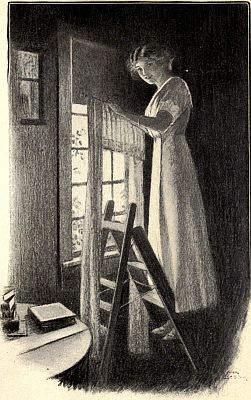 "'I'LL SLEEP BETTER IF THEY ARE ON THEIR POLES INSTEAD OF ON MY MIND.'"
As she climbed up and down the step-ladder her
thoughts were not on the curtains which she adjusted
mechanically, nor on the song which she was
humming in the same way. She was composing
the letter which she intended sending to the Girls'
Winter Camp in Florida, applying for the vacant
position, and she wanted to make it perfect of its
kind. Mrs. Ware, watching the zest with which
she fell upon her work of beautifying the little cottage,
thought it must be because she felt the truth
of the refrain which she sang softly over and over:
"'Mid pleasures and palaces, tho' we may roam,
Be it ever so humble, there's no place like home."
She was so glad to be back herself, that presently,
when she had occasion to go through the room
again, she joined in for a few notes in passing.
The sweet alto voice made Mary suddenly aware
of what she was singing, and she gave a guilty
little start, glad that her mother could not know
that her thoughts had all been absorbed in planning
to get away from the home she was singing about
so fondly.
"It does seem nicer to be back than I thought
it would," she admitted to herself. "But maybe
that's because I know I don't have to stay. Even
the finest cage in the world is more attractive with
its door open than shut."
Although she did not realize the fact, much of
her hurry to get the house in order was due to a
feeling that the summons to take advantage of that
open door might come very soon, and she wanted
to be ready when it came.
Late that afternoon she started to the post-office
with two letters, one to the principal of the Girls'
Camp, the other to the teacher in Warwick Hall
who had been given as reference.
"Oh, I hope my application will get there in time,
and I hope my references will be satisfactory," she
thought earnestly. "They ought to be impressed,
with a list which begins with Bishop Chartley and
Madam, and General Walton's wife, and includes
twenty people from New York to Fort Sam Houston
in Texas."
Just then a wagon, bearing a huge load of hay,
creaked slowly along the road past her, and a half
forgotten superstition of her childhood flashed into
her mind. Hazel Lee had told her once that if you
make a wish on a hay-wagon it will come true if
"yes" is the first word you say after doing so.
But should you be asked a question requiring any
other answer, or should it be necessary to make a
remark not beginning with the magic yes, you'll
"lose your wish."
So it was with a smile at the old foolishness that
Mary watched the loaded wagon go lumbering by.
She had wished for a speedy and favorable reply
to the letter she was about to post. It had been a
point of honor with Hazel and herself whenever
the other came running up, significantly tapping
mute lips with an impatient forefinger, to ask, "Do
you love candy?" or "Do you like peaches?" recognizing
the necessity of some question to which
the liberated little tongue could respond with a fervent
yes. Boys were always so mean about it, asking,
"Do you want me to pull your hair?" or "Do
you love Peter Finn?" a half-witted boy in the
neighborhood.
The childish rite brought up a little of the old
thrill of apprehension, that no one might ask her
the proper question to make her wish come true,
and Mary smiled broadly over her own foolishness
as she went on up the street. It was the only street
which Lone-Rock boasted; just a straggling road,
beginning down by the railroad station and the
mine offices, and ending farther up the mountain in
a narrow wagon track. The houses of the white
families were scattered along it at uneven intervals
for the space of half a mile. Then one came to a
little wooden school-house on one side, and on the
other the tiny box of a room which served as a
post-office. The school-house was used as a chapel
one day out of the week. The mining company's
store was beyond that, and a little farther along,
the colony of shanties where the Mexican workmen
and their families lived.
The fact that Mary had met no one since leaving
home and that only the hay-wagon had passed her,
emphasized the loneliness of the little hamlet and
made her glad that she need not look forward to
spending a winter there. Her quick eyes noted a
few changes, however, which promised interesting
things. Five new houses had gone up in their absence.
There was a piano in one of them, Billy
Downs had told Norman, and Mr. Moredock, the
man in the new yellow house, who had come for
his health, was writing a history of some kind, and
had brought a whole wagon-load of books.
The postmaster would know all about the newcomers,
Mary reflected with satisfaction. One of
her pleasures of coming back was meeting her old
friend, the postmaster, and at the thought of him she
walked a little faster. Captain Doane had held the
office ever since Lone-Rock had been a mail station,
and in a way was a sort of father confessor
to everybody in the place. A clean-shaven jolly old
face with deep laughter wrinkles about the blue
eyes, which twinkled through steel-bowed spectacles,
bushy iron-gray hair and bristling eyebrows—that
was about all one saw through the bars of the
narrow delivery window. But so much kindly sympathy
and neighborly interest and good advice and
real concern were handed out with the daily mail,
that every man in the community regarded him as
his personal friend.
There were only two mail trains a day in Lone-Rock,
and at this hour Mary was sure of finding
him at leisure. Seeing him through the open window,
sound asleep in his arm-chair over an open
newspaper, with his spectacles slipping down his
nose, Mary was about to spring in the door with
a playful "boo." But she remembered her wish on
the hay-wagon and the necessity of waiting for him
to speak first. So she only rattled the latch. He
started up, a little bewildered from his sudden awakening,
but seeing who had come, dashed off the
old slouch hat, perched on the back of his head.
"Well, bless my soul!" he cried heartily, coming
forward with an outstretched hand. "If it
isn't our little Mary Ware! I heard you were back
and I've been looking all afternoon for you to drop
in. Have you come back to stay, this time?"
There was an instant of hesitation, as she considered
how she could reply to such a question honestly
with a yes. Then she stammered, "Y-yes,
for a little while. That is, just for a few weeks."
Then she drew a long breath. "My! That was a
narrow escape. I've been wondering all the way
up the street what would be the first thing you'd
say to me, and for a second I was afraid you'd
ruined my chances."
Her laugh rang out merrily at his bewildered
exclamation. "The chances for my wish coming
true," she explained. "I made one on a hay-wagon,
coming along, about this letter."
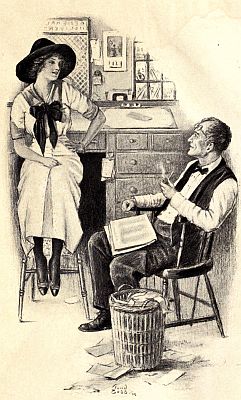
"Sit down and give an account of yourself,"
he insisted, and as she had come for a visit she willingly
obeyed. But she would not take his chair at
the desk as he urged, climbing instead to the only
other seat which the office afforded. It was a high
stool beside the shelf where pens, ink and money-order
blanks awaited the needs of the public. Mary
had often occupied it, and from this perch had given
the Captain some of the most amusing hours of his
life.
He had missed her when she went away to school,
and he never handed out the letters to her family
post-marked "Warwick Hall" without a vision of
the friendly little girl swinging her feet from her
seat on this high stool, as she told him amazing
tales of Ware's Wigwam and a place somewhere
off in Kentucky that she seemed to regard as a cross
between the Land of Beulah and the Garden of
Eden. When she came back from Warwick Hall
she no longer dangled her feet, but sat in more
grown-up fashion, her toes propped on the round
below. And she seldom stayed long. There was
too much to be done at home, with Jack needing
such constant attention. But her short accounts
of boarding-school life were like glimpses into a
strange world, and he carried home all she told
to repeat to his wife; for in an out-of-the-way
corner of the universe, where little happens, the
most trivial things are accounted of vital interest.
Now he had many questions to ask about Jack's
recovery. It was a matter of household rejoicing
in Lone-Rock that he had come back able to take
his old place among them. Mary satisfied his curiosity
and gave a brief outline of their doings while
away, but she had questions of her own to ask.
How was Aunt Sally Doane? The Captain's wife
was "Aunt Sally" by courtesy to the entire settlement.
Was her rheumatism better, and was the old
red rooster still alive? Was it true that Mr. Moredock
was an author, and how many young people
had the new families brought with them?
But all roads led to the Rome of her heart's
desire, and between her questions and the Captain's
she kept jumping back, grasshopper-like, to the subject
uppermost in her mind. His cordial interest,
unlike her family's half-hearted consenting, led her
into further confidences.
"Jack wants me to wait awhile and study at
home until he can afford to send me back to Warwick
Hall, but I might be in my twenties before that
time, and the girls in my classes would be so much
younger that they'd look upon me as a hoary old
patriarch. Of course I'd be better equipped for
what I hope to do eventually, but it would give me
such a late start, and there are a number of things
that I am fitted to do right now. Besides, it would
handicap Jack to spend so much on me. It's only
natural to expect that he'll want to marry and settle
down some of these days, and he might not be able
to do it as soon as he otherwise would if he had
me to support and keep at college. And, Captain
Doane, I don't want to be just an old maid sister
in somebody else's home, even if it is the home of
the dearest brother in the world."
The Captain threw back his head and laughed
until the steel-bowed spectacles slid down his nose
again.
"Much danger of your being an old maid sister
in anybody's home, in a place like this where pretty
girls are scarcer than hens' teeth," he declared,
teasingly. "I know a likely young lad this minute
who'd gladly save you from that fate. He's been
around several times lately, inquiring when you
might be expected back."
Mary was nearly consumed with curiosity to ask
who the likely lad was, but only shrugged her shoulders
incredulously, knowing that that would be the
surest way of provoking him to a disclosure.
"Well, he has!" insisted the Captain. "It's
young Upham, if you must know."
Mary's brows drew together in a vain effort to
recall him, and she shook her head. "Upham?
Upham? I never heard of him."
"Yes, yes, you have," insisted the Captain. "He
drove a lumber wagon for the company summer
before last. But he's been to school in Tucson all
the time you've been away, and has just come
back."
"Oh, you mean Pink Upham!" exclaimed Mary,
suddenly enlightened, with an emphasis which
seemed to say, "Oh, that boy! He doesn't count."
The Captain interpreted the emphasis and resented
it.
"Just let me tell you, little Miss Disdain, he's
a lad not to be sneezed at. He's come back the
likeliest young man in all these parts."
Again Mary shrugged her shoulders and smiled
unbelievingly. Her recollection of Pink Upham
was of a big red-faced fellow overgrown and awkward,
with a disgusting habit of twisting every
one's remarks into puns, and of uttering trite truths
with the air of just having discovered them. The
warning whirr of a clock about to strike made her
spring down from the stool with an exclamation of
surprise.
"I had no idea I was staying so long. I've an
errand at the store too, so I'll have to hurry."
"Well, I'll see that your letter gets started all
right," he assured her. "You can't expect an
answer before ten days at the earliest, can
you?"
She turned back from the door and stood, considering.
"I had counted it at about that, but I
didn't think—if they wait to hear from the people
I've referred them to, especially those farthest away,
it might be double that time. That would keep me
waiting clear into October. And then suppose
somebody were ahead of me, and I shouldn't get the
place, there'd be all that time lost. It would be
tragic to have the little ship I'd waited for so long,
drift in a wreck."
"That's why I always hold that it's best to send
out more than one," said the Captain. "Launch a
whole fleet of 'em, is my advice. What makes life
a tragedy for most people is that they put all their
hopes on just one thing. They load all they've
got on one vessel and then strain their eyes for a
lifetime waiting for it to come back with all their
hopes realized. But if they'd divide their interests
and affections around a bit, and start them off in
different directions, there'd never be a danger of
total wreck. If one went down, there'd be some
other cargo to look forward to."
It was a pet subject of the old man's, and Mary
made haste to ward off his usual monologue by saying,
"I'll certainly take your advice, Captain Doane.
You'll see me down here to-morrow with a whole
harbor full of little ships. I'll launch all the applications
that my family will allow."
The figure of speech pleased her, and as she
walked on to the store a vision of blue sea rose before
her. On it she seemed to see a fleet of little
boats with white sails swelling in the wind. On
each sail was a letter and all together they spelled
"Great Expectations."
"It's funny," thought Mary, "how such a picture
popped right up in front of me. Now, if Joyce had
such a fancy she'd do something with it. It would
suggest a title design or a tail piece of some kind.
Oh, why wasn't I born with a talent for writing!
My head is just full of things sometimes that would
make the loveliest stories, but when I try to put
them on paper it's like trying to touch the rainbows
on a bubble. The touch makes them vanish instantly."
It was some crash towelling that she was to call
for at the store.
When she opened the door, the place seemed
deserted, but she picked her way, among barrels
and boxes, saddles and hams, to the dry-goods
department in the rear. Through the open back
door she could see two men in the yard, one
repairing a chicken-coop, and the other standing
with his hands in his pockets, watching the job.
The man with the hammer and saw, she knew. He
was the manager of the store. The other was a
new clerk, who had been installed in her absence.
She glanced at him curiously, for one reason because
every newcomer counted for so much in the
social life of the place, for another because he was
so imposingly large. "Even taller than Phil
Tremont," she thought, and Phil was her standard
of all that a man should measure up to in every
way.
Presently, seeing that the chicken-coop would
occupy their attention indefinitely unless she made
some sign, she tapped on the floor with her heel.
It was the new clerk who turned, and taking his
hands out of his pockets, strode in to wait on her.
She noticed that he had to stoop as he came through
the doorway. Then she almost forgot what it was
she had come to buy, in her surprise. For it was
Pink Upham who rushed up to greet her, still red-faced
and awkward and facetious, but such a different
Pink that she could understand why the Captain
had spoken of him as Pinckney, instead of by
his undignified nickname. The year at college had
done him good.
While he measured off the crash she was taking
his measure with quick, critical glances. It was not
his pale, straw-colored hair she objected to, made to
look even paler by the contrast of his florid complexion
and red four-in-hand with its turquoise
scarf-pin. It was the way he combed his hair that
she criticized, and the gaudy tie and the combination
of colors. But his cordial greeting softened
her critical glances somewhat. He was genuinely
glad to see her, and it was flattering to be welcomed
so heartily.
That night at the supper table she recounted
her adventures. "I met Pink Upham at the
store to-day, Jack. How old do you suppose
he is?"
"Oh, about twenty-one. Why?"
"Well, I scarcely knew him before we went away,
and he called me by my first name as pat as you may
please, and I didn't like it. And when he rolled up
the towelling he crooked his little finger in such an
affected, genteel, Miss Prim sort of way that it
made his big fat hands look ridiculous. I don't
know exactly what it was about him that irritated
me so, but I couldn't bear him. And yet it seemed
that he was so near being nice, that he could be
awfully likable if he wasn't so self-conscious and
queer."
"He's all right," answered Jack. "Pink is a
good-hearted fellow, with the best intentions in the
world, but he's green. You see, he hasn't any
sisters to call him down and make fun of his mannerisms
and set him straight on his color schemes
and such things. Now, a girl in his position could
get her bearings by going the rounds of the Home
Magazines and Ladies' Companions, reading all the
Aunt Jenny Corners and columns of advice to anxious
correspondents. But there are not so many
fountains of information and inspiration for a
young man."
"Now, there's your mission in life, Mary," spoke
up Norman. "You are strong on giving advice and
setting people straight. If you could only get some
magazine to take you on for a column of that kind,
you might accomplish a world of good. You could
send marked copies to Pink, and it might be the
making of him."
Norman expected his teasing remarks to meet
with an amusing outburst, and was surprised when
she pretended to take his suggestion seriously.
Her eyes shone with the interest it awakened.
"Say! I'd like that," she answered emphatically.
"I really would. I'd call it Uncle Jerry's Corner,
and I'd certainly enjoy making up the letters myself
so that I could have good spicy replies for my correspondents."
Norman, just in the act of drinking, almost
choked on the laugh which seized him. "Excuse
me," he spluttered, putting the glass down hastily,
"but Mary in the rôle of Uncle Jerry is too funny.
Why, Sis, you couldn't be a proper Uncle Jerry
without chin whiskers. The editors wouldn't give
such a column to anybody without them. A girl
could never fill a position like that."
"Indeed she could," Mary protested. "I knew
a girl at school who earned her entire spending
money for a year, one vacation, by writing an Aunt
Ruth's Column for the weekly paper in her home
town. She was only eighteen, and the most harum-scarum
creature you ever saw. She had been engaged
four times, and once to two boys at the same
time. And she used to lay down the law in her advice
column like a Puritan forefather. Just scored
the girls who flirted and accepted valuable presents
from men, and who met clandestinely at friends'
houses.
"Her letters were so good that several parents
wrote to the paper congratulating them on that department.
And all the time she was doing the very
things which she preached against. She and Charlotte
Tatwell were chums, and in all sorts of scrapes
together. Charlotte's father used to mourn over
her wild ways and try to keep her from running so
much with Milly. He thought that Milly had such
a bad influence over her. He hadn't the faintest
idea that she wrote the Aunt Ruth advice, and twice,
when it seemed particularly well aimed at Charlotte's
faults, he made her sit down and listen while
he read it aloud to the family. Charlotte thought
it was such a good joke on her father that she never
enlightened him till he'd repeated the performance
several times. He wouldn't believe it at first, didn't
think it possible that Milly could have written it,
till Charlotte proved that she really had.
"If she could do that, I don't see why I couldn't
write better advice to boys than a doddering old
man who has only his recollections to draw on. I
could criticize the faults that I see before me. Boys
need to be shown themselves as they appear to the
girls, and I'm not sure but I'll act on Norman's suggestion,
and take it up as a side-line."
When supper was cleared away Mary brought out
her writing material and wrote several applications
for the positions which she knew she was qualified
to fill. She could teach in the primary or grammar
grades, or take beginner's classes in Domestic Science.
She knew that she could adapt herself to
almost any kind of person as companion, and her
experience with the Mallory twins made her confident
that she could do wonders with small children,
no matter how refractory. She soon had a
whole fleet of applications ready to launch in the
morning. Then, inspired by the conversation at the
supper-table, she tried her hand at a few answers
to imaginary correspondents, in which were set
forth certain criticisms and suggestions which she
burned to make to Pink in person, and several others
which were peculiarly well fitted to Norman.
Next morning, when Norman came back from
the store with the basket of groceries which it was
his daily task to bring, he began calling for Mary
at the front gate, and kept it up all the way to the
kitchen door. When she appeared, towel in hand,
asking what was the matter, he set the basket on the
step.
Then with mock solemnity he reached into his
pocket and pulled out a lavender envelope; lavender
crossed faintly with gray lines to give a checked
effect. It was addressed in purple ink to Miss Mary
Ware, and in the lower left-hand corner was written,
with many ornate flourishes, "K. O. B." It
smelled so strongly of rose geranium perfume that
Mary sniffed disapprovingly as she took it.
"Pink asked me to bring it," said Norman with
a grin. "He's to send a boy up for an answer at
three o'clock. What do you suppose 'K. O. B.'
stands for?"
Mary puzzled over it, shaking her head, then
broke the large purple seal.
"Oh, it must mean 'kindness of bearer,' for he
begins the note that way. 'By kindness of bearer I
am venturing to send this little missive to know if
it will be convenient for you to give me the pleasure
of your company this evening. A messenger will
call for your answer at three P. M. Trusting that
it will accord with my desires, I am yours in friendship's
bonds, P. Pinckney Upham.'"
Norman exploded with a loud "whoopee!" of
laughter and Mary sniffed again at the strong odor
of rose geranium and handed the note to her
mother, who had come to the door to see the cause
of Norman's mirth.
"The silly boy," exclaimed Mary. "I told him
yesterday, when he said that he hoped to call, that
we'd all be glad to see him any evening he wanted
to drop in. The idea of such formality in a mining
camp. And such paper! And such flourishes of
purple ink, to say nothing of the strong perfume!
Mamma, I don't want him coming to see me."
Mrs. Ware handed the note back with a smile at
Mary's disgusted expression. "Don't judge the
poor boy too severely. He evidently tried his best
to do the proper thing, and probably thinks he has
achieved it."
"Yes, Uncle Jerry," added Norman. "Here's
your chance. Here's your tide in the affairs of
men, which taken at the flood leads on to fortune!
Just cultivate Pink's acquaintance and you'll get
enough out of him every week to fill your columns."
Mary ignored his teasing, turning again to her
mother to say: "I don't want to answer his note.
What did he write for, anyway? Why didn't he
just come, as I told him he could?"
"That's the way Sara Downs' beau does," explained
Norman. "He always makes an engagement
so that she'll be sure to have the best room
lighted up and Billy out of the way. He's too bashful
to talk to the whole family. They usually go
out to the kitchen when he comes, because their
house is so small."
"Well, this family won't," declared Mary.
"He's no 'beau,' anyway. You'll all have to help
entertain him."
She had not answered the note when Jack came
home at noon, and she passed it to him without comment.
He smiled a little over her evident disgust,
and repeated in substance what Mrs. Ware had said,
that she must not judge him too severely for his
lack of social polish.
"He's a diamond in the rough, Mary," he assured
her gravely, but with a twinkle in his eyes.
"He may be one of the leading citizens of the state
twenty years from now, and even if he isn't, he's
one of the few young fellows of the settlement, and
a decent one at that, and you can't afford to snub
him because he is green."
"Green Pink is a new kind of color," teased
Norman. "Say, Mary, are you going to put a
'K. O. B.' on your answer?"
Mary ignored his question. It irritated her to be
teased about Pink as much as it used to annoy her
to be teased about the half-witted Peter Finn.
When, in answer to her note, P. Pinckney Upham
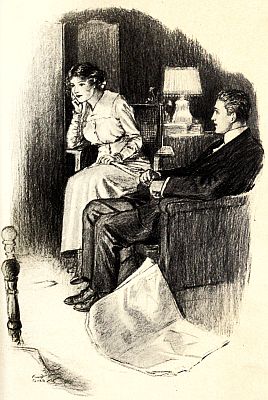
called that evening, he did not find her sitting
up alone in state to receive him. He was ushered in
to the cheerful living-room, where the entire family
was gathered around the lamp, putting a new dissected
puzzle together. Before he knew how it
came about his bashfulness had vanished and he
was a part of that circle. When the puzzle was
completed Mary brought out a chafing-dish and a
bowl of nuts, which she commanded him to "pick
out" while Jack cracked them. She was going to
try a new kind of candy. Later, when he disclosed
the fact that he could play a little on the guitar,
Norman brought out his mother's, bidding him
"tune up and plunk away."
Now if there was one thing Pink was fond of
it was sweets, and if there was one thing he was
proud of it was his tenor voice, and presently he
began to feel that he was having the time of his life.
They were all singing with him, and stopping at
intervals to pass the candy and tell funny stories.
He was a good mimic and had a keen sense of
humor, and he was elated with the consciousness
that he had an appreciative audience. In spite of
her certainty that the evening would be a bore, Mary
found herself really enjoying it, until she realized
that Pink was having such a good time that he
didn't want to leave. Later she concluded that he
wanted to go but didn't know how to tear himself
away gracefully.
"Well, I guess I'd better be going," he said
when the clock struck ten. It struck eleven when
he said it the second time, and it was quarter past
when he finally pulled himself out of his chair and
looked around for his hat. They all rose, and Jack
brought it. With that in hand, he still lingered,
talking at random in a way that showed his evident
inability to take his leave.
Finally Mrs. Ware put out her hand, saying,
"We've enjoyed having you with us so much, this
evening, Pinckney. You must come often."
Jack echoed the invitation with a handshake,
and Mary added gaily, "And after this, whatever
you do, don't write first to announce your coming.
We're used to the boys just dropping in informally.
We like it so much better that way."
Pink stopped to reply to that, hesitated with his
hand on the knob, and leaning against the door,
made some remark about the weather. It was evident
that he was fixed to stay until the clock struck
again.
Mary reached up to the match-safe hanging near
the door and handed him a match. "I wish you'd
scratch this as you go out, and see how the thermometer
stands. It's hanging on the post just at
the right hand of the porch steps. Call back what
it registers, please. Thirty-six? Oh, thank you!
I'm sure there'll be frost before morning. Good
night."
She closed the door and came back into the room,
pretending to swoon against Jack, who shook her,
exclaiming laughingly, "I think that was a frost,
right now."
Just then, Norman, who had disappeared an
hour earlier, cautiously opened the door of his bedroom
a crack. He was clad in his pajamas. Seeing
that the coast was clear he thrust out a dishevelled
head and recited dramatically:
"'Parting is such sweet sorrow
I fain would say goodnight until it be to-morrow.'"
Mary blinked at him sleepily, saying with a
yawn, "Let this be a lesson to you, son. You can
take this from your Uncle Jerry, that there is no
social grace more to be desired than the ability to
make a nimble and graceful exit when the proper
time comes."
As she turned out her light, later, she said to
herself, "I'm glad I don't have to look forward to
a whole lifetime in Lone-Rock. One such evening
is pleasant enough, but a whole winter of them
would be dreadful." Then she went to sleep and
dreamed that her little fleet of boats had all come
home from sea, each one so heavily laden with
treasure that she did not know which cargo to draw
in first.